
Hindu Marriage Act, 2017
Stored extracted text; legal completeness and current force have not been independently established. Inspect source and version details
Reading view reduces excess blank space and hides page extraction markers. Original text and downloads are retained.
Reading layout follows the stored source. Open the original transcription below to compare wording and extraction details.
THE HINDU MARRIAGE ACT, 2017
THE HINDU MARRIAGE ACT, 2017 ACT NO.VII OF 2017 [17th March, 2017]
An Act to provide for solemnization of marriages by Hindu families and for matters ancillary and incidental thereto WHEREAS it is constitutional obligation that the state shall protect the marriage, the family, the mother and the child and also safeguard the legitimate, rights and interests of minorities;
AND W HEREAS it is expedient to have a consolidated law providing for solemnization of marriages by Hindu families and the matters connected therewith and incidental thereto;
AND WHEREAS the Provincial Assemblies of Balochistan, Khyber 'Pakhtunkhwa and Punjab have passed Resolutions under Article 144 of the Constitution of the Islamic Republic of Pakistan to the effect that MajliseShoora (Parliament) may, by law, regulate solemnization of marriages by Hindu families and for matters connected therewith and incidental thereto;
It is hereby enacted as follows:—
Section 1. Short title, extent, application and commencement
(1) This Act may be called the Hindu Marriage Act, 2017.
(2) It extends to the Islamabad Capital Territory and the Provinces of Balochistan, Khyber Pakhtunkhwa and Punjab.
(3) Subject to subsection (2), it shall apply to those citizen of Pakistan who profess Hindu religion in any of its forms.
(4) It shall come into force at once.
Section 2. Definitions
In this Act, unless the subject or context otherwise requires,—
(a) “Court” means a Family Court as defined under the West Pakistan Family Courts Act, 1964 (W.P. Act, XXV of 1964);
(b) “customs” and “customary rites” mean any tradition which is not unlawful and the same has been continuously and uniformly observed for a long time among Hindus in any local area, tribe, community, group or family;
(c) “degrees of prohibited relationship ” means any prohibited relationship as per laws, religion and customs having force of law relating to Hindu persons;
(d) “Government” means the Federal Government or the Provincial Government as the case may be;
(e) “Hindu marriage ” means the union of Hindu male and Hindu female solemnized under this Act and includes the marriage solemnized before commencement of this Act in accordance with the law, religion and customs
having force of law relating to Hindu persons;
(f) “marriage register” means register of marriages maintained . by marriage registrar as may be prescribed;
(g) “marriage registrar ” means a person authorized and appointed by the Government to register Hindu marriages under this Act;
(h) “prescribed” means prescribed by rules made under this Act; and
(i) “shaadiparat” means certificate of marriage issued by the marriage registrar, which certifies the solemnization of Hindu marriage.
Section 3. Overriding effect of Act
The provisions of this Act shall have effect not withstanding any other law or custom or usage for the time being in force.
Section 4. Conditions for a Hindu marriage
A Hindu marriage shall be solemnized, if the following conditions are fulfilled, namely: —
(a) at the time of marriage, the parties are of sound mind and capable of giving a valid consent;
(b) both the parties are not below the age of eighteen years;
(c) the parties to the marriage are not within the degrees of prohibited relationship; and
(d) neither party has a spouse living at the time of marriage:
Provided that condition in clause (d) shall not apply where a living female spouse cannot conceive a child and medically declared to be so.
Section 5. Ceremonies for Hindu marriage
A Hindu marriage may be solemnized in accordance with the customary rites, rituals and ceremonies of either party thereto.
Section 6. Registration of Hindu marriages
(1) The solemnization of every Hindu marriage shall be registered in accordance with the provisions of this Act. Such registration shall take place within a period of fifteen days of solemnization of Hindu marriage.
(2) The marriage register shall be open for inspection and shall be admissible as evidence of the contents contained therein or certified extracts there from shall, on application, be given by the marriage registrar on payment of such fee, as may be prescribed.
Section 7. Appointment and functions of marriage registrar
(1) The Government shall, by notification in official Gazette, appoint one or such numbers of marriage registrars in the territory of a district or such other areas as would be convenient for Hindu population living in the said district or such other areas.
(2) For the purposes of registration of Hindu marriage, the marriage registrar or person duly authorized by him from amongst the local Hindu community in the manners as may be prescribed, shall be responsible to register the marriage. The parties to Hindu marriage shall give their particular
to the respective registrar or his authorized person for the purpose of entry thereof in shaadiparat.
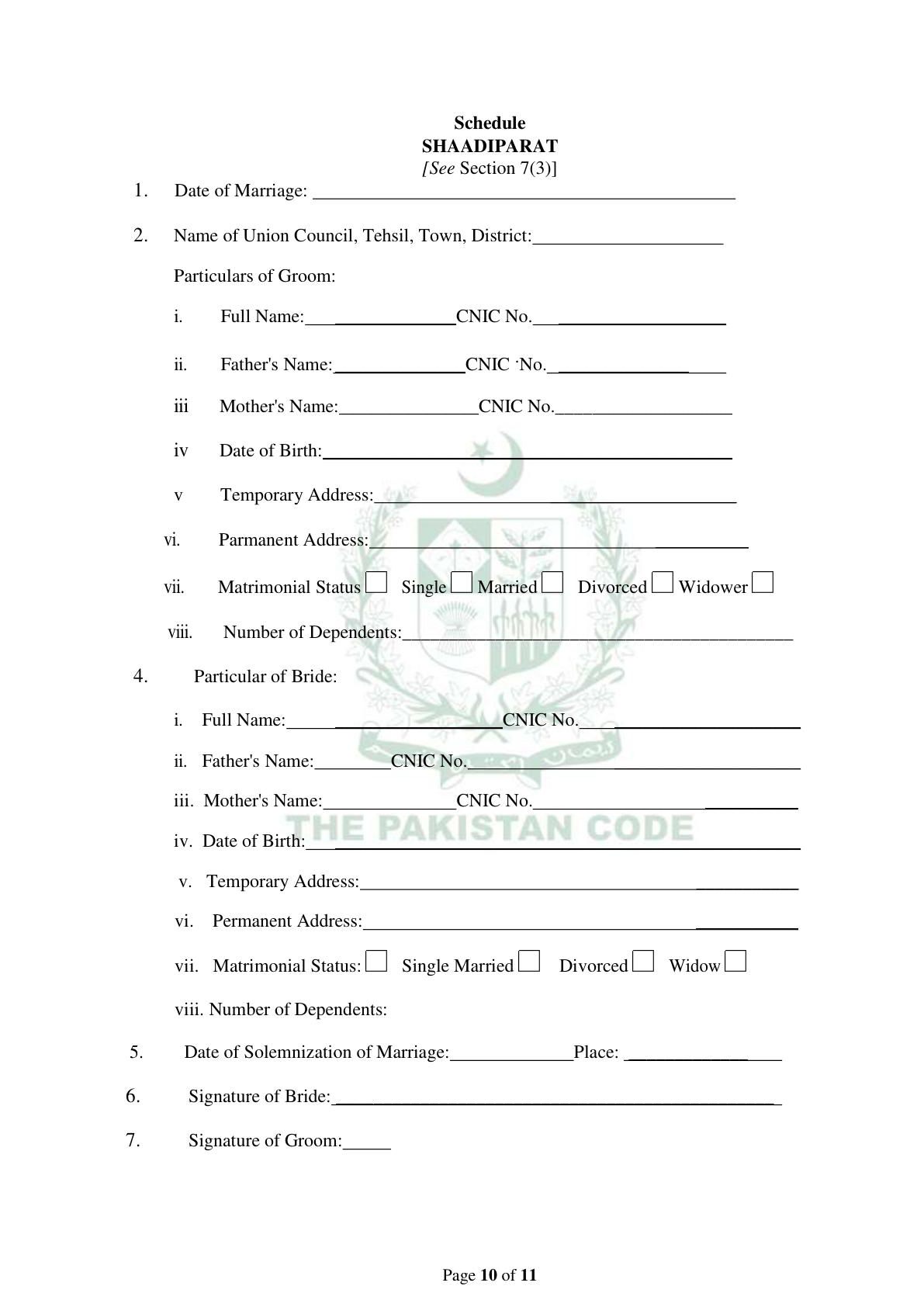
(3) The form of shaadiparat, the record to be preserved and maintained by the marriage registrar shall be such as may be prescribed. Until the rules are made, the shaadiparat annexed as Schedule A of this Act shall be used as shaadiparat.
(4) The marriage registrar shall prepare such number of copies as may be prescribed and unless the rules are made, he shall prepare three copies thereof. One copy each shall be given to the respective parties to marriage and one copy shall be kept in the office of marriage registrar as a public record.
Section 8. Restitution of conjugal rights
When either a husband or a wife has, without reasonable excuse, withdrawn from the society of the other, the aggrieved party may, by a petition to the Court, apply for restitution of conjugal rights and the Court, on being satisfied of truth of statements made in such petition and that there is no legal ground why the application should not be granted, may decree restitution of conjugal rights:
Explanation—Where a question arises whether there has been reasonable excuse for withdrawal from the society, the burden of proving reasonable excuse shall be on the person who has withdrawn from the society.
Section 9. Judicial separation
(1) Either party to Hindu marriage, whether solemnized before or after commencement of this Act, may present a petition to the Court praying for a decree of judicial separation on any of the ground specified in subsection (1) of section 12 and in the case of a wife also on any of the grounds specified in subsection (2) thereof.
(2) Where a decree of judicial separation has been passed, the Court may, on the application of both the parties and on being satisfied of truth of statements made in such petition, rescind the decree if it considers it just and reasonable to do so.
Section 10. Void marriage
Any Hindu marriage solemnized after commencement of this Act may, on a petition to the Court presented by either party to the marriage or their real parents, be declared null and void on the conditions specified in clauses (c) and (d) of section 4.
Section 11. Voidable marriage
(1) Any Hindu marriage solemnized, whether before or after commencement of this Act, may be declared voidable and may be subsequently annulled by a decree of nullity passed by the Court if—
(a) the marriage has not been consummated owing to impotence of the respondent; or
(b) the marriage has been solemnized in contravention of the condition specified in clause (b) of section 4; or
(c) consent of the petitioner was obtained by force, coercion or by fraud as to the nature of the ceremony or as to any material fact or circumstance concerning the respondent; or
(d) the respondent was at the time of marriage pregnant by some person other than the petitioner.
(2) Notwithstanding anything contained in subsection (1), no petition for annulling a marriage,—
(A) on the ground specified in clause (c) of subsection (1), shall be entertained, if—
(i) the petition is presented more than one year after the force or coercion had ceased to operate or, as the . case may be, the fraud had been discovered; or
(ii) the petitioner has, with his or her full consent, confirmed to liv e with the other party to the marriage as husband or wife after the force had ceased to operate, or, as the case may be, the fraud has been discovered; and
(B) on the ground specified in clause (d) of subsection (1) shall be entertained unless the Court is satisfied that—
(i) the petitioner was, at the time of marriage, ignorant of the facts alleged; and
(ii) he proceedings have been instituted, In the case of marriage solemnized—
(a) before the commencement of this Act within one year of such commencement; and
(b) after such commencement, within one year from the date of the marriage.
Section 12. Termination of Hindu marriage
(1) Any Hindu marriage solemnized whether before or after commencement of this Act may, on a petition presented to the Court by either a husband or a wife, be terminated by decree of termination of marriage on the ground —
(a) that the other party —
(i) has, after the solemnization of the marriage, treated the petitioner with cruelty; or
(ii) has deserted the petitioner for continuous period of not less than two years immediately proceeding the presentation of the petition: Explanation.—In this clause, the expression “desertion” means the desertion of the petitioner by the other party to the marriage without reasonable cause and without the consent or against the wish of such party and includes the willful neglect of the petitioner by the other party to the Marriage; or
(iii) has ceased to be Hindu by conversion to another religion; or
(iv) has been incurably of unsound mind or has been suffering continuously or intermittently from mental disorder of such a kind and to such an extent that the petitioner cannot reasonably be expected to live with the respondent;
Explanation.—In this clause, the expression “mental disorder” means mental illness, arrested or incomplete development of mind, psychopathic disorder or any other disorder or disability of mind including schizophrenia and the expression “psychopathic disorder” means a persistent diso rder or disability of mind (whether or not including sub-normality of intelligence) which results in abnormally aggressive or seriously irresponsible conduct on the part of the other party and whether or not it requires or is susceptible to medical treatment; or
(v) has been suffering from a virulent and incurable from of leprosy; or
(vi) has been suffering from venereal disease in a communicable from or HIV Aids; or
(vii) has renounced the world by entering any religious order; or
(b) that there has been no resumption of cohabitation as between the parties to the marriage for a period of more than one year after he passing of decree for judicial separation or order of restitution of conjugal rights passed by the Court.
(2) A wife may also present a petition for termination of her marriage on the grounds,—
(a) in the case of any marriage solemnized before commencement of this Act, that the husband had married again before such commencement or that another wife of the husband married before such commencement was alive at the time of the solemnization of the marriage of the petitioner:
Provided that in either case the other wife is alive at the time of the presentation of the petition; or
(b) that the husband has neglected or has failed to provide for her maintenance for a period of two years;
(c) that the husband has been sentenced to imprisonment for a period of four years or upwards; or
(d) that her marriage, whether consummated or not, was solemnized before she attained the age of eighteen' years and she has repudiated the marriage before attaining that age; Explanation.—This clause .applies whether the marriage was solemnized before or after commencement of this Act.
Section 13. Financial security of wife and children
(1) If a wife is respondent i n a petition for termination for the marriage by decree of termination, she may oppose the grant of decree on the ground that the termination of the marriage may result in grave financial hardship fo her unless arrangements have been made to the satisfaction of the Court to eliminate such hardship:
Provided that nothing contained in this Act shall affect any right which she may have to her dower or any part thereof on the termination of marriage.
(2) The Court shall not pass a decree of termination unless t he Court is satisfied that adequate provisions for the maintenance of children born out of the marriage has been made in commensuration with the financial capacity of the parties to the marriage.
Section 14. Alternate relief in termination of marriage proceeding
In any proceeding under this Act, on a petition for termination of marriage by decree of termination, except in so far as the petition is found on the ground mentioned in subclauses (i), (ii), (iv) and (vii) of clause (a) and clause (b) of subsection (1) of section 12, the Court may, if it considers it just so to do having regard to the circumstances of the case, pass, a decree fo r judicial separation instead ol decree for termination of marriage.
Section 15. Termination of Hindu marriage by mutual consent
(1) Subject .to the provisions of this Act, a petition for termination of marriage by decree of termination may be presented to the Court by both the parties to a marriage together, whether such marriage was solemnized before or after commencement of this Act, on the ground that they have .been living separately for a period of one year or more, that they have not been able to live together and they have mutually agreed that the marriage should be terminated.
(2) On the decision by both the parties made not earlier than six months after the date of the presentation of the petition referred to in subsection (1) and not later than eighteen months after the said date, the Court shall, on being satisfied after hearing the parties and after making such inquiry as it thinks fit that a marriage has been solemnized and that the averments in the petition are true, pass a decree of termination declaring the marriage to be terminated with effect from the date of the decree.
Section 16. Separated person may marry again
When a Hindu marriage has been annulled or terminated by a decree of nullity or decree of termination, as the case may be and the time for appeal has expired or an appeal has been preferred but has been dismissed, it shall be lawful for either party to the marriage so terminated to marry again after expiry of six months from final decision.
Section 17. Hindu widows are entitled to remarry
A Hindu widow shall have right to remarry of her own will and consent after the death of her husband provided a period of six months has lapsed after the husband's death.
Section 18. Legitimacy of child born out of void and voidable Hindu marriage
(1) Notwithstanding that a Hindu marriage is null and void under section 10, any child of such marriage who would have been legitimate if the marriage had been valid, shall be legitimate, whether such child is born before or after commencement of this Act and whether or not a decree of nullity is granted in respect of that marriage under this Act and whether or not the marriage is held to be void oth erwise than on a petition under this Act.
(2) Where a decree of nullity is granted in respect of a voidable Hindu marriage under section 11, any child begotten or conceived before the decree is made, who would have been the legitimate child of the parties to the marriage if at the date of the decree it had been terminated instead of being annulled, shall be deemed to be their legitimate child notwithstanding the decree of nullity.
Section 19. Validation of marriages
All Hindu marriages solemnized before commence ment of this Act shall be deemed valid. 20 Punishment of bigamy. —Any Hindu marriage solemnized after commencement of this Act is void if at the date of such marriage either party had a spouse living and the provisions of section 494 and 495 of the Pakistan Panel Code, 1860 (Act XLV of 1860) shall apply accordingly.
Section 21. Punishment for contravention of certain other conditions for Hindu marriage
Every person who get his or her marriage solemnized under this Act in contravention of the conditions
specified in clauses (b) or (c) of section (4) shall be punishable with simple imprisonmentwhich may extend to six months but not less than three months, or with fine which may extend to five thousand rupees; or with both.
Section 22. Court to which petition sha ll be presented
Every petition under this Act shall be presented to the Family Court and the provision of—
(a) the West Pakistan Family Courts Act, 1964 (WPXXXV of 1964) except proviso of sub section (4) of section 10, subsection (2) of section 14 and s ection 21 and 23 thereof; and
(b) the West Pakistan Family Court Rules 1965, except proviso to clause (b) of rule (6) thereof; shall mutatis mutandis apply to the proceedings under this Act.
Section 23. Penalty for violating the provision of this Act
(1) Any person who contravenes the provision of this Act or rules made there under regarding registration of Hindu marriage shall be punishable with simple imprisonment for a term which may extend to three months or with fine which may extend to one thousand rupees or with both..
(2) Any person who make statement or give particulars to be entered in the shaadiparat, which is false or has reason to believe to be false; shall be punished with a simple imprisonment which may extend to six month but not less than one month of a fine which may extend up to one hundred thousand or with both.
Section 24. Cognizance of offence under this Act
Notwithstanding anything contained in the Code of Criminal Procedure 1898 (Act V of 1898), all offences under this Act shall be noncognizable and noncompoundable and the same shall be triable by a Magistrate First Class on a complaint in writing by a marriage registrar.
Section 25. Power to make rules
The Government may, by notification in the official Gazette, make rules to carry out purposes of this Act.
Schedule
SHAADIPARAT [See Section 7(3)]
1. Date of Marriage:
2. Name of Union Council, Tehsil, Town, District: Particulars of Groom:
i. Full Name: _____________CNIC No. __________________
ii. Father's Name: ______________CNIC .No. ______________ iii Mother's Name:_______________CNIC No.___________________
iv Date of Birth:____________________________________________
v Temporary Address: ____________________
vi. Parmanent Address: __________
vii. Matrimonial Status Single Married Divorced Widower
viii. Number of Dependents:__________________________________________
4. Particular of Bride:
i. Full Name: __________________CNIC No. ____________________
ii. Father's Name: CNIC No. ____________________
iii. Mother's Name: CNIC No. __________
iv. Date of Birth: __________________________________________________
v. Temporary Address: ___________
vi. Permanent Address: ___________
vii. Matrimonial Status: Single Married Divorced Widow
viii. Number of Dependents:
5. Date of Solemnization of Marriage: Place: _____________
6. Signature of Bride: _______________________________________________
7. Signature of Groom:
8. Signature of Witnesses: 1____________________________________________
(CN1C No.________________________________)
2._____________________________________________
(CNIC No. __________________________________ )
9. Signature of Registrar:__________________________________________________
Print contents from the source
CONTENTS


1. Short title, extent, application and commencement.
2. Definitions.
3. Overriding effect of Act.
4. Conditions for a Hindu marriage.
5. Ceremonies for Hindu marriage.
6. Registration of Hindu marriages.
7. Appointment and functions of marriage registrar.
8. Restitution of conjugal rights.
9. Judicial separation.
10. Void marriage.
11. Voidable marriage.
12. Termination of Hindu marriage.
13. Financial security of wife and children.
14. Alternate relief in termination of marriage proceeding.
15. Termination of Hindu marriage by mutual consent.
16. Separated person may marry again.


Page 2 of 11
17. Hindu widows are entitled to remarry.
18. Legitimacy of child born out of void and voidable Hindu marriage.
19. Validation of marriages.
20. Punishment of bigamy.
21. Punishment for contravention of certain other conditions for Hindu marriage.
22. Court to which petition shall be presented.
23. Penalty for violating the provision of this Act.
24. Cognizance of offence under this Act.
25. Power to make rules.
Compare the original stored transcription
Exact source transcription retained, including print layout and extraction artifacts. Text SHA-256: 821ace4816050835314f4fbb41aa28f347ec51a1d428f487dd1d81860bc3f7c0.
Page 1 of 11
THE HINDU MARRIAGE ACT, 2017
CONTENTS
1. Short title, extent, application and commencement.
2. Definitions.
3. Overriding effect of Act.
4. Conditions for a Hindu marriage.
5. Ceremonies for Hindu marriage.
6. Registration of Hindu marriages.
7. Appointment and functions of marriage registrar.
8. Restitution of conjugal rights.
9. Judicial separation.
10. Void marriage.
11. Voidable marriage.
12. Termination of Hindu marriage.
13. Financial security of wife and children.
14. Alternate relief in termination of marriage proceeding.
15. Termination of Hindu marriage by mutual consent.
16. Separated person may marry again.
Page 2 of 11
17. Hindu widows are entitled to remarry.
18. Legitimacy of child born out of void and voidable Hindu marriage.
19. Validation of marriages.
20. Punishment of bigamy.
21. Punishment for contravention of certain other conditions for Hindu marriage.
22. Court to which petition shall be presented.
23. Penalty for violating the provision of this Act.
24. Cognizance of offence under this Act.
25. Power to make rules.
Page 3 of 11
THE HINDU MARRIAGE ACT, 2017
ACT NO.VII OF 2017
[17th March, 2017]
An Act to provide for solemnization of marriages by Hindu families and for matters ancillary and
incidental thereto
WHEREAS it is constitutional obligation that the state shall protect the marriage, the family, the
mother and the child and also safeguard the legitimate, rights and interests of minorities;
AND W HEREAS it is expedient to have a consolidated law providing for solemnization of
marriages by Hindu families and the matters connected therewith and incidental thereto;
AND WHEREAS the Provincial Assemblies of Balochistan, Khyber 'Pakhtunkhwa and Punjab
have passed Resolutions under Article 144 of the Constitution of the Islamic Republic of Pakistan to
the effect that MajliseShoora (Parliament) may, by law, regulate solemnization of marriages by
Hindu families and for matters connected therewith and incidental thereto;
It is hereby enacted as follows:—
1. Short title, extent, application and commencement. —(1) This Act may be called the
Hindu Marriage Act, 2017.
(2) It extends to the Islamabad Capital Territory and the Provinces of Balochistan, Khyber
Pakhtunkhwa and Punjab.
(3) Subject to subsection (2), it shall apply to those citizen of Pakistan who profess Hindu
religion in any of its forms.
(4) It shall come into force at once.
2. Definitions.—In this Act, unless the subject or context otherwise requires,—
(a) “Court” means a Family Court as defined under the West Pakistan Family
Courts Act, 1964 (W.P. Act, XXV of 1964);
(b) “customs” and “customary rites” mean any tradition which is not unlawful and
the same has been continuously and uniformly observed for a long time among
Hindus in any local area, tribe, community, group or family;
(c) “degrees of prohibited relationship ” means any prohibited relationship as per
laws, religion and customs having force of law relating to Hindu persons;
(d) “Government” means the Federal Government or the Provincial Government
as the case may be;
(e) “Hindu marriage ” means the union of Hindu male and Hindu female
solemnized under this Act and includes the marriage solemnized before
commencement of this Act in accordance with the law, religion and customs
Page 4 of 11
having force of law relating to Hindu persons;
(f) “marriage register” means register of marriages maintained . by marriage
registrar as may be prescribed;
(g) “marriage registrar ” means a person authorized and appointed by the
Government to register Hindu marriages under this Act;
(h) “prescribed” means prescribed by rules made under this Act; and
(i) “shaadiparat” means certificate of marriage issued by the marriage registrar,
which certifies the solemnization of Hindu marriage.
3. Overriding effect of Act. —The provisions of this Act shall have effect not withstanding
any other law or custom or usage for the time being in force.
4. Conditions for a Hindu marriage. —A Hindu marriage shall be solemnized, if the
following conditions are fulfilled, namely: —
(a) at the time of marriage, the parties are of sound mind and capable of giving a
valid consent;
(b) both the parties are not below the age of eighteen years;
(c) the parties to the marriage are not within the degrees of prohibited relationship;
and
(d) neither party has a spouse living at the time of marriage:
Provided that condition in clause (d) shall not apply where a living female spouse cannot
conceive a child and medically declared to be so.
5. Ceremonies for Hindu marriage. —A Hindu marriage may be solemnized in accordance
with the customary rites, rituals and ceremonies of either party thereto.
6. Registration of Hindu marriages.—(1) The solemnization of every Hindu marriage shall
be registered in accordance with the provisions of this Act. Such registration shall take place within a
period of fifteen days of solemnization of Hindu marriage.
(2) The marriage register shall be open for inspection and shall be admissible as evidence of
the contents contained therein or certified extracts there from shall, on application, be given by the
marriage registrar on payment of such fee, as may be prescribed.
7. Appointment and functions of marriage registrar .—(1) The Government shall, by
notification in official Gazette, appoint one or such numbers of marriage registrars in the territory of
a district or such other areas as would be convenient for Hindu population living in the said district or
such other areas.
(2) For the purposes of registration of Hindu marriage, the marriage registrar or person duly
authorized by him from amongst the local Hindu community in the manners as may be prescribed,
shall be responsible to register the marriage. The parties to Hindu marriage shall give their particular
Page 5 of 11
to the respective registrar or his authorized person for the purpose of entry thereof in shaadiparat.
(3) The form of shaadiparat, the record to be preserved and maintained by the marriage
registrar shall be such as may be prescribed. Until the rules are made, the shaadiparat annexed as
Schedule A of this Act shall be used as shaadiparat.
(4) The marriage registrar shall prepare such number of copies as may be prescribed and unless
the rules are made, he shall prepare three copies thereof. One copy each shall be given to the respective
parties to marriage and one copy shall be kept in the office of marriage registrar as a public record.
8. Restitution of conjugal rights.—When either a husband or a wife has, without reasonable
excuse, withdrawn from the society of the other, the aggrieved party may, by a petition to the Court,
apply for restitution of conjugal rights and the Court, on being satisfied of truth of statements made in
such petition and that there is no legal ground why the application should not be granted, may decree
restitution of conjugal rights:
Explanation—Where a question arises whether there has been reasonable excuse for
withdrawal from the society, the burden of proving reasonable excuse shall be on the person who has
withdrawn from the society.
9. Judicial separation.—(1) Either party to Hindu marriage, whether solemnized before or
after commencement of this Act, may present a petition to the Court praying for a decree of judicial
separation on any of the ground specified in subsection (1) of section 12 and in the case of a wife also
on any of the grounds specified in subsection (2) thereof.
(2) Where a decree of judicial separation has been passed, the Court may, on the application
of both the parties and on being satisfied of truth of statements made in such petition, rescind the
decree if it considers it just and reasonable to do so.
10. Void marriage.—Any Hindu marriage solemnized after commencement of this Act may,
on a petition to the Court presented by either party to the marriage or their real parents, be declared
null and void on the conditions specified in clauses (c) and (d) of section 4.
11. Voidable marriage .—(1) Any Hindu marriage solemnized, whether before or after
commencement of this Act, may be declared voidable and may be subsequently annulled by a decree
of nullity passed by the Court if—
(a) the marriage has not been consummated owing to impotence of the respondent;
or
(b) the marriage has been solemnized in contravention of the condition specified in
clause (b) of section 4; or
(c) consent of the petitioner was obtained by force, coercion or by fraud as to the
nature of the ceremony or as to any material fact or circumstance concerning
the respondent; or
(d) the respondent was at the time of marriage pregnant by some person other than
the petitioner.
(2) Notwithstanding anything contained in subsection (1), no petition for annulling a
marriage,—
Page 6 of 11
(A) on the ground specified in clause (c) of subsection (1), shall be entertained, if—
(i) the petition is presented more than one year after the force or coercion
had ceased to operate or, as the . case may be, the fraud had been
discovered; or
(ii) the petitioner has, with his or her full consent, confirmed to liv e with
the other party to the marriage as husband or wife after the force had
ceased to operate, or, as the case may be, the fraud has been discovered;
and
(B) on the ground specified in clause (d) of subsection (1) shall be entertained unless the Court
is satisfied that—
(i) the petitioner was, at the time of marriage, ignorant of the facts
alleged; and
(ii) he proceedings have been instituted, In the case of marriage
solemnized—
(a) before the commencement of this Act within one year of such commencement;
and
(b) after such commencement, within one year from the date of the marriage.
12. Termination of Hindu marriage. —(1) Any Hindu marriage solemnized whether before
or after commencement of this Act may, on a petition presented to the Court by either a husband or a
wife, be terminated by decree of termination of marriage on the ground —
(a) that the other party —
(i) has, after the solemnization of the marriage, treated the petitioner with
cruelty; or
(ii) has deserted the petitioner for continuous period of not less than two
years immediately proceeding the presentation of the petition:
Explanation.—In this clause, the expression “desertion” means the desertion of the petitioner
by the other party to the marriage without reasonable cause and without the consent or against the wish
of such party and includes the willful neglect of the petitioner by the other party to the Marriage; or
(iii) has ceased to be Hindu by conversion to another religion; or
(iv) has been incurably of unsound mind or has been suffering continuously
or intermittently from mental disorder of such a kind and to such an
extent that the petitioner cannot reasonably be expected to live with the
respondent;
Page 7 of 11
Explanation.—In this clause, the expression “mental disorder” means mental illness, arrested
or incomplete development of mind, psychopathic disorder or any other disorder or disability of mind
including schizophrenia and the expression “psychopathic disorder” means a persistent diso rder or
disability of mind (whether or not including sub-normality of intelligence) which results in abnormally
aggressive or seriously irresponsible conduct on the part of the other party and whether or not it
requires or is susceptible to medical treatment; or
(v) has been suffering from a virulent and incurable from of leprosy; or
(vi) has been suffering from venereal disease in a communicable from or
HIV Aids; or
(vii) has renounced the world by entering any religious order; or
(b) that there has been no resumption of cohabitation as between the parties to the
marriage for a period of more than one year after he passing of decree for
judicial separation or order of restitution of conjugal rights passed by the Court.
(2) A wife may also present a petition for termination of her marriage on the grounds,—
(a) in the case of any marriage solemnized before commencement of this Act, that
the husband had married again before such commencement or that another wife
of the husband married before such commencement was alive at the time of the
solemnization of the marriage of the petitioner:
Provided that in either case the other wife is alive at the time of the presentation of the petition;
or
(b) that the husband has neglected or has failed to provide for her maintenance for
a period of two years;
(c) that the husband has been sentenced to imprisonment for a period of four
years or upwards; or
(d) that her marriage, whether consummated or not, was solemnized before she
attained the age of eighteen' years and she has repudiated the marriage before
attaining that age;
Explanation.—This clause .applies whether the marriage was solemnized before or after
commencement of this Act.
13. Financial security of wife and children .—(1) If a wife is respondent i n a petition for
termination for the marriage by decree of termination, she may oppose the grant of decree on the
ground that the termination of the marriage may result in grave financial hardship fo her unless
arrangements have been made to the satisfaction of the Court to eliminate such hardship:
Provided that nothing contained in this Act shall affect any right which she may have to her
dower or any part thereof on the termination of marriage.
(2) The Court shall not pass a decree of termination unless t he Court is satisfied that adequate
provisions for the maintenance of children born out of the marriage has been made in commensuration
with the financial capacity of the parties to the marriage.
Page 8 of 11
14. Alternate relief in termination of marriage proceeding.—In any proceeding under this
Act, on a petition for termination of marriage by decree of termination, except in so far as the petition
is found on the ground mentioned in subclauses (i), (ii), (iv) and (vii) of clause (a) and clause (b) of
subsection (1) of section 12, the Court may, if it considers it just so to do having regard to the
circumstances of the case, pass, a decree fo r judicial separation instead ol decree for termination of
marriage.
15. Termination of Hindu marriage by mutual consent. —(1) Subject .to the provisions of
this Act, a petition for termination of marriage by decree of termination may be presented to the Court
by both the parties to a marriage together, whether such marriage was solemnized before or after
commencement of this Act, on the ground that they have .been living separately for a period of one
year or more, that they have not been able to live together and they have mutually agreed that the
marriage should be terminated.
(2) On the decision by both the parties made not earlier than six months after the date of the
presentation of the petition referred to in subsection (1) and not later than eighteen months after the
said date, the Court shall, on being satisfied after hearing the parties and after making such inquiry as
it thinks fit that a marriage has been solemnized and that the averments in the petition are true, pass a
decree of termination declaring the marriage to be terminated with effect from the date of the decree.
16. Separated person may marry again —When a Hindu marriage has been annulled or
terminated by a decree of nullity or decree of termination, as the case may be and the time for appeal
has expired or an appeal has been preferred but has been dismissed, it shall be lawful for either party
to the marriage so terminated to marry again after expiry of six months from final decision.
17. Hindu widows are entitled to remarry.—A Hindu widow shall have right to remarry of
her own will and consent after the death of her husband provided a period of six months has lapsed
after the husband's death.
18.Legitimacy of child born out of void and voidable Hindu marriage. —(1)
Notwithstanding that a Hindu marriage is null and void under section 10, any child of such marriage
who would have been legitimate if the marriage had been valid, shall be legitimate, whether such child
is born before or after commencement of this Act and whether or not a decree of nullity is granted in
respect of that marriage under this Act and whether or not the marriage is held to be void oth erwise
than on a petition under this Act.
(2) Where a decree of nullity is granted in respect of a voidable Hindu marriage under section
11, any child begotten or conceived before the decree is made, who would have been the legitimate
child of the parties to the marriage if at the date of the decree it had been terminated instead of being
annulled, shall be deemed to be their legitimate child notwithstanding the decree of nullity.
19. Validation of marriages. — All Hindu marriages solemnized before commence ment of
this Act shall be deemed valid.
20 Punishment of bigamy. —Any Hindu marriage solemnized after commencement of this
Act is void if at the date of such marriage either party had a spouse living and the provisions of section
494 and 495 of the Pakistan Panel Code, 1860 (Act XLV of 1860) shall apply accordingly.
21. Punishment for contravention of certain other conditions for Hindu marriage. Every
person who get his or her marriage solemnized under this Act in contravention of the conditions
Page 9 of 11
specified in clauses (b) or (c) of section (4) shall be punishable with simple imprisonmentwhich may
extend to six months but not less than three months, or with fine which may extend to five thousand
rupees; or with both.
22. Court to which petition sha ll be presented —Every petition under this Act shall be
presented to the Family Court and the provision of—
(a) the West Pakistan Family Courts Act, 1964 (WPXXXV of 1964) except proviso
of sub section (4) of section 10, subsection (2) of section 14 and s ection 21
and 23 thereof; and
(b) the West Pakistan Family Court Rules 1965, except proviso to clause (b) of
rule (6) thereof;
shall mutatis mutandis apply to the proceedings under this Act.
23. Penalty for violating the provision of this Act .—(1) Any person who contravenes the
provision of this Act or rules made there under regarding registration of Hindu marriage shall be
punishable with simple imprisonment for a term which may extend to three months or with fine which
may extend to one thousand rupees or with both..
(2) Any person who make statement or give particulars to be entered in the shaadiparat, which
is false or has reason to believe to be false; shall be punished with a simple imprisonment which may
extend to six month but not less than one month of a fine which may extend up to one hundred thousand
or with both.
24.Cognizance of offence under this Act.—Notwithstanding anything contained in the Code
of Criminal Procedure 1898 (Act V of 1898), all offences under this Act shall be noncognizable and
noncompoundable and the same shall be triable by a Magistrate First Class on a complaint in writing
by a marriage registrar.
25. Power to make rules. —The Government may, by notification in the official Gazette,
make rules to carry out purposes of this Act.
Page 10 of 11
Schedule
SHAADIPARAT
[See Section 7(3)]
1. Date of Marriage:
2. Name of Union Council, Tehsil, Town, District:
Particulars of Groom:
i. Full Name: _____________CNIC No. __________________
ii. Father's Name: ______________CNIC .No. ______________
iii Mother's Name:_______________CNIC No.___________________
iv Date of Birth:____________________________________________
v Temporary Address: ____________________
vi. Parmanent Address: __________
vii. Matrimonial Status Single Married Divorced Widower
viii. Number of Dependents:__________________________________________
4. Particular of Bride:
i. Full Name: __________________CNIC No. ____________________
ii. Father's Name: CNIC No. ____________________
iii. Mother's Name: CNIC No. __________
iv. Date of Birth: __________________________________________________
v. Temporary Address: ___________
vi. Permanent Address: ___________
vii. Matrimonial Status: Single Married Divorced Widow
viii. Number of Dependents:
5. Date of Solemnization of Marriage: Place: _____________
6. Signature of Bride: _______________________________________________
7. Signature of Groom:
Page 11 of 11
8. Signature of Witnesses: 1____________________________________________
(CN1C No.________________________________)
2._____________________________________________
(CNIC No. __________________________________ )
9. Signature of Registrar:__________________________________________________Original source pages: graphics and forms
These 1 complete source pages supplement the reading text above. Graphic, form or scanned material on these pages is not fully represented by the searchable transcription. Read the original page images for that material; no verified OCR transcription is claimed.
The full original PDF contains 11 pages. Physical source page numbers below refer to that PDF.
Original source and image integrity
Official original PDF source. Source PDF SHA-256: 19ba4a52a563d5fda5011bb880fad529d5118a7be1b0f808c073e70cfc29562a.
Each selected page is rendered in full without clipping. The original file and every page image are hashed. The source-page review identifies graphic or form material; it does not establish a complete OCR transcription, amendment completeness or current force.
- Physical PDF page 10:
63afd1a44342d75a501dd27a03b0a6da325b429c2b71b89354284c6a7897531b
This law in the library
Follow the instruments and provisions named in this source edition, and the laws that cite it. Citation links identify the text being referred to; legal effect and current force require separate examination.
Instruments cited by this law 2
References to provisions in this text 10
Section 12
Open the identified operative provision
Read reference in context
after commencement of this Act, may present a petition to the Court praying for a decree of judicial separation on any of the ground specified in subsection (1) of section 12 and in the case of a wife also on any of the grounds specified in subsection (2) thereof. (2) Where a decree of judicial separation has been passed, the Court may, on the application of both the parties and on being satisf
Section 4
Open the identified operative provision
Read reference in context
petition to the Court presented by either party to the marriage or their real parents, be declared null and void on the conditions specified in clauses (c) and (d) of section 4. 11. Voidable marriage .—(1) Any Hindu marriage solemnized, whether before or after commencement of this Act, may be declared voidable and may be subsequently annulled by a decree of nullity passed by the Court if— (a) th
Section 4
Open the identified operative provision
Read reference in context
has not been consummated owing to impotence of the respondent; or (b) the marriage has been solemnized in contravention of the condition specified in clause (b) of section 4; or (c) consent of the petitioner was obtained by force, coercion or by fraud as to the nature of the ceremony or as to any material fact or circumstance concerning the respondent; or (d) the respondent was at the time o
Section 12
Open the identified operative provision
Read reference in context
ation, except in so far as the petition is found on the ground mentioned in subclauses (i), (ii), (iv) and (vii) of clause (a) and clause (b) of subsection (1) of section 12, the Court may, if it considers it just so to do having regard to the circumstances of the case, pass, a decree fo r judicial separation instead ol decree for termination of marriage. 15. Termination of Hindu marriage by
Section 10
Open the identified operative provision
Read reference in context
after the husband's death. 18.Legitimacy of child born out of void and voidable Hindu marriage. —(1) Notwithstanding that a Hindu marriage is null and void under section 10, any child of such marriage who would have been legitimate if the marriage had been valid, shall be legitimate, whether such child is born before or after commencement of this Act and whether or not a decree of nullity is gr
Section 11
Open the identified operative provision
Read reference in context
e marriage is held to be void oth erwise than on a petition under this Act. (2) Where a decree of nullity is granted in respect of a voidable Hindu marriage under section 11, any child begotten or conceived before the decree is made, who would have been the legitimate child of the parties to the marriage if at the date of the decree it had been terminated instead of being annulled, shall be deeme
Section 494
An operative target heading has not been identified. Read the source passage
Read reference in context
of bigamy. —Any Hindu marriage solemnized after commencement of this Act is void if at the date of such marriage either party had a spouse living and the provisions of section 494 and 495 of the Pakistan Panel Code, 1860 (Act XLV of 1860) shall apply accordingly. 21. Punishment for contravention of certain other conditions for Hindu marriage. Every person who get his or her marriage solemnized under th
Section 10
Open the identified operative provision
Read reference in context
hall be presented to the Family Court and the provision of— (a) the West Pakistan Family Courts Act, 1964 (WPXXXV of 1964) except proviso of sub section (4) of section 10, subsection (2) of section 14 and s ection 21 and 23 thereof; and (b) the West Pakistan Family Court Rules 1965, except proviso to clause (b) of rule (6) thereof; shall mutatis mutandis apply to the proceedings under thi
Section 14
Open the identified operative provision
Read reference in context
ly Court and the provision of— (a) the West Pakistan Family Courts Act, 1964 (WPXXXV of 1964) except proviso of sub section (4) of section 10, subsection (2) of section 14 and s ection 21 and 23 thereof; and (b) the West Pakistan Family Court Rules 1965, except proviso to clause (b) of rule (6) thereof; shall mutatis mutandis apply to the proceedings under this Act. 23. Penalty for violat
Section 7(3)
Open the identified operative provision
Read reference in context
Government may, by notification in the official Gazette, make rules to carry out purposes of this Act. Page 10 of 11 Schedule SHAADIPARAT [See Section 7(3)] 1. Date of Marriage: 2. Name of Union Council, Tehsil, Town, District: Particulars of Groom: i. Full Name: _____________CNIC No. __________________ ii. Father's Name: ______________CNIC .No. ___
Provisions explicitly cited in other instruments 1
Article 144 of Constitution of the Islamic Republic of Pakistan
Cited by Hindu Marriage Act, 2017
Read source and target evidence
Explicit source reference
ers connected therewith and incidental thereto; AND WHEREAS the Provincial Assemblies of Balochistan, Khyber 'Pakhtunkhwa and Punjab have passed Resolutions under Article 144 of the Constitution of the Islamic Republic of Pakistan to the effect that MajliseShoora (Parliament) may, by law, regulate solemnization of marriages by Hindu families and for matters connected therewith and incidental thereto; It is hereby enacted as follows:— 1. Sho
Target heading · Constitution of the Islamic Republic of Pakistan
144. Power of Majlis-e-Shoora (Parliament) to legislate for 8[One] or more Provinces by consent.__ (1) If 8[one] or more Provincial Assemblies pass resolutions to the effect that 3[Majlis-e- 1Existing Article 140A stands omitted as a consequence of the (Eighteenth Amendment) Act, 2010 (Act No. X of 2010), see se
Cited instruments not matched in this library 4
Explore this law in the whole-library map · Download this law’s relationship evidence · Download preserved source record
Original-source comparison
Read the original graphic and form pages retained with this law. Their visual content is separate from the text comparison below.
Original-source text comparison matched
Open the compared original source
Source comparison checks the identified transcription and edition. The law's current force, later amendments and territorial application require separate legal review.
Comparison evidence
- Stored text SHA-256
- 821ace4816050835314f4fbb41aa28f347ec51a1d428f487dd1d81860bc3f7c0
- Original source SHA-256
- 19ba4a52a563d5fda5011bb880fad529d5118a7be1b0f808c073e70cfc29562a
- Comparison method
- NFKC, typography-equivalent quotation marks, soft-hyphen removal and whitespace normalization; full-text equality required
Source, version and text details
- Recorded title
- Hindu Marriage Act, 2017
- Source collection
- Federal — this does not establish territorial applicability.
- Recorded version
- Not supplied in this record
- Source snapshot
- Not supplied in this record
- Legal status
- not independently verified
- Text quality
- Complete stored UTF-8 TXT file recovered byte-for-byte from owned Drive. Source transcription retained verbatim; legal completeness, OCR accuracy and current consolidation unverified.
- Recorded quality flags
- No additional flags recorded
- Stable record
- pk-code-09962873f4c3ff32
- Content extent
- Legal completeness not independently established
- Integrity scope
- Stored UTF-8 text and TXT download bytes checked against their recorded hash. This does not establish legal authenticity or currency.
- Passage offsets
- zero-based Unicode code points and UTF8 bytes; end exclusive
- Stored text SHA-256
- 821ace4816050835314f4fbb41aa28f347ec51a1d428f487dd1d81860bc3f7c0