
Special Marriage Act, 1872
Stored extracted text; legal completeness and current force have not been independently established. Inspect source and version details
Reading view reduces excess blank space and hides page extraction markers. Original text and downloads are retained.
Reading layout follows the stored source. Open the original transcription below to compare wording and extraction details.
THE SPECIAL MARRIAGE ACT, 1872
FIRST SCHEDULE NOTICE OF MARRIAGE
SECOND SCHEDULE DECLARATION TO BE MADE BY THE BRIDEGROOM AND BRIDE
THIRD SCHEDULE REGISTRAR’S CERTIFICATE
FOURTH SCHEDULE [REPEALED]
1THE SPECIAL MARRIAGE ACT, 1872
2ACT No. III OF 1872
[22nd March, 1872]
An Act to provide a form of Marriage in certain cases
Preamble. WHEREAS it is expedient to provide a form of marriage for persons who do not profess the Christian, Jewish, Hindu, Muhammadan, Parsi, Buddhist, Sikh or Jaina religion, 3[and for persons who profess the Hindu, Buddhist, Sikh or Jaina religion] and to legalize certain marriages the validity of which is doubtful; It is hereby enacted as follows:
[4] Section 1. Local extent
This Act extends to the whole of Pakistan.]
Section 2. Conditions upon which marriages under Act may be celebrated
Marriages may be celebrated under this Act between persons neither of whom professes the Christian or the Jewish, or the Hindu or the 5[Muslim], or the Parsi or the Buddhist, or the Sikh or the Jaina religion, 6[or between persons each of whom professes one or other of the following religions, that is to say, the Hindu, Buddhist, Sikh or Jaina religion] upon the following conditions:__
(1) neither party must, at the time of the marriage, have a husband or wife living:
(2) the man must have completed his age of eighteen years, and the woman her age of fourteen years, according to the Gregorian calendar:
(3) each party must, if he or she has not completed the age of twenty-one years, have obtained the consent of his or her father or guardian to the marriage:
(4) the parties must not be related to each other in any degree of consanguinity or affinity which would, according to any law to which either of them is subject, render a marriage between them illegal.
1st Proviso.__ No such law or custom, other than one relating to consanguinity or affinity, shall prevent them from marrying.
2nd Proviso.__ No law or custom as to consanguinity shall prevent them from marrying, unless a relationship can be traced between the parties through some common ancestor, who stands to each of them in a nearer relationship than that of great-great-grand-father or great-great-grand mother, or unless one of the parties is the lineal ancestor, or the brother or sister of some lineal ancestor, of the other.
1Short title given by the Short Title Act, 1897 (14 of 1897) 2There was no Statement of Objects and Reasons; the Bill as introduced was published in the Gazette of India, 1868, p. 1403; for the Report of the Select Committee, dated 21st December 1871, see ibid., 1871., Pt. V, p. 519 ; for discussions in Council, see ibid., 1868, Supplement, pp.890 and 1197; ibid.,1871, Extra., Supplement, pp. 16 and 42 ; ibid., 1872, Supplement, pp. 2, 57, 193 and 261.
This Act has been declared in force in Balochistan by the British Balochistan Laws Regulation, 1913 (2 of 1913), s. 3.
This Act has been extended to the Leased Areas of Balochistan, see the Leased Areas (Laws) Order, 1950 (G.G.O. 3 of 1950) ; and also applied in the Federated Areas of Balochistan, see Gazette of India, 1937, Pt. I, p. 1499.
3Ins. by the Special Marriage (Armdt.) Act, 1923 (30 of 1923), s.2.
4This section has successively been amended by the Repealing Act, 1874 (16 of 1874), s. 1 and Sch., Pt. I, A. O., 1949 ; and the Central Laws (Statute Reform) Ordinance, 1960 (21 of 1960), s. 3 and 2nd Sch. (with effect from the 14th October, 1955), to read as above.
5Subs. by F.A.O., 1975, Art. 2 and Table for "Muhammadan”.
6Ins. by Act 30 of 1923, s. 3.
Section 3. Appointment of Marriage Registrars
The1[Provincial Government] may appoint one or more Registrars under this Act, either by name or as holding any office for the time being, for any portion of the territory subject to its administration. The officer so appointed shall be called “Registrar of Marriages under Act III of 1872,” and is hereinafter referred to as “the Registrar”. The portion of territory for which any such officer is appointed shall be deemed his district.
Section 4. One of the parties to intended marriage to give notice to Registrar
When a marriage is intended to be solemnized under this Act, one of the parties must give notice in writing to the Registrar before whom it is to be solemnized.
The Registrar to whom such notice is given must be the Registrar of a district within which one at least of the parties to the marriage has resided for fourteen days before such notice is given.
Such notice may be in the form given in the first schedule to this Act.
Section 5. Notice to be filed and copy entered in the Marriage Notice Book
The Registrar shall file all such notices and keep them with the records of his office, and shall also forthwith enter a true copy of every such notice in a book to be for that purpose furnished to him by the 2[Provincial Government], to be called the “Marriage Notice Book under Act III of 1872," and such book shall be open at all reasonable times, without fee, to all persons desirous of inspecting the same.
Section 6. Objection to Marriage
Fourteen days after notice of an intended marriage has been given under section 4, such marriage may be solemnized, unless it has been previously objected to in the manner hereinafter mentioned.
Any person may object to any such marriage on the ground that it would contravene some one or more of the conditions prescribed in clauses (1), (2), (3) or (4) of section 2.
The nature of the objection made shall be recorded in writing by the Registrar in the register, and shall, if necessary, be read over and explained to the person making the objection, and shall be signed by him or on his behalf.
Section 7. Procedure on receipt of objection
On receipt of such notice of objection the Registrar shall not proceed to solemnize the marriage until the lapse of fourteen days from the receipt of such objection, if there be a Court of competent jurisdiction open at the time, or, if there be no such Court open at the time, until the lapse of fourteen days from the opening of such Court.
Section 8. Objector may file suit
The person objecting to the intended marriage may file a suit in any Civil Court having local jurisdiction (other than a Court of Small Causes) for a declaratory decree, declaring that such marriage would contravene some one or more of the conditions prescribed in clauses (1), (2), (3) or (4) of section 2.
Section 9. Certificate of filling of suit to be lodged with Registrar
The officer before whom such suit is filed shall thereupon give the person presenting it a certificate to the effect that such suit has been filed. If such certificate be lodged with the registrar within fourteen days from the receipt of notice of objection, if there be a Court of competent jurisdiction open at the time, or, if there be no such Court open at the time, within fourteen days of the opening of such Court, the marriage shall not be solemnized till the decision of such Court has been given and the period allowed by law for appeals from such decision has elapsed; or, if there be an appeal from such decision, till the decision of the Appellate Court has been given.
1Subs. by A. O., 1937, for "L. G.”.
2Subs. ibid., for “Govt.”.
If such certificate be not lodged in the manner and within the period prescribed in the last preceding paragraph, or if the decision of the Court be that such marriage would not contravene anyone or more of the conditions prescribed in clauses (1), (2), (3) or (4) of section 2, such marriage may be solemnized.
If the decision of such Court be that the marriage in question would contravene anyone or more of the conditions prescribed in clauses (1), (2), (3) or (4) of section 2, the marriage shall not be solemnized.
Section 10. Court may fine when objection not reasonable
Any Court in which any such suit as is referred to in section 7 is filed may, if it shall appear to it that the objection was not reasonable and bona fide, inflict a fine, not exceeding one thousand rupees, on the person objecting, and award it, or any part of it, to the parties to the intended marriage.
11. Declaration by parties and witnesses. Before the marriage is solemnized, the parties and three witnesses shall, in the presence of the Registrar, sign a declaration in the form contained in the second schedule to this Act. If either party has not completed the age of twenty-one years, the declaration shall also be signed by his or her father or guardian, except in the case of a widow, and, in every case, it shall be countersigned by the Registrar.
Section 12. Marriage how to be solemnized
The marriage shall be solemnized in the presence of the Registrar and of the three witnesses who signed the declaration. It may be solemnized in any form, provided that each party says to the other, in the presence and hearing of the Registrar and witnesses, “I[A], take thee [B], to be my lawful wife (or husband.)”
Section 13. Place where marriage may be solemnized
The marriage may be celebrated either at the office of the Registrar or at such other place, within reasonable distance of the office of the Registrar, as the parties desire: Provided that the l[Provincial Government] may prescribe the conditions under which such marriages may be solemnized at places other than the Registrar’s office, and the additional fees to be paid thereupon2.
13. Certificate of marriage. When the marriage has been solemnized, the Registrar shall enter a certificate there of in a book to be kept by him for that purpose and to be called the “Marriage Certificate Book under Act III of 1872,” in the form given in the third schedule to this Act, and such certificate shall be signed by the parties to the marriage and the three witnesses.
[3] Section 13A. Transmission of certified copies of entries in marriage certificate book to the Registrar General of Births, Deaths and Marriages
The Registrar shall send to the Registrar General of Births, Deaths and Marriages for the territories within which his district is situate, at such interval as the 4[Provincial Government] from time to time directs5, a true copy certified by him, in such form as the 4[Provincial Government] from time to time prescribes, of all entries made by him in the said marriage-certificate book since the last of such intervals6.]
1Subs. by A. O., 1937, for “ L. G.”.
2For rules framed under this section, see the different Local Rules and Orders.
3S. 13A ins. by the Births, Deaths and Marriages Registration Act, 1886 (6 of 1886), s. 29.
4Subs. by A.O., 1937, for “L.G.” which had been subs. for “G.G. in C.” by the Devolution Act, 1920 (38 of 1920), s. 2 and Sch. I.
5For orders issued under this section, see Gazette of India, 1889, Supplement, p. 921. 6As to duty of the Registrar General to make and keep indexes of the certified copies sent to his office under this section, see the Births, Deaths and Marriages Registration Act, 1886 (6 of 1886), s. 7.
Section 14. Fees
The 1[Provincial Government] shall prescribe the fees to be paid to the Registrar for the duties to be discharged by him under this Act2.
The Registrar may, if he thinks fit, demand payment of any such fee before the solemnization of the marriage or performance of any other duty in respect of which it is payable.
The said Marriage-Certificate Book shall at all reasonable times be open for inspection, and shall be admissible as evidence of the truth of the statements therein contained. Certified extracts there from shall on application be given by the Registrar on the payment to him by the applicant of a fee to be fixed by the 4[Provincial Government] for each such extract.
Section 15. Penalty on married person marrying again under Act
Every person who, being at the time married, procures a marriage of himself to be solemnized under this Act, shall be deemed to have committed an offence under section 494 or section 495 of the Pakistan Penal Code (XLV of 1860), as the case may be; and the marriage so solemnized is void.
Section 16. Punishment of bigamy
Every person married under this Act who, during the life time of his or her wife or husband, contracts any other marriage, shall be subject to the penalties provided in sections 494 and 495 of the Pakistan Penal Code (XLV of 1860) for the offence of marrying again during the lifetime of a husband or wife, whatever may be the religion which he or she professed at the time of such second marriage.
Section 17. Divorce Act to apply
The Divorce Act shall apply to all marriages contracted under this Act (IV of 1869), and any such marriage may be declared null or dissolved in the manner therein
provided, and for the causes therein mentioned, or on the ground that it contravenes some one or more of the conditions prescribed in clauses (1), (2), (3) or (4) of section 2 of this Act.
Section 18. Law to apply to issue of marriages under Act
The issue of marriages solemnized under this Act shall, if they marry under this Act, be deemed to be subject to the law to which their fathers were subject as to the prohibition of marriages by reason of consanguinity and affinity, and the provisos to section 2 of this Act shall apply to them.
19. Savings of marriages solemnized otherwise than under Act. Nothing in this Act contained shall affect the validity of any marriage not solemnized under its provisions; nor shall this Act be deemed directly or indirectly to affect the validity of any mode of contracting marriage; but, if the validity of any such mode shall hereafter come into question before any Court, such question shall be decided as if this Act had not been passed.
20. [Registry of marriages contracted before passing of Act.] Rep. by the Repealing Act, 1876 (XII of 1876).
Section 21. Penalty for signing declarations of certificates containing false statements
Every person making, signing or attesting any declaration or certificate prescribed by this Act, containing a statement which is false, and which he either knows or believes to be false or does not believe to be true, shall be deemed guilty of the offence described in section 199 of the Pakistan Penal Code. (XLV of 1860).
1Subs. by A. O., 1937, for “the L. G.”.
2For scales of fees to be paid to Registrars of marriages prescribed by different Provincial Governments, see the Local Rules and Orders.
[1] Section 22. Effect of certain marriages on coparcenary
The marriage under this Act of any member of an undivided family who professes the Hindu, Buddhist, Sikh or Jaina religion shall be deemed to effect his severance from such family.
Section 23. Rights of succession in certain cases of marriages under Act
A person professing the Hindu, Buddhist, Sikh or Jaina religion who marries under this Act shall have the same rights and be subject to the same disabilities in regard to any right of succession to any property as a person to whom the Caste Disabilities Removal Act, 1850 (XXI of 1850), applies:
Provided that nothing in this section shall confer on any person any right to any religious office or service, or to the management of any religious or charitable trust.
Section 24. Succession to the property of parties married under Act
Succession to the property of any person professing the Hindu, Buddhist, Sikh or Jaina religion who marries under this Act, and to the property of the issue of such marriage, shall be regulated by the provisions of the [Succession Act, 1925 (XXXIX of 1925)]2.
Section 25. Person marrying under Act not to have right of adoption
No person professing the Hindu, Buddhist, Sikh or Jaina religion who marries under this Act shall have any right of adoption.
Section 26. Adoption by father or person marrying under Act
When a person professing the Hindu, Buddhist, Sikh or Jaina religion marries under this Act, his father shall, if he has no other son living, have the right to adopt another person as a son under the law to which he is subject.]
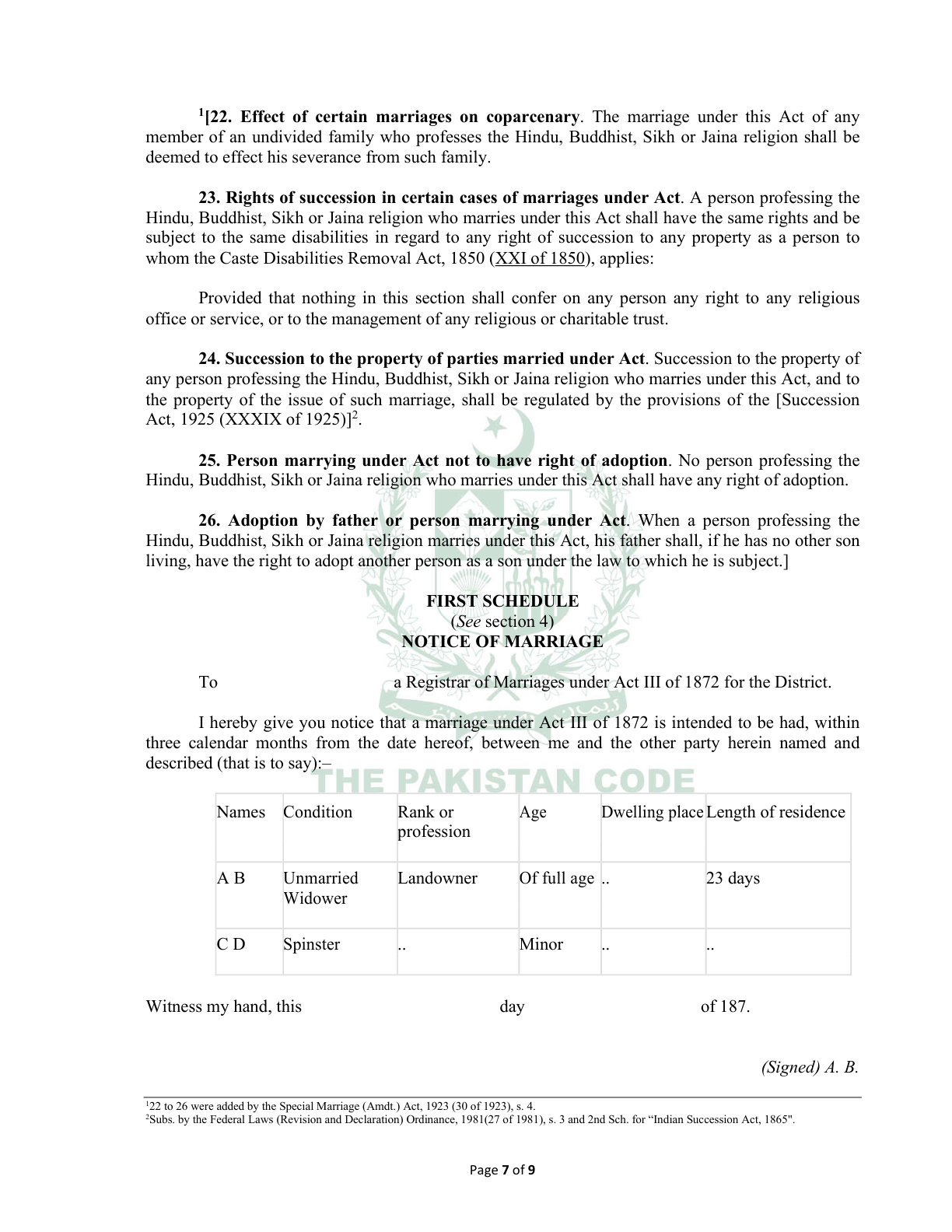
FIRST SCHEDULE
(See section 4) NOTICE OF MARRIAGE
To a Registrar of Marriages under Act III of 1872 for the District.
I hereby give you notice that a marriage under Act III of 1872 is intended to be had, within three calendar months from the date hereof, between me and the other party herein named and described (that is to say):–
Names Condition Rank or Age Dwelling place Length of residence
profession
A B Unmarried Landowner Of full age .. 23 days
Widower
C D Spinster .. Minor .. ..
Witness my hand, this day of 187.
(Signed) A. B.
122 to 26 were added by the Special Marriage (Amdt.) Act, 1923 (30 of 1923), s. 4.
2Subs. by the Federal Laws (Revision and Declaration) Ordinance, 1981(27 of 1981), s. 3 and 2nd Sch. for “Indian Succession Act, 1865".
SECOND SCHEDULE
(See section 10)
DECLARATION TO BE MADE BY THE BRIDEGROOM
I, A, B, hereby declare as follows:–
(1) I am at the present time unmarried:
(2) I do not profess the Christian, Jewish, Hindu, Muhammadan, Parsi, Buddhist, Sikh or Jaina religion; 1[or (as the case may be) I profess the Hindu, or the Buddhist, or the Sikh, or the Jaina religion].
(3) I have completed my age of eighteen years:
(4) I am not related to CD [the bride] in any degree of consanguinity or affinity which would, according to the law to which I am subject, or to which the said CD is subject, and subject to the provisos of clause (4) of section 2 of Act III of 1872, render a marriage between us illegal:
[And when the bridegroom has not completed his age of twenty one years:
The consent of my father [or guardian, as the case may be] has been given to a marriage between myself and CD, and has not been revoked:]
I am aware that, if any statement in this declaration is false, and if in making such statement I either know or believe it to be false, or do not believe it to be true, I am liable to imprisonment, and also to fine.
(Signed) A B [the bridegroom]
DECLARATION TO BE MADE BY THE BRIDE
(1) I, C D, hereby declare as follows:__
(2) I am at the present time unmarried:
(3) I do not profess the Christian, Jewish, Hindu, Muhammadan, Parsi, Buddhist, Sikh or Jaina religion: l[or (as the case may be) I profess the Hindu, or the Buddhist, or the Sikh, or the Jaina religion].
(4) I have completed my age of fourteen years:
I am not related to A B [the bridegroom] in any degree of consanguinity or affinity which would, according to the law to which I am subject, or to which the said A B is subject, and subject to the provisos of clause (4) of section 2 of Act III of 1872, render a marriage between us illegal:
[And when the bride has not completed her age of twenty one years, unless she is a widow:
(5) The consent of M N, my father [or guardian, as the case may be] has been given to a marriage between myself and A B and has not been revoked:]
1Ins. by the Special Marriage (Amdt.) Act, 1923 (30 of 1923), s. 5.
I am aware that, if any statement in this declaration is false, and if in making such statement, I either know or believe it to be false, or do not believe it to be true, I am liable to imprisonment, and also to fine.
(Signed) C D [the bride] Signed in our presence by the above-named A B and CD:
G H,
I J, [three witnesses]
K L,
[And when the bridegroom or bride has not completed the age of twentyone years, except in the case of a widow:
Signed in my presence and with my consent by the above-named A B and C D:
M. N., the father [or guardian] of the above-named A B( or CD, as the case may be).]
(Countersigned) E F, Registrar of Marriages under Act III of 1872 for the District of
Dated the day of 18.
THIRD SCHEDULE
(See section 13) REGISTRAR’S CERTIFICATE
I, E F, certify that, on the of 18, appeared before me A B and C D, each of whom in my presence and in the presence of three credible witnesses, whose names are signed hereunder, made the declarations required by Act III of 1872, and that a marriage under the said Act was solemnized between them in my presence.
(Signed) E F, Registrar of Marriages under Act III of 1872, for the District of
(Signed) A B, C D. G H,
I J, [three witnesses] K L,
Dated the day of 18.
FOURTH SCHEDULE
[Rep. by the Repealing Act, 1876 (XII of 1876).]
______________ Date: 16-09-2024
Print contents from the source
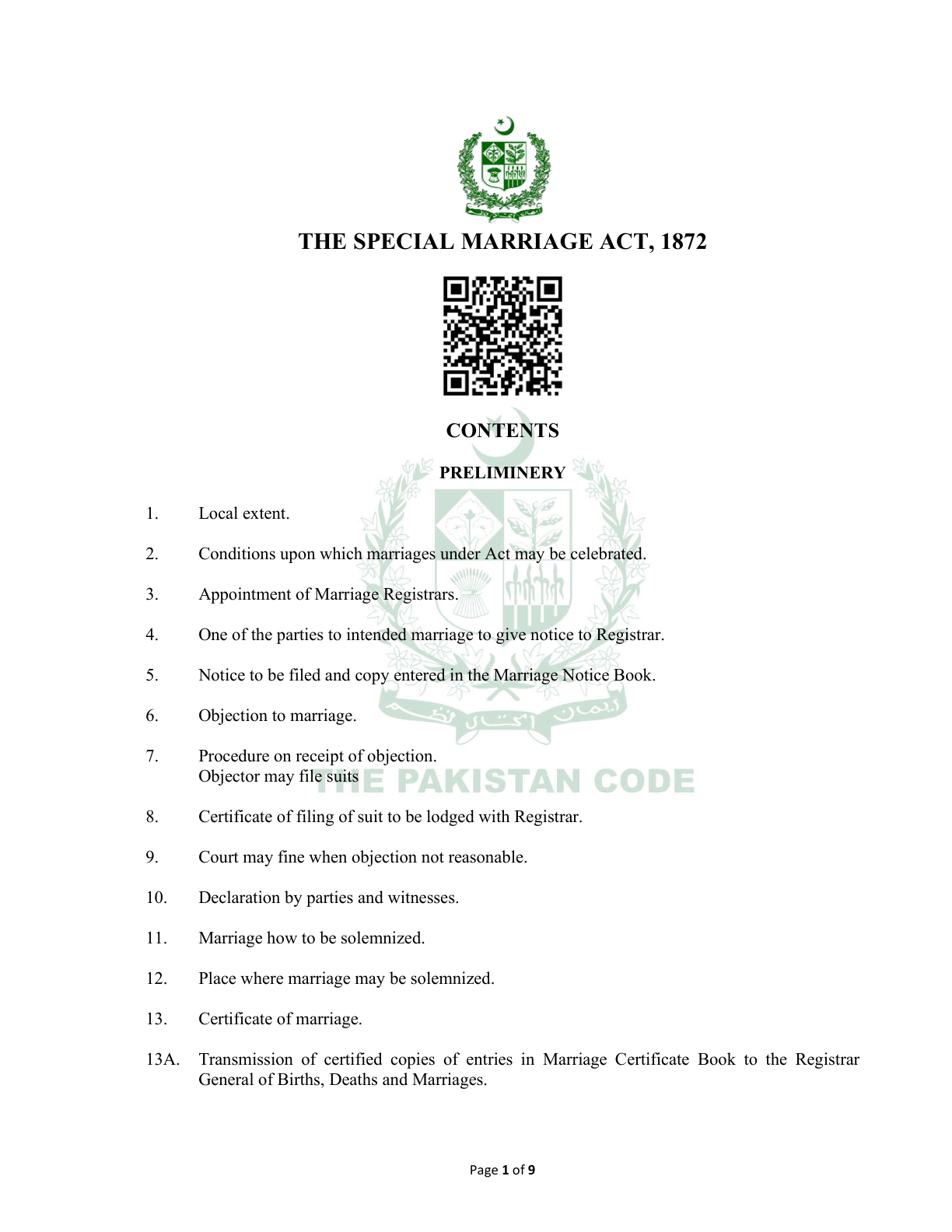
CONTENTS


PRELIMINERY


1.

Local extent.


2.

Conditions upon which marriages under Act may be celebrated.


3.

Appointment of Marriage Registrars.


4.

One of the parties to intended marriage to give notice to Registr
ar.


5.

Notice to be filed and copy entered in the Marriage Notice Book.


6.

Objection to marriage.


7.

Procedure on receipt of objection.


Objector may file suits


8.

Certificate of filing of suit to be lodged with Registrar.


9.

Court may fine when objec
tion not reasonable.


10.

Declaration by parties and witnesses.


11.

Marriage how to be solemnized.


12.

Place where marriage may be solemnized.


13.

Certificate of marriage.


13A.

Transmission of certified copies of entries in Marriage Certificate Book t
o the Registrar

General of Births, Deaths and Marriages.


Page
2

of
9


14.

Fees.


15.

Penalty on married person marrying again under Act.


16.

Punishment of bigamy.


17.

Divorce Act to apply.


18.

Law to apply to issue of marriages under Act.


19.

Saving of marriages
solemnized otherwise than under Act.


20.

[
Repealed.
]


21.

Penalty for signing declarations or certificates containing false statements.


22.

Effect of certain marriages on coparcenary.


23.

Rights of succession in certain cases of marriages under Act.


24
.

Succession to the property of parties married under Act.


25.

Person marrying under Act not to have right of adoption.


26.

Adoption by father of person marrying under Act
.
Compare the original stored transcription
Exact source transcription retained, including print layout and extraction artifacts. Text SHA-256: 5a7e9d7ee8aec0ea968a074ade76d9c7c8498990604afe6e3e54bf51ea54bf4a.
Page
1
of
9
THE SPECIAL MARRIAGE ACT, 1872
CONTENTS
PRELIMINERY
1.
Local extent.
2.
Conditions upon which marriages under Act may be celebrated.
3.
Appointment of Marriage Registrars.
4.
One of the parties to intended marriage to give notice to Registr
ar.
5.
Notice to be filed and copy entered in the Marriage Notice Book.
6.
Objection to marriage.
7.
Procedure on receipt of objection.
Objector may file suits
8.
Certificate of filing of suit to be lodged with Registrar.
9.
Court may fine when objec
tion not reasonable.
10.
Declaration by parties and witnesses.
11.
Marriage how to be solemnized.
12.
Place where marriage may be solemnized.
13.
Certificate of marriage.
13A.
Transmission of certified copies of entries in Marriage Certificate Book t
o the Registrar
General of Births, Deaths and Marriages.
Page
2
of
9
14.
Fees.
15.
Penalty on married person marrying again under Act.
16.
Punishment of bigamy.
17.
Divorce Act to apply.
18.
Law to apply to issue of marriages under Act.
19.
Saving of marriages
solemnized otherwise than under Act.
20.
[
Repealed.
]
21.
Penalty for signing declarations or certificates containing false statements.
22.
Effect of certain marriages on coparcenary.
23.
Rights of succession in certain cases of marriages under Act.
24
.
Succession to the property of parties married under Act.
25.
Person marrying under Act not to have right of adoption.
26.
Adoption by father of person marrying under Act
.
FIRST SCHEDULE
NOTICE OF MARRIAGE
SECOND SCHEDULE
DECLARATION TO BE MADE BY THE
BRIDEGROOM AND BRIDE
THIRD SCHEDULE
REGISTRAR’S CERTIFICATE
FOURTH SCHEDULE
[REPEALED]
Page
3
of
9
1
THE
SPECIAL
MARRIAGE
ACT,
1872
2
A
CT
No.
III
OF
1872
[
22
nd
March,
1872
]
An
Act
to
provide
a
form
of
Marriage
in
certain
cases
Preamble
.
WHEREAS
it
is
expedient
to
provide
a
form
of
marriage
for
persons
who
do
not
profess
the
Christian,
Jewish,
Hindu,
Muhammadan,
Parsi,
Buddhist,
Sikh
or
Jaina
religion,
3
[and
for
persons
who
profess
the
Hindu,
Buddhist,
Sikh
or
Jaina
religion]
and
to
legalize
certain
marriages
th
e
validity
of
which
is
doubtful
;
It
is
hereby
enacted
as
follows:
4
[1.
Local
extent
.
This
Act
extends
to
the
whole
of
Pakistan.]
2.
Conditions
upon
which
marriages
under
Act
may
be
celebrated
.
Marriages
may
be
celebrated
under
this
Act
between
persons
neither
of
whom
professes
the
Christian
or
the
Jewish,
or
the
Hindu
or
the
5
[Muslim],
or
the
Parsi
or
the
Buddhist,
or
the
Sikh
or
the
Jaina
religion,
6
[or
between
persons
each
of
whom
professes
one
or
other
of
the
following
religions,
that
is
to
say,
the
Hindu,
Buddhist,
Sikh
or
Jaina
religion]
upon
the
following
conditions:
__
(1)
neither
party
must,
at
the
time
of
the
marriage,
have
a
husband
or
wife
living:
(2)
the
man
must
have
completed
his
age
of
eighteen
years,
and
the
woman
her
age
of
fourteen
years,
acc
ording
to
the
Gregorian
calendar:
(3)
each
party
must,
if
he
or
she
has
not
completed
the
age
of
twenty-one
years,
have
obtained
the
consent
of
his
or
her
father
or
guardian
to
the
marriage:
(4)
the
parties
must
not
be
related
to
each
other
in
any
degree
of
cons
anguinity
or
affinity
which
would,
according
to
any
law
to
which
either
of
them
is
subject,
render
a
marriage
between
them
illegal.
1
st
Proviso
.
__
No
such
law
or
custom,
other
than
one
relating
to
consanguinity
or
affinity,
shall
prevent
them
from
marryi
ng.
2
nd
Proviso
.
__
No
law
or
custom
as
to
consanguinity
shall
prevent
them
from
marrying,
unless
a
relationship
can
be
traced
between
the
parties
through
some
common
ancestor,
who
stands
to
each
of
them
in
a
nearer
relationship
than
that
of
great-great-g
rand-father
or
great-great-grand
mother,
or
unless
one
of
the
parties
is
the
lineal
ancestor,
or
the
brother
or
sister
of
some
lineal
ancestor,
of
the
other.
1
Short
title
given
by
the
Short
Title
Act,
1897
(14
of
1897)
2
There
was
no
Statement
of
Objects
a
nd
Reasons
;
the
Bill
as
introduced
was
published
in
the
Gazette
of
India,
1868,
p.
1403
;
for
the
Report
of
the
Select
Committee,
dated
21st
December
1871,
see
ibid.,
1871.,
Pt.
V,
p.
519
;
for
discussions
in
Council,
see
ibid.,
1868,
Supplement,
pp.890
an
d
1197
;
ibid.,1871,
Extra.,
Supplement,
pp.
16
and
42
;
ibid.,
1872,
Supplement,
pp.
2,
57,
193
and
261.
This
Act
has
been
declared
in
force
in
Balochistan
by
the
British
Balochistan
Laws
Regulation,
1913
(2
of
1913),
s.
3.
This
Act
has
been
extended
to
th
e
Leased
Areas
of
Balochistan,
see
the
Leased
Areas
(Laws)
Order,
1950
(G.G.O.
3
of
1950)
;
and
also
applied
in
the
Federated
Areas
of
Balochistan,
see
Gazette
of
India,
1937,
Pt.
I,
p.
1499.
3
Ins.
by
the
Special
Marriage
(Armdt.)
Act,
1923
(30
of
1923),
s
.2.
4
This
section
has
successively
been
amended
by
the
Repealing
Act,
1874
(16
of
1874),
s.
1
and
Sch.,
Pt.
I,
A.
O.,
1949
;
and
the
Central
Laws
(Statute
Reform)
Ordinance,
1960
(21
of
1960),
s.
3
and
2nd
Sch.
(with
effect
from
the
14th
October,
1955),
to
read
as
above.
5
Subs.
by
F.A.O.,
1975,
Art.
2
and
Table
for
"Muhammadan”.
6
Ins.
by
Act
30
of
1923,
s.
3.
Page
4
of
9
3.
Appointment
of
Marriage
Registrars
.
The
1
[Provincial
Government]
may
appoint
one
or
more
Registrars
under
this
Act,
either
by
name
or
as
holding
an
y
office
for
the
time
being,
for
any
portion
of
the
territory
subject
to
its
administration.
The
officer
so
appointed
shall
be
called
“Registrar
of
Marriages
under
Act
III
of
1872,”
and
is
hereinafter
referred
to
as
“the
Registrar”.
The
portion
of
territor
y
for
which
any
such
officer
is
appointed
shall
be
deemed
his
district.
4.
One
of
the
parties
to
intended
marriage
to
give
notice
to
Registrar
.
When
a
marriage
is
intended
to
be
solemnized
under
this
Act,
one
of
the
parties
must
give
notice
in
writing
to
the
Registrar
before
whom
it
is
to
be
solemnized.
The
Registrar
to
whom
such
notice
is
given
must
be
the
Registrar
of
a
district
within
which
one
at
least
of
the
parties
to
the
marriage
has
resided
for
fourteen
days
before
such
notice
is
given.
Such
n
otice
may
be
in
the
form
given
in
the
first
schedule
to
this
Act.
5.
Notice
to
be
filed
and
copy
entered
in
the
Marriage
Notice
Book
.
The
Registrar
shall
file
all
such
notices
and
keep
them
with
the
records
of
his
office,
and
shall
also
forthwith
enter
a
true
copy
of
every
such
notice
in
a
book
to
be
for
that
purpose
furnished
to
him
by
the
2
[Provincial
Government],
to
be
called
the
“Marriage
Notice
Book
under
Act
III
of
1872,"
and
such
book
shall
be
open
at
all
reasonable
times,
without
fee,
to
all
perso
ns
desirous
of
inspecting
the
same.
6.
Objection
to
Marriage
.
Fourteen
days
after
notice
of
an
intended
marriage
has
been
given
under
section
4,
such
marriage
may
be
solemnized,
unless
it
has
been
previously
objected
to
in
the
manner
hereinafter
mentione
d.
Any
person
may
object
to
any
such
marriage
on
the
ground
that
it
would
contravene
some
one
or
more
of
the
conditions
prescribed
in
clauses
(1),
(2),
(3)
or
(4)
of
section
2.
The
nature
of
the
objection
made
shall
be
recorded
in
writing
by
the
Regist
rar
in
the
register,
and
shall,
if
necessary,
be
read
over
and
explained
to
the
person
making
the
objection,
and
shall
be
signed
by
him
or
on
his
behalf.
7.
Procedure
on
receipt
of
objection
.
On
receipt
of
such
notice
of
objection
the
Registrar
shall
not
proceed
to
solemnize
the
marriage
until
the
lapse
of
fourteen
days
from
the
receipt
of
such
objection,
if
there
be
a
Court
of
competent
jurisdiction
open
at
the
time,
or,
if
there
be
no
such
Court
open
at
the
time,
until
the
lapse
of
fourteen
days
from
th
e
opening
of
such
Court.
8.
Objector
may
file
suit
.
The
person
objecting
to
the
intended
marriage
may
file
a
suit
in
any
Civil
Court
having
local
jurisdiction
(other
than
a
Court
of
Small
Causes)
for
a
declaratory
decree,
declaring
that
such
marriage
wou
ld
contravene
some
one
or
more
of
the
conditions
prescribed
in
clauses
(1),
(2),
(3)
or
(4)
of
section
2.
9.
Certificate
of
filling
of
suit
to
be
lodged
with
Registrar
.
The
officer
before
whom
such
suit
is
filed
shall
thereupon
give
the
person
presenting
it
a
certificate
to
the
effect
that
such
suit
has
been
filed.
If
such
certificate
be
lodged
with
the
registrar
within
fourteen
days
from
the
receipt
of
notice
of
objection, if there be a Court of competent jurisdiction open at the time, or, if there be no
such Court open at the time, within fourteen days of the opening of such Court, the marriage shall
not be solemnized till the decision of such Court has been given and the period allowed by law for
appeals from such decision has
elapsed
; or, if there be an appeal from such decision, till the decision
of the Appellate Court has been given.
1
Subs.
by
A.
O.,
1937,
for
"L.
G.”.
2
Subs.
ibid.,
for
“Govt.”.
Page
5
of
9
If
such
certificate
be
not
lodged
in
the
manner
and
within
the
period
prescribe
d
in
the
last
preceding
paragraph,
or
if
the
decision
of
the
Court
be
that
such
marriage
would
not
contravene
anyone
or
more
of
the
conditions
prescribed
in
clauses
(1),
(2),
(3)
or
(4)
of
section
2,
such
marriage
may
be
solemnized.
If
the
decision
of
su
ch
Court
be
that
the
marriage
in
question
would
contravene
anyone
or
more
of
the
conditions
prescribed
in
clauses
(1),
(2),
(3)
or
(4)
of
section
2,
the
marriage
shall
not
be
solemnized.
10.
Court
may
fine
when
objection
not
reasonable
.
Any
Court
in
whic
h
any
such
suit
as
is
referred
to
in
section
7
is
filed
may,
if
it
shall
appear
to
it
that
the
objection
was
not
reasonable
and
bona
fide,
inflict
a
fine,
not
exceeding
one
thousand
rupees,
on
the
person
objecting,
and
award
it,
or
any
part
of
it,
to
the
p
arties
to
the
intended
marriage.
11.
Declaration
by
parties
and
witnesses
.
Before
the
marriage
is
solemnized,
the
parties
and
three
witnesses
shall,
in
the
presence
of
the
Registrar,
sign
a
declaration
in
the
form
contained
in
the
second
schedule
to
this
Act.
If
either
party
has
not
completed
the
age
of
twenty-one
years,
the
declaration
shall
also
be
signed
by
his
or
her
father
or
guardian,
except
in
the
case
of
a
widow,
and,
in
every
case,
it
shall
be
countersigned
by
the
Registrar.
12.
Marriage
how
to
be
solemnized
.
The
marriage
shall
be
solemnized
in
the
presence
of
the
Registrar
and
of
the
three
witnesses
who
signed
the
declaration.
It
may
be
solemnized
in
any
form,
provided
that
each
party
says
to
the
other,
in
the
presence
and
hearing
of
the
Regist
rar
and
witnesses,
“I[A],
take
thee
[
B
]
,
to
be
my
lawful
wife
(or
husband.)”
13.
Place
where
marriage
may
be
solemnized
.
The
marriage
may
be
celebrated
either
at
the
office
of
the
Registrar
or
at
such
other
place,
within
reasonable
distance
of
the
office
of
the
Registrar,
as
the
parties
desire:
Provided
that
the
l
[Provincial
Government]
may
prescribe
the
conditions
under
which
such
marriages
may
be
solemnized
at
places
other
than
the
Registrar’s
office,
and
the
additional
fees
to
be
paid
thereupon
2
.
13.
Certificate
of
marriage
.
When
the
marriage
has
been
solemnized,
the
Registrar
shall
enter
a
certificate
there
of
in
a
book
to
be
kept
by
him
for
that
purpose
and
to
be
called
the
“Marriage
Certificate
Book
under
Act
III
of
1872,”
in
the
form
given
in
the
third
schedule
to
this
Act,
and
such
certificate
shall
be
signed
by
the
parties
to
the
marriage
and
the
three
witnesses.
3
[13A.
Transmission
of
certified
copies
of
entries
in
marriage
certificate
book
to
the
Registrar
General
of
Births,
Deaths
and
Marria
ges
.
The
Registrar
shall
send
to
the
Registrar
General of Births, Deaths and Marriages for the territories within which his district is situate, at such
interval as the
4
[Provincial Government] from time to time directs
5
, a true copy certified by him, in
s
uch form as the
4
[Provincial Government] from time to time prescribes, of all entries made by him
in the said marriage-certificate book since the last of such intervals
6
.]
1
Subs.
by
A.
O.,
1937,
for
“
L.
G.”.
2
For
rules
framed
under
this
section,
see
the
different
Local
Rules
and
Orders.
3
S.
13A
ins.
by
the
Births,
Deaths
and
Marriages
Registration
Act,
1886
(6
of
1886),
s.
29.
4
Subs. by A.O., 1937, for “L.G.” which had been subs. for “G.G. in C.” by the Devolution Act, 1920 (38 of 1920), s. 2 and Sch.
I.
5
For orders issued under this section, see Gazette of India, 1889, Supplement, p. 921.
6
As to duty of the Registrar General to make and keep indexes of the certified copies sent to his office under this section, s
ee the Births, Deaths and
Marriages Regist
ration Act, 1886 (6 of 1886), s. 7.
Page
6
of
9
14.
Fees
.
The
1
[Provincial
Government]
shall
prescribe
the
fees
to
be
paid
to
the
Registrar
for
the
duties
to
be
discharged
by
him
under
this
Act
2
.
The
Registrar
may,
if
he
thinks
fit,
demand
payment
of
any
such
fee
b
efore
the
solemnization
of
the
marriage
or
performance
of
any
other
duty
in
respect
of
which
it
is
payable.
The
said
Marriage-Certificate
Book
shall
at
all
reasonable
times
be
open
for
inspection,
and
shall
be
admissible
as
evidence
of
the
truth
of
the
s
tatements
therein
contained.
Certified
extracts
there
from
shall
on
application
be
given
by
the
Registrar
on
the
payment
to
him
by
the
applicant
of
a
fee
to
be
fixed
by
the
4
[Provincial
Government]
for
each
such
extract.
15.
Penalty
on
married
person
mar
rying
again
under
Act
.
Every
person
who,
being
at
the
time
married,
procures
a
marriage
of
himself
to
be
solemnized
under
this
Act,
shall
be
deemed
to
have
committed
an
offence
under
section
494
or
section
495
of
the
Pakistan
Penal
Code
(XLV
of
1860),
as
t
he
case
may
be
;
and
the
marriage
so
solemnized
is
void.
16.
Punishment
of
bigamy
.
Every
person
married
under
this
Act
who,
during
the
life
time
of
his
or
her
wife
or
husband,
contracts
any
other
marriage,
shall
be
subject
to
the
penalties
provided
in
sec
tions
494
and
495
of
the
Pakistan
Penal
Code
(XLV
of
1860)
for
the
offence
of
marrying
again
during
the
lifetime
of
a
husband
or
wife,
whatever
may
be
the
religion
which
he
or
she
professed
at
the
time
of
such
second
marriage.
17.
Divorce
Act
to
apply
.
T
he
Divorce
Act
shall
apply
to
all
marriages
contracted
under
this
Act
(IV
of
1869),
and
any
such
marriage
may
be
declared
null
or
dissolved
in
the
manner
therein
provided,
and
for
the
causes
therein
mentioned,
or
on
the
ground
that
it
contravenes
some
one
or
more
of
the
conditions
prescribed
in
clauses
(1),
(2),
(3)
or
(4)
of
section
2
of
this
Act.
18.
Law
to
apply
to
issue
of
marriages
under
Act
.
The
issue
of
marriages
solemnized
under
this
Act
shall,
if
they
marry
under
this
Act,
be
deemed
to
be
subject
to
the
law
to
which
their
fathers
were
subject
as
to
the
prohibition
of
marriages
by
reason
of
consanguinity
and
affinity,
and
the
provisos
to
section
2
of
this
Act
shall
apply
to
them.
19. Savings of marriages solemnized otherwise than under Act
. Nothi
ng in this Act
contained shall affect the validity of any marriage not solemnized under its provisions
; nor shall this
Act be deemed directly or indirectly to affect the validity of any mode of contracting marriage
; but, if
the validity of any such mode sh
all hereafter come into question before any Court, such question
shall be decided as if this Act had not been passed.
20. [
Registry of marriages contracted before passing of Act.
]
Rep. by the Repealing Act,
1876
(XII of
1876).
21. Penalty for signing d
eclarations of certificates containing false statements
. Every
person making, signing or attesting any declaration or certificate prescribed by this Act, containing a
statement which is false, and which he either knows or believes to be false or does not b
elieve to be
true, shall be deemed guilty of the offence described in section 199 of the Pakistan Penal Code.
(XLV
of 1860).
1
Subs.
by
A.
O.,
1937,
for
“the
L.
G.”.
2
For
scales
of
fees
to
be
paid
to
Registrars
of
marriages
prescribed
by
different
Provincial
Governments,
see
the
Local
Rules
and
Orders.
Page
7
of
9
1
[22.
Effect
of
certain
marriages
on
cop
arcenary
.
The
marriage
under
this
Act
of
any
member
of
an
undivided
family
who
professes
the
Hindu,
Buddhist,
Sikh
or
Jaina
religion
shall
be
deemed
to
effect
his
severance
from
such
family.
23.
Rights
of
succession
in
certain
cases
of
marriages
under
Ac
t
.
A
person
professing
the
Hindu,
Buddhist,
Sikh
or
Jaina
religion
who
marries
under
this
Act
shall
have
the
same
rights
and
be
subject
to
the
same
disabilities
in
regard
to
any
right
of
succession
to
any
property
as
a
person
to
whom
the
Caste
Disabilities
Removal
Act,
1850
(
XXI
of
1850
),
applies:
Provided
that
nothing
in
this
section
shall
confer
on
any
person
any
right
to
any
religious
office
or
service,
or
to
the
manage
ment
of
any
religious
or
charitable
trust.
24.
Succession
to
the
property
of
parties
married
under
Act
.
Succession
to
the
property
of
any
person
professing
the
Hindu,
Buddhist,
Sikh
or
Jaina
religion
who
marries
under
this
Act,
and
to
the
property
of
the
issue
of
such
marriage,
shall
be
regulated
by
the
provisions
of
the
[Succession
Act,
1925
(
XXXIX
of
1925
)]
2
.
25.
Person
marrying
under
Act
not
to
have
right
of
adoption
.
No
person
professing
the
Hindu,
Buddhist,
Sikh
or
Jaina
religion
who
marries
under
this
Act
shall
have
any
right
of
adoption.
26.
Adoption
by
father
or
person
marrying
under
Act
.
When
a
person
professing
the
Hindu,
Buddhist,
Sikh
or
Jaina
religion
marries
u
nder
this
Act,
his
father
shall,
if
he
has
no
other
son
living,
have
the
right
to
adopt
another
person
as
a
son
under
the
law
to
which
he
is
subject.]
FIRST SCHEDULE
(
See
section 4)
NOTICE OF MARRIAGE
To
a Registra
r of Marriages under Act III of 1872 for the District.
I hereby give you notice that a marriage under Act III of 1872 is intended to be had, within
three calendar months from the date hereof, between me and the other party herein named and
described (tha
t is to say):
–
Names
Condition
Rank or
Age
Dwelling place
Length of residence
profession
A B
Unmarried
Landowner
Of full age
..
23 days
Widower
C D
Spinster
..
Minor
..
..
Witness my hand, this
day
of 187.
(Signed) A. B.
1
22
to
26
were
added
by
the
Special
Marriage
(Amdt.)
Act,
1923
(30
of
1923),
s.
4.
2
Subs.
by
the
Federal
Laws
(Revision
and
Declaration)
Ordinance,
1981(27
of
1981)
,
s.
3
and
2nd
Sch.
for
“Indian
Succession
Act,
1865".
Page
8
of
9
SECOND
SCHEDULE
(
See
section
10)
DECLARATION
TO
BE
MADE
BY
THE
BRIDEGROOM
I,
A,
B
,
hereby
declare
as
follows:
–
(1)
I
am
at
the
present
time
unmarried:
(2)
I
do
not
profess
the
Christian,
Jewish,
Hindu,
Mu
hammadan,
Parsi,
Buddhist,
Sikh
or
Jaina
religion
;
1
[or
(as
the
case
may
be)
I
profess
the
Hindu,
or
the
Buddhist,
or
the
Sikh,
or
the
Jaina
religion].
(3)
I
have
completed
my
age
of
eighteen
years:
(4)
I
am
not
related
to
CD
[
the
bride
]
in
any
degree
of
consanguinity
or
affinity
which
would,
according
to
the
law
to
which
I
am
subject,
or
to
which
the
said
CD
is
subject,
and
subject
to
the
provisos of clause (4) of section 2 of Act III of 1872, render a marriage between us
illegal:
[
And when the bridegroom has not completed his age of twenty one years
:
The consent of my father [
or
guardian,
as the case may be
] has been given to a marriage
between myself and
CD,
and has not been revoked:]
I am aware that, if any statement in this declaration is false, and if in making such statement I
either know or
believe it to be false, or do not believe it to be true, I am liable to imprisonment, and
also to fine.
(Signed) A B
[
the bridegroom
]
DECLARATION TO BE MADE BY THE BRIDE
(1)
I, C
D,
hereby declare as follows:
__
(2)
I am at the present time unmarried:
(3)
I do n
ot profess the Christian, Jewish, Hindu, Muhammadan, Parsi, Buddhist, Sikh or
Jaina religion:
l
[or (as the case may be) I profess the Hindu, or the Buddhist, or the Sikh,
or the Jaina religion].
(4)
I have completed my age of fourteen years:
I am not related to
A B
[
the bridegroom
] in any degree of consanguinity or affinity which
would, according to the law to which I am subject, or to which the said
A B
is subject, and subject to
the provisos of clause (4) of section 2 of Act III of 1872, ren
der a marriage between us illegal:
[
And when the bride has not completed her age of twenty one years, unless she is a widow:
(5)
The consent of
M N,
my father [
or
guardian,
as the case may be
] has been given to a
marriage between myself and
A B
and has not
been revoked:]
1
Ins.
by
the
Special
Marriage
(Amdt.)
Act,
1923
(30
of
1923),
s.
5.
Page
9
of
9
I
am
aware
that,
if
any
statement
in
this
declaration
is
false,
and
if
in
making
such
statement,
I
either
know
or
believe
it
to
be
false,
or
do
not
believe
it
to
be
true,
I
am
liable
to
imprisonment,
and
also
to
fine.
(Signed)
C
D
[
the
bride
]
Signed
in
our
presence
by
the
above-named
A
B
and
CD:
G
H,
I
J,
[three
witnesses]
K
L,
[
And
when
the
bridegroom
or
bride
has
not
completed
the
age
of
tw
entyone
years,
except
in
the
case
of
a
widow:
Signed
in
my
presence
and
with
my
consent
by
the
above-named
A
B
and
C
D:
M.
N.,
the
father
[or
guardian]
of
the
above-named
A
B(
or
CD,
as
the
case
may
be).
]
(Countersigned)
E
F,
Registrar
of
Marriages
un
der
Act
III
of
1872
for
the
District
of
Dated
the
day
of
18.
THIRD
SCHEDULE
(See
section
13)
REGISTRAR’S
CERTIFICATE
I,
E
F,
certify
that,
on
the
of
18,
appeared
before
me
A
B
and
C
D,
each
of
whom
in
my
presence
and
in
the
presence
of
three
credible
witnesses,
whose
names
are
signed
hereunder,
made
the
declarations
required
by
Act
III
of
1872,
and
that
a
marriage
under
the
said
Act
was
solemnized
between
them
in
my
presence.
(Signe
d)
E
F,
Registrar
of
Marriages
under
Act
III
of
1872,
for
the
District
of
(Signed)
A
B,
C
D.
G
H,
I
J,
[three
witnesses]
K
L,
Dated
the
day
of
18.
FOURTH
SCHEDULE
[
Rep.
by
the
Repealing
Act
,
1876
(XII
of
1876).
]
______________
Date: 16
-
09
-
2024Original source pages: graphics and forms
These 2 complete source pages supplement the reading text above. Graphic, form or scanned material on these pages is not fully represented by the searchable transcription. Read the original page images for that material; no verified OCR transcription is claimed.
The full original PDF contains 9 pages. Physical source page numbers below refer to that PDF.
Original source and image integrity
Official original PDF source. Source PDF SHA-256: 7f53b33fa5ff9e4f09bbcdfd4b667bfd534f1626af9ec1696120ac7ee7228041.
Each selected page is rendered in full without clipping. The original file and every page image are hashed. The source-page review identifies graphic or form material; it does not establish a complete OCR transcription, amendment completeness or current force.
- Physical PDF page 1:
d95252506ba9bd4e1fb670e3948e496c415b80b4996bfb8553ca8ec83956c370 - Physical PDF page 7:
8798d052c6742f9d1728438cb61dce502bf30f323b57084936726ccdc39dff9d
This law in the library
Follow the instruments and provisions named in this source edition, and the laws that cite it. Citation links identify the text being referred to; legal effect and current force require separate examination.
Instruments cited by this law 3
Laws that cite this instrument 1
References to provisions in this text 10
Section 4
Open the identified operative provision
Read reference in context
6. Objection to Marriage . Fourteen days after notice of an intended marriage has been given under section 4, such marriage may be solemnized, unless it has been previously objected to in the manner hereinafter mentione d. Any person may object
Section 2
Open the identified operative provision
Read reference in context
would contravene some one or more of the conditions prescribed in clauses (1), (2), (3) or (4) of section 2. The nature of the objection made shall be recorded in writing by the Regist rar in the register, and shall, if necessary, be read
Section 2
Open the identified operative provision
Read reference in context
u ld contravene some one or more of the conditions prescribed in clauses (1), (2), (3) or (4) of section 2. 9. Certificate of filling of suit to be lodged with Registrar . The officer before whom such suit is filed shall thereupon give the
Section 2
Open the identified operative provision
Read reference in context
uld not contravene anyone or more of the conditions prescribed in clauses (1), (2), (3) or (4) of section 2, such marriage may be solemnized. If the decision of su ch Court be that the marriage in question would contravene anyone or more
Section 2
Open the identified operative provision
Read reference in context
n would contravene anyone or more of the conditions prescribed in clauses (1), (2), (3) or (4) of section 2, the marriage shall not be solemnized. 10. Court may fine when objection not reasonable . Any Court in whic h any such suit as is
Section 7
Open the identified operative provision
Read reference in context
may fine when objection not reasonable . Any Court in whic h any such suit as is referred to in section 7 is filed may, if it shall appear to it that the objection was not reasonable and bona fide, inflict a fine, not exceeding one tho
Section 494
An operative target heading has not been identified. Read the source passage
Read reference in context
ge of himself to be solemnized under this Act, shall be deemed to have committed an offence under section 494 or section 495 of the Pakistan Penal Code (XLV of 1860), as t he case may be ; and the marriage so solemnized is void. 16.
Section 4
Open the identified operative provision
Read reference in context
to adopt another person as a son under the law to which he is subject.] FIRST SCHEDULE ( See section 4) NOTICE OF MARRIAGE To a Registra r of Marriages under Act III of 1872 for the District. I hereby give you notice that a marriage under Act III of 1872 is intend
Section 10
Open the identified operative provision
Read reference in context
981) , s. 3 and 2nd Sch. for “Indian Succession Act, 1865". Page 8 of 9 SECOND SCHEDULE ( See section 10) DECLARATION TO BE MADE BY THE BRIDEGROOM I, A, B , hereby declare as follows: – (1) I am at the present time unmarried:
Section 13
Open the identified operative provision
Read reference in context
of 1872 for the District of Dated the day of 18. THIRD SCHEDULE (See section 13) REGISTRAR’S CERTIFICATE I, E F, certify that, on the of 18, appeared before me A B and C D, each
Other laws referring to provisions of this instrument 1
Section 24 of Special Marriage Act, 1872
Cited by Succession Act, 1925
Read source and target evidence
Explicit source reference
ime of his death 2[a] 1[Pakistan Christian], or (iii) any person professing the Hindu, Buddhist, Sikh or Jaina religion the succession to whose property is, under section 24 of the Special Marriage Act, 1872 (III of 1872), regulated by the provisions of this Act; (b) unless the deceased dies intestate in respect of all his property.] 34. Where intestate has left no widow, and where he has left no kindred . Where the
Target heading · Special Marriage Act, 1872
24. Succession to the property of parties married under Act . Succession to the property of any person professing the Hindu, Buddhist, Sikh or Jaina religion who marries under this Act, and to
Cited instruments not matched in this library 6
Explore this law in the whole-library map · Download this law’s relationship evidence · Download preserved source record
Original-source comparison
Read the original graphic and form pages retained with this law. Their visual content is separate from the text comparison below.
Original-source character comparison matched under the recorded normalization
Open the compared original source
Source comparison checks the identified transcription and edition. The law's current force, later amendments and territorial application require separate legal review.
Comparison evidence
- Stored text SHA-256
- 5a7e9d7ee8aec0ea968a074ade76d9c7c8498990604afe6e3e54bf51ea54bf4a
- Original source SHA-256
- 7f53b33fa5ff9e4f09bbcdfd4b667bfd534f1626af9ec1696120ac7ee7228041
- Comparison method
- Complete exact non-whitespace character stream after NFKC, quotation-mark equivalents and soft-hyphen removal. Word boundaries and PDF line-layout differences remain separately described.
Source, version and text details
- Recorded title
- Special Marriage Act, 1872
- Source collection
- Federal — this does not establish territorial applicability.
- Recorded version
- Not supplied in this record
- Source snapshot
- Not supplied in this record
- Legal status
- not independently verified
- Text quality
- Complete stored UTF-8 TXT file recovered byte-for-byte from owned Drive. Source transcription retained verbatim; legal completeness, OCR accuracy and current consolidation unverified.
- Recorded quality flags
- No additional flags recorded
- Stable record
- pk-code-dc9aa92ea0a7879e
- Content extent
- Legal completeness not independently established
- Integrity scope
- Stored UTF-8 text and TXT download bytes checked against their recorded hash. This does not establish legal authenticity or currency.
- Passage offsets
- zero-based Unicode code points and UTF8 bytes; end exclusive
- Stored text SHA-256
- 5a7e9d7ee8aec0ea968a074ade76d9c7c8498990604afe6e3e54bf51ea54bf4a