
JUVENILE JUSTICE SYSTEM ACT, 2018
Stored extracted text; legal completeness and current force have not been independently established. Inspect source and version details
Reading view reduces excess blank space and hides page extraction markers. Original text and downloads are retained.
Reading layout follows the stored source. Open the original transcription below to compare wording and extraction details.
THE JUVENILE JUSTICE SYSTEM ACT, 2018 (XXII of 2018)
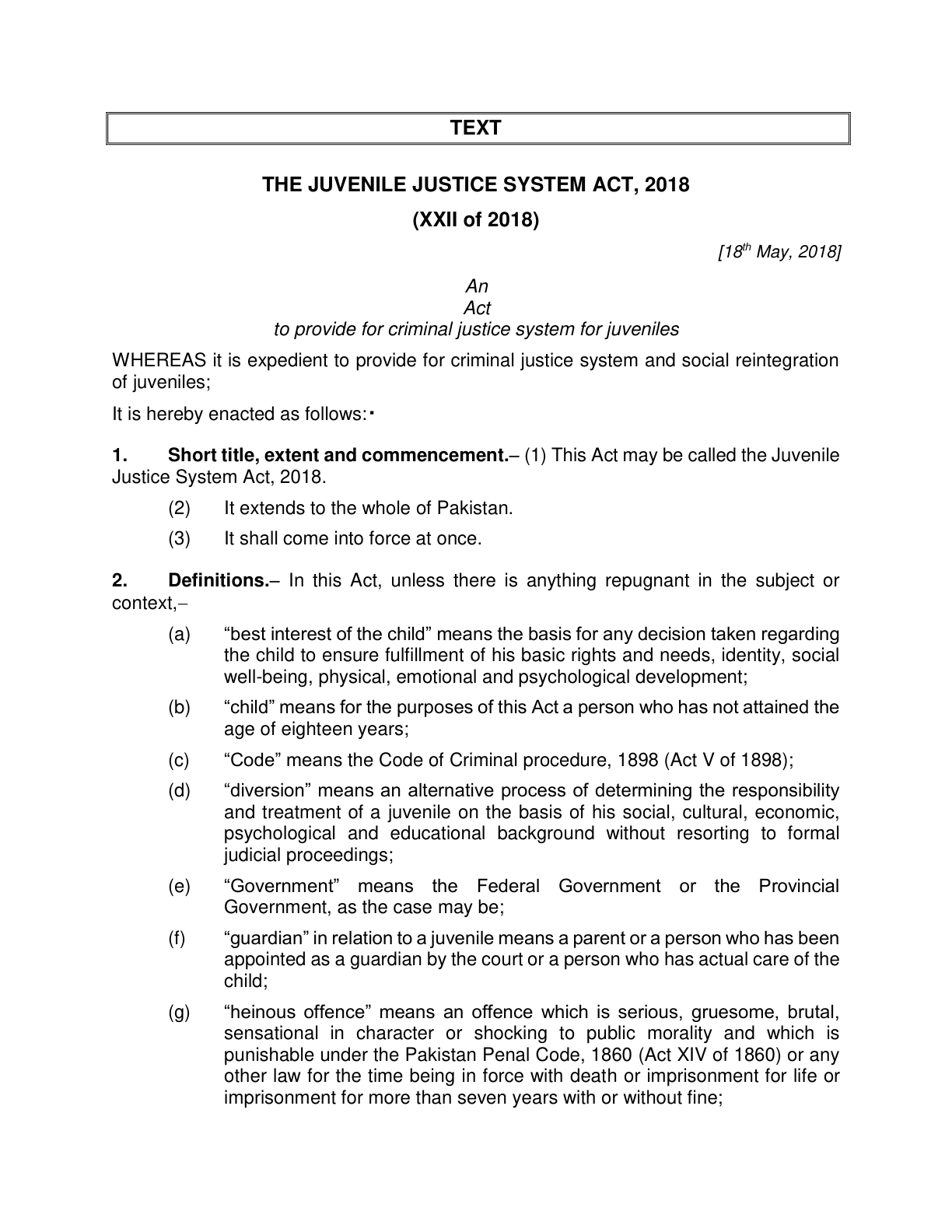
TEXT THE JUVENILE JUSTICE SYSTEM ACT, 2018 (XXII of 2018) [18th May, 2018] An Act to provide for criminal justice system for juveniles WHEREAS it is expedient to provide for criminal justice system and social reintegration of juveniles;
It is hereby enacted as follows:
Section 1. Short title, extent and commencement
(1) This Act may be called the Juvenile Justice System Act, 2018.
(2) It extends to the whole of Pakistan.
(3) It shall come into force at once.
Section 2. Definitions
In this Act, unless there is anything repugnant in the subject or context,
(a) “best interest of the child” means the basis for any decision taken regarding the child to ensure fulfillment of his basic rights and needs, identity, social well-being, physical, emotional and psychological development;
(b) “child” means for the purposes of this Act a person who has not attained the age of eighteen years;
(c) “Code” means the Code of Criminal procedure, 1898 (Act V of 1898);
(d) “diversion” means an alternative process of determining the responsibility and treatment of a juvenile on the basis of his social, cultural, economic, psychological and educational background without resorting to formal judicial proceedings;
(e) “Government” means the Federal Government or the Provincial Government, as the case may be;
(f) “guardian” in relation to a juvenile means a parent or a person who has been appointed as a guardian by the court or a person who has actual care of the child;
(g) “heinous offence” means an offence which is serious, gruesome, brutal, sensational in character or shocking to public morality and which is punishable under the Pakistan Penal Code, 1860 (Act XIV of 1860) or any other law for the time being in force with deat h or imprisonment for life or imprisonment for more than seven years with or without fine;
(h) “juvenile” means, a child who may be dealt with for an offence in a manner which is different from an adult;
(i) “Juvenile Court” means a court established under section 4;
(j) “Juvenile Justice Committee” means a committee established under section 10;
(k) “Juvenile Rehabilitation Centre” means a place where a juvenile may be kept and given education, vocational or technical training for his mental, moral and psychological development and includes certified institutions, juvenile training institutions, borstal institutions, vocational centres, darul - amaan and women crises centres established by the Government or by voluntary organizational certified by the Government;
(l) “Juvenile offender” means a child who is alleged to have committed or who has been found to have committed an offence;
(m) “major offence” means an offence for which punishment under the Pakistan Penal Code, 1860 (Act XIV of 1860) or any other law for the time being in force is more than three years and up to seven years imprisonment with or without fine;
(n) “medical officer” means a medical officer notified as such by the 1[Division concerned or relevant department of provincial Governments];
(o) “minor offence” means an offence for which maximum punishment under the Pakistan Penal Code, 1860 (XLV of 1860)or any other law f or the time being in force is imprisonment up to three years with or without fine;
(p) “observation home” means a place where a juvenile is kept temporarily after being apprehended by police as well as after obtaining remand from Juvenile Court or otherwi se for conducting inquiry or investigation for the purposes of this Act;
(q) “prescribed” means prescribed by rules made under this Act;
(r) “probation officer” means a person appointed under the Probation of Offenders Ordinance, 1960 (XLV of 1960);and
(s) “suitable person” means any person, trust, association or society duly recognized by law whose object is welfare and protection of children. Explanationperson in this clause means the guardian of a juvenile or any other person appointed by a Juvenile Court for the purposes of this Act.
Section 3. Legal assistance
(1) Every juvenile or a child who is victim of an offence shall have the right of legal assistance at expense of the State.
(2) A juvenile shall be informed about his rights available under the law by a legal practitioner within twenty four hours of taking him into custody.
1Subs. by Act No. III of 2022, s. 2.
(3) A legal practitioner appointed by the 1[Division concerned or relevant department of provincial Governm ents] or by the Juvenile court for providing legal assistance to a child victim of an offence or a juvenile shall have at least seven years standing at the Bar.
Section 4. Juvenile Court
(1) The 1[Prime Minister] in consultation with the concerned High Court sha ll [by notification in the official Gazette] establish or designate one or more Juvenile Courts, within a period of three months of the commencement of this Act.
(2) A Juvenile Court may be established for one or more sessions divisions and in that case the Juvenile Court may hold trial of a case at such place as the High Court may specify.
(3) No person shall be appointed as a Judge of a Juvenile Court unless he is or has been a Sessions Judge or an Additional Sessions Judge or a Judicial Magistrate vested with powers under section 30 of the Code or a practicing advocate who has at least ten years standing at Bar and the latter shall be appointed on such terms and conditions as the 2[Prime Minister] may determine in consultation with the concerned High
Court.
(4) The Juvenile Court shall have exclusive jurisdiction to try cases in which a juvenile is accused of commission of an offence.
(5) Subject to sub-section (4), on commencement of this Act all cases pending before a trial court in which a juvenile is accused of an offence shall stand transferred to the Juvenile Court having jurisdiction.
(6) The Juvenile Court shall not, merely by reason of a change in its composition or transfer of a case under sub-section (5) be bound to recall or re-hear any witness who has given evidence and may act on the evidence already recorded.
(7) If any court taking cognizance of an offence finds that an accused brought before it is a juvenile, it shall transfer his case to the Juvenile Court for further proceedings.
(8) On taking cognizance of an offence, the Juvenile Court shall decide the case within six months.
(9) Where the case is not decided within six months in terms of sub-section (8), the Juvenile Court shall seek extension from the High Court concerned explai ning the reasons for not being able to decide the case within prescribed time limit. If no such extension has been sought by the Juvenile Court, the complainant or the juvenile may make an application to the High Court in this respect.
(10) The Juvenile c ourt may hold its sitting at a place, other than the place in which the ordinary courts hold sittings for trial of other cases.
Section 5. Arrest of a juvenile
(1) The arrested juvenile shall be kept in an observation home and the officer-in-charge of the police station shall, as soon as possible,
2Subs. by Act No. III of 2022, ss. 3-4.
(a) inform guardian of the juvenile, if he can be found, of such arrest and inform him of the time, date and name of the Juvenile Court before which the juvenile shall be produced; and
(b) inform the concerned probation officer to enable him to obtain such information about the juvenile and other material circumstances which may be of assistance to the Juvenile Court for making inquiry.
(2) No juvenile shall be arrested under any of the laws dealing with preventive detention or under the provisions of Chapter VIII of the Code.
(3) The report under section 173 of the Code shall also describe the steps taken by the officer -in- charge for referring the matter to the Juvenile Justice Commi ttee for disposal of case through diversion, where it was so required under section 9.
Section 6. Release of a juvenile on bail
(1) Notwithstanding anything contained in the Code, a juvenile accused of bailable offence shall, if already not released under sectio n 496 of the Code, be released by the Juvenile Court on bail with or without surety unless it appears that there are reasonable grounds for believing that the release of such juvenile may bring him in association with criminals or expose him to any other d anger. In this situation the juvenile shall be placed under the custody of a suitable person or Juvenile Rehabilitation Centre under the supervision of probation officer. The juvenile shall not under any circumstances be kept in a police station under poli ce custody or jail in such
cases.
(2) The Juvenile Court shall, in a case where a juvenile is not released under subsection (1), direct the police for tracing guardian of such juvenile and where guardian of such juvenile is traced out, the Juvenile Court may immediately handover custody of the juvenile to his guardian.
(3) Where a juvenile is arrested or detained for commission of a minor or a major offence for the purposes of this Act, he shall be treated as if he was accused of commission of a bailable offence.
(4) Where a juvenile of more than sixteen years of age is arrested or detained for a heinous offence, he may not be released on bail if the Juvenile Court is of the opinion that there are reasonable grounds to believe that such juvenile is involved in commission of a heinous offence.
(5) Where the Juvenile Court is of the opinion that the delay in the trial of a juvenile has not been occasioned by an act or omission of such juvenile or any other person acting on his behalf or in exercise of any r ight or privilege under any law for the time being in force, such juvenile shall be released on bail if he has been detained for a continuous period exceeding six months and whose trial has not been completed.
Section 7. Investigation in juvenile cases
(1) A juvenile shall be interrogated by a police officer not below the rank of Sub Inspector under supervision of Superintendent of Police or SDPO.
(2) The investigation officer designated under sub-section (1) shall be assisted by a probation officer or by a social welfare officer notified by the Government to prepare
social investigation report to be annexed with the report prepared under section 173 of the Code.
Section 8. Determination of age
(1) Where a person alleged to have committed an offence physically appears or claims to be a juvenile for the purpose of this Act, the officer -in- charge of the police station or the investigation officer shall make an inquiry to determine the age of such person on the basis of his birth certificate, educational certificates or any other pertinent documents. In absence of such documents, age of such accused person may be determined on the basis of a medical examination report by a medical officer.
(2) When an accused person who physically appears to be a juvenile for the purpose of this Act is brought before a Court under section 167 of the Code, the Court before granting further detention shall record its findings regarding age on the basis of available record including the report submitted by the police or medical examination report by a medical officer.
Section 9. Disposal of cases through diversion
(1) With the consent of a juvenile or his guardian, as the case may be, the complaint against a juvenile relating to offences as specified in sub -section (6) shall be referred to the Juven ile Justice Committee for disposal of the same through diversion.
(2) The diversion can be exercised at any stage during the course of investigation by the police and during trial by the prosecution and the Court in the prescribed manner.
(3) Where a case is referred to the Juvenile Justice Committee by the police, the submission of report of police officer required under section 173 of the Code shall be postponed till the final order of the Committee.
(4) The Juvenile Justice Committee shall dispose of a case, with consent of the person against whom the offence was committed, by resorting to different modes of diversion including,
(a) restitution of movable property;
(b) reparation of the damage caused;
(c) written or oral apology;
(d) participation in community service;
(e) payments of fine and costs of the proceedings;
(f) placement in Juvenile Rehabilitation Centre; and
(g) written and oral reprimand:
Provided that where the complainant is a state functionary and the offence has not been committed against a private person, the Juvenile Justice committee may dispose of the case through diversion with consent of the concerned public prosecutor.
(5) For the purposes of diversion, all offences either minor or major shall be compoundable.
(6) Diversion shall be exercised in the prescribed manner in cases,
(a) where a juvenile is accused of commission of minor offences; and
(b) where a juvenile is accused of commission of major offences and the age of the juvenile is not more than sixtee n years at the time of commission of offence.
Section 10. Juvenile Justice Committee
(1) on commencement of this Act but not later than three months, the 3[Law and Justice Division] in consultation with the concerned Sessions Judge shall establish the Juvenile Justice Committee for each sessions division.
(2) The Juvenile Justice Committee shall consist of four members with following composition, namely:
(a) serving Judicial Magistrate with powers under section 30 of the Code, who shall also head the Committee;
(b) district Public Prosecutor;
(c) member of local Bar having at least seven years standing at the Bar, appointed by the concerned Sessions Judge for period of two years;
(d) serving probation officer or social welfare officer not below the rank of an officer in BPS-17.
(3) The place of sitting of the Juvenile Justice Committee may preferably be in the same premises where the Juvenile Court holds sitting.
(4) The Juvenile Justice Committee shall perform following functions, namely:
(a) dispose of the cases through diversion upon referral from the police, prosecution or the Juvenile Court, as the case may be, within a period of one month from the date of the referral;
(b) inspect the observation homes and Juvenile Rehabilitation Centres and may give directions to the officer-in-charge of such places for the measures to be taken for welfare and social re -integration of the juvenile kept under their supervision; and
(c) such other functions as may be prescribed.
(5) For the administration and fu nctioning of the Juvenile Justice Committee, provision of staff shall be within the powers of the Sessions Judge of respective district.
Section 11. Procedure of Juvenile Court
(1) Juvenile Court shall follow the procedure
provided for in the Code unless provided otherwise in this Act.
(2) No person shall be present at any sitting of the Juvenile Court, except,
(a) staff and officers of the Juvenile Court;
3 Subs. by Act No. III of 2022, s. 5.
(b) parties to the case before the Juvenile Court and such other persons who are directly concerned with the proceedings including the police officers;
(c) guardian of the juvenile; and
(d) such other persons as the Juvenile Court directs to be present.
(3) At any stage of proceedings, the Juvenile Court may in the best interest of a juvenile’s decency or morality, direct any person to withdraw from Court for such period as the Court may direct.
(4) If at any stage of proceedings, the Juvenile Court is satisfied that the attendance of the juvenile is not essential for the purposes of the trial, the Juvenile Court may dispense with the attendance and proceed with the trial of the case in absence of the juvenile.
(5) When a juvenile who has been brought before the Juvenile Court is found to be suffering from serious illness, whether physical or mental and requires treatment, the Court shall send such juvenile to a hospital or a medical institution wher e treatment shall be given to the juvenile at the expense of the State.
Section 12. Trial of juvenile with adult person
(1) Notwithstanding anything contained in section 239 of the Code or any other law for the time being in force and subject to the provisions of sub-sections (2) and (3), no juvenile may be charged with and tried for an offence together with an adult.
(2) A juvenile may be charged with and tried together with an adult by the Juvenile Court if the Court is satisfied that it is in the interests of justice to hold a joint trial.
(3) In case of joint trial, the Juvenile Court may dispense with the physical presence of the juvenile before it without any application in this regard and juvenile may be allowed to join the Court proceedings through audio-visual technology link.
Section 13. Disclosure of identity of the juvenile
(1) whoever prints or publishes the name or any matter which may make known identity of a juvenile shall be punished with imprisonment bf either description for a term which may extend to three years and shall also be liable to fine.
(2) Nothing in sub-section (1) extends to any printing or publication of the name or any matter which may make known the identity of a juvenile if such printing or publication is,
(a) by or under the order in writing of the officer -in-charge of the police station or the police officer making the investigation into such offence acting in good faith for the purposes of such investigation; or
(b) by or with the authorization in writing of the juvenile or the next-of-kin of the juvenile:
Provided that no such authorization shall be given by the next -of-kin to anybody other than the chairman or the secretary, by whatever name called, of any recognized welfare institution or organization.
Explanation. For the purposes of this sub -section, “recognised welfare institution or organization” means a social welfare institution or organisation recognised in this behalf by the Government.
(3) Whoever prints or publishes any matter in relation to an y proceedings before a Juvenile Court with respect to a juvenile referred to in sub-section (1) without the previous permission of Juvenile Court shall be punished with imprisonment of either description for a term which may extend to two years and shall also be liable to fine. Explanation. The printing or publication of the judgment of any High Court or the Supreme Court does not amount to an offence within the meaning of this section.
Section 14. Report of probation officer
(1) The probation officer shall assist and prepare a report on direction of the Juvenile Court within such time as may be directed the Court at any stage regarding.
(a) juvenile’s character, educational, social and moral background;
(b) juvenile’s admiss ion of committing an offence, if any, made with free consent and voluntarily;
(c) any evidence that juvenile actually committed the offence;
(d) all legal and appropriate assistance provided at all levels to juvenile for his understanding, concept and co nsequences, even to the child’s family and guardian;
(e) steps taken for mediation or compromise with the complainant or victim and possibility of settlement; and
(f) possibility of sending the juvenile to Juvenile Rehabilitation Centre or release on probation.
(2) Subject to sub-section (3) the report of the probation officer submitted to the Juvenile Court shall be treated as confidential.
(3) The Juvenile Court may, if it so thinks fit, communicate substance of the report to the juvenile’s guardian and, where any one of them disputes the contents or views contained therein, the Juvenile Court may give such juvenile or guardian, as the case may be, an opportunity of producing such evidence as may be relevant to the matter stated in the report.
Section 15. Powers of Juvenile Court to order for release
On receipt of report under section 14 and on conclusion of an inquiry, investigation or trial, the Juvenile Court may, keeping in view the best interest of the child,⸻
(a) pass an order for release of the juvenile offender after the victim or complainant, as the case may be, pardons him:
Provided that the Juvenile Court may refuse to release the juvenile offender even if the victim or complainant pardons if the Juvenile Court for reasons to be recorded in writing considers that such release is either against the public policy or the interests of the State;
(b) pass an order for the community service, fine, compensation to the victim or complainant restitution of property, counseling;
(c) direct the juvenile offender to be released on probation for good conduct and place such juvenile offender under care of a guardian or any suitable person or such Juvenile Rehabilitation Centre established or certified for the purposes of this Act for any period not exceeding the period of confinement awarded to such juvenile;
(d) direct the probation officer to submit probation report in prescribed manner:
Provided that if a juvenile offender fails to comply with the orders or violates the conditions of orders of release on probation, the Juvenile Court may pass any order as it may think fit, including cancellation of probation order; or
(e) make an order directing the juv enile offender to be sent to a Juvenile Rehabilitation Centre until he attains the age of eighteen years or till the completion of period of imprisonment, whichever comes earlier.
16. Orders that shall not be passed with respect to a juvenile. (1) No person who was a juvenile offender at the time of commission of an offence shall be awarded punishment of death.
(2) No juvenile offender shall be committed to prison, ordered to labour, put in fetters, handcuffed or given any corporal punishment at any time while in custody:
Provided that if there is reasonable apprehension of the escape of the juvenile offender from custody who is more than sixteen years of age and involved in heinous offence or he is previously convicted of an offence punishable with imprisonment for life, for reasons to be recorded, he may be handcuffed or put into a solitary confinement in a Juvenile Rehabilitation Centre or observation home for a period not exceeding twenty - four hours.
Section 17. Special provision for female juvenil e
(1) No female juvenile shall in any circumstances be apprehended or investigated by a male police officer or released on probation under supervision of a male officer.
(2) A female juvenile shall only be kept in a Juvenile Rehabilitation Centre established or certified exclusively for female inmates.
Section 18. Appeal
(1) Any person convicted by a Juvenile Court may prefer an appeal in accordance with the provisions of the Code.
(2) In case of a juvenile offender, the appeal may be preferred by guardian acting on behalf of the juvenile.
(3) The Government or any person aggrieved by an order of acquittal passed by the Juvenile court may, within thirty days, prefer an appeal against such order in accordance with the provisions of section 417 of the Code.
Section 19. Removal of disqualification attached with conviction
Subject to provisions of the constitution, a juvenile offender convicted under the provisions of this Act shall not suffer a disqualification, if any, attaching to a conviction of an offence under such law.
Section 20. Establishment and certification of observation homes and Juvenile Rehabilitation Centres
(1) The 1[Interior Division in consultation with the Division concerned] may establish and maintain observation home and Juvenile Rehabilitation Centres for the reception of juveniles, including separate centres for female juveniles:
(2) The 1[Interior Division] may certify an observation home or a Juvenile Rehabilitation centre managed or controlled by a non -governmental organization for reception of juveniles.
(3) The 1[Interior Division] may certify an already established association or society in any local area for social reintegration or rehabilitation of a juvenile offender who is released on parole or discharged from a Juvenile Rehabilitation Centre and may regulate activities and functions of such released or discharged juvenile offender in the prescribed manner.
21. Power of the 1[Interior Division] to withdraw certific ate.The 4[Interior Division], if dissatisfied with the condition, management or superintendence of a certified observation home or a Juvenile Rehabilitation centre, may at any time withdraw the certificate issued under section 20 in prescribed manner.
Section 22. Inspection of observation homes and Juvenile Rehabilitation Centres
In order to report to the Juvenile court or Juvenile Justice committee on measures being taken for social reintegration, health, education or other conditions of the inmates a medical officer’ a member of the Committee, with prior approval of head of the Committee or an officer authorized by the 1[Division concerned or relevant department of provincial Governments], may inspect an observation home or a Juvenile Rehabilitation Centre.
Section 23. Act to override other laws
The provisions of this Act shall have overriding effect notwithstanding anything contained in any other law for the time being in force.
Section 24. Power to make rules
The Government may, by notification in the official Gazette, make rules for carrying out the purposes of this Act.
Section 25. Repeal
The Juvenile Justice System Ordinance, 2000 (XXII of 2000) is hereby repealed.
4Subs. by Act No. III of 2022, ss. 6-8.
Print contents from the source
CONTENTS
1. Short title, extent and commencement
2. Definitions
3. Legal assistance
4. Juvenile Court
5. Arrest of a juvenile
6. Release of a juvenile on bail
7. Investigation in juvenile cases
8. Determination of age
9. Disposal of cases through diversion
10. Juvenile Justice Committee
11. Procedure of Juvenile Court
12. Trial of juvenile with adult person
13. Disclosure of identity of the juvenile
14. Report of probation officer
15. Powers of Juvenile Court to order for release
16. Orders that shall not be passed with respect to a juvenile
17. Special provision for female juvenile
18. Appeal
19. Removal of disqualification attached with conviction
20. Establishment and certification of observation homes and Juvenile
Rehabilitation Centres
21. Power of the Government to withdraw certificate
22. Inspection of observation homes and Juvenile Rehabilitation Centres
23. Act to override other laws
24. Power to make rules
25. Repeal
Compare the original stored transcription
Exact source transcription retained, including print layout and extraction artifacts. Text SHA-256: 7790c83dfa4fbdf38932080264913cb19ecebb89e39ebe787034fcbe10a7fd0c.
THE JUVENILE JUSTICE SYSTEM ACT, 2018
(XXII of 2018)
CONTENTS
1. Short title, extent and commencement
2. Definitions
3. Legal assistance
4. Juvenile Court
5. Arrest of a juvenile
6. Release of a juvenile on bail
7. Investigation in juvenile cases
8. Determination of age
9. Disposal of cases through diversion
10. Juvenile Justice Committee
11. Procedure of Juvenile Court
12. Trial of juvenile with adult person
13. Disclosure of identity of the juvenile
14. Report of probation officer
15. Powers of Juvenile Court to order for release
16. Orders that shall not be passed with respect to a juvenile
17. Special provision for female juvenile
18. Appeal
19. Removal of disqualification attached with conviction
20. Establishment and certification of observation homes and Juvenile
Rehabilitation Centres
21. Power of the Government to withdraw certificate
22. Inspection of observation homes and Juvenile Rehabilitation Centres
23. Act to override other laws
24. Power to make rules
25. Repeal
TEXT
THE JUVENILE JUSTICE SYSTEM ACT, 2018
(XXII of 2018)
[18th May, 2018]
An
Act
to provide for criminal justice system for juveniles
WHEREAS it is expedient to provide for criminal justice system and social reintegration
of juveniles;
It is hereby enacted as follows:
1. Short title, extent and commencement. (1) This Act may be called the Juvenile
Justice System Act, 2018.
(2) It extends to the whole of Pakistan.
(3) It shall come into force at once.
2. Definitions. In this Act, unless there is anything repugnant in the subject or
context,
(a) “best interest of the child” means the basis for any decision taken regarding
the child to ensure fulfillment of his basic rights and needs, identity, social
well-being, physical, emotional and psychological development;
(b) “child” means for the purposes of this Act a person who has not attained the
age of eighteen years;
(c) “Code” means the Code of Criminal procedure, 1898 (Act V of 1898);
(d) “diversion” means an alternative process of determining the responsibility
and treatment of a juvenile on the basis of his social, cultural, economic,
psychological and educational background without resorting to formal
judicial proceedings;
(e) “Government” means the Federal Government or the Provincial
Government, as the case may be;
(f) “guardian” in relation to a juvenile means a parent or a person who has been
appointed as a guardian by the court or a person who has actual care of the
child;
(g) “heinous offence” means an offence which is serious, gruesome, brutal,
sensational in character or shocking to public morality and which is
punishable under the Pakistan Penal Code, 1860 (Act XIV of 1860) or any
other law for the time being in force with deat h or imprisonment for life or
imprisonment for more than seven years with or without fine;
(h) “juvenile” means, a child who may be dealt with for an offence in a manner
which is different from an adult;
(i) “Juvenile Court” means a court established under section 4;
(j) “Juvenile Justice Committee” means a committee established under section
10;
(k) “Juvenile Rehabilitation Centre” means a place where a juvenile may be
kept and given education, vocational or technical training for his mental,
moral and psychological development and includes certified institutions,
juvenile training institutions, borstal institutions, vocational centres, darul -
amaan and women crises centres established by the Government or by
voluntary organizational certified by the Government;
(l) “Juvenile offender” means a child who is alleged to have committed or who
has been found to have committed an offence;
(m) “major offence” means an offence for which punishment under the Pakistan
Penal Code, 1860 (Act XIV of 1860) or any other law for the time being in
force is more than three years and up to seven years imprisonment with or
without fine;
(n) “medical officer” means a medical officer notified as such by the 1[Division
concerned or relevant department of provincial Governments];
(o) “minor offence” means an offence for which maximum punishment under
the Pakistan Penal Code, 1860 (XLV of 1860)or any other law f or the time
being in force is imprisonment up to three years with or without fine;
(p) “observation home” means a place where a juvenile is kept temporarily after
being apprehended by police as well as after obtaining remand from
Juvenile Court or otherwi se for conducting inquiry or investigation for the
purposes of this Act;
(q) “prescribed” means prescribed by rules made under this Act;
(r) “probation officer” means a person appointed under the Probation of
Offenders Ordinance, 1960 (XLV of 1960);and
(s) “suitable person” means any person, trust, association or society duly
recognized by law whose object is welfare and protection of children.
Explanationperson in this clause means the guardian of a juvenile or any other
person appointed by a Juvenile Court for the purposes of this Act.
3. Legal assistance. (1) Every juvenile or a child who is victim of an offence shall
have the right of legal assistance at expense of the State.
(2) A juvenile shall be informed about his rights available under the law by a
legal practitioner within twenty four hours of taking him into custody.
1Subs. by Act No. III of 2022, s. 2.
(3) A legal practitioner appointed by the 1[Division concerned or relevant
department of provincial Governm ents] or by the Juvenile court for providing legal
assistance to a child victim of an offence or a juvenile shall have at least seven years
standing at the Bar.
4. Juvenile Court. (1) The 1[Prime Minister] in consultation with the concerned High
Court sha ll [by notification in the official Gazette] establish or designate one or more
Juvenile Courts, within a period of three months of the commencement of this Act.
(2) A Juvenile Court may be established for one or more sessions divisions and
in that case the Juvenile Court may hold trial of a case at such place as the High Court
may specify.
(3) No person shall be appointed as a Judge of a Juvenile Court unless he is
or has been a Sessions Judge or an Additional Sessions Judge or a Judicial Magistrate
vested with powers under section 30 of the Code or a practicing advocate who has at
least ten years standing at Bar and the latter shall be appointed on such terms and
conditions as the 2[Prime Minister] may determine in consultation with the concerned High
Court.
(4) The Juvenile Court shall have exclusive jurisdiction to try cases in which a
juvenile is accused of commission of an offence.
(5) Subject to sub-section (4), on commencement of this Act all cases pending
before a trial court in which a juvenile is accused of an offence shall stand transferred to
the Juvenile Court having jurisdiction.
(6) The Juvenile Court shall not, merely by reason of a change in its
composition or transfer of a case under sub-section (5) be bound to recall or re-hear any
witness who has given evidence and may act on the evidence already recorded.
(7) If any court taking cognizance of an offence finds that an accused brought
before it is a juvenile, it shall transfer his case to the Juvenile Court for further
proceedings.
(8) On taking cognizance of an offence, the Juvenile Court shall decide the
case within six months.
(9) Where the case is not decided within six months in terms of sub-section (8),
the Juvenile Court shall seek extension from the High Court concerned explai ning the
reasons for not being able to decide the case within prescribed time limit. If no such
extension has been sought by the Juvenile Court, the complainant or the juvenile may
make an application to the High Court in this respect.
(10) The Juvenile c ourt may hold its sitting at a place, other than the place in
which the ordinary courts hold sittings for trial of other cases.
5. Arrest of a juvenile . (1) The arrested juvenile shall be kept in an observation
home and the officer-in-charge of the police station shall, as soon as possible,
2Subs. by Act No. III of 2022, ss. 3-4.
(a) inform guardian of the juvenile, if he can be found, of such arrest and inform him
of the time, date and name of the Juvenile Court before which the juvenile shall be
produced; and
(b) inform the concerned probation officer to enable him to obtain such information
about the juvenile and other material circumstances which may be of assistance to the
Juvenile Court for making inquiry.
(2) No juvenile shall be arrested under any of the laws dealing with preventive
detention or under the provisions of Chapter VIII of the Code.
(3) The report under section 173 of the Code shall also describe the steps taken
by the officer -in- charge for referring the matter to the Juvenile Justice Commi ttee for
disposal of case through diversion, where it was so required under section 9.
6. Release of a juvenile on bail . (1) Notwithstanding anything contained in the
Code, a juvenile accused of bailable offence shall, if already not released under sectio n
496 of the Code, be released by the Juvenile Court on bail with or without surety unless
it appears that there are reasonable grounds for believing that the release of such juvenile
may bring him in association with criminals or expose him to any other d anger. In this
situation the juvenile shall be placed under the custody of a suitable person or Juvenile
Rehabilitation Centre under the supervision of probation officer. The juvenile shall not
under any circumstances be kept in a police station under poli ce custody or jail in such
cases.
(2) The Juvenile Court shall, in a case where a juvenile is not released under
subsection (1), direct the police for tracing guardian of such juvenile and where guardian
of such juvenile is traced out, the Juvenile Court may immediately handover custody of
the juvenile to his guardian.
(3) Where a juvenile is arrested or detained for commission of a minor or a
major offence for the purposes of this Act, he shall be treated as if he was accused of
commission of a bailable offence.
(4) Where a juvenile of more than sixteen years of age is arrested or detained
for a heinous offence, he may not be released on bail if the Juvenile Court is of the opinion
that there are reasonable grounds to believe that such juvenile is involved in commission
of a heinous offence.
(5) Where the Juvenile Court is of the opinion that the delay in the trial of a
juvenile has not been occasioned by an act or omission of such juvenile or any other
person acting on his behalf or in exercise of any r ight or privilege under any law for the
time being in force, such juvenile shall be released on bail if he has been detained for a
continuous period exceeding six months and whose trial has not been completed.
7. Investigation in juvenile cases. (1) A juvenile shall be interrogated by a police
officer not below the rank of Sub Inspector under supervision of Superintendent of Police
or SDPO.
(2) The investigation officer designated under sub-section (1) shall be assisted
by a probation officer or by a social welfare officer notified by the Government to prepare
social investigation report to be annexed with the report prepared under section 173 of
the Code.
8. Determination of age. (1) Where a person alleged to have committed an offence
physically appears or claims to be a juvenile for the purpose of this Act, the officer -in-
charge of the police station or the investigation officer shall make an inquiry to determine
the age of such person on the basis of his birth certificate, educational certificates or any
other pertinent documents. In absence of such documents, age of such accused person
may be determined on the basis of a medical examination report by a medical officer.
(2) When an accused person who physically appears to be a juvenile for the
purpose of this Act is brought before a Court under section 167 of the Code, the Court
before granting further detention shall record its findings regarding age on the basis of
available record including the report submitted by the police or medical examination report
by a medical officer.
9. Disposal of cases through diversion . (1) With the consent of a juvenile or his
guardian, as the case may be, the complaint against a juvenile relating to offences as
specified in sub -section (6) shall be referred to the Juven ile Justice Committee for
disposal of the same through diversion.
(2) The diversion can be exercised at any stage during the course of
investigation by the police and during trial by the prosecution and the Court in the
prescribed manner.
(3) Where a case is referred to the Juvenile Justice Committee by the police,
the submission of report of police officer required under section 173 of the Code shall be
postponed till the final order of the Committee.
(4) The Juvenile Justice Committee shall dispose of a case, with consent of the
person against whom the offence was committed, by resorting to different modes of
diversion including,
(a) restitution of movable property;
(b) reparation of the damage caused;
(c) written or oral apology;
(d) participation in community service;
(e) payments of fine and costs of the proceedings;
(f) placement in Juvenile Rehabilitation Centre; and
(g) written and oral reprimand:
Provided that where the complainant is a state functionary and the offence has not
been committed against a private person, the Juvenile Justice committee may dispose of
the case through diversion with consent of the concerned public prosecutor.
(5) For the purposes of diversion, all offences either minor or major shall be
compoundable.
(6) Diversion shall be exercised in the prescribed manner in cases,
(a) where a juvenile is accused of commission of minor offences; and
(b) where a juvenile is accused of commission of major offences and the age
of the juvenile is not more than sixtee n years at the time of commission of
offence.
10. Juvenile Justice Committee. (1) on commencement of this Act but not later than
three months, the 3[Law and Justice Division] in consultation with the concerned Sessions
Judge shall establish the Juvenile Justice Committee for each sessions division.
(2) The Juvenile Justice Committee shall consist of four members with following
composition, namely:
(a) serving Judicial Magistrate with powers under section 30 of the Code, who
shall also head the Committee;
(b) district Public Prosecutor;
(c) member of local Bar having at least seven years standing at the Bar,
appointed by the concerned Sessions Judge for period of two years;
(d) serving probation officer or social welfare officer not below the rank of an
officer in BPS-17.
(3) The place of sitting of the Juvenile Justice Committee may preferably be in
the same premises where the Juvenile Court holds sitting.
(4) The Juvenile Justice Committee shall perform following functions, namely:
(a) dispose of the cases through diversion upon referral from the police,
prosecution or the Juvenile Court, as the case may be, within a period of
one month from the date of the referral;
(b) inspect the observation homes and Juvenile Rehabilitation Centres and
may give directions to the officer-in-charge of such places for the measures
to be taken for welfare and social re -integration of the juvenile kept under
their supervision; and
(c) such other functions as may be prescribed.
(5) For the administration and fu nctioning of the Juvenile Justice Committee,
provision of staff shall be within the powers of the Sessions Judge of respective district.
11. Procedure of Juvenile Court . (1) Juvenile Court shall follow the procedure
provided for in the Code unless provided otherwise in this Act.
(2) No person shall be present at any sitting of the Juvenile Court, except,
(a) staff and officers of the Juvenile Court;
3 Subs. by Act No. III of 2022, s. 5.
(b) parties to the case before the Juvenile Court and such other persons who
are directly concerned with the proceedings including the police officers;
(c) guardian of the juvenile; and
(d) such other persons as the Juvenile Court directs to be present.
(3) At any stage of proceedings, the Juvenile Court may in the best interest of
a juvenile’s decency or morality, direct any person to withdraw from Court for such period
as the Court may direct.
(4) If at any stage of proceedings, the Juvenile Court is satisfied that the
attendance of the juvenile is not essential for the purposes of the trial, the Juvenile Court
may dispense with the attendance and proceed with the trial of the case in absence of
the juvenile.
(5) When a juvenile who has been brought before the Juvenile Court is found
to be suffering from serious illness, whether physical or mental and requires treatment,
the Court shall send such juvenile to a hospital or a medical institution wher e treatment
shall be given to the juvenile at the expense of the State.
12. Trial of juvenile with adult person . (1) Notwithstanding anything contained in
section 239 of the Code or any other law for the time being in force and subject to the
provisions of sub-sections (2) and (3), no juvenile may be charged with and tried for an
offence together with an adult.
(2) A juvenile may be charged with and tried together with an adult by the
Juvenile Court if the Court is satisfied that it is in the interests of justice to hold a joint trial.
(3) In case of joint trial, the Juvenile Court may dispense with the physical
presence of the juvenile before it without any application in this regard and juvenile may
be allowed to join the Court proceedings through audio-visual technology link.
13. Disclosure of identity of the juvenile. (1) whoever prints or publishes the name
or any matter which may make known identity of a juvenile shall be punished with
imprisonment bf either description for a term which may extend to three years and shall
also be liable to fine.
(2) Nothing in sub-section (1) extends to any printing or publication of the name
or any matter which may make known the identity of a juvenile if such printing or
publication is,
(a) by or under the order in writing of the officer -in-charge of the police station
or the police officer making the investigation into such offence acting in good
faith for the purposes of such investigation; or
(b) by or with the authorization in writing of the juvenile or the next-of-kin of the
juvenile:
Provided that no such authorization shall be given by the next -of-kin to
anybody other than the chairman or the secretary, by whatever name called, of
any recognized welfare institution or organization.
Explanation. For the purposes of this sub -section, “recognised welfare institution or
organization” means a social welfare institution or organisation recognised in this behalf
by the Government.
(3) Whoever prints or publishes any matter in relation to an y proceedings
before a Juvenile Court with respect to a juvenile referred to in sub-section (1) without the
previous permission of Juvenile Court shall be punished with imprisonment of either
description for a term which may extend to two years and shall also be liable to fine.
Explanation. The printing or publication of the judgment of any High Court or the Supreme
Court does not amount to an offence within the meaning of this section.
14. Report of probation officer. (1) The probation officer shall assist and prepare a
report on direction of the Juvenile Court within such time as may be directed the Court at
any stage regarding.
(a) juvenile’s character, educational, social and moral background;
(b) juvenile’s admiss ion of committing an offence, if any, made with free
consent and voluntarily;
(c) any evidence that juvenile actually committed the offence;
(d) all legal and appropriate assistance provided at all levels to juvenile for his
understanding, concept and co nsequences, even to the child’s family and
guardian;
(e) steps taken for mediation or compromise with the complainant or victim and
possibility of settlement; and
(f) possibility of sending the juvenile to Juvenile Rehabilitation Centre or
release on probation.
(2) Subject to sub-section (3) the report of the probation officer submitted to the
Juvenile Court shall be treated as confidential.
(3) The Juvenile Court may, if it so thinks fit, communicate substance of the
report to the juvenile’s guardian and, where any one of them disputes the contents or
views contained therein, the Juvenile Court may give such juvenile or guardian, as the
case may be, an opportunity of producing such evidence as may be relevant to the matter
stated in the report.
15. Powers of Juvenile Court to order for release. On receipt of report under
section 14 and on conclusion of an inquiry, investigation or trial, the Juvenile Court may,
keeping in view the best interest of the child,⸻
(a) pass an order for release of the juvenile offender after the victim or
complainant, as the case may be, pardons him:
Provided that the Juvenile Court may refuse to release the juvenile
offender even if the victim or complainant pardons if the Juvenile Court for
reasons to be recorded in writing considers that such release is either
against the public policy or the interests of the State;
(b) pass an order for the community service, fine, compensation to the victim
or complainant restitution of property, counseling;
(c) direct the juvenile offender to be released on probation for good conduct
and place such juvenile offender under care of a guardian or any suitable
person or such Juvenile Rehabilitation Centre established or certified for the
purposes of this Act for any period not exceeding the period of confinement
awarded to such juvenile;
(d) direct the probation officer to submit probation report in prescribed manner:
Provided that if a juvenile offender fails to comply with the orders or
violates the conditions of orders of release on probation, the Juvenile Court
may pass any order as it may think fit, including cancellation of probation
order; or
(e) make an order directing the juv enile offender to be sent to a Juvenile
Rehabilitation Centre until he attains the age of eighteen years or till the
completion of period of imprisonment, whichever comes earlier.
16. Orders that shall not be passed with respect to a juvenile. (1) No person who
was a juvenile offender at the time of commission of an offence shall be awarded
punishment of death.
(2) No juvenile offender shall be committed to prison, ordered to labour, put in
fetters, handcuffed or given any corporal punishment at any time while in custody:
Provided that if there is reasonable apprehension of the escape of the juvenile
offender from custody who is more than sixteen years of age and involved in heinous
offence or he is previously convicted of an offence punishable with imprisonment for life,
for reasons to be recorded, he may be handcuffed or put into a solitary confinement in a
Juvenile Rehabilitation Centre or observation home for a period not exceeding twenty -
four hours.
17. Special provision for female juvenil e. (1) No female juvenile shall in any
circumstances be apprehended or investigated by a male police officer or released on
probation under supervision of a male officer.
(2) A female juvenile shall only be kept in a Juvenile Rehabilitation Centre
established or certified exclusively for female inmates.
18. Appeal. (1) Any person convicted by a Juvenile Court may prefer an appeal in
accordance with the provisions of the Code.
(2) In case of a juvenile offender, the appeal may be preferred by guardian
acting on behalf of the juvenile.
(3) The Government or any person aggrieved by an order of acquittal passed
by the Juvenile court may, within thirty days, prefer an appeal against such order in
accordance with the provisions of section 417 of the Code.
19. Removal of disqualification attached with conviction. Subject to provisions of
the constitution, a juvenile offender convicted under the provisions of this Act shall not
suffer a disqualification, if any, attaching to a conviction of an offence under such law.
20. Establishment and certification of observation homes and Juvenile
Rehabilitation Centres . (1) The 1[Interior Division in consultation with the Division
concerned] may establish and maintain observation home and Juvenile Rehabilitation
Centres for the reception of juveniles, including separate centres for female juveniles:
(2) The 1[Interior Division] may certify an observation home or a Juvenile
Rehabilitation centre managed or controlled by a non -governmental organization for
reception of juveniles.
(3) The 1[Interior Division] may certify an already established association or
society in any local area for social reintegration or rehabilitation of a juvenile offender who
is released on parole or discharged from a Juvenile Rehabilitation Centre and may
regulate activities and functions of such released or discharged juvenile offender in the
prescribed manner.
21. Power of the 1[Interior Division] to withdraw certific ate.The 4[Interior
Division], if dissatisfied with the condition, management or superintendence of a certified
observation home or a Juvenile Rehabilitation centre, may at any time withdraw the
certificate issued under section 20 in prescribed manner.
22. Inspection of observation homes and Juvenile Rehabilitation Centres . In
order to report to the Juvenile court or Juvenile Justice committee on measures being
taken for social reintegration, health, education or other conditions of the inmates a
medical officer’ a member of the Committee, with prior approval of head of the Committee
or an officer authorized by the 1[Division concerned or relevant department of provincial
Governments], may inspect an observation home or a Juvenile Rehabilitation Centre.
23. Act to override other laws. The provisions of this Act shall have overriding effect
notwithstanding anything contained in any other law for the time being in force.
24. Power to make rules . The Government may, by notification in the official
Gazette, make rules for carrying out the purposes of this Act.
25. Repeal. The Juvenile Justice System Ordinance, 2000 (XXII of 2000) is hereby
repealed.
4Subs. by Act No. III of 2022, ss. 6-8.Original source pages: graphics and forms
These 1 complete source pages supplement the reading text above. Graphic, form or scanned material on these pages is not fully represented by the searchable transcription. Read the original page images for that material; no verified OCR transcription is claimed.
The full original PDF contains 12 pages. Physical source page numbers below refer to that PDF.
Original source and image integrity
Official original PDF source. Source PDF SHA-256: b1a75c1b67c785256ea2b29b14526adbf4231603deffd798c13ac3b1bf05453d.
Each selected page is rendered in full without clipping. The original file and every page image are hashed. The source-page review identifies graphic or form material; it does not establish a complete OCR transcription, amendment completeness or current force.
- Physical PDF page 3:
c72f057c66ccbaf499c13d3117db0842c8b145a1289cd5f65a4395bae463df7c
This law in the library
Follow the instruments and provisions named in this source edition, and the laws that cite it. Citation links identify the text being referred to; legal effect and current force require separate examination.
Instruments cited by this law 3
References to provisions in this text 5
Section 4
Open the identified operative provision
Read reference in context
h) “juvenile” means, a child who may be dealt with for an offence in a manner which is different from an adult; (i) “Juvenile Court” means a court established under section 4; (j) “Juvenile Justice Committee” means a committee established under section 10; (k) “Juvenile Rehabilitation Centre” means a place where a juvenile may be kept and given education, vocational or technical training for
Section 10
Open the identified operative provision
Read reference in context
ch is different from an adult; (i) “Juvenile Court” means a court established under section 4; (j) “Juvenile Justice Committee” means a committee established under section 10; (k) “Juvenile Rehabilitation Centre” means a place where a juvenile may be kept and given education, vocational or technical training for his mental, moral and psychological development and includes certified institution
Section 9
Open the identified operative provision
Read reference in context
s taken by the officer -in- charge for referring the matter to the Juvenile Justice Commi ttee for disposal of case through diversion, where it was so required under section 9. 6. Release of a juvenile on bail . (1) Notwithstanding anything contained in the Code, a juvenile accused of bailable offence shall, if already not released under sectio n 496 of the Code, be released by the Juvenile Cou
Section 14
Open the identified operative provision
Read reference in context
of producing such evidence as may be relevant to the matter stated in the report. 15. Powers of Juvenile Court to order for release. On receipt of report under section 14 and on conclusion of an inquiry, investigation or trial, the Juvenile Court may, keeping in view the best interest of the child,⸻ (a) pass an order for release of the juvenile offender after the victim or complainant, as th
Section 20
Open the identified operative provision
Read reference in context
e condition, management or superintendence of a certified observation home or a Juvenile Rehabilitation centre, may at any time withdraw the certificate issued under section 20 in prescribed manner. 22. Inspection of observation homes and Juvenile Rehabilitation Centres . In order to report to the Juvenile court or Juvenile Justice committee on measures being taken for social reintegration, heal
Cited instruments not matched in this library 2
Explore this law in the whole-library map · Download this law’s relationship evidence · Download preserved source record
Original-source comparison
Read the original graphic and form pages retained with this law. Their visual content is separate from the text comparison below.
Original-source text comparison matched
Open the compared original source
Source comparison checks the identified transcription and edition. The law's current force, later amendments and territorial application require separate legal review.
Comparison evidence
- Stored text SHA-256
- 7790c83dfa4fbdf38932080264913cb19ecebb89e39ebe787034fcbe10a7fd0c
- Original source SHA-256
- b1a75c1b67c785256ea2b29b14526adbf4231603deffd798c13ac3b1bf05453d
- Comparison method
- NFKC, typography-equivalent quotation marks, soft-hyphen removal and whitespace normalization; full-text equality required
Source, version and text details
- Recorded title
- JUVENILE JUSTICE SYSTEM ACT, 2018
- Source collection
- Punjab — this does not establish territorial applicability.
- Recorded version
- Not supplied in this record
- Source snapshot
- 2026-08-06T16:37:06Z
- Legal status
- not independently verified
- Text quality
- Complete stored UTF-8 TXT file recovered byte-for-byte from owned Drive. Source transcription retained verbatim; legal completeness, OCR accuracy and current consolidation unverified.
- Recorded quality flags
- No additional flags recorded
- Stable record
- punjab-code-57772e46b3069b66
- Content extent
- Legal completeness not independently established
- Integrity scope
- Stored UTF-8 text and TXT download bytes checked against their recorded hash. This does not establish legal authenticity or currency.
- Passage offsets
- zero-based Unicode code points and UTF8 bytes; end exclusive
- Stored text SHA-256
- 7790c83dfa4fbdf38932080264913cb19ecebb89e39ebe787034fcbe10a7fd0c