
Islamabad Capital Territory Local Government Act, 2015
Stored extracted text; legal completeness and current force have not been independently established. Inspect source and version details
Reading view reduces excess blank space and hides page extraction markers. Original text and downloads are retained.
Reading layout follows the stored source. Open the original transcription below to compare wording and extraction details.
THE ISLAMABAD CAPITAL TERRITORY LOCAL GOVERNMENT ACT, 2015
FIRST SCHEDULE
SECOND SCHEDULE
THIRD SCHEDULE
FOURTH SCHEDULE
FIFTH SCHEDULE
SIXTHS CHEDULE
SEVENTH SCHEDULE
EIGHTH SCHEDULE
NINTH SCHEDULE
THE ISLAMABAD CAPITAL TERRITORY LOCAL GOVERNMENT ACT, 2015 ACT NO. X OF 2015 [3rd August, 2015]
An Act to rationalize and reorganize the local government system in the Federal Capital
WHEREAS it is expedient to establish an elected local government system to devolve political, administrative and financial responsibility and authority to the elected representatives of the local governments; to promote good governance, effective delivery of services and transparent decision making through institutionalized participation of the people at local level; and, to deal with ancillary matters;
It is hereby enacted as follows:—
CHAPTER I
INTRODUCTION
Section 1. Short title, extent and commencement
(1) This Act may be called the Islamabad Capital Territory Local Government Act, 2015.
(2) It extends to the Islamabad Capital Territory except any area excluded by the Government, by notification, for reasons to be recorded in writing.
(3) It shall come into force on such date as the Government may, by notification, appoint and different dates may be appointed for coming into force of different provisions of this Act.
Section 2. Definitions
(1) In this Act, unless there is anything repugnant in the subject or context,
(a) “Administration” means the Islamabad Capital Territory Administration;
(b) “Authority” means the Capital Development Authority;
(c) “budget” means an official statement of the income and expenditure of a local government for a financial year;
(d) “building” includes any shop, house, hut, outhouse, shed, stable or enclosure built of any material and used for any purpose, and also includes a wall, well, verandah, platform, plinth, ramp, staircase and steps;
(e) “building line ” means a line beyond which the outer face or any part of an external wall of a building may not project beyond privately owned land in the direction of any street, existing or proposed;
(f) “byelaws” means byelaws made under this Act or made under the Capital Development Authority Ordinance, 1960 (XXIII of 1960) or the Municipal Administration Ordinance, 1960;
(g) “cattle” includes cows, buffaloes, bulls, oxen, bullocks, heifers, calves, camels, sheep, goats and others;
(h) “Chairman” means the Chairman of a Union Council as mentioned in section 11;
(i) “Chief Officer” means the Chief Officer appointed under section 63;
(j) “Code” means the Code of Criminal Procedure, 1898 (Act V of 1898);
(k) “conservancy” means the collection, treatment, removal and disposal of refuse;
(l) “dairy” includes any farm, cattleshed, cowhouse, milk store, milk shop or any other place from where milk or milk products are supplied;
(m) “Deputy Mayor ” means a Deputy Mayor of the Metropolitan Corporation elected under section 12;
(n) “District” means the area specified in section 2 of the Capital of the Republic (Determination of Area) Ordinance, 1963 (Ordinance VI of 1963);
(o) “drain” includes a sewer, a house drain, a drain of any other description, a tunnel, a culvert, a ditch, a channel or any other device for carrying sullage or rain water;
(p) “dwelling house” means any building used substantially for human habitation;
(q) “Election Commission ” means the Election Commission constituted under Article 218 of the Constitution of the Islamic Republic of Pakistan;
(r) “factory” means a factory as defined in the Factories Act, 1934 (XXV of 1934);
(s) “food” includes every eatable used for food or drink by human beings but does not include drugs or water;
(t) “Government” means Federal Government as the Rules of Business may specify;
(u) “infectious disease ” means cholera, plague, smallpox and tuberculosi s, and includes such other disease as the Government may, by notification, declare to be infectious or disease for purposes of this Act;
(v) “land” includes the land which is being built up or is built up or is covered with water or is under cultivation or is fallow;
(w) “Local Fund” means the fund of a local government established under section 78;
(x) “local government” means a Union Council or the Metropolitan Corporation established under this Act;
(y) “market” means a place where persons assemble for the sale and purchase of meat, fish, fruit, vegetables or any other article of food or for the sale and
purchase of livestock or animals and includes any place which may be notified as a market;
(z) “Master Plan” means the Master Plan developed, maintained and enforced by Capital Development Authority;
(aa) “Mayor” means the Mayor of the Metropolitan Corporation elected as such under section 12;
(bb) “member” means a member of a local government;
(cc) “Metropolitan Corporation ” means the Metropolitan Corporation notified as such under section 9;
(dd) “misconduct” means transgression of the prescribed code of conduct or dereliction of duty or deliberate unlawful behavior or violation of law or rules or lawful directions or orders of the Government and includes,
(i) gross negligence in the performance of duties with manifest wrongful intent or evil design; or
(ii) an act that results in wrongful gain to any person by wrongful application of law; or
(iii) making or managing appointment, promotion or transfer of an officer or official in violation of law or rules or for extraneous consideration; or
(iv) bribery, corruption, jobbery, favoritism, nepotism or willful diversion of the fund of the local government;
(ee) “municipal offence” means an act or omission punishable under this Act and includes an act or omission declared as municipal offence under any other law for the time being in force in Islamabad Capital Territory;
(ff) “notification” means notification issued by the Government under this Act and published in the Official Gazette;
(gg) “nuisance” includes any act, omission, place or thing which causes or is likely to cause injury as may be specified, danger, annoyance or offence to the sense of sight, smell or hearing or which is or may be dangerous to life or injurious to health or property;
(hh) “occupier” means any person, for the time being, in actual lawful occupation of the land or b uilding and includes an owner in actual occupation of the land or building;
(ii) “owner” includes the person for the time being receiving the rent of land and buildings or either of them, including an agent or trustee for any person or society or for any religious or charitable purpose or who would
so receive the same if land or building was let to a tenant;
(jj) “peasant” means a landless farm worker or, a person, who during the period of five years preceding the year in which the election is held, owningless than five acres of land as sole owner for subsistence living;
(kk) “prescribed” means prescribed by the rules as defined under clause (tt);
(ll) “prohibited zone” means any area or areas within a local government declared as prohibited zone by a public notice for purposes of this Act;
(mm) “public road” means and includes a road or street or way maintained by the Government or by a local government or by any other local authority;
(nn) “public place” means any building, premises or place to which the public have access;
(oo) “rate” means and includes the charges that may be fixed and levied by the local governments for provision of any services, for which it incurs a cost, provided under this Act;
(pp) “refuse” includes rubbish, offal, nightsoil, carcasses of animals, deposits of sewerage, waste and any other offensive matter;
(qq) “rent” means whatever is by law payable in money or kind by a tenant or lessee on account of lawful occupation or use of any building or land;
(rr) “revenue estate ” means a revenue estate declared under the Land Revenue Act, 1967 (XVII of 1967) as adapted in the Islamabad Capital Territory;
(ss) “road” includes a road or a street or way which is not a thoroughfare;
(tt) “rules” means rules made under the Capital Development Authority Ordinance, 1960 or may be made under this Act;
(uu) “Schedule” means a Schedule appended to this Act;
(vv) “streets line” means a line dividing the land comprised in, and forming part of, a road or street from the adjoining land;
(ww) “tax” includes any cess, rate, fee, toll or other charge levied under this Act;
(xx) “technocrat” means a person who is the holder of a degree requiring conclusion of at least sixteen years of education recognized by the Higher Education Commissi on and at least five years of experience in the relevant field;
(yy) “Union Council ” means an area notified as a Union Council under
section 7;
(zz) “vehicle” means a wheeled conveyance capable of being used on a road or street;
(aaa) “Vice Chairman” means the Vice Chairman of a Union Council as mentioned in section 11;
(bbb) “village” means an integrated and contiguous human habitation commonly identified by a name and includes a dhok, chak, gaown, basti or any other comparable habitation within a revenue estate;
(ccc) “voter” means a person, whose name for the time being appears on the electoral rolls prepared or adapted for the purposes of the election under this Act;
(ddd) “worker” means a person directly engaged in work or is dependent on personal labour for subsistence living and includes a worker as defined in the Industrial Relations Act 2012 (X of 2012);
(eee) “youth” means a person who is enrolled as a voter in the respective Union Council and is 1[*] less than twentyfive years of age on last day fixed for filing of nomination papers; and
(fff) “Zoning Regulation” means the Islamabad Capital Territory Zoning Regulations 1992.
(2) The expressions, not defined in subsection (1), shall have the same meaning as defined in any other relevant law or generally used.
Section 3. Local governments to work within the existing framework
(1) The local governments established under this Act shall faithfully observe all laws applicable in Islamabad Capital Territory.
(2) In the performance of their functions, the local governments shall not impede or prejudice the exercise of the executive authority of the Government or any office performing functions of the Provincial Government in the Islamabad Capital Territory.
(3) The development, planning and overall maintenance of the Master plan within the specified area of Islamabad Capital Territory will continue to vest with Capital Development Authority and thus the overall Master Plan shall apply and no action by any authority, body or corporation shall be initiated in violation of the Capital Development Authority Ordinance,1960 and the Zoning regulations duly approved by the Government. All powers to be exercised and rules to be enforced shall be subject to the planning framework already set in the aforementioned laws, rules and regulations.
_________________________________________________________________________________ 1
Omitted by Act No. XXXV of 2016, s.2.
(4) This legal framework shall without derogation to the existing laws and regulations of the Islamabad Capital Territory and Capital Development Authority and segments not covered by the prevalent law shall be covered by the respective local Government, as determined by the Government. Wherever there is a clash between the existing law and provisions of this Act, the existing law shall prevail unless clearly specified or repealed.
CHAPTER II
LOCAL AREAS
Section 4. Local areas
(1) For purposes of thi s Act, the Government shall, by notification, specify the local area within Islamabad Capital Territory as Union Councils and for the Metropolitan Corporation, as the case may be.
(2) The Government may, by notification, after inviting public objections and suggestions, alter the limits of a local area and declare that any area shall cease to be a Union Council.
(3) Any two or more adjoining Union Councils within Islamabad Capital Territory may, after inviting public objections through a resolution passed by twothird majority of the total membership of each of the Union Councils, mak e a proposal to the Government for a change in their respective boundaries subject to the condition that no revenue estate shall be divided and the size of population in the relevant Union Council shall, as far as possible, be close to the average populati on of similar Union Councils in Islamabad Capital Territory.
(4) The Government may, with the concurrence of the Election Commission, alter the limits of a local area under this section after the initiation of proceedings of delimitation of constituencies by the Election Commission but the Government shall not alter the limits of a local area after the announcement of election schedule for election in local area.
Section 5. Division and reconstitution of a local government
(1) The Government may, by notification, divide a local government into two or more local governments or alter the limits of a local government and may specify in the notification the consequences which shall ensue upon the publication of such notification.
(2) W hen, as a result of such division or reconstitution, any new local government is constituted, in accordance with the provisions of this Act in the manner specified in the notification,—
(a) the existing members of any local government so divided or reconstituted shall become the members of such local government as the Government may, by notification, specify as if each such member had been elected to that local government; and
(b) such local government shall, to the extent and in the manner specified in the notification, be the successor of the local government so divided or reconstituted.
Section 6. Local Government and Delimitation
1[(1) There shall be one hundred and twenty-five Union Councils within the Islamaba d Capital Territory under this A ct. The Federal Government, on the recommendations of Ministry of Interior, by notification in the official Gazette may increase or decrease the number of union councils from time to time.] _________________________________________________________________________________
1Subs. by Act No. VIII of 2023 by s.2.
(2) After the demarcation of the Local Government under section 5 and determination of number of Union Councils, the Election Commission, shall delimit Union Councils.
(3) The Election Commission shall delimit and notify 1[in the official Gazette] the Councils on the basis of the principles laid d own in section 7, as nearly as p ossible, under the Delimitation of Constituencies Act, 1974 (XXXIV of 1974) or any other Act of the MajliseShoora (Parliament).
Section 7. Delimitation of Union Councils
(1) A Union Council shall be an area consisting of one or more revenue estates or, in the case of an area where revision of settlement under the law has not taken place, one or more census villages or, in the case of an urban area, a census block or blocks as delimited for purposes of the last preceding census or a census block and a revenue estate, notified as such by the Election Commission.
2[(2) The Election Commission shall delimit Union Council into nine wards for the election of members on general seats.]
1[(3) For the purpose of delimitation of a ward of a Union Council, —
(a) a ward shall consist of a census block or adjoining census blocks;
(b) boundaries of the wards shall not cross limits of the Union Council;
(c) population of wards in a Union Council shall as far as possible be uniform; and
(d) a court, officer or authority shall not review or correct any delimitation of Union Council or ward after the notification of the election schedule.]
Section 8. Waiver of conditions
―The Election Commission may, in a specific case and for reasons to be recorded in writing, waive the conditions of delimitation mentioned in section 6.
CHAPTER III
CONSTITUTION OF LOCAL GOVERNMENTS
Section 9. Constitution of Local Governments
(1) Subject to subsection (2), the local governments constituted under this Act shall be:
(a) Metropolitan Corporation for Islamabad Capital Territory; and
(b) Union Councils for Islamabad Capital Territory as the Government may notify.
(2) The Government may, by notification, declare any area in Islamabad Capital Territory to be a Union Council.
1
Ins. and added by Act No. XXXV of 2016, ss. 3-4.
2Subs. by Act No. XVIII of 2024, s. 2.
(3) The Government may, by notification, specify the name by which local government shall be known and unless the name of a local government is so specified, it shall be known as the local government of the place where its office is situate.
CHAPTER IV
COMPOSITION OF LOCAL GOVERNMENTS
Section 10. Local governments
(1) Local governments shall consist of Union Councils and Metropolitan Corporation as given in section 11 and section 12, respectively.
(2) 1[* * * * * * *]
[2] Section 11. Union Council
A Union Council shall consist of the following members elected under Chapter-V:—
(i) Chairman and Vice-Chairman, as joint candidates;
(ii) nine general members;
(iii) one woman;
(iv) one peasant or worker or businessman or technocrat;
(v) one youth member; and
(vi) one nonMuslim.]
Section 12. Metropolitan Corporation
(1) The Metropolitan Corporation shall consist of the following members elected under Chapter V,—
(i) 1[Mayor and three Deputy Mayors], as joint candidates;
(ii) Chairmen of all Union Councils;
(iii) women;
(iv) peasants/workers;
(v) technocrats;
(vi) youth members; and
(vii) nonMuslims.
________________________________________________________________________________ 1Omitted and subs. by Act No. XXXV of 2016, ss. 5-6.
2Subs. by Act No. XVIII of 2024, s. 3.
(2) The number of women should not be l ess than 33 per cent, peasants/workers not less than 5 per cent, nonMuslims not less than 5 per cent, youth not less 5 per cent each and technocrat not less than 2 per cent. The numbers shall be computed by the government accordingly through a notification issued from time to time.
(3) The Mayor and the Deputy Mayor shall be elected as joint candidates, in the first session of the Metropolitan Corporation, from amongst the members mentioned at serial number (ii) 1[**] of subsection (1), by majority of the members mentioned at serial number (ii) to (vii) of subsection (1) present and voting.
Section 13. Saving
―Nothing contained in this Chapter shall be construed to prevent a woman, peasant, worker, technocrat or a nonMuslim from being a candidate or elected to a general seat in any local government.
CHAPTER V
LOCAL GOVERNMENT ELECTIONS
Section 14. Franchise
―Save as otherwise provided, election of members of all local governments, shall be held on party basis through secret ballot on the basis of adult franchise.
[1] Section 15. Election, of the members of the Union Councils
(1) All nine general members of each Union Council shall be directly elected by the voters registered in the concerned Union Council.
(2) Save as otherwise provided, in the first meeting of the Union Council to be convened and presided over by the Secretary of the Union Council and to the exclusion of any other business, the general members of the Union Council shall elect through secret ballot one women, one peasant or worker or businessman or technocrat, one youth member and one non -Muslim member mentioned at serial number (iii) to (vi) of section 11 of this Act:
Provided that election of the members shall be conducted in the prescribed manner.
(3) After the completion of the process of the election under sub -section (2), the Secretary of the Union Council shall convene and preside meeting of the Union Council to elect a Chairman and Vice-Chairman as joint candidate from members mentioned at serial num ber (ii) to (vi) of section 11 of this Act:
Provided that the electoral college for the election of the Chairman and Vice-Chairman as joint candidate shall be members mentioned at serial number (ii) to (vi) of section 1l of this Act:
Provided further that election of the Chairman and Vice -Chairman shall be condu cted in the prescribed manner.]
Section 16. Election of the members of the Metropolitan Corporation
―Members of Metropolitan Corporation, mentioned at serial number (iii) to (vii) of subsection (1) of section 12, shall be elected by the 2[Chairmen] of the Union Councils present and voting.
Section 17. Election Commission to conduct elections
(1) The Election Commission shall conduct the local government elections 2[and for this purpose shall, by notification in the official Gazette, declare the election schedule for election under this Act].
(2) The Election Commission may, by order in the Official Gazette, make provisions for the conduct of local government elections if no provisions or no sufficient provisions have been made under this Act or the rules. 1Omitted and subs. by Act No. XVIII of 2024, ss. 4-5.
2Subs. and ins. by Act No. XXXV of 2016, ss. 7-8.
1[(3) Without prejudice to the provisions of this Act and for the purpose of election to the Local Governments under this Act, the provisions of 2[the Elections Act, 2017 (XXXIII OF 2017) ] shall mutatis mutandis apply.]
Section 18. Executive Authority to assist the Election Commission
―It shall be the duty of all executive authorities in the Islamabad Capital Territory to assist the Election Commission in the discharge of its functions.
Section 19. Electoral rolls
(1) A person shall be entitled to be enrolled as a voter if he,—
(a) is a citizen of Pakistan;
(b) is not less than eighteen years of age; and
(c) fulfils such other conditions as the Election Commission may specify.
(2) The electoral rolls for the local government elections shall be prepared by the Election Commission in such manner as it may deem appropriate and the electoral rolls shall not be invalid by reason of any erroneous description in the electoral rolls of any person listed or of an omission of the name of any person entitled to be enrolled or of inclusion of the name of any person not so entitled.
(3) Every person whose name is entered in the electoral roll shall be entitled to cast a vote at the direct elections of the local government.
Section 20. Appointment of Returning Officer etc
1[(1) For the purpose of election under this Act and subject to subsection (2), the Election Commission shall appoint District Returning Officers, Returning Officers and Assistant Returning Officers from amongst the officers of the Election Commission, the Government, a body or entity controlled by the Government.]
(2) The Election Commission may appoint a person as Returning Officer or Assistant Returning Officer for two or more constituencies.
(3) An Assistant Returning Officer shall assist the Returning Officer in the performance of his functions under this Act and may, subject to such conditions as may be imposed by the Election Commission, exercise and perform, under the control of the Returning Officer, the powers and functions of the Returning Officer.
(4) It shall be the duty of a Returning Officer to do all such acts as may be necessary for effectively conducting an election in accordance with the provisions of this Act and the rules.
[1] Section 21. Polling stations
(1) The Returning Officer shall, before such time as the Election Commission may fix, send to the District Returning Officer a list of polling stations proposed in a constituency for the purpose of election of a member for that constituency.
(2) The Election Commission may make such alterations in the list of polling stations sent under subsection (1) as it may deem necessary and shall, at least fifteen days before the polling day, publish in the official Gazette the final list of polling stations specifying the electoral area, the electors whereof will be entitled to vote at each polling station and shall at least seventytwo hours before the polling day, give wide publicity of the polling stations in such manner as it may deem fit.
1Added and subs. by Act No. XXXV of 2016, ss. 8-10.
2Subs. by Act No. XVIII of 2024, S.6.
(3) The Returning Officer shall establish in each constituency polling stations according to the final list published under subsection (2).
(4) A polling station shall be situated in a Government building for the constituency and, where no Government building is available for the purpose, an improvised polling station shall be set up on public property:
Provided that no polling station shall be located in any premises which belong to or are under the direct or indirect control of any candidate.]
Section 22. Presiding Officers and Polling Officers
(1) A Returning Officer shall appoint for each polling station a Presiding Officer and such number of Assistant Presiding Officers and Polling Officers to assist the Presiding Officer as the Returning Officer may consider necessary.
(2) A person who is, or has at any time been, in the employment of any candidate shall not be appointed as a Presiding Officer, Assistant Presiding Officer or Polling Officer.
(3) The Returning Officer shall submit a list of Presiding Officers and Polling Officers to the Election Commission at least fifteen days before the polling day for approval and no change in the personnel shall be made except with the approval of the Election Commission.
(4) A Presiding Officer shall conduct the poll in accordance with the provisions of this Act and the rules and shall be responsible for maintaining order at the polling station and shall report to the Returning Officer any fact or incident which may, in his opinion, affect the fairness of the poll.
(5) The Returning Officer shall authorize one of the Assistant Presiding Officers to act in place of the Presiding Officer if the Presiding Officer is at any time during the poll, by reason of illness or other cause, not present at the polling station, or is unable to perform his functions.
(6) The Returning Officer may, at any time during the poll, for reasons to be recorded in writing, suspend any Presiding Officer, Assistant Presiding Officer or Polling Officer and make such arrangements as he may consider necessary for the performance of the functions of the Officer so suspended.
Section 23. Supply of electoral rolls
(1) The Election Commission shall provide the electoral rolls of the constituency to the Returning Officer.
(2) The Returning Officer shall provide to the Presiding Officer the electoral rolls, containing the names of the voters entitled to vote at a polling station.
Section 24. Other powers and functions of the Election Commission
―In addition to the powers and functions of the Election Commission under this Act, the Election Commission shall, in relation to local government elections, exercise such other powers and perform such other functions as may be prescribed.
Section 25. Qualifications for candidates
(1) A person shall qualify to be elected as a member or to hold an elected office of a local government, if he,—
(a) is a citizen of Pakistan;
(b) 1[except] the youth, is not less than twenty five years of age on the last day fixed for filing the nomination papers; or
(c) is enrolled as a voter in the electoral rolls of the Union Council.
______________________________________________________________________________
1Subs. by Act No. XXXV of 2016, s. 11.
(2) The qualifications mentioned in paragraphs (d) to (g) of clause (1) and the disqualification referred to in clause (2) of Article 62 of the Constitution of the Islamic Republic of Pakistan for membership of MajliseShoora (Parliament) shall mutatis mutandis apply to a person to qualify to be elected as a member or to hold an elected office of a local government.
Section 26. Disqualifications for candidates and elected members
(1) The disqualifications mentioned for membership of MajliseShoora (Parliament) in paragraphs (a) to (p) of clause (1) of Article 63 of the Constitution of the Islamic Republic of Pakistan shall mutatis mutandis apply to a person from being elected or chosen as, and from being, an elected member of a local government.
(2) lf a person,—
(a) is found by the Election Commission to have contravened any provisions of section 25 or subsection (1) of section 26, he shall stand disqualified from being a candidate for election to any office of a local government for a period of four years; or
(b) has been elected as a member of a local government and is found by the Election Commission to have contravened any provision of section 25 or subsection (1) of section 26, he shall cease forthwith to be an elected member or to hold the office of such member and shall stand disqualified from being a candidate for election to a local government for a period of four years.
Section 27. Bar against dual membership
(1) A Mayor, a Deputy Mayor, a Chairman or a Vice Chairman may contest election for any other political office after resigning from the office of the Mayor, Deputy Mayor, Chairman or Vice Chairman.
(2) A member of a local government, other than the Chairman of a Union Council, may contest election for any other political office without resigning from the membership of the local government but any such member shall not simultaneously hold more than one office.
(3) If a member of a local government is elected to any other political office, on the notification of election of that political office, his seat as member of the local government shall become vacant.
(4) If a Chairman of a Union Council is elected as the Mayor or a Deputy Mayor, he shall cease to be the Chairman of the Union Council and the seat of the Chairman of the Union Council shall stand vacated.
(5) Nothing in this section shall apply to bar a member of a local government to contest the election of Mayor, Deputy Mayor, Chairman or Vice Chairman of a local government.
Section 28. Conduct of elections
―The election to a local government shall be conducted in the prescribed manner.
Section 29. Term of office
(1) Subject to the this Act, the term of office of a local government shall be five years commencing on the date on which it holds its first meeting.
(2) The first meeting of a local government shall be held not later than thirty days from the day on which the names of its members are notified.
(3) On the expiry of the term of office of a local government, the Government may appoint an administrator to perform the functions of the local government until the elected local government assumes office which period shall not exceed six months.
(4) Save as otherwise provided, a local government shall in its first meeting and to the exclusion of any other business, elect the Mayor and Deputy Mayor or Deputy Mayors, Chairman and Vice Chairman in the prescribed manner.
Section 30. Oath of office
(1) A member shall, before taking his seat in a local government, make and subscribe to an oath in such form as may be prescribed .
(2) The Mayor, Deputy Mayor, Chairman and Vice Chairman shall assume office by making and subscribing to an oath in such form as may be prescribed.
(3) A Mayor, Deputy Mayor, Chairman and Vice Chairman and a member shall, after taking oath of office, declare his assets in the prescribed manner.
Section 31. Vacancy
1[(1)] If the office of a Mayor, Deputy Mayor, Chairman or Vice Chairman, or a member indirectly elected on a reserved seat, for any reason, falls vacant during the term of office of a local government, the new Mayor, Deputy Mayor, Chairman, Vice Chairman or member shall be elected in the prescribed manner within 1[fortyfive days] from the date when such vacancy is notified and he shall, subject to this Act, hold office for the remaining term of the local government.
1[(2) All by-election for the vacant seats of members of Union Councils and Reserved Seats of Metropolitan Corporation shall be held once a year on a date or dates fixed by the Election Commission of Pakistan.
(3) The period of one year referred to in sub section (2), shall be computed from the date of assumption of office of the Councils.]
Section 32. Removals
(1) Where proceedings of disqualification under section 26 have been initiated against a member, the Election Commission or any authority authorised by it may issue a notice to the member to show cause within specified period as to why proceedings against him may not be taken for his removal for breach of any of the provisions of section 25.
(2) Where the Election Commission or an authority authorised by it is not satisfied with the reply to the notice referred to in sub -section (1) or any reply to the sa id notice is not filed within the period fixed by it, it may order for an enquiry in the matter and for that purpose appoint an enquiry officer.
(3) On the basis of enquiry held under sub-section (2), the Election Commission or an authority authorised by it may order the removal of the member.
Section 33. Resignation
(1) A Mayor, Deputy Mayor, Chairman, Vice Chairman or a member may resign his office by tendering resignation in writing under his hand to the local government of which he is the Mayor, Deputy Mayor, Chairman, Vice Chairman or a member.
_________________________________________________________________________________ 1Renumber, Subs. and added by Act No. XXXV of 2016, s.12.
(2) The resignation tendered under subsection (1) shall be deemed to have been accepted and effective forthwith and the local government shall forward copies of the resignation to the Election Commission and the Government.
Section 34. Vote of noconfidence
(1) Subject to this section, a Mayor or Deputy Mayor, shall cease to hold office if a vote of noconfidence is passed against him in the prescribed manner by twothird majority of the total number of members of the local government.
(2) A motion of noconfidence shall not be moved before the expiry of one year of his assumption of office as the Mayor or Deputy Mayor.
(3) Where a motion of noconfidence against the Mayor or Deputy Mayor, has been moved and fails for want of the requisite majority of votes in a meeting, no similar motion shall be moved against him before the expiry of one year from the date when such motion was moved.
Section 35. Bar against reelection or reappointment
―When a Mayor, Deputy Mayor, Chairman or Vice Chairman, of a local government, is removed from office on the ground of misconduct, he shall not, during the unexpired period of the term of that local government be eligible for reelection or re appointment to any office during the remaining term of the local government.
Section 36. Notification of election, resignation and removal
(1) Every election or removal of a member shall be notified by the Election Commission.
(2) The Government shall notify,—
(a) vacation of office owing to resignation or death of a member; and
(b) election, appointment or vacation of office, owing to any cause, of the Mayor, Deputy Mayor, Chairman or Vice Chairman.
Section 37. Election petition
(1) Subject to this Act, an election to an Office of a local government shall not be called in question except by an election petition.
(2) A candidate may, in the prescribed manner, file an election petition before the Election Tribunal challenging an election under this Act.
Section 38. Election Tribunal
(1) The Election Commission shall, by notific ation, appoint an Election Tribunal for such local area as may be specified in the notification.
(2) The Election Commission may transfer an election petition from one Election Tribunal to another Election Tribunal.
(3) Subject to the rules, the Election Commission may, by notification, issue instructions for presentation, hearing and trial of an election petition.
(4) The Election Tribunal shall decide an election petition within one hundred and twenty days from the date of filing of the election petition.
Section 39. Powers of Election Tribunal
―The Election Tribunal may exercise powers of a civil court trying a suit under the Code of Civil Procedure, 1908 (V of 1908) and shall be deemed to be a Court
within the meaning of sections 480 and 482 of the Code.
Section 40. Decision of the Election Tribunal
(1) The Election Tribunal may, on the conclusion of trial of an election petition, make an order,—
(a) dismissing the petition;
(b) declaring the election of the returned candidate to be void;
(c) declaring the election of the returned candidate to be void and the petitioner or any other contesting candidate to have been duly elected; or
(d) declaring the election as a whole to be void.
(2) The decision of the Election Tribunal shall take effect from the date on which it is made and shall be communicated to the Election Commission.
Section 41. Ground for declaring election of returned candidate void
(1) The Election Tribunal shall declare the election of the returned candidate to be void if it is satisfied that,—
(a) the nomination of the returned candidate was invalid; or
(b) the returned candidate was not, on the nomination day, qualified for or was disqualified from, being elected as a member; or
(c) the election of the returned candidate has been procured or induced by any corrupt or illegal practice; or
(d) corrupt or illegal practice has been committed by the returned candidate or his election agent or by any other person with the connivance of the candidate or his election agent.
(2) The election of a returned candidate shall not be declared void if the Election Tribunal is satisfied that any corrupt or illegal practice was committed without the consent or connivance of that candidate or his election agent and that the candidate and the election agent took all reasonable precaution to prevent its commission.
Section 42. Ground for declaring a person other than a returned candidate elected
The Election Tribunal shall declare the election of the returned candidate to be void and the petitioner or any other contesting candidate to have been duly elected, if it is so claimed by the petitioner or any of the respondents and the Election Tribunal is satisfied that the petitioner or such contesting candidate was entitled to be declared elected.
Section 43. Ground for declaring elections as a whole void
The Election Tribunal shall declare the election as a whole to be void if it is satisfied that the result of the election has been materially affected by reasons of,—
(a) the failure of any person to comply with the provisions of this Act or the rules; or
(b) the prevalence of extensive corrupt or illegal practice at the election.
Section 44. Decision in case of equality of votes
Where after the conclusion of the trial, it appears that there is an equality of votes between two or more contesting candidates and the addition of one vote for one such candidate would entitle him to be declared elected, the Election Tribunal shall draw a lot in respect of such candidates and the candidate on whom the lot falls shall be deemed to have received the highest number of votes entitling him to be declared elected.
Section 45. Appeal against the orders of Election Tribunal
(1) Any person aggrieved by a final order of an Election Tribunal may, within thirty days of the communication of such order, prefer an appeal to the Islamabad High Court.
(2) The Islamabad High Court shall decide an appeal preferred under subsection (1) within ninety days.
Section 46. Corrupt practice
―A person guilty of bribery, personating or undue influence shall be punishable with imprisonment for a term which may extend to three years or with fine which may extend to one hundred thousand rupees or with both.
Section 47. Bribery
―A person is guilty of bribery if he, directly or indirectly, by himself or by any other person on his behalf,—
(a) receives, agrees or contracts for any gratification for voting or refrains from voting or refrains from being a candidate at or withdrawing or retiring from, an election;
(b) gives, offers or promises any gratification to any person for the purpose of —
(i) inducing a person to be or to refrain from being a candidate at an election; or
(ii) inducing a voter to vote or refrain from voting at any election; or
(iii) inducing a candidate to withdraw or retire from an election; or
(iv) rewarding a person for having been or for having refrained from being a candidate at an election; or
(v) rewarding a voter for having voted or refrained from voting at an election; or
(vi) rewarding a candidate for having withdrawn or retried from an election.
Explanation:—In this section, ‘gratification’ includes a gratification in money or estimable in money and employment for reward.
Section 48. Personating
―A person is guilty of personating, if he votes or applies for a ballot paper for voting as some other person whether that other person is living, dead or fictitious.
Section 49. Undue influence
A person is guilty of undue influence, if he,—
(a) in order to compel any person to vote, refrain from voting, or to induce or
compel any person to withdraw his candidature at an election, directly or indirectly, by himself or by any other person on his behalf—
(i) makes or threatens to make use of any force, violence or restraint;
(ii) inflicts or threatens to inflict any injury, damage, harm or loss; or
(iii) uses any official influence or Governmental patronage; or
(b) on account of any person having voted or refrained from voting, or having withdrawn his candidature, does any of the acts specified in clause (a); or
(c) by abduction, duress or any fraudulent device or contrivance—
(i) impedes or prevents the free exercise of the franchise by a voter; or
(ii) compels, induces or prevails upon any voter to refrain from voting or compels any voter to vote.
Explanation:—In this section, ‘harm’ includes social ostracism or excommunication or expulsion from any caste or community.
Section 50. Illegal practice
A person is guilty of illegal practice punishable with fine which may extend to two thousand rupees, if he —
(a) obtains or procures, or attempts to obtain or procure, the assistance of any officer or official of the Federal Government, or a local government or authority to further or hinder the election of a candidate;
(b) votes or applies for a ballot paper for voting at an election knowing that he is not qualified for voting or is disqualified from voting;
(c) votes or applies for a ballot paper for voting more than once at any polling station;
(d) removes a ballot paper or a ballot box from a polling station or destroys, damages or tampers with the ballotbox used at a polling station;
(e) knowingly induces or procures any person to do any of the aforesaid acts;
(f) fails to provide statement of election expenses as required under this Act;
(g) makes or publishes a false statement—
(i) concerning the personal character of a candidate or his relation calculated to adversely affect the election of such candidate or, for purposes of promoting or procuring the election of another candidate, unless he proves that he had reasonable ground for believing, and did believe, the statement to be true;
(ii) relating to the symbol of a candidate whether or not such symbol has been allocated to such candidate; or
(iii) regarding the withdrawal of a candidate;
(h) knowingly, in order to support or oppose a candidate, lets, lends, employs, hires, borrows or uses any vehicle or vessel for purposes of conveying voters to or from the polling station, except when a person conveys himself or any member of the household to which he belongs, to or from the polling station; or
(i) causes or attempts to cause any person present and waiting to vote at the polling station to depart without voting.
Section 51. Prohibition of canvassing
A person is guilty of an offence punishable with fine which may extend to two thousand rupees, if he, on the polling day in connection with the election,—
(a) convenes, calls or organises within a ward any meeting; or
(b) within a radius of two hundred meters of the polling station—
(i) canvasses for votes;
(ii) solicits vote of any voter;
(iii) persuades any voter not to vote at the election or for a particular candidate; or
(iv) exhibits, except with the permission of the returning officer and at place reserved for the candidate or his polling agent beyond the radius of one hundred meters of the polling station, any notice, sign banner or flag designed to encourage the voters to vote, or discourage the voters from voting, for any contesting candidate.
Section 52. Disorderly conduct near polling station
A person is guilty of an offence punishable with imprisonment for a term which may extend to three months, or with fine which may extend to three thousand rupees or with both, if he—
(a) uses, in such manner as to be audible within the polling station any gramophone, megaphone, loudspeaker or other apparatus for reproducing or amplifying sounds; or
(b) persistently shouts in such manner as to be audible within the polling station; or
(c) does any act which—
(i) disturbs or causes annoyance to any voter visiting a polling station for the purpose of voting; or
(ii) interferes with the performance of the duty of a presiding officer polling officer or any other person performing any duty at a polling station; or
(d) abets the doing of any of the aforesaid acts.
Section 53. Tampering with papers
A person is guilty of an offence punishable with imprisonment for a term which may extend to six months or with fine which may extend to twenty thousand rupees or with both, if he—
(a) fraudulently defaces or destroys any nomination paper or ballot paper;
(b) fraudulently takes out of the polling station any ballot paper or puts into any, ballot box any ballot paper other than the ballot paper he is authorized under the rules to put in;
(c) without due authority—
(i) supplies any ballot paper to any person;
(ii) destroys, takes, opens or otherwise interferes with any ballot box or packet or ballot papers in use for the purpose of election; or
(iii) breaks any seal affixed in accordance with the provisions of the rules; or
(d) causes any delay or interruption in the beginning, conduct or completion of the procedure required to be immediately carried out on the close of the poll; or
(e) fraudulently or without due authority attempts to do any of the aforesaid acts.
Section 54. Interference with the secrecy of voting
A person is guilty of an offence punishable with imprisonment which may extend to six months or with fine which may extend to twenty thousand rupees or with both, if he,—
(a) interferes or attempts to interfere with a voter when he records his vote;
(b) in any manner obtains or attempts to obtain, in a polling station, information as to the candidate for whom a voter in that station is about to vote or has voted; or
(c) communicates at any time any information obtained in a polling station about the candidate for whom a voter in that station is about to vote or has voted.
Section 55. Failure to maintain secrecy
Any candidate or polling agent attending a polling station, or any person attending the counting of votes, is guilty of an offence punishable with imprisonment which may extend to six months or with fine which may extend to twenty thousand rupees or with both, if he—
(a) fails to maintain or aid in maintaining the secrecy of voting; or
(b) communicates any information obtained at the counting of votes as to the candidate for whom any vote is given by any particular ballot paper.
Section 56. Conduct of officials
A presiding officer, polling officer or any other officer or official performing duty in connection with an election, or any member of a police force, is guilty of an offence punishable with imprisonment for a term which may extend to six months or with fine which may extend to twenty thousand rupees or with both, if he, during the conduct or management of an election
or maintenance of order at the polling station:—
(a) persuades any person to give his vote;
(b) dissuades any person from giving his vote;
(c) influences in any manner the voting of any person;
(d) does any other act calculated to further or hinder the election of a candidate;
(e) fails to maintain or aid in maintaining the secrecy of voting;
(f) communicates, except for any purpose authorised by any law, to any person before the poll is closed any information as to the name or number on the electoral roll of any voter who has or has not applied for a ballot paper, or has or has not voted at a polling station; or
(g) communicates any information obtained at the counting of votes as to the candidate for whom any vote is given by any particular ballot paper.
Section 57. Breaches of official duty in connection with election
A Returning Officer, Assistant Returning Officer, Presiding Officer, Assistant Presiding Officer, or any other person employed by any such officer in connection with his official duties imposed by or under this Act is guilty of an offence punishable with imprisonment for a term which may extend to two years or with fine which may extend to fifty thousand rupees or with both, if he, willfully and without reasonable cause, commits breach of any such official duty, by act or omission.
Section 58. Assistance by Government servants
A person in the service of the Government, a local government or a body owned or controlled by the Government or a local government is guilty of an offence punishable with imprisonment for a term which may extend to six months or with fine which may extend to twenty thousand rupees, or with both if he, in any manner, gives any assistance calculated to further or hinder the election of a candidate.
Section 59. Summary trial
All offences under this Chapter except the offence under section 46 shall be tried summarily under the provisions of the Code.
Section 60. Cognizance
A Court shall not take cognizance of an offence under section 56 or section 57 except on a complaint in writing of the Election Commission or the Returning Officer.
Section 61. Offence to be cognizable
An offence punishable under section 46 shall be acognizable offence.
Section 62. Prosecution of offences under this Chapter
(1) Subject to section 59, a Court shall not take cognizance of an offence under this Chapter except on a complaint in writing made by order or under authority of the Election Commission.
(2) An offence punishable under this Chapter shall be triable by a Magistrate of first class and if a Magistrate lacks jurisdiction to try such case it shall be tried by a court of competent jurisdiction.
CHAPTER VI
EXECUTIVE POWERS AND CONDUCT OF BUSINESS
Section 63. Executive authority and conduct of business
(1) The executive authority of a local government shall extend to doing of all acts necessary for the due discharge of its functions under this
Act.
(2) Save as otherwise provided, the executive authority of a local government shall vest in and be exercised by its Mayor or Chairman.
(3) All acts of a local government, whether executive or otherwise, shall be expressed to be taken in the name of the local government and shall be authenticated in the manner prescribed.
(4) For Metropolitan Corporation, the Government shall appoint a Chief Officer and such number of other officers as may be prescribed.
(5) The Chief Officer of Metropolitan Corporation shall be its Principal Accounting Officer and, in case of a Union Council, the Chairman of the Union Council shall be the Principal Accounting Officer.
(6) The Chief Officer shall ensure coordination between the Metropolitan Corporation and the Union Councils in Islamabad Capital Territory and the Government.
(7) The Chief Officer shall be responsible for ensuring adherence by the Metropolitan Corporation to all laws, policies and oversight framework of the Government in the prescribed manner.
Section 64. Additional functions
(1) The Government may, in the prescribed manner, devolve one or more of its functions to a local government for improved and efficient service delivery to the citizens.
(2) In the performance of the functions mentioned in subsection (1), a local government shall be bound by the directions of the Government.
(3) The Government shall, in the prescribed manner, provide technical support and fiscal resources required for carrying out the said functions by a local government.
Section 65. Delegated functions
(1) The Metropolitan Corporation may, in the prescribed manner, devolve one or more of its functions to the Union Councils for improved and efficient service delivery to the citizens.
(2) In the performance of the function mentioned in subsection (1), a Union Council shall be bound by the directions of the Metropolitan Corporation.
(3) The Metropolitan Corporation shall, in the prescribed manner, provide technical support and fiscal resources required for carrying out the devolved functions by a Union Council.
Section 66. Conduct of business
(1) The business of a local government shall be conducted in the prescribed manner.
(2) Any proceedings or decision of a local government shall not be invalid merely because of
a vacancy or defect in the membership of the local government.
(3) A local government may appoint committees consisting of such number of its members and other persons to perform such functions and in such manner as may be prescribed.
Section 67. Meetings
(1) A local government shall, within three months of the assumption of office, frame byelaws for the conduct of its meetings.
(2) A meeting of a local government shall be presided over by the Mayor or Chairman and, in his absence, by the Deputy Mayor or Vice Chairman and, in the absence of both, by a member chosen for that purpose by the members present.
(3) A local government shall hold at least one meeting during a month.
(4) A meeting of a local government shall be open to public except when a local government, by simple majority, decides to consider any matter in a session attended exclusively by its members and officials.
(5) The Chief Officer or an officer authorised by him shall record minutes of the meeting of a local government and submit the same to the person who presided the meeting for approval.
(6) The Chief Officer shall, after approval, issue the minutes of a meeting under his signatures.
(7) A member who, directly or indirectly, by himself or by any partner, employer or employee has any share or interest in respect of any matter or has acted professionally, in relation to any matter on behalf of any person having therein any share or interest as aforesaid, shall not vote or take any other part in any proceedings of the local government or any of its committees.
Section 68. Contracts
(1) All contracts made by or on behalf of a local government shall be,—
(a) in writing and expressed to be made in the name of the local government;
(b) executed in such manner as may be prescribed; and
(c) reported to the local government by the Mayor or the Chairman at the meeting next following the execution of the contract.
(2) A local government may assign any of its functions to a public or private organization on such terms and conditions or enter into publicprivate partnership for efficient performance of any of its functions as may be prescribed.
Section 69. Reporting and evaluation
(1) A local government shall—
(a) maintain such record of its working as may be prescribed or required by the Government;
(b) prepare and publish such periodical reports and returns as may be prescribed or required by the Government; and
(c) adopt such other measures as may be necessary for the publ ication of
information about the working of the local government.
(2) The performance evaluation of officers and officials of the local governments shall be made in the prescribed manner.
CHAPTER VII
UNION COUNCILS
Section 70. Union Councils
(1) A Union Council shall be a body corporate having perpetual succession and a common seal, with power to acquire and hold property and enter into any contract and may sue and be sued in its name.
(2) The Chairman of a Union Council shall be the executive head of the Union Council and the Vice Chairman of the Union Council shall perform the functions of the Chairman when the Chairman is unable to perform his functions on account of absence or for any other reason.
(3) A Chairman of a Union Council shall,—
(a) provide leadership for preparation of budget and the annual development plan;
(b) present the budget in the Union Council;
(c) ensure that the business of Union Council is carried out strictly in accordance with this Act and other laws;
(d) issue executive orders to the Union Secretaries;
(e) represent the Union Council in the Metropolitan Corporation; and
(f) report to the concerned authorities in respect of
(i) encroachment on State or local government property and violation of land use and building laws, rules and byelaws;
(ii) dangerous and offensive articles and trades mentioned in First Schedule;
(iii) environmental and health hazards; and
(iv) adulteration of articles of food.
(4) A Union Council Secretary, under the supervision of the Chairman, shall coordinate and facilitate in community development, functioning of the committees and delivery of municipal services.
(5) The Government may, in the prescribed manner, issue a schedule of establishment for a Union Council.
Section 71. Functions of the Union Council
(1) A Union Council shall, subject to the provisions of
the Capital Development Authority Ordinance, 1960, perform functions specified in the Second Schedule.
CHAPTER VIII
METROPOLITAN CORPORATION
Section 72. Metropolitan Corporation
―The Metropolitan Corporation shall be a body corporate having perpetual succession a nd a common seal, with power to acquire and hold property and enter into any contract and may sue and be sued in its name.
Section 73. Functions of Metropolitan Corporation
(1)The Metropolitan Corporation shall, subject to the provisions of Capital Development Authority Ordinance, 1960 and Islamabad Capital Territory Zoning Regulations 1992 perform functions mentioned in Third Schedule subject to issuance of Notification by the Federal Government.
(2) The Metropolitan Corporation may entrust any of its functions to a person, an authority, agency or company through a contractual arrangement, on such terms and conditions as may be prescribed.
Section 74. Executive Authority
(1) A Mayor shall be the executive head of the Metropolitan Corporation.
(2) The Deputy Mayor, and in case there are more than one Deputy Mayor, the Deputy Mayor who is senior in age, shall perform the functions of the Mayor if the Mayor is unable to perform hi s functions on account of absence or for any other reason.
(3) The Chief Officer shall coordinate and facilitate the performance of functions assigned to the Metropolitan Corporation under the supervision of the Mayor.
Section 75. Mayor
(1) The Mayor shall—
(a) provide vision for leadership and direction for efficient functioning of the Metropolitan Corporation in consultation and coordination with other Government agencies and authorities;
(b) recommend to the Metropolitan Corporation, the strategies, programmes and services to address prioritised needs;
(c) recommend or determine the best way to implement those strategies, programmes and services through partnerships, delegations, contracts and other means to the maximum benefit of the community;
(d) maintain administrative and financial discipline of the Metropolitan Corporation;
(e) present tax proposals to the Metropolitan Corporation;
(f) issue executive orders to the municipal offices for discharge of the functions of the Metropolitan Corporation;
(g) represent the Metropolitan Corporation on public and ceremonial occasions;
(h) present proposal to the Metropolitan Corporation for approval of budget;
(i) conduct inspections of municipal offices functioning under the Metropolitan Corporation; and
(j) To devise mechanisms for accountability and oversight in municipal matters.
(2) The Mayor shall, in the performance of duties—
(a) identify and develop criteria in terms of which progress in the implementation of the strategies, programmes and services can be evaluated, including key performance indicators;
(b) evaluate progress against the key performance indicators;
(c) review the performance of the Metropolitan Corporation in order to improve,—
(i) economy, efficiency and effectiveness;
(ii) efficiency of revenue collection services; and
(iii) implementation of the byelaws;
(d) oversee formulation and execution of the annual development plan, delivery of services and functioning of the Metropolitan Corporation;
(e) present report on the performance of the Metropolitan Corporation to the house of the Metropolitan Corporation at least twice a year; and
(f) perform such other duties and exercise such powers as the Metropolitan Corporation may delegate.
Section 76. Chief Officer
(1) The Chief Officer shall be responsible for—
(a) coordination;
(b) internal audit;
(c) human resource management;
(d) public relations;
(e) legal affairs; and
(f) emergency services.
(2) The Chief Officer, in carrying out his functions, shall—
(a) supervise and coordinate all offices responsible for the provision of municipal services;
(b) prepare a report on the planning and implementation of development plans of the Metropolitan Corporation for presentation to the house of the Metropolitan Corporation in its Annual budget session;
(c) ensure that the business of the Metropolitan Corporation is ca rried out in accordance with the law;
(d) ensure implementation of environmental and social safeguards;
(e) effect procurements, as prescribed in accordance with law; and
(f) take action against violators of this Act, rules or byelaws.
Section 77. Municipal offices
The Government may, in the prescribed manner, issue a schedule of establishment for the Metropolitan Corporation and such schedule may include planning, finance, municipal regulation and municipal infrastructure offices.
CHAPTER IX
LOCAL GOVERNMENT FINANCE
Section 78. Local Fund and Public Account
(1) A local government shall establish a Local Fund and all the revenues received by the local government from the following sources shall be credited to the Fund—
(a) the proceeds of taxes, tolls, fees, rates or charges levied by the local government;
(b) grants made to or monies received by the local government from the Government or other sources;
(c) rents and profits payable or accruing to the local government from immovable property vested in or controlled or managed by it;
(d) proceeds or any other profits from any investment;
(e) gifts, grants or contributions to the local government by individual or institutions;
(f) income accruing from markets or fairs regulated by the local government;
(g) fines and penalties imposed under this Act;
(h) proceeds from other sources of income which are placed at the disposal of the local government under directions of the Government;
(i) all monies transferred to the local government by the Government; and
(j) monies transferred by another local government under this Act.
(2) The Government shall transfer the grants of a local government, in the shape of share in the proceeds of taxes of the local government collected by the Government, to the Local Fund of the local government on monthly basis.
(3) Every local government shall maintain a Public Account to place all revenues received by the local government from the following sources—
(a) receipts accruing from trusts administered or managed by the local government;
(b) refundable deposits received by the local government; and
(c) deferred liabilities.
(4) A local government may establish and maintain a separate account for any special purpose to which one or more sources of revenue mentioned in subsection (1) or any part of these sources or any specified portion of the Local Fund may be assigned.
(5) The separate account under subsection (1) shall be maintained, administered and regulated as if it were a Local Fund.
Section 79. Custody of Local Fund and Public Account
The monies credited to the Local Fund or the Public Account of a local government shall be kept and operated in an account of the local government in such manner as may be prescribed.
Section 80. Charged expenditure
(1) The following expenditure shall be charged upon the Local Fund—
(a) the money required for repayment of loans;
(b) the money required to satisfy any judgment, decree or award against the local government;
(c) the money that the local government may be required by the Government to contribute towards the conduct of local government elections and other deferred liabilities of the local government; and
(d) such other expenditure of local government as may be prescribed.
(2) If any expenditure is a charge upon the Local Fund and is not paid, the Government may, by order, direct the person having the custody of the respective Local Fund to pay such amount from the Local Fund.
Section 81. Application of Local Fund
(1) Monies credited to a Local Fund shall be expended in accordance with the annual budget and revised budget estimates approved by the local government.
(2) A local government shall not transfer monies to any other local government except by way of payment of debts, for carrying out deposit works or for such other purposes as may be prescribed.
(3) The application of Local Fund shall be subject to the budgetary constraints and according to the minimum prescribed ratio of development and nondevelopment expenditures.
(4) Where a new local government is to take over during a financial year as a result of fresh elections, the outgoing local government shall not spend funds or make commitments for any expenditure under any demand for grant or appropriation in excess of eight percent per month of the budgeted funds for the remainder of its term in office in that financial year.
Section 82. Budget
(1) The annual budget for a local government shall contain estimates of—
(a) grants from the Government;
(b) amounts available in the Local Fund;
(c) receipts for the next year; and
(d) expenditure to be incurred for the next year.
(2) The Government shall, sufficiently before the beginning of each financial year, notify the provisional share, which may be credited to the Local Fund of a local government.
(3) The functionaries of a local government may reappropriate budget in accordance with the powers of reappropriation delegated to them by the local government and at the end of the financial year, a revised budget shall be submitted to the local government for approval.
(4) A demand for a grant shall not be made except on the recommendation of the Mayor or the Chairman.
(5) Conditional grants from the Government or other local government shall be shown separately in the budget and shall be governed by the conditions on which such grants were made.
(6) A local government shall prepare the budget in the prescribed manner and in accordance with the chart of accounts notified by the AuditorGeneral of Pakistan.
Section 83. Approval of budget
(1) Before the commencement of the next financial year, the Mayor or Chairman shall present the budget for consideration and approval of the local government.
(2) The local government may discuss the charged expenditure but shall not vote on such expenditure.
(3) The budget of a local government shall, subject to quorum, be approved by simple majority and the local government shall not take up any other business during the budget session.
(4) The Government may review approved budget of a local government, and if found contrary to the budget rules, may require the local government to rectify it.
(5) A budget shall not be approved if the sums required to meet estimated expenditure including previous liabilities and commitments exceed the estimated receipts.
(6) In case a budget is not approved by a local government before the commencement of the financial year to which it relates, the local government shall spend money under various objects, on
prorata basis, in accordance with the budgetary provisions of the preceding financial year for a period not exceeding thirty days.
(7) A local government shall not spend funds or make commitments for any expenditure, under any demand for grant or appropriation, in excess of eight percent of the amount budgeted in the preceding year within the period of thirty days mentioned in subsection (6).
(8) In case, a local government fails to pass the budget within the extended period as specified in subsection (6), the Government shall prepare, approve and authenticate the budget of the local government for full year.
(9) After approval of the budget by a local government, the Mayor or the Chairman shall authenticate under his signature a schedule specifying,—
(a) grants made or deemed to have been made by the local government; and
(b) sums required to meet the expenditure charged upon the Local Fund.
(10) The schedule authenticated under subsection (8) shall be laid before the local government but shall not be open to discussion or vote.
(11) The authenticated schedule shall be communicated to the local government functionaries, accounts officials and the Government.
(12) At any time before the expiry of the financial year to which the budget relates, a revised budget for the year may, if necessary, be prepared and such revised budget shall be approved in the manner as that of annual budget.
Section 84. Honoraria and allowances
A local government may, subjec t to the prescribed limitations, make budgetary provisions for honoraria and allowances of the Mayor, Chairman, Deputy Mayor, Vice Chairman or a member of the local government.
Section 85. Accounts
(1) The accounts of all receipts and expenditure of a local government shall be kept in such form and in accordance with such principles and methods as may be prescribed by the AuditorGeneral of Pakistan.
(2) In addition to maintenance of accounts by Metropolitan Corporation, the government may notify any other officer(s) to maintain such accounts also.
(3) The Union Secretary shall maintain the accounts of the Union Council.
(4) The officer(s) notified under subsection (2) shall preaudit all the payments from the Local Fund of a local government other than the payments from the Local Fund of the Union Councils.
(5) The Union Secretary shall preaudit all the payments from the Local Fund of the Union Council.
(6) A local government shall not withdraw or disburse money from the Local Fund unless it is preaudited in the prescribed manner.
(7) The officer(s) notified under subsection (2) shall, by fif teenth day of July, prepare an annual statement of receipts and expenditures of the accounts of local governments for the preceding financial year and shall transmit the statement to the Government and the concerned local government.
(8) A copy of the annual statement of accounts shall be displayed at a conspicuous place in the office of the local government, and on the internet or web, for public inspection and all objections or suggestions concerning such accounts received from the public shall be con sidered by the local government and appropriate decision shall be taken.
(9) The Controller General Accounts shall, on the basis of such audit as he may consider appropriate or necessary, certify the accounts of a local government for each financial year.
Section 86. Audit
(1) The AuditorGeneral shall audit the accounts of a local government in the form and manner as may be deemed appropriate.
(2) The audit report of the AuditorGeneral shall be considered by the Public Accounts Committee of the National Assembly.
(3) If in the opinion of the Government, it is necessary in public interest to have a special audit of a local government; it may direct that such audit may be conducted either by the officer notified under section 85(2) or any other audit agency.
(4) After the receipt of special audit report of a local government, the Government may, after enquiry by the Local Government Commission constituted under section 95, take appropriate action on the recommendations of the Commission.
Section 87. Local government debt
(1) A local government shall not incur any debt without previous approval of the Government.
(2) A local government may invest surplus funds, if any, in such securities and financial institutions, as may be approved by the Government.
CHAPTER X
LOCAL GOVERNMENT TAXATION
Section 88. Taxes to be levied
(1) Subject to this Act, a local government may, by notification, levy any tax, fee, rate, rent, toll, charge or surcharge specified in Fourth Schedule.
(2) The Government shall vet the tax proposal prior to the approval of the tax by the local government in order to ensure that the proposal is reasonable and in accordance with law.
(3) The Government shall vet the tax proposal within thirty days from the date of receipt of the proposal failing which it shall be deemed to have been vetted by the Government.
(4) A local government shall not levy a tax without previous publication of the tax proposal and inviting and hearing public objections.
(5) A local government may, subject to provision of subsection (1), increase, reduce suspend, abolish or exempt any tax.
Section 89. Property tax
(1) The property tax, under this Act, shall be collected by Metropolitan Corporation.
(2) In matters for which no provision or no adequate provision relating to the property tax has been made under this Act, the provisions of the Urban Immovable Property Tax Act (West Pakistan Act V of 1958), as adapted in Islamabad Capital Territory, shall apply.
(3) The Tax collected under this section shall be distributed amongst the Metropolitan Corporation and Union Councils in such a ratio as the Government may, by notification specify.
Section 90. Collection of taxes
(1) A tax or fee levied under this Act shall be collected in the prescribed manner.
(2) The Government may prescribe the mode of collection of a tax or a fee levied under this
Act.
(3) If a person fails to pay any tax or fee or any other money payable to a local government, the local government and, if so requested by the local government, the G overnment shall recover the tax, fee or other money as arrears of land revenue.
(4) The recovery of tax, fee or other money under subsection (3) shall not absolve the person from prosecution of any offence under this Act or any other law.
Section 91. Additional powers of the Government
(1) Notwithstanding anything contained in this chapter, the Government may, by rules, determine the minimum rate of a tax or free to be levied and collected by a local government.
(2) The Government may, for reasons to be recorded in writing and by notification, exempt the levy of any tax or fee of a local government for specified period of not more than fifteen days on any special occasion or in order to alleviate the specific hardship suffered by people at large or a section of people.
CHAPTER XI
LOCAL GOVERNMENT RELATIONS
Section 92. Relations of Government and local governments
(1) A local government shall collect such tax or taxes within its local area as the Government may direct and the local government shall, after the collection of such tax or taxes, deposit the receipts in the relevant Government account.
(2) The Government may provide guidelines and render advice to a local government for achieving the objectives of Government policy and for promoting economic, social and environmental security of the Capital Territory.
Section 93. Powers of the Government
(1) The Government may issue directions to a local government and the local government shall be bound by such directions.
(2) Where the situation demands immediate action and the local government fails to comply with the directions given to it under subsection (1), the Government may direct the officer authorized by it to take such action as the situation may necessitate.
Section 94. Entrustment of functions to local government
(1) When the Government requires a local government to perform any specific task beyond the budgetary provisions of the local government, the Government shall provide necessary resources to the local government.
(2) A local government may, with the consent of the Government, entrust any of its functions to the Government or to any other government.
(3) The Government may, with the consent of a local government, decentralize any of its offices other than the offices already decentralized to the local government or entrust any of its functions to the local government and in that case the Government shall provide technical and administrative support and fiscal resources for the performance of such functions.
Section 95. Local Government Commission
(1) The Government shall appoint a Local Government Commission which shall consist of persons of integrity and good track record of public service.
(2) The Commission shall consist of the following:
(a) a Chairman, who shall be a retired civil servant or an eminent citizen of integrity and good track record, to be appointed by the Government;
(b) two members of the Senate, one each nominated by the leader of the House and leader of the Opposition in the Senate;
(c) two members of the National Assembly, one each nominated by the leader of the House and leader of the Opposition in the National Assembly;
(d) two eminent, qualified and experienced technocrat memb ers nominated by the Government, including at least one woman;
(e) Representative of Chief Commissioner Islamabad Capital Territory office not below the rank of BS19;
(f) Director, Development and Finance, Islamabad Capital Territory;
(3) The Director, Development and Finance, Islamabad Capital Territory shall be the Secretary of the Commission.
(4) The Local Government Commission may coopt any official of the Government for any specific assignment.
(5) Subject to subsection (6), the tenure of the members of the Local Government Commission, other than the Chairman, Secretary and representatives of Chief Commissioner and Chairman Capital Development Authority, shall be five years.
(6) The Government may, after serving a notice and opportunity of hearing, remove a member of the Commission after recording reasons.
(7) In the event of a casual vacancy in the membership of the Commission, the Government shall, for the residual period, appoint another person of the same categor y as member of the
Commission in accordance with the provisions of subsection (1).
(8) The Ministry of Interior or the Administration shall provide secretarial support to the Commission by establishing a separate Secretariat of the Commission.
(9) No act or proceedings of the Commission shall be invalid by reason or existence of any vacancy or defect in the constitution of the Commission.
(10) The Government shall provide a separate budget for the Commission in the annual budget.
(11) The Government shall notify the schedule of establishment of the Commission.
(12) The Secretary of the Commission shall be the Principal Accounting Officer and the Commission shall have its own drawing and disbursing officer.
(13) The Government, its departments and agencies shall aid and assist the Commission in the performance of its functions.
Section 96. Functions of the Commission
(1) The Local Government Commission shall—
(a) conduct annual and special inspections of the local governments and submit its reports to the Government;
(b) if so directed by the Government, conduct,:
(i) an inquiry by itself or through any other agency about any matter concerning a local government; or
(ii) audit by itself or direct any other agency to conduct a special audit of a local government;
(c) resolve the disputes between the Union Council and Metropolitan Corporation, and the disputes between the local Government and other governmental bodies and departments, and if the Commission fails to settle the dispute, the aggrieved party may move the Government for resolution of the dispute;
(d) enquire into the matters referred to it by the Government or a Chief Officer and give its decision on such matter;
(e) conduct social and performance audit of the local governments on the basis of specific performance indicators through a third party and publish the report of such audit;
(f) submit to the Government an annual report on the o verall performance of the local governments;
(g) take cognizance of violations of laws and rules by a local government in the performance of its functions; and
(h) organize consultative planning meetings of National legislators and the Mayors
on a periodic basis to provide their participation in development activities with regard to—
(i) consultative process of the annual development plan;
(ii) formulating procedure for utilization of the Legislators’ development grant;
(iii) assessing implementation of decision of these meetings;
(iv) carrying out review of development schemes; and
(v) facilitation in the performance of departmental functions of the decentralized offices, relating to policy analysis, oversight, checks and balances, capacity building and coordination through the Commission.
(2) The decision of the Commission shall be binding on the local governments failing which the Commission may report the matter with specific recommendations to the Government for an appropriate action.
(3) The Government may, on the recommendation of the Commission, suspend a Mayor or a Chairman for a maximum period of ninety days for fair conduct of inquiry under subsection (1) or for preventing the Mayor or Chairman from continuing with any unlawful activity during the pendency of the inquiry.
(4) Where, on an inquiry under subsection (1), the Mayor, Deputy Mayor, Chairman or Vice Chairman is found guilty of misconduct by the Commission, the Commission shall recommend to the Government any appropriate action including removal of the Mayor Deputy Mayor, Chairman or Vice Chairman.
(5) The Commission may exercise the powers of a civil court und er the Code of Civil Procedures, 1908 (V of 1908), in respect of the following matters—
(a) summoning and enforcing the attendance of any person and examining him on oath;
(b) compelling the production of documents;
(c) receiving evidence on affidavits; and
(d) issuing commission for the examination of witnesses.
Section 97. Responsibility of the Commission
The Local Government Commission shall be responsible to the Government.
Section 98. Local Government Board
(1) There shall be constituted a Board to be called the Local Government Board consisting of a Chairman and not less than three and not more than five members to be appointed by the Government on such terms and conditions as the Government may determine.
(2) The Board shall be a body corporate having perpetual succession and a common seal with power to acquire, hold and transfer property and shall, by its name, sue or be sued.
(3) The Chief Commissioner shall be exofficio Chairman of the Board.
(4) The Government shall appoint a Secretary of the Board to deal with day to day administration of the Board and to perform such other functions as may be assigned to him by the
Board.
(5) A local government shall contribute towards the expenditure of the Board an amount calculated at such rate as may, from time to time, be fixed by the Government and the accounts of the Board shall be maintained and audited in the prescribed manner.
(6) The Board shall—
(a) make appointments, order transfers, take disciplinary action and deal with other service matters in respect of the members of the prescribed local government service cadre;
(b) set up and operate pension fund and such other funds as may be considered necessary for the benefit and welfare of the employees of the Board and the prescribed local government service cadre; and
(c) perform such other functions as may be prescribed.
(7) The business of Board shall be conducted in such manner as may be prescribed.
Section 99. Dissolution of local governments
(1) Notwithstanding anything to the contrary contained in section 29, where, before the expiry of the term of the local governments, the general elections for National Assembly are announced, the Government may, by notification, dissolve the local governments.
(2) On the dissolution of the local governments under subsection (1), all powers and functions of the local governments shall be exercised and performed by such persons or authorities as the Board may appoint in this behalf as Administrators and the fund s and properties belonging to the local governments shall vest in Government till such time the elected local governments assume office.
CHAPTER XII
LOCAL GOVERNMENT PROPERTY
Section 100. Ownership of immovable property
(1) Subject to any reservations made or any conditions imposed by the Government, the property specified below shall vest in the respective local government if it is:
(a) vested in the local government through succession as provided in section 3;
(b) transferred to the local government by the Government or any other authority, organisation or an individual;
(c) constructed or acquired by the local government with its title; and
(d) a road, street or any other immovable property developed by the local
government for public purposes with express or implied consent of the owner.
(2) Until otherwise directed by the Government, the properties of the Government in possession of the local governments established under the Capital Territory Local Government Ordinance, 1979 shall pass on to their successors as provided in section 126.
(3) The successor local governments shall, subject to policy of the Government or contractual obligations, make byelaws for the use, development and management of the local government properties.
(4) The Government shall not, except with the prior consent of the local government, transfer an immovable property vested in the local government.
Section 101. Transfer of property by the Government
Subject to such conditions as may be prescribed, the Government may, on its own accord or on a request by a local government, transfer the management of nazul land, auqaf land or any other Government or public property to it for administration as a trustee.
Section 102. Stock taking by the local government
(1) Every local government shall once in every year in July, take the physical stock of its movable and immovable properties and publish the report in the prescribed manner.
(2) The report referred to in subsection (1) shall contain—
(a) particulars of the properties held during the preceding year;
(b) total value of the property, annual return there from and change in its value, if any;
(c) particulars of unserviceable articles;
(d) particulars of losses, if any; and
(e) proposal for utilization, development and improvement during the following
year.
Section 103. Use of properties of local governments
(1) The properties of local governments shall be used only for public purposes.
(2) Subject to this section, a local government shall not sell or permanently alienate any of its immovable property.
(3) A local government may grant lease of its immovable property through competitive bidding by public auction in the prescribed manner.
(4) The Government may constitute a Committee headed by the Chief Officer of the local government to identify the encroached or redundant properties of a local government that may be sold in the prescribed manner with the approval of the Government and the funds generated from the sale of such properties shall be kept in a separate account and be used only for purposes of development.
(5) The movable property of a local government which is required to be disposed of shall be sold through competitive bidding by public auction.
Section 104. Acquisition of immovable property
(1) Whenever any local government considers it necessary or expedient it may acquire any immovable property for a public purpose.
(2) A local government may, in the prescribed manner, purchase an immovable property through an agreement when such property is required for a public purpose.
CHAPTER XIII
OFFENCES AND ENFORCEMENT
Section 105. Offences, punishments and their cognizance
(1) The offences specified in Fifth and Sixth Schedules shall be liable to punishment by way of imprisonment, fine, seizure, forfeiture, confiscation and impounding and such other penalties as are provided in this Act.
(2) If a person commits an offence specified in
(a) PartI of Fifth Schedule, such person shall be punishable with imprisonment for a term which may extend to seven years, or with fine which may extend to five hundred thousand rupees or with both and where an accused was directed by the Inspector for immediate discontinuance of the offence, the Court may impose a further fine which may extend to fifty thousand rupees for every day for the period the accused has persisted in the offence from the date of its commission;
(b) PartII of Fifth Schedule, such person shall be punishable with imprisonment which may extend to three years or fine which may extend to one hundred thousand rupees or with both and where an accused was directed by the Inspector for immediate discontinuance of the offence, the Court may impose a further fine which may extend to ten thousand rupees for every day for the period the accused persisted in the offence from the date of its commission;
(c) PartIII of Fifth Schedule, such person shall be punishable with imprisonment which may extend to six months or fine which may extend to twenty five thousand rupees or with both and where an accused was directed by the Inspector for immediate discontinuance of the offence, the Court may impose a further fine which may e xtend to five hundred rupees for every day for the period the accused persisted in the offence from the date of its commission; and
(d) Sixth Schedule, such person shall, in the first instance, be liable to fine by issuing a ticket specified in Seventh Schedule and where an accused repeats the offence within a period of three months for which the accused was subjected to fine, he shall be liable to the same punishment as provided in clause (c).
(3) The offences specified in clauses (a) and (b) o f subsection (2) shall be cognizable and information in this regard shall be forwarded to the officer incharge of a police station by the Inspector after prior approval of the Chief Officer for registration of a case against the accused in accordance with the provisions of section 154 of the Code.
(4) A Court shall take cognizance of the offences specified in clause (c) of subsection (2) on a complaint made in writing by the Inspector after prior approval of the Chief Officer in accordance with the provisions of section 200 of the Code.
(5) The offences specified in PartIII of Fifth Schedule and Sixth Schedule shall be tried in a summary manner in accordance with the provisions of section 260 to 265 of the Code but the limit of punishment mentioned in subsection (2) of section 262 of the Code shall not be applicable.
(6) The fines imposed by a Court for an offence specified in Sixth Schedule shall on collection be deposited in the Public Account of the local government.
(7) The Government may, by notification, entrust to a local government the enforcement of any other law.
Section 106. Appointment and control of Inspectors
(1) The Mayor or the Chairman shall, with the approval of the local government, authorize the officials of the local government as Inspectors for the enforcement of the offences specified in the Schedules.
(2) The prescribed officer shall be the controlling authority and administrative head of an Inspector and the Inspector shall report to the officer for the enforcement of provisions of this Chapter.
Section 107. Imposition of fine through ticketing
(1) Notwithstanding anything contained in this Chapter, where any person, in the opinion of an Inspector, is contravening any provision of the law relating to the offences specified in Sixth Schedule, the Inspector shall charge the accused by is suing a ticket in the prescribed form for payment of fine specified in Seventh Schedule, if such offence has been committed for the first time by the accused within three months.
(2) The ticket referred to in subsection (1) shall be issued in quadruplicate by delivering three copies to the accused after obtaining his signatures or thumb impression on the fourth copy to be retained by the Inspector for record.
(3) The fine may be deposited in the bank account of the local government within ten days from the date of imposition of fine for credit in the Public Account of the local government.
(4) The person to whom a ticket has been issued under this section may either contest the imposition of fine in the Court within ten days from the date of the issuance of the ticket or deposit the fine within that period and provide a copy of payment receipt to the office of the local government.
Section 108. Court proceedings for default in deposit of fine
(1) The prescribed officer shall, on daily basis, provide a scroll of all unpaid tickets to the Court.
(2) The Court receiving the scroll shall issue summons to the accused forthwith stating the date of hearing for summary trial in accordance with the provisions of section 260 to 265 of the Code but the limit of punishment mentioned in subsection (2) of section 262 of the Code shall not be applicable.
(3) Where on the first date of hearing, the accused appears before the Court and produces the proof of deposit of fine, or unconditionally admitting his failure, deposits the fine forthwith along with the penalty which shall not be less than ten percent and not more than twenty five percent of the amount of fine determined by the Court in accordance with the procedure provided in subsection (2) of section 388 of the Code further proceedings against the accused may be dropped and no conviction shall be
recorded against him.
(4) Upon the failure of the accused to appear before the Court in response to the summons issued by it, the Court shall forthwith issue warrants for arrest of the accused and upon issuance of such warrants the accused will be liable to punishment under clause (c) of subsection (2) of section
103.
Section 109. Compounding of offences
Subject to this Act, a local government shall constitute a committee consisting of the Mayor or the Chairman as its Convener, an officer of the local government and a member of the local government as its members for compounding the offences in the prescribed manner.
Section 110. Municipal Wardens
(1) A local government, other than a Union Council, may, with the prior approval of the Government, establish and maintain Municipal Wardens in the pr escribed manner.
(2) The Government may, notwithstanding anything contained in any other law, specify the duties which such force may be required to perform.
Section 111. General powers of Inspectors
(1) In case of any serious threat to the public health, safety or welfare or danger to life and property, or where violation of any rule or byelaw is being committed, the Inspector may, in his area of jurisdiction, in addition to imposition of fine or initiating prosecution under this Act—
(a) suspend any work;
(b) seize the goods;
(c) seal the premises;
(d) demolish or remove the work; or
(e) issue directions for taking corrective measures within the specified time.
(2) An Inspector shall not enter any dwelling unit without permission of the occupier or the
Court.
(3) An Inspector authorized under section 106 may, in relation to the offences specified in Fifth Schedule—
(a) issue notices in writing on behalf of the local government;
(b) initiate legal proceedings in the Court; and
(c) assist in defending legal proceedings initiated against the local government.
Section 112. Rights of citizen not affected
Nothing contained in this Chapter shall restrict or limit the right of the citizens or residents of a local area to bring any suit or other legal proceedings against any local government, its officers or other functionaries violating his rights provided by any law.
CHAPTER XIV
MISCELLANEOUS
Section 113. Right to Information
(1) Subject to any reasonable restrictions imposed under rules, a person may seek any information in possession of a local government.
(2) Every designated functionary of a local government shall, within fifteen days of an application, provide requisite information to the applicant on payment of such fee as may be prescribed.
(3) A local government shall, on quarterly basis, publish on its website or at prominent place information about the staffing and the performance of the offices of the local government during the preceding three months.
(4) A local government shall maintain records in the prescribed manner with the special emphasis on electronic record keeping.
Section 114. Municipal entities
(1) A local government other than a Union Council, with the approval of the Government, may establish an authority, agency or company answerable to the local government for the performance of municipal functions.
(2) A local government, other than a Union Council may, with the approval of the Government and in coordination with any other local government, establish an authority, agency or a company for an area covering more than one local government.
(3) An entity established under this section shall be subject to such control as may be prescribed.
Section 115. Local government servants
(1) Notwithstanding anything contained in any other law, the Government shall, in the prescribed manner, create a service cadre for a local government or a group of local governments.
(2) The Government may prescribe the terms and conditions for recruitment, promotion, dismissal, disciplinary, conduct and any other related service matter for the service cadre mentioned in subsection (1).
(3) A local government other than a Union Council may, in the prescribed manner, absorb an employee, already working in any other municipal body/local government prior to the commencement of this Act, with the consent of the employee against an equivalent pay scale.
Section 116. Appeals
―A person aggrieved by any order passed by a local government or its functionaries may prefer an appeal to such authority, in such a manner and within such time as may be prescribed and an order passed in appeal shall be final.
Section 117. Power to make rules
(1) The Government may, subject to previous publication and by notification, make rules for carrying out the purposes of this Act.
(2) In particular and without prejudice to the generality of the foregoing powers, such rules may provide for all or any of the matters specified in PartI of Eighth Schedule.
(3) The rules made under subsection (1) shall meet the following considerations—
(a) consistency with democratic decentralisation;
(b) enhancement of welfare of the people;
(c) fairness and clarity; and
(d) natural justice and due process of law.
Section 118. Byelaws
(1) A local government may, and if required by the Government shall, make byelaws not inconsistent with this Act and the rules to give effect to the provisions of this Act.
(2) The byelaws made by a local government shall come into force from the date the byelaws are published in the official Gazette or on the website specified by the Government.
(3) In particular and without prejudice to the generality of the foregoing power, the byelaws may provide for all or any of the matters specified in PartII of Eighth Schedule.
Section 119. Delegation of powers
(1) The Government may, subject to such conditions as may be specified, delegate any of its functions under this Act to an officer subordinate to it except the power to make rules, to suspend or remove a Mayor or Chairman or to dissolve the local governments.
(2) Subject to the rules, a local government may delegate any of its powers, including financial powers under this Act or rules or byelaws to the Mayor, Chairman, Deputy Mayor or Vice Chairman or any of its members or officers as it may deem fit, except the powers to make byelaws a nd to pass annual or revised budget.
Section 120. Action taken in good faith
No suit, prosecution, or other legal proceedings shall lie against any public servant serving in a local government for anything done in good faith under this
Act.
Section 121. General powers of local governments
Notwithstanding any specific provision of this Act, a local government shall perform its functions conferred by or under this Act and exercise such powers and follow such procedures as are enumerated in Ninth Schedule.
Section 122. Members and servants of local governments to be public servants
Every member and every servant of a local government, and every other person duly empowered to act on behalf of a local government, shall be deemed to be a public servant with in the meaning of section 21 of the Pakistan Penal Code, 1860 (Act XLV of 1860).
Section 123. Bar against employment
The Mayor, Chairman, Deputy Mayor, Vice Chairman or a member of a local government shall not be employed under such local government for a period of one year from the date on which he ceases to be the Mayor, Chairman, Deputy Mayor, Vice Chairman or member.
Section 124. Conciliation (Musalihat) Council
(1) The Government shall constitute a Conciliation
(Musalihat) Council for amicable settlement of disputes in the prescribed manner.
(2) A Council shall consist of a panel of seven members, including at least one woman, to be nominated by the Government from amongst residents of the local government but the members of the local government shall not be appointed as members of the Council.
(3) The members of Council shall be nominated for a term of five years or until earlier replaced by the Government.
(4) Any casual vacancy in the panel of members of the Council shall be filled by the Government, as soon as may be, but not later than thirty days from the occurrence of the vacancy.
(5) Any civil or criminal dispute may be referred to the Council where parties to the dispute have agreed to make such reference.
(6) The Council shall not assume jurisdiction in a noncompoundable offence.
(7) The Council shall make efforts for amicable settlement of the dispute between the parties and it shall record its findings through agreement between the parties.
(8) Every settlement of a dispute by Council in a case pending before a court shall be subject to the approval of such court.
(9) The parties to the dispute may agree to add any other person as member of council for their dispute and such person shall be treated as member of the Council in that case.
(10) The Council shall perform its functions as may be prescribed.
Section 125. Arbitration Council
(1) The Government shall establish an Arbitration Council to settle disputes between the Union Council and Metropolitan Corporation, and the disputes between the local government and other governmental bodies.
(2) The Arbitration Council shall consist of a Chairman and two members having legal background.
(3) The Arbitration Council shall perform its functions as may be prescribed.
Section 126. Constitution of Oversight Committees
(1) There shall be different oversight committees at Union Council and Metropolitan Corporation level elected from the respective councils in the manner as may be prescribed to oversee the performance of the offices and report the matters to the Metropolitan Corporation and the Councils, as the case may be.
(2) The Oversight Committees shall perform their functions as may be prescribed.
CHAPTER XV
TRANSITIONAL PROVISIONS
Section 127. Interim authorities
(1) On coming into force of this Act, any office, authority or a local government established under the Capital Territory Local Government Ordinance, 1979 or the Capital Development Authority Ordinance, 1960 or the Municipal Administration Ordinance, 1960 shall continue discharging functions and providing services without any interruption until a local government is established under this Act for the local area.
(2) All functionaries of a local government established under the Federal Capital Local Government Ordinance, 1979 or the Capital Development Authority Ordinance, 1960 or the Municipal Administration Ordinance, 1960 shall continue to perform their respective dutie s and responsibilities with the successor local government under this Act, until transferred to any other local government.
(3) The Government may reorganize the authorities, agencies and bodies of the local
governments established under the Capital Territory Local Government Ordinance, 1979 or the Capital Development Authority Ordinance, 1960 or the Municipal Administration Ordinance, 1960 and decentralize such authorities, agencies and bodies to the local governments established under this Act.
Section 128. Interim maintenance of institutions
Where on the enforcement of this Act in any area, any service undertaken or institution maintained by the Government is required under any of the provisions of this Act to be compulsorily undertaken or maintained by a local government, such service or institution shall, notwithstanding anything contained in this Act, continue to be undertaken or maintained by the Government until the management thereof is transferred to the local government.
Section 129. Financial transition
(1) All taxes, cesses, fees, rates, rents, tolls or charges which were being charged, levied and collected by any office of a local government or any authority shall continue to be charged, levied and collected under this Act by the successor local government or the authority and every person liable to pay such a tax, cess, fee, rate, rent, toll, charge or any arrear of the tax, cess, fee, rate, rent, toll or charge shall continue to make the payment until such tax, cess, fee, rate, rent, toll or charge is revised, withdrawn or varied under this Act.
(2) Where any local government established under the Federal Capital Local Government Ordinance, 1979 (XIII of 2001) was receiving any grant or any compensation in lieu of Octroi or Zila tax, the successor local government under this Act shall continue to receive such grant or compensation.
(3) Where a local government assumes the office under this Act for the first time:
(a) the Government shall transfer grants to the local government on the basis of a formula notified by the Government; and
(b) its budget for the financial year during which it assumes the office shall relate to the remaining period of that year and provisions regarding budget under this Act shall, as far as possible, apply to such a budget.
(4) On allocation, reallocation or transfer of the employees of the Government or any other body of any local government or any other organization established under the Federal Capital Local Government Ordinance, 1979 or the Capital Development Authority Ord inance, 1960, the salaries, emoluments and pensions of such employees shall not be reduced on such allocation, reallocation or transfer.
(5) The Government shall ensure payment of salaries and other emoluments of the employees referred to in subsection (4) till such time as the Government may deem appropriate.
Section 130. Succession
(1) The Government or an officer designated by the Government shall, within one hundred and eighty days of the commencement of this Act, divide rights, assets and liabilities of the local governments or the Authority amongst the local governments and the Government or the Authority, and the decision of the Government or of the designated officer shall be
final.
(2) The Government shall bring all byelaws, rules, regulations, notifications or any other legal instrument, issued under any law in force on the date of commencement of this Act, in conformity with this Act within a period of two years from the date of commencement of this Act.
(3) Except as provided by this Act, all existing byelaws, rules, regulations, notifications or any
other legal instrument shall, subject to this Act, continue in force, so far as applicable and with the necessary adaptations until altered, repealed or amended by the Government.
Section 131. Removal of doubts
Where this Act makes any provision for anything to be done but has not made any provision or any sufficient provision, as to the authority by whom, or the manner in which it shall be done, then it shall be done by such authority and in such manner as may be prescribed.
Section 132. Repeal and saving
(1) The Capital Territory Local Government Ordinance, 1979 (XXXIX of 1979), the Islamabad Capital Territory Local Government Ordinance, 2002 (CXV II of 2002), the Islamabad Capital Territory Local Government Elections Ordinance, 2002 (LVII of 2002) and section 15A of the Capital Development Authority Ordinance, 1960 (XXIII of 1960) are hereby repealed.
(2) Save as otherwise sp ecifically provided in this Act, nothing in this Act shall affect or be deemed to affect anything done, action taken, investigation or proceedings commenced, order, rule, regulation, bye laws appointment, conveyance, mortgage, deed, document or agreement made tax or fee levied, resolution passed, direction given, proceedings taken or instrument executed or issued, under or in pursuance of the Capital Territory Local Government Ordinance, 1979 and section 15A of the Capital Development Authority Ordinance, 1960 and any such thing, action, investigation, proceedings, order, rule, regulation, byelaws, appointment, conveyance, mortgage, deed, document, agreement, tax, fee, resolution, direction, proceedings or instrument shall, if in force at the commencement of this Act, continue to be in force, and have effect as if it were respectively done, taken, commenced, made, directed, passed, given, executed or issued under this Act.
Section 133. Removal of difficulty
(1)The Government may, within two years of the commencement of this Act, by order consistent with this Act, provide for the removal of any difficulty which may arise in giving effect to the provisions of this Act.
(2) Any question or doubt as to the interpretation of any provision of this Act or of any order made thereunder shall be resolved by a decision of the President and such decision shall be final.
Section 134. Amendment of Schedules
(1) The Government may, by notification, amend any of the Schedules.
(2) The Government, may by notification, assign any of the functions of the Union Council or the Metropolitan Corporation, specified in the Second and Third Schedules respectively, to any statutory body or public or private company.
FIRST SCHEDULE
[see sections 70 & 73]
DANGEROUS AND OFFENSIVE ARTICLES AND TRADES
Paragraph 1. Short title, extent and commencement
The business of storing or selling timber, firewood, coal, charcoal and coke, hay straw grass and bamboo, jute, shrub, hemp munj and their products, matches, explosives, petrol, oil and lubricants, paper, ghee and other dangerously inflammable materials.
2. Sugar refining and sugar refineries.
3. Preparation of aerated water.
4. Operating or running bake houses.
5. Electroplating.
6. Welding.
7. Storing, packing, pressing, cleaning, preparing or manufacturing by any process whatever blasting powder, ammunition, fireworks, gun powder, sulpher, mercury, ‘gases, gun cotton, saltpeter, nitrocompounds, nitromixtures, phosphorus or dynamite.
8. Cleaning, dying, preparing or manufacturing by any process whatever clothes or yarn in indigo and other colours.
9. Storing, processing, cleanings, crushing, melting, preparing or manufacturing by any process whatever or dealing in bones, tallow, offal, fat blood, soap, raw hides and skins candles, manure, catgut and oil cloth.
10. Manufacturing oils.
11. Washing or drying wool or hair.
12. Making or manufacturing bricks, “surkhi”, tiles, or earthenware pots clay pipes or other earthen ware by any process of baking or burning.
13. Burning or grinding of limestone or metal stone or storing of lime for sale.
14. Cleaning or grinding of grain or chilies by any kind or class or machinery.
15. Keeping animals likely to create nuisance.
16. Fell mongering.
17. Casting of heavy metals such as iron, lead copper and brass.
18. Dealing in poison, acid, chemicals, liquid or otherwise.
19. Wholesale storing cleaning pounding and selling of tobacco except the storing of tobacco required for the preparation of biddis, cigars or cigarettes.
20. Operating or running tin factories.
21. Manufacture of safes, trunks and boxes.
22. Marble cutting and polishing.
23. Glass leveling and polishing.
24. Manufacture of cement and hume pipes.
25. Storing, packing, pressing, cleaning, preparing or manufacturing by any process whatever, rags, pitch, tar, turpentine, demmar, coconut, fibre, flax, hemp, rosin or spirit.
26. Tanning, pressing or packing hides or skins whether raw or dry.
27. Trade or operation of a Ferries.
28. Working of powerlooms, rice husking plants steam whistle, steam trumpet or electric or hand operated sirens beyond hours fixed for their operation by a Local government.
29. Discharging firearms and letting off fireworks. Fireballoons or detonators, or any game dangerous to life, dwelling and other property.
30. Trading, storing and selling used or new tyres likely to cause dengue epidemic.
31. Manufacturing, keeping, storing or selling wire thread or any other material meant for kite flying or likely to cause to human life or electric installations or disruption of electric supply.
Paragraph 32. Removals
Any other article or trade declared by Government to be dangerous for life, health or property or likely to cause nuisance.
SECOND SCHEDULE
[see Section 71]
FUNCTIONS OF UNION COUNCIL
(a) improve and maintain public ways, public streets and public open spaces;
(b) arrange lighting of public ways, public streets and public places;
(c) mobilize the community:
(i) for maintenance of public ways, public streets, culverts, bridges, public buildings and local drains;
(ii) for plantation of trees, landscaping and beautification of public places in the Union Council;
(iii) for prevention and removal of encroachments on public ways, streets and places;
(d) maintain rural water supply schemes and public sources of drinking water, including wells, water pumps, tanks, ponds and other works for the supply of water and open drains;
(e) coordinate with the community organizations for proper maintenance of rural water supply schemes and sewerage in the prescribed manner;
(f) establish cattle pounds;
(g) manage and maintain grazing areas, common meeting places and other common property;
(h) hold fairs and recreational activities;
(i) provide conservancy services in the Union Council;
(j) arrange for registration of births, deaths, marriages and divorces and pass on such information about births, deaths, marriages and divorces in the Union Council to such persons and institutions as may be prescribed;
(k) support a public sector agency to establish public facilitation centre in the Union Council for such purpose and on such terms and conditions as may be prescribed;
(l) support relief measures in the event of any fire, flood, hailstorm, earthquake, epidemic or other natural calamity and assisting relevant authorities in relief activities;
(m) promote local sports;
(n) provide for libraries and reading rooms;
(o) take other measures likely to promote the welfare, health, safety, comfort or convenience of the inhabitants of the Union Council;
(p) identify deficiencies in delivery of services and making recommendations for improvement of services to the Metropolitan Corporation;
(q) execute development works in the prescribed manner; and
(r) maintain such statistics and data as may be prescribed and disseminate information on matters of public interest.
THIRD SCHEDULE
[see Section 73]
FUNCTIONS OF METROPOLITAN CORPORATION
(a) implement rules and byelaws governing public utilities;
(b) approve development schemes for beautification of urban areas;
(c) enforce all municipal laws, rules and byelaws governing its functioning;
(d) develop integrated system of water reservoirs, water sources, treatment plants, drainage, liquid and solid waste disposal, sanitation and other municipal services;
(e) assist in provision of relief in the event of any fire, flood, hailstorm, earthquake, epidemic or other natural calamity and assist relevant authorities in relief activities;
(f) execute and manage development plans;
(g) provide relief for the widows, orphans, poor, persons in distress and children and persons with disabilities;
(h) promote technological parks, cottage, small and medium size enterprises;
(i) prevent and remove encroachments;
(j) regulate affixing of signboards and advertisements except where this function is being performed by the Capital Development Authority;
(k) provide, manage, operate, maintain and improve the municipal infrastructure and services, including—
(i) water supply and control and development of water sources;
(ii) sewage and sewage treatment and disposal;
(iii) storm water drainage;
(iv) sanitation and solid waste collection and sanitary disposal of solid, liquid, industrial and hospital wastes, treatment and disposal including landfill site and recycling plants;
(v) roads and streets;
(vi) street lighting;
(vii) playgrounds, open spaces, graveyards and arboriculture; and
(viii) slaughter houses;
(l) prepare financial statements and present them for internal and external audit in the manner as may be prescribed;
(m) urban renewal programmes;
(n) develop and maintain museums, art galleries, libraries, community and cultural centers;
(o) conserve historical and cultural assets;
(p) undertake landscape, monuments and municipal ornamentation;
(q) maintain regional markets and commercial centers;
(r) maintain a comprehensive data base and information system and provide public access to it on nominal charges;
(s) regulate dangerous and offensive articles and trades mentioned in First Schedule;
(t) collect approved taxes, fees, rates, rents, tolls, charges, fines and penalties;
(u) organize sports, cultural, recreational events, fairs and shows, cattle fairs and cattle markets and regulate sale of animals;
(v) regulate markets and services and issue licenses, permits, grant permissions and impose penalties for violation thereof as and where applicable;
(w) manage properties, assets and funds vested in the local government;
(x) develop and manage schemes;
(y) authorize an officer or officers to issue notice to a person committing any municipal offence and initiate legal proceedings for continuance of commission of such offence or for failure to comply with the directions contained in such notice;
(z) prosecute, sue and follow up criminal, civil and recovery proceedings against violators of municipal laws in the courts of competent jurisdiction in Islamabad Capital Territory;
(aa) maintain municipal records and archives; and
(bb) perform such other functions as may be prescribed.
FOURTH SCHEDULE
[see section 88]
LOCAL GOVERNMENT TAXATION
PartI
Taxes and other levies by Union Councils
(1) Entertainment tax on dramatical and the article shows.
(2) Fees for registration and certification of births and marriages.
(3) Fee on the services provided by the union council.
(4) Rate for the execution or maintenance of any work of public utility like lighting of public places, drainage, conservancy and water supply operated by union council.
(5) Community tax for the construction of public work of general utility for the inhabitants of the union.
(6) Fee for licensing of professions and vocations as prescribed.
(7) Any other tax or levy authorised by the Government.
PartII
Taxes and other levies by Metropolitan Corporation
(1) Water rate.
(2) Drainage rate.
(3) Conservancy rate.
(4) Fee for approval of building plans, erection and reerection of buildings,
(5) Fee for change of land use of a land or building as prescribed.
(6) Fee for licenses, sanctions and permits.
(7) Fee on the slaughter of animals.
(8) Tax on professions, trade, callings and employment.
(9) Market fees.
(10) Tax on sale of animals in cattle markets.
(11) Toll tax on roads, bridges and ferries maintained by the Metropolitan Corporation.
(12) Fee at fairs and industrial exhibitions.
(13) Fee for specific services rendered by the Metropolitan Corporation.
(14) Tax for the construction or maintenance of any work of public utility.
(15) Parking fee.
(16) Water conservancy charge from the owner or occupier of a house or any other building, except an educational institution having a swimming pool with a minimum surface area of 250
square feet.
(17) Tax on installation of Base Transceiver Station/Tower.
(18) Any other tax or levy authorized by the Government.
FIFTH SCHEDULE
[see section 105]
OFFENCES REQUIRING TRIAL BY A COURT PART-I
S.No. Offence
1. Discharging any dangerous chemical, inflammable, hazardous or offensive article in any drain, or sewer, public water course or public land vested in or managed, maintained or controlled by the local government in such manner as causes or is likely to cause danger to persons passing by or living or working in neighbourhood, or risk or injury to property.
2. Failure of industrial or commercial concerns to provide adequate and safe disposal of affluent or prevention of their mixing up with the water supply or sewerage system.
3. Adulteration of any eatable or drinkable or consumable item sold or supplied to the public.
4. Manufacturing, trading, storing or supplying any eatable or drinkable item and other items unsafe for human consumption or public health.
PART-II
S. No. Offence
5. Overcharging or illegally charging any tax, fee, fine, charge or rate by an employee of a local government or a contractor or his staff without the authority of a local government.
6. Preparing or using counterfeit or proscribed Forms of the local government.
7. Wilfully obstructing any officer or servant of a local government or any person authorized to exercise power conferred under this Act.
8. Failure to deliver back possession of property to the local government on cancellation and expiration of lease.
9. Doing an act without license or permission when the doing of such act requires a license or permission under any of the provisions of this Act or the rules or byelaws.
10. Evasion of payment of tax or other impost lawfully levied by a local government.
11. Supplying or marketing drinking water for human consumption in any form, from any
source which is contaminated or suspected to be dangerous to public health, or its use has been prohibited by a local government on the ground of being unsafe for human consumption, or whose quality and suitability for human consumption has not been ascertained and certified by a laboratory authorized by the Government.
12. Cultivation of agriculture produce or crop, for supply or sale to public using such manure, or irrigating it with sewer water or any such liquid as may be injurious to public health or offensive to the neighbourhood.
13. Dyeing or tanning skins within such distance of any commercial or residential areas as may be specified by the local government.
14. Manufacturing, storing, trading or carrying fire crackers, fire balloons or detonators or any dangerous chemical, inflammable, hazardous or offensive article or material without license from concerned authority.
15. Immovable encroachment in or on or under any property or any open space or land vested in or managed, maintained or controlled by a local government.
16. Erection or reerection of building over set back area or parking area or building line area required to be left open under the rules for using such space for any purpose which is not approved.
17. Manufacturing, keeping, storing or selling wire thread or any other material meant for kite flying or likely to cause threat to human life or electric installations or disruption of electric supply.
18. Failure to demolish or otherwise secure a building declared by the local government to be dangerous building.
19. Establishing any parking stand on any property or on any open space and public park or land vested in or managed, maintained or controlled by a local government on or under a street, road, graveyard or a drain without the sanction of the concerned local government.
20. Quarrying, blasting, cutting timber or carrying building operations in such manner as causes or is likely to cause danger to persons passing by or living or working in the neighbourhood.
21 Contravention of the prohibition or attempt or abetment of any of the offences in this Part.
PART-III
S. No. Offence
22. Preparation and sale of article or articles of food or drink by a person apparently suffering from any infectious or contagious disease that may endanger the health of people.
23. Establishing any cattle market without permission of the local government.
24. Establishing any bus, wagon, taxi or other commercial motorized or nonmotorized vehicle stand, for purposes of plying them on different routes, on any road, street, footpath, public place
or any other property vested or managed or controlled or maintained by a local government without its permission.
25. Establishing or running any restauran t or vending stalls for eatables on any road, street, footpath, public place, over a drain, or any other property vesting in or managed or controlled or maintained by a local government without its permission.
26. Establishing a brick kiln and lime kiln within such distance of a residential area as may be specified by the local government.
27. Cutting down of any tree, or erection or demolition of any building or part of a building where such action is declared under this Act to be a cause of danger or annoyance to the public.
28. Contravention of the prohibition or attempt or abetment of any of the offences in this Part.
SIXTHS CHEDULE [see sections 105 & 107]
OFFENCES WHERE TICKET CAN BE ISSUED
S. No. Offence Amount of Fine
1. Neglect in safe storage of eatable, drinkable and other consumable items sold or supplied to the public.
Rs. 1,000 and
Rs. 6,000 in case of large restaurants, hotels and
shops.
2. a. Fixing of wooden khokhas, and temporary shops or extension there of on footpaths or beyond the street line. Rs.2,000
b. Plying of handcarts for the sale of goods without permission.
Rs. 400
3. Failure by the owner or occupier of any land to clear away and remove any vegetation declared by a local government to be injurious to health or offensive to neighbourhoods.
Rs. 1,000
4. Slaughtering of animals for the sale of meat at a place other than the place set apart for the purpose.
Rs. 1,000
5. Without the permission of the local government, causing or knowingly or negligently allowing the contents of any sink, sewer or cesspool or any other offensive matter to flow, or drain or to be put upon any street, or public place, or into irrigation channel or any sewer or drain not set apart for the purpose.
Rs. 4,000 in case of commercial concerns and
Rs. 1,000 for others.
6. Keeping or maintaining any cattle in any part of the prohibited zone or failure to remove the cattle from the prohibited zone within the specified time when an order to
Rs. 1,000
this effect has been made.
7. Keeping ferocious dogs or other animals in residential areas or taking such animals to public places or the areas specified by the local government, without leash or chain and without being muzzled or to set at large any animal or dog infected with rabies or any other infectious disease.
Rs. 400
8. Obstructing or tampering with any road, street, drain or pavement. Rs.2,000
9. Obstructing or tampering with any main pipe, meter or any apparatus or appliance for the supply of water or sewerage system. Rs.2,000
10. Without the previous sanction of the local government laying out a drain or altering any drain in a street or road; connecting any house drain with a drain in a public street; and drawing off, diverting or taking any water except with the permission required under this Act. Rs.2,000
11. Digging of public land without the permission in writing of local government. Rs.2,000
12. Burying or burning a dead body at a place which is not a public or registered burial or burning place, except with the sanction of the local government. Rs.2,000
13. Failure to furnish, on requisition, information in respect of any matter which a local government is authorized to call for under any of the provisions of this Act, rules or byelaws or furnishing wrong information. Rs.600
14. Obstructing lawful seizure of animals liable to be impounded on the ground of violations of rules or byelaws governing the picketing, tethering, keeping, milching or slaughter of animals or their trespass of private or public property.
Rs. 1,000
15. Picketing, parking animals or collecting carts or vehicles on any street, using any street as a halting place for vehicle or animals or as a place encampment without the permission of the local government.
Rs. 1,000
16. Causing or permitting animals to stray or keeping, tethering, stalling, feeding or grazing any cattle on any road, street or thoroughfare or in any public place or damaging or causing or permitting to be damaged any road, street or thorough fare by allowing cattle to move thereon.
Rs. 1,000
17. Disposal of carcasses of animals within prohibited distance. Rs. 1,000
18. Failure to dispose of offal, fat or any organ or part of a dead animal in a place set apart for the purpose by the local
Rs. 1,000
government.
19. Throwing or placing any refuse, litter or garbage on any street, or in any place, not provided or appointed for the purpose by a local government.
Rs. 1,000
20. Failure to provide for disposal of litter or garbage inside or outside a shop by its owner or occupier.
Rs. 1,000
21. Failure to maintain clean premises of the area in front of a shop, office or factory up to the public street or road serving this facility. Rs.2,000
22. Watering cattle or animals, or bathing or washing at or near a well or other source of drinking water for the public.
Rs. 1,000
23. Steeping hemp, jute or any other plant in or near a pond or any other excavation within such distance of the residential area as may be specified by a local government.
Rs. 2,000
24. Failure to provide, close, remove, alter, repair, clean, disinfect or put in proper order any latrine, urinal drain, cesspool or other receptacle for filth, sullage, water or refuse by an owner or occupier of a house, shop, office, industry or premises.
Rs. 4,000 for commercial/indu strial concerns and Rs. 1,000 for a residential
house.
25. Failure to clean the premises, houses, shops and cultivated lands of the plastic bags and other nonperishable materials.
Rs. 1,000
26. Damaging or polluting physical environment, inside or outside private or public premises, in a manner to endanger public health.
Rs. 4,000 for public premises and Rs. 1,000 for private premises
27. Failure by the owner or occupier of any land to cut or trim the hedges growing thereon which overhang any well, tank or other source from which water is derived for public use.
Rs. 1,000
28. Failure by the owner or occupier of any land or building to clean, repair, cover, fill up or drain off any private well, tank or other source of water supply, which is declared under this Act to be injurious to health or offensive to the neighbourhood. Rs.2,000
29. Failure to stop leakages of water pipes, faucets and sanitary fittings resulting indirty water pools affecting physical environments and breeding of mosquitoes. Rs.2,000
30. Failure of an owner or occupier of any building or land to putup and keep in good condition troughs and pipes for receiving or carrying water or sullage water.
Rs. 2,000
31. Feeding or allowing to be fed an animal meant for dairy or meat purposes, on deleterious substance, filth or refuse of any kind which is dangerous to health of consumers.
Rs. 2,000
32. Defacing or disturbing, without due authorization, any directionpost, lamp post or lamp extinguishing or any light arranged by a local government.
Rs. 2,000
33. Fixing any bill, notice, play card, poster or other paper or means of advertisement against or upon any private or public building or place other than the places fixed for the purpose by a local government.
Rs. 2,000
34. Exhibiting any obscene advertisement. Rs. 2,000
35. Loud playing of music or radio, beating of drum or tomtom, blowing a horn or beating or sounding any brass or other instruments or utensils in contravention of any general or special prohibition issued by a local government or in and around a hospital or an educational institution.
Rs. 2,000
36. Loud shouting in abusive language causing distress to the inhabitants of a neighbourhood or village or any other public place.
Rs. 2,000
37. Using or allowing the use for human habitation of a building declared by a local government to be unfit for human habitation. Rs.2,000
38. Failure to limewash or repair a building, if so required by local government. Rs.2,000
39. Begging importunately for alms by exposing any deformity or disease or any offensive sore or wound to solicit charity. Rs.1,000
40. Causing or permitting to be caused by any owner or keeper of an animal which, through neglect or otherwise, damages any land or crop or produce of land, or any public road. Rs.2,000
41. Selling cattle and animals in contravention of any law, rule or bylaws of a local government. Rs.2,000
42. Kite flying in contravention of any general or specific prohibition issued by local governments. Rs.600
43. Keeping pigeon or other birds in a manner causing danger to air traffic. Rs.1,000
44. Contravention of any prohibition or direction of the local government issued under this Act or the rules. Rs.1,000
45. Attempt or abetment of any of the offence in this Schedule. Same as for the offence specified in the Schedule
EIGHTH SCHEDULE
[see sections 117& 118] Part - I (Rules)
1. Local Government (Conduct of Elections).
2. Local Government (Conduct of Business).
3. Local Government (Taxation).
4. Local Government (Property).
5. Local Government (Auction).
6. Local Government (Births, Deaths, Marriages and Divorces).
7. Local Government (Servants).
8. Local Government (Budget).
9. Local Government (Accounts).
10. Local Government (Contracts).
11. Local Government (Works).
12. Local Government (Conduct of Inspections).
13. Local Government (Conduct of elected officials).
14. Local Government (Fiscal Transfers).
15. Local Government (Delegation of Financial Powers).
Paragraph 16. Election of the members of the Metropolitan Corporation
Any other set of rules necessary for the implementation of this Act.
Part-II (Bye-laws)
1. Conduct of meetings.
2. Fixing of wooden khokhas, plying of handcarts for the sale of goods, and temporary or permanent shops or extensions thereof on footpaths or beyond the street line.
3. Watering cattle or animals, or bathing or washing at, or, near a well or other source of drinking water for the public.
4. Registration and regulation of institutions for orphans, widows, senior citizens, mentally ill, and women in distress.
5. Regulation of burial and cremation places.
6. Slaughter of animals and maintenance of slaughterhouses.
7. Prevention of adulteration of foodstuffs.
8. Animal husbandry and milk supply.
9. Prevention and abatement of nuisances.
10. Dangerous and offensive trades and articles.
11. Regulation of parking.
12. Organization and regulation of fairs, shows, tournaments and other public gatherings.
13. Prevention of beggary, juvenile delinquency and other social evils.
14. Licensing.
15. Markets.
16. Libraries.
17. Parks and open places.
18. Prevention of air, water, noise, and soil pollution.
19. Plantation.
20. Picketing, parking animals or collecting carts or vehicles on any street.
21. Throwing or placing any refuse on any street, or in any place not provided or appointed for the purpose.
22. Dyeing or tanning animal skins.
23. Tampering with any main, pipe, or any apparatus or appliance for the supply of water.
24. Excavation of earth, stone or any other material.
25. Disposing of carcasses of animals.
26. Use of sewer water for farming.
27. Flow or drain to be put upon any street, or public place, or into an irrigation channel or any sewer or drain not set apart for the purpose.
28. Fixing any bill, notice, placard, or other paper or means of advertisement against or upon any building or place other than the places fixed for the purpose by the local government.
29. Such other matters as in the opinion of a local government are necessary or expedient to
be provided for in the byelaws to achieve the, objectives of this Act.
NINTH SCHEDULE
[see section 121]
GENERAL POWERS OF LOCAL GOVERNMENTS
Animals
Paragraph 1. Prohibition of picketing or tethering in streets
No animal shall be picketed or tethered in such streets or places as may be specified by the local government and any animal found picketed or tethered in any such street or place shall be liable to seizure and impounding.
Paragraph 2. Prohibition against keeping and maintaining cattle
(l) Notwithstanding anything contained in any other law or any agreement, instrument, custom or usage or decree, judgment or order of any court or other authority, the local government may declare any part of its local area as a prohibited zone.
(2) At any time after a declaration under subparagraph (1) has been made, the local government may, by general or special notice, prohibit the keeping and maintaining of the cattle by any person in the prohibited zone.
(3) No person shall, after the expiry of the period fixed under subparagraph (2), keep or maintain cattle in any part of the prohibited zone:
Provided that the prohibition shall not apply to—
(i) cattle kept bona fide for sacrificial purposes;
(ii) cattle kept for drawing carts or use in mills, with the permission of the local government and subject to such conditions as it may impose;
(iii) cattle under treatment in any veterinary hospital;
(iv) cattle brought to a cattle market demarcated by the local government for purposes of sale; ; and
(v) cattle brought to a slaughterhouse or kept by butchers for purposes of slaughter within the area demarcated by the local government.
(4) Persons affected by the prohibition order under subparagraph (2) to meet their genuine needs may be allowed to keep and maintain their cattle at the places earmarked as “cattle colonies” by the local government on such terms and conditions as it may impose.
Paragraph 3. Dangerous animals
A local government may, by byelaws, define the animals which shall be deemed to be dangerous animals and the circumstances under which animals not otherwise dangerous shall be deemed to be dangerous and such byelaws, among other matters, may provide for the detention, destruction or disposal otherwise of such animals.
Paragraph 4. Disposal of carcasses
Whenever an animal in the charge of a person dies, otherwise than by being slaughtered for sale or consumption or for some other religious purpose such person shall either
(a) convey the carcasses within twentyfour hours to a p lace, if any, fixed by the local government for the disposal of the dead bodies of animals; or
(b) give notice of the death to the local government whereupon the local government shall cause the carcass to be disposed of and charge such fees from the person concerned as the byelaws may provide.
Paragraph 5. Animal husbandry
(1) A local government may provide for the establishment, maintenance and management of veterinary hospitals and dispensaries and by byelaws regulate their working and fix the fees to be charged for treatment in such hospitals and dispensaries.
(2) A local government may, by byelaws, define contagious diseases among animals and provide for measures that shall be adopted for prevention of the spread of such diseases including the compulsory inoculation of animals, and the subjection to such treatment as may be necessary of such animals as may be suspected to have been infected with carriers of any such disease.
(3) A local government may, through byelaws, provide means and measures to prevent cruelty to animals.
Paragraph 6. Animal farms
A local government may establish, maintain and manage cattle farms and poultry farms, and such farms shall be managed and administered in such manner as the byelaws may provide.
Paragraph 7. Registration of the sale of cattle
A local government may, by byelaws, require that sale of such animals as may be specified shall be registered with the local government in such manner and subject to the payment of such fees as the byelaws may provide.
Paragraph 8. Cattle shows, zoo, etc
(1) A local government may hold cattle shows, cattle fairs and cattle markets within the limits of its local area and charge such fee or tax per cattle head sold as the bye laws may provide.
(2) A local government may, with the previous approval of the Government, maintain or contribute towards the maintenance of zoological gardens.
Paragraph 9. Registration and control of dogs
(1) A local government may make byelaws to provide for the registration of all dogs kept in such area or areas within its local area as may be specified.
(2) Such byelaws shall —
(a) require the registration, by the local government, of all dogs kept within the area or areas specified or any part thereof.
(b) require that every registered dog shall wear a collar to which shall be attached a metal token to be issued by the registration authority of the local government and fix the fee payable for the issue thereof;
(c) require that any dog which has not been registered or which is not wearing such token shall, if found in any public place, be detained at a place set apart for the purpose; and
(d) fix the fee which shall be charged for such detention and provide that any such dog shall be liable to be destroyed or otherwise disposed of unless it is claimed and the fee in respect thereof is paid within one week, and may provide for such other matters as the local government thinks fit.
(3) A local government may
(a) cause to be destroyed or confined for such period as it may direct, any dog or other animal which is, or is reasonably suspected to be, suffering from rabies, or which has been bitten by any dog or other animal suffering or suspected to be suffering from rabies;
(b) by public notice direct that, after such date as may be specified in the notice, dogs which are without collars or without marks distinguishing them as private property and are found straying on the streets or beyond the enclosures of the houses of their owners if any may be destroyed, and cause them to be destroyed accordingly;
(c) require the owner or person incharge of any dog—
(i) to restrain it so that it is not set at large in any street without being muzzled, leashed or chained; and
(ii) to provide immediate information, if the dog belonging to him has been bitten by any animal suffering or reasonably suspected to be suffering from rabies or any other infectious disease.
(4) No damages shall be payable in respect of any dog or other animal destroyed or otherwise disposed of under this paragraph.
Paragraph 10. Power to seize
(1) A cultivator, tenant, occupier, vendee or mortgagee of any land or crop or produce or any part thereof or any person who has advanced cash for the cultivatic of crop may seize or cause to be seized any animal trespassing on such land and doer damage thereto, or any crop or produce thereon, to send them or cause them to be sent with twentyfour hours to a pound established under this Act.
(2) Persons in charge of public roads, pleasure grounds, plantations, canals, drainage works, embankments and the like, and the officers of police, may seize or cause to be seize animals doing damage thereto, and shall send them or cause them to be sent, within twenty four hours of the seizure, to the nearest animal pound.
Paragraph 11. Pounds
A local government may establish such number of animal pounds as may necessary and may fix, from time to time, the location of the animal pounds, the rate feeding, watering and accommodating the impounded animals.
Paragraph 12. Pound keepers
A local government may appoint poundkeepers on wholetime or par t
time basis on such terms and conditions as may be fixed.
Paragraph 13. Registers and returns
(1) A poundkeeper shall keep such registers and furnish such returns as may be required by the local government.
(2) When animals are brought to the pounds, the poundkeeper shall enter in the register the number and description of animals, the day and hour on which they were brought, the name and residence of the seizurer and that of the owner, if known, and shall give the seizurer or his agent a copy of such entry.
Paragraph 14. Possession and feeding
The poundkeeper shall take charg e of, feed and water the animals until they are disposed of as hereinafter provided.
Paragraph 15. Fines for impounded animals
For every animal impounded under this Act, the pount keeper shall levy a fine in accordance with the scale fixed by the local government and the fines so charged shall form part of and be credited to the local fund.
Paragraph 16. Delivery or sale of animals
(1) If the owner of an impounded animal or his agent appears and claims the animal, the poundkeeper shall deliver it to him on payment of the fine and charges incurred in respect of such animal under proper receipt to be recorded by the owner or his agent in the register.
(2) If the animal is not claimed within s even days of impounding, the pound -keepers shall inform the officer in charge of the Police Station who shall thereupon display at conspicuous place in his office a notice stating the number and description of animals an places of seizure and impounding. A similar notice shall be displayed at a conspicuous place in the office of the local government.
(3) If the animal is not claimed within seven days of the notice it shall be sold by the local government by open auction after giving sufficient publicity in the local area:
Provided that the person auctioning the animals or the poundkeeper or his relatives shall not bid for or purchase the impounded animals.
(4) The proceeds of the sale of the animal shall be paid to the owner if he appears within six months of the sale, after deduction of fines, feeding and other charges.
Arboriculture
Paragraph 17. Arboriculture
A local government shall plant trees on public streets and other public places within its local area and take all such steps as may be necessary for the plantation and protection of trees on such streets and places.
Paragraph 18. Nuisance pertaining to trees and plantations
(1) A local government may, by bylaws, determine the pests of trees and plants and provide for their destruction.
(2) If any land or premises within the local area of the local government is grown with rank or noxious vegetation, or undergrowth, the local government may by notice require the owner or the occupier of such land or premises to clear such vegetation or undergrowth within a specified time and if he fails to do so within such time, the local government may have such veget ation or undergrowth cleared and the cost incurred shall be deemed to be tax levied on the owner or occupier under this Act.
(3) A local government may, in the manner provided in the byelaws, prohibit the cultivation of any crop which is considered dangerous to public health within such part of its local area as may be specified.
Boundaries and Trees
Paragraph 19. Boundary walls, hedges and fences
(1) No boundary wall, hedge or fence of any material or description shall be erected in such parts of a local area as are specified by a local government without the permission in writing of the local government.
(2) A local government may, by notice in writing, require the owner or lessee of any land in its local area—
(a) to remove from the land any boundary wall, hedge or fence which is, in its opinion unsuitable, unsightly or otherwise objectionable; or
(b) to construct on the land sufficient boundary walls, hedges or fences of such material, description or dimensions as may be specified in the notice; or
(c) to maintain the boundary walls, hedges or fences of such lands in good order:
Provided that, in the case of any such boundary wall, hedge or fence which was erected with the consent or under the orders of the local government or which was in existence at the commencement of this Act, the local government shall make compensation for any damage caused by the removal thereof.
(3) A local government may, by notice in writing, require the owner, lessee or occupier of any such land to cut or trim any hedge on the land in such manner and within such time as may be specified in the notice.
Paragraph 20. Felling, lopping and trimming of trees
(1) Where, in the opinion of the local government the felling of any tree of mature growth standing in a private enclosure in its local area is necessary for any reason, the local government may, by notice in writing, require the owner, lessee or occupier of the land to fell the tree within such time as may be specified in the notice.
(2) A local government may—
(a) cause to be lopped or trimmed any tree standing on land in its local area which belongs to the local government; or
(b) by public notice require all owners, lessees or occupiers of land in its local area or by notice in writing require the owner, lessee or occupier of any such land, to lop or trim, in such manner as may be specified in the notice, all or any trees standing on such land or to remove any dead trees from such land.
Burial Places/Graveyards and Cremation
Paragraph 21. Power to call for information regarding burial and burning grounds
(1) The local government may, by notice in writing, require the owner or person in charge of any burial or burning ground within its area to supply such information as may be specified in the notice.
(2) No place which has not been used as a burial or burning ground before the commencement of this Act shall be so used without the permission in writing of the local government.
(3) No new burial or burning place shall be established within the local area of a local government except under a licence granted by the local government and in conformity with the conditions of such licence.
(4) A burial or burning place which is not administered by a local government shall be registered with the local government and shall be subject to regulation, supervision and inspection by it in such manner as the byelaws may provide.
(5) The Government may, by notification, declare that any graveyard or burial or burning place which is open to public for burial or burning shall vest in a local government and thereupon such burial or burning place shall vest in the local government and it shall take all measures necessary for the proper maintenance and administration thereof.
(6) A local government may provide suitable places for the graveyard or burial or burning of the dead, and shall take necessary measures for proper maintenance and administration of such burial and burning places.
(7) (a) Where a local government after making or causing to be made a local inquiry, is of opinion that any burial or burning ground in its local area has become offensive, to, or dangerous to, the health of, persons living in the neighbourhood, it may, by notice in writing, require the owner or person in charge of such ground to close the same from such date as may be specified in the notice.
(b) Where such notice is issued, the local government may provide at its own expense or, if the community concerned is willing to provide a new burial or burning ground, shall provide a grant to be made towards the cost of the same.
(8) No corpse shall be buried or burnt in any burial or burning ground in respect of which a notice issued under this paragraph is for the time being in force.
Culture
Paragraph 22. Culture
A local government may—
(a) establish and maintain information centres for the furtherance of civic education and dissemination of information on such matters as community development and other matters of public interest;
(b) provide and maintain public halls and community centres;
(c) celebrate national occasions;
(d) encourage national and regional languages;
(e) promote physical culture and encourage public games and sports and organize rallies and tournaments;
(f) provide, promote or subsidise facilities for the recreation of the public.
Paragraph 23. Libraries
A local government may establish and maintain such libraries, reading rooms and circulation libraries as may be necessary for the use of the public.
Paragraph 24. Fairs and shows
A local government may make such arrangements on the occasion of any fairs, shows or public festivals within its local area as may be necessary for the public health, public safety and public convenience, and may levy fees on the persons attending such fairs, shows and festivals.
Dangerous and Offensive Articles and Trades
Paragraph 25. Dangerous and offensive articles and trades
(1) The articles and trades specified in First Schedule shall be deemed to be dangerous or offensive for purposes of this paragraph.
(2) Except under and in conformity with the conditions of a licence granted by the local government—
(a) no person shall carry on any dangerous or offensive trade;
(b) no premises shall be used or offered to be used for any dangerous or offensive trade; and
(c) no person shall store or keep in any premises—
(i) any dangerous or offensive articles for domestic use; or
(ii) any dangerous or offensive articles in excess of such limit and quantity as may be fixed by the byelaws.
(3) Notwithstanding the grant of a licence under subparagraph (2), the local government may, for reasons to be recorded, and after notice to the person affected, pass an order for the prohibition, closure or removal of any offensive and dangerous trade or article if such action is deemed expedient or necessary to implement the order.
Drainage and Sewerage
Paragraph 26. Drainage
(1) A local government shall provide an adequate system of public drains in its local area and all such drains shall be constructed, maintained, kept cleared and emptied with due regard to the health and convenience of the public.
(2) Every owner or occupier of any land or building within the local area of the local government may, with its previous permission, and subject to such terms and conditions, including the payment of fees, as it may impose, cause his drains to be emptied into public drains.
(3) All private drains shall be subject to control, regulation and inspection by the local government.
(4) Subject to the provisions of any other law for the time being in force, the local government may, by notice, direct a commercial or industrial concern to provide for the disposal of its waste or effluent in the manner specified, and failure on the part of owner, tenant or occupier thereof to comply with such directions, shall be a municipal offence.
(5) A local government may, by notice, require the owner of any building, land or an industrial concern within its local area—
(a) to construct such drains within the building or land or the street adjoining such building or land and to take such other measures for treatment and disposal of effluent as may be specified in the notice;
(b) to remove, alter or improve any such drains; and
(c) to take other steps for the effective drainage of the building or land as may be specified.
(6) In case of failure of owner to comply with the requirements of notice under subparagraph (5), the local government may itself cause such requirements to be carried out, and the cost so incurred shall be deemed to be a tax levied on the owner of the building or land under this Act.
Paragraph 27. Drainage and sewerage schemes for commercial and industrial area
(1) A local government may, by notice, require the owners, tenants and occupiers of commercial and industrial concerns in any area or areas within its local area to have at their own cost prepared a scheme for the adequate and safe drainage and disposal of their wastes and effluent of the quality permitted under the rule or the byelaws and submit it to the local government within the time specified in the notice:
Provided that the time limit may be extended by the local government for a maximum period of three months at the request of the owners, tenants or occupiers of the commercial and the industrial units concerned.
(2) The drainage, sewerage and disposal scheme as approved by the local government with modifications, if any, shall be executed and implemented by the owners, tenants or occupiers of the commercial or industrial units at their expense in such manner and within such time as may be specified by the local government.
(3) In case of the failure of the owners, tenants or occupiers of the c ommercial or industrial concerns to comply with the provisions of subparagraphs (1) and (2), the local government may itself prepare the drainage, sewerage and disposal scheme and execute and implement it at its own expense, and the cost so incurred shall, under this Act, be deemed to be a tax levied on the owners, tenants or occupiers of the industrial and commercial units concerned.
Food and Markets
Paragraph 28. Public markets and slaughter -houses
(1) A local government may provide and maintain within its own local area, public markets and public slaughterhouses, in such number as it thinks fit, together with stalls, shops, sheds, pens and other buildings or conveniences for the use of persons carrying on trade or business in or frequenting such markets or slaughterhouses, and may provide and maintain in any such market buildings, places, machines, weights, scales and measures for the weighment or measurement of goods sold therein.
(2) A local government may, at any time by publi c notice, either close or relocate any public market or public slaughterhouse or any part thereof.
Paragraph 29. Use of public markets
(1) An officer or servant of the local government authorized by
it in this behalf may summarily remove a person from a market if the person conducting business in the market without the general or special permission of the local government.
(2) Any person contravening the provisions of this paragraph and any animal or article exposed for sale by such person may be summarily removed from the market by or under orders of the local government by an officer or servant of the local government authorized by it in this behalf.
Paragraph 30. Levy of stallages, rents and fees
A local government may, in respect of a public market and a public slaughterhouse:
(a) charge such stallages, rents and fees as it thinks fit for the occupation or use of any stall, shop standing, shed or pen in a public market, or public slaughterhouse, or for the right to expose goods for sale in a public market, or for weighing or measuring goods sold therein, or for the right to bring in goods on vehicles or animals, or for animals b rought for sale or sold, or for the right to slaughter animals in any public slaughterhouse; or
(b) put up to public auctions or dispose of by private sale, the privilege of occupying or using any stall, shops, standing, shed or pen in a public market or public slaughter house for such term and on such conditions as it may approve.
Paragraph 31. Stallages, rents, etc. to be published
A copy of the table of stallages, rents and fees, if any, leviable in any public market or public slaughter-house and of the byelaws made under this Act for the purpose of regulating the use of such market or slaughterhouse, printed in Urdu and in such other language or languages as the local government may direct, shall be affixed in some conspicuous place in the market or slaughterhouse.
Paragraph 32. Private markets and slaughter-houses
(1) No place in a local area other than a public market shall be used as a market, and no place in a local area other than a public slaughterhouse shall be used as a slaughterhouse, unless such place has been licensed as a market or slaughterhouse by the local government.
(2) Nothing in subparagraph (1) shall be deemed to restrict the slaughter of any animal in any place on the occasion of any festival or ceremony, subject to such conditions as to prior or subsequent notice as the local government with the previous sanction of the local government may, by public or special notice, impose in this behalf.
Paragraph 33. Conditions of grant of licence for private market or slaughter house
(1) A local government may charge such fees as may be approved for the grant of a licnece to any person to open a private market or private slaughterhouse and may grant such licence subject to such conditions, consistent with this Act and any byelaws, as it thinks fit to impose.
(2) A local government may refuse to grant any such licence for reasons to be recorded.
Paragraph 34. Prohibition of keeping market or slaughter -house open without licence, etc
(1) No person shall keep open for public use any market or slaughter-house in respect of which the licence has either been suspended or cancelled.
(2) When a licence to open a private market or private slaughterhouse is granted or refused or is suspended or cancelled, the local government shall cause a notice of the grant, refusal, suspension or cancellation to be pasted in Urdu and in such other language or languages as it thinks necessary, at some conspicuous place near by the entrance of the place to which the notice relates.
Paragraph 35. Prohibition of using unlicensed market or slaughter-houses
No person, knowing that any market or slaughterhouse has been opened to the public without a licence having been obtained therefor when such licence is required by or under this Act, or that the licence granted therefor is for the time being suspended or that it has been cancelled, sell or expose for sale any article in such market, or slaughters any animal in such slaughterhouse.
Paragraph 36. Prohibition and restriction of use of slaughter-houses
(1) Where, in the opinion of the local government it is necessary on sanitary grounds so to do, it may, by public notice, prohibit for such period, not exceeding one month as may be specified in the notice, or for such further period, not exceeding one month, as it may specify by like notice, the use of any private slaughte rhouse specified in the notice, or the slaughter therein of any animal of any description so specified.
(2) A copy of every notice issued under subparagraph (1) shall be conspicuously posted in the slaughterhouse to which it relates.
Paragraph 37. Power to inspect slaughter-house
(1) Any servant of a local government authorized by order in writing in this behalf by the local government may, if he has reason to believe that any animal has been, is being, or is about to be slaughtered in any place in contravention of the provisions of this Act enter into and inspect any such place at any time, whether by day or by night.
(2) Every such order shall specify the place to be entered and the locality in which the same is situated and the period, which shall not exceed seven days, for which the order is to remain in force.
Paragraph 38. Power to make bye-laws
A local government may make byelaws consistent with this Act to provide for all or any of the following matters, namely:
(a) the days on, and the hours during, which any private market or private slaughterhouse may be kept open for use;
(b) the regulation of the design, ventilation and drainage of such markets and slaughterhouses and the material to be used in the construction thereof;
(c) the keeping of such markets and slaughterhouses and lands and buildings appertaining there to in a clean and sanitary condition, the removal of filth and refuse there from, and the supply therein of pure water and of a sufficient number of latrines and urinals for the use of persons using or frequenting the same;
(d) the manner in which animals shall be stalled at a slaughterhouse;
(e) the manner in which animals may be slaughtered;
(f) the disposal or destruction of animals offered for slaughter which are, from disease or any other cause, unfit for human consumption;
(g) the destruction of carcasses which from disease or any other cause are found after slaughter to be unfit for human consumption; and
(h) any other matter which the local government may consider necessary including any specific exemptions from the application of the byelaws.
Paragraph 39. Bye-laws for articles of food and drink
A local government may, by byelaws —
(a) prohibit the manufacture, sale or preparation or the exposure for sale of any specified articles of food or drink in any place or premises not licensed by the local government;
(b) prohibit the import into its local area for sale or hawking for sale, of any specifies article of food or drink by person not so licensed;
(c) prohibit the hawkings of specified articles of food and drink in such parts of it local area as may be specified;
(d) regulate the time and manner of transport within its local area of any specifies articles of food or drink;
(e) regulate the grant and withdrawal of a licence under this paragraph and the levying of fees therefor; or
(f) provide for the seizure and disposal of any animal, poultry or fish intended for food which is diseased, or any article of food or drink which is noxious.
Paragraph 40. Milk supply
(1) Except under a licence granted by the local government and it conformity with the conditions of such licence, no person shall, unless exempted by the local government, keep milch cattle for the sal e of milk or sell milk or export or import milk for sale or manufacture butter, ghee, or any other milk for sale or dairy product, nor shall any premises be used for such purpose.
(2) A local government may, in the manner prescribed, frame and enforce a milk supply scheme which may among other matters provide for the establishment of milkmen ’s colonies, the prohibition of the keeping of milch cattle in the local area or any part thereof and the adoption of such o ther measures as may be necessary for ensuring an adequate supply of pure milk to the public.
Paragraph 41. Feeding animals on dirt, etc
No person shall feed or allow to be for on filthy or deleterious substances any animal, which is kept for purposes of supplying milk to, or which is intended to be used for human consumption or allow it to graze in any place in which grazing has, for sanitary reasons, been prohibited by public notice by the local government.
Paragraph 42. Powers of entry and seizure
(1) An officer or servant of a local government authorized by it in writing in this behalf—
(a) may at any time enter into any market, building, shop, stall or other place in the local area for the purpose of inspecting, and may inspect, any animal, article or thing intended for human food or drink or for medicine, whether exposed or
hawked about for sale or deposited in or brought to any place for the purpose of sale, or of preparation for sale, or any utensil or vessel for preparing, manufacturing or containing any such article, or thing, and may enter into and inspect any place used as a slaughterhouse and may examine any animal or article therein;
(b) may seize any such animal, article or thing which appears to him to be diseased, or unwholesome or unfit for human food or drink or medicine or to be adulterated or to be not what it is represented to be, or any such utensil or vessel which is of such a kind or in such a state as to render any article prepared, manufactured or contained therein unwholesome or unfit for human food or for medicine.
(2) Any article seized under subparagraph (1) which is of a perishable nature may forthwith be destroyed if, in his opinion, it is diseased, unwholesome or unfit for human food, drink or medicine.
(3) Every animal, article, utensil, vessel or other thing seized under subparagraph (1) shall, if it is not destroyed under sub paragraph (2), be taken before a competent court which shall give orders as to its disposal.
ExplanationI—If any such article, having been exposed or stored in, or brought to, any place mentioned in subparagraph (1) for sale as asli (pure) ghee, contains any substance not exclusively derived from milk, it shall be deemed, for purposes of this paragraph, to be an article which is not what it is represented to be.
ExplanationII—Meat subjected to the process of blowing shall be deemed to be unfit for human food.
ExplanationIII—The article of food or drink shall not be deemed to be other than what it is represented to be merely by reason of the fact that there has been added to it some substance not injurious to health:
Provided that—
(a) such substance has been added to the article because the same is required for the preparation or production there of as an article of commerce in a state fit for carriage or consumption and not fraudulently to increase the bulk, weight or measure of the food or drink or conceal the inferior quality thereof, or
(b) in the process of production, preparation or conve yance of such article of food or drink, the extraneous substance has unavoidably become intermixed therewith, or
(c) the owner or person in possession of the article has given sufficient notice by means of a label distinctly and legibly written or printed thereon or therewith, or by other means of a public description, that such substance has been added, or
(d) such owner or person has purchased that article with a written warranty that it was of a certain nature, substance and quality and had no reason to believe that it was not of such nature, substance and quality, and has exposed it or hawked it about or brought it for salt in the same state and by the same description as that
in and by which he purchased it.
Licencing: General Provisions
Paragraph 43. Power to vary licence
If a local government is satisfied that any place used under a licence granted by it under this Act is a nuisance or is likely to be dangerous to life, health or property, the local government may, by notice in writing, require the owner, lessee or occupier thereof to discontinue the use of such place or to effect such alterations, additions, or improvements as will, in the opinion of the local government, render it no longer a nuisance or dangerous.
Paragraph 44. Carrying on trade, etc., without licence or in contravention of paragraph
No person shall carry on any trade, calling or occupation for which a licence is required without obtaining a licence therefor or while the licence therefor is suspended or after the same has been cancelled, or after receiving a notice under paragraph 65, use or allow to be used any building or place in contravention thereof.
Paragraph 45. Gardens
(1) A local government may layout and maintain within its local area such public gardens as may be necessary for the recreation and convenience of the public and such public gardens shall be maintained and administered in such manner as the byelaws, may provide.
(2) For every public garden there shall be framed and enforced, in the manner prescribed, a garden development plan, which shall provide for the development and improvement of the garden.
Paragraph 46. Open spaces
A local government may provide and maintain within its local area such open spaces as may be necessary for the convenience of the public and such spaces shall be grassed, hedged, planted and equipped with such amenities and in such manner as the byelaws may provide.
Development Planning
Paragraph 47. Community Development Projects
A local government may sponsor or promote community development projects for its local area or any part thereof and may, in this behalf, subject to the approval of Government, perform such functions as may be necessary.
Paragraph 48. Approval of Development Plan
The Development Plan of a local government shall be sanctioned in its meeting.
Paragraph 49. Development Plans to be included in the Budget
As far as may be, the schemes included in the Development Plan shall be included in the budget. Public Health and Sanitation.
Public Health and Sanitation
Paragraph 50. Insanitary buildings and lands
(1) A local government may, by notice, require the owners or occupier of any building or land which is in insanitary or unwholesome state —
(a) to clean or otherwise put in it in a proper state;
(b) to make arrangements to the satisfaction of the local government for its proper sanitation; and
(c) to lime wash the building and to make such essential repairs as may be specified
in the notice.
(2) If in the opinion of a local government any well, tank, reservoir, pool, depression, or excavation, or any bank or tree, is in a ruinous state or for want of sufficient repairs, protection or enclosure is a nuisance or is dangerous to persons passing by or dwelling or working in the neighbourhood, the local government may, by notice in writing, require the owner or partowner or person claiming to be the owner or partowner thereof, or, failing any of them, the occupier thereof to remove the same, or may require him to repair, or to protect or enclose the same in such manner as it thinks necessary; and, if the danger is, in the opini on of the local government imminent, it shall forthwith take such steps as it thinks necessary to avert the same.
Paragraph 51. Removal, collection and disposal of refuse
(1) A local government shall make adequate arrangements for the removal of refuse from all public roads and streets, public latrines, urinals, drains and all buildings and lands vested in the local government and for the collection and proper disposal of such refuse.
(2) The occupiers of all other buildings and lands within the local area of a local government shall be responsible for the removal of refuse from such buildings and land subject to the general control and supervision of the local government where relevant.
(3) A local government shall cause public dustbins or other suitable receptacles to be provided at suitable places and where such dustbins or receptacles are provided, the local government may, by public notice, require that all refuse accumulating in any premises or land shall be deposited by the owner or occupier of such premises or land in such dustbins or receptacles.
(4) All refuse removed and collected by the staff of a local government or under their control and supervision and all refuse deposited in the dustbins and other receptacles provided by the local government shall be property of the local government.
(5) A local government may, by notice, issue directions with regard to the manner in which and the conditions subject to which, any matter referred to in this paragraph may be carried out.
Paragraph 52. Latrines and urinals
(1) A local government shall provide and maintain in sufficient number and in proper situations public latrines and urinals for the separate use of each sex, and shall cause the same to be kept in proper order and to be regularly and properly cleaned.
(2) A local government may, by notice in writing—
(a) require any person having the control whether as owner, lessee or occupier of any land or building:
(i) to close any cesspool appertaining to the land or building which is, in the opinion of the local government a nuisance; or
(ii) to keep in a clean condition, in such manner as may be prescribed by the notice, any receptacle or filth or sewage accumulating on the land or in the building; or
(iii) to prevent the water of any private latrine, urinal, sink or bathroom or any other offensive matter, from soaking, draining or flowing, or being
put, from the land or building upon any street or other public place or into any watercourse or other specified waterbody or into any drain not intended for the purpose; or
(iv) to collect and deposit for removal by the conservancy establishment of the local government within such time and in such receptacle or place, situated at not more than thirty five meters from the nearest boundary of the premises, as may be specified in the notice, any offensive matter or rubbish which such person has allowed to accumulate or remain under, or on such building or land; or
(b) require any person to desist from making or altering any drain leading into public drain; or
(c) require any person having the control of a drain to cleanse, purify, repair or alter the same, or otherwise put it in good order, within such time as may be specified in the notice.
(3) Where any premises are without privy or urinal accommodation, or without adequate privy or urinal accommodation, or the privy or urinal is on any ground objectionable, the local government may, by notice, require the owner or occupier of such premises —
(a) to provide such or such additional privy or urinal accommodation as may be specified in the notice;
(b) to make such structural or other alteration in the existing privy or urinal accommodation as may be so specified;
(c) to remove the privy or urinal; and
(d) to substitute connected privy or connected urinal accommodation for any service privy or service-uniral accommodation where there is any underground sewerage system.
(4) In case the owner or occupier of any building or land who has been served notice under subparagraph (3), fails to make arrangements to the satisfaction of the local authority for the matter referred to in this paragraph, the local government may make such arrangements and the cost so incurred shall be deemed to be a tax levied under this Act on the owner or occupier.
Paragraph 53. Private latrines
A local government may, by notice in writing—
(a) require the owner or other person having the control of any private latrine or urinal not to put the same to public use; or
(b) where any plan for the construction of private latrines or urinals has been approved by the local government and copies thereof may be obtained free of charge on application:
(i) require any person repairing or constructing any private latrine or urinal not to allow the same to be used until it has been inspected by or under the direction of the local government and approved by it as conforming
with such plan; or
(ii) require any person having control of any private latrine or urinal to rebuild or alter the same in accordance with such plan; or
(c) require the owner or other person having the control of any such private latrine or urinal which, in the opinion of the local government constitutes a nuisance, to remove the latrine or urinal; or
(d) require any person having the control whether as owner, lessee or occupier of any land or building:
(i) to have any latrines provided for the same covered by a sufficient roof and wall or fence from the view of persons passing by or dwelling in the neighbourhood; or
(ii) to keep such latrine or urinal in proper state to the satisfaction of the local government and shall employ such staff for the purpose as may be necessary or as may be specified by the local government; and
(e) require any person being the owner and having the control of any drain to provide, within ten days from the service of the notice, such covering as may be specified in the notice.
Paragraph 54. Infectious diseases
(1) A local government shall adopt measures to prevent infectious diseases and to restrain infection within its local area.
(2) A local government shall establish and maintain one or more hospitals for the reception and treatment of persons suffering from infectious diseases.
Paragraph 55. Bathing and washing places
(1)A local government may from time to time—
(a) set apart suitable places for use by the public for bathing;
(b) specify the time at which and the sex of persons by whom such places may be used; and
(c) prohibit by public notice, the use by the public for any of the said purposes of any place not so set apart.
(2) No person shall establish, maintain or run a hamam or a bath for public use except under a licence granted by the local government and in conformity with the conditions and terms of such licence.
Public Safety
Paragraph 56. Floods
For fighting of floods, rescuing of people from the floodaffected areas and affording relief to floodstricken people, the local government shall provide such boats, appliances and
equipment as may be specified by Government.
Registration of Births, Deaths, Marriages and Divorces
Paragraph 57. Birth, deaths etc
A local government shall register all births, deaths, marriages and divorces within the limits of its local area and information of such births, deaths, marriages and divorces shall be given by such persons or authorities and shall be registered in such manner as the byelaws may provide.
Social Welfare and Community Development
Paragraph 58. Social welfare
A local government may—
(a) establish, manage and maintain welfare homes, asylums, orphanages, widow homes and other institutions for the relief of the distressed;
(b) provide for the burial or cremation of unidentified dead bodies within its local area at its own expense;
(c) adopt such measures as may be specified by the Government for the prevention of beggary, prostitution, gambling, taking of injurious drugs and consumption of alcoholic liquor, juvenile delinquency and other social evils;
(d) organize social service volunteers; and
(e) adopt such measures as may be prescribed for the prom otion of the welfare of backward classes, families of the persons serving in the armed forces, women and children.
Streets and Streets Lighting
Paragraph 59. Public streets
(1) A local government shall provide and maintain such public streets and other means of public communications as may be necessary.
(2) A local government shall, in the manner prescribed, prepare and execute a road maintenance and development programme.
Paragraph 60. Streets
( 1) No new street shall be laid out except with the previous sanction of the local government and in conformity with the terms and conditions of such sanction.
(2) All streets other than public streets shall be maintained in such manner as the byelaws may provide.
(3) A local government may, by notice, require that any street may be paved, metalled, drained, channeled, approved or lighted in such manner as may be specified and in the event of default, the local government may have the necessary work done through its agency and the cost so incurred shall be deemed to be a tax levied on the person concerned under this Act.
(4) Government may prescribe the manner in which a street other than a public street may be
converted into a public street.
(5) A local government shall not name or rename a road or a street or a chowk or an underpass or a flyover/interchange without the previous approval of the Government.
Paragraph 61. Street lighting and electrification
(1) A local government shall take such measures as may be necessary for the proper lighting of the public streets and other public places vested in the local government by oil, gas, electricity or such other illuminant as the local government may determine.
(2) A local government shall also provide or cause to be provided electricity in coordination with the concerned department to its local area for public and private purposes.
(3) A local government may frame and enforce street lighting and electrification schemes.
Paragraph 62. Street watering
A local government shall take such measures as may be necessary for the watering of public streets for the comfort and convenience of the public, and may, for this purpose, maintain such vehicles, staff and other apparatus as may be necessary.
Trades and Occupations
Paragraph 63. Provision of washing places
(1) A local government may provide suitable places for the exercise by washermen of their calling, and may require payment of such fees as may be prescribed by the local government.
(2) Where the local government has provided such places as aforesaid it may, by public notice, prohibit the washing of clothes by washermen at any other place within that part of the local area:
Provided that such prohibition shall not be deemed to apply to the washing by a washerman of his own clothes or of the clothes of any other person who is an occupier of the place at which they are washed.
Paragraph 64. Licences required for carrying on of certain occupation
(1) No person of any of the following classes, namely:—
(a) butchers and vendors of poultry, game or fish;
(b) persons keeping milch cattle or milch goats for profit;
(c) persons keeping for profit any animal other than milch cattle or milch goats;
(d) dairymen, buttermen and makers and vendors of ghee;
(e) vendors of fruit or vegetables;
(f) manufacturers of ice or icecream and vendors of the same;
(g) vendors of articles of food or drink for human consumption (other than milk, butter, bread, biscuits, cake, fruit, vegetables, aerated or other potable water or ice or icecream) which are of a perishable nature;
(h) vendors of water to be used for drinking purposes;
(i) washermen;
(j) persons carrying on any trade or occupation from which offensive or unwhole some smells arise;
(k) vendors of wheat, rice and other grain or flour;
(l) makers and vendors of sweetmeats;
(m) barbers and keepers of shaving saloons; and
(n) any other trades and occupations specified in the byelaws, or through public notice by local government from time to time—
shall carry on his trade, calling or occupation in such part of a local area as may be designated by the local government unless he has applied for and obtained a licence in this behalf from the local government.
(2) A licence granted under subparagraph (1) shall be valid until the end of the year in which it is issued and the grant of such licence shall not be withheld by the local government unless it has reason to believe that the business which it is intended to establish or maintain would be offensive or dangerous to the public.
(3) Notwithstanding anything contained in subparagraph (1)—
(a) no person who was, at the commencement of this Act carrying on his trade, calling or occupation in any part of a local area shall be bound to apply for a licence for carrying on such trade or occupation in that part until he has received from the local government not less than three months notice in writing of his obligation to do so, and if the local government refuses to grant him a licence, it shall pay compensation for any loss incurred by reason of such refusal; and
(b) no person shall be required to take a licence for the sale or storage of petroleum or for the sale or possession of poisons or white arsenic in any case in which he is required to take a licence or such sale, storage or possession under any Federal or any other existing law.
(4) A local government may charge fees for the grant of licences under this paragraph.
Paragraph 65. Conditions which may be attached to licences
A licence granted to any person under paragraph 89 shall specify the part of the local area in which the licensee may carry on his trade, calling or occupation, and may regulate the hours and manner of transport within the local area of any specified articles intended for human consumption and may contain any other conditions which the local government thinks fit to impose in accordance with the byelaws made under this Act. Public Vehicles and Parking
Paragraph 66. Conduct of business
A local government may provide for parking motors on such public places as may be determined by it.
Paragraph 67. Public vehicle
(1) No person shall keep or let for hire or drive or propel, within the limits of the local area of the local government, any public vehicle, other than a motor vehicle, except under a licence granted by the local government and in conformity with the conditions of such licence.
(2) No horse or other animal shall be used for drawing a public vehicle within the local area of the local government except under the licence granted by the local government and in conformity with the conditions of such licence.
(3) A local government shall, in such manner as the byelaws may provide and with the previous approval of Government, fix the rate of fares for the use of public vehicles and no person plying a public vehicle shall charge a rate in excess thereof.
(4) In this paragraph, a “public vehicle” means any vehicle which ordinarily plies for hire.
Paragraph 68. Public ferries
(1) A local government may, by byelaws, provide for the licensing of boats and other vessels plying for hire in a public watercourse and may specify the terms and conditions for the grant of licences and the fees to be charged therefore.
(2) Government may declare any part of the public watercourse to be a public ferry and may entrust the management thereof to the local government which shall manage and operate the public ferry in such manner and levy such toll as may be necessary.
Water supply
Paragraph 69. Water supply
(1) A local government shall provide or cause to be provided to its local area a supply of wholesome water sufficient for public and private purposes.
(2) Where a piped water supply is provided, the local government shall supply water to private and public premises in such manner and on payment of such charges as the byelaws may provide.
Paragraph 70. Private source of water supply
(1) All private sources of water supply within the local area of the local government shall be subject to control, regulation and inspection by the local government.
(2) No new well, waterpump or any other source of water for drinking purposes, shall be dug, constructed or provided except with the sanction of the local government.
(3) A local government may, by notice, require the owner or any person having the control of any private source of water supply used for drinking purposes—
(a) to keep the same in good order and to clean it from time to time of silt, refuse and decaying matter;
(b) to protect the same from contamination in such manner as the local government directs; and
(c) if the water therein is proved to the satisfaction of the local government to be unfit for drinking purposes, to take such measures as may be specified in the notice to prevent the use of such water for drinking purposes.
Paragraph 71. Public watercourses
(1) A local government may, with the previous sanction of the
Government, declare any source of water, river, spring, tank, pond or public stream, or any part thereof within its local area, which is not private property, to be a public watercourse.
(2) A local government may, in respect of any public watercourse, provide such amenities, make such arrangements for life saving, execute such works and, subject to the provisions of any law for the time being in force relating to irrigation , drainage and navigation, regulate the use thereof in such manner as the byelaws may provide.
Paragraph 72. Tanks, ponds and low-lying areas
A local government may take such steps with regard to the excavation or reexcavation of tanks and ponds and the reclamation of lowlying areas as it thinks fit or the Government directs.
_________
Date: 11-10-2024
Print contents from the source
CONTENTS CHAPTER I INTRODUCTION 1. Short title, extent and commencement 2. Definitions 3. Local governments to work within the existing framework CHAPTER II LOCAL AREAS 4. Local areas 5. Division and reconstitution of a local government 6. Local Government and Delimitation 7. Delimitation of Union Councils 8. Waiver of conditions CHAPTER III CONSTITUTION OF LOCAL GOVERNMENTS. 9. Constitution of Local Governments CHAPTER IV COMPOSITION OF LOCAL GOVERNMENTS 10. Local governments 11. Union Council 12. Metropolitan Corporation 13. Saving CHAPTER V LOCAL GOVERNMENT ELECTIONS 14. Franchise 15. Election of the members of the Union Councils Page 2 of 86 16. Election of the members of the Metropolitan Corporation 17. Election Commission to conduct elections 18. Executive Authority to assist the Election Commission 19. Electoral rolls 20. Appointment of Returning Officer etc. 21. Polling station 22. Presiding Officers and Polling Officers 23. Supply of electoral rolls 24. Other powers and functions of the Election Commission 25. Qualifications for candidates 26. Disqualifications for candidates and elected members 27. Bar against dual membership 28. Conduct of elections 29. Term of office 30. Oath of office 31 Vacancy 32. Removals 33. Resignation 34. Vote of noconfidence 35. Bar against reelection or reappointment 36. Notification of election, resignation and removal 37. Election petition 38. Election Tribunal 39. Powers of Election Tribunal 40. Decision of the Election Tribunal 41. Ground for declaring election of returned candidate void 42. Ground for declaring a person other than a returned candidate elected 43. Ground for declaring elections as a whole void 44. Decision in case of equality of votes 45. Appeal against the orders of Election Tribunal 46. Corrupt practice 47. Bribery 48. Personating 49. Undue influence Page 3 of 86 50. Illegal practice 51. Prohibition of canvassing 52. Disorderly conduct near polling station 53. Tampering with papers 54. Interference with the secrecy of voting 55. Failure to maintain secrecy 56. Conduct of officials 57. Breaches of official duty in connection with election 58. Assistance by Government servants 59. Summary trial 60. Cognizance 61. Offence to be cognizable 62. Prosecution of offences under this Chapter CHAPTER VI EXECUTIVE POWERS AND CONDUCT OF BUSINESS 63. Executive authority and conduct of business 64. Additional functions 65. Delegated functions 66. Conduct of business 67. Meetings 68. Contracts 69. Reporting and evaluation CHAPTER VII UNION COUNCILS 70. Union Councils 71. Functions of the Union Council CHAPTER VIII METROPOLITAN CORPORATION 72. Metropolitan Corporation 73. Functions of Metropolitan Corporation 74. Executive Authority 75. Mayor 76. Chief Officer Page 4 of 86 77. Municipal offices CHAPTER IX LOCAL GOVERNMENT FINANCE 78. Local Fund and Public Account 79. Custody of Local Fund and Public Account 80. Charged expenditure 81. Application of Local Fund 82. Budget 83. Approval of budget 84. Honoraria and allowances 85. Accounts 86. Audit 87. Local government debt CHAPTER X LOCAL GOVERNMENT TAXATION 88. Taxes to be levied 89. Property tax 90. Collection of taxes 91. Additional powers of the Government CHAPTER XI LOCAL GOVERNMENT RELATIONS 92. Relations of Government and local governments 93. Powers of the Government 94. Entrustment of functions to local government 95. Local Government Commission 96. Functions of the Commission 97. Responsibility of the Commission 98. Local Government Board 99. Dissolution of local governments CHAPTER XII LOCAL GOVERNMENT PROPERTY 100. Ownership of immovable property 101. Transfer of property by the Government Page 5 of 86 102. Stock taking by the local government 103. Use of properties of local governments 104. Acquisition of immovable property CHAPTER XIII OFFENCES AND ENFORCEMENT 105. Offences, punishments and their cognizance 106. Appointment and control of Inspectors 107. Imposition of fine through ticketing 108. Court proceedings for default in deposit of fine 109. Compounding of offences 110. Municipal Wardens 111. General powers of Inspectors 112. Rights of citizen not affected CHAPTER XIV MISCELLANEOUS 113. Right to Information 114. Municipal entities 115. Local government servants 116. Appeals 117. Power to make rules 118. Byelaws 119. Delegation of powers 120. Action taken in good faith 121. General powers of local governments 122. Members and servants of local governments to be public servants. 123. Bar against employment 124. Conciliation (Musalihat) Council 125. Arbitration Council 126. Constitution of Oversight Committees CHAPTER XV TRANSITIONAL PROVISIONS 127. Interim authorities 128. Interim maintenance of institutions Page 6 of 86 129. Financial transition 130. Succession 131. Removal of doubts 132 Repeal and saving 133. Removal of difficulty 134. Amendment of Schedules
Compare the original stored transcription
Exact source transcription retained, including print layout and extraction artifacts. Text SHA-256: 1cec4d47327941a8b0dee3179457967026deb2ee9d074f96b8cd2ee3e27ed875.
Page 1 of 86
THE ISLAMABAD CAPITAL TERRITORY LOCAL
GOVERNMENT ACT, 2015
CONTENTS
CHAPTER I
INTRODUCTION
1. Short title, extent and commencement
2. Definitions
3. Local governments to work within the existing framework
CHAPTER II
LOCAL AREAS
4. Local areas
5. Division and reconstitution of a local government
6. Local Government and Delimitation
7. Delimitation of Union Councils
8. Waiver of conditions
CHAPTER III
CONSTITUTION OF LOCAL GOVERNMENTS.
9. Constitution of Local Governments
CHAPTER IV
COMPOSITION OF LOCAL GOVERNMENTS
10. Local governments
11. Union Council
12. Metropolitan Corporation
13. Saving
CHAPTER V
LOCAL GOVERNMENT ELECTIONS
14. Franchise
15. Election of the members of the Union Councils
Page 2 of 86
16. Election of the members of the Metropolitan Corporation
17. Election Commission to conduct elections
18. Executive Authority to assist the Election Commission
19. Electoral rolls
20. Appointment of Returning Officer etc.
21. Polling station
22. Presiding Officers and Polling Officers
23. Supply of electoral rolls
24. Other powers and functions of the Election Commission
25. Qualifications for candidates
26. Disqualifications for candidates and elected members
27. Bar against dual membership
28. Conduct of elections
29. Term of office
30. Oath of office
31 Vacancy
32. Removals
33. Resignation
34. Vote of noconfidence
35. Bar against reelection or reappointment
36. Notification of election, resignation and removal
37. Election petition
38. Election Tribunal
39. Powers of Election Tribunal
40. Decision of the Election Tribunal
41. Ground for declaring election of returned candidate void
42. Ground for declaring a person other than a returned candidate elected
43. Ground for declaring elections as a whole void
44. Decision in case of equality of votes
45. Appeal against the orders of Election Tribunal
46. Corrupt practice
47. Bribery
48. Personating
49. Undue influence
Page 3 of 86
50. Illegal practice
51. Prohibition of canvassing
52. Disorderly conduct near polling station
53. Tampering with papers
54. Interference with the secrecy of voting
55. Failure to maintain secrecy
56. Conduct of officials
57. Breaches of official duty in connection with election
58. Assistance by Government servants
59. Summary trial
60. Cognizance
61. Offence to be cognizable
62. Prosecution of offences under this Chapter
CHAPTER VI
EXECUTIVE POWERS AND CONDUCT OF BUSINESS
63. Executive authority and conduct of business
64. Additional functions
65. Delegated functions
66. Conduct of business
67. Meetings
68. Contracts
69. Reporting and evaluation
CHAPTER VII
UNION COUNCILS
70. Union Councils
71. Functions of the Union Council
CHAPTER VIII
METROPOLITAN CORPORATION
72. Metropolitan Corporation
73. Functions of Metropolitan Corporation
74. Executive Authority
75. Mayor
76. Chief Officer
Page 4 of 86
77. Municipal offices
CHAPTER IX
LOCAL GOVERNMENT FINANCE
78. Local Fund and Public Account
79. Custody of Local Fund and Public Account
80. Charged expenditure
81. Application of Local Fund
82. Budget
83. Approval of budget
84. Honoraria and allowances
85. Accounts
86. Audit
87. Local government debt
CHAPTER X
LOCAL GOVERNMENT TAXATION
88. Taxes to be levied
89. Property tax
90. Collection of taxes
91. Additional powers of the Government
CHAPTER XI
LOCAL GOVERNMENT RELATIONS
92. Relations of Government and local governments
93. Powers of the Government
94. Entrustment of functions to local government
95. Local Government Commission
96. Functions of the Commission
97. Responsibility of the Commission
98. Local Government Board
99. Dissolution of local governments
CHAPTER XII
LOCAL GOVERNMENT PROPERTY
100. Ownership of immovable property
101. Transfer of property by the Government
Page 5 of 86
102. Stock taking by the local government
103. Use of properties of local governments
104. Acquisition of immovable property
CHAPTER XIII
OFFENCES AND ENFORCEMENT
105. Offences, punishments and their cognizance
106. Appointment and control of Inspectors
107. Imposition of fine through ticketing
108. Court proceedings for default in deposit of fine
109. Compounding of offences
110. Municipal Wardens
111. General powers of Inspectors
112. Rights of citizen not affected
CHAPTER XIV
MISCELLANEOUS
113. Right to Information
114. Municipal entities
115. Local government servants
116. Appeals
117. Power to make rules
118. Byelaws
119. Delegation of powers
120. Action taken in good faith
121. General powers of local governments
122. Members and servants of local governments to be public servants.
123. Bar against employment
124. Conciliation (Musalihat) Council
125. Arbitration Council
126. Constitution of Oversight Committees
CHAPTER XV
TRANSITIONAL PROVISIONS
127. Interim authorities
128. Interim maintenance of institutions
Page 6 of 86
129. Financial transition
130. Succession
131. Removal of doubts
132 Repeal and saving
133. Removal of difficulty
134. Amendment of Schedules
FIRST SCHEDULE
SECOND SCHEDULE
THIRD SCHEDULE
FOURTH SCHEDULE
FIFTH SCHEDULE
SIXTHS CHEDULE
SEVENTH SCHEDULE
EIGHTH SCHEDULE
NINTH SCHEDULE
Page 7 of 86
THE ISLAMABAD CAPITAL TERRITORY LOCAL GOVERNMENT ACT, 2015
ACT NO. X OF 2015
[3rd August, 2015]
An Act to rationalize and reorganize the local government system in the Federal Capital
WHEREAS it is expedient to establish an elected local government system to devolve political,
administrative and financial responsibility and authority to the elected representatives of the local
governments; to promote good governance, effective delivery of services and transparent decision
making through institutionalized participation of the people at local level; and, to deal with ancillary
matters;
It is hereby enacted as follows:—
CHAPTER I
INTRODUCTION
1. Short title, extent and commencement.—(1) This Act may be called the Islamabad Capital
Territory Local Government Act, 2015.
(2) It extends to the Islamabad Capital Territory except any area excluded by the Government,
by notification, for reasons to be recorded in writing.
(3) It shall come into force on such date as the Government may, by notification, appoint and
different dates may be appointed for coming into force of different provisions of this Act.
2. Definitions.—(1) In this Act, unless there is anything repugnant in the subject or context,
(a) “Administration” means the Islamabad Capital Territory Administration;
(b) “Authority” means the Capital Development Authority;
(c) “budget” means an official statement of the income and expenditure of a local
government for a financial year;
(d) “building” includes any shop, house, hut, outhouse, shed, stable or enclosure
built of any material and used for any purpose, and also includes a wall, well,
verandah, platform, plinth, ramp, staircase and steps;
(e) “building line ” means a line beyond which the outer face or any part of an
external wall of a building may not project beyond privately owned land in the
direction of any street, existing or proposed;
(f) “byelaws” means byelaws made under this Act or made under the Capital
Development Authority Ordinance, 1960 (XXIII of 1960) or the Municipal
Administration Ordinance, 1960;
(g) “cattle” includes cows, buffaloes, bulls, oxen, bullocks, heifers, calves, camels,
sheep, goats and others;
Page 8 of 86
(h) “Chairman” means the Chairman of a Union Council as mentioned in section
11;
(i) “Chief Officer” means the Chief Officer appointed under section 63;
(j) “Code” means the Code of Criminal Procedure, 1898 (Act V of 1898);
(k) “conservancy” means the collection, treatment, removal and disposal of refuse;
(l) “dairy” includes any farm, cattleshed, cowhouse, milk store, milk shop or any
other place from where milk or milk products are supplied;
(m) “Deputy Mayor ” means a Deputy Mayor of the Metropolitan Corporation
elected under section 12;
(n) “District” means the area specified in section 2 of the Capital of the Republic
(Determination of Area) Ordinance, 1963 (Ordinance VI of 1963);
(o) “drain” includes a sewer, a house drain, a drain of any other description, a
tunnel, a culvert, a ditch, a channel or any other device for carrying sullage or
rain water;
(p) “dwelling house” means any building used substantially for human habitation;
(q) “Election Commission ” means the Election Commission constituted under
Article 218 of the Constitution of the Islamic Republic of Pakistan;
(r) “factory” means a factory as defined in the Factories Act, 1934 (XXV of 1934);
(s) “food” includes every eatable used for food or drink by human beings but does
not include drugs or water;
(t) “Government” means Federal Government as the Rules of Business may
specify;
(u) “infectious disease ” means cholera, plague, smallpox and tuberculosi s, and
includes such other disease as the Government may, by notification, declare to
be infectious or disease for purposes of this Act;
(v) “land” includes the land which is being built up or is built up or is covered with
water or is under cultivation or is fallow;
(w) “Local Fund” means the fund of a local government established under section
78;
(x) “local government” means a Union Council or the Metropolitan Corporation
established under this Act;
(y) “market” means a place where persons assemble for the sale and purchase of
meat, fish, fruit, vegetables or any other article of food or for the sale and
Page 9 of 86
purchase of livestock or animals and includes any place which may be notified
as a market;
(z) “Master Plan” means the Master Plan developed, maintained and enforced by
Capital Development Authority;
(aa) “Mayor” means the Mayor of the Metropolitan Corporation elected as
such under section 12;
(bb) “member” means a member of a local government;
(cc) “Metropolitan Corporation ” means the Metropolitan Corporation
notified as such under section 9;
(dd) “misconduct” means transgression of the prescribed code of conduct or
dereliction of duty or deliberate unlawful behavior or violation of law or
rules or lawful directions or orders of the Government and includes,
(i) gross negligence in the performance of duties with manifest
wrongful intent or evil design; or
(ii) an act that results in wrongful gain to any person by wrongful
application of law; or
(iii) making or managing appointment, promotion or transfer of an
officer or official in violation of law or rules or for extraneous
consideration; or
(iv) bribery, corruption, jobbery, favoritism, nepotism or willful
diversion of the fund of the local government;
(ee) “municipal offence” means an act or omission punishable under this Act
and includes an act or omission declared as municipal offence under any
other law for the time being in force in Islamabad Capital Territory;
(ff) “notification” means notification issued by the Government under this
Act and published in the Official Gazette;
(gg) “nuisance” includes any act, omission, place or thing which causes or is
likely to cause injury as may be specified, danger, annoyance or offence
to the sense of sight, smell or hearing or which is or may be dangerous to
life or injurious to health or property;
(hh) “occupier” means any person, for the time being, in actual lawful
occupation of the land or b uilding and includes an owner in actual
occupation of the land or building;
(ii) “owner” includes the person for the time being receiving the rent of land
and buildings or either of them, including an agent or trustee for any
person or society or for any religious or charitable purpose or who would
Page 10 of 86
so receive the same if land or building was let to a tenant;
(jj) “peasant” means a landless farm worker or, a person, who during the
period of five years preceding the year in which the election is held,
owningless than five acres of land as sole owner for subsistence living;
(kk) “prescribed” means prescribed by the rules as defined under clause (tt);
(ll) “prohibited zone” means any area or areas within a local government
declared as prohibited zone by a public notice for purposes of this Act;
(mm) “public road” means and includes a road or street or way maintained by
the Government or by a local government or by any other local authority;
(nn) “public place” means any building, premises or place to which the public
have access;
(oo) “rate” means and includes the charges that may be fixed and levied by
the local governments for provision of any services, for which it incurs a
cost, provided under this Act;
(pp) “refuse” includes rubbish, offal, nightsoil, carcasses of animals, deposits
of sewerage, waste and any other offensive matter;
(qq) “rent” means whatever is by law payable in money or kind by a tenant or
lessee on account of lawful occupation or use of any building or land;
(rr) “revenue estate ” means a revenue estate declared under the Land
Revenue Act, 1967 (XVII of 1967) as adapted in the Islamabad Capital
Territory;
(ss) “road” includes a road or a street or way which is not a thoroughfare;
(tt) “rules” means rules made under the Capital Development Authority
Ordinance, 1960 or may be made under this Act;
(uu) “Schedule” means a Schedule appended to this Act;
(vv) “streets line” means a line dividing the land comprised in, and forming
part of, a road or street from the adjoining land;
(ww) “tax” includes any cess, rate, fee, toll or other charge levied under this
Act;
(xx) “technocrat” means a person who is the holder of a degree requiring
conclusion of at least sixteen years of education recognized by the Higher
Education Commissi on and at least five years of experience in the
relevant field;
(yy) “Union Council ” means an area notified as a Union Council under
Page 11 of 86
section 7;
(zz) “vehicle” means a wheeled conveyance capable of being used on a road
or street;
(aaa) “Vice Chairman” means the Vice Chairman of a Union Council
as mentioned in section 11;
(bbb) “village” means an integrated and contiguous human habitation
commonly identified by a name and includes a dhok, chak,
gaown, basti or any other comparable habitation within a revenue
estate;
(ccc) “voter” means a person, whose name for the time being appears
on the electoral rolls prepared or adapted for the purposes of the
election under this Act;
(ddd) “worker” means a person directly engaged in work or is
dependent on personal labour for subsistence living and includes
a worker as defined in the Industrial Relations Act 2012 (X of
2012);
(eee) “youth” means a person who is enrolled as a voter in the
respective Union Council and is 1[*] less than twentyfive years
of age on last day fixed for filing of nomination papers; and
(fff) “Zoning Regulation” means the Islamabad Capital Territory
Zoning Regulations 1992.
(2) The expressions, not defined in subsection (1), shall have the same meaning as defined in
any other relevant law or generally used.
3. Local governments to work within the existing framework.— (1) The local governments
established under this Act shall faithfully observe all laws applicable in Islamabad Capital Territory.
(2) In the performance of their functions, the local governments shall not impede or prejudice
the exercise of the executive authority of the Government or any office performing functions of the
Provincial Government in the Islamabad Capital Territory.
(3) The development, planning and overall maintenance of the Master plan within the specified
area of Islamabad Capital Territory will continue to vest with Capital Development Authority and thus
the overall Master Plan shall apply and no action by any authority, body or corporation shall be initiated
in violation of the Capital Development Authority Ordinance,1960 and the Zoning regulations duly
approved by the Government. All powers to be exercised and rules to be enforced shall be subject to
the planning framework already set in the aforementioned laws, rules and regulations.
_________________________________________________________________________________
1
Omitted by Act No. XXXV of 2016, s.2.
Page 12 of 86
(4) This legal framework shall without derogation to the existing laws and regulations of the
Islamabad Capital Territory and Capital Development Authority and segments not covered by the
prevalent law shall be covered by the respective local Government, as determined by the Government.
Wherever there is a clash between the existing law and provisions of this Act, the existing law shall
prevail unless clearly specified or repealed.
CHAPTER II
LOCAL AREAS
4. Local areas.—(1) For purposes of thi s Act, the Government shall, by notification, specify
the local area within Islamabad Capital Territory as Union Councils and for the Metropolitan
Corporation, as the case may be.
(2) The Government may, by notification, after inviting public objections and suggestions, alter
the limits of a local area and declare that any area shall cease to be a Union Council.
(3) Any two or more adjoining Union Councils within Islamabad Capital Territory may, after
inviting public objections through a resolution passed by twothird majority of the total membership
of each of the Union Councils, mak e a proposal to the Government for a change in their respective
boundaries subject to the condition that no revenue estate shall be divided and the size of population
in the relevant Union Council shall, as far as possible, be close to the average populati on of similar
Union Councils in Islamabad Capital Territory.
(4) The Government may, with the concurrence of the Election Commission, alter the limits of
a local area under this section after the initiation of proceedings of delimitation of constituencies by
the Election Commission but the Government shall not alter the limits of a local area after the
announcement of election schedule for election in local area.
5. Division and reconstitution of a local government.—(1) The Government may, by
notification, divide a local government into two or more local governments or alter the limits of a local
government and may specify in the notification the consequences which shall ensue upon the
publication of such notification.
(2) W hen, as a result of such division or reconstitution, any new local government is
constituted, in accordance with the provisions of this Act in the manner specified in the notification,—
(a) the existing members of any local government so divided or reconstituted shall
become the members of such local government as the Government may, by
notification, specify as if each such member had been elected to that local
government; and
(b) such local government shall, to the extent and in the manner specified in the
notification, be the successor of the local government so divided or
reconstituted.
6. Local Government and Delimitation.— 1[(1) There shall be one hundred and twenty-five
Union Councils within the Islamaba d Capital Territory under this A ct. The Federal Government, on
the recommendations of Ministry of Interior, by notification in the official Gazette may increase or
decrease the number of union councils from time to time.]
_________________________________________________________________________________
1Subs. by Act No. VIII of 2023 by s.2.
Page 13 of 86
(2) After the demarcation of the Local Government under section 5 and determination of
number of Union Councils, the Election Commission, shall delimit Union Councils.
(3) The Election Commission shall delimit and notify 1[in the official Gazette] the Councils on
the basis of the principles laid d own in section 7, as nearly as p ossible, under the Delimitation of
Constituencies Act, 1974 (XXXIV of 1974) or any other Act of the MajliseShoora (Parliament).
7. Delimitation of Union Councils.—(1) A Union Council shall be an area consisting of one
or more revenue estates or, in the case of an area where revision of settlement under the law has not
taken place, one or more census villages or, in the case of an urban area, a census block or blocks as
delimited for purposes of the last preceding census or a census block and a revenue estate, notified as
such by the Election Commission.
2[(2) The Election Commission shall delimit Union Council into nine wards for the election of
members on general seats.]
1[(3) For the purpose of delimitation of a ward of a Union Council, —
(a) a ward shall consist of a census block or adjoining census blocks;
(b) boundaries of the wards shall not cross limits of the Union Council;
(c) population of wards in a Union Council shall as far as possible be uniform; and
(d) a court, officer or authority shall not review or correct any delimitation of Union
Council or ward after the notification of the election schedule.]
8. Waiver of conditions.―The Election Commission may, in a specific case and for reasons
to be recorded in writing, waive the conditions of delimitation mentioned in section 6.
CHAPTER III
CONSTITUTION OF LOCAL GOVERNMENTS
9. Constitution of Local Governments. —(1) Subject to subsection (2), the local
governments constituted under this Act shall be:
(a) Metropolitan Corporation for Islamabad Capital Territory; and
(b) Union Councils for Islamabad Capital Territory as the Government may notify.
(2) The Government may, by notification, declare any area in Islamabad Capital Territory to
be a Union Council.
1
Ins. and added by Act No. XXXV of 2016, ss. 3-4.
2Subs. by Act No. XVIII of 2024, s. 2.
Page 14 of 86
(3) The Government may, by notification, specify the name by which local government shall
be known and unless the name of a local government is so specified, it shall be known as the local
government of the place where its office is situate.
CHAPTER IV
COMPOSITION OF LOCAL GOVERNMENTS
10. Local governments.—(1) Local governments shall consist of Union Councils and
Metropolitan Corporation as given in section 11 and section 12, respectively.
(2) 1[* * * * * * *]
2[11. Union Council.—A Union Council shall consist of the following members elected under
Chapter-V:—
(i) Chairman and Vice-Chairman, as joint candidates;
(ii) nine general members;
(iii) one woman;
(iv) one peasant or worker or businessman or technocrat;
(v) one youth member; and
(vi) one nonMuslim.]
12. Metropolitan Corporation.—(1) The Metropolitan Corporation shall consist of the
following members elected under Chapter V,—
(i) 1[Mayor and three Deputy Mayors], as joint candidates;
(ii) Chairmen of all Union Councils;
(iii) women;
(iv) peasants/workers;
(v) technocrats;
(vi) youth members; and
(vii) nonMuslims.
________________________________________________________________________________
1Omitted and subs. by Act No. XXXV of 2016, ss. 5-6.
2Subs. by Act No. XVIII of 2024, s. 3.
Page 15 of 86
(2) The number of women should not be l ess than 33 per cent, peasants/workers not less than
5 per cent, nonMuslims not less than 5 per cent, youth not less 5 per cent each and technocrat not less
than 2 per cent. The numbers shall be computed by the government accordingly through a notification
issued from time to time.
(3) The Mayor and the Deputy Mayor shall be elected as joint candidates, in the first session
of the Metropolitan Corporation, from amongst the members mentioned at serial number (ii) 1[**] of
subsection (1), by majority of the members mentioned at serial number (ii) to (vii) of subsection (1)
present and voting.
13. Saving.―Nothing contained in this Chapter shall be construed to prevent a woman,
peasant, worker, technocrat or a nonMuslim from being a candidate or elected to a general seat in any
local government.
CHAPTER V
LOCAL GOVERNMENT ELECTIONS
14. Franchise.―Save as otherwise provided, election of members of all local governments,
shall be held on party basis through secret ballot on the basis of adult franchise.
1[15. Election, of the members of the Union Councils. —(1) All nine general members of
each Union Council shall be directly elected by the voters registered in the concerned Union Council.
(2) Save as otherwise provided, in the first meeting of the Union Council to be convened and
presided over by the Secretary of the Union Council and to the exclusion of any other business, the
general members of the Union Council shall elect through secret ballot one women, one peasant or
worker or businessman or technocrat, one youth member and one non -Muslim member mentioned at
serial number (iii) to (vi) of section 11 of this Act:
Provided that election of the members shall be conducted in the prescribed manner.
(3) After the completion of the process of the election under sub -section (2), the Secretary of
the Union Council shall convene and preside meeting of the Union Council to elect a Chairman and
Vice-Chairman as joint candidate from members mentioned at serial num ber (ii) to (vi) of section 11
of this Act:
Provided that the electoral college for the election of the Chairman and Vice-Chairman as joint
candidate shall be members mentioned at serial number (ii) to (vi) of section 1l of this Act:
Provided further that election of the Chairman and Vice -Chairman shall be condu cted in the
prescribed manner.]
16. Election of the members of the Metropolitan Corporation.―Members of Metropolitan
Corporation, mentioned at serial number (iii) to (vii) of subsection (1) of section 12, shall be elected
by the 2[Chairmen] of the Union Councils present and voting.
17. Election Commission to conduct elections.___(1) The Election Commission shall conduct
the local government elections 2[and for this purpose shall, by notification in the official Gazette,
declare the election schedule for election under this Act].
(2) The Election Commission may, by order in the Official Gazette, make provisions for the
conduct of local government elections if no provisions or no sufficient provisions have been made
under this Act or the rules.
1Omitted and subs. by Act No. XVIII of 2024, ss. 4-5.
2Subs. and ins. by Act No. XXXV of 2016, ss. 7-8.
Page 16 of 86
1[(3) Without prejudice to the provisions of this Act and for the purpose of election to the Local
Governments under this Act, the provisions of 2[the Elections Act, 2017 (XXXIII OF 2017) ] shall
mutatis mutandis apply.]
18. Executive Authority to assist the Election Commission.―It shall be the duty of all
executive authorities in the Islamabad Capital Territory to assist the Election Commission in the
discharge of its functions.
19. Electoral rolls.—(1) A person shall be entitled to be enrolled as a voter if he,—
(a) is a citizen of Pakistan;
(b) is not less than eighteen years of age; and
(c) fulfils such other conditions as the Election Commission may specify.
(2) The electoral rolls for the local government elections shall be prepared by the Election
Commission in such manner as it may deem appropriate and the electoral rolls shall not be invalid by
reason of any erroneous description in the electoral rolls of any person listed or of an omission of the
name of any person entitled to be enrolled or of inclusion of the name of any person not so entitled.
(3) Every person whose name is entered in the electoral roll shall be entitled to cast a vote at
the direct elections of the local government.
20. Appointment of Returning Officer etc.— 1[(1) For the purpose of election under this
Act and subject to subsection (2), the Election Commission shall appoint District Returning Officers,
Returning Officers and Assistant Returning Officers from amongst the officers of the Election
Commission, the Government, a body or entity controlled by the Government.]
(2) The Election Commission may appoint a person as Returning Officer or Assistant Returning
Officer for two or more constituencies.
(3) An Assistant Returning Officer shall assist the Returning Officer in the performance of his
functions under this Act and may, subject to such conditions as may be imposed by the Election
Commission, exercise and perform, under the control of the Returning Officer, the powers and
functions of the Returning Officer.
(4) It shall be the duty of a Returning Officer to do all such acts as may be necessary for
effectively conducting an election in accordance with the provisions of this Act and the rules.
1[21. Polling stations.____ (1) The Returning Officer shall, before such time as the Election
Commission may fix, send to the District Returning Officer a list of polling stations proposed in
a constituency for the purpose of election of a member for that constituency.
(2) The Election Commission may make such alterations in the list of polling stations sent
under subsection (1) as it may deem necessary and shall, at least fifteen days before the polling day,
publish in the official Gazette the final list of polling stations specifying the electoral area, the electors
whereof will be entitled to vote at each polling station and shall at least seventytwo hours before the
polling day, give wide publicity of the polling stations in such manner as it may deem fit.
1Added and subs. by Act No. XXXV of 2016, ss. 8-10.
2Subs. by Act No. XVIII of 2024, S.6.
Page 17 of 86
(3) The Returning Officer shall establish in each constituency polling stations according to the
final list published under subsection (2).
(4) A polling station shall be situated in a Government building for the constituency and, where
no Government building is available for the purpose, an improvised polling station shall be set up on
public property:
Provided that no polling station shall be located in any premises which belong to or are under
the direct or indirect control of any candidate.]
22. Presiding Officers and Polling Officers.—(1) A Returning Officer shall appoint for each
polling station a Presiding Officer and such number of Assistant Presiding Officers and Polling
Officers to assist the Presiding Officer as the Returning Officer may consider necessary.
(2) A person who is, or has at any time been, in the employment of any candidate shall not be
appointed as a Presiding Officer, Assistant Presiding Officer or Polling Officer.
(3) The Returning Officer shall submit a list of Presiding Officers and Polling Officers to the
Election Commission at least fifteen days before the polling day for approval and no change in the
personnel shall be made except with the approval of the Election Commission.
(4) A Presiding Officer shall conduct the poll in accordance with the provisions of this Act and
the rules and shall be responsible for maintaining order at the polling station and shall report to the
Returning Officer any fact or incident which may, in his opinion, affect the fairness of the poll.
(5) The Returning Officer shall authorize one of the Assistant Presiding Officers to act in place
of the Presiding Officer if the Presiding Officer is at any time during the poll, by reason of illness or
other cause, not present at the polling station, or is unable to perform his functions.
(6) The Returning Officer may, at any time during the poll, for reasons to be recorded in
writing, suspend any Presiding Officer, Assistant Presiding Officer or Polling Officer and make such
arrangements as he may consider necessary for the performance of the functions of the Officer so
suspended.
23. Supply of electoral rolls.—(1) The Election Commission shall provide the electoral rolls
of the constituency to the Returning Officer.
(2) The Returning Officer shall provide to the Presiding Officer the electoral rolls, containing
the names of the voters entitled to vote at a polling station.
24. Other powers and functions of the Election Commission. ―In addition to the powers
and functions of the Election Commission under this Act, the Election Commission shall, in relation
to local government elections, exercise such other powers and perform such other functions as may be
prescribed.
25. Qualifications for candidates.—(1) A person shall qualify to be elected as a member or
to hold an elected office of a local government, if he,—
(a) is a citizen of Pakistan;
(b) 1[except] the youth, is not less than twenty five years of age on the last day fixed
for filing the nomination papers; or
(c) is enrolled as a voter in the electoral rolls of the Union Council.
______________________________________________________________________________
1Subs. by Act No. XXXV of 2016, s. 11.
Page 18 of 86
(2) The qualifications mentioned in paragraphs (d) to (g) of clause (1) and the disqualification
referred to in clause (2) of Article 62 of the Constitution of the Islamic Republic of Pakistan for
membership of MajliseShoora (Parliament) shall mutatis mutandis apply to a person to qualify to be
elected as a member or to hold an elected office of a local government.
26. Disqualifications for candidates and elected members.—(1) The disqualifications
mentioned for membership of MajliseShoora (Parliament) in paragraphs (a) to (p) of clause (1) of
Article 63 of the Constitution of the Islamic Republic of Pakistan shall mutatis mutandis apply to a
person from being elected or chosen as, and from being, an elected member of a local government.
(2) lf a person,—
(a) is found by the Election Commission to have contravened any provisions of
section 25 or subsection (1) of section 26, he shall stand disqualified from being
a candidate for election to any office of a local government for a period of four
years; or
(b) has been elected as a member of a local government and is found by the Election
Commission to have contravened any provision of section 25 or subsection (1)
of section 26, he shall cease forthwith to be an elected member or to hold the
office of such member and shall stand disqualified from being a candidate for
election to a local government for a period of four years.
27. Bar against dual membership. —(1) A Mayor, a Deputy Mayor, a Chairman or a Vice
Chairman may contest election for any other political office after resigning from the office of the
Mayor, Deputy Mayor, Chairman or Vice Chairman.
(2) A member of a local government, other than the Chairman of a Union Council, may contest
election for any other political office without resigning from the membership of the local government
but any such member shall not simultaneously hold more than one office.
(3) If a member of a local government is elected to any other political office, on the notification
of election of that political office, his seat as member of the local government shall become vacant.
(4) If a Chairman of a Union Council is elected as the Mayor or a Deputy Mayor, he shall
cease to be the Chairman of the Union Council and the seat of the Chairman of the Union Council shall
stand vacated.
(5) Nothing in this section shall apply to bar a member of a local government to contest the
election of Mayor, Deputy Mayor, Chairman or Vice Chairman of a local government.
28. Conduct of elections. ―The election to a local government shall be conducted in the
prescribed manner.
29. Term of office.—(1) Subject to the this Act, the term of office of a local government shall
be five years commencing on the date on which it holds its first meeting.
(2) The first meeting of a local government shall be held not later than thirty days from the day
on which the names of its members are notified.
Page 19 of 86
(3) On the expiry of the term of office of a local government, the Government may appoint an
administrator to perform the functions of the local government until the elected local government
assumes office which period shall not exceed six months.
(4) Save as otherwise provided, a local government shall in its first meeting and to the exclusion
of any other business, elect the Mayor and Deputy Mayor or Deputy Mayors, Chairman and Vice
Chairman in the prescribed manner.
30. Oath of office.—(1) A member shall, before taking his seat in a local government, make
and subscribe to an oath in such form as may be prescribed .
(2) The Mayor, Deputy Mayor, Chairman and Vice Chairman shall assume office by making
and subscribing to an oath in such form as may be prescribed.
(3) A Mayor, Deputy Mayor, Chairman and Vice Chairman and a member shall, after taking
oath of office, declare his assets in the prescribed manner.
31. Vacancy.—1[(1)] If the office of a Mayor, Deputy Mayor, Chairman or Vice Chairman, or
a member indirectly elected on a reserved seat, for any reason, falls vacant during the term of office
of a local government, the new Mayor, Deputy Mayor, Chairman, Vice Chairman or member shall be
elected in the prescribed manner within 1[fortyfive days] from the date when such vacancy is notified
and he shall, subject to this Act, hold office for the remaining term of the local government.
1[(2) All by-election for the vacant seats of members of Union Councils and Reserved Seats of
Metropolitan Corporation shall be held once a year on a date or dates fixed by the Election Commission
of Pakistan.
(3) The period of one year referred to in sub section (2), shall be computed from the date of
assumption of office of the Councils.]
32. Removals .— (1) Where proceedings of disqualification under section 26 have been
initiated against a member, the Election Commission or any authority authorised by it may issue a
notice to the member to show cause within specified period as to why proceedings against him may
not be taken for his removal for breach of any of the provisions of section 25.
(2) Where the Election Commission or an authority authorised by it is not satisfied with the
reply to the notice referred to in sub -section (1) or any reply to the sa id notice is not filed within the
period fixed by it, it may order for an enquiry in the matter and for that purpose appoint an enquiry
officer.
(3) On the basis of enquiry held under sub-section (2), the Election Commission or an authority
authorised by it may order the removal of the member.
33. Resignation.—(1) A Mayor, Deputy Mayor, Chairman, Vice Chairman or a member may
resign his office by tendering resignation in writing under his hand to the local government of which
he is the Mayor, Deputy Mayor, Chairman, Vice Chairman or a member.
_________________________________________________________________________________
1Renumber, Subs. and added by Act No. XXXV of 2016, s.12.
Page 20 of 86
(2) The resignation tendered under subsection (1) shall be deemed to have been accepted and
effective forthwith and the local government shall forward copies of the resignation to the Election
Commission and the Government.
34. Vote of noconfidence.—(1) Subject to this section, a Mayor or Deputy Mayor, shall cease
to hold office if a vote of noconfidence is passed against him in the prescribed manner by twothird
majority of the total number of members of the local government.
(2) A motion of noconfidence shall not be moved before the expiry of one year of his
assumption of office as the Mayor or Deputy Mayor.
(3) Where a motion of noconfidence against the Mayor or Deputy Mayor, has been moved and
fails for want of the requisite majority of votes in a meeting, no similar motion shall be moved against
him before the expiry of one year from the date when such motion was moved.
35. Bar against reelection or reappointment. ―When a Mayor, Deputy Mayor, Chairman
or Vice Chairman, of a local government, is removed from office on the ground of misconduct, he
shall not, during the unexpired period of the term of that local government be eligible for reelection
or re appointment to any office during the remaining term of the local government.
36. Notification of election, resignation and removal. —(1) Every election or removal of a
member shall be notified by the Election Commission.
(2) The Government shall notify,—
(a) vacation of office owing to resignation or death of a member; and
(b) election, appointment or vacation of office, owing to any cause, of the Mayor,
Deputy Mayor, Chairman or Vice Chairman.
37. Election petition.—(1) Subject to this Act, an election to an Office of a local government
shall not be called in question except by an election petition.
(2) A candidate may, in the prescribed manner, file an election petition before the Election
Tribunal challenging an election under this Act.
38. Election Tribunal. —(1) The Election Commission shall, by notific ation, appoint an
Election Tribunal for such local area as may be specified in the notification.
(2) The Election Commission may transfer an election petition from one Election Tribunal to
another Election Tribunal.
(3) Subject to the rules, the Election Commission may, by notification, issue instructions for
presentation, hearing and trial of an election petition.
(4) The Election Tribunal shall decide an election petition within one hundred and twenty days
from the date of filing of the election petition.
39. Powers of Election Tribunal.―The Election Tribunal may exercise powers of a civil court
trying a suit under the Code of Civil Procedure, 1908 (V of 1908) and shall be deemed to be a Court
Page 21 of 86
within the meaning of sections 480 and 482 of the Code.
40. Decision of the Election Tribunal.—(1) The Election Tribunal may, on the conclusion of
trial of an election petition, make an order,—
(a) dismissing the petition;
(b) declaring the election of the returned candidate to be void;
(c) declaring the election of the returned candidate to be void and the petitioner or
any other contesting candidate to have been duly elected; or
(d) declaring the election as a whole to be void.
(2) The decision of the Election Tribunal shall take effect from the date on which it is made
and shall be communicated to the Election Commission.
41. Ground for declaring election of returned candidate void.—(1) The Election Tribunal
shall declare the election of the returned candidate to be void if it is satisfied that,—
(a) the nomination of the returned candidate was invalid; or
(b) the returned candidate was not, on the nomination day, qualified for or was
disqualified from, being elected as a member; or
(c) the election of the returned candidate has been procured or induced by any
corrupt or illegal practice; or
(d) corrupt or illegal practice has been committed by the returned candidate or his
election agent or by any other person with the connivance of the candidate or
his election agent.
(2) The election of a returned candidate shall not be declared void if the Election Tribunal
is satisfied that any corrupt or illegal practice was committed without the consent or connivance of that
candidate or his election agent and that the candidate and the election agent took all reasonable
precaution to prevent its commission.
42. Ground for declaring a person other than a returned candidate elected.—The Election
Tribunal shall declare the election of the returned candidate to be void and the petitioner or any other
contesting candidate to have been duly elected, if it is so claimed by the petitioner or any of the
respondents and the Election Tribunal is satisfied that the petitioner or such contesting candidate was
entitled to be declared elected.
43. Ground for declaring elections as a whole void. — The Election Tribunal shall declare
the election as a whole to be void if it is satisfied that the result of the election has been materially
affected by reasons of,—
(a) the failure of any person to comply with the provisions of this Act or the rules;
or
(b) the prevalence of extensive corrupt or illegal practice at the election.
Page 22 of 86
44. Decision in case of equality of votes. —Where after the conclusion of the trial, it appears
that there is an equality of votes between two or more contesting candidates and the addition of one
vote for one such candidate would entitle him to be declared elected, the Election Tribunal shall draw
a lot in respect of such candidates and the candidate on whom the lot falls shall be deemed to have
received the highest number of votes entitling him to be declared elected.
45. Appeal against the orders of Election Tribunal.—(1) Any person aggrieved by a final
order of an Election Tribunal may, within thirty days of the communication of such order, prefer an
appeal to the Islamabad High Court.
(2) The Islamabad High Court shall decide an appeal preferred under subsection (1) within
ninety days.
46. Corrupt practice.―A person guilty of bribery, personating or undue influence shall be
punishable with imprisonment for a term which may extend to three years or with fine which may
extend to one hundred thousand rupees or with both.
47. Bribery.―A person is guilty of bribery if he, directly or indirectly, by himself or by any
other person on his behalf,—
(a) receives, agrees or contracts for any gratification for voting or refrains from
voting or refrains from being a candidate at or withdrawing or retiring from, an
election;
(b) gives, offers or promises any gratification to any person for the purpose of —
(i) inducing a person to be or to refrain from being a candidate at an
election; or
(ii) inducing a voter to vote or refrain from voting at any election; or
(iii) inducing a candidate to withdraw or retire from an election; or
(iv) rewarding a person for having been or for having refrained from being a
candidate at an election; or
(v) rewarding a voter for having voted or refrained from voting at an
election; or
(vi) rewarding a candidate for having withdrawn or retried from an election.
Explanation:—In this section, ‘gratification’ includes a gratification in money or estimable
in money and employment for reward.
48. Personating.―A person is guilty of personating, if he votes or applies for a ballot paper
for voting as some other person whether that other person is living, dead or fictitious.
49. Undue influence.— A person is guilty of undue influence, if he,—
(a) in order to compel any person to vote, refrain from voting, or to induce or
Page 23 of 86
compel any person to withdraw his candidature at an election, directly or
indirectly, by himself or by any other person on his behalf—
(i) makes or threatens to make use of any force, violence or restraint;
(ii) inflicts or threatens to inflict any injury, damage, harm or loss; or
(iii) uses any official influence or Governmental patronage; or
(b) on account of any person having voted or refrained from voting, or having
withdrawn his candidature, does any of the acts specified in clause (a); or
(c) by abduction, duress or any fraudulent device or contrivance—
(i) impedes or prevents the free exercise of the franchise by a voter; or
(ii) compels, induces or prevails upon any voter to refrain from voting or
compels any voter to vote.
Explanation:—In this section, ‘harm’ includes social ostracism or excommunication or
expulsion from any caste or community.
50. Illegal practice.— A person is guilty of illegal practice punishable with fine which may
extend to two thousand rupees, if he —
(a) obtains or procures, or attempts to obtain or procure, the assistance of any
officer or official of the Federal Government, or a local government or authority
to further or hinder the election of a candidate;
(b) votes or applies for a ballot paper for voting at an election knowing that he is not
qualified for voting or is disqualified from voting;
(c) votes or applies for a ballot paper for voting more than once at any polling
station;
(d) removes a ballot paper or a ballot box from a polling station or destroys, damages
or tampers with the ballotbox used at a polling station;
(e) knowingly induces or procures any person to do any of the aforesaid acts;
(f) fails to provide statement of election expenses as required under this Act;
(g) makes or publishes a false statement—
(i) concerning the personal character of a candidate or his relation
calculated to adversely affect the election of such candidate or, for
purposes of promoting or procuring the election of another candidate,
unless he proves that he had reasonable ground for believing, and did
believe, the statement to be true;
(ii) relating to the symbol of a candidate whether or not such symbol has
been allocated to such candidate; or
Page 24 of 86
(iii) regarding the withdrawal of a candidate;
(h) knowingly, in order to support or oppose a candidate, lets, lends, employs, hires,
borrows or uses any vehicle or vessel for purposes of conveying voters to or
from the polling station, except when a person conveys himself or any member
of the household to which he belongs, to or from the polling station; or
(i) causes or attempts to cause any person present and waiting to vote at the polling
station to depart without voting.
51. Prohibition of canvassing.—A person is guilty of an offence punishable with fine which
may extend to two thousand rupees, if he, on the polling day in connection with the election,—
(a) convenes, calls or organises within a ward any meeting; or
(b) within a radius of two hundred meters of the polling station—
(i) canvasses for votes;
(ii) solicits vote of any voter;
(iii) persuades any voter not to vote at the election or for a particular
candidate; or
(iv) exhibits, except with the permission of the returning officer and at place
reserved for the candidate or his polling agent beyond the radius of one
hundred meters of the polling station, any notice, sign banner or flag
designed to encourage the voters to vote, or discourage the voters from
voting, for any contesting candidate.
52. Disorderly conduct near polling station.— A person is guilty of an offence punishable
with imprisonment for a term which may extend to three months, or with fine which may extend to
three thousand rupees or with both, if he—
(a) uses, in such manner as to be audible within the polling station any gramophone,
megaphone, loudspeaker or other apparatus for reproducing or amplifying
sounds; or
(b) persistently shouts in such manner as to be audible within the polling station; or
(c) does any act which—
(i) disturbs or causes annoyance to any voter visiting a polling station for
the purpose of voting; or
(ii) interferes with the performance of the duty of a presiding officer polling
officer or any other person performing any duty at a polling station; or
(d) abets the doing of any of the aforesaid acts.
Page 25 of 86
53. Tampering with papers.— A person is guilty of an offence punishable with imprisonment
for a term which may extend to six months or with fine which may extend to twenty thousand rupees
or with both, if he—
(a) fraudulently defaces or destroys any nomination paper or ballot paper;
(b) fraudulently takes out of the polling station any ballot paper or puts into any,
ballot box any ballot paper other than the ballot paper he is authorized under
the rules to put in;
(c) without due authority—
(i) supplies any ballot paper to any person;
(ii) destroys, takes, opens or otherwise interferes with any ballot box or
packet or ballot papers in use for the purpose of election; or
(iii) breaks any seal affixed in accordance with the provisions of the rules; or
(d) causes any delay or interruption in the beginning, conduct or completion of the
procedure required to be immediately carried out on the close of the poll; or
(e) fraudulently or without due authority attempts to do any of the aforesaid acts.
54. Interference with the secrecy of voting. —A person is guilty of an offence punishable
with imprisonment which may extend to six months or with fine which may extend to twenty thousand
rupees or with both, if he,—
(a) interferes or attempts to interfere with a voter when he records his vote;
(b) in any manner obtains or attempts to obtain, in a polling station, information as
to the candidate for whom a voter in that station is about to vote or has voted; or
(c) communicates at any time any information obtained in a polling station about
the candidate for whom a voter in that station is about to vote or has voted.
55. Failure to maintain secrecy.—Any candidate or polling agent attending a polling station,
or any person attending the counting of votes, is guilty of an offence punishable with imprisonment
which may extend to six months or with fine which may extend to twenty thousand rupees or with
both, if he—
(a) fails to maintain or aid in maintaining the secrecy of voting; or
(b) communicates any information obtained at the counting of votes as to the
candidate for whom any vote is given by any particular ballot paper.
56. Conduct of officials.—A presiding officer, polling officer or any other officer or official
performing duty in connection with an election, or any member of a police force, is guilty of an offence
punishable with imprisonment for a term which may extend to six months or with fine which may
extend to twenty thousand rupees or with both, if he, during the conduct or management of an election
Page 26 of 86
or maintenance of order at the polling station:—
(a) persuades any person to give his vote;
(b) dissuades any person from giving his vote;
(c) influences in any manner the voting of any person;
(d) does any other act calculated to further or hinder the election of a candidate;
(e) fails to maintain or aid in maintaining the secrecy of voting;
(f) communicates, except for any purpose authorised by any law, to any person
before the poll is closed any information as to the name or number on the
electoral roll of any voter who has or has not applied for a ballot paper, or has
or has not voted at a polling station; or
(g) communicates any information obtained at the counting of votes as to the
candidate for whom any vote is given by any particular ballot paper.
57. Breaches of official duty in connection with election. —A Returning Officer, Assistant
Returning Officer, Presiding Officer, Assistant Presiding Officer, or any other person employed by
any such officer in connection with his official duties imposed by or under this Act is guilty of an
offence punishable with imprisonment for a term which may extend to two years or with fine which
may extend to fifty thousand rupees or with both, if he, willfully and without reasonable cause,
commits breach of any such official duty, by act or omission.
58. Assistance by Government servants.—A person in the service of the Government, a local
government or a body owned or controlled by the Government or a local government is guilty of an
offence punishable with imprisonment for a term which may extend to six months or with fine which
may extend to twenty thousand rupees, or with both if he, in any manner, gives any assistance
calculated to further or hinder the election of a candidate.
59. Summary trial.—All offences under this Chapter except the offence under section 46 shall
be tried summarily under the provisions of the Code.
60. Cognizance.—A Court shall not take cognizance of an offence under section 56 or section
57 except on a complaint in writing of the Election Commission or the Returning Officer.
61. Offence to be cognizable.—An offence punishable under section 46 shall be acognizable
offence.
62. Prosecution of offences under this Chapter.—(1) Subject to section 59, a Court shall not
take cognizance of an offence under this Chapter except on a complaint in writing made by order or
under authority of the Election Commission.
(2) An offence punishable under this Chapter shall be triable by a Magistrate of first class and
if a Magistrate lacks jurisdiction to try such case it shall be tried by a court of competent jurisdiction.
Page 27 of 86
CHAPTER VI
EXECUTIVE POWERS AND CONDUCT OF BUSINESS
63. Executive authority and conduct of business. —(1) The executive authority of a local
government shall extend to doing of all acts necessary for the due discharge of its functions under this
Act.
(2) Save as otherwise provided, the executive authority of a local government shall vest in and
be exercised by its Mayor or Chairman.
(3) All acts of a local government, whether executive or otherwise, shall be expressed to be
taken in the name of the local government and shall be authenticated in the manner prescribed.
(4) For Metropolitan Corporation, the Government shall appoint a Chief Officer and such
number of other officers as may be prescribed.
(5) The Chief Officer of Metropolitan Corporation shall be its Principal Accounting Officer
and, in case of a Union Council, the Chairman of the Union Council shall be the Principal Accounting
Officer.
(6) The Chief Officer shall ensure coordination between the Metropolitan Corporation and the
Union Councils in Islamabad Capital Territory and the Government.
(7) The Chief Officer shall be responsible for ensuring adherence by the Metropolitan
Corporation to all laws, policies and oversight framework of the Government in the prescribed manner.
64. Additional functions.—(1) The Government may, in the prescribed manner, devolve one
or more of its functions to a local government for improved and efficient service delivery to the citizens.
(2) In the performance of the functions mentioned in subsection (1), a local government shall
be bound by the directions of the Government.
(3) The Government shall, in the prescribed manner, provide technical support and fiscal
resources required for carrying out the said functions by a local government.
65. Delegated functions.—(1) The Metropolitan Corporation may, in the prescribed manner,
devolve one or more of its functions to the Union Councils for improved and efficient service delivery
to the citizens.
(2) In the performance of the function mentioned in subsection (1), a Union Council shall be
bound by the directions of the Metropolitan Corporation.
(3) The Metropolitan Corporation shall, in the prescribed manner, provide technical support
and fiscal resources required for carrying out the devolved functions by a Union Council.
66. Conduct of business.—(1) The business of a local government shall be conducted in the
prescribed manner.
(2) Any proceedings or decision of a local government shall not be invalid merely because of
Page 28 of 86
a vacancy or defect in the membership of the local government.
(3) A local government may appoint committees consisting of such number of its members and
other persons to perform such functions and in such manner as may be prescribed.
67. Meetings.—(1) A local government shall, within three months of the assumption of office,
frame byelaws for the conduct of its meetings.
(2) A meeting of a local government shall be presided over by the Mayor or Chairman and, in
his absence, by the Deputy Mayor or Vice Chairman and, in the absence of both, by a member
chosen for that purpose by the members present.
(3) A local government shall hold at least one meeting during a month.
(4) A meeting of a local government shall be open to public except when a local government,
by simple majority, decides to consider any matter in a session attended exclusively by its members
and officials.
(5) The Chief Officer or an officer authorised by him shall record minutes of the meeting of a
local government and submit the same to the person who presided the meeting for approval.
(6) The Chief Officer shall, after approval, issue the minutes of a meeting under his signatures.
(7) A member who, directly or indirectly, by himself or by any partner, employer or employee
has any share or interest in respect of any matter or has acted professionally, in relation to any matter
on behalf of any person having therein any share or interest as aforesaid, shall not vote or take any
other part in any proceedings of the local government or any of its committees.
68. Contracts.—(1) All contracts made by or on behalf of a local government shall be,—
(a) in writing and expressed to be made in the name of the local government;
(b) executed in such manner as may be prescribed; and
(c) reported to the local government by the Mayor or the Chairman at the meeting
next following the execution of the contract.
(2) A local government may assign any of its functions to a public or private organization on
such terms and conditions or enter into publicprivate partnership for efficient performance of any of
its functions as may be prescribed.
69. Reporting and evaluation.—(1) A local government shall—
(a) maintain such record of its working as may be prescribed or required by the
Government;
(b) prepare and publish such periodical reports and returns as may be prescribed or
required by the Government; and
(c) adopt such other measures as may be necessary for the publ ication of
Page 29 of 86
information about the working of the local government.
(2) The performance evaluation of officers and officials of the local governments shall be made
in the prescribed manner.
CHAPTER VII
UNION COUNCILS
70. Union Councils.—(1) A Union Council shall be a body corporate having perpetual
succession and a common seal, with power to acquire and hold property and enter into any contract
and may sue and be sued in its name.
(2) The Chairman of a Union Council shall be the executive head of the Union Council and the
Vice Chairman of the Union Council shall perform the functions of the Chairman when the Chairman
is unable to perform his functions on account of absence or for any other reason.
(3) A Chairman of a Union Council shall,—
(a) provide leadership for preparation of budget and the annual development plan;
(b) present the budget in the Union Council;
(c) ensure that the business of Union Council is carried out strictly in accordance
with this Act and other laws;
(d) issue executive orders to the Union Secretaries;
(e) represent the Union Council in the Metropolitan Corporation; and
(f) report to the concerned authorities in respect of
(i) encroachment on State or local government property and violation of
land use and building laws, rules and byelaws;
(ii) dangerous and offensive articles and trades mentioned in First Schedule;
(iii) environmental and health hazards; and
(iv) adulteration of articles of food.
(4) A Union Council Secretary, under the supervision of the Chairman, shall coordinate and
facilitate in community development, functioning of the committees and delivery of municipal
services.
(5) The Government may, in the prescribed manner, issue a schedule of establishment for a
Union Council.
71. Functions of the Union Council.—(1) A Union Council shall, subject to the provisions of
Page 30 of 86
the Capital Development Authority Ordinance, 1960, perform functions specified in the Second
Schedule.
CHAPTER VIII
METROPOLITAN CORPORATION
72. Metropolitan Corporation. ―The Metropolitan Corporation shall be a body corporate
having perpetual succession a nd a common seal, with power to acquire and hold property and enter
into any contract and may sue and be sued in its name.
73. Functions of Metropolitan Corporation. —(1)The Metropolitan Corporation shall,
subject to the provisions of Capital Development Authority Ordinance, 1960 and Islamabad Capital
Territory Zoning Regulations 1992 perform functions mentioned in Third Schedule subject to issuance
of Notification by the Federal Government.
(2) The Metropolitan Corporation may entrust any of its functions to a person, an authority,
agency or company through a contractual arrangement, on such terms and conditions as may be
prescribed.
74. Executive Authority.—(1) A Mayor shall be the executive head of the Metropolitan
Corporation.
(2) The Deputy Mayor, and in case there are more than one Deputy Mayor, the Deputy Mayor
who is senior in age, shall perform the functions of the Mayor if the Mayor is unable to perform hi s
functions on account of absence or for any other reason.
(3) The Chief Officer shall coordinate and facilitate the performance of functions assigned to
the Metropolitan Corporation under the supervision of the Mayor.
75. Mayor.—(1) The Mayor shall—
(a) provide vision for leadership and direction for efficient functioning of the
Metropolitan Corporation in consultation and coordination with other
Government agencies and authorities;
(b) recommend to the Metropolitan Corporation, the strategies, programmes and
services to address prioritised needs;
(c) recommend or determine the best way to implement those strategies,
programmes and services through partnerships, delegations, contracts and other
means to the maximum benefit of the community;
(d) maintain administrative and financial discipline of the Metropolitan
Corporation;
(e) present tax proposals to the Metropolitan Corporation;
Page 31 of 86
(f) issue executive orders to the municipal offices for discharge of the functions of
the Metropolitan Corporation;
(g) represent the Metropolitan Corporation on public and ceremonial occasions;
(h) present proposal to the Metropolitan Corporation for approval of budget;
(i) conduct inspections of municipal offices functioning under the Metropolitan
Corporation; and
(j) To devise mechanisms for accountability and oversight in municipal matters.
(2) The Mayor shall, in the performance of duties—
(a) identify and develop criteria in terms of which progress in the implementation
of the strategies, programmes and services can be evaluated, including key
performance indicators;
(b) evaluate progress against the key performance indicators;
(c) review the performance of the Metropolitan Corporation in order to improve,—
(i) economy, efficiency and effectiveness;
(ii) efficiency of revenue collection services; and
(iii) implementation of the byelaws;
(d) oversee formulation and execution of the annual development plan, delivery of
services and functioning of the Metropolitan Corporation;
(e) present report on the performance of the Metropolitan Corporation to the house
of the Metropolitan Corporation at least twice a year; and
(f) perform such other duties and exercise such powers as the Metropolitan
Corporation may delegate.
76. Chief Officer.—(1) The Chief Officer shall be responsible for—
(a) coordination;
(b) internal audit;
(c) human resource management;
(d) public relations;
(e) legal affairs; and
(f) emergency services.
Page 32 of 86
(2) The Chief Officer, in carrying out his functions, shall—
(a) supervise and coordinate all offices responsible for the provision of municipal
services;
(b) prepare a report on the planning and implementation of development plans of
the Metropolitan Corporation for presentation to the house of the Metropolitan
Corporation in its Annual budget session;
(c) ensure that the business of the Metropolitan Corporation is ca rried out in
accordance with the law;
(d) ensure implementation of environmental and social safeguards;
(e) effect procurements, as prescribed in accordance with law; and
(f) take action against violators of this Act, rules or byelaws.
77. Municipal offices.—The Government may, in the prescribed manner, issue a schedule of
establishment for the Metropolitan Corporation and such schedule may include planning, finance,
municipal regulation and municipal infrastructure offices.
CHAPTER IX
LOCAL GOVERNMENT FINANCE
78. Local Fund and Public Account .—(1) A local government shall establish a Local Fund
and all the revenues received by the local government from the following sources shall be credited to
the Fund—
(a) the proceeds of taxes, tolls, fees, rates or charges levied by the local government;
(b) grants made to or monies received by the local government from the
Government or other sources;
(c) rents and profits payable or accruing to the local government from immovable
property vested in or controlled or managed by it;
(d) proceeds or any other profits from any investment;
(e) gifts, grants or contributions to the local government by individual or
institutions;
(f) income accruing from markets or fairs regulated by the local government;
(g) fines and penalties imposed under this Act;
(h) proceeds from other sources of income which are placed at the disposal of the
local government under directions of the Government;
Page 33 of 86
(i) all monies transferred to the local government by the Government; and
(j) monies transferred by another local government under this Act.
(2) The Government shall transfer the grants of a local government, in the shape of share in the
proceeds of taxes of the local government collected by the Government, to the Local Fund of the local
government on monthly basis.
(3) Every local government shall maintain a Public Account to place all revenues received by
the local government from the following sources—
(a) receipts accruing from trusts administered or managed by the local government;
(b) refundable deposits received by the local government; and
(c) deferred liabilities.
(4) A local government may establish and maintain a separate account for any special purpose
to which one or more sources of revenue mentioned in subsection (1) or any part of these sources or
any specified portion of the Local Fund may be assigned.
(5) The separate account under subsection (1) shall be maintained, administered and regulated
as if it were a Local Fund.
79. Custody of Local Fund and Public Account.—The monies credited to the Local Fund or
the Public Account of a local government shall be kept and operated in an account of the local
government in such manner as may be prescribed.
80. Charged expenditure.—(1) The following expenditure shall be charged upon the Local
Fund—
(a) the money required for repayment of loans;
(b) the money required to satisfy any judgment, decree or award against the local
government;
(c) the money that the local government may be required by the Government to
contribute towards the conduct of local government elections and other deferred
liabilities of the local government; and
(d) such other expenditure of local government as may be prescribed.
(2) If any expenditure is a charge upon the Local Fund and is not paid, the Government may,
by order, direct the person having the custody of the respective Local Fund to pay such amount from
the Local Fund.
81. Application of Local Fund.—(1) Monies credited to a Local Fund shall be expended in
accordance with the annual budget and revised budget estimates approved by the local government.
(2) A local government shall not transfer monies to any other local government except by way
of payment of debts, for carrying out deposit works or for such other purposes as may be prescribed.
Page 34 of 86
(3) The application of Local Fund shall be subject to the budgetary constraints and according
to the minimum prescribed ratio of development and nondevelopment expenditures.
(4) Where a new local government is to take over during a financial year as a result of fresh
elections, the outgoing local government shall not spend funds or make commitments for any
expenditure under any demand for grant or appropriation in excess of eight percent per month of the
budgeted funds for the remainder of its term in office in that financial year.
82. Budget.—(1) The annual budget for a local government shall contain estimates of—
(a) grants from the Government;
(b) amounts available in the Local Fund;
(c) receipts for the next year; and
(d) expenditure to be incurred for the next year.
(2) The Government shall, sufficiently before the beginning of each financial year, notify the
provisional share, which may be credited to the Local Fund of a local government.
(3) The functionaries of a local government may reappropriate budget in accordance with the
powers of reappropriation delegated to them by the local government and at the end of the financial
year, a revised budget shall be submitted to the local government for approval.
(4) A demand for a grant shall not be made except on the recommendation of the Mayor or the
Chairman.
(5) Conditional grants from the Government or other local government shall be shown
separately in the budget and shall be governed by the conditions on which such grants were made.
(6) A local government shall prepare the budget in the prescribed manner and in accordance
with the chart of accounts notified by the AuditorGeneral of Pakistan.
83. Approval of budget.—(1) Before the commencement of the next financial year, the
Mayor or Chairman shall present the budget for consideration and approval of the local government.
(2) The local government may discuss the charged expenditure but shall not vote on such
expenditure.
(3) The budget of a local government shall, subject to quorum, be approved by simple majority
and the local government shall not take up any other business during the budget session.
(4) The Government may review approved budget of a local government, and if found contrary
to the budget rules, may require the local government to rectify it.
(5) A budget shall not be approved if the sums required to meet estimated expenditure including
previous liabilities and commitments exceed the estimated receipts.
(6) In case a budget is not approved by a local government before the commencement of the
financial year to which it relates, the local government shall spend money under various objects, on
Page 35 of 86
prorata basis, in accordance with the budgetary provisions of the preceding financial year for a period
not exceeding thirty days.
(7) A local government shall not spend funds or make commitments for any expenditure, under
any demand for grant or appropriation, in excess of eight percent of the amount budgeted in the
preceding year within the period of thirty days mentioned in subsection (6).
(8) In case, a local government fails to pass the budget within the extended period as specified
in subsection (6), the Government shall prepare, approve and authenticate the budget of the local
government for full year.
(9) After approval of the budget by a local government, the Mayor or the Chairman shall
authenticate under his signature a schedule specifying,—
(a) grants made or deemed to have been made by the local government; and
(b) sums required to meet the expenditure charged upon the Local Fund.
(10) The schedule authenticated under subsection (8) shall be laid before the local government
but shall not be open to discussion or vote.
(11) The authenticated schedule shall be communicated to the local government functionaries,
accounts officials and the Government.
(12) At any time before the expiry of the financial year to which the budget relates, a revised
budget for the year may, if necessary, be prepared and such revised budget shall be approved in the
manner as that of annual budget.
84. Honoraria and allowances. —A local government may, subjec t to the prescribed
limitations, make budgetary provisions for honoraria and allowances of the Mayor, Chairman, Deputy
Mayor, Vice Chairman or a member of the local government.
85. Accounts.—(1) The accounts of all receipts and expenditure of a local government shall
be kept in such form and in accordance with such principles and methods as may be prescribed by the
AuditorGeneral of Pakistan.
(2) In addition to maintenance of accounts by Metropolitan Corporation, the government may
notify any other officer(s) to maintain such accounts also.
(3) The Union Secretary shall maintain the accounts of the Union Council.
(4) The officer(s) notified under subsection (2) shall preaudit all the payments from the Local
Fund of a local government other than the payments from the Local Fund of the Union Councils.
(5) The Union Secretary shall preaudit all the payments from the Local Fund of the Union
Council.
(6) A local government shall not withdraw or disburse money from the Local Fund unless it is
preaudited in the prescribed manner.
Page 36 of 86
(7) The officer(s) notified under subsection (2) shall, by fif teenth day of July, prepare an
annual statement of receipts and expenditures of the accounts of local governments for the preceding
financial year and shall transmit the statement to the Government and the concerned local government.
(8) A copy of the annual statement of accounts shall be displayed at a conspicuous place in the
office of the local government, and on the internet or web, for public inspection and all objections or
suggestions concerning such accounts received from the public shall be con sidered by the local
government and appropriate decision shall be taken.
(9) The Controller General Accounts shall, on the basis of such audit as he may consider
appropriate or necessary, certify the accounts of a local government for each financial year.
86. Audit.—(1) The AuditorGeneral shall audit the accounts of a local government in the form
and manner as may be deemed appropriate.
(2) The audit report of the AuditorGeneral shall be considered by the Public Accounts
Committee of the National Assembly.
(3) If in the opinion of the Government, it is necessary in public interest to have a special audit
of a local government; it may direct that such audit may be conducted either by the officer notified
under section 85(2) or any other audit agency.
(4) After the receipt of special audit report of a local government, the Government may, after
enquiry by the Local Government Commission constituted under section 95, take appropriate action
on the recommendations of the Commission.
87. Local government debt. —(1) A local government shall not incur any debt without
previous approval of the Government.
(2) A local government may invest surplus funds, if any, in such securities and financial
institutions, as may be approved by the Government.
CHAPTER X
LOCAL GOVERNMENT TAXATION
88. Taxes to be levied.—(1) Subject to this Act, a local government may, by notification, levy
any tax, fee, rate, rent, toll, charge or surcharge specified in Fourth Schedule.
(2) The Government shall vet the tax proposal prior to the approval of the tax by the local
government in order to ensure that the proposal is reasonable and in accordance with law.
(3) The Government shall vet the tax proposal within thirty days from the date of receipt of the
proposal failing which it shall be deemed to have been vetted by the Government.
(4) A local government shall not levy a tax without previous publication of the tax proposal
and inviting and hearing public objections.
(5) A local government may, subject to provision of subsection (1), increase, reduce suspend,
abolish or exempt any tax.
Page 37 of 86
89. Property tax.—(1) The property tax, under this Act, shall be collected by Metropolitan
Corporation.
(2) In matters for which no provision or no adequate provision relating to the property tax has
been made under this Act, the provisions of the Urban Immovable Property Tax Act (West Pakistan
Act V of 1958), as adapted in Islamabad Capital Territory, shall apply.
(3) The Tax collected under this section shall be distributed amongst the Metropolitan
Corporation and Union Councils in such a ratio as the Government may, by notification specify.
90. Collection of taxes. —(1) A tax or fee levied under this Act shall be collected in the
prescribed manner.
(2) The Government may prescribe the mode of collection of a tax or a fee levied under this
Act.
(3) If a person fails to pay any tax or fee or any other money payable to a local government,
the local government and, if so requested by the local government, the G overnment shall recover the
tax, fee or other money as arrears of land revenue.
(4) The recovery of tax, fee or other money under subsection (3) shall not absolve the person
from prosecution of any offence under this Act or any other law.
91. Additional powers of the Government.___ (1) Notwithstanding anything contained in
this chapter, the Government may, by rules, determine the minimum rate of a tax or free to be levied
and collected by a local government.
(2) The Government may, for reasons to be recorded in writing and by notification, exempt the
levy of any tax or fee of a local government for specified period of not more than fifteen days on any
special occasion or in order to alleviate the specific hardship suffered by people at large or a section
of people.
CHAPTER XI
LOCAL GOVERNMENT RELATIONS
92. Relations of Government and local governments.___ (1) A local government shall
collect such tax or taxes within its local area as the Government may direct and the local government
shall, after the collection of such tax or taxes, deposit the receipts in the relevant Government account.
(2) The Government may provide guidelines and render advice to a local government for
achieving the objectives of Government policy and for promoting economic, social and environmental
security of the Capital Territory.
93. Powers of the Government.___(1) The Government may issue directions to a local
government and the local government shall be bound by such directions.
(2) Where the situation demands immediate action and the local government fails to comply
with the directions given to it under subsection (1), the Government may direct the officer authorized
by it to take such action as the situation may necessitate.
Page 38 of 86
94. Entrustment of functions to local government.___(1) When the Government requires a
local government to perform any specific task beyond the budgetary provisions of the local
government, the Government shall provide necessary resources to the local government.
(2) A local government may, with the consent of the Government, entrust any of its functions
to the Government or to any other government.
(3) The Government may, with the consent of a local government, decentralize any of its offices
other than the offices already decentralized to the local government or entrust any of its functions to
the local government and in that case the Government shall provide technical and administrative
support and fiscal resources for the performance of such functions.
95. Local Government Commission. —(1) The Government shall appoint a Local
Government Commission which shall consist of persons of integrity and good track record of public
service.
(2) The Commission shall consist of the following:
(a) a Chairman, who shall be a retired civil servant or an eminent citizen of integrity
and good track record, to be appointed by the Government;
(b) two members of the Senate, one each nominated by the leader of the House and
leader of the Opposition in the Senate;
(c) two members of the National Assembly, one each nominated by the leader of
the House and leader of the Opposition in the National Assembly;
(d) two eminent, qualified and experienced technocrat memb ers nominated by the
Government, including at least one woman;
(e) Representative of Chief Commissioner Islamabad Capital Territory office not
below the rank of BS19;
(f) Director, Development and Finance, Islamabad Capital Territory;
(3) The Director, Development and Finance, Islamabad Capital Territory shall be the Secretary
of the Commission.
(4) The Local Government Commission may coopt any official of the Government for any
specific assignment.
(5) Subject to subsection (6), the tenure of the members of the Local Government Commission,
other than the Chairman, Secretary and representatives of Chief Commissioner and Chairman Capital
Development Authority, shall be five years.
(6) The Government may, after serving a notice and opportunity of hearing, remove a member
of the Commission after recording reasons.
(7) In the event of a casual vacancy in the membership of the Commission, the Government
shall, for the residual period, appoint another person of the same categor y as member of the
Page 39 of 86
Commission in accordance with the provisions of subsection (1).
(8) The Ministry of Interior or the Administration shall provide secretarial support to the
Commission by establishing a separate Secretariat of the Commission.
(9) No act or proceedings of the Commission shall be invalid by reason or existence of any
vacancy or defect in the constitution of the Commission.
(10) The Government shall provide a separate budget for the Commission in the annual budget.
(11) The Government shall notify the schedule of establishment of the Commission.
(12) The Secretary of the Commission shall be the Principal Accounting Officer and the
Commission shall have its own drawing and disbursing officer.
(13) The Government, its departments and agencies shall aid and assist the Commission in
the performance of its functions.
96. Functions of the Commission.—(1) The Local Government Commission shall—
(a) conduct annual and special inspections of the local governments and submit its
reports to the Government;
(b) if so directed by the Government, conduct,:
(i) an inquiry by itself or through any other agency about any matter
concerning a local government; or
(ii) audit by itself or direct any other agency to conduct a special audit of a
local government;
(c) resolve the disputes between the Union Council and Metropolitan Corporation,
and the disputes between the local Government and other governmental bodies
and departments, and if the Commission fails to settle the dispute, the aggrieved
party may move the Government for resolution of the dispute;
(d) enquire into the matters referred to it by the Government or a Chief Officer and
give its decision on such matter;
(e) conduct social and performance audit of the local governments on the basis of
specific performance indicators through a third party and publish the report of
such audit;
(f) submit to the Government an annual report on the o verall performance of the
local governments;
(g) take cognizance of violations of laws and rules by a local government in the
performance of its functions; and
(h) organize consultative planning meetings of National legislators and the Mayors
Page 40 of 86
on a periodic basis to provide their participation in development activities with
regard to—
(i) consultative process of the annual development plan;
(ii) formulating procedure for utilization of the Legislators’ development
grant;
(iii) assessing implementation of decision of these meetings;
(iv) carrying out review of development schemes; and
(v) facilitation in the performance of departmental functions of the
decentralized offices, relating to policy analysis, oversight, checks and
balances, capacity building and coordination through the Commission.
(2) The decision of the Commission shall be binding on the local governments failing which the
Commission may report the matter with specific recommendations to the Government for an
appropriate action.
(3) The Government may, on the recommendation of the Commission, suspend a Mayor or a
Chairman for a maximum period of ninety days for fair conduct of inquiry under subsection (1) or for
preventing the Mayor or Chairman from continuing with any unlawful activity during the pendency of
the inquiry.
(4) Where, on an inquiry under subsection (1), the Mayor, Deputy Mayor, Chairman or Vice
Chairman is found guilty of misconduct by the Commission, the Commission shall recommend to the
Government any appropriate action including removal of the Mayor Deputy Mayor, Chairman or Vice
Chairman.
(5) The Commission may exercise the powers of a civil court und er the Code of Civil
Procedures, 1908 (V of 1908), in respect of the following matters—
(a) summoning and enforcing the attendance of any person and examining him on
oath;
(b) compelling the production of documents;
(c) receiving evidence on affidavits; and
(d) issuing commission for the examination of witnesses.
97. Responsibility of the Commission.—The Local Government Commission shall be
responsible to the Government.
98. Local Government Board.—(1) There shall be constituted a Board to be called the Local
Government Board consisting of a Chairman and not less than three and not more than five members
to be appointed by the Government on such terms and conditions as the Government may determine.
(2) The Board shall be a body corporate having perpetual succession and a common seal with
power to acquire, hold and transfer property and shall, by its name, sue or be sued.
Page 41 of 86
(3) The Chief Commissioner shall be exofficio Chairman of the Board.
(4) The Government shall appoint a Secretary of the Board to deal with day to day
administration of the Board and to perform such other functions as may be assigned to him by the
Board.
(5) A local government shall contribute towards the expenditure of the Board an amount
calculated at such rate as may, from time to time, be fixed by the Government and the accounts of the
Board shall be maintained and audited in the prescribed manner.
(6) The Board shall—
(a) make appointments, order transfers, take disciplinary action and deal with other
service matters in respect of the members of the prescribed local government
service cadre;
(b) set up and operate pension fund and such other funds as may be considered
necessary for the benefit and welfare of the employees of the Board and the
prescribed local government service cadre; and
(c) perform such other functions as may be prescribed.
(7) The business of Board shall be conducted in such manner as may be prescribed.
99. Dissolution of local governments. —(1) Notwithstanding anything to the contrary
contained in section 29, where, before the expiry of the term of the local governments, the general
elections for National Assembly are announced, the Government may, by notification, dissolve the
local governments.
(2) On the dissolution of the local governments under subsection (1), all powers and functions
of the local governments shall be exercised and performed by such persons or authorities as the Board
may appoint in this behalf as Administrators and the fund s and properties belonging to the local
governments shall vest in Government till such time the elected local governments assume office.
CHAPTER XII
LOCAL GOVERNMENT PROPERTY
100. Ownership of immovable property.—(1) Subject to any reservations made or any
conditions imposed by the Government, the property specified below shall vest in the respective local
government if it is:
(a) vested in the local government through succession as provided in section 3;
(b) transferred to the local government by the Government or any other authority,
organisation or an individual;
(c) constructed or acquired by the local government with its title; and
(d) a road, street or any other immovable property developed by the local
Page 42 of 86
government for public purposes with express or implied consent of the owner.
(2) Until otherwise directed by the Government, the properties of the Government in possession
of the local governments established under the Capital Territory Local Government Ordinance, 1979
shall pass on to their successors as provided in section 126.
(3) The successor local governments shall, subject to policy of the Government or contractual
obligations, make byelaws for the use, development and management of the local government
properties.
(4) The Government shall not, except with the prior consent of the local government, transfer
an immovable property vested in the local government.
101. Transfer of property by the Government.— Subject to such conditions as may be
prescribed, the Government may, on its own accord or on a request by a local government, transfer the
management of nazul land, auqaf land or any other Government or public property to it for
administration as a trustee.
102. Stock taking by the local government.—(1) Every local government shall once in every
year in July, take the physical stock of its movable and immovable properties and publish the report in
the prescribed manner.
(2) The report referred to in subsection (1) shall contain—
(a) particulars of the properties held during the preceding year;
(b) total value of the property, annual return there from and change in its value, if
any;
(c) particulars of unserviceable articles;
(d) particulars of losses, if any; and
(e) proposal for utilization, development and improvement during the following
year.
103. Use of properties of local governments.—(1) The properties of local governments shall
be used only for public purposes.
(2) Subject to this section, a local government shall not sell or permanently alienate any of its
immovable property.
(3) A local government may grant lease of its immovable property through competitive bidding
by public auction in the prescribed manner.
(4) The Government may constitute a Committee headed by the Chief Officer of the local
government to identify the encroached or redundant properties of a local government that may be sold
in the prescribed manner with the approval of the Government and the funds generated from the sale
of such properties shall be kept in a separate account and be used only for purposes of development.
Page 43 of 86
(5) The movable property of a local government which is required to be disposed of shall be
sold through competitive bidding by public auction.
104. Acquisition of immovable property.—(1) Whenever any local government considers it
necessary or expedient it may acquire any immovable property for a public purpose.
(2) A local government may, in the prescribed manner, purchase an immovable property
through an agreement when such property is required for a public purpose.
CHAPTER XIII
OFFENCES AND ENFORCEMENT
105. Offences, punishments and their cognizance.—(1) The offences specified in Fifth and
Sixth Schedules shall be liable to punishment by way of imprisonment, fine, seizure, forfeiture,
confiscation and impounding and such other penalties as are provided in this Act.
(2) If a person commits an offence specified in
(a) PartI of Fifth Schedule, such person shall be punishable with imprisonment for
a term which may extend to seven years, or with fine which may extend to five
hundred thousand rupees or with both and where an accused was directed by the
Inspector for immediate discontinuance of the offence, the Court may impose a
further fine which may extend to fifty thousand rupees for every day for the
period the accused has persisted in the offence from the date of its commission;
(b) PartII of Fifth Schedule, such person shall be punishable with imprisonment
which may extend to three years or fine which may extend to one hundred
thousand rupees or with both and where an accused was directed by the
Inspector for immediate discontinuance of the offence, the Court may impose a
further fine which may extend to ten thousand rupees for every day for the
period the accused persisted in the offence from the date of its commission;
(c) PartIII of Fifth Schedule, such person shall be punishable with imprisonment
which may extend to six months or fine which may extend to twenty five
thousand rupees or with both and where an accused was directed by the
Inspector for immediate discontinuance of the offence, the Court may impose a
further fine which may e xtend to five hundred rupees for every day for the
period the accused persisted in the offence from the date of its commission; and
(d) Sixth Schedule, such person shall, in the first instance, be liable to fine by
issuing a ticket specified in Seventh Schedule and where an accused repeats the
offence within a period of three months for which the accused was subjected to
fine, he shall be liable to the same punishment as provided in clause (c).
(3) The offences specified in clauses (a) and (b) o f subsection (2) shall be cognizable and
information in this regard shall be forwarded to the officer incharge of a police station by the Inspector
after prior approval of the Chief Officer for registration of a case against the accused in accordance
with the provisions of section 154 of the Code.
Page 44 of 86
(4) A Court shall take cognizance of the offences specified in clause (c) of subsection (2) on
a complaint made in writing by the Inspector after prior approval of the Chief Officer in accordance
with the provisions of section 200 of the Code.
(5) The offences specified in PartIII of Fifth Schedule and Sixth Schedule shall be tried in a
summary manner in accordance with the provisions of section 260 to 265 of the Code but the limit of
punishment mentioned in subsection (2) of section 262 of the Code shall not be applicable.
(6) The fines imposed by a Court for an offence specified in Sixth Schedule shall on collection
be deposited in the Public Account of the local government.
(7) The Government may, by notification, entrust to a local government the enforcement of any
other law.
106. Appointment and control of Inspectors. —(1) The Mayor or the Chairman shall, with
the approval of the local government, authorize the officials of the local government as Inspectors for
the enforcement of the offences specified in the Schedules.
(2) The prescribed officer shall be the controlling authority and administrative head of an
Inspector and the Inspector shall report to the officer for the enforcement of provisions of this Chapter.
107. Imposition of fine through ticketing.—(1) Notwithstanding anything contained in this
Chapter, where any person, in the opinion of an Inspector, is contravening any provision of the law
relating to the offences specified in Sixth Schedule, the Inspector shall charge the accused by is suing
a ticket in the prescribed form for payment of fine specified in Seventh Schedule, if such offence has
been committed for the first time by the accused within three months.
(2) The ticket referred to in subsection (1) shall be issued in quadruplicate by delivering three
copies to the accused after obtaining his signatures or thumb impression on the fourth copy to be
retained by the Inspector for record.
(3) The fine may be deposited in the bank account of the local government within ten days
from the date of imposition of fine for credit in the Public Account of the local government.
(4) The person to whom a ticket has been issued under this section may either contest the
imposition of fine in the Court within ten days from the date of the issuance of the ticket or deposit the
fine within that period and provide a copy of payment receipt to the office of the local government.
108. Court proceedings for default in deposit of fine.—(1) The prescribed officer shall, on
daily basis, provide a scroll of all unpaid tickets to the Court.
(2) The Court receiving the scroll shall issue summons to the accused forthwith stating the date
of hearing for summary trial in accordance with the provisions of section 260 to 265 of the Code but
the limit of punishment mentioned in subsection (2) of section 262 of the Code shall not be applicable.
(3) Where on the first date of hearing, the accused appears before the Court and produces the
proof of deposit of fine, or unconditionally admitting his failure, deposits the fine forthwith along with
the penalty which shall not be less than ten percent and not more than twenty five percent of the amount
of fine determined by the Court in accordance with the procedure provided in subsection (2) of section
388 of the Code further proceedings against the accused may be dropped and no conviction shall be
Page 45 of 86
recorded against him.
(4) Upon the failure of the accused to appear before the Court in response to the summons
issued by it, the Court shall forthwith issue warrants for arrest of the accused and upon issuance of
such warrants the accused will be liable to punishment under clause (c) of subsection (2) of section
103.
109. Compounding of offences.— Subject to this Act, a local government shall constitute a
committee consisting of the Mayor or the Chairman as its Convener, an officer of the local government
and a member of the local government as its members for compounding the offences in the prescribed
manner.
110. Municipal Wardens.—(1) A local government, other than a Union Council, may, with
the prior approval of the Government, establish and maintain Municipal Wardens in the pr escribed
manner.
(2) The Government may, notwithstanding anything contained in any other law, specify the
duties which such force may be required to perform.
111. General powers of Inspectors. —(1) In case of any serious threat to the public health,
safety or welfare or danger to life and property, or where violation of any rule or byelaw is being
committed, the Inspector may, in his area of jurisdiction, in addition to imposition of fine or initiating
prosecution under this Act—
(a) suspend any work;
(b) seize the goods;
(c) seal the premises;
(d) demolish or remove the work; or
(e) issue directions for taking corrective measures within the specified time.
(2) An Inspector shall not enter any dwelling unit without permission of the occupier or the
Court.
(3) An Inspector authorized under section 106 may, in relation to the offences specified in Fifth
Schedule—
(a) issue notices in writing on behalf of the local government;
(b) initiate legal proceedings in the Court; and
(c) assist in defending legal proceedings initiated against the local government.
112. Rights of citizen not affected.—Nothing contained in this Chapter shall restrict or limit
the right of the citizens or residents of a local area to bring any suit or other legal proceedings against
any local government, its officers or other functionaries violating his rights provided by any law.
CHAPTER XIV
Page 46 of 86
MISCELLANEOUS
113. Right to Information.—(1) Subject to any reasonable restrictions imposed under rules, a
person may seek any information in possession of a local government.
(2) Every designated functionary of a local government shall, within fifteen days of an
application, provide requisite information to the applicant on payment of such fee as may be
prescribed.
(3) A local government shall, on quarterly basis, publish on its website or at prominent place
information about the staffing and the performance of the offices of the local government during the
preceding three months.
(4) A local government shall maintain records in the prescribed manner with the special
emphasis on electronic record keeping.
114. Municipal entities. —(1) A local government other than a Union Council, with the
approval of the Government, may establish an authority, agency or company answerable to the local
government for the performance of municipal functions.
(2) A local government, other than a Union Council may, with the approval of the Government
and in coordination with any other local government, establish an authority, agency or a company for
an area covering more than one local government.
(3) An entity established under this section shall be subject to such control as may be prescribed.
115. Local government servants.—(1) Notwithstanding anything contained in any other law,
the Government shall, in the prescribed manner, create a service cadre for a local government or a
group of local governments.
(2) The Government may prescribe the terms and conditions for recruitment, promotion,
dismissal, disciplinary, conduct and any other related service matter for the service cadre mentioned
in subsection (1).
(3) A local government other than a Union Council may, in the prescribed manner, absorb an
employee, already working in any other municipal body/local government prior to the commencement
of this Act, with the consent of the employee against an equivalent pay scale.
116. Appeals.―A person aggrieved by any order passed by a local government or its
functionaries may prefer an appeal to such authority, in such a manner and within such time as may be
prescribed and an order passed in appeal shall be final.
117. Power to make rules.—(1) The Government may, subject to previous publication and by
notification, make rules for carrying out the purposes of this Act.
(2) In particular and without prejudice to the generality of the foregoing powers, such rules
may provide for all or any of the matters specified in PartI of Eighth Schedule.
(3) The rules made under subsection (1) shall meet the following considerations—
(a) consistency with democratic decentralisation;
Page 47 of 86
(b) enhancement of welfare of the people;
(c) fairness and clarity; and
(d) natural justice and due process of law.
118. Byelaws.—(1) A local government may, and if required by the Government shall, make
byelaws not inconsistent with this Act and the rules to give effect to the provisions of this Act.
(2) The byelaws made by a local government shall come into force from the date the byelaws
are published in the official Gazette or on the website specified by the Government.
(3) In particular and without prejudice to the generality of the foregoing power, the byelaws
may provide for all or any of the matters specified in PartII of Eighth Schedule.
119. Delegation of powers.—(1) The Government may, subject to such conditions as may be
specified, delegate any of its functions under this Act to an officer subordinate to it except the power
to make rules, to suspend or remove a Mayor or Chairman or to dissolve the local governments.
(2) Subject to the rules, a local government may delegate any of its powers, including financial
powers under this Act or rules or byelaws to the Mayor, Chairman, Deputy Mayor or Vice Chairman
or any of its members or officers as it may deem fit, except the powers to make byelaws a nd to pass
annual or revised budget.
120. Action taken in good faith. —No suit, prosecution, or other legal proceedings shall lie
against any public servant serving in a local government for anything done in good faith under this
Act.
121. General powers of local governments.—Notwithstanding any specific provision of this
Act, a local government shall perform its functions conferred by or under this Act and exercise such
powers and follow such procedures as are enumerated in Ninth Schedule.
122. Members and servants of local governments to be public servants. —Every member
and every servant of a local government, and every other person duly empowered to act on behalf of a
local government, shall be deemed to be a public servant with in the meaning of section 21 of the
Pakistan Penal Code, 1860 (Act XLV of 1860).
123. Bar against employment.—The Mayor, Chairman, Deputy Mayor, Vice Chairman or a
member of a local government shall not be employed under such local government for a period of one
year from the date on which he ceases to be the Mayor, Chairman, Deputy Mayor, Vice Chairman or
member.
124. Conciliation (Musalihat) Council.—(1) The Government shall constitute a Conciliation
(Musalihat) Council for amicable settlement of disputes in the prescribed manner.
(2) A Council shall consist of a panel of seven members, including at least one woman, to be
nominated by the Government from amongst residents of the local government but the members of the
local government shall not be appointed as members of the Council.
(3) The members of Council shall be nominated for a term of five years or until earlier replaced
by the Government.
Page 48 of 86
(4) Any casual vacancy in the panel of members of the Council shall be filled by the
Government, as soon as may be, but not later than thirty days from the occurrence of the vacancy.
(5) Any civil or criminal dispute may be referred to the Council where parties to the dispute
have agreed to make such reference.
(6) The Council shall not assume jurisdiction in a noncompoundable offence.
(7) The Council shall make efforts for amicable settlement of the dispute between the parties
and it shall record its findings through agreement between the parties.
(8) Every settlement of a dispute by Council in a case pending before a court shall be subject
to the approval of such court.
(9) The parties to the dispute may agree to add any other person as member of council for their
dispute and such person shall be treated as member of the Council in that case.
(10) The Council shall perform its functions as may be prescribed.
125. Arbitration Council. —(1) The Government shall establish an Arbitration Council to
settle disputes between the Union Council and Metropolitan Corporation, and the disputes between
the local government and other governmental bodies.
(2) The Arbitration Council shall consist of a Chairman and two members having legal
background.
(3) The Arbitration Council shall perform its functions as may be prescribed.
126. Constitution of Oversight Committees. —(1) There shall be different oversight
committees at Union Council and Metropolitan Corporation level elected from the respective councils
in the manner as may be prescribed to oversee the performance of the offices and report the matters to
the Metropolitan Corporation and the Councils, as the case may be.
(2) The Oversight Committees shall perform their functions as may be prescribed.
CHAPTER XV
TRANSITIONAL PROVISIONS
127. Interim authorities.—(1) On coming into force of this Act, any office, authority or a
local government established under the Capital Territory Local Government Ordinance, 1979 or the
Capital Development Authority Ordinance, 1960 or the Municipal Administration Ordinance, 1960
shall continue discharging functions and providing services without any interruption until a local
government is established under this Act for the local area.
(2) All functionaries of a local government established under the Federal Capital Local
Government Ordinance, 1979 or the Capital Development Authority Ordinance, 1960 or the Municipal
Administration Ordinance, 1960 shall continue to perform their respective dutie s and responsibilities
with the successor local government under this Act, until transferred to any other local government.
(3) The Government may reorganize the authorities, agencies and bodies of the local
Page 49 of 86
governments established under the Capital Territory Local Government Ordinance, 1979 or the Capital
Development Authority Ordinance, 1960 or the Municipal Administration Ordinance, 1960 and
decentralize such authorities, agencies and bodies to the local governments established under this Act.
128. Interim maintenance of institutions.—Where on the enforcement of this Act in any area,
any service undertaken or institution maintained by the Government is required under any of the
provisions of this Act to be compulsorily undertaken or maintained by a local government, such service
or institution shall, notwithstanding anything contained in this Act, continue to be undertaken or
maintained by the Government until the management thereof is transferred to the local government.
129. Financial transition.—(1) All taxes, cesses, fees, rates, rents, tolls or charges which were
being charged, levied and collected by any office of a local government or any authority shall continue
to be charged, levied and collected under this Act by the successor local government or the authority
and every person liable to pay such a tax, cess, fee, rate, rent, toll, charge or any arrear of the tax, cess,
fee, rate, rent, toll or charge shall continue to make the payment until such tax, cess, fee, rate, rent,
toll or charge is revised, withdrawn or varied under this Act.
(2) Where any local government established under the Federal Capital Local Government
Ordinance, 1979 (XIII of 2001) was receiving any grant or any compensation in lieu of Octroi or Zila
tax, the successor local government under this Act shall continue to receive such grant or
compensation.
(3) Where a local government assumes the office under this Act for the first time:
(a) the Government shall transfer grants to the local government on the basis of a
formula notified by the Government; and
(b) its budget for the financial year during which it assumes the office shall relate
to the remaining period of that year and provisions regarding budget under this
Act shall, as far as possible, apply to such a budget.
(4) On allocation, reallocation or transfer of the employees of the Government or any other
body of any local government or any other organization established under the Federal Capital Local
Government Ordinance, 1979 or the Capital Development Authority Ord inance, 1960, the salaries,
emoluments and pensions of such employees shall not be reduced on such allocation, reallocation or
transfer.
(5) The Government shall ensure payment of salaries and other emoluments of the employees
referred to in subsection (4) till such time as the Government may deem appropriate.
130. Succession.—(1) The Government or an officer designated by the Government shall,
within one hundred and eighty days of the commencement of this Act, divide rights, assets and
liabilities of the local governments or the Authority amongst the local governments and the
Government or the Authority, and the decision of the Government or of the designated officer shall be
final.
(2) The Government shall bring all byelaws, rules, regulations, notifications or any other legal
instrument, issued under any law in force on the date of commencement of this Act, in conformity with
this Act within a period of two years from the date of commencement of this Act.
(3) Except as provided by this Act, all existing byelaws, rules, regulations, notifications or any
Page 50 of 86
other legal instrument shall, subject to this Act, continue in force, so far as applicable and with the
necessary adaptations until altered, repealed or amended by the Government.
131. Removal of doubts. —Where this Act makes any provision for anything to be done but
has not made any provision or any sufficient provision, as to the authority by whom, or the manner in
which it shall be done, then it shall be done by such authority and in such manner as may be prescribed.
132. Repeal and saving.—(1) The Capital Territory Local Government Ordinance, 1979
(XXXIX of 1979), the Islamabad Capital Territory Local Government Ordinance, 2002 (CXV II of
2002), the Islamabad Capital Territory Local Government Elections Ordinance, 2002 (LVII of 2002)
and section 15A of the Capital Development Authority Ordinance, 1960 (XXIII of 1960) are hereby
repealed.
(2) Save as otherwise sp ecifically provided in this Act, nothing in this Act shall affect or be
deemed to affect anything done, action taken, investigation or proceedings commenced, order, rule,
regulation, bye laws appointment, conveyance, mortgage, deed, document or agreement made tax or
fee levied, resolution passed, direction given, proceedings taken or instrument executed or issued,
under or in pursuance of the Capital Territory Local Government Ordinance, 1979 and section 15A
of the Capital Development Authority Ordinance, 1960 and any such thing, action, investigation,
proceedings, order, rule, regulation, byelaws, appointment, conveyance, mortgage, deed, document,
agreement, tax, fee, resolution, direction, proceedings or instrument shall, if in force at the
commencement of this Act, continue to be in force, and have effect as if it were respectively done,
taken, commenced, made, directed, passed, given, executed or issued under this Act.
133. Removal of difficulty. —(1)The Government may, within two years of the
commencement of this Act, by order consistent with this Act, provide for the removal of any difficulty
which may arise in giving effect to the provisions of this Act.
(2) Any question or doubt as to the interpretation of any provision of this Act or of any order
made thereunder shall be resolved by a decision of the President and such decision shall be final.
134. Amendment of Schedules.—(1) The Government may, by notification, amend any of the
Schedules.
(2) The Government, may by notification, assign any of the functions of the Union Council or
the Metropolitan Corporation, specified in the Second and Third Schedules respectively, to any
statutory body or public or private company.
FIRST SCHEDULE
[see sections 70 & 73]
DANGEROUS AND OFFENSIVE ARTICLES AND TRADES
1. The business of storing or selling timber, firewood, coal, charcoal and coke, hay straw grass
and bamboo, jute, shrub, hemp munj and their products, matches, explosives, petrol, oil and lubricants,
paper, ghee and other dangerously inflammable materials.
Page 51 of 86
2. Sugar refining and sugar refineries.
3. Preparation of aerated water.
4. Operating or running bake houses.
5. Electroplating.
6. Welding.
7. Storing, packing, pressing, cleaning, preparing or manufacturing by any process whatever
blasting powder, ammunition, fireworks, gun powder, sulpher, mercury, ‘gases, gun cotton, saltpeter,
nitrocompounds, nitromixtures, phosphorus or dynamite.
8. Cleaning, dying, preparing or manufacturing by any process whatever clothes or yarn in
indigo and other colours.
9. Storing, processing, cleanings, crushing, melting, preparing or manufacturing by any process
whatever or dealing in bones, tallow, offal, fat blood, soap, raw hides and skins candles, manure, catgut
and oil cloth.
10. Manufacturing oils.
11. Washing or drying wool or hair.
12. Making or manufacturing bricks, “surkhi”, tiles, or earthenware pots clay pipes or
other earthen ware by any process of baking or burning.
13. Burning or grinding of limestone or metal stone or storing of lime for sale.
14. Cleaning or grinding of grain or chilies by any kind or class or machinery.
15. Keeping animals likely to create nuisance.
16. Fell mongering.
17. Casting of heavy metals such as iron, lead copper and brass.
18. Dealing in poison, acid, chemicals, liquid or otherwise.
19. Wholesale storing cleaning pounding and selling of tobacco except the storing of
tobacco required for the preparation of biddis, cigars or cigarettes.
20. Operating or running tin factories.
21. Manufacture of safes, trunks and boxes.
22. Marble cutting and polishing.
23. Glass leveling and polishing.
Page 52 of 86
24. Manufacture of cement and hume pipes.
25. Storing, packing, pressing, cleaning, preparing or manufacturing by any process
whatever, rags, pitch, tar, turpentine, demmar, coconut, fibre, flax, hemp, rosin or spirit.
26. Tanning, pressing or packing hides or skins whether raw or dry.
27. Trade or operation of a Ferries.
28. Working of powerlooms, rice husking plants steam whistle, steam trumpet or electric or
hand operated sirens beyond hours fixed for their operation by a Local government.
29. Discharging firearms and letting off fireworks. Fireballoons or detonators, or any
game dangerous to life, dwelling and other property.
30. Trading, storing and selling used or new tyres likely to cause dengue epidemic.
31. Manufacturing, keeping, storing or selling wire thread or any other material meant for
kite flying or likely to cause to human life or electric installations or disruption of electric supply.
32. Any other article or trade declared by Government to be dangerous for life, health or
property or likely to cause nuisance.
SECOND SCHEDULE
[see Section 71]
FUNCTIONS OF UNION COUNCIL
(a) improve and maintain public ways, public streets and public open spaces;
(b) arrange lighting of public ways, public streets and public places;
(c) mobilize the community:
(i) for maintenance of public ways, public streets, culverts, bridges, public
buildings and local drains;
(ii) for plantation of trees, landscaping and beautification of public places in
the Union Council;
(iii) for prevention and removal of encroachments on public ways, streets and
places;
(d) maintain rural water supply schemes and public sources of drinking water,
including wells, water pumps, tanks, ponds and other works for the supply of
water and open drains;
(e) coordinate with the community organizations for proper maintenance of rural
water supply schemes and sewerage in the prescribed manner;
Page 53 of 86
(f) establish cattle pounds;
(g) manage and maintain grazing areas, common meeting places and other common
property;
(h) hold fairs and recreational activities;
(i) provide conservancy services in the Union Council;
(j) arrange for registration of births, deaths, marriages and divorces and pass on
such information about births, deaths, marriages and divorces in the Union
Council to such persons and institutions as may be prescribed;
(k) support a public sector agency to establish public facilitation centre in the Union
Council for such purpose and on such terms and conditions as may be
prescribed;
(l) support relief measures in the event of any fire, flood, hailstorm, earthquake,
epidemic or other natural calamity and assisting relevant authorities in relief
activities;
(m) promote local sports;
(n) provide for libraries and reading rooms;
(o) take other measures likely to promote the welfare, health, safety, comfort or
convenience of the inhabitants of the Union Council;
(p) identify deficiencies in delivery of services and making recommendations for
improvement of services to the Metropolitan Corporation;
(q) execute development works in the prescribed manner; and
(r) maintain such statistics and data as may be prescribed and disseminate
information on matters of public interest.
THIRD SCHEDULE
[see Section 73]
FUNCTIONS OF METROPOLITAN CORPORATION
(a) implement rules and byelaws governing public utilities;
(b) approve development schemes for beautification of urban areas;
Page 54 of 86
(c) enforce all municipal laws, rules and byelaws governing its functioning;
(d) develop integrated system of water reservoirs, water sources, treatment plants,
drainage, liquid and solid waste disposal, sanitation and other municipal
services;
(e) assist in provision of relief in the event of any fire, flood, hailstorm, earthquake,
epidemic or other natural calamity and assist relevant authorities in relief
activities;
(f) execute and manage development plans;
(g) provide relief for the widows, orphans, poor, persons in distress and children and
persons with disabilities;
(h) promote technological parks, cottage, small and medium size enterprises;
(i) prevent and remove encroachments;
(j) regulate affixing of signboards and advertisements except where this function
is being performed by the Capital Development Authority;
(k) provide, manage, operate, maintain and improve the municipal infrastructure
and services, including—
(i) water supply and control and development of water sources;
(ii) sewage and sewage treatment and disposal;
(iii) storm water drainage;
(iv) sanitation and solid waste collection and sanitary disposal of solid, liquid,
industrial and hospital wastes, treatment and disposal including landfill
site and recycling plants;
(v) roads and streets;
(vi) street lighting;
(vii) playgrounds, open spaces, graveyards and arboriculture; and
(viii) slaughter houses;
(l) prepare financial statements and present them for internal and external audit in
the manner as may be prescribed;
(m) urban renewal programmes;
(n) develop and maintain museums, art galleries, libraries, community and cultural
centers;
Page 55 of 86
(o) conserve historical and cultural assets;
(p) undertake landscape, monuments and municipal ornamentation;
(q) maintain regional markets and commercial centers;
(r) maintain a comprehensive data base and information system and provide public
access to it on nominal charges;
(s) regulate dangerous and offensive articles and trades mentioned in First
Schedule;
(t) collect approved taxes, fees, rates, rents, tolls, charges, fines and penalties;
(u) organize sports, cultural, recreational events, fairs and shows, cattle fairs and
cattle markets and regulate sale of animals;
(v) regulate markets and services and issue licenses, permits, grant permissions and
impose penalties for violation thereof as and where applicable;
(w) manage properties, assets and funds vested in the local government;
(x) develop and manage schemes;
(y) authorize an officer or officers to issue notice to a person committing any
municipal offence and initiate legal proceedings for continuance of commission
of such offence or for failure to comply with the directions contained in such
notice;
(z) prosecute, sue and follow up criminal, civil and recovery proceedings against
violators of municipal laws in the courts of competent jurisdiction in Islamabad
Capital Territory;
(aa) maintain municipal records and archives; and
(bb) perform such other functions as may be prescribed.
FOURTH SCHEDULE
[see section 88]
LOCAL GOVERNMENT TAXATION
PartI
Taxes and other levies by Union Councils
(1) Entertainment tax on dramatical and the article shows.
Page 56 of 86
(2) Fees for registration and certification of births and marriages.
(3) Fee on the services provided by the union council.
(4) Rate for the execution or maintenance of any work of public utility like lighting of
public places, drainage, conservancy and water supply operated by union council.
(5) Community tax for the construction of public work of general utility for the inhabitants of
the union.
(6) Fee for licensing of professions and vocations as prescribed.
(7) Any other tax or levy authorised by the Government.
PartII
Taxes and other levies by Metropolitan Corporation
(1) Water rate.
(2) Drainage rate.
(3) Conservancy rate.
(4) Fee for approval of building plans, erection and reerection of buildings,
(5) Fee for change of land use of a land or building as prescribed.
(6) Fee for licenses, sanctions and permits.
(7) Fee on the slaughter of animals.
(8) Tax on professions, trade, callings and employment.
(9) Market fees.
(10) Tax on sale of animals in cattle markets.
(11) Toll tax on roads, bridges and ferries maintained by the Metropolitan Corporation.
(12) Fee at fairs and industrial exhibitions.
(13) Fee for specific services rendered by the Metropolitan Corporation.
(14) Tax for the construction or maintenance of any work of public utility.
(15) Parking fee.
(16) Water conservancy charge from the owner or occupier of a house or any other building,
except an educational institution having a swimming pool with a minimum surface area of 250
Page 57 of 86
square feet.
(17) Tax on installation of Base Transceiver Station/Tower.
(18) Any other tax or levy authorized by the Government.
FIFTH SCHEDULE
[see section 105]
OFFENCES REQUIRING TRIAL BY A COURT
PART-I
S.No. Offence
1. Discharging any dangerous chemical, inflammable, hazardous or offensive article in any
drain, or sewer, public water course or public land vested in or managed, maintained or
controlled by the local government in such manner as causes or is likely to cause danger to
persons passing by or living or working in neighbourhood, or risk or injury to property.
2. Failure of industrial or commercial concerns to provide adequate and safe disposal of affluent
or prevention of their mixing up with the water supply or sewerage system.
3. Adulteration of any eatable or drinkable or consumable item sold or supplied to the public.
4. Manufacturing, trading, storing or supplying any eatable or drinkable item and other items
unsafe for human consumption or public health.
PART-II
S. No. Offence
5. Overcharging or illegally charging any tax, fee, fine, charge or rate by an employee of a
local government or a contractor or his staff without the authority of a local government.
6. Preparing or using counterfeit or proscribed Forms of the local government.
7. Wilfully obstructing any officer or servant of a local government or any person authorized
to exercise power conferred under this Act.
8. Failure to deliver back possession of property to the local government on cancellation
and expiration of lease.
9. Doing an act without license or permission when the doing of such act requires a license or
permission under any of the provisions of this Act or the rules or byelaws.
10. Evasion of payment of tax or other impost lawfully levied by a local government.
11. Supplying or marketing drinking water for human consumption in any form, from any
Page 58 of 86
source which is contaminated or suspected to be dangerous to public health, or its use has been
prohibited by a local government on the ground of being unsafe for human consumption, or
whose quality and suitability for human consumption has not been ascertained and certified by
a laboratory authorized by the Government.
12. Cultivation of agriculture produce or crop, for supply or sale to public using such manure,
or irrigating it with sewer water or any such liquid as may be injurious to public health or
offensive to the neighbourhood.
13. Dyeing or tanning skins within such distance of any commercial or residential areas as may
be specified by the local government.
14. Manufacturing, storing, trading or carrying fire crackers, fire balloons or detonators or any
dangerous chemical, inflammable, hazardous or offensive article or material without license
from concerned authority.
15. Immovable encroachment in or on or under any property or any open space or land vested
in or managed, maintained or controlled by a local government.
16. Erection or reerection of building over set back area or parking area or building line area
required to be left open under the rules for using such space for any purpose which is not
approved.
17. Manufacturing, keeping, storing or selling wire thread or any other material meant for kite
flying or likely to cause threat to human life or electric installations or disruption of electric
supply.
18. Failure to demolish or otherwise secure a building declared by the local government to be
dangerous building.
19. Establishing any parking stand on any property or on any open space and public park or
land vested in or managed, maintained or controlled by a local government on or under a street,
road, graveyard or a drain without the sanction of the concerned local government.
20. Quarrying, blasting, cutting timber or carrying building operations in such manner as causes
or is likely to cause danger to persons passing by or living or working in the neighbourhood.
21 Contravention of the prohibition or attempt or abetment of any of the offences in this Part.
PART-III
S. No. Offence
22. Preparation and sale of article or articles of food or drink by a person apparently suffering
from any infectious or contagious disease that may endanger the health of people.
23. Establishing any cattle market without permission of the local government.
24. Establishing any bus, wagon, taxi or other commercial motorized or nonmotorized vehicle
stand, for purposes of plying them on different routes, on any road, street, footpath, public place
Page 59 of 86
or any other property vested or managed or controlled or maintained by a local government
without its permission.
25. Establishing or running any restauran t or vending stalls for eatables on any road, street,
footpath, public place, over a drain, or any other property vesting in or managed or controlled
or maintained by a local government without its permission.
26. Establishing a brick kiln and lime kiln within such distance of a residential area as may be
specified by the local government.
27. Cutting down of any tree, or erection or demolition of any building or part of a building
where such action is declared under this Act to be a cause of danger or annoyance to the public.
28. Contravention of the prohibition or attempt or abetment of any of the offences in this Part.
SIXTHS CHEDULE
[see sections 105 & 107]
OFFENCES WHERE TICKET CAN BE ISSUED
S. No. Offence Amount of
Fine
1. Neglect in safe storage of eatable, drinkable and other
consumable items sold or supplied to the public.
Rs. 1,000 and
Rs. 6,000 in
case of large
restaurants,
hotels and
shops.
2. a. Fixing of wooden khokhas, and temporary shops or
extension there of on footpaths or beyond the street line.
Rs.2,000
b. Plying of handcarts for the sale of goods without
permission.
Rs. 400
3. Failure by the owner or occupier of any land to clear away
and remove any vegetation declared by a local government
to be injurious to health or offensive to neighbourhoods.
Rs. 1,000
4. Slaughtering of animals for the sale of meat at a place other
than the place set apart for the purpose.
Rs. 1,000
5. Without the permission of the local government, causing or
knowingly or negligently allowing the contents of any sink,
sewer or cesspool or any other offensive matter to flow, or
drain or to be put upon any street, or public place, or into
irrigation channel or any sewer or drain not set apart for the
purpose.
Rs. 4,000 in
case of
commercial
concerns and
Rs. 1,000 for
others.
6. Keeping or maintaining any cattle in any part of the
prohibited zone or failure to remove the cattle from the
prohibited zone within the specified time when an order to
Rs. 1,000
Page 60 of 86
this effect has been made.
7. Keeping ferocious dogs or other animals in residential areas
or taking such animals to public places or the areas specified
by the local government, without leash or chain and without
being muzzled or to set at large any animal or dog infected
with rabies or any other infectious disease.
Rs. 400
8. Obstructing or tampering with any road, street, drain or
pavement.
Rs.2,000
9. Obstructing or tampering with any main pipe, meter or any
apparatus or appliance for the supply of water or sewerage
system.
Rs.2,000
10. Without the previous sanction of the local government laying
out a drain or altering any drain in a street or road; connecting
any house drain with a drain in a public street; and drawing
off, diverting or taking any water except with the permission
required under this Act.
Rs.2,000
11. Digging of public land without the permission in writing of
local government.
Rs.2,000
12. Burying or burning a dead body at a place which is not a
public or registered burial or burning place, except with the
sanction of the local government.
Rs.2,000
13. Failure to furnish, on requisition, information in respect of
any matter which a local government is authorized to call for
under any of the provisions of this Act, rules or byelaws or
furnishing wrong information.
Rs.600
14. Obstructing lawful seizure of animals liable to be impounded
on the ground of violations of rules or byelaws governing
the picketing, tethering, keeping, milching or slaughter of
animals or their trespass of private or public property.
Rs. 1,000
15. Picketing, parking animals or collecting carts or vehicles on
any street, using any street as a halting place for vehicle or
animals or as a place encampment without the permission of
the local government.
Rs. 1,000
16. Causing or permitting animals to stray or keeping, tethering,
stalling, feeding or grazing any cattle on any road, street or
thoroughfare or in any public place or damaging or causing
or permitting to be damaged any road, street or thorough fare
by allowing cattle to move thereon.
Rs. 1,000
17. Disposal of carcasses of animals within prohibited distance. Rs. 1,000
18. Failure to dispose of offal, fat or any organ or part of a dead
animal in a place set apart for the purpose by the local
Rs. 1,000
Page 61 of 86
government.
19. Throwing or placing any refuse, litter or garbage on any
street, or in any place, not provided or appointed for the
purpose by a local government.
Rs. 1,000
20. Failure to provide for disposal of litter or garbage inside or
outside a shop by its owner or occupier.
Rs. 1,000
21. Failure to maintain clean premises of the area in front of a
shop, office or factory up to the public street or road serving
this facility.
Rs.2,000
22. Watering cattle or animals, or bathing or washing at or near
a well or other source of drinking water for the public.
Rs. 1,000
23. Steeping hemp, jute or any other plant in or near a pond or
any other excavation within such distance of the residential
area as may be specified by a local government.
Rs. 2,000
24. Failure to provide, close, remove, alter, repair, clean,
disinfect or put in proper order any latrine, urinal drain,
cesspool or other receptacle for filth, sullage, water or refuse
by an owner or occupier of a house, shop, office, industry
or premises.
Rs. 4,000 for
commercial/indu
strial concerns
and Rs. 1,000
for a residential
house.
25. Failure to clean the premises, houses, shops and cultivated
lands of the plastic bags and other nonperishable
materials.
Rs. 1,000
26. Damaging or polluting physical environment, inside or
outside private or public premises, in a manner to endanger
public health.
Rs. 4,000 for
public premises
and Rs. 1,000 for
private premises
27. Failure by the owner or occupier of any land to cut or trim
the hedges growing thereon which overhang any well, tank
or other source from which water is derived for public use.
Rs. 1,000
28. Failure by the owner or occupier of any land or building to
clean, repair, cover, fill up or drain off any private well, tank
or other source of water supply, which is declared under
this Act to be injurious to health or offensive to the
neighbourhood.
Rs.2,000
29. Failure to stop leakages of water pipes, faucets and
sanitary fittings resulting indirty water pools affecting
physical environments and breeding of mosquitoes.
Rs.2,000
30. Failure of an owner or occupier of any building or land to
putup and keep in good condition troughs and pipes for
receiving or carrying water or sullage water.
Rs. 2,000
Page 62 of 86
31. Feeding or allowing to be fed an animal meant for dairy or
meat purposes, on deleterious substance, filth or refuse of
any kind which is dangerous to health of consumers.
Rs. 2,000
32. Defacing or disturbing, without due authorization, any
directionpost, lamp post or lamp extinguishing or any light
arranged by a local government.
Rs. 2,000
33. Fixing any bill, notice, play card, poster or other paper or
means of advertisement against or upon any private or
public building or place other than the places fixed for the
purpose by a local government.
Rs. 2,000
34. Exhibiting any obscene advertisement. Rs. 2,000
35. Loud playing of music or radio, beating of drum or tomtom,
blowing a horn or beating or sounding any brass or other
instruments or utensils in contravention of any general or
special prohibition issued by a local government or in and
around a hospital or an educational institution.
Rs. 2,000
36. Loud shouting in abusive language causing distress to the
inhabitants of a neighbourhood or village or any other
public place.
Rs. 2,000
37. Using or allowing the use for human habitation of a building
declared by a local government to be unfit for human
habitation.
Rs.2,000
38. Failure to limewash or repair a building, if so required by
local government.
Rs.2,000
39. Begging importunately for alms by exposing any deformity
or disease or any offensive sore or wound to solicit charity.
Rs.1,000
40. Causing or permitting to be caused by any owner or keeper
of an animal which, through neglect or otherwise, damages
any land or crop or produce of land, or any public road.
Rs.2,000
41. Selling cattle and animals in contravention of any law, rule
or bylaws of a local government.
Rs.2,000
42. Kite flying in contravention of any general or specific
prohibition issued by local governments.
Rs.600
43. Keeping pigeon or other birds in a manner causing danger to
air traffic.
Rs.1,000
44. Contravention of any prohibition or direction of the local
government issued under this Act or the rules.
Rs.1,000
45. Attempt or abetment of any of the offence in this Schedule. Same as for the
offence
specified in the
Schedule
Page 63 of 86
Page 64 of 86
EIGHTH SCHEDULE
[see sections 117& 118]
Part - I (Rules)
1. Local Government (Conduct of Elections).
2. Local Government (Conduct of Business).
3. Local Government (Taxation).
4. Local Government (Property).
5. Local Government (Auction).
6. Local Government (Births, Deaths, Marriages and Divorces).
7. Local Government (Servants).
8. Local Government (Budget).
9. Local Government (Accounts).
10. Local Government (Contracts).
11. Local Government (Works).
12. Local Government (Conduct of Inspections).
13. Local Government (Conduct of elected officials).
14. Local Government (Fiscal Transfers).
15. Local Government (Delegation of Financial Powers).
16. Any other set of rules necessary for the implementation of this Act.
Part-II (Bye-laws)
1. Conduct of meetings.
2. Fixing of wooden khokhas, plying of handcarts for the sale of goods, and temporary
or permanent shops or extensions thereof on footpaths or beyond the street line.
3. Watering cattle or animals, or bathing or washing at, or, near a well or other source of
drinking water for the public.
4. Registration and regulation of institutions for orphans, widows, senior citizens, mentally ill,
and women in distress.
5. Regulation of burial and cremation places.
Page 65 of 86
6. Slaughter of animals and maintenance of slaughterhouses.
7. Prevention of adulteration of foodstuffs.
8. Animal husbandry and milk supply.
9. Prevention and abatement of nuisances.
10. Dangerous and offensive trades and articles.
11. Regulation of parking.
12. Organization and regulation of fairs, shows, tournaments and other public gatherings.
13. Prevention of beggary, juvenile delinquency and other social evils.
14. Licensing.
15. Markets.
16. Libraries.
17. Parks and open places.
18. Prevention of air, water, noise, and soil pollution.
19. Plantation.
20. Picketing, parking animals or collecting carts or vehicles on any street.
21. Throwing or placing any refuse on any street, or in any place not provided or appointed
for the purpose.
22. Dyeing or tanning animal skins.
23. Tampering with any main, pipe, or any apparatus or appliance for the supply of water.
24. Excavation of earth, stone or any other material.
25. Disposing of carcasses of animals.
26. Use of sewer water for farming.
27. Flow or drain to be put upon any street, or public place, or into an irrigation channel or
any sewer or drain not set apart for the purpose.
28. Fixing any bill, notice, placard, or other paper or means of advertisement against or upon
any building or place other than the places fixed for the purpose by the local government.
29. Such other matters as in the opinion of a local government are necessary or expedient to
Page 66 of 86
be provided for in the byelaws to achieve the, objectives of this Act.
NINTH SCHEDULE
[see section 121]
GENERAL POWERS OF LOCAL GOVERNMENTS
Animals
1. Prohibition of picketing or tethering in streets.—No animal shall be picketed or tethered
in such streets or places as may be specified by the local government and any animal found picketed
or tethered in any such street or place shall be liable to seizure and impounding.
2. Prohibition against keeping and maintaining cattle.—(l) Notwithstanding anything
contained in any other law or any agreement, instrument, custom or usage or decree, judgment or order
of any court or other authority, the local government may declare any part of its local area as a
prohibited zone.
(2) At any time after a declaration under subparagraph (1) has been made, the local
government may, by general or special notice, prohibit the keeping and maintaining of the cattle by
any person in the prohibited zone.
(3) No person shall, after the expiry of the period fixed under subparagraph (2), keep or
maintain cattle in any part of the prohibited zone:
Provided that the prohibition shall not apply to—
(i) cattle kept bona fide for sacrificial purposes;
(ii) cattle kept for drawing carts or use in mills, with the permission of the local
government and subject to such conditions as it may impose;
(iii) cattle under treatment in any veterinary hospital;
(iv) cattle brought to a cattle market demarcated by the local government for
purposes of sale; ; and
(v) cattle brought to a slaughterhouse or kept by butchers for purposes of slaughter
within the area demarcated by the local government.
(4) Persons affected by the prohibition order under subparagraph (2) to meet their genuine
needs may be allowed to keep and maintain their cattle at the places earmarked as “cattle colonies” by
the local government on such terms and conditions as it may impose.
3. Dangerous animals. —A local government may, by byelaws, define the animals which
shall be deemed to be dangerous animals and the circumstances under which animals not otherwise
dangerous shall be deemed to be dangerous and such byelaws, among other matters, may provide for
the detention, destruction or disposal otherwise of such animals.
Page 67 of 86
4. Disposal of carcasses. —Whenever an animal in the charge of a person dies, otherwise than
by being slaughtered for sale or consumption or for some other religious purpose such person shall
either
(a) convey the carcasses within twentyfour hours to a p lace, if any, fixed by the
local government for the disposal of the dead bodies of animals; or
(b) give notice of the death to the local government whereupon the local
government shall cause the carcass to be disposed of and charge such fees from
the person concerned as the byelaws may provide.
5. Animal husbandry. —(1) A local government may provide for the establishment,
maintenance and management of veterinary hospitals and dispensaries and by byelaws regulate their
working and fix the fees to be charged for treatment in such hospitals and dispensaries.
(2) A local government may, by byelaws, define contagious diseases among animals and
provide for measures that shall be adopted for prevention of the spread of such diseases including the
compulsory inoculation of animals, and the subjection to such treatment as may be necessary of such
animals as may be suspected to have been infected with carriers of any such disease.
(3) A local government may, through byelaws, provide means and measures to prevent cruelty
to animals.
6. Animal farms.— A local government may establish, maintain and manage cattle farms and
poultry farms, and such farms shall be managed and administered in such manner as the byelaws may
provide.
7. Registration of the sale of cattle. —A local government may, by byelaws, require that sale
of such animals as may be specified shall be registered with the local government in such manner and
subject to the payment of such fees as the byelaws may provide.
8. Cattle shows, zoo, etc. —(1) A local government may hold cattle shows, cattle fairs and
cattle markets within the limits of its local area and charge such fee or tax per cattle head sold as the
bye laws may provide.
(2) A local government may, with the previous approval of the Government, maintain or
contribute towards the maintenance of zoological gardens.
9. Registration and control of dogs.—(1) A local government may make byelaws to provide
for the registration of all dogs kept in such area or areas within its local area as may be specified.
(2) Such byelaws shall —
(a) require the registration, by the local government, of all dogs kept within the area
or areas specified or any part thereof.
(b) require that every registered dog shall wear a collar to which shall be attached a
metal token to be issued by the registration authority of the local government
and fix the fee payable for the issue thereof;
Page 68 of 86
(c) require that any dog which has not been registered or which is not wearing such
token shall, if found in any public place, be detained at a place set apart for the
purpose; and
(d) fix the fee which shall be charged for such detention and provide that any such
dog shall be liable to be destroyed or otherwise disposed of unless it is claimed
and the fee in respect thereof is paid within one week, and may provide for such
other matters as the local government thinks fit.
(3) A local government may
(a) cause to be destroyed or confined for such period as it may direct, any dog or
other animal which is, or is reasonably suspected to be, suffering from rabies, or
which has been bitten by any dog or other animal suffering or suspected to be
suffering from rabies;
(b) by public notice direct that, after such date as may be specified in the notice,
dogs which are without collars or without marks distinguishing them as private
property and are found straying on the streets or beyond the enclosures of the
houses of their owners if any may be destroyed, and cause them to be destroyed
accordingly;
(c) require the owner or person incharge of any dog—
(i) to restrain it so that it is not set at large in any street without being
muzzled, leashed or chained; and
(ii) to provide immediate information, if the dog belonging to him has been
bitten by any animal suffering or reasonably suspected to be suffering
from rabies or any other infectious disease.
(4) No damages shall be payable in respect of any dog or other animal destroyed or otherwise
disposed of under this paragraph.
10. Power to seize. —(1) A cultivator, tenant, occupier, vendee or mortgagee of any land or
crop or produce or any part thereof or any person who has advanced cash for the cultivatic of crop may
seize or cause to be seized any animal trespassing on such land and doer damage thereto, or any crop
or produce thereon, to send them or cause them to be sent with twentyfour hours to a pound established
under this Act.
(2) Persons in charge of public roads, pleasure grounds, plantations, canals, drainage works,
embankments and the like, and the officers of police, may seize or cause to be seize animals doing
damage thereto, and shall send them or cause them to be sent, within twenty four hours of the seizure,
to the nearest animal pound.
11. Pounds.—A local government may establish such number of animal pounds as may
necessary and may fix, from time to time, the location of the animal pounds, the rate feeding, watering
and accommodating the impounded animals.
12. Pound keepers.—A local government may appoint poundkeepers on wholetime or par t
Page 69 of 86
time basis on such terms and conditions as may be fixed.
13. Registers and returns. —(1) A poundkeeper shall keep such registers and furnish such
returns as may be required by the local government.
(2) When animals are brought to the pounds, the poundkeeper shall enter in the register the
number and description of animals, the day and hour on which they were brought, the name and
residence of the seizurer and that of the owner, if known, and shall give the seizurer or his agent a copy
of such entry.
14. Possession and feeding. —The poundkeeper shall take charg e of, feed and water the
animals until they are disposed of as hereinafter provided.
15. Fines for impounded animals. —For every animal impounded under this Act, the pount
keeper shall levy a fine in accordance with the scale fixed by the local government and the fines so
charged shall form part of and be credited to the local fund.
16. Delivery or sale of animals.—(1) If the owner of an impounded animal or his agent appears
and claims the animal, the poundkeeper shall deliver it to him on payment of the fine and charges
incurred in respect of such animal under proper receipt to be recorded by the owner or his agent in the
register.
(2) If the animal is not claimed within s even days of impounding, the pound -keepers shall
inform the officer in charge of the Police Station who shall thereupon display at conspicuous place in
his office a notice stating the number and description of animals an places of seizure and impounding.
A similar notice shall be displayed at a conspicuous place in the office of the local government.
(3) If the animal is not claimed within seven days of the notice it shall be sold by the local
government by open auction after giving sufficient publicity in the local area:
Provided that the person auctioning the animals or the poundkeeper or his relatives shall not
bid for or purchase the impounded animals.
(4) The proceeds of the sale of the animal shall be paid to the owner if he appears within six
months of the sale, after deduction of fines, feeding and other charges.
Arboriculture
17. Arboriculture.—A local government shall plant trees on public streets and other public
places within its local area and take all such steps as may be necessary for the plantation and protection
of trees on such streets and places.
18. Nuisance pertaining to trees and plantations.—(1) A local government may, by bylaws,
determine the pests of trees and plants and provide for their destruction.
(2) If any land or premises within the local area of the local government is grown with rank or
noxious vegetation, or undergrowth, the local government may by notice require the owner or the
occupier of such land or premises to clear such vegetation or undergrowth within a specified time and
if he fails to do so within such time, the local government may have such veget ation or undergrowth
cleared and the cost incurred shall be deemed to be tax levied on the owner or occupier under this Act.
Page 70 of 86
(3) A local government may, in the manner provided in the byelaws, prohibit the cultivation
of any crop which is considered dangerous to public health within such part of its local area as may be
specified.
Boundaries and Trees
19. Boundary walls, hedges and fences. —(1) No boundary wall, hedge or fence of any
material or description shall be erected in such parts of a local area as are specified by a local
government without the permission in writing of the local government.
(2) A local government may, by notice in writing, require the owner or lessee of any land in its
local area—
(a) to remove from the land any boundary wall, hedge or fence which is, in its
opinion unsuitable, unsightly or otherwise objectionable; or
(b) to construct on the land sufficient boundary walls, hedges or fences of such
material, description or dimensions as may be specified in the notice; or
(c) to maintain the boundary walls, hedges or fences of such lands in good order:
Provided that, in the case of any such boundary wall, hedge or fence which was erected with
the consent or under the orders of the local government or which was in existence at the
commencement of this Act, the local government shall make compensation for any damage caused by
the removal thereof.
(3) A local government may, by notice in writing, require the owner, lessee or occupier of any
such land to cut or trim any hedge on the land in such manner and within such time as may be specified
in the notice.
20. Felling, lopping and trimming of trees. —(1) Where, in the opinion of the local
government the felling of any tree of mature growth standing in a private enclosure in its local area is
necessary for any reason, the local government may, by notice in writing, require the owner, lessee or
occupier of the land to fell the tree within such time as may be specified in the notice.
(2) A local government may—
(a) cause to be lopped or trimmed any tree standing on land in its local area which
belongs to the local government; or
(b) by public notice require all owners, lessees or occupiers of land in its local area
or by notice in writing require the owner, lessee or occupier of any such land,
to lop or trim, in such manner as may be specified in the notice, all or any trees
standing on such land or to remove any dead trees from such land.
Burial Places/Graveyards and Cremation
21. Power to call for information regarding burial and burning grounds. —(1) The local
government may, by notice in writing, require the owner or person in charge of any burial or burning
ground within its area to supply such information as may be specified in the notice.
Page 71 of 86
(2) No place which has not been used as a burial or burning ground before the commencement
of this Act shall be so used without the permission in writing of the local government.
(3) No new burial or burning place shall be established within the local area of a local
government except under a licence granted by the local government and in conformity with the
conditions of such licence.
(4) A burial or burning place which is not administered by a local government shall be
registered with the local government and shall be subject to regulation, supervision and inspection by
it in such manner as the byelaws may provide.
(5) The Government may, by notification, declare that any graveyard or burial or burning place
which is open to public for burial or burning shall vest in a local government and thereupon such burial
or burning place shall vest in the local government and it shall take all measures necessary for the
proper maintenance and administration thereof.
(6) A local government may provide suitable places for the graveyard or burial or burning of
the dead, and shall take necessary measures for proper maintenance and administration of such burial
and burning places.
(7) (a) Where a local government after making or causing to be made a local inquiry, is of
opinion that any burial or burning ground in its local area has become offensive, to, or dangerous to,
the health of, persons living in the neighbourhood, it may, by notice in writing, require the owner or
person in charge of such ground to close the same from such date as may be specified in the notice.
(b) Where such notice is issued, the local government may provide at its own expense or, if
the community concerned is willing to provide a new burial or burning ground, shall provide a grant to
be made towards the cost of the same.
(8) No corpse shall be buried or burnt in any burial or burning ground in respect of which a
notice issued under this paragraph is for the time being in force.
Culture
22. Culture.—A local government may—
(a) establish and maintain information centres for the furtherance of civic education
and dissemination of information on such matters as community development
and other matters of public interest;
(b) provide and maintain public halls and community centres;
(c) celebrate national occasions;
(d) encourage national and regional languages;
(e) promote physical culture and encourage public games and sports and organize
rallies and tournaments;
(f) provide, promote or subsidise facilities for the recreation of the public.
Page 72 of 86
23. Libraries. —A local government may establish and maintain such libraries, reading rooms
and circulation libraries as may be necessary for the use of the public.
24. Fairs and shows.—A local government may make such arrangements on the occasion of
any fairs, shows or public festivals within its local area as may be necessary for the public health,
public safety and public convenience, and may levy fees on the persons attending such fairs, shows
and festivals.
Dangerous and Offensive Articles and Trades
25. Dangerous and offensive articles and trades.___(1) The articles and trades specified in
First Schedule shall be deemed to be dangerous or offensive for purposes of this paragraph.
(2) Except under and in conformity with the conditions of a licence granted by the local
government—
(a) no person shall carry on any dangerous or offensive trade;
(b) no premises shall be used or offered to be used for any dangerous or offensive
trade; and
(c) no person shall store or keep in any premises—
(i) any dangerous or offensive articles for domestic use; or
(ii) any dangerous or offensive articles in excess of such limit and quantity
as may be fixed by the byelaws.
(3) Notwithstanding the grant of a licence under subparagraph (2), the local government may,
for reasons to be recorded, and after notice to the person affected, pass an order for the prohibition,
closure or removal of any offensive and dangerous trade or article if such action is deemed expedient
or necessary to implement the order.
Drainage and Sewerage
26. Drainage.—(1) A local government shall provide an adequate system of public drains in
its local area and all such drains shall be constructed, maintained, kept cleared and emptied with due
regard to the health and convenience of the public.
(2) Every owner or occupier of any land or building within the local area of the local
government may, with its previous permission, and subject to such terms and conditions, including the
payment of fees, as it may impose, cause his drains to be emptied into public drains.
(3) All private drains shall be subject to control, regulation and inspection by the local
government.
(4) Subject to the provisions of any other law for the time being in force, the local government
may, by notice, direct a commercial or industrial concern to provide for the disposal of its waste or
effluent in the manner specified, and failure on the part of owner, tenant or occupier thereof to comply
with such directions, shall be a municipal offence.
Page 73 of 86
(5) A local government may, by notice, require the owner of any building, land or an industrial
concern within its local area—
(a) to construct such drains within the building or land or the street adjoining such
building or land and to take such other measures for treatment and disposal of
effluent as may be specified in the notice;
(b) to remove, alter or improve any such drains; and
(c) to take other steps for the effective drainage of the building or land as may be
specified.
(6) In case of failure of owner to comply with the requirements of notice under subparagraph
(5), the local government may itself cause such requirements to be carried out, and the cost so incurred
shall be deemed to be a tax levied on the owner of the building or land under this Act.
27. Drainage and sewerage schemes for commercial and industrial area.___(1) A
local government may, by notice, require the owners, tenants and occupiers of commercial and
industrial concerns in any area or areas within its local area to have at their own cost prepared a scheme
for the adequate and safe drainage and disposal of their wastes and effluent of the quality permitted
under the rule or the byelaws and submit it to the local government within the time specified in the
notice:
Provided that the time limit may be extended by the local government for a maximum period
of three months at the request of the owners, tenants or occupiers of the commercial and the industrial
units concerned.
(2) The drainage, sewerage and disposal scheme as approved by the local government with
modifications, if any, shall be executed and implemented by the owners, tenants or occupiers of the
commercial or industrial units at their expense in such manner and within such time as may be specified
by the local government.
(3) In case of the failure of the owners, tenants or occupiers of the c ommercial or industrial
concerns to comply with the provisions of subparagraphs (1) and (2), the local government may itself
prepare the drainage, sewerage and disposal scheme and execute and implement it at its own expense,
and the cost so incurred shall, under this Act, be deemed to be a tax levied on the owners, tenants or
occupiers of the industrial and commercial units concerned.
Food and Markets
28. Public markets and slaughter -houses.—(1) A local government may provide and
maintain within its own local area, public markets and public slaughterhouses, in such number as it
thinks fit, together with stalls, shops, sheds, pens and other buildings or conveniences for the use of
persons carrying on trade or business in or frequenting such markets or slaughterhouses, and may
provide and maintain in any such market buildings, places, machines, weights, scales and measures
for the weighment or measurement of goods sold therein.
(2) A local government may, at any time by publi c notice, either close or relocate any public
market or public slaughterhouse or any part thereof.
29. Use of public markets.—(1) An officer or servant of the local government authorized by
Page 74 of 86
it in this behalf may summarily remove a person from a market if the person conducting business in
the market without the general or special permission of the local government.
(2) Any person contravening the provisions of this paragraph and any animal or article exposed
for sale by such person may be summarily removed from the market by or under orders of the local
government by an officer or servant of the local government authorized by it in this behalf.
30. Levy of stallages, rents and fees.— A local government may, in respect of a public market
and a public slaughterhouse:
(a) charge such stallages, rents and fees as it thinks fit for the occupation or use of
any stall, shop standing, shed or pen in a public market, or public
slaughterhouse, or for the right to expose goods for sale in a public market, or
for weighing or measuring goods sold therein, or for the right to bring in goods
on vehicles or animals, or for animals b rought for sale or sold, or for the right
to slaughter animals in any public slaughterhouse; or
(b) put up to public auctions or dispose of by private sale, the privilege of occupying
or using any stall, shops, standing, shed or pen in a public market or public
slaughter house for such term and on such conditions as it may approve.
31. Stallages, rents, etc. to be published.—A copy of the table of stallages, rents and fees, if
any, leviable in any public market or public slaughter-house and of the byelaws made under this Act
for the purpose of regulating the use of such market or slaughterhouse, printed in Urdu and in such
other language or languages as the local government may direct, shall be affixed in some conspicuous
place in the market or slaughterhouse.
32. Private markets and slaughter-houses.—(1) No place in a local area other than a public
market shall be used as a market, and no place in a local area other than a public slaughterhouse shall
be used as a slaughterhouse, unless such place has been licensed as a market or slaughterhouse by
the local government.
(2) Nothing in subparagraph (1) shall be deemed to restrict the slaughter of any animal in any
place on the occasion of any festival or ceremony, subject to such conditions as to prior or subsequent
notice as the local government with the previous sanction of the local government may, by public or
special notice, impose in this behalf.
33. Conditions of grant of licence for private market or slaughter house.—(1) A local
government may charge such fees as may be approved for the grant of a licnece to any person to open
a private market or private slaughterhouse and may grant such licence subject to such conditions,
consistent with this Act and any byelaws, as it thinks fit to impose.
(2) A local government may refuse to grant any such licence for reasons to be recorded.
34. Prohibition of keeping market or slaughter -house open without licence, etc. —(1) No
person shall keep open for public use any market or slaughter-house in respect of which the licence
has either been suspended or cancelled.
Page 75 of 86
(2) When a licence to open a private market or private slaughterhouse is granted or refused or
is suspended or cancelled, the local government shall cause a notice of the grant, refusal, suspension
or cancellation to be pasted in Urdu and in such other language or languages as it thinks necessary, at
some conspicuous place near by the entrance of the place to which the notice relates.
35. Prohibition of using unlicensed market or slaughter-houses.—No person, knowing that
any market or slaughterhouse has been opened to the public without a licence having been obtained
therefor when such licence is required by or under this Act, or that the licence granted therefor is for
the time being suspended or that it has been cancelled, sell or expose for sale any article in such market,
or slaughters any animal in such slaughterhouse.
36. Prohibition and restriction of use of slaughter-houses.___(1) Where, in the opinion of
the local government it is necessary on sanitary grounds so to do, it may, by public notice, prohibit for
such period, not exceeding one month as may be specified in the notice, or for such further period,
not exceeding one month, as it may specify by like notice, the use of any private slaughte rhouse
specified in the notice, or the slaughter therein of any animal of any description so specified.
(2) A copy of every notice issued under subparagraph (1) shall be conspicuously posted in
the slaughterhouse to which it relates.
37. Power to inspect slaughter-house.___(1) Any servant of a local government authorized
by order in writing in this behalf by the local government may, if he has reason to believe that any
animal has been, is being, or is about to be slaughtered in any place in contravention of the provisions
of this Act enter into and inspect any such place at any time, whether by day or by night.
(2) Every such order shall specify the place to be entered and the locality in which the same
is situated and the period, which shall not exceed seven days, for which the order is to remain in force.
38. Power to make bye-laws.—A local government may make byelaws consistent with this
Act to provide for all or any of the following matters, namely:
(a) the days on, and the hours during, which any private market or private
slaughterhouse may be kept open for use;
(b) the regulation of the design, ventilation and drainage of such markets and
slaughterhouses and the material to be used in the construction thereof;
(c) the keeping of such markets and slaughterhouses and lands and buildings
appertaining there to in a clean and sanitary condition, the removal of filth and
refuse there from, and the supply therein of pure water and of a sufficient
number of latrines and urinals for the use of persons using or frequenting the
same;
(d) the manner in which animals shall be stalled at a slaughterhouse;
(e) the manner in which animals may be slaughtered;
(f) the disposal or destruction of animals offered for slaughter which are, from
disease or any other cause, unfit for human consumption;
Page 76 of 86
(g) the destruction of carcasses which from disease or any other cause are found
after slaughter to be unfit for human consumption; and
(h) any other matter which the local government may consider necessary including
any specific exemptions from the application of the byelaws.
39. Bye-laws for articles of food and drink—A local government may, by byelaws —
(a) prohibit the manufacture, sale or preparation or the exposure for sale of
any specified articles of food or drink in any place or premises not
licensed by the local government;
(b) prohibit the import into its local area for sale or hawking for sale, of any
specifies article of food or drink by person not so licensed;
(c) prohibit the hawkings of specified articles of food and drink in such parts
of it local area as may be specified;
(d) regulate the time and manner of transport within its local area of any
specifies articles of food or drink;
(e) regulate the grant and withdrawal of a licence under this paragraph and
the levying of fees therefor; or
(f) provide for the seizure and disposal of any animal, poultry or fish
intended for food which is diseased, or any article of food or drink which
is noxious.
40. Milk supply. —(1) Except under a licence granted by the local government and it
conformity with the conditions of such licence, no person shall, unless exempted by the local
government, keep milch cattle for the sal e of milk or sell milk or export or import milk for sale or
manufacture butter, ghee, or any other milk for sale or dairy product, nor shall any premises be used
for such purpose.
(2) A local government may, in the manner prescribed, frame and enforce a milk supply scheme
which may among other matters provide for the establishment of milkmen ’s colonies, the prohibition
of the keeping of milch cattle in the local area or any part thereof and the adoption of such o ther
measures as may be necessary for ensuring an adequate supply of pure milk to the public.
41. Feeding animals on dirt, etc.—No person shall feed or allow to be for on filthy or
deleterious substances any animal, which is kept for purposes of supplying milk to, or which is
intended to be used for human consumption or allow it to graze in any place in which grazing has, for
sanitary reasons, been prohibited by public notice by the local government.
42. Powers of entry and seizure.—(1) An officer or servant of a local government authorized
by it in writing in this behalf—
(a) may at any time enter into any market, building, shop, stall or other place in the
local area for the purpose of inspecting, and may inspect, any animal, article or
thing intended for human food or drink or for medicine, whether exposed or
Page 77 of 86
hawked about for sale or deposited in or brought to any place for the purpose of
sale, or of preparation for sale, or any utensil or vessel for preparing,
manufacturing or containing any such article, or thing, and may enter into and
inspect any place used as a slaughterhouse and may examine any animal or
article therein;
(b) may seize any such animal, article or thing which appears to him to be diseased,
or unwholesome or unfit for human food or drink or medicine or to be
adulterated or to be not what it is represented to be, or any such utensil or vessel
which is of such a kind or in such a state as to render any article prepared,
manufactured or contained therein unwholesome or unfit for human food or for
medicine.
(2) Any article seized under subparagraph (1) which is of a perishable nature may forthwith
be destroyed if, in his opinion, it is diseased, unwholesome or unfit for human food, drink or medicine.
(3) Every animal, article, utensil, vessel or other thing seized under subparagraph (1) shall, if
it is not destroyed under sub paragraph (2), be taken before a competent court which shall give orders
as to its disposal.
ExplanationI—If any such article, having been exposed or stored in, or brought to, any place
mentioned in subparagraph (1) for sale as asli (pure) ghee, contains any substance not exclusively
derived from milk, it shall be deemed, for purposes of this paragraph, to be an article which is not what
it is represented to be.
ExplanationII—Meat subjected to the process of blowing shall be deemed to be unfit for
human food.
ExplanationIII—The article of food or drink shall not be deemed to be other than what it is
represented to be merely by reason of the fact that there has been added to it some substance not
injurious to health:
Provided that—
(a) such substance has been added to the article because the same is required for
the preparation or production there of as an article of commerce in a state fit for
carriage or consumption and not fraudulently to increase the bulk, weight or
measure of the food or drink or conceal the inferior quality thereof, or
(b) in the process of production, preparation or conve yance of such article of food
or drink, the extraneous substance has unavoidably become intermixed
therewith, or
(c) the owner or person in possession of the article has given sufficient notice by
means of a label distinctly and legibly written or printed thereon or therewith,
or by other means of a public description, that such substance has been added,
or
(d) such owner or person has purchased that article with a written warranty that it
was of a certain nature, substance and quality and had no reason to believe that
it was not of such nature, substance and quality, and has exposed it or hawked it
about or brought it for salt in the same state and by the same description as that
Page 78 of 86
in and by which he purchased it.
Licencing: General Provisions
43. Power to vary licence. —If a local government is satisfied that any place used under a
licence granted by it under this Act is a nuisance or is likely to be dangerous to life, health or property,
the local government may, by notice in writing, require the owner, lessee or occupier thereof to
discontinue the use of such place or to effect such alterations, additions, or improvements as will, in
the opinion of the local government, render it no longer a nuisance or dangerous.
44. Carrying on trade, etc., without licence or in contravention of paragraph.— No person
shall carry on any trade, calling or occupation for which a licence is required without obtaining a
licence therefor or while the licence therefor is suspended or after the same has been cancelled, or after
receiving a notice under paragraph 65, use or allow to be used any building or place in contravention
thereof.
45. Gardens.—(1) A local government may layout and maintain within its local area such
public gardens as may be necessary for the recreation and convenience of the public and such public
gardens shall be maintained and administered in such manner as the byelaws, may provide.
(2) For every public garden there shall be framed and enforced, in the manner prescribed, a
garden development plan, which shall provide for the development and improvement of the garden.
46. Open spaces.— A local government may provide and maintain within its local area such
open spaces as may be necessary for the convenience of the public and such spaces shall be grassed,
hedged, planted and equipped with such amenities and in such manner as the byelaws may provide.
Development Planning
47. Community Development Projects.— A local government may sponsor or promote
community development projects for its local area or any part thereof and may, in this behalf, subject
to the approval of Government, perform such functions as may be necessary.
48. Approval of Development Plan. —The Development Plan of a local government shall be
sanctioned in its meeting.
49. Development Plans to be included in the Budget.— As far as may be, the schemes
included in the Development Plan shall be included in the budget. Public Health and Sanitation.
Public Health and Sanitation
50. Insanitary buildings and lands.—(1) A local government may, by notice, require the
owners or occupier of any building or land which is in insanitary or unwholesome state —
(a) to clean or otherwise put in it in a proper state;
(b) to make arrangements to the satisfaction of the local government for its proper
sanitation; and
(c) to lime wash the building and to make such essential repairs as may be specified
Page 79 of 86
in the notice.
(2) If in the opinion of a local government any well, tank, reservoir, pool, depression, or
excavation, or any bank or tree, is in a ruinous state or for want of sufficient repairs, protection or
enclosure is a nuisance or is dangerous to persons passing by or dwelling or working in the
neighbourhood, the local government may, by notice in writing, require the owner or partowner or
person claiming to be the owner or partowner thereof, or, failing any of them, the occupier thereof to
remove the same, or may require him to repair, or to protect or enclose the same in such manner as it
thinks necessary; and, if the danger is, in the opini on of the local government imminent, it shall
forthwith take such steps as it thinks necessary to avert the same.
51. Removal, collection and disposal of refuse.—(1) A local government shall make adequate
arrangements for the removal of refuse from all public roads and streets, public latrines, urinals, drains
and all buildings and lands vested in the local government and for the collection and proper disposal
of such refuse.
(2) The occupiers of all other buildings and lands within the local area of a local government
shall be responsible for the removal of refuse from such buildings and land subject to the general
control and supervision of the local government where relevant.
(3) A local government shall cause public dustbins or other suitable receptacles to be provided
at suitable places and where such dustbins or receptacles are provided, the local government may, by
public notice, require that all refuse accumulating in any premises or land shall be deposited by the
owner or occupier of such premises or land in such dustbins or receptacles.
(4) All refuse removed and collected by the staff of a local government or under their control
and supervision and all refuse deposited in the dustbins and other receptacles provided by the local
government shall be property of the local government.
(5) A local government may, by notice, issue directions with regard to the manner in which
and the conditions subject to which, any matter referred to in this paragraph may be carried out.
52. Latrines and urinals. —(1) A local government shall provide and maintain in sufficient
number and in proper situations public latrines and urinals for the separate use of each sex, and shall
cause the same to be kept in proper order and to be regularly and properly cleaned.
(2) A local government may, by notice in writing—
(a) require any person having the control whether as owner, lessee or occupier of
any land or building:
(i) to close any cesspool appertaining to the land or building which is, in the
opinion of the local government a nuisance; or
(ii) to keep in a clean condition, in such manner as may be prescribed by the
notice, any receptacle or filth or sewage accumulating on the land or in
the building; or
(iii) to prevent the water of any private latrine, urinal, sink or bathroom or
any other offensive matter, from soaking, draining or flowing, or being
Page 80 of 86
put, from the land or building upon any street or other public place or
into any watercourse or other specified waterbody or into any drain not
intended for the purpose; or
(iv) to collect and deposit for removal by the conservancy establishment of
the local government within such time and in such receptacle or place,
situated at not more than thirty five meters from the nearest boundary of
the premises, as may be specified in the notice, any offensive matter or
rubbish which such person has allowed to accumulate or remain under,
or on such building or land; or
(b) require any person to desist from making or altering any drain leading into public
drain; or
(c) require any person having the control of a drain to cleanse, purify, repair or alter
the same, or otherwise put it in good order, within such time as may be specified
in the notice.
(3) Where any premises are without privy or urinal accommodation, or without adequate privy
or urinal accommodation, or the privy or urinal is on any ground objectionable, the local government
may, by notice, require the owner or occupier of such premises —
(a) to provide such or such additional privy or urinal accommodation as may be
specified in the notice;
(b) to make such structural or other alteration in the existing privy or urinal
accommodation as may be so specified;
(c) to remove the privy or urinal; and
(d) to substitute connected privy or connected urinal accommodation for any
service privy or service-uniral accommodation where there is any underground
sewerage system.
(4) In case the owner or occupier of any building or land who has been served notice under
subparagraph (3), fails to make arrangements to the satisfaction of the local authority for the matter
referred to in this paragraph, the local government may make such arrangements and the cost so
incurred shall be deemed to be a tax levied under this Act on the owner or occupier.
53. Private latrines.—A local government may, by notice in writing—
(a) require the owner or other person having the control of any private latrine or
urinal not to put the same to public use; or
(b) where any plan for the construction of private latrines or urinals has been
approved by the local government and copies thereof may be obtained free of
charge on application:
(i) require any person repairing or constructing any private latrine or urinal
not to allow the same to be used until it has been inspected by or under
the direction of the local government and approved by it as conforming
Page 81 of 86
with such plan; or
(ii) require any person having control of any private latrine or urinal to
rebuild or alter the same in accordance with such plan; or
(c) require the owner or other person having the control of any such private latrine
or urinal which, in the opinion of the local government constitutes a nuisance,
to remove the latrine or urinal; or
(d) require any person having the control whether as owner, lessee or occupier of
any land or building:
(i) to have any latrines provided for the same covered by a sufficient roof
and wall or fence from the view of persons passing by or dwelling in the
neighbourhood; or
(ii) to keep such latrine or urinal in proper state to the satisfaction of the
local government and shall employ such staff for the purpose as may be
necessary or as may be specified by the local government; and
(e) require any person being the owner and having the control of any drain to
provide, within ten days from the service of the notice, such covering as may be
specified in the notice.
54. Infectious diseases.—(1) A local government shall adopt measures to prevent
infectious diseases and to restrain infection within its local area.
(2) A local government shall establish and maintain one or more hospitals for the reception
and treatment of persons suffering from infectious diseases.
55. Bathing and washing places.—(1)A local government may from time to time—
(a) set apart suitable places for use by the public for bathing;
(b) specify the time at which and the sex of persons by whom such places may be
used; and
(c) prohibit by public notice, the use by the public for any of the said purposes of
any place not so set apart.
(2) No person shall establish, maintain or run a hamam or a bath for public use except under a
licence granted by the local government and in conformity with the conditions and terms of such
licence.
Public Safety
56. Floods.—For fighting of floods, rescuing of people from the floodaffected areas and
affording relief to floodstricken people, the local government shall provide such boats, appliances and
Page 82 of 86
equipment as may be specified by Government.
Registration of Births, Deaths, Marriages and Divorces
57. Birth, deaths etc. —A local government shall register all births, deaths, marriages and
divorces within the limits of its local area and information of such births, deaths, marriages and
divorces shall be given by such persons or authorities and shall be registered in such manner as the
byelaws may provide.
Social Welfare and Community Development
58. Social welfare.—A local government may—
(a) establish, manage and maintain welfare homes, asylums, orphanages, widow
homes and other institutions for the relief of the distressed;
(b) provide for the burial or cremation of unidentified dead bodies within its local
area at its own expense;
(c) adopt such measures as may be specified by the Government for the prevention
of beggary, prostitution, gambling, taking of injurious drugs and consumption of
alcoholic liquor, juvenile delinquency and other social evils;
(d) organize social service volunteers; and
(e) adopt such measures as may be prescribed for the prom otion of the welfare of
backward classes, families of the persons serving in the armed forces, women
and children.
Streets and Streets Lighting
59. Public streets—(1) A local government shall provide and maintain such public streets and
other means of public communications as may be necessary.
(2) A local government shall, in the manner prescribed, prepare and execute a road maintenance
and development programme.
60. Streets.—( 1) No new street shall be laid out except with the previous sanction of the local
government and in conformity with the terms and conditions of such sanction.
(2) All streets other than public streets shall be maintained in such manner as the byelaws may
provide.
(3) A local government may, by notice, require that any street may be paved, metalled, drained,
channeled, approved or lighted in such manner as may be specified and in the event of default, the
local government may have the necessary work done through its agency and the cost so incurred shall
be deemed to be a tax levied on the person concerned under this Act.
(4) Government may prescribe the manner in which a street other than a public street may be
Page 83 of 86
converted into a public street.
(5) A local government shall not name or rename a road or a street or a chowk or an underpass
or a flyover/interchange without the previous approval of the Government.
61. Street lighting and electrification.—(1) A local government shall take such measures as
may be necessary for the proper lighting of the public streets and other public places vested in the local
government by oil, gas, electricity or such other illuminant as the local government may determine.
(2) A local government shall also provide or cause to be provided electricity in coordination
with the concerned department to its local area for public and private purposes.
(3) A local government may frame and enforce street lighting and electrification schemes.
62. Street watering.—A local government shall take such measures as may be necessary for
the watering of public streets for the comfort and convenience of the public, and may, for this purpose,
maintain such vehicles, staff and other apparatus as may be necessary.
Trades and Occupations
63. Provision of washing places.—(1) A local government may provide suitable places for the
exercise by washermen of their calling, and may require payment of such fees as may be prescribed
by the local government.
(2) Where the local government has provided such places as aforesaid it may, by public notice,
prohibit the washing of clothes by washermen at any other place within that part of the local area:
Provided that such prohibition shall not be deemed to apply to the washing by a washerman of
his own clothes or of the clothes of any other person who is an occupier of the place at which they are
washed.
64. Licences required for carrying on of certain occupation. —(1) No person of any of the
following classes, namely:—
(a) butchers and vendors of poultry, game or fish;
(b) persons keeping milch cattle or milch goats for profit;
(c) persons keeping for profit any animal other than milch cattle or milch goats;
(d) dairymen, buttermen and makers and vendors of ghee;
(e) vendors of fruit or vegetables;
(f) manufacturers of ice or icecream and vendors of the same;
(g) vendors of articles of food or drink for human consumption (other than milk,
butter, bread, biscuits, cake, fruit, vegetables, aerated or other potable water or
ice or icecream) which are of a perishable nature;
Page 84 of 86
(h) vendors of water to be used for drinking purposes;
(i) washermen;
(j) persons carrying on any trade or occupation from which offensive or unwhole
some smells arise;
(k) vendors of wheat, rice and other grain or flour;
(l) makers and vendors of sweetmeats;
(m) barbers and keepers of shaving saloons; and
(n) any other trades and occupations specified in the byelaws, or through public
notice by local government from time to time—
shall carry on his trade, calling or occupation in such part of a local area as may
be designated by the local government unless he has applied for and obtained a
licence in this behalf from the local government.
(2) A licence granted under subparagraph (1) shall be valid until the end of the year in which
it is issued and the grant of such licence shall not be withheld by the local government unless it has
reason to believe that the business which it is intended to establish or maintain would be offensive or
dangerous to the public.
(3) Notwithstanding anything contained in subparagraph (1)—
(a) no person who was, at the commencement of this Act carrying on his trade,
calling or occupation in any part of a local area shall be bound to apply for a
licence for carrying on such trade or occupation in that part until he has received
from the local government not less than three months notice in writing of his
obligation to do so, and if the local government refuses to grant him a licence,
it shall pay compensation for any loss incurred by reason of such refusal; and
(b) no person shall be required to take a licence for the sale or storage of petroleum
or for the sale or possession of poisons or white arsenic in any case in which he
is required to take a licence or such sale, storage or possession under any Federal
or any other existing law.
(4) A local government may charge fees for the grant of licences under this paragraph.
65. Conditions which may be attached to licences.—A licence granted to any person
under paragraph 89 shall specify the part of the local area in which the licensee may carry on his trade,
calling or occupation, and may regulate the hours and manner of transport within the local area of any
specified articles intended for human consumption and may contain any other conditions which the
local government thinks fit to impose in accordance with the byelaws made under this Act.
Public Vehicles and Parking
66. A local government may provide for parking motors on such public places as may be
determined by it.
Page 85 of 86
67. Public vehicle—(1) No person shall keep or let for hire or drive or propel, within the limits
of the local area of the local government, any public vehicle, other than a motor vehicle, except under
a licence granted by the local government and in conformity with the conditions of such licence.
(2) No horse or other animal shall be used for drawing a public vehicle within the local area of
the local government except under the licence granted by the local government and in conformity with
the conditions of such licence.
(3) A local government shall, in such manner as the byelaws may provide and with the
previous approval of Government, fix the rate of fares for the use of public vehicles and no person
plying a public vehicle shall charge a rate in excess thereof.
(4) In this paragraph, a “public vehicle” means any vehicle which ordinarily plies for hire.
68. Public ferries.—(1) A local government may, by byelaws, provide for the licensing of
boats and other vessels plying for hire in a public watercourse and may specify the terms and conditions
for the grant of licences and the fees to be charged therefore.
(2) Government may declare any part of the public watercourse to be a public ferry and may
entrust the management thereof to the local government which shall manage and operate the public
ferry in such manner and levy such toll as may be necessary.
Water supply
69. Water supply.—(1) A local government shall provide or cause to be provided to its local
area a supply of wholesome water sufficient for public and private purposes.
(2) Where a piped water supply is provided, the local government shall supply water to private
and public premises in such manner and on payment of such charges as the byelaws may provide.
70. Private source of water supply—(1) All private sources of water supply within the local
area of the local government shall be subject to control, regulation and inspection by the local
government.
(2) No new well, waterpump or any other source of water for drinking purposes, shall be dug,
constructed or provided except with the sanction of the local government.
(3) A local government may, by notice, require the owner or any person having the control of
any private source of water supply used for drinking purposes—
(a) to keep the same in good order and to clean it from time to time of silt, refuse
and decaying matter;
(b) to protect the same from contamination in such manner as the local government
directs; and
(c) if the water therein is proved to the satisfaction of the local government to be
unfit for drinking purposes, to take such measures as may be specified in the
notice to prevent the use of such water for drinking purposes.
71. Public watercourses.—(1) A local government may, with the previous sanction of the
Page 86 of 86
Government, declare any source of water, river, spring, tank, pond or public stream, or any part thereof
within its local area, which is not private property, to be a public watercourse.
(2) A local government may, in respect of any public watercourse, provide such amenities,
make such arrangements for life saving, execute such works and, subject to the provisions of any law
for the time being in force relating to irrigation , drainage and navigation, regulate the use thereof in
such manner as the byelaws may provide.
72. Tanks, ponds and low-lying areas.—A local government may take such steps with regard
to the excavation or reexcavation of tanks and ponds and the reclamation of lowlying areas as it
thinks fit or the Government directs.
_________
Date: 11-10-2024Original source pages: graphics and forms
These 1 complete source pages supplement the reading text above. Graphic, form or scanned material on these pages is not fully represented by the searchable transcription. Read the original page images for that material; no verified OCR transcription is claimed.
The full original PDF contains 86 pages. Physical source page numbers below refer to that PDF.
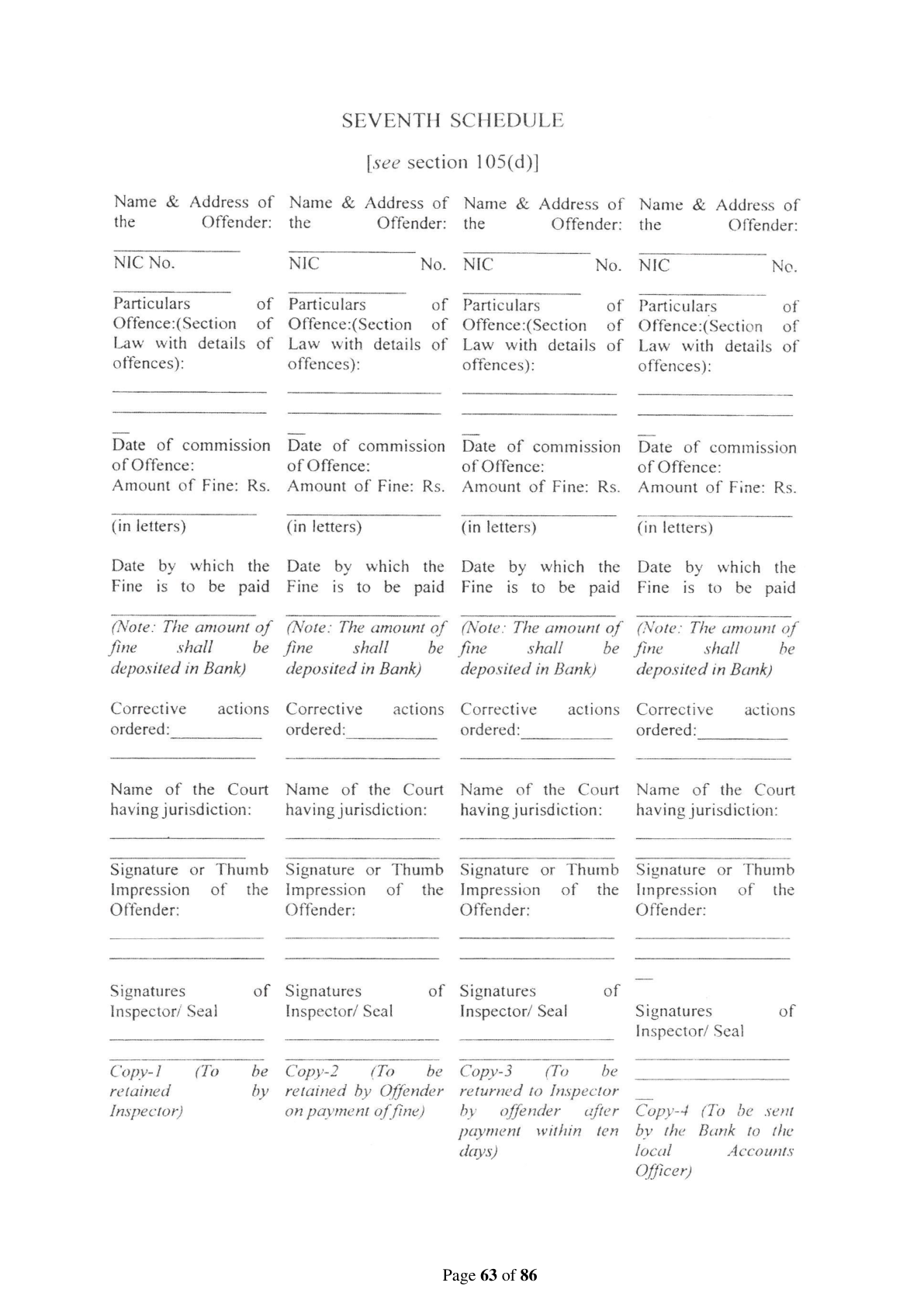
Original source and image integrity
Official original PDF source. Source PDF SHA-256: fde5f7670a33099688eb6d3d342eab6577f7b259657b201f79553034a1780454.
Each selected page is rendered in full without clipping. The original file and every page image are hashed. The source-page review identifies graphic or form material; it does not establish a complete OCR transcription, amendment completeness or current force.
- Physical PDF page 63:
265daae9eeee84f424b3dd27a5e98eb83b2495dab4bc9de7ae4e8b457d4c0ae2
This law in the library
Follow the instruments and provisions named in this source edition, and the laws that cite it. Citation links identify the text being referred to; legal effect and current force require separate examination.
Instruments cited by this law 11
Laws that cite this instrument 3
References to provisions in this text 44
Section 11
Open the identified operative provision
Read reference in context
es, bulls, oxen, bullocks, heifers, calves, camels, sheep, goats and others; Page 8 of 86 (h) “Chairman” means the Chairman of a Union Council as mentioned in section 11; (i) “Chief Officer” means the Chief Officer appointed under section 63; (j) “Code” means the Code of Criminal Procedure, 1898 (Act V of 1898); (k) “conservancy” means the collection, treatment, removal and disp
Section 63
More than one operative heading has this number. Read the source passage
Read reference in context
Page 8 of 86 (h) “Chairman” means the Chairman of a Union Council as mentioned in section 11; (i) “Chief Officer” means the Chief Officer appointed under section 63; (j) “Code” means the Code of Criminal Procedure, 1898 (Act V of 1898); (k) “conservancy” means the collection, treatment, removal and disposal of refuse; (l) “dairy” includes any farm, cattleshed, cowhouse, m
Section 12
More than one operative heading has this number. Read the source passage
Read reference in context
k shop or any other place from where milk or milk products are supplied; (m) “Deputy Mayor ” means a Deputy Mayor of the Metropolitan Corporation elected under section 12; (n) “District” means the area specified in section 2 of the Capital of the Republic (Determination of Area) Ordinance, 1963 (Ordinance VI of 1963); (o) “drain” includes a sewer, a house drain, a drain of any other
Section 78
Open the identified operative provision
Read reference in context
ng built up or is built up or is covered with water or is under cultivation or is fallow; (w) “Local Fund” means the fund of a local government established under section 78; (x) “local government” means a Union Council or the Metropolitan Corporation established under this Act; (y) “market” means a place where persons assemble for the sale and purchase of meat, fish, fruit, vegeta
Section 12
More than one operative heading has this number. Read the source passage
Read reference in context
er Plan developed, maintained and enforced by Capital Development Authority; (aa) “Mayor” means the Mayor of the Metropolitan Corporation elected as such under section 12; (bb) “member” means a member of a local government; (cc) “Metropolitan Corporation ” means the Metropolitan Corporation notified as such under section 9; (dd) “misconduct” means transgression of the prescribe
Section 9
More than one operative heading has this number. Read the source passage
Read reference in context
section 12; (bb) “member” means a member of a local government; (cc) “Metropolitan Corporation ” means the Metropolitan Corporation notified as such under section 9; (dd) “misconduct” means transgression of the prescribed code of conduct or dereliction of duty or deliberate unlawful behavior or violation of law or rules or lawful directions or orders of the Government and includes,
Section 7
More than one operative heading has this number. Read the source passage
Read reference in context
issi on and at least five years of experience in the relevant field; (yy) “Union Council ” means an area notified as a Union Council under Page 11 of 86 section 7; (zz) “vehicle” means a wheeled conveyance capable of being used on a road or street; (aaa) “Vice Chairman” means the Vice Chairman of a Union Council as mentioned in section 11; (bbb) “village” means an in
Section 11
Open the identified operative provision
Read reference in context
vehicle” means a wheeled conveyance capable of being used on a road or street; (aaa) “Vice Chairman” means the Vice Chairman of a Union Council as mentioned in section 11; (bbb) “village” means an integrated and contiguous human habitation commonly identified by a name and includes a dhok, chak, gaown, basti or any other comparable habitation within a revenue estate; (ccc) “vo
Section 5
More than one operative heading has this number. Read the source passage
Read reference in context
_______________________________________________ 1Subs. by Act No. VIII of 2023 by s.2. Page 13 of 86 (2) After the demarcation of the Local Government under section 5 and determination of number of Union Councils, the Election Commission, shall delimit Union Councils. (3) The Election Commission shall delimit and notify 1[in the official Gazette] the Councils on the basis of the prin
Section 7
More than one operative heading has this number. Read the source passage
Read reference in context
delimit Union Councils. (3) The Election Commission shall delimit and notify 1[in the official Gazette] the Councils on the basis of the principles laid d own in section 7, as nearly as p ossible, under the Delimitation of Constituencies Act, 1974 (XXXIV of 1974) or any other Act of the MajliseShoora (Parliament). 7. Delimitation of Union Councils.—(1) A Union Council shall be an area con
Section 6
More than one operative heading has this number. Read the source passage
Read reference in context
8. Waiver of conditions.―The Election Commission may, in a specific case and for reasons to be recorded in writing, waive the conditions of delimitation mentioned in section 6. CHAPTER III CONSTITUTION OF LOCAL GOVERNMENTS 9. Constitution of Local Governments. —(1) Subject to subsection (2), the local governments constituted under this Act shall be: (a) Metropolitan Corporati
Section 11
Open the identified operative provision
Read reference in context
TER IV COMPOSITION OF LOCAL GOVERNMENTS 10. Local governments.—(1) Local governments shall consist of Union Councils and Metropolitan Corporation as given in section 11 and section 12, respectively. (2) 1[* * * * * * *] 2[11. Union Council.—A Union Council shall consist of the following members elected under Chapter-V:— (i) Chairman and Vice-Chairman, as joint candidates;
Section 12
More than one operative heading has this number. Read the source passage
Read reference in context
POSITION OF LOCAL GOVERNMENTS 10. Local governments.—(1) Local governments shall consist of Union Councils and Metropolitan Corporation as given in section 11 and section 12, respectively. (2) 1[* * * * * * *] 2[11. Union Council.—A Union Council shall consist of the following members elected under Chapter-V:— (i) Chairman and Vice-Chairman, as joint candidates; (ii) nine gen
Section 11
Open the identified operative provision
Read reference in context
secret ballot one women, one peasant or worker or businessman or technocrat, one youth member and one non -Muslim member mentioned at serial number (iii) to (vi) of section 11 of this Act: Provided that election of the members shall be conducted in the prescribed manner. (3) After the completion of the process of the election under sub -section (2), the Secretary of the Union Council sh
Section 11
Open the identified operative provision
Read reference in context
hall convene and preside meeting of the Union Council to elect a Chairman and Vice-Chairman as joint candidate from members mentioned at serial num ber (ii) to (vi) of section 11 of this Act: Provided that the electoral college for the election of the Chairman and Vice-Chairman as joint candidate shall be members mentioned at serial number (ii) to (vi) of section 1l of this Act: Provided
Section 1L
An operative target heading has not been identified. Read the source passage
Read reference in context
Provided that the electoral college for the election of the Chairman and Vice-Chairman as joint candidate shall be members mentioned at serial number (ii) to (vi) of section 1l of this Act: Provided further that election of the Chairman and Vice -Chairman shall be condu cted in the prescribed manner.] 16. Election of the members of the Metropolitan Corporation.―Members of Metropolitan Co
Section 12
More than one operative heading has this number. Read the source passage
Read reference in context
16. Election of the members of the Metropolitan Corporation.―Members of Metropolitan Corporation, mentioned at serial number (iii) to (vii) of subsection (1) of section 12, shall be elected by the 2[Chairmen] of the Union Councils present and voting. 17. Election Commission to conduct elections.___(1) The Election Commission shall conduct the local government elections 2[and for this purp
Section 25
Open the identified operative provision
Read reference in context
as, and from being, an elected member of a local government. (2) lf a person,— (a) is found by the Election Commission to have contravened any provisions of section 25 or subsection (1) of section 26, he shall stand disqualified from being a candidate for election to any office of a local government for a period of four years; or (b) has been elected as a member of a local government
Section 26
More than one operative heading has this number. Read the source passage
Read reference in context
ember of a local government. (2) lf a person,— (a) is found by the Election Commission to have contravened any provisions of section 25 or subsection (1) of section 26, he shall stand disqualified from being a candidate for election to any office of a local government for a period of four years; or (b) has been elected as a member of a local government and is found by the Election Co
Section 25
Open the identified operative provision
Read reference in context
r a period of four years; or (b) has been elected as a member of a local government and is found by the Election Commission to have contravened any provision of section 25 or subsection (1) of section 26, he shall cease forthwith to be an elected member or to hold the office of such member and shall stand disqualified from being a candidate for election to a local government for a period of
Section 26
More than one operative heading has this number. Read the source passage
Read reference in context
(b) has been elected as a member of a local government and is found by the Election Commission to have contravened any provision of section 25 or subsection (1) of section 26, he shall cease forthwith to be an elected member or to hold the office of such member and shall stand disqualified from being a candidate for election to a local government for a period of four years. 27. Bar against d
Section 26
More than one operative heading has this number. Read the source passage
Read reference in context
to in sub section (2), shall be computed from the date of assumption of office of the Councils.] 32. Removals .— (1) Where proceedings of disqualification under section 26 have been initiated against a member, the Election Commission or any authority authorised by it may issue a notice to the member to show cause within specified period as to why proceedings against him may not be taken for
Section 25
Open the identified operative provision
Read reference in context
notice to the member to show cause within specified period as to why proceedings against him may not be taken for his removal for breach of any of the provisions of section 25. (2) Where the Election Commission or an authority authorised by it is not satisfied with the reply to the notice referred to in sub -section (1) or any reply to the sa id notice is not filed within the period fixed by i
Section 46
Open the identified operative provision
Read reference in context
er, gives any assistance calculated to further or hinder the election of a candidate. 59. Summary trial.—All offences under this Chapter except the offence under section 46 shall be tried summarily under the provisions of the Code. 60. Cognizance.—A Court shall not take cognizance of an offence under section 56 or section 57 except on a complaint in writing of the Election Commission or the
Section 56
More than one operative heading has this number. Read the source passage
Read reference in context
cept the offence under section 46 shall be tried summarily under the provisions of the Code. 60. Cognizance.—A Court shall not take cognizance of an offence under section 56 or section 57 except on a complaint in writing of the Election Commission or the Returning Officer. 61. Offence to be cognizable.—An offence punishable under section 46 shall be acognizable offence. 62. Prosecution
Section 57
More than one operative heading has this number. Read the source passage
Read reference in context
ce under section 46 shall be tried summarily under the provisions of the Code. 60. Cognizance.—A Court shall not take cognizance of an offence under section 56 or section 57 except on a complaint in writing of the Election Commission or the Returning Officer. 61. Offence to be cognizable.—An offence punishable under section 46 shall be acognizable offence. 62. Prosecution of offences unde
Section 46
Open the identified operative provision
Read reference in context
n 56 or section 57 except on a complaint in writing of the Election Commission or the Returning Officer. 61. Offence to be cognizable.—An offence punishable under section 46 shall be acognizable offence. 62. Prosecution of offences under this Chapter.—(1) Subject to section 59, a Court shall not take cognizance of an offence under this Chapter except on a complaint in writing made by order o
Section 59
Open the identified operative provision
Read reference in context
61. Offence to be cognizable.—An offence punishable under section 46 shall be acognizable offence. 62. Prosecution of offences under this Chapter.—(1) Subject to section 59, a Court shall not take cognizance of an offence under this Chapter except on a complaint in writing made by order or under authority of the Election Commission. (2) An offence punishable under this Chapter shall be tri
Section 85(2)
Open the identified operative provision
Read reference in context
t is necessary in public interest to have a special audit of a local government; it may direct that such audit may be conducted either by the officer notified under section 85(2) or any other audit agency. (4) After the receipt of special audit report of a local government, the Government may, after enquiry by the Local Government Commission constituted under section 95, take appropriate action
Section 95
Open the identified operative provision
Read reference in context
ency. (4) After the receipt of special audit report of a local government, the Government may, after enquiry by the Local Government Commission constituted under section 95, take appropriate action on the recommendations of the Commission. 87. Local government debt. —(1) A local government shall not incur any debt without previous approval of the Government. (2) A local government may
Section 29
More than one operative heading has this number. Read the source passage
Read reference in context
of Board shall be conducted in such manner as may be prescribed. 99. Dissolution of local governments. —(1) Notwithstanding anything to the contrary contained in section 29, where, before the expiry of the term of the local governments, the general elections for National Assembly are announced, the Government may, by notification, dissolve the local governments. (2) On the dissolution of th
Section 3
More than one operative heading has this number. Read the source passage
Read reference in context
ernment, the property specified below shall vest in the respective local government if it is: (a) vested in the local government through succession as provided in section 3; (b) transferred to the local government by the Government or any other authority, organisation or an individual; (c) constructed or acquired by the local government with its title; and (d) a road, street or a
Section 126
Open the identified operative provision
Read reference in context
ment in possession of the local governments established under the Capital Territory Local Government Ordinance, 1979 shall pass on to their successors as provided in section 126. (3) The successor local governments shall, subject to policy of the Government or contractual obligations, make byelaws for the use, development and management of the local government properties. (4) The Governm
Section 260
An operative target heading has not been identified. Read the source passage
Read reference in context
of the Code. (5) The offences specified in PartIII of Fifth Schedule and Sixth Schedule shall be tried in a summary manner in accordance with the provisions of section 260 to 265 of the Code but the limit of punishment mentioned in subsection (2) of section 262 of the Code shall not be applicable. (6) The fines imposed by a Court for an offence specified in Sixth Schedule shall on collecti
Section 260
An operative target heading has not been identified. Read the source passage
Read reference in context
(2) The Court receiving the scroll shall issue summons to the accused forthwith stating the date of hearing for summary trial in accordance with the provisions of section 260 to 265 of the Code but the limit of punishment mentioned in subsection (2) of section 262 of the Code shall not be applicable. (3) Where on the first date of hearing, the accused appears before the Court and produces the
Section 103
Open the identified operative provision
Read reference in context
l forthwith issue warrants for arrest of the accused and upon issuance of such warrants the accused will be liable to punishment under clause (c) of subsection (2) of section 103. 109. Compounding of offences.— Subject to this Act, a local government shall constitute a committee consisting of the Mayor or the Chairman as its Convener, an officer of the local government and a member of the local
Section 106
Open the identified operative provision
Read reference in context
hin the specified time. (2) An Inspector shall not enter any dwelling unit without permission of the occupier or the Court. (3) An Inspector authorized under section 106 may, in relation to the offences specified in Fifth Schedule— (a) issue notices in writing on behalf of the local government; (b) initiate legal proceedings in the Court; and (c) assist in defending legal proceed
Section 15
Open the identified operative provision
Read reference in context
Capital Territory Local Government Ordinance, 2002 (CXV II of 2002), the Islamabad Capital Territory Local Government Elections Ordinance, 2002 (LVII of 2002) and section 15A of the Capital Development Authority Ordinance, 1960 (XXIII of 1960) are hereby repealed. (2) Save as otherwise sp ecifically provided in this Act, nothing in this Act shall affect or be deemed to affect anything don
Section 15
Open the identified operative provision
Read reference in context
ution passed, direction given, proceedings taken or instrument executed or issued, under or in pursuance of the Capital Territory Local Government Ordinance, 1979 and section 15A of the Capital Development Authority Ordinance, 1960 and any such thing, action, investigation, proceedings, order, rule, regulation, byelaws, appointment, conveyance, mortgage, deed, document, agreement, tax, fee, r
Section 71
More than one operative heading has this number. Read the source passage
Read reference in context
. 32. Any other article or trade declared by Government to be dangerous for life, health or property or likely to cause nuisance. SECOND SCHEDULE [see Section 71] FUNCTIONS OF UNION COUNCIL (a) improve and maintain public ways, public streets and public open spaces; (b) arrange lighting of public ways, public streets and public places; (c) mobilize the community:
Section 73
Open the identified operative provision
Read reference in context
d (r) maintain such statistics and data as may be prescribed and disseminate information on matters of public interest. THIRD SCHEDULE [see Section 73] FUNCTIONS OF METROPOLITAN CORPORATION (a) implement rules and byelaws governing public utilities; (b) approve development schemes for beautification of urban areas; Page 54 of 86 (c) enforce all munici
Section 88
Open the identified operative provision
Read reference in context
pital Territory; (aa) maintain municipal records and archives; and (bb) perform such other functions as may be prescribed. FOURTH SCHEDULE [see section 88] LOCAL GOVERNMENT TAXATION PartI Taxes and other levies by Union Councils (1) Entertainment tax on dramatical and the article shows. Page 56 of 86 (2) Fees for registration and certification of births
Section 105
Open the identified operative provision
Read reference in context
square feet. (17) Tax on installation of Base Transceiver Station/Tower. (18) Any other tax or levy authorized by the Government. FIFTH SCHEDULE [see section 105] OFFENCES REQUIRING TRIAL BY A COURT PART-I S.No. Offence 1. Discharging any dangerous chemical, inflammable, hazardous or offensive article in any drain, or sewer, public water course or public land vested in
Section 121
Open the identified operative provision
Read reference in context
ocal government are necessary or expedient to Page 66 of 86 be provided for in the byelaws to achieve the, objectives of this Act. NINTH SCHEDULE [see section 121] GENERAL POWERS OF LOCAL GOVERNMENTS Animals 1. Prohibition of picketing or tethering in streets.—No animal shall be picketed or tethered in such streets or places as may be specified by the local government and
Provisions explicitly cited in other instruments 5
Section 2 of Capital of the Republic (Determination of Area) Ordinance, 1963
Cited by Islamabad Capital Territory Local Government Act, 2015
Read source and target evidence
Explicit source reference
are supplied; (m) “Deputy Mayor ” means a Deputy Mayor of the Metropolitan Corporation elected under section 12; (n) “District” means the area specified in section 2 of the Capital of the Republic (Determination of Area) Ordinance, 1963 (Ordinance VI of 1963); (o) “drain” includes a sewer, a house drain, a drain of any other description, a tunnel, a culvert, a ditch, a channel or any other device for carrying sullage or rain water; (p) “dwelling
Target heading · Capital of the Republic (Determination of Area) Ordinance, 1963
2. Area of the Capital. —
Article 218 of Constitution of the Islamic Republic of Pakistan
Cited by Islamabad Capital Territory Local Government Act, 2015
Read source and target evidence
Explicit source reference
(p) “dwelling house” means any building used substantially for human habitation; (q) “Election Commission ” means the Election Commission constituted under Article 218 of the Constitution of the Islamic Republic of Pakistan; (r) “factory” means a factory as defined in the Factories Act, 1934 (XXV of 1934); (s) “food” includes every eatable used for food or drink by human beings but does not include drugs or water; (t) “Government
Target heading · Constitution of the Islamic Republic of Pakistan
218. Election Commission. __ 2[(1) For the purpose of election to both Houses of Majlis -e- Shoora (Parliament), Provincial Assemblies and for election to such other public offices as may be specified by law, a permanent Election Commission shall be constituted in accordance with this Article.] 2[(2) The Electi
Article 62 of Constitution of the Islamic Republic of Pakistan
Cited by Islamabad Capital Territory Local Government Act, 2015
Read source and target evidence
Explicit source reference
XXV of 2016, s. 11. Page 18 of 86 (2) The qualifications mentioned in paragraphs (d) to (g) of clause (1) and the disqualification referred to in clause (2) of Article 62 of the Constitution of the Islamic Republic of Pakistan for membership of MajliseShoora (Parliament) shall mutatis mutandis apply to a person to qualify to be elected as a member or to hold an elected office of a local government. 26. Disqualifications for candidates and e
Target heading · Constitution of the Islamic Republic of Pakistan
6[62. Qualifications for membership of Majlis-e-Shoora (Parliament). __ (1) A person shall not be qualified to be elected or chosen as a member of Majlis-e-Shoora (Parliament) unless__ (a) he is a citizen of Pakistan; (b) he is, in the case of the National Assembly, not less than twenty -five years of age and i
Article 63 of Constitution of the Islamic Republic of Pakistan
Cited by Islamabad Capital Territory Local Government Act, 2015
Read source and target evidence
Explicit source reference
ns for candidates and elected members.—(1) The disqualifications mentioned for membership of MajliseShoora (Parliament) in paragraphs (a) to (p) of clause (1) of Article 63 of the Constitution of the Islamic Republic of Pakistan shall mutatis mutandis apply to a person from being elected or chosen as, and from being, an elected member of a local government. (2) lf a person,— (a) is found by the Election Commission to have contravened any pro
Target heading · Constitution of the Islamic Republic of Pakistan
2[63. Disqualifications for membership of Majlis -e-Shoora (Parliament). __ (1) A person shall be disqualified from being elected or chosen as, and from being, a member of the Majlis-e-Shoora (Parliament), if__ (a) he is of unsound mind and has been so declared by a competent court; or (b) he is an undischarged
Section 21 of Pakistan Penal Code, 1860
Cited by Islamabad Capital Territory Local Government Act, 2015
The named instrument matches multiple source editions; no edition is selected.
- Pakistan Penal Code (PPC),1860 (Under Review) · Federal
- PAKISTAN PENAL CODE, 1860 · Punjab
Read source and target evidence
Explicit source reference
vant of a local government, and every other person duly empowered to act on behalf of a local government, shall be deemed to be a public servant with in the meaning of section 21 of the Pakistan Penal Code, 1860 (Act XLV of 1860). 123. Bar against employment.—The Mayor, Chairman, Deputy Mayor, Vice Chairman or a member of a local government shall not be employed under such local government for a period of one year from the date
Cited instruments not matched in this library 22
Explore this law in the whole-library map · Download this law’s relationship evidence · Download preserved source record
Original-source comparison
Read the original graphic and form pages retained with this law. Their visual content is separate from the text comparison below.
Original-source text comparison matched
Open the compared original source
Source comparison checks the identified transcription and edition. The law's current force, later amendments and territorial application require separate legal review.
Comparison evidence
- Stored text SHA-256
- 1cec4d47327941a8b0dee3179457967026deb2ee9d074f96b8cd2ee3e27ed875
- Original source SHA-256
- fde5f7670a33099688eb6d3d342eab6577f7b259657b201f79553034a1780454
- Comparison method
- NFKC, typography-equivalent quotation marks, soft-hyphen removal and whitespace normalization; full-text equality required
Source, version and text details
- Recorded title
- Islamabad Capital Territory Local Government Act, 2015
- Source collection
- Federal — this does not establish territorial applicability.
- Recorded version
- Not supplied in this record
- Source snapshot
- Not supplied in this record
- Legal status
- not independently verified
- Text quality
- Complete stored UTF-8 TXT file recovered byte-for-byte from owned Drive. Source transcription retained verbatim; legal completeness, OCR accuracy and current consolidation unverified.
- Recorded quality flags
- No additional flags recorded
- Stable record
- pk-code-6c1a54f82844de3b
- Content extent
- Legal completeness not independently established
- Integrity scope
- Stored UTF-8 text and TXT download bytes checked against their recorded hash. This does not establish legal authenticity or currency.
- Passage offsets
- zero-based Unicode code points and UTF8 bytes; end exclusive
- Stored text SHA-256
- 1cec4d47327941a8b0dee3179457967026deb2ee9d074f96b8cd2ee3e27ed875