
Code of Civil Procedure (CPC) , 1908 (Under Review)
Stored extracted text; legal completeness and current force have not been independently established. Inspect source and version details
Reading view reduces excess blank space and hides page extraction markers. Original text and downloads are retained.
Reading layout follows the stored source. Open the original transcription below to compare wording and extraction details.
THE CODE OF CIVIL PROCEDURE, 1908
APPENDIX H.__ MISCELLANEOUS. THE SECOND SCHEDULE.__ [Repealed] THE THIRD SCHEDULE.__ EXECUTION OF DECREES BY COLLECTORS THE FOURTH SCHEDULE.__ [Omitted] THE FIFTH SCHEDULE.__ [Repealed]
_______
THE CODE OF CIVIL PROCEDURE, 1908
1ACT NO V OF 1908 [21st March, 1908]
An Act to consolidate and amend the laws relating to the Procedure of the Courts of Civil Judicature.
WHEREAS it is expedient to consolidate and amend the laws relating to the procedure of the Courts of Civil Judicature; It is hereby enacted as follows:__
PRELIMINARY
Section 1. Short title, commencement and extent
This Act may be cited as the Code of Civil Procedure, 1908.
(2) It shall come into force on the first day of January, 1909.
2[(3) It extends to the whole of Pakistan.]
3[(4) The primary objective of this Code is to enable the Courts to-
(a) deal the cases justly and fairly;
(b) encourage parties to alternate dispute resolution procedure if it considers appropriate;
(c) save expends and time both of Courts and litigants; and
(d) enforce compliance with provision of the Code.]
Section 2. Definitions
In this Act, unless there is anything repugnant in the subject or context,__
(1) “Code” includes rules:
(2) “decree” means the formal expression of an adjudication which, so far as regards the Court expressing it, conclusively determines the rights of the parties which regard to all or any of the matters in controversy in the suit and may be either preliminary or final. It shall be deemed to include the rejection of a plaint 4[,the determination of any question within section 144 and an order under rule 60, 98, 99, 101, or 103 of Order XXI], but shall not include__
(a) any adjudication from which an appeal lies as an appeal from an order, or
(b) any order of dismissal for default.
1For statement of Objects and Reasons, see Gazette of India, 1907 Pt.V,p.179; for Report of the Select Committee, see ibid., 1908, Pt.V, p. 35; and for Proceedings in Council, see ibid., 1907, Pt. VI. P. 135 and ibid., 1908, pp.8, 12 and 212.
All references in the Act to His Majesty in Council shall be construed as references to the Federal Court, see the Federal Court (Enlargement of Jurisdiction) Act, 1949 (1 of 1950), s.6. The Act has been extended and shall be deemed to have been so extended on the 14th October, 1955, to the whole of Pakistan by the Cen tral Laws (Statute Reform) Ordinance, 1960 (21 of 1960), s.3 and 2nd Sch.
This Act has been amended in the Punjab by the Punjab Relief of Indebtedness Act, 1934 (Punjab 7 of 1934), Pt. VIII.
It has been extended by notification under ss.5 and 5A of the Scheduled Districts Act, 1874 (14 of 1874), to the following scheduled Districts:__
(1) The Province of Sindh: Bombay Government Gazette, Extraordinary, 1909, Pt. I and Gazette of India, 1909, Pt. I, p.32.
(2) Scheduled District in the Punjab: Gazette, of India, 1909, Pt. I, P. 33.
(3) The Districts of Peshawar, Hazara, Kohat, Bannu and Dera Ismail Khan composing the N.W.F.P, : ibid., Pt. II, p. 80. It has been declared to be inforce in Balochistan by the British Balcohistan Laws Regulation, 1913 (II of 1913), s. 3 and First Schedule. It has also been extended to the Leased Areas of Balochistan, see the Leased Areas (Laws) Order, 1950 (G.G.O.3 of 1950); and applied in the Federated Areas of Balochistan, see Gaz. of India 1937, pt. I, p. 1499. It has been applied to Phulera in the Excluded Area of Upper Tanawal to the extend the Act is applicable in the N.W.F.P., see N.W.F.P (Upper Tanawal) (Excluded Area) Laws Regulation, 1950. It has also been extended to the Excluded Area of Upper Tanawal other than Phulera by the N.W.F.P. (Upper Tanwal) Excluded Area) Laws Regulation, 1950 and declared to be in force in that area with affect from the 1st June, 1951, see N.W.F.P Gazette, Extraordinary, dated the 1st June, 1951. The Act has, with certain modification, been applied to the Provincially Administered Tribal Areas of Chitral, Dir, Kalam, Swat and Malakand Protected Area by N.W.F.P Regulation No. 1 of 1974.
2Subs. by the Central Laws (Statute Reform) Ordinance, No. XXI of 1960, s. 3 and 2nd Sch. (with effect from the 14th October, 1955), for the Original subsection (3), as amended by A.O., 1949.
3Ins. by Act No. VII of 2020, s. 2.
4Subs. by the Law Reforms Ordinance, 1972 (12 of 1972), s.2 and Sch., for “and the determination of any question within section 47 or section 144”.
Explanation.__ A decree is preliminary when further proceedings have to be taken before the suit can be completely disposed of. It is final when such adjudication completely disposes of the suit. It may be partly preliminary and partly final:
(3) “decreeholder” means any person in whose favour a decree has been passed or an order capable of execution has been made:
(4) “district” means the local limits of the jurisdiction of a principal Civil Court of original jurisdiction (hereinafter called a "District Court"), and includes the local limits of the ordinary original civil jurisdiction of a High Court:
(5) “foreign Court ” means a Court situate beyond the limits of 3[Pakistan] which has no authority in 1[ Pakistan] and is not established or continued by 2[the 3[Federal Government] 4***]:
(6) “foreign judgment” means the judgment of a foreign Court:
(7) “Government Pleader” includes any officer appointed by the 2[Provincial Government] to perform all or any of the functions expressly imposed by this Code on the Government Pleader and also any pleader acting under the directions of the Government Pleader:
(8) “Judge” means the presiding officer of a Civil Court:
(9) “judgment” means the statement given by the Judge of the grounds of a decree or order:
(10) “judgmentdebtor” means any person against whom a decree has been passed or an order capable of execution has been made:
(11) “legal representative ” means a person who in law represents the estate of a deceased person, and includes any person who intermeddles with the esta te of the deceased and where a party sues or is sued in a representative character the person on whom the estate devolves on the death of the party so suing or sued:
(12) “mesne profits” of property means those profits which the person in wrongful possession of such property actually received or might with ordinary diligence have received therefrom, together with interest on such profits but shall not include profits due to improvements made by the person in wrongful possession:
(13) “moveable property” includes growing crops:
(14) “order” means the formal expression of any decision of a Civil Court which is not a decree:
(15) “pleader” means any person entitled to appear and plead for another in Court, and includes an advocate, a vakil and an attorney of a High Court:
(16) “prescribed” means prescribed by rules:
1Subs. by Ordinance, No. XXI of 1960, s.3 and 2nd Sch. (with effect from the 14th October, 1955), for “the Provinces and the Capital of the Federation" which had been subs. by Adaptation Order, 1949.
2Subs. by Adaptation Order, 1937.
3Subs. by Federal Adaptation Order, 1975 Art. 2 and Table.
4The words “or the Crown Representative” omitted by Adaptation Order, 1949.
(17) “public officer” means a person falling under any of the following descriptions, namely:__
(a) every Judge; 1[(b) every person in the service of Pakistan;]
(c) every commissioned or gazetted officer in the military, 2[naval or air] forces of 3[Pakistan while in the service of the State] ;
(d) every officer of a Court of Justice whose duty it is, as such officer, to investigate or report on any matter of law or fact, or to make, authenticate or keep any document, or to take charge or dispose of any property, or to execute any judicial process, or to administer any oath, or to in terpret, or to preserve order, in the Court, and every person especially authorised by a Court of Justice to perform any of such duties;
(e) every person who holds any office by virtue of which he is empowered to place or keep any person in confinement;
(f) every officer of 4[the Government] whose duty it is, as such officer, to prevent offences, to give information of offences, to bring offenders to justice, or to protect the public health, safety or convenience;
(g) every officer whose duty it is, as such officer, to take, receive, keep or expend any property on behalf of 4[the Government], or to make any survey, assessment or contract on behalf of 4[the Government], or to execute any revenueprocess, or to investigate, or to report on, any matter af fecting the pecuniary interest of 3[the Government], or to make, authenticate or keep any document relating to the pecuniary interests of 4[the Government] or to prevent the infraction of any law for the protection of the pecuniary interests of 3[the Government]; and
(h) every officer in the service or pay of 4[the Government], or remunerated by fees or commission for the performance of any public duty:
(18) “rules” means rules and forms contained in the First Schedule or made under section 122 or section 125:
(19) “share in a corporation” shall be deemed to include stock, debenture stock, debentures or bonds: and
(20) “signed”, save in the case of a judgment or decree, includes stamped.
[5] Section 3. Subordination of Courts
For the purposes of this Code, the hierarchy and sub-ordination of Civil Courts shall be the same as prescribed in the West Pakistan Civil Courts Ordinance, 1962 (W.P. Ordinance No. II of 1962).]
1Subs. by the Federal Laws (Revision and Declaration) Ordinance, No. XVII of 1981 , s.3 and Second Sch., for subclause (b). The words in crotchets [Civil Service of Pakistan] which were amended by Ordinance 21 of 1960, s. 3 and 2nd sch. and Adaptation Order, 1949.
2Subs. by the Amending Act No. XXXV of 1934, s.2 and Sch.
3The words “His Majesty while serving under the Crown” as amended, by Act No. XXXV of 1934, s.2 and Sch. and Adaptation Order, 1937, have been
subs. by Adaptation Order, 1961, Art, 2 and Sch. (with effect from the 23rd March, 1956.)
4Subs. by Adaptation Order, 1961, Art. 2 and Sch., (with effect from the 23rd March, 1956), for "the Crown" which had been subs., by Adaptation Order,
1937.
5Subs. by Act No. VII of 2020, s. 3.
Section 4. Savings
(1) In the absence of any specific provision to the contra ry, nothing in this Code shall be deemed to limit or otherwise affect any special or local law now in force or any special jurisdiction or power conferred, or any special form of procedure prescribed, by or under any other law for the time being in force.
(2) In particular and without prejudice to the generality of the proposition contained in subsection (1), nothing in this Code shall be deemed to limit or otherwise affect any remedy which a landholder or landlord may have under any law for the time being in force for the recovery of rent of agricultural land from the produce of such land.
Section 5. Application of the Code to the Revenue Courts
(1) Where any Revenue Courts are governed by the provisions of this Code in those matters of procedure upon which any special enactment applicable to them is silent, the 1[Provincial Government] 2[* * *] may, by notification in the 1[official Gazette], declare that any portions o f those provisions which are not expressly made applicable by this Code shall not apply to those Courts, or shall only apply to them with such modifications as the 1[Provincial Government] 3[* * *] may prescribe.
(2) “Revenue Court” in subsection (1) means a Court having jurisdiction under any local law to entertain suits or other proceedings relating to the rent, revenue or profits of land used for agricultural purposes, but does not include a Civil Court having original jurisdictio n under this Code to try such suits or proceedings as being suits or proceeding of a civil nature.
[4] Section 6. Pecuniary Jurisdiction
Save in so far as is otherwise expressly provided, nothing herein contained shall operate to give any Court jurisdiction over suits the amount or value of the subject matter of which exceeds the pecuniary limits, if any, of its ordinary jurisdiction].
Section 7. [Omitted]
5[* * * * * * *]
Section 8. [Presidency Small Cause Courts.] Omitted by A.O., 1949.
PART I
SUITS IN GENERAL JURISDICTION OF THE COURTS AND Res Judicata
Section 9. Courts to try all civil suits unless barred
The Courts shall (subject to the provisions herein contained) have jurisdiction to try all suits of a civil nature excepting suits of which their cognizance is either expressly or impliedly barred.
1Subs. by Adaptation Order, 1937.
2The words “with the previous sanction of the G.G. in C.” omitted by the Devolution Act No. XXXVIII of 1920, s.2 and 1st Sch., Pt. I. 3The words “with the sanction aforesaid” omitted by Act No. XXXVIII of 1920, s.2 and 1st Sch., Pt. I.
4Subs. by Act XIX of 2023, s.2.
5Omitted by Act VII of 2020, s. 5.
Explanation.__ A suit in which the right to property or to an office is contested is a suit of a civil nature, notwithstanding that such right may depend entirely on the decision of questions as to religious rites or ceremonies.
Section 10. Stay of suit
No Court shall proceed with the trial of any suit in which the matter in issue is also directly and substantially in issue in a previously instituted suit between the same parties, or between parties under whom they or any of them claim litigating under the same title where such suit is pending in the same or any other Court in 1[Pakistan] having jurisdiction to grant the relief claimed, or in any Court beyond the limits of 1[Pakistan] established or continued by 2[the 3[Federal Government] 4* * *] and having like jurisdiction, or before 5[the Supreme Court]. Explanation.__ The pendency of a suit in a foreign Court does not preclude the Courts in 1[Pakistan] from trying a suit founded on the same cause of action.
Section 11. Res Judicata
No Court shall try suit or issue in which the matter directly and substantially in issue has been directly and substantially in issue in a former suit between the same parties, or between parties under whom they or any of them claim, litigating under the same title, in a Court competent to try such subsequent suit or the suit in which such issue has been subsequently raised, and has been heard and finally decided by such Court.
Explanation I.__ The expression "former suit" shall denote a suit which has been decided prior to the suit in question whether or not it was instituted prior thereto. Explanation II. __ For the purposes of this section, the competence of a Court shall be determined irrespective of any provisions as to a right of appeal from the decision of such Court. Explanation III.__ The matter above referred to must in the former suit have been alleged by one party and either denied or admitted, expressly or impliedly, by the other. Explanation IV.__ Any matter which might and ought to have been made ground of defence or attack in such former suit shall be deemed to have been a matter directly and substantially in issue in such suit. Explanation V.__ Any relief claimed in the plaint, which is not expressly granted by the decree, shall, for the purposes of this section, be deemed to have been refused. Explanation VI.__ Where persons litigate bona fide in respect of a public right or of a private right claimed in common for themselves and others, all persons interested in such right shall, for the purposes of this section, be deemed to claim under the persons so litigating.
[6] Section 12. Bar to further suit
(1)] Where a plaintiff is precluded by rules from instituting a further suit in respect of any particular cause of action, he shall not be entitled to institute a suit in respect of such cause of action in any Court to which this Code applies.
1Subs. by the Central laws (Statute Reform) Ordinance, No. XXI of 1960, s. 3 and 2nd Sch. (with effect from the 14th October, 1955).
2Subs. by Adaptation Order, 1937.
3Subs. by Federal Adaptation Order, 1975. Art.2 and Table.
4The words “or the Crown Representative” omitted by Adaptation Order, 1949.
5Subs. by Adaptation Order, 1961, Art. 2 and Sch. (with effect from the 23rd March 1956).
6S.12 was renumbered as subsection (1) of that section by the Code of Civil Procedure (Amdt.) Ordinance, No. X of 1980, s. 2
1[(2) Where a person challenges the validity of a judgment, decree or order on the plea of fraud, misrepresentation or want of jurisdiction, he shall seek his remedy by making an application to the Court which passed the final judgment, decree or order and not by a separate suit.]
Section 13. When foreign judgment not conclusive
A foreign judgment shall be conclusive as to any matter thereby directly adjudicated upon between the same parties or between parties under whom they or any of them claim litigating under the same title except__
(a) Where it has not been pronounced by a Court of competent Jurisdiction ;
(b) Where it has not been given on the merits of the case;
(c) Where it appears on the face of the proceedings to be founded on an incorrect view of international law or a refusal to recognise the law of 2[Pakistan] in cases in which such law is applicable;
(d) Where the proceedings in which th e Judgment was obtained are opposed to natural justice ;
(e) Where it has been obtained by fraud ;
(f) Where it sustains a claim founded on a breach of any law in force in 2[Pakistan].
Section 14. Presumption as to foreign judgment
The Court shall presume, upon t he production of any document purporting to be a certified copy of a foreign Judgment, that such Judgment was pronounced by a Court of competent Jurisdiction, unless the contrary appears on the record ; but such presumption may be displaced by proving want of jurisdiction. PLACE OF SUING
Section 15. Court in which suits to be instituted
Every suit shall be instituted in the Court of the lowest grade competent to try it.
Section 16. Suits to be instituted where subjectmatter situate
Subject to the pecuniary or other limitations prescribed by any law, suits__
(a) for the recovery of immoveable property with or without rent or profits,
(b) for the partition of Immoveable property,
(c) for foreclosure, sale or redemption in the case of a mortgage of or charge upon immoveable property,
(d) for the determination of any other right to or interest in immoveable property,
(e) for compensation for wrong to immoveable property,
(f) for the recovery of moveable property actually under distraint or attachment,
1Subsection (2) added by the Code of Civil Procedure (Amdt.) Ordinance, No. X of 1980, s.2.
2Subs. by the Central Laws (statute Reform) Ordinance, No. XXI of 1960, s.3 and 2nd Sch. (with effect from the 14th October, 1955).
shall be instituted in the Court within the local limits of whose jurisdiction the property is situate, 1[, or, in the case of suits referred to in clause (c), at the place where the cause of action has wholly or partly arisen]:
Provided that a sui t to obtain relief respecting, or compensation for wrong to, immoveable property held by or on behalf of the defendant may, where the relief sought can be entirely obtained through his personal obedience, be instituted either in the Court within the local limits of whose jurisdiction the property is situate 1[,or, in the case of suit referred to in clause (c), at the place where the cause of action has wholly or partly arisen], or in the Court within the local limits of whose jurisdiction the defendant actually and voluntarily resides, or carries on business, or personally works for gain. Explanation.__ In this section "property" means property situate in 2[Pakistan].
Section 17. Suits for immoveable property situate within jurisdiction of different Courts
Where a suit is to obtain relief respecting, or compensation for wrong to, immoveable property situate with in the jurisdiction of different Courts, the suit may be instituted in any Court within the local limits of whose jurisdiction any portion of the property is situate:
Provided that, in respect of the value of the subjectmatter of the suit, the entire claim is cognizable by such Court.
Section 18. Place of institution of suit where local limits of jurisdiction, of Courts are uncertain
(1) Where it is alleged to be uncertain within the local limits of the jurisdiction of which of two or more Courts any immoveable property is situate, any one of those Courts may, if satisfied that there is ground for the alleged uncertainty, record a statement to that effect and thereupon proceed to entertain and dispose of any suit relating to that property, and its decree in the suit shall have the same effect as if the property were situate within the local limits of its Jurisdiction :
Provided that the suit is one with respect to which the Court is competent as regards the nature and value of the suit to exercise Jurisdiction.
(2) Where a statement has not been recorded under subssection (1), and an objection is taken before an appellate or revisional Cou rt that a decree or order in a suit relating to such property was made by a Court not having jurisdiction where the property is situate, the appellate or revisional Court shall not allow the objection unless in its opinion there was, at the time of the institution of the suit, no reasonable ground for uncertainty as to the Court having jurisdiction with respect thereto and there has been a consequent failure of Justice.
Section 19. Suits for compensation for wrongs to person or moveables
Where a suit is for compensation for wrong done to the person or to moveable property, if the wrong was done within the local limits of the Jurisdiction of one Court and the defendant resides, or carries on business, or personally works for gain, within the local limits of the J urisdiction of another Court, the suit may be instituted at the option of the plaintiff in either of the said Courts.
1Ins. by the Code of Civil Procedure (Amdt.) Ordinance, No. XLIV of 1962, s.6.
2Subs. by the Central Laws (Statute Reform) ordinance, No. XXI of 1960, s.3 and 2nd Sch. (with effect from the 14th October, 1955).
Illustrations
(a) A, residing in 1[Karachi], beats B in 2[Quetta]. B may sue A either in 2[Quetta] or 1[Karachi].
(b) A, residing in 1[Karachi] publishes in 2[Quetta] statements defamatory of B. B may sue A either in 2[Quetta] or in 1[Karachi].
Section 20. Other suits to be instituted where defendants reside or cause of action arises
Subject to the limitations aforesaid, every suit shall be instituted in a Court within the local limits of whose jurisdiction__
(a) the defendant, or each of the defendants where there are more than one, at the time of the commencement of the suit, actually and voluntarily resides, or carries on business, or personally works for gain ; or
(b) any of the defendants, where there are more than one, at the time of the commencement of the suit, actually and voluntarily resides, or carries on business, or personally works for gain, provided that in such case either the leave of the Court is given, or the defendants who do not reside, or carryon business, or personally work for gain, as aforesaid, acquiesce in such institution ; or
(c) the cause of action, wholly or in part, arises. Explanation I.__ Where a person has permanent dwelling at one place and also a temporary residence at another place, he shall be deemed to reside at both places in respect of any cause of action arising at the place where he has such temporary residence. Explanation II.__ A corporation shall be deemed to carry on business at its sole or principal office in 1[Pakistan] or, in respect of any cause of action arising at any place where it has also a subordinate office, at such place. Illustrations
(a) A is a tradesman in 2[Lahore]. B carries on business in 1[Karachi], B, by his agent in 2[Lahore], buys goods of A and requests A to deliver them to the 1[Pakistan International Airways]. A delivers the goods accordingly in 2[Lahore]. A may sue B for the price of the goods either in 2[Lahore] where the cause of action has arisen, or in 1[Karachi], where B carries on business.
(b) A resides at 1[Murree], B at 2[Lahore], and C at 1[Karachi], A, B and C being together at 1[Bahawalpur], B and C make a joint promissory note payable o n demand, and deliver it to A. A may sue B and C 1[Bahawalpur,] where the cause of action arose. He may also sue them at 2[Lahore], where B resides, or at 1[Karachi],
1Subs. by the Central Laws (Statute Reform) Ordinance, No. XXI of 1960, s.3 and 2nd Sch. (with effect from the 14th October, 1955).
2Subs. by the Federal Laws (Revision and Declaration) Ordinance, No. XXVII of 1981, s.3 and 2nd Sch.
where C resides; but in each of these cases, if the nonresident defendant objects, the suit cannot proceed without the leave of the Court.
Section 21. Objections to jurisdiction
No objection as to the place of suing shall be allowed by any appellate or revisional Court unless such objection was taken in the Court of first instance at the earliest possible opportunity and in all cases where issues are settled at or before such settlement, and unless there has been a consequent failure of justice.
Section 22. Power to transfer suits which may be instituted in more than one Court
Where a suit may be instituted in any one of two or more Courts and is instituted in one of such Courts, any defendant, after notice to the other parties, may, at the earliest possible opportunity and in all cases where issues are settled at or before such settlement, apply to have t he suit transferred to another Court, and the Court to which such application is made, after considering the objections of the other parties (if any), shall determine in which of the several Courts having jurisdiction the suit shall proceed.
Section 23. To what Court application lies
(1) Where the several Courts having jurisdiction are subordinate to the same Appellate Court, an application under section 22 shall be made to the Appellate Court.
(2) Where such Courts are subordinate to different appellate Courts but to the same High Court, the application shall be made to the said High Court.
(3) Where such Courts are subordinate to different High Courts, the application shall be made to the High Court within the local limits of whose jurisdiction the Court in which the suit is brought is situate.
Section 24. General power of transfer and with drawl
(1) On the application of any of the parties and after notice to the parties and after hearing such of them as desire to be heard, or of its own motion with out such notice, the High Court or the District Court may at any stage__
(a) transfer any suit, appeal or other proceeding pending before it for trial or disposal to any Court subordinate to it and competent to try or dispose of the same, or
(b) withdraw any suit, appeal or other proceeding pending in any Court subordinate to it, and
(i) try or dispose of the same ; or
(ii) transfer the same for trial or disposal to any Court subordinate to it and competent to try or dispose of the same ; or
(iii) retransfer the same for trial or disposal to the Court from which it was withdrawn.
(2) Where any suit or proceeding has been transferred or withdrawn under subsection (1), the Court which thereafter tries such suit may, subject to any special directions in the c ase of an order of transfer, either retry it or proceed from the point at which it was transferred or withdrawn.
(3) For the purposes of this section, Courts of Additional and Assistant Judges shall be deemed to subordinate to the District Court.
(4) The Court trying any suit transferred or withdrawn under this section from a Court of Small Causes shall, for the purposes of such suit, be deemed to be a Court of Small Causes.
[1] Section 24A. Appreance of parties on transfer of suits, etc
(1) Where any suit is transferred under section 22, or any suit, appeal or other proceeding is transferred or withdrawn under subsection (1) of section 24 on the application of a party, the Court ordering the transfer or withdrawal shall fix a date for the appearance of the parties before itself, if the suit, appeal or other proceeding is to be tried or disposed of by itself, or before the Court to which the case is so transferred.
1S.24A ins. by the Code of Civil Procedure (Amdt.) Ordinance, No. XLIV of 1962, s.7.
(2) Where any suit, appeal or other proceeding is transferred from one Court to another, otherwise than on the application of a party, the parties thereto shall appear before the Court from which the suit, appeal or other proceedings is to be transferred, on t he day already fixed for their appearance before that Court, and such Court shall then communicate the order of transfer to such parties and direct them to appear before the Court to which the suit, appeal or other proceeding is to be transferred, ei ther on the same day, or on such earliest day as may be reasonable having regard to the distance at which the other Court is located.]
Section 125. [Power of Provincial Government to transfer suits. ] Omitted by the Central Laws (Statue Reform)
Ordinance, 1960 (XXI of 1960), s.3 and 2nd Sch. (with effect from the 14th October, 1955). INSTITUTION OF SUITS
[2] Section 26. Institution of suit
Every suit shall be instituted by presentation of a plaint or in such other manner as may be prescribed.] 2[26A-26D. * * * * * * *] SUMMONS AND DISCOVERY
Section 27. Summons to defendants
Where a suit has been duly instituted, a summons may be issued to the defendant to appear and answer the claim 2[* * *] and may be served in manner prescribed. 2[27A. * * * * * * *]
Section 28. Service of summons where defendant resides in another Province
(1) A Summons may be sent for service in another Province to such Court and in such manner as may be prescribed by rules in force in that Province.
(2) The Court to which such summons is sent shall, upon receipt thereof, proceed as if it had been issued by such Court and shall then return the summons to the Court of issue together with the record (if any) of its proceedings with regard thereto.
[3] Section 29. Service of foreign summonses
Summonses 2[and other processes] issued by any Civil
1S. 25 was amended by Adaptation Order, 1937.
2Subs. and Omitted by Act No. XIX of 2023, s.3.
3Provisions of s.29 have been applied to__ (i)the Civil Courts in the Federation of Malaya in so far as the Chief Commissioner’s Province of Baluchistan and the Capital of the Federation are concerned, see Gaz. of P., 1949, Pt.I, P.258 and ibid., Pt.II A, P. 68 (ii)all Civil and Revenue Courts of I ndia; and service by any Civil or Revenue Court of India of any summons issued under the Code of Civil Procedure, 1908, by a Court of the Province of Sind shall be deemed to be valid, see Sind Government Gazette, Extraordinary, dated 3rd July, 1952. Pt. I, P. 437. (iii)all Civil and Revenue Courts in India and Service by such Courts of any summons issued under the said Code by a Court in the N.W.F.P, Baluchistan or Karachi shall be deemed to be valid service, see N.W.F.P Government Gazette, 1952, Pt. I, P. 248 and Gaz., of P. 1952, Pt. I, P. 119 and ibid., Pt. VI, p. 126. (iv)all Civil and Revenue Courts in India; and that service by such Courts of any summons issued under the said Code by a Court in Khairpur State shall be deemed to be valid service, see Khairpur State Gazette, Ext., 1952, dated the 18th September, 1952. (v)all Civil and Revenue Courts in India; and service by such Courts of any summons issued under the said Code by a Court in the Bahawalpur State shall be deemed to be valid service, see Bahawalpur Govt. Gazette, dated the 2nd October, 1952. (vi)all Civil and Revenue Courts of India; and service by any civil or Revenue Court in India, within whose jurisdiction the person to be served resides of any summons issued by a Court under the said Code shall be deemend to be valid service, see Punjab Gazette, Ext., 1951, dated the 1st September, 1951, p. 1743. (vii)all Civil and Revenue Courts in the Union of Burma, in respect of Baluchistan; and service by such Courts of any summons issued under the s aid Code by a Court in Baluchistan shall be deemed to be valid service see Gaz. of P., Ext., 1954, p. 1873. (viii)all Civil and Revenue Courts in the Union of Burma, in respect of Karachi; and service by such Courts of any summons is sued under the said Code by a Court in Karachi shall be deemed to be valid service, see Gaz. of p., Extra., 1954, p. 1997. (ix)all Civil and Revenue Courts of the Union of Burma; and service by such Courts of Summonss issued under the said Code by A Court in East Bengal shall be deemed to be valid service, see Dacca Gazette, Ext., dated 18th October, 1954, Pt. I, p. 3053. (x)all Civil and Revenue Courts of the Union of Burma; and service by such Courts of any summons issued under the said Code b y a Court in the N.W.F.P, shall be deemed to be valid service, see N.W.F.P, Gazette, 1954, Pt. I, p. 523. (xi)all Civil and Revenue Courts of the Union of Burma; and service by such Courts of any summons issued under the said Code by a Court in the Province of Punjab, shall be deemed to be valid service, see Gaz. of Punjab, 1954, Pt. I, p. 843. (xii)all Civil and Revenue Courts of the Union of Burma; and service by such Courts of any summons issued under the said Code by a Court in the Province of Sind, shall be deemed to be valid service, w.e.f. 18th October, 1954, see Gaz. of Sind, 1954, pt I, p. 940. (xiii)all Civil and Revenue Courts in the Federal Republic of Germany; and service by such Courts of summons issued under the said Code by a Court in Baluchistan shall be deemed to be valid service, see Gaz. of P. 1955, Pt. I, p. 126. (xiv)the summonses issued by any Civil or Revenue Courts in Pakistan may be sent to the Courts in the Union of Burma and serv ed as if they had been issued by such Courts, see Gaz of 1955, P.I, p. 143. (xv)service by any Court situated in Pakistan, of any summons issued by a Court of the Union of Burma shall be deemed to be valid service , see Gaz. of P., 1955, Pt. I, p. 143. (xvi)all Civil and Revenue Courts in the Federal Republic of Germany an services by such Cou rts of any summons issued under the said Code by a Court in Karachi, shall be deemed to be valid service, with effect on and from the 1st June, 1955, see Gaz. Of P., 1955, Pt. VI, p. 102. (xvii)all Civil and Revenue Courts in the Federal Republic of German y; and service by such Courts of any summons issued under the said Code by a Court in the Province of East Bengal shall be deemed to be valid service see Dacca Gazette, 1955, Pt. I, p. 1051. (xviii)all Civil Courts in Switzerland and the service by such Courts of any summons issued under the Code (C.Pr.C.) by a Court in the Province of W. Pakistan shall be deemed to be valid service, see W.P. Gaz., 1959, Ext. p. 843.
2Ins. by the Code of Civil Procedure (Amdt.) Act, 1940 (34 of 1940).
or Revenue Court situate 1[outside 2[Pakistan]] may be sent to the Courts 1[in 2[Pakistan]] and served as if they 3[were summonses] issued by such Courts: 4[Provided that the Courts issuing such summonses 5[or processes] have been established or continued by the authority of the 6[Federal Government] 7[* * *] or that the Provincial Government 8[of the Province in which such summonses or processes are] to be served has by notification in the official Gazette declared the provisions of this section to apply to 9[such Courts].]
Section 30. Power to order discovery and the like
Subject to such conditions and limitations as may be prescribed, the Court may, at any time, either of its own motion or on the application of any party,__
(a) make such orders as may be necessary or reasonable in all matters relating to the delivery and answering of interrogatories, the admission of documents and facts, and the discovery, inspection, production, impounding and return of documents or other material objects producible as evidence ;
(b) issue summonses to persons whose attendance is required either to give evidence or to produce documents or such other objects as aforesaid ;
(c) order any fact to be proved by affidavit.
Section 31. Summons to witness
The provisions in sections 27, 28 and 29 shall apply to summonses to give evidence or to produce documents or other material objects.
Section 32. Penalty for default
The Court may compel the attendance of any person to whom a summons has been issued under section 30 and for that purpose may___
(a) issue a warrant for his arrest ;
(b) attach and sell his property ;
(c) impose a fine upon him not exceeding 10[two thousand] rupees ;
(d) order him to furnish security for his appearance and in default commit him to 10[* * *] prison. JUDGMENT AND DECREE
Section 33. Judgment and decree
The Court, after the case has been heard, shall pronounce judgment, and on such judgment 11[* * *] a decree shall follow.
1Subs. by the Adaptation of Central Acts and Ordinances Order, 1949 (Order No. 4 of 1949) Art. 3 and Sch.
2Subs. by the Central Laws (Statute Reform) Ordinance, No. XXI of 1960, s.3 and 2nd Sch. (w. e. f the 14th October, 1955).
3Subs. by the Code of Civil Procedure (Amdt.) Act No. XXXIV of 1940, s. 2(1) (a) (ii).
4Subs. by Adaptation Order, 1937.
5Ins. by Act No. XXXIV of 1940, s. 2 (1) (b) (i).
6Subs. by Federal Adaptation Order, 1975, Art. 2 and Table.
7The words “or of the Crown Representative” omitted by Adaptation Order, 1949.
8Subs. by Act No. XXXIV of 1940, s.2 (1) (b) (ii) The substitution with the omission of the words “or processes” is to be deemed to have taken effect on the 1st day of April, 1937.
9Subs. ibid. s. 2 (1) (b) (iii) The substitution is to be deemed to have taken effect on the 1st April, 1937.
10Subs. & omitted by Act XIV of 1994, s. 6.
11Omitted by Act No. XIX of 2023, s. 7.
INTEREST
Section 34. Interest
(1) Where and in so far as a decree is for the payment of money, the Court may, in the decree, order interest at such rate as the Court deems reasonable to be paid on the principal sum adjudged, from the date of the suit to the date of the decree, in ad dition to any interest adjudged on such principal sum for any period prior to the institution of the suit, with further interest at such rate as the Court deems reasonable on the aggregate sum so adjudged, from the date of the decree to the date of payment, or to such earlier date as the Court thinks fit.
(2) Where such a decree is silent with respect to the payment of further interest on such aggregate sum as aforesaid from the date of the decree to the date of payment or other earlier date, the Court shall be deemed to have refused such interest, and a separate suit therefore shall not lie.
[1] Section 34A. Interest on public dues
(1) Where the Court is of opinion that a suit was instituted with intent to avoid the payment of any public dues payable by the plaintiff or on his behalf, the Court may, while dismissing such suit, make an order for payment of interest on such public dues at the rate of two per cent, above the prevailing bank rate.
(2) Where the court is of opinion that the recovery of any public due s from the plaintiff was unjustified, the Court may, while disposing of the suit, make an order for payment of interest on the amount recovered at the rate of two per cent, above the prevailing bank rate. Explanation.__ In this section,__
(a) “bank rate ” means the bank rate determined and made public under the provisions of the State Bank of Pakistan Act, 1956 (XXXIII of 1956) ; and
(b) “public dues” includes the dues of any bank owned by the Federal Government or of any corporation or undertaking owned o r controlled by the Federal Government or a Provincial Government or of any local authority.]
[2] Section 34B. Interest, etc. on dues of banking company
Where and in so far as a decree is for payment of money due to a banking company in repayment of a loan advanced by it, the Court shall, in the decree, provide for interest or return, as the case may be, on the judgment debt from the date of decree till payment__
(a) in the case of interestbearing loans, for interest at the contracted rate or at the rate of two per cent above the bank rate, whichever is the higher ;
(b) in the case of loans given on the basis of markup in price, lease, hirepurchase or service charges, for the contracted rate of markup, rental, hire or service charges, as the case ma y be, or at the latest rate of the banking company for similar loans, whichever is the higher ; and
(c) in the case of loans given on the basis of participation in profit and loss, for return at such rate, not being less than the annual rate of profit for the preceding six months paid by the banking company on term deposits of six months accepted by it on the basis of participation in profit and loss, as the court may consider just and reasonable in the circumstances of the case, keeping in view
1New section 34A was ins. by the Code of Civil Procedure (Amdt.) Ordinance, No. X of 1980) s.3. 2Section 34B ins. by the Code of Civil Procedure (Amdt.) Ordinance, No. LXIII of 1980, s. 2.
the profitsharing agreement entered into between the banking company and the judgement debtor when the loan was contracted. Explanation.__ In this section in clause (a), “bank rate” has the same meaning as in section 34A.]. COSTS
[1] Section 35. Costs
(1) Subject to such conditions and limitations , as may be prescribed, and to the provisions of any law for the time being in force,__
(i) a party to any proceedings shall, before the announcement of final order, judgment or decree, file in the prescribed form, detail of actual costs of litigation, including but not limited to court fee, stamp fee, fee paid to counsel and all other ancillary or incidental expenses thereto;
(ii) the Court shall award the actual costs of litigation under clause (i) to the successful party with markup not exceeding the prescribed limit per annum, as notified by the State Bank of Pakistan, at the time of passing the order, judgement or decree;
(iii) the costs other than those mentioned in clause (i) shall be in the discretion of the Court; and
(iv) the Court shall have full power to determine out of what property such costs are to be paid and recovered and to give all necessary directions for the purpose aforesaid.
(2) The fact the Court has no jurisdiction in respect of the proceedings shall be no bar to the exercise of such powers under this section.
Section 35A. Adjournment costs
If, on the date fixed for hearing in any proceedings, a party to the proceedings or any other person, despite service of notice, fails to appear or comply with any order of the Court or mandator y provision of the Code or any other law for the time being in force, seeks an adjournment for such purpose, the Court shall, for sufficient cause and reasons to be recovered, grant such adjournment on the condition that such party or person shall pay to t he other party, costs of adjournment which shall not be less than five thousand Rupees per adjournment or such higher amount as may be prescribed from time to time:
Provided that if the Court is satisfied that the adjournment being sought is on account of unavoidable reasons beyond the control of the party concerned, which reasons shall be recorded by the Court, the Court may grant adjournment without imposing adjournment cost:
Provided further that if the Court finds that there is a tendency of seeking rep eated adjournments by any party on such grounds, the Court may not grant adjournment without imposing the adjournment costs as the Court may deem fit.
Section 35B. Special costs
(1) If in any proceedings, the Court finds that any averment made by any party is false or vexatious to the knowledge of such party, the Court shall award special costs to the opposite party against whom such averment has been made.
1Subs. by Act No. XVII of 2017, s. 2.
(2) The amount of any special costs awarded under sub-section (1) shall be taken into account in any subsequent suit for damages or compensation in respect of such claim or defence.
Section 35C. General provisions as to costs
The Government shall not be liable to costs under section 35, 35A and 35B. Explanation.__ In sections 35, 35A and 35B, the expres sion “proceedings” includes suit , appeal, review, revision, execution or any other proceedings and any matter incidental therto.]
PART II
EXECUTION GENERAL
Section 36. Application to orders
The provisions of this Code relating to the execution of decrees shall, so far as they are applicable, be deemed to apply to the execution of orders.
Section 37. Definition of Court which passed a decree
The expression “Court which passed a decree,” or words to that effect, shall, in relation to the execution of decrees, unless there is anything repugnant in the subject or context, be deemed to include,__
(a) where the decree to be executed has been passed in the exercise of appellate jurisdiction, the Court of first instance, and
(b) where the Court of first instance has ceased to exist or to have jurisdiction to execute it, the Court which, if the suit wherein the decree was passed was instituted at the time of making the application for the execution of the decree, would have Jurisdiction to try such suit. COURTS BY WHICH DECREES MAY BE EXECUTED
Section 38. Court by which decree may be executed
A decree may be executed either by the Court which passed it, or by the Court to which it is sent for execution.
Section 39. Transfer of decree
(1) The Court which passed a decree may, on the application of the decreeholder, send it for execution to another Court,__
(a) if the person against whom the decree is passed actually and voluntarily resides or carries on business, or personally works for gain, within the local limits of the jurisdiction of such other Court, or
(b) if such person has not property within the local limits of the jurisdiction of the Court which passed the decree sufficient to satisfy such decree and has property within the local limits of the jurisdiction of such other Court, or
(c) if the decree directs the sale or delivery of immoveable property situate outside the local limits of the Jurisdiction of the Court which passed it, or
(d) if the Court which passed the decree considers for any other reason, which it shall record in writing, that the decree should be executed by such other Court.
(2) The Court which passed a decree may of its own motion send it for executio n to any subordinate Court of competent jurisdiction.
Section 40. Transfer of decree to Court in another Province
Where a decree is sent for execution in another Province, it shall be sent to such Court and executed in such manner as may be prescribed by rules in force in that Province.
Section 41. Results of execution proceeding to be certified
The Court to which a decree is sent for execution shall certify to the Court which passed it the fact of such execution, or where the former Court fails to execute the same the circumstances attending such failure.
[1] Section 42. Powers of Court in executing transferred decree
(1)] The Court executing a decree sent to it shall have the same powers in executing such decree as if it had been passed by itself. All persons disobeying or obstructing the execution of the decree shall be punishable by such Court in the same manner as if it had passed the decree. And its order in executing such decree shall be subject to the same rules in respect of appeal as if the decree had been passed by itself. 2[(2) Without prejudice to the generality of the foregoing provision, the Court executing a decree sent to it shall have the following powers, namely:__
(a) power under section 39 to transfer the decree to another Court, if necessary;
(b) Power under subsection (1) of section 50 to permit execution to proceed against the legal representatives, of a deceased judgment debtor ;
(c) power under section 152 to correct clerical or arithmetical errors ;
(d) power under rule 16 of Order XXI to recognise the assignment of a decree ;
(e) power under sub rule (2) of rule 50 of Order XXI to grant leave to a decr ee holder to proceed against a person not already recognised as a partner in a firm in an execution proceeding against the firm ;
(f) power under clause (b) of subrule (1) of rule 53 of Order XXI to give notice of attachment of decree passed by another Court.]
Section 43. Execution of decrees passed by British Courts in places to which this Part does not extend or in foreign territory
Any decree passed by a Civil Court established in any 3[area in Pakistan] to which the provisions relating to execution do not ext end, 4[* * *] may, if it cannot be executed within the jurisdiction of the Court by which it was passed, be executed in manner herein
provided within the jurisdiction of any Court in 5[Pakistan].
Section 644. [Omitted]
1S. 42 renumbered as subsection (1) of that section by the Code of civil Procedure (Amdt.) Ordinance, No. XLIV of 1962, s. 10. 2Subsection (2) added ibid.
3Amended by Adaptation Order, 1949 and the Central Laws (Statute Refrom) Ordinance, No. XXI of 1960, s.3 and 2nd Sch. (with effect from the 14th October, 1955).
4The words “or by Court established or continued by the authority of the Federal Government in any Acceding State,” omitted by the Federal Laws (Revision and Declration) Ordinance, No. XXVII of 1981, s. 3 and Second Sch.
5Subs. by the Central Laws (Statute Reform) Ordinance, No. XXI of 1960, s. 3 and 2nd Sch. (w. e. f the 14th October, 1955).
6Omitted by the Federal Laws (Revision and Declaration) Ordinance, No. XXVII of 1981, s. 3 and Second Schedule.
[1] Section 44A. Execution of decrees passed by Courts in the United Kingdom and other reciprocating territory
(1) Where a certified copy of a decree of any of the superior Courts of the United Kingdom or any reciprocating territory has been filed in a District Court, the decree may be executed in 2[Pakistan] as if it had been passed by the District Court.
(2) Together with the certified copy of the decree shall be filed a certificate from such superior Court stating the extent, if any, to which the decree has been satisfied or adjusted and such certificate shall, for the purposes of proceedings under this section, be conclusive proof of the extent of such satisfaction or adjustment.
(3) The provisions of section 47 shall as from the filing of the certified copy of the decree apply to the proceedings of a District Court executing a decree under this section, and the District Court shall refuse execution of any such decree, if it is shown to the satisfaction of the Court that the decree falls within any of the exceptions specified in clauses (a) to (f) of section 13. Explanation 1.__ “Superior Courts”, with reference to the United Kingdom, means the High Court in England, the Court of Session in Scotland, the High Court in Northern Ireland the Court of Chancery of the Country Palatine of Lancaster and the Court of Chancery of the County Palatine of Durham. Explanation 2.__ “Reciprocating territory” means 3[the United Kingdom and such other country or territory as] the 4[Federal Government] may, from time to time, by not ification in the 5[official Gazette], declare6 to be reciprocating territory for the purposes of this section; and "superior Courts", with reference to any such territory, means such Courts as may be specified in the said notification. Explanation 3.__ “Decree”, with reference to a superior Court, means any decree or judgment of such Court under which a sum of money is payable, not being a sum payable in respect of taxes or other charges of a like nature or in respect of a fine or other penalty, and
(a) with reference to superior Courts in the United Kingdom, includes Judgments given and decrees made in any Court in appeals against such decrees or Judgments, but
(b) in no case includes an arbitration award, even if such award is enforceable as a decree or Judgment.]
1S. 44A ins. by the Code of Civil Procedure (Amdt.) Act No. VIII of 1937. s. 2.
2Subs. by the Central Laws (Statute Reform) Ordinance, No. XXI of 1960, s. 3 and 2nd Sch. (w. e. f the 14th October, 1955).
3Subs. by the Civil and Criminal Procedure Codes (Amdt.) Ordinance, No. LXVII 1962, s. 3.
4Subs. by Federal Adaptation Order, 1975, Art. 2 and Table.
5Subs. by Adaptation Order, 1937.
6The Central Govt. has declared Fiji to be a reciprocating territory and the Supreme Court of Fiji to be a Superior Court of t he territory for the purposes of this section, see Gaz. of P., 1949, Pt. I, p. 275. Certain Courts of Pakistan have been declared to be superior Courts for the purpose of Part I of the Foreign Judgments ( Reciprocal Enforcement) Act, 1933 (23 Geo. 5, ch, 13), see Gaz. of P., 1953, Pt. I , pp. 14344 The Central Government has declared the Colony of Singapore to be a reciprocating territory, and the Supreme Court of Singapore to be a superior Court of the territory for the purpose of this section. see Gaz. of P. 1954, Pt. I, p. 106. Certain Courts in Pakistan have been declared to be superior Court for the purpose of section 5 of the Reciprocal Enforcement of Judgment Ordinance of Singapore, see Gaz. of P., 1954, Pt. I, p. 296. The Central Government has declared the Australian Capital Territory to be a reciprocating territory, and the Supreme Court o f Australian Capital Territory to be a superior Court of the territory for the purposes of this section, see Gaz. of P., 1957, Pt. I, p. 174. The Central Government has declared “New Zealand including the Cook Islands (including Nive) and the Trust Territory of Western Samao ” to be a reciprocating territory, and the Supreme Court of New Zealand to be a superior Court of that territory, for the purposes of this secti on (with effect from 7th August, 1958), see Gaz. of 1958 Pt. I, p. 455. The Central Government has declared the Northern Territory of Australia to be reciprocating territory, and the Supreme Court of the said territory to be a superior Court of the territory for the purposes of this section, see Gaz. of P., 1959, Pt. I, p. 425.
Section 45. 1[Omitted]
Section 46. Precepts
(1) Upon the application of the decreeholder the Court which passed the decree may, whenever it thinks fit, issue a precept to any other Court which would be competent to execute such decree to attach any property belonging to the judgmentdebtor and specified in the precept.
(2) The Court to which a precept is sent shall proceed to attach the property in the manner prescribed in regard to the attachment of property in execution of a decree :
Provided that no attachment under a precept shall continue for more than two months un less the period of attachment is extended by an order of the Court which passed the decree or unless before the determination of such attachment the decree has been transferred to the Court by which the attachment has been made and the decreeholder has applied for an order for the sale of such property. QUESTIONS TO BE DETERMINED BY COURT EXECUTING DECREE
Section 47. Questions to be determined by the Court executing decree
(1) All questions arising between the parties to the suit in which the decree w as passed, or their representatives, and relating to the execution, discharge or satisfaction of the decree, shall be determined by the Court executing the decree and not by a separate suit.
(2) The Court may, subject to any objection as to limitation or j urisdiction, treat a proceeding under this section as a suit or a suit as a proceeding and may, if necessary, order payment of any additional courtfees.
(3) Where a question arises as to whether any person is or is not the representative of a party, such question shall, for the purposes of this section, be determined by the Court. Explanation.__ For the purposes of this section, a plaintiff whose suit has been dismissed and a defendant against whom a suit has been dismissed, are parties to the suit. LIMIT OF TIME FOR EXECUTION
[2] Section 48. Execution barred in certain cases
(1) Where an application to execute a decree not being a decree granting an injunction has been made, no order for the execution of the same decree shall be made upon any fresh application presented after the expiration of 3[six years] from__
(a) the date of the decree sought to be executed, or,
(b) where the decree or any subsequent order directs any payment of money or the delivery of any property to be made at a certain date or at recurring periods, the date of the default in making the payment or delivery in respect of which the applicant seeks to execute the decree.
(2) Nothing in this section shall be deemed__
1Omitted by the Federal Laws (Revision and Declaration) Ordinance, 1981 (XXVII of 1981), s. 3 and Second Schedule.
2This section has been amended in its application to Sind by the Sind Rural Credit and Land Transfer Act No. XLIX of 1947, s. 18.
3Subs. by the Law Reforms Ordinance, No. XII of 1972, s. 2 and Sch.
(a) to preclude the Court from ordering the execution of a decree upon an application presented after the expiration of the said term of 1[six years], where the judgmentdebtor has, by fraud or force, prevented the execution of the decree at some time within 1[six years] immediately before the date of the application ;or
(b) to limit or otherwise affect the operation of article 2[183 of the First Schedule to the Limitation Act, 1908 (IX of 1908).] TRANSFEREES AND LEGAL REPRESENTATIVES
Section 49. Transferee
Every transferee of a decree shall hold the same subject to the equities (if any) which the Judgmentdebtor might have enforced against the original decreeholder.
Section 50. Legal representative
(1) Where a judgmentdebtor dies before the decree has been fully satisfied, the holder of the decree may apply to the Court which passed it to execute the same against the legal representative of the deceased.
(2) Where the decree is executed against such legal representative, he shall be liable only to the extent of the property of the deceased which has come to his hands and has not been duly disposed of ; and, for the purpose of ascertaining such liability, the Court executing the decree may, of its own motion or on the application of the decreeholder, compel such legal representative to produce such accounts as it thinks fit. PROCEDURE IN EXECUTION
Section 51. Powers of Court to enforce execution
Subject to such conditions and limitations as may be prescribed, the Court may, on the application of the decreeholder, order execution of the decree__
(a) by delivery of any property specifically decreed;
(b) by attachment and sale or by sale without attachment of any property ;
(c) by arrest and detention in prison ;
(d) by appointing a receiver ; or
(e) in such other manner as the nature of the relief granted may require: 3[Provided that, 4[* * * ] execution by detention in prison shall not be ordere d unless, after giving the judgmentdebtor an opportunity of showing cause why he should not be committed to prison, the Court, for reasons recorded in writing, is satisfied__
(a) that the judgmentdebtor, with the object or effect of obstructing or delaying the execution of the decree,__
1Subs. by the Law Reform Ordinance, No. XII of 1972, s. 2 and Sch.
2Subs. by the Code of Civil Procedure (Amdt.) Act No. XXXIV of 1940, s. 3.
3Proviso and Explanation were ins. by the Code of Civil Procedure (Amdt.) Act No. XXI of 1936, s. 2. 4The words and commas, “where the decree is for the payment of money,” were omitted by the Code of Civil Procedure (Amdt.) Ordinance, No. X of 1980), s. 4.
(i) is likely to abscond or leave the local limits of the jurisdiction of the Court, or
(ii) has, after the institution of the suit in which the decree was passed, dishonestly transferred, concealed, or removed any part of his property, or committed any other act of bad faith in relation to his property ; or
(b) that the judgmentdebtor has, or has had since the date of the decree, the means to pay the amount of the decree or some substantial part thereof and refuses or neglects or has refused or neglected to pay the same, or
(c) that the decree is f or a sum for which the judgment -debtor was bound in a fiduciary capacity to account. Explanation.__ In the calculation of the means of the judgmentdebtor for the purposes of clause (b), there shall be left out of account any property which, by or under any law or custom having the force of law for the time being in force, is exempt from attachment in execution of the decree.]
Section 52. Enforcement of decree against legal representative
(1) Where a decree is passed against a party as the legal representative of a deceased person, and the decree is for the payment of money out of the property of the deceased, it may be executed by the attachment and sale of any such property.
(2) Where no such property remains in the possession of the judgmentdebtor and he fails to satisfy the Court that he has duly applied such property of the deceased as is proved to have come into his possession, the decree may be executed against the judgmentdebtor to the extent of the property in respect of which he has failed so to satisfy the Court in the same manner as if the decree had been against him personally.
Section 53. Liability of ancestral property
For the purposes of section 50 and section 52, property in the hands of a son or other descendant which is liable under Hindu law for the payment of the debt of a deceased ancestor, in respect of which a decree has been passed, shall be deemed to be property of the deceased which has come to the hands of the son or other descendant as his legal representative.
Section 54. Partition of estate of seper ation of share
Where the decree is for the partition of an undivided estate assessed to the payment of revenue to 1[the Government], or for the separate possession of a share of such an estate, the partition of the estate or the separation of the share shall be made by the Collector or any gazetted subordinate of the Collector deputed by him in this behalf, in accordance with the law (if any) for the time being in force relating to the partition, or the separate possession of shares, of such estates. ARREST AND DETENTION
Section 55. Arrest and detention
(1) A judgmentdebtor may be arrested in execution of a decree at any hour and on any day, and shall, as soon as practicable, be brought before the Court 2[which may make an order for his detention in prison to suffer simple imprisonment for a period not exceeding one year] :
1Amended by Adaptation Order, 1961, Art. 2 (with effect from the 23rd March, 1956), to read as above.
2Subs. by Ordinance, X of 1980, s. 5.
Provided, firstly, that, for the purpose of making an arrest under this section, no dwellinghouse shall be entered after sunset and before sunrise:
Provided, secondly, that no outer door of a dwellinghouse shall be broken open unless such dwellinghouse is in the occupancy of the judgmentdebtor and h e refuses or in any way prevents access thereto, but when the officer authorised to make the arrest his duly gained access to any dwellinghouse, he may break open the door of any room in which he has reason to believe the judgmentdebtor is to be found:
Provided, thirdly, that, if the room is in the actual occupancy of a woman who is not the judgementdebtor and who according to the customs of the country does not appear in public, the officer authorised to make the arrest shall give notice to her that she is at liberty to withdraw, and, after allowing a reasonable time for her to withdraw and giving her reasonable facility for withdrawing, may enter the room for the purpose of making the arrest:
Provided, fourthly, that, where the decree in execution of which a judgmentdebtor is arrested, is a decree for the payment of money and the judgmentdebtor pays the amount of the decree and the costs of the arrest to the officer arresting him, such officer shall at once release him.
(2) The 1[Provincial Government] may, by notification in the 1[official Gazette], declare that any person or class of persons whose arrest might be attended with danger or inconvenience to the public shall not be liable to arrest in execution of a decree otherwise than in accordance with such procedure as may be prescribed by the 1[Provincial Government] in this behalf. 2[(3) A judgmentdebtor detained in prison under subsection (1) shall not, merely by reason of undergoing such imprisonment, be discharged from his liability under the decree, but he shall not be liable to be rearrested under the decree in execution of which he was so detained in prison.]
Section 56. Prohibition of arrest or detention of women in execution of decree for money
Notwithstanding anything in this Part, the Court shall not order the arrest or detention in the 2[*] prison of a women in execution of a decree for the payment of money.
[3] Section 57. Subsistence Allowance.] Omitted by the Code of Civil Procedure (Amdt.) Ordinance,
1980 (X of 1980), s. 7.
[2] Section 58. Release from detention
Every person detained in prison in execution of a decree shall be released from such detention, before the expiry of the period of detention, if__
(a) the amount mentioned in the warrant for his detention is paid to the officer in charge of the prison ; or
(b) the decree against him is otherwise fully satisfied ; or
(c) the person on whose application he has been detained so requests:
1Subs. by Adaptation Order, 1937.
2Subs., omitted and amended by Ordinance, X of 1980, ss. 5, 6, 8.
3Amended by Adaptation Order, 1937.
Provided that he shall not be released from such detention without the order of the Court.]
Section 159. [Release on ground of illness.] Omitted by the Code of Civil Procedure (Amdt.) Ordinance,
1980 (X of 1980), s. 9. ATTACHMENT
Section 60. Property liable to attachment and sale in execution of decree
(1) The following property is liable to attachment and sale in execution of a decree, namely, lands, houses or other buildings, goods, money, banknotes, cheques, bills of exchange, hundis, promissory notes, Government securities, bonds or other securities for money, debts, shares in a corporation and, save as hereinafter mentioned, all other saleable property, moveable or immoveable, belonging to the judgmentdebtor or over which, or the profits of which, he has a disposing power which he may exercise for his own benefit, whether the same be held in the name of the judgmentdebtor or by another person in trust for him or on his behalf :
Provided that the following particulars shall not be liable to such attachment or sale, namely:__
(a) the necessary wearingapparel, cooking vessels, beds and bedding of the judgmentdebtor, his wife and children, and such personal ornaments as, in accordance with religious usage, cannot be parted with by any woman ;
(b) tools of artisans, and, where the judgmentdebtor is an agriculturist, his implements of husbandry and such cattle and seedgrain as may, in the opinion of the Court, be necessary to enable him to earn his livelihood as such, and such portion of agricultural produce or of any class of agricultural produce as may have been declared to be free from liability under the provisions of the next following section;
(c) houses and other buildings (with the materials and the sites thereof and the land immediately appurtenant thereto and necessary for their enjoyment) belonging to an agriculturist and occupied by him ;
(d) books of account ;
(e) a mere right to sue for damages ;
(f) any right of personal service ;
(g) stipends and gratuities allowed to 2[pensioners of the Government], or payable out of any service family pension fund notified 3 in the 4[official Gazette] by 4[the 5[Federal Government] or the Provincial Government] in this behalf, and political pensions ;
1Amended by Adaptation Order, 1937.
2Amended by Adaptation Order, 1961, Art. 2 (with effect from the 23rd March, 1956), to read as above.
3For such Notification, see Gazette of India, 1909 Pt. I, p.5.
4Subs. by Adaptation Order, 1937.
5Subs. by Federal Adaptation Order, 1975, Art. 2 and Table.
1[(h) the wages of labourers and domestic servants, whether payable in money or in kind ; 2[* * *] ; 2[(i) salary to the extent of the first hundred rupees and onehalf of the remainder:
Provided that where such salary is the salary of a 3[servant of the State] or a servant of a railway 4[*] or local authority, and the whole or any part of the portion of such salary liable to attachment has been under attachment, whether continuously or intermittently for a total period of twentyfour months, such portion shall be exempt from attachment until the expiry of a further period of twelve months and, where such attachment has been made in execution of one and the same decree, shall be fin ally exempt from attachment in execution of that decree ;]]
(j) the pay and allowances of persons to whom the 5[ 6[Pakistan Army Act, 1952 (XXXIX of 1952)], 7[* * *] applies],8[or of persons other than commissioned officers to whom the 9[Pakistan Navy Ordinance, 1961, ( XXXV of 1961 ), applies] ;
(k) all compulsory deposits and other sums in or derived from any fund to which the Provident Funds Act, 1[1925 (XIX of 1925 )], for the time being applies in so far as they are declared by the said Act not to be liable to attachment; 1[(l) any allowance forming part of the emoluments of any 3[servant of the State] or of any servant of a railway 4[*] or local authority which the 10[appropriate Government] may by notification 11 in the 13[official Gazette] declare to be exempt from attachment, and any subsistence grant or allowance made to 13[any such servant] while under suspension ;]
(m) an expectancy of succession by survivorship or other merely contingent or possible right or interest ;
(n) a right to future maintenance ;
(o) any allowance declared by 14[any Pakistan law] to be exempt from liability to attachment or sale in execution of a decree ; and
1Subs. and Ins. by Act, IX of 1937, s. 2.
2Subs. and omitted by Act, V of 1943, s. 2.
3Subs. by Adaptation Order, 1961, Art. 2 and Sch., (with effect from the 23rd March,, 1956).
4Omitted by Ordinance, XLIV of 1962, s. 13.
5Subs. by Adaptation Order, 1937.
6Subs. by Ordinance, XXI of 1960, s. 3 and 2nd Sch., (with effect from the 14th October, 1955).
7Omitted by Adaptation Order, 1949.
8Ins. by the amending Act, (XXXV of 1934), s. 2 and Sch.
9Subs. by Ordinance, XXVII of 1981, s. 3 and Second Sch.
10Subs. by Adaptation Order, 1937.
11For notification exempting certain allowances payable to any public officers in the service of the Central Government, or any servant of a Federal Railway or of a cantonment authority or of the port authority of a major port, for attachment, see G. of I. J udicial Department Notification No. 186/37, dated 2nd October, 1940, published in the supplement to Gen. R. & O., Pt. II, Vol. VI, p.253.
12Subs. by Adaptation Order, 1937.
13Subs. by Act V of 1943, s. 2.
14Amended by Adaptation Order, 1937, and Adaptation Order, 1949, to read as above.
(p) where the judgmentdebtor is a person liable for the payment of landrevenue, any moveable property which, under any law for the time being applicable to him, is exempt from sale for the recovery of an arrear of such revenue. 1[Explanation 1].__The particulars mentioned in clauses (g), (h), (i), (j), (l) and (o) are exempt from attachment or sale whether before or after they are actually payable, 1[and in the case of salary other than salary of a 2[servant of the State] or a servant of a railway 3[*] or local authority the attachable portion thereof is exempt from attachment until it is actually payable]. 1[Explanation 2.__ In clauses (h) and (i), “salary” means the total monthly emoluments, excluding any allowance declared exempt from attachment under the provisions of clause (l), derived by a person from his employment whether on duty or on leave.] 4[Explanation 3.__ In clause (l) “appropriate Government” means__
(i) as respects any 5[person] in the service of the 6[Federal Government], or any servant 6[of railway or] 3[* * *] of a cantonment authority or of the port authority of a major port, the 6[Federal Government] ; 7[* * * * * * *]
(iii) as respects any other 2[servant of the State] or a servant of any 8[* * * ] local authority, the Provincial Government.]
(2) Nothing in this section shall be deemed__ 9[*] to exempt houses and other buildings (with the materials and the sites thereof and the lands immediately appurtenant thereto and necessary for their enjoyment) from attachment or sale in execution of decrees for rent of any such house, building, site or land, [*]3 9[* * * * * * *]
1Subs., renumbered by Act No. IX of 1937, s. 2.
2Subs. by Adaptation Order, 1961, Art, 2 and Sch. (with effect from the 23rd March,, 1956),
3Omitted by Ordinance, No. XLIV of 1962, s. 13.
4Ins. by Adaptation Order, 1937.
5Subs. by Act 5 of 1943, s.2.
6Subs. by Federal Adaptation Order, 1975, Art. 2 and Table.
7Omitted by Adaptation Order, 1949.
8Omitted by Federal Adaptation Order, 1975, Art. 2 and Sch. (with effect from the 14th August, 1973).
9Rep. by Act No. X of 1914, s. 3 and 2nd Sch.
Section 61. Partial exemption of agricultural produce
The 1[Provincial Government]2* * * may, by general or special order published in the 3[official Gazette, declare that such portion of agricultural produce, or of any class of agricultural produce, as may appear to the 1[Provincial Government] to be necessary for the purpose of providing until the next harvest for the due cultivation of the land and for the support of the judgmentdebtor and his family, shall, in the case of all agriculturists or of any class of agriculturists, be exempted from liability to attachment or sale in execution of a decree.
Section 62. Seizure of property in dwellinghouse
(1) No person executing any process under this Code directing or authorizing seizure of moveable property shall enter any dwellinghouse after sunset and before sunrise.
(2) No outer door of a dwellinghouse shall be broken open unless such dwellinghouse is in the occupancy of the judgmentdebtor and he refuses or in any way prevents access thereto, but when the person executing any such process has duly gained access to any dwe llinghouse, he may break open the door of any room in which he has reason to believe any such property to be.
(3) Where a room in a dwellinghouse is in the actual occupancy of a woman who, according to the customs of the country, does not appear in publi c, the person executing the process shall give notice to such woman that she is at liberty to withdraw ; and, after allowing reasonable time for her to withdraw and giving her reasonable facility for withdrawing, he may enter such room for the purpose of seizing the property, using at the same time every precaution, consistent with these provisions, to prevent its clandestine removal.
Section 63. Property attached in execution of decrees of several Courts
(1) Where property not in the custody of any Court is under attachment in execution of decrees of more Courts than one, of the Court which shall receive or realize such property and shall determine any claim thereto and any objection to the attachment thereof shall be the Court of highest grade, or, where there is no difference in grade between such Courts, the Court under whose decree the property was first attached.
(2) Nothing in this section shall be deemed to invalidate any proceeding taken by a Court executing one of such decrees.
Section 64. Private alienation of property after attachment to be void
Where an attachment has been made, any private transfer or delivery of the property attached or of any interest therein and any payment to the judgmentdebtor of any debt, dividend or other monies contrary to such attachment, shall be void as against all claims enforceable under the attachment. Explanation.__ For the purposes of this section, claims enforceable under an attachment include claims for the rateable distribution of assets. SALE
Section 65. Purchaser's title
Where immoveable property is sold in execution of a decree and such sale has become absolute, the property shall be deemed to have vested in the purchaser from the time when the property is sold and not from the time when the sale becomes absolute.
1Subs. by Adaptation Order, 1937.
2Rep. by Act No. XXXVIII of 1920, s. 2 and Sch. Pt. I.
3Subs. by Adaptation Order, 1937.
Section 66. Suit against purchaser not maintainable on ground of purchase being on behalf of plaintiff
(1) No suit shall be maintained against any person claiming title under a purchase certified by the Court in such manner as may be prescribed on the ground that the purchase was made on behalf of the plaintiff or on behalf of some one through whom the plaintiff claims.
(2) Nothing in this section shall bar a suit to obtain a declaration that the name of any purchaser certified as aforesaid was inserted in the certificate fraudulently or without the consent of the real purchaser, or interfere with the right of a third person to proceed against that property, though ostensibly sold to the certified purchaser, on the ground that it is liable to satisfy a claim of such third person against the real owner.
[1] Section 67. Power for Provincial Government to make rules as to sales of land in execution of decrees for payment of money
(1)] The 2[Provincial Government] 3[* * *], may, by notification in the 2[official Gazette], make rules for any local area imposing conditions in respect of the sale of any class of interests in land in execution of decrees for the payment of money, where such interests are so uncertain or undetermined as, in the opinion of the 2[Provincial Government], to make it impossible to fix their value. 1[(2) When on the date on which this Code came into operation in any local area, any special rules as to sale of land in execution of decrees were in force therein, the 2[Provincial Government] may, by notification in the 2[official Gazette], declare such rules to be in force, or may, 3[* * *] by a like notification, modify the same.
Every notification issued in the exercise of the powers conferred by this subsection shall set out the rules so continued or modified.] DELEGATION TO COLLECTOR OF POWER TO EXECUTE DECREES AGAINST IMMOVEABLE PROPERTY
Section 68. Power to prescribe rules for transferring to Collector execution of certain decrees
The 2[Provincial Government] may, 3[* * *], declare, by notification in the 2[official Gazette], that in any local area the execution of decrees in cases in which a Court has ordered any immoveable property to be sold, or the execution of any particular kind of such decrees, or the execution of decrees ordering the sale of any particular kind of, or interest in, immoveable property, shall be transferred to the Collector.
Section 69. Provisions of Third Schedule to apply
The provisions set forth in the Third Schedule shall apply to all cases in which the execution of a decree has been transferred under the last preceding section.
Section 70. Rules of procedure
(1) The 2[Provincial Government] may make rules consistent with the aforesaid provisions__
(a) for the transmission of the decree from the Court to the Collector, and for regulating the procedure of the Collector and his subordinates in executing the same, and for retransmitting the decree from the Collector to the Court ;
1Renumbered by Act No. I of 1914, s. 3.
2Subs. by Adaptation Order, 1937.
3Omitted by Act No. XXXVIII of 1920, s.2 and First Sch., Pt.I.
(b) conferring upon the Collector or any gazatted subordinate of the Collector all or any of the powers which the Court might exercise in the execution of the decree if the execution thereof had not been transferred to the Collector ;
(c) providing for orders made by the Collector or any gazat ted subordinate of the Collector, or orders on appeal with respect to such orders, being subject to appeal to, and revision by, superior revenueauthorities as nearly as may be a s the orders made by the Court, or orders made on appeal with respect to such orders, would be subject to appeal to, and revision by, appellate or revisional Courts under this Code or other law for the time being in force if the decree had not been transferred to the Collector.
(2) Jurisdiction of Civil Courts barred. A power conferred by rules made under subsection (1) upon the Collector or any gazatted subordinate of the Collector, or upon any appellate or revisional authority, shall not be exercisable by the Court or by any Court in exercise of any appellate or re visional jurisdiction which it has with respect to decrees or orders of the Court.
Section 71. Collector deemed to be acting judicially
In executing a decree transferred to the Collector under section 68 the Collector and his subordinates shall be deemed to be acting judicially.
Section 72. Where Court may authroise Collector to stay public sale of land
(1) Where in any local area in which no declaration under section 68 is in force the property attached consists of land or of a share in l and, and the Collector represents to the Court that the public sale of the land or share is objectionable and that satisfaction of the decree may be made within a reasonable period by a temporary alienation of the land or share, the Court may authorise the Collector to provide for such satisfaction in the manner recommended by him instead of proceeding to a sale of the land or share.
(2) In every such case the provisions of sections 69 to 71 and of any rules made in pursuance thereof shall apply so far as they are applicable. DISTRIBUTION OF ASSESTS
Section 73. Proceeds of execution sale to be rateably distributed among decreeholders
(1) Where assets are held by a Court and more persons than one have, before the receipt of such assets, made application to the Court for the execution of decrees for the payment of money passed against the same judgmentdebtor and have not obtained satisfaction thereof, the assets, after deducting the costs of realization, shall be rateably distributed among all such persons :
Provided as follows:__
(a) where any property is sold subject to a mortgage or charge, the mortgagee or incumbrancer shall not be entitled to share in any surplus arising from such sale;
(b) where any property liable to be sold in execution of a decree is subject to a mortgage or charge, the Court may, with the consent of the mortgagee or incumbrancer, order that the property be sold free from the mortgage or charge, giving to the mortgagee or incumbrancer the same interest in the proceeds of the sa le as he had in the property sold ;
(c) where any immoveable property is sold in execution of a decree ordering its sale for the discharge of an incumbrance thereon, the proceeds of sale shall be applied__
first, in defraying the expenses of the sale ; secondly, in discharging the amount due under the decree ; thirdly, in discharging the interest and principal monies due on subsequent incumbrances (if
any) ; and fourthly, rateably among the holders of decrees for the payment of money against the judgment debtor, who have, prior to the sale of the property, applied to the Court which passed the decree ordering such sale for execution of such decrees, and have not obtained satisfaction thereof.
(2) Where all or any of the assets liable to be rateably distributed under this section are paid to a person not entitled to receive the same, any person so entitled may sue such person to compel him to refund the assets.
(3) Nothing in this section affects any right of 1[the Government]. RESISTANCE TO EXECUTION
[2] Section 74. Resistance to execution
(1) Where the Court is satisfied that the holder of a decree for the possession of property or a purchaser of property sold in execution of a decree has been resisted or obstructed in obtaining possession of the property by the judgmentdebtor or any other person on his behalf and that such resistance or obstruction was without any just cause, the Court may, at the instance of the decreeholder or the purchaser, order the judgmentdebtor or such other person to undergo simpl e imprisonment for a term which may extend to thirty days and may further direct that the decreeholder or the purchaser be put into possession of the property.
(2) Notwithstanding anything contained in subsection (1), where a judgmentdebtor or any other person resists or obstructs the execution of a decree, the Court may direct the officer in charge of the policestation within whose jurisdiction the judgmentdebtor or such other person resides or where the property to which the decree relates is situate to provide the necessary police assistance for the execution of the decree.]
PART III
INCIDENTAL PROCEEDINGS COMMISSIONS
Section 75. Power of Court to issue commissions
Subject to such conditions and limitations as may be prescribed, the Court may issue a commission__
(a) to examine any person ;
(b) to make a local investigation ;
(c) to examine or adjust accounts ; or
(d) to make a partition.
[3] Section 75A. [Omitted]
* * * * * * *] 1The original words “the Government” were first subs. by Adaptation Order, 1937, and then amended by A.O., 1961, Art. 2 (w. e. f 23rd March, 1956).
2Subs. by the Code of Civil Procedure (Amdt.) Ordinance, 1980 (X of 1980), s. 10.
3Omitted by Act XIX of 2023, s.8.
Section 76. Commission to another Court
(1) A commission for the examination of any person may be issued to any Court (not being a High Court) situate in a Province other than the Province in which the Court of issue is situate and having jurisdiction in the place in which the person to be examined resides.
(2) Every Court receiving a commission for the examination of any person under subsection (1) shall examine him or cause him to be examined pursuant thereto, and the commission, when it has been duly executed, shall be returned together with the evidence taken under it to the Court from which it was issued, unless the order for issuing the commission has otherwise directed, in which case the commission shall be returned in terms of such order.
Section 77. Letter of request
In lieu of issuing a commission the Court may issue a of letter of request to examine a witness residing at any place not within 1[Pakistan].
Section 78. Commissions issued by foreign Courts
2[Subject to such conditions and limitations as may be prescribed,] the provisions as to the execution and return of commis sions for the examination of witnesses shall apply to commissions issued by 2[or at the instance of] __
(a) Courts situate beyond the limits of 1[Pakistan] and established or continued by the authority of 3[* * *] 4[the 5[Federal Government] 6* * *], or 7[* * * * * * *]
(c) Courts of any State or country outside Pakistan.].
PART V
SUITS IN PARTICULAR CASES SUITS BY OR AGAINST 8[THE GOVERNMENT] OR PUBLIC OFFICERS IN THEIR OFFICIAL CAPACITY
[9] Section 79. Suits by or against the Government
10[* * *] In a Suit by or against the 11[Government] the authority to be named as plaintiff or defendant, as the case may be, shall be__
(a) in the case of a suit by or against the 5[Federal Government], 12[Pakistan];
(b) in the case of a suit by or against a Provincial Government, the Province ; and 13[* * * * * * *]
1Subs. by the Central Laws (Statute Reform) Ordinance, 1960 (XXI of 1960), s. 3 and 2nd Sch. (w. e. f the 14th October, 1955).
2Ins. by the Code of Civil Procedure (Amdt.) Act, 1932 (X of 1932), section 2.
3Omitted by the Central Laws (Adaptation) Order, 1961 (P.O No.1 of 1961), Art. 2 and Sch. (w. e. f the 23rd march, 1956).).
4Subs. by Adaptation Order, 1937.
5Subs. by F.A.O. 1975, Art. 2 and Table.
6The words “or of the Crown Representative” omitted by Adaptation Order, 1949. 7Clause (b) as amended by A.O., 1949 and Act 10 of 1932, s.2, has been omitted by the Federal Laws (Revision and Declaration) Ordinance, 1981 (XXVII of 1981), s.3 and Second Sch., 8The original words “the Government” were first subs. by Adaptation Order, 1937, and then amended by Adaptation Order, 1961, Art. 2 (w. e. f the 23rd March, 1956) to read as above.
9Subs. by Adaptation Order, 1937, for the original s.79.
10The words and figures “Subject to the provisions of sections 179 and 185 of the Government of India Act, 1935,” omitted by the Federal Laws (Revision and Declaration) Act, 1951, (XXVII of 1951), s.3 and 2nd Sch.
11Subs. by Adaptation Order, 1961, Art. 2. (w. e. f the 23rd March, 1956).
12The original words “the GovernorGeneral in Council before the establishment of the Federation of India, and thereafter, the Federation” have successively been amended by Adaptation Order, 1949, Act 26 of 1951, s.3 and 2nd Sch. and the Code of Civil Proced ure (Amdt.) Ordinance, 1962 (XLIV of 1962), s. 14.
13Cl. (c) omitted by Adaptation Order, 1949.
[1] Section 80. Notice
(1) A suit may be instituted against the Government or against a Public officer, in respect of any act purporting to be done by such public officer in his official capacity, after the expiration of two months next after notice in writing has been delivered to or left at the office of, __
(a) in the case of a suit against the 2[Federal Government], a Secretary to that Government;
(b) (i) in the case of a suit against the Provincial Government other than a suit relating to the affairs of a Railway, a Secretary to that Government or the Collector of the District; and
(ii) in the case of a suit against the 3[Federal Government] relating to the affairs of a Railway, the General Manager of the Railway concerned, and in the case of a public officer, delivered to him or left at his office stating the cause of action, the name, description of place of residence of the plaintiff and the relief which he claims ; and the plaint shall contain a statement that such notice has been so delivered or left.
(2) Where any such suit is instituted without delivering or leaving such notice as aforesaid or before the expiration of the said period of two months or where the plaint does not contain a statement that such notice has been so delivered or left, the plaintiff s hall not be entitled to any costs if settlement as regards the subjectmatter of the suit is reached or the Government or the public officer concedes the plaintiff's claim, within the period of two months from the date of the institution of the suit :
Provided that in a suit instituted without such notice, the Court shall allow not less than three months to the Government to submit its written statement.]
Section 81. Exemption from arrest and personal appearance
In a suit instituted against a public officer in respect of any act purporting to be done by him in his official capacity__
(a) the defendant shall not be liable to arrest nor his property to attachment otherwise than in execution of a decree, and,
(b) where the Court is satisfied that the defendant cannot absent himself from his duty without detriment to the public service, it shall exempt him from appearing in person.
Section 82. Execution of decree
(1) Where the decree is against 4[the Government] or against a public officer in respect of any such act as aforesaid, a time shall be specified in the decree within which it shall be satisfied ; and, if the decree is not satisfied within the time so specified, the Court shall report the case for the orders of the 5[Provincial Government].
(2) Execution shall not be issued on any such decree unless it remains unsatisfied for the period of three months computed from the date of such report. 6[SUITS BY ALIENS AND BY OR AGAINST FOREIGN RULERS, AMBASSADORS AND ENVOYS]
Section 83. When aliens may sue
(1) Alien enemies residing 7[in Pakistan] with the permission of the 8[Federal Government], and alien friends, may sue in the Courts 9[in the Provinces], as if they were 10[citizens of Pakistan].
(2) No alien enemy residing 7[in Pakistan] without such permission, or residing in a foreign country, shall sue in any of such Courts. 1The original s. 80 has successively been amended by A.O., 1937, the Code of Civi l Procedure (Amdt.) Act, 1948 (VII of 1948 ), s. 2, Adaptation Order, 1949, Adaptation Order, 1961, Art. 2 (w. e. f. the 23rd March, 1956) and Ord. 44 of 1962, s.15. to read as above.
2Subs. by F.A.O., 1975, Art. 2 and Table.
3Subs. by F.A.O. 1975, Art. 2 and Sch. (with effect form the 14th August, 1973).
4Amended by A.O., 1961, Art. 2 (with effect from the 23rd march, 1956).
5Subs. by A.O., 1937.
6Subs. by the Code of civil Procedure (Amdt.) Ordinance, 1960 (22 of 1960), s.2, for “SUITS BY ALIENS AND BY OR AGAINST FOREIGN RULERS AND RULERS OF ACCEDING STATES” as amended by A.O., 1937 and the Federal Laws (Revision and Declaration) Act, 1951 (26 of 1951), s.4 and 3rd Sch.
7Subs. by A.O., 1949.
8Subs. by F.A.O., 1975, Art. 2 and Table.
9Subs. by A.O., 1949.
10Subs. by A.O., 1961, Art. 2 and Sch., (with effect from the 23rd March, 1956).
Explanation.__ Every person residing in a foreign country the Government of which is at war with 1[, or engaged in military operations against,] 2[Pakistan], and carrying on business in that country without a license in that behalf under the hand 3[* * *] of a Secretary to the 4[Federal Government] shall, for the purpose of subsection (2), be deemed to be an alien enemy residing in a foreign country.
Section 84. When foreign States may sue
(1) A foreign State may sue in any Court 5[in the Provinces] :
Provided that such State has been recognized by 6[* * *] the 7[Federal Government]:
Provided, also, that the object of the suit is to enforce a Private right vested in the head of such State or in any officer of such State in his public capacity.
(2) Every Court shall take judicial notice of the fact that a foreign State has or has not been recognized by 6[* * *] the 7[Federal Government].
Section 85. Persons specially appointed by Government to prosecute o r defend for Ruler of foreign State
8[(1) Persons specially appointed by order of the 7[Federal Government] at the request of the Ruler of any foreign State, or at the request of any person competent, in the opinion of the 7[Federal Government], to act on behalf of such Ruler, to prosecute or defend any suit on his behalf, shall be deemed to be the recognized agents by whom appearances, acts and applications under this Code may be made or done on behalf of such Ruler.] 9[* * * * * * *]
(2) An appointment under this section may be made for the purpose of a specified suit or of several specified suits, or for the purpose of all such suits as it may from time to time be necessary to prosecute or defend on behalf of the 10[Ruler].
(3) A person appointed under this section may authorise or appoint persons to make appearances and applications and do acts in any such suit or suits as if he were himself a party thereto.
1186. [Suits against Rulers. ] Repealed by the State Immunity Ordinance, 1981 (VI of 1981), s.19.
Section 86A. Suits against diplomatic agents
(1) No proceeding in any Court shall lie against a diplomatic agent except in a case relating to__
1Ins. by the code of Civil Procedure (Amdt.) Act, 1965 (19 of 1965), s.2.
2Subs. by A.O., 1949.
3The words “of one of His Majesty’s Secretaries of State or” omitted, ibid.
4Subs. by F.A.O., 1975, Art. 2 and Table.
5Subs. by A.O., 1949.
6The words “His majesty or by” omitted by A.O., 1961, Art. 2 and Sch. (with effect from the 23rd March, 1956).
7Subs. by F.A.O., 1975, Art.2 and Table.
8Subs. and shall be deemed to have been so subs. on the 14th day of October, 1955, by the Code of Civil Procedure (Amdt.) Ordinance, 1960 (22 of 1960), s.3, for the existing subsection (1), as amended by A.O., 1949 and the Central laws (Statute Reform) Ordinance, 1960 (21 of 1960), s.3 and 2nd Sch.
9The Explanation which had been ins. by A.O., 1937, omitted by A.O. 1949.
10Subs. and shall be deemed to have been so subs. on the 14th day of October, 1955, by Ordinance 22 of 1960, s.3.
11This section was previously amended from time to time by various enactments.
(a) any private immoveable property situated in Pakistan held by him in his private capacity and not on behalf of the sending State for the purpose of the mission ;
(b) a succession in which the diplomatic agent is involved as executor, administrator, heir or legatee as a private person and not on behalf of the sending State;
(c) any professional or commercial activity exercised by the diplomatic agent in Pakistan outside his official functions.
(2) No measures of execution shall be taken in respect of a diplomatic agent except in cases which come under clauses (a), (b) and (c) of subsection (1) and in which such measures can be taken without infringing the inviolability of his person or of his residence.
(3) The initiation of any proceedings in a Court by a diplomatic agent shall preclude him from invoking immunity from jurisdiction under this section in respect of any counterclaim directly connected with the principal claim.
(4) The immunity of a diplomatic agent under subsection (1) or subsection (2) may be waived by the sending State; and any such waiver shall be express.
(5) Waiver of immunity in respect of any proceedings shall not be held to imply waiver of immunity in respect of any measure of execution for which a separate waiver shall be necessary.
(6) In this section, 'diplomatic agent' in relation to a State means the head of the mission in Pakistan of that State and includes a member of the staff of that mission having diplomatic rank.]
187. [Style of Rulers as Parties to suits.] Repealed by the State Immunity Ordinance, 1981 (VI of 1981), s. 19. 2[* * *]
Section 387A. [Application of sections 85 and 86 to Rulers of Acceding States, etc .] Omitted by the
Code of Civil Procedure (Amdt.) Act, 1972 (II of 1972), s.2. INTERPLEADER
Section 88. Where inter pleader suit may be instituted
Where two or more persons claim adversely to one another the same debt, sum of money or other property, moveable or immoveable, from another person, who claims no interest therein other than for charges or costs and who is ready to pay or deliver it to the rightful claimant, such other person may institute a suit of' interpleader against all the claimants for the purpose of obtaini ng a decision as to the person to whom the payment or delivery shall be made and of obtaining indemnity for himself :
Provided that where any suit is pending in which the rights of all parties can properly be decided, no such suit of interpleader shall be instituted.
1This section was previously amended by various enactments from time to time. 2The heading “SUITS AGAINST RULERS OF ACCEDING AND MERGED STATES” as ins. by Ord. 22 of 1960, s.6, has been omitted by the Cod e of Civil Procedure (Amdt.) Act, 1972 (2 of 1972), s.2. 3S.87A was ins. by ord. 22 of 1960, s. 6.
PART V
SPECIAL PROCEEDINGS ARBITRATION
Section 89. [Arbitration.] Omitted by the Arbitration Act, 1940 (X of 1940), s. 49 and Third Schedule.
[1] Section 89A. Alternate dispute resolution
The Court may, where it considers necessary, having regard to the facts and circumstances of the case, with the object of securing expeditious disposal of a case, in or in relation to a suit, adopt with the consent of the parties alternate dispute resolution method, including mediation and conciliation]. SPECIAL CASE
Section 90. Power to state case for opinion of Court
Where any persons agree in writing to state a case for the opinion of the Court, then the Court shall try and determine the same in the manner prescribed. SUITS RELATING TO PUBLIC MATTERS
Section 91. Public nuisances
(1) In the case of a public nuisance the Advocate General, or two or more persons having 2[with the leave of the Court], may institute a suit, though no special damage has been caused, for a declaration and injunction or for such other relief as may be appropriate to the circumstances of the case.
(2) Nothing in this section shall be deemed to limit or otherwise affect any right of suit which may exist independently of its provisions.
Section 92. Public charities
(1) In the case of any alleged breach of any express or constructive trust created for public purposes of a charitable or religious nature, or where the direction of the Court is deemed necessary for the administration of any such trust , the Advocate General, or two or more persons having an interest in the trust and having obtained the 2[with the leave of the Court], may institute a suit, whether contentious or not, in the principal Civil Court of original jurisdiction or in any other Court empowered in that behalf by the 3[Provincial Government] within the local limits of whose jurisdiction the whole or any part of the subjectmatter of the trust is situate, to obtain a decree__
(a) removing any trustee ;
(b) appointing a new trustee ;
(c) vesting any property in a trustee ;
(d) directing accounts and inquiries ;
(e) declaring what proportion of the trustproperty or of the interest therein shall be allocated to any particular object of the trust ;
1Ins. by ord. 34 of 02, s. 2.
2Subs. by Act No. XLVIII of 2016, s.2.
3Subs. by A.O., 1937.
(f) authorising the whole or any part of the trustproperty to be let, sold, mortgaged or exchanged ;
(g) settling a scheme ; or
(h) granting such further or other relief as the nature of the case may require.
(2) 1[* * *] 1[No] suit claiming any of the reliefs specified in subsection (1) shall be instituted in respect of any such trust as is therein referred to except in conformity with the provisions of that sub section.
Section 93. Exercise of powers of Advocate General
The powers conferred by sections 91 and 92 on the Advocate General may, 2[* * *] , be, with the previous sanction of the 3[Provincial Government], exercised also by the Collector or by such officer as the 3[Provincial Government], may appoint in this behalf. _______
PART VI
SUPPLEMENTAL PROCEEDINGS
Section 94. Supplemental Proceedings
In order to prevent the ends of justice from being defeated the Court may, if it is so prescribed,__
(a) issue a warrant to arrest the defendant and bring him before the Court to show cause why he should not give security for his appearance, and if he fails to comply with any order for security commit him to the civil prison ;
(b) direct the defendant to furnish security to pro duce any property belonging to him and to place the same at the disposal of the Court or order the attachment of any property ;
(c) grant a temporary injunction and in case of disobedience commit the person guilty thereof to the civil prison and order t hat his property be attached and sold ;
(d) appoint a receiver of any property and enforce the performance of his duties by attaching and selling his property ;
(e) make such other interlocutory orders as may appear to the Court to be just and convenient.
Section 95. Compensation, for obtaining arrest, attachment or injunction on in sufficient grounds
(1) Where, in any suit in which an arrest or attachment has been effected or a temporary injunction granted under the last preceding section,__
(a) it appears to the Court that such arrest, attachment or injunction was applied for on insufficient grounds, or
1Omitted and subs. by Act No. XLVIII of 2016, s.3. 2The words “outside the Presidencytowns” omitted by A.O., 1949.
3Subs. by A.O., 1937.
(b) the suit of the plaintiff fails and it appears to the Court that there was no reasonable or probable ground for instituting the same, the defendant may apply to the Court and the Court may, upon such application, award against the plaintiff by its order such amount, n ot exceeding 1[ten] thousand rupees, as it deems a reasonable compensation to the defendant for the expense or injury caused to him :
Provided that a Court shall not award, under this section, an amount exceeding the limits of its pecuniary jurisdiction.
(2) An order determining any such application shall bar any suit for compensation in respect of such arrest, attachment or injunction. _______
PART VII
APPEALS APPEALS FROM ORIGINAL DECREES
[2] Section 96. Appeal from original decree
Save where otherwise expressly provided in the body of this Code or by any other law for the time being in force, an appeal shall lie from every decree passed by any Court exercising original jurisdiction to the Court authorized to hear appeal from the decisions of such Court.
(2) An appeal may lie from an original decree passed ex-parte.
(3) No appeal shall lie from a decree passed by the Court with consent of the parties.]
Section 97. Appeal from final decree where no appeal from preliminary decree
Where any party aggrieved by a preliminary decree passed after the commencement of this Code does not appeal from such decree, he shall be precluded from disputing its correctness in any appeal which may be preferred from the final decree.
Section 98. Decision where appeal heard by two or more Judges
(l) where an appeal is heard by a Bench of two or more Judges, the appeal shall be decided in accordance with the opinion of such Judges or of the majority (if any) of such Judges.
(2) Where there is no such majority which concurs in a judg ment varying or reversing the decree appealed from, such decree shall be confirmed :
Provided that where the Bench hearing the appeal is composed of two judges belonging to a Court consisting of more than two Judges, and the Judges composing the Bench differ in opinion on a point of law, they may state the point of law upon which they differ and the appeal shall then be heard upon that point only by one or more of the other Judges, and such point shall be decided according to the opinion of the majority (if any) of the Judges who have heard the appeal, including those who first heard it. 3[(3) Nothing in this section shall be deemed to alter or otherwise affect any provision of the letters patent of any High Court.]
1Subs. by Act XIV of 1994, s.8.
2Subs. by Act XIX of 2023, s.9.
3Subsection (3) ins. by the Repealing and Amending Act, 1928 (18 of 1928), s.2 and First Sch.
Section 99. No decree to be reversed or modified for error or irregularity not affecting merits or jurisdiction
No decree to be reversed or modified for error or irregularity not affecting merits or jurisdiction. No decree shall be reversed or substantially varied, nor shall any case be remanded, in appeal on account of any misjoinder of parties or causes of action or any error, defect or irregularity in any proceedings in the suit, not affecting the merits of the case or the jurisdiction of the Court. APPEALS FROM APPEALATE DECREES
[1] Section 100. Second appeal
(1) Save where otherwise expressly provided in the body of this Code or in any other law, for the time being in force, an appeal shall lie to the High Court from every decree passed in appeal by any Court subordinate to that High Court, on any of the followin g grounds, namely:__
(a) the decision being contrary to law or to some usage having the force of law;
(b) the decision having failed to determine some material issue of law or usage having the force of law; or
(c) a substantial error or defect in the pr ocedure provided by this Code or by any other law for the time being in force, which may possibly have produced error or defect in the decision of the case upon the merits.
Section 101. Second appeal on no other grounds
No second appeal shall lie except on the grounds mentioned in section 100.
Section 102. No second appeal in certain cases
No second appeal shall lie in any suit except when the amount or value of the subject matter of the original suit does not exceed the amount or value as may be prescribed.
Section 103. Power of High Court to determine issues of fact
In any second appeal, the High Court may, if the evidence on the record is suffi cient, determine any issue of fact necessary for disposal of the appeal which has not been determined by the lower appellate Court or which has been wrongly determined by such Court by reason of any illegality, omission, error or defect such as is referred to in sub-section (1) of section 100.] APPEALS FROM ORDERS
Section 104. Orders from which appeal lies
(1) An appeal shall lie from the following orders, and save as otherwise expressly provided in the body of this Code or by any law for the time being in force, from no other orders:__ 2[* * * * * * *] 3[(f) an order under section 35A;
(ff) an order under section 47;] 4[(fff) an order under section 91 or section 92 refusing leave to institute a suit;]
1Subs by Act No. XIX of 2023, s.10.
2Cls. (a) to (f) omitted by the Arbitration Act No. X of 1940, s. 49 and 3rd Sch.
3Subs. by Ord. 12 of 1972, s.2 and Sch., for cl. (ff) which was previously ins. by the Civil Procedure (Amdt.) Act No. IX of 1922, s. 3.
4Ins. by Act No. XLVIII of 2016, s.4.
(g) an order under section 95;
(h) an order under any of the provisions of this Code imposing a fine or directing the arrest or detention in the civil prison of any person except where such arrest or detention is in execution of a decree;
(i) any order made under rules from which an appeal is expressly allowed by rules: 1[Provided that no appeal shall lie against any order specified in clause 2[(f)] save on the ground that no order, or an order for the payment of a less amount, ought to have been made.]
(2) No appeal shall lie from any order passed in appeal under this section.
Section 105. Other orders
(1) Save as otherwise expressly provided, no appeal shall lie from any order made by a Court in the exercise of its original or appellate jurisdiction; but , where a decree is appealed from, any error, defect or irregularity in any order, affecting the decision of the case, may be set forth as a ground of objection in the memorandum of appeal.
(2) Notwithstanding anything contained in subsection (1), where any party aggrieved by an order of remand made after the commencement of this Code from which an appeal lies does not appeal therefrom, he shall thereafter be precluded from disputing its correctness.
[3] Section 106. What Courts to hear appeals
Where an appeal from any order is allowed, it shall lie to the Court to which an appeal would lie from the decree in the suit in which such order was made, or where such order is made by a Court (not being a High Court) in the exercise of appellate jurisdiction, then to the High Court.] GENERAL PROVISIONS RELATING TO APPEALS
Section 107. Powers of Appellate Court
(1) Subject to such conditions and limitations as may be prescribed, an Appellate Court shall have power__
(a) to determine a case finally;
(b) to remand a case;
(c) to frame issues and refer them for trial;
(d) to take additional evidence or to require such evidence to be taken.
(2) Subject as aforesaid, the Appellate Court shall have the same powers and shall perform as nearly as may be the same duties as are conferred and imposed by this Code on Courts of original jurisdiction in respect of suits instituted therein.
Section 108. Procedure in appeals from appellate decrees and orders
The provisions of this Part relating to appeals from original decrees shall, so far as may be, apply to appeals__
(a) from appellate decrees, and
(b) from orders made under this Code or under any special or local law in which a different procedure is not provided.
1Proviso ins. by the Civil Procedure (Amdt.) Act No. IX of 1922, s. 3.
2Subs. by the Federal Laws (Revision and Declaration) Ordinance, No. XXVII of 1981, s. 3 and Second Sch.
3Subs. by Act No. XIX of 2023, s. 11.
1APPEALS TO THE 2[SUPREME COURT]
[3] Section 109. When appeals, lie to the Supreme Court
An appeal from a judgment, decree or final order of a High Court shall lie to the Supreme Court__
(a) if the amount or value or the subjectmatter of the dispute in the Court of first instance was and also in appeal is (unless varied by an Act of Parliament) fifty thousand rupees or upward and the judgment, decree or final order appealed from has varied or set aside the judgment, decree or final order of the Court immediately below; or
(b) if the judgment, decree or final order involves, directly or indirectly, some claim or question respecting property of the like amount or value and the judgment, decree or final order appealed from has varied or set aside the judgment, decree or final order of the Court immediately below; or
(c) if the High Court certifies that the case involves a substantial question of law as to the interpretation of the Constitution.] 4110.[Omitted].
Section 111. Bar of certain appeals
Notwithstanding anything contained in section 109, no appeal shall lie to 5[the Supreme Court]:
(a) from the decree or order of one Judge of a High Court 6[* * *], or of one Judge of a Division Court, or of two or mor e Judges of such High Court, or of a Division Court constituted by two or more Judges of such High Court, where such Judges are equally divided in opinion and do not amount in number to a majority of the whole of the Judges of the High Court at the time being ; or 7[(b) from any decree from which, under section 102, no second appeal lies.]
8111A. [Omitted].
Section 112. Savings
9[(1) Nothing contained in this Code shall be deemed__
(a) to affect the powers of the Supreme Court under Article 10[191 of the Constitution or any other provision thereof] ; or
(b) to interfere with any rules made by the Supreme Court, and for the time being in force, for the presentation of appeals to that Court, or their conduct before that Court.]
1See also the Federal Court (Enlargement of Jurisdiction) Act No. I of 1950, s. 6 and the Privy council (Abolition of Jurisdiction) Act, 1950, s. 9.
2Subs. by Adaptation Order, 1961, Art. 2 and sch., (with effect from the 23rd March, 1956).
3The original s. 109 has successively been amended by the Central Laws (Statute Reform) Ordinance, No. XXI of 1960, s.3 and 2nd Sch. (with effect from the 14th October, 1955), Adaptation Order, 1961, Art.2 and Sch. (with effect from the 23rd March, 1956), and Federal Adaptation Order, 1975, Art.2 and Sch. (with effect from the 14th August,1973), to read as above.
4Omitted by Federal Adaptation Order, 1975, Art. 2 and Sch. (with effect from the 14th August, 1973).
5Subs. by Adaptation Order, 1961, Art. 2 and Sch., (with effect from the 23rd March, 1956).
6Amended by Adaptation Order, 1937 and Act No. XIII of 1916. Sch., have been Omitted by Adaptation Order, 1961, Art. 2 and Sch. (with effect from the 23rd March, 1956).
7Subs. by Act No. XIX of 2023, s.12.
8Omitted by the Federal Court Act, 1941 (XXI of 1941), s. 2.
9Subs. by Adaptation Order 1961, Art. 2 and Sch. (with effect from the 23rd March, 1956).
10Amended by Adaptation Order, 1964, Art. 2 and Sch. and Federal Adaptation Order, 1975, Art. 2 and Sch. (with effect from the 14th August, 1973).
(2) Nothing herein contained applies to any matter of criminal or admiralty or vice-admiralty
jurisdiction, or to appeals from orders and decrees of Prize Courts.
PART VIII
REFERENCE, REVIEW AND REVISION
Section 113. Reference to High Court
Subject to such conditions and limitations as may be prescribed, any Court may state a case and refer the same for the opinion of the High Court, and the High Court may make such order thereon as it thinks fit.
[1] Section 114. Review
(1) Subject as aforesaid, any person considering himself aggrieved by a degree or order from which__
(a) an appeal is allowed by this Code, but from which no appeal has been preferred; or
(b) no appeal is allowed by this Code, may apply for a review of judgment to the Court which passed the degree or made the order, and the Court may make such order thereon as it think fit.]
[1] Section 115. Revision
(1) A High Court may call for the record of any case which has been decided by any Court subordinate to that High Court and in which no appeal lies thereto, and if such subordinate Court appears__
(a) to have exercised a jurisdiction not vested in it by law; or
(b) to have failed to exercise a jurisdiction so vested; or
(c) to have acted in the exercise of its jurisdiction illegally or with material irregularity, the High Court may make such order in the case as it thinks fit:
Provided that where a person makes an application under this subsection, he shall, in support of such application, furnish copies of the plead ings, documents and order of the subordinate Court and the High Court shall, except for reasons to be recorded, dispose of such application without calling for the record of the subordinate Court:
Provided further that such application shall be made within ninety days of the decision of the subordinate Court which shall provide a copy of such decision within three days thereof and the High Court shall dispose of such application within six months.
(2) A District Court may exercise the powers conferred on th e High Court by subsection (1) in respect of any case decided by a Court subordinate to that District Court in which no appeal lies and the amount or value of the subjectmatter whereof does not exceed the limits of the appellate jurisdiction of the District Court.
(3) If an application under subsection (1) in respect of a case within the competence of the District Court has been made either to the High Court or the District Court, no further such application shall be made to either of them.
(4) No proceedings in revision shall be entertained by the High Court against an order made under subsection (2) by the District Court.]
1Subs. by Act No. XIX of 2023, s. 13-14.
PART IX
SPECIAL PROVISION RELATING TO 1[* *] HIGH COURTS
Section 116. Part to apply only to certain High Courts
This Part applies only to High Courts 2[* * *]
Section 117. Application of Code to High Courts
Save as provided in this Part or in Part X or in rules, the provisions of this Code shall apply to 1[*] High Courts.
Section 118. Execution of decree before ascertainment of costs
Where any 3* High Court considers it necessary that a decree passed in the exercise of its original civil jurisdiction should be executed before the amount of the costs incurred in the suit can be ascertained by taxation, the Court may order that the decree shall be executed forthwith, except as to so much thereof as relates to the costs; and, as to so much thereof as relates to the costs, that the decree may be executed as soon as the amount of the costs shall be ascertained by taxation.
Section 119. Unauthorised persons not to address Courts
Nothing in this Code shall be deemed to authorise any person on behalf of another to address the Court in the exercise of its original civil jurisdiction, or to examine witnesses, except where the Court shall have in the exercise of the power conferred by its charter authorised him so to do, or to interfere with the power of the High Court to make rules concerning advocates, vakils and attorneys.
Section 120. Provisions not applicable to High Court in original civil jurisdiction
(1) The following provisions shall not apply to the High Court in the exercise of its original civil jurisdiction, namely, sections 16, 17 and 20. 4[* * * * * * *]
PART X
RULES
Section 121. Effect of rules in First Schedule
The rules in the First Schedule shall have effect as if enacted in the body of this Code until annulled or altered in accordance with the provisions or this Part.
Section 122. Power of certain High Courts to make rules
4[ The High Courts] 5[* * *] may, from time to time after previous publication, make rules regulating their own procedure and the procedure of the Civil Courts subject to their superintendence, and may by such rules annul, alter or add to all or any of the rules in the First Schedule.
1Omitted by the Central Laws (Statute Reform) Ordinance, No. XXI of 1960, s.3 and 2nd Sch. (with effect from the 14th October,1955).
2Amended by Adaptation Order., 1937 and Act No. XIII of 1916, Sch., have been omitted by Ordinance No. XXI of 1960. s.3 and 2nd Sch. (with effect from the 14th October, 1955).
3Subsection (2) omitted by the Presidencytowns Insolvency Act No. III of 1909, s. 127 and Third Sch.
4Subs. by the Central Laws (Statute Reform) ordinance, No. XXI of 1960,s. 3 ad 2nd Sch. (with effect from the 14th October, 1955) and the Government of India Act, 1935’’ as amended by Adaptation Order, 1937, Adaptation Order, 1949 and the Oudh Courts (Supplementary) Act No. XXXII of 1925, s.2 and Sch.
5Omitted by the Repealing and Amending Act No. XI of 1923, s. 3 and Second Sch. and subs. by the repealing and Amending Act No. XVIII of 1919, s.
2 and First Sch.
Section 123. Constitution of Rules Committees in certain Provinces
(1) A Committee, to be called the Rule Committee, shall be constituted at 1[the town which is the usual place of sitting of each of the High Courts 2[* * *] 3[* * *] referred to in section 122].
(2) Each such Committee shall consist of the following persons, namely:__
(a) three Judges of the High Court established at the town at which such Committee is constituted, one of whom at least has served as a District Judge or 4* * * a Divisional Judge for three years, 5[* * * * * * *] 5 [(c) two advocates practising in that Court, and]
(d) a Judge of a Civil Court subordinate to the High Court, 5[* * * * * * *]
(3) The members of each such Committee shall be appointed by the Chief Justice 6[* * *] who shall also nominate one of their member to be President:
Provided that, if the Chief Justice 6[* * *] elects to be himself a member of a Committee, the number of other Judges appointed to be members shall be two, and the Chief Justice 6[* * *] shall be the President of the Committee.
(4) Each member of any such Committee shall hold office for such period as may be prescribed by the Chief Justice 6[* * *] in this behalf; and whenever any member retires, resigns, dies or ceases to reside in the Province in which the Committee was constituted, or becomes incapable of acting as a member of the Committee, the said Chief Justice 6[* * *] may appoint another person to be a member in his stead.
(5) There shall be a Secretary to each such Committee, who shall be appointed by the Chief Justice 6[* * * ] and shall receive such remuneration as may be provided in this behalf 7[by the Provincial Government].
Section 124. Committee to report to High Court
Every Rule Committee shall make a report to the High Court established at the town at which it is constit uted on any proposal to annul, alter or add to the rules in the First Schedule or to make new rules, and before making any rules under section 122 the High Court shall take such report into consideration.
8125. [Omitted].
1Subs. by the Amending Act No. XIII 1916, s. 2 and Sch.
2Ins. by Act No. XXXII of 1925, s. 2 and Sch., were omitted by Adaptation Order, 1949.
3Omitted by Act No. XI of 1923, s. 2 and First Sch and previously subs by Act No. XVIII of 1919, s. 2 and First Sch.
4Subs. by s. 2 and First Sch. of Act No. XVIII of 1919, and were subsequently omitted by s. 3 and Second Sch. of Act No. XI of 1923.
5Clause (b) omitted, clause (c) subs., and clause (e) omitted by the Federal Laws (Revision and Declaration) Ordinance, No. XVII of 1981, s. 3 and Second Sch.
6Omitted by the Central Laws (Statute Reforms) Ordinance, No. XXI of 1960, s. 3 and 2nd Sch. (with effect from the 14th October, 1955).
7Subs. by Adaptation Order, 1937.
8Omitted by the Central Laws (Statute Reform) Ordinance, 1960 (XXI of 1960), S.3 and 2nd Sch. (with effect from the 14th October, 1955).
[1] Section 126. Rules to be subject to approval
Rules made under the foregoing provisions shall be subject to the previous approval of the Government of the Province in which the Court whose procedure the rules regulate is situate or, if that Court is not situate in any Province, to the previous approval of the 2[Federal Government].
Section 127. Publication of rules
Rules so made and 3[approved] shall be published in the 4[official Gazette * * *], and shall from the date of publication or from such other date as may be specified have the same force and effect, within the local limits of the jurisdiction of the High Court which made them, as if they had been contained in the First Schedule.
Section 128. Matters for which rules may provide
(1) Such rules shall be not inconsistent with the provisions in the body of this Code, but, subject thereto, may provide for any matters relating to the procedure of Civil Courts.
(2) In particular, and without prejudice to the generality of the powers conferred by subsection (1), such rules may provide for all or any of the following matters, namely:__
(a) the service of summonses, notices and other processes by post or in any other manner either generally or in any specified areas, and the proof of such service;
(b) the maintenance and cus tody, while under attachment, of livestock and other moveable property, the fees payable for such maintenance and custody, the sale of such livestock and property, and the proceeds of such sale;
(c) procedure in suits by way of counterclaim, and the valuation of such suits for the purposes of jurisdiction;
(d) procedure in garnishee and charging orders either in addition to, or in substitution for, the attachment and sale of debts ;
(e) procedure where the defendant claims to be entitled to contribution or indemnity over against any person whether a party to the suit or not;
(f) summary procedure__
(i) in suits in which the plaintiff seeks only to recover a debt or liquidated demand in money p ayable by the defendant, with or without interest, arising on a contract express or implied; or on an enactment where the sum sought to be recovered is a fixed sum of money or in the nature of a debt other than a penalty; or on a guarantee, where the claim against the principle is in respect of a debt or a liquidated demand only; or on a trust; or
1Subs. by Adaptation Order, 1937, for s. 126 as amended by the Amending Act No. XIII of 1916, Sch.
2Subs. by Federal Adaptation Order , 1975, Art.2 and Sch. which had been subs. by Adaptation Order , 1961, Art. 2 ( with effect from the 23rd March, 1956).
3Subs. by the Repealing and Amending Act No. XXVII of 1917, s. 2 and First Sch.
4Subs. by Adaptation Order, 1937, para 4 (1).
(ii) in suits for the recovery of immoveable property, with or without a claim for rent or mesne profits, by a landlord against a tena nt whose term has expired or has been duly determined by notice to quit, or has become liable to forfeiture for nonpayment of rent, or against persons claiming under such tenant;
(g) procedure by way of originating summons;
(h) consolidation of suits, appeals and other proceedings;
(i) delegation to any Registrar, Prothonotary or master or other official of the Court of any judicial, quasijudicial and nonjudicial duties; and
(j) all forms, registers, books, entries and accounts which may be necessary or desirable for the transaction of the business of Civil Courts. 1[(3) The High Court shall make rules, not inconsistent with the provisions of this Cod e, for case management and scheduling conferences binding the parties to follow the schedules and timelines prescribed therein.]
Section 129. Power of 2[*] the High Courts to make rules as to their original civil procedure
Notwithstanding anything in this Code, any High Court 3[* * *] may make such rules not inconsistent with 4[its Letters Patent] to regulate its own procedure in the exercise of its original civil jurisdiction as it shall think fit, and nothing herein contained shall affect the validity of any such rules in force at the commencement of this Code.
5130. [Omitted].
Section 131. Publication of rules
Rules made in accordance with section 129 6[* * * ] shall be published in the 7[official Gazette * * *] and shall from the date of publication or from such other date as may be specified have the force of law.
PART XI
MISCELLANEOUS
Section 132. Exemption of certain women from personal appearance
(1) Women who, according to the customs and manners of the country 7 ought not to be compelled to appear in public shall be exempt from personal appearance in Court.
(2) Nothing herein contained shall be deemed to exempt such women from arrest in execution of civil process in any case in which the arrest of women is not prohibited by this Code.
1Ins. by Act No. VII of 2020, s. 16.
2Omitted by the Federal Laws (Revision and Declaration) Ordinance, No. XVII of 1981, s. 3 and Second Sch.
3Amended by Adaptation Order, 1937 and the Amending Act No. XIII of 1916, Sch., have been omitted by the Central Laws (Statute Reform) Ordinance, No. XXI of 1960, s.3 and 2nd Sch. (with effect from the 14th October, 1955).
4Subs. by Ordinance, No. XXI of 1960, s. 3 and 2nd Sch. (with effect from the 14th October, 1955).
5Omitted by Adaptation Order, 1961, Art. 2 and Sch. (with effect from the 23rd March, 1956).
6Omitted by Adaptation Order, 1961, Art. 2 and Sch. (with effect from the 23rd March, 1956).
7Subs. by Adaptation Order, 1937, para 4(1).
Section 133. Exemption of other persons
(1) The 1[Provincial Government] may, by notification 2 in the 1[official Gazette], exempt from personal appearance in Court any person whose rank, in the opinion of such Government, entitles him to the privilege of exemption.
(2) The names and residences of the persons so exempted shall, from time to time, be forwarded to the High Court by the 1[Provincial Government] and a list of such persons shall be kept in such Court, and a list of such persons as reside within the local limit s of the jurisdiction of each Court subordinate to the High Court shall be kept in such subordinate Court.
(3) Where any person so exempted claims the privilege of such exemption, and it is consequently necessary to examine him by commission, he shall pay the costs of that commission, unless the party requiring his evidence pays such costs.
Section 134. Arrest other than in execution of decree
The provisions of sections 55, 57 and 59 shall apply, so far as may be, to all persons arrested under this Code.
Section 135. Exemption from arrest under civil process
(1) No Judge, Magistrate or other judicial officer shall be liable to arrest under civil process while going to, presiding in, or returning from, his
Court.
(2) Where any matter is pending before a tribunal having jurisdiction therein, or believing in good faith that it has such jurisdiction, the parties thereto, their pleaders, mukhtars, revenueagents and recognized agents, and their witnesses acting in obedience to a summons, shall be exempt from arrest under civil process other than process issued by such tribunal for contempt of Court while going to or attending such tribunal for the purpose of such matter, and while returning from such tribunal.
(3) Nothing in subsection (2) shall enable a judgmentdebtor to claim exemption from arrest under an order for immediate execution or where such judgmentdebtor attends to show cause why he should not be committed to prison in execution of a decree. 3[l35A. Exemption of members of Legislative bodies from arrest and detention under civil process.__ (1) No person shall be liable to arrest or detention in prison under civil process__ 6[(a) if he is member of a 4[*] Legislature 4[* * *] 5[* * *] ,during the continuance of any meeting of such Legislature 4[* *];]
(b) if he is a member of any committee of such 1[Legislature 4* * *], during the continuance of any meeting of such committee; 6[* * * * * * *]
1Subs. by Adaptation Order, 1937.
2For such notifications, see the different local Rules and Orders.
3S. 135A ins. by the Legislative Members Exemption Act, 1925 (23 of 1925), s.3.
4Omitted by Adaptation Order, 1949.
5Omitted by Adaptation Order, 1961, Art. 2 and Sch. (with effect from the 23rd March, 1956).
6The original cl. (c) was first subs. by Adaptation Order, 1937 and then omitted by Adaptation Order, 1949.
and during the fourteen days before and after such meeting or sitting.
(2) A person released from detention under subsection (1 ) shall, subject to the provisions of the said subsection, be liable to rearrest and to the further detention to which he would have been liable if he had not been released under the provisions of subsection (1).]
Section 136. Procedure where person to be arrested or property to be attached is outside district
(1) Where an application is made that any person shall be arrested or that property shall be attached under any provision of this Code not relating to the execution of decrees, and such person resides o r such property is situate outside the local limits of the jurisdiction of the Court to which the application is made, the Court may, in its discretion, issue a warrant of arrest or make an order of attachment, and send to the District Court within the local limits of whose jurisdiction such person or property resides or is situate a copy of the warrant or order, together with the probable amount of the costs of the arrest or attachment.
(2) The district Court shall, on receipt of such copy and amount, cause the arrest or attachment to be made by its own officers, or by a Court subordinate to itself, and shall inform the Court which issued or made such warrant or order of the arrest or attachment
(3) The Court making an arrest under this section shall send the person arrested to the Court by which the warrant of arrest was issued, unless he shows cause to the satisfaction of the former Court why he should not be sent to the latter Court, or unless he furnishes sufficient security for his appearance before the latter Court or for satisfying any decree that may be passed against him by that Court, in either of which cases the Court making the arrest shall release him. 1[* * * * * * *]
Section 137. Language of subordinate Courts
(1) The language which, on the commencement of this Code, is the language of any Court subordinate to a High Court shall continue to be the language of such subordinate Court until the 2[Provincial Government] otherwise directs.
(2) The 2[Provincial Government] may declare what shall be the language of any such Court and in what character applications to and proceedings in such Courts shall be written.
(3) Where this Code requires or allows anything other than the recording of evidence to be done in writing in any such Court, such writing may be in English; but if any party or his pleader is unacquainted with English a translation into the language of the Court shall, at his request, be supplied to him; and the Court shall make such order as it thinks fit in respect of the payment of the costs of such translation.
Section 138. Power of High Court to require evidence to be recorded in English
(1) The 3[High Court] may, by notification in the 2[official Gazette], direct with respect to any Judge specified in the notification, or failing under a description set forth therein, that evidence in cases in which an appeal is allowed shall be taken down by him in the English language and in manner prescribed.
(2) Where a Judge is prevented by any sufficient reason from complying with a direction under subsection (1), he shall record the reason and cause the evidence to be taken down in writing from his dictation in open Court.
1Amended by Adaptation Order, 1937, has been omitted by Adaptation Order, 1949.
2Subs. by Adaptation Order, 1937.
3Subs. by the Decentralization Act, No. IV of 1914, s.2 and Sch., Pt. I.
Section 139. Oath on affidavit by whom to be administered
In the case of any affidavit under this Code__
(a) any Court or Magistrate, or
(b) any officer or other person whom a High Court may appoint in this behalf, or 1(c) any officer appointed by any other Court which the 2[Provincial Government] has generally or specially empowered in this behalf, may administer the oath to the deponent.
Section 140. Assessors in causes of savages, etc
(1) In any Admiralty or ViceAdmiralty cause of salvage, towage or collision, the Court, whether it be exercising its original or its appellate jurisdiction, may, if it thinks fit, and shall upon request of either party to such ca use, summon to its assistance, in such manner as it may direct or as may be prescribed, two competent assessors; and such assessors shall attend and assist accordingly.
(2) Every such assessor shall receive such fees for his attendance, to be paid by such of the parties as the Court may direct or as may be prescribed.
[3] Section 141. Miscellaneous proceedings
The procedure provided in this Code with regard to suits shall be followed, as far as it can be made applicable, in all proceedings in any Court of civil jurisdiction.]
Section 142. Orders and notices to be in writing
All orders and notices served on or given to any person under the provisions of this Code shall be in writing.
Section 143. Postage
Postage, where chargeable on a notice, summons or letter issued under this Code and forwarded by post, and the fee for registering the same, shall be paid within a time to be fixed before the communication is made:
Provided that the 2[Provincial Government] 4[* * *] may remit such postage, or fee, or both, or may prescribe a scale of courtfees to be levied in lieu thereof.
Section 144. Application for restitution
(1) Where and in so far as a decree is varied or reversed, the Court of first instance shall, on the application of any party entitled to any benefit by way of restitution or otherwise, cause such restitution to be made as will, so far as may be, place the parties in the position which they would have occupied but for such decree or such part thereof as has been varied or reversed; and, for this purpose, the Court may make any orders, including orders for the refund of costs and for the payment of interest, damages, compensation and mesne profits, which are properly consequential on such variation or reversal.
1Gaz. Of P. 1956, Pt. 1. p. 294.
2Subs. by Adaptation Order, 1937.
3Subs. by Act No. XIX of 2023, s.15.
4Omitted by the Devolution Act, No. XXXVIII of 1920), s.2 and first Sch., Pt.I.
(2) No suit shall be instituted for the purpose of obtaining any restitution or other relief which could be obtained by application under subsection (1).
Section 145. Enforcement of liability of surety
Where any person has become liable as surety__
(a) for the performance of any decree or any part thereof, or
(b) for the restitution of any property taken in execution of a decree, or
(c) for the payment of any money, or for the fulfillment of any conditi on imposed on any person, under an order of the Court in any suit or in any proceedings consequent thereon, the decree or order may be executed against him, to the extent to which he has rendered himself personally liable, in the manner herein provided for the execution of decrees, and such person shall, for the purposes of appeal, be deemed a party within the meaning of section 47:
Provided that such notice as the Court in each case thinks sufficient has been given to the surety.
Section 146. Proceedings by or against representatives
Save as otherwise provided by this Code or by any law for the time being in force, where any proceeding may be taken or application made by or against any person, then the proceeding may be taken or the application may be made by or a gainst any person claiming under him.
Section 147. Consent or agreement by person under disability
In all suits to which any person under disability is a party, any consent or agreement, as to any proceeding shall, if given or made with the express leave of the Court by the next friend or guardian for the suit, have the same force and effect as if such person, were under no disability and had given such consent or made such agreement.
Section 148. Enlargement of time
Where any period is fixed or granted by the Court for the doing of any act prescribed or allowed by this Code, the Court may, in its discretion, from time to, enlarge such period, even though the period originally fixed or granted may have expired.
Section 149. Power to make up deficiency of courtfees
Where the whole or any part of any fee prescribed for any document by the law for the time being in force relating to courtfees has not been paid, the Court may, in its discretion, at any stage, allow the person, by whom such fee is payable, to pay the whole or part, as the case may be, of such courtfee; and upon such payment the document, in respect of which such fee is payable, shall have the same force and effect as if such fee had been paid in the first instance.
Section 150. Transfer of business
Save as otherwise provided, where the business of any Court is transferred to any other Court, the Court to which the business is so transferred shall have the same powers and shall perform the same duties as those respectively conferred and imposed by or under this Code upon the Court from which the business was so transferred.
Section 151. Saving of inherent powers of Court
Nothing in this Code shall be deemed to limit or otherwise affect the inherent power of the Court 1[to be exercised after recording reasons] to make
1Ins. by Act No. VII of 2020, s.18.
such orders as may be necessary for the ends of justice or to prevent abuse of the process of the Court.
Section 152. Amendment of judgments, decrees or orders
Clerical or arithmetical mistakes in judgments, decrees or orders or errors arising therein from any accidental slip or omission may at any time be corrected by the Court either of its own motion or on the application of any of the parties.
Section 153. General power to amend
The Court may at any time, and on such terms as to costs or otherwise as it may think fit, amend any defect or error in any proceeding in a suit; and all necessary amendments shal1 be made for the purpose of determining the real question or issue raised by or depending on such proceeding.
Section 154. 1[Omitted].
Section 155. 2[Omitted].
156. 3[Repeals.]
Section 157. Continuance of orders under repealed enactments
Notifications published, declarations and rules made, places appointed, agreements filed, scales prescribed, forms framed, appointments made and powers conferred under Act VIII of 1859 or under any Code of Civil Procedure or any Act amending the same or under any other enactment hereby repealed shall, so far as they are consistent with this Code, have the same force and effect as if they had been respectively published, made, appointed, filed, prescribed, framed and conferred under this Code and by the authority empowered thereby in such behalf.
Section 158. Reference to Code of Civil Procedure and other repealed enactments
In every enactment or notification passed or issued before the commencement of this Code in which reference is made to or to any Chapter or section of Act VIII of 1859 or any Code of Civil Procedure or any Act amending the same or any other enactment hereby repealed, such reference shall, so far as may be practicable, be taken to be made to this Code or to its corresponding Part, Order, section or rule. 4[159. Saving of proceedings.__ All proceedings instituted prior to the commencement of the Code of Civil Procedure (Amendment) Act, 2023 (Act of 2023) shall be deemed to be the proceedings of, and dealt in accordance with , the provisions of th is Code which existed prior to the aforesaid commencement. Explanation.__ In this section , the expression “proceedings” includes suit, appeal, review, revision, execution applications or any other proceedings and any matter incidental thereto.]
1Omitted by the Federal Laws (Revision and Declaration) Ordinance, No. XXVII of 1981, s.3and Second Sch.
2Omitted by the Federal Laws (Revision and Declaration) Ordinance, No. XXVII of 1981, s.3 and Second Sch.
3Rep. by the Second Repealing and Amending Act No. XVII of 1914, s.3 and Second Sch.
4Subs. by Act No. XIX of 2023, s. 16.
THE FIRST SCHEDULE (See section 121) ________ ORDER I PARTIES TO SUITS
1. Who may be joined as plaintiffs. All Persons may be joined in one suit as plaintiffs in whom any right to relief in respect of or arising out of the same act or transaction or series of acts or transactions is alleged to exist, whether jointly, severally or in the alternative, where, if such persons brought separate suits, any common question of law or fact would arise.
2. Power of Court to order separate trials. Where it appears to the Court that any joinder of plaintiffs may embarrass or delay the trial of the suit, the Court may put the plaintiffs to their election or order separate trials or make such other order as may be expedient.
3. Who may be joined as defendants. All persons may be joined as defendants against whom any right to relief in respect of or arising out of the same act or transaction or series of acts or transactions is alleged to exist, whether jointly, severally or in the alternative, where, if separate suits were brought against such persons, any common question of law or fact would arise.
4. Court may give judgement for or against one or more of joint parties. Judgment may be given without any amendment__
(a) for such one or more of the plaintiffs as may be found to be entitled to relief, for such relief as he or they may be entitled to;
(b) against such one or more o f the defendants as may be found to be liable, according to their respective liabilities.
5. Defendant need not be interested in all the relief claimed. It shall not be necessary that every defendant shall be interested as to all the relief claimed in any suit against him.
6. Joinder of parties liable on same contract. The plaintiff may, at his option, join as parties to the same suit all or any of the persons severally, or jointly and severally, liable on any one contract, including parties to bills of exchange, hundis and promissory notes.
7. When plaintiff in doubt from whom redress is to be sought . Where the plaintiff is in doubt as to the person from whom he is entitled to obtain redress, he may join two or more defendants in order that the question as to which of the defendants is liable, and to what extent, may be determined as between all parties.
8. One person may sue or defend on behalf of all in same interest. __ (1) Where there are numerous persons having the same interest in one suit, one or more of such persons may, with the permission of the Court, sue or be sued, or may defend, in such suit, on behalf of or for the benefit of all persons so interested. But the Court shall in such case give, at the plaintiff's expense, notice of the institution of the suit to all such persons either by personal service or, where from the number of persons or any other cause such service is not reasonably practicable, by public advertisement, as the Court in each case may direct.
(2) Any person on whose behalf or for whose benefit a suit is instituted or defended under sub rule (1) may apply to the Court to be made a party to such suit.
9. Misjoinder and nonjoinder. No suit shall be defeated by reason of the misjoinder or non joinder of parties, and the Court may in every suit deal with the matter in controversy so far as regards the rights and interests of the parties actually before it.
10. Suit in name of wrong plaintiff.__ (1) Where a suit has been instituted in the name of the wrong person as plaintiff or where it is doubtful whether it has been instituted in the name of the right plaintiff, the Court may at any stage of the suit, if satisfied that the suit has been instituted through a bona fide mistake, and that it is necessary for the determination of the real matter in dispute so to do, order any other person to be substituted or added as plaintiff upon such terms as the Court thinks just.
(2) Court may strike out or add parties . The Court may at any stage of the proceedings, either upon or without the application of either party, and on such terms as may appear to the Court to be just, order that the name of any party improperly join ed, whether as plaintiff or defendant, be struck out, and that the name of any person who ought to have been joined, whether as plaintiff or defendant, or whose presence before the Court may be necessary in order to enable the Court effectually and completely to adjudicate upon and settle all the questions involved in the suit, be added.
(3) No person shall be added as a plaintiff suing without a next friend or as the next friend of a plaintiff under any disability without his consent.
(4) Where defendant added, plaint to be amended. Where a defendant is added, the plaint shall, unless the Court otherwise directs, be amended in such manner as may be necessary, and amended copies of the summons and of the plaint shall be served on the new defendant and, if the Court thinks fit, on the original defendant.
(5) Subject to the provisions of the 1[Limitation Act, 1908 ( IX of 1908 )], section 22, the proceedings as against any person added as defendant shall be deemed to have begun only on the service of the summons.
11. Conduct of suit. The Court may give the conduct of the suit to such person as it deems proper.
12. Appearance of one of several plaintiffs of defendants for others.__ (1) where there are more plaintiffs than one, any one or more of them may be authorized by any other of them to appear, plead or act for such other in any proceeding ; and in like manner, where there are more defendants than one, any one or more of them may be authorized by any other of them to appear, plead or act for such other in any proceeding.
(2) The authority shall be in writing signed by the party giving it and shall be filed in Court.
13. Objections as to nonjoinder or misjoinder. All objections on the ground of nonjoinder or misjoinder of parties shall be taken at the earliest possible opportunity and, in all cases where issues are settled, at or before such settlement, unless the ground of objection has subsequently arisen, and any such objection not so taken shall be deemed to have been waived.
1Subs. by the Federal Laws (Revision and Declaration) Ordinance, 1981 (27 of 1981), s.3 and Second Sch., for “Indian Limitation Act, 1877 (15 of 1877)”.
ORDER II FRAME OF SUIT
1. Frame of suit. Every suit shall as far as practicable be framed so as to afford ground for final decision upon the subjects in dispute and to prevent further litigation concerning them.
2. Suit to include the whole claim.__ (1) Every suit shall include the whole of the claim which the plaintiff is entitled to make in respect of the cause of action; but a plaintiff may relinquish any portion of his claim in order to bring the suit within the jurisdiction of any Court.
(2) Relinquishment of part of claim. Where a pla intiff omits to sue in respect of, or intentionally relinquishes, any portion of his claim, he shall not afterwards sue in respect of the portion so omitted or relinquished.
(3) Omission to sue for one of several reliefs. A person entitled to more than one relief in respect of the same cause of action may sue for all or any of such reliefs ; but if he omits, except with the leave of the Court, to sue for all such reliefs, he shall not afterwards sue for any relief so omitted. Explanation.__ For the purposes of this rule an obligation and a collateral security for its performance and successive claims arising under the same obligation shall be deemed respectively to constitute but one cause of action. Illustration A lets a house to B at a yearly rent of Rs.1,200. The rent for the whole of the years 1905, 1906 and 1907 is due and unpaid. A sues B in 1908 only for the rent, due for 1906. A shall not afterwards sue B for the rent due for 1905 or 1907.
3. Joinder of causes of action. __ (1) Save as otherwise provid ed, a plaintiff may unite in the same suit several causes of action against the same defendant, or the same defendants jointly; and any plaintiffs having causes of action in which they are jointly interested against the same defendant or the same defendants jointly may unite such causes of action in the same suit.
(2) Where causes of action are united, the jurisdiction of the Court as regards the suit shall depend on the amount or value of the aggregate subject-matters at the date of instituting the suit.
4. Only certain claims to be joined for recovery of immoveable property. No cause of action shall, unless with the leave of the Court, be joined with a suit for the recovery of immoveable property, except__
(a) claims for mesne profits or arrears of rent in respect of the property claimed or any part thereof;
(b) claims for damages for breach of any contract under which the property or any part thereof is held; and
(c) claims in which the relief sought is based on the same cause of action:
Provided that nothing in this rule shall be deemed to prevent any party in a suit for foreclosure or redemption from asking to be put into possession of the mortgaged property.
5. Claims by or against executor, administrator or heir. No claim by or against an executor, administrator or heir, as such, shall be joined with claims by or against him personally, unless the last mentioned claims are alleged to arise with reference to the estate in respect of which the plaintiff or defendant sues or is sued as executor, administrator or heir, or are such as he was entitled to, or liable for, jointly with the deceased person whom he represents.
6. Power of Court to order separate trials. Where it appears to the Court that any causes of action joined in one suit cannot be convenie ntly tried or disposed of together, the Court may order separate trials or make such other order as may be expedient.
7. Objections as to misjoinder. All objections on the ground of misjoinder of causes of action shall be taken at the earliest possible opportunity and, in all cases where issues arc settled, at or before such settlement, unless the ground of objection has subsequently arisen, and any such objection not so taken shall be deemed to have been waived. ORDER III RECOGNIZED AGENTS AND PLEADERS
1. Appearances etc., may be in person, by recognized agent or by pleader. Any appearance, application or act in or to any Court, required or authoriz ed by law to be made or done by a party in such Court, may, except where otherwise expressly provided by any law for the time being in force, be made or done by the party in person, or by his recognized agent, or by a pleader 1[appearing, applying or acting, as the case may be,] on his behalf:
Provided that any such appearance shall, if the Court so directs, be made by the party in person.
2. Recognized agents. The recognized agents of parties by whom such appearances, applications and acts may be made or done are__
(a) persons holding powersofattorney, authorizing them to make and do such appearances, applications and acts on behalf of such parties ;
(b) persons carrying on trade or business for and in the names of parties not resident within the local li mits of the jurisdiction of the Court within which limits the appearance, application or act is made or done, in matters connected with such trade or business only, where no other agent is expressly authorized to make and do such appearances, applications and acts.
3. Service of process on recognized agent.__ (1) Processes served on the recognized agent of a party shall be as effectual as if the same had been served on the party in person, unless the Court otherwise directs.
(2) The provisions for the service of process on a party to a suit shall apply to the service of process on his recognized agent. 2[4. Appointment of pleader.__ (1) No pleader shall act for any person in any Court, unless he
1Subs. by the Code of Civil Procedure (Second Amdt.) Act, 1926 (22 of 1926) s.2, for “duly appointed to act”.
2Subs. by the Code of Civil Procedure (Second Amdt.) Act, 1926 (22 of 1926), s.2, for the original rule 4.
has been appointed for the purpose by such person by a document in writing signed by such person or by his recognized agent or by some other person duly authorized by or under a powerofattorney to make such appointment.
(2) Every such appointment shall be filed in Court and shall be deemed to be in force until determined with the leave of the Court by a writing signed by the client or the pleader, as the case may be, and filed in Court, or until the client or the pleader dies, or until all proceedings in the suit are ended so far as regards the client.
(3) For the purposes of subrule (2) an application for review of judgment, an application under section 144 or section 152 of this Code, any appeal from any decree or order in the suit and any application or act for the purpose of obtaining copies of documents or return of documents produced or filed in the suit or of obtaining refund of monies paid into the Court in connection with the suit shall be deemed to be proceedings in the suit.
(4) The High Court may, by general order, direct that, where the person by whom a pleader is appointed is unab le to write his name, his mark upon the document appointing the pleader shall be attested by such person and in such manner as may be specified by the order.
(5) No pleader who has been engaged for the purpose of pleading only shall plead on behalf of any party, unless he has filed in Court a memorandum of appearance signed by himself and stating__
(a) the names of the parties to the suit,
(b) the name of the party for whom he appears, and
(c) the name of the person by whom he is authorized to appear:
Provided that nothing in this subrule shall apply to any pleader engaged to plead on behalf of any party by any other pleader who has been duly appointed to act in Court on behalf of such party.]
5. Service of process on pleader. Any process served on the pleader of any party or left at the office or ordinary residence of such pleader, and whether the same is for the personal appearance of the party or not, shall be presumed to be duly communicated and made known to the party whom the pleader represents, and, unless the Court otherwise directs, shall be as effectual for all purposes as if the same had been given to or served on the party in person.
6. Agent to accept service.__ (1) Besides the recognized agents described in rule 2 any person residing within the jurisdiction of the Court may be appointed an agent to accept service of process.
(2) Appointment to be in writing and to be filed in Court. Such appointment may be special or general and shall be made by an instrument in writing signed by the principal, and such instrument or, if the appointment is general, a certified copy thereof shall be filed in Court. _________ ORDER IV INSTITUTION OF SUITS
1. Suit to be commenced by plaint.__ (1) Every suit shall be instituted by presenting a plaint to the Court or such officer as it appoints in this behalf.
(2) Every plaint shall comply with the rules contained in Orders VI and VII, so far as they are applicable.
2. Register of suits. The Court shall cause the particulars of every suit to be entered in a book to be kept for the purpose and called the register of civil suits. Such entries shall be numbered in every year according to the order in which the plaints are admitted. _________
ORDER V ISSUE AND SERVICE OF SUMMONS
Issue of Summons
1. Summons.__ (1) When a suit has been duly instituted a summons may be issued to the defendant to appear and answer the claim on a day to be therein specified:
Provided that no such summons shall be issued when the defendant has appeared at the presentation of the plaint and admitted the plaintiff’s claim.
(2) A defendant to whom a summons has been issued under subrule (1) may appear__
(a) in person, or
(b) by a pleader duly instructed and able to answer all material questions relating to the suit, or
(c) by a pleader accompanied by some person able to answer all such questions.
(3) Every such summons shall be signed by the Judge or such officer as he appoints, and shall be sealed with the seal of the Court.
2. Copy or statement annexed to Summons. Every summons shall be accompanied by a copy of the plaint or, if so permitted, by a concise statement.
3. Court may order defendant or plaintiff to appear in person. __ (1) Where the Court sees reason to require the personal appearance of the defendant, the summo ns shall order him to appear in person in Court on the day therein specified.
(2) Where the Court sees reason to require the personal appearance of the plaintiff on the same day, it shall make an order for such appearance.
4. No party to be ordered to appear in person unless resident within certain limits. No party shall be ordered to appear in person unless he resides__
(a) within the local limits of the Court's ordinary original jurisdiction, or
(b) without such limits but at a place less than fifty or (where there is railway or steamer communication or other established public conveyance for fivesixths of the distance between the place where he resides and the place where the Court is situate) less than two hundred miles distance from the courthouse.
5. Summons to be either to settle issues or for final disposal. The Court shall determine, at the time of issuing the summons, whether it shall be for the settlement of issues onl y, or for the final disposal of the suit ; and the summons shall contain a direction accordingly:
Provided that, in every suit heard by a Court of small Causes, the summons shall be for the final disposal of the suit.
6. Fixing day for appearance of defendant. The day for the appearance of the defendant shall be fixed with reference to the current business of the Court, the place of residence of the defendant and the time necessary for the service of the summons; and the day shall be so fixed as t o allow the defendant sufficient time to enable him to appear and answer on such day.
7. Summons to order defendant to produce documents relied on by him. The summons to appear and answer shall order the defendant to produce all documents in his possession or power upon which he intends to rely in support of his case.
8. On issue of summons for final disposal, defendant to be directed to produce his witnesses. Where the summons is for the final disposal of the suit, it shall also direct the defendant to produce, on the day fixed for his appearance, all witnesses upon whose evidence he intends to rely in support of his case. Service of Summons
9. Delivery or transmission of summons for service.__ (1) Where the defendant resides within the jurisdiction of the Court in which the suit is instituted, or has an agent resident within that jurisdiction who is empowered to accept the service of the summons, the s ummons shall, unless the Court otherwise directs, be delivered or sent to the proper officer to be served by him or one of his subordinates.
(2) The proper officer may be an officer of a Court other than that in which the suit is instituted, and, where he is such an officer, the summons may be sent to him by post or in such other manner as the Court may direct. 1[(3) Unless the Court otherwise directs, the proper officer or an officer authorised by him in this behalf shall cause the service of summons and return it to the Court within fifteen days of issue of summons.]
10. Mode of service. Service of the summons shall be made by delivering or tendering a copy thereof signed by the Judge or such officer as he appoints in this behalf, and sealed with the seal of the
Court. 2[10A. Service by post .__ (1) Simultaneously with the issue of summon s under rule 9, there shall be sent, unless otherwise ordered by the Court, to the defendant, by registered post, acknowledgment due, another copy of the summons signed and sealed in the manner provided in rule
10.
1Added by Act. XIV of 1994, s.11 2Rule 10A ins. by the Law Reforms Ordinance, 1972 (12 of 1972), s.2 and Sch.
(2) An acknowledgment purporting to be signed by the defendant of the receipt of the registered communication or endorsement by a postal employee that the defendant refused to take delivery of the same shall be deemed by the Court issuing the summons to be prima facie proof of service of summons.]
11. Service on several defendants. Save as otherwise prescribed, where there are more defendants than one, service of the summons shall be made on each defendant.
12. Service to be on defendant in person when practica ble or on his agent. Wherever it is practicable, service shall be made on the defendant in person, unless he has an agent empowered to accept service, in which case service on such agent shall be sufficient.
13. Service on agent by whom defendant carries o n business.__ (1) In a suit relating to any business or work against a person who does not reside within the local limits of the jurisdiction of the Court from which the summons is issued, service on any manager or agent, who, at the time of service, personally carries on such business or work for such person within such limits, shall be deemed good service.
(2) For the purpose of this rule the master of a ship shall be deemed to be the agent of the owner or charterer.
14. Service on agent in charge in suits for immoveable property. Where in a suit to obtain relief respecting, or compensation for wrong to, immoveable property, service cannot be made on the defendant in person, and the defendant has no agent empowered to accept the service, it may be made on any agent of the defendant in charge of the property.
15. Where service may be on male member of defendant ’s family. Where in any suit the defendant cannot be found and has no agent empowered to accept service of the summons on his behalf, service may be made on any adult male member of the family of the defendant who is residing with him. Explanation.__ A servant is not a member of the family within the meaning of this rule.
16. Person served to sign acknowledgment. Where the serving officer delivers or te nders a copy of the summons to the defendant personally, or to an agent or other person on his behalf, he shall require the signature of the person to whom the copy is so delivered or tendered to an acknowledgment of service endorsed on the original summons.
17. Procedure when defendant refuses to accept service, or cannot be found. Where the defendant or his agent or such other person as aforesaid refuses to sign the acknowledgment, or where the serving officer, after using all due and reasonable dilige nce, cannot find the defendant, and there is no agent empowered to accept service of the summons on his behalf, nor any other person on whom service can be made, the serving officer shall affix a copy of the summons on the outer door or some other conspicuous part of the house in which the defendant ordinarily resides or carries on business or personally works for gain, and shall then return the original to the Court from which it was issued, with a report endorsed thereon or annexed thereto stating th at he has so affixed the copy, the circumstances under which he did so, and the name and address of the person (if any) by whom the house was identified and in whose presence the copy was affixed.
18. Endorsement of time and manner of service . The servin g officer shall, in all cases in which the summons has been served under rule 16, endorse or annex, or cause to be endorsed or
annexed, on or to the original summons, a return stating the time when and the manner in which the summons was served, and the name and address of the person (if any) identifying the person served and witnessing the delivery or tender of the summons.
19. Examination of serving officer . Where a summons is returned under rule 17, the Court shall, if the return under that rule has not been verified by the affidavit of the serving officer, and may, if it has been so verified, examine the serving officer on oath, or cause him to be so examined by another Court, touching his proceedings, and may make such further inquiry in the matter as it thinks fit; and shall either declare that the summons has been duly served or order such service as it thinks
fit.
20. Substituted service. 1[(1) Where the Court is satisfied that there is reason to believe that the defendant is keeping out of the way for the purpose of avoiding service, or that for any other reason the summons cannot be served in the ordinary way, the Court shall order for service of summons by__
(a) affixing a copy of the summons at some conspicuous part of the house, if any, in which the defendant is known to have last resided or carried on business or personally worked for gain; or
(b) any electronic device of communication which may include telegram, telephone, phonogram, telex, fax, radio and television; or
(c) urgent mail service or public courier services; or
(d) beat of drum in the locality where the defendant resides; or
(e) publication in press; or
(f) any other manner or mode as it may think fit:
Provided that the Court may order the use of all or any of the aforesaid manners and modes of service simultaneously.]
(2) Effects of substituted service. Service substituted by order of the Court shall be as effectual as if it had been made on the defendant personally.
(3) Where service substituted, time for appearance to be fixed. Where service is substituted by order of the Court, the Court shall fix such time for the appearance of the defendant as the case may require 1[which shall not ordinarily exceed fifteen days.]
21. Service of summons where defendant resides within jurisdiction of another Court. A summons may be sent by the Court by which it is issued, whether within or without the province, either by one of its officers or by post to any Court (not being the High Court) having jurisdiction in the place where the defendant resides.
22. [Service within Presidency towns of summons issued by Courts outside.] Omitted by A. O.,
1949.
1Subs and added by Act. XIV of 1994, s.11.
23. Duty of Court to which summons is sent. The Court to which a summons is sent under rule 21 1[* * *] shall, upon receipt thereof, proceed as if it had been issued by such Court and shall then return the summons to the Court of issue, together with the record (if any) of its proceedings with regard thereto.
24. Service on defendant in prison. Where the defendant is confined in a prison, the summons shall be delivered or sent by post or otherwise to the officer in charge of the prison for service on the defendant.
Section 25. Service where defendant resides out of Pakistan and has no agent
Where the def endant resides out of 2[Pakistan] and has no agent in 2[Pakistan] empowered to accept service, the summons shall 3[except in the cases mentioned in rule 26A] be addressed to the defendant at the place where he is residing and sent to him by post, if there is postal communication between such place and the place where the Court is situate.
426. Service in foreign territory through Political Agent or Court. Where__
(a) in the exercise of any foreign 5[or extra provincial jurisdiction vested in the 6[Federal Government]], a Political Agent has been appointed, or a Court has been established or continued, with power to serve a summons issued by a Court under this Code in any foreign territory in which the defendant resides, or
1The words and figures “or rule 22” omitted by A.O., 1949.
2Subs. by the Central Laws (Statute Reform) Ordinance, 1960 (21 of 1960), s.3 and 2nd Sch. (with effect from the 14th October, 1955), for “the Provinces and the Capital of the Federation” which had been subs. by A.O., 1949, for “British India”.
3Ins. by the Code of Civil Procedure (Amdt.) Act, 1950 (68 of 1950), s.2 (with effect from the 1st September, 1951).
1Provisions of s.29 have been applied to__ (i)the Civil Courts in the Federation of Malaya in so far as the Chief Commissioner’s Province of Baluchistan and the Capital of the Federation are concerned, see Gaz. of P., 1949, Pt.I, P.258 and ibid., Pt.II A, P. 68 (ii)all Civil and Revenue Courts of India; and service by any Civil or Revenue Court of India of any summons issued under the Code of Civil Procedure, 1908, by a Court of the Province of Sind shall be deemed to be valid, see Sind Government Gazette, Extraordinary, dated 3rd July, 1952. Pt. I, P. 437. (iii)all Civil and Revenue Courts in India and Service by such Courts of any summons issued under the said Code by a Court in the N.W.F.P, Baluchistan or Karachi shall be deemed to be valid service, see N.W.F.P Government Gazette, 1952, Pt. I, P. 248 and Gaz., of P. 1952, Pt. I, P. 119 and ibid., Pt. VI,
p. 126. (iv)all Civil and Revenue Courts in India; and that service by such Courts of any summons issued under the said Code by a Court in Khairpur State shall be deemed to be valid service, see Khairpur State Gazette, Ext., 1952, dated the 18th September, 1952. (v)all Civil and Revenue Courts in India; and service by such Courts of any summons issued under the said Code by a Court in the Bahawalpur State shall be deemed to be valid service, see Bahawalpur Govt. Gazette, dated the 2nd October, 1952. (vi)all Civil and Revenue Courts of India; and service by any civil or Revenue Court in India, within whose jurisdiction the person to be served resides of any summons issued by a Court under the said Code shall be deemend to be valid service, see Punjab Gazette, Ext., 1951, dated the 1st September, 1951, p. 1743. (vii)all Civil and Revenue Courts in the Union of Burma, in respect of Baluchistan; and service by such Courts of any summons issued under the said Code by a Court in Baluchistan shall be deemed to be valid service see Gaz. of P., Ext., 1954, p. 1873. (viii)all Civil and Revenue Courts in the Union of Burma, in respect of Karachi; and service by such Courts of any summons issued under the said Code by a Court in Karachi shall be deemed to be valid service, see Gaz. of p., Extra., 1954, p. 1997. (ix)all Civil and Revenue Courts of the Union of Burma; and service by such Courts of Summonss issued under the said Code by A Court in East Bengal shall be deemed to be valid service, see Dacca Gazette, Ext., dated 18th October, 1954, Pt. I, p. 3053. (x)all Civil and Revenue Courts of the Union of Burma; and service by such Courts of any summons issued under the said Code by a Court in the N.W.F.P, shall be deemed to be valid service, see N.W.F.P, Gazette, 1954, Pt. I, p. 523. (xi)all Civil and Revenue Courts of the Union of Burma; and service by such Courts of any summons issued under the said Code by a Court in the Province of Punjab, shall be deemed to be valid service, see Gaz. of Punjab, 1954, Pt. I, p. 843. (xii)all Civil and Revenue Courts of the Union of Burma; and service by such Courts of any summons issued under the said Code by a Court in the Province of Sind, shall be deemed to be valid service, w.e.f. 18th October, 1954, see Gaz. of Sind, 1954, pt I, p. 940. (xiii)all Civil and Revenue Courts in the Federal Republic of Germany; and service by such Courts of summons issued under the said Code by a Court in Baluchistan shall be deemed to be valid service, see Gaz. of P. 1955, Pt. I, p. 126. (xiv)the summonses issued by any Civil or Revenue Courts in Pakistan may be sent to the Courts in the Union of Burma and served as if they had been issued by such Courts, see Gaz of 1955, P.I, p. 143. (xv)service by any Court situated in Pakistan, of any summons issued by a Court of the Union of Burma shall be deemed to be valid service, see Gaz. of P., 1955, Pt. I, p. 143. (xvi)all Civil and Revenue Courts in the Federal Republic of Germany an services by such Courts of any summons issued under the said Code by a Court in Karachi, shall be deemed to be valid service, with effect on and from the 1st June, 1955, see Gaz. Of P., 1955, Pt. VI, p. 102. (xvii)all Civil and Revenue Courts in the Federal Republic of Germany; and service by such Courts of any summons issued under the said Code by a Court in the Province of East Bengal shall be deemed to be valid service see Dacca Gazette, 1955, Pt. I, p. 1051. (xviii)all Civil Courts in Switzerland and the service by such Courts of any summons issued under the Code (C.Pr.C.) by a Court in the Province of W. Pakistan shall be deemed to be valid service, see W.P. Gaz., 1959, Ext. p. 843.
5Subs. by A.O., 1949, for “jurisdiction vested in His Majesty or in [the Central Govt. or the Crown Representative]”. The words in crotchet had been subs., for “the G.G in C.” by A.O., 1937.
6Subs. by F.A.O., 1975, Art. 2 and Table, for “Central Government”.
1[(b) 2[the Provincial Government] has, by notification in the 3[official Gazette], declared4, in respect of any Court situate in any such territory and not established or continued in the exercise of any such jurisdiction as aforesaid, that service by such Court of any summons 5[issued under this Code by a Court of the Province] shall be deemed to be valid service,] the summons may be sent to such Political Agent or Court, by post or otherwise, for the purpose of being served upon the defendant ; and, if the Political Agent or Court returns the summons with an endorsement signed by s uch Political Agent or by the Judge or other officer of the Court that the summons has been served on the defendant in manner hereinbefore directed, such endorsement shall be deemed to be evidence of service. 6[26A. Service on civil public officer or on servant of railway company or local authority, in India. where the defendant is a servant (not belonging to the military, naval or air forces) of any Government in India, or a servant of a railway company or local authority in India, the summons together with a copy of it to be retained by the defendant shall be sent, with a request that it may be served on the defendant,__
(a) in the case of a defendant serving in connection with the affairs of the Government of India or a servant of a Railway in India, to the Secretary to the Government of India in the Ministry of Home Affairs, and
(b) in the case of a defendant serving in connection with the affairs of any other Government in India, or in the case of a servant of a local authority in India, to the Home Sec retary to that Government or, as the case may be, to the Home Secretary to the Government in whose territories the local authority has its jurisdiction.]
27. Service on civil public officer or on servant of railway company or local authority. Where the defendant is a public officer (not belonging to 7[the armed forces of Pakistan] 8[* * *], or is the servant of a railway company or local authority, the Court may, if it appears to it that the summons may be most conveniently so served, send if for service on the defendant to the head of the office in which he is employed, together with a copy to be retained by the defendant.
28. Service on soldiers, sailors or airmen . Where the defendant is a soldier, 9[sailor] 10[or airman], the Court shall send the summons for service to his commanding officer together with a copy to be retained by the defendant.
1Subs. by the Second Repealing and Amending Act, 1914 (17 of 1914), s.2 and First Sch., for the original cl. (b).
2Subs. by A.O., 1937, for “the G.G. in C.”.
3Subs. ibid., for “Gazette of Inda”.
4Service by any Civil Court in the Federation of Malaya, of any summons issued under the Code of Civil Procedure by a Court of the Chief Commissioners’ Provinces of Baluchistan and Karachi, shall be deemed to be valid service, see Gaz. Of P., dated the 29th February, 1952 Pt. I, p. 144, and ibid., dated the 14th March, 1952, Pt. IIA, p. 60.
5Subs. by A.O., 1937, for “issued by a Court under this Code”.
6S.26A ins. by the Code of Civil Procedure (Amdt.) Act, 1950 (68 of 1950), s.3 (with effect from the 1st September, 1951).
7Subs. by A.O., 1961, Art 2 and Sch. (with effect from the 23rd March, 1956), for “His Majesty’s military, [naval or air] forces”. The words in crotchets had been subs. by the Repealing and Amending Act, 1927 (10 of 1927), s.2 and 1st Sch., “or naval”.
8The words “or His Majesty’s Indian Marine Service” omitted by the Amending Act, 1934 (35 of 1934), s.2 and Sch.
9Ins. ibid.
10Ins. by Act 10 of 1927, s.2 and 1s Sch.
29. Duty of person to whom summons is delivered or sent for services. __ (1) Where a summons is delivered or sent to any person for service under rule 24, rule 27 or rule 28, such person shall be bound to serve it, if possible, and to return it under his signature, with the written acknowledgement of the defendant, and such signature shall be deemed to be evidence of service.
(2) Where from any cause service is impossible, the summons shall be returned to the Court with a full statement of such cause and of the steps taken to procure service, and such statement shall be deemed to be evidence of nonservice.
30. Substitution of letter for summons. __ (1) The Court may, notwithstanding anything herein before contained, substitute for a summons a letter sig ned by the Judge or such officer as he may appoint in this behalf, where the defendant is, in the opinion of the Court, of a rank entitling him to such mark of consideration.
(2) A letter substituted under subrule (1) shall contain all the particul ars required to be stated in a summons, and, subject to the provisions of subrule (3), shall be treated in all respects as a summons.
(3) A letter so substituted may be sent to the defendant by post or by a special messenger selected by the Court, or in any other manner which the Court thinks fit; and, where the defendant has an agent empowered to accept service, the letter may be delivered or sent to such agent. ORDER VI PLEADINGS GENERALLY
1. Pleading. “Pleading” shall mean plaint or written statement.
2. Pleading to state material facts and not evidence. Every pleading shall contain, and contain only, a statement in a concise form of the material facts on which the party pleading relies for his claim or defence, as the case may be, but not the evidence by which they are to be proved, and shall, when necessary, be divided into paragraphs, numbered consecutively. Dates, sums and numbers shall be expressed in figures.
3. Forms of pleading. The forms in Appendix A when applicable, and where they are not applicable forms of the like character, as nearly as may be, shall be used for all pleadings.
4. Particulars to be given where necessary. In all cases in which the party pleading relies on any misrepresentation, fraud, breach of trust, willful default, or undue influence, and in all other cases in which particul ars may be necessary beyond such as are exemplified in the forms aforesaid particulars (with dates and items if necessary) shall be stated in the pleading.
5. Further and better statement, or particulars. A further and better statement of the nature of the claim or defence, or further and better particulars of any matter stated in any pleading, may in all cases be ordered, upon such terms, as to costs and otherwise, as may be just.
6. Condition precedent. Any condition precedent, the performance or occurrence of which is intended to be contested, shall be distinctly specified in his pleading by the plaintiff or defendant, as the case may be; and, subject thereto, an averment of the performance or occurrence of all conditions precedent necessary for the case of the plaintiff or defendant shall be implied in his pleading.
7. Departure. No pleading shall, except by way of amendment, raise any new ground of claim or contain any allegation of fact inconsistent with the previous pleadings of the party pleading the
same.
8. Denial of contract. Where a contract is alleged in any pleading, a bare denial of the same by the opposite party shall be construed only as a denial in fact of the express contract alleged or of the matters of fact from which the same may be implied, and not as a denial of t he legality or sufficiency in law of such contract.
9. Effect of document to be stated. Wherever the contents of any document are material, it shall be sufficient in any pleading to state the effect thereof as briefly as possible, without setting out the whole or any part thereof, unless the precise words of the document or any part thereof are material.
10. Malice, knowledge, etc. Wherever it is material to allege malice, fraudulent intention, knowledge or other condition of the mind of any person, it shal l be sufficient to allege the same as a fact without setting out the circumstances from which the same is to be inferred.
11. Notice. Wherever it is material to allege notice to any person of any fact, matter or thing, it shall be sufficient to allege such notice as a fact, unless the form or the precise terms of such notice, or the circumstances from which such notice is to be inferred, are material.
12. Implied contract or relation. Whenever any contract or any relation between any persons is to be implied from a series of letters or conversations or otherwise from a number of circumstances, it shall be sufficient to allege such contract or relation as a fact, and to refer generally to such letters, conversations or circumstances without setting them out i n detail. And if in such case the person so pleading desires to rely in the alternative upon more contracts or relations than one as to be implied from such circumstances, he may state the same in the alternative.
13. Presumptions of law. Neither party need in any pleading allege any matter of fact which the law presumes in his favour or as to which the burden of proof lies upon the other side unless the same has first been specifically denied (e.g., consideration for a bill of exchange where the plaintiff sues only on the bill and not for the consideration as a substantive ground of claim).
14. Pleading to be signed. Every pleading shall be signed by the party and his pleader (if any):
Provided that where a party pleading is, by reason of absence or for other good cause, unable to sign the pleading, it may be signed by any person duly authorized by him to sign the same or to sue or defend on his behalf.
15. Verification of pleadings.__ (1) Save as otherwise provided by any law for the time being in force, every pleading shall be verified 1[on oath or solemn affirmation] at the foot by the party or by one of the parties pleading or by some other person proved to the satisfaction of the Court to be acquainted with the facts of the case.
(2) The person verifying shall specify, by reference to the numbered paragraphs of the pleading, what he verifies of his own know ledge and what he verifies upon information received and believed to be true.
(3) The verification shall be signed by the person making it and shall state the date on which and the place at which it was signed.
1Ins. by the Law Reforms Ordinance, 1972 (12 of 1972), s.2 and Sch.
16. Striking out pleadings. The Court may at any stage of the proceedings order to be struck out or amended any matter in any pleading which may be unnecessary or scandalous or which may tend to prejudice, embarrass or delay the fair trial of the suit.
17. Amendment of pleadings. The Court may at any stage of the proceedings allow either party to alter or amend his pleadings in such manner and on such terms as may be just, and all such amendments shall be made as may be necessary for the purpose of determining the real questions i n controversy between the parties.
18. Failure to amend after order. If a party who has obtained an order for leave to amend does not amend accordingly within the time limited for that purpose by the order, or if no time is thereby limited then within fourteen days from the date of the order, he shall not be permitted to amend after the expiration of such limited time as aforesaid or of such fourteen days, as the case may be, unless the time is extended by the Court. _______ ORDER VII PLAINT
1. Particulars to be contained in plaint. The plaint shall contain the following particulars:__
(a) the name of the Court in which the suit is brought;
(b) the name, description and place of residence of the plaintiff;
(c) the name, description and place of residence of the defendant, so far as they can be ascertained;
(d) where the plaintiff or the defendant is a minor or a person of unsound mind, a statement to that effect;
(e) the facts constituting the cause of action and when it arose;
(f) the facts showing that the Court has jurisdiction;
(g) the relief which the plaintiff claims;
(h) where the plaintiff has allowed a setoff or relinquished a portion of his claim, the amount so allowed or relinquished; and
(i) a statement of the value of the subjectmatter of the suit for the purposes of jurisdiction and of courtfees, so far as the case admits.
2. In money suits. Where the plaintiff seeks the recovery of money, the plaint shall state the precise amount claimed:
But where the plaintiff sues for mesne profits, or for an amount which will be found due to him on taking unsettled accounts between him and the defendant, the plaint shall state approximately the amount sued for.
3. Where the subjectmatter of the suit is immoveable property. Where the subjectmatter of the suit is immoveable property, the plaint shall contain a description of the property sufficient to identify it, and, in case such property can be identified by boundaries or numbers in a record of settlement of survey, the plaint shall specify such boundaries or numbers.
4. When plaintiff sues as representative. Where the plaintiff sues in a representative character the plaint shall show not only that he has an actual existing interest in the subjectmatter, but that he has taken the steps (if any) necessary to enable him to institute a suit concerning it.
5. Defendant`s interest and liability to be shown. The plaint shall show that the defendant is or claims to be interested in the subjectmatter, and that he is liable to be called upon to answer the plaintiff's demand.
6. Grounds of exemption from limitation law. Where the suit is instituted after the expiration of the period prescribed by the law of limitation, the plaint shall show the ground upon which exemption from such law is claimed.
7. Relief to be specifically stated . Every plaint shall state specifically the relief which the plaintiff claims either simply or in the alternative, and it shall not be necessary to ask for general or other relief which may always be given as the Court may think just to the same extent as if it had been asked for. And the same rule shall apply to any relief claimed by the defendant in his written statement.
8. Relief founded on separate grounds. Where the plaintiff seeks relief in respect of several distinct claims or causes of action founded upon separate and distinct grounds, they shall be stated as far as may be separately and distinctly.
9. Procedure of admitting plaint.__ 1[(1)The plaintiff shall endorse on the plaint, or annex thereto, a list of the documents (if any) which he has produced along with it.
(1A) The plaintiff shall present with his plaint__
(a) as many copies on plain paper of the plaint as there are defendants, plus two extra copies, unless the Court, by reason of the length of the plaint or the number of the defendants, or for any other sufficient reason, permits him to present a like number of concise statements of the nature of the claim made, or of the relief claimed in the suit, in which case he shall present such statements; and
(b) draft forms of summons and fees for the service thereof.]
(2) Concise statements. Where the plaintiff sues, or the defendant or any of the defendants is sued, in a representative capacity, such statements shall show in what capacity the plaintiff or defendant sues or is sued.
(3) The plaintiff may, by leave of the Court, amend such statements so as to make them correspond with the plaint.
(4) The chief ministerial officer of the Court shall sign such list and copies or statements if, on examination, he finds them to be correct.
1Subs. by the Law Reforms Ordinance, 1972 (12 of 1972), s.2 and Sch., for the original subrule (1).
10. Return of plaint.__ (1) The plaint shall at any stage of the suit be returned to be presented to the Court in which the suit should have been instituted.
(2) Procedure on returning plaint. On returning a plaint the Judge shall endorse thereon the date of its presentation and return, the name of the party presenting it, and a brief statement of the reasons for returning it.
11. Rejection of plaint. The plaint shall be rejected in the following cases:__
(a) where it does not disclose a cause of action:
(b) where the relief claimed is under valued, and the plaintiff, on being required by the Court to correct the valuation within a time to be fixed by the Court, fails to do so:
(c) where the relief claimed is properly valued, but the plaint is written upon paper insufficiently stamped, and the plaintiff, on being required by the Court to supply the requisite stamppaper within a time to be fixed by the Court, fails to do so:
(d) where the suit appears from the statement in the plaint to be barred by any law.
12. Procedure on rejecting plaint. Where a plaint is rejected the Judge shall record an order to that effect with the reasons for such order.
13. Where rejection of plaint does not preclude presentation of fresh plaint. The rejection of the plaint on any of the grounds hereinbefore mentioned shall not of its own force preclude the plaintiff from presenting a fresh plaint in respect of the same cause of action. Documents relied on in Plaint
14. Production of document on which plaintiff sues. __ (1) Where a plaintiff sues upon a document in his possession or power, he shall produce it in Court when the plaint is presented, and shall at the same time deliver the document or a copy thereof to be filed with the plaint.
(2) List of other documents. Where he relies on any other documents (whether in his possession or power or not) as evidence in support of his claim, he shall enter such documents in a list to be added or annexed to the plaint.
15. Statement in case of documents not in plaintiff’s possession or power. Where any such document is not in the possession or power of the plaintiff, he shall, if possible, state in whose possession or power it is.
16. Suits on last negotiable instruments. Where the suit is founded upon a negotiable instrument, and it is proved that the instrument is lost, and an indemnity is given by the plaintiff, to the satisfaction of the Court, against the claims of any other person upon such instrument, the Court may pass such decree as it would have passed if the plaintiff had produced the instrument in Court when the plaint was presented, and had at the same time delivered a copy of the instrument to be filed with the plaint.
17. Production of shopbook. __ (1) Save in so far as is otherwise provided by the Bankers ’ Books Evidence Act, 1891 (XVIII of 1891), where the document on which the plaintiff sues is an entry in a shopbook or other account in his possession or power the plaintiff shall produce the book, or account at the time of filing the plaint, together with a copy of the entry on which he relies.
(2) Original entry to be marked and returned. The Court, or such officer as it appoints in this behalf shall forthwith mark the document for the purpose of identification; and, after examining and comparing the copy with the original, shall, if it is found correct, certify it to be so and return the book, to the plaintiff and cause the copy to be filed.
18. Inadmissibility of document not produced when plaint filed. __ (1) A document which ought to be produced in Court by the plaintiff when the plaint is presented, or to be entered in the list to be added or annexed to the pliant, and which is no t produced, or entered accordingly, shall not, without the leave of the Court, be received in evidence on his behalf at the hearing of the suit.
(2) Nothing in this rule applies to documents produced for crossexamination of the defendant’s witnesses, or in answer to any case set up by the defendant or handed to a witness merely to refresh his memory. 1[19. Address to be filed with plaint .__ (1) Every plaint or original petition shall be accompanied by a proceeding giving an address at which service of notice, summons or other process may be made on the plaintiff or petitioner.
(2) Plaintiffs or petitioners subsequently added shall immediately on being so added file a proceeding of this nature.
(3) The address filed under this rule shall be entered in the Register of suits maintained under Order IV, rule 2.
20. Nature of address to be filed. An address for service filed under the preceding rule shall be within the local limits of the District Court within which the suit or petition is filed, or of the District Court within which the party ordinarily resides.
21. Consequences of failure to file address. Where a plaintiff or petitioner fails to file an address for service 2[the court may direct him to file such address and if he fails to do so after giving him opportunity], he shall be liable to have his suit dismissed or his petition rejected by the Court suo moto or any party may apply for an order to that effect, and the Court may make such order as it thinks
just.
22. Procedure when party not found at t he place of address. __ (1) Where a party is not found at the address given by him for service and no agent or adult male member of his family on whom a notice, summons or other process can be served is present, a copy of the notice, summons or other process shall be fixed to the outer door of the house.
(2) If, on the date fixed, such party is not present, another date shall be fixed and a copy of the notice, summons or other process shall be sent to the said address by registered post, and such service shall be deemed to be as effectual as if the notice, summons or other process had been personally served.
1Rules 19 to 26 added by the Law Reforms Ordinance, 1972 (12 of 1972), s.2 and Sch.
2Added by S.R.O. 579(1)/2014, dt: 1862014.
23. Service on pleader. Where a party engages a pleader, notices, summons or other processes for service on him shall be served in the manner prescribed by Order III, rule 5, unless the Court directs service at the address for service given by the party.
24. Change of address. A party who desires to change the address for service given by him as aforesaid shall file a verified petition, and the Court may direct the amendment of the record accordingly. Notice of such petition shall be given to such other parties to the suit as the Court may deem it necessary to inform, and may be either served upon the pleaders for such parties or be sent to them by registered post, as the Court thinks fit.
25. Service by other modes. Nothing in these rules shall prevent the Court from directing the service of a notice, summons or other process in any other manner, if, for any reasons, it thinks fit to do so.
26. List of legal representatives of Plaintiff.__ (1) In every suit of the nature referred to in rule 3, Order XXII, the plaint shall be accompanied by a statement giving__
(a) the names and addresses of the persons whom, in the event of the death of the plaintiff, may be made a party as his legal representatives;
(b) the name and address of the person who, in the event of the death of the plaintiff, shall intimate such fact to the Court, furnish the Court with the names, particulars and addresses of the legal representatives of the plaintiff and make an application for the legal representatives to be made a party.
(2) A plaintiff may at any time__
(a) file in the Court an amended list, of his presumptive legal representatives;
(b) nominate another person, in the place of the person nominated under clause (b) of subrule (1), for the purposes of that clause.
(3) A nomination made under clause (b) of subrule (1) shall, unless varied under clause (b) of subrule (2) remain in force throughout the pendency of the suit and any proceedings arising therefrom, including appeal, revision and review.]. _______ ORDER VIII WRITTEN STATEMENT AND SETOFF
1. Written statement. The defendant may, and, if so required by the Court, shall, at or before the first hearing or within such time as the Court may permit, present a written statement of his defence [:]1 2[Provided that the period allowed for filing the written statement shall not ordinarily exceed 3[thirty] days.]
1Subs. by the Law Reforms Ordinance, 1972 (12 of 1972), s.2 and Sch. for fullstop.
2Proviso added ibid.
3Subs. by Act. XIV of 1994, S.11.
2. New facts must be specially pleaded. The defendant must raise by his pleading all matters, which show the suit not to be maintainable, or that the transaction is either void or voidable in point of law, and all such grounds of defence as, if not raised, would be likely to take the opposite p arty by surprise, or would raise issues of fact not arising out of the plaint, as, for instance, fraud, limitation, release, payment, performance, or facts showing illegality.
3. Denial to be specific. It shall not be sufficient for a defendant in his writ ten statement to deny generally the grounds alleged by the plaintiff, but the defendant must deal specifically with each allegation of fact of which he does not admit the truth, except damages.
4. Evasive denial. Where a defendant denies an allegation of fact in the plaint, he must not do so evasively, but answer the point of substance. Thus, if it is alleged that he received a certain sum of money, it shall not be sufficient to deny that he received that particular amount, but he must deny that he received that sum or any part thereof, or else set out how much he received. And if an allegation is made with diverse circumstances, it shall not be sufficient to deny it along with those circumstances.
5. Specific denial. Every allegation of fact in the plaint, if not denied specifically or by necessary implication, or stated to be not admitted in the pleading of the defendant, shall be taken to be admitted except as against a person under disability:
Provided that the Court may in its discretion require any fact so admitted to be proved otherwise than by such admission.
6. Particular of setoff to be given in written statement. __ (1) Where in a suit for the recovery of money the defendant claims to setoff against the plaintiff's demand any ascertained sum of money legally recoverable by him from the plaintiff, not exceeding the pecuniary limits of the jurisdiction of the Court, and both parties fill the same character as they fill in the plaintiff's suit, the defendant may, at the first hearing of the suit, but not afterwards unless permitted by the Court, present a written statement containing the particulars of the debt sought to be setoff.
(2) Effect of Setoff. The written statement shall have the same effect as a plaint in a crosssuit so as to enable the Court to pronounce a final judgement in respect both of the original claim and of the setoff: but this shall not affect the lien, upon the amount decreed, of any pleader in respect of the costs payable to him under the decree.
(3) The rules relating to a written statement by a defendant apply to a written statement in answer to a claim of setoff. Illustrations
(a) A bequeaths Rs.2,000 to B and appoints C h is executor and residuary legatee. B dies and D takes out administration to B's effect. C pays Rs.1,000 as surety for D: then D sues C for the legacy. C cannot setoff the debt of Rs.1,000 against the legacy, for neither C nor D fills the same character with respect to the legacy as they fill with respect to the payment of the Rs.1,000.
(b) A dies intestate and in debt to B.C takes out administration to A's effects and B buys part of the effects from C. In a suit for the purchase money by C against B, the latter cannot set off the debt against the price, for C fills two different characters, one as the vendor to B, in which he sues B, and the other as representative to A.
(c) A sues B on a bill of exchange. B alleges that A has wrongfully neglected to insure B’s goods and is liable to him in compensation which he claims to setoff. The amount not being ascertained cannot be setoff.
(d) A sues B on a bill of exchange for Rs.500, B holds a judgment against A for Rs.1,000. The two claims being both definite pecuniary demands may be setoff.
(e) A sues B for compensation on account of trespass. B holds a promissory note for Rs.1,000 from A and claims to setoff that amount against any sum that A may recover in the suit. B may do so for, as soon as A recovers , both sums as definite pecuniary demands.
(f) A and B sue C for Rs.1,000, C cannot setoff a debt due to him by A alone.
(g) A sues B and C for Rs.1,000. B cannot setoff a debt due to him alone by A.
(h) A owes the partnership firm of B and C Rs.1,000. B dies, leaving C surviving. A sues C for a debt of Rs.1,500 due in his separate character. C may setoff the debt of Rs.1,000.
7. Defence or setoff founded on separate grounds. Where the defendant relies upon several distinct grounds of defence or setoff founded upon separate and distinct facts, they shall be stated, as far as may be, separately and distinctly.
8. New ground of defence. Any ground of defence which has arisen after the institution of the suit or the presentation of a written statement claiming a setoff may be raised by the defendant or plaintiff, as the case may be, in his written statement.
9. Subsequent Pleadings. No pleading subsequent to the written statement of a defendant other than by way of defence to a setoff shall be presented except by the leave of the Court and upon such terms as the Court thinks fit, but the Court may at any time require a written statement or additional written statement from any of the parties and fix a time for presenting the same.
10. Procedure when party fails to present written statement called for by Court . Where any party from whom a written statement is so required fails to present the same within the time fixed by Court, the Court may pronounce judgment against him, or make such order in relation to the suit as it thinks fit. 1[11. Address for service .__ (1) Every party, whether original, added or substituted, who appears in any suit or other proceeding, shall, on or before the date fixed in the summons, notice or other process served on him, file in Court a proceeding stating his address for service.
(2) Such address shall be entered in the Register of suits to be maintained under Order IV, rule
2.
(3) Rules 20, 23, 24 and 25 of Order VII shall apply, so far as may be, to addresses for service filed under this rule.
1Rules 11, 12 and 13 added by the Law Reforms Ordinance, 1972 (12 of 1972) s.2 and Sch.
12. Consequences of failure to file address. __ (1) Where a party fails to file an address for service as provided in the preceding rule, 1[the court may direct him to file such address and if he fails to do so after giving him opportunity to file the address] he shall be liable to have his defence, if any, struck out and to be placed in the same position as if he had not defended.
(2) The Court may pass an order under subrule (1) suo moto or on the application of any party.
13. List of legal representatives of defendant.__ (1) In every suit of the nature referred to in rule 4, Order XXII, the written statement shall be accompanied by a statement giving__
(a) the names and addresses of the persons who, in the event of the death of the defendant, may be made a party as his legal representatives;
(b) the name and address of the person, who in the event of the death of the defendant, shall intimate such fact to the Court, furnish the Court with the names, particulars and addresses of the legal representatives of the defendant and make an application for the legal representatives to be made a party.
(2) A defendant may at any time__
(a) file in the Court an amended list of his presumptive legal representatives.
(b) nominate another person, in the place of the person nominated under clause (b) of subrule (1), for the purposes of that clause.
(3) A nomination made under clause (b) of subrule (1) shall, unless varied under clause (b) of sub rule (2), remain in force throughout the pendency of the suit and any proceedings arising therefrom, including appeal, revision or review.] ORDER IX APPEARANCE OF PARTIES AND CONSEQUENCE OF NONAPPEARANCE
1. Parties to appear on day fixed in summons for defendant to appear and answer. On the day fixed in the summons for the defendant to appear and answer, the parties shall be in attendance at the Courthouse in person or by their respective pleaders, and the suit shall then be heard unless the hearing is adjourned to a future day fixed by the Court.
2. Dismissal of suit where summons not served in consequence of plaintiff’s failure to pay
costs. Where on the day so fixed it is found that the summons has not been served upon the defendant in consequence of the failure of the plaintiff to pay the courtfee or postal charges (if any) chargeable for such service, the Court may make an order that the suit be dismissed:
Provided that no such order shall be made although the summons has not been served upon the defendant, if on the day fixed for him to appear and answer he attends in person or by agent when he is allowed to appear by agent.
1Added by SRO 579(1)/2014, dated 18062014
3. Where neither party appears, suit to be dismissed. Where neither party appears when the suit is called on for hearing, the Court may make an order that the suit be dismissed.
4. Plaintiff may bring fresh suit or Court may restore suit to file. Where a suit is dismissed under rule 2 or rule 3, the plaintiff may (subject to the law of limitation) bring a fresh suit; or he may apply for an order to set the dismissal aside, and if he satisfies the Court that there was sufficient cause for his not paying the courtfee and postal charges (if any) requi red within the time fixed before the issue of the summons, or for his nonappearance, as the case may be, the Court shall make an order setting aside the dismissal and shall appoint a day for proceeding with the suit.
5. Dismissal of suit where plaintif f, after summons returned unserved, fails for three months to apply for fresh summons.__ 1[(1) Where, after a summons has been issued to the defendant, or to one of several defendants, and returned unserved, the plaintiff fails, for a period of three months from the date of the return made to the Court by the officer ordinarily certifying to the Court returns made by the serving officers, to apply for the issue of a fresh summons the Court shall make an order that the suit be dismissed as against such defendant, unless the plaintiff has within the said period satisfied the Court that__
(a) he has failed after using his best endeavours to discover the residence of the defendant who has not been served, or
(b) such defendant is avoiding service of process, or
(c) there is any other sufficient cause for extending the time, in which case the Court may extend the time for making such application for such period as it thinks fit.]
(2) In such case the plaintiff may (subject to the law of limitation) bring a fresh suit.
6. Procedure when only plaintiff appears.__ (1) Where the plaintiff appears and the defendant does not appear when the suit is called on for hearing, then__
(a) When summons duly served. if it is proved that the summons was duly served, the Court may proceed ex parte 2[and pass decree without recording evidence;]
(b) When summons not duly served. if it is not proved that the summons was duly served, the Court shall direct a second summons to be issued and served on the defendant;
(c) When summons served, but not in due time. if it is proved that the summons was served on the defendant, but not in sufficient time to enable him to appear and answer on the day fixed in the summons, the Court shall postpone the hearing of the suit to a future day to be fixed by the Court, and shall direct notice of such day to be given to the defendant.
(2) Where it is owing to the plaintiff's default that the summons was not duly served or was not served in su fficient time, the Court shall order the plaintiff to pay the costs occasioned by the postponement.
7. Procedure where defendant appears on day of adjourned hearing and assigns good cause for previous nonappearance. Where the Court has adjourned the hearing of the suit exparte, and the defendant, at or before such hearing, appears and assigns good cause for his previous non-
1Subs. by the Code of Civil Procedure (Amdt.) Act, 1920 (24 of 1920), s.2, for the original subrule (1).
2Ins. by the Law Reforms Ordinance, 1972 (12 of 1972), s.2 and Sch.
appearance, he may, upon such terms as the Court directs as to costs or otherwise, be heard in answer to the suit as if he had appeared on the day fixed for his appearance.
8. Procedure where defendant only appears. Where the defendant appears and the plaintiff does not appear when the suit is called on for hearing, the Court shall make an order that the suit be dismissed, unless the defendant admits the claim, or part thereof, in which case the Court shal l pass a decree against the defendant upon such admission, and, where part only of the claim has been admitted, shall dismiss the suit so far as it relates to the remainder.
9. Decree against plaintiff by default bars fresh suit. __ (1) Where a suit is wholly or partly dismissed under rule 8, the plaintiff shall be precluded from bringing a fresh suit in respect of the same cause of action. But he may apply for an order to set the dismissal aside, and if he satisfies the Court that there was sufficient c ause for his nonappearance when the suit was called on for hearing, the Court shall make an order setting aside the dismissal upon such terms as to costs or otherwise as it thinks fit, and shall appoint a day for proceeding with the suit.
(2) No order shall be made under this rule unless notice of the application has been served on the opposite party. 1(3) The provisions of section 5 of the Limitation Act, 1908 (IX of 1908), shall apply to applications under subrule (1)].
10. Procedure in case of nonattendance of one or more of several plaintiffs. Where there are more plaintiffs than one, and one or more of them appear, and the others do not appear, the Court may, at the instance of the plaintiff or plaintiffs appearing, permit the suit to proceed in the same way as if all the plaintiffs had appeared, or make such order as it thinks fit.
11. Procedure in case of nonattendance of one or more of several defendants. Where there are more defendants than one, and one or more of them appear, and the others do not appear, the suit shall proceed, and the Court shall, at the time of pronouncing judgment, make such order as it thinks fit with respect to the defendants who do not appear.
12. Consequence of nonattendance, without sufficient cause shown, of party ordered to appear in person. Where a plaintiff or defendant, who has been ordered to appear in person, does not appear in person, or show sufficient cause to the satisfaction of the Court for failing so to appear, he shall be subject to all the provisions of the foregoing rules applicable to plaintiffs and defendants, respectively, who do not appear. Setting aside Decree Ex Parte 2[13. Setting aside decree exparte against defendant.__ (1)] In any case in which a decree is passed ex parte against a defendant, he may apply to the Court by which the decree was passed for an order to set it aside; and if he satisfies the Court that the summons was not duly served, or that he was prevented by any sufficient cause from appearing when the suit was called on for hearing, the Court shall make an order setting aside the decree as against him upon such terms as to costs, payment into Court or otherwise as it thinks fit, and shall appoint a day for proceeding with the suit:
Provided that where the decree is of such a nature that it cannot be set aside as against such defendant only it may be set aside as against all or any of the other defendants also [:]3 3[Provided further that no decree passed ex parte shall be set aside merely on the ground of any irregularity in the service of summons, if the Court is satisfied, for reason to be recorded, that the defendant had knowledge of the date of hearing in sufficient time to appear on that date and answer the claim.] 1New subrule (3) added by the Code of Civil Procedure (Amdt.) Ordinance, 1980 (10 of 1980), s. 14. 2Rule 13 renumbered as subrule (1) of that rule by the Code of Civil Procedure (Amdt.) Ordinance, 1980 (10 of 1980), s. 14.
3Subs. and added by the Law Reforms Ordinance, 1972 (12 of 1972), s. 2 and Sch.
1[(2) The provisions of section 5 of the Limitation Act, 1908 ( IX of 1908 ), shall apply to applications under subrule (1)].
14. No decree to be set aside without notice to opposite party. No decree shall be set aside on any such application as aforesaid unless notice thereof has been served on the opposite party. ____________ ORDER X EXAMINATION OF PARTIES BY THE COURT
1. Ascertainment whether allegations in pleadings are admitted or denied. At the first hearing of the suit the Court shall ascertain from each party or his pleader whether he admits or denies such allegations of fact as are made in the plaint or written statement (if any) of the opposite party, and as are not expressly or by necessary implication admitted or denied by the party against whom they are made. The Court shall record such admissions and denials. 2[1A. The Court may adopt any lawful procedure not inconsistent with the provisions of this Code to__
(i) Conduct preliminary proceedings and issue orders for expediting processing of the case;
(ii) issue, with the consent of parties, commission to examine witnesses, admit documents and take other steps for the purpose of trial;
(iii) adopt, wit h the consent of parties, any alternative method of dispute resolution including mediation, conciliation or any such other means.]
2. Oral examination of party or companion of party. At the first hearing of the suit, or at any subsequent hearing, any party appearing in person or present in Court, or any person able to answer any material questions relating to the suit by whom such party or his pleader is accompanied, 3[shall] be examined orally by the Court; and the Court may, if it thinks fit, put in the c ourse of such examination questions suggested by either party.
3. Substance of examination to be written. The substance of the examination shall be reduced to writing by the Judge, and shall form part of the record.
4. Consequence of refusal or inability of pleader to answer.__ (1) Where the pleader of any party who appears by a pleader or any such person accompanying a pleader as is referred to in rule 2, refuses or is unable to answer any material question relating to the suit which the Court is of opini on that the party whom he represents ought to answer, and is likely to be able to answer if interrogated in person, the Court may postpone the hearing of the suit to a future day and direct that such party shall appear in person on such day.
(2) If such party fails without lawful excuse to appear in person on the day so appointed, the Court may pronounce judgment against him, or make such order in relation to the suit as it thinks fit. _______ ORDER XI DISCOVERY AND INSPECTION
1. Discovery by interrogatories. In any suit the plaintiff or defendant by leave of the Court may deliver interrogatories in writing for the examination of the opposite parties or any one or more of such parties, and such interrogatories when delivered shall have a note at the foot thereof stating which of such interrogatories each of such persons is required to answer: Provided that no party shall deliver more than
3Subrule (2) added by Ord. 10 of 1980, s. 14.
2Ins. by ord. 34 of 02, s.3.
3Subs. by Act XIV of 1994, s.11
one set of interrogatories to the same party without an order for that purpose: Provided also that interrogatories which do not relate to any matters in question in the suit shall be deemed irrelevant, notwithstanding that they might be admissible on the oral crossexamination of a witness.
2. Particular interrogatories to be submitted . On an application for leave to deliver interrogatories, the particular interrogatories proposed to be delivered shall be submitted to the Court. In deciding upon such application, the Court shall take into account any offer, which may be made by the party sought to be interrogated to deliver particulars, or to make admissions, or to produce documents relating to the matters in question, or any of them, and leave shall be given as to such only of the interrogatories submitted as the Court shall consider necessary either for disposing fairly of the suit or for saving costs.
3. Costs of interrogatories. In adjusting the costs of the suit inquiry shall at the instance of any party be made into the propriety of exhibiting such interrogatories, and if it is the opinion of the taxing officer or of the Court, either with or without an application for inquiry, that such interrogatories have been exhibited unreasonably, vexatiously, or at improper length, the costs occasioned by the said interrogatories and the answers thereto shall be paid in any event by the party in fault.
4. Forms of interrogatories. Interrogatories shall be in Form No.2 in Appendix C, with such variations as circumstances may require.
5. Corporations. Where any party to a suit is a corporation or a body of persons, whether incorporated or not, empowered by law to sue or be sued, whether in its own name or in the name of any officer or other person, any opposite party may apply for an order allowing him to deliver interrogatories to any member or officer of such corporation or body, and an order may be made accordingly.
6. Objections to interrogatories by answer. Any objection to answering any interrogatory on the ground that it is scandalous or irrelevant or not exhibited bona fide for the purpose of the suit, or that the matters inquired into are not sufficiently material at that stage, or on any other ground, may be taken in the affidavit in answer.
7. Setting aside and striking out interrogatories. Any interrogatories may be set aside on the ground that they have been exhibited unreasonably or vexatiously, or struck out on the ground that they are prolix, opp ressive, unnecessary or scandalous; and any application for this purpose may be made within seven days after service of the interrogatories.
8. Affidavit in answer, filing. Interrogatories shall be answered by affidavit to be filed within ten days, or within such other time as the Court may allow.
9. Forms of affidavit in answer. An affidavit in answer to interrogatories shall be in Form No.3 in Appendix C, with such variations as circumstances may require.
10. No exception to be taken. No exception shall be taken to any affidavit in answer, but the sufficiency or otherwise of any such affidavit objected to as insufficient shall be determined by the
Court.
11. Order to answer or answer further. Where any person interrogated omits to answer, or answers insufficiently, the party interrogating may apply to the Court for an order requiring him to answer, or to answer further, as the case may be. And an order may be made requiring him to answer or answer further, either by affidavit or by viva voce examination, as the Court may direct.
12. Application for discovery of documents. Any party may, without filing any affidavit, apply to the Court for an order directing any other party to any suit to make discovery on oath of the
documents which are or have been in his possession or power, relating to any matter in question therein. On the hearing of such application the Court may either refuse or adjourn the same, if satisfied that such discovery is not necessary, or not necessary at that stage of the suit, or make suc h order, either generally or limited to certain classes of documents, as may, in its discretion, be thought fit:
Provided that discovery shall not be ordered when and so far as the Court shall be of opinion that it is not necessary either for disposing fairly of the suit or for saving costs.
13. Affidavit of documents. The affidavit to be made by a party against whom such order as is mentioned in the last preceding rule has been made, shall specify which (if any) of the documents therein mentioned he object s to produce, and it shall be in Form No.5 in Appendix C, with such variations as circumstances may require.
14. Production of documents. It shall be lawful for the Court, at any time during the pendency of any suit, to order the production by any party thereto, upon oath, of such of the documents in his possession or power, relating to any matter in question in such suit, as the Court shall think right; and the Court may deal with such documents, when produced, in such manner as shall appear just.
15. Inspection of documents referred to in pleadings or affidavits. Every party to a suit shall be entitled at any time to give notice to any o ther party, in whose pleadings or affidavits reference is made to any document, to produce such document for the inspection of the party giving such notice, or of his pleader, and to permit him or them to take copies thereof; and any party not complyi ng with such notice shall not afterwards be at liberty to put any such document in evidence on his behalf in such suit unless he shall satisfy the Court that such document relates only to his own title, he being a defendant to the suit, or that he had some other cause or excuse which the Court shall deem sufficient for not complying with such notice, in which case the Court may allow the same to be put in evidence on such terms as to costs and otherwise as the Court shall think fit.
16. Notice to produce. Notice to any party to produce any documents referred to in his pleading or affidavits shall be in Form No.7 in Appendix C, with such variations as circumstances may require.
17. Time for inspection when notice given. The party to whom such notice is given shall, within ten days from the receipt of such notice, deliver to the party giving the same a notice stating a time within three days from the delivery thereof at which the documents, or such of them as he does not object to produce, may be inspected at the office of his pleader, or in the case of bankers' books or other books of account or books in constant use for the purposes of any trade or business, at their usual place of custody, and stating which (if any) of the documents he objects to produce, and on what ground. Such notice shall be in Form No.8 in Appendix C, with such variations as circumstances may require.
18. Order for inspection.__ (1) Where the party served with notice under rule 15 omits to give such notice of a time for inspection or objects to give inspection, or offers inspection elsewhere than at the office of his pleader, the Court may, on the application of the party desiring it, make an order for inspection in such place and in such m anner as it may think fit: Provided that the order shall not be made when and so far as the Court shall be of opinion that it is not necessary either for disposing fairly of the suit or for saving costs.
(2) Any application to inspect documents, exce pt such as are referred to in the pleadings, particulars or affidavits of the party against whom the application is made or disclosed in his affidavit of documents, shall be founded upon an affidavit showing of what documents inspection is sought, that the party applying is entitled to inspect them, and that they are in the possession or power of the other party. The Court shall not make such order for inspection of such documents when and so far as
the Court shall be of opinion that it is not necessary either for disposing fairly of the suit or for saving
costs.
19. Verified copies.__ (1) Where inspection of any business books is applied for the Court may, if it thinks fit, instead of ordering inspection of the original books, order a copy of any entries therein to be furnished and verified by the affidavit of some person who has examined the copy with the original entries, and such affidavit shall state whether or not there are in the original book any and what erasures, interlineations or alterations: Provided that, notwithstanding that such copy has been supplied, the Court may order inspection of the book from which the copy was made.
(2) Where on an application for an order for inspection privilege is claimed for any document, it shall be lawful for the Court to inspect the document for the purpose of deciding as to the validity of the claim of privilege.
(3) The Court may, on the application of any party to a suit at any time, and whether an affidavit of documents shall or shall not have already been ordered or made, make an order requiring any other party to state by affidavit whether any one or more specific documents, to be specified in the application, is or are, or has or have at any time been, in his possession or power; and, if n ot then in his possession, when he parted with the same and what has become thereof. Such application shall be made on an affidavit stated that in the belief of the deponent the party against whom the application is made has, or has at some time had, in his possession or power the document or documents specified in the application, and that they relate to the matters in question in the suit, or to some of them.
20. Premature discovery. Where the party from whom discovery of any kind or inspection is sought objects to the same, or any part thereof, the Court may, if satisfied that the right to the discovery or inspection sought depends on the determination of any issue or question in dispute in the suit, or that for any other reason it is desirable that any issue or question in dispute in the suit should be determined before deciding upon the right to the discovery or inspection, order that such issue or question be determined first, and reserve the question as to the discovery or inspection.
21. Noncompliance with order for discovery. Where any party fails to comply with any order to answer interrogatories, or for discovery or inspection of documents, he shall, if a plaintiff, be liable to have his suit dismissed for want of prosecution, and, if a defendant, to have his defence, if any, struck out, and to be placed in the same position as if he had not defended, and the party interrogating or seeking discovery or inspection may apply to the Court for an order to that effect, and an order may be made accordingly.
22. Using answers to interrogatories at trial. Any party may, at the trial of a suit, use in evidence any one or more of the answers or any part of an answer of the opposite party to interrogatories without putting in the others or the whole of such answer: Provided always that in such case the Court may look at the whole of the answers, and if it shall be of opinion that any others of them are so connected with those put in that the lastmentioned answers ought not to be used without them, it may direct them to be put in.
23. Order to apply to minors. This order shall apply to minor plaintiffs and defendants, and to the next friends and guardians for the suit of persons under disability. _______
ORDER XII ADMISSIONS
1. Notice of admission of case. Any party to a suit may give notice, by his pleading, or otherwise in writing, that he admits the truth of the whole or any part of the case of any other party.
2. Notice to admit documents. Either party may call upon the other party to admit any document, saving all just exceptions; and in case of refusal or neglect to admit, after such notice, the costs of proving any such document shall be paid by the party so neglecting or refusing, whatever the result of the suit may be, unless the Court otherwise directs; and no costs of proving any document shall be allowed unless such notice is given, except where the omission to give the notice is, in the opinion of the Court, a saving of expense.
3. Form of notice. A notice to admit documents shall be in F orm No.9 in Appendix C, with such variations as circumstances may require.
4. Notice to admit facts. Any party may, by notice in writing, at any time not later than nine days before the day fixed for the hearing, call on any other party to admit, for the purposes of the suit only, any specific fact or facts mentioned in such notice. And in case of refusal or neglect to admit the same within six days after service of such notice, or within such further time as may be allowed by the Court, the costs of proving such fact or facts shall be paid by the party so neglecting or refusing, whatever the result of the suit may be, unless the Court otherwise directs: Provided that any admission made in pursuance of such notice is to be deemed to be made only for the purposes of the particular suit, and not as an admission to be used against the party on any other occasion or in favour of any person other than the party giving the notice: Provided also that the Court may at any time allow any party to amend or withdraw any admission so made on such terms as may be just.
[1] Section 4A. Power of Court to record admission of documents and facts
Notwithstanding that no notice to admit documents or facts has been given under Rules 2 and 4 respectively, the Court may, at any stage of the proceedings before it, of its own motion, call upon any party to admit any document or fact and shall in such a case, record whether the party admits or refuses or neglects to admit such document or fact.]
5. Forms of admission. A notice to admit facts shall be in Form No.10 in Appendix C, and admissions of facts shall be in Form No.11 in Appendix C, with such variations as circumstances may require.
6. Judgment on admissions. Any party may, at any stage of a suit, where admissions of fact have been made, either on the pleadings, or otherwise, apply to the Court for such judgment or order as upon such admissions he may be entitled to, without waiting for the determination of an y other question between the parties: and the Court may upon such application make such order, or give such judgment, as the Court may think just.
7. Affidavit of signature. An affidavit of the pleader or his clerk, of the due signature of any admissions made in pursuance of any notice to admit documents or facts, shall be sufficient evidence of such admissions, if evidence thereof is required.
1Added by No. 300 Rules/XIY26, dated 2nd October, 2001.
8. Notice to produce documents. Notice to produce docu ments shall be in Form No.12 in Appendix C, with such variations as circumstances may require. An affidavit of the pleader, or his clerk, of the service of any notice to produce, and of the time when it was served, with a copy of the notice to produce, shall in all cases be sufficient evidence of the service of the notice, and of the time when it was served
9. Costs. If a notice to admit or produce specifies documents which are not necessary, the costs occasioned thereby shall be borne by the party giving such notice. _______ ORDER XIII PRODUCTION, IMPOUNDING AND RETURN OF DOCUMENTS
1. Documentary evidence to be produced at first hearing.__ (1) The parties or their pleaders shall produce, at the first hearing of the suit, all the documentary evidence of every description in their possession or power, on which they intend to rely, and which has not already been filed in Court, and all documents which the Court has ordered to be produced.
(2) The Court shall receive the documents so produced: Provided that they are accompanied by an accurate list thereof prepared in such form as the High Court directs. 1[(3) On production of documents under this rule, the Court may call upon the parties to admit or deny the documents produced in the Court and record their admission or, as the case may be, denial.]
2. Effect of nonproduction of documents. No documentary evidence in the possession or power of any party which should have been but has not been produced in accordance with the requirements of rule 1 shall be received at any subsequent stage of the proceedings unless good cause is shown to the satisfaction of the Court for the nonproduction thereof; and the Court receiving any such evidence shall record the reasons for so doing.
3. Rejection of irrelevant or inadmissible documents. The Court may at any stage of the suit reject any document which it considers irrelevant or otherwise inadmissible, recording the ground of such rejection.
4. Endorsement on documents admitted in evidence. __ (1) Subject to the provisions of the next following subrule, there shall be endorsed on every document which has been admitted in evidence in the suit the following particulars, namely:__
(a) the number and title of the suit,
(b) the name of the person producing the document,
(c) the date on which it was produced, and
(d) a statement of its having been so admitted; and the endorsement shall be signed or initiated by the judge.
1Added by Act XIV of 1994, S.11.
(2) Where a document so admitted is an entry in a book, account or record, and a copy thereof has been substituted for the original under the next following rule, the particulars aforesaid shall be endorsed on the copy and the endorsement thereon shall be signed or initialled by the Judge.
5. Endorsements on copies of admitted entries in books, accounts and records.__ (1) Save in so far as is otherwise provided by the Banker's Books Evidence Act, 1891 (XVIII of 1891), where a document admitted in evidence in the suit is an entry in a letterbook, or a shopbook or other account in current use, the party on whose behalf the book or account is produced may furnish a copy of the entry.
(2) Where such a document is an entry in a public record produced from a public office, or by a public officer, or an entry in a book or account belonging to a person other than a party on whose behalf the book, or account is produced, the Court may require a copy of the entry to be furnished__
(a) where the record, book or account is produced on behalf of a party, then by that party, or
(b) where the record, book or account is produced in obedience to an order of the Court acting of its own motion, then by either or any party.
(3) Where a copy of an entry is furnished under the foregoing provisions of this rule, the Court shall, after causing the copy to be examined, compared and certified in manner mentioned in rule 17 of Order VII, mark the entry and cause he book, account or record in which it occurs to be returned to the person producing it.
6. Endorsements on documents rejected as inadmissible in evidence. Where a document relied on as evidence by either party is considered by the Court to be inadmissible in evidence, there shall be endorsed thereon the particulars mentioned in clauses (a), (b) and (c) of rule 4, subrule (1) together with a statement of its having been rejected, and the endorsement shall be signed or initialed by the Judge.
7. Recording of admitted and return of rejected documents.__ (1) Every document which has been admitted in evidence or a copy thereof where a copy has been substituted for the original under rule 5, shall form part of the record of the suit.
(2) Documents not admitted in evidence shall not form part of the record and shall be returned to the persons respectively producing them.
8. Court may order any document to be impounded. Notwithstanding anything contained in rule 5 or rule 7 of this Order or in rule 17 of Order VII, the Court may, if it sees suff icient cause, direct any document or book produced before it in any suit to be impounded and kept in the custody of an officer of the Court, for such period and subject to such conditions as the Court thinks fit.
9. Return of admitted documents.__ (1) Any person, whether a party to the suit or not, desirous of receiving back any document produced by him in the suit and placed on the record shall, unless the document is impounded under rule 8, be entitled to receive back the same,__
(a) where the suit is one in which an appeal is not allowed, when the suit has been disposed of, and
(b) where the suit is one in which an appeal is allowed, when the Court is satisfied that the time for preferring an appeal has elapsed and that no appeal has been
preferred or, if an appeal has been preferred, when the appeal has been disposed of:
Provided that a document may be returned at any time earlier than that prescribed by this rule if the person applying therefor delivers to the proper officer a certified copy to the subst ituted for the original and undertakes to produce the original if required to do so:
Provided also that no document shall be returned which, by force of the decree, has become wholly void or useless.
(2) On the return of a document admitted in evidence, a receipt shall be given by the person receiving it.
10. Court may send for papers from its own records or from other Courts.__ (1) The Court may of its own motion, and may in its discretion upon the application of any of the parties to a suit, send for, either from its own records or from any other Court, the record of any other suit or proceeding, and inspect the same.
(2) Every application made under this rule shall (unless the Court otherwise directs) be supported by an affidavit showing how the re cord is material to the suit in which the application is made, and that the applicant cannot without unreasonable delay or expense obtain a duly authenticated copy of the record or of such portion thereof as the applicant requires, or that the production o f the original is necessary for the purposes of justice.
(3) Nothing contained in this rule shall be deemed to enable the Court to use in evidence any document which under the law of evidence would be inadmissible in the suit.
11. Provisions as to documents applied to material objects. The provisions herein contained as to documents shall, so far as may be, apply to all other material objects producible as evidence. ________ ORDER XIV SETTLEMENT OF ISSUES AND DETERMINATION OF SUIT ON ISSUES OF LAW OR ON ISSUES AGREED UPON
1. Framing of issues.__ (1) Issues arise when a material proposition of fact or law is affirmed by the one party and denied by the other.
(2) Material propositions are those propositions of law or fact which a plaintiff must allege in order to show a right to sue or a defendant must allege in order to constitute his defence.
(3) Each material proposition affirmed by one party and denied by the other shall form the subject of a distinct issue.
(4) Issues are of two kinds: (a) issues of fact, (b) issues of law.
(5) At the first hearing of the suit the Court shall, after reading the plaint and the written statements if any, and after such examination of the parties as may appear necessary, ascertain upon what material propositions of fact or of law the parties are at variance, and shall thereupon proceed to frame and record the issues on which the right decision of the case appears to depend.
(6) Nothing in this rule requires the Court to frame and record issues where the defendant at the first hearing of the suit makes no defence.
2. Issue of law and fact. Where issues both of law and of fact arise in the same suit, and the Court is of opinion that the case or any part thereof may be disposed of on the issues of law only, it shall try those issues first, and for that purpose may, if it thinks fit, postpone the settlement of the issues of fact until after the issues of law have been determined.
3. Materials from which issues may be framed. The Court may frame the issues from all or any of the following materials__
(a) allegations made on oath by the parties, or by any persons present on their behalf, or made by the pleaders of such parties;
(b) allegations made in the pleadings or in answers to interrogatories delivered in the suit;
(c) the contents of documents produced by either party.
4. Court may examine witnesses or documents before framing issues. Where the Court is of opinion that the issues cannot be correctly framed without the examination of some person not before the Court or without the inspection of some document not produced in the suit, it may adjourn the framing of the issues to a futur e day, and may (subject to any law for the time being in force) compel the attendance of any person or the production of any document by the person in whose possession or power it is by summons or other process.
5. Power to amend, and strike out, issues. __ (1) The Court may at any time before passing a decree amend the issues or frame additional issues on such terms as it thinks fit,. and all such amendments or additional issues as may be necessary for determining the matters in controversy between the parties shall be so made or framed.
(2) The Court may also, at any time before passing a decree, strike out any issues that appear to it to be wrongly framed or introduced.
6. Questions of fact or law may by agreement be stated in form of issues. Where the parties to a suit are agreed as to the question of fact or of law to be decided between them, they may state the same in the form of an issue, and enter into an agreement in writing that, upon the finding of the Court in the affirmative or the negative of such issue,__
(a) a sum of money specified in the agreement or to be ascertained by the Court, or in such manner as the Court may direct, shall be paid by one of the parties to the other of them, or that one of them be declared entitled to some right or subject to some liability specified in the agreement;
(b) some property specified in the agreement and in dispute in the suit shall be delivered by one of the parties to the other of them, or as that other may direct; or
(c) One or more of the parties shall d o or abstain from doing some particular act specified in the agreement and relating to the matter in dispute.
7. Court, if satisfied that agreement was executed in good faith, may pronounce judgment. Where the Court is satisfied, after making such inquiry as it deems proper,__
(a) that the agreement was duly executed by the parties,
(b) that they have a substantial interest in the decision of such question as aforesaid, and
(c) that the same is fit to be tried and decided, it shall proceed to record and try the issue and state its finding or decision thereon in the same manner as if the issue had been framed by the Court; And shall, upon the finding or decision on such issue, pronounce judgment accordi ng to the terms of the agreement; and, upon the judgment so pronounced, a decree shall follow. ________ ORDER XV DISPOSAL OF THE SUIT AT THE FIRST HEARING
1. Parties not at issue. Where at the first hearing of a suit it appears that the parties are not at issue on any question of law or of fact, the Court may at once pronounce judgment.
2. One of several a defendants not at issue. Where there are more defendants than one, and any one of the defendants is not at issue with the plaintiff on any question of law or of fact, the Court may at once pronounce judgment for or against such defendant and the suit shall proceed only against the other defendants.
3. Parties at issue.__ (1) Where the parties are at issue on some question of law or of fact, and issues have been framed by the Court as hereinbefore provided, if the Court is satisfied that no further argument or evidence than the parties can at once adduce is required upon such of the issues as may be sufficient for the decision of the suit, and that no injustice will result from proceeding with the suit forthwith, the Court may proceed to determine such issues, and, if the finding thereon is sufficient for the decision, may pronounce judgment accordingly, whether the summons has been issued for the settlement of issues only or for the final disposal of the suit:
Provided that, where the summons has been issued for the settlement of issues only, the parties or their pleaders are present and none of them objects.
(2) Where the finding is not sufficient for the decision, the Court shall postpone the further hearing of the suit, and shall fix a day for the production of such further evidence, or for such further argument as the case requires.
4. Failure to provide evidence. Where the summons has been issued for the final disposal of the suit and either party fails without sufficient cause to produce the evidence on which he relies, the Court may at once pronounce judgment, or may, if it thinks fit, after framing and recording issues adjourn the suit for the production of such evidence as may be necessary for its decision upon such issues. _______
ORDER XVI SUMMONING AND ATTENDANCE OF WITNESSES 1[1. Summons to attend to give evidence o r produce documents.__ (1) Not later than seven days after the settlement of issues, the parties shall present in Court a 2[, certificate of readiness to produce evidence, along with a] list of witnesses whom they propose to call or produce either to give evidence or to produce documents.
(2) A party shall not be permitted to call or produce witnesses other than those contained in the said list, except with the permission of the Court and after showing good cause for the omission the said witnesses from the list; and the Court grants such permission, it shall record reasons for so doing.
(3) On application to the Court or such officer as it appoints in this behalf, the parties may obtain summons for persons whose attendance is required in Court:
Provided that no summons shall be issued for service on a person under rule 8 unless an application in that behalf is made not later than fourteen days prior to the date fixed for the hearing of the suit and the necessary expenses for the summoning of such person are deposited]
2. Expenses of witness to be paid into Court on applying for summons. __ (1) The party applying for a summons shall, before the summons is granted and within a period to be fixed, pay into Court such a sum of money as appears to the Court to be sufficient to defray the travelling and other expenses of the person summoned in passing to and from the Court in which he is required to attend, and for one day's attendance.
(2) Experts. In determining the amount payable under this rule, the Court may, in the case of any person summoned to give evidence as an expert, allow reasonable remuneration for the time occupied both in giving evidence and in performing any work of an expert character necessary for the
case.
(3) Scale of expenses. Where the Court is subordinate to a High Court, regard shall be had, in fixing the scale of such expenses, to any rules made in that behalf.
3. Tender of expenses to witness. The sum so paid into Court shall be tendered to the person summoned, at the time of serving the summons, if it can be served personally.
4. Procedure where insufficient sum paid in.__ (1) Where it appears to the Court or to such officer as it appoints in this behalf that the sum paid into Court is not sufficient to cover such expenses or reasonable remuneration, the Court may direct such further sum to be paid to the person summoned as appears to be necessary on that account, and, in case of defaul t in payment, may order such sum to be levied by attachment and sale of the moveable property of the party obtaining the summons ; or the Court may discharge the person summoned, without requiring him to give evidence ; or may both order such levy and discharge such person as aforesaid.
(2) Expenses of witness detained more than one day . Where it is necessary to detain the person summoned for a longer period than one day, the Court may, from time to time, order the party at whose instance he was summoned to pay into Court such sum as is sufficient to defray the expenses of his
1Subs. by the Law Reforms Ordinance, 1972 (12 of 1972), s.2 and Sch., for the original rule 1.
2Ins. by Act. XIV of 1994, S.11.
detention for such further period, and, in default of such deposit being made, may order such sum to be levied by attachment and sale of the movable property of such party ; or the Court may discharge the person summoned without requiring him to give evidence; or may both order such levy and discharge such person as aforesaid.
5. Time, place and purpose of attendance to be specified in summons. Every summons for the attendance of a person to give evidence or to produce a document shall specify the time and place at which he is required to attend, and also whether his attendance is required for the purpose of giving evidence or to produce a docum ent, or for both purposes; and any particular document which the person summoned is called on to produce, shall be described in the summons with reasonable accuracy.
6. Summons to produce document. Any person may be summoned to produce a document, without being summoned to give evidence; and any person summoned merely to produce a document shall be deemed to have complied with the summons if he causes such document to be produced instead of attending personally to produce the same.
7. Power to require persons present in Court to give evidence or produce document. Any person present in Court may be required by the Court to give evidence or to produce any document then and there in his possession or power.
[1] Section 7A. Service of summons by parties
(1) Except where it appears to the Court that a summons under this Order should be served by the Court in the same manner as a summons to a defendant, the Court shall make over for service all summons under this Order to the party applying therefore.
(2) The service shall be effected by or on behalf of such party by delivering or tendering to the witness in person a copy thereof signed by the Judge or such officer as he appoints in this behalf and sealed with the seal of the Court.
(3) Rules 16 and 18 of Order V shall apply to summons personally served under this rule, as though the person effecting service were a serving officer.]. 2[8. Service of summons by Court. Every summons under this Order, not being a summons made over to a party for service under rule 7A of this Order, shall be served as nearly as may be in the same manner as a summons to a defendant, and the rules in Order V as to proof of service shall apply thereto.].
9. Time for serving summons. Service shall in all cases be made a sufficient time before the time specified in the summons for the attendance of the person summoned, to allow him a reasonable time for preparation and for travelling to the place at which his attendance is required.
10. Procedure where witness fails to comply with summons.__ (1) Where a person to whom a summons has been issued either to attend to give evidence or to produce a document fails to attend or to produce the document in compliance with such summons, the Court shall, if the certificate of the servingofficer has not been verified by affidavit, and may, if it has been so verified, examine the servingofficer on oath, or cause him to be so examined by another Court, touching the service or non service of the summons.
1Rule 7A ins. by the Law Reforms Ordinance 1972 (12 of 1972), s.2 and Sch.
2Subs. by the Law Reforms Ordinance, 1972 (12 of 1972), s.2 and Sch., for the original rule 8.
(2) Where the Court sees reason to believe that such evidence or produc tion is material, and that such person has without lawful excuse, failed to attend or to produce the document in compliance with such summons or has intentionally avoided service, it may issue a proclamation requiring him to attend to give evidence or to produce the document at a time and place to be named therein ; and a copy of such proclamation shall be affixed on the outer door or other conspicuous part of the house in which he ordinarily resides.
(3) In lieu of or at the time of issuing such proc lamation, or at any time afterwards, the Court may, in its discretion, issue a warrant, either with or without bail, for the arrest of such person, and may make an order for the attachment of his property to such amount as it thinks fit not exceeding the amount of the costs of attachment and of any fine which may be imposed under rule 12:
Provided that no Court of Small Causes shall make an order for the attachment of immovable property.
11. If witness appears attachment may be withdrawn. Where, at any time after the attachment of his property, such person appears and satisfies the Court,__
(a) that he did not, without lawful excuse, fail to comply with the summons or intentionally avoid service, and
(b) where he has failed to attend at the time and place named in a proclamation issued under the last preceding rule, that he had no notice of such proclamation in time to attend, the Court shall direct that the property be released from attachment, and shall make such order as to the costs of the attachment as it thinks fit.
12. Procedure if witness fails to appear. The Court may, where such person does not appear, or appears but fails so to satisfy the Court, impose upon him such fine not exceeding 1[two thousand] rupees as it thinks fit, having regard to his condition in life and all the circumstances of the case, and may order his property, or any part thereof, to be attached and sold or, if already attached under rule 10, to be sold for the purpose of satisfying all costs of such attachment, together with th e amount of the said fine, if any:
Provided that, if the person whose attendance is required pays into Court the costs and fine aforesaid, the Court shall order the property to be released from attachment.
13. Mode of attachment. The provisions with regard to the attachment and sale of property in the execution of a decree shall, so far as they are applicable be deemed to apply to any attachment and sale under this Order as if the person whose property is so attached were a judgmentdebtor.
14. Court may of its accord summon as witnesses strangers to suit. Subject to the provisions of this Code as to attendance and appearance and to any law for the time being in force, where the Court at any time thinks it is necessary to examine any person other than a party to the suit and not called as a witness by a party to the suit, the Court may, of its own motion, cause such person to be summoned as a witness to give evidence, or to produce any document in his possession, on a day to be appointed, and may examine him as a witness or require him to produce such document.
1Subs. by Act XIV of 1994, S.11
15. Duty of persons summoned to give evidence or produce document. Subject as last aforesaid whoever is summoned to appear and give evidence in a suit shall attend at the time and place named in the summons for that purpose, and whoever is summoned to produce a document shall either attend to produce it, or cause it to be produced, at such time and place.
16. When they may depart.__ (1) A person so summoned and attending shall, unless the Court otherwise directs, attend at each hearing until the suit has been disposed of.
(2) On the application of either party and the pay ment through the Court of all necessary expenses (if any), the Court may require any person so summoned and attending to furnish security to attend at the next or any other hearing or until the suit is disposed of and, in default of his furnishing such security, may order him to be detained in the civil prison.
17. Application of rules 10 to 13. The provisions of rules 10 to 13 shall, so far as they are applicable, be deemed to apply to any person who having attended in compliance with a summons departs, without lawful excuse, in contravention of rule 16.
18. Procedure where witness apprehended cannot give evidence or produce document. Where any person arrested under a warrant is brought before the Court in custody and cannot, owing to the absence of the parties or any of them, give the evidence or produce the document which he has been summoned to give or produce, the Court may require him to give reasonable bail or other security for his appearance at such time and place as it thinks fit, and, on such bail or security being given, may release him, and, in default of his giving such bail or security, may order him to be detained in the civil prison. 1[19. No witness to be ordered to attend in person unless resident within certain limits. A person shall not be asked by a Court to attend in person to give evidence unless he resides at any place in Pakistan.].
20. Consequence of refusal of party to give evidence when called on by Court. Where any party to a suit present in Court refuses, without lawful excuse, when required by the Court, to give evidence or to produce any document then and there in his possession or power, the Co urt may pronounce judgment against him or make such order in relation to the suit as it thinks fit.
21. Rules as to witnesses to apply to parties summoned. Where any party to a suit is required to give evidence or to produce a document, the provisions as t o witnesses shall apply to him so far as they are applicable. _______ ORDER XVII ADJOURNMENTS
1. Court may grant time and adjourn hearing.__ (1) The Court may, if sufficient cause is shown, at any stage of the suit grant time to the parties or to any of them, and may from time to time adjourn the hearing of the suit.
2. Costs of adjournment. In every such case the Court shall fix a day for the further hearing of the suit, and may make such order as it thinks fit with respect to the costs occasioned by t he adjournment:
1Subs. by the Law Reforms Ordinance, 1972 (12 of 1972), s.2 and Sch., for the original rule 19.
Provided that, when the hearing of evidence has once begun, the hearing of the suit shall be continued from day to day until all the witnesses in attendance have been examined, unless the Court finds the adjournment of the hearing beyond the following day to be necessary for reasons to be recorded.
2. Procedure if parties fails to appear on day fixed. Where, on any day to which the hearing of the suit is adjourned, the parties or any of them fail to appear, the Court may proceed to dispose of the suit in one of the modes directed in that behalf by Order IX or make such other order as it thinks
fit.
3. Court may proceed not withstanding either party fails to produce evidence, etc. Where any party to a suit to whom time has been granted fails to produce his evidence, or to cause the attendance of his witnesses, or to perform any other act necessary to the further progress of the suit, for which time has been allowed, the Court may, notwithstanding such default, proceed to decide the suit forthwith. 1[4. Appearance of parties on the day next after holiday. Where a suit or proceeding is set down for a day which is a holiday, the parties thereto shall appear in the Court on the day next following that day, or, when two or more successive days are holidays, on the day next following the last of such successive days, and the Court may then either proceed with the suit on such day, or fix some other day thereafter.
5. Appearance of parties on the day when the presiding officer is absent. When on any day the presiding officer of the Court is absent by reason of illness or any other cause, the parties to the suit or proceeding set down for that day (notwithstanding the knowledge that the presiding officer would be absent) shall appear in the Court in the Courthouse on that day and the ministerial officer of the Court authorized in that behalf shall hand over to the parties slips of paper specifying the other date fixed for proceeding with the suit or proceeding and signed by him.]. ORDER XVIII HEARING OF THE SUIT AND EXAMINATION OF WITNESSES
1. Right to begin. The plaintiff has the right to begin unless the defendant admits the facts alleged by the plaintiff and contends that either in point of law or on some additional facts alleged by the defendant the plaintiff is not entitled to any part of the relief which he seeks, in which case the defendant has the right to begin.
2. Statement and production of evidence.__ (1) On the day fixed for the hearing of the suit or on any other day to which the hearing is adjourned, the party having the right to begin shall state his case and produce his evidence in support of the issues which he is bound to prove.
(2) The other party shall then state his case and produce his evidence (if any) and may then address the Court generally on the whole case.
(3) The party beginning may then reply generally on the whole case.
3. Evidence where several issues. Where there are several issues, the burden of proving some of which lies on the other party, the party beginning may, at his option, either produce his evidence on those issues or reserve it by way of answer to the evidence produced by the other party ; and, in the 1Rule 4 and 5 were added by the Law Reforms Ordinance, 1972 (12 of 1972), s.2 and Sch.
latter case, the party beginning may produce evidence on those issues after the other party has produced all his evidence, and the other party may then reply specially on the evidence so produced by the party beginning ; but the party beginning will then be entitled to reply generally on the whole case.
4. Witnesses to be examined in open Court. The evidence of the witnesses in attendance shall be taken orally in open Court in the presence and under the personal direction and superintendence of the Judge.
5. How evidence shall be taken in appealable cases. In cases in which an appeal is allowed the evidence of each witness shall be taken down in writing, in the language of the Court, by or in the presence and under the personal direction and superintendence of the Judge, not ordinarily in the form of question and answer, but in that of a narrative, and, when completed, shall be read over in the presence of the Judge and of the witness, and the Judge shall, if necessary, correct the same, and shall sign it
6. When deposition to be interpreted. Where the evidence is taken down in a language different from that in which it is given, and the witness does not understand the language in which it is taken down, the evidence as taken down in writing shall be interpreted to him in the language in which it is given.
7. Evidence under section 138. Evidence taken down under section 138 shall be in the form prescribed by rule 5 and shall be read over and signed and, as occasion may require, interpreted and corrected as if it were evidence taken down under that rule.
8. Memorandum when evidence not taken down by judge. Where the evidence is not taken down in writing by the Judge, he shall be bound, as the examination of each witness proceeds, to make a memorandum of the substance of what each witness deposes, and such memorandum shall be written and signed by the Judge and shall form part of the record.
9. When evidence may be taken in English. Where English is not the language of the Court, but all the parties to the suit who appear in person, and the pleaders of such as appear by pleaders, do not object to have such evidence as is given in English taken down in English, the Judge may so take it down.
10. Any particular question and answer may be taken down. The Court may, of its own motion or on the application of any party or his pleader, take down any particular question and answer, or any objection to any question, if there appears to be any special reason for so doing.
11. Questions objected to and allowed by Court. Where any question put to a witness is objected to by a party or his pleader, and the Court allows the same to be put, the Judge shall take down the question, the answer, the objection and the name of the person making it, together with the decision of the Court thereon.
12. Remarks on demeano ur of witnesses. The Court may record such remarks as it thinks material respecting the demeanour of any witness while under examination.
13. Memorandum of evidence in unappealable cases. In cases in which an appeal is not allowed, it shall not be necessary to take down the evidence of the witnesses in writing at length ; but the Judge, as the examination of each witness proceeds, shall make a memorandum of the substance of what he depos es, and such memorandum shall be written and signed by the Judge and shall form part of the record.
14. Judge unable to make such memorandum to record reasons of his inability.__ (1) Where the Judge is unable to make a memorandum as required by this Order, he shall cause the reason of such inability to be recorded, and shall cause the memorandum to be made in writing from his dictation in open Court.
(2) Every memorandum so made shall form part of the record.
15. Power to deal with evidence taken before ano ther Judge.__ (1) Where a Judge is prevented by death, transfer or other cause from concluding the trial of a suit, his successor may deal with any evidence or memorandum taken down or made under the foregoing rules as if such evidence or memorandum had been taken down or made by him or under his direction under the said rules and may proceed with the suit from the stage at which his predecessor left it.
(2) The provisions of subrule (1) shall, so far as they are applicable, be deemed to apply to evidence taken in a suit transferred under section 24.
16. Power to examine witness immediately. __ (1) Where a witness is about to leave the jurisdiction of the Court, or other sufficient cause is shown to the satisfaction of the Court why his evidence should be taken immediately, the Court may, upon the application of any party or of the witness, at any time after the institution of the suit, take the evidence of such witness in manner hereinbefore provided.
(2) Where such evidence is not taken forthwith and in the presence of the parties, such notice as the Court thinks sufficient, of the day fixed for the examination, shall be given to the parties.
(3) The evidence so taken shall be read over to the witness, and, if he admits it to be correct, shall be signed by him, and the Judge shall, if necessary, correct the same, and shall sign it, and it may then be read at any hearing of the suit. 17 Court may recall and examine witness. The Court may at any stage of a suit recall any witness who has been examined and may (subject to the law of evidence for the time being in force) put such questions to him as the Court thinks fit. 18 Power of Court to inspect. The Court may at any stage of a suit inspect any property or thing concerning which any question may arise. _______ ORDER XIX AFFIDAVITS
1. Power to order any point to be proved by affidavit. Any Court may at any time for sufficient reason order that any particular fact or facts may be proved by affidavit, or that the affidavit of any witness may be read at the hearing, on such conditions as the Court thinks reasonable:
Provided that where it appears to the Court that either party bona fide desires the production of a witness for crossexamination, and that such witness can be produced, and order shall not be made authorizing the evidence of such witness to be given by affidavit.
2. Power to order attendance of deponent for cross examination.__ (1) Upon any application evidence may be given by affidavit, but the Court may, at the instance of either party, order the attendance for crossexamination of the deponent.
(2) Such attendance shall be in Court, unless the deponent is exempted from per sonal appearance in Court, or the Court otherwise directs.
3. Matters to which affidavit shall be confined. __ (1) Affidavits shall be confined to such facts as the deponent is able of his own knowledge to prove, except on interlocutory applications, on which statements of his belief may be admitted : Provided that the grounds thereof are stated.
(2) The cost of every affidavit which shall unnecessarily set forth matter of hearsay or argumentative matter, or copies of or extracts from documents, shall (unles s the Court otherwise directs) be paid by the party filing the same. _______ ORDER XX JUDGMENT AND DECREE 1[1. Judgment when pronounced.__ (1) On completion of evidence, the Court shall fix a date, not exceeding fifteen days, for hearing of arguments of parties.
(2) The Court shall, after the case has been heard, pronounce judgment in open Court, either at once or on some future day not exceeding thirty days, for which due notice shall be given to the parties or their advocates.]
2. Power to pronounce judgment written by judge's predecessor. A Judge may pronounce a judgment written but not pronounced by his predecessor.
3. Judgment to be signed. The judgment shall be dated and signed by the Judge in open Court at the time of pronouncing it and, when once signed, shall not afterwards be altered or added to, save as provided by section 152 or on review.
4. Judgment of Small Cause Courts. __ (1) Judgments of a Court of Small Causes need not contain more than the points for determination and the decision thereon.
(2) Judgments of other Courts. Judgments of other Courts shall contain a concise statement of the case, the points for determination, the decision thereon, and the reasons for such decision.
5. Court to state its decision on each issue. In suits in which issues have been framed, the Court shall state its finding or decision, with the reasons therefore, upon each separate issue, unless the finding upon any one or more of the issues is sufficient for the decision of the suit.
6. Contents of decree. __ (1) The decree shall agree with the ju dgment ; it shall contain the number of the suit, the names and descriptions of the parties, and particulars of the claim, and shall specify clearly the relief granted or other determination of the suit.
(2) The decree shall also state the amount of costs incurred in the suit, and by whom or out of what property and in what proportions such costs are to be paid.
(3) The Court may direct that the costs payable to one party by the other shall be setoff against any sum which is admitted or found to be due from the former to the latter.
1Subs. by Act XIV of 1994, s.11.
7. Date of decree. The decree shall bear date the day on which the judgment was pronounced, and, when the Judge has satisfied himself that the decree, has been drawn up in accordance with the judgment, he shall sign the decree.
8. Procedure where Judge has vacated office before signing decree . Where a Judge has vacated office after pronouncing judgment but without signing the decree a decree drawn up in accordance with such judgment may be signed by his successor or, if the Court has ceased to exist, by the Judge of any Court to which such Court was subordinate.
9. Decree for recovery of immovable property. Where the subjectmater of the suit is immovable property, the decree shall contain a description of such property sufficient to identify the same, and where such property can be identified by boundaries or by numbers in a record of settlement or survey, the decree shall specify such boundaries or numbers.
10. Decree for delivery of movable property. Where the suit is for moveable property, and the decree is for the deliv ery of such property, the decree shall also state the amount of money to be paid as an alternative if delivery cannot be had.
11. Decree may direct payment by installments.__ (1) Where and in so far as a decree is for the payment of money, the Court may for any sufficient reason at the time of passing the decree order that payment of the amount decreed shall be postponed or shall be made by installments, with or without interest, notwithstanding anything contained in the contract under which the money is payable.
(2) Order, after decree, for payment by instalments . After the passing of any such decree the Court may, on the application of the judgmentdebtor and with the consent of the decreeholders, order that payment of the amount decreed shall be postponed or shall be made by installments on such terms as to the payment of interest, the attachment of the property of the judgmentdebtor, or the taking of security from him, or otherwise, as it thinks fit.
12. Decree for possession and mesne profits. __ (1) Where a suit is for the recovery of possession of immovable property and for rent or mesne profits, the Court may pass a decree__
(a) For the possession of the property;
(b) For the rent or mesne profits which have accrued on the property during a period prior to the institution of the suit or directing an inquiry as to such rent or mesne profits;
(c) Directing an inquiry as to rent or mesne profits from the institution of the suit until__
(i) the delivery of possession to the decreeholder;
(ii) the relinquishment of possession by the judgmentdebtor with notice to the decree holder through the Court; or
(iii) the expiration of three years from the date of the decree, whichever event first occurs.
(2) Where an inquiry is directed under clause(b) or cl ause (c), a final decree in respect of the rent or mesne profits shall be passed in accordance with the result of such inquiry.
13. Decree in administration suit.__ (1) Where a suit is for an account of any property and for its due administration under the decree of the Court, the Court shall, before passing the final decree, pass a preliminary decree, ordering such accounts and inquiries to be taken and made, and giving such other directions as it thinks fit.
(2) In the administration by the Court of the property of any deceased person, if such property proves to be insufficient for the payment in full of his debts and liabilities, the same rules shall be observed as to the respective rights of secured and unsecured creditors and as to debts and liabi lities provable, and as to the valuation of annuities and future and contingent liabilities respectively, as may be in force for the time being, within the local limits of the Court in which the administration suit is pending with respect to the estates of persons adjudged or declared insolvent; and all persons who in any such case would be entitled to be paid out of such property, may come in under the preliminary decree, and make such claims against the same as they may respectively be entitled to by virtue of this
Code.
14. Decree in preemption suit. __ (1) Where the Court decrees a claim to preemption in respect of a particular sale of property and the purchasemoney has not been paid into Court, the decree shall__
(a) specify a day on or before which the purchasemoney shall be so paid, and
(b) direct that on payment into Court of such purchasemoney, together with the costs (if any) decreed against the plaintiff, on or before the day referred to in clause (a), the defendant shall deliver possession of the property to the plaintiff, whose title thereto shall be deemed to have accrued from the date of such payment, but that, if the purchasemoney and the costs (if any) are not so paid, the suit shall be dismissed with costs
(2) Where the Court has adjudicated upon rival claims to preemption, the decree shall direct,__
(a) if and in so far as the claims decreed are equal in degree, that the claim of each preemptor complying with the provisions of subrule (1) shall take effect in respect of a proportionate share of the property including any proportionate share in respect of which the claim of any preemptor failing to comply with the said provisions would, but for such default, have taken effect ; and
(b) if and in so far as the claims decreed are different in degree, that the claim of the inferior preemptor shall not take effect unless and until the superior preemptor has failed to comply with the said provisions.
15. Decree in suit for dissolution of partnership. Where a suit is for the dis solution of a partnership, or the taking of partnership accounts, the Court, before passing a final decree, may pass as preliminary decree declaring the proportionate shares of the parties, fixing the day on which the partnership shall stand dissolved or be deemed to have been dissolved, and directing such accounts to be taken, and other acts to be done, as it thinks fit.
16. Decree in suits for account between principal and agent. In a suit for an account of pecuniary transactions between a principal and a n agent, and in any other suit not hereinbefore
provided for, where it is necessary, in order to ascertain the amount of money due to or from any party, that an account should be taken, the Court shall, before passing its final decree, pass a preliminary decree directing such accounts to be taken as it thinks fit.
17. Special directions as to accounts. The Court may either by the decree directing an account to be taken or by any subsequent order give special directions with regard to the mode in which the account is to be taken or vouched and in particular may direct that in taking the account the books of account in which the accounts in question have been kept shall be taken as prima facie evidence of the truth of the matters therein contained with liberty to the parties interested to take such objection thereto as they may be advised.
18. Decree in suit for partition of property or separate possession of a share therein. Where the Court passes a decree for the partition of property or for the separate possession of a share therein, then,__
(1) if and in so far as the decree relates to an estate assessed to the payment of revenue to the Government, the decree shall declar e the rights of the several parties interested in the property, but shall direct such partition or separation to be made by the Collector, or any gazetted subordinate of the Collector deputed by him in this behalf, in accordance with such declaration and w ith the provisions of section 54;
(2) if and in so far as such decree relates to any other immoveable property or to moveable property, the Court may, if partition or separation cannot be conveniently made without further inquiry, pass a preliminary decree declaring the rights of the several parties interested in the property and giving such further directions as may be required.
19. Decree when setoff is allowed. __ (1) Where the defendant has been allowed a setoff against the claim of the plaintiff, t he decree shall state what amount is due to the plaintiff and what amount is due to the defendant, and shall be for the recovery of any sum which appears to be due to either party.
(2) Appeal from decree relating to setoff. Any decree passed in a suit in which a setoff is claimed shall be subject to the same provisions in respect of appeal to which it would have been subject if no setoff had been claimed.
(3) The provisions of this rule shall apply whether the setoff is admissible under rule 6 of Order VIII or otherwise.
20. Certified copies of the judgment and decree to be furnished. Certified copies of the judgment and decree shall be furnished to the parties on application to the Court, and at their expense. _______ ORDER XXI EXECUTION OF DECREES AND ORDERS Payment under Decree
1. Modes of paying money under decree .__ (1) All money payable under a decree shall be paid as follows, namely:__
(a) into the Court whose duty it is to execute the decree; or
(b) out of Court to the decreeholder 1[through a bank or by postal money order or evidence by writing signed by the decree holder or his authorized agent] ; or
(c) otherwise as the Court which made the decree directs.
(2) Where any payment is made under clause (a) of subrule (1), notice of such payment shall be given to the decreeholder.
2. Payment out of Court to decree holder.__ (1) Where any money payable under a decree of any kind is paid out of Court, or the decree is otherwise adjusted in whole or in part to the satisfaction of the decreeholder, the decreeholder shall certify such payment or adjustment to the Court whose duty it is to execute the decree, and the Court shall record the same accordingly.
(2) The judgmentdebtor also may inform the Court of such payment or adjustment, and apply to the Court to issue a notice to the decreeholder to show cause, on a day to be fixed by the Court, why such payment or adjustment should not be recorded as certified; and if, after service of such notice, the decreeholder fails to show cause why the payment or adjustment should not be recorded as certified, the Court shall record the same accordingly. 2[(3) Any payment not made in the manner provided in rule 1 or any adjustment not made in writing shall not be recognized by the Court executing the decree.] Courts executing Decrees
3. Lands situate in more than one jurisdiction. Where immoveable property forms one estate or tenure situate within the local limits of the jurisdiction of two or more Courts, any one of such Courts may attach and sell the entire estate or tenure.
4. [Transfer to Court of Small Causes.] Omitted by the A.O., 1949.
5. Mode of transfer. Where the Court to which a decree is to be sent for execution is situate within the same district as the Court which passed such decree, such Court shall send the same directly to the former Courts. But, where the Court to which the decree is to be sent for execution is situate in a different district, the Court which passed it shall send it to the District Court of the district in which the decree is to be executed.
6. Procedure where Court desires that its own decree shall be executed by another Court. The Court sending a decree for execution shall send__
(a) a copy of the decree;
(b) a certificate setting forth that satisfaction of the decree has not been obtained by execution within the jurisdiction of the Court by which it was passed, or, where the decree has been executed in part, the extent to which satisfaction has been obtained and what part of the decree remains unsatisfied; and
(c) a copy of any order for the execution of the decree, or, if no such order has been made, a certificate to that effect.
1Ins. by the Law Reforms Ordinance, 1972 (12 of 1972), S.2 and Sch.
2Subs. by the Law Reforms Ordinance, 1972 (12 of 1972), s.2 and Sch., for the original subrule (3).
7. Court receiving copies of decree, etc., to file same without proof. The Court to which a decree is so sent shall cause such copies and certificates to be filed, without any further proof of the decree or order for execution, or of the copies thereof, unless the Court, for any special reasons to be recorded under the hand of the Judge, requires such proof.
8. Execution of decree or order by Court to which it is sent. Where such copies are so filed, the decree or order may, if the Court to which it is sent is the District Court, be executed by such Court or be transferred for execution to any subordinate Court of competent jurisdiction.
9. Execution by High Court of decree transferred by other Court. Where the Court to which the decree is sent for execution is a High Court, the decree shall be executed by such Court in the same manner as if it had been passed by such Court in the exercise of its ordinary original civil jurisdiction. Application for Execution
10. Application for execution. Where the holder of a decree desires to execute it, he shall apply to the Court which passed the decree or to the officer (if any) appointed in this behalf, or if the decree has been sent under the provisions hereinbefore contained to another Court then to such Court or to the proper officer thereof.
11. Oral application.__ (1) Where a decree is for the payment of money the Court may, on he oral application of the decreeholder at the time of the passing of the decree, order immediate execution thereof by the arrest of the judgmentdebtor, prior to the preparation of a warrant if he is within the precincts of the Court.
(2) Written application. Save as otherwise provided by subrule (1), every application for the execution of a decree shall be in writing, signed and verified by the applicant or by some other person proved to the satisfaction of the Court to be acquainted with the facts of the case, and shall contain in a tabular form the following particulars, namely:__
(a) the number of the suit ;
(b) the names of the parties ;
(c) the date of the decree ;
(d) whether any appeal has been preferred from the decree ;
(e) whether any, and (if any), what, payment or other adjustment of the matter in controversy has been made between the parties subsequently to the decree ;
(f) whether any, and (if any) what, previous applications have been made for the execution of the decree, the dates of such applications and their results ;
(g) the amount with interest (if any) due upon the decree, or other relief granted thereby, together with particulars of any crossdecree, whether passed before or after the date of the decree sought to be executed ;
(h) the amount of the costs (if any) awarded ;
(i) the name of the person against whom execution of the decree is sought ; and
(j) the mode in which the assistance of the Court is required, whether__
(i) by the delivery of any property specifically decreed ;
(ii) by the attachment and sale, or by the sale without attachment, of any property ;
(iii) by the arrest and detention in prison of any person ;
(iv) by the appointment of a receiver ;
(v) otherwise, as the nature of the relief granted may require.
(3) The Court to which an application is made under subrule (2) may require the applicant to produce a certified copy of the decree.
12. Application for attachment of moveable property not in judgmentdebtor ’s possession. Where an application is made for the attachment of any movable property belonging to a judgment debtor but not in his possession, the decree holder shall annex to the application an inventory of the property to be attached, containing a reasonably accurate description of the same.
13. Application for attachment of immoveable property to contain particulars. Where an application is made for the attachment of any immoveable property belonging to a judgmentdebtor, it shall contain at the foot__
(a) a description of such property sufficient to identify the same and, in case such property can be identified by boundaries or numbers in a record of settlement or survey, a specification of such boundaries or numbers ; and
(b) a specification of the judgmentdebtor's share or interest in such property to the best of the belief of the applicant, and so far as he has been able to ascertain the
same.
14. Power to require certified extract from Collector`s register in certain cases. Where an application is made for the attachment of any land which is registered in the office of the Collector, the Court may require the applicant to produce a certif ied extract from the register of such office, specifying the persons registered as proprietors of, or as possessing any transferable interest in, the land or its revenue, or as liable to pay revenue for the land and the shares of the registered proprietors.
15. Application for execution by joint decree holder. __ (1) Where a decree has been passed jointly in favour of more persons than one, any one or more of such persons may, unless the decree imposes any condition to the contrary, apply for the execution o f the whole decree for the benefit of them all, or, where any of them has died, for the benefit of the survivors and the legal representatives of the deceased.
(2) Where the Court sees sufficient cause for allowing the decree to be executed on an application made under this rule, it shall make such order as it deems necessary for protecting the interests of the persons who have not joined in the application.
16. Application for execution by transferee of decree. Where a decree or, if a decree has been passed jointly in favour of two or more persons, the interest of any decreeholder in the decree is transferred by assignment in writing or by operation of law, the transferee may apply for execution of the decree to the Court which passed it ; and the d ecree may be executed in the same manner and
subject to the same conditions as if the application were made by such decreeholder:
Provided that, where the decree, or such interest as aforesaid, has been transferred by assignment, notice of such applicatio n shall be given to the transferor and the judgmentdebtor, and the decree shall not be executed until the Court has heard their objections (if any) to its execution:
Provided also that, where a decree for the payment of money against two or more persons h as been transferred to one of them, it shall not be executed against the others.
17. Procedure on receiving application for execution of decree .__ (1) On receiving an application for the execution of a decree as provided by rule 11, subrule(2), the Court shall ascertain whether such of the requirements of rules 11 to 14 as may be applicable to the case have been complied with ; and, if they h ave not been complied with, the Court may reject the application, or may allow the defect to be remedied then and there or within a time to be fixed by it.
(2) Where an application is amended under the provisions of subrule (1), it shall be deemed to have been an application in accordance with law and presented on the date when it was first presented.
(3) Every amendment made under this rule shall be signed or initiated by the Judge.
(4) When the application is admitted, the Court shall enter in the prop er register a note of the application and the date on which it was made, and shall, subject to the provisions hereinafter contained, order execution of the decree according to the nature of the application:
Provided that, in the case of decree for the payment of money, the value of the property attached shall, as nearly as may be, correspond with the amount due under the decree.
18. Execution in case of crossdecrees. __ (1) Where applications are made to a Court for the execution of crossdecrees in separate suits for the payment of two sums of money passed between the same parties and capable of execution at the same time such Court, then__
(a) if the two sums are equal, satisfaction shall be entered upon both decrees; and
(b) if the two sums are unequal, execution may be taken out only by the holder of the decree for the larger sum and for so much only as remains after deducting the smaller sum, and satisfaction for the smaller sum shall be entered on the decree for the larger sum as well as satisfaction o f the decree for the smaller
sum.
(2) This rule shall be deemed to apply where either party is an assignee of one of the decrees and as well in respect of judgmentdebts due by the original assignor as in respect of judgmentdebts due by the assignee himself.
(3) This rule shall not be deemed to apply unless__
(a) the decreeholder in one of the suits in which the decrees have been made is the judgment debtor in the other and each party fills the same character in both suits; and
(b) the sums due under the decree are definite.
(4) The holder of a decree passed against several persons jointly and severally may treat it as a crossdecree in relation to a decree passed against him singly in favour of one or more of such persons.
Illustrations
(a) A holds a dec ree against B for Rs1,000. B holds a decree against A for the payment of Rs.1,000 in case A fails to deliver certain goods at a future day. B cannot treat his decree as a crossdecree under this rule.
(b) A and B, coplaintiffs, obtain a decree for Rs.1,0 00 against C, and C obtains a decree for Rs.1,000 against B. C cannot treat his decree as a crossdecrees under this rule.
(c) A obtains a decree against B for Rs.1,000. C who is a trustee for B, obtains a decree on behalf of B against A for Rs.1, 000. B c annot treat C's decree as a crossdecree under this rule.
(d) A, B, C, D, and E are jointly and severally liable for Rs.1,000 under a decree obtained by F. A obtains a decree for Rs.100 against F singly and applies for execution to the Court in which the jointdecree is being executed, F may treat his jointdecree as a crossdecree under this rule.
19. Execution in case of crossclaims under same decree. Where application is made to a Court for the execution of a decree under which two parties are entitled to recover sums of money from each other, then,__
(a) if the two sums are equal, satisfaction for both shall be entered upon the decree; and
(b) if the two sums are unequal, execution may be taken out only by the party entitled to the larger sum and for so much only as remains after deducting the smaller sum, and satisfaction for the smaller sum shall be entered upon the decree.
20. Crossdecrees and crossclaims in mortgage suits. The provisions contained in rules 18 and 19 shall apply to decrees for sale in enforcement of a mortgage or charge.
21. Simultaneous execution. The Court may, in its discretion, refuse execution at the same time against the person and property of the judgmentdebtor.
22. Notice to show cause against execution in certain cases. __ (1) Where an application for execution is made__
(a) more than one year after the date of the decree, or
(b) against the legal representative of a party to the decree, 1[or where an application is made for execution of a decree filed under the provisions of section 44A,] the Court executing the decree shall issue a notice to the person against whom execution is applied for requiring him to show cause, on a date to be fixed, why the decree should not be executed against him:
Provided that no such notice shall be necessary in consequence of more than one year having elapsed between the date of the decree and the ap plication for execution if the application is made within one year from the date of the last order against the party against whom execution is applied for,
1Ins. by the Code of Civil Procedure (Amdt.) Act, 1937 (8 of 1937), section 3.
made on any previo us application for execution, or in consequence of the application being made against the legal representative of the judgmentdebtor, if upon a previous application for execution against the same person the Court has ordered execution to issue against him.
(2) Nothing in the foregoing subrule shall be deemed to preclude the Court from issuing any process in execution of a decree without issuing the notice thereby prescribed, if, for reasons to be recorded, it considers that the issue of such notice would cause unreasonable delay or would defeat the ends of justice.
23. Procedure after issue of notice.__ (1) Where the person to whom notice is issued under the last preceding rule does not appear or does not show cause to the satisfaction of the Court why the decree should not be executed, the Court shall order the decree to be executed.
(2) Where such person offers any objection to the execution of the decree, the Court shall consider such objection and make such order as it thinks fit. 1[Objection to Execution 23A. Deposit of decretal amount, etc. An objection by the judgmentdebtor to the execution of a decree shall not be considered by the Court unless__
(a) in the case of a decree for the payment of money, he either deposits the decretal amount in Court or furnishes security for its payment; and
(b) in the case of any other decree, he furnishes security for the due performance of the decree.]. Process for Execution
24. Process for Execution .__ (1) When the preliminary measures (if any) required by the foregoing rule have been taken, the Court shall, unless it sees cause to the contrary, issue its process for the execution of the decree.
(2) Every such process shall bear date the day on which it is issued, and shall be signed by the Judge or such officer as the Court may appoint in this behalf, and shall be sealed with the seal of the Court and delivered to the proper officer to be executed.
(3) In every such process a day shall be specified on or before which it shall be executed.
25. Endorsement on process. __ (1) The officer entrusted with the execution of the process shall endorse thereon the day on, and the manner in, which it was executed, and, if the latest day specified in the process for the return thereof has been exceeded, the reason of the delay, or, if it was not executed, the reason why it was not executed, and shall return the process with such endorsement to the Court.
(2) Where the endorsement is to the effect that su ch officer is unable to execute the process, the Court shall examine him touching his alleged inability, and may, if it thinks fit, summon and examine witnesses as to such inability, and shall record the result.
1Rule 23A and heading ins. by the Law Reforms Ordinance, 1972 (12 of 1972), s.2 and Sch.
Stay of Execution
26. When Court may stay execution. __ (1) The Court to which a decree has been sent for execution shall, upon sufficient cause being shown, stay the execution of such decree for a reasonable time, to enable the judgmentdebtor to apply to the Court by which the decree was passed, or to any Court having appellate jurisdiction in respect of the decree or the execution thereof, for an order to stay execution, or for any other order relating to the decree or execution which might have been made by such Court of first instance or appellate Court if execution had been issued thereby, or if application for execution had been made thereto.
(2) Where the property or person of the jud gmentdebtor has been seized under an execution the Court which issued the execution may order the restitution of such property or the discharge of such person pending the result of the application. 1[* * * * * * *]
27. Liability of judgment debtor or disc harged. No order of restitution or discharge under rule 26 shall prevent the property or person of a judgmentdebtor from being retaken in execution of the decree sent for execution.
28. Order of Court which passed decree or of appellate Court to be bindin g upon Court applied to. Any order of the Court by which the decree was passed, or of such Court of appeal as aforesaid, in relation to the execution of such decree, shall be binding upon the Court to which the decree was sent for execution.
29. Stay of execution pending suit between decreeholder and judgmentdebtor. Where a suit is pending in any Court against the holder of a decree of such Court, on the part of the person against whom the decree was passed, the Court may, on such terms as to security or otherwise, as it thinks fit, stay execution of the decree until the pending suit has been decided. Mode of Execution
30. Decree for payment of money. Every decree for the payment of money, including a decree for the payment of money as the alternative to some other relief, may be executed by the detention in 2[* * *] prison of the judgmentdebtor, or by the attachment and sale of his property, or by both.
31. Decree for specific moveable property. __ (1) Where the decree is for any specific moveable, or for any share in a specific moveable, it may be executed by the seizure, if practicable, of the moveable or share, and by the delivery thereof to the p arty to whom it has been adjudged, or to such person as he appoints to receive delivery on his behalf, or by the detention in 2[* * *] prison of the judgmentdebtor, or by the attachment of his property, or by both.
(2) Where any attachment under subrule (1) has remained in force for six months, if the judgment debtor has not obeyed the decree and the decree holder has applied to have the attached property sold, such property may be sold, and out of the proceeds the Court may award to the decreeholder, in cases where any amount has been fixed by the decree to be paid as an alternative to delivery of moveable property, such amount, and, in other cases, such compensation as it thinks fit, and shall pay the balance (if any) to the judgment debtor on his application.
1Subrule (3) omitted by the Law Reforms Ordinance, 1972 (12 of 1972), s.2 and Sch.
2Omitted by Act XIV of 1994, s.11.
(3) Where the judgmentdebtor has obeyed the decree and paid all costs of executing the same which he is bound to pay, or where, at the end of six months from the date of the attachment, no application to have the property sold has been made, or, if made, has been refused, the attachment shall cease.
32. Decree for specific performance for restitution of conjugal rights, or for an injuction.__
(1) Where the party against whom a decree for the specific performance of a contract, or for restitution of conjugal rights, or for an injunction, has been passed, has had an opportunity of obeying the decree and has willfully failed to obey it, the decree may be enforced 1[in the case of a decree for restitution of conjugal rights by the attachment of his property or, in the case of a decree for the specific performance of a contract or for an injunction] by his detention in 2[* * *] prison, or by the attachment of his property, or by both.
(2) Where the party against whom a decree for specific performance or for an injunction has been passed is a corporation, the decree may be enforced by the attachment of the property of the corporation, or, with the leave of the Court, by the detention in 2[* * *] prison of the directors or other principal officers thereof, or by both attachment and detention.
(3) Where any attachment under subrule (1) or subrule (2) has remained in force for one year, if the judgmentdebtor has not obeyed the decree and the decreeholder has applied to have the attached property sold, such property may be sold ; and out of the proceeds the Court may award to the decree holder such compensation as it thinks fit, and shall pay the balance (if any) to the judgmentdebtor on his application.
(4) Where the judgment debtor has obeyed the decree and paid all costs of executing the same which he is bound to pay, or where, at the end of one year from the dat e of the attachment, no application to have the property sold has been made, or if made has been refused, the attachment shall
cease.
(5) Where a decree for the specific performance of a contract or for an injunction has not been obeyed, the Court may, in lieu of or in addition to all or any of the processes aforesaid, direct that the act required to be done may be done so far as practicable by the decreeholder or some other person appointed by the Court, at the cost of the judgmentdebtor and upon the act being done the expenses incurred may be ascertained in such manner as the Court may direct and may be recovered as if they were included in the decree. Illustration A, a person of little substance, erects a building which renders uninhabitable a family mansion belonging to B. A, inspite of his detention in prison and the attachment of his property, declines to obey a decree obtained against him by B and directing him to remove the building. The Court is of opinion that no sum realizable by the sa le of A's property would adequately compensate B for the depreciation in the value of his mansion. B may apply to the Court to remove the building and may recover the cost of such removal from A in the executionproceedings.
1Ins. by the Code of Civil Procedure (Amdt.) Act, 1923 (29 of 1923), s.2.
2Omitted by Act. XIV of 1994, s.11.
33. Discretion of Court in executing decrees for restitution of conjugal rights. __ (1) Notwithstanding anything in rule 32, the Court, either at the time of passing a decr ee 1[ against a husband] for the restitution of conjugal rights or at any time afterwards, may order that the decree 2[shall be executed in the manner provided in this rule].
(2) Where the Court has made an order under subrule (1) 3[* * * ], it may order that, in the event of the decree not being obeyed within such period as may be fixed in this behalf, the judgmentdebtor shall make to the decreeholder such periodical payments as may be just, and, if it thinks fit, require that the judgmentdebtor shall, to its satisfaction, secure to the decreeholder such periodical payments.
(3) The Court may from time to time vary or modify any order made under subrule (2) for the periodical payment of money, either by altering the times of payment or by increasing or diminishing the amount, or may temporarily suspend the same as to the whole or any part of the money so ordered to be paid, and again revive the same, either wholly or in part as it may think just.
(4) Any money ordered to be paid under this rule may be recovered as though it were payable under a decree for the payment of money.
34. Decree for execution of document, or endorsement of negotiable instruments. __ (1) Where a decree is for the execution of a document or for the endorsement of a negotiable instrument and the judgmentdebtor neglects or refuses to obey the decree, the decreeholder may prepare a draft of the document or endorsement in accordance with the terms of the decree and deliver the same to the
Court.
(2) The Court shall thereupon cause the draft to be served on the judgmentdebtor together with a notice requiring his objections (if any) to be made within such time as the Court fixes in this behalf.
(3) Where the judgmentdebtor objects to the draft, his objections shall be stated in writing within such time, and the Court shall make such order approving or altering the draft, as it thinks fit.
(4) The decreeholder shall deliver to the Court a copy of the draft with such alterations (if any) as the Court may have directed up on the proper stamppaper if a stamp is required by the law for the time being in force; and the Judge or such officer as may be appointed in this behalf shall execute the documents so delivered.
(5) The execution of a document or the endorsement of a negotiable instrument under this rule may be in the following form, namely:__ “C.D., Judge of the Court of (or as the case may be), for A. B., in a suit by E.F. against A.B.", and shall have the same effect as the execution of the document or the endorsement of the negotiable instrument by the party ordered to execute or endorse the same.
(6) The Court, or such officer as it may appoint in this behalf, shall cause the document to be registered if its registration is required by the law for the time being in force or the decreeholder desires to have it registered, and may make such order as it thinks fit as to the payment of the expenses of the registration.
1Ins. by the Code of Civil Procedure (Amdt.) Act, 1923 (29 of 1923).
2Subs. ibid., for “shall not be executed by detention in prison”.
3The words “and the decreeholder is the wife” omitted, by the Code of Civil Procedure (Amdt.) Act, 1923 (29 of 1923).
35. Decree for immoveable property. __ (1) Where a decree is for the delivery of any immoveable property, possession thereof shall be delivered to the party to whom it has been adjudged, or to such person as he may appoint to receive delivery on his behalf, and, if necessary, by removing any person bound by the decree who refuses to vacate the property.
(2) Where a decree is for the joint possession of immoveable property, such possession shall be delivered by affixing a copy of the warrant in some conspicuous place on the property and proclaiming by beat of drum, or other customary mode, at some convenient place, the substance of the decree.
(3) Where possession of any building or enclosure is to be delivered and the person in possession, being bound by the decree, does no afford free access, the Court, through its officers, may, after giving reasonabl e warning and facility to any woman not appearing in public according to the customs of the country to withdraw, remove or open any lock or bolt or break open any door or do any other act necessary for putting the decreeholder in possession.
36. Decree for delivery of immoveable property when in occupancy of tenant. Where a decree is for the delivery of any immoveable property in the occupancy of a tenant or other person entitled to occupy the same and not bound by the decree to relinquish such occupancy, the Court shall order delivery to be made by affixing a copy of the warrant in some conspicuous place on the property, and proclaiming to the occupant by beat of drum or other customary mode, at some convenient place, the substance of the decree in regard to the property. Arrest and Detention in 1[* *] Prison
37. Discretionary power to permit judgmentdebtor to show cause against detention in prison.__ (1) Notwithstanding anything in these rules, where an application is for the execution of a decree for the payment of money by the arrest and detention in 1[* *] prison of a judgmentdebtor who is liable to be arrested in pursuance of the application, the Court 2[shall], instead of issuing a warrant for his arrest, issue a notice calling upon him to appear before the Court on a day to be specified in the notice and show cause why he should not be 1[detained in] prison : 3[Provided that such notice shall not be necessary if the Court is satisfied, by affidavit, or otherwise, that, with the object or effect of delaying the execution of the decree, the judgment debtor is likely to abscond or leave the local limits of the jurisdiction of the Court.]
(2) Where appearance is not made in obedience to the notice, the Court shall, if the decreeholder so requires, issue a warrant for the arrest of the judgmentdebtor.
38. Warrant for arrest to direct judgmentdebtor to be brought up. Every warrant for the arrest of a judgmentdebtor shall direct the officer entrusted with its execution to bring him before the Court with all convenient speed, unless the amount which he has been ordered to pay, together with the interest thereon and the cost (if any) to which he is liable, be sooner paid.
39. 1[* * * * * * *]
1Omitted and Subs. by Act XIV of 1994, s.11
2Subs. by the Code of Civil Procedure (Amdt.) Act, 1936 (21 of 1936), s.3, for “may”.
3Proviso ins. ibid.
1[40. Proceedings on appearance of judgmentdebtor in obedience to notice or after arrest.__ (1) When a judgmentdebtor appears before the Court in obedience to a notice issued under rule 37, or is brought before the Court after being arrested in execution of a decree for the payment of money, the Court shall proceed to hear the decreeholder and take all such evidence as may be produced by him in support of his application for exe cution, and shall then give the judgmentdebtor an opportunity of showing cause why he should not be 2[detained in] prison.
(2) Pending the conclusion of the inquiry under subrule (1) the Court may, in its discretion, order the judgmentdebtor to be detained in the custody of an officer of the Court or release him on his furnishing security to the satisfaction of the Court for his appearance when required.
(3) Upon the conclusion of the inquiry under subrule (1) the Court may, subject to the provisions of section 51 and to the other provisions of this Code, make an order for the detention of the judgmentdebtor in 2[* *] prison and shall in that event cause him to be arrested if he is not already under arrest:
Provided that in order to give the judgmentdebtor an opportunity of satisfying the decree, the Court may, before making the order of detention, leave the judgmentdebtor in the custody of an officer of the Court for a specified period not exceeding fifteen days or release him on his furnishing security to the satisfaction of the Court for his appearance at the expiration of the specified period if the decree be not sooner satisfied.
(4) A judgmentdebtor released under this rule may be rearrested.
(5) When the Court does not make an order of detention under subrule (3), it shall disallow the application and, if the judgmentdebtor is under arrest, direct his release.] Attachment of Property
41. Examination of judgmentdebtor as to his property. Where a decree is for the payment of money the decreeholder may apply to the Court for an order that__
(a) the judgmentdebtor, or
(b) in the case of a corporation, any officer thereof, or
(c) any other person, be orally examined as to whether any or what debts are owing to the judgmentdebtor and whether the judgmentdebtor has any and what other property or means of satisfying the decree ; and the Court may make an order for the attendance and examination of such judgmentdebtor, or officer or other person, and for the production of any books or documents.
42. Attachment in case of decree for rent or mesne profits or other matter, amount of which to be subsequently determined. Where a decree directs an inquiry as to rent or mesne profits or any other matter, the property of the judgmentdebtor may, before the amount due from him has been ascertained, be attached, as in the case of an ordinary decree for the payment of money.
1Subs. by the Code of Civil Procedure (Amdt.) Act, 1936 (21 of 1936), s.4, for the original rule 40.
2Subs. and Omitted by Act XIV of 1994, s.11
43. Attachment of moveable property other than agricultural produce, in possession of judgmentdebtor. Where the property to be attached is movable property, other than agricultural produce, in the possession of the judgmentdebtor, the attachment shall be made by actual seizure, and the attaching officer shall keep the property in his own custody or in the custody of one of his subordinates, and shall be responsible for the due custody thereof:
Provided that, when the property seize d is subject to speedy and natural decay, or when the expense of keeping it in custody is likely to exceed its value, the attaching officer may sell it at once.
Section 44. Attachment of agricultural produce
Where the property to be attached is agricultural produce, the attachment shall be made by affixing a copy of the warrant of attachment,__
(a) where such produce is a growing crop, on the land on which such crop has grown, or
(b) where such produce has been cut or gathered, on the threshingfloor or place for treading out grain or the like or fodderstack on or in which it is deposited, and another copy on the outer door or on some other conspicuous part of the house in which the judgmentdebtor ordinarily resides or, with the leave of the Court, on the outer door or on some other conspicuous part of the house in which he carries on business or personally works for gain or in which he is known to have last resided or carried on business or personally worked for gain ; and the produce shall thereupon be deemed to have passed into the possession of the Court.
45. Provisions as to agricultural produce under attachment.__ (1) Where agricultural produce is attached, the Court shall make such arrangements for the custody thereof as it may deem sufficient and, for the purpose of enabling the Court to make such arrangements, every application for the attachment of a growing crop shall specify the time at which it is likely to be fit to be cut or gathered.
(2) Subject to such conditions as may be imposed by the Court in this behalf either in the order of attachment or in any subsequent order, the judgmentdebtor may tend, cut, gather and store the produce and to any other act necessary for maturing or preserving it; and if the judgmentdebtor fails to do all or any of such acts, the decreeholder may, with the permission of the Court and subject to the like conditions, do all or any of them either by himself or by any person appointed by him in this behalf, and the costs incurred by the decreeholder shall be recoverable from the judgmentdebtor as if they were included in, or formed part of, the decree.
(3) Agricultural produce attached as a growing crop shall not be deemed to have ceased to be under attachment or to require reattachment merely because it has been severed from the soil.
(4) Where an order for the attachment of a growing crop has been made at a considerable time before the crop is likely to be fit to be cut or gathered, the Court may suspend the execution of the order for such time as it thi nks fit, and may, in its discretion make a further order prohibiting the removal of the crop pending the execution of the order of attachment.
(5) A growing crop which from its nature does not admit of being stored shall not be attached under this rule at any time less than twenty days before the time at which it is likely to be fit to be cut or gathered.
46. Attachment of debt, share and other property not in possession of judgment debtor.__
(1) In the case of__
(a) a debt not secured by a negotiable instrument,
(b) a share in the capital of a corporation,
(c) other moveable property not in the possession of the judgmentdebtor, except property deposited in, or in the custody of, any Court, the attachment shall be made by a written order prohibiting,__
(i) in the case of the debt, the creditor from recovering the debt and the debtor from making payment thereof until the further order of the Court;
(ii) in the case of the share, the person in whose name the share may be standing from transferring the same or receiving any dividend thereon;
(iii) in the case of the other moveable property except as aforesaid, the person in possession of the same from giving it over to the judgmentdebtor.
(2) A copy of such order shall be affixed on some conspicuous part of the courthouse and another copy shall be sent in the case of the debt, to the debtor, in the case of the share, to the proper officer of the corporation, and, in the case of the other movable property (except as aforesaid), to the person in possession of the same.
(3) A debtor prohibited under clause (i) of subrule (1) may pay the amount of his debt into Court, and such payment shall discharge him as effectually as payment to the party entitled to receive the same.
47. Attachment of share in moveables. Where the property to be attached consists of the share or interest of the judgmentdebtor in moveable property belonging to him and another as coowners, the attachment shall be made by a notice to the judgmentdebtor prohibiting him from transferring the share or interest or charging it in any way.
48. Attachment of salary or allowances of public officer or servant of railway company or local authority.__ (1) Where the property to be attached is the salary or allowance of a 1[servant of the State] or of a servant of a company or local authority, the Court, whether the judgmentdebtor or the disbursing officer is or is not within the local limits of the Court's jurisdiction, may order that the amount shall, subject to the provisions of section 60, be w ithheld from such salary or allowances either in one payment or by monthly instalments as the Court may direct; and, upon notice of the order to such officer as 2[the appropriate Government may by notification in the official Gazette] appoint 3[in this behalf,__
(a) where such salary or allowances are to be disbursed within the local limits to which this Code for the time being extends, the officer or other person whose duty it is to disburse the same shall withhold and remit to the Court the amount due under the order, or the monthly installments, as the case may be;
1The original words “public officer” were first subs. by the Code of Civil Procedure (Amdt.) Act, 1943, (5 of 1943) s.3, and then amended by A.O. , 1961,
Art. 2 and Sch. (with effect from the 23rd March, 1956), to read as above.
2Subs. by the Repealing and Amending Act, 1942 (25 of 1942), s. 3 and Second Sch., for “the Central Governemnt or the Provincial Governemnt may by notification in their official Gazette” which had been subs., by A.O., 1937, for “the Govt. may by notification in the Gazette of India or in the local official Gazette, as the case may be.”
3Subs. by the Code of Civil Procedure (Amdt.) Act, 1939 (26 of 1939), s.2, for certain words.
(b) where such salary or allowances are to be disbursed beyond the said limits, the officer or other person within those limits whose duty it is to instruct the disbursing authority regarding the amount of the salary or allowances to be disbursed shall remit to the Court the amount due un der the order, or the monthly installments, as the case may be, and shall direct the disbursing authority to reduce the aggregate of the amounts from time to time be disbursed by the aggregate of the amounts from time to time remitted to the Court.]
(2) Where the attachable proportion of such salary or allowances is already being withheld and remitted to a Court in pursuance of a previous and unsatisfied order of attachment, the officer appointed by 1[the appropriate Government] in this behalf shall forthwith return the subsequent order to the Court issuing it with a full statement of all the particulars of the existing attachment.
(3) Every order made under this rule, unless it is returned in accordance with the provisions of sub rule (2), shall, without f urther notice or other process, bind 2[the appropriate Government] or the railway company or local authority, as the case may be, while the judgment debtor is within the local limits to which this Code for the time being extends and while he is beyond those limits if he is in receipt of any salary or allowances payable out of 3[the revenues of the 4[Federal Government] or a Provincial Government] or the funds of a railway company carrying on business in any part of 5[Pakistan] or local authority in 5[Pakistan]; and 2[the appropriate Government] or the railway company or local authority, as the case may be, shall be liable for any sum paid in contravention of this rule. 6[Explanation.__ In this rule “appropriate Government” means__
(i) as respects any 7[person] in the service of the 4[Federal Government], or any servant 8* * * of a cantonment authority or of the port authority of a major port, the 4[Federal Government] ; 9[* * * * * * *]
(iii) as respects any other 10[Servant of the State] or a servant of any 11[*]railway or local authority, the Provincial Government.]
49. Attachment of partnership property. __ (1) Save as otherwise provided by this rule, property belonging to a partnership shall not be attached or sold in execution of a decree other than a decree passed against the firm or against the partners in the firm as such.
1Subs. by Act 25 of 1942, for “the Central or the Provincial Govt., as the case maybe” which were subs. by A.O., 1937, for “the Gvot.”.
2Subs. by the Repealing and Amending Act, 1942 (25 of 1942), for “the Central Government or the Provincial Government” which w as subs. by A.O., 1937, for “the Government”.
3Subs. by A.O., 1961, Art. 2 and Sch. (with effect from the 23rd March 1956) for “His Majesty’s [Pakistan Revenues]”. The words in crotchets were subs.
by A.O., 1949, for “Indian revenues”.
4Subs. by F.A.O., 1975, Art. 2 and Table, for “Central Government”.
5Subs. by the Central Laws (Statute Reform) Ordinance, 1960 (21 of 1960), s.3 and 2nd Sch. (with effect from the 14th October, 1955), for "the Provinces and the Capital of the Federataion" which had been subs. by A.O., 1949, for “British India”.
6Explanation added by Act 25 of 1942, s.3 and Second Sch.
7Subs. by the Code of Civil Procedure (Amdt.) Act, 1943 (5 of 1943) s.3, for “public officer”.
8The words “of a* Railway or” omitted by A.O., 1964, Art. 2 and Sch. The asterisk denotes the omission of “Federal” by A.O., 1 961, Art. 2 and Sch. (with effect from the 23rd March, 1956).
9Cl. (ii) omitted by A.O., 1949. 10The original words “public officer” were first subs. by Act 5 of 1943, s.3 and then amended by A.O., 1961, Art. 2 and Sch. ( with effect from the 23rd March, 1956), to read as above. 11The word “other” omitted by A.O., 1964, Art. 2 and Sch.
(2) The Court may, on the application of the holder of a decree against a partner make an order charging the interest of such partner in the partnership property and profits with payment of the amount due under the decree, and may, by the same or a subsequent order, appoint a receiver of the share of such partner in the profits (whether already declared or accruing) and of any other money which may be coming to him in respect of the partnership, and direct accounts and inquiries and make an order for the sale of such interest or other orders as might have been directed or made if a charge had been made in favour of the decreeholder by such partner, or as the circumstances of the case may require.
(3) The other partner or partners shall be at liberty at any time to redeem the interest charged, or, in the case of a sale being directed, to purchase the same.
(4) Every application for an order under subrule (2) shall be served on the judgmentdebtor and on his partners or such of them as are within1[Pakistan].
(5) Every application made by any partner of the judgmentdebtor under subrule (3) shall be served on the decreeholder and on the judgmentdebtor, and on such of the other partners as do not join in the application and as are within 1[Pakistan].
(6) Service under subrule (4) or subrule (5) shall be deemed to be service on all the partners, and all orders made on such applications shall be similarly served.
50. Execution of decree against firm. __ (1) Where a decree has been passed against a firm, execution may be granted__
(a) against any property of the partnership;
(b) against any person who has appeared in his own name under rule 6 or rule 7 of Order XXX or who has admitted on the pleadings th at he is, or who has been adjudged to be, a partner ;
(c) against any person who has been individually served as a partner with a summons and has failed to appear:
Provided that nothing in this subrule shall be deemed to limit or otherwise affect the provisions of section 247 of the Contract Act, 1872 (IX of 1872).
(2) Where the decreeholder claims to be entitled to cause the decree to be executed against any person other than such a person as is referred to in subrule (1), clauses (b) and (c), as being a partner in the firm, he may apply to the Court which passed the decree for leave, and where the liability is not disputed, such Court may grant such leave, or, where suc h liability is disputed, may order that the liability of such person be tried and determined in any manner in which any issue in a suit may be tried and determined.
(3) Where the liability of any person has been tried and determined under subrule (2), the order made thereon shall have the same force and be subject to the same conditions as to appeal or otherwise as if it were a decree.
1Subs. by the Central Laws (Statute Reform) Ordinance, 1960 (21 of 1960), s.3 and 2nd Sch. ( with effect from the 14 October, 1955), for “the Province and the Capital of the Federation” which had been subs. by A.O, 1949, for “British India”.
(4) Save as against any property of the partnerships, a decree against a firm shall not release, render liable or otherwise affect any partner therein unless he has been served with a summons to appear and answer.
51. Attachment of negotiable instruments. Where the property is a negotiable instrument not deposited in a Court, nor in the custody of a public officer, the attachment sha ll be made by actual seizure, and the instrument shall be brought into Court and held subject to further orders of the Court.
52. Attachment of property in custody of Court or public officer. Where the property to be attached is in the custody of any Court or public officer, the attachment shall be made by a notice to such Court or officer, requesting that such property, and any interest or dividend becoming payable thereon, may be held subject to the further orders of the Court from which the notice is issued:
Provided that, where such property is in the custody of a Court, any question of title or priority arising between the decreeholder, and any other person, not being the judgmentdebtor; claiming to be interested in such property by virtue of any assi gnment, attachment or otherwise, shall be determined by such Court.
53. Attachment of decrees.__ (1) Where the property to be attached is a decree, either for the payment of money or for sale in enforcement of a mortgage or charge, the attachment shall be made,__
(a) if the decrees were passed by the same Court, then by order of such Court, and
(b) if the decree sought to be attached was passed by another Court, then by the issue to such other Court of a notice by the Court which passed the decree sought to be executed, requesting such other Court to stay the execution of its decree unless and until__
(i) the Court which passed the decree sought to be executed cancels the notice, or
(ii) the holder of the decree sought to be executed or his judgmentdebtor applies to the Court receiving such notice to execute its own decree.
(2) Where a Court makes an order under clause (a) of subrule (1), or receives an application under subhead (ii) of clause (b) of the said subrule, it shall, on the application of the creditor who has attached the decree or his judgmentdebtor, proceed to execute the attached decree and apply the net proceeds in satisfaction of the decree sought to be executed.
(3) The holder of a decree sought to be executed by the attachment of another decree of the nature specified in subrule (1) shall be deemed to be the representative of the holder of the attached decree and to be entitled to execute such attached decree in any manner lawful for the holder thereof.
(4) Where the property to be attac hed in the execution of a decree is a decree other than a decree of the nature referred to in subrule (1), the attachment shall be made, by a notice by the Court which passed the decree sought to be executed, to the holder of the decree sought to be atta ched, prohibiting him from transferring or charging the same in any way; and, where such decree has been passed by any other Court, also by sending to such other Court a notice to abstain from executing the decree sought to be attached until such notice is cancelled by the Court from which it was sent.
(5) The holder of a decree attached under this rule shall give the Court executing the decree such information and aid as may reasonably be required.
(6) On the application of the holder of a decree sought t o be executed by the attachment of another decree, the Court making an order of attachment under this rule shall give notice of such order to the judgmentdebtor bound by the decree attached; and no payment or adjustment of the attached decree made by the judgmentdebtor in contravention of such order after receipt of notice thereof, either through the Court or otherwise, shall be recognized by any Court so long as the attachment remains in force.
54. Attachment of immoveable property.__ (1) Where the property is immoveable, the attachment shall be made by an order prohibiting the judgmentdebtor from transferring or charging the property in any way, and all persons from taking any benefit from such transfer or charge.
(2) The order shall be proclaimed at some place on or adjacent to such property by beat of drum or other customary mode, and a copy of the order shall be affixed on a conspicuous part of the property and then upon a conspicuous part of the courthouse, and also, where the property is land paying revenue to the Government, in the office of the Collector of the district in which the land is situate.
55. Removal of attachment after satisfaction of decree. Where__
(a) the amount decreed with costs and all charges and expenses resulting from the attachment of any property are paid into Court, or
(b) satisfaction of the decree is otherwise made through the Court or certified to the Court, or
(c) the decree is set aside or reversed, the attachment shall be deemed to be withdrawn, and, in the cas e of immovable property, the withdrawal shall, if the judgmentdebtor so desires, be proclaimed at his expense, and a copy of the proclamation shall be affixed in the manner prescribed by the last preceding rule.
56. Order for payment of coin or currency notes to party entitled under decree. Where the property attached is current coin or currency notes, the court may, at any time during the continuance of the attachment, direct that such coin or notes, or a part thereof sufficient to satisfy the decree, be paid over to the party entitled under the decree to receive the same.
57. Determination of attachment. Where any property has been attached in execution of a decree but by reason of the decreeholder ’s default the Court is unable to proceed further with the application for execution, it shall either dismiss the application or for any sufficient reason adjourn the proceedings to a future date. Upon the dismissal of such application the attachment shall cease. Investigation of Claims and Objections
58. Investigation of claims to, and objections to attachment of, attached property.__ (1) Where any claim is preferred to, or any objection is made to the attachment of, any property attached in execution of a decree on the ground that such property is not liabl e to such attachment, the Court shall proceed to investigate the claim or objection with the like power as regards the examination of the claimant or objector, and in all other respects, as if he was a party to the suit:
1[Provided that no such investigation shall be made where it appears to the Court that the claim or objection (whether made before or after the sale) has been designedly or unnecessarily delayed, or was not made within a reasonable time or within one year of the date of the first attachment of the said property in the execution of the said decree, whichever is earlier, unless the claimant or objector__
(a) proves title acquired in good faith and for consideration subsequent to the date of the first attachment ;
(b) Proves that his predecessorsininterest, whether their interest existed at the time of such attachment or was acquired thereafter, fraudulently omitted to make a claim or objection ; and
(c) impleads all such predecessorsininterest, as parties.].
(2) Postponement of sale. Where the property to which the claim or objection applies has been advertised for sale, the Court ordering the sale may postpone it pending the investigation of the claim or objection.
[2] Section 59. Evidence to be adduced by claimant
The claimant or obj ector must adduce evidence to show that at the date of the attachment he had a title to, or right or interest in, the property attached.
60. Release of property from attachment. Where upon the said investigation the Court is satisfied that the claimant or objector had a title to, or right or interest in, the said property and the said property was not, by reason of such title, right or interest, wholly or partly liable to attachment, the Court shall make an order releasing the property, wholly, or, as the case may be, to such extent as it is not so liable, from attachment.
61. Continuance of attachment subject to claim of encumbrancer. Where the Court is satisfied that the property is subject to mortgage or charge in favour of some person, and thinks fit to continue the attachment, it may do so subject to such mortgage or charge.
62. Questions relating to rights, etc., of claimant in attached property to be decided by
Court. All questions relating to the right, title or interest of the claimant or objector in the attached property shall be adjudicated upon and determined by the Court and no separate suit shall lie to establish such title, right or interest.].
63. [Saving of suits to establish right to attached property .] Omitted by the Law Reforms Ordinance, 1972 (XII of 1972), s.2 and Sch]. Sale Generally
64. Power to order property attached to be sold and proceeds to be paid to person entitled. Any Court executing a decree may order that any property attached by it and liable to sale, or such portion thereof as may seem necessary to satisfy the decree, shall be sold, and that the proceeds of such sale, or a sufficient portion thereof, shall be paid to the party entitled under the decree to receive the
same.
65. Sales by whom conducted and how made. Save as o therwise prescribed, every sale in execution of a decree shall be conducted by an officer of the Court or by such other person as the Court may appoint in this behalf, and shall be made by public auction in manner prescribed.
1Subs. by the Law Reforms Ordinance, 1972 (12 of 1972), s.2 and Sch., for the original proviso.
2Subs. ibid. for the original rules 5962.
66. Proclamation of sales by public auction. __ (1) Where any property is ordered to be sold by public auction in execution of a decree, the Court shall cause a proclamation of the intended sale to be made in the language of such Court.
(2) Such proclamation shall be drawn up after notice to the decreeholder and the judgmentdebtor and shall state the time and place of sale, and specify as fairly an d accurately as possible__
(a) the property to be sold ;
(b) the revenue assessed upon the estate or part of the estate, where the property to be sold is an interest in an estate or in part of an estate paying revenue to the Government;
(c) any incumbrance to which the property is liable;
(d) the amount for the recovery of which the sale is ordered; and
(e) every other thing which the Court considers material for a purchaser to know in order to judge of the nature and value of the property.
(3) Every application for an order for sale under this rule shall be accompanied by a statement signed and verified in the manner hereinbefore prescribed for the signing and verification of pleadings and containing, so far as they are known to or can be ascertained by the person making the verification, the matters required by subrule (2) to be specified in the proclamation.
(4) For the purpose of ascertaining the matters to be specified in the proclamation, the Court may summon any person whom it thinks necessary to summon and may examine him in respect to any such matters and require him to produce any document in his possession or power relating thereto.
67. Mode of making proclamation.__ (1) Every proclamation shall be made and published, as nearly as may be, in the manner prescribed by rule 54, subrule (2).
(2) Where the Court so directs, such proclamation shall also be published in the 1[official Gazette] or in a local newspaper, or in both, and the costs of such publication shall be deemed to be costs of the sale.
(3) Where property is divided into lots for the purpose of being sold separately, it shall not be necessary to make a separate proclamation for each lot unless proper notice of the sale cannot, in the opinion of the Court, otherwise be given.
68. Time of sale. Save in the case of property of the kind described in the proviso to rule 43, no sale hereunder shall, without the consent in writing of the judgmentdebtor, take place until after the expiration of at least thirty days in the case of immoveable property, and of at least fifteen days in the case of moveable property, calculated from the date on which the copy of the proclamation has been affixed on the courthouse of the Judge ordering the sale.
69. Adjournment or stoppage of sale.__ (1) The Court may, in its discretion, adjourn any sale hereunder to a specified day and hour, and the officer conducting any such sale may in his discretion adjourn the sale, recording his reasons for such adjournment:
1Subs. by A.O., 1937, for “local official Gazette”.
Provided that, where the sale is made in, or within the precincts of, the courthouse, no such adjournment shall be made without the leave of the Court.
(2) Where a sale is adjourned under subrule (1) for a longer period than seven days, a fresh proclamation under rule 67 shall be made, unless the judgmentdebtor consents to waive it.
(3) Every sale shall be stopped if, before the lot is knocked down, the debt and costs (including the costs of the sale) are tendered to the officer conducting the sale, or proof is given to his satisfaction that the amount of such debt and costs has been paid into the Court which ordered the sale.
70. Saving of certain sales. Nothing in rules 66 to 69 shall be deemed to apply to any case in which the execution of a decree has been transferred to the Collector.
71. Defaulting purchaser answerable for loss on resale. Any deficiency of price which may happen on a resale by reason of the purchaser’s default, and all expenses attending such resale, shall be certified to the Court or to the Collector or subordinate of the Collector, as the case may be, by the officer or other person holding the sale, and shall, at the instance of either the decree holder or the judgmentdebtor, be recoverable from the defaulting purchaser under th e provisions relating to the execution of a decree for the payment of money.
72. Decree holder not to bid for or buy property without permission. __ (1) No holder of a decree in execution of which property is sold shall, without the express permission of th e Court, bid for or purchase the property.
(2) Where decreeholder purchases, amount of decree may be taken as payment. Where a decreeholder purchases with such permission, the purchasemoney and the amount due on the decree may, subject to the provisions of section 73, be setoff against one another, and the Court executing the decree shall enter up satisfaction of the decree in whole or in part accordingly.
(3) Where a decreeholder purchases, by himself or through another person, without such permission, the Court may, if it thinks fit, on the application of the judgmentdebtor or any other person whose interests are affected by the sale, by order, set aside the sale; and the costs of such application and order, and any deficiency of price which may happen on the resale and all expenses attending it, shall be paid by the decreeholder.
73. Restriction on bidding or purchase by officers. No officer or other person having any duty to perform in connection with any sale shall, either directly or indirectly bid for, acquire or attempt to acquire any interest in the property sold. Sale of Moveable Property
74. Sale of agricultural produce.__ (1) Where the property to be sold is agricultural produce, the sale shall be held,__
(a) if such produce is a growing crop, on or near the land on which such crop has grown, or,
(b) if such produce has been cut or gathered, at or near the threshingfloor or place for treading out grain or the like or fodderstack on or in which it is deposited:
Provided that the Court may direct the sale to be held at the nearest place of public resort, if it is of opinion that the produce is thereby likely to sell to greater advantage.
(2) Where, on the produce being put up for sale,__
(a) a fair price, in the estimation of the person holding the sale, is not offered for it, and
(b) the owner of the produce or a person authorized to act in his behalf a pplies to have the sale postponed till the next day or, if a market is held at the place of sale, the next marketday, the sale shall be postponed accordingly and shall be then completed, whatever price may be offered for the produce.
75. Special provision s relating to growing crops. (1) Where the property to be sold is a growing crop and the crop from its nature admits of being stored but has not yet been stored, the day of the sale shall be so fixed as to admit of its being made ready for storing before t he arrival of such day, and the sale shall not be held until the crop has been cut or gathered and is ready for storing.
(2) Where the crop from its nature does not admit of being stored, it may be sold before it is cut and gathered, and the purchaser shall be entitled to enter on the land, and to do all that is necessary for the purpose of tending and cutting an or gathering it.
76. Negotiable instruments and shares in corporations. Where the property to be sold is a negotiable instrument or a share in a c orporation, the Court may, instead of directing the sale to be made by public auction, authorize the sale of such instrument or share through a broker.
77. Sale by public auction.__ (1) Where moveable property is sold by public auction the price of each lot shall be paid at the time of sale or as soon after as the officer or other person holding the sale directs, and in default of payment the property shall forthwith be resold.
(2) On payment of the purchasemoney, the officer or other person holding the sale shall grant a receipt for the same, and the sale shall become absolute.
(3) Where the moveable property to be sold is a share in goods belonging to the judgmentdebtor and a coowner, and two or more persons, of whom one is such coowner, respectively bid the same sum for such property or for any lot, the bidding shall be deemed to be the bidding of the coowner.
78. Irregularity not to vitiate sale, but any person injured may sue . No irregularity in publishing or conducting the sale of moveable property shall vitiate the sale; but any person sustaining any injury by reason of such irregularity at the hand of any other person may institute a suit against him for compensation or (if such other person is the purchaser) for the recovery of the specific property and for compensation in default of such recovery.
79. Delivery of moveable property, debts and shares. __ (1) Where the property sold is moveable property of which actual seizure has been made, it shall be delivered to the purchaser.
(2) Where the property sold is moveable property in the possession of some person other than the judgmentdebtor, the delivery thereof to the purchaser shall be made by giving notice to the person in possession prohibiting him from delivering possession of the property to any person except the purchaser.
(3) Where the property sold is a debt not secured by a negotiable instrument, or is a share in a corporation, the delivery thereof shall be made by a written order of the Court prohibiting the creditor
from receiving the debt or any interest thereon, and the debtor from making payment thereof to any person except the purchaser, or prohibiting the person in whose name the share may be standing from making any transfer of the share to any person except the purchaser, or rec eiving payment of any dividend or interest thereon, and the manager, secretary or other proper officer of the corporation from permitting any such transfer or making any such payment to any person except the purchaser.
80. Transfer of negotiable instruments and shares. __ (1) Where the execution of a document or the endorsement of the party in whose name a negotiable instrument or a share in a corporation is standing is required to transfer such negotiable instrument or share, the Judge or such officer as he may appoint in this behalf may execute such document or make such endorsement as may be necessary, and such execution or endorsement shall have the same effect as an execution or endorsement by the party.
(2) Such execution or endorsement may be in the following form, namely:__ A.B by C.D., Judge of the Court of (or as the case may be), in a suit by E.F against A.B.
(3) Until the transfer of such negotiable instrument or share, the Court may, by order, appoint some person to receive any interest or divided due thereon and to sign a receipt for the same; and any receipt so signed shall be as valid and effectual for all purposes as if the same had been signed by the party himself.
80. Vesting order in case of other property. In case of any moveab le property not hereinbefore provided for, the Court may make an order vesting such property in the purchaser or as he may direct; and such property shall vest accordingly. Sales of immovable property
82. What Courts may order sales. Sales of immovable property in execution of decrees may be ordered by any Court other than a Court of Small Causes.
83. Postponement of sale to enable judgment debtor to raise amount of decree.__ (1) Where an order for the sale of immoveable property has been made, if the judgmentdebtor can satisfy the Court that there is reason to believe that the amount of the decree may be raised by the mortgage or lease or private sale of such property, or some part thereof, or of any other immoveable property of the judgementdebtor, the Court may, on his application, postpone the sale of the property comprised in the order for sale on such terms and for such period as it thinks proper, to enable him to raise the amount.
(2) In such case the Court shall grant a certificate to the judgmentdebtor authorizing him within a period to be mentioned therein, and notwithstanding anything contained in section 64, to make the proposed mortgage, lease or sale:
Provided that all monies payable under such mortgage, lease or sale s hall be paid, not to the judgmentdebtor, but, save in so far as a decreeholder is entitled to set off such money under the provisions of rule 72, into Court:
Provided also that no mortgage, leases or sale under this rule shall become absolute until it has been confirmed by the Court.
(3) Nothing in this rule shall be deemed to apply to a sale of property directed to be sold in execution of a decree for sale in enforcement of a mortgage of, or charge on, such property.
84. Deposit by purchaser and resale on default.__ (1) On every sale of immoveable property the person declared to be the purchaser shall pay immediately after such declaration a deposit of twenty five per cent on the amount of his purchasemoney to the officer or other person conducting the sale, and in default of such deposit, the property shall forthwith be resold.
(2) Where the decreeholder is the purchaser and is entitled to setoff the purchasemoney under rule 72, the Court may dispense with the requirements of this rule.
85. Time for payment in full of purchase money. The full amount of purchasemoney payable shall be paid by the purchaser into Court before the Court closes on the fifteenth day from the sale of the property:
Provided that, in calculating the amount to be so paid into Court, the purchaser shall have the advantage of any setoff to which he may be entitled under rule 72.
Section 86. Procedure in default of payment
In default of payment within the period mentioned in the last preceding rule, the deposit may, if the Court thinks fit, after defraying the expenses of the sale, be forfeited to the Government, and the property shall be resold, and the defaulting purchaser shall forfeit all claim to the property or to any part of the sum for which it may subsequently be sold.
Section 87. Notification on resale
Every resale of immoveable property, in default of payment of the purchasemoney within the period allowed for such payment, shall be made after the issue of a fresh proclamation in the manner and for the period hereinbefore prescribed for the sale.
88. Bid of cosharer to have preference. Where the property sold is a share of undivided immoveable property and two or more persons, of whom one is a cosharer, respectively bid the same sum for such property or for any lot, the bid shall be deemed to be the bid of the cosharer.
89. Application to set aside sale on deposit.__ (1) Where immoveable property has been sold in execution of a decree, any person, either owning such property or holding an interest therein by virtue of a title acquired before such sale, may apply to have the sale set aside on his depositing in Court,__
(a) for payment to the purchaser, a sum equal to five per cent of the purchasemoney, and
(b) for payment to the decreeholder, the amount specified in the proclamation of sale as that for the recovery of which the sale was ordered, less any amount which may, since the date of such proclamation of sale, have been received by the decreeholder.
(2) Where a person applies under rule 90 to set aside the sale of his immoveable property, he shall not, unless he withdraws his application, be entitled to make or prosecute an application under this rule.
(3) Nothing in this rule shall relieve the judgementdebtor from any liability he may be under in respect of costs and interest not covered by the proclamation of sale.
90. Application to set aside sale on ground of irregularity or fraud.__ (1) Where any immoveable property has been sold in execution of a decree, the decreeholder, or any person entitled to share in a rateable distribution of assets, or whose interests are affected by the sale, may apply to
the Court to set aside the sale on the ground of a material irregularity or fraud in publishing or conducting it:
Provided that no sale shall be set aside on the ground of irregularity or fraud unless upon the facts proved the Court is satisfied that the applicant has sustained substantial injury by reason of such irregularity or fraud [:]1 2[Provided further that no such application shall be entertained un less the applicant deposits such amount, not exceeding twenty per cent of the sum realised at the sale, or furnishes such security, as the Court may direct.]
91. Application by purchaser to set aside sale on ground of judgment debtor having no saleable interest. The purchaser at any such sale in execution of a decree may apply to the Court to set aside the sale, on the ground that the judgmentdebtor had no saleable interest in the property
sold.
92. Sale when to become absolute or be set aside. __ (1) Where no application is made under rule 89, rule 90 or rule 91, or where such application is made and disallowed, the Court shall make an order confirming the sale, and thereupon the sale shall become absolute.
(2) Where such application is made and allowed, and where, in the case of an application under rule 89, the deposit required by that rule is made within thirty days from the date of sale, the Court shall make an order setting aside the sale:
Provided that no order shall be made unless notice of t he application has been given to all persons affected thereby.
(3) No suit to set aside an order made under this rule shall be brought by any person against whom such order is made.
93. Return of purchasemoney in certain cases. Where a sale of immoveable property is set aside under rule 92, the purchaser shall be entitled to an order for repayment of his purchasemoney, with or without interest as the Court may direct, against any person to whom it has been paid.
94. Certificate to purchaser. Where a sale of immoveable property has become absolute, the Court shall grant a certificate specifying the property sold and the name of the person who at the time of sale is declared to be the purchaser. Such certificate shall bear date the day on which the sale became absolute.
95. Delivery of property in occupancy of judgmentdebtor. Where the immoveable property sold is in the occupancy of the judgmentdebtor or of some person on his behalf or of some person claiming under a title created by the judgment debt or subsequently to the attachment of such property and a certificate in respect thereof has been granted under rule 94, the Court shall, on the application of the purchaser, order delivery to be made by putting such purchaser or any person whom he may appoint to receive delivery on his behalf in possession of the property, and, if need be, by removing any person who refuses to vacate the same.
96. Delivery of property in occupancy of tenant. Where the property sold is in the occupancy of a tenant or other person entitled to occupy the same and a certificate in respect thereof has been
1Subs. by the Law Reforms Ordinance 1972 (12 of 1972), s.2 and Sch., for fullstop.
2Proviso added ibid.
granted under rule 94, the Court shall, on the application of the purchaser, order delivery to be made by affixing a copy of the certificate of sale in some conspicuous place on the property, and proclaiming to the occupant by beat of drum or other customary mode, at some convenient place, that the interest of the judgmentdebtor has been transferred to the purchaser. Resistance to Delivery of Possession to Decreeholder Or Purchaser
97. Resistance or obstruction to possession of immoveable property.__ (1) Where the holder of a decree for the possession of immoveable property or the purchaser of any such property sold in execution of a decree is resisted or obstructed by any person in obtaining possession of the property, he may make an application to the Court complaining of such resistance or obstruction.
(2) The Court shall fix a day for investigating the matter and shall summon the party against whom the application is made to appear and answer the same.
98. Resistance or obstruction by judgment debtor. Where the Court is satisfied that the resistance or obstruction was occasioned without any just cause by the judgmentdebtor or by some other person at his instigation, it shall direct that the applicant be put into possession of the property, and where the applicant is still resisted or obstructed in obtaining possession, the Court may also, at the instance of the applicant, order the judgmentdebtor, or any person acting at his instigation, to be detained in 1[* *] prison for a term which may extend to thirty days.
99. Resistance or obstruction by bona fide claimant. Where the Court is satisfied that the resistance or obstruction was occasioned by any person (other than the judgmentdebtor) claiming in good faith to be in possession of the property on his own account or on account of some person other than the judgmentdebtor, the Court shall make an order dismissing the application.
100. Dispossession by decreeholder or purchaser.__ (1) Where any person other than the judgmentdebtor is dispossessed of immovable property by the holder of a decree for the possession of such property or, where such property has been sold in execution of a decree, by the purchaser thereof, he may make an application to the Court complaining of such dispossession.
(2) The Court shall fix a day for investigating the matter and shall summon the party against whom the application is made to appear and answer the same.
101. Bona fide claimant to be restored to possession. Where the Court is satisfied that the applicant was in possession of the property on his own account or on account of some person other than the judgementdebtor, it shall direct that the applicant be put into possession of the property.
102. Rules not applicable to transferee lite bendente. Nothing in rules 99 and 101 shall apply to resistance or obstruction in execution of a decree for the possession of immoveable property by a person to whom the judgmentdebtor has transferred the property after the ins titution of the suit in which the decree was passed or to the dispossession of any such person. 2[103. Certain orders conclusive and suit barred. All questions arising as to title, right or interest in, or possession of immoveable property between an applicant under rule 97 and the opposite party, or between an applicant under rule 100 and the opposite party, shall be adjudicated upon and determined by the Court, and no separate suit shall lie for the determination of any such matter.]. _______
1Omitted by Act XIV of 1994, s.11.
2Subs. by the Law Reforms Ordinance, 1972 (12 of 1972), s.2 and Sch. for the original rule 103.
ORDER XXII DEATH, MARRIAGE AND INSOLVENCY OF PARTIES
1. No abatement by party ’s death, if right to sue survives. The death of a plaintiff or defendant shall not cause the suit to abate if the right to sue survives.
2. Procedure where one of several plaintiffs or defendants dies and right to sue survives. Where there are more plaintiffs or defendants than one, and an y of them dies, and where the right to sue survives to the surviving plaintiffs or plaintiffs alone, or against the surviving defendant of defendants alone, the Court shall cause an entry to that effect to be made on the record, and the suit shall proceed at the instance of the surviving plaintiff, or plaintiffs, or against the surviving defendant or defendants.
3. Procedure in case of death of one of several plaintiffs or of sole plaintiff. __ (1) Where one of two or more plaintiffs dies and the right to sue does not survive to the surviving plaintiffs alone 1[, or on receipt of an intimation of the death of such plaintiff from the person nominated by him for that purpose under rule 26, Order VII], or a sol e plaintiff or sole surviving plaintiff dies and the right to sue survives, the Court, on an application made in that behalf, shall cause the legal representative of the deceased plaintiff to be made a party and shall proceed with the suit. 2[(2) Where within the time allowed by law no application is made or intimation is given under subrule (1), the Court may proceed with the suit, and any order made or judgment pronounced in such suit shall, notwithstanding the death of such plaintiff, have the same forc e and effect as if it had been made or pronounced before the death took place.]
4. Procedure in case of death of one of several defendants or of sole defendant.__ (1) Where one of two or more defendants dies and the right to sue does not survive against the surviving defendant or defendants alone 1[,or on receipt of an intimation of the death of such defendant from the person nominated by him for that purpose under rule 13, Order VIII], or a sole defendant or sole surviving defendant dies and the right to sue survives, the Court ,on an application made in that behalf, shall cause the legal representative of the deceased defendant to be made a party and shall proceed with the suit.
(2) Any person so made a party may make any defence appropriate to h is character as legal representative of the deceased defendant. 2[(3) When within the time limited by law no application is made or intimation is given under sub rule (1), the Court may proceed with the suit, and any order made or judgment pronounced in such suit shall, notwithstanding the death of such defendant, have the same force and effect as if it had been pronounced before the death took place.]. 3[(4) It shall not be necessary to substitute the legal representatives of any such defendant who has failed to file a written statement or has failed to appear and contest the suit at the hearing; and judgment may in such case be pronounced against the said defendant notwithstanding his death, and such judgment shall have the same force and effect as if ha d been pronounced before his death took place.].
1Ins. by the Law Reforms Ordinance, 1972 (12 of 1972), s. 2 and Sch. for the original rule 103.
2Sbus. ibid., s.2, for the original subrule (3). 3Subrule (4) added ibid.
5. Determination of question as to legal representative. Where a question arises as to whether any person is or is not the legal representative of a deceased plaintiff or a deceased defendant, such question shall be determined by the Court.
6. No abatement by reason of death after hearing. Notwithstanding anything contained in the foregoing rules, whether the cause of action survives or not, there shall be no abatement by reason of the death of either party between the conclusion of the hearing and the pronouncing of the judgment, but judgment may in such case be pronounced notwithstanding the death and shall have the same force and effect as if it had been pronounced before the death took place.
7. Suit not abated by marriage of female party. __ (1) The marriage of a female plaintiff or defendant shall not cause the suit to abate, but the suit may notwithstanding be proceeded with to judgment, and, where the decree is against a female defendant, it may be executed against her alone.
(2) Where the husband is by law liable for the debts of his wife the decree may, with the permission of the Court, be executed against the husband also; and, in case of judgment for the wife, execution of the decree may, with such permission, be issued upon the application of the husband, where the husband is by law entitled to the subjectmatter of the decree.
8. When plaintiff’s insolvency bars suit.__ (1) The insolvency of a plaintiff in any suit which the assignee or receiver might maintain for the benefit of his creditors, shall not cause the suit to abate, unless such assignee or receiver declines to continue the suit or (unless for any special reason the Court otherwise directs) to give security for the costs thereof within such time as the Court may direct.
(2) Procedure where assignee fails to continue suit or give security. Where the assignee or receiver neglects or refuses to continue the suit and to give such security within the time so ordered, the defendant may apply for the dismissal of the suit on the ground of the plaintiff's insolvency, and the Court may make an order dismissing the suit and awarding to the defendant the costs which he has incurred in defending the same to be proved as a debt against the plaintiff's estate. 1[9. Effect of dismissal. __ (1) When a suit is dismissed under rule 8, n o fresh suit shall be brought on the same cause of action.
(2) Any person claiming to be the legal representative of a deceased plaintiff or defendant or the assignee or the receiver in the case of an insolvent plaintiff may apply to the Court for setting aside any order made or judgment pronounced by it in his absence; and if it is proved that he was prevented by any sufficient cause from continuing the suit or defending the suit, as the case may be, the Court shall set aside the order or the judgment ,upon such terms as to costs or otherwise as it thinks fit.]. 2[(3) The provisions of section 5 of the Limitation Act, 1908, (IX of 1908) shall apply to applications under subrule (2).].
10. Procedure in case of assignment before final order in suit. __ (1) In other cases of an assignment, creation or devolution of any interest during the pendency of a suit, the suit may, by leave of the Court, be continued by or against the person to or upon whom such interest has come or devolved.
1Subs. by the Law Reforms Ordinance, 1972 (12 of 1972), s.2 and Sch., for the Original rule 9.
2Subrule (3) added by the Civil Procedure (Amdt.) Act, 1990 (4 of 1990), s.2.
(2) The attachment of a decree pending an appeal therefrom shall be deemed to be an interest entitling the person who procured such attachment to the benefit of subrule (1).
11. Application of Order to appeals. In the application of this Order to appeals, so far as may be, the word “Plaintiff” shall be held to include an appellant, the word “defendant” a respondent, and the word “suit” an appeal.
12. Application of Order to proceedings. Nothing in rules 3, 4 and 8 shall apply to proceedings in execution of a decree or order. ________ ORDER XXIII WITHDRAWAL AND ADJUSTMENT OF SUITS
1. Withdrawal of suit or abandenment of part of claim.__ (1) At any time after the institution of a suit the plaintiff may, as against all or any of the defendants, withdraw his suit or abandon part of his claim.
(2) Where the Court is satisfied__
(a) that a suit must fail by reason of some formal defect, or
(b) that there are other sufficient grounds for allowing the plaintiff to institute a fresh suit for the subjectmatter of a suit or part of a claim. it may, on such terms as it thinks fit, grant the plaintiff permi ssion to withdraw from such suit or abandon such part of a claim with liberty to institute a fresh suit in respect of the subjectmatter of such suit or such part of a claim.
(3) Where the plaintiff withdraws from a suit, or abandons part of a claim, without the permission referred to in subrule (2), he shall be liable for such costs as the Court may award and shall be precluded from instituting any fresh suit in respect of such subjectmatter or such part of the
claim.
(4) Nothing in this rule shall be deemed to authorise the Court to permit one of several plaintiffs to withdraw without the consent of the others.
2. Limitation law not affected by first suit. In any fresh suit instituted on permission granted under the last preceding rule, the plaintiff shall be bound by the law of limitation in the same manner as if the first suit had not been instituted.
3. Compromise of suit. Where it is proved to the satisfaction of the Court that a suit has been adjusted wholly or in part by any lawful agreement or compromise, or where the defendant satisfies the plaintiff in respect of the whole or any part of the subjectmatter of the suit, the Court shall order such agreement, compromise or satisfaction to be recorded, and shall pass a decree in accordance therewith so far as it relates to the suit.
4. Proceedings in execution of decrees not affected. Nothing in this Order shall apply to any proceedings in execution of a decree or order. _______
ORDER XXIV PAYMENT INTO COURT
1. Deposit by defendant of amount in satisfaction of claim. The defendant in any suit to recover a debt or damages may, at any stage of the suit, deposit in Court such sum of money as he considers a satisfaction in full of the claim.
2. Notice of deposit. Notice of the deposit shall be given through the Court by the defendant to the plaintiff, and the amount of the deposit shall (unless the Court otherwise directs) be paid to the plaintiff on his application.
3. Interest on deposit not allowed to plaintiff after notice. No interest shall be al lowed to the plaintiff on any sum deposited by the defendant from the date of the receipt of such notice, whether the sum deposited is in full of the claim or falls short thereof.
4. Procedure where plaintiff accepts deposit as satisfaction in part.__ (1) Where the plaintiff accepts such amount as satisfaction in part only of his claim, he may prosecute his suit for the balance; and, if the court decides that the deposit by the defendant was a full satisfaction of the plaintiff's claim, the plaintiff shall pay the costs of the suit incurred after the deposit and the costs incurred previous thereto, so far as they were caused by excess in the plaintiff’s claim.
(2) Procedure where he accepts it as satisfaction in full. Where the plaintiff accepts such amount as satisfaction in full of his claim, he shall present to the Court a statement to that effect, and such statement shall be filed and the Court shall pronounce judgment accordingly; and, in directing by whom the costs of each party are to be paid, the Court shall consider which of the parties is most to blame for the litigation. Illustrations
(a) A owes B Rs.100. B sues A for the amount, having made no demand for payment and having no reason to believe that the delay caused by making A demand would place him at a disadvantage. On the plaint being filed, A pays the money into Court. B accepts it in full satisfaction of his claim, but the Court should not allow him any costs, the litigation being presumably groundless on his part.
(b) B sues A under the circumstances mentioned in illustration (a). On the plaint being filed. A disputes the claim. Afterwards A pays the money into Court. B accepts it in full satisfaction of his
claim. The Court should also give B his costs of suit, A’s conduct having shown that the litigation was necessary.
(c) A owes B Rs 100, and is willing to pay him that sum without suit. B claims Rs.150 and sues A for that amount. On the plaint being filed A pays Rs.100 into Court and disputes only his liability to pay the remaining Rs. 50. B accepts the Rs. 100 in full satisfaction of his claim. The Court should order him to pay A’s costs. _________
ORDER XXV SECURITY FOR COSTS
1. When security for costs may be required from plaintiff. __ (1) Where, at any stage of a suit, it appears to the Court that a sole plaintiff is, or (when there are more plaintiffs than one) that all the plaintiffs are residing out of 1[Pakistan], and that such plaintiff does not, or that no one of such plaintiff's does, possess any sufficient immoveable property within 1[Pakistan] other than the property in suit, the Court may, either of its own motion or on the application of any defendant, order the plaintiff or plaintiffs, within a time fixed by it, to give security for the payment of all costs incurred and likely to be incurred by any defendant.
(2) Residence out of Pakistan. Whoever leaves 1[Pakistan] under such circumstances as to afford reasonable probability that he will not be forthcoming whenever h e may be called upon to pay costs shall be deemed to be residing out of 1[Pakistan] within the meaning of subrule (1).
(3) On the application of any defendant in a suit for the payment of money, in which the plaintiff is a woman, the Court may at any stage of the suit make a like order if it is satisfied that such plaintiff does not possess any sufficient immoveable property within 1[Pakistan].
2. Effect of failure to furnish security.__ (1) In the event of such security not being furnished within the time fixed, the Court shall make an order dismissing the suit unless the plaintiff or plaintiffs are permitted to withdraw therefrom.
(2) Where a suit is dismissed under this rule, the plaintiff may apply for an order to set the dismissal aside, and, if it is proved to the satisfaction of the Court that he was prevented by any sufficient cause from furnishing the security within th e time allowed, the Court shall set aside the dismissal upon such terms as to security, costs or otherwise as it thinks fit, and shall appoint a day for proceeding with the suit.
(3) The dismissal shall not be set aside unless notice of such application has been served on the defendant. ________ ORDER XXVI COMMISSIONS Commissions to Examine Witnesses
1. Cases in which Court may issue commission to examine witness. Any court may in any suit issue a commission for the examination on interrogatories or otherwise of any person resident within the local limits of its jurisdiction who is exempted under this Code from attending the Court or who is from sickness or infirmity unable to attend it.
2. Order for commission. An order for the issue of a commission for the examination of a witness may be made by the Court either of its own motion or on the application, supported by affidavit or otherwise, of any party to the suit or of the witness to be examined.
1Subs. by the Central Laws (Statute Reform) Ordinance, 1960 (21 of 1960), s.3 and 2nd Sch. (with effect from the 14th October, 1955), for “the Provinces and the Capital of the Federation” which had been subs. by A.O., 1949, for “British India”.
3. Where witness resides within Court’s jurisdiction. A commission for the examination of a person who resides within the local limits of the jurisdiction of the Court issuing the same may be issued to any person whom the Court thinks fit to execute it.
4. Persons for whose examination commission may issue. __ (1) Any Court may in any suit issue a commission for the examination of__
(a) any person resident beyond the local limits of its jurisdiction ;
(b) any person who is about to leave such limits before the date on which he is required to be examined in Court ; and
(c) 1[any person in the service of the 2[State]] who cannot, in the opinion of the Court, attend without detriment to the public service.
(2) Such commission may be issued to any Court, not being a High Court, within the local limits of whose juri sdiction such person resides, or to any pleader or other person whom the Court issuing the commission may appoint.
(3) The Court on issuing any commission under this rule shall direct whether the commission shall be returned to itself or to any subordinate Court.
5. Commission or request to examine witness not within Pakistan. Where any Court to which application is made for the issue of commission for the examination of a person residing at any place not within 3[Pakistan] is satisfied that the evidence of such person is necessary, the Court may issue such commission or a letter of request.
6. Court to examine witness pursuant to commission. Every Court receiving a commission for the examination of any person shall examine him or cause him to be examined pursuant thereto.
7. Return of commission with depositions of witnesses. Where a commission has been duly executed, it shall be returned, together with the evidence taken under it, to the Court from which it was issued, unless the order for issuing the commission has otherwise directed, in which case the commission shall be returned in terms of such order ; and the commission and the return t hereto and the evidence taken under it shall (subject to the provisions of the next following rule) form part of the record of the suit.
8. When depositions may be read in evidence. Evidence taken under a commission shall not be read as evidence in the sui t without the consent of the party against whom the same is offered, unless__
(a) the person who gave the evidence is beyond the jurisdiction of the Court, or dead or unable from sickness or infirmity to attend to be personally examined, or exempted from personal appearance in Court, or is a 1[person in the service of the 2[State]] who cannot, in the opinion of the Court, attend without detriment to the public service, or
1Subs. by A.O. 1937.
2Subs. by A.O. 1961, Art. 2 and Sch.
3Subs. by the Central Laws (Statute Reform) Ordinance, 1960 (21 of 1960), s.3 and 2nd Sch. (with effect from the 14th October, 1955), for “the Provinces and the Capital of the Federation” which had been subs. by A.O., 1949, for “British India”.
(b) the Court in its discretion dispenses with the proof of any of the circumstances mentioned in clause (a), and authorises the evidence of any person being read as evidence in the suit, notwithstanding proof that the cause for taking such evidence by commission has ceased at the time of reading the same. Commissions for Local Investigations
9. Commissions to make local investigations. In any suit in which the Court deems a local investigation to be requisite or proper for the purpose of elucidating any matter in dispute, or of ascertaining the market value of any property, or the amount or any mesne profits or damages or annual net profits, the Court may issue a commission to such person as it thinks fit directing him to make such investigation and to report thereon to the Court:
Provided that, where the 1[Provincial Government] has made rules as to the person to whom such commission shall be issued, the Court shall be bound by such rules.
10. Procedure of Commissioner. __ (1) The Commissioner, after such local inspection as he deems necessary and after reducing to writing the evidence taken by him, shall return such evidence, together with his report in writing signed by him to the Court.
(2) Report and depositions to be. The report of the Commissioner and the evidence taken by him (but not the evidence without the report) shall be evidence in the suit and shall form part of the record ; but the Court or, with the permission of the Court, any of the parties to the suit may examine the Commissioner personally in open Court touching any of the matters referred to him or mentioned in his report, or as to his report, or as to the manner in which he has made the investigation.
(3) Where the Court is for any reason dissatisfied with the proceedings of the Commissioner, it may direct such further inquiry to be made as it shall think fit. Commissions to examine Accounts
11. Commission to examiner adjust accounts. In any suit in which an examination or adjustment of accounts is necessary, the Court may issue a commission to such person as it thinks fit directing him to make such examination or adjustment.
12. Courts to give Commissioner necessary instructions.__(1) The Court shall furnish the Commissioner with such part of the proceedings and such instructions as appear necessary, and the instructions shall distinctly specify whether the Commissioner is merely to transmit the proceedings which he may hold on the inquiry, or also to report his own opinion on the point referred for his examination.
(2) Proceedings and report to be evidence. Court may direct further inquiry . The proceedings and report (if any) of the Commissioner shall be evidence in the suit, but where the Court has reason to be dissatisfied with them, it may direct such further inquiry as it shall think fit.
1Subs. by A.O. 1937, for “L.G.”.
Commissions to make Partitions
13. Commission to make partition of immoveable property. Where a preliminary decree for partition has been passed, the Court may, in any case not provided for by section 54, issue a commission to such person as it thinks fit to make the partition or separation according to the rights as declared in such decree.
14. Procedure of Commissioner.__ (1) The Commissioner shall, after such inquiry as may be necessary, divide the property into as many shares as may be directed by the order under which the commission was issued, and shall allot such shares to the parties, and may, if authorised thereto by the said order, award sum to be paid for the purpose of equalizing the value of the shares.
(2) The Commissioner shall then prepare and sign a report or the Commissioners (where the commission was issued to more than one person and they cannot agree) shall prepare and sign separate reports appointing the share of each party and distinguishing each share (if so directed by the said
order) by metes and bounds. Such report or reports shall be annexed to the commission and transmitted to the Court; and the Court, after hearing any objections which the parties may make to the report or reports, shall confirm, vary or set aside the same.
(3) Where the Court confirms or varies the report or reports it shall pass a decree in accordance with the same as confirmed or varied; but where the Court sets aside the report or reports it shall either issue a new commission or make such other order as it shall think fit. General Provisions
15. Expenses of Commission to be paid into Co urt. Before issuing any commission under this Order, the Court may order such sum (if any) as it thinks reasonable for the expenses of the commission to be, within a time to be fixed, paid into Court by the party at whose instance or for whose benefit the commission is issued.
16. Powers of Commissioners. Any commissioner appointed under this Order may, unless otherwise directed by the order of appointment,__
(a) examine the parties themselves and any witness whom they or any of them may produce, and any other person whom the Commissioner thinks proper to call upon to give evidence in the matter referred to him;
(b) call for and examine documents and other things relevant to the subject of inquiry;
(c) at any reasonable time enter upon or into any land or building mentioned in the
order.
17. Attendance and examination of witnesses before Commissioner.__ (1) The provisions of this Code relating to the summoning, attendance and examination of witnesses, and to the remuneration of, and penalties to be imposed upon, witnesses, shall apply to persons required to give evidence or to produce documents under this order whether the commission in execution of which they are so required has been issued by a Court situate within or by a Court situate beyond the limits of 1[Pakistan], and for the purpose of this rule the Commissioner shall be deemed to be a Civil Court.
(2) A Commissioner may apply to any Court (not being a High Court) within the local limits of whose jurisdiction a witness resides for the issue of any process which he may find it necessary to
1Subs. by the Central Laws (Statute Reform) Ordinance, 1960 (21 of 1960), s.3 and 2nd Sch. (with effect from the 14th October, 1955), for “the Provinces and the Capital of the Federation” which had been subs. by A.O., 1949, for “British India”.
issue to or against such witness, and such Court may, in its discretion, issue such process as it considers reasonable and proper.
18. Parties to appear before Commissioner. __ (1) Where a commission is issued under this Order, the Court shall direct that the parties to the suit shall appear before the Commissioner in person or by their agents or pleaders.
(2) Where all or any of the parties do not so appear, the Commissioner may proceed in their absence. 1[Commissions issued at the instance of Foreign Tribunals]
19. Cases in which High Court may issue commission to examine witness. __ (1) If a High Court is a satisfied__
(a) that a foreign Court situated in a foreign country wishes to obtain the evidence of a witness in any proceeding before it,
(b) that the proceeding is of a civil nature, and
(c) that the witness is residing within the limits of the High Court ’s appellate jurisdiction, it may, subject to the provisions of rule 20, issue a commission for the examination of such witness.
(2) Evidence may be given of the matters specified in clauses (a), (b) and (c) of subrule (1)__
(a) by a certificate signed by the consular officer of the foreign country of the highest rank in 2[Pakistan] and transmitted to the High Court through the 3[Federal Government], or
(b) by a letter of request issued by the foreign Court and transmitted to the High Court through the 3[Federal Government], or
(c) by a letter of request issued by the foreign Court and produced before the High Court by a party to the proceeding.
20. Application for commission. The High Court may issue a commission under rule 19__
(a) upon application by a party to the proceeding before the foreign Court, or
(b) upon an application by a law officer of the 4[Provincial Government] acting under instructions from the 4[Provincial Government].
21. To whom commissions may be issued. A commission under rule 19 may be issued to any Court within the local limits of whose jurisdiction the witness resides, or, where 4[* * *] the witness resides within the local limits of 4[the ordinary original civil jurisdiction of the High Court], to an y person whom the Court thinks fit to execute the commission.
1Ins. by the Code of Civil Procedure (Amdt.) Act, 1932 (X of 1932), s.3.
2Subs. by A.O., 1949.
3Subs. F.A.O., 1975 Art. 2 and Table.
4Subs. and rep. by A.O., 1937.
22. Issue, execution and return of commissions and transmission of evidence to foreign
Court. The provisions of rules 6, 15, 16, 17 and 18 of this Order in so far as they are applicable shall apply to the issue, execution and return of such commissions, and when any such commission has been duly executed it shall be returned, together with the evidence taken under it, to the High Court, which shall forward it to the 1[Federal Government], along with the letter of request for transmission to the foreign Court.] ORDER XXVII SUITS BY OR AGAINST 2[THE GOVERNMENT] OR PUBLIC OFFICERS IN THEIR OFFICIAL CAPACITY
1. Suits by or against Government. In any suit by or against 3[the Government], the plaint or written statement shall be signed by such person as 3[the Government] may, by general o r special order, appoint in this behalf, and shall be verified by any person whom 2[the Government] may so appoint and who is acquainted with the facts of the case.
42. Persons authorised to act for Government. Persons being exofficio or otherwise authorised to act for 3[the Government] in respect of any judicial proceeding shall be deemed to be the recognized agents by whom appearances, acts and applications under this Code may be made or done on behalf of 3[the Government].
3. Plaints in suits by or against Government. In suits by or 5[against the Government], instead of inserting in the plaint the name and description and place of residence of the plaintiff or defendant, it shall be sufficient to insert 6[the appropriate name as provided in section 79, 7[* * *]]. 8[4. Agent for Government to receive process. The 9[Government] pleader in any Court shall be the agent of the 9[Government] for the purpose of receiving processes against the 9[Government] issued by such Court.]
5. Fixing of day for appearance on behalf of Government. The Court, in fixing the day for 3[the Government] to answer to the plaint, shall allow a reasonable time for the necessary communication 10[with the Government] through the proper channel, and for the issue of instructions to the 11[Government pleader] to appear and answer on behalf of 3[the Government] 12[* * * ], and may extend the time at its discretion.
1Subs. by F.A.O., 1975, Art. 2 and Table.
2Amended by A.O., 1961, Art. 2 and Sch (with effect from the 23rd March, 1956) to read as above.
3The original words “the Secretary of State for India in Council” were first subs. by A.O., 1937 and then amended by A.O., 196 1, Art. 2 and Sch (with effect from the 23rd March, 1956) to read as above. 4For notifn. under this rule, see Gaz. of P., 1956, Pt. I, P. 486. 5The original words “against the Secretary of State for India in Council” were first subs by A.O., 1937 and then amended by A.O., 1961, Art. 2 and Sch. (with effect from the 23rd March, 1956), to read as above.
6Subs. by A.O., 1937, for the words “The Secretary of State for India in Council”.
7The words; “or, if the suit is against the Secretary of State,” the words “the Secretary of State,” omitted by A.O., 1949.
8Subs. by A.O., 1937, for the orignal rule.
9Subs. by A.O., 1961, Art. 2 and Sch. for “Crown” (with effect from the 23rd Marach, 1956).
10The original words “with the Government” were first subs. by A.O., 1937 and then amended by A.O., 1961, Art. 2 and Sch. (with effect from the 23rd March, 1956), to read as above. 11The original words “Governemnt pleader” were first subs. by A.O., 1937, and than amended by A.O., 1961, Art.2 and Sch. (with effect from the 23rd March, 1956) to read as above. 12The words “or the Government” omitted by A.O., 1949.
6. Attendance of person able to answer questions relating to suit against Government . The Court may also, in any case in which the 1[Government pleader] is not accompanied by any person on the part of 2[the Government], who may be able to answer any material questions relating to the suit, direct the attendance of such a person.
7. Extension of time to enable public officer to make reference to Government.__ (1) Where the defendant is a public officer and, on receiving the summons, considers it proper to make a reference to 3[the Government] before answering the plaint, he may apply to the Court to grant such extension of the time fixed in the summons as may be necessary to enable him to make such reference and to receive orders thereon through the proper channel.
(2) Upon such application the Court shall extend the time for so long as appears to it to be necessary.
48. Procedure in suits against public officer.__ (1) Where 5[the Government] undertakes the defence of a suit against a public officer 6[the Government pleader], upon being furnished with authority to appear and answer the plaint, shall apply to the Court, and upon such application the Court shall cause a note of his authority to be entered in the register of civil suits.
(2) Where no application under subrule (1) is made by 7[the Government pleader] on or before the day fixed in the notice for the defendant to appear and answer, the case shall procee d as in a suit between private parties:
Provided that the defendant shall not be liable to arrest, nor his property to attachment otherwise than in execution of a decree. 8[8A. No security to be required from Government or a public officer in certain cases. No such security as is mentioned in rules 5 and 6 of Order XLI shall be required from the 5[Government] or, where the 5[Government] has undertaken the defence of the suit, from any public officer sued in respect of an act alleged to be done by him in his official capacity.
Section 8B. Definitions of “Government” and “Government pleader
In this Order “5[Government]” and “5[Government]” pleader means respectively__
(a) in relation to any suit by or against 9[* * * ] the 10[Federal Government], or against a publi c officer in the service of that Government, the 10[Federal Government] and such pleader as that Government may appoint whether generally or specially for the purposes of this Order;
(b) 11[* * * * * *]
1The original words “Governemnt pleader” were first subs. by A.O., 1937, and than amended by A.O., 1961, Art.2 and Sch. ( with effect from the 23rd March, 1956) to read as above. 2The original words “the Secretary of State for India in Council” were first subs. by A.O., 1937 and then amended by A.O., 196 1, Art. 2 and Sch (with effect from the 23rd March, 1956). to read as above. 3The orignal words "the Government were first subs. by A.O., 1937, and then amended by A.O., 1961, Art.2 and Sch. (with effect from the 23rd March,
1956) to read as above. 4For notifn. Under these rules, see Gaz. Of P. 1956, Pt. 1, p. 486.
5Subs. by A.O., 1961, Art. 2 and Sch. for “Crown” (with effect from the 23rd Marach, 1956).
6The original words “the Government pleader” have successively been amended by A.O., 1937, and A.O., 1961, Art. 2 and Sch. (with effect the 23rd March, 1956), to read as above. 7The original words “the Government pleader" have successively been amended by A.O., 1937, and A.O., 1961, Art. 2 and Sch. (with effect from the 23rd March, 1956), to read as above. 8Rules 8A and 8B were ins. by A.O., 1937. 9The words “the Secretary of State or “omitted by A.O., 1949.
10Subs. by F.A.O., 1975, Art. 2 and Table, for “Central Government”.
11Cl. (b) omitted by A.O., 1949.
(c) in relation to any suit by or against a P rovincial Government or against a public officer in the service of a Province, the Provincial Government and the Government pleader, or such other pleader as the Provincial Government may appoint, whether generally or specially, for the purposes of this Order.] _____________ 1[ORDER XXVIIA SUITS INVOLVING 2[ANY SUBSTANTIAL QUESTION AS TO THE INTERPRETATION OF CONSTITIONAL LAW].
1. Notice to the Advocate General. In any suit in which it appears to the Court that 2[ any substantial question as to the interpretation of constitutional law] is involved, the Court shall not proceed to determine that question until after notice has been given to the 2[Attorney General for Pakistan] if the question of law concerns the 3[Federal Government] and to the AdvocateGeneral of the Province if the question of law concerns a Provincial Government.
2. Court may add Government as party. The Court may at any stage of the proceedings order that the 3[Federal Government] or a Provincial Government shall be added as a defendant in any suit involving 2[any substantial question as to the interpretation of constitutional law] if the 2[Attorney General for Pakistan] or the Advocate General of the Province as the case may be, whether upon receipt of notice under rule 1, or otherwise, applies for such addition and the Court is satisfied that such addition is necessary or desirable for the satisfactory determination of the question of law involved.
3. Costs when Government ad ded as party. Where under rule 2 Government is added as a defendant in a suit, 2[the Attorney General,] the AdvocateGeneral or the Government shall not be entitled to or liable for costs in the Court which ordered the addition unless the Court having rega rd to all the circumstances of the case for any special reason otherwise orders.
4. Application of Order to appeals. In the application of this Order to appeals the word “defendant” shall be held to include a respondent and the word “suit” an appeal.]. _______ ORDER XXVIII SUITS BY OR AGAINST MILITARY 4[OR NAVAL] MEN 7[OR AIRMEN]
1. Officers, soldiers, sailors or airmen who cannot obtain leave may authorise any person to sue or defend for them.__ (1) Where any officer, 6[soldier, sailor or airman] actually 2[in the service of the State] in 7[such] capacity is a party to a suit, and cannot obtain leave of absence for the purpose of prosecuting or defending the suit in person, he may authorise any person to sue or defend in his stead.
1Order XXVIIA ins. by the code of Civil Procedure (Amdt.) Act, 1942 (23 of 1942), s.2
2Subs. and Ins. by A.O., 1961, Art. 2 and Sch (with effect from the 23rd March, 1956).
3Subs. by F.A.O., 1975, Art. 2 and Table, for “Central Government”.
4Ins. by the Amending Act, 1934 (35 of 1934), s. 2 and Sch.
5Ins. by the Repealing and Amending Act, 1927 (10 of 1927), s.2 and 1st Sch.
6The words “soldier or airman” were subs. by Act, 10 of 1927, s.2 and 1st Sch., for the words “or soldier” and the word “sailor” was ins. by Act 35 of 1934, s.2 and Sch.
7Subs. by Act 35 of 1934, s.2 and Sch., for “a military or airforce” The words “or airforce” had been ins. by Act 10 of 1927, s.2 and 1st Sch.
(2) The authority shall be in writing and shall be signed by the officer, 1[soldier, sailor or airman] in the presence of (a) his commanding officer, or he next subordinate officer, if the party is himself the commanding officer, or (b) where the officer, 1[soldier, sailor or airman] is serving in military, 1[naval,] 2[or air force] staff employment, the head or other superior officer of the office in which he is employed. Such commanding or other officer shall countersign the authority, which shall be filed in Court.
(3) When so filed the countersignature shall be sufficient proof that the authority was duly executed, and that the officer, 1[soldier, sailor or airman] by whom it was granted could not obtain leave of absence for the purpose of prosecuting or defending the suit in person. Explanation.__ In this Order the expression “commanding officer” means the officer in actual command for the time being of any regiment, corps, 1[ship,] detachment or depot to which the officer,1[soldier, sailor or airman] belongs.
2. Person so auhtorised may act personally or appoint pleader. Any person authorised by an officer, 1[soldier, sailor or airman] to prosecute or defend a suit in his stead may prosecute or defend it in person in the same manner as the officer, 1[soldier, sailor or airman] could do if present; or he may appoint a pleader to prosecute or defend the suit on behalf of such officer, 1[soldier, sailor or airman].
3. Service on person so authorised, or on his pleader to be good service. Processes served upon any person authorised by an officer, 1[soldier, sailor or airman] under rule 1 or upon any pleader appointed as aforesaid by such person shall be as effectual as if they had been served on the party in person. _______ ORDER XXIX SUITS BY OR AGAINST CORPORATIONS
1. Subscription and verification of pleading. In suits by or against a corporation, any pleading may be signed and verified on behalf of the corporation by the secretary or by any director or other principal officer of the corporation who is able to depose to the facts of the case.
2. Service on corporation. Subject to any statutory provision regulating service of process, where the suit is against a corporation, the summons may be served__
(a) on the secretary, or on any director, or other principal officer of the corporation, or
(b) by leaving it or sending it by post addressed to the corporation at the registered office, or if there is no registered office then at the place where the corporation carries on business.
1Sus. and Ins. by Act 35 of 1934, s.2 and Sch.
2Ins. by the Repealing and Amending Act, 1927 (10 of 1927), s.2 and 1st Sch.
3. Power to require personal attendance of officer of corporation. The Court may, at any stage of the suit, require the personal appearance of the secretary or of any director, or other principal officer of the corporation who may be able to answer material questions relating to the suit. _______ ORDER XXX SUITS BY OR AGAINST FIRMS AND PERSONS CARRYING ON BUSINESS IN NAMES OTHER THAN THEIR OWN.
1. Suing of partners in name of firm.__ (1) Any two or more persons claiming or being liable as partners and carrying on business in 1[Pakistan] may sue or be sued in the name of firm (if any) of which such persons were partners at the time of the accruing of the cause of action, and any party to a suit may in such case apply to the Court for a statement of the names and addresses of the persons who were, at the time of the accruing of the cause of action, partners in such firm, to be furnished and verified in such manner as the Court may direct.
(2) Where persons sue or are sued as partners in the name of their firm under subrule (1), it shall, in the case of any pleadi ng or other document required by or under this Code to be signed, verified or certified by the plaintiff or the defendant, suffice if such pleading or other document is signed, verified or certified by any one of such persons.
2. Disclosure of partner’s names.__ (1) Where a suit is instituted by partners in the name of their firm, the plaintiffs or their pleader shall, on demand in writing by or on behalf of any defendant, forthwith declare in writing the names and places of residence of all the persons constituting the firm on whose behalf the suit is instituted.
(2) Where the plaintiffs or their pleader fail to Comply with any demand made under subrule (1), all proceedings in the suit may, upon an application for that purpose, be stayed upon such terms as the Court may direct.
(3) Where the names of the partners are declared in the manner referred to in subrule (1), the suit shall proceed in the same manner, and the same consequences in all respects shall follow, as if they had been named as plaintiffs in the plaint:
Provided that all the proceedings shall nevertheless continue in the name of the firm.
3. Service. Where persons are sued as partners in the name of their firm, the summons shall be served either__
(a) upon any one or more of the partners, or
(b) at the principal place at which the partnership business is carried on within 1[Pakistan] upon any person having, at the time of service, the control or management of the partnership business there, as the Court may direct ; and such service shall be deemed good service upon the firm so sued, whether all or any of the partners are within or without 1[Pakistan]:
1Subs. by the Central Laws (Statute Reform) Ordinance, 1960 (21 of 1960), s.3 and 2nd Sch. (with effect from the 14th October, 1955).
Provided that, in the case of a partnership which has been dissolved to the knowledge of the plaintiff before the institution of the suit, the summons shall be served upon every person within 1[Pakistan] whom it is sought to make liable.
4. Right of suit on death of partner. __ (1) Notwithstanding anything contained in section 45 of the Contract Act, 1872 (IX of 1872), where two or more persons may sue or be sued in the name of a firm under the foregoing provisions and any of such persons dies, whether before the institution or during the pendency of any suit, it shall not be necessary to join the legal representative of the deceased as a party to the suit.
(2) Nothing in subrule (1) shall limit or otherwise affect any right which the legal representative of the deceased may have__
(a) to apply to be made a party to the suit, or
(b) to enforce any claim against the survivor or survivors.
5. Notice in what capacity served. Where a summons is issued to a firm and is served in the manner provided by rule 3, every person upon whom it is served shall be informed by notice in writing given at the time of such service, whether he is served as a partner or as a person having the control or management of the partnership business, or in both characters, and, in default of such notice, the person served shall be deemed to be served as a partner.
6. Appearance of partners. Where persons are sued as partners in the name of their firm, they shall appear individually in their own names, but all subsequent proceedings shall, nevertheless, continue in the names of the firm.
7. No appearance except by partners. Where a summons is served in the manner provided by rule 3 upon a person having the control or management of the partnership business, no appearance by him shall be necessary unless he is a partner of the firm sued.
8. Appearance under protest. Any person served with summons as a partner under rule 3 may appear under protest, denying that he is a partner, but such appearance shall not preclude the plaintiff from otherwise serving a summons on the firm and obtaining a decree against the firm in default of appearance where no partner has appeared.
9. Suits between copartners. This Order shall apply to suits between a firm and one or more of the partners therein and to suits between firms having one or more partners in common; but no execution shall be issued in such suits except by leave of the Court, and, on an application for leave to issue such execution, all such accounts and inquiries may be directed to be taken and made and directions given as may be just.
10. Suit against person carrying on business in name other than his own. Any person carrying on business in a name or style other than his own name may be sued in such name or style as if it were a firm name ; and, so far as the nature of the case will permit, all rules under this Order shall
apply. _______
1Subs. by the Central Laws (Statute Reform) Ordinance, 1960 (21 of 1960), s.3 and 2nd Sch. (with effect from the 14th October, 1955), for “the Provinces and the Capital of the Federation” which had been subs. by A.O., 1949, for “British India”.
ORDER XXXI SUITS BY OR AGAINST TRUSTEES, EXECUTORS AND ADMINISTRATORS
1. Representation of beneficiaries in suits concerning property vested in trustees etc. In all suits concerning property vested in a trustee, executor or administrator, where the contention is between the persons beneficially interested in s uch property and a third person, the trustee, executor or administrator shall represent the persons so interested, and it shall not ordinarily be necessary to make them parties to the suit. But the Court may, if it thinks fit, order them or any of them to be made parties.
2. Joinder of trustees, executors and administrators. Where there are several trustees, executors or administrators, they shall all be made parties to a suit against one or more of them:
Provided that the executors who have not proved thei r testator’s will, and trustees, executors and administrators outside 1[Pakistan], need not be made parties.
3. Husband of married executrix not to join. Unless the Court directs otherwise, the husband of a married trustee, administratrix or executrix shall not as such be a party to a suit by or against her. ________ ORDER XXXII SUITS BY OR AGAINST MINORS AND PERSONS OF UNSOUND MIND
1. Minor to sue by next friend. Every suit by a minor shall be instituted in his name by a person who in such suit shall be called the next friend of the minor.
2. Where suit is instituted without next friend, plaint to be taken off the file.__ (1) Where a suit is instituted by or on behalf of a minor without a next friend, the defendant may apply to have the plaint taken off the file, with costs to be paid by the pleader or other person by whom it was presented.
(2) Notice of such application shall be given t o such person, and the Court, after hearing his objections (if any), may make such order in the matter as it thinks fit.
3. Guardian for the suit to be appointed by Court for minor defendant. __ (1) Where the defendant is a minor, the Court, on being satisfied of the fact of his minority, shall appoint a proper person to be guardian for the suit for such minor.
(2) An order for the appointment of a guardian for the suit may be obtained upon application in the name and on behalf of the minor or by the plaintiff.
(3) Such application shall be supported by an affidavit verifying the fact that the proposed guardian has no interest in the matters in controversy in the suit adverse to that of the minor and that he is a fit person to be so appointed.
(4) No order shall be made on any application under this rule except upon notice to the minor and to any guardian of the minor appointed or declared by an authority competent in that behalf, or,
1Subs. by the Central Laws (Statute Reform) Ordinance, 1960 (21 of 1960), s.3 and 2nd Sch. (with effect from the 14th October, 1955), for “the Provinces and the Capital of the Federation” which had been subs. by A.O., 1949, for “British India”.
where there is no such guardian, upon notice to the father or other natura l guardian of the minor, or, where there is no father or other natural guardian, to the person in whose care the minor is, and after hearing any objection which may be urged on behalf of any person served with notice under this subrule. 1[(5) A person appointed under subrule (1) to be guardian for the suit for a minor shall, unless his appointment is terminated by retirement, removal or death, continue as such throughout all proceedings arising out of the suit including proceedings in any appellate or revisional Court and any proceedings in the execution of a decree.].
4. Who may act as next friend or be appointed guardian for the suit.__ (1) Any person who is of sound mind and has attained majority may act as next friend of a minor or as his guardian for the suit:
Provided that the interest of such person is not adverse to that of the minor and that he is not, in the case of a next friend, a defendant, or, in the case of a guardian for the suit, a plaintiff.
(2) Where a minor has a guardian appointed or declared by competent authority, no person other than such guardian shall act as the next friend of the minor or be appointed his guardian for the suit unless the Court considers for reasons to be recorded, that it is for the minor's welfare that another person be permitted to act or be appointed, as the case may be.
(3) No person shall without his consent be appointed guardian for the suit.
(4) Where there is no other person fit and willing to act as guardian for the suit, the Court may appoint any of i ts officers to be such guardian, and may direct that the costs to be incurred by such officer in the performance of his duties as such guardian shall be borne either by the parties or by any one or more of the parties to the suit, or out of any fund in Court in which the minor is interested, and may give directions for the repayment of allowance of such costs as justice and the circumstances of the case may require.
5. Representation of minor by next friend or guardian for the suit. __(1) Every application to the Court on behalf of a minor, other than an application under rule 10, subrule (2), shall be made by his next friend or by his guardian for the suit.
(2) Every order made in a suit or on any application , before the Court in or by which a min or is in any way concerned or affected, without such minor being represented by a next friend or guardian for the suit, as the case may be, may be discharged and, where the pleader of the party at whose instance such order was obtained knew, or might reasonably have known, the fact of such minority, with costs to be paid by such pleader.
6. Receipt by next friend or guardian for the suit of property under decree for minor.__(1) A next friend or guardian for the suit shall not, without the leave of the Cour t, receive any money or other movable property on behalf of a minor either__
(a) by way of compromise before decree or order, or
(b) under a decree or order in favour of the minor.
1Subsection (3) ins. by the Code of Civil Procedure (Third Amdt.) Act, 1937 (XVI of 1937), s.2.
(2) Where the next friend or guardian for the suit has not been appointed or declared by competent authority to be guardian of the property of the minor, or, having been so appointed or declared, is under any disability known to the Court to receive the money or other moveable property, the Court shall, if it grants him leave to receive the property, require such security and give such directions as will, in its opinion, sufficiently protect the property from waste and ens ure its proper application.
7. Agreement or compromise by next friend or guardian for the suit.__ (1) No next friend or guardian for the suit shall, without the leave of the Court, expressly recorded in the proceedings, enter into any agreement or comp romise on behalf of a minor with reference to the suit in which he acts as next friend or guardian.
(2) Any such agreement or compromise entered into without the leave of the Court so recorded shall be voidable against all parties other than the minor.
8. Retirement of next friend.__ (1) Unless otherwise ordered by the Court, a next friend shall not retire without first procuring a fit person to be put in his place and giving security for the costs already incurred.
(2) The application for the appointment of a new next friend shall be supported by an affidavit showing the fitness of the person proposed, and also that he has no interest adverse to that of the minor.
9. Removal of next friend.__ (1) Where the interest of the next friend of a minor is adverse to that of the minor or where he is so connected with a defendant whose interest is adverse to that of the minor as to make it unlikely that the minor's interest will be properly protected by him, or where he does not do his duty, or, during the pendency of the suit, ceases to reside within 1[Pakistan], or for any other sufficient cause, application may be made on behalf of the minor or by a defendant for his removal; and the Court, if satisfied of the sufficiency of the cause assigned, may order the next friend to be removed accordingly, and make such other order as to costs as it thinks fit.
(2) Where the next friend is not a guardian appointed or declared by an authority competent in this behalf, and an application is made by a guardian so appointed or declared, who desires to be himself appointed in the place of the next friend, the Court shall remove, the next friend unless it considers, for reasons to be recorded by it, that the guardian ought not to be appointed the next friend of the minor, and shall thereupon appoint the applicant to be next friend in his place upon such terms as to the costs already incurred in the suit as it thinks fit.
10. Stay of proceedings on removal, etc., of next friend.__ (1) On the retirement, removal or death of the next friend of a minor, further proceedings shall be stayed until the appointment of a next friend in his place.
(2) Where the pleader of such minor omits, within a reasonable time, to take steps to get a new next friend appo inted, any person interested in the minor or in the matter in issue may apply to the Court for the appointment of one, and the Court may appoint such person as it thinks fit.
11. Retirement, removal or death of guardian for the suit.__ (1) Where the guardian for the suit desires to retire or does not do his duty, or where other sufficient ground is made to appear, the Court may permit such guardian to retire or may remove him, and may make such order as to costs as it thinks fit.
1Subs. by the Central Laws (Statute Reform) Ordinance, 1960 (21 of 1960), s.3 and 2nd Sch. (with effect from the 14th October, 1955), for “the Provinces and the Capital of the Federation” which had been subs. by A.O., 1949, for “British India”.
(2) Where the guardian for the suit retires, dies or is removed by the Court during the pendency of the suit, the Court shall appoint a new guardian in his place.
12. Course to be followed by minor plaintiff or applicant on attaining majority.__ (1) A minor plaintiff or a minor not a party to a suit on whose behalf an application is pending shall, on attaining majority, elect whether he will proceed with the suit or application.
(2) Where he elects to proceed with the suit or application, he shall apply for an order discharging the next friend and for leave to proceed in his own name.
(3) The title of the suit or application shall in such case may be corrected so as to read henceforth thus:__ “A. B., late a minor, by C.D., his next friend, but now having attained majority.”
(4) Where he elects to abandon the suit or application, he shall, if a sole plaintiff or sole applicant, apply for an order to dismiss the suit or application on repayment of the costs incurred by the defendant or opposite party or which may have been paid by his next friend.
(5) Any application under this rule may be made ex parte: but no order discharging a next friend and permitting a minor plaintiff to proceed in his own name shall be made without notice to the next friend.
13. Where minor coplaintiff attainig majority desires to repudiate suit .__ (1) Where a minor coplaintiff on attaining majority desires to repudiate the suit, he shall apply to have his name struck out as coplaintiff; and the Court, if it finds that he is not a necessa ry party, shall dismiss him from the suit on such terms as to costs or otherwise as it thinks fit.
(2) Notice of the application shall be served on the next friend, on any coplaintiff and on the defendant.
(3) The costs of all parties of such application, and of all or any proceedings theretofore had in the suit, shall be paid by such persons as the Court directs.
(4) Where the applicant is a necessary party to the suit, the Court may direct him to be made a defendant.
14. Unreasonable or improper suit.__ (1) A minor on attaining majority may, if a sole plaintiff, apply that a suit instituted in his name by his next friend be dismissed on the ground that it was unreasonable or improper.
(2) Notice of the application shall be served on all the parties concer ned; and the Court, upon being satisfied of such unreasonableness or impropriety, may grant the application and order the next friend to pay the costs of all parties in respect of the application and of anything done in the suit, or make such other order as it thinks fit.
15. Application of rules to persons of unsound mind. The provisions contained in rules 1 to 14, so far as they are applicable, shall extend to persons adjudged to be of unsound mind and to persons who though not so adjudged are found by th e Court on inquiry, by reason of unsoundness of mind or mental infirmity, to be incapable of protecting their interests when suing or being sued.
1[16. Certain laws not to be affected. Nothing in this Order shall be construed to affect or in any way derogate from the provisions of any local law for the time being in force relating to suits by or against minors or by or against lunatics or other persons of unsound mind.] ________ ORDER XXXIII SUITS BY PAUPERS
1. Suits may be instituted in forma pauperis. Subject to the following provisions, any suit may be instituted by a pauper. Explanation.__ A person is a “pauper” when he is not possessed of sufficient means to enable him to pay the fee prescribed by law for the plaint in such suit, or , where no such fee is prescribed, when he is not entitled to property worth 2[one thousand] rupees other than his necessary wearingapparel and the subject-matter of the suit.
2. Contents of application. Every application for permission to sue as a pauper shall contain the particulars required in regard to plaints in suits : a schedule of any moveable or immoveable property belonging to the applicant, with the estimated value thereof, shall be annexed ther eto; and it shall be signed and verified in the manner prescribed for the signing and verification of pleadings.
3. Presentation of application. Notwithstanding anything contained in these rules, the application shall be presented to the Court by the appli cant in person, unless he is exempted from appearing in Court, in which case the application may be presented by an authorised agent who can answer all material questions relating to the application, and who may be examined in the same manner as the party represented by him might have been examined had such party attended in person.
4. Examination of applicant.__ (1) Where the application is in proper form and duly presented, the Court may, if it thinks fit, examine the applicant ,or his agent when the applicant is allowed to appear by agent, regarding the merits of the claim and the property of the applicant.
(2) If presented by agent, Court may order applicant to be examined by commission. Where the application is presented by an agent, the Court may, if it thinks fit, order that the applicant be examined by a commission in the manner in which the examination of an absent witness may be
taken.
5. Rejection of applications. The Court shall reject an application for permission to sue as a pauper__
(a) where it is not framed and presented in the manner prescribed by rules 2 and 3, or
(b) where the applicant is not a pauper, or
(c) where he has, within two months next before the presentation of the application, disposed of any property fraudulently or in order to be able to apply for permission to sue as a pauper, or
1Subs. by the Federal Laws (Revision and Declaration) Ordinance, 1981 (XXVII of 1981), s.3 and second Sch.
2Subs. by the Law Reforms Ordinance, 1972 (12 of 1972), s.2 and Sch.
(d) where his allegations do not show a cause of action, or
(e) where he has entered into any agreement with reference to the subjectmatter of the proposed suit under which any other person has obtained an interest in such subjectmatter.
6. Notice of day for receiving evidence of applicants pauperism. Where the Court sees no reason to reject the application on any of the grounds stated in rule 5, it shall fix a day (of which at last ten day's clear notice shall be given to the opposite party and the Government pleader) for receiving such evidence as the applicant may adduce in proof of his pauperism, and for hearing any evidence which may be adduced in disproof thereof.
7. Procedure at hearing.__ (1) On the day so fixed or as soon thereafter as may be convenient, the Court shall examine the witnesses (if any) produced by either party, and may examine the applicant or his agent, and shall make a memorandum of the substance of their evidence.
(2) The Court shall also hear any argument which the parties may desire to offer on the question whether, on the face of the application and of the evidence (if any) taken by the Court as herein
provided, the applicant is or is not subject to any of the prohibitions specified in rule 5.
(3) The Court shall then either allow or refuse to allow the applicant to sue as a pauper.
8. Procedure if application admitted. Where the application is granted, it shall be numbered and registered, and shall be deemed the plaint in the suit, and the suit shall proceed in all other respects as a suit instituted in the ordinary manner, except that plaintiff shall not be liable to pay any courtfee (other than fee payable for service of process) in respect of any petition, appointm ent of a pleader or other proceeding connected with the suit.
9. Dispaupering. The Court may, on the application of the defendant, or of the Government pleader, of which seven day’s clear notice in writing has been given to the plaintiff, order the plaintiff to be dispaupered__
(a) if he is guilty of vexatious or improper conduct in the course of the suit;
(b) if it appears that his means are such that he ought not to continue to sue as a pauper; or
(c) if he has entered into any agreement with reference to the subjectmatter of the suit under which any other person has obtained an interest in such subjectmatter.
10. Costs where pauper succeeds. Where the plaintiff succeeds in the suit, the Court shall calculate the amount of courtfees which would have bee n paid by the plaintiff if he had not been permitted to sue as a pauper; such amount shall be recoverable by the 1[Provincial Government] from any party ordered by the decree to pay the same, and shall be a first charge on the subjectmatter of the
suit.
1Subs. by A.O., 1937, for “Govt.”
11. Procedure where pauper fails. Where the plaintiff fails in the suit or is dispaupered, or where the suit is withdrawn or dismissed,__
(a) because the summons for the defendant to appear and answer has not been served upon him in consequence of the failure of the plaintiff to pay the court fee or postal charges (if any) chargeable for such service, or
(b) because the plaintiff does not appear when the suit is called on for hearing, the Court shall order the plaintiff, or any person added as a coplaintiff to the suit, to pay the court fees which would have been paid by the plaintiff if he had not been permitted to sue as a pauper. 1[11A. Procedure where pauper suit abates. Where the suit abates by reason of the death of the plaintiff or of any person added as a coplaintiff the Court shall order that the amount of courtfees which would have been paid by the plaintiff if he had not been permitted to sue as a pauper shall be recoverable by the Provincial Government from the estate of the deceased plaintiff.]
12. Provincial Government may apply for payment or courtfees. The 2[Provincial Government] shall have the right at any time to apply to the Court to make an order for the payment of courtfees under rule 10, 2[rule 11 or rule 11A].
13. Provincial Government to be deemed a party. All matters arising between the 2[Provincial Government] and any party to the suit under rule 10, rule 11, 2[rule 11A] or rule 12 shall be deemed to be questions arising between the parties to the suit within the meaning of section 47. 3[14. Recovery of amount of courtfees. Where an order is made under rule 10, rule 11 or rule 11A the Court shall forthwith cause a copy of the decree or order to be forwarded to the Collector, who may, without prejudice to any other mode of recovery, recover the amount of courtfees specified therein from the person or property liable for the payment as if it were an arrear of land revenue.]
15. Refusal to allow applicant to sue as pauper to bar subsequent applic ation of like nature. An order refusing to allow the applicant to sue as a pauper shall be a bar to any subsequent application of the like nature by him in respect of the same right to sue; but the applicant shall be at liberty to institute a suit in the ordinary manner in respect of such right, provided that he first pays the costs (if any) incurred by the 2[Provincial Government] and by the opposite party in opposing his application for leave to sue as a pauper.
16. Costs. The costs of an application for permission to sue as a pauper and of an inquiry into pauperism shall be costs in the suit. _________
1Rule 11A ins. by the Code of Civil Procedure (Second Amdt.) Act, 1942 (24 of 1942), s.2.
2Subs. by A.O., 1937.
3Subs. by Act 24 of 1942, s.2, for the Original s. 14.
ORDER XXXIV SUITS RELATING TO MORTGAGES OF IMMOVEABLE PROPERTY
1. Parties to suits for foreclosure, sale and redemption. Subject to the provisions of this Code, all persons having an interest either in the mortgagesecurity or in the right of redemption shall be joined as parties to any suit relating to the mortgage. Explanation.__ A puisne mortgagee may sue for foreclosure or for sale without making the prior mortgagee a party to the suit; and a prior mortgagee need not be joined in a suit to redeem a subsequent mortgage. 1[2. Preliminary decree in foreclosure suit. In a suit for foreclosure, if the plaintiff succeeds, the Court shall pass a preliminary decree__
(a) Ordering that an account be taken of what was due to the plaintiff at the date of such decree for__
(i) principal and interest on the mortgage,
(ii) the costs of suit, if any, awarded to him, and
(iii) other costs, charges and expenses properly incurred by him up to that date in respect of his mortgagesecurity, together with interest thereon; or
(b) declaring the amount so due at that date; and
(c) directing__
(i) that, if the defendant pays into Court the amount so found or declared due on or before such date as the Court may fix within six months from the date on which the Court confirms and countersigns the account taken under clause (a), or from the date on which such amount is declared in Court under cl ause (b), as the case may be, and thereafter pays such amount as may be adjudged due in respect of subsequent costs, charges and expenses as provided in rule 10, together with subsequent interest on such sums respectively as provided in rule 11, the plaint iff shall deliver up to the defendant, or to such person as the defendant appoints, all documents in his possession or power relating to the mortgaged property, and shall, if so required, retransfer the property to the defendant at his cost free from the mortgage and from all encumbrances created by the plaintiff or any person claiming under him, or, where the plaintiff claims, by derived title, by those under whom he claims, and shall also, if necessary, put the defendant in possession of the propert y; and
(ii) that, if payment of the amount found or declared due under or by the preliminary decree is not made on or before the date so fixed, or the defendant fails to pay within such time as the Court may fix, the
1Rules 2 to 8 were subs. by the Transfer of Property (Amdt.) Supplementary Act, 1929 (XXI of 1929), s.4.
amount adjudged due in respect of subsequent costs, charges, expenses and interest, the plaintiff shall be entitled to apply for a final decree debarring the defendant from all right to redeem the property.
(2) The Court may, on good cause shown and upon terms to be fixed by the Court, from time to time, at any time before a final decree is passed, extend the time fixed for the payment of the amount found or declared due under subrule (1) or of the amount adjudged due in respect of subsequent costs, charges, expenses and interest.
(3) Where, in a suit for foreclosure, subsequent mortgagees or persons deriving title from, or subrogated to the rights of, any such mortgagees are joined as part ies, the preliminary decree shall provide for the adjudication of the respective rights and liabilities of the parties to the suit in the manner and form set forth in Form No.9 or Form No.10, as the case may be, of Appendix D with such variations as the circumstances of the case may require.
3. Final decree in foreclosure suit.__ (1) Where, before a final decree debarring the defendant from all right to redeem the mortgaged property has been passed, the defendant makes payment into Court of all amounts due from him under subrule (1) of rule 2, the Court shall, on application made by the defendant in this behalf, pass a final decree__
(a) ordering the plaintiff to deliver up the documents referred to in the preliminary decree, and, if necessary,__
(b) ordering him to retransfer at the cost of the defendant the mortgaged property as directed in the said decree, and also, if necessary,__
(c) ordering him to put the defendant in possession of the property.
(2) where payment in accordance with subrule (1) has not been made, the Court shall, on application made by the plaintiff in this behalf, pass a final decree declaring that the defendant and all persons claiming through or under him are debarred from all right to redeem the mortgaged property and also, if necessary, ordering the defendant to put the plaintiff in possession of the property.
(3) On the passing of a final decree under subrule (2), all liabilities to which the defendant is subject in respect of the mortgage or on account of the suit shall be deemed to have been discharged.
4. Preliminary decree in suit for sale. __ (1) In a suit for sale, if the plaintiff succeeds, the Court shall pass a preliminary decree to the effect mentioned in clauses (a), (b) and (c) (i) of subrule
(1) of rule 2, and further directing that, in default of the defendant paying as therein mentioned, the plaintiff shall be entitled to apply for a final decree directing that the mortgaged property or a sufficient part thereof be sold, and the proceeds of the sale (after deduction therefrom of the expenses of the sale) be paid into Court and applied in payment of what has been found or declared under or by the preliminary decree due to the plaintiff, together with such amount as may have been adjudged due in respect of su bsequent costs, charges, expenses and interest, and the balance, if any, be paid to the defendant or other persons entitled to receive the same.
(2) The Court may, on good cause shown and upon terms to be fixed by the Court, from time to time, at any time before at final decree for sale is passed, extend the time fixed for the payment of the amount found or declared due under subrule (1) or of the amount adjudged due in respect of subsequent costs, charges, expenses and interest.
(3) Power to decree sa le in foreclosure suit . In a suit for foreclosure in the case of an anomalous mortgage, if the plaintiff succeeds, the Court may, at the instance of any party to the suit or of any other person interested in the mortgagesecurity or the right of redemption, pass a like decree (in lieu of a decree for foreclosure) on such terms as it thinks fit, including the deposit in Court of a reasonable sum fixed by the Court to meet the expenses of the sale and to secure the performance of the terms.
(4) Where, in a su it for sale or a suit for foreclosure in which sale is ordered, subsequent mortgagees or persons deriving title from, or subrogated to the rights of, any such mortgagees are joined as parties, the preliminary decree referred to in subrule (1) shall p rovide for the adjudication of the respective rights and liabilities of the parties to the suit in the manner and form set forth in Form, No.9, Form No.10 or Form No.11, as the case may be, of Appendix D with such variations as the circumstances of the case may require.
5. Final decree in suit for sale. __ (1) Where, on or before the day fixed or at any time before the confirmation of a sale made in pursuance of a final decree passed under subrule (3) of this rule, the defendant makes payment into Court of all amounts due from him under subsule (1) of rule 4, the Court shall, on application made by the defendant in this behalf, pass a final decree or, if such decree has been passed, an order__
(a) ordering the plaintiff to deliver up the documents referred to in the preliminary decree, and if necessary,__
(b) ordering him to transfer the mortgaged property as directed in the said decree, and, also, if necessary,__
(c) ordering him to put the defendant in possession of the property.
(2) where the mortgaged property or part thereof has been sold in pursuance of a decree passed under subrule (3) of this rule, the Court shall not pass an order under subrule (1) of this rule, unless the defendant, in addition to the amount mentioned in subrule (1), deposits in Court for payment to the purchaser a sum equal to five per cent of the amount of the purchasemoney paid into Court by the purchaser. Where such deposit has been made, the purchaser shall be entitled to an order for repayment of the amount of the purchasemoney paid into Court by him, together with a sum equal to five per cent, thereof.
(3) Where payment in accordance with subrule (1) has not been made, the Court shall, on application made by the plaintiff in this behalf, pass a final decree directing that the mortgaged property or a sufficient part thereof be sold, and that the proceeds of the sale be dealt with in the manner provided in subrule (1) of rule 4.
6. Recovery of balance due on mortgage in suit for sale. Where the net proceeds of any sale held under the last preceding rule are found insufficient to pay the amount due to the plaintiff, the Court, on application by him may, if the balance is legally recoverable from the defendant otherwise than out of the property sold, pass a decree for such balance.
7. Preliminary decree in redemption suit .__ (1) In a suit for redemption, if the plaintiff succeeds, the Court shall pass a preliminary decree__
(a) ordering that an account be taken of what was due to the defendant at the date of such decree for__
(i) principal and interest on the mortgage,
(ii) the costs of suit, if any, awarded to him, and
(iii) other costs, charges and expenses properly incurred by him up to that date, in respect of his mortgage security, together with interest thereon; or
(b) declaring the amount so due at that date; and
(c) directing__
(i) that, if the plaintiff pays into Court the amount so found or declared due on or before such date as the Court may fix within six months from the date on which the Court confirms and countersigns the account taken under clause (a), or from the date on which such amount is declared in Court under clause (b), as the case may be, and thereafter pays such amount as may be adjudged due in respect of subsequent costs, charges and expenses as provided in rule 10 together with subsequent interest on such sums respectively as provided in rule 11, the defendant shall deliver up the plaintiff, or to such person as the plaintiff appoints, all documents in his possession or power rel ating to the mortgaged property, and shall, if so required, retransfer the property to the plaintiff at his cost free from the mortgage and from all encumbrances created by the defendant or any person claiming under him, or where the defendant claims by derived title, by those under whom he claims, and shall also if necessary, put the plaintiff in possession of the property; and
(ii) that, if payment of the amount found or declared due under or by the preliminary decree is not made on or before the dat e so fixed, or the plaintiff fails to pay, within such time as the Court may fix, the amount adjudged due in respect of subsequent costs, charges, expenses, and interest, the defendant shall be entitled to apply for a final decree__
(a) in the case of a mortgage other than a usufructuary mortgage, a mortgage by conditional sale, or an anomalous mortgage the terms of which provide for foreclosure only and not for sale, that the mortgaged property be sold, or
(b) in the case of a mortgage by conditional sal e or such an anomalous mortgage as aforesaid, that the plaintiff be debarred from all rights to redeem the property.
(3) The Court may, on good cause shown and upon terms to be fixed by the Court, from time to time, at any time before the passing of a fina l decree for foreclosure or sale, as the case may be, extend the time fixed for the payment of the amount found or declared due under subrule (1) or of the amount adjudged due in respect of subsequent costs, charges, expenses and interest.
8. Final decree in redemption suit.__ (1) Where, before a final decree debarring the plaintiff from all right to redeem the mortgaged property has been passed or before the confirmation of a sale held in pursuance of a final decree passed under subrule (3) of this rule, the plaintiff makes payment into Court of all amounts due from him under subrule (1) of rule 7, the Court shall, on application made by the plaintiff in this behalf, pass a final decree or, if such decree has been passed an order__
(a) ordering the defendant to deliver up the documents referred to in the preliminary decree. and, if necessary,__
(b) ordering him to retransfer at the cost of the plaintiff the mortgaged property as directed in the said decree, and, also, if necessary,__
(c) ordering him to put the plaintiff in possession of the property.
(2) Where the mortgaged property or a part thereof has been sold in pursuance of a decree passed under, subrule (3) of this rule, the Court shall not pass an order under subrule (1) of this rule, unless the plaintiff, in addition to the amount mentioned is subrule (1), deposits in Court for payment to the purchaser a sum equal to five per cent of the amount of the purchasemoney paid into Court by the purchaser. Where such deposit has been made, the purchaser shall be entitled to an order for repayment of the amount of the purchasemoney paid into Court by him, together with a sum equal to five per cent thereof.
(3) Where payment in accordance with subrule (1) has not been made, the Court shal l, on application made by the defendant in this behalf,__
(a) in the case of a mortgage by conditional sale or of such an anomalous mortgage as is hereinbefore referred to in rule 7, pass a final decree declaring that the plaintiff and all persons claiming under him are debarred from all right to redeem the mortgaged property and, also, if necessary, ordering the plaintiff to put the defendant in possession of the mortgaged property; or
(b) in the case of any other mortgage, not being a usufructuary mortgag e, pass a final decree that the mortgaged property or a sufficient part thereof be sold, and the proceeds of the sale (after deduction therefrom of the expenses of the sale) be paid into Court and applied in payment of what is found due to the defendant, and the balance, if any, be paid to the plaintiff or other persons entitled to receive the same.]
1[8A Recovery of balance due on mortgage in suit for redemption. Where the net proceeds of any sale held under the last preceding rule are found insufficient to pay the amount due to the defendant, the Court, on application by him, may, if the balance is legally recoverable from the plaintiff otherwise than out of the property sold, pass a decree for such balance.]
9. Decree where nothing is found due or where mortgagee has been over paid. Notwithstanding anything hereinbefore contained, if it appears, upon taking the account referred to in rule 7, that nothing is due to the defendant or that he has been overpaid, the Court shall pass a decree directing the defendant, if so required, to retransfer the property and to pay to the plaintiff the amount which may be found due to him: and the plaintiff shall, if necessary, be put in possession of the mortgaged property. 1[10. Costs of mortgagee subsequent to decree. In finally adjusting the amount to be paid to a mortgagee in case of a foreclosure, sale or redemption, the Court shall, unless in the case of costs or the suit the conduct of the mortgagee has been such as to disentitle him thereto, add to the mortgagemoney such costs of the suit and other costs, charges and expenses as have been properly incurred by him since the date of the preliminary decree for foreclosure, sale or redemption up to the time of actual payment.
11. Payment of interest. In any decree pas sed in a suit for foreclosure, sale or redemption, where interest is legally recoverable, the Court may order payment of interest to the mortgagee as follows, namely:__
(a) interest upto the date on or before which payment of the amount found or declared due is under the preliminary decree to be made by the mortgagor or other person redeeming the mortgage__
(i) on the principal amount found or declared due on the mortgage, at the rate payable on the principal, or, where no such rate is fixed, at such rate as the Court deems reasonable,
(ii) on the amount of the costs of the suit awarded to the mortgagee, at such rate as the Court deems reasonable from the date of the preliminary decree, and
(iii) on the amount adjudged due to the mortgagee for costs, charges and expenses properly incurred by the mortgagee in respect of the mortgagesecurity up to the date of the preliminary decree and added to the mortgage money at the rate agreed between the parties, or, failing such rate, at the same rate as is payable on the principle, or failing both such rates, at nine per cent per annum; and
(b) subsequent interest up to the date of realization or actual payment at such rate as the Court deems reasonable__
(i) on the aggregate of the principal sums specified in clause (a) and of the interest thereon as calculated in accordance with that clause; and
1Ins. by the Transfer of Property (Amdt.) Supplementary Act, 1919 (21 of 1929), ss.5-6.
(ii) on the amount adjudged due to the mortgagee in respect of such further costs, charges and expenses as may be payable under rule 10.]
12. Sale of property subject to prior mortgage. Where any property the sale of which is directed under this Order is subject to a prior mortgage, the Court may, with the consent of the prior mortgagee, direct that the property be sold free from the same, giving to such prior mortgagee the same interest in the proceeds of the sale as he had in the property sold.
13. Application of proceeds.__ (1) Such proceeds shall be brought into Court and applied a s follows:__ first, in payment of all expenses incident to the sale or properly incurred in any attempted sale; secondly, in payment of whatever is due to the prior mortgagee on account of the prior mortgage, and of costs, properly incurred in connection therewith; thirdly, in payment of all interest due on account of the mortgage in consequence whereof the sale was directed, and of the cost of the suit in which the decree directing the sale was made; fourthly, in payment of the principal money due on account of that mortgage; and lastly, the residue (if any) shall be paid to the person proving himself to the interested in the property sold, or if there are more such persons than one, then to such persons according to their respective interests therein or upon their joint receipt.
(2) Nothing in this rule or in rule 12 shall be deemed to affect the powers conferred by section 57 of the Transfer of Property Act, 1882 (IV of 1882).
14. Suit for sale necessary for bringing mortgaged property to sale. __ (1) Where a mortgagee has obtained a decree for the payment of money in satisfaction of a claim arising under the mortgage, he shall not be entitled to bring the mortg aged property to sale otherwise than by instituting a suit for sale in enforcement of the mortgage, and he may institute such suit notwithstanding anything contained in Order II, rule 2.
(2) Nothing in subrule (1) shall apply to any territories to which the Transfer of Property Act, 1882 (IV of 1882), has not been extended. 1[15. Mortgages by the deposit of titledeeds and charges. All the provisions contained in this Order which apply to a simple mortgage shall, so far as may be, apply to a mortgage by deposit of title deeds within the meaning of section 58, and to a charge within the meaning of section 100 of the Transfer of Property Act, 1882 (IV of 1882)] _______
1Subs. by the Transfer of Property (Amdt.) Supplementary Act, 1929 (XXI of 1929), s.7.
ORDER XXXV INTERPLEADER
1. Plaint in interpleadersuits. In every suit of interpleader the plaint shall, in addition to other statements necessary for plaints, state__
(a) that the plaintiff claims no interest in the subjectmatter in dispute other than for charges or costs;
(b) the claims made by the defendants severally ; and
(c) that there is no collusion between the plaintiff and any of the defendants.
2. Payment of thing claimed into Court. Where the thing claimed is capable of being paid into Court or placed in the custody of the Court, the plaintiff may be required to so pay or place it before he can be entitled to any order in the suit.
3. Procedure where defen dant issuing plaintiff. Where any of the defendants in an interpleadersuit is actually suing the plaintiff in respect of the subjectmatter of such suit, the Court in which the suit against the plaintiff is pending shall, on being informed by the Co urt in which the interpleader-suit has been instituted, stay the proceedings as against him; and his costs in the suit so stayed may be provided for in such suit; but if, and in so far as, they are not provided for in that suit, they may be added to his costs incurred in the interpleadersuit.
4. Procedure at first hearing.__ (1) At the first hearing the Court may__
(a) declare that the plaintiff is discharged from all liability to the defendants in respect of the thing claimed, award him his costs, and dismiss him from the suit; or
(b) if it thinks that justice or convenience so require, retain all parties until the final disposal of the suit.
(2) Where the Court finds that the admissions of the parties or other evidence enable it to do so, it may adjudicate the title to the thing claimed.
(3) Where the admissions of the parties do not enable the Court so to adjudicate, it may direct__
(a) that an issue or issues between the parties be framed and tried, and
(b) that any claimant be made a plaintiff in lieu of or in addition to the original plaintiff, and shall proceed to try the suit in the ordinary manner.
5. Agents and tenants may not institute interpleader suits. Nothing in this Order shall be deemed to enable agents to sue their principals, or tenants to sue their landlords, for the purpose of compelling them to interplead with any persons other than persons making claim through such principals or the landlords.
Illustrations
(a) A deposits a box of jewels with B as his agent. C alleges that the jewels were wrongfully obtained from him by A, and claims them from B. B cannot institute an interpleadersuit against A and
C.
(b) A deposits a box of jewels with B as his agent. He then writes to C for the purpose of making the jewels a security for a debt due from himself to C. A afterwards alleges that C's debt is satisfied, and C alleges the contrary. Both claim the jewels from B. B may institute an interpleadersuit against A and C.
6. Charge for plaintiff's costs. Where the suit is properly instituted the Court may provide for the costs of the original plaintiff by giving him a charge on the thing claimed or in some other effectual way. ________ ORDER XXXVI SPECIAL CASE
1. Power to state case for Court opinion. __ (1) Parties claiming to be interested in the decision of any question of fact or law may enter into an agreement in writing stating such question in the form of a case for the opinion of the C ourt, and providing that, upon the finding of the Court with respect to such question,__
(a) a sum of money fixed by the parties or to be determined by the Court shall be paid by one of the parties to the other of them ; or
(b) some property, movable or immovable, specified in the agreement, shall be delivered by one of the parties to the other of them; or
(c) one or more of the parties shall do, or refrain from doing, some other particular act specified in the agreement.
(2) Every case stated under this rule shall be divided into consecutively numbered paragraphs, and shall concisely state such facts and specify such documents as may be necessary to enable the Court to decide the question raised thereby.
2. Where value of subjectmatter must be stated. Where the agreement is for the delivery of any property, or for the doing, or the refraining from doing, any particular act, the estimated value of the property to be delivered, or to which the act specified has reference, shall be stated in the agreement.
3. Agreement to be filed and regietered as suit.__ (1) The agreement, if framed in accordance with the rules hereinbefore contained, may be filed in the Court which would have jurisdiction to entertain a suit, the amount or value of the subjectmatter of which is the same as the amount or value of the subjectmatter of the agreement.
(2) The agreement when so filed, shall be numbered and registered as a suit between one or more of the parties claiming to be interested as plaintiff or plaintiffs, and the other or the others of them as defendant or defen dants; and notice shall be given to all the parties to the agreement, other than the party or parties by whom it was presented.
4. Parties to be subject to Court ’s jurisdiction. Where the agreement has been filed, the parties to it shall be subject to th e jurisdiction of the Court and shall be bound by the statements contained therein.
5. Hearing and disposal of case.__ (1) The case shall be set down for hearing as a suit instituted in the ordinary manner, and the provisions of this Code shall apply to such suits so far as the same are applicable.
(2) Where the Court is satisfied, after examination of the parties or after taking such evidence as it thinks fit,__
(a) that the agreement was duly executed by them,
(b) that they have a bona fide interest in the question stated therein, and
(c) that the same is fit to be decided, it shall proceed to pronounce judgement thereon, in the same way as in an ordinary suit, and upon the judgement so pronounced a decree shall follow. _______ ORDER XXXVII SUMMARY PROCEDURE ON NEGOTIABLE INSTRUMENTS 1[1. Application of Order . This order shall apply only to the High Court 2[, to the District Court, and to any other Civil Court notified in this behalf by the High Court].]
2. Institution of summary suits upon bills of exchange, etc. __ (1) All suits upon bills of exchange, hundies or promissory notes may, in case the plaintiff desires to proceed hereunder, be instituted by presenting a plaint in the form prescribed; but the summons shall be in Form No.4 in Appendix B or in such other form as may be from time to time prescribed.
(2) In any case in which the plaint and summons are in such forms, respectively the defendant shall not appear or defend the suit unless he obtains leave from a Ju dge as hereinafter provided so to appear and defend; and, in default of his obtaining such leave or of his appearance and defence in pursuance thereof, the allegations in the plaint shall be deemed to be admitted, and the plaintiff shall be entitled to a decree__ 3[(a) for the principal sum due on the instrument and for interest calculated in accordance with the provisions of section 79 or section 80, as the case may be, of the Negotiable Instruments Act, 1881, (XXVI of 1881) up to the date of the institution of the suit, or for the sum mentioned in the summons, whichever is less, and for interest up to the date of the decree at the same rate or at such other rate as the Court thinks fit; and
1The original rule 1 has successively been amended by A.O., 1937 A.O., 1949, the Central Laws (Statute Reform) Ordinance, 1960 (21 of 1960), s.3 and 2nd Sch. (with effect from the 14th October, 1955) and the civil Procedure and Limitation (Amdt.) Ordinance, 1961 (9 of 1961), s.2, to read as above.
2Subs. by the Law Reforms Ordinance, 1972 (12 of 1972), s.2 and Sch. for “and to the District Court”.
3Subs. by the Negotiable Instruments (Interest) Act, 1926 (30 of 1926), section 4, for certain original words.
(b) for such subsequent interest, if any, as the Court may order under section 34 of this Code; and
(c) for such sum for costs as may be prescribed:
Provided that, if the plaintiff claims more than such fixed sum for costs, the costs shall be ascertained in the ordinary way.
(3) A decree passed under this rule may be executed forthwith.]
3. Defendant showing defence on merit to have leave to appear.__ (1) The Court shall, upon application by the defendant, give leave to appea r and to defend the suit, upon affidavits which disclose such facts as would make it incumbent on the holder to prove consideration, or such other facts as the Court may deem sufficient to support the application.
(2) Leave to defend may be given unconditionally or subject to such terms as to payment into Court, giving security, framing and recording issues or otherwise as the Court thinks fit. 1[(3) The provisions of section 5 of the Limitation Act, 1908 ( IX of 1908 ), shall apply to applications under subrule (1),].
4. Power to set aside decree. After decree the Court may, under special circumstances, set aside the decree, and if necessary stay or set aside execution, and may give leave to the defendant to appear to the summons and to defend the suit, if it seems reasonable to the Court so to do, and on such terms as the Court thinks fit.
5. Power to order bill, etc., to be deposited with officer Court. In any proceedings under this Order the Court may order the bill, hundi or note on which the suit is founded to be forthwith deposited with an officer of the Court, and may further order that all proceedings shall be stayed until the plaintiff gives security for the costs thereof.
6. Recovery of cost of nothing nonacceptance of dishonoured bill or note. The holder of every dishonoured bill of exchange or promissory note shall have the same remedies for the recovery of the expe nses incurred in noting the same for nonacceptance or nonpayment, or otherwise, by reason of such dishonour, as he has under this Order for the recovery of the amount of such bill or
note.
7. Procedure suits. Save as provided by this Order, the procedure in suits hereunder shall be the same as the procedure in suits instituted in the ordinary manner. _______ ORDER XXXVIII ARREST AND ATTACHMENT BEFORE JUDGMENT Arrest before Judgment
1. Where defendant may be called upon to furnish security for appearnce. Where at any stage of a suit, other than a suit of the nature referred to in section 16, clauses (a) to (d), the Court is satisfied, by affidavit or otherwise,__
1Added by the Code of Civil Procedure (Amdt.), Ordinance, 1980 (X of 1980), s.14.
(a) that the defendant, with intent to delay the plaintiff, or to avoid any process of the Court or to obstruct or delay the execution of any decree that may be passed against him,__
(i) has absconded or left the local limits of the jurisdiction of the Court, or
(ii) is about to abscond or leave the local limits of the jurisdiction of the Court, or
(iii) has disposed of or removed from the local limits of the jurisdiction of the Court his property or any part thereof, or
(b) that the defendant is about to leave 1[Pakistan] under circumstances affording reasonable probability that the plaintiff will or may thereby be obstructed or delayed in the execution of any decree that may be passed against the defendant in the suit, the Court may issue a warrant to arrest the defendant and bring him before the Court to show cause why he should not furnish security for his appearance:
Provided that the defendant shall not be arrested if he pays to the officer entrusted with the execution of the warrant any sum specified in the warrant as sufficient to satisfy the plaintiff’s claim; and such sum shall be held in deposit by the Court until the suit is disposed of or until the further order of the Court.
2. Security.__ (1) Where the defendant fails to show such cause the Court shall order him either to deposit in Court money or other property sufficient to answer the claim against him, or to furnish security for his appearance at any time when called upon while the suit is pending and until satisfaction of any decree that may be passed against him in the suit, or make such order as it thinks fit, in regard to the sum which may have been paid by the defendant under the proviso to the last preceding rule.
(2) Every surety for the appearance of a defendant shall bind himself, in defau lt of such appearance, to pay any sum of money which the defendant may be ordered to pay in the suit.
3. Procedure on application by surety to be discharged.__ (1) A surety for the appearance of a defendant may at any time apply to the Court in which he became such surety to be discharged from his obligation.
(2) On such application being made, the Court shall summon the defendant to appear or, if it thinks fit, may issue a warrant for his arrest in the first instance.
(3) On the appearance of the defe ndant in pursuance of the summons or warrant, or on his voluntary surrender, the Court shall direct the surety to be discharged from his obligation, and shall call upon the defendant to find fresh security.
4. Procedure where defendant fails to furnish security or find fresh security. Where the defendant fails to comply with any order under rule 2 or rule 3, the Court may commit him to 2[* * *] prison until the decision of the suit or, where a decree is passed against the defendant, until the decree has been satisfied:
1Subs. by the Central Laws (Statute Reform) Ordinance, 1960 (21 of 1960), s.3 and 2nd Sch. (with effect from the 14th October, 1955), for “the Provinces and the Capital of the Federation” which had been subs. by A.O., 1949, for “British India”.
2Omitted by Act XIV of 1994, s.11.
Provided that no person shall be detained in prison under this rule in any case for a longer period than six months, nor for a longer period than six weeks when the amount or value of the subjectmatter of the suit does not exceed fifty rupees:
Provided also that no person shall be detained in prison under this rule after he has complied with such order. Attachment before Judgment
5. Where defendant may be called upon to furnish security for production of property. __
(1) Where, at any stage of a suit, the Court is satisfied, by affidavit or otherwise, that the defendant, with intent to obstruct or delay the execution of any decree that may be passed against him__
(a) is about to dispose of the whole or any part of his property, or
(b) is about to remove the whole or any part of his property from the local limits of the jurisdiction of the Court, the Court may direct the defendant, within a time to be fixed by it, either to furnish security, in such sum as may be specified in the order, to produce and place at the disposal of the Court, when required, the said property or the value of the same, or such portion thereof as may be sufficient to satisfy the decree, or to appear and show cause why he should not furnish security.
(2) The plaintiff shall, unless the Court otherwise directs, specify the property required to be attached and the estimated value thereof.
(3) The Court may also in the order direct the conditional attachment of the whole or any portion of the property so specified.
6. Attachment where cause not shown or security not furnished.__ (1) Where the defendant fails to show cause why he should not furnish security, or fails to furnish the security required, within the time fixed by the Court, the Court may order that the property specified, or such portion thereof as appears sufficient to satisfy any decree which may be passed in the suit, be attached.
(2) Where the defendant shows such cause or furnishes the required security, and the property specified or any portion of it has been attached, the Court shall order the attachment to be withdrawn, make such other order as it thinks fit.
7. Mode of making attachment . Save as otherwise expressly provided, the attachment shall be made in the manner provided for the attachment of property in execution of a decree.
8. Investigation of claim to property attached before judgment. Where any claim is preferred to property attached before judgment, such claim shall be investigated in the manner hereinbefore provided for the investigation of claims to property attached in execution of a decree for the payment of money.
9. Removal of attachemnt when security furnished or suit dismissed. Where an order is made for attachment before judgment, the Court shall order the attachment to be withdrawn when the defendant furnishes the security required, together with security for the costs of the attachment, or when the suit is dismissed.
10. Attachment before judgment not to affect rights of strangers nor bar decreeholder from applying for sale. Attachment before judgment shall not affect the rights, existing prior to the attachment, of persons not parties to the suit, nor bar any person holding a decree against the defendant from applying for the sale of the property under attachment in execution of such decree.
11. Property attached before judgment not to be reattached in execution of decree. Where property is under attachment by virtue of the provisions of this Order and a decree is subsequently passed in favour of the plaintiff, it shall not be necessary upon an application for execution of such decree to apply for a reattachment of the property.
12. Agricultural produce not attachable before judgment. Nothing in this Order shall be deemed to authorise the plaintiff to apply for the attachment of any agricultural produce in the possession of an agriculturist, or to empower the Court to order the attachment or production of such produce. 1[13. Small Cause Court not to attach immoveable property. Nothing in this Order shall be deemed to empower any Court of Small Causes to make an order for the attachment of immovable property.] ORDER XXXIX TEMPORARY INJUNCTIONS AND INTERLOCUTORY ORDERS Temporary Injunctions
1. Cases in which temporary injunction may be granted. Where in any suit it is proved by affidavit or otherwise__
(a) that any property in dispute in a suit is in danger of being wasted, damaged or alienated by any party to the suit, or wrongfully sold in execution of a decree, or
(b) that the defendant threatens, or intends, to remove or dispose of his property with a view to defraud his creditors. the Court may by order grant a temporary injunction to restrain such act, or make such other order for the purpose of staying and preventing the wasting, damaging, alienation, sale, removal or disposition of the property as the Court thinks fit, until the disposal of the suit or until further orders.
2. Injunction to restrain repetition or continuance of breach.__ (1) In any suit for restraining the defendant from committing a breach of contract or other injury of any kind, whether compensation is claimed in the suit or not, the plaintiff may, at any time after the commencement of the suit, and either before or after judgment, apply to the Court for a temporary injunction to restrain the defendant from committing the breach of contract or injury complained of, or any breach of contract or injury of a like kind arising out of the same contract or relating to the same property or right.
(2) The Court may by order grant such injunction, on such terms as to the duration of the injunction, keeping an account, giving security or otherwise, as the Court thinks fit.
1Ins. by the Small Cause Courts (Attachment of Immovable Property) Act, 1926 (I of 1926), s.4.
(3) In case of disobedience, or of breach of any such terms, the Court granting an injunction may order the property of the person guilty of such disobedience or breach to be attached, and may also order such person to be detained in 1[* * *] prison for a term not exceeding six months, unless in the meantime the Court directs his release.
(4) No attachment under this rule shall remain in force for more than one year, at the end of which time, if the disobedience or breach continues, the property attached may be sold, and out of the proceeds the Court may award such compensation as it thinks fit, and shall pay the balance, if any, to the party entitled thereto. 1[(2A) An interim injunction passed under rules 1 or 2 in the absence of defendant shall not ordinarily exceed fifteen days:
Provided that such injunction may be extended for failure of its service on the defendant when such failure is not attributable to the plaintiff or when the defendant seeks time for defence of application for injunction.
(2B) The order of injunction made under rules 1 or 2 after hearing the parties or after notice to the defendant shall cease to have effect on the expiration of six months unless extended by the Court after hearing the parties again and for reasons to be recorded for such extension:
Provided that report of such extension shall be submitted to the High Court.] 2[3. Before granting injunction Court to direct notice to opposite party. The Court shall in all cases, before granting an injunction direct notice of the application for the same to be given to the oppositeparty:
3[Provided that, except in the case of sale of goods for default in payment, at the stipulated time, of a debt in respect of which the goods were pledged with any bank, or where the injunction is to be granted against Government or a Government servant as such or any statutory authority, board or corporation set up or established by Government in any case not involving the ejectment o f any person from, or the demolition of, any premises, the Court may, where it appears that the object of granting injunction would be defeted by the delay, dispense with such notice:
Provided further that the period of notice under this rule to Government or a Government servant as such or any statutory authority, board or corporation set up or established by Government shall not be less than two days nor exceed seven days.]
4. Order for injunction may be discharged, varied or set aside. Any order for an injunction may be discharged, or varied, or set aside by the Court, on application made thereto by any party dissatisfied with such order. 4[4A. Injunction to cease to be in force after certain period. An injunction granted by a Court in a suit which s eeks to question the validity or legal effect of any order made, proceedings taken or act done by any authority or person, which has been made, taken or done, or purports to have been made, taken or done, under any law which is specified in Part I of the First Schedule to the Constitution or relates to, or is connected with, assessment or collection of public revenues shall cease to have effect on the expiration of a period of 5[ six months] following the day on which it is made, 1Omitted and Ins. by Act XIV of 1994,s.11.
2Subs. by the civil Procedure and Limitation (Amdt.) Ordinance, 1961 (9 of 1961), s.2, for the original rule3.
3Subs. by the Law Reforms Ordinance, 1972 (12 of 1972), s.2 and Sch. for the original provisos.
4Rule 4A ins. by the code of Civil Procedure (Amdt.) Act, 1976 (15 of 1976), s.2.
5Subs. by the code of Civil Procedure (Amdt.) Ordinance, 1977 (25 of 1977), s.2,f or “sixty days”.
unless the case is finally decided, or the injunction is discharged or set aside, by the Court earlier. Explanation.__ In this rule, 'public revenues' includes the dues of any bank owned by the Federal Government or of any corporation or undertaking owned or controlled by the Federal Government or a Provincial Government.]
5. Injuction to corporation binding on its officers. An injunction directed to a corporation is binding not only on the corporation itself, but also on all members and officers of the corporation whose personal action it seeks to restrain. Interlocutory Orders
6. Power to order interim sale. The Court may, on the application of any party to a suit, order the sale, by any person named in such order, and in such manner and on such terms as it thinks fit, of any movable property, being the subjectmatter of such suit, or attached before judgment in such suit, which is subject to speedy and natural decay, or which for any other just and sufficient cause it may be desirable to have sold at once.
7. Detention, preservation, inspection, etc., of subjectmatter of suit. __ (1) The Court may, on the application of any party to a suit, and on such terms as it thinks fit,__
(a) make an order for the detention, preservation or inspection of any property which is the subjectmatter of such suit, or as to which any question may arise therein;
(b) for all o r any of the purposes aforesaid authorise any person to enter upon or into any land or building in the possession of any other party to such suit; and
(c) for all or any of the purposes aforesaid authorise any samples to be taken, or any observation to be made or experiment to be tried, which may seem necessary or expedient for the purpose of obtaining full information or evidence.
(2) The provisions as to execution of process shall apply, mutatis mutandis , to persons authorised to enter under this rule.
8. Application for such orders to be after notice.__ (1) An application by the plaintiff for an order under rule 6 or rule 7 may be made after notice to the defendant at any time after institution of the suit.
(2) An application by the defendant for a like order may be made after notice to the plaintiff at any time after appearance.
9. When party may be put in immediate possession of land the subjectmatter of suit. Where land paying revenue to Government, or a tenure liable to sale, is the subject matter of a suit, if the party in possession of such land or tenure neglects to pay the Government revenue, or the rent due to the proprietor of the tenure, as the case may be, and such land or tenure is consequently ordered to be sold, any other party to the sui t claiming to have an interest in such land or tenure may, upon payment of the revenue or rent due previously to the sale (and with or without security at the discretion of the Court), be put in immediate possession of the land or tenure;
and the Court in its decree may award against the defaulter the amount so paid, with interest thereon at such rate as the Court thinks fit, or may charge the amount so paid, with interest thereon at such rate as the Court orders, in any adjustment of accounts which may be directed in the decree passed in the suit.
10. Deposit of money, etc., in Court. Where the subjectmatter of a suit is money or some other thing capable of delivery, and any party thereto admits that he holds such money or other thing as a trustee for another party, or that it belongs or is due to another party, the Court may order the same to be deposited in Court or delivered to such lastnamed party, with or without security, subject to the further direction of the Court. ORDER XL APPOINTMENT OF RECEIVERS
1. Appointment of recievers.__ (1) Where it appears to the Court to be just and convenient, the court may by order__
(a) appoint a receiver of any property, whether before or after decree;
(b) remove any person from the possession or custody of the property;
(c) commit the same to the possession, custody or management of the receiver; and
(d) confer upon the receiver all such powers, as to bringing and defending suits and for the realization, management, protection, preservation and improvement o f the property, the collection of the rents and profits thereof, the application and disposal of such rents and profits, and the execution of documents as the owner himself has, or such of those powers as the Court thinks fit.
(2) Nothing in this rule shall authorise the Court to remove from the possession or custody of property any person whom any party to the suit has not present right so to remove.
2. Remuneration. The Court may by general or special order fix the amount to be paid as remuneration for the service of the receiver.
3. Duties. Every receiver so appointed shall__
(a) furnish such security (if any) as the Court thinks fit, duly to account for what he shall receive in respect of the property;
(b) submit his accounts at such periods and in such form as the Court directs;
(c) pay the amount due from him as the Court directs; and
(d) be responsible for any loss occasioned to the property by his wilful default or gross negligence.
4. Enforcement of receiver’s duties. Where a receiver__
(a) fails to submit his accounts at such periods and in such form as the Court directs, or
(b) fails to pay the amount due from him as the Court directs, or
(c) occasions loss to the property by his wilful default or gross negligence, the Court may direct his property to be attached and may sell such property, and may apply the proceeds to make good any amount found to be due from him or any loss occasioned by him, and shall pay the balance (if any) to the receiver.
5. When Collector may be appointed receiver. Where the property is land paying revenue to the Government, or land of which the revenue has been assigned or redeemed and the Court considers that the interest of those concerned will be promoted by the management of the Collector, the Court may, with the consent of the Collector, appoint him to be receiver of such property. _______ ORDER XLI APPEALS FROM ORIGINAL DECREES
1. Form of appeal. What to accompany memorandum.__ (1) Every appeal shall be preferred in the form of a memorandum signed by the ap pellant or his pleader and presented to the Court or to such officer as it appoints in this behalf. The memorandum shall be accompanied by a copy of the decree appealed from and (unless the Appellate Court dispenses therewith) of the judgment on which it is founded.
(2) Contents of memorandum. The memorandum shall set forth, concisely and under distinct heads, the grounds of objection to the decree appealed from without any argument or narrative; and such grounds shall be numbered consecutively.
2. Grounds which may be taken in appeal. The appellant shall not, except by leave of the Court, urge or be heard in support of any ground of objection not set forth in the memorandum of appeal; but the Appellate Court, in deciding the appeal, shall not be confined t o the grounds of objection set forth in the memorandum of appeal or taken by leave of the Court under this rule:
Provided that the Court shall not rest its decision on any other ground unless the party who may be affected thereby has had a sufficient opportunity of contesting the case on that ground.
3. Rejection or amendment of memorandum.__ (1) Where the memorandum of appeal is not drawn up in the manner hereinbefore prescribed, it may be rejected, or be returned to the appellant for the purpose of being amended within a time to be fixed by the Court or be amended then and there.
(2) Where the Court rejects any memorandum, it shall record the reasons for such rejection.
(3) Where a memorandum of appeal is amended, the Judge, or such officer as he appoints in this behalf, shall sign or initial the amendment.
4. One of several plaintiffs or defendants may obtain reversal of whole decree where it proceeds on ground common to all. Where there are more plaintiffs or more defendants than one in a suit, and the decree appealed from proceeds on any ground common to all the plaintiffs or to all the defendants, any one of the plaintiffs or of the defendants may appeal from the whole decree, and thereupon the Appellate Court may reverse or vary the decree in favour of all the plaintiffs or defendants, as the case may be.
Stay of Preceding and of Execution
5. Stay by Appellate Court.__ (1) An appeal shall not operate as a stay of proceedings under a decree or order appealed from except so far as the Appellate Court may order, nor shall execution of a decree be stayed by reason only of an appeal having been preferred from the decree; but the Appellate Court may for sufficient cause order stay of execution of such decree.
(2) Stay by Court which passed the decree. Where an application is made for stay of execution of an appealable decree before the expiration of the time allowed for appea ling therefrom, the Court which passed the decree may on sufficient cause being shown order the execution to be stayed.
(3) No order for stay of execution shall be made under subrule (1) or subrule (2) unless the Court making it is satisfied__
(a) that substantial loss may result to the party applying for stay of execution unless the order is made;
(b) that the application has been made without unreasonable delay; and
(c) that security has been given by the applicant for the due performance of such decree or order as may ultimately be binding upon him.
(4) Notwithstanding anything contained in subrule(3), the Court may make an ex parte order for stay of execution pending the hearing of the application.
6. Security in case of order for execution of decree appealed from.__ (1) Where an order is made for the execution of a decree from which an appeal is pending, the Court which passed the decree shall, on sufficient cause being shown by the appellant, require security to be taken for the restitution of any property which may be or has been taken in execution of the decree or for the payment of the value of such property and for the due performance of the decree or order of the Appellate Court, or the Appellate Court may for like cause direct the Court which passed the decree to take such security.
(2) Where an order has been made for the sale of immovable property in execution of a decree, and an appeal is pending from such decree, the sale shall, on the application of the judgmentdebtor to the Court which made the order, be stayed on such terms as to giving security or otherwise as the Court thinks fit until the appeal is dispose of.
17. [No security to be required from the Government or a public officer in certain cases.] Rep. by A.O., 1937.
8. Exercise of powers in appeal from order made in execution of decree. The powers conferred by Rules 5 and 6 shall be exercisable where an appeal may be or has been preferred not from the decree but from an order made in execution of such decree [:]2 2[Provided that, where such appeal has been preferred by the judgmentdebtor, he shall be required, unless the Court is of opinion that prima facie the appeal is one which must succeed owing to an error apparent on the face of the record,__
1See Order XXVII, rule 8A, supra.
2Subs. and added by the Law Reforms Ordinance, 1972 (12 of 1972), s.2 and Sch. For, fullstop.
(a) in the case of a decree for the payment of money, to deposit the decretal amount or to furnish security for its payment; and
(b) in the case of any other decree, to furnish security for the d ue performance of the decree.] Procedure on Admission of Appeal
9. Registry of memorandum of appeal. __ (1) Where a memorandum of appeal is admitted, the Appellate Court or the proper officer or that Court shall endorse thereon the date of presentation, and shall register the appeal in a book to be kept for the purpose.
(2) Register of Appeals. Such book shall be called the Register of Appeals.
10. Appellate Court may require appellant to furnish security for costs. __ (1) The Appellate court may, in its discretion, either before the respondent is called upon to appear and answer or afterwards on the applic ation of the respondent, demand from the appellant security for the costs of the appeal, or of the original suit, or of both: Where appellant resides out of Pakistan. Provided that the Court shall demand such security in all cases in which the appellant is residing out of 1[Pakistan], and is not possessed of any sufficient immovable property within 1[Pakistan] other than the property (if any) to which the appeal relates.
(2) Where such security is not furnished within such time as the Court orders, the Court shall reject the appeal.
11. Power to dismiss appeal without sending notice to Lower Court .__ (1) The Appellate Court, after sending for the record if it thinks fit so to do, and after fixing a day for hearing the appellant or his pleader and hearing him accordingly if he appears on that day, may dismiss the appeal without sending notice to the Court from whose decree the appeal is preferred and without serving notice on the respondent or his pleader.
(2) If on the day fixed or any other day to which the hearing may be adjourned the appellant does not appear when the appeal is called on for hearing, the Court may make an order that the appeal be dismissed.
(3) The dismissal of an appeal under this rule shall be notified to the Court from whose decree the appeal is preferred.
12. Day for hearing appeal.__ (1) Unless the Appellate Court dismisses the appeal under rule 11, it shall fix a day for hearing the appeal.
(2) Such day shall be fixed with reference to the current business of the Court, the place o f residence of the respondent, and the time necessary for the service of the notice of appeal, so as to allow the respondent sufficient time to appear and answer the appeal on such day.
13. Appellate Court to give notice to Court whose decree appealed from.__ (1) Where the appeal is not dismissed under rule 11, the Appellate Court shall send notice of the appeal to the Court from whose decree the appeal is preferred.
1Subs. by the Central Laws (Statute Reform) Ordinance, 1960 (21 of 1960), s.3 and 2nd Sch. (with effect from the 14th October, 1955).
(2) Transmission of papers to Appellate Court. Where the appeal is from the decree of a Court, the records of which are not deposited in the Appellate Court, the Court receiving such notice shall send with all practicable dispatch all material papers, in the suit, or such papers as may be specially called for by the Appellate Court.
(3) Copies of exhibits in Court whose decree appealed from. Either party may apply in writing to the Court from whose decree the appeal is preferred, specifying any of the papers in such Court of which he requires copies to be made; and copies of such papers shall be made at the expense, of and given to, the applicant.
14. Publication and service of notice of day for hearing appeal.__ (1) Notice of the day fixed under rule 12 shall be affixed in the Appellate Courthouse, and a like notice shall be sent by the Appellate Court to the Court from whose decree the appeal is preferred, and shall be served on the respondent or on his pleader in the Appellate Court in the manner provided for the service on a defendant of a summons to appear and answer; and all the provisions applicable to such summons, and to proceedings with reference to the service thereof, shall apply to the service of such notice.
(2) Appellate Court may itself cause notice to be served. Instead of sending the notice to the Court from whose decree the appeal is preferred, the Appellate Court may itself cause the notice to be served on the respondent or his pleader under the provisions above referred to.
15. Contents of notice. The notice to the respondent shall declare that, if he does not appear in the Appellate Court on the day so fixed the appeal will be heard ex parte. Procedure on Hearing
16. Right to begin.__ (1) On the day fixed, or on any other day to which the hearing may be adjourned, the appellant shall be heard in support of the appeal.
(2) The Court shall then, if it does not dismiss the appeal at once, hear the respondent against the appeal, and in such case the appellant shall be entitled to reply.
17. Dismissal of appeal for appellant ’s default.__ (1) Where on the day fixed, or on any other day to which the hearing may be adjourned, the appellant does not appear when the appeal is called on for hearing, the Court may make an order that the appeal be dismissed.
(2) Hearing appeal exparte. Where the appellant appears and the respondent does not appear, the appeal shall be heard ex parte.
18. Dismissal of appeal where notice not served in consequences of appellant’s failure to deposit costs. Where on the day fixed, or on any other day to which the hearing may be adjourned, it is found that the notice to the respondent has not been served in consequence of the failure of the appellant to deposit, within the period fixed, the sum required to defray the cost of serving the notice, the Court may make an order that the appeal be dismissed:
Provided that no such order shall be made although the notice has not been served upon the respondent, if on any such day the respondent appears when the appeal is called on for hearing.
19. Readmission of appeal dismissed for default.__ 1[(1)] Where an appeal is dismissed under rule11, subrule (2), or rule 17 or rule 18, the appellant may apply to the Appellate Court for the 1Renumbered as subrule (1) of that rule by the Code of Civil Procedure (Amendt.) Act, 1990 (4 of 1990), s.2.
readmission of the appeal; and where it is proved that he was prevented by any sufficient cause from appearing when the appeal was called on for hearing or from depositing the sum so required, the Court shall readmit the appeal on such terms as to costs or otherwise as it thinks fit.
(2) The provisions of section 5 of the Limitation Act 1908 (IX of 1908) shall apply t o an application for readmission of an appeal dismissed under subrule (2) of rule 11 or subrule (1) of rule
17.
20. Power to adjourn hearing and direct person s appearing interested to be made respodents. Where it appears to the Court at the hearing that any person who was a party to the suit in the Court from whose decree the appeal is preferred, but who has not been made a party to the appeal, is interested in the result of the appeal, the Court may adjourn the hearing to a future day to be fixed by the Court and direct that such person be made a respondent.
21. Rehearing on application of respondent against whom exparte decree made.__ 1[(1)] Where an appeal is heard ex parte and judgment is pronounced against the respondent, he may apply to the Appellate Court to rehear the appeal; and, if he satisfies the Court that the notice was not duly served or that he was prevented by sufficient cause from appearing when the appeal was called on for hearing, the Court shall rehear the appeal on such terms as to costs or otherwise as it thinks fit to impose upon him. 2[(2) The provisions of section of 5 of the Limitation Act, 1908 (IX of 1908) shall apply to applications under subrule (1)].
22. Upon hearing, respondent may be object to decree as if he had preferred separate appeal.__ (1) Any respondent, though he may not have appealed from any part of the decree, may not only support the decree on any of the grounds decided against him in the Court below, but take any cross objection to the decree which he could have taken by way of appeal, provided he has filed such objection in the Appellate Court within one month from the date of service on him or his pleader of notice of the day fixed for hearing the appeal, or within such further time as the Appellate Court may see fit to allow.
(2) Form of objection and provisions applicable thereto . Such crossobjection shall be in the form of a memorandum and the provisions of rule 1, so far as they relate to the form and contents of the memorandum of appeal shall apply thereto.
(3) Unless the respondent files with the objection a written acknowledgment from the party who may be affected by such objection or his pleader of having received a copy thereof, the Appellate Court shall cause a copy to be served, as soon as may be after the filing of the objection, on such party or his pleader at the expense of the respondent.
(4) Where, in any case in which any respondent has under this rule filed a memorandum of objection, the original appeal is withdrawn or is dismissed for default, the objection so filed may nevertheless be heard and determined after such notice to the other parties as the Court thinks fit.
(5) The provisions relating to pauper appeals shall, so far as they can be made applicable, apply to an objection under this rule.
1Renumbered as subrule (1) of that rule by the Code of Civil Procedure (Amendt.) Act, 1990 (4 of 1990),s.2. 2Subrule (2) added ibid.
23. Remand of case by Appellate Court. Where the Court from whose decree an appeal is preferred has disposed of the suit upon a preliminar y point and the decree is reversed in appeal, the Appellate Court may, if it thinks fit, by order remand the case, and may further direct what issue or issues shall be tried in the case so remanded, and shall send a copy of its judgment and order to t he Court from whose decree the appeal is preferred, with directions to readmit the suit under its original number in the register of civil suits, and proceed to determine the suit; and the evidence (if any) recorded during the original trial shall, subject to all just exceptions, be evidence during the trial after remand.
24. Where evidence on record sufficient. Appellate Court may determine case finally . Where the evidence upon the record is sufficient to enable the Appellate Court to pronounce judgment, the Appellate Court may, after resettling the issues, if necessary, finally determine the suit, notwithstanding that the judgment of the court from whose decree the appeal is preferred has proceeded wholly upon some ground other than that on which the Appellate Court proceeds.
25. Where Appellate Court may frame issues and refer them for trial to Court whose decree appealed from. Where the court from whose decree the appeal is preferred has omitted to frame or try any issue, or to determine any qu estion of fact, which appears to the Appellate Court essential to the right decision of the suit upon the merits, the Appellate Court may, if necessary, frame issues, and refer the same for trial to the Court from whose decree the appeal is preferred, and in such case shall direct such Court to take the additional evidence required; and such court shall proceed to try such issues, and shall return the evidence to the Appellate Court together with its findings thereon and the reasons therefor.
26. Findings and evidence to be put on record. Objections to findings.__ (1) Such evidence and findings shall form part of the record in the suit; and either party may, within a time to be fixed by the Appellate Court, present a memorandum of objections to any findings.
(2) Determination of appeal . After the expiration of the period so fixed for presenting such memorandum the Appellate Court shall proceed to determine the appeal.
27. Production of additional evidence in Appellate Court.__ (1) The parties to an appeal shall not be entitled to produce additional evidence, whether oral or documentary, in the Appellate Court. But if__
(a) the Court from whose decree the appeal is preferred has refused to admit evidence which ought to have been admitted, or
(b) the Appellate Court requires any document to be produced or any witness to be examined to enable it to pronounce judgment, or for any other substantial cause, the Appellate Court may allow such evidence or document to be produced, or witness to be examined.
(2) Wherever additional evidence is allowed to be produced by an Appellate Court, the Court shall record the reason for its admission.
28. Mode of taking additional evidence. Wherever additional evidence is allowed to be produced, the Appellate Court may either take such evidence, or direct the Court from whose decrees the appeal is preferred, or any other subordinate Court, to take such evidence and to send it when taken to the Appellate Court.
29. Points to be defined and recorded. Where additional evidence i s directed or allowed to be taken, the Appellate Court shall specify the points to which the evidence is to be confined, and record on its proceedings the points so specified. Judgment in Appeal
30. Judgment when and where pronounced. The Appellate Court, after hearing the parties or their pleaders and referring to any part of the proceedings whether on appeal or in the Court from whose decree the appeal is preferred, to which reference maybe considered necessary, shall pronounce judgment in open Court, either at once or on some future day of which notice shall be given to the parties or their pleaders.
31. Contents, date and signature of judgment. The judgment of the Appellate Court shall be in writing and shall state__
(a) the points for determination;
(b) the decision thereon;
(c) the reasons for the decision; and,
(d) where the decree appealed from is reversed or varied, the relief to which the appellant is entitled; and shall at the time that it is pronounced be signed and dated by the Judge or by the Judges concurring therein.
32. What judgment may direct. The judgment may be for confirming, varying or reversing the decree from which the appeal is preferred, or, if the parties to the appeal agree as to the form which the decree in appeal shall take, or as to the order to be made in appeal, the Appellate Court may pass a decree or make an order accordingly.
33. Power of Court of Appeal. The Appellate Court shall have power to pass any decree and make any order which ought to have been passed or made and to pass or make such further or other decree or order as the case may require, and this power may be exercised by the Court notwithstanding that the appeal is as to part only of the decree and may be exercised in favour of all or any of the respondents or parties although such respondents or parties may not have filed any appeal or objection: 1[Provided that the Appellate Court shall not make any order under section 35A, in pursuance of any objection on which the Court from whose decree the appeal is preferred has omitted or refused to make such order.] Illustration A claims a sum of money as due to him form X or Y, and in a suit against both obtains a decree against X. X appeals and A and Y are respondents. The Appellate Court decides in favour of X. It has power to pass a decree against Y.
1Proviso ins. by the civil Procedure (Amdt.) Act, 1922 (9 of 1922), which under s. 1(2) thereof may be brought into force in any Province by the Provincial Government on any specified date. The Act has been brought into force in the Punjab, and Sind.
34. Dissent to be recorded. Where the appeal is heard by more Judges that one, any Judge dissenting from the judgment of the Court shall state in writing the decision or order which he thinks should be passed on the appeal, and he may state his reasons for the same. Decree in Appeal
35. Date and contents of decree .__ (1) The decree of the Appellate Court shall bear date the day on which the judgment was pronounced.
(2) The decree shall contain the number of the appeal, the names and descriptions of the appellant and respondent, and a clear specification of the relief granted or other adjudication made.
(3) The decree shall also state the amount of costs incurred in the appeal, and by whom, or out of what property, and in what proportions such costs and the costs in the suit are to be paid.
(4) The decree shall be signed and dated by the Judge or Judges who passed it: Judge dissenting from judgment need not sign decree . Provided that where there are more Judges than one and there is a difference of opinion among them, it shall not be necessary for any Judge dissenting from the judgment of the Court to sign the decree.
36. Copies of judgment and decree to be furnished parties. Certified copies of the judgment and decree in appeal shall be furnished to the parties on application to the Appellate Court and at their expense.
37. Certified copy of decree to be sent to Court whose decree appealed from. A copy of the judgment and of the decree, certified by the Appel late Court or such officer as it appoints in this behalf, shall be sent to the Court which passed the decree appealed from and shall be filed with the original proceedings in the suit, and an entry of the judgment of the Appellate Court shall be made in the register of civil suits. ________ ORDER XLII APPEALS FROM APPELLATE DECREES
1. Procedure. The rules of Order XLI shall apply, so far as may be, to appeals from Appellate decrees. _______ ORDER XLIII APPEALS FROM ORDERS
1. Appeals from Orders. An appeal shall lie from the following orders under the provisions of section 104, namely:__
(a) an order under rule 10 of Order VII returning a plaint to be presented to the proper Court;
(b) an order under rule 10 of Order VIII pronouncing judgment against a party;
(c) an order under rule 9 of Order IX rejecting an application (in a case open to appeal) for an order to set aside the dismissal of a suit;
(d) an order under rule 13 of Order IX rejecting an application (in a case open to appeal) for an order to set aside a decree passed ex parte;
(e) an order under rule 4 of Order X pronouncing judgment against a party;
(f) an order under rule 21 of Order XI;
(g) an order under rule 10 of Order XVI for the attachment of property;
(h) an order under rule 20 of Order XVI pronouncing judgment against a party;
(i) an order under rule 34 of Order XXI on an objection to the draft of a document or of an endorsement; 1[(ii) an order under rule 62 or rule 103 of Order XXI relating to the right, title or interest of the claimant or objector in attached property;]
(j) an order under rule 72 or rule 92 of Order XXI setting aside or refusing to set aside a sale;
(k) an order under rule 9 of Order XXII refusing to set aside the abatement or dismissal of a suit;
(l) an order under rule 10 of Order XXII giving or refusing to give leave;
(m) an order under rule 3 of Order XXIII recording or refusing to record an agreement, compromise or satisfaction;
(n) an order under rule 2 of Order XXV rejecting an application (in a case o pen to appeal) for an order to set aside the dismissal of a suit;
(o) an order 2[under rule 2, rule 4 or rule 7] of Order XXXIV refusing to extend the time for the payment of mortgagemoney;
(p) an order in interpleadersuits under rule 3, rule 4 or rule 6 of Order XXXV;
(q) an order under rule 2, rule 3 or rule 6 of Order XXXVIII;
(r) an order under rule 1, rule 2, rule 4 or rule 10 of Order XXXIX;
(s) an order under rule 1 or rule 4 of Order XL;
1Cl. (ii), added by the Law Reforms Ordinance, 1972 (12 of 1972), s.2 and Sch.
2Subs. by the Transfer of Property (Amdt.) Supplementary Act, 1930 (16 of 1930), s.2, for “under rule 3 or rule 8”.
(t) an order of refusal under rule 19 of Order XLI to readmit, or under rule 21 of Order XLI to rehear an, appeal;
(u) an order under rule 23 of Order XLI remanding a case where an appeal would lie from the decree of the Appellate Court;
(v) an order made by any Court other than a High Court refusing the grant of a certificate under rule 6 of Order XLV;
(w) an order under rule 4 of Order XLVII granting an application for review.
2. Procedure. The rules of Order XLI shall apply, so far as may be, to appeals from orders.
13. Notice before presentation of appeal.__ (1) Where an appeal against an order is preferred during the pendency of a suit, the appellant shall, before presenting the appeal, give notice of such appeal to the respondent or his advocate by delivering a copy of the memorandum and grounds of appeal alongwith a copy of the order appealed against 2[either personally or through registered post acknowledgement due and the postal or other receipt shall be filed with the memorandum of appeal for the record of the appellate Court.]
(2) On receipt of notice referred to in subrule (1), the respondent may, with the permission of the Court, appear before it and contest the appeal and may be awarded costs on dismissal of the appeal in limine.
4. Application of Rule 3. The provisions of rule 3 shall, mutatis mutandis , apply to all applications filed before an appellate Court during the pendency of a suit.] _______ ORDER XLIV PAUPER APPEALS
1. Who may appeal as pauper. Any person entitled to prefer an appeal, who is unable to pay the fee required for the memorandum of appeal, may present an application accompanied by a memorandum of appeal, and may be allowed to appeal as a pauper subject, in all matters, including the presentation of such application, to the provisions relating to suits by paupers, in so far as those provisions are applicable:
Procedure on application for admission of appeal. Provided that the Court shall reject the application unless, upon a perusal thereof and of the judgment and decree appealed from, it sees reason to think that the decree is contrary to law or to some usage having the force of law, or is otherwise erroneous or unjust.
2. Inquiry into pauperism. The inquiry into the pauperism of the applicant may be made either by the Appellate Court or under the order of the Appellate Court by the Court from whose decision the appeal is preferred:
1New subrules 3 and 4 added by the Code of Civil Procedure (Amdt.), Ordinance, 1980 (10 of 1980), s.14.
2Subs. by Act XIV of 1994,s.II.
Provided that, if the applicant was allowed to sue or appeal as a pauper in the Court from whose decree the appeal is preferred, no further inquiry in respect of his pauperism shall be necessary, unless the Appellate Court sees cause to direct such inquiry. _______ ORDER XLV APPEALS TO THE 1[SUPREME COURT] 2[1. “Decree” defined. In this Order, unless there is something repugnant in the subject or context, the expression "decree" shall include a judgment or a final Order.]
2. Application to Court whose decree complained of . Whoever desires to appeal to 1[the Supreme Court] shall apply by petition to the Court whose decree is complained of.
3. Certificate as to value or fitness.__ 2[(1) A petition made under rule 2 shall briefly state the grounds of appeal and pray for a certificate.]
(2) Upon receipt of such petition, the Court shall direct notice to be served on the opposite party to show cause why the said certificate should not be granted [:]2 2[Provided that no notice shall be directed to be served on or given to the opposite party or to the legal representative of a deceased opposite party in a case where such opposite party did not appear either at the hearing in the Court whose decree is complained of or at any proceedings subsequent to the decree of that Court.] 2[(3) The Court may, if the opposite party in response to the notice issued under subrule (2) appears, after hearing both the parties, or if the opposite party does not appear in response to such notice, then after hearing the party making the petition, grant or refuse the certificate.
(4) If on the date fixed for the hearing, the party making the petition does not appear and the opposite party appears in response to such notice or if both the parties do not appear on such date, the petition shall be dismissed.
4. Consolidation of suits. For the purposes of pecuniary valuation, suits involving substantially the same questions for determination and decided by the same judgment may be consolidated: but suits decided by separate judgments shall not be consoli dated, notwithstanding that they involve substantially the same questions for determination.
5. Remission of dispute to Court of first instance. In the event of any dispute arising between the parties as to the amount or value of the subjectmatter of the suit in the Court of first instance, or as to the amount or value of the subject matter in dispute on appeal to 1[the Supreme Court], the Court to which a petition for a certificate is made under rule 2 may, if it thinks fit, refer such dispute fo r report to the Court of first instance, which lastmentioned Court shall proceed to determine such amount or value and shall return its report together with the evidence to the Court by which the reference was made.
1Subs. by A.O, 1961, Art. 2 and Sch., for “King in Council” (with effect from the 23rd March, 1956).
2Subs. and added by F.A.O., 1975, Art, 2 and Sch. (with effect from the 14th August, 1973), for the original rule1.
6. [Effect of refusal of certificate.] Omitted by F.A.O., 1975 Art.2 and Sch.
7. Security and deposit required on grant of certificate .__ (1) Where the certificate is granted, the applicant shall within 1[ninety days or such further period, not exceeding sixty days, as the Court may upon cause shown allow] from the da te of the decree complained of, or within six weeks from the date of the grant of the certificate, whichever is the later date,__
(a) furnish security 1[in cash or in Government securities] for the costs of the respondent, and
(b) deposit the amount required to defray the expense of translating, transcribing, indexing 2[, printing] and transmitting to 2[the Supreme Court] a correct copy of the whole record of the suit, except__
(1) formal documents directed to be excluded by any 5[Rule of the Supreme Court] in force for the time being;
(2) papers which the parties agree to exclude;
(3) accounts, or portions of accounts, which the officer empowered by the Court for that purpose considers unnecessary, and which the parties have not specifically asked to be included; and
(4) such other documents as the High Court may direct to be excluded: 1[Provided that the Court at the time of granting the certificate may, after hearing any opposite party who appears, order on the ground of special ha rdship that some other form of security may be furnished:
Provided further, that no adjournment shall be granted to an opposite party to contest the nature of such security.] 2[* * * * * * *]
8. Admission of appeal and procedure thereon. Where such security has been furnished and deposit made to the satisfaction of the Court, the Court shall__
(a) declare the appeal admitted,
(b) give notice thereof to the respondent,
(c) transmit to 2[the Supreme Court] under the seal of the Court a correct copy of the said record, except as aforesaid, and
(d) give to either party one or more authenticated copies of any of the papers in the suit on his applying therefore and paying the reasonable expenses incurred in preparing them.
1Subs. by the Indian Limitation and Code of Civil Procedure (Amdt.) Act, 1920 (26 of 1920), s.3, for “six months”.
2Ins. by A.O., 1961, Art. 2 and Sch. (with effect from the 23rd March, 1956).
9. Revocation of acceptance of security. At any time before the admission of the appeal the Court may, upon cause shown, revoke the acceptancy of any such security, and make further directions thereon.
Section 9A. [Power to dispense with notices in case of deceased parties .] Omitted by F.A.O. 1975,
Art.2 and Sch.
10. Power to order further security or payment. Where at any time after the admission of an appeal but before the transmission of the copy of the record, except as aforesaid, to 1[the Supreme Court], such security appears inadequate, or further payment is required for the purpose of translating, transcribing, printing, indexing or transmitting the copy of the record, except as aforesaid, the Court may order the appellant to furnish, within a time to be fixed by the Court, other and sufficient security, or to make, within like time, the required payment.
11. Effect of failure to comply with order. Where the appellant fails to comply with such order, the proceedings shall be stayed, and the appeal shall not proceed without an order in this behalf of 1[the Supreme Court], and in the meantime execution of the decree appealed from shall not be stayed.
12. Refund of balance deposit. When the copy of the record, except as aforesaid, has been transmitted to 1[the supreme Court], the appellant may obtain a refund of the balance (if any) of the amount which he has deposited under rule 7.
13. Powers of Court of pending appeal .__ (1) Notwithstanding the grant of a certificate for the admission of any appeal, the decree appealed from shall be unconditionally executed, unless the Court otherwise directs.
(2) The Court may, if it thinks fit, on special cause shown by any party interested in the suit, or otherwise appearing to the Court,__
(a) impound any moveable property in dispute or any part thereof, or
(b) allow the decree appealed from to be executed, taking such security from the respondent as the Court thinks fit for the due performance of any order which 1[the Supreme Court] may make on the appeal, or
(c) stay the execution of the decree appealed from, t aking such security from the appellant as the Court thinks fit for the due performance of the decree appealed from, or of any order which 1[the Supreme Court] may make on the appeal, or
(d) place any party seeking the assistance of the Court under such conditions or give such other direction respecting the subjectmatter of the appeal, as it thinks fit, by the appointment of a receiver or otherwise.
1Subs. by A.O., 1961, Art. 2 and Sch., for “His Majesty in Council” (with effect from the 23rd March, 1956).
14. Increase of security found Inadequate. __ (1) Where at any time during the pendency of the appeal the security furnished by either party appears inadequate, the Court may, on the application of the other party, require further security.
(2) In default of such further security being furnished as required by the Court,__
(a) if the original security was furnished by the appellant, the Court may, on the application of the respondent, executes, the decree appealed from as if the appellant had furnished no such security;
(b) if the original security was furnished by the respondent, the Court shall, so far as may be practicable, stay the further execution of the decree, and restore the parties to the position in which they respectively were when the security which appears inadequate was furnished, or give such direction respecting the subjectmatter of the appeal as it thinks fit.
15. Procedure to enforce orders of the Supreme Court. __ (1) Whoever desires to obtain execution of any order of 1[the Supreme Court] shall apply by petition, accompanied by a certified copy of the decree passed or order made in appeal and sought to be executed, to the Court from which the appeal to 1[the Supreme Court] was preferred.
(2) Such Court shall transmit the order of 1[the Supreme Court] to the Court which passed the first decree appealed from, or to such other Court as 1[the Supreme Court] by such order may direct, and shall (upon the application of either party) give such directions as may be required for the execution of the same; and the Court to which the said order is so transmitted shall execute it accordingly, in the manner and according to the provisions applicable to the execution of its original decrees. 2* * * * * * * 3[(4) Unless 1[the Supreme Court] is pleased otherwise to direct, no order of 1[the Supreme Court] shall be inoperative on the ground that no notice has been served on or given to the legal representative of any deceased opposite party or deceased re spondent in a case, where such opposite party or respondent did not appear either at the hearing in the Court whose decree was complained of or at any proceedings subsequent to the decree of that Court, but such order shall have the same force and effect as if it had been made before the death took place.]
16. Appeal from order relating to execution. The orders made by the Court which executes the order of3[the Supreme Court], relating to such execution, shall be appealable in the same manner and subject to the same rules as the orders of such Court relating to the execution of its own decrees.
417. [Appeals to the Federal Court]. Omitted by the Federal Court Act 1941 (XXI of 1941), S.2. _______
1Subs. by A.O., 1961, Art. 2 andSch., for “His Majesty in Council” (with effect from the 23rd March, 1956).
2Subrule (3) omitted by the Federal Laws (Revision and Declaration) Ordinance, 1981 (27 of 1981), s.3 and Second Sch., which was previously amended by various enacments, from time to time. 3Subsection (4) ins. by the Indian Limitation and Code of Civil Procedure (Amdt.) Act, 1920 (26 of 1920), s.5. 4This section was ins. by A.O., 1937.
ORDER XLVI REFERENCE
1. Reference of question to High Court. Where, before or on the hearing of a suit or an appeal in which the decree is not subject to appeal, or where, in the execution of any such decree, any question of law or usage having the force of law arises, on which the Court trying the suit or appeal, or executing the decree, entertains reasonable doubt, the Court may, either of its own motion or on the application of any of the parties, draw up a statement of the facts of the case and the point on which doubt is entertained, and refer such statement with its own opinion on the point for the decision of the High Court.
2. Court may pass decree contingent upon decision of High Court. The Court may either stay the proceedings or proceed in the case notwithstanding such reference, and may pass a dec ree or make an order contingent upon the decision of the High Court on the point referred; but no decree or order shall be executed in any case in which such reference is made until the receipt of a copy of the judgment of the High Court upon the reference.
3. Judgment of High Court to be transmitted, and case disposed of accordingly. The High Court, after hearing the parties if they appear and desire to be heard, shall decide the point so referred, and shall transmit a copy of its judgment, under the signature of the Registrar, to the Court by which the reference was made; and such Court shall, on the receipt thereof, proceed to dispose of the case in conformity with the decision of the High Court.
4. Costs of reference to High Court. The costs (if any) consequent on a reference for the decision of the High Court shall be costs in the case.
5. Power to alter etc., decree , of Court making reference. Where a case is referred to the High Court under rule 1, the High Court may return the case for amendment, and may alter, cancel or set aside any decree or order which the Court making the reference has passed or made in the case out of which the reference arose, and make such order as it thinks fit.
6. Power to refer to High Court questions as jurisdiction in small causes. __ (1) Where at any time before judgment a Court in which a suit has been instituted doubts whether the suit is cognizable by a Court of Small Causes or is not so cognizable, it may submit the record to the High Court with a statement of its reasons for the doubt as to the nature of the suit.
(2) On receiving the record and statement, the High Court may order the Court either to proceed with the suit or to return the plaint for presentation to such other Court as it may in its order declare to be competent to take cognizance of the suit.
7. Power to District Court to submit for revision proceedings had under mistake as to jurisdiction in small causes.__ (1) Where it appears to a District Court that a Court subordinate thereto has, by reason of erroneously holding a suit to be cognizable by a Court of Small Cause s or not to be so cognizable, failed to exercise a jurisdiction vested in it by law, or exercised a Jurisdiction not so vested, the District Court may, and if required by a party shall, submit the record to the High Court with a statement of its reasons for considering the opinion of the subordinate Court with respect to the nature of the suit to be erroneous.
(2) On receiving the record and statement the High Court may make such order in the case as it thinks fit.
(3) With respect to any proceedin gs subsequent to decree in any case submitted to the High Court under this rule, the High Court may make such order as in the circumstance appears to it to be just and proper.
(4) A Court subordinate to a District Court shall comply with any requisition which the District Court may make for any record or information for the purpose of this rule. ________ ORDER XLVII REVIEW
1. Application for review of judgment.__ (1) Any person considering himself aggrieved__
(a) by a decree or order from which an appeal is allowed, but from which no appeal has been preferred.
(b) by a decree or order from which no appeal is allowed, or
(c) by a decision on a reference from a Court of Small Causes, and who, from the discovery of new and important matter or evidence which, after the exercise of due diligence, was not within his knowledge or could not be produced by him at the time when the decree was passed or order made, or on account of some mistake or error apparent on the face of the record, or for any other sufficient reason, desires to obtain a review of the decree passed or order made against him, may apply for a review of judgment to the Court which passed the decree or made the order.
(2) A party who is not appealing from a decree or order may apply for a review of judgment notwithstanding the pendency of an appeal by some other party except where the ground of such appeal is common to the applicant and the appellant, or when, being respondent, he can present to the Appellate Court the case on which he applies for the review.
2. To whom applications for review may be made. An application for review of a decree or order of a Court, not being a High Court, upon some ground other than the discovery of such new and important matter or evidence as is referred to in rule 1 or the existence of a clerical or arithmetical mistake or error apparent on the face of the decree, shall be made only to the Judge who passed the decree or made the order sought to be reviewed; but any such application may, if the Judge who passed the decree or made the order has ordered notice to issue under rule 4, subrule (2), proviso, (a) be disposed of by his successor.
3. Form of applications for review. The provisions as to the form of preferring appeal shall apply, mutatis mutandis, to applications for review.
4. Application where rejected.__ (1) Where it appears to the Court that there is not sufficient ground for a review, it shall reject the application.
(2) Application where granted. Where the Court is of opinion that the application for review should be granted, it shall grant the same:
Provided that__
(a) no such application shall be granted without previous notice to the opposite party, to enable him to appear and be heard in support of the decree or order, a review of which is applied for : and
(b) no such application shall be granted on the ground of discovery of new matter or evidence which the applicant alleges was not within his knowledge, or could not be adduced by him when the decree or order was passed or made, without strict proof of such allegation.
5. Application for review in Court consisting of two or more Judges. Where the Judge or Judges, or any one of the Judges, who passed the decree or made the order, a review of which is applied for, continues or continue attached to the Court at the time when the application for a review is presented, and is not or are not precluded by absence or other cause for a period of six months next after the application from considering the decree or order to which the application refers, such Judge or Judges or any of them shall hear the application , and no other Judge or Judges of the Court shall hear the same.
6. Application where rejected.__ (1) Where the application for a review is heard by more than one Judge and the Court is equally divided, the application shall be rejected.
(2) Where there is a majority, the decision shall be according to the opinion of the majority.
7. Oder of rejection not appealable. Objections to order granting application. __ (1) An order of the Court rejecting the application shall not be appealable; but an order granting an application may be objected to on the ground that the application was__
(a) in contravention of the provisions of rule 2,
(b) in contravention of the provisions of rule 4, or
(c) after the expiration of the period of limitation prescribed therefore and without sufficient cause. Such objection may be taken at once by an appeal from the order granting the application or in any appeal from the final decree or order passed or made in the suit.
(2) Where the application has been rejected in consequence of the failure of the applicant to appear, he may apply for an order to have the rejected application restored to the file, and, where it is proved to the satisfaction of the Court that he was prevented by any sufficient cause from appearing when such application was called on for hearing, the Court shall order it to be restored to the file upon such terms as to costs or otherwise as it thinks fit, and shall appoint a day for hearing the same.
(3) No order shall be made under subrule (2) unless notice of the application has b een served on the opposite party.
8. Registry of application garnted, and order for rehearing. When an application for review is granted, a note thereof shall be made in the register and the Court may at once rehear the case or make such order in regard to the rehearing as it thinks fit.
1[9. Bar of certain applications .__ (1) No application to review an order made on an application for a review or a decree or order passed or made on a review shall be entertained.
(2) Nothing in this Order shall apply to any judgment pronounced or order made by the Supreme Court.] _______ ORDER XLVIII MISCELLANEOUS
1. Process to be served at expense of party issuing. __ (1) Every process issued under this Code shall be served at the expense of the party on whose behalf it is issued, unless the Court otherwise directs.
(2) Costs of service. The courtfee chargeable for such service shall be paid within a time to be fixed before the process is issued.
2. Orders and notices how served.__ All orders, notices and other documents required by this Code to be given to or served on any person shall be served in the manner provided for the service of summons.
3. Use of forms in appendices.__ The forms given in the appendices, with such variation as the circumstances of each case may require, shall be used for the purposes therein mentioned. _______ ORDER XLIX 2*HIGH COURTS
1. Who may serve processes of High Court. Notice to produce documents, summonses to witnesses, and every other judicial process, issued in the exercise of the original civil jurisdiction of the High Court, and of its matrimonial, testamentary and intestate jurisdictions, except summonses to defendants, writs of execution and notices to respondents may be served by the attorneys in the suits, or by persons employed by them, or by such other persons as the High Court, by any rule or order, directs.
2. Saving in respect of High Courts. Nothing in thi s schedule shall be deemed to limit or otherwise affect any rules in force at the commencement of this Code for the taking of evidence or the recording of judgment and orders by a 2* High Court.
3. Application of rules. The following rules shall not apply to any 2* High Court in the exercise of its ordinary or extraordinary original civil jurisdiction, namely:__
1Subs. by F.A.O., 1975, Art. 2 and Sch., for the original rule 9.
2The word “Chartered” omitted by the Central Laws (Statute Reform) Ordinance, 1960 (XXI of 1960), s.3 and 2nd Sch. (with effect from the 14th October, 1955).
(1) rule 10 and rule 11, clauses (b) and (c), of Order VII;
(2) rule 3 of Order X;
(3) rule 2 of Order XVI;
(4) rules 5,6,8,9,10,11,13,14,15 and 16 (so far as relates to the manner of taking evidence) of Order XVIII;
(5) rules 1 to 8 of Order XX; and
(6) rule 7 of Order XXXIII (so far as relates to the making of a memorandum); and rule 35 of Order XLI shall not apply to any such High C ourt in the exercise of its appellate jurisdiction. _______ ORDER L PROVINCIAL SMALL CAUSE COURTS
1. Provincial Small Cause Courts. The provisions hereinafter specified shall not extend to Courts constituted under the Provincial Small Cause Courts Act, 1887 (IX of 1887), 1[* * * ] or to Courts exercising the jurisdiction of a Court of Small Causes 2[under the said Act], that is to say__
(a) so much of this schedule as relates to__
(i) suit excepted from the cognizance of a Court of Small Causes or the execution of decrees in such suits;
(ii) the execution of decrees against immoveable property or the interest of a partner in partnership property;
(iii) the settlement of issues; and
(b) the following rules and orders,__ Order II, rule 1 (frame of suit) ; Order X, rule 3 (record of examination of parties); Order XV, except so much of rule 4 as provides for the pronouncement at once of judgment ; Order XVIII, rules 5 to 12 (evidence); Order XLI to XLV (appeals); Order XLVII, rules 2,3,5,6,7 (review); Order LI.
1The words and figures “or under the Berar Sma ll Cause Courts Law, 1905” which were ins. by the Berar Laws Act, 1941 ( IV of 1941), s.2 and Third Sch., have been omitted by A.O., 1949. 2The original words “under that Act” have successively been amended by Act IV of 1941, and A.O., 1949, to read as above.
ORDER LI [PRESIDENCY SMALL CAUSE COURTS]
Omitted by the A.O., 1949.
_______ APPENDIX A PLEADINGS
(1) TITLES OF SUITS IN THE COURT OF A.B. (add description and residence) .. .. .. Plaintiff Against
C. D. (add description and residence) .. .. .. Defendant
(2) Description of Parties in Particular Cases 1[2* * *Pakistan or the Province of, as the case may be.] _______ The Advocate General of _______
The Collector of _______ The State of The A.B., Company, Limited, having its registered office at ________ A.B., a public officer of the C.D. Company. ________ A.B., (add description and residence), on behalf of himself and all other creditors of C.D., late of (add description and residence). _______ A.B., (add description and residence), on behalf of himself and all other holders of debentures issued by the Company, Limited
1Amended by A.O., 1937 and A.O., 1949.
2The words “the Federation of” have been omitted by A.O., 1961, Art. 2 andSch. (with effect from the 23rd March, 1956).
The Official Receiver. _______ A.B., a minor (add description and residence ), by C.D., [or by the Court of Wards], his next friend. _______ A.B., (add description and residence), a person of unsound mind [or of weak mind], by C.D., his next friend. _______ A.B,, a firm carrying on business in partnership at. A.B. (add description and residence ), by his constituted attorney C.D (add description and residence). _______ A.B. (add description and residence), Shebait of Thakar. A B. (add description and residence) executor of C.D., deceased. A.B. (add description and residence), heir of C.D., deceased. _______
(3) Plaints
No. 1 MONEY LENT
(Title) A.B., the abovenamed plaintiff, states as follows:__
1. On the day of 19 , he lent the defendant rupees repayable on the day of .
2. The defendant has not paid the same, except rupees paid on the day of 19 . [If the plaintiff claims exemption from any law of limitation, say:__]
3. The plaintiff was a minor [or insane] from the day of till the day of .
4. [Facts showing when the cause of action arose and that the court has jurisdiction].
5. The value of the subjectmatter of the suit for the purpose of jurisdiction is rupees and for the purpose of courtfee is rupees.
6. The plaintiff claims rupees, with interest at percent from the day of 19 . _______
NO. 2 MONEY OVER PAID
(Title) A.B., the above named plaintiff, states as follows:__
1. On the day of 19 , the plaintiff agreed to buy and the defendant agreed to sell bars of silver at annas per tola of fine silver.
2. The plaintiff procured the said bars to be assayed by E.F., who was paid by the defendant for such assay, and E.F. declared each of the bars to contain 1,500 tolas of fine silver, and the plaintiff accordingly paid the defendant rupees.
3. Each of the said bars contained only 1,200 tolas of fine silver, of which fact the plaintiff was ignorant when he made the payment.
4. The defendant has not repaid the sum so overpaid. [As in paras 4 and 5 of Form No. 1 and Relief claimed]. _______
NO. 3. GOODS SOLD AT A FIXED PRICE AND DELIVERED
(Title) A.B., the abovenamed plaintiff, states as follows:__
1. On the day of 19 , E.F. sold and delivered to the defendant [one hundred barrels of flour, or the goods mentioned in the schedule hereto annexed, or sundry goods].
2. The defendant promised to pay rupees for the said goods on delivery [ or on the day of , some day before the plaint was filed].
3. He has not paid the same.
4. E.F. died on the day of 19 By his last will he appointed his brother, the plaintiff, his executor. [As in paras 4 and 5 of Form No. 1]
7. The plaintiff as executor or E.F. claims [Relief claimed]. NO 4
GOODS SOLD AT A REASONABLE PRICE AND DELIVERED
(Title) A.B., the abovenamed plaintiff, states as follows:__
1. On the day of 19 , plaintiff sold and delivered to the defendant [sundry articles of housefurniture], but no express agreement was made as to the price.
2. The goods were reasonably worth rupees.
3. The defendant has not paid the money. [As in paras 4 and 5 of Form No. 1, and Relief claimed]. _______
NO. 5 GOODS MADE AT DEFENDANT'S REQUEST, AND NOT ACCEPTED
(Title) A B., the abovenamed plaintiff, states as follows:__
1. On the day of 19 , E.F. agreed with the plaintiff that the plaintiff should make for him [six tables and fifty chairs] and that E.F,. should pay for the goods
on delivery    rupees.
2. The  plaintiff made the  goods, and on the    day of   19  , offered to
deliver them to E.F…, and has ever since been ready and wiling so to do.
3. E.F. has not accepted the goods or paid for them. [As in paras 4 and 5 of Form No. 1, and Relief claimed] _______
NO. 6 DEFICIENCY UPON A RESALE [GOODS AT AUCTION]
(Title) A.B., the abovenamed plaintiff, states as follows:__
1. On the day of 19 , the plaintiff put up at auction sundry [goods], subject to the condition that all goods not paid for and removed by the purchaser within [ten days] after the sale should be resold by auction on his account, of which condition the defendant had notice.
2. The defendant purchased [one crate of crockery] at the auction at the price of rupees.
3. The plaintiff was ready and willing to deliver the goods to the defendant on the date of the sale and for [ten days] after.
4. The defendant did not take away the goods purchased by him, nor pay for them within [ten days] after the sale, nor afterwards.
5. On the day of 19 , the plaintiff resold the [crate of crockery], on
account of the defendant, by public auction, for rupees. 6. The expenses attendant upon such resale amounted to rupees. 7. The defendant has not paid the deficiency thus arising, amounting to rupees.
[As in paras 4 and 5 of Form No. 1, and Relief claimed]. _______
NO. 7 SERVICES AT REASONABLE RATE
(Title) A.B., the above-named plaintiff, states as follows:__
1. Between the day of 19 , and the day of 19 , plaintiffs [executed sundry drawings, designs and diagrams ) for the defendant , at his request; but no express agreement was made as to the sum to be paid for such services.
2. The services were reasonably worth rupees.
3. The defendant has not paid the money. [As in paras 4 and 5 of Form No. 1, and Relief claimed]. _______
NO. 8 SERVICES AND MATERIALS AT A REASONABLE COST
(Title) A B., the abovenamed plaintiff, states as follows:__
1. On the day of 19 , at , the plaintiff built a house [known as No. , in ], and furnished the materials therefore, for the defendant, at his request, but no express agreement was made as to the amount to be paid for such work and materials.
2. The work done and materials supplied were reasonably worth rupees.
3. The defendant has not paid the money. [As in paras’s 4 and 5 Form No. 1,and Relief claimed] ________
NO. 9 USE AND OCCUPATION
(Title) A.B., the abovenamed plaintiff, executor of the will of X. Y., deceased, states as follows:__
1. That the defendant occupied the [house No. , Street], by permission of the said X.Y. from the day 19 , until the day of 19 , and no agreement was made as to payment for the use of the said premises.
2. That the use of the said premises for the said period was reasonable worth rupees.
3. The defendant has not paid the money. [As in paras 4 & 5 of Form No. 1]
4. The plaintiff as executor of X.Y., claims [Relief claimed]. _______
NO. 10 ON AN AWARD
(Title)
A. B., the abovenamed plaintiff, states as follows:__
1. On the day of 19 , the plaintiff and defendant, having a difference between them concerning [a demand of the plaintiff for the price of ten barrels of oil which the defendant refused to pay], agreed in writing to submit the difference to the arbitration of E. F. and G.H., and the original document is annexed hereto.
2. On the day of 19 ,the arbitrators awarded that the defendant should [pay the plaintiff rupees].
3. The defendant has not paid the money. [As in para 4 and 5 of Form No. 1, and relief claimed]. ________
NO. 11 ON A FOREIGN JUDGMENT
(Title)
A. B., the abovenamed plaintiff states as follows:__
1. On the day of 19 , at in the State [ or Kingdom] of ,the Court of that State [ or Kingdom], in a suit therein pending between the plaintiff and defendant, duly adjudged that the defendant should pay to the plaintiff rupees, with interest from the said date,
2. The defendant has not paid the money. [As in paras 4 and 5 of Form No 1, and Relief claimed]. _______
NO. 12 AGAINST SURETY FOR PAYMENT OF RENT
(Title)
A. B., the abovenamed plaintiff, states as follows:__
1. On the day of 19 , E. F . hired from the plaintiff for the term of years, the [house No. Street], at the annual rent of rupees, payable [monthly].
2. The defendant agreed, in consideration of the letting of the premises to E.F., to guarantee the punctual payment of the rent.
3. The rent for the month of 19 , amounting to rupees, has not been paid. [If, by the terms of the agreement, notice is required to be given to the surety, add:__]
4. On the day of 19, the plaintiff gave notice to the defendant of the nonpayment of the rent, and demanded payment thereof.
5. The defendant has not paid the same. [As in paras 4 and 5 of Form No. 1, and Relief claimed] ________
NO. 13 BREACH OF AGREEMENT TO PURCHASE LAND
(Title)
A. B., the abovenamed plaintiff, states as follows:__
1. On the day of 19 , the plaintiff and defendant entered into an agreement, and the original document is hereto annexed. [Or, on the day of 19 , the plaintiff and defendant mutually agreed that the plaintiff should sell to the defendant and that the defendant should purchase
from the  plaintiff  forty bighas of land in the village of             for   rupees.]
2. On the         day of    19 , the plaintiff, being then the absolute
owner of the property [and the same being free from incumbrances as was made to appear to the defendant], tendered to the defendant a sufficient instrument of transfer of the same [ or, was ready and willing, and is still ready and willing, and offered, to transfer the same to the defendant by a sufficient instrument] on the payment by the defendant of the sum agreed upon.
3. The defendant has not paid the money. [As in paras 4 and 5 of Form No. 1, and relief claimed] _______
NO. 14 NOT DELIVERING GOODS SOLD
(Title)
A. B., the abovenamed plaintiff, states as follows:__
1. On the day of 19, the plaintiff and defendant mutually agreed that the defendant should deliver (one hundred barrels of flour) to the plaintiff on the day of 19 , and that the plaintiff should pay therefore rupees on delivery.
2. On the [said] day the plaintiff was ready and willing, and offered, to pay the defendant the said sum upon delivery of the goods.
3. The defendant has not delivered the goods, and the plaintiff has been deprived of the profits which would have accrued to him from such delivery. [As in paras. 4 and 5 of Form No. 1, and Relief claimed] _______
NO. I5 WRONGFUL DISMISSAL
(Title) A.B., the abovenamed plaintiff, states as follows:__
1. On the day of 19 , the plaintiff and defendant mutually agreed that the plaintiff should serve the defendant as [an accountant, or in the capacity of foreman, or as the case may be], and that the defendant should employ the plaintiff as such for the term of [one year] and pay
him  for  his services    rupees [monthly].
2. On the       day of       19, the  plaintiff  entered upon the  service  of the
defendant and has ever since been, and still is, ready and willing to continue in such service during the remainder of the said year whereof the defendant always has had notice.
3. On the day of 19 , the defendant wrongfully discharged the plaintiff, and refused to permit him to serve as aforesaid, or to pay him for his services. [As in paras. 4 and 5 of Form No. 1, and Relief claimed] ________
NO. 16 BREACH OF CONTRACT TO SERVE
(Title)
A. B., the abovenamed plaintiff, states as follows:__
1. On the day of 19 , the plaintiff and defendant mutually agreed that the plaintiff should employ the defendant at an [annual] salary of rupees, and that the defendant should serve the plaintiff as [an artist] for the term of [one year].
2. The plaintiff has always been ready and willing to perform his part of the agreement [and on the day of 19, offered so to do.]
3. The defendant [entered upon] the service o f the plaintiff on the above mentioned day, but afterwards on the day of 19 , he refused to serve the plaintiff as aforesaid. [As in paras. 4 and 5 of form No. 1, and Relief claimed] _______
NO. 17 AGAINST A BUILDER FOR DEFECTIVE WORKMANSHIP
(Title) A.B., the abovenamed plaintiff, states as follows:__
1. On the day of 19 , the plaintiff and defendant entered into an agreement, and the original document is hereto annexed, [or state the tenor of the contract of]. [2. The plaintiff duly performed all the conditions of the agreement on his part.]
3. The defendant [built the house referred to in the agreement in a bad and unworkmanlike manner]. [As in paras 4 and 5 of Form No. 1, and Relief claimed] _______ NO.18 ON A BOND FOR THE FIDELITY OF A CLERK
(Title) A.B., the abovenamed plaintiff, states as follows:__
1. On the day of 19 , the plaintiff took E.F., into his employment as a clerk.
2. In consideration thereof, on the day of 19, the defendant agreed with the plaintiff tha t if E.F., should not faithfully perform his duties as a clerk to the plaintiff, or should fail to account to the plaintiff for all monies, evidences of debt or other property received by him for the use of the plaintiff, the defendant would pay to the plaintiff whatever loss he might sustain by reason thereof, not exceeding rupees. [Or, 2. In consideration thereof, the defendant by his bond of the same date bound himself to pay the plaintiff the penal sum of rupees, subject to the conditi on that if E.F. should faithfully perform his duties as clerk and cashier to the plaintiff and should justly account to the plaintiff for all monies, evidences of debt or other property which should be at any time held by him in trust for the plaintiff, the bond should be void.] [Or. 2. In consideration thereof on the same date the defendant executed of a bond in favour of the plaintiff, and the original document is hereto annexed.]
3. Between the day of l9, and the day of 19, E.F. received money and other property, amounting to the value of rupees, for the use of the plaintiff for which sum he has not accounted to him, and the same still remains due and unpaid. [As in paras. 4 and 5 of Form No. 1, and Relief claimed] _______
NO. 19 BY TENANT AGAINST LANDLORD, WITH SPECIAL DAMAGE
(Title)
A. B., the abovenamed plaintiff, states as follows:__
1. On the day of 19 , the defendant, by a registered instrument, let to the plaintiff [the house No. , Street] for the term of years, contracting with the plaintiff, that he, the plaintiff, and his legal representatives should quietly enjoy possession thereof for the said term.
2. All conditions were fulfilled and all things happened neces sary to entitle the plaintiff to maintain this suit.
3. On the day of 19 , during the said term, E. F., who was the lawful owner of the said house, lawfully evicted the plaintiff therefrom, and still withholds the possession thereof from him.
4. The plaintiff was thereby [prevented from continuing the business of a tailor at the said place, was compelled to expend rupees in moving, and lost the custom of G.H., and I. J., by such removal]. [As in paras. 4 and 5 of Form No. 1, and Relief claimed] _______
NO. 20 ON AN AGREEMENT OF INDEMNITY
(Title)
A. B., the abovenamed plaintiff, states as follows:__
1. On the day of 19 , the plaintiff and defendant, being partners in trade under the style of A.B. and C. D., dissolved the partnership, and mutually agreed that the defendant should take and keep all the partnership property, pay all debts of the firm and indemnify the plaintiff against all claims that might be upon him on account of any indebtedness of the firm.
2. The plaintiff duly performed all the conditions of the agreement on his part.
3. On the day of 19 , [a judgment was recovered against the
plaintiff and defendant by E. F.,  in  the  High  Court  of  Judicature  at         , upon  a  debt
due  from the  firm to  E.F.,  and  on  the          day of   19 ,] the plaintiff paid
rupees [in satisfaction of the same].
4. The defendant has not paid the same to the plaintiff]. [As in paras. 4 and 5 of Form No. 1, and Relief claimed] _______
NO. 21 PROCURING PROPERTY BY FRAUD
(Title)
A. B., the abovenamed plaintiff, states as follows:__
1. On the day of 19 , the defendant, for the purpose of inducing the plaintiff to sell him certain goods, represented to the plaintiff that [he, the defendant, was solvent, and worth rupees over all his liabilities].
2. The plaintiff was thereby induced to sell [and deliver] to the defendant, [dry goods] of the value of rupees.
3. The said representations were false [or state the particular falsehoods] and were then known by the defendant to be so.
4. The defendant has not paid for the goods. [Or, if the goods were not delivered.] The plaintiff, in preparing and shipping the goods and procuring their restoration, expended rupees. [As in paras. 4 and 5 of Form No. 1, and Relief claimed] _______
NO. 22 FRAUDULENTLY PROCURING CREDIT TO BE GIVEN TO ANOTHER PERSON
(Title) A,B., the abovenamed plaintiff, states as follows:__
1. On the day of 19 , the defendant represented to the plaintiff that E.F. was solvent and in good credit, and worth rupees over all his liabilities [ or that E. F. then held a responsible situation and was in good circumstances, and might safely be trusted with goods on credit].
2. The plaintiff was thereby induced to sell to E.F. [rice] of the value of rupees [on months credit].
3. The said representations were false and were then known by the defendant to be so, and were made by him with intent to deceive and defraud the plaintiff [or to deceive and injure the plaintiff].
4. E. F. [did not pay for the said goods at the expiration of the credit aforesaid, or] has not paid for the said rice, and the plaintiff has wholly lost the same. [As in paras 4 and 5 of Form No. 1, and Relief claimed] _______
NO. 23 POLLUTING THE WATER UNDER THE PLAINTIFF'S LAND
(Title) A.B., the above named plaintif, states as follows:__
1. The plaintiff is, and at all the times hereinafter mentioned was, possessed of certain land called and situate in and of a well therein, and of water in the well, and was entitled to the use and benefit of the well and of the water therein, and to have certain springs and streams of water which flowed and ran into the well to supply the same to flow or run without being fouled or polluted.
2. On the day of 19 , the defendant wrongfully fouled and polluted the well and the water therein and the springs and streams of water which flowed into the
well.
3. In consequence the water in the well became impure and unfit for domestic and other necessary purposes, and the plaintiff and his family are deprived of the use and benefit of the well and
water. [As in paras. 4 and 5 of Form No, 1 and Relief claimed] _______
NO. 24 CARRYING ON A NOXIOUS MANUFACTURE.
(Title)
A. B., the abovenamed plaintiff, states as follows:
1. The plaintiff is, and at all the times hereinafter mentioned was, possessed of certain lands
called          ,   situated in   .
2. Ever since the      day of      19, the  defendant  has wrongfully  caused
to issue from certain smelting works carried on by the defendant large quantities of offensive and unwholesome smoke and other vapours and noxious matter, which spread themselves over and upon the said lands and corrupted the air, and settled on the surface of the lands.
3. Thereby the trees, hedges, herbage and crops of the plaintiff growing on the lands were damaged and deteriorated in value, and the cattle and livestock of the plaintiff on the lands became unhealthy, and many of them were poisoned and died.
4. The plaintiff was unable to graze the lands with cattle and sheep as he otherwise might have done, and was obliged to remove his cattle, sheep and farmingstock therefrom, and has been prevented from having so beneficial and healthy a use and occupation of the lands as he otherwise would have had. [As in paras. 4 and 5 of Form No. 1. and Relief claimed]
NO. 25 OBSTRUCTING A RIGHT OF WAY
(Title) A.B., the abovenamed plaintiff, states as follows:__
1. The plaintiff is, and at the time hereinafter mentioned was, possessed of [a house in the village of ] .
2. He was entitled to a right of way from the [house] over a certain field to a public highway and back again from the highway over the field to the house, for himself and his servants [with vehicles, or on foot] at all times of the year.
3. On the day of 19 , defendant wrongfully obstructed the said way, so that the plaintiff could not pass [with vehicles, or on foot, or in any manner] along the way [and has ever since wrongfully obstructed the same].
4. (State special damage, if any). [As in paras. 4 and 5 of Form No. 1, and Relief claimed]. _______
NO. 26 OBSTRUCTING A HIGHWAY
(Title)
1. The defendant wrongfully dug a trench and heaped up earth and stones in the public highway leading from to so as to obstruct it.
2. Thereby the plaintiff, while lawfully passing along the said highway, fell over the said earth and stones [or into the said trench] and broke his arm, and suffered great pain, and was prevented from attending to his business for a long time, and incurred expense for medical attendance. [As in paras. 4 and 5 of Form No. 1, and Relief claimed] _______ NO 27 DIVERTING A WATERCOURSE
(Title)
A. B., the abovenamed plaintiff, states as follows:__
1. The plaintiff is, and at the time hereinafter mentioned was, possessed of a mill situated on a [stream] known as the , in the village of , district of .
2. By reason of such possession the plaintiff was entitled to the flow of the stream for working
the mill.
3. On the day of 19 , the defendant, by cutting the bank of the stream, wrongfully diverted the water thereof, so that less water ran into the plaintiff's mill.
4. By reason thereof the plaintiff has been unable to grind more than sacks per day, whereas, before the said diversion of water, he was able to grind sacks per
day. [As in paras. 4 and 5 of Form No. 1, and Relief claimed] _______
NO. 28 OBSTRUCTING A RIGHT TO USE WATER IRRIGATION
(Title)
A. B., the abovenamed plaintiff, states as follows:__
1. Plaintiff is, and was at the time hereinafter mentioned, possessed of certain lands situate, etc., and entitled to take and use a portion of the water of a certain stream for irrigating the said lands.
2. On the day l9 , the defendant prevented the plaintiff from taking and using the said portion of the said water as aforesaid, by wrongfully obstructing and diverting the said stream. [As in paras. 4 and 5 of Form No. 1, and Relief claimed] _______
NO. 29 INJURIES CAUSED BY NEGLIGENCE ON A RAILROAD
(Title)
A. B., the abovenamed plaintiff, states as follows:__
1. On the day of 19 , the defendants were common carriers of passengers railway between and .
2. On that day the plaintiff was a passenger in one of the carriages of the defendants on the said railway.
3. While he was such passenger, at [or near the station of or between the stations of and ], a collision occurred on the said railway caused by the negligence and unskillfullness of the defendants' servants, whereby the plaintiff was much injured [having his leg broken, his head cut, etc., and state the special damage, if any as], and incurred expense for medical attendance, and is permanently disabled from carrying on his former business as a [salesman].
[As in paras. 4 and 5 of Form No. 1, and Relief claimed] [Or thus:__ 2. On that day the defendants by their servants so negligently and unskillfully drove and managed an engine and a train of carriages attached thereto upon and along the defendants’ railway which the plaintiff was then lawfully crossing, that the said engine and train were driven and struc k against the plaintiff, whereby, etc., as in para 3.] _______
NO. 30 INJURIES CAUSED BY NEGLIGENT DRIVING
(Title)
A. B., abovenamed plaintiff, states as follows:__
1. The plaintiff is a shoemaker, carrying on business at . The defendant is a merchant of .
2. On the day of 19 , the plaintiff was walking 1[westward] along 1[ Bunder Road], in the City of 1[Karachi], at about 3 o’clock in the afternoon. He was obliged to cross 1[Wood Street], which is a street running into 1[Bunder Road] at right angles. While he was crossing this street, and just before he could reach the footpavement on the further side thereof, a carriage of the defendant's drawn by two horses under the cha rge and control of the defendant's servants, was negligently, suddenly and without any warning turned at a rapid and dangerous pace out of 1[wood Street] into 1[Bunder Road]. The pole of the carriage struck the plaintiff and knocked him down, and he was much trampled by the horses.
3. By the blow and fall and trampling the plaintiff's left arm was broken and he was bruised and injured on the side and back, as well as internally, and in consequence thereof the plaintiff was for four months ill and in suffering, and unable to attend to his business, and incurred heavy medical and other expenses, and sustained great loss of business and profits. [As in paras. 4 and 5 of Form No. 1, and Relief claimed] _______
1Subs. by the Federal Laws (Revision and Declaration) Act, 1951 (26 of 1951), s.4 and Third Sch., for “southward”.
NO. 31 FOR MALICIOUS PROSECUTION
(Title) [A.B., the abovenamed plaintiff, states as follows:__
1. On the day of 19 , the defendant obtained a warrant of arrest from [a Magistrate of the said City, or as the case may be]on a charge of
      ,  and the plaintiff was arrested thereon, and imprisoned for       [days, or hours,
and gave bail in the sum of         rupees to obtain his release].
2. In so doing the defendant acted maliciously and without reasonable or probable cause.
3. On the day of 19 , the Magistrate dismissed the complaint of the defendant and acquitted the plaintiff.
4. Many pe rsons, whose names are unknown to the plaintiff, hearing of the arrest, and supposing the plaintiff to be a criminal, have ceased to do business with him; or in consequence of the said arrest, the plaintiff lost his situation as clerk to one E. F. ; or in consequence the plaintiff suffered pain of body and mind, and was prevented from transacting his business, and was injured in his credit, and incurred expense in obtaining his release from the said imprisonment and in defending himself against the said complaint. [As in paras. 4 and 5 of Form No. 1, and Relief claimed.] _______
No. 32 MOVEABLES WRONGFULLY DETAINED
(Title)
A. B., the abovenamed plaintiff states as follows:__
1. On the day of 19 , plaintiff owned [ or state facts showing a right to the possession] the goods mentioned in the schedule hereto annexed [ or describe the goods ], the estimated value of which is rupees.
2. From that day until the commencement of this suit the defendant has detained the same from the plaintiff.
3. Before the commencement of the suit, to wit, on the day of 19 , the plaintiff demanded the same from the defendant, but he refused to deliver them. [As in paras. 4 and 5 of Form No. 1]
6. The plaintiff claims__
(1) delivery of the said goods, or rupees, in case delivery cannot be had ;
(2) rupees Compensation for the detention thereof. _______ The Schedule _______
NO. 33 AGAINST A FRAUDULENT PURCHASER AND HIS TRANSFEREE WITH NOTICE
(Title)
A. B., the abovenamed plaintiff, states as follows:__
1. On the day of 19 , the defendant C.D., for the purpose of inducing the plaintiff to sell him certain goods, represented to the plaintiff that [he was solvent, and worth rupees over all his liabilities].
2. The plaintiff was thereby induced to sell and deliver to C. D. [one hundred boxes of tea], the estimated value of which is rupees.
3. The said representations were false, and were then known by C.D. to be so [or at the time of making the said representations, C.D. was insolvent, and knew himself to be so].
4. C.D. afterwards transferred the said goods to the defendant E. F. without consideration [or who had notice of the falsity of the representation]. [As in paras. 4 and 5 of Form No. 1]
7. The plaintiff claims___
(1) delivery of the said goods, or rupees, in case delivery cannot be had;
(2) rupees compensation for the detention thereof. _______
NO. 34 RESCISSION OF A CONTRACT ON THE GROUND OF MISTAKE
(Title) A.B., the abovenamed plaintiff, states as follows:__
1. On the day of 19 , the defendant represented to the plaintiff that a certain piece of ground belonging to the defendant, situated at , contained [ten bighas].
2. The plaintiff' was thereby induced to purchase the same at the price of rupees in the belief that the said representation was true, and signed an agreement of which the original is hereto annexed. But the land has not been transferred to him.
3. On the day of 19 , the plaintiff paid the defendant rupees as part of the purchase money.
4. That the said piece of ground contained in fact only [five bighas]. [As in paras. 4 and 5 of Form No. 1]
7. The plaintiff claims___
(1) rupees, with interest from the day of 19,
(2) that the said agreement be delivered up and cancelled. _______
NO. 35 AN INJUNCTION RESTRAINING WASTE
(Title) A.B., the above named plaintiff, states as follows:__
1. The plaintiff is the absolute owner of [describe the property].
2. The defendant is in possession of the same under a lease from the Plaintiff.
3. The defendant has [cut down a number of valuable trees, and threatens to cut down many more for the purpose of sale] without the consent of the plaintiff. [As in paras. 4 and 5 of Form No. 1]
6. The plaintiff claims that the defendant be restrained by injunction from committing or permitting any further waste on the said premises. [Pecuniary compensation may also be claimed] _______
NO. 36 INJUNCTION RESTRAINING NUISANCE
(Title) A.B., the above named plaintiff, states as follows:__
1. Plaintiff is, and at all the times hereinafter mentioned was, the absolute owner of [the house No. , Street 1[Karachi]].
1Subs. by the Federal Laws (Revision and Declaration) Act, 1951 (XXVI of 1951),s.4 and third Sch.
2. The defendant is, and at all the said times was, the absolute owner of [a plot of ground in the same street ].
3. On the day of 19 , the defendant erected upon his said plot a slaughterhouse, and still maintains the same; and from that day until the present time has continually caused cattle to be brought and killed there [and has caused the blood and offal to be thrown i nto the street opposite the said house of the plaintiff]. [4. In consequence the plaintiff has been compelled to abandon the said house, and has been unable to rent the same.] [As in paras 4 and 5 of Form No. 1]
7. The plaintiff claims that the defendant be restrained by injunction from committing or permitting any further nuisance. _______
NO. 37 PUBLIC NUISANCE
(Title)
A. B., the above named plaintiff, states as follows:__
1. The defendant has wrongly heaped up earth and stones on a public road known as street at so as to obstruct the passage of the public along the same and threatens and intends unless restrained from so doing, to continue and repeat the said wrongful act.
2. The plaintiff has obtained the consent in writing of the Advocate General [or of the Collector or other officer appointed in this behalf] to the institution of this suit. [As in paras. 4 and 5 of Form No. 1]
5. The plaintiff claims__
(1) a declaration that the defendant is not entitled to obstruct the passage of the public along the said public road;
(2) an injunction restraining the defendant from obstructing the passage of the public along the said public road and directing the defendant to remove the earth and stones wrongfully heaped up as aforesaid. _______
NO. 38 INJUNCTION AGAINST THE DIVERSION OF WATERCOURSE
(Title) A.B., the abovenamed plaintiff, states as follows:__ [As in Form No. 27] The plaintiff claims that the defendant be restrained by injunction from diverting the water as aforesaid.
No. 39 RESTORATION OF MOVEABLE PROPERTY THREATENED WITH DESTRUCTION, AND FOR AN INJUNCTION
(Title) A.B., the abovenamed plaintiff, states as follows:__
1. Plaintiff is, and at all times hereinafter mentioned was, the owner of [a portrait of his grand father which was executed by an eminent painter] and of which no duplicate exists [or state any facts showing that the property is of a kind that cannot be replaced by money].
2. On the day of 19 , he deposited the same for safekeeping with the defendant.
3. On the day of 19 , he demanded the same from the defendant and offered to pay all reasonable charges for the storage of the same.
4. The defendant refuses to deliver the same to the plaintiff and threatens to conceal, dispose of, cut or injure the same if required to deliver it up.
5. No pecuniary compensation would be an adequate compensation to the plaintiff for the loss of the [painting]. [As in paras.4 and 5 of Form No. 1]
8. The plaintiff claims__
(1) that the defendant be restrained by injunction from disposing of injuring or concealing the said [painting] ;
(2) that he be compelled to deliver the same to the plaintiff. _______
No. 40 INTERPLEADER
(Title) A.B., the abovenamed plaintiff, states as follows:__
1. Before the date of the claims hereinafter mentioned G. H. omitted with the plaintiff [describe the property] for [safekeeping].
2. The defendant C. D. claims the same [under an alleged assignment thereof to him from G.H].
3. The defendant E. F. also claims the same [under an order of G. H. transferring the same to him].
4. The plaintiff is ignorant of the respective rights of the defendants.
5. He has no claim upon the said property other than for charges and costs , and is ready and willing to deliver it to such persons as the Court shall direct.
6. The suit is not brought by collusion with either of the defendants. [As in paras.4 and 5 of Form No.1]
9. The plaintiff claims__
(1) that the defendants be restrained, by injunction, from taking any proceedings against the plaintiff in relation thereto;
(2) that they be required to interplead together concerning their claims to the said property; [(3) that some person be authorised to receive the said property pending such litigation;]
(4) that upon delivering the same to such [person] the plaintiff be discharged from all liability to either of the defendants in relation thereto. _______
No. 41 ADMINISTRATION BY CREDITOR ON BEHALF OF HIMSELF AND ALL OTHER CREDITORS.
(Title)
A. B. the abovenamed plaintiff, states as follows:__
1. E. F. late of , was at the time of his death, and his estate still is , indebted to the plaintiff in the sum of [here insert nature of debt and security, if any].
2. E. F. died on or about the day of . By his last will, dated the day of he appointed C. D . his executor [ or devised his estate in trust, etc., or died intestate, as the case may be].
3. The will was proved by C. D. [or letters of administration were granted, etc.]
4. The defendant has possessed himself of the movable [and immovable or the proceeds of the immovable] property of E. F., and has not paid the plaintiff his debt. [As in paras. 4 and 5 of Form No. 1]
7. The plaintiff claims that an account may be taken of the movable [and immovable] property of E.F., deceased, and that the same may be administered under the decree of the Court. _______
No. 42 ADMINISTRATION BY SPECIFIC LEGATEE
(Title) [Alter form No. 41 thus]___ [Omit paragraph 1 and commence paragraph 2 ] E .F., late of died on or about the day of . By his last will, dated the day of he appointed
C. D. his executor, and bequeathed to the plaintiff [here state the specific legacy]. For paragraph 4 substitute__ The defendant is in possession of the movable property of E.F., and, amongst other things, of the said [here name the subject of the specific bequest]. For the commencement of paragraph 7 substitute__ The plaintiff claims that the defendant may be ordered to deliver to him the said [ here name the subject of the specific bequest], or that, etc. _______
NO. 43 ADMINISTRATION BY PECUNIARY LEGATEE
(Title) [Alter Form No. 41 thus]__
[Omit  paragraph  1  and  substitute   for  paragraph  2]  E.  F.,   late of                died on
or about the   day of    he appointed C. D. his executor,  and bequeathed to the
plaintiff a legacy of rupees. In paragraph 4 substitute “legacy” for “debt”. Another Form
(Title)
E. F., the above named plaintiff, states as follows :__
1. A. B. of K in the died on the day of . By his last will, dated the day of, he appointed the defendant and M. N. ,[who died in the testator's lifetime] his executors, and bequeathed his property, whether movable or immovable, to his executors in trust, to pay the rents and income thereof to the plaintiff for his life; and after his decease, and in default of his having a son who should attain twentyone, or a daughter who should attain that age or marry, upon trust as to his immovable property for the person who would be the testator’s heiratlaw, and as to his movable property for the persons who would be the testator’s nextofkin if he had died intestate at the time of the death of the plaintiff, and such failure of his issue as aforesaid.
2. The will was proved by the defendant on the day of .The plaintiff has not been married.
3. The testator was at his death entitled to movable and immovable property; the defendant entered into the receipt of the rents of the immovable property and got in the movable property; he has sold some part of the immovable property. [As in paras. 4 and 5 of Form No. 1]
6. The plaintiff claims__
(1) to have the movable and immovable property of A. B., administered in this Court and for that purpose to have all proper directions given and accounts taken;
(2) Such further or other relief as the nature of the case may require. _______
No. 44 EXECUTION OF TRUSTS
(Title)
A. B., the abovenamed plaintiff, states as follows :__
1. He is one of the trustees under an instrument of settlement bearing date on or about the day of made upon the marriage of E. F. and G. H., the father and mother of the defendant [or an instrument of transfer of the estate and effects of E. F. for the benefit of C. D., the defendant and the other creditors of E. F.].
2. A. B. has taken upon hi mself the burden of the said trust, and is in possession of ( or of the proceeds of) the movable and immovable property transferred by the said instrument.
3. C. D. claims to be entitled to a beneficial interest under the instruments. [As in paras 4 and 5 of Form No. 1]
6. The plaintiff is desirous to account for all the rents and profits of the said immovable property [and the Proceeds of the sale of the said, or of part of the said, immovable property, or movable, or the proceeds of the sale of, or of part of, the said movable property , or the profits accruing to the plaintiff as such trustee in the execution of the said trust]; and The prays that the Court will take the accounts of the said trust, and also tha t the whole of the said trust estate may be administered in the Court for the benefit of C.D., the defendant, and all other persons who may be interested in such administration, in the presence of C.D. and such other persons so interested as the Court may direct, or that C.D. may show good cause to the contrary. [N. B.__ Where the suit is by a beneficiary, the plaint may be modelled, mutatis mutandis on the plaint by a legatee].
No. 45
FORECLOSURE OR SALE
(Title)
A. B., the abovenamed plaintiff, states as follows :__
1. The plaintiff is mortgagee of lands belonging to the defendent.
2. The following are the particulars of the mortgage:__
(a) (date);
(b) (names of mortgagor and mortgagee);
(c) (sum secured);
(d) (rate of Interest);
(e) (Property subject to mortgage);
(f) (amount now due);
(g) if (the plaintiff's title is derivative, state shortly the transfers or devolution under which he claims). (If the plaintiff is mortgagee in possession, add)
3. The plaintiff took possession of the mortgaged property on the day of and is ready to account as mortgagee in possession from that time. [As in paras.4 and 5 of Form No. 1]
6. The plaintiff claims__
(1) payment, or in default [sale or] foreclosure [and possession]; [Where Order 34, rule 6, applies.]
(2) In case the proceeds of the sale are found to be insufficient to pay the amount due to the plaintiff, then that liberty be reserved to the plaintiff to a pply for a decree for the balance. _______
No. 46 REDEMPTION
(Title)
A. B., the abovenamed plaintiff, states as follows :__
1. The plaintiff is mortgagor of lands of which the defendant is mortgagee.
2. The following are the particulars of the mortgage:__
(a) (date) ;
(b) names of mortgagor and mortgagee);
(c) (sum secured);
(d) (rate of interest);
(e) (property subject to mortgage);
(f) (If the plaintiff's title is derivative, state shortly the transfers or, devolution under which he claims). (If the defendant is mortgagee in possession, add)
3. The defendant has taken possession [or has received the rents] of the mortgaged property. [As in paras. 4 and 5 of Form No. 1]
6. The plaintiff claims to redeem the said property and to have the same reconveyed to him [and to have possession thereof]. _______
NO. 47 SPECIFIC PERFORMANCE (NO. 1)
(Title) A.B., the above namedplaintiff, states as follows:__
1. By an agreement dated the day of and signed by the defendant, he contracted to buy of [or sell to] the plaintiff certain immovable property therein described and referred to, for the sum of rupees.
2. The plaintiff has applied to the defendant specifically to perform the agreement on his part, but the defendant has not done so.
3. The plaintiff has been and still is ready and willing specifically to perform the agreement on his part of which the defendant has had notice. [As in paras 4 and 5 of Form No. 1]
6. The plaintiff claims that the Court will order the defendant specific ally to perform the agreement and to do all acts necessary to put the plaintiff in full possession of the said property [or to accept a transfer and possession of the said property] and to pay the costs of the suit. _______
NO. 48 SPECIFIC PERFORMANCE (No.2)
(Title)
A. B., the abovenamed plaintiff, states as follows:__
1. On the day of 19, the plaintiff and defendant entered into an agreement, in writing, and the original document is hereto annexed. The defendant was absolutely entitled to the immovable property described in the agreement.
2. On the day of 19 , the plaintiff tendered rupees to the defendant, and demanded a transfer of the said property by a sufficient instrument.
3. On the day 19 , the plaintiff again demanded such transfer [Or the defendant refused to transfer the same to the plaintiff.]
4. The defendant has not executed any instrument of transfer.
5. The plaintiff is still ready and willing to pay the purchasemoney of the said property to the defendant. [As in paras 4 and 5 of Form No. 1]
8. The plaintiff claims__
(1) That the defendant transfers the said property to the plaintiff by a sufficient instrument [following the terms of the agreement] ;
(2) rupees compensation for withholding the same. _______
NO. 49 PARTNERSHIP
(Title)
A. B., the abovenamed plaintiff, states as follows:__
1. He and C.D., the defendant have been for years [or months] past carrying on business together under articles of partnership in writing [ or under a deed, or under a verbal agreement].
2. Several disputes and differences have arisen between the plaintiff and defendant as such partners whereby it has become impossible to carry on the business in partnership with advantage to the partners. [Or the defendant has committed the following breaches of the partnership articles:__
(1)
(2)
(3) [As in paras. 4 and 5 of Form No. 1]
5. The plaintiff claims__
(1) dissolution of the partnership ;
(2) that accounts be taken ;
(3) that a receiver be appointed. (N. B.__ In suits for the windingup of any partnership, omit the claim for dissolution; and instead insert a paragraph stating the facts of the partnership having been dissolved). ________
(4) Written Statements General Defenses Denial.__ The defendant denies that (set out facts). The defendant does not admit that (set out facts). The defendant admits that but says that Protest.__ The defendant denies that he is a partner in the defendant firm of The defendant denies that he made the contract alleged or any contract with the plaintiff. The defendant denies that he contracted with the plaintiff as alleged or at all. The defendant admits assets but not the plaintiff’s claim. The defendant denies that the plaintiff sold to him the goods mentioned in the plaint or any of them. Limitation.__ The suit is barred by article or article of the Second Schedule to the 1[Limitation Act, 1908 (IX of 1908)]. Jurisdiction.__ The Court has no jurisdiction to hear the suit on the ground that (set forth the grounds). On the day of a diamond ring was delivered by the defendant to and accepted by the plaintiff in discharge of the alleged cause of action. Insolvency.__ The defendant has been adjudged an insolvent. The plaintiff before the institution of the suit was adjudged an insolvent and the right to sue vested in the receiver.
1Subs. by the Federal Laws (Revision and Declaration) Ordinance, 1981 (XXVII of 1981), s. 3 and Second Sch.
Minority.__ The defendant was a minor at the time of making the alleged contract. Payment into Court.__ The defendant as to the whole claim (or as to Rs. , part of the money claimed, (or as the case may be) has paid into Court Rs. and says that this sum is enoug h to satisfy the plaintiff's claim [ or the part aforesaid]. Performance remitted.__ The performance of the promise alleged was remitted on the (Date). Rescission.__ The contract was rescinded by agreement between the plaintiff and defendant. Res Judicata.__ The plaintiff's claim is barred by the decree in suit (give the reference). Estoppel.__ The plaintiff is estopped from denying the truth of (insert statements as to which estoppel is claimed) because (here state the facts relied on as creating the estoppel). Ground of defense subsequent to institution of suit .__ Since the institution of the suit, that is to say, on the day of (set out facts). _________
NO. 1 DEFENCE IN SUITS FOR GOODS SOLD AND DELIVERED
1. The defendant did not order the goods.
2. The goods were not delivered to the defendant.
3. The price was not Rs. [or]
4. 1.
5. Except as to Rs. same as 2.
6. 3.
7. The defendant [or A.B., the defendant's agent] satisfied the claim by payment before suit to the plaintiff [or to C. D., the plaintiff's agent] on the day of 19 .
8. The defendant satisfied the claim by payment after suit to the plaintiff on the day
of  19    .
_______
No. 2 DEFENCE IN SUITS ON BONDS
1. The bond is not the defendant’s bond.
2. The defendant made payment to the plaintiff on the day according to the condition of the
bond.
3. The defendant made payment to the plaintiff after the day named and before suit of the principal and interest mentioned in the bond. _______
No. 3 DEFENCE IN SUITS ON GUARANTEES
1. The principal satisfied the claim by payment before suit.
2. The defendant was released by the plaintiff giving time to the principal debtor in pursuance of a binding agreement. _______
No. 4. DEFENCE IN ANY SUIT FOR DEBT
1. As to Rs. 200 of the money claimed, the defendant is entitled to set off for goods sold and delivered by the defendant to the plaintiff. Particulars are as follows:
Rs. 1907, January, 25th .. .. .. .. .. 150 February, 1st .. .. .. .. .. 50 Total 200
2. As to the whole [or as to Rs. , part of the money claimed the defendant made tender before suit of Rs. and has paid the same into Court. _______
No. 5. DEFENCE IN SUITS FOR INJURIES CAUSED BY NEGLIGENT DRIVING
1. The defendant denies that the carriage mentioned in the plaint was the defendant's carriage, and that it was under the charge or control of the defendant ’s servants. The carriage belonged to of Street,1[Karachi], livery stable keepers employed by the defendant to supply him with carriages and horses; and the person under whose charge and control the said carriage was, was the servant of the said.
1Subs. by the Federal Laws (Revision and Declaration) Act, 1951 (XXVI of 1951), s.4 and Third Sch., for “Calcutta”.
2. The defendant does not admit that the said carriage was turned out of 1[Wood Street] either negligently, suddenly or without warning, or at a rapid or dangerous pace.
3. The defendant says the plaintiff might and could , by the exercise of reasonable care and diligence have seen the said carriage approaching him, and avoided any collision with it.
4. The defendant does not admit the statements contained in the third paragraph of the plaint. _______
No. 6. DEFENCE IN ALL SUITS FOR WRONGS
1. Denial of the several acts [or matters] complained of. _______
No. 7. DEFENCE IN SUITS FOR DETENTION OF GOODS
1. The goods were not the property of the plaintiff.
2. The goods were detained for a lien to which the defendant was entitled Particulars are as follows:__
3. 1907, May 3rd, To carriage of the goods claimed from 1[Lahore] to 1[Karachi]:__ 45 maunds at Rs. 2 per maund .. .. .. Rs. 90.00 _______
No. 8 DEFENCE IN SUITS FOR INFRINGEMENT OF COPYRIGHT
1. The plaintiff is not the author [assignee, etc.]
2. The book was not registered.
3. The defendant did not infringe. _______
1Subs. by the Federal Laws (Revision and Declaration) Act, 1951 (26 of 1951), s.4 and Third Sch.
NO. 9 DEFENCE IN SUITS FOR INFRINGEMENT TRADE MARK
1. The trade mark is not the plaintiff’s.
2. The alleged trade mark is not a trade mark.
3. The defendant did not infringe. _______
NO. 10 DEFENCES IN SUITS RELATING TO NUISANCES
1. The plaintiff’s lights are not ancient [or deny his other alleged prescriptive rights].
2. The plaintiff's lights will not be materially interfered with by the defendant's buildings.
3. The defendant denies that he or his servants pollute the water [or do what is complained of]. [If the defendant claims the right by prescription or otherwise to do what is complained of, he must say so, and must state the grounds of the claim, i.e. whether by prescription, grant or what].
4. The plaintiff has been guilty of laches of which the following are particulars: 1870 Plaintiff’s mill began to work.
1871. Plaintiff’s came into possession.
1883. First complaint.
5. As to the plaintiff's claim for damages the defendant will rely on the above grounds of defence, and says that the acts complained of have not produced any damage to the plaintiff. [If other grounds are relied on, they must be stated, e.g., limitation as to past damage.] _______
NO. 11 DEFENCE TO SUIT FOR FORECLOSURE
1. The defendant did not execute the mortgage.
2. The mortgage was not transferred to the plaintiff ( if more than one transfer is alleged, say which is denied).
3. The suit is barred by article of the second schedule to the 1[Limitation Act, 1908 (IX of 1908)].
1Subs. by the Federal Laws (Revision and Declaration) Ordinance, 1981 (27 of 1981), s.3 and Second Sch.
4. The following payments have been made, viz:__
Rs.
(Insert date)___________________,  .. .. ..      1,000
(insert date)___________________,  .. .. ..      500
5. The plaintiff took possession on the of , and has received the rents ever since.
6. That plaintiff released the debt on the of .
7. The defendant transferred all his interest to A. B. by a document dated. _______
NO. 12 DEFENCE TO SUIT FOR REDEMPTION
1. The plaintiff’s right to redeem is barred by article of the second schedule to the 1[Limitation Act, 1908 (IX of 1908)].
2. The plaintiff transferred all interest in the property to A. B.
3. The defendant, by a document dated the day of transferred all his interest in the mortgaged debt and property comprised in the mortgage to A. B.
4. The defendant never took possession of the mortgaged property, or received the rents thereof. (If the defendant admits possession for a time only, he should state the time and deny possession beyond what he admits). _______
NO. 13 DEFENCE TO SUIT FOR. SPECIFIC PERFORMANCE
1. The defendant did not enter into the agreement.
2. A. B. was not the agent of the defendant (if alleged by plaintiff).
3. The plaintiff has not performed the following conditions__(Conditions)
4. The defendant did not__(alleged acts of part performance).
5. The plaintiff's title to the property agreed to be sold is not such as the defendant is bound to accept by reason of the following matter__(State why).
1Subs. by the Federal Laws (Revision and Declaration) Ordinance, 1981 (XXVII of 1981), s.3 and Second Sch.
6. The agreement is uncertain in the following respects__(State them).
7. (or) the plaintiff has been guilty of delay.
8. (or) The plaintiff has been guilty of fraud (or misrepresentation).
9. (or) The agreement is unfair.
10. (or) The agreement was entered into by mistake.
11. The following are particulars of (7), (8), (9), (10), (or as the case may be).
12. The agreement was rescinded under conditions of Sale, No. 11 (or by mutual agreement). (in cases where damages are claimed and the defendant dis putes his liability to damages , he must deny the agreement or the alleged breaches, or show whatever other ground of defence he intends to rely on, e.g., the Indian Limitation Act, accord and satisfaction, release, fraud, etc.). _______
NO. 14 DEFENCES IN ADMINISTRATION SUIT BY PECUNIARY LEGATEE
1. A. B.’s will contain a charge of debts ; he died insolvent ; he was entitled at his death to some immovable property which the defendant sold and which produced the net sum of Rs. ,and the testator had some mov able property which the defendant got in, and which produced the net sum of Rs.
2. The defendant applied the whole of the said sums and the sum of Rs. which the defendant received from rents of the immovable property in the payment of the funeral and testamentary expenses and some of the debts of the testator.
3. The defendant made up his accounts and sent a copy thereof to the plaintiff on the day of 19 , and offered the plaintiff free access to the vouchers to verify such accounts, but he declined to avail himself of the defendant's offer.
4. The defendant submits that the plaintiff ought to pay the costs of this Suit. _______
NO. 15 PROBATE OF WILL IN SOLEMN FORM
1. The said will and codicil of the deceased were not duly executed according to the provisions of the 1Indian Succession Act, 1865 (X of 1865) [or of the Hindu Wills Act, 1870 (XXI of 1870)].
2. The deceased at the time the said will and codicil respectively purport to have been executed, was not of sound mind, memory and understanding.
1See now the Succession Act, 1925 (39 of 1925).
3. The execution of the said will and codicil was obtained by the undue influence of the plaintiff [and others acting with him whose names are at present unknown to the defendant].
4. The execution of the said will and codicil was obtained by the fraud of the plaintiff, such fraud so far as is within the defendant's present knowledge, being [state the nature of the fraud].
5. The deceased at the time of the execution of the said will and codicil did not know an d approve of the contents thereof [ or of the contents of the residuary clauses in the said will , as the case may be].
6. The deceased made his true last will, dated the 1st January, 1873, and there , by appointed the defendant sole executor thereof. The defendant claim__
(1) that the Court will pronounce against the said will and codicil propounded by the plaintiff ;
(2) that the Court will decree probate of the will of the deceased, dated the 1st January, 1873, in solemn form of law. ________
NO. 16. PARTICULARS (O. 6 , r. 5) (Title of suit) Particulars. The following are the particulars of (here state the matters in respect of which particulars have been ordered) delivered pursuant to the order of the of (Here set out the particulars ordered in paragraphs if necessary) _______ APPENDIX B PROCESS _______
NO. 1 SUMMONS FOR DISPOSAL OF SUIT. (O. 5, r. 1, 5)
(Title) To [Name, description and place of residence]
WHEREAS ; has instituted a suit against you for you are hereby summoned to appear in this court in person or by a pleader duly instructed, and able to answer all material questions relating to the suit, or who shall
be accompanied by some person able to answer all such questions, on the     day
of    19,  at     o'clock in the  noon, to answer the
claim; and as the day fixed for your appearance is appointed for the final disposal of the suit, you must be prepared to produce on that day all the witnesses upon whose evidence and all the documents upon which you intend to rely in support of your defence. Take notice that, in default of your appearance on the day before mentioned , the suit will be heard and determined in your absence. GIVEN under my hand and the seal of the Court, this day of 19.
Judge. NOTICE.__1. Should you apprehend your witnesses will not attend of their own accord, you can have a summons from this Court to compel the attendance of any witness, and the production of any document that you have a right to call upon the witness to produce, on applying to the Court and on depositing the necessary expenses.
2. If you admit the claim, you should pay the money into Court together with the costs of the suit, to avoid execution of the decree, which may be against your person or property, or both. _______
No. 2 SUMMONS FOR SETTLEMENT OF ISSUES, (O. 5, rr. 1, 5)
(Title) To [Name, description and place of residence] WHEREAS has instituted a suit against you for you are hereby summoned to appear in this Court in person, or by a pleader duly instructed, and able to answer all material questions relating to the suit, or who shall be accompanied by some person able to answer all such questions, on the day of 19 , o’ clock in the noon, to answer the claim; and you are directed to produce on that day all the documents upon which you intend to rely in support of your defence 1[and to file on or before that date your written statement]. Take notice that, in default of your appearance on the day before mentioned, the suit will be heard and determined in your absence.
1Ins. by the Law Reforms Ordinance, 1972 (12 of 1972), s.2 and Sch.
GIVEN under my hand and the seal of the Court, this day of 19 . Judge. NOTICE.__1. Should you apprehend your witnesses will not attend of their own accord, you can have a summons from this Court to compel the attendance of any witness, and the production of any document that you have a right to call upon the witness to produce, on applyi ng to the Court and on depositing the necessary expenses.
2. If you admit the claim, you should pay the money into Court together with the costs of the suit, to avoid execution of the decree, which may be against your person or property, or both. _______
NO. 3 SUMMONS TO APPEAR IN PERSON (O. 5, r. 3)
(Title) To [Name, description and place of residence]
WHEREAS   has  instituted a suit against you for    you are hereby summoned
to appear in this  court in person on the           day of           19   , at            o'clock in
the                        noon, to answer the  claim : and  you are directed to produce on that day all the
documents upon which you intend to rely in support of your defence. Take notice that, in default of your appearance o n the day before mentioned, the suit will be heard and determined in your absence.
GIVEN under my hand and the  seal of the  Court this    day of
  19  .                 Judge.
_______
NO. 4 SUMMONS IN SUMMARY SUIT ON NEGOTIABLE INSTRUMENT (O. 37, r. 2)
(Title) To, [Name, description and place of residence]
WHEREAS     has institute a suit against you under Order XXXVII of
the Code of Civil Procedure, 1908, for Rs.          , balance of principal and interest due  to him
as the        of a        which a copy is hereto annexed, you are hereby
summoned to obtain leave from the Court within ten days from the service hereof to appear and defend the suit, and within such time to cause an appearance to be entered for you. In default whereof the plaintiff will be entitled at any time after the expiration of such ten days to obtain a decree for any sum
not exceeding the sum of Rs. and the sum of Rs. for costs 1[together with such interest, if any, from the date of the institution of the suit as the Court may order]. Leave to appear may be obtained on an application to the Court supported by affidavit or declaration showing that there is a defence to the suit on the merits or that it is reasonable that you should be allowed to appear in the suit.
GIVEN under my hand and the seal of the Court, this     day of
    19   .         Judge.
_______
NO. 5 NOTICE TO PERSON WHO, THE COURT CONSIDERS, SHOULD BE ADDED AS COPLAINTIFF (O. I, r. 10)
(Title) To [Name, description and place of residence] WHEREAS has instituted the above suit against for and whereas it appears necessary that you should be added as a plaintiff in the said suit in order to enable the Court effectually and completely to adjudicate upon and settle all the questions involved: Take notice that you should on or before the day of 19 , signify to this Court whether you consent to be so added.
GIVEN under  my hand and the  seal of the Court, this    day of
   19    .         Judge.
_______
NO. 6 SUMMONS TO LEGAL REPRESENTATIVE OF A DECEASED DEFENDANT (O. 22, r. 4)
(Title) To
WHEREAS the plaintiff    instituted a suit in this Court on the
  day of    19  , against the defendant                        who has since
deceased, and whereas the said plaintiff has made an application to this Court alleging that you are the legal representative of the said deceased, and desiring that you be made the defendant in his stead:
1Ins. by the Negotiable Instruments (Interest) Act, 1926 (30 of 1926), s.4.
You are hereby summoned to attend in this Court on the    day of
 19  , at             A.M. to defend the said suit and : in default of your appearance on the day
specified, the said suit will be heard and determined in your absence.
GIVEN under my hand and the seal  of the Court, this        day  of
    19.        Judge.
_______
NO. 7 ORDER FOR TRANSMISSION OF SUMMONS FOR SERVICE IN THE JURISDICI ION OF ANOTHER COURT (O. 5, r. 21)
(Title) TO
WHEREAS it  is stated that    defendant/witness in the above suit is at present residing
in     : it is ordered that a summons returnable  on  the          day
of          19 , be forwarded to the                   Court of                for service   on the said
defendant/witness with a duplicate of this proceeding. The courtfee of chargeable in respect to the summons has been realized in this Court in stamps. Dated 19 .
Judge. _______
NO. 8 ORDER FOR TRANSMISSION OF SUMMONS TO BE SERVED ON A PRISONER (O. 5, r.
24)
(Title) To The Superintendent of the Jail at UNDER the provisions of Order V, rule 24, of the Code of Civil Procedure, 1908, a summons in duplicate is herewith forwarded for service on the defendant who is a prisoner in jail. You are requested to cause a copy of the said summons to be served upon the said defendant and to return the original to this Court signed by the said defendant, with a statement of service endorsed thereon by you. Judge _______
NO. 9 ORDER FOR TRANSMISSION OF SUMMONS TO BE SERVED ON A PUBLIC SERVANT OR SOLDIER. (O. 5, rr. 27, 28)
(Title) To UNDER the provisions of Order V, rule 27 (or 28, as the case may be), of the Code of Criminal Procedure, 1908, a summons in duplicate is herewith forwarded for service on the defendant who is stated to be serving under you. You are requested to cause a copy of the said summons to be served upon the said defendant and to return the original to this Court signed by the said defendant, with a statement of service endorsed thereon, by you.
Judge. _______
NO. 10 TO ACCOMPANY RETURNS OF SUMMONS OF ANOTHER COURT (O. 5, r. 23)
(Title)
Read proceeding from the     forwarding     for service
on       in Suit No.      of 19             of that Court.
Read Serving officer's endorsement stating that the and proof of the above
having been duly taken by me on the oath of   and    it is ordered that
the    be returned to the  with a copy of this proceeding.
Judge. NOTE.__ This form will be applicable to process other summons, the service which may have to be effected in the same manner. _______
No. 11 AFFIDAVIT OF PROCESS TO ACCOMPANY RETURN OF A SUMMONS OR NOTICE (O. 5, r. 18)
(Title) The Affidavit of son of I. make oath/affirm and say as follows:__
(1) I am a processserver of this Court.
(2) On the day of 19 , I recei ved a summons/notice issued by the Court of
in Suit No. of 19 in the said Court, dated the day of 19 , for service on .
(3) the said was at the time personally known to me and I served the said
summons/notice on him/her  on the          day  of           19   , at about
         o'clock in the           noon at           by tendering a copy thereof          him/her
and requiring    his/her signature to the original summons/notice.
(a)
(b)
(a) Here state whether the person served signed or refused to sign the process, and in whose presence.
(b) Signature of processserver. or,
(3) The said not being personally known to me accompanied me to and pointed out to me a person whom he stated to be the said , and I served the said summons/notice on his/her on the day of 19, at about o'clock in the noon at by tendering a copy thereof to him /her and requiring his/her signature to the original summons/notice.
(a)
(b)
(a) Here state whether the person served signed or refused to sign the process and in whose presence.
(b) Signature of processserver. or,
(3) The said and the house in which he ordinarily resides being personally known
to me,  I went to the  said house,  in    and thereon the   day of   19 ,
at about   o'clock in the          noon, I did not find the said.
(a)
(b)
(a) Enter fully and exactly the manner in which the process was served, with special reference to Order 5, rule 15 and 17.
(b) Signature of processserver. or,
(3) One accompanied me to and there pointed out to me which he said was the house in which ordinarily resides. I did not find the said
there.
(a)
(b)
(a) Enter fully and exactly the manner in which the process was served, with special reference to Order 5, rules 15 and 17.
(b) Signature of processserver. or, If substituted service has been ordered, state fully and exactly the manner in which the summons was served with special reference to the terms of the order for substituted service.
Sworn/Affirmed by the said    before me this     day of
    19    .
Empowered under section 139 of the Code of Civil Procedure, 1908 to administer the oath to deponents.
_______
NO. 12 [NOTICE TO DEFENDANT (O. 9, r. 6)]
(Title) To [Name, description and place of residence] WHEREAS this day was fixed for the hearing of the above suit and a summons was issued to you and the plaintiff has appeared in this Court and you did not so appear, but from the return of the Nazir it has been proved to the satisfaction of the Court that the said summons was served on you but not in sufficient time to enable you to appear and answer on the day fixed in the said summons; Notice is hereby given to you that the hearing of the suit is adjourned this day and that the day of 19 is now fixed for the hearing of the same; in default of your appearance on the day last mentioned the suit will be heard and determined in your absence. GIVEN under my hand and the seal of the Court, this day of 19 .
Judge. _______
No. 13 SUMMONS TO WITNESS (O. 16, rr. 1, 5)
(Title) To
WHEREAS your attendance  is required to         on behalf of the          in the
above  suit, you are hereby required [personally] to appear this Court  on the    day of
19 , at o'clock in the forenoon, and to bring with you [ or to send to this Court]. A sum of Rs. , being your travelling and other expenses and subsistence allowance for one day, is herewith sent. If you fail to comply with this order without lawful excuse, you will be subject to the consequences of nonattendance laid down in rule 12 of Order XVI of the Code of Civil Procedure, 1908.
GIVEN under my hand and the seal of the Court, this    day  of
        19   .            Judge.
NOTICE.__ (1) If you are summoned only to produce a document and not to evidence, you shall be deemed to have complied with the summons if you cause such document to be produced in this Court on the day and hour aforesaid.
(2) If you are detained beyond the day aforesaid, a sum of Rs. will be tendered to you for each day's attendance beyond the day specified. _______
NO. 14. PROCLAMATION REQUIRING ATTENDANCE OF WITNESS (O. 16, r. 10)
(Title) To WHEREAS it appears from the examination on oath of the serving officer that the summons could not be served upon the witness in the manner prescribed by law: and whereas it appears that the evidence of the witness is material, and he absconds and keeps out of the way for the purpose of evading the service of the summons : This proclamation is therefore, under rule 1 0 of Order XVI of the Code of Civil Procedure, 1908, issued requiring the attendance of the witness in this Court on the day of 19 at o'clock in the forenoon and from day to day until he shall have leave to depart; and if the witnes s fails to attend on the day and hour aforesaid he will be dealt with according to law. GIVEN Under my hand and the seal of the Court, this day of 19 .
Judge.
NO. 15 PROCLAMATION REQUIRING ATTENDANCE OF WITNESS. (O. 16, r. 10)
(Title) To, WHEREAS it appears from the examination on oath of the serving officer that the summons has been duly served upon the witness, and whereas it appears that the evidence of the witness is material and he has failed to attend in compliance with such summons : This proclamation is therefore, under rule 10 of Order XVI of the Code of Civil Procedure, 1908, issued, requiring the attendance of the witness in this Court on the day of 19 at o'clock in the forenoon, and fro m day to day until he shall have leave to depart ; and if the witness fails to attend on the day and hour aforesaid he will be dealt with according to law. GIVEN under my hand and the seal of the Court this day of
19. Judge _______
NO. 16 WARRANT OF ATTACHMENT OF PROPERTY OF WITNESS (O. 16, r. 10)
(Title) To The Bailiff of the Court. WHEREAS the witness cited by has not, after the expiration of the period limited in the proclamation issued for his attendance, appeared in
Court ; you are hereby directed to hold under  attachment        property belonging
to the  said               witness to the value of                  and to submit a return, accompanied with an
inventory thereof, within      days.
GIVEN under  my hand and the seal of the  Court, this    day of
19 . Judge _______
NO. 17 WARRANT OF ARREST OF WITNESS. (O. 16, r. 10)
(Title)
To The Bailiff of the Court. WHEREAS has been duly served with a summons but has failed to attend [absconds and keeps out of the way for the purpose of avoiding service of a summons] ; You are hereby ordered to arrest and bring the said before the Court. You are further ordered to return this warrant on or before the day of 19 with an endorsement certifying the day on and the manner in which it has been executed, or the reason why it has not been executed. GIVEN under my hand and the seal of the Court, this day of 19 . Judge _______
NO. 18 WARRANT OF COMMITTAL (O. 16, r. 16)
(Title) To The Officer in charge of the Jail at . WHEREAS the plaintiff (or defendant) in the abovenamed suit has made application to this
Court that security be taken for the appearance of         to give  evidence (or  to produce a
document), on the       day of       19 ;  and whereas the  Court  has called upon the
said                    to furnish such security, which he has failed to do ; This is to require  you to receive
the  said    into your custody in  the  civil prison and to produce him before this
Court at       on the said day and on such other day or days as may    be hereafter
ordered. GIVEN under my hand and the seal of the Court, this day of 19 . Judge _______
NO. 19. WARRANT OF COMMITTAL. (O. 16, r. 18)
(Title)
To The Officer in charge of the Jail at WHEREAS , whose attendance is required before this Court in the abovenamed case to give evidence (or to produce a document) ,has been arrested and brought before the Court in custody; and whereas owing to the absence of the plaintiff ( or defendant), the said cannot give such evidence ( or produce such document); and whereas the
Court  has called upon the  said       to    give  security for his appearance on the
     day of       19 , at which he has failed to do; This is to require  you to receive
the  said        into your custody in  the  civil prison  and to produce  him before  this Court at
        on the          day of   19 .
GIVEN under my hand and the seal of the Court, this day of 19 . Judge _______ APPENDIX C DISCOVERY, INSPECTION AND ADMISSION _______ NO 1 ORDER FOR DELIVERY OF INTERROGATORIES (O. 11, r. 1) In the Court of Civil Suit No. of 19 .
A. B. .. .. .. .. .. .. Plaintiff, against
C.D., E.F. and G. H       ..          ..           ..         ..          ..          ..          Defendants
Upon hearing    and upon reading the affidavit  of   filed the
 day               of   19   ; It is ordered that the          be at liberty to
deliver to the                       interrogatories in writing, and that the said    do answer
the interrogatories as prescribed by Order XI, rule 8, and that the costs of this application be _______ NO 2 INTERROGATORIES. (O. 11, r. 4) (Title as in No. 1, supra)
Interrogatories on behalf of the abovenamed [plaintiff or defendant C. D.] for the examination
of the abovenamed [defendant E.F. and G.H. or plaintiff].
1. Did not, etc.
2. Has not, etc. etc., etc., etc., [The defendant E. F. is required to answer the interrogatories numbered.] [The defendant G.H. is] required to answer the interrogatories numbered. _______
NO. 3 ANSWER TO INTERROGATORIES. (O. 11, r. 9) (Title as in No. 1, supra) The answer of the abovenamed defendant E. F. to the interrogatories for his examination by the abovenamed plaintiff. In answer to the said interrogatories, I, the above named E. F., make oath and say as follows:__
1.
2. Enter answers to interrogatories in paragraph numbered consecutively.
3. I object to answer the interrogatories numbered on the ground that [ state grounds of objection]. _______
NO. 4 ORDER FOR AFFIDAVIT AS TO DOCUMENTS. (O. 11, r. 12) (Title as in No. 1, supra) Upon hearing ; It is ordered that the do within days from the date of this order, answer on affidavit stating which documents are or have been in his possession or power relating to the matter in question in this suit, and that the costs of this application be _______
NO. 5. AFFIDAVIT AS TO DOCUMENTS. (O. 11, r. 13) (Title as in No. 1, supra) I, the abovenamed defendant C. D., make oath and say as follows :__
1. I have in my possession or power the documents relating to the matters in question in this suit set forth in the first and second parts of the first schedule hereto.
2. I object to produce the said documents set forth in the second part of the first schedule hereto [state grounds of objection].
3. I have had but have not now, in my possession or power the document relating to the matters in question in this suit set forth in the second schedule hereto.
4. The lastmentioned documents were last in my possession or power on [state when and what has become of them and in whose possession they now are].
5. According to the best of my knowledge, information and belief I have not now, and never had, in my possession, custody or power, or in the possession, custody or power of my pleader or agent, or in the possession, custody or power of any other person on my behalf, any account, book of account, voucher, receipt, letter, memorandum, paper or writing, or any copy of or extract from any such document, or any other document whatsoever, relating to the matters in question in this suit or any of them, or wherein any entry has been made relative to such matters or any of them, other than and except the documents set forth in the said first and second schedules hereto. _______
NO. 6 ORDER TO PRODUCE DOCUMENTS FOR INSPECTION. (O. 11, r. 14) (Title as in No. 1, supra)
Upon hearing    and upon reading the affidavit of
filed the  day of   19 ; It is ordered that the        do, at all
reasonable times , on reasonable notice, produce at   situate at               , the
following documents, namely ,      ,and that the   be at liberty to inspect and
peruse the documents so produced, and to make notes of their contents. In the meantime, it is ordered that all further proceedings to be stayed and that the costs of this application be. _______
NO. 7 NOTICE TO PRODUCE DOCUMENTS. (O. 11, r. 16) (Title as in No. 1, supra)
Take notice that the [ plaintiff or defendant] requires you to produce for his inspection the following documents referred to in your [plaint or written statement or affidavit, dated the day of 19]. [Describe documents required.] (X.Y., Pleader for the To Z., Pleader for the _______
NO. 8 NOTICE TO INSPECT DOCUMENTS. (O. 11, r. 17) (Title as in No. 1, supra) Take notice that you can inspect the documents mentioned in your notice of the day of 19 [except the documents numbered in that notice ] at [ insert place of inspection] on Thursday next, the instant, between the hours of 12 and 4 o’clock. Or, that the [plaintiff or defendant] objects to giving you inspection of documents mentioned in your notice of the day of 19, on the ground that [ state the ground] : _______
No. 9 NOTICE TO ADMIT DOCUMENTS. (O. 12, r. 3) (Title as in No. 1, supra) Take notice that the plaintiff [ or defendant] in this suit proposes to adduce in evidence the several documents hereunder specified, and that the same may be inspected by the defendant [or
plaintiff], his pleader or agent, at on between the hours of ; and the defendant [or plaintiff], is hereby required, within fortyeight hours from the lastmentioned hour, to admit
that such of the said documents as are specified to be originals were respectively written, signed or executed, as they purport respectively to have bee n ; that such as are specified as copies are true copies ; and such documents as are stated to have been served, sent or delivered were so served, sent or delivered, respectively, saving all just exceptions to the admissibility of all such documents as evidence in this suit.
G. H. pleader, [or agent] for plaintiff [or defendant]. To E. F., pleader [or agent] for defendant [or plaintiff]. [Here describe the documents and specify as to each document whether it is original or a copy]. _______
NO. 10 NOTICE TO ADMIT FACTS. (O. 12, r. 5) (Title as in No. 1, supra) Take notice that the plaintiff [ or defendant] in this suit requires the defendant [ or plaintiff] to admit, for the purposes of this suit only, the several facts respectively hereunder specified ; and the defendant [or plaintiff] is hereby required, within six days from the service of this notice, to admit the said several facts, saving all just exceptions to the admissibility of such facts as evidence in this suit.
G. H., pleader [or agent] for plaintiff [or defendant] To E.F., pleader [or agent] for defendant [or plaintiff]. The facts, the admission of which is required, are__
1. That M. died on the 1st January, 1890.
2. That he died intestate.
3. That N. was his only lawful son.
4. That O. died on the 1st April, 1896.
5. That O. was never married. _______
NO. 11 ADMISSON OF FACTS PURSUANT TO NOTICE. (O. 12, r. 5) (Title as in No. 1, supra) The defendant [ or plaintiff] in this suit, for the purposes of this suit only, hereby admits the several facts respectively hereunder specified, subject to the qualifications or limitations, if any, hereunder specified, saving all just exceptions to the admissibility of any such facts, or any of them, as evidence in this suit:
Provided that this admission is made for the purposes of this suit only, and is not an admission to be used against the defendant [ or plaintiff] on any other occasion or by any one other than the plaintiff [or defendant, or party requiring the admission].
E. F., pleader [or agent] for defendant [or plaintiff]. To G. H., pleader [or agent] for plaintiff [or defendant].
Facts admitted. Qualifications or limitations, if any, subject to which they are admitted.
1. That M. died on the 1st January, 1890. 1.
2. That he died intestate .. 2.
3. That N. was his lawful son .. 3. But not that he was his only lawful son.
4. That O. died .. .. 4. But not that he died on the 1st April, 1896.
5. That O. was never married. .. 5. _______
NO. 12 NOTICE TO PRCDUCE (GENERAL FORM). (o. 12, r. 8) (Title as in No. 1, supra) Take notice that you are hereby required to produce and show to the Court at the first hearing of this suit all books, papers, letters, copies of letters and other writings and documents in your custody, possession or power, containing any entry, memorandum or minute relating to the matters in question in this suit, and particularly.
G. H., pleader [or agent] for plaintiff [or defendant]. To E. F., pleader [or agent] for defendant [or plaintiff]. _______ APPENDIX D DECREES _______
NO. 1 DECREE IN ORIGINAL SUIT. (O. 20, rr. 6, 7)
(Title) Claim for THIS suit coming on this day for final disposal before in the presence of for the plaintiff and of for the defendant, it is ordered and decreed that and that the sum of Rs. be paid by the to the on account of the costs of this suit, with interest thereon at the rate of per
cent per annum from this date to date of realization. GIVEN under my hand and the seal of the Court, this day of 19 . Judge Costs of Suits Plaintiff Defendant
1. Stamp for plaint ..
Rs. A. P.
Stamp for power .. Rs A. P.
2. Do. for power .. Do. for petition ..
3. Do for exhibits .. Pleader’s fee ..
4. Pleader's fee on Rs. Subsistence for witnesses
5. Subsistence for witnesses. Service of process
6. Commissioner’s fee Commissioner’s fee
7. Service of process ..
Total
Total
NO. 2. SIMPLE MONEY DECREE. (Section 34)
(Title) Claim for THIS suit coming on this day for final disposal before in the presence of for
the plaintiff and of   for the defendant, it is ordered that the                     do pay to the
             the sum of Rs.           with interest thereon at the rate of   per cent per
annum from to the date of realization of the said sum and do also pay Rs. , the costs of this suit, with interest thereon at the rate of per cent per annum from this date to the date of realization. GIVEN under my hand and the seal of the Court, this day of 19 . Judge
Costs of Suits
Plaintiff Defendant
1. Stamp for plaint ..
Rs. A. P. Stamp for power ..
Rs. A. P.
2. Do. for power .. Do. for petition ..
3. Do for exhibits .. Pleader's fee ..
4. Pleader's fee on Rs. Subsistence for witnesses
5. Subsistence for witnesses. Service of process
6. Commissioner's fee Commissioner’s fee
7. Service of process
Total ..
Total .. 1[NO. 3 PRELIMINARY DECREE FOR FORECLOSURE (Order XXXIV, rule. 2.__ Where accounts are directed to be taken)
(Title) This suit coming on this day, etc.; It is hereby ordered and decreed that it be referred to as the Commissioner to take the accounts of following:__
(i) an account of what is due on this date to the plaintiff for principal and interest on his mortgage mentioned in the plaint (such interest to be computed at the rate payable on the principal or where no such rate is fixed, at six per cent, per annum or at such rate as the Court deems reasonable) ;
1Forms 3 to 11 were subs. by the Transfer of Property (Amdt.) Supplementary Act, 1929 (21 of 1929), s. 8 and Sch., for the original forms.
(ii) an account of the income of' the mortgaged property received up to this date by the plaintiff or by any other person by the order or for the use of the plaintiff or which without the willful default of the plaintiff or such person might have been so received;
(iii) an account of all sums of money properly incurred by the plaintiff up to this date for costs, charges and expenses (other than the costs of the suit) in respect of the mortgagesecur ity, together with interest thereon (such interest to be computed at the rate agreed between the parties, or, failing such rate, at the same rate as is payable on the principal, or, failing both such rates, at nine per cent.per
annum) ;
(iv) an account of any loss or damage caused to the mortgaged property before this date by any act or omission of the plaintiff which is destructive of, or permanently injurious to, the property or by his failure to perform any of the duties imposed upon him by any law for the time being in force or by the terms of the mortgagedeed.
(2) And it is hereby further ordered and decreed that any amount received under clause (ii) or adjudged due under clause (iv) above, together with interest thereon, shall first be adjusted against any sums paid by the plaintiff under clause (iii) together with interest thereon, and the balance, if any, shall be added to the mortgagemoney or, as the case may be, be debited in reduction of the amount due to the plaintiff on account of interest on the principal sum adjudged due and thereafter in reduction or discharge of the principal.
(3) And it is hereby further ordered that the said Commissioner shall present the account to this
Court with all convenient despatch after making all just allowances on or before the                         day
of                    and that upon such report of the Commissioner being received, it shall be confirmed and
countersigned, subject to such modification as may be necessary after consideration of such objections as the parties to the suit may make.
(4) And it is hereby further ordered and decreed__
(i) that the defendant do pay into Court on or before the day of , or any later date up to which time for payment may be extended by the Court, such sum as the Court shall find due, and the sum of Rs. for the costs of the suit awarded to the plaintiff ;
(ii) that, on such payment and on payment thereafter before such date as the Court may fix of such amount as the Court may adjudge due in respect of such costs of the suit and such costs, cha rges and expenses as may be payable under rule 10, together with such subsequent interest as may be payable under rule 11 of Order XXXIV of the First Schedule to the Code of Civil Procedure, 1908, the plaintiff shall bring into Court all documents in his possession or power relating to the mortgaged property in the plaint mentioned, and all such documents shall be delivered over to the defendant, or to such person as he appoints, and the plaintiff shall, if so required, reconvey or retransfer the said property free from the said mortgage and clear of and from all incumbrances created by the plaintiff or any person claiming under him or any person under whom he claims and free from all liability whatsoever arising from the mortgage or this suit and s hall, if so required, deliver up to the defendant quiet and peaceable possession of the said property.
(5) And it is hereby further ordered and decreed that, in default of payment as aforesaid, the plaintiff shall be at liberty to apply to the Court f or a final decree that the defendant shall thenceforth stand absolutely debarred and foreclosed of and from all right to redeem the mortgaged property described in the Schedule annexed hereto and shall, if so required, deliver up to the plaintiff quiet and peaceable possession of the said property; and that the parties shall be at liberty to apply to Court from time to time as they may have occasion, and on such application or otherwise the Court may give such directions as it thinks fit. _______
SCHEDULE
Description of the mortgaged property _______
NO. 3A PRELIMINARY DECREE FOR FORECLOSURE (Order XXXIV, rule 2.Where the Court declares amount due)
(Title) This suit coming on this day etc. ; It is hereby declared that the amount due to the plaintiff on his mortgage mentioned in the plaint calculated up to this day of is the sum of Rs. for principal, the sum of Rs. for interest on the said principal, the sum of Rs. for costs, charges and expenses (other than the costs of the suit) properly incurred by the plaintiff in respect of the mortgage security, together with interest thereon, and the sum of Rs. for the costs of the suit awarded to the plaintiff, making in all the sum of Rs.
Paragraph 2. And it is hereby ordered and decreed as follows
(i) that the defendant do pay into Court on or before the day of or any later date up to which time for payment may be extended; by the Court of the said sum of Rs.
(ii) that, on such payment and on payment thereafter before such date as the Court may fix of such amount as the Court may adjudge due in respect of such costs of the suit, and such costs, charges and expenses as may be payable under rule 10, together with such subsequent interest as may be payable under rule 11 of Order XXXIV of the First Schedule to the Code of Civil Procedure, 1908, the plaintiff shall bring into Court all documents in his possession or power relating to the mortgaged property in the plaint mentioned, and all such documents shall be delivered over to the defendant, or to such person as he appoints, and the plaintiff shall, if so required, reconvey or retransfer the said property free from the said mortgage and clear of and from all incumbrances created by the plaintiff or any person claiming under him or any person under whom he claims and free from all liability whatsoever arising from the mortgage or this suit and
shall, if so required, deliver up to the defendant quiet and peaceable possession of the said property.
3. And it is hereby further ordered and decreed that, in default of payment as aforesaid, the plaintiff may apply to the Court for a final decree that the defendant shall thenceforth stand absolutely debarred and foreclosed of and from all right to redeem the mortgag ed property described in the Schedule annexed hereto and shall, if so required, deliver up to the plaintiff quiet and peaceable possession of the said property; and that the parties shall be at liberty to apply to the Court from time to time as th e may have occasion, and on such application or otherwise the Court may give such directions as it thinks fit. _______
SCHEDULE
Description of the mortgage property _______
No. 4 FINAL DECREE FOR FORECLOSURE (Order XXXIV, rule 3)
(Title)
Upon reading the preliminary decree passed in this suit on the  day of             and
further orders (if any) dated the  day of                      and the application of the plaintiff
dated the day of for a final decree and after hearing the parties and it appearing that the payment directed by the said decree and orders has not been made by the defendant or any person on his behalf or any other person entitled to redeem the said mortgage : It is hereby ordered and decreed that the defendant and all persons claiming through or under him be and they are hereby absolutely debarred and foreclosed of and from all right of redemption of and in the property in the aforesaid preliminary decree mentioned ; *[ and (if the defendant be in possession of the said mortgaged proper ty) that the defendant shall deliver to the plaintiff quiet and peaceable possession of the said mortgaged property].
2. And it is hereby further declared that the whole of the liability whatsoever of the defendant upto this day arising from the said mortg age mentioned in the plaint or from this suit is hereby discharged and extinguished. _____
*Words not required to be deleted.
No 5 PRELIMINARY DECREES FOR SALE (Order XXXIV, rule 4.__ Where accounts are directed to be taken)
(Title) THIS suit coming on this day, etc.; it is hereby ordered and decreed that it be referred to as the Commissioner to take the accounts following:__
(i) an account of what is due on this date to the plaintiff for principal and interest on his mortgage mentioned in the plai nt (such interest be computed at the rate payable on the principal or where no such rate is fixed, at six per cent. per annum or at such rate as the Court deems reasonable) ;
(ii) an account of the income of the mortgaged property received up to this date by the plaintiff or by any other person by the order or for the use of the plaintiff or which without the willful default of the plaintiff or such person might have been so received;
(iii) an account of all sums of money properly incurred by the plaintiff up to this date for costs, charges and expenses (other than the costs of the suit) in respect of the mortgagesecurity, together with interest thereon (such interest to be computed at the rate agreed between the parties, or, failing such rate, at the same rate as is payable on the principal, or, failing both such rates, at nine per cent. per annum) ;
(iv) an account of any loss or damage caused to the mortgaged property before this date by any act or omission of the plaintiff which is destructive of, or permanently injurious to, the property or by his failure to perform any of the duties imposed upon him by any law for the time being in force or by the terms of the mortgage deed.
2. And it is hereby further ordered and decreed that any amount received under clause (ii) or adjudged due under clause (iv) above, together with interest thereon, shall first be adjusted against any sums paid by the plaintiff under clause (iii), together with interest thereon, and the balance, if any, shall be added to the mortgag emoney or, as the case may be, be debited in reduction of the amount due to the plaintiff on account of interest on the principal sum adjudged due and thereafter in reduction or discharge of the principal.
3. And it is hereby further ordered that the said Commissioner shall present the account to this Court with all convenient despatch after making all just allowances on or before the day of , and that upon such report of the Commissioner being received, it shall be confirmed and countersigned, subject to such modification as may be necessary after consideration of such objections as the parties to the suit may make.
4. And it is hereby further ordered and decreed__
(i) that the defendant do pay into Court on or before the day of or any later date up to which time for payment may be extended by the Court, such sum as the Court shall find due and the sum of Rs. for
the costs of the suit awarded to the plaintiff;
(ii) that, on such payment and on payment thereafter before such date as the Court may fix of such amount as the Court may adjudge due in respect of such cost of the suit, and such costs, charges and expenses as may be payable under rule 10, together with such sub sequent interest as may be payable unde r rule 11, of Order XXXIV of the First Schedule to the Code of Civil Procedure, 1908, the plaintiff shall bring into Court all documents in his possession or power relating to the mortgaged property in the plaint mentioned, and all such documents sha ll be delivered over to the defendant, or to such person as he appoints, and the plaintiff shall, if so required. reconvey or retransfer the said property free from the mortgage and clear of and from all in cumbrances created by the plaintiff or any person claiming under him or any person under whom he claims and shall, if so required, deliver up to the defendant quiet and peaceable possession of the said property.
5. And it is hereby further ordered and decreed that, in default of payment as aforesaid, the plaintiff may apply to the Court for a final decree for the sale of the mortgaged property; and on such application being made the mortgaged property or a sufficient part thereof shall be directed to be sold; and for the purposes of such sale the plain tiff shall produce before the Court, or such officer as it appoints, all documents in his possession or power relating to the mortgaged property.
6. And it is hereby further ordered and decreed that, the money realised by such sale shall be paid into Cour t and shall be duly applied (after deduction therefrom of the expenses of the sale) in payment of the amount payable to the plaintiff under this decree and under any further orders that may be passed in this suit and in payment of any amount which t he Court may adjudge due to the plaintiff in respect of such costs of the suit, and such costs, charges and expenses as may be payable under rule 10, together with such subsequent interest as may be payable under rule 11, of Order XXXIV of the First Schedule to the Code of Civil Procedure, 1908, and that the balance, if any, shall be paid to the defendant or other persons entitled to receive the same.
7. And it is hereby further ordered and decreed that, if the money realised by such sale shall not be sufficient for payment in full of the amount payable to the plaintiff as aforesaid, the plaintiff shall be at liberty (where such remedy is open to him under the terms of his mortgage and is not barred by any law for the time being in
force) to apply for a personal decree against the defendant for the amount of the balance; and that the parties are at liberty to apply to the Court from time to time as they may have occasion, and on such application or otherwise the Court may give such directions at it thinks fit. _______
SCHEDULE
Description of the mortgaged property
No. 5A PRELIMINARY DECREE FOR SALE (Order XXXIV, rule 4.__ When the Court declares the amount due)
(Title)
THIS suit coming on this day, etc. ; It is hereby declared that he amount due to the
plaintiff on the mortgage mentioned in the plaint calculated up to this day of                       is the
sum of Rs.  for principal, the sum of Rs.                   for interest on the said principal, the
sum of Rs. for costs, charges and expenses (other than the costs of the suit) properly incurred by the plaintiff in respect of the mortgagesecurity, together with interest thereon, and the sum of Rs. for the costs of the suit awarded to the plaintiff, making in all the sum of Rs. . And it is hereby ordered and decreed as follows :__
(i) that the defendant do pay into Court on or before the day of or any later date up to which time for payment may be extended by the Court, the said sum of Rs. ;
(ii) that, on such payment and on payment thereafter before such date as the Court may fix of such amount as the Court may adjudge due in respect of such costs of the suit and such costs, charges and expenses as may be payable under rule 10, together with such sub sequent interest as may b e payable under rule 11, of Order XXXIV of the First Schedule to the Code of Civil Procedure, 1908, the plaintiff shall bring into Court all documents in his possession or power relating to the mortgaged property in the plaint mentioned, and all such documents shall be delivered over to the defendant, or to such person as he appoints, and the plaintiff shall, if so required, reconvey or retransfer the said property free from the said mortgage and clear of and from all incumbrances created by the plaintiff or any person claiming under him or any person under whom he claims and shall, if so required, deliver up to the defendant quiet and peaceable possession of the said property.
3. And it is hereby further ordered and decreed that, in default of pa yment as aforesaid, the plaintiff may apply to the Court for a final decree for the sale of the mortgaged property; and on such application being made, the mortgaged property or a sufficient part thereof shall be directed to be sold; and for the purposes o f such sale the plaintiff shall produce before the Court or such officer as it appoints all documents in his possession or power relating to the mortgaged property.
4. And it is hereby further ordered and decreed that the money realised by such sale shall be paid into Court and shall be duly applied,(after deduction there from of the expenses of the sale) in payment of the amount payable to the plaintiff under this decree and under any further orders that may be passed in this suit and in payment of any amount which the Court may adjudge due to the plaintiff in respect of such costs of the suit, and such costs, charges and expenses as may be payable under rule 10, together with such subsequent interest as may be payable under rule 11, of Order XXXIV of the First Schedule to the Code of Civil Procedure, 1908, and that the balance, if any, shall be paid to the defendant or other persons entitled to receive the same.
5. And it is hereby further ordered and decreed that, if the money realised by such s ale shall not be sufficient for payment in full of the amount payable to the plaintiff as aforesaid, the plaintiff shall be at liberty (where such remedy is open to him under the terms of his mortgage and is not barred by any law for the time being in forc e) to apply for the personal decree against the defendant for the amount of the balance; and that the parties are at liberty to apply to the Court from time to time as they may have occasion, and on such application or otherwise the Court may give such dir ections as it thinks fit. _______
SCHEDULE
Description of the mortgaged property _______
No. 6 FINAL DECREE FOR SALE (Order XXXIV, rule 5)
(Title) Upon reading the preliminary decree passed in this suit on the day of and further orders (if any) dated the day of and the application of the plaintiff dated the day of for a final decree and after hearing the parties and it appearing that the payment directed by the said decree and orders has not been made by the defendant or any person on his behalf or any other person entitled to redeem the mortgage ; It is hereby ordered and decreed that the mortgaged property in the aforesaid preliminary decree mentioned or a sufficient part thereof be sold, and that for the purposes of such sale the plaintiff shall produce before the Court or such officer as it appoints all documents in his possession or on power relating to the mortgaged property.
2. And it is hereby further ordered and decreed that the money realised by such sale shall be paid into the Court and shall be duly applied (after deduction therefrom of the expenses of the sale) in payment of the amount payable to the plaintiff under the aforesaid preliminary decree and under any further orders that may have been passed in this suit and in payment of any amount which the Court may have adjudged due to the plaintiff for such costs of the suit including the costs of this application and such costs, charges and expenses as may be payable under rule 10. together with such subsequent interest as may be payable under rule 11, of, Order XXXIV of the First Schedule to the Code of Civil Procedure, 1908 and that the balance if any, shall be paid to the defendant or other persons entitled to receive the same. _______
No. 7 PRELIMINARY DECREE FOR REDEMPTION WHERE ON DEFAULT OF PAYMENT BY MORTGAGOR A DECREE FOR FORECLOSURE IS PASSED. (Order XXXIV, rule 7.__ Where accounts are directed to be taken)
(Title) This suit coming on this day, etc. ; It is hereby ordered and decreed that it be referred to as the Commissioner to take the accounts follwoing:__
(i) an account of what is due on this date to the defendant for principal and interest on the mortgage mentioned in the plaint (such interest to be computed at the rate payable on the principal or where no such rate is fixed, at six per cent. per annum
or at such rate as the Court deems reasonable) ;
(ii) an account of the income of the mortgaged property received up to this date by the defendant or by any other person by order or for the use of the defendant or which without the wilful default of the defendant or such person might have been so received;
(iii) an account of all sums of money properly incurred by the defendant up to this date for costs, charges and expenses (other than the costs of the suit) in respect of the mortgage security together with interest thereon (such interest to be computed at the rate agreed between the parties, or, failing such rate, at the same rate as is payable on the principal, or, failing both such rates, at nine p er cent. per annum) ;
(iv) an account of any loss or damage caused to the mortgaged property before this date by any act or omission of the defendant which is destructive of, or permanently injurious to, the property or by his failure to perform any of the duties imposed upon him by any law for the time being in force or by the terms of the mortgagedeed.
2. It is hereby further ordered and decreed that any amount received under clause (ii) or adjudged due under clause (iv) above, together with interest th ereon, shall be adjusted against any sums paid by the defendant under clause (iii) together with interest thereon, and the balance, if any, shall be added to the mortgagemoney or, as the case may be, be debited in reduction of the amount due to the defendant on account of interest on the principal sum adjudged due and thereafter in reduction or discharge of the principal.
3. And it is hereby further ordered that the said Commissioner shall present the account to this Court with all convenient dispatch after making all just allowances on or before the day of , and that upon such report of the Commissioner being received, it shall be confirmed and countersigned, subject to such modification as may be necessary after consideration of such objections as the parties to the suit may make.
4. And it is hereby further ordered and decreed__
(i) that the plaintiff do pay into Court on or before the day of , or any later date up to which time for payment may be extended by the Court, such sum as the Court shall find due and the sum of Rs. for the costs of the suit awarded to the defendant;
(ii) that, on such payment, and on payment thereafter before such date as the Court may fix of such amount as the Court may adjudge due in respect of such costs of the suit and such costs, charges and expenses as may be payable under rule 10, together with such sub sequent interest as may be payable under rule 11, of Order XXXIV of the First Schedule to the Code of Civil procedure, 1908, the defendant shall bring i nto Court all documents in his possession or power relating to the mortgaged property in the plaint mentioned, and all such documents shall be delivered over to the plaintiff, or to such person as he appoints, and the defendant shall, if so require d, reconvey or retransfer the said property free from the said mortgage and clear of and from all incumbrances created by the defendant or any person claiming under him or any
person under whom he claims and free from all liability whatsoever arising from the mortgage or this suit and shall, if so required, deliver up to the plaintiff quiet and peaceable possession of the said property.
5. And it is hereby further ordered and decreed that, in default of payment as aforesaid, the defendant shall be at liberty to apply to the Court for a final decree that the plaintiff shall thenceforth stand absolutely debarred and foreclosed of and from all right to redeem the mortgaged property described in the Schedule annexed hereto and shall, if so required, deliver up to the defendant quiet and peaceable possession of the said property; and that the parties shall be at liberty to apply to the Court from time to time as they may have occasion, and on such application or otherwise the Court may give such directions as it thinks fit. ________
SCHEDULE
Description of the mortgaged property _______
No. 7A PRELIMINARY DECREE FOR REDEMPTION WHERE ON DEFAULT OF PAYMENT BY MORTGAGOR A DECREE FOR SALE IS PASSED. (Order XXXIV, rule 7.__ Where accounts are directed to be taken)
(Title) THIS suit coming on this day, etc. ; it is hereby ordered and decreed that it
be referred to      as the Commissioner to take the accounts following:__
(i) an account of what is due on this date to the defendant                           for
principal and interest on the mortgage mentioned in the plaint (such interest to be computed at the rate payable on the principal or where no such rate is fixed, at six per cent. per annum or at such rate as the Court deems reasonable) ;
(ii) an account of the income of the mortgaged property received up to this date by the defendant or by any other person by the order or for the use of the defendant or which without the wilful default of the defendant or such person might have been so received;
(iii) an account of all sums of money properly incurred by the defendant up to this date for costs, charges and expenses (other than the costs of the suit) in respect of the mortgage security together with interest thereon (such interest to be computed at the rate agreed between the parties, or, failing such rate, at the same rate as is payable on the principal, or, failing both such rates, at nine per cent. per annum) ;
(iv) an account of any loss or damage caused to the mortgaged property before this date by any act or omission of the defendant which is destructive of, or permanently injurious to, the property or by his failure to perform any of the
duties imposed upon him by any law for the time being in force or by the terms of the mortgagedeed.
2. And it is hereby further ordered and decreed that any amount received under clause (ii) or adjudged due under clause (iv) above, together with interest thereon, shall first be adjusted against any sums paid by the defendant under clause (iii) together with interest thereon, and the balance, if any, shall be added to the mortgagemoney, or, as the case may be, be debited in reduction of the amount due to the defendant on account of interest on the principal sum adjudged due and thereafter in reduction or discharge of the principal.
3. And it is hereby further ordered that the said Commissioner shall present the account to
this  Court with all convenient despatch after making all just allowances on or before the              day
of                   , and that, upon such report of the Commissioner being received, it  shall be  confirmed
and countersigned, subject to such modification as may be necessary after consideration of such objections as the parties to the suit may make.
4. And it is hereby further ordered and decreed__
(i) that the plaintiff do pay into Court on or before the day of or any later date up to which time for payment may be extended by the Court, such sum as the Court shall find due and the sum of Rs. for the costs of the suit awarded to the defendant;
(ii) that, on such payment and on payment thereafter before such date as the Court may fix of such amount as the Court may adjudge due in respect of such costs of the suit and such costs, charges and expenses as may be payable under rule 10, together with such subsequent interest as may be payable under rule 11, of Order XXXIV of the First Schedule to the Code of Civil Procedure, 1908, the defendant shall bring into Court all documents in his possession or pow er relating to the mortgaged property in the plaint mentioned, and all such documents shall be delivered over to the plaintiff, or to such person as he appoints, and the defendant shall, if so required, reconvey or retransfer the said property free from the said mortgage and clear of and from all incumbrances created by the defendant or any person claiming under him or any person under whom he claims and shall, if so required, deliver up to the plaintiff quiet and peaceable possession of the said property.
5. And it is hereby further ordered and decreed that, in default of payment as aforesaid, the defendant may apply to the court for a final decree for the sale of the mortgaged property; and on such application being made, the mortgaged property or a sufficient part thereof shall be directed to be sold; and for the purposes of such sale the defendant shall produce before the Court or such officer as it appoints, all documents in his possession or power relating to the mortgaged property.
6. And it is hereby further ordered and decreed that the money realised by such sale shall be paid into Court and shall be duly applied (after deduction therefrom of the expenses of the sale) in payment of the amount payable to the defendant under this decree and u nder any further orders that may be passed in this suit and in payment of any amount which the Court may adjudge due to the defendant in respect of such costs of the suit and such costs, charges and expenses as may be payable under rule 10, together with such subsequent interest as may be payable under rule 11, of Order XXXIV of the First Schedule to the Code of Civil Procedure, 1908, and that the balance, if any, shall be paid to the plaintiff or other persons entitled to receive the same.
7. And it is hereby further ordered and decreed that, if the money realised by such sale shall not be sufficient for payment in full of the amount payable to the defendant as aforesaid, the defendant shall be at liberty (where such remedy is open to him under the terms of his mortgage and is not barred by any law for the time being in force to apply for a personal decree against the plaintiff for the amount of the balance; and that the parties are at liberty to apply to the Court from time to time as they may have occasion, and on such application or otherwise the Court may give such directions as it thinks fit. _______
SCHEDULE
Description of the mortgaged property _______
No. 7B PRELIMINARY DECREE FOR REDEMPTION WHERE ON DEFAULT OF PAYMENT BY MORTGAGOR A DECREE FOR FORECLOSURE IS PASSED. (Order XXXIV, rule 7.__ Where the Court declares the amount due)
(Title) THIS suit coming on this day, etc.; It is hereby declared that the amount due to the
defendant on the mortgage mentioned in the plaint calculated up to this         day of       is the
sum of Rs.            for principal, the sum of Rs.   for interest on the said principal
principal, the sum of Rs. for costs, charges and expenses (other than the costs of the suit) properly incurred by the defendant in respect of the mortgagesecurity together with interest thereon, and the sum of Rs., for the costs of the suit awarded to the defendant, making in all the sum of Rs.
Paragraph 2. And it is hereby ordered add decreed as follows
(i) that the plaintiff do pay into Court on or before the day of or any later date up to which time for payment may be extended by the Court the said sum of Rs. ;
(ii) that, on such payment and on payment thereafter before such date as the Court may fix of such amount as the Court may adjudge due in respect of such costs of the suit and such costs, charges and expenses as maybe payable under rule 10, together with such subsequent interest as maybe payable under rule 11 of Order XXXIV of the First Schedule to the Code of Civil Procedure, 1908, the defendant shall bring into Court all documents in his possession or power relating to the mortgaged property in the plaint mentioned, and all such documents shall be delivered over to the plaintiff, or to such person as he appoints, and the defendant shall, if so required, reconvey or retransfer the said property free from the said mortgage and clear of and from all inc umbrances created by the defendant or any person claiming under him or any person under
whom he claims, and free from all liability whatsoever arising from the mortgage or this suit and shall, if so required, deliver up to the plaintiff quiet and peaceable possession of the said property.
3. And it is hereby further ordered and decreed tha t, in default of payment as aforesaid, the defendant may apply to the Court for a final decree that the plaintiff shall henceforth stand absolutely debarred and foreclosed of and from all right to redeem the mortgaged property described in the Schedule annexed hereto and shall, if so required, deliver up to the defendant quiet and peaceable possession of the said property; and that the parties shall be at liberty to apply to the Court from time to time as they may have occasion, and on such applica tion or otherwise the Court may give such directions as it thinks fit. _______
SCHEDULE
Description of the mortgaged property _______
No. 7C PRELIMINARY DECREE FOR REDEMPTION WHERE ON DEFAULT OF PAYMENT BY MORTGAGOR A DECREE FOR SALE IS PASSED. (Order XXXIV, rule 7.__ Where the Court declares the amount due)
(Title) THIS suit coming on this day, etc.; It is hereby declared that the amount due to the defendant on the mortgage mentioned in the plaint calculated up to this day of
  is the sum of Rs.   for principal, the sum of Rs.               for
interest on the said principal, the sum of Rs.    for costs, charges and expenses (other
than the costs of the suit) properly incurred by the defendant in respect of the mortgagesecurity together with interest thereon, and the sum of Rs. for the cost of this suit awarded to the defendant, making in all the sum of Rs.
Paragraph 2. And it is hereby ordered and decreed as follows
(i) that the plaintiff do pay into Court on or before the day of or any later date up to which time the payment may be extended by the Court the said sum of Rs. ;
(ii) that, on such payment and on payment thereafter before such date as the Court may fix of such amount as the Court may adjudge due in respect of such costs of the suit and such costs, charges and expenses as may be payable under rule 10, together with such subsequent interest as may be payable under rule 11, of Order XXXIV of the First Schedule to the Code of Civil Procedure, 1908, the defendant shall bring into Court all documents in his possession or power relating to the mortgaged property in the plaint mentioned, and all such documents shall be delivered over to the plaintiff, or such person as he appoints, and the defendant shall, if so required, reconvey or retransfer the
said property to the plaintiff free from the said mortgage and clear of and from all incumbrances created by the defendant or any person claiming under him or any person under whom he claims and shall , if so required, deliver up to the plaintiff quiet and peaceable possession of the said property.
3. And it is hereby further ordered and decreed that, in default of payment as aforesaid, the defendant may apply to the Court for a final decree for the sale of the mortgaged property; and on such application being made, the mortgaged property or a sufficient part thereof shall be directed to be sold; and for the purposes of such sale the defendant shall produce before the Court or such officer as it appoints all documents in his possession or power relating to the mortgaged property.
4. And it is hereby further ordered and decreed that the money realised by such sale shall be paid into Court and shall be duly applied (after deduction therefrom of the expe nses of the sale) in payment of the amount payable to the defendant under this decree and under any further orders that may be passed in this suit and in payment of any amount which the Court may adjudge due to the defendant in respect of such costs of the suit and such costs, charges and expenses as may be payable under rule 10 together with such subsequent interest as may be payable under rule 11, of Order XXXIV of the First Schedule to the Code of Civil Procedure, 1908, and that the balance, if any, shall be paid to the plaintiff or other persons entitled to the same.
5. And it is hereby further ordered and decreed that if the money realised by such sale shall not be sufficient for the payment in full of the amount payable to the defendant as aforesaid, the defendant shall be at liberty (where such remedy is open to him under the terms, of the mortgage and is not barred by any law for the time being in force) to apply for a personal decree against the plaintiff for the amount of the balance; and that the parties are at liberty to apply to the court from time to time as they may have occasion, and on such application or otherwise the Court may give such directions as it thinks fit. _______ SCEHDULE Description of the mortgaged property _______
No. 7D FINAL DECREE FOR FORECLOSURE IN A REDEMPTION SUIT ON DEFAULT OF PAYMENT BY MORTGAGOR. (Order XXXIV, rule 8)
(Title)
Upon reading the preliminary decree in this suit on the   day of             and
further orders (if any) dated the   day of                            and the  application of
the defendant dated the day of for a final decree and after hearing the parties, and it appearing that the payment as directed by the said decree and orders has not been made by the plaintiff or any person on his behalf or any other person entitled to redeem the mortgage :
It is hereby ordered and decreed that the plaintiff and all persons claiming through or under him be and they are hereby absolutely debarred and foreclosed of and from all right of redemption of and in the property in the aforesaid preliminary decree mentioned *[and (if the plaintiff be in possession of that said mortgaged property ) that the plaintiff shall deliver to the defendant quiet and peaceable possession of the said mortgaged property].
2. And it is hereby further declared that the whole of the liability whatsoever of the plaintiff up to this day arising from the said mortgage mentioned in the plaint or from this suit is hereby discharged and extinguished. _______
No. 7E FINAL DECREE FOR SALE IN A REDEMPTION SUIT ON DEFAULT OF PAYMENT BY MORTGAGOR. (Order XXXIV, rule 8)
(Title) Upon reading the preliminary decree passed in this suit on the day of
 and further orders (if any) dated the  day of     , and the application of the
defendant dated the        day of        , for a final decree and after hearing the
parties, and it appearing that the payment as directed by the said decree and orders has not been made by the plaintiff or any person on his behalf or any other person entitled to redeem the mortgage : It is hereby ordered and decreed that the mortgaged property in the aforesaid preliminary decree mentioned or a sufficient part thereof be sold and that for the purposes of such sale the defendant shall produce before the Court, or such officer as it appoints, all documents in his possession or power relation to the mortgaged property.
2. And it is hereby further ordered and decreed that the money realised by such sale shall be paid into Court and shall be duly applied (af ter deduction therefrom of the expenses of the sale) in payment of the amount payable to the defendant under the aforesaid preliminary decree and under any further orders that may have been passed in this suit and in payment of any amount which the Court may have adjudged due to the defendant for such costs of this suit including the costs of this application and such costs, charges and expenses as may be payable under rule 10, together with the subsequent interest as may be payable under rule 11, of Order XXXIV of the First Schedule to the Code of Civil Procedure, 1908, and that the balance, if any, shall be paid to the plaintiff or other persons entitled to receive the same. _______
*Words not required to be deleted.
No. 7F FINAL DECREE IN A SUIT FOR FORECLOSURE, SALE OR REDEMPTION WHERE THE MORTGAGOR PAYS THE AMOUNT OF THE DECREE. (Order XXXIV, rules 3, 5 and 8)
(Title) THIS suit coming on this day for further consideration and it appearing that on the day of the mortgagor or , the same being a person entitled to redeem, has paid into Court all amounts due to the mortgagee under the preliminary decree dated the day of ; It is hereby ordered and decreed that:__
(i) The mortgagee do execute a deed of reconveyance of the property in the aforesaid preliminary decree mentioned in favour of the mortgagor *[or, as the case may be, who has redeemed the property] or an acknowledgment of the payment of the amount due in his favour;
(ii) The mortgagee do bring into Court all doc uments in his possession and power relating to the mortgaged property in the suit. And it is hereby further ordered and decreed that, upon the mortgagee executing the deed of reconveyance or acknowledgment in the manner aforesaid,__
(i) The said sum of Rs. be paid out of Court to the mortgagee;
(ii) the said deeds and documents brought into the Court be delivered out of Court to the mortgagor *[or the person making the payment] and the mortgagee do, when so required, concur in registering, at the cost of the mortgagor *[or other person making the payment], the said deed of reconveyance or the acknowledgment in the office of the SubRegistrar of ;and
(iii) *[if the mortgagee, plaintiff or defendant, as the case may be, is in possession of the mortgaged property] that the mortgagee do forthwith deliver possession of the mortgaged property in the aforesaid preliminary decree mentioned to the mortgagor *[or such person as aforesaid who has made the payment]. ________
No. 8 DECREE AGAINST MORTGAGOR PERSONALLY FOR BALANCE AFTER THE SALE OF THE MORTGAGED PROPERTY. (Order XXXIV, rules 6 and 8A)
(Title)
*Words not required to be deleted.
Upon reading the application of the mortgagee (the plaintiff or defendant, as the case may be) and reading the final decree passed in the suit on the day of and the Court being satisfied that the net proceeds of the sale held under the aforesaid final decree amounted to Rs. and have been paid to the applicant out of the Court on the day of and that the balance now due to him under the aforesaid decree is Rs. And whereas it appears to the Court that the said sum is legally recoverable from the mortgagor (plaintiff or defendant, as the case may be) personally; It is hereby ordered and decreed as follows:__ That the mortgagor (plaintiff or defendant, as the case may be) do pay to the mortgagee (defendant or plaintiff, as the case may be) the said sum of Rs. with further interest at the rate of six per cent. per annum from the day of (the date of payment out of Court referred to above) up to the date of realization of the said sum, and the costs of this application. _______
No. 9 PRELIMINARY DECREE FOR FORECLOSURE OR SALE
[Plaintiff .. .. .. .. .. 1st Mortgagee. Defendant No. 1 .. .. vs. .. Mortgagor. Defendant No. 2 .. .. .. .. 2nd Mortgagee.] (Order XXXIV, rules 2 and 4)
(Title) The suit coming on this day, etc.; it is hereby declared that the amount due to the plaintiff on the mortgage mentioned in the plaint calculated up to this day of is the sum of Rs. for principal, the sum of Rs. for the interest on the said principal, the sum of Rs. for costs, charges and expenses (other than the costs of the suit) incurred by the plaintiff in respect of the mortgagesecuri ty with interest thereon and the sum of Rs. for the costs of this suit awarded to the plaintiff, making in all, the sum of Rs. (Similar declarations to be introduced with, regard to the amount due to defendant No.2 in respect of his mortgage if the mortgagemoney due thereunder has become payable at the date of the suit).
2. It is further declared that the plaintiff is entitled to payment of the amount due to him in priority to defendant No. 2 *[or (if there are several subsequent mort gagees) that the several parties hereto are entitled in the following order to the payment of the sums due to them respectively].
*Words not required to be deleted.
Paragraph 3. And it is hereby ordered and decreed as follows
(i) (a) that defendants or one of them do pay into Court on or before the day of or any later date up to which time for payment has been extended by the Court the said sum of Rs. due to the plaintiff; and
(b) that defendant No.1 do pay into Court on or before the day of or any later date up to which time for payment has been extended by the Court the said sum of Rs. due to defendant No. 2; and
(ii) that, on payment of the sum declared to be due to the plaintiff by defendants or either of them in the manner prescribed in clause (i) (a) and on payment thereafter before such date as the Court may fix of such amount as the Court may adjudge due in respect of such costs of the suit and such costs, charges and expenses as may be payable under rule 10, together with such subsequent interest as may be payable under rule 11, of Order XXXIV of the First Schedule to the Code of Civil Procedure, 1908, the plaintiff shall bring into Court all documents in his posses sion or power relating to the mortgaged property in the plaint mentioned, and all such documents shall be delivered over to the defendant No. (Who has made the payment), or to such person as he appoints, and the plaintiff shall, if so required, reconvey or retransfer the said property free from the said mortgage and clear of and from all incumbrances created by the plaintiff or any person claiming under him or any person under whom he claims, and also free from all liability whatsoever arising from the mortgage or this suit and shall, if so required, deliver up to the defendant No. (who has made the payment) quiet and peaceable possession of the said property. (Similar declarations to be introduced, if defendant No.1 pays the amount found or declare d to be due to defendant No.2 with such variations as may be necessary having regard to the nature of his mortgage.)
4. And it is hereby further ordered and decreed that in default of payment as aforesaid of the amount due to the plaintiff, the plaintiff shall be at liberty to apply to the Court for a final decree__
(i) *[in the case of a mortgage by conditional sale or an anomalous mortgage where the only remedy provided for the mortgagedeed is foreclosure and not sale] that the defendants jointly and severally shall thenceforth stand absolutely debarred and foreclosed of and from all right to redeem the mortgaged property described in the Schedule annexed hereto and shall, if so required, deliver to the plaintiff quiet and peaceable possession of the said property; or
(ii) *[in the case of any other mortgage] that the mortgaged property or a sufficient part thereof shall be sold; and that for the purposes of such sale the plaintiff shall produce before the Court or such officer as it appoints, all documents in his possession or power relating to the mortgaged property; and
*Words not required to be deleted.
(iii) * [in the case where a sale is ordered under clause 4 (ii) above] that the money realised by such sale shall be paid into Court and be duly applied (after deduction therefrom of the expenses of the sale) in payment of the amount payable to the plaintiff under this decree and under any further orders that may have been passed in this suit and in payment of the amount which the Court may adjudge due to the plaintiff in respect of such costs of this suit and such costs, charges and expenses as may be payable under rule 10, together with such subsequent interest as may be payable under rule 11, of Order XXXIV of the First Schedule to the Code of Civil Procedure, 1908. and that the balance, if any, shall be applied in payment of the amount due to defendant No. 2; and that if any balance be left, it shall be paid to the defendant No.1 or other persons entitled to receive the same; and
(iv) That, if the money realised by such sale shall not be sufficient for payment in full of the amounts due to the plaintiff and defendant No. 2, the plaintiff or defendant No.2 or both of them, as the case may be, shall be at liberty (when such remedy is open under the terms of their respective mortgages and is not barred by any law for the time being in force) to apply for a personal decree against defendant No.1 for the amounts remaining due to them respectively.
5. And it is hereby further ordered and decreed__
(a) that if defendant No.2 pays into Court to the credit of this suit the amount adjudged due to the plaintiff, but defendant No.1 makes default in the payment of the said amount, defendant No.2 shall be at liberty to apply to the Court to keep the plaintiffs mortgage, alive for his benefit and to apply for a final decree (in the same manner as the plaintiff might have done under clause 4 above)__ *[(i) that defendant No.1 shall thenceforth stand absolutely debarred and foreclosed of and from all right to redeem the mortgage property described in the Schedule annexed hereto and shall, if so required, deliver up to defendant No.2 quiet and peaceable possession of the said property;] or *[(ii) that the mortgaged property or a sufficient part thereo f be sold and that for the purposes of such sale defendant No.2 shall produce before the Court or such officer as it appoints, all documents in his possession or power relating to the mortgaged property;] and (b) (if on the application of defendant No. 2 such a final decree for foreclosure is passed), that the whole of the liability of defendant No.1 arising from the plaintiff’s mortgage or from the mortgage of defendant No.2 or from this suit shall be deemed to have been discharged and extinguished.
6. And it is hereby further ordered and decreed *[ in the case where a sale is ordered under clause 5 above]__
*Words not required to be deleted.
(i) that the money realized by such sale shall be paid into Court and be duly applied (after deduction therefrom of the expenses of the sale) first in payment of the amount paid by defendant No. 2 in respect of the plaintiff's mortgage and the costs of the suit in connection therewith and in payment of the amount which the Court may adjudge due in respect of subsequent interest on the said amount; and that the balance, if any, shall then be applied in payment of the amount adjudged due to defendant No. 2 in respect of his own mortgage under this decree and any further orders that may be passed and in payment of the amount which the Court may adjudge due in respect of such costs of this suit and such costs, charges and expenses as may be payable to defendent No. 2 under rule 10, together with such subsequent interest as may be payable under rule 11, of Order XXXIV of the First Schedule to the Code of Civil Procedure, 1908, and that the balance, if any, shall be paid to defendant No.1 or other persons entitled to receive the same; and
(ii) that, if the money realised by such sale shall not be suffic ient for payment in full of the amount due in respect of the plaintiff's mortgage or defendant No. 2's mortgage, defendant No. 2 shall be at liberty (where such remedy is open to him under the terms of his mortgage and is not barred by any law for the time being in force) to apply for a personal decree against defendant No.1 for the amount of the balance.
7. And it is hereby further ordered and decreed that the parties are at liberty to apply to the Court from time to time as they may have occasion, and on such application or otherwise the Court may give such directions as it thinks fit.
SCHEDULE
Description of the mortgaged property. _______
No. 10 PRELIMINARY DECREE FOR REDEMPTION OF PRIOR MORTGAGE AND FORECLOSURE OR SALE ON SUBSEQUENT MORTGAGE. Plaintiff .. .. .. .. .. 2nd Mortgagee,
vs. Defendant No.1 ... .. .. .. Mortgagor Defendant No.2 ... .. .. .. 1st Mortgagee] The suit coming on this day, etc.; It is hereby declared that the amount due to defendant No.2 on
the mortgage  mentioned in  the plaint  calculated up to this                        day of                      is the
sum of Rs.                 for principal, the sum of Rs.         for interest on the said principal, the sum
of Rs.     for costs, charges and expenses (other than the costs of the suit) properly incurred by
defendant No. 2 in respect of the mortgagesecurity with interest thereon and the sum of *Words not required to be deleted.
Rs. for the costs of this suit awarded to defendant No.2, making in all the sum of
Rs. (Similar declarations to be introduced with regard to the amount due from defendant No.1 to the plaintiff in respect of his mortgage if the mortgage money due thereunder has become payable at the date of the suit.)
2. It is further declared that defendant No. 2 is entitled to payment of the amount due to him in priority to the plaintiff *[or (if there are several subsequent mortgagees) that the several parties hereto are entitled in the following order to the payment of the sums due to them respectively:]
Paragraph 3. And it is hereby ordered and decreed as follows
(i)(a) that the plaintiff or defendant No. 1 or one of them do pay into Court on or before the day of or any later date up to which time for payment has been extended by the Court the said sum of Rs. due to defendant No. 2; and
(b) that defendant No.1 do pay into Court on or before the day of or any later date upto which time for payment has been extended by the Court the said sum of Rs. due to the plaintiff ; and
(ii) that, on payment of the sum declared due to defendant No. 2 by the plaintiff and defendant No.1 or either of them in the manner prescribed in clause (i) (a) and on payment thereafter before such date as the Court may fix of such amount as the Court may adjudge due in respect of such costs of the suit and such costs, charges and expenses as may be payable under rule 10, together with such subsequent interest as may be payable under rule 11, of Order XXXIV of the First Schedule to the Code of Civil Procedure, 1908, defendant No. 2 shall bring into Court all documents in his possession or power relating to the mortgaged property in the plaint mentioned, and all such documents shall be delivered over to the plaintiff or defendant No.1 (whoever has made the payment), or to such person as he appoints, and defendant No. 2 shall, if so required, reconvey or retransfer the said property free from the said mortgage and clear of and from all incumbrances created by defendant No.2 o r any person claiming under him or any person under whom he claims, and also free, from all liability whatsoever arising from the mortgage or this suit and shall, if so required, deliver up to the plaintiff or defendant No.1 (whoever has made the payment) quiet and peaceable possession of the said property. (Similar declarations to be introduced, if defendant No.1 pays the amount found or declared due to the plaintiff with such variations as may be necessary having regard to the nature of his mortgage.)
4. And it is hereby further ordered and decreed that in default of payment as aforesaid, of the amount due to defendant No.2, defendant No.2 shall be at liberty to apply to the Court that the suit be dismissed or for a final decree__
*Words not required to be deleted.
(i) *[in the case of mortgage by conditional sale or an anomalous mortgage where the only remedy provided for in the mortgage deed is foreclosure and not sale] that the plaintiff and defendant No.1 jointly and severally shall thenceforth stand absolutely debarred and foreclosed of and from all right to redeem the mortgaged property described in the Schedule annexed hereto and shall, if so required, deliver to the defendant No.2 quiet and peaceable possession of the property; or
(ii) *[in the case of any other mortgage] that the mortgaged property or a sufficient part thereof shall be sold; and that for the purposes of such sale defendant No.2 shall produce before the Court or such officer as it appoints, all documents in his possession or power relating to the mortgaged property; and
(iii) *[in the case where a sale is ordered under clause 4(ii) above ] that the money realized by such sale shall be paid into Court and be duly applied (after deduction therefrom of the expenses of the sale) in payment of the amount payable to defendant No. 2 under the decree and any further orders that may be passed in this suit and in payment of the amount which the Court may adjudge due to defendant No.2 in respect of such costs of the suit and such costs, c harges and expenses as may be payable to the plaintiff under rule 10, together with such subsequent interest as may be payable under rule 11, of Order XXXIV of the First Schedule to the Code of Civil Procedure, 1908, and that the balance, if any, shall be applied in payment of the amount due to the plaintiff and that, if any balance be left, it shall be paid to defendant No.1 or other persons entitled to receive the same; and
(iv) that, if the money realized by such sale shall not be sufficient for payment in fun of the amounts due to defendant No.2 and the plaintiff, defendant No.2 or the plaintiff or both of them, as the case may be, shall be at liberty (when such remedy is open under the terms of their respective mortgages and is not barr ed by any law for the time being in force) to apply for a personal decree against defendant No. 1 for the amounts remaining due to them respectively.
5. And it is hereby further ordered and decreed,__
(a) that, if the plaintiff pays into Court to the cred it of this suit the amount adjudged due to defendant No.2 but defendant No.1 makes default in the payment of the said amount, the plaintiff shall be at liberty to apply to the Court to keep defendant No. 2’s mortgage alive for his benefit and to apply for a final decree (in the same manner as the defendant No.2 might have done under clause 4 above)__ *[ (i) that defendant No.1 shall thenceforth stand absolutely debarred and foreclosed of and from all right to redeem the mortgaged property described in the Schedule annexed hereto and shall, if so required, deliver up to the plaintiff quiet and peaceable possession of the said property;] or *[(ii) that the mortgaged property or a sufficient part thereof be sold and that for the purposes of such sale the plaintiff shall produce before the Court or such officer as it appoints, all documents in his possession or power relating to the mortgaged property;]
*Words not required to be deleted.
and (b) (if on the application of defendant No.2 such a final decree for foreclosure is passed), that the whole of the liability of defendant No.1 arising from the plaintiff's mortgage or from the mortgage of defendant No.2 or from this suit shall be deemed to have been discharged and extinguished.
6. And it is hereby further ordered and decreed ( in the case where a sale is ordered under clause 5 above)__
(i) that the money realised by such sale shall be paid into Court and be duly applied (after deduction therefrom of the expenses of the sale) first in payment of the amount paid by the plaintiff in respect of defendant No. 2's mortgage and the costs of the suit in connection therewith and in payment of the amount which the Court may adjudge due in respect of subsequent interest on the said amount; and that the balance, if any, shall then be applied in payment of the amount adjudged due to the plaintiff in respect of his own mortgage under this decree and any further orders that may be passed and in payment of the amount which the Court may adjudge due in respect of such costs of the suit and such costs, charges and expenses as may be payable to the plaintiff under rule 10, together with such subsequent interest as may be payable under rule 11, of Order XXXIV of the First Schedule to the Code of Civil Procedure, 1908, and that the balance, if any, shall be paid to defendant No.1 or other persons entitled to receive the same; and
(ii) that, if the money realised by such sale shall not be sufficient for paym ent in full of the amount due in respect of defendant No. 2's mortgage or the plaintiff's mortgage, defendant No. 2 shall be at liberty (where such remedy is open to him under the terms of his mortgage and is not barred by any law for the time being in force) to apply for a personal decree against defendant No.1 for the amount of the balance.
7. And it is hereby further ordered and decreed that the parties are at liberty to apply to the Court from time to time as they may have occasion, and on such application or otherwise the Court may give such directions as it thinks fit.
SCHEDULE
Description of the mortgaged property _______
No. 11 PRELIMINARY DECREE FOR SALE [Plaintiff .. .. .. ..Sub or derivative mortgagee. Vs Defendant No.1 .. .. .. .. Mortgagor. Defendant No.2 .. .. .. .. Original mortgagee.]
(Order XXXIV, rule 4)
(Title) This suit coming on this day, etc.; It is hereby declared that the amount due to defendant No.2 on his mortgage calculated up to this day of is the sum of Rs. for principal, the sum of Rs. for interest on the said principal, the sum of Rs. for costs, charges and expenses (other than the costs of the suit) in respect of the mortgage security together with interest thereon and the sum of Rs. for the costs of the suit awarded to defendant No.2, making in all the sum of Rs. (Similar declarations to be introduced with regard to the amount due from defendant No.2 to the plaintiff in respect of his mortgage.)
Paragraph 2. And it is hereby ordered and decreed as follows
(i) that defendant No.1 do pay into Court on or before the said day of or any later date up to which time for payment may be extended by the Court the said sum of Rs. due to defendant No. 2. (Similar declarations to be introduced with regard to the amount due to the plaintiff, defendant
No. 2 being at liberty to pay such amount.)
(ii) that, on payment of the sum declared due to defendant No. 2 by defendant No.1 in the manner prescribed in clause 2 ( i) and on payment thereafter before such date as the Court may fix of such amount as the Court may adjudge due in respect of such costs of the suit and such costs, charges and expenses as may be payable under rule 10, together with such subsequent interest as may be payable under rule 11, of Order XXXIV of the First Schedule to the Code of Civil Procedure, 1908, the plaintiff and defendant No. 2 shall bring into Court all documents in their possession or power relating to the mortgaged prope rty in the plaint mentioned, and all such documents (except such as relate only to the submortgage) shall be delivered over to defendant No. 1, or to such person as he appoints, and defendant No. 2 shall, if so required, reconvey or retransfer the property to defendant No.1 free from the said mortgage clear of and from all incumbrances created by defendant No.2 or any person claiming under him or any person under whom he claims, and free from all liability arising from the mortgage or this suit and shall, if so required, deliver up to defendant No.1 quiet and peaceable possession of the said property; and
(iii) that, upon payment into the Court by defendant No.1 of the amount due to defendant No.2, the plaintiff shall be at liberty to apply for payme nt to him of the sum declared due to him together with any subsequent costs of the suit and other costs, charges and expenses as may be payable under rule 10, together with such subsequent interest as may be payable under rule 11, of Order XXXIV of the First Schedule to the Code of Civil Procedure, 1908, and that the balance, if any, shall then be paid to defendant No. 2; and that if the amount paid into the Court be not sufficient to pay in full the sum due to the plaintiff, the plaintiff
shall be at liberty (if such remedy is open to him by the terms of the mortgage and is not barred by any law for the time being in force) to apply for a personal decree against defendant No.2 for the amount of the balance.
3. And it is further ordered and decreed that if defendant No.2 pays into Court to the credit of this suit the amount adjudged due to the plaintiff shall bring into the Court all documents, etc. [as in sub clause (ii) of clause 2].
4. And it is hereby further ordered and decreed that, in default of payment by defendants Nos. 1 and 2 as aforesaid, the plaintiff may apply to the court for a final decree for sale, and on such application being made the mortgaged property or a sufficient part thereof shall be directed to be sold; and that for the purposes of such sale the plaintiff and defendant No.2 shall produce before the Court or such officer as it appoints, all documents in their possession or power relating to the mortgaged property.
5. And it is hereby further ordered and decreed that the money realised by such sale shall be paid into Court and be duly applied (after deduction therefrom of the expenses of the sale) first in payment of the amount due to the plaintiff as specified in clause 1 above with such costs of the suit and other costs, charges and expenses as may be payable under rule 10, together with such subsequent interest as may be payable under rule 11, of Order XXXIV of the First Schedule to the Code of Civil Procedure, 1908, and that the balance, if any, shall be appli ed in payment of the amount due to defendant No.2; and that, if any balance be left, it shall be paid to defendant No.1 or other persons entitled to receive the same.
6. And it is hereby further ordered and decreed that, if the money realised by s uch sale shall not be sufficient for payment in full of the amounts payable to the plaintiff and defendant No.2, the plaintiff or defendant No.2 or both of them, as the case may be, shall be at liberty (if such remedy is open under their respective mortgages and is not barred by any law for the time being in force) to apply for a personal decree against defendant No.2 or defendant No.1 (as the case may be) for the amount of the balance.
7. And it is hereby further ordered and decreed that, if defenda nt No.2 pays into Court to the credit of this suit the amount adjudged due to the plaintiff, but defendant No.1 makes default in payment of the amount due to defendant No.2, defendant No.2 shall be at liberty to apply to the Court for a final decree for foreclosure or sale (as the case may be)(dec1arations in the ordinary from to be introduced according to the nature of defendant No. 2’s mortgage and the remedies open to him thereunder).
8. And it is hereby further ordered and decreed that the parties are as liberty to apply to the Court as they may have occasion and on such application or otherwise the Court may give such directions as it thinks fit.]
SCHEDULE
[Description of the mortgaged property]
No. 12 DECREE FOR RECTIFICATION OF INSTRUMENT
(Title)
It is hereby declared that the , dated the day of 19, does not truly express the intention of the parties to such . And it is decreed that the said . be rectified by _______
No. 13 DECREE TO SET ASIDE A TRANSFER IN FRAUD OF CREDITORS
(Title)
It is hereby declared that the  ,   dated the               day of   19   , and made
between       and   , is void as against the plaintiff and all other the creditors,
if any, of the defendant. _______
No. 14 INJUNCTION AGAINST PRIVATE NUISANCE
(Title) LET the defendant , his agents, servants and workmen, be perpetually restrained from burning, or causing to be burnt, any bricks on the defendant's plot of land marked B in the annexed plan, so as to occasion a nuisance to the plaintiff as the owner or occupier of the dwellinghouse and garden mentioned in the plaint as belonging to and being occupied by the plaintiff. _______
No. 15 INJUNCTION AGAINST BUILDING HIGHER THAN OLD LEVEL
(Title)
LET the defendant , his contractors, agents an d workmen, be perpetually restrained from continuing to erect upon his premises in any house or building of a greater height than the buildings which formerly stood upon his said premises and which have been recently pulled down, so or in such manner as to darken, injure or obstruct such of the plaintiff’s windows in his said premises as arc ancient lights.
_______
No. 16 INJUNCTION RESTRAINING USE OF PRIVATE ROAD
(Title) LET the defendant , his agents, servants and workmen, be perpetually restrained from using or permitting to be used any part of the lane at , the soil of which belongs to the plaintiff, as a carriage way for the passage of carts, carriages or other vehicles, either going to or from the land marked B in the annexed plan or for any purpose whatsoever. _______
No. 17 PRELIMINARY DECREE IN AN ADMINISTRATIONSUIT
(Title) It is ordered that the following accounts and inquiries be taken and made; that is to say:__ In creditor’s suit:__
Paragraph 1. That an account be taken of what is due to the plaintiff and all other the creditors of the deceased
In suits by legatees__
Paragraph 2. That an account be taken of the legacies given by the testator’s will
In suit by nextofkin__
3. That an inquiry be made and account taken of what or of what share, if any, the plaintiff is entitled to as nextofkin [or one of the nextofkin] of the intestate. [After the first paragraph, the decree will, where necessary, order, in a creditor's suit, inquiry and accounts for legatees, heirsatlaw and nextofkin. In suits by claimants other than creditors, after the first paragraph, in all cases, an order to inquire and take an account of creditors will follow the first paragraph and such of the others as may be necessary will follow, omitting the first formal words. The form is continued as in a creditor’s suit.]
Paragraph 4. Savings
An account of the funeral and testamentary expenses.
Paragraph 5. Application of the Code to the Revenue Courts
An account of the moveable property of the deceased comes to the hands of the defendant, or to the hands of any other person by his order or for his use.
Paragraph 6. Pecuniary Jurisdiction
An inquiry what part (if any) of the moveable property of the deceased is outstanding and undisposed of.
7. And it is further ordered that the defendant do, on or before the day of next, pay into Court all sums of money which shall be found to have come to his hands or to the hands of any person by his order or for his use.
8. And that if the *shall find it necessary for carrying out the objects of the suit to sell any part of the moveable property of the decea sed that the same be sold accordingly, and the proceeds paid into Court.
9. And that Mr. E.F. be receiver in the suit (or proceeding) and receive and get in all outstanding debts and outstanding moveable property of the deceased, and pay the same into the hands of the *(and shall give security by bond for the due performance of his duties to the amount of rupees).
10. And it is further ordered that if the moveable property of the deceased be found insufficient for carrying out the objects of the suit, then the following further inquiries be made, and accounts taken, that is to say__
(a) an inquiry what immoveable property the deceased was seized of or entitled to at the time of his death;
(b) an inquiry what are the incumbrances (if any) affecting the immoveable property of the deceased or any part thereof;
(c) an account, so far as possible, of what is due to the several incumbrances, and to include a statement of the priorities of such of the incumbrances as shall consent to the sale hereinafter directed.
11. And that the immoveable property of the deceased, or so much thereof as shall be necessary to make up the fund in Court sufficient to carry out the object of the suit, be sold with the approbation of the judge, free from incumbrances (if any) of such incumbrancers as shall consent to the sale and subject to the incumbrances of such of them as shall not consent.
12. And it is ordered that G.H. shall have the conduct of the sale of the immoveable property, and shall prepare the conditions and contracts of sale subject to the approval of the *and that in case any doubt or difficulty shall arise the papers shall be submitted to the judge to settle.
13. And it is further ordered that, for the purpose of the in quiries hereinbefore directed, the *shall advertise in the newspapers according to the practice of the Court, or shallmake such inquiries in any other way which shall appear to the *to give the most useful publicity to such inquiries.
14. And it is ordered that the above inquiries and accounts be made and taken, and that all other acts ordered to be done be completed, before the day of , and that the *do certify the result of the inquiries, and the accounts, and that all other acts ordered are completed, and have his certificate in that behalf ready for the inspection of the parties on the day of
15. And, lastly, it is ordered that this suit [ or proceeding] stand adjourned for making final decree to the day of [such part only of this decree is to be used as is applicable to the particular case.] _______
*Here insert name of proper officer.
No. 18
FINAL DECREE IN AN ADMINISTRATIONSUIT BY A LEGATEE
(Title)
1. It is ordered that the defendant do, on or before the day of , pay into Court the sum of Rs. , the balance by the said certificate found to be due from the said
defendant  on account  of the estate of                    , the testator, and also the  sum of Rs.
for interest, at the rate of Rs.             per cent. per annum, from the              day of            to the
day of                       , amounting together to the sum of Rs.
2. Let the *of the said Court tax the costs of the plaintiff and defendant in this suit, and let the amount of the said costs, when so taxed, be paid out of the said sum of Rs. ordered to be paid into Court as aforesaid, as follows :__
(a) The costs of the plaintiff to Mr. , his attorney [or pleader] or and the costs of the defendant to Mr. ,his attorney [or pleader].
(b) And (if any debts are due) with the residue of the said sum of Rs. after payment of the plaintiff's and defendant costs as aforesaid, let the sums found to be owing to the several creditors mentioned in the schedule to the certificate, of the * , together with subsequent interest on such of the debts as bear interest, be paid; and, after making such payments; let the amount coming to the several legatees mentioned in the schedule, together with subsequent interest (to be verified as aforesaid), be paid to them.
Paragraph 3. And if there should then be any residue, let the same be paid to the residuary legatee
No. 19 PRELIMINARY DECREE IN AN ADMINISTRATIONSUIT BY A LEGATEE WHERE AN EXECUTOR IS HELD PERSONALLY LIABLE FOR THE PAYMENT 0F LEGACIES.
(Title)
1. IT is declared that the defendant is personally liable to pay the legacy of Rs. bequeathed to the plaintiff;
2. And it is ordered that an account be taken of what is due for principal and interest on the said legacy;
3. And it is also ordered that the defendant do, within weeks after the date of the certificate of the * , pay to the plaintiff the amount of what the *shall certify to be due for principal and interest;
4. And it is ordered that the defendant do pay the plaintiff his costs of suit, the same to be taxed in case the parties differ. _______
*Here insert name of proper officer.
No. 20 FINAL DECREE IN AN ADMINISTRATIONSUIT BY NEXTOFKIN
(Title)
1. LET the *of the said Court tax the costs of the plaintiff and defendant in this suit, and let the amount of the said plaintiff's costs, when so taxed, be paid by the defendant to the plaintiff out of the sum of Rs. , the balance by the said certificate found to be due from the said defendant on account of the personal estate of E.F. the intestate, within one week
after  the taxation of the said cost by the said      * , and let the defendant retain for her own
use out of such sum    her costs, when taxed.
2. And it is ordered that the residue of the said sum of Rs. , after payment of the plaintiff's and defendants costs as aforesaid, be paid and applied by defendant as follows :
(a) Let the defendant, within one week after the taxation of the said costs by the *as aforesaid, pay onethird share of the said residue to the plaintiffs A.B., and C.D., his wife, in her right as the sister and one of the nextof-kin of the said E.F., the intestate.
(b) Let the defendant retain for her own use on other third share of the said residue, as the mother and one of the nextofkin of the said E.F., the intestate.
(c) And let the defendant, within one week after the taxation of the said cost by the *as aforesaid, pay the remaining onethird share of the said residue to G.H., as the brother and the other nextofkin of the said E.F., the intestate. _______
No. 21 PRELlMlNARY DECREE IN A SUIT FOR DISSOLUTION OF PARTNERSHIP AND THE TAKING OF PARTNERSHIP ACCOUNTS
(Title) IT is declared that the proportionate shares of the parties in the partnership are as follows:__ It is declared that this partnership shall stand dissolved [or shall be deemed to have been dissolved] as from the day of ,and it is ordered that the dissolution thereof as from that day be advertised in the Gazette, etc. And it is ordered that be the receiver of the partnership estate and effects in this suit and do get in all the outstanding bookdebts and claims of the partnership. And it is ordered that the following accounts be taken:__
1. An account of the credits, property and effects now belonging to the said partnership; *Here insert name of proper officer.
2. An account of the debts and liabilities of the said partnership;
3. An account of all dealings and transactions between the plaintiff and defendant, from the foot of the settled account exhibited in this suit and marked (A), and not disturbing any subsequent settled accounts:
And it is ordered that the good will of the business heretofore carried on by the plaintiff and defendant as in the plaint mentioned, and the stockintrade, be sold on the premises, and that the *may, on the application of any of the parties, fix a reserved bidding for all or any of the lots at such sale, and that either of the parties is to be at liberty to bid at the sale. And it is ordered that the above accounts be taken, and all the other acts required to be done be completed, before the day of , and that the *do certify the result of the accounts, and that all other acts are completed, and have his certificate in that behalf ready for the inspection of the parties on the day of . And, lastly, it is ordered that this suit stand adjourned for making a final decree to the day of . _______
No. 22 FINAL DECREE IN A SUIT FOR DISSOLUTION OF PARTNERSHIP AND THE TAKING OF PARTNERSHIP ACCOUNTS.
(Title) IT is ordered that the fund now in Court, amounting to the sum of Rs. , be applied as follows :__
1. In payment of the debts due by the partnership set forth in the certificate of the *amounting in the whole to Rs.
2. In payment of the costs of all parties in this suit, amounting to Rs. [These costs must be ascertained before the decree is drawn up]
3. In payment of the sum of Rs. to the plaintiff as his share of the partnershipassets, of the sum of Rs. , being the residue of the said sum of Rs. now in Court, to be defendant as his share of the partnershipassets. [Or, and that the remainder of the said sum of Rs. be paid to the said plaintiff (or defendant) in part payment of the sum of Rs. certified to be due to him in respect of the partnershipaccounts.]
4. And that the defendant [or plaintiff] do on or before the day of pay to the plaintiff [or defendant] the sum of Rs. being the balance of the said sum Rs. due to him, which will then remain due. *Here insert name of proper officer.
No. 23
RECOVERY OF LAND AND MESNE PROFITS
(Title) IT is hereby decreed as follows :__
1. That the defendants do put the plaintiff in possession of property specified in the schedule hereunto annexed.
2. That the defendant do pay to the plaintiff the sum of Rs. with interest thereon at the rate of per cent. per annum to the date of realization on account of mesne profits which have accrued due prior to the institution of the suit. Or
2. That an inquiry be made as to the amount of mesne Profits which have accrued due prior to the institution of the suit.
3. That an inquiry be made as to the amount of mesne profits from the institution of the suit until [the delivery possession to the decreeholder] [The relinquishment of Possession by the judgment debtor will notice to the decreeholder through the Court [the expiration of three years from the date of the decree]. _______ APPENDIX E EXECUTION
No. 1 NOTICE TO SHOW CAUSE WHY A PAYMENT OR ADJUSTMNET SHOULD NOT BE RECORDED AS CERTIFIED (O. 21, r.2)
(Title) To WHEREAS in execution of the decree in the abovenamed suit has applied to this Court that the sum of Rs. recoverable under the decree has been paid/adjusted and should be recorded as certified, this is to give you notice that you are to appear before this Court on the day of 19 , to show cause why the Payment/ Adjustment aforesaid should not be recorded as certified.
Given under my hand and the seal of the Court, this of          day of      19     .
_______
No. 2 PRECEPT (Section 46)
(Title) UPON hearing the decreeholder it is ordered that this precept be sent to the Court of at under section 46 of the Code of Civil Procedure, 1908, with directions to attach the property specified in the annexed schedule and t o hold the same pending any application which may be made by the decree holder for execution of the decree. Dated the day of 19 , Judge _______
No. 3 ORDER SENDING DECREE FOR EXECUTION TO ANOTHER COURT (O. 21, r. 6) (O.21, r.6)
(Title)
WHEREAS the decreeholder in the above suit has applied to this Court for a certificate to be sent to the Court of at execution of the decree in the above suit by the said Court, alleging that the judgmentdebtor resides or has property within the local limits of the jurisdiction of the said Court, and it is deemed necessary and proper to send a certificate to the said Court under Order XXI, rule 6, of the Code of Civil Procedure, 1908, it is Ordered :
That a copy of this order be sent to with a copy of the decree and of any order which may have been made for execution of the same and a certificate of nonsatisfaction. Dated the day of 19 . Judge _______
No. 4 CERTIFICATE OF NONSATISFICATION OF DECREE, (O. 21, r.6)
(Title)
CERTIFIED that no (1) satisfaction of the decree of this Court in Suit No.      of
19    ,           a copy which is hereunto attached, has been obtained by execution within the jurisdiction
of this Court.
Dated the day of 19 . Judge
(1) If partial, strike out "no" and state to what extent. _______
NO. 5 CERTIFICATE OF EXECUTION OF DECREE TRANSFERRED TO ANOTHER COURT (O. 21, r. 6)
(Title)
Number of suit and the Court by which decree was passed. Names of parties. Date of application for execution. Number of the execution case. Process issued and dates of service thereof. Costs of execution. Amount realized. How the case is disposed of. Remarks. 1 2 3 4 5 6 7 8 9
Rs. a.p
Rs. a.p.
Signature of Muharrir in charge. Signature of Judge
NO. 6 APPLICATION FOR EXECUTION OF DECREE. (0.21, r. 11) in the Court of I , decreeholder, hereby apply for execution of the decree herein below set forth:__
No. of suit. Names of parties. Date of decree. Whether any appeal preferred from decree. Payment or adjustment made, if any. Previous application, if any, with date and result. Amount with interest duer upon the decree or other relief granted thereby together with particulars of any cross decree. Amount of costs, if any, awarded. Against whom to be executed.
Mode in which the assistance of the Court is required. 1 2 3 4 5 6 7 8 9 10 789 of 1897 A.B Plaintiff .. .. .. .. .. C.D Defendant .. .. .. .. .. .. .. .. ..
.. October 11th, 1897 . .
No. None
Rs. 724 recorded on application, dated the 4th March. 1899
Rs. 31482 principal [interest at 6 per cent per annum, from date of decree till payment].
Rs. A.P. As awarded in the decree .. .. .. 47 10 4 Subsequently incurred .. .. .. 8 2 0 Total
Against the defendant C.D. [When attachment and sale of moveable property is sought] I pray that the total amount of Rs. [together with interest on the principal sum up to date of payment] and the costs of taking out this execution, be realized by attachment and sale of defendant`s moveable property as per annexed list and paid to me. [When attachment and sale of immoveable property is sought.] I pray that the total amount of Rs. [together with interest on the principal sum up to date of payment] and the costs of taking out this execution be realized by the attachment and sale of defendant's immoveable property specified at the foot of this application and paid to me. 55 12 4
I declare that what is stated herein is true to the best of my knowledge and belief.
Signed , decreeholder. Dated the day of 19 ,
The undivided onethird share of the judgmentdebtor in a house situated in the village of , value Rs. 40, and bounded as follows:__ East by G’s house; west by H's house; south by public road; north by private land and J’s house. I declare that what is stated in the above description is true to the best of my knowledge and belief, and so far as I have been able to ascertain the interest of the defendant in the property therein specified.
Signed , decreeholder _______
No.7 NOTICE TO SHOW CAUSE WHY EXECUTION SHOULD NOT ISSUE. 1[(0.21, r. 16)]
(Title) To WHEREAS has made application to this Court for execution of decree in Suit No. of 19 , on the allegation that the said decree has been transferred to him by assignment, this is to give you notice that you are to appear before this Court on the day of 19 , to show cause why execution should not be granted. GIVEN under my hand and the seal of the Court, this day of 19. Judge _______ No.8 WARRANT OF ATTACHMENT OF MOVEABLE PROPERTY IN EXECUTION OF A DECREE FOR MONEY (0.21, r. 30)
(Title) To The Bailiff of the Court.
1Subs. by the Repealing and Amending Act, 1914 (10 of 1914), s.2 and First Sch., for “(O.21, r.22)”.
WHEREAS was ordered by Decree of this Court passed on the day of 19 , in Suit No. of 19 , to pay to the plaintiff the sum of Rs. as noted in the margin; and whereas the said sum of Rs. has not been paid; These are to command you to attach the moveable property of the said as set forth the on the schedule hereunto annexed, or which shall be pointed out to you by the said , and unless the said shall pay to you the said sum of Rs. together with Rs. , the costs of this attachment, to hold the same until further orders from this Court.
You are further commanded to return this warrant on or before the day of 19 , with an endorsement certifying the day on which and manner in which it has been executed, or why it has not been executed. GIVEN under my hand and the seal of the Court, this day of 19,
   Schedule               Judge
_______
No.9 WARRANT FOR SEIZURE OF SPECIFIC MOVEABLE PROPERTY ADJUDGED BY DECREE. (0. 21, r. 31)
(Title) To The Bailiff of the Court. WHEREAS was ordered by decree of this Court passed on the day of 19 , in Suit No. of 19, to deliver to the plaintiff the moveable property (or a share in the moveable property) specified in the schedule hereunto annexed, and whereas the said property (or share) has not been delivered; These are to command you to seize the said moveable property (or a share of the said moveable property) and to deliver it to the plaintiff or to such person as he may appoint in his behalf.
GIVEN under  my hand and the seal of the  Court, this  day of  19     .
                    Schedule                          Judge
Decree Principal .. Interest Cost.. Costs of execution Further interest Total
No.10 NOTICE TO STATE OBJECTlONS TO DRAFT OF DOCUMENT. (O. 21, r. 34)
(Title) To TAKE notice that on the day of 19 , the decreeholder in the above suit presented an appli cation to this Court that the Court may execute on your behalf a deed of , whereof a draft is hereunto annexed, of the immoveable property specified hereunder, and that the day of 19 , is appointed for the hearing of the said application, and that you are at liberty to appear on the said day and to state in writing any objection to the said draft. Description of Property GIVEN under my hand and the seal of the Court, this day of 19 . Judge _______
No. 11 WARRANT TO THE BAILIFF TO GIVE POSSESSION OF LAND, ETC. (O. 21, r. 35)
(Title) To The Bailiff of the Court. WHEREAS the under mentioned property in the occupancy of has been decreed to the plaintiff in this suit. You are hereby directed to put the said in possession of the same, and you are hereby authorized to remove any person bound by the decree who may refuse to vacate the same. GIVEN under my hand and the seal of the Court, this day of 19.
Schedule     Judge
_______
No. 12 NOTICE TO SHOW CAUSE WHY WARRANT OF ARREST SHOULD NOT ISSUE(O.21, r. 37)
(Title) To WHEREAS has made application to this Court for execution of decree in Suit No. of 19 , by arrest and imprisonment of your person, you are hereby required to appear
before this Court on the day of 19 , to show cause why you should not be committed to 1[* *] prison in execution of the said decree. GIVEN under my hand and the seal of the Court, this day of 19 , Judge _______
No. 13 WARRANT OF ARREST IN EXECUTION. (O. 21, r. 38)
(Title) To The Bailiff of the Court.
WHEREAS was adjudged by a decree of the Court in Suit No. of 19 , dated the day of 19 , to pay to the decreeholder the sum of Rs. as noted in the
margin, and whereas the said sum of Rs. has not been paid to the said decreeholder in satisfaction of the said decree; These are to command you to arrest the said judgment debtor and unless the said judgmentdebtor shall pay to you the said sum of Rs. together with Rs. for the costs of executing this process, to bring the said defendant befo re the Court with all convenient speed. You are further commanded to return this warrant on or before the day of . 19 , with an endorsement certifying the day on which and manner in which it has been executed, or the reason why it has not been executed. GIVEN under my hand and the seal of the Court, this day of 19 . Judge Decree Principal .. Interest .. Cost .. Execution ..
Total
_______
1Omitted by Act XIV of 1994, s. 11.
No. 14 WARRANT OF COMMITTAL OF JUDGEMENTDEBTOR TO JAIL. (O. 21 , r. 40)
(Title) To The Officer in charge of the Jail at . WHEREAS who has been brought before this Court this day of 19 , under a warrant in execution of a decree which was made and pronounced by the said Court on the day of 19 , and by which decree it was ordered that the said should pay ; And whereas the said has not obeyed the decree nor satisfied the Court that he is entitled to be discharged from custody; You are hereby 1[* * *] commanded and required to take and receive the said into 2[**] prison and keep him imprisoned therein for a period not exceeding or until the said decree shall be fully satisfied, or the said shall be otherwise entitled to be released according to the terms and provisions of section 58 of the Code of Civ il Procedure, 1908 2[* * * * *]. GIVEN under my signature add the seal of the Court, this day of 19 . Judge _______
No. 15 ORDER FOR THE RELEASE OF A PERSON IMPRISONED IN EXECUTION OF A DECREE (Sections 58, 59)
(Title) To The Officer in charge of the Jail at UNDER orders passed this day, you are hereby directed to set free judgmentdebtor now in your custody. Dated Judge ________
1The word and “commas in the name of the KingEmperor of India,”have been omitted by A.O. 1961, Art.2 and Sch., (with effect from the 23rd March, 1956). 2Omitted by Act XIV of 1994, s. 11.
2Omitted by Act XIV of 1994, s.11.
No. 16 ATTACHMENT IN EXECUTION PROHIBITORY ORDER, WHERE THE PROPERTY TO BE ATTACHED CONSISTS OF MOVEABLE PROPERTY TO WHICH THE DEFENDANT IS ENTITLED SUBIECT TO A LIEN OR RIGHT OF SOME OTHER PERSON TO THE IMMEDIATE POSSESSION THEREOF. (O. 21, r. 46)
(Title) To WHEREAS
has failed to satisfy a decree  passed against on the   day of   19     , in
Suit No.  of 19     , in favour of for Rs.   ; It i s ordered that the defendant
be, and is hereby, prohibited and restrained until the further order of this Court, from receiving from the following property in the possession of the said that is to say ,to which the defendant is entitled, subject to any claim of the said ,and the said is hereby prohibited and restrained, until the further order of this Court, from delivering the said property to any person or persons whomsoever. GIVEN under my hand and the seal of the Court, this day of 19 . Judge _______
No. 17 ATTACHMENT IN EXECUTION PROHIBITORY ORDER, WHERE THE PROPERTY CONSISTS OF DEBTS NOT SECURED BY NEGOTIABLE INSTRUMENTS. (O. 21, r. 46)
(Title) To WHEREAS
has failed to satisfy a decree passed against   on the    day of  19 ,
in Suit No.            of 19,  in favour of       for Rs.   ; It ordered
that the defendant be, and is hereby, prohibited and restrained, until the further order of this Court, from receiving from you a certain debt alleged now to be due from you to the said defendant, namely, and that you, the said , be, and you are hereby, prohibited and restrained, until the further order of this Court from making payment of the said debt, or any part thereof, to any person, whomsoever or otherwise than into this Court. GIVEN under my hand and the seal of the Court, this day of 19 . Judge
No. 18 ATTACHMENT IN EXECUTION PROHIBITORY ORDER, WHERE THE PROPERTY CONSISTS OF SHARES IN THE CAPITAL OF A CORPORATION. (O. 21, r. 46)
(Title) To Defendant and
to   Secretary of    Corporation,
WHEREAS    has failed to satisfy a decree passed against  on
the   day of   19    ,in Suit No.   of 19 , in favour of  , for
Rs. It is ordered that you, the defendant, be, and you are hereby, prohibited and
restranied, until the further order  of this Court, from making any transfer of      shares in
the aforesaid Corporation, namely,    ,or  from receiving payment of any
dividends thereon; and you,    ,the Secretary of the said Corporation, are hereby
prohibited and restrained from permitting any such transfer or making any such payment. GIVEN under my hand and the seal of the Court, this day of 19 . Judge _______
No. 19 ORDER TO ATTACH SALARY OF PIBLIC OFFICER OR SERVANT OF RAILWAY COMPANY OR LOCAL AUTHORITY. (O. 21, r. 48)
(Title) TO WHEREAS Judgmentdebtor in the abovenamed case, is a ( describe office of judgmentdebtor ) receivinig his salary (or allowance) at your hands; and whereas , decree holder in the said case, has applied in this Court for the attachment of the salary (or allowances) of the said to the extent of due to him under the decree; You are hereby required to withhold the said sum of from the salary of the said in monthly instalments of ,and to remit the said sum (or monthly instalments) to this Court. GIVEN under my hand and the seal of the Court; this day of 19 . Judge _______
No. 20 ORDER OF ATACHMENT OF NEGOTIABLE INSTRUMENT. (O. 21, r. 51 )
(Title) To The Bailiff of the Court. WHERBAS an order has been passed by this Court on the day of 19 , for the attachment of ;You are hereby directed to seize the said and bring the same into Court. GIVEN under my hand and the seal of the Court, this day of 19 . Judge _______
No. 21 ATTACHMENT PROHIBITORY ORDER WHERE THE PROPERTY CONSISTS OF MONEY OR OF ANY SECURITY IN THE CUSTODY OF A COURT OF JUSTICE OR 1[PUBLIC OFFICER]. (O. 21, r. 52)
(Title) To SIR, The plaintiff having applied, under rule 52 of Order XXI of the Code of Civil Procedure1908, for an attachment of certain money now in your hands ( here state how the money is supposed to be in the hands of the person addressed on what account, etc.), I request that you will hold the said money of subject to the further order of this Court I have the honour to be,
SIR. Your most obedient Servant, Judge
Dated the    day of    19 .
_______
1Subs. by A.O., 1937, for “officer of Government”.
No. 22 NOTICE OF ATTACHMENT OF A DECREE TO THE COURT WHICH PASSED IT. (O. 21, r. 53)
(Title) To The Judge of the Court of SIR, I have the honour to inform you that the decree obtained in your Court on the day
of  19    , by in Suit No.   of   19      , in which he  was
 and was has been attached by this Court on the application of        the in the
suit specified above. You are therefore requested to stay the execution of the decree of your Court until you receive an intimation from this Court that the present notice has been cancelled or until execution of the said decree is applied for by the holder of the decree now sought to b e executed or by his judgmentdebtor. I have the honour, etc., Judge
Dated the    day of    19 .
_______
No. 23 NOTICE OF ATTACHMENT OF A DECREE TO THE HOLDER OF THE DECREE. (O. 21, r. 53)
(Title) To WHEREAS an applitation has been made in this Court by t he decreeholder in the above suit
for the  attachment  of a decree obtained by you on               the day of  19          ,in
the  Court of in Suit No.  of  19     , in which            was and
was ; It is ordered that you, the said , be, and you are hereby, prohibited and restrained, until the further order of this Court, from transferring or charging the same in any way. GIVEN under my hand and the seal of the Court, this day of 19. Judge _______
No. 24 ATTACHMENT IN EXECUTION PROHIBITORY ORDER WHERE THE PROPERTY CONSISTS OF IMMOVEABLE PROPERTY (O. 21, r. 54)
(Title) To Defendant. WHEREAS you have failed to satisfy a decree passed against you on the day of
 19   , in Suit No.  of   19    , in favour of         for Rs.         ; It
is ordered that you, the said         , be, and you are hereby, prohibited and restrained, until the
further order of this Court, from transferring or charging the property specified in the schedule hereunto annexed, by sale, gift or otherwise, and t hat all person be, and that they are hereby, prohibited from receiving the same by purchase, gift or otherwise. GIVEN under my hand and the seal of the Court, this day of 19 . Schedule Judge _______
No. 25 PLAINTIFF, ETC., OF MONEY, E.T.C. IN THE HANDS OF A THIRD PARTY. (O. 21, r.
56)
(Title) To WHEREAS the following property has been attached in execution of a decree in Suit No. of 19 ,passed on the day of 19 , in favour of for Rs. ; it is ordered that the property so attached, consisting of Rs. in money and Rs. in currencynotes, or a sufficient part thereof to satisfy the said decree, shall be paid over by you, the said to . GIVEN under my hand and the seal of the Court, this day of 19 . Judge _______
No. 26 NOTICE TO ATTACHING CREDITOR. (O. 21, r. 58)
(Title) To WHEREAS has made application to this Court for the removal of attachment on placed at your instance in execution of the decree in Suit No. of 19 , this is to give you notice to appear before this Court on , the day of 19 , either in person or by a pleader of the Court duly instructed to support your claim, as attaching creditor. GIVEN under my hand and the seal of the Court, this day of 19 . Judge _______
No. 27 WARRANT OF SALE OF PROPERTY IN EXECUTION OF A DECREE FOR MONEY (O. 21, r, 66)
(Title) To, The Bailiff of the Court. THESE are to command you to selI by auction, after giving days previous notice, by affixing the same in this Courthouse, and after making due proclamation, the property attached under a warrant from this Court, dated the day of 19 ,in execution of a decree in favour of in Suit No. of 19 , or so much of the said property as shall realize the sum of Rs. , being the of the said decree and costs still remaining unsatisfied. You are further commanded to return this warrant on or before the day of 19 , with an endorsement certifying the manner in which it has been executed, or the reason why it has not been executed. GIVEN under my hand and the seal of the Court, this day of 19 . Judge _______
No. 28. NOTICE OF THE DAY FIXED FOR SETTLING A SALE PROCLAMATION (O. 21, r. 66)
(Title)
To the decree Judgmentdebtor WHEREAS in the abovenamed suit , holder, has applied for the sale of ; You are hereby informed that the day of 19 has been fixed for settling the terms of the proclamation of sale. GIVEN under my hand and the seal of the Court, this day of 19 . Judge _______
No. 29 PROCLAMATION OF SALE, (O. 21, r. 66)
(Title) Notice is hereby given that, under rule 64 of Order XXI of the Code of Civil Procedure, 1908, an order has been passed by this Court for the sale of (1) Suit No. of the attached property mentioned in the annexed 19 ,decided by the schedule, in satisfaction of the claim of the decree of in which holder in the suit (1) mentioned in the margin was plaintiff and amounting with costs and interest up to date of was defendant sale to the sum of. The sale will be by public auction, and the property will be put up for sale in the lots specified in the schedule. The sale will be of the property of the judgmentdebtors abovenamed as mentioned in the schedule below ; and the liabilities and claims attaching to the said property, so far as they have been ascertained, are those specified in the schedule against each lot.
In the  absence of any order of postponement, the  sale will be  held by           at the
monthly sale commencing at    o'clock on the at  . In the event, however, of
the debt above specified and of the costs of sale being tendered or paid before the knocking down of any lot, the sale will be stopped. At the sale the public generally are invited to bid, either personally or by duly authorised agent. No bid by, or on behalf of, the judgmentcr editors abovementioned, however, will be accepted, nor will any sale to them be valid without the express permission of the Court previously given. The following are the further. Conditions of Sale
1. The particulars specified in the schedule below have been stated to the best of the information of the Court, but the Court will not be answerable for any error, misstatement or omission in this proclamation.
2. The amount by which the biddings are to be increased shall be determined by the officer conducting the sale. In the event of any dispute arising as to the amount bid, or as to the bidder, the lot shall at once be again put up to auction.
3. The highest bidder shall be declared to be the purchaser of any lot, provided always that he is legally qualified to bid, and provided that it shall be in the discretion of the Court or officer holding
the sale to decline acceptance of the highest bid when the price offered appears so clearly inadequate as to make it advisable to do so.
4. For reasons recorded, it shall be in the discretion of the officer conducting the sale to adjourn it subject always to the provisions of rule 69 of Order XXI.
5. In the case of moveable property, the price of each lot shall be paid at the time of sale or as soon after as the officer holding the sale directs, and in default of payment the property shall forthwith be again put up and resold.
6. In the case of immoveable property, the person declared to be the purchaser shall pay immediately after such declaraticn a deposit 25 pe r cent on the amount of his purchasemoney to the officer conducting the sale, and in default of such deposit the property shall forthwith be put up again and resold.
Paragraph 7. [Omitted]
The full amount of the purchasemoney shall be paid by the purchaser before the Court closes on the fifteenth day after the sale of the property, exclusive of such day, or if the fifteenth day be a Sunday or other holiday, then on the first office day after the fifteenth day.
Paragraph 8. In default of payment of the balance of purchasemoney within the period allowed, the propetty shall be resold after the issue of a fresh notification of sale
The deposit, after defraying the expenses of the sale, may, if the Court thinks fit, be forfeited to Governrnent and the defaulting purchaser shall forfeit all claim to the property or to any part of the sum for which it may be subsquently sold. GIVEN under my hand and the seal of the Court, this day of 19 . Judge Schedule of Property
No. of lot
Description of property to be sold, with the name of each owner where there are more judgment debtors than one. The revenue assessed upon the estate or part of the estate if the property to be sold is an interest in an estate or a part of an estate paying revenue to Government. Detail of any incumbrances to which the property is liable. Claims, if any, which have been put forward to the property and any other known particulars bearing on its nature and value.
_______
No. 30 ORDER ON THE NAZIR FOR CAUSING SERVICE OF PROCLAMATION OF SALE (O. 21, r. 66)
(Title) To The Nazir of the Court. WHEREAS an order has been made for the sale of the property of the judgmentdebtor specified in the schedule hereunder annexed, and whereas the day of 19 , has been fixed for the sale of the said property copies of the proclamation of sale are by this warrant made over to you, and you are hereby ordered to have the proclamation published by beat of drum within each of the properties specified in the said schedule, to affix a copy of the said proclamation on a conspicuous part of each of the said properties and afterwards on the Courthouse, and then to submit to this Court a report showing the dates on which and the manner in which the proclamations have been published. Dated the day of 19 . Schedule Judge _______
No. 31 CERTIFICATE BY OFFICER HOLDING A SALE OF THE DEFICIENCY OF PRICE ON A RESALE OF PROPERTY BY REASON OF THE PURCHASER'S DEFAULT. (O. 21, r.71)
(Title) Certified that at the resale of the property in execution of the decree in the abovenamed suit, in consequence of default on the part of , purchaser there was a deficiency the price of the said property amounting to Rs. , and that the expenses attending such resale amounted to Rs. , making a total of Rs. , which sum is recoverable from the defaulter. Dated the day of 19 . Officer holding the sale _______
No. 32 NOTICE TO PERSON IN POSSESSION OF MOVEABLE PROPERTY SOLD IN EXECUTION (O, 21, r. 79)
(Title) To
WHEREAS    has become the purchaser at a public sale in execution of
the decree in the above suit of                              now   in    your   possession,   you
are hereby  prohibited  from  delivering  possession  of   the  said          to any person
except the said . GIVEN under my hand and the seal of the Court, this day of 19 . Judge _______
No. 33 PROHIBITORY ORDER AGAINST PAYMENT OF DEBTS SOLD IN EXECUTING TO ANY OTHER THAN THE PURCHASER. (O. 21, r. 79)
(Title)
To     and to
WHEREAS     has become the purchaser at a public sale in
execution of the decree in the above suit of
being debts due  from you        to you
; It is ordered that you      be, and you are hereby, prohibited  from
reciving, and you      from making payment of, the said debt to
any person or persons except the said GIVEN under the hand and seal of the Court, this day of 19 . Judge _______
No. 34 PROHIBITORY ORDER AGAINST THE TRANSFER OF SHARE SOLD IN EXECUTION. (O.21, r. 79).
(Title) To and , Secretary of Corporation.
WHEREAS has become the purchaser at a public sale in execution of the decree, in the above suit, of certain shares in the above Corporation,
that is to say, of       standing in the name of you
   ;It is ordered that you        be,
and you hereby, prohibited from making any transfer of the said shares to any person except the said the purchaser aforesaid, or from receiving any dividends thereon ; and you , Secretary of the said Corporation from permitting any such transfer or making any such payment to any person, except the said the purchaser aforesaid. GIVEN under my hand and the seal of the Court, this day of 19 . Judge _______
No. 35 CERTIFICATE TO JUDGMENTDEBTOR AUTHORISING HIM TO MORTGAGE, LEASE OR SELL PROPERTY, (O. 21, r. 83 ).
(Title) WHEREAS in execution of the decree passed in the above suit an order was made on the
day of 19 , for the sa1e of the undermentioned property of the judgmentdebtor ,and whereas the Court has, on the
application of the said judgmentdebtor, postponed the said sale to enable him to raise the amount of the decree by mortgage, lease or private sale of the said property or of some part thereof : This is to certify that the Court doth hereby authorise the said judgmentdebtor t o make the proposed mortgage, lease or sale within a period of from the date of this certificate ; provided that all monies payable under such mortgage, lease or sale shall be paid into this Court and not to the said judgmentdebtor. Description of property GIVEN under my hand and the seal of the Court, this day of 19 . Judge _______
No. 36 CAUSE WHY SALE SHOULD NOT BE SET ASIDE. (O. 21, rr. 90, 92 )
(Title)
To WHEREAS the undermentioned property was sold on the day of 19 , in execution of the decree passed in the abovenamed suit, and whereas , the decreeholder [ or judgmentdebtor], has applied to this Court to set aside the sale of the said property on the ground of a material irregularity [or fraud] in publishing [or conducting] the sale, namely that Take notice that if you have any cause to show why the said application should not be granted you should appear with your proofs in this Court on the day of 19 , when the said application will be heard and determined. GIVEN under my hand and the seal of the Court, this day of 19 . Description of property Judge _______
No. 37 NOTICE TO SHOW CAUSE WHY SALE SHOULD NOT BE SET ASIDE. (O 21, rr. 90, 92)
(Title) To WHEREAS , the purchaser of the undermentioned property sold on the day of 19 , in execution of the decree passed in the abovenamed suit, has applied to this Court to set aside the sale of the said property on the ground that ,the judgmentdebtor, had no saleable interest therein: Take notice that if you have any cause to show why the said application should not be granted, you should appear with your proofs in this Court on the day of 19 ,when the said application will be heard and determined. GIVEN under my hand and the seal of the Court, this day of 19 . Description of property Judge _______
No. 38 CERTIFICATE OF SALE OF LAND. (O. 21, r. 94)
(Title)
THIS is to certify that    has been declared the purchaser at a sale by
public auction on the   day of   19 , of    in execution of
decree in this suit, and that the said sale has beenduly confirmed by this Court. GIVEN under my hand and the seal of the Court, this day of 19 , Judge _______
No. 39 ORDER FOR DELIVERY TO CERTIFIED PURCHASER OF LAND AT A SALE IN EXECUTION. (O. 21, r. 95)
(Title) To The Bailiff of the Court. WHEREAS has become the certified purchaser of at a sale in execution of decree in suit No. of 19 ; You are hereby ordered to put the said ; the certified purchaser, as aforesaid, in possession of the same. GIVEN under my hand and the seal of the Court, this day of 19 . Judge _______
No. 40 SUMMONS TO APPEAR AND ANSWER CHARGE OF OBSTRUCTING EXECUTION OF DECREE. (O. 21, r. 97)
(Title) To WHEREAS , the decreeholder in the above suit, has complained to this Court that you have resisted (or obstructed) the officer charged with the execution of the warrant for possession : You are hereby summoned to appear in this Court on the day of 19 at A.M., to answer the said complaint. GIVEN under my hand and the seal of the Court, this day of 19 . Judge _______
No. 41 WARRANT OF COMMITAL. (O. 21, r.98)
(Title) To The Officer in Charge of the Jail at
WHEREAS the undermentioned property has been decreed to ,the plaintiff in this suit, and whereas the Court is satisfied that without any just cause resisted [or obstructed] and is still resisting [or obstructing] the said in obtaining possession of the property, and whereas the said has made application to this Court
that the said       be committed to   1[* *]   prison;
You are hereby commanded and required to take and receive the said    into
1[* *] prison and to keep him imprisoned therein for the period of days. GIVEN under my hand and the seal of the Court, this day of 19 .
Judge. _______
No. 42 AUTHORITY OF THE COLLECTOR TO STAY PUBLIC SALE OF LAND, (Section 72)
(Title) To , Collector of . SIR, In answer to your communication No. , dated representing that the sale in execution of the decree in this suit of land situate within your district is objectionable, I have the honour to inform you that you are authorised to make provision for the satisfaction of the said decree in the manner recommended by you. I have the honour to be SIR, Your obedient servant, Judge
1Omitted by Act. XIV of 1994, s.11.
APPENDIX F SUPPLEMENTAL PROCEEDINGS _______ No.1 WARRANT OF ARREST BEFORE JUDGMENT (O. 38, r. 1)
(Title) To The Bailiff of the Court. WHEREAS , the plaintiff in the above suit, claims the sum of Rs. as noted in the margin, and has proved to the satisfaction of the Court that there is probable cause for believing that the defendant is about to ;These are to command you to demand and receive from the said the sum of Rs. as sufficient to satisfy the plaintiff's claim, and unless the said sum of Rs. is forth with delivered to you by or on behalf of the said to take the said into custody, and to bring him before this Court, in order that he may show cause why he should not furnish security to the amount of Rs. for his personal appearance before the Court, until such time as the said suit shall be fully and finally disposed of, and until satisfaction of any decree that may be passed against him in the
suit. GIVEN under my hand and the seal of the Court, this day of 19 .
Judge.
_______
Principal    ..
Interest      ..
Costs       ..
Total ..
No.2 SECURITY FOR APPEARANCE OF A DEFENDANT ARRESTED BEFORE JUDGMENT (O. 38, r. 2)
(Title) WHEREAS at the instance of , the plaintiff in the above suit, the defendant, has been arrested and brought before the Court ; And whereas on the failure of the said defendant to show cause why he should not furnish security for his appearance, the Court has ordered him to furnish such security : Therefore I have voluntarily become surety and do hereby bind myself, my heirs and executors, to the said Court, that the said defendant shall appear at any time when called upon whi le the suit is pending and until satisfaction of any decree that may be passed against him in the said suit; and in default of such appearance I bind myself, my heirs and executors, to pay to the said Court, at its order, any some of money that may be adjudged against the said defendant in the said suit. Witness my hand at this day of 19 .
(Signed) Witnesses
1.
2. _______ No.3 SUMMONS TO DEFENDANT TO APPEAR ON SURETY'S APPLICATION FOR DISCHARGE, (O. 38, r. 3)
(Title) To WHEREAS , who became surety on the day of 19 , for your appearance in the above suit, has applied to this Court to be discharged from his obligation : Your are hereby summoned to appear in this Court in person on the day of 19 ,at A.M., when the said application will be heard and determined. GIVEN under my hand and the seal of the Court, this day of 19 . Judge _______
No. 4 ORDER FOR COMMITTAL. (O. 38, r. 4)
(Title) To WHEREAS , plaintiff in this suit, has made application to the Court that security be taken for the appearance of , the defendant, to answer any judgment that may be passed against him in the suit; and whereas the Court has called upon the defendant to furnish such security, or to offer a sufficient deposit in lieu of security, which he has failed to do: it is ordered that the said defendant be committed to 1[**] prison until the decision of the suit or, if judgment be pronounced against him, until satisfaction of the decree. GIVEN under my hand and the seal of the Court, this day of 19 . Judge ________ No.5 ATTACHMENT BEFORE JUDGMENT, WITH ORDER TO CALL FOR SECURITY FOR FULFILMENT OF DECREE. (O. 38, r. 5)
(Title) To The Bailiff of the Court. WHEREAS has proved to the satisfaction of the Court that the defendant in the above suit ; These are to command you to call upon the said defendant on or before the day of 19 either to furnish security for the sum of rupees to produce and place at the disposal of this Court when required or the value thereof, or such portion of the value as may be sufficient to satisfy any decree that may be passed against him ; or to appear and show cause why he should not furnish security ; and you are further ordered to attach the said and keep the same under safe and secure custody until the further order of the Court; and you are further commanded to return this warrant on or before the day of 19 with an endorsement certifying the date on which and the manner in which it has been executed or the reason why it has not been executed. GIVEN under my hand and the seal of the Court, this day of 19 . Judge _______
1Ommitted by Act XIV of 1994, s.11.
No. 6 SECURITY FOR THE PRODUCTION OF PROPERTY. (O. 38, r.5)
(Title) WHEREAS at the instance of , the plaintiff in the above suit, the defendant has been directed by the Court to furnish security in the sum of Rs. to produce and place at the disposal of the Court the property specified in the schedule hereunto annexed ; Therefore I have voluntarily become surety and do hereby bind myself, my heirs and executors, to the said Court, that the said defendant shall produce and place at the disposal of the Court, when required, the property specified in the said schedule, or the value of the same, or such porti on thereof as may be sufficient to satisfy the decree ; and in default of his so doing, I bind myself, my heirs and executors, to pay to the said Court, at its order, the said sum of Rs. or such sum not exceeding the said sum as the said Court may adjudge. Schedule Witness my hand at this day of 19 .
(Signed) Witnesses
1.
2. _______ No.7 ATTACHMENT BEFORE JUDGMENT, ON PROOF OF FAILURE TO FURNISH SECURITY. (O. 38, r. 6)
(Title) To The Bailiff of the Court. WHEREAS , the plaintiff in this suit has applied to the Court to call upon , the defendant, to furnish security to fulfill any decree that may be passed against him in the suit, and whereas the Court has
called upon the said    to furnish such security, which he has failed to do ; These are to
command you to attach   , the property of the said    ,and keep the same under safe and secure
custody until the further order of the Court ; and you are further commanded to return this warrant on or before the day of 19 , with an endorsement certifying the date on which and the manner in which it has been executed, or the reason why it has not been executed.
GIVEN under my hand and the seal of the Court, this day of 19 . Judge
No. 8 TEMPORARY INJUCTIONS. (O, 39, r. 1)
(Title) Upon motion made unto this Court by , pleader of [ or Counsel for] the plaintiff A.B., and upon reading the petition of the said plaintiff in this matter filed [this day] or the
plaint filed in this suit on the    day of            ,or the written
statement of the  said plaintiff filed on the        day of   ] and upon hearing
the evidence of    and     in support thereof [ if after
notice and defendant not appearing : add, and also the evidence of as to service of notice of this motion upon the defendant C.D. ] : This Court doth order that an injuction be awarded to restrain the defendant C.D., his servants, agents and workmen, from pulling down, or suffering to be pulled down, the house in the plaint in the said suit of the plaintiff mentioned [or in the written statement, or petition, of the plaintiff and evidence at the hearing of this motion mentioned], being No.9, Oilmongers Street, Hindupur, in the Taluk of , and from selling the materials whereof the said house is composed, until the hearing of this suit or until the further order of this Court. Dated this day of 19 . Judge _______ [ Where the injunction is sought to restrain the negotiation of a note or bill the ordering part
of the order may run     thus :__ ]
to restrain the defendants    and
from parting without of the custody of them or any of them or endorsing, assigning or negotiating the promissory note [ or bill of exchange] in question, dated on or about the , etc., mentioned in the plaintiff's plaint [ or petition] and the e vidence heard at this motion until the hearing of this suit, or until the further order of this Court.
[In Copyright cases]     to restrain the defendant C.D., his
servants, agents or workmen, from printing, publishing or vending a book, called        ,
or any part thereof, until the, etc. [Where part only of a book is to be restrained] to restrain the defendant C. D., his servants, agents or workmen, from printing, publishing, selling or otherwise disposing of such parts of the book in the plaint [or peti tion and evidence, etc ] mentioned to have been published by the defendant as hereinafter specified, namely,
that part of the said book which is entitled and also that part which is entitled    [or  which
is contained in page          to page  both inclusive] until , etc.
[In Patent cases]     to restrain the defendant CD., his agents,
servants and workmen, from making or vending any perforated bricks [ or as the case may be ] upon the principle of the inventions in the plaintiff's plaint [ or petition, etc., or written statement, etc.,] mentioned, belonging to the plaintiff's or either of them, during the remainder of the respective terms of the patents in the plaintiff's plaint [ or as the case may be ] mentioned, and from counterfeiting, imitating or resembling the same inventions, or either of them, or making any addition thereto, or
subtraction therefrom, until the hearing, etc. [ In cases of Trademarks] to restrain the defendant C.D., his servants, agents or workmen, from selling, or expo sing for sale, or procuring to be sold, any composition or blacking [ or as the case may be ] described as or purporting to be blacking manufactured by the plaintiff A.B., in bottles having affixed thereto such labels as in the plaintiff's plaint [or petition, etc.] mentioned, or any other labels so contrived or expressed as, by colourable initation or otherwise, to represent the composition or blacking sold by the defendant to be the same as the composition or blacking manufactured and sold by the plaintiff A.B., and from using tradecards so contrived or expressed as to represent that any composition or blacking sold or proposed to be sold by the defendant is the same as the composition or blacking manufactured or sold by the plaintiff A.B., until the, etc. [To restrain a partner from in any way interfering in the business] to restrain the defendant C.D., his agents and servants, from entering into any contract, and from accepting, drawing, endorsing or negotiating any bill of exchange, note or written security in the name of the partnershipfirm of B, and D., and from contracting any debt, buying and selling any goods, and from making or entering into any verbal or written promise, agreement or undertaking, and from doing, or causing to be done, any act, in the name or on the credit of the said partnershipfirm of B. and D., or whereby the said partnership firm can or may in any manner become or be made liable to or for the payment of any sum of money, or for the performance of any contr act, promise or undertaking until the, etc. ________
No. 1[9] APPOINTMENT OF A RECEIVER. (O. 40, r. 1)
(Title) To
WHEREAS    has been attached in execution of a decree passed in the
above suit on the           day of  19   , in  favour of  ; You are hereby (subject
to your giving security to the satisfaction of the Court) appointed receiver of the said property under Order XL of the Code of Civil Procedure, 1908, with full powers under the provisions of that Order. You are required to render a due and proper account of your receipts and disbursements in respect of the said property on . You will be entitled to remuneration at the rate of per cent. upon your receipts under the authority of this appointment. GIVEN under my hand and the seal of the Court, this day of 19 . Judge ______
1The number of the form, originally misprinted as 6, was corrected by the Repealing and Amending act, 1914 (10 of 1914), s.2 and First Sch.,
No. 1[10] BOND TO BE GIVEN BY RECEIVER, (O. 40, r. 3)
(Title)
KNOW  [all men by these presents, that we,   and              and
  , are jointly and severally bound    to of the Court of
  in Rs.     to be paid to  the said or his successor in office for
the time being. For which payment to be made we bind ourselves, and each of us, in the whole, our and each of our heirs, executors and administrators, jointly and severally, by these presents. Dated this day of 19 . Whereas a plaint has been filed in this Court by against for the purpose of [here insert the object of suit] : And whereas the said has been appointed, by order of the abovementioned Court, to receive the rents and profits of the immovable property and to get in the
outstanding moveable property of in the said plaint named: Now the condition of this obligation is such, that if the abovebounden shall
duly account for all and every the sum and sums of money which he shall so receive on account of the rents and profits of the immovable property, and in respect of the moveable property, of the said at such periods as the said Court shall appoint, and shall duly pay the balances which shall from time to time be certified to be due from him as the said Court hath directed or shall hereafter direct, then this obligation shall be void, otherwise it shall remain in full force. Signed and delivered by the abovebounden in the presence of . Note.__ If deposit of money is made, the memorandum thereof should follow the terms of the condition of the bound. _______ APPENDIX G APPEAL, REFERENCE AND REVIEW _______ No.1 MEMORANDUM OF APPEAL (O. 41, r. I)
(Title)
The abovenamed appeals to the Court at from the decree of in Suit No. of 19 , dated the day of 19 ,and sets forth the following grounds of objection to the decree appealed from,
namely :__
1The number of the form, originally misprinted as 7, was corrected by the Repealing and Amending Act, 1914 (10 of 1914), s. 2 and First Sch.,
No.2 SECURITY BOND TO BE GIVEN ON ORDER BEING MADE TO STAY EXECUTION OF DECREE. (O.41, r. 5)
(Title) To This security bond on stay of execution of decree executed by witnesseth:__ That , the plaintiff in Suit No. of 19 , having sued , the defendant, in this Court and a decree having been passed on the day
of 19      in favour  of the  plaintiff, and  the  deffendant having preferred an appeal  from the  said
decree in the    Court, the said appeal is still pending.
Now the plaintiff decreeholder having applied to execute thc decree, the defend ant has made an application praying for stay of exection and has called upon to furnish security. Accordingly I, of my own free will, stand security to the extent of Rs. , mortgaging the properties specified in thc schedule hereunto annexed, and coven ant that if the decree of the first Court be confirmed or varied by the Appellate Court the said defendant shall duly act in accordance with the decree of the Appellate Court and shall pay whatever may be payable by him thereunder, and if he should fail therein then any amount so payable shall be realized from the properties hereby mortgaged, and if the proceeds of the sale of the said properties are insuficient to pay the amount due,
I and my legal representatives will be personally liable to pay the  balance.    To this effect I execute
this seucrity bond, this    day of    19     .
Schedule
(Signed) Witnessed by
1.
2. _______
No. 3 SECURITY BOND TO BE GIVEN DURING THE PENDENCY OF APPEAL (O. 41, r. 6) (O.41, r.6)
(Title) To THIS security bond on stay of execution of decree executed by Witnesseth :__
That     , the plaintiff in  Suit No.          of 19 ,
having sued    ,the defendant, in  this Court and   a decree
having been passed on the day of 19 in favour of the plaintiff, and the defendant having preferred an appeal from the said decree in the Court, the said appeal is still pending. Now the plaintiff decreeholder has applied for execution of the said decree and has been called upon to furnish security. Accordingly I , of my own free will, stand security to the extent of
Rs. , mortgaging the properties specified in the schedule hereunto annexed, and covenant that if the decree of the first Court be reversed or varied by the Appellate Court, the plaintiff shall restore any property which may be or has been taken in execution of the said decree and shall duly act in accordance with the decree of the appellate Court and shall pay whatever may be payable by him thereunder, and if he should fail therein then any amount so payable shall be realized from the properties hereby mortgaged, and if the proceeds of the sale of the said properties are insufficient to pay the amount due, I and my legal representatives will be personally liable to pay the balance. To this effect I execute this security bond this day of 19 . Schedule
(Signed) Witnessed by
1.
2. _______
No. 4 SECURITY FOR COSTS OF APPEAL. (O. 41, r. 10)
(Title) To THIS security bond for costs of appeal executed by witnesseth :__ This appellant has preferred an appeal from the decree in Suit No. of 19 ,against the respondent, and has been called upon to furnish security. Accordingly I, of my own free will, stand security for the costs of the appeal, mortgaging the properties specifi ed in the schedule hereunto annexedI shall not transfer the said properties or any part thereof, and in the event of any default on the part of the appellant, I shall duly carry out any order that may be made against me with regard to payment of the costs of appeal. Any amount so payable shall be realized from the properties hereby mortgaged, and if the proceeds of the sale of the said properties are insufficient to pay the amount due, I and my legal representatives will be personally liable to pay the balance.To this effect I execute this security bond this day of 19 .
Schedule
(Signed) Witnessed by
1.
2. _______
No. 5 INTIMATION OF LOWER COURT OF ADMISSION OF APPEAL. (O. 41, r. 13)
(Title) To You are hereby directed to take notice that the in the above suit, has preferred an appeal to this Court from the decree passed by you therein on the day of 19 . You are requested to said with all practicable despatch all mataterial papers in the suit. Dated the day of 19 . Judge _______ No.6 NOTICE TO RESPONDENT OF THE DAY FIXED FOR THE HEARING OF THE APPEAL (O. 41, r. 14)
(Title) APPEAL from the of the Court of dated the day of 19 . To Respondent. TAKE notice that an appeal from the decree of in this case has been presented by and registered in this Court, and that the day of 19 has been fixed by this Court for the hearing of this appeal. If no appearance is made on your behalf by yourself, your pleader, or by some one by law authorised to act for you in this appeal, it will be heard and decided in your absence.
GIVEN under my hand and the seal of the Court, this day of 19 . Judge [Note.__ If a stay of execution has been ordered, intimation should be given of the fact on this notice.] _______ No.7 NOTICE TO A PARTY TO A SUIT NOT MADE A PARTY TO THE APPEAL BUT JOINED BY THE COURT AS A RESPONDENT. (O. 41, r, 20)
(Title) To
WHEREAS you were a party in suit No.  of 19 ,  in the Court of           , and
whereas the    has preferred an appeal to this  Court from the decree passed
against him in the said suit and it appears to this Court that you are interested in the result of the said appeal :
This is to give you notice that this Court has directed you to be made a respondent in the said appeal and has adjourned the hearing thereof till the day of 19 , at A.M. If no appearance is made on your behalf on the said day and at the said hour the appeal will be heard and decided in your absence. GIVEN under my hand and the seat of the Court, this day of 19 . Judge _______
NO. 8 MEMORANDUM OF CROSS OBJECTIONS. (O. 41, r. 22)
(Title) WHEREAS the has preferred an appeal to the Court at from the decree of in Suit No. of 19 ,dated the day of 19 , and whereas notice of the day fixed for hearing the appeal was served on the on the day of
19. the files this memorandum of cross objection under rule 22 of Order XLI of the Code of Civil Procedure, 1908, and sets forth the following grounds of objection to the decree appealed from, namely :__ _______
No. 9 DECREE IN APPEAL. (O. 41, r. 35)
(Title)
Appeal No.  of 19  from the decree of the Court of      dated the
  day of    19   .
Memorandum of Appeal Plaintiff Defendant The abovenamed appeals to the Court at from the decree in the above suitdated the day of 19 , for the following reasons, namely:__ This appeal coming on for hearing on the day of 19 , before ,in the presence of for the appellant and of for the respondent, it is ordered__ The costs of this appeal, as detailed below, amounting to Rs. ,are to be paid by . The costs of the original suit are to be paid by GIVEN under my hand this day of 19 . Judge Costs of Appeal
Appellant
Amount
Respondent
Amount
1. Stamp for memorandum of appeal
2. Do. for power ..
3. Service of processes
4. Pleader`s fee on Rs.
Total ..
Rs. a. p.
Stamp for power
Do. for petition Service of processes
Pleader`s fee on Rs.
Total ..
Rs. a. p.
No. 10 APPLICATION TO APPEAL in forma pauperis (O. 44, r. 1)
(Title) I the abovenamed, present the accompanying memorandum of appeal from the decree in the above suit and apply to be allowed to appeal as a pauper. Annexed is a full and true schedule of all the moveable and immoveable property belonging to me with the estimated value thereof. Dated the day of 19 .
(Signed) Note.__ Where the application is by the plaintiff he should state whether he applied and was allowed to sue in the Court of first instance as a pauper. _______
No. 11 NOTICE OF APPEAL in forma pauperis (O. 44, r. 1)
(Title) WHEREAS the abovenamed has applied to be allowed to appeal as a pauper from the decree in the above suit dated the day of 19 and whereas the day of 19 , has been fixed for hearing the application, notice is hereby given to you that if you desire to show cause why the appl icant should not be allowed to appeal as a pauper an opportunity will be given to you of doing so on the aforementioned date. GIVEN under my hand and the seal of the Court, this day of 19 . Judge _______
No. 12 NOTICE TO SHOW CAUSE WHY A CERTIFICATE OF APPEAL TO THE 1[SUPREME COURT] SHOULD NOT BE GRANTED.(O. 45, r. 3)
(Title) To Take notice that has applied to this Court for a certificate that as regards amount or value and nature the above case fulfils the requirements of section 110 of the Code of Civil Procedure, 1908, or that it is otherwise a fit one for appeal to the 1[Supreme Court].
1Subs. by A.O., 1961, Art.2 and Sch., (with effect from the 23rd March, 1956).
The day of 19 is fixed for you to show cause why the Court should not grant the certificate asked for. GIVEN under my hand and the seal of the Court, this day of 19 . Registrar _______
No. 13 NOTICE TO RESPONDENT OF ADMISSION OF APPEAL TO THE 1[SUPREME COURT] (O. 45, r. 8)
(Title) To WHEREAS , the in the above case, has furnished the security and made the deposit required by Order XLV, rule 7, of the Code of Civil Procedure, 1908 :
Take notice that the appeal of the said to the 1[Supreme Court] has been admitted on the day of 19 . GIVEN under my hand and the seat of the Court, this day of 19 . Registrar _______
No. 14 NOTICE TO SHOW CAUSE WHY A REVIEW SHOULD NOT BE GRANTED (O. 47, r. 4)
(Title) To TAKE notice that has applied to this Court for a review of its decree passed on the day of 19 in the above case. The day of 19 is fixed for you to show cause why the Court should not grant a review of its decree in this case GIVEN under my hand and the seal of the Court, this day of 19 . Judge
1Subs. by A.O., 1961, Art.2 and Sch., (with effect from the 23rd March, 1956).
APPENDIX H
MISCELLANEOUS _______ No.1 AGREEMENT OF PARTIES AS TO ISSUES TO BE TRIED (O. 14, r. 6)
(Title) WHEREAS we, the parties, in the above suit, are agreed as to the question of fact [ or of law] to be decided between us and the point at issue between us is whether a claim founded on a bond, dated the day of 19 and filed as Exhibit in the said suit, is or is not beyond the statute of limitation ( or state the point at i ssue whatever it may
be) : We therefore severally bind ourselves that, upon the finding of the Court in the negative [ or
affirmative] of such issue, will pay to the said        the sum of Rs.    (or such suit as the Court
shall hold to be due thereon, and I, the said      , will accept the said sum of Rs.
(or such as the Court shall hold to be due) in full satisfaction of my claim on the bond aforesaid [ or that upon such finding I, the said , will do or abstain from doing, etc., etc] Plaintiff Defendant Witnesses__
1.
2.
Dated the    day of    19 .
_______
No. 2 NOTICE OF APPLICATION FOR THE TRANSFER OF A SUIT TO ANOTHER COURT FOR TRIAL (SECTION 24) In the Court of the District Judge of No. of 19 To
WHEREAS an application, dated the         day                of   19
has been made to this Court by    the                          in Suit No.   19
now pending in the Court of the at , in which is plaintiff and is defendant, for the transfer of the suit for trial to the Court of the at You are hereby informed that the day of 19 has been fixed
for the hearing of the application, when you will be heard if you desire to offer any objection to it. GIVEN under my hand and the seal of the Court, this day of 19 . Judge _______
No. 3 NOTICE OF PAYMENT INTO COURT. (O. 24, r. 2)
(Title) TAKE notice that the defendant has paid into Court Rs. and says that that sum is sufficient to satisfy the plaintiff`s claim in full.
X. Y., Pleader for the defendant. To Z., Pleader for the plaintiff _______ No.4 NOTICE TO SHOW CAUSE. (GENERAL FORM)
(Title) To,
WHEREAS the abovenamed has made application to this Court that .
You are hereby warned to appear in this Court in person or by a pleader duly instructed on the day of 19 , at o'clock in the forenoon, to show cause against the application, failing wherein, the said application will be heard and determined ex parte. GIVEN under my hand and the seal of the Court, this day of 19 . Judge _______ No.5 LIST OF DOCUMENTS PRODUCED BY PLAINTIFF (O. 13, r.1) DEFENDANT
(Title)
No. Description of documents Date, if any, which the document bears Signature of party or pleader 1 2 3 4
_______
No.6 NOTICE TO PARTIES OF THE DAY FIXED FOR EXAMINATION OF A WITNESS ABOUT TO LEAVE THE JURISDICTION. (O. 18, r. 16)
(Title) To Plaintiff (or defendant). WHEREAS in the above suit application has been made to the Court by that the examination of , a witness required by the said , in the said suit may be taken immediately ; and it has been shown to the Court's satisfaction that the said witness is about to leave the Court's jurisdiction (or any other good and suffi cient cause to be stated): TAKE notice that the examination of the said witness will be taken by
the Court on the   day of   19    .
Dated the    day of     19     .
Judge _______ No.7 COMMISSION TO EXAMINE ABSENT WITNESS. (O. 26, rr. 4, 18)
(Title)
To
WHEREAS the evidence of    is required by the   in
the above suit ; and whereas     ; you are requested to take the evidence on
interrogatories [or viva voce] of such witness                    , and you are hereby appointed Commissioner
for that purpose. The evidence will be taken in the presence of the parties or their agents if in attendance, who will be at liberty to question the witness on the points specified, and you are further requested to make return of such evidence as soon as it may be taken. Process to compel the attendance of the witness will be issued by any Court having jurisdiction on your application.
A sum of Rs.    , being your fee in the above, is herewith forwarded.
GIVEN under  my hand and the seal of the  Court, this  day of        19      .
Judge _______ No.8 LETTER OF REQUEST (O. 26, r. 5)
(Title) (Heading:__To the President and Judges of, etc., etc., or as the case may be) WHEREAS a suit is now pending in the in which A. B. is plaintiff and C.D. is defendant ; And the said suit the plaintiff claims. And whereas it has been represented to the said Court that it is necessary for the purposes of justice and for the due determination of the matters in dispute between the parties, that the following persons should be examined as witnesses upon oath touching such matters, that is to say :
E. F., of G., H., of and
I. J., of And it appearing that such witnesses are resident within the jurisdiction of your honou rable Court; Now I , as the of the said Court, have the honour to request, and do hereby request, that for the reasons aforesaid and for the assistance of the said Court, you as the President and Judges of the said ,or some one or more of you, will be pleased to summon the said witness (and such other witnesses as the agents of the said plaintiff and defendant shall humbly request you in writing so to summon) to attend at such time and place as you shall appoint before some one or more of you or such other person as according to the procedure of your Court is competent to take the examination of witnesses, and that you will cause such witnesses to be examined upon the interrogatories which accompany this letter of request (or
viva voce) touching the said matters in question in the presence of the agents of the plaintiff and defendant, or such of them as shall, on due notice given, attend such examination. And I further have the honour to request that you will be pleased to cause the answers of the said witnesses to be reduced into writing, and all books, letters, papers and documents produced upon such examination to be duly marked for identification, and that you will be further pleased to authenticate such examination by the seal of your tribunal, or in such other way as is in accordance with your procedure, and to return the same, together with such request in writing, if any, for the examination of other witnesses to the said
Court. (Note.__ If the request is directed to a Foreign Court, the words “through 1[the 2[Federal Government]] for transmission” should be inserted after the words “other witnesses” in the last line of this form.) _______
No. 9 COMMISSION FOR A LOCAL INVESTIGATION, OR TO EXAMINE ACCOUNTS (O. 26, rr. 9, 11)
(Title) To WHEREAS it is deemed requisite, for the purposes of this suit, that a commission for should be issued; You are hereby appointed Commissioner for the purpose of Process to compel the attendance before you of any witnesses, or for the production of any documents whom or which you may desire to examine or inspect, will be issued by any Court having jurisdiction on your application. A sum of Rs. , being your fee in the above, is herewith forwarded. GIVEN under my hand and the seal the Court, this day of 19 . Judge _______
No. 10 COMMISSION TO MAKE A PARTITION. (O. 26, r. 13)
(Title) To WHEREAS it is deemed requisite for the purposes of this suit that a commission shouId be issued to make the partition or separation of the property spceified in and according to the rights as declared in, the decree of this Court dated the day of 19; you are here by appointed Commissioner for the said purpose and are directed to make such inquiry as may be necessary, to divide the said property according to the best of your skill and judgment in the shares
1Subs. by A.O., 1949.
2Subs. by F.A.O., 1975, Art. 2 and Table.
set out in the said decree, and to a lot such shares to the several parties. You are hereby authorised to award sums to be paid to any party by any other party for the purpose of equalizing the value of the shares.
process to compel the attendance before you of any witness, or for the production of any documents, whom or which you may desire to examine or inspect, will be issued by any Court having jurisdiction on your application. A sum of Rs. , being your fee in the above, I herewith forwarded. GIVEN under my hand and the seal of the Court, this day of 19 . Judge _______
No. 11 NOTICE TO MINOR DEFENDANT AND GUARDIAN. (O. 32, r. 3)
(Title) To Minor Defendant. Natural Guardian. Here inset the name of the guardian WHEREAS an application has been presented on the part of the plaintiff in the above suit for the appointment of a guardian for the suit to the minor defendant, you, the said minor, and you (1) ,are hereby required to take notice that unless within days from the service upon you of this notice, an application is made to this Court for the appointment of you (1) or of some friend of you, the minor, to act as guardian for the suit, the Court will proceed to appoint some other person to act as a guardian to the minor for the purposes of the said suit. GIVEN under my hand and the seal of the Court, this day of 19 . Judge _______
No. 12 NOTICE TO OPPOSITE PARTY OF DAY FIXED FOR HEARING EVIDENCE OF PAUPERISM. (O. 33, r. 6)
(Title) To
WHEREAS      has applied  to this Court for permission
to institute a suit against         in  forma pauperis under Order XXXIII   of the Code of Civil
Procedure, 1908; and whereas the Court sees no reason to reject the application; and whereas he day of 19 has been fixed for receiving such evidence as the applicant may adduce in proof of his pauperism and for hearing any evidence which may be adduced in disproof thereof:
Notice is hereby given to you under rule 6 of Order XXXIII that in case you may wish to offer any evidence to disprove the pauperism of the applicant, you may do so on appearing
in  this Court on the said    day of    19
GIVEN under my hand and the seal  of the Court, this   day of       19 .
Judge _______
No. 13 NOTICE TO SURETY OF HIS LIABILITY UNDER A DECREE
(Section145)
(Title) To
WHEREAS you   did on    become liable as surety for
the performance of any decree  which might  be  passed against the said          defendant
in the above suit; and whereas a decree was passed on the            day of
19 against the said defendant for the payment of , and whereas application has been made for execution of the said decree against you : Take notice that you are hereby required on or before the day of 19 to show cause why the said decree should not be executed against you, and if no sufficient cause shall be, within the time specified, shown to the satisfaction of the Court, an order for its execution will be forthwith issued in the terms of the said application. GIVEN under my hand and the seal of the Court, this day of 19 . Judge _______
THE SECOND SCHEDULE.__[Arbitration] Rep. by the Arbitration Act, 1940 (X of 1940), s. 49 and Third Schedule _______ THE THIRD SCHEDULE (See section 69) EXECUTION OF DECREES BY COLLECTORS
1. Powers of Collector. Where the execution of a decree has been transferred to the Collector under section 68, he may__
(a) proceed as the Court would proceed when the sale of immoveable property is postponed in order to enable the judgmentdebtor to raise the amount of the decree ; or
(b) raise the amount of the decree by letting in perpetuity, or for a term on payment of a premium, or by mortgaging, the whole or any part of the property ordered to be sold ; or
(c) sell the property ordered to be sold or so much thereof as may be necessary.
2. Procedure of Collector in special cases. Where the execution of a decree, not being a decree ordering the sale of immoveable property in pursuance of a contract specifically affecting the same, but being a decree for the payment of money in satisfaction of which the Court has ordered the sale of immoveable property, has been so transferred, the Collector, if, after such inquiry as he thinks necessary, he has reason to believe that all the liabilities of the judgmentdebtor can be discharged without a sale of the whole of his available immoveable property, may proceed as hereinafter provided.
3. Notice to be given to decree holders and to persons having claims on property.__ (1) In any such case as is referred to in paragraph 2, the Collector shall publish a notice, allowing a period of sixty days from the date of its publication for compliance and calling upon__
(a) every person holding a decree for the payment of money against the judgmentdebtor capable of execution by sale of his immoveable property and which such decree holder desires to have so executed, and every holder of a decree for the payment of money in execution of which proceedings for the sale of such property are pending, to produce before the Collector a copy of the decree, and a certificate from the Court which passed or is executing the same, declaring the amount recoverable thereunder ;
(b) every person having any claim on the said property to submit to the Collector a statement of such claim, and to produce the documents (if any) by which it is evidenced.
(2) Such notice shall be published by being affixed on a conspicuous part of the Courthouse of the Court which made the original order for sale, and in such other places (if any) as the Collector thinks fit ; and where the address of any such decreeholder or claimant is known, a copy of the notice shall be sent to him by post or otherwise.
4. Amount of decrees for payment of money to be ascertained, and immoveable property available for their satisfaction.__ (1) Upon the expiration of the said period, the Col lector shall appoint a day for hearing any representations which the judgmentdebtor and the decreeholders or claimants (if any) may desire to make, and for holding such inquiry as he may deem necessary for informing himself as to the nature and extent of such decrees and claims and of the judgmentdebtor's immoveable property, and may, from time to time, adjourn such hearing and inquiry.
(2) Where there is no dispute as to the fact or extent of the liability of the judgmentdebtor to any of the decree s or claims of which the Collector is informed, or as to the relative priorities of such decrees or claims, or as to the liability of any such property for the satisfaction of such decrees or claims, the Collector shall draw up a statement, specifyi ng the amount to be recovered for the discharge of such decrees, the order in which such decrees and claims are to be satisfied, and the immoveable property available for that purpose.
(3) Where any such dispute arises, the Collector shall refer the sa me, with a statement thereof and his own opinion thereon, to the Court which made the original order for sale, and shall, pending the reference, stay proceedings relating to the subject thereof. The Court shall dispose of the dispute if the matter thereof is within its jurisdiction, or transmit the case to a competent Court for disposal, and the final decision shall be communicated to the Collector, who shall then draw up a statement as above
provided in accordance with such decision.
5. Where District Court may issue notices and hold inquiry. The Collector may, instead of himself issuing the notices and holding the inquiry required by paragraphs 3 and 4, draw up a statement specifying the circumstances of the judgmentdebtor and of his immoveable property so far as they are known to the Collector or appear in the records of his office, and forward such statement to the District Court ; and such Court shall thereupon issue the notices, hold the inquiry and draw up the statement required by paragraphs 3 and 4 and transmit such statement to the Collector.
6. Effect of decision of Court as to dispute. The decision by the Court of any dispute arising under paragraph 4 or paragraph 5 shall, as between the parties thereto, have the force of and be appealable as a decree.
7. Scheme for liquidation of decrees for payment of money. __ (1) Where the amount to be recovered and the property available have been determined as provided in paragraph 4 or paragraph 5, the Collector may,__
(a) if it appears that the amount cannot be recovered without the sale of the whole of the property available, proceed to sell such property ; or
(b) if it appears that the amount with interest (if any) in accordance with the decree, and, when not decreed, with interest (if any) at such rate as he thinks reasonable, may be recovered without such sale, raise such amount and interes t (notwithstanding the original order for sale)__
(i) by letting in perpetuity or for a term, on payment of a premium, the whole or any part of the said property ; or
(ii) by mortgaging the whole or any part of such property ; or
(iii) by selling part of such property ; or
(iv) by letting on farm, or managing by himself or another, the whole or any part of such property for any term not exceeding twenty years from the date of the order of sale ; or
(v) partly by one of such modes, and partly by another or others of such
modes.
(2) For the purpose of managing the whole or any part of such property, the Collector may exercise all the powers of its owner.
(3) For the purpose of improving the saleable value of the property available or any part thereof, or rendering it more suitable for letting or managing, or for preserving the property from sale in satisfaction of an incumbrance, the Collector may discharge the claim of any incumbrancer which has become payable or compound the claim of any incumbrancer whether it has become payable or not, and, for the purpose of providing funds to effect such discharge or composition, may mortgage, let or sell any portion of the property which he deems sufficient. If any dispute arises as to the amount due on any incumbrance with which the Collector proposes to deal under this clause, he may institute a suit in the proper Court, either in his own name or the name of the judgmentdebtor, to have an account taken, or he may agree to refer such dispute to the decision of two arbitrators, one to be chosen by each party, or of an umpire to be named by such arbitrators.
(4) In proceeding under this paragraph the Collector shall be subject to such rules consistent with this Act as may, from time to time, be made in this behalf by the 1[Provincial Government.]
8. Recovery of balance (if any) after letting or management. Where, on the expiration of the letting or management under paragraph 7, the amount to be recovered has not been realized, the Collector shall notify the fa ct in writing to the judgmentdebtor or his representative in interest, stating at the same time that, if the balance necessary to make up the said amount is not paid to the Collector within six weeks from the date of such notice, he will proceed to sel l the whole or a sufficient part of the said property ; and, if on the expiration of the said six weeks the said balance is not so paid, the Collector shall sell such property or part accordingly.
Paragraph 9. Collector to render accounts to Court
(1) The Collector shall, from time to time, render to the Court which made the original order for sale an account of all monies which come to his hands and of all charges incurred by him in the exercise and performance of the powers and duties conferred and imposed on him under the provisions of this schedule, and shall hold the balance at the disposal of the Court.
(2) Such charges shall include all debts and liabilities from time to time due to 2[the Government] in respect of the property or any part thereof, the rent (if any) from time to time due to a superior holder in respect of such property or part, and, if the Collector so directs, the expenses of any witnesses summoned by him.
1Subs. by A.O., 1937.
2The original words “the Government” were first subs. by A.O., 1937, and then amended by A.O., 1961, Art. 2 (with effect from the 23rd March, 1956), to read as above.
(3) The balance shall be applied by the Court__
(a) in providing for the maintenance of such members of the judgmentdebtor's family (if any) as are entitled to be maintained out of the income of the property, to such amount in the case of each member as the Court thinks fit ; and
(b) where the Collector has proceeded under paragraph 1, in satisfaction of the original decree in execution of which the Court ordered the sale of immoveable property, or otherwise as the Court may under section 73 direct ; or
(c) where the Collector has proceeded under paragraph 2,__
(i) in keeping down the interest on incumbrances on the property;
(ii) where the judgmentdebtor has no other sufficient means of subsistence, in providing for his subsistence to such amount as the Court thinks fit ; and
(iii) in discharging rateably the claims of the original decreeholder and any other decree holders who have complied with the said notice, and whose claims were included in the amount ordered to be recovered.
(4) No other holder of a decree for the payment of money shall be entitled to be paid out of such property or balance until the decreeholders who have obtained suc h order have been satisfied, and the residue (if any) shall be paid to the judgmentdebtor or such other person as the Court directs.
Paragraph 10. Sales how to be conducted
Where the Collector sells any property under this schedule, he shall put it up to public auction in one or more lots, as he thinks fit, and may__
(a) fix a reasonable reserved price for each lot;
(b) adjourn the sale for a reasonable time whenever, for reasons to be recorded, he deems the adjournment necessary for the purpose of obtaining a fair price for the property ;
(c) buy in the property offered for sale, and resell the same by public auction or private contract, as he thinks fit.
Paragraph 11. Restrictions as to alienation by judgment debtor or his representative, and Prosecution of remedies by decreeholders
(1) So long as the Collector can exercise or perform in respect of the judgmentdebtor's immoveable property, or any part thereof, any of the powers or duties conferred or imposed on him by paragraphs 1 to 10, the judgmentdebtor or hi s representative in interest shall be incompetent to mortgage, charge, lease or alienate such property or part except with the written permission of the Collector, nor shall any Civil Court issue any process against such property or part in execution of a decree for the payment of money.
(2) During the same period no Civil Court shall issue any process of execution either against the judgmentdebtor or his property in respect of any decree for the satisfaction whereof provision has been made by the Collector under paragraph 7.
(3) The same period shall be excluded in calculating the period of limitation applicable to the execution of any decree affected by the provisions of this paragraph in respect of any remedy of which the decreeholder has been temporarily deprived
Paragraph 12. Provision where property is in several districts
Where the property of which the sale has been ordered is situate in more districts than one, the powers and duties conferred and imposed on the Collector by paragraphs 1 to 10 shall be exercised and performed by such one of the Collectors of the said districts as the 1[Provincial Government] may by general rule or special order direct.
Paragraph 13. Powers of Collector to compel attendance and production
In exercising the powers conferred on him by paragraphs 1 to 10 the Collector shall have the powers of a Civil Court to compel the attendance of parties and witnesses and the production of documents. THE FOURTH SCHEDULE.__ [Enactments amended.] Omitted by the Federal Laws (Revision and Declaration) Ordinance, 1981 (XXVII of 1981), s. 3 and Second Schedule. THE FIFTH SCHEDULE .__ [Enactments repealed.] Rep. by the Second Repealing and Amending Act, 1914 (XVII of 1914), s. 3 and Second Schedule. _______
Date: 10-09-2024
1subs. by A.O., 1937.
Print contents from the source
CONTENTS PRELIMINARY 1. Short title, commencement and extent 2. Definitions 3. Subordination of Courts 4. Savings 5. Application of the Code to the Revenue Courts 6. Pecuniary Jurisdiction 7. [Omitted] 8. [Omitted] PART I SUITS IN GENERAL JURISDICTION OF THE COURTS AND RES JUDICATA 9. Courts to try all civil suits unless barred 10. Stay of suit 11. Res Judicata 12. Bar to further suits 13. When foreign judgment not conclusive 14. Presumption as to foreign judgment Page 2 of 318 Place Of Suing 15. Court in which suits to be instituted 16. Suits to be instituted where subjectmatter situate 17. Suits for immoveable property situate within jurisdiction of different Courts 18. Place of institution of suit where local limits of jurisdiction, of Courts are uncertain 19. Suits for compensation for wrongs to person or moveables 20. Other suits to be instituted where defendants reside or cause of action arises 21. Objections to jurisdiction 22. Power to transfer suits which may be instituted in more than one Court 23. To what Court application lies 24. General power of transfer and withdrawal 24A. Appearance of parties on transfer of suit, etc 25. [Omitted] Institution Of Suits 26. Institution of suit Summons And Discovery 27. Summons to defendants 28. Service of summons where defendant resides, in another Province 29. Service of foreign summonses 30. Power to order discovery and the like 31. Summons to witness 32. Penalty for default Judgment And Decree 33. Judgment and decree Interest 34. Interest 34A. Interest on public dues Page 3 of 318 34B Interest, etc. on dues of banking company Costs 35. Costs 35A. Adjournment cost 35B. Special costs 35C. General provisions as to costs PART II EXECUTION GENERAL 36. Application to orders 37. Definition of Court which passed a decree Courts By Which Decrees May Be Executed 38. Court by which decree may be executed 39. Transfer of decree 40. Transfer of decree to Court in another Province 41. Results of execution proceeding to be certified 42. Powers of Court in executing transferred decree 43. Execution of decrees passed by British Courts in places to which this Part does not extend or in foreign territory 44. [Omitted] 44A Execution of decrees passed by Courts in the United Kingdom and other reciprocating territory 45. [Omitted] 46. Precepts Questions To Be Determined by Court Executing Decree 47. Questions to be determined by the Court executing decree Limit Of Time for Execution 48. Execution barred in certain cases Page 4 of 318 Transferees And Legal Representatives 49. Transferee 50. Legal representative Procedure In Execution 51. Powers of Court to enforce execution 52. Enforcement of decree against legal representative 53. Liability of ancestral property 54. Partition of estate of separation of share Arrest And Detention 55. Arrest and detention 56. Prohibition of arrest or detention of women in execution of decree for money 57. [Omitted] 58. Release from detention 59. [Omitted] Attachment 60. Property liable to attachment and sale in execution of decree 61. Partial exemption of agricultural produce 62. Seizure of property in dwellinghouse 63. Property attached in execution of decrees of several Courts 64. Private alienation of property after attachment to be void Sale 65. Purchaser’s title 66. Suit against purchaser not maintainable on ground of purchase being on behalf of plaintiff 67. Power for Provincial Government to make rules as to sales of land in execution of decrees for payment of money Delegation To Collector of Power to Execute Decrees Against Immoveable Property 68. Power to prescribe rules for transferring to Collector execution of certain decrees Page 5 of 318 69. Provisions of Third Schedule to apply 70. Rules of procedure 71. Collector deemed to be acting judicially 72. Where Court may authroise Collector to stay public sale of land Distribution Of Assests 73. Proceeds of execution sale to be rateably distributed among decreeholders Resistance To Execution 74. Resistance to execution PART III INCIDENTAL PROCEEDINGS COMMISSIONS 75. Power of Court to issue commissions 75A. [Omitted] 76. Commission to another Court 77. Letter of request 78. Commissions issued by foreign Courts PART V SUITS IN PARTICULAR CASES SUITS BY OR AGAINST THE GOVERNMENT] OR PUBLIC OFFICERS IN THEIR OFFICIAL CAPACITY 79. Suits by or against the Government 80. Notice 81. Exemption from arrest and personal appearance 82. Execution of decree Suits By Aliens and By or Against Foreign Rulers, Ambassadors And Envoys 83. When aliens may sue 84. When foreign States may sue 85. Persons specially appointed by Government to prosecute or defend for Ruler of foreign State Page 6 of 318 86. [Omitted] 86A. Suits against diplomatic agents 87. [Omitted] 87A. [Omitted] Interpleader 88. Where inter pleader suit may be instituted PART V SPECIAL PROCEEDINGS ARBITRATION 89. [Omitted] 89A. Alternate dispute resolution Special Case 90. Power to state case for opinion of Court Suits Relating to Public Matters 91. Public nuisances 92. Public charities 93. Exercise of powers of Advocate General PART VI Supplemental proceedings 94. Supplemental Proceedings 95. Compensation, for obtaining arrest, attachment or injunction on in sufficient grounds PART VII APPEALS APPEALS FROM ORIGINAL DECREES 96. Appeal from original decree 97. Appeal from final decree where no appeal from preliminary decree 98. Decision where appeal heard by two or more Judges 99. No decree to be reversed or modified for error or irregularity not affecting merits or jurisdiction Page 7 of 318 Appeals From Appellate Decrees 100. Second appeal 101. Second appeal on no other grounds 102. No second appeal in certain cases 103. Power of High Court to determine issues of fact Appeals From Orders 104. Orders from which appeal lies 105. Others order 106. What Courts to hear appeals General Provisions Relating to Appeals 107. Powers of Appellate Court 108. Procedure in appeals from appellate decrees and orders Appeals to The Supreme Court 109. When appeals, lie to the Supreme Court 110. [Omitted] 111. Bar of certain appeals 111A. [Omitted] 112. Savings PART VIII REFERENCE, REVIEW AND REVISION 113. Reference to High Court 114. Review 115. Revision PART IX SPECIAL PROVISION RELATING TO * * HIGH COURTS 116. Part to apply only to certain High Courts 117. Application of Code to High Courts 118. Execution of decree before ascertainment of costs Page 8 of 318 119. Unauthorised persons not to address Courts 120. Provisions not applicable to High Court in original civil jurisdiction PART X RULES 121. Effect of rules in First Schedule 122. Power of certain High Courts to make rules 123. Constitution of Rules Committees in certain Provinces 124. Committee to report to High Court 125. [Omitted] 126. Rules to be subject to approval 127. Publication of rules 128. Matters for which rules may provide 129. Power of the High Courts to make rules as to their original civil procedure 130. [Omitted] 131. Publication of rules PART XI MISCELLANEOUS 132. Exemption of certain women from personal appearance 133. Exemption of other persons 134. Arrest other than in execution of decree 135. Exemption from arrest under civil process 135A. Exemption of members of Legislative bodies from arrest and detention under civil process 136. Procedure where person to be arrested or property to be attached is outside district 137. Language of subordinate Courts 138. Power of High Court to require evidence to be recorded in English 139. Oath on affidavit by whom to be administered 140. Assessors in causes of savages, etc 141. Miscellaneous proceedings Page 9 of 318 142. Orders and notices to be in writing 143. Postage 144. Application for restitution 145. Enforcement of liability of surety 146. Proceedings by or against representatives 147. Consent or agreement by person under disability 148. Enlargement of time 149. Power to make up deficiency of courtfees 150. Transfer of business 151. Saving of inherent powers of Court 152. Amendment of judgments, decrees or orders 153. General power to amend 154. [Omitted] 155. [Omitted] 156. [Repealed] 157. Continuance of orders under repealed enactments 158. Reference to Code of Civil Procedure and other repealed enactments 159. Saving of proceedings SCHEDULES THE FIRST SCHEDULE.__ RULES OF PROCEDURE APPENDIX A.__ PLEADINGS APPENDIX B.__ PROCESS APPENDIX C.__ DISCOVERY, INSPECTION AND ADMISSION APPENDIX D.__ DECREES APPENDIX E.__ EXECUTION. APPENDIX F.__ SUPPLEMENTAL PROCEEDINGS APPENDIX G.__ APPEAL, REFERENCE AND REVIEW
Compare the original stored transcription
Exact source transcription retained, including print layout and extraction artifacts. Text SHA-256: 5c3961ba9fa2cffa46f5cf59e105f7009fcf26c882ab42acc94658d35f5dfb63.
Page 1 of 318
THE CODE OF CIVIL PROCEDURE, 1908
CONTENTS
PRELIMINARY
1. Short title, commencement and extent
2. Definitions
3. Subordination of Courts
4. Savings
5. Application of the Code to the Revenue Courts
6. Pecuniary Jurisdiction
7. [Omitted]
8. [Omitted]
PART I
SUITS IN GENERAL
JURISDICTION OF THE COURTS AND RES JUDICATA
9. Courts to try all civil suits unless barred
10. Stay of suit
11. Res Judicata
12. Bar to further suits
13. When foreign judgment not conclusive
14. Presumption as to foreign judgment
Page 2 of 318
Place Of Suing
15. Court in which suits to be instituted
16. Suits to be instituted where subjectmatter situate
17. Suits for immoveable property situate within jurisdiction of different Courts
18. Place of institution of suit where local limits of jurisdiction, of Courts are uncertain
19. Suits for compensation for wrongs to person or moveables
20. Other suits to be instituted where defendants reside or cause of action arises
21. Objections to jurisdiction
22. Power to transfer suits which may be instituted in more than one Court
23. To what Court application lies
24. General power of transfer and withdrawal
24A. Appearance of parties on transfer of suit, etc
25. [Omitted]
Institution Of Suits
26. Institution of suit
Summons And Discovery
27. Summons to defendants
28. Service of summons where defendant resides, in another Province
29. Service of foreign summonses
30. Power to order discovery and the like
31. Summons to witness
32. Penalty for default
Judgment And Decree
33. Judgment and decree
Interest
34. Interest
34A. Interest on public dues
Page 3 of 318
34B Interest, etc. on dues of banking company
Costs
35. Costs
35A. Adjournment cost
35B. Special costs
35C. General provisions as to costs
PART II
EXECUTION
GENERAL
36. Application to orders
37. Definition of Court which passed a decree
Courts By Which Decrees May Be Executed
38. Court by which decree may be executed
39. Transfer of decree
40. Transfer of decree to Court in another Province
41. Results of execution proceeding to be certified
42. Powers of Court in executing transferred decree
43. Execution of decrees passed by British Courts in places to which this Part does not extend or
in foreign territory
44. [Omitted]
44A Execution of decrees passed by Courts in the United Kingdom and other reciprocating territory
45. [Omitted]
46. Precepts
Questions To Be Determined by Court Executing Decree
47. Questions to be determined by the Court executing decree
Limit Of Time for Execution
48. Execution barred in certain cases
Page 4 of 318
Transferees And Legal Representatives
49. Transferee
50. Legal representative
Procedure In Execution
51. Powers of Court to enforce execution
52. Enforcement of decree against legal representative
53. Liability of ancestral property
54. Partition of estate of separation of share
Arrest And Detention
55. Arrest and detention
56. Prohibition of arrest or detention of women in execution of decree for money
57. [Omitted]
58. Release from detention
59. [Omitted]
Attachment
60. Property liable to attachment and sale in execution of decree
61. Partial exemption of agricultural produce
62. Seizure of property in dwellinghouse
63. Property attached in execution of decrees of several Courts
64. Private alienation of property after attachment to be void
Sale
65. Purchaser’s title
66. Suit against purchaser not maintainable on ground of purchase being on behalf of plaintiff
67. Power for Provincial Government to make rules as to sales of land in execution of decrees for
payment of money
Delegation To Collector of Power to Execute Decrees Against Immoveable Property
68. Power to prescribe rules for transferring to Collector execution of certain decrees
Page 5 of 318
69. Provisions of Third Schedule to apply
70. Rules of procedure
71. Collector deemed to be acting judicially
72. Where Court may authroise Collector to stay public sale of land
Distribution Of Assests
73. Proceeds of execution sale to be rateably distributed among decreeholders
Resistance To Execution
74. Resistance to execution
PART III
INCIDENTAL PROCEEDINGS
COMMISSIONS
75. Power of Court to issue commissions
75A. [Omitted]
76. Commission to another Court
77. Letter of request
78. Commissions issued by foreign Courts
PART V
SUITS IN PARTICULAR CASES
SUITS BY OR AGAINST THE GOVERNMENT] OR PUBLIC OFFICERS IN THEIR
OFFICIAL CAPACITY
79. Suits by or against the Government
80. Notice
81. Exemption from arrest and personal appearance
82. Execution of decree
Suits By Aliens and By or Against Foreign Rulers, Ambassadors And Envoys
83. When aliens may sue
84. When foreign States may sue
85. Persons specially appointed by Government to prosecute or defend for Ruler of foreign State
Page 6 of 318
86. [Omitted]
86A. Suits against diplomatic agents
87. [Omitted]
87A. [Omitted]
Interpleader
88. Where inter pleader suit may be instituted
PART V
SPECIAL PROCEEDINGS
ARBITRATION
89. [Omitted]
89A. Alternate dispute resolution
Special Case
90. Power to state case for opinion of Court
Suits Relating to Public Matters
91. Public nuisances
92. Public charities
93. Exercise of powers of Advocate General
PART VI
Supplemental proceedings
94. Supplemental Proceedings
95. Compensation, for obtaining arrest, attachment or injunction on in sufficient grounds
PART VII
APPEALS
APPEALS FROM ORIGINAL DECREES
96. Appeal from original decree
97. Appeal from final decree where no appeal from preliminary decree
98. Decision where appeal heard by two or more Judges
99. No decree to be reversed or modified for error or irregularity not affecting merits or jurisdiction
Page 7 of 318
Appeals From Appellate Decrees
100. Second appeal
101. Second appeal on no other grounds
102. No second appeal in certain cases
103. Power of High Court to determine issues of fact
Appeals From Orders
104. Orders from which appeal lies
105. Others order
106. What Courts to hear appeals
General Provisions Relating to Appeals
107. Powers of Appellate Court
108. Procedure in appeals from appellate decrees and orders
Appeals to The Supreme Court
109. When appeals, lie to the Supreme Court
110. [Omitted]
111. Bar of certain appeals
111A. [Omitted]
112. Savings
PART VIII
REFERENCE, REVIEW AND REVISION
113. Reference to High Court
114. Review
115. Revision
PART IX
SPECIAL PROVISION RELATING TO * * HIGH COURTS
116. Part to apply only to certain High Courts
117. Application of Code to High Courts
118. Execution of decree before ascertainment of costs
Page 8 of 318
119. Unauthorised persons not to address Courts
120. Provisions not applicable to High Court in original civil jurisdiction
PART X
RULES
121. Effect of rules in First Schedule
122. Power of certain High Courts to make rules
123. Constitution of Rules Committees in certain Provinces
124. Committee to report to High Court
125. [Omitted]
126. Rules to be subject to approval
127. Publication of rules
128. Matters for which rules may provide
129. Power of the High Courts to make rules as to their original civil procedure
130. [Omitted]
131. Publication of rules
PART XI
MISCELLANEOUS
132. Exemption of certain women from personal appearance
133. Exemption of other persons
134. Arrest other than in execution of decree
135. Exemption from arrest under civil process
135A. Exemption of members of Legislative bodies from arrest and detention under civil process
136. Procedure where person to be arrested or property to be attached is outside district
137. Language of subordinate Courts
138. Power of High Court to require evidence to be recorded in English
139. Oath on affidavit by whom to be administered
140. Assessors in causes of savages, etc
141. Miscellaneous proceedings
Page 9 of 318
142. Orders and notices to be in writing
143. Postage
144. Application for restitution
145. Enforcement of liability of surety
146. Proceedings by or against representatives
147. Consent or agreement by person under disability
148. Enlargement of time
149. Power to make up deficiency of courtfees
150. Transfer of business
151. Saving of inherent powers of Court
152. Amendment of judgments, decrees or orders
153. General power to amend
154. [Omitted]
155. [Omitted]
156. [Repealed]
157. Continuance of orders under repealed enactments
158. Reference to Code of Civil Procedure and other repealed enactments
159. Saving of proceedings
SCHEDULES
THE FIRST SCHEDULE.__ RULES OF PROCEDURE
APPENDIX A.__ PLEADINGS
APPENDIX B.__ PROCESS
APPENDIX C.__ DISCOVERY, INSPECTION AND ADMISSION
APPENDIX D.__ DECREES
APPENDIX E.__ EXECUTION.
APPENDIX F.__ SUPPLEMENTAL PROCEEDINGS
APPENDIX G.__ APPEAL, REFERENCE AND REVIEW
Page 10 of 318
APPENDIX H.__ MISCELLANEOUS.
THE SECOND SCHEDULE.__ [Repealed]
THE THIRD SCHEDULE.__ EXECUTION OF DECREES BY COLLECTORS
THE FOURTH SCHEDULE.__ [Omitted]
THE FIFTH SCHEDULE.__ [Repealed]
_______
Page 11 of 318
THE CODE OF CIVIL PROCEDURE, 1908
1ACT NO V OF 1908
[21st March, 1908]
An Act to consolidate and amend the laws relating to the Procedure of the Courts of Civil
Judicature.
WHEREAS it is expedient to consolidate and amend the laws relating to the procedure of the Courts
of Civil Judicature; It is hereby enacted as follows:__
PRELIMINARY
1. Short title, commencement and extent. __ This Act may be cited as the Code of Civil
Procedure, 1908.
(2) It shall come into force on the first day of January, 1909.
2[(3) It extends to the whole of Pakistan.]
3[(4) The primary objective of this Code is to enable the Courts to-
(a) deal the cases justly and fairly;
(b) encourage parties to alternate dispute resolution procedure if it considers
appropriate;
(c) save expends and time both of Courts and litigants; and
(d) enforce compliance with provision of the Code.]
2. Definitions. In this Act, unless there is anything repugnant in the subject or context,__
(1) “Code” includes rules:
(2) “decree” means the formal expression of an adjudication which, so far as regards the Court
expressing it, conclusively determines the rights of the parties which regard to all or any of the matters
in controversy in the suit and may be either preliminary or final. It shall be deemed to include the
rejection of a plaint 4[,the determination of any question within section 144 and an order under rule 60,
98, 99, 101, or 103 of Order XXI], but shall not include__
(a) any adjudication from which an appeal lies as an appeal from an order, or
(b) any order of dismissal for default.
1For statement of Objects and Reasons, see Gazette of India, 1907 Pt.V,p.179; for Report of the Select Committee, see ibid., 1908, Pt.V, p. 35; and for
Proceedings in Council, see ibid., 1907, Pt. VI. P. 135 and ibid., 1908, pp.8, 12 and 212.
All references in the Act to His Majesty in Council shall be construed as references to the Federal Court, see the Federal Court (Enlargement of
Jurisdiction) Act, 1949 (1 of 1950), s.6.
The Act has been extended and shall be deemed to have been so extended on the 14th October, 1955, to the whole of Pakistan by the Cen tral Laws
(Statute Reform) Ordinance, 1960 (21 of 1960), s.3 and 2nd Sch.
This Act has been amended in the Punjab by the Punjab Relief of Indebtedness Act, 1934 (Punjab 7 of 1934), Pt. VIII.
It has been extended by notification under ss.5 and 5A of the Scheduled Districts Act, 1874 (14 of 1874), to the following scheduled Districts:__
(1) The Province of Sindh: Bombay Government Gazette, Extraordinary, 1909, Pt. I and Gazette of India, 1909, Pt. I, p.32.
(2) Scheduled District in the Punjab: Gazette, of India, 1909, Pt. I, P. 33.
(3) The Districts of Peshawar, Hazara, Kohat, Bannu and Dera Ismail Khan composing the N.W.F.P, : ibid., Pt. II, p. 80.
It has been declared to be inforce in Balochistan by the British Balcohistan Laws Regulation, 1913 (II of 1913), s. 3 and First Schedule.
It has also been extended to the Leased Areas of Balochistan, see the Leased Areas (Laws) Order, 1950 (G.G.O.3 of 1950); and applied in the Federated
Areas of Balochistan, see Gaz. of India 1937, pt. I, p. 1499.
It has been applied to Phulera in the Excluded Area of Upper Tanawal to the extend the Act is applicable in the N.W.F.P., see N.W.F.P (Upper Tanawal)
(Excluded Area) Laws Regulation, 1950.
It has also been extended to the Excluded Area of Upper Tanawal other than Phulera by the N.W.F.P. (Upper Tanwal) Excluded Area) Laws Regulation,
1950 and declared to be in force in that area with affect from the 1st June, 1951, see N.W.F.P Gazette, Extraordinary, dated the 1st June, 1951.
The Act has, with certain modification, been applied to the Provincially Administered Tribal Areas of Chitral, Dir, Kalam, Swat and Malakand
Protected Area by N.W.F.P Regulation No. 1 of 1974.
2Subs. by the Central Laws (Statute Reform) Ordinance, No. XXI of 1960, s. 3 and 2nd Sch. (with effect from the 14th October, 1955), for the Original
subsection (3), as amended by A.O., 1949.
3Ins. by Act No. VII of 2020, s. 2.
4Subs. by the Law Reforms Ordinance, 1972 (12 of 1972), s.2 and Sch., for “and the determination of any question within section 47 or section 144”.
Page 12 of 318
Explanation.__ A decree is preliminary when further proceedings have to be taken before the
suit can be completely disposed of. It is final when such adjudication completely disposes of the suit.
It may be partly preliminary and partly final:
(3) “decreeholder” means any person in whose favour a decree has been passed or an order
capable of execution has been made:
(4) “district” means the local limits of the jurisdiction of a principal Civil Court of original
jurisdiction (hereinafter called a "District Court"), and includes the local limits of the ordinary original
civil jurisdiction of a High Court:
(5) “foreign Court ” means a Court situate beyond the limits of 3[Pakistan] which has no
authority in 1[ Pakistan] and is not established or continued by 2[the 3[Federal Government] 4***]:
(6) “foreign judgment” means the judgment of a foreign Court:
(7) “Government Pleader” includes any officer appointed by the 2[Provincial Government] to
perform all or any of the functions expressly imposed by this Code on the Government Pleader and
also any pleader acting under the directions of the Government Pleader:
(8) “Judge” means the presiding officer of a Civil Court:
(9) “judgment” means the statement given by the Judge of the grounds of a decree or order:
(10) “judgmentdebtor” means any person against whom a decree has been passed or an order
capable of execution has been made:
(11) “legal representative ” means a person who in law represents the estate of a deceased
person, and includes any person who intermeddles with the esta te of the deceased and where a party
sues or is sued in a representative character the person on whom the estate devolves on the death of
the party so suing or sued:
(12) “mesne profits” of property means those profits which the person in wrongful possession
of such property actually received or might with ordinary diligence have received therefrom, together
with interest on such profits but shall not include profits due to improvements made by the person in
wrongful possession:
(13) “moveable property” includes growing crops:
(14) “order” means the formal expression of any decision of a Civil Court which is not a decree:
(15) “pleader” means any person entitled to appear and plead for another in Court, and includes
an advocate, a vakil and an attorney of a High Court:
(16) “prescribed” means prescribed by rules:
1Subs. by Ordinance, No. XXI of 1960, s.3 and 2nd Sch. (with effect from the 14th October, 1955), for “the Provinces and the Capital of the Federation"
which had been subs. by Adaptation Order, 1949.
2Subs. by Adaptation Order, 1937.
3Subs. by Federal Adaptation Order, 1975 Art. 2 and Table.
4The words “or the Crown Representative” omitted by Adaptation Order, 1949.
Page 13 of 318
(17) “public officer” means a person falling under any of the following descriptions, namely:__
(a) every Judge;
1[(b) every person in the service of Pakistan;]
(c) every commissioned or gazetted officer in the military, 2[naval or air] forces of
3[Pakistan while in the service of the State] ;
(d) every officer of a Court of Justice whose duty it is, as such officer, to investigate
or report on any matter of law or fact, or to make, authenticate or keep any
document, or to take charge or dispose of any property, or to execute any judicial
process, or to administer any oath, or to in terpret, or to preserve order, in the
Court, and every person especially authorised by a Court of Justice to perform
any of such duties;
(e) every person who holds any office by virtue of which he is empowered to place
or keep any person in confinement;
(f) every officer of 4[the Government] whose duty it is, as such officer, to prevent
offences, to give information of offences, to bring offenders to justice, or to
protect the public health, safety or convenience;
(g) every officer whose duty it is, as such officer, to take, receive, keep or expend
any property on behalf of 4[the Government], or to make any survey,
assessment or contract on behalf of 4[the Government], or to execute any
revenueprocess, or to investigate, or to report on, any matter af fecting the
pecuniary interest of 3[the Government], or to make, authenticate or keep any
document relating to the pecuniary interests of 4[the Government] or to
prevent the infraction of any law for the protection of the pecuniary interests of
3[the Government]; and
(h) every officer in the service or pay of 4[the Government], or remunerated by fees
or commission for the performance of any public duty:
(18) “rules” means rules and forms contained in the First Schedule or made under section 122
or section 125:
(19) “share in a corporation” shall be deemed to include stock, debenture stock, debentures or
bonds: and
(20) “signed”, save in the case of a judgment or decree, includes stamped.
5[3. Subordination of Courts. For the purposes of this Code, the hierarchy and sub-ordination
of Civil Courts shall be the same as prescribed in the West Pakistan Civil Courts Ordinance, 1962
(W.P. Ordinance No. II of 1962).]
1Subs. by the Federal Laws (Revision and Declaration) Ordinance, No. XVII of 1981 , s.3 and Second Sch., for subclause (b). The words in crotchets
[Civil Service of Pakistan] which were amended by Ordinance 21 of 1960, s. 3 and 2nd sch. and Adaptation Order, 1949.
2Subs. by the Amending Act No. XXXV of 1934, s.2 and Sch.
3The words “His Majesty while serving under the Crown” as amended, by Act No. XXXV of 1934, s.2 and Sch. and Adaptation Order, 1937, have been
subs. by Adaptation Order, 1961, Art, 2 and Sch. (with effect from the 23rd March, 1956.)
4Subs. by Adaptation Order, 1961, Art. 2 and Sch., (with effect from the 23rd March, 1956), for "the Crown" which had been subs., by Adaptation Order,
1937.
5Subs. by Act No. VII of 2020, s. 3.
Page 14 of 318
4. Savings.__ (1) In the absence of any specific provision to the contra ry, nothing in this Code
shall be deemed to limit or otherwise affect any special or local law now in force or any special
jurisdiction or power conferred, or any special form of procedure prescribed, by or under any other
law for the time being in force.
(2) In particular and without prejudice to the generality of the proposition contained in
subsection (1), nothing in this Code shall be deemed to limit or otherwise affect any remedy which a
landholder or landlord may have under any law for the time being in force for the recovery of rent of
agricultural land from the produce of such land.
5. Application of the Code to the Revenue Courts.__ (1) Where any Revenue Courts are
governed by the provisions of this Code in those matters of procedure upon which any special
enactment applicable to them is silent, the 1[Provincial Government] 2[* * *] may, by notification
in the 1[official Gazette], declare that any portions o f those provisions which are not expressly made
applicable by this Code shall not apply to those Courts, or shall only apply to them with such
modifications as the 1[Provincial Government] 3[* * *] may prescribe.
(2) “Revenue Court” in subsection (1) means a Court having jurisdiction under any local law
to entertain suits or other proceedings relating to the rent, revenue or profits of land used for
agricultural purposes, but does not include a Civil Court having original jurisdictio n under this Code
to try such suits or proceedings as being suits or proceeding of a civil nature.
4[6. Pecuniary Jurisdiction.__Save in so far as is otherwise expressly provided, nothing herein
contained shall operate to give any Court jurisdiction over suits the amount or value of the subject
matter of which exceeds the pecuniary limits, if any, of its ordinary jurisdiction].
7. 5[* * * * * * *]
8. [Presidency Small Cause Courts.] Omitted by A.O., 1949.
PART I
SUITS IN GENERAL
JURISDICTION OF THE COURTS AND Res Judicata
9. Courts to try all civil suits unless barred. The Courts shall (subject to the provisions herein
contained) have jurisdiction to try all suits of a civil nature excepting suits of which their cognizance
is either expressly or impliedly barred.
1Subs. by Adaptation Order, 1937.
2The words “with the previous sanction of the G.G. in C.” omitted by the Devolution Act No. XXXVIII of 1920, s.2 and 1st Sch., Pt. I.
3The words “with the sanction aforesaid” omitted by Act No. XXXVIII of 1920, s.2 and 1st Sch., Pt. I.
4Subs. by Act XIX of 2023, s.2.
5Omitted by Act VII of 2020, s. 5.
Page 15 of 318
Explanation.__ A suit in which the right to property or to an office is contested is a suit of a
civil nature, notwithstanding that such right may depend entirely on the decision of questions as to
religious rites or ceremonies.
10. Stay of suit. No Court shall proceed with the trial of any suit in which the matter in issue
is also directly and substantially in issue in a previously instituted suit between the same parties, or
between parties under whom they or any of them claim litigating under the same title where such suit
is pending in the same or any other Court in 1[Pakistan] having jurisdiction to grant the relief claimed,
or in any Court beyond the limits of 1[Pakistan] established or continued by 2[the 3[Federal
Government] 4* * *] and having like jurisdiction, or before 5[the Supreme Court].
Explanation.__ The pendency of a suit in a foreign Court does not preclude the Courts in
1[Pakistan] from trying a suit founded on the same cause of action.
11. Res Judicata. No Court shall try suit or issue in which the matter directly and substantially
in issue has been directly and substantially in issue in a former suit between the same parties, or
between parties under whom they or any of them claim, litigating under the same title, in a Court
competent to try such subsequent suit or the suit in which such issue has been subsequently raised, and
has been heard and finally decided by such Court.
Explanation I.__ The expression "former suit" shall denote a suit which has been decided prior
to the suit in question whether or not it was instituted prior thereto.
Explanation II. __ For the purposes of this section, the competence of a Court shall be
determined irrespective of any provisions as to a right of appeal from the decision of such Court.
Explanation III.__ The matter above referred to must in the former suit have been alleged by
one party and either denied or admitted, expressly or impliedly, by the other.
Explanation IV.__ Any matter which might and ought to have been made ground of defence or
attack in such former suit shall be deemed to have been a matter directly and substantially in issue in
such suit.
Explanation V.__ Any relief claimed in the plaint, which is not expressly granted by the decree,
shall, for the purposes of this section, be deemed to have been refused.
Explanation VI.__ Where persons litigate bona fide in respect of a public right or of a private
right claimed in common for themselves and others, all persons interested in such right shall, for the
purposes of this section, be deemed to claim under the persons so litigating.
6[12. Bar to further suit. __ (1)] Where a plaintiff is precluded by rules from instituting a
further suit in respect of any particular cause of action, he shall not be entitled to institute a suit in
respect of such cause of action in any Court to which this Code applies.
1Subs. by the Central laws (Statute Reform) Ordinance, No. XXI of 1960, s. 3 and 2nd Sch. (with effect from the 14th October, 1955).
2Subs. by Adaptation Order, 1937.
3Subs. by Federal Adaptation Order, 1975. Art.2 and Table.
4The words “or the Crown Representative” omitted by Adaptation Order, 1949.
5Subs. by Adaptation Order, 1961, Art. 2 and Sch. (with effect from the 23rd March 1956).
6S.12 was renumbered as subsection (1) of that section by the Code of Civil Procedure (Amdt.) Ordinance, No. X of 1980, s. 2
Page 16 of 318
1[(2) Where a person challenges the validity of a judgment, decree or order on the plea of fraud,
misrepresentation or want of jurisdiction, he shall seek his remedy by making an application to the
Court which passed the final judgment, decree or order and not by a separate suit.]
13. When foreign judgment not conclusive. A foreign judgment shall be conclusive as to any
matter thereby directly adjudicated upon between the same parties or between parties under whom
they or any of them claim litigating under the same title except__
(a) Where it has not been pronounced by a Court of competent Jurisdiction ;
(b) Where it has not been given on the merits of the case;
(c) Where it appears on the face of the proceedings to be founded on an incorrect
view of international law or a refusal to recognise the law of 2[Pakistan] in cases
in which such law is applicable;
(d) Where the proceedings in which th e Judgment was obtained are opposed to
natural justice ;
(e) Where it has been obtained by fraud ;
(f) Where it sustains a claim founded on a breach of any law in force in 2[Pakistan].
14. Presumption as to foreign judgment. The Court shall presume, upon t he production of
any document purporting to be a certified copy of a foreign Judgment, that such Judgment was
pronounced by a Court of competent Jurisdiction, unless the contrary appears on the record ; but such
presumption may be displaced by proving want of jurisdiction.
PLACE OF SUING
15. Court in which suits to be instituted. Every suit shall be instituted in the Court of the
lowest grade competent to try it.
16. Suits to be instituted where subjectmatter situate. Subject to the pecuniary or other
limitations prescribed by any law, suits__
(a) for the recovery of immoveable property with or without rent or profits,
(b) for the partition of Immoveable property,
(c) for foreclosure, sale or redemption in the case of a mortgage of or charge upon
immoveable property,
(d) for the determination of any other right to or interest in immoveable property,
(e) for compensation for wrong to immoveable property,
(f) for the recovery of moveable property actually under distraint or attachment,
1Subsection (2) added by the Code of Civil Procedure (Amdt.) Ordinance, No. X of 1980, s.2.
2Subs. by the Central Laws (statute Reform) Ordinance, No. XXI of 1960, s.3 and 2nd Sch. (with effect from the 14th October, 1955).
Page 17 of 318
shall be instituted in the Court within the local limits of whose jurisdiction the property is situate,
1[, or, in the case of suits referred to in clause (c), at the place where the cause of action has wholly or
partly arisen]:
Provided that a sui t to obtain relief respecting, or compensation for wrong to, immoveable
property held by or on behalf of the defendant may, where the relief sought can be entirely obtained
through his personal obedience, be instituted either in the Court within the local limits of whose
jurisdiction the property is situate 1[,or, in the case of suit referred to in clause (c), at the place where
the cause of action has wholly or partly arisen], or in the Court within the local limits of whose
jurisdiction the defendant actually and voluntarily resides, or carries on business, or personally works
for gain.
Explanation.__ In this section "property" means property situate in 2[Pakistan].
17. Suits for immoveable property situate within jurisdiction of different Courts. Where
a suit is to obtain relief respecting, or compensation for wrong to, immoveable property situate with in
the jurisdiction of different Courts, the suit may be instituted in any Court within the local limits of
whose jurisdiction any portion of the property is situate:
Provided that, in respect of the value of the subjectmatter of the suit, the entire claim is
cognizable by such Court.
18. Place of institution of suit where local limits of jurisdiction, of Courts are
uncertain.__ (1) Where it is alleged to be uncertain within the local limits of the jurisdiction of which
of two or more Courts any immoveable property is situate, any one of those Courts may, if satisfied
that there is ground for the alleged uncertainty, record a statement to that effect and thereupon proceed
to entertain and dispose of any suit relating to that property, and its decree in the suit shall have the
same effect as if the property were situate within the local limits of its Jurisdiction :
Provided that the suit is one with respect to which the Court is competent as regards the nature
and value of the suit to exercise Jurisdiction.
(2) Where a statement has not been recorded under subssection (1), and an objection is taken
before an appellate or revisional Cou rt that a decree or order in a suit relating to such property was
made by a Court not having jurisdiction where the property is situate, the appellate or revisional Court
shall not allow the objection unless in its opinion there was, at the time of the institution of the suit, no
reasonable ground for uncertainty as to the Court having jurisdiction with respect thereto and there has
been a consequent failure of Justice.
19. Suits for compensation for wrongs to person or moveables. Where a suit is for
compensation for wrong done to the person or to moveable property, if the wrong was done within the
local limits of the Jurisdiction of one Court and the defendant resides, or carries on business, or
personally works for gain, within the local limits of the J urisdiction of another Court, the suit may be
instituted at the option of the plaintiff in either of the said Courts.
1Ins. by the Code of Civil Procedure (Amdt.) Ordinance, No. XLIV of 1962, s.6.
2Subs. by the Central Laws (Statute Reform) ordinance, No. XXI of 1960, s.3 and 2nd Sch. (with effect from the 14th October, 1955).
Page 18 of 318
Illustrations
(a) A, residing in 1[Karachi], beats B in 2[Quetta]. B may sue A either in 2[Quetta] or
1[Karachi].
(b) A, residing in 1[Karachi] publishes in 2[Quetta] statements defamatory of B. B may
sue A either in 2[Quetta] or in 1[Karachi].
20. Other suits to be instituted where defendants reside or cause of action arises. Subject to
the limitations aforesaid, every suit shall be instituted in a Court within the local limits of whose
jurisdiction__
(a) the defendant, or each of the defendants where there are more than one, at the time
of the commencement of the suit, actually and voluntarily resides, or carries on
business, or personally works for gain ; or
(b) any of the defendants, where there are more than one, at the time of the
commencement of the suit, actually and voluntarily resides, or carries on business,
or personally works for gain, provided that in such case either the leave of the Court
is given, or the defendants who do not reside, or carryon business, or personally
work for gain, as aforesaid, acquiesce in such institution ; or
(c) the cause of action, wholly or in part, arises.
Explanation I.__ Where a person has permanent dwelling at one place and also a temporary
residence at another place, he shall be deemed to reside at both places in respect of any cause of
action arising at the place where he has such temporary residence.
Explanation II.__ A corporation shall be deemed to carry on business at its sole or principal office
in 1[Pakistan] or, in respect of any cause of action arising at any place where it has also a subordinate office,
at such place.
Illustrations
(a) A is a tradesman in 2[Lahore]. B carries on business in 1[Karachi], B, by his agent
in 2[Lahore], buys goods of A and requests A to deliver them to the 1[Pakistan
International Airways]. A delivers the goods accordingly in 2[Lahore]. A may sue
B for the price of the goods either in 2[Lahore] where the cause of action has arisen,
or in 1[Karachi], where B carries on business.
(b) A resides at 1[Murree], B at 2[Lahore], and C at 1[Karachi], A, B and C being
together at 1[Bahawalpur], B and C make a joint promissory note payable o n
demand, and deliver it to A. A may sue B and C 1[Bahawalpur,] where the cause of
action arose. He may also sue them at 2[Lahore], where B resides, or at 1[Karachi],
1Subs. by the Central Laws (Statute Reform) Ordinance, No. XXI of 1960, s.3 and 2nd Sch. (with effect from the 14th October, 1955).
2Subs. by the Federal Laws (Revision and Declaration) Ordinance, No. XXVII of 1981, s.3 and 2nd Sch.
Page 19 of 318
where C resides; but in each of these cases, if the nonresident defendant objects, the suit
cannot proceed without the leave of the Court.
21. Objections to jurisdiction. No objection as to the place of suing shall be allowed by any appellate or
revisional Court unless such objection was taken in the Court of first instance at the earliest possible opportunity and
in all cases where issues are settled at or before such settlement, and unless there has been a consequent failure of
justice.
22. Power to transfer suits which may be instituted in more than one Court. Where a suit may be
instituted in any one of two or more Courts and is instituted in one of such Courts, any defendant, after notice to the
other parties, may, at the earliest possible opportunity and in all cases where issues are settled at or before such
settlement, apply to have t he suit transferred to another Court, and the Court to which such application is made,
after considering the objections of the other parties (if any), shall determine in which of the several Courts having
jurisdiction the suit shall proceed.
23. To what Court application lies.__ (1) Where the several Courts having jurisdiction are subordinate to
the same Appellate Court, an application under section 22 shall be made to the Appellate Court.
(2) Where such Courts are subordinate to different appellate Courts but to the same High Court, the
application shall be made to the said High Court.
(3) Where such Courts are subordinate to different High Courts, the application shall be made to the High
Court within the local limits of whose jurisdiction the Court in which the suit is brought is situate.
24. General power of transfer and with drawl.__ (1) On the application of any of the parties and after
notice to the parties and after hearing such of them as desire to be heard, or of its own motion with out such notice,
the High Court or the District Court may at any stage__
(a) transfer any suit, appeal or other proceeding pending before it for trial or disposal to any
Court subordinate to it and competent to try or dispose of the same, or
(b) withdraw any suit, appeal or other proceeding pending in any Court subordinate to it, and
(i) try or dispose of the same ; or
(ii) transfer the same for trial or disposal to any Court subordinate to it and competent
to try or dispose of the same ; or
(iii) retransfer the same for trial or disposal to the Court from which it was withdrawn.
(2) Where any suit or proceeding has been transferred or withdrawn under subsection (1), the Court which
thereafter tries such suit may, subject to any special directions in the c ase of an order of transfer, either retry it or
proceed from the point at which it was transferred or withdrawn.
(3) For the purposes of this section, Courts of Additional and Assistant Judges shall be deemed to subordinate
to the District Court.
(4) The Court trying any suit transferred or withdrawn under this section from a Court of Small Causes shall,
for the purposes of such suit, be deemed to be a Court of Small Causes.
1[24A. Appreance of parties on transfer of suits, etc.__ (1) Where any suit is transferred under section 22,
or any suit, appeal or other proceeding is transferred or withdrawn under subsection (1) of section 24 on the
application of a party, the Court ordering the transfer or withdrawal shall fix a date for the appearance of the parties
before itself, if the suit, appeal or other proceeding is to be tried or disposed of by itself, or before the Court to which
the case is so transferred.
1S.24A ins. by the Code of Civil Procedure (Amdt.) Ordinance, No. XLIV of 1962, s.7.
Page 20 of 318
(2) Where any suit, appeal or other proceeding is transferred from one Court to another, otherwise than on
the application of a party, the parties thereto shall appear before the Court from which the suit, appeal or other
proceedings is to be transferred, on t he day already fixed for their appearance before that Court, and such Court
shall then communicate the order of transfer to such parties and direct them to appear before the Court to which the
suit, appeal or other proceeding is to be transferred, ei ther on the same day, or on such earliest day as may be
reasonable having regard to the distance at which the other Court is located.]
125. [Power of Provincial Government to transfer suits. ] Omitted by the Central Laws (Statue Reform)
Ordinance, 1960 (XXI of 1960), s.3 and 2nd Sch. (with effect from the 14th October, 1955).
INSTITUTION OF SUITS
2[26. Institution of suit.__ Every suit shall be instituted by presentation of a plaint or in such other manner
as may be prescribed.]
2[26A-26D. * * * * * * *]
SUMMONS AND DISCOVERY
27. Summons to defendants. Where a suit has been duly instituted, a summons may be issued to the
defendant to appear and answer the claim 2[* * *] and may be served in manner prescribed.
2[27A. * * * * * * *]
28. Service of summons where defendant resides in another Province.__ (1) A Summons may be sent for
service in another Province to such Court and in such manner as may be prescribed by rules in force in that Province.
(2) The Court to which such summons is sent shall, upon receipt thereof, proceed as if it had been issued by
such Court and shall then return the summons to the Court of issue together with the record (if any) of its proceedings
with regard thereto.
3[29. Service of foreign summonses. Summonses 2[and other processes] issued by any Civil
1S. 25 was amended by Adaptation Order, 1937.
2Subs. and Omitted by Act No. XIX of 2023, s.3.
3Provisions of s.29 have been applied to__
(i)the Civil Courts in the Federation of Malaya in so far as the Chief Commissioner’s Province of Baluchistan and the Capital of the Federation are concerned, see Gaz. of P.,
1949, Pt.I, P.258 and ibid., Pt.II A, P. 68
(ii)all Civil and Revenue Courts of I ndia; and service by any Civil or Revenue Court of India of any summons issued under the Code of Civil Procedure, 1908, by a Court of
the Province of Sind shall be deemed to be valid, see Sind Government Gazette, Extraordinary, dated 3rd July, 1952. Pt. I, P. 437.
(iii)all Civil and Revenue Courts in India and Service by such Courts of any summons issued under the said Code by a Court in the N.W.F.P, Baluchistan or Karachi shall be
deemed to be valid service, see N.W.F.P Government Gazette, 1952, Pt. I, P. 248 and Gaz., of P. 1952, Pt. I, P. 119 and ibid., Pt. VI, p. 126.
(iv)all Civil and Revenue Courts in India; and that service by such Courts of any summons issued under the said Code by a Court in Khairpur State shall be deemed to be valid
service, see Khairpur State Gazette, Ext., 1952, dated the 18th September, 1952.
(v)all Civil and Revenue Courts in India; and service by such Courts of any summons issued under the said Code by a Court in the Bahawalpur State shall be deemed to be
valid service, see Bahawalpur Govt. Gazette, dated the 2nd October, 1952.
(vi)all Civil and Revenue Courts of India; and service by any civil or Revenue Court in India, within whose jurisdiction the person to be served resides of any summons issued
by a Court under the said Code shall be deemend to be valid service, see Punjab Gazette, Ext., 1951, dated the 1st September, 1951, p. 1743.
(vii)all Civil and Revenue Courts in the Union of Burma, in respect of Baluchistan; and service by such Courts of any summons issued under the s aid Code by a Court in
Baluchistan shall be deemed to be valid service see Gaz. of P., Ext., 1954, p. 1873.
(viii)all Civil and Revenue Courts in the Union of Burma, in respect of Karachi; and service by such Courts of any summons is sued under the said Code by a Court in Karachi
shall be deemed to be valid service, see Gaz. of p., Extra., 1954, p. 1997.
(ix)all Civil and Revenue Courts of the Union of Burma; and service by such Courts of Summonss issued under the said Code by A Court in East Bengal shall be deemed to
be valid service, see Dacca Gazette, Ext., dated 18th October, 1954, Pt. I, p. 3053.
(x)all Civil and Revenue Courts of the Union of Burma; and service by such Courts of any summons issued under the said Code b y a Court in the N.W.F.P, shall be deemed
to be valid service, see N.W.F.P, Gazette, 1954, Pt. I, p. 523.
(xi)all Civil and Revenue Courts of the Union of Burma; and service by such Courts of any summons issued under the said Code by a Court in the Province of Punjab, shall be
deemed to be valid service, see Gaz. of Punjab, 1954, Pt. I, p. 843.
(xii)all Civil and Revenue Courts of the Union of Burma; and service by such Courts of any summons issued under the said Code by a Court in the Province of Sind, shall be
deemed to be valid service, w.e.f. 18th October, 1954, see Gaz. of Sind, 1954, pt I, p. 940.
(xiii)all Civil and Revenue Courts in the Federal Republic of Germany; and service by such Courts of summons issued under the said Code by a Court in Baluchistan shall be
deemed to be valid service, see Gaz. of P. 1955, Pt. I, p. 126.
(xiv)the summonses issued by any Civil or Revenue Courts in Pakistan may be sent to the Courts in the Union of Burma and serv ed as if they had been issued by such Courts,
see Gaz of 1955, P.I, p. 143.
(xv)service by any Court situated in Pakistan, of any summons issued by a Court of the Union of Burma shall be deemed to be valid service , see Gaz. of P., 1955, Pt. I, p. 143.
(xvi)all Civil and Revenue Courts in the Federal Republic of Germany an services by such Cou rts of any summons issued under the said Code by a Court in Karachi, shall be
deemed to be valid service, with effect on and from the 1st June, 1955, see Gaz. Of P., 1955, Pt. VI, p. 102.
(xvii)all Civil and Revenue Courts in the Federal Republic of German y; and service by such Courts of any summons issued under the said Code by a Court in the Province of
East Bengal shall be deemed to be valid service see Dacca Gazette, 1955, Pt. I, p. 1051.
(xviii)all Civil Courts in Switzerland and the service by such Courts of any summons issued under the Code (C.Pr.C.) by a Court in the Province of W. Pakistan shall be deemed
to be valid service, see W.P. Gaz., 1959, Ext. p. 843.
2Ins. by the Code of Civil Procedure (Amdt.) Act, 1940 (34 of 1940).
Page 21 of 318
or Revenue Court situate 1[outside 2[Pakistan]] may be sent to the Courts 1[in 2[Pakistan]] and served
as if they 3[were summonses] issued by such Courts:
4[Provided that the Courts issuing such summonses 5[or processes] have been established or
continued by the authority of the 6[Federal Government] 7[* * *] or that the Provincial Government
8[of the Province in which such summonses or processes are] to be served has by notification in the
official Gazette declared the provisions of this section to apply to 9[such Courts].]
30. Power to order discovery and the like. Subject to such conditions and limitations as may
be prescribed, the Court may, at any time, either of its own motion or on the application of any party,__
(a) make such orders as may be necessary or reasonable in all matters relating to
the delivery and answering of interrogatories, the admission of documents and
facts, and the discovery, inspection, production, impounding and return of
documents or other material objects producible as evidence ;
(b) issue summonses to persons whose attendance is required either to give
evidence or to produce documents or such other objects as aforesaid ;
(c) order any fact to be proved by affidavit.
31. Summons to witness. The provisions in sections 27, 28 and 29 shall apply to summonses
to give evidence or to produce documents or other material objects.
32. Penalty for default. The Court may compel the attendance of any person to whom a
summons has been issued under section 30 and for that purpose may___
(a) issue a warrant for his arrest ;
(b) attach and sell his property ;
(c) impose a fine upon him not exceeding 10[two thousand] rupees ;
(d) order him to furnish security for his appearance and in default commit him to
10[* * *] prison.
JUDGMENT AND DECREE
33. Judgment and decree. The Court, after the case has been heard, shall pronounce judgment,
and on such judgment 11[* * *] a decree shall follow.
1Subs. by the Adaptation of Central Acts and Ordinances Order, 1949 (Order No. 4 of 1949) Art. 3 and Sch.
2Subs. by the Central Laws (Statute Reform) Ordinance, No. XXI of 1960, s.3 and 2nd Sch. (w. e. f the 14th October, 1955).
3Subs. by the Code of Civil Procedure (Amdt.) Act No. XXXIV of 1940, s. 2(1) (a) (ii).
4Subs. by Adaptation Order, 1937.
5Ins. by Act No. XXXIV of 1940, s. 2 (1) (b) (i).
6Subs. by Federal Adaptation Order, 1975, Art. 2 and Table.
7The words “or of the Crown Representative” omitted by Adaptation Order, 1949.
8Subs. by Act No. XXXIV of 1940, s.2 (1) (b) (ii) The substitution with the omission of the words “or processes” is to be deemed to have taken effect on
the 1st day of April, 1937.
9Subs. ibid. s. 2 (1) (b) (iii) The substitution is to be deemed to have taken effect on the 1st April, 1937.
10Subs. & omitted by Act XIV of 1994, s. 6.
11Omitted by Act No. XIX of 2023, s. 7.
Page 22 of 318
INTEREST
34. Interest.__ (1) Where and in so far as a decree is for the payment of money, the Court may,
in the decree, order interest at such rate as the Court deems reasonable to be paid on the principal sum
adjudged, from the date of the suit to the date of the decree, in ad dition to any interest adjudged on
such principal sum for any period prior to the institution of the suit, with further interest at such rate
as the Court deems reasonable on the aggregate sum so adjudged, from the date of the decree to the
date of payment, or to such earlier date as the Court thinks fit.
(2) Where such a decree is silent with respect to the payment of further interest on such
aggregate sum as aforesaid from the date of the decree to the date of payment or other earlier date, the
Court shall be deemed to have refused such interest, and a separate suit therefore shall not lie.
1[34A. Interest on public dues. __ (1) Where the Court is of opinion that a suit was instituted
with intent to avoid the payment of any public dues payable by the plaintiff or on his behalf, the Court
may, while dismissing such suit, make an order for payment of interest on such public dues at the rate
of two per cent, above the prevailing bank rate.
(2) Where the court is of opinion that the recovery of any public due s from the plaintiff was
unjustified, the Court may, while disposing of the suit, make an order for payment of interest on the
amount recovered at the rate of two per cent, above the prevailing bank rate.
Explanation.__ In this section,__
(a) “bank rate ” means the bank rate determined and made public under the
provisions of the State Bank of Pakistan Act, 1956 (XXXIII of 1956) ; and
(b) “public dues” includes the dues of any bank owned by the Federal Government
or of any corporation or undertaking owned o r controlled by the Federal
Government or a Provincial Government or of any local authority.]
2[34B. Interest, etc. on dues of banking company.__ Where and in so far as a decree is
for payment of money due to a banking company in repayment of a loan advanced by it, the Court
shall, in the decree, provide for interest or return, as the case may be, on the judgment debt from the
date of decree till payment__
(a) in the case of interestbearing loans, for interest at the contracted rate or at the
rate of two per cent above the bank rate, whichever is the higher ;
(b) in the case of loans given on the basis of markup in price, lease, hirepurchase
or service charges, for the contracted rate of markup, rental, hire or service
charges, as the case ma y be, or at the latest rate of the banking company for
similar loans, whichever is the higher ; and
(c) in the case of loans given on the basis of participation in profit and loss, for
return at such rate, not being less than the annual rate of profit for the preceding
six months paid by the banking company on term deposits of six months
accepted by it on the basis of participation in profit and loss, as the court may
consider just and reasonable in the circumstances of the case, keeping in view
1New section 34A was ins. by the Code of Civil Procedure (Amdt.) Ordinance, No. X of 1980) s.3.
2Section 34B ins. by the Code of Civil Procedure (Amdt.) Ordinance, No. LXIII of 1980, s. 2.
Page 23 of 318
the profitsharing agreement entered into between the banking company and
the judgement debtor when the loan was contracted.
Explanation.__ In this section in clause (a), “bank rate” has the same meaning as in section
34A.].
COSTS
1[35. Costs.__ (1) Subject to such conditions and limitations , as may be prescribed, and to the
provisions of any law for the time being in force,__
(i) a party to any proceedings shall, before the announcement of final order,
judgment or decree, file in the prescribed form, detail of actual costs of
litigation, including but not limited to court fee, stamp fee, fee paid to counsel
and all other ancillary or incidental expenses thereto;
(ii) the Court shall award the actual costs of litigation under clause (i) to the
successful party with markup not exceeding the prescribed limit per annum, as
notified by the State Bank of Pakistan, at the time of passing the order,
judgement or decree;
(iii) the costs other than those mentioned in clause (i) shall be in the discretion of the
Court; and
(iv) the Court shall have full power to determine out of what property such costs are
to be paid and recovered and to give all necessary directions for the purpose
aforesaid.
(2) The fact the Court has no jurisdiction in respect of the proceedings shall be no bar to the
exercise of such powers under this section.
35A. Adjournment costs.__ If, on the date fixed for hearing in any proceedings, a party to the
proceedings or any other person, despite service of notice, fails to appear or comply with any order of
the Court or mandator y provision of the Code or any other law for the time being in force, seeks an
adjournment for such purpose, the Court shall, for sufficient cause and reasons to be recovered, grant
such adjournment on the condition that such party or person shall pay to t he other party, costs of
adjournment which shall not be less than five thousand Rupees per adjournment or such higher amount
as may be prescribed from time to time:
Provided that if the Court is satisfied that the adjournment being sought is on account of
unavoidable reasons beyond the control of the party concerned, which reasons shall be recorded by the
Court, the Court may grant adjournment without imposing adjournment cost:
Provided further that if the Court finds that there is a tendency of seeking rep eated
adjournments by any party on such grounds, the Court may not grant adjournment without imposing
the adjournment costs as the Court may deem fit.
35B. Special costs.__ (1) If in any proceedings, the Court finds that any averment made by any
party is false or vexatious to the knowledge of such party, the Court shall award special costs to the
opposite party against whom such averment has been made.
1Subs. by Act No. XVII of 2017, s. 2.
Page 24 of 318
(2) The amount of any special costs awarded under sub-section (1) shall be taken into account
in any subsequent suit for damages or compensation in respect of such claim or defence.
35C. General provisions as to costs. __ The Government shall not be liable to costs under
section 35, 35A and 35B.
Explanation.__ In sections 35, 35A and 35B, the expres sion “proceedings” includes suit ,
appeal, review, revision, execution or any other proceedings and any matter incidental therto.]
PART II
EXECUTION
GENERAL
36. Application to orders. The provisions of this Code relating to the execution of decrees
shall, so far as they are applicable, be deemed to apply to the execution of orders.
37. Definition of Court which passed a decree. The expression “Court which passed a
decree,” or words to that effect, shall, in relation to the execution of decrees, unless there is anything
repugnant in the subject or context, be deemed to include,__
(a) where the decree to be executed has been passed in the exercise of appellate
jurisdiction, the Court of first instance, and
(b) where the Court of first instance has ceased to exist or to have jurisdiction to
execute it, the Court which, if the suit wherein the decree was passed was
instituted at the time of making the application for the execution of the decree,
would have Jurisdiction to try such suit.
COURTS BY WHICH DECREES MAY BE EXECUTED
38. Court by which decree may be executed. A decree may be executed either by the Court
which passed it, or by the Court to which it is sent for execution.
39. Transfer of decree.__ (1) The Court which passed a decree may, on the application of the
decreeholder, send it for execution to another Court,__
(a) if the person against whom the decree is passed actually and voluntarily resides
or carries on business, or personally works for gain, within the local limits of
the jurisdiction of such other Court, or
(b) if such person has not property within the local limits of the jurisdiction of the
Court which passed the decree sufficient to satisfy such decree and has property
within the local limits of the jurisdiction of such other Court, or
(c) if the decree directs the sale or delivery of immoveable property situate outside
the local limits of the Jurisdiction of the Court which passed it, or
(d) if the Court which passed the decree considers for any other reason, which it
shall record in writing, that the decree should be executed by such other Court.
Page 25 of 318
(2) The Court which passed a decree may of its own motion send it for executio n to any
subordinate Court of competent jurisdiction.
40. Transfer of decree to Court in another Province. Where a decree is sent for execution
in another Province, it shall be sent to such Court and executed in such manner as may be prescribed
by rules in force in that Province.
41. Results of execution proceeding to be certified . The Court to which a decree is sent for
execution shall certify to the Court which passed it the fact of such execution, or where the former
Court fails to execute the same the circumstances attending such failure.
1[42. Powers of Court in executing transferred decree. __ (1)] The Court executing a decree
sent to it shall have the same powers in executing such decree as if it had been passed by itself. All
persons disobeying or obstructing the execution of the decree shall be punishable by such Court in the
same manner as if it had passed the decree. And its order in executing such decree shall be subject to
the same rules in respect of appeal as if the decree had been passed by itself.
2[(2) Without prejudice to the generality of the foregoing provision, the Court executing a
decree sent to it shall have the following powers, namely:__
(a) power under section 39 to transfer the decree to another Court, if necessary;
(b) Power under subsection (1) of section 50 to permit execution to proceed against
the legal representatives, of a deceased judgment debtor ;
(c) power under section 152 to correct clerical or arithmetical errors ;
(d) power under rule 16 of Order XXI to recognise the assignment of a decree ;
(e) power under sub rule (2) of rule 50 of Order XXI to grant leave to a decr ee
holder to proceed against a person not already recognised as a partner in a firm
in an execution proceeding against the firm ;
(f) power under clause (b) of subrule (1) of rule 53 of Order XXI to give notice of
attachment of decree passed by another Court.]
43. Execution of decrees passed by British Courts in places to which this Part does not
extend or in foreign territory. Any decree passed by a Civil Court established in any 3[area in
Pakistan] to which the provisions relating to execution do not ext end, 4[* * *] may, if it cannot be
executed within the jurisdiction of the Court by which it was passed, be executed in manner herein
provided within the jurisdiction of any Court in 5[Pakistan].
644. [Omitted]
1S. 42 renumbered as subsection (1) of that section by the Code of civil Procedure (Amdt.) Ordinance, No. XLIV of 1962, s. 10.
2Subsection (2) added ibid.
3Amended by Adaptation Order, 1949 and the Central Laws (Statute Refrom) Ordinance, No. XXI of 1960, s.3 and 2nd Sch. (with effect from the 14th
October, 1955).
4The words “or by Court established or continued by the authority of the Federal Government in any Acceding State,” omitted by the Federal Laws
(Revision and Declration) Ordinance, No. XXVII of 1981, s. 3 and Second Sch.
5Subs. by the Central Laws (Statute Reform) Ordinance, No. XXI of 1960, s. 3 and 2nd Sch. (w. e. f the 14th October, 1955).
6Omitted by the Federal Laws (Revision and Declaration) Ordinance, No. XXVII of 1981, s. 3 and Second Schedule.
Page 26 of 318
1[44A. Execution of decrees passed by Courts in the United Kingdom and other
reciprocating territory.__ (1) Where a certified copy of a decree of any of the superior Courts
of the United Kingdom or any reciprocating territory has been filed in a District Court, the decree
may be executed in 2[Pakistan] as if it had been passed by the District Court.
(2) Together with the certified copy of the decree shall be filed a certificate from such superior
Court stating the extent, if any, to which the decree has been satisfied or adjusted and such certificate
shall, for the purposes of proceedings under this section, be conclusive proof of the extent of such
satisfaction or adjustment.
(3) The provisions of section 47 shall as from the filing of the certified copy of the decree apply
to the proceedings of a District Court executing a decree under this section, and the District Court shall
refuse execution of any such decree, if it is shown to the satisfaction of the Court that the decree falls
within any of the exceptions specified in clauses (a) to (f) of section 13.
Explanation 1.__ “Superior Courts”, with reference to the United Kingdom, means the High
Court in England, the Court of Session in Scotland, the High Court in Northern Ireland the Court of
Chancery of the Country Palatine of Lancaster and the Court of Chancery of the County Palatine of
Durham.
Explanation 2.__ “Reciprocating territory” means 3[the United Kingdom and such other country
or territory as] the 4[Federal Government] may, from time to time, by not ification in the 5[official
Gazette], declare6 to be reciprocating territory for the purposes of this section; and "superior Courts",
with reference to any such territory, means such Courts as may be specified in the said notification.
Explanation 3.__ “Decree”, with reference to a superior Court, means any decree or judgment
of such Court under which a sum of money is payable, not being a sum payable in respect of taxes or
other charges of a like nature or in respect of a fine or other penalty, and
(a) with reference to superior Courts in the United Kingdom, includes Judgments
given and decrees made in any Court in appeals against such decrees or
Judgments, but
(b) in no case includes an arbitration award, even if such award is enforceable as a
decree or Judgment.]
1S. 44A ins. by the Code of Civil Procedure (Amdt.) Act No. VIII of 1937. s. 2.
2Subs. by the Central Laws (Statute Reform) Ordinance, No. XXI of 1960, s. 3 and 2nd Sch. (w. e. f the 14th October, 1955).
3Subs. by the Civil and Criminal Procedure Codes (Amdt.) Ordinance, No. LXVII 1962, s. 3.
4Subs. by Federal Adaptation Order, 1975, Art. 2 and Table.
5Subs. by Adaptation Order, 1937.
6The Central Govt. has declared Fiji to be a reciprocating territory and the Supreme Court of Fiji to be a Superior Court of t he territory for the purposes
of this section, see Gaz. of P., 1949, Pt. I, p. 275.
Certain Courts of Pakistan have been declared to be superior Courts for the purpose of Part I of the Foreign Judgments ( Reciprocal Enforcement) Act,
1933 (23 Geo. 5, ch, 13), see Gaz. of P., 1953, Pt. I , pp. 14344
The Central Government has declared the Colony of Singapore to be a reciprocating territory, and the Supreme Court of Singapore to be a superior Court
of the territory for the purpose of this section. see Gaz. of P. 1954, Pt. I, p. 106.
Certain Courts in Pakistan have been declared to be superior Court for the purpose of section 5 of the Reciprocal Enforcement of Judgment Ordinance of
Singapore, see Gaz. of P., 1954, Pt. I, p. 296.
The Central Government has declared the Australian Capital Territory to be a reciprocating territory, and the Supreme Court o f Australian Capital
Territory to be a superior Court of the territory for the purposes of this section, see Gaz. of P., 1957, Pt. I, p. 174.
The Central Government has declared “New Zealand including the Cook Islands (including Nive) and the Trust Territory of Western Samao ” to be a
reciprocating territory, and the Supreme Court of New Zealand to be a superior Court of that territory, for the purposes of this secti on (with effect from
7th August, 1958), see Gaz. of 1958 Pt. I, p. 455.
The Central Government has declared the Northern Territory of Australia to be reciprocating territory, and the Supreme Court of the said territory to be
a superior Court of the territory for the purposes of this section, see Gaz. of P., 1959, Pt. I, p. 425.
Page 27 of 318
45. 1[Omitted]
46. Precepts.__ (1) Upon the application of the decreeholder the Court which passed the decree
may, whenever it thinks fit, issue a precept to any other Court which would be competent to execute
such decree to attach any property belonging to the judgmentdebtor and specified in the precept.
(2) The Court to which a precept is sent shall proceed to attach the property in the manner
prescribed in regard to the attachment of property in execution of a decree :
Provided that no attachment under a precept shall continue for more than two months un less
the period of attachment is extended by an order of the Court which passed the decree or unless before
the determination of such attachment the decree has been transferred to the Court by which the
attachment has been made and the decreeholder has applied for an order for the sale of such property.
QUESTIONS TO BE DETERMINED BY COURT EXECUTING DECREE
47. Questions to be determined by the Court executing decree. __ (1) All questions
arising between the parties to the suit in which the decree w as passed, or their representatives, and
relating to the execution, discharge or satisfaction of the decree, shall be determined by the Court
executing the decree and not by a separate suit.
(2) The Court may, subject to any objection as to limitation or j urisdiction, treat a proceeding
under this section as a suit or a suit as a proceeding and may, if necessary, order payment of any
additional courtfees.
(3) Where a question arises as to whether any person is or is not the representative of a party,
such question shall, for the purposes of this section, be determined by the Court.
Explanation.__ For the purposes of this section, a plaintiff whose suit has been dismissed and a
defendant against whom a suit has been dismissed, are parties to the suit.
LIMIT OF TIME FOR EXECUTION
248. Execution barred in certain cases .__ (1) Where an application to execute a decree not
being a decree granting an injunction has been made, no order for the execution of the same decree
shall be made upon any fresh application presented after the expiration of 3[six years] from__
(a) the date of the decree sought to be executed, or,
(b) where the decree or any subsequent order directs any payment of money or the
delivery of any property to be made at a certain date or at recurring periods, the
date of the default in making the payment or delivery in respect of which the
applicant seeks to execute the decree.
(2) Nothing in this section shall be deemed__
1Omitted by the Federal Laws (Revision and Declaration) Ordinance, 1981 (XXVII of 1981), s. 3 and Second Schedule.
2This section has been amended in its application to Sind by the Sind Rural Credit and Land Transfer Act No. XLIX of 1947, s. 18.
3Subs. by the Law Reforms Ordinance, No. XII of 1972, s. 2 and Sch.
Page 28 of 318
(a) to preclude the Court from ordering the execution of a decree upon an
application presented after the expiration of the said term of 1[six years],
where the judgmentdebtor has, by fraud or force, prevented the execution of
the decree at some time within 1[six years] immediately before the date of the
application ;or
(b) to limit or otherwise affect the operation of article 2[183 of the First Schedule
to the Limitation Act, 1908 (IX of 1908).]
TRANSFEREES AND LEGAL REPRESENTATIVES
49. Transferee. Every transferee of a decree shall hold the same subject to the equities (if any)
which the Judgmentdebtor might have enforced against the original decreeholder.
50. Legal representative.__ (1) Where a judgmentdebtor dies before the decree has been fully
satisfied, the holder of the decree may apply to the Court which passed it to execute the same against
the legal representative of the deceased.
(2) Where the decree is executed against such legal representative, he shall be liable only to the
extent of the property of the deceased which has come to his hands and has not been duly disposed of
; and, for the purpose of ascertaining such liability, the Court executing the decree may, of its own
motion or on the application of the decreeholder, compel such legal representative to produce such
accounts as it thinks fit.
PROCEDURE IN EXECUTION
51. Powers of Court to enforce execution. Subject to such conditions and limitations as may
be prescribed, the Court may, on the application of the decreeholder, order execution of the decree__
(a) by delivery of any property specifically decreed;
(b) by attachment and sale or by sale without attachment of any property ;
(c) by arrest and detention in prison ;
(d) by appointing a receiver ; or
(e) in such other manner as the nature of the relief granted may require:
3[Provided that, 4[* * * ] execution by detention in prison shall not be ordere d unless, after
giving the judgmentdebtor an opportunity of showing cause why he should not be committed to
prison, the Court, for reasons recorded in writing, is satisfied__
(a) that the judgmentdebtor, with the object or effect of obstructing or delaying the
execution of the decree,__
1Subs. by the Law Reform Ordinance, No. XII of 1972, s. 2 and Sch.
2Subs. by the Code of Civil Procedure (Amdt.) Act No. XXXIV of 1940, s. 3.
3Proviso and Explanation were ins. by the Code of Civil Procedure (Amdt.) Act No. XXI of 1936, s. 2.
4The words and commas, “where the decree is for the payment of money,” were omitted by the Code of Civil Procedure (Amdt.) Ordinance, No. X of
1980), s. 4.
Page 29 of 318
(i) is likely to abscond or leave the local limits of the jurisdiction of the
Court, or
(ii) has, after the institution of the suit in which the decree was passed,
dishonestly transferred, concealed, or removed any part of his property,
or committed any other act of bad faith in relation to his property ; or
(b) that the judgmentdebtor has, or has had since the date of the decree, the means
to pay the amount of the decree or some substantial part thereof and refuses or
neglects or has refused or neglected to pay the same, or
(c) that the decree is f or a sum for which the judgment -debtor was bound in a
fiduciary capacity to account.
Explanation.__ In the calculation of the means of the judgmentdebtor for the purposes of clause
(b), there shall be left out of account any property which, by or under any law or custom having the
force of law for the time being in force, is exempt from attachment in execution of the decree.]
52. Enforcement of decree against legal representative. __ (1) Where a decree is passed
against a party as the legal representative of a deceased person, and the decree is for the payment of
money out of the property of the deceased, it may be executed by the attachment and sale of any such
property.
(2) Where no such property remains in the possession of the judgmentdebtor and he fails to
satisfy the Court that he has duly applied such property of the deceased as is proved to have come into
his possession, the decree may be executed against the judgmentdebtor to the extent of the property
in respect of which he has failed so to satisfy the Court in the same manner as if the decree had been
against him personally.
53. Liability of ancestral property. For the purposes of section 50 and section 52, property in
the hands of a son or other descendant which is liable under Hindu law for the payment of the debt of
a deceased ancestor, in respect of which a decree has been passed, shall be deemed to be property of
the deceased which has come to the hands of the son or other descendant as his legal representative.
54. Partition of estate of seper ation of share. Where the decree is for the partition of an
undivided estate assessed to the payment of revenue to 1[the Government], or for the separate
possession of a share of such an estate, the partition of the estate or the separation of the share shall be
made by the Collector or any gazetted subordinate of the Collector deputed by him in this behalf, in
accordance with the law (if any) for the time being in force relating to the partition, or the separate
possession of shares, of such estates.
ARREST AND DETENTION
55. Arrest and detention.__ (1) A judgmentdebtor may be arrested in execution of a decree at
any hour and on any day, and shall, as soon as practicable, be brought before the Court 2[which may
make an order for his detention in prison to suffer simple imprisonment for a period not exceeding one
year] :
1Amended by Adaptation Order, 1961, Art. 2 (with effect from the 23rd March, 1956), to read as above.
2Subs. by Ordinance, X of 1980, s. 5.
Page 30 of 318
Provided, firstly, that, for the purpose of making an arrest under this section, no dwellinghouse
shall be entered after sunset and before sunrise:
Provided, secondly, that no outer door of a dwellinghouse shall be broken open unless such
dwellinghouse is in the occupancy of the judgmentdebtor and h e refuses or in any way prevents
access thereto, but when the officer authorised to make the arrest his duly gained access to any
dwellinghouse, he may break open the door of any room in which he has reason to believe the
judgmentdebtor is to be found:
Provided, thirdly, that, if the room is in the actual occupancy of a woman who is not the
judgementdebtor and who according to the customs of the country does not appear in public, the
officer authorised to make the arrest shall give notice to her that she is at liberty to withdraw, and, after
allowing a reasonable time for her to withdraw and giving her reasonable facility for withdrawing,
may enter the room for the purpose of making the arrest:
Provided, fourthly, that, where the decree in execution of which a judgmentdebtor is arrested,
is a decree for the payment of money and the judgmentdebtor pays the amount of the decree and the
costs of the arrest to the officer arresting him, such officer shall at once release him.
(2) The 1[Provincial Government] may, by notification in the 1[official Gazette], declare that
any person or class of persons whose arrest might be attended with danger or inconvenience to the
public shall not be liable to arrest in execution of a decree otherwise than in accordance with such
procedure as may be prescribed by the 1[Provincial Government] in this behalf.
2[(3) A judgmentdebtor detained in prison under subsection (1) shall not, merely by reason
of undergoing such imprisonment, be discharged from his liability under the decree, but he shall not
be liable to be rearrested under the decree in execution of which he was so detained in prison.]
56. Prohibition of arrest or detention of women in execution of decree for money.
Notwithstanding anything in this Part, the Court shall not order the arrest or detention in the 2[*] prison
of a women in execution of a decree for the payment of money.
3[57. Subsistence Allowance.] Omitted by the Code of Civil Procedure (Amdt.) Ordinance,
1980 (X of 1980), s. 7.
2[58. Release from detention.__ Every person detained in prison in execution of a decree shall
be released from such detention, before the expiry of the period of detention, if__
(a) the amount mentioned in the warrant for his detention is paid to the officer in
charge of the prison ; or
(b) the decree against him is otherwise fully satisfied ; or
(c) the person on whose application he has been detained so requests:
1Subs. by Adaptation Order, 1937.
2Subs., omitted and amended by Ordinance, X of 1980, ss. 5, 6, 8.
3Amended by Adaptation Order, 1937.
Page 31 of 318
Provided that he shall not be released from such detention without the order of the Court.]
159. [Release on ground of illness.] Omitted by the Code of Civil Procedure (Amdt.) Ordinance,
1980 (X of 1980), s. 9.
ATTACHMENT
60. Property liable to attachment and sale in execution of decree .__ (1) The following
property is liable to attachment and sale in execution of a decree, namely, lands, houses or other
buildings, goods, money, banknotes, cheques, bills of exchange, hundis, promissory notes,
Government securities, bonds or other securities for money, debts, shares in a corporation and, save as
hereinafter mentioned, all other saleable property, moveable or immoveable, belonging to the
judgmentdebtor or over which, or the profits of which, he has a disposing power which he may
exercise for his own benefit, whether the same be held in the name of the judgmentdebtor or by
another person in trust for him or on his behalf :
Provided that the following particulars shall not be liable to such attachment or sale, namely:__
(a) the necessary wearingapparel, cooking vessels, beds and bedding of the
judgmentdebtor, his wife and children, and such personal ornaments as, in
accordance with religious usage, cannot be parted with by any woman ;
(b) tools of artisans, and, where the judgmentdebtor is an agriculturist, his
implements of husbandry and such cattle and seedgrain as may, in the opinion
of the Court, be necessary to enable him to earn his livelihood as such, and such
portion of agricultural produce or of any class of agricultural produce as may
have been declared to be free from liability under the provisions of the next
following section;
(c) houses and other buildings (with the materials and the sites thereof and the land
immediately appurtenant thereto and necessary for their enjoyment) belonging
to an agriculturist and occupied by him ;
(d) books of account ;
(e) a mere right to sue for damages ;
(f) any right of personal service ;
(g) stipends and gratuities allowed to 2[pensioners of the Government], or payable
out of any service family pension fund notified 3 in the 4[official Gazette] by
4[the 5[Federal Government] or the Provincial Government] in this behalf, and
political pensions ;
1Amended by Adaptation Order, 1937.
2Amended by Adaptation Order, 1961, Art. 2 (with effect from the 23rd March, 1956), to read as above.
3For such Notification, see Gazette of India, 1909 Pt. I, p.5.
4Subs. by Adaptation Order, 1937.
5Subs. by Federal Adaptation Order, 1975, Art. 2 and Table.
Page 32 of 318
1[(h) the wages of labourers and domestic servants, whether payable in money or in
kind ; 2[* * *] ;
2[(i) salary to the extent of the first hundred rupees and onehalf of the remainder:
Provided that where such salary is the salary of a 3[servant of the State] or a servant of
a railway 4[*] or local authority, and the whole or any part of the portion of
such salary liable to attachment has been under attachment, whether
continuously or intermittently for a total period of twentyfour months, such
portion shall be exempt from attachment until the expiry of a further period of
twelve months and, where such attachment has been made in execution of one
and the same decree, shall be fin ally exempt from attachment in execution of
that decree ;]]
(j) the pay and allowances of persons to whom the 5[ 6[Pakistan Army Act, 1952
(XXXIX of 1952)], 7[* * *] applies],8[or of persons other than commissioned
officers to whom the 9[Pakistan Navy Ordinance, 1961, ( XXXV of 1961 ),
applies] ;
(k) all compulsory deposits and other sums in or derived from any fund to which
the Provident Funds Act, 1[1925 (XIX of 1925 )], for the time being applies in
so far as they are declared by the said Act not to be liable to attachment;
1[(l) any allowance forming part of the emoluments of any 3[servant of the State] or
of any servant of a railway 4[*] or local authority which the 10[appropriate
Government] may by notification 11 in the 13[official Gazette] declare to be
exempt from attachment, and any subsistence grant or allowance made to 13[any
such servant] while under suspension ;]
(m) an expectancy of succession by survivorship or other merely contingent or
possible right or interest ;
(n) a right to future maintenance ;
(o) any allowance declared by 14[any Pakistan law] to be exempt from liability to
attachment or sale in execution of a decree ; and
1Subs. and Ins. by Act, IX of 1937, s. 2.
2Subs. and omitted by Act, V of 1943, s. 2.
3Subs. by Adaptation Order, 1961, Art. 2 and Sch., (with effect from the 23rd March,, 1956).
4Omitted by Ordinance, XLIV of 1962, s. 13.
5Subs. by Adaptation Order, 1937.
6Subs. by Ordinance, XXI of 1960, s. 3 and 2nd Sch., (with effect from the 14th October, 1955).
7Omitted by Adaptation Order, 1949.
8Ins. by the amending Act, (XXXV of 1934), s. 2 and Sch.
9Subs. by Ordinance, XXVII of 1981, s. 3 and Second Sch.
10Subs. by Adaptation Order, 1937.
11For notification exempting certain allowances payable to any public officers in the service of the Central Government, or any servant of a Federal
Railway or of a cantonment authority or of the port authority of a major port, for attachment, see G. of I. J udicial Department Notification No. 186/37,
dated 2nd October, 1940, published in the supplement to Gen. R. & O., Pt. II, Vol. VI, p.253.
12Subs. by Adaptation Order, 1937.
13Subs. by Act V of 1943, s. 2.
14Amended by Adaptation Order, 1937, and Adaptation Order, 1949, to read as above.
Page 33 of 318
(p) where the judgmentdebtor is a person liable for the payment of landrevenue,
any moveable property which, under any law for the time being applicable to
him, is exempt from sale for the recovery of an arrear of such revenue.
1[Explanation 1].__The particulars mentioned in clauses (g), (h), (i), (j), (l) and (o) are exempt
from attachment or sale whether before or after they are actually payable, 1[and in the case of salary
other than salary of a 2[servant of the State] or a servant of a railway 3[*] or local authority the
attachable portion thereof is exempt from attachment until it is actually payable].
1[Explanation 2.__ In clauses (h) and (i), “salary” means the total monthly emoluments,
excluding any allowance declared exempt from attachment under the provisions of clause (l), derived
by a person from his employment whether on duty or on leave.]
4[Explanation 3.__ In clause (l) “appropriate Government” means__
(i) as respects any 5[person] in the service of the 6[Federal Government], or any
servant 6[of railway or] 3[* * *] of a cantonment authority or of the port authority
of a major port, the 6[Federal Government] ;
7[* * * * * * *]
(iii) as respects any other 2[servant of the State] or a servant of any 8[* * * ] local
authority, the Provincial Government.]
(2) Nothing in this section shall be deemed__
9[*] to exempt houses and other buildings (with the materials and the sites thereof and the lands
immediately appurtenant thereto and necessary for their enjoyment) from attachment or sale in
execution of decrees for rent of any such house, building, site or land, [*]3
9[* * * * * * *]
1Subs., renumbered by Act No. IX of 1937, s. 2.
2Subs. by Adaptation Order, 1961, Art, 2 and Sch. (with effect from the 23rd March,, 1956),
3Omitted by Ordinance, No. XLIV of 1962, s. 13.
4Ins. by Adaptation Order, 1937.
5Subs. by Act 5 of 1943, s.2.
6Subs. by Federal Adaptation Order, 1975, Art. 2 and Table.
7Omitted by Adaptation Order, 1949.
8Omitted by Federal Adaptation Order, 1975, Art. 2 and Sch. (with effect from the 14th August, 1973).
9Rep. by Act No. X of 1914, s. 3 and 2nd Sch.
Page 34 of 318
61. Partial exemption of agricultural produce. The 1[Provincial Government]2* * * may, by
general or special order published in the 3[official Gazette, declare that such portion of agricultural
produce, or of any class of agricultural produce, as may appear to the 1[Provincial Government] to be
necessary for the purpose of providing until the next harvest for the due cultivation of the land and for
the support of the judgmentdebtor and his family, shall, in the case of all agriculturists or of any
class of agriculturists, be exempted from liability to attachment or sale in execution of a decree.
62. Seizure of property in dwellinghouse.__ (1) No person executing any process under this
Code directing or authorizing seizure of moveable property shall enter any dwellinghouse after sunset
and before sunrise.
(2) No outer door of a dwellinghouse shall be broken open unless such dwellinghouse is in
the occupancy of the judgmentdebtor and he refuses or in any way prevents access thereto, but when
the person executing any such process has duly gained access to any dwe llinghouse, he may break
open the door of any room in which he has reason to believe any such property to be.
(3) Where a room in a dwellinghouse is in the actual occupancy of a woman who, according
to the customs of the country, does not appear in publi c, the person executing the process shall give
notice to such woman that she is at liberty to withdraw ; and, after allowing reasonable time for her to
withdraw and giving her reasonable facility for withdrawing, he may enter such room for the purpose
of seizing the property, using at the same time every precaution, consistent with these provisions, to
prevent its clandestine removal.
63. Property attached in execution of decrees of several Courts. __ (1) Where property not
in the custody of any Court is under attachment in execution of decrees of more Courts than one, of
the Court which shall receive or realize such property and shall determine any claim thereto and any
objection to the attachment thereof shall be the Court of highest grade, or, where there is no difference
in grade between such Courts, the Court under whose decree the property was first attached.
(2) Nothing in this section shall be deemed to invalidate any proceeding taken by a Court
executing one of such decrees.
64. Private alienation of property after attachment to be void. Where an attachment has
been made, any private transfer or delivery of the property attached or of any interest therein and any
payment to the judgmentdebtor of any debt, dividend or other monies contrary to such attachment,
shall be void as against all claims enforceable under the attachment.
Explanation.__ For the purposes of this section, claims enforceable under an attachment include
claims for the rateable distribution of assets.
SALE
65. Purchaser's title. Where immoveable property is sold in execution of a decree and such
sale has become absolute, the property shall be deemed to have vested in the purchaser from the time
when the property is sold and not from the time when the sale becomes absolute.
1Subs. by Adaptation Order, 1937.
2Rep. by Act No. XXXVIII of 1920, s. 2 and Sch. Pt. I.
3Subs. by Adaptation Order, 1937.
Page 35 of 318
66. Suit against purchaser not maintainable on ground of purchase being on behalf of
plaintiff.__ (1) No suit shall be maintained against any person claiming title under a purchase certified
by the Court in such manner as may be prescribed on the ground that the purchase was made on behalf
of the plaintiff or on behalf of some one through whom the plaintiff claims.
(2) Nothing in this section shall bar a suit to obtain a declaration that the name of any purchaser
certified as aforesaid was inserted in the certificate fraudulently or without the consent of the real
purchaser, or interfere with the right of a third person to proceed against that property, though
ostensibly sold to the certified purchaser, on the ground that it is liable to satisfy a claim of such third
person against the real owner.
1[67. Power for Provincial Government to make rules as to sales of land in execution of
decrees for payment of money.__ (1)] The 2[Provincial Government] 3[* * *], may, by notification in
the 2[official Gazette], make rules for any local area imposing conditions in respect of the sale of any
class of interests in land in execution of decrees for the payment of money, where such interests are
so uncertain or undetermined as, in the opinion of the 2[Provincial Government], to make it impossible
to fix their value.
1[(2) When on the date on which this Code came into operation in any local area, any special
rules as to sale of land in execution of decrees were in force therein, the 2[Provincial Government]
may, by notification in the 2[official Gazette], declare such rules to be in force, or may, 3[* * *] by a
like notification, modify the same.
Every notification issued in the exercise of the powers conferred by this subsection shall set
out the rules so continued or modified.]
DELEGATION TO COLLECTOR OF POWER TO EXECUTE DECREES AGAINST
IMMOVEABLE PROPERTY
68. Power to prescribe rules for transferring to Collector execution of certain decrees.
The 2[Provincial Government] may, 3[* * *], declare, by notification in the 2[official Gazette], that in
any local area the execution of decrees in cases in which a Court has ordered any immoveable property
to be sold, or the execution of any particular kind of such decrees, or the execution of decrees ordering
the sale of any particular kind of, or interest in, immoveable property, shall be transferred to the
Collector.
69. Provisions of Third Schedule to apply. The provisions set forth in the Third Schedule
shall apply to all cases in which the execution of a decree has been transferred under the last preceding
section.
70. Rules of procedure.__ (1) The 2[Provincial Government] may make rules consistent with
the aforesaid provisions__
(a) for the transmission of the decree from the Court to the Collector, and for
regulating the procedure of the Collector and his subordinates in executing the
same, and for retransmitting the decree from the Collector to the Court ;
1Renumbered by Act No. I of 1914, s. 3.
2Subs. by Adaptation Order, 1937.
3Omitted by Act No. XXXVIII of 1920, s.2 and First Sch., Pt.I.
Page 36 of 318
(b) conferring upon the Collector or any gazatted subordinate of the Collector all or
any of the powers which the Court might exercise in the execution of the decree if
the execution thereof had not been transferred to the Collector ;
(c) providing for orders made by the Collector or any gazat ted subordinate of the
Collector, or orders on appeal with respect to such orders, being subject to appeal
to, and revision by, superior revenueauthorities as nearly as may be a s the orders
made by the Court, or orders made on appeal with respect to such orders, would be
subject to appeal to, and revision by, appellate or revisional Courts under this Code
or other law for the time being in force if the decree had not been transferred to the
Collector.
(2) Jurisdiction of Civil Courts barred. A power conferred by rules made under subsection (1)
upon the Collector or any gazatted subordinate of the Collector, or upon any appellate or revisional
authority, shall not be exercisable by the Court or by any Court in exercise of any appellate or re visional
jurisdiction which it has with respect to decrees or orders of the Court.
71. Collector deemed to be acting judicially. In executing a decree transferred to the Collector
under section 68 the Collector and his subordinates shall be deemed to be acting judicially.
72. Where Court may authroise Collector to stay public sale of land. __ (1) Where in any
local area in which no declaration under section 68 is in force the property attached consists of land or of
a share in l and, and the Collector represents to the Court that the public sale of the land or share is
objectionable and that satisfaction of the decree may be made within a reasonable period by a temporary
alienation of the land or share, the Court may authorise the Collector to provide for such satisfaction in the
manner recommended by him instead of proceeding to a sale of the land or share.
(2) In every such case the provisions of sections 69 to 71 and of any rules made in pursuance thereof
shall apply so far as they are applicable.
DISTRIBUTION OF ASSESTS
73. Proceeds of execution sale to be rateably distributed among decreeholders.__ (1) Where
assets are held by a Court and more persons than one have, before the receipt of such assets, made
application to the Court for the execution of decrees for the payment of money passed against the same
judgmentdebtor and have not obtained satisfaction thereof, the assets, after deducting the costs of
realization, shall be rateably distributed among all such persons :
Provided as follows:__
(a) where any property is sold subject to a mortgage or charge, the mortgagee or
incumbrancer shall not be entitled to share in any surplus arising from such sale;
(b) where any property liable to be sold in execution of a decree is subject to a mortgage
or charge, the Court may, with the consent of the mortgagee or incumbrancer, order
that the property be sold free from the mortgage or charge, giving to the mortgagee
or incumbrancer the same interest in the proceeds of the sa le as he had in the
property sold ;
(c) where any immoveable property is sold in execution of a decree ordering its sale
for the discharge of an incumbrance thereon, the proceeds of sale shall be applied__
Page 37 of 318
first, in defraying the expenses of the sale ;
secondly, in discharging the amount due under the decree ;
thirdly, in discharging the interest and principal monies due on subsequent incumbrances (if
any) ; and
fourthly, rateably among the holders of decrees for the payment of money against the judgment
debtor, who have, prior to the sale of the property, applied to the Court which passed the
decree ordering such sale for execution of such decrees, and have not obtained satisfaction
thereof.
(2) Where all or any of the assets liable to be rateably distributed under this section are paid to a person
not entitled to receive the same, any person so entitled may sue such person to compel him to refund the assets.
(3) Nothing in this section affects any right of 1[the Government].
RESISTANCE TO EXECUTION
2[74. Resistance to execution .__ (1) Where the Court is satisfied that the holder of a decree for the
possession of property or a purchaser of property sold in execution of a decree has been resisted or obstructed
in obtaining possession of the property by the judgmentdebtor or any other person on his behalf and that such
resistance or obstruction was without any just cause, the Court may, at the instance of the decreeholder or
the purchaser, order the judgmentdebtor or such other person to undergo simpl e imprisonment for a term
which may extend to thirty days and may further direct that the decreeholder or the purchaser be put into
possession of the property.
(2) Notwithstanding anything contained in subsection (1), where a judgmentdebtor or any other person resists
or obstructs the execution of a decree, the Court may direct the officer in charge of the policestation within
whose jurisdiction the judgmentdebtor or such other person resides or where the property to which the decree
relates is situate to provide the necessary police assistance for the execution of the decree.]
PART III
INCIDENTAL PROCEEDINGS
COMMISSIONS
75. Power of Court to issue commissions. Subject to such conditions and limitations as may be
prescribed, the Court may issue a commission__
(a) to examine any person ;
(b) to make a local investigation ;
(c) to examine or adjust accounts ; or
(d) to make a partition.
3[75A. * * * * * * *]
1The original words “the Government” were first subs. by Adaptation Order, 1937, and then amended by A.O., 1961, Art. 2 (w. e. f 23rd March, 1956).
2Subs. by the Code of Civil Procedure (Amdt.) Ordinance, 1980 (X of 1980), s. 10.
3Omitted by Act XIX of 2023, s.8.
Page 38 of 318
76. Commission to another Court. __ (1) A commission for the examination of any person may
be issued to any Court (not being a High Court) situate in a Province other than the Province in which the
Court of issue is situate and having jurisdiction in the place in which the person to be examined resides.
(2) Every Court receiving a commission for the examination of any person under subsection (1)
shall examine him or cause him to be examined pursuant thereto, and the commission, when it has been
duly executed, shall be returned together with the evidence taken under it to the Court from which it was
issued, unless the order for issuing the commission has otherwise directed, in which case the commission
shall be returned in terms of such order.
77. Letter of request. In lieu of issuing a commission the Court may issue a of letter of request to
examine a witness residing at any place not within 1[Pakistan].
78. Commissions issued by foreign Courts. 2[Subject to such conditions and limitations as may
be prescribed,] the provisions as to the execution and return of commis sions for the examination of
witnesses shall apply to commissions issued by 2[or at the instance of] __
(a) Courts situate beyond the limits of 1[Pakistan] and established or continued by the
authority of 3[* * *] 4[the 5[Federal Government] 6* * *], or
7[* * * * * * *]
(c) Courts of any State or country outside Pakistan.].
PART V
SUITS IN PARTICULAR CASES
SUITS BY OR AGAINST 8[THE GOVERNMENT] OR PUBLIC OFFICERS IN THEIR
OFFICIAL CAPACITY
9[79. Suits by or against the Government. __ 10[* * *] In a Suit by or against the 11[Government]
the authority to be named as plaintiff or defendant, as the case may be, shall be__
(a) in the case of a suit by or against the 5[Federal Government], 12[Pakistan];
(b) in the case of a suit by or against a Provincial Government, the Province ; and
13[* * * * * * *]
1Subs. by the Central Laws (Statute Reform) Ordinance, 1960 (XXI of 1960), s. 3 and 2nd Sch. (w. e. f the 14th October, 1955).
2Ins. by the Code of Civil Procedure (Amdt.) Act, 1932 (X of 1932), section 2.
3Omitted by the Central Laws (Adaptation) Order, 1961 (P.O No.1 of 1961), Art. 2 and Sch. (w. e. f the 23rd march, 1956).).
4Subs. by Adaptation Order, 1937.
5Subs. by F.A.O. 1975, Art. 2 and Table.
6The words “or of the Crown Representative” omitted by Adaptation Order, 1949.
7Clause (b) as amended by A.O., 1949 and Act 10 of 1932, s.2, has been omitted by the Federal Laws (Revision and Declaration) Ordinance, 1981 (XXVII
of 1981), s.3 and Second Sch.,
8The original words “the Government” were first subs. by Adaptation Order, 1937, and then amended by Adaptation Order, 1961, Art. 2 (w. e. f the 23rd
March, 1956) to read as above.
9Subs. by Adaptation Order, 1937, for the original s.79.
10The words and figures “Subject to the provisions of sections 179 and 185 of the Government of India Act, 1935,” omitted by the Federal Laws
(Revision and Declaration) Act, 1951, (XXVII of 1951), s.3 and 2nd Sch.
11Subs. by Adaptation Order, 1961, Art. 2. (w. e. f the 23rd March, 1956).
12The original words “the GovernorGeneral in Council before the establishment of the Federation of India, and thereafter, the Federation” have
successively been amended by Adaptation Order, 1949, Act 26 of 1951, s.3 and 2nd Sch. and the Code of Civil Proced ure (Amdt.) Ordinance, 1962
(XLIV of 1962), s. 14.
13Cl. (c) omitted by Adaptation Order, 1949.
Page 39 of 318
1[80. Notice.__ (1) A suit may be instituted against the Government or against a Public officer, in respect of
any act purporting to be done by such public officer in his official capacity, after the expiration of two months next
after notice in writing has been delivered to or left at the office of, __
(a) in the case of a suit against the 2[Federal Government], a Secretary to that Government;
(b) (i) in the case of a suit against the Provincial Government other than a suit relating to the
affairs of a Railway, a Secretary to that Government or the Collector of the District; and
(ii) in the case of a suit against the 3[Federal Government] relating to the affairs of a Railway,
the General Manager of the Railway concerned,
and in the case of a public officer, delivered to him or left at his office stating the cause of action, the name, description
of place of residence of the plaintiff and the relief which he claims ; and the plaint shall contain a statement that such
notice has been so delivered or left.
(2) Where any such suit is instituted without delivering or leaving such notice as aforesaid or before the
expiration of the said period of two months or where the plaint does not contain a statement that such notice has been
so delivered or left, the plaintiff s hall not be entitled to any costs if settlement as regards the subjectmatter of the
suit is reached or the Government or the public officer concedes the plaintiff's claim, within the period of two
months from the date of the institution of the suit :
Provided that in a suit instituted without such notice, the Court shall allow not less than three months to the
Government to submit its written statement.]
81. Exemption from arrest and personal appearance. In a suit instituted against a public officer in respect
of any act purporting to be done by him in his official capacity__
(a) the defendant shall not be liable to arrest nor his property to attachment otherwise than in
execution of a decree, and,
(b) where the Court is satisfied that the defendant cannot absent himself from his duty without
detriment to the public service, it shall exempt him from appearing in person.
82. Execution of decree. __ (1) Where the decree is against 4[the Government] or against a public officer in
respect of any such act as aforesaid, a time shall be specified in the decree within which it shall be satisfied ; and,
if the decree is not satisfied within the time so specified, the Court shall report the case for the orders of the
5[Provincial Government].
(2) Execution shall not be issued on any such decree unless it remains unsatisfied for the period of three
months computed from the date of such report.
6[SUITS BY ALIENS AND BY OR AGAINST FOREIGN RULERS, AMBASSADORS AND ENVOYS]
83. When aliens may sue.__ (1) Alien enemies residing 7[in Pakistan] with the permission of the 8[Federal
Government], and alien friends, may sue in the Courts 9[in the Provinces], as if they were 10[citizens of Pakistan].
(2) No alien enemy residing 7[in Pakistan] without such permission, or residing in a foreign country, shall
sue in any of such Courts.
1The original s. 80 has successively been amended by A.O., 1937, the Code of Civi l Procedure (Amdt.) Act, 1948 (VII of 1948 ), s. 2, Adaptation Order, 1949, Adaptation
Order, 1961, Art. 2 (w. e. f. the 23rd March, 1956) and Ord. 44 of 1962, s.15. to read as above.
2Subs. by F.A.O., 1975, Art. 2 and Table.
3Subs. by F.A.O. 1975, Art. 2 and Sch. (with effect form the 14th August, 1973).
4Amended by A.O., 1961, Art. 2 (with effect from the 23rd march, 1956).
5Subs. by A.O., 1937.
6Subs. by the Code of civil Procedure (Amdt.) Ordinance, 1960 (22 of 1960), s.2, for “SUITS BY ALIENS AND BY OR AGAINST FOREIGN RULERS AND RULERS OF
ACCEDING STATES” as amended by A.O., 1937 and the Federal Laws (Revision and Declaration) Act, 1951 (26 of 1951), s.4 and 3rd Sch.
7Subs. by A.O., 1949.
8Subs. by F.A.O., 1975, Art. 2 and Table.
9Subs. by A.O., 1949.
10Subs. by A.O., 1961, Art. 2 and Sch., (with effect from the 23rd March, 1956).
Page 40 of 318
Explanation.__ Every person residing in a foreign country the Government of which is at war
with 1[, or engaged in military operations against,] 2[Pakistan], and carrying on business in that country
without a license in that behalf under the hand 3[* * *] of a Secretary to the 4[Federal Government]
shall, for the purpose of subsection (2), be deemed to be an alien enemy residing in a foreign country.
84. When foreign States may sue. __ (1) A foreign State may sue in any Court 5[in the
Provinces] :
Provided that such State has been recognized by 6[* * *] the 7[Federal Government]:
Provided, also, that the object of the suit is to enforce a Private right vested in the head of such
State or in any officer of such State in his public capacity.
(2) Every Court shall take judicial notice of the fact that a foreign State has or has not been
recognized by 6[* * *] the 7[Federal Government].
85. Persons specially appointed by Government to prosecute o r defend for Ruler of
foreign State.__ 8[(1) Persons specially appointed by order of the 7[Federal Government] at the request
of the Ruler of any foreign State, or at the request of any person competent, in the opinion of the
7[Federal Government], to act on behalf of such Ruler, to prosecute or defend any suit on his behalf,
shall be deemed to be the recognized agents by whom appearances, acts and applications under this
Code may be made or done on behalf of such Ruler.]
9[* * * * * * *]
(2) An appointment under this section may be made for the purpose of a specified suit or of
several specified suits, or for the purpose of all such suits as it may from time to time be necessary to
prosecute or defend on behalf of the 10[Ruler].
(3) A person appointed under this section may authorise or appoint persons to make
appearances and applications and do acts in any such suit or suits as if he were himself a party thereto.
1186. [Suits against Rulers. ] Repealed by the State Immunity Ordinance, 1981 (VI of 1981),
s.19.
86A. Suits against diplomatic agents.__ (1) No proceeding in any Court shall lie against a
diplomatic agent except in a case relating to__
1Ins. by the code of Civil Procedure (Amdt.) Act, 1965 (19 of 1965), s.2.
2Subs. by A.O., 1949.
3The words “of one of His Majesty’s Secretaries of State or” omitted, ibid.
4Subs. by F.A.O., 1975, Art. 2 and Table.
5Subs. by A.O., 1949.
6The words “His majesty or by” omitted by A.O., 1961, Art. 2 and Sch. (with effect from the 23rd March, 1956).
7Subs. by F.A.O., 1975, Art.2 and Table.
8Subs. and shall be deemed to have been so subs. on the 14th day of October, 1955, by the Code of Civil Procedure (Amdt.) Ordinance,
1960 (22 of 1960), s.3, for the existing subsection (1), as amended by A.O., 1949 and the Central laws (Statute Reform) Ordinance,
1960 (21 of 1960), s.3 and 2nd Sch.
9The Explanation which had been ins. by A.O., 1937, omitted by A.O. 1949.
10Subs. and shall be deemed to have been so subs. on the 14th day of October, 1955, by Ordinance 22 of 1960, s.3.
11This section was previously amended from time to time by various enactments.
Page 41 of 318
(a) any private immoveable property situated in Pakistan held by him in his private
capacity and not on behalf of the sending State for the purpose of the mission ;
(b) a succession in which the diplomatic agent is involved as executor,
administrator, heir or legatee as a private person and not on behalf of the sending
State;
(c) any professional or commercial activity exercised by the diplomatic agent in
Pakistan outside his official functions.
(2) No measures of execution shall be taken in respect of a diplomatic agent except in cases
which come under clauses (a), (b) and (c) of subsection (1) and in which such measures can be taken
without infringing the inviolability of his person or of his residence.
(3) The initiation of any proceedings in a Court by a diplomatic agent shall preclude him from
invoking immunity from jurisdiction under this section in respect of any counterclaim directly
connected with the principal claim.
(4) The immunity of a diplomatic agent under subsection (1) or subsection (2) may be waived
by the sending State; and any such waiver shall be express.
(5) Waiver of immunity in respect of any proceedings shall not be held to imply waiver of
immunity in respect of any measure of execution for which a separate waiver shall be necessary.
(6) In this section, 'diplomatic agent' in relation to a State means the head of the mission in
Pakistan of that State and includes a member of the staff of that mission having diplomatic rank.]
187. [Style of Rulers as Parties to suits.] Repealed by the State Immunity Ordinance, 1981 (VI
of 1981), s. 19.
2[* * *]
387A. [Application of sections 85 and 86 to Rulers of Acceding States, etc .] Omitted by the
Code of Civil Procedure (Amdt.) Act, 1972 (II of 1972), s.2.
INTERPLEADER
88. Where inter pleader suit may be instituted. Where two or more persons claim adversely
to one another the same debt, sum of money or other property, moveable or immoveable, from another
person, who claims no interest therein other than for charges or costs and who is ready to pay or
deliver it to the rightful claimant, such other person may institute a suit of' interpleader against all the
claimants for the purpose of obtaini ng a decision as to the person to whom the payment or delivery
shall be made and of obtaining indemnity for himself :
Provided that where any suit is pending in which the rights of all parties can properly be
decided, no such suit of interpleader shall be instituted.
1This section was previously amended by various enactments from time to time.
2The heading “SUITS AGAINST RULERS OF ACCEDING AND MERGED STATES” as ins. by Ord. 22 of 1960, s.6, has been omitted by the Cod e
of Civil Procedure (Amdt.) Act, 1972 (2 of 1972), s.2.
3S.87A was ins. by ord. 22 of 1960, s. 6.
Page 42 of 318
PART V
SPECIAL PROCEEDINGS
ARBITRATION
89. [Arbitration.] Omitted by the Arbitration Act, 1940 (X of 1940), s. 49 and Third Schedule.
1[89A. Alternate dispute resolution .__ The Court may, where it considers necessary, having
regard to the facts and circumstances of the case, with the object of securing expeditious disposal of a
case, in or in relation to a suit, adopt with the consent of the parties alternate dispute resolution
method, including mediation and conciliation].
SPECIAL CASE
90. Power to state case for opinion of Court. Where any persons agree in writing to state a
case for the opinion of the Court, then the Court shall try and determine the same in the manner
prescribed.
SUITS RELATING TO PUBLIC MATTERS
91. Public nuisances.__ (1) In the case of a public nuisance the Advocate General, or two or
more persons having 2[with the leave of the Court], may institute a suit, though no special damage has
been caused, for a declaration and injunction or for such other relief as may be appropriate to the
circumstances of the case.
(2) Nothing in this section shall be deemed to limit or otherwise affect any right of suit which
may exist independently of its provisions.
92. Public charities.__ (1) In the case of any alleged breach of any express or constructive trust
created for public purposes of a charitable or religious nature, or where the direction of the Court is
deemed necessary for the administration of any such trust , the Advocate General, or two or more
persons having an interest in the trust and having obtained the 2[with the leave of the Court], may
institute a suit, whether contentious or not, in the principal Civil Court of original jurisdiction or in any
other Court empowered in that behalf by the 3[Provincial Government] within the local limits of
whose jurisdiction the whole or any part of the subjectmatter of the trust is situate, to obtain
a decree__
(a) removing any trustee ;
(b) appointing a new trustee ;
(c) vesting any property in a trustee ;
(d) directing accounts and inquiries ;
(e) declaring what proportion of the trustproperty or of the interest therein shall
be allocated to any particular object of the trust ;
1Ins. by ord. 34 of 02, s. 2.
2Subs. by Act No. XLVIII of 2016, s.2.
3Subs. by A.O., 1937.
Page 43 of 318
(f) authorising the whole or any part of the trustproperty to be let, sold, mortgaged
or exchanged ;
(g) settling a scheme ; or
(h) granting such further or other relief as the nature of the case may require.
(2) 1[* * *] 1[No] suit claiming any of the reliefs specified in subsection (1) shall be instituted
in respect of any such trust as is therein referred to except in conformity with the provisions of that
sub section.
93. Exercise of powers of Advocate General. The powers conferred by sections 91 and 92 on
the Advocate General may, 2[* * *] , be, with the previous sanction of the 3[Provincial Government],
exercised also by the Collector or by such officer as the 3[Provincial Government], may appoint in this
behalf.
_______
PART VI
SUPPLEMENTAL PROCEEDINGS
94. Supplemental Proceedings. In order to prevent the ends of justice from being defeated the
Court may, if it is so prescribed,__
(a) issue a warrant to arrest the defendant and bring him before the Court to show
cause why he should not give security for his appearance, and if he fails to
comply with any order for security commit him to the civil prison ;
(b) direct the defendant to furnish security to pro duce any property belonging to
him and to place the same at the disposal of the Court or order the attachment
of any property ;
(c) grant a temporary injunction and in case of disobedience commit the person
guilty thereof to the civil prison and order t hat his property be attached and
sold ;
(d) appoint a receiver of any property and enforce the performance of his duties by
attaching and selling his property ;
(e) make such other interlocutory orders as may appear to the Court to be just and
convenient.
95. Compensation, for obtaining arrest, attachment or injunction on in sufficient
grounds.__ (1) Where, in any suit in which an arrest or attachment has been effected or a temporary
injunction granted under the last preceding section,__
(a) it appears to the Court that such arrest, attachment or injunction was applied for
on insufficient grounds, or
1Omitted and subs. by Act No. XLVIII of 2016, s.3.
2The words “outside the Presidencytowns” omitted by A.O., 1949.
3Subs. by A.O., 1937.
Page 44 of 318
(b) the suit of the plaintiff fails and it appears to the Court that there was no
reasonable or probable ground for instituting the same,
the defendant may apply to the Court and the Court may, upon such application, award against
the plaintiff by its order such amount, n ot exceeding 1[ten] thousand rupees, as it deems a
reasonable compensation to the defendant for the expense or injury caused to him :
Provided that a Court shall not award, under this section, an amount exceeding the limits of its
pecuniary jurisdiction.
(2) An order determining any such application shall bar any suit for compensation in respect
of such arrest, attachment or injunction.
_______
PART VII
APPEALS
APPEALS FROM ORIGINAL DECREES
2[96. Appeal from original decree.__ Save where otherwise expressly provided in the body of
this Code or by any other law for the time being in force, an appeal shall lie from every decree passed
by any Court exercising original jurisdiction to the Court authorized to hear appeal from the decisions
of such Court.
(2) An appeal may lie from an original decree passed ex-parte.
(3) No appeal shall lie from a decree passed by the Court with consent of the parties.]
97. Appeal from final decree where no appeal from preliminary decree. Where any party
aggrieved by a preliminary decree passed after the commencement of this Code does not appeal from
such decree, he shall be precluded from disputing its correctness in any appeal which may be preferred
from the final decree.
98. Decision where appeal heard by two or more Judges.__ (l) where an appeal is heard by
a Bench of two or more Judges, the appeal shall be decided in accordance with the opinion of such
Judges or of the majority (if any) of such Judges.
(2) Where there is no such majority which concurs in a judg ment varying or reversing the
decree appealed from, such decree shall be confirmed :
Provided that where the Bench hearing the appeal is composed of two judges belonging to a
Court consisting of more than two Judges, and the Judges composing the Bench differ in opinion on a
point of law, they may state the point of law upon which they differ and the appeal shall then be
heard upon that point only by one or more of the other Judges, and such point shall be decided
according to the opinion of the majority (if any) of the Judges who have heard the appeal, including
those who first heard it.
3[(3) Nothing in this section shall be deemed to alter or otherwise affect any provision of the
letters patent of any High Court.]
1Subs. by Act XIV of 1994, s.8.
2Subs. by Act XIX of 2023, s.9.
3Subsection (3) ins. by the Repealing and Amending Act, 1928 (18 of 1928), s.2 and First Sch.
Page 45 of 318
99. No decree to be reversed or modified for error or irregularity not affecting merits or
jurisdiction. No decree shall be reversed or substantially varied, nor shall any case be remanded, in
appeal on account of any misjoinder of parties or causes of action or any error, defect or irregularity
in any proceedings in the suit, not affecting the merits of the case or the jurisdiction of the Court.
APPEALS FROM APPEALATE DECREES
1[100. Second appeal.__ (1) Save where otherwise expressly provided in the body of this Code
or in any other law, for the time being in force, an appeal shall lie to the High Court from every decree
passed in appeal by any Court subordinate to that High Court, on any of the followin g grounds,
namely:__
(a) the decision being contrary to law or to some usage having the force of law;
(b) the decision having failed to determine some material issue of law or usage
having the force of law; or
(c) a substantial error or defect in the pr ocedure provided by this Code or by any
other law for the time being in force, which may possibly have produced error
or defect in the decision of the case upon the merits.
101. Second appeal on no other grounds.__ No second appeal shall lie except on the grounds
mentioned in section 100.
102. No second appeal in certain cases.__ No second appeal shall lie in any suit except when
the amount or value of the subject matter of the original suit does not exceed the amount or value as
may be prescribed.
103. Power of High Court to determine issues of fact.__ In any second appeal, the High Court
may, if the evidence on the record is suffi cient, determine any issue of fact necessary for disposal of
the appeal which has not been determined by the lower appellate Court or which has been wrongly
determined by such Court by reason of any illegality, omission, error or defect such as is referred to in
sub-section (1) of section 100.]
APPEALS FROM ORDERS
104. Orders from which appeal lies.__ (1) An appeal shall lie from the following orders, and
save as otherwise expressly provided in the body of this Code or by any law for the time being in
force, from no other orders:__
2[* * * * * * *]
3[(f) an order under section 35A;
(ff) an order under section 47;]
4[(fff) an order under section 91 or section 92 refusing leave to institute a suit;]
1Subs by Act No. XIX of 2023, s.10.
2Cls. (a) to (f) omitted by the Arbitration Act No. X of 1940, s. 49 and 3rd Sch.
3Subs. by Ord. 12 of 1972, s.2 and Sch., for cl. (ff) which was previously ins. by the Civil Procedure (Amdt.) Act No. IX of 1922, s. 3.
4Ins. by Act No. XLVIII of 2016, s.4.
Page 46 of 318
(g) an order under section 95;
(h) an order under any of the provisions of this Code imposing a fine or directing
the arrest or detention in the civil prison of any person except where such arrest
or detention is in execution of a decree;
(i) any order made under rules from which an appeal is expressly allowed by rules:
1[Provided that no appeal shall lie against any order specified in clause 2[(f)] save on the ground
that no order, or an order for the payment of a less amount, ought to have been made.]
(2) No appeal shall lie from any order passed in appeal under this section.
105. Other orders.__ (1) Save as otherwise expressly provided, no appeal shall lie from any
order made by a Court in the exercise of its original or appellate jurisdiction; but , where a decree is
appealed from, any error, defect or irregularity in any order, affecting the decision of the case, may
be set forth as a ground of objection in the memorandum of appeal.
(2) Notwithstanding anything contained in subsection (1), where any party aggrieved by an
order of remand made after the commencement of this Code from which an appeal lies does not appeal
therefrom, he shall thereafter be precluded from disputing its correctness.
3[106. What Courts to hear appeals. Where an appeal from any order is allowed, it shall lie
to the Court to which an appeal would lie from the decree in the suit in which such order was made, or
where such order is made by a Court (not being a High Court) in the exercise of appellate jurisdiction,
then to the High Court.]
GENERAL PROVISIONS RELATING TO APPEALS
107. Powers of Appellate Court.__ (1) Subject to such conditions and limitations as may be
prescribed, an Appellate Court shall have power__
(a) to determine a case finally;
(b) to remand a case;
(c) to frame issues and refer them for trial;
(d) to take additional evidence or to require such evidence to be taken.
(2) Subject as aforesaid, the Appellate Court shall have the same powers and shall perform as
nearly as may be the same duties as are conferred and imposed by this Code on Courts of original
jurisdiction in respect of suits instituted therein.
108. Procedure in appeals from appellate decrees and orders. The provisions of this Part
relating to appeals from original decrees shall, so far as may be, apply to appeals__
(a) from appellate decrees, and
(b) from orders made under this Code or under any special or local law in which a
different procedure is not provided.
1Proviso ins. by the Civil Procedure (Amdt.) Act No. IX of 1922, s. 3.
2Subs. by the Federal Laws (Revision and Declaration) Ordinance, No. XXVII of 1981, s. 3 and Second Sch.
3Subs. by Act No. XIX of 2023, s. 11.
Page 47 of 318
1APPEALS TO THE 2[SUPREME COURT]
3[109. When appeals, lie to the Supreme Court. An appeal from a judgment, decree or final order
of a High Court shall lie to the Supreme Court__
(a) if the amount or value or the subjectmatter of the dispute in the Court of first
instance was and also in appeal is (unless varied by an Act of Parliament) fifty
thousand rupees or upward and the judgment, decree or final order appealed from
has varied or set aside the judgment, decree or final order of the Court immediately
below; or
(b) if the judgment, decree or final order involves, directly or indirectly, some claim or
question respecting property of the like amount or value and the judgment, decree
or final order appealed from has varied or set aside the judgment, decree or final
order of the Court immediately below; or
(c) if the High Court certifies that the case involves a substantial question of law as to
the interpretation of the Constitution.]
4110.[Omitted].
111. Bar of certain appeals. Notwithstanding anything contained in section 109, no appeal shall
lie to 5[the Supreme Court]:
(a) from the decree or order of one Judge of a High Court 6[* * *], or of one Judge of
a Division Court, or of two or mor e Judges of such High Court, or of a Division
Court constituted by two or more Judges of such High Court, where such Judges
are equally divided in opinion and do not amount in number to a majority of the
whole of the Judges of the High Court at the time being ; or
7[(b) from any decree from which, under section 102, no second appeal lies.]
8111A. [Omitted].
112. Savings.__ 9[(1) Nothing contained in this Code shall be deemed__
(a) to affect the powers of the Supreme Court under Article 10[191 of the Constitution
or any other provision thereof] ; or
(b) to interfere with any rules made by the Supreme Court, and for the time being in
force, for the presentation of appeals to that Court, or their conduct before that
Court.]
1See also the Federal Court (Enlargement of Jurisdiction) Act No. I of 1950, s. 6 and the Privy council (Abolition of Jurisdiction) Act, 1950, s. 9.
2Subs. by Adaptation Order, 1961, Art. 2 and sch., (with effect from the 23rd March, 1956).
3The original s. 109 has successively been amended by the Central Laws (Statute Reform) Ordinance, No. XXI of 1960, s.3 and 2nd Sch. (with effect
from the 14th October, 1955), Adaptation Order, 1961, Art.2 and Sch. (with effect from the 23rd March, 1956), and Federal Adaptation Order, 1975,
Art.2 and Sch. (with effect from the 14th August,1973), to read as above.
4Omitted by Federal Adaptation Order, 1975, Art. 2 and Sch. (with effect from the 14th August, 1973).
5Subs. by Adaptation Order, 1961, Art. 2 and Sch., (with effect from the 23rd March, 1956).
6Amended by Adaptation Order, 1937 and Act No. XIII of 1916. Sch., have been Omitted by Adaptation Order, 1961, Art. 2 and Sch. (with effect from
the 23rd March, 1956).
7Subs. by Act No. XIX of 2023, s.12.
8Omitted by the Federal Court Act, 1941 (XXI of 1941), s. 2.
9Subs. by Adaptation Order 1961, Art. 2 and Sch. (with effect from the 23rd March, 1956).
10Amended by Adaptation Order, 1964, Art. 2 and Sch. and Federal Adaptation Order, 1975, Art. 2 and Sch. (with effect from the 14th August, 1973).
(2) Nothing herein contained applies to any matter of criminal or admiralty or vice-admiralty
Page 48 of 318
jurisdiction, or to appeals from orders and decrees of Prize Courts.
PART VIII
REFERENCE, REVIEW AND REVISION
113. Reference to High Court. Subject to such conditions and limitations as may be prescribed,
any Court may state a case and refer the same for the opinion of the High Court, and the High Court may
make such order thereon as it thinks fit.
1[114. Review.__ (1) Subject as aforesaid, any person considering himself aggrieved by a degree or
order from which__
(a) an appeal is allowed by this Code, but from which no appeal has been preferred; or
(b) no appeal is allowed by this Code,
may apply for a review of judgment to the Court which passed the degree or made the order, and the Court
may make such order thereon as it think fit.]
1[115. Revision.__ (1) A High Court may call for the record of any case which has been decided by
any Court subordinate to that High Court and in which no appeal lies thereto, and if such subordinate Court
appears__
(a) to have exercised a jurisdiction not vested in it by law; or
(b) to have failed to exercise a jurisdiction so vested; or
(c) to have acted in the exercise of its jurisdiction illegally or with material irregularity,
the High Court may make such order in the case as it thinks fit:
Provided that where a person makes an application under this subsection, he shall, in support of
such application, furnish copies of the plead ings, documents and order of the subordinate Court and the
High Court shall, except for reasons to be recorded, dispose of such application without calling for the
record of the subordinate Court:
Provided further that such application shall be made within ninety days of the decision of the
subordinate Court which shall provide a copy of such decision within three days thereof and the High Court
shall dispose of such application within six months.
(2) A District Court may exercise the powers conferred on th e High Court by subsection (1) in
respect of any case decided by a Court subordinate to that District Court in which no appeal lies and the
amount or value of the subjectmatter whereof does not exceed the limits of the appellate jurisdiction of
the District Court.
(3) If an application under subsection (1) in respect of a case within the competence of the District
Court has been made either to the High Court or the District Court, no further such application shall be
made to either of them.
(4) No proceedings in revision shall be entertained by the High Court against an order made under
subsection (2) by the District Court.]
1Subs. by Act No. XIX of 2023, s. 13-14.
Page 49 of 318
PART IX
SPECIAL PROVISION RELATING TO 1[* *] HIGH COURTS
116. Part to apply only to certain High Courts. This Part applies only to High Courts 2[* * *]
117. Application of Code to High Courts. Save as provided in this Part or in Part X or in
rules, the provisions of this Code shall apply to 1[*] High Courts.
118. Execution of decree before ascertainment of costs. Where any 3* High Court considers
it necessary that a decree passed in the exercise of its original civil jurisdiction should be executed
before the amount of the costs incurred in the suit can be ascertained by taxation, the Court may order
that the decree shall be executed forthwith, except as to so much thereof as relates to the costs;
and, as to so much thereof as relates to the costs, that the decree may be executed as soon as
the amount of the costs shall be ascertained by taxation.
119. Unauthorised persons not to address Courts. Nothing in this Code shall be deemed to
authorise any person on behalf of another to address the Court in the exercise of its original civil
jurisdiction, or to examine witnesses, except where the Court shall have in the exercise of the power
conferred by its charter authorised him so to do, or to interfere with the power of the High Court to
make rules concerning advocates, vakils and attorneys.
120. Provisions not applicable to High Court in original civil jurisdiction .__ (1) The
following provisions shall not apply to the High Court in the exercise of its original civil jurisdiction,
namely, sections 16, 17 and 20.
4[* * * * * * *]
PART X
RULES
121. Effect of rules in First Schedule. The rules in the First Schedule shall have effect as if
enacted in the body of this Code until annulled or altered in accordance with the provisions or this Part.
122. Power of certain High Courts to make rules. 4[ The High Courts] 5[* * *] may, from
time to time after previous publication, make rules regulating their own procedure and the procedure
of the Civil Courts subject to their superintendence, and may by such rules annul, alter or add to all or
any of the rules in the First Schedule.
1Omitted by the Central Laws (Statute Reform) Ordinance, No. XXI of 1960, s.3 and 2nd Sch. (with effect from the 14th October,1955).
2Amended by Adaptation Order., 1937 and Act No. XIII of 1916, Sch., have been omitted by Ordinance No. XXI of 1960. s.3 and 2nd Sch. (with effect
from the 14th October, 1955).
3Subsection (2) omitted by the Presidencytowns Insolvency Act No. III of 1909, s. 127 and Third Sch.
4Subs. by the Central Laws (Statute Reform) ordinance, No. XXI of 1960,s. 3 ad 2nd Sch. (with effect from the 14th October, 1955) and the Government
of India Act, 1935’’ as amended by Adaptation Order, 1937, Adaptation Order, 1949 and the Oudh Courts (Supplementary) Act No. XXXII of 1925, s.2
and Sch.
5Omitted by the Repealing and Amending Act No. XI of 1923, s. 3 and Second Sch. and subs. by the repealing and Amending Act No. XVIII of 1919, s.
2 and First Sch.
Page 50 of 318
123. Constitution of Rules Committees in certain Provinces.__ (1) A Committee, to be called
the Rule Committee, shall be constituted at 1[the town which is the usual place of sitting of each of the
High Courts 2[* * *] 3[* * *] referred to in section 122].
(2) Each such Committee shall consist of the following persons, namely:__
(a) three Judges of the High Court established at the town at which such Committee
is constituted, one of whom at least has served as a District Judge or 4* * * a
Divisional Judge for three years,
5[* * * * * * *]
5
[(c) two advocates practising in that Court, and]
(d) a Judge of a Civil Court subordinate to the High Court,
5[* * * * * * *]
(3) The members of each such Committee shall be appointed by the Chief Justice 6[* * *] who
shall also nominate one of their member to be President:
Provided that, if the Chief Justice 6[* * *] elects to be himself a member of a Committee, the
number of other Judges appointed to be members shall be two, and the Chief Justice 6[* * *] shall be
the President of the Committee.
(4) Each member of any such Committee shall hold office for such period as may be prescribed
by the Chief Justice 6[* * *] in this behalf; and whenever any member retires, resigns, dies or ceases
to reside in the Province in which the Committee was constituted, or becomes incapable of acting as a
member of the Committee, the said Chief Justice 6[* * *] may appoint another person to be a member
in his stead.
(5) There shall be a Secretary to each such Committee, who shall be appointed by the Chief
Justice 6[* * * ] and shall receive such remuneration as may be provided in this behalf 7[by the
Provincial Government].
124. Committee to report to High Court. Every Rule Committee shall make a report to the
High Court established at the town at which it is constit uted on any proposal to annul, alter or add to
the rules in the First Schedule or to make new rules, and before making any rules under section 122
the High Court shall take such report into consideration.
8125. [Omitted].
1Subs. by the Amending Act No. XIII 1916, s. 2 and Sch.
2Ins. by Act No. XXXII of 1925, s. 2 and Sch., were omitted by Adaptation Order, 1949.
3Omitted by Act No. XI of 1923, s. 2 and First Sch and previously subs by Act No. XVIII of 1919, s. 2 and First Sch.
4Subs. by s. 2 and First Sch. of Act No. XVIII of 1919, and were subsequently omitted by s. 3 and Second Sch. of Act No. XI of 1923.
5Clause (b) omitted, clause (c) subs., and clause (e) omitted by the Federal Laws (Revision and Declaration) Ordinance, No. XVII of 1981, s. 3 and
Second Sch.
6Omitted by the Central Laws (Statute Reforms) Ordinance, No. XXI of 1960, s. 3 and 2nd Sch. (with effect from the 14th October, 1955).
7Subs. by Adaptation Order, 1937.
8Omitted by the Central Laws (Statute Reform) Ordinance, 1960 (XXI of 1960), S.3 and 2nd Sch. (with effect from the 14th October, 1955).
Page 51 of 318
1[126. Rules to be subject to approval . Rules made under the foregoing provisions shall be
subject to the previous approval of the Government of the Province in which the Court whose
procedure the rules regulate is situate or, if that Court is not situate in any Province, to the previous
approval of the 2[Federal Government].
127. Publication of rules. Rules so made and 3[approved] shall be published in the 4[official
Gazette * * *], and shall from the date of publication or from such other date as may be specified have
the same force and effect, within the local limits of the jurisdiction of the High Court which made
them, as if they had been contained in the First Schedule.
128. Matters for which rules may provide.__ (1) Such rules shall be not inconsistent with the
provisions in the body of this Code, but, subject thereto, may provide for any matters relating to the
procedure of Civil Courts.
(2) In particular, and without prejudice to the generality of the powers conferred by subsection
(1), such rules may provide for all or any of the following matters, namely:__
(a) the service of summonses, notices and other processes by post or in any other
manner either generally or in any specified areas, and the proof of such service;
(b) the maintenance and cus tody, while under attachment, of livestock and other
moveable property, the fees payable for such maintenance and custody, the sale
of such livestock and property, and the proceeds of such sale;
(c) procedure in suits by way of counterclaim, and the valuation of such suits for
the purposes of jurisdiction;
(d) procedure in garnishee and charging orders either in addition to, or in
substitution for, the attachment and sale of debts ;
(e) procedure where the defendant claims to be entitled to contribution or indemnity
over against any person whether a party to the suit or not;
(f) summary procedure__
(i) in suits in which the plaintiff seeks only to recover a debt or liquidated
demand in money p ayable by the defendant, with or without interest,
arising on a contract express or implied; or
on an enactment where the sum sought to be recovered is a fixed sum of
money or in the nature of a debt other than a penalty; or
on a guarantee, where the claim against the principle is in respect of a
debt or a liquidated demand only; or
on a trust; or
1Subs. by Adaptation Order, 1937, for s. 126 as amended by the Amending Act No. XIII of 1916, Sch.
2Subs. by Federal Adaptation Order , 1975, Art.2 and Sch. which had been subs. by Adaptation Order , 1961, Art. 2 ( with effect from the 23rd March,
1956).
3Subs. by the Repealing and Amending Act No. XXVII of 1917, s. 2 and First Sch.
4Subs. by Adaptation Order, 1937, para 4 (1).
Page 52 of 318
(ii) in suits for the recovery of immoveable property, with or without a claim
for rent or mesne profits, by a landlord against a tena nt whose term has
expired or has been duly determined by notice to quit, or has become
liable to forfeiture for nonpayment of rent, or against persons claiming
under such tenant;
(g) procedure by way of originating summons;
(h) consolidation of suits, appeals and other proceedings;
(i) delegation to any Registrar, Prothonotary or master or other official of the Court
of any judicial, quasijudicial and nonjudicial duties; and
(j) all forms, registers, books, entries and accounts which may be necessary or
desirable for the transaction of the business of Civil Courts.
1[(3) The High Court shall make rules, not inconsistent with the provisions of this Cod e, for
case management and scheduling conferences binding the parties to follow the schedules and timelines
prescribed therein.]
129. Power of 2[*] the High Courts to make rules as to their original civil procedure.
Notwithstanding anything in this Code, any High Court 3[* * *] may make such rules not inconsistent
with 4[its Letters Patent] to regulate its own procedure in the exercise of its original civil jurisdiction
as it shall think fit, and nothing herein contained shall affect the validity of any such rules in force at
the commencement of this Code.
5130. [Omitted].
131. Publication of rules. Rules made in accordance with section 129 6[* * * ] shall be
published in the 7[official Gazette * * *] and shall from the date of publication or from such other date
as may be specified have the force of law.
PART XI
MISCELLANEOUS
132. Exemption of certain women from personal appearance.__ (1) Women who, according
to the customs and manners of the country 7 ought not to be compelled to appear in public shall be
exempt from personal appearance in Court.
(2) Nothing herein contained shall be deemed to exempt such women from arrest in execution
of civil process in any case in which the arrest of women is not prohibited by this Code.
1Ins. by Act No. VII of 2020, s. 16.
2Omitted by the Federal Laws (Revision and Declaration) Ordinance, No. XVII of 1981, s. 3 and Second Sch.
3Amended by Adaptation Order, 1937 and the Amending Act No. XIII of 1916, Sch., have been omitted by the Central Laws (Statute Reform)
Ordinance, No. XXI of 1960, s.3 and 2nd Sch. (with effect from the 14th October, 1955).
4Subs. by Ordinance, No. XXI of 1960, s. 3 and 2nd Sch. (with effect from the 14th October, 1955).
5Omitted by Adaptation Order, 1961, Art. 2 and Sch. (with effect from the 23rd March, 1956).
6Omitted by Adaptation Order, 1961, Art. 2 and Sch. (with effect from the 23rd March, 1956).
7Subs. by Adaptation Order, 1937, para 4(1).
Page 53 of 318
133. Exemption of other persons. __ (1) The 1[Provincial Government] may, by notification 2
in the 1[official Gazette], exempt from personal appearance in Court any person whose rank, in the
opinion of such Government, entitles him to the privilege of exemption.
(2) The names and residences of the persons so exempted shall, from time to time, be forwarded
to the High Court by the 1[Provincial Government] and a list of such persons shall be kept in such
Court, and a list of such persons as reside within the local limit s of the jurisdiction of each Court
subordinate to the High Court shall be kept in such subordinate Court.
(3) Where any person so exempted claims the privilege of such exemption, and it is
consequently necessary to examine him by commission, he shall pay the costs of that commission,
unless the party requiring his evidence pays such costs.
134. Arrest other than in execution of decree. The provisions of sections 55, 57 and 59 shall
apply, so far as may be, to all persons arrested under this Code.
135. Exemption from arrest under civil process.__ (1) No Judge, Magistrate or other judicial
officer shall be liable to arrest under civil process while going to, presiding in, or returning from, his
Court.
(2) Where any matter is pending before a tribunal having jurisdiction therein, or believing in
good faith that it has such jurisdiction, the parties thereto, their pleaders, mukhtars, revenueagents and
recognized agents, and their witnesses acting in obedience to a summons, shall be exempt from arrest
under civil process other than process issued by such tribunal for contempt of Court while going to or
attending such tribunal for the purpose of such matter, and while returning from such tribunal.
(3) Nothing in subsection (2) shall enable a judgmentdebtor to claim exemption from arrest
under an order for immediate execution or where such judgmentdebtor attends to show cause why he
should not be committed to prison in execution of a decree.
3[l35A. Exemption of members of Legislative bodies from arrest and detention under civil
process.__ (1) No person shall be liable to arrest or detention in prison under civil process__
6[(a) if he is member of a 4[*] Legislature 4[* * *] 5[* * *] ,during the continuance
of any meeting of such Legislature 4[* *];]
(b) if he is a member of any committee of such 1[Legislature 4* * *], during the
continuance of any meeting of such committee;
6[* * * * * * *]
1Subs. by Adaptation Order, 1937.
2For such notifications, see the different local Rules and Orders.
3S. 135A ins. by the Legislative Members Exemption Act, 1925 (23 of 1925), s.3.
4Omitted by Adaptation Order, 1949.
5Omitted by Adaptation Order, 1961, Art. 2 and Sch. (with effect from the 23rd March, 1956).
6The original cl. (c) was first subs. by Adaptation Order, 1937 and then omitted by Adaptation Order, 1949.
Page 54 of 318
and during the fourteen days before and after such meeting or sitting.
(2) A person released from detention under subsection (1 ) shall, subject to the provisions of
the said subsection, be liable to rearrest and to the further detention to which he would have been
liable if he had not been released under the provisions of subsection (1).]
136. Procedure where person to be arrested or property to be attached is outside district.__
(1) Where an application is made that any person shall be arrested or that property shall be attached
under any provision of this Code not relating to the execution of decrees, and such person resides o r
such property is situate outside the local limits of the jurisdiction of the Court to which the application
is made, the Court may, in its discretion, issue a warrant of arrest or make an order of attachment, and
send to the District Court within the local limits of whose jurisdiction such person or property resides
or is situate a copy of the warrant or order, together with the probable amount of the costs of the arrest
or attachment.
(2) The district Court shall, on receipt of such copy and amount, cause the arrest or attachment to
be made by its own officers, or by a Court subordinate to itself, and shall inform the Court which issued or
made such warrant or order of the arrest or attachment
(3) The Court making an arrest under this section shall send the person arrested to the Court by
which the warrant of arrest was issued, unless he shows cause to the satisfaction of the former Court why
he should not be sent to the latter Court, or unless he furnishes sufficient security for his appearance before
the latter Court or for satisfying any decree that may be passed against him by that Court, in either of which
cases the Court making the arrest shall release him.
1[* * * * * * *]
137. Language of subordinate Courts. __ (1) The language which, on the commencement of this
Code, is the language of any Court subordinate to a High Court shall continue to be the language of such
subordinate Court until the 2[Provincial Government] otherwise directs.
(2) The 2[Provincial Government] may declare what shall be the language of any such Court and
in what character applications to and proceedings in such Courts shall be written.
(3) Where this Code requires or allows anything other than the recording of evidence to be done in
writing in any such Court, such writing may be in English; but if any party or his pleader is unacquainted
with English a translation into the language of the Court shall, at his request, be supplied to him; and the
Court shall make such order as it thinks fit in respect of the payment of the costs of such translation.
138. Power of High Court to require evidence to be recorded in English.__ (1) The 3[High Court]
may, by notification in the 2[official Gazette], direct with respect to any Judge specified in the notification,
or failing under a description set forth therein, that evidence in cases in which an appeal is allowed shall
be taken down by him in the English language and in manner prescribed.
(2) Where a Judge is prevented by any sufficient reason from complying with a direction under
subsection (1), he shall record the reason and cause the evidence to be taken down in writing from his
dictation in open Court.
1Amended by Adaptation Order, 1937, has been omitted by Adaptation Order, 1949.
2Subs. by Adaptation Order, 1937.
3Subs. by the Decentralization Act, No. IV of 1914, s.2 and Sch., Pt. I.
Page 55 of 318
139. Oath on affidavit by whom to be administered. In the case of any affidavit under this Code__
(a) any Court or Magistrate, or
(b) any officer or other person whom a High Court may appoint in this behalf, or
1(c) any officer appointed by any other Court which the 2[Provincial Government] has
generally or specially empowered in this behalf,
may administer the oath to the deponent.
140. Assessors in causes of savages, etc. __ (1) In any Admiralty or ViceAdmiralty cause of
salvage, towage or collision, the Court, whether it be exercising its original or its appellate jurisdiction,
may, if it thinks fit, and shall upon request of either party to such ca use, summon to its assistance, in
such manner as it may direct or as may be prescribed, two competent assessors; and such assessors
shall attend and assist accordingly.
(2) Every such assessor shall receive such fees for his attendance, to be paid by such of the
parties as the Court may direct or as may be prescribed.
3[141. Miscellaneous proceedings.__ The procedure provided in this Code with regard to suits
shall be followed, as far as it can be made applicable, in all proceedings in any Court of civil
jurisdiction.]
142. Orders and notices to be in writing. All orders and notices served on or given to any
person under the provisions of this Code shall be in writing.
143. Postage. Postage, where chargeable on a notice, summons or letter issued under this Code
and forwarded by post, and the fee for registering the same, shall be paid within a time to be fixed
before the communication is made:
Provided that the 2[Provincial Government] 4[* * *] may remit such postage, or fee, or both, or
may prescribe a scale of courtfees to be levied in lieu thereof.
144. Application for restitution. __ (1) Where and in so far as a decree is varied or reversed,
the Court of first instance shall, on the application of any party entitled to any benefit by way of
restitution or otherwise, cause such restitution to be made as will, so far as may be, place the parties
in the position which they would have occupied but for such decree or such part thereof as has been
varied or reversed; and, for this purpose, the Court may make any orders, including orders for the
refund of costs and for the payment of interest, damages, compensation and mesne profits, which are
properly consequential on such variation or reversal.
1Gaz. Of P. 1956, Pt. 1. p. 294.
2Subs. by Adaptation Order, 1937.
3Subs. by Act No. XIX of 2023, s.15.
4Omitted by the Devolution Act, No. XXXVIII of 1920), s.2 and first Sch., Pt.I.
Page 56 of 318
(2) No suit shall be instituted for the purpose of obtaining any restitution or other relief which
could be obtained by application under subsection (1).
145. Enforcement of liability of surety. Where any person has become liable as surety__
(a) for the performance of any decree or any part thereof, or
(b) for the restitution of any property taken in execution of a decree, or
(c) for the payment of any money, or for the fulfillment of any conditi on imposed
on any person, under an order of the Court in any suit or in any proceedings
consequent thereon,
the decree or order may be executed against him, to the extent to which he has rendered himself
personally liable, in the manner herein provided for the execution of decrees, and such person
shall, for the purposes of appeal, be deemed a party within the meaning of section 47:
Provided that such notice as the Court in each case thinks sufficient has been given to the
surety.
146. Proceedings by or against representatives. Save as otherwise provided by this Code or
by any law for the time being in force, where any proceeding may be taken or application made by or
against any person, then the proceeding may be taken or the application may be made by or a gainst
any person claiming under him.
147. Consent or agreement by person under disability. In all suits to which any person under
disability is a party, any consent or agreement, as to any proceeding shall, if given or made with the
express leave of the Court by the next friend or guardian for the suit, have the same force and effect as
if such person, were under no disability and had given such consent or made such agreement.
148. Enlargement of time. Where any period is fixed or granted by the Court for the doing of
any act prescribed or allowed by this Code, the Court may, in its discretion, from time to, enlarge such
period, even though the period originally fixed or granted may have expired.
149. Power to make up deficiency of courtfees. Where the whole or any part of any fee
prescribed for any document by the law for the time being in force relating to courtfees has not been
paid, the Court may, in its discretion, at any stage, allow the person, by whom such fee is payable, to
pay the whole or part, as the case may be, of such courtfee; and upon such payment the document, in
respect of which such fee is payable, shall have the same force and effect as if such fee had been paid
in the first instance.
150. Transfer of business. Save as otherwise provided, where the business of any Court is
transferred to any other Court, the Court to which the business is so transferred shall have the same
powers and shall perform the same duties as those respectively conferred and imposed by or under this
Code upon the Court from which the business was so transferred.
151. Saving of inherent powers of Court. Nothing in this Code shall be deemed to limit or
otherwise affect the inherent power of the Court 1[to be exercised after recording reasons] to make
1Ins. by Act No. VII of 2020, s.18.
Page 57 of 318
such orders as may be necessary for the ends of justice or to prevent abuse of the process of the Court.
152. Amendment of judgments, decrees or orders. Clerical or arithmetical mistakes in
judgments, decrees or orders or errors arising therein from any accidental slip or omission may at any
time be corrected by the Court either of its own motion or on the application of any of the parties.
153. General power to amend. The Court may at any time, and on such terms as to costs or
otherwise as it may think fit, amend any defect or error in any proceeding in a suit; and all necessary
amendments shal1 be made for the purpose of determining the real question or issue raised by or
depending on such proceeding.
154. 1[Omitted].
155. 2[Omitted].
156. 3[Repeals.]
157. Continuance of orders under repealed enactments. Notifications published,
declarations and rules made, places appointed, agreements filed, scales prescribed, forms framed,
appointments made and powers conferred under Act VIII of 1859 or under any Code of Civil Procedure
or any Act amending the same or under any other enactment hereby repealed shall, so far as they are
consistent with this Code, have the same force and effect as if they had been respectively published,
made, appointed, filed, prescribed, framed and conferred under this Code and by the authority
empowered thereby in such behalf.
158. Reference to Code of Civil Procedure and other repealed enactments. In every
enactment or notification passed or issued before the commencement of this Code in which reference
is made to or to any Chapter or section of Act VIII of 1859 or any Code of Civil Procedure or any Act
amending the same or any other enactment hereby repealed, such reference shall, so far as may be
practicable, be taken to be made to this Code or to its corresponding Part, Order, section or rule.
4[159. Saving of proceedings.__ All proceedings instituted prior to the commencement of the
Code of Civil Procedure (Amendment) Act, 2023 (Act of 2023) shall be deemed to be the proceedings
of, and dealt in accordance with , the provisions of th is Code which existed prior to the aforesaid
commencement.
Explanation.__ In this section , the expression “proceedings” includes suit, appeal, review,
revision, execution applications or any other proceedings and any matter incidental thereto.]
1Omitted by the Federal Laws (Revision and Declaration) Ordinance, No. XXVII of 1981, s.3and Second Sch.
2Omitted by the Federal Laws (Revision and Declaration) Ordinance, No. XXVII of 1981, s.3 and Second Sch.
3Rep. by the Second Repealing and Amending Act No. XVII of 1914, s.3 and Second Sch.
4Subs. by Act No. XIX of 2023, s. 16.
Page 58 of 318
THE FIRST SCHEDULE
(See section 121)
________
ORDER I
PARTIES TO SUITS
1. Who may be joined as plaintiffs. All Persons may be joined in one suit as plaintiffs in
whom any right to relief in respect of or arising out of the same act or transaction or series of acts or
transactions is alleged to exist, whether jointly, severally or in the alternative, where, if such persons
brought separate suits, any common question of law or fact would arise.
2. Power of Court to order separate trials. Where it appears to the Court that any joinder of
plaintiffs may embarrass or delay the trial of the suit, the Court may put the plaintiffs to their election
or order separate trials or make such other order as may be expedient.
3. Who may be joined as defendants. All persons may be joined as defendants against whom
any right to relief in respect of or arising out of the same act or transaction or series of acts or
transactions is alleged to exist, whether jointly, severally or in the alternative, where, if separate suits
were brought against such persons, any common question of law or fact would arise.
4. Court may give judgement for or against one or more of joint parties. Judgment may be
given without any amendment__
(a) for such one or more of the plaintiffs as may be found to be entitled to relief, for
such relief as he or they may be entitled to;
(b) against such one or more o f the defendants as may be found to be liable,
according to their respective liabilities.
5. Defendant need not be interested in all the relief claimed. It shall not be necessary that
every defendant shall be interested as to all the relief claimed in any suit against him.
6. Joinder of parties liable on same contract. The plaintiff may, at his option, join as parties
to the same suit all or any of the persons severally, or jointly and severally, liable on any one contract,
including parties to bills of exchange, hundis and promissory notes.
7. When plaintiff in doubt from whom redress is to be sought . Where the plaintiff is in
doubt as to the person from whom he is entitled to obtain redress, he may join two or more defendants
in order that the question as to which of the defendants is liable, and to what extent, may be determined
as between all parties.
8. One person may sue or defend on behalf of all in same interest. __ (1) Where there are
numerous persons having the same interest in one suit, one or more of such persons may, with the
permission of the Court, sue or be sued, or may defend, in such suit, on behalf of or for the benefit
of all persons so interested. But the Court shall in such case give, at the plaintiff's expense, notice of
the institution of the suit to all such persons either by personal service or, where from the number of
persons or any other cause such service is not reasonably practicable, by public advertisement, as the
Court in each case may direct.
Page 59 of 318
(2) Any person on whose behalf or for whose benefit a suit is instituted or defended under sub
rule (1) may apply to the Court to be made a party to such suit.
9. Misjoinder and nonjoinder. No suit shall be defeated by reason of the misjoinder or non
joinder of parties, and the Court may in every suit deal with the matter in controversy so far as regards
the rights and interests of the parties actually before it.
10. Suit in name of wrong plaintiff.__ (1) Where a suit has been instituted in the name of the
wrong person as plaintiff or where it is doubtful whether it has been instituted in the name of the right
plaintiff, the Court may at any stage of the suit, if satisfied that the suit has been instituted through a
bona fide mistake, and that it is necessary for the determination of the real matter in dispute so to do,
order any other person to be substituted or added as plaintiff upon such terms as the Court thinks just.
(2) Court may strike out or add parties . The Court may at any stage of the proceedings,
either upon or without the application of either party, and on such terms as may appear to the Court
to be just, order that the name of any party improperly join ed, whether as plaintiff or defendant, be
struck out, and that the name of any person who ought to have been joined, whether as plaintiff or
defendant, or whose presence before the Court may be necessary in order to enable the Court
effectually and completely to adjudicate upon and settle all the questions involved in the suit, be added.
(3) No person shall be added as a plaintiff suing without a next friend or as the next friend of a
plaintiff under any disability without his consent.
(4) Where defendant added, plaint to be amended. Where a defendant is added, the plaint
shall, unless the Court otherwise directs, be amended in such manner as may be necessary, and
amended copies of the summons and of the plaint shall be served on the new defendant and, if the
Court thinks fit, on the original defendant.
(5) Subject to the provisions of the 1[Limitation Act, 1908 ( IX of 1908 )], section 22, the
proceedings as against any person added as defendant shall be deemed to have begun only on the
service of the summons.
11. Conduct of suit. The Court may give the conduct of the suit to such person as it deems
proper.
12. Appearance of one of several plaintiffs of defendants for others.__ (1) where there are
more plaintiffs than one, any one or more of them may be authorized by any other of them to appear,
plead or act for such other in any proceeding ; and in like manner, where there are more defendants
than one, any one or more of them may be authorized by any other of them to appear, plead or act for
such other in any proceeding.
(2) The authority shall be in writing signed by the party giving it and shall be filed in Court.
13. Objections as to nonjoinder or misjoinder. All objections on the ground of nonjoinder
or misjoinder of parties shall be taken at the earliest possible opportunity and, in all cases where issues
are settled, at or before such settlement, unless the ground of objection has subsequently arisen, and
any such objection not so taken shall be deemed to have been waived.
1Subs. by the Federal Laws (Revision and Declaration) Ordinance, 1981 (27 of 1981), s.3 and Second Sch., for “Indian Limitation Act, 1877 (15 of
1877)”.
Page 60 of 318
ORDER II
FRAME OF SUIT
1. Frame of suit. Every suit shall as far as practicable be framed so as to afford ground for
final decision upon the subjects in dispute and to prevent further litigation concerning them.
2. Suit to include the whole claim.__ (1) Every suit shall include the whole of the claim which
the plaintiff is entitled to make in respect of the cause of action; but a plaintiff may relinquish any
portion of his claim in order to bring the suit within the jurisdiction of any Court.
(2) Relinquishment of part of claim. Where a pla intiff omits to sue in respect of, or
intentionally relinquishes, any portion of his claim, he shall not afterwards sue in respect of the portion
so omitted or relinquished.
(3) Omission to sue for one of several reliefs. A person entitled to more than one relief in
respect of the same cause of action may sue for all or any of such reliefs ; but if he omits, except with
the leave of the Court, to sue for all such reliefs, he shall not afterwards sue for any relief so omitted.
Explanation.__ For the purposes of this rule an obligation and a collateral security for its
performance and successive claims arising under the same obligation shall be deemed respectively to
constitute but one cause of action.
Illustration
A lets a house to B at a yearly rent of Rs.1,200. The rent for the whole of the years 1905, 1906
and 1907 is due and unpaid. A sues B in 1908 only for the rent, due for 1906. A shall not afterwards
sue B for the rent due for 1905 or 1907.
3. Joinder of causes of action. __ (1) Save as otherwise provid ed, a plaintiff may unite in the
same suit several causes of action against the same defendant, or the same defendants jointly; and any
plaintiffs having causes of action in which they are jointly interested against the same defendant or the
same defendants jointly may unite such causes of action in the same suit.
(2) Where causes of action are united, the jurisdiction of the Court as regards the suit shall
depend on the amount or value of the aggregate subject-matters at the date of instituting the suit.
4. Only certain claims to be joined for recovery of immoveable property. No cause of
action shall, unless with the leave of the Court, be joined with a suit for the recovery of immoveable
property, except__
(a) claims for mesne profits or arrears of rent in respect of the property claimed or
any part thereof;
(b) claims for damages for breach of any contract under which the property or any
part thereof is held; and
(c) claims in which the relief sought is based on the same cause of action:
Provided that nothing in this rule shall be deemed to prevent any party in a suit for foreclosure
or redemption from asking to be put into possession of the mortgaged property.
Page 61 of 318
5. Claims by or against executor, administrator or heir. No claim by or against an executor,
administrator or heir, as such, shall be joined with claims by or against him personally, unless the last
mentioned claims are alleged to arise with reference to the estate in respect of which the plaintiff or
defendant sues or is sued as executor, administrator or heir, or are such as he was entitled to, or liable
for, jointly with the deceased person whom he represents.
6. Power of Court to order separate trials. Where it appears to the Court that any causes of
action joined in one suit cannot be convenie ntly tried or disposed of together, the Court may order
separate trials or make such other order as may be expedient.
7. Objections as to misjoinder. All objections on the ground of misjoinder of causes of action
shall be taken at the earliest possible opportunity and, in all cases where issues arc settled, at or before
such settlement, unless the ground of objection has subsequently arisen, and any such objection not so
taken shall be deemed to have been waived.
ORDER III
RECOGNIZED AGENTS AND PLEADERS
1. Appearances etc., may be in person, by recognized agent or by pleader. Any appearance,
application or act in or to any Court, required or authoriz ed by law to be made or done by a party in
such Court, may, except where otherwise expressly provided by any law for the time being in force,
be made or done by the party in person, or by his recognized agent, or by a pleader 1[appearing,
applying or acting, as the case may be,] on his behalf:
Provided that any such appearance shall, if the Court so directs, be made by the party in person.
2. Recognized agents. The recognized agents of parties by whom such appearances,
applications and acts may be made or done are__
(a) persons holding powersofattorney, authorizing them to make and do such
appearances, applications and acts on behalf of such parties ;
(b) persons carrying on trade or business for and in the names of parties not resident
within the local li mits of the jurisdiction of the Court within which limits the
appearance, application or act is made or done, in matters connected with such
trade or business only, where no other agent is expressly authorized to make and
do such appearances, applications and acts.
3. Service of process on recognized agent.__ (1) Processes served on the recognized agent of
a party shall be as effectual as if the same had been served on the party in person, unless the Court
otherwise directs.
(2) The provisions for the service of process on a party to a suit shall apply to the service of
process on his recognized agent.
2[4. Appointment of pleader.__ (1) No pleader shall act for any person in any Court, unless he
1Subs. by the Code of Civil Procedure (Second Amdt.) Act, 1926 (22 of 1926) s.2, for “duly appointed to act”.
2Subs. by the Code of Civil Procedure (Second Amdt.) Act, 1926 (22 of 1926), s.2, for the original rule 4.
Page 62 of 318
has been appointed for the purpose by such person by a document in writing signed by such person or
by his recognized agent or by some other person duly authorized by or under a powerofattorney to
make such appointment.
(2) Every such appointment shall be filed in Court and shall be deemed to be in force until
determined with the leave of the Court by a writing signed by the client or the pleader, as the case may
be, and filed in Court, or until the client or the pleader dies, or until all proceedings in the suit are
ended so far as regards the client.
(3) For the purposes of subrule (2) an application for review of judgment, an application under
section 144 or section 152 of this Code, any appeal from any decree or order in the suit and any
application or act for the purpose of obtaining copies of documents or return of documents produced
or filed in the suit or of obtaining refund of monies paid into the Court in connection with the suit shall
be deemed to be proceedings in the suit.
(4) The High Court may, by general order, direct that, where the person by whom a pleader is
appointed is unab le to write his name, his mark upon the document appointing the pleader shall be
attested by such person and in such manner as may be specified by the order.
(5) No pleader who has been engaged for the purpose of pleading only shall plead on behalf of
any party, unless he has filed in Court a memorandum of appearance signed by himself and stating__
(a) the names of the parties to the suit,
(b) the name of the party for whom he appears, and
(c) the name of the person by whom he is authorized to appear:
Provided that nothing in this subrule shall apply to any pleader engaged to plead on behalf of
any party by any other pleader who has been duly appointed to act in Court on behalf of such party.]
5. Service of process on pleader. Any process served on the pleader of any party or left at the
office or ordinary residence of such pleader, and whether the same is for the personal appearance of
the party or not, shall be presumed to be duly communicated and made known to the party whom the
pleader represents, and, unless the Court otherwise directs, shall be as effectual for all purposes as if
the same had been given to or served on the party in person.
6. Agent to accept service.__ (1) Besides the recognized agents described in rule 2 any person
residing within the jurisdiction of the Court may be appointed an agent to accept service of process.
(2) Appointment to be in writing and to be filed in Court. Such appointment may be special
or general and shall be made by an instrument in writing signed by the principal, and such instrument
or, if the appointment is general, a certified copy thereof shall be filed in Court.
_________
ORDER IV
INSTITUTION OF SUITS
1. Suit to be commenced by plaint.__ (1) Every suit shall be instituted by presenting a plaint
to the Court or such officer as it appoints in this behalf.
Page 63 of 318
(2) Every plaint shall comply with the rules contained in Orders VI and VII, so far as they are
applicable.
2. Register of suits. The Court shall cause the particulars of every suit to be entered in a book
to be kept for the purpose and called the register of civil suits. Such entries shall be numbered in every
year according to the order in which the plaints are admitted.
_________
ORDER V
ISSUE AND SERVICE OF SUMMONS
Issue of Summons
1. Summons.__ (1) When a suit has been duly instituted a summons may be issued to the
defendant to appear and answer the claim on a day to be therein specified:
Provided that no such summons shall be issued when the defendant has appeared at the
presentation of the plaint and admitted the plaintiff’s claim.
(2) A defendant to whom a summons has been issued under subrule (1) may appear__
(a) in person, or
(b) by a pleader duly instructed and able to answer all material questions relating to
the suit, or
(c) by a pleader accompanied by some person able to answer all such questions.
(3) Every such summons shall be signed by the Judge or such officer as he appoints, and shall
be sealed with the seal of the Court.
2. Copy or statement annexed to Summons. Every summons shall be accompanied by a copy
of the plaint or, if so permitted, by a concise statement.
3. Court may order defendant or plaintiff to appear in person. __ (1) Where the Court sees
reason to require the personal appearance of the defendant, the summo ns shall order him to appear in
person in Court on the day therein specified.
(2) Where the Court sees reason to require the personal appearance of the plaintiff on the same
day, it shall make an order for such appearance.
4. No party to be ordered to appear in person unless resident within certain limits. No
party shall be ordered to appear in person unless he resides__
(a) within the local limits of the Court's ordinary original jurisdiction, or
(b) without such limits but at a place less than fifty or (where there is railway or
steamer communication or other established public conveyance for fivesixths
of the distance between the place where he resides and the place where the Court
is situate) less than two hundred miles distance from the courthouse.
Page 64 of 318
5. Summons to be either to settle issues or for final disposal. The Court shall determine, at
the time of issuing the summons, whether it shall be for the settlement of issues onl y, or for the final
disposal of the suit ; and the summons shall contain a direction accordingly:
Provided that, in every suit heard by a Court of small Causes, the summons shall be for the
final disposal of the suit.
6. Fixing day for appearance of defendant. The day for the appearance of the defendant shall
be fixed with reference to the current business of the Court, the place of residence of the defendant and
the time necessary for the service of the summons; and the day shall be so fixed as t o allow the
defendant sufficient time to enable him to appear and answer on such day.
7. Summons to order defendant to produce documents relied on by him. The summons to
appear and answer shall order the defendant to produce all documents in his possession or power upon
which he intends to rely in support of his case.
8. On issue of summons for final disposal, defendant to be directed to produce his
witnesses. Where the summons is for the final disposal of the suit, it shall also direct the defendant to
produce, on the day fixed for his appearance, all witnesses upon whose evidence he intends to rely in
support of his case.
Service of Summons
9. Delivery or transmission of summons for service.__ (1) Where the defendant resides within
the jurisdiction of the Court in which the suit is instituted, or has an agent resident within that
jurisdiction who is empowered to accept the service of the summons, the s ummons shall, unless the
Court otherwise directs, be delivered or sent to the proper officer to be served by him or one of his
subordinates.
(2) The proper officer may be an officer of a Court other than that in which the suit is instituted,
and, where he is such an officer, the summons may be sent to him by post or in such other manner as
the Court may direct.
1[(3) Unless the Court otherwise directs, the proper officer or an officer authorised by him in
this behalf shall cause the service of summons and return it to the Court within fifteen days of issue of
summons.]
10. Mode of service. Service of the summons shall be made by delivering or tendering a copy
thereof signed by the Judge or such officer as he appoints in this behalf, and sealed with the seal of the
Court.
2[10A. Service by post .__ (1) Simultaneously with the issue of summon s under rule 9, there
shall be sent, unless otherwise ordered by the Court, to the defendant, by registered post,
acknowledgment due, another copy of the summons signed and sealed in the manner provided in rule
10.
1Added by Act. XIV of 1994, s.11
2Rule 10A ins. by the Law Reforms Ordinance, 1972 (12 of 1972), s.2 and Sch.
Page 65 of 318
(2) An acknowledgment purporting to be signed by the defendant of the receipt of the registered
communication or endorsement by a postal employee that the defendant refused to take delivery of the
same shall be deemed by the Court issuing the summons to be prima facie proof of service of
summons.]
11. Service on several defendants. Save as otherwise prescribed, where there are more
defendants than one, service of the summons shall be made on each defendant.
12. Service to be on defendant in person when practica ble or on his agent. Wherever it is
practicable, service shall be made on the defendant in person, unless he has an agent empowered to
accept service, in which case service on such agent shall be sufficient.
13. Service on agent by whom defendant carries o n business.__ (1) In a suit relating to any
business or work against a person who does not reside within the local limits of the jurisdiction of the
Court from which the summons is issued, service on any manager or agent, who, at the time of service,
personally carries on such business or work for such person within such limits, shall be deemed good
service.
(2) For the purpose of this rule the master of a ship shall be deemed to be the agent of the owner
or charterer.
14. Service on agent in charge in suits for immoveable property. Where in a suit to obtain
relief respecting, or compensation for wrong to, immoveable property, service cannot be made on the
defendant in person, and the defendant has no agent empowered to accept the service, it may be made
on any agent of the defendant in charge of the property.
15. Where service may be on male member of defendant ’s family. Where in any suit the
defendant cannot be found and has no agent empowered to accept service of the summons on his
behalf, service may be made on any adult male member of the family of the defendant who is residing
with him.
Explanation.__ A servant is not a member of the family within the meaning of this rule.
16. Person served to sign acknowledgment. Where the serving officer delivers or te nders a
copy of the summons to the defendant personally, or to an agent or other person on his behalf, he
shall require the signature of the person to whom the copy is so delivered or tendered to an
acknowledgment of service endorsed on the original summons.
17. Procedure when defendant refuses to accept service, or cannot be found. Where the
defendant or his agent or such other person as aforesaid refuses to sign the acknowledgment, or where
the serving officer, after using all due and reasonable dilige nce, cannot find the defendant, and there
is no agent empowered to accept service of the summons on his behalf, nor any other person on whom
service can be made, the serving officer shall affix a copy of the summons on the outer door or some
other conspicuous part of the house in which the defendant ordinarily resides or carries on business or
personally works for gain, and shall then return the original to the Court from which it was issued,
with a report endorsed thereon or annexed thereto stating th at he has so affixed the copy, the
circumstances under which he did so, and the name and address of the person (if any) by whom the
house was identified and in whose presence the copy was affixed.
18. Endorsement of time and manner of service . The servin g officer shall, in all cases in
which the summons has been served under rule 16, endorse or annex, or cause to be endorsed or
Page 66 of 318
annexed, on or to the original summons, a return stating the time when and the manner in which the
summons was served, and the name and address of the person (if any) identifying the person served
and witnessing the delivery or tender of the summons.
19. Examination of serving officer . Where a summons is returned under rule 17, the Court
shall, if the return under that rule has not been verified by the affidavit of the serving officer, and may,
if it has been so verified, examine the serving officer on oath, or cause him to be so examined by
another Court, touching his proceedings, and may make such further inquiry in the matter as it thinks
fit; and shall either declare that the summons has been duly served or order such service as it thinks
fit.
20. Substituted service. 1[(1) Where the Court is satisfied that there is reason to believe that
the defendant is keeping out of the way for the purpose of avoiding service, or that for any other reason
the summons cannot be served in the ordinary way, the Court shall order for service of summons by__
(a) affixing a copy of the summons at some conspicuous part of the house, if any,
in which the defendant is known to have last resided or carried on business or
personally worked for gain; or
(b) any electronic device of communication which may include telegram,
telephone, phonogram, telex, fax, radio and television; or
(c) urgent mail service or public courier services; or
(d) beat of drum in the locality where the defendant resides; or
(e) publication in press; or
(f) any other manner or mode as it may think fit:
Provided that the Court may order the use of all or any of the aforesaid manners and modes of
service simultaneously.]
(2) Effects of substituted service. Service substituted by order of the Court shall be as effectual
as if it had been made on the defendant personally.
(3) Where service substituted, time for appearance to be fixed. Where service is substituted
by order of the Court, the Court shall fix such time for the appearance of the defendant as the case may
require 1[which shall not ordinarily exceed fifteen days.]
21. Service of summons where defendant resides within jurisdiction of another Court. A
summons may be sent by the Court by which it is issued, whether within or without the province, either
by one of its officers or by post to any Court (not being the High Court) having jurisdiction in the place
where the defendant resides.
22. [Service within Presidency towns of summons issued by Courts outside.] Omitted by A. O.,
1949.
1Subs and added by Act. XIV of 1994, s.11.
Page 67 of 318
23. Duty of Court to which summons is sent. The Court to which a summons is sent under rule
21 1[* * *] shall, upon receipt thereof, proceed as if it had been issued by such Court and shall then return
the summons to the Court of issue, together with the record (if any) of its proceedings with regard thereto.
24. Service on defendant in prison. Where the defendant is confined in a prison, the summons
shall be delivered or sent by post or otherwise to the officer in charge of the prison for service on the
defendant.
25. Service where defendant resides out of Pakistan and has no agent . Where the def endant
resides out of 2[Pakistan] and has no agent in 2[Pakistan] empowered to accept service, the summons shall
3[except in the cases mentioned in rule 26A] be addressed to the defendant at the place where he is residing
and sent to him by post, if there is postal communication between such place and the place where the Court
is situate.
426. Service in foreign territory through Political Agent or Court. Where__
(a) in the exercise of any foreign 5[or extra provincial jurisdiction vested in the
6[Federal Government]], a Political Agent has been appointed, or a Court has been
established or continued, with power to serve a summons issued by a Court under
this Code in any foreign territory in which the defendant resides, or
1The words and figures “or rule 22” omitted by A.O., 1949.
2Subs. by the Central Laws (Statute Reform) Ordinance, 1960 (21 of 1960), s.3 and 2nd Sch. (with effect from the 14th October, 1955), for “the Provinces
and the Capital of the Federation” which had been subs. by A.O., 1949, for “British India”.
3Ins. by the Code of Civil Procedure (Amdt.) Act, 1950 (68 of 1950), s.2 (with effect from the 1st September, 1951).
1Provisions of s.29 have been applied to__
(i)the Civil Courts in the Federation of Malaya in so far as the Chief Commissioner’s Province of Baluchistan and the Capital of the Federation are
concerned, see Gaz. of P., 1949, Pt.I, P.258 and ibid., Pt.II A, P. 68
(ii)all Civil and Revenue Courts of India; and service by any Civil or Revenue Court of India of any summons issued under the Code of Civil Procedure,
1908, by a Court of the Province of Sind shall be deemed to be valid, see Sind Government Gazette, Extraordinary, dated 3rd July, 1952. Pt. I, P. 437.
(iii)all Civil and Revenue Courts in India and Service by such Courts of any summons issued under the said Code by a Court in the N.W.F.P, Baluchistan
or Karachi shall be deemed to be valid service, see N.W.F.P Government Gazette, 1952, Pt. I, P. 248 and Gaz., of P. 1952, Pt. I, P. 119 and ibid., Pt. VI,
p. 126.
(iv)all Civil and Revenue Courts in India; and that service by such Courts of any summons issued under the said Code by a Court in Khairpur State shall
be deemed to be valid service, see Khairpur State Gazette, Ext., 1952, dated the 18th September, 1952.
(v)all Civil and Revenue Courts in India; and service by such Courts of any summons issued under the said Code by a Court in the Bahawalpur State
shall be deemed to be valid service, see Bahawalpur Govt. Gazette, dated the 2nd October, 1952.
(vi)all Civil and Revenue Courts of India; and service by any civil or Revenue Court in India, within whose jurisdiction the person to be served resides
of any summons issued by a Court under the said Code shall be deemend to be valid service, see Punjab Gazette, Ext., 1951, dated the 1st September,
1951, p. 1743.
(vii)all Civil and Revenue Courts in the Union of Burma, in respect of Baluchistan; and service by such Courts of any summons issued under the said
Code by a Court in Baluchistan shall be deemed to be valid service see Gaz. of P., Ext., 1954, p. 1873.
(viii)all Civil and Revenue Courts in the Union of Burma, in respect of Karachi; and service by such Courts of any summons issued under the said Code
by a Court in Karachi shall be deemed to be valid service, see Gaz. of p., Extra., 1954, p. 1997.
(ix)all Civil and Revenue Courts of the Union of Burma; and service by such Courts of Summonss issued under the said Code by A Court in East Bengal
shall be deemed to be valid service, see Dacca Gazette, Ext., dated 18th October, 1954, Pt. I, p. 3053.
(x)all Civil and Revenue Courts of the Union of Burma; and service by such Courts of any summons issued under the said Code by a Court in the N.W.F.P,
shall be deemed to be valid service, see N.W.F.P, Gazette, 1954, Pt. I, p. 523.
(xi)all Civil and Revenue Courts of the Union of Burma; and service by such Courts of any summons issued under the said Code by a Court in the
Province of Punjab, shall be deemed to be valid service, see Gaz. of Punjab, 1954, Pt. I, p. 843.
(xii)all Civil and Revenue Courts of the Union of Burma; and service by such Courts of any summons issued under the said Code by a Court in the
Province of Sind, shall be deemed to be valid service, w.e.f. 18th October, 1954, see Gaz. of Sind, 1954, pt I, p. 940.
(xiii)all Civil and Revenue Courts in the Federal Republic of Germany; and service by such Courts of summons issued under the said Code by a Court in
Baluchistan shall be deemed to be valid service, see Gaz. of P. 1955, Pt. I, p. 126.
(xiv)the summonses issued by any Civil or Revenue Courts in Pakistan may be sent to the Courts in the Union of Burma and served as if they had been
issued by such Courts, see Gaz of 1955, P.I, p. 143.
(xv)service by any Court situated in Pakistan, of any summons issued by a Court of the Union of Burma shall be deemed to be valid service, see Gaz. of
P., 1955, Pt. I, p. 143.
(xvi)all Civil and Revenue Courts in the Federal Republic of Germany an services by such Courts of any summons issued under the said Code by a Court
in Karachi, shall be deemed to be valid service, with effect on and from the 1st June, 1955, see Gaz. Of P., 1955, Pt. VI, p. 102.
(xvii)all Civil and Revenue Courts in the Federal Republic of Germany; and service by such Courts of any summons issued under the said Code by a
Court in the Province of East Bengal shall be deemed to be valid service see Dacca Gazette, 1955, Pt. I, p. 1051.
(xviii)all Civil Courts in Switzerland and the service by such Courts of any summons issued under the Code (C.Pr.C.) by a Court in the Province of W.
Pakistan shall be deemed to be valid service, see W.P. Gaz., 1959, Ext. p. 843.
5Subs. by A.O., 1949, for “jurisdiction vested in His Majesty or in [the Central Govt. or the Crown Representative]”. The words in crotchet had been
subs., for “the G.G in C.” by A.O., 1937.
6Subs. by F.A.O., 1975, Art. 2 and Table, for “Central Government”.
Page 68 of 318
1[(b) 2[the Provincial Government] has, by notification in the 3[official Gazette],
declared4, in respect of any Court situate in any such territory and not
established or continued in the exercise of any such jurisdiction as aforesaid,
that service by such Court of any summons 5[issued under this Code by a Court
of the Province] shall be deemed to be valid service,]
the summons may be sent to such Political Agent or Court, by post or otherwise, for the purpose
of being served upon the defendant ; and, if the Political Agent or Court returns the summons
with an endorsement signed by s uch Political Agent or by the Judge or other officer of the
Court that the summons has been served on the defendant in manner hereinbefore directed,
such endorsement shall be deemed to be evidence of service.
6[26A. Service on civil public officer or on servant of railway company or local authority,
in India. where the defendant is a servant (not belonging to the military, naval or air forces) of any
Government in India, or a servant of a railway company or local authority in India, the summons
together with a copy of it to be retained by the defendant shall be sent, with a request that it may be
served on the defendant,__
(a) in the case of a defendant serving in connection with the affairs of the
Government of India or a servant of a Railway in India, to the Secretary to the
Government of India in the Ministry of Home Affairs, and
(b) in the case of a defendant serving in connection with the affairs of any other
Government in India, or in the case of a servant of a local authority in India, to
the Home Sec retary to that Government or, as the case may be, to the Home
Secretary to the Government in whose territories the local authority has its
jurisdiction.]
27. Service on civil public officer or on servant of railway company or local authority.
Where the defendant is a public officer (not belonging to 7[the armed forces of Pakistan] 8[* * *], or is
the servant of a railway company or local authority, the Court may, if it appears to it that the summons
may be most conveniently so served, send if for service on the defendant to the head of the office in
which he is employed, together with a copy to be retained by the defendant.
28. Service on soldiers, sailors or airmen . Where the defendant is a soldier, 9[sailor] 10[or
airman], the Court shall send the summons for service to his commanding officer together with a copy
to be retained by the defendant.
1Subs. by the Second Repealing and Amending Act, 1914 (17 of 1914), s.2 and First Sch., for the original cl. (b).
2Subs. by A.O., 1937, for “the G.G. in C.”.
3Subs. ibid., for “Gazette of Inda”.
4Service by any Civil Court in the Federation of Malaya, of any summons issued under the Code of Civil Procedure by a Court of the Chief Commissioners’
Provinces of Baluchistan and Karachi, shall be deemed to be valid service, see Gaz. Of P., dated the 29th February, 1952 Pt. I, p. 144, and ibid., dated the
14th March, 1952, Pt. IIA, p. 60.
5Subs. by A.O., 1937, for “issued by a Court under this Code”.
6S.26A ins. by the Code of Civil Procedure (Amdt.) Act, 1950 (68 of 1950), s.3 (with effect from the 1st September, 1951).
7Subs. by A.O., 1961, Art 2 and Sch. (with effect from the 23rd March, 1956), for “His Majesty’s military, [naval or air] forces”. The words in crotchets
had been subs. by the Repealing and Amending Act, 1927 (10 of 1927), s.2 and 1st Sch., “or naval”.
8The words “or His Majesty’s Indian Marine Service” omitted by the Amending Act, 1934 (35 of 1934), s.2 and Sch.
9Ins. ibid.
10Ins. by Act 10 of 1927, s.2 and 1s Sch.
Page 69 of 318
29. Duty of person to whom summons is delivered or sent for services. __ (1) Where a
summons is delivered or sent to any person for service under rule 24, rule 27 or rule 28, such person
shall be bound to serve it, if possible, and to return it under his signature, with the written
acknowledgement of the defendant, and such signature shall be deemed to be evidence of service.
(2) Where from any cause service is impossible, the summons shall be returned to the Court
with a full statement of such cause and of the steps taken to procure service, and such statement shall
be deemed to be evidence of nonservice.
30. Substitution of letter for summons. __ (1) The Court may, notwithstanding anything
herein before contained, substitute for a summons a letter sig ned by the Judge or such officer as he
may appoint in this behalf, where the defendant is, in the opinion of the Court, of a rank entitling
him to such mark of consideration.
(2) A letter substituted under subrule (1) shall contain all the particul ars required to be stated
in a summons, and, subject to the provisions of subrule (3), shall be treated in all respects as a
summons.
(3) A letter so substituted may be sent to the defendant by post or by a special messenger
selected by the Court, or in any other manner which the Court thinks fit; and, where the defendant has
an agent empowered to accept service, the letter may be delivered or sent to such agent.
ORDER VI
PLEADINGS GENERALLY
1. Pleading. “Pleading” shall mean plaint or written statement.
2. Pleading to state material facts and not evidence. Every pleading shall contain, and
contain only, a statement in a concise form of the material facts on which the party pleading relies for
his claim or defence, as the case may be, but not the evidence by which they are to be proved, and
shall, when necessary, be divided into paragraphs, numbered consecutively. Dates, sums and numbers
shall be expressed in figures.
3. Forms of pleading. The forms in Appendix A when applicable, and where they are not
applicable forms of the like character, as nearly as may be, shall be used for all pleadings.
4. Particulars to be given where necessary. In all cases in which the party pleading relies on
any misrepresentation, fraud, breach of trust, willful default, or undue influence, and in all other cases
in which particul ars may be necessary beyond such as are exemplified in the forms aforesaid
particulars (with dates and items if necessary) shall be stated in the pleading.
5. Further and better statement, or particulars. A further and better statement of the nature
of the claim or defence, or further and better particulars of any matter stated in any pleading, may in
all cases be ordered, upon such terms, as to costs and otherwise, as may be just.
6. Condition precedent. Any condition precedent, the performance or occurrence of which is
intended to be contested, shall be distinctly specified in his pleading by the plaintiff or defendant, as
the case may be; and, subject thereto, an averment of the performance or occurrence of all conditions
precedent necessary for the case of the plaintiff or defendant shall be implied in his pleading.
Page 70 of 318
7. Departure. No pleading shall, except by way of amendment, raise any new ground of claim
or contain any allegation of fact inconsistent with the previous pleadings of the party pleading the
same.
8. Denial of contract. Where a contract is alleged in any pleading, a bare denial of the same
by the opposite party shall be construed only as a denial in fact of the express contract alleged or of
the matters of fact from which the same may be implied, and not as a denial of t he legality or
sufficiency in law of such contract.
9. Effect of document to be stated. Wherever the contents of any document are material, it
shall be sufficient in any pleading to state the effect thereof as briefly as possible, without setting out
the whole or any part thereof, unless the precise words of the document or any part thereof are material.
10. Malice, knowledge, etc. Wherever it is material to allege malice, fraudulent intention,
knowledge or other condition of the mind of any person, it shal l be sufficient to allege the same as a
fact without setting out the circumstances from which the same is to be inferred.
11. Notice. Wherever it is material to allege notice to any person of any fact, matter or thing,
it shall be sufficient to allege such notice as a fact, unless the form or the precise terms of such notice,
or the circumstances from which such notice is to be inferred, are material.
12. Implied contract or relation. Whenever any contract or any relation between any persons
is to be implied from a series of letters or conversations or otherwise from a number of circumstances,
it shall be sufficient to allege such contract or relation as a fact, and to refer generally to such letters,
conversations or circumstances without setting them out i n detail. And if in such case the person so
pleading desires to rely in the alternative upon more contracts or relations than one as to be implied
from such circumstances, he may state the same in the alternative.
13. Presumptions of law. Neither party need in any pleading allege any matter of fact which
the law presumes in his favour or as to which the burden of proof lies upon the other side unless the
same has first been specifically denied (e.g., consideration for a bill of exchange where the plaintiff
sues only on the bill and not for the consideration as a substantive ground of claim).
14. Pleading to be signed. Every pleading shall be signed by the party and his pleader (if any):
Provided that where a party pleading is, by reason of absence or for other good cause, unable to sign
the pleading, it may be signed by any person duly authorized by him to sign the same or to sue or
defend on his behalf.
15. Verification of pleadings.__ (1) Save as otherwise provided by any law for the time being
in force, every pleading shall be verified 1[on oath or solemn affirmation] at the foot by the party or
by one of the parties pleading or by some other person proved to the satisfaction of the Court to be
acquainted with the facts of the case.
(2) The person verifying shall specify, by reference to the numbered paragraphs of the pleading,
what he verifies of his own know ledge and what he verifies upon information received and believed
to be true.
(3) The verification shall be signed by the person making it and shall state the date on which
and the place at which it was signed.
1Ins. by the Law Reforms Ordinance, 1972 (12 of 1972), s.2 and Sch.
Page 71 of 318
16. Striking out pleadings. The Court may at any stage of the proceedings order to be struck
out or amended any matter in any pleading which may be unnecessary or scandalous or which may
tend to prejudice, embarrass or delay the fair trial of the suit.
17. Amendment of pleadings. The Court may at any stage of the proceedings allow either
party to alter or amend his pleadings in such manner and on such terms as may be just, and all such
amendments shall be made as may be necessary for the purpose of determining the real questions i n
controversy between the parties.
18. Failure to amend after order. If a party who has obtained an order for leave to amend
does not amend accordingly within the time limited for that purpose by the order, or if no time is
thereby limited then within fourteen days from the date of the order, he shall not be permitted to amend
after the expiration of such limited time as aforesaid or of such fourteen days, as the case may be,
unless the time is extended by the Court.
_______
ORDER VII
PLAINT
1. Particulars to be contained in plaint. The plaint shall contain the following particulars:__
(a) the name of the Court in which the suit is brought;
(b) the name, description and place of residence of the plaintiff;
(c) the name, description and place of residence of the defendant, so far as they can
be ascertained;
(d) where the plaintiff or the defendant is a minor or a person of unsound mind, a
statement to that effect;
(e) the facts constituting the cause of action and when it arose;
(f) the facts showing that the Court has jurisdiction;
(g) the relief which the plaintiff claims;
(h) where the plaintiff has allowed a setoff or relinquished a portion of his claim,
the amount so allowed or relinquished; and
(i) a statement of the value of the subjectmatter of the suit for the purposes of
jurisdiction and of courtfees, so far as the case admits.
2. In money suits. Where the plaintiff seeks the recovery of money, the plaint shall state the
precise amount claimed:
But where the plaintiff sues for mesne profits, or for an amount which will be found due to him
on taking unsettled accounts between him and the defendant, the plaint shall state approximately the
amount sued for.
Page 72 of 318
3. Where the subjectmatter of the suit is immoveable property. Where the subjectmatter
of the suit is immoveable property, the plaint shall contain a description of the property sufficient to
identify it, and, in case such property can be identified by boundaries or numbers in a record of
settlement of survey, the plaint shall specify such boundaries or numbers.
4. When plaintiff sues as representative. Where the plaintiff sues in a representative character
the plaint shall show not only that he has an actual existing interest in the subjectmatter, but that he
has taken the steps (if any) necessary to enable him to institute a suit concerning it.
5. Defendant`s interest and liability to be shown. The plaint shall show that the defendant is
or claims to be interested in the subjectmatter, and that he is liable to be called upon to answer the
plaintiff's demand.
6. Grounds of exemption from limitation law. Where the suit is instituted after the expiration
of the period prescribed by the law of limitation, the plaint shall show the ground upon which
exemption from such law is claimed.
7. Relief to be specifically stated . Every plaint shall state specifically the relief which the
plaintiff claims either simply or in the alternative, and it shall not be necessary to ask for general or
other relief which may always be given as the Court may think just to the same extent as if it had been
asked for. And the same rule shall apply to any relief claimed by the defendant in his written statement.
8. Relief founded on separate grounds. Where the plaintiff seeks relief in respect of several
distinct claims or causes of action founded upon separate and distinct grounds, they shall be stated as
far as may be separately and distinctly.
9. Procedure of admitting plaint.__ 1[(1)The plaintiff shall endorse on the plaint, or annex
thereto, a list of the documents (if any) which he has produced along with it.
(1A) The plaintiff shall present with his plaint__
(a) as many copies on plain paper of the plaint as there are defendants, plus two
extra copies, unless the Court, by reason of the length of the plaint or the number
of the defendants, or for any other sufficient reason, permits him to present a
like number of concise statements of the nature of the claim made, or of the
relief claimed in the suit, in which case he shall present such statements; and
(b) draft forms of summons and fees for the service thereof.]
(2) Concise statements. Where the plaintiff sues, or the defendant or any of the defendants is
sued, in a representative capacity, such statements shall show in what capacity the plaintiff or
defendant sues or is sued.
(3) The plaintiff may, by leave of the Court, amend such statements so as to make them
correspond with the plaint.
(4) The chief ministerial officer of the Court shall sign such list and copies or statements if, on
examination, he finds them to be correct.
1Subs. by the Law Reforms Ordinance, 1972 (12 of 1972), s.2 and Sch., for the original subrule (1).
Page 73 of 318
10. Return of plaint.__ (1) The plaint shall at any stage of the suit be returned to be presented
to the Court in which the suit should have been instituted.
(2) Procedure on returning plaint. On returning a plaint the Judge shall endorse thereon the
date of its presentation and return, the name of the party presenting it, and a brief statement of the
reasons for returning it.
11. Rejection of plaint. The plaint shall be rejected in the following cases:__
(a) where it does not disclose a cause of action:
(b) where the relief claimed is under valued, and the plaintiff, on being required by
the Court to correct the valuation within a time to be fixed by the Court, fails to
do so:
(c) where the relief claimed is properly valued, but the plaint is written upon paper
insufficiently stamped, and the plaintiff, on being required by the Court to
supply the requisite stamppaper within a time to be fixed by the Court, fails to
do so:
(d) where the suit appears from the statement in the plaint to be barred by any law.
12. Procedure on rejecting plaint. Where a plaint is rejected the Judge shall record an order
to that effect with the reasons for such order.
13. Where rejection of plaint does not preclude presentation of fresh plaint. The rejection
of the plaint on any of the grounds hereinbefore mentioned shall not of its own force preclude the
plaintiff from presenting a fresh plaint in respect of the same cause of action.
Documents relied on in Plaint
14. Production of document on which plaintiff sues. __ (1) Where a plaintiff sues upon a
document in his possession or power, he shall produce it in Court when the plaint is presented, and
shall at the same time deliver the document or a copy thereof to be filed with the plaint.
(2) List of other documents. Where he relies on any other documents (whether in his
possession or power or not) as evidence in support of his claim, he shall enter such documents in a list
to be added or annexed to the plaint.
15. Statement in case of documents not in plaintiff’s possession or power. Where any such
document is not in the possession or power of the plaintiff, he shall, if possible, state in whose
possession or power it is.
16. Suits on last negotiable instruments. Where the suit is founded upon a negotiable
instrument, and it is proved that the instrument is lost, and an indemnity is given by the plaintiff, to the
satisfaction of the Court, against the claims of any other person upon such instrument, the Court may
pass such decree as it would have passed if the plaintiff had produced the instrument in Court when
the plaint was presented, and had at the same time delivered a copy of the instrument to be filed with
the plaint.
Page 74 of 318
17. Production of shopbook. __ (1) Save in so far as is otherwise provided by the Bankers ’
Books Evidence Act, 1891 (XVIII of 1891), where the document on which the plaintiff sues is an entry
in a shopbook or other account in his possession or power the plaintiff shall produce the book, or
account at the time of filing the plaint, together with a copy of the entry on which he relies.
(2) Original entry to be marked and returned. The Court, or such officer as it appoints in
this behalf shall forthwith mark the document for the purpose of identification; and, after examining
and comparing the copy with the original, shall, if it is found correct, certify it to be so and return the
book, to the plaintiff and cause the copy to be filed.
18. Inadmissibility of document not produced when plaint filed. __ (1) A document which
ought to be produced in Court by the plaintiff when the plaint is presented, or to be entered in the list
to be added or annexed to the pliant, and which is no t produced, or entered accordingly, shall not,
without the leave of the Court, be received in evidence on his behalf at the hearing of the suit.
(2) Nothing in this rule applies to documents produced for crossexamination of the defendant’s
witnesses, or in answer to any case set up by the defendant or handed to a witness merely to refresh
his memory.
1[19. Address to be filed with plaint .__ (1) Every plaint or original petition shall be
accompanied by a proceeding giving an address at which service of notice, summons or other process
may be made on the plaintiff or petitioner.
(2) Plaintiffs or petitioners subsequently added shall immediately on being so added file a
proceeding of this nature.
(3) The address filed under this rule shall be entered in the Register of suits maintained under
Order IV, rule 2.
20. Nature of address to be filed. An address for service filed under the preceding rule shall
be within the local limits of the District Court within which the suit or petition is filed, or of the District
Court within which the party ordinarily resides.
21. Consequences of failure to file address. Where a plaintiff or petitioner fails to file an
address for service 2[the court may direct him to file such address and if he fails to do so after giving
him opportunity], he shall be liable to have his suit dismissed or his petition rejected by the Court suo
moto or any party may apply for an order to that effect, and the Court may make such order as it thinks
just.
22. Procedure when party not found at t he place of address. __ (1) Where a party is not
found at the address given by him for service and no agent or adult male member of his family on
whom a notice, summons or other process can be served is present, a copy of the notice, summons or
other process shall be fixed to the outer door of the house.
(2) If, on the date fixed, such party is not present, another date shall be fixed and a copy of the
notice, summons or other process shall be sent to the said address by registered post, and such service
shall be deemed to be as effectual as if the notice, summons or other process had been personally
served.
1Rules 19 to 26 added by the Law Reforms Ordinance, 1972 (12 of 1972), s.2 and Sch.
2Added by S.R.O. 579(1)/2014, dt: 1862014.
Page 75 of 318
23. Service on pleader. Where a party engages a pleader, notices, summons or other processes
for service on him shall be served in the manner prescribed by Order III, rule 5, unless the Court directs
service at the address for service given by the party.
24. Change of address. A party who desires to change the address for service given by him as
aforesaid shall file a verified petition, and the Court may direct the amendment of the record
accordingly. Notice of such petition shall be given to such other parties to the suit as the Court may
deem it necessary to inform, and may be either served upon the pleaders for such parties or be sent to
them by registered post, as the Court thinks fit.
25. Service by other modes. Nothing in these rules shall prevent the Court from directing the
service of a notice, summons or other process in any other manner, if, for any reasons, it thinks fit to
do so.
26. List of legal representatives of Plaintiff.__ (1) In every suit of the nature referred to in rule
3, Order XXII, the plaint shall be accompanied by a statement giving__
(a) the names and addresses of the persons whom, in the event of the death of the
plaintiff, may be made a party as his legal representatives;
(b) the name and address of the person who, in the event of the death of the plaintiff,
shall intimate such fact to the Court, furnish the Court with the names,
particulars and addresses of the legal representatives of the plaintiff and make
an application for the legal representatives to be made a party.
(2) A plaintiff may at any time__
(a) file in the Court an amended list, of his presumptive legal representatives;
(b) nominate another person, in the place of the person nominated under clause (b)
of subrule (1), for the purposes of that clause.
(3) A nomination made under clause (b) of subrule (1) shall, unless varied under clause (b) of
subrule (2) remain in force throughout the pendency of the suit and any proceedings arising therefrom,
including appeal, revision and review.].
_______
ORDER VIII
WRITTEN STATEMENT AND SETOFF
1. Written statement. The defendant may, and, if so required by the Court, shall, at or before
the first hearing or within such time as the Court may permit, present a written statement of his defence
[:]1
2[Provided that the period allowed for filing the written statement shall not ordinarily exceed
3[thirty] days.]
1Subs. by the Law Reforms Ordinance, 1972 (12 of 1972), s.2 and Sch. for fullstop.
2Proviso added ibid.
3Subs. by Act. XIV of 1994, S.11.
Page 76 of 318
2. New facts must be specially pleaded. The defendant must raise by his pleading all matters,
which show the suit not to be maintainable, or that the transaction is either void or voidable in point of
law, and all such grounds of defence as, if not raised, would be likely to take the opposite p arty by
surprise, or would raise issues of fact not arising out of the plaint, as, for instance, fraud, limitation,
release, payment, performance, or facts showing illegality.
3. Denial to be specific. It shall not be sufficient for a defendant in his writ ten statement to
deny generally the grounds alleged by the plaintiff, but the defendant must deal specifically with each
allegation of fact of which he does not admit the truth, except damages.
4. Evasive denial. Where a defendant denies an allegation of fact in the plaint, he must not do
so evasively, but answer the point of substance. Thus, if it is alleged that he received a certain sum of
money, it shall not be sufficient to deny that he received that particular amount, but he must deny that
he received that sum or any part thereof, or else set out how much he received. And if an allegation is
made with diverse circumstances, it shall not be sufficient to deny it along with those circumstances.
5. Specific denial. Every allegation of fact in the plaint, if not denied specifically or by
necessary implication, or stated to be not admitted in the pleading of the defendant, shall be taken to
be admitted except as against a person under disability:
Provided that the Court may in its discretion require any fact so admitted to be proved otherwise
than by such admission.
6. Particular of setoff to be given in written statement. __ (1) Where in a suit for the
recovery of money the defendant claims to setoff against the plaintiff's demand any ascertained sum
of money legally recoverable by him from the plaintiff, not exceeding the pecuniary limits of the
jurisdiction of the Court, and both parties fill the same character as they fill in the plaintiff's suit, the
defendant may, at the first hearing of the suit, but not afterwards unless permitted by the Court,
present a written statement containing the particulars of the debt sought to be setoff.
(2) Effect of Setoff. The written statement shall have the same effect as a plaint in a crosssuit
so as to enable the Court to pronounce a final judgement in respect both of the original claim and of
the setoff: but this shall not affect the lien, upon the amount decreed, of any pleader in respect of the
costs payable to him under the decree.
(3) The rules relating to a written statement by a defendant apply to a written statement in
answer to a claim of setoff.
Illustrations
(a) A bequeaths Rs.2,000 to B and appoints C h is executor and residuary legatee.
B dies and D takes out administration to B's effect. C pays Rs.1,000 as surety
for D: then D sues C for the legacy. C cannot setoff the debt of Rs.1,000
against the legacy, for neither C nor D fills the same character with respect to
the legacy as they fill with respect to the payment of the Rs.1,000.
(b) A dies intestate and in debt to B.C takes out administration to A's effects and B
buys part of the effects from C. In a suit for the purchase money by C against
B, the latter cannot set off the debt against the price, for C fills two different
characters, one as the vendor to B, in which he sues B, and the other as
representative to A.
Page 77 of 318
(c) A sues B on a bill of exchange. B alleges that A has wrongfully neglected to
insure B’s goods and is liable to him in compensation which he claims to setoff.
The amount not being ascertained cannot be setoff.
(d) A sues B on a bill of exchange for Rs.500, B holds a judgment against A for
Rs.1,000. The two claims being both definite pecuniary demands may be setoff.
(e) A sues B for compensation on account of trespass. B holds a promissory note
for Rs.1,000 from A and claims to setoff that amount against any sum that A
may recover in the suit. B may do so for, as soon as A recovers , both sums as
definite pecuniary demands.
(f) A and B sue C for Rs.1,000, C cannot setoff a debt due to him by A alone.
(g) A sues B and C for Rs.1,000. B cannot setoff a debt due to him alone by A.
(h) A owes the partnership firm of B and C Rs.1,000. B dies, leaving C surviving.
A sues C for a debt of Rs.1,500 due in his separate character. C may setoff the
debt of Rs.1,000.
7. Defence or setoff founded on separate grounds. Where the defendant relies upon several
distinct grounds of defence or setoff founded upon separate and distinct facts, they shall be stated, as
far as may be, separately and distinctly.
8. New ground of defence. Any ground of defence which has arisen after the institution of the
suit or the presentation of a written statement claiming a setoff may be raised by the defendant or
plaintiff, as the case may be, in his written statement.
9. Subsequent Pleadings. No pleading subsequent to the written statement of a defendant other
than by way of defence to a setoff shall be presented except by the leave of the Court and upon such
terms as the Court thinks fit, but the Court may at any time require a written statement or additional
written statement from any of the parties and fix a time for presenting the same.
10. Procedure when party fails to present written statement called for by Court . Where
any party from whom a written statement is so required fails to present the same within the time fixed
by Court, the Court may pronounce judgment against him, or make such order in relation to the suit as
it thinks fit.
1[11. Address for service .__ (1) Every party, whether original, added or substituted, who
appears in any suit or other proceeding, shall, on or before the date fixed in the summons, notice or
other process served on him, file in Court a proceeding stating his address for service.
(2) Such address shall be entered in the Register of suits to be maintained under Order IV, rule
2.
(3) Rules 20, 23, 24 and 25 of Order VII shall apply, so far as may be, to addresses for service
filed under this rule.
1Rules 11, 12 and 13 added by the Law Reforms Ordinance, 1972 (12 of 1972) s.2 and Sch.
Page 78 of 318
12. Consequences of failure to file address. __ (1) Where a party fails to file an address for
service as provided in the preceding rule, 1[the court may direct him to file such address and if he fails
to do so after giving him opportunity to file the address] he shall be liable to have his defence, if any,
struck out and to be placed in the same position as if he had not defended.
(2) The Court may pass an order under subrule (1) suo moto or on the application of any party.
13. List of legal representatives of defendant.__ (1) In every suit of the nature referred to in
rule 4, Order XXII, the written statement shall be accompanied by a statement giving__
(a) the names and addresses of the persons who, in the event of the death of the
defendant, may be made a party as his legal representatives;
(b) the name and address of the person, who in the event of the death of the
defendant, shall intimate such fact to the Court, furnish the Court with the
names, particulars and addresses of the legal representatives of the defendant
and make an application for the legal representatives to be made a party.
(2) A defendant may at any time__
(a) file in the Court an amended list of his presumptive legal representatives.
(b) nominate another person, in the place of the person nominated under clause (b)
of subrule (1), for the purposes of that clause.
(3) A nomination made under clause (b) of subrule (1) shall, unless varied under clause (b) of
sub rule (2), remain in force throughout the pendency of the suit and any proceedings arising
therefrom, including appeal, revision or review.]
ORDER IX
APPEARANCE OF PARTIES AND CONSEQUENCE OF NONAPPEARANCE
1. Parties to appear on day fixed in summons for defendant to appear and answer. On the
day fixed in the summons for the defendant to appear and answer, the parties shall be in attendance at
the Courthouse in person or by their respective pleaders, and the suit shall then be heard unless the
hearing is adjourned to a future day fixed by the Court.
2. Dismissal of suit where summons not served in consequence of plaintiff’s failure to pay
costs. Where on the day so fixed it is found that the summons has not been served upon the defendant
in consequence of the failure of the plaintiff to pay the courtfee or postal charges (if any) chargeable
for such service, the Court may make an order that the suit be dismissed:
Provided that no such order shall be made although the summons has not been served upon the
defendant, if on the day fixed for him to appear and answer he attends in person or by agent when he
is allowed to appear by agent.
1Added by SRO 579(1)/2014, dated 18062014
Page 79 of 318
3. Where neither party appears, suit to be dismissed. Where neither party appears when the
suit is called on for hearing, the Court may make an order that the suit be dismissed.
4. Plaintiff may bring fresh suit or Court may restore suit to file. Where a suit is dismissed
under rule 2 or rule 3, the plaintiff may (subject to the law of limitation) bring a fresh suit; or he may
apply for an order to set the dismissal aside, and if he satisfies the Court that there was sufficient cause
for his not paying the courtfee and postal charges (if any) requi red within the time fixed before the
issue of the summons, or for his nonappearance, as the case may be, the Court shall make an order
setting aside the dismissal and shall appoint a day for proceeding with the suit.
5. Dismissal of suit where plaintif f, after summons returned unserved, fails for three
months to apply for fresh summons.__ 1[(1) Where, after a summons has been issued to the defendant,
or to one of several defendants, and returned unserved, the plaintiff fails, for a period of three months
from the date of the return made to the Court by the officer ordinarily certifying to the Court returns
made by the serving officers, to apply for the issue of a fresh summons the Court shall make an
order that the suit be dismissed as against such defendant, unless the plaintiff has within the said period
satisfied the Court that__
(a) he has failed after using his best endeavours to discover the residence of the
defendant who has not been served, or
(b) such defendant is avoiding service of process, or
(c) there is any other sufficient cause for extending the time, in which case the Court
may extend the time for making such application for such period as it thinks fit.]
(2) In such case the plaintiff may (subject to the law of limitation) bring a fresh suit.
6. Procedure when only plaintiff appears.__ (1) Where the plaintiff appears and the defendant
does not appear when the suit is called on for hearing, then__
(a) When summons duly served. if it is proved that the summons was duly served,
the Court may proceed ex parte 2[and pass decree without recording evidence;]
(b) When summons not duly served. if it is not proved that the summons was duly
served, the Court shall direct a second summons to be issued and served on the
defendant;
(c) When summons served, but not in due time. if it is proved that the summons
was served on the defendant, but not in sufficient time to enable him to appear
and answer on the day fixed in the summons, the Court shall postpone the
hearing of the suit to a future day to be fixed by the Court, and shall direct notice
of such day to be given to the defendant.
(2) Where it is owing to the plaintiff's default that the summons was not duly served or was not
served in su fficient time, the Court shall order the plaintiff to pay the costs occasioned by the
postponement.
7. Procedure where defendant appears on day of adjourned hearing and assigns good
cause for previous nonappearance. Where the Court has adjourned the hearing of the suit exparte,
and the defendant, at or before such hearing, appears and assigns good cause for his previous non-
1Subs. by the Code of Civil Procedure (Amdt.) Act, 1920 (24 of 1920), s.2, for the original subrule (1).
2Ins. by the Law Reforms Ordinance, 1972 (12 of 1972), s.2 and Sch.
Page 80 of 318
appearance, he may, upon such terms as the Court directs as to costs or otherwise, be heard in answer
to the suit as if he had appeared on the day fixed for his appearance.
8. Procedure where defendant only appears. Where the defendant appears and the plaintiff
does not appear when the suit is called on for hearing, the Court shall make an order that the suit be
dismissed, unless the defendant admits the claim, or part thereof, in which case the Court shal l pass a
decree against the defendant upon such admission, and, where part only of the claim has been admitted,
shall dismiss the suit so far as it relates to the remainder.
9. Decree against plaintiff by default bars fresh suit. __ (1) Where a suit is wholly or partly
dismissed under rule 8, the plaintiff shall be precluded from bringing a fresh suit in respect of the same
cause of action. But he may apply for an order to set the dismissal aside, and if he satisfies the Court
that there was sufficient c ause for his nonappearance when the suit was called on for hearing, the
Court shall make an order setting aside the dismissal upon such terms as to costs or otherwise as it
thinks fit, and shall appoint a day for proceeding with the suit.
(2) No order shall be made under this rule unless notice of the application has been served on
the opposite party.
1(3) The provisions of section 5 of the Limitation Act, 1908 (IX of 1908), shall apply to
applications under subrule (1)].
10. Procedure in case of nonattendance of one or more of several plaintiffs. Where there
are more plaintiffs than one, and one or more of them appear, and the others do not appear, the Court
may, at the instance of the plaintiff or plaintiffs appearing, permit the suit to proceed in the same way
as if all the plaintiffs had appeared, or make such order as it thinks fit.
11. Procedure in case of nonattendance of one or more of several defendants. Where there
are more defendants than one, and one or more of them appear, and the others do not appear, the suit
shall proceed, and the Court shall, at the time of pronouncing judgment, make such order as it thinks
fit with respect to the defendants who do not appear.
12. Consequence of nonattendance, without sufficient cause shown, of party ordered to
appear in person. Where a plaintiff or defendant, who has been ordered to appear in person, does not
appear in person, or show sufficient cause to the satisfaction of the Court for failing so to appear, he
shall be subject to all the provisions of the foregoing rules applicable to plaintiffs and defendants,
respectively, who do not appear.
Setting aside Decree Ex Parte
2[13. Setting aside decree exparte against defendant.__ (1)] In any case in which a decree is
passed ex parte against a defendant, he may apply to the Court by which the decree was passed for an
order to set it aside; and if he satisfies the Court that the summons was not duly served, or that he was
prevented by any sufficient cause from appearing when the suit was called on for hearing, the
Court shall make an order setting aside the decree as against him upon such terms as to costs, payment
into Court or otherwise as it thinks fit, and shall appoint a day for proceeding with the suit:
Provided that where the decree is of such a nature that it cannot be set aside as against
such defendant only it may be set aside as against all or any of the other defendants also [:]3
3[Provided further that no decree passed ex parte shall be set aside merely on the ground
of any irregularity in the service of summons, if the Court is satisfied, for reason to be recorded,
that the defendant had knowledge of the date of hearing in sufficient time to appear on that
date and answer the claim.]
1New subrule (3) added by the Code of Civil Procedure (Amdt.) Ordinance, 1980 (10 of 1980), s. 14.
2Rule 13 renumbered as subrule (1) of that rule by the Code of Civil Procedure (Amdt.) Ordinance, 1980 (10 of 1980), s. 14.
3Subs. and added by the Law Reforms Ordinance, 1972 (12 of 1972), s. 2 and Sch.
Page 81 of 318
1[(2) The provisions of section 5 of the Limitation Act, 1908 ( IX of 1908 ), shall apply to
applications under subrule (1)].
14. No decree to be set aside without notice to opposite party. No decree shall be set aside on
any such application as aforesaid unless notice thereof has been served on the opposite party.
____________
ORDER X
EXAMINATION OF PARTIES BY THE COURT
1. Ascertainment whether allegations in pleadings are admitted or denied. At the first hearing
of the suit the Court shall ascertain from each party or his pleader whether he admits or denies such
allegations of fact as are made in the plaint or written statement (if any) of the opposite party, and as are
not expressly or by necessary implication admitted or denied by the party against whom they are made.
The Court shall record such admissions and denials.
2[1A. The Court may adopt any lawful procedure not inconsistent with the provisions of this Code
to__
(i) Conduct preliminary proceedings and issue orders for expediting processing of the
case;
(ii) issue, with the consent of parties, commission to examine witnesses, admit
documents and take other steps for the purpose of trial;
(iii) adopt, wit h the consent of parties, any alternative method of dispute resolution
including mediation, conciliation or any such other means.]
2. Oral examination of party or companion of party. At the first hearing of the suit, or at any
subsequent hearing, any party appearing in person or present in Court, or any person able to answer any
material questions relating to the suit by whom such party or his pleader is accompanied, 3[shall] be
examined orally by the Court; and the Court may, if it thinks fit, put in the c ourse of such examination
questions suggested by either party.
3. Substance of examination to be written. The substance of the examination shall be reduced to
writing by the Judge, and shall form part of the record.
4. Consequence of refusal or inability of pleader to answer.__ (1) Where the pleader of any party
who appears by a pleader or any such person accompanying a pleader as is referred to in rule 2, refuses or
is unable to answer any material question relating to the suit which the Court is of opini on that the party
whom he represents ought to answer, and is likely to be able to answer if interrogated in person, the Court
may postpone the hearing of the suit to a future day and direct that such party shall appear in person on
such day.
(2) If such party fails without lawful excuse to appear in person on the day so appointed, the Court
may pronounce judgment against him, or make such order in relation to the suit as it thinks fit.
_______
ORDER XI
DISCOVERY AND INSPECTION
1. Discovery by interrogatories. In any suit the plaintiff or defendant by leave of the Court may
deliver interrogatories in writing for the examination of the opposite parties or any one or more of such
parties, and such interrogatories when delivered shall have a note at the foot thereof stating which of such
interrogatories each of such persons is required to answer: Provided that no party shall deliver more than
3Subrule (2) added by Ord. 10 of 1980, s. 14.
2Ins. by ord. 34 of 02, s.3.
3Subs. by Act XIV of 1994, s.11
Page 82 of 318
one set of interrogatories to the same party without an order for that purpose: Provided also that
interrogatories which do not relate to any matters in question in the suit shall be deemed irrelevant,
notwithstanding that they might be admissible on the oral crossexamination of a witness.
2. Particular interrogatories to be submitted . On an application for leave to deliver
interrogatories, the particular interrogatories proposed to be delivered shall be submitted to the Court.
In deciding upon such application, the Court shall take into account any offer, which may be made by
the party sought to be interrogated to deliver particulars, or to make admissions, or to produce
documents relating to the matters in question, or any of them, and leave shall be given as to such only
of the interrogatories submitted as the Court shall consider necessary either for disposing fairly of the
suit or for saving costs.
3. Costs of interrogatories. In adjusting the costs of the suit inquiry shall at the instance of
any party be made into the propriety of exhibiting such interrogatories, and if it is the opinion of the
taxing officer or of the Court, either with or without an application for inquiry, that such interrogatories
have been exhibited unreasonably, vexatiously, or at improper length, the costs occasioned by the said
interrogatories and the answers thereto shall be paid in any event by the party in fault.
4. Forms of interrogatories. Interrogatories shall be in Form No.2 in Appendix C, with such
variations as circumstances may require.
5. Corporations. Where any party to a suit is a corporation or a body of persons, whether
incorporated or not, empowered by law to sue or be sued, whether in its own name or in the name of
any officer or other person, any opposite party may apply for an order allowing him to deliver
interrogatories to any member or officer of such corporation or body, and an order may be made
accordingly.
6. Objections to interrogatories by answer. Any objection to answering any interrogatory on
the ground that it is scandalous or irrelevant or not exhibited bona fide for the purpose of the suit, or
that the matters inquired into are not sufficiently material at that stage, or on any other ground, may be
taken in the affidavit in answer.
7. Setting aside and striking out interrogatories. Any interrogatories may be set aside on the
ground that they have been exhibited unreasonably or vexatiously, or struck out on the ground that
they are prolix, opp ressive, unnecessary or scandalous; and any application for this purpose may be
made within seven days after service of the interrogatories.
8. Affidavit in answer, filing. Interrogatories shall be answered by affidavit to be filed within
ten days, or within such other time as the Court may allow.
9. Forms of affidavit in answer. An affidavit in answer to interrogatories shall be in Form
No.3 in Appendix C, with such variations as circumstances may require.
10. No exception to be taken. No exception shall be taken to any affidavit in answer, but the
sufficiency or otherwise of any such affidavit objected to as insufficient shall be determined by the
Court.
11. Order to answer or answer further. Where any person interrogated omits to answer, or
answers insufficiently, the party interrogating may apply to the Court for an order requiring him to
answer, or to answer further, as the case may be. And an order may be made requiring him to answer
or answer further, either by affidavit or by viva voce examination, as the Court may direct.
12. Application for discovery of documents. Any party may, without filing any affidavit,
apply to the Court for an order directing any other party to any suit to make discovery on oath of the
Page 83 of 318
documents which are or have been in his possession or power, relating to any matter in question
therein. On the hearing of such application the Court may either refuse or adjourn the same, if satisfied
that such discovery is not necessary, or not necessary at that stage of the suit, or make suc h order,
either generally or limited to certain classes of documents, as may, in its discretion, be thought fit:
Provided that discovery shall not be ordered when and so far as the Court shall be of opinion that it is
not necessary either for disposing fairly of the suit or for saving costs.
13. Affidavit of documents. The affidavit to be made by a party against whom such order as
is mentioned in the last preceding rule has been made, shall specify which (if any) of the documents
therein mentioned he object s to produce, and it shall be in Form No.5 in Appendix C, with such
variations as circumstances may require.
14. Production of documents. It shall be lawful for the Court, at any time during the pendency
of any suit, to order the production by any party thereto, upon oath, of such of the documents in his
possession or power, relating to any matter in question in such suit, as the Court shall think right; and
the Court may deal with such documents, when produced, in such manner as shall appear just.
15. Inspection of documents referred to in pleadings or affidavits. Every party to a suit shall
be entitled at any time to give notice to any o ther party, in whose pleadings or affidavits reference is
made to any document, to produce such document for the inspection of the party giving such notice,
or of his pleader, and to permit him or them to take copies thereof; and any party not complyi ng
with such notice shall not afterwards be at liberty to put any such document in evidence on his behalf
in such suit unless he shall satisfy the Court that such document relates only to his own title, he being
a defendant to the suit, or that he had some other cause or excuse which the Court shall deem sufficient
for not complying with such notice, in which case the Court may allow the same to be put in evidence
on such terms as to costs and otherwise as the Court shall think fit.
16. Notice to produce. Notice to any party to produce any documents referred to in his pleading
or affidavits shall be in Form No.7 in Appendix C, with such variations as circumstances may require.
17. Time for inspection when notice given. The party to whom such notice is given shall,
within ten days from the receipt of such notice, deliver to the party giving the same a notice stating a
time within three days from the delivery thereof at which the documents, or such of them as he does
not object to produce, may be inspected at the office of his pleader, or in the case of bankers' books
or other books of account or books in constant use for the purposes of any trade or business, at their
usual place of custody, and stating which (if any) of the documents he objects to produce, and on what
ground. Such notice shall be in Form No.8 in Appendix C, with such variations as circumstances may
require.
18. Order for inspection.__ (1) Where the party served with notice under rule 15 omits to give
such notice of a time for inspection or objects to give inspection, or offers inspection elsewhere than
at the office of his pleader, the Court may, on the application of the party desiring it, make an order
for inspection in such place and in such m anner as it may think fit: Provided that the order shall not
be made when and so far as the Court shall be of opinion that it is not necessary either for disposing
fairly of the suit or for saving costs.
(2) Any application to inspect documents, exce pt such as are referred to in the pleadings,
particulars or affidavits of the party against whom the application is made or disclosed in his affidavit
of documents, shall be founded upon an affidavit showing of what documents inspection is sought,
that the party applying is entitled to inspect them, and that they are in the possession or power of the
other party. The Court shall not make such order for inspection of such documents when and so far as
Page 84 of 318
the Court shall be of opinion that it is not necessary either for disposing fairly of the suit or for saving
costs.
19. Verified copies.__ (1) Where inspection of any business books is applied for the Court may,
if it thinks fit, instead of ordering inspection of the original books, order a copy of any entries therein
to be furnished and verified by the affidavit of some person who has examined the copy with the
original entries, and such affidavit shall state whether or not there are in the original book any and
what erasures, interlineations or alterations: Provided that, notwithstanding that such copy has been
supplied, the Court may order inspection of the book from which the copy was made.
(2) Where on an application for an order for inspection privilege is claimed for any document,
it shall be lawful for the Court to inspect the document for the purpose of deciding as to the validity of
the claim of privilege.
(3) The Court may, on the application of any party to a suit at any time, and whether an affidavit
of documents shall or shall not have already been ordered or made, make an order requiring any other
party to state by affidavit whether any one or more specific documents, to be specified in the
application, is or are, or has or have at any time been, in his possession or power; and, if n ot then in
his possession, when he parted with the same and what has become thereof. Such application shall be
made on an affidavit stated that in the belief of the deponent the party against whom the application is
made has, or has at some time had, in his possession or power the document or documents specified
in the application, and that they relate to the matters in question in the suit, or to some of them.
20. Premature discovery. Where the party from whom discovery of any kind or inspection is
sought objects to the same, or any part thereof, the Court may, if satisfied that the right to the
discovery or inspection sought depends on the determination of any issue or question in dispute in the
suit, or that for any other reason it is desirable that any issue or question in dispute in the suit should
be determined before deciding upon the right to the discovery or inspection, order that such issue or
question be determined first, and reserve the question as to the discovery or inspection.
21. Noncompliance with order for discovery. Where any party fails to comply with any
order to answer interrogatories, or for discovery or inspection of documents, he shall, if a plaintiff, be
liable to have his suit dismissed for want of prosecution, and, if a defendant, to have his defence, if
any, struck out, and to be placed in the same position as if he had not defended, and the party
interrogating or seeking discovery or inspection may apply to the Court for an order to that effect, and
an order may be made accordingly.
22. Using answers to interrogatories at trial. Any party may, at the trial of a suit, use in
evidence any one or more of the answers or any part of an answer of the opposite party to
interrogatories without putting in the others or the whole of such answer: Provided always that in such
case the Court may look at the whole of the answers, and if it shall be of opinion that any others of
them are so connected with those put in that the lastmentioned answers ought not to be used without
them, it may direct them to be put in.
23. Order to apply to minors. This order shall apply to minor plaintiffs and defendants, and
to the next friends and guardians for the suit of persons under disability.
_______
Page 85 of 318
ORDER XII
ADMISSIONS
1. Notice of admission of case. Any party to a suit may give notice, by his pleading, or
otherwise in writing, that he admits the truth of the whole or any part of the case of any other party.
2. Notice to admit documents. Either party may call upon the other party to admit any
document, saving all just exceptions; and in case of refusal or neglect to admit, after such notice, the
costs of proving any such document shall be paid by the party so neglecting or refusing, whatever the
result of the suit may be, unless the Court otherwise directs; and no costs of proving any document
shall be allowed unless such notice is given, except where the omission to give the notice is, in the
opinion of the Court, a saving of expense.
3. Form of notice. A notice to admit documents shall be in F orm No.9 in Appendix C, with
such variations as circumstances may require.
4. Notice to admit facts. Any party may, by notice in writing, at any time not later than nine
days before the day fixed for the hearing, call on any other party to admit, for the purposes of the suit
only, any specific fact or facts mentioned in such notice. And in case of refusal or neglect to admit the
same within six days after service of such notice, or within such further time as may be allowed by
the Court, the costs of proving such fact or facts shall be paid by the party so neglecting or refusing,
whatever the result of the suit may be, unless the Court otherwise directs: Provided that any admission
made in pursuance of such notice is to be deemed to be made only for the purposes of the particular
suit, and not as an admission to be used against the party on any other occasion or in favour of any
person other than the party giving the notice: Provided also that the Court may at any time allow any
party to amend or withdraw any admission so made on such terms as may be just.
1[4A. Power of Court to record admission of documents and facts. __ Notwithstanding that
no notice to admit documents or facts has been given under Rules 2 and 4 respectively, the Court may,
at any stage of the proceedings before it, of its own motion, call upon any party to admit any document
or fact and shall in such a case, record whether the party admits or refuses or neglects to admit such
document or fact.]
5. Forms of admission. A notice to admit facts shall be in Form No.10 in Appendix C, and
admissions of facts shall be in Form No.11 in Appendix C, with such variations as circumstances may
require.
6. Judgment on admissions. Any party may, at any stage of a suit, where admissions of fact
have been made, either on the pleadings, or otherwise, apply to the Court for such judgment or order
as upon such admissions he may be entitled to, without waiting for the determination of an y other
question between the parties: and the Court may upon such application make such order, or give such
judgment, as the Court may think just.
7. Affidavit of signature. An affidavit of the pleader or his clerk, of the due signature of any
admissions made in pursuance of any notice to admit documents or facts, shall be sufficient evidence
of such admissions, if evidence thereof is required.
1Added by No. 300 Rules/XIY26, dated 2nd October, 2001.
Page 86 of 318
8. Notice to produce documents. Notice to produce docu ments shall be in Form No.12 in
Appendix C, with such variations as circumstances may require. An affidavit of the pleader, or his
clerk, of the service of any notice to produce, and of the time when it was served, with a copy of the
notice to produce, shall in all cases be sufficient evidence of the service of the notice, and of the time
when it was served
9. Costs. If a notice to admit or produce specifies documents which are not necessary, the costs
occasioned thereby shall be borne by the party giving such notice.
_______
ORDER XIII
PRODUCTION, IMPOUNDING AND RETURN OF DOCUMENTS
1. Documentary evidence to be produced at first hearing.__ (1) The parties or their pleaders
shall produce, at the first hearing of the suit, all the documentary evidence of every description in their
possession or power, on which they intend to rely, and which has not already been filed in Court,
and all documents which the Court has ordered to be produced.
(2) The Court shall receive the documents so produced: Provided that they are accompanied by
an accurate list thereof prepared in such form as the High Court directs.
1[(3) On production of documents under this rule, the Court may call upon the parties to admit
or deny the documents produced in the Court and record their admission or, as the case may be, denial.]
2. Effect of nonproduction of documents. No documentary evidence in the possession or
power of any party which should have been but has not been produced in accordance with the
requirements of rule 1 shall be received at any subsequent stage of the proceedings unless good cause
is shown to the satisfaction of the Court for the nonproduction thereof; and the Court receiving any
such evidence shall record the reasons for so doing.
3. Rejection of irrelevant or inadmissible documents. The Court may at any stage of the suit
reject any document which it considers irrelevant or otherwise inadmissible, recording the ground of
such rejection.
4. Endorsement on documents admitted in evidence. __ (1) Subject to the provisions of the
next following subrule, there shall be endorsed on every document which has been admitted in
evidence in the suit the following particulars, namely:__
(a) the number and title of the suit,
(b) the name of the person producing the document,
(c) the date on which it was produced, and
(d) a statement of its having been so admitted;
and the endorsement shall be signed or initiated by the judge.
1Added by Act XIV of 1994, S.11.
Page 87 of 318
(2) Where a document so admitted is an entry in a book, account or record, and a copy thereof
has been substituted for the original under the next following rule, the particulars aforesaid shall be
endorsed on the copy and the endorsement thereon shall be signed or initialled by the Judge.
5. Endorsements on copies of admitted entries in books, accounts and records.__ (1) Save
in so far as is otherwise provided by the Banker's Books Evidence Act, 1891 (XVIII of 1891), where
a document admitted in evidence in the suit is an entry in a letterbook, or a shopbook or other
account in current use, the party on whose behalf the book or account is produced may furnish a copy
of the entry.
(2) Where such a document is an entry in a public record produced from a public office, or by
a public officer, or an entry in a book or account belonging to a person other than a party on whose
behalf the book, or account is produced, the Court may require a copy of the entry to be furnished__
(a) where the record, book or account is produced on behalf of a party, then by that
party, or
(b) where the record, book or account is produced in obedience to an order of the
Court acting of its own motion, then by either or any party.
(3) Where a copy of an entry is furnished under the foregoing provisions of this rule, the Court
shall, after causing the copy to be examined, compared and certified in manner mentioned in rule 17
of Order VII, mark the entry and cause he book, account or record in which it occurs to be returned to
the person producing it.
6. Endorsements on documents rejected as inadmissible in evidence. Where a document
relied on as evidence by either party is considered by the Court to be inadmissible in evidence, there
shall be endorsed thereon the particulars mentioned in clauses (a), (b) and (c) of rule 4, subrule (1)
together with a statement of its having been rejected, and the endorsement shall be signed or initialed
by the Judge.
7. Recording of admitted and return of rejected documents.__ (1) Every document which
has been admitted in evidence or a copy thereof where a copy has been substituted for the original
under rule 5, shall form part of the record of the suit.
(2) Documents not admitted in evidence shall not form part of the record and shall be returned
to the persons respectively producing them.
8. Court may order any document to be impounded. Notwithstanding anything contained
in rule 5 or rule 7 of this Order or in rule 17 of Order VII, the Court may, if it sees suff icient cause,
direct any document or book produced before it in any suit to be impounded and kept in the custody
of an officer of the Court, for such period and subject to such conditions as the Court thinks fit.
9. Return of admitted documents.__ (1) Any person, whether a party to the suit or not, desirous
of receiving back any document produced by him in the suit and placed on the record shall, unless the
document is impounded under rule 8, be entitled to receive back the same,__
(a) where the suit is one in which an appeal is not allowed, when the suit has been
disposed of, and
(b) where the suit is one in which an appeal is allowed, when the Court is satisfied
that the time for preferring an appeal has elapsed and that no appeal has been
Page 88 of 318
preferred or, if an appeal has been preferred, when the appeal has been disposed
of:
Provided that a document may be returned at any time earlier than that prescribed by this rule
if the person applying therefor delivers to the proper officer a certified copy to the subst ituted for the
original and undertakes to produce the original if required to do so:
Provided also that no document shall be returned which, by force of the decree, has become
wholly void or useless.
(2) On the return of a document admitted in evidence, a receipt shall be given by the person
receiving it.
10. Court may send for papers from its own records or from other Courts.__ (1) The Court
may of its own motion, and may in its discretion upon the application of any of the parties to a suit,
send for, either from its own records or from any other Court, the record of any other suit or
proceeding, and inspect the same.
(2) Every application made under this rule shall (unless the Court otherwise directs) be
supported by an affidavit showing how the re cord is material to the suit in which the application is
made, and that the applicant cannot without unreasonable delay or expense obtain a duly authenticated
copy of the record or of such portion thereof as the applicant requires, or that the production o f the
original is necessary for the purposes of justice.
(3) Nothing contained in this rule shall be deemed to enable the Court to use in evidence any
document which under the law of evidence would be inadmissible in the suit.
11. Provisions as to documents applied to material objects. The provisions herein contained
as to documents shall, so far as may be, apply to all other material objects producible as evidence.
________
ORDER XIV
SETTLEMENT OF ISSUES AND DETERMINATION OF SUIT ON ISSUES OF LAW OR
ON ISSUES AGREED UPON
1. Framing of issues.__ (1) Issues arise when a material proposition of fact or law is affirmed
by the one party and denied by the other.
(2) Material propositions are those propositions of law or fact which a plaintiff must allege in
order to show a right to sue or a defendant must allege in order to constitute his defence.
(3) Each material proposition affirmed by one party and denied by the other shall form the
subject of a distinct issue.
(4) Issues are of two kinds: (a) issues of fact, (b) issues of law.
(5) At the first hearing of the suit the Court shall, after reading the plaint and the written
statements if any, and after such examination of the parties as may appear necessary, ascertain upon
what material propositions of fact or of law the parties are at variance, and shall thereupon proceed to
frame and record the issues on which the right decision of the case appears to depend.
Page 89 of 318
(6) Nothing in this rule requires the Court to frame and record issues where the defendant at
the first hearing of the suit makes no defence.
2. Issue of law and fact. Where issues both of law and of fact arise in the same suit, and the
Court is of opinion that the case or any part thereof may be disposed of on the issues of law only, it
shall try those issues first, and for that purpose may, if it thinks fit, postpone the settlement of the issues
of fact until after the issues of law have been determined.
3. Materials from which issues may be framed. The Court may frame the issues from all or
any of the following materials__
(a) allegations made on oath by the parties, or by any persons present on their
behalf, or made by the pleaders of such parties;
(b) allegations made in the pleadings or in answers to interrogatories delivered in
the suit;
(c) the contents of documents produced by either party.
4. Court may examine witnesses or documents before framing issues. Where the Court is
of opinion that the issues cannot be correctly framed without the examination of some person not
before the Court or without the inspection of some document not produced in the suit, it may adjourn
the framing of the issues to a futur e day, and may (subject to any law for the time being in force)
compel the attendance of any person or the production of any document by the person in whose
possession or power it is by summons or other process.
5. Power to amend, and strike out, issues. __ (1) The Court may at any time before passing a
decree amend the issues or frame additional issues on such terms as it thinks fit,. and all such
amendments or additional issues as may be necessary for determining the matters in controversy
between the parties shall be so made or framed.
(2) The Court may also, at any time before passing a decree, strike out any issues that appear
to it to be wrongly framed or introduced.
6. Questions of fact or law may by agreement be stated in form of issues. Where the parties
to a suit are agreed as to the question of fact or of law to be decided between them, they may state the
same in the form of an issue, and enter into an agreement in writing that, upon the finding of the Court
in the affirmative or the negative of such issue,__
(a) a sum of money specified in the agreement or to be ascertained by the Court, or
in such manner as the Court may direct, shall be paid by one of the parties to
the other of them, or that one of them be declared entitled to some right or
subject to some liability specified in the agreement;
(b) some property specified in the agreement and in dispute in the suit shall be
delivered by one of the parties to the other of them, or as that other may direct;
or
(c) One or more of the parties shall d o or abstain from doing some particular act
specified in the agreement and relating to the matter in dispute.
Page 90 of 318
7. Court, if satisfied that agreement was executed in good faith, may pronounce judgment.
Where the Court is satisfied, after making such inquiry as it deems proper,__
(a) that the agreement was duly executed by the parties,
(b) that they have a substantial interest in the decision of such question as aforesaid,
and
(c) that the same is fit to be tried and decided,
it shall proceed to record and try the issue and state its finding or decision thereon in the same
manner as if the issue had been framed by the Court;
And shall, upon the finding or decision on such issue, pronounce judgment accordi ng to the
terms of the agreement; and, upon the judgment so pronounced, a decree shall follow.
________
ORDER XV
DISPOSAL OF THE SUIT AT THE FIRST HEARING
1. Parties not at issue. Where at the first hearing of a suit it appears that the parties are not at
issue on any question of law or of fact, the Court may at once pronounce judgment.
2. One of several a defendants not at issue. Where there are more defendants than one, and
any one of the defendants is not at issue with the plaintiff on any question of law or of fact, the Court
may at once pronounce judgment for or against such defendant and the suit shall proceed only against
the other defendants.
3. Parties at issue.__ (1) Where the parties are at issue on some question of law or of fact, and
issues have been framed by the Court as hereinbefore provided, if the Court is satisfied that no further
argument or evidence than the parties can at once adduce is required upon such of the issues as may
be sufficient for the decision of the suit, and that no injustice will result from proceeding with the suit
forthwith, the Court may proceed to determine such issues, and, if the finding thereon is sufficient
for the decision, may pronounce judgment accordingly, whether the summons has been issued for the
settlement of issues only or for the final disposal of the suit:
Provided that, where the summons has been issued for the settlement of issues only, the parties
or their pleaders are present and none of them objects.
(2) Where the finding is not sufficient for the decision, the Court shall postpone the further
hearing of the suit, and shall fix a day for the production of such further evidence, or for such further
argument as the case requires.
4. Failure to provide evidence. Where the summons has been issued for the final disposal of
the suit and either party fails without sufficient cause to produce the evidence on which he relies, the
Court may at once pronounce judgment, or may, if it thinks fit, after framing and recording issues
adjourn the suit for the production of such evidence as may be necessary for its decision upon such
issues.
_______
Page 91 of 318
ORDER XVI
SUMMONING AND ATTENDANCE OF WITNESSES
1[1. Summons to attend to give evidence o r produce documents.__ (1) Not later than seven
days after the settlement of issues, the parties shall present in Court a 2[, certificate of readiness to
produce evidence, along with a] list of witnesses whom they propose to call or produce either to
give evidence or to produce documents.
(2) A party shall not be permitted to call or produce witnesses other than those contained in the
said list, except with the permission of the Court and after showing good cause for the omission the
said witnesses from the list; and the Court grants such permission, it shall record reasons for so doing.
(3) On application to the Court or such officer as it appoints in this behalf, the parties may
obtain summons for persons whose attendance is required in Court:
Provided that no summons shall be issued for service on a person under rule 8 unless an
application in that behalf is made not later than fourteen days prior to the date fixed for the hearing of
the suit and the necessary expenses for the summoning of such person are deposited]
2. Expenses of witness to be paid into Court on applying for summons. __ (1) The party
applying for a summons shall, before the summons is granted and within a period to be fixed, pay
into Court such a sum of money as appears to the Court to be sufficient to defray the travelling and
other expenses of the person summoned in passing to and from the Court in which he is required to
attend, and for one day's attendance.
(2) Experts. In determining the amount payable under this rule, the Court may, in the case of
any person summoned to give evidence as an expert, allow reasonable remuneration for the time
occupied both in giving evidence and in performing any work of an expert character necessary for the
case.
(3) Scale of expenses. Where the Court is subordinate to a High Court, regard shall be had, in
fixing the scale of such expenses, to any rules made in that behalf.
3. Tender of expenses to witness. The sum so paid into Court shall be tendered to the person
summoned, at the time of serving the summons, if it can be served personally.
4. Procedure where insufficient sum paid in.__ (1) Where it appears to the Court or to such
officer as it appoints in this behalf that the sum paid into Court is not sufficient to cover such expenses
or reasonable remuneration, the Court may direct such further sum to be paid to the person summoned
as appears to be necessary on that account, and, in case of defaul t in payment, may order such sum
to be levied by attachment and sale of the moveable property of the party obtaining the summons ; or
the Court may discharge the person summoned, without requiring him to give evidence ; or may both
order such levy and discharge such person as aforesaid.
(2) Expenses of witness detained more than one day . Where it is necessary to detain the
person summoned for a longer period than one day, the Court may, from time to time, order the party
at whose instance he was summoned to pay into Court such sum as is sufficient to defray the expenses
of his
1Subs. by the Law Reforms Ordinance, 1972 (12 of 1972), s.2 and Sch., for the original rule 1.
2Ins. by Act. XIV of 1994, S.11.
Page 92 of 318
detention for such further period, and, in default of such deposit being made, may order such sum to
be levied by attachment and sale of the movable property of such party ; or the Court may discharge
the person summoned without requiring him to give evidence; or may both order such levy and
discharge such person as aforesaid.
5. Time, place and purpose of attendance to be specified in summons. Every summons for
the attendance of a person to give evidence or to produce a document shall specify the time and place
at which he is required to attend, and also whether his attendance is required for the purpose of giving
evidence or to produce a docum ent, or for both purposes; and any particular document which the
person summoned is called on to produce, shall be described in the summons with reasonable accuracy.
6. Summons to produce document. Any person may be summoned to produce a document,
without being summoned to give evidence; and any person summoned merely to produce a document
shall be deemed to have complied with the summons if he causes such document to be produced instead
of attending personally to produce the same.
7. Power to require persons present in Court to give evidence or produce document. Any
person present in Court may be required by the Court to give evidence or to produce any document
then and there in his possession or power.
1[7A. Service of summons by parties. __ (1) Except where it appears to the Court that a
summons under this Order should be served by the Court in the same manner as a summons to a
defendant, the Court shall make over for service all summons under this Order to the party applying
therefore.
(2) The service shall be effected by or on behalf of such party by delivering or tendering to the
witness in person a copy thereof signed by the Judge or such officer as he appoints in this behalf and
sealed with the seal of the Court.
(3) Rules 16 and 18 of Order V shall apply to summons personally served under this rule, as
though the person effecting service were a serving officer.].
2[8. Service of summons by Court. Every summons under this Order, not being a summons
made over to a party for service under rule 7A of this Order, shall be served as nearly as may be in the
same manner as a summons to a defendant, and the rules in Order V as to proof of service shall apply
thereto.].
9. Time for serving summons. Service shall in all cases be made a sufficient time before the
time specified in the summons for the attendance of the person summoned, to allow him a reasonable
time for preparation and for travelling to the place at which his attendance is required.
10. Procedure where witness fails to comply with summons.__ (1) Where a person to
whom a summons has been issued either to attend to give evidence or to produce a document fails to
attend or to produce the document in compliance with such summons, the Court shall, if the certificate
of the servingofficer has not been verified by affidavit, and may, if it has been so verified, examine
the servingofficer on oath, or cause him to be so examined by another Court, touching the service or
non service of the summons.
1Rule 7A ins. by the Law Reforms Ordinance 1972 (12 of 1972), s.2 and Sch.
2Subs. by the Law Reforms Ordinance, 1972 (12 of 1972), s.2 and Sch., for the original rule 8.
Page 93 of 318
(2) Where the Court sees reason to believe that such evidence or produc tion is material, and
that such person has without lawful excuse, failed to attend or to produce the document in compliance
with such summons or has intentionally avoided service, it may issue a proclamation requiring him to
attend to give evidence or to produce the document at a time and place to be named therein ; and a
copy of such proclamation shall be affixed on the outer door or other conspicuous part of the house in
which he ordinarily resides.
(3) In lieu of or at the time of issuing such proc lamation, or at any time afterwards, the Court
may, in its discretion, issue a warrant, either with or without bail, for the arrest of such person, and
may make an order for the attachment of his property to such amount as it thinks fit not exceeding the
amount of the costs of attachment and of any fine which may be imposed under rule 12:
Provided that no Court of Small Causes shall make an order for the attachment of immovable
property.
11. If witness appears attachment may be withdrawn. Where, at any time after the
attachment of his property, such person appears and satisfies the Court,__
(a) that he did not, without lawful excuse, fail to comply with the summons or
intentionally avoid service, and
(b) where he has failed to attend at the time and place named in a proclamation
issued under the last preceding rule, that he had no notice of such proclamation
in time to attend,
the Court shall direct that the property be released from attachment, and shall make such order as to
the costs of the attachment as it thinks fit.
12. Procedure if witness fails to appear. The Court may, where such person does not appear,
or appears but fails so to satisfy the Court, impose upon him such fine not exceeding 1[two thousand]
rupees as it thinks fit, having regard to his condition in life and all the circumstances of the case, and
may order his property, or any part thereof, to be attached and sold or, if already attached under rule
10, to be sold for the purpose of satisfying all costs of such attachment, together with th e amount of
the said fine, if any:
Provided that, if the person whose attendance is required pays into Court the costs and fine
aforesaid, the Court shall order the property to be released from attachment.
13. Mode of attachment. The provisions with regard to the attachment and sale of property in
the execution of a decree shall, so far as they are applicable be deemed to apply to any attachment and
sale under this Order as if the person whose property is so attached were a judgmentdebtor.
14. Court may of its accord summon as witnesses strangers to suit. Subject to the provisions
of this Code as to attendance and appearance and to any law for the time being in force, where the
Court at any time thinks it is necessary to examine any person other than a party to the suit and not
called as a witness by a party to the suit, the Court may, of its own motion, cause such person to be
summoned as a witness to give evidence, or to produce any document in his possession, on a day to
be appointed, and may examine him as a witness or require him to produce such document.
1Subs. by Act XIV of 1994, S.11
Page 94 of 318
15. Duty of persons summoned to give evidence or produce document. Subject as last
aforesaid whoever is summoned to appear and give evidence in a suit shall attend at the time and place
named in the summons for that purpose, and whoever is summoned to produce a document shall either
attend to produce it, or cause it to be produced, at such time and place.
16. When they may depart.__ (1) A person so summoned and attending shall, unless the Court
otherwise directs, attend at each hearing until the suit has been disposed of.
(2) On the application of either party and the pay ment through the Court of all necessary
expenses (if any), the Court may require any person so summoned and attending to furnish security to
attend at the next or any other hearing or until the suit is disposed of and, in default of his furnishing
such security, may order him to be detained in the civil prison.
17. Application of rules 10 to 13. The provisions of rules 10 to 13 shall, so far as they are
applicable, be deemed to apply to any person who having attended in compliance with a summons
departs, without lawful excuse, in contravention of rule 16.
18. Procedure where witness apprehended cannot give evidence or produce document.
Where any person arrested under a warrant is brought before the Court in custody and cannot, owing
to the absence of the parties or any of them, give the evidence or produce the document which he has
been summoned to give or produce, the Court may require him to give reasonable bail or other
security for his appearance at such time and place as it thinks fit, and, on such bail or security being
given, may release him, and, in default of his giving such bail or security, may order him to be detained
in the civil prison.
1[19. No witness to be ordered to attend in person unless resident within certain limits. A
person shall not be asked by a Court to attend in person to give evidence unless he resides at any place
in Pakistan.].
20. Consequence of refusal of party to give evidence when called on by Court. Where any
party to a suit present in Court refuses, without lawful excuse, when required by the Court, to give
evidence or to produce any document then and there in his possession or power, the Co urt may
pronounce judgment against him or make such order in relation to the suit as it thinks fit.
21. Rules as to witnesses to apply to parties summoned. Where any party to a suit is required
to give evidence or to produce a document, the provisions as t o witnesses shall apply to him so far as
they are applicable.
_______
ORDER XVII
ADJOURNMENTS
1. Court may grant time and adjourn hearing.__ (1) The Court may, if sufficient cause is
shown, at any stage of the suit grant time to the parties or to any of them, and may from time to time
adjourn the hearing of the suit.
2. Costs of adjournment. In every such case the Court shall fix a day for the further hearing
of the suit, and may make such order as it thinks fit with respect to the costs occasioned by t he
adjournment:
1Subs. by the Law Reforms Ordinance, 1972 (12 of 1972), s.2 and Sch., for the original rule 19.
Page 95 of 318
Provided that, when the hearing of evidence has once begun, the hearing of the suit shall be
continued from day to day until all the witnesses in attendance have been examined, unless the Court
finds the adjournment of the hearing beyond the following day to be necessary for reasons to be
recorded.
2. Procedure if parties fails to appear on day fixed. Where, on any day to which the hearing
of the suit is adjourned, the parties or any of them fail to appear, the Court may proceed to dispose of
the suit in one of the modes directed in that behalf by Order IX or make such other order as it thinks
fit.
3. Court may proceed not withstanding either party fails to produce evidence, etc. Where
any party to a suit to whom time has been granted fails to produce his evidence, or to cause the
attendance of his witnesses, or to perform any other act necessary to the further progress of the suit,
for which time has been allowed, the Court may, notwithstanding such default, proceed to decide the
suit forthwith.
1[4. Appearance of parties on the day next after holiday. Where a suit or proceeding is set
down for a day which is a holiday, the parties thereto shall appear in the Court on the day next following
that day, or, when two or more successive days are holidays, on the day next following the last of such
successive days, and the Court may then either proceed with the suit on such day, or fix some other
day thereafter.
5. Appearance of parties on the day when the presiding officer is absent. When on any day
the presiding officer of the Court is absent by reason of illness or any other cause, the parties to the
suit or proceeding set down for that day (notwithstanding the knowledge that the presiding officer
would be absent) shall appear in the Court in the Courthouse on that day and the ministerial officer of
the Court authorized in that behalf shall hand over to the parties slips of paper specifying the other date
fixed for proceeding with the suit or proceeding and signed by him.].
ORDER XVIII
HEARING OF THE SUIT AND EXAMINATION OF WITNESSES
1. Right to begin. The plaintiff has the right to begin unless the defendant admits the facts
alleged by the plaintiff and contends that either in point of law or on some additional facts alleged by
the defendant the plaintiff is not entitled to any part of the relief which he seeks, in which case the
defendant has the right to begin.
2. Statement and production of evidence.__ (1) On the day fixed for the hearing of the suit or
on any other day to which the hearing is adjourned, the party having the right to begin shall state his
case and produce his evidence in support of the issues which he is bound to prove.
(2) The other party shall then state his case and produce his evidence (if any) and may then
address the Court generally on the whole case.
(3) The party beginning may then reply generally on the whole case.
3. Evidence where several issues. Where there are several issues, the burden of proving some
of which lies on the other party, the party beginning may, at his option, either produce his evidence on
those issues or reserve it by way of answer to the evidence produced by the other party ; and, in the
1Rule 4 and 5 were added by the Law Reforms Ordinance, 1972 (12 of 1972), s.2 and Sch.
Page 96 of 318
latter case, the party beginning may produce evidence on those issues after the other party has produced
all his evidence, and the other party may then reply specially on the evidence so produced by the party
beginning ; but the party beginning will then be entitled to reply generally on the whole case.
4. Witnesses to be examined in open Court. The evidence of the witnesses in attendance shall
be taken orally in open Court in the presence and under the personal direction and superintendence of
the Judge.
5. How evidence shall be taken in appealable cases. In cases in which an appeal is allowed
the evidence of each witness shall be taken down in writing, in the language of the Court, by or in the
presence and under the personal direction and superintendence of the Judge, not ordinarily in the form
of question and answer, but in that of a narrative, and, when completed, shall be read over in the
presence of the Judge and of the witness, and the Judge shall, if necessary, correct the same, and shall
sign it
6. When deposition to be interpreted. Where the evidence is taken down in a language
different from that in which it is given, and the witness does not understand the language in which it
is taken down, the evidence as taken down in writing shall be interpreted to him in the language in
which it is given.
7. Evidence under section 138. Evidence taken down under section 138 shall be in the form
prescribed by rule 5 and shall be read over and signed and, as occasion may require, interpreted and
corrected as if it were evidence taken down under that rule.
8. Memorandum when evidence not taken down by judge. Where the evidence is not taken
down in writing by the Judge, he shall be bound, as the examination of each witness proceeds, to make
a memorandum of the substance of what each witness deposes, and such memorandum shall be written
and signed by the Judge and shall form part of the record.
9. When evidence may be taken in English. Where English is not the language of the Court,
but all the parties to the suit who appear in person, and the pleaders of such as appear by pleaders, do
not object to have such evidence as is given in English taken down in English, the Judge may so take
it down.
10. Any particular question and answer may be taken down. The Court may, of its own
motion or on the application of any party or his pleader, take down any particular question and answer,
or any objection to any question, if there appears to be any special reason for so doing.
11. Questions objected to and allowed by Court. Where any question put to a witness is
objected to by a party or his pleader, and the Court allows the same to be put, the Judge shall take
down the question, the answer, the objection and the name of the person making it, together with the
decision of the Court thereon.
12. Remarks on demeano ur of witnesses. The Court may record such remarks as it thinks
material respecting the demeanour of any witness while under examination.
13. Memorandum of evidence in unappealable cases. In cases in which an appeal is not
allowed, it shall not be necessary to take down the evidence of the witnesses in writing at length ; but
the Judge, as the examination of each witness proceeds, shall make a memorandum of the substance
of what he depos es, and such memorandum shall be written and signed by the Judge and shall form
part of the record.
Page 97 of 318
14. Judge unable to make such memorandum to record reasons of his inability.__ (1)
Where the Judge is unable to make a memorandum as required by this Order, he shall cause the reason
of such inability to be recorded, and shall cause the memorandum to be made in writing from his
dictation in open Court.
(2) Every memorandum so made shall form part of the record.
15. Power to deal with evidence taken before ano ther Judge.__ (1) Where a Judge is
prevented by death, transfer or other cause from concluding the trial of a suit, his successor may deal
with any evidence or memorandum taken down or made under the foregoing rules as if such evidence
or memorandum had been taken down or made by him or under his direction under the said rules and
may proceed with the suit from the stage at which his predecessor left it.
(2) The provisions of subrule (1) shall, so far as they are applicable, be deemed to apply to
evidence taken in a suit transferred under section 24.
16. Power to examine witness immediately. __ (1) Where a witness is about to leave the
jurisdiction of the Court, or other sufficient cause is shown to the satisfaction of the Court why his
evidence should be taken immediately, the Court may, upon the application of any party or of the
witness, at any time after the institution of the suit, take the evidence of such witness in manner
hereinbefore provided.
(2) Where such evidence is not taken forthwith and in the presence of the parties, such notice
as the Court thinks sufficient, of the day fixed for the examination, shall be given to the parties.
(3) The evidence so taken shall be read over to the witness, and, if he admits it to be correct,
shall be signed by him, and the Judge shall, if necessary, correct the same, and shall sign it, and it may
then be read at any hearing of the suit.
17 Court may recall and examine witness. The Court may at any stage of a suit recall any
witness who has been examined and may (subject to the law of evidence for the time being in force)
put such questions to him as the Court thinks fit.
18 Power of Court to inspect. The Court may at any stage of a suit inspect any property or
thing concerning which any question may arise.
_______
ORDER XIX
AFFIDAVITS
1. Power to order any point to be proved by affidavit. Any Court may at any time for
sufficient reason order that any particular fact or facts may be proved by affidavit, or that the affidavit
of any witness may be read at the hearing, on such conditions as the Court thinks reasonable:
Provided that where it appears to the Court that either party bona fide desires the production of
a witness for crossexamination, and that such witness can be produced, and order shall not be made
authorizing the evidence of such witness to be given by affidavit.
2. Power to order attendance of deponent for cross examination.__ (1) Upon any application
evidence may be given by affidavit, but the Court may, at the instance of either party, order the
attendance for crossexamination of the deponent.
Page 98 of 318
(2) Such attendance shall be in Court, unless the deponent is exempted from per sonal
appearance in Court, or the Court otherwise directs.
3. Matters to which affidavit shall be confined. __ (1) Affidavits shall be confined to such
facts as the deponent is able of his own knowledge to prove, except on interlocutory applications, on
which statements of his belief may be admitted : Provided that the grounds thereof are stated.
(2) The cost of every affidavit which shall unnecessarily set forth matter of hearsay or
argumentative matter, or copies of or extracts from documents, shall (unles s the Court otherwise
directs) be paid by the party filing the same.
_______
ORDER XX
JUDGMENT AND DECREE
1[1. Judgment when pronounced.__ (1) On completion of evidence, the Court shall fix a date,
not exceeding fifteen days, for hearing of arguments of parties.
(2) The Court shall, after the case has been heard, pronounce judgment in open Court, either at
once or on some future day not exceeding thirty days, for which due notice shall be given to the parties
or their advocates.]
2. Power to pronounce judgment written by judge's predecessor. A Judge may pronounce
a judgment written but not pronounced by his predecessor.
3. Judgment to be signed. The judgment shall be dated and signed by the Judge in open Court
at the time of pronouncing it and, when once signed, shall not afterwards be altered or added to, save
as provided by section 152 or on review.
4. Judgment of Small Cause Courts. __ (1) Judgments of a Court of Small Causes need not
contain more than the points for determination and the decision thereon.
(2) Judgments of other Courts. Judgments of other Courts shall contain a concise statement
of the case, the points for determination, the decision thereon, and the reasons for such decision.
5. Court to state its decision on each issue. In suits in which issues have been framed, the
Court shall state its finding or decision, with the reasons therefore, upon each separate issue, unless
the finding upon any one or more of the issues is sufficient for the decision of the suit.
6. Contents of decree. __ (1) The decree shall agree with the ju dgment ; it shall contain the
number of the suit, the names and descriptions of the parties, and particulars of the claim, and shall
specify clearly the relief granted or other determination of the suit.
(2) The decree shall also state the amount of costs incurred in the suit, and by whom or out of
what property and in what proportions such costs are to be paid.
(3) The Court may direct that the costs payable to one party by the other shall be setoff against
any sum which is admitted or found to be due from the former to the latter.
1Subs. by Act XIV of 1994, s.11.
Page 99 of 318
7. Date of decree. The decree shall bear date the day on which the judgment was pronounced,
and, when the Judge has satisfied himself that the decree, has been drawn up in accordance with the
judgment, he shall sign the decree.
8. Procedure where Judge has vacated office before signing decree . Where a Judge has
vacated office after pronouncing judgment but without signing the decree a decree drawn up in
accordance with such judgment may be signed by his successor or, if the Court has ceased to exist, by
the Judge of any Court to which such Court was subordinate.
9. Decree for recovery of immovable property. Where the subjectmater of the suit is
immovable property, the decree shall contain a description of such property sufficient to identify the
same, and where such property can be identified by boundaries or by numbers in a record of settlement
or survey, the decree shall specify such boundaries or numbers.
10. Decree for delivery of movable property. Where the suit is for moveable property, and
the decree is for the deliv ery of such property, the decree shall also state the amount of money to be
paid as an alternative if delivery cannot be had.
11. Decree may direct payment by installments.__ (1) Where and in so far as a decree is for
the payment of money, the Court may for any sufficient reason at the time of passing the decree order
that payment of the amount decreed shall be postponed or shall be made by installments, with or
without interest, notwithstanding anything contained in the contract under which the money is payable.
(2) Order, after decree, for payment by instalments . After the passing of any such decree
the Court may, on the application of the judgmentdebtor and with the consent of the decreeholders,
order that payment of the amount decreed shall be postponed or shall be made by installments on such
terms as to the payment of interest, the attachment of the property of the judgmentdebtor, or the
taking of security from him, or otherwise, as it thinks fit.
12. Decree for possession and mesne profits. __ (1) Where a suit is for the recovery of
possession of immovable property and for rent or mesne profits, the Court may pass a decree__
(a) For the possession of the property;
(b) For the rent or mesne profits which have accrued on the property during a period
prior to the institution of the suit or directing an inquiry as to such rent or mesne
profits;
(c) Directing an inquiry as to rent or mesne profits from the institution of the suit
until__
(i) the delivery of possession to the decreeholder;
(ii) the relinquishment of possession by the judgmentdebtor with notice to
the decree holder through the Court; or
(iii) the expiration of three years from the date of the decree, whichever event
first occurs.
(2) Where an inquiry is directed under clause(b) or cl ause (c), a final decree in respect of the
rent or mesne profits shall be passed in accordance with the result of such inquiry.
Page 100 of 318
13. Decree in administration suit.__ (1) Where a suit is for an account of any property and for
its due administration under the decree of the Court, the Court shall, before passing the final decree,
pass a preliminary decree, ordering such accounts and inquiries to be taken and made, and giving such
other directions as it thinks fit.
(2) In the administration by the Court of the property of any deceased person, if such property
proves to be insufficient for the payment in full of his debts and liabilities, the same rules shall be
observed as to the respective rights of secured and unsecured creditors and as to debts and liabi lities
provable, and as to the valuation of annuities and future and contingent liabilities respectively, as may
be in force for the time being, within the local limits of the Court in which the administration suit is
pending with respect to the estates of persons adjudged or declared insolvent; and all persons who in
any such case would be entitled to be paid out of such property, may come in under the preliminary
decree, and make such claims against the same as they may respectively be entitled to by virtue of this
Code.
14. Decree in preemption suit. __ (1) Where the Court decrees a claim to preemption in
respect of a particular sale of property and the purchasemoney has not been paid into Court, the decree
shall__
(a) specify a day on or before which the purchasemoney shall be so paid, and
(b) direct that on payment into Court of such purchasemoney, together with the
costs (if any) decreed against the plaintiff, on or before the day referred to in
clause (a), the defendant shall deliver possession of the property to the plaintiff,
whose title thereto shall be deemed to have accrued from the date of such
payment, but that, if the purchasemoney and the costs (if any) are not so paid,
the suit shall be dismissed with costs
(2) Where the Court has adjudicated upon rival claims to preemption, the decree shall direct,__
(a) if and in so far as the claims decreed are equal in degree, that the claim of each
preemptor complying with the provisions of subrule (1) shall take effect in
respect of a proportionate share of the property including any proportionate
share in respect of which the claim of any preemptor failing to comply with the
said provisions would, but for such default, have taken effect ; and
(b) if and in so far as the claims decreed are different in degree, that the claim of
the inferior preemptor shall not take effect unless and until the superior
preemptor has failed to comply with the said provisions.
15. Decree in suit for dissolution of partnership. Where a suit is for the dis solution of a
partnership, or the taking of partnership accounts, the Court, before passing a final decree, may pass
as preliminary decree declaring the proportionate shares of the parties, fixing the day on which the
partnership shall stand dissolved or be deemed to have been dissolved, and directing such accounts to
be taken, and other acts to be done, as it thinks fit.
16. Decree in suits for account between principal and agent. In a suit for an account of
pecuniary transactions between a principal and a n agent, and in any other suit not hereinbefore
provided for, where it is necessary, in order to ascertain the amount of money due to or from any party,
that an account should be taken, the Court shall, before passing its final decree, pass a preliminary
decree directing such accounts to be taken as it thinks fit.
Page 101 of 318
17. Special directions as to accounts. The Court may either by the decree directing an account
to be taken or by any subsequent order give special directions with regard to the mode in which the
account is to be taken or vouched and in particular may direct that in taking the account the books of
account in which the accounts in question have been kept shall be taken as prima facie evidence of the
truth of the matters therein contained with liberty to the parties interested to take such objection thereto
as they may be advised.
18. Decree in suit for partition of property or separate possession of a share therein.
Where the Court passes a decree for the partition of property or for the separate possession of a share
therein, then,__
(1) if and in so far as the decree relates to an estate assessed to the payment of
revenue to the Government, the decree shall declar e the rights of the several
parties interested in the property, but shall direct such partition or separation to
be made by the Collector, or any gazetted subordinate of the Collector deputed
by him in this behalf, in accordance with such declaration and w ith the
provisions of section 54;
(2) if and in so far as such decree relates to any other immoveable property or to
moveable property, the Court may, if partition or separation cannot be
conveniently made without further inquiry, pass a preliminary decree declaring
the rights of the several parties interested in the property and giving such further
directions as may be required.
19. Decree when setoff is allowed. __ (1) Where the defendant has been allowed a setoff
against the claim of the plaintiff, t he decree shall state what amount is due to the plaintiff and what
amount is due to the defendant, and shall be for the recovery of any sum which appears to be due to
either party.
(2) Appeal from decree relating to setoff. Any decree passed in a suit in which a setoff is
claimed shall be subject to the same provisions in respect of appeal to which it would have been subject
if no setoff had been claimed.
(3) The provisions of this rule shall apply whether the setoff is admissible under rule 6 of
Order VIII or otherwise.
20. Certified copies of the judgment and decree to be furnished. Certified copies of the
judgment and decree shall be furnished to the parties on application to the Court, and at their expense.
_______
ORDER XXI
EXECUTION OF DECREES AND ORDERS
Payment under Decree
1. Modes of paying money under decree .__ (1) All money payable under a decree shall be
paid as follows, namely:__
(a) into the Court whose duty it is to execute the decree; or
Page 102 of 318
(b) out of Court to the decreeholder 1[through a bank or by postal money order or
evidence by writing signed by the decree holder or his authorized agent] ; or
(c) otherwise as the Court which made the decree directs.
(2) Where any payment is made under clause (a) of subrule (1), notice of such payment shall
be given to the decreeholder.
2. Payment out of Court to decree holder.__ (1) Where any money payable under a decree of
any kind is paid out of Court, or the decree is otherwise adjusted in whole or in part to the satisfaction
of the decreeholder, the decreeholder shall certify such payment or adjustment to the Court whose
duty it is to execute the decree, and the Court shall record the same accordingly.
(2) The judgmentdebtor also may inform the Court of such payment or adjustment, and apply
to the Court to issue a notice to the decreeholder to show cause, on a day to be fixed by the Court,
why such payment or adjustment should not be recorded as certified; and if, after service of such notice,
the decreeholder fails to show cause why the payment or adjustment should not be recorded as
certified, the Court shall record the same accordingly.
2[(3) Any payment not made in the manner provided in rule 1 or any adjustment not made in
writing shall not be recognized by the Court executing the decree.]
Courts executing Decrees
3. Lands situate in more than one jurisdiction. Where immoveable property forms one estate
or tenure situate within the local limits of the jurisdiction of two or more Courts, any one of such
Courts may attach and sell the entire estate or tenure.
4. [Transfer to Court of Small Causes.] Omitted by the A.O., 1949.
5. Mode of transfer. Where the Court to which a decree is to be sent for execution is situate
within the same district as the Court which passed such decree, such Court shall send the same directly
to the former Courts. But, where the Court to which the decree is to be sent for execution is situate in
a different district, the Court which passed it shall send it to the District Court of the district in which
the decree is to be executed.
6. Procedure where Court desires that its own decree shall be executed by another Court.
The Court sending a decree for execution shall send__
(a) a copy of the decree;
(b) a certificate setting forth that satisfaction of the decree has not been obtained by
execution within the jurisdiction of the Court by which it was passed, or, where
the decree has been executed in part, the extent to which satisfaction has been
obtained and what part of the decree remains unsatisfied; and
(c) a copy of any order for the execution of the decree, or, if no such order has been
made, a certificate to that effect.
1Ins. by the Law Reforms Ordinance, 1972 (12 of 1972), S.2 and Sch.
2Subs. by the Law Reforms Ordinance, 1972 (12 of 1972), s.2 and Sch., for the original subrule (3).
Page 103 of 318
7. Court receiving copies of decree, etc., to file same without proof. The Court to which a
decree is so sent shall cause such copies and certificates to be filed, without any further proof of the
decree or order for execution, or of the copies thereof, unless the Court, for any special reasons to be
recorded under the hand of the Judge, requires such proof.
8. Execution of decree or order by Court to which it is sent. Where such copies are so filed,
the decree or order may, if the Court to which it is sent is the District Court, be executed by such Court
or be transferred for execution to any subordinate Court of competent jurisdiction.
9. Execution by High Court of decree transferred by other Court. Where the Court to which
the decree is sent for execution is a High Court, the decree shall be executed by such Court in the same
manner as if it had been passed by such Court in the exercise of its ordinary original civil jurisdiction.
Application for Execution
10. Application for execution. Where the holder of a decree desires to execute it, he shall
apply to the Court which passed the decree or to the officer (if any) appointed in this behalf, or if the
decree has been sent under the provisions hereinbefore contained to another Court then to such Court
or to the proper officer thereof.
11. Oral application.__ (1) Where a decree is for the payment of money the Court may, on he
oral application of the decreeholder at the time of the passing of the decree, order immediate execution
thereof by the arrest of the judgmentdebtor, prior to the preparation of a warrant if he is within the
precincts of the Court.
(2) Written application. Save as otherwise provided by subrule (1), every application for the
execution of a decree shall be in writing, signed and verified by the applicant or by some other person
proved to the satisfaction of the Court to be acquainted with the facts of the case, and shall contain in
a tabular form the following particulars, namely:__
(a) the number of the suit ;
(b) the names of the parties ;
(c) the date of the decree ;
(d) whether any appeal has been preferred from the decree ;
(e) whether any, and (if any), what, payment or other adjustment of the matter in
controversy has been made between the parties subsequently to the decree ;
(f) whether any, and (if any) what, previous applications have been made for the
execution of the decree, the dates of such applications and their results ;
(g) the amount with interest (if any) due upon the decree, or other relief granted
thereby, together with particulars of any crossdecree, whether passed before or
after the date of the decree sought to be executed ;
(h) the amount of the costs (if any) awarded ;
(i) the name of the person against whom execution of the decree is sought ; and
Page 104 of 318
(j) the mode in which the assistance of the Court is required, whether__
(i) by the delivery of any property specifically decreed ;
(ii) by the attachment and sale, or by the sale without attachment, of any
property ;
(iii) by the arrest and detention in prison of any person ;
(iv) by the appointment of a receiver ;
(v) otherwise, as the nature of the relief granted may require.
(3) The Court to which an application is made under subrule (2) may require the applicant to
produce a certified copy of the decree.
12. Application for attachment of moveable property not in judgmentdebtor ’s
possession. Where an application is made for the attachment of any movable property belonging to a
judgment debtor but not in his possession, the decree holder shall annex to the application an
inventory of the property to be attached, containing a reasonably accurate description of the same.
13. Application for attachment of immoveable property to contain particulars. Where an
application is made for the attachment of any immoveable property belonging to a judgmentdebtor, it
shall contain at the foot__
(a) a description of such property sufficient to identify the same and, in case such
property can be identified by boundaries or numbers in a record of settlement
or survey, a specification of such boundaries or numbers ; and
(b) a specification of the judgmentdebtor's share or interest in such property to the
best of the belief of the applicant, and so far as he has been able to ascertain the
same.
14. Power to require certified extract from Collector`s register in certain cases. Where an
application is made for the attachment of any land which is registered in the office of the Collector,
the Court may require the applicant to produce a certif ied extract from the register of such office,
specifying the persons registered as proprietors of, or as possessing any transferable interest in, the
land or its revenue, or as liable to pay revenue for the land and the shares of the registered proprietors.
15. Application for execution by joint decree holder. __ (1) Where a decree has been passed
jointly in favour of more persons than one, any one or more of such persons may, unless the decree
imposes any condition to the contrary, apply for the execution o f the whole decree for the benefit of
them all, or, where any of them has died, for the benefit of the survivors and the legal representatives
of the deceased.
(2) Where the Court sees sufficient cause for allowing the decree to be executed on an
application made under this rule, it shall make such order as it deems necessary for protecting the
interests of the persons who have not joined in the application.
16. Application for execution by transferee of decree. Where a decree or, if a decree has
been passed jointly in favour of two or more persons, the interest of any decreeholder in the decree is
transferred by assignment in writing or by operation of law, the transferee may apply for execution of
the decree to the Court which passed it ; and the d ecree may be executed in the same manner and
Page 105 of 318
subject to the same conditions as if the application were made by such decreeholder:
Provided that, where the decree, or such interest as aforesaid, has been transferred by
assignment, notice of such applicatio n shall be given to the transferor and the judgmentdebtor, and
the decree shall not be executed until the Court has heard their objections (if any) to its execution:
Provided also that, where a decree for the payment of money against two or more persons h as
been transferred to one of them, it shall not be executed against the others.
17. Procedure on receiving application for execution of decree .__ (1) On receiving an
application for the execution of a decree as provided by rule 11, subrule(2), the Court shall ascertain
whether such of the requirements of rules 11 to 14 as may be applicable to the case have been complied
with ; and, if they h ave not been complied with, the Court may reject the application, or may allow
the defect to be remedied then and there or within a time to be fixed by it.
(2) Where an application is amended under the provisions of subrule (1), it shall be deemed to
have been an application in accordance with law and presented on the date when it was first presented.
(3) Every amendment made under this rule shall be signed or initiated by the Judge.
(4) When the application is admitted, the Court shall enter in the prop er register a note of the
application and the date on which it was made, and shall, subject to the provisions hereinafter
contained, order execution of the decree according to the nature of the application:
Provided that, in the case of decree for the payment of money, the value of the property attached
shall, as nearly as may be, correspond with the amount due under the decree.
18. Execution in case of crossdecrees. __ (1) Where applications are made to a Court for the
execution of crossdecrees in separate suits for the payment of two sums of money passed between the
same parties and capable of execution at the same time such Court, then__
(a) if the two sums are equal, satisfaction shall be entered upon both decrees; and
(b) if the two sums are unequal, execution may be taken out only by the holder of
the decree for the larger sum and for so much only as remains after deducting
the smaller sum, and satisfaction for the smaller sum shall be entered on the
decree for the larger sum as well as satisfaction o f the decree for the smaller
sum.
(2) This rule shall be deemed to apply where either party is an assignee of one of the decrees
and as well in respect of judgmentdebts due by the original assignor as in respect of judgmentdebts
due by the assignee himself.
(3) This rule shall not be deemed to apply unless__
(a) the decreeholder in one of the suits in which the decrees have been made is the
judgment debtor in the other and each party fills the same character in both
suits; and
(b) the sums due under the decree are definite.
(4) The holder of a decree passed against several persons jointly and severally may treat it as a
crossdecree in relation to a decree passed against him singly in favour of one or more of such persons.
Page 106 of 318
Illustrations
(a) A holds a dec ree against B for Rs1,000. B holds a decree against A for the
payment of Rs.1,000 in case A fails to deliver certain goods at a future day. B
cannot treat his decree as a crossdecree under this rule.
(b) A and B, coplaintiffs, obtain a decree for Rs.1,0 00 against C, and C obtains a
decree for Rs.1,000 against B. C cannot treat his decree as a crossdecrees under
this rule.
(c) A obtains a decree against B for Rs.1,000. C who is a trustee for B, obtains a
decree on behalf of B against A for Rs.1, 000. B c annot treat C's decree as a
crossdecree under this rule.
(d) A, B, C, D, and E are jointly and severally liable for Rs.1,000 under a decree
obtained by F. A obtains a decree for Rs.100 against F singly and applies for
execution to the Court in which the jointdecree is being executed, F may treat
his jointdecree as a crossdecree under this rule.
19. Execution in case of crossclaims under same decree. Where application is made to a
Court for the execution of a decree under which two parties are entitled to recover sums of money from
each other, then,__
(a) if the two sums are equal, satisfaction for both shall be entered upon the decree;
and
(b) if the two sums are unequal, execution may be taken out only by the party
entitled to the larger sum and for so much only as remains after deducting the
smaller sum, and satisfaction for the smaller sum shall be entered upon the
decree.
20. Crossdecrees and crossclaims in mortgage suits. The provisions contained in rules 18
and 19 shall apply to decrees for sale in enforcement of a mortgage or charge.
21. Simultaneous execution. The Court may, in its discretion, refuse execution at the same
time against the person and property of the judgmentdebtor.
22. Notice to show cause against execution in certain cases. __ (1) Where an application for
execution is made__
(a) more than one year after the date of the decree, or
(b) against the legal representative of a party to the decree,
1[or where an application is made for execution of a decree filed under the provisions of section 44A,]
the Court executing the decree shall issue a notice to the person against whom execution is applied for
requiring him to show cause, on a date to be fixed, why the decree should not be executed against him:
Provided that no such notice shall be necessary in consequence of more than one year having
elapsed between the date of the decree and the ap plication for execution if the application is made
within one year from the date of the last order against the party against whom execution is applied for,
1Ins. by the Code of Civil Procedure (Amdt.) Act, 1937 (8 of 1937), section 3.
Page 107 of 318
made on any previo us application for execution, or in consequence of the application being made
against the legal representative of the judgmentdebtor, if upon a previous application for execution
against the same person the Court has ordered execution to issue against him.
(2) Nothing in the foregoing subrule shall be deemed to preclude the Court from issuing any
process in execution of a decree without issuing the notice thereby prescribed, if, for reasons to be
recorded, it considers that the issue of such notice would cause unreasonable delay or would defeat the
ends of justice.
23. Procedure after issue of notice.__ (1) Where the person to whom notice is issued under the
last preceding rule does not appear or does not show cause to the satisfaction of the Court why the
decree should not be executed, the Court shall order the decree to be executed.
(2) Where such person offers any objection to the execution of the decree, the Court shall
consider such objection and make such order as it thinks fit.
1[Objection to Execution
23A. Deposit of decretal amount, etc. An objection by the judgmentdebtor to the execution
of a decree shall not be considered by the Court unless__
(a) in the case of a decree for the payment of money, he either deposits the decretal
amount in Court or furnishes security for its payment; and
(b) in the case of any other decree, he furnishes security for the due performance of
the decree.].
Process for Execution
24. Process for Execution .__ (1) When the preliminary measures (if any) required by the
foregoing rule have been taken, the Court shall, unless it sees cause to the contrary, issue its process
for the execution of the decree.
(2) Every such process shall bear date the day on which it is issued, and shall be signed by the
Judge or such officer as the Court may appoint in this behalf, and shall be sealed with the seal of the
Court and delivered to the proper officer to be executed.
(3) In every such process a day shall be specified on or before which it shall be executed.
25. Endorsement on process. __ (1) The officer entrusted with the execution of the process
shall endorse thereon the day on, and the manner in, which it was executed, and, if the latest day
specified in the process for the return thereof has been exceeded, the reason of the delay, or, if it was
not executed, the reason why it was not executed, and shall return the process with such endorsement
to the Court.
(2) Where the endorsement is to the effect that su ch officer is unable to execute the process,
the Court shall examine him touching his alleged inability, and may, if it thinks fit, summon and
examine witnesses as to such inability, and shall record the result.
1Rule 23A and heading ins. by the Law Reforms Ordinance, 1972 (12 of 1972), s.2 and Sch.
Page 108 of 318
Stay of Execution
26. When Court may stay execution. __ (1) The Court to which a decree has been sent for
execution shall, upon sufficient cause being shown, stay the execution of such decree for a reasonable
time, to enable the judgmentdebtor to apply to the Court by which the decree was passed, or to any
Court having appellate jurisdiction in respect of the decree or the execution thereof, for an order to
stay execution, or for any other order relating to the decree or execution which might have been made
by such Court of first instance or appellate Court if execution had been issued thereby, or if application
for execution had been made thereto.
(2) Where the property or person of the jud gmentdebtor has been seized under an execution
the Court which issued the execution may order the restitution of such property or the discharge of
such person pending the result of the application.
1[* * * * * * *]
27. Liability of judgment debtor or disc harged. No order of restitution or discharge under
rule 26 shall prevent the property or person of a judgmentdebtor from being retaken in execution of
the decree sent for execution.
28. Order of Court which passed decree or of appellate Court to be bindin g upon Court
applied to. Any order of the Court by which the decree was passed, or of such Court of appeal as
aforesaid, in relation to the execution of such decree, shall be binding upon the Court to which the
decree was sent for execution.
29. Stay of execution pending suit between decreeholder and judgmentdebtor. Where a
suit is pending in any Court against the holder of a decree of such Court, on the part of the person
against whom the decree was passed, the Court may, on such terms as to security or otherwise, as it
thinks fit, stay execution of the decree until the pending suit has been decided.
Mode of Execution
30. Decree for payment of money. Every decree for the payment of money, including a decree
for the payment of money as the alternative to some other relief, may be executed by the detention in
2[* * *] prison of the judgmentdebtor, or by the attachment and sale of his property, or by both.
31. Decree for specific moveable property. __ (1) Where the decree is for any specific
moveable, or for any share in a specific moveable, it may be executed by the seizure, if practicable, of
the moveable or share, and by the delivery thereof to the p arty to whom it has been adjudged, or to
such person as he appoints to receive delivery on his behalf, or by the detention in 2[* * *] prison of
the judgmentdebtor, or by the attachment of his property, or by both.
(2) Where any attachment under subrule (1) has remained in force for six months, if the
judgment debtor has not obeyed the decree and the decree holder has applied to have the attached
property sold, such property may be sold, and out of the proceeds the Court may award to the
decreeholder, in cases where any amount has been fixed by the decree to be paid as an alternative to
delivery of moveable property, such amount, and, in other cases, such compensation as it thinks fit,
and shall pay the balance (if any) to the judgment debtor on his application.
1Subrule (3) omitted by the Law Reforms Ordinance, 1972 (12 of 1972), s.2 and Sch.
2Omitted by Act XIV of 1994, s.11.
Page 109 of 318
(3) Where the judgmentdebtor has obeyed the decree and paid all costs of executing the same
which he is bound to pay, or where, at the end of six months from the date of the attachment, no
application to have the property sold has been made, or, if made, has been refused, the attachment
shall cease.
32. Decree for specific performance for restitution of conjugal rights, or for an injuction.__
(1) Where the party against whom a decree for the specific performance of a contract, or for restitution
of conjugal rights, or for an injunction, has been passed, has had an opportunity of obeying the decree
and has willfully failed to obey it, the decree may be enforced 1[in the case of a decree for restitution
of conjugal rights by the attachment of his property or, in the case of a decree for the specific
performance of a contract or for an injunction] by his detention in 2[* * *] prison, or by the attachment
of his property, or by both.
(2) Where the party against whom a decree for specific performance or for an injunction has
been passed is a corporation, the decree may be enforced by the attachment of the property of the
corporation, or, with the leave of the Court, by the detention in 2[* * *] prison of the directors or other
principal officers thereof, or by both attachment and detention.
(3) Where any attachment under subrule (1) or subrule (2) has remained in force for one year,
if the judgmentdebtor has not obeyed the decree and the decreeholder has applied to have the attached
property sold, such property may be sold ; and out of the proceeds the Court may award to the decree
holder such compensation as it thinks fit, and shall pay the balance (if any) to the judgmentdebtor on
his application.
(4) Where the judgment debtor has obeyed the decree and paid all costs of executing the same
which he is bound to pay, or where, at the end of one year from the dat e of the attachment, no
application to have the property sold has been made, or if made has been refused, the attachment shall
cease.
(5) Where a decree for the specific performance of a contract or for an injunction has not been
obeyed, the Court may, in lieu of or in addition to all or any of the processes aforesaid, direct that
the act required to be done may be done so far as practicable by the decreeholder or some other person
appointed by the Court, at the cost of the judgmentdebtor and upon the act being done the expenses
incurred may be ascertained in such manner as the Court may direct and may be recovered as if they
were included in the decree.
Illustration
A, a person of little substance, erects a building which renders uninhabitable a family mansion
belonging to B. A, inspite of his detention in prison and the attachment of his property, declines to
obey a decree obtained against him by B and directing him to remove the building. The Court is of
opinion that no sum realizable by the sa le of A's property would adequately compensate B for the
depreciation in the value of his mansion. B may apply to the Court to remove the building and may
recover the cost of such removal from A in the executionproceedings.
1Ins. by the Code of Civil Procedure (Amdt.) Act, 1923 (29 of 1923), s.2.
2Omitted by Act. XIV of 1994, s.11.
Page 110 of 318
33. Discretion of Court in executing decrees for restitution of conjugal rights. __ (1)
Notwithstanding anything in rule 32, the Court, either at the time of passing a decr ee 1[ against a
husband] for the restitution of conjugal rights or at any time afterwards, may order that the
decree 2[shall be executed in the manner provided in this rule].
(2) Where the Court has made an order under subrule (1) 3[* * * ], it may order that, in the
event of the decree not being obeyed within such period as may be fixed in this behalf, the
judgmentdebtor shall make to the decreeholder such periodical payments as may be just, and, if it
thinks fit, require that the judgmentdebtor shall, to its satisfaction, secure to the decreeholder such
periodical payments.
(3) The Court may from time to time vary or modify any order made under subrule (2) for the
periodical payment of money, either by altering the times of payment or by increasing or diminishing
the amount, or may temporarily suspend the same as to the whole or any part of the money so ordered
to be paid, and again revive the same, either wholly or in part as it may think just.
(4) Any money ordered to be paid under this rule may be recovered as though it were payable
under a decree for the payment of money.
34. Decree for execution of document, or endorsement of negotiable instruments. __ (1)
Where a decree is for the execution of a document or for the endorsement of a negotiable instrument
and the judgmentdebtor neglects or refuses to obey the decree, the decreeholder may prepare a draft
of the document or endorsement in accordance with the terms of the decree and deliver the same to the
Court.
(2) The Court shall thereupon cause the draft to be served on the judgmentdebtor together with
a notice requiring his objections (if any) to be made within such time as the Court fixes in this behalf.
(3) Where the judgmentdebtor objects to the draft, his objections shall be stated in writing
within such time, and the Court shall make such order approving or altering the draft, as it thinks fit.
(4) The decreeholder shall deliver to the Court a copy of the draft with such alterations (if any)
as the Court may have directed up on the proper stamppaper if a stamp is required by the law for the
time being in force; and the Judge or such officer as may be appointed in this behalf shall execute the
documents so delivered.
(5) The execution of a document or the endorsement of a negotiable instrument under this rule
may be in the following form, namely:__
“C.D., Judge of the Court of
(or as the case may be), for A. B., in a suit by E.F. against A.B.",
and shall have the same effect as the execution of the document or the endorsement of the negotiable
instrument by the party ordered to execute or endorse the same.
(6) The Court, or such officer as it may appoint in this behalf, shall cause the document to be
registered if its registration is required by the law for the time being in force or the decreeholder
desires to have it registered, and may make such order as it thinks fit as to the payment of the expenses
of the registration.
1Ins. by the Code of Civil Procedure (Amdt.) Act, 1923 (29 of 1923).
2Subs. ibid., for “shall not be executed by detention in prison”.
3The words “and the decreeholder is the wife” omitted, by the Code of Civil Procedure (Amdt.) Act, 1923 (29 of 1923).
Page 111 of 318
35. Decree for immoveable property. __ (1) Where a decree is for the delivery of any
immoveable property, possession thereof shall be delivered to the party to whom it has been adjudged,
or to such person as he may appoint to receive delivery on his behalf, and, if necessary, by removing
any person bound by the decree who refuses to vacate the property.
(2) Where a decree is for the joint possession of immoveable property, such possession shall
be delivered by affixing a copy of the warrant in some conspicuous place on the property and
proclaiming by beat of drum, or other customary mode, at some convenient place, the substance of the
decree.
(3) Where possession of any building or enclosure is to be delivered and the person in
possession, being bound by the decree, does no afford free access, the Court, through its officers, may,
after giving reasonabl e warning and facility to any woman not appearing in public according to the
customs of the country to withdraw, remove or open any lock or bolt or break open any door or do any
other act necessary for putting the decreeholder in possession.
36. Decree for delivery of immoveable property when in occupancy of tenant. Where a
decree is for the delivery of any immoveable property in the occupancy of a tenant or other person
entitled to occupy the same and not bound by the decree to relinquish such occupancy, the Court shall
order delivery to be made by affixing a copy of the warrant in some conspicuous place on the property,
and proclaiming to the occupant by beat of drum or other customary mode, at some convenient place,
the substance of the decree in regard to the property.
Arrest and Detention in 1[* *] Prison
37. Discretionary power to permit judgmentdebtor to show cause against detention in
prison.__ (1) Notwithstanding anything in these rules, where an application is for the execution of a
decree for the payment of money by the arrest and detention in 1[* *] prison of a judgmentdebtor who
is liable to be arrested in pursuance of the application, the Court 2[shall], instead of issuing a warrant
for his arrest, issue a notice calling upon him to appear before the Court on a day to be specified in the
notice and show cause why he should not be 1[detained in] prison :
3[Provided that such notice shall not be necessary if the Court is satisfied, by affidavit, or
otherwise, that, with the object or effect of delaying the execution of the decree, the judgment debtor
is likely to abscond or leave the local limits of the jurisdiction of the Court.]
(2) Where appearance is not made in obedience to the notice, the Court shall, if the
decreeholder so requires, issue a warrant for the arrest of the judgmentdebtor.
38. Warrant for arrest to direct judgmentdebtor to be brought up. Every warrant for the
arrest of a judgmentdebtor shall direct the officer entrusted with its execution to bring him before the
Court with all convenient speed, unless the amount which he has been ordered to pay, together with
the interest thereon and the cost (if any) to which he is liable, be sooner paid.
39. 1[* * * * * * *]
1Omitted and Subs. by Act XIV of 1994, s.11
2Subs. by the Code of Civil Procedure (Amdt.) Act, 1936 (21 of 1936), s.3, for “may”.
3Proviso ins. ibid.
Page 112 of 318
1[40. Proceedings on appearance of judgmentdebtor in obedience to notice or
after arrest.__ (1) When a judgmentdebtor appears before the Court in obedience to a notice issued
under rule 37, or is brought before the Court after being arrested in execution of a decree for the
payment of money, the Court shall proceed to hear the decreeholder and take all such evidence as
may be produced by him in support of his application for exe cution, and shall then give the
judgmentdebtor an opportunity of showing cause why he should not be 2[detained in] prison.
(2) Pending the conclusion of the inquiry under subrule (1) the Court may, in its discretion,
order the judgmentdebtor to be detained in the custody of an officer of the Court or release him on his
furnishing security to the satisfaction of the Court for his appearance when required.
(3) Upon the conclusion of the inquiry under subrule (1) the Court may, subject to the
provisions of section 51 and to the other provisions of this Code, make an order for the detention of
the judgmentdebtor in 2[* *] prison and shall in that event cause him to be arrested if he is not already
under arrest:
Provided that in order to give the judgmentdebtor an opportunity of satisfying the decree, the
Court may, before making the order of detention, leave the judgmentdebtor in the custody of an officer
of the Court for a specified period not exceeding fifteen days or release him on his furnishing security
to the satisfaction of the Court for his appearance at the expiration of the specified period if the decree
be not sooner satisfied.
(4) A judgmentdebtor released under this rule may be rearrested.
(5) When the Court does not make an order of detention under subrule (3), it shall disallow
the application and, if the judgmentdebtor is under arrest, direct his release.]
Attachment of Property
41. Examination of judgmentdebtor as to his property. Where a decree is for the payment
of money the decreeholder may apply to the Court for an order that__
(a) the judgmentdebtor, or
(b) in the case of a corporation, any officer thereof, or
(c) any other person,
be orally examined as to whether any or what debts are owing to the judgmentdebtor and whether the
judgmentdebtor has any and what other property or means of satisfying the decree ; and the Court
may make an order for the attendance and examination of such judgmentdebtor, or officer or other
person, and for the production of any books or documents.
42. Attachment in case of decree for rent or mesne profits or other matter, amount of
which to be subsequently determined. Where a decree directs an inquiry as to rent or mesne profits
or any other matter, the property of the judgmentdebtor may, before the amount due from him has
been ascertained, be attached, as in the case of an ordinary decree for the payment of money.
1Subs. by the Code of Civil Procedure (Amdt.) Act, 1936 (21 of 1936), s.4, for the original rule 40.
2Subs. and Omitted by Act XIV of 1994, s.11
Page 113 of 318
43. Attachment of moveable property other than agricultural produce, in possession of
judgmentdebtor. Where the property to be attached is movable property, other than agricultural
produce, in the possession of the judgmentdebtor, the attachment shall be made by actual seizure, and
the attaching officer shall keep the property in his own custody or in the custody of one of his
subordinates, and shall be responsible for the due custody thereof:
Provided that, when the property seize d is subject to speedy and natural decay, or when the
expense of keeping it in custody is likely to exceed its value, the attaching officer may sell it at once.
44. Attachment of agricultural produce. Where the property to be attached is agricultural
produce, the attachment shall be made by affixing a copy of the warrant of attachment,__
(a) where such produce is a growing crop, on the land on which such crop has
grown, or
(b) where such produce has been cut or gathered, on the threshingfloor or place for
treading out grain or the like or fodderstack on or in which it is deposited,
and another copy on the outer door or on some other conspicuous part of the house in which the
judgmentdebtor ordinarily resides or, with the leave of the Court, on the outer door or on some other
conspicuous part of the house in which he carries on business or personally works for gain or in which
he is known to have last resided or carried on business or personally worked for gain ; and the produce
shall thereupon be deemed to have passed into the possession of the Court.
45. Provisions as to agricultural produce under attachment.__ (1) Where agricultural
produce is attached, the Court shall make such arrangements for the custody thereof as it may deem
sufficient and, for the purpose of enabling the Court to make such arrangements, every application for
the attachment of a growing crop shall specify the time at which it is likely to be fit to be cut or
gathered.
(2) Subject to such conditions as may be imposed by the Court in this behalf either in the order
of attachment or in any subsequent order, the judgmentdebtor may tend, cut, gather and store the
produce and to any other act necessary for maturing or preserving it; and if the judgmentdebtor fails
to do all or any of such acts, the decreeholder may, with the permission of the Court and subject to
the like conditions, do all or any of them either by himself or by any person appointed by him in
this behalf, and the costs incurred by the decreeholder shall be recoverable from the judgmentdebtor
as if they were included in, or formed part of, the decree.
(3) Agricultural produce attached as a growing crop shall not be deemed to have ceased to be
under attachment or to require reattachment merely because it has been severed from the soil.
(4) Where an order for the attachment of a growing crop has been made at a considerable time
before the crop is likely to be fit to be cut or gathered, the Court may suspend the execution of the
order for such time as it thi nks fit, and may, in its discretion make a further order prohibiting the
removal of the crop pending the execution of the order of attachment.
(5) A growing crop which from its nature does not admit of being stored shall not be attached
under this rule at any time less than twenty days before the time at which it is likely to be fit to be cut
or gathered.
Page 114 of 318
46. Attachment of debt, share and other property not in possession of judgment debtor.__
(1) In the case of__
(a) a debt not secured by a negotiable instrument,
(b) a share in the capital of a corporation,
(c) other moveable property not in the possession of the judgmentdebtor, except
property deposited in, or in the custody of, any Court,
the attachment shall be made by a written order prohibiting,__
(i) in the case of the debt, the creditor from recovering the debt and the debtor from
making payment thereof until the further order of the Court;
(ii) in the case of the share, the person in whose name the share may be standing
from transferring the same or receiving any dividend thereon;
(iii) in the case of the other moveable property except as aforesaid, the person in
possession of the same from giving it over to the judgmentdebtor.
(2) A copy of such order shall be affixed on some conspicuous part of the courthouse and
another copy shall be sent in the case of the debt, to the debtor, in the case of the share, to the proper
officer of the corporation, and, in the case of the other movable property (except as aforesaid), to the
person in possession of the same.
(3) A debtor prohibited under clause (i) of subrule (1) may pay the amount of his debt into
Court, and such payment shall discharge him as effectually as payment to the party entitled to receive
the same.
47. Attachment of share in moveables. Where the property to be attached consists of the share
or interest of the judgmentdebtor in moveable property belonging to him and another as coowners,
the attachment shall be made by a notice to the judgmentdebtor prohibiting him from transferring the
share or interest or charging it in any way.
48. Attachment of salary or allowances of public officer or servant of railway company
or local authority.__ (1) Where the property to be attached is the salary or allowance of a 1[servant of
the State] or of a servant of a company or local authority, the Court, whether the judgmentdebtor or
the disbursing officer is or is not within the local limits of the Court's jurisdiction, may order that
the amount shall, subject to the provisions of section 60, be w ithheld from such salary or allowances
either in one payment or by monthly instalments as the Court may direct; and, upon notice of the
order to such officer as 2[the appropriate Government may by notification in the official Gazette]
appoint 3[in this behalf,__
(a) where such salary or allowances are to be disbursed within the local limits to
which this Code for the time being extends, the officer or other person whose
duty it is to disburse the same shall withhold and remit to the Court the amount
due under the order, or the monthly installments, as the case may be;
1The original words “public officer” were first subs. by the Code of Civil Procedure (Amdt.) Act, 1943, (5 of 1943) s.3, and then amended by A.O. , 1961,
Art. 2 and Sch. (with effect from the 23rd March, 1956), to read as above.
2Subs. by the Repealing and Amending Act, 1942 (25 of 1942), s. 3 and Second Sch., for “the Central Governemnt or the Provincial Governemnt may by
notification in their official Gazette” which had been subs., by A.O., 1937, for “the Govt. may by notification in the Gazette of India or in the local official
Gazette, as the case may be.”
3Subs. by the Code of Civil Procedure (Amdt.) Act, 1939 (26 of 1939), s.2, for certain words.
Page 115 of 318
(b) where such salary or allowances are to be disbursed beyond the said limits, the
officer or other person within those limits whose duty it is to instruct the
disbursing authority regarding the amount of the salary or allowances to be
disbursed shall remit to the Court the amount due un der the order, or the
monthly installments, as the case may be, and shall direct the disbursing
authority to reduce the aggregate of the amounts from time to time be disbursed
by the aggregate of the amounts from time to time remitted to the Court.]
(2) Where the attachable proportion of such salary or allowances is already being withheld and
remitted to a Court in pursuance of a previous and unsatisfied order of attachment, the officer appointed
by 1[the appropriate Government] in this behalf shall forthwith return the subsequent order to the Court
issuing it with a full statement of all the particulars of the existing attachment.
(3) Every order made under this rule, unless it is returned in accordance with the provisions of
sub rule (2), shall, without f urther notice or other process, bind 2[the appropriate Government] or
the railway company or local authority, as the case may be, while the judgment debtor is within the
local limits to which this Code for the time being extends and while he is beyond those limits if he is
in receipt of any salary or allowances payable out of 3[the revenues of the 4[Federal Government] or a
Provincial Government] or the funds of a railway company carrying on business in any part of
5[Pakistan] or local authority in 5[Pakistan]; and 2[the appropriate Government] or the railway
company or local authority, as the case may be, shall be liable for any sum paid in contravention of
this rule.
6[Explanation.__ In this rule “appropriate Government” means__
(i) as respects any 7[person] in the service of the 4[Federal Government], or any
servant 8* * * of a cantonment authority or of the port authority of
a major port, the 4[Federal Government] ;
9[* * * * * * *]
(iii) as respects any other 10[Servant of the State] or a servant of any 11[*]railway or
local authority, the Provincial Government.]
49. Attachment of partnership property. __ (1) Save as otherwise provided by this rule,
property belonging to a partnership shall not be attached or sold in execution of a decree other than a
decree passed against the firm or against the partners in the firm as such.
1Subs. by Act 25 of 1942, for “the Central or the Provincial Govt., as the case maybe” which were subs. by A.O., 1937, for “the Gvot.”.
2Subs. by the Repealing and Amending Act, 1942 (25 of 1942), for “the Central Government or the Provincial Government” which w as subs. by A.O.,
1937, for “the Government”.
3Subs. by A.O., 1961, Art. 2 and Sch. (with effect from the 23rd March 1956) for “His Majesty’s [Pakistan Revenues]”. The words in crotchets were subs.
by A.O., 1949, for “Indian revenues”.
4Subs. by F.A.O., 1975, Art. 2 and Table, for “Central Government”.
5Subs. by the Central Laws (Statute Reform) Ordinance, 1960 (21 of 1960), s.3 and 2nd Sch. (with effect from the 14th October, 1955), for "the Provinces
and the Capital of the Federataion" which had been subs. by A.O., 1949, for “British India”.
6Explanation added by Act 25 of 1942, s.3 and Second Sch.
7Subs. by the Code of Civil Procedure (Amdt.) Act, 1943 (5 of 1943) s.3, for “public officer”.
8The words “of a* Railway or” omitted by A.O., 1964, Art. 2 and Sch. The asterisk denotes the omission of “Federal” by A.O., 1 961, Art. 2 and Sch.
(with effect from the 23rd March, 1956).
9Cl. (ii) omitted by A.O., 1949.
10The original words “public officer” were first subs. by Act 5 of 1943, s.3 and then amended by A.O., 1961, Art. 2 and Sch. ( with effect from the 23rd
March, 1956), to read as above.
11The word “other” omitted by A.O., 1964, Art. 2 and Sch.
Page 116 of 318
(2) The Court may, on the application of the holder of a decree against a partner make an order
charging the interest of such partner in the partnership property and profits with payment of the
amount due under the decree, and may, by the same or a subsequent order, appoint a receiver of the
share of such partner in the profits (whether already declared or accruing) and of any other money
which may be coming to him in respect of the partnership, and direct accounts and inquiries and make
an order for the sale of such interest or other orders as might have been directed or made if a charge
had been made in favour of the decreeholder by such partner, or as the circumstances of the case may
require.
(3) The other partner or partners shall be at liberty at any time to redeem the interest charged,
or, in the case of a sale being directed, to purchase the same.
(4) Every application for an order under subrule (2) shall be served on the judgmentdebtor
and on his partners or such of them as are within1[Pakistan].
(5) Every application made by any partner of the judgmentdebtor under subrule (3) shall be
served on the decreeholder and on the judgmentdebtor, and on such of the other partners as do not
join in the application and as are within 1[Pakistan].
(6) Service under subrule (4) or subrule (5) shall be deemed to be service on all the partners,
and all orders made on such applications shall be similarly served.
50. Execution of decree against firm. __ (1) Where a decree has been passed against a firm,
execution may be granted__
(a) against any property of the partnership;
(b) against any person who has appeared in his own name under rule 6 or rule 7 of
Order XXX or who has admitted on the pleadings th at he is, or who has been
adjudged to be, a partner ;
(c) against any person who has been individually served as a partner with a
summons and has failed to appear:
Provided that nothing in this subrule shall be deemed to limit or otherwise affect the provisions
of section 247 of the Contract Act, 1872 (IX of 1872).
(2) Where the decreeholder claims to be entitled to cause the decree to be executed against
any person other than such a person as is referred to in subrule (1), clauses (b) and (c), as being a
partner in the firm, he may apply to the Court which passed the decree for leave, and where the liability
is not disputed, such Court may grant such leave, or, where suc h liability is disputed, may order that
the liability of such person be tried and determined in any manner in which any issue in a suit may
be tried and determined.
(3) Where the liability of any person has been tried and determined under subrule (2), the order
made thereon shall have the same force and be subject to the same conditions as to appeal or otherwise
as if it were a decree.
1Subs. by the Central Laws (Statute Reform) Ordinance, 1960 (21 of 1960), s.3 and 2nd Sch. ( with effect from the 14 October, 1955), for “the Province
and the Capital of the Federation” which had been subs. by A.O, 1949, for “British India”.
Page 117 of 318
(4) Save as against any property of the partnerships, a decree against a firm shall not release,
render liable or otherwise affect any partner therein unless he has been served with a summons to
appear and answer.
51. Attachment of negotiable instruments. Where the property is a negotiable instrument not
deposited in a Court, nor in the custody of a public officer, the attachment sha ll be made by actual
seizure, and the instrument shall be brought into Court and held subject to further orders of the Court.
52. Attachment of property in custody of Court or public officer. Where the property to be
attached is in the custody of any Court or public officer, the attachment shall be made by a notice to
such Court or officer, requesting that such property, and any interest or dividend becoming payable
thereon, may be held subject to the further orders of the Court from which the notice is issued:
Provided that, where such property is in the custody of a Court, any question of title or priority
arising between the decreeholder, and any other person, not being the judgmentdebtor; claiming to
be interested in such property by virtue of any assi gnment, attachment or otherwise, shall be
determined by such Court.
53. Attachment of decrees.__ (1) Where the property to be attached is a decree, either for the
payment of money or for sale in enforcement of a mortgage or charge, the attachment shall be made,__
(a) if the decrees were passed by the same Court, then by order of such Court, and
(b) if the decree sought to be attached was passed by another Court, then by the
issue to such other Court of a notice by the Court which passed the decree sought
to be executed, requesting such other Court to stay the execution of its decree
unless and until__
(i) the Court which passed the decree sought to be executed cancels the
notice, or
(ii) the holder of the decree sought to be executed or his judgmentdebtor
applies to the Court receiving such notice to execute its own decree.
(2) Where a Court makes an order under clause (a) of subrule (1), or receives an application
under subhead (ii) of clause (b) of the said subrule, it shall, on the application of the creditor who has
attached the decree or his judgmentdebtor, proceed to execute the attached decree and apply the net
proceeds in satisfaction of the decree sought to be executed.
(3) The holder of a decree sought to be executed by the attachment of another decree of the
nature specified in subrule (1) shall be deemed to be the representative of the holder of the attached
decree and to be entitled to execute such attached decree in any manner lawful for the holder thereof.
(4) Where the property to be attac hed in the execution of a decree is a decree other than a
decree of the nature referred to in subrule (1), the attachment shall be made, by a notice by the Court
which passed the decree sought to be executed, to the holder of the decree sought to be atta ched,
prohibiting him from transferring or charging the same in any way; and, where such decree has been
passed by any other Court, also by sending to such other Court a notice to abstain from executing the
decree sought to be attached until such notice is cancelled by the Court from which it was sent.
(5) The holder of a decree attached under this rule shall give the Court executing the decree
such information and aid as may reasonably be required.
Page 118 of 318
(6) On the application of the holder of a decree sought t o be executed by the attachment of
another decree, the Court making an order of attachment under this rule shall give notice of such order
to the judgmentdebtor bound by the decree attached; and no payment or adjustment of the attached
decree made by the judgmentdebtor in contravention of such order after receipt of notice thereof,
either through the Court or otherwise, shall be recognized by any Court so long as the attachment
remains in force.
54. Attachment of immoveable property.__ (1) Where the property is immoveable, the
attachment shall be made by an order prohibiting the judgmentdebtor from transferring or charging
the property in any way, and all persons from taking any benefit from such transfer or charge.
(2) The order shall be proclaimed at some place on or adjacent to such property by beat of drum
or other customary mode, and a copy of the order shall be affixed on a conspicuous part of the property
and then upon a conspicuous part of the courthouse, and also, where the property is land paying
revenue to the Government, in the office of the Collector of the district in which the land is situate.
55. Removal of attachment after satisfaction of decree. Where__
(a) the amount decreed with costs and all charges and expenses resulting from the
attachment of any property are paid into Court, or
(b) satisfaction of the decree is otherwise made through the Court or certified to the
Court, or
(c) the decree is set aside or reversed,
the attachment shall be deemed to be withdrawn, and, in the cas e of immovable property, the
withdrawal shall, if the judgmentdebtor so desires, be proclaimed at his expense, and a copy of the
proclamation shall be affixed in the manner prescribed by the last preceding rule.
56. Order for payment of coin or currency notes to party entitled under decree. Where the
property attached is current coin or currency notes, the court may, at any time during the continuance
of the attachment, direct that such coin or notes, or a part thereof sufficient to satisfy the decree, be
paid over to the party entitled under the decree to receive the same.
57. Determination of attachment. Where any property has been attached in execution of a
decree but by reason of the decreeholder ’s default the Court is unable to proceed further with the
application for execution, it shall either dismiss the application or for any sufficient reason adjourn
the proceedings to a future date. Upon the dismissal of such application the attachment shall cease.
Investigation of Claims and Objections
58. Investigation of claims to, and objections to attachment of, attached property.__ (1)
Where any claim is preferred to, or any objection is made to the attachment of, any property attached
in execution of a decree on the ground that such property is not liabl e to such attachment, the Court
shall proceed to investigate the claim or objection with the like power as regards the examination of
the claimant or objector, and in all other respects, as if he was a party to the suit:
Page 119 of 318
1[Provided that no such investigation shall be made where it appears to the Court that the claim
or objection (whether made before or after the sale) has been designedly or unnecessarily delayed, or
was not made within a reasonable time or within one year of the date of the first attachment of the said
property in the execution of the said decree, whichever is earlier, unless the claimant or objector__
(a) proves title acquired in good faith and for consideration subsequent to the date
of the first attachment ;
(b) Proves that his predecessorsininterest, whether their interest existed at the time
of such attachment or was acquired thereafter, fraudulently omitted to make a
claim or objection ; and
(c) impleads all such predecessorsininterest, as parties.].
(2) Postponement of sale. Where the property to which the claim or objection applies has been
advertised for sale, the Court ordering the sale may postpone it pending the investigation of the claim
or objection.
2[59. Evidence to be adduced by claimant. The claimant or obj ector must adduce evidence
to show that at the date of the attachment he had a title to, or right or interest in, the property attached.
60. Release of property from attachment. Where upon the said investigation the Court is
satisfied that the claimant or objector had a title to, or right or interest in, the said property and the said
property was not, by reason of such title, right or interest, wholly or partly liable to attachment, the
Court shall make an order releasing the property, wholly, or, as the case may be, to such extent as it is
not so liable, from attachment.
61. Continuance of attachment subject to claim of encumbrancer. Where the Court is
satisfied that the property is subject to mortgage or charge in favour of some person, and thinks fit to
continue the attachment, it may do so subject to such mortgage or charge.
62. Questions relating to rights, etc., of claimant in attached property to be decided by
Court. All questions relating to the right, title or interest of the claimant or objector in the attached
property shall be adjudicated upon and determined by the Court and no separate suit shall lie to
establish such title, right or interest.].
63. [Saving of suits to establish right to attached property .] Omitted by the Law Reforms
Ordinance, 1972 (XII of 1972), s.2 and Sch].
Sale Generally
64. Power to order property attached to be sold and proceeds to be paid to person entitled.
Any Court executing a decree may order that any property attached by it and liable to sale, or such
portion thereof as may seem necessary to satisfy the decree, shall be sold, and that the proceeds of such
sale, or a sufficient portion thereof, shall be paid to the party entitled under the decree to receive the
same.
65. Sales by whom conducted and how made. Save as o therwise prescribed, every sale in
execution of a decree shall be conducted by an officer of the Court or by such other person as the Court
may appoint in this behalf, and shall be made by public auction in manner prescribed.
1Subs. by the Law Reforms Ordinance, 1972 (12 of 1972), s.2 and Sch., for the original proviso.
2Subs. ibid. for the original rules 5962.
Page 120 of 318
66. Proclamation of sales by public auction. __ (1) Where any property is ordered to be sold
by public auction in execution of a decree, the Court shall cause a proclamation of the intended sale to
be made in the language of such Court.
(2) Such proclamation shall be drawn up after notice to the decreeholder and the
judgmentdebtor and shall state the time and place of sale, and specify as fairly an d accurately as
possible__
(a) the property to be sold ;
(b) the revenue assessed upon the estate or part of the estate, where the property to
be sold is an interest in an estate or in part of an estate paying revenue to the
Government;
(c) any incumbrance to which the property is liable;
(d) the amount for the recovery of which the sale is ordered; and
(e) every other thing which the Court considers material for a purchaser to know in
order to judge of the nature and value of the property.
(3) Every application for an order for sale under this rule shall be accompanied by a statement
signed and verified in the manner hereinbefore prescribed for the signing and verification of pleadings
and containing, so far as they are known to or can be ascertained by the person making the verification,
the matters required by subrule (2) to be specified in the proclamation.
(4) For the purpose of ascertaining the matters to be specified in the proclamation, the Court
may summon any person whom it thinks necessary to summon and may examine him in respect to any
such matters and require him to produce any document in his possession or power relating thereto.
67. Mode of making proclamation.__ (1) Every proclamation shall be made and published, as
nearly as may be, in the manner prescribed by rule 54, subrule (2).
(2) Where the Court so directs, such proclamation shall also be published in the 1[official
Gazette] or in a local newspaper, or in both, and the costs of such publication shall be deemed to be
costs of the sale.
(3) Where property is divided into lots for the purpose of being sold separately, it shall not be
necessary to make a separate proclamation for each lot unless proper notice of the sale cannot, in the
opinion of the Court, otherwise be given.
68. Time of sale. Save in the case of property of the kind described in the proviso to rule 43,
no sale hereunder shall, without the consent in writing of the judgmentdebtor, take place until after
the expiration of at least thirty days in the case of immoveable property, and of at least fifteen days in
the case of moveable property, calculated from the date on which the copy of the proclamation has
been affixed on the courthouse of the Judge ordering the sale.
69. Adjournment or stoppage of sale.__ (1) The Court may, in its discretion, adjourn any sale
hereunder to a specified day and hour, and the officer conducting any such sale may in his discretion
adjourn the sale, recording his reasons for such adjournment:
1Subs. by A.O., 1937, for “local official Gazette”.
Page 121 of 318
Provided that, where the sale is made in, or within the precincts of, the courthouse, no such
adjournment shall be made without the leave of the Court.
(2) Where a sale is adjourned under subrule (1) for a longer period than seven days, a fresh
proclamation under rule 67 shall be made, unless the judgmentdebtor consents to waive it.
(3) Every sale shall be stopped if, before the lot is knocked down, the debt and costs (including
the costs of the sale) are tendered to the officer conducting the sale, or proof is given to his satisfaction
that the amount of such debt and costs has been paid into the Court which ordered the sale.
70. Saving of certain sales. Nothing in rules 66 to 69 shall be deemed to apply to any case in
which the execution of a decree has been transferred to the Collector.
71. Defaulting purchaser answerable for loss on resale. Any deficiency of price which may
happen on a resale by reason of the purchaser’s default, and all expenses attending such resale, shall
be certified to the Court or to the Collector or subordinate of the Collector, as the case may be, by the
officer or other person holding the sale, and shall, at the instance of either the decree holder or the
judgmentdebtor, be recoverable from the defaulting purchaser under th e provisions relating to the
execution of a decree for the payment of money.
72. Decree holder not to bid for or buy property without permission. __ (1) No holder of a
decree in execution of which property is sold shall, without the express permission of th e Court, bid
for or purchase the property.
(2) Where decreeholder purchases, amount of decree may be taken as payment. Where a
decreeholder purchases with such permission, the purchasemoney and the amount due on the decree
may, subject to the provisions of section 73, be setoff against one another, and the Court executing
the decree shall enter up satisfaction of the decree in whole or in part accordingly.
(3) Where a decreeholder purchases, by himself or through another person, without such
permission, the Court may, if it thinks fit, on the application of the judgmentdebtor or any other person
whose interests are affected by the sale, by order, set aside the sale; and the costs of such application
and order, and any deficiency of price which may happen on the resale and all expenses attending it,
shall be paid by the decreeholder.
73. Restriction on bidding or purchase by officers. No officer or other person having any
duty to perform in connection with any sale shall, either directly or indirectly bid for, acquire or
attempt to acquire any interest in the property sold.
Sale of Moveable Property
74. Sale of agricultural produce.__ (1) Where the property to be sold is agricultural produce,
the sale shall be held,__
(a) if such produce is a growing crop, on or near the land on which such crop has
grown, or,
(b) if such produce has been cut or gathered, at or near the threshingfloor or place
for treading out grain or the like or fodderstack on or in which it is deposited:
Provided that the Court may direct the sale to be held at the nearest place of public resort, if it
is of opinion that the produce is thereby likely to sell to greater advantage.
Page 122 of 318
(2) Where, on the produce being put up for sale,__
(a) a fair price, in the estimation of the person holding the sale, is not offered for it,
and
(b) the owner of the produce or a person authorized to act in his behalf a pplies to
have the sale postponed till the next day or, if a market is held at the place of
sale, the next marketday,
the sale shall be postponed accordingly and shall be then completed, whatever price may be offered
for the produce.
75. Special provision s relating to growing crops. (1) Where the property to be sold is a
growing crop and the crop from its nature admits of being stored but has not yet been stored, the day
of the sale shall be so fixed as to admit of its being made ready for storing before t he arrival of such
day, and the sale shall not be held until the crop has been cut or gathered and is ready for storing.
(2) Where the crop from its nature does not admit of being stored, it may be sold before it is
cut and gathered, and the purchaser shall be entitled to enter on the land, and to do all that is necessary
for the purpose of tending and cutting an or gathering it.
76. Negotiable instruments and shares in corporations. Where the property to be sold is a
negotiable instrument or a share in a c orporation, the Court may, instead of directing the sale to be
made by public auction, authorize the sale of such instrument or share through a broker.
77. Sale by public auction.__ (1) Where moveable property is sold by public auction the price
of each lot shall be paid at the time of sale or as soon after as the officer or other person holding the
sale directs, and in default of payment the property shall forthwith be resold.
(2) On payment of the purchasemoney, the officer or other person holding the sale shall grant
a receipt for the same, and the sale shall become absolute.
(3) Where the moveable property to be sold is a share in goods belonging to the
judgmentdebtor and a coowner, and two or more persons, of whom one is such coowner,
respectively bid the same sum for such property or for any lot, the bidding shall be deemed to be the
bidding of the coowner.
78. Irregularity not to vitiate sale, but any person injured may sue . No irregularity in
publishing or conducting the sale of moveable property shall vitiate the sale; but any person sustaining
any injury by reason of such irregularity at the hand of any other person may institute a suit against
him for compensation or (if such other person is the purchaser) for the recovery of the specific property
and for compensation in default of such recovery.
79. Delivery of moveable property, debts and shares. __ (1) Where the property sold is
moveable property of which actual seizure has been made, it shall be delivered to the purchaser.
(2) Where the property sold is moveable property in the possession of some person other than
the judgmentdebtor, the delivery thereof to the purchaser shall be made by giving notice to the person
in possession prohibiting him from delivering possession of the property to any person except the
purchaser.
(3) Where the property sold is a debt not secured by a negotiable instrument, or is a share in a
corporation, the delivery thereof shall be made by a written order of the Court prohibiting the creditor
Page 123 of 318
from receiving the debt or any interest thereon, and the debtor from making payment thereof to any
person except the purchaser, or prohibiting the person in whose name the share may be standing from
making any transfer of the share to any person except the purchaser, or rec eiving payment of any
dividend or interest thereon, and the manager, secretary or other proper officer of the corporation from
permitting any such transfer or making any such payment to any person except the purchaser.
80. Transfer of negotiable instruments and shares. __ (1) Where the execution of a
document or the endorsement of the party in whose name a negotiable instrument or a share in a
corporation is standing is required to transfer such negotiable instrument or share, the Judge or such
officer as he may appoint in this behalf may execute such document or make such endorsement as may
be necessary, and such execution or endorsement shall have the same effect as an execution or
endorsement by the party.
(2) Such execution or endorsement may be in the following form, namely:__
A.B by C.D., Judge of the Court of (or as the case may be), in a suit by E.F against A.B.
(3) Until the transfer of such negotiable instrument or share, the Court may, by order, appoint
some person to receive any interest or divided due thereon and to sign a receipt for the same; and any
receipt so signed shall be as valid and effectual for all purposes as if the same had been signed by the
party himself.
80. Vesting order in case of other property. In case of any moveab le property not
hereinbefore provided for, the Court may make an order vesting such property in the purchaser or as
he may direct; and such property shall vest accordingly.
Sales of immovable property
82. What Courts may order sales. Sales of immovable property in execution of decrees may
be ordered by any Court other than a Court of Small Causes.
83. Postponement of sale to enable judgment debtor to raise amount of decree.__ (1) Where
an order for the sale of immoveable property has been made, if the judgmentdebtor can satisfy the
Court that there is reason to believe that the amount of the decree may be raised by the mortgage or
lease or private sale of such property, or some part thereof, or of any other immoveable property of the
judgementdebtor, the Court may, on his application, postpone the sale of the property comprised in
the order for sale on such terms and for such period as it thinks proper, to enable him to raise the
amount.
(2) In such case the Court shall grant a certificate to the judgmentdebtor authorizing him within
a period to be mentioned therein, and notwithstanding anything contained in section 64, to make the
proposed mortgage, lease or sale:
Provided that all monies payable under such mortgage, lease or sale s hall be paid, not to the
judgmentdebtor, but, save in so far as a decreeholder is entitled to set off such money under the
provisions of rule 72, into Court:
Provided also that no mortgage, leases or sale under this rule shall become absolute until it has
been confirmed by the Court.
(3) Nothing in this rule shall be deemed to apply to a sale of property directed to be sold in
execution of a decree for sale in enforcement of a mortgage of, or charge on, such property.
Page 124 of 318
84. Deposit by purchaser and resale on default.__ (1) On every sale of immoveable property
the person declared to be the purchaser shall pay immediately after such declaration a deposit of
twenty five per cent on the amount of his purchasemoney to the officer or other person conducting
the sale, and in default of such deposit, the property shall forthwith be resold.
(2) Where the decreeholder is the purchaser and is entitled to setoff the purchasemoney under
rule 72, the Court may dispense with the requirements of this rule.
85. Time for payment in full of purchase money. The full amount of purchasemoney
payable shall be paid by the purchaser into Court before the Court closes on the fifteenth day from the
sale of the property:
Provided that, in calculating the amount to be so paid into Court, the purchaser shall have the
advantage of any setoff to which he may be entitled under rule 72.
86. Procedure in default of payment. In default of payment within the period mentioned in
the last preceding rule, the deposit may, if the Court thinks fit, after defraying the expenses of the sale,
be forfeited to the Government, and the property shall be resold, and the defaulting purchaser shall
forfeit all claim to the property or to any part of the sum for which it may subsequently be sold.
87. Notification on resale. Every resale of immoveable property, in default of payment of
the purchasemoney within the period allowed for such payment, shall be made after the issue of a
fresh proclamation in the manner and for the period hereinbefore prescribed for the sale.
88. Bid of cosharer to have preference. Where the property sold is a share of undivided
immoveable property and two or more persons, of whom one is a cosharer, respectively bid the same
sum for such property or for any lot, the bid shall be deemed to be the bid of the cosharer.
89. Application to set aside sale on deposit.__ (1) Where immoveable property has been sold
in execution of a decree, any person, either owning such property or holding an interest therein by
virtue of a title acquired before such sale, may apply to have the sale set aside on his depositing in
Court,__
(a) for payment to the purchaser, a sum equal to five per cent of the
purchasemoney, and
(b) for payment to the decreeholder, the amount specified in the proclamation of
sale as that for the recovery of which the sale was ordered, less any amount
which may, since the date of such proclamation of sale, have been received by
the decreeholder.
(2) Where a person applies under rule 90 to set aside the sale of his immoveable property, he
shall not, unless he withdraws his application, be entitled to make or prosecute an application under
this rule.
(3) Nothing in this rule shall relieve the judgementdebtor from any liability he may be under
in respect of costs and interest not covered by the proclamation of sale.
90. Application to set aside sale on ground of irregularity or fraud.__ (1) Where any
immoveable property has been sold in execution of a decree, the decreeholder, or any person entitled
to share in a rateable distribution of assets, or whose interests are affected by the sale, may apply to
Page 125 of 318
the Court to set aside the sale on the ground of a material irregularity or fraud in publishing or
conducting it:
Provided that no sale shall be set aside on the ground of irregularity or fraud unless upon the
facts proved the Court is satisfied that the applicant has sustained substantial injury by reason of such
irregularity or fraud [:]1
2[Provided further that no such application shall be entertained un less the applicant deposits
such amount, not exceeding twenty per cent of the sum realised at the sale, or furnishes such security,
as the Court may direct.]
91. Application by purchaser to set aside sale on ground of judgment debtor having no
saleable interest. The purchaser at any such sale in execution of a decree may apply to the Court
to set aside the sale, on the ground that the judgmentdebtor had no saleable interest in the property
sold.
92. Sale when to become absolute or be set aside. __ (1) Where no application is made under
rule 89, rule 90 or rule 91, or where such application is made and disallowed, the Court shall make an
order confirming the sale, and thereupon the sale shall become absolute.
(2) Where such application is made and allowed, and where, in the case of an application under
rule 89, the deposit required by that rule is made within thirty days from the date of sale, the Court
shall make an order setting aside the sale:
Provided that no order shall be made unless notice of t he application has been given to all
persons affected thereby.
(3) No suit to set aside an order made under this rule shall be brought by any person against
whom such order is made.
93. Return of purchasemoney in certain cases. Where a sale of immoveable property is set
aside under rule 92, the purchaser shall be entitled to an order for repayment of his purchasemoney,
with or without interest as the Court may direct, against any person to whom it has been paid.
94. Certificate to purchaser. Where a sale of immoveable property has become absolute, the
Court shall grant a certificate specifying the property sold and the name of the person who at the time
of sale is declared to be the purchaser. Such certificate shall bear date the day on which the sale became
absolute.
95. Delivery of property in occupancy of judgmentdebtor. Where the immoveable
property sold is in the occupancy of the judgmentdebtor or of some person on his behalf or of some
person claiming under a title created by the judgment debt or subsequently to the attachment of such
property and a certificate in respect thereof has been granted under rule 94, the Court shall, on the
application of the purchaser, order delivery to be made by putting such purchaser or any person whom
he may appoint to receive delivery on his behalf in possession of the property, and, if need be, by
removing any person who refuses to vacate the same.
96. Delivery of property in occupancy of tenant. Where the property sold is in the occupancy
of a tenant or other person entitled to occupy the same and a certificate in respect thereof has been
1Subs. by the Law Reforms Ordinance 1972 (12 of 1972), s.2 and Sch., for fullstop.
2Proviso added ibid.
Page 126 of 318
granted under rule 94, the Court shall, on the application of the purchaser, order delivery to be made
by affixing a copy of the certificate of sale in some conspicuous place on the property, and
proclaiming to the occupant by beat of drum or other customary mode, at some convenient place,
that the interest of the judgmentdebtor has been transferred to the purchaser.
Resistance to Delivery of Possession to Decreeholder Or Purchaser
97. Resistance or obstruction to possession of immoveable property.__ (1) Where the holder
of a decree for the possession of immoveable property or the purchaser of any such property sold in
execution of a decree is resisted or obstructed by any person in obtaining possession of the property,
he may make an application to the Court complaining of such resistance or obstruction.
(2) The Court shall fix a day for investigating the matter and shall summon the party against
whom the application is made to appear and answer the same.
98. Resistance or obstruction by judgment debtor. Where the Court is satisfied that the
resistance or obstruction was occasioned without any just cause by the judgmentdebtor or by some
other person at his instigation, it shall direct that the applicant be put into possession of the property,
and where the applicant is still resisted or obstructed in obtaining possession, the Court may also, at
the instance of the applicant, order the judgmentdebtor, or any person acting at his instigation, to be
detained in 1[* *] prison for a term which may extend to thirty days.
99. Resistance or obstruction by bona fide claimant. Where the Court is satisfied that the
resistance or obstruction was occasioned by any person (other than the judgmentdebtor) claiming in
good faith to be in possession of the property on his own account or on account of some person other
than the judgmentdebtor, the Court shall make an order dismissing the application.
100. Dispossession by decreeholder or purchaser.__ (1) Where any person other than the
judgmentdebtor is dispossessed of immovable property by the holder of a decree for the possession
of such property or, where such property has been sold in execution of a decree, by the purchaser
thereof, he may make an application to the Court complaining of such dispossession.
(2) The Court shall fix a day for investigating the matter and shall summon the party against
whom the application is made to appear and answer the same.
101. Bona fide claimant to be restored to possession. Where the Court is satisfied that the
applicant was in possession of the property on his own account or on account of some person other
than the judgementdebtor, it shall direct that the applicant be put into possession of the property.
102. Rules not applicable to transferee lite bendente. Nothing in rules 99 and 101 shall apply
to resistance or obstruction in execution of a decree for the possession of immoveable property by a
person to whom the judgmentdebtor has transferred the property after the ins titution of the suit in
which the decree was passed or to the dispossession of any such person.
2[103. Certain orders conclusive and suit barred. All questions arising as to title, right or
interest in, or possession of immoveable property between an applicant under rule 97 and the opposite
party, or between an applicant under rule 100 and the opposite party, shall be adjudicated upon and
determined by the Court, and no separate suit shall lie for the determination of any such matter.].
_______
1Omitted by Act XIV of 1994, s.11.
2Subs. by the Law Reforms Ordinance, 1972 (12 of 1972), s.2 and Sch. for the original rule 103.
Page 127 of 318
ORDER XXII
DEATH, MARRIAGE AND INSOLVENCY OF PARTIES
1. No abatement by party ’s death, if right to sue survives. The death of a plaintiff or
defendant shall not cause the suit to abate if the right to sue survives.
2. Procedure where one of several plaintiffs or defendants dies and right to sue survives.
Where there are more plaintiffs or defendants than one, and an y of them dies, and where the right to
sue survives to the surviving plaintiffs or plaintiffs alone, or against the surviving defendant of
defendants alone, the Court shall cause an entry to that effect to be made on the record, and the suit
shall proceed at the instance of the surviving plaintiff, or plaintiffs, or against the surviving defendant
or defendants.
3. Procedure in case of death of one of several plaintiffs or of sole plaintiff. __ (1) Where
one of two or more plaintiffs dies and the right to sue does not survive to the surviving plaintiffs
alone 1[, or on receipt of an intimation of the death of such plaintiff from the person nominated by him
for that purpose under rule 26, Order VII], or a sol e plaintiff or sole surviving plaintiff dies and the
right to sue survives, the Court, on an application made in that behalf, shall cause the legal
representative of the deceased plaintiff to be made a party and shall proceed with the suit.
2[(2) Where within the time allowed by law no application is made or intimation is given under
subrule (1), the Court may proceed with the suit, and any order made or judgment pronounced in such
suit shall, notwithstanding the death of such plaintiff, have the same forc e and effect as if it had been
made or pronounced before the death took place.]
4. Procedure in case of death of one of several defendants or of sole defendant.__ (1) Where
one of two or more defendants dies and the right to sue does not survive against the surviving
defendant or defendants alone 1[,or on receipt of an intimation of the death of such defendant from the
person nominated by him for that purpose under rule 13, Order VIII], or a sole defendant or sole
surviving defendant dies and the right to sue survives, the Court ,on an application made in that behalf,
shall cause the legal representative of the deceased defendant to be made a party and shall proceed
with the suit.
(2) Any person so made a party may make any defence appropriate to h is character as legal
representative of the deceased defendant.
2[(3) When within the time limited by law no application is made or intimation is given under
sub rule (1), the Court may proceed with the suit, and any order made or judgment pronounced in
such suit shall, notwithstanding the death of such defendant, have the same force and effect as if it had
been pronounced before the death took place.].
3[(4) It shall not be necessary to substitute the legal representatives of any such defendant who
has failed to file a written statement or has failed to appear and contest the suit at the hearing; and
judgment may in such case be pronounced against the said defendant notwithstanding his death, and
such judgment shall have the same force and effect as if ha d been pronounced before his death took
place.].
1Ins. by the Law Reforms Ordinance, 1972 (12 of 1972), s. 2 and Sch. for the original rule 103.
2Sbus. ibid., s.2, for the original subrule (3).
3Subrule (4) added ibid.
Page 128 of 318
5. Determination of question as to legal representative. Where a question arises as to
whether any person is or is not the legal representative of a deceased plaintiff or a deceased defendant,
such question shall be determined by the Court.
6. No abatement by reason of death after hearing. Notwithstanding anything contained in
the foregoing rules, whether the cause of action survives or not, there shall be no abatement by reason
of the death of either party between the conclusion of the hearing and the pronouncing of the judgment,
but judgment may in such case be pronounced notwithstanding the death and shall have the same force
and effect as if it had been pronounced before the death took place.
7. Suit not abated by marriage of female party. __ (1) The marriage of a female plaintiff or
defendant shall not cause the suit to abate, but the suit may notwithstanding be proceeded with to
judgment, and, where the decree is against a female defendant, it may be executed against her alone.
(2) Where the husband is by law liable for the debts of his wife the decree may, with the
permission of the Court, be executed against the husband also; and, in case of judgment for the wife,
execution of the decree may, with such permission, be issued upon the application of the husband,
where the husband is by law entitled to the subjectmatter of the decree.
8. When plaintiff’s insolvency bars suit.__ (1) The insolvency of a plaintiff in any suit which
the assignee or receiver might maintain for the benefit of his creditors, shall not cause the suit to abate,
unless such assignee or receiver declines to continue the suit or (unless for any special reason the Court
otherwise directs) to give security for the costs thereof within such time as the Court may direct.
(2) Procedure where assignee fails to continue suit or give security. Where the assignee or
receiver neglects or refuses to continue the suit and to give such security within the time so ordered,
the defendant may apply for the dismissal of the suit on the ground of the plaintiff's insolvency, and
the Court may make an order dismissing the suit and awarding to the defendant the costs which he has
incurred in defending the same to be proved as a debt against the plaintiff's estate.
1[9. Effect of dismissal. __ (1) When a suit is dismissed under rule 8, n o fresh suit shall be
brought on the same cause of action.
(2) Any person claiming to be the legal representative of a deceased plaintiff or defendant or
the assignee or the receiver in the case of an insolvent plaintiff may apply to the Court for setting aside
any order made or judgment pronounced by it in his absence; and if it is proved that he was prevented
by any sufficient cause from continuing the suit or defending the suit, as the case may be, the Court
shall set aside the order or the judgment ,upon such terms as to costs or otherwise as it thinks fit.].
2[(3) The provisions of section 5 of the Limitation Act, 1908, (IX of 1908) shall apply to
applications under subrule (2).].
10. Procedure in case of assignment before final order in suit. __ (1) In other cases of an
assignment, creation or devolution of any interest during the pendency of a suit, the suit may, by leave
of the Court, be continued by or against the person to or upon whom such interest has come or
devolved.
1Subs. by the Law Reforms Ordinance, 1972 (12 of 1972), s.2 and Sch., for the Original rule 9.
2Subrule (3) added by the Civil Procedure (Amdt.) Act, 1990 (4 of 1990), s.2.
Page 129 of 318
(2) The attachment of a decree pending an appeal therefrom shall be deemed to be an interest
entitling the person who procured such attachment to the benefit of subrule (1).
11. Application of Order to appeals. In the application of this Order to appeals, so far as may
be, the word “Plaintiff” shall be held to include an appellant, the word “defendant” a respondent, and
the word “suit” an appeal.
12. Application of Order to proceedings. Nothing in rules 3, 4 and 8 shall apply to
proceedings in execution of a decree or order.
________
ORDER XXIII
WITHDRAWAL AND ADJUSTMENT OF SUITS
1. Withdrawal of suit or abandenment of part of claim.__ (1) At any time after the institution
of a suit the plaintiff may, as against all or any of the defendants, withdraw his suit or abandon part of
his claim.
(2) Where the Court is satisfied__
(a) that a suit must fail by reason of some formal defect, or
(b) that there are other sufficient grounds for allowing the plaintiff to institute a
fresh suit for the subjectmatter of a suit or part of a claim.
it may, on such terms as it thinks fit, grant the plaintiff permi ssion to withdraw from such suit or
abandon such part of a claim with liberty to institute a fresh suit in respect of the subjectmatter of
such suit or such part of a claim.
(3) Where the plaintiff withdraws from a suit, or abandons part of a claim, without the
permission referred to in subrule (2), he shall be liable for such costs as the Court may award and
shall be precluded from instituting any fresh suit in respect of such subjectmatter or such part of the
claim.
(4) Nothing in this rule shall be deemed to authorise the Court to permit one of several plaintiffs
to withdraw without the consent of the others.
2. Limitation law not affected by first suit. In any fresh suit instituted on permission granted
under the last preceding rule, the plaintiff shall be bound by the law of limitation in the same manner
as if the first suit had not been instituted.
3. Compromise of suit. Where it is proved to the satisfaction of the Court that a suit has been
adjusted wholly or in part by any lawful agreement or compromise, or where the defendant satisfies
the plaintiff in respect of the whole or any part of the subjectmatter of the suit, the Court shall order
such agreement, compromise or satisfaction to be recorded, and shall pass a decree in accordance
therewith so far as it relates to the suit.
4. Proceedings in execution of decrees not affected. Nothing in this Order shall apply to any
proceedings in execution of a decree or order.
_______
Page 130 of 318
ORDER XXIV
PAYMENT INTO COURT
1. Deposit by defendant of amount in satisfaction of claim. The defendant in any suit to
recover a debt or damages may, at any stage of the suit, deposit in Court such sum of money as he
considers a satisfaction in full of the claim.
2. Notice of deposit. Notice of the deposit shall be given through the Court by the defendant
to the plaintiff, and the amount of the deposit shall (unless the Court otherwise directs) be paid to the
plaintiff on his application.
3. Interest on deposit not allowed to plaintiff after notice. No interest shall be al lowed to
the plaintiff on any sum deposited by the defendant from the date of the receipt of such notice, whether
the sum deposited is in full of the claim or falls short thereof.
4. Procedure where plaintiff accepts deposit as satisfaction in part.__ (1) Where the plaintiff
accepts such amount as satisfaction in part only of his claim, he may prosecute his suit for the balance;
and, if the court decides that the deposit by the defendant was a full satisfaction of the plaintiff's claim,
the plaintiff shall pay the costs of the suit incurred after the deposit and the costs incurred previous
thereto, so far as they were caused by excess in the plaintiff’s claim.
(2) Procedure where he accepts it as satisfaction in full. Where the plaintiff accepts such
amount as satisfaction in full of his claim, he shall present to the Court a statement to that effect, and
such statement shall be filed and the Court shall pronounce judgment accordingly; and, in directing by
whom the costs of each party are to be paid, the Court shall consider which of the parties is most to
blame for the litigation.
Illustrations
(a) A owes B Rs.100. B sues A for the amount, having made no demand for payment and
having no reason to believe that the delay caused by making A demand would place him at a
disadvantage. On the plaint being filed, A pays the money into Court. B accepts it in full satisfaction
of his claim, but the Court should not allow him any costs, the litigation being presumably groundless
on his part.
(b) B sues A under the circumstances mentioned in illustration (a). On the plaint being filed. A
disputes the claim. Afterwards A pays the money into Court. B accepts it in full satisfaction of his
claim. The Court should also give B his costs of suit, A’s conduct having shown that the litigation was
necessary.
(c) A owes B Rs 100, and is willing to pay him that sum without suit. B claims Rs.150 and sues
A for that amount. On the plaint being filed A pays Rs.100 into Court and disputes only his liability to
pay the remaining Rs. 50. B accepts the Rs. 100 in full satisfaction of his claim. The Court should
order him to pay A’s costs.
_________
Page 131 of 318
ORDER XXV
SECURITY FOR COSTS
1. When security for costs may be required from plaintiff. __ (1) Where, at any stage of a
suit, it appears to the Court that a sole plaintiff is, or (when there are more plaintiffs than one) that all
the plaintiffs are residing out of 1[Pakistan], and that such plaintiff does not, or that no one of such
plaintiff's does, possess any sufficient immoveable property within 1[Pakistan] other than the property
in suit, the Court may, either of its own motion or on the application of any defendant, order the
plaintiff or plaintiffs, within a time fixed by it, to give security for the payment of all costs incurred
and likely to be incurred by any defendant.
(2) Residence out of Pakistan. Whoever leaves 1[Pakistan] under such circumstances as to
afford reasonable probability that he will not be forthcoming whenever h e may be called upon to pay
costs shall be deemed to be residing out of 1[Pakistan] within the meaning of subrule (1).
(3) On the application of any defendant in a suit for the payment of money, in which the plaintiff
is a woman, the Court may at any stage of the suit make a like order if it is satisfied that such plaintiff
does not possess any sufficient immoveable property within 1[Pakistan].
2. Effect of failure to furnish security.__ (1) In the event of such security not being furnished
within the time fixed, the Court shall make an order dismissing the suit unless the plaintiff or plaintiffs
are permitted to withdraw therefrom.
(2) Where a suit is dismissed under this rule, the plaintiff may apply for an order to set the
dismissal aside, and, if it is proved to the satisfaction of the Court that he was prevented by any
sufficient cause from furnishing the security within th e time allowed, the Court shall set aside the
dismissal upon such terms as to security, costs or otherwise as it thinks fit, and shall appoint a day for
proceeding with the suit.
(3) The dismissal shall not be set aside unless notice of such application has been served on the
defendant.
________
ORDER XXVI
COMMISSIONS
Commissions to Examine Witnesses
1. Cases in which Court may issue commission to examine witness. Any court may in any
suit issue a commission for the examination on interrogatories or otherwise of any person resident
within the local limits of its jurisdiction who is exempted under this Code from attending the Court or
who is from sickness or infirmity unable to attend it.
2. Order for commission. An order for the issue of a commission for the examination of a
witness may be made by the Court either of its own motion or on the application, supported by affidavit
or otherwise, of any party to the suit or of the witness to be examined.
1Subs. by the Central Laws (Statute Reform) Ordinance, 1960 (21 of 1960), s.3 and 2nd Sch. (with effect from the 14th October, 1955), for “the Provinces
and the Capital of the Federation” which had been subs. by A.O., 1949, for “British India”.
Page 132 of 318
3. Where witness resides within Court’s jurisdiction. A commission for the examination of
a person who resides within the local limits of the jurisdiction of the Court issuing the same may be
issued to any person whom the Court thinks fit to execute it.
4. Persons for whose examination commission may issue. __ (1) Any Court may in any suit
issue a commission for the examination of__
(a) any person resident beyond the local limits of its jurisdiction ;
(b) any person who is about to leave such limits before the date on which he is
required to be examined in Court ; and
(c) 1[any person in the service of the 2[State]] who cannot, in the opinion of the
Court, attend without detriment to the public service.
(2) Such commission may be issued to any Court, not being a High Court, within the local
limits of whose juri sdiction such person resides, or to any pleader or other person whom the Court
issuing the commission may appoint.
(3) The Court on issuing any commission under this rule shall direct whether the commission
shall be returned to itself or to any subordinate Court.
5. Commission or request to examine witness not within Pakistan. Where any Court to
which application is made for the issue of commission for the examination of a person residing at any
place not within 3[Pakistan] is satisfied that the evidence of such person is necessary, the Court may
issue such commission or a letter of request.
6. Court to examine witness pursuant to commission. Every Court receiving a commission
for the examination of any person shall examine him or cause him to be examined pursuant thereto.
7. Return of commission with depositions of witnesses. Where a commission has been duly
executed, it shall be returned, together with the evidence taken under it, to the Court from which it was
issued, unless the order for issuing the commission has otherwise directed, in which case the
commission shall be returned in terms of such order ; and the commission and the return t hereto and
the evidence taken under it shall (subject to the provisions of the next following rule) form part of the
record of the suit.
8. When depositions may be read in evidence. Evidence taken under a commission shall not
be read as evidence in the sui t without the consent of the party against whom the same is offered,
unless__
(a) the person who gave the evidence is beyond the jurisdiction of the Court, or
dead or unable from sickness or infirmity to attend to be personally examined,
or exempted from personal appearance in Court, or is a 1[person in the service
of the 2[State]] who cannot, in the opinion of the Court, attend without detriment
to the public service, or
1Subs. by A.O. 1937.
2Subs. by A.O. 1961, Art. 2 and Sch.
3Subs. by the Central Laws (Statute Reform) Ordinance, 1960 (21 of 1960), s.3 and 2nd Sch. (with effect from the 14th October, 1955), for “the Provinces
and the Capital of the Federation” which had been subs. by A.O., 1949, for “British India”.
Page 133 of 318
(b) the Court in its discretion dispenses with the proof of any of the circumstances
mentioned in clause (a), and authorises the evidence of any person being read
as evidence in the suit, notwithstanding proof that the cause for taking such
evidence by commission has ceased at the time of reading the same.
Commissions for Local Investigations
9. Commissions to make local investigations. In any suit in which the Court deems a local
investigation to be requisite or proper for the purpose of elucidating any matter in dispute, or of
ascertaining the market value of any property, or the amount or any mesne profits or damages or annual
net profits, the Court may issue a commission to such person as it thinks fit directing him to make such
investigation and to report thereon to the Court:
Provided that, where the 1[Provincial Government] has made rules as to the person to whom
such commission shall be issued, the Court shall be bound by such rules.
10. Procedure of Commissioner. __ (1) The Commissioner, after such local inspection as he
deems necessary and after reducing to writing the evidence taken by him, shall return such evidence,
together with his report in writing signed by him to the Court.
(2) Report and depositions to be. The report of the Commissioner and the evidence taken by
him (but not the evidence without the report) shall be evidence in the suit and shall form part of the
record ; but the Court or,
with the permission of the Court, any of the parties to the suit may examine the Commissioner
personally in open Court touching any of the matters referred to him or mentioned in his report, or as
to his report, or as to the manner in which he has made the investigation.
(3) Where the Court is for any reason dissatisfied with the proceedings of the Commissioner,
it may direct such further inquiry to be made as it shall think fit.
Commissions to examine Accounts
11. Commission to examiner adjust accounts. In any suit in which an examination or
adjustment of accounts is necessary, the Court may issue a commission to such person as it thinks fit
directing him to make such examination or adjustment.
12. Courts to give Commissioner necessary instructions.__(1) The Court shall furnish the
Commissioner with such part of the proceedings and such instructions as appear necessary, and the
instructions shall distinctly specify whether the Commissioner is merely to transmit the proceedings
which he may hold on the inquiry, or also to report his own opinion on the point referred for his
examination.
(2) Proceedings and report to be evidence. Court may direct further inquiry . The
proceedings and report (if any) of the Commissioner shall be evidence in the suit, but where the Court
has reason to be dissatisfied with them, it may direct such further inquiry as it shall think fit.
1Subs. by A.O. 1937, for “L.G.”.
Page 134 of 318
Commissions to make Partitions
13. Commission to make partition of immoveable property. Where a preliminary decree for
partition has been passed, the Court may, in any case not provided for by section 54, issue a
commission to such person as it thinks fit to make the partition or separation according to the rights as
declared in such decree.
14. Procedure of Commissioner.__ (1) The Commissioner shall, after such inquiry as may be
necessary, divide the property into as many shares as may be directed by the order under which the
commission was issued, and shall allot such shares to the parties, and may, if authorised thereto by the
said order, award sum to be paid for the purpose of equalizing the value of the shares.
(2) The Commissioner shall then prepare and sign a report or the Commissioners (where the
commission was issued to more than one person and they cannot agree) shall prepare and sign separate
reports appointing the share of each party and distinguishing each share (if so directed by the said
order) by metes and bounds. Such report or reports shall be annexed to the commission and transmitted
to the Court; and the Court, after hearing any objections which the parties may make to the report or
reports, shall confirm, vary or set aside the same.
(3) Where the Court confirms or varies the report or reports it shall pass a decree in accordance
with the same as confirmed or varied; but where the Court sets aside the report or reports it shall either
issue a new commission or make such other order as it shall think fit.
General Provisions
15. Expenses of Commission to be paid into Co urt. Before issuing any commission under
this Order, the Court may order such sum (if any) as it thinks reasonable for the expenses of the
commission to be, within a time to be fixed, paid into Court by the party at whose instance or for
whose benefit the commission is issued.
16. Powers of Commissioners. Any commissioner appointed under this Order may, unless
otherwise directed by the order of appointment,__
(a) examine the parties themselves and any witness whom they or any of them may
produce, and any other person whom the Commissioner thinks proper to call
upon to give evidence in the matter referred to him;
(b) call for and examine documents and other things relevant to the subject of
inquiry;
(c) at any reasonable time enter upon or into any land or building mentioned in the
order.
17. Attendance and examination of witnesses before Commissioner.__ (1) The provisions
of this Code relating to the summoning, attendance and examination of witnesses, and to the
remuneration of, and penalties to be imposed upon, witnesses, shall apply to persons required to give
evidence or to produce documents under this order whether the commission in execution of which
they are so required has been issued by a Court situate within or by a Court situate beyond the limits
of 1[Pakistan], and for the purpose of this rule the Commissioner shall be deemed to be a Civil Court.
(2) A Commissioner may apply to any Court (not being a High Court) within the local limits
of whose jurisdiction a witness resides for the issue of any process which he may find it necessary to
1Subs. by the Central Laws (Statute Reform) Ordinance, 1960 (21 of 1960), s.3 and 2nd Sch. (with effect from the 14th October, 1955), for “the Provinces
and the Capital of the Federation” which had been subs. by A.O., 1949, for “British India”.
Page 135 of 318
issue to or against such witness, and such Court may, in its discretion, issue such process as it considers
reasonable and proper.
18. Parties to appear before Commissioner. __ (1) Where a commission is issued under this
Order, the Court shall direct that the parties to the suit shall appear before the Commissioner in person
or by their agents or pleaders.
(2) Where all or any of the parties do not so appear, the Commissioner may proceed in their
absence.
1[Commissions issued at the instance of Foreign Tribunals]
19. Cases in which High Court may issue commission to examine witness. __ (1) If a High
Court is a satisfied__
(a) that a foreign Court situated in a foreign country wishes to obtain the evidence
of a witness in any proceeding before it,
(b) that the proceeding is of a civil nature, and
(c) that the witness is residing within the limits of the High Court ’s appellate
jurisdiction,
it may, subject to the provisions of rule 20, issue a commission for the examination of such witness.
(2) Evidence may be given of the matters specified in clauses (a), (b) and (c) of subrule (1)__
(a) by a certificate signed by the consular officer of the foreign country of the
highest rank in 2[Pakistan] and transmitted to the High Court through the
3[Federal Government], or
(b) by a letter of request issued by the foreign Court and transmitted to the High
Court through the 3[Federal Government], or
(c) by a letter of request issued by the foreign Court and produced before the High
Court by a party to the proceeding.
20. Application for commission. The High Court may issue a commission under rule 19__
(a) upon application by a party to the proceeding before the foreign Court, or
(b) upon an application by a law officer of the 4[Provincial Government] acting
under instructions from the 4[Provincial Government].
21. To whom commissions may be issued. A commission under rule 19 may be issued to any
Court within the local limits of whose jurisdiction the witness resides, or, where 4[* * *] the witness
resides within the local limits of 4[the ordinary original civil jurisdiction of the High Court], to an y
person whom the Court thinks fit to execute the commission.
1Ins. by the Code of Civil Procedure (Amdt.) Act, 1932 (X of 1932), s.3.
2Subs. by A.O., 1949.
3Subs. F.A.O., 1975 Art. 2 and Table.
4Subs. and rep. by A.O., 1937.
Page 136 of 318
22. Issue, execution and return of commissions and transmission of evidence to foreign
Court. The provisions of rules 6, 15, 16, 17 and 18 of this Order in so far as they are applicable shall
apply to the issue, execution and return of such commissions, and when any such commission has been
duly executed it shall be returned, together with the evidence taken under it, to the High Court, which
shall forward it to the 1[Federal Government], along with the letter of request for transmission to the
foreign Court.]
ORDER XXVII
SUITS BY OR AGAINST 2[THE GOVERNMENT] OR PUBLIC OFFICERS IN THEIR
OFFICIAL CAPACITY
1. Suits by or against Government. In any suit by or against 3[the Government], the plaint or
written statement shall be signed by such person as 3[the Government] may, by general o r special
order, appoint in this behalf, and shall be verified by any person whom 2[the Government] may so
appoint and who is acquainted with the facts of the case.
42. Persons authorised to act for Government. Persons being exofficio or otherwise
authorised to act for 3[the Government] in respect of any judicial proceeding shall be deemed to be the
recognized agents by whom appearances, acts and applications under this Code may be made or done
on behalf of 3[the Government].
3. Plaints in suits by or against Government. In suits by or 5[against the Government], instead
of inserting in the plaint the name and description and place of residence of the plaintiff or defendant,
it shall be sufficient to insert 6[the appropriate name as provided in section 79, 7[* * *]].
8[4. Agent for Government to receive process. The 9[Government] pleader in any Court shall
be the agent of the 9[Government] for the purpose of receiving processes against the 9[Government]
issued by such Court.]
5. Fixing of day for appearance on behalf of Government. The Court, in fixing the day for
3[the Government] to answer to the plaint, shall allow a reasonable time for the necessary
communication 10[with the Government] through the proper channel, and for the issue of instructions
to the 11[Government pleader] to appear and answer on behalf of 3[the Government] 12[* * * ], and
may extend the time at its discretion.
1Subs. by F.A.O., 1975, Art. 2 and Table.
2Amended by A.O., 1961, Art. 2 and Sch (with effect from the 23rd March, 1956) to read as above.
3The original words “the Secretary of State for India in Council” were first subs. by A.O., 1937 and then amended by A.O., 196 1, Art. 2 and Sch (with
effect from the 23rd March, 1956) to read as above.
4For notifn. under this rule, see Gaz. of P., 1956, Pt. I, P. 486.
5The original words “against the Secretary of State for India in Council” were first subs by A.O., 1937 and then amended by A.O., 1961, Art. 2 and Sch.
(with effect from the 23rd March, 1956), to read as above.
6Subs. by A.O., 1937, for the words “The Secretary of State for India in Council”.
7The words; “or, if the suit is against the Secretary of State,” the words “the Secretary of State,” omitted by A.O., 1949.
8Subs. by A.O., 1937, for the orignal rule.
9Subs. by A.O., 1961, Art. 2 and Sch. for “Crown” (with effect from the 23rd Marach, 1956).
10The original words “with the Government” were first subs. by A.O., 1937 and then amended by A.O., 1961, Art. 2 and Sch. (with effect from the 23rd
March, 1956), to read as above.
11The original words “Governemnt pleader” were first subs. by A.O., 1937, and than amended by A.O., 1961, Art.2 and Sch. (with effect from the 23rd
March, 1956) to read as above.
12The words “or the Government” omitted by A.O., 1949.
Page 137 of 318
6. Attendance of person able to answer questions relating to suit against Government .
The Court may also, in any case in which the 1[Government pleader] is not accompanied by any person
on the part of 2[the Government], who may be able to answer any material questions relating to the
suit, direct the attendance of such a person.
7. Extension of time to enable public officer to make reference to Government.__ (1) Where
the defendant is a public officer and, on receiving the summons, considers it proper to make a
reference to 3[the Government] before answering the plaint, he may apply to the Court to grant such
extension of the time fixed in the summons as may be necessary to enable him to make such reference
and to receive orders thereon through the proper channel.
(2) Upon such application the Court shall extend the time for so long as appears to it to be
necessary.
48. Procedure in suits against public officer.__ (1) Where 5[the Government] undertakes the
defence of a suit against a public officer 6[the Government pleader], upon being furnished with
authority to appear and answer the plaint, shall apply to the Court, and upon such application the Court
shall cause a note of his authority to be entered in the register of civil suits.
(2) Where no application under subrule (1) is made by 7[the Government pleader] on or before
the day fixed in the notice for the defendant to appear and answer, the case shall procee d as in a suit
between private parties:
Provided that the defendant shall not be liable to arrest, nor his property to attachment otherwise
than in execution of a decree.
8[8A. No security to be required from Government or a public officer in certain cases. No
such security as is mentioned in rules 5 and 6 of Order XLI shall be required from the 5[Government]
or, where the 5[Government] has undertaken the defence of the suit, from any public officer sued in
respect of an act alleged to be done by him in his official capacity.
8B. Definitions of “Government” and “Government pleader. In this Order
“5[Government]” and “5[Government]” pleader means respectively__
(a) in relation to any suit by or against 9[* * * ] the 10[Federal Government], or
against a publi c officer in the service of that Government, the 10[Federal
Government] and such pleader as that Government may appoint whether
generally or specially for the purposes of this Order;
(b) 11[* * * * * *]
1The original words “Governemnt pleader” were first subs. by A.O., 1937, and than amended by A.O., 1961, Art.2 and Sch. ( with effect from the 23rd
March, 1956) to read as above.
2The original words “the Secretary of State for India in Council” were first subs. by A.O., 1937 and then amended by A.O., 196 1, Art. 2 and Sch (with
effect from the 23rd March, 1956). to read as above.
3The orignal words "the Government were first subs. by A.O., 1937, and then amended by A.O., 1961, Art.2 and Sch. (with effect from the 23rd March,
1956) to read as above.
4For notifn. Under these rules, see Gaz. Of P. 1956, Pt. 1, p. 486.
5Subs. by A.O., 1961, Art. 2 and Sch. for “Crown” (with effect from the 23rd Marach, 1956).
6The original words “the Government pleader” have successively been amended by A.O., 1937, and A.O., 1961, Art. 2 and Sch. (with effect the 23rd
March, 1956), to read as above.
7The original words “the Government pleader" have successively been amended by A.O., 1937, and A.O., 1961, Art. 2 and Sch. (with effect from the
23rd March, 1956), to read as above.
8Rules 8A and 8B were ins. by A.O., 1937.
9The words “the Secretary of State or “omitted by A.O., 1949.
10Subs. by F.A.O., 1975, Art. 2 and Table, for “Central Government”.
11Cl. (b) omitted by A.O., 1949.
Page 138 of 318
(c) in relation to any suit by or against a P rovincial Government or against a public
officer in the service of a Province, the Provincial Government and the Government
pleader, or such other pleader as the Provincial Government may appoint, whether
generally or specially, for the purposes of this Order.]
_____________
1[ORDER XXVIIA
SUITS INVOLVING 2[ANY SUBSTANTIAL QUESTION AS TO THE INTERPRETATION OF
CONSTITIONAL LAW].
1. Notice to the Advocate General. In any suit in which it appears to the Court that 2[ any
substantial question as to the interpretation of constitutional law] is involved, the Court shall not proceed
to determine that question until after notice has been given to the 2[Attorney General for Pakistan] if the
question of law concerns the 3[Federal Government] and to the AdvocateGeneral of the Province if the
question of law concerns a Provincial Government.
2. Court may add Government as party. The Court may at any stage of the proceedings order
that the 3[Federal Government] or a Provincial Government shall be added as a defendant in any suit
involving 2[any substantial question as to the interpretation of constitutional law] if the 2[Attorney
General for Pakistan] or the Advocate General of the Province as the case may be, whether upon receipt of
notice under rule 1, or otherwise, applies for such addition and the Court is satisfied that such addition
is necessary or desirable for the satisfactory determination of the question of law involved.
3. Costs when Government ad ded as party. Where under rule 2 Government is added as a
defendant in a suit, 2[the Attorney General,] the AdvocateGeneral or the Government shall not be entitled
to or liable for costs in the Court which ordered the addition unless the Court having rega rd to all the
circumstances of the case for any special reason otherwise orders.
4. Application of Order to appeals. In the application of this Order to appeals the word
“defendant” shall be held to include a respondent and the word “suit” an appeal.].
_______
ORDER XXVIII
SUITS BY OR AGAINST MILITARY 4[OR NAVAL] MEN 7[OR AIRMEN]
1. Officers, soldiers, sailors or airmen who cannot obtain leave may authorise any person to
sue or defend for them.__ (1) Where any officer, 6[soldier, sailor or airman] actually 2[in the service of the
State] in 7[such] capacity is a party to a suit, and cannot obtain leave of absence for the purpose of
prosecuting or defending the suit in person, he may authorise any person to sue or defend in his stead.
1Order XXVIIA ins. by the code of Civil Procedure (Amdt.) Act, 1942 (23 of 1942), s.2
2Subs. and Ins. by A.O., 1961, Art. 2 and Sch (with effect from the 23rd March, 1956).
3Subs. by F.A.O., 1975, Art. 2 and Table, for “Central Government”.
4Ins. by the Amending Act, 1934 (35 of 1934), s. 2 and Sch.
5Ins. by the Repealing and Amending Act, 1927 (10 of 1927), s.2 and 1st Sch.
6The words “soldier or airman” were subs. by Act, 10 of 1927, s.2 and 1st Sch., for the words “or soldier” and the word “sailor” was ins. by Act 35 of
1934, s.2 and Sch.
7Subs. by Act 35 of 1934, s.2 and Sch., for “a military or airforce” The words “or airforce” had been ins. by Act 10 of 1927, s.2 and 1st Sch.
Page 139 of 318
(2) The authority shall be in writing and shall be signed by the officer, 1[soldier, sailor or
airman] in the presence of (a) his commanding officer, or he next subordinate officer, if the party is
himself the commanding officer, or (b) where the officer, 1[soldier, sailor or airman] is serving in
military, 1[naval,] 2[or air force] staff employment, the head or other superior officer of the office in
which he is employed. Such commanding or other officer shall countersign the authority, which shall
be filed in Court.
(3) When so filed the countersignature shall be sufficient proof that the authority was duly
executed, and that the officer, 1[soldier, sailor or airman] by whom it was granted could not obtain
leave of absence for the purpose of prosecuting or defending the suit in person.
Explanation.__ In this Order the expression “commanding officer” means the officer in
actual command for the time being of any regiment, corps, 1[ship,] detachment or depot to which
the officer,1[soldier, sailor or airman] belongs.
2. Person so auhtorised may act personally or appoint pleader. Any person authorised by
an officer, 1[soldier, sailor or airman] to prosecute or defend a suit in his stead may prosecute or defend
it in person in the same manner as the officer, 1[soldier, sailor or airman] could do if present; or he
may appoint a pleader to prosecute or defend the suit on behalf of such officer, 1[soldier, sailor or
airman].
3. Service on person so authorised, or on his pleader to be good service. Processes served
upon any person authorised by an officer, 1[soldier, sailor or airman] under rule 1 or upon any pleader
appointed as aforesaid by such person shall be as effectual as if they had been served on the party in
person.
_______
ORDER XXIX
SUITS BY OR AGAINST CORPORATIONS
1. Subscription and verification of pleading. In suits by or against a corporation, any pleading
may be signed and verified on behalf of the corporation by the secretary or by any director or other
principal officer of the corporation who is able to depose to the facts of the case.
2. Service on corporation. Subject to any statutory provision regulating service of process,
where the suit is against a corporation, the summons may be served__
(a) on the secretary, or on any director, or other principal officer of the corporation,
or
(b) by leaving it or sending it by post addressed to the corporation at the registered
office, or if there is no registered office then at the place where the corporation
carries on business.
1Sus. and Ins. by Act 35 of 1934, s.2 and Sch.
2Ins. by the Repealing and Amending Act, 1927 (10 of 1927), s.2 and 1st Sch.
Page 140 of 318
3. Power to require personal attendance of officer of corporation. The Court may, at any
stage of the suit, require the personal appearance of the secretary or of any director, or other principal
officer of the corporation who may be able to answer material questions relating to the suit.
_______
ORDER XXX
SUITS BY OR AGAINST FIRMS AND PERSONS CARRYING ON BUSINESS IN NAMES
OTHER THAN THEIR OWN.
1. Suing of partners in name of firm.__ (1) Any two or more persons claiming or being liable
as partners and carrying on business in 1[Pakistan] may sue or be sued in the name of firm (if any) of
which such persons were partners at the time of the accruing of the cause of action, and any party to
a suit may in such case apply to the Court for a statement of the names and addresses of the persons
who were, at the time of the accruing of the cause of action, partners in such firm, to be furnished and
verified in such manner as the Court may direct.
(2) Where persons sue or are sued as partners in the name of their firm under subrule (1), it
shall, in the case of any pleadi ng or other document required by or under this Code to be signed,
verified or certified by the plaintiff or the defendant, suffice if such pleading or other document is
signed, verified or certified by any one of such persons.
2. Disclosure of partner’s names.__ (1) Where a suit is instituted by partners in the name of
their firm, the plaintiffs or their pleader shall, on demand in writing by or on behalf of any defendant,
forthwith declare in writing the names and places of residence of all the persons constituting the firm
on whose behalf the suit is instituted.
(2) Where the plaintiffs or their pleader fail to Comply with any demand made under subrule
(1), all proceedings in the suit may, upon an application for that purpose, be stayed upon such terms
as the Court may direct.
(3) Where the names of the partners are declared in the manner referred to in subrule (1), the
suit shall proceed in the same manner, and the same consequences in all respects shall follow, as if
they had been named as plaintiffs in the plaint:
Provided that all the proceedings shall nevertheless continue in the name of the firm.
3. Service. Where persons are sued as partners in the name of their firm, the summons shall be
served either__
(a) upon any one or more of the partners, or
(b) at the principal place at which the partnership business is carried on within
1[Pakistan] upon any person having, at the time of service, the control or
management of the partnership business there,
as the Court may direct ; and such service shall be deemed good service upon the firm so sued, whether
all or any of the partners are within or without 1[Pakistan]:
1Subs. by the Central Laws (Statute Reform) Ordinance, 1960 (21 of 1960), s.3 and 2nd Sch. (with effect from the 14th October, 1955).
Page 141 of 318
Provided that, in the case of a partnership which has been dissolved to the knowledge of the
plaintiff before the institution of the suit, the summons shall be served upon every person within
1[Pakistan] whom it is sought to make liable.
4. Right of suit on death of partner. __ (1) Notwithstanding anything contained in section 45
of the Contract Act, 1872 (IX of 1872), where two or more persons may sue or be sued in the name of
a firm under the foregoing provisions and any of such persons dies, whether before the institution or
during the pendency of any suit, it shall not be necessary to join the legal representative of the deceased
as a party to the suit.
(2) Nothing in subrule (1) shall limit or otherwise affect any right which the legal
representative of the deceased may have__
(a) to apply to be made a party to the suit, or
(b) to enforce any claim against the survivor or survivors.
5. Notice in what capacity served. Where a summons is issued to a firm and is served in the
manner provided by rule 3, every person upon whom it is served shall be informed by notice in writing
given at the time of such service, whether he is served as a partner or as a person having the control or
management of the partnership business, or in both characters, and, in default of such notice, the
person served shall be deemed to be served as a partner.
6. Appearance of partners. Where persons are sued as partners in the name of their firm, they
shall appear individually in their own names, but all subsequent proceedings shall, nevertheless,
continue in the names of the firm.
7. No appearance except by partners. Where a summons is served in the manner provided
by rule 3 upon a person having the control or management of the partnership business, no appearance
by him shall be necessary unless he is a partner of the firm sued.
8. Appearance under protest. Any person served with summons as a partner under rule 3 may
appear under protest, denying that he is a partner, but such appearance shall not preclude the plaintiff
from otherwise serving a summons on the firm and obtaining a decree against the firm in default of
appearance where no partner has appeared.
9. Suits between copartners. This Order shall apply to suits between a firm and one or more
of the partners therein and to suits between firms having one or more partners in common; but no
execution shall be issued in such suits except by leave of the Court, and, on an application for leave to
issue such execution, all such accounts and inquiries may be directed to be taken and made and
directions given as may be just.
10. Suit against person carrying on business in name other than his own. Any person
carrying on business in a name or style other than his own name may be sued in such name or style as
if it were a firm name ; and, so far as the nature of the case will permit, all rules under this Order shall
apply.
_______
1Subs. by the Central Laws (Statute Reform) Ordinance, 1960 (21 of 1960), s.3 and 2nd Sch. (with effect from the 14th October, 1955), for “the
Provinces and the Capital of the Federation” which had been subs. by A.O., 1949, for “British India”.
Page 142 of 318
ORDER XXXI
SUITS BY OR AGAINST TRUSTEES, EXECUTORS AND ADMINISTRATORS
1. Representation of beneficiaries in suits concerning property vested in trustees etc. In
all suits concerning property vested in a trustee, executor or administrator, where the contention is
between the persons beneficially interested in s uch property and a third person, the trustee, executor
or administrator shall represent the persons so interested, and it shall not ordinarily be necessary to
make them parties to the suit. But the Court may, if it thinks fit, order them or any of them to be made
parties.
2. Joinder of trustees, executors and administrators. Where there are several trustees,
executors or administrators, they shall all be made parties to a suit against one or more of them:
Provided that the executors who have not proved thei r testator’s will, and trustees, executors
and administrators outside 1[Pakistan], need not be made parties.
3. Husband of married executrix not to join. Unless the Court directs otherwise, the husband
of a married trustee, administratrix or executrix shall not as such be a party to a suit by or against her.
________
ORDER XXXII
SUITS BY OR AGAINST MINORS AND PERSONS OF UNSOUND MIND
1. Minor to sue by next friend. Every suit by a minor shall be instituted in his name by a
person who in such suit shall be called the next friend of the minor.
2. Where suit is instituted without next friend, plaint to be taken off the file.__ (1) Where a
suit is instituted by or on behalf of a minor without a next friend, the defendant may apply to have
the plaint taken off the file, with costs to be paid by the pleader or other person by whom it was
presented.
(2) Notice of such application shall be given t o such person, and the Court, after hearing his
objections (if any), may make such order in the matter as it thinks fit.
3. Guardian for the suit to be appointed by Court for minor defendant. __ (1) Where the
defendant is a minor, the Court, on being satisfied of the fact of his minority, shall appoint a proper
person to be guardian for the suit for such minor.
(2) An order for the appointment of a guardian for the suit may be obtained upon application
in the name and on behalf of the minor or by the plaintiff.
(3) Such application shall be supported by an affidavit verifying the fact that the proposed
guardian has no interest in the matters in controversy in the suit adverse to that of the minor and that
he is a fit person to be so appointed.
(4) No order shall be made on any application under this rule except upon notice to the minor
and to any guardian of the minor appointed or declared by an authority competent in that behalf, or,
1Subs. by the Central Laws (Statute Reform) Ordinance, 1960 (21 of 1960), s.3 and 2nd Sch. (with effect from the 14th October, 1955), for “the
Provinces and the Capital of the Federation” which had been subs. by A.O., 1949, for “British India”.
Page 143 of 318
where there is no such guardian, upon notice to the father or other natura l guardian of the minor, or,
where there is no father or other natural guardian, to the person in whose care the minor is, and after
hearing any objection which may be urged on behalf of any person served with notice under this
subrule.
1[(5) A person appointed under subrule (1) to be guardian for the suit for a minor shall, unless
his appointment is terminated by retirement, removal or death, continue as such throughout all
proceedings arising out of the suit including proceedings in any appellate or revisional Court and any
proceedings in the execution of a decree.].
4. Who may act as next friend or be appointed guardian for the suit.__ (1) Any person who
is of sound mind and has attained majority may act as next friend of a minor or as his guardian for
the suit:
Provided that the interest of such person is not adverse to that of the minor and that he is not,
in the case of a next friend, a defendant, or, in the case of a guardian for the suit, a plaintiff.
(2) Where a minor has a guardian appointed or declared by competent authority, no person
other than such guardian shall act as the next friend of the minor or be appointed his guardian for the
suit unless the Court considers for reasons to be recorded, that it is for the minor's welfare that another
person be permitted to act or be appointed, as the case may be.
(3) No person shall without his consent be appointed guardian for the suit.
(4) Where there is no other person fit and willing to act as guardian for the suit, the Court may
appoint any of i ts officers to be such guardian, and may direct that the costs to be incurred by such
officer in the performance of his duties as such guardian shall be borne either by the parties or by any
one or more of the parties to the suit, or out of any fund in Court in which the minor is interested, and
may give directions for the repayment of allowance of such costs as justice and the circumstances of
the case may require.
5. Representation of minor by next friend or guardian for the suit. __(1) Every application
to the Court on behalf of a minor, other than an application under rule 10, subrule (2), shall be made
by his next friend or by his guardian for the suit.
(2) Every order made in a suit or on any application , before the Court in or by which a min or
is in any way concerned or affected, without such minor being represented by a next friend or guardian
for the suit, as the case may be, may be discharged and, where the pleader of the party at whose instance
such order was obtained knew, or might reasonably have known, the fact of such minority, with costs
to be paid by such pleader.
6. Receipt by next friend or guardian for the suit of property under decree for minor.__(1)
A next friend or guardian for the suit shall not, without the leave of the Cour t, receive any money or
other movable property on behalf of a minor either__
(a) by way of compromise before decree or order, or
(b) under a decree or order in favour of the minor.
1Subsection (3) ins. by the Code of Civil Procedure (Third Amdt.) Act, 1937 (XVI of 1937), s.2.
Page 144 of 318
(2) Where the next friend or guardian for the suit has not been appointed or declared by
competent authority to be guardian of the property of the minor, or, having been so appointed or
declared, is under any disability known to the Court to receive the money or other moveable property,
the Court shall, if it grants him leave to receive the property, require such security and give such
directions as will, in its opinion, sufficiently protect the property from waste and ens ure its proper
application.
7. Agreement or compromise by next friend or guardian for the suit.__ (1) No next friend
or guardian for the suit shall, without the leave of the Court, expressly recorded in the proceedings,
enter into any agreement or comp romise on behalf of a minor with reference to the suit in which he
acts as next friend or guardian.
(2) Any such agreement or compromise entered into without the leave of the Court so recorded
shall be voidable against all parties other than the minor.
8. Retirement of next friend.__ (1) Unless otherwise ordered by the Court, a next friend shall
not retire without first procuring a fit person to be put in his place and giving security for the costs
already incurred.
(2) The application for the appointment of a new next friend shall be supported by an affidavit
showing the fitness of the person proposed, and also that he has no interest adverse to that of the minor.
9. Removal of next friend.__ (1) Where the interest of the next friend of a minor is adverse to
that of the minor or where he is so connected with a defendant whose interest is adverse to that of
the minor as to make it unlikely that the minor's interest will be properly protected by him, or where
he does not do his duty, or, during the pendency of the suit, ceases to reside within 1[Pakistan], or for
any other sufficient cause, application may be made on behalf of the minor or by a defendant for his
removal; and the Court, if satisfied of the sufficiency of the cause assigned, may order the next friend
to be removed accordingly, and make such other order as to costs as it thinks fit.
(2) Where the next friend is not a guardian appointed or declared by an authority competent in
this behalf, and an application is made by a guardian so appointed or declared, who desires to be
himself appointed in the place of the next friend, the Court shall remove, the next friend unless it
considers, for reasons to be recorded by it, that the guardian ought not to be appointed the next friend
of the minor, and shall thereupon appoint the applicant to be next friend in his place upon such terms
as to the costs already incurred in the suit as it thinks fit.
10. Stay of proceedings on removal, etc., of next friend.__ (1) On the retirement, removal or
death of the next friend of a minor, further proceedings shall be stayed until the appointment of a next
friend in his place.
(2) Where the pleader of such minor omits, within a reasonable time, to take steps to get a new
next friend appo inted, any person interested in the minor or in the matter in issue may apply to the
Court for the appointment of one, and the Court may appoint such person as it thinks fit.
11. Retirement, removal or death of guardian for the suit.__ (1) Where the guardian for the
suit desires to retire or does not do his duty, or where other sufficient ground is made to appear, the
Court may permit such guardian to retire or may remove him, and may make such order as to costs
as it thinks fit.
1Subs. by the Central Laws (Statute Reform) Ordinance, 1960 (21 of 1960), s.3 and 2nd Sch. (with effect from the 14th October, 1955), for “the
Provinces and the Capital of the Federation” which had been subs. by A.O., 1949, for “British India”.
Page 145 of 318
(2) Where the guardian for the suit retires, dies or is removed by the Court during the pendency
of the suit, the Court shall appoint a new guardian in his place.
12. Course to be followed by minor plaintiff or applicant on attaining majority.__ (1) A
minor plaintiff or a minor not a party to a suit on whose behalf an application is pending shall, on
attaining majority, elect whether he will proceed with the suit or application.
(2) Where he elects to proceed with the suit or application, he shall apply for an order
discharging the next friend and for leave to proceed in his own name.
(3) The title of the suit or application shall in such case may be corrected so as to read
henceforth thus:__
“A. B., late a minor, by C.D., his next friend, but now having attained majority.”
(4) Where he elects to abandon the suit or application, he shall, if a sole plaintiff or sole
applicant, apply for an order to dismiss the suit or application on repayment of the costs incurred by
the defendant or opposite party or which may have been paid by his next friend.
(5) Any application under this rule may be made ex parte: but no order discharging a next
friend and permitting a minor plaintiff to proceed in his own name shall be made without notice to the
next friend.
13. Where minor coplaintiff attainig majority desires to repudiate suit .__ (1) Where a
minor coplaintiff on attaining majority desires to repudiate the suit, he shall apply to have his name
struck out as coplaintiff; and the Court, if it finds that he is not a necessa ry party, shall dismiss him
from the suit on such terms as to costs or otherwise as it thinks fit.
(2) Notice of the application shall be served on the next friend, on any coplaintiff and on the
defendant.
(3) The costs of all parties of such application, and of all or any proceedings theretofore had in
the suit, shall be paid by such persons as the Court directs.
(4) Where the applicant is a necessary party to the suit, the Court may direct him to be made a
defendant.
14. Unreasonable or improper suit.__ (1) A minor on attaining majority may, if a sole
plaintiff, apply that a suit instituted in his name by his next friend be dismissed on the ground that it
was unreasonable or improper.
(2) Notice of the application shall be served on all the parties concer ned; and the Court, upon
being satisfied of such unreasonableness or impropriety, may grant the application and order the next
friend to pay the costs of all parties in respect of the application and of anything done in the suit, or
make such other order as it thinks fit.
15. Application of rules to persons of unsound mind. The provisions contained in rules 1 to
14, so far as they are applicable, shall extend to persons adjudged to be of unsound mind and to persons
who though not so adjudged are found by th e Court on inquiry, by reason of unsoundness of mind or
mental infirmity, to be incapable of protecting their interests when suing or being sued.
Page 146 of 318
1[16. Certain laws not to be affected. Nothing in this Order shall be construed to affect or in
any way derogate from the provisions of any local law for the time being in force relating to suits by
or against minors or by or against lunatics or other persons of unsound mind.]
________
ORDER XXXIII
SUITS BY PAUPERS
1. Suits may be instituted in forma pauperis. Subject to the following provisions, any suit
may be instituted by a pauper.
Explanation.__ A person is a “pauper” when he is not possessed of sufficient means to enable
him to pay the fee prescribed by law for the plaint in such suit, or , where no such fee is prescribed,
when he is not entitled to property worth 2[one thousand] rupees other than his necessary
wearingapparel and the subject-matter of the suit.
2. Contents of application. Every application for permission to sue as a pauper shall contain
the particulars required in regard to plaints in suits : a schedule of any moveable or immoveable
property belonging to the applicant, with the estimated value thereof, shall be annexed ther eto; and it
shall be signed and verified in the manner prescribed for the signing and verification of pleadings.
3. Presentation of application. Notwithstanding anything contained in these rules, the
application shall be presented to the Court by the appli cant in person, unless he is exempted from
appearing in Court, in which case the application may be presented by an authorised agent who can
answer all material questions relating to the application, and who may be examined in the same manner
as the party represented by him might have been examined had such party attended in person.
4. Examination of applicant.__ (1) Where the application is in proper form and duly presented,
the Court may, if it thinks fit, examine the applicant ,or his agent when the applicant is allowed to
appear by agent, regarding the merits of the claim and the property of the applicant.
(2) If presented by agent, Court may order applicant to be examined by commission.
Where the application is presented by an agent, the Court may, if it thinks fit, order that the applicant
be examined by a commission in the manner in which the examination of an absent witness may be
taken.
5. Rejection of applications. The Court shall reject an application for permission to sue as a
pauper__
(a) where it is not framed and presented in the manner prescribed by rules 2 and 3,
or
(b) where the applicant is not a pauper, or
(c) where he has, within two months next before the presentation of the application,
disposed of any property fraudulently or in order to be able to apply for
permission to sue as a pauper, or
1Subs. by the Federal Laws (Revision and Declaration) Ordinance, 1981 (XXVII of 1981), s.3 and second Sch.
2Subs. by the Law Reforms Ordinance, 1972 (12 of 1972), s.2 and Sch.
Page 147 of 318
(d) where his allegations do not show a cause of action, or
(e) where he has entered into any agreement with reference to the subjectmatter of
the proposed suit under which any other person has obtained an interest in such
subjectmatter.
6. Notice of day for receiving evidence of applicants pauperism. Where the Court sees no
reason to reject the application on any of the grounds stated in rule 5, it shall fix a day (of which at last
ten day's clear notice shall be given to the opposite party and the Government pleader) for receiving
such evidence as the applicant may adduce in proof of his pauperism, and for hearing any evidence
which may be adduced in disproof thereof.
7. Procedure at hearing.__ (1) On the day so fixed or as soon thereafter as may be convenient,
the Court shall examine the witnesses (if any) produced by either party, and may examine the applicant
or his agent, and shall make a memorandum of the substance of their evidence.
(2) The Court shall also hear any argument which the parties may desire to offer on the question
whether, on the face of the application and of the evidence (if any) taken by the Court as herein
provided, the applicant is or is not subject to any of the prohibitions specified in rule 5.
(3) The Court shall then either allow or refuse to allow the applicant to sue as a pauper.
8. Procedure if application admitted. Where the application is granted, it shall be numbered
and registered, and shall be deemed the plaint in the suit, and the suit shall proceed in all other respects
as a suit instituted in the ordinary manner, except that plaintiff shall not be liable to pay any courtfee
(other than fee payable for service of process) in respect of any petition, appointm ent of a pleader or
other proceeding connected with the suit.
9. Dispaupering. The Court may, on the application of the defendant, or of the Government
pleader, of which seven day’s clear notice in writing has been given to the plaintiff, order the plaintiff
to be dispaupered__
(a) if he is guilty of vexatious or improper conduct in the course of the suit;
(b) if it appears that his means are such that he ought not to continue to sue as a
pauper; or
(c) if he has entered into any agreement with reference to the subjectmatter of the
suit under which any other person has obtained an interest in such
subjectmatter.
10. Costs where pauper succeeds. Where the plaintiff succeeds in the suit, the Court shall
calculate the amount of courtfees which would have bee n paid by the plaintiff if he had not been
permitted to sue as a pauper; such amount shall be recoverable by the 1[Provincial Government] from
any party ordered by the decree to pay the same, and shall be a first charge on the subjectmatter of the
suit.
1Subs. by A.O., 1937, for “Govt.”
Page 148 of 318
11. Procedure where pauper fails. Where the plaintiff fails in the suit or is dispaupered, or
where the suit is withdrawn or dismissed,__
(a) because the summons for the defendant to appear and answer has not been
served upon him in consequence of the failure of the plaintiff to pay the court
fee or postal charges (if any) chargeable for such service, or
(b) because the plaintiff does not appear when the suit is called on for hearing,
the Court shall order the plaintiff, or any person added as a coplaintiff to the suit, to pay the court fees
which would have been paid by the plaintiff if he had not been permitted to sue as a pauper.
1[11A. Procedure where pauper suit abates. Where the suit abates by reason of the death of
the plaintiff or of any person added as a coplaintiff the Court shall order that the amount of courtfees
which would have been paid by the plaintiff if he had not been permitted to sue as a pauper shall be
recoverable by the Provincial Government from the estate of the deceased plaintiff.]
12. Provincial Government may apply for payment or courtfees. The 2[Provincial
Government] shall have the right at any time to apply to the Court to make an order for the payment
of courtfees under rule 10, 2[rule 11 or rule 11A].
13. Provincial Government to be deemed a party. All matters arising between the
2[Provincial Government] and any party to the suit under rule 10, rule 11, 2[rule 11A] or rule 12 shall
be deemed to be questions arising between the parties to the suit within the meaning of section 47.
3[14. Recovery of amount of courtfees. Where an order is made under rule 10, rule 11 or rule
11A the Court shall forthwith cause a copy of the decree or order to be forwarded to the Collector,
who may, without prejudice to any other mode of recovery, recover the amount of courtfees specified
therein from the person or property liable for the payment as if it were an arrear of land revenue.]
15. Refusal to allow applicant to sue as pauper to bar subsequent applic ation of like
nature. An order refusing to allow the applicant to sue as a pauper shall be a bar to any subsequent
application of the like nature by him in respect of the same right to sue; but the applicant shall be at
liberty to institute a suit in the ordinary manner in respect of such right, provided that he first pays the
costs (if any) incurred by the 2[Provincial Government] and by the opposite party in opposing his
application for leave to sue as a pauper.
16. Costs. The costs of an application for permission to sue as a pauper and of an inquiry into
pauperism shall be costs in the suit.
_________
1Rule 11A ins. by the Code of Civil Procedure (Second Amdt.) Act, 1942 (24 of 1942), s.2.
2Subs. by A.O., 1937.
3Subs. by Act 24 of 1942, s.2, for the Original s. 14.
Page 149 of 318
ORDER XXXIV
SUITS RELATING TO MORTGAGES OF IMMOVEABLE PROPERTY
1. Parties to suits for foreclosure, sale and redemption. Subject to the provisions of this
Code, all persons having an interest either in the mortgagesecurity or in the right of redemption shall
be joined as parties to any suit relating to the mortgage.
Explanation.__ A puisne mortgagee may sue for foreclosure or for sale without making the prior
mortgagee a party to the suit; and a prior mortgagee need not be joined in a suit to redeem a subsequent
mortgage.
1[2. Preliminary decree in foreclosure suit. In a suit for foreclosure, if the plaintiff succeeds,
the Court shall pass a preliminary decree__
(a) Ordering that an account be taken of what was due to the plaintiff at the date of
such decree for__
(i) principal and interest on the mortgage,
(ii) the costs of suit, if any, awarded to him, and
(iii) other costs, charges and expenses properly incurred by him up to that
date in respect of his mortgagesecurity, together with interest thereon;
or
(b) declaring the amount so due at that date; and
(c) directing__
(i) that, if the defendant pays into Court the amount so found or declared
due on or before such date as the Court may fix within six months from
the date on which the Court confirms and countersigns the account taken
under clause (a), or from the date on which such amount is declared in
Court under cl ause (b), as the case may be, and thereafter pays such
amount as may be adjudged due in respect of subsequent costs, charges
and expenses as provided in rule 10, together with subsequent interest
on such sums respectively as provided in rule 11, the plaint iff shall
deliver up to the defendant, or to such person as the defendant appoints,
all documents in his possession or power relating to the mortgaged
property, and shall, if so required, retransfer the property to the
defendant at his cost free from the mortgage and from all encumbrances
created by the plaintiff or any person claiming under him, or, where the
plaintiff claims, by derived title, by those under whom he claims, and
shall also, if necessary, put the defendant in possession of the propert y;
and
(ii) that, if payment of the amount found or declared due under or by the
preliminary decree is not made on or before the date so fixed, or the
defendant fails to pay within such time as the Court may fix, the
1Rules 2 to 8 were subs. by the Transfer of Property (Amdt.) Supplementary Act, 1929 (XXI of 1929), s.4.
Page 150 of 318
amount adjudged due in respect of subsequent costs, charges, expenses
and interest, the plaintiff shall be entitled to apply for a final decree
debarring the defendant from all right to redeem the property.
(2) The Court may, on good cause shown and upon terms to be fixed by the Court, from time
to time, at any time before a final decree is passed, extend the time fixed for the payment of the amount
found or declared due under subrule (1) or of the amount adjudged due in respect of subsequent costs,
charges, expenses and interest.
(3) Where, in a suit for foreclosure, subsequent mortgagees or persons deriving title from, or
subrogated to the rights of, any such mortgagees are joined as part ies, the preliminary decree shall
provide for the adjudication of the respective rights and liabilities of the parties to the suit in the manner
and form set forth in Form No.9 or Form No.10, as the case may be, of Appendix D with such variations
as the circumstances of the case may require.
3. Final decree in foreclosure suit.__ (1) Where, before a final decree debarring the defendant
from all right to redeem the mortgaged property has been passed, the defendant makes payment into
Court of all amounts due from him under subrule (1) of rule 2, the Court shall, on application made
by the defendant in this behalf, pass a final decree__
(a) ordering the plaintiff to deliver up the documents referred to in the preliminary
decree,
and, if necessary,__
(b) ordering him to retransfer at the cost of the defendant the mortgaged property
as directed in the said decree, and also, if necessary,__
(c) ordering him to put the defendant in possession of the property.
(2) where payment in accordance with subrule (1) has not been made, the Court shall, on
application made by the plaintiff in this behalf, pass a final decree declaring that the defendant and all
persons claiming through or under him are debarred from all right to redeem the mortgaged property
and also, if necessary, ordering the defendant to put the plaintiff in possession of the property.
(3) On the passing of a final decree under subrule (2), all liabilities to which the defendant is
subject in respect of the mortgage or on account of the suit shall be deemed to have been discharged.
4. Preliminary decree in suit for sale. __ (1) In a suit for sale, if the plaintiff succeeds, the
Court shall pass a preliminary decree to the effect mentioned in clauses (a), (b) and (c) (i) of subrule
(1) of rule 2, and further directing that, in default of the defendant paying as therein mentioned, the
plaintiff shall be entitled to apply for a final decree directing that the mortgaged property or a sufficient
part thereof be sold, and the proceeds of the sale (after deduction therefrom of the expenses of the sale)
be paid into Court and applied in payment of what has been found or declared under or by the
preliminary decree due to the plaintiff, together with such amount as may have been adjudged due in
respect of su bsequent costs, charges, expenses and interest, and the balance, if any, be paid to the
defendant or other persons entitled to receive the same.
(2) The Court may, on good cause shown and upon terms to be fixed by the Court, from time
to time, at any time before at final decree for sale is passed, extend the time fixed for the payment of
the amount found or declared due under subrule (1) or of the amount adjudged due in respect of
subsequent costs, charges, expenses and interest.
Page 151 of 318
(3) Power to decree sa le in foreclosure suit . In a suit for foreclosure in the case of an
anomalous mortgage, if the plaintiff succeeds, the Court may, at the instance of any party to the suit
or of any other person interested in the mortgagesecurity or the right of redemption, pass a like decree
(in lieu of a decree for foreclosure) on such terms as it thinks fit, including the deposit in Court of a
reasonable sum fixed by the Court to meet the expenses of the sale and to secure the performance of
the terms.
(4) Where, in a su it for sale or a suit for foreclosure in which sale is ordered, subsequent
mortgagees or persons deriving title from, or subrogated to the rights of, any such mortgagees are
joined as parties, the preliminary decree referred to in subrule (1) shall p rovide for the adjudication
of the respective rights and liabilities of the parties to the suit in the manner and form set forth in
Form, No.9, Form No.10 or Form No.11, as the case may be, of Appendix D with such variations as
the circumstances of the case may require.
5. Final decree in suit for sale. __ (1) Where, on or before the day fixed or at any time before
the confirmation of a sale made in pursuance of a final decree passed under subrule (3) of this rule,
the defendant makes payment into Court of all amounts due from him under subsule (1) of rule 4,
the Court shall, on application made by the defendant in this behalf, pass a final decree or, if such
decree has been passed, an order__
(a) ordering the plaintiff to deliver up the documents referred to in the preliminary
decree,
and if necessary,__
(b) ordering him to transfer the mortgaged property as directed in the said decree,
and,
also, if necessary,__
(c) ordering him to put the defendant in possession of the property.
(2) where the mortgaged property or part thereof has been sold in pursuance of a decree passed
under subrule (3) of this rule, the Court shall not pass an order under subrule (1) of this rule, unless
the defendant, in addition to the amount mentioned in subrule (1), deposits in Court for payment to
the purchaser a sum equal to five per cent of the amount of the purchasemoney paid into Court by the
purchaser.
Where such deposit has been made, the purchaser shall be entitled to an order for repayment
of the amount of the purchasemoney paid into Court by him, together with a sum equal to five per
cent, thereof.
(3) Where payment in accordance with subrule (1) has not been made, the Court shall, on
application made by the plaintiff in this behalf, pass a final decree directing that the mortgaged property
or a sufficient part thereof be sold, and that the proceeds of the sale be dealt with in the manner provided
in subrule (1) of rule 4.
Page 152 of 318
6. Recovery of balance due on mortgage in suit for sale. Where the net proceeds of any sale
held under the last preceding rule are found insufficient to pay the amount due to the plaintiff, the
Court, on application by him may, if the balance is legally recoverable from the defendant otherwise
than out of the property sold, pass a decree for such balance.
7. Preliminary decree in redemption suit .__ (1) In a suit for redemption, if the plaintiff
succeeds, the Court shall pass a preliminary decree__
(a) ordering that an account be taken of what was due to the defendant at the date
of such decree for__
(i) principal and interest on the mortgage,
(ii) the costs of suit, if any, awarded to him, and
(iii) other costs, charges and expenses properly incurred by him up to that
date, in respect of his mortgage security, together with interest thereon;
or
(b) declaring the amount so due at that date; and
(c) directing__
(i) that, if the plaintiff pays into Court the amount so found or declared due
on or before such date as the Court may fix within six months from the
date on which the Court confirms and countersigns the account taken
under clause (a), or from the date on which such amount is declared in
Court under clause (b), as the case may be, and thereafter pays such
amount as may be adjudged due in respect of subsequent costs, charges
and expenses as provided in rule 10 together with subsequent interest on
such sums respectively as provided in rule 11, the defendant shall deliver
up the plaintiff, or to such person as the plaintiff appoints, all
documents in his possession or power rel ating to the mortgaged
property, and shall, if so required, retransfer the property to the plaintiff
at his cost free from the mortgage and from all encumbrances created by
the defendant or any person claiming under him, or where the defendant
claims by derived title, by those under whom he claims, and shall also
if necessary, put the plaintiff in possession of the property; and
(ii) that, if payment of the amount found or declared due under or by the
preliminary decree is not made on or before the dat e so fixed, or the
plaintiff fails to pay, within such time as the Court may fix, the amount
adjudged due in respect of subsequent costs, charges, expenses, and
interest, the defendant shall be entitled to apply for a final decree__
(a) in the case of a mortgage other than a usufructuary mortgage, a
mortgage by conditional sale, or an anomalous mortgage the
terms of which provide for foreclosure only and not for sale, that
the mortgaged property be sold, or
(b) in the case of a mortgage by conditional sal e or such an
anomalous mortgage as aforesaid, that the plaintiff be debarred
from all rights to redeem the property.
Page 153 of 318
(3) The Court may, on good cause shown and upon terms to be fixed by the Court, from time
to time, at any time before the passing of a fina l decree for foreclosure or sale, as the case may be,
extend the time fixed for the payment of the amount found or declared due under subrule (1) or of the
amount adjudged due in respect of subsequent costs, charges, expenses and interest.
8. Final decree in redemption suit.__ (1) Where, before a final decree debarring the plaintiff
from all right to redeem the mortgaged property has been passed or before the confirmation of a sale
held in pursuance of a final decree passed under subrule (3) of this rule, the plaintiff makes payment
into Court of all amounts due from him under subrule (1) of rule 7, the Court shall, on application
made by the plaintiff in this behalf, pass a final decree or, if such decree has been passed an order__
(a) ordering the defendant to deliver up the documents referred to in the preliminary
decree.
and, if necessary,__
(b) ordering him to retransfer at the cost of the plaintiff the mortgaged property as
directed in the said decree,
and, also, if necessary,__
(c) ordering him to put the plaintiff in possession of the property.
(2) Where the mortgaged property or a part thereof has been sold in pursuance of a decree
passed under, subrule (3) of this rule, the Court shall not pass an order under subrule (1) of this rule,
unless the plaintiff, in addition to the amount mentioned is subrule (1), deposits in Court for payment
to the purchaser a sum equal to five per cent of the amount of the purchasemoney paid into Court by
the purchaser.
Where such deposit has been made, the purchaser shall be entitled to an order for repayment
of the amount of the purchasemoney paid into Court by him, together with a sum equal to five per
cent thereof.
(3) Where payment in accordance with subrule (1) has not been made, the Court shal l, on
application made by the defendant in this behalf,__
(a) in the case of a mortgage by conditional sale or of such an anomalous mortgage
as is hereinbefore referred to in rule 7, pass a final decree declaring that the
plaintiff and all persons claiming under him are debarred from all right to
redeem the mortgaged property and, also, if necessary, ordering the plaintiff to
put the defendant in possession of the mortgaged property; or
(b) in the case of any other mortgage, not being a usufructuary mortgag e, pass a
final decree that the mortgaged property or a sufficient part thereof be sold, and
the proceeds of the sale (after deduction therefrom of the expenses of the sale)
be paid into Court and applied in payment of what is found due to the defendant,
and the balance, if any, be paid to the plaintiff or other persons entitled to receive
the same.]
Page 154 of 318
1[8A Recovery of balance due on mortgage in suit for redemption. Where the net proceeds
of any sale held under the last preceding rule are found insufficient to pay the amount due to the
defendant, the Court, on application by him, may, if the balance is legally recoverable from the plaintiff
otherwise than out of the property sold, pass a decree for such balance.]
9. Decree where nothing is found due or where mortgagee has been over paid.
Notwithstanding anything hereinbefore contained, if it appears, upon taking the account referred to in
rule 7, that nothing is due to the defendant or that he has been overpaid, the Court shall pass a decree
directing the defendant, if so required, to retransfer the property and to pay to the plaintiff the amount
which may be found due to him: and the plaintiff shall, if necessary, be put in possession of the
mortgaged property.
1[10. Costs of mortgagee subsequent to decree. In finally adjusting the amount to be paid to
a mortgagee in case of a foreclosure, sale or redemption, the Court shall, unless in the case of costs or
the suit the conduct of the mortgagee has been such as to disentitle him thereto, add to the
mortgagemoney such costs of the suit and other costs, charges and expenses as have been properly
incurred by him since the date of the preliminary decree for foreclosure, sale or redemption up to the
time of actual payment.
11. Payment of interest. In any decree pas sed in a suit for foreclosure, sale or redemption,
where interest is legally recoverable, the Court may order payment of interest to the mortgagee as
follows, namely:__
(a) interest upto the date on or before which payment of the amount found or
declared due is under the preliminary decree to be made by the mortgagor or
other person redeeming the mortgage__
(i) on the principal amount found or declared due on the mortgage, at the
rate payable on the principal, or, where no such rate is fixed, at such rate
as the Court deems reasonable,
(ii) on the amount of the costs of the suit awarded to the mortgagee, at such
rate as the Court deems reasonable from the date of the preliminary
decree, and
(iii) on the amount adjudged due to the mortgagee for costs, charges and
expenses properly incurred by the mortgagee in respect of the
mortgagesecurity up to the date of the preliminary decree and added to
the mortgage money at the rate agreed between the parties, or, failing
such rate, at the same rate as is payable on the principle, or failing both
such rates, at nine per cent per annum; and
(b) subsequent interest up to the date of realization or actual payment at such rate
as the Court deems reasonable__
(i) on the aggregate of the principal sums specified in clause (a) and of the
interest thereon as calculated in accordance with that clause; and
1Ins. by the Transfer of Property (Amdt.) Supplementary Act, 1919 (21 of 1929), ss.5-6.
Page 155 of 318
(ii) on the amount adjudged due to the mortgagee in respect of such further
costs, charges and expenses as may be payable under rule 10.]
12. Sale of property subject to prior mortgage. Where any property the sale of which is
directed under this Order is subject to a prior mortgage, the Court may, with the consent of the prior
mortgagee, direct that the property be sold free from the same, giving to such prior mortgagee the same
interest in the proceeds of the sale as he had in the property sold.
13. Application of proceeds.__ (1) Such proceeds shall be brought into Court and applied a s
follows:__
first, in payment of all expenses incident to the sale or properly incurred in any attempted sale;
secondly, in payment of whatever is due to the prior mortgagee on account of the prior
mortgage, and of costs, properly incurred in connection therewith;
thirdly, in payment of all interest due on account of the mortgage in consequence whereof the
sale was directed, and of the cost of the suit in which the decree directing the sale was
made;
fourthly, in payment of the principal money due on account of that mortgage; and
lastly, the residue (if any) shall be paid to the person proving himself to the interested in the
property sold, or if there are more such persons than one, then to such persons according
to their respective interests therein or upon their joint receipt.
(2) Nothing in this rule or in rule 12 shall be deemed to affect the powers conferred by section
57 of the Transfer of Property Act, 1882 (IV of 1882).
14. Suit for sale necessary for bringing mortgaged property to sale. __ (1) Where a
mortgagee has obtained a decree for the payment of money in satisfaction of a claim arising under
the mortgage, he shall not be entitled to bring the mortg aged property to sale otherwise than by
instituting a suit for sale in enforcement of the mortgage, and he may institute such suit
notwithstanding anything contained in Order II, rule 2.
(2) Nothing in subrule (1) shall apply to any territories to which the Transfer of Property Act,
1882 (IV of 1882), has not been extended.
1[15. Mortgages by the deposit of titledeeds and charges. All the provisions contained in
this Order which apply to a simple mortgage shall, so far as may be, apply to a mortgage by deposit of
title deeds within the meaning of section 58, and to a charge within the meaning of section 100 of the
Transfer of Property Act, 1882 (IV of 1882)]
_______
1Subs. by the Transfer of Property (Amdt.) Supplementary Act, 1929 (XXI of 1929), s.7.
Page 156 of 318
ORDER XXXV
INTERPLEADER
1. Plaint in interpleadersuits. In every suit of interpleader the plaint shall, in addition to other
statements necessary for plaints, state__
(a) that the plaintiff claims no interest in the subjectmatter in dispute other than for
charges or costs;
(b) the claims made by the defendants severally ; and
(c) that there is no collusion between the plaintiff and any of the defendants.
2. Payment of thing claimed into Court. Where the thing claimed is capable of being paid
into Court or placed in the custody of the Court, the plaintiff may be required to so pay or place it
before he can be entitled to any order in the suit.
3. Procedure where defen dant issuing plaintiff. Where any of the defendants in an
interpleadersuit is actually suing the plaintiff in respect of the subjectmatter of such suit, the Court
in which the suit against the plaintiff is pending shall, on being informed by the Co urt in which the
interpleader-suit has been instituted, stay the proceedings as against him; and his costs in the suit so
stayed may be provided for in such suit; but if, and in so far as, they are not provided for in that suit,
they may be added to his costs incurred in the interpleadersuit.
4. Procedure at first hearing.__ (1) At the first hearing the Court may__
(a) declare that the plaintiff is discharged from all liability to the defendants in
respect of the thing claimed, award him his costs, and dismiss him from the suit;
or
(b) if it thinks that justice or convenience so require, retain all parties until the final
disposal of the suit.
(2) Where the Court finds that the admissions of the parties or other evidence enable it to do
so, it may adjudicate the title to the thing claimed.
(3) Where the admissions of the parties do not enable the Court so to adjudicate, it may direct__
(a) that an issue or issues between the parties be framed and tried, and
(b) that any claimant be made a plaintiff in lieu of or in addition to the original
plaintiff,
and shall proceed to try the suit in the ordinary manner.
5. Agents and tenants may not institute interpleader suits. Nothing in this Order shall be
deemed to enable agents to sue their principals, or tenants to sue their landlords, for the purpose of
compelling them to interplead with any persons other than persons making claim through such
principals or the landlords.
Page 157 of 318
Illustrations
(a) A deposits a box of jewels with B as his agent. C alleges that the jewels were wrongfully
obtained from him by A, and claims them from B. B cannot institute an interpleadersuit against A and
C.
(b) A deposits a box of jewels with B as his agent. He then writes to C for the purpose of
making the jewels a security for a debt due from himself to C. A afterwards alleges that C's debt is
satisfied, and C alleges the contrary. Both claim the jewels from B. B may institute an interpleadersuit
against A and C.
6. Charge for plaintiff's costs. Where the suit is properly instituted the Court may provide for
the costs of the original plaintiff by giving him a charge on the thing claimed or in some other
effectual way.
________
ORDER XXXVI
SPECIAL CASE
1. Power to state case for Court opinion. __ (1) Parties claiming to be interested in the
decision of any question of fact or law may enter into an agreement in writing stating such question
in the form of a case for the opinion of the C ourt, and providing that, upon the finding of the Court
with respect to such question,__
(a) a sum of money fixed by the parties or to be determined by the Court shall be
paid by one of the parties to the other of them ; or
(b) some property, movable or immovable, specified in the agreement, shall be
delivered by one of the parties to the other of them; or
(c) one or more of the parties shall do, or refrain from doing, some other particular
act specified in the agreement.
(2) Every case stated under this rule shall be divided into consecutively numbered paragraphs,
and shall concisely state such facts and specify such documents as may be necessary to enable the
Court to decide the question raised thereby.
2. Where value of subjectmatter must be stated. Where the agreement is for the delivery of
any property, or for the doing, or the refraining from doing, any particular act, the estimated value of
the property to be delivered, or to which the act specified has reference, shall be stated in the agreement.
3. Agreement to be filed and regietered as suit.__ (1) The agreement, if framed in accordance
with the rules hereinbefore contained, may be filed in the Court which would have jurisdiction to
entertain a suit, the amount or value of the subjectmatter of which is the same as the amount or value
of the subjectmatter of the agreement.
(2) The agreement when so filed, shall be numbered and registered as a suit between one or
more of the parties claiming to be interested as plaintiff or plaintiffs, and the other or the others of
them as defendant or defen dants; and notice shall be given to all the parties to the agreement, other
than the party or parties by whom it was presented.
Page 158 of 318
4. Parties to be subject to Court ’s jurisdiction. Where the agreement has been filed, the
parties to it shall be subject to th e jurisdiction of the Court and shall be bound by the statements
contained therein.
5. Hearing and disposal of case.__ (1) The case shall be set down for hearing as a suit instituted
in the ordinary manner, and the provisions of this Code shall apply to such suits so far as the same are
applicable.
(2) Where the Court is satisfied, after examination of the parties or after taking such evidence
as it thinks fit,__
(a) that the agreement was duly executed by them,
(b) that they have a bona fide interest in the question stated therein, and
(c) that the same is fit to be decided,
it shall proceed to pronounce judgement thereon, in the same way as in an ordinary suit, and upon the
judgement so pronounced a decree shall follow.
_______
ORDER XXXVII
SUMMARY PROCEDURE ON NEGOTIABLE INSTRUMENTS
1[1. Application of Order . This order shall apply only to the High Court 2[, to the District
Court, and to any other Civil Court notified in this behalf by the High Court].]
2. Institution of summary suits upon bills of exchange, etc. __ (1) All suits upon bills of
exchange, hundies or promissory notes may, in case the plaintiff desires to proceed hereunder, be
instituted by presenting a plaint in the form prescribed; but the summons shall be in Form No.4 in
Appendix B or in such other form as may be from time to time prescribed.
(2) In any case in which the plaint and summons are in such forms, respectively the defendant
shall not appear or defend the suit unless he obtains leave from a Ju dge as hereinafter provided so to
appear and defend; and, in default of his obtaining such leave or of his appearance and defence in
pursuance thereof, the allegations in the plaint shall be deemed to be admitted, and the plaintiff shall
be entitled to a decree__
3[(a) for the principal sum due on the instrument and for interest calculated in
accordance with the provisions of section 79 or section 80, as the case may be,
of the Negotiable Instruments Act, 1881, (XXVI of 1881) up to the date of the
institution of the suit, or for the sum mentioned in the summons, whichever is
less, and for interest up to the date of the decree at the same rate or at such other
rate as the Court thinks fit; and
1The original rule 1 has successively been amended by A.O., 1937 A.O., 1949, the Central Laws (Statute Reform) Ordinance, 1960 (21 of 1960), s.3 and
2nd Sch. (with effect from the 14th October, 1955) and the civil Procedure and Limitation (Amdt.) Ordinance, 1961 (9 of 1961), s.2, to read as above.
2Subs. by the Law Reforms Ordinance, 1972 (12 of 1972), s.2 and Sch. for “and to the District Court”.
3Subs. by the Negotiable Instruments (Interest) Act, 1926 (30 of 1926), section 4, for certain original words.
Page 159 of 318
(b) for such subsequent interest, if any, as the Court may order under section 34 of
this Code; and
(c) for such sum for costs as may be prescribed:
Provided that, if the plaintiff claims more than such fixed sum for costs, the costs shall
be ascertained in the ordinary way.
(3) A decree passed under this rule may be executed forthwith.]
3. Defendant showing defence on merit to have leave to appear.__ (1) The Court shall, upon
application by the defendant, give leave to appea r and to defend the suit, upon affidavits which
disclose such facts as would make it incumbent on the holder to prove consideration, or such other
facts as the Court may deem sufficient to support the application.
(2) Leave to defend may be given unconditionally or subject to such terms as to payment into
Court, giving security, framing and recording issues or otherwise as the Court thinks fit.
1[(3) The provisions of section 5 of the Limitation Act, 1908 ( IX of 1908 ), shall apply to
applications under subrule (1),].
4. Power to set aside decree. After decree the Court may, under special circumstances, set
aside the decree, and if necessary stay or set aside execution, and may give leave to the defendant to
appear to the summons and to defend the suit, if it seems reasonable to the Court so to do, and on such
terms as the Court thinks fit.
5. Power to order bill, etc., to be deposited with officer Court. In any proceedings under
this Order the Court may order the bill, hundi or note on which the suit is founded to be forthwith
deposited with an officer of the Court, and may further order that all proceedings shall be stayed until
the plaintiff gives security for the costs thereof.
6. Recovery of cost of nothing nonacceptance of dishonoured bill or note. The holder of
every dishonoured bill of exchange or promissory note shall have the same remedies for the recovery
of the expe nses incurred in noting the same for nonacceptance or nonpayment, or otherwise, by
reason of such dishonour, as he has under this Order for the recovery of the amount of such bill or
note.
7. Procedure suits. Save as provided by this Order, the procedure in suits hereunder shall be
the same as the procedure in suits instituted in the ordinary manner.
_______
ORDER XXXVIII
ARREST AND ATTACHMENT BEFORE JUDGMENT
Arrest before Judgment
1. Where defendant may be called upon to furnish security for appearnce. Where at any
stage of a suit, other than a suit of the nature referred to in section 16, clauses (a) to (d), the Court is
satisfied, by affidavit or otherwise,__
1Added by the Code of Civil Procedure (Amdt.), Ordinance, 1980 (X of 1980), s.14.
Page 160 of 318
(a) that the defendant, with intent to delay the plaintiff, or to avoid any process of
the Court or to obstruct or delay the execution of any decree that may be passed
against him,__
(i) has absconded or left the local limits of the jurisdiction of the Court, or
(ii) is about to abscond or leave the local limits of the jurisdiction of the
Court, or
(iii) has disposed of or removed from the local limits of the jurisdiction of
the Court his property or any part thereof, or
(b) that the defendant is about to leave 1[Pakistan] under circumstances affording
reasonable probability that the plaintiff will or may thereby be obstructed or
delayed in the execution of any decree that may be passed against the defendant
in the suit,
the Court may issue a warrant to arrest the defendant and bring him before the Court to show cause
why he should not furnish security for his appearance:
Provided that the defendant shall not be arrested if he pays to the officer entrusted with the
execution of the warrant any sum specified in the warrant as sufficient to satisfy the plaintiff’s claim;
and such sum shall be held in deposit by the Court until the suit is disposed of or until the further order
of the Court.
2. Security.__ (1) Where the defendant fails to show such cause the Court shall order him either
to deposit in Court money or other property sufficient to answer the claim against him, or to furnish
security for his appearance at any time when called upon while the suit is pending and until satisfaction
of any decree that may be passed against him in the suit, or make such order as it thinks fit, in regard
to the sum which may have been paid by the defendant under the proviso to the last preceding rule.
(2) Every surety for the appearance of a defendant shall bind himself, in defau lt of such
appearance, to pay any sum of money which the defendant may be ordered to pay in the suit.
3. Procedure on application by surety to be discharged.__ (1) A surety for the appearance of
a defendant may at any time apply to the Court in which he became such surety to be discharged
from his obligation.
(2) On such application being made, the Court shall summon the defendant to appear or, if it
thinks fit, may issue a warrant for his arrest in the first instance.
(3) On the appearance of the defe ndant in pursuance of the summons or warrant, or on his
voluntary surrender, the Court shall direct the surety to be discharged from his obligation, and shall
call upon the defendant to find fresh security.
4. Procedure where defendant fails to furnish security or find fresh security. Where the
defendant fails to comply with any order under rule 2 or rule 3, the Court may commit him to 2[* * *]
prison until the decision of the suit or, where a decree is passed against the defendant, until the decree
has been satisfied:
1Subs. by the Central Laws (Statute Reform) Ordinance, 1960 (21 of 1960), s.3 and 2nd Sch. (with effect from the 14th October, 1955), for “the Provinces
and the Capital of the Federation” which had been subs. by A.O., 1949, for “British India”.
2Omitted by Act XIV of 1994, s.11.
Page 161 of 318
Provided that no person shall be detained in prison under this rule in any case for a longer
period than six months, nor for a longer period than six weeks when the amount or value of the
subjectmatter of the suit does not exceed fifty rupees:
Provided also that no person shall be detained in prison under this rule after he has complied
with such order.
Attachment before Judgment
5. Where defendant may be called upon to furnish security for production of property. __
(1) Where, at any stage of a suit, the Court is satisfied, by affidavit or otherwise, that the defendant,
with intent to obstruct or delay the execution of any decree that may be passed against him__
(a) is about to dispose of the whole or any part of his property, or
(b) is about to remove the whole or any part of his property from the local limits of
the jurisdiction of the Court,
the Court may direct the defendant, within a time to be fixed by it, either to furnish security, in such
sum as may be specified in the order, to produce and place at the disposal of the Court, when required,
the said property or the value of the same, or such portion thereof as may be sufficient to satisfy the
decree, or to appear and show cause why he should not furnish security.
(2) The plaintiff shall, unless the Court otherwise directs, specify the property required to be
attached and the estimated value thereof.
(3) The Court may also in the order direct the conditional attachment of the whole or any
portion of the property so specified.
6. Attachment where cause not shown or security not furnished.__ (1) Where the defendant
fails to show cause why he should not furnish security, or fails to furnish the security required, within
the time fixed by the Court, the Court may order that the property specified, or such portion thereof
as appears sufficient to satisfy any decree which may be passed in the suit, be attached.
(2) Where the defendant shows such cause or furnishes the required security, and the property
specified or any portion of it has been attached, the Court shall order the attachment to be withdrawn,
make such other order as it thinks fit.
7. Mode of making attachment . Save as otherwise expressly provided, the attachment shall
be made in the manner provided for the attachment of property in execution of a decree.
8. Investigation of claim to property attached before judgment. Where any claim is
preferred to property attached before judgment, such claim shall be investigated in the manner
hereinbefore provided for the investigation of claims to property attached in execution of a decree
for the payment of money.
9. Removal of attachemnt when security furnished or suit dismissed. Where an order is
made for attachment before judgment, the Court shall order the attachment to be withdrawn when the
defendant furnishes the security required, together with security for the costs of the attachment, or
when the suit is dismissed.
Page 162 of 318
10. Attachment before judgment not to affect rights of strangers nor bar decreeholder
from applying for sale. Attachment before judgment shall not affect the rights, existing prior to the
attachment, of persons not parties to the suit, nor bar any person holding a decree against the defendant
from applying for the sale of the property under attachment in execution of such decree.
11. Property attached before judgment not to be reattached in execution of decree. Where
property is under attachment by virtue of the provisions of this Order and a decree is subsequently
passed in favour of the plaintiff, it shall not be necessary upon an application for execution of such
decree to apply for a reattachment of the property.
12. Agricultural produce not attachable before judgment. Nothing in this Order shall be
deemed to authorise the plaintiff to apply for the attachment of any agricultural produce in the
possession of an agriculturist, or to empower the Court to order the attachment or production of such
produce.
1[13. Small Cause Court not to attach immoveable property. Nothing in this Order shall be
deemed to empower any Court of Small Causes to make an order for the attachment of immovable
property.]
ORDER XXXIX
TEMPORARY INJUNCTIONS AND INTERLOCUTORY ORDERS
Temporary Injunctions
1. Cases in which temporary injunction may be granted. Where in any suit it is proved by
affidavit or otherwise__
(a) that any property in dispute in a suit is in danger of being wasted, damaged or
alienated by any party to the suit, or wrongfully sold in execution of a decree,
or
(b) that the defendant threatens, or intends, to remove or dispose of his property
with a view to defraud his creditors.
the Court may by order grant a temporary injunction to restrain such act, or make such other order for
the purpose of staying and preventing the wasting, damaging, alienation, sale, removal or disposition
of the property as the Court thinks fit, until the disposal of the suit or until further orders.
2. Injunction to restrain repetition or continuance of breach.__ (1) In any suit for restraining
the defendant from committing a breach of contract or other injury of any kind, whether compensation
is claimed in the suit or not, the plaintiff may, at any time after the commencement of the suit, and
either before or after judgment, apply to the Court for a temporary injunction to restrain the defendant
from committing the breach of contract or injury complained of, or any breach of contract or injury
of a like kind arising out of the same contract or relating to the same property or right.
(2) The Court may by order grant such injunction, on such terms as to the duration of the
injunction, keeping an account, giving security or otherwise, as the Court thinks fit.
1Ins. by the Small Cause Courts (Attachment of Immovable Property) Act, 1926 (I of 1926), s.4.
Page 163 of 318
(3) In case of disobedience, or of breach of any such terms, the Court granting an injunction
may order the property of the person guilty of such disobedience or breach to be attached, and may
also order such person to be detained in 1[* * *] prison for a term not exceeding six months, unless in
the meantime the Court directs his release.
(4) No attachment under this rule shall remain in force for more than one year, at the end of
which time, if the disobedience or breach continues, the property attached may be sold, and out of the
proceeds the Court may award such compensation as it thinks fit, and shall pay the balance, if any, to
the party entitled thereto.
1[(2A) An interim injunction passed under rules 1 or 2 in the absence of defendant shall not
ordinarily exceed fifteen days:
Provided that such injunction may be extended for failure of its service on the defendant when
such failure is not attributable to the plaintiff or when the defendant seeks time for defence of
application for injunction.
(2B) The order of injunction made under rules 1 or 2 after hearing the parties or after notice to
the defendant shall cease to have effect on the expiration of six months unless extended by the Court
after hearing the parties again and for reasons to be recorded for such extension:
Provided that report of such extension shall be submitted to the High Court.]
2[3. Before granting injunction Court to direct notice to opposite party. The Court shall in
all cases, before granting an injunction direct notice of the application for the same to be given to the
oppositeparty:
3[Provided that, except in the case of sale of goods for default in payment, at the stipulated
time, of a debt in respect of which the goods were pledged with any bank, or where the injunction is
to be granted against Government or a Government servant as such or any statutory authority, board
or corporation set up or established by Government in any case not involving the ejectment o f any
person from, or the demolition of, any premises, the Court may, where it appears that the object of
granting injunction would be defeted by the delay, dispense with such notice:
Provided further that the period of notice under this rule to Government or a Government
servant as such or any statutory authority, board or corporation set up or established by Government
shall not be less than two days nor exceed seven days.]
4. Order for injunction may be discharged, varied or set aside. Any order for an injunction
may be discharged, or varied, or set aside by the Court, on application made thereto by any party
dissatisfied with such order.
4[4A. Injunction to cease to be in force after certain period. An injunction granted by a
Court in a suit which s eeks to question the validity or legal effect of any order made, proceedings
taken or act done by any authority or person, which has been made, taken or done, or purports to have
been made, taken or done, under any law which is specified in Part I of the First Schedule to the
Constitution or relates to, or is connected with, assessment or collection of public revenues shall cease
to have effect on the expiration of a period of 5[ six months] following the day on which it is made,
1Omitted and Ins. by Act XIV of 1994,s.11.
2Subs. by the civil Procedure and Limitation (Amdt.) Ordinance, 1961 (9 of 1961), s.2, for the original rule3.
3Subs. by the Law Reforms Ordinance, 1972 (12 of 1972), s.2 and Sch. for the original provisos.
4Rule 4A ins. by the code of Civil Procedure (Amdt.) Act, 1976 (15 of 1976), s.2.
5Subs. by the code of Civil Procedure (Amdt.) Ordinance, 1977 (25 of 1977), s.2,f or “sixty days”.
Page 164 of 318
unless the case is finally decided, or the injunction is discharged or set aside, by the Court earlier.
Explanation.__ In this rule, 'public revenues' includes the dues of any bank owned by the
Federal Government or of any corporation or undertaking owned or controlled by the Federal
Government or a Provincial Government.]
5. Injuction to corporation binding on its officers. An injunction directed to a corporation is
binding not only on the corporation itself, but also on all members and officers of the corporation
whose personal action it seeks to restrain.
Interlocutory Orders
6. Power to order interim sale. The Court may, on the application of any party to a suit, order
the sale, by any person named in such order, and in such manner and on such terms as it thinks fit, of
any movable property, being the subjectmatter of such suit, or attached before judgment in such suit,
which is subject to speedy and natural decay, or which for any other just and sufficient cause it may
be desirable to have sold at once.
7. Detention, preservation, inspection, etc., of subjectmatter of suit. __ (1) The Court may,
on the application of any party to a suit, and on such terms as it thinks fit,__
(a) make an order for the detention, preservation or inspection of any property
which is the subjectmatter of such suit, or as to which any question may arise
therein;
(b) for all o r any of the purposes aforesaid authorise any person to enter upon or
into any land or building in the possession of any other party to such suit; and
(c) for all or any of the purposes aforesaid authorise any samples to be taken, or any
observation to be made or experiment to be tried, which may seem necessary or
expedient for the purpose of obtaining full information or evidence.
(2) The provisions as to execution of process shall apply, mutatis mutandis , to persons
authorised to enter under this rule.
8. Application for such orders to be after notice.__ (1) An application by the plaintiff for an
order under rule 6 or rule 7 may be made after notice to the defendant at any time after institution of
the suit.
(2) An application by the defendant for a like order may be made after notice to the plaintiff at
any time after appearance.
9. When party may be put in immediate possession of land the subjectmatter of suit.
Where land paying revenue to Government, or a tenure liable to sale, is the subject matter of a suit, if
the party in possession of such land or tenure neglects to pay the Government revenue, or the rent due
to the proprietor of the tenure, as the case may be, and such land or tenure is consequently ordered to
be sold, any other party to the sui t claiming to have an interest in such land or tenure may, upon
payment of the revenue or rent due previously to the sale (and with or without security at the discretion
of the Court), be put in immediate possession of the land or tenure;
Page 165 of 318
and the Court in its decree may award against the defaulter the amount so paid, with interest
thereon at such rate as the Court thinks fit, or may charge the amount so paid, with interest thereon at
such rate as the Court orders, in any adjustment of accounts which may be directed in the decree passed
in the suit.
10. Deposit of money, etc., in Court. Where the subjectmatter of a suit is money or some
other thing capable of delivery, and any party thereto admits that he holds such money or other thing
as a trustee for another party, or that it belongs or is due to another party, the Court may order the same
to be deposited in Court or delivered to such lastnamed party, with or without security, subject to the
further direction of the Court.
ORDER XL
APPOINTMENT OF RECEIVERS
1. Appointment of recievers.__ (1) Where it appears to the Court to be just and convenient,
the court may by order__
(a) appoint a receiver of any property, whether before or after decree;
(b) remove any person from the possession or custody of the property;
(c) commit the same to the possession, custody or management of the receiver; and
(d) confer upon the receiver all such powers, as to bringing and defending suits and
for the realization, management, protection, preservation and improvement o f
the property, the collection of the rents and profits thereof, the application and
disposal of such rents and profits, and the execution of documents as the owner
himself has, or such of those powers as the Court thinks fit.
(2) Nothing in this rule shall authorise the Court to remove from the possession or custody of
property any person whom any party to the suit has not present right so to remove.
2. Remuneration. The Court may by general or special order fix the amount to be paid as
remuneration for the service of the receiver.
3. Duties. Every receiver so appointed shall__
(a) furnish such security (if any) as the Court thinks fit, duly to account for what he
shall receive in respect of the property;
(b) submit his accounts at such periods and in such form as the Court directs;
(c) pay the amount due from him as the Court directs; and
(d) be responsible for any loss occasioned to the property by his wilful default or
gross negligence.
4. Enforcement of receiver’s duties. Where a receiver__
(a) fails to submit his accounts at such periods and in such form as the Court directs,
or
Page 166 of 318
(b) fails to pay the amount due from him as the Court directs, or
(c) occasions loss to the property by his wilful default or gross negligence,
the Court may direct his property to be attached and may sell such property, and may apply the
proceeds to make good any amount found to be due from him or any loss occasioned by him, and shall
pay the balance (if any) to the receiver.
5. When Collector may be appointed receiver. Where the property is land paying revenue to
the Government, or land of which the revenue has been assigned or redeemed and the Court considers
that the interest of those concerned will be promoted by the management of the Collector, the Court
may, with the consent of the Collector, appoint him to be receiver of such property.
_______
ORDER XLI
APPEALS FROM ORIGINAL DECREES
1. Form of appeal. What to accompany memorandum.__ (1) Every appeal shall be preferred
in the form of a memorandum signed by the ap pellant or his pleader and presented to the Court or to
such officer as it appoints in this behalf. The memorandum shall be accompanied by a copy of the
decree appealed from and (unless the Appellate Court dispenses therewith) of the judgment on which
it is founded.
(2) Contents of memorandum. The memorandum shall set forth, concisely and under distinct
heads, the grounds of objection to the decree appealed from without any argument or narrative; and
such grounds shall be numbered consecutively.
2. Grounds which may be taken in appeal. The appellant shall not, except by leave of the
Court, urge or be heard in support of any ground of objection not set forth in the memorandum of
appeal; but the Appellate Court, in deciding the appeal, shall not be confined t o the grounds of
objection set forth in the memorandum of appeal or taken by leave of the Court under this rule:
Provided that the Court shall not rest its decision on any other ground unless the party who may
be affected thereby has had a sufficient opportunity of contesting the case on that ground.
3. Rejection or amendment of memorandum.__ (1) Where the memorandum of appeal is not
drawn up in the manner hereinbefore prescribed, it may be rejected, or be returned to the appellant for
the purpose of being amended within a time to be fixed by the Court or be amended then and there.
(2) Where the Court rejects any memorandum, it shall record the reasons for such rejection.
(3) Where a memorandum of appeal is amended, the Judge, or such officer as he appoints in
this behalf, shall sign or initial the amendment.
4. One of several plaintiffs or defendants may obtain reversal of whole decree where it
proceeds on ground common to all. Where there are more plaintiffs or more defendants than one in
a suit, and the decree appealed from proceeds on any ground common to all the plaintiffs or to all the
defendants, any one of the plaintiffs or of the defendants may appeal from the whole decree, and
thereupon the Appellate Court may reverse or vary the decree in favour of all the plaintiffs or
defendants, as the case may be.
Page 167 of 318
Stay of Preceding and of Execution
5. Stay by Appellate Court.__ (1) An appeal shall not operate as a stay of proceedings under
a decree or order appealed from except so far as the Appellate Court may order, nor shall execution of
a decree be stayed by reason only of an appeal having been preferred from the decree; but the Appellate
Court may for sufficient cause order stay of execution of such decree.
(2) Stay by Court which passed the decree. Where an application is made for stay of
execution of an appealable decree before the expiration of the time allowed for appea ling therefrom,
the Court which passed the decree may on sufficient cause being shown order the execution to be
stayed.
(3) No order for stay of execution shall be made under subrule (1) or subrule (2) unless the
Court making it is satisfied__
(a) that substantial loss may result to the party applying for stay of execution unless
the order is made;
(b) that the application has been made without unreasonable delay; and
(c) that security has been given by the applicant for the due performance of such
decree or order as may ultimately be binding upon him.
(4) Notwithstanding anything contained in subrule(3), the Court may make an ex parte order
for stay of execution pending the hearing of the application.
6. Security in case of order for execution of decree appealed from.__ (1) Where an order is
made for the execution of a decree from which an appeal is pending, the Court which passed the
decree shall, on sufficient cause being shown by the appellant, require security to be taken for the
restitution of any property which may be or has been taken in execution of the decree or for the payment
of the value of such property and for the due performance of the decree or order of the Appellate
Court, or the Appellate Court may for like cause direct the Court which passed the decree to take such
security.
(2) Where an order has been made for the sale of immovable property in execution of a decree,
and an appeal is pending from such decree, the sale shall, on the application of the judgmentdebtor to
the Court which made the order, be stayed on such terms as to giving security or otherwise as the Court
thinks fit until the appeal is dispose of.
17. [No security to be required from the Government or a public officer in certain cases.] Rep.
by A.O., 1937.
8. Exercise of powers in appeal from order made in execution of decree. The powers
conferred by Rules 5 and 6 shall be exercisable where an appeal may be or has been preferred not from
the decree but from an order made in execution of such decree [:]2
2[Provided that, where such appeal has been preferred by the judgmentdebtor, he shall be
required, unless the Court is of opinion that prima facie the appeal is one which must succeed owing
to an error apparent on the face of the record,__
1See Order XXVII, rule 8A, supra.
2Subs. and added by the Law Reforms Ordinance, 1972 (12 of 1972), s.2 and Sch. For, fullstop.
Page 168 of 318
(a) in the case of a decree for the payment of money, to deposit the decretal
amount or to furnish security for its payment; and
(b) in the case of any other decree, to furnish security for the d ue performance of
the decree.]
Procedure on Admission of Appeal
9. Registry of memorandum of appeal. __ (1) Where a memorandum of appeal is admitted,
the Appellate Court or the proper officer or that Court shall endorse thereon the date of presentation,
and shall register the appeal in a book to be kept for the purpose.
(2) Register of Appeals. Such book shall be called the Register of Appeals.
10. Appellate Court may require appellant to furnish security for costs. __ (1) The
Appellate court may, in its discretion, either before the respondent is called upon to appear and answer
or afterwards on the applic ation of the respondent, demand from the appellant security for the costs
of the appeal, or of the original suit, or of both:
Where appellant resides out of Pakistan. Provided that the Court shall demand such security
in all cases in which the appellant is residing out of 1[Pakistan], and is not possessed of any sufficient
immovable property within 1[Pakistan] other than the property (if any) to which the appeal relates.
(2) Where such security is not furnished within such time as the Court orders, the Court shall
reject the appeal.
11. Power to dismiss appeal without sending notice to Lower Court .__ (1) The Appellate
Court, after sending for the record if it thinks fit so to do, and after fixing a day for hearing the appellant
or his pleader and hearing him accordingly if he appears on that day, may dismiss the appeal without
sending notice to the Court from whose decree the appeal is preferred and without serving notice on
the respondent or his pleader.
(2) If on the day fixed or any other day to which the hearing may be adjourned the appellant
does not appear when the appeal is called on for hearing, the Court may make an order that the appeal
be dismissed.
(3) The dismissal of an appeal under this rule shall be notified to the Court from whose decree
the appeal is preferred.
12. Day for hearing appeal.__ (1) Unless the Appellate Court dismisses the appeal under rule
11, it shall fix a day for hearing the appeal.
(2) Such day shall be fixed with reference to the current business of the Court, the place o f
residence of the respondent, and the time necessary for the service of the notice of appeal, so as to
allow the respondent sufficient time to appear and answer the appeal on such day.
13. Appellate Court to give notice to Court whose decree appealed from.__ (1) Where the
appeal is not dismissed under rule 11, the Appellate Court shall send notice of the appeal to the Court
from whose decree the appeal is preferred.
1Subs. by the Central Laws (Statute Reform) Ordinance, 1960 (21 of 1960), s.3 and 2nd Sch. (with effect from the 14th October, 1955).
Page 169 of 318
(2) Transmission of papers to Appellate Court. Where the appeal is from the decree of a
Court, the records of which are not deposited in the Appellate Court, the Court receiving such notice
shall send with all practicable dispatch all material papers, in the suit, or such papers as may be
specially called for by the Appellate Court.
(3) Copies of exhibits in Court whose decree appealed from. Either party may apply in
writing to the Court from whose decree the appeal is preferred, specifying any of the papers in such
Court of which he requires copies to be made; and copies of such papers shall be made at the expense,
of and given to, the applicant.
14. Publication and service of notice of day for hearing appeal.__ (1) Notice of the day
fixed under rule 12 shall be affixed in the Appellate Courthouse, and a like notice shall be sent by the
Appellate Court to the Court from whose decree the appeal is preferred, and shall be served on the
respondent or on his pleader in the Appellate Court in the manner provided for the service on a
defendant of a summons to appear and answer; and all the provisions applicable to such summons, and
to proceedings with reference to the service thereof, shall apply to the service of such notice.
(2) Appellate Court may itself cause notice to be served. Instead of sending the notice to the
Court from whose decree the appeal is preferred, the Appellate Court may itself cause the notice to be
served on the respondent or his pleader under the provisions above referred to.
15. Contents of notice. The notice to the respondent shall declare that, if he does not appear
in the Appellate Court on the day so fixed the appeal will be heard ex parte.
Procedure on Hearing
16. Right to begin.__ (1) On the day fixed, or on any other day to which the hearing may be
adjourned, the appellant shall be heard in support of the appeal.
(2) The Court shall then, if it does not dismiss the appeal at once, hear the respondent against
the appeal, and in such case the appellant shall be entitled to reply.
17. Dismissal of appeal for appellant ’s default.__ (1) Where on the day fixed, or on any
other day to which the hearing may be adjourned, the appellant does not appear when the appeal is
called on for hearing, the Court may make an order that the appeal be dismissed.
(2) Hearing appeal exparte. Where the appellant appears and the respondent does not appear,
the appeal shall be heard ex parte.
18. Dismissal of appeal where notice not served in consequences of appellant’s failure to
deposit costs. Where on the day fixed, or on any other day to which the hearing may be adjourned, it
is found that the notice to the respondent has not been served in consequence of the failure of the
appellant to deposit, within the period fixed, the sum required to defray the cost of serving the notice,
the Court may make an order that the appeal be dismissed:
Provided that no such order shall be made although the notice has not been served upon the
respondent, if on any such day the respondent appears when the appeal is called on for hearing.
19. Readmission of appeal dismissed for default.__ 1[(1)] Where an appeal is dismissed under
rule11, subrule (2), or rule 17 or rule 18, the appellant may apply to the Appellate Court for the
1Renumbered as subrule (1) of that rule by the Code of Civil Procedure (Amendt.) Act, 1990 (4 of 1990), s.2.
Page 170 of 318
readmission of the appeal; and where it is proved that he was prevented by any sufficient cause from
appearing when the appeal was called on for hearing or from depositing the sum so required, the Court
shall readmit the appeal on such terms as to costs or otherwise as it thinks fit.
(2) The provisions of section 5 of the Limitation Act 1908 (IX of 1908) shall apply t o an
application for readmission of an appeal dismissed under subrule (2) of rule 11 or subrule (1) of rule
17.
20. Power to adjourn hearing and direct person s appearing interested to be made
respodents. Where it appears to the Court at the hearing that any person who was a party to the suit in
the Court from whose decree the appeal is preferred, but who has not been made a party to the appeal,
is interested in the result of the appeal, the Court may adjourn the hearing to a future day to be fixed
by the Court and direct that such person be made a respondent.
21. Rehearing on application of respondent against whom exparte decree made.__ 1[(1)]
Where an appeal is heard ex parte and judgment is pronounced against the respondent, he may apply
to the Appellate Court to rehear the appeal; and, if he satisfies the Court that the notice was not duly
served or that he was prevented by sufficient cause from appearing when the appeal was called on for
hearing, the Court shall rehear the appeal on such terms as to costs or otherwise as it thinks fit to
impose upon him.
2[(2) The provisions of section of 5 of the Limitation Act, 1908 (IX of 1908) shall
apply to applications under subrule (1)].
22. Upon hearing, respondent may be object to decree as if he had preferred separate
appeal.__ (1) Any respondent, though he may not have appealed from any part of the decree, may not
only support the decree on any of the grounds decided against him in the Court below, but take any
cross objection to the decree which he could have taken by way of appeal, provided he has filed such
objection in the Appellate Court within one month from the date of service on him or his pleader of
notice of the day fixed for hearing the appeal, or within such further time as the Appellate Court may
see fit to allow.
(2) Form of objection and provisions applicable thereto . Such crossobjection shall be in
the form of a memorandum and the provisions of rule 1, so far as they relate to the form and contents
of the memorandum of appeal shall apply thereto.
(3) Unless the respondent files with the objection a written acknowledgment from the party
who may be affected by such objection or his pleader of having received a copy thereof, the Appellate
Court shall cause a copy to be served, as soon as may be after the filing of the objection, on such party
or his pleader at the expense of the respondent.
(4) Where, in any case in which any respondent has under this rule filed a memorandum of
objection, the original appeal is withdrawn or is dismissed for default, the objection so filed may
nevertheless be heard and determined after such notice to the other parties as the Court thinks fit.
(5) The provisions relating to pauper appeals shall, so far as they can be made applicable,
apply to an objection under this rule.
1Renumbered as subrule (1) of that rule by the Code of Civil Procedure (Amendt.) Act, 1990 (4 of 1990),s.2.
2Subrule (2) added ibid.
Page 171 of 318
23. Remand of case by Appellate Court. Where the Court from whose decree an appeal is
preferred has disposed of the suit upon a preliminar y point and the decree is reversed in appeal, the
Appellate Court may, if it thinks fit, by order remand the case, and may further direct what issue or
issues shall be tried in the case so remanded, and shall send a copy of its judgment and order to t he
Court from whose decree the appeal is preferred, with directions to readmit the suit under its original
number in the register of civil suits, and proceed to determine the suit; and the evidence (if any)
recorded during the original trial shall, subject to all just exceptions, be evidence during the trial after
remand.
24. Where evidence on record sufficient. Appellate Court may determine case finally .
Where the evidence upon the record is sufficient to enable the Appellate Court to pronounce judgment,
the Appellate Court may, after resettling the issues, if necessary, finally determine the suit,
notwithstanding that the judgment of the court from whose decree the appeal is preferred has proceeded
wholly upon some ground other than that on which the Appellate Court proceeds.
25. Where Appellate Court may frame issues and refer them for trial to Court whose
decree appealed from. Where the court from whose decree the appeal is preferred has omitted to
frame or try any issue, or to determine any qu estion of fact, which appears to the Appellate Court
essential to the right decision of the suit upon the merits, the Appellate Court may, if necessary, frame
issues, and refer the same for trial to the Court from whose decree the appeal is preferred, and in such
case shall direct such Court to take the additional evidence required;
and such court shall proceed to try such issues, and shall return the evidence to the Appellate
Court together with its findings thereon and the reasons therefor.
26. Findings and evidence to be put on record. Objections to findings.__ (1) Such evidence
and findings shall form part of the record in the suit; and either party may, within a time to be fixed by
the Appellate Court, present a memorandum of objections to any findings.
(2) Determination of appeal . After the expiration of the period so fixed for presenting such
memorandum the Appellate Court shall proceed to determine the appeal.
27. Production of additional evidence in Appellate Court.__ (1) The parties to an appeal shall
not be entitled to produce additional evidence, whether oral or documentary, in the Appellate Court.
But if__
(a) the Court from whose decree the appeal is preferred has refused to admit
evidence which ought to have been admitted, or
(b) the Appellate Court requires any document to be produced or any witness to be
examined to enable it to pronounce judgment, or for any other substantial cause,
the Appellate Court may allow such evidence or document to be produced, or witness to be examined.
(2) Wherever additional evidence is allowed to be produced by an Appellate Court, the Court
shall record the reason for its admission.
28. Mode of taking additional evidence. Wherever additional evidence is allowed to be
produced, the Appellate Court may either take such evidence, or direct the Court from whose decrees
the appeal is preferred, or any other subordinate Court, to take such evidence and to send it when taken
to the Appellate Court.
Page 172 of 318
29. Points to be defined and recorded. Where additional evidence i s directed or allowed to
be taken, the Appellate Court shall specify the points to which the evidence is to be confined, and
record on its proceedings the points so specified.
Judgment in Appeal
30. Judgment when and where pronounced. The Appellate Court, after hearing the parties
or their pleaders and referring to any part of the proceedings whether on appeal or in the Court from
whose decree the appeal is preferred, to which reference maybe considered necessary, shall pronounce
judgment in open Court, either at once or on some future day of which notice shall be given to the
parties or their pleaders.
31. Contents, date and signature of judgment. The judgment of the Appellate Court shall be
in writing and shall state__
(a) the points for determination;
(b) the decision thereon;
(c) the reasons for the decision; and,
(d) where the decree appealed from is reversed or varied, the relief to which the
appellant is entitled;
and shall at the time that it is pronounced be signed and dated by the Judge or by the Judges concurring
therein.
32. What judgment may direct. The judgment may be for confirming, varying or reversing
the decree from which the appeal is preferred, or, if the parties to the appeal agree as to the form which
the decree in appeal shall take, or as to the order to be made in appeal, the Appellate Court may pass a
decree or make an order accordingly.
33. Power of Court of Appeal. The Appellate Court shall have power to pass any decree and
make any order which ought to have been passed or made and to pass or make such further or other
decree or order as the case may require, and this power may be exercised by the Court notwithstanding
that the appeal is as to part only of the decree and may be exercised in favour of all or any of the
respondents or parties although such respondents or parties may not have filed any appeal or objection:
1[Provided that the Appellate Court shall not make any order under section 35A, in pursuance
of any objection on which the Court from whose decree the appeal is preferred has omitted or refused
to make such order.]
Illustration
A claims a sum of money as due to him form X or Y, and in a suit against both obtains a decree
against X. X appeals and A and Y are respondents. The Appellate Court decides in favour of X. It has
power to pass a decree against Y.
1Proviso ins. by the civil Procedure (Amdt.) Act, 1922 (9 of 1922), which under s. 1(2) thereof may be brought into force in any Province by the Provincial
Government on any specified date. The Act has been brought into force in the Punjab, and Sind.
Page 173 of 318
34. Dissent to be recorded. Where the appeal is heard by more Judges that one, any Judge
dissenting from the judgment of the Court shall state in writing the decision or order which he thinks
should be passed on the appeal, and he may state his reasons for the same.
Decree in Appeal
35. Date and contents of decree .__ (1) The decree of the Appellate Court shall bear date the
day on which the judgment was pronounced.
(2) The decree shall contain the number of the appeal, the names and descriptions of the
appellant and respondent, and a clear specification of the relief granted or other adjudication made.
(3) The decree shall also state the amount of costs incurred in the appeal, and by whom, or out
of what property, and in what proportions such costs and the costs in the suit are to be paid.
(4) The decree shall be signed and dated by the Judge or Judges who passed it:
Judge dissenting from judgment need not sign decree . Provided that where there are more
Judges than one and there is a difference of opinion among them, it shall not be necessary for any
Judge dissenting from the judgment of the Court to sign the decree.
36. Copies of judgment and decree to be furnished parties. Certified copies of the judgment
and decree in appeal shall be furnished to the parties on application to the Appellate Court and at their
expense.
37. Certified copy of decree to be sent to Court whose decree appealed from. A copy of
the judgment and of the decree, certified by the Appel late Court or such officer as it appoints in this
behalf, shall be sent to the Court which passed the decree appealed from and shall be filed with the
original proceedings in the suit, and an entry of the judgment of the Appellate Court shall be made in
the register of civil suits.
________
ORDER XLII
APPEALS FROM APPELLATE DECREES
1. Procedure. The rules of Order XLI shall apply, so far as may be, to appeals from Appellate
decrees.
_______
ORDER XLIII
APPEALS FROM ORDERS
1. Appeals from Orders. An appeal shall lie from the following orders under the provisions
of section 104, namely:__
(a) an order under rule 10 of Order VII returning a plaint to be presented to the
proper Court;
Page 174 of 318
(b) an order under rule 10 of Order VIII pronouncing judgment against a party;
(c) an order under rule 9 of Order IX rejecting an application (in a case open to
appeal) for an order to set aside the dismissal of a suit;
(d) an order under rule 13 of Order IX rejecting an application (in a case open to
appeal) for an order to set aside a decree passed ex parte;
(e) an order under rule 4 of Order X pronouncing judgment against a party;
(f) an order under rule 21 of Order XI;
(g) an order under rule 10 of Order XVI for the attachment of property;
(h) an order under rule 20 of Order XVI pronouncing judgment against a party;
(i) an order under rule 34 of Order XXI on an objection to the draft of a document
or of an endorsement;
1[(ii) an order under rule 62 or rule 103 of Order XXI relating to the right, title or
interest of the claimant or objector in attached property;]
(j) an order under rule 72 or rule 92 of Order XXI setting aside or refusing to set
aside a sale;
(k) an order under rule 9 of Order XXII refusing to set aside the abatement or
dismissal of a suit;
(l) an order under rule 10 of Order XXII giving or refusing to give leave;
(m) an order under rule 3 of Order XXIII recording or refusing to record an
agreement, compromise or satisfaction;
(n) an order under rule 2 of Order XXV rejecting an application (in a case o pen to
appeal) for an order to set aside the dismissal of a suit;
(o) an order 2[under rule 2, rule 4 or rule 7] of Order XXXIV refusing to extend the
time for the payment of mortgagemoney;
(p) an order in interpleadersuits under rule 3, rule 4 or rule 6 of Order XXXV;
(q) an order under rule 2, rule 3 or rule 6 of Order XXXVIII;
(r) an order under rule 1, rule 2, rule 4 or rule 10 of Order XXXIX;
(s) an order under rule 1 or rule 4 of Order XL;
1Cl. (ii), added by the Law Reforms Ordinance, 1972 (12 of 1972), s.2 and Sch.
2Subs. by the Transfer of Property (Amdt.) Supplementary Act, 1930 (16 of 1930), s.2, for “under rule 3 or rule 8”.
Page 175 of 318
(t) an order of refusal under rule 19 of Order XLI to readmit, or under rule 21 of
Order XLI to rehear an, appeal;
(u) an order under rule 23 of Order XLI remanding a case where an appeal would
lie from the decree of the Appellate Court;
(v) an order made by any Court other than a High Court refusing the grant of a
certificate under rule 6 of Order XLV;
(w) an order under rule 4 of Order XLVII granting an application for review.
2. Procedure. The rules of Order XLI shall apply, so far as may be, to appeals from orders.
13. Notice before presentation of appeal.__ (1) Where an appeal against an order is preferred
during the pendency of a suit, the appellant shall, before presenting the appeal, give notice of such
appeal to the respondent or his advocate by delivering a copy of the memorandum and grounds of
appeal alongwith a copy of the order appealed against 2[either personally or through registered post
acknowledgement due and the postal or other receipt shall be filed with the memorandum of appeal
for the record of the appellate Court.]
(2) On receipt of notice referred to in subrule (1), the respondent may, with the permission of
the Court, appear before it and contest the appeal and may be awarded costs on dismissal of the appeal
in limine.
4. Application of Rule 3. The provisions of rule 3 shall, mutatis mutandis , apply to all
applications filed before an appellate Court during the pendency of a suit.]
_______
ORDER XLIV
PAUPER APPEALS
1. Who may appeal as pauper. Any person entitled to prefer an appeal, who is unable to pay
the fee required for the memorandum of appeal, may present an application accompanied by a
memorandum of appeal, and may be allowed to appeal as a pauper subject, in all matters, including
the presentation of such application, to the provisions relating to suits by paupers, in so far as those
provisions are applicable:
Procedure on application for admission of appeal. Provided that the Court shall reject the
application unless, upon a perusal thereof and of the judgment and decree appealed from, it sees reason
to think that the decree is contrary to law or to some usage having the force of law, or is otherwise
erroneous or unjust.
2. Inquiry into pauperism. The inquiry into the pauperism of the applicant may be made either
by the Appellate Court or under the order of the Appellate Court by the Court from whose decision the
appeal is preferred:
1New subrules 3 and 4 added by the Code of Civil Procedure (Amdt.), Ordinance, 1980 (10 of 1980), s.14.
2Subs. by Act XIV of 1994,s.II.
Page 176 of 318
Provided that, if the applicant was allowed to sue or appeal as a pauper in the Court from whose
decree the appeal is preferred, no further inquiry in respect of his pauperism shall be necessary, unless
the Appellate Court sees cause to direct such inquiry.
_______
ORDER XLV
APPEALS TO THE 1[SUPREME COURT]
2[1. “Decree” defined. In this Order, unless there is something repugnant in the subject or
context, the expression "decree" shall include a judgment or a final Order.]
2. Application to Court whose decree complained of . Whoever desires to appeal to 1[the
Supreme Court] shall apply by petition to the Court whose decree is complained of.
3. Certificate as to value or fitness.__ 2[(1) A petition made under rule 2 shall briefly state the
grounds of appeal and pray for a certificate.]
(2) Upon receipt of such petition, the Court shall direct notice to be served on the opposite
party to show cause why the said certificate should not be granted [:]2
2[Provided that no notice shall be directed to be served on or given to the opposite party or to
the legal representative of a deceased opposite party in a case where such opposite party did not appear
either at the hearing in the Court whose decree is complained of or at any proceedings subsequent to
the decree of that Court.]
2[(3) The Court may, if the opposite party in response to the notice issued under subrule (2)
appears, after hearing both the parties, or if the opposite party does not appear in response to such
notice, then after hearing the party making the petition, grant or refuse the certificate.
(4) If on the date fixed for the hearing, the party making the petition does not appear and the
opposite party appears in response to such notice or if both the parties do not appear on such date, the
petition shall be dismissed.
4. Consolidation of suits. For the purposes of pecuniary valuation, suits involving substantially
the same questions for determination and decided by the same judgment may be consolidated: but suits
decided by separate judgments shall not be consoli dated, notwithstanding that they involve
substantially the same questions for determination.
5. Remission of dispute to Court of first instance. In the event of any dispute arising between
the parties as to the amount or value of the subjectmatter of the suit in the Court of first instance, or
as to the amount or value of the subject matter in dispute on appeal to 1[the Supreme Court], the Court
to which a petition for a certificate is made under rule 2 may, if it thinks fit, refer such dispute fo r
report to the Court of first instance, which lastmentioned Court shall proceed to determine such
amount or value and shall return its report together with the evidence to the Court by which the
reference was made.
1Subs. by A.O, 1961, Art. 2 and Sch., for “King in Council” (with effect from the 23rd March, 1956).
2Subs. and added by F.A.O., 1975, Art, 2 and Sch. (with effect from the 14th August, 1973), for the original rule1.
Page 177 of 318
6. [Effect of refusal of certificate.] Omitted by F.A.O., 1975 Art.2 and Sch.
7. Security and deposit required on grant of certificate .__ (1) Where the certificate is
granted, the applicant shall within 1[ninety days or such further period, not exceeding sixty days, as
the Court may upon cause shown allow] from the da te of the decree complained of, or within six
weeks from the date of the grant of the certificate, whichever is the later date,__
(a) furnish security 1[in cash or in Government securities] for the costs of the
respondent, and
(b) deposit the amount required to defray the expense of translating, transcribing,
indexing 2[, printing] and transmitting to 2[the Supreme Court] a correct copy
of the whole record of the suit, except__
(1) formal documents directed to be excluded by any 5[Rule of the Supreme
Court] in force for the time being;
(2) papers which the parties agree to exclude;
(3) accounts, or portions of accounts, which the officer empowered by the
Court for that purpose considers unnecessary, and which the parties have
not specifically asked to be included; and
(4) such other documents as the High Court may direct to be excluded:
1[Provided that the Court at the time of granting the certificate may, after hearing any opposite
party who appears, order on the ground of special ha rdship that some other form of security may be
furnished:
Provided further, that no adjournment shall be granted to an opposite party to contest the nature
of such security.]
2[* * * * * * *]
8. Admission of appeal and procedure thereon. Where such security has been furnished and
deposit made to the satisfaction of the Court, the Court shall__
(a) declare the appeal admitted,
(b) give notice thereof to the respondent,
(c) transmit to 2[the Supreme Court] under the seal of the Court a correct copy of
the said record, except as aforesaid, and
(d) give to either party one or more authenticated copies of any of the papers in the
suit on his applying therefore and paying the reasonable expenses incurred in
preparing them.
1Subs. by the Indian Limitation and Code of Civil Procedure (Amdt.) Act, 1920 (26 of 1920), s.3, for “six months”.
2Ins. by A.O., 1961, Art. 2 and Sch. (with effect from the 23rd March, 1956).
Page 178 of 318
9. Revocation of acceptance of security. At any time before the admission of the appeal the
Court may, upon cause shown, revoke the acceptancy of any such security, and make further directions
thereon.
9-A. [Power to dispense with notices in case of deceased parties .] Omitted by F.A.O. 1975,
Art.2 and Sch.
10. Power to order further security or payment. Where at any time after the admission of
an appeal but before the transmission of the copy of the record, except as aforesaid, to 1[the Supreme
Court], such security appears inadequate,
or further payment is required for the purpose of translating, transcribing, printing, indexing or
transmitting the copy of the record, except as aforesaid,
the Court may order the appellant to furnish, within a time to be fixed by the Court, other and
sufficient security, or to make, within like time, the required payment.
11. Effect of failure to comply with order. Where the appellant fails to comply with such
order, the proceedings shall be stayed,
and the appeal shall not proceed without an order in this behalf of 1[the Supreme Court],
and in the meantime execution of the decree appealed from shall not be stayed.
12. Refund of balance deposit. When the copy of the record, except as aforesaid, has been
transmitted to 1[the supreme Court], the appellant may obtain a refund of the balance (if any) of the
amount which he has deposited under rule 7.
13. Powers of Court of pending appeal .__ (1) Notwithstanding the grant of a certificate for
the admission of any appeal, the decree appealed from shall be unconditionally executed, unless the
Court otherwise directs.
(2) The Court may, if it thinks fit, on special cause shown by any party interested in the suit, or
otherwise appearing to the Court,__
(a) impound any moveable property in dispute or any part thereof, or
(b) allow the decree appealed from to be executed, taking such security from the
respondent as the Court thinks fit for the due performance of any order which
1[the Supreme Court] may make on the appeal, or
(c) stay the execution of the decree appealed from, t aking such security from the
appellant as the Court thinks fit for the due performance of the decree appealed
from, or of any order which 1[the Supreme Court] may make on the appeal, or
(d) place any party seeking the assistance of the Court under such conditions or give
such other direction respecting the subjectmatter of the appeal, as it thinks fit,
by the appointment of a receiver or otherwise.
1Subs. by A.O., 1961, Art. 2 and Sch., for “His Majesty in Council” (with effect from the 23rd March, 1956).
Page 179 of 318
14. Increase of security found Inadequate. __ (1) Where at any time during the pendency of
the appeal the security furnished by either party appears inadequate, the Court may, on the application
of the other party, require further security.
(2) In default of such further security being furnished as required by the Court,__
(a) if the original security was furnished by the appellant, the Court may, on the
application of the respondent, executes, the decree appealed from as if the
appellant had furnished no such security;
(b) if the original security was furnished by the respondent, the Court shall, so far
as may be practicable, stay the further execution of the decree, and restore the
parties to the position in which they respectively were when the security which
appears inadequate was furnished, or give such direction respecting the
subjectmatter of the appeal as it thinks fit.
15. Procedure to enforce orders of the Supreme Court. __ (1) Whoever desires to obtain
execution of any order of 1[the Supreme Court] shall apply by petition, accompanied by a certified
copy of the decree passed or order made in appeal and sought to be executed, to the Court from which
the appeal to 1[the Supreme Court] was preferred.
(2) Such Court shall transmit the order of 1[the Supreme Court] to the Court which passed the
first decree appealed from, or to such other Court as 1[the Supreme Court] by such order may direct,
and shall (upon the application of either party) give such directions as may be required for the
execution of the same; and the Court to which the said order is so transmitted shall execute it
accordingly, in the manner and according to the provisions applicable to the execution of its original
decrees.
2* * * * * * *
3[(4) Unless 1[the Supreme Court] is pleased otherwise to direct, no order of 1[the Supreme
Court] shall be inoperative on the ground that no notice has been served on or given to the legal
representative of any deceased opposite party or deceased re spondent in a case, where such opposite
party or respondent did not appear either at the hearing in the Court whose decree was complained of
or at any proceedings subsequent to the decree of that Court, but such order shall have the same force
and effect as if it had been made before the death took place.]
16. Appeal from order relating to execution. The orders made by the Court which executes
the order of3[the Supreme Court], relating to such execution, shall be appealable in the same manner
and subject to the same rules as the orders of such Court relating to the execution of its own decrees.
417. [Appeals to the Federal Court]. Omitted by the Federal Court Act 1941 (XXI of 1941), S.2.
_______
1Subs. by A.O., 1961, Art. 2 andSch., for “His Majesty in Council” (with effect from the 23rd March, 1956).
2Subrule (3) omitted by the Federal Laws (Revision and Declaration) Ordinance, 1981 (27 of 1981), s.3 and Second Sch., which was previously amended
by various enacments, from time to time.
3Subsection (4) ins. by the Indian Limitation and Code of Civil Procedure (Amdt.) Act, 1920 (26 of 1920), s.5.
4This section was ins. by A.O., 1937.
Page 180 of 318
ORDER XLVI
REFERENCE
1. Reference of question to High Court. Where, before or on the hearing of a suit or an appeal
in which the decree is not subject to appeal, or where, in the execution of any such decree, any
question of law or usage having the force of law arises, on which the Court trying the suit or appeal,
or executing the decree, entertains reasonable doubt, the Court may, either of its own motion or on the
application of any of the parties, draw up a statement of the facts of the case and the point on which
doubt is entertained, and refer such statement with its own opinion on the point for the decision of the
High Court.
2. Court may pass decree contingent upon decision of High Court. The Court may either
stay the proceedings or proceed in the case notwithstanding such reference, and may pass a dec ree or
make an order contingent upon the decision of the High Court on the point referred;
but no decree or order shall be executed in any case in which such reference is made until the
receipt of a copy of the judgment of the High Court upon the reference.
3. Judgment of High Court to be transmitted, and case disposed of accordingly. The High
Court, after hearing the parties if they appear and desire to be heard, shall decide the point so referred,
and shall transmit a copy of its judgment, under the signature of the Registrar, to the Court by which
the reference was made; and such Court shall, on the receipt thereof, proceed to dispose of the case in
conformity with the decision of the High Court.
4. Costs of reference to High Court. The costs (if any) consequent on a reference for the
decision of the High Court shall be costs in the case.
5. Power to alter etc., decree , of Court making reference. Where a case is referred to the
High Court under rule 1, the High Court may return the case for amendment, and may alter, cancel or
set aside any decree or order which the Court making the reference has passed or made in the case out
of which the reference arose, and make such order as it thinks fit.
6. Power to refer to High Court questions as jurisdiction in small causes. __ (1) Where at
any time before judgment a Court in which a suit has been instituted doubts whether the suit is
cognizable by a Court of Small Causes or is not so cognizable, it may submit the record to the High
Court with a statement of its reasons for the doubt as to the nature of the suit.
(2) On receiving the record and statement, the High Court may order the Court either to proceed
with the suit or to return the plaint for presentation to such other Court as it may in its order declare to
be competent to take cognizance of the suit.
7. Power to District Court to submit for revision proceedings had under mistake as to
jurisdiction in small causes.__ (1) Where it appears to a District Court that a Court subordinate thereto
has, by reason of erroneously holding a suit to be cognizable by a Court of Small Cause s or not to
be so cognizable, failed to exercise a jurisdiction vested in it by law, or exercised a Jurisdiction not
so vested, the District Court may, and if required by a party shall, submit the record to the High Court
with a statement of its reasons for considering the opinion of the subordinate Court with respect to the
nature of the suit to be erroneous.
Page 181 of 318
(2) On receiving the record and statement the High Court may make such order in the case as
it thinks fit.
(3) With respect to any proceedin gs subsequent to decree in any case submitted to the High
Court under this rule, the High Court may make such order as in the circumstance appears to it to be
just and proper.
(4) A Court subordinate to a District Court shall comply with any requisition which the District
Court may make for any record or information for the purpose of this rule.
________
ORDER XLVII
REVIEW
1. Application for review of judgment.__ (1) Any person considering himself aggrieved__
(a) by a decree or order from which an appeal is allowed, but from which no appeal
has been preferred.
(b) by a decree or order from which no appeal is allowed, or
(c) by a decision on a reference from a Court of Small Causes,
and who, from the discovery of new and important matter or evidence which, after the exercise of due
diligence, was not within his knowledge or could not be produced by him at the time when the decree
was passed or order made, or on account of some mistake or error apparent on the face of the record,
or for any other sufficient reason, desires to obtain a review of the decree passed or order made against
him, may apply for a review of judgment to the Court which passed the decree or made the order.
(2) A party who is not appealing from a decree or order may apply for a review of judgment
notwithstanding the pendency of an appeal by some other party except where the ground of such appeal
is common to the applicant and the appellant, or when, being respondent, he can present to the
Appellate Court the case on which he applies for the review.
2. To whom applications for review may be made. An application for review of a decree or
order of a Court, not being a High Court, upon some ground other than the discovery of such new
and important matter or evidence as is referred to in rule 1 or the existence of a clerical or arithmetical
mistake or error apparent on the face of the decree, shall be made only to the Judge who passed the
decree or made the order sought to be reviewed; but any such application may, if the Judge who passed
the decree or made the order has ordered notice to issue under rule 4, subrule (2), proviso, (a) be
disposed of by his successor.
3. Form of applications for review. The provisions as to the form of preferring appeal shall
apply, mutatis mutandis, to applications for review.
4. Application where rejected.__ (1) Where it appears to the Court that there is not sufficient
ground for a review, it shall reject the application.
(2) Application where granted. Where the Court is of opinion that the application for review
should be granted, it shall grant the same:
Page 182 of 318
Provided that__
(a) no such application shall be granted without previous notice to the opposite
party, to enable him to appear and be heard in support of the decree or order, a
review of which is applied for : and
(b) no such application shall be granted on the ground of discovery of new matter
or evidence which the applicant alleges was not within his knowledge, or could
not be adduced by him when the decree or order was passed or made, without
strict proof of such allegation.
5. Application for review in Court consisting of two or more Judges. Where the Judge or
Judges, or any one of the Judges, who passed the decree or made the order, a review of which is
applied for, continues or continue attached to the Court at the time when the application for a review
is presented, and is not or are not precluded by absence or other cause for a period of six months next
after the application from considering the decree or order to which the application refers, such Judge
or Judges or any of them shall hear the application , and no other Judge or Judges of the Court shall
hear the same.
6. Application where rejected.__ (1) Where the application for a review is heard by more than
one Judge and the Court is equally divided, the application shall be rejected.
(2) Where there is a majority, the decision shall be according to the opinion of the majority.
7. Oder of rejection not appealable. Objections to order granting application. __ (1) An
order of the Court rejecting the application shall not be appealable; but an order granting an application
may be objected to on the ground that the application was__
(a) in contravention of the provisions of rule 2,
(b) in contravention of the provisions of rule 4, or
(c) after the expiration of the period of limitation prescribed therefore and without
sufficient cause.
Such objection may be taken at once by an appeal from the order granting the application or in
any appeal from the final decree or order passed or made in the suit.
(2) Where the application has been rejected in consequence of the failure of the applicant to
appear, he may apply for an order to have the rejected application restored to the file, and, where it is
proved to the satisfaction of the Court that he was prevented by any sufficient cause from appearing
when such application was called on for hearing, the Court shall order it to be restored to the file upon
such terms as to costs or otherwise as it thinks fit, and shall appoint a day for hearing the same.
(3) No order shall be made under subrule (2) unless notice of the application has b een served
on the opposite party.
8. Registry of application garnted, and order for rehearing. When an application for
review is granted, a note thereof shall be made in the register and the Court may at once rehear the
case or make such order in regard to the rehearing as it thinks fit.
Page 183 of 318
1[9. Bar of certain applications .__ (1) No application to review an order made on an
application for a review or a decree or order passed or made on a review shall be entertained.
(2) Nothing in this Order shall apply to any judgment pronounced or order made by the
Supreme Court.]
_______
ORDER XLVIII
MISCELLANEOUS
1. Process to be served at expense of party issuing. __ (1) Every process issued under this
Code shall be served at the expense of the party on whose behalf it is issued, unless the Court otherwise
directs.
(2) Costs of service. The courtfee chargeable for such service shall be paid within a time to
be fixed before the process is issued.
2. Orders and notices how served.__ All orders, notices and other documents required by this
Code to be given to or served on any person shall be served in the manner provided for the service of
summons.
3. Use of forms in appendices.__ The forms given in the appendices, with such variation as the
circumstances of each case may require, shall be used for the purposes therein mentioned.
_______
ORDER XLIX
2*HIGH COURTS
1. Who may serve processes of High Court. Notice to produce documents, summonses to
witnesses, and every other judicial process, issued in the exercise of the original civil jurisdiction of
the High Court, and of its matrimonial, testamentary and intestate jurisdictions, except summonses to
defendants, writs of execution and notices to respondents may be served by the attorneys in the suits,
or by persons employed by them, or by such other persons as the High Court, by any rule or order,
directs.
2. Saving in respect of High Courts. Nothing in thi s schedule shall be deemed to limit or
otherwise affect any rules in force at the commencement of this Code for the taking of evidence or the
recording of judgment and orders by a 2* High Court.
3. Application of rules. The following rules shall not apply to any 2* High Court in the exercise
of its ordinary or extraordinary original civil jurisdiction, namely:__
1Subs. by F.A.O., 1975, Art. 2 and Sch., for the original rule 9.
2The word “Chartered” omitted by the Central Laws (Statute Reform) Ordinance, 1960 (XXI of 1960), s.3 and 2nd Sch. (with effect from the 14th October,
1955).
Page 184 of 318
(1) rule 10 and rule 11, clauses (b) and (c), of Order VII;
(2) rule 3 of Order X;
(3) rule 2 of Order XVI;
(4) rules 5,6,8,9,10,11,13,14,15 and 16 (so far as relates to the manner of taking evidence)
of Order XVIII;
(5) rules 1 to 8 of Order XX; and
(6) rule 7 of Order XXXIII (so far as relates to the making of a memorandum);
and rule 35 of Order XLI shall not apply to any such High C ourt in the exercise of its appellate
jurisdiction.
_______
ORDER L
PROVINCIAL SMALL CAUSE COURTS
1. Provincial Small Cause Courts. The provisions hereinafter specified shall not extend to
Courts constituted under the Provincial Small Cause Courts Act, 1887 (IX of 1887), 1[* * * ] or to
Courts exercising the jurisdiction of a Court of Small Causes 2[under the said Act], that is to say__
(a) so much of this schedule as relates to__
(i) suit excepted from the cognizance of a Court of Small Causes or the
execution of decrees in such suits;
(ii) the execution of decrees against immoveable property or the interest of
a partner in partnership property;
(iii) the settlement of issues; and
(b) the following rules and orders,__
Order II, rule 1 (frame of suit) ;
Order X, rule 3 (record of examination of parties);
Order XV, except so much of rule 4 as provides for the pronouncement at once
of judgment ;
Order XVIII, rules 5 to 12 (evidence);
Order XLI to XLV (appeals);
Order XLVII, rules 2,3,5,6,7 (review);
Order LI.
1The words and figures “or under the Berar Sma ll Cause Courts Law, 1905” which were ins. by the Berar Laws Act, 1941 ( IV of 1941), s.2 and Third
Sch., have been omitted by A.O., 1949.
2The original words “under that Act” have successively been amended by Act IV of 1941, and A.O., 1949, to read as above.
Page 185 of 318
ORDER LI
[PRESIDENCY SMALL CAUSE COURTS]
Omitted by the A.O., 1949.
_______
APPENDIX A
PLEADINGS
(1) TITLES OF SUITS
IN THE COURT OF
A.B. (add description and residence) .. .. .. Plaintiff
Against
C. D. (add description and residence) .. .. .. Defendant
(2) Description of Parties in Particular Cases
1[2* * *Pakistan or the Province of, as the case may be.]
_______
The Advocate General of
_______
The Collector of
_______
The State of
The A.B., Company, Limited, having its registered office at
________
A.B., a public officer of the C.D. Company.
________
A.B., (add description and residence), on behalf of himself and all other creditors of C.D., late
of (add description and residence).
_______
A.B., (add description and residence), on behalf of himself and all other holders of debentures
issued by the Company, Limited
1Amended by A.O., 1937 and A.O., 1949.
2The words “the Federation of” have been omitted by A.O., 1961, Art. 2 andSch. (with effect from the 23rd March, 1956).
Page 186 of 318
The Official Receiver.
_______
A.B., a minor (add description and residence ), by C.D., [or by the Court of Wards], his next
friend.
_______
A.B., (add description and residence), a person of unsound mind [or of weak mind], by C.D.,
his next friend.
_______
A.B,, a firm carrying on business in partnership at.
A.B. (add description and residence ), by his constituted attorney C.D (add description and
residence).
_______
A.B. (add description and residence), Shebait of Thakar.
A B. (add description and residence) executor of C.D., deceased.
A.B. (add description and residence), heir of C.D., deceased.
_______
(3) Plaints
No. 1
MONEY LENT
(Title)
A.B., the abovenamed plaintiff, states as follows:__
1. On the day of 19 , he lent the defendant rupees repayable on
the day of .
2. The defendant has not paid the same, except rupees paid on the day
of 19 .
[If the plaintiff claims exemption from any law of limitation, say:__]
3. The plaintiff was a minor [or insane] from the day of till the
day of .
4. [Facts showing when the cause of action arose and that the court has jurisdiction].
5. The value of the subjectmatter of the suit for the purpose of jurisdiction is
rupees and for the purpose of courtfee is rupees.
Page 187 of 318
6. The plaintiff claims rupees, with interest at percent from the
day of 19 .
_______
NO. 2
MONEY OVER PAID
(Title)
A.B., the above named plaintiff, states as follows:__
1. On the day of 19 , the plaintiff agreed to buy and the defendant
agreed to sell bars of silver at annas per tola of fine silver.
2. The plaintiff procured the said bars to be assayed by E.F., who was paid by the defendant
for such assay, and E.F. declared each of the bars to contain 1,500 tolas of fine silver, and the plaintiff
accordingly paid the defendant rupees.
3. Each of the said bars contained only 1,200 tolas of fine silver, of which fact the plaintiff was
ignorant when he made the payment.
4. The defendant has not repaid the sum so overpaid.
[As in paras 4 and 5 of Form No. 1 and Relief claimed].
_______
NO. 3.
GOODS SOLD AT A FIXED PRICE AND DELIVERED
(Title)
A.B., the abovenamed plaintiff, states as follows:__
1. On the day of 19 , E.F. sold and delivered to the defendant
[one hundred barrels of flour, or the goods mentioned in the schedule hereto annexed, or sundry goods].
2. The defendant promised to pay rupees for the said goods on delivery [ or on the
day of , some day before the plaint was filed].
3. He has not paid the same.
4. E.F. died on the day of 19 By his last will he appointed his
brother, the plaintiff, his executor.
[As in paras 4 and 5 of Form No. 1]
7. The plaintiff as executor or E.F. claims [Relief claimed].
NO 4
Page 188 of 318
GOODS SOLD AT A REASONABLE PRICE AND DELIVERED
(Title)
A.B., the abovenamed plaintiff, states as follows:__
1. On the day of 19 , plaintiff sold and delivered to the
defendant [sundry articles of housefurniture], but no express agreement was made as to the price.
2. The goods were reasonably worth rupees.
3. The defendant has not paid the money.
[As in paras 4 and 5 of Form No. 1, and Relief claimed].
_______
NO. 5
GOODS MADE AT DEFENDANT'S REQUEST, AND NOT ACCEPTED
(Title)
A B., the abovenamed plaintiff, states as follows:__
1. On the day of 19 , E.F. agreed with the plaintiff that
the plaintiff should make for him [six tables and fifty chairs] and that E.F,. should pay for the goods
on delivery rupees.
2. The plaintiff made the goods, and on the day of 19 , offered to
deliver them to E.F…, and has ever since been ready and wiling so to do.
3. E.F. has not accepted the goods or paid for them.
[As in paras 4 and 5 of Form No. 1, and Relief claimed]
_______
NO. 6
DEFICIENCY UPON A RESALE [GOODS AT AUCTION]
(Title)
A.B., the abovenamed plaintiff, states as follows:__
1. On the day of 19 , the plaintiff put up at auction sundry
[goods], subject to the condition that all goods not paid for and removed by the purchaser within [ten
days] after the sale should be resold by auction on his account, of which condition the defendant had
notice.
Page 189 of 318
2. The defendant purchased [one crate of crockery] at the auction at the price of
rupees.
3. The plaintiff was ready and willing to deliver the goods to the defendant on the date of the
sale and for [ten days] after.
4. The defendant did not take away the goods purchased by him, nor pay for them within [ten
days] after the sale, nor afterwards.
5. On the day of 19 , the plaintiff resold the [crate of crockery], on
account of the defendant, by public auction, for rupees.
6. The expenses attendant upon such resale amounted to rupees.
7. The defendant has not paid the deficiency thus arising, amounting to rupees.
[As in paras 4 and 5 of Form No. 1, and Relief claimed].
_______
NO. 7
SERVICES AT REASONABLE RATE
(Title)
A.B., the above-named plaintiff, states as follows:__
1. Between the day of 19 , and the day of 19
, plaintiffs [executed sundry drawings, designs and diagrams ) for the defendant , at his
request; but no express agreement was made as to the sum to be paid for such services.
2. The services were reasonably worth rupees.
3. The defendant has not paid the money.
[As in paras 4 and 5 of Form No. 1, and Relief claimed].
_______
NO. 8
SERVICES AND MATERIALS AT A REASONABLE COST
(Title)
A B., the abovenamed plaintiff, states as follows:__
1. On the day of 19 , at , the plaintiff built a house
[known as No. , in ], and furnished the materials therefore, for the
defendant, at his request, but no express agreement was made as to the amount to be paid for such
work and materials.
Page 190 of 318
2. The work done and materials supplied were reasonably worth rupees.
3. The defendant has not paid the money.
[As in paras’s 4 and 5 Form No. 1,and Relief claimed]
________
NO. 9
USE AND OCCUPATION
(Title)
A.B., the abovenamed plaintiff, executor of the will of X. Y., deceased, states as follows:__
1. That the defendant occupied the [house No. , Street], by permission of the said
X.Y. from the day 19 , until the day of 19 , and no
agreement was made as to payment for the use of the said premises.
2. That the use of the said premises for the said period was reasonable worth rupees.
3. The defendant has not paid the money.
[As in paras 4 & 5 of Form No. 1]
4. The plaintiff as executor of X.Y., claims [Relief claimed].
_______
NO. 10
ON AN AWARD
(Title)
A. B., the abovenamed plaintiff, states as follows:__
1. On the day of 19 , the plaintiff and defendant, having a difference
between them concerning [a demand of the plaintiff for the price of ten barrels of oil which the
defendant refused to pay], agreed in writing to submit the difference to the arbitration of E. F. and
G.H., and the original document is annexed hereto.
2. On the day of 19 ,the arbitrators awarded that the defendant
should [pay the plaintiff rupees].
3. The defendant has not paid the money.
[As in para 4 and 5 of Form No. 1, and relief claimed].
________
Page 191 of 318
NO. 11
ON A FOREIGN JUDGMENT
(Title)
A. B., the abovenamed plaintiff states as follows:__
1. On the day of 19 , at in the State [ or Kingdom] of
,the Court of that State [ or Kingdom], in a suit therein pending between the plaintiff
and defendant, duly adjudged that the defendant should pay to the plaintiff
rupees, with interest from the said date,
2. The defendant has not paid the money.
[As in paras 4 and 5 of Form No 1, and Relief claimed].
_______
NO. 12
AGAINST SURETY FOR PAYMENT OF RENT
(Title)
A. B., the abovenamed plaintiff, states as follows:__
1. On the day of 19 , E. F . hired from the plaintiff for the
term of years, the [house No. Street], at the annual rent of
rupees, payable [monthly].
2. The defendant agreed, in consideration of the letting of the premises to E.F., to guarantee
the punctual payment of the rent.
3. The rent for the month of 19 , amounting to rupees, has
not been paid.
[If, by the terms of the agreement, notice is required to be given to the surety, add:__]
4. On the day of 19, the plaintiff gave notice to the defendant of
the nonpayment of the rent, and demanded payment thereof.
5. The defendant has not paid the same.
[As in paras 4 and 5 of Form No. 1, and Relief claimed]
________
Page 192 of 318
NO. 13
BREACH OF AGREEMENT TO PURCHASE LAND
(Title)
A. B., the abovenamed plaintiff, states as follows:__
1. On the day of 19 , the plaintiff and defendant entered
into an agreement, and the original document is hereto annexed.
[Or, on the day of 19 , the plaintiff and defendant
mutually agreed that the plaintiff should sell to the defendant and that the defendant should purchase
from the plaintiff forty bighas of land in the village of for rupees.]
2. On the day of 19 , the plaintiff, being then the absolute
owner of the property [and the same being free from incumbrances as was made to appear to the
defendant], tendered to the defendant a sufficient instrument of transfer of the same [ or, was ready
and willing, and is still ready and willing, and offered, to transfer the same to the defendant by a
sufficient instrument] on the payment by the defendant of the sum agreed upon.
3. The defendant has not paid the money.
[As in paras 4 and 5 of Form No. 1, and relief claimed]
_______
NO. 14
NOT DELIVERING GOODS SOLD
(Title)
A. B., the abovenamed plaintiff, states as follows:__
1. On the day of 19, the plaintiff and defendant mutually
agreed that the defendant should deliver (one hundred barrels of flour) to the plaintiff on the
day of 19 , and that the plaintiff should pay therefore
rupees on delivery.
2. On the [said] day the plaintiff was ready and willing, and offered, to pay the defendant the
said sum upon delivery of the goods.
3. The defendant has not delivered the goods, and the plaintiff has been deprived of the profits
which would have accrued to him from such delivery.
[As in paras. 4 and 5 of Form No. 1, and Relief claimed]
_______
Page 193 of 318
NO. I5
WRONGFUL DISMISSAL
(Title)
A.B., the abovenamed plaintiff, states as follows:__
1. On the day of 19 , the plaintiff and defendant mutually agreed that
the plaintiff should serve the defendant as [an accountant, or in the capacity of foreman, or as the case
may be], and that the defendant should employ the plaintiff as such for the term of [one year] and pay
him for his services rupees [monthly].
2. On the day of 19, the plaintiff entered upon the service of the
defendant and has ever since been, and still is, ready and willing to continue in such service during
the remainder of the said year whereof the defendant always has had notice.
3. On the day of 19 , the defendant wrongfully discharged the
plaintiff, and refused to permit him to serve as aforesaid, or to pay him for his services.
[As in paras. 4 and 5 of Form No. 1, and Relief claimed]
________
NO. 16
BREACH OF CONTRACT TO SERVE
(Title)
A. B., the abovenamed plaintiff, states as follows:__
1. On the day of 19 , the plaintiff and defendant mutually agreed
that the plaintiff should employ the defendant at an [annual] salary of rupees, and
that the defendant should serve the plaintiff as [an artist] for the term of [one year].
2. The plaintiff has always been ready and willing to perform his part of the agreement [and
on the day of 19, offered so to do.]
3. The defendant [entered upon] the service o f the plaintiff on the above mentioned day, but
afterwards on the day of 19 , he refused to serve the plaintiff as
aforesaid.
[As in paras. 4 and 5 of form No. 1, and Relief claimed]
_______
NO. 17
AGAINST A BUILDER FOR DEFECTIVE WORKMANSHIP
(Title)
A.B., the abovenamed plaintiff, states as follows:__
Page 194 of 318
1. On the day of 19 , the plaintiff and defendant entered into an
agreement, and the original document is hereto annexed, [or state the tenor of the contract of].
[2. The plaintiff duly performed all the conditions of the agreement on his part.]
3. The defendant [built the house referred to in the agreement in a bad and unworkmanlike
manner].
[As in paras 4 and 5 of Form No. 1, and Relief claimed]
_______
NO.18
ON A BOND FOR THE FIDELITY OF A CLERK
(Title)
A.B., the abovenamed plaintiff, states as follows:__
1. On the day of 19 , the plaintiff took E.F., into his employment
as a clerk.
2. In consideration thereof, on the day of 19, the defendant agreed
with the plaintiff tha t if E.F., should not faithfully perform his duties as a clerk to the plaintiff, or
should fail to account to the plaintiff for all monies, evidences of debt or other property received by
him for the use of the plaintiff, the defendant would pay to the plaintiff whatever loss he might sustain
by reason thereof, not exceeding rupees.
[Or, 2. In consideration thereof, the defendant by his bond of the same date bound himself to
pay the plaintiff the penal sum of rupees, subject to the conditi on that if E.F. should
faithfully perform his duties as clerk and cashier to the plaintiff and should justly account to the
plaintiff for all monies, evidences of debt or other property which should be at any time held by him
in trust for the plaintiff, the bond should be void.]
[Or. 2. In consideration thereof on the same date the defendant executed of a bond in favour of
the plaintiff, and the original document is hereto annexed.]
3. Between the day of l9, and the day of 19,
E.F. received money and other property, amounting to the value of rupees, for the use
of the plaintiff for which sum he has not accounted to him, and the same still remains due and unpaid.
[As in paras. 4 and 5 of Form No. 1, and Relief claimed]
_______
NO. 19
BY TENANT AGAINST LANDLORD, WITH SPECIAL DAMAGE
(Title)
Page 195 of 318
A. B., the abovenamed plaintiff, states as follows:__
1. On the day of 19 , the defendant, by a registered instrument,
let to the plaintiff [the house No. , Street] for the term of years, contracting
with the plaintiff, that he, the plaintiff, and his legal representatives should quietly enjoy possession
thereof for the said term.
2. All conditions were fulfilled and all things happened neces sary to entitle the plaintiff to
maintain this suit.
3. On the day of 19 , during the said term, E. F., who was the lawful
owner of the said house, lawfully evicted the plaintiff therefrom, and still withholds the possession
thereof from him.
4. The plaintiff was thereby [prevented from continuing the business of a tailor at the said
place, was compelled to expend rupees in moving, and lost the custom of G.H., and I. J.,
by such removal].
[As in paras. 4 and 5 of Form No. 1, and Relief claimed]
_______
NO. 20
ON AN AGREEMENT OF INDEMNITY
(Title)
A. B., the abovenamed plaintiff, states as follows:__
1. On the day of 19 , the plaintiff and defendant, being
partners in trade under the style of A.B. and C. D., dissolved the partnership, and mutually agreed that
the defendant should take and keep all the partnership property, pay all debts of the firm and indemnify
the plaintiff against all claims that might be upon him on account of any indebtedness of the firm.
2. The plaintiff duly performed all the conditions of the agreement on his part.
3. On the day of 19 , [a judgment was recovered against the
plaintiff and defendant by E. F., in the High Court of Judicature at , upon a debt
due from the firm to E.F., and on the day of 19 ,] the plaintiff paid
rupees [in satisfaction of the same].
4. The defendant has not paid the same to the plaintiff].
[As in paras. 4 and 5 of Form No. 1, and Relief claimed]
_______
Page 196 of 318
NO. 21
PROCURING PROPERTY BY FRAUD
(Title)
A. B., the abovenamed plaintiff, states as follows:__
1. On the day of 19 , the defendant, for the purpose of inducing
the plaintiff to sell him certain goods, represented to the plaintiff that [he, the defendant, was solvent,
and worth rupees over all his liabilities].
2. The plaintiff was thereby induced to sell [and deliver] to the defendant, [dry goods] of the
value of rupees.
3. The said representations were false [or state the particular falsehoods] and were then known
by the defendant to be so.
4. The defendant has not paid for the goods. [Or, if the goods were not delivered.] The plaintiff,
in preparing and shipping the goods and procuring their restoration, expended rupees.
[As in paras. 4 and 5 of Form No. 1, and Relief claimed]
_______
NO. 22
FRAUDULENTLY PROCURING CREDIT TO BE GIVEN TO ANOTHER PERSON
(Title)
A,B., the abovenamed plaintiff, states as follows:__
1. On the day of 19 , the defendant represented to the plaintiff that E.F.
was solvent and in good credit, and worth rupees over all his liabilities [ or that E. F. then held a
responsible situation and was in good circumstances, and might safely be trusted with goods on credit].
2. The plaintiff was thereby induced to sell to E.F. [rice] of the value of rupees [on
months credit].
3. The said representations were false and were then known by the defendant to be so, and were
made by him with intent to deceive and defraud the plaintiff [or to deceive and injure the plaintiff].
4. E. F. [did not pay for the said goods at the expiration of the credit aforesaid, or] has not paid
for the said rice, and the plaintiff has wholly lost the same.
[As in paras 4 and 5 of Form No. 1, and Relief claimed]
_______
Page 197 of 318
NO. 23
POLLUTING THE WATER UNDER THE PLAINTIFF'S LAND
(Title)
A.B., the above named plaintif, states as follows:__
1. The plaintiff is, and at all the times hereinafter mentioned was, possessed of certain land
called and situate in and of a well therein, and of water in the well, and was
entitled to the use and benefit of the well and of the water therein, and to have certain springs and
streams of water which flowed and ran into the well to supply the same to flow or run without being
fouled or polluted.
2. On the day of 19 , the defendant wrongfully fouled and
polluted the well and the water therein and the springs and streams of water which flowed into the
well.
3. In consequence the water in the well became impure and unfit for domestic and other
necessary purposes, and the plaintiff and his family are deprived of the use and benefit of the well and
water.
[As in paras. 4 and 5 of Form No, 1 and Relief claimed]
_______
NO. 24
CARRYING ON A NOXIOUS MANUFACTURE.
(Title)
A. B., the abovenamed plaintiff, states as follows:
1. The plaintiff is, and at all the times hereinafter mentioned was, possessed of certain lands
called , situated in .
2. Ever since the day of 19, the defendant has wrongfully caused
to issue from certain smelting works carried on by the defendant large quantities of offensive and
unwholesome smoke and other vapours and noxious matter, which spread themselves over and upon
the said lands and corrupted the air, and settled on the surface of the lands.
3. Thereby the trees, hedges, herbage and crops of the plaintiff growing on the lands were
damaged and deteriorated in value, and the cattle and livestock of the plaintiff on the lands became
unhealthy, and many of them were poisoned and died.
4. The plaintiff was unable to graze the lands with cattle and sheep as he otherwise might
have done, and was obliged to remove his cattle, sheep and farmingstock therefrom, and has been
prevented from having so beneficial and healthy a use and occupation of the lands as he otherwise
would have had.
[As in paras. 4 and 5 of Form No. 1. and Relief claimed]
Page 198 of 318
NO. 25
OBSTRUCTING A RIGHT OF WAY
(Title)
A.B., the abovenamed plaintiff, states as follows:__
1. The plaintiff is, and at the time hereinafter mentioned was, possessed of [a house in the
village of ] .
2. He was entitled to a right of way from the [house] over a certain field to a public highway
and back again from the highway over the field to the house, for himself and his servants [with vehicles,
or on foot] at all times of the year.
3. On the day of 19 , defendant wrongfully obstructed the said
way, so that the plaintiff could not pass [with vehicles, or on foot, or in any manner] along the way
[and has ever since wrongfully obstructed the same].
4. (State special damage, if any).
[As in paras. 4 and 5 of Form No. 1, and Relief claimed].
_______
NO. 26
OBSTRUCTING A HIGHWAY
(Title)
1. The defendant wrongfully dug a trench and heaped up earth and stones in the public highway
leading from to so as to obstruct it.
2. Thereby the plaintiff, while lawfully passing along the said highway, fell over the said earth
and stones [or into the said trench] and broke his arm, and suffered great pain, and was prevented from
attending to his business for a long time, and incurred expense for medical attendance.
[As in paras. 4 and 5 of Form No. 1, and Relief claimed]
_______
NO 27
DIVERTING A WATERCOURSE
(Title)
A. B., the abovenamed plaintiff, states as follows:__
1. The plaintiff is, and at the time hereinafter mentioned was, possessed of a mill situated on a
[stream] known as the , in the village of , district of .
2. By reason of such possession the plaintiff was entitled to the flow of the stream for working
Page 199 of 318
the mill.
3. On the day of 19 , the defendant, by cutting the bank of the stream,
wrongfully diverted the water thereof, so that less water ran into the plaintiff's mill.
4. By reason thereof the plaintiff has been unable to grind more than sacks per
day, whereas, before the said diversion of water, he was able to grind sacks per
day.
[As in paras. 4 and 5 of Form No. 1, and Relief claimed]
_______
NO. 28
OBSTRUCTING A RIGHT TO USE WATER IRRIGATION
(Title)
A. B., the abovenamed plaintiff, states as follows:__
1. Plaintiff is, and was at the time hereinafter mentioned, possessed of certain lands situate,
etc., and entitled to take and use a portion of the water of a certain stream for irrigating the said lands.
2. On the day l9 , the defendant prevented the plaintiff from taking
and using the said portion of the said water as aforesaid, by wrongfully obstructing and diverting the
said stream.
[As in paras. 4 and 5 of Form No. 1, and Relief claimed]
_______
NO. 29
INJURIES CAUSED BY NEGLIGENCE ON A RAILROAD
(Title)
A. B., the abovenamed plaintiff, states as follows:__
1. On the day of 19 , the defendants were common carriers of
passengers railway between and .
2. On that day the plaintiff was a passenger in one of the carriages of the defendants on the said
railway.
3. While he was such passenger, at [or near the station of or between
the stations of and ], a collision occurred on the said railway caused by the
negligence and unskillfullness of the defendants' servants, whereby the plaintiff was much injured
[having his leg broken, his head cut, etc., and state the special damage, if any as], and incurred expense
for medical attendance, and is permanently disabled from carrying on his former business as a
[salesman].
Page 200 of 318
[As in paras. 4 and 5 of Form No. 1, and Relief claimed]
[Or thus:__ 2. On that day the defendants by their servants so negligently and unskillfully drove
and managed an engine and a train of carriages attached thereto upon and along the defendants’ railway
which the plaintiff was then lawfully crossing, that the said engine and train were driven and struc k
against the plaintiff, whereby, etc., as in para 3.]
_______
NO. 30
INJURIES CAUSED BY NEGLIGENT DRIVING
(Title)
A. B., abovenamed plaintiff, states as follows:__
1. The plaintiff is a shoemaker, carrying on business at . The defendant is a
merchant of .
2. On the day of 19 , the plaintiff was walking
1[westward] along 1[ Bunder Road], in the City of 1[Karachi], at about 3 o’clock in the afternoon. He
was obliged to cross 1[Wood Street], which is a street running into 1[Bunder Road] at right angles.
While he was crossing this street, and just before he could reach the footpavement on the further side
thereof, a carriage of the defendant's drawn by two horses under the cha rge and control of the
defendant's servants, was negligently, suddenly and without any warning turned at a rapid and
dangerous pace out of 1[wood Street] into 1[Bunder Road]. The pole of the carriage struck the plaintiff
and knocked him down, and he was much trampled by the horses.
3. By the blow and fall and trampling the plaintiff's left arm was broken and he was bruised
and injured on the side and back, as well as internally, and in consequence thereof the plaintiff was for
four months ill and in suffering, and unable to attend to his business, and incurred heavy medical and
other expenses, and sustained great loss of business and profits.
[As in paras. 4 and 5 of Form No. 1, and Relief claimed]
_______
1Subs. by the Federal Laws (Revision and Declaration) Act, 1951 (26 of 1951), s.4 and Third Sch., for “southward”.
Page 201 of 318
NO. 31
FOR MALICIOUS PROSECUTION
(Title)
[A.B., the abovenamed plaintiff, states as follows:__
1. On the day of 19 , the defendant obtained a warrant of
arrest from [a Magistrate of the said City, or as the case may be]on a charge of
, and the plaintiff was arrested thereon, and imprisoned for [days, or hours,
and gave bail in the sum of rupees to obtain his release].
2. In so doing the defendant acted maliciously and without reasonable or probable cause.
3. On the day of 19 , the Magistrate dismissed the complaint of
the defendant and acquitted the plaintiff.
4. Many pe rsons, whose names are unknown to the plaintiff, hearing of the arrest, and
supposing the plaintiff to be a criminal, have ceased to do business with him; or in consequence of
the said arrest, the plaintiff lost his situation as clerk to one E. F. ; or in consequence the plaintiff
suffered pain of body and mind, and was prevented from transacting his business, and was injured in
his credit, and incurred expense in obtaining his release from the said imprisonment and in defending
himself against the said complaint.
[As in paras. 4 and 5 of Form No. 1, and Relief claimed.]
_______
No. 32
MOVEABLES WRONGFULLY DETAINED
(Title)
A. B., the abovenamed plaintiff states as follows:__
1. On the day of 19 , plaintiff owned [ or state facts showing a right to
the possession] the goods mentioned in the schedule hereto annexed [ or describe the goods ], the
estimated value of which is rupees.
2. From that day until the commencement of this suit the defendant has detained the same from
the plaintiff.
3. Before the commencement of the suit, to wit, on the day of 19 , the plaintiff
demanded the same from the defendant, but he refused to deliver them.
[As in paras. 4 and 5 of Form No. 1]
6. The plaintiff claims__
(1) delivery of the said goods, or rupees, in case delivery cannot be had ;
Page 202 of 318
(2) rupees Compensation for the detention thereof.
_______
The Schedule
_______
NO. 33
AGAINST A FRAUDULENT PURCHASER AND HIS TRANSFEREE WITH NOTICE
(Title)
A. B., the abovenamed plaintiff, states as follows:__
1. On the day of 19 , the defendant C.D., for the purpose of inducing the
plaintiff to sell him certain goods, represented to the plaintiff that [he was solvent, and worth
rupees over all his liabilities].
2. The plaintiff was thereby induced to sell and deliver to C. D. [one hundred boxes of tea], the
estimated value of which is rupees.
3. The said representations were false, and were then known by C.D. to be so [or at the time of
making the said representations, C.D. was insolvent, and knew himself to be so].
4. C.D. afterwards transferred the said goods to the defendant E. F. without consideration [or
who had notice of the falsity of the representation].
[As in paras. 4 and 5 of Form No. 1]
7. The plaintiff claims___
(1) delivery of the said goods, or rupees, in case delivery cannot be had;
(2) rupees compensation for the detention thereof.
_______
NO. 34
RESCISSION OF A CONTRACT ON THE GROUND OF MISTAKE
(Title)
A.B., the abovenamed plaintiff, states as follows:__
1. On the day of 19 , the defendant represented to the plaintiff that a
certain piece of ground belonging to the defendant, situated at , contained [ten bighas].
2. The plaintiff' was thereby induced to purchase the same at the price of
rupees in the belief that the said representation was true, and signed an agreement of which the original
is hereto annexed. But the land has not been transferred to him.
Page 203 of 318
3. On the day of 19 , the plaintiff paid the defendant rupees as
part of the purchase money.
4. That the said piece of ground contained in fact only [five bighas].
[As in paras. 4 and 5 of Form No. 1]
7. The plaintiff claims___
(1) rupees, with interest from the day of 19,
(2) that the said agreement be delivered up and cancelled.
_______
NO. 35
AN INJUNCTION RESTRAINING WASTE
(Title)
A.B., the above named plaintiff, states as follows:__
1. The plaintiff is the absolute owner of [describe the property].
2. The defendant is in possession of the same under a lease from the Plaintiff.
3. The defendant has [cut down a number of valuable trees, and threatens to cut down many
more for the purpose of sale] without the consent of the plaintiff.
[As in paras. 4 and 5 of Form No. 1]
6. The plaintiff claims that the defendant be restrained by injunction from committing or
permitting any further waste on the said premises.
[Pecuniary compensation may also be claimed]
_______
NO. 36
INJUNCTION RESTRAINING NUISANCE
(Title)
A.B., the above named plaintiff, states as follows:__
1. Plaintiff is, and at all the times hereinafter mentioned was, the absolute owner of [the
house No. , Street 1[Karachi]].
1Subs. by the Federal Laws (Revision and Declaration) Act, 1951 (XXVI of 1951),s.4 and third Sch.
Page 204 of 318
2. The defendant is, and at all the said times was, the absolute owner of [a plot of ground in the same
street ].
3. On the day of 19 , the defendant erected upon his said plot a slaughterhouse,
and still maintains the same; and from that day until the present time has continually caused cattle to
be brought and killed there [and has caused the blood and offal to be thrown i nto the street opposite the said
house of the plaintiff].
[4. In consequence the plaintiff has been compelled to abandon the said house, and has been unable to
rent the same.]
[As in paras 4 and 5 of Form No. 1]
7. The plaintiff claims that the defendant be restrained by injunction from committing or permitting any
further nuisance.
_______
NO. 37
PUBLIC NUISANCE
(Title)
A. B., the above named plaintiff, states as follows:__
1. The defendant has wrongly heaped up earth and stones on a public road known as
street at so as to obstruct the passage of the public along the same and threatens and
intends unless restrained from so doing, to continue and repeat the said wrongful act.
2. The plaintiff has obtained the consent in writing of the Advocate General [or of the Collector or other
officer appointed in this behalf] to the institution of this suit.
[As in paras. 4 and 5 of Form No. 1]
5. The plaintiff claims__
(1) a declaration that the defendant is not entitled to obstruct the passage of the public along
the said public road;
(2) an injunction restraining the defendant from obstructing the passage of the public along
the said public road and directing the defendant to remove the earth and stones
wrongfully heaped up as aforesaid.
_______
NO. 38
INJUNCTION AGAINST THE DIVERSION OF WATERCOURSE
(Title)
A.B., the abovenamed plaintiff, states as follows:__
[As in Form No. 27]
The plaintiff claims that the defendant be restrained by injunction from diverting the water as aforesaid.
Page 205 of 318
No. 39
RESTORATION OF MOVEABLE PROPERTY THREATENED WITH DESTRUCTION,
AND FOR AN INJUNCTION
(Title)
A.B., the abovenamed plaintiff, states as follows:__
1. Plaintiff is, and at all times hereinafter mentioned was, the owner of [a portrait of his grand
father which was executed by an eminent painter] and of which no duplicate exists [or state any facts
showing that the property is of a kind that cannot be replaced by money].
2. On the day of 19 , he deposited the same for safekeeping
with the defendant.
3. On the day of 19 , he demanded the same from the defendant and offered
to pay all reasonable charges for the storage of the same.
4. The defendant refuses to deliver the same to the plaintiff and threatens to conceal, dispose
of, cut or injure the same if required to deliver it up.
5. No pecuniary compensation would be an adequate compensation to the plaintiff for the loss
of the [painting].
[As in paras.4 and 5 of Form No. 1]
8. The plaintiff claims__
(1) that the defendant be restrained by injunction from disposing of injuring or
concealing the said [painting] ;
(2) that he be compelled to deliver the same to the plaintiff.
_______
No. 40
INTERPLEADER
(Title)
A.B., the abovenamed plaintiff, states as follows:__
1. Before the date of the claims hereinafter mentioned G. H. omitted with the plaintiff [describe
the property] for [safekeeping].
2. The defendant C. D. claims the same [under an alleged assignment thereof to him from G.H].
3. The defendant E. F. also claims the same [under an order of G. H. transferring the same to
him].
Page 206 of 318
4. The plaintiff is ignorant of the respective rights of the defendants.
5. He has no claim upon the said property other than for charges and costs , and is ready and
willing to deliver it to such persons as the Court shall direct.
6. The suit is not brought by collusion with either of the defendants.
[As in paras.4 and 5 of Form No.1]
9. The plaintiff claims__
(1) that the defendants be restrained, by injunction, from taking any proceedings
against the plaintiff in relation thereto;
(2) that they be required to interplead together concerning their claims to the said
property;
[(3) that some person be authorised to receive the said property pending such
litigation;]
(4) that upon delivering the same to such [person] the plaintiff be discharged from
all liability to either of the defendants in relation thereto.
_______
No. 41
ADMINISTRATION BY CREDITOR ON BEHALF OF HIMSELF AND ALL OTHER
CREDITORS.
(Title)
A. B. the abovenamed plaintiff, states as follows:__
1. E. F. late of , was at the time of his death, and his estate still is , indebted to the
plaintiff in the sum of [here insert nature of debt and security, if any].
2. E. F. died on or about the day of .
By his last will, dated the day of he appointed C. D . his executor [ or
devised his estate in trust, etc., or died intestate, as the case may be].
3. The will was proved by C. D. [or letters of administration were granted, etc.]
4. The defendant has possessed himself of the movable [and immovable or the proceeds of the
immovable] property of E. F., and has not paid the plaintiff his debt.
[As in paras. 4 and 5 of Form No. 1]
7. The plaintiff claims that an account may be taken of the movable [and immovable] property
of E.F., deceased, and that the same may be administered under the decree of the Court.
_______
Page 207 of 318
No. 42
ADMINISTRATION BY SPECIFIC LEGATEE
(Title)
[Alter form No. 41 thus]___
[Omit paragraph 1 and commence paragraph 2 ] E .F., late of died on or
about the day of . By his last will, dated the day of he appointed
C. D. his executor, and bequeathed to the plaintiff [here state the specific legacy].
For paragraph 4 substitute__
The defendant is in possession of the movable property of E.F., and, amongst other things, of
the said [here name the subject of the specific bequest].
For the commencement of paragraph 7 substitute__
The plaintiff claims that the defendant may be ordered to deliver to him the said [ here name
the subject of the specific bequest], or that, etc.
_______
NO. 43
ADMINISTRATION BY PECUNIARY LEGATEE
(Title)
[Alter Form No. 41 thus]__
[Omit paragraph 1 and substitute for paragraph 2] E. F., late of died on
or about the day of he appointed C. D. his executor, and bequeathed to the
plaintiff a legacy of rupees.
In paragraph 4 substitute “legacy” for “debt”.
Another Form
(Title)
E. F., the above named plaintiff, states as follows :__
1. A. B. of K in the died on the day of . By his last will,
dated the day of, he appointed the defendant and M. N. ,[who died in the testator's lifetime] his
executors, and bequeathed his property, whether movable or immovable, to his executors in trust, to
pay the rents and income thereof to the plaintiff for his life; and after his decease, and in default of his
having a son who should attain twentyone, or a daughter who should attain that age or marry, upon
trust as to his immovable property for the person who would be the testator’s heiratlaw, and as to his
movable property for the persons who would be the testator’s nextofkin if he had died intestate at the
time of the death of the plaintiff, and such failure of his issue as aforesaid.
Page 208 of 318
2. The will was proved by the defendant on the day of .The
plaintiff has not been married.
3. The testator was at his death entitled to movable and immovable property; the defendant
entered into the receipt of the rents of the immovable property and got in the movable property; he has
sold some part of the immovable property.
[As in paras. 4 and 5 of Form No. 1]
6. The plaintiff claims__
(1) to have the movable and immovable property of A. B., administered in this Court
and for that purpose to have all proper directions given and accounts taken;
(2) Such further or other relief as the nature of the case may require.
_______
No. 44
EXECUTION OF TRUSTS
(Title)
A. B., the abovenamed plaintiff, states as follows :__
1. He is one of the trustees under an instrument of settlement bearing date on or about the
day of made upon the marriage of E. F. and G. H., the father and mother
of the defendant [or an instrument of transfer of the estate and effects of E. F. for the benefit of C. D.,
the defendant and the other creditors of E. F.].
2. A. B. has taken upon hi mself the burden of the said trust, and is in possession of ( or of the
proceeds of) the movable and immovable property transferred by the said instrument.
3. C. D. claims to be entitled to a beneficial interest under the instruments.
[As in paras 4 and 5 of Form No. 1]
6. The plaintiff is desirous to account for all the rents and profits of the said immovable
property [and the Proceeds of the sale of the said, or of part of the said, immovable property, or
movable, or the proceeds of the sale of, or of part of, the said movable property , or the profits
accruing to the plaintiff as such trustee in the execution of the said trust]; and The prays that the Court
will take the accounts of the said trust, and also tha t the whole of the said trust estate may be
administered in the Court for the benefit of C.D., the defendant, and all other persons who may be
interested in such administration, in the presence of C.D. and such other persons so interested as the
Court may direct, or that C.D. may show good cause to the contrary.
[N. B.__ Where the suit is by a beneficiary, the plaint may be modelled, mutatis mutandis on the
plaint by a legatee].
No. 45
Page 209 of 318
FORECLOSURE OR SALE
(Title)
A. B., the abovenamed plaintiff, states as follows :__
1. The plaintiff is mortgagee of lands belonging to the defendent.
2. The following are the particulars of the mortgage:__
(a) (date);
(b) (names of mortgagor and mortgagee);
(c) (sum secured);
(d) (rate of Interest);
(e) (Property subject to mortgage);
(f) (amount now due);
(g) if (the plaintiff's title is derivative, state shortly the transfers or devolution under
which he claims).
(If the plaintiff is mortgagee in possession, add)
3. The plaintiff took possession of the mortgaged property on the day of
and is ready to account as mortgagee in possession from that time.
[As in paras.4 and 5 of Form No. 1]
6. The plaintiff claims__
(1) payment, or in default [sale or] foreclosure [and possession];
[Where Order 34, rule 6, applies.]
(2) In case the proceeds of the sale are found to be insufficient to pay the amount
due to the plaintiff, then that liberty be reserved to the plaintiff to a pply for a
decree for the balance.
_______
No. 46
REDEMPTION
(Title)
A. B., the abovenamed plaintiff, states as follows :__
1. The plaintiff is mortgagor of lands of which the defendant is mortgagee.
Page 210 of 318
2. The following are the particulars of the mortgage:__
(a) (date) ;
(b) names of mortgagor and mortgagee);
(c) (sum secured);
(d) (rate of interest);
(e) (property subject to mortgage);
(f) (If the plaintiff's title is derivative, state shortly the transfers or, devolution
under which he claims).
(If the defendant is mortgagee in possession, add)
3. The defendant has taken possession [or has received the rents] of the mortgaged property.
[As in paras. 4 and 5 of Form No. 1]
6. The plaintiff claims to redeem the said property and to have the same reconveyed to him
[and to have possession thereof].
_______
NO. 47
SPECIFIC PERFORMANCE (NO. 1)
(Title)
A.B., the above namedplaintiff, states as follows:__
1. By an agreement dated the day of and signed by the defendant, he
contracted to buy of [or sell to] the plaintiff certain immovable property therein described and referred
to, for the sum of rupees.
2. The plaintiff has applied to the defendant specifically to perform the agreement on his part,
but the defendant has not done so.
3. The plaintiff has been and still is ready and willing specifically to perform the agreement on
his part of which the defendant has had notice.
[As in paras 4 and 5 of Form No. 1]
6. The plaintiff claims that the Court will order the defendant specific ally to perform the
agreement and to do all acts necessary to put the plaintiff in full possession of the said property [or to
accept a transfer and possession of the said property] and to pay the costs of the suit.
_______
Page 211 of 318
NO. 48
SPECIFIC PERFORMANCE (No.2)
(Title)
A. B., the abovenamed plaintiff, states as follows:__
1. On the day of 19, the plaintiff and defendant entered into an
agreement, in writing, and the original document is hereto annexed.
The defendant was absolutely entitled to the immovable property described in the agreement.
2. On the day of 19 , the plaintiff tendered rupees to
the defendant, and demanded a transfer of the said property by a sufficient instrument.
3. On the day 19 , the plaintiff again demanded such transfer [Or the
defendant refused to transfer the same to the plaintiff.]
4. The defendant has not executed any instrument of transfer.
5. The plaintiff is still ready and willing to pay the purchasemoney of the said property to the
defendant.
[As in paras 4 and 5 of Form No. 1]
8. The plaintiff claims__
(1) That the defendant transfers the said property to the plaintiff by a sufficient
instrument [following the terms of the agreement] ;
(2) rupees compensation for withholding the same.
_______
NO. 49
PARTNERSHIP
(Title)
A. B., the abovenamed plaintiff, states as follows:__
1. He and C.D., the defendant have been for years [or months] past carrying on
business together under articles of partnership in writing [ or under a deed, or under a verbal
agreement].
2. Several disputes and differences have arisen between the plaintiff and defendant as such
partners whereby it has become impossible to carry on the business in partnership with advantage to
the partners. [Or the defendant has committed the following breaches of the partnership articles:__
Page 212 of 318
(1)
(2)
(3)
[As in paras. 4 and 5 of Form No. 1]
5. The plaintiff claims__
(1) dissolution of the partnership ;
(2) that accounts be taken ;
(3) that a receiver be appointed.
(N. B.__ In suits for the windingup of any partnership, omit the claim for dissolution; and instead
insert a paragraph stating the facts of the partnership having been dissolved).
________
(4) Written Statements
General Defenses
Denial.__ The defendant denies that (set out facts).
The defendant does not admit that (set out facts).
The defendant admits that but says that
Protest.__ The defendant denies that he is a partner in the defendant firm of
The defendant denies that he made the contract alleged or any contract with the plaintiff.
The defendant denies that he contracted with the plaintiff as alleged or at all.
The defendant admits assets but not the plaintiff’s claim.
The defendant denies that the plaintiff sold to him the goods mentioned in the plaint or any
of them.
Limitation.__ The suit is barred by article or article of the Second Schedule to the 1[Limitation
Act, 1908 (IX of 1908)].
Jurisdiction.__ The Court has no jurisdiction to hear the suit on the ground that (set forth the grounds).
On the day of a diamond ring was delivered by the defendant to and
accepted by the plaintiff in discharge of the alleged cause of action.
Insolvency.__ The defendant has been adjudged an insolvent.
The plaintiff before the institution of the suit was adjudged an insolvent and the right to sue
vested in the receiver.
1Subs. by the Federal Laws (Revision and Declaration) Ordinance, 1981 (XXVII of 1981), s. 3 and Second Sch.
Page 213 of 318
Minority.__ The defendant was a minor at the time of making the alleged contract.
Payment into Court.__ The defendant as to the whole claim (or as to Rs. , part of the
money claimed, (or as the case may be) has paid into Court Rs. and
says that this sum is enoug h to satisfy the plaintiff's claim [ or the part
aforesaid].
Performance remitted.__ The performance of the promise alleged was remitted on the (Date).
Rescission.__ The contract was rescinded by agreement between the plaintiff and defendant.
Res Judicata.__ The plaintiff's claim is barred by the decree in suit (give the reference).
Estoppel.__ The plaintiff is estopped from denying the truth of (insert statements as to which estoppel
is claimed) because (here state the facts relied on as creating the estoppel).
Ground of defense subsequent to institution of suit .__ Since the institution of the suit, that is to
say, on the day of
(set out facts).
_________
NO. 1
DEFENCE IN SUITS FOR GOODS SOLD AND DELIVERED
1. The defendant did not order the goods.
2. The goods were not delivered to the defendant.
3. The price was not Rs.
[or]
4. 1.
5. Except as to Rs. same as 2.
6. 3.
7. The defendant [or A.B., the defendant's agent] satisfied the claim by payment before suit to
the plaintiff [or to C. D., the plaintiff's agent] on the day of 19 .
8. The defendant satisfied the claim by payment after suit to the plaintiff on the day
of 19 .
_______
No. 2
DEFENCE IN SUITS ON BONDS
1. The bond is not the defendant’s bond.
Page 214 of 318
2. The defendant made payment to the plaintiff on the day according to the condition of the
bond.
3. The defendant made payment to the plaintiff after the day named and before suit of the
principal and interest mentioned in the bond.
_______
No. 3
DEFENCE IN SUITS ON GUARANTEES
1. The principal satisfied the claim by payment before suit.
2. The defendant was released by the plaintiff giving time to the principal debtor in pursuance
of a binding agreement.
_______
No. 4.
DEFENCE IN ANY SUIT FOR DEBT
1. As to Rs. 200 of the money claimed, the defendant is entitled to set off for goods sold and
delivered by the defendant to the plaintiff.
Particulars are as follows:
Rs.
1907, January, 25th .. .. .. .. .. 150
February, 1st .. .. .. .. .. 50
Total 200
2. As to the whole [or as to Rs. , part of the money claimed the defendant made
tender before suit of Rs. and has paid the same into Court.
_______
No. 5.
DEFENCE IN SUITS FOR INJURIES CAUSED BY NEGLIGENT DRIVING
1. The defendant denies that the carriage mentioned in the plaint was the defendant's carriage,
and that it was under the charge or control of the defendant ’s servants. The carriage belonged to
of Street,1[Karachi], livery stable keepers employed by the defendant to supply
him with carriages and horses; and the person under whose charge and control the said carriage was,
was the servant of the said.
1Subs. by the Federal Laws (Revision and Declaration) Act, 1951 (XXVI of 1951), s.4 and Third Sch., for “Calcutta”.
Page 215 of 318
2. The defendant does not admit that the said carriage was turned out of 1[Wood Street] either
negligently, suddenly or without warning, or at a rapid or dangerous pace.
3. The defendant says the plaintiff might and could , by the exercise of reasonable care and
diligence have seen the said carriage approaching him, and avoided any collision with it.
4. The defendant does not admit the statements contained in the third paragraph of the plaint.
_______
No. 6.
DEFENCE IN ALL SUITS FOR WRONGS
1. Denial of the several acts [or matters] complained of.
_______
No. 7.
DEFENCE IN SUITS FOR DETENTION OF GOODS
1. The goods were not the property of the plaintiff.
2. The goods were detained for a lien to which the defendant was entitled Particulars are as
follows:__
3. 1907, May 3rd, To carriage of the goods claimed from 1[Lahore] to 1[Karachi]:__
45 maunds at Rs. 2 per maund .. .. .. Rs. 90.00
_______
No. 8
DEFENCE IN SUITS FOR INFRINGEMENT OF COPYRIGHT
1. The plaintiff is not the author [assignee, etc.]
2. The book was not registered.
3. The defendant did not infringe.
_______
1Subs. by the Federal Laws (Revision and Declaration) Act, 1951 (26 of 1951), s.4 and Third Sch.
Page 216 of 318
NO. 9
DEFENCE IN SUITS FOR INFRINGEMENT TRADE MARK
1. The trade mark is not the plaintiff’s.
2. The alleged trade mark is not a trade mark.
3. The defendant did not infringe.
_______
NO. 10
DEFENCES IN SUITS RELATING TO NUISANCES
1. The plaintiff’s lights are not ancient [or deny his other alleged prescriptive rights].
2. The plaintiff's lights will not be materially interfered with by the defendant's buildings.
3. The defendant denies that he or his servants pollute the water [or do what is complained of].
[If the defendant claims the right by prescription or otherwise to do what is complained of,
he must say so, and must state the grounds of the claim, i.e. whether by prescription, grant or what].
4. The plaintiff has been guilty of laches of which the following are particulars:
1870 Plaintiff’s mill began to work.
1871. Plaintiff’s came into possession.
1883. First complaint.
5. As to the plaintiff's claim for damages the defendant will rely on the above grounds of
defence, and says that the acts complained of have not produced any damage to the plaintiff. [If other
grounds are relied on, they must be stated, e.g., limitation as to past damage.]
_______
NO. 11
DEFENCE TO SUIT FOR FORECLOSURE
1. The defendant did not execute the mortgage.
2. The mortgage was not transferred to the plaintiff ( if more than one transfer is alleged, say
which is denied).
3. The suit is barred by article of the second schedule to the 1[Limitation Act,
1908 (IX of 1908)].
1Subs. by the Federal Laws (Revision and Declaration) Ordinance, 1981 (27 of 1981), s.3 and Second Sch.
Page 217 of 318
4. The following payments have been made, viz:__
Rs.
(Insert date)___________________, .. .. .. 1,000
(insert date)___________________, .. .. .. 500
5. The plaintiff took possession on the of , and has received the rents
ever since.
6. That plaintiff released the debt on the of .
7. The defendant transferred all his interest to A. B. by a document dated.
_______
NO. 12
DEFENCE TO SUIT FOR REDEMPTION
1. The plaintiff’s right to redeem is barred by article of the second schedule to the 1[Limitation
Act, 1908 (IX of 1908)].
2. The plaintiff transferred all interest in the property to A. B.
3. The defendant, by a document dated the day of transferred
all his interest in the mortgaged debt and property comprised in the mortgage to A. B.
4. The defendant never took possession of the mortgaged property, or received the rents thereof.
(If the defendant admits possession for a time only, he should state the time and deny possession
beyond what he admits).
_______
NO. 13
DEFENCE TO SUIT FOR. SPECIFIC PERFORMANCE
1. The defendant did not enter into the agreement.
2. A. B. was not the agent of the defendant (if alleged by plaintiff).
3. The plaintiff has not performed the following conditions__(Conditions)
4. The defendant did not__(alleged acts of part performance).
5. The plaintiff's title to the property agreed to be sold is not such as the defendant is bound to
accept by reason of the following matter__(State why).
1Subs. by the Federal Laws (Revision and Declaration) Ordinance, 1981 (XXVII of 1981), s.3 and Second Sch.
Page 218 of 318
6. The agreement is uncertain in the following respects__(State them).
7. (or) the plaintiff has been guilty of delay.
8. (or) The plaintiff has been guilty of fraud (or misrepresentation).
9. (or) The agreement is unfair.
10. (or) The agreement was entered into by mistake.
11. The following are particulars of (7), (8), (9), (10), (or as the case may be).
12. The agreement was rescinded under conditions of Sale, No. 11 (or by mutual agreement).
(in cases where damages are claimed and the defendant dis putes his liability to damages , he
must deny the agreement or the alleged breaches, or show whatever other ground of defence he intends
to rely on, e.g., the Indian Limitation Act, accord and satisfaction, release, fraud, etc.).
_______
NO. 14
DEFENCES IN ADMINISTRATION SUIT BY PECUNIARY LEGATEE
1. A. B.’s will contain a charge of debts ; he died insolvent ; he was entitled at his death to
some immovable property which the defendant sold and which produced the net sum of Rs.
,and the testator had some mov able property which the defendant got in, and which produced
the net sum of Rs.
2. The defendant applied the whole of the said sums and the sum of Rs. which the
defendant received from rents of the immovable property in the payment of the funeral and
testamentary expenses and some of the debts of the testator.
3. The defendant made up his accounts and sent a copy thereof to the plaintiff on the
day of 19 , and offered the plaintiff free access to the vouchers to verify
such accounts, but he declined to avail himself of the defendant's offer.
4. The defendant submits that the plaintiff ought to pay the costs of this Suit.
_______
NO. 15
PROBATE OF WILL IN SOLEMN FORM
1. The said will and codicil of the deceased were not duly executed according to the provisions
of the 1Indian Succession Act, 1865 (X of 1865) [or of the Hindu Wills Act, 1870 (XXI of 1870)].
2. The deceased at the time the said will and codicil respectively purport to have been executed,
was not of sound mind, memory and understanding.
1See now the Succession Act, 1925 (39 of 1925).
Page 219 of 318
3. The execution of the said will and codicil was obtained by the undue influence of the plaintiff
[and others acting with him whose names are at present unknown to the defendant].
4. The execution of the said will and codicil was obtained by the fraud of the plaintiff, such
fraud so far as is within the defendant's present knowledge, being [state the nature of the fraud].
5. The deceased at the time of the execution of the said will and codicil did not know an d
approve of the contents thereof [ or of the contents of the residuary clauses in the said will , as the
case may be].
6. The deceased made his true last will, dated the 1st January, 1873, and there , by appointed
the defendant sole executor thereof.
The defendant claim__
(1) that the Court will pronounce against the said will and codicil propounded by
the plaintiff ;
(2) that the Court will decree probate of the will of the deceased, dated the 1st
January, 1873, in solemn form of law.
________
NO. 16.
PARTICULARS (O. 6 , r. 5)
(Title of suit)
Particulars. The following are the particulars of (here state the matters in respect of which
particulars have been ordered) delivered pursuant to the order of the of
(Here set out the particulars ordered in paragraphs if necessary)
_______
APPENDIX B
PROCESS
_______
NO. 1
SUMMONS FOR DISPOSAL OF SUIT. (O. 5, r. 1, 5)
(Title)
To
[Name, description and place of residence]
Page 220 of 318
WHEREAS ;
has instituted a suit against you for you are hereby summoned to appear in this court in
person or by a pleader duly instructed, and able to answer all material questions relating to the suit, or who shall
be accompanied by some person able to answer all such questions, on the day
of 19, at o'clock in the noon, to answer the
claim; and as the day fixed for your appearance is appointed for the final disposal of the suit, you must
be prepared to produce on that day all the witnesses upon whose evidence and all the documents upon
which you intend to rely in support of your defence.
Take notice that, in default of your appearance on the day before mentioned , the suit will be
heard and determined in your absence.
GIVEN under my hand and the seal of the Court, this day of 19.
Judge.
NOTICE.__1. Should you apprehend your witnesses will not attend of their own accord, you can have
a summons from this Court to compel the attendance of any witness, and the production
of any document that you have a right to call upon the witness to produce, on applying to
the Court and on depositing the necessary expenses.
2. If you admit the claim, you should pay the money into Court together with the costs of
the suit, to avoid execution of the decree, which may be against your person or property,
or both.
_______
No. 2
SUMMONS FOR SETTLEMENT OF ISSUES, (O. 5, rr. 1, 5)
(Title)
To
[Name, description and place of residence]
WHEREAS
has instituted a suit against you for you are hereby summoned to appear in this
Court in person, or by a pleader duly instructed, and able to answer all material questions relating to
the suit, or who shall be accompanied by some person able to answer all such questions, on the
day of 19 , o’ clock in the noon, to answer
the claim; and you are directed to produce on that day all the documents upon which you intend to rely
in support of your defence 1[and to file on or before that date your written statement].
Take notice that, in default of your appearance on the day before mentioned, the suit will be
heard and determined in your absence.
1Ins. by the Law Reforms Ordinance, 1972 (12 of 1972), s.2 and Sch.
Page 221 of 318
GIVEN under my hand and the seal of the Court, this day of 19 . Judge.
NOTICE.__1. Should you apprehend your witnesses will not attend of their own accord, you
can have a summons from this Court to compel the attendance of any witness,
and the production of any document that you have a right to call upon the
witness to produce, on applyi ng to the Court and on depositing the necessary
expenses.
2. If you admit the claim, you should pay the money into Court together with the
costs of the suit, to avoid execution of the decree, which may be against your
person or property, or both.
_______
NO. 3
SUMMONS TO APPEAR IN PERSON (O. 5, r. 3)
(Title)
To
[Name, description and place of residence]
WHEREAS has instituted a suit against you for you are hereby summoned
to appear in this court in person on the day of 19 , at o'clock in
the noon, to answer the claim : and you are directed to produce on that day all the
documents upon which you intend to rely in support of your defence.
Take notice that, in default of your appearance o n the day before mentioned, the suit will be
heard and determined in your absence.
GIVEN under my hand and the seal of the Court this day of
19 . Judge.
_______
NO. 4
SUMMONS IN SUMMARY SUIT ON NEGOTIABLE INSTRUMENT (O. 37, r. 2)
(Title)
To,
[Name, description and place of residence]
WHEREAS has institute a suit against you under Order XXXVII of
the Code of Civil Procedure, 1908, for Rs. , balance of principal and interest due to him
as the of a which a copy is hereto annexed, you are hereby
summoned to obtain leave from the Court within ten days from the service hereof to appear and defend
the suit, and within such time to cause an appearance to be entered for you. In default whereof the
plaintiff will be entitled at any time after the expiration of such ten days to obtain a decree for any sum
Page 222 of 318
not exceeding the sum of Rs. and the sum of Rs. for costs 1[together with
such interest, if any, from the date of the institution of the suit as the Court may order].
Leave to appear may be obtained on an application to the Court supported by affidavit or
declaration showing that there is a defence to the suit on the merits or that it is reasonable that you
should be allowed to appear in the suit.
GIVEN under my hand and the seal of the Court, this day of
19 . Judge.
_______
NO. 5
NOTICE TO PERSON WHO, THE COURT CONSIDERS, SHOULD BE ADDED AS
COPLAINTIFF (O. I, r. 10)
(Title)
To
[Name, description and place of residence]
WHEREAS has instituted the above suit against for
and whereas it appears necessary that you should be added as a plaintiff in the said suit in order
to enable the Court effectually and completely to adjudicate upon and settle all the questions involved:
Take notice that you should on or before the day of 19 ,
signify to this Court whether you consent to be so added.
GIVEN under my hand and the seal of the Court, this day of
19 . Judge.
_______
NO. 6
SUMMONS TO LEGAL REPRESENTATIVE OF A DECEASED DEFENDANT (O. 22, r. 4)
(Title)
To
WHEREAS the plaintiff instituted a suit in this Court on the
day of 19 , against the defendant who has since
deceased, and whereas the said plaintiff has made an application to this Court alleging that you are the
legal representative of the said deceased, and desiring that you be made the
defendant in his stead:
1Ins. by the Negotiable Instruments (Interest) Act, 1926 (30 of 1926), s.4.
Page 223 of 318
You are hereby summoned to attend in this Court on the day of
19 , at A.M. to defend the said suit and : in default of your appearance on the day
specified, the said suit will be heard and determined in your absence.
GIVEN under my hand and the seal of the Court, this day of
19. Judge.
_______
NO. 7
ORDER FOR TRANSMISSION OF SUMMONS FOR SERVICE IN THE JURISDICI ION
OF ANOTHER COURT (O. 5, r. 21)
(Title)
TO
WHEREAS it is stated that defendant/witness in the above suit is at present residing
in : it is ordered that a summons returnable on the day
of 19 , be forwarded to the Court of for service on the said
defendant/witness with a duplicate of this proceeding.
The courtfee of chargeable in respect to the summons has been realized
in this Court in stamps.
Dated 19 .
Judge.
_______
NO. 8
ORDER FOR TRANSMISSION OF SUMMONS TO BE SERVED ON A PRISONER (O. 5, r.
24)
(Title)
To
The Superintendent of the Jail at
UNDER the provisions of Order V, rule 24, of the Code of Civil Procedure, 1908, a summons
in duplicate is herewith forwarded for service on the defendant who is
a prisoner in jail. You are requested to cause a copy of the said summons to be served upon the
said defendant and to return the original to this Court signed by the said defendant, with a statement
of service endorsed thereon by you.
Judge
_______
Page 224 of 318
NO. 9
ORDER FOR TRANSMISSION OF SUMMONS TO BE SERVED ON A PUBLIC SERVANT
OR SOLDIER. (O. 5, rr. 27, 28)
(Title)
To
UNDER the provisions of Order V, rule 27 (or 28, as the case may be), of the Code of Criminal
Procedure, 1908, a summons in duplicate is herewith forwarded for service on the defendant
who is stated to be serving under you. You are requested to cause a copy of the said summons
to be served upon the said defendant and to return the original to this Court signed by the said
defendant, with a statement of service endorsed thereon, by you.
Judge.
_______
NO. 10
TO ACCOMPANY RETURNS OF SUMMONS OF ANOTHER COURT (O. 5, r. 23)
(Title)
Read proceeding from the forwarding for service
on in Suit No. of 19 of that Court.
Read Serving officer's endorsement stating that the and proof of the above
having been duly taken by me on the oath of and it is ordered that
the be returned to the with a copy of this proceeding.
Judge.
NOTE.__ This form will be applicable to process other summons, the service which may have
to be effected in the same manner.
_______
No. 11
AFFIDAVIT OF PROCESS TO ACCOMPANY RETURN OF A SUMMONS OR NOTICE
(O. 5, r. 18)
(Title)
The Affidavit of son of I. make oath/affirm and say
as follows:__
(1) I am a processserver of this Court.
(2) On the day of 19 , I recei ved a summons/notice issued by the Court of
Page 225 of 318
in Suit No. of 19 in the said Court, dated the day of
19 , for service on .
(3) the said was at the time personally known to me and I served the said
summons/notice on him/her on the day of 19 , at about
o'clock in the noon at by tendering a copy thereof him/her
and requiring his/her signature to the original summons/notice.
(a)
(b)
(a) Here state whether the person served signed or refused to sign the process, and in whose
presence.
(b) Signature of processserver.
or,
(3) The said not being personally known to me accompanied me
to and pointed out to me a person whom he stated to be the said , and I
served the said summons/notice on his/her on the day of 19, at about
o'clock in the noon at by tendering a copy thereof to him /her
and requiring his/her signature to the original summons/notice.
(a)
(b)
(a) Here state whether the person served signed or refused to sign the process and in whose
presence.
(b) Signature of processserver.
or,
(3) The said and the house in which he ordinarily resides being personally known
to me, I went to the said house, in and thereon the day of 19 ,
at about o'clock in the noon, I did not find the said.
(a)
(b)
(a) Enter fully and exactly the manner in which the process was served, with special reference
to Order 5, rule 15 and 17.
(b) Signature of processserver.
or,
(3) One accompanied me to and there pointed out to me
which he said was the house in which ordinarily resides. I did not find the said
there.
Page 226 of 318
(a)
(b)
(a) Enter fully and exactly the manner in which the process was served, with special reference
to Order 5, rules 15 and 17.
(b) Signature of processserver.
or,
If substituted service has been ordered, state fully and exactly the manner in which the
summons was served with special reference to the terms of the order for substituted service.
Sworn/Affirmed by the said before me this day of
19 .
Empowered under section 139 of the Code
of Civil Procedure, 1908 to administer
the oath to deponents.
_______
NO. 12
[NOTICE TO DEFENDANT (O. 9, r. 6)]
(Title)
To
[Name, description and place of residence]
WHEREAS this day was fixed for the hearing of the above suit and a summons was issued to
you and the plaintiff has appeared in this Court and you did not so appear, but from the
return of the Nazir it has been proved to the satisfaction of the Court that the said summons was served
on you but not in sufficient time to enable you to appear and answer on the day fixed in the said
summons;
Notice is hereby given to you that the hearing of the suit is adjourned this day and that the
day of 19 is now fixed for the hearing of the same; in default of your
appearance on the day last mentioned the suit will be heard and determined in your absence.
GIVEN under my hand and the seal of the Court, this day of 19 .
Judge.
_______
Page 227 of 318
No. 13
SUMMONS TO WITNESS (O. 16, rr. 1, 5)
(Title)
To
WHEREAS your attendance is required to on behalf of the in the
above suit, you are hereby required [personally] to appear this Court on the day of
19 , at o'clock in the forenoon, and to bring with you [ or to send to this
Court].
A sum of Rs. , being your travelling and other expenses and subsistence allowance
for one day, is herewith sent. If you fail to comply with this order without lawful excuse, you will be
subject to the consequences of nonattendance laid down in rule 12 of Order XVI of the Code of Civil
Procedure, 1908.
GIVEN under my hand and the seal of the Court, this day of
19 . Judge.
NOTICE.__ (1) If you are summoned only to produce a document and not to evidence, you
shall be deemed to have complied with the summons if you cause such
document to be produced in this Court on the day and hour aforesaid.
(2) If you are detained beyond the day aforesaid, a sum of Rs. will be
tendered to you for each day's attendance beyond the day specified.
_______
NO. 14.
PROCLAMATION REQUIRING ATTENDANCE OF WITNESS (O. 16, r. 10)
(Title)
To
WHEREAS it appears from the examination on oath of the serving officer that the summons
could not be served upon the witness in the manner prescribed by law: and whereas it appears that the
evidence of the witness is material, and he absconds and keeps out of the way for the purpose of
evading the service of the summons : This proclamation is therefore, under rule 1 0 of Order XVI of
the Code of Civil Procedure, 1908, issued requiring the attendance of the witness in this Court on the
day of 19 at o'clock in the forenoon and from day to day
until he shall have leave to depart; and if the witnes s fails to attend on the day and hour aforesaid
he will be dealt with according to law.
GIVEN Under my hand and the seal of the Court, this day of
19 .
Judge.
Page 228 of 318
NO. 15
PROCLAMATION REQUIRING ATTENDANCE OF WITNESS. (O. 16, r. 10)
(Title)
To,
WHEREAS it appears from the examination on oath of the serving officer that the summons
has been duly served upon the witness, and whereas it appears that the evidence of the witness is
material and he has failed to attend in compliance with such summons : This proclamation is therefore,
under rule 10 of Order XVI of the Code of Civil Procedure, 1908, issued, requiring the attendance of
the witness in this Court on the day of 19 at
o'clock in the forenoon, and fro m day to day until he shall have leave to depart ; and if the
witness fails to attend on the day and hour aforesaid he will be dealt with according to law.
GIVEN under my hand and the seal of the Court this day of
19.
Judge
_______
NO. 16
WARRANT OF ATTACHMENT OF PROPERTY OF WITNESS (O. 16, r. 10)
(Title)
To
The Bailiff of the Court.
WHEREAS the witness cited by has not,
after the expiration of the period limited in the proclamation issued for his attendance, appeared in
Court ; you are hereby directed to hold under attachment property belonging
to the said witness to the value of and to submit a return, accompanied with an
inventory thereof, within days.
GIVEN under my hand and the seal of the Court, this day of
19 .
Judge
_______
NO. 17
WARRANT OF ARREST OF WITNESS. (O. 16, r. 10)
(Title)
Page 229 of 318
To
The Bailiff of the Court.
WHEREAS has been duly served with a summons but has failed to attend
[absconds and keeps out of the way for the purpose of avoiding service of a summons] ; You are hereby
ordered to arrest and bring the said before the Court.
You are further ordered to return this warrant on or before the day of 19
with an endorsement certifying the day on and the manner in which it has been executed, or the reason
why it has not been executed.
GIVEN under my hand and the seal of the Court, this day of 19 .
Judge
_______
NO. 18
WARRANT OF COMMITTAL (O. 16, r. 16)
(Title)
To
The Officer in charge of the Jail at .
WHEREAS the plaintiff (or defendant) in the abovenamed suit has made application to this
Court that security be taken for the appearance of to give evidence (or to produce a
document), on the day of 19 ; and whereas the Court has called upon the
said to furnish such security, which he has failed to do ; This is to require you to receive
the said into your custody in the civil prison and to produce him before this
Court at on the said day and on such other day or days as may be hereafter
ordered.
GIVEN under my hand and the seal of the Court, this day of 19 .
Judge
_______
NO. 19.
WARRANT OF COMMITTAL. (O. 16, r. 18)
(Title)
Page 230 of 318
To
The Officer in charge of the Jail at
WHEREAS , whose attendance is required before this Court in the
abovenamed case to give evidence (or to produce a document) ,has been arrested and brought before
the Court in custody; and whereas owing to the absence of the plaintiff ( or defendant), the said
cannot give such evidence ( or produce such document); and whereas the
Court has called upon the said to give security for his appearance on the
day of 19 , at which he has failed to do; This is to require you to receive
the said into your custody in the civil prison and to produce him before this Court at
on the day of 19 .
GIVEN under my hand and the seal of the Court, this day of 19 .
Judge
_______
APPENDIX C
DISCOVERY, INSPECTION AND ADMISSION
_______
NO 1
ORDER FOR DELIVERY OF INTERROGATORIES (O. 11, r. 1)
In the Court of
Civil Suit No. of 19 .
A. B. .. .. .. .. .. .. Plaintiff,
against
C.D., E.F. and G. H .. .. .. .. .. .. Defendants
Upon hearing and upon reading the affidavit of filed the
day of 19 ; It is ordered that the be at liberty to
deliver to the interrogatories in writing, and that the said do answer
the interrogatories as prescribed by Order XI, rule 8, and that the costs of this application be
_______
NO 2
INTERROGATORIES. (O. 11, r. 4)
(Title as in No. 1, supra)
Interrogatories on behalf of the abovenamed [plaintiff or defendant C. D.] for the examination
Page 231 of 318
of the abovenamed [defendant E.F. and G.H. or plaintiff].
1. Did not, etc.
2. Has not, etc.
etc., etc., etc.,
[The defendant E. F. is required to answer the interrogatories numbered.]
[The defendant G.H. is] required to answer the interrogatories numbered.
_______
NO. 3
ANSWER TO INTERROGATORIES. (O. 11, r. 9)
(Title as in No. 1, supra)
The answer of the abovenamed defendant E. F. to the interrogatories for his examination by
the abovenamed plaintiff.
In answer to the said interrogatories, I, the above named E. F., make oath and say as follows:__
1.
2. Enter answers to interrogatories in paragraph numbered consecutively.
3. I object to answer the interrogatories numbered on the ground that [ state grounds
of objection].
_______
NO. 4
ORDER FOR AFFIDAVIT AS TO DOCUMENTS. (O. 11, r. 12)
(Title as in No. 1, supra)
Upon hearing ; It is ordered that the do within
days from the date of this order, answer on affidavit stating which documents
are or have been in his possession or power relating to the matter in question in this suit, and that the
costs of this application be
_______
Page 232 of 318
NO. 5.
AFFIDAVIT AS TO DOCUMENTS. (O. 11, r. 13)
(Title as in No. 1, supra)
I, the abovenamed defendant C. D., make oath and say as follows :__
1. I have in my possession or power the documents relating to the matters in question in this
suit set forth in the first and second parts of the first schedule hereto.
2. I object to produce the said documents set forth in the second part of the first schedule hereto
[state grounds of objection].
3. I have had but have not now, in my possession or power the document relating to the matters
in question in this suit set forth in the second schedule hereto.
4. The lastmentioned documents were last in my possession or power on [state when and what
has become of them and in whose possession they now are].
5. According to the best of my knowledge, information and belief I have not now, and never
had, in my possession, custody or power, or in the possession, custody or power of my pleader or
agent, or in the possession, custody or power of any other person on my behalf, any account, book of
account, voucher, receipt, letter, memorandum, paper or writing, or any copy of or extract from any
such document, or any other document whatsoever, relating to the matters in question in this suit or
any of them, or wherein any entry has been made relative to such matters or any of them, other than
and except the documents set forth in the said first and second schedules hereto.
_______
NO. 6
ORDER TO PRODUCE DOCUMENTS FOR INSPECTION. (O. 11, r. 14)
(Title as in No. 1, supra)
Upon hearing and upon reading the affidavit of
filed the day of 19 ; It is ordered that the do, at all
reasonable times , on reasonable notice, produce at situate at , the
following documents, namely , ,and that the be at liberty to inspect and
peruse the documents so produced, and to make notes of their contents. In the meantime, it is ordered
that all further proceedings to be stayed and that the costs of this application be.
_______
NO. 7
NOTICE TO PRODUCE DOCUMENTS. (O. 11, r. 16)
(Title as in No. 1, supra)
Page 233 of 318
Take notice that the [ plaintiff or defendant] requires you to produce for his inspection the
following documents referred to in your [plaint or written statement or affidavit, dated the
day of 19].
[Describe documents required.]
(X.Y., Pleader for the
To Z., Pleader for the
_______
NO. 8
NOTICE TO INSPECT DOCUMENTS. (O. 11, r. 17)
(Title as in No. 1, supra)
Take notice that you can inspect the documents mentioned in your notice of the day
of 19 [except the documents numbered in that notice ] at [ insert
place of inspection] on Thursday next, the instant, between the hours of 12 and 4
o’clock.
Or, that the [plaintiff or defendant] objects to giving you inspection of documents mentioned
in your notice of the day of 19, on the ground that [ state the ground]
:
_______
No. 9
NOTICE TO ADMIT DOCUMENTS. (O. 12, r. 3)
(Title as in No. 1, supra)
Take notice that the plaintiff [ or defendant] in this suit proposes to adduce in evidence the
several documents hereunder specified, and that the same may be inspected by the defendant [or
plaintiff], his pleader or agent, at on between the hours of ; and the defendant
[or plaintiff], is hereby required, within fortyeight hours from the lastmentioned hour, to admit
that such of the said documents as are specified to be originals were respectively written, signed or
executed, as they purport respectively to have bee n ; that such as are specified as copies are true
copies ; and such documents as are stated to have been served, sent or delivered were so served, sent
or delivered, respectively, saving all just exceptions to the admissibility of all such documents as
evidence in this suit.
G. H. pleader, [or agent]
for plaintiff [or defendant].
To E. F., pleader [or agent] for defendant [or plaintiff].
[Here describe the documents and specify as to each document whether it is original or a copy].
_______
Page 234 of 318
NO. 10
NOTICE TO ADMIT FACTS. (O. 12, r. 5)
(Title as in No. 1, supra)
Take notice that the plaintiff [ or defendant] in this suit requires the defendant [ or plaintiff] to
admit, for the purposes of this suit only, the several facts respectively hereunder specified ; and the
defendant [or plaintiff] is hereby required, within six days from the service of this notice, to admit the
said several facts, saving all just exceptions to the admissibility of such facts as evidence in this suit.
G. H., pleader [or agent] for plaintiff [or defendant]
To E.F., pleader [or agent] for defendant [or plaintiff].
The facts, the admission of which is required, are__
1. That M. died on the 1st January, 1890.
2. That he died intestate.
3. That N. was his only lawful son.
4. That O. died on the 1st April, 1896.
5. That O. was never married.
_______
NO. 11
ADMISSON OF FACTS PURSUANT TO NOTICE. (O. 12, r. 5)
(Title as in No. 1, supra)
The defendant [ or plaintiff] in this suit, for the purposes of this suit only, hereby admits the
several facts respectively hereunder specified, subject to the qualifications or limitations, if any,
hereunder specified, saving all just exceptions to the admissibility of any such facts, or any of them,
as evidence in this suit:
Provided that this admission is made for the purposes of this suit only, and is not an admission
to be used against the defendant [ or plaintiff] on any other occasion or by any one other than the
plaintiff [or defendant, or party requiring the admission].
E. F., pleader [or agent] for defendant [or plaintiff].
To G. H., pleader [or agent] for plaintiff [or defendant].
Page 235 of 318
Facts admitted. Qualifications or limitations, if any, subject to
which they are admitted.
1. That M. died on the 1st January, 1890. 1.
2. That he died intestate .. 2.
3. That N. was his lawful son .. 3. But not that he was his only lawful son.
4. That O. died .. .. 4. But not that he died on the 1st April, 1896.
5. That O. was never married. .. 5.
_______
NO. 12
NOTICE TO PRCDUCE (GENERAL FORM). (o. 12, r. 8)
(Title as in No. 1, supra)
Take notice that you are hereby required to produce and show to the Court at the first hearing
of this suit all books, papers, letters, copies of letters and other writings and documents in your
custody, possession or power, containing any entry, memorandum or minute relating to the matters
in question in this suit, and particularly.
G. H., pleader [or agent] for plaintiff [or defendant].
To E. F., pleader [or agent] for defendant [or plaintiff].
_______
APPENDIX D
DECREES
_______
NO. 1
DECREE IN ORIGINAL SUIT. (O. 20, rr. 6, 7)
(Title)
Claim for
THIS suit coming on this day for final disposal before in the presence of
for the plaintiff and of for the defendant, it is ordered and decreed that
and that the sum of Rs. be paid by the to the
on account of the costs of this suit, with interest thereon at the rate of per
Page 236 of 318
cent per annum from this date to date of realization.
GIVEN under my hand and the seal of the Court, this day of 19 .
Judge
Costs of Suits
Plaintiff Defendant
1. Stamp for plaint ..
Rs. A. P.
Stamp for power ..
Rs A. P.
2. Do. for power .. Do. for petition ..
3. Do for exhibits .. Pleader’s fee ..
4. Pleader's fee on Rs. Subsistence for witnesses
5. Subsistence for witnesses. Service of process
6. Commissioner’s fee Commissioner’s fee
7. Service of process ..
Total
Total
NO. 2.
SIMPLE MONEY DECREE. (Section 34)
(Title)
Claim for
THIS suit coming on this day for final disposal before in the presence of for
the plaintiff and of for the defendant, it is ordered that the do pay to the
the sum of Rs. with interest thereon at the rate of per cent per
annum from to the date of realization of the said sum and do also pay Rs. , the costs
of this suit, with interest thereon at the rate of per cent per annum from this date to the date
of realization.
GIVEN under my hand and the seal of the Court, this day of 19 .
Judge
Page 237 of 318
Costs of Suits
Plaintiff Defendant
1. Stamp for plaint ..
Rs. A. P.
Stamp for power ..
Rs. A. P.
2. Do. for power .. Do. for petition ..
3. Do for exhibits .. Pleader's fee ..
4. Pleader's fee on Rs. Subsistence for witnesses
5. Subsistence for witnesses. Service of process
6. Commissioner's fee Commissioner’s fee
7. Service of process
Total ..
Total ..
1[NO. 3
PRELIMINARY DECREE FOR FORECLOSURE
(Order XXXIV, rule. 2.__ Where accounts are directed to be taken)
(Title)
This suit coming on this day, etc.; It is hereby ordered and decreed that it be
referred to as the Commissioner to take the accounts of following:__
(i) an account of what is due on this date to the plaintiff for principal and interest
on his mortgage mentioned in the plaint (such interest to be computed at the rate
payable on the principal or where no such rate is fixed, at six per cent, per annum
or at such rate as the Court deems reasonable) ;
1Forms 3 to 11 were subs. by the Transfer of Property (Amdt.) Supplementary Act, 1929 (21 of 1929), s. 8 and Sch., for the original forms.
Page 238 of 318
(ii) an account of the income of' the mortgaged property received up to this date by
the plaintiff or by any other person by the order or for the use of the plaintiff or
which without the willful default of the plaintiff or such person might have been
so received;
(iii) an account of all sums of money properly incurred by the plaintiff up to this
date for costs, charges and expenses (other than the costs of the suit) in respect
of the mortgagesecur ity, together with interest thereon (such interest to be
computed at the rate agreed between the parties, or, failing such rate, at the same
rate as is payable on the principal, or, failing both such rates, at nine per cent.per
annum) ;
(iv) an account of any loss or damage caused to the mortgaged property before this
date by any act or omission of the plaintiff which is destructive of, or
permanently injurious to, the property or by his failure to perform any of the
duties imposed upon him by any law for the time being in force or by the terms
of the mortgagedeed.
(2) And it is hereby further ordered and decreed that any amount received under clause (ii) or
adjudged due under clause (iv) above, together with interest thereon, shall first be adjusted against any
sums paid by the plaintiff under clause (iii) together with interest thereon, and the balance, if any,
shall be added to the mortgagemoney or, as the case may be, be debited in reduction of the amount
due to the plaintiff on account of interest on the principal sum adjudged due and thereafter in reduction
or discharge of the principal.
(3) And it is hereby further ordered that the said Commissioner shall present the account to this
Court with all convenient despatch after making all just allowances on or before the day
of and that upon such report of the Commissioner being received, it shall be confirmed and
countersigned, subject to such modification as may be necessary after consideration of such objections
as the parties to the suit may make.
(4) And it is hereby further ordered and decreed__
(i) that the defendant do pay into Court on or before the day of
, or any later date up to which time for payment may be extended by the
Court, such sum as the Court shall find due, and the sum of Rs. for
the costs of the suit awarded to the plaintiff ;
(ii) that, on such payment and on payment thereafter before such
date as the Court may fix of such amount as the Court may
adjudge due in respect of such costs of the suit and such costs, cha rges and
expenses as may be payable under rule 10, together with such subsequent
interest as may be payable under rule 11 of Order XXXIV of the First Schedule
to the Code of Civil Procedure, 1908, the plaintiff shall bring into Court all
documents in his possession or power relating to the mortgaged property in the
plaint mentioned, and all such documents shall be delivered over to the
defendant, or to such person as he appoints, and the plaintiff shall, if so required,
reconvey or retransfer the said property free from the said mortgage and clear
of and from all incumbrances created by the plaintiff or any person claiming
under him or any person under whom he claims and free from all liability
whatsoever arising from the mortgage or this suit and s hall, if so required,
deliver up to the defendant quiet and peaceable possession of the said property.
Page 239 of 318
(5) And it is hereby further ordered and decreed that, in default of payment as aforesaid, the
plaintiff shall be at liberty to apply to the Court f or a final decree that the defendant shall thenceforth
stand absolutely debarred and foreclosed of and from all right to redeem the mortgaged property
described in the Schedule annexed hereto and shall, if so required, deliver up to the plaintiff quiet and
peaceable possession of the said property; and that the parties shall be at liberty to apply to Court from
time to time as they may have occasion, and on such application or otherwise the Court may give such
directions as it thinks fit.
_______
SCHEDULE
Description of the mortgaged property
_______
NO. 3A
PRELIMINARY DECREE FOR FORECLOSURE
(Order XXXIV, rule 2.Where the Court declares amount due)
(Title)
This suit coming on this day etc. ; It is hereby declared that the amount due to the
plaintiff on his mortgage mentioned in the plaint calculated up to this day of
is the sum of Rs. for principal, the sum of Rs. for interest on the
said principal, the sum of Rs. for costs, charges and expenses (other than the costs of
the suit) properly incurred by the plaintiff in respect of the mortgage security, together with interest
thereon, and the sum of Rs. for the costs of the suit awarded to the plaintiff, making
in all the sum of Rs.
2. And it is hereby ordered and decreed as follows:__
(i) that the defendant do pay into Court on or before the day of
or any later date up to which time for payment may be extended;
by the Court of the said sum of Rs.
(ii) that, on such payment and on payment thereafter before such date as the Court
may fix of such amount as the Court may adjudge due in respect of such costs
of the suit, and such costs, charges and expenses as may be payable under rule
10, together with such subsequent interest as may be payable under rule 11 of
Order XXXIV of the First Schedule to the Code of Civil Procedure, 1908, the
plaintiff shall bring into Court all documents in his possession or power relating
to the mortgaged property in the plaint mentioned, and all such documents shall
be delivered over to the defendant, or to such person as he appoints, and the
plaintiff shall, if so required, reconvey or retransfer the said property free
from the said mortgage and clear of and from all incumbrances created by the
plaintiff or any person claiming under him or any person under whom he claims
and free from all liability whatsoever arising from the mortgage or this suit and
Page 240 of 318
shall, if so required, deliver up to the defendant quiet and peaceable possession
of the said property.
3. And it is hereby further ordered and decreed that, in default of payment as aforesaid, the
plaintiff may apply to the Court for a final decree that the defendant shall thenceforth stand absolutely
debarred and foreclosed of and from all right to redeem the mortgag ed property described in the
Schedule annexed hereto and shall, if so required, deliver up to the plaintiff quiet and peaceable
possession of the said property; and that the parties shall be at liberty to apply to the Court from time
to time as th e may have occasion, and on such application or otherwise the Court may give such
directions as it thinks fit.
_______
SCHEDULE
Description of the mortgage property
_______
No. 4
FINAL DECREE FOR FORECLOSURE
(Order XXXIV, rule 3)
(Title)
Upon reading the preliminary decree passed in this suit on the day of and
further orders (if any) dated the day of and the application of the plaintiff
dated the day of for a final decree and after hearing the parties and it appearing
that the payment directed by the said decree and orders has not been made by the defendant or any
person on his behalf or any other person entitled to redeem the said mortgage :
It is hereby ordered and decreed that the defendant and all persons claiming through or under
him be and they are hereby absolutely debarred and foreclosed of and from all right of redemption of
and in the property in the aforesaid preliminary decree mentioned ; *[ and (if the defendant be in
possession of the said mortgaged proper ty) that the defendant shall deliver to the plaintiff quiet and
peaceable possession of the said mortgaged property].
2. And it is hereby further declared that the whole of the liability whatsoever of the defendant
upto this day arising from the said mortg age mentioned in the plaint or from this suit is hereby
discharged and extinguished.
_____
*Words not required to be deleted.
Page 241 of 318
No 5
PRELIMINARY DECREES FOR SALE
(Order XXXIV, rule 4.__ Where accounts are directed to be taken)
(Title)
THIS suit coming on this day, etc.; it is hereby ordered and decreed that it be
referred to as the Commissioner to take the accounts following:__
(i) an account of what is due on this date to the plaintiff for principal and interest
on his mortgage mentioned in the plai nt (such interest be computed at the rate
payable on the principal or where no such rate is fixed, at six per cent. per annum
or at such rate as the Court deems reasonable) ;
(ii) an account of the income of the mortgaged property received up to this date by
the plaintiff or by any other person by the order or for the use of the plaintiff or
which without the willful default of the plaintiff or such person might have been
so received;
(iii) an account of all sums of money properly incurred by the plaintiff up to this
date for costs, charges and expenses (other than the costs of the suit) in respect
of the mortgagesecurity, together with interest thereon (such interest to be
computed at the rate agreed between the parties, or, failing such rate, at the same
rate as is payable on the principal, or, failing both such rates, at nine per cent.
per annum) ;
(iv) an account of any loss or damage caused to the mortgaged property before this
date by any act or omission of the plaintiff which is destructive of, or
permanently injurious to, the property or by his failure to perform any of the
duties imposed upon him by any law for the time being in force or by the terms
of the mortgage deed.
2. And it is hereby further ordered and decreed that any amount received under clause (ii) or
adjudged due under clause (iv) above, together with interest thereon, shall first be adjusted against any
sums paid by the plaintiff under clause (iii), together with interest thereon, and the balance, if any,
shall be added to the mortgag emoney or, as the case may be, be debited in reduction of the amount
due to the plaintiff on account of interest on the principal sum adjudged due and thereafter in reduction
or discharge of the principal.
3. And it is hereby further ordered that the said Commissioner shall present the account to
this Court with all convenient despatch after making all just allowances on or before the
day of , and that upon such report of the Commissioner being received, it shall
be confirmed and countersigned, subject to such modification as may be necessary after consideration
of such objections as the parties to the suit may make.
4. And it is hereby further ordered and decreed__
(i) that the defendant do pay into Court on or before the day of
or any later date up to which time for payment may be extended
by the Court, such sum as the Court shall find due and the sum of Rs. for
Page 242 of 318
the costs of the suit awarded to the plaintiff;
(ii) that, on such payment and on payment thereafter before such date as the Court
may fix of such amount as the Court may adjudge due in respect of such cost
of the suit, and such costs, charges and expenses as may be payable under rule
10, together with such sub sequent interest as may be payable unde r rule 11,
of Order XXXIV of the First Schedule to the Code of Civil Procedure, 1908,
the plaintiff shall bring into Court all documents in his possession or power
relating to the mortgaged property in the plaint mentioned, and all such
documents sha ll be delivered over to the defendant, or to such person as he
appoints, and the plaintiff shall, if so required. reconvey or retransfer the said
property free from the mortgage and clear of and from all in cumbrances created
by the plaintiff or any person claiming under him or any person under whom he
claims and shall, if so required, deliver up to the defendant quiet and peaceable
possession of the said property.
5. And it is hereby further ordered and decreed that, in default of payment as aforesaid, the
plaintiff may apply to the Court for a final decree for the sale of the mortgaged property; and on such
application being made the mortgaged property or a sufficient part thereof shall be directed to be sold;
and for the purposes of such sale the plain tiff shall produce before the Court, or such officer as it
appoints, all documents in his possession or power relating to the mortgaged property.
6. And it is hereby further ordered and decreed that, the money realised by such sale shall be
paid into Cour t and shall be duly applied (after deduction therefrom of the expenses of the sale) in
payment of the amount payable to the plaintiff under this decree and under any further orders that
may be passed in this suit and in payment of any amount which t he Court may adjudge due to the
plaintiff in respect of such costs of the suit, and such costs, charges and expenses as may be payable
under rule 10, together with such subsequent interest as may be payable under rule 11, of Order
XXXIV of the First Schedule to the Code of Civil Procedure, 1908, and that the balance, if any, shall
be paid to the defendant or other persons entitled to receive the same.
7. And it is hereby further ordered and decreed that, if the money realised by such sale shall not be sufficient
for payment in full of the amount payable to the plaintiff as aforesaid, the plaintiff shall be at liberty (where
such remedy is open to him under the terms of his mortgage and is not barred by any law for the time being in
force) to apply for a personal decree against the defendant for the amount of the balance; and that the parties are
at liberty to apply to the Court from time to time as they may have occasion, and on such application or otherwise
the Court may give such directions at it thinks fit.
_______
SCHEDULE
Description of the mortgaged property
No. 5A
PRELIMINARY DECREE FOR SALE
(Order XXXIV, rule 4.__ When the Court declares the amount due)
(Title)
Page 243 of 318
THIS suit coming on this day, etc. ; It is hereby declared that he amount due to the
plaintiff on the mortgage mentioned in the plaint calculated up to this day of is the
sum of Rs. for principal, the sum of Rs. for interest on the said principal, the
sum of Rs. for costs, charges and expenses (other than the costs of the suit) properly
incurred by the plaintiff in respect of the mortgagesecurity, together with interest thereon, and the
sum of Rs. for the costs of the suit awarded to the plaintiff, making in all the sum of Rs.
.
And it is hereby ordered and decreed as follows :__
(i) that the defendant do pay into Court on or before the day of
or any later date up to which time for payment may be extended
by the Court, the said sum of Rs. ;
(ii) that, on such payment and on payment thereafter before such date as the Court
may fix of such amount as the Court may adjudge due in respect of such costs
of the suit and such costs, charges and expenses as may be payable under rule
10, together with such sub sequent interest as may b e payable under rule 11,
of Order XXXIV of the First Schedule to the Code of Civil Procedure, 1908,
the plaintiff shall bring into Court all documents in his possession or power
relating to the mortgaged property in the plaint mentioned, and all such
documents shall be delivered over to the defendant, or to such person as he
appoints, and the plaintiff shall, if so required, reconvey or retransfer the said
property free from the said mortgage and clear of and from all incumbrances
created by the plaintiff or any person claiming under him or any person under
whom he claims and shall, if so required, deliver up to the defendant quiet and
peaceable possession of the said property.
3. And it is hereby further ordered and decreed that, in default of pa yment as aforesaid, the
plaintiff may apply to the Court for a final decree for the sale of the mortgaged property; and on such
application being made, the mortgaged property or a sufficient part thereof shall be directed to be sold;
and for the purposes o f such sale the plaintiff shall produce before the Court or such officer as it
appoints all documents in his possession or power relating to the mortgaged property.
4. And it is hereby further ordered and decreed that the money realised by such sale shall be
paid into Court and shall be duly applied,(after deduction there from of the expenses of the sale) in
payment of the amount payable to the plaintiff under this decree and under any further orders that may
be passed in this suit and in payment of any amount which the Court may adjudge due to the
plaintiff in respect of such costs of the suit, and such costs, charges and expenses as may be payable
under rule 10, together with such subsequent interest as may be payable under rule 11, of Order
XXXIV of the First Schedule to the Code of Civil Procedure, 1908, and that the balance, if any, shall
be paid to the defendant or other persons entitled to receive the same.
5. And it is hereby further ordered and decreed that, if the money realised by such s ale shall
not be sufficient for payment in full of the amount payable to the plaintiff as aforesaid, the plaintiff
shall be at liberty (where such remedy is open to him under the terms of his mortgage and is not barred
by any law for the time being in forc e) to apply for the personal decree against the defendant for the
amount of the balance; and that the parties are at liberty to apply to the Court from time to time as they
may have occasion, and on such application or otherwise the Court may give such dir ections as it
thinks fit.
_______
Page 244 of 318
SCHEDULE
Description of the mortgaged property
_______
No. 6
FINAL DECREE FOR SALE
(Order XXXIV, rule 5)
(Title)
Upon reading the preliminary decree passed in this suit on the day of and further
orders (if any) dated the day of and the application of the plaintiff dated the
day of for a final decree and after hearing the parties and it
appearing that the payment directed by the said decree and orders has not been made by the defendant
or any person on his behalf or any other person entitled to redeem the mortgage ;
It is hereby ordered and decreed that the mortgaged property in the aforesaid preliminary decree
mentioned or a sufficient part thereof be sold, and that for the purposes of such sale the plaintiff shall
produce before the Court or such officer as it appoints all documents in his possession or on power
relating to the mortgaged property.
2. And it is hereby further ordered and decreed that the money realised by such sale shall be
paid into the Court and shall be duly applied (after deduction therefrom of the expenses of the sale) in
payment of the amount payable to the plaintiff under the aforesaid preliminary decree and under any
further orders that may have been passed in this suit and in payment of any amount which the Court
may have adjudged due to the plaintiff for such costs of the suit including the costs of this application
and such costs, charges and expenses as may be payable under rule 10. together with such subsequent
interest as may be payable under rule 11, of, Order XXXIV of the First Schedule to the Code of Civil
Procedure, 1908 and that the balance if any, shall be paid to the defendant or other persons entitled to
receive the same.
_______
No. 7
PRELIMINARY DECREE FOR REDEMPTION WHERE ON DEFAULT OF PAYMENT
BY MORTGAGOR A DECREE FOR FORECLOSURE IS PASSED.
(Order XXXIV, rule 7.__ Where accounts are directed to be taken)
(Title)
This suit coming on this day, etc. ; It is hereby ordered and decreed that it be
referred to as the Commissioner to take the accounts follwoing:__
(i) an account of what is due on this date to the defendant for principal and interest
on the mortgage mentioned in the plaint (such interest to be computed at the rate
payable on the principal or where no such rate is fixed, at six per cent. per annum
Page 245 of 318
or at such rate as the Court deems reasonable) ;
(ii) an account of the income of the mortgaged property received up to this date by
the defendant or by any other person by order or for the use of the defendant or
which without the wilful default of the defendant or such person might have
been so received;
(iii) an account of all sums of money properly incurred by the defendant up to this
date for costs, charges and expenses (other than the costs of the suit) in respect
of the mortgage security together with interest thereon (such interest to be
computed at the rate agreed between the parties, or, failing such rate, at the same
rate as is payable on the principal, or, failing both such rates, at nine p er cent.
per annum) ;
(iv) an account of any loss or damage caused to the mortgaged property before this
date by any act or omission of the defendant which is destructive of, or
permanently injurious to, the property or by his failure to perform any of the
duties imposed upon him by any law for the time being in force or by the terms
of the mortgagedeed.
2. It is hereby further ordered and decreed that any amount received under clause (ii) or
adjudged due under clause (iv) above, together with interest th ereon, shall be adjusted against any
sums paid by the defendant under clause (iii) together with interest thereon, and the balance, if any,
shall be added to the mortgagemoney or, as the case may be, be debited in reduction of the amount
due to the defendant on account of interest on the principal sum adjudged due and thereafter in
reduction or discharge of the principal.
3. And it is hereby further ordered that the said Commissioner shall present the account to this
Court with all convenient dispatch after making all just allowances on or before the day
of , and that upon such report of the Commissioner being received, it shall be
confirmed and countersigned, subject to such modification as may be necessary after consideration of
such objections as the parties to the suit may make.
4. And it is hereby further ordered and decreed__
(i) that the plaintiff do pay into Court on or before the day of
, or any later date up to which time for payment may be extended by the
Court, such sum as the Court shall find due and the sum of Rs. for
the costs of the suit awarded to the defendant;
(ii) that, on such payment, and on payment thereafter before such date as the Court
may fix of such amount as the Court may adjudge due in respect of such costs
of the suit and such costs, charges and expenses as may be payable under rule
10, together with such sub sequent interest as may be payable under rule 11,
of Order XXXIV of the First Schedule to the Code of Civil procedure, 1908, the
defendant shall bring i nto Court all documents in his possession or power
relating to the mortgaged property in the plaint mentioned, and all such
documents shall be delivered over to the plaintiff, or to such person as he
appoints, and the defendant shall, if so require d, reconvey or retransfer the
said property free from the said mortgage and clear of and from all
incumbrances created by the defendant or any person claiming under him or any
Page 246 of 318
person under whom he claims and free from all liability whatsoever arising from
the mortgage or this suit and shall, if so required, deliver up to the plaintiff quiet
and peaceable possession of the said property.
5. And it is hereby further ordered and decreed that, in default of payment as aforesaid, the
defendant shall be at liberty to apply to the Court for a final decree that the plaintiff shall thenceforth
stand absolutely debarred and foreclosed of and from all right to redeem the mortgaged property
described in the Schedule annexed hereto and shall, if so required, deliver up to the defendant quiet
and peaceable possession of the said property; and that the parties shall be at liberty to apply to the
Court from time to time as they may have occasion, and on such application or otherwise the Court
may give such directions as it thinks fit.
________
SCHEDULE
Description of the mortgaged property
_______
No. 7A
PRELIMINARY DECREE FOR REDEMPTION WHERE ON DEFAULT OF PAYMENT
BY MORTGAGOR A DECREE FOR SALE IS PASSED.
(Order XXXIV, rule 7.__ Where accounts are directed to be taken)
(Title)
THIS suit coming on this day, etc. ; it is hereby ordered and decreed that it
be referred to as the Commissioner to take the accounts following:__
(i) an account of what is due on this date to the defendant for
principal and interest on the mortgage mentioned in the plaint (such interest to
be computed at the rate payable on the principal or where no such rate is fixed,
at six per cent. per annum or at such rate as the Court deems reasonable) ;
(ii) an account of the income of the mortgaged property received up to this date by
the defendant or by any other person by the order or for the use of the defendant
or which without the wilful default of the defendant or such person might have
been so received;
(iii) an account of all sums of money properly incurred by the defendant up to this
date for costs, charges and expenses (other than the costs of the suit) in respect
of the mortgage security together with interest thereon (such interest to be
computed at the rate agreed between the parties, or, failing such rate, at the same
rate as is payable on the principal, or, failing both such rates, at nine per cent.
per annum) ;
(iv) an account of any loss or damage caused to the mortgaged property before this
date by any act or omission of the defendant which is destructive of, or
permanently injurious to, the property or by his failure to perform any of the
Page 247 of 318
duties imposed upon him by any law for the time being in force or by the terms
of the mortgagedeed.
2. And it is hereby further ordered and decreed that any amount received under clause (ii) or
adjudged due under clause (iv) above, together with interest thereon, shall first be adjusted against any
sums paid by the defendant under clause (iii) together with interest thereon, and the balance, if any,
shall be added to the mortgagemoney, or, as the case may be, be debited in reduction of the amount
due to the defendant on account of interest on the principal sum adjudged due and thereafter in
reduction or discharge of the principal.
3. And it is hereby further ordered that the said Commissioner shall present the account to
this Court with all convenient despatch after making all just allowances on or before the day
of , and that, upon such report of the Commissioner being received, it shall be confirmed
and countersigned, subject to such modification as may be necessary after consideration of such
objections as the parties to the suit may make.
4. And it is hereby further ordered and decreed__
(i) that the plaintiff do pay into Court on or before the day of or
any later date up to which time for payment may be extended by the Court, such
sum as the Court shall find due and the sum of Rs. for the
costs of the suit awarded to the defendant;
(ii) that, on such payment and on payment thereafter before such date as the Court
may fix of such amount as the Court may adjudge due in respect of such costs
of the suit and such costs, charges and expenses as may be payable under rule
10, together with such subsequent interest as may be payable under rule 11, of
Order XXXIV of the First Schedule to the Code of Civil Procedure, 1908, the
defendant shall bring into Court all documents in his possession or pow er
relating to the mortgaged property in the plaint mentioned, and all such
documents shall be delivered over to the plaintiff, or to such person as he
appoints, and the defendant shall, if so required, reconvey or retransfer the
said property free from the said mortgage and clear of and from all
incumbrances created by the defendant or any person claiming under him or
any person under whom he claims and shall, if so required, deliver up to the
plaintiff quiet and peaceable possession of the said property.
5. And it is hereby further ordered and decreed that, in default of payment as aforesaid, the
defendant may apply to the court for a final decree for the sale of the mortgaged property; and on such
application being made, the mortgaged property or a sufficient part thereof shall be directed to be sold;
and for the purposes of such sale the defendant shall produce before the Court or such officer as it
appoints, all documents in his possession or power relating to the mortgaged property.
6. And it is hereby further ordered and decreed that the money realised by such sale shall be
paid into Court and shall be duly applied (after deduction therefrom of the expenses of the sale) in
payment of the amount payable to the defendant under this decree and u nder any further orders that
may be passed in this suit and in payment of any amount which the Court may adjudge due to the
defendant in respect of such costs of the suit and such costs, charges and expenses as may be payable
under rule 10, together with such subsequent interest as may be payable under rule 11, of Order XXXIV
of the First Schedule to the Code of Civil Procedure, 1908, and that the balance, if any, shall be paid
to the plaintiff or other persons entitled to receive the same.
Page 248 of 318
7. And it is hereby further ordered and decreed that, if the money realised by such sale shall
not be sufficient for payment in full of the amount payable to the defendant as aforesaid, the defendant
shall be at liberty (where such remedy is open to him under the terms of his mortgage and is not barred
by any law for the time being in force to apply for a personal decree against the plaintiff for the amount
of the balance; and that the parties are at liberty to apply to the Court from time to time as they may
have occasion, and on such application or otherwise the Court may give such directions as it thinks fit.
_______
SCHEDULE
Description of the mortgaged property
_______
No. 7B
PRELIMINARY DECREE FOR REDEMPTION WHERE ON DEFAULT OF PAYMENT
BY MORTGAGOR A DECREE FOR FORECLOSURE IS PASSED.
(Order XXXIV, rule 7.__ Where the Court declares the amount due)
(Title)
THIS suit coming on this day, etc.; It is hereby declared that the amount due to the
defendant on the mortgage mentioned in the plaint calculated up to this day of is the
sum of Rs. for principal, the sum of Rs. for interest on the said principal
principal, the sum of Rs. for costs, charges and expenses (other than the costs of
the suit) properly incurred by the defendant in respect of the mortgagesecurity together with interest
thereon, and the sum of Rs., for the costs of the suit awarded to the defendant,
making in all the sum of Rs.
2. And it is hereby ordered add decreed as follows :__
(i) that the plaintiff do pay into Court on or before the day of or
any later date up to which time for payment may be extended by the Court the
said sum of Rs. ;
(ii) that, on such payment and on payment thereafter before such date as the Court
may fix of such amount as the Court may adjudge due in respect of such costs
of the suit and such costs, charges and expenses as maybe payable under rule
10, together with such subsequent interest as maybe payable under rule 11 of
Order XXXIV of the First Schedule to the Code of Civil Procedure, 1908, the
defendant shall bring into Court all documents in his possession or power
relating to the mortgaged property in the plaint mentioned, and all such
documents shall be delivered over to the plaintiff, or to such person as he
appoints, and the defendant shall, if so required, reconvey or retransfer the said
property free from the said mortgage and clear of and from all inc umbrances
created by the defendant or any person claiming under him or any person under
Page 249 of 318
whom he claims, and free from all liability whatsoever arising from the
mortgage or this suit and shall, if so required, deliver up to the plaintiff quiet
and peaceable possession of the said property.
3. And it is hereby further ordered and decreed tha t, in default of payment as aforesaid, the
defendant may apply to the Court for a final decree that the plaintiff shall henceforth stand absolutely
debarred and foreclosed of and from all right to redeem the mortgaged property described in the
Schedule annexed hereto and shall, if so required, deliver up to the defendant quiet and peaceable
possession of the said property; and that the parties shall be at liberty to apply to the Court from time
to time as they may have occasion, and on such applica tion or otherwise the Court may give such
directions as it thinks fit.
_______
SCHEDULE
Description of the mortgaged property
_______
No. 7C
PRELIMINARY DECREE FOR REDEMPTION WHERE ON DEFAULT OF PAYMENT
BY MORTGAGOR A DECREE FOR SALE IS PASSED.
(Order XXXIV, rule 7.__ Where the Court declares the amount due)
(Title)
THIS suit coming on this day, etc.; It is hereby declared that the amount
due to the defendant on the mortgage mentioned in the plaint calculated up to this day of
is the sum of Rs. for principal, the sum of Rs. for
interest on the said principal, the sum of Rs. for costs, charges and expenses (other
than the costs of the suit) properly incurred by the defendant in respect of the mortgagesecurity
together with interest thereon, and the sum of Rs. for the cost of this suit awarded to
the defendant, making in all the sum of Rs.
2. And it is hereby ordered and decreed as follows :__
(i) that the plaintiff do pay into Court on or before the day of
or any later date up to which time the payment may be extended
by the Court the said sum of Rs. ;
(ii) that, on such payment and on payment thereafter before such date as the Court
may fix of such amount as the Court may adjudge due in respect of such costs
of the suit and such costs, charges and expenses as may be payable under rule
10, together with such subsequent interest as may be payable under rule 11,
of Order XXXIV of the First Schedule to the Code of Civil Procedure, 1908,
the defendant shall bring into Court all documents in his possession or power
relating to the mortgaged property in the plaint mentioned, and
all such documents shall be delivered over to the plaintiff, or such person as
he appoints, and the defendant shall, if so required, reconvey or retransfer the
Page 250 of 318
said property to the plaintiff free from the said mortgage and clear of and from
all incumbrances created by the defendant or any person claiming under him or
any person under whom he claims and shall , if so required, deliver up to the
plaintiff quiet and peaceable possession of the said property.
3. And it is hereby further ordered and decreed that, in default of payment as aforesaid, the
defendant may apply to the Court for a final decree for the sale of the mortgaged property; and on such
application being made, the mortgaged property or a sufficient part thereof shall be directed to be sold;
and for the purposes of such sale the defendant shall produce before the Court or such officer as it
appoints all documents in his possession or power relating to the mortgaged property.
4. And it is hereby further ordered and decreed that the money realised by such sale shall be
paid into Court and shall be duly applied (after deduction therefrom of the expe nses of the sale) in
payment of the amount payable to the defendant under this decree and under any further orders that
may be passed in this suit and in payment of any amount which the Court may adjudge due to the
defendant in respect of such costs of the suit and such costs, charges and expenses as may be payable
under rule 10 together with such subsequent interest as may be payable under rule 11, of Order XXXIV
of the First Schedule to the Code of Civil Procedure, 1908, and that the balance, if any, shall be paid
to the plaintiff or other persons entitled to the same.
5. And it is hereby further ordered and decreed that if the money realised by such sale shall not
be sufficient for the payment in full of the amount payable to the defendant as aforesaid, the defendant
shall be at liberty (where such remedy is open to him under the terms, of the mortgage and is not
barred by any law for the time being in force) to apply for a personal decree against the plaintiff for
the amount of the balance; and that the parties are at liberty to apply to the court from time to time as
they may have occasion, and on such application or otherwise the Court may give such directions
as it thinks fit.
_______
SCEHDULE
Description of the mortgaged property
_______
No. 7D
FINAL DECREE FOR FORECLOSURE IN A REDEMPTION SUIT ON DEFAULT OF
PAYMENT BY MORTGAGOR.
(Order XXXIV, rule 8)
(Title)
Upon reading the preliminary decree in this suit on the day of and
further orders (if any) dated the day of and the application of
the defendant dated the day of for a final decree and after hearing
the parties, and it appearing that the payment as directed by the said decree and orders has not been
made by the plaintiff or any person on his behalf or any other person entitled to redeem the mortgage
:
Page 251 of 318
It is hereby ordered and decreed that the plaintiff and all persons claiming through or under
him be and they are hereby absolutely debarred and foreclosed of and from all right of redemption of
and in the property in the aforesaid preliminary decree mentioned *[and (if the plaintiff be in possession
of that said mortgaged property ) that the plaintiff shall deliver to the defendant quiet and peaceable
possession of the said mortgaged property].
2. And it is hereby further declared that the whole of the liability whatsoever of the plaintiff up
to this day arising from the said mortgage mentioned in the plaint or from this suit is hereby discharged
and extinguished.
_______
No. 7E
FINAL DECREE FOR SALE IN A REDEMPTION SUIT ON DEFAULT OF PAYMENT BY
MORTGAGOR.
(Order XXXIV, rule 8)
(Title)
Upon reading the preliminary decree passed in this suit on the day of
and further orders (if any) dated the day of , and the application of the
defendant dated the day of , for a final decree and after hearing the
parties, and it appearing that the payment as directed by the said decree and orders has not been made
by the plaintiff or any person on his behalf or any other person entitled to redeem the mortgage :
It is hereby ordered and decreed that the mortgaged property in the aforesaid preliminary decree
mentioned or a sufficient part thereof be sold and that for the purposes of such sale the defendant shall
produce before the Court, or such officer as it appoints, all documents in his possession or power
relation to the mortgaged property.
2. And it is hereby further ordered and decreed that the money realised by such sale shall be
paid into Court and shall be duly applied (af ter deduction therefrom of the expenses of the sale) in
payment of the amount payable to the defendant under the aforesaid preliminary decree and under
any further orders that may have been passed in this suit and in payment of any amount which the
Court may have adjudged due to the defendant for such costs of this suit including the costs of this
application and such costs, charges and expenses as may be payable under rule 10, together with the
subsequent interest as may be payable under rule 11, of Order XXXIV of the First Schedule to the
Code of Civil Procedure, 1908, and that the balance, if any, shall be paid to the plaintiff or other
persons entitled to receive the same.
_______
*Words not required to be deleted.
Page 252 of 318
No. 7F
FINAL DECREE IN A SUIT FOR FORECLOSURE, SALE OR REDEMPTION WHERE
THE MORTGAGOR PAYS THE AMOUNT OF THE DECREE.
(Order XXXIV, rules 3, 5 and 8)
(Title)
THIS suit coming on this day for further consideration and it appearing that on the
day of the mortgagor or , the same being a person entitled to
redeem, has paid into Court all amounts due to the mortgagee under the preliminary decree dated the
day of ; It is hereby ordered and decreed that:__
(i) The mortgagee do execute a deed of reconveyance of the property in the
aforesaid preliminary decree mentioned in favour of the mortgagor *[or, as the
case may be, who has redeemed the property] or an
acknowledgment of the payment of the amount due in his favour;
(ii) The mortgagee do bring into Court all doc uments in his possession and power
relating to the mortgaged property in the suit.
And it is hereby further ordered and decreed that, upon the mortgagee executing the deed of
reconveyance or acknowledgment in the manner aforesaid,__
(i) The said sum of Rs. be paid out of Court to the mortgagee;
(ii) the said deeds and documents brought into the Court be delivered out of Court
to the mortgagor *[or the person making the payment] and the mortgagee do,
when so required, concur in registering, at the cost of the mortgagor *[or other
person making the payment], the said deed of reconveyance or the
acknowledgment in the office of the SubRegistrar of ;and
(iii) *[if the mortgagee, plaintiff or defendant, as the case may be, is in possession
of the mortgaged property] that the mortgagee do forthwith deliver possession
of the mortgaged property in the aforesaid preliminary decree mentioned to the
mortgagor *[or such person as aforesaid who has made the payment].
________
No. 8
DECREE AGAINST MORTGAGOR PERSONALLY FOR BALANCE AFTER THE SALE
OF THE MORTGAGED PROPERTY.
(Order XXXIV, rules 6 and 8A)
(Title)
*Words not required to be deleted.
Page 253 of 318
Upon reading the application of the mortgagee (the plaintiff or defendant, as the case may be)
and reading the final decree passed in the suit on the day of and the
Court being satisfied that the net proceeds of the sale held under the aforesaid final decree amounted
to Rs. and have been paid to the applicant out of the Court on the day of
and that the balance now due to him under the aforesaid decree is Rs.
And whereas it appears to the Court that the said sum is legally recoverable from the mortgagor
(plaintiff or defendant, as the case may be) personally;
It is hereby ordered and decreed as follows:__
That the mortgagor (plaintiff or defendant, as the case may be) do pay to the mortgagee
(defendant or plaintiff, as the case may be) the said sum of Rs. with further interest at the
rate of six per cent. per annum from the day of (the date of payment out of
Court referred to above) up to the date of realization of the said sum, and the costs of this application.
_______
No. 9
PRELIMINARY DECREE FOR FORECLOSURE OR SALE
[Plaintiff .. .. .. .. .. 1st Mortgagee.
Defendant No. 1 .. .. vs. .. Mortgagor.
Defendant No. 2 .. .. .. .. 2nd Mortgagee.]
(Order XXXIV, rules 2 and 4)
(Title)
The suit coming on this day, etc.; it is hereby declared that the amount due to the
plaintiff on the mortgage mentioned in the plaint calculated up to this day of is
the sum of Rs. for principal, the sum of Rs. for the interest on the said principal, the
sum of Rs. for costs, charges and expenses (other than the costs of the suit) incurred by the
plaintiff in respect of the mortgagesecuri ty with interest thereon and the sum of Rs. for
the costs of this suit awarded to the plaintiff, making in all, the sum of Rs.
(Similar declarations to be introduced with, regard to the amount due to defendant No.2 in
respect of his mortgage if the mortgagemoney due thereunder has become payable at the date of the
suit).
2. It is further declared that the plaintiff is entitled to payment of the amount due to him in
priority to defendant No. 2 *[or (if there are several subsequent mort gagees) that the several parties
hereto are entitled in the following order to the payment of the sums due to them respectively].
*Words not required to be deleted.
Page 254 of 318
3. And it is hereby ordered and decreed as follows :__
(i) (a) that defendants or one of them do pay into Court on or before the day
of or any later date up to which time for payment has been extended
by the Court the said sum of Rs. due to the plaintiff;
and
(b) that defendant No.1 do pay into Court on or before the day of
or any later date up to which time for payment has been extended by
the Court the said sum of Rs. due to defendant No. 2; and
(ii) that, on payment of the sum declared to be due to the plaintiff by defendants or
either of them in the manner prescribed in clause (i) (a) and on payment
thereafter before such date as the Court may fix of such amount as the Court
may adjudge due in respect of such costs of the suit and such costs, charges
and expenses as may be payable under rule 10, together with such subsequent
interest as may be payable under rule 11, of Order XXXIV of the First
Schedule to the Code of Civil Procedure, 1908, the plaintiff shall bring into
Court all documents in his posses sion or power relating to the mortgaged
property in the plaint mentioned, and all such documents shall be delivered over
to the defendant No. (Who has made the payment), or to such
person as he appoints, and the plaintiff shall, if so required, reconvey or
retransfer the said property free from the said mortgage and clear of and from
all incumbrances created by the plaintiff or any person claiming under him or
any person under whom he claims, and also free from all liability whatsoever
arising from the mortgage or this suit and shall, if so required, deliver up to the
defendant No. (who has made the payment) quiet and peaceable possession
of the said property.
(Similar declarations to be introduced, if defendant No.1 pays the amount found or declare d
to be due to defendant No.2 with such variations as may be necessary having regard to the nature of
his mortgage.)
4. And it is hereby further ordered and decreed that in default of payment as aforesaid of the
amount due to the plaintiff, the plaintiff shall be at liberty to apply to the Court for a final decree__
(i) *[in the case of a mortgage by conditional sale or an anomalous mortgage
where the only remedy provided for the mortgagedeed is foreclosure and not
sale] that the defendants jointly and severally shall thenceforth stand absolutely
debarred and foreclosed of and from all right to redeem the mortgaged property
described in the Schedule annexed hereto and shall, if so required, deliver to the
plaintiff quiet and peaceable possession of the said property; or
(ii) *[in the case of any other mortgage] that the mortgaged property or a sufficient
part thereof shall be sold; and that for the purposes of such sale the plaintiff shall
produce before the Court or such officer as it appoints, all documents in his
possession or power relating to the mortgaged property; and
*Words not required to be deleted.
Page 255 of 318
(iii) * [in the case where a sale is ordered under clause 4 (ii) above] that the money
realised by such sale shall be paid into Court and be duly applied (after
deduction therefrom of the expenses of the sale) in payment of the amount
payable to the plaintiff under this decree and under any further orders that may
have been passed in this suit and in payment of the amount which the Court may
adjudge due to the plaintiff in respect of such costs of this suit and such costs,
charges and expenses as may be payable under rule 10, together with such
subsequent interest as may be payable under rule 11, of Order XXXIV of the
First Schedule to the Code of Civil Procedure, 1908. and that the balance, if any,
shall be applied in payment of the amount due to defendant No. 2; and that if
any balance be left, it shall be paid to the defendant No.1 or other persons
entitled to receive the same; and
(iv) That, if the money realised by such sale shall not be sufficient for payment in
full of the amounts due to the plaintiff and defendant No. 2, the plaintiff or
defendant No.2 or both of them, as the case may be, shall be at liberty (when
such remedy is open under the terms of their respective mortgages and is not
barred by any law for the time being in force) to apply for a personal decree
against defendant No.1 for the amounts remaining due to them respectively.
5. And it is hereby further ordered and decreed__
(a) that if defendant No.2 pays into Court to the credit of this suit the amount
adjudged due to the plaintiff, but defendant No.1 makes default in the payment
of the said amount, defendant No.2 shall be at liberty to apply to the Court to
keep the plaintiffs mortgage, alive for his benefit and to apply for a final decree
(in the same manner as the plaintiff might have done under clause 4 above)__
*[(i) that defendant No.1 shall thenceforth stand absolutely debarred and
foreclosed of and from all right to redeem the mortgage property
described in the Schedule annexed hereto and shall, if so required,
deliver up to defendant No.2 quiet and peaceable possession of the said
property;] or
*[(ii) that the mortgaged property or a sufficient part thereo f be sold and that
for the purposes of such sale defendant No.2 shall produce before the
Court or such officer as it appoints, all documents in his possession or
power relating to the mortgaged property;]
and (b) (if on the application of defendant No. 2 such a final decree for foreclosure is
passed), that the whole of the liability of defendant No.1 arising from the
plaintiff’s mortgage or from the mortgage of defendant No.2 or from this suit
shall be deemed to have been discharged and extinguished.
6. And it is hereby further ordered and decreed *[ in the case where a sale is ordered under
clause 5 above]__
*Words not required to be deleted.
Page 256 of 318
(i) that the money realized by such sale shall be paid into Court and be duly
applied (after deduction therefrom of the expenses of the sale) first in payment
of the amount paid by defendant No. 2 in respect of the plaintiff's mortgage and
the costs of the suit in connection therewith and in payment of the amount which
the Court may adjudge due in respect of subsequent interest on the said amount;
and that the balance, if any, shall then be applied in payment of the amount
adjudged due to defendant No. 2 in respect of his own mortgage under this
decree and any further orders that may be passed and in payment of the amount
which the Court may adjudge due in respect of such costs of this suit and such
costs, charges and expenses as may be payable to defendent No. 2 under rule
10, together with such subsequent interest as may be payable under rule 11, of
Order XXXIV of the First Schedule to the Code of Civil Procedure, 1908,
and that the balance, if any, shall be paid to defendant No.1 or other persons
entitled to receive the same; and
(ii) that, if the money realised by such sale shall not be suffic ient for payment in
full of the amount due in respect of the plaintiff's mortgage or defendant No. 2's
mortgage, defendant No. 2 shall be at liberty (where such remedy is open to him
under the terms of his mortgage and is not barred by any law for the time being
in force) to apply for a personal decree against defendant No.1 for the amount
of the balance.
7. And it is hereby further ordered and decreed that the parties are at liberty to apply to the
Court from time to time as they may have occasion, and on such application or otherwise the Court
may give such directions as it thinks fit.
SCHEDULE
Description of the mortgaged property.
_______
No. 10
PRELIMINARY DECREE FOR REDEMPTION OF PRIOR MORTGAGE AND
FORECLOSURE OR SALE ON SUBSEQUENT MORTGAGE.
Plaintiff .. .. .. .. .. 2nd Mortgagee,
vs.
Defendant No.1 ... .. .. .. Mortgagor
Defendant No.2 ... .. .. .. 1st Mortgagee]
The suit coming on this day, etc.; It is hereby declared that the amount due to defendant No.2 on
the mortgage mentioned in the plaint calculated up to this day of is the
sum of Rs. for principal, the sum of Rs. for interest on the said principal, the sum
of Rs. for costs, charges and expenses (other than the costs of the suit) properly incurred by
defendant No. 2 in respect of the mortgagesecurity with interest thereon and the sum of
*Words not required to be deleted.
Page 257 of 318
Rs. for the costs of this suit awarded to defendant No.2, making in all the sum of
Rs.
(Similar declarations to be introduced with regard to the amount due from defendant No.1 to
the plaintiff in respect of his mortgage if the mortgage money due thereunder has become payable at
the date of the suit.)
2. It is further declared that defendant No. 2 is entitled to payment of the amount due to him in
priority to the plaintiff *[or (if there are several subsequent mortgagees) that the several parties hereto
are entitled in the following order to the payment of the sums due to them respectively:]
3. And it is hereby ordered and decreed as follows :__
(i)(a) that the plaintiff or defendant No. 1 or one of them do pay into Court on or
before the day of or any later date up to which time
for payment has been extended by the Court the said sum of Rs. due
to defendant No. 2; and
(b) that defendant No.1 do pay into Court on or before the day of
or any later date upto which time for payment has been extended
by the Court the said sum of Rs. due to the plaintiff ; and
(ii) that, on payment of the sum declared due to defendant No. 2 by the plaintiff and
defendant No.1 or either of them in the manner prescribed in clause (i) (a) and
on payment thereafter before such date as the Court may fix of such amount as
the Court may adjudge due in respect of such costs of the suit and such costs,
charges and expenses as may be payable under rule 10, together with such
subsequent interest as may be payable under rule 11, of Order XXXIV of the
First Schedule to the Code of Civil Procedure, 1908, defendant No. 2 shall bring
into Court all documents in his possession or power relating to the mortgaged
property in the plaint mentioned, and all such documents shall be delivered over
to the plaintiff or defendant No.1 (whoever has made the payment), or to such
person as he appoints, and defendant No. 2 shall, if so required, reconvey or
retransfer the said property free from the said mortgage and clear of and from
all incumbrances created by defendant No.2 o r any person claiming under
him or any person under whom he claims, and also free, from all liability
whatsoever arising from the mortgage or this suit and shall, if so required,
deliver up to the plaintiff or defendant No.1 (whoever has made the payment)
quiet and peaceable possession of the said property.
(Similar declarations to be introduced, if defendant No.1 pays the amount found or declared
due to the plaintiff with such variations as may be necessary having regard to the nature of his
mortgage.)
4. And it is hereby further ordered and decreed that in default of payment as aforesaid, of the
amount due to defendant No.2, defendant No.2 shall be at liberty to apply to the Court that the suit be
dismissed or for a final decree__
*Words not required to be deleted.
Page 258 of 318
(i) *[in the case of mortgage by conditional sale or an anomalous mortgage where the
only remedy provided for in the mortgage deed is foreclosure and not sale] that the
plaintiff and defendant No.1 jointly and severally shall thenceforth stand absolutely
debarred and foreclosed of and from all right to redeem the mortgaged property
described in the Schedule annexed hereto and shall, if so required, deliver to the
defendant No.2 quiet and peaceable possession of the property; or
(ii) *[in the case of any other mortgage] that the mortgaged property or a sufficient part
thereof shall be sold; and that for the purposes of such sale defendant No.2 shall
produce before the Court or such officer as it appoints, all documents in his
possession or power relating to the mortgaged property; and
(iii) *[in the case where a sale is ordered under clause 4(ii) above ] that the money
realized by such sale shall be paid into Court and be duly applied (after deduction
therefrom of the expenses of the sale) in payment of the amount payable to
defendant No. 2 under the decree and any further orders that may be passed in this
suit and in payment of the amount which the Court may adjudge due to defendant
No.2 in respect of such costs of the suit and such costs, c harges and expenses as
may be payable to the plaintiff under rule 10, together with such subsequent
interest as may be payable under rule 11, of Order XXXIV of the First Schedule
to the Code of Civil Procedure, 1908, and that the balance, if any, shall be applied
in payment of the amount due to the plaintiff and that, if any balance be left, it
shall be paid to defendant No.1 or other persons entitled to receive the same; and
(iv) that, if the money realized by such sale shall not be sufficient for payment in fun of
the amounts due to defendant No.2 and the plaintiff, defendant No.2 or the plaintiff
or both of them, as the case may be, shall be at liberty (when such remedy is open
under the terms of their respective mortgages and is not barr ed by any law for the
time being in force) to apply for a personal decree against defendant No. 1 for the
amounts remaining due to them respectively.
5. And it is hereby further ordered and decreed,__
(a) that, if the plaintiff pays into Court to the cred it of this suit the amount adjudged
due to defendant No.2 but defendant No.1 makes default in the payment of the said
amount, the plaintiff shall be at liberty to apply to the Court to keep defendant No.
2’s mortgage alive for his benefit and to apply for a final decree
(in the same manner as the defendant No.2 might have done under clause 4 above)__
*[ (i) that defendant No.1 shall thenceforth stand absolutely debarred and foreclosed of
and from all right to redeem the mortgaged property described in the Schedule
annexed hereto and shall, if so required, deliver up to the plaintiff quiet and
peaceable possession of the said property;] or
*[(ii) that the mortgaged property or a sufficient part thereof be sold and that for the
purposes of such sale the plaintiff shall produce before the Court or such officer
as it appoints, all documents in his possession or power relating to the mortgaged
property;]
*Words not required to be deleted.
Page 259 of 318
and (b) (if on the application of defendant No.2 such a final decree for foreclosure is passed),
that the whole of the liability of defendant No.1 arising from the plaintiff's
mortgage or from the mortgage of defendant No.2 or from this suit shall be
deemed to have been discharged and extinguished.
6. And it is hereby further ordered and decreed ( in the case where a sale is ordered under
clause 5 above)__
(i) that the money realised by such sale shall be paid into Court and be duly applied
(after deduction therefrom of the expenses of the sale) first in payment of the
amount paid by the plaintiff in respect of defendant No. 2's mortgage and the
costs of the suit in connection therewith and in payment of the amount which
the Court may adjudge due in respect of subsequent interest on the said amount;
and that the balance, if any, shall then be applied in payment of the amount
adjudged due to the plaintiff in respect of his own mortgage under this decree
and any further orders that may be passed and in payment of the amount which
the Court may adjudge due in respect of such costs of the suit and such costs,
charges and expenses as may be payable to the plaintiff under rule 10, together
with such subsequent interest as may be payable under rule 11, of Order
XXXIV of the First Schedule to the Code of Civil Procedure, 1908, and that
the balance, if any, shall be paid to defendant No.1 or other persons entitled to
receive the same; and
(ii) that, if the money realised by such sale shall not be sufficient for paym ent in
full of the amount due in respect of defendant No. 2's mortgage or the plaintiff's
mortgage, defendant No. 2 shall be at liberty (where such remedy is open to him
under the terms of his mortgage and is not barred by any law for the time being
in force) to apply for a personal decree against defendant No.1 for the amount
of the balance.
7. And it is hereby further ordered and decreed that the parties are at liberty to apply to the
Court from time to time as they may have occasion, and on such application or otherwise the Court
may give such directions as it thinks fit.
SCHEDULE
Description of the mortgaged property
_______
No. 11
PRELIMINARY DECREE FOR SALE
[Plaintiff .. .. .. ..Sub or derivative mortgagee.
Vs
Defendant No.1 .. .. .. .. Mortgagor.
Defendant No.2 .. .. .. .. Original mortgagee.]
Page 260 of 318
(Order XXXIV, rule 4)
(Title)
This suit coming on this day, etc.; It is hereby declared that the amount due to
defendant No.2 on his mortgage calculated up to this day of is the sum
of Rs. for principal, the sum of Rs. for interest on the said principal, the sum of Rs.
for costs, charges and expenses (other than the costs of the suit) in respect of the
mortgage security together with interest thereon and the sum of Rs. for the costs of
the suit awarded to defendant No.2, making in all the sum of Rs.
(Similar declarations to be introduced with regard to the amount due from defendant No.2 to
the plaintiff in respect of his mortgage.)
2. And it is hereby ordered and decreed as follows:__
(i) that defendant No.1 do pay into Court on or before the said day
of or any later date up to which time for payment may be extended
by the Court the said sum of Rs. due to defendant No. 2.
(Similar declarations to be introduced with regard to the amount due to the plaintiff, defendant
No. 2 being at liberty to pay such amount.)
(ii) that, on payment of the sum declared due to defendant No. 2 by defendant No.1
in the manner prescribed in clause 2 ( i) and on payment thereafter before such
date as the Court may fix of such amount as the Court may adjudge due in
respect of such costs of the suit and such costs, charges and expenses as may
be payable under rule 10, together with such subsequent interest as may be
payable under rule 11, of Order XXXIV of the First Schedule to the Code of
Civil Procedure, 1908, the plaintiff and defendant No. 2 shall bring into Court
all documents in their possession or power relating to the mortgaged prope rty
in the plaint mentioned, and all such documents (except such as relate only to
the submortgage) shall be delivered over to defendant No. 1, or to such person
as he appoints, and defendant No. 2 shall, if so required, reconvey or retransfer
the property to defendant No.1 free from the said mortgage clear of and from
all incumbrances created by defendant No.2 or any person claiming under him
or any person under whom he claims, and free from all liability arising from the
mortgage or this suit and shall, if so required, deliver up to defendant No.1 quiet
and peaceable possession of the said property; and
(iii) that, upon payment into the Court by defendant No.1 of the amount due to
defendant No.2, the plaintiff shall be at liberty to apply for payme nt to him of
the sum declared due to him together with any subsequent costs of the suit and
other costs, charges and expenses as may be payable under rule 10, together
with such subsequent interest as may be payable under rule 11, of Order XXXIV
of the First Schedule to the Code of Civil Procedure, 1908, and that the balance,
if any, shall then be paid to defendant No. 2; and that if the amount paid into
the Court be not sufficient to pay in full the sum due to the plaintiff, the plaintiff
Page 261 of 318
shall be at liberty (if such remedy is open to him by the terms of the mortgage
and is not barred by any law for the time being in force) to apply for a personal
decree against defendant No.2 for the amount of the balance.
3. And it is further ordered and decreed that if defendant No.2 pays into Court to the credit of
this suit the amount adjudged due to the plaintiff shall bring into the Court all documents, etc. [as in
sub clause (ii) of clause 2].
4. And it is hereby further ordered and decreed that, in default of payment by defendants Nos.
1 and 2 as aforesaid, the plaintiff may apply to the court for a final decree for sale, and on such
application being made the mortgaged property or a sufficient part thereof shall be directed to be sold;
and that for the purposes of such sale the plaintiff and defendant No.2 shall produce before the Court
or such officer as it appoints, all documents in their possession or power relating to the mortgaged
property.
5. And it is hereby further ordered and decreed that the money realised by such sale shall be
paid into Court and be duly applied (after deduction therefrom of the expenses of the sale) first in
payment of the amount due to the plaintiff as specified in clause 1 above with such costs of the suit
and other costs, charges and expenses as may be payable under rule 10, together with such subsequent
interest as may be payable under rule 11, of Order XXXIV of the First Schedule to the Code of Civil
Procedure, 1908, and that the balance, if any, shall be appli ed in payment of the amount due to
defendant No.2; and that, if any balance be left, it shall be paid to defendant No.1 or other persons
entitled to receive the same.
6. And it is hereby further ordered and decreed that, if the money realised by s uch sale shall
not be sufficient for payment in full of the amounts payable to the plaintiff and defendant No.2, the
plaintiff or defendant No.2 or both of them, as the case may be, shall be at liberty (if such remedy is
open under their respective mortgages and is not barred by any law for the time being in force) to apply
for a personal decree against defendant No.2 or defendant No.1 (as the case may be) for the amount
of the balance.
7. And it is hereby further ordered and decreed that, if defenda nt No.2 pays into Court to the
credit of this suit the amount adjudged due to the plaintiff, but defendant No.1 makes default in
payment of the amount due to defendant No.2, defendant No.2 shall be at liberty to apply to the Court
for a final decree for foreclosure or sale (as the case may be)(dec1arations in the ordinary from to
be introduced according to the nature of defendant No. 2’s mortgage and the remedies open to him
thereunder).
8. And it is hereby further ordered and decreed that the parties are as liberty to apply to the
Court as they may have occasion and on such application or otherwise the Court may give such
directions as it thinks fit.]
SCHEDULE
[Description of the mortgaged property]
No. 12
DECREE FOR RECTIFICATION OF INSTRUMENT
(Title)
Page 262 of 318
It is hereby declared that the , dated the day of 19, does not
truly express the intention of the parties to such .
And it is decreed that the said . be rectified by
_______
No. 13
DECREE TO SET ASIDE A TRANSFER IN FRAUD OF CREDITORS
(Title)
It is hereby declared that the , dated the day of 19 , and made
between and , is void as against the plaintiff and all other the creditors,
if any, of the defendant.
_______
No. 14
INJUNCTION AGAINST PRIVATE NUISANCE
(Title)
LET the defendant , his agents, servants and workmen, be perpetually
restrained from burning, or causing to be burnt, any bricks on the defendant's plot of land marked B
in the annexed plan, so as to occasion a nuisance to the plaintiff as the owner or occupier of the
dwellinghouse and garden mentioned in the plaint as belonging to and being occupied by the plaintiff.
_______
No. 15
INJUNCTION AGAINST BUILDING HIGHER THAN OLD LEVEL
(Title)
LET the defendant , his contractors, agents an d workmen, be perpetually
restrained from continuing to erect upon his premises in any house or building of a greater
height than the buildings which formerly stood upon his said premises and which have been
recently pulled down, so or in such manner as to darken, injure or obstruct such of the plaintiff’s
windows in his said premises as arc ancient lights.
_______
Page 263 of 318
No. 16
INJUNCTION RESTRAINING USE OF PRIVATE ROAD
(Title)
LET the defendant , his agents, servants and workmen, be perpetually
restrained from using or permitting to be used any part of the lane at , the soil of which belongs
to the plaintiff, as a carriage way for the passage of carts, carriages or other vehicles, either going to
or from the land marked B in the annexed plan or for any purpose whatsoever.
_______
No. 17
PRELIMINARY DECREE IN AN ADMINISTRATIONSUIT
(Title)
It is ordered that the following accounts and inquiries be taken and made; that is to say:__
In creditor’s suit:__
1. That an account be taken of what is due to the plaintiff and all other the creditors of the
deceased.
In suits by legatees__
2. That an account be taken of the legacies given by the testator’s will.
In suit by nextofkin__
3. That an inquiry be made and account taken of what or of what share, if any, the plaintiff is
entitled to as nextofkin [or one of the nextofkin] of the intestate.
[After the first paragraph, the decree will, where necessary, order, in a creditor's suit, inquiry
and accounts for legatees, heirsatlaw and nextofkin. In suits by claimants other than creditors, after
the first paragraph, in all cases, an order to inquire and take an account of creditors will follow the first
paragraph and such of the others as may be necessary will follow, omitting the first formal words. The
form is continued as in a creditor’s suit.]
4. An account of the funeral and testamentary expenses.
5. An account of the moveable property of the deceased comes to the hands of the defendant,
or to the hands of any other person by his order or for his use.
6. An inquiry what part (if any) of the moveable property of the deceased is outstanding and
undisposed of.
7. And it is further ordered that the defendant do, on or before the day of
next, pay into Court all sums of money which shall be found to have come to his hands
or to the hands of any person by his order or for his use.
Page 264 of 318
8. And that if the *shall find it necessary for carrying out the objects of the
suit to sell any part of the moveable property of the decea sed that the same be sold accordingly, and
the proceeds paid into Court.
9. And that Mr. E.F. be receiver in the suit (or proceeding) and receive and get in all outstanding
debts and outstanding moveable property of the deceased, and pay the same into the hands of the
*(and shall give security by bond for the due performance of his duties to the
amount of rupees).
10. And it is further ordered that if the moveable property of the deceased be found insufficient
for carrying out the objects of the suit, then the following further inquiries be made, and accounts
taken, that is to say__
(a) an inquiry what immoveable property the deceased was seized of or entitled to
at the time of his death;
(b) an inquiry what are the incumbrances (if any) affecting the immoveable
property of the deceased or any part thereof;
(c) an account, so far as possible, of what is due to the several incumbrances, and
to include a statement of the priorities of such of the incumbrances as shall
consent to the sale hereinafter directed.
11. And that the immoveable property of the deceased, or so much thereof as shall be necessary
to make up the fund in Court sufficient to carry out the object of the suit, be sold with the approbation
of the judge, free from incumbrances (if any) of such incumbrancers as shall consent to the sale and
subject to the incumbrances of such of them as shall not consent.
12. And it is ordered that G.H. shall have the conduct of the sale of the immoveable property,
and shall prepare the conditions and contracts of sale subject to the approval of the
*and that in case any doubt or difficulty shall arise the papers shall be submitted to the judge to settle.
13. And it is further ordered that, for the purpose of the in quiries hereinbefore directed, the
*shall advertise in the newspapers according to the practice of the Court, or shallmake
such inquiries in any other way which shall appear to the *to give the most useful
publicity to such inquiries.
14. And it is ordered that the above inquiries and accounts be made and taken, and that all other
acts ordered to be done be completed, before the day of , and that the
*do certify the result of the inquiries, and the accounts, and that all other acts ordered
are completed, and have his certificate in that behalf ready for the inspection of the parties on the
day of
15. And, lastly, it is ordered that this suit [ or proceeding] stand adjourned for making final
decree to the day of [such part only of this decree is to be used as is
applicable to the particular case.]
_______
*Here insert name of proper officer.
No. 18
Page 265 of 318
FINAL DECREE IN AN ADMINISTRATIONSUIT BY A LEGATEE
(Title)
1. It is ordered that the defendant do, on or before the day of ,
pay into Court the sum of Rs. , the balance by the said certificate found to be due from the said
defendant on account of the estate of , the testator, and also the sum of Rs.
for interest, at the rate of Rs. per cent. per annum, from the day of to the
day of , amounting together to the sum of Rs.
2. Let the *of the said Court tax the costs of the plaintiff and defendant in this suit,
and let the amount of the said costs, when so taxed, be paid out of the said sum of Rs.
ordered to be paid into Court as aforesaid, as follows :__
(a) The costs of the plaintiff to Mr. , his attorney [or pleader] or
and the costs of the defendant to Mr. ,his attorney [or pleader].
(b) And (if any debts are due) with the residue of the said sum of Rs.
after payment of the plaintiff's and defendant costs as aforesaid, let the sums
found to be owing to the several creditors mentioned in the schedule to the
certificate, of the * , together with subsequent
interest on such of the debts as bear interest, be paid; and, after making such
payments; let the amount coming to the several legatees mentioned in the
schedule, together with subsequent interest (to be verified as aforesaid),
be paid to them.
3. And if there should then be any residue, let the same be paid to the residuary legatee.
_______
No. 19
PRELIMINARY DECREE IN AN ADMINISTRATIONSUIT BY A LEGATEE WHERE AN
EXECUTOR IS HELD PERSONALLY LIABLE FOR THE PAYMENT 0F LEGACIES.
(Title)
1. IT is declared that the defendant is personally liable to pay the legacy of Rs. bequeathed to the
plaintiff;
2. And it is ordered that an account be taken of what is due for principal and interest on the said
legacy;
3. And it is also ordered that the defendant do, within weeks after the date of the
certificate of the * , pay to the plaintiff the amount of what the *shall certify
to be due for principal and interest;
4. And it is ordered that the defendant do pay the plaintiff his costs of suit, the same to be taxed in
case the parties differ.
_______
*Here insert name of proper officer.
Page 266 of 318
No. 20
FINAL DECREE IN AN ADMINISTRATIONSUIT BY NEXTOFKIN
(Title)
1. LET the *of the said Court tax the costs of the plaintiff and defendant in
this suit, and let the amount of the said plaintiff's costs, when so taxed, be paid by the defendant to the
plaintiff out of the sum of Rs. , the balance by the said certificate found to be
due from the said defendant on account of the personal estate of E.F. the intestate, within one week
after the taxation of the said cost by the said * , and let the defendant retain for her own
use out of such sum her costs, when taxed.
2. And it is ordered that the residue of the said sum of Rs. , after payment of
the plaintiff's and defendants costs as aforesaid, be paid and applied by defendant as follows :
(a) Let the defendant, within one week after the taxation of the said costs by the
*as aforesaid, pay onethird share of the said residue to the
plaintiffs A.B., and C.D., his wife, in her right as the sister and one of the
nextof-kin of the said E.F., the intestate.
(b) Let the defendant retain for her own use on other third share of the said residue,
as the mother and one of the nextofkin of the said E.F., the intestate.
(c) And let the defendant, within one week after the taxation of the said cost by the
*as aforesaid, pay the remaining onethird share of the said
residue to G.H., as the brother and the other nextofkin of the said E.F., the
intestate.
_______
No. 21
PRELlMlNARY DECREE IN A SUIT FOR DISSOLUTION OF PARTNERSHIP AND THE
TAKING OF PARTNERSHIP ACCOUNTS
(Title)
IT is declared that the proportionate shares of the parties in the partnership are as follows:__
It is declared that this partnership shall stand dissolved [or shall be deemed to have been
dissolved] as from the day of ,and it is ordered that the dissolution
thereof as from that day be advertised in the Gazette, etc.
And it is ordered that be the receiver of the partnership estate and effects in this
suit and do get in all the outstanding bookdebts and claims of the partnership.
And it is ordered that the following accounts be taken:__
1. An account of the credits, property and effects now belonging to the said partnership;
*Here insert name of proper officer.
Page 267 of 318
2. An account of the debts and liabilities of the said partnership;
3. An account of all dealings and transactions between the plaintiff and defendant, from the
foot of the settled account exhibited in this suit and marked (A), and not disturbing any subsequent
settled accounts:
And it is ordered that the good will of the business heretofore carried on by the plaintiff and
defendant as in the plaint mentioned, and the stockintrade, be sold on the premises, and that the
*may, on the application of any of the parties, fix a reserved bidding for all or any of
the lots at such sale, and that either of the parties is to be at liberty to bid at the sale.
And it is ordered that the above accounts be taken, and all the other acts required to be done be
completed, before the day of , and that the *do certify the result of the
accounts, and that all other acts are completed, and have his certificate in that behalf ready for the
inspection of the parties on the day of .
And, lastly, it is ordered that this suit stand adjourned for making a final decree to the
day of .
_______
No. 22
FINAL DECREE IN A SUIT FOR DISSOLUTION OF PARTNERSHIP AND THE TAKING
OF PARTNERSHIP ACCOUNTS.
(Title)
IT is ordered that the fund now in Court, amounting to the sum of Rs. , be
applied as follows :__
1. In payment of the debts due by the partnership set forth in the certificate of the
*amounting in the whole to Rs.
2. In payment of the costs of all parties in this suit, amounting to Rs.
[These costs must be ascertained before the decree is drawn up]
3. In payment of the sum of Rs. to the plaintiff as his share of the
partnershipassets, of the sum of Rs. , being the residue of the said sum of Rs.
now in Court, to be defendant as his share of the partnershipassets.
[Or, and that the remainder of the said sum of Rs. be paid to the said plaintiff
(or defendant) in part payment of the sum of Rs. certified to be due to him in respect of the
partnershipaccounts.]
4. And that the defendant [or plaintiff] do on or before the day of pay to
the plaintiff [or defendant] the sum of Rs. being the balance of the said sum Rs.
due to him, which will then remain due.
*Here insert name of proper officer.
No. 23
Page 268 of 318
RECOVERY OF LAND AND MESNE PROFITS
(Title)
IT is hereby decreed as follows :__
1. That the defendants do put the plaintiff in possession of property specified in the schedule
hereunto annexed.
2. That the defendant do pay to the plaintiff the sum of Rs. with interest thereon
at the rate of per cent. per annum to the date of realization on account of mesne profits which
have accrued due prior to the institution of the suit.
Or
2. That an inquiry be made as to the amount of mesne Profits which have accrued due prior to
the institution of the suit.
3. That an inquiry be made as to the amount of mesne profits from the institution of the suit
until [the delivery possession to the decreeholder]
[The relinquishment of Possession by the judgment debtor will notice to the decreeholder
through the Court [the expiration of three years from the date of the decree].
_______
APPENDIX E
EXECUTION
No. 1
NOTICE TO SHOW CAUSE WHY A PAYMENT OR ADJUSTMNET SHOULD NOT BE
RECORDED AS CERTIFIED (O. 21, r.2)
(Title)
To
WHEREAS in execution of the decree in the abovenamed suit has applied
to this Court that the sum of Rs. recoverable under the decree has been
paid/adjusted and should be recorded as certified, this is to give you notice that you are to appear before
this Court on the day of 19 , to show cause why the Payment/ Adjustment
aforesaid should not be recorded as certified.
Given under my hand and the seal of the Court, this of day of 19 .
_______
Page 269 of 318
No. 2
PRECEPT (Section 46)
(Title)
UPON hearing the decreeholder it is ordered that this precept be sent to the Court of
at under section 46 of the Code of Civil Procedure, 1908, with
directions to attach the property specified in the annexed schedule and t o hold the same pending any
application which may be made by the decree holder for execution of the decree.
Dated the day of 19 ,
Judge
_______
No. 3
ORDER SENDING DECREE FOR EXECUTION TO ANOTHER COURT (O. 21, r. 6)
(O.21, r.6)
(Title)
WHEREAS the decreeholder in the above suit has applied to this Court for a certificate to be sent to
the Court of at execution of the decree in the above suit by the said
Court, alleging that the judgmentdebtor resides or has property within the local limits of the
jurisdiction of the said Court, and it is deemed necessary and proper to send a certificate to the said
Court under Order XXI, rule 6, of the Code of Civil Procedure, 1908, it is
Ordered :
That a copy of this order be sent to with a copy of the decree and of
any order which may have been made for execution of the same and a certificate of nonsatisfaction.
Dated the day of 19 .
Judge
_______
No. 4
CERTIFICATE OF NONSATISFICATION OF DECREE, (O. 21, r.6)
(Title)
CERTIFIED that no (1) satisfaction of the decree of this Court in Suit No. of
19 , a copy which is hereunto attached, has been obtained by execution within the jurisdiction
of this Court.
Page 270 of 318
Dated the day of 19 .
Judge
(1) If partial, strike out "no" and state to what extent.
_______
NO. 5
CERTIFICATE OF EXECUTION OF DECREE TRANSFERRED TO ANOTHER COURT
(O. 21, r. 6)
(Title)
Number of suit and
the Court by which
decree was passed.
Names of parties.
Date of application for
execution.
Number of the
execution case.
Process issued and
dates of service
thereof.
Costs of execution.
Amount realized.
How the case is
disposed of.
Remarks.
1 2 3 4 5 6 7 8 9
Rs. a.p
Rs. a.p.
Signature of Muharrir in charge. Signature of Judge
Page 271 of 318
NO. 6
APPLICATION FOR EXECUTION OF DECREE. (0.21, r. 11)
in the Court of
I , decreeholder, hereby apply for execution of the decree herein below set forth:__
No. of suit.
Names of parties.
Date of decree.
Whether any appeal preferred from decree.
Payment or adjustment made, if any.
Previous application, if any, with date and
result.
Amount with interest duer upon the decree
or other relief granted thereby together
with particulars of any cross decree.
Amount of costs, if any, awarded.
Against whom to be executed.
Mode in which the assistance of the Court is
required.
1 2 3 4 5 6 7 8 9 10
789 of 1897
A.B Plaintiff .. .. .. .. ..
C.D Defendant .. .. .. .. ..
..
..
..
..
..
October 11th, 1897 . .
No.
None
Rs. 724 recorded on application, dated the 4th March. 1899
Rs. 31482 principal [interest at 6 per cent per annum, from date of decree till
payment].
Rs. A.P.
As awarded in the decree .. .. .. 47 10 4
Subsequently incurred .. .. .. 8 2 0
Total
Against the defendant C.D.
[When attachment and sale of moveable property
is sought]
I pray that the total amount of Rs. [together with
interest on the principal sum up to date of
payment] and the costs of taking out this
execution, be realized by attachment and sale of
defendant`s moveable property as per annexed
list and paid to me.
[When attachment and sale of immoveable
property is sought.]
I pray that the total amount of Rs. [together with
interest on the principal sum up to date of
payment] and the costs of taking out this
execution be realized by the attachment and sale
of defendant's immoveable property specified at
the foot of this application and paid to me.
55 12 4
Page 272 of 318
I declare that what is stated herein is true to the best of my
knowledge and belief.
Signed , decreeholder.
Dated the day of 19 ,
The undivided onethird share of the judgmentdebtor in a house situated in the village of
, value Rs. 40, and bounded as follows:__
East by G’s house; west by H's house; south by public road; north by private land and J’s house.
I declare that what is stated in the above description is true to the best of
my knowledge and belief, and so far as I have been able to ascertain the interest of the defendant in
the property therein specified.
Signed , decreeholder
_______
No.7
NOTICE TO SHOW CAUSE WHY EXECUTION SHOULD NOT ISSUE. 1[(0.21, r. 16)]
(Title)
To
WHEREAS has made application to this Court for execution
of decree in Suit No. of 19 , on the allegation that the said decree has been transferred
to him by assignment, this is to give you notice that you are to appear before this Court on
the day of 19 , to show cause why execution should not be
granted.
GIVEN under my hand and the seal of the Court, this day of 19.
Judge
_______
No.8
WARRANT OF ATTACHMENT OF MOVEABLE PROPERTY IN EXECUTION OF A
DECREE FOR MONEY (0.21, r. 30)
(Title)
To
The Bailiff of the Court.
1Subs. by the Repealing and Amending Act, 1914 (10 of 1914), s.2 and First Sch., for “(O.21, r.22)”.
Page 273 of 318
WHEREAS was ordered by Decree of this Court passed on the day
of 19 , in Suit No. of 19 , to pay to the plaintiff the sum of Rs.
as noted in the margin; and whereas the said sum of Rs. has not been paid;
These are to command you to attach the moveable property of the said as set forth the on the
schedule hereunto annexed, or which shall be pointed out to you by the said , and unless
the said shall pay to you the said sum of Rs. together with Rs. , the costs
of this attachment, to hold the same until further orders from this Court.
You are further commanded to return this warrant on or before the day of
19 , with an endorsement certifying the day on which and manner in which it has been
executed, or why it has not been executed.
GIVEN under my hand and the seal of the Court, this day of 19,
Schedule Judge
_______
No.9
WARRANT FOR SEIZURE OF SPECIFIC MOVEABLE PROPERTY ADJUDGED BY
DECREE. (0. 21, r. 31)
(Title)
To
The Bailiff of the Court.
WHEREAS was ordered by decree of this Court passed on the day
of 19 , in Suit No. of 19, to deliver to the plaintiff the
moveable property (or a share in the moveable property) specified in the schedule
hereunto annexed, and whereas the said property (or share) has not been delivered;
These are to command you to seize the said moveable property (or a share of the
said moveable property) and to deliver it to the plaintiff or to such person as he may appoint in his
behalf.
GIVEN under my hand and the seal of the Court, this day of 19 .
Schedule Judge
Decree
Principal ..
Interest Cost..
Costs of execution
Further interest
Total
Page 274 of 318
No.10
NOTICE TO STATE OBJECTlONS TO DRAFT OF DOCUMENT. (O. 21, r. 34)
(Title)
To
TAKE notice that on the day of 19 , the
decreeholder in the above suit presented an appli cation to this Court that the Court may execute on
your behalf a deed of , whereof a draft is hereunto annexed, of the immoveable
property specified hereunder, and that the day of 19 , is appointed
for the hearing of the said application, and that you are at liberty to appear on the said day and to state
in writing any objection to the said draft.
Description of Property
GIVEN under my hand and the seal of the Court, this day of 19 .
Judge
_______
No. 11
WARRANT TO THE BAILIFF TO GIVE POSSESSION OF LAND, ETC. (O. 21, r. 35)
(Title)
To
The Bailiff of the Court.
WHEREAS the under mentioned property in the occupancy of has been
decreed to the plaintiff in this suit. You are hereby directed to put the said in
possession of the same, and you are hereby authorized to remove any person bound by the decree who
may refuse to vacate the same.
GIVEN under my hand and the seal of the Court, this day of 19.
Schedule Judge
_______
No. 12
NOTICE TO SHOW CAUSE WHY WARRANT OF ARREST SHOULD NOT ISSUE(O.21, r. 37)
(Title)
To
WHEREAS has made application to this Court for execution of
decree in Suit No. of 19 , by arrest and imprisonment of your person, you are hereby required to appear
Page 275 of 318
before this Court on the day of 19 , to show cause why you
should not be committed to 1[* *] prison in execution of the said decree.
GIVEN under my hand and the seal of the Court, this day of 19 ,
Judge
_______
No. 13
WARRANT OF ARREST IN EXECUTION. (O. 21, r. 38)
(Title)
To
The Bailiff of the Court.
WHEREAS was adjudged by a decree of the Court in Suit No. of
19 , dated the day of 19 , to pay to the decreeholder the sum of Rs. as noted in the
margin, and whereas the said sum of Rs. has not been paid to the said
decreeholder in satisfaction of the said decree; These are to command you to arrest the said judgment
debtor and unless the said judgmentdebtor shall pay to you the said sum of Rs. together
with Rs. for the costs of executing this process, to bring the said defendant befo re the
Court with all convenient speed.
You are further commanded to return this warrant on or before the day of . 19 ,
with an endorsement certifying the day on which and manner in which it has been executed, or the
reason why it has not been executed.
GIVEN under my hand and the seal of the Court, this day of 19 .
Judge
Decree
Principal ..
Interest ..
Cost ..
Execution ..
Total
_______
1Omitted by Act XIV of 1994, s. 11.
Page 276 of 318
No. 14
WARRANT OF COMMITTAL OF JUDGEMENTDEBTOR TO JAIL. (O. 21 , r. 40)
(Title)
To
The Officer in charge of the Jail at .
WHEREAS who has been brought before this Court this day of 19 , under a
warrant in execution of a decree which was made and pronounced by the said Court on the
day of 19 , and by which decree it was ordered that the said should pay ;
And whereas the said has not obeyed the decree nor satisfied the Court that he is
entitled to be discharged from custody; You are hereby 1[* * *] commanded and required to take
and receive the said into 2[**] prison and keep him imprisoned therein for a
period not exceeding or until the said decree shall be fully satisfied, or the said shall be otherwise
entitled to be released according to the terms and provisions of section 58 of the Code of Civ il
Procedure, 1908 2[* * * * *].
GIVEN under my signature add the seal of the Court, this day of 19 .
Judge
_______
No. 15
ORDER FOR THE RELEASE OF A PERSON IMPRISONED IN EXECUTION OF A
DECREE
(Sections 58, 59)
(Title)
To
The Officer in charge of the Jail at
UNDER orders passed this day, you are hereby directed to set free
judgmentdebtor now in your custody.
Dated
Judge
________
1The word and “commas in the name of the KingEmperor of India,”have been omitted by A.O. 1961, Art.2 and Sch., (with effect from the 23rd March,
1956). 2Omitted by Act XIV of 1994, s. 11.
2Omitted by Act XIV of 1994, s.11.
Page 277 of 318
No. 16
ATTACHMENT IN EXECUTION
PROHIBITORY ORDER, WHERE THE PROPERTY TO BE ATTACHED CONSISTS OF
MOVEABLE PROPERTY TO WHICH THE DEFENDANT IS ENTITLED SUBIECT TO A
LIEN OR RIGHT OF SOME OTHER PERSON TO THE IMMEDIATE POSSESSION
THEREOF. (O. 21, r. 46)
(Title)
To
WHEREAS
has failed to satisfy a decree passed against on the day of 19 , in
Suit No. of 19 , in favour of for Rs. ; It i s ordered that the defendant
be, and is hereby, prohibited and restrained until the further order of this Court, from receiving from
the following property in the possession of the said that is to say ,to
which the defendant is entitled, subject to any claim of the said ,and the said
is hereby prohibited and restrained, until the further order of this Court, from delivering
the said property to any person or persons whomsoever.
GIVEN under my hand and the seal of the Court, this day of 19 .
Judge
_______
No. 17 ATTACHMENT IN EXECUTION
PROHIBITORY ORDER, WHERE THE PROPERTY CONSISTS OF DEBTS NOT
SECURED BY NEGOTIABLE INSTRUMENTS.
(O. 21, r. 46)
(Title)
To
WHEREAS
has failed to satisfy a decree passed against on the day of 19 ,
in Suit No. of 19, in favour of for Rs. ; It ordered
that the defendant be, and is hereby, prohibited and restrained, until the further order of this Court,
from receiving from you a certain debt alleged now to be due from you to the said defendant, namely,
and that you, the said , be, and you are hereby,
prohibited and restrained, until the further order of this Court from making payment of the said debt,
or any part thereof, to any person, whomsoever or otherwise than into this Court.
GIVEN under my hand and the seal of the Court, this day of 19 .
Judge
Page 278 of 318
No. 18
ATTACHMENT IN EXECUTION
PROHIBITORY ORDER, WHERE THE PROPERTY CONSISTS OF SHARES IN THE
CAPITAL OF A CORPORATION. (O. 21, r. 46)
(Title)
To
Defendant and
to Secretary of Corporation,
WHEREAS has failed to satisfy a decree passed against on
the day of 19 ,in Suit No. of 19 , in favour of , for
Rs. It is ordered that you, the defendant, be, and you are hereby, prohibited and
restranied, until the further order of this Court, from making any transfer of shares in
the aforesaid Corporation, namely, ,or from receiving payment of any
dividends thereon; and you, ,the Secretary of the said Corporation, are hereby
prohibited and restrained from permitting any such transfer or making any such payment.
GIVEN under my hand and the seal of the Court, this day of 19 .
Judge
_______
No. 19
ORDER TO ATTACH SALARY OF PIBLIC OFFICER OR SERVANT OF RAILWAY
COMPANY OR LOCAL AUTHORITY. (O. 21, r. 48)
(Title)
TO
WHEREAS
Judgmentdebtor in the abovenamed case, is a ( describe office of judgmentdebtor ) receivinig his
salary (or allowance) at your hands; and whereas , decree holder in the said case,
has applied in this Court for the attachment of the salary (or allowances) of the said to
the extent of due to him under the decree; You are hereby required to withhold the said sum of
from the salary of the said in monthly instalments of ,and to
remit the said sum (or monthly instalments) to this Court.
GIVEN under my hand and the seal of the Court; this day of 19 .
Judge
_______
Page 279 of 318
No. 20
ORDER OF ATACHMENT OF NEGOTIABLE INSTRUMENT. (O. 21, r. 51 )
(Title)
To
The Bailiff of the Court.
WHERBAS an order has been passed by this Court on the day of 19 , for the
attachment of ;You are hereby directed to seize the said and bring the same into Court.
GIVEN under my hand and the seal of the Court, this day of 19 .
Judge
_______
No. 21
ATTACHMENT
PROHIBITORY ORDER WHERE THE PROPERTY CONSISTS OF MONEY OR OF ANY
SECURITY IN THE CUSTODY OF A COURT OF JUSTICE OR
1[PUBLIC OFFICER]. (O. 21, r. 52)
(Title)
To
SIR,
The plaintiff having applied, under rule 52 of Order XXI of the Code of Civil
Procedure1908, for an attachment of certain money now in your hands ( here state how the money is
supposed to be in the hands of the person addressed on what account, etc.), I request that you will hold
the said money of subject to the further order of this Court
I have the honour to be,
SIR.
Your most obedient Servant,
Judge
Dated the day of 19 .
_______
1Subs. by A.O., 1937, for “officer of Government”.
Page 280 of 318
No. 22
NOTICE OF ATTACHMENT OF A DECREE TO THE COURT WHICH PASSED IT.
(O. 21, r. 53)
(Title)
To
The Judge of the Court of SIR,
I have the honour to inform you that the decree obtained in your Court on the day
of 19 , by in Suit No. of 19 , in which he was
and was has been attached by this Court on the application of the in the
suit specified above. You are therefore requested to stay the execution of the decree of your Court until
you receive an intimation from this Court that the present notice has been cancelled or until execution
of the said decree is applied for by the holder of the decree now sought to b e executed or by his
judgmentdebtor.
I have the honour, etc.,
Judge
Dated the day of 19 .
_______
No. 23
NOTICE OF ATTACHMENT OF A DECREE TO THE HOLDER OF THE
DECREE. (O. 21, r. 53)
(Title)
To
WHEREAS an applitation has been made in this Court by t he decreeholder in the above suit
for the attachment of a decree obtained by you on the day of 19 ,in
the Court of in Suit No. of 19 , in which was and
was ; It is ordered that you, the said , be, and you are
hereby, prohibited and restrained, until the further order of this Court, from transferring or charging
the same in any way.
GIVEN under my hand and the seal of the Court, this day of 19.
Judge
_______
Page 281 of 318
No. 24
ATTACHMENT IN EXECUTION
PROHIBITORY ORDER WHERE THE PROPERTY CONSISTS OF IMMOVEABLE
PROPERTY (O. 21, r. 54)
(Title)
To
Defendant.
WHEREAS you have failed to satisfy a decree passed against you on the day of
19 , in Suit No. of 19 , in favour of for Rs. ; It
is ordered that you, the said , be, and you are hereby, prohibited and restrained, until the
further order of this Court, from transferring or charging the property specified in the schedule hereunto
annexed, by sale, gift or otherwise, and t hat all person be, and that they are hereby, prohibited from
receiving the same by purchase, gift or otherwise.
GIVEN under my hand and the seal of the Court, this day of 19 .
Schedule
Judge
_______
No. 25
PLAINTIFF, ETC., OF MONEY, E.T.C. IN THE HANDS OF A THIRD PARTY. (O. 21, r.
56)
(Title)
To
WHEREAS the following property has been attached in execution of a decree in Suit No. of
19 ,passed on the day of 19 , in favour of for Rs.
; it is ordered that the property so attached, consisting of Rs. in money and Rs.
in currencynotes, or a sufficient part thereof to satisfy the said decree, shall be paid over by
you, the said to .
GIVEN under my hand and the seal of the Court, this day of 19 .
Judge
_______
Page 282 of 318
No. 26
NOTICE TO ATTACHING CREDITOR. (O. 21, r. 58)
(Title)
To
WHEREAS has made application to this Court for the removal of attachment
on placed at your instance in execution of the decree in Suit No. of
19 , this is to give you notice to appear before this Court on , the day of
19 , either in person or by a pleader of the Court duly instructed to support your claim, as
attaching creditor.
GIVEN under my hand and the seal of the Court, this day of 19 .
Judge
_______
No. 27
WARRANT OF SALE OF PROPERTY IN EXECUTION OF A DECREE FOR MONEY (O.
21, r, 66)
(Title)
To,
The Bailiff of the Court.
THESE are to command you to selI by auction, after giving days
previous notice, by affixing the same in this Courthouse, and after making due proclamation,
the property attached under a warrant from this Court, dated the day of
19 ,in execution of a decree in favour of in Suit No. of 19 , or
so much of the said property as shall realize the sum of Rs. , being the of the said
decree and costs still remaining unsatisfied.
You are further commanded to return this warrant on or before the day of
19 , with an endorsement certifying the manner in which it has been executed, or the reason
why it has not been executed.
GIVEN under my hand and the seal of the Court, this day of 19 .
Judge
_______
No. 28.
NOTICE OF THE DAY FIXED FOR SETTLING A SALE PROCLAMATION (O. 21, r. 66)
(Title)
Page 283 of 318
To
the decree Judgmentdebtor
WHEREAS in the abovenamed suit , holder, has applied for the sale of
; You are hereby informed that the day of 19
has been fixed for settling the terms of the proclamation of sale.
GIVEN under my hand and the seal of the Court, this day of 19 .
Judge
_______
No. 29
PROCLAMATION OF SALE, (O. 21, r. 66)
(Title)
Notice is hereby given that, under rule 64 of Order XXI of the Code of Civil Procedure, 1908,
an order has been passed by this Court for the sale of (1) Suit No. of the
attached property mentioned in the annexed 19 ,decided by the schedule, in satisfaction of the claim
of the decree of in which holder in the suit (1) mentioned in the margin was plaintiff and
amounting with costs and interest up to date of was defendant sale to the sum of.
The sale will be by public auction, and the property will be put up for sale in the lots specified
in the schedule. The sale will be of the property of the judgmentdebtors abovenamed as mentioned
in the schedule below ; and the liabilities and claims attaching to the said property, so far as they have
been ascertained, are those specified in the schedule against each lot.
In the absence of any order of postponement, the sale will be held by at the
monthly sale commencing at o'clock on the at . In the event, however, of
the debt above specified and of the costs of sale being tendered or paid before the knocking down of
any lot, the sale will be stopped.
At the sale the public generally are invited to bid, either personally or by duly authorised agent.
No bid by, or on behalf of, the judgmentcr editors abovementioned, however, will be accepted, nor
will any sale to them be valid without the express permission of the Court previously given. The
following are the further.
Conditions of Sale
1. The particulars specified in the schedule below have been stated to the best of the information
of the Court, but the Court will not be answerable for any error, misstatement or omission in this
proclamation.
2. The amount by which the biddings are to be increased shall be determined by the officer
conducting the sale. In the event of any dispute arising as to the amount bid, or as to the bidder, the
lot shall at once be again put up to auction.
3. The highest bidder shall be declared to be the purchaser of any lot, provided always that he
is legally qualified to bid, and provided that it shall be in the discretion of the Court or officer holding
Page 284 of 318
the sale to decline acceptance of the highest bid when the price offered appears so clearly inadequate
as to make it advisable to do so.
4. For reasons recorded, it shall be in the discretion of the officer conducting the sale to adjourn
it subject always to the provisions of rule 69 of Order XXI.
5. In the case of moveable property, the price of each lot shall be paid at the time of sale or as
soon after as the officer holding the sale directs, and in default of payment the property shall forthwith
be again put up and resold.
6. In the case of immoveable property, the person declared to be the purchaser shall pay
immediately after such declaraticn a deposit 25 pe r cent on the amount of his purchasemoney to the
officer conducting the sale, and in default of such deposit the property shall forthwith be put up again
and resold.
7. The full amount of the purchasemoney shall be paid by the purchaser before the Court
closes on the fifteenth day after the sale of the property, exclusive of such day, or if the fifteenth day
be a Sunday or other holiday, then on the first office day after the fifteenth day.
8. In default of payment of the balance of purchasemoney within the period allowed, the
propetty shall be resold after the issue of a fresh notification of sale. The deposit, after defraying the
expenses of the sale, may, if the Court thinks fit, be forfeited to Governrnent and the defaulting
purchaser shall forfeit all claim to the property or to any part of the sum for which it may be
subsquently sold.
GIVEN under my hand and the seal of the Court, this day of 19 .
Judge
Schedule of Property
No. of
lot
Description of
property to be sold,
with the name of each
owner where there are
more judgment
debtors than one.
The revenue
assessed upon the
estate or part of
the estate if the
property to be
sold is an interest
in an estate or a
part of an estate
paying revenue to
Government.
Detail of any
incumbrances to
which the
property is liable.
Claims, if any, which
have been put forward
to the property and
any other known
particulars bearing on
its nature and value.
_______
Page 285 of 318
No. 30
ORDER ON THE NAZIR FOR CAUSING SERVICE OF PROCLAMATION OF SALE (O.
21, r. 66)
(Title)
To
The Nazir of the Court.
WHEREAS an order has been made for the sale of the property of the judgmentdebtor
specified in the schedule hereunder annexed, and whereas the day of 19 ,
has been fixed for the sale of the said property copies of the proclamation of sale are by this
warrant made over to you, and you are hereby ordered to have the proclamation published by beat of
drum within each of the properties specified in the said schedule, to affix a copy of the said
proclamation on a conspicuous part of each of the said properties and afterwards on the Courthouse,
and then to submit to this Court a report showing the dates on which and the manner in which the
proclamations have been published.
Dated the day of 19 .
Schedule
Judge
_______
No. 31
CERTIFICATE BY OFFICER HOLDING A SALE OF THE DEFICIENCY OF PRICE ON A
RESALE OF PROPERTY BY REASON OF THE PURCHASER'S DEFAULT.
(O. 21, r.71)
(Title)
Certified that at the resale of the property in execution of the decree in the abovenamed suit,
in consequence of default on the part of , purchaser there was a deficiency the price of the
said property amounting to Rs. , and that the expenses attending such resale amounted to Rs.
, making a total of Rs. , which sum is recoverable from the defaulter.
Dated the day of 19 .
Officer holding the sale
_______
Page 286 of 318
No. 32
NOTICE TO PERSON IN POSSESSION OF MOVEABLE PROPERTY SOLD IN
EXECUTION (O, 21, r. 79)
(Title)
To
WHEREAS has become the purchaser at a public sale in execution of
the decree in the above suit of now in your possession, you
are hereby prohibited from delivering possession of the said to any person
except the said .
GIVEN under my hand and the seal of the Court, this day of 19 .
Judge
_______
No. 33
PROHIBITORY ORDER AGAINST PAYMENT OF DEBTS SOLD IN EXECUTING TO
ANY OTHER THAN THE PURCHASER. (O. 21, r. 79)
(Title)
To and to
WHEREAS has become the purchaser at a public sale in
execution of the decree in the above suit of
being debts due from you to you
; It is ordered that you be, and you are hereby, prohibited from
reciving, and you from making payment of, the said debt to
any person or persons except the said
GIVEN under the hand and seal of the Court, this day of 19 .
Judge
_______
No. 34
PROHIBITORY ORDER AGAINST THE TRANSFER OF SHARE SOLD IN EXECUTION.
(O.21, r. 79).
(Title)
To and , Secretary of
Corporation.
Page 287 of 318
WHEREAS has become the purchaser
at a public sale in execution of the decree, in the above suit, of certain shares in the above Corporation,
that is to say, of standing in the name of you
;It is ordered that you be,
and you hereby, prohibited from making any transfer of the said shares to any person except the said
the purchaser aforesaid, or from receiving any dividends thereon ; and you
, Secretary of the said Corporation from permitting any such transfer or making any such
payment to any person, except the said the
purchaser aforesaid.
GIVEN under my hand and the seal of the Court, this day of 19 .
Judge
_______
No. 35
CERTIFICATE TO JUDGMENTDEBTOR AUTHORISING HIM TO MORTGAGE,
LEASE OR SELL PROPERTY, (O. 21, r. 83 ).
(Title)
WHEREAS in execution of the decree passed in the above suit an order was made on the
day of 19 , for the sa1e of the undermentioned property of
the judgmentdebtor ,and whereas the Court has, on the
application of the said judgmentdebtor, postponed the said sale to enable him to raise the amount of
the decree by mortgage, lease or private sale of the said property or of some part thereof :
This is to certify that the Court doth hereby authorise the said judgmentdebtor t o make the
proposed mortgage, lease or sale within a period of from the date of
this certificate ; provided that all monies payable under such mortgage, lease or sale shall be paid into
this Court and not to the said judgmentdebtor.
Description of property
GIVEN under my hand and the seal of the Court, this day of 19 .
Judge
_______
No. 36
CAUSE WHY SALE SHOULD NOT BE SET ASIDE. (O. 21, rr. 90, 92 )
(Title)
Page 288 of 318
To
WHEREAS the undermentioned property was sold on the day of 19
, in execution of the decree passed in the abovenamed suit, and whereas ,
the decreeholder [ or judgmentdebtor], has applied to this Court to set aside the sale of the said
property on the ground of a material irregularity [or fraud] in publishing [or conducting] the sale,
namely that
Take notice that if you have any cause to show why the said application should not be granted
you should appear with your proofs in this Court on the day of 19 , when the said
application will be heard and determined.
GIVEN under my hand and the seal of the Court, this day of 19 .
Description of property
Judge
_______
No. 37
NOTICE TO SHOW CAUSE WHY SALE SHOULD NOT BE SET ASIDE.
(O 21, rr. 90, 92)
(Title)
To
WHEREAS , the purchaser of the undermentioned property sold on the
day of 19 , in execution of the decree passed in the abovenamed suit, has
applied to this Court to set aside the sale of the said property on the ground that ,the
judgmentdebtor, had no saleable interest therein:
Take notice that if you have any cause to show why the said application should not be granted,
you should appear with your proofs in this Court on the day of 19 ,when
the said application will be heard and determined.
GIVEN under my hand and the seal of the Court, this day of 19 .
Description of property
Judge
_______
No. 38
CERTIFICATE OF SALE OF LAND. (O. 21, r. 94)
(Title)
Page 289 of 318
THIS is to certify that has been declared the purchaser at a sale by
public auction on the day of 19 , of in execution of
decree in this suit, and that the said sale has beenduly confirmed by this Court.
GIVEN under my hand and the seal of the Court, this day of 19 ,
Judge
_______
No. 39
ORDER FOR DELIVERY TO CERTIFIED PURCHASER OF LAND AT A SALE IN
EXECUTION. (O. 21, r. 95)
(Title)
To
The Bailiff of the Court.
WHEREAS has become the certified purchaser of at a sale in
execution of decree in suit No. of 19 ; You are hereby ordered to put the
said ; the certified purchaser, as aforesaid, in possession of the same.
GIVEN under my hand and the seal of the Court, this day of 19 .
Judge
_______
No. 40
SUMMONS TO APPEAR AND ANSWER CHARGE OF OBSTRUCTING EXECUTION OF
DECREE. (O. 21, r. 97)
(Title)
To
WHEREAS , the
decreeholder in the above suit, has complained to this Court that you have resisted (or obstructed) the
officer charged with the execution of the warrant for possession :
You are hereby summoned to appear in this Court on the day of 19 at
A.M., to answer the said complaint.
GIVEN under my hand and the seal of the Court, this day of 19 .
Judge
_______
Page 290 of 318
No. 41
WARRANT OF COMMITAL. (O. 21, r.98)
(Title)
To
The Officer in Charge of the Jail at
WHEREAS the undermentioned property has been decreed to ,the plaintiff in this
suit, and whereas the Court is satisfied that without any just cause resisted [or obstructed] and is
still resisting [or obstructing] the said in obtaining possession of
the property, and whereas the said has made application to this Court
that the said be committed to 1[* *] prison;
You are hereby commanded and required to take and receive the said into
1[* *] prison and to keep him imprisoned therein for the period of days.
GIVEN under my hand and the seal of the Court, this day of 19 .
Judge.
_______
No. 42
AUTHORITY OF THE COLLECTOR TO STAY PUBLIC SALE OF LAND, (Section 72)
(Title)
To
, Collector of .
SIR,
In answer to your communication No. , dated
representing that the sale in execution of the decree in this suit of land situate
within your district is objectionable, I have the honour to inform you that you are authorised to make
provision for the satisfaction of the said decree in the manner recommended by you.
I have the honour to be
SIR,
Your obedient servant,
Judge
1Omitted by Act. XIV of 1994, s.11.
Page 291 of 318
APPENDIX F
SUPPLEMENTAL PROCEEDINGS
_______
No.1
WARRANT OF ARREST BEFORE JUDGMENT (O. 38, r. 1)
(Title)
To
The Bailiff of the Court.
WHEREAS , the plaintiff in the above suit, claims the sum of Rs.
as noted in the margin, and has proved to the satisfaction of the Court that there is
probable cause for believing that the defendant is about to ;These are
to command you to demand and receive from the said the sum of Rs. as
sufficient to satisfy the plaintiff's claim, and unless the said sum of Rs. is forth with delivered to
you by or on behalf of the said to take the said into custody, and to bring
him before this Court, in order that he may show cause why he should not furnish security to the
amount of Rs. for his personal appearance before the Court, until such time as the said suit shall be
fully and finally disposed of, and until satisfaction of any decree that may be passed against him in the
suit.
GIVEN under my hand and the seal of the Court, this day of 19 .
Judge.
_______
Principal ..
Interest ..
Costs ..
Total ..
Page 292 of 318
No.2
SECURITY FOR APPEARANCE OF A DEFENDANT ARRESTED BEFORE JUDGMENT
(O. 38, r. 2)
(Title)
WHEREAS at the instance of , the plaintiff in the above suit,
the defendant, has been arrested and brought before the Court ;
And whereas on the failure of the said defendant to show cause why he should not furnish
security for his appearance, the Court has ordered him to furnish such security :
Therefore I have voluntarily become surety and do hereby
bind myself, my heirs and executors, to the said
Court, that the said defendant shall appear at any time when called upon whi le the suit is pending
and until satisfaction of any decree that may be passed against him in the said suit; and in default of
such appearance I bind myself, my heirs and executors, to pay to the said Court, at its order, any
some of money that may be adjudged against the said defendant in the said suit.
Witness my hand at this day of 19 .
(Signed)
Witnesses
1.
2.
_______
No.3
SUMMONS TO DEFENDANT TO APPEAR ON SURETY'S APPLICATION FOR
DISCHARGE, (O. 38, r. 3)
(Title)
To
WHEREAS , who became surety on the day of 19 , for
your appearance in the above suit, has applied to this Court to be discharged from his obligation :
Your are hereby summoned to appear in this Court in person on the day of
19 ,at A.M., when the said application will be heard and determined.
GIVEN under my hand and the seal of the Court, this day of 19 .
Judge
_______
Page 293 of 318
No. 4
ORDER FOR COMMITTAL. (O. 38, r. 4)
(Title)
To
WHEREAS , plaintiff in this suit, has made application to the Court that
security be taken for the appearance of , the defendant, to answer any judgment that may
be passed against him in the suit; and whereas the Court has called upon the defendant to furnish such
security, or to offer a sufficient deposit in lieu of security, which he has failed to do: it is ordered that
the said defendant be committed to 1[**] prison until the decision of the suit or, if
judgment be pronounced against him, until satisfaction of the decree.
GIVEN under my hand and the seal of the Court, this day of 19 .
Judge
________
No.5
ATTACHMENT BEFORE JUDGMENT, WITH ORDER TO CALL FOR SECURITY FOR
FULFILMENT OF DECREE. (O. 38, r. 5)
(Title)
To
The Bailiff of the Court.
WHEREAS has proved to the satisfaction of the Court that the defendant in the above
suit ;
These are to command you to call upon the said defendant on or before the
day of 19 either to furnish security for the sum of rupees to produce
and place at the disposal of this Court when required or the value thereof, or such
portion of the value as may be sufficient to satisfy any decree that may be passed against him ; or to
appear and show cause why he should not furnish security ; and you are further ordered to attach the
said and keep the same under safe and secure custody until the further order
of the Court; and you are further commanded to return this warrant on or before the day
of 19 with an endorsement certifying the date on which and the manner in which it has
been executed or the reason why it has not been executed.
GIVEN under my hand and the seal of the Court, this day of 19 .
Judge
_______
1Ommitted by Act XIV of 1994, s.11.
Page 294 of 318
No. 6
SECURITY FOR THE PRODUCTION OF PROPERTY. (O. 38, r.5)
(Title)
WHEREAS at the instance of , the plaintiff in the above suit, the defendant has been
directed by the Court to furnish security in the sum of Rs. to produce and place at the
disposal of the Court the property specified in the schedule hereunto annexed ;
Therefore I have voluntarily become surety and do hereby bind myself, my heirs
and executors, to the said Court, that the said defendant shall produce and place at the disposal of the Court,
when required, the property specified in the said schedule, or the value of the same, or such porti on thereof as
may be sufficient to satisfy the decree ; and in default of his so doing, I bind myself, my heirs and executors,
to pay to the said Court, at its order, the said sum of Rs. or such sum not exceeding the said sum as the
said Court may adjudge.
Schedule
Witness my hand at this day of 19 .
(Signed)
Witnesses
1.
2.
_______
No.7
ATTACHMENT BEFORE JUDGMENT, ON PROOF OF FAILURE TO FURNISH SECURITY.
(O. 38, r. 6)
(Title)
To
The Bailiff of the Court.
WHEREAS , the plaintiff in this suit has applied to the Court to call upon , the defendant,
to furnish security to fulfill any decree that may be passed against him in the suit, and whereas the Court has
called upon the said to furnish such security, which he has failed to do ; These are to
command you to attach , the property of the said ,and keep the same under safe and secure
custody until the further order of the Court ; and you are further commanded to return this warrant on or before
the day of 19 , with an endorsement certifying the date on which and the manner in which it has
been executed, or the reason why it has not been executed.
GIVEN under my hand and the seal of the Court, this day of 19 .
Judge
Page 295 of 318
No. 8
TEMPORARY INJUCTIONS. (O, 39, r. 1)
(Title)
Upon motion made unto this Court by , pleader of [ or Counsel for] the
plaintiff A.B., and upon reading the petition of the said plaintiff in this matter filed [this day] or the
plaint filed in this suit on the day of ,or the written
statement of the said plaintiff filed on the day of ] and upon hearing
the evidence of and in support thereof [ if after
notice and defendant not appearing : add, and also the evidence of as to service of notice of this
motion upon the defendant C.D. ] : This Court doth order that an injuction be awarded to restrain the
defendant C.D., his servants, agents and workmen, from pulling down, or suffering to be pulled down,
the house in the plaint in the said suit of the plaintiff mentioned [or in the written statement, or petition,
of the plaintiff and evidence at the hearing of this motion mentioned], being No.9, Oilmongers Street,
Hindupur, in the Taluk of , and from selling the materials whereof
the said house is composed, until the hearing of this suit or until the further order of this Court.
Dated this day of 19 .
Judge
_______
[ Where the injunction is sought to restrain the negotiation of a note or bill the ordering part
of the order may run thus :__ ]
to restrain the defendants and
from parting without of the custody of them or any of them or endorsing, assigning or negotiating the
promissory note [ or bill of exchange] in question, dated on or about the ,
etc., mentioned in the plaintiff's plaint [ or petition] and the e vidence heard at this motion until the
hearing of this suit, or until the further order of this Court.
[In Copyright cases] to restrain the defendant C.D., his
servants, agents or workmen, from printing, publishing or vending a book, called ,
or any part thereof, until the, etc.
[Where part only of a book is to be restrained]
to restrain the defendant C. D., his servants, agents or workmen, from printing,
publishing, selling or otherwise disposing of such parts of the book in the plaint [or peti tion and
evidence, etc ] mentioned to have been published by the defendant as hereinafter specified, namely,
that part of the said book which is entitled and also that part which is entitled [or which
is contained in page to page both inclusive] until , etc.
[In Patent cases] to restrain the defendant CD., his agents,
servants and workmen, from making or vending any perforated bricks [ or as the case may be ] upon
the principle of the inventions in the plaintiff's plaint [ or petition, etc., or written statement, etc.,]
mentioned, belonging to the plaintiff's or either of them, during the remainder of the respective terms
of the patents in the plaintiff's plaint [ or as the case may be ] mentioned, and from counterfeiting,
imitating or resembling the same inventions, or either of them, or making any addition thereto, or
Page 296 of 318
subtraction therefrom, until the hearing, etc.
[ In cases of Trademarks] to restrain the defendant C.D., his
servants, agents or workmen, from selling, or expo sing for sale, or procuring to be sold, any
composition or blacking [ or as the case may be ] described as or purporting to be blacking
manufactured by the plaintiff A.B., in bottles having affixed thereto such labels as in the plaintiff's
plaint [or petition, etc.] mentioned, or any other labels so contrived or expressed as, by colourable
initation or otherwise, to represent the composition or blacking sold by the defendant to be the same
as the composition or blacking manufactured and sold by the plaintiff A.B., and from using tradecards
so contrived or expressed as to represent that any composition or blacking sold or proposed to be sold
by the defendant is the same as the composition or blacking manufactured or sold by the plaintiff
A.B., until the, etc.
[To restrain a partner from in any way interfering in the business]
to restrain the defendant C.D., his agents and servants, from entering into any contract,
and from accepting, drawing, endorsing or negotiating any bill of exchange, note or written security
in the name of the partnershipfirm of B, and D., and from contracting any debt, buying and selling
any goods, and from making or entering into any verbal or written promise, agreement or undertaking,
and from doing, or causing to be done, any act, in the name or on the credit of the said partnershipfirm
of B. and D., or whereby the said partnership firm can or may in any manner become or be made liable
to or for the payment of any sum of money, or for the performance of any contr act, promise or
undertaking until the, etc.
________
No. 1[9]
APPOINTMENT OF A RECEIVER. (O. 40, r. 1)
(Title)
To
WHEREAS has been attached in execution of a decree passed in the
above suit on the day of 19 , in favour of ; You are hereby (subject
to your giving security to the satisfaction of the Court) appointed receiver of the said property under
Order XL of the Code of Civil Procedure, 1908, with full powers under the provisions of that Order.
You are required to render a due and proper account of your receipts and disbursements in
respect of the said property on . You will be entitled to remuneration at the rate of
per cent. upon your receipts under the authority of this appointment.
GIVEN under my hand and the seal of the Court, this day of 19 .
Judge
______
1The number of the form, originally misprinted as 6, was corrected by the Repealing and Amending act, 1914 (10 of 1914), s.2 and First Sch.,
Page 297 of 318
No. 1[10]
BOND TO BE GIVEN BY RECEIVER, (O. 40, r. 3)
(Title)
KNOW [all men by these presents, that we, and and
, are jointly and severally bound to of the Court of
in Rs. to be paid to the said or his successor in office for
the time being. For which payment to be made we bind ourselves, and each of us, in the whole, our and
each of our heirs, executors and administrators, jointly and severally, by these presents.
Dated this day of 19 .
Whereas a plaint has been filed in this Court by against for the
purpose of [here insert the object of suit] :
And whereas the said has been appointed, by order of the
abovementioned Court, to receive the rents and profits of the immovable property and to get in the
outstanding moveable property of in the said plaint named:
Now the condition of this obligation is such, that if the abovebounden shall
duly account for all and every the sum and sums of money which he shall so receive on account of the rents
and profits of the immovable property, and in respect of the moveable property, of the said
at such periods as the said Court shall appoint, and shall duly pay the balances
which shall from time to time be certified to be due from him as the said Court hath directed or shall
hereafter direct, then this obligation shall be void, otherwise it shall remain in full force.
Signed and delivered by the abovebounden in the presence of .
Note.__ If deposit of money is made, the memorandum thereof should follow the terms of the
condition of the bound.
_______
APPENDIX G
APPEAL, REFERENCE AND REVIEW
_______
No.1
MEMORANDUM OF APPEAL (O. 41, r. I)
(Title)
The abovenamed appeals to
the Court at from the decree
of in Suit No. of 19 , dated the day
of 19 ,and sets forth the following grounds of objection to the decree appealed from,
namely :__
1The number of the form, originally misprinted as 7, was corrected by the Repealing and Amending Act, 1914 (10 of 1914), s. 2 and First Sch.,
Page 298 of 318
No.2
SECURITY BOND TO BE GIVEN ON ORDER BEING MADE TO STAY EXECUTION OF
DECREE.
(O.41, r. 5)
(Title)
To
This security bond on stay of execution of decree executed by witnesseth:__
That , the plaintiff in Suit No. of 19 , having sued
, the defendant, in this Court and a decree having been passed on the day
of 19 in favour of the plaintiff, and the deffendant having preferred an appeal from the said
decree in the Court, the said appeal is still pending.
Now the plaintiff decreeholder having applied to execute thc decree, the defend ant has made
an application praying for stay of exection and has called upon to furnish security. Accordingly I, of
my own free will, stand security to the extent of Rs. , mortgaging the
properties specified in thc schedule hereunto annexed, and coven ant that if the decree of the first
Court be confirmed or varied by the Appellate Court the said defendant shall duly act in accordance
with the decree of the Appellate Court and shall pay whatever may be payable by him thereunder,
and if he should fail therein then any amount so payable shall be realized from the properties hereby
mortgaged, and if the proceeds of the sale of the said properties are insuficient to pay the amount due,
I and my legal representatives will be personally liable to pay the balance. To this effect I execute
this seucrity bond, this day of 19 .
Schedule
(Signed)
Witnessed by
1.
2.
_______
No. 3
SECURITY BOND TO BE GIVEN DURING THE PENDENCY OF APPEAL (O. 41, r. 6)
(O.41, r.6)
(Title)
To
THIS security bond on stay of execution of decree executed by Witnesseth :__
Page 299 of 318
That , the plaintiff in Suit No. of 19 ,
having sued ,the defendant, in this Court and a decree
having been passed on the day of 19 in favour of the plaintiff, and
the defendant having preferred an appeal from the said decree in the Court, the said
appeal is still pending.
Now the plaintiff decreeholder has applied for execution of the said decree and has been
called upon to furnish security. Accordingly I , of my own free will, stand security to the extent of
Rs. , mortgaging the properties specified in the schedule hereunto annexed,
and covenant that if the decree of the first Court be reversed or varied by the Appellate Court, the
plaintiff shall restore any property which may be or has been taken in execution of the said decree and
shall duly act in accordance with the decree of the appellate Court and shall pay whatever may be
payable by him thereunder, and if he should fail therein then any amount so payable shall be realized
from the properties hereby mortgaged, and if the proceeds of the sale of the said properties are
insufficient to pay the amount due, I and my legal representatives will be personally liable to pay the
balance. To this effect I execute this security bond this day of
19 .
Schedule
(Signed)
Witnessed by
1.
2.
_______
No. 4
SECURITY FOR COSTS OF APPEAL. (O. 41, r. 10)
(Title)
To
THIS security bond for costs of appeal executed by witnesseth :__
This appellant has preferred an appeal from the decree in Suit No. of 19
,against the respondent, and has been called upon to furnish security. Accordingly I, of my own free
will, stand security for the costs of the appeal, mortgaging the properties specifi ed in the schedule
hereunto annexedI shall not transfer the said properties or any part thereof, and in the event of any
default on the part of the appellant, I shall duly carry out any order that may be made against me with
regard to payment of the costs of appeal. Any amount so payable shall be realized from the properties
hereby mortgaged, and if the proceeds of the sale of the said properties are insufficient to pay the
amount due, I and my legal representatives will be personally liable to pay the balance.To this effect I
execute this security bond this day of 19 .
Page 300 of 318
Schedule
(Signed)
Witnessed by
1.
2.
_______
No. 5
INTIMATION OF LOWER COURT OF ADMISSION OF APPEAL. (O. 41, r. 13)
(Title)
To
You are hereby directed to take notice that the in the
above suit, has preferred an appeal to this Court from the decree passed by you therein on the
day of 19 .
You are requested to said with all practicable despatch all mataterial papers in the suit.
Dated the day of 19 .
Judge
_______
No.6
NOTICE TO RESPONDENT OF THE DAY FIXED FOR THE HEARING OF THE APPEAL
(O. 41, r. 14)
(Title)
APPEAL from the of the Court of dated the day
of 19 .
To
Respondent.
TAKE notice that an appeal from the decree of in this case has been
presented by and registered in this Court, and that the day of 19
has been fixed by this Court for the hearing of this appeal.
If no appearance is made on your behalf by yourself, your pleader, or by some one by law
authorised to act for you in this appeal, it will be heard and decided in your absence.
Page 301 of 318
GIVEN under my hand and the seal of the Court, this day of 19 .
Judge
[Note.__ If a stay of execution has been ordered, intimation should be given of the fact on this
notice.]
_______
No.7
NOTICE TO A PARTY TO A SUIT NOT MADE A PARTY TO THE APPEAL BUT JOINED
BY THE COURT AS A RESPONDENT.
(O. 41, r, 20)
(Title)
To
WHEREAS you were a party in suit No. of 19 , in the Court of , and
whereas the has preferred an appeal to this Court from the decree passed
against him in the said suit and it appears to this Court that you are interested in the result of the said
appeal :
This is to give you notice that this Court has directed you to be made a respondent in the said
appeal and has adjourned the hearing thereof till the day of 19 , at
A.M. If no appearance is made on your behalf on the said day and at the said hour the appeal will be
heard and decided in your absence.
GIVEN under my hand and the seat of the Court, this day of 19 .
Judge
_______
NO. 8
MEMORANDUM OF CROSS OBJECTIONS. (O. 41, r. 22)
(Title)
WHEREAS the has preferred an appeal to the Court at from the
decree of in Suit No. of 19 ,dated the day of 19 , and
whereas notice of the day fixed for hearing the appeal was served on the on the day of
19. the files this memorandum of cross objection under rule 22 of Order
XLI of the Code of Civil Procedure, 1908, and sets forth the following grounds of objection to the
decree appealed from, namely :__
_______
Page 302 of 318
No. 9
DECREE IN APPEAL.
(O. 41, r. 35)
(Title)
Appeal No. of 19 from the decree of the Court of dated the
day of 19 .
Memorandum of Appeal
Plaintiff Defendant
The abovenamed appeals to the Court at
from the decree in the above suitdated the day of 19 , for the
following reasons, namely:__
This appeal coming on for hearing on the day of 19 , before ,in
the presence of for the appellant and of for the respondent, it is ordered__
The costs of this appeal, as detailed below, amounting to Rs. ,are to be paid by
. The costs of the original suit are to be paid by
GIVEN under my hand this day of 19 .
Judge
Costs of Appeal
Appellant
Amount
Respondent
Amount
1. Stamp for memorandum of
appeal
2. Do. for power ..
3. Service of processes
4. Pleader`s fee on Rs.
Total ..
Rs. a. p.
Stamp for power
Do. for petition Service
of processes
Pleader`s fee on Rs.
Total ..
Rs. a. p.
Page 303 of 318
No. 10
APPLICATION TO APPEAL in forma pauperis (O. 44, r. 1)
(Title)
I the abovenamed, present the accompanying
memorandum of appeal from the decree in the above suit and apply to be allowed to appeal as a pauper.
Annexed is a full and true schedule of all the moveable and immoveable property belonging to
me with the estimated value thereof.
Dated the day of 19 .
(Signed)
Note.__ Where the application is by the plaintiff he should state whether he applied and was
allowed to sue in the Court of first instance as a pauper.
_______
No. 11
NOTICE OF APPEAL in forma pauperis (O. 44, r. 1)
(Title)
WHEREAS the abovenamed has applied to be allowed to appeal as a pauper
from the decree in the above suit dated the day of 19 and whereas the
day of 19 , has been fixed for hearing the application, notice is hereby
given to you that if you desire to show cause why the appl icant should not be allowed to appeal as a
pauper an opportunity will be given to you of doing so on the aforementioned date.
GIVEN under my hand and the seal of the Court, this day of 19 .
Judge
_______
No. 12
NOTICE TO SHOW CAUSE WHY A CERTIFICATE OF APPEAL TO THE 1[SUPREME
COURT] SHOULD NOT BE GRANTED.(O. 45, r. 3)
(Title)
To
Take notice that has applied to this Court for a certificate that as
regards amount or value and nature the above case fulfils the requirements of section 110 of the Code
of Civil Procedure, 1908, or that it is otherwise a fit one for appeal to the 1[Supreme Court].
1Subs. by A.O., 1961, Art.2 and Sch., (with effect from the 23rd March, 1956).
Page 304 of 318
The day of 19 is fixed for you to show cause why the Court
should not grant the certificate asked for.
GIVEN under my hand and the seal of the Court, this day of 19 .
Registrar
_______
No. 13
NOTICE TO RESPONDENT OF ADMISSION OF APPEAL TO THE 1[SUPREME COURT]
(O. 45, r. 8)
(Title)
To
WHEREAS , the
in the above case, has furnished the security and made the deposit required by Order XLV, rule 7, of
the Code of Civil Procedure, 1908 :
Take notice that the appeal of the said to the 1[Supreme Court] has been
admitted on the day of 19 .
GIVEN under my hand and the seat of the Court, this day of 19 .
Registrar
_______
No. 14
NOTICE TO SHOW CAUSE WHY A REVIEW SHOULD NOT BE GRANTED
(O. 47, r. 4)
(Title)
To
TAKE notice that has applied to this Court for a review of its decree passed
on the day of 19 in the above case. The day of
19 is fixed for you to show cause why the Court should not grant a review of its decree in
this case
GIVEN under my hand and the seal of the Court, this day of 19 .
Judge
1Subs. by A.O., 1961, Art.2 and Sch., (with effect from the 23rd March, 1956).
APPENDIX H
Page 305 of 318
MISCELLANEOUS
_______
No.1
AGREEMENT OF PARTIES AS TO ISSUES TO BE TRIED (O. 14, r. 6)
(Title)
WHEREAS we, the parties, in the above suit, are agreed as to the question of fact [ or of law]
to be decided between us and the point at issue between us is whether a claim founded on a bond,
dated the day of 19 and filed as Exhibit in
the said suit, is or is not beyond the statute of limitation ( or state the point at i ssue whatever it may
be) :
We therefore severally bind ourselves that, upon the finding of the Court in the negative [ or
affirmative] of such issue, will pay to the said the sum of Rs. (or such suit as the Court
shall hold to be due thereon, and I, the said , will accept the said sum of Rs.
(or such as the Court shall hold to be due) in full satisfaction of my claim on the bond aforesaid [ or
that upon such finding I, the said , will do or abstain from doing, etc., etc]
Plaintiff
Defendant
Witnesses__
1.
2.
Dated the day of 19 .
_______
No. 2
NOTICE OF APPLICATION FOR THE TRANSFER OF A SUIT TO ANOTHER COURT
FOR TRIAL (SECTION 24)
In the Court of the District Judge of No. of
19
To
WHEREAS an application, dated the day of 19
has been made to this Court by the in Suit No. 19
now pending in the Court of the at , in
which is plaintiff and is defendant, for the transfer of the suit for trial to
the Court of the at
You are hereby informed that the day of 19 has been fixed
Page 306 of 318
for the hearing of the application, when you will be heard if you desire to offer any objection to it.
GIVEN under my hand and the seal of the Court, this day of 19 .
Judge
_______
No. 3
NOTICE OF PAYMENT INTO COURT. (O. 24, r. 2)
(Title)
TAKE notice that the defendant has paid into Court Rs. and says that that
sum is sufficient to satisfy the plaintiff`s claim in full.
X. Y., Pleader for the defendant.
To Z., Pleader for the plaintiff
_______
No.4
NOTICE TO SHOW CAUSE. (GENERAL FORM)
(Title)
To,
WHEREAS the abovenamed has made application to this Court
that .
You are hereby warned to appear in this Court in person or by a pleader duly instructed on the
day of 19 , at o'clock in the
forenoon, to show cause against the application, failing wherein, the said application will be heard and
determined ex parte.
GIVEN under my hand and the seal of the Court, this day of 19 .
Judge
_______
No.5
LIST OF DOCUMENTS PRODUCED BY PLAINTIFF (O. 13, r.1)
DEFENDANT
(Title)
Page 307 of 318
No. Description of
documents
Date, if any,
which the
document bears
Signature of party or
pleader
1 2 3 4
_______
No.6
NOTICE TO PARTIES OF THE DAY FIXED FOR EXAMINATION OF A WITNESS
ABOUT TO LEAVE THE JURISDICTION. (O. 18, r. 16)
(Title)
To
Plaintiff (or defendant).
WHEREAS in the above suit application has been made to the Court by that
the examination of , a witness required by the said , in
the said suit may be taken immediately ; and it has been shown to the Court's satisfaction that the said
witness is about to leave the Court's jurisdiction (or any other good and suffi cient cause to be stated):
TAKE notice that the examination of the said witness will be taken by
the Court on the day of 19 .
Dated the day of 19 .
Judge
_______
No.7
COMMISSION TO EXAMINE ABSENT WITNESS. (O. 26, rr. 4, 18)
(Title)
Page 308 of 318
To
WHEREAS the evidence of is required by the in
the above suit ; and whereas ; you are requested to take the evidence on
interrogatories [or viva voce] of such witness , and you are hereby appointed Commissioner
for that purpose. The evidence will be taken in the presence of the parties or their agents if in
attendance, who will be at liberty to question the witness on the points specified, and you are further
requested to make return of such evidence as soon as it may be taken.
Process to compel the attendance of the witness will be issued by any Court having jurisdiction
on your application.
A sum of Rs. , being your fee in the above, is herewith forwarded.
GIVEN under my hand and the seal of the Court, this day of 19 .
Judge
_______
No.8
LETTER OF REQUEST (O. 26, r. 5)
(Title)
(Heading:__To the President and Judges of, etc., etc., or as the case may be)
WHEREAS a suit is now pending in the in which A. B. is plaintiff and
C.D. is defendant ; And the said suit the plaintiff claims.
And whereas it has been represented to the said Court that it is necessary for the purposes of
justice and for the due determination of the matters in dispute between the parties, that the following
persons should be examined as witnesses upon oath touching such matters, that is to say :
E. F., of
G., H., of and
I. J., of
And it appearing that such witnesses are resident within the jurisdiction of your honou rable
Court;
Now I , as the of the said Court, have the
honour to request, and do hereby request, that for the reasons aforesaid and for the assistance of the
said Court, you as the President and Judges of the said ,or some one or
more of you, will be pleased to summon the said witness (and such other witnesses as the agents of the
said plaintiff and defendant shall humbly request you in writing so to summon) to attend at such time
and place as you shall appoint before some one or more of you or such other person as according to
the procedure of your Court is competent to take the examination of witnesses, and that you will cause
such witnesses to be examined upon the interrogatories which accompany this letter of request (or
Page 309 of 318
viva voce) touching the said matters in question in the presence of the agents of the plaintiff and
defendant, or such of them as shall, on due notice given, attend such examination.
And I further have the honour to request that you will be pleased to cause the answers of the said
witnesses to be reduced into writing, and all books, letters, papers and documents produced upon such
examination to be duly marked for identification, and that you will be further pleased to authenticate such
examination by the seal of your tribunal, or in such other way as is in accordance with your procedure, and to
return the same, together with such request in writing, if any, for the examination of other witnesses to the said
Court.
(Note.__ If the request is directed to a Foreign Court, the words “through 1[the 2[Federal Government]]
for transmission” should be inserted after the words “other witnesses” in the last line of this form.)
_______
No. 9
COMMISSION FOR A LOCAL INVESTIGATION, OR TO EXAMINE ACCOUNTS
(O. 26, rr. 9, 11)
(Title)
To
WHEREAS it is deemed requisite, for the purposes of this suit, that a commission for
should be issued; You are hereby appointed Commissioner for the
purpose of Process to compel the attendance before
you of any witnesses, or for the production of any documents whom or which you may desire to
examine or inspect, will be issued by any Court having jurisdiction on your application.
A sum of Rs. , being your fee in the above, is herewith forwarded.
GIVEN under my hand and the seal the Court, this day of 19 .
Judge
_______
No. 10
COMMISSION TO MAKE A PARTITION. (O. 26, r. 13)
(Title)
To
WHEREAS it is deemed requisite for the purposes of this suit that a commission shouId be
issued to make the partition or separation of the property spceified in and according to the rights as
declared in, the decree of this Court dated the day of 19; you are here by
appointed Commissioner for the said purpose and are directed to make such inquiry as may be
necessary, to divide the said property according to the best of your skill and judgment in the shares
1Subs. by A.O., 1949.
2Subs. by F.A.O., 1975, Art. 2 and Table.
Page 310 of 318
set out in the said decree, and to a lot such shares to the several parties. You are hereby authorised
to award sums to be paid to any party by any other party for the purpose of equalizing the value of
the shares.
process to compel the attendance before you of any witness, or for the production of any
documents, whom or which you may desire to examine or inspect, will be issued by any Court having
jurisdiction on your application.
A sum of Rs. , being your fee in the above, I herewith forwarded.
GIVEN under my hand and the seal of the Court, this day of 19 .
Judge
_______
No. 11
NOTICE TO MINOR DEFENDANT AND GUARDIAN. (O. 32, r. 3)
(Title)
To
Minor Defendant. Natural Guardian.
Here inset the name of the guardian
WHEREAS an application has been presented on the part of the plaintiff in the above suit for
the appointment of a guardian for the suit to the minor defendant, you, the said minor, and you (1)
,are hereby required to take notice that unless within days from the
service upon you of this notice, an application is made to this Court for the appointment of you (1)
or of some friend of you, the minor, to act as guardian for the suit, the
Court will proceed to appoint some other person to act as a guardian to the minor for the purposes of
the said suit.
GIVEN under my hand and the seal of the Court, this day of 19 .
Judge
_______
No. 12
NOTICE TO OPPOSITE PARTY OF DAY FIXED FOR HEARING EVIDENCE OF
PAUPERISM. (O. 33, r. 6)
(Title)
To
WHEREAS has applied to this Court for permission
to institute a suit against in forma pauperis under Order XXXIII of the Code of Civil
Page 311 of 318
Procedure, 1908; and whereas the Court sees no reason to reject the application; and whereas he
day of 19 has been fixed for receiving such evidence as
the applicant may adduce in proof of his pauperism and for hearing any evidence which may be
adduced in disproof thereof:
Notice is hereby given to you under rule 6 of Order XXXIII that in case you may wish
to offer any evidence to disprove the pauperism of the applicant, you may do so on appearing
in this Court on the said day of 19
GIVEN under my hand and the seal of the Court, this day of 19 .
Judge
_______
No. 13
NOTICE TO SURETY OF HIS LIABILITY UNDER A DECREE
(Section145)
(Title)
To
WHEREAS you did on become liable as surety for
the performance of any decree which might be passed against the said defendant
in the above suit; and whereas a decree was passed on the day of
19 against the said defendant for the payment of , and whereas application
has been made for execution of the said decree against you :
Take notice that you are hereby required on or before the day of 19
to show cause why the said decree should not be executed against you, and if no sufficient cause
shall be, within the time specified, shown to the satisfaction of the Court, an order for its execution
will be forthwith issued in the terms of the said application.
GIVEN under my hand and the seal of the Court, this day of 19 .
Judge
_______
Page 312 of 318
Page 313 of 318
Page 314 of 318
THE SECOND SCHEDULE.__[Arbitration] Rep. by the Arbitration Act, 1940 (X of 1940), s.
49 and Third Schedule
_______
THE THIRD SCHEDULE
(See section 69)
EXECUTION OF DECREES BY COLLECTORS
1. Powers of Collector. Where the execution of a decree has been transferred to the Collector
under section 68, he may__
(a) proceed as the Court would proceed when the sale of immoveable property is
postponed in order to enable the judgmentdebtor to raise the amount of the
decree ; or
(b) raise the amount of the decree by letting in perpetuity, or for a term on payment
of a premium, or by mortgaging, the whole or any part of the property ordered
to be sold ; or
(c) sell the property ordered to be sold or so much thereof as may be necessary.
2. Procedure of Collector in special cases. Where the execution of a decree, not being a decree
ordering the sale of immoveable property in pursuance of a contract specifically affecting the same,
but being a decree for the payment of money in satisfaction of which the Court has ordered the sale of
immoveable property, has been so transferred, the Collector, if, after such inquiry as he thinks
necessary, he has reason to believe that all the liabilities of the judgmentdebtor can be discharged
without a sale of the whole of his available immoveable property, may proceed as hereinafter provided.
3. Notice to be given to decree holders and to persons having claims on property.__ (1) In
any such case as is referred to in paragraph 2, the Collector shall publish a notice, allowing a period
of sixty days from the date of its publication for compliance and calling upon__
(a) every person holding a decree for the payment of money against the
judgmentdebtor capable of execution by sale of his immoveable property and
which such decree holder desires to have so executed, and every holder of a
decree for the payment of money in execution of which proceedings for the sale
of such property are pending, to produce before the Collector a copy of the
decree, and a certificate from the Court which passed or is executing the same,
declaring the amount recoverable thereunder ;
(b) every person having any claim on the said property to submit to the Collector a
statement of such claim, and to produce the documents (if any) by which it is
evidenced.
(2) Such notice shall be published by being affixed on a conspicuous part of the Courthouse
of the Court which made the original order for sale, and in such other places (if any) as the Collector
thinks fit ; and where the address of any such decreeholder or claimant is known, a copy of the notice
shall be sent to him by post or otherwise.
Page 315 of 318
4. Amount of decrees for payment of money to be ascertained, and immoveable property
available for their satisfaction.__ (1) Upon the expiration of the said period, the Col lector shall
appoint a day for hearing any representations which the judgmentdebtor and the decreeholders or
claimants (if any) may desire to make, and for holding such inquiry as he may deem necessary for
informing himself as to the nature and extent of such decrees and claims and of the judgmentdebtor's
immoveable property, and may, from time to time, adjourn such hearing and inquiry.
(2) Where there is no dispute as to the fact or extent of the liability of the judgmentdebtor to
any of the decree s or claims of which the Collector is informed, or as to the relative priorities of
such decrees or claims, or as to the liability of any such property for the satisfaction of such decrees
or claims, the Collector shall draw up a statement, specifyi ng the amount to be recovered for the
discharge of such decrees, the order in which such decrees and claims are to be satisfied, and the
immoveable property available for that purpose.
(3) Where any such dispute arises, the Collector shall refer the sa me, with a statement thereof
and his own opinion thereon, to the Court which made the original order for sale, and shall, pending
the reference, stay proceedings relating to the subject thereof. The Court shall dispose of the dispute if
the matter thereof is within its jurisdiction, or transmit the case to a competent Court for disposal, and
the final decision shall be communicated to the Collector, who shall then draw up a statement as above
provided in accordance with such decision.
5. Where District Court may issue notices and hold inquiry. The Collector may, instead of
himself issuing the notices and holding the inquiry required by paragraphs 3 and 4, draw up a statement
specifying the circumstances of the judgmentdebtor and of his immoveable property so far as they are
known to the Collector or appear in the records of his office, and forward such statement to the District
Court ; and such Court shall thereupon issue the notices, hold the inquiry and draw up the statement
required by paragraphs 3 and 4 and transmit such statement to the Collector.
6. Effect of decision of Court as to dispute. The decision by the Court of any dispute arising
under paragraph 4 or paragraph 5 shall, as between the parties thereto, have the force of and be
appealable as a decree.
7. Scheme for liquidation of decrees for payment of money. __ (1) Where the amount to be
recovered and the property available have been determined as provided in paragraph 4 or paragraph 5,
the Collector may,__
(a) if it appears that the amount cannot be recovered without the sale of the whole
of the property available, proceed to sell such property ; or
(b) if it appears that the amount with interest (if any) in accordance with the decree,
and, when not decreed, with interest (if any) at such rate as he thinks reasonable,
may be recovered without such sale, raise such amount and interes t
(notwithstanding the original order for sale)__
(i) by letting in perpetuity or for a term, on payment of a premium, the
whole or any part of the said property ; or
(ii) by mortgaging the whole or any part of such property ; or
(iii) by selling part of such property ; or
Page 316 of 318
(iv) by letting on farm, or managing by himself or another, the whole or any
part of such property for any term not exceeding twenty years from the
date of the order of sale ; or
(v) partly by one of such modes, and partly by another or others of such
modes.
(2) For the purpose of managing the whole or any part of such property, the Collector may
exercise all the powers of its owner.
(3) For the purpose of improving the saleable value of the property available or any part thereof,
or rendering it more suitable for letting or managing, or for preserving the property from sale in
satisfaction of an incumbrance, the Collector may discharge the claim of any incumbrancer which has
become payable or compound the claim of any incumbrancer whether it has become payable or not,
and, for the purpose of providing funds to effect such discharge or composition, may mortgage, let or
sell any portion of the property which he deems sufficient. If any dispute arises as to the amount due
on any incumbrance with which the Collector proposes to deal under this clause, he may institute a
suit in the proper Court, either in his own name or the name of the judgmentdebtor, to have an account
taken, or he may agree to refer such dispute to the decision of two arbitrators, one to be chosen by each
party, or of an umpire to be named by such arbitrators.
(4) In proceeding under this paragraph the Collector shall be subject to such rules consistent
with this Act as may, from time to time, be made in this behalf by the 1[Provincial Government.]
8. Recovery of balance (if any) after letting or management. Where, on the expiration of
the letting or management under paragraph 7, the amount to be recovered has not been realized, the
Collector shall notify the fa ct in writing to the judgmentdebtor or his representative in interest,
stating at the same time that, if the balance necessary to make up the said amount is not paid to the
Collector within six weeks from the date of such notice, he will proceed to sel l the whole or a
sufficient part of the said property ; and, if on the expiration of the said six weeks the said balance is
not so paid, the Collector shall sell such property or part accordingly.
9. Collector to render accounts to Court.__ (1) The Collector shall, from time to time, render
to the Court which made the original order for sale an account of all monies which come to his hands
and of all charges incurred by him in the exercise and performance of the powers and duties conferred
and imposed on him under the provisions of this schedule, and shall hold the balance at the disposal
of the Court.
(2) Such charges shall include all debts and liabilities from time to time due to 2[the
Government] in respect of the property or any part thereof, the rent (if any) from time to time due to a
superior holder in respect of such property or part, and, if the Collector so directs, the expenses of any
witnesses summoned by him.
1Subs. by A.O., 1937.
2The original words “the Government” were first subs. by A.O., 1937, and then amended by A.O., 1961, Art. 2 (with effect from the 23rd March, 1956),
to read as above.
Page 317 of 318
(3) The balance shall be applied by the Court__
(a) in providing for the maintenance of such members of the judgmentdebtor's
family (if any) as are entitled to be maintained out of the income of the property,
to such amount in the case of each member as the Court thinks fit ; and
(b) where the Collector has proceeded under paragraph 1, in satisfaction of the
original decree in execution of which the Court ordered the sale of immoveable
property, or otherwise as the Court may under section 73 direct ; or
(c) where the Collector has proceeded under paragraph 2,__
(i) in keeping down the interest on incumbrances on the property;
(ii) where the judgmentdebtor has no other sufficient means of subsistence,
in providing for his subsistence to such amount as the Court thinks fit ;
and
(iii) in discharging rateably the claims of the original decreeholder and any
other decree holders who have complied with the said notice, and
whose claims were included in the amount ordered to be recovered.
(4) No other holder of a decree for the payment of money shall be entitled to be paid out of
such property or balance until the decreeholders who have obtained suc h order have been satisfied,
and the residue (if any) shall be paid to the judgmentdebtor or such other person as the Court directs.
10. Sales how to be conducted. Where the Collector sells any property under this schedule,
he shall put it up to public auction in one or more lots, as he thinks fit, and may__
(a) fix a reasonable reserved price for each lot;
(b) adjourn the sale for a reasonable time whenever, for reasons to be recorded, he
deems the adjournment necessary for the purpose of obtaining a fair price for
the property ;
(c) buy in the property offered for sale, and resell the same by public auction or
private contract, as he thinks fit.
11. Restrictions as to alienation by judgment debtor or his representative, and
Prosecution of remedies by decreeholders.__ (1) So long as the Collector can exercise or perform
in respect of the judgmentdebtor's immoveable property, or any part thereof, any of the powers or
duties conferred or imposed on him by paragraphs 1 to 10, the judgmentdebtor or hi s representative
in interest shall be incompetent to mortgage, charge, lease or alienate such property or part except with
the written permission of the Collector, nor shall any Civil Court issue any process against such
property or part in execution of a decree for the payment of money.
(2) During the same period no Civil Court shall issue any process of execution either against
the judgmentdebtor or his property in respect of any decree for the satisfaction whereof provision has
been made by the Collector under paragraph 7.
(3) The same period shall be excluded in calculating the period of limitation applicable to the
execution of any decree affected by the provisions of this paragraph in respect of any remedy of which
the decreeholder has been temporarily deprived
Page 318 of 318
12. Provision where property is in several districts. Where the property of which the sale
has been ordered is situate in more districts than one, the powers and duties conferred and imposed on
the Collector by paragraphs 1 to 10 shall be exercised and performed by such one of the Collectors of
the said districts as the 1[Provincial Government] may by general rule or special order direct.
13. Powers of Collector to compel attendance and production. In exercising the powers
conferred on him by paragraphs 1 to 10 the Collector shall have the powers of a Civil Court to compel
the attendance of parties and witnesses and the production of documents.
THE FOURTH SCHEDULE.__ [Enactments amended.] Omitted by the Federal Laws (Revision and
Declaration) Ordinance, 1981 (XXVII of 1981), s. 3 and Second Schedule.
THE FIFTH SCHEDULE .__ [Enactments repealed.] Rep. by the Second Repealing and Amending
Act, 1914 (XVII of 1914), s. 3 and Second Schedule.
_______
Date: 10-09-2024
1subs. by A.O., 1937.Original source pages: graphics and forms
These 4 complete source pages supplement the reading text above. Graphic, form or scanned material on these pages is not fully represented by the searchable transcription. Read the original page images for that material; no verified OCR transcription is claimed.
The full original PDF contains 318 pages. Physical source page numbers below refer to that PDF.
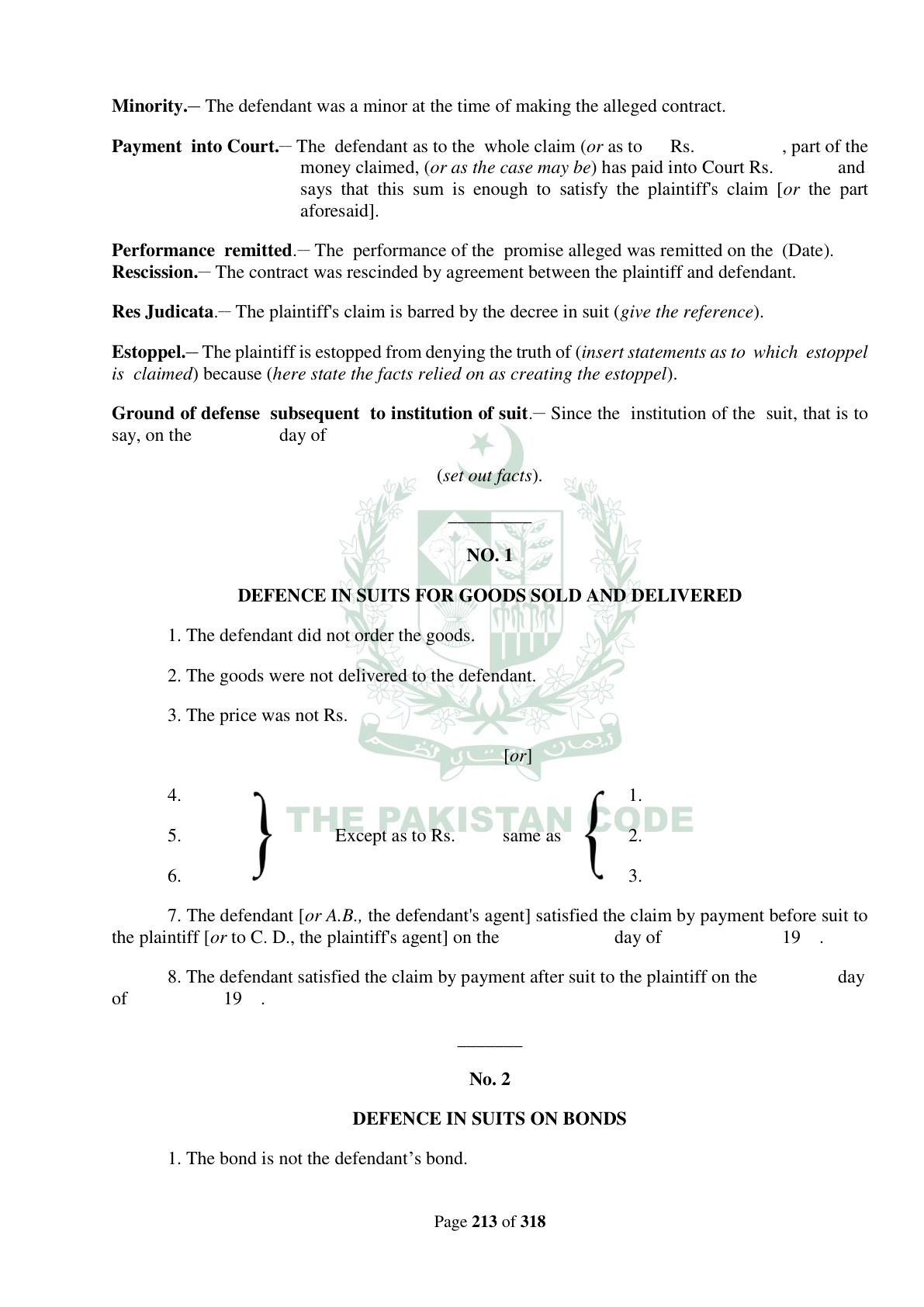
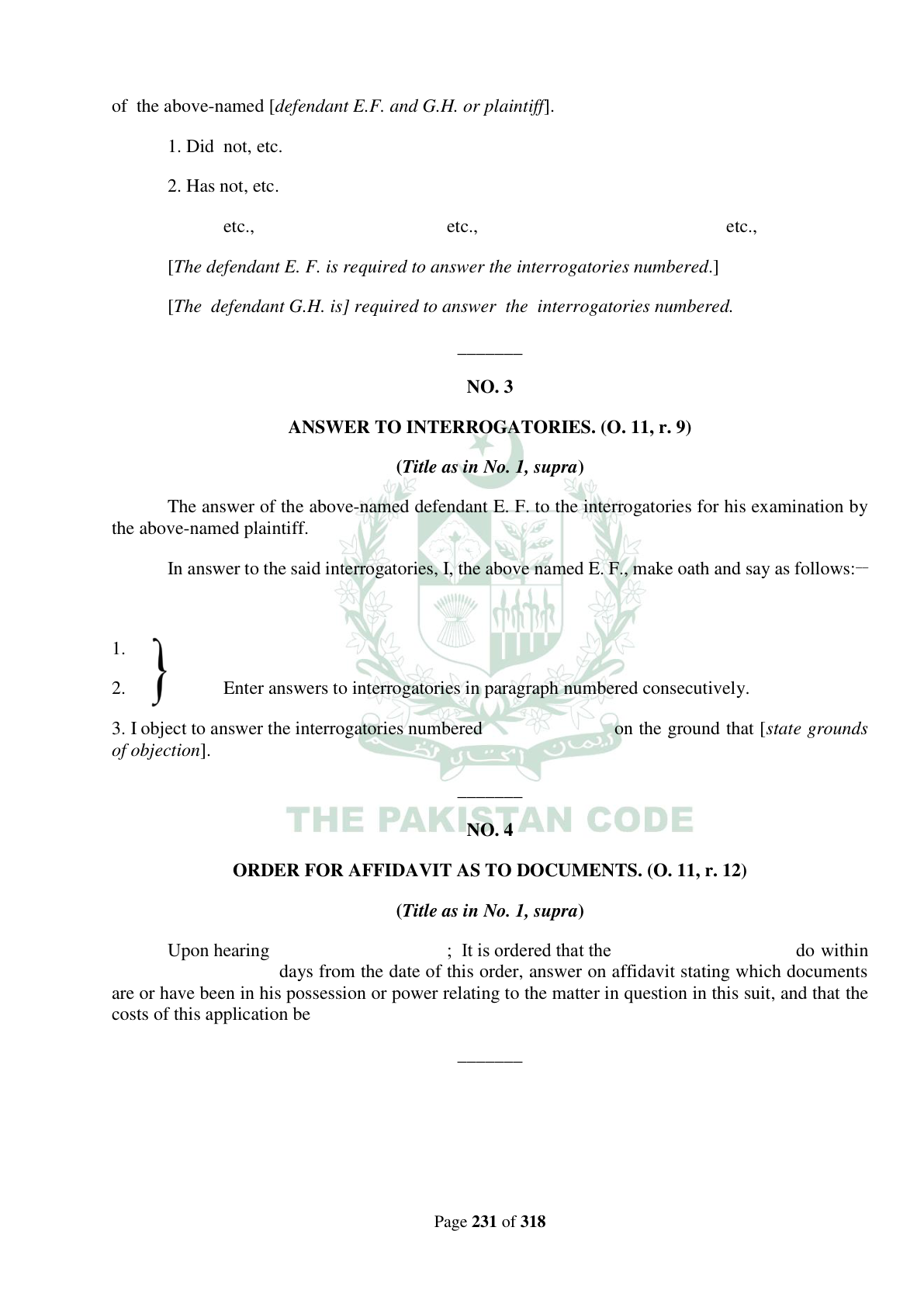
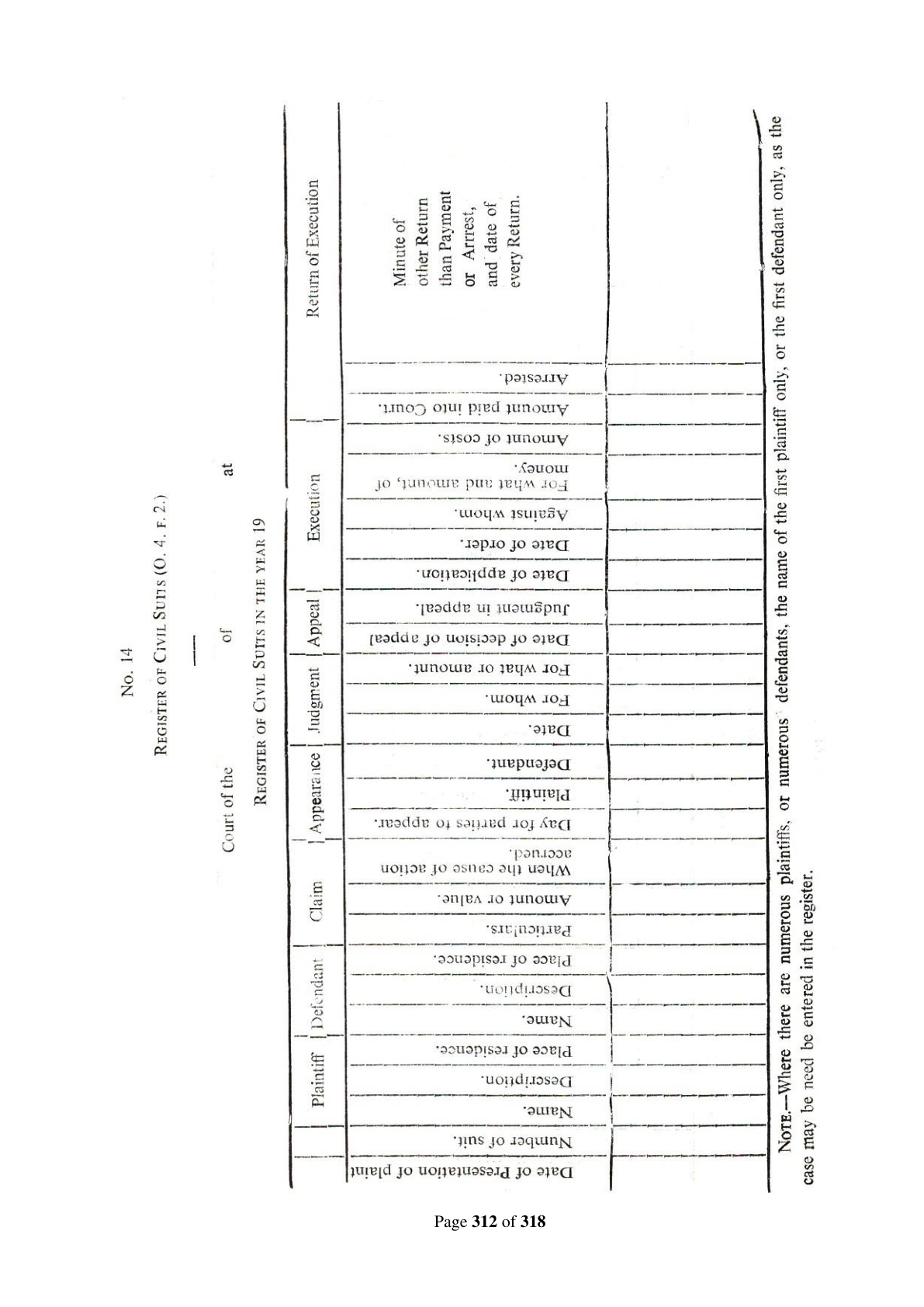
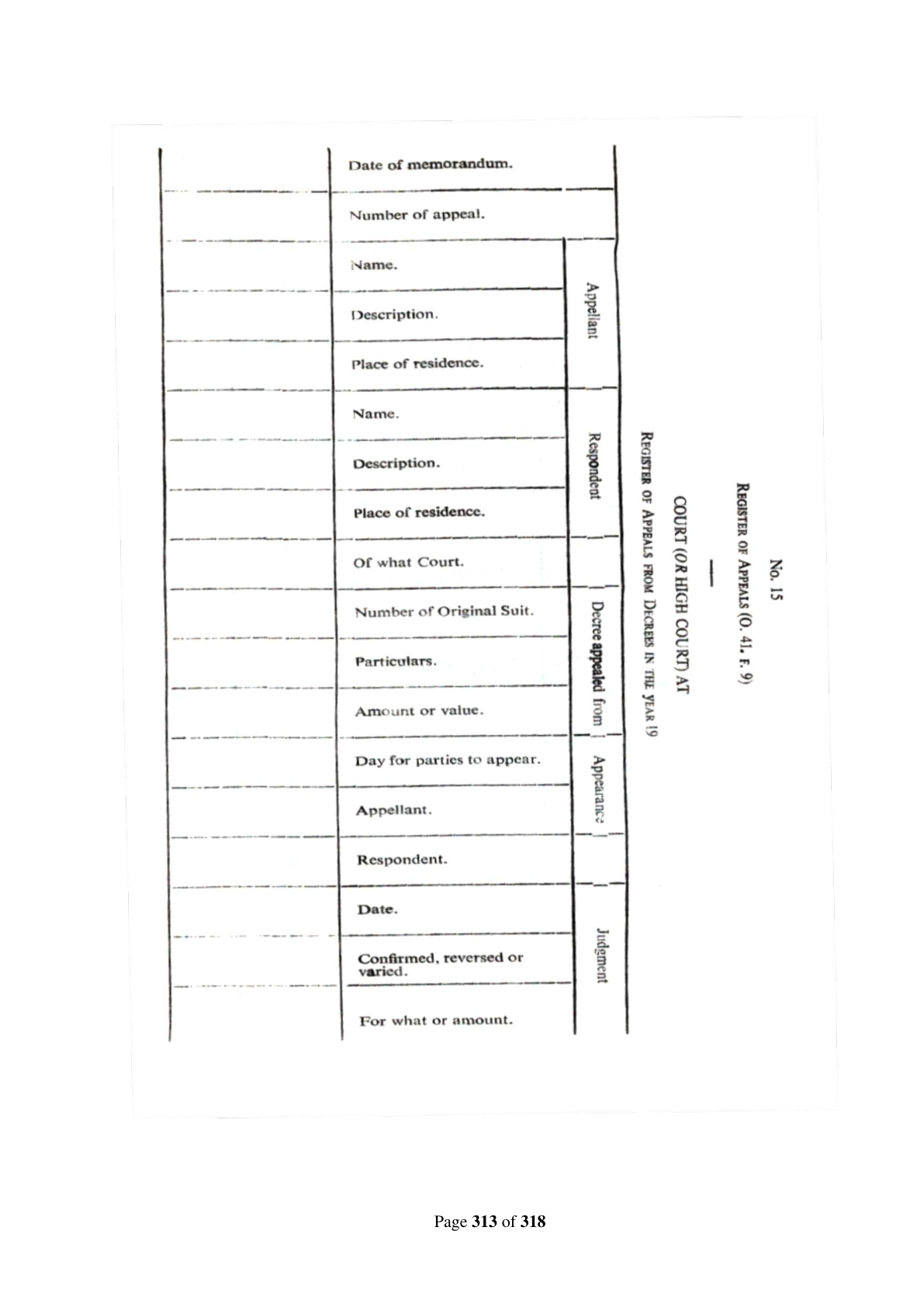
Original source and image integrity
Official original PDF source. Source PDF SHA-256: c51d194bfc14f076769f266db7efabc1901f1de2182da89c8f0ef82d92844b33.
Each selected page is rendered in full without clipping. The original file and every page image are hashed. The source-page review identifies graphic or form material; it does not establish a complete OCR transcription, amendment completeness or current force.
- Physical PDF page 213:
2057f9c1ba259f26d17441351535a707b1d517c74ed41f394248db38366f1208 - Physical PDF page 231:
c249cba09837d87666e15a0c00ff67ab77f89d4af0eea082c6ed9207c6d5c5f3 - Physical PDF page 312:
5bfed710344006821f0a843f3a7c230bd8ba8b2b1d62d648461adffd91e8bd48 - Physical PDF page 313:
3bd5ff7d3901e2645d3654002cbcc1f7d6b711881d110df6a0dc11e55ddea4ad
This law in the library
Follow the instruments and provisions named in this source edition, and the laws that cite it. Citation links identify the text being referred to; legal effect and current force require separate examination.
Instruments cited by this law 14
Laws that cite this instrument 265
References to provisions in this text 67
Section 144
Open the identified operative provision
Read reference in context
n controversy in the suit and may be either preliminary or final. It shall be deemed to include the rejection of a plaint 4[,the determination of any question within section 144 and an order under rule 60, 98, 99, 101, or 103 of Order XXI], but shall not include__ (a) any adjudication from which an appeal lies as an appeal from an order, or (b) any order of dismissal for default. 1For state
Section 47
Open the identified operative provision
Read reference in context
O., 1949. 3Ins. by Act No. VII of 2020, s. 2. 4Subs. by the Law Reforms Ordinance, 1972 (12 of 1972), s.2 and Sch., for “and the determination of any question within section 47 or section 144”. Page 12 of 318 Explanation.__ A decree is preliminary when further proceedings have to be taken before the suit can be completely disposed of. It is final when such adjudication completely dispos
Section 144
Open the identified operative provision
Read reference in context
ns. by Act No. VII of 2020, s. 2. 4Subs. by the Law Reforms Ordinance, 1972 (12 of 1972), s.2 and Sch., for “and the determination of any question within section 47 or section 144”. Page 12 of 318 Explanation.__ A decree is preliminary when further proceedings have to be taken before the suit can be completely disposed of. It is final when such adjudication completely disposes of the suit.
Section 122
Open the identified operative provision
Read reference in context
nment], or remunerated by fees or commission for the performance of any public duty: (18) “rules” means rules and forms contained in the First Schedule or made under section 122 or section 125: (19) “share in a corporation” shall be deemed to include stock, debenture stock, debentures or bonds: and (20) “signed”, save in the case of a judgment or decree, includes stamped. 5[3. Subordination of
Section 125
Open the identified operative provision
Read reference in context
rated by fees or commission for the performance of any public duty: (18) “rules” means rules and forms contained in the First Schedule or made under section 122 or section 125: (19) “share in a corporation” shall be deemed to include stock, debenture stock, debentures or bonds: and (20) “signed”, save in the case of a judgment or decree, includes stamped. 5[3. Subordination of Courts. For the p
Section 22
Open the identified operative provision
Read reference in context
l proceed. 23. To what Court application lies.__ (1) Where the several Courts having jurisdiction are subordinate to the same Appellate Court, an application under section 22 shall be made to the Appellate Court. (2) Where such Courts are subordinate to different appellate Courts but to the same High Court, the application shall be made to the said High Court. (3) Where such Courts are subor
Section 22
Open the identified operative provision
Read reference in context
or the purposes of such suit, be deemed to be a Court of Small Causes. 1[24A. Appreance of parties on transfer of suits, etc.__ (1) Where any suit is transferred under section 22, or any suit, appeal or other proceeding is transferred or withdrawn under subsection (1) of section 24 on the application of a party, the Court ordering the transfer or withdrawal shall fix a date for the appearance of the
Section 24
Open the identified operative provision
Read reference in context
nsfer of suits, etc.__ (1) Where any suit is transferred under section 22, or any suit, appeal or other proceeding is transferred or withdrawn under subsection (1) of section 24 on the application of a party, the Court ordering the transfer or withdrawal shall fix a date for the appearance of the parties before itself, if the suit, appeal or other proceeding is to be tried or disposed of by itself, o
Section 30
Open the identified operative provision
Read reference in context
r to produce documents or other material objects. 32. Penalty for default. The Court may compel the attendance of any person to whom a summons has been issued under section 30 and for that purpose may___ (a) issue a warrant for his arrest ; (b) attach and sell his property ; (c) impose a fine upon him not exceeding 10[two thousand] rupees ; (d) order him to furnish security for his appearance a
Section 34A
Open the identified operative provision
Read reference in context
d by it on the basis of participation in profit and loss, as the court may consider just and reasonable in the circumstances of the case, keeping in view 1New section 34A was ins. by the Code of Civil Procedure (Amdt.) Ordinance, No. X of 1980) s.3. 2Section 34B ins. by the Code of Civil Procedure (Amdt.) Ordinance, No. LXIII of 1980, s. 2. Page 23 of 318 the profitsharing agreem
Section 34A
Open the identified operative provision
Read reference in context
tween the banking company and the judgement debtor when the loan was contracted. Explanation.__ In this section in clause (a), “bank rate” has the same meaning as in section 34A.]. COSTS 1[35. Costs.__ (1) Subject to such conditions and limitations , as may be prescribed, and to the provisions of any law for the time being in force,__ (i) a party to any proceedings shall, before the announcement
Section 35
Open the identified operative provision
Read reference in context
quent suit for damages or compensation in respect of such claim or defence. 35C. General provisions as to costs. __ The Government shall not be liable to costs under section 35, 35A and 35B. Explanation.__ In sections 35, 35A and 35B, the expres sion “proceedings” includes suit , appeal, review, revision, execution or any other proceedings and any matter incidental therto.] PART II EXECUTION
Section 39
Open the identified operative provision
Read reference in context
2) Without prejudice to the generality of the foregoing provision, the Court executing a decree sent to it shall have the following powers, namely:__ (a) power under section 39 to transfer the decree to another Court, if necessary; (b) Power under subsection (1) of section 50 to permit execution to proceed against the legal representatives, of a deceased judgment debtor ; (c) power under section
Section 50
Open the identified operative provision
Read reference in context
to it shall have the following powers, namely:__ (a) power under section 39 to transfer the decree to another Court, if necessary; (b) Power under subsection (1) of section 50 to permit execution to proceed against the legal representatives, of a deceased judgment debtor ; (c) power under section 152 to correct clerical or arithmetical errors ; (d) power under rule 16 of Order XXI to recognise th
Section 152
Open the identified operative provision
Read reference in context
ry; (b) Power under subsection (1) of section 50 to permit execution to proceed against the legal representatives, of a deceased judgment debtor ; (c) power under section 152 to correct clerical or arithmetical errors ; (d) power under rule 16 of Order XXI to recognise the assignment of a decree ; (e) power under sub rule (2) of rule 50 of Order XXI to grant leave to a decr ee holder to proceed
Section 47
Open the identified operative provision
Read reference in context
certificate shall, for the purposes of proceedings under this section, be conclusive proof of the extent of such satisfaction or adjustment. (3) The provisions of section 47 shall as from the filing of the certified copy of the decree apply to the proceedings of a District Court executing a decree under this section, and the District Court shall refuse execution of any such decree, if it is shown
Section 13
Open the identified operative provision
Read reference in context
use execution of any such decree, if it is shown to the satisfaction of the Court that the decree falls within any of the exceptions specified in clauses (a) to (f) of section 13. Explanation 1.__ “Superior Courts”, with reference to the United Kingdom, means the High Court in England, the Court of Session in Scotland, the High Court in Northern Ireland the Court of Chancery of the Country Palatine
Section 50
Open the identified operative provision
Read reference in context
he has failed so to satisfy the Court in the same manner as if the decree had been against him personally. 53. Liability of ancestral property. For the purposes of section 50 and section 52, property in the hands of a son or other descendant which is liable under Hindu law for the payment of the debt of a deceased ancestor, in respect of which a decree has been passed, shall be deemed to be proper
Section 52
Open the identified operative provision
Read reference in context
so to satisfy the Court in the same manner as if the decree had been against him personally. 53. Liability of ancestral property. For the purposes of section 50 and section 52, property in the hands of a son or other descendant which is liable under Hindu law for the payment of the debt of a deceased ancestor, in respect of which a decree has been passed, shall be deemed to be property of the dec
Section 68
Open the identified operative provision
Read reference in context
which it has with respect to decrees or orders of the Court. 71. Collector deemed to be acting judicially. In executing a decree transferred to the Collector under section 68 the Collector and his subordinates shall be deemed to be acting judicially. 72. Where Court may authroise Collector to stay public sale of land. __ (1) Where in any local area in which no declaration under section 68 is
Section 68
Open the identified operative provision
Read reference in context
eemed to be acting judicially. 72. Where Court may authroise Collector to stay public sale of land. __ (1) Where in any local area in which no declaration under section 68 is in force the property attached consists of land or of a share in l and, and the Collector represents to the Court that the public sale of the land or share is objectionable and that satisfaction of the decree may be made w
Section 2
Open the identified operative provision
Read reference in context
Statute Reform) Ordinance, 1960 (XXI of 1960), s. 3 and 2nd Sch. (w. e. f the 14th October, 1955). 2Ins. by the Code of Civil Procedure (Amdt.) Act, 1932 (X of 1932), section 2. 3Omitted by the Central Laws (Adaptation) Order, 1961 (P.O No.1 of 1961), Art. 2 and Sch. (w. e. f the 23rd march, 1956).). 4Subs. by Adaptation Order, 1937. 5Subs. by F.A.O. 1975, Art. 2 and Table. 6The words “or of th
Section 100
Open the identified operative provision
Read reference in context
rror or defect in the decision of the case upon the merits. 101. Second appeal on no other grounds.__ No second appeal shall lie except on the grounds mentioned in section 100. 102. No second appeal in certain cases.__ No second appeal shall lie in any suit except when the amount or value of the subject matter of the original suit does not exceed the amount or value as may be prescribed. 103. P
Section 100
Open the identified operative provision
Read reference in context
ppellate Court or which has been wrongly determined by such Court by reason of any illegality, omission, error or defect such as is referred to in sub-section (1) of section 100.] APPEALS FROM ORDERS 104. Orders from which appeal lies.__ (1) An appeal shall lie from the following orders, and save as otherwise expressly provided in the body of this Code or by any law for the time being in forc
Section 35A
Open the identified operative provision
Read reference in context
otherwise expressly provided in the body of this Code or by any law for the time being in force, from no other orders:__ 2[* * * * * * *] 3[(f) an order under section 35A; (ff) an order under section 47;] 4[(fff) an order under section 91 or section 92 refusing leave to institute a suit;] 1Subs by Act No. XIX of 2023, s.10. 2Cls. (a) to (f) omitted by the Arbitration Act No. X of 1940
Section 47
Open the identified operative provision
Read reference in context
body of this Code or by any law for the time being in force, from no other orders:__ 2[* * * * * * *] 3[(f) an order under section 35A; (ff) an order under section 47;] 4[(fff) an order under section 91 or section 92 refusing leave to institute a suit;] 1Subs by Act No. XIX of 2023, s.10. 2Cls. (a) to (f) omitted by the Arbitration Act No. X of 1940, s. 49 and 3rd Sch. 3Subs. by Ord
Section 91
Open the identified operative provision
Read reference in context
he time being in force, from no other orders:__ 2[* * * * * * *] 3[(f) an order under section 35A; (ff) an order under section 47;] 4[(fff) an order under section 91 or section 92 refusing leave to institute a suit;] 1Subs by Act No. XIX of 2023, s.10. 2Cls. (a) to (f) omitted by the Arbitration Act No. X of 1940, s. 49 and 3rd Sch. 3Subs. by Ord. 12 of 1972, s.2 and Sch., for cl. (f
Section 92
Open the identified operative provision
Read reference in context
in force, from no other orders:__ 2[* * * * * * *] 3[(f) an order under section 35A; (ff) an order under section 47;] 4[(fff) an order under section 91 or section 92 refusing leave to institute a suit;] 1Subs by Act No. XIX of 2023, s.10. 2Cls. (a) to (f) omitted by the Arbitration Act No. X of 1940, s. 49 and 3rd Sch. 3Subs. by Ord. 12 of 1972, s.2 and Sch., for cl. (ff) which was p
Section 95
Open the identified operative provision
Read reference in context
ich was previously ins. by the Civil Procedure (Amdt.) Act No. IX of 1922, s. 3. 4Ins. by Act No. XLVIII of 2016, s.4. Page 46 of 318 (g) an order under section 95; (h) an order under any of the provisions of this Code imposing a fine or directing the arrest or detention in the civil prison of any person except where such arrest or detention is in execution of a decree; (i) any orde
Section 109
Open the identified operative provision
Read reference in context
ves a substantial question of law as to the interpretation of the Constitution.] 4110.[Omitted]. 111. Bar of certain appeals. Notwithstanding anything contained in section 109, no appeal shall lie to 5[the Supreme Court]: (a) from the decree or order of one Judge of a High Court 6[* * *], or of one Judge of a Division Court, or of two or mor e Judges of such High Court, or of a Division Court c
Section 102
Open the identified operative provision
Read reference in context
ided in opinion and do not amount in number to a majority of the whole of the Judges of the High Court at the time being ; or 7[(b) from any decree from which, under section 102, no second appeal lies.] 8111A. [Omitted]. 112. Savings.__ 9[(1) Nothing contained in this Code shall be deemed__ (a) to affect the powers of the Supreme Court under Article 10[191 of the Constitution or any other provisi
Section 122
Open the identified operative provision
Read reference in context
, to be called the Rule Committee, shall be constituted at 1[the town which is the usual place of sitting of each of the High Courts 2[* * *] 3[* * *] referred to in section 122]. (2) Each such Committee shall consist of the following persons, namely:__ (a) three Judges of the High Court established at the town at which such Committee is constituted, one of whom at least has served as a District Ju
Section 122
Open the identified operative provision
Read reference in context
the town at which it is constit uted on any proposal to annul, alter or add to the rules in the First Schedule or to make new rules, and before making any rules under section 122 the High Court shall take such report into consideration. 8125. [Omitted]. 1Subs. by the Amending Act No. XIII 1916, s. 2 and Sch. 2Ins. by Act No. XXXII of 1925, s. 2 and Sch., were omitted by Adaptation Order,
Section 129
Open the identified operative provision
Read reference in context
shall affect the validity of any such rules in force at the commencement of this Code. 5130. [Omitted]. 131. Publication of rules. Rules made in accordance with section 129 6[* * * ] shall be published in the 7[official Gazette * * *] and shall from the date of publication or from such other date as may be specified have the force of law. PART XI MISCELLANEOUS 132. Exemption of certai
Section 47
Open the identified operative provision
Read reference in context
rsonally liable, in the manner herein provided for the execution of decrees, and such person shall, for the purposes of appeal, be deemed a party within the meaning of section 47: Provided that such notice as the Court in each case thinks sufficient has been given to the surety. 146. Proceedings by or against representatives. Save as otherwise provided by this Code or by any law for the time being
Section 121
Open the identified operative provision
Read reference in context
aling and Amending Act No. XVII of 1914, s.3 and Second Sch. 4Subs. by Act No. XIX of 2023, s. 16. Page 58 of 318 THE FIRST SCHEDULE (See section 121) ________ ORDER I PARTIES TO SUITS 1. Who may be joined as plaintiffs. All Persons may be joined in one suit as plaintiffs in whom any right to relief in respect of or arising out of the same act or transaction or seri
Section 22
Open the identified operative provision
Read reference in context
be served on the new defendant and, if the Court thinks fit, on the original defendant. (5) Subject to the provisions of the 1[Limitation Act, 1908 ( IX of 1908 )], section 22, the proceedings as against any person added as defendant shall be deemed to have begun only on the service of the summons. 11. Conduct of suit. The Court may give the conduct of the suit to such person as it deems prope
Section 144
Open the identified operative provision
Read reference in context
ll proceedings in the suit are ended so far as regards the client. (3) For the purposes of subrule (2) an application for review of judgment, an application under section 144 or section 152 of this Code, any appeal from any decree or order in the suit and any application or act for the purpose of obtaining copies of documents or return of documents produced or filed in the suit or of obtaining ref
Section 152
Open the identified operative provision
Read reference in context
in the suit are ended so far as regards the client. (3) For the purposes of subrule (2) an application for review of judgment, an application under section 144 or section 152 of this Code, any appeal from any decree or order in the suit and any application or act for the purpose of obtaining copies of documents or return of documents produced or filed in the suit or of obtaining refund of monies p
Section 138
Open the identified operative provision
Read reference in context
d the language in which it is taken down, the evidence as taken down in writing shall be interpreted to him in the language in which it is given. 7. Evidence under section 138. Evidence taken down under section 138 shall be in the form prescribed by rule 5 and shall be read over and signed and, as occasion may require, interpreted and corrected as if it were evidence taken down under that rule. 8
Section 138
Open the identified operative provision
Read reference in context
own, the evidence as taken down in writing shall be interpreted to him in the language in which it is given. 7. Evidence under section 138. Evidence taken down under section 138 shall be in the form prescribed by rule 5 and shall be read over and signed and, as occasion may require, interpreted and corrected as if it were evidence taken down under that rule. 8. Memorandum when evidence not taken do
Section 24
Open the identified operative provision
Read reference in context
ch his predecessor left it. (2) The provisions of subrule (1) shall, so far as they are applicable, be deemed to apply to evidence taken in a suit transferred under section 24. 16. Power to examine witness immediately. __ (1) Where a witness is about to leave the jurisdiction of the Court, or other sufficient cause is shown to the satisfaction of the Court why his evidence should be taken im
Section 152
Open the identified operative provision
Read reference in context
be dated and signed by the Judge in open Court at the time of pronouncing it and, when once signed, shall not afterwards be altered or added to, save as provided by section 152 or on review. 4. Judgment of Small Cause Courts. __ (1) Judgments of a Court of Small Causes need not contain more than the points for determination and the decision thereon. (2) Judgments of other Courts. Judgments of othe
Section 54
Open the identified operative provision
Read reference in context
be made by the Collector, or any gazetted subordinate of the Collector deputed by him in this behalf, in accordance with such declaration and w ith the provisions of section 54; (2) if and in so far as such decree relates to any other immoveable property or to moveable property, the Court may, if partition or separation cannot be conveniently made without further inquiry, pass a preliminary decree
Section 44A
Open the identified operative provision
Read reference in context
decree, or (b) against the legal representative of a party to the decree, 1[or where an application is made for execution of a decree filed under the provisions of section 44A,] the Court executing the decree shall issue a notice to the person against whom execution is applied for requiring him to show cause, on a date to be fixed, why the decree should not be executed against him: Provided that
Section 3
Open the identified operative provision
Read reference in context
one year from the date of the last order against the party against whom execution is applied for, 1Ins. by the Code of Civil Procedure (Amdt.) Act, 1937 (8 of 1937), section 3. Page 107 of 318 made on any previo us application for execution, or in consequence of the application being made against the legal representative of the judgmentdebtor, if upon a previous application for ex
Section 51
Open the identified operative provision
Read reference in context
e satisfaction of the Court for his appearance when required. (3) Upon the conclusion of the inquiry under subrule (1) the Court may, subject to the provisions of section 51 and to the other provisions of this Code, make an order for the detention of the judgmentdebtor in 2[* *] prison and shall in that event cause him to be arrested if he is not already under arrest: Provided that in order to
Section 60
Open the identified operative provision
Read reference in context
debtor or the disbursing officer is or is not within the local limits of the Court's jurisdiction, may order that the amount shall, subject to the provisions of section 60, be w ithheld from such salary or allowances either in one payment or by monthly instalments as the Court may direct; and, upon notice of the order to such officer as 2[the appropriate Government may by notification in the
Section 73
Open the identified operative provision
Read reference in context
may be taken as payment. Where a decreeholder purchases with such permission, the purchasemoney and the amount due on the decree may, subject to the provisions of section 73, be setoff against one another, and the Court executing the decree shall enter up satisfaction of the decree in whole or in part accordingly. (3) Where a decreeholder purchases, by himself or through another person, without
Section 64
Open the identified operative provision
Read reference in context
such case the Court shall grant a certificate to the judgmentdebtor authorizing him within a period to be mentioned therein, and notwithstanding anything contained in section 64, to make the proposed mortgage, lease or sale: Provided that all monies payable under such mortgage, lease or sale s hall be paid, not to the judgmentdebtor, but, save in so far as a decreeholder is entitled to set off su
Section 54
Open the identified operative provision
Read reference in context
ons 13. Commission to make partition of immoveable property. Where a preliminary decree for partition has been passed, the Court may, in any case not provided for by section 54, issue a commission to such person as it thinks fit to make the partition or separation according to the rights as declared in such decree. 14. Procedure of Commissioner.__ (1) The Commissioner shall, after such inquiry as
Section 79
Open the identified operative provision
Read reference in context
ing in the plaint the name and description and place of residence of the plaintiff or defendant, it shall be sufficient to insert 6[the appropriate name as provided in section 79, 7[* * *]]. 8[4. Agent for Government to receive process. The 9[Government] pleader in any Court shall be the agent of the 9[Government] for the purpose of receiving processes against the 9[Government] issued by such Court.
Section 47
Open the identified operative provision
Read reference in context
and any party to the suit under rule 10, rule 11, 2[rule 11A] or rule 12 shall be deemed to be questions arising between the parties to the suit within the meaning of section 47. 3[14. Recovery of amount of courtfees. Where an order is made under rule 10, rule 11 or rule 11A the Court shall forthwith cause a copy of the decree or order to be forwarded to the Collector, who may, without prejudice t
Section 58
Open the identified operative provision
Read reference in context
the provisions contained in this Order which apply to a simple mortgage shall, so far as may be, apply to a mortgage by deposit of title deeds within the meaning of section 58, and to a charge within the meaning of section 100 of the Transfer of Property Act, 1882 (IV of 1882)] _______ 1Subs. by the Transfer of Property (Amdt.) Supplementary Act, 1929 (XXI of 1929), s.7. Page
Section 79
Open the identified operative provision
Read reference in context
he plaintiff shall be entitled to a decree__ 3[(a) for the principal sum due on the instrument and for interest calculated in accordance with the provisions of section 79 or section 80, as the case may be, of the Negotiable Instruments Act, 1881, (XXVI of 1881) up to the date of the institution of the suit, or for the sum mentioned in the summons, whichever is less, and for interest up
Section 80
Open the identified operative provision
Read reference in context
hall be entitled to a decree__ 3[(a) for the principal sum due on the instrument and for interest calculated in accordance with the provisions of section 79 or section 80, as the case may be, of the Negotiable Instruments Act, 1881, (XXVI of 1881) up to the date of the institution of the suit, or for the sum mentioned in the summons, whichever is less, and for interest up to the date o
Section 4
Open the identified operative provision
Read reference in context
by the Law Reforms Ordinance, 1972 (12 of 1972), s.2 and Sch. for “and to the District Court”. 3Subs. by the Negotiable Instruments (Interest) Act, 1926 (30 of 1926), section 4, for certain original words. Page 159 of 318 (b) for such subsequent interest, if any, as the Court may order under section 34 of this Code; and (c) for such sum for costs as may be prescribed: Provided t
Section 16
Open the identified operative provision
Read reference in context
efore Judgment 1. Where defendant may be called upon to furnish security for appearnce. Where at any stage of a suit, other than a suit of the nature referred to in section 16, clauses (a) to (d), the Court is satisfied, by affidavit or otherwise,__ 1Added by the Code of Civil Procedure (Amdt.), Ordinance, 1980 (X of 1980), s.14. Page 160 of 318 (a) that the defendant, with intent
Section 35A
Open the identified operative provision
Read reference in context
pondents or parties although such respondents or parties may not have filed any appeal or objection: 1[Provided that the Appellate Court shall not make any order under section 35A, in pursuance of any objection on which the Court from whose decree the appeal is preferred has omitted or refused to make such order.] Illustration A claims a sum of money as due to him form X or Y, and in a suit against
Section 104
Open the identified operative provision
Read reference in context
from Appellate decrees. _______ ORDER XLIII APPEALS FROM ORDERS 1. Appeals from Orders. An appeal shall lie from the following orders under the provisions of section 104, namely:__ (a) an order under rule 10 of Order VII returning a plaint to be presented to the proper Court; Page 174 of 318 (b) an order under rule 10 of Order VIII pronouncing judgment against a party; (c)
Section 34
Open the identified operative provision
Read reference in context
esses. Service of process 6. Commissioner’s fee Commissioner’s fee 7. Service of process .. Total Total NO. 2. SIMPLE MONEY DECREE. (Section 34) (Title) Claim for THIS suit coming on this day for final disposal before in the presence of for the plaintiff and of for the defendant, it is ordered that the do pay to the the sum o
Section 46
Open the identified operative provision
Read reference in context
ed as certified. Given under my hand and the seal of the Court, this of day of 19 . _______ Page 269 of 318 No. 2 PRECEPT (Section 46) (Title) UPON hearing the decreeholder it is ordered that this precept be sent to the Court of at under section 46 of the Code of Civil Procedure, 1908, with directions to attach the property specified in the annexed
Section 72
Open the identified operative provision
Read reference in context
. GIVEN under my hand and the seal of the Court, this day of 19 . Judge. _______ No. 42 AUTHORITY OF THE COLLECTOR TO STAY PUBLIC SALE OF LAND, (Section 72) (Title) To , Collector of . SIR, In answer to your communication No. , dated representing that the sale in execution of the decree in this suit of land situate within your district is objectionable
Section 24
Open the identified operative provision
Read reference in context
iff Defendant Witnesses__ 1. 2. Dated the day of 19 . _______ No. 2 NOTICE OF APPLICATION FOR THE TRANSFER OF A SUIT TO ANOTHER COURT FOR TRIAL (SECTION 24) In the Court of the District Judge of No. of 19 To WHEREAS an application, dated the day of 19 has been made to this Court by the in Suit No. 19 now
Section 69
Open the identified operative provision
Read reference in context
age 314 of 318 THE SECOND SCHEDULE.__[Arbitration] Rep. by the Arbitration Act, 1940 (X of 1940), s. 49 and Third Schedule _______ THE THIRD SCHEDULE (See section 69) EXECUTION OF DECREES BY COLLECTORS 1. Powers of Collector. Where the execution of a decree has been transferred to the Collector under section 68, he may__ (a) proceed as the Court would proceed when the sale of immoveab
Section 68
Open the identified operative provision
Read reference in context
SCHEDULE (See section 69) EXECUTION OF DECREES BY COLLECTORS 1. Powers of Collector. Where the execution of a decree has been transferred to the Collector under section 68, he may__ (a) proceed as the Court would proceed when the sale of immoveable property is postponed in order to enable the judgmentdebtor to raise the amount of the decree ; or (b) raise the amount of the decree by letti
Section 73
Open the identified operative provision
Read reference in context
er paragraph 1, in satisfaction of the original decree in execution of which the Court ordered the sale of immoveable property, or otherwise as the Court may under section 73 direct ; or (c) where the Collector has proceeded under paragraph 2,__ (i) in keeping down the interest on incumbrances on the property; (ii) where the judgmentdebtor has no other sufficient means of subsistence, in prov
Provisions explicitly cited in other instruments 9
Section 5 of Limitation Act, 1908
Cited by Code of Civil Procedure (CPC) , 1908 (Under Review)
The named instrument matches multiple source editions; no edition is selected.
- Limitation Act, 1908 · Federal
- LIMITATION ACT, 1908 · Punjab
Read source and target evidence
Explicit source reference
proceeding with the suit. (2) No order shall be made under this rule unless notice of the application has been served on the opposite party. 1(3) The provisions of section 5 of the Limitation Act, 1908 (IX of 1908), shall apply to applications under subrule (1)]. 10. Procedure in case of nonattendance of one or more of several plaintiffs. Where there are more plaintiffs than one, and one or more of them appear, and the
Section 5 of Limitation Act, 1908
Cited by Code of Civil Procedure (CPC) , 1908 (Under Review)
The named instrument matches multiple source editions; no edition is selected.
- Limitation Act, 1908 · Federal
- LIMITATION ACT, 1908 · Punjab
Read source and target evidence
Explicit source reference
nance, 1980 (10 of 1980), s. 14. 3Subs. and added by the Law Reforms Ordinance, 1972 (12 of 1972), s. 2 and Sch. Page 81 of 318 1[(2) The provisions of section 5 of the Limitation Act, 1908 ( IX of 1908 ), shall apply to applications under subrule (1)]. 14. No decree to be set aside without notice to opposite party. No decree shall be set aside on any such application as aforesaid unless notice thereof ha
Section 247 of Contract Act, 1872
Cited by Code of Civil Procedure (CPC) , 1908 (Under Review)
The named instrument matches multiple source editions; no edition is selected.
- Contract Act, 1872 · Federal
- CONTRACT ACT 1872 · Punjab
Read source and target evidence
Explicit source reference
served as a partner with a summons and has failed to appear: Provided that nothing in this subrule shall be deemed to limit or otherwise affect the provisions of section 247 of the Contract Act, 1872 (IX of 1872). (2) Where the decreeholder claims to be entitled to cause the decree to be executed against any person other than such a person as is referred to in subrule (1), clauses (b) and (c), as being a partner in t
Section 5 of Limitation Act, 1908
Cited by Code of Civil Procedure (CPC) , 1908 (Under Review)
The named instrument matches multiple source editions; no edition is selected.
- Limitation Act, 1908 · Federal
- LIMITATION ACT, 1908 · Punjab
Read source and target evidence
Explicit source reference
suit, as the case may be, the Court shall set aside the order or the judgment ,upon such terms as to costs or otherwise as it thinks fit.]. 2[(3) The provisions of section 5 of the Limitation Act, 1908, (IX of 1908) shall apply to applications under subrule (2).]. 10. Procedure in case of assignment before final order in suit. __ (1) In other cases of an assignment, creation or devolution of any interest during the pend
Section 45 of Contract Act, 1872
Cited by Code of Civil Procedure (CPC) , 1908 (Under Review)
The named instrument matches multiple source editions; no edition is selected.
- Contract Act, 1872 · Federal
- CONTRACT ACT 1872 · Punjab
Read source and target evidence
Explicit source reference
l be served upon every person within 1[Pakistan] whom it is sought to make liable. 4. Right of suit on death of partner. __ (1) Notwithstanding anything contained in section 45 of the Contract Act, 1872 (IX of 1872), where two or more persons may sue or be sued in the name of a firm under the foregoing provisions and any of such persons dies, whether before the institution or during the pendency of any suit, it shall not
Section 57 of Transfer of Property Act, 1882
Cited by Code of Civil Procedure (CPC) , 1908 (Under Review)
The named instrument matches multiple source editions; no edition is selected.
- Transfer of Property Act, 1882 · Federal
- TRANSFER OF PROPERTY ACT 1882 · Punjab
Read source and target evidence
Explicit source reference
according to their respective interests therein or upon their joint receipt. (2) Nothing in this rule or in rule 12 shall be deemed to affect the powers conferred by section 57 of the Transfer of Property Act, 1882 (IV of 1882). 14. Suit for sale necessary for bringing mortgaged property to sale. __ (1) Where a mortgagee has obtained a decree for the payment of money in satisfaction of a claim arising under the mortgage, he sh
Section 100 of Transfer of Property Act, 1882
Cited by Code of Civil Procedure (CPC) , 1908 (Under Review)
The named instrument matches multiple source editions; no edition is selected.
- Transfer of Property Act, 1882 · Federal
- TRANSFER OF PROPERTY ACT 1882 · Punjab
Read source and target evidence
Explicit source reference
ly to a simple mortgage shall, so far as may be, apply to a mortgage by deposit of title deeds within the meaning of section 58, and to a charge within the meaning of section 100 of the Transfer of Property Act, 1882 (IV of 1882)] _______ 1Subs. by the Transfer of Property (Amdt.) Supplementary Act, 1929 (XXI of 1929), s.7. Page 156 of 318 ORDER XXXV INTERPLEADER 1. Plaint in interpleadersuits. In every suit
Section 5 of Limitation Act, 1908
Cited by Code of Civil Procedure (CPC) , 1908 (Under Review)
The named instrument matches multiple source editions; no edition is selected.
- Limitation Act, 1908 · Federal
- LIMITATION ACT, 1908 · Punjab
Read source and target evidence
Explicit source reference
onally or subject to such terms as to payment into Court, giving security, framing and recording issues or otherwise as the Court thinks fit. 1[(3) The provisions of section 5 of the Limitation Act, 1908 ( IX of 1908 ), shall apply to applications under subrule (1),]. 4. Power to set aside decree. After decree the Court may, under special circumstances, set aside the decree, and if necessary stay or set aside execution, a
Section 5 of Limitation Act 1908
Cited by Code of Civil Procedure (CPC) , 1908 (Under Review)
The named instrument matches multiple source editions; no edition is selected.
- Limitation Act, 1908 · Federal
- LIMITATION ACT, 1908 · Punjab
Read source and target evidence
Explicit source reference
or hearing or from depositing the sum so required, the Court shall readmit the appeal on such terms as to costs or otherwise as it thinks fit. (2) The provisions of section 5 of the Limitation Act 1908 (IX of 1908) shall apply t o an application for readmission of an appeal dismissed under subrule (2) of rule 11 or subrule (1) of rule 17. 20. Power to adjourn hearing and direct person s appearing interested to be made
Other laws referring to provisions of this instrument 67
Section 98 of Code of Civil Procedure (CPC) , 1908 (Under Review)
Cited by Balochistan Sales Tax on Services Act, 2015
Read source and target evidence
Explicit source reference
in any question of law for determination. (4) The reference under this section shall be heard by a bench of at least two Judges of the High Court and provision of section 98 of the Code of Civil Procedure 1908 (V of 1908) shall, as far as possible, apply to such reference. (5) The High Court shall send a copy of the judgment under the seal of the Court to the Appellate Tribunal. (6) Notwithstanding that a reference has bee
Target heading · Code of Civil Procedure (CPC) , 1908 (Under Review)
98. Decision where appeal heard by two or more Judges.__ (l) where an appeal is heard by a Bench of two or more Judges, the appeal shall be decided in accordance with the opinion of such Judges or of the majority (if any) of such Judges. (2) Where there is no such majority which concurs in a judg ment varyi
Section 80 of Code of Civil Procedure (CPC) , 1908 (Under Review)
Cited by Official Trustee's Act, 1913
Read source and target evidence
Explicit source reference
anything done by or under the authority of any Official Trustee before the commencement of this Act. 16. Notice of suit not required in certain cases. Nothing in section 80 of the Code of Civil Procedure, 1908, shall apply to any suit against the Official Trustee in which no relief is claimed against him personally (V of 1908). PART IV FEES 17. Fees.—(1) There shall be charged in respect of the duties of the Official Tru
Target heading · Code of Civil Procedure (CPC) , 1908 (Under Review)
1[80. Notice.__ (1) A suit may be instituted against the Government or against a Public officer, in respect of any act purporting to be done by such public officer in his official capacity, after the expiration of two months next after notice in writing has been delivered to or left at the office of, __ (a) in th
Section 2 of Code of Civil Procedure (CPC) , 1908 (Under Review)
Cited by West Pakistan Civil Courts Ordinance, 1962
Read source and target evidence
Explicit source reference
no Court of the Small Causes shall receive, entertain or register any suit in which Pakistan or any of its Provinces or any public officer as defined in clause (17) of section 2 of the Code of Civil Procedure, 1908 (V of 1908), in his official capacity is a party. (2) In every such case the plaintiff shall be referred to the Court of the Civil Judge having jurisdiction in original suits without limit as regard value and such suit shal
Target heading · Code of Civil Procedure (CPC) , 1908 (Under Review)
2. Definitions. In this Act, unless there is anything repugnant in the subject or context,__ (1) “Code” includes rules: (2) “decree” means the formal expression of an adjudication which, so far as regards the Court expressing it, conclusively determines the rights of the parties which regard to all or any of t
Rule 4(4) of Code of Civil Procedure (CPC) , 1908 (Under Review)
Cited by West Pakistan Civil Courts Ordinance, 1962
The cited provision kind differs from the numbered headings identified for this instrument.
The source cites (4). The target link identifies the numbered heading; this subparagraph chain has not been independently matched.
Read source and target evidence
Explicit source reference
uardian, manager or representative of a private person or estate in virtue of an appointment, delegation, declaration or exercise of powers under— (i) Order XXXII rule 4 (4) of the Code of Civil Procedure, 1908 (V of 1908); (ii) section 195 of the Succession Act, 1925 (XXXIX of 1925); (iii) section 69 or 71 of the Lunacy Act, 1912 (IV of 1912); (iv) section 7, 18 or 42 of the Guardians and Ward Act, 1890 (VIII of 1890)
Rule 3 of Code of Civil Procedure (CPC) , 1908 (Under Review)
Cited by Gas (Theft Control and Recovery) Act. 2016
The cited provision kind differs from the numbered headings identified for this instrument.
Read source and target evidence
Explicit source reference
lant shall give notice of the filing of the appeal by means of registered post with acknowledgement due or by courier in accordance with the provisions of Order XLIII, rule 3 of the Code of Civil Procedure, 1908 (Act V of 1908) to the responde nt who may appear before the High Court to contest admission of the appeal on the date fixed for hearing. (3) The High Court shall at the stage of admission of the appeal, or at any time the
Section 102 of Code of Civil Procedure (CPC) , 1908 (Under Review)
Cited by Law Reforms Ordinance, 1972
Read source and target evidence
Explicit source reference
Nothing contained in this Ordinance shall be construed as affecting— (a) any appeal under the provisions of the Letters Patent applicable to a High Court or under section 102 of the Code of Civil Procedure, 1908 (V of 1908), which was pending immediately before the commencement of this Ordinance; or (b) any appeal or petition for leave to appeal from a decree, judgment or order of a single Judge of a High Court made to the S
Target heading · Code of Civil Procedure (CPC) , 1908 (Under Review)
102. No second appeal in certain cases.__ No second appeal shall lie in any suit except when the amount or value of the subject matter of the original suit does not exceed the amount or value as may be prescribed.
Section 133 of Code of Civil Procedure (CPC) , 1908 (Under Review)
Cited by The Family Courts Act, 1964
Read source and target evidence
Explicit source reference
o produce or cause the production of any document: Provided that ― (a) no person who is exempt from perso nal appearance in a Court under sub - section (1) of section 133 of the Code of Civil Procedure, 1908, shall be required to appear in person; (b) a Family Court may refuse to summon a witness or to enforce a summons already issued against a witness when, in the opinion of the Court, the attendance of the witness canno
Target heading · Code of Civil Procedure (CPC) , 1908 (Under Review)
133. Exemption of other persons. __ (1) The 1[Provincial Government] may, by notification 2 in the 1[official Gazette], exempt from personal appearance in Court any person whose rank, in the opinion of such Government, entitles him to the privilege of exemption. (2) The names and residences of the persons so
Section 115 of Code of Civil Procedure (CPC) , 1908 (Under Review)
Cited by Court-Fees Act, 1870
Read source and target evidence
Explicit source reference
ds twenty-five rupees. The fee leviable on a memorandum of appeal. 3[13A. Application to a High Court for the exercise of its revisional jurisdiction under section 115 of the Code of Civil Procedure, 1908. Where the application is for revision of an order and the amount or value of the subject-matter is less than two thousand rupees. Seven rupees and fifty paisa. Where the application is for the revision of
Target heading · Code of Civil Procedure (CPC) , 1908 (Under Review)
1[115. Revision.__ (1) A High Court may call for the record of any case which has been decided by any Court subordinate to that High Court and in which no appeal lies thereto, and if such subordinate Court appears__ (a) to have exercised a jurisdiction not vested in it by law; or (b) to have failed to exercise
Section 10 of Code of Civil Procedure (CPC) , 1908 (Under Review)
Cited by Financial Institutions (Recovery of Finances) Ordinance, 2001
Read source and target evidence
Explicit source reference
ce and other amounts relating to the finance payable by the defendant to the financial institution upto the date of institution of the suit. (4) The provisions of section 10 of the Code of Civil Procedure, 1908 (Act V of 1908), shall have no application for and in relation to suits filed hereunder. (5) On a plaint being presented to the Banking Court, a summons in Form No. 4 in Appendix ‘B’ to the Code of Civil Procedure, 1908
Target heading · Code of Civil Procedure (CPC) , 1908 (Under Review)
10. Stay of suit. No Court shall proceed with the trial of any suit in which the matter in issue is also directly and substantially in issue in a previously instituted suit between the same parties, or between parties under whom they or any of them claim litigating under the same title where such suit is pending
Rule 3 of Code of Civil Procedure (CPC) , 1908 (Under Review)
Cited by Financial Institutions (Recovery of Finances) Ordinance, 2001
The cited provision kind differs from the numbered headings identified for this instrument.
Read source and target evidence
Explicit source reference
r final order prefer an appeal to the High Court. (2) The appellant shall give notice of the filing of the appeal in accordance with the provisions of Order XLIII Rule 3 of the Code of Civil Procedure, 1908 (Act V of 1908) to the respondent who may appear before the Banking Court to contest admission of the appeal on the date fixed for hearing. 1Subs. and added by Act XXXVIII of 2016, s. 9. (3) The High Court shall a
Section 57 of Code of Civil Procedure (CPC) , 1908 (Under Review)
Cited by Cantonments Act, 1924
Read source and target evidence
Explicit source reference
ubsistence allowance shall not be less than the lowest allowance for the time being fixed for the subsistence of judgment debtors by the 2[Provincial Government] under section 57 of the Code of Civil Procedure, 1908 (V of 1908). 174. Paying patients. Any sick person who is ineligible to receive medical 1[or surgical] treatment free of cost in any hospital or dispensary under section 173 may be admitted to treatment therein upon such t
Target heading · Code of Civil Procedure (CPC) , 1908 (Under Review)
3[57. Subsistence Allowance.] Omitted by the Code of Civil Procedure (Amdt.) Ordinance, 1980 (X of 1980), s. 7.
Section 68 of Code of Civil Procedure (CPC) , 1908 (Under Review)
Cited by Provincial Insolvency Act, 1920
Read source and target evidence
Explicit source reference
1937, for “L.G.”. Page 24 of 34 60. Special provisions in regard to immovable property.___ (1) In any local area in which a declaration has been made under section 68 of the Code of Civil Procedure, 1908 (V of 1908), an d is in force, on sale of immovable property paying revenue to the Government or held or let for agricultural purposes shall be made by the receiver ; but, after the other property of the insolvent has been re
Target heading · Code of Civil Procedure (CPC) , 1908 (Under Review)
68. Power to prescribe rules for transferring to Collector execution of certain decrees. The 2[Provincial Government] may, 3[* * *], declare, by notification in the 2[official Gazette], that in any local area the execution of decrees in cases in which a Court has ordered any immoveable property to be sold, or th
Section 100 of Code of Civil Procedure (CPC) , 1908 (Under Review)
Cited by Provincial Insolvency Act, 1920
Read source and target evidence
Explicit source reference
he District Court on appeal from a decision of a subordinate Court under section 4 may appeal to the High Court on any of the grounds mentioned in sub-section (1) of section 100 of the Code of Civil Procedure, 1908 (V of 19080). (2) Any such person aggrieved by any such decision or order of a District Court as is specified in Schedule I, come to or made otherwise than in appeal from an order made by a subordinate Court, may appeal to
Target heading · Code of Civil Procedure (CPC) , 1908 (Under Review)
1[100. Second appeal.__ (1) Save where otherwise expressly provided in the body of this Code or in any other law, for the time being in force, an appeal shall lie to the High Court from every decree passed in appeal by any Court subordinate to that High Court, on any of the followin g grounds, namely:__ (a) the
Section 48 of Code of Civil Procedure (CPC) , 1908 (Under Review)
Cited by Limitation Act, 1908
Read source and target evidence
Explicit source reference
same period after the disability has ceased, as would otherwise have been allowed from the time prescribed therefore in the third column of the first schedule 1[or in section 48 of the Code of Civil Procedure, 1908 (Act V of 1908)]. (2) Where such person is, at the time from which the period of limitation is to be reckoned, affected by two such disabilities, or where, before his disability has ceased, he is affected by another dis
Target heading · Code of Civil Procedure (CPC) , 1908 (Under Review)
248. Execution barred in certain cases .__ (1) Where an application to execute a decree not being a decree granting an injunction has been made, no order for the execution of the same decree shall be made upon any fresh application presented after the expiration of 3[six years] from__ (a) the date of the decree s
Section 128(2)(f) of Code of Civil Procedure (CPC) , 1908 (Under Review)
Cited by Limitation Act, 1908
The source cites (2)(f). The target link identifies the numbered heading; this subparagraph chain has not been independently matched.
Read source and target evidence
Explicit source reference
e 15 of 47 Description of suit. Period of limitation. Time from which period beings to run. 5.— Under the summary procedure referred to in section 128 (2) (f) of the Code of Civil Procedure, 1908 (V of 1908) 2[where the provision of such summary procedure does not exclude the ordinary procedure in such suits3* *]. 1[Part IV.—One year]. 4[One year] .. 5* * * One year ..
Target heading · Code of Civil Procedure (CPC) , 1908 (Under Review)
128. Matters for which rules may provide.__ (1) Such rules shall be not inconsistent with the provisions in the body of this Code, but, subject thereto, may provide for any matters relating to the procedure of Civil Courts. (2) In particular, and without prejudice to the generality of the powers conferred by sub
Section 48 of Code of Civil Procedure (CPC) , 1908 (Under Review)
Cited by Limitation Act, 1908
Read source and target evidence
Explicit source reference
ecution of a decree for delivery of possession. 181. — Applications for which no period of limitation is provided elsewhere in this schedule or by section 48 of the Code of Civil Procedure, 1908 ( V of 1908). 5* * * 183.— To enforce a judgment, decree or order of any 6[High Court] in the exercise of its ordinary original civil jurisdiction, or an 3[Ninety days] Three years ..
Target heading · Code of Civil Procedure (CPC) , 1908 (Under Review)
248. Execution barred in certain cases .__ (1) Where an application to execute a decree not being a decree granting an injunction has been made, no order for the execution of the same decree shall be made upon any fresh application presented after the expiration of 3[six years] from__ (a) the date of the decree s
Section 92 of Code of Civil Procedure (CPC) , 1908 (Under Review)
Cited by Charitable and Religious Trusts Act, 1920
Read source and target evidence
Explicit source reference
lity which he may incur under any law for the time being in force, be deemed to have committed a breach of trust affording ground for a suit under the provisions o f section 92 of the Code of Civil Procedure, 1908 (V of 1908); and any such suit may, so far as it is based on such failure, be instituted without the previous consent of the Advocate General. Page 4 of 5 7. Powers of trustee to apply for directions. —(1) Save as h
Target heading · Code of Civil Procedure (CPC) , 1908 (Under Review)
92. Public charities.__ (1) In the case of any alleged breach of any express or constructive trust created for public purposes of a charitable or religious nature, or where the direction of the Court is deemed necessary for the administration of any such trust , the Advocate General, or two or more persons havi
Section 92 of Code of Civil Procedure (CPC) , 1908 (Under Review)
Cited by Charitable and Religious Trusts Act, 1920
Read source and target evidence
Explicit source reference
Act in relation to any trust shall be entertained in any of the following circumstances, namely:— (a) if a suit instituted in accordance with the provisions of section 92 of the Code of Civil Procedure, 1908 (V of 1908) , is pending in r espect of the trust in question ; (b) if the trust property is vested in the Treasurer of Charitable Endowments, the Administrator-General, the Official Trustee, or any Society register
Target heading · Code of Civil Procedure (CPC) , 1908 (Under Review)
92. Public charities.__ (1) In the case of any alleged breach of any express or constructive trust created for public purposes of a charitable or religious nature, or where the direction of the Court is deemed necessary for the administration of any such trust , the Advocate General, or two or more persons havi
Section 92 of Code of Civil Procedure (CPC) , 1908 (Under Review)
Cited by Charitable and Religious Trusts Act, 1920
Read source and target evidence
Explicit source reference
. Page 5 of 5 10. Power of Courts as to costs in certain suits against trustees of charitable and religious trusts.—(1) In any suit instituted 1 * * * under section 92 of the Code of Civil Procedure, 1908 (V of 1908), the Court trying such suit may, if, on application of the plaintiff and after hearing the defendant and making such inquiry as it thinks fit, it is satisfied that such an order is necessar y in the public inte
Target heading · Code of Civil Procedure (CPC) , 1908 (Under Review)
92. Public charities.__ (1) In the case of any alleged breach of any express or constructive trust created for public purposes of a charitable or religious nature, or where the direction of the Court is deemed necessary for the administration of any such trust , the Advocate General, or two or more persons havi
Section 115 of Code of Civil Procedure (CPC) , 1908 (Under Review)
Cited by Guardians and Wards Act, 1890
Read source and target evidence
Explicit source reference
subordinate to a District Court, the appeal shall lie to the District Court.] 48. Finality of othe r orders. Save as provided by the last foregoing section and b 4[section 115 of the Code of Civil Procedure, 1908] (Act V of 1908 ) an order made under the Act shall be final and shall not be liable to be contested by suit or otherwise. 49. Costs. The costs of any proceeding under this Act, including the costs of maintaining a guardia
Target heading · Code of Civil Procedure (CPC) , 1908 (Under Review)
1[115. Revision.__ (1) A High Court may call for the record of any case which has been decided by any Court subordinate to that High Court and in which no appeal lies thereto, and if such subordinate Court appears__ (a) to have exercised a jurisdiction not vested in it by law; or (b) to have failed to exercise
Section 141 of Code of Civil Procedure (CPC) , 1908 (Under Review)
Cited by Cantonments (House-Accommodation) Act, 1923
Read source and target evidence
Explicit source reference
tried by, the Court of the District Judge. 20. Procedure and powers of the Court. References under this Act shall be deemed to be proceedings within the meaning of section 141 of the Code of Civil Procedure, 1908 (V of 1908), and in the trial thereof the Court may exercise any of its powers under that Code. 21. Restriction of scope of inquiry. The scope of the inquiry in a reference under this Act shall b e restricted to a consider
Target heading · Code of Civil Procedure (CPC) , 1908 (Under Review)
3[141. Miscellaneous proceedings.__ The procedure provided in this Code with regard to suits shall be followed, as far as it can be made applicable, in all proceedings in any Court of civil jurisdiction.]
Section 108 of Code of Civil Procedure (CPC) , 1908 (Under Review)
Cited by Cantonments (House-Accommodation) Act, 1923
Read source and target evidence
Explicit source reference
date of the decision against which it is preferred. (3) An appeal preferred under this section shall be deemed to be an appeal from an order within the meaning of section 108 of the Code of Civil Procedure, 1908 (V of 1908).] 1[30. Appeal to Officer Commanding the District. The owner or any tenant of a house in respect of which a notice has been issued under section 7 may, within a period of 2[ten days] from the date of the servic
Target heading · Code of Civil Procedure (CPC) , 1908 (Under Review)
108. Procedure in appeals from appellate decrees and orders. The provisions of this Part relating to appeals from original decrees shall, so far as may be, apply to appeals__ (a) from appellate decrees, and (b) from orders made under this Code or under any special or local law in which a different procedure is
Section 12 of Code of Civil Procedure (CPC) , 1908 (Under Review)
Read source and target evidence
Explicit source reference
e and due compliance thereof, Page 6 of 12 including (a) proceedings following the filing of an arbitration award, (b) applications under s ub- section (2) of section 12 of Code of Civil Procedure, 1908 (Act V of 1908) or any suits, applications, including execution applications, legal proceedings or appeals thereunder, and (c) proceedings for the execution of a decree within the jurisdiction o f any Court including those, p
Target heading · Code of Civil Procedure (CPC) , 1908 (Under Review)
6[12. Bar to further suit. __ (1)] Where a plaintiff is precluded by rules from instituting a further suit in respect of any particular cause of action, he shall not be entitled to institute a suit in respect of such cause of action in any Court to which this Code applies. 1Subs. by the Central laws (Statute
Section 60 of Code of Civil Procedure (CPC) , 1908 (Under Review)
Cited by Financial Institutions (Secured Transactions) Act, 2016
Read source and target evidence
Explicit source reference
Federal Government for the purposes of subsection (2) of section 4 notwithstanding anything inconsistent therewith contained in the proviso to subsection (1) of section 60 of the Code of Civil Procedure, 1908 (Act V of 1908) or any other law for the time being in force, provided that until such notification has been issued the proviso to subsection (1) of section 60 of the Code of CiviI Procedure, 1908 (Act V of 1908) shall con
Target heading · Code of Civil Procedure (CPC) , 1908 (Under Review)
60. Property liable to attachment and sale in execution of decree .__ (1) The following property is liable to attachment and sale in execution of a decree, namely, lands, houses or other buildings, goods, money, banknotes, cheques, bills of exchange, hundis, promissory notes, Government securities, bond
Section 13 of Code of Civil Procedure (CPC) , 1908 (Under Review)
Cited by Motor Vehicles Act, 1939
Read source and target evidence
Explicit source reference
some material particular. 1[(2A) Where any such judgment as is refe rred to in sub -section (1) is a foreign judgment and is, by virtue of the provisions of section 13 of the Code of Civil Procedure, 1908 (V of 1908), conclusive as to any matter adjudicated upon by it, the insurer (being an insurer) registered under the Insurance Act, 1938 (IV of 1938), shall be liable to the person entitled to the benefit of the decree in
Target heading · Code of Civil Procedure (CPC) , 1908 (Under Review)
13. When foreign judgment not conclusive. A foreign judgment shall be conclusive as to any matter thereby directly adjudicated upon between the same parties or between parties under whom they or any of them claim litigating under the same title except__ (a) Where it has not been pronounced by a Court of competent
Section 2 of Code of Civil Procedure (CPC) , 1908 (Under Review)
Cited by Conciliation Courts Ordinance, 1961
Read source and target evidence
Explicit source reference
nance.] (it extends only to the Islamabad Capital Territory) (c) “Controlling Authority” means [Sessions Judge]. (d) “decree” means a decree as defined in section 2 of the Code of Civil Procedure, 1908 (Act V of 1908) ; (e) “District Judge” shall include an Additional District Judge, a Subordinate Judge and a Civil Judge ; 1The Ordinance has been amended in its application to the Province of West Pakistan by West Pa
Target heading · Code of Civil Procedure (CPC) , 1908 (Under Review)
2. Definitions. In this Act, unless there is anything repugnant in the subject or context,__ (1) “Code” includes rules: (2) “decree” means the formal expression of an adjudication which, so far as regards the Court expressing it, conclusively determines the rights of the parties which regard to all or any of t
Section 133 of Code of Civil Procedure (CPC) , 1908 (Under Review)
Cited by Conciliation Courts Ordinance, 1961
Read source and target evidence
Explicit source reference
to produce or cause the production of any document: Provided that— (a) no person who is exempt from personal appearance in Court under sub -section (1) of section 133 of the Code of Civil Procedure, 1908 (Act V of 1908), shall be required to appear in person ; (b) a Conciliation Court may refuse to summon a witness or to enforce a summons already issued against a witness when in the opinion of the Court the attendance
Target heading · Code of Civil Procedure (CPC) , 1908 (Under Review)
133. Exemption of other persons. __ (1) The 1[Provincial Government] may, by notification 2 in the 1[official Gazette], exempt from personal appearance in Court any person whose rank, in the opinion of such Government, entitles him to the privilege of exemption. (2) The names and residences of the persons so
Section 132 of Code of Civil Procedure (CPC) , 1908 (Under Review)
Cited by Customs Act, 1969 (Same as on the official website of FBR dated 30-06-2025)
Read source and target evidence
Explicit source reference
bject respecting which they are examined or make statement and produce such documents and other things as may be required; Provided that the exemption under section 132 of the Code of Civil Procedure, 1908 (Act V of 1908), shall be applicable to any requisition for attendance under this section. (4) Every such inquiry as aforesaid shall be deemed to be judicial proceeding within the meaning of section 193 and sectio
Target heading · Code of Civil Procedure (CPC) , 1908 (Under Review)
132. Exemption of certain women from personal appearance.__ (1) Women who, according to the customs and manners of the country 7 ought not to be compelled to appear in public shall be exempt from personal appearance in Court. (2) Nothing herein contained shall be deemed to exempt such women from arrest in executi
Section 98 of Code of Civil Procedure (CPC) , 1908 (Under Review)
Cited by Customs Act, 1969 (Same as on the official website of FBR dated 30-06-2025)
Read source and target evidence
Explicit source reference
shall be heard by a Special Bench, constituted for hearing cases under this section, comprising of not less than two judges of the High Court and, the provisions of section 98 of the Code of Civil Procedure, 1908 (Act V of 1908), shall apply to the extent possible to such cases, notwithstanding anything contained in any other law for the time being in force. (3) The Special Bench shall decide a reference within six months from
Target heading · Code of Civil Procedure (CPC) , 1908 (Under Review)
98. Decision where appeal heard by two or more Judges.__ (l) where an appeal is heard by a Bench of two or more Judges, the appeal shall be decided in accordance with the opinion of such Judges or of the majority (if any) of such Judges. (2) Where there is no such majority which concurs in a judg ment varyi
Section 47 of Code of Civil Procedure (CPC) , 1908 (Under Review)
Cited by Islamabad Capital Territory Prohibition of Interest of Private Loans Act, 2023
Read source and target evidence
Explicit source reference
xcluding the time for obtaining a certified copy of the order as if such an order relates to the execution, discharge or satisfaction of a decree within the meaning of section 47 of the Code of Civil Procedure, 1908 (Act No. V of 1908). 14. Act to override other laws, etc.— The Provisions of the Act shall have effect notwithstanding anything contained in any other law for this time being in force or in any instrument having effect by v
Target heading · Code of Civil Procedure (CPC) , 1908 (Under Review)
47. Questions to be determined by the Court executing decree. __ (1) All questions arising between the parties to the suit in which the decree w as passed, or their representatives, and relating to the execution, discharge or satisfaction of the decree, shall be determined by the Court executing the dec
Section 100 of Code of Civil Procedure (CPC) , 1908 (Under Review)
Cited by Islamabad Real Estate (Regulation and Development) Act, 2020.
Read source and target evidence
Explicit source reference
hin a period of sixty days from the date of communication of the decision or order of the Appellate Tribunal, to him, on any one or more of the grounds specified in section 100 of the Code of Civil Procedure, 1908 (Act No. V of 1908): Provided that the Islamabad High Court may entertain the appeal after the expiry of the said period of sixty days, if it is satisfied that the appellant was prevented by sufficient cause from prefe
Target heading · Code of Civil Procedure (CPC) , 1908 (Under Review)
1[100. Second appeal.__ (1) Save where otherwise expressly provided in the body of this Code or in any other law, for the time being in force, an appeal shall lie to the High Court from every decree passed in appeal by any Court subordinate to that High Court, on any of the followin g grounds, namely:__ (a) the
Section 80 of Code of Civil Procedure (CPC) , 1908 (Under Review)
Cited by Administrator General's Act, 1913
Read source and target evidence
Explicit source reference
y entitled to payment out of the assets of the deceased equally and rateably with the other creditors. 41. Notice of suit not required in certain cases.___Nothing in section 80 of the Code of Civil Procedure, 1908 (V of 1908), shall apply to any suit against the Administrator General in which no relief is claimed against him personally. ________ PART IV FEES 42
Target heading · Code of Civil Procedure (CPC) , 1908 (Under Review)
1[80. Notice.__ (1) A suit may be instituted against the Government or against a Public officer, in respect of any act purporting to be done by such public officer in his official capacity, after the expiration of two months next after notice in writing has been delivered to or left at the office of, __ (a) in th
Section 34 of Code of Civil Procedure (CPC) , 1908 (Under Review)
Cited by Negotiable Instruments Act, 1881
Read source and target evidence
Explicit source reference
fied or not specified. Subject to the provisions of any law for the time being in force relating to the relief of debtors, and without prejudice to the provisions of section 34 of the Code of Civil Procedure, 1908, (Act V of 1908)— 1Subs. by the Negotiable Instruments (Amdt.) Ordinance, 1962 (49 of 1962) s. 37, for full-stop. 2Cls. (e), (f) and (g) and Explanation, added ibid. 3Subs. by the Negotiable Instruments (Amdt.) Ordina
Target heading · Code of Civil Procedure (CPC) , 1908 (Under Review)
34. Interest.__ (1) Where and in so far as a decree is for the payment of money, the Court may, in the decree, order interest at such rate as the Court deems reasonable to be paid on the principal sum adjudged, from the date of the suit to the date of the decree, in ad dition to any interest adjudged on such
Section 89A of Code of Civil Procedure (CPC) , 1908 (Under Review)
Cited by Alternative Dispute Resolution Act, 2017
Read source and target evidence
Explicit source reference
onsistent with the provisions of this Act as may be necessary to remove the difficulty. 27. Repeal.— Subject to the provisions of su b-section (3) of section 20, Section 89A of the Code of Civil Procedure, 1908 (Act V of 1908) , to the extent of area or areas to which this Act is extended, shall stand repealed. e Page 9 of 9 SCHEDULE [See section 3(1)] 1. A dispute between a landlord and tenant. 2. Pre-emption ca
Target heading · Code of Civil Procedure (CPC) , 1908 (Under Review)
1[89A. Alternate dispute resolution .__ The Court may, where it considers necessary, having regard to the facts and circumstances of the case, with the object of securing expeditious disposal of a case, in or in relation to a suit, adopt with the consent of the parties alternate dispute resolution method, in
Section 98 of Code of Civil Procedure (CPC) , 1908 (Under Review)
Cited by Income Tax Ordinance, 2001 (Same as on the official website of FBR dated 31-07-2025)
Read source and target evidence
Explicit source reference
ference to the High Court under this section shall be heard by a Bench of not less than two Judges of the High Court and, in respect of the reference, the provisions of section 98 of the Code of Civil Procedure, 1908 (V of 1908) shall apply, so far as may be, notwithstanding anything contained in any other law for the time being in force. (11) The High Court upon hearing a reference under this section shall decide the questions of law raise
Target heading · Code of Civil Procedure (CPC) , 1908 (Under Review)
98. Decision where appeal heard by two or more Judges.__ (l) where an appeal is heard by a Bench of two or more Judges, the appeal shall be decided in accordance with the opinion of such Judges or of the majority (if any) of such Judges. (2) Where there is no such majority which concurs in a judg ment varyi
Section 98 of Code of Civil Procedure (CPC) , 1908 (Under Review)
Cited by Income Tax Ordinance, 2001 (Same as on the official website of FBR dated 31-07-2025)
Read source and target evidence
Explicit source reference
ference to the High Court under this section shall be heard by a Bench of not less than two judges of the High Court and, in respect of the reference, the provisions of section 98 of the Code of Civil Procedure, 1908 (Act V of 1908), shall apply, so far as may be, notwithstanding anything contained in any other law for the time being in force. (5) The High Court upon hearing a reference under this section shall decide the question of law
Target heading · Code of Civil Procedure (CPC) , 1908 (Under Review)
98. Decision where appeal heard by two or more Judges.__ (l) where an appeal is heard by a Bench of two or more Judges, the appeal shall be decided in accordance with the opinion of such Judges or of the majority (if any) of such Judges. (2) Where there is no such majority which concurs in a judg ment varyi
Section 98 of Code of Civil Procedure (CPC) , 1908 (Under Review)
Cited by Income Tax Ordinance, 2001 (Same as on the official website of FBR dated 31-07-2025)
Read source and target evidence
Explicit source reference
as deemed necessary for hearing cases under this section, comprising of not less than two judges of the High Court and, in respect of the reference, the provisions of section 98 of the Code of Civil Procedure, 1908 (Act V of 1908), shall apply, so far as may be, notwithstanding anything contained in any other law for the time being in force. (5) The Special Bench shall decide a reference within six months from the date of its filing.
Target heading · Code of Civil Procedure (CPC) , 1908 (Under Review)
98. Decision where appeal heard by two or more Judges.__ (l) where an appeal is heard by a Bench of two or more Judges, the appeal shall be decided in accordance with the opinion of such Judges or of the majority (if any) of such Judges. (2) Where there is no such majority which concurs in a judg ment varyi
Section 2 of Code of Civil Procedure (CPC) , 1908 (Under Review)
Cited by Capital Territory Local Government Ordinance, 1979(Repealed by Act,X at 2015)
Read source and target evidence
Explicit source reference
Code of Criminal Pro cedure, 1898 (Act V of 1898), and the words ‘decree’ and ‘movable property’ shall have the same meaning as are respectively assigned to them in section 2 of the Code of Civil Procedure, 1908 (Act V of 1908). 3. Power to except local areas. __ (1) The Federal Government may, by notification in the official Gazette, except any rural area or part thereof from the operation of all or any of the provisions of this
Target heading · Code of Civil Procedure (CPC) , 1908 (Under Review)
2. Definitions. In this Act, unless there is anything repugnant in the subject or context,__ (1) “Code” includes rules: (2) “decree” means the formal expression of an adjudication which, so far as regards the Court expressing it, conclusively determines the rights of the parties which regard to all or any of t
Section 80 of Code of Civil Procedure (CPC) , 1908 (Under Review)
Cited by ADMINISTRATOR GENERAL’S ACT, 1913
Read source and target evidence
Explicit source reference
y entitled to payment out of the assets of the deceased equally and rateably with the other creditors. 41. Notice of suit not required in certain cases .– Nothing in section 80 of the Code of Civil Procedure , 1908, shall apply to any suit against the Administrator General in which no relief is claimed against him personally. PART IV Fees 42. Fees.– (1) There shall be charged in respect of the du ties of the Administrator General
Target heading · Code of Civil Procedure (CPC) , 1908 (Under Review)
1[80. Notice.__ (1) A suit may be instituted against the Government or against a Public officer, in respect of any act purporting to be done by such public officer in his official capacity, after the expiration of two months next after notice in writing has been delivered to or left at the office of, __ (a) in th
Section 46 of Code of Civil Procedure (CPC) , 1908 (Under Review)
Cited by CODE OF CIVIL PROCEDURE ACT, 1908
Read source and target evidence
Explicit source reference
No. 2. PRECEPT. (Section 46.) (Title.) Upon hearing the decreeholder it is ordered that this precept be sent to the Court of at und er section 46 of the Code of Civil Procedure, 1908, with directions to attach the property specified in the annexed schedule and to hold the same pending any application which may be made by the decreeholder for execution of the decree. Schedule. Dated the
Target heading · Code of Civil Procedure (CPC) , 1908 (Under Review)
46. Precepts.__ (1) Upon the application of the decreeholder the Court which passed the decree may, whenever it thinks fit, issue a precept to any other Court which would be competent to execute such decree to attach any property belonging to the judgmentdebtor and specified in the precept. (2) The Court to
Section 58 of Code of Civil Procedure (CPC) , 1908 (Under Review)
Cited by CODE OF CIVIL PROCEDURE ACT, 1908
Read source and target evidence
Explicit source reference
or until the said decree shall be fully satisfied, or the said shall be otherwise entitled to be released according to the terms and provisions of section 58 of the Code of Civil Procedure, 1908 3 [* * * * * * * * * * *]. GIVEN under my signature' add the seal of the Court, this day of 19 . Judge. No. 15. ORDER FOR THE RELEASE OF A PERSON IMPRISONED IN EXECUTION OF A DECREE. (Sections
Target heading · Code of Civil Procedure (CPC) , 1908 (Under Review)
2[58. Release from detention.__ Every person detained in prison in execution of a decree shall be released from such detention, before the expiry of the period of detention, if__ (a) the amount mentioned in the warrant for his detention is paid to the officer in charge of the prison ; or (b) the decree against
Section 110 of Code of Civil Procedure (CPC) , 1908 (Under Review)
Cited by CODE OF CIVIL PROCEDURE ACT, 1908
A matching operative heading has not been identified.
Read source and target evidence
Explicit source reference
o Take notice that has applied to this Court for a certificate that as regards amount or value and nature the above case fulfils the requirements of section 110 of the Code of Civil Procedure, 1908, or that it is otherwise a fit one for appeal to 2 [the Supreme Court]. The day of 19 is fixed for you to show cause why the Court should not grant the certificate asked for. GIV
Section 115 of Code of Civil Procedure (CPC) , 1908 (Under Review)
Cited by COURT FEES’ ACT, 1870
Read source and target evidence
Explicit source reference
value exceeds twenty-five rupees. The fee leviable on a memorandum of appeal. 12. Application to a High Court for the exercise of its revisional jurisdiction under section 115 of the Code of Civil Procedure, 1908– Where the application is for revision of an order and the amount or value of the subject -matter is less than two thousand rupees. 108 [Five hundred rupees]. 107S
Target heading · Code of Civil Procedure (CPC) , 1908 (Under Review)
1[115. Revision.__ (1) A High Court may call for the record of any case which has been decided by any Court subordinate to that High Court and in which no appeal lies thereto, and if such subordinate Court appears__ (a) to have exercised a jurisdiction not vested in it by law; or (b) to have failed to exercise
Section 98 of Code of Civil Procedure (CPC) , 1908 (Under Review)
Cited by PUNJAB SALES TAX ON SERVICES ACT 2012
Read source and target evidence
Explicit source reference
ase to the Lahore High Court Lahore. (3) The reference under this section shall be heard by a Bench of at least two Judges of the High Court and the provisions of section 98 of the Code of Civil Procedure 1908 (V of 1908) shall apply mutatis mutandis to such reference. (4) The High Court shall send a copy of its judgment under the seal of the Court to the Appellate Tribunal. (5) Notwithstanding a reference preferred in the
Target heading · Code of Civil Procedure (CPC) , 1908 (Under Review)
98. Decision where appeal heard by two or more Judges.__ (l) where an appeal is heard by a Bench of two or more Judges, the appeal shall be decided in accordance with the opinion of such Judges or of the majority (if any) of such Judges. (2) Where there is no such majority which concurs in a judg ment varyi
Section 92 of Code of Civil Procedure (CPC) , 1908 (Under Review)
Cited by CHARITABLE AND RELIGIOUS TRUSTS ACT, 1920
Read source and target evidence
Explicit source reference
ility which he may incur under any law for the time being in force, be deemed to have committed a breach of trust affording ground for a suit under the provisions of section 92 of the Code of Civil Procedure, 1908 3 ; and any such suit may, so far as it is based on such failure, be instituted without the previous consent of the Advocate General. 7. Powers of trustee to apply for directions.– (1) Save as hereinafter provided in this
Target heading · Code of Civil Procedure (CPC) , 1908 (Under Review)
92. Public charities.__ (1) In the case of any alleged breach of any express or constructive trust created for public purposes of a charitable or religious nature, or where the direction of the Court is deemed necessary for the administration of any such trust , the Advocate General, or two or more persons havi
Section 92 of Code of Civil Procedure (CPC) , 1908 (Under Review)
Cited by CHARITABLE AND RELIGIOUS TRUSTS ACT, 1920
Read source and target evidence
Explicit source reference
this Act in relation to any trust shall be entertained in any of the following circumstances, namely:– (a) if a suit instituted in accordance with the provisions of section 92 of the Code of Civil Procedure, 1908 1 , is pending in respect of the trust in question; (b) if the trust property is vested in the Treasurer of Charitable Endowments, the Administrator-General, the Official Trustee, or any Society r egistered under the Soci
Target heading · Code of Civil Procedure (CPC) , 1908 (Under Review)
92. Public charities.__ (1) In the case of any alleged breach of any express or constructive trust created for public purposes of a charitable or religious nature, or where the direction of the Court is deemed necessary for the administration of any such trust , the Advocate General, or two or more persons havi
Section 92 of Code of Civil Procedure (CPC) , 1908 (Under Review)
Cited by CHARITABLE AND RELIGIOUS TRUSTS ACT, 1920
Read source and target evidence
Explicit source reference
tment. 10. Power of Courts as to costs in certain suits against trustees of charitable and religious trusts.– (1) In any suit instituted 3 [* * * * * * * *] under section 92 of the Code of Civil Procedure, 1908 4 , the Court trying such suit may, if, on applicat ion of the plaintiff and 1V of 1908. 2XXI of 1960. 3Omitted the words “ under section 14 of the Religious En
Target heading · Code of Civil Procedure (CPC) , 1908 (Under Review)
92. Public charities.__ (1) In the case of any alleged breach of any express or constructive trust created for public purposes of a charitable or religious nature, or where the direction of the Court is deemed necessary for the administration of any such trust , the Advocate General, or two or more persons havi
Section 68 of Code of Civil Procedure (CPC) , 1908 (Under Review)
Cited by PROVINCIAL INSOLVENCY ACT, 1920
Read source and target evidence
Explicit source reference
e represented by a legal practitioner.] 60. Special provisions in regard to immoveable property .– (1) In any local area in which a declaration has been made under section 68 of the Code of Civil Procedure, 1908 4 , and is in force, no sale of immoveable property paying revenue to the Government or held or let for agricultural purposes shall be made by the receiver; but, after the other property of the insolvent has been realised,
Target heading · Code of Civil Procedure (CPC) , 1908 (Under Review)
68. Power to prescribe rules for transferring to Collector execution of certain decrees. The 2[Provincial Government] may, 3[* * *], declare, by notification in the 2[official Gazette], that in any local area the execution of decrees in cases in which a Court has ordered any immoveable property to be sold, or th
Section 100 of Code of Civil Procedure (CPC) , 1908 (Under Review)
Cited by PROVINCIAL INSOLVENCY ACT, 1920
Read source and target evidence
Explicit source reference
t Court on appeal from a decision of a subordinate Court under section 4 may appeal to 2 [Lahore High Court] on any of the grounds mentioned in sub-section (1) of section 100 of the Code of Civil Procedure, 1908 3 . (2) Any such person aggrieved by any such decision or order of a District Court as is specified in Schedule I, com e to or made otherwise than in appeal from an order made by a subordinate Court, may appeal to 4 [L
Target heading · Code of Civil Procedure (CPC) , 1908 (Under Review)
1[100. Second appeal.__ (1) Save where otherwise expressly provided in the body of this Code or in any other law, for the time being in force, an appeal shall lie to the High Court from every decree passed in appeal by any Court subordinate to that High Court, on any of the followin g grounds, namely:__ (a) the
Section 104 of Code of Civil Procedure (CPC) , 1908 (Under Review)
Cited by PROVINCIAL SMALL CAUSE COURTS ACT, 1887
Read source and target evidence
Explicit source reference
defect of jurisdiction. 24. Appeal from certain orders of Courts of Small Causes .— Where an order specified in 37[clause (ff) or clause (h) of sub-section (1) of section 104 of the Code of Civil Procedure, 1908 38,] is made by a Court of Small Causes, an appeal therefrom shall lie to the District Court, 39[on any ground on which an appeal from such order would lie under that section.] 25. Revision of decrees and orders of Courts
Target heading · Code of Civil Procedure (CPC) , 1908 (Under Review)
104. Orders from which appeal lies.__ (1) An appeal shall lie from the following orders, and save as otherwise expressly provided in the body of this Code or by any law for the time being in force, from no other orders:__ 2[* * * * * * *] 3[(f) an order under section 35A; (ff) an order under section 47
Rule 10 of Code of Civil Procedure (CPC) , 1908 (Under Review)
Cited by PROVINCIAL SMALL CAUSE COURTS ACT, 1887
The cited provision kind differs from the numbered headings identified for this instrument.
Read source and target evidence
Explicit source reference
nd schedule to the Code of Civil Procedure.— ** * * *] 34 XV of 1877. Now the Limitation Act, 1908 (IX of 1908). 35 XIV of 1882. See now the First Schedule, Order VII, rule 10 of the Code of Civil Procedure, 1908 (Act VI of 1908). 36 XV of 1877. Now the Limitation Act, 1908 (IX of 1908). 37 Substituted for the words and figures “section 588, clause (29) of the Code of Civil Procedure (V of 1908)” by the Civil Procedure (Amendment) Ac
Section 13 of Code of Civil Procedure (CPC) , 1908 (Under Review)
Cited by MOTOR VEHICLES ACT, 1939
Read source and target evidence
Explicit source reference
se in some material particular. 1 [(2-A) Where any such judgment as is referred to in sub -section (1) is a foreign judgment and is, by virtue of the provisions of section 13 of the Code of Civil Procedure, 1908 (V of 1908), conclusive as to any matter adjudicated upon by it , the insurer (being an insurer ) registered under the Insurance Act, 1938 (IV of 1938J), shall be liable to the person entitled to the benefit of the decree in
Target heading · Code of Civil Procedure (CPC) , 1908 (Under Review)
13. When foreign judgment not conclusive. A foreign judgment shall be conclusive as to any matter thereby directly adjudicated upon between the same parties or between parties under whom they or any of them claim litigating under the same title except__ (a) Where it has not been pronounced by a Court of competent
Section 92 of Code of Civil Procedure (CPC) , 1908 (Under Review)
Cited by SIKH GURDWARAS ACT, 1925
Read source and target evidence
Explicit source reference
nister or office-holder. 142. Right of interested persons to complain to commission in respect of misfeasance, etc.– 1 [(1) Notwithstanding anyth ing contained in section 92 of the Code of Civil Procedure, 1908, or in the Specific Relief Act, 1877, any person having interest in a Notified Sikh Gurdwara may, without joining any of the other persons interested therein, make an application to the Commi ssion, against the Board, the Exe
Target heading · Code of Civil Procedure (CPC) , 1908 (Under Review)
92. Public charities.__ (1) In the case of any alleged breach of any express or constructive trust created for public purposes of a charitable or religious nature, or where the direction of the Court is deemed necessary for the administration of any such trust , the Advocate General, or two or more persons havi
Section 98 of Code of Civil Procedure (CPC) , 1908 (Under Review)
Cited by PUNJAB FINANCE ACT 2018
Read source and target evidence
Explicit source reference
to the Lahore High Court Lahore. (3) The reference under this section shall be heard by a Bench of at least two Judges of the High Court and the provisions of section 98 of the Code of Civil Procedure 1908 (V of 1908) shall apply mutatis mutandis to such reference. (4) The High Court shall send a copy of its judgment under the seal of the Court to the Appellate Tribunal. (5) Notwithstanding a reference preferred in
Target heading · Code of Civil Procedure (CPC) , 1908 (Under Review)
98. Decision where appeal heard by two or more Judges.__ (l) where an appeal is heard by a Bench of two or more Judges, the appeal shall be decided in accordance with the opinion of such Judges or of the majority (if any) of such Judges. (2) Where there is no such majority which concurs in a judg ment varyi
Section 48 of Code of Civil Procedure (CPC) , 1908 (Under Review)
Cited by LIMITATION ACT, 1908
Read source and target evidence
Explicit source reference
period after the disability has ceased, as would otherwise have been allowed from the ti me prescribed therefor in the third column of the first schedule 5 [or in section 48 of the Code of Civil Procedure, 1908 (Act V of 1908)]. (2) Where such person is, at the time from which the period of limitation is to be reckoned, affected by two such di sabilities, or whe re, before his disability has ceased, he is affected by another disa
Target heading · Code of Civil Procedure (CPC) , 1908 (Under Review)
248. Execution barred in certain cases .__ (1) Where an application to execute a decree not being a decree granting an injunction has been made, no order for the execution of the same decree shall be made upon any fresh application presented after the expiration of 3[six years] from__ (a) the date of the decree s
Section 128(2)(f) of Code of Civil Procedure (CPC) , 1908 (Under Review)
Cited by LIMITATION ACT, 1908
The source cites (2)(f). The target link identifies the numbered heading; this subparagraph chain has not been independently matched.
Read source and target evidence
Explicit source reference
n 23 September 1925; and, was published in the Gazette of India (Extraordinary), dated: 3 October 1925, p. 59, s. 2. 5.– Under the summary procedure referred to in section 128 (2) (f) of the Code of Civil Procedure, 1908 1 2 [where the provision of such summary procedure does not exclude the ordinary procedure in such suits 3 [* * * * * * * *]. 4 [One year]. When the deb t or liquidated demand becomes payable or when t
Target heading · Code of Civil Procedure (CPC) , 1908 (Under Review)
128. Matters for which rules may provide.__ (1) Such rules shall be not inconsistent with the provisions in the body of this Code, but, subject thereto, may provide for any matters relating to the procedure of Civil Courts. (2) In particular, and without prejudice to the generality of the powers conferred by sub
Section 115 of Code of Civil Procedure (CPC) , 1908 (Under Review)
Cited by LIMITATION ACT, 1908
Read source and target evidence
Explicit source reference
order. 162.– For a review of judgment by 5 [a High Court] in the exercise of its original jurisdiction. Twenty days. Ditto. 6 [162-A. Revision under section 115 of the Code of Civil Procedure, 1908 (V of 1908) Ninety days. From the date of the decision sought to be revised.] 163.– By a plaintiff, for an order to set aside a dismissal for default of appearance or for f ailure to pay costs of s
Target heading · Code of Civil Procedure (CPC) , 1908 (Under Review)
1[115. Revision.__ (1) A High Court may call for the record of any case which has been decided by any Court subordinate to that High Court and in which no appeal lies thereto, and if such subordinate Court appears__ (a) to have exercised a jurisdiction not vested in it by law; or (b) to have failed to exercise
Section 48 of Code of Civil Procedure (CPC) , 1908 (Under Review)
Cited by LIMITATION ACT, 1908
Read source and target evidence
Explicit source reference
of India (Extraordinary), dated: 4 September 1920, p. 75, s. 2. 181.– Applications for which no period of limitation is provided elsewhere in this schedule or by section 48 of the Code of Civil Procedure, 1908 1 . 2 [Three years]. When the right to apply accrues. 3 [182.– * * * * * * * ] 183.– To enfor ce a judgment, decree or order of any 4 [High 5 [Six years]. When a present right to enfo
Target heading · Code of Civil Procedure (CPC) , 1908 (Under Review)
248. Execution barred in certain cases .__ (1) Where an application to execute a decree not being a decree granting an injunction has been made, no order for the execution of the same decree shall be made upon any fresh application presented after the expiration of 3[six years] from__ (a) the date of the decree s
Section 133 of Code of Civil Procedure (CPC) , 1908 (Under Review)
Cited by FAMILY COURTS ACT, 1964
Read source and target evidence
Explicit source reference
, or to produce or cause the production of any document: Provided that– (a) no person who is exempt from personal appearance in a Court under sub-section (1) of section 133 of the Code of Civil Procedure, 1908, shall be required to appear in person; (b) a Family Court may refuse to summon a witness or to enforce a summons already issued against a witness when, in the opinion of the Court, the attendance of the witness cannot be
Target heading · Code of Civil Procedure (CPC) , 1908 (Under Review)
133. Exemption of other persons. __ (1) The 1[Provincial Government] may, by notification 2 in the 1[official Gazette], exempt from personal appearance in Court any person whose rank, in the opinion of such Government, entitles him to the privilege of exemption. (2) The names and residences of the persons so
Section 24 of Code of Civil Procedure (CPC) , 1908 (Under Review)
Cited by PUNJAB CIVIL COURTS ORDINANCE, 1962
Read source and target evidence
Explicit source reference
ecified portion of the district, to any Civil Judge in the district, his powers under sections 14 and 15 of this Ordinance and the powers of the District Court under section 24 of the Code of Civil Procedure, 1908 2 , and such powers may be exercised by such Civil Judge subject to the general control of the District Judge. CHAPTER III Jurisdiction in Civil Appeals 17. Appeals from District Judges or Additional District Judges .–
Target heading · Code of Civil Procedure (CPC) , 1908 (Under Review)
24. General power of transfer and with drawl.__ (1) On the application of any of the parties and after notice to the parties and after hearing such of them as desire to be heard, or of its own motion with out such notice, the High Court or the District Court may at any stage__ (a) transfer any suit, appeal or o
Section 2 of Code of Civil Procedure (CPC) , 1908 (Under Review)
Cited by PUNJAB CIVIL COURTS ORDINANCE, 1962
Read source and target evidence
Explicit source reference
Court of the Small Causes shall receive, entertain or register any suit in which Pakistan or any of its Provinces or any public officer as defined in clause (17) of section 2 of the Code of Civil Procedure, 1908 1 , in his official capacity is a party 2 [:] 3 [ 4 [ * * * * * * * * * ]] (2) In every such case the plaintiff shall be referred to the Court of the Civil Judge having jurisdiction in original suits without limit
Target heading · Code of Civil Procedure (CPC) , 1908 (Under Review)
2. Definitions. In this Act, unless there is anything repugnant in the subject or context,__ (1) “Code” includes rules: (2) “decree” means the formal expression of an adjudication which, so far as regards the Court expressing it, conclusively determines the rights of the parties which regard to all or any of t
Rule 4(4) of Code of Civil Procedure (CPC) , 1908 (Under Review)
Cited by PUNJAB CIVIL COURTS ORDINANCE, 1962
The cited provision kind differs from the numbered headings identified for this instrument.
The source cites (4). The target link identifies the numbered heading; this subparagraph chain has not been independently matched.
Read source and target evidence
Explicit source reference
rdian, manager or representative of a private person or estate in virtue of an appointment, delegation, declaration or exerc ise of powers under– (i) Order XXXII, rule 4(4) of the Code of Civil Procedure, 1908 1 ; (ii) section 195 of the Succession Act, 1925 2 ; (iii) section 69 or 71 of the Lunacy Act, 1912 3 ; (iv) section 7, 18 or 42 of the Guardians and Wards Act, 1890 4 ; or (v) any provision of any 5 [Punjab] e
Section 47 of Code of Civil Procedure (CPC) , 1908 (Under Review)
Cited by PUNJAB PROHIBITION OF INTEREST ON PRIVATE LOANS ACT 2022
Read source and target evidence
Explicit source reference
luding the time for obtaining a certified copy of the order as if such an order relates to the execution, discharge or satisfaction of a decree within the meaning of section 47 of the Code of Civil Procedure, 1908 (Act No. V of 1908). 14. Act to override other laws, etc .– The provisions of this Act shall have effect notwithstanding anything contained in any other law for the time being in force or in any instrument having effect
Target heading · Code of Civil Procedure (CPC) , 1908 (Under Review)
47. Questions to be determined by the Court executing decree. __ (1) All questions arising between the parties to the suit in which the decree w as passed, or their representatives, and relating to the execution, discharge or satisfaction of the decree, shall be determined by the Court executing the dec
Section 2 of Code of Civil Procedure (CPC) , 1908 (Under Review)
Cited by PUNJAB DEVELOPMENT OF DAMAGED AREAS ACT, 1952
Read source and target evidence
Explicit source reference
he Tribunal, and shall be deemed to be a decree and the statement of the grounds thereof a judgment, within the meaning of subsections (2) and (9), respectively of section 2 of the Code of Civil Procedure, 1908 1 . 25. Costs.– Every award of the Tribunal shall also determine the amount of the costs incurred in the proceedings by the parties thereto and the person by whom and the proportions in which they shall be paid: Provid
Target heading · Code of Civil Procedure (CPC) , 1908 (Under Review)
2. Definitions. In this Act, unless there is anything repugnant in the subject or context,__ (1) “Code” includes rules: (2) “decree” means the formal expression of an adjudication which, so far as regards the Court expressing it, conclusively determines the rights of the parties which regard to all or any of t
Section 115 of Code of Civil Procedure (CPC) , 1908 (Under Review)
Cited by PUNJAB FINANCE ACT, 1973
Read source and target evidence
Explicit source reference
e exceeds twenty-five rupees. The fee leviable on a memorandum of appeal. 12. Application to a High Court for the exercise of its revisional jurisdiction under section 115 of the Code of Civil Procedure, 1908– Where the applic ation is for revision of an order and the amount or value of the subject-matter is less than two thousand rupees. Seven rupees and fifty paisas. Where the application is for the revision of an ord
Target heading · Code of Civil Procedure (CPC) , 1908 (Under Review)
1[115. Revision.__ (1) A High Court may call for the record of any case which has been decided by any Court subordinate to that High Court and in which no appeal lies thereto, and if such subordinate Court appears__ (a) to have exercised a jurisdiction not vested in it by law; or (b) to have failed to exercise
Section 115 of Code of Civil Procedure (CPC) , 1908 (Under Review)
Cited by WEST PAKISTAN (ADAPTATION AND REPEAL OF LAWS) ACT, 1957
Read source and target evidence
Explicit source reference
ng:– “24.A Mamlatdar or a Collector functioning as a Court under this Act shall be a Court subordinate to the High Court of West Pakistan for the purposes of section 115 of the Code of Civil Procedure, 1908”.] 1924 I The Cocaine Act. Section 4 For “Wazir” substitute “Chief Excise Authority”. 1939 II 92 The Irrigation Act Section 10 For, “Finance and Revenue Member” substitute “Collector”. Section 11 For “Fina
Target heading · Code of Civil Procedure (CPC) , 1908 (Under Review)
1[115. Revision.__ (1) A High Court may call for the record of any case which has been decided by any Court subordinate to that High Court and in which no appeal lies thereto, and if such subordinate Court appears__ (a) to have exercised a jurisdiction not vested in it by law; or (b) to have failed to exercise
Section 110 of Code of Civil Procedure (CPC) , 1908 (Under Review)
Cited by LAND ACQUISITION ACT, 1894
A matching operative heading has not been identified.
Read source and target evidence
Explicit source reference
Court and from any decree of the High Court passed on such appeal as aforesaid an appeal shall lie to 4 [the Supreme Court] subject to the provisions contained in section 110 of the Code of Civil Procedure, 1908 5 , and in Order XLV thereof. ] 55. Power to make rules.– (1) The 6 [Provincial Government] shall 7 [* * * * * * * * * *] have power to make rules consistent with this Act for the guidance of officers in all matters
Cited instruments not matched in this library 117
Explore this law in the whole-library map · Download this law’s relationship evidence · Download preserved source record
Original-source comparison
Read the original graphic and form pages retained with this law. Their visual content is separate from the text comparison below.
Original-source text comparison matched
Open the compared original source
Source comparison checks the identified transcription and edition. The law's current force, later amendments and territorial application require separate legal review.
Comparison evidence
- Stored text SHA-256
- 5c3961ba9fa2cffa46f5cf59e105f7009fcf26c882ab42acc94658d35f5dfb63
- Original source SHA-256
- c51d194bfc14f076769f266db7efabc1901f1de2182da89c8f0ef82d92844b33
- Comparison method
- NFKC, typography-equivalent quotation marks, soft-hyphen removal and whitespace normalization; full-text equality required
Source, version and text details
- Recorded title
- Code of Civil Procedure (CPC) , 1908 (Under Review)
- Source collection
- Federal — this does not establish territorial applicability.
- Recorded version
- Not supplied in this record
- Source snapshot
- Not supplied in this record
- Legal status
- not independently verified
- Text quality
- Complete stored UTF-8 TXT file recovered byte-for-byte from owned Drive. Source transcription retained verbatim; legal completeness, OCR accuracy and current consolidation unverified.
- Recorded quality flags
- No additional flags recorded
- Stable record
- pk-code-2fff45df8bbd92f6
- Content extent
- Legal completeness not independently established
- Integrity scope
- Stored UTF-8 text and TXT download bytes checked against their recorded hash. This does not establish legal authenticity or currency.
- Passage offsets
- zero-based Unicode code points and UTF8 bytes; end exclusive
- Stored text SHA-256
- 5c3961ba9fa2cffa46f5cf59e105f7009fcf26c882ab42acc94658d35f5dfb63