
Service Tribunals Act, 1973
Stored extracted text; legal completeness and current force have not been independently established. Inspect source and version details
Reading view reduces excess blank space and hides page extraction markers. Original text and downloads are retained.
Reading layout follows the stored source. Open the original transcription below to compare wording and extraction details.
THE SERVICE TRIBUNALS ACT, 1973.
___________ Updated till 3.8.2022
THE SERVICE TRIBUNALS ACT, 1973.
1ACT NO. LXX OF 1973 [26th September, 1973]
An Act to provide for the establishment of Service Tribunals to exercise jurisdiction in respect of matters relating to the terms and conditions of service of civil servants.
WHEREAS it is expedient to provide for the establishment of Administrative Tribunals, to be called Service Tribunals, to exercise exclusive jurisdiction in respect of matters relating to the terms and conditions of service of civil servants, and for matters connected therewith or ancillary thereto;
It is hereby enacted as follows: —
Section 1. Short title, commencement and application
(1) This Act may be called the Service Tribunals Act, 1973.
(2) It shall come into force at once.
(3) It applies to all civil servants wherever they may be.
Section 2. Definitions
In this Act, unless there is anything repugnant in the subject or context,—
2[(a) “civil servant” means a person who is, or has been, a civil servant within the meaning of the Civil Servants Act, 1973 (LXXI of 1973) 3[and shall include a person declared to be a Civil Servant under section 2A; and]]
(b) “Tribunal” means a Service Tribunal established under section 3.
4[* * * * * * *]
Section 3. Tribunals
5[(1) The President may, by notification in the official Gazette, establish one or more Service Tribunals as hereinafter provided and, where there are established more than one Tribunal, the President shall specify in the notification the territorial limits within which, or the class or classes or cases in respect of which, each such Tribunal shall exercise jurisdiction under this Act.]
(2) A Tribunal shall have exclusive jurisdiction in respect of matters relating to the terms and conditions of service of civil servants, including disciplinary matters.
1 For Statement of Objects and Reasons, see Gaz. of P., 1973, Ext., Pt. III p. 1479.
2 Subs. by the Service T ribunals (Amdt.) Act, 1974 (31 of 1974). s. 2, for the original cl. (a).
3 Added by the Service T ribunals (Amdt.) Act, 1997 (17 of 1997), s. 2.”;
4 Omitted by Act II of 2010 s. 2.
5 Subs. by Act IV of 2014, s. 2.
1[(3) A Tribunal shall consist of⎯
(b) a Chairman, being a person who has been, or is qualified to be judge of a High Court;
(c) such number of members not less than three, each of whom is or has been⎯
(i) a District Judge; or
(ii) a person who for a period of less than two years has held a post in BS21 or above or equivalent under the Federal Government or a Provincial Government with adequate quasijudicial or legal experience, preference being given to a person having background of dealing with service matters; or
(iii) an Advocate qualified for appointment as Judge of a High Court.] 1[(4) The Chairman and members of a Tribunal shall be appointed by the President for nonextendable term of three years on such other terms and conditions as the President may determine:
Provided that where a serving District Judge or a civil servant is ap pointed as a member he shall hold office for a term of three years or till the date of superannuation, whichever is earlier.]
(5) The Chairman or a member of a Tribunal may resign his office by writing under his hand addressed to the President.
(6) The Chairman or a member of a Tribunal shall not hold any other office of profit in the service of Pakistan if his remuneration is thereby increased.
1[(7) At any time when⎯
(i) the Chairman of a Tribunal is absent or is unable to perform the functions of his office due to any cause; or
(ii) office of the Chairman is vacant, the most senior of the other member s of a Tribunal shall act as Chairman till the Chairman resume s his office or the regular Chairman is appointed as the case may be.]
[2] Section 3A. Benches of the Tribunal
(1) The powers and functions of a Tribunal may be exercised or performed by Benches consisting of not less than two members of the Tribunal, including the Chairman, constituted by the Chairman.
(2) If the members of a Bench differ in opinion as to the decision to be given on any point,—
1Subs. by Act IV of 2014,s.2.
2Section 3A ins. by Ord. 9 of 1978, s. 3.
(a) the point shall be decided according to the opinion of the majority;
(b) if the members are equally divided and the Chairman of the Tribunal is not himself a member of the Bench, the case shall be referred to the Chairman and the decision of the Tribunal shall be expressed in terms of the opinion of the Chairman; and
(c) if the members are equally divided and the Chairman of the Tribunal is himself a member of the Bench, the opinion of the Chairman shall prevail and the decision of the Tribunal shall be expressed in terms of the opinion of the Chairman.]
Section 4. Appeals to tribunals
(1) Any civil servant aggrieved by any 1[*] order, whether original or appellate, made by a departmental authority in respect of any of the terms and conditions of his service may, within thirty days of the communication of such order to him, 2[or within six months of the establishment of the appropriate Tribunal, whichever is later, prefer an appeal to the Tribunal]:
Provided that—
(a) where an appeal, review or representation to a departmental authority is provided under the 3[Civil Servants Act, 1973 ( LXXI of 1973 )], or any rules against any such order, no appeal shall lie to a Tribunal unless the aggrieved civil servant has preferred an appeal or application for review or representation to such departmental authority and a period of ninety days has ela psed from the date on which such appeal, application or representation was so preferred; 4*
(b) no appeal shall lie to a Tribunal against an order or decision of a departmental authority determining the fitness or otherwise of a person to be appointed to or hold a particular post or to be promoted to a higher grader 5[; and]
6[(c) no appeal shall lie to a Tribunal against an order or decision of a departmental authority made at any time before the 1st July, 1969.]
(2) Where the appeal is against an order or decision of a departmental authority imposing a departmental punishment or penalty on a civil servant, the appeal shall be preferred—
(a) in the case of a penalty of dismissal from service, removal from service, compulsory retirement or re duction to a lower post or timescale or to a lower stage in a timescale, to a Tribunal referred to in subsection (3) of section 3; and
(b) in any other case, to a Tribunal referred to in subsection (7) of that section.
Explanation.— In this section, “departmental authority” means any authority, other than a Tribunal, which is competent to make an order in respect of any of the terms and conditions of civil servants.
1 Omitted by the Service Tribunals (Amdt.) Act, 1997 (17 of 1997), s. 4.
2 Subs. by the Service T ribunals (Amdt.) Act, 1974 (31 of 1974), s. 3, for “prefer an appeal to the Tribunal having jurisdiction in the matter:.
3 Subs. by the Federal Laws (Revision and Declaration) Ordinance, 1981 (27 of 1981), s. 3 and Sch. II.
4 The word “and” omitted by Act 31 of 1974, s. 3.
5 Subs. ibid., for fullstop.
6 New cl. (c) added ibid.
[1] Section 4A. Review
⎯ (1) A tribunal shall have the power to review its final order on a review petition field by an aggrieved party within thirty days of the order on the following grounds, namely:⎯
(i) discovery of new and important matter or evidence which, after exercise of due diligence, was not within knowledge of the petitioner or could not be produced by him at the time when the order was passed;
(ii) on account of some mistake or error apparent on the face of record; of
(iii) for any other sufficient cause.”.
(2) The Tribunal shall decide the review petition within thirty days.
(3) The Tribunal may confirm, set aside, vary or modify the judgement or order under review.]
Section 5. Powers of Tribunals
(1) A Tribunal may, on appeal, confirm, set aside, vary or modify the order appealed against.
(2) A Tribunal shall, for the purpose of deciding any appeal, be deemed to be a civil court and shall have the same powers as are vested in such court under the Code of Civil Procedure, 1908 (Act V of 1908), including the powers of—
(a) enforcing the attendance of any person and examining him on oath;
(b) compelling the production of documents; and
(c) issuing commission for the examination of witnesses and documents.
1[(3) A Tribunal shall have the power to execute its decisions in accordance with the procedure as may be prescribed.]
[1] Section 5A. Financial powers of a Tribunal
⎯ (1) The Registrar of th e Tribunal shall be the Principal Accounting Officer of a Tribunal.
(2) The Chairman of Tribunal may authorize reappropriation of funds from one head of account to another head of account and sanction expenditure on any item from within the allocated budget in accordance with the prescribed procedure without reference to Ministry of Finance.]
Section 6. Abatement of suits and other proceedings
All suits, appeals or applications regarding any matter within the jurisdiction of a Tribunal pending in any court immediately before the commencement of this Act shall abate forthwith:
Provided that any party to such a suit, appeal or application may, within ninety days of the 2[establishment of the appropriate Tribunal, prefer an appeal to it] in respect of any such matter which is in issue in such suit, appeal or application.
1Ins, and added by Act IV of 2014, ss. 35.
2 Subs. by the Service T ribunals (Amdt.) Act, 1974 (31 of 1974), s. 4, for “commencement of t his Act, prefer an appeal to the appropriate Tribunal”.
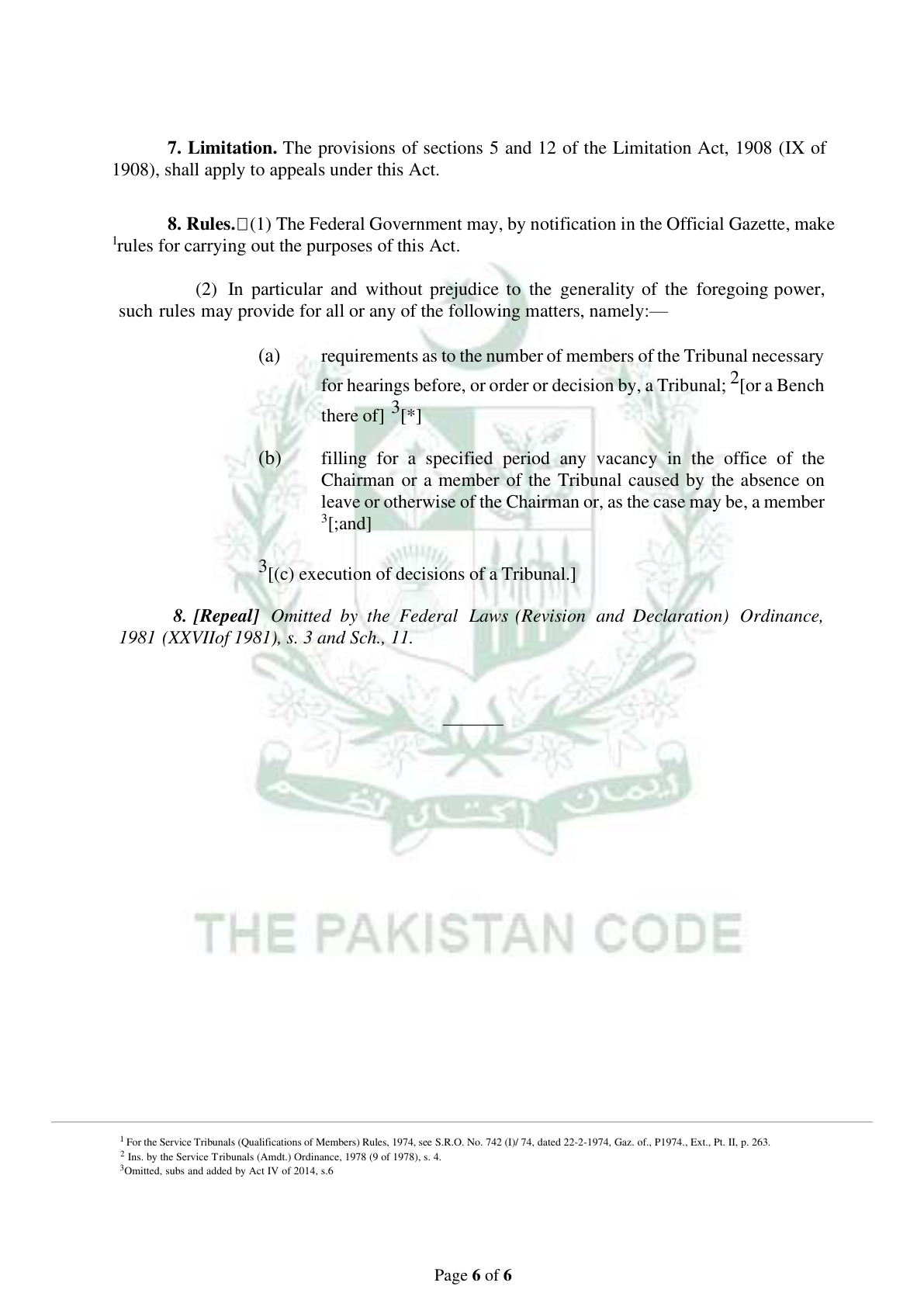
Section 7. Limitation
The provisions of sections 5 and 12 of the Limitation Act, 1908 ( IX of 1908), shall apply to appeals under this Act.
Section 8. Rules
(1) The Federal Government may, by notification in the Official Gazette, make 1rules for carrying out the purposes of this Act.
(2) In particular and without prejudice to the generality of the foregoing power, such rules may provide for all or any of the following matters, namely:—
(a) requirements as to the number of members of the Tribunal necessary for hearings before, or order or decision by, a Tribunal; 2[or a Bench there of] 3[*]
(b) filling for a specified period any vacancy in the office of the Chairman or a member of the Tribunal caused by the absence on leave or otherwise of the Chairman or, as the case may be, a member 3[;and] 3[(c) execution of decisions of a Tribunal.]
8. [Repeal] Omitted by the Federal Laws (Revision and Declaration) Ordinance, 1981 (XXVII of 1981), s. 3 and Sch., 11.
1 For the Service Tribunals (Qualifications of Members) Rules, 1974, see S.R.O. No. 742 (I)/ 74, dated 2221974, Gaz. of., P1974., Ext., Pt. II, p. 263.
2 Ins. by the Service T ribunals (Amdt.) Ordinance, 1978 (9 of 1978), s. 4.
3Omitted, subs and added by Act IV of 2014, s.6
Print contents from the source
CONTENTS
_________

SECTIONS:

1. Short title, commencement and application.
2. Definitions.
3. Tribunals.
3 A. Benches of the Tribunal.
4. Appeals to tribunals.
4 A. Review.
5. Powers of Tribunals.
5A. Financial powers of a Tribunal.
6. Abatement of suits and other proceedings.
7. Limitation.
8. Rules.
9. Repeal.
Compare the original stored transcription
Exact source transcription retained, including print layout and extraction artifacts. Text SHA-256: a6baae9fe5b405cebcc5810b4c8fc0ebd016af98890f90afa033e2fb4a153fc6.
Page 1 of 6 THE SERVICE TRIBUNALS ACT, 1973. CONTENTS _________ SECTIONS: 1. Short title, commencement and application. 2. Definitions. 3. Tribunals. 3 A. Benches of the Tribunal. 4. Appeals to tribunals. 4 A. Review. 5. Powers of Tribunals. 5A. Financial powers of a Tribunal. 6. Abatement of suits and other proceedings. 7. Limitation. 8. Rules. 9. Repeal. ___________ Updated till 3.8.2022 Page 2 of 6 THE SERVICE TRIBUNALS ACT, 1973. 1ACT NO. LXX OF 1973 [26th September, 1973] An Act to provide for the establishment of Service Tribunals to exercise jurisdiction in respect of matters relating to the terms and conditions of service of civil servants. WHEREAS it is expedient to provide for the establishment of Administrative Tribunals, to be called Service Tribunals, to exercise exclusive jurisdiction in respect of matters relating to the terms and conditions of service of civil servants, and for matters connected therewith or ancillary thereto; It is hereby enacted as follows: — 1. Short title, commencement and application. —(1) This Act may be called the Service Tribunals Act, 1973. (2) It shall come into force at once. (3) It applies to all civil servants wherever they may be. 2. Definitions. In this Act, unless there is anything repugnant in the subject or context,— 2[(a) “civil servant” means a person who is, or has been, a civil servant within the meaning of the Civil Servants Act, 1973 (LXXI of 1973) 3[and shall include a person declared to be a Civil Servant under section 2A; and]] (b) “Tribunal” means a Service Tribunal established under section 3. 4[* * * * * * *] 3. Tribunals. —5[(1) The President may, by notification in the official Gazette, establish one or more Service Tribunals as hereinafter provided and, where there are established more than one Tribunal, the President shall specify in the notification the territorial limits within which, or the class or classes or cases in respect of which, each such Tribunal shall exercise jurisdiction under this Act.] (2) A Tribunal shall have exclusive jurisdiction in respect of matters relating to the terms and conditions of service of civil servants, including disciplinary matters. 1 For Statement of Objects and Reasons, see Gaz. of P., 1973, Ext., Pt. III p. 1479. 2 Subs. by the Service T ribunals (Amdt.) Act, 1974 (31 of 1974). s. 2, for the original cl. (a). 3 Added by the Service T ribunals (Amdt.) Act, 1997 (17 of 1997), s. 2.”; 4 Omitted by Act II of 2010 s. 2. 5 Subs. by Act IV of 2014, s. 2. Page 3 of 6 1[(3) A Tribunal shall consist of⎯ (b) a Chairman, being a person who has been, or is qualified to be judge of a High Court; (c) such number of members not less than three, each of whom is or has been⎯ (i) a District Judge; or (ii) a person who for a period of less than two years has held a post in BS21 or above or equivalent under the Federal Government or a Provincial Government with adequate quasijudicial or legal experience, preference being given to a person having background of dealing with service matters; or (iii) an Advocate qualified for appointment as Judge of a High Court.] 1[(4) The Chairman and members of a Tribunal shall be appointed by the President for nonextendable term of three years on such other terms and conditions as the President may determine: Provided that where a serving District Judge or a civil servant is ap pointed as a member he shall hold office for a term of three years or till the date of superannuation, whichever is earlier.] (5) The Chairman or a member of a Tribunal may resign his office by writing under his hand addressed to the President. (6) The Chairman or a member of a Tribunal shall not hold any other office of profit in the service of Pakistan if his remuneration is thereby increased. 1[(7) At any time when⎯ (i) the Chairman of a Tribunal is absent or is unable to perform the functions of his office due to any cause; or (ii) office of the Chairman is vacant, the most senior of the other member s of a Tribunal shall act as Chairman till the Chairman resume s his office or the regular Chairman is appointed as the case may be.] 2[3A. Benches of the Tribunal. —(1) The powers and functions of a Tribunal may be exercised or performed by Benches consisting of not less than two members of the Tribunal, including the Chairman, constituted by the Chairman. (2) If the members of a Bench differ in opinion as to the decision to be given on any point,— 1Subs. by Act IV of 2014,s.2. 2Section 3A ins. by Ord. 9 of 1978, s. 3. Page 4 of 6 (a) the point shall be decided according to the opinion of the majority; (b) if the members are equally divided and the Chairman of the Tribunal is not himself a member of the Bench, the case shall be referred to the Chairman and the decision of the Tribunal shall be expressed in terms of the opinion of the Chairman; and (c) if the members are equally divided and the Chairman of the Tribunal is himself a member of the Bench, the opinion of the Chairman shall prevail and the decision of the Tribunal shall be expressed in terms of the opinion of the Chairman.] 4. Appeals to tribunals.—(1) Any civil servant aggrieved by any 1[*] order, whether original or appellate, made by a departmental authority in respect of any of the terms and conditions of his service may, within thirty days of the communication of such order to him, 2[or within six months of the establishment of the appropriate Tribunal, whichever is later, prefer an appeal to the Tribunal]: Provided that— (a) where an appeal, review or representation to a departmental authority is provided under the 3[Civil Servants Act, 1973 ( LXXI of 1973 )], or any rules against any such order, no appeal shall lie to a Tribunal unless the aggrieved civil servant has preferred an appeal or application for review or representation to such departmental authority and a period of ninety days has ela psed from the date on which such appeal, application or representation was so preferred; 4* (b) no appeal shall lie to a Tribunal against an order or decision of a departmental authority determining the fitness or otherwise of a person to be appointed to or hold a particular post or to be promoted to a higher grader 5[; and] 6[(c) no appeal shall lie to a Tribunal against an order or decision of a departmental authority made at any time before the 1st July, 1969.] (2) Where the appeal is against an order or decision of a departmental authority imposing a departmental punishment or penalty on a civil servant, the appeal shall be preferred— (a) in the case of a penalty of dismissal from service, removal from service, compulsory retirement or re duction to a lower post or timescale or to a lower stage in a timescale, to a Tribunal referred to in subsection (3) of section 3; and (b) in any other case, to a Tribunal referred to in subsection (7) of that section. Explanation.— In this section, “departmental authority” means any authority, other than a Tribunal, which is competent to make an order in respect of any of the terms and conditions of civil servants. 1 Omitted by the Service Tribunals (Amdt.) Act, 1997 (17 of 1997), s. 4. 2 Subs. by the Service T ribunals (Amdt.) Act, 1974 (31 of 1974), s. 3, for “prefer an appeal to the Tribunal having jurisdiction in the matter:. 3 Subs. by the Federal Laws (Revision and Declaration) Ordinance, 1981 (27 of 1981), s. 3 and Sch. II. 4 The word “and” omitted by Act 31 of 1974, s. 3. 5 Subs. ibid., for fullstop. 6 New cl. (c) added ibid. Page 5 of 6 1[4A. Review.⎯ (1) A tribunal shall have the power to review its final order on a review petition field by an aggrieved party within thirty days of the order on the following grounds, namely:⎯ (i) discovery of new and important matter or evidence which, after exercise of due diligence, was not within knowledge of the petitioner or could not be produced by him at the time when the order was passed; (ii) on account of some mistake or error apparent on the face of record; of (iii) for any other sufficient cause.”. (2) The Tribunal shall decide the review petition within thirty days. (3) The Tribunal may confirm, set aside, vary or modify the judgement or order under review.] 5. Powers of Tribunals. —(1) A Tribunal may, on appeal, confirm, set aside, vary or modify the order appealed against. (2) A Tribunal shall, for the purpose of deciding any appeal, be deemed to be a civil court and shall have the same powers as are vested in such court under the Code of Civil Procedure, 1908 (Act V of 1908), including the powers of— (a) enforcing the attendance of any person and examining him on oath; (b) compelling the production of documents; and (c) issuing commission for the examination of witnesses and documents. 1[(3) A Tribunal shall have the power to execute its decisions in accordance with the procedure as may be prescribed.] 1[5A. Financial powers of a Tribunal.⎯ (1) The Registrar of th e Tribunal shall be the Principal Accounting Officer of a Tribunal. (2) The Chairman of Tribunal may authorize reappropriation of funds from one head of account to another head of account and sanction expenditure on any item from within the allocated budget in accordance with the prescribed procedure without reference to Ministry of Finance.] 6. Abatement of suits and other proceedings. All suits, appeals or applications regarding any matter within the jurisdiction of a Tribunal pending in any court immediately before the commencement of this Act shall abate forthwith: Provided that any party to such a suit, appeal or application may, within ninety days of the 2[establishment of the appropriate Tribunal, prefer an appeal to it] in respect of any such matter which is in issue in such suit, appeal or application. 1Ins, and added by Act IV of 2014, ss. 35. 2 Subs. by the Service T ribunals (Amdt.) Act, 1974 (31 of 1974), s. 4, for “commencement of t his Act, prefer an appeal to the appropriate Tribunal”. Page 6 of 6 7. Limitation. The provisions of sections 5 and 12 of the Limitation Act, 1908 ( IX of 1908), shall apply to appeals under this Act. 8. Rules. (1) The Federal Government may, by notification in the Official Gazette, make 1rules for carrying out the purposes of this Act. (2) In particular and without prejudice to the generality of the foregoing power, such rules may provide for all or any of the following matters, namely:— (a) requirements as to the number of members of the Tribunal necessary for hearings before, or order or decision by, a Tribunal; 2[or a Bench there of] 3[*] (b) filling for a specified period any vacancy in the office of the Chairman or a member of the Tribunal caused by the absence on leave or otherwise of the Chairman or, as the case may be, a member 3[;and] 3[(c) execution of decisions of a Tribunal.] 8. [Repeal] Omitted by the Federal Laws (Revision and Declaration) Ordinance, 1981 (XXVII of 1981), s. 3 and Sch., 11. 1 For the Service Tribunals (Qualifications of Members) Rules, 1974, see S.R.O. No. 742 (I)/ 74, dated 2221974, Gaz. of., P1974., Ext., Pt. II, p. 263. 2 Ins. by the Service T ribunals (Amdt.) Ordinance, 1978 (9 of 1978), s. 4. 3Omitted, subs and added by Act IV of 2014, s.6
Original source pages: graphics and forms
These 1 complete source pages supplement the reading text above. Graphic, form or scanned material on these pages is not fully represented by the searchable transcription. Read the original page images for that material; no verified OCR transcription is claimed.
The full original PDF contains 6 pages. Physical source page numbers below refer to that PDF.
Original source and image integrity
Official original PDF source. Source PDF SHA-256: 8676dc502be662a2179501cc466fff5dabf89e01106e989926ee8db3330665ee.
Each selected page is rendered in full without clipping. The original file and every page image are hashed. The source-page review identifies graphic or form material; it does not establish a complete OCR transcription, amendment completeness or current force.
- Physical PDF page 6:
979265b458cfba3a42bc81888330d3a346d1c3efcc87a94f245fddef455bf534
This law in the library
Follow the instruments and provisions named in this source edition, and the laws that cite it. Citation links identify the text being referred to; legal effect and current force require separate examination.
Instruments cited by this law 3
Laws that cite this instrument 9
References to provisions in this text 3
Section 2A
An operative target heading has not been identified. Read the source passage
Read reference in context
s, or has been, a civil servant within the meaning of the Civil Servants Act, 1973 (LXXI of 1973) 3[and shall include a person declared to be a Civil Servant under section 2A; and]] (b) “Tribunal” means a Service Tribunal established under section 3. 4[* * * * * * *] 3. Tribunals. —5[(1) The President may, by notification in the official Gazette, establish one or more Service Tri
Section 3
Open the identified operative provision
Read reference in context
973 (LXXI of 1973) 3[and shall include a person declared to be a Civil Servant under section 2A; and]] (b) “Tribunal” means a Service Tribunal established under section 3. 4[* * * * * * *] 3. Tribunals. —5[(1) The President may, by notification in the official Gazette, establish one or more Service Tribunals as hereinafter provided and, where there are established more than one T
Section 3
Open the identified operative provision
Read reference in context
from service, compulsory retirement or re duction to a lower post or timescale or to a lower stage in a timescale, to a Tribunal referred to in subsection (3) of section 3; and (b) in any other case, to a Tribunal referred to in subsection (7) of that section. Explanation.— In this section, “departmental authority” means any authority, other than a Tribunal, which is competent to make
Other laws referring to provisions of this instrument 2
Section 8 of Service Tribunals Act, 1973
Cited by Estacode
Read source and target evidence
Explicit source reference
in the Gazette of Pakistan Extraordinary Part-I, dated 29-9-1973]. 5.1 The Service Tribunals (Procedure) Rules, 1974 In exercise of the powers conferred by section 8 of the Service Tribunals Act, 1973 (LXX of 1973), the Federal Government is pleased to make the following rules, namely:— THE SERVICE TRIBUNALS (PROCEDURE) RULES, 1974 1. These rules may be called the Service Tribunals (Procedure) Rules, 1974. 2. (1)
Target heading · Service Tribunals Act, 1973
8. Rules. (1) The Federal Government may, by notification in the Official Gazette, make 1rules for carrying out the purposes of this Act. (2) In particular and without prejudice to the generality of the foregoing power, such rules may provide for all or any of the following matters, namely:— (a) requir
Explore this law in the whole-library map · Download this law’s relationship evidence · Download preserved source record
Original-source comparison
Read the original graphic and form pages retained with this law. Their visual content is separate from the text comparison below.
Original-source text comparison matched
Open the compared original source
Source comparison checks the identified transcription and edition. The law's current force, later amendments and territorial application require separate legal review.
Comparison evidence
- Stored text SHA-256
- a6baae9fe5b405cebcc5810b4c8fc0ebd016af98890f90afa033e2fb4a153fc6
- Original source SHA-256
- 8676dc502be662a2179501cc466fff5dabf89e01106e989926ee8db3330665ee
- Comparison method
- NFKC, typography-equivalent quotation marks, soft-hyphen removal and whitespace normalization; full-text equality required
Source, version and text details
- Recorded title
- Service Tribunals Act, 1973
- Source collection
- Federal — this does not establish territorial applicability.
- Recorded version
- Not supplied in this record
- Source snapshot
- Not supplied in this record
- Legal status
- not independently verified
- Text quality
- Complete stored UTF-8 TXT file recovered byte-for-byte from owned Drive. Source transcription retained verbatim; legal completeness, OCR accuracy and current consolidation unverified.
- Recorded quality flags
- No additional flags recorded
- Stable record
- pk-code-7512b5eb00740a4a
- Content extent
- Legal completeness not independently established
- Integrity scope
- Stored UTF-8 text and TXT download bytes checked against their recorded hash. This does not establish legal authenticity or currency.
- Passage offsets
- zero-based Unicode code points and UTF8 bytes; end exclusive
- Stored text SHA-256
- a6baae9fe5b405cebcc5810b4c8fc0ebd016af98890f90afa033e2fb4a153fc6