
CONSTITUTION OF PAKISTAN
Stored extracted text; legal completeness and current force have not been independently established. Inspect source and version details
Reading view reduces excess blank space and hides page extraction markers. Original text and downloads are retained.
Reading layout follows the stored source. Open the original transcription below to compare wording and extraction details.
1THE CONSTITUTION OF THE ISLAMIC REPUBLIC OF PAKISTAN (In the name of Allah, the Beneficent, the Merciful) [12 April 1973] Preamble Whereas sovereignty over the entire Universe belongs to Almighty Allah alone, and the authority to be exercised by the people of Pakistan within the limits prescribed by Him is a sacred trust; And whereas it is the will of the people of Pakistan to establish an order − Wherein the State shall exercise its powers and authority through the chosen representatives of the people;
Wherein the principles of democracy, freedom, equality, tolerance and social justice, as enunciated by Islam, shall be fully observed; Wherein the Muslims shall be enabled to order their lives in the individual and collective spheres in accordance with the teachings and requirements of Islam as set out in the Holy Quran and Sunnah; 1National Assembly of Pakistan enacted the Constitution of the Islamic Republic of Pakistan, 1973 on 10 April 1973; President of the National Assembly authenticated it on 12 April 1973; and, it was published in the Gazette of Pakistan (Extraordinary), dated: 12 April 1973, pp.195-
389. Subject to clauses (3) and (4) of Article 265, the Constitution commenced on and from 14 August 1973. The Proclamation of Martial Law dated 5 July 1977, published the same day in the Gazette of Pakistan (Extraordinary), p.411, placed the Constitution in abeyance. Under Article 4 of the Revival of the Constitution of 1973 Order, 1985 (P.O. No. 14 of 1985), published in the Gazette of Pakistan (Extraordinary), dated: 17 March 1985, pp.185-227, the Constitution, held in abeyance, had to revive on such day as the President may, by notification in the official Gazette, appoint and different days could be so appointed in respect of different provisions. Exercising the said powers, the President revived the Constitution, except Articles 6, 8 to 28, (both inclusive), clauses (2) and (2a) of Article 101, Articles 199, 213 to 216 (both inclusive) and 270-A, with effect from 10 March 1985, vide S.R.O No. 212(I)/85, dated: 10 March 1985, published in the Gazette of Pakistan (Extraordinary), Part-II, p. 279. However, the remaining Articles [Articles 6, 8 to 28, (both inclusive), clauses (2) and (2a) of Article 101, Articles 199, 213 to 216 (both inclusive) and 270-A], stood revived with effect from 30 December 1985, vide S.R.O No. 1273(I)/85, dated: 29 December 1985, published in the Gazette of Pakistan (Extraordinary), Part-II, p. 3185.
2 | Constitution: (Amendment) Order, 2007 Wherein adequate provision shall be made for the minorities freely to profess and practise their religions and develop their cultures; Wherein the territories now included in or in accession with Pakistan and such other territories as may hereafter be included in or accede to Pakistan shall form a Federation wherein the units will be autonomous with such boundaries and limitations on their powers and authority as may be prescribed;
Wherein shall be guaranteed fundamental rights, including equality of status, of opportunity and before law, social, economic and political justice, and freedom of thought, expression, belief, faith, worship and association, subject to law and public morality; Wherein adequate provision shall be made to safeguard the legitimate interests of minorities and backward and depressed classes;
Wherein the independence of the judiciary shall be fully secured; Wherein the integrity of the territories of the Federation, its independence and all its rights, including its sovereign rights on land, sea and air, shall be safeguarded;
So that the people of Pakistan may prosper and attain their rightful and honoured place amongst the nations of the World and make their full contribution towards international peace and progress and happiness of humanity:
Now, therefore, we, the people of Pakistan, Conscious of our responsibility before Almighty Allah and men; Cognisant of the sacrifices made by the people in the cause of Pakistan;
Faithful to the declaration made by the Founder of Pakistan, Quaid-i- Azam Mohammad Ali Jinnah, that Pakistan would be a democratic State based on Islamic principles of social justice; Dedicated to the preservation of democracy achieved by the unremitting struggle of the people against oppression and tyranny; Inspired by the resolve to protect our national and political unity and solidarity by creating an egalitarian society through a new order; Do hereby, through our representatives in the National Assembly, adopt, enact and give to ourselves, this Constitution.
PART I
Introductory
Constitution: (Amendment) Order, 2007 | 3
Section 1. The Republic and its territories
(1) Pakistan shall be a Federal Republic to be known as the Islamic Republic of Pakistan, hereinafter referred to as Pakistan. 1[(2) The territories of Pakistan shall comprise −
(a) the Provinces of 2[Balochistan], the 3[Khyber Pakhtunkhwa], the Punjab and 4[Sindh];
(b) the Islamabad Capital Territory hereinafter referred to as the Federal Capital;
(c) the Federally Administered Tribal Areas; and
(d) such States and territories as are or may be included in Pakistan, whether by accession or otherwise.
(3) 5[Majlis-e-Shoora (Parliament)] may by law admit into the Federation new States or areas on such terms and conditions as it thinks fit.]
Section 2. Islam to be State religion
Islam shall be the State religion of Pakistan.
[6] Section 2A. The Objectives Resolution to form part of substantive provisions
The principles and provisions set out in the Objectives Resolution reproduced in the Annex are hereby made substantive part of the Constitution and shall have effect accordingly.]
Section 3. Elimination of exploitation
The State shall ensure the elimination of all forms of exploitation and the gradual fulfillment of the fundamental principle, from each according to his ability to each according to his work.
Section 4. Right of individuals to be dealt with in accordance with law, etc
(1) To enjoy the protection of law and to be treated in accordance with law is the inalienable right of every citizen, wherever he may be, and of every other person for the time being within Pakistan.
(2) In particular − 1Clauses (2), (3) and (4) were substituted by the Constitution (First Amendment) Act, 1974 (XXXIII of 1974); assented to by the President on 4 May 1974; and, published in the Gazette of Pakistan (Extraordinary), dated: 8 May 1974, pp.179-182, s. 2.
2Substituted for the word “Baluchistan” by the Constitution (Eighteenth Amendment) Act, 2010 (X of 2010); assented to by the President on 19 April 2010; and, published in the Gazette of Pakistan (Extraordinary), dated: 20 April 2010, pp. 267-316, s. 3.
3Substituted ibid, for the words “North West Frontier”.
4Substituted ibid, for the word “Sind”.
5Substituted for the word “Parliament” by the Revival of the Constitution of 1973 Order, 1985 (P.O. No.14 of 1985), published in the Gazette of Pakistan (Extraordinary), dated: 17 March 1985, pp.185-227, Article 2 read with the Schedule, item 1: the Order came into force on 2 March 1985 and was saved under Article 270A of the Constitution.
6Inserted ibid, item 2.
4 | Constitution: (Amendment) Order, 2007
(a) no action detrimental to the life, liberty, body, reputation or property of any person shall be taken except in accordance with law;
(b) no person shall be prevented from or be hindered in doing that which is not prohibited by law; and
(c) no person shall be compelled to do that which the law does not require him to do.
Section 5. Loyalty to State and obedience to Constitution and law
(1) Loyalty to the State is the basic duty of every citizen.
(2) Obedience to the Constitution and law is the 1[inviolable] obligation of every citizen wherever he may be and of every other person for the time being within Pakistan.
Section 6. High treason
2[(1) Any person who abrogates or subverts or suspends or holds in abeyance, or attempts or conspires to abrogate or subvert or suspend or hold in abeyance, the Constitution by use of force or show of force or by any other unconstitutional means shall be guilty of high treason.]
(2) Any person aiding or abetting 3[or collaborating] the acts mentioned in clause (1) shall likewise be guilty of high treason. 4[(2A) An act of high treason mentioned in clause (1) or clause (2) shall not be validated by any court including the Supreme Court and a High Court.]
(3) 5[Majlis-e-Shoora (Parliament)] shall by law provide for the punishment of persons found guilty of high treason.
PART II
Fundamental Rights and Principles of Policy
Section 7. Definition of the State
In this Part, unless the context otherwise requires, "the State" means the Federal Government, 6[Majlis-e-Shoora (Parliament)], a Provincial Government, a
1Substituted for the word “basic” by the Revival of the Constitution of 1973 Order, 1985 (P.O. No.
14 of 1985), published in the Gazette of Pakistan (Extraordinary), dated: 17 March 1985, pp.185- 227, Article 2 read with the Schedule, item 3: the Order came into force on 2 March 1985 and was saved under Article 270A of the Constitution.
2Substituted by the Constitution (Eighteenth Amendment) Act, 2010 (X of 2010); assented to by the President on 19 April 2010; and, published in the Gazette of Pakistan (Extraordinary), dated: 20 April 2010, pp. 267-316, s. 4.
3Inserted ibid.
4Ibid.
5Substituted for the word “Parliament” by the Revival of the Constitution of 1973 Order, 1985 (P.O. No. 14 of 1985), published in the Gazette of Pakistan (Extraordinary), dated: 17 March
1985. pp. 185-227, Article 2 read with the Schedule, item 1: the Order came into force on 2 March 1985 and was saved under Article 270A of the Constitution.
6Substituted for the word “Parliament” by the Revival of the Constitution of 1973 Order, 1985 (P.O. No. 14 of 1985), published in the Gazette of Pakistan (Extraordinary), dated: 17 March
Constitution: (Amendment) Order, 2007 | 5 Provincial Assembly, and such local or other authorities in Pakistan as are by law empowered to impose any tax or cess. Chapter 1 Fundamental Rights
Section 8. Laws inconsistent with or in derogation of Fundamental Rights to be void
(1) Any law, or any custom or usage having the force of law, in so far as it is inconsistent with the rights conferred by this Chapter, shall, to the extent of such inconsistency, be void.
(2) The State shall not make any law which takes away or abridges the rights so conferred and any law made in contravention of this clause shall, to the extent of such contravention, be void.
(3) The provisions of this Article shall not apply to −
(a) any law relating to members of the Armed Forces, or of the police or of such other forces as are charged with the maintenance of public order, for the purpose of ensuring the proper discharge of their duties or the maintenance of discipline among them; or 1[(b) any of the −
(i) laws specified in the First Schedule as in force immediately before the commencing day or as
amended by any of the laws specified in that Schedule;
(ii) other laws specified in Part I of the First Schedule;] and no such law nor any provision thereof shall be void on the ground that such law or provision is inconsistent with, or repugnant to, any provision of this Chapter.
(4) Notwithstanding anything contained in paragraph (b) of clause (3), within a period of two years from the commencing day, the appropriate Legislature shall bring the laws specified in 2[Part II of the First Schedule] into conformity with the rights conferred by this Chapter:
Provided that the appropriate Legislature may by resolution extend the said period of two years by a period not exceeding six months.
1985. pp. 185-227, Article 2 read with the Schedule, item 1: the Order came into force on 2 March 1985 and was saved under Article 270A of the Constitution.
1Substituted by the Constitution (Fourth Amendment) Act, 1975 (LXXI of 1975); assented to by the President on 21 November 1975; and, published in the Gazette of Pakistan (Extraordinary), dated: 25.11.1975, pp. 579-585, s. 2.
2Substituted ibid, for the expression “the First Schedule, not being a law which relates to, or is connected with, economic reforms,”
6 | Constitution: (Amendment) Order, 2007 Explanation− If in respect of any law 1[Majlis-e-Shoora (Parliament)] is the appropriate Legislature, such resolution shall be a resolution of the National Assembly.
(5) The rights conferred by this Chapter shall not be suspended except as expressly provided by the Constitution.
Section 9. Security of person
No person shall be deprived of life or liberty save in accordance with law.
Section 10. Safeguards as to arrest and detention
(1) No person who is arrested shall be detained in custody without being informed, as soon as may be, of the grounds for such arrest, nor shall he be denied the right to consult and be defended by a legal practitioner of his choice.
(2) Every person who is arrested and detained in custody shall be produced before a magistrate within a period of twenty-four hours of such arrest, excluding the time necessary for the journey from the place of arrest to the court of the nearest magistrate, and no such person shall be detained in custody beyond the said period without the authority of a magistrate.
(3) Nothing in clauses (1) and (2) shall apply to any person who is arrested or detained under any law providing for preventive detention.
(4) No law providing for preventive detention shall be made except to deal with persons acting in a manner prejudicial to the integrity, security or defence of Pakistan or any part thereof, or external affairs of Pakistan, or public order, or the maintenance of supplies or services, and no such law shall authorise the detention of a person for a period exceeding 2[three months] unless the appropriate Review Board has, after affording him an opportunity of being heard in person, reviewed his case and reported, before the expiration of the said period, that there is, in its opinion, sufficient cause for such detention, and, if the detention is continued after the said period of 3[three months], unless the appropriate Review Board has reviewed his case and reported, before the expiration of each period of three months, that there is, in its opinion, sufficient cause for such detention. Explanation I.− In this Article, "the appropriate Review Board" means,−
1Substituted for the word “Parliament” by the Revival of the Constitution of 1973 Order, 1985 (P.O. No. 14 of 1985), published in the Gazette of Pakistan (Extraordinary), dated: 17 March
1985. pp. 185-227, Article 2 read with the Schedule, item 1: the Order came into force on 2 March 1985 and was saved under Article 270A of the Constitution.
2Substituted for the words “one month” by the Constitution (Third Amendment) Act, 1975 (XXII of 1975); assented to by the President on 13 February 1975; and, published in the Gazette of Pakistan (Extraordinary), dated: 18 February 1975, pp. 67-69, s. 2.
3Ibid.
Constitution: (Amendment) Order, 2007 | 7
(i) in the case of a person detained under a Federal law, a Board appointed by the Chief Justice of Pakistan and consisting of a Chairman and two other persons, each of whom is or has been a Judge of the Supreme Court or a High Court; and
(ii) in the case of a person detained under a Provincial law, a Board appointed by the Chief Justice of the High Court concerned and consisting of a Chairman and two other persons, each of whom is or has been a Judge of a High Court. Explanation II .− The opinion of a Review Board shall be expressed in terms of the views of the majority of its members.
(5) When any person is detained in pursuance of an order made under any law providing for preventive detention, the authority making the order shall, 1[within fifteen days] from such detention, communicate to such person the grounds on which the order has been made, and shall afford him the earliest opportunity of making a representation against the order:
Provided that the authority making any such order may refuse to disclose facts which such authority considers it to be against the public interest to disclose.
(6) The authority making the order shall furnish to the appropriate Review Board all documents relevant to the case unless a certificate, signed by a Secretary to the Government concerned, to the effect that it is not in the public interest to furnish any documents, is produced.
(7) Within a period of twenty-four months commencing on the day of his first detention in pursuance of an order made under a law providing for preventive detention, no person shall be detained in pursuance of any such order for more than a total period of eight months in the case of a person detained for acting in a manner prejudicial to public order and twelve months in any other case:
Provided that this clause shall not apply to any person who is employed by, or works for, or acts on instructions received from, the enemy 2[, or who is acting or attempting to act in a manner prejudicial to the integrity, security or defence of Pakistan or any part thereof or who commits or attempts to commit any act which amounts to an anti- national activity as defined in a Federal law or is a member of any association which has for its objects, or which indulges in, any such anti-national activity].
1Substituted for the expression “as soon as may be, but not later than one week” by the Constitution (Third Amendment) Act, 1975 (XXII of 1975) ; assented to by the President on 13 February 1975; and, published in the Gazette of Pakistan (Extraordinary), dated: 18 February 1975,
pp. 67-69, s. 2. 2Added ibid.
8 | Constitution: (Amendment) Order, 2007
(8) The appropriate Review Board shall determine the place of detention of the person detained and fix a reasonable subsistence allowance for his family.
(9) Nothing in this Article shall apply to any person who for the time being is an enemy alien.
[1] Section 10A. Right to fair trial
For the determination of his civil rights and obligations or in any criminal charge against him a person shall be entitled to a fair trial and due process.]
Section 11. Slavery, forced labour, etc., prohibited
(1) Slavery is non- existent and forbidden and no law shall permit or facilitate its introduction into Pakistan in any form.
(2) All forms of forced labour and traffic in human beings are prohibited.
(3) No child below the age of fourteen years shall be engaged in any factory or mine or any other hazardous employment.
(4) Nothing in this Article shall be deemed to affect compulsory service −
(a) by any person undergoing punishment for an offence against any law; or
(b) required by any law for public purpose:
Provided that no compulsory service shall be of a cruel nature or incompatible with human dignity.
Section 12. Protection against retrospective punishment
(1) No law shall authorize the punishment of a person −
(a) for an act or omission that was not punishable by law at the time of the act or omission; or
(b) for an offence by a penalty greater than, or of a kind different from, the penalty prescribed by law for that offence at the time the offence was committed.
(2) Nothing in clause (1) or in Article 270 shall apply to any law making acts of abrogation or subversion of a Constitution in force in Pakistan at any time since the twenty-third day of March, one thousand nine hundred and fifty-six, an offence.
Section 13. Protection against double punishment and self- incrimination
No person −
(a) shall be prosecuted or punished for the same offence more than once; or
1Inserted by the Constitution (Eighteenth Amendment) Act, 2010 (X of 2010) ; assented to by the President on 19 April 2010; and, published in the Gazette of Pakistan (Extraordinary), dated: 20 April 2010, pp. 267-316, s. 5.
Constitution: (Amendment) Order, 2007 | 9
(b) shall, when accused of an offence, be compelled to be a witness against himself.
Section 14. Inviolability of dignity of man, etc
(1) The dignity of man and, subject to law, the privacy of home, shall be inviolable.
(2) No person shall be subjected to torture for the purpose of extracting evidence.
Section 15. Freedom of movement, etc
Every citizen shall have the right to remain in, and, subject to any reasonable restriction imposed by law in the public interest, enter and move freely throughout Pakistan and to reside and settle in any part thereof.
Section 16. Freedom of assembly
Every citizen shall have the right to assemble peacefully and without arms, subject to any reasonable restrictions imposed by law in the interest of public order.
[1] Section 17. Freedom of association
(1) Every citizen shall have the right to form associations or unions, subject to any reasonable restrictions imposed by law in the interest of sovereignty or integrity of Pakistan, public order or morality.
(2) Every citizen, not being in the service of Pakistan, shall have the right to form or be a member of a political party, subject to any reasonable restrictions imposed by law in the interest of the sovereignty or integrity of Pakistan and such law shall provide that where the Federal Government declares that any political party has been formed or is operating in a manner prejudicial to the sovereignty or integrity of Pakistan, the Federal Government shall, within fifteen days of such declaration, refer the matter to the Supreme Court whose decision on such reference shall be final.
(3) Every political party shall account for the source of its funds in accordance with law.]
Section 18. Freedom of trade, business or profession
Subject to such qualifications, if any, as may be prescribed by law, every citizen shall have the right to enter upon any lawful profession or occupation, and to conduct any lawful trade or business:
Provided that nothing in this Article shall prevent −
(a) the regulation of any trade or profession by a licensing system; or
(b) the regulation of trade, commerce or industry in the interest of free competition therein; or
1Substituted by the Constitution (Eighteenth Amendment) Act, 2010 (X of 2010) ; assented to by the President on 19 April 2010; and, published in the Gazette of Pakistan (Extraordinary), dated: 20 April 2010, pp.267-316, s. 6.
10 | Constitution: (Amendment) Order, 2007
(c) the carrying on, by the Federal Government or a Provincial Government, or by a corporation controlled by any such Government, of any trade, business, industry or service, to the exclusion, complete or partial, of other persons.
Section 19. Freedom of speech, etc
Every citizen shall have the right to freedom of speech and expression, and there shall be freedom of the press, subject to any reasonable restrictions imposed by law in the interest of the glory of Islam or the integrity, security or defence of Pakistan or any part thereof, friendly relations with foreign States, public order, decency or morality, or in relation to contempt of court, 1[commission of] or incitement to an offence.
[2] Section 19A. Right to information
Every citizen shall have the right to have access to information in all matters of public importance subject to regulation and reasonable restrictions imposed by law.]
Section 20. Freedom to profess religion and to manage religious institutions
Subject to law, public order and morality,−
(a) every citizen shall have the right to profess, practise and propagate his religion; and
(b) every religious denomination and every sect thereof shall have the right to establish, maintain and manage its religious institutions.
Section 21. Safeguard against taxation for purposes of any particular religion
No person shall be compelled to pay any special tax the proceeds of which are to be spent on the propagation or maintenance of any religion other than his own.
Section 22. Safeguards as to educational institutions in respect of religion, etc
(1) No person attending any educational institution shall be required to receive religious instruction, or take part in any religious ceremony, or attend religious worship, if such instruction, ceremony or worship relates to a religion other than his own.
(2) In respect of any religious institution, there shall be no discrimination against any community in the granting of exemption or concession in relation to taxation.
(3) Subject to law,−
1Substituted for the word “defamation” by the Constitution (Fourth Amendment) Act, 1975 (LXXI of 1975); assented to by the President on 21 November 1975; and, published in the Gazette of Pakistan (Extraordinary), dated: 25 November 1975, pp. 579-585, s. 4.
2Inserted by the Constitution (Eighteenth Amendment) Act, 2010 (X of 2010); assented to by the President on 19 April 2010; and, published in the Gazette of Pakistan (Extraordinary), dated: 20 April 2010, pp. 267-316, s. 7.
Constitution: (Amendment) Order, 2007 | 11
(a) no religious community or denomination shall be prevented from providing religious instruction for pupils of that community or denomination in any educational institution maintained wholly by that community or denomination; and
(b) no citizen shall be denied admission to any educational institution receiving aid from public revenues on the ground only of race, religion, caste or place of birth.
(4) Nothing in this Article shall prevent any public authority from making provision for the advancement of any socially or educationally backward class of citizens.
Section 23. Provision as to property
Every citizen shall have the right to acquire, hold and dispose of property in any part of Pakistan, subject to the Constitution and any reasonable restrictions imposed by law in the public interest.
Section 24. Protection of property rights
(1) No person shall be deprived of his property save in accordance with law.
(2) No property shall be compulsorily acquired or taken possession of save for a public purpose, and save by the authority of law which provides for compensation therefor and either fixes the amount of compensation or specifies the principles on and the manner in which compensation is to be determined and given.
(3) Nothing in this Article shall affect the validity of −
(a) any law permitting the compulsory acquisition or taking possession of any property for preventing danger to life, property or public health; or
(b) any law permitting the taking over of any property which has been acquired by, or come into the possession of, any person by any unfair means, or in any manner, contrary to law; or
(c) any law relating to the acquisition, administration or disposal of any property which is or is deemed to be enemy property or evacuee property under any law (not being property which has ceased to be evacuee property under any law); or
(d) any law providing for the taking over of the management of any property by the State for a limited period, either in the public interest or in order to secure the proper management of the property, or for the benefit of its owner; or
(e) any law providing for the acquisition of any class of property for the purpose of −
12 | Constitution: (Amendment) Order, 2007
(i) providing education and medical aid to all or any specified class of citizens; or
(ii) providing housing and public facilities and services such as roads, water supply, sewerage, gas and electric power to all or any specified class of citizens; or
(iii) providing maintenance to those who, on account of unemployment, sickness, infirmity or old age, are unable to maintain themselves; or
(f) any existing law or any law made in pursuance of Article
253.
(4) The adequacy or otherwise of any compensation provided for by any such law as is referred to in this Article, or determined in pursuance thereof, shall not be called in question in any court.
Section 25. Equality of citizens
(1) All citizens are equal before law and are entitled to equal protection of law.
(2) There shall be no discrimination on the basis of sex 1[*].
(3) Nothing in this Article shall prevent the State from making any special provision for the protection of women and children.
[2] Section 25A. Right to education
The State shall provide free and compulsory education to all children of the age of five to sixteen years in such manner as may be determined by law.]
Section 26. Non-discrimination in respect of access to public places
(1) In respect of access to places of public entertainment or resort, not intended for religious purposes only, there shall be no discrimination against any citizen on the ground only of race, religion, caste, sex, residence or place of birth.
(2) Nothing in clause (1) shall prevent the State from making any special provision for women and children.
Section 27. Safeguard against discrimination in services
(1) No citizen otherwise qualified for appointment in the service of Pakistan shall be discriminated against in respect of any such appointment on the ground only of race, religion, caste, sex, residence or place of birth:
1The word “alone” was omitted by the Constitution (Eighteenth Amendment) Act, 2010 (X of 2010) ; assented to by the President on 19 April 2010; and, published in the Gazette of Pakistan (Extraordinary), dated: 20 April 2010, pp. 267-316, s. 8.
2Inserted ibid, s. 9.
Constitution: (Amendment) Order, 2007 | 13
Provided that, for a period not exceeding 1[forty] years from the commencing day, posts may be reserved for persons belonging to any class or area to secure their adequate representation in the service of Pakistan:
Provided further that, in the interest of the said service, specified posts or services may be reserved for members of either sex if such posts or services entail the performance of duties and functions which cannot be adequately performed by members of the other sex 2[:] 3[Provided also that under-representation of any class or area in the service of Pakistan may be redressed in such manner as may be determined by an Act of Majlis-e-Shoora (Parliament).]
(2) Nothing in clause (1) shall prevent any Provincial Government, or any local or other authority in a Province, from prescribing, in relation to any post or class of service under that Government or authority, conditions as to residence in the Province, for a period not exceeding three years, prior to appointment under that Government or authority.
Section 28. Preservation of language, script and culture
Subject to Article 251 any section of citizens having a distinct language, script or culture shall have the right to preserve and promote the same and subject to law, establish institutions for that purpose. Chapter 2 Principles of Policy
Section 29. Principles of Policy
(1) The Principles set out in this Chapter shall be known as the Principles of Policy, and it is the responsibility of each organ and authority of the State, and of each person performing functions on behalf of an organ or authority of the State, to act in accordance with those Principles in so far as they relate to the functions of the organ or authority.
(2) In so far as the observance of any particular Principle of Policy may be dependent upon resources being available for the purpose, the Principle shall be regarded as being subject to the availability of resources.
1Substituted for the word “twenty” by the Constitution (Sixteenth Amendment) Act, 1999 (VII of 1999); assented to by the President on 3 August 1999; and, published in the Gazette of Pakistan (Extraordinary), dated: 5 August 1999, p.1237, s. 2. The word “twenty” was earlier substituted for the word “ten” by the Revival of the Constitution of 1973 Order, 1985 (P.O. No. 14 of 1985), published in the Gazette of Pakistan (Extraordinary), dated: 17 March 1985, pp.185-227, Article 2 read with the Schedule, item 4: the Order came into force on 2 March 1985 and was saved under Article 270A of the Constitution.
2Substituted for the “full-stop” by the Constitution (Eighteenth Amendment) Act, 2010 (X of 2010); assented to by the President on 19 April 2010; and, published in the Gazette of Pakistan (Extraordinary), dated: 20 April 2010, pp. 267-316, s. 10.
3Inserted ibid.
14 | Constitution: (Amendment) Order, 2007
(3) In respect of each year, the President in relation to the affairs of the Federation, and the Governor of each Province in relation to the affairs of his Province, shall cause to be prepared and laid before the 1[each House of Majlis-e-Shoora (Parliament)] or, as the case may be, the Provincial Assembly, a report on the observance and implementation of the Principles of Policy, and provision shall be made in the rules of procedure of the National Assembly 2[and the Senate] or, as the case may be, the Provincial Assembly, for discussion on such report.
Section 30. Responsibility with respect to Principles of Policy
(1) The responsibility of deciding whether any action of an organ or authority of the State, or of a person performing functions on behalf of an organ or authority of the State, is in accordance with the Principles of Policy is that of the organ or authority of the State, or of the person, concerned.
(2) The validity of an action or of a law shall not be called in question on the ground that it is not in accordance with the Principles of Policy, and no action shall lie against the State, any organ or authority of the State or any person on such ground.
Section 31. Islamic way of life
(1) Steps shall be taken to enable the Muslims of Pakistan, individually and collectively, to order their lives in accordance with the fundamental principles and basic concepts of Islam and to provide facilities whereby they may be enabled to understand the meaning of life according to the Holy Quran and Sunnah.
(2) The State shall endeavour, as respects the Muslims of Pakistan,−
(a) to make the teaching of the Holy Quran and Islamiat compulsory, to encourage and facilitate the learning of Arabic language and to secure correct and exact printing and publishing of the Holy Quran;
(b) to promote unity and the observance of the Islamic moral standards; and
(c) to secure the proper organisation of zakat, 3[ushr,] auqaf and mosques.
1Substituted for the words “the National Assembly” by the Constitution (Eighteenth Amendment) Act, 2010 (X of 2010) ; assented to by the President on 19 April 2010; and, p ublished in the Gazette of Pakistan (Extraordinary), dated: 20 April 2010, pp. 267-316, s. 11.
2Inserted ibid.
3Inserted by the Revival of the Constitution of 1973 Order, 1985 (P.O. No.14 of 1985), published in the Gazette of Pakistan (Extraordinary), dated: 17 March1985, pp. 185-227, Article 2 read with the Schedule, item 5: the Order came into force on 2 March 1985 and was saved under Article 270A of the Constitution.
Constitution: (Amendment) Order, 2007 | 15
Section 32. Promotion of local Government institutions
The State shall encourage local Government institutions composed of elected representatives of the areas concerned and in such institutions special representation will be given to peasants, workers and women.
Section 33. Parochial and other similar prejudices to be discouraged
The State shall discourage parochial, racial, tribal, sectarian and provincial prejudices among the citizens.
Section 34. Full participation of women in national life
Steps shall be taken to ensure full participation of women in all spheres of national life.
Section 35. Protection of family, etc
The State shall protect the marriage, the family, the mother and the child.
Section 36. Protection of minorities
The State shall safeguard the legitimate rights and interests of minorities, including their due representation in the Federal and Provincial services.
Section 37. Promotion of social justice and eradication of social evils
The State shall −
(a) promote, with special care, the educational and economic interests of backward classes or areas;
(b) remove illiteracy and provide free and compulsory secondary education within minimum possible period;
(c) make technical and professional education generally available and higher education equally accessible to all on the basis of merit;
(d) ensure inexpensive and expeditious justice;
(e) make provision for securing just and humane conditions of work, ensuring that children and women are not employed in vocations unsuited to their age or sex, and for maternity benefits for women in employment;
(f) enable the people of different areas, through education, training, agricultural and industrial development and other methods, to participate fully in all forms of national activities, including employment in the service of Pakistan;
(g) prevent prostitution, gambling and taking of injurious drugs, printing, publication, circulation and display of obscene literature and advertisements;
(h) prevent the consumption of alcoholic liquor otherwise than for medicinal and, in the case of non-Muslims, religious purposes; and
16 | Constitution: (Amendment) Order, 2007
(i) decentralise the Government administration so as to facilitate expeditious disposal of its business to meet the convenience and requirements of the public.
Section 38. Promotion of social and economic well-being of the people
The State shall−
(a) secure the well-being of the people, irrespective of sex, caste, creed or race, by raising their standard of living, by preventing the concentration of wealth and means of production and distribution in the hands of a few to the detriment of general interest and by ensuring equitable adjustment of rights between employers and employees, and landlords and tenants;
(b) provide for all citizens, within the available resources of the country, facilities for work and adequate livelihood with reasonable rest and leisure;
(c) provide for all persons employed in the service of Pakistan or otherwise, social security by compulsory social insurance or other means;
(d) provide basic necessities of life, such as food, clothing, housing, education and medical relief, for all such citizens, irrespective of sex, caste, creed or race, as are permanently or temporarily unable to earn their livelihood on account of infirmity, sickness or unemployment;
(e) reduce disparity in the income and earnings of individuals, including persons in the various classes of the service of Pakistan; 1[*]
(f) eliminate riba as early as possible 2[;] 3[and] 4[(g) ensure that the shares of the Provinces in all Federal services, including autonomous bodies and corporations established by, or under the control of, the Federal Government, shall be secured and any omission in the allocation of the shares of the Provinces in the past shall be rectified.]
Section 39. Participation of people in Armed Forces
The State shall enable people from all parts of Pakistan to participate in the Armed Forces of Pakistan. 1The word “and” was omitted by the Constitution (Eighteenth Amendment) Act, 2010 (X of 2010 ; assented to by the President on 19 April 2010; and, published in the Gazette of Pakistan (Extraordinary), dated: 20 April 2010, pp. 267-316, s. 12.
2Substituted ibid, for the “full-stop”.
3Added ibid. 4Ibid.
Constitution: (Amendment) Order, 2007 | 17
Section 40. Strengthening bonds with Muslim world and promoting international peace
The State shall endeavour to preserve and strengthen fraternal relations among Muslim countries based on Islamic unity, support the common interests of the peoples of Asia, Africa and Latin America, promote international peace and security, foster goodwill and friendly relations among all nations and encourage the settlement of international disputes by peaceful means.
PART III
The Federation of Pakistan Chapter 1 The President
Section 41. The President
(1) There shall be a President of Pakistan who shall be the Head of State and shall represent the unity of the Republic.
(2) A person shall not be qualified for election as President unless he is a Muslim of not less than forty-five years of age and is qualified to be elected as member of the National Assembly. 1[(3) The President 2[* * * * * * * * * *] shall be elected in accordance with the provisions of the Second Schedule by the members of an electoral college consisting of −
(a) the members of both Houses; and
(b) the members of the Provincial Assemblies.]
(4) Election to the office of President shall be held not earlier than sixty days and not later than thirty days before the expiration of the term of the President in office:
Provided that, if the election cannot be held within the period aforesaid because the National Assembly is dissolved, it shall be held within thirty days of the general election to the Assembly.
(5) An election to fill a vacancy in the office of President shall be held not later than thirty days from the occurrence of the vacancy:
1Substituted by the Revival of the Constitution of 1973 Order, 1985 (P.O. No. 14 of 1985), published in the Gazette of Pakistan (Extraordinary), dated: 17 March1985, pp. 185-227, Article 2 read with the Schedule, item 6: the Order came into force on 2 March 1985 and was saved under Article 270A of the Constitution.
2The expression “to be elected after the term specified in clause (7)” was omitted by the Constitution (Eighteenth Amendment) Act, 2010 (X of 2010); assented to by the President on 19 April 2010; and, published in the Gazette of Pakistan (Extraordinary), dated: 20 April 2010, pp. 267-316, s. 13. The words “expiration of the” would be deemed to have been omitted in the context of the omission.
18 | Constitution: (Amendment) Order, 2007
Provided that, if the election cannot be held within the period aforesaid because the National Assembly is dissolved, it shall be held within thirty days of the general election to the Assembly.
(6) The validity of the election of the President shall not be called in question by or before any court or other authority. 1[(7) * * * * * ] 2[(8) * * * * * ] 3[(9) * * * * * ]
Section 42. Oath of President
Before entering upon office, the President shall make before the Chief Justice of Pakistan oath in the form set out in the Third Schedule.
Section 43. Conditions of President's office
(1) The President shall not hold any office of profit in the service of Pakistan or occupy any other position carrying the right to remuneration for the rendering of services.
(2) The President shall not be a candidate for election as a member of 4[Majlis-e-Shoora(Parliament)] or a Provincial Assembly; and, if a member of 5[Majlis-e-Shoora(Parliament)] or a Provincial Assembly is elected as President, his seat in 6[Majlis-e- Shoora(Parliament)] or, as the case may be, the Provincial Assembly shall become vacant on the day he enters upon his office.
Section 44. Term of office of President
(1) Subject to the Constitution , the President shall hold office for a term of five years from the day he enters upon his office:
Provided that the President shall, notwithstanding the expiration of his term, continue to hold office until his successor enters upon his office.
1Omitted by the Constitution (Eighteenth Amendment) Act, 2010 (X of 2010); assented to by the President on 19 April 2010; and, published in the Gazette of Pakistan (Extraordinary), dated: 20 April 2010, pp. 267-316, s. 13. The clause was earlier inserted by the Revival of the Constitution of 1973 Order, 1985 (P.O. No. 14 of 1985), published in the Gazette of Pakistan (Extraordinary), dated: 17 March 1985, pp.185-227, Article 2 read with the Schedule, item 6: the Order came into force on 2 March 1985 and was saved under Article 270A of the Constitution.
2Ibid. The clause was earlier added by the Constitution (Seventeenth Amendment) Act, 2003 (III of 2003); assented to by the President on 31 December 2003; and, published the same day in the Gazette of Pakistan (Extraordinary), pp.149-153, s. 2. 3Ibid.
4Substituted for the word “Parliament” by the Revival of the Constitution of 1973 Order, 1985 (P.O. No. 14 of 1985), published in the Gazette of Pakistan (Extraordinary), dated: 17 March 1985, pp. 185-227, Article 2 read with the Schedule, item 1: the Order came into force on 2 March 1985 and was saved under Article 270A of the Constitution.
5Ibid. 6Ibid.
Constitution: (Amendment) Order, 2007 | 19
(2) Subject to the Constitution, a person holding office as President shall be eligible for re-election to that office, but no person shall hold that office for more than two consecutive terms.
(3) The President may, by writing under his hand addressed to the Speaker of the National Assembly, resign his office.
Section 45. President's power to grant pardon, etc
The President shall have power to grant pardon, reprieve and respite, and to remit, suspend or commute any sentence passed by any court, tribunal or other authority.
[1] Section 46. President to be kept informed
The Prime Minister shall keep the President informed on all matters of internal and foreign policy and on all legislative proposals the Federal Government intends to bring before Majlis-e-Shoora (Parliament).]
Section 47. Removal 2[or impeachment ] of President
3[(1) Notwithstanding anything contained in the Constitution, the President may, in accordance with the provisions of this Article, be removed from office on the ground of physical or mental incapacity or impeached on a charge of violating the Constitution or gross misconduct.
(2) Not less than one-half of the total membership of either House may give to the Speaker of the National Assembly or, as the case may be, the Chairman written notice of its intention to move a resolution for the removal of, or, as the case may be, to impeach, the President; and such notice shall set out the particulars of his incapacity or of the charge against him.]
(3) If a notice under clause (2) is received by the Chairman, he shall transmit it forthwith to the Speaker.
(4) The Speaker shall, within three days of the receipt of a notice under clause (2) or clause (3), cause a copy of the notice to be transmitted to the President.
(5) The Speaker shall summon the two Houses to meet in a joint sitting not earlier than seven days and not later than fourteen days after the receipt of the notice by him.
1Substituted by the Constitution (Eighteenth Amendment) Act, 2010 (X of 2010) ; assented to by the President on 19 April 2010; and, published in the Gazette of Pakistan (Extraordinary), dated: 20 April 2010, pp. 267-316, s. 14. It was earlier substituted by the Revival of the Constitution of 1973 Order, 1985 (P.O. No. 14 of 1985), published in the Gazette of Pakistan (Extraordinary), dated: 17 March 1985, pp. 185-227, Article 2 read with the Schedule, item 7: the Order came into force on 2 March 1985 and was saved under Article 270A of the Constitution.
2Inserted by the Revival of the Constitution of 1973 Order, 1985 (P.O. No. 14 of 1985), published in the Gazette of Pakistan (Extraordinary), dated: 17 March 1985, pp. 185-227, Article 2 read with the Schedule, item 8: the Order came into force on 2 March 1985 and was saved under Article 270A of the Constitution.
3Substituted ibid.
20 | Constitution: (Amendment) Order, 2007
(6) The joint sitting may investigate or cause to be investigated the ground or the charge upon which the notice is founded.
(7) The President shall have the right to appear and be represented during the investigation, if any, and before the joint sitting.
(8) If, after consideration of the result of the investigation, if any, a resolution is passed at the joint sitting by the votes of not less than two-thirds of the total membership of 1[Majlis-e-Shoora (Parliament)], declaring that the President is unfit to hold the office due to incapacity or is guilty of violating the Constitution or of gross misconduct, the President shall cease to hold office immediately on the passing of the resolution.
[2] Section 48. President to act on advice, etc
(1) In the exercise of his functions, the President shall act 3[on and] in accordance with the advice of the Cabinet 4[or the Prime Minister]: 5[Provided that 6[within fifteen days] the President may require the Cabinet or, as the case may be, the Prime Minister to reconsider such advice, either generally or otherwise, and the President shall 7[, within ten days,] act in accordance with the advice tendered after such reconsideration.]
(2) Notwithstanding anything contained in clause (1), the President shall act in his discretion in respect of any matter in respect of which he is empowered by the Constitution to do so 8[and the validity of anything done by the President in his discretion shall not be called in question on any ground whatsoever]. 9[(3) * * * * * * ]
1Substituted for the word “Parliament” by the Revival of the Constitution of 1973 Order, 1985 (P.O. No. 14 of 1985), published in the Gazette of Pakistan (Extraordinary), dated: 17 March 1985, pp. 185-227, Article 2 read with the Schedule, item 1: the Order came into force on 2 March 1985 and was saved under Article 270A of the Constitution.
2Substituted ibid, item 9.
3Inserted by the Constitution (Eighteenth Amendment) Act, 2010 (X of 2010) ; assented to by the President on 19 April 2010; and, published in the Gazette of Pakistan (Extraordinary), dated: 20 April 2010, pp. 267-316, s. 15.
4Substituted for the expression “, the Prime Minister, or appropriate Minister” by the Constitution (Eighth Amendment) Act, 1985 (XVIII of 1985); assented to by the President on 9 November 1985; and, published in the Gazette of Pakistan (Extraordinary), dated: 11 November 1985, pp.
403-410, s. 2.
5Substituted ibid.
6Inserted by the Constitution (Eighteenth Amendment) Act, 2010 (X of 2010; assented to by the President on 19 April 2010; and, published in the Gazette of Pakistan (Extraordinary), dated: 20 April 2010, pp. 267-316, s. 15.
7Ibid.
8Added by the Constitution (Eighth Amendment) Act, 1985 (XVIII of 1985) ; assented to by the President on 9 November 1985; and, published in the Gazette of Pakistan (Extraordinary), dated: 11 November 1985, pp. 403-410, s. 2.
9Omitted ibid.
Constitution: (Amendment) Order, 2007 | 21
(4) The question whether any, and if so what, advice was tendered to the President by the Cabinet, the Prime Minister, a Minister or Minister of State shall not be inquired into in, or by, any court, tribunal or other authority. 1[(5) Where the President dissolves the National Assembly, notwithstanding anything contained in clause (1), he shall,−
(a) appoint a date, not later than ninety days from the date of the dissolution, for the holding of a general election to the Assembly; and
(b) appoint a care-taker Cabinet 2[in accordance with the provisions of Article 224 or, as the case may be, Article 224A].] 3[(6) If at any time the Prime Minister considers it necessary to hold a referendum on any matter of national importance, he may refer the matter to a joint sitting of the Majlis-e-Shoora (Parliament) and if it is approved in a joint sitting, the Prime Minister may cause such matter to be referred to a referendum in the form of a question that is capable of being answered by either “Yes” or “No”.]
(7) An Act of Majlis-e-Shoora (Parliament) may lay down the procedure for the holding of a referendum and the compiling and consolidation of the result of a referendum.]
Section 49. Chairman or Speaker to act as, or perform functions of, President
(1) If the office of President becomes vacant by reason of death, resignation or removal of the President, the Chairman or, if he is unable to perform the functions of the office of President, the Speaker of the National Assembly shall act as President until a President is elected in accordance with clause (3) of Article 41.
(2) When the President, by reason of absence from Pakistan or any other cause, is unable to perform his functions, the Chairman or, if he too is absent or unable to perform the functions of the office of President, the Speaker of the National Assembly shall perform the functions of President until the President returns to Pakistan or, as the case may be, resumes his functions.
1Substituted by the Constitution (Eighteenth Amendment) Act, 2010 (X of 2010); assented to by the President on 19 April 2010; and, published in the Gazette of Pakistan (Extraordinary), dated: 20 April 2010, pp. 267-316, s. 15.
2Added by the Constitution (Twentieth Amendment) Act, 2012 (V of 2012); assented to by the President on 28 February 2012; and, published in the Gazette of Pakistan (Extraordinary), dated: 29 February 2012, pp. 93-97, s. 2.
3Substituted by the Constitution (Eighteenth Amendment) Act, 2010 (X of 2010); assented to by the President on 19 April 2010; and, published in the Gazette of Pakistan (Extraordinary), dated: 20 April 2010, pp. 267-316, s. 15.
22 | Constitution: (Amendment) Order, 2007 Chapter 2 1 Majlis-e-Shoora (Parliament) Composition, Duration and Meetings of 2[Majlis-e-Shoora (Parliament)]
[3] Section 50. Majlis-e-Shoora (Parliament)
There shall be a Majlis-e- Shoora (Parliament) of Pakistan consisting of the President and two Houses to be known respectively as the National Assembly and the Senate.]
[4] Section 51. National Assembly
(1) There shall be three hundred and forty- two seats for members in the National Assembly, including seats reserved for women and non-Muslims.
(2) A person shall be entitled to vote if −
(a) he is a citizen of Pakistan;
(b) he is not less than eighteen years of age;
(c) his name appears on the electoral roll; and
(d) he is not declared by a competent court to be of unsound
mind.
(3) The seats in the National Assembly referred to in clause (1), except as provided in clause (4), shall be allocated to each Province, the Federally Administered Tribal Areas and the Federal Capital as under:− General Seats Women Total Balochistan 14 3 17 Khyber Pakhtunkhwa 35 8 43 Punjab 148 35 183 Sindh 61 14 75 Federally Administered Tribal Areas 12 - 12 Federal Capital 2 - 2 Total 272 60 332
1Substituted for the word “Parliament” by the Revival of the Constitution of 1973 Order, 1985 (P.O. No. 14 of 1985), published in the Gazette of Pakistan (Extraordinary), dated: 17 March 1985, pp. 185-227, Article 2 read with the Schedule, item 1: the Order came into force on 2 March 1985 and was saved under Article 270A of the Constitution.
2Ibid.
3Substituted ibid, item 10.
4Substituted by the Constitution (Eighteenth Amendment) Act, 2010 (X of 2010); assented to by the President on 19 April 2010; and, published in the Gazette of Pakistan (Extraordinary), dated: 20 April 2010, pp. 267-316, s. 16: it came into force on 21 August 2002.
][The
Constitution: (Amendment) Order, 2007 | 23
(4) In addition to the number of seats referred to in clause (3), there shall be, in the National Assembly, ten seats reserved for non- Muslims.
(5) The seats in the National Assembly shall be allocated to each Province, the Federally Administered Tribal Areas and the Federal Capital on the basis of population in accordance with the last preceding census officially published.
(6) For the purpose of election to the National Assembly,−
(a) the constituencies for the general seats shall be single member territorial constituencies and the members to fill such seats shall be elected by direct and free vote in accordance with law;
(b) each Province shall be a single constituency for all seats reserved for women which are allocated to the respective Provinces under clause (3);
(c) the constituency for all seats reserved for non-Muslims shall be the whole country;
(d) members to the seats reserved for women which are allocated to a Province under clause (3) shall be elected in accordance with law through proportional representation system of political parties’ lists of candidates on the basis of total number of general seats secured by each political party from the Province concerned in the National Assembly:
Provided that for the purpose of this paragraph the total number of general seats won by a political party shall include the independent returned candidate or candidates who may duly join such political party within three days of the publication in the official Gazette of the names of the returned candidates; and
(e) members to the seats reserved for non-Muslims shall be elected in accordance with law through proportional representation system of political parties’ lists of candidates on the basis of total number of general seats won by each political party in the National Assembly:
Provided that for the purpose of this paragraph the total number of general seats won by a political party shall include the independent returned candidate or candidates who may duly join such political party within three days of the publication in the official Gazette of the names of the returned candidates.]
Section 52. Duration of National Assembly
The National Assembly shall, unless sooner dissolved, continue for a term of five years
24 | Constitution: (Amendment) Order, 2007 from the day of its first meeting and shall stand dissolved at the expiration of its term.
Section 53. Speaker and Deputy Speaker of National Assembly
(1) After a general election, the National Assembly shall, at its first meeting and to the exclusion of any other business, elect from amongst its members a Speaker and a Deputy Speaker and, so often as the office of Speaker or Deputy Speaker becomes vacant, the Assembly shall elect another member as Speaker or, as the case may be, Deputy Speaker.
(2) Before entering upon office, a member elected as Speaker or Deputy Speaker shall make before the National Assembly oath in the form set out in the Third Schedule.
(3) When the office of Speaker is vacant, or the Speaker is absent or is unable to perform his functions due to any cause, the Deputy Speaker shall act as Speaker, and if, at that time, the Deputy Speaker is also absent or is unable to act as Speaker due to any cause, such member as may be determined by the rules of procedure of the Assembly shall preside at the meeting of the Assembly.
(4) The Speaker or the Deputy Speaker shall not preside at a meeting of the Assembly when a resolution for his removal from office is being considered.
(5) The Speaker may, by writing under his hand addressed to the President, resign his office.
(6) The Deputy Speaker may, by writing under his hand addressed to the Speaker, resign his office.
(7) The office of Speaker or Deputy Speaker shall become vacant if −
(a) he resigns his office;
(b) he ceases to be a member of the Assembly; or
(c) he is removed from office by a resolution of the Assembly, of which not less than seven days’ notice has been given and which is passed by the votes of the majority of the total membership of the Assembly.
(8) When the National Assembly is dissolved the Speaker shall continue in his office till the person elected to fill the office by the next Assembly enters upon his office.
Constitution: (Amendment) Order, 2007 | 25
Section 154. Summoning and prorogation of 2[Majlis-e-Shoora (Parliament)]
(1) The President may, from time to time, summon either House or both Houses or 3[Majlis-e-Shoora (Parliament)] in joint sitting to meet at such time and place as he thinks fit and may also prorogue the same.
(2) There shall be at least 4[three] sessions of the National Assembly every year, and not more than one hundred and twenty days shall intervene between the last sitting of the Assembly in one session and the date appointed for its first sitting in the next session:
Provided that the National Assembly shall meet for not less than one hundred and 5[thirty] working days in each year. 6[Explanation.− In this clause, ‘working days’ includes any day on which there is a joint sitting and any period, not exceeding two days, for which the National Assembly is adjourned.]
(3) On a requisition signed by not less than one-fourth of the total membership of the National Assembly, the Speaker shall summon the National Assembly to meet, at such time and place as he thinks fit, within fourteen days of the receipt of the requisition; and when the Speaker has summoned the Assembly only he may prorogue it.
55. Voting in Assembly and quorum .− (1) Subject to the Constitution, all decisions of the National Assembly shall be taken by majority of the members present and voting, but the person presiding shall not vote except in the case of equality of votes.
(2) If at any time during a sitting of the National Assembly the attention of the person presiding is drawn to the fact that less than one-fourth of the total membership of the Assembly is present, he 1Until 31 day of December 1973, Article 54 had effect as if the proviso to clause (2) thereof were omitted: see the Removal Difficulties (Sittings of National Assembly) Order, 1973 (P.O. No. 23 of 1973), published in the Gazette of Pakistan (Extraordinary), dated: 6 November 1973, pp. 695- 696, Article 2.
2Substituted for the word “Parliament” by the Revival of the Constitution of 1973 Order, 1985 (P.O. No. 14 of 1985), published in the Gazette of Pakistan (Extraordinary), dated: 17 March 1985, pp. 185-227, Article 2 read with the Schedule, item 1: the Order came into force on 2 March 1985 and was saved under Article 270A of the Constitution.
3Ibid.
4Substituted ibid, for the word “two”, item 12.
5Substituted for the word “sixty” by the Constitution (Tenth Amendment) Act, 1987 (I of 1987); assented to by the President on 25 March 1987; and, published in the Gazette of Pakistan (Extraordinary), dated: 29 March 1987, p. 1, s. 2. The word “sixty” was earlier substituted for the word “thirty” by the Revival of the Constitution of 1973 Order, 1985 (P.O. No. 14 of 1985), published in the Gazette of Pakistan (Extraordinary), dated: 17 March 1985, pp.185-227, Article 2 read with the Schedule, item 12: the Order came into force on 2 March 1985 and was saved under Article 270A of the Constitution.
6Added by the Constitution (Fourth Amendment) Act, 1975 (LXXI of 1975); assented to by the President on 21 November 1975; and, published in the Gazette of Pakistan (Extraordinary), dated: 25 November 1975, pp. 579-585, s. 6.
26 | Constitution: (Amendment) Order, 2007 shall either adjourn the Assembly or suspend the meeting until at least one-fourth of such membership is present.
56. Address by President.− 1[(1)] The President may address either House or both Houses assembled together and may for that purpose require the attendance of the members. 2[(2) The President may send messages to either House, whether with respect to a Bill then pending in the Majlis-e-Shoora (Parliament) or otherwise, and a House to which any message is so sent shall with all convenient dispatch consider any matter required by the message to be taken into consideration.] 3[(3) At the commencement of the first session after each general election to the National Assembly and at the commencement of the first session of each year the President shall address both Houses assembled together and inform the Majlis-e-Shoora (Parliament) of the causes of its summons.] 4[(4) Provision shall be made in the rules for regulating the procedure of a House and the conduct of its business for the allotment of time for discussion of the matters referred to in the address of the President.]
57. Right to speak in 5[Majlis-e-Shoora (Parliament)].− The Prime Minister, a Federal Minister, a Minister of State and the Attorney General shall have the right to speak and otherwise take part in the proceedings of either House, or a joint sitting or any committee thereof, of which he may be named a member, but shall not by virtue of this Article be entitled to vote. 1The existing clause was renumbered as clause (1) by the Revival of the Constitution of 1973 Order, 1985 (P.O. No. 14 of 1985), published in the Gazette of Pakistan (Extraordinary), dated: 17 March 1985, pp. 185-227, Article 2 read with the Schedule, item 13: the Order came into force on 2 March 1985 and was saved under Article 270A of the Constitution. 2Added ibid.
3Substituted by the Constitution (Eighth Amendment) Act, 1985 (XVIII of 1985); assented to by the President on 9 November 1985; and, published in the Gazette of Pakistan (Extraordinary), dated: 11 November 1985, pp. 403-410, s. 4. It was earlier added by the Revival of the Constitution of 1973 Order, 1985 (P.O. No. 14 of 1985), published in the Gazette of Pakistan (Extraordinary), dated: 17 March 1985, pp. 185-227, Article 2 read with the Schedule, item 13: the Order came into force on 2 March 1985 and was saved under Article 270A of the Constitution.
4Added by the Revival of the Constitution of 1973 Order, 1985 (P.O. No. 14 of 1985), published in the Gazette of Pakistan (Extraordinary), dated: 17 March 1985, pp. 185-227, Article 2 read with the Schedule, item 13: the Order came into force on 2 March 1985 and was saved under Article 270A of the Constitution.
5Substituted for the word “Parliament” Added by the Revival of the Constitution of 1973 Order, 1985 (P.O. No. 14 of 1985), published in the Gazette of Pakistan (Extraordinary), dated: 17 March 1985, pp. 185-227, Article 2 read with the Schedule, item 1: the Order came into force on 2 March 1985 and was saved under Article 270A of the Constitution.
Constitution: (Amendment) Order, 2007 | 27 1[58. Dissolution of the National Assembly .− (1) The President shall dissolve the National Assembly if so advised by the Prime Minister; and the National Assembly shall, unless sooner dissolved, stand dissolved at the expiration of forty-eight hours after the Prime Minister has so advised. Explanation.− Reference in this Article to “Prime Minister” shall not be construed to include reference to a Prime Minister against whom a notice of a resolution for a vote of no-confidence has been given in the National Assembly but has not been voted upon or against whom such a resolution has been passed or who is continuing in office after his resignation or after the dissolution of the National Assembly.
(2) Notwithstanding anything contained in clause (2) of Article 48, the President may also dissolve the National Assembly in his discretion where, a vote of no-confidence having been passed against the Prime Minister, no other member of the National Assembly commands the confidence of the majority of the members of the National Assembly in accordance with the provisions of the Constitution, as ascertained in a session of the National Assembly summoned for the purpose.] 2[59. The Senate .− (1) The Senate shall consist of one hundred and four members, of whom,−
(a) fourteen shall be elected by the members of each Provincial Assembly;
(b) eight shall be elected from the Federally Administered Tribal Areas, in such manner as the President may, by Order, prescribe;
(c) two on general seats, and one woman and one technocrat including aalim shall be elected from the Federal Capital in such manner as the President may, by Order, prescribe;
(d) four women shall be elected by the members of each Provincial Assembly;
(e) four technocrats including ulema shall be elected by the members of each Provincial Assembly; and
(f) four non-Muslims, one from each Province, shall be elected by the members of each Provincial Assembly:
1Substituted by the Constitution (Eighteenth Amendment) Act, 2010 (X of 2010); assented to by the President on 19 April 2010; and, published in the Gazette of Pakistan (Extraordinary), dated: 20 April 2010, pp. 267-316, s. 17.
2Ibid, s. 18.
28 | Constitution: (Amendment) Order, 2007
Provided that paragraph (f) shall be effective from the next Senate election after the commencement of the Constitution (Eighteenth Amendment) Act, 2010.
(2) Election to fill seats in the Senate allocated to each Province shall be held in accordance with the system of proportional representation by means of the single transferable vote.
(3) The Senate shall not be subject to dissolution but the term of its members, who shall retire as follows, shall be six years:
(a) of the members referred to in paragraph (a) of clause (1), seven shall retire after the expiration of the first three years and seven shall retire after the expiration of the next three years;
(b) of the members referred to in paragraph (b) of the aforesaid clause, four shall retire after the expiration of the first three years and four shall retire after the expiration of the next three years;
(c) of the members referred to in paragraph (c) of the aforesaid clause,-
(i) one elected on general seat shall retire after the expiration of the first three years and the other one shall retire after the expiration of the next three years; and
(ii) one elected on the seat reserved for technocrat shall retire after first three years and the one elected on the seat reserved for women shall retire after the expiration of the next three years;
(d) of the members referred to in paragraph (d) of the aforesaid clause, two shall retire after the expiration of the first three years and two shall retire after the expiration of the next three years;
(e) of the members referred to in paragraph (e) of the aforesaid clause, two shall retire after the expiration of the first three years and two shall retire after the expiration of the next three years; and
(f) of the members referred to in paragraph (f) of the aforesaid clause, two shall retire after the expiration of first three years and two shall retire after the expiration of next three years:
Provided that the Election Commission for the first term of seats for non-Muslims shall draw a lot as to which two members shall retire after the first three years.
Constitution: (Amendment) Order, 2007 | 29
(4) The term of office of a person elected to fill a casual vacancy shall be the unexpired term of the member whose vacancy he has filled.]
60. Chairman and Deputy Chairman .− (1) After the Senate has been duly constituted, it shall, at its first meeting and to the exclusion of any other business, elect from amongst its members a Chairman and a Deputy Chairman and, so often as the office of Chairman or Deputy Chairman becomes vacant, the Senate shall elect another member as Chairman or, as the case may be, Deputy Chairman.
(2) The term of office of the Chairman or Deputy Chairman shall be 1[three] years from the day on which he enters upon his office.
61. Other provisions relating to Senate .− The provisions of clauses (2) to (7) of Article 53, clauses (2) and (3) of Article 54 and Article 55 shall apply to the Senate as they apply to the National Assembly and, in their application to the Senate, shall have effect as if references therein to the National Assembly, Speaker and Deputy Speaker were references, respectively, to the Senate, Chairman and Deputy Chairman 2[and as if, in the proviso to the said clause (2) of Article 54, for the words “ 3[one hundred and thirty]” the word “4[one hundred and ten]” were substituted]. Provisions as to Members of 5[Majlis-e-Shoora (Parliament)]
1Substituted for the word “two” by the Constitution (Eighth Amendment) Act, 1985 (XVIII of 1985); assented to by the President on 9 November 1985; and, published in the Gazette of Pakistan (Extraordinary), dated: 11 November 1985, pp. 403-410, s. 7.
2Added by the Constitution (First Amendment) Act, 1974 (XXXIII of 1974); assented to by the President on 4 May 1974; and, published in the Gazette of Pakistan (Extraordinary), dated: 8 May 1974, pp.179-182, s. 5.
3Substituted for the words “one hundred and sixty” by the Constitution (Tenth Amendment) Act, 1987 (I of 1987); assented to by the President on 25 March 1987; and, published in the Gazette of Pakistan (Extraordinary), dated: 29 March 1987, p. 1, s. 3. The words “one hundred and thirty” were earlier substituted by the Constitution (Third Amendment) Order, 1985 (P. O. No. 24 of 1985), dated: 19 March 1985, published in the Gazette of Pakistan (Extraordinary), pp.237-239, Article 2: the Order was saved under Article 270A of the Constitution.
4Substituted for the words “ninety” by the Constitution (Eighteenth Amendment) Act, 2010 (X of 2010); assented to by the President on 19 April 2010; and, published in the Gazette of Pakistan (Extraordinary), dated: 20 April 2010, pp. 267-316, s. 19.
5Substituted for the word “Parliament” by the Revival of the Constitution of 1973 Order, 1985 (P.O. No. 14 of 1985), published in the Gazette of Pakistan (Extraordinary), dated: 17 March 1985, pp. 185-227, Article 2 read with the Schedule, item 1: the Order came into force on 2 March 1985 and was saved under Article 270A of the Constitution.
30 | Constitution: (Amendment) Order, 2007 1[62. Qualifications for membership of Majlis-e-Shoora (Parliament).− (1) A person shall not be qualified to be elected or chosen as a member of Majlis-e-Shoora (Parliament) unless −
(a) he is a citizen of Pakistan;
(b) he is, in the case of the National Assembly, not less than twenty-five years of age and is enrolled as a voter in any electoral roll in −
(i) any part of Pakistan, for election to a general seat or a seat reserved for non-Muslims; and
(ii) any area in a Province from which she seeks membership for election to a seat reserved for women.
(c) he is, in the case of the Senate, not less than thirty years of age and is enrolled as a voter in any area in a Province or, as the case may be, the Federal Capital or the Federally Administered Tribal Areas, from where he seeks membership;
(d) he is of good character and is not commonly known as one who violates Islamic Injunctions;
(e) he has adequate knowledge of Islamic teachings and practices obligatory duties prescribed by Islam as well as abstains from major sins;
(f) he is sagacious, righteous, non-profligate, honest and ameen, there being no declaration to the contrary by a court of law; and
(g) he has not, after the establishment of Pakistan, worked against the integrity of the country or opposed the ideology of Pakistan.
(2) The disqualifications specified in paragraphs (d) and (e) shall not apply to a person who is a non-Muslim, but such a person shall have good moral reputation.]
1Substituted by the Constitution (Eighteenth Amendment) Act, 2010 (X of 2010); assented to by the President on 19 April 2010; and, published in the Gazette of Pakistan (Extraordinary), dated: 20 April 2010, pp. 267-316, s. 20. It was earlier substituted by the Revival of the Constitution of 1973 Order, 1985 (P.O. No. 14 of 1985), published in the Gazette of Pakistan (Extraordinary), dated: 17 March 1985, pp.185-227, Article 2 read with the Schedule, item 16: the Order came into force on 2 March 1985 and was saved under Article 270A of the Constitution. The colon at the end of clause (g) and the semi-colon at the end of sub-Article (2) were replaced by the full stop during editing.
Constitution: (Amendment) Order, 2007 | 31 1[63. Disqualifications for membership of Majlis-e-Shoora (Parliament).− (1) A person shall be disqualified from being elected or chosen as, and from being, a member of the Majlis-e-Shoora (Parliament), if −
(a) he is of unsound mind and has been so declared by a competent court; or
(b) he is an undischarged insolvent; or
(c) he ceases to be a citizen of Pakistan, or acquires the citizenship of a foreign State; or
(d) he holds an office of profit in the service of Pakistan other than an office declared by law not to disqualify its holder; or
(e) he is in the service of any statutory body or any body which is owned or controlled by the Government or in which the Government has a controlling share or interest; or
(f) being a citizen of Pakistan by virtue of section 14B of the Pakistan Citizenship Act, 1951 (II of 1951), he is for the time being disqualified under any law in force in Azad Jammu and Kashmir from being elected as a member of the Legislative Assembly of Azad Jammu and Kashmir; or
(g) he has been convicted by a court of competent jurisdiction for propagating any opinion, or acting in any manner, prejudicial to the ideology of Pakistan, or the sovereignty, integrity or security of Pakistan, or the integrity or independence of the judiciary of Pakistan, or which defames or brings into ridicule the judiciary or the Armed Forces of Pakistan, unless a period of five years has elapsed since his release; or
(h) he has been, on conviction for any offence involving moral turpitude, sentenced to imprisonment for a term of not less than two years, unless a period of five years has elapsed since his release; or
(i) he has been dismissed from the service of Pakistan or service of a corporation or office set up or controlled by the Federal Government, Provincial Government or a Local Government on the ground of misconduct, unless a period of five years has elapsed since his dismissal; or
1Substituted by the Constitution (Eighteenth Amendment) Act, 2010 (X of 2010) ; assented to by the President on 19 April 2010; and, published in the Gazette of Pakistan (Extraordinary), dated: 20 April 2010, pp. 267-316, s. 21. It was earlier substituted by the Revival of the Constitution of 1973 Order, 1985 (P.O. No. 14 of 1985), published in the Gazette of Pakistan (Extraordinary), dated: 17 March 1985, pp. 185-227, Article 2 read with the Schedule, item 16: the Order came into force on 2 March 1985 and was saved under Article 270A of the Constitution.
32 | Constitution: (Amendment) Order, 2007
(j) he has been removed or compulsorily retired from the service of Pakistan or service of a corporation or office set up or controlled by the Federal Government, Provincial Government or a Local Government on the ground of misconduct, unless a period of three years has elapsed since his removal or compulsory retirement; or
(k) he has been in the service of Pakistan or of any statutory body or any body which is owned or controlled by the Government or in which the Government has a controlling share or interest, unless a period of two years has elapsed since he ceased to be in such service; or
(l) he, whether by himself or by any person or body of persons in trust for him or for his benefit or on his account or as a member of a Hindu undivided family, has any share or interest in a contract, not being a contract between a cooperative society and Government, for the supply of goods to, or for the execution of any contract or for the performance of any service undertaken by, Government:
Provided that the disqualification under this paragraph shall not apply to a person −
(i) where the share or interest in the contract devolves on him by inheritance or succession or as a legatee, executor or administrator, until the expiration of six months after it has so devolved on him;
(ii) where the contract has been entered into by or on behalf of a public company as defined in the Companies Ordinance, 1984 (XLVII of 1984), of which he is a shareholder but is not a director holding an office of profit under the company; or
(iii) where he is a member of a Hindu undivided family and the contract has been entered into by any other member of that family in the course of carrying on a separate business in which he has no share or interest; Explanation.− In this Article “goods” does not include agricultural produce or commodity grown or produced by him or such goods as he is, under any directive of Government or any law for the time being in force, under a duty or obligation to supply; or (m)he holds any office of profit in the service of Pakistan other than the following offices, namely:−
(i) an office which is not whole time office remunerated either by salary or by fee;
Constitution: (Amendment) Order, 2007 | 33
(ii) the office of Lumbardar, whether called by this or any other title;
(iii) the Qaumi Razakars;
(iv) any office the holder whereof, by virtue of such office, is liable to be called up for military training or military service under any law providing for the constitution or raising of a Force; or
(n) he has obtained a loan for an amount of two million rupees or more, from any bank, financial institution, cooperative society or cooperative body in his own name or in the name of his spouse or any of his dependents, which remains unpaid for more than one year from the due date, or has got such loan written off; or
(o) he or his spouse or any of his dependents has defaulted in payment of government dues and utility expenses, including telephone, electricity, gas and water charges in excess of ten thousand rupees, for over six months, at the time of filing his nomination papers; or
(p) he is for the time being disqualified from being elected or chosen as a member of the Majlis-e-Shoora (Parliament) or of a Provincial Assembly under any law for the time being inforce. Explanation.− For the purposes of this paragraph “law” shall not include an Ordinance promulgated under Article 89 or Article 128.
(2) If any question arises whether a member of the Majlis-e- Shoora (Parliament) has become disqualified from being a member, the Speaker or, as the case may be, the Chairman shall, unless he decides that no such question has arisen, refer the question to the Election Commission within thirty days and if he fails to do so within the aforesaid period it shall be deemed to have been referred to the Election Commission.
(3) The Election Commission shall decide the question within ninety days from its receipt or deemed to have been received and if it is of the opinion that the member has become disqualified, he shall cease to be a member and his seat shall become vacant.] 1[63A. Disqualification on grounds of defection, etc .− (1) If a member of a Parliamentary Party composed of a single political party in a House −
1Substituted by the Constitution (Eighteenth Amendment) Act, 2010 (X of 2010) ; assented to by the President on 19 April 2010; and, published in the Gazette of Pakistan (Extraordinary), dated: 20 April 2010, pp. 267-316, s. 22. It was earlier inserted by the Constitution (Fourteenth Amendment) Act, 1997 (XXIV of 1997); assented to by the President on 3 July 1997; and, published in the Gazette of Pakistan (Extraordinary), dated: 4 July 1997, pp. 1495-1497, s. 2.
34 | Constitution: (Amendment) Order, 2007
(a) resigns from membership of his political party or joins another Parliamentary Party; or
(b) votes or abstains from voting in the House contrary to any direction issued by the Parliamentary Party to which he belongs, in relation to −
(i) election of the Prime Minister or the Chief Minister; or
(ii) a vote of confidence or a vote of no-confidence; or
(iii) a Money Bill or a Constitution (Amendment) Bill; he may be declared in writing by the Party Head to have defected from the political party, and the Party Head may forward a copy of the declaration to the Presiding Officer and the Chief Election Commissioner and shall similarly forward a copy thereof to the member concerned:
Provided that before making the declaration, the Party Head shall provide such member with an opportunity to show cause as to why such declaration may not be made against him. Explanation.− “Party Head” means any person, by whatever name called, declared as such by the Party.
(2) A member of a House shall be deemed to be a member of a Parliamentary Party if he, having been elected as a candidate or nominee of a political party which constitutes the Parliamentary Party in the House or, having been elected otherwise than as a candidate or nominee of a political party, has become a member of such Parliamentary Party after such election by means of a declaration in writing.
(3) Upon receipt of the declaration under clause (1), the Presiding Officer of the House shall within two days refer, and in case he fails to do so it shall be deemed that he has referred, the declaration to the Chief Election Commissioner who shall lay the declaration before the Election Commission for its decision thereon confirming the declaration or otherwise within thirty days of its receipt by the Chief Election Commissioner.
(4) Where the Election Commission confirms the declaration, the member referred to in clause (1) shall cease to be a member of the House and his seat shall become vacant.
(5) Any party aggrieved by the decision of the Election Commission may, within thirty days, prefer an appeal to the Supreme Court which shall decide the matter within ninety days from the date of the filing of the appeal.
(6) Nothing contained in this Article shall apply to the Chairman or Speaker of a House.
(7) For the purpose of this Article,−
Constitution: (Amendment) Order, 2007 | 35
(a) "House" means the National Assembly or the Senate, in relation to the Federation; and a Provincial Assembly in relation to the Province, as the case may be;
(b) "Presiding Officer" means the Speaker of the National Assembly, the Chairman of the Senate or the Speaker of the Provincial Assembly, as the case may be.
(8) Article 63A substituted as aforesaid shall come into effect from the next general elections to be held after the commencement of the Constitution (Eighteenth Amendment) Act, 2010:
Provided that till Article 63A substituted as aforesaid comes into effect the provisions of existing Article 63A shall remain operative.]
64. Vacation of seats.− (1) A member of 1[Majlis-e-Shoora (Parliament)] may, by writing under his hand addressed to the Speaker or, as the case may be, the Chairman resign his seat, and thereupon his seat shall become vacant.
(2) A House may declare the seat of a member vacant if, without leave of the House, he remains absent for forty consecutive days of its sittings.
65. Oath of members.− A person elected to a House shall not sit or vote until he has made before the House oath in the form set out in the Third Schedule.
66. Privileges of members, etc.−(1) Subject to the Constitution and to the rules of procedure of 2[Majlis-e-Shoora (Parliament)], there shall be freedom of speech in 3[Majlis-e-Shoora (Parliament)] and no member shall be liable to any proceedings in any court in respect of anything said or any vote given by him in 4[Majlis-e- Shoora (Parliament)], and no person shall be so liable in respect of the publication by or under the authority of 5[Majlis-e-Shoora (Parliament)] of any report, paper, votes or proceedings.
(2) In other respects, the powers, immunities and privileges of 6[Majlis-e-Shoora (Parliament)], and the immunities and privileges of
1Substituted for the word “Parliament” by the Revival of the Constitution of 1973 Order, 1985 (P.O. No. 14 of 1985), published in the Gazette of Pakistan (Extraordinary), dated: 17 March 1985, pp. 185-227, Article 2 read with the Schedule, item 1: the Order came into force on 2 March 1985 and was saved under Article 270A of the Constitution.
2Ibid. 3Ibid. 4Ibid.
5Substituted for the word “Parliament” by the Revival of the Constitution of 1973 Order, 1985 (P.O. No. 14 of 1985), published in the Gazette of Pakistan (Extraordinary), dated: 17 March 1985, pp. 185-227, Article 2 read with the Schedule, item 1: the Order came into force on 2 March 1985 and was saved under Article 270A of the Constitution.
6Ibid.
36 | Constitution: (Amendment) Order, 2007 the members of 1[Majlis-e-Shoora (Parliament)], shall be such as may from time to time be defined by law and, until so defined, shall be such as were, immediately before the commencing day, enjoyed by the National Assembly of Pakistan and the committees thereof and its members.
(3) Provision may be made by law for the punishment, by a House, of persons who refuse to give evidence or produce documents before a committee of the House when duly required by the chairman of the committee so to do:
Provided that any such law −
(a) may empower a court to punish a person who refuses to give evidence or produce documents; and
(b) shall have effect subject to such Order for safeguarding confidential matters from disclosure as may be made by the President.
(4) The provisions of this Article shall apply to persons who have the right to speak in, and otherwise to take part in the proceedings of, 2[Majlis-e-Shoora (Parliament)] as they apply to members.
(5) In this Article, “ 3[Majlis-e-Shoora (Parliament)]” means either House or a joint sitting, or a committee thereof. Procedure Generally
67. Rules of Procedure, etc.− (1) Subject to the Constitution, a House may make rules4 for regulating its procedure and the conduct of its business, and shall have power to act notwithstanding any vacancy in the membership thereof, and any proceedings in the House shall not be invalid on the ground that some persons who were not entitled to do so sat, voted or otherwise took part in the proceedings.
(2) Until rules are made under clause (1), the procedure and conduct of business in a House shall be regulated by the rules of procedure made by the President. 1Ibid. 2Ibid. 3Ibid. 4For the Rules of Procedure and Conduct of Business in the Senate 2012, see Gazette of Pakistan (Extraordinary), Part-II, dated: 2 April 2012, pp.1203-1289: the rules have from time to time been amended. For the Rules of Procedure and Conduct of Business in the National Assembly, 2007, see Gazette of Pakistan (Extraordinary), Part-II, dated: 7 April 2007, pp.1137- 1222: the rules have from time to time been amended.
Constitution: (Amendment) Order, 2007 | 37
68. Restriction on discussion in 1[Majlis-e-Shoora (Parliament)].− No discussion shall take place in 2[Majlis-e- Shoora (Parliament)] with respect to the conduct of any Judge of the Supreme Court or of a High Court in the discharge of his duties.
69. Courts not to inquire into proceedings of 3[Majlis-e- Shoora (Parliament) ].− (1) The validity of any proceedings in 4[Majlis-e-Shoora (Parliament)] shall not be called in question on the ground of any irregularity of procedure.
(2) No officer or member of 5[Majlis-e-Shoora (Parliament)] in whom powers are vested by or under the Constitution for regulating procedure or the conduct of business, or for maintaining order in 6[Majlis-e-Shoora (Parliament)], shall be subject to the jurisdiction of any court in respect of the exercise by him of those powers.
(3) In this Article, “ 7[Majlis-e-Shoora (Parliament)]” has the same meaning as in Article 66. Legislative Procedure 8[70. Introduction and passing of Bills .− (1) A Bill with respect to any matter in the Federal Legislative List may originate in either House and shall, if it is passed by the House in which it originated, be transmitted to the other House; and, if the Bill is passed without amendment by the other House also, it shall be presented to the President for assent.
(2) If a Bill transmitted to a House under clause (1) is passed with amendments it shall be sent back to the House in which it originated and if that House passes the Bill with those amendments it shall be presented to the President for assent.
(3) If a Bill transmitted to a House under clause (1) is rejected or is not passed within ninety days of its laying in the House or a Bill sent to a House under clause (2) with amendments is not passed by that
1Substituted for the word “Parliament” by the Revival of the Constitution of 1973 Order, 1985 (P.O. No. 14 of 1985), published in the Gazette of Pakistan (Extraordinary), dated: 17 March 1985, pp. 185-227, Article 2 read with the Schedule, item 1: the Order came into force on 2 March 1985 and was saved under Article 270A of the Constitution.
2Ibid. 3Ibid. 4Ibid. 5Ibid.
6Ibid. 7Ibid.
8Substituted by the Constitution (Eighteenth Amendment) Act, 2010 (X of 2010); assented to by the President on 19 April 2010; and, published in the Gazette of Pakistan (Extraordinary), dated: 20 April 2010, pp. 267-316, s. 23.
38 | Constitution: (Amendment) Order, 2007 House with such amendments, the Bill, at the request of the House in which it originated, shall be considered in a joint sitting and if passed by the votes of the majority of the members present and voting in the joint sitting it shall be presented to the President for assent.
(4) In this Article and the succeeding provisions of the Constitution, “Federal Legislative List” means the Federal Legislative List in the Fourth Schedule.] 1[71. Mediation Committee.− * * * * ]
72. Procedure at joint sittings .− (1) The President, after consultation with the Speaker of the National Assembly and the Chairman, may make rules2 as to the procedure with respect to the joint sittings of, and communications between, the two Houses.
(2) At a joint sitting, the Speaker of the National Assembly or, in his absence, such person as may be determined by the rules made under clause (1), shall preside.
(3) The rules made under clause (1) shall be laid before a joint sitting and may be added to, varied, amended or replaced at a joint sitting.
(4) Subject to the Constitution , all decisions at a joint sitting shall be taken by the votes of the majority of the members present and voting.
73. Procedure with respect to Money Bills .− 3[(1) Notwithstanding anything contained in Article 70, a Money Bill shall originate in the National Assembly:
Provided that simultaneously when a Money Bill, including the Finance Bill containing the Annual Budget Statement, is presented in the National Assembly, a copy thereof shall be transmitted to the Senate which may, within fourteen days, make recommendations thereon to the National Assembly.] 4[(1A) The National Assembly shall consider the recommendations of the Senate and after the Bill has been passed by the Assembly with or
1Omitted by the Constitution (Eighteenth Amendment) Act, 2010 (X of 2010); assented to by the President on 19 April 2010; and, published in the Gazette of Pakistan (Extraordinary), dated: 20 April 2010, pp. 267-316, s. 24. It was earlier added by the Legal Framework Order, 2002 (Chief Executive’s Order No. 24 of 2002), published in the Gazette of Pakistan (Extraordinary), dated: 21 August 2002, pp.1031-1049, Article 10. The said Order was declared as without lawful authority and of no legal effect by Article 270AA of the Constitution.
2For the Parliament (Joint Sitting), Rules 1973, see Gazette of Pakistan (Extraordinary), Part-II, dated: 8 August 1973, pp.1657-1672.
3Substituted by the Constitution (Eighteenth Amendment) Act, 2010 (X of 2010); assented to by the President on 19 April 2010; and, published in the Gazette of Pakistan (Extraordinary), dated: 20 April 2010, pp. 267-316, s. 25.
4Inserted by the Constitution (Eighteenth Amendment) Act, 2010 (X of 2010); assented to by the President on 19 April 2010; and, published in the Gazette of Pakistan (Extraordinary), dated: 20 April 2010, pp. 267-316, s. 25.
Constitution: (Amendment) Order, 2007 | 39 without incorporating the recommendations of the Senate, it shall be presented to the President for assent.]
(2) For the purpose of this Chapter, a Bill or amendment shall be deemed to be a Money Bill if it contains provisions dealing with all or any of the following matters, namely: −
(a) the imposition, abolition, remission, alteration or regulation of any tax;
(b) the borrowing of money, or the giving of any guarantee, by the Federal Government, or the amendment of the law relating to the financial obligations of that Government;
(c) the custody of the Federal Consolidated Fund, the payment of moneys into, or the issue of moneys from, that Fund;
(d) the imposition of a charge upon the Federal Consolidated Fund, or the abolition or alteration of any such charge;
(e) the receipt of moneys on account of the Public Account of the Federation, the custody or issue of such moneys;
(f) the audit of the accounts of the Federal Government or a Provincial Government; and
(g) any matter incidental to any of the matters specified in the preceding paragraphs.
(3) A Bill shall not be deemed to be a Money Bill by reason only that it provides −
(a) for the imposition or alteration of any fine or other pecuniary penalty, or for the demand or payment of a licence fee or a fee or charge for any service rendered; or
(b) for the imposition, abolition, remission, alteration or regulation of any tax by any local authority or body for local purposes.
(4) If any question arises whether a Bill is a Money Bill or not, the decision of the Speaker of the National Assembly thereon shall be
final.
(5) Every Money Bill presented to the President for assent shall bear a certificate under the hand of the Speaker of the National Assembly that it is a Money Bill, and such certificate shall be conclusive for all purposes and shall not be called in question.
74. Federal Government's consent required for financial measures.− A Money Bill, or a Bill or amendment which if enacted and brought into operation would involve expenditure from the Federal Consolidated Fund or withdrawal from the Public Account of the Federation or affect the coinage or currency of Pakistan or the constitution or functions of the State Bank of
40 | Constitution: (Amendment) Order, 2007 Pakistan shall not be introduced or moved in 1[Majlis-e-Shoora (Parliament)] except by or with the consent of the Federal Government. 2[75. President's assent to Bills .− (1) When a Bill is presented to the President for assent, the President shall, within 3[ten] days,−
(a) assent to the Bill; or
(b) in the case of a Bill other than a Money Bill, return the Bill to the Majlis-e-Shoora (Parliament) with a message requesting that the Bill or any specified provision thereof, be reconsidered and that any amendment specified in the message be considered. 4[(2) When the President has returned a Bill to the Majlis-e-Shoora (Parliament), it shall be reconsidered by the Majlis-e-Shoora
(Parliament) in joint sitting and, if it is again passed, with or without amendment, by the Majlis-e-Shoora (Parliament), by the votes of the majority of the members of both Houses present and voting, it shall be deemed for the purposes of the Constitution to have been passed by both Houses and shall be presented to the President, and the President shall give his assent within ten days, failing which such assent shall be deemed to have been given.]
(3) When the President has assented 5[or is deemed to have assented] to a Bill, it shall become law and be called an Act of Majlis- e-Shoora (Parliament).
(4) No Act of Majlis-e-Shoora (Parliament), and no provision in any such Act, shall be invalid by reason only that some recommendation, previous sanction or consent required by the Constitution was not given if that Act was assented to in accordance with the Constitution.]
1Substituted for the word “Parliament” by the Revival of the Constitution of 1973 Order, 1985 (P.O. No. 14 of 1985), published in the Gazette of Pakistan (Extraordinary), dated: 17 March 1985, pp. 185-227, Article 2 read with the Schedule, item 1: the Order came into force on 2 March 1985 and was saved under Article 270A of the Constitution.
2Substituted ibid, item 19.
3Substituted for the word “thirty” by the Constitution (Eighteenth Amendment) Act, 2010 (X of 2010); assented to by the President on 19 April 2010; and, published in the Gazette of Pakistan (Extraordinary), dated: 20 April 2010, pp. 267-316, s.26. The word “forty-five” was substituted by the Constitution (Eighth Amendment) Act, 1985 (XVIII of 1985) ; assented to by the President on 9 November 1985; and, published in the Gazette of Pakistan (Extraordinary), dated: 11 November 1985, pp. 403-410, s. 8.
4Substituted ibid. It was earlier substituted by the Constitution (Eighth Amendment) Act, 1985 (XVIII of 1985); assented to by the President on 9 November 1985; and, published in the Gazette of Pakistan (Extraordinary), dated: 11 November 1985, pp. 403-410, s. 8.
5Inserted by the Constitution (Eighteenth Amendment) Act, 2010 (X of 2010); assented to by the President on 19 April 2010; and, published in the Gazette of Pakistan (Extraordinary), dated: 20 April 2010, pp. 267-316, s. 26.
Constitution: (Amendment) Order, 2007 | 41
76. Bill not to lapse on prorogation, etc .− (1) A Bill pending in either House shall not lapse by reason of the prorogation of the
House.
(2) A Bill pending in the Senate which has not been passed by the National Assembly shall not lapse on the dissolution of the National Assembly.
(3) A Bill pending in the National Assembly, or a Bill which having been passed by the National Assembly is pending in the Senate, shall lapse on the dissolution of the National Assembly.
77. Tax to be levied by law only .− No tax shall be levied for the purposes of the Federation except by or under the authority of Act of 1[Majlis-e-Shoora (Parliament)]. Financial Procedure
78. Federal Consolidated Fund and Public Account .− (1) All revenues received by the Federal Government, all loans raised by that Government and all moneys received by it in repayment of any loan, shall form part of a consolidated fund, to be known as the Federal Consolidated Fund.
(2) All other moneys −
(a) received by or on behalf of the Federal Government; or
(b) received by or deposited with the Supreme Court or any other court established under the authority of the Federation;
shall be credited to the Public Account of the Federation.
79. Custody, etc., of Federal Consolidated Fund and Public Account.− The custody of the Federal Consolidated Fund, the payment of moneys into that Fund, the withdrawal of moneys therefrom, the custody of other moneys received by or on behalf of the Federal Government, their payment into, and withdrawal from, the Public Account of the Federation, and all matters connected with or ancillary to the matters aforesaid shall be regulated by Act of 2[Majlis-e-Shoora (Parliament)] or, until provision in that behalf is so made, by rules made by the President.
80. Annual Budget Statement.− (1) The Federal Government shall, in respect of every financial year, cause to be laid before the
1Substituted for the word “Parliament” by the Revival of the Constitution of 1973 Order, 1985 (P.O. No. 14 of 1985), published in the Gazette of Pakistan (Extraordinary), dated: 17 March 1985, pp. 185-227, Article 2 read with the Schedule, item 1: the Order came into force on 2 March 1985 and was saved under Article 270A of the Constitution.
2Substituted for the word “Parliament” by the Revival of the Constitution of 1973 Order, 1985 (P.O. No. 14 of 1985), published in the Gazette of Pakistan (Extraordinary), dated: 17 March 1985, pp. 185-227, Article 2 read with the Schedule, item 1: the Order came into force on 2 March 1985 and was saved under Article 270A of the Constitution.
42 | Constitution: (Amendment) Order, 2007 National Assembly a statement of the estimated receipts and expenditure of the Federal Government for that year, in this Part referred to as the Annual Budget Statement.
(2) The Annual Budget Statement shall show separately −
(a) the sums required to meet expenditure described by the Constitution as expenditure charged upon the Federal Consolidated Fund; and
(b) the sums required to meet other expenditure proposed to be made from the Federal Consolidated Fund; and shall distinguish expenditure on revenue account from other expenditure.
81. Expenditure charged upon Federal Consolidated Fund .− The following expenditure shall be expenditure charged upon the Federal Consolidated Fund:−
(a) the remuneration payable to the President and other expenditure relating to his office, and the remuneration payable to −
(i) the Judges of the Supreme Court 1[and the Islamabad High Court];
(ii) the Chief Election Commissioner;
(iii) the Chairman and the Deputy Chairman;
(iv) the Speaker and the Deputy Speaker of the National Assembly;
(v) the Auditor-General; 2[(b) the administrative expenses, including the remuneration payable to officers and 3[staff], of the Supreme Court, the Islamabad High Court, the department of the Auditor- General, the Office of the Chief Election Commissioner and of the Election Commission and the Secretariats of the Senate and the National Assembly;]
(c) all debt charges for which the Federal Government is liable, including interest, sinking fund charges, the repayment or amortisation of capital, and other expenditure
1Added by the Constitution (Nineteenth Amendment) Act, 2010 (I of 2011); assented to by the President on 1 January 2011; and, published in the Gazette of Pakistan (Extraordinary), dated: 4 January 2011, pp. 1-4, s. 2.
2Substituted by the Constitution (Nineteenth Amendment) Act, 2010 (I of 2011); assented to by the President on 1 January 2011; and, published in the Gazette of Pakistan (Extraordinary), dated: 4 January 2011, pp. 1-4, s. 2.
3Substituted for the word “servants” by the Constitution (Twenty-second Amendment) Act, 2016 (XXV of 2016); assented to by the President on 8 June 2016; and, published in the Gazette of Pakistan (Extraordinary), dated: 10 June 2016, pp. 389-392, s. 2.
Constitution: (Amendment) Order, 2007 | 43 in connection with the raising of loans, and the service and redemption of debt on the security of the Federal Consolidated Fund;
(d) any sums required to satisfy any judgment, decree or award against Pakistan by any court or tribunal; and
(e) any other sums declared by the Constitution or by Act of 1[Majlis-e-Shoora (Parliament)] to be so charged.
82. Procedure relating to Annual Budget Statement .− (1) So much of the Annual Budget Statement as relates to expenditure charged upon the Federal Consolidated Fund may be discussed in, but shall not be submitted to the vote of, the National Assembly.
(2) So much of the Annual Budget Statement as relates to other expenditure shall be submitted to the National Assembly in the form of demands for grants, and the Assembly shall have power to assent to, or to refuse to assent to, any demand, or to assent to any demand subject to a reduction of the amount specified therein:
Provided that, for a period of ten years from the commencing day or the holding of the second general election to the National Assembly, whichever occurs later, a demand shall be deemed to have been assented to without any reduction of the amount specified therein, unless, by the votes of a majority of the total membership of the Assembly, it is refused or assented to subject to a reduction of the amount specified therein.
(3) No demand for a grant shall be made except on the recommendation of the Federal Government.
83. Authentication of schedule of authorised expenditure .−
(1) The Prime Minister shall authenticate by his signature a schedule specifying −
(a) the grants made or deemed to have been made by the National Assembly under Article 82, and
(b) the several sums required to meet the expenditure charged upon the Federal Consolidated Fund but not exceeding, in the case of any sum, the sum shown in the statement previously laid before the National Assembly.
(2) The schedule so authenticated shall be laid before the National Assembly, but shall not be open to discussion or vote thereon.
(3) Subject to the Constitution , no expenditure from the Federal Consolidated Fund shall be deemed to be duly authorised unless it is
1Substituted for the word “Parliament” by the Revival of the Constitution of 1973 Order, 1985 (P.O. No. 14 of 1985), published in the Gazette of Pakistan (Extraordinary), dated: 17 March 1985, pp. 185-227, Article 2 read with the Schedule, item 1: the Order came into force on 2 March 1985 and was saved under Article 270A of the Constitution.
44 | Constitution: (Amendment) Order, 2007 specified in the schedule so authenticated and such schedule is laid before the National Assembly as required by clause (2).
84. Supplementary and excess grants .− If in respect of any financial year it is found −
(a) that the amount authorized to be expended for a particular service for the current financial year is insufficient, or that a need has arisen for expenditure upon some new service not included in the Annual Budget Statement for that year; or
(b) that any money has been spent on any service during a financial year in excess of the amount granted for that service for that year;
the Federal Government shall have power to authorize expenditure from the Federal Consolidated Fund, whether the expenditure is charged by the Constitution upon that Fund or not, and shall cause to be laid before the National Assembly a Supplementary Budget Statement or, as the case may be, an Excess Budget Statement, setting out the amount of that expenditure, and the provisions of Articles 80 to 83 shall apply to those statements as they apply to the Annual Budget Statement.
85. Votes on account .− Notwithstanding anything contained in the foregoing provisions relating to financial matters, the National Assembly shall have power to make any grant in advance in respect of the estimated expenditure for a part of any financial year, not exceeding four months, pending completion of the procedure prescribed in Article 82 for the voting of such grant and the authentication of the schedule of authorized expenditure in accordance with the provisions of Article 83 in relation to the expenditure.
86. Power to authorize expenditure when Assembly stands dissolved.− Notwithstanding anything contained in the foregoing provisions relating to financial matters, at any time when the National Assembly stands dissolved, the Federal Government may authorize expenditure from the Federal Consolidated Fund in respect of the estimated expenditure for a period not exceeding four months in any financial year, pending completion of the procedure prescribed in Article 82 for the voting of grants and the authentication of the schedule of authorized expenditure in accordance with the provisions of Article 83 in relation to the expenditure.
Constitution: (Amendment) Order, 2007 | 45
87. Secretariats 1[of] 2[Majlis-e-Shoora (Parliament)].− (1) Each House shall have a separate Secretariat:
Provided that nothing in this clause shall be construed as preventing the creation of posts common to both Houses.
(2) 3[Majlis-e-Shoora (Parliament)] may by law regulate the recruitment and the conditions of service of persons appointed to the secretarial staff of either House.
(3) Until provision is made by 4[Majlis-e-Shoora (Parliament)] under clause (2), the Speaker or, as the case may be, the Chairman may, with the approval of the President, make rules 5 regulating the recruitment, and the conditions of service, of persons appointed to the secretarial staff of the National Assembly or the Senate.
88. Finance Committees.− (1) The expenditure of the National Assembly and the Senate within authorised appropriations shall be controlled by the National Assembly or, as the case may be, the Senate acting on the advice of its Finance Committee.
(2) The Finance Committee shall consist of the Speaker or, as the case may be, the Chairman, the Minister of Finance and such other members as may be elected thereto by the National Assembly or, as the case may be, the Senate.
(3) The Finance Committee may make rules6 for regulating its procedure. Ordinances
89. Power of President to promulgate Ordinances .− (1) The President may, except when the 7[Senate or] National Assembly is in session, if satisfied that circumstances exist which render it 1The word “of” inserted for purposes of editing.
2Substituted for the word “Parliament” by the Revival of the Constitution of 1973 Order, 1985 (P.O. No. 14 of 1985), published in the Gazette of Pakistan (Extraordinary), dated: 17 March 1985, pp. 185-227, Article 2 read with the Schedule, item 1: the Order came into force on 2 March 1985 and was saved under Article 270A of the Constitution.
3Ibid. 4Ibid. 5For the National Assembly Secretariat (Recruitment) Rules, 1973, see the Gazette of Pakistan (Extraordinary), Part-II, dated: 7 October 1973, pp.2279-2286. For the Senate Secretariat
(Recruitment) Rules, 1973, see the Gazette of Pakistan (Extraordinary), Part-II, dated: 7 November 1973, pp.2301-2307. 6For the National Assembly (Finance Committee) Rules, 1973, see the Gazette of Pakistan (Extraordinary), Part-II, date: 8 December 1973, pp.2451-2454. For the Senate (Finance Committee) Rules, 1973, see the Gazette of Pakistan (Extraordinary), Part-II, dated: 15 December 1973, pp.2479-2482.
7Inserted by the Constitution (Eighteenth Amendment) Act, 2010 (X of 2010) ; assented to by the President on 19 April 2010; and, published in the Gazette of Pakistan (Extraordinary), dated: 20 April 2010, pp. 267-316, s. 27.
46 | Constitution: (Amendment) Order, 2007 necessary to take immediate action, make and promulgate an Ordinance as the circumstances may require.
(2) An Ordinance promulgated under this Article shall have the same force and effect as an Act of 1[Majlis-e-Shoora (Parliament)] and shall be subject to like restrictions as the power of 2[Majlis-e-Shoora (Parliament)] to make law, but every such Ordinance −
(a) shall be laid −
(i) before the National Assembly if it 3[contains provisions dealing with all or any of the matters specified in clause
(2) of Article 73], and shall stand repealed at the expiration of 4[one hundred and twenty days] from its promulgation or, if before the expiration of that period a resolution disapproving it is passed by the Assembly, upon the passing of that resolution 5[:] 6[Provided that the National Assembly may by a resolution extend the Ordinance for a further period of one hundred and twenty days and it shall stand repealed at the expiration of the extended period, or if before the expiration of that period a resolution disapproving it is passed by the Assembly, upon the passing of that resolution:
Provided further that extension for further period may be made only once.]
(ii) before both Houses if it 7[does not contain provisions dealing with any of the matters referred to in sub- paragraph (i)], and shall stand repealed at the expiration of 8[one hundred and twenty days] from its
1Substituted for the word “Parliament” by the Revival of the Constitution of 1973 Order, 1985 (P.O. No. 14 of 1985), published in the Gazette of Pakistan (Extraordinary), dated: 17 March 1985, pp. 185-227, Article 2 read with the Schedule, item 1: the Order came into force on 2 March 1985 and was saved under Article 270A of the Constitution.
2Ibid.
3Substituted for the expression “is with respect to a mater in Part I of the Federal Legislative List” by the Constitution (Second Amendment) Order,1985 (20 of 1985), published in the Gazette of Pakistan (Extraordinary), dated: 17 March 1985, pp. 181-183, Article 2: the Order was saved under Article 270A of the Constitution.
4Substituted for the words “four months” by the Constitution (Eighteenth Amendment) Act, 2010 (X of 2010); assented to by the President on 19 April 2010; and, published in the Gazette of Pakistan (Extraordinary), dated: 20 April 2010, pp. 267-316, s. 27.
5Substituted ibid, for the “semi-colon”.
6Inserted ibid.
7Substituted for the expression “is with respect to a mater in Part II of the Federal Legislative List or a matter in the Concurrent Legislative List” by the Constitution (Second Amendment) Order, 1985 (20 of 1985), published in the Gazette of Pakistan (Extraordinary), dated: 17 March 1985,
pp. 181-183, Article 2: the Order was saved under Article 270A of the Constitution.
8Substituted for the words “four months” by the Constitution (Eighteenth Amendment) Act, 2010 (X of 2010); assented to by the President on 19 April 2010; and, published in the Gazette of Pakistan (Extraordinary), dated: 20 April 2010, pp. 267-316, s. 27.
Constitution: (Amendment) Order, 2007 | 47 promulgation or, if before the expiration of that period a resolution disapproving it is passed by either House, upon the passing of that resolution 1[:] 2[Provided that either House may by a resolution extend it for a further period of one hundred and twenty days and it shall stand repealed at the expiration of the extended period, or if before the expiration of that period a resolution disapproving it is passed by a House, upon the passing of that resolution:
Provided further that extension for a further period may be made only once.]
(b) may be withdrawn at any time by the President. 3[(3) Without prejudice to the provisions of clause (2),−
(a) an Ordinance laid before the National Assembly under sub- paragraph (i) of paragraph (a) of clause (2) shall be deemed to be a Bill introduced in the National Assembly; and
(b) an Ordinance laid before both Houses under sub- paragraph (ii) of paragraph (a) of clause (2) shall be deemed to be a Bill introduced in the House where it was first laid.] Chapter 3 Federal Government 4[90. The Federal Government.− (1) Subject to the Constitution, the executive authority of the Federation shall be exercised in the name of the President by the Federal Government, consisting of the Prime Minister and the Federal Ministers, which shall act through the Prime Minister, who shall be the chief executive of the Federation.
(2) In the performance of his functions under the Constitution , the Prime Minster may act either directly or through the Federal Ministers.]
1Substituted ibid, for the expression “; and”.
2Inserted ibid.
3Substituted by the Constitution (Eighteenth Amendment) Act, 2010 (X of 2010); assented to by the President on 19 April 2010; and, published in the Gazette of Pakistan (Extraordinary), dated: 20 April 2010, pp. 267-316, s. 27.
4Substituted by the Constitution (Eighteenth Amendment) Act, 2010 (X of 2010); assented to by the President on 19 April 2010; and, published in the Gazette of Pakistan (Extraordinary), dated: 20 April 2010, pp. 267-316, s. 28. It was earlier substituted by the Revival of the Constitution of 1973 Order, 1985 (P.O. No. 14 of 1985), published in the Gazette of Pakistan (Extraordinary), dated: 17 March 1985, pp. 185-227, Article 2 read with the Schedule, item 20: the Order came into force on 2 March 1985 and was saved under Article 270A of the Constitution.
The
48 | Constitution: (Amendment) Order, 2007 1[91. The Cabinet .− (1) There shall be a Cabinet of Ministers, with the Prime Minister at its head, to aid and advise the President in the exercise of his functions.
(2) The National Assembly shall meet on the twenty-first day following the day on which a general election to the Assembly is held, unless sooner summoned by the President.
(3) After the election of the Speaker and the Deputy Speaker, the National Assembly shall, to the exclusion of any other business, proceed to elect without debate one of its Muslim members to be the Prime Minister.
(4) The Prime Minister shall be elected by the votes of the majority of the total membership of the National Assembly:
Provided that, if no member secures such majority in the first poll, a second poll shall be held between the members who secure the two highest numbers of votes in the first poll and the member who secures a majority of votes of the members present and voting shall be declared to have been elected as Prime Minister:
Provided further that, if the number of votes secured by two or more members securing the highest number of votes is equal, further poll shall be held between them until one of them secures a majority of votes of the members present and voting.
(5) The member elected under clause (4) shall be called upon by the President to assume the office of Prime Minister and he shall, before entering upon the office, make before the President oath in the form set out in the Third Schedule:
Provided that there shall be no restriction on the number of terms for the office of the Prime Minister.
(6) The Cabinet, together with the Ministers of State, shall be collectively responsible to the Senate and the National Assembly.
(7) The Prime Minister shall hold office during the pleasure of the President, but the President shall not exercise his powers under this clause unless he is satisfied that the Prime Minister does not command the confidence of the majority of the members of the National Assembly, in which case he shall summon the National Assembly and require the Prime Minister to obtain a vote of confidence from the Assembly.
(8) The Prime Minister may, by writing under his hand addressed to the President, resign his office.
(9) A Minister who for any period of six consecutive months is not a member of the National Assembly shall, at the expiration of that period, cease to be a Minister and shall not before the dissolution of 1Ibid, s. 29.
Constitution: (Amendment) Order, 2007 | 49 that Assembly be again appointed a Minister unless he is elected a member of that Assembly:
Provided that nothing contained in this clause shall apply to a Minister who is member of the Senate.
(10) Nothing contained in this Article shall be construed as disqualifying the Prime Minister or any other Minister or a Minister of State for continuing in office during any period during which the National Assembly stands dissolved, or as preventing the appointment of any person as Prime Minister or other Minister or a Minister of State during any such period.] 1[92. Federal Ministers and Ministers of State .− (1) Subject to clauses 2[(9) and (10)] of Article 91, the President shall appoint Federal Ministers and Ministers of State from amongst the members of Majlis-e-Shoora (Parliament) on the advice of the Prime Minister:
Provided that the number of Federal Ministers and Ministers of State who are members of the Senate shall not at any time exceed one- fourth of the number of Federal Ministers 3[:] 4[Provided further that the total strength of the Cabinet, including Ministers of State, shall not exceed eleven percent of the total membership of Majlis-e-Shoora (Parliament):
Provided also that the aforesaid amendment shall be effective from the next general election held after the commencement of the Constitution (Eighteenth Amendment) Act, 2010.]
(2) Before entering upon office, a Federal Minister or Minister of State shall make before the President oath in the form set out in the Third Schedule.
(3) A Federal Minister or Minister of State may, by writing under his hand addressed to the President, resign his office or may be removed from office by the President on the advice of the Prime Minister.]
1Substituted by the Revival of the Constitution of 1973 Order, 1985 (P.O. No. 14 of 1985), published in the Gazette of Pakistan (Extraordinary), dated: 17 March 1985, pp.185-227, Article 2 read with the Schedule, item 20: the Order came into force on 2 March 1985 and was saved under Article 270A of the Constitution.
2Substituted for the expression “(7) and (8)” by the Constitution (Eighteenth Amendment) Act, 2010 (X of 2010); assented to by the President on 19 April 2010; and, published in the Gazette of Pakistan (Extraordinary), dated: 20 April 2010, pp. 267-316, s. 30.
3Substituted ibid, for the “full-stop”.
4Inserted by the Constitution (Eighteenth Amendment) Act, 2010 (X of 2010) ; assented to by the President on 19 April 2010; and, published in the Gazette of Pakistan (Extraordinary), dated: 20 April 2010, pp. 267-316, s. 30.
50 | Constitution: (Amendment) Order, 2007 1[93. Advisers .− (1) The President may, on the advice of the Prime Minister, appoint not more than five Advisers, on such terms and conditions as he may determine.
(2) The provisions of Article 57 shall also apply to an Adviser.] 2[94. Prime Minister continuing in office .− The President may ask the Prime Minister to continue to hold office until his successor enters upon the office of Prime Minister.] 3[95. Vote of no-confidence against Prime Minister .− (1) A resolution for a vote of no-confidence moved by not less than twenty per centum of the total membership of the National Assembly may be passed against the Prime Minister by the National Assembly.
(2) A resolution referred to in clause (1) shall not be voted upon before the expiration of three days, or later than seven days, from the day on which such resolution is moved in the National Assembly.
(3) A resolution referred to in clause (1) shall not be moved in the National Assembly while the National Assembly is considering demands for grants submitted to it in the Annual Budget Statement.
(4) If the resolution referred to in clause (1) is passed by a majority of the total membership of the National Assembly, the Prime Minister shall cease to hold office.]
  4[96. Vote of no-confidence against Prime Minister.− *      *  ]
  5[96A. Referendum as to confidence in Prime Minister. − *    *    ]
97. Extent of executive authority of Federation.− Subject to the Constitution, the executive authority of the Federation shall extend to the matters with respect to which 6[Majlis-e-Shoora (Parliament)]
1Substituted by the Revival of the Constitution of 1973 Order, 1985 (P.O. No. 14 of 1985), published in the Gazette of Pakistan (Extraordinary), dated: 17 March 1985, pp. 185-227, Article 2 read with the Schedule, item 20: the Order came into force on 2 March 1985 and was saved under Article 270A of the Constitution.
2Ibid. 3Ibid.
4Omitted by the Revival of the Constitution of 1973 Order, 1985 (P.O. No. 14 of 1985), published in the Gazette of Pakistan (Extraordinary), dated: 17 March 1985, pp. 185-227, Article 2 read with the Schedule, item 20: the Order came into force on 2 March 1985 and was saved under Article 270A of the Constitution.
5Inserted by the Constitution (Seventh Amendment) Act, 1977 (XXIII of 1977); assented to by the President on 16 May 1977; and, published the same day in the Gazette of Pakistan (Extraordinary), dated: 16 May 1977, pp. 254-255, s. 2; however, it ceased to have effect on the thirtieth day of September 1977 by virtue of the sunset clause contained in subsection (3) of section 1 of the said Act.
6Substituted for the word “Parliament” by the Revival of the Constitution of 1973 Order, 1985 (P.O. No. 14 of 1985), published in the Gazette of Pakistan (Extraordinary), dated: 17 March 1985, pp. 185-227 Article 2 read with the Schedule, item 1: the Order came into force on 2 March 1985 and was saved under Article 270A of the Constitution.
Constitution: (Amendment) Order, 2007 | 51 has power to make laws, including exercise of rights, authority and jurisdiction in and in relation to areas outside Pakistan:
Provided that the said authority shall not, save as expressly
provided in the Constitution or in any law made by 1[Majlis-e-Shoora (Parliament)], extend in any Province to a matter with respect to which the Provincial Assembly has also power to make laws.
98. Conferring of functions on subordinate authorities .− On the recommendation of the Federal Government, 2[Majlis-e-Shoora (Parliament)] may by law confer functions upon officers or authorities subordinate to the Federal Government. 3[99. Conduct of business of Federal Government .− (1) All executive actions of the Federal Government shall be expressed to be taken in the name of the President.
(2) The 4[Federal Government] shall by rules specify the manner in which orders and other instruments made and executed 5[in the name of the President] shall be authenticated, and the validity of any order or instrument so authenticated shall not be questioned in any court on the ground that it was not made or executed by the President. 6[(3) The Federal Government shall also make rules for the allocation and transaction of its business.]]
100. Attorney-General for Pakistan.−(1) The President shall appoint a person, being a person qualified to be appointed a Judge of the Supreme Court, to be the Attorney-General for Pakistan.
(2) The Attorney-General shall hold office during the pleasure of the President 7[and shall not engage in private practice so long as he holds the office of the Attorney-General].
(3) It shall be the duty of the Attorney-General to give advice to the Federal Government upon such legal matters, and to perform such other duties of a legal character as may be referred or assigned to him
1Ibid. 2Ibid.
3Substituted ibid, item 21.
4Substituted for the word “President” by the Constitution (Eighteenth Amendment) Act, 2010 (X of 2010); assented to by the President on 19 April 2010; and, published in the Gazette of Pakistan (Extraordinary), dated: 20 April 2010, pp. 267-316, s. 31.
5Substituted ibid, for the words “in his name”.
6Substituted by the Constitution (Eighteenth Amendment) Act, 2010 (X of 2010); assented to by the President on 19 April 2010; and, published in the Gazette of Pakistan (Extraordinary), dated: 20 April 2010, pp. 267-316, s. 31.
7Added ibid, s. 32.
52 | Constitution: (Amendment) Order, 2007 by the Federal Government, and in the performance of his duties he shall have the right of audience in all courts and tribunals in Pakistan.
(4) The Attorney-General may, by writing under his hand addressed to the President, resign his office.
PART IV
Provinces Chapter 1 Governors
101. Appointment of Governor.− 1[(1) There shall be a Governor for each Province, who shall be appointed by the President on the advice of the Prime Minister.]
(2) A person shall not be appointed a Governor unless he is qualified to be elected as member of the National Assembly and is not less than thirty-five years of age 2[and is a registered voter and resident of the Province concerned] 3[:] 4[ * * * * * * ] 5[2A * * * * * * ]
(3) The Governor shall hold office during the pleasure of the President 6[and shall be entitled to such salary, allowances and privileges as the President may determine].
(4) The Governor may, by writing under his hand addressed to the President, resign his office.
1Substituted ibid, s. 33.
2Added ibid.
3Substituted for the “full-stop” by the Constitution (Fifth Amendment) Act, 1976 (LXII of 1976); assented to by the President on 13 September 1976; and, published in the Gazette of Pakistan (Extraordinary), dated: 15 September 1976, pp. 511-515, s. 2.
4Proviso omitted by the Constitution (Eighth Amendment) Act, 1985 (XVIII of 1985); assented to by the President on 9 November 1985; and, published in the Gazette of Pakistan (Extraordinary), dated: 11 November 1985, pp. 403-410, s. 11. It was earlier added by the Constitution (Fifth Amendment) Act, 1976 (LXII of 1976); assented to by the President on 13 September 1976; and, published in the Gazette of Pakistan (Extraordinary), dated: 15 September 1976, pp. 511-515, s. 2. 5Omitted ibid. It was earlier added by the Constitution (Fifth Amendment) Act, 1976 (LXII of 1976); assented to by the President on 13 September 1976; and, published in the Gazette of Pakistan (Extraordinary), dated: 15 September, 1976, pp. 511-515, s. 2.
6Added by the Constitution (First Amendment) Act, 1974 (XXXIII of 1974); assented to by the President on 4 May 1974; and, published in the Gazette of Pakistan (Extraordinary), dated: 8 May 1974, pp. 179-182, s. 6.
The
Constitution: (Amendment) Order, 2007 | 53 1[(5) The President may make such provision as he thinks fit for the discharge of the functions of a Governor 2[in any contingency not
provided for in this Part].]
102. Oath of office .− Before entering upon office, the Governor shall make before the Chief Justice of the High Court oath in the form set out in the Third Schedule.
103. Conditions of Governor's office .− (1) The Governor shall not hold any office of profit in the service of Pakistan or occupy any other position carrying the right to remuneration for the rendering of services.
(2) The Governor shall not be a candidate for election as a member of 3[Majlis-e-Shoora (Parliament)] or a Provincial Assembly and, if a member of 4[Majlis-e-Shoora (Parliament)] or a Provincial Assembly is appointed as Governor, his seat in 5[Majlis-e-Shoora (Parliament)] or, as the case may be, the Provincial Assembly shall become vacant on the day he enters upon his office. 6[104. Speaker Provincial Assembly to act as, or perform functions of Governor in his absence .− When the Governor, by reason of absence from Pakistan or for any other cause, is unable to perform his functions, the Speaker of the Provincial Assembly and in his absence any other person as the President may nominate shall perform the functions of Governor until the Governor returns to Pakistan or, as the case may be, resumes his functions.] 7[105. Governor to act on advice, etc.− (1) Subject to the Constitution, in the performance of his functions, the Governor shall
1Added by the Revival of the Constitution of 1973 Order, 1985 (P.O. No. 14 of 1985), published in the Gazette of Pakistan (Extraordinary), dated: 17 March 1985, pp. 185-227, Article 2 read with the Schedule, item 22: the Order came into force on 2 March 1985 and was saved under Article 270A of the Constitution.
2Added by the Constitution (Eighth Amendment) Act, 1985 (XVIII of 1985); assented to by the President on 9 November 1985; and, published in the Gazette of Pakistan (Extraordinary), dated: 11 November 1985, pp. 403-410, s. 11.
3Substituted for the word “Parliament” by the Revival of the Constitution of 1973 Order, 1985 (P.O. No. 14 of 1985), published in the Gazette of Pakistan (Extraordinary), dated: 17 March 1985, pp. 185-227, Article 2 read with the Schedule, item 1: the Order came into force on 2 March 1985 and was saved under Article 270A of the Constitution.
4Ibid. 5Ibid.
6Substituted by the Constitution (Eighteenth Amendment) Act, 2010 (X of 2010); assented to by the President on 19 April 2010; and, published in the Gazette of Pakistan (Extraordinary), dated: 20 April 2010, pp. 267-316, s. 34.
7Substituted by the Revival of the Constitution of 1973 Order, 1985 (P.O. No. 14 of 1985), published in the Gazette of Pakistan (Extraordinary), dated: 17 March 1985, pp. 185-227, Article 2 read with the Schedule, item 23: the Order came into force on 2 March 1985 and was saved under Article 270A of the Constitution.
54 | Constitution: (Amendment) Order, 2007 act 1[on and] in accordance with the advice of the Cabinet 2[or the Chief Minister]:
3[Provided that 4[within fifteen days] the Governor may require the Cabinet or, as the case may be, the Chief Minister to reconsider such advice, whether generally or otherwise, and the Governor shall 5[, within ten days,] act in accordance with the advice tendered after such reconsideration.] 6[* * * * * * * ]
(2) The question whether any, and if so what, advice was tendered to the Governor by the Chief Minister 7[or the Cabinet] shall not be inquired into in, or by, any court, tribunal or other authority. 8[(3) Where the Governor dissolves the Provincial Assembly, notwithstanding anything contained in clause (1), he shall,−
(a) appoint a date, not later than ninety days from the date of dissolution, for the holding of a general election to the Assembly; and
(b) appoint a care-taker Cabinet.] 9[(4) * * * * * * ]
(5) The provisions of clause 10[(2)] of Article 48 shall have effect in relation to a Governor as if reference therein to "President" were reference to "Governor".] Chapter 2 Provincial Assemblies
1Inserted by the Constitution (Eighteenth Amendment) Act, 2010 (X of 2010); assented to by the President on 19 April 2010; and, published in the Gazette of Pakistan (Extraordinary), dated: 20 April 2010, pp. 267-316, s. 35.
2Substituted for the expression “, Chief Minister or appropriate Minister” by the Constitution (Eighth Amendment) Act, 1985 (XVIII of 1985); assented to by the President on 9 November 1985; and, published in the Gazette of Pakistan (Extraordinary), dated: 11 November 1985, pp.
403-410, s. 12.
3Substituted ibid.
4Inserted by the Constitution (Eighteenth Amendment) Act, 2010 (X of 2010); assented to by the President on 19 April 2010; and, published in the Gazette of Pakistan (Extraordinary), dated: 20 April 2010, pp. 267-316, s. 35.
5Ibid. 6Second proviso was omitted by the Constitution (Eighth Amendment) Act, 1985 (XVIII of 1985); assented to by the President on 9 November 1985; and, published in the Gazette of Pakistan (Extraordinary), dated: 11 November 1985, pp. 403-410, s. 12.
7Substituted ibid, for the expression “, the Cabinet or a Minister”.
8Substituted by the Constitution (Eighteenth Amendment) Act, 2010 (X of 2010); assented to by the President on 19 April 2010; and, published in the Gazette of Pakistan (Extraordinary), dated: 20 April 2010, pp. 267-316, s. 35.
9Omitted ibid.
10Substituted for the brackets and figures “(3)” by the Constitution (Eighth Amendment) Act, 1985 (XVIII of 1985); assented to by the President on 9 November 1985; and, published in the Gazette of Pakistan (Extraordinary), dated: 11 November 1985, pp. 403-410, s. 12.
Constitution: (Amendment) Order, 2007 | 55 11[106. Constitution of Provincial Assemblies .− (1) Each Provincial Assembly shall consist of general seats and seats reserved for women and non-Muslims as specified herein below.− General Seats Women Non- Muslims Total Balochistan 51 11 3 65 Khyber Pakhtunkhwa 99 22 3 124 Punjab 297 66 8 371 Sindh 130 29 9 168
(2) A person shall be entitled to vote if −
(a) he is a citizen of Pakistan;
(b) he is not less than eighteen years of age;
(c) his name appears on the electoral roll for any area in the Province; and
(d) he is not declared by a competent court to be of unsound mind.
(3) For the purpose of election to a Provincial Assembly,−
(a) the constituencies for the general seats shall be single member territorial constituencies and the members to fill such seats shall be elected by direct and free vote;
(b) each Province shall be a single constituency for all seats reserved for women and non-Muslims allocated to the respective Provinces under clause (1);
(c) the members to fill seats reserved for women and non- Muslims allocated to a Province under clause (1) shall be elected in accordance with law through proportional representation system of political parties' lists of candidates on the basis of the total number of general seats secured by each political party in the Provincial Assembly:
Provided that for the purpose of this sub-clause, the total number of general seats won by a political party shall include the independent returned candidate or candidates who may duly join such political party within three days of the publication in the official Gazette of the names of the returned candidates.]
107. Duration of Provincial Assembly .− A Provincial Assembly shall, unless sooner dissolved, continue for a term of five years
11Substituted by the Constitution (Eighteenth Amendment) Act, 2010 (X of 2010); assented to by the President on 19 April 2010; and, published in the Gazette of Pakistan (Extraordinary), dated: 20 April 2010, pp. 267-316, s.36: it came into force on 21 August 2002.
56 | Constitution: (Amendment) Order, 2007 from the day of its first meeting and shall stand dissolved at the expiration of its term.
108. Speaker and Deputy Speaker.− After a general election, a Provincial Assembly shall, at its first meeting and to the exclusion of any other business, elect from amongst its members a Speaker and a Deputy Speaker and, so often as the office of Speaker or Deputy Speaker becomes vacant, the Assembly shall elect another member as Speaker or, as the case may be, Deputy Speaker.
109. Summoning and prorogation of Provincial Assembly.− The Governor may from time to time −
(a) summon the Provincial Assembly to meet at such time and place as he thinks fit; and
(b) prorogue the Provincial Assembly.
110. Right of Governor to address Provincial Assembly .− The Governor may address the Provincial Assembly and may for that purpose require the attendance of the members.
111. Right to speak in Provincial Assembly .− The Advocate- General shall have the right to speak and otherwise take part in the proceedings of the Provincial Assembly or any committee thereof of which he may be named a member, but shall not by virtue of this Article be entitled to vote. 1[112. Dissolution of Provincial Assembly .− (1) The Governor shall dissolve the Provincial Assembly if so advised by the Chief Minister; and the Provincial Assembly shall, unless sooner dissolved, stand dissolved at the expiration of forty-eight hours after the Chief Minister has so advised. Explanation.− Reference in this Article to ‘Chief Minister’ shall not be construed to include reference to a Chief Minister against whom a notice of a resolution for a vote of no-confidence has been given in the Provincial Assembly but has not been voted upon or against whom a resolution for a vote of no-confidence has been passed.
(2) The Governor may also dissolve the Provincial Assembly in his discretion, but subject to the previous approval of the President, where a vote of no-confidence having been passed against the Chief Minister, no other member of the Provincial Assembly commands the confidence of the majority of the members of the Provincial Assembly in accordance with the provisions of the Constitution, as ascertained in a session of the Provincial Assembly summoned for the purpose.]
1Substituted by the Constitution (Eighteenth Amendment) Act, 2010 (X of 2010); assented to by the President on 19 April 2010; and, published in the Gazette of Pakistan (Extraordinary), dated: 20 April 2010, pp. 267-316, s. 37.
Constitution: (Amendment) Order, 2007 | 57 1[113. Qualifications and disqualifications for membership of Provincial Assembly .− The qualifications and disqualifications for membership of the National Assembly set out in Articles 62 and 63 shall also apply for membership of a Provincial Assembly as if reference therein to "National Assembly" were a reference to "Provincial Assembly".]
114. Restriction on discussion in Provincial Assembly .− No discussion shall take place in a Provincial Assembly with respect to the conduct of any Judge of the Supreme Court or of a High Court in the discharge of his duties.
115. Provincial Government's consent required for financial measures.− (1) A Money Bill, or a Bill or amendment which if enacted and brought into operation would involve expenditure from the Provincial Consolidated Fund or withdrawal from the Public Account of the Province shall not be introduced or moved in the Provincial Assembly except by or with the consent of the Provincial Government.
(2) For the purpose of this Article, a Bill or amendment shall be deemed to be a Money Bill if it contains provisions dealing with all or any of the following matters, namely:−
(a) the imposition, abolition, remission, alteration or regulation of any tax;
(b) the borrowing of money, or the giving of any guarantee, by the Provincial Government or the amendment of the law relating to the financial obligations of that Government;
(c) the custody of the Provincial Consolidated Fund, the payment of moneys into, or issue of moneys from, that Fund;
(d) the imposition of a charge upon the Provincial Consolidated Fund, or the abolition or alteration of any such charge;
(e) the receipt of moneys on account of the Public Account of the Province, the custody or issue of such moneys; and
(f) any matter incidental to any of the matters specified in the preceding paragraphs.
(3) A Bill shall not be deemed to be a Money Bill by reason only that it provides −
1Substituted by the Revival of the Constitution of 1973 Order, 1985 (P.O. No. 14 of 1985), published in the Gazette of Pakistan (Extraordinary), dated: 17 March 1985, pp. 185-227, Article 2 read with the Schedule, item 25: the Order came into force on 2 March 1985 and was saved under Article 270A of the Constitution.
58 | Constitution: (Amendment) Order, 2007
(a) for the imposition or alteration of any fine or other pecuniary penalty or for the demand or payment of a licence fee or a fee or charge for any service rendered; or
(b) for the imposition, abolition, remission, alteration or regulation of any tax by any local authority or body for local purposes.
(4) If any question arises whether a Bill is a Money Bill or not, the decision of the Speaker of the Provincial Assembly thereon shall be final.
(5) Every Money Bill presented to the Governor for assent shall bear a certificate under the hand of the Speaker of the Provincial Assembly that it is a Money Bill and such certificate shall be conclusive for all purposes and shall not be called in question. 1[116. Governor's assent to Bills .− (1) When a Bill has been passed by the Provincial Assembly, it shall be presented to the Governor for assent.
(2) When a Bill is presented to the Governor for assent, the Governor shall, within 2[ten] days,−
(a) assent to the Bill; or
(b) in the case of a Bill other than a Money Bill, return the Bill to the Provincial Assembly with a message requesting that the Bill, or any specified provision thereof, be reconsidered and that any amendment specified in the message be considered. 3[(3) When the Governor has returned a Bill to the Provincial Assembly, it shall be reconsidered by the Provincial Assembly and, if it is again passed, with or without amendment, by the Provincial Assembly, by the votes of the majority of the members of the Provincial Assembly present and voting, it shall be again presented to the Governor and the Governor shall 4[give his assent within ten days, failing which such assent shall be deemed to have been given].
1Substituted by the Revival of the Constitution of 1973 Order, 1985 (P.O. No. 14 of 1985), published in the Gazette of Pakistan (Extraordinary), dated: 17 March 1985, pp. 185-227, Article 2 read with the Schedule, item 26: the Order came into force on 2 March 1985 and was saved under Article 270A of the Constitution.
2Substituted for the word “thirty” by the Constitution (Eighteenth Amendment) Act, 2010 (X of 2010); assented to by the President on 19 April 2010; and, published in the Gazette of Pakistan (Extraordinary), dated: 20 April 2010, pp. 267-316, s. 38. It was earlier substituted for the word “forty-five” by the Constitution (Eighth Amendment) Act, 1985 (XVIII of 1985); assented to by the President on 9 November 1985; and, published in the Gazette of Pakistan (Extraordinary), dated: 11 November 1985, pp. 403-410, s. 15.
3Substituted by the Constitution (Eighth Amendment) Act, 1985 (XVIII of 1985); assented to by the President on 9 November 1985; and, published in the Gazette of Pakistan (Extraordinary), dated: 11 November 1985, pp. 403-410, s. 15.4Substituted for the words “not withhold his assent therefrom” by the Constitution (Eighteenth Amendment) Act, 2010 (X of 2010); assented to by the President on 19 April 2010; and, published in the Gazette of Pakistan (Extraordinary), dated: 20 April 2010, pp. 267-316, s. 38.
Constitution: (Amendment) Order, 2007 | 59
(4) When the Governor has assented 1[or is deemed to have assented] to a Bill, it shall become law and be called an Act of Provincial Assembly.
(5) No Act of a Provincial Assembly, and no provision in any such Act, shall be invalid by reason only that some recommendation, previous sanction or consent required by the Constitution was not given if that Act was assented to in accordance with the Constitution.]
117. Bill not to lapse on prorogation, etc.− (1) A Bill pending in a Provincial Assembly shall not lapse by reason of the prorogation of the Assembly.
(2) A Bill pending in a Provincial Assembly shall lapse on the dissolution of the Assembly. Financial Procedure
118. Provincial Consolidated Fund and Public Account .−
(1) All revenues received by the Provincial Government, all loans raised by that Government, and all moneys received by it in repayment of any loan, shall form part of a consolidated fund, to be known as the Provincial Consolidated Fund.
(2) All other moneys −
(a) received by or on behalf of the Provincial Government; or
(b) received by or deposited with the High Court or any other court established under the authority of the Province; shall be credited to the Public Account of the Province.
119. Custody, etc., of Provincial Consolidated Fund and Public Account .− The custody of the Provincial Consolidated Fund, the payment of moneys into that Fund, the withdrawal of moneys therefrom, the custody of other moneys received by or on behalf of the Provincial Government, their payment into, and withdrawal from, the Public Account of the Province, and all matters connected with or ancillary to the matters aforesaid, shall be regulated by Act of the Provincial Assembly or, until provision in that behalf is so made, by rules made by the Governor.
120. Annual Budget Statement.− (1) The Provincial Government shall, in respect of every financial year, cause to be laid before the Provincial Assembly a statement of the estimated receipts and expenditure of the Provincial Government for that year, in this Chapter referred to as the Annual Budget Statement.
(2) The Annual Budget Statement shall show separately −
1Inserted ibid. The comma after the word “Bill” inserted during editing.
60 | Constitution: (Amendment) Order, 2007
(a) the sums required to meet expenditure described by the Constitution as expenditure charged upon the Provincial Consolidated Fund; and
(b) the sums required to meet other expenditure proposed to be made from the Provincial Consolidated Fund; and shall distinguish expenditure on revenue account from other expenditure.
121. Expenditure charged upon Provincial Consolidated Fund.− The following expenditure shall be expenditure charged upon the Provincial Consolidated Fund:−
(a) the remuneration payable to the Governor and other expenditure relating to his office, and the remuneration payable to −
(i) the Judges of the High Court; and
(ii) the Speaker and Deputy Speaker of the Provincial Assembly;
(b) the administrative expenses, including the remuneration payable to officers and servants, of the High Court and the Secretariat of the Provincial Assembly;
(c) all debt charges for which the Provincial Government is liable, including interest, sinking fund charges, the repayment or amortisation of capital, and other expenditure in connection with the raising of loans, and the service and redemption of debt on the security of the Provincial Consolidation Fund;
(d) any sums required to satisfy any judgment, decree or award against the Province by any Court or tribunal; and
(e) any other sums declared by the Constitution or by Act of the Provincial Assembly to be so charged.
122. Procedure relating to Annual Budget Statement .− (1) So much of the Annual Budget Statement as relates to expenditure charged upon the Provincial Consolidated Fund may be discussed in, but shall not be submitted to the vote of, the Provincial Assembly.
(2) So much of the Annual Budget Statement as relates to other expenditure shall be submitted to the Provincial Assembly in the form of demands for grants, and that Assembly shall have power to assent to, or to refuse to assent to, any demand, or to assent to any demand subject to a reduction of the amount specified therein. 1[ * * * * * * ] 1Proviso was omitted by the Constitution (Eighteenth Amendment) Act, 2010 (X of 2010); assented to by the President on 19 April 2010; and, published in the Gazette of Pakistan
Constitution: (Amendment) Order, 2007 | 61
(3) No demand for a grant shall be made except on the recommendation of the Provincial Government.
123. Authentication of schedule of authorized expenditure.− (1) The Chief Minister shall authenticate by his signature a schedule specifying −
(a) the grants made or deemed to have been made by the Provincial Assembly under Article 122, and
(b) the several sums required to meet the expenditure charged upon the Provincial Consolidated Fund but not exceeding, in the case of any sum, the sum shown in the statement previously laid before the Assembly.
(2) The schedule so authenticated shall be laid before the Provincial Assembly, but shall not be open to discussion or vote thereon.
(3) Subject to the Constitution , no expenditure from the Provincial Consolidated Fund shall be deemed to be duly authorized unless it is specified in the schedule so authenticated and such schedule is laid before the Provincial Assembly as required by clause (2).
124. Supplementary and excess grant .− If in respect of any financial year it is found −
(a) that the amount authorized to be expended for a particular service for the current financial year is insufficient, or that a need has arisen for expenditure upon some new service not included in the Annual Budget Statement for that year; or
(b) that any money has been spent on any service during a financial year in excess of the amount granted for that service for that year;
the Provincial Government shall have power to authorize expenditure from the Provincial Consolidated Fund, whether the expenditure is charged by the Constitution upon that Fund or not, and shall cause to be laid before the Provincial Assembly a Supplementary Budget Statement or, as the case may be, an Excess Budget Statement, setting out the amount of that expenditure, and the provisions of Articles 120 to 123 shall apply to those statements as they apply to the Annual Budget Statement.
125. Votes on account .− Notwithstanding anything contained in the foregoing provisions relating to financial matters, the Provincial Assembly shall have power to make any grant in advance in respect of the estimated expenditure for a part of any financial (Extraordinary), dated: 20 April 2010, pp. 267-316, s. 39.
62 | Constitution: (Amendment) Order, 2007 year, not exceeding three months, pending completion of the procedure prescribed in Article 122 for the voting of such grant and the authentication of the schedule of expenditure in accordance with the provisions of Article 123 in relation to the expenditure.
126. Power to authorize expenditure when Assembly stands dissolved .− Notwithstanding anything contained in the foregoing provisions relating to financial matters, at any time when the Provincial Assembly stands dissolved, the Provincial Government may authorize expenditure from the Provincial Consolidated Fund in respect of the estimated expenditure for a period not exceeding four months in any financial year, pending completion of the procedure prescribed in Article 122 for the voting of grants and the authentication of the schedule of authorized expenditure in accordance with the provisions of Article 123 in relation to the expenditure.
127. Provisions relating to National Assembly, etc., to apply to Provincial Assembly, etc .− Subject to the Constitution, the provisions of clauses (2) to (8) of Article 53, clauses (2) and (3) of Article 54, Article 55, Articles 63 to 67, Article 69, Article 77, Article 87 and Article 88 shall apply to and in relation to a Provincial Assembly or a committee or members thereof or the Provincial Government, but so that −
(a) any reference in those provisions to 1[Majlis-e-Shoora (Parliament)] , a House or the National Assembly shall be read as a reference to the Provincial Assembly;
(b) any reference in those provisions to the President shall be read as a reference to the Governor of the Province;
(c) any reference in those provisions to the Federal Government shall be, read as a reference to the Provincial Government;
(d) any reference in those provisions to the Prime Minister shall be read as a reference to the Chief Minister;
(e) any reference in those provisions to a Federal Minister shall be read as a reference to a Provincial Minister; 2[*]
(f) any reference in those provisions to the National Assembly of Pakistan shall be read as a reference to the Provincial
1Substituted for the word “Parliament” by the Revival of the Constitution of 1973 Order, 1985 (P.O. No. 14 of 1985), published in the Gazette of Pakistan (Extraordinary), dated: 17 March
1985. pp. 185-227, Article 2 read with the Schedule, item 1: the Order came into force on 2 March 1985 and was saved under Article 270A of the Constitution. 2The word “and” was omitted by the Constitution (First Amendment) Act, 1974 (XXXIII of 1974); assented to by the President on 4 May 1974; and, published in the Gazette of Pakistan (Extraordinary), dated: 8 May 1974, pp. 179-182, s. 7.
Constitution: (Amendment) Order, 2007 | 63 Assembly in existence immediately before the commencing day 1[; and] 2[(g) the said clause (2) of Article 54 shall have effect as if, in the proviso thereto, for the words "one hundred and thirty" the word “3[one hundred]” were substituted.] Ordinances
128. Power of Governor to promulgate Ordinances.− (1) The Governor may, except when the Provincial Assembly is in session, if satisfied that circumstances exist which render it necessary to take immediate action, make and promulgate an Ordinance as the circumstances may require.
(2) An Ordinance promulgated under this Article shall have the same force and effect as an Act of the Provincial Assembly and shall be subject to like restrictions as the power of the Provincial Assembly to make laws, but every such Ordinance −
(a) shall be laid before the Provincial Assembly and shall stand repealed at the expiration of 4[ninety days] from its promulgation or, if before the expiration of that period a resolution disapproving it is passed by the Assembly, upon the passing of that resolution 5[:] 6[Provided that the Provincial Assembly may by a resolution extend the Ordinance for a further period of ninety days and it shall stand repealed at the expiration of the extended period, or if before the expiration of that period a resolution disapproving it is passed by the Assembly, upon the passing of that resolution:
Provided further that extension for a further period may be made only once.]
(b) may be withdrawn at any time by the Governor.
(3) Without prejudice to the provisions of clause (2), an Ordinance laid before the Provincial Assembly shall be deemed to be a Bill introduced in the Provincial Assembly.
1Substituted ibid, for the “full-stop”.
2Added ibid.
3Substituted for the word “seventy” by the Constitution (Eighteenth Amendment) Act, 2010 (X of 2010); assented to by the President on 19 April 2010; and, published in the Gazette of Pakistan (Extraordinary), dated: 20 April 2010, pp. 267-316, s. 40.
4Substituted for the words “three months” by the Constitution (Eighteenth Amendment) Act, 2010 (X of 2010); assented to by the President on 19 April 2010; and, published in the Gazette of Pakistan (Extraordinary), dated: 20 April 2010, pp. 267-316, s. 41.
5Substituted ibid, for the expression “; and”.
6Inserted ibid.
64 | Constitution: (Amendment) Order, 2007 Chapter 3 Provincial Governments 1[129. The Provincial Government .− (1) Subject to the Constitution, the executive authority of the Province shall be exercised in the name of the Governor by the Provincial Government, consisting of the Chief Minister and Provincial Ministers, which shall act through the Chief Minister.
(2) In the performance of his functions under the Constitution , the Chief Minister may act either directly or through the Provincial Ministers.] 2[130. The Cabinet .− (1) There shall be a Cabinet of Ministers, with the Chief Minister at its head, to aid and advise the Governor in the exercise of his functions.
(2) The Provincial Assembly shall meet on the twenty-first day following the day on which a general election to the Assembly is held, unless sooner summoned by the Governor.
(3) After the election of the Speaker and the Deputy Speaker, the Provincial Assembly shall, to the exclusion of any other business, proceed to elect without debate one of its members to be the Chief Minister.
(4) The Chief Minister shall be elected by the votes of the majority of the total membership of the Provincial Assembly:
Provided that, if no member secures such majority in the first poll, a second poll shall be held between the members who secure the two highest numbers of votes in the first poll and the member who secures a majority of votes of the members present and voting shall be declared to have been elected as Chief Minister:
Provided further that, if the number of votes secured by two or more members securing the highest number of votes is equal, further polls shall be held between them until one of them secures a majority of votes of the members present and voting.
(5) The member elected under clause (4) shall be called upon by the Governor to assume the office of Chief Minister and he shall,
1Substituted ibid, s. 42. It was earlier substituted by the Revival of the Constitution of 1973 Order, 1985 (P.O. No. 14 of 1985), published in the Gazette of Pakistan (Extraordinary), dated: 17 March 1985, pp. 185-227, Article 2 read with the Schedule, item 27: the Order came into force on 2 March 1985 and was saved under Article 270A of the Constitution.
2Substituted by the Constitution (Eighteenth Amendment) Act, 2010 (X of 2010); assented to by the President on 19 April 2010; and, published in the Gazette of Pakistan (Extraordinary), dated: 20 April 2010, pp. 267-316, s. 43. It was earlier substituted by the Revival of the Constitution of 1973 Order, 1985 (P.O. No. 14 of 1985), published in the Gazette of Pakistan (Extraordinary), dated: 17 March 1985, pp. 185-227, Article 2 read with the Schedule, item 27: the Order came into force on 2 March 1985 and was saved under Article 270A of the Constitution.
The
Constitution: (Amendment) Order, 2007 | 65 before entering upon the office, make before the Governor oath in the form set out in the Third Schedule:
Provided that there shall be no restriction on the number of terms for the office of the Chief Minister.
(6) The Cabinet shall be collectively responsible to the Provincial Assembly and the total strength of the Cabinet shall not exceed fifteen members or eleven percent of the total membership of a Provincial Assembly, whichever is higher:
Provided that the aforesaid limit shall be effective from the next general elections after the commencement of the Constitution (Eighteenth Amendment) Act, 2010.
(7) The Chief Minister shall hold office during the pleasure of the Governor, but the Governor shall not exercise his powers under this clause unless he is satisfied that the Chief Minister does not command the confidence of the majority of the members of the Provincial Assembly, in which case he shall summon the Provincial Assembly and require the Chief Minister to obtain a vote of confidence from the Assembly.
(8) The Chief Minister may, by writing under his hand addressed to the Governor, resign his office.
(9) A Minister who for any period of six consecutive months is not a member of the Provincial Assembly shall, at the expiration of that period, cease to be a Minister and shall not before the dissolution of that Assembly be again appointed a Minister unless he is elected a member of that Assembly.
(10) Nothing contained in this Article shall be construed as disqualifying the Chief Minister or any other Minister for continuing in office during any period during which the Provincial Assembly stands dissolved, or as preventing the appointment of any person as Chief Minister or other Minister during any such period.
(11) The Chief Minister shall not appoint more than five Advisers.] 1[131. Governor to be kept informed .− The Chief Minister shall keep the Governor informed on matters relating to Provincial administration and on all legislative proposals the Provincial Government intends to bring before the Provincial Assembly.]
1Substituted by the Constitution (Eighteenth Amendment) Act, 2010 (X of 2010); assented to by the President on 19 April 2010; and, published in the Gazette of Pakistan (Extraordinary), dated: 20 April 2010, pp. 267-316, s. 44. It was earlier substituted by the Revival of the Constitution of 1973 Order, 1985 (P.O. No. 14 of 1985), published in the Gazette of Pakistan (Extraordinary), dated: 17 March 1985, pp. 185-227, Article 2 read with the Schedule, item 27: the Order came into force on 2 March 1985 and was saved under Article 270A of the Constitution.
66 | Constitution: (Amendment) Order, 2007 1[132. Provincial Ministers.− (1) Subject to clauses 2[(9) and (10)] of Article 130, the Governor shall appoint Provincial Ministers from amongst members of the Provincial Assembly on the advice of the Chief Minister.
(2) Before entering upon office, a Provincial Minister shall make before the Governor oath in the form set out in the Third Schedule.
(3) A Provincial Minister may, by writing under his hand addressed to the Governor, resign his office or may be removed from office by the Governor on the advice of the Chief Minister.] 3[133. Chief Minister continuing in office .− The Governor may ask the Chief Minister to continue to hold office until his successor enters upon the office of Chief Minister.] 4[134. Resignation by Chief Minister.− * * * ] 5[135. Provincial Minister performing functions of Chief Minister.−] 6[136. Vote of no-confidence against Chief Minister .− (1) A resolution for a vote of no-confidence moved by not less than twenty per centum of the total membership of the Provincial Assembly may be passed against the Chief Minister by the Provincial Assembly.
(2) A resolution referred to in clause (1) shall not be voted upon before the expiration of three days, or later than seven days, from the day on which such resolution is moved in the Provincial Assembly.
(3) If the resolution referred to in clause (1) is passed by a majority of the total membership of the Provincial Assembly, the Chief Minister shall cease to hold office.]
137. Extent of executive authority of Province .− Subject to the Constitution, the executive authority of the Province shall extend to the matters with respect to which the Provincial Assembly has power to make laws:
1Substituted by the Revival of the Constitution of 1973 Order, 1985 (P.O. No. 14 of 1985), published in the Gazette of Pakistan (Extraordinary), dated: 17 March 1985, pp. 185-227, Article 2 read with the Schedule, item 28: the Order came into force on 2 March 1985 and was saved under Article 270A of the Constitution.
2Substituted for the expression “(7) and (8)” by the Constitution (Eighteenth Amendment) Act, 2010 (X of 2010); assented to by the President on 19 April 2010; and, published in the Gazette of Pakistan (Extraordinary), dated: 20 April 2010, pp. 267-316, s. 45.
3Substituted by the Revival of the Constitution of 1973 Order, 1985 (P.O. No. 14 of 1985), published in the Gazette of Pakistan (Extraordinary), dated: 17 March 1985, pp. 185-227, Article 2 read with the Schedule, item 28: the Order came into force on 2 March 1985 and was saved under Article 270A of the Constitution.
4Omitted ibid, item 29. 5Ibid.
6Substituted ibid, item 30.
Constitution: (Amendment) Order, 2007 | 67
Provided that, in any matter with respect to which both 1[Majlis-e- Shoora (Parliament)] and the Provincial Assembly of a Province have power to make laws, the executive authority of the Province shall be subject to, and limited by, the executive authority expressly conferred by the Constitution or by law made by 2[Majlis-e-Shoora (Parliament)] upon the Federal Government or authorities thereof.
138. Conferring of functions on subordinate authorities .− On the recommendation of the Provincial Government, the Provincial Assembly may by law confer functions upon officers or authorities subordinate to the Provincial Government. 3[139. Conduct of business of Provincial Government .− (1) All executive actions of the Provincial Government shall be expressed to be taken in the name of the Governor.
(2) The 4[Provincial Government] shall by rules specify the manner in which orders and other instruments made and executed 5[in the name of Governor] shall be authenticated, and the validity of any order or instrument so authenticated shall not be questioned in any court on the ground that it was not made or executed by the Governor. 6[(3) The Provincial Government shall also make rules for the allocation and transaction of its business.]]
140. Advocate-General for a Province .− (1) The Governor of each Province shall appoint a person, being a person qualified to be appointed a Judge of the High Court, to be the Advocate- General for the Province.
(2) It shall be the duty of the Advocate-General to give advice to the Provincial Government upon such legal matters, and to perform such other duties of a legal character, as may be referred or assigned to him by the Provincial Government.
1Substituted for the word “Parliament” by the Revival of the Constitution of 1973 Order, 1985 (P.O. No. 14 of 1985), published in the Gazette of Pakistan (Extraordinary), dated: 17 March
1985. pp. 185-227, Article 2 read with the Schedule, item 1: the Order came into force on 2 March 1985 and was saved under Article 270A of the Constitution.2Ibid.
3Substituted by the Revival of the Constitution of 1973 Order, 1985 (P.O. No. 14 of 1985), published in the Gazette of Pakistan (Extraordinary), dated: 17 March 1985. pp. 185-227, Article 2 read with the Schedule, item 31: the Order came into force on 2 March 1985 and was saved under Article 270A of the Constitution.
4Substituted for the word “Governor” by the Constitution (Eighteenth Amendment) Act, 2010 (X of 2010); assented to by the President on 19 April 2010; and, published in the Gazette of Pakistan (Extraordinary), dated: 20 April 2010, pp. 267-316, s. 46.
5Substituted ibid, for the words “in his name”.
6Substituted ibid, s. 46.
68 | Constitution: (Amendment) Order, 2007
(3) The Advocate-General shall hold office during the pleasure of the Governor 1[and shall not engage in private practice so long as he holds the office of the Advocate-General].
(4) The Advocate-General may, by writing under his hand addressed to the Governor, resign his office. 2[140A. Local Government .− 3[(1)] Each Province shall, by law, establish a local government system and devolve political, administrative and financial responsibility and authority to the elected representatives of the local governments.
(2) Elections to the local governments shall be held by the Election Commission of Pakistan.]
PART V
Relations between Federation and Provinces Chapter 1 Distribution of Legislative Powers
141. Extent of Federal and Provincial laws .− Subject to the Constitution, 4[Majlis-e-Shoora (Parliament)] may make laws (including laws having extra-territorial operation) for the whole or any part of Pakistan, and a Provincial Assembly may make laws for the Province or any part thereof.
142. Subject-matter of Federal and Provincial laws .− Subject to the Constitution −
(a) 5[Majlis-e-Shoora (Parliament)] shall have exclusive power to make laws with respect to any matter in the Federal Legislative List;
1Added ibid, s. 47.
2Inserted ibid, s. 48. It was earlier inserted by the Legal Framework Order, 2002 (C.E.O. No. 24 0f 2002), published in the Gazette of Pakistan (Extraordinary), dated: 21 August 2002, pp. 1031- 1049, Article 3 read with the Schedule, item 16 but was declared void by the Constitution (Eighteenth Amendment) Act, 2010 (X of 2010); assented to by the President on 19 April 2010; and, published in the Gazette of Pakistan (Extraordinary), dated: 20 April 2010, pp. 267-316, s. 2.
3The expression “(1)” has been inserted for purposes of editing.
4Substituted for the word “Parliament” by the Revival of the Constitution of 1973 Order, 1985 (P.O. No. 14 of 1985), published in the Gazette of Pakistan (Extraordinary), dated: 17 March 1985, pp. 185-227, Article 2 read with the Schedule, item 1: the Order came into force on 2 March 1985 and was saved under Article 270A of the Constitution.
5Ibid.
Constitution: (Amendment) Order, 2007 | 69 1[(b) Majlis-e-Shoora (Parliament) and a Provincial Assembly shall have power to make laws with respect to criminal law, criminal procedure and evidence;] 2[(c) Subject to paragraph (b), a Provincial Assembly shall, and Majlis-e-Shoora (Parliament) shall not, have power to make laws with respect to any matter not enumerated in the Federal Legislative List;] 3[(d) Majlis-e-Shoora (Parliament) shall have exclusive power to make laws with respect to all matters pertaining to such areas in the Federation as are not included in any Province.] 4[143. Inconsistency between Federal and Provincial law .− If any provision of an Act of a Provincial Assembly is repugnant to any provision of an Act of Majlis-e-Shoora (Parliament) which Majlis-e- Shoora (Parliament) is competent to enact, then the Act of Majlis-e- Shoora (Parliament), whether passed before or after the Act of the Provincial Assembly, shall prevail and the Act of the Provincial Assembly shall, to the extent of the repugnancy, be void.]
144. Power of 5[Majlis-e-Shoora (Parliament)] to legislate for 6[one] or more Provinces by consent .− (1) If 7[one] or more Provincial Assemblies pass resolutions to the effect that 8[Majlis-e- Shoora (Parliament)] may by law regulate any matter not enumerated in 9[the Federal Legislative List] in the Fourth Schedule, it shall be
1Substituted by the Constitution (Eighteenth Amendment) Act, 2010 (X of 2010); assented to by the President on 19 April 2010; and, published in the Gazette of Pakistan (Extraordinary), dated: 20 April 2010, pp. 267-316, s. 49. The full stop at the end has been replaced for the semi-colon for purposes of editing.
2Substituted ibid. The full stop at the end has been replaced for the semi-colon for purposes of editing.
3Ibid.
4Substituted by the Constitution (Eighteenth Amendment) Act, 2010 (X of 2010); assented to by the President on 19 April 2010; and, published in the Gazette of Pakistan (Extraordinary), dated: 20 April 2010, pp. 267-316, s. 50.
5Substituted for the word “Parliament” by the Revival of the Constitution of 1973 Order, 1985 (P.O. No. 14 of 1985), published in the Gazette of Pakistan (Extraordinary), dated: 17 March 1985, pp. 185-227, Article 2 read with the Schedule, item 1: the Order came into force on 2 March 1985 and was saved under Article 270A of the Constitution.
6Substituted for the word “two” by the Constitution (Eighteenth Amendment) Act, 2010 (X of 2010); assented to by the President on 19 April 2010; and, published in the Gazette of Pakistan (Extraordinary), dated: 20 April 2010, pp. 267-316, s. 51.
7Ibid.
8Substituted for the word “Parliament” by the Revival of the Constitution of 1973 Order, 1985 (P.O. No. 14 of 1985), published in the Gazette of Pakistan (Extraordinary), dated: 17 March 1985, pp. 185-227, Article 2 read with the Schedule, item 1: the Order came into force on 2 March 1985 and was saved under Article 270A of the Constitution.
9Substituted for the words “either List” by the Constitution (Eighteenth Amendment) Act, 2010 (X of 2010); assented to by the President on 19 April 2010; and, published in the Gazette of Pakistan (Extraordinary), dated: 20 April 2010, pp. 267-316, s. 51.
70 | Constitution: (Amendment) Order, 2007 lawful for 1[Majlis-e-Shoora (Parliament)] to pass an Act for regulating that matter accordingly, but any Act so passed may, as respects any Province to which it applies, be amended or repealed by Act of the Assembly of that Province. 2[(2) * * * * * * ] Chapter 2 Administrative Relations between Federation and Provinces
145. Power of President to direct Governor to discharge certain functions as his Agent .− (1) The President may direct the Governor of any Province to discharge as his Agent, either generally or in any particular matter, such functions relating to such areas in the Federation which are not included in any Province as may be specified in the direction.
(2) The provisions of Article 105 shall not apply to the discharge by the Governor of his functions under clause (1).
146. Power of Federation to confer powers, etc., on Provinces, in certain cases .− (1) Notwithstanding anything contained in the Constitution , the Federal Government may, with the consent of the Government of a Province, entrust either conditionally or unconditionally to that Government, or to its officers functions in relation to any matter to which the executive authority of the Federation extends.
(2) An Act of 3[Majlis-e-Shoora (Parliament)] may, notwithstanding that it relates to a matter with respect to which a Provincial Assembly has no power to make laws, confer powers and impose duties upon a Province or officers and authorities thereof.
(3) Where by virtue of this Article powers and duties have been conferred or imposed upon a Province or officers or authorities thereof, there shall be paid by the Federation to the Province such sum as may be agreed or, in default of agreement, as may be
1Substituted for the word “Parliament” by the Revival of the Constitution of 1973 Order, 1985 (P.O. No. 14 of 1985), published in the Gazette of Pakistan (Extraordinary), dated: 17 March 1985, pp. 185-227, Article 2 read with the Schedule, item 1: the Order came into force on 2 March 1985 and was saved under Article 270A of the Constitution.
2Omitted by the Constitution (Eighth Amendment) Act, 1985 (XVIII of 1985); assented to by the President on 9 November 1985; and, published in the Gazette of Pakistan (Extraordinary), dated: 11 November 1985, pp. 403-410, s. 17.
3Substituted for the word “Parliament” by the Revival of the Constitution of 1973 Order, 1985 (P.O. No. 14 of 1985), published in the Gazette of Pakistan (Extraordinary), dated: 17 March 1985, pp. 185-227, Article 2 read with the Schedule, item 1: the Order came into force on 2 March 1985 and was saved under Article 270A of the Constitution.
Constitution: (Amendment) Order, 2007 | 71 determined by an arbitrator appointed by the Chief Justice of Pakistan, in respect of any extra costs of administration incurred by the Province in connection with the exercise of those powers or the discharge of those duties.
147. Power of the Provinces to entrust functions to the Federation.− Notwithstanding anything contained in the Constitution , the Government of a Province may, with the consent of the Federal Government, entrust, either conditionally or unconditionally, to the Federal Government, or to its officers, functions in relation to any matter to which the executive authority of the Province extends 1[:] 2[Provided that the Provincial Government shall get the functions so entrusted ratified by the Provincial Assembly within sixty days.]
148. Obligation of Provinces and Federation .− (1) The executive authority of every Province shall be so exercised as to secure compliance with Federal laws which apply in that Province.
(2) Without prejudice to any other provision of this Chapter, in the exercise of the executive authority of the Federation in any Province regard shall be had to the interests of that Province.
(3) It shall be the duty of the Federation to protect every Province against external aggression and internal disturbances and to ensure that the Government of every Province is carried on in accordance with the provisions of the Constitution.
149. Directions to Provinces in certain cases .− (1) The executive authority of every Province shall be so exercised as not to impede or prejudice the exercise of the executive authority of the Federation, and the executive authority of the Federation shall extend to the giving of such directions to a Province as may appear to the Federal Government to be necessary for that purpose. 3[(2) * * * * * * ]
(3) The executive authority of the Federation shall also extend to the giving 4[of] directions to a Province as to the construction and maintenance of means of communication declared in the direction to be of national or strategic importance.
(4) The executive authority of the Federation shall also extend to the giving of directions to a Province as to the manner in which the executive authority thereof is to be exercised for the purpose of
1Substituted for the “full-stop” by the Constitution (Eighteenth Amendment) Act, 2010 (X of 2010); assented to by the President on 19 April 2010; and, published in the Gazette of Pakistan (Extraordinary), dated: 20 April 2010, pp. 267-316, s. 52.2Added by the Constitution (Eighteenth Amendment) Act, 2010 (X of 2010); assented to by the President on 19 April 2010; and, published in the Gazette of Pakistan (Extraordinary), dated: 20 April 2010, pp. 267-316, s. 52.
3Omitted ibid, s. 53. 4The word “if” has been replaced by the word “of” for purposes of editing.
72 | Constitution: (Amendment) Order, 2007 preventing any grave menace to the peace or tranquility or economic life of Pakistan or any part thereof.
150. Full faith and credit for public acts, etc .− Full faith and credit shall be given throughout Pakistan to public acts and records, and judicial proceedings of every Province.
151. Inter-Provincial trade.− (1) Subject to clause (2), trade, commerce and intercourse throughout Pakistan shall be free.
(2) 1[Majlis-e-Shoora (Parliament)] may by law impose such restrictions on the freedom of trade, commerce or intercourse between one Province and another or within any part of Pakistan as may be required in the public interest.
(3) A Provincial Assembly or a Provincial Government shall not have power to −
(a) make any law, or take any executive action, prohibiting or restricting the entry into, or the export from, the Province of goods of any class or description, or
(b) impose a tax which, as between goods manufactured or produced in the Province and similar goods not so manufactured or produced, discriminates in favour of the former goods or which, in the case of goods manufactured or produced outside the Province discriminates between goods manufactured or produced in any area in Pakistan and similar goods manufactured or produced in any other area in Pakistan.
(4) An Act of a Provincial Assembly which imposes any reasonable restriction in the interest of public health, public order or morality, or for the purpose of protecting animals or plants from disease or preventing or alleviating any serious shortage in the Province of an essential commodity shall not, if it was made with the consent of the President, be invalid.
152. Acquisition of land for Federal purposes.− The Federation may, if it deems necessary to acquire any land situate in a Province for any purpose connected with a matter with respect to which 2[Majlis- e-Shoora (Parliament)] has power to make laws, require the Province to acquire the land on behalf, and at the expense, of the Federation or, if the land belongs to the Province, to transfer it to the Federation on such terms as may be agreed or, in default of agreement, as may
1Substituted for the word “Parliament” by the Revival of the Constitution of 1973 Order, 1985 (P.O. No. 14 of 1985), published in the Gazette of Pakistan (Extraordinary), dated: 17 March 1985, pp. 185-227, Article 2 read with the Schedule, item 1: the Order came into force on 2 March 1985 and was saved under Article 270A of the Constitution.
2Ibid.
Constitution: (Amendment) Order, 2007 | 73 be determined by an arbitrator appointed by the Chief Justice of Pakistan. Chapter 3 Special Provisions 1[152A. National Security Council.− * * * * ]
153. Council of Common Interests.− (1) There shall be a Council of Common Interests, in this Chapter referred to as the Council, to be appointed by the President. 2[(2) The Council shall consist of −
(a) the Prime Minister who shall be the Chairman of the Council;
(b) the Chief Ministers of the Provinces; and
(c) three members from the Federal Government to be nominated by the Prime Minister from time to time.] 3[(3) * * * * * * * ]
(4) The Council shall be responsible to 4[Majlis-e-Shoora (Parliament)] 5[and shall submit an Annual Report to both Houses of
1Omitted by the Constitution (Seventeenth Amendment) Act, 2003 (III of 2003); assented to by the President on 31 December 2003; and, published the same day in the Gazette of Pakistan (Extraordinary), dated: 31 December 2003, pp.149-153, s. 5. It was inserted by the Legal Framework Order, 2002 (CEO No. 24 of 2002), published the Gazette of Pakistan (Extraordinary), dated: 21 August 2002, pp. 1031-1049, Article 3 read with the Schedule, item
17. Before that It was inserted by the Revival of the Constitution of 1973 Order, 1985 (P.O. No. 14 of 1985), published in the Gazette of Pakistan (Extraordinary), dated: 17 March 1985, pp. 185-227, Article 2 read with Schedule, item 32: the Order came into force on 2 March 1985 and saved under Article 270A. It was omitted by the Constitution (Eighth Amendment) Act, 1985 (XVIII of 1985); assented to by the President on 9 November 1985; and, published in the Gazette of Pakistan (Extraordinary), dated: 11 November 1985, pp. 403-410, s. 18. Under Article 267B, Article 152A shall be deemed always to have been so omitted: the said Article was inserted by the Constitution (Eighteenth Amendment) Act, 2010 (X of 2010); assented to by the President on 19 April 2010; and, published in the Gazette of Pakistan (Extraordinary), dated: 20 April 2010,
pp. 267-316, s. 93.
2Substituted by the Constitution (Eighteenth Amendment) Act, 2010 (X of 2010); assented to by the President on 19 April 2010; and, published in the Gazette of Pakistan (Extraordinary), dated: 20 April 2010, pp. 267-316, s. 54.
3Omitted ibid.4Substituted for the word “Parliament” by the Revival of the Constitution of 1973 Order, 1985 (P.O. No. 14 of 1985), published in the Gazette of Pakistan (Extraordinary), dated: 17 March 1985, pp. 185-227, Article 2 read with the Schedule, item 1: the Order came into force on 2 March 1985 and was saved under Article 270A of the Constitution.5Added by the Constitution (Eighteenth Amendment) Act, 2010 (X of 2010); assented to by the President on 19 April 2010; and, published in the Gazette of Pakistan (Extraordinary), dated: 20
74 | Constitution: (Amendment) Order, 2007 Majlis-e-Shoora (Parliament)].
154. Functions and rules of procedure .− 1[(1) The Council shall formulate and regulate policies in relation to matters in Part II of the Federal Legislative List and shall exercise supervision and control over related institutions.] 2[(2) The Council shall be constituted within thirty days of the Prime Minister taking oath of office.
(3) The Council shall have a permanent Secretariat and shall meet at least once in ninety days:
Provided that the Prime Minister may convene a meeting on the request of a Province on an urgent matter.] 3[(4)] The decisions of the Council shall be expressed in terms of the opinion of the majority. 4[(5)] Until 5[Majlis-e-Shoora (Parliament)] makes provision by law in this behalf, the Council may make its rules of procedure. 6[(6)] 7[Majlis-e-Shoora (Parliament)] in joint sitting may from time to time by resolution issue directions through the Federal Government to the Council generally or in a particular matter to take action as 8[Majlis- e-Shoora (Parliament)] may deem just and proper and such directions shall be binding on the Council. 9[(7)] If the Federal Government or a Provincial Government is dissatisfied with a decision of the Council, it may refer the matter to April 2010, pp. 267-316, s. 54.
1Substituted ibid, s. 55.
2Inserted by the Constitution (Eighteenth Amendment) Act, 2010 (X of 2010); assented to by the President on 19 April 2010; and, published in the Gazette of Pakistan (Extraordinary), dated: 20 April 2010, pp. 267-316, s. 55.
3Clause (2) was renumbered ibid. 4Clause (3) was renumbered ibid.
5Substituted for the word “Parliament” by the Revival of the Constitution of 1973 Order, 1985 (P.O. No. 14 of 1985), published in the Gazette of Pakistan (Extraordinary), dated: 17 March 1985,. pp. 185-227, Article 2 read with the Schedule, item 1: the Order came into force on 2 March 1985 and was saved under Article 270A of the Constitution.
6Clause (4) was renumbered by the Constitution (Eighteenth Amendment) Act, 2010 (X of 2010); assented to by the President on 19 April 2010; and, published in the Gazette of Pakistan (Extraordinary), dated: 20 April 2010, pp. 267-316, s. 55.
7Substituted for the word “Parliament” by the Revival of the Constitution of 1973 Order, 1985 (P.O. No. 14 of 1985), published in the Gazette of Pakistan (Extraordinary), dated: 17 March 1985, pp. 185-227, Article 2 read with the Schedule, item 1: the Order came into force on 2 March 1985 and was saved under Article 270A of the Constitution.
8Ibid. 9Clause (5) was renumbered by the Constitution (Eighteenth Amendment) Act, 2010 (X of 2010); assented to by the President on 19 April 2010; and, published in the Gazette of Pakistan (Extraordinary), dated: 20 April 2010, pp. 267-316, s. 55.
Constitution: (Amendment) Order, 2007 | 75 10[Majlis-e-Shoora (Parliament)] in a joint sitting whose decision in this behalf shall be final.
Section 155. Complaints as to interference with water supplies
(1) If the interests of a Province, the Federal Capital or the Federally Administered Tribal Areas, or any of the inhabitants thereof, in water from any natural source of supply 1[or reservoir] have been or are likely to be affected prejudicially by −
(a) any executive act or legislation taken or passed or proposed to be taken or passed, or
(b) the failure of any authority to exercise any of its powers with respect to the use and distribution or control of water from that source, the Federal Government or the Provincial Government concerned may make a complaint in writing to the Council.
(2) Upon receiving such complaint, the Council shall, after having considered the matter, either give its decision or request the President to appoint a commission consisting of such persons having special knowledge and experience in irrigation, engineering, administration, finance or law as he may think fit, hereinafter referred to as the Commission.
(3) Until 2[Majlis-e-Shoora (Parliament)] makes provision by law in this behalf, the provisions of the Pakistan Commissions of Inquiry Act, 1956 (VI of 1956), as in force immediately before the commencing day shall apply to the Council or the Commission as if the Council or the Commission were a commission appointed under that Act to which all the provisions of section 5 thereof applied and upon which the power contemplated by section 10A thereof had been conferred.
(4) After considering the report and supplementary report, if any, of the Commission, the Council shall record its decision on all matters referred to the Commission.
(5) Notwithstanding any law to the contrary, but subject to the provisions of clause (5) of Article 154, it shall be the duty of the Federal Government and the Provincial Government concerned in the
10Substituted for the word “Parliament” by the Revival of the Constitution of 1973 Order, 1985 (P.O. No. 14 of 1985), published in the Gazette of Pakistan (Extraordinary), dated: 17 March 1985, pp. 185-227, Article 2 read with the Schedule, item 1: the Order came into force on 2 March 1985 and was saved under Article 270A of the Constitution.
1Inserted by the Constitution (Eighteenth Amendment) Act, 2010 (X of 2010); assented to by the President on 19 April 2010; and, published in the Gazette of Pakistan (Extraordinary), dated: 20 April 2010, pp. 267-316, s. 56.
2Substituted for the word “Parliament” by the Revival of the Constitution of 1973 Order, 1985 (P.O. No. 14 of 1985), published in the Gazette of Pakistan (Extraordinary), dated: 17 March 1985, pp. 185-227 Article 2 read with the Schedule, item 1: the Order came into force on 2 March 1985 and was saved under Article 270A of the Constitution.
76 | Constitution: (Amendment) Order, 2007 matter in issue to give effect to the decision of the Council faithfully according to its terms and tenor.
(6) No proceeding shall lie before any court at the instance of any party to a matter which is or has been in issue before the Council, or of any person whatsoever, in respect of a matter which is actually or has been or might or ought to have been a proper subject of complaint to the Council under this Article.
[1] Section 156. National Economic Council
(1) The President shall constitute a National Economic Council which shall consist of −
(a) the Prime Minister, who shall be the Chairman of the Council;
(b) the Chief Ministers and one member from each Province to be nominated by the Chief Minister; and
(c) four other members as the Prime Minister may nominate from time to time.
(2) The National Economic Council shall review the overall economic condition of the country and shall, for advising the Federal Government and the Provincial Governments, formulate plans in respect of financial, commercial, social and economic policies; and in formulating such plans it shall, amongst other factors, ensure balanced development and regional equity and shall also be guided by the Principles of Policy set out in Chapter 2 of Part-II.
(3) The meetings of the Council shall be summoned by the Chairman or on a requisition made by one-half of the members of the Council.
(4) The Council shall meet at least twice in a year and the quorum for a meeting of the Council shall be one-half of its total membership.
(5) The Council shall be responsible to the Majlis-e-Shoora
(Parliament) and shall submit an Annual Report to each House of Majlis-e-Shoora (Parliament).]
Section 157. Electricity
(1) The Federal Government may in any Province construct or cause to be constructed hydro-electric or thermal power installations or grid stations for the generation of electricity and lay or cause to be laid inter-provincial transmission lines 2[:]
1Substituted by the Constitution (Eighteenth Amendment) Act, 2010 (X of 2010); assented to by the President on 19 April 2010; and, published in the Gazette of Pakistan (Extraordinary), dated: 20 April 2010, pp. 267-316, s. 57.
2Substituted ibid, for the ”full-stop”, s. 58.
Constitution: (Amendment) Order, 2007 | 77 1[Provided that the Federal Government, prior to taking a decision to construct or cause to be constructed, hydro-electric power stations in any Province, shall consult the Provincial Government concerned.]
(2) The Government of a Province may −
(a) to the extent electricity is supplied to that Province from the national grid, require supply to be made in bulk for transmission and distribution within the Province;
(b) levy tax on consumption of electricity within the Province;
(c) construct power houses and grid stations and lay transmission lines for use within the Province; and
(d) determine the tariff for distribution of electricity within the Province. 2[(3) In case of any dispute between the Federal Government and a Provincial Government in respect of any matter under this Article, any of the said Governments may move the Council of Common Interests for resolution of the dispute.]
Section 158. Priority of requirements of natural gas
The Province in which a well-head of natural gas is situated shall have precedence over other parts of Pakistan in meeting the requirements from the well- head, subject to the commitments and obligations as on the commencing day.
Section 159. Broadcasting and telecasting
(1) The Federal Government shall not unreasonably refuse to entrust to a Provincial Government such functions with respect to broadcasting and telecasting as may be necessary to enable that Government −
(a) to construct and use transmitters in the Province; and
(b) to regulate, and impose fees in respect of, the construction and use of transmitters and the use of receiving apparatus in the Province:
Provided that nothing in this clause shall be construed as requiring the Federal Government to entrust to any Provincial Government any control over the use of transmitters constructed or maintained by the Federal Government or by persons authorised by the Federal Government, or over the use of receiving apparatus by persons so authorised.
(2) Any functions so entrusted to a Provincial Government shall be exercised subject to such conditions as may be imposed by the
1Inserted ibid.
2Added by the Constitution (Eighteenth Amendment) Act, 2010 (X of 2010); assented to by the President on 19 April 2010; and, published in the Gazette of Pakistan (Extraordinary), dated: 20 April 2010, pp. 267-316, s. 58.
78 | Constitution: (Amendment) Order, 2007 Federal Government, including, notwithstanding anything contained in the Constitution, any conditions with respect to finance, but it shall not be lawful for the Federal Government so to impose any conditions regulating the matter broadcast or telecast by, or by authority of, the Provincial Government.
(3) Any Federal law with respect to broadcasting and telecasting shall be such as to secure that effect can be given to the foregoing provisions of this Article.
(4) If any question arises whether any conditions imposed on any Provincial Government are lawfully imposed, or whether any refusal by the Federal Government to entrust functions is unreasonable, the question shall be determined by an arbitrator appointed by the Chief Justice of Pakistan.
(5) Nothing in this Article shall be construed as restricting the powers of the Federal Government under the Constitution for the prevention of any grave menace to the peace or tranquility of Pakistan or any part thereof.
PART VI
Finance, Property, Contracts and Suits Chapter 1 Finance Distribution of Revenues between the Federation and the Provinces
Section 160. National Finance Commission
(1) Within six months of the commencing day and thereafter at intervals not exceeding five years, the President shall constitute a National Finance Commission consisting of the Minister of Finance of the Federal Government, the Ministers of Finance of the Provincial Governments, and such other persons as may be appointed by the President after consultation with the Governors of the Provinces.
(2) It shall be the duty of the National Finance Commission to make recommendations to the President as to −
(a) the distribution between the Federation and the Provinces of the net proceeds of the taxes mentioned in clause (3);
(b) the making of grants-in-aid by the Federal Government to the Provincial Governments;
(c) the exercise by the Federal Government and the Provincial Governments of the borrowing powers conferred by the Constitution; and
(d) any other matter relating to finance referred to the Commission by the President.
Constitution: (Amendment) Order, 2007 | 79
(3) The taxes referred to in paragraph (a) of clause (2) are the following taxes raised under the authority of 1[Majlis-e-Shoora (Parliament)], namely:−
(i) taxes on income, including corporation tax, but not including taxes on income consisting of remuneration paid out of the Federal Consolidated Fund; 2[(ii) taxes on the sales and purchases of goods imported, exported, produced, manufactured or consumed;]
(iii) export duties on cotton, and such other export duties as may be specified by the President;
(iv) such duties of excise as may be specified by the President; and
(v) such other taxes as may be specified by the President. 3[(3A) The share of the Provinces in each Award of National Finance Commission shall not be less than the share given to the Provinces in the previous Award.
(3B) The Federal Finance Minister and Provincial Finance Ministers shall monitor the implementation of the Award biannually and lay their reports before both Houses of Majlis-e-Shoora
(Parliament) and the Provincial Assemblies.]
(4) As soon as may be after receiving the recommendation, of the National Finance Commission, the President shall, by Order, specify, in accordance with the recommendations of the Commission under paragraph (a) of clause (2), the share of the net proceeds of the taxes mentioned in clause (3) which is to be allocated to each Province, and that share shall be paid to the Government of the Province concerned, and, notwithstanding the provision of Article 78 shall not form part of the Federal Consolidated Fund.
(5) The recommendations of the National Finance Commission, together with an explanatory memorandum as to the action taken thereon, shall be laid before both Houses and the Provincial Assemblies.
(6) At any time before an Order under clause (4) is made, the President may, by Order, make such amendments or modifications in
1Substituted for the word “Parliament” by the Revival of the Constitution of 1973 Order, 1985 (P.O. No. 14 of 1985), published in the Gazette of Pakistan (Extraordinary), dated: 17 March 1985, pp. 185-227, Article 2 read with the Schedule, item 1: the Order came into force on 2 March 1985 and was saved under Article 270A of the Constitution.
2Substituted by the Constitution (Fifth Amendment) Act, 1976 (LXII of 1976); assented to by the President on 13 September 1976; and, published in the Gazette of Pakistan (Extraordinary), dated: 15 September 1976, pp. 511-515, s. 3.
3Inserted by the Constitution (Eighteenth Amendment) Act, 2010 (X of 2010); assented to by the President on 19 April 2010; and, published in the Gazette of Pakistan (Extraordinary), dated: 20 April 2010, pp. 267-316, s. 59.
80 | Constitution: (Amendment) Order, 2007 the law relating to the distribution of revenues between the Federal Government and the Provincial Governments as he may deem necessary or expedient.
(7) The President may, by Order, make grants-in-aid of the revenues of the Provinces in need of assistance and such grants shall be charged upon the Federal Consolidated Fund.
Section 161. Natural gas and hydro-electric power
1[(1) Notwithstanding the provisions of Article 78,−
(a) the net proceeds of the Federal duty of excise on natural gas levied at well-head and collected by the Federal Government and of the royalty collected by the Federal Government, shall not form part of the Federal Consolidated Fund and shall be paid to the Province in which the well-head of natural gas is situated;
(b) the net proceeds of the Federal duty of excise on oil levied at well-head and collected by the Federal Government, shall not form part of the Federal Consolidated Fund and shall be paid to the Province in which the well-head of oil is situated.]
(2) The net profits earned by the Federal Government, or any undertaking established or administered by the Federal Government from the bulk generation of power at a hydro-electric station shall be paid to the Province in which the hydro-electric station is situated. Explanation.− For the purposes of this clause "net profits" shall be computed by deducting from the revenues accruing from the bulk supply of power from the bus-bars of a hydro-electric station at a rate to be determined by the Council of Common Interests, the operating expenses of the station, which shall include any sums payable as taxes, duties, interest or return on investment, and depreciations and element of obsolescence, and over-heads, and provision for reserves.
Section 162. Prior sanction of President required to Bills affecting taxation in which Provinces are interested
No Bill or amendment which imposes or varies a tax or duty the whole or part of the net proceeds whereof is assigned to any Province, or which varies the meaning of the expression "agricultural income" as defined for the purpose of the enactments relating to income-tax, or which affects the principles on which under any of the foregoing provisions of this Chapter moneys are or may be distributable to Provinces, shall be introduced or moved in the National Assembly except with the previous sanction of the President.
1Substituted by the Constitution (Eighteenth Amendment) Act, 2010 (X of 2010); assented to by the President on 19 April 2010; and, published in the Gazette of Pakistan (Extraordinary), dated: 20 April 2010, pp. 267-316, s. 60.
Constitution: (Amendment) Order, 2007 | 81
Section 163. Provincial taxes in respect of professions, etc
A Provincial Assembly may by Act impose taxes, not exceeding such limits as may from time to time be fixed by Act of 1[Majlis-e-Shoora (Parliament)], on persons engaged in professions, trades, callings or employments, and no such Act of the Assembly shall be regarded as imposing a tax on income. Miscellaneous Financial Provisions
Section 164. Grants out of Consolidated Fund
The Federation or a Province may make grants for any purpose, notwithstanding that the purpose is not one with respect to which 2[Majlis-e-Shoora (Parliament)] or, as the case may be, a Provincial Assembly may make laws.
Section 165. Exemption of certain public property from taxation
(1) The Federal Government shall not, in respect of its property or income, be liable to taxation under any Act of Provincial Assembly and, subject to clause (2), a Provincial Government shall not, in respect of its property or income, be liable to taxation under Act of 3[Majlis-e-Shoora (Parliament)] or under Act of the Provincial Assembly of any other Province.
(2) If a trade or business of any kind is carried on by or on behalf of the Government of a Province outside that Province, that Government may, in respect of any property used in connection with that trade or business or any income arising from that trade or business, be taxed under Act of 4[Majlis-e-Shoora (Parliament)] or under Act of the Provincial Assembly of the Province in which that trade or business is carried on.
(3) Nothing in this Article shall prevent the imposition of fees for services rendered.
[5] Section 165A. Power of 6[Majlis-e-Shoora (Parliament)] to impose tax on the income of certain corporations, etc
(1) For the removal
1Substituted for the word “Parliament” by the Revival of the Constitution of 1973 Order, 1985 (P.O. No. 14 of 1985), published in the Gazette of Pakistan (Extraordinary), dated: 17 March 1985, pp. 185-227, Article 2 read with the Schedule, item 1: the Order came into force on 2 March 1985 and was saved under Article 270A of the Constitution.
2Ibid. 3Ibid. 4Ibid.
5Added by the Constitution (Amendment) Order, 1985 (P.O. No.11 of 1985), published in the Gazette of Pakistan (Extraordinary), dated: 24 February 1985, pp. 83-84, Article 2: the Order was saved under Article 270A of the Constitution.
6Substituted for the word “Parliament” by the Revival of the Constitution of 1973 Order, 1985 (P.O. No. 14 of 1985), published in the Gazette of Pakistan (Extraordinary), dated: 17 March 1985, pp. 185-227, Article 2 read with the Schedule, item 1: the Order came into force on 2 March 1985 and was saved under Article 270A of the Constitution.
82 | Constitution: (Amendment) Order, 2007 of doubt, it is hereby declared that 1[Majlis-e-Shoora (Parliament)] has, and shall be deemed always to have had, the power to make a law to provide for the levy and recovery of a tax on the income of a corporation, company or other body or institution established by or under a Federal law or a Provincial law or an existing law or a corporation, company or other body or institution owned or controlled, either directly or indirectly, by the Federal Government or a Provincial Government, regardless of the ultimate destination of such income.
(2) All orders made, proceedings taken and acts done by any authority or person, which were made, taken or done, or purported to have been made, taken or done, before the commencement of the Constitution (Amendment) Order, 1985, in exercise of the powers derived from any law referred to in clause (1), or in execution of any orders made by any authority in the exercise or purported exercise of powers as aforesaid, shall, notwithstanding any judgment of any court or tribunal, including the Supreme Court and a High Court, be deemed to be and always to have been validly made, taken or done and shall not be called in question in any court, including the Supreme Court and a High Court, on any ground whatsoever.
(3) Every judgment or order of any court or tribunal, including the Supreme Court and a High Court, which is repugnant to the provisions of clause (1) or clause (2) shall be, and shall be deemed always to have been, void and of no effect whatsoever.] Chapter 2 Borrowing and Audit
Section 166. Borrowing by Federal Government
The executive authority of the Federation extends to borrowing upon the security of the Federal Consolidated Fund within such limits, if any, as may from time to time be fixed by Act of 2[Majlis-e-Shoora (Parliament)], and to the giving of guarantees within such limits, if any, as may be so fixed.
Section 167. Borrowing by Provincial Government
(1) Subject to the provisions of this Article, the executive authority of a Province extends to borrowing upon the security of the Provincial Consolidated Fund within such limits, if any, as may from time to time be fixed by Act of the Provincial Assembly, and to the giving of guarantees within such limits, if any, as may be so fixed.
(2) The Federal Government may, subject to such conditions, if any, as it may think fit to impose, make loans to, or so long as any limits fixed under Article 166 are not exceeded, give guarantees in respect of loans raised by, any Province, and any sums required for
1Ibid. 2Ibid.
Constitution: (Amendment) Order, 2007 | 83 the purpose of making loans to a Province shall be charged upon the Federal Consolidated Fund.
(3) A Province may not, without the consent of the Federal Government, raise any loan if there is still outstanding any part of a loan made to the Province by the Federal Government, or in respect of which guarantee has been given by the Federal Government; and consent under this clause may be granted subject to such conditions, if any, as the Federal Government may think fit to impose. 1[(4) A Province may raise domestic or international loan, or give guarantees on the security of the Provincial Consolidated Fund within such limits and subject to such conditions as may be specified by the National Economic Council.] Audit and Accounts
Section 168. Auditor-General of Pakistan
(1) There shall be an Auditor- General of Pakistan, who shall be appointed by the President.
(2) Before entering upon office, the Auditor-General shall make before the Chief Justice of Pakistan oath in the form set out in the Third Schedule. 2[(3) The Auditor-General shall, unless he sooner resigns or is removed from office in accordance with clause (5), hold office for a term of four years from the date on which he assumes such office or attains the age of sixty-five years, whichever is earlier.] 3[(3A) The other terms and conditions of service of the Auditor- General shall be determined by Act of Majlis-e-Shoora (Parliament); and, until so determined, by Order of the President.]
(4) A person who has held office as Auditor-General shall not be eligible for further appointment in the service of Pakistan before the expiration of two years after he has ceased to hold that office.
(5) The Auditor-General shall not be removed from office except in the like manner and on the like grounds as a Judge of the Supreme
Court.
(6) At any time when the office of the Auditor-General is vacant or the Auditor-General is absent or is unable to perform the functions of his office due to any cause, 4[the President may appoint the most
1Inserted by the Constitution (Eighteenth Amendment) Act, 2010 (X of 2010); assented to by the President on 19 April 2010; and, published in the Gazette of Pakistan (Extraordinary), dated: 20 April 2010, pp. 267-316, s. 61.
2Substituted ibid, s. 62.
3Inserted ibid.
4Substituted for the words “such other person as the President may direct shall” by the Constitution (Eighteenth Amendment) Act, 2010 (X of 2010) ; assented to by the President on 19 April 2010; and, published in the Gazette of Pakistan (Extraordinary), dated: 20 April 2010, pp. 267- 316, s. 62.
84 | Constitution: (Amendment) Order, 2007 senior officer in the Office of the Auditor-General to] act as Auditor- General and perform the functions of that office.
Section 169. Functions and power of Auditor-General
The Auditor- General shall, in relation to −
(a) the accounts of the Federation and of the Provinces; and
(b) the accounts of any authority or body established by the Federation or a Province, perform such functions and exercise such powers as may be determined by or under Act of 1[Majlis-e-Shoora (Parliament)] and, until so determined, by Order of the President.
Section 170. Power of Auditor-General to give directions as to accounts
2[(1)] The accounts of the Federation and of the Provinces shall be kept in such form and in accordance with such principles and methods as the Auditor-General may, with the approval of the President, prescribe. 3[(2) The audit of the accounts of the Federal and of the Provincial Governments and the accounts of any authority or body established by, or under the control of, the Federal or a Provincial Government shall be conducted by the Auditor-General, who shall determine the extent and nature of such audit.]
Section 171. Reports of Auditor-General
The reports of the Auditor- General relating to the accounts of the Federation shall be submitted to the President, who shall cause them to be laid before 4[both Houses of Majlis-e-Shoora (Parliament)] and the reports of the Auditor- General relating to the accounts of a Province shall be submitted to the Governor of the Province, who shall cause them to be laid before the Provincial Assembly. Chapter 3 Property, Contracts, Liabilities and Suits
Section 172. Ownerless property
(1) Any property which has no rightful owner shall, if located in a Province, vest in the Government of that Province, and in every other case, in the Federal Government.
1Substituted for the word “Parliament” by the Revival of the Constitution of 1973 Order, 1985 (P.O. No. 14 of 1985), published in the Gazette of Pakistan (Extraordinary), dated: 17 March 1985, pp. 185-227, Article 2 read with the Schedule, item 1: the Order came into force on 2 March 1985 and was saved under Article 270A of the Constitution.
2The existing clause was renumbered by the Constitution (Eighteenth Amendment) Act, 2010 (X of 2010); assented to by the President on 19 April 2010; and, published in the Gazette of Pakistan (Extraordinary), dated: 20 April 2010, pp. 267-316, s. 63. 3Added ibid.
4Substituted for the words “the National Assembly” , by the Constitution (Eighteenth Amendment) Act, 2010 (X of 2010); assented to by the President on 19 April 2010; and, published in the Gazette of Pakistan (Extraordinary), dated: 20 April 2010, pp. 267-316, s. 64.
Constitution: (Amendment) Order, 2007 | 85
(2) All lands, minerals and other things of value within the continental shelf or underlying the ocean 1[beyond] the territorial waters of Pakistan shall vest in the Federal Government. 2[(3) Subject to the existing commitments and obligations, mineral oil and natural gas within the Province or the territorial waters adjacent thereto shall vest jointly and equally in that Province and the Federal Government.]
Section 173. Power to acquire property and to make contracts, etc
(1) The executive authority of the Federation and of a Province shall extend, subject to any Act of the appropriate Legislature, to the grant, sale, disposition or mortgage of any property vested in, and to the purchase or acquisition of property on behalf of, the Federal Government or, as the case may be, the Provincial Government, and to the making of contracts.
(2) All property acquired for the purposes of the Federation or of a Province shall vest in the Federal Government or, as the case may be, in the Provincial Government.
(3) All contracts made in the exercise of the executive authority of the Federation or of a Province shall be expressed to be made in the name of the President or, as the case may be, the Governor of the Province, and all such contracts and all assurances of property made in the exercise of that authority shall be executed on behalf of the President or Governor by such persons and in such manner as he may direct or authorize.
(4) Neither the President, nor the Governor of a Province, shall be personally liable in respect of any contract or assurance made or executed in the exercise of the executive authority of the Federation or, as the case may be, the Province, nor shall any person making or executing any such contract or assurance on behalf of any of them be personally liable in respect thereof.
(5) Transfer of land by the Federal Government or a Provincial Government shall be regulated by law.
Section 174. Suits and proceedings
The Federation may sue or be sued by the name of Pakistan and a Province may sue or be sued by the name of the Province.
PART VII
The Judicature
1Substituted ibid, for the word “within”, s. 65.
2Inserted ibid.
86 | Constitution: (Amendment) Order, 2007 Chapter 1 The Courts
Section 175. Establishment and jurisdiction of courts
(1) There shall be a Supreme Court of Pakistan, a High Court for each Province 3[and a High Court for the Islamabad Capital Territory] and such other courts as may be established by law. 1[Explanation.− Unless the context otherwise requires, the words “High Court” wherever occurring in the Constitution shall include “Islamabad High Court”.]
(2) No court shall have any jurisdiction save as is or may be conferred on it by the Constitution or by or under any law.
(3) The Judiciary shall be separated progressively from the Executive within 2[fourteen] years from the commencing day 3[:] 4[Provided that the provisions of this Article shall have no application to the trial of persons under any of the Acts mentioned at serial No. 6, 7, 8 and 9 of sub-part III of Part I of the First Schedule, who claims, or is known, to belong to any terrorist group or organization using the name of religion or a sect. Explanation: In this proviso, the expression ‘sect’ means a sect of religion and does not include any religious or political party regulated under the Political Parties Order, 2002.]
[5] Section 175A. Appointment of Judges to the Supreme Court, High Courts and the Federal Shariat Court
(1) There shall be a
3Inserted by the Constitution (Eighteenth Amendment) Act, 2010 (X of 2010); assented to by the President on 19 April 2010; and, published in the Gazette of Pakistan (Extraordinary), dated: 20 April 2010, pp. 267-316, s. 66.
1Substituted by the Constitution (Nineteenth Amendment) Act, 2010 (I of 2011), published in the Gazette of Pakistan (Extraordinary), dated: 4 January 2011, pp. 1-4, s. 3. It was earlier were
added by the Constitution (Eighteenth Amendment) Act, 2010 (X of 2010); assented to by the President on 19 April 2010; and, published in the Gazette of Pakistan (Extraordinary), dated: 20 April 2010, pp. 267-316, s. 66.
2Substituted for the word “five” by the Revival of the Constitution of 1973 Order, 1985 (P.O. No.
14 of 1985), published in the Gazette of Pakistan (Extraordinary), dated: 17 March 1985, pp. 185-227, Article 2 and the Schedule, item 33: the Order came into force on 2 March 1985 and was saved under Article 270A of the Constitution. It was earlier substituted for the word “three” by the Constitution (Fifth Amendment) Act, 1976 (LXII of 1976), published in the Gazette of Pakistan (Extraordinary), dated: 15 September 1976, pp. 511-515, s. 4.
3Substituted for the “full-stop” by the Constitution (Twenty-first Amendment) Act, 2015 (I of 2015); assented to by the President on 7 January 2015; and, published in the Gazette of Pakistan (Extraordinary), dated: 8 January 2015, pp.1-3, s. 2.
4Inserted by the Constitution (Twenty-first Amendment) Act, 2015 (I of 2015); assented to by the President on 7 January 2015; and, published in the Gazette of Pakistan (Extraordinary), dated: 8 January 2015, pp.1-3, s. 2: the provision shall remain in force for a period of two years with effect from 8 January 2015, s.1.
5Inserted by the Constitution (Eighteenth Amendment) Act, 2010 (X of 2010); assented to by the President on 19 April 2010; and, published in the Gazette of Pakistan (Extraordinary), dated: 20 April 2010, pp. 267-316, s. 67.
Constitution: (Amendment) Order, 2007 | 87 Judicial Commission of Pakistan, hereinafter in this Article referred to as the Commission, for appointment of Judges of the Supreme Court, High Courts and the Federal Shariat Court, as hereinafter provided.
(2) For appointment of Judges of the Supreme Court, the Commission shall consist of−
(i) Chief Justice of Pakistan; Chairman
(ii) 1[four] most senior Judges of the Supreme Court;
Members
(iii) a former Chief Justice or a former Judge of the Supreme Court of Pakistan to be nominated by the Chief Justice of Pakistan, in consultation with the 2[four] member Judges, for a term of two years;
Member
(iv) Federal Minister for Law and Justice; Member
(v) Attorney-General for Pakistan; and Member
(vi) a Senior Advocate of the Supreme Court of Pakistan nominated by the Pakistan Bar Council for a term of two years. Member
(3) Notwithstanding anything contained in clause (1) or clause (2), the President shall appoint the most senior Judge of the Supreme Court as the Chief Justice of Pakistan.
(4) The Commission may make rules regulating its procedure.
(5) For appointment of Judges of a High Court, the Commission in clause (2) shall also include the following, namely:−
(i) Chief Justice of the High Court to which the appointment is being made;
Member
(ii) the most senior Judge of that High Court; Member
(iii) Provincial Minister for Law; and Member 3[(iv) an advocate having not less than fifteen years practice in the High Court to be nominated by the concerned Bar Council for a term of two years:
Member
Provided that for appointment of the Chief Justice of a High Court the most Senior Judge mentioned in paragraph (ii) shall not be member of the Commission:
Provided further that if for any reason the Chief Justice of a High Court is not available, he shall be substituted by a former Chief Justice
1Substituted for the word “two” by the Constitution (Nineteenth Amendment) Act, 2010 (I of 2011); assented to by the President on 1 January 2011; and, published in the Gazette of Pakistan (Extraordinary), dated: 4 January 2011, pp. 1-4, s. 4.
2Ibid.
3Substituted by the Constitution (Nineteenth Amendment) Act, 2010 (I of 2011); assented to by the President on 1 January 2011; and, published in the Gazette of Pakistan (Extraordinary), dated: 4 January 2011, pp. 1-4, s. 4.
88 | Constitution: (Amendment) Order, 2007 or former Judge of the Court, to be nominated by the Chief Justice of Pakistan in consultation with the four member Judges of the Commission mentioned in paragraph (ii) of clause (2).]
(6) For appointment of Judges of the Islamabad High Court, the Commission in clause (2) shall also include the following, namely:−
(i) Chief Justice of the Islamabad High Court; and Member
(ii) the most senior Judge of that High Court: Member
Provided that for initial appointment of the 1[Chief Justice and the] Judges of the Islamabad High Court, the Chief Justices of the four Provincial High Courts shall also be members of the Commission:
Provided further that subject to the foregoing proviso, in case of appointment of Chief Justice of Islamabad High Court, the provisos to clause (5) shall, mutatis mutandis, apply.
(7) For appointment of Judges of the Federal Shariat Court, the Commission in clause (2) shall also include the Chief Justice of the Federal Shariat Court and the most senior Judge of that Court as its members:
Provided that for appointment of Chief Justice of Federal Shariat Court, the provisos to clause (5) shall, mutatis mutandis, apply.
(8) The Commission by majority of its total membership shall nominate to the Parliamentary Committee one person, for each vacancy of a Judge in the Supreme Court, a High Court or the Federal Shariat Court, as the case may be 2[.]
(9) The Parliamentary Committee, hereinafter in this Article referred to as the Committee, shall consist of the following eight members, namely:−
(i) four members from the Senate; and
(ii) four members from the National Assembly 3[:] 4[Provided that when the National Assembly is dissolved, the total membership of the Parliamentary Committee shall consist of the members from the Senate only mentioned in paragraph (i) and the provisions of this Article shall, mutatis mutandis, apply.]
(10) Out of the eight members of the Committee, four shall be from the Treasury Benches, two from each House and four from the Opposition Benches, two from each House. The nomination of
1Inserted ibid.
2The full stop replaced for the “semi-colon” for purposes of editing.
3Substituted for the “full-stop” by the Constitution (Nineteenth Amendment) Act, 2010 (I of 2011); assented to by the President on 1 January 2011; and, published in the Gazette of Pakistan (Extraordinary), dated: 4 January 2011, pp. 1-4, s. 4.
4Inserted ibid.
Constitution: (Amendment) Order, 2007 | 89 members from the Treasury Benches shall be made by the Leader of the House and from the Opposition Benches by the Leader of the Opposition.
(11) Secretary, Senate shall act as the Secretary of the Committee.
(12) The Committee on receipt of a nomination from the Commission may confirm the nominee by majority of its total membership within fourteen days, failing which the nomination shall be deemed to have been confirmed:
1[Provided that the Committee, for reasons to be recorded, may not confirm the nomination by three-fourth majority of its total membership within the said period:] 2[Provided further that if a nomination is not confirmed by the Committee it shall forward its decision with reasons so recorded to the Commission through the Prime Minister:
Provided further that if a nomination is not confirmed, the Commission shall send another nomination.] 3[(13) The Committee shall send the name of the nominee confirmed by it or deemed to have been confirmed to the Prime Minister who shall forward the same to the President for appointment.]
(14) No action or decision taken by the Commission or a Committee shall be invalid or called in question only on the ground of the existence of a vacancy therein or of the absence of any member from any meeting thereof. 4[(15) The meetings of the Committee shall be held in camera and the record of its proceedings shall be maintained.
(16) The provisions of Article 68 shall not apply to the proceedings of the Committee.] 5[(17)] The Committee may make rules for regulating its procedure.] Chapter 2 Supreme Court of Pakistan
Section 176. Constitution of Supreme Court
The Supreme Court shall consist of a Chief Justice to be known as the Chief Justice of Pakistan
1Substituted ibid.
2Inserted ibid.
3Substituted by the Constitution (Nineteenth Amendment) Act, 2010 (I of 2011); assented to by the President on 1 January 2011; and, published in the Gazette of Pakistan (Extraordinary), dated: 4 January 2011, pp. 1-4, s. 4.
4Inserted ibid.
5The exiting clause “(15)” was renumbered ibid. The
90 | Constitution: (Amendment) Order, 2007 and so many other Judges as may be determined by Act of 1[Majlis-e- Shoora (Parliament)] or, until so determined, as may be fixed by the President.
Section 177. Appointment of Supreme Court Judges
2[(1) The Chief Justice of Pakistan and each of the other Judges of the Supreme Court shall be appointed by the President in accordance with Article 175A.]
(2) A person shall not be appointed a Judge of the Supreme Court unless he is a citizen of Pakistan and −
(a) has for a period of, or for periods aggregating, not less than five years been a judge of a High Court (including a High Court which existed in Pakistan at any time before the commencing day); or
(b) has for a period of, or for periods aggregating not less than fifteen years been an advocate of a High Court (including a High Court which existed in Pakistan at any time before the commencing day).
Section 178. Oath of Office
Before entering upon office, the Chief Justice of Pakistan shall make before the President, and any other Judge of the Supreme Court shall make before the Chief Justice, oath in the form set out in the Third Schedule.
[3] Section 179. Retiring age
A Judge of the Supreme Court shall hold office until he attains the age of sixty-five years, unless he sooner resigns or is removed from office in accordance with the Constitution.]
Section 180. Acting Chief Justice
At any time when −
(a) the office of Chief Justice of Pakistan is vacant; or
1Substituted for the word “Parliament” by the Revival of the Constitution of 1973 Order, 1985 (P.O. No. 14 of 1985), published in the Gazette of Pakistan (Extraordinary), dated: 17 March 1985, pp. 185-227, Article 2 read with the Schedule, item 1: the Order came into force on 2 March 1985 and was saved under Article 270A of the Constitution.
2Substituted by the Constitution (Eighteenth Amendment) Act, 2010 (X of 2010); assented to by the President on 19 April 2010; and, published in the Gazette of Pakistan (Extraordinary), dated: 20 April 2010, pp. 267-316, s. 68.
3Substituted by the Constitution (Seventeenth Amendment) Act, 2003 (III of 2003) ; assented to by the President on 31 December 2003; and, published the same day in the Gazette of Pakistan (Extraordinary), dated: 31 December 2003, pp. 149-153, s. 6. The existing age of “sixty five years” was earlier substituted as “sixty eight years” by the Legal Framework Order (Amendment) Order, 2002 (CEO No. 29 of 2002), published in the Gazette of Pakistan (Extraordinary), dated: 9 October 2002, pp. 1295-1297, Article 2. The said Order was declared as without lawful authority and of no legal effect by Article 270AA, substituted by the Constitution (Eighteenth Amendment) Act, 2010 (X of 2010); assented to by the President on 19 April 2010; and, published in the Gazette of Pakistan (Extraordinary), dated: 20 April 2010, pp. 267-316, s. 2.
Under Article 267B, Article 179 shall be deemed always to have been so substituted: the said Article was inserted by the said Constitution (Eighteenth Amendment) Act, 2010 (X of 2010), s.
93.
Constitution: (Amendment) Order, 2007 | 91
(b) the Chief Justice of Pakistan is absent or is unable to perform the functions of his office due to any other cause, the President shall appoint 1[the most senior of the other Judges of the Supreme Court] to act as Chief Justice of Pakistan.
Section 181. Acting Judges
(1) At any time when −
(a) the office of a Judge of the Supreme Court is vacant; or
(b) a Judge of the Supreme Court is absent or is unable to perform the functions of his office due to any other cause, the President may, in the manner provided in clause (1) of Article 177, appoint a Judge of a High Court who is qualified for appointment as a Judge of the Supreme Court to act temporarily as a Judge of the Supreme Court. 2[Explanation.− In this clause, 'Judge of a High Court' includes a person who has retired as a Judge of a High Court.]
(2) An appointment under this Article shall continue in force until it is revoked by the President.
Section 182. Appointment of ad hoc Judges
If at any time it is not possible for want of quorum of Judges of the Supreme Court to hold or continue any sitting of the Court, or for any other reason it is necessary to increase temporarily the number of Judges of the Supreme Court, the Chief Justice of Pakistan 3[, in consultation with the Judicial Commission as provided in clause (2) of Article 175A,] may, in writing, −
(a) with the approval of the President, request any person who has held the office of a Judge of that Court and since
1Substituted for the words “one of the Judges of the Supreme Court who have not previously held the office of Chief Justice of Pakistan otherwise than under this Article” by the Revival of the Constitution of 1973 Order, 1985 (P.O. No. 14 of 1985), published in the Gazette of Pakistan (Extraordinary), dated: 17 March 1985, pp. 185-227, Article 2 read with the Schedule: the Order came into force on 2 March 1985 and was saved under Article 270A of the Constitution. The words “the most senior of the other Judges of the Supreme Court” were substituted by the Constitution (Fifth Amendment) Act, 1976 (LXII of 1976); assented to by the President on 13 September 1976; and, published in the Gazette of Pakistan (Extraordinary), dated: 15 September 1976, pp. 511-515, s. 6.
2Added by the Constitution (Amendment) Order, 1982 (P.O. No. 2 of 1982), published in the Gazette of Pakistan (Extraordinary), dated: 28 February 1982, p. 3, Article 2. The Order was first validated under Article 270A, inserted by the by the Revival of the Constitution of 1973 Order, 1985 (P.O. No. 14 of 1985), published in the Gazette of Pakistan (Extraordinary), dated: 17 March 1985, pp. 185-227, Article 2 read with the Schedule, item 52: the Order came into force on 2 March 1985 and was saved under Article 270A of the Constitution. It was substituted by the Constitution (Eighth Amendment) Act, 1985 (XVIII of 1985) ; assented to by the President on 9 November 1985; and, published in the Gazette of Pakistan (Extraordinary), dated: 11 November 1985, pp. 403-410, s. 19.
3Inserted by the Constitution (Nineteenth Amendment) Act, 2010 (I of 2011); assented to by the President on 1 January 2011; and, published in the Gazette of Pakistan (Extraordinary), dated: 4 January 2011, pp. 1-4, s. 5.
92 | Constitution: (Amendment) Order, 2007 whose ceasing to hold that office three years have not elapsed; or
(b) with the approval of the President and with the consent of the Chief justice of a High Court, require a Judge of that Court qualified for appointment as a Judge of the Supreme Court, to attend sittings of the Supreme Court as an ad hoc Judge for such period as may be necessary and while so attending an ad hoc Judge shall have the same power and jurisdiction as a Judge of the Supreme
Court.
Section 183. Seat of the Supreme Court
(1) The permanent seat of the Supreme Court shall, subject to clause (3), be at Islamabad.
(2) The Supreme Court may from time to time to time sit in such other places as the Chief Justice of Pakistan, with the approval of the President, may appoint.
(3) Until provision is made for establishing the Supreme Court at Islamabad, the seat of the Court shall be at such place as the President may appoint.
Section 184. Original jurisdiction of Supreme Court
(1) The Supreme Court shall, to the exclusion of every other court, have original jurisdiction in any dispute between any two or more Governments. Explanation.− In this clause, "Governments" means the Federal Government and the Provincial Governments.
(2) In the exercise of the jurisdiction conferred on it by clause (1), the Supreme Court shall pronounce declaratory judgments only.
(3) Without prejudice to the provisions of Article 199, the Supreme Court shall, if it considers that a question of public importance with reference to the enforcement of any of the Fundamental Rights conferred by Chapter I of Part II is involved, have the power to make an order of the nature mentioned in the said Article.
Section 185. Appellate Jurisdiction of Supreme Court
(1) Subject to this Article, the Supreme Court shall have jurisdiction to hear and determine appeals from judgments, decrees, final orders or sentences of a High Court.
(2) An appeal shall lie to the Supreme Court from any judgment, decree, final order or sentence of a High Court −
(a) if the High Court has on appeal reversed an order of acquittal of an accused person and sentenced him to death or to transportation for life or imprisonment for life; or, on revision, has enhanced a sentence to a sentence as aforesaid; or
Constitution: (Amendment) Order, 2007 | 93
(b) if the High Court has withdrawn for trial before itself any case from any court subordinate to it and has in such trial convicted the accused person and sentenced him as aforesaid; or
(c) if the High Court has imposed any punishment on any person for contempt of the High Court; or
(d) if the amount or value of the subject matter of the dispute in the court of first instance was, and also in dispute in appeal is, not less than fifty thousand rupees or such other sum as may be specified in that behalf by Act of 1[Majlis-e-Shoora (Parliament)] and the judgment, decree or final order appealed from has varied or set aside the judgment, decree or final order of the court immediately below; or
(e) if the judgment, decree or final order involves directly or indirectly some claim or question respecting property of the like amount or value and the judgment, decree or final order appealed from has varied or set aside the judgment, decree or final order of the court immediately below; or
(f) if the High Court certifies that the case involves a substantial question of law as to the interpretation of the Constitution.
(3) An appeal to the Supreme Court from a judgment, decree, order or sentence of a High Court in a case to which clause (2) does not apply shall lie only if the Supreme Court grants leave to appeal.
Section 186. Advisory Jurisdiction
(1) If, at any time, the President considers that it is desirable to obtain the opinion of the Supreme Court on any question of law which he considers of public importance, he may refer the question to the Supreme Court for consideration.
(2) The Supreme Court shall consider a question so referred and report its opinion on the question to the President.
[2] Section 186A. Power of Supreme Court to transfer cases
(1) The Supreme Court may, if it considers it expedient to do so in the interest of justice, transfer any case, appeal or other proceedings pending before any High Court to any other High Court.]
1Substituted for the word “Parliament” by the Revival of the Constitution of 1973 Order, 1985 (P.O. No. 14 of 1985), published in the Gazette of Pakistan (Extraordinary), dated: 17 March 1985, pp. 185-227, Article 2 read with the Schedule, item 1: the Order came into force on 2 March 1985 and was saved under Article 270A of the Constitution.
2Inserted by the Revival of the Constitution of 1973 Order, 1985 (P.O. No. 14 of 1985), published in the Gazette of Pakistan (Extraordinary), dated: 17 March 1985, pp. 185-227, Article 2 read with the Schedule, item 36: the Order came into force on 2 March 1985 and was saved under Article 270A of the Constitution.
94 | Constitution: (Amendment) Order, 2007
Section 187. Issue and execution of processes of Supreme Court
(1) 1[Subject to clause (2) of Article 175, the] Supreme Court shall have power to issue such directions, orders or decrees as may be necessary for doing complete justice in any case or matter pending before it, including an order for the purpose of securing the attendance of any person or the discovery or production of any document.
(2) Any such direction, order or decree shall be enforceable throughout Pakistan and shall, where it is to be executed in a Province, or a territory or an area not forming part of a Province but within the jurisdiction of the High Court of the Province, be executed as if it had been issued by the High Court of that Province.
(3) If a question arises as to which High Court shall give effect to a direction, order or decree of the Supreme Court, the decision of the Supreme Court on the question shall be final.
Section 188. Review of judgments or orders by the Supreme Court
The Supreme Court shall have power, subject to the provisions of any Act of 2[Majlis-e-Shoora (Parliament)] and of any rules made by the Supreme Court, to review any judgment pronounced or any order made by it.
Section 189. Decisions of Supreme Court binding on other courts
Any decision of the Supreme Court shall, to the extent that it decides a question of law or is based upon or enunciates a principle of law, be binding on all other courts in Pakistan.
Section 190. Action in aid of Supreme Court
All executive and judicial authorities throughout Pakistan shall act in aid of the Supreme Court.
Section 191. Rules of Procedure
Subject to the Constitution and law, the Supreme Court may make rules regulating the practice and procedure of the Court. Chapter 3 High Courts
Section 192. Constitution of High Court
(1) A High Court shall consist of a Chief Justice and so many other Judges as may be determined by law or, until so determined, as may be fixed by the President.
1Substituted for the word “The” by the Constitution (Fifth Amendment) Act, 1976 (LXII of 1976); assented to by the President on 13 September 1976; and, published in the Gazette of Pakistan (Extraordinary), dated: 15 September 1976, pp. 511-515, s. 7.
2Substituted for the word “Parliament” by the Revival of the Constitution of 1973 Order, 1985 (P.O. No. 14 of 1985), published in the Gazette of Pakistan (Extraordinary), dated: 17 March 1985, pp. 185-227, Article 2 read with the Schedule, item 1: the Order came into force on 2 March 1985 and was saved under Article 270A of the Constitution.
The
Constitution: (Amendment) Order, 2007 | 95 1[(2) The Sindh and Balochistan High Court shall cease to function as a common High Court for the Provinces of Balochistan and Sindh.
(3) The President shall, by Order 2, establish a High Court for each of the Provinces of Balochistan and Sindh and may make such provision in the Order for the principal seats of the two High Courts, transfer of the Judges of the common High Court, transfer of cases pending in the common High Court immediately before the establishment of the two High Courts and, generally, for matters consequential or ancillary to the common High Court ceasing to function and the establishment of the two High Courts as he may deem fit.
(4) * * * * * * * ]
(5) The jurisdiction of a High Court may, by Act of 3[Majlis-e- Shoora (Parliament)], be extended to any area in Pakistan not forming part of a Province.
Section 193. Appointment of High Court Judges
4[(1) The Chief Justice and each of other Judges of a High Court shall be appointed by the President in accordance with Article 175A.]
(2) A person shall not be appointed a Judge of a High Court unless he is a citizen of Pakistan, is not less than 5[forty-five] years of age, and −
(a) he has for a period of, or for periods aggregating, not less than ten years been an advocate of a High Court (including a High Court which existed in Pakistan at any time before the commencing day); or 1Clauses (2) and (3) were substituted and clause (4) was omitted by implication by the Constitution (Fifth Amendment) Act, 1976 (LXII of 1976); assented to by the President on 13 September 1976; and, published in the Gazette of Pakistan (Extraordinary), dated: 15 September 1976, pp. 511-515, s. 8: it came into force on 1 December, 1976, subsection (2) of section 1 of the said Act. 2Two separate High Courts for the two Provinces were constituted by the Baluchistan and Sind (High Courts) Order, 1974 (P.O. No. 6 of 1976), published in the Gazette of Pakistan (Extraordinary), dated: 29 November 1976, pp. 595-599.
3Substituted for the word “Parliament” by the Revival of the Constitution of 1973 Order, 1985 (P.O. No. 14 of 1985), published in the Gazette of Pakistan (Extraordinary), dated: 17 March 1985, pp. 185-227, Article 2 read with the Schedule, item 1: the Order came into force on 2 March 1985 and was saved under Article 270A of the Constitution.
4Substituted by the Constitution (Eighteenth Amendment) Act, 2010 (X of 2010); assented to by the President on 19 April 2010; and, published in the Gazette of Pakistan (Extraordinary), dated: 20 April 2010, pp. 267-316, s. 69.
5Substituted ibid, for the word “forty”: it came into force on 21 August 2002. The then existing age of `forty’ was earlier substituted as `forty five years’ by the Legal Framework Order (Amendment) Order, 2002 (CEO No. 29 of 2002), published in the Gazette of Pakistan (Extraordinary), dated: 9 October 2002, pp. 1295-1297, Article 2. The said Order was declared as without lawful authority and of no legal effect by Article 270AA, substituted by the Constitution (Eighteenth Amendment) Act, 2010 (X of 2010); assented to by the President on 19 April 2010; and, published in the Gazette of Pakistan (Extraordinary), dated: 20 April 2010, pp. 267-316, s. 2.
96 | Constitution: (Amendment) Order, 2007
(b) he is, and has for a period of not less than ten years been, a member of a civil service prescribed by law for the purposes of this paragraph, and has, for a period of not less than three years, served as or exercised the functions of a District Judge in Pakistan; or
(c) he has, for a period of not less than ten years, held a judicial office in Pakistan. 1[Explanation.− In computing the period during which a person has been an advocate of a High Court or held judicial office, there shall be included any period during which he has held judicial office after he became an advocate or, as the case may be, the period during which he has been an advocate after having held judicial office.]
(3) In this Article, "District Judge" means Judge of a principal civil court of original jurisdiction.
Section 194. Oath of Office
Before entering upon office, the Chief Justice of a High Court shall make before the Governor, and any other Judge of the Court shall make before the Chief Justice, oath in the form set out in the Third Schedule 2[:] 3[Provided that the Chief Justice of the Islamabad High Court shall make oath before the President and other Judges of that Court shall make oath before the Chief Justice of the Islamabad High Court.]
[4] Section 195. Retiring age
A Judge of the High Court shall hold office until he attains the age of sixty-two years, unless he sooner resigns or is removed from office in accordance with the Constitution.]
Section 196. Acting Chief Justice
At any time when −
(a) the office of Chief Justice of a High Court is vacant, or
1Added by the Constitution (First Amendment) Act, 1974 (XXXIII of 1974); assented to by the President on 4 May 1974; and, published in the Gazette of Pakistan (Extraordinary), dated: 8 May 1974, pp. 179-182, s. 8.
2Substituted for the “full-stop” by the Constitution (Eighteenth Amendment) Act, 2010 (X of 2010); assented to by the President on 19 April 2010; and, published in the Gazette of Pakistan (Extraordinary), dated: 20 April 2010, pp. 267-316, s. 70.
3Added ibid.
4Substituted by the Constitution (Seventeenth Amendment) Act, 2003 (III of 2003) ; assented to by the President on 31 December 2003; and, published the same day in the Gazette of Pakistan (Extraordinary), dated: 31 December 2003, pp. 149-153, s. 7. The existing age of `sixty two years’ was earlier substituted as ‘sixty five years’ by the Legal Framework Order (Amendment) Order, 2002 (CEO No. 29 of 2002), published in the Gazette of Pakistan (Extraordinary), dated: 9 October 2002, pp. 1295-1297, Article 2. The said Order was declared as without lawful authority and of no legal effect by Article 270AA, substituted by the Constitution (Eighteenth Amendment) Act, 2010 (X of 2010); assented to by the President on 19 April 2010; and, published in the Gazette of Pakistan (Extraordinary), dated: 20 April 2010, pp. 267-316, s. 2.
Under Article 267B, Article 195 shall be deemed always to have been so substituted: the said Article was inserted by the said Constitution (Eighteenth Amendment) Act, 2010 (X of 2010), s.
93.
Constitution: (Amendment) Order, 2007 | 97
(b) the Chief Justice of a High Court is absent or is unable to perform the functions of his office due to any other cause, the President shall appoint 1[one of the other Judges of the High Court, or may request one of the Judges of the Supreme Court,] to act as Chief Justice.
Section 197. Additional Judges
At any time when −
(a) the office of a Judge of a High Court is vacant; or
(b) a Judge of a High Court is absent or is unable to perform the functions of his office due to any other cause; or
(c) for any reason it is necessary to increase the number of Judges of a High Court, the President may, in the manner
provided in clause (1) of Article 193, appoint a person qualified for appointment as a Judge of the High Court to be Additional Judge of the Court for such period as the President may determine, being a period not exceeding such period, if any, as may be prescribed by law.
Section 198. Seat of the High Court
2[(1)] Each High Court in existence immediately before the commencing day shall continue to have its principal seat at the place where it had such seat before that day. 3[(1A) The High Court for Islamabad Capital Territory shall have its principal seat at Islamabad.] 4[(2) Each High Court and the Judges and divisional courts thereof shall sit at its principal seat and the seats of its Benches and may hold, at any place within its territorial jurisdiction, circuit courts consisting of such of the Judges as may be nominated by the Chief Justice.
1Substituted for the words “one of the Judges of the High Court who have not previously held the office of Chief Justice of the High Court otherwise than under this Article” by the Revival of the Constitution of 1973 Order, 1985 (P.O. No. 14 of 1985), published in the Gazette of Pakistan (Extraordinary), dated: 17 March 1985, pp. 185-227, Article 2 read with the Schedule, item 38: the Order came into force on 2 March 1985 and was saved under Article 270A of the Constitution. Earlier, the original words “the most senior of the other Judges of the High Court” were substituted by the Constitution (Fifth Amendment) Act, 1976 (LXII of 1976); assented to by the President on 13 September 1976; and, published in the Gazette of Pakistan (Extraordinary), dated: 15 September 1976, pp. 511-515, s. 10.
2The existing clause was renumbered by the Revival of the Constitution of 1973 Order, 1985 (P.O. No. 14 of 1985), published in the Gazette of Pakistan (Extraordinary), dated: 17 March 1985, pp. 185-227, Article 2 read with the Schedule, item 39: the Order came into force on 2 March 1985 and was saved under Article 270A of the Constitution.
3Inserted by the Constitution (Eighteenth Amendment) Act, 2010 (X of 2010); assented to by the President on 19 April 2010; and, published in the Gazette of Pakistan (Extraordinary), dated: 20 April 2010, pp. 267-316, s. 71.
4Added by the Revival of the Constitution of 1973 Order, 1985 (P.O. No. 14 of 1985), published in the Gazette of Pakistan (Extraordinary), dated: 17 March 1985, pp. 185-227, Article 2 read with the Schedule, item 39: the Order came into force on 2 March 1985 and was saved under Article 270A of the Constitution.
98 | Constitution: (Amendment) Order, 2007
(3) The Lahore High Court shall have a Bench each at Bahawalpur, Multan and Rawalpindi; the High Court of Sindh shall have a Bench at Sukkur; the Peshawar High Court shall have a Bench each at Abbottabad 1[, Mingora] and Dera Ismail Khan and the High Court of Balochistan shall have a Bench at Sibi 2[and Turbat].
(4) Each of the High Courts may have Benches at such other places as the Governor may determine on the advice of the Cabinet and in consultation with the Chief Justice of the High Court.
(5) A Bench referred to in clause (3), or established under clause (4), shall consist of such of the Judges of the High Court as may be nominated by the Chief Justice from time to time for a period of not less than one year.
(6) The Governor in consultation with the Chief Justice of the High Court shall make rules to provide the following matters, that is to say,−
(a) assigning the area in relation to which each Bench shall exercise jurisdiction vested in the High Court; and
(b) for all incidental, supplemental or consequential matters.]
Section 199. Jurisdiction of High Court
(1) Subject to the Constitution, a High Court may, if it is satisfied that no other adequate remedy is
provided by law,−
(a) on the application of any aggrieved party, make an order −
(i) directing a person performing, within the territorial jurisdiction of the Court, functions in connection with the affairs of the Federation, a Province or a local authority, to refrain from doing anything he is not permitted by law to do, or to do anything he is required by law to do; or
(ii) declaring that any act done or proceeding taken within the territorial jurisdiction of the Court by a person performing functions in connection with the affairs of the Federation, a Province or a local authority has been done or taken without lawful authority and is of no legal effect; or
(b) on the application of any person, make an order −
(i) directing that a person in custody within the territorial jurisdiction of the Court be brought before it so that the Court may satisfy itself that he is not being held in
1Inserted by the Constitution (Eighteenth Amendment) Act, 2010 (X of 2010); assented to by the President on 19 April 2010; and, published in the Gazette of Pakistan (Extraordinary), dated: 20 April 2010, pp. 267-316, s. 71.2Added ibid.
Constitution: (Amendment) Order, 2007 | 99 custody without lawful authority or in an unlawful manner; or
(ii) requiring a person within the territorial jurisdiction of the Court holding or purporting to hold a public office to show under what authority of law he claims to hold that office; or
(c) on the application of any aggrieved person, make an order giving such directions to any person or authority , including any Government exercising any power or performing any function in, or in relation to, any territory within the jurisdiction of that Court as may be appropriate for the enforcement of any of the Fundamental Rights conferred by Chapter 1 of Part II.
(2) Subject to the Constitution , the right to move a High Court for the enforcement of any of the Fundamental Rights conferred by Chapter 1 of Part II shall not be abridged. 1[(3) An order shall not be made under clause (1) on application made by or in relation to a person who is a member of the Armed Forces of Pakistan, or who is for the time being subject to any law relating to any of those Forces, in respect of his terms and conditions of service, in respect of any matter arising out of his service, or in respect of any action taken in relation to him as a member of the Armed Forces of Pakistan or as a person subject to such law.] 2[(3A) * * * * * * * ]
(3B) * * * * * * * ]
(3C) * * * * * * * ]
(4) Where −
(a) an application is made to a High Court for an order under paragraph (a) or paragraph (c) of clause (1), and
1Substituted by the Constitution (First Amendment) Act, 1974 (XXXIII of 1974); assented to by the President on 4 May 1974; and, published in the Gazette of Pakistan (Extraordinary), dated: 8 May 1974, pp. 179-182, s. 9.
2Omitted by the Revival of the Constitution of 1973 Order, 1985 (P.O. No. 14 of 1985), published in the Gazette of Pakistan (Extraordinary), dated: 17 March 1985, pp. 185-227, Article 2 read with the Schedule, item 40: the Order came into force on 2 March 1985 and was saved under Article 270A of the Constitution. Clause (3A) was inserted by the Constitution (Fourth Amendment) Act, 1975 (LXXI of 1975); assented to by the President on 21 November 1975; and, published in the Gazette of Pakistan (Extraordinary), dated: 25 November 1975, pp. 579-585, s.
8. Later, the said clause (3A) was substituted and clauses (3B) and (3C), added by the Constitution (Fifth Amendment) Act, 1976 (LXII of 1976); assented to by the President on 13 September 1976; and, published in the Gazette of Pakistan (Extraordinary), dated: 15 September 1975, pp. 511-515, s. 11. For the latest version of clauses (3A), (3B) and (3C), see the Constitution (Amendment) Order, 1980 (I of 1980), issued by the President on 26 May 1980 and was published in the Gazette of Pakistan (Extraordinary), dated: 27 May 1980, pp. 59-64, Article 2.
100 | Constitution: (Amendment) Order, 2007
(b) the making of an interim order would have the effect of prejudicing or interfering with the carrying out of a public work or of otherwise being harmful to the public interest 1[or State property] or of impeding the assessment or collection of public revenues, the Court shall not make an interim order unless the prescribed law officer has been given notice of the application and he or any person authorised by him in that behalf has had an opportunity of being heard and the Court, for reasons to be recorded in writing, is satisfied that the interim order −
(i) would not have such effect as aforesaid; or
(ii) would have the effect of suspending an order or proceeding which on the face of the record is without jurisdiction. 2[(4A) An interim order made by a High Court on an application made to it to question the validity or legal effect of any order made, proceeding taken or act done by any authority or person, which has been made, taken or done or purports to have been made, taken or done under any law which is specified in Part I of the First Schedule or relates to, or is connected with, State property or assessment or collection of public revenues shall cease to have effect on the expiration of a period of six months following the day on which it is made:
Provided that the matter shall be finally decided by the High Court within six months from the date on which the interim order is made.] 3[(4B) Every case in which, on an application under clause (1), the High Court has made an interim order shall be disposed of by the High Court on merits within six months from the day on which it is made, unless the High Court is prevented from doing so for sufficient cause to be recorded.]
(5) In this Article, unless the context otherwise requires,−
1Inserted ibid.
2Substituted by the Constitution (Eighteenth Amendment) Act, 2010 (X of 2010); assented to by the President on 19 April 2010; and, published in the Gazette of Pakistan (Extraordinary), dated: 20 April 2010, pp. 267-316, s. 72. It was earlier inserted by the Constitution (Fourth Amendment) Act, 1975 (LXXI of 1975); assented to by the President on 21 November 1975; and, published in the Gazette of Pakistan (Extraordinary), dated: 25 November 1975, pp. 579-585, s. 8.
3Subsection 4(b) was omitted by the Legal Framework Order, 2002 (C.E. No. 24 of 2002 , published in the Gazette of Pakistan (Extraordinary), dated: 21 August 2002, pp. 1031-1049, Article 3 read with the Schedule, item 18. The said Order was declared as without lawful authority and of no legal effect by Article 270AA: it was substituted by the Constitution (Eighteenth Amendment) Act, 2010 (X of 2010) ; assented to by the President on 19 April 2010; and, published in the Gazette of Pakistan (Extraordinary), dated: 20 April 2010, pp. 267-316, s.
2. It was originally inserted by the Revival of the Constitution of 1973 Order, 1985 (P.O. No. 14 of 1985), published in the Gazette of Pakistan (Extraordinary), dated: 17 March 1985, pp. 185-227, Article 2 read with the Schedule, item 40: the Order came into force on 2 March 1985 and was saved under Article 270A of the Constitution.
Constitution: (Amendment) Order, 2007 | 101 "person" includes any body politic or corporate, any authority of or under the control of the Federal Government or of a Provincial Government, and any Court or tribunal, other than the Supreme Court, a High Court or a Court or tribunal established under a law relating to the Armed Forces of Pakistan; and "prescribed law officer" means −
(a) in relation to an application affecting the Federal Government or an authority of or under the control of the Federal Government, the Attorney-General, and
(b) in any other case, the Advocate-General for the Province in which the application is made.
Section 200. Transfer of High Court Judges
(1) The President may transfer a Judge of a High Court from one High Court to another High Court, but no Judge shall be so transferred except with his consent and after consultation by the President with the Chief Justice of Pakistan and the Chief Justices of both High Courts 1[:] 2[ * * * * * * * * * ] 3[Explanation.− In this Article, "Judge" does not include a Chief Justice 4[but includes a Judge for the time being acting as Chief Justice of a High Court other than a Judge of the Supreme Court acting as such in pursuance of a request made under paragraph (b) of Article 196].] 5[(2) Where a Judge is so transferred or is appointed to an office other than that of Judge at a place other than the principal seat of the High Court, he shall, during the period for which he serves as a Judge of the High Court to which he is transferred, or holds such other office,
1Substituted for the “full stop” by the Constitution (Fifth Amendment) Act, 1976 (LXII of 1976) ; assented to by the President on 13 September 1976; and, published in the Gazette of Pakistan (Extraordinary), dated: 15 September 1976, pp. 511-515, s. 12.
2Proviso was omitted by the Constitution (Eighteenth Amendment) Act, 2010 (X of 2010); assented to by the President on 19 April 2010; and, published in the Gazette of Pakistan (Extraordinary), dated: 20 April 2010, pp. 267-316, s. 73. It was earlier added by the Constitution (Fifth Amendment) Act, 1976 (LXII of 1976) ; assented to by the President on 13 September 1976; and, published in the Gazette of Pakistan (Extraordinary), dated: 15 September 1976, pp. 511-515, s. 12.
3Added by the Constitution (Fifth Amendment) Act, 1976 (LXII of 1976); assented to by the President on 13 September 1976; and , published in the Gazette of Pakistan (Extraordinary), dated: 15 September 1976, pp. 511-515, s. 12: it came into force on 1 December 1976.
4Added by the Constitution (Third Amendment) Order, 1985 (P. O. No. 24 of 1985), published in the Gazette of Pakistan (Extraordinary), dated: 19 March 1985, pp. 237-239, Article 3: the Order was saved under Article 270A of the Constitution.
5Substituted by the Revival of the Constitution of 1973 Order, 1985 (P.O. No. 14 of 1985), published in the Gazette of Pakistan (Extraordinary), dated: 17 March 1985, pp. 185-227, Article 2 read with the Schedule, item 41: the Order came into force on 2 March 1985 and was saved under Article 270A of the Constitution.
102 | Constitution: (Amendment) Order, 2007 be entitled to such allowances and privileges, in addition to his salary, as the President may, by Order, determine.] 1[(3) If at any time it is necessary for any reason to increase temporarily the number of Judges of a High Court, the Chief Justice of that Court may require a Judge of any other High Court to attend sittings of the former High Court for such period as may be necessary and, while so attending the sittings of the High Court, the Judge shall have the same power and jurisdiction as a Judge of that High Court:
Provided that a Judge shall not be so required except with his consent and the approval of the President and after consultation with the Chief Justice of Pakistan and the Chief Justice of the High Court of which he is a Judge.] 2[Explanation.− In this Article, "High Court" includes a Bench of a High Court.] 3[(4) * * * * * * * ]
Section 201. Decision of High Court binding on subordinate courts
Subject to Article 189, any decision of a High Court shall, to the extent that it decides a question of law or is based upon or enunciates a principle of law, be binding on all courts subordinate to it.
Section 202. Rules of procedure
Subject to the Constitution and law, a High Court may make rules regulating the practice and procedure of the Court or of any court subordinate to it.
Section 203. High Court to superintend subordinate courts
Each High Court shall supervise and control all courts subordinate to it. 4[Chapter 3A Federal Shariat Court
1Added by the Constitution (First Amendment) Act, 1974 (XXXIII of 1974) ; assented to by the President on 4 May 1974; and, published in the Gazette of Pakistan (Extraordinary), dated: 8 May 1974, pp. 179-182, s. 10.2Added by the Revival of the Constitution of 1973 Order, 1985 (P.O. No. 14 of 1985), published in the Gazette of Pakistan (Extraordinary), dated: 17 March 1985, pp. 185-227, Article 2 read with the Schedule, item 41: the Order came into force on 2 March 1985 and was saved under Article 270A of the Constitution.
3Omitted by the Constitution (Eighteenth Amendment) Act, 2010 (X of 2010) ; assented to by the President on 19 April 2010; and, published in the Gazette of Pakistan (Extraordinary), dated: 20 April 2010, pp. 267-316, s. 73. It was earlier added by the Constitution (Third Amendment) Order, 1985 (P. O. No. 24 of 1985), published in the Gazette of Pakistan (Extraordinary), dated: 19 March 1985, pp. 237-239, Article 3: the Order was saved under Article 270A of the Constitution.
4Substituted by the Constitution (Amendment) Order, 1980 (P. O. No. 1 of 1980), issued by the President on 26 May 1980 and was published in the Gazette of Pakistan (Extraordinary), dated: 27 May 1980, pp. 59-64, Article 3. It was originally inserted by the Constitution (Amendment) Order, 1979 (P.O. No. 3 of 1979), published in the Gazette of Pakistan (Extraordinary), dated: 7 February 1979, pp. 29-32, Article 2: it came into force on 10 February 1979, Article 1(2). Both the Orders were saved under Article 270A of the Constitution.
Constitution: (Amendment) Order, 2007 | 103
Section 203A. Provisions of Chapter to override other provisions of Constitution
The provisions of this Chapter shall have effect notwithstanding anything contained in the Constitution.
Section 203B. Definitions
In this Chapter, unless there is anything repugnant in the subject or context,− 1[(a) ‘Chief Justice’ means Chief Justice of the Court;]
(b) "Court" means the Federal Shariat Court constituted in pursuance of Article 203C;
2[(bb) ‘Judge’ means Judge of the Court;]
(c) "law" includes any custom or usage having the force of law but does 3[not] include the Constitution , Muslim personal law, any law relating to the procedure of any court or tribunal or, until the expiration of 4[ten] years from the commencement of this Chapter, any fiscal law or any law relating to the levy and collection of taxes and fees or banking or insurance practice and procedure; and 5[(d) * * * * * * ]
Section 203C. The Federal Shariat Court
(1) There shall be constituted for the purposes of this Chapter a court to be called the Federal Shariat Court.
1Substituted by the Constitution (Second Amendment) Order, 1982 (P. O. No. 5 of 1982), issued by the President on 22 March 1982 and was published in the Gazette of Pakistan (Extraordinary), dated: 25 March 1982, pp. 19-21, Article 2: the Order was saved under Article 270A of the Constitution.
2Inserted by the Constitution (Second Amendment) Order, 1982 (P. O. No. 5 of 1982), issued by the President on 22 March 1982 and was published in the Gazette of Pakistan (Extraordinary), dated: 25 March 1982, pp. 19-21, Article 2: the Order was saved under Article 270A of the Constitution.
3The word “not” has been added during editing in the light of the import of the text.
4Substituted for the word “five” by the Revival of the Constitution of 1973 Order, 1985 (P.O. No.
14 of 1985), published in the Gazette of Pakistan (Extraordinary), dated: 17 March 1985, pp. 185-227, Article 2 read with the Schedule, item 42: the Order came into force on 2 March 1985. The word “four” was substituted by the Constitution (Second Amendment) Order, 1984 (P. O.
No. 2 of 1984), published in the Gazette of Pakistan (Extraordinary), dated: 26 April 1984, pp. 71-72, Article 2. The word “three” was substituted by Constitution (Second Amendment) Order, 1983 (P. O. No. 7 of 1983), published in the Gazette of Pakistan (Extraordinary), dated: 19 May 1983, p. 87, Article 2: the said three Orders were saved under Article 270A of the Constitution.
5Omitted by the Constitution (Second Amendment) Order, 1982 (P. O. No. 5 of 1982), issued by the President on 22 March 1982 and was published in the Gazette of Pakistan (Extraordinary), dated: 25 March 1982, pp. 19-21, Article 2: the Order was saved under Article 270A of the Constitution.
104 | Constitution: (Amendment) Order, 2007 1[(2) The Court shall consist of not more than eight Muslim 2[Judges], including the 3[Chief Justice], to be appointed by the President 4[in accordance with Article 175A].] 5[(3) The Chief Justice shall be a person who is, or has been, or is qualified to be, a Judge of the Supreme Court or who is or has been a permanent Judge of a High Court.
(3A) Of the Judges, not more than four shall be persons each one of whom is, or has been, or is qualified to be, a Judge of a High Court and not more than three shall be Ulema 6[having at least fifteen years experience in Islamic law, research or instruction].]
(4) The 7[Chief Justice] and a 8[Judge] shall hold office for a period not exceeding three years, but may be appointed for such further term or terms as the President may determine:
Provided that a Judge of a High Court shall not be appointed to be a 9[Judge] 10[* * * *] except with his consent and 11[, except where the Judge is himself the Chief Justice,] after consultation by the President with the Chief Justice of the High Court.
1Substituted by the Constitution (Second Amendment) Order, 1981 (P.O. No. 7 of 1981), published in the Gazette of Pakistan (Extraordinary), dated: 27 May 1981, p. 107, Article 2: the Order was saved under Article 270A of the Constitution.
2Substituted for the word “members” by the Constitution (Second Amendment) Order, 1982 (P.
O. No. 5 of 1982), issued by the President on 22 March 1982 and was published in the Gazette of Pakistan (Extraordinary), dated: 25 March 1982, pp. 19-21, Article 3: the Order was saved under Article 270A of the Constitution.
3Substituted ibid, for the word “Chairman”.
4Inserted by the Constitution (Eighteenth Amendment) Act, 2010 (X of 2010) ; assented to by the President on 19 April 2010; and, published in the Gazette of Pakistan (Extraordinary), dated: 20 April 2010, pp. 267-316, s. 74.
5Substituted by the Constitution (Third Amendment) Order, 1985 (P. O. No. 24 of 1985), published in the Gazette of Pakistan (Extraordinary), dated: 19 March 1985, pp. 237-239, Article 4: the Order was saved under Article 270A of the Constitution.
6Substituted for the words “who are well-versed in Islamic law” by the Constitution (Eighteenth Amendment) Act, 2010 (X of 2010); assented to by the President on 19 April 2010; and, published in the Gazette of Pakistan (Extraordinary), dated: 20 April 2010, pp. 267-316, s. 74.
7Substituted for the word “Chairman” by the Constitution (Second Amendment) Order, 1982 (P.
O. No. 5 of 1982), issued by the President on 22 March 1982 and was published in the Gazette of Pakistan (Extraordinary), dated: 25 March 1982, pp. 19-21, Article 3: the Order was saved under Article 270A of the Constitution.
8Substituted ibid, for the word “member”.
9Ibid. 10The words “for a period exceeding two years” were omitted by the Constitution (Eighteenth Amendment) Act, 2010 (X of 2010); assented to by the President on 19 April 2010; and, published in the Gazette of Pakistan (Extraordinary), dated: 20 April 2010, pp. 267-316, s. 74.
11Inserted by the Constitution (Second Amendment) Order, 1980 (P. O. No. 4 of 1980), published in the Gazette of Pakistan (Extraordinary), dated: 21 June 1980, pp. 107-108, Article 2.
Constitution: (Amendment) Order, 2007 | 105 1[(4A) The 2[Chief Justice], if he is not a Judge of the Supreme Court, and a 3[Judge] who is not a Judge of a High Court, may, by writing under his hand addressed to the President, resign his office.] 4[(4B) The Chief Justice and a Judge shall not be removed from office except in the like manner and on the like grounds as a Judge of the Supreme Court.] 5[(4C) * * * * * * * ] 6[(5) * * * * * * * ]
(6) The Principal seat of the Court shall be at Islamabad, but the Court may from time to time sit in such other places in Pakistan as the 7[Chief Justice] may, with the approval of the President, appoint.
(7) Before entering upon office, the 8[Chief Justice] and a 9[Judge] shall make before the President or a person nominated by him oath in the form set out in the Third Schedule.
(8) At any time when the 10[Chief Justice] or a 11[Judge] is absent or is unable to perform the functions of his office, the President shall appoint another person qualified for the purpose to act as 12[Chief Justice] or, as the case may be, 13[Judge]. 1Ibid.
2Substituted ibid, for the word “Chairman”, Article 3.
3Substituted ibid, for the word “member”.
4Substituted by the Constitution (Eighteenth Amendment) Act, 2010 (X of 2010) ; assented to by the President on 19 April 2010; and, published in the Gazette of Pakistan (Extraordinary), dated: 20 April 2010, pp. 267-316, s. 74. It was earlier inserted by the Revival of the Constitution of 1973 Order, 1985 (P.O. No. 14 of 1985), published in the Gazette of Pakistan (Extraordinary), dated: 17 March 1985, pp. 185-227, Article 2 read with the Schedule, item 43: the Order came into force on 2 March 1985 and was saved under Article 270A of the Constitution.
5Omitted ibid. It was earlier inserted by the Revival of the Constitution of 1973 Order, 1985 (P.O.
No. 14 of 1985), published in the Gazette of Pakistan (Extraordinary), dated: 17 March 1985, pp. 185-227, Article 2 read with the Schedule, item 43: the Order came into force on 2 March 1985 and was saved under Article 270A of the Constitution.
6Omitted by the Constitution (Eighteenth Amendment) Act, 2010 (X of 2010) ; assented to by the President on 19 April 2010; and, published in the Gazette of Pakistan (Extraordinary), dated: 20 April 2010, pp. 267-316, s. 74.
7Substituted for the word “Chairman” by the Constitution (Second Amendment) Order, 1982 (P.
O. No. 5 of 1982), issued by the President on 22 March 1982 and was published in the Gazette of Pakistan (Extraordinary), dated: 25 March 1982, pp. 19-21, Article 3: the Order was saved under Article 270A of the Constitution. 8Ibid. 9Ibid, for the word “member”. 10Ibid, for the word “Chairman”. 11Ibid, for the word “member”. 12Ibid, for the word “Chairman”. 13Ibid, for the word “member”.
106 | Constitution: (Amendment) Order, 2007 1[(9) A Chief Justice who is not a Judge of the Supreme Court shall be entitled to the same remuneration, allowances and privileges as are admissible to a Judge of the Supreme Court and a Judge who is not a Judge of a High Court shall be entitled to the same remuneration, allowances and privileges as are admissible to a Judge of a High Court:
Provided that where a Judge is already drawing a pension for any other post in the service of Pakistan, the amount of such pension shall be deducted from the pension admissible under this clause.]
[2] Section 203CC. Panel of Ulema and Ulema members
* * * ]
Section 203D. Powers, jurisdiction and functions of the Court
(1) The Court may, 3[either of its own motion or] on the petition of a citizen of Pakistan or the Federal Government or a Provincial Government, examine and decide the question whether or not any law or provision of law is repugnant to the Injunctions of Islam, as laid down in the Holy Quran and the Sunnah of the Holy Prophet, hereinafter referred to as the Injunctions of Islam. 4[(1A) Where the Court takes up the examination of any law or provision of law under clause (1) and such law or provision of law appears to it to be repugnant to the Injunctions of Islam, the Court shall cause to be given to the Federal Government in the case of a law with respect to a matter in the Federal Legislative List 5[* * * * * *], or to the Provincial Government in the case of a law with respect to a matter not enumerated 6[in the Federal Legislative List], a notice specifying the particular provisions that appear to it to be so repugnant, and afford to such Government adequate opportunity to have its point of view placed before the Court.]
1Substituted by the Constitution (Eighteenth Amendment) Act, 2010 (X of 2010); assented to by the President on 19 April 2010; and, published in the Gazette of Pakistan (Extraordinary), dated: 20 April 2010, pp. 267-316, s. 74: it came into force on 21 August 2002. 2Omitted by the Constitution (Second Amendment) Order, 1981 (P. O. No. 7 of 1981), published in the Gazette of Pakistan (Extraordinary), dated: 27 May 1981, p. 107, Article 3. It was earlier
inserted by the Constitution (Amendment) Order, 1981 (P. O. No. 5 of 1981), published in the Gazette of Pakistan (Extraordinary), dated: 13 April 1981, pp. 73-74, Article 2: both the Orders were saved under Article 270A of the Constitution.
3Inserted by the Constitution (Second Amendment) Order, 1982 (P. O. No. 5 of 1982), issued by the President on 22 March 1982 and was published in the Gazette of Pakistan (Extraordinary), dated: 25 March 1982, pp. 19-21, Article 4: the Order was saved under Article 270A of the Constitution.
4Inserted by the Constitution (Amendment) Order, 1984 (P. O. No. 1 of 1984), published in the Gazette of Pakistan (Extraordinary), dated: 14 February 1984, pp. 27-28, Article 2: the Order was saved under Article 270A of the Constitution.
5The words “or the Concurrent Legislative List” were omitted by the Constitution (Eighteenth Amendment) Act, 2010 (X of 2010); assented to by the President on 19 April 2010; and, published in the Gazette of Pakistan (Extraordinary), dated: 20 April 2010, pp. 267-316, s. 75.
6Substituted ibid, for the words “in the either of those Lists”.
Constitution: (Amendment) Order, 2007 | 107
(2) If the Court decides that any law or provision of law is repugnant to the Injunctions of Islam, it shall set out in its decision −
(a) the reasons for its holding that opinion; and
(b) the extent to which such law or provision is so repugnant; and specify the day on which the decision shall take effect [:]1 2[Provided that no such decision shall be deemed to take effect before the expiration of the period within which an appeal therefrom may be preferred to the Supreme Court or, where an appeal has been so preferred, before the disposal of such appeal.]
(3) If any law or provision of law is held by the Court to be repugnant to the Injunctions of Islam,−
(a) the President in the case of a law with respect to a matter in the Federal Legislative List [or the Concurrent Legislative List]3, or the Governor in the case of a law with respect to a matter not enumerated [in either of those Lists] 4, shall take steps to amend the law so as to bring such law or provision into conformity with the Injunctions of Islam; and
(b) such law or provision shall, to the extent to which it is held to be so repugnant, cease to have effect on the day on which the decision of the Court takes effect. 5[(4) * * * * * * * ]
[6] Section 203DD. Revisional and other jurisdiction of the Court
(1) The Court may call for and examine the record of any case decided by
1Substituted for the “full-stop” by the Constitution (Amendment) Order, 1984 (P. O. No. 1 of 1984), published in the Gazette of Pakistan (Extraordinary), dated: 14 February 1984, pp. 27-28, Article 2: it came into force from the date of the commencement of the Constitution i.e. 14 August 1973: the Order was saved under Article 270A of the Constitution.
2Added ibid. 3As a consequence of the omission of the Concurrent Legislative List by the Constitution (Eighteenth Amendment) Act, 2010 (X of 2010); assented to by the President on 19 April 2010; and, published in the Gazette of Pakistan (Extraordinary), dated: 20 April 2010, pp. 267-316, s. 101, the expression “or the Concurrent Legislative List” may be construed as `omitted’ on the principle of consistency. 4As a consequence of the omission of the Concurrent Legislative List by the Constitution (Eighteenth Amendment) Act, 2010 (X of 2010); assented to by the President on 19 April 2010; and, published in the Gazette of Pakistan (Extraordinary), dated: 20 April 2010, pp. 267-316, s. 101, the expression “in either of those Lists” may be construed as “in the Federal Legislative List” on the principle of consistency.
5Omitted by the Constitution (Second Amendment) Order, 1980 (P. O. No. 4 of 1980), published in the Gazette of Pakistan (Extraordinary), dated: 21 June 1980, pp. 107-108, Article 3: the Order was saved under Article 270A of the Constitution.
6Substituted by the Constitution (Second Amendment) Order, 1982 (P. O. No. 5 of 1982), issued by the President on 22 March 1982 and was published in the Gazette of Pakistan (Extraordinary), dated: 25 March 1982, pp. 19-21, Article 5. It was earlier inserted by the Constitution (Second Amendment) Order, 1980 (P. O. No. 4 of 1980), published in the Gazette of Pakistan (Extraordinary), dated: 21 June1980, pp.107-108, Article 4: both the Orders were saved under Article 270A of the Constitution.
108 | Constitution: (Amendment) Order, 2007 any criminal court under any law relating to the enforcement of Hudood for the purpose of satisfying itself as to the correctness, legality or propriety of any finding, sentence or order recorded or passed by, and as to the regularity of any proceedings of, such court and may, when calling for such record, direct that the execution of any sentence be suspended and, if the accused is in confinement, that he be released on bail or on his own bond pending the examination of the record.
(2) In any case the record of which has been called for by the Court, the Court may pass such order as it may deem fit and may enhance the sentence:
Provided that nothing in this Article shall be deemed to authorise the Court to convert a finding of acquittal into one of conviction and no order under this Article shall be made to the prejudice of the accused unless he has had an opportunity of being heard in his own defence.
(3) The Court shall have such other jurisdiction as may be conferred on it by or under any law.]
Section 203E. Powers and procedure of the Court
(1) For the purposes of the performance of its functions, the Court shall have the powers of a Civil Court trying a suit under the Code of Civil Procedure, 1908 (Act V of 1908), in respect of the following matters, namely:−
(a) summoning and enforcing the attendance of any person and examining him on oath;
(b) requiring the discovery and production of any document;
(c) receiving evidence on affidavits; and
(d) issuing commissions for the examination of witnesses or documents.
(2) The Court shall have power to conduct its proceedings and regulate its procedure in all respects as it deems fit.
(3) The Court shall have the power of a High Court to punish its own contempt.
(4) A party to any proceedings before the Court under clause (1) of Article 203D may be represented by a legal practitioner who is a Muslim and has been enrolled as an advocate of a High Court for a period of not less than five years or as an advocate of the Supreme Court or by a jurisconsult selected by the party from out of a panel of jurisconsults maintained by the Court for the purpose.
Constitution: (Amendment) Order, 2007 | 109
(5) For being eligible to have his name borne on the panel of jurisconsults referred to in clause (4), a person shall be an aalim who, in the opinion of the Court, is well-versed in Shariat.
(6) A legal practitioner or jurisconsult representing a party before the Court shall not plead for the party but shall state, expound and interpret the Injunctions of Islam relevant to the proceedings so far as may be known to him and submit to the Court a written statement of his interpretation of such Injunctions of Islam.
(7) The Court may invite any person in Pakistan or abroad whom the Court considers to be well-versed in Islamic law to appear before it and render such assistance as may be required of him.
(8) No court fee shall be payable in respect of any petition or application made to the Court under 1[Article 203D]. 2[(9) The Court shall have power to review any decision given or order made by it.]
Section 203F. Appeal to Supreme Court
(1) Any party to any proceedings before the Court under Article 203D aggrieved by the final decision of the Court in such proceedings may, within sixty days of such decision, prefer an appeal to the Supreme Court 3[:] 4[Provided that an appeal on behalf of the Federation or of a Province may be preferred within six months of such decision.]
(2) The provisions of clauses (2) and (3) of Article 203D and clauses (4) to (8) of Article 203E shall apply to and in relation to the Supreme Court as if reference in those provisions to Court were a reference to the Supreme Court. 5[(2A) An appeal shall lie to the Supreme Court from any judgment, final order or sentence of the Federal Shariat Court −
(a) if the Federal Shariat Court has on appeal reversed an order of acquittal of an accused person and sentenced him to death or imprisonment for life or imprisonment for a term
1Substituted for the words “this Article” by the Constitution (Second Amendment) Order, 1980 (P.
O. No. 4 of 1980), published in the Gazette of Pakistan (Extraordinary), dated: 21 June 1980, pp.107-108, Article 5: the Order was saved under Article 270A of the Constitution.
2Added by the Constitution (Amendment) Order, 1981 (P.O. No. 5 of 1981), published in the Gazette of Pakistan (Extraordinary), dated: 13 April 1981, pp. 73-74, Article 3: the Order was saved under Article 270A of the Constitution.
3Substituted for the “full-stop” by the Constitution (Third Amendment) Order, 1983 (P. O. No. 9 of 1983), published in the Gazette of Pakistan (Extraordinary), dated: 28 July 1983, p. 171, Article 2: the Order was saved under Article 270A of the Constitution.
4Added ibid.
5Inserted by the Constitution (Second Amendment) Order, 1982 (P. O. No. 5 of 1982), issued by the President on 22 March 1982 and was published in the Gazette of Pakistan (Extraordinary), dated: 25 March 1982, pp. 19-21, Article 6: the Order was saved under Article 270A of the Constitution.
110 | Constitution: (Amendment) Order, 2007 exceeding fourteen years; or, on revision, has enhanced a sentence as aforesaid; or
(b) if the Federal Shariat Court has imposed any punishment on any person for contempt of the Court.
(2B) An appeal to the Supreme Court from a judgment, decision, order or sentence of the Federal Shariat Court in a case to which the preceding clauses do not apply shall lie only if the Supreme Court grants leave to appeal.] 1[(3) For the purpose of the exercise of the jurisdiction conferred by this Article, there shall be constituted in the Supreme Court a Bench to be called the Shariat Appellate Bench and consisting of −
(a) three Muslim Judges of the Supreme Court; and
(b) not more than two Ulema to be appointed by the President to attend sittings of the Bench as ad hoc members thereof from amongst the Judges of the Federal Shariat Court or from out of a panel of Ulema to be drawn up by the President in consultation with the Chief Justice.
(4) A person appointed under paragraph (b) of clause (3) shall hold office for such period as the President may determine.
(5) Reference in clauses (1) and (2) to “Supreme Court” shall be construed as a reference to the Shariat Appellate Bench.
(6) While attending sittings of the Shariat Appellate Bench, a person appointed under paragraph (b) of clause (3) shall have the same power and jurisdiction, and be entitled to the same privileges, as a Judge of the Supreme Court, and be paid such allowances as the President may determine.]
Section 203G. Bar of jurisdiction
Save as provided in Article 203F, no court or tribunal, including the Supreme Court and a High Court, shall entertain any proceedings or exercise any power or jurisdiction in respect of any matter within the power or jurisdiction of the Court.
[2] Section 203GG. Decision of court binding on High Court and courts subordinate to it
Subject to Articles 203D and 203F, any decision of the Court in the exercise of its jurisdiction under this Chapter shall be binding on a High Court and on all courts subordinate to a High Court.]
1Substituted by the Constitution (Third Amendment) Order, 1982 (P. O. No. 12 of 1982), published in the Gazette of Pakistan (Extraordinary), dated: 15 August 1982, pp. 117-118, Article 2: the Order was saved under Article 270A of the Constitution.2Inserted by the Constitution (Second Amendment) Order, 1982 (P. O. No. 5 of 1982), issued by the President on 22 March 1982 and was published in the Gazette of Pakistan (Extraordinary), dated: 25 March 1982, pp. 19-21, Article 7: the Order was saved under Article 270A of the Constitution.
Constitution: (Amendment) Order, 2007 | 111
Section 203H. Pending proceedings to continue, etc
(1) Subject to clause (2) nothing in this Chapter shall be deemed to require any proceedings pending in any court or tribunal immediately before the commencement of this Chapter or initiated after such commencement, to be adjourned or stayed by reason only of a petition having been made to the Court for a decision as to whether or not a law or provision of law relevant to the decision of the point in issue in such proceedings is repugnant to the Injunctions of Islam; and all such proceedings shall continue, and the point in issue therein shall be decided, in accordance with the law for the time being in force.
(2) All proceedings under clause (1) of Article 203A1 of the Constitution that may be pending before any High Court immediately before the commencement of this Chapter shall stand transferred to the Court and shall be dealt with by the Court from the stage from which they are so transferred.
(3) Neither the Court nor the Supreme Court shall in the exercise of its jurisdiction under this Chapter have power to grant an injunction or make any interim order in relation to any proceedings pending in any other court or tribunal.
[2] Section 203I. Administrative arrangements, etc
* * * * ]
Section 203J. Power to make rules
(1) The Court may, by notification in the official Gazette, make rules for carrying out the purposes of this Chapter.
(2) In particular, and without prejudice to the generality of the foregoing power, such rules may make provision in respect of all or any of the following matters, namely:−
(a) the scale of payment of honoraria to be made to jurisconsults, experts and witnesses summoned by the Court to defray the expenses, if any, incurred by them in attending for the purposes of the proceedings before the Court; 3[*] 1May have to be read as “Article 203D”: Chapter 3A (Federal Shariat Court), earlier inserted by the Constitution (Amendment) Order, 1979 (P.O. No. 3 of 1979), published in the Gazette of Pakistan (Extraordinary), dated: 7 February 1979, pp. 29-33: it came into force on 10 February 1979, Article 1(2). It was earlier substituted by the Constitution (Amendment) Order, 1980 (P.O.
No. 1 of 1980), issued by the President on 26 May 1980 and was published in Gazette of Pakistan (Extraordinary) dated: 27 May 1980, pp. 59-65. In clause (2) of Article 203H, the expression “Article 203A” has been mentioned in the said Gazette; however, the printed books on the Constitution reflect it as Article 203B. In any case, Article 203A and 203B have no nexus with the contents in the said clause (2): the natural nexus appears to be with “Article 203D”.
2Omitted by the Constitution (Second Amendment) Order, 1982 (P. O. No. 5 of 1982), issued by the President on 22 March 1982 and was published in the Gazette of Pakistan (Extraordinary), dated: 25 March 1982, pp. 19-21, Article 8: the Order was saved under Article 270A of the Constitution.
3The word “and” was omitted by the Constitution (Second Amendment) Order, 1980 (P. O. No. 4 of 1980), published in the Gazette of Pakistan (Extraordinary), dated: 21 June 1980, pp. 107- 108, Article 6: the Order was saved under Article 270A of the Constitution.
112 | Constitution: (Amendment) Order, 2007
(b) the form of oath to be made by a jurisconsult, expert or witness appearing before the Court 1[;] 2[(c) the powers and functions of the Court being exercised or performed by Benches consisting of one or more members constituted by the Chairman;
(d) the decision of the Court being expressed in terms of the opinion of the majority of its members or, as the case may be, of the members constituting a Bench; and
(e) the decision of cases in which the members constituting a Bench are equally divided in their opinion.]
(3) Until rules are made under clause (1), the Shariat Benches of Superior Courts Rules, 1979, shall, with the necessary modifications and so far as they are not inconsistent with the provisions of this Chapter, continue in force.] Chapter 4 General Provisions relating to the Judicature
[3] Section 204. Contempt of Court
(1) In this Article, "Court" means the Supreme Court or a High Court.
(2) A Court shall have power to punish any person who −
(a) abuses, interferes with or obstructs the process of the Court in any way or disobeys any order of the Court;
(b) scandalizes the Court or otherwise does anything which tends to bring the Court or a Judge of the Court into hatred, ridicule or contempt;
(c) does anything which tends to prejudice the determination of a matter pending before the Court; or
(d) does any other thing which, by law, constitutes contempt of the Court.
(3) The exercise of the power conferred on a Court by this Article may be regulated by law and, subject to law, by rules made by the Court.]
Section 205. Remuneration, etc., of Judges
The remuneration and other terms and conditions of service of a Judge of the Supreme Court or of a High Court shall be as provided in the Fifth Schedule.
1Substituted ibid, for the “full-stop”.
2Added ibid.
3Substituted by the Revival of the Constitution of 1973 Order, 1985 (P.O. No. 14 of 1985), published in the Gazette of Pakistan (Extraordinary), dated: 17 March 1985, pp. 185-227, Article 2 read with the Schedule, item 44: the Order came into force on 2 March 1985 and was saved under Article 270A of the Constitution.
Constitution: (Amendment) Order, 2007 | 113
Section 206. Resignation
1[(1)] A Judge of the Supreme Court or of a High Court may resign his office by writing under his hand addressed to the President. 2[(2) A Judge of a High Court who does not accept appointment as a Judge of the Supreme Court shall be deemed to have retired from his office and, on such retirement, shall be entitled to receive a pension calculated on the basis of the length of his service as Judge and total service, if any, in the service of Pakistan.]
Section 207. Judge not to hold office of profit, etc
(1) A Judge of the Supreme Court or of a High Court shall not −
(a) hold any other office of profit in the service of Pakistan if his remuneration is thereby increased; or
(b) occupy any other position carrying the right to remuneration for the rendering of services.
(2) A person who has held office as a Judge of the Supreme Court or of a High Court shall not hold any office of profit in the service of Pakistan, not being a judicial or quasi-judicial office or the office of Chief Election Commissioner or of Chairman or member of a law commission or of Chairman or member of the Council of Islamic Ideology, before the expiration of two years after he has ceased to hold that office.
(3) A person who has held office as a permanent Judge −
(a) of the Supreme Court, shall not plead or act in any Court or before any authority in Pakistan;
(b) of a High Court, shall not plead or act in any court or before any authority within its jurisdiction; and
(c) of the High Court of West Pakistan as it existed immediately before the coming into force of the Province of West Pakistan (Dissolution) Order, 1970, shall not plead or act in any court or before any authority within the jurisdiction of the principal seat of that High Court or, as the case may be, the Permanent Bench of that High Court to which he was assigned.
Section 208. Officers and servants of Courts
The Supreme Court 3[and the Federal Shariat Court], with the approval of the President and a High Court, with the approval of the Governor concerned, may make 1Renumbered by the Constitution (Fifth Amendment) Act, 1976 (LXII of 1976); assented to by the President on 13 September 1976; and, published in the Gazette of Pakistan (Extraordinary), dated: 15 September 1976, pp. 511-515, s. 14.2Added ibid.3Inserted by the Constitution (Second Amendment) Order, 1982 (P. O. No. 5 of 1982), issued by the President on 22 March 1982 and was published in the Gazette of Pakistan (Extraordinary), dated: 25 March 1982, pp. 19-21, Article 9: the Order was saved under Article 270A of the Constitution.
114 | Constitution: (Amendment) Order, 2007 rules providing for the appointment by the Court of officers and servants of the Court and for their terms and conditions of employment.
Section 209. Supreme Judicial Council
(1) There shall be a Supreme Judicial Council of Pakistan, in this Chapter referred to as the Council.
(2) The Council shall consist of −
(a) the Chief Justice of Pakistan;
(b) the two next most senior Judges of the Supreme Court; and
(c) the two most senior Chief Justices of High Courts. Explanation.− For the purpose of this clause, the inter se seniority of the Chief Justices of the High Courts shall be determined with reference to their dates of appointment as Chief Justice 1[otherwise than as acting Chief Justice], and in case the dates of such appointment are the same, with reference to their dates of appointment as Judges of any of the High Courts.
(3) If at any time the Council is inquiring into the capacity or conduct of a Judge who is a member of the Council, or a member of the Council is absent or is unable to act due to illness or any other cause, then −
(a) if such member is a Judge of the Supreme Court, the Judge of the Supreme Court who is next in seniority below the Judges referred to in paragraph (b) of clause (2), and
(b) if such member is the Chief Justice of a High Court, the Chief Justice of another High Court who is next in seniority amongst the Chief Justices of the remaining High Courts, shall act as a member of the Council in his place.
(4) If, upon any matter inquired into by the Council, there is a difference of opinion amongst its members, the opinion of the majority shall prevail, and the report of the Council to the President shall be expressed in terms of the view of the majority. 2[(5) If, on information from any source, the Council or the President is of the opinion that a Judge of the Supreme Court or of a High Court−
(a) may be incapable of properly performing the duties of his office by reason of physical or mental incapacity; or
(b) may have been guilty of misconduct,
1Inserted by the Constitution (First Amendment) Act, 1974 (XXXIII of 1974); assented to by the President on 4 May 1974; and, published in the Gazette of Pakistan (Extraordinary), dated: 8 May 1974, pp. 179-182, s. 11.
2Substituted by the Constitution (Eighteenth Amendment) Act, 2010 (X of 2010); assented to by the President on 19 April 2010; and, published in the Gazette of Pakistan (Extraordinary), dated: 20 April 2010, pp. 267-316, s. 76.
Constitution: (Amendment) Order, 2007 | 115 the President shall direct the Council to, or the Council may, on its own motion, inquire into the matter.]
(6) If, after inquiring into the matter, the Council reports to the President that it is of the opinion −
(a) that the Judge is incapable of performing the duties of his office or has been guilty of misconduct, and
(b) that he should be removed from office, the President may remove the Judge from office.
(7) A Judge of the Supreme Court or of a High Court shall not be removed from office except as provided by this Article.
(8) The Council shall issue a code of conduct to be observed by Judges of the Supreme Court and of the High Courts.
Section 210. Power of Council to enforce attendance of persons, etc
(1) For the purpose of inquiring into any matter, the Council shall have the same power as the Supreme Court has to issue directions or orders for securing the attendance of any person or the discovery or production of any document; and any such direction or order shall be enforceable as if it had been issued by the Supreme Court.
(2) The provisions of Article 204 shall apply to the Council as they apply to the Supreme Court and a High Court.
Section 211. Bar of jurisdiction
The proceedings before the Council, its report to the President and the removal of a Judge under clause (6) of Article 209 shall not be called in question in any court.
Section 212. Administrative Courts and Tribunals
(1) Notwithstanding anything hereinbefore contained, the appropriate Legislature may by Act 1[provide for the establishment of] one or more Administrative Courts or Tribunals to exercise exclusive jurisdiction in respect of −
(a) matters relating to the terms and conditions of persons 2[who are or have been] in the service of Pakistan, including disciplinary matters;
(b) matters relating to claims arising from tortious acts of Government, or any person in the service of Pakistan, or of any local or other authority empowered by law to levy any tax or cess and any servant of such authority acting in the discharge of his duties as such servant; or
1Substituted for the word “established” by the Constitution (First Amendment) Act, 1974 (XXXIII of 1974); assented to by the President on 4 May 1974; and, published in the Gazette of Pakistan (Extraordinary), dated: 8 May 1974, pp. 179-182, s. 12: it came into force from the date of the commencement of the Constitution i.e. 14 August 1973.
2Inserted by the Constitution (First Amendment) Act, 1974 (XXXIII of 1974); assented to by the President on 4 May 1974; and, published in the Gazette of Pakistan (Extraordinary), dated: 8 May 1974, pp. 179-182, s. 12: it came into force from the date of the commencement of the Constitution i.e. 14 August 1973.
116 | Constitution: (Amendment) Order, 2007
(c) matters relating to the acquisition, administration and disposal of any property which is deemed to be enemy property under any law.
(2) Notwithstanding anything hereinbefore contained, where any Administrative Court or Tribunal is established under clause (1), no other court shall grant an injunction, make any order or entertain any proceedings in respect of any matter to which the jurisdiction of such Administrative Court or Tribunal extends 1[and all proceedings in respect of any such matter which may be pending before such other court immediately before the establishment of the Administrative Court or Tribunal 2[, other than an appeal pending before the Supreme Court,] shall abate on such establishment]:
Provided that the provisions of this clause shall not apply to an Administrative Court or Tribunal established under an Act of a Provincial Assembly unless, at the request of that Assembly made in the form of a resolution, 3[Majlis-e-Shoora (Parliament)] by law4 extends the provisions to such a Court or Tribunal.
(3) An appeal to the Supreme Court from a judgment, decree, order or sentence of an Administrative Court or Tribunal shall lie only if the Supreme Court, being satisfied that the case involves a substantial question of law of public importance, grants leave to appeal.
[5] Section 212A. Establishment of Military Courts or Tribunals
* * ]
[6] Section 212B. Establishment of Special Courts for trial of heinous offences
* * * * * * * * *]
1Ibid. 2Inserted by the Constitution (Fifth Amendment) Act, 1976 (LXII of 1976); assented to by the President on 13 September 1976; and, published in the Gazette of Pakistan (Extraordinary), dated: 15 September 1976, pp. 511-515, s. 15: it came into force from the date of the commencement of the Constitution i.e. 14 August 1973.3Substituted for the word “Parliament” by the Revival of the Constitution of 1973 Order, 1985 (P.O. No. 14 of 1985), published in the Gazette of Pakistan (Extraordinary), dated: 17 March 1985, pp. 185-227, Article 2 read with the Schedule, item 1: the Order came into force on 2 March 1985 and was saved under Article 270A of the Constitution. 4For such law see the Punjab Service Tribunals (Extension of Provisions of the Constitution) Act, 1974 (XXXII of 1974).
5Omitted by the Revival of the Constitution of 1973 Order, 1985 (P.O. No. 14 of 1985), published in the Gazette of Pakistan (Extraordinary), dated: 17 March 1985, pp. 185-227, Article 2 read with the Schedule , item 45: the Order came into force on 2 March 1985 and was saved under Article 270A of the Constitution. It was earlier added by the Constitution (Second Amendment) Order, 1979 (P.O No. 21 0f 1979), issued by the President on 16 October 1979 and was published in the Gazette of Pakistan (Extraordinary), dated: 18 October 1979, pp. 517-518, Article 2: the Order was saved under Article 270A of the Constitution.
6Inserted by the Constitution (Twelfth Amendment) Act, 1991 (XIV of 1991); assented to by the President on 27 July 1991; and, published in the Gazette of Pakistan (Extraordinary), dated: 28 July 1991, pp. 351-354, s.2; however, it ceased to have effect on the twenty seventh day of July 1994 by virtue of the sunset clause contained in subsection (3) of section 1 of the said Act.
Constitution: (Amendment) Order, 2007 | 117
PART VIII
Elections Chapter 1 Chief Election Commissioner and Election 1[Commission]
Section 213. Chief Election Commissioner
(1) There shall be a Chief Election Commissioner (in this Part referred to as the Commissioner), who shall be appointed by the President 2[* * *]. 3[(2) No person shall be appointed Commissioner unless he has been a judge of the Supreme Court or has been a senior civil servant or is a technocrat and is not more than sixty-eight years of age. Explanation 1.− “senior civil servant” means a civil servant who has served for at least twenty years under Federal or a Provincial Government and has retired in BPS-22 or above. Explanation 2.− “technocrat” means a person who is the holder of a degree requiring conclusion of at least sixteen years of education, recognized by the Higher Education Commission and has at least twenty years of experience, including a record of achievements at the national or international level.] 4[(2A) The Prime Minister shall in consultation with the Leader of the Opposition in the National Assembly, forward three names for appointment of the Commissioner to a Parliamentary Committee for hearing and confirmation of any one person 5[:] 6[Provided that in case there is no consensus between the Prime Minister and the Leader of the Opposition, each shall forward separate
1Substituted for the word “Commissions” by the Constitution (Twenty-second Amendment) Act, 2016 (XXV of 2016); assented to by the President on 8 June 2016; and, published in the Gazette of Pakistan (Extraordinary), dated: 10 June 2016, pp. 389-392, s. 3. 2The words “in his discretion” were omitted by the Constitution (Eighteenth Amendment) Act, 2010 (X of 2010); assented to by the President on 19 April 2010; and, published in the Gazette of Pakistan (Extraordinary), dated: 20 April 2010, pp. 267-316, s. 77. The said words were earlier
added by the Revival of the Constitution of 1973 Order, 1985 (P.O. No. 14 of 1985), published in the Gazette of Pakistan (Extraordinary), dated: 17 March 1985, pp. 185-227, Article 2 read with the Schedule, item 46: the Order came into force on 2 March 1985 and was saved under Article 270A of the Constitution.
3Substituted by the Constitution (Twenty-second Amendment) Act, 2016 (XXV of 2016); assented to by the President on 8 June 2016; and, published in the Gazette of Pakistan (Extraordinary), dated: 10 June 2016, pp. 389-392, s. 4.
4Inserted by the Constitution (Eighteenth Amendment) Act, 2010 (X of 2010); assented to by the President on 19 April 2010; and, published in the Gazette of Pakistan (Extraordinary), dated: 20 April 2010, pp. 267-316, s. 77.
5Substituted for the full stop by the Constitution (Twenty-second Amendment) Act, 2016 (XXV of 2016); assented to by the President on 8 June 2016; and, published in the Gazette of Pakistan (Extraordinary), dated: 10 June 2016, pp. 389-392, s. 4.
6Inserted ibid.
118 | Constitution: (Amendment) Order, 2007 lists to the Parliamentary Committee for consideration which may confirm any one name.]
(2B) The Parliamentary Committee to be constituted by the Speaker shall comprise fifty percent members from the Treasury Benches and fifty percent from the Opposition Parties, based on their strength in Majlis-e-Shoora (Parliament), to be nominated by the respective Parliamentary Leaders:
1[ * * * * * * * * * ] 2[Provided 3[*] that the total strength of the Parliamentary Committee shall be twelve members out of which one-third shall be from the Senate:]
Provided 4[further] also that when the National Assembly is dissolved and a vacancy occurs in the office of the Chief Election Commissioner, the 5[total membership of the Parliamentary Committee shall consist of] the members from the Senate only and the foregoing provisions of this clause shall, mutatis mutandis, apply.]
(3) The Commissioner 6[or a member] shall have such powers and functions as are conferred on him by the Constitution and law.
214. 7[* * ] Oath of office .− Before entering upon office, the Commissioner shall make before the Chief Justice of Pakistan 8[, and a member of the Election Commission shall make before the Commissioner,] oath in the form set out in the Third Schedule.
Section 215. Term of office of Commissioner 9[and members]
(1) The Commissioner 10[and a member] shall, subject to this Article, hold office for a term of 11[five] years from the day he enters upon his office: 1Proviso omitted ibid. 2Substituted by the Constitution (Nineteenth Amendment) Act, 2010 (I of 2011); assented to by the President on 1 January 2011; and, published in the Gazette of Pakistan (Extraordinary), dated: 4 January 2011, pp. 1-4, s. 6. 3The word “further” was omitted by the Constitution (Twenty-second Amendment) Act, 2016 (XXV of 2016); assented to by the President on 8 June 2016; and, published in the Gazette of Pakistan (Extraordinary), dated: 10 June 2016, pp. 389-392, s. 4.
4Substituted ibid, for the word “also”.
5Substituted for the words “Parliamentary Committee shall comprise” by the Constitution (Nineteenth Amendment) Act, 2010 (I of 2011); assented to by the President on 1 January 2011; and, published in the Gazette of Pakistan (Extraordinary), dated: 4 January 2011, pp. 1-4, s. 6.
6Inserted by the Constitution (Twenty-second Amendment) Act, 2016 (XXV of 2016); assented to by the President on 8 June 2016; and, published in the Gazette of Pakistan (Extraordinary), dated: 10 June 2016, pp. 389-392, s. 4.
7The words “ Commissioner's” were omitted by the Constitution (Twentieth Amendment) Act, 2012 (V of 2012); assented to by the President on 28 February 2012; and, published in the Gazette of Pakistan (Extraordinary), dated: 29 February 2012, pp. 93-97, s. 3.
8Inserted ibid.
9Added ibid, s. 4.
10Inserted ibid.
Constitution: (Amendment) Order, 2007 | 119 1[Provided that two of the members shall retire after the expiration of first two and a half years and two shall retire after the expiration of the next two and a half years:
Provided further that the Commission shall for the first term of office of members draw a lot as to which two members shall retire after the first two and a half years:
Provided also that the term of office of a member appointed to fill a casual vacancy shall be the un-expired term of office of the member whose vacancy he has filled.] 2[ * * * * * * * ]
(2) The Commissioner 3[or a member] shall not be removed from office except in the manner prescribed in Article 209 for the removal from office of a Judge and, in the application of the Article for the purposes of this clause, any reference in that Article to a Judge shall be construed as a reference to the Commissioner 4[or, as the case may be, a member].
(3) The Commissioner 5[or a member] may, by writing under his hand addressed to the President, resign his office. 6[(4) Vacancy in the office of the Commissioner or a member shall be filled within forty-five days.]
Section 216. Commissioner 7[and members] not to hold office of profit
(1) The Commissioner 8[or a member] shall not −
(a) hold any other office of profit in the service of Pakistan; or
11Substituted for the word “three” by the Constitution (Eighteenth Amendment) Act, 2010 (X of 2010); assented to by the President on 19 April 2010; and, published in the Gazette of Pakistan (Extraordinary), dated: 20 April 2010, pp. 267-316, s.78.
1The Proviso was substituted by the Constitution (Twenty-second Amendment) Act, 2016 (XXV of 2016); assented to by the President on 8 June 2016; and, published in the Gazette of Pakistan (Extraordinary), dated: 10 June 2016, pp. 389-392, s. 5. It was earlier inserted by the Constitution (Eighteenth Amendment) Act, 2010 (X of 2010) ; assented to by the President on 19 April 2010; and, published in the Gazette of Pakistan (Extraordinary), dated: 20 April 2010, pp. 267-316, s.78. 2The Proviso was omitted by the Constitution (Eighteenth Amendment) Act, 2010 (X of 2010) ; assented to by the President on 19 April 2010; and, published in the Gazette of Pakistan (Extraordinary), dated: 20 April 2010, pp. 267-316, s.78.
3Inserted by the Constitution (Twentieth Amendment) Act, 2012 (V of 2012), published in the Gazette of Pakistan (Extraordinary), dated: 29 February 2012, pp. 93-97, s. 4.
4Added ibid.
5Inserted ibid.
6Inserted by the Constitution (Twenty-second Amendment) Act, 2016 (XXV of 2016); assented to by the President on 8 June 2016; and, published in the Gazette of Pakistan (Extraordinary), dated: 10 June 2016, pp. 389-392, s. 5.
7Inserted by the Constitution (Twentieth Amendment) Act, 2012 (V of 2012); assented to by the President on 28 February 2012; and, published in the Gazette of Pakistan (Extraordinary), dated: 29 February 2012, pp. 93-97, s. 5.
8Ibid.
120 | Constitution: (Amendment) Order, 2007
(b) occupy any other position carrying the right to remuneration for the rendering of services.
(2) A person who has held office as Commissioner 1[or a member] shall not hold any office of profit in the service of Pakistan before the expiration of two years after he has ceased to hold that office 2[.] 3[ * * * * * * * * ]
Section 217. Acting Commissioner
At any time when −
(a) the office of Commissioner is vacant, or
(b) the Commissioner is absent or unable to perform the functions of his office due to any other cause, 4[the most senior member in age of the members of Commission] shall act as Commissioner.
Section 218. Election Commission
5[(1) For the purpose of election to both Houses of Majlis-e-Shoora (Parliament), Provincial Assemblies and for election to such other public offices as may be specified by law, a permanent Election Commission shall be constituted in accordance with this Article.
(2) The Election Commission shall consist of,−
(a) the Commissioner who shall be the Chairman of the Commission; and 6[(b) four members, one from each Province, each of whom shall be a person who has been a judge of a High Court or has been a senior civil servant or is a technocrat and is not more than sixty-five years of age, to be appointed by the President in the manner provided for appointment of the Commissioner in clauses (2A) and (2B) of Article 213. 1Ibid.
2Substituted for the colon by the Constitution (Twenty-second Amendment) Act, 2016 (XXV of 2016); assented to by the President on 8 June 2016; and, published in the Gazette of Pakistan (Extraordinary), dated: 10 June 2016, pp. 389-392, s. 6.
3Proviso omitted ibid. Proviso (b) had already been omitted by the Constitution (Eighteenth Amendment) Act, 2010 (X of 2010); assented to by the President on 19 April 2010; and, published in the Gazette of Pakistan (Extraordinary), dated: 20 April 2010, pp. 267-316, s. 79.
4Substituted for the words “a Judge of the Supreme Court nominated by the Chief Justice of Pakistan” by the Constitution (Twenty-second Amendment) Act, 2016 (XXV of 2016); assented to by the President on 8 June 2016; and, published in the Gazette of Pakistan (Extraordinary), dated: 10 June 2016, pp. 389-392, s. 7.
5Subsections (1) and (2) were substituted by the Constitution (Eighteenth Amendment) Act, 2010 (X of 2010) ; assented to by the President on 19 April 2010; and, published in the Gazette of Pakistan (Extraordinary), dated: 20 April 2010, pp. 267-316, s. 80.
6Substituted by the Constitution (Twenty-second Amendment) Act, 2016 (XXV of 2016); assented to by the President on 8 June 2016; and, published in the Gazette of Pakistan (Extraordinary), dated: 10 June 2016, pp. 389-392, s. 8.
Constitution: (Amendment) Order, 2007 | 121 Explanation.− “senior civil servant” and “technocrat” shall have the same meaning as given in clause (2) of Article 213.] (3)It shall be the duty of the Election Commission 1[* * * * * *] to organize and conduct the election and to make such arrangements as are necessary to ensure that the election is conducted honestly, justly, fairly and in accordance with law, and that corrupt practices are guarded against.
Section 219. Duties of 2[Commission]
The 3[Commission] shall be charged with the duty of − 4[(a) preparing electoral rolls for election to the National Assembly, Provincial Assemblies and local governments, and revising such rolls periodically to keep them up-to- date;]
(b) organizing and conducting election to the Senate or to fill casual vacancies in a House or a Provincial Assembly; and
(c) appointing Election Tribunals 5[;] 6[(d) the holding of general elections to the National Assembly, Provincial Assemblies and the local governments; and
(e) such other functions as may be specified by an Act of Majlis-e-Shoora (Parliament) 7[:]] 8[Provided that till such time as the members of the Commission are first appointed in accordance with the provisions of paragraph (b) of clause (2) of Article 218 pursuant to the Constitution (Eighteenth Amendment) Act, 2010, and enter upon their office, the Commissioner shall remain charged with the duties enumerated in paragraphs (a),
(b) and (c) of this Article.] 1The words “constituted in relation to an election” were omitted by the Constitution (Twentieth Amendment) Act, 2012 (V of 2012) ; assented to by the President on 28 February 2012; and , published in the Gazette of Pakistan (Extraordinary), dated: 29 February 2012, pp. 93-97, s. 6.2Substituted for the word “Commissioner” by the Constitution (Twenty-second Amendment) Act, 2016 (XXV of 2016); assented to by the President on 8 June 2016; and, published in the Gazette of Pakistan (Extraordinary), dated: 10 June 2016, pp. 389-392, s. 9.
3Substituted for the word “Commissioner” by the Constitution (Eighteenth Amendment) Act, 2010 (X of 2010) ; assented to by the President on 19 April 2010; and, published in the Gazette of Pakistan (Extraordinary), dated: 20 April 2010, pp. 267-316, s. 81.
4Substituted by the Constitution (Twenty-second Amendment) Act, 2016 (XXV of 2016); assented to by the President on 8 June 2016; and, published in the Gazette of Pakistan (Extraordinary), dated: 10 June 2016, pp. 389-392, s. 9.
5Substituted for the “full-stop” by the Constitution (Eighteenth Amendment) Act, 2010 (X of 2010); assented to by the President on 19 April 2010; and, published in the Gazette of Pakistan (Extraordinary), dated: 20 April 2010, pp. 267-316, s. 81.
6Added ibid.
7Substituted for the “full-stop” by the Constitution (Twentieth Amendment) Act, 2012 (V of 2012); assented to by the President on 28 February 2012; and, published in the Gazette of Pakistan (Extraordinary), dated: 29 February 2012, pp. 93-97, s. 7.
8Inserted ibid.
122 | Constitution: (Amendment) Order, 2007
Section 220. Executive authorities to assist Commission, etc
It shall be the duty of all executive authorities in the Federation and in the Provinces to assist the Commissioner and the Election Commission in the discharge of his or their functions.
Section 221. Officers and 1[staff]
Until 2[Majlis-e-Shoora (Parliament)] by law otherwise provides, the 3[Election Commission] may, with the approval of the President, make rules providing for the appointment by the 4[Commissioner] of officers and 5[staff] to be employed in connection with the functions of the 6[* * *] Election Commission and for their terms and conditions of employment. Chapter 2 Electoral Laws and Conduct of Elections
Section 222. Electoral laws
Subject to the Constitution , 7[Majlis-e-Shoora (Parliament)] may by law provide for −
(a) the allocation of seats in the National Assembly as required by clauses (3) and (4) of Article 51;
(b) the delimitation of constituencies by the Election Commission 8[including delimitation of constituencies of local governments];
1Substituted for the word “servants” by the Constitution (Twenty-second Amendment) Act, 2016 (XXV of 2016); assented to by the President on 8 June 2016; and, published in the Gazette of Pakistan (Extraordinary), dated: 10 June 2016, pp. 389-392, s. 10.
2Substituted for the word “Parliament” by the Revival of the Constitution of 1973 Order, 1985 (P.O. No. 14 of 1985), published in the Gazette of Pakistan (Extraordinary), dated: 17 March 1985, pp. 185-227, Article 2 read with the Schedule, item 1: the Order came into force on 2 March 1985 and was saved under Article 270A of the Constitution.
3Substituted for the word “Commissioner” by the Constitution (Eighteenth Amendment) Act, 2010 (X of 2010); assented to by the President on 19 April 2010; and, published in the Gazette of Pakistan (Extraordinary), dated: 20 April 2010, pp. 267-316, s. 82.
4Substituted for the words “Election Commission” by the Constitution (Twenty-second Amendment) Act, 2016 (XXV of 2016); assented to by the President on 8 June 2016; and, published in the Gazette of Pakistan (Extraordinary), dated: 10 June 2016, pp. 389-392, s. 10.
The word “Commissioner” was earlier substituted by the Constitution (Eighteenth Amendment) Act, 2010 (X of 2010); assented to by the President on 19 April 2010; and, published in the Gazette of Pakistan (Extraordinary), dated: 20 April 2010, pp. 267-316, s. 82. 5Ibid, for the words “servants”. 6The words “Commissioner or an” were omitted by the Constitution (Eighteenth Amendment) Act, 2010 (X of 2010); assented to by the President on 19 April 2010; and, published in the Gazette of Pakistan (Extraordinary), dated: 20 April 2010, pp. 267-316, s. 82.
7Substituted for the word “Parliament” by the Revival of the Constitution of 1973 Order, 1985 (P.O. No. 14 of 1985), published in the Gazette of Pakistan (Extraordinary), dated: 17 March 1985, pp. 185-227, Article 2 read with the Schedule, item 1: the Order came into force on 2 March 1985 and was saved under Article 270A of the Constitution.
8Added by the Constitution (Twenty-second Amendment) Act, 2016 (XXV of 2016); assented to by the President on 8 June 2016; and, published in the Gazette of Pakistan (Extraordinary), dated: 10 June 2016, pp. 389-392, s. 11.
Constitution: (Amendment) Order, 2007 | 123
(c) the preparation of electoral rolls, the requirements as to residence in a constituency, the determination of objections pertaining to and the commencement of electoral rolls;
(d) the conduct of elections and election petitions; the decision of doubts and disputes arising in connection with elections;
(e) matters relating to corrupt practices and other offences in connection with elections; and
(f) all other matters necessary for the due constitution of the two Houses 1[,] 2[*] the Provincial Assemblies 3[and local governments];
but no such law shall have the effect of taking away or abridging any of the powers of the Commissioner or 4[the] Election Commission under this Part.
Section 223. Bar against double membership
(1) No person shall, at the same time, be a member of −
(a) both Houses; or
(b) a House and a Provincial Assembly; or
(c) the Assemblies of two or more Provinces; or
(d) a House or a Provincial Assembly in respect of more than one seat.
(2) Nothing in clause (1) shall prevent a person from being a candidate for two or more seats at the same time, whether in the same body or in different bodies, but if he is elected to more than one seat he shall, within a period of thirty days after the declaration of the result for the last such seat, resign all but one of his seats, and if he does not so resign, all the seats to which he has been elected shall become vacant at the expiration of the said period of thirty days except the seat to which he has been elected last or, if he has been elected to more than one seat on the same day, the seat for election to which his nomination was filed last. Explanation.− In this clause, "body" means either House or a Provincial Assembly.
1Inserted by the Constitution (Twenty-second Amendment) Act, 2016 (XXV of 2016); assented to by the President on 8 June 2016; and, published in the Gazette of Pakistan (Extraordinary), dated: 10 June 2016, pp. 389-392, s. 11.
2The word “and” was omitted ibid. 3Added ibid.
4Substituted ibid, for the word “an”.
124 | Constitution: (Amendment) Order, 2007
(3) A person to whom clause (2) applies shall not take a seat in either House or the Provincial Assembly to which he has been elected until he has resigned all but one of his seats.
(4) Subject to clause (2), if a member of either House or of a Provincial Assembly becomes a candidate for a second seat which, in accordance with clause (1), he may not hold concurrently with his first seat, then his first seat shall become vacant as soon as he is elected to the second seat.
Section 224. Time of election and bye election
1[(1) A general election to the National Assembly or a Provincial Assembly shall be held within a period of sixty days immediately following the day on which the term of the Assembly is due to expire, unless the Assembly has been sooner dissolved, and the results of the election shall be declared not later than fourteen days before that day.] 2[(1A) On dissolution of the Assembly on completion of its term, or in case it is dissolved under Article 58 or Article 112, the President, or the Governor, as the case may be, shall appoint a care-taker Cabinet:
Provided that the care-taker Prime Minister shall be 3[appointed] by the President in consultation with the Prime Minister and the Leader of the Opposition in the outgoing National Assembly, and a care-taker Chief Minister shall be appointed by the Governor in consultation with the Chief Minister and the Leader of the Opposition in the outgoing Provincial Assembly:
4[Provided further that if the Prime Minister or a Chief Minister and their respective Leader of the Opposition do not agree on any person to be appointed as a care-taker Prime Minister or the care-taker Chief Minister, as the case may be, the provisions of Article 224A shall be followed:]
Provided 5[also] that the Members of the Federal and Provincial care-taker Cabinets shall be appointed on the advice of the care-taker Prime Minister or the care-taker Chief Minister, as the case may be.
(1B) Members of the care-taker Cabinets including the care-taker Prime Minister and the care-taker Chief Minister and their immediate
1Substituted by the Constitution (Eighteenth Amendment) Act, 2010 (X of 2010); assented to by the President on 19 April 2010; and, published in the Gazette of Pakistan (Extraordinary), dated: 20 April 2010, pp. 267-316, s. 83.
2Inserted ibid.
3Substituted for the word “selected” by the Constitution (Twentieth Amendment) Act, 2012 (V of 2012); assented to by the President on 28 February 2012; and, published in the Gazette of Pakistan (Extraordinary), dated: 29 February 2012, pp. 93-97, s. 8.
4Inserted ibid.
5Substituted ibid, for the word “further”.
Constitution: (Amendment) Order, 2007 | 125 family members shall not be eligible to contest the immediately following elections to such Assemblies. Explanation.− In this clause “immediate family members” means spouse and children.]
(2) When the National Assembly or a Provincial Assembly is dissolved, a general election to the Assembly shall be held within a period of ninety days after the dissolution, and the results of the election shall be declared not later than fourteen days after the conclusion of the polls.
(3) An election to fill the seats in the Senate which are to become vacant on the expiration of the term of the members of the Senate shall be held not earlier than thirty days immediately preceding the day on which the vacancies are due to occur.
(4) When, except by dissolution of the National Assembly or a Provincial Assembly, a general seat in any such Assembly has become vacant not later than one hundred and twenty days before the term of that Assembly is due to expire, an election to fill the seat shall be held within sixty days from the occurrence of the vacancy.
(5) When a seat in the Senate has become vacant, an election to fill the seat shall be held within thirty days from the occurrence of the vacancy. 1[(6) When a seat reserved for women or non-Muslims in the National Assembly or a Provincial Assembly falls vacant, on account of death, resignation or disqualification of a member, it shall be filled by the next person in order of precedence from the party list of the candidates to be submitted to the Election Commission by the political party whose member has vacated such seat 2[:]] 3[Provided that if at any time the party list is exhausted, the concerned political party may submit a name for any vacancy which may occur thereafter.]
[4] Section 224A. Resolution by Committee or Election Commission
(1) In case the Prime Minister and the Leader of the Opposition in the outgoing National Assembly do not agree on any person to be appointed as the care-taker Prime Minister, within three days of the dissolution of the National Assembly, they shall forward two nominees each to a Committee to be immediately constituted by the Speaker of
1Inserted by the Constitution (Eighteenth Amendment) Act, 2010 (X of 2010); assented to by the President on 19 April 2010; and, published in the Gazette of Pakistan (Extraordinary), dated: 20 April 2010, pp. 267-316, s. 83: it came into force on 21 August 2002.
2Substituted for the “full-stop” by the Constitution (Twentieth Amendment) Act, 2012 (V of 2012); assented to by the President on 28 February 2012; and, published in the Gazette of Pakistan (Extraordinary), dated: 29 February 2012, pp. 93-97, s. 8.
3Added ibid.
4Inserted ibid, s. 9.
126 | Constitution: (Amendment) Order, 2007 the National Assembly, comprising eight members of the outgoing National Assembly, or the Senate, or both, having equal representation from the Treasury and the Opposition, to be nominated by the Prime Minister and the Leader of the Opposition respectively.
(2) In case a Chief Minister and the Leader of the Opposition in the outgoing Provincial Assembly do not agree on any person to be appointed as the care-taker Chief Minister, within three days of the dissolution of that Assembly, they shall forward two nominees each to a Committee to be immediately constituted by the Speaker of the Provincial Assembly, comprising six members of the outgoing Provincial Assembly having equal representation from the Treasury and the Opposition, to be nominated by the Chief Minister and the Leader of the Opposition respectively.
(3) The Committee constituted under clause (1) or (2) shall finalize the name of the care-taker Prime Minister or care-taker Chief Minister, as the case may be, within three days of the referral of the matter to it:
Provided that in case of inability of the Committee to decide the matter in the aforesaid period, the names of the nominees shall be referred to the Election Commission of Pakistan for final decision within two days.
(4) The incumbent Prime Minister and the incumbent Chief Minister shall continue to hold office till appointment of the care-taker Prime Minister and the care-taker Chief Minister, as the case may be.
(5) Notwithstanding anything contained in clauses (1) and (2), if the members of the Opposition are less than five in the Majlis-e- Shoora (Parliament) and less than four in any Provincial Assembly, then all of them shall be members of the Committee mentioned in the aforesaid clauses and the Committee shall be deemed to be duly constituted.]
Section 225. Election dispute
No election to a House or a Provincial Assembly shall be called in question except by an election petition presented to such tribunal and in such manner as may be determined by Act of 1[Majlis-e-Shoora (Parliament)].
[2] Section 226. Election by secret ballot
All elections under the Constitution, other than those of the Prime Minister and the Chief Minister, shall be by secret ballot.]
1Substituted for the word “Parliament” by the Revival of the Constitution of 1973 Order, 1985 (P.O. No. 14 of 1985), published in the Gazette of Pakistan (Extraordinary), dated: 17 March 1985, pp. 185-227, Article 2 read with the Schedule, item 1: the Order came into force on 2 March 1985 and was saved under Article 270A of the Constitution.
2Substituted by the Constitution (Eighteenth Amendment) Act, 2010 (X of 2010); assented to by the President on 19 April 2010; and, published in the Gazette of Pakistan (Extraordinary), dated: 20 April 2010, pp. 267-316, s. 84.
Constitution: (Amendment) Order, 2007 | 127
PART IX
Islamic Provisions
Section 227. Provisions relating to the Holy Quran and Sunnah
(1) All existing laws shall be brought in conformity with the Injunctions of Islam as laid down in the Holy Quran and Sunnah, in this Part referred to as the Injunctions of Islam, and no law shall be enacted which is repugnant to such Injunctions. 1[Explanation.− In the application of this clause to the personal law of any Muslim sect, the expression "Quran and Sunnah" shall mean the Quran and Sunnah as interpreted by that sect.]
(2) Effect shall be given to the provisions of clause (1) only in the manner provided in this Part.
(3) Nothing in this Part shall affect the personal laws of non- Muslim citizens or their status as citizens.
Section 228. Composition, etc., of Islamic Council
(1) There shall be constituted within a period of ninety days from the commencing day a Council of Islamic Ideology, in this Part referred to as the Islamic Council.
(2) The Islamic Council shall consist of such members, being not less than eight and not more than 2[twenty] as the President may appoint from amongst persons having knowledge of the principles and philosophy of Islam as enunciated in the Holy Quran and Sunnah, or understanding of the economic, political, legal or administrative problems of Pakistan.
(3) While appointing members of the Islamic Council the President shall ensure that −
(a) so far as practicable various schools of thought are represented in the Council;
(b) not less than two of the members are persons each of whom is, or has been a Judge of the Supreme Court or of a High Court;
(c) not less than 3[one-third] of the members are persons each of whom has been engaged, for a period of not less than
1Added by the Constitution (Third Amendment) Order, 1980 (P. O. No. 14 of 1980), issued by the President on 17 September 1980 and was published in the Gazette of Pakistan (Extraordinary), dated: 18 September 1980, p. 463, Article 2: the Order was saved under Article 270A of the Constitution.
2Substituted for the word “fifteen” by the Constitution (Fourth Amendment) Order, 1980 (P. O.
No. 16 of 1980), published in the Gazette of Pakistan (Extraordinary), dated: 30 November 1980,
p. 531, Article 2: the Order was saved under Article 270A of the Constitution.
3Substituted for the word “four” by the Constitution (Eighteenth Amendment) Act, 2010 (X of 2010); assented to by the President on 19 April 2010; and, published in the Gazette of Pakistan (Extraordinary), dated: 20 April 2010, pp. 267-316, s. 85.
128 | Constitution: (Amendment) Order, 2007 fifteen years, in Islamic research or instruction; and
(d) at least one member is a woman. 1[(4) The President shall appoint one of the members of the Islamic Council to be the Chairman thereof.]
(5) Subject to clause (6) a member of the Islamic Council shall hold office for a period of three years.
(6) A member may, by writing under his hand addressed to the President, resign his office or may be removed by the President upon the passing of a resolution for his removal by a majority of the total membership of the Islamic Council.
Section 229. Reference by 2[Majlis-e-Shoora (Parliament)], etc., to Islamic Council
The President or the Governor of a Province may, or if two-fifths of its total membership so requires, a House or a Provincial Assembly shall, refer to the Islamic Council for advice any question as to whether a proposed law is or is not repugnant to the Injunctions of Islam.
Section 230. Functions of the Islamic Council
(1) The functions of the Islamic Council shall be −
(a) to make recommendations to 3[Majlis-e-Shoora (Parliament)] and the Provincial Assemblies as to the ways and means of enabling and encouraging the Muslims of Pakistan to order their lives individually and collectively in all respects in accordance with the principles and concepts of Islam as enunciated in the Holy Quran and Sunnah;
(b) to advise a House, a Provincial Assembly, the President or a Governor on any question referred to the Council as to whether a proposed law is or is not repugnant to the Injunctions of Islam;
(c) to make recommendations as to the measures for bringing existing laws into conformity with the Injunctions of Islam and the stages by which such measures should be brought into effect; and
1Substituted by the Constitution (Fourth Amendment) Order, 1982 (P. O. No. 13 of 1982), published in the Gazette of Pakistan (Extraordinary), dated: 22 September 1982, p. 135, Article 2: the Order was saved under Article 270A of the Constitution.
2Substituted for the word “Parliament” by the Revival of the Constitution of 1973 Order, 1985 (P.O. No. 14 of 1985), published in the Gazette of Pakistan (Extraordinary), dated: 17 March 1985, pp. 185-227, Article 2 read with the Schedule, item 1: the Order came into force on 2 March 1985 and was saved under Article 270A of the Constitution.
3Ibid.
Constitution: (Amendment) Order, 2007 | 129
(d) to compile in a suitable form, for the guidance of 1[Majlis-e- Shoora (Parliament)] and the Provincial Assemblies, such Injunctions of Islam as can be given legislative effect.
(2) When, under Article 229, a question is referred by a House, a Provincial Assembly, the President or a Governor to the Islamic Council, the Council shall, within fifteen days thereof, inform the House, the Assembly, the President or the Governor, as the case may be, of the period within which the Council expects to be able to furnish that advice.
(3) Where a House, a Provincial Assembly, the President or the Governor, as the case may be, considers that, in the public interest, the making of the proposed law in relation to which the question arose should not be postponed until the advice of the Islamic Council is furnished, the law may be made before the advice is furnished:
Provided that, where a law is referred for advice to the Islamic Council and the Council advises that the law is repugnant to the Injunctions of Islam, the House or, as the case may be, the Provincial Assembly, the President or the Governor shall reconsider the law so made.
(4) The Islamic Council shall submit its final report within seven years of its appointment, and shall submit an annual interim report. The report, whether interim or final, shall be laid for discussion before both Houses and each Provincial Assembly within six months of its receipt, and 2[Majlis-e-Shoora (Parliament)] and the Assembly, after considering the report, shall enact laws in respect thereof within a period of two years of the final report.
Section 231. Rules of procedure
The proceedings of the Islamic Council shall be regulated by rules of procedure to be made by the Council with approval of the President.
PART X
Emergency Provisions
Section 232. Proclamation of emergency on account of war, internal disturbance, etc
(1) If the President is satisfied that a grave emergency exists in which the security of Pakistan, or any part thereof, is threatened by war or external aggression, or by internal 1Ibid.
2Substituted for the word “Parliament” by the Revival of the Constitution of 1973 Order, 1985 (P.O. No. 14 of 1985), published in the Gazette of Pakistan (Extraordinary), dated: 17 March 1985, pp. 185-227, Article 2 read with the Schedule, item 1: the Order came into force on 2 March 1985 and was saved under Article 270A of the Constitution.
130 | Constitution: (Amendment) Order, 2007 disturbance beyond the power of a Provincial Government to control, he may issue a Proclamation of Emergency 1[:] 2[Provided that for imposition of emergency due to internal disturbances beyond the powers of a Provincial Government to control, a resolution from the Provincial Assembly of that Province shall be required:
Provided further that if the President acts on his own, the Proclamation of Emergency shall be placed before both Houses of Majlis-e-Shoora (Parliament) for approval by each House within ten days.]
(2) Notwithstanding anything in the Constitution , while a Proclamation of Emergency is in force,− 3[(a) Majlis-e-Shoora (Parliament) shall have power to make laws for a Province, or any part thereof, with respect to any matter not enumerated in the Federal Legislative List [ or the Concurrent Legislative List]4;
(b) the executive authority of the Federation shall extend to the giving of directions to a Province as to the manner in which the executive authority of the Province is to be exercised; and
(c) the Federal Government may by Order assume to itself, or direct the Governor of a Province to assume on behalf of the Federal Government, all or any of the functions of the Government of the Province, and all or any of the powers vested in, or exercisable by, any body or authority in the Province other than the Provincial Assembly, and make such incidental and consequential provisions as appear to the Federal Government to be necessary or desirable for giving effect to the objects of the Proclamation, including provisions for suspending, in whole or in part, the operation of any provisions of the Constitution relating to any body or authority in the Province:
1Substituted for the “full-stop” by the Constitution (Eighteenth Amendment) Act, 2010 (X of 2010); assented to by the President on 19 April 2010; and, published in the Gazette of Pakistan (Extraordinary), dated: 20 April 2010, pp. 267-316, s. 86.
2Inserted ibid.
3Substituted by the Revival of the Constitution of 1973 Order, 1985 (P.O. No. 14 of 1985), published in the Gazette of Pakistan (Extraordinary), dated: 17 March 1985, pp. 185-227, Article 2 read with the Schedule, item 47: the Order came into force on 2 March 1985 and was saved under Article 270A of the Constitution.
4As a consequence of the omission of the Concurrent Legislative List by the Constitution (Eighteenth Amendment) Act, 2010 (X of 2010); assented to by the President on 19 April 2010; and, published in the Gazette of Pakistan (Extraordinary), dated: 20 April 2010, pp. 267-316, s. 101, the expression “or the Concurrent Legislative List” may have to be construed as `omitted’ on the principle of consistency.
Constitution: (Amendment) Order, 2007 | 131
Provided that nothing in paragraph (c) shall authorize the Federal Government to assume to itself, or direct the Governor of the Province to assume on its behalf, any of the powers vested in or exercisable by a High Court, or to suspend either in whole or in part the operation of any provisions of the Constitution relating to High Courts.
(3) The power of 1[Majlis-e-Shoora (Parliament)] to make laws for a Province with respect to any matter shall include power to make laws conferring powers and imposing duties, or authorizing the conferring of powers and the imposition of duties upon the Federation, or officers and authorities of the Federation, as respects that matter.
(4) Nothing in this Article shall restrict the power of a Provincial Assembly to make any law which under the Constitution it has power to make, but if any provision of a Provincial law is repugnant to any provision of an Act of 2[Majlis-e-Shoora (Parliament)] which 3[Majlis-e- Shoora (Parliament)] has under this Article power to make, the Act of 4[Majlis-e-Shoora (Parliament)], whether passed before or after the Provincial law, shall prevail and the Provincial law shall, to the extent of the repugnancy, but so long only as the Act of 5[Majlis-e-Shoora (Parliament)] continues to have effect, be void.
(5) A law made by 6[Majlis-e-Shoora (Parliament)], which 7[Majlis- e-Shoora (Parliament)] would not but for the issue of a Proclamation of Emergency have been competent to make, shall, to the extent of the incompetency, cease to have effect on the expiration of a period of six months after the Proclamation of Emergency has ceased to be in force, except as respects things done or omitted to be done before the expiration of the said period.
(6) While a Proclamation of Emergency is in force, 8[Majlis-e- Shoora (Parliament)] may by law extend the term of the National Assembly for a period not exceeding one year and not extending in any case beyond a period of six months after the Proclamation has ceased to be in force.
(7) A Proclamation of Emergency shall be laid before a joint sitting which shall be summoned by the President to meet within thirty days
1Substituted for the word “Parliament” by the Revival of the Constitution of 1973 Order, 1985 (P.O. No. 14 of 1985), published in the Gazette of Pakistan (Extraordinary), dated: 17 March 1985, pp. 185-227, Article 2 read with the Schedule, item 1: the Order came into force on 2 March 1985 and was saved under Article 270A of the Constitution. 2Ibid.
3Ibid. 4Ibid. 5Ibid. 6Ibid. 7Ibid. 8Ibid.
132 | Constitution: (Amendment) Order, 2007 of the Proclamation being issued and −
(a) shall cease to be in force at the expiration of two months unless before the expiration of that period it has been approved by a resolution of the joint sitting; and 1[(b) shall, subject to the provisions of paragraph (a), cease to be in force upon a resolution disapproving the Proclamation being passed by the votes of the majority of the total membership of the two Houses in joint sitting.]
(8) Notwithstanding anything contained in clause (7), if the National Assembly stands dissolved at the time when a Proclamation of Emergency is issued, the Proclamation shall continue in force for a period of four months but, if a general election to the Assembly is not held before the expiration of that period, it shall cease to be in force at the expiration of that period unless it has earlier been approved by a resolution of the Senate.
Section 233. Power to suspend Fundamental Rights, etc., during emergency period
(1) Nothing contained in Articles 15, 16, 17, 18, 19 and 24 shall, while a proclamation of Emergency is in force, restrict the power of the State as defined in Article 7 to make any law or to take any executive action which it would, but for the provisions in the said Articles, be competent to make or to take, but any law so made shall, to the extent of the incompetency, cease to have effect, and shall be deemed to have been repealed, at the time when the Proclamation is revoked or has ceased to be in force.
(2) While a Proclamation of Emergency is in force, the President may, by Order, declare that the right to move any Court for the enforcement of such of the Fundamental Rights conferred by Chapter 1 of Part II as may be specified in the Order, and any proceeding in any Court which is for the enforcement, or involves the determination of any question as to the infringement, of any of the Rights so specified, shall remain suspended for the period during which the Proclamation is in force, and any such Order may be made in respect of the whole or any part of Pakistan.
(3) Every Order made under this Article shall, as soon as may be, be laid before 2[both Houses of Majlis-e-Shoora (Parliament) separately] for approval and the provisions of clauses (7) and (8) of Article 232 shall apply to such an Order as they apply to a Proclamation of Emergency.
1Substituted by the Constitution (Third Amendment) Act, 1975 (XXII of 1975); assented to by the President on 13 February 1975; and, published in the Gazette of Pakistan (Extraordinary), dated: 18 February 1975, pp. 67-69, s. 3.2Substituted for the words “a joint sitting” by the Constitution (Eighteenth Amendment) Act, 2010 (X of 2010); assented to by the President on 19 April 2010; and, published in the Gazette of Pakistan (Extraordinary), dated: 20 April 2010, pp. 267-316, s. 87.
Constitution: (Amendment) Order, 2007 | 133
Section 234. Power to issue Proclamation in case of failure of Constitutional machinery in a Province
(1) If the President, on receipt of a report from the Governor of a Province 1[* *], is satisfied that a situation has arisen in which the Government of the Province cannot be carried on in accordance with the provisions of the Constitution, the President may, or if a resolution in this behalf is passed 2[by each House separately] shall, by Proclamation,−
(a) assume to himself, or direct the Governor of the Province to assume on behalf of the President, all or any of the functions of the Government of the Province, and all or any of the powers vested in, or exercisable by, any body or authority in the Province, other than the Provincial Assembly;
(b) declare that the powers of the Provincial Assembly shall be exercisable by, or under the authority of, 3[Majlis-e-Shoora (Parliament)]; and
(c) make such incidental and consequential provisions as appear to the President to be necessary or desirable for giving effect to the objects of the Proclamation, including provisions for suspending in whole or in part the operation of any provisions of the Constitution relating to any body or authority in the Province:
Provided that nothing in this Article shall authorise the President to assume to himself, or direct the Governor of the Province to assume on his behalf, any of the powers vested in, or exercisable by, a High Court, or to suspend either in whole or in part the operation of any provisions of the Constitution relating to High Courts.
(2) The Provisions of Article 105 shall not apply to the discharge by the Governor of his functions under clause (1).
(3) A Proclamation issued under this Article shall be laid before a joint sitting and shall cease to be in force at the expiration of two months, unless before the expiration of that period it has been approved by resolution of the joint sitting and may by like resolution be extended for a further period not exceeding two months at a time; but no such Proclamation shall in any case remain in force for more than six months. 1The words “or otherwise” were omitted by the Constitution (Eighteenth Amendment) Act, 2010 (X of 2010); assented to by the President on 19 April 2010; and, published in the Gazette of Pakistan (Extraordinary), dated: 20 April 2010, pp. 267-316, s. 88.
2Substituted ibid, for the words “at a joint sitting”.
3Substituted for the word “Parliament” by the Revival of the Constitution of 1973 Order, 1985 (P.O. No. 14 of 1985), published in the Gazette of Pakistan (Extraordinary), dated: 17 March 1985, pp. 185-227, Article 2 read with the Schedule, item 1: the Order came into force on 2 March 1985 and was saved under Article 270A of the Constitution.
134 | Constitution: (Amendment) Order, 2007
(4) Notwithstanding anything contained in clause (3), if the National Assembly stands dissolved at the time when a Proclamation is issued under this Article, the Proclamation shall continue in force for a period of three months but, if a general election to the Assembly is not held before the expiration or that period, it shall cease to be in force at the expiration of that period unless it has earlier been approved by a resolution of the Senate.
(5) Where by a Proclamation issued under this Article it has been declared that the powers of the Provincial Assembly shall be exercisable by or under the authority of 1[Majlis-e-Shoora (Parliament)], it shall be competent −
(a) to 2[Majlis-e-Shoora (Parliament)] in joint sitting to confer on the President the power to make laws with respect to any matter within the legislative competence of the Provincial Assembly;
(b) to 3[Majlis-e-Shoora (Parliament)] in joint sitting, or the President, when he is empowered under paragraph (a), to make laws conferring powers and imposing duties, or authorising the conferring of powers and the imposition of duties, upon the Federation, or officers and authorities thereof;
(c) to the President, when 4[Majlis-e-Shoora (Parliament)] is not in session, to authorise expenditure from the Provincial Consolidated Fund, whether the expenditure is charged by the Constitution upon that Fund or not, pending the sanction of such expenditure by 5[Majlis-e-Shoora (Parliament)] in joint sitting; and
(d) to 6[Majlis-e-Shoora (Parliament)] in joint sitting by resolution to sanction expenditure authorised by the President under paragraph (c).
(6) Any law made by 7[Majlis-e-Shoora (Parliament)] or the President which 8[Majlis-e-Shoora (Parliament)] or the President
1Substituted for the word “Parliament” by the Revival of the Constitution of 1973 Order, 1985 (P.O. No. 14 of 1985), published in the Gazette of Pakistan (Extraordinary), dated: 17 March 1985, pp. 185-227, Article 2 read with the Schedule, item 1: the Order came into force on 2 March 1985 and was saved under Article 270A of the Constitution.
2Ibid. 3Ibid. 4Ibid.
5Ibid. 6Ibid.
7Substituted for the word “Parliament” by the Revival of the Constitution of 1973 Order, 1985 (P.O. No. 14 of 1985), published in the Gazette of Pakistan (Extraordinary), dated: 17 March 1985, pp. 185-227, Article 2 read with the Schedule, item 1: the Order came into force on 2 March 1985 and was saved under Article 270A of the Constitution.
8Ibid.
Constitution: (Amendment) Order, 2007 | 135 would not, but for the issue of a Proclamation under this Article, have been competent to make, shall, to the extent of the incompetency, cease to have effect on the expiration of a period of six months after the Proclamation under this Article has ceased to be in force, except as to things, done or omitted to be done before the expiration of the said period.
Section 235. Proclamation in case of financial emergency
(1) If the President is satisfied that a situation has arisen whereby the economic life, financial stability or credit of Pakistan, or any part thereof, is threatened, he may, after consultation with the Governors of the Provinces or, as the case may be, the Governor of the Province concerned, by Proclamation make a declaration to that effect, and, while such a Proclamation is in force, the executive authority of the Federation shall extend to the giving of directions to any Province to observe such principles of financial propriety as may be specified in the directions, and to the giving of such other directions as the President may deem necessary in the interest of the economic life, financial stability or credit of Pakistan or any part thereof.
(2) Notwithstanding anything in the Constitution, any such directions may include a provision requiring a reduction of the salary and allowances of all or any class of persons serving in connection with the affairs of a Province.
(3) While a Proclamation issued under this Article is in force, the President may issue directions for the reduction of the salaries and allowances of all or any class of persons serving in connection with the affairs of the Federation.
(4) The provisions of clauses (3) and (4) of Article 234 shall apply to a Proclamation issued under this Article as they apply to a Proclamation issued under that Article.
Section 236. Revocation of Proclamation, etc
(1) A Proclamation issued under this part may be varied or revoked by a subsequent Proclamation.
(2) The validity of any Proclamation issued or Order made under this Part shall not be called in question in any court.
237. 1[Majlis-e-Shoora (Parliament) ] may make laws of indemnity, etc.− Nothing in the Constitution shall prevent 2[Majlis-e- Shoora (Parliament)] from making any law indemnifying any person in the service of the Federal Government or a Provincial Government, or
1Substituted for the word “Parliament” by the Revival of the Constitution of 1973 Order, 1985 (P.O. No. 14 of 1985), published in the Gazette of Pakistan (Extraordinary), dated: 17 March 1985, pp. 185-227, Article 2 read with the Schedule, item 1: the Order came into force on 2 March 1985 and was saved under Article 270A of the Constitution.
2Ibid.
136 | Constitution: (Amendment) Order, 2007 any other person, in respect of any act done in connection with the maintenance or restoration of order in any area in Pakistan.
PART XI
Amendment
Section 238. Amendment of Constitution
Subject to this Part, the Constitution may be amended by Act of 1[Majlis-e-Shoora (Parliament)].
[2] Section 239. Constitution amendment Bill
(1) A Bill to amend the Constitution may originate in either House and, when the Bill has been passed by the votes of not less than two-thirds of the total membership of the House, it shall be transmitted to the other House.
(2) If the Bill is passed without amendment by the votes of not less than two-thirds of the total membership of the House to which it is transmitted under clause (1), it shall, subject to the provisions of clause (4), be presented to the President for assent.
(3) If the Bill is passed with amendment by the votes of not less than two-thirds of the total membership of the House to which it is transmitted under clause (1), it shall be reconsidered by the House in which it had originated, and if the Bill as amended by the former House is passed by the latter by the votes of not less than two-thirds of its total membership it shall, subject to the provisions of clause (4), be presented to the President for assent.
(4) A Bill to amend the Constitution which would have the effect of altering the limits of a Province shall not be presented to the President for assent unless it has been passed by the Provincial Assembly of that Province by the votes of not less than two-thirds of its total membership.
(5) No amendment of the Constitution shall be called in question in any court on any ground whatsoever.
(6) For the removal of doubt, it is hereby declared that there is no limitation whatever on the power of the Majlis-e-Shoora (Parliament) to amend any of the provisions of the Constitution.] 1Ibid.
2Substituted by the Constitution (Second Amendment) Order, 1985 (20 of 1985), published in the Gazette of Pakistan (Extraordinary), dated: 17 March 1985, pp. 181-183, Article 3: the Order was saved under Article 270A of the Constitution. It was earlier substituted by the Revival of the Constitution of 1973 Order, 1985 (P.O. No. 14 of 1985), published in the Gazette of Pakistan (Extraordinary), dated: 17 March 1985, pp. 185-227, Article 2 read with the Schedule, item 48: the Order came into force on 2 March 1985 and was saved under Article 270A of the Constitution.
of Constitution
Constitution: (Amendment) Order, 2007 | 137
PART XII
Miscellaneous Chapter 1 Services
Section 240. Appointments to service of Pakistan and conditions of service
Subject to the Constitution , the appointments to and the conditions of service of persons in the service of Pakistan shall be determined −
(a) in the case of the services of the Federation, posts in connection with the affairs of the Federation and All- Pakistan Services, by or under Act of 1[Majlis-e-Shoora (Parliament)]; and
(b) in the case of the services of a Province and posts in connection with the affairs of a Province, by or under Act of the Provincial Assembly. Explanation.− In this Article, "All-Pakistan Service" means a service common to the Federation and the Provinces, which was in existence immediately before the commencing day or which may be created by Act of 2[Majlis-e-Shoora (Parliament)].
Section 241. Existing rules, etc., to continue
Until the appropriate Legislature makes a law under Article 240, all rules and orders in force immediately before the commencing day shall, so far as consistent with the provisions of the Constitution , continue in force and may be amended from time to time by the Federal Government or, as the case may be, the Provincial Government.
Section 242. Public Service Commission
(1) 3[Majlis-e-Shoora (Parliament)] in relation to the affairs of the Federation, and the Provincial Assembly of a Province in relation to the affairs of the Province, may, by law, provide for the establishment and constitution of a Public Service Commission.
1Substituted for the word “Parliament” by the Revival of the Constitution of 1973 Order, 1985 (P.O. No. 14 of 1985), published in the Gazette of Pakistan (Extraordinary), dated: 17 March 1985, pp. 185-227, Article 2 read with the Schedule, item 1: the Order came into force on 2 March 1985 and was saved under Article 270A of the Constitution.
2Ibid. 3Ibid.
138 | Constitution: (Amendment) Order, 2007 1[(1A) The Chairman of the Public Service Commission constituted in relation to the affairs of the Federation shall be appointed by the President 2[on the advice of the Prime Minister].] 3[(1B) The Chairman of the Public Service Commission constituted in relation to affairs of a Province shall be appointed by the Governor on advice of the Chief Minister.]
(2) A Public Service Commission shall perform such functions as may be prescribed by law. Chapter 2 Armed Forces
[4] Section 243. Command of Armed Forces
(1) The Federal Government shall have control and command of the Armed Forces.
(2) Without prejudice to the generality of the foregoing provision, the Supreme Command of the Armed Forces shall vest in the President.
(3) The President shall subject to law, have power −
(a) to raise and maintain the Military, Naval and Air Forces of Pakistan; and the Reserves of such Forces; and
(b) to grant Commissions in such Forces.
(4) The President shall, on advice of the Prime Minister, appoint −
(a) the Chairman, Joint Chiefs of Staff Committee;
(b) the Chief of the Army Staff;
(c) the Chief of the Naval Staff; and
(d) the Chief of the Air Staff, and shall also determine their salaries and allowances.]
Section 244. Oath of Armed Forces
Every member of the Armed Forces shall make oath in the form set out in the Third Schedule.
Section 245. Functions of Armed Forces
5[(1)] The Armed Forces shall, under the directions of the Federal Government, defend Pakistan
1Inserted by the Revival of the Constitution of 1973 Order, 1985 (P.O. No. 14 of 1985), published in the Gazette of Pakistan (Extraordinary), dated: 17 March 1985, pp. 185-227, Article 2 read with the Schedule, item 1: the Order came into force on 2 March 1985 and was saved under Article 270A of the Constitution, item 49.
2Substituted for the words “in his discretion” by the Constitution (Eighteenth Amendment) Act, 2010 (X of 2010); assented to by the President on 19 April 2010; and, published in the Gazette of Pakistan (Extraordinary), dated: 20 April 2010, pp. 267-316, s. 89.
3Inserted ibid.
4Substituted ibid, s. 90.
5Renumbered by the Constitution (Seventh Amendment) Act, 1977 (XXIII of 1977); assented to by the President on 16 May 1977; and, published the same day in the Gazette of Pakistan (Extraordinary), dated: 16 May 1977, pp. 254-255, s. 4: it came into force on 21 April 1977.
Constitution: (Amendment) Order, 2007 | 139 against external aggression or threat of war, and, subject to law, act in aid of civil power when called upon to do so. 1[(2) The validity of any direction issued by the Federal Government under clause (1) shall not be called in question in any court.
(3) A High Court shall not exercise any jurisdiction under Article 199 in relation to any area in which the Armed Forces of Pakistan are, for the time being, acting in aid of civil power in pursuance of Article 245:
Provided that this clause shall not be deemed to affect the jurisdiction of the High Court in respect of any proceeding pending immediately before the day on which the Armed Forces start acting in aid of civil power.
(4) Any proceeding in relation to an area referred to in clause (3) instituted on or after the day the Armed Forces start acting in aid of civil power and pending in any High Court shall remain suspended for the period during which the Armed Forces are so acting.] Chapter 3 Tribal Areas
Section 246. Tribal Areas
In the Constitution,−
(a) "Tribal Areas" means the areas in Pakistan which, immediately before the commencing day, were Tribal Areas, and includes −
(i) the Tribal Areas of 2[Balochistan] and the 3[Khyber Pakhtunkhwa] Province; 4[*]
(ii) the former States of Amb, Chitral, Dir and Swat; 5[(iii) * * * * * * ] 6[(iv) * * * * * ]
(b) "Provincially Administered Tribal Areas" means − 1Subsections (2) to (4) were added ibid: it came into force on 21 April 1977.2Substituted for the word “Baluchistan” by the Constitution (Eighteenth Amendment) Act, 2010 (X of 2010); assented to by the President on 19 April 2010; and, published in the Gazette of Pakistan (Extraordinary), dated: 20 April 2010, pp. 267-316, s. 91.
3Substituted ibid, for the words “North-West Frontier”.
4The word “and” was omitted ibid.
5Omitted by the Constitution (Nineteenth Amendment) Act, 2010 (I of 2011); assented to by the President on 1 January 2011; and, published in the Gazette of Pakistan (Extraordinary), dated: 4 January 2011, pp. 1-4, s. 7. It was earlier inserted by the Constitution (Eighteenth Amendment) Act, 2010 (X of 2010); assented to by the President on 19 April 2010; and, published in the Gazette of Pakistan (Extraordinary), dated: 20 April 2010, pp. 267-316, s. 91.
6Omitted by the Constitution (Nineteenth Amendment) Act, 2010 (I of 2011); assented to by the President on 1 January 2011; and, published in the Gazette of Pakistan (Extraordinary), dated: 4 January 2011, pp. 1-4, s. 7. It was earlier inserted by the Constitution (Eighteenth Amendment) Act, 2010 (X of 2010); assented to by the President on 19 April 2010; and, published in the Gazette of Pakistan (Extraordinary), dated: 20 April 2010, pp. 267-316, s. 91.
140 | Constitution: (Amendment) Order, 2007
(i) the districts of Chitral, Dir and Swat (which includes Kalam), 1[the Tribal Area in Kohistan district,] Malakand Protected Area, the Tribal Area adjoining 2[Mansehra] district and the former State of Amb; and
(ii) Zhob district, Loralai district (excluding Duki Tehsil), Dalbandin Tehsil of Chagai district and Marri and Bugti tribal territories of Sibi district; and
(c) “Federally Administered Tribal Areas” includes −
(i) Tribal Areas adjoining Peshawar district;
(ii) Tribal Areas adjoining Kohat district;
(iii) Tribal Areas adjoining Bannu district; 3[(iiia) Tribal Areas adjoining Lakki Marwat district;]
(iv) Tribal Areas adjoining Dera Ismail Khan district; 4[(iva) Tribal Areas adjoining Tank District;] 5[(v) Bajaur Agency;
(va) Orakzai Agency;]
(vi) Mohmand Agency;
(vii) Khyber Agency;
(viii) Kurram Agency;
(ix) North Waziristan Agency; and
(x) South Waziristan Agency.
Section 247. Administration of Tribal Areas
(1) Subject to the Constitution, the executive authority of the Federation shall extend to the Federally Administered Tribal Areas, and the executive authority of a Province shall extend to the Provincially Administered Tribal Areas therein.
(2) The President may, from time to time, give such directions to the Governor of a Province relating to the whole or any part of a Tribal Area within the Province as he may deem necessary, and the Governor shall, in the exercise of his functions under this Article, comply with such directions.
1Inserted by the Constitution (Sixth Amendment) Act, 1976 (LXXXIV of 1976); assented to by the President on 31 December 1976; and, published in the Gazette of Pakistan (Extraordinary), dated: 4 January 1977, p. 21, s.4: it came into force on 1 October 1976.
2Substituted ibid, for the word “Hazara”: it came into force on 1 October 1976.
3Inserted by the Constitution (Nineteenth Amendment) Act, 2010 (I of 2011); assented to by the President on 1 January 2011; and, published in the Gazette of Pakistan (Extraordinary), dated: 4 January 2011, pp. 1-4, s. 7.
4Ibid. 5Sub-paragraph (v) was substituted and sub-paragraph (va) was inserted by the Constitution (Sixth Amendment) Act, 1976 (LXXXIV of 1976) ; assented to by the President on 31 December 1976; and, published in the Gazette of Pakistan (Extraordinary), dated: 4 January 1977, p. 21, s. 4: it came into force on 1 December 1973.
Constitution: (Amendment) Order, 2007 | 141
(3) No Act of 1[Majlis-e-Shoora (Parliament)] shall apply to any Federally Administered Tribal Area or to any part thereof, unless the President so directs, and no Act of 2[Majlis-e-Shoora (Parliament)] or a Provincial Assembly shall apply to a Provincially Administered Tribal Area, or to any part thereof, unless the Governor of the Province in which the Tribal Area is situate, with the approval of the President, so directs; and in giving such a direction with respect to any law, the President or, as the case may be, the Governor, may direct that the law shall, in its application to a Tribal Area, or to a specified part thereof, have effect subject to such exceptions and modifications as may be specified in the direction.
(4) Notwithstanding anything contained in the Constitution, the President may, with respect to any matter within the legislative competence of 3[Majlis-e-Shoora (Parliament)], and the Governor of a Province, with the prior approval of the President, may, with respect to any matter within the legislative competence of the Provincial Assembly make regulations for the peace and good government of a Provincially Administered Tribal Area or any part thereof, situated in the Province.
(5) Notwithstanding anything contained in the Constitution, the President may, with respect to any matter, make regulations for the peace and good government of a Federally Administered Tribal Area or any part thereof.
(6) The President may, at any time, by Order, direct that the whole or any part of a Tribal Area shall cease to be Tribal Area, and such Order may contain such incidental and consequential provisions as appear to the President to be necessary and proper:
Provided that before making any Order under this clause, the President shall ascertain, in such manner as he considers appropriate, the views of the people of the Tribal Area concerned, as represented in tribal jirga.
(7) Neither the Supreme Court nor a High Court shall exercise any jurisdiction under the Constitution in relation to a Tribal Area, unless 4[Majlis-e-Shoora (Parliament)] by law otherwise provides:
1Substituted for the word “Parliament” by the Revival of the Constitution of 1973 Order, 1985 (P.O. No. 14 of 1985) came into force on 2 March 1985 and , published in the Gazette of Pakistan (Extraordinary), dated: 17 March 1985, pp. 185-227, Article 2 read with the Schedule, item 1: the Order came into force on 2 March 1985 and was saved under Article 270A of the Constitution.2Ibid.
3Ibid.
4Substituted for the word “Parliament” by the Revival of the Constitution of 1973 Order, 1985 (P.O. No. 14 of 1985), published in the Gazette of Pakistan (Extraordinary), dated: 17 March 1985, pp. 185-227, Article 2 read with the Schedule, item 1: the Order came into force on 2 March 1985 and was saved under Article 270A of the Constitution.
142 | Constitution: (Amendment) Order, 2007
Provided that nothing in this clause shall affect the jurisdiction which the Supreme Court or a High Court exercised in relation to a Tribal Area immediately before the commencing day. Chapter 4 General
Section 248. Protection to President, Governor, Minister, etc
(1) The President, a Governor, the Prime Minister, a Federal Minister, a Minister of State, the Chief Minister and a Provincial Minister shall not be answerable to any court for the exercise of powers and performance of functions of their respective offices or for any act done or purported to be done in the exercise of those powers and performance of those functions:
Provided that nothing in this clause shall be construed as restricting the right of any person to bring appropriate proceedings against the Federation or a Province.
(2) No criminal proceedings whatsoever shall be instituted or continued against the President or a Governor in any court during his term of office.
(3) No process for the arrest or imprisonment of the President or a Governor shall issue from any court during his term of office.
(4) No civil proceedings in which relief is claimed against the President or a Governor shall be instituted during his term of office in respect of anything done or not done by him in his personal capacity whether before or after he enters upon his office unless, at least sixty days before the proceedings are instituted, notice in writing has been delivered to him, or sent to him in the manner prescribed by law, stating the nature of the proceedings, the cause of action, the name, description and place of residence of the party by whom the proceedings are to be instituted and the relief which the party claims.
Section 249. Legal proceedings
(1) Any legal proceedings which, but for the Constitution, could have been brought by or against the Federation in respect of a matter which, immediately before the commencing day, was the responsibility of the Federation and has, under the Constitution, become the responsibility of a Province, shall be brought by or against the Province concerned; and if any such legal proceedings were pending in any court immediately before the commencing day then, in those proceedings, for the Federation the Province concerned shall, as from that day, be deemed to have been substituted.
(2) Any legal proceedings which, but for the Constitution , could have been brought by or against a Province in respect of a matter which, immediately before the commencing day, was the responsibility
Constitution: (Amendment) Order, 2007 | 143 of the Province and has under the Constitution become the responsibility of the Federation, shall be brought by or against the Federation; and if any such legal proceedings were pending in any court immediately before the commencing day then, in those proceedings, for the Province the Federation shall, as from that day, be deemed to have been substituted.
Section 250. Salaries, allowances, etc., of the President, etc
(1) Within two years from the commencing day, provision shall be made by law for determining the salaries, allowances and privileges of the President, the Speaker and Deputy Speaker and a member of the National Assembly or a Provincial Assembly, the Chairman and Deputy Chairman and a member of the Senate, the Prime Minister, a Federal Minister, a Minister of State, 1[* *] a Chief Minister, a Provincial Minister and the Chief Election Commissioner.
(2) Until other provision is made by law,−
(a) the salaries, allowances and privileges of the President, the Speaker or Deputy Speaker or a member of the National Assembly or a Provincial Assembly, a Federal Minister, a Minister of a State, 2[* *] a Chief Minister, a Provincial Minister and the Chief Election Commissioner shall be the same as the salaries, allowances and privileges to which the President, the Speaker or Deputy Speaker or member of the National Assembly of Pakistan or a Provincial Assembly, a Federal Minister, a Minister of State, 3[* *] a Chief Minister, a Provincial Minister or, as the case may be, the Chief Election Commissioner was entitled immediately before the commencing day; and
(b) the salaries, allowances and privileges of the Chairman, the Deputy Chairman, the Prime Minister and a member of the Senate shall be such as the President may by Order determine.
(3) The salary, allowances and privileges of a person holding office as−
(a) the President;
(b) the Chairman or Deputy Chairman;
(c) the Speaker or Deputy Speaker of the National Assembly or a Provincial Assembly;
1The expression “a Governor,” was omitted by the Constitution (First Amendment) Act, 1974 (XXXIII of 1974); assented to by the President on 4 May 1974; and, published in the Gazette of Pakistan (Extraordinary), dated: 8 May 1974, pp. 179-182, s. 13.
2Ibid.
3Ibid.
144 | Constitution: (Amendment) Order, 2007
(d) a Governor;
(e) the Chief Election Commissioner; or
(f) the Auditor-General; shall not be varied to his disadvantage during his term of office.
(4) At any time when the Chairman or Speaker is acting as President, he shall be entitled to the same salary, allowances and privileges as a President but shall not exercise any of the functions of the office of Chairman or Speaker or a member of 1[Majlis-e-Shoora (Parliament)] or be entitled to salary, allowances or privileges as Chairman, Speaker or such a member.
Section 251. National language
(1) The National language of Pakistan is Urdu, and arrangements shall be made for its being used for official and other purposes within fifteen years from the commencing day.
(2) Subject to clause (1), the English language may be used for official purposes until arrangements are made for its replacement by
Urdu.
(3) Without prejudice to the status of the National language, a Provincial Assembly may by law prescribe measures for the teaching, promotion and use of a Provincial language in addition to the national language.
Section 252. Special provisions in relation to major ports and aerodromes
(1) Notwithstanding anything contained in the Constitution or in any law, the President may, by public notification, direct that, for a period not exceeding three months from a specified date, a specified law, whether a Federal law or a Provincial law, shall not apply to a specified major port or major aerodrome, or shall apply to a specified major port or major aerodrome subject to specified exceptions or modifications.
(2) The giving of a direction under this Article in relation to any law shall not affect the operation of the law prior to the date specified in the direction.
Section 253. Maximum limits as to property, etc
(1) 2[Majlis-e-Shoora (Parliament)] may by law −
1Substituted for the word “Parliament” by the Revival of the Constitution of 1973 Order, 1985 (P.O. No. 14 of 1985), published in the Gazette of Pakistan (Extraordinary), dated: 17 March 1985, pp. 185-227, Article 2 read with the Schedule, item 1: the Order came into force on 2 March 1985 and was saved under Article 270A of the Constitution. 2Substituted for the word “Parliament” by the Revival of the Constitution of 1973 Order, 1985 (P.O. No. 14 of 1985), published in the Gazette of Pakistan (Extraordinary), dated: 17 March 1985, pp. 185-227, Article 2 read with the Schedule, item 1: the Order came into force on 2 March 1985 and was saved under Article 270A of the Constitution.
Constitution: (Amendment) Order, 2007 | 145
(a) prescribe the maximum limits as to property or any class thereof which may be owned, held, possessed or controlled by any person; and
(b) declare that any trade, business, industry or service specified in such law shall be carried on or owned, to the exclusion, complete or partial, of other persons, by the Federal Government or a Provincial Government, or by a corporation controlled by any such Government.
(2) Any law which permits a person to own beneficially or possess beneficially an area of land greater than that which, immediately before the commencing day, he could have lawfully owned beneficially or possessed beneficially shall be invalid.
Section 254. Failure to comply with requirement as to time does not render an act invalid
When any act or thing is required by the Constitution to be done within a particular period and it is not done within that period, the doing of the act or thing shall not be invalid or otherwise ineffective by reason only that it was not done within that period.
Section 255. Oath of office
(1) An oath required to be made by a person under the Constitution shall 1[preferably be made in Urdu or] a language that is understood by that person.
(2) Where, under the Constitution , an oath is required to be made before a specified person and, for any reason, it is impracticable for the oath to be made before that person, it may be made before such other person as may be nominated by that person.
(3) Where, under the Constitution, a person is required to make an oath before he enters upon an office, he shall be deemed to have entered upon the office on the day on which he makes the oath.
Section 256. Private armies forbidden
No private organization capable of functioning as a military organization shall be formed, and any such organization shall be illegal.
Section 257. Provision relating to the State of Jammu and Kashmir
When the people of the State of Jammu and Kashmir decide to accede to Pakistan, the relationship between Pakistan and the State shall be determined in accordance with the wishes of the people of that State.
Section 258. Government of territories outside Provinces
Subject to the Constitution, until 2[Majlis-e-Shoora (Parliament)] by law otherwise provides, the President may, by order, make provision for peace and
1Substituted ibid, for the words “be made in”, item 51.
146 | Constitution: (Amendment) Order, 2007 good government of any part of Pakistan not forming part of a Province.
Section 259. Awards
(1) No citizen shall accept any title, honour or decoration from any foreign State except with the approval of the Federal Government.
(2) No title, honour or decoration shall be conferred by the Federal Government or any Provincial Government on any citizen, but the President may award decorations in recognition of gallantry 1[, meritorious service in the Armed Forces] 2[, academic distinction or distinction in the field of sports or nursing], as provided by Federal law.
(3) All titles, honours and decorations awarded to citizens by any authority in Pakistan before the commencing day otherwise than in recognition of gallantry 3[, meritorious service in the Armed Forces] or academic distinction shall stand annulled. Chapter 5 Interpretation
Section 260. Definitions
(1) In the Constitution, unless the context otherwise requires, the following expressions have the meaning hereby respectively assigned to them, that is to say,− "Act of 4[Majlis-e-Shoora (Parliament)]" means an Act passed by 5[Majlis-e-Shoora (Parliament)] or the National Assembly and assented to, or deemed to have been assented to, by the President;
2Substituted for the word “Parliament” by the Revival of the Constitution of 1973 Order, 1985 (P.O. No. 14 of 1985), published in the Gazette of Pakistan (Extraordinary), dated: 17 March 1985, pp. 185-227, Article 2 read with the Schedule, item 1: the Order came into force on 2 March 1985 and was saved under Article 270A of the Constitution.
1Inserted by the Constitution (First Amendment) Act, 1974 (XXXIII of 1974) ; assented to by the President on 4 May 1974; and, published in the Gazette of Pakistan (Extraordinary), dated: 8 May 1974, pp. 179-182, s.14: it came into force from the date of the commencement of the Constitution i.e. 14 August 1973.
2Substituted for the words “or academic distinction” by the Constitution (Third Amendment) Order, 1981 (P. O. No. 12 of 1981), published in the Gazette of Pakistan (Extraordinary), dated: 12 October 1981, p. 507, Article 2: the Order was saved under Article 270A of the Constitution.
3Inserted by the Constitution (First Amendment) Act, 1974 (XXXIII of 1974) ) ; assented to by the President on 4 May 1974; and, published in the Gazette of Pakistan (Extraordinary), dated: 8 May 1974, pp. 179-182, s.14.
4Substituted for the word “Parliament” by the Revival of the Constitution of 1973 Order, 1985 (P.O. No. 14 of 1985), published in the Gazette of Pakistan (Extraordinary), dated: 17 March 1985, pp. 185-227, Article 2 read with the Schedule, item 1: the Order came into force on 2 March 1985 and was saved under Article 270A of the Constitution.
5Ibid.
Constitution: (Amendment) Order, 2007 | 147 "Act of Provincial Assembly" means an Act passed by the Provincial Assembly of a Province and assented to, or deemed to have been assented to, by the Governor; "agricultural income" means agricultural income as defined for the purposes of the law relating to income-tax; "Article" means Article of the Constitution; "borrow" includes the raising of money by the grant of annuities, and "loans" shall be construed accordingly; "Chairman" means the Chairman of the Senate and, except in Article 49, includes a person acting as Chairman of the Senate;
1["Chief Justice", in relation to the Supreme Court or a High Court, includes the Judge for the time being acting as Chief Justice of the Court;] "citizen" means a citizen of Pakistan as defined by law; "clause" means clause of the Article in which it occurs; 2[“consultation” * * * * * ] "corporation tax" means any tax on income that is payable by companies and in respect of which the following conditions apply:−
(a) the tax is not chargeable in respect of agricultural income;
(b) no deduction in respect of the tax paid by companies is, by any law which may apply to the tax, authorised to be made from dividends payable by the companies to individuals;
(c) no provision exists for taking the tax so paid into account in computing for the purposes of income tax the total income of individual receiving such dividends, or in computing the income-tax payable by, or refundable to, such individuals;
1Inserted by the Constitution (First Amendment) Act, 1974 (XXXIII of 1974) ; assented to by the President on 4 May 1974; and, published in the Gazette of Pakistan (Extraordinary), dated: 8 May 1974, pp. 179-182, s. 15.
2The definition of “consultation” was omitted by the Constitution (Eighteenth Amendment) Act, 2010 (X of 2010); assented to by the President on 19 April 2010; and, published in the Gazette of Pakistan (Extraordinary), dated: 20 April 2010, pp. 267-316, s. 92. It was earlier inserted by the Legal Framework Order, 2002 (Chief Executive’s Order No. 24 of 2002), published in the Gazette of Pakistan (Extraordinary), dated: 21 August 2002, pp. 1031-1049, Article 24. The said Order was declared as without lawful authority and of no legal effect by Article 270AA: the said Article was substituted by the Constitution (Eighteenth Amendment) Act, 2010 (X of 2010) ; assented to by the President on 19 April 2010; and, published in the Gazette of Pakistan (Extraordinary), dated: 20 April 2010, pp. 267-316, s. 2.
148 | Constitution: (Amendment) Order, 2007 "debt" includes any liability in respect of any obligation to repay capital sums by way of annuities and any liability under any guarantee, and "debt charges" shall be construed accordingly; "estate duty" means a duty assessed on, or by reference to, the value of property passing upon death; "existing law" has the same meaning as in clause (7) of Article 268;
"Federal law" means a law made by or under the authority of 1[Majlis-e-Shoora (Parliament)];
"financial year" means a year commencing on the first day of July;
"goods" includes all materials, commodities and articles; "Governor" means the Governor of a Province and includes any person for the time being acting as the Governor of a Province;
"guarantee" includes any obligation undertaken before the commencing day to make payments in the event of the profits of an undertaking falling short of a specified amount; "House" means the Senate or the National Assembly; "joint sitting" means a joint sitting of the two Houses; "Judge" in relation to the Supreme Court or a High Court, includes the Chief Justice of the Court and also includes −
(a) in relation to the Supreme Court, a person who is acting as a Judge of the Court; and
(b) in relation to the High Court, a person who is an Additional Judge of the Court;
"members of the Armed Forces" does not include persons who are not, for the time being, subject to any law relating to the members of the Armed Forces;
"net proceeds" means, in relation to any tax or duty, the proceeds thereof, reduced by the cost of collection, as ascertained and certified by the Auditor-General; "oath" includes affirmation;
"Part" means Part of the Constitution;
"pension" means a pension, whether contributory or not, of any kind whatsoever payable to, or in respect of, any person and includes retired pay so payable, a gratuity so payable, and any sum or sums so payable by way of the return, with or without
1Substituted for the word “Parliament” by the Revival of the Constitution of 1973 Order, 1985 (P.O. No. 14 of 1985), published in the Gazette of Pakistan (Extraordinary), dated: 17 March 1985, pp. 185-227, Article 2 read with the Schedule, item 1: the Order came into force on 2 March 1985 and was saved under Article 270A of the Constitution.
Constitution: (Amendment) Order, 2007 | 149 interest thereon or any addition thereto, of subscriptions to a provident fund;
"person" includes any body politic or corporate; "President" means the President of Pakistan and includes a person for the time being acting as, or performing the functions of, the President of Pakistan and, as respects anything required to be done under the Constitution before the commencing day, the President under the Interim Constitution of the Islamic Republic of Pakistan;
"property" includes any right, title or interest in property, movable or immovable, and any means and instruments of production;
"Provincial law" means a law made by or under the authority of the Provincial Assembly;
"remuneration" includes salary and pension; "Schedule" means Schedule to the Constitution; "security of Pakistan" includes the safety, welfare, stability and integrity of Pakistan and of each part of Pakistan, but shall not include public safety as such;
"service of Pakistan" means any service, post or office in connection with the affairs of the Federation or of a Province, and includes an All-Pakistan Service, service in the Armed Forces and any other service declared to be a service of Pakistan by or under Act of 1[Majlis-e-Shoora (Parliament)] or of a Provincial Assembly, but does not include service as Speaker, Deputy Speaker, Chairman, Deputy Chairman, Prime Minister, Federal Minister, Minister of State, Chief Minister, Provincial Minister 2[, Attorney-General,] 3[Advocate-General,] 4[Parliamentary Secretary] 5[,Chairman or member of a law commission, Chairman or member of the Council of Islamic Ideology, Special Assistant to the Prime Minister, Adviser to
1Substituted for the word “Parliament” by the Revival of the Constitution of 1973 Order, 1985 (P.O. No. 14 of 1985), published in the Gazette of Pakistan (Extraordinary), dated: 17 March 1985, pp. 185-227, Article 2 read with the Schedule, item 1: the Order came into force on 2 March 1985 and was saved under Article 270A of the Constitution.
2Inserted by the Constitution (First Amendment) Act, 1974 (XXXIII of 1974); assented to by the President on 4 May 1974; and, published in the Gazette of Pakistan (Extraordinary), dated: 8 May 1974, pp. 179-182, s. 15.
3Inserted by the Constitution (Fifth Amendment) Act, 1976 (LXII of 1976); assented to by the President on 13 September 1976; and, published in the Gazette of Pakistan (Extraordinary), dated: 15 September 1976, pp. 511-515, s. 16.
4Inserted by the Constitution (First Amendment) Act, 1974 (XXXIII of 1974); assented to by the President on 4 May 1974; and, published in the Gazette of Pakistan (Extraordinary), dated: 8 May 1974, pp. 179-182, s. 15.
5Inserted by the Constitution (Sixth Amendment) Act, 1976 (LXXXIV of 1976); assented to by the President on 31 December 1976; and, published in the Gazette of Pakistan (Extraordinary), dated: 4 January 1977, p. 21, s. 5.
150 | Constitution: (Amendment) Order, 2007 the Prime Minister, Special Assistant to a Chief Minister, Adviser to a Chief Minister] or member of a House or a Provincial Assembly;
"Speaker" means the Speaker of the National Assembly or a Provincial Assembly, and includes any person acting as the Speaker of the Assembly;
"taxation" includes the imposition of any tax or duty, whether general, local or special, and "tax" shall be construed accordingly;
"tax on income" includes a tax in the nature of an excess profits tax or a business profits tax.
(2) In the Constitution "Act of 1[Majlis-e-Shoora (Parliament)]" or "Federal law" or "Act of Provincial Assembly" or "Provincial law" shall include an Ordinance promulgated by the President or, as the case may be, a Governor. 2[(3) In the Constitution and all enactments and other legal instruments, unless there is anything repugnant in the subject or context,−
(a) "Muslim" means a person who believes in the unity and oneness of Almighty Allah, in the absolute and unqualified finality of the Prophethood of Muhammad (peace be upon him), the last of the prophets, and does not believe in, or recognize as a prophet or religious reformer, any person who claimed or claims to be a prophet, in any sense of the word or of any description whatsoever, after Muhammad (peace be upon him); and
(b) "non-Muslim" means a person who is not a Muslim and includes a person belonging to the Christian, Hindu, Sikh, Budhist or Parsi community, a person of the Quadiani group or the Lahori group (who call themselves 'Ahmadis' or by any other name), or a Bahai, and a person belonging to any of the scheduled castes.]
Section 261. Person acting in office not to be regarded as successor to previous occupant of office, etc
For the purposes of the Constitution , a person who acts in an office shall not be regarded as the successor to the person who held that office before him or as the predecessor to the person who holds that office after him.
1Substituted for the word “Parliament” by the Revival of the Constitution of 1973 Order, 1985 (P.O. No. 14 of 1985), published in the Gazette of Pakistan (Extraordinary), dated: 17 March 1985, pp. 185-227, Article 2 read with the Schedule, item 1: the Order came into force on 2 March 1985 and was saved under Article 270A of the Constitution.
2Substituted by the Constitution (Third Amendment) Order, 1985 (P. O. No. 24 of 1985), published in the Gazette of Pakistan (Extraordinary), dated: 19 March 1985, pp. 237-239, Article 6: the Order was saved under Article 270A of the Constitution.
Constitution: (Amendment) Order, 2007 | 151
Section 262. Gregorian calendar to be used
For the purposes of the Constitution, period of time shall be reckoned according to the Gregorian calendar.
Section 263. Gender and number
In the Constitution,−
(a) words importing the masculine gender shall be taken to include females; and
(b) words in the singular shall include the plural, and words in the plural shall include the singular.
Section 264. Effect of repeal of laws
Where a law is repealed, or is deemed to have been repealed, by, under, or by virtue of the Constitution, the repeal shall not, except as otherwise provided in the Constitution,−
(a) revive anything not in force or existing at the time at which the repeal takes effect;
(b) affect the previous operation of the law or anything duly done or suffered under the law;
(c) affect any right, privilege, obligation or liability acquired, accrued or incurred under the law;
(d) affect any penalty, forfeiture or punishment incurred in respect of any offence committed against the law; or
(e) affect any investigation, legal proceeding or remedy in respect of any such right, privilege, obligation, liability, penalty, forfeiture or punishment;
and any such investigation, legal proceeding or remedy may be instituted, continued or enforced, and any such penalty, forfeiture or punishment may be imposed, as if the law had not been repealed. Chapter 6 Title, Commencement and Repeal
Section 265. Title of Constitution and commencement
(1) This Constitution shall be known as the Constitution of the Islamic Republic of Pakistan.
(2) Subject to clauses (3) and (4), the Constitution shall come into force on the fourteenth day of August, one thousand nine hundred and seventy- three or on such earlier day as the President may, by notification in the official Gazette, appoint, in the Constitution referred to as the "commencing day".
(3) The Constitution shall, to the extent necessary −
(a) for the constitution of the first Senate;
(b) for the first meeting of a House or a joint sitting to be held;
152 | Constitution: (Amendment) Order, 2007
(c) for the election of the President and the Prime Minister to be held; and
(d) to enable any other thing to be done which, for the purposes of the Constitution , it is necessary to do before the commencing day, come into force upon the enactment of the Constitution, but the person elected as President or Prime Minister shall not enter upon his office before the commencing day.
(4) Where by the Constitution a power is conferred to make rules or to issue orders with respect to the enforcement of any provision thereof, or with respect to the establishment of any Court or office, or the appointment of any Judge or office thereunder, or with respect to the person by whom, or the time when, or the place where, or the manner in which, anything is to be done under any such provision, then that power may be exercised at any time between the enactment of the Constitution and its commencement.
Section 266. Repeal
The Interim Constitution of the Islamic Republic of Pakistan, together with the Acts and President's Orders making omissions from, additions to, modifications of, or amendments in, that Constitution is hereby repealed. Chapter 7 Transitional
Section 267. Power of President to remove difficulties
(1) At any time before the commencing day or before the expiration of three months from the commencing day, the President may, for the purpose of removing any difficulties, or for bringing the provisions of the Constitution into effective operation, by Order, direct that the provisions of the Constitution shall, during such period as may be specified in the Order, have effect, subject to such adaptations, whether by way of modification, addition or omission, as he may deem to be necessary or expedient.
(2) An Order made under clause (1) shall be laid before both Houses without undue delay, and shall remain in force until a resolution disapproving it is passed by each House or, in case of disagreement between the two Houses, until such resolution is passed at a joint sitting.
[1] Section 267A. Power to remove difficulties
(1) If any difficulty arises in giving effect to the provisions of the Constitution (Eighteenth Amendment) Act, 2010, hereinafter in this Article referred to as the
1Inserted by the Constitution (Eighteenth Amendment) Act, 2010 (X of 2010); assented to by the President on 19 April 2010; and, published in the Gazette of Pakistan (Extraordinary), dated: 20 April 2010, pp. 267-316, s. 93.
Constitution: (Amendment) Order, 2007 | 153 Act, or for bringing the provisions of the Act into effective operation, the matter shall be laid before both Houses in a joint sitting which may by a resolution direct that the provisions of the Act shall, during such period as may be specified in the resolution, have effect, subject to such adaptations, whether by way of modification, addition or omission, as may be deemed necessary or expedient:
Provided that this power shall be available for a period of one year from the commencement of the Act.
Section 267B. Removal of doubt
For removal of doubt it is hereby declared that Article 152A omitted and Articles 179 and 195
substituted by the Constitution (Seventeenth Amendment) Act, 2003 (Act No. III of 2003), notwithstanding its repeal, shall be deemed always to have been so omitted and substituted.]
Section 268. Continuance in force, and adaptation of, certain laws
(1) Except as provided by this Article, all existing laws shall, subject to the Constitution, continue in force, so far as applicable and with the necessary adaptations, until altered, repealed or amended by the appropriate Legislature. 1[(2) * * * * * * * ]
(3) For the purpose of bringing the provisions of any existing law into accord with the provisions of the Constitution (other than Part II of the Constitution), the President may by Order, within a period of two years from the commencing day, make such adaptation, whether by way of modification, addition or omission, as he may deem to be necessary or expedient, and any such Order may be made so as to have effect from such day, not being a day earlier than the commencing day, as may be specified in the Order.
(4) The President may authorise 2 the Governor of a Province to exercise, in relation to the Province, the powers conferred on the President by clause (3) in respect of laws relating to matters with respect to which the Provincial Assembly has power to make laws.
(5) The powers exercisable under clauses (3) and (4) shall be subject to the provisions of an Act of the appropriate Legislature.
(6) Any court, tribunal or authority required or empowered to enforce an existing law shall, notwithstanding that no adaptations have been made in such law by an Order made under clause (3) or clause (4), construe the law with all such adaptations as are necessary to bring it into accord with the provisions of the Constitution.
1Omitted by the Constitution (Eighteenth Amendment) Act, 2010 (X of 2010); assented to by the President on 19 April 2010; and, published in the Gazette of Pakistan (Extraordinary), dated: 20 April 2010, pp. 267-316, s. 94.
2For such authorization, see S.R.O. No. 1328 (I)/73, dated: 17 September 1973, published in the Gazette of Pakistan (Extraordinary), Part-II, dated: 17 September 1973, p. 2001.
154 | Constitution: (Amendment) Order, 2007
(7) In this Article, "existing laws" means all laws (including Ordinances, Orders-in-Council, Orders, rules, bye-laws, regulations and Letters Patent constituting a High Court, and any notifications and other legal instruments having the force of law) in force in Pakistan or any part thereof, or having extra-territorial validity, immediately before the commencing day. Explanation.− In this Article, "in force", in relation to any law, means having effect as law whether or not the law has been brought into operation.
Section 269. Validation of laws, acts, etc
(1) All Proclamations, President's Orders, Martial Law Regulations, Martial Law Orders and all other laws made between the twentieth day of December, one thousand nine hundred and seventy-one and the twentieth day of April, one thousand nine hundred and seventy-two (both days inclusive), are hereby declared, notwithstanding any judgment of any court, to have been validly made by competent authority and shall not be called in question in any court on any ground whatsoever.
(2) All orders made, proceedings taken and acts done by any authority, or by any person, which were made, taken or done, or purported to have been made, taken or done, between the twentieth day of December, one thousand nine hundred and seventy-one, and the twentieth day of April, one thousand nine hundred and seventy- two (both days inclusive), in exercise of the powers derived from any President's Orders, Martial Law Regulations, Martial Law Orders, enactments, notifications, rules, orders or bye-laws, or in execution of any orders made or sentences passed by any authority in the exercise or purported exercise of powers as aforesaid, shall, notwithstanding any judgment of any court, be deemed to be and always to have been validly made, taken or done and shall not be called in question in any court on any ground whatsoever.
(3) No suit or other legal proceedings shall lie in any court against any authority or any person for or on account of or in respect of any order made, proceedings taken or act done whether in the exercise or purported exercise of the powers referred to in clause (2) or in execution of or in compliance with orders made or sentences passed in exercise or purported exercise of such powers.
Section 270. Temporary validation of certain laws, etc
(1) 1[Majlis-e- Shoora (Parliament)] may by law made in the manner prescribed for legislation for a matter in Part I of the Federal Legislative List validate all Proclamations, President's Orders, Martial Law Regulations, Martial
1Substituted for the word “Parliament” by the Revival of the Constitution of 1973 Order, 1985 (P.O. No. 14 of 1985), published in the Gazette of Pakistan (Extraordinary), dated: 17 March 1985, pp. 185-227, Article 2 read with the Schedule, item 1: the Order came into force on 2 March 1985 and was saved under Article 270A of the Constitution.
Constitution: (Amendment) Order, 2007 | 155 Law Orders and other laws made between the twenty-fifth day of March, one thousand nine hundred and sixty-nine, and the nineteenth day of December, one thousand nine hundred and seventy-one (both days inclusive).
(2) Notwithstanding a judgment of any court, a law made by 1[Majlis-e-Shoora (Parliament)] under clause (1) shall not be questioned in any court on any ground, whatsoever.
(3) Notwithstanding the provisions of clause (1), and a judgment of any court to the contrary, for a period of two years from the commencing day, the validity of all such instruments as are referred to in clause (1) shall not be called in question before any court on any ground whatsoever.
(4) All orders made, proceedings taken, and acts done by any authority, or any person, which were made, taken or done, or purported to have been made, taken or done, between the twenty-fifth day of March, one thousand nine hundred and sixty-nine, and nineteenth day of December, one thousand nine hundred and seventy-one (both days inclusive), in exercise of powers derived from any President's Orders, Martial Law Regulations, Martial Law Orders, enactments, notifications, rules, orders or bye-laws, or in execution of any order made or sentence passed by any authority in the exercise or purported exercise of power as aforesaid shall, notwithstanding any judgment of any court, be deemed to be and always to have been validly made, taken or done, so however that any such order, proceeding or act may be declared invalid by 2[Majlis-e-Shoora (Parliament)] at any time within a period of two years from the commencing day by resolution of both Houses, or in case of disagreement between the two Houses, by such resolution passed at a joint sitting and shall not be called in question before any court on any ground, whatsoever.
[3] Section 270A. Affirmation of President's Orders, etc
(1) The Proclamation of the fifth day of July, 1977, all President's Orders, 1Ibid.
2Substituted for the word “Parliament” by the Revival of the Constitution of 1973 Order, 1985 (P.O. No. 14 of 1985), published in the Gazette of Pakistan (Extraordinary), dated: 17 March 1985, pp. 185-227, Article 2 read with the Schedule, item 1: the Order came into force on 2 March 1985 and was saved under Article 270A of the Constitution.
3Substituted by the Constitution (Eighth Amendment) Act, 1985 (XVIII of 1985); assented to by the President on 9 November 1985; and, published in the Gazette of Pakistan (Extraordinary), dated: 11 November 1985, pp. 403-410, s. 19: it came into force with effect from 30 December 1985 -- the day on which the Proclamation of Martial Law of the fifth day of July, 1977 was revoked by Proclamation of Withdrawal of Martial Law, published in the Gazette of Pakistan (Extraordinary), dated: 30 December 1985, pp. 431-432, paragraph 1; and with that the whole of the Constitution stood revived. It was earlier inserted by the Revival of the Constitution of 1973 Order, 1985 (P.O. No. 14 of 1985), published in the Gazette of Pakistan (Extraordinary), dated: 17 March 1985, pp. 185-227, Article 2 read with the Schedule, item 52: the Order came into force on 2 March 1985 and was saved under Article 270A of the Constitution.
156 | Constitution: (Amendment) Order, 2007 Ordinances, Martial Law Regulations, Martial Law Orders, including the Referendum Order, 1984 (P. O. No. 11 of 1984), 4[* * * * * * * * * * *] the Revival of the Constitution of 1973 Order, 1985 (P. O. No. 14 of 1985), the Constitution (Second Amendment) Order, 1985 (P. O. No. 20 of 1985), the Constitution (Third Amendment) Order, 1985 (P.O.
No. 24 of 1985), and all other laws made between the fifth day of July, 1977, and the date on which this Article comes into force are hereby affirmed, adopted and declared, notwithstanding any judgment of any court, to have been validly made by competent authority and, notwithstanding anything contained in the Constitution, shall not be called in question in any court on any ground whatsoever:
Provided that a President's Order, Martial Law Regulation or Martial Law Order made after the thirtieth day of September, 1985, shall be confined only to making such provisions as facilitate, or are incidental to, the revocation of the Proclamation of the fifth day of July, 1977.
(2) All orders made, proceedings taken and acts done by any authority or by any person, which were made, taken or done, or purported to have been made, taken or done, between the fifth day of July, 1977, and the date on which this Article comes into force, in exercise of the powers derived from any Proclamation, President's Orders, Ordinances, Martial Law Regulations, Martial Law Orders, enactments, notifications, rules, orders or bye-laws, or in execution of or in compliance with any order made or sentence passed by any authority in the exercise or purported exercise of powers as aforesaid, shall, notwithstanding any judgment of any court, be deemed to be and always to have been validly made, taken or done and shall not be called in question in any court on any ground whatsoever.
(3) All President's Orders, Ordinances, Martial Law Regulations, Martial Law Orders, enactments, notifications, rules, orders or bye- laws in force immediately before the date on which this Article comes into force shall continue in force until altered, repealed or amended by competent authority. Explanation.− In this clause, “competent authority” means,−
(a) in respect of President's Orders, Ordinances, Martial Law Regulations, Martial Law Orders and enactments, the appropriate Legislature; and 4The expression “under which, in consequence of the result of the referendum held on the nineteenth day of December, 1984, General Muhammad Zia-ul-Haq became the President of Pakistan on the day of the first meeting of the Majlis-e-Shoora (Parliament) in joint sitting for the term specified in clause (7) of Article 41,” was omitted by the Constitution (Eighteenth Amendment) Act, 2010 (X of 2010); assented to by the President on 19 April 2010; and, published in the Gazette of Pakistan (Extraordinary), dated: 20 April 2010, pp. 267-316, s. 95.
Constitution: (Amendment) Order, 2007 | 157
(b) in respect of notifications, rules, orders and bye-laws, the authority in which the power to make, alter, repeal or amend the same vests under the law.
(4) No suit, prosecution or other legal proceedings shall lie in any court against any authority or any person, for or on account of or in respect of any order made, proceedings taken or act done whether in the exercise or purported exercise of the powers referred to in clause
(2) or in execution of or in compliance with orders made or sentences passed in exercise or purported exercise of such powers.
(5) For the purposes of clauses (1), (2) and (4), all orders made, proceedings taken, acts done or purporting to be made, taken or done by any authority or person shall be deemed to have been made, taken or done in good faith and for the purpose intended to be served thereby. 1[(6) The laws referred to in clause (1) may be amended by the appropriate Legislature in the manner provided for amendment of such laws.]]
[2] Section 270AA. Declaration and continuance of laws etc
(1) The Proclamation of Emergency of the fourteenth day of October, 1999, the Provisional Constitution Order No. 1 of 1999, the Oath of Office
(Judges) Order, 2000 (No. 1 of 2000), Chief Executive's Order No. 12 of 2002, Chief Executive's Order No. 19 of 2002, the amendments made in the Constitution through the Legal Framework Order, 2002 (Chief Executive's Order No. 24 of 2002), the Legal Framework
(Amendment) Order, 2002 (Chief Executive's Order No. 29 of 2002) and the Legal Framework (Second Amendment) Order, 2002 (Chief Executive's Order No. 32 of 2002), notwithstanding any judgment of any court including the Supreme Court or a High Court, are hereby declared as having been made without lawful authority and of no legal effect.
(2) Except as provided in clause (1) and subject to the provisions of the Constitution (Eighteenth Amendment) Act, 2010, all laws including President's Orders, Acts, Ordinances, Chief Executive's Orders, regulations, enactments, notifications, rules, orders or bye- laws made between the twelfth day of October, one thousand nine hundred and ninety-nine and the thirty-first day of December, two
1Substituted by the Constitution (Eighteenth Amendment) Act, 2010 (X of 2010); assented to by the President on 19 April 2010; and, published in the Gazette of Pakistan (Extraordinary), dated: 20 April 2010, pp. 267-316, s. 95.
2Ibid, s. 96. Article 270AA was initially inserted by the Legal Framework Order, 2002 (C.E.O No. 24 of 2002), published in the Gazette of Pakistan (Extraordinary), dated: 21 August 2002, pp. 1031-1049, Article 26. The Constitution (Seventeenth Amendment) Act, 2003 (III of 2003), published in the Gazette of Pakistan (Extraordinary), dated: 31 December 2003, pp. 149-153, s. 10 validated with modification. However, Article 270AA, which was substituted by the said Constitution (Eighteenth Amendment) Act, 2010 (X of 2010) declared the said Legal Framework Order, 2002 (C.E.O No. 24 of 2002) as without lawful authority and of no legal effect.
158 | Constitution: (Amendment) Order, 2007 thousand and three (both days inclusive) and still in force shall, continue to be in force until altered, repealed or amended by the competent authority. Explanation.− For the purposes of clause (2) and clause (6), "competent authority" means,−
(a) in respect of Presidents' Orders, Ordinances, Chief Executive's Orders and all other laws, the appropriate Legislature; and
(b) in respect of notifications, rules, orders and bye-laws, the authority in which the power to make, alter, repeal or amend the same vests under the law.
(3) Notwithstanding anything contained in the Constitution or clause (1), or judgment of any court including the Supreme Court or a High Court,−
(a) Judges of the Supreme Court, High Courts and Federal Shariat Court who were holding the office of a Judge or were appointed as such, and had taken oath under the Oath of Office (Judges) Order, 2000, (1 of 2000), 1 shall be deemed to have continued to hold the office as a Judge or to have been appointed as such, as the case may be, under the Constitution , and such continuance or appointment, shall have effect accordingly.
(b) Judges of the Supreme Court, High Courts and Federal Shariat Court who not having been given or taken oath under the Oath of Office (Judges) Order, 2000 (1 of 2000), 2 and ceased to hold the office of a Judge shall, for the purposes of pensionary benefits only, be deemed to have continued to hold office under the Constitution till their date of superannuation.
(4) All orders made, proceedings taken, appointments made, including secondments and deputations, and acts done by any authority, or by any person which were made, taken or done, or purported to have been made, taken or done, between the twelfth day of October, one thousand nine hundred and ninety-nine and the thirty first day of December, two thousand and three (both days inclusive), in exercise of the powers derived from any authority or laws mentioned in clause (2), or in execution of or in compliance with any orders made or sentences passed by any authority in the exercise or purported exercise of powers as aforesaid, shall, notwithstanding anything contained in clause (1), be deemed to be valid and shall not be called in question in any court or forum on any ground whatsoever. 1Published in the Gazette of Pakistan (Extraordinary), dated: 25 January 2000, pp. 21-25.
2Ibid.
Constitution: (Amendment) Order, 2007 | 159
(5) No suit, prosecution or other legal proceedings, including writ petitions, shall lie in any court or forum against any authority or any person, for or on account of or in respect of any order made, proceedings taken or act done whether in the exercise or purported exercise of the powers referred to in clause (2) or clause (4) or in execution of or in compliance with orders made or sentences passed in exercise or purported exercise of such powers.
(6) Notwithstanding omission of the Concurrent Legislative List by the Constitution (Eighteenth Amendment) Act, 2010, all laws with respect to any of the matters enumerated in the said List (including Ordinances, Orders, rules, bye-laws, regulations and notifications and other legal instruments having the force of law) in force in Pakistan or any part thereof, or having extra-territorial operation, immediately before the commencement of the Constitution (Eighteenth Amendment) Act, 2010, shall continue to remain in force until altered, repealed or amended by the competent authority.
(7) Notwithstanding anything contained in the Constitution, all taxes and fees levied under any law in force immediately before the commencement of the Constitution (Eighteenth Amendment) Act, 2010, shall continue to be levied until they are varied or abolished by an Act of the appropriate legislature.
(8) On the omission of the Concurrent Legislative List, the process of devolution of the matters mentioned in the said List to the Provinces shall be completed by the thirtieth day of June, two thousand and eleven.
(9) For purposes of the devolution process under clause (8), the Federal Government shall constitute an Implementation Commission as it may deem fit within fifteen days of the commencement of the Constitution (Eighteenth Amendment) Act, 2010.]
[1] Section 270AAA. Validation and affirmation of laws etc
* * * ]
[2] Section 270B. Elections to be deemed to be held under Constitution
Notwithstanding anything contained in the Constitution, the elections held under the Houses of Parliament and
1Added by the Constitution (Amendment) Order, 2007 (P. O. No.5 of 2007), published in the Gazette of Pakistan (Extraordinary), dated: 20 November 2007, pp. 1479-1482, Article 6. It was declared ultra vires the Constitution by the Supreme Court in the case citied as Sindh High Court Bar Association versus Federation of Pakistan (PLD 2009 Supreme Court 879).
2Inserted by the Revival of the Constitution of 1973 Order, 1985 (P.O. No. 14 of 1985), published in the Gazette of Pakistan (Extraordinary), dated: 17 March 1985, pp. 185-227, Article 2 read with the Schedule, item 52: the Order came into force on 2 March 1985 and was saved under Article 270A of the Constitution.
160 | Constitution: (Amendment) Order, 2007 Provincial Assemblies (Elections) Order, 1977 1, 2[and the Conduct of General Elections Order, 2002 (Chief Executive's Order No.7 of 2002),] to the Houses and the Provincial Assemblies shall be deemed to have been held under the Constitution and shall have effect accordingly.]
[3] Section 270BB. General Elections 2008
Notwithstanding anything contained in the Constitution or any other law for the time being in force, the General Elections 2008, to the National Assembly and the Provincial Assemblies held on the eighteenth day of February, two thousand and eight shall be deemed to have been held under the Constitution and shall have effect accordingly.]
[4] Section 270C. Oath of office of Judges, etc
* * * * ]
5271. First National Assembly .− (1) Notwithstanding anything contained in the Constitution, but subject to 6[Article 63,] Article 64 and Article 223,− 7[(a) the first National Assembly shall consist of − 1President’s (Post-Proclamation) Order No. 5 of 1977, published in the Gazette of Pakistan (Extraordinary), dated: 28 July 1977, pp.449-450. The Order was repealed by the Conduct of General Elections (Fourth Amendment) Order, 2002 (C.E.O. No. 21 of 2002), published in the Gazette of Pakistan (Extraordinary), dated: 31 July 2002, pp. 885-898, Article 12, saved under Article 270AA of the Constitution.
2Inserted by the Constitution (Eighteenth Amendment) Act, 2010 (X of 2010); assented to by the President on 19 April 2010; and, published in the Gazette of Pakistan (Extraordinary), dated: 20 April 2010, pp. 267-316, s. 97: it came into force on 21 August 2002. For the text of the Order, see the Gazette of Pakistan (Extraordinary), dated: 27 February 2002, pp. 53-57.
3Inserted by the Constitution (Eighteenth Amendment) Act, 2010 (X of 2010); assented to by the President on 19 April 2010; and, published in the Gazette of Pakistan (Extraordinary), dated: 20 April 2010, pp. 267-316, s. 98.
4Inserted by the Legal Framework Order, 2002 (Chief Executive’s Order No. 24 of 2002), published in the Gazette of Pakistan (Extraordinary), dated: 21 August 2002, pp.1031-1049, Article 3 read with the Schedule, item 28. The said Order was, however, declared as without lawful authority and of no legal effect under Article 270AA as substituted by the Constitution (Eighteenth Amendment) Act, 2010 (X of 2010); assented to by the President on 19 April 2010; and, published in the Gazette of Pakistan (Extraordinary), dated: 20 April 2010, pp. 267-316, s. 2.
5Vide the Removal of Difficulties (Bar Against Double Membership) Order, 1973 (P.O. No. 22 of 1973), published in the Gazette of Pakistan (Extraordinary), dated: 2 November 1973, pp. 688- 689, Article 2, Article 271 shall, during the period of five years from the 27 October 1973, have effect as if,-
(a) after clause (2) thereof, the following new clause was inserted namely:- “(2A) A person referred to in clause (2) shall resign one of his seats at any time on or before the 10 day of November, 1973, and, if he does not so resign, the seats to which he was elected first shall become vacant.”; and
(b) in clause (3) thereof, after the words, “election petition”, the words “or otherwise” were inserted.
6Inserted by the Constitution (Fourth Amendment) Act, 1975 (LXXI of 1975); assented to by the President on 21 November 1975; and, published in the Gazette of Pakistan (Extraordinary), dated: 25 November 1975, pp. 579-585, s. 9.
7Substituted ibid.
Constitution: (Amendment) Order, 2007 | 161
(i) persons who have taken oath in the National Assembly of Pakistan existing immediately before the commencing day, and
(ii) the persons to be elected in accordance with law by the members of the Assembly to fill the seats referred to in clause (2A) of Article 51, and, unless sooner dissolved, shall continue until the fourteenth day of August, one thousand nine hundred and seventy seven; and reference to ‘total membership’ of the National Assembly in the Constitution shall be construed accordingly;]
(b) the qualifications and disqualifications for being elected and being a member of the first National Assembly shall, except in case of members filling casual vacancies 1[, or to be elected to the additional seats referred to in clause (2A) of Article 51,] after the commencing day, be the same as under the Interim Constitution of the Islamic Republic of Pakistan:
Provided that no person holding an office of profit in the service of Pakistan shall continue to be a member of the first National Assembly after the expiration of three months from the commencing day.
(2) If a person referred to in paragraph (a) of clause (1) is, immediately before the commencing day, also a member of a Provincial Assembly, he shall not take a seat in the National Assembly or the Provincial Assembly until he resigns one of his seats.
(3) A casual vacancy in a seat in the first National Assembly, including a vacancy in a seat in the National Assembly of Pakistan existing before the commencing day which was not filled before that day, caused by reason of death or resignation of a member or consequent upon his incurring a disqualification or ceasing to be a member as a result of the final decision of an election petition may be filled in the same manner in which it would have been filled before the commencing day.
(4) A person referred to in paragraph (a) of clause (1) shall not sit or vote in the National Assembly until he has made the oath prescribed by Article 65 and, if, without the leave of the Speaker of the National Assembly granted on reasonable cause shown, he fails to make the oath within twenty-one days from the day of the first meeting of the Assembly, his seat shall become vacant at the expiration of that period.
1Inserted by the Constitution (Fourth Amendment) Act, 1975 (LXXI of 1975); assented to by the President on 21 November 1975; and, published in the Gazette of Pakistan (Extraordinary), dated: 25 November 1975, pp. 579-585, s. 9.
162 | Constitution: (Amendment) Order, 2007
1272. First 2[constitution of] Senate .− 3[* *] Notwithstanding anything contained in the Constitution , but subject to 4[Article 63 and] Article 223,−
(a) the Senate shall, until the first National Assembly under the Constitution continues in existence, consist of forty-five members and the provisions of Article 59 shall have effect as if, in paragraph (a) of clause (1) thereof, for the word "fourteen" the word "ten", and in paragraph (b) of that clause for the word "five" the word "three", were substituted, and reference to "total memberships" of the Senate in the Constitution shall be construed accordingly;
(b) the members elected or chosen as members of the Senate shall be divided into two groups by drawing of lots, the first group consisting of five members from each Province, two members from the Federally Administered Tribal Areas and one member from the Federal Capital and the second group consisting of five members from each Province, one member from the said Areas and one member from the Federal Capital;
(c) the term of office of members of the first group and of the second group shall respectively be two years and four years;
(d) the term of office of persons elected or chosen to succeed the members of the Senate at the expiration of their respective terms shall be four years;
(e) the term of office of a person elected or chosen to fill a casual vacancy shall be the unexpired term of the member whose vacancy he is elected or chosen to fill;
(f) as soon as the first general election to the National Assembly is held, there shall be elected to the Senate four additional members from each Province and two additional 1Vide the Election to the Senate Order, 1973 (P.O. No. 8 of 1973), published in the Gazette of Pakistan (Extraordinary), dated: 9 June 1973, pp. 422-423, the following clause (2) of Article 272 would be deemed to have been inserted between 19 June 1973 and 14 August, 1974, namely:- “(2) Until Parliament by law makes provision in that behalf, the President may, for the purpose of the Constitution of, and election to, the Senate, by Order, make provision for any of the matters referred to in-
(a) Paragraphs (d) and (e) of clause (1) of Article 63;
(b) Paragraphs (d), (e) and (f) of Article 222; and
(c) Article 225.”.2Inserted by the Constitution (First Amendment) Act, 1974 (XXXIII of 1974); assented to by the President on 4 May 1974; and, published in the Gazette of Pakistan (Extraordinary), dated: 8 May 1974, pp. 179-182, s. 16. 3The expression “(1)” was omitted by the Constitution (Fourth Amendment) Act, 1975 (LXXI of 1975); assented to by the President on 21 November 1975; and, published in the Gazette of Pakistan (Extraordinary), dated: 25 November 1975, pp. 579-585, s. 10.
4Inserted ibid.
Constitution: (Amendment) Order, 2007 | 163 members from the Federally Administered Tribal Areas; and
(g) the term of office of such half of the members elected under paragraph (f) as may be determined by drawing of lots shall be the unexpired term of office of the members of the first group and the term of office of the other half shall be the unexpired term of the members of the second group.
1273. First Provincial Assembly .− (1) Notwithstanding anything contained in the Constitution, but subject to 2[Article 63,] Article 64 and Article 223,− 3[(a) the first Assembly of a Province under the Constitution shall consist of −
(i) the members of the Assembly of that Province in existence immediately before the commencing day, and
(ii) the additional members to be elected in accordance with law by the members of the Assembly to fill the seats referred to in clause (3) of Article 106, and, unless sooner dissolved, shall continue until the fourteenth day of August, one thousand nine hundred and seventy-seven; and reference to "total membership" of the Assembly of a Province in the Constitution shall be construed accordingly;]
(b) the qualifications and disqualifications for membership of the first Assembly of a Province shall, except in case of members filling casual vacancies 4[, or to be elected to the additional seats referred to in clause (3) of Article 106,] after the commencing day, be the same as were provided in the Interim Constitution of the Islamic Republic of Pakistan:
Provided that no person holding an office of profit in the service of Pakistan shall continue to be a member of the 1Vide the Removal of Difficulties (Bar against Double Membership) Order, 1973 (P.O. No. 22 of 1973), published in the Gazette of Pakistan (Extraordinary), dated: 2 November 1973, pp. 688- 689, Article 273 shall, during the period of five years from the 27 October 1973, have effect as if, in clause (2) thereof, after the words “elections petitions”, the words “or otherwise” were inserted.
2Inserted by the Constitution (Fourth Amendment) Act, 1975 (LXXI of 1975); assented to by the President on 21 November 1975; and, published in the Gazette of Pakistan (Extraordinary), dated: 25 November 1975, pp. 579-585, s. 11.
3Substituted ibid.
4Inserted ibid.
164 | Constitution: (Amendment) Order, 2007 Assembly after the expiration of three months from the commencing day.
(2) A casual vacancy in a seat in the first Assembly of a Province, including a vacancy in a seat in the Assembly of that Province in existence immediately before the commencing day which was not filled before that day, caused by reason of death or resignation of a member or consequent upon his incurring a disqualification or ceasing to be a member as a result of the final decision of an election petition may be filled in the same manner in which it would have been filled before the commencing day.
(3) A member referred to in paragraph (a) of clause (1) shall not sit or vote in the Provincial Assembly until he has made the oath prescribed by Article 65 read with Article 127 and, if, without leave of the Speaker of the Provincial Assembly granted on reasonable cause shown, he fails to make the oath within twenty-one days from the day of the first meeting of the Provincial Assembly, his seat shall become vacant at the expiration of that period.
Section 274. Vesting of property, assets, rights, liabilities and obligations
(1) All property and assets which, immediately before the commencing day, were vested in the President or the Federal Government shall, as from that day, vest in the Federal Government unless they were used for purposes which, on that day, became purposes of the Government of a Province, in which case they shall, as from that day, vest in the Government of the Province.
(2) All property and assets which, immediately before the commencing day, were vested in the Government of a Province, shall, as from that day, continue to be vested in the Government of that Province, unless they were used for purposes, which on that day, became purposes of the Federal Government in which case they shall, as from that day, vest in the Federal Government.
(3) All rights, liabilities and obligations of the Federal Government or of the Government of a Province, whether arising out of contract or otherwise, shall as from the commencing day, continue to be respectively the rights, liabilities and obligations of the Federal Government or of the Government of the Province, except that −
(a) all rights, liabilities and obligations relating to any matter which, immediately before that day, was the responsibility of the Federal Government, but which under the Constitution, has become the responsibility of the Government of a Province, shall devolve upon the Government of that Province; and
(b) all rights, liabilities and obligations relating to any matter which, immediately before that day, was the responsibility
Constitution: (Amendment) Order, 2007 | 165 of the Government of a Province, but which under the Constitution, has become the responsibility of the Federal Government, shall devolve upon the Federal Government.
Section 275. Continuance in office of persons in service of Pakistan, etc
(1) Subject to the Constitution and until law is made under Article 240 any person who, immediately before the commencing day, was in the service of Pakistan shall, as from that day, continue in the service of Pakistan on the same terms and conditions as were applicable to him under the Interim Constitution of the Islamic Republic of Pakistan immediately before that day.
(2) Clause (1) shall also apply in relation to a person holding office immediately before the commencing day as −
(a) Chief Justice of Pakistan or other Judge of the Supreme Court, or Chief Justice or other Judge of a High Court;
(b) Governor of a Province;
(c) Chief Minister of a Province;
(d) Speaker or Deputy Speaker of the National Assembly or a Provincial Assembly;
(e) Chief Election Commissioner;
(f) Attorney-General for Pakistan or Advocate-General for a Province;
(g) Auditor-General of Pakistan.
(3) Notwithstanding anything contained in the Constitution , for a period of six months from the commencing day, a Federal Minister or a Minister of State or the Chief Minister of a Province or a Provincial Minister may be a person who is not a member of 1[Majlis-e-Shoora (Parliament)] or, as the case may be, the Provincial Assembly of that Province; and such Chief Minister and Provincial Minister shall have the right to speak and otherwise take part in the proceedings of the Provincial Assembly or any committee thereof of which he may be named a member, but shall not by virtue of this clause be entitled to
vote.
(4) Any person who, under this Article, is continued in an office in respect of which a form of oath is set out in the Third Schedule shall, as soon as is practicable after the commencing day, make before the appropriate person oath in that form.
(5) Subject to the Constitution and law −
1Substituted for the word “Parliament” by the Revival of the Constitution of 1973 Order, 1985 (P.O. No. 14 of 1985), published in the Gazette of Pakistan (Extraordinary), dated: 17 March 1985, pp. 185-227, Article 2 read with the Schedule, item 1: the Order came into force on 2 March 1985 and was saved under Article 270A of the Constitution.
166 | Constitution: (Amendment) Order, 2007
(a) all civil, criminal and revenue courts exercising jurisdiction and functions immediately before the commencing day shall, as from that day, continue to exercise their respective jurisdictions and functions; and
(b) all authorities and all officers (whether judicial, executive, revenue or ministerial) throughout Pakistan exercising functions immediately before the commencing day shall, as from that day, continue to exercise their respective functions.
Section 276. Oath of first President
Notwithstanding anything contained in the Constitution, the first President may, in the absence of the Chief Justice of Pakistan, make the oath referred to in Article 42 before the Speaker of the National Assembly.
Section 277. Transitional financial provisions
(1) The schedule of authorized expenditure authenticated by the President for the financial year ending on the thirtieth day of June, one thousand nine hundred and seventy-four, shall continue to remain a valid authority for expenditure from the Federal Consolidated Fund for that year.
(2) The President may, in respect of expenditure of the Federal Government for any financial year preceding the financial year commencing on the first day of July, one thousand nine hundred and seventy-three (being expenditure in excess of the authorized expenditure for that year), authorize the withdrawal of moneys from the Federal Consolidated Fund.
(3) The provisions of clauses (1) and (2) shall apply to and in relation to a Province, and for that purpose −
(a) any reference in those provisions to the President shall be read as a reference to the Governor of the Province;
(b) any reference in those provisions to the Federal Government shall be read as a reference to the Government of the Province; and
(c) any reference in those provisions to the Federal Consolidated Fund shall read as a reference to the Provincial Consolidated Fund of the Province.
Section 278. Accounts not audited before commencing day
The Auditor-General shall perform the same functions and exercise the same powers in relation to accounts which have not been completed or audited before the commencing day as, by virtue of the Constitution, he is empowered to perform or exercise in relation to other accounts, and Article 171 shall, with the necessary modifications, apply accordingly.
Constitution: (Amendment) Order, 2007 | 167
Section 279. Continuance of taxes
Notwithstanding anything contained in the Constitution, all taxes and fees levied under any law in force immediately before the commencing day shall continue to be levied until they are varied or abolished by Act of the appropriate Legislature.
Section 280. Continuance of Proclamation of Emergency
The Proclamation of Emergency issued on the twenty-third day of November, one thousand nine hundred and seventy-one, shall be deemed to be a Proclamation of Emergency issued under Article 232, and for the proposes of clause (7) and clause (8) thereof to have been issued on the commencing day, and any law, rule or order made or purporting to have been made in pursuance of that Proclamation shall be deemed to have been validly made 1[and shall not be called in question in any court on the ground of inconsistency with any of the rights conferred by Chapter 1 of Part II].
1Added by the Constitution (Fifth Amendment) Act, 1976 (LXII of 1976); assented to by the President on 13 September 1976; and, published in the Gazette of Pakistan (Extraordinary), dated: 15 September 1976, pp. 511-515, s.17 and shall be deemed to have always been so added i.e. 14 August 1973 (the date of commencement of the Constitution).
168 | Constitution: (Amendment) Order, 2007 1[ANNEX (Article 2A) The Objectives Resolution (In the name of Allah, the Beneficent, the Merciful.) Whereas sovereignty over the entire universe belongs to Allah Almighty alone and the authority which He has delegated to the State of Pakistan, through its people for being exercised within the limits prescribed by Him is a sacred trust;
This Constituent Assembly representing the people of Pakistan resolves to frame a constitution for the sovereign independent State of Pakistan;
Wherein the State shall exercise its powers and authority through the chosen representatives of the people; Wherein the principles of democracy, freedom, equality, tolerance and social justice as enunciated by Islam shall be fully observed; Wherein the Muslims shall be enabled to order their lives in the individual and collective spheres in accordance with the teachings and requirements of Islam as set out in the Holy Quran and the Sunnah; Wherein adequate provision shall be made for the minorities to 2[freely] profess and practise their religions and develop their cultures; Wherein the territories now included in or in accession with Pakistan and such other territories as may hereafter be included in or accede to Pakistan shall form a Federation wherein the units will be autonomous with such boundaries and limitations on their powers and authority as may be prescribed;
Wherein shall be guaranteed fundamental rights including equality of status, of opportunity and before law, social, economic and political justice, and freedom of thought, expression, belief, faith, worship and association, subject to law and public morality; Wherein adequate provisions shall be made to safeguard the legitimate interests of minorities and backward and depressed classes;
1Inserted by the Revival of the Constitution of 1973 Order, 1985 (P.O. No. 14 of 1985), published in the Gazette of Pakistan (Extraordinary), dated: 17 March 1985, pp. 185-227, Article 2 read with the Schedule, item 53: the Order came into force on 2 March 1985 and was saved under Article 270A of the Constitution.
2Inserted by the Constitution (Eighteenth Amendment) Act, 2010 (X of 2010) ; assented to by the President on 19 April 2010; and, published in the Gazette of Pakistan (Extraordinary), dated: 20 April 2010, pp. 267-316, s. 99.
Constitution: (Amendment) Order, 2007 | 169 Wherein the independence of the Judiciary shall be fully secured; Wherein the integrity of the territories of the Federation, its independence and all its rights including its sovereign rights on land, sea and air shall be safeguarded;
So that the people of Pakistan may prosper and attain their rightful and honored place amongst the nations of the World and make their full contribution towards international peace and progress and happiness of humanity.]
170 | Constitution: (Amendment) Order, 2007 1 First Schedule [Article 8(3)(b) and (4)] Laws exempted from the operation of Article 8 (1) and (2) Part I
I. President's Orders
1. The Acceding State (Property) Order, 1961 (P. O. No. 12 of 1961).
2. The Economic Reforms Order, 1972 (P. O. No. 1 of 1972).
II. Regulations
1. The Land Reforms Regulation, 1972. 2 The Land Reforms (Baluchistan Pat Feeder Canal) Regulation,
1972.
3. The Economic Reforms (Protection of Industries) Regulation,
1972.
4. The Distribution of Property (Chitral) Regulation, 1974 (II of 1974).
5. The Settlement of Disputes of Immovable Property (Chitral) Regulation, 1974 (III of 1974).
6. The Dir and Swat (Devolution and Distribution of Property and Settlement of Disputes of Immovable Property) (Amendment) Regulation, 1975 (II of 1975). 2[7. The Settlement of Disputes of Immovable Property (Chitral)
(Amendment) Regulation, 1976 (II of 1976).]
III. Federal Acts
1. The Land Reforms (Amendment) Act, 1974 (XXX of 1974).
2. The Land Reforms (Amendment) Act, 1975 (XXXIX of 1975). 3[3. The Flour Milling Control and Development Act, 1976 (LVII of 1976).
1Substituted by the Constitution (Fourth Amendment) Act, 1975 (LXXI of 1975) ; assented to by the President on 21 November 1975; and, published in the Gazette of Pakistan (Extraordinary), dated: 25 November 1975, pp. 579-585, s. 12.
2Added by the Constitution (Fifth Amendment) Act, 1976 (LXII of 1976); assented to by the President on 13 September 1976; and, published in the Gazette of Pakistan (Extraordinary), dated: 15 September 1976, pp. 511-515, s. 18.
3Added ibid. [
Constitution: (Amendment) Order, 2007 | 171
4. The Rice Milling Control and Development Act, 1976 (LVIII of 1976).
5. The Cotton Ginning Control and Development Act, 1976 (LIX of 1976).] 1[6. The Pakistan Army Act, 1952 (XXXIX of 1952).
7. The Pakistan Air Force Act, 1953 (VI of 1953).
8. The Pakistan Navy Ordinance, 1961 (XXXV of 1961).
9. The Protection of Pakistan Act, 2014 (X of 2014).]
IV. Ordinances Promulgated by the President The Land Reforms (Amendment) Ordinance, 1975 (XXI of 1975), and the Federal Act enacted to replace the said Ordinance.
V. Provincial Acts
1. The Land Reforms (Baluchistan Amendment) Act, 1974 (Baluchistan Act XI of 1974).
2. The Land Reforms (Pat Feeder Canal Regulation) (Amendment) Act, 1975 (Baluchistan Act VII of 1975). 2[VI. Provincial Ordinance The Land Reforms (Pat Feeder Canal) (Amendment) Ordinance, 1976.] Part II
I. President's Orders
1. The Minerals (Acquisition and Transfer) Order, 1961 (P.O. No. 8 of 1961).
2. The Companies (Managing Agency and Election of Directors) Order, 1972 (P.O. No. 2 of 1972).
3. The Co-operative Societies (Reforms) Order, 1972 (P.O. No. 9 of 1972).
4. The Life Insurance (Nationalization) Order, 1972 (P.O. No. 10 of 1972).
5. The Martial Law (Pending Proceedings) Order, 1972 (P.O. No. 14 of 1972).
1Added by the Constitution (Twenty-first Amendment) Act, 2015 (I of 2015) ; assented to by the President on 7 January 2015; and, published in the Gazette of Pakistan (Extraordinary), dated: 8 January 2015, pp.1-3, s. 3: the provision shall remain in force for a period of two years with effect from 8 January 2015, s.1.
2Added by the Constitution (Fifth Amendment) Act, 1976 (LXII of 1976) ; assented to by the President on 13 September 1976; and, published in the Gazette of Pakistan (Extraordinary), dated: 15 September 1976, pp. 511-515, s. 18.
172 | Constitution: (Amendment) Order, 2007
6. The Rulers of Acceding States (Abolition of Privy Purses and Privileges) Order, 1972 (P.O. No. 15 of 1972).
7. The Industrial Sanctions and Licences (Cancellation) Order, 1972 (P.O. No. 16 of 1972).
8. The Criminal Law Amendment (Special Court) Order, 1972 (P.O.
No. 20 of 1972).
II. Regulations
1. Rawalpindi (Requisition of Property) Regulation, 1959.
2. The Pakistan Capital Regulation, 1960.
3. The Scrutiny of Claims (Evacuee Property) Regulation, 1961.
4. The Income Tax (Correction of Returns and False Declaration) Regulation, 1969.
5. The Improper Acquisition of Property Regulation, 1969.
6. The Removal from Service (Special Provisions) Regulation, 1969.
7. The Living Beyond Ostensible Means (Punishment) Regulation,
1969.
8. The Government Agricultural Land (Recovery of Illegal Possession) Regulation, 1969.
9. The Enemy Property (Payment of Money Due to Enemy) Regulation, 1970.
10. The Withdrawal of Currency Notes (High Denomination) Regulation, 1971.
11. The Price of Evacuee Property and Public Dues (Recovery) Regulation, 1971.
12. The Peshawar District and Tribal Areas (Settlement of Disputes) Regulation, 1971.
13. The Convention Muslim League and Awami League (Scrutiny of
Funds) Regulation, 1971.
14. The Foreign Exchange Repatriation Regulation, 1972.
15. The Foreign Assets (Declaration) Regulation, 1972.
16. The Removal from Service (Review Petition) Regulation, 1972.
17. The Privately Managed Schools and Colleges (Taking Over) Regulation, 1972.
18. The Enemy Property (Revocation of Sales) Regulation, 1972.
19. The Dir and Swat (Devolution and Distribution of Property) Regulation, 1972.
20. The Dir and Swat (Settlement of Disputes of Immovable Property) Regulation, 1972.
Constitution: (Amendment) Order, 2007 | 173
21. The West Pakistan Industrial Development Corporation (Revocation of Sale or Transfer) Regulation, 1972.
22. The National Press Trust (Suspension of Board of Trustees and Directors) Regulation, 1972.
23. The Co-operative Banks (Repayment of Loans) (Punjab) Regulation, 1972.
24. The Co-operative Societies (Repayment of Loans) (Sind) Regulation, 1972.
III. Ordinances Promulgated by the President
1. The Control of Shipping Ordinance, 1959 (XIII of 1959).
2. The Jammu and Kashmir (Administration of Property) Ordinance, 1961 (III of 1961).
3. The Muslim Family Laws Ordinance, 1961 (VIII of 1961).
4. The Security of Pakistan (Amendment) Ordinance, 1961 (XIV of 1961).
5. The Associated Press of Pakistan (Taking Over) Ordinance, 1961 (XX of 1961).
6. The Trade Organisations Ordinance, 1961 (XLV of 1961).
IV. Federal Acts The Censorship of Films Act, 1963 (XVIII of 1963).
V. Ordinances Promulgated by the Governor of Former Province Of West Pakistan
1. The West Pakistan Government Educational and Training Institutions Ordinance, 1960 (W. P. Ordinance No. XI of 1960).
2. The West Pakistan Waqf Properties Ordinance, 1961 (W. P. Ordinance No. XXVIII of 1961).
3. The Societies Registration (West Pakistan Amendment) Ordinance, 1962 (W. P. Ordinance No. IX of 1962).
4. The West Pakistan Industries (Control on Establishment and Enlargement) Ordinance, 1963 (W. P. Ordinance No. IV of 1963).
VI. Ordinances Promulgated by the Governor of the North-West Frontier Province
1. The North-West Frontier Province Government Educational and Training Institutions Ordinance, 1971 (N. W. F. P. Ordinance No. III of 1971).
2. The North-West Frontier Province Chashma Right Bank Canal Project (Control and Prevention of Speculation in Land) Ordinance, 1971 (N.W.F.P. Ordinance No. V of 1971).
174 | Constitution: (Amendment) Order, 2007
3. The North-West Frontier Province Gomal Zam Project (Control and Prevention of Speculation in Land) Ordinance, 1971 (N.W.F.P. Ordinance No. VIII of 1971).
Constitution: (Amendment) Order, 2007 | 175 1 Second Schedule [Article 41(3)] Election of President
1. The 2[Election Commission of Pakistan] shall hold and conduct election to the office of President, and 3[Chief Election Commissioner] shall be the Returning Officer for such election.
2. The 4[Election Commission of Pakistan] shall appoint Presiding Officers to preside at the meeting of the members of Majlis-e- Shoora (Parliament) and at the meetings of the members of the Provincial Assemblies.
3. The Chief Election Commissioner shall by public notification fix the time and place for depositing nomination papers, holding a scrutiny, making withdrawals, if any, and holding the poll, if necessary.
4. At any time before noon on the day fixed for nomination any member of the Majlis-e-Shoora (Parliament) or of a Provincial Assembly may nominate for election as President a person qualified for election as President by delivering to the Presiding Officer a nomination paper, signed by himself as proposer and by another member of the Majlis-e-Shoora (Parliament) or, as the case may be Assembly as seconder, together with a statement signed by the person nominated that he consents to the nomination:
Provided that no person shall subscribe, whether as proposer or as seconder, more than one nomination paper at any one election.
5. The scrutiny shall be held by the Chief Election Commissioner at the time and place fixed by him, and if after scrutiny only one person remains validly nominated, the Chief Election Commissioner shall declare that person to be elected, or if more than one person remains validly nominated, he shall announce, by public notification, the names of the persons validly nominated, to be hereinafter called the candidates.
6. A candidate may withdraw his candidature at any time before noon on the day fixed for this purpose by delivering a notice in writing
1Substituted by the Revival of the Constitution of 1973 Order, 1985 (P.O. No. 14 of 1985), published in the Gazette of Pakistan (Extraordinary), dated: 17 March 1985, pp. 185-227, Article 2 read with the Schedule, item 54: the Order came into force on 2 March 1985 and was saved under Article 270A of the Constitution.
2Substituted for the words “Chief Election Commissioner” by the Constitution (Twentieth Amendment) Act, 2012 (V of 2012); assented to by the President on 28 February 2012; and, published in the Gazette of Pakistan (Extraordinary), dated: 29 February 2012, pp. 93-97, s. 10.
3Inserted ibid.
4Substituted ibid, for the words “Chief Election Commissioner”.
[
176 | Constitution: (Amendment) Order, 2007 under his hand to the Presiding Officer with whom his nomination paper has been deposited, and a candidate who has given a notice of withdrawal of his candidature under this paragraph shall not be allowed to cancel that notice.
7. If all but one of the candidates have withdrawn, that one shall be declared by the Chief Election Commissioner to be elected.
8. If there is no withdrawal, or if, after withdrawals have taken place, two or more candidates are left, the Chief Election Commissioner shall announce by public notification the names of the candidates, and their proposers and seconders, and shall proceed to hold a poll by secret ballot in accordance with the provisions of the succeeding paragraphs.
9. If a candidate whose nomination has been found to be in order dies after the time fixed for nomination, and a report of his death is received by the Presiding Officer before the commencement of the poll, the Presiding Officer shall, upon being satisfied of the fact of the death of the candidate, countermand the poll and report the fact to the Chief Election Commissioner, and all proceedings with reference to the election shall be commenced anew in all respects as if for a new election:
Provided that no further nomination shall be necessary in the case of a candidate whose nomination was valid at the time of the countermanding of the poll:
Provided further that no person who has under paragraph 6 of this Schedule given notice of withdrawal of his candidature before the countermanding of the poll shall be ineligible for being nominated as a candidate for the election after such countermanding.
10. The poll shall be taken at the meetings of Majlis-e-Shoora
(Parliament) and of each Provincial Assembly, and respective Presiding Officers shall conduct the poll with the assistance of such officers as they may, with the approval of the Chief Election Commissioner, respectively appoint.
11. A ballot paper shall be issued to every member of Majlis-e-Shoora (Parliament), and of each Provincial Assembly, who presents himself for voting at the meeting of the members of the Majlis-e- Shoora (Parliament) or, as the case may be of the Provincial Assembly of which he is a member (hereinafter referred to as a person voting), and he shall exercise his vote personally by marking the paper in accordance with the provisions of the succeeding paragraphs.
12. The poll shall be by secret ballot by means of ballot papers containing the names of all the candidates in alphabetical order who have not withdrawn, and a person voting shall vote by placing
Constitution: (Amendment) Order, 2007 | 177 a mark against the name of the person for whom he wishes to
vote.
13. Ballot papers shall be issued from a book of ballot papers with counterfoils, each counterfoil being numbered; and when a ballot paper is issued to a person voting his name shall be entered on the counterfoil, and the ballot paper shall be authenticated by the initials of the Presiding Officer.
14. A ballot paper having been marked by the person voting shall be deposited by that person in a ballot box to be placed in front of the Presiding Officer.
15. If a ballot paper is spoiled by a person voting he may return it to the Presiding Officer, who shall issue a second ballot paper, canceling the first ballot paper and marking the cancellation on the appropriate counterfoil.
16. A ballot paper shall be invalid if −
(i) there is upon it any name, word or mark, by which the person voting may be identified; or
(ii) it does not contain the initials of the Presiding Officer; or
(iii) it does not contain a mark; or
(iv) a mark is placed against the names of two or more candidates; or
(v) there is any uncertainty as to the identity of the candidate against whose name the mark is placed.
17. After the close of the poll each Presiding Officer shall, in the presence of such of the candidates or their authorized representatives as may desire to be present, open and empty the ballot boxes and examine the ballot papers therein, rejecting any which are invalid, count the number of votes recorded for each candidate on the valid ballot papers, and communicate the number of the votes so recorded to the Chief Election Commissioner.
18. (1) The Chief Election Commissioner shall determine the result of the election in the following manner, namely:−
(a) the number of votes cast in the Majlis-e-Shoora
(Parliament) in favour of each candidate shall be counted;
(b) the number of votes cast in a Provincial Assembly in favour of each candidate shall be multiplied by the total number of seats in the Provincial Assembly for the time being having the smallest number of seats and divided by the total number of seats in the Provincial Assembly in which the votes have been cast; and
178 | Constitution: (Amendment) Order, 2007
(c) the number of votes calculated in the manner referred to in clause (b) shall be added to the number of votes counted under clause (a). Explanation.− In this paragraph, "total number of seats" includes seats reserved for non-Muslims and women.
(2) A fraction shall be rounded off to the nearest whole.
19. The candidate who has obtained the largest number of votes compiled in the manner specified in paragraph 18 shall be declared by the Chief Election Commissioner to be elected.
20. Where at any poll any two or more candidates obtain an equal number of votes, the selection of the candidate to be elected shall be by drawing of lots.
21. When, after any poll, the counting of the votes has been completed, and the result of the voting determined, the Chief Election Commissioner shall forthwith announce the result to those present, and shall report the result to the Federal Government, who shall forthwith cause the result to be declared by a public notification.
22. The 1[Election Commission of Pakistan] may, by public notification, with the approval of the President, make rules for carrying out the purposes of this Schedule.]
1Substituted for the words “Chief Election Commissioner” by the Constitution (Twentieth Amendment) Act, 2012 (V of 2012); assented to by the President on 28 February 2012; and, published in the Gazette of Pakistan (Extraordinary), dated: 29 February 2012, pp. 93-97, s. 10.
Constitution: (Amendment) Order, 2007 | 179 Third Schedule Oaths of Office President [Article 42] I, ____________, do solemnly swear that I am a Muslim and believe in the Unity and Oneness of Almighty Allah, the Books of Allah, the Holy Quran being the last of them, the Prophethood of Muhammad (peace be upon him) as the last of the Prophets and that there can be no Prophet after him, the Day of Judgment, and all the requirements and teachings of the Holy Quran and Sunnah: That I will bear true faith and allegiance to Pakistan: That, as President of Pakistan, I will discharge my duties, and perform my functions, honestly, to the best of my ability, faithfully in accordance with the Constitution of the Islamic Republic of Pakistan and the law, and always in the interest of the sovereignty, integrity, solidarity, well-being and prosperity of Pakistan: That I will strive to preserve the Islamic Ideology which is the basis for the creation of Pakistan:
That I will not allow my personal interest to influence my official conduct or my official decisions:
That I will preserve, protect and defend the Constitution of the Islamic Republic of Pakistan:
That, in all circumstances, I will do right to all manner of people, according to law, without fear or favour, affection or ill-will: And that I will not directly or indirectly communicate or reveal to any person any matter which shall be brought under my consideration or shall become known to me as President of Pakistan, except as may be required for the due discharge of my duties as President. 1[May Allah Almighty help and guide me (A'meen).]
1Added by the Revival of the Constitution of 1973 Order, 1985 (P.O. No. 14 of 1985), published in the Gazette of Pakistan (Extraordinary), dated: 17 March 1985, pp. 185-227, Article 2 read with the Schedule, item 55: the Order came into force on 2 March 1985 and was saved under Article 270A of the Constitution.
180 | Constitution: (Amendment) Order, 2007 Prime Minister [Article 91 ( 1[5])]
I, ____________, do solemnly swear that l am a Muslim and believe in the Unity and Oneness of Almighty Allah, the Books of Allah, the Holy Quran being the last of them, the Prophethood of Muhammad (peace be upon him) as the last of the Prophets and that there can be no Prophet after him, the Day of Judgment, and all the requirements and teachings of the Holy Quran and Sunnah: That I will bear true faith and allegiance to Pakistan: That, as Prime Minister of Pakistan, I will discharge my duties, and perform my functions, honestly, to the best of my ability, faithfully in accordance with the Constitution of the Islamic Republic of Pakistan and the law, and always in the interest of the sovereignty, integrity, solidarity, well-being and prosperity of Pakistan: That I will strive to preserve the Islamic Ideology which is the basis for the creation of Pakistan:
That I will not allow my personal interest to influence my official conduct or my official decisions:
That I will preserve, protect and defend the Constitution of the Islamic Republic of Pakistan:
That, in all circumstances, I will do right to all manner of people, according to law, without fear or favour, affection or ill-will: And that I will not directly or indirectly communicate or reveal to any person any matter which shall be brought under my consideration or shall become known to me as Prime Minister except as may be required for the due discharge of my duties as Prime Minister. 2[May Allah Almighty help and guide me (A'meen).]
1Substituted for the figure “3” by the Constitution (Eighteenth Amendment) Act, 2010 (X of 2010); assented to by the President on 19 April 2010; and, published in the Gazette of Pakistan (Extraordinary), dated: 20 April 2010, pp. 267-316, s. 100. The original figure of “4” was
substituted by virtue of substitution of Article 91 by the Revival of the Constitution of 1973 Order, 1985 (P.O. No. 14 of 1985), published in the Gazette of Pakistan (Extraordinary), dated: 17 March 1985, pp. 185-227, Article 2 read with the Schedule, item 20: the Order came into force on 2 March 1985 and was saved under Article 270A of the Constitution.
2Added by the Revival of the Constitution of 1973 Order, 1985 (P.O. No. 14 of 1985), published in the Gazette of Pakistan (Extraordinary), dated: 17 March 1985, pp. 185-227, Article 2 read with the Schedule, item 55: the Order came into force on 2 March 1985 and was saved under Article 270A of the Constitution.
Constitution: (Amendment) Order, 2007 | 181 Federal Minister or Minister of State [Article 92 (2)] I, ____________, do solemnly swear that I will bear true faith and allegiance to Pakistan:
That, as Federal Minister (or Minister of State); I will discharge my duties, and perform my functions, honestly, to the best of my ability, faithfully in accordance with the Constitution of the Islamic Republic of Pakistan and the law, and always in the interest of the sovereignty, integrity, solidarity, well-being and prosperity of Pakistan: That I will strive to preserve the Islamic Ideology which is the basis for the creation of Pakistan:
That I will not allow my personal interest to influence my official conduct or my official decisions:
That I will preserve, protect and defend the Constitution of the Islamic Republic of Pakistan:
That, in all circumstances, I will do right to all manner of people, according to law, without fear or favour, affection or ill-will: And that I will not directly or indirectly communicate or reveal to any person any matter which shall be brought under my consideration or shall become known to me as Federal Minister (or Minister of State), except as may be required for the due discharge of my duties as Federal Minister (or Minister of State), or as may be specially permitted by the Prime Minister. 1[May Allah Almighty help and guide me (A'meen).]
1Added by the Revival of the Constitution of 1973 Order, 1985 (P.O. No. 14 of 1985), published in the Gazette of Pakistan (Extraordinary), dated: 17 March 1985, pp. 185-227, Article 2 read with the Schedule, item 55: the Order came into force on 2 March 1985 and was saved under Article 270A of the Constitution.
182 | Constitution: (Amendment) Order, 2007 Speaker of National Assembly or Chairman of Senate [Articles 53 (2) and 61] I, ____________, do solemnly swear that I will bear true faith and allegiance to Pakistan:
That, as Speaker of the National Assembly (or Chairman of the Senate) and whenever I am called upon to act as President of Pakistan, I will discharge my duties, and perform my functions, honestly, to the best of my ability, faithfully, in accordance with the Constitution of the Islamic Republic of Pakistan, the law and as Speaker of the National Assembly in accordance with the rules of the Assembly (or as Chairman of the Senate in accordance with the rules of the Senate), and always in the interest of the sovereignty, integrity, solidarity, well-being and prosperity of Pakistan: That I will strive to preserve the Islamic Ideology which is the basis for the creation of Pakistan:
That I will not allow my personal interest to influence my official conduct or my official decisions:
That I will preserve, protect and defend the Constitution of the Islamic Republic of Pakistan:
And that, in all circumstances, I will do right to all manner of people, according to law, without fear or favour, affection or ill- will. 1[May Allah Almighty help and guide me (A'meen).]
1Added by the Revival of the Constitution of 1973 Order, 1985 (P.O. No. 14 of 1985), published in the Gazette of Pakistan (Extraordinary), dated: 17 March 1985, pp. 185-227, Article 2 read with the Schedule, item 55: the Order came into force on 2 March 1985 and was saved under Article 270A of the Constitution.
Constitution: (Amendment) Order, 2007 | 183 Deputy Speaker of National Assembly or Deputy Chairman of Senate [Articles 53(2) and 61] I, ____________, do solemnly swear that I will bear true faith and allegiance to Pakistan:
That, whenever I am called upon to act as Speaker of the National Assembly (or Chairman of the Senate), I will discharge my duties and perform my functions honestly, to the best of my ability, faithfully, in accordance with the Constitution of the Islamic Republic of Pakistan, the law and the rules of the Assembly (or Senate), and always in the interest of the sovereignty, integrity, solidarity, well-being and prosperity of Pakistan:
That I will strive to preserve the Islamic Ideology which is the basis for the creation of Pakistan:
That I will not allow my personal interest to influence my official conduct or my official decisions:
That I will preserve, protect and defend the Constitution of the Islamic Republic of Pakistan:
And that, in all circumstances, I will do right to all manner of people, according to law, without fear or favour, affection or ill-will. 1[May Allah Almighty help and guide me (A'meen).]
1Added by the Revival of the Constitution of 1973 Order, 1985 (P.O. No. 14 of 1985), published in the Gazette of Pakistan (Extraordinary), dated: 17 March 1985, pp. 185-227, Article 2 read with the Schedule, item 55: the Order came into force on 2 March 1985 and was saved under Article 270A of the Constitution.
184 | Constitution: (Amendment) Order, 2007 Member of National Assembly or Member of Senate [Article 65] I, ____________, do solemnly swear that I will bear true faith and allegiance to Pakistan:
That as a member of the National Assembly (or Senate), I will perform my functions honestly, to the best of my ability, faithfully, in accordance with the Constitution of the Islamic Republic of Pakistan and the law, and the rules of the Assembly (or Senate), and always in the interest of the sovereignty, integrity, solidarity, well-being and prosperity of Pakistan:
That I will strive to preserve the Islamic Ideology which is the basis for the creation of Pakistan:
And that I will preserve, protect and defend the Constitution of the Islamic Republic of Pakistan. 1[May Allah Almighty help and guide me (A'meen).]
1Added by the Revival of the Constitution of 1973 Order, 1985 (P.O. No. 14 of 1985), published in the Gazette of Pakistan (Extraordinary), dated: 17 March 1985, pp. 185-227, Article 2 read with the Schedule, item 55: the Order came into force on 2 March 1985 and was saved under Article 270A of the Constitution.
Constitution: (Amendment) Order, 2007 | 185 Governor of Province [Article 102]
I, ____________, do solemnly swear that I will bear true faith and allegiance to Pakistan:
That, as the Governor of the Province of ____________ I will discharge my duties, and perform my functions, honestly, to the best of my ability, faithfully in accordance with the Constitution of the Islamic Republic of Pakistan and the law, and always in the interest of the sovereignty, integrity, solidarity, well-being and prosperity of Pakistan:
That I will strive to preserve the Islamic Ideology which is the basis for the creation of Pakistan:
That I will not allow my personal interest to influence my official conduct or my official decisions:
That I will preserve, protect and defend the Constitution of the Islamic Republic of Pakistan:
That, in all circumstances, I will do right to all manner of people, according to law, without fear or favour, affection or ill-will: And that I will not directly or indirectly communicate or reveal to any person any matter which shall be brought under my consideration or shall become known to me as Governor of the Province of ____________ except as may be required for the due discharge of my duties as Governor. 1[May Allah Almighty help and guide me (A'meen).]
1Added by the Revival of the Constitution of 1973 Order, 1985 (P.O. No. 14 of 1985), published in the Gazette of Pakistan (Extraordinary), dated: 17 March 1985, pp. 185-227, Article 2 read with the Schedule, item 55: the Order came into force on 2 March 1985 and was saved under Article 270A of the Constitution.
186 | Constitution: (Amendment) Order, 2007 Chief Minister or Provincial Minister [Articles 1[130(5)] and 132( 2)]
I, ____________, do solemnly swear that I will bear true faith and allegiance to Pakistan:
That, as a Chief Minister (or Minister) of the Government of the Province of ____________ I will discharge my duties and perform my functions honestly, to the best of my ability, faithfully in accordance with the Constitution of the Islamic Republic of Pakistan and the law, and always in the interest of the sovereignty, integrity, solidarity, well- being and prosperity of Pakistan:
That I will strive to preserve the Islamic Ideology which is the basis for the creation of Pakistan:
That I will not allow my personal interest to influence my official conduct or my official decisions:
That I will preserve, protect and defend the Constitution of the Islamic Republic of Pakistan:
That, in all circumstances, I will do right to all manner of people, according to law, without fear or favour, affection or ill-will: And that I will not directly or indirectly communicate or reveal to any person any matter which shall be brought under my consideration or shall become known to me as Chief Minister (or Minister) except as may be required for the due discharge of my duties as Chief Minister (or Minister or as may be specially permitted by the Chief Minister). 2[May Allah Almighty help and guide me (A'meen).]
1Substituted for the figures and brackets “131(4)” by the Constitution (Eighteenth Amendment) Act, 2010 (X of 2010) ; assented to by the President on 19 April 2010; and, published in the Gazette of Pakistan (Extraordinary), dated: 20 April 2010, pp. 267-316, s. 100.
2Added by the Revival of the Constitution of 1973 Order, 1985 (P.O. No. 14 of 1985), published in the Gazette of Pakistan (Extraordinary), dated: 17 March 1985, pp. 185-227, Article 2 read with the Schedule, item 55: the Order came into force on 2 March 1985 and was saved under Article 270A of the Constitution.
Constitution: (Amendment) Order, 2007 | 187 Speaker of a Provincial Assembly [Articles 53( 2) and 127] I, ____________, do solemnly swear that I will bear true faith and allegiance to Pakistan:
That, as Speaker of the Provincial Assembly of the Province of ____________, 1[and whenever I am called upon to act as Governor, I will discharge] my duties, and perform my functions, honestly, to the best of my ability, faithfully in accordance with the Constitution of the Islamic Republic of Pakistan, the law and the rules of the Assembly, and always in the interest of the sovereignty, integrity, solidarity, well- being and prosperity of Pakistan:
That I will strive to preserve the Islamic Ideology which is the basis for the creation of Pakistan:
That I will not allow my personal interest to influence my official conduct or my official decisions:
That I will preserve, protect and defend the Constitution of the Islamic Republic of Pakistan:
And that, in all circumstances, I will do right to all manner of people, according to law, without fear or favour, affection or ill-will. 2[May Allah Almighty help and guide me (A'meen).]
1Substituted for the words “I will discharge” by the Constitution (Eighteenth Amendment) Act, 2010 (X of 2010); assented to by the President on 19 April 2010; and, published in the Gazette of Pakistan (Extraordinary), dated: 20 April 2010, pp. 267-316, s. 100.
2Added by the Revival of the Constitution of 1973 Order, 1985 (P.O. No. 14 of 1985), published in the Gazette of Pakistan (Extraordinary), dated: 17 March 1985, pp. 185-227, Article 2 read with the Schedule, item 55: the Order came into force on 2 March 1985 and was saved under Article 270A of the Constitution.
188 | Constitution: (Amendment) Order, 2007 Deputy Speaker of a Provincial Assembly [Articles 53( 2) and 127]
I, ____________, do solemnly swear that I will bear true faith and allegiance to Pakistan:
That, whenever I am called upon to act as Speaker of the Provincial Assembly of the Province of ____________, I will discharge my duties, and perform my functions, honestly, to the best of my ability, faithfully in accordance with the Constitution of the Islamic Republic of Pakistan, the law and the rules of the Assembly, and always in the interest of the sovereignty, integrity, solidarity, well-being and prosperity of Pakistan:
That I will strive to preserve the Islamic Ideology which is the basis for the creation of Pakistan:
That I will not allow my personal interest to influence my official conduct or my official decisions:
That I will preserve, protect and defend the Constitution of the Islamic Republic of Pakistan:
And that, in all circumstances, I will do right to all manner of people, according to law, without fear or favour, affection or ill-will. 1[May Allah Almighty help and guide me (A'meen).]
1Added by the Revival of the Constitution of 1973 Order, 1985 (P.O. No. 14 of 1985), published in the Gazette of Pakistan (Extraordinary), dated: 17 March 1985, pp. 185-227, Article 2 read with the Schedule, item 55: the Order came into force on 2 March 1985 and was saved under Article 270A of the Constitution.
Constitution: (Amendment) Order, 2007 | 189 Member of a Provincial Assembly [Articles 65 and 127] I, ____________, do solemnly swear that I will bear true faith and allegiance to Pakistan:
That, as a member of the Provincial Assembly of ____________, I will perform my functions honestly, to the best of my ability, faithfully in accordance with the Constitution of the Islamic Republic of Pakistan, the law and the rules of the Assembly, and always in the interest of the sovereignty, integrity, solidarity, well-being and prosperity of Pakistan:
That I will strive to preserve the Islamic Ideology which is the basis for the creation of Pakistan:
And that I will preserve, protect and defend the Constitution of the Islamic Republic of Pakistan:
1[May Allah Almighty help and guide me (A'meen).]
1Added by the Revival of the Constitution of 1973 Order, 1985 (P.O. No. 14 of 1985), published in the Gazette of Pakistan (Extraordinary), dated: 17 March 1985, pp. 185-227, Article 2 read with the Schedule, item 55: the Order came into force on 2 March 1985 and was saved under Article 270A of the Constitution.
190 | Constitution: (Amendment) Order, 2007 Auditor-General of Pakistan [Article 168 (2)]
I, _________, do solemnly swear that I will bear true faith and allegiance to Pakistan:
That, as Auditor-General of Pakistan, I will discharge my duties and perform my functions honestly, faithfully in accordance with the Constitution of the Islamic Republic of Pakistan and the law and to the best of my knowledge, ability and judgment, without fear or favour, affection or ill- will, and that I will not allow my personal interest to influence my official conduct or my official decisions. 1[May Allah Almighty help and guide me (A'meen).]
1Added by the Revival of the Constitution of 1973 Order, 1985 (P.O. No. 14 of 1985), published in the Gazette of Pakistan (Extraordinary), dated: 17 March 1985, pp. 185-227, Article 2 read with the Schedule, item 55: the Order came into force on 2 March 1985 and was saved under Article 270A of the Constitution.
Constitution: (Amendment) Order, 2007 | 191 Chief Justice of Pakistan or of a High Court or Judge of the Supreme Court or a High Court [Articles 178 and 194] I, ____________, do solemnly swear that I will bear true faith and allegiance to Pakistan:
That, as Chief Justice of Pakistan (or a Judge of the Supreme Court of Pakistan or Chief Justice or a Judge of the High Court for the Province or Provinces of ____________) I will discharge my duties, and perform my functions, honestly, to the best of my ability and faithfully in accordance with the Constitution of the Islamic Republic of Pakistan and the law:
That I will abide by the code of conduct issued by the Supreme Judicial Council:
That I will not allow my personal interest to influence my official conduct or my official decisions:
That I will preserve, protect and defend the Constitution of the Islamic Republic of Pakistan:
And that, in all circumstances, I will do right to all manner of people, according to law, without fear or favor, affection or ill-will. 1[May Allah Almighty help and guide me (A'meen).]
1Added by the Revival of the Constitution of 1973 Order, 1985 (P.O. No. 14 of 1985), published in the Gazette of Pakistan (Extraordinary), dated: 17 March 1985, pp. 185-227, Article 2 read with the Schedule, item 55: the Order came into force on 2 March 1985 and was saved under Article 270A of the Constitution.
192 | Constitution: (Amendment) Order, 2007 1[Chief Justice or Judge of the Federal Shariat Court [Article 203C (7)] (In the name of Allah, the most Beneficent, the most Merciful.) I, _________________________, do solemnly swear that I will bear true faith and allegiance to Pakistan: That, as Chief Justice of the Federal Shariat Court (or a Judge of the Federal Shariat Court), I will discharge my duties, and perform my functions, honestly, to the best of my ability, and faithfully, in accordance with the Constitution of the Islamic Republic of Pakistan and the law:
That I will not allow my personal interest to influence my official conduct or my official decisions. That I will abide by the code of conduct issued by the Supreme Judicial Council:
That I will preserve, protect and defend the Constitution of the Islamic Republic of Pakistan:
And that, in all circumstances, I will do right to all manner of people, according to law, without fear or favour, affection or ill-will. 2[May Allah Almighty help and guide me (A'meen).]
1Substituted by the Constitution (Eighteenth Amendment) Act, 2010 (X of 2010) ; assented to by the President on 19 April 2010; and, published in the Gazette of Pakistan (Extraordinary), dated: 20 April 2010, pp. 267-316, s. 100. It was earlier inserted by the Constitution (Amendment) Order, 1980 (P. O. No. 1 of 1980), issued by the President on 26 May 1980 and was published in the Gazette of Pakistan (Extraordinary), dated: 27 May 1980, pp. 59-64, Article 4: the Order was saved under Article 270A of the Constitution.
2Added by the Revival of the Constitution of 1973 Order, 1985 (P.O. No. 14 of 1985), published in the Gazette of Pakistan (Extraordinary), dated: 17 March 1985, pp. 185-227, Article 2 read with the Schedule item 55: the Order came into force on 2 March 1985 and was saved under Article 270A of the Constitution.
Constitution: (Amendment) Order, 2007 | 193 Chief Election Commissioner 1[or a Member of the Election Commission of Pakistan] [Article 214] I, ____________, do solemnly swear that as Chief Election Commissioner 2[or, as the case may be, member of the Election Commission of Pakistan] I will discharge my duties, and perform my functions, honestly, to the best of my ability, faithfully in accordance with the Constitution of the Islamic Republic of Pakistan and the law, and without fear or favour, affection or ill-will, and that I will not allow my personal interest to influence my official conduct or my official decisions. 3[May Allah Almighty help and guide me (A'meen).]
1Added by the Constitution (Twentieth Amendment) Act, 2012 (V of 2012) ; assented to by the President on 28 February 2012; and, published in the Gazette of Pakistan (Extraordinary), dated: 29 February 2012, pp. 93-97, s. 11.
2Added ibid.
3Added by the Revival of the Constitution of 1973 Order, 1985 (P.O. No. 14 of 1985), published in the Gazette of Pakistan (Extraordinary), dated: 17 March 1985, pp. 185-227, Article 2 read with the Schedule, item 55: the Order came into force on 2 March 1985 and was saved under Article 270A of the Constitution.
194 | Constitution: (Amendment) Order, 2007 Members of the Armed Forces [Article 244] I, ____________, do solemnly swear that I will bear true faith and allegiance to Pakistan and uphold the Constitution of the Islamic Republic of Pakistan which embodies the will of the people, that I will not engage myself in any political activities whatsoever and that I will honestly and faithfully serve Pakistan in the Pakistan Army (or Navy or Air Force) as required by and under the law. 1[May Allah Almighty help and guide me (A'meen).]
1Added by the Revival of the Constitution of 1973 Order, 1985 (P.O. No. 14 of 1985), published in the Gazette of Pakistan (Extraordinary), dated: 17 March 1985, pp. 185-227, Article 2 read with the Schedule, item 55: the Order came into force on 2 March 1985 and was saved under Article 270A of the Constitution.
Constitution: (Amendment) Order, 2007 | 195 Fourth Schedule [Article 70(41)] Legislative Lists Federal Legislative List Part I
1. The defence of the Federation or any part thereof in peace or war; the military, naval and air forces of the Federation and any other armed forces raised or maintained by the Federation; any armed forces which are not forces of the Federation but are attached to or operating with any of the Armed Forces of the Federation including civil armed forces; Federal intelligence bureau; preventive detention for reasons of State connected with defence, external affairs, or the security of Pakistan or any part thereof; persons subjected to such detention; industries declared by Federal law to be necessary for the purpose of defence or for the prosecution of war.
2. Military, naval and air force works; local self-government in cantonment areas, the constitution and powers within such areas of cantonment authorities, the regulation of house accommodation in such areas, and the delimitation of such areas.
3. External affairs; the implementing of treaties and agreements, including educational and cultural pacts and agreements, with other countries; extradition, including the surrender of criminals and accused persons to Governments outside Pakistan.
4. Nationality, citizenship and naturalisation.
5. Migration from or into, or settlement in, a Province or the Federal Capital.
6. Admission into, and emigration and expulsion from, Pakistan, including in relation thereto the regulation of the movements in Pakistan of persons not domiciled in Pakistan; pilgrimages to places beyond Pakistan.
7. Posts and telegraphs, including telephones, wireless, broadcasting and other like forms of communications; Post Office Saving Bank.
8. Currency, coinage and legal tender. 1The original figure “6” shall be read as the figure “4” as a consequence of substitution of Article 70 by the Constitution (Eighteenth Amendment) Act, 2010 (X of 2010) ; assented to by the President on 19 April 2010; and, published in the Gazette of Pakistan (Extraordinary), dated: 20 April 2010, pp. 267-316, s. 23(4).
196 | Constitution: (Amendment) Order, 2007
9. Foreign exchange; cheques, bills of exchange, promissory notes and other like instruments.
10. Public debt of the Federation, including the borrowing of money on the security of the Federal Consolidated Fund; foreign loans and foreign aid.
11. Federal Public Services and Federal Public Service Commission.
12. Federal Pensions, that is to say, pensions payable by the Federation or out of the Federal Consolidated Fund.
13. Federal Ombudsmen.
14. Administrative Courts and Tribunals for Federal subjects.
15. Libraries, museums, and similar institutions controlled or financed by the Federation.
16. Federal agencies and institutes for the following purposes, that is to say, for research, for professional or technical training, or for the promotion of special studies.
17. Education as respects Pakistani students in foreign countries and foreign students in Pakistan.
18. Nuclear energy, including −
(a) mineral resources necessary for the generation of nuclear energy;
(b) the production of nuclear fuels and the generation and use of nuclear energy; and
(c) ionizing radiations 1[; and] 2[(d) boilers.]
19. Port quarantine, seamen's and marine hospitals and hospitals connected with port quarantine.
20. Maritime shipping and navigation, including shipping and navigation on tidal waters; Admiralty jurisdiction. 3[21. * * * * * * ]
22. Aircraft and air navigation; the provision of aerodromes; regulation and organisation of air traffic and of aerodromes.
23. Lighthouses, including lightships, beacons and other provisions for the safety of shipping and aircraft.
1Substituted for the “full-stop” by the Constitution (Eighteenth Amendment) Act, 2010 (X of 2010); assented to by the President on 19 April 2010; and, published in the Gazette of Pakistan (Extraordinary), dated: 20 April 2010, pp. 267-316, s. 101.
2Added ibid. 3The entry “Major ports, that is to say, the declaration and delimitation of such ports, and the constitution and powers of port authorities therein.” was omitted ibid.
Constitution: (Amendment) Order, 2007 | 197
24. Carriage of passengers and goods by sea or by air.
25. Copyright, inventions, designs, trade-marks and merchandise
marks.
26. Opium so far as regards sale for export.
27. Import and export across customs frontiers as defined by the Federal Government, inter-provincial trade and commerce, trade and commerce with foreign countries; standard of quality of goods to be exported out of Pakistan.
28. State Bank of Pakistan; banking, that is to say, the conduct of banking business by corporations other than corporations owned or controlled by a Province and carrying on business only within that Province.
29. The law of insurance, except as respects insurance undertaken by a Province, and the regulation of the conduct of insurance business, except as respects business undertaken by a Province; Government insurance, except so far as undertaken by a Province by virtue of any matter within the legislative competence of the Provincial Assembly.
30. Stock exchanges and futures markets with objects and business not confined to one Province.
31. Corporations, that is to say, the incorporation, regulation and winding-up of trading corporations, including banking, insurance and financial corporations, but not including corporations owned or controlled by a Province and carrying on business only within that Province, or co-operative societies, and of corporations, whether trading or not, with objects not confined to a Province, but not including universities. 1[32.International treaties, conventions and agreements and International arbitration.] 2[33. * * * * * * * ]
34. National highways and strategic roads.
35. Federal surveys including geological surveys and Federal meteorological organisations.
36. Fishing and fisheries beyond territorial waters.
37. Works, lands and buildings vested in, or in the possession of Government for the purposes of the Federation (not being military,
1Substituted by the Constitution (Eighteenth Amendment) Act, 2010 (X of 2010) ; assented to by the President on 19 April 2010; and, published in the Gazette of Pakistan (Extraordinary), dated: 20 April 2010, pp. 267-316, s. 101.
2The entry “State lotteries.” was omitted ibid.
198 | Constitution: (Amendment) Order, 2007 naval or air force works), but, as regards property situate in a Province, subject always to Provincial legislation, save in so far as Federal law otherwise provides. 1[38. * * * * * * * ]
39. Establishment of standards of weights and measures. 2[40. * * * * * * * ]
41. Elections to the office of President, to the National Assembly, the Senate and the Provincial Assemblies; Chief Election Commissioner and Election Commissions.
42. The salaries, allowances and privileges of the President, Speaker and Deputy Speaker of the National Assembly, Chairman and Deputy Chairman of the Senate, Prime Minister, Federal Ministers, Ministers of State, the salaries, allowances and privileges of the members of the Senate and the National Assembly; and the punishment of persons who refuse to give evidence or produce documents before committees thereof.
43. Duties of customs, including export duties.
44. Duties of exercise, including duties on salt, but not including duties on alcoholic liquors, opium and other narcotics. 3[45. * * * * * * * ] 4[46. * * * * * * * ]
47. Taxes on income other than agricultural income.
48. Taxes on corporations. 1The entry “Census” was omitted by the Constitution (Eighteenth Amendment) Act, 2010 (X of 2010); assented to by the President on 19 April 2010; and, published in the Gazette of Pakistan (Extraordinary), dated: 20 April 2010, pp. 267-316, s. 101. 2The entry “Extension of the powers and jurisdiction of members of a police force belonging to any Province to any area in another Province, but not so as to enable the police of one Province to exercise powers and jurisdiction in another Province without the consent of the Government of that Province; extension of the powers and jurisdiction of members of a police force belonging to any Province to railway areas outside Province.” was omitted ibid. 3The entry “Duties in respect of succession to property.” was omitted ibid. 4The entry “Estate duty in respect of property.” was omitted ibid.
Constitution: (Amendment) Order, 2007 | 199 1[49.Taxes on the sales and purchases of goods imported, exported, produced, manufactured or consumed 2[, except sales tax on services].]
50. Taxes on the capital value of the assets, not including taxes 3[* *] on immovable property.
51. Taxes on mineral oil, natural gas and minerals for use in generation of nuclear energy.
52. Taxes and duties on the production capacity of any plant, machinery, undertaking, establishment or installation in lieu of the taxes and duties specified in entries 44, 47, 48, and 49 or in lieu of any one or more of them.
53. Terminal taxes on goods or passengers carried by railway, sea or air; taxes on their fares and freights.
54. Fees in respect of any of the matters in this Part, but not including fees taken in any court.
55. Jurisdiction and powers of all courts, except the Supreme Court, with respect to any of the matters in this List and, to such extent as is expressly authorised by or under the Constitution, the enlargement of the jurisdiction of the Supreme Court, and the conferring thereon of supplemental powers.
56. Offences against laws with respect to any of the matters in this
Part.
57. Inquiries and statistics for the purposes of any of the matters in this Part.
58. Matters which under the Constitution are within the legislative competence of 4[Majlis-e-Shoora (Parliament)] or relate to the Federation.
59. Matters incidental or ancillary to any matter enumerate in this Part.
1Substituted by the Constitution (Fifth Amendment) Act, 1976 (LXII of 1976) ; assented to by the President on 13 September 1976; and, published in the Gazette of Pakistan (Extraordinary), dated: 15 September 1976, pp. 511-515, s. 19.
2Added by the Constitution (Eighteenth Amendment) Act, 2010 (X of 2010) ; assented to by the President on 19 April 2010; and, published in the Gazette of Pakistan (Extraordinary), dated: 20 April 2010, pp. 267-316, s. 101.
3The words “on capital gains” were omitted ibid.
4Substituted for the word “Parliament” by the Revival of the Constitution of 1973 Order, 1985 (P.O. No. 14 of 1985), published in the Gazette of Pakistan (Extraordinary), dated: 17 March 1985, pp. 185-227, Article 2 read with the Schedule, item 1: the Order came into force on 2 March 1985 and was saved under Article 270A of the Constitution.
200 | Constitution: (Amendment) Order, 2007 Part II
1. Railways.
2. Mineral oil and natural gas; liquids and substances declared by Federal law to be dangerously inflammable.
3. Development of industries, where development under Federal control is declared by Federal law to be expedient in the public interest; institutions, establishments, bodies and corporations administered or managed by the Federal Government immediately before the commencing day, including the 1[Pakistan Water and Power Development Authority and the Pakistan Industrial Development Corporation]; all undertakings, projects and schemes of such institutions, establishments, bodies and corporations, industries, projects and undertakings owned wholly or partially by the Federation or by a corporation set up by the Federation. 2[4. Electricity.
5. Major ports, that is to say, the declaration and delimitation of such ports, and the constitution and powers of port authorities therein.
6. All regulatory authorities established under a Federal law.
7. National planning and national economic coordination including planning and coordination of scientific and technological research.
8. Supervision and management of public debt.
9. Census.
10. Extension of the powers and jurisdiction of members of a police force belonging to any Province to any area in another Province, but not so as to enable the police of one Province to exercise powers and jurisdiction in another Province without the consent of the Government of that Province; extension of the powers and jurisdiction of members of a police force belonging to any Province to railway areas outside that Province.
11. Legal, medical and other professions.
12. Standards in institutions for higher education and research, scientific and technical institutions.
13. Inter-provincial matters and co-ordination.]
1Substituted for the words “West Pakistan Water and Power Development Authority and the West Pakistan Industrial Development Corporation” by the Constitution (Fifth Amendment) Act, 1976 (LXII of 1976); assented to by the President on 13 September 1976; and, published in the Gazette of Pakistan (Extraordinary), dated: 15 September 1976, pp. 511-515, s. 19.
2Inserted by the Constitution (Eighteenth Amendment) Act, 2010 (X of 2010) ; assented to by the President on 19 April 2010; and, published in the Gazette of Pakistan (Extraordinary), dated: 20 April 2010, pp. 267-316, s. 101.
Constitution: (Amendment) Order, 2007 | 201 3[14.] Council of Common Interests. 2[15.] Fees in respect of any of the matters in this Part but not including fees taken in any court. 3[16.] Offences against laws with respect to any of the matters in this
Part. 4[17.] Inquiries and statistics for the purposes of any of the matters in this Part. 5[18.] Matters incidental or ancillary to any matter enumerated in this
Part. 6[Concurrent Legislative List * * ] 3The existing entry “(4)” was renumbered by the Constitution (Eighteenth Amendment) Act, 2010 (X of 2010) ; assented to by the President on 19 April 2010; and, published in the Gazette of Pakistan (Extraordinary), dated: 20 April 2010, pp. 267-316, s. 101. 2The existing entry “(5)” was renumbered ibid. 3The existing entry “(6)” was renumbered ibid. 4The existing entry “(7)” was renumbered ibid. 5The existing entry “(8)” was renumbered ibid. 6Omitted ibid.
202 | Constitution: (Amendment) Order, 2007 Fifth Schedule [Article 205] Remuneration and Terms and Conditions of Service of Judges The Supreme Court
1. There shall be paid to the Chief Justice of Pakistan a salary of Rs. 1 [9,900] per mensem, and to every other Judge of the Supreme Court a salary of Rs. 2[9,500] per mensem 3[, or such higher salary as the President may, from time to time, determine4].
2. Every Judge of the Supreme Court shall be entitled to such privileges and allowances, and to such rights in respect of leave of absence and pension , as may be determined by the President, and until so determined, to the privileges, allowances and rights to which, immediately before the commencing day, the Judges of the Supreme Court of Pakistan were entitled. 5[3. The pension payable to a retired Judge of the Supreme Court per mensem shall not be less or more than the amount specified in
1Substituted for the figure “7,900” by the Constitution (Twelfth Amendment) Act, 1991 (XIV of 1991); assented to by the President on 27 July 1991; and, published in the Gazette of Pakistan (Extraordinary), dated: 28 July 1991, pp. 351-354, s.3. Before that amendment, the figure “6,500” was substituted as “7,900” by the Constitution (Amendment) Order, 1985 (P.O. No. 6 of 1985), published in the Gazette of Pakistan (Extraordinary), dated: 17 January 1985, pp. 37-39, Article 2: it came into force on 1 July 1983. Earlier, the figure “5,500” was replaced by the figure “6,500” by the Constitution (Fourth Amendment) Order, 1981 (P. O. No. 13 of 1981), published in the Gazette of Pakistan (Extraordinary), dated: 17 November 1981, p. 513, Article 2. The amendment was given effect from 1st July 1981 under the Constitution (Fifth Amendment) Order, 1981 (P. O. No. 14 of 1981), published in the Gazette of Pakistan (Extraordinary), dated: 25 November 1981, p. 515, Article 2: All the three Orders were saved under Article 270A of the Constitution.
2Substituted for the figure “7,400” by the Constitution (Twelfth Amendment) Act, 1991 (XIV of 1991); assented to by the President on 27 July 1991; and, published in the Gazette of Pakistan (Extraordinary), dated: 28 July 1991, pp. 351-354, s.3. Before that amendment, the figure “6,000” was substituted as “7,400” by the Constitution (Amendment) Order, 1985 (P.O. No. 6 of 1985), published in the Gazette of Pakistan (Extraordinary), dated: 17 January 1985, pp. 37-39, Article 2: it came into force on 1 July 1983. Earlier, the figure “5,100” was replaced by the figure “6,000” by the Constitution (Fourth Amendment) Order, 1981 (P. O. No. 13 of 1981), published in the Gazette of Pakistan (Extraordinary), dated: 17 November 1981, p. 513, Article 2. The amendment was given effect from 1st July 1981 under the Constitution (Fifth Amendment) Order, 1981 (P. O. No. 14 of 1981), published in the Gazette of Pakistan (Extraordinary), dated: 25 November 1981, p. 515, Article 2: All the three Orders were saved under Article 270A of the Constitution.
3Added by the Constitution (Twelfth Amendment) Act, 1991 (XIV of 1991); assented to by the President on 27 July 1991; and, published in the Gazette of Pakistan (Extraordinary), dated: 28 July 1991, pp. 351-354, s. 3.
4The salary of the Judges of the Superior Courts was last revised vide President’s Order No.2 of 2015 with effect from 1 day of July 2014: the present salary of Chief Justice of Pakistan is Rs.650,816 and of the Judge of the Supreme Court, Rs.614,798 per month.
5Substituted by the Constitution (Twelfth Amendment) Act, 1991 (XIV of 1991); assented to by the President on 27 July 1991; and, published in the Gazette of Pakistan (Extraordinary), dated: 28 July 1991, pp. 351-354, s.3.
Constitution: (Amendment) Order, 2007 | 203 the table below, depending on the length of his service as Judge in that Court or a High Court:
Provided that the President may, from time to time, raise the minimum or maximum amount of pension so specified:- Judge Minimum amount Maximum amount Chief Justice Other Judge
Rs. 7,000
Rs. 6,250
Rs. 8,000
Rs. 7,125] 1[4. The widow of a Judge of the Supreme Court shall be entitled to a pension at the following rates, namely:−
(a) if the Judge dies after retirement − 50 per cent of the net pension payable to him; or
(b) if the Judge dies after having rendered not less than three years’ service as Judge and while still serving as such − 50 per cent of the pension admissible to him at the minimum rate.
5. The pension shall be payable to the widow for life or, if she remarries, until her marriage.
6. If the widow dies, the pension shall be payable −
(a) to the sons of the Judge who are less than twenty-one years of age, until they attain that age; and
(b) to the unmarried daughters of the Judge who are less than twenty-one years of age, until they attain that age or are married, whichever first occurs.] The High Court
1. There shall be paid to the Chief Justice of a High Court a salary of
Rs. 2[9,400] per mensem, and to every other Judge of a High Court
1Added by the Constitution (Amendment) Order, 1985 (P.O. No. 6 of 1985), published in the Gazette of Pakistan (Extraordinary), dated: 17 January 1985, pp. 37-39, Article 2: it came into force on 1 July 1981.
2Substituted for the figure “7,200” by the Constitution (Twelfth Amendment) Act, 1991 (XIV of 1991); assented to by the President on 27 July 1991; and, published in the Gazette of Pakistan (Extraordinary), dated: 28 July 1991, pp. 351-354, s.3. Before that amendment, the figure “5,800” was substituted as “7,200” by the Constitution (Amendment) Order, 1985 (P.O. No. 6 of 1985), published in the Gazette of Pakistan (Extraordinary), dated: 17 January 1985, pp. 37-39, Article 2: it came into force on 1 July 1983. Earlier, the figure “5,000” was replaced by the figure “5,800” by the Constitution (Fourth Amendment) Order, 1981 (P. O. No. 13 of 1981), published in the Gazette of Pakistan (Extraordinary), dated: 17 November 1981, p. 513, Article 2. The amendment was given effect from 1st July 1981 under the Constitution (Fifth Amendment) Order, 1981 (P. O. No. 14 of 1981), published in the Gazette of Pakistan (Extraordinary), dated: 25 November 1981, p. 515, Article 2: All the three Orders were saved under Article 270A of the Constitution.
204 | Constitution: (Amendment) Order, 2007 a salary of Rs. 1[8,400] per mensem 2[,or such higher salary as the President may, from time to time, determine3].
2. Every Judge of a High Court shall be entitled to such privileges and allowances, and to such rights in respect of leave of absence and pension, as may be determined by the President, and until so determined, to the privileges, allowances and rights to which, immediately before the commencing day, the Judges of the High Court were entitled. 4[3. The pension payable per mensem to a Judge of a High Court who retires after having put in not less than five years service as such Judge shall not be less or more than the amount specified in the table below, depending on the length of his service as Judge and total service, if any, in the service of Pakistan:
Provided that the President may, from time to time, raise the minimum or maximum amount of pension so specified:− Judge Minimum amount Maximum amount Chief Justice Other Judge
Rs. 5,640
Rs. 5,040
Rs. 7,050
Rs. 6,300] 5[4. The widow of a Judge of the High Court shall be entitled to a pension at the following rates, namely:−
(a) If the Judge dies after retirement − 50 per cent of the net pension payable to him; or
1Substituted for the figure “6,500” by the Constitution (Twelfth Amendment) Act, 1991 (XIV of 1991); assented to by the President on 27 July 1991; and, published in the Gazette of Pakistan (Extraordinary), dated: 28 July 1991, pp. 351-354, s.3. Before that amendment, the figure “5,000” was substituted as “6,500” by the Constitution (Amendment) Order, 1985 (P.O. No. 6 of 1985), published in the Gazette of Pakistan (Extraordinary), dated: 17 January 1985, pp. 37-39, Article 2: it came into force on 1 July 1983. Earlier, the figure “4,000” was replaced by the figure “5,000” by the Constitution (Fourth Amendment) Order, 1981 (P. O. No. 13 of 1981), published in the Gazette of Pakistan (Extraordinary), dated: 17 November 1981, p. 513, Article 2. The amendment was given effect from 1st July 1981 under the Constitution (Fifth Amendment) Order, 1981 (P. O. No. 14 of 1981), published in the Gazette of Pakistan (Extraordinary), dated: 25 November 1981, p. 515, Article 2: All the three Orders were saved under Article 270A of the Constitution.
2Added ibid. 3The salary of the Judges of the Superior Courts was last revised vide President’s Order No.2 of 2015 with effect from 1 day of July 2014: the present salary of Chief Justice of a High Court is Rs.603,196 and, of a Judge of a High Court, Rs.579,997 per month.
4Substituted by the Constitution (Twelfth Amendment) Act, 1991 (XIV of 1991); assented to by the President on 27 July 1991; and, published in the Gazette of Pakistan (Extraordinary), dated: 28 July 1991, pp. 351-354, s. 3.
5Added by the Constitution (Amendment) Order, 1985 (P.O.No.6 of 1985), published in the Gazette of Pakistan (Extraordinary), dated: 17 January 1985, pp. 37-39, Article 2: it came into force on 1 July 1981. The Order was saved under Article 270A of the Constitution.
Constitution: (Amendment) Order, 2007 | 205
(b) if the Judge dies after having rendered not less than five years’ service as Judge and while still serving as such − 50 per cent of the pension admissible to him at the minimum rate.
5. The pension shall be payable to the widow for life, or, if she remarries, until her marriage.
6. If the widow dies, the pension shall be payable −
(a) to the sons of the Judge who are less than twenty-one years of age, until they attain that age; and
(b) to the unmarried daughters of the Judge who are less than twenty-one years of age, until they attain that age or are married, whichever first occurs.] 1[Sixth Schedule * * * * * ] 2[Seventh Schedule * * * * ]
1Omitted by the Constitution (Eighteenth Amendment) Act, 2010 (X of 2010) ; assented to by the President on 19 April 2010; and, published in the Gazette of Pakistan (Extraordinary), dated: 20 April 2010, pp. 267-316, s. 102.
2Omitted ibid. It was earlier added by the Constitution (Eighth Amendment) Act, 1985 (XVIII of 1985); assented to by the President on 9 November 1985; and, published in the Gazette of Pakistan (Extraordinary), dated: 11 November 1985, pp. 403-410, s. 20: the Order was saved under Article 270A of the Constitution.
206 | Constitution: (Amendment) Order, 2007 Amendments • Acts • Orders
Constitution: (Amendment) Order, 2007 | 207 1The Constitution (First Amendment) Act, 1974 (XXXIII of 1974) [8 May 1974] An Act to amend the Constitution of the Islamic Republic of Pakistan WHEREAS it is expedient to amend the Constitution of the Islamic Republic of Pakistan for the purposes hereinafter appearing; It is hereby enacted as follows:−
1. Short title and commencement .− (1) This Act may be called the Constitution (First Amendment) Act, 1974.
(2) It shall come into force at once.
2. Amendment of Article 1 of the Constitution .− In the Constitution of the Islamic Republic of Pakistan, hereinafter referred to as the Constitution, in Article 1, for clauses (2), (3) and (4) the following shall be substituted, namely:− “(2) The territories of Pakistan shall comprise −
(a) the Provinces of Baluchistan, the North-West Frontier, the Punjab and Sind;
(b) the Islamabad Capital Territory, hereinafter referred to as the Federal Capital;
(c) the Federally Administered Tribal Areas; and
(d) such States and territories as are or may be included in Pakistan, whether by accession or otherwise.
(3) Parliament may by law admit into the Federation new States or areas on such terms and conditions as it thinks fit.".
3. Amendment of Article 8 of the Constitution .− In the Constitution, in Article 8, in clause (3), in paragraph (b), after the word "day" at the end, the words "or as amended by any of the laws specified in that Schedule" shall be added.
4. Amendment of Article 17 of the Constitution .− In the Constitution, in Article 17, for clause (2), the following shall be substituted, namely:− 1This Act received the assent of the President on 4 May 1974; and, was published in the Gazette of Pakistan (Extraordinary), Part I, dated: 8 May 1974, pp.179-182.
208 | Constitution: (Amendment) Order, 2007 “(2) Every citizen, not being in the service of Pakistan, shall have the right to form or be a member of a political party, subject to any reasonable restrictions imposed by law in the interest of the sovereignty or integrity of Pakistan and such law shall provide that where the Federal Government declares that any political party has been formed or is operating in a manner prejudicial to the sovereignty or integrity of Pakistan, the Federal Government shall, within fifteen days of such declaration , refer the matter to the Supreme Court whose decision on such reference shall be final.
(3) Every political party shall account for the source of its funds in accordance with law.”.
5. Amendment of Article 61 of the Constitution .− In the Constitution, in Article 61, after the words "Deputy Chairman" at the end, the words, commas, brackets and figures "and as if, in the proviso to the said clause (2) of Article 54, for the words "one hundred and thirty" the word "ninety" were substituted" shall be added.
6. Amendment of Article 101 of the Constitution .− In the Constitution, in Article 101, in clause (3), after the word "President" at the end, the words and comma " and shall be entitled to such salary, allowances and privileges as the President may determine" shall be added.
7. Amendment of Article 127 of the Constitution .− In the Constitution, in Article 127,−
(a) in paragraph (e), the word "and" at the end shall be omitted;
(b) in paragraph (f), for the full stop at the end the semi-colon and word "; and" shall be substituted; and
(c) after paragraph (f) amended as aforesaid, the following new paragraph shall be added, namely:− "(g) the said clause (2) of Article 54 shall have effect as if, in the proviso thereto, for the words "one hundred and thirty" the word "seventy" were substituted.".
8. Amendment of Article 193 of the Constitution .− In the Constitution, in Article 193, in clause (2), after paragraph (c), the following Explanation shall be added, namely:− “Explanation.− In computing the period during which a person has been an advocate of a High court or held judicial office, there shall be included any period during which he has
Constitution: (Amendment) Order, 2007 | 209 held judicial office after he became an advocate or, as the case may be, the period during which he has been an advocate after having held judicial office.".
9. Amendment of Article 199 of the Constitution .− In the Constitution, in Article 199, for clause (3) the following shall be substituted, namely:− “(3) An order shall not be made under clause (1) on application made by or in relation to a person who is a member of the Armed Forces of Pakistan, or who is for the time being subject to any law relating to any of those Forces, in respect of his terms and conditions of service, in respect of any matter arising out of his service, or in respect of any action taken in relation to him as a member of the Armed Forces of Pakistan or as a person subject to such law.". 10.Amendment of Article 200 of the Constitution .− In the Constitution, in Article 200, after clause (2), the following new clause shall be added, namely:− “(3) If any time it is necessary for any reason to increase temporarily the number of Judges of a High Court, the Chief Justice of that High Court may require a Judge of any other High Court to attend sittings of the former High Court for such period as may be necessary and, while so attending the sittings of the High Court, the Judge shall have the same power and jurisdiction as a Judge of that High Court:
Provided that a Judge shall not be so required except with his consent and the approval of the President and after consultation with the Chief Justice of Pakistan and the Chief Justice of the High Court of which he is a Judge.". 11.Amendment of Article 209 of the Constitution .− In the Constitution, in Article 209, in clause (2), in the Explanation, after the words "Chief Justice", the words "otherwise than as acting Chief Justice" shall be inserted. 12.Amendment of Article 212 of the Constitution .− In the Constitution, in Article 212,−
(a) in clause (1),−
(i) for the word "establish" the words "provide for the establishment of" shall be substituted and shall be deemed always to have been so substituted; and
210 | Constitution: (Amendment) Order, 2007
(ii) in paragraph (a), after the word "persons", the words "who are or have been" shall be inserted and shall be deemed always to have been so inserted; and
(b) in clause (2) after the words "Tribunal extends", the following words shall be inserted and shall be deemed always to have been so inserted, namely:− “and all proceedings in respect of any such matter which may be pending before such other Court immediately before the establishment of the Administrative Court or Tribunal shall abate on such establishment". 13.Amendment of Article 250 of the Constitution .− In the Constitution, in Article 250, in clauses (1) and (2), the words and comma "a Governor ," , wherever occurring, shall be omitted. 14.Amendment of Article 259 of the Constitution .− In the Constitution, in Article 259,−
(a) in clause (2), after the word " gallantry", the comma and words ", meritorious service in the Armed Forces" shall be inserted; and
(b) in clause (3) after the word “gallantry” , the comma and words ", meritorious services in the Armed Forces" shall be
inserted and shall be deemed always to have been so inserted.
15.Amendment of Article 260 of the Constitution .− In the Constitution, in Article 260, in clause (1),−
(a) after the definition of "Chairman", the following new definition shall be inserted, namely:− "Chief Justice", in relation to the Supreme Court or a High Court, includes the Judge for the time being acting as Chief Justice of the Court;" ; and
(b) in the definition of "service of Pakistan", after the words "Provincial Minister", the commas and words ", Attorney- General, Parliamentary Secretary" shall be inserted. 16.Amendment of Article 272 of the Constitution .− In the Constitution, in Article 272, in the marginal heading, after the word "First" the words "constitution of" shall be inserted. 17.Amendment of First Schedule to the Constitution .− In the Constitution, in the First Schedule, for Part IV the following shall be substituted, namely:−
Constitution: (Amendment) Order, 2007 | 211 “IV. FEDERAL ACTS
1. The Censorship of Films Act, 1963 (XVIII of 1963).
2. The Land Reforms (Amendment) Act, 1974.”
212 | Constitution: (Amendment) Order, 2007 1The Constitution (Second Amendment) Act, 1974 (XLIX of 1974) [21 September 1974] An Act further to amend the Constitution of the Islamic Republic of Pakistan WHEREAS it is expedient further to amend the Constitution of the Islamic Republic of Pakistan for the purposes hereinafter appearing; It is hereby enacted as follows:−
1. Short title and commencement .− (1) This Act may be called the Constitution (Second Amendment) Act, 1974.
(2) It shall come into force at once.
2. Amendment of Article 106 of the Constitution .− In the Constitution of the Islamic Republic of Pakistan, hereinafter referred to as the Constitution, in Article 106, in clause (3), after the word "communities", the words and brackets "and persons of the Quadiani group or the Lahori group (who call themselves 'Ahmadis')" shall be inserted.
3. Amendment of Article 260 of the Constitution .− In the Constitution, in Article 260, after clause (2), the following new clause shall be added, namely:− “(3)A person who does not believe in the absolute and unqualified finality of the Prophethood of Muhammad (peace be upon him) the last of the Prophets or claims to be a prophet, in any sense of the word or of any description whatsoever, after Muhammad (peace be upon him), or recognizes such a claimant as a prophet or a religious reformer, is not a Muslim for the purposes of the Constitution or law.”. 1This Act received the assent of the President on 17 September 1974; and, was published in the Gazette of Pakistan (Extraordinary), Part I, dated: 21 September 1974, p. 367.
Constitution: (Amendment) Order, 2007 | 213 2The Constitution (Third Amendment) Act, 1974 (XXII of 1975) [18 February 1975] An Act further to amend the Constitution of the Islamic Republic of Pakistan WHEREAS it is expedient further to amend the Constitution of the Islamic Republic of Pakistan for the purposes hereinafter appearing; It is hereby enacted as follows:−
1. Short title and commencement .− (1) This Act may be called the Constitution (Third Amendment) Act, 1975.
(2) It shall come into force at once.
2. Amendment of Article 10 of the Constitution .− In the Constitution of the Islamic Republic of Pakistan, hereinafter referred to as the Constitution, in Article 10,−
(a) in clause (4), for the words "one month" twice occurring the words "three months" shall be substituted;
(b) in clause (5), for the words and comma "as soon as may be, but not later than one week" the words "within fifteen days" shall be substituted; and
(c) in clause (7), in the proviso, after the word "enemy", the commas and words ", or who is acting or attempting to act in a manner prejudicial to the integrity, security or defense of Pakistan or any part thereof or who commits or attempts to commit any act which amounts to an anti-national activity as defined in a Federal law or is a member of any association which has for its objects, or which indulges in, any such anti-national activity" shall be added.
3. Amendment of Article 232 of the Constitution.− In the Constitution, in Article 232, in clause (7), for paragraph (b) the following shall be substituted, namely:− “(b)shall, subject to the provisions of paragraph (a) cease to be in force upon a resolution disapproving the proclamation being passed by the votes of the majority of the total membership of the two Houses in joint sitting.”. 2This Act received the assent of the President on 13 February 1975; and, was published in the Gazette of Pakistan (Extraordinary), Part I, dated: 18 February 1975, p. 69.
214 | Constitution: (Amendment) Order, 2007 1The Constitution (Fourth Amendment) Act, 1975 (LXXI of 1975) [25 November 1975] An Act further to amend the Constitution of the Islamic Republic of Pakistan WHEREAS it is expedient further to amend the Constitution of the Islamic Republic of Pakistan for the purposes hereinafter appearing; It is hereby enacted as follows:-
1. Short title and commencement .− (1) This Act may be called the Constitution (Fourth Amendment) Act, 1975.
(2) It shall come into force at once.
2. Amendment of Article 8 of the Constitution .− In the Constitution of the Islamic Republic of Pakistan, hereinafter referred to as the Constitution, in Article 8,−
(a) in clause (3), for paragraph (b) the following shall be substituted, namely:− “(b) any of the −
(i) laws specified in the First Schedule as in force immediately before the commencing day or as
amended by any of the laws specified in that Schedule;
(ii) other laws specified in Part I of the First Schedule;"; and
(b) in clause (4), for the words and commas “the First Schedule, not being a law which relates to, or is connected with, economic reforms,” the words and figure “Part II of the First Schedule” shall be substituted.
3. Amendment of Article 17 of the Constitution .− In the Constitution, in Article 17, in clause (1), for the words "morality or public order" the words and comma "sovereignty or integrity of Pakistan, public order or morality" shall be substituted. 1This Act received the assent of the President on 21 November 1975; and, was published in the Gazette of Pakistan (Extraordinary), Part I, dated: 25 November 1975, pp. 579-585.
Constitution: (Amendment) Order, 2007 | 215
4. Amendment of Article 19 of the Constitution .− In the Constitution, in Article 19, for the word "defamation" the words "commission of" shall be substituted.
5. Amendment of Article 51 of the Constitution .− In the Constitution, in Article 51,−
(a) after clause (2), the following new clause shall be inserted, namely:− “(2A) In addition to the number of seats referred to in clause (1), there shall be in the National Assembly six additional seats reserved for the persons referred to in clause (3) of Article 106.”; and
(b) after clause (4), the following new clause shall be inserted, namely:− “(4A) As soon as practicable after the general election to the National Assembly, the members to fill seats reserved in that Assembly for the persons referred to in clause (2A) shall be elected in accordance with law by the members of the Assembly referred in clause (1).”
6. Amendment of Article 54 of the Constitution .− In the Constitution, in Article 54, in clause (2), the following explanation shall be added at the end, namely:− “Explanation.− In this clause, `working days' includes any day on which there is a joint sitting and any period, not exceeding two days, for which the National Assembly is adjourned.”.
7. Amendment of Article 106 of the Constitution .− In the Constitution, in Article 106, in clause (3),−
(a) for the word “or”, occurring for the second time, the words “and other non-Muslims and persons belonging to” shall be substituted; and
(b) for the figure "3" against the Province of the Punjab the figure "5" shall be substituted.
8. Amendment of Article 199 of the Constitution .− In the Constitution, in Article 199,−
(a) after clause (3), the following new clause shall be inserted, namely:− “(3A) A High Court shall not make an order under clause
(1) −
216 | Constitution: (Amendment) Order, 2007
(a) prohibiting the making of an order for the detention of a person, or
(b) for the grant of bail to a person detained, under any law providing for preventive detention.”; and
(b) after clause (4), the following new clause shall be inserted, namely:− “(4A) An interim order made by a High Court on an application made to it to question the validity or legal effect of any order made, proceeding taken or act done by any authority or person, which has been made, taken or done or purports to have been made, taken or done under any law which is specified in Part I of the First Schedule or relates to, or is connected with, assessment or collection of public revenues shall cease to have effect on the expiration of a period of sixty days following the day on which it is made, unless the case is finally decided, or the interim order is withdrawn, by the court earlier.".
9. Amendment of Article 271 of the Constitution .− In the Constitution, in Article 271, in clause (1),−
(a) after the words "subject to", the word, figure and comma "Article 63," shall be inserted;
(b) for paragraph (a) the following shall be substituted, namely:− “(a) the first National Assembly shall consist of −
(i) persons who have taken oath in the National Assembly of Pakistan existing immediately before the commencing day, and
(ii) the persons to be elected in accordance with law by the members of the Assembly to fill the seats referred to in clause (2A) of Article 51, and, unless sooner dissolved, shall continue until the fourteenth day of August, one thousand nine hundred and seventy seven; and reference to ‘total membership’ of the National Assembly in the Constitution shall be construed accordingly;"; and
(c) in paragraph (b), after the word "vacancies", the commas, words, brackets, figures and letter ", or to be elected to the additional seats referred to in clause (2A) of Article 51," shall be inserted.
Constitution: (Amendment) Order, 2007 | 217
10. Amendment of Article 272 of the Constitution .− In the Constitution, in Article 272,−
(a) the brackets and figure "(1)", occurring after the figure “272”, shall be omitted; and
(b) after the words "subject to", the words and figure "Article 63 and" shall be inserted.
11. Amendment of Article 273 of the Constitution .− In the Constitution, in Article 273, in clause (1),−
(a) after the words “subject to”, the word, figure and comma "Article 63," shall be inserted; and
(b) for paragraph (a) the following shall be substituted, namely:− “(a) the first Assembly of a Province under the Constitution shall consist of −
(i) the members of the Assembly of that Province in existence immediately before the commencing day, and
(ii) the additional members to be elected in accordance with law by the members of the Assembly to fill the seats referred to in clause
(3) of Article 106, and, unless sooner dissolved, shall continue until the fourteenth day of August, one thousand nine hundred and seventy-seven; and reference to “total membership” of the Assembly of a Province in the Constitution shall be construed accordingly;"; and
(c) in paragraph (b), after the word "vacancies", the commas, words, brackets and figures ", or to be elected to the additional seats referred to in clause (3) of Article 106," shall be inserted.
12. Substitution of the First Schedule to the Constitution .− In the Constitution, for the First Schedule the Schedule set out in the Schedule to this Act shall be substituted.
13. Amendment of the Fourth Schedule to the Constitution .− In the Constitution, in the Fourth Schedule, in the Concurrent Legislative List, after entry 43, the following new entry shall be inserted, namely:− “43A. Auqaf.”.
218 | Constitution: (Amendment) Order, 2007
14. Certain orders shall cease to have effect after specified period.− An interim order such as is referred to in clause (4A) of Article 199 of Constitution made by High Court before the commencement of this Act shall cease to have effect at the expiration of sixty days from such commencement, unless the case is finally decided, or the interim order is withdrawn, by the Court earlier.
THE SCHEDULE
[See section 12] “FIRST SCHEDULE [Article 8(3)(b) and (4)] Laws exempted from the operation of Article 8(1) and (2).
PART I
I. PRESIDENT'S ORDERS
1. The Acceding State (Property) Order, 1961 (P. O. No. 12 of 1961).
2. The Economic Reforms Order, 1972 (P. O. No. 1 of 1972).
II. REGULATIONS
1. The Land Reforms Regulation, 1972.
2. The Land Reforms (Baluchistan Pat Feeder Canal) Regulation, 1972.
3. The Economic Reforms (Protection of Industries) Regulation, 1972.
4. The Distribution of Property (Chitral) Regulation, 1974 (II of 1974).
5. The Settlement of Disputes of Immovable Property (Chitral) Regulation, 1974 (III of 1974).
6. The Dir and Swat (Devolution and Distribution of Property and Settlement of Disputes of Immovable Property) (Amendment) Regulation, 1975 (II of 1976).
III. FEDERAL ACTS
1. The Land Reforms (Amendment) Act, 1974 (XXX of 1974).
2. The Land Reforms (Amendment) Act, 1975 (XXXIX of 1975).
IV. ORDINANCES PROMULGATED BY THE PRESIDENT The Land Reforms (Amendment) Ordinance, 1975 (XXI of 1975), and the Federal Act enacted to replace the said Ordinance.
Constitution: (Amendment) Order, 2007 | 219
V. PROVINCIAL ACTS
1. The Land Reforms (Baluchistan Amendment) Act, 1974 (Baluchistan Act XI of 1974).
2. The Land Reforms (Pat Feeder Canal Regulation) (Amendment) Act, 1975 (Baluchistan Act VII of 1975).
PART II
I. PRESIDENT'S ORDERS
1. The Minerals (Acquisition and Transfer) Order, 1961 (P. O. No. 8 of 1961).
2. The Companies (Managing Agency and Election of Directors) Order, 1972 (P. O. No. 2 of 1972).
3. The Co-operative Societies (Reforms) Order, 1972 (P. O. No. 9 of 1972).
4. The Life Insurance (Nationalization) Order, 1972 (P. O. No. 10 of 1972).
5. The Martial Law (Pending Proceedings) Order, 1972 (P. O. No. 14 of 1972).
6. The Rulers of Acceding States (Abolition of Privy Purses and Privileges) Order, 1972 (P. O. No. 15 of 1972).
7. The Industrial Sanctions and Licences (Cancellation) Order, 1972 (P. O. No. 16 of 1972).
8. The Criminal Law Amendment (Special Court) Order, 1972 (P. O.
No. 20 of 1972).
II. REGULATIONS
1. Rawalpindi (Requisition of Property) Regulation, 1959.
2. The Pakistan Capital Regulation, 1960.
3. The Scrutiny of Claims (Evacuee Property) Regulation, 1961.
4. The Income Tax (Correction of Returns and False Declaration) Regulation, 1969.
5. The Improper Acquisition of Property Regulation, 1969.
6. The Removal from Service (Special Provisions) Regulation, 1969.
7. The Living Beyond Ostensible Means (Punishment) Regulation, 1969.
8. The Government Agricultural Land (Recovery of Illegal Possession) Regulation, 1969.
220 | Constitution: (Amendment) Order, 2007
9. The Enemy Property (Payment of Money Due to Enemy) Regulation, 1970.
10. The Withdrawal of Currency Notes (High Denomination) Regulation, 1971.
11. The Price of Evacuee Property and Public Dues (Recovery) Regulation, 1971.
12. The Peshawar District and Tribal Areas (Settlement of Disputes) Regulation, 1971.
13. The Convention Muslim League and Awami League (Scrutiny of
Funds) Regulation, 1971.
14. The Foreign Exchange Repatriation Regulation, 1972.
15. The Foreign Assets (Declaration) Regulation, 1972.
16. The Removal from Service (Review Petition) Regulation, 1972.
17. The Privately Managed Schools and Colleges (Taking Over) Regulation, 1972.
18. The Enemy Property (Revocation of Sales) Regulation, 1972.
19. The Dir and Swat (Devolution and Distribution of Property) Regulation, 1972.
20. The Dir and Swat (Settlement of Disputes of Immovable Property) Regulation, 1972.
21. The West Pakistan Industrial Development Corporation (Revocation of Sale or Transfer) Regulation, 1972.
22. The National Press Trust (Suspension of Board of Trustees and Directors) Regulation, 1972.
23. The Co-operative Banks (Repayment of Loans) (Punjab) Regulation, 1972.
24. The Co-operative Societies (Repayment of Loans) (Sind) Regulation, 1972.
III. ORDINANCES PROMULGATED BY THE PRESIDENT
1. The Control of Shipping Ordinance, 1959 (XIII of 1959).
2. The Jammu and Kashmir (Administration of Property) Ordinance, 1961 (III of 1961).
3. The Muslim Family Laws Ordinance, 1961 (VIII of 1961).
4. The Security of Pakistan (Amendment) Ordinance, 1961 (XIV of 1961).
Constitution: (Amendment) Order, 2007 | 221
5. The Associated Press of Pakistan (Taking Over) Ordinance, 1961 (XX of 1961).
6. The Trade Organizations Ordinance, 1961 (XLV of 1961).
IV. FEDERAL ACTS The Censorship of Films Act, 1963 (XVIII of 1963).
V. ORDINANCES PROMULGATED BY THE GOVERNOR OF FORMER PROVINCE OF WEST PAKISTAN
1. The West Pakistan Government Educational and Training Institutions Ordinance, 1960 (W. P. Ordinance No. XI of 1960).
2. The West Pakistan Waqf Properties Ordinance, 1961 (W. P. Ordinance No. XXVIII of 1961).
3. The Societies Registration (West Pakistan Amendment) Ordinance, 1962 (W. P. Ordinance No. IX of 1962).
4. The West Pakistan Industries (Control on Establishment and Enlargement) Ordinance, 1963 (W. P. Ordinance No. IV of 1963).
VI. ORDINANCES PROMULGATED BY THE GOVERNOR OF THE NORTH-WEST FRONTIER PROVINCE.
1. The North-West Frontier Province Government Educational and Training Institutions Ordinance, 1971 (N.W.F.P. Ordinance No. III of 1971).
2. The North-West Frontier Province Chashma Right Bank Canal Project (Control and Prevention of Speculation in Land) Ordinance, 1971 (N.W.F.P. Ordinance No. V of 1971).
3. The North-West Frontier Province Gomal Zam Project (Control and Prevention of Speculation in Land) Ordinance, 1971 (N.W.F.P. Ordinance No. VIII of 1971).
222 | Constitution: (Amendment) Order, 2007 1The Constitution (Fifth Amendment) Act, 1976 (LXII of 1976) [15 September 1976] An Act further to amend the Constitution of the Islamic Republic of Pakistan WHEREAS it is expedient further to amend the Constitution of the Islamic Republic of Pakistan for the purposes hereinafter appearing; It is hereby enacted as follows:−
Paragraph 1. Short title and commencement
(1) This Act may be called the Constitution (Fifth Amendment) Act, 1976.
(2) It shall come into force at once, except section 8 and section 13, which shall come into force on the first day of December, 1976.
Paragraph 2. Amendment of Article 101 of the Constitution
In the Constitution of the Islamic Republic of Pakistan, hereinafter referred to as the Constitution, in Article 101, in clause (2), for the full stop at the end a colon shall be substituted and thereafter the following proviso and new clause shall be added, namely:− “Provided that, after the holding of the first general election to the National Assembly, a person shall not be appointed to be the Governor of the Province of which he is a permanent resident.
(2A) Nothing contained in the proviso to clause (2) shall apply during the period that an Order under paragraph (c) of clause (2) of Article 232 or a Proclamation under Article 234 is in force.".
Paragraph 3. Amendment of Article 160 of the Constitution
In the Constitution, in Article 160, in clause (3), for paragraph (ii) the following shall be substituted, namely:− “(ii) taxes on the sales and purchases of goods imported, exported, produced, manufactured or consumed;".
Paragraph 4. Amendment of Article 175 of the Constitution
In the Constitution, in Article 175, in clause (3), for the word "three" the word "five" shall be substituted.
Paragraph 5. Amendment of Article 179 of the Constitution
In the Constitution, Article 179 shall be renumbered as clause (1) of that 1This Act received the assent of the President on 13 September 1976; and, was published in the Gazette of Pakistan (Extraordinary), Part I, dated: 15 September 1976, pp.511-515.
Constitution: (Amendment) Order, 2007 | 223 Article and, after clause (1) renumbered as aforesaid, the following new clauses shall be added, namely:− “(2) The Chief Justice of the Supreme Court, whether appointed before or after the commencement of the Constitution (Fifth Amendment) Act, 1976, shall, unless he sooner attains the age of sixty-five years, hold office for a term of five years and shall thereafter have the option either−
(a) to retire from his office and receive the pension to which he would have been entitled if he had retired from office on attaining the age of sixty-five years; or
(b) to assume the office of the most senior of the other Judges of the Supreme Court and to continue to receive the same salary which he was receiving while holding the office of Chief Justice.
(3) When a Judge assumes the office of the most senior of the other Judges of the Supreme Court under clause (2), the Judge who was until then the most senior of the other Judges shall rank next after him in order of seniority.
(4) A person who has once held office as Chief Justice of the Supreme Court, otherwise than under Article 180, shall not again be appointed to that office.
(5) The provisions of clauses (2), (3) and (4) shall have effect notwithstanding anything contained in Article 275.”.
Paragraph 6. Amendment of Article 180 of the Constitution
In the Constitution, in Article 180, for the words "the most senior of the other Judges of the Supreme Court" the words "one of the Judges of the Supreme Court who have not previously held the office of Chief Justice of Pakistan otherwise than under this Article" shall be substituted.
Paragraph 7. Amendment of Article 187 of the Constitution
In the Constitution, in Article 187, in clause (1), for the word "The" the words, brackets, figures and comma "Subject to clause (2) of Article 175, the" shall be substituted.
Paragraph 8. Amendment of Article 192 of the Constitution
In the Constitution, in Article 192, for clauses (2), (3) and (4) the following shall be substituted, namely:− “(2)The Sind and Baluchistan High Court shall cease to function as a common High Court for the Provinces of Baluchistan and Sind.
224 | Constitution: (Amendment) Order, 2007
(3) The President shall, by Order, establish a High Court for each of the Provinces of Baluchistan and Sind and may make such provision in the Order for the principal seats of the two High Courts, transfer of the Judges of the common High Court, transfer of cases pending in the common High Court immediately before the establishment of the two High Courts and, generally, for matters consequential or ancillary to the common High Court ceasing to function and the establishment of the two High Courts as he may deem fit.".
Paragraph 9. Amendment of Article 195 of the Constitution
In the Constitution, Article 195 shall be renumbered as clause (1) of that Article and, after clause (1) renumbered as aforesaid, the following new clauses shall be added, namely:− “(2) The Chief Justice of a High Court, whether appointed before or after the commencement of the Constitution (Fifth Amendment) Act, 1976, shall, unless he sooner attains the age of sixty-two years, hold office for a term of four years and shall thereafter have the option either −
(a) to retire from his office and receive the pension to which he would have been entitled if he had retired from office on attaining the age of sixty-two years; or
(b) to assume the office of the most senior of the other Judges of the High Court and to continue to receive the same salary which he was receiving while holding the office of Chief Justice.
(3) When a Judge assumes the office of the most senior of the other Judges of a High Court under clause (2), the Judge who was until then the most senior of the other Judges shall rank next after him in order of seniority.
(4) A person who has once held office as Chief Justice of a High Court, otherwise than under Article 196, shell not again be appointed to be the Chief Justice of that High Court.
(5) The provisions of clauses (2), (3) and (4) shall have effect notwithstanding anything contained in Article 275.".
Paragraph 10. Amendment of Article 196 of the Constitution
In the Constitution, in Article 196, for the words "the most senior of the other Judges of the High Court" the words "one of the Judges of the High Court who have not previously held the office of Chief Justice of the High Court otherwise than under this Article" shall be substituted.
Constitution: (Amendment) Order, 2007 | 225
Paragraph 11. Amendment of Article 199 of the Constitution
In the Constitution, in Article 199, for clause (3A) the following shall be substituted, namely:− “(3A) A High Court shall not make under this Article −
(a) an order prohibiting the making, or suspending the operation, of an order for the detention of any person under any law providing for preventive detention;
(b) an order for the release on bail of any person detained under any law providing for preventive detention;
(c) an order for the release on bail, or an order suspending the operation of an order for the custody, of any person against whom a report or complaint has been made before any Court or tribunal, or against whom a case has been registered at any police station, in respect of an offence, or who has been convicted by any court or tribunal;
(d) an order prohibiting the registration of a case at a police station, or the making of a report or complaint before any court or tribunal, in respect of an offence; or
(e) any other interim order in respect of any person referred to in any of the preceding paragraphs.
(3B) Every such order as is referred to in clause (3A), made at any time after the commencement of the Constitution (Fourth Amendment) Act, 1975, shall cease to have effect and all applications for the making of any such order that may be pending before any High Court shall abate.
(3C) The provisions of clauses (3A) and (3B) shall also apply to the disposal of an application in a petition for leave to appeal, or in an appeal, from an order such as is referred to in the said clause (3A) that may be pending before the Supreme Court immediately before the commencement of the Constitution (Fifth Amendment) Act, 1976.".
Paragraph 12. Amendment of Article 200 of the Constitution
In the Constitution, in Article 200, in clause (1), for the full stop at the end a colon shall be substituted and thereafter the following proviso shall be added, namely:−
226 | Constitution: (Amendment) Order, 2007 “Provided that such consent, or consultation with the Chief Justices of the High Courts, shall not be necessary if such transfer is for a period not exceeding one year at a time. Explanation.− In this Article, "Judge" does not include a “Chief Justice.”.
Paragraph 13. Amendment of Article 204 of the Constitution
In the Constitution, in Article 204, for clauses (2) and (3) the following shall be substituted, namely:− “(2)A Court shall have the power to punish a person for contempt of court in accordance with law.".
Paragraph 14. Amendment of Article 206 of the Constitution
In the Constitution, Article 206 shall be renumbered as clause (1) of that Article and, after clause (1) renumbered as aforesaid, the following new clause shall be added, namely:− “(2) A Judge of a High Court who does not accept appointment as a Judge of the Supreme Court shall be deemed to have retired from his office and, on such retirement, shall be entitled to receive a pension calculated on the basis of the length of his service as Judge and total service, if any, in the service of Pakistan.".
Paragraph 15. Amendment of Article 212 of the Constitution
In the Constitution, in Article 212, in clause (2) after the word "Tribunal" occurring for the third time, the commas and words ", other than an appeal pending before the Supreme Court," shall be inserted and shall be deemed always to have been so inserted.
Paragraph 16. Amendment of Article 260 of the Constitution
In the Constitution, in Article 260, in the definition of "service of Pakistan", after the word and comma "Attorney-General,", the word and comma "Advocate-General," shall be inserted.
Paragraph 17. Amendment of Article 280 of the Constitution
In the Constitution, in Article 280, after the word "made" at the end, the words and figures "and shall not be called in question in any court on the ground of inconsistency with any of the rights conferred by Chapter 1 of Part II" shall be added and shall be deemed always to have been so added.
Paragraph 18. Amendment of the First Schedule to the Constitution
In the Constitution, in the First Schedule, in Part I,−
(a) under the sub-heading ‘II. REGULATIONS’, after entry 6, the following new entry shall be added, namely:−
Constitution: (Amendment) Order, 2007 | 227 ‘7. The Settlement of Disputes of Immovable Property
(Chitral) (Amendment) Regulation, 1976 (XII of 1976).’;
(b) under the sub-heading ‘III. FEDERAL ACTS’, after entry 2, the following new entries shall be added, namely:− ‘3. The Flour Milling Control and Development Act, 1976 (LVII of 1976).
4. The Rice Milling Control and Development Act, 1976 (LVIII of 1976).
5. The Cotton Ginning Control and Development Act, 1976 (LIX of 1976).’; and
(c) after the sub-heading ‘V. PROVINCIAL ACTS’ and the entries relating thereto, the following new sub-heading and entry shall be added, namely:− ‘VI. PROVINCIAL ORDINANCE The Land Reforms (Pat Feeder Canal) (Amendment) Ordinance, 1976.’
Paragraph 19. Amendment of the Fourth Schedule to the Constitution
In the Constitution, in the Fourth Schedule,−
(a) in the Federal Legislative List,−
(i) in Part I, for entry 49 the following shall be substituted, namely:− “49. Taxes on the sales and purchases of goods imported, exported, produced, manufactured or consumed.”; and
(ii) in Part II, in entry 3, for the words “West Pakistan Water and Power Development Authority and the West Pakistan Industrial Development Corporation" the words “Pakistan Water and Power Development Authority and the Pakistan Industrial Development Corporation" shall be substituted; and
(b) in the Concurrent Legislative List, for entry 41 the following shall be substituted, namely:− “41. Production, censorship and exhibition of cinematograph films.”.
228 | Constitution: (Amendment) Order, 2007 1The Constitution (Sixth Amendment) Act, 1976 (LXXXIV of 1976) [4 January 1977] An Act further to amend the Constitution of the Islamic Republic of Pakistan WHEREAS it is expedient further to amend the Constitution of the Islamic Republic of Pakistan for the purposes hereinafter appearing; It is hereby enacted as follows:−
1. Short title and commencement .− (1) This Act may be called the Constitution (Sixth Amendment) Act, 1976.
(2) It shall come into force at once.
2. Amendment of Article 179 of the Constitution .− In the Constitution of Islamic Republic of Pakistan, hereinafter referred to as the Constitution, in Article 179, after clause (5), the following new clause shall be added, namely:− "(6) Notwithstanding anything contained in clause (1) or clause (2), a Chief Justice of the Supreme Court who attains the age of sixty-five years before he has held that office for a term of five years may continue to hold that office until he has completed that term."
3. Amendment of Article 195 of the Constitution .− In the Constitution, in Article 195, after clause (5), the following new clause shall be added, namely:− "(6) Notwithstanding anything contained in clause (1) or clause (2), a Chief justice of the High Court who attains the age of sixty- two years before he has held that office for a term of five years may continue to hold that office until he has completed that term."
4. Amendment of Article 246 of the Constitution .− In the Constitution, in Article 246,−
(a) in paragraph (b), in sub-paragraph (i),−
(i) after the brackets, words and comma "(which includes Kalam)," the words and comma "the Tribal Area in Kohistan District," shall be inserted and shall be 1This Act received the assent of the President on 4 January 1977; and, was published in the Gazette of Pakistan (Extraordinary), Part I, dated: 4 January 1977, p. 21.
Constitution: (Amendment) Order, 2007 | 229 deemed to have been so inserted on the first day of October, 1976; and
(ii) for the word "Hazara" the word "Mansehra" shall be
substituted and shall be deemed to have been so
substituted on the first day of October, 1976; and
(b) in paragraph (c), for the sub-paragraph (v) the following shall be substituted shall be deemed to have been so
substituted on the first day of December, 1976, namely:− "(v)Bajaur Agency;
(va) Orakzai Agency;".
5. Amendment of Article 260 of the Constitution .− In the Constitution, in Article 260, in the definition, of "service of Pakistan", after the words "Parliamentary Secretary", the commas and words, "Chairman or member of a law commission, Chairman or member of the Council of Islamic Ideology, Special Assistant to the Prime Minister, Adviser to the Prime Minister, Special Assistant to a Chief Minister, Advisor to a Chief Minister" shall be inserted.
230 | Constitution: (Amendment) Order, 2007 1The Constitution (Seventh Amendment) Act, 1977 (XXIII of 1977) [16 May 1977] An Act further to amend the Constitution of the Islamic Republic of Pakistan. WHEREAS it is expedient further to amend the Constitution of the Islamic Republic of Pakistan for the purposes hereinafter appearing; It is hereby enacted as follows:−
1. Short title, commencement and duration .− (1) This Act may be called the Constitution (Seventh Amendment) Act, 1977.
(2) It shall come into force at once and section 4 shall be deemed to have taken effect on the twenty-first day of April 1977.
(3) Section 2 shall cease to be in force on the thirtieth day of September, 1977.
2. Insertion of new Article 96A in the Constitution .− In the Constitution of the Islamic Republic of Pakistan, hereinafter referred to as the Constitution, after Article 96, the following new Article shall be inserted, namely:− “96A. Referendum as to confidence in Prime Minister .− (1) If at any time the Prime Minister considers it necessary to obtain a vote of confidence of the people of Pakistan through a referendum, he may advise the President to cause the matter to be referred to a referendum in accordance with law made by Parliament.
(2) The law referred to in clause (1) shall provide for the Constitution of Referendum Commission and the manner and mode of holding a referendum.
(3) On receipt of the advice of the Prime Minister under clause (1), the President shall call upon the Referendum Commission to conduct a referendum amongst the persons whose names appear on the electoral rolls for the immediately preceding general elections to the National Assembly as revised up-to-date.
(4) Any dispute arising in connection with the counting of votes at referendum shall be finally determined by the Referendum 1This Act received the assent of the President on 16 May 1977; and, was published in the Gazette of Pakistan (Extraordinary), Part I, dated: 16 May 1977, pp.254-255.
Constitution: (Amendment) Order, 2007 | 231 Commission or a member thereof authorised by it and, save as aforesaid, no dispute arising in connection with a referendum or the result thereof shall be raised or permitted to be raised before any court or other authority whatsoever.
(5) If, on the final count of the votes cast at the referendum, the Prime Minister fails to secure majority of the total votes cast in the matter of the confidence of the people of Pakistan, he shall be deemed to have tendered his resignation within the meaning of Article 94.".
3. Amendment of Article 101 of the Constitution .− In the Constitution, in Article 101, in clause (2A), for the words, brackets, letter and figures "an Order under paragraph (c) of clause (2) of Article 232 or a Proclamation under" the words and figure "a Proclamation under Article 232 or" shall be substituted.
4. Amendment of Article 245 of the Constitution .− In the Constitution, Article 245 shall be renumbered as clause (1) of that Article and, after clause (1) renumbered as aforesaid, the following new clauses shall be added, namely:− “(2)The validity of any direction issued by the Federal Government under clause (1) shall not be called in question in any court. (3)A High Court shall not exercise any jurisdiction under Article 199 in relation to any area in which the Armed Forces of Pakistan are, for the time being, acting in aid of civil power in pursuance of Article 245:
Provided that this clause shall not be deemed to affect the jurisdiction of the High Court in respect of any proceeding pending immediately before the day on which the Armed Forces start acting in aid of civil power. (4)Any proceeding in relation to an area referred to in clause (3), instituted on or after the day the Armed Forces start acting in aid of civil power and pending in any High Court shall remain suspended for the period during which the Armed Forces are so acting.”.
232 | Constitution: (Amendment) Order, 2007 1The Constitution (Eighth Amendment) Act, 1985 (XVIII of 1985) [11 November 1985] An Act further to amend the Constitution of the Islamic Republic of Pakistan WHEREAS it is expedient further to amend the Constitution of the Islamic Republic of Pakistan for the purposes hereinafter appearing; It is hereby enacted as follows:−
1. Short title and commencement .− (1) This Act may be called the Constitution (Eighth Amendment) Act, 1985.
(2) It shall come into force at once, except section 19 which shall come into force on the day on which the Proclamation of the fifth day of July, 1977, is revoked.
2. Amendment of Article 48 of the Constitution .− In the Constitution of the Islamic Republic of Pakistan, hereinafter referred to as the Constitution, in Article 48,−
(a) in clause (1),−
(i) for the commas and words ", the Prime Minister, or appropriate Minister" the words "or the Prime Minister" shall be substituted; and
(ii) for the proviso the following shall be substituted, namely:
“Provided that the President may require the Cabinet or, as the case may be, the Prime Minister to reconsider such advice, either generally or otherwise, and the President shall act in accordance with the advice tendered after such reconsideration.";
(b) in clause (2), after the words "do so", at the end, the words "and the validity of anything done by the President in his discretion shall not be called in question on any ground whatsoever" shall be added;
(c) clause (3) shall be omitted; and 1 This Act received the assent of the President on 9 November 1985; and, was published in the Gazette of Pakistan (Extraordinary), Part I, dated: 11 November 1985, pp. 403-410.
Constitution: (Amendment) Order, 2007 | 233
(d) in clause (5), in paragraph (a), for the words "one hundred" the word "ninety" shall be substituted.
3. Amendment of Article 51 of the Constitution .− In the Constitution, in Article 51, in clause (4), for the word "second" the word "third" shall be substituted.
4. Amendment of Article 56 of the Constitution .− In the Constitution, in Article 56, for clause (3) the following shall be substituted, namely:− “(3)At the commencement of the first session after each general election to the National Assembly and at the commencement of the first session of each year the President shall address both Houses assembled together and inform the Majlis-e-Shoora (Parliament) of the causes of its summons.
5. Amendment of Article 58 of the Constitution .− In the Constitution, in Article 58,−
(a) in clause (1), in the Explanation, for the words "resolution for a vote of no-confidence has been moved" the words "notice of a resolution for a vote of no-confidence has been given" shall be substituted; and
(b) for clause (2) the following shall be substituted, namely:− “(2) Notwithstanding anything contained in clause (2) of Article 48, the President may also dissolve the National Assembly in his discretion where, in his opinion,−
(a) a vote of no-confidence having been passed against the Prime Minister, no other member of the National Assembly is likely to command the confidence of the majority of the members of the National Assembly in accordance with the provisions of the Constitution, as ascertained in a session of the National Assembly summoned for the purpose; or
(b) a situation has arisen in which the Government of the Federation cannot be carried on in accordance with the provisions of the Constitution and an appeal to the electorate is necessary.”
6. Amendment of Article 59 of the Constitution .− In the Constitution, in Article 59 −
234 | Constitution: (Amendment) Order, 2007
(a) in clause (1), in paragraph (c), for the word "chosen" the word "elected" shall be substituted:
(b) in clause (3),
(i) for paragraphs (a), (b) and (c) the following shall be substituted, namely:− “(a)of the members referred to in paragraph (a) of clause (1), seven shall retire after the expiration of the first three years and seven shall retire after the expiration of the next three years;
(b) of the members referred to in paragraph (b) of the aforesaid clause, four shall retire after the expiration of the first three years and four shall retire after the expiration of the next three years;
(c) of the members referred to in paragraph (c) of the aforesaid clause, one shall retire after the expiration of the first three years and two shall retire after the expiration of the next three years; and
(d) of the members referred to in paragraph (d) of the aforesaid clause, two shall retire after the expiration of the first three years and three shall retire after the expiration of the next three years;" ; and
(ii) in the proviso, the words “or chosen” shall be omitted; and
(c) clause (4) shall be omitted.
7. Amendment of Article 60 of the Constitution .− In the Constitution, in Article 60, in clause (2), for the word "two" the word "three" shall be substituted.
8. Amendment of Article 75 of the Constitution .− In the Constitution, in Article 75,−
(a) in clause (1), for the word "forty-five" the word "thirty" shall be substituted; and
(b) for clause (2) the following shall be substituted, namely:− “(2)When the President has returned a Bill to the Majlis-e- Shoora (Parliament), it shall be reconsidered by the Majlis- e-Shoora (Parliament) in joint sitting and, if it is again passed, with or without amendment, by the Majlis-e- Shoora (Parliament), by the votes of the majority of the
Constitution: (Amendment) Order, 2007 | 235 members of both Houses present and voting, it shall be deemed for the purposes of the Constitution to have been passed by both Houses and shall be presented to the President and the President shall not withhold assent therefrom.".
9. Amendment of Article 90 of the Constitution .− In the Constitution, Article 90 shall be renumbered as clause (1) of that Article and, after clause (1) renumbered as aforesaid, the following new clause shall be added, namely:− “(2) Nothing contained in clause (1) shall −
(a) be deemed to transfer to the President any functions conferred by any existing law on the Government of any Province or other authority; or
(b) prevent the Majlis-e-Shoora (Parliament) from conferring by law functions on authorities other than the President.". 10.Amendment of Article 91 of the Constitution .− In the Constitution, in Article 91,−
(a) after clause (2), the following new clause shall be inserted, namely:− “(2A) Notwithstanding anything contained in clause (2), after the twentieth day of March, one thousand nine hundred and ninety, the President shall invite the member of the National Assembly to be the Prime Minister who commands the confidence of the majority of the members of the National Assembly, as ascertained in a session of the Assembly summoned for the purpose in accordance with provisions of the Constitution.";
(b) in clause (3), after the brackets and figure "(2)", the words, commas, brackets, figure and letter "or, as the case may be, invited under clause (2A)" shall be inserted; and
(c) for clause (5) the following shall be substituted, namely:− “(5)The Prime Minister shall hold office during the pleasure of the President, but the President shall not exercise his powers under this clause unless he is satisfied that the Prime Minister does not command the confidence of the majority of the members of the National Assembly, in which case he shall summon the National Assembly and require the Prime Minister to obtain a vote of confidence from the Assembly.".
236 | Constitution: (Amendment) Order, 2007 11.Amendment of Article 101 of the Constitution .− In the Constitution, in Article 101,−
(a) in clause (1), for the words "in his discretion" the words “after consultation with the Prime Minister” shall be substituted;
(aa) in clause (2), the proviso shall be omitted;
(b) clause (2A) shall be omitted; and
(c) in clause (5), after the word "Governor", at the end, the words "in any contingency not provided for in this Part" shall be added. 12.Amendment of Article 105 of the Constitution .− In the Constitution in Article 105,−
(a) in clause (1),−
(i) for the comma and words ", Chief Minister or appropriate Minister" the words " or the Chief Minister" shall be substituted;
(ii) for the first proviso, the following shall be substituted, namely:− “Provided that the Governor may require the Cabinet or, as the case may be, the Chief Minister to reconsider such advice, whether generally or otherwise, and the Governor shall act in accordance with the advice tendered after such reconsideration." ; and
(iii) the second proviso shall be omitted;
(b) in clause (2), for the comma and words ", the Cabinet or a Minister" the words "or the Cabinet" shall be substituted; and
(c) in clause (5), for the brackets and figure "(3)" the brackets and figure "(2)” shall be substituted. 13.Amendment of Article 106 of the Constitution .− In the Constitution, in Article 106, in clause (4), for the word "second" the word "third" shall be substituted. 14.Amendment of Article 112 of the Constitution .− In the Constitution Article 112 shall be renumbered as clause (1) of that Article and,−
Constitution: (Amendment) Order, 2007 | 237
(a) in clause (1), renumbered as aforesaid, in the Explanation, for the words "resolution for a vote of no- confidence has been moved" the words "notice of a resolution for a vote of no-confidence has been given" shall be substituted; and
(b) after clause (1), renumbered and amended as aforesaid, the following new clause shall be added, namely:− “(2) The Governor may also dissolve the Provincial Assembly in his discretion, but subject to the previous approval of the President, where, in his opinion,−
(a) a vote of no-confidence having been passed against the Chief Minister, no other member of the Provincial Assembly is likely to command the confidence of the majority of the members of the Provincial Assembly in accordance with the provisions of the Constitution, as ascertained in a session of the Provincial Assembly summoned for the purpose; or
(b) a situation has arisen in which the Government of the Province cannot be carried on in accordance with the provisions of the Constitution and an appeal to the electorate is necessary.”. 15.Amendment of Article 116 of the Constitution .− In the Constitution, in Article 116,−
(a) in clause (2), for the word "forty-five" the word "thirty" shall be substituted; and
(b) for clause (3) the following shall be substituted, namely:− “(3)When the Governor has returned a Bill to the Provincial Assembly, it shall be reconsidered by the Provincial Assembly and, if it is again passed, with or without amendment, by the Provincial Assembly, by the votes of the majority of the members of the Provincial Assembly present and voting, it shall be again presented to the Governor and the Governor shall not withhold assent therefrom.". 16.Amendment of Article 130 of the Constitution.− In the Constitution, in Article 130,−
(a) after clause (2), the following new clause shall be inserted, namely:−
238 | Constitution: (Amendment) Order, 2007 “(2A) Notwithstanding anything contained in clause (2), after the twentieth day of March, one thousand nine hundred and eighty-eight, the Governor shall invite the member of the Provincial Assembly to be the Chief Minister who commands the confidence of the majority of the members of the Provincial Assembly, as ascertained in a session of the Assembly summoned for the purpose in accordance with the provisions of the Constitution:
Provided that nothing contained in this clause shall apply to a Chief Minister holding office on the twentieth day of March, one thousand nine hundred and eighty- eight, in accordance with the provisions of the Constitution.";
(b) in clause (3), after the brackets and figure "(2)", the words, commas, brackets, figure and letter "or, as the case may be, invited under clause (2A)" shall be inserted; and
(c) for clause (5) the following shall be substituted, namely:− “(5)The Chief Minister shall hold office during the pleasure of the Governor, but the Governor shall not exercise his powers under this clause unless he is satisfied that the Chief Minister does not command the confidence of the majority of the members of the Provincial Assembly, in which case he shall summon the Provincial Assembly and require the Chief Minister to obtain a vote of confidence from the Assembly.". 17.Amendment of Article 144 of the Constitution.− In the Constitution, in Article 144, clause (2) shall be omitted. 18.Omission of Article 152A of the Constitution .− In the Constitution, Article 152A shall be omitted. 19.Substitution of Article 270A of the Constitution .− In the Constitution, for Article 270A the following shall be substituted, namely:− “270A. Affirmation of President's Orders, etc.− (1) The Proclamation of the fifth day of July, 1977, all President's Orders, Ordinances, Martial Law Regulations, Martial Law Orders, including the Referendum Order, 1984 (P.O. No. 11 of 1984), under which in consequence of the result of the referendum held on the nineteenth day of December, 1984, General Muhammad Zia-ul-Haq became the President of Pakistan on the day of the first meeting of the Majlis-e-Shoora (Parliament) in joint sitting for the term specified in clause (7) of Article 41, the Revival of the Constitution of 1973
Constitution: (Amendment) Order, 2007 | 239 Order ,1985 (P.O. No. 14 of 1985), the Constitution (Second Amendment) Order, 1985(P.O. No. 20 of 1985), the Constitution (Third Amendment) Order, 1985 (P. O. No. 24 of 1985), and all other laws made between the fifth day of July, 1977, and the date on which this Article comes into force are hereby affirmed, adopted and declared, notwithstanding any judgment of any court, to have been validly made by competent authority and, notwithstanding anything contained in the Constitution, shall not be called in question in any court on any ground whatsoever:
Provided that a President's Order, Martial Law Regulation or Martial Law Order made after the thirtieth day of September, 1985, shall be confined only to making such provisions as facilitate, or are incidental to, the revocation of the Proclamation of the fifth day of July, 1977.
(2) All orders made, proceedings taken and acts done by any authority or by any person, which were made, taken or done, or purported to have been made, taken or done between the fifth day of July, 1977, and the date on which this Article comes into force, in exercise of the powers derived from any Proclamation, President's Orders, Ordinances, Martial Law Regulations, Martial Law Orders, enactments, notifications, rules, orders or bye-laws, or in execution of or in compliance with any order made or sentence passed by any authority in the exercise or purported exercise of powers as aforesaid, shall, notwithstanding any judgment of any court, be deemed to be and always to have been validly made, taken or done and shall not be called in question in any court on any ground whatsoever.
(3) All President's Orders, Ordinances, Martial Law Regulations, Martial Law Orders, enactments, notifications, rules, orders or bye-laws in force immediately before the date on which this Article comes into force shall continue in force until altered, repealed or amended by competent authority. Explanation.− In this clause, "competent authority" means,−
(a) in respect of President's Orders, Ordinances, Martial Law Regulations, Martial Law Orders and enactments, the appropriate Legislature; and
(b) in respect of notifications, rules, orders and bye- laws, the authority in which the power to make, alter, repeal or amend the same vests under the law.
(4) No suit, prosecution or other legal proceedings shall lie in any court against any authority or any person, for or on account of
240 | Constitution: (Amendment) Order, 2007 or in respect of any order made, proceedings taken or act done whether in the exercise or purported exercise of the powers referred to in clause (2) or in execution of or in compliance with orders made or sentences passed in exercise or purported exercise of such powers.
(5) For the purposes of clauses (1), (2) and (4), all orders made, proceedings taken, acts done or purporting to be made, taken or done by any authority or person shall be deemed to have been made, taken or done in good faith and for the purpose intended to be served thereby.
(6) Such of the President's Orders and Ordinances referred to in clause (1) as are specified in the Seventh Schedule may be amended in the manner provided for amendment of the Constitution, and all other laws referred to in the said clause may be amended by the appropriate Legislature in the manner
provided for amendment of such laws. Explanation.− In this Article, "President's Orders" includes "President and Chief Martial Law Administrator’s Orders" and "Chief Martial Law Administrator’s Orders".”.
Paragraph 20. Addition of new Schedule to the Constitution
In the Constitution, after the Sixth Schedule, the following new Schedule shall be added, namely:- “SEVENTH SCHEDULE [Article 270A (6).] Laws to be amended in the manner provided for amendment of the Constitution. PRESIDENT’S ORDERS
(1) The Zulfiqar Ali Bhutto Trust and Peoples Foundation Trust (Re- naming and Administration) Order, 1978 (P.O. No. 4 of 1978).
(2) The Cantonments (Urban Immovable Property Tax and Entertainments Duty) Order, 1979 (P.O. No. 13 of 1979).
(3) The Pakistan Defence Officers Housing Authority Order, 1980 (P.O. No. 7 of 1980).
(4) The Foreign Currency Loans (Rate of Exchange) Order, 1982 (P.O. No.3 of 1982).
(5) The Establishment of the Office of Wafaqi Mohtasib (Ombudsman) Order, 1983 (P.O. No. 1 of 1983).
(6) The Agha Khan University Order, 1983 (P.O. No. 3 of 1983).
Constitution: (Amendment) Order, 2007 | 241
(7) The National College of Textile Engineering (Governing Body and
Cess) Order, 1983 (P.O. No. 11 of 1983).
(8) The Lahore University of Management Sciences Order, 1985 (P.O.No.25 of 1985). ORDINANCES
(1) The International Islamic University Ordinance, 1985 (XXX of 1985).”.
242 | Constitution: (Amendment) Order, 2007 1The Constitution (Tenth Amendment) Act, 1987 (1 of 1987) [29 March 1987] An Act further to amend the Constitution of the Islamic Republic of Pakistan WHEREAS it is expedient further to amend the Constitution of the Islamic Republic of Pakistan for the purposes hereinafter appearing; It is hereby enacted as follows:−
1. Short title and commencement .− (1) This Act may be called the Constitution (Tenth Amendment) Act, 1987.
(2) It shall come into force at once.
2. Amendment of Article 54 of the Constitution .− In the Constitution of the Islamic Republic of Pakistan, hereinafter referred to as the Constitution, in Article 54, in clause (2) , in the proviso, for the word "sixty” the word "thirty" shall be substituted.
3. Amendment of Article 61 of the Constitution .− In the Constitution, in Article 61, for the words "one hundred and sixty" the words "one hundred and thirty” shall be substituted. 2The Constitution 1This Act received the assent of the President on 25 March 1987; and, was published in the Gazette of Pakistan (Extraordinary), Part I, dated: 29 March 1987, p.1.
Constitution: (Amendment) Order, 2007 | 243 (Twelfth Amendment) Act, 1991 (XIV of 1991) [28 July 1991] An Act further to amend the Constitution of the Islamic Republic of Pakistan WHEREAS it is expedient further to amend the Constitution of the Islamic Republic of Pakistan for the purposes hereinafter appearing. It is hereby enacted as follows:−
1. Short title, commencement and duration .− (1) This Act may be called the Constitution (Twelfth Amendment) Act, 1991.
(2) It shall come into force at once.
(3) The provisions of this Act, other than those of section 3, shall remain in force for a period of three years and, on the expiration of the said period, Article 212B inserted by it shall cease to form part of the Constitution and shall stand repealed.
2. Addition of new Article 212B in the Constitution .− In the Constitution of the Islamic Republic of Pakistan, hereinafter referred to as the Constitution, in Part VII, in Chapter 4, after Article 212, the following new Article shall be added, namely:− “212B.Establishment of Special Courts for trial of heinous offences.− (1) In order to ensure speedy trial of cases of persons accused of such of the heinous offences specified by law as are referred to them by the Federal Government, or an authority or person authorised by it, in view of their being gruesome, brutal and sensational in character or shocking to public morality, the Federal Government may by law constitute as many Special Courts as it may consider necessary.
(2) Where the Federal Government constitutes more than one Special Court, it shall determine the territorial limits within which each one of them shall exercise jurisdiction.
(3) A Special Court shall consist of a Judge, being a person who is, or has been, or is qualified for appointment as, a Judge of a High Court and is appointed by the Federal Government after consultation with the Chief Justice of the High Court. 2This Act received the assent of the President on 27 July 1991; and, was published in the Gazette of Pakistan (Extraordinary), Part I, dated: 28 July 1991, pp. 351-354.
244 | Constitution: (Amendment) Order, 2007
(4) A person other than a Judge of a High Court who is appointed as a Judge of a Special Court shall hold office for the period this Article remains in force and shall not be removed from office except in the manner prescribed in Article 209 for the removal from office of a Judge, and, in the application of the said Article for the purposes of this clause, any reference in that Article to a Judge shall be construed as a reference to a Judge of a Special Court.
(5) The law referred to in clause (1) shall make provision for the constitution of as many Supreme Appellate Courts as the Federal Government may consider necessary and for an appeal against the sentence or final order of a Special Court being preferred to a Supreme Appellate Court which shall consist of −
(a) a Chairman, being a Judge of the Supreme Court to be nominated by the Federal Government after consultation with the Chief Justice of Pakistan; and
(b) two Judges of the High Courts to be nominated by the Federal Government after consultation with the Chief Justice of the High Court concerned.
(6) Where the Federal Government constitutes more than one Supreme Appellate Court, it shall determine the territorial limits within which each one of them shall exercise Jurisdiction.
(7) A Special Court and a Supreme Appellate Court shall decide a case or, as the case may be, an appeal within thirty days.
(8) Notwithstanding anything contained in the Constitution, no court shall exercise any jurisdiction whatsoever in relation to any proceedings before, or order or sentence passed by a Special Court or a Supreme Appellate Court constituted under a law referred to in clause (I), except as provided in such law.”.
3. Amendment of Fifth Schedule to the Constitution .− In the Constitution, in the Fifth Schedule,−
(1) in the Part relating to the Supreme Court,−
(a) in the first paragraph,−
(i) for the figure "7,900" the figure "9,900", and for the figure "7,400" the figure "9,500", shall be substituted; and
(ii) After the words "per mensem", at the end, the commas and words ", or such higher salary as the President may, from time to time, determine" shall be added; and
Constitution: (Amendment) Order, 2007 | 245
(b) for the third paragraph the following shall be substituted, namely:− “3. The pension payable to a retired Judge of the Supreme Court per mensem shall not be less or more than the amount specified in the table below, depending on the length of his service as Judge in that Court or a High Court:
Provided that the President may, from time to time, raise the minimum or maximum amount of pension so specified:− Judge Minimum amount Maximum amount Chief Justice Rs. 7,000 Rs. 8,000 Other Judge Rs. 6,250 Rs. 7,125; and
(2) in the Part relating to the High Court,−
(a) in the first paragraph,−
(i) for the figure "7,200" the figure "9,400", and for the figure "6,500" the figure "8,400", shall be substituted; and
(ii) after the words "per mensem", at the end, the commas and words ", or such higher salary as the President may, from time to time, determine" shall be added; and
(b) for the third paragraph the following shall be substituted, namely:− “3. The pension payable per mensem to a Judge of a High Court who retires after having put in not less than five years service as such Judge shall not be less or more than the amount specified in the table below, depending on the length of his service as Judge and total service, if any, in the service of Pakistan:
Provided that the President may, from time to time, raise the minimum or maximum amount of pension so specified:− Judge Minimum amount Maximum amount
246 | Constitution: (Amendment) Order, 2007 Chief Justice Rs. 5,640 Rs. 7,050 Other Judge Rs. 5,040 Rs. 6,300”
Constitution: (Amendment) Order, 2007 | 247 1The Constitution (Thirteenth Amendment) Act, 1997 (I of 1997) [4 April 1997] An Act further to amend the Constitution of the Islamic Republic of Pakistan WHEREAS it is expedient further to amend the Constitution of the Islamic Republic of Pakistan for the purposes hereinafter appearing; It is hereby enacted as follows:−
1. Short title and commencement .− (1) This Act may be called the Constitution (Thirteenth Amendment) Act, 1997.
(2) It shall come in to force at once.
2. Amendment of Article 58 of the Constitution .− In the Constitution of the Islamic Republic of Pakistan, hereinafter referred to as the Constitution, in Article 58, in clause (2) sub-clause (b) shall be omitted.
3. Amendment of Article 101 of the Constitution .− In the Constitution, in Article 101, in clause (1) for the words "after consultation with" the words "on the advice of" shall be substituted.
4. Amendment of Article 112 of the Constitution .− In the Constitution, in Article 112, in clause (2) sub-clause (b) shall be omitted.
5. Amendment of Article 243 of the Constitution .− In the Constitution, in Article 243, in clause (2) in sub-clause (c) the words "in his discretion" shall be omitted. 1 This Act received the assent of the President on 3 April 1997; and, was published in the Gazette of Pakistan (Extraordinary), Part I, dated: 4 April 1997, pp. 379-380.
248 | Constitution: (Amendment) Order, 2007 1The Constitution (Fourteenth Amendment) Act, 1997 (XXIV of 1997) [4 July 1997] An Act further to amend the Constitution of the Islamic Republic of Pakistan WHEREAS it is expedient further to amend the Constitution of the Islamic Republic of Pakistan in order to prevent instability in relation to the formation of functioning of Government; It is hereby enacted as follows:−
1. Short title and commencement .− (1) This Act may be Constitution (Fourteenth Amendment) Act, 1997.
(2) It shall come into force at once.
2. Addition of new Article 63A in the Constitution .− In the Constitution of the Islamic Republic of Pakistan after Article 63 the following new Article shall be inserted, namely:− "63A Disqualification on ground of defection, etc.− (1) If a member of a Parliamentary Party defects, he may by means of a notice in writing addressed to him by the Head of the political party, or such other person as may be authorized in this behalf by the Head of the political party, be called upon to show cause, within not more than seven days of such a notice, as to why a declaration under clause (2) should not be made against
him. If a notice is issued under this clause, the Presiding Officer of the concerned House shall be informed accordingly. Explanation.− A member of a House shall be deemed to defect from a political party if he, having been elected as such, as a candidate or nominee of a political party, or under a symbol of political party or having been elected otherwise than as a candidate or nominee of a political party, and having become a member of a political party after such election by means of a declaration in writing − 1 This Act received the assent of the President on 3 July 1997; and, was published in the Gazette of Pakistan (Extraordinary), Part I, dated: 4 July 1997, pp.1495-1497.
Constitution: (Amendment) Order, 2007 | 249
(a) commits a breach of party discipline which means a violation of the party Constitution, code of conduct and declared policies, or
(b) votes contrary to any direction issued by the Parliamentary Party to which he belongs or,
(c) abstains from voting in the House against party policy in relation to any Bill.
(2) Where action is proposed to be taken under the Explanation to clause (1), sub-clause (a), the disciplinary committee of the party, on a reference by the Head of the Party, shall decide the matter, after giving an opportunity of a personal hearing to the member concerned within seven days. In the event the decision is against the member, he can file an appeal, within seven days, before the Head of the Party, whose decision thereon shall be final. In cases covered by the Explanation to clause (1), sub-clause (b) and (c), the declaration may be made by the Head of the party concerned after examining the explanation of the member and determining whether or not that member has defected.
(3) The Presiding Officer of the House shall be intimated the decision by the Head of the Political Party in addition to an intimation which shall also be sent to the concerned member. The Presiding Officer shall within two days transmit the decision to the Chief Election Commissioner. The Chief Election Commissioner, shall give effect to such decision, within seven days from the date of the receipt of such intimation by declaring the seat vacant and announcing the schedule of the bye-election.
(4) Nothing contained in this Article shall apply to the Chairman or Speaker of a House.
(5) For the purpose of this Article,−
(a) “House” means the National Assembly or the Senate, in relation to the Federation, and the Provincial Assembly in relation to the Province, as the case may be;
(b) “Presiding Officer” means the Speaker of the National Assembly, the Chairman of the Senate or the Speaker of the Provincial Assembly, as case may be.
(6) Notwithstanding anything contained in the Constitution, no court including the Supreme Court and a High Court shall entertain any legal proceedings, exercise any jurisdiction, or make any order in relation to any action under this Article.”.
250 | Constitution: (Amendment) Order, 2007 1The Constitution (Sixteenth Amendment) Act, 1999 (VII of 1999) [5 August 1999] An Act further to amend the Constitution of the Islamic Republic of Pakistan WHEREAS it is expedient further to amend the Constitution of the Islamic Republic of Pakistan for the purpose hereinafter appearing; It is hereby enacted as follows:−
1. Short title and commencement .− (1) This Act may be Constitution (Sixteenth Amendment) Act, 1999.
(2) It shall come into force at once.
2. Amendment of Article 27 of the Constitution .− In the Constitution of the Islamic Republic of Pakistan, in Article 27, in clause (1), in the first proviso for the word "twenty" the word "forty" shall be
substituted and shall be deemed always to have been so substituted.
1This Act received the assent of the President on 3 August 1999; and, was published in the Gazette of Pakistan (Extraordinary), Part I, dated: 5 August 1999, p.1237.
Constitution: (Amendment) Order, 2007 | 251 1The Constitution (Seventeenth Amendment) Act, 2003 (III of 2003) [31 December 2003] An Act further to amend the Constitution of the Islamic Republic of Pakistan. WHEREAS it is expedient further to amend the Constitution of the Islamic Republic of Pakistan for the purposes hereinafter appearing; It is hereby enacted as follows:−
1. Short title and commencement .− (1) This Act may be called the Constitution (Seventeenth Amendment) Act, 2003.
(2) It shall come into force at once.
2. Amendment of Article 41 of the Constitution .− In the Constitution of the Islamic Republic of Pakistan, hereinafter referred to as the Constitution, in Article 41,−
(1) in clause (7), in paragraph (b), for the full stop at the end, a colon shall be substituted and thereafter the following proviso shall be added, namely:− “Provided that paragraph (d) of clause (1) of Article 63 shall become operative on and from the 31st day of December, 2004."; and
(2) after clause (7) amended as aforesaid, the following new clauses shall be added, namely:− “(8) Without prejudice to the provisions of clause (7), any member or members of a House of Majlis-e- Shoora (Parliament) or of a Provincial Assembly, individually or jointly, may, not later than thirty days from the commencement of the Constitution (Seventeenth Amendment) Act, 2003, move a resolution for vote of confidence for further affirmation of the President in office by majority of the members present and voting, by division or any other method as prescribed in the rules made by the Federal Government under clause (9), of the electoral college 1This Act received the assent of the President on 31 December 2003; and, was published in the Gazette of Pakistan (Extraordinary), Part I, dated: 31 December 2003, pp.149-153.
252 | Constitution: (Amendment) Order, 2007 consisting of members of both Houses of Majlis-e- Shoora (Parliament) and the Provincial Assemblies, in a special session of each House of Majlis-e-Shoora
(Parliament) and of each Provincial Assembly summoned for the purpose, and the vote of confidence having been passed, the President, notwithstanding anything contained in the Constitution or judgment of any court, shall be deemed to be elected to hold office for a term of five years under the Constitution, and the same shall not be called in question in any court or forum on any ground whatsoever.
(9) Notwithstanding anything contained in the Constitution or any other law for the time being in force, the proceedings for the vote of confidence referred to in clause (8) shall be regulated and conducted by the Chief Election Commissioner in accordance with such procedure and the votes shall be counted in such manner as may be prescribed by the rules framed by the Federal Government:
Provided that clauses (8) and (9) shall be valid only for the forthcoming vote of confidence for the current term of the President in office.”.
3. Amendment of Article 58 of the Constitution .− In the Constitution, in Article 58, after clause (2), the following new clause shall be added, namely:− “(3) The President in case of dissolution of the National Assembly under paragraph (b) of clause (2) shall, within fifteen days of the dissolution, refer the matter to the Supreme Court and the Supreme Court shall decide the reference within thirty days whose decision shall be final.".
4. Amendment of Article 112 of the Constitution .− In the Constitution, in Article 112, after clause (2), the following new clause shall be added, namely:− “(3) The Governor in case of dissolution of the Provisional Assembly under paragraph (b) of clause (2) shall, within fifteen days of the dissolution, refer the matter to the Supreme Court with the previous approval of the President and the Supreme Court shall decide the reference within thirty days whose decision shall be final.".
5. Omission of Article 152A of the Constitution .− In the Constitution, Article 152A shall be omitted.
Constitution: (Amendment) Order, 2007 | 253
6. Substitution of Article 179 of the Constitution .− In the Constitution, for Article 179, the following shall be substituted, namely:− “179. Retiring age.− A Judge of the Supreme Court shall hold office until he attains the age of sixty-five years, unless he sooner resigns or is removed from office in accordance with the Constitution.”.
7. Substitution of Article 195 of the Constitution .− In the Constitution, for Article 195, the following shall be substituted, namely:− “195. Retiring age.− A Judge of a High Court shall hold office until he attains the age of sixty-two years, unless he sooner resigns or is removed from office in accordance with the Constitution.".
8. Amendment of Article 243 of the Constitution .− In the Constitution, in Article 243, in clause (3), for the words "in his discretion" the words "in consultation with the Prime Minister" shall be substituted.
9. Amendment of Article 268 of the Constitution .− In the Constitution, in Article 268, in clause (2), for the full stop at the end, a colon shall be substituted and thereafter the following proviso shall be added, namely:− “Provided that the laws mentioned at entries 27 to 30 and entry 35 in the Sixth Schedule shall stand omitted after six years.". 10.Substitution of Article 270AA of the Constitution .− In the Constitution, for Article 270AA, the following shall be substituted, namely:− "270AA. Validation and affirmation of laws etc.− (1) The Proclamation of Emergency of the fourteenth day of October, 1999, all President's Orders, Ordinances, Chief Executive's Orders, including the Provisional Constitution Order No. 1 of 1999, the Oath of Office (Judges) Order, 2000 (No. 1 of 2000), Chief Executive's Order No. 12 of 2002, the amendments made in the Constitution through the Legal Framework Order, 2002 (Chief Executive's Order No. 24 of 2002), the Legal Framework (Amendment) Order, 2002 (Chief Executive's Order No. 29 of 2002), the Legal Framework (Second Amendment) Order, 2002 (Chief Executive's Order No. 32 of
2002) and all other laws made between the twelfth day of
254 | Constitution: (Amendment) Order, 2007 October, one thousand nine hundred and ninety-nine and the date on which this Article comes into force (both days inclusive), having been duly made or accordingly affirmed, adopted and declared to have been validly made by the competent authority and notwithstanding anything contained in the Constitution shall not be called in question in any court or forum on any ground whatsoever.
(2) All orders made, proceedings taken, appointments made, including secondments and deputations, and acts done by any authority, or by any person, which were made, taken or done, or purported to have been made, taken or done, between the twelfth day of October, one thousand nine hundred and ninety-nine, and the date on which this Article comes into force (both days inclusive), in exercise of the powers derived from any Proclamation, President's Orders, Ordinances, Chief Executive's Orders, enactments, including amendments in the Constitution, notifications, rules, orders, bye-laws or in execution of or in compliance with any orders made or sentences passed by any authority in the exercise or purported exercise of powers as aforesaid, shall, notwithstanding any judgment of any court, be deemed to be and always to have been validly made, taken or done and shall not be called in question in any court or forum on any ground whatsoever.
(3) All Proclamations, President's Orders, Ordinances, Chief Executive's Orders, laws, regulations, enactments, including amendments in the Constitution, notification, rules, orders or bye-laws in force immediately before the date on which this Article comes into force shall continue in force, until altered, repealed or amended by the competent authority. Explanation.− In this clause, "competent authority" means,−
(a) in respect of President's Orders, Ordinances, Chief Executive's Orders and enactments, including amendments in the Constitution, the appropriate Legislature; and
(b) in respect of notifications, rules, orders and bye- laws, the authority in which the power to make, alter, repeal or amend the same vests under the
law.
(4) No suit, prosecution or other legal proceedings, including writ petitions, shall lie in any court or forum against any authority or any persons, for or on account of or in respect of any order made, proceedings taken or act done whether in
Constitution: (Amendment) Order, 2007 | 255 the exercise or purported exercise of the powers referred to in clause (2) or in execution of or in compliance with orders made or sentences passed in exercise or purported exercise of such powers.
(5) For the purposes of clauses (1), (2) and (4), all orders made, proceedings taken, appointments made, including secondments and deputations, acts done or purporting to be made, taken or done by any authority or person shall be deemed to have been made, taken or done in good faith and for the purpose intended to be served thereby.”.
256 | Constitution: (Amendment) Order, 2007 1The Constitution (Eighteenth Amendment) Act, 2010 (X of 2010) [20 April 2010] An Act further to amend the Constitution of the Islamic Republic of Pakistan WHEREAS it is expedient further to amend the Constitution of the Islamic Republic of Pakistan for the purposes hereinafter appearing; AND WHEREAS the people of Pakistan have relentlessly struggled for democracy and for attaining the ideals of a Federal, Islamic, democratic, parliamentary and modern progressive welfare State, wherein the rights of the citizens are secured and the Provinces have equitable share in the Federation;
AND WHEREAS it is necessary that the Legal Framework Order, 2002, as amended by the Chief Executive's Order No. 29 and the Chief Executive's Order No. 32 of 2002, be declared as having been made without lawful authority and of no legal effect, and the Constitution (Seventeenth Amendment) Act, 2003 (Act No. III of 2003), be repealed and the Constitution further amended to achieve the aforesaid objectives;
It is hereby enacted as follows:−
1. Short title and commencement .− (1) This Act may be called the Constitution (Eighteenth Amendment) Act, 2010.
(2) It shall come into force at once, save as otherwise provided in this Act.
2. Repeal, etc .− Subject to Article 264 and the provisions of the Constitution (Eighteenth Amendment) Act, 2010,−
(a) the Legal Framework Order, 2002 (Chief Executive's Order
No. 24 of 2002), the Legal Framework (Amendment) Order, 2002 (Chief Executive's Order No. 29 of 2002) and the Legal Framework (Second Amendment) Order, 2002 (Chief Executive's Order No. 32 of 2002), are hereby declared to have been made without lawful authority and of no legal effect and, therefore shall stand repealed; and 1 This Act received the assent of the President on 19 April 2010; and, was published in the Gazette of Pakistan (Extraordinary), Part I, dated: 20 April 2010, pp.267-316.
Constitution: (Amendment) Order, 2007 | 257
(b) the Constitution (Seventeenth Amendment) Act, 2003 (Act
No. III of 2003), is hereby repealed.
3. Amendment of Article 1 of the Constitution .− In the Constitution of the Islamic Republic of Pakistan, hereinafter referred to as the Constitution, in Article 1, in clause (2), in paragraph (a), for the word “Baluchistan” the word “Balochistan”, for the words “North West Frontier” the words “Khyber Pakhtunkhwa”, and for the word “Sind” the word “Sindh”, shall be substituted.
4. Amendment of Article 6 of the Constitution .− In the Constitution, in Article 6,−
(i) for clause (1), the following shall be substituted, namely:− “(1) Any person who abrogates or subverts or suspends or holds in abeyance, or attempts or conspires to abrogate or subvert or suspend or hold in abeyance, the Constitution by use of force or show of force or by any other unconstitutional means shall be guilty of high treason.
(ii) in clause (2), after the word “abetting” the word “or collaborating” shall be inserted; and
(iii) after clause (2) amended as aforesaid, the following new clause shall be inserted, namely:− “(2A) An act of high treason mentioned in clause (1) or clause (2) shall not be validated by any court including the Supreme Court and a High Court.”.
5. Insertion of new Article in the Constitution .− In the Constitution, after Article 10, the following new Article shall be inserted, namely:− “10A. Right to fair trial.− For the determination of his civil rights and obligations or in any criminal charge against him a person shall be entitled to a fair trial and due process.”
6. Substitution of Article 17 of the Constitution .− In the Constitution, for Article 17, the following shall be substituted, namely:− “17. Freedom of association .− (1) Every citizen shall have the right to form associations or unions, subject to any reasonable restrictions imposed by law in the interest of sovereignty or integrity of Pakistan, public order or morality.
(2) Every citizen, not being in the service of Pakistan, shall have the right to form or be a member of a political party, subject to any reasonable restrictions imposed by law in the interest of the sovereignty or integrity of Pakistan and such law shall provide that
258 | Constitution: (Amendment) Order, 2007 where the Federal Government declares that any political party has been formed or is operating in a manner prejudicial to the sovereignty or integrity of Pakistan, the Federal Government shall, within fifteen days of such declaration, refer the matter to the Supreme Court whose decision on such reference shall be final.
(3) Every political party shall account for the source of its funds in accordance with law.”.
7. Insertion of new Article in the Constitution .− In the Constitution, after Article 19, the following new Article shall be inserted, namely:− “19A. Right to information .− Every citizen shall have the right to have access to information in all matters of public importance subject to regulation and reasonable restrictions imposed by law.”.
8. Amendment of Article 25 of the Constitution .− In the Constitution, in Article 25, in clause (2), the word “alone” occurring at the end shall be omitted.
9. Insertion of new Article in the Constitution .− In the Constitution, after Article 25, the following new Article shall be inserted, namely:− “25A. Right to education.− The State shall provide free and compulsory education to all children of the age of five to sixteen years in such manner as may be determined by law.”. 10.Amendment of Article 27 of the Constitution .− In the Constitution, in Article 27, in clause (1), in the second proviso, for the full stop at the end a colon shall be substituted and thereafter the following proviso shall be inserted, namely:− “Provided also that under-representation of any class or area in the service of Pakistan may be redressed in such manner as may be determined by an Act of Majlis-e-Shoora (Parliament).”. 11.Amendment of Article 29 of the Constitution .− In the Constitution, in Article 29, in clause (3), for the word “the National Assembly” occurring for the first time the words and brackets, “each House of Majlis-e-Shoora (Parliament)” shall be substituted and after the word “National Assembly” occurring for the second time the words “and the Senate” shall be inserted. 12.Amendment of Article 38 of the Constitution .− In the Constitution, in Article 38,−
(i) in paragraph (e), the word “and” at the end shall be omitted;
Constitution: (Amendment) Order, 2007 | 259
(ii) in paragraph (f), for the full stop at the end a semicolon and the word “; and” shall be added and after paragraph (f) amended as aforesaid, the following new paragraph shall be added, namely:− “(g) ensure that the share of the Provinces in all Federal services, including autonomous bodies and corporations established by, or under the control of, the Federal Government, shall be secured and any omission in the allocation of the shares of the Provinces in the past shall be rectified.” . 13.Amendment of Article 41 of the Constitution .− In the Constitution, in Article 41,−
(i) in clause (3), the words, brackets and figure “to be elected after the term specified in clause (7)” shall be omitted; and
(ii) clauses (7), (8) and (9) shall be omitted. 14.Substitution of Article 46 of the Constitution .− In the Constitution, for Article 46, the following shall be substituted, namely:− “46. President to be kept informed.− The Prime Minister shall keep the President informed on all matters of internal and foreign policy and on all legislative proposals the Federal Government intends to bring before Majlis-e-Shoora (Parliament).”. 15.Amendment of Article 48 of the Constitution .− In the Constitution, in Article 48,−
(i) in clause (1),−
(a) after the word “act” the words “on and” shall be inserted; and
(b) in the proviso, after the word “that” the words “within fifteen days” shall be inserted and after the word “shall” the commas and words “, within ten days,” shall be inserted; and
(ii) for clause (5) the following shall be substituted, namely:− “(5) Where the President dissolves the National Assembly, notwithstanding anything contained in clause (1), he shall,−
(a) appoint a date, not later than ninety days from the date of the dissolution, for the holding of a general election to the Assembly; and
260 | Constitution: (Amendment) Order, 2007
(b) appoint a care-taker Cabinet.”.
(iii) for clause (6) the following shall be substituted, namely:− “(6) If at any time the Prime Minister considers it necessary to hold a referendum on any matter of national importance, he may refer the matter to a joint sitting of the Majlis-e-Shoora (Parliament) and if it is approved in a joint sitting, the Prime Minister may cause such matter to be referred to a referendum in the form of a question that is capable of being answered by either “Yes” or “No”.”. 16.Substitution of Article 51 of the Constitution .− In the Constitution, for Article 51, the following shall be substituted and shall be deemed always to have been so substituted with effect from the 21st day of August, 2002, namely:− “51. National Assembly .− (1) There shall be three hundred and forty-two seats for members in the National Assembly, including seats reserved for women and non-Muslims.
(2) A person shall be entitled to vote if −
(a) he is a citizen of Pakistan;
(b) he is not less than eighteen years of age;
(c) his name appears on the electoral roll; and
(d) he is not declared by a competent court to be of unsound mind.
(3) The seats in the National Assembly referred to in clause (1), except as provided in clause (4), shall be allocated to each Province, the Federally Administered Tribal Areas and the Federal Capital as under:− General Seats Women Total Balochistan 14 3 17 Khyber Pakhtunkhwa 35 8 43 Punjab 148 35 183 Sindh 61 14 75 Federally Administered Tribal Areas 12 - 12 Federal Capital 2 - 2 Total 272 60 332
Constitution: (Amendment) Order, 2007 | 261
(4) In addition to the number of seats referred to in clause (3), there shall be, in the National Assembly, ten seats reserved for non-Muslims.
(5) The seats in the National Assembly shall be allocated to each Province, the Federally Administered Tribal Areas and the Federal Capital on the basis of population in accordance with the last preceding census officially published.
(6) For the purpose of election to the National Assembly,−
(a) the constituencies for the general seats shall be single member territorial constituencies and the members to fill such seats shall be elected by direct and free vote in accordance with law;
(b) each Province shall be a single constituency for all seats reserved for women which are allocated to the respective Provinces under clause (3);
(c) the constituency for all seats reserved for non-Muslims shall be the whole country;
(d) members to the seats reserved for women which are allocated to a Province under clause (3) shall be elected in accordance with law through proportional representation system of political parties' lists of candidates on the basis of total number of general seats secured by each political party from the Province concerned in the National Assembly:
Provided that for the purpose of this paragraph the total number of general seats won by a political party shall include the independent returned candidate or candidates who may duly join such political party within three days of the publication in the official Gazette of the names of the returned candidates; and
(e) members to the seats reserved for non-Muslims shall be elected in accordance with law through proportional representation system of political parties' lists of candidates on the basis of total number of general seats won by each political party in the National Assembly:
Provided that for the purpose of this paragraph the total number of general seats won by a political party shall include the independent returned candidate or candidates who may duly join such political party within
262 | Constitution: (Amendment) Order, 2007 three days of the publication in the official Gazette of the names of the returned candidates.” 17.Substitution of Article 58 of the Constitution .− In the Constitution, for Article 58, the following shall be substituted, namely:− “58. Dissolution of the National Assembly .− (1) The President shall dissolve the National Assembly if so advised by the Prime Minister; and the National Assembly shall, unless sooner dissolved, stand dissolved at the expiration of forty-eight hours after the Prime Minister has so advised. Explanation.− Reference in this Article to “Prime Minister” shall not be construed to include reference to a Prime Minister against whom a notice of a resolution for a note of no-confidence has been given in the National Assembly but has not been voted upon or against whom such a resolution has been passed or who is continuing in office after his resignation or after the dissolution of the National Assembly.
(2) Notwithstanding anything contained in clause (2) or Article 48, the President may also dissolve the National Assembly in his discretion where, a vote of no-confidence having been passed against the Prime Minister, no other member of the National Assembly commands the confidence of the majority of the members of the National Assembly in accordance with the provisions of the Constitution, as ascertained in a session of the National Assembly summoned for the purpose.”. 18.Substitution of Article 59 of the Constitution .− In the Constitution, for Article 59, the following shall be substituted, namely:− “59. The Senate .− (1) The Senate shall consist of one hundred and four members, of whom,−
(a) fourteen shall be elected by the members of each Provincial Assembly;
(b) eight shall be elected from the Federally Administered Tribal Areas, in such manner as the President may, by Order, prescribe;
(c) two on general seats, and one woman and one technocrat including aalim shall be elected from the Federal Capital in such manner as the President may, by Order, prescribe;
(d) four women shall be elected by the members of each Provincial Assembly;
(e) four technocrats including ulema shall be elected by the members of each Provincial Assembly; and
Constitution: (Amendment) Order, 2007 | 263
(f) four non-Muslims, one from each Province, shall be elected by the members of each Provincial Assembly:
Provided that paragraph (f) shall be effective from the next Senate election after the commencement of the Constitution (Eighteenth Amendment) Act, 2010.
(2) Election to fill seats in the Senate allocated to each Province shall be held in accordance with the system of proportional representation by means of the single transferable vote.
(3) The Senate shall not be subject to dissolution but the term of its members, who shall retire as follows, shall be six years:
(a) of the members referred to in paragraph (a) of clause (1), seven shall retire after the expiration of the first three years and seven shall retire after the expiration of the next three years;
(b) of the members referred to in paragraph (b) of the aforesaid clause, four shall retire of the expiration of the first three years and four shall retire after the expiration of the next three years;
(c) of the members referred to in paragraph (c) of the aforesaid clause,−
(i) one elected on general seat shall retire after the expiration of the first three years and the other one shall retire after the expiration of the next three years; and
(ii) one elected on the seat reserved for technocrat shall retire after the first three years and the one elected on the seat reserved for women shall retire after the expiration of the next three years;
(d) of the members referred to in paragraph (d) of the aforesaid clause, two shall retire after the expiration of the first three years and two shall retire after the expiration of the next three years;
(e) of the members referred to in paragraph (e) of the aforesaid clause, two shall retire after the expiration of the first three years and two shall retire after the expiration of the next three years; and
(f) of the members referred to in paragraph (f) of the aforesaid clause, two shall retire after the expiration of
264 | Constitution: (Amendment) Order, 2007 first three years and two shall retire after the expiration of next three years:
Provided that the Election Commission for the first term of seats for non-Muslims shall draw a lot as to which two members shall retire after the first three
years.
(4) The term of office of a person elected to fill a casual vacancy shall be the unexpired term of the member whose vacancy he has filled.”. 19.Amendment of Article 61 of the Constitution .− In the Constitution, in Article 61, for the word “ninety” the words “one hundred and ten” shall be substituted. 20.Substitution of Article 62 of the Constitution .− In the Constitution, for Article 62, the following shall be substituted, namely:− “62.Qualifications for membership of Majlis-e-Shoora (Parliament).− (1) A person shall not be qualified to be elected or chosen as a member of Majlis-e-Shoora (Parliament) unless−
(a) he is a citizen of Pakistan;
(b) he is, in the case of the National Assembly, not less than twenty -five years of age and is enrolled as a voter in any electoral roll in −
(i) any part of Pakistan, for election to a general seat or a seat reserved for non-Muslims; and
(ii) any area in a Province from which she seeks membership for election to a seat reserved for women.
(c) he is, in the case of the Senate, not less than thirty years of age and is enrolled as a voter in any area in a Province or, as the case may be, the Federal Capital or the Federally Administered Tribal Areas, from where he seeks membership;
(d) he is of good character and is not commonly known as one who violates Islamic Injunctions;
(e) he has adequate knowledge of Islamic teachings and practices obligatory duties prescribed by Islam as well as abstains from major sins;
Constitution: (Amendment) Order, 2007 | 265
(f) he is sagacious, righteous, non-profligate, honest and ameen, there being no declaration to the contrary by a court of law; and
(g) he has not, after the establishment of Pakistan, worked against the integrity of the country or opposed the ideology of Pakistan.
(2) The disqualifications specified in paragraphs (d) and (e) shall not apply to a person who is a non-Muslim, but such a person shall have good moral reputation;”.
Paragraph 21. Substitution of Article 63 of the Constitution
In the Constitution, for Article 63, the following shall be substituted, namely:− “63. Disqualifications for membership of Majlis-e-Shoora (Parliament).− (1) A person shall be disqualified from being elected or chosen as, and from being, a member of the Majlis- e-Shoora (Parliament), if −
(a) he is of unsound mind and has been so declared by a competent court; or
(b) he is an undischarged insolvent; or
(c) he ceases to be a citizen of Pakistan, or acquires the citizenship of a foreign State; or
(d) he holds an office of profit in the service of Pakistan other than an office declared by law not to disqualify its holder; or
(e) he is in the service of any statutory body or any body which is owned or controlled by the Government or in which the Government has a controlling share or interest; or
(f) being a citizen of Pakistan by virtue of section 14B of the Pakistan Citizenship Act, 1951 (II of 1951), he is for the time being disqualified under any law in force in Azad Jammu and Kashmir from being elected as a member of the Legislative Assembly of Azad Jammu and Kashmir; or
(g) he has been convicted by a court of competent jurisdiction for propagating any opinion, or acting in any manner, prejudicial to the ideology of Pakistan, or the sovereignty, integrity or security of Pakistan, or the integrity or independence of the judiciary of Pakistan, or which defames or brings into ridicule the judiciary or the
266 | Constitution: (Amendment) Order, 2007 Armed Forces of Pakistan, unless a period of five years has elapsed since his release; or
(h) he has been, on conviction for any offence involving moral turpitude, sentenced to imprisonment for a term of not less than two years, unless a period of five years has elapsed since his release; or
(i) he has been dismissed from the service of Pakistan or service of a corporation or office set up or controlled by the Federal Government, Provincial Government or a Local Government on the grounds of misconduct, unless a period of five years has elapsed since his dismissal; or
(j) he has been removed or compulsorily retired from the service of Pakistan or service of a corporation or office set up or controlled by the Federal Government, Provincial Government or a Local Government on the ground of misconduct, unless a period of three years has elapsed since his removal or compulsory retirement; or
(k) he has been in the service of Pakistan or of any statutory body or any body which is owned or controlled by the Government or in which the Government has a controlling share or interest, unless a period of two years has elapsed since he ceased to be in such service; or
(l) he, whether by himself or by any person or body of persons in trust for him or for his benefit or on his account or as a member of a Hindu undivided family, has any share or interest in a contract, not being a contract between a cooperative society and Government, for the supply of goods to, or for the execution of any contract or for the performance of any service undertaken by, Government:
Provided that the disqualification under this paragraph shall not apply to a person −
(i) where the share or interest in the contract devolves on him by inheritance or succession or as a legatee, executor or administrator, until the expiration of six months after it has so devolved on him;
(ii) where the contract has been entered into by or on behalf of a public company as defined in the
Constitution: (Amendment) Order, 2007 | 267 Companies Ordinance, 1984 (XLVII of 1984), of which he is a shareholder but is not a director holding an office of profit under the company; or
(iii) where he is a member of a Hindu undivided family and the contract has been entered into by any other member of that family in the course of carrying on a separate business in which he has no share or interest; or Explanation.−In this Article “goods” does not include agricultural produce or commodity grown or produced by him or such goods as he is, under any directive of Government or any law for the time being in force, under a duty or obligation to supply. (m)he holds any office of profit in the service of Pakistan other than the following offices, namely:−
(i) an office which is not whole time office remunerated either by salary or by fee;
(ii) the office of Lumbardar, whether called by this or any other title;
(iii) the Qaumi Razakars;
(iv) any office the holder whereof, by virtue of such office, is liable to be called up for military training or military service under any law providing for the constitution or raising of a Force; or
(n) he has obtained a loan for an amount of two million rupees or more, from any bank, financial institution, cooperative society or cooperative body in his own name or in the name of his spouse or any of his dependents, which remains unpaid for more than one year from the due date, or has got such loan written off; or
(o) he or his spouse or any of his dependents has defaulted in payment of government dues and utility expenses, including telephone, electricity, gas and water charges in excess of ten thousand rupees, for over six months, at the time of filing his nomination papers; or
(p) he is for the time being disqualified from being elected or chosen as a member of the Majlis-e-Shoora
(Parliament) or of a Provincial Assembly under any law for the time being in force.
268 | Constitution: (Amendment) Order, 2007 Explanation.− For the purposes of this paragraph “law” shall not include an Ordinance promulgated under Article 89 or Article 128.
(2) If any question arises whether a member of the Majlis-e- Shoora (Parliament) has become disqualified from being a member, the Speaker or, as the case may be, the Chairman shall, unless he decides that no such question has arisen, refer the question to the Election Commission within thirty days and if he fails to do so within the aforesaid period it shall be deemed to have been referred to the Election Commission.
(3) The Election Commission shall decide the question within ninety days from its receipt or deemed to have been received and if it is of the opinion that the member has become disqualified, he shall cease to be a member and his seat shall become vacant.”.
Paragraph 22. Substitution of Article 63A of the Constitution
In the Constitution, for Article 63A, the following shall be substituted, namely:− “63A. Disqualification on grounds of defection, etc.− (1) If a member of a Parliamentary Party composed of a single political party in a House −
(a) resigns from membership of his political party or joins another Parliamentary Party; or
(b) votes or abstains from voting in the House contrary to any direction issued by the Parliamentary Party to which he belongs, in relation to −
(i) election of the Prime Minister or the Chief Minister; or
(ii) a vote of confidence or a vote of no-confidence; or
(iii) a Money Bill or a Constitution (Amendment) Bill; he may be declared in writing by the Party Head to have defected from the political party, and the Party Head may forward a copy of the declaration to the Presiding Officer and the Chief Election Commissioner and shall similarly forward a copy thereof to the member concerned:
Provided that before making the declaration, the Party Head shall provide such member with an opportunity to show cause as to why such declaration may not be made against him.
Constitution: (Amendment) Order, 2007 | 269 Explanation.− “Party Head” means any person, by whatever name called, declared as such by the Party.
(2) A member of a House shall be deemed to be a member of a Parliamentary Party if he, having been elected as a candidate or nominee of a political party which constitutes the Parliamentary Party in the House or, having been elected otherwise than as a candidate or nominee of a political party, has become a member of such Parliamentary Party after such election by means of a declaration in writing.
(3) Upon receipt of the declaration under clause (1), the Presiding Officer of the House shall within two days refer, and in case he fails to do so it shall be deemed that he has referred, the declaration to the Chief Election Commissioner who shall lay the declaration before the Election Commission for its decision thereon confirming the declaration or otherwise within thirty days of its receipt by the Chief Election Commissioner.
(4) Where the Election Commission confirms the declaration, the member referred to in clause (1) shall cease to be a member of the House and his seat shall become vacant.
(5) Any party aggrieved by the decision of the Election Commission may, within thirty days, prefer an appeal to the Supreme Court which shall decide the matter within ninety days from the date of the filing of the appeal.
(6) Nothing contained in this Article shall apply to the Chairman or Speaker of a House.
(7) For the purpose of this Article,−
(a) “House” means the National Assembly or the Senate, in relation to the Federation; and a Provincial Assembly in relation to the Province, as the case may be;
(b) “Presiding Officer” means the Speaker of the National Assembly, the Chairman of the Senate or the Speaker of the Provincial Assembly, as the case may be.
(8) Article 63A substituted as aforesaid shall come into effect from the next general elections to be held after the commencement of the Constitution (Eighteenth Amendment) Act, 2010:
Provided that till Article 63A substituted as aforesaid comes into effect the provisions of existing Article 63A shall remain operative.”.
270 | Constitution: (Amendment) Order, 2007
Paragraph 23. Substitution of Article 70 of the Constitution
In the Constitution, for Article 70, the following shall be substituted, namely:− “70. Introduction and passing of Bills .− (1) A Bill with respect to any matter in the Federal Legislative List may originate in either House and shall, if it is passed by the House in which it originated, be transmitted to the other House; and, if the Bill is passed without amendment by the other House also, it shall he presented to the President for assent.
(2) If a Bill transmitted to a House under clause (1) is passed with amendments it shall be sent back to the House in which it originated and if that House passes the Bill with those amendments it shall be presented to the President for assent.
(3) If a Bill transmitted to a House under clause (1) is rejected or is not passed within ninety days of its laying in the House or a Bill sent to a House under clause (2) with amendments is not passed by that House with such amendments, the Bill, at the request of the House in which it originated, shall be considered in a joint sitting and if passed by the votes of the majority of the members present and voting in the joint sitting it shall be presented to the President for assent.
(4) In this Article and the succeeding provisions of the Constitution, “Federal Legislative List” means the Federal Legislative List and the in the Fourth Schedule.”.
Paragraph 24. Omission of Article 71 of the Constitution
In the Constitution, Article 71 shall be omitted.
Paragraph 25. Amendment of Article 73 of the Constitution
In the Constitution, in Article 73,−
(i) For clause (1) the following shall be substituted, namely:− “(1) Notwithstanding anything contained in Article 70, a Money Bill shall originate in the National Assembly:
Provided that simultaneously when a Money Bill, including the Finance Bill containing the Annual Budget Statement, is presented in the National Assembly, a copy thereof shall be transmitted to the Senate which may, within fourteen days, make recommendations thereon to the National Assembly.”; and
(ii) after clause (1), substituted as aforesaid, the following new clause shall be inserted, namely:-
Constitution: (Amendment) Order, 2007 | 271 “(1A) The National Assembly shall consider the recommendations of the Senate and after the Bill has been passed by the Assembly with or without incorporating the recommendations of the Senate, it shall be presented to the President for assent.”.
Paragraph 26. Amendment of Article 75 of the Constitution
In the Constitution, in Article 75,−
(i) in clause (1), for the word “thirty”, the word “ten” shall be substituted;
(ii) for clause (2), the following shall be substituted, namely:− “(2) When the President has returned a Bill to the Majlis-e- Shoora (Parliament), it shall be reconsidered by the Majlis- e-Shoora (Parliament) in joint sitting and, if it is again passed, with or without amendment, by the Majlis-e-Shoora (Parliament), by the votes of the majority of the members of both Houses present and voting, it shall be deemed for the purposes of the Constitution to have been passed by both Houses and shall be presented to the President, and the President shall give his assent within ten days, failing which such assent shall be deemed to have been given.”; and
(iii) in clause (3), after the word “assented”, the words “or is deemed to have assented”, shall be inserted.
Paragraph 27. Amendment of Article 89 of the Constitution
In the Constitution, in Article 89,−
(i) in clause (1), before the words “National Assembly” the words “Senate or” shall be inserted;
(ii) in clause (2), in paragraph (a),−
(a) in sub-paragraph (i), for the words “four months” the words “one hundred and twenty days” shall be substituted; and for the semi-colon at the end a colon shall be substituted and thereafter the following proviso shall be inserted, namely: − “Provided that the National Assembly may by a resolution extend the Ordinance for a further period of one hundred and twenty days and it shall stand repealed at the expiration of the extended period, or if before the expiration of that period a resolution disapproving it is passed by the Assembly, upon the passing of that resolution:
272 | Constitution: (Amendment) Order, 2007
Provided further that extension for further period may be made only once.”; and
(b) in sub-paragraph (ii), for the words “four months” the words “one hundred and twenty days” shall be
substituted and for the semi-colon and the word “; and” at the end a colon shall be substituted and thereafter the following provisos shall be inserted, namely:−
Provided that either House may by a resolution extend it for a further period of one hundred and twenty days and it shall stand repealed at the expiration of the extended period, or if before the expiration of that period a resolution disapproving it is passed by a House, upon the passing of that resolution:
Provided further that extension for a further period may be made only once; and
(iii) for clause (3), the following shall be substituted, namely:− “(3) without prejudice to the provisions of clause (2),−
(a) an Ordinance laid before the National Assembly under sub-paragraph (i) of paragraph (a) of clause (2) shall be deemed to be a Bill introduced in the National Assembly; and
(b) an Ordinance laid before both Houses under sub-paragraph (ii) of paragraph (a) of clause (2) shall be deemed to be a Bill introduced in the House where it was first laid.”.
Paragraph 28. Substitution of Article 90 of the Constitution
In the Constitution, for Article 90, the following shall be substituted, namely:− “90. The Federal Government .− (1) Subject to the Constitution, the executive authority of the Federation shall be exercised in the name of the President by the Federal Government, consisting of the Prime Minister and the Federal Ministers, which shall act through the Prime Minister, who shall be the chief executive of the Federation.
(2) In the performance of his functions under the Constitution, the Prime Minister may act either directly or through the Federal Ministers.”.
Paragraph 29. Substitution of Article 91 of the Constitution
In the Constitution, for Article 91, the following shall be substituted, namely:−
Constitution: (Amendment) Order, 2007 | 273 “91.The Cabinet .− (1) There shall be a Cabinet of Ministers, with the Prime Minister at its head, to aid and advise the President in the exercise of his functions.
(2) The National Assembly shall meet on the twenty-first day following the day on which a general election to the Assembly is held, unless sooner summoned by the President.
(3) After the election of the Speaker and the Deputy Speaker, the National Assembly shall, to the exclusion of any other business, proceed to elect without debate one of its Muslim members to be the Prime Minister.
(4) The Prime Minister shall be elected by the votes of the majority of the total membership of the National Assembly:
Provided that, if no member secures such majority in the first poll, a second poll shall be held between the members who secure the two highest numbers of votes in the first poll and the member who secures a majority of votes of the members present and voting shall be declared to have been elected as Prime Minister:
Provided further that, if the number of votes secured by two or more members securing the highest number of votes is equal, further poll shall be held between them until one of them secures a majority of votes of the members present and voting.
(5) The member elected under clause (4) shall be called upon by the President to assume the office of Prime Minister and he shall, before entering upon the office, make before the President oath in the form set out in the Third Schedule:
Provided that there shall be no restriction on the number of terms for the office of the Prime Minister.
(6) The Cabinet, together with the Ministers of State, shall be collectively responsible to the Senate and the National Assembly.
(7) The Prime Minister shall hold office during the pleasure of the President, but the President shall not exercise his powers under this clause unless he is satisfied that the Prime Minister does not command the confidence of the majority of the members of the National Assembly, in which case he shall summon the National Assembly and require the Prime Minister to obtain a vote of confidence from the Assembly.
(8) The Prime Minister may, by writing under his hand addressed to the President, resign his office.
274 | Constitution: (Amendment) Order, 2007
(9) A Minister who for any period of six consecutive months is not a member of the National Assembly shall, at the expiration of that period, cease to be a Minister and shall not before the dissolution of that Assembly be again appointed a Minister unless he is elected a member of that Assembly:
Provided that nothing contained in this clause shall apply to a Minister who is member of the Senate.
(10) Nothing contained in this Article shall be construed as disqualifying the Prime Minister or any other Minister or a Minister of State for continuing in office during any period during which the National Assembly stands dissolved, or as preventing the appointment of any person as Prime Minister or other Minister or a Minister of State during any such period.”
Paragraph 30. Amendment of Article 92 of the Constitution
In the Constitution, in Article 92, in clause (1),−
(i) for the brackets and figures “(7) and (8)” the brackets and figures “(9) and (10)” shall be substituted; and
(ii) in the proviso, for full stop at the end a colon shall be
substituted and thereafter the following provisos shall be inserted, namely:− “Provided further that the total strength of the Cabinet, including Ministers of State, shall not exceed eleven percent of the total membership of Majlis-e-Shoora (Parliament):
Provided also that the aforesaid amendment shall be effective from the next general election held after the commencement of the Constitution (Eighteenth Amendment) Act, 2010.”.
Paragraph 31. Amendment of Article 99 of the Constitution
In the Constitution, in Article 99,−
(i) in clause (2), for the word “President” occurring for the first time the words “Federal Government” shall be substituted and for the words “in his name” the words “in the name of the President” shall be substituted; and
(ii) for clause (3), the following shall be substituted, namely:− “(3) The Federal Government shall also make rules for the allocation and transaction of its business.”.
Paragraph 32. Amendment of Article 100 of the Constitution
In the Constitution, in Article 100, in clause (2), after the word “President” the
Constitution: (Amendment) Order, 2007 | 275 words “and shall not engage in private practice so long as he holds the office of the Attorney-General” shall be added.
Paragraph 33. Amendment of Article 101 of the Constitution
In the Constitution, in Article 101,−
(i) for clause (1) the following shall be substituted, namely:− “(1) There shall be a Governor for each Province, who shall be appointed by the President on the advice of the Prime Minister.”.
(ii) in clause (2), after the word “age”, the words “and is a registered voter and resident of the Province concerned” shall be added.
Paragraph 34. Substitution of Article 104 of the Constitution
In the Constitution, for Article 104, the following shall be substituted, namely:− “104. Speaker Provincial Assembly to act as, or perform functions of Governor in his absence .− When the Governor, by reason of absence from Pakistan or for any other cause, is unable to perform his functions, the Speaker of the Provincial Assembly and in his absence any other person as the President may nominate shall perform the functions of Governor until the Governor returns to Pakistan or, as the case may be, resumes his functions.”.
Paragraph 35. Amendment of Article 105 of the Constitution
In the Constitution, in Article 105,−
(i) in clause (1), after the word “act” the words “on and” shall be inserted, and in the proviso, after the word “that” the words “within fifteen days” shall be inserted and after the word “shall” the commas and words “, within ten days, “ shall be inserted; and
(ii) for clause (3) the following shall be substituted, namely:− “(3) Where the Governor dissolves the Provincial Assembly, notwithstanding anything contained in clause (1), he shall,−
(a) appoint a date, not later than ninety days from the date of dissolution, for the holding of a general election to the Assembly; and
(b) appoint a care-taker Cabinet.”; and
(iii) clause (4) shall be omitted.
276 | Constitution: (Amendment) Order, 2007
Paragraph 36. Amendment of Article 106 of the Constitution
In the Constitution, for Article 106, the following shall be substituted and shall be deemed always to have been so substituted with effect from 21st day of August, 2002, namely:− “106. Constitution of Provincial Assemblies .− (1) Each Provincial Assembly shall consist of general seats and seats reserved for women and non-Muslims as specified herein below.− General Seats Women Non- Muslims Total Balochistan 51 11 3 65 Khyber Pakhtunkhwa 99 22 3 124 Punjab 297 66 8 371 Sindh 130 29 9 168
(2) A person shall be entitled to vote if −
(a) he is a citizen of Pakistan;
(b) he is not less than eighteen years of age;
(c) his name appears on the electoral roll for any area in the Province; and
(d) he is not declared by a competent court to be of unsound mind.
(3) For the purpose of election to a Provincial Assembly,−
(a) the constituencies for the general seats shall be single member territorial constituencies and the members to fill such seats shall be elected by direct and free vote;
(b) each Province shall be a single constituency for all seats reserved for women and non-Muslims allocated to the respective Provinces under clause (1);
(c) the members to fill seats reserved for women and non- Muslims allocated to a Province under clause (1) shall be elected in accordance with law through proportional representation system of political parties' lists of candidates on the basis of total number of general seats secured by each political party in the Provincial Assembly:
Constitution: (Amendment) Order, 2007 | 277
Provided that for the purpose of this sub-clause, the total number of general seats won by a political party shall include the independent returned candidate or candidates who may duly join such political party within three days of the publication in the official Gazette of the names of the returned candidates.”.
Paragraph 37. Substitution of Article 112 of the Constitution
In the Constitution, for Article 112, the following shall be substituted, namely:− “112. Dissolution of Provincial Assembly .− (1) The Governor shall dissolve the Provincial Assembly if so advised by the Chief Minister; and the Provincial Assembly shall, unless sooner dissolved, stand dissolved at the expiration of forty-eight hours after the Chief Minister has so advised. Explanation.− Reference in this Article to 'Chief Minister' shall not be construed to include reference to a Chief Minister against whom a notice of a resolution for a vote of no-confidence has been given in the Provincial Assembly but has not been voted upon or against whom a resolution for a vote of no-confidence has been passed.
(2) The Governor may also dissolve the Provincial Assembly in his discretion, but subject to previous approval of the President, where a vote of no-confidence having been passed against the Chief Minister, no other member of the Provincial Assembly commands the confidence of the majority of the members of the Provincial Assembly in accordance with the provisions of the Constitution, as ascertained in a session of the Provincial Assembly summoned for the purpose.”.
Paragraph 38. Amendment of Article 116 of the Constitution
In the Constitution, in Article 116,−
(i) in clause (2), for the word “thirty” the word “ten” shall be substituted;
(ii) in clause (3), for the words “not withhold his assent therefrom” the words “give his assent within ten days, failing with such assent shall be deemed to have been given” shall be substituted; and
(iii) in clause (4), after the word “assented” the words “or is deemed to have assented” shall be inserted.
Paragraph 39. Amendment of Article 122 of the Constitution
In the Constitution, in Article 122, in clause (2), proviso shall be omitted.
278 | Constitution: (Amendment) Order, 2007
Paragraph 40. Amendment of Article 127 of the Constitution
In the Constitution, in Article 127, in paragraph (g), for the word “seventy” the words “one hundred” shall be substituted.
Paragraph 41. Amendment of Article 128 of the Constitution
In the Constitution, in Article 128, in clause (2), in paragraph (a), for the words “three months” the words “ninety days” shall be substituted and for the semi-colon and the word “; and” at the end a colon shall be
substituted and thereafter, the following provisos shall be inserted, namely:− “Provided that the Provincial Assembly may by a resolution extend the Ordinance for a further period of ninety days and it shall stand repealed at the expiration of the extended period, or if before the expiration of that period a resolution disapproving it is passed by the Assembly, upon the passing of that resolution:
Provided further that extension for a further period may be made only once.”.
Paragraph 42. Substitution of Article 129 of the Constitution
In the Constitution, for Article 129, the following shall be substituted, namely:− “129. The Provincial Government .− (1) Subject to the Constitution, the executive authority of the Province shall be exercised in the name of the Governor by the Provincial Government, consisting of the Chief Minister and Provincial Ministers, which shall act through the Chief Minister.
(2) In the performance of his functions under the Constitution, the Chief Minister may act either directly or through the Provincial Ministers.”.
Paragraph 43. Substitution of Article 130 of the Constitution
In the Constitution, for Article 130, the following shall be substituted, namely:− “130. The Cabinet.− (1) There shall be a Cabinet of Ministers, with the Chief Minister at its head, to aid and advise the Governor in the exercise of his functions.
(2) The Provincial Assembly shall meet on the twenty-first day following the day on which a general election to the Assembly is held, unless sooner summoned by the Governor.
(3) After the election of the Speaker and the Deputy Speaker, the Provincial Assembly shall, to the exclusion of any other business, proceed to elect without debate one of its members to be the Chief Minister.
Constitution: (Amendment) Order, 2007 | 279
(4) The Chief Minister shall be elected by the votes of the majority of the total membership of the Provincial Assembly:
Provided that, if no member secures such majority in the first poll, a second poll shall be held between the members who secure the two highest numbers of votes in the first poll and the member who secures a majority of votes of the members present and voting shall be declared to have been elected as Chief Minister:
Provided further that, if the number of votes secured by two or more members securing the highest number of votes is equal, further polls shall be held between them until one of them secures a majority of votes of the members present and voting.
(5) The member elected under clause (4) shall be called upon by the Governor to assume the office of Chief Minister and he shall, before entering upon the office, make before the Governor oath in the form set out in the Third Schedule:
Provided that there shall be no restriction on the number of terms for the office of the Chief Minister.
(6) The Cabinet shall be collectively responsible to the Provincial Assembly and the total strength of the Cabinet shall not exceed fifteen members or eleven percent of the total membership of a Provincial Assembly, whichever is higher:
Provided that the aforesaid limit shall be effective from the next general elections after the commencement of the Constitution (Eighteenth Amendment) Act, 2010.
(7) The Chief Minister shall hold office during the pleasure of the Governor, but the Governor shall not exercise his powers under this clause unless he is satisfied that the Chief Minister does not command the confidence of the majority of the members of the Provincial Assembly, in which case he shall summon the Provincial Assembly and require the Chief Minister to obtain a vote of confidence from the Assembly.
(8) The Chief Minister may, by writing under his hand addressed to the Governor, resign his office.
(9) A Minister who for any period of six consecutive months is not a member of the Provincial Assembly shall, at the expiration of that period, cease to be a Minister and shall not before the dissolution of that Assembly be again appointed a Minister unless he is elected a member of that Assembly.
280 | Constitution: (Amendment) Order, 2007
(10) Nothing contained in this Article shall be construed as disqualifying the Chief Minister or any other Minister for continuing in office during any period during which the Provincial Assembly stands dissolved, or as preventing the appointment of any person as Chief Minister or other Minister during any such period.
(11) The Chief Minister shall not appoint more than five Advisers.”.
Paragraph 44. Substitution of Article 131 of the Constitution
In the Constitution, for Article 131, the following shall be substituted, namely:− “131. Governor to be kept informed .− The Chief Minister shall keep the Governor informed on matters relating to Provincial administration and on all legislative proposals the Provincial Government intends to bring before the Provincial Assembly.”
Paragraph 45. Amendment of Article 132 of the Constitution
In the Constitution, in Article 132, in clause (1), for the brackets and figures “(7) and (8)” the brackets and figures “(9) and (10)” shall, respectively, be substituted.
Paragraph 46. Amendment of Article 139 of the Constitution
In the Constitution, in Article 139,−
(i) in clause (2), for the word “Governor” occurring for the first time the words “Provincial Government” shall be
substituted and for the words “in his name” the words “in the name of Governor” shall be substituted; and
(ii) for clause (3) the following shall be substituted, namely: “(3) The Provincial Government shall also make rules for the allocation and transaction of its business.”.
Paragraph 47. Amendment of Article 140 of the Constitution
In the Constitution, in Article 140, in clause (3), after the word “Governor” occurring at the end, the words “and shall not engage in private practice so long as he holds the office of the Advocate-General” shall be added.
Paragraph 48. Insertion of new Article in the Constitution
In the Constitution, after Article 140 amended as aforesaid, the following new Article shall be inserted, namely:− “140A.Local Government .− (1) Each Province shall, by law, establish a local government system and devolve political,
Constitution: (Amendment) Order, 2007 | 281 administrative and financial responsibility and authority to the elected representatives of the local governments.
(2) Elections to the local governments shall be held by the Election Commission of Pakistan.”.
Paragraph 49. Amendment of Article 142 of the Constitution
In the Constitution, in Article 142,−
(i) for paragraph (b) the following shall be substituted, namely:− “(b) Majlis-e-Shoora (Parliament) and a Provincial Assembly shall have power to make laws with respect to criminal law, criminal procedure and evidence.”.
(ii) for paragraph (c) the following shall be substituted, namely:− “(c) Subject to paragraph (b), a Provincial Assembly shall, and Majlis-e-Shoora (Parliament) shall not, have power to make laws with respect to any matter not enumerated in the Federal Legislative List.”.
(iii) for paragraph (d) the following shall be substituted, namely:− “(d) Majlis-e-Shoora (Parliament) shall have exclusive power to make laws with respect to all matters pertaining to such areas in the Federation as are not included in any Province.”
Paragraph 50. Substitution of Article 143 of the Constitution
In the Constitution, for Article 143, the following shall be substituted, namely:− “143. Inconsistency between Federal and Provincial law .− If any provision of an Act of a Provincial Assembly is repugnant to any provision of an Act of Majlis-e-Shoora (Parliament) which Majlis-e-Shoora (Parliament) is competent to enact, then the Act of Majlis-e-Shoora (Parliament), whether passed before or after the Act of the Provincial Assembly, shall prevail and the Act of the Provincial Assembly shall, to the extent of the repugnancy, be void.”
Paragraph 51. Amendment of Article 144 of the Constitution
In the Constitution, in Article 144,−
(i) in the marginal note, for the word “two” the word “one” shall be substituted;
282 | Constitution: (Amendment) Order, 2007
(ii) for the word “two” occurring after the word “if” the word “one” shall be substituted; and
(iii) for the words “either List” the words “the Federal Legislative List”, shall be substituted.
Paragraph 52. Amendment of Article 147 of the Constitution
In the Constitution, in Article 147, for the full stop at the end a colon shall be
substituted and thereafter the following proviso shall be added, namely:
“Provided that the Provincial Government shall get the functions so entrusted ratified by the Provincial Assembly within sixty days.”.
Paragraph 53. Amendment of Article 149 of the Constitution
In the Constitution, in Article 149, clause (2) shall be omitted.
Paragraph 54. Amendment of Article 153 of the Constitution
In the Constitution, in Article 153,−
(i) for clause (2) the following shall be substituted, namely:− “(2) The Council shall consist of −
(a) the Prime Minister who shall be the Chairman of the Council;
(b) the Chief Ministers of the Provinces; and
(c) three members from the Federal Government to be nominated by the Prime Minister from time to time.”;
(ii) clause (3) shall be omitted; and
(iii) in clause (4), after the word “Parliament” occurring in the brackets at the end, the words “and shall submit an Annual Report to both Houses of Majlis-e-Shoora (Parliament)” shall be added.
Paragraph 55. Amendment of Article 154 of the Constitution
In the Constitution, in Article 154,−
(i) for clause (1), the following shall be substituted, namely:− “(1) The Council shall formulate and regulate policies in relation to matters in Part II of the Federal Legislative List and shall exercise supervision and control over related institutions.”; and
(ii) Clauses (2), (3), (4) and (5) shall be renumbered as clauses (4), (5), (6) and (7), respectively, and after clause
Constitution: (Amendment) Order, 2007 | 283
(1) amended as aforesaid, the following new clauses shall be inserted, namely:− “(2) The Council shall be constituted within thirty days of the Prime Minister taking oath of office.
(3) The Council shall have a permanent Secretariat and shall meet at least once in ninety days:
Provided that the Prime Minister may convene a meeting on the request of a Province on an urgent matter.”.
Paragraph 56. Amendment of Article 155 of the Constitution
In the Constitution, for Article 155, in clause (1) after the word “supply” the words “or reservoir” shall be inserted.
Paragraph 57. Substitution of Article 156 in the Constitution
In the Constitution, for Article 156, the following shall be substituted, namely:− “156. National Economic Council .− (1) The President shall constitute a National Economic Council which shall consist of −
(a) the Prime Minister, who shall be the Chairman of the Council;
(b) the Chief Ministers and one member from each Province to be nominated by the Chief Minister; and
(c) four other members as the Prime Minister may nominate from time to time.
(2) The National Economic Council shall review the overall economic condition of the country and shall, for advising the Federal Government and the Provincial Governments, formulate plans in respect of financial, commercial, social and economic policies; and in formulating such plans it shall, amongst other factors, ensure balanced development and regional equity and shall also be guided by the Principles of Policy set out in Chapter 2 of Part-II.
(3) The meetings of the Council shall be summoned by the Chairman or on a requisition made by one-half of the members of the Council.
(4) The Council shall meet at least twice in a year and the quorum for a meeting of the Council shall be one-half of its total membership.
(5) The Council shall be responsible to the Majlis-e-Shoora
(Parliament) and shall submit an Annual Report to each House of Majlis-e-Shoora (Parliament).”.
284 | Constitution: (Amendment) Order, 2007
Paragraph 58. Amendment of Article 157 of the Constitution
In the Constitution, in Article 157,−
(i) in clause (1) for the full stop at the end a colon shall be
substituted and thereafter the following proviso shall be inserted, namely:− “Provided that the Federal Government, prior to taking a decision to construct or cause to be constructed, hydro- electric power stations in any Province, shall consult the Provincial Government concerned.”; and
(ii) after clause (2), the following new clause shall be added, namely:− “(3) In case of any dispute between the Federal Government and a Provincial Government in respect of any matter under this Article, any of the said Governments may move the Council of Common Interests for resolution of the dispute.”.
Paragraph 59. Amendment of Article 160 of the Constitution
In the Constitution, in Article 160, after clause (3), the following new clauses shall be inserted, namely:− “(3A) The share of the Provinces in each Award of National Finance Commission shall not be less than the share given to the Provinces in the previous Award.
(3B) The Federal Finance Minister and Provincial Finance Ministers shall monitor the implementation of the Award biannually and lay their reports before both Houses of Majlis-e- Shoora (Parliament) and the Provincial Assemblies.”.
Paragraph 60. Amendment of Article 161 of the Constitution
In the Constitution, in Article 161, for clause (1) the following shall be substituted, namely:− “(1) Notwithstanding the provisions of Article 78,−
(a) the net proceeds of the Federal duty of excise on natural gas levied at well-head and collected by the Federal Government and of the royalty collected by the Federal Government, shall not form part of the Federal Consolidated Fund and shall be paid to the Province in which the well-head of natural gas is situated;
(b) the net proceeds of the Federal duty of excise on oil levied at well-head and collected by the Federal Government, shall not form part of the Federal
Constitution: (Amendment) Order, 2007 | 285 Consolidated Fund and shall be paid to the Province in which the well-head of oil is situated.”.
Paragraph 61. Amendment of Article 167 of the Constitution
In the Constitution, in Article 167, after clause (3) the following new clause shall be inserted, namely:− “(4) A Province may raise domestic or international loan, or give guarantees on the security of the Provincial Consolidated Fund within such limits and subject to such conditions as may be specified by the National Economic Council.”.
Paragraph 62. Amendment of Article 168 of the Constitution
In the Constitution, in Article 168,−
(i) for clause (3) the following shall be substituted, namely:− “(3) The Auditor-General shall, unless he sooner resigns or is removed from office in accordance with clause (5), hold office for a term of four years from the date on which he assumes such office or attains the age of sixty-five years, whichever is earlier.”.
(ii) after clause (3) amended as aforesaid, the following new clause shall be inserted, namely:− “(3A) The other terms and conditions of service of the Auditor-General shall be determined by Act of Majlis-e-Shoora (Parliament); and, until so determined, by Order of the President.”; and
(iii) in clause (6), for the words “such other person as the President may direct shall” the words “the President may appoint the most senior officer in the Office of the Auditor-General to” shall be substituted.
Paragraph 63. Amendment of Article 170 of the Constitution
In the Constitution, Article 170 shall be renumbered as clause (1) of that Article and after clause (1) renumbered as aforesaid the following new clause shall be added, namely:− “(2) The audit of the accounts of the Federal and of the Provincial Governments and the accounts of any authority or body established by, or under the control of, the Federal or a Provincial Government shall be conducted by the Auditor- General, who shall determine the extent and nature of such audit.”.
286 | Constitution: (Amendment) Order, 2007
Paragraph 64. Amendment of Article 171 of the Constitution
In Article 171, for the words “the National Assembly” the words and brackets “both Houses of Majlis-e-Shoora (Parliament)” shall be substituted.
Paragraph 65. Amendment of Article 172 of the Constitution
In the Constitution, in Article 172,−
(i) in clause (2), for the word “within” occurring for the second time the word “beyond” shall be substituted; and
(ii) after clause (2) amended as aforesaid, the following new clause shall be inserted, namely:− “(3) Subject to the existing commitments and obligations, mineral oil and natural gas within the Province or the territorial waters adjacent thereto shall vest jointly and equally in that Province and the Federal Government.”.
Paragraph 66. Amendment of Article 175 of the Constitution
In the Constitution, in Article 175, in clause (1), after the word “Province” the words “and a High Court for the Islamabad Capital Territory” shall be
inserted and under clause (1) amended as aforesaid, the following Explanation shall be added, namely:− “Explanation.− The words “High Court” wherever occurring in the Constitution shall include the High Court for the Islamabad Capital Territory.”.
Paragraph 67. Insertion of Article 175A in the Constitution
In the Constitution, after Article 175, the following new Article shall be inserted, namely: − “175A. Appointment of Judges to the Supreme Court, High Courts and the Federal Shariat Court .− (1) There shall be a Judicial Commission of Pakistan, hereinafter in this Article referred to as the Commission, for appointment of Judges of the Supreme Court, High Courts and the Federal Shariat Court, as hereinafter provided.
(2) For appointment of Judges of the Supreme Court, the Commission shall consist of −
(i) Chief Justice of Pakistan; Chairman
(ii) two most senior Judges of the Supreme Court;
Members
(iii) a former Chief Justice or a former Judge of the Supreme Court of Pakistan to be nominated by the Chief Justice of Pakistan, in consultation with the two
Constitution: (Amendment) Order, 2007 | 287 member Judges, for a term of two years; Member
(iv) Federal Minister for Law and Justice; Member
(v) Attorney-General for Pakistan; and Member
(vi) a Senior Advocate of the Supreme Court of Pakistan nominated by the Pakistan Bar Council for a term of two years. Member
(3) Notwithstanding anything contained in clause (1) or clause (2), the President shall appoint the most senior Judge of the Supreme Court as the Chief Justice of Pakistan.
(4) The Commission may make rules regulating its procedure.
(5) For appointment of Judges of a High Court, the Commission in clause (2) shall also include the following, namely:−
(i) Chief Justice of the High Court to which the appointment is being made;
Member
(ii) the most senior Judge of that High Court;
Member
(iii) Provincial Minister for Law; and Member
(iv) a senior advocate to be nominated by the Provincial Bar Council for a term of two years:
Member
Provided that for appointment of the Chief Justice of a High Court, the most senior Judge of the Court shall be
substituted by a former Chief Justice or former Judge of that Court, to be nominated by the Chief Justice of Pakistan in consultation with the two member Judges of the Commission mentioned in clause (2):
Provided further that if for any reason the Chief Justice of High Court is not available, he shall also be substituted in the manner as provided in the foregoing proviso.
(6) For appointment of Judges of the Islamabad High Court, the Commission in clause (2) shall also include the following, namely:−
(i) Chief Justice of the Islamabad High Court; and Member
(ii) the most senior Judge of that High Court: Member
288 | Constitution: (Amendment) Order, 2007
Provided that for initial appointment of the Judges of the Islamabad High Court, the Chief Justices of the four Provincial High Courts shall also be members of the Commission:
Provided further that subject to the foregoing proviso, in case of appointment of Chief Justice of Islamabad High Court, the provisos to clause (5) shall, mutatis mutandis, apply.
(7) For appointment of Judges of the Federal Shariat Court, the Commission in clause (2) shall also include the Chief Justice of the Federal Shariat Court and the most senior Judge of that Court as its members:
Provided that for appointment of Chief Justice of Federal Shariat Court, the provisos to clause (5) shall, mutatis mutandis, apply.
(8) The Commission by majority of its total membership shall nominate to the Parliamentary Committee one person, for each vacancy of a Judge in the Supreme Court, a High Court or the Federal Shariat Court, as the case may be.
(9) The Parliamentary Committee, hereinafter in this Article referred to as the Committee, shall consist of the following eight members, namely:−
(i) four members from the Senate; and
(ii) four members from the National Assembly.
(10) Out of the eight members of the Committee, four shall be from the Treasury Benches, two from each House and four from the Opposition Benches, two from each House. The nomination of members from the Treasury Benches shall be made by the Leader of the House and from the Opposition Benches by the Leader of the Opposition.
(11) Secretary, Senate shall act as the Secretary of the Committee.
(12) The Committee on receipt of a nomination from the Commission may confirm the nominee by majority of its total membership within fourteen days, failing which the nomination shall be deemed to have been confirmed:
Provided that the Committee may not confirm the nomination by three-fourth majority of its total membership within the said period, in which case the Commission shall send another nomination.
Constitution: (Amendment) Order, 2007 | 289
(13) The Committee shall forward the name of the nominee confirmed by it or deemed to have been confirmed to the President for appointment.
(14) No action or decision taken by the Commission or a Committee shall be invalid or called in question only on the ground of the existence of a vacancy therein or of the absence of any member from any meeting thereof.
(15) The Committee may make rules for regulating its procedure.”.
Paragraph 68. Amendment of Article 177 of the Constitution
In the Constitution, in Article 177, for clause (1) the following shall be substituted, namely:− “(1) The Chief Justice of Pakistan and each of the other Judges of the Supreme Court shall be appointment by the President in accordance with Article 175A.”.
Paragraph 69. Amendment of Article 193 of the Constitution
In the Constitution, in Article 193,−
(i) for clause (1), the following shall be substituted, namely:− “(1) The Chief Justice and each of the other Judges of a High Court shall be appointed by the President in accordance with Article 175A.”;
(ii) in clause (2) for the word “forty” the word “forty-five” shall be substituted and shall be deemed always to have been so substituted with effect from the 21 st day of August, 2002.
Paragraph 70. Amendment of Article 194 of the Constitution
In the Constitution, in Article 194, for the full stop at the end a colon shall be
substituted and thereafter the following proviso shall be added, namely:− “Provided that the Chief Justice of the Islamabad High Court shall make oath before the President and other Judges of that Court shall make oath before the Chief Justice of the Islamabad High Court.”.
Paragraph 71. Amendment of Article 198 of the Constitution
In the Constitution, in Article 198, −
(i) after clause (1), the following new clause shall be inserted, namely:−
290 | Constitution: (Amendment) Order, 2007 “(1A) The High Court for Islamabad Capital Territory shall have its principal seat at Islamabad.”;
(ii) in clause (3),−
(a) after the word Abbottabad, the comma and the word “, Mingora” shall be inserted; and
(b) after the word “Sibi” occurring at the end, the words “and Turbat” shall be added.
Paragraph 72. Amendment of Article 199 of the Constitution
In the Constitution, in Article 199, for clause (4A), the following shall be substituted, namely,− “(4A) An interim order made by a High Court on an application made to it to question the validity or legal effect of any order made, proceeding taken or act done by any authority or person, which has been made, taken or done or purports to have been made, taken or done under any law which is specified in Part I of the First Schedule or relates to, or is connected with, State property or assessment or collection of public revenues shall cease to have effect on the expiration of a period of six months following the day on which it is made:
Provided that the matter shall be finally decided by the High Court within six months from the date on which the interim order in made.”.
Paragraph 73. Amendment of Article 200 of the Constitution
In the Constitution, in Article 200,−
(i) in clause (1), the proviso shall be omitted; and
(ii) clause (4) shall be omitted.
Paragraph 74. Amendment of Article 203C of the Constitution
In the Constitution, in Article 203C, −
(i) in clause (2), after the word “President” occurring at the end the words, figures and letters “in accordance with Article 175A” shall be inserted;
(ii) in clause (3A), for the words “who are well-versed in Islamic law” the words and comma “having at least fifteen years experience in Islamic law, research or instruction” shall be substituted;
(iii) in clause (4), in the proviso, the words “for a period exceeding two years” shall be omitted;
Constitution: (Amendment) Order, 2007 | 291
(iv) for clause (4B) the following shall be substituted, namely:− “(4B) The Chief Justice and a Judge shall not be removed from office except in the like manner and on the like grounds as a Judge of the Supreme Court.”;
(v) clause (4C) and clause (5) shall be omitted; and
(vi) for clause (9), the following shall be substituted and shall be deemed always to have been so substituted with effect from the 21st day of August, 2002, namely:− “(9) A Chief Justice who is not a Judge of the Supreme Court shall be entitled to the same remuneration, allowances and privileges as are admissible to a Judge of the Supreme Court and a Judge who is not a Judge of a High Court shall be entitled to the same remuneration, allowances and privileges as are admissible to a Judge of a High Court:
Provided that where a Judge is already drawing a pension for any other post in the service of Pakistan, the amount of such pension shall be deducted from the pension admissible under this clause.”.
Paragraph 75. Amendment of Article 203D of the Constitution
In the Constitution, in Article 203D, in clause (1A), the words “or the Concurrent Legislative List” shall be omitted and for the words “in the either of those Lists” the words “in the Federal Legislative List” shall be substituted.
Paragraph 76. Amendment of Article 209 of the Constitution
In the Constitution, in Article 209, for clause (5) the following shall be substituted, namely:− “(5) If, on information from any source, the Council or the President is of the opinion that a Judge of the Supreme Court or of a High Court −
(a) may be incapable of property performing the duties of his office by reason of physical or mental incapacity; or
(b) may have been guilty of misconduct, the President shall direct the Council to, or the Council may, on its own motion, inquire into the matter.”.
Paragraph 77. Amendment of Article 213 of the Constitution
In the Constitution, in Article 213,−
292 | Constitution: (Amendment) Order, 2007
(i) in clause (1), the words “in his discretion” shall be omitted;
(ii) after clause (2), the following new clauses shall be inserted, namely:− “(2A) The Prime Minister shall in consultation with the Leader of the Opposition in the National Assembly, forward three names for appointment of the Commissioner to a Parliamentary Committee for hearing and confirmation of any one person.
(2B) The Parliamentary Committee to be constituted by the Speaker shall comprise fifty percent members from the Treasury Branches and fifty percent from the Opposition Parties, based on their strength in Majlis-e-Shoora (Parliament), to be nominated by the respective Parliamentary Leaders:
Provided that in case there is no consensus between the Prime Minister and the Leader of the Opposition, each shall forward separate lists to the Parliamentary Committee for consideration which may confirm any one name:
Provided further that the total strength of the Parliamentary Committee shall not exceed twelve members out of which one-third shall be from the Senate:
Provided also that when the National Assembly is dissolved and a vacancy occurs in the office of the Chief Election Commissioner, the Parliamentary Committee shall comprise the members from the Senate only and the foregoing provisions of this clause shall, mutatis mutandis, apply.”.
Paragraph 78. Amendment of Article 215 of the Constitution
In the Constitution, in Article 215, in clause (1),−
(i) for the word “three” the word “five” shall be substituted and thereafter the following proviso shall be inserted, namely:− “Provided that the aforesaid amendment shall be effective after the expiry of current tenure of the present incumbent; and
(ii) the existing proviso shall be omitted.
Constitution: (Amendment) Order, 2007 | 293
Paragraph 79. Amendment of Article 216 of the Constitution
In the Constitution, in Article 216, in clause (2), in the proviso,−
(i) in paragraph (a), for the semicolon and the word “; and” a full stop shall be substituted; and
(ii) paragraph (b) shall be omitted.
Paragraph 80. Amendment of Article 218 of the Constitution
In the Constitution, in Article 218, −
(i) for clause (1), the following shall be substituted, namely:− “(1) For the purpose of election to both Houses of Majlis-e-Shoora (Parliament), Provincial Assemblies and for election to such other public offices as may be specified by law, a permanent Election Commission shall be constituted in accordance with this Article.”; and
(ii) for clause (2), the following shall be substituted, namely:− “(2) The Election Commission shall consist of,−
(a) the Commissioner who shall be the Chairman of the Commission; and
(b) four members, each of whom has been a Judge of a High Court from each Province, appointed by the President in the manner provided for appointment of the Commissioner in clauses (2A) and (2B) of Article 213.”.
Paragraph 81. Amendment of Article 219 of the Constitution
In the Constitution, in Article 219,-
(i) for the word “Commissioner” the word “Commission” shall be substituted; and
(ii) in paragraph (c), for the full stop at the end a semi colon shall be substituted and after paragraph (c), amended as aforesaid, the following new paragraphs shall be added; namely:− “(d) the holding of general elections to the National Assembly, Provincial Assemblies and the local governments; and
(e) such other functions as may be specified by an Act of Majlis-e-Shoora (Parliament).”.
294 | Constitution: (Amendment) Order, 2007
Paragraph 82. Amendment of Article 221 of the Constitution
In the Constitution, in Article 221, for the word “Commissioner” occurring for the first and second time, the words, “Election Commission” shall be
substituted and the words “Commissioner or an” shall be omitted.
Paragraph 83. Amendment of Article 224 of the Constitution
In the Constitution, in Article 224,−
(i) for clause (1), the following shall be substituted, namely:− “(1) A general election to the National Assembly or a Provincial Assembly shall be held within a period of sixty days immediately following the day on which the term of the Assembly is due to expire, unless the Assembly has been sooner dissolved, and the results of the election shall be declared not later than fourteen days before that day.”;
(ii) after clause (1) substituted as the aforesaid, the following new clauses shall be inserted, namely:− “(1A) On dissolution of the Assembly on completion of its term, or in case it is dissolved under Article 58 or Article 112, the President, or the Governor, as the case may be, shall appoint a care-taker Cabinet:
Provided that the care-taker Prime Minister shall be selected by the President in consultation with the Prime Minister and the Leader of the Opposition in the outgoing National Assembly, and a care-taker Chief Minister shall be appointed by the Governor in consultation with the Chief Minister and the Leader of the Opposition in the outgoing Provincial Assembly:
Provided further that the Members of the Federal and Provincial care-taker Cabinets shall be appointed on the advice of the care-taker Prime Minister or the care-taker Chief Minister, as the case may be.
(1B) Members of the care-taker Cabinets including the care-taker Prime Minister and the care-taker Chief Minister and their immediate family members shall not be eligible to contest the immediately following elections to such Assemblies. Explanation.− In this clause “immediate family members” means spouse and children.”; and
Constitution: (Amendment) Order, 2007 | 295
(iii) after clause (5) the following new clause shall be
inserted and shall be deemed always to have been so
inserted with effect from the 21 st day of August, 2002, namely:− “(6) When a seat reserved for women or non- Muslims in the National Assembly or a Provincial Assembly falls vacant, on account of death, resignation or disqualification of a member, it shall be filled by the next person in order of precedence from the party list of the candidates to be submitted to the Election Commission by the political party whose member has vacated such seat.”.
Paragraph 84. Substitution of Article 226 of the Constitution
In the Constitution, for Article 226, the following shall be substituted, namely:− “226. Election by secret ballot .− All elections under the Constitution, other than those of the Prime Minister and the Chief Minister, shall be by secret ballot.”.
Paragraph 85. Amendment of Article 228 of the Constitution
In the Constitution, in Article 228, in clause (3), in paragraph (c), for the word “four” the words “one-third” shall be substituted.
Paragraph 86. Amendment of Article 232 of the Constitution
In the Constitution, in Article 232, in clause (1), for the full stop at the end a colon shall be substituted and after clause (1) amended as aforesaid, the following provisos shall be inserted, namely:− “Provided that for imposition of emergency due to internal disturbances beyond the powers of a Provincial Government to control, a resolution from the Provincial Assembly of that Province shall be required:
Provided further that if the President acts on his own, the Proclamation of Emergency shall be placed before both Houses of Majlis-e-Shoora (Parliament) for approval by each House within ten days.”.
Paragraph 87. Amendment of Article 233 of the Constitution
In the Constitution, in Article 233, in clause (3), for the words “a joint sitting” the words “both Houses of Majlis-e-Shoora (Parliament) separately” shall be substituted.
Paragraph 88. Amendment of Article 234 of the Constitution
In the Constitution, in Article 234, in clause (1),−
(i) the words “or otherwise” shall be omitted; and
296 | Constitution: (Amendment) Order, 2007
(ii) for the words “at a joint sitting” the words “by each House separately” shall be substituted.
Paragraph 89. Amendment of Article 242 of Constitution
In the Constitution, in Article 242,−
(i) in clause (1A), for the words “in his discretion” the words “on the advice of the Prime Minister” shall be substituted”; and
(ii) after clause (1A) amended as aforesaid, the following new clause shall be inserted, namely:− “(1B) The Chairman of the Public Service Commission constituted in relation to affairs of a Province shall be appointed by the Governor on advice of the Chief Minister.”.
Paragraph 90. Substitution of Article 243 in the Constitution
In the Constitution, for Article 243, the following shall be substituted, namely:− “243. Command of Armed Forces .− (1) The Federal Government shall have control and command of the Armed Forces.
(2) Without prejudice to the generality of the foregoing provision, the Supreme Command of the Armed Forces shall vest in the President.
(3) The President shall subject to law, have power −
(a) to raise and maintain the Military, Naval and Air Forces of Pakistan; and the Reserves of such Forces; and
(b) to grant Commissions in such Forces.
(4) The President shall, on advice of the Prime Minister, appoint −
(a) the Chairman, Joint Chiefs of Staff Committee;
(b) the Chief of the Army Staff;
(c) the Chief of the Naval Staff; and
(d) the Chief of the Air Staff, and shall also determine their salaries and allowances.”.
Paragraph 91. Amendment of Article 246 of the Constitution
In the Constitution, in Article 246, in paragraph (a),−
Constitution: (Amendment) Order, 2007 | 297
(a) in sub-paragraph (i), for the word “Baluchistan” the word “Balochistan” and for the words “North West Frontier” the words “Khyber Pakhtunkhwa” shall be
substituted and the word “and” at the end shall be omitted; and
(b) after sub-paragraph (ii), the following new sub- paragraphs shall be inserted, namely:− “(iii) Tribal Areas adjoining Lakki Marwat District; and
(iv) Tribal Areas adjoining Tank District.”.
Paragraph 92. Amendment of Article 260 of the Constitution
In the Constitution, in Article 260, in clause (1), the definition of expression “consultation” shall be omitted.
Paragraph 93. Insertion of new Articles in the Constitution
In the Constitution, after Article 267, the following new Articles shall be inserted, namely:− “267A. Power to remove difficulties.− (1) If any difficulty arises in giving effect to the provisions of the Constitution (Eighteenth Amendment) Act, 2010, hereinafter in this Article referred to as the Act, or for bringing the provisions of the Act into effective operation, the matter shall be laid before both Houses in a joint sitting which may by a resolution direct that the provisions of the Act shall, during such period as may be specified in the resolution, have effect, subject to such adaptations, whether by way of modification, addition or omission, as may be deemed necessary or expedient:
Provided that this power shall be available for a period of one year from the commencement of the Act.
Paragraph 267B. Removal of doubt
For removal of doubt it is hereby declared that Article 152A omitted and Articles 179 and 195
substituted by the Constitution (Seventeenth Amendment) Act, 2003 (Act No. III of 2003), notwithstanding its repeal, shall be deemed always to have been so omitted and substituted.”.
94.Amendment of Article 268 of the Constitution .− In the Constitution, in Article 268, clause (2) shall be omitted. 95.Amendment of Article 270A of the Constitution .− In the Constitution, in Article 270A,−
(a) in clause (1), the words, commas, brackets and figures “under which, in consequence of the result of the referendum held on the nineteenth day of December, 1984, General Mohammad Zia-ul-Haq became the
298 | Constitution: (Amendment) Order, 2007 President of Pakistan on the day of the first meeting of the Majlis-e-Shoora (Parliament) in joint sitting for the term specified in clause (7) of Article 41,” shall be omitted; and
(b) for clause (6), the following shall be substituted, namely:− “(6) The laws referred to in clause (1) may be
amended by the appropriate Legislature in the manner
provided for amendment of such laws.”. 96.Substitution of new Article in the Constitution.− In the Constitution, for Article 270AA, the following shall be substituted, namely:− “270AA. Declaration and continuance of laws etc.− (1) The Proclamation of Emergency of the fourteenth day of October, 1999, the Provisional Constitution Order No. 1 of 1999, the Oath of Office (Judges) Order, 2000 (No. 1 of 2000), Chief Executive’s Order No. 12 of 2002, Chief Executive's Order No. 19 of 2002, the amendments made in the Constitution through the Legal Framework Order, 2002 (Chief Executive's Order No. 24 of 2002), the Legal Framework (Amendment) Order, 2002 (Chief Executive's Order No. 29 of 2002) and the Legal Framework (Second Amendment) Order, 2002 (Chief Executive's Order No. 32 of 2002), notwithstanding any judgment of any court including the Supreme Court or a High Court, are hereby declared as having been made without lawful authority and of no legal effect.
(2) Except as provided in clause (1) and subject to the provisions of the Constitution (Eighteenth Amendment) Act, 2010, all laws including President's Orders, Acts, Ordinances, Chief Executive’s Orders, regulations, enactments, notifications, rules, orders or bye-laws made between the twelfth day of October, one thousand nine hundred and ninety-nine and the thirty-first day of December, two thousand and three (both days inclusive) and still in force shall, continue to be in force until altered, repealed or
amended by the competent authority.
Explanation.− For the purposes of clause (2) and clause (6), “competent authority” means,−
(a) in respect of Presidents' Orders, Ordinances, Chief Executive's Orders and all other laws, the appropriate Legislature; and
(b) in respect of notifications, rules, orders and bye- laws, the authority in which the power to make,
Constitution: (Amendment) Order, 2007 | 299 alter, repeal or amend the same vests under the
law.
(3) Notwithstanding anything contained in the Constitution or clause (1), or judgment of any court including the Supreme Court or a High Court,−
(a) Judges of the Supreme Court, High Courts and Federal Shariat Court who were holding the office of a Judge or were appointed as such, and had taken oath under the Oath of Office (Judges) Order, 2000, (I of 2000), shall be deemed to have continued to hold the office as a Judge or to have been appointed as such, as the case may be, under the Constitution, and such continuance or appointment, shall have effect accordingly.
(b) Judges of the Supreme Court, High Courts and Federal Shariat Court who not having been given or taken oath under the Oath of Office (Judges) Order, 2000 (I of 2000), and ceased to hold the office of a Judge shall, for the purposes of pensionary benefits only, be deemed to have continued to hold office under the Constitution till their date of superannuation.
(4) All orders made, proceedings taken, appointments made, including secondments and deputations, and acts done by any authority, or by any person which were made, taken or done, or purported to have been made, taken or done, between the twelfth day of October, one thousand nine hundred and ninety-nine and the thirty first day of December, two thousand and three (both days inclusive), in exercise of the powers derived from any authority or laws mentioned in clause (2), or in execution of or in compliance with any orders made or sentences passed by any authority in the exercise or purported exercise of powers as aforesaid, shall, notwithstanding anything contained in clause (1), be deemed to be valid and shall not be called in question in any court or forum on any ground whatsoever.
(5) No suit, prosecution or other legal proceedings, including writ petitions, shall lie in any court or forum against any authority or any person, for or on account of or in respect of any order made, proceedings taken or act done whether in the exercise or purported exercise of the powers referred to in clause (2) or clause
(4) or in execution of or in compliance with orders made or sentences passed in exercise or purported exercise of such powers.
300 | Constitution: (Amendment) Order, 2007
(6) Notwithstanding omission of the Concurrent Legislative List by the Constitution (Eighteenth Amendment) Act, 2010, all laws with respect to any of the matters enumerated in the said List (including Ordinances, Orders, rules, bye-laws, regulations and notifications and other legal instruments having the force of law) in force in Pakistan or any part thereof, or having extra-territorial operation, immediately before the commencement of the Constitution (Eighteenth Amendment) Act, 2010, shall continue to remain in force until altered, repealed or amended by the competent authority.
(7) Notwithstanding anything contained in the Constitution, all taxes and fees levied under any law in force immediately before the commencement of the Constitution (Eighteenth Amendment) Act, 2010, shall continue to be levied until they are varied or abolished by an Act of the appropriate legislature.
(8) On the omission of the Concurrent Legislative List, the process of devolution of the matters mentioned in the said List to the Provinces shall be completed by the thirtieth day of June, two thousand and eleven.
(9) For purposes of the devolution process under clause (8), the Federal Government shall constitute an Implementation Commission as it may deem fit within fifteen days of the commencement of the Constitution (Eighteenth Amendment) Act, 2010.”. 97.Amendment of Article 270B of the Constitution .− In the Constitution, in Article 270B, after the figure and comma “1977,”, the words, commas, figures and brackets “and the Conduct of General Elections, Order, 2002 (Chief Executive's Order No. 7 of 2002),” shall be inserted and shall be deemed always to have been so inserted with effect from the 21st day of August, 2002. 98.Insertion of new Article 270BB of the Constitution .− In the Constitution, after Article 270B, amended as aforesaid, the following new Article shall be inserted, namely:− “270BB. General Elections 2008 .− Notwithstanding anything contained in the Constitution or any other law for the time being in force, the General Elections 2008, to the National Assembly and the Provincial Assemblies held on the eighteenth day of February, two thousand and eight shall be deemed to have been held under the Constitution and shall have effect accordingly.” 99.Amendment of Annex to the Constitution .− In the Constitution, in the Annex, in the Objectives Resolution, in the sixth paragraph, after the word “to” the word “freely” shall be inserted.
Constitution: (Amendment) Order, 2007 | 301
100. Amendment of Third Schedule to the Constitution .− In the Constitution, in the Third Schedule,−
(i) in the Oath prescribed for the Prime Minister, for the figure “3” occurring in the brackets, the figure “5” shall be substituted;
(ii) in the Oath prescribed for the Chief Minister or Provincial Minister, for the figures and brackets “131(4)” the figures and brackets “130(5)” shall be substituted;
(iii) in the Oath prescribed for the Speaker of a Provincial Assembly, for the words “I will discharge” the words and comma “and whenever I am called upon to act as Governor, I will discharge” shall be substituted; and
(iv) for the Oath prescribed for the Chief Justice or a Judge of the Federal Shariat Court, the following shall be substituted, namely:- “CHIEF JUSTICE OR JUDGE OF THE FEDERAL SHARIAT COURT [Article 203C (7)] (In the name of Allah, the most Beneficent, the most Merciful.) I, ______________________, do solemnly swear that I will bear true faith and allegiance to Pakistan:
That, as Chief Justice of the Federal Shariat Court (or a Judge of the Federal Shariat Court), I will discharge my duties, and perform my functions, honestly, to the best of my ability, and faithfully, in accordance with the Constitution of the Islamic Republic of Pakistan and the law:
That I will not allow my personal interest to influence my official conduct or my official decisions. That I will abide by the code of conduct issued be the Supreme Judicial Council:
That I will preserve, protect and defend the Constitution of the Islamic Republic of Pakistan:
And that, in all circumstances, I will do right to all manner of people, according to law, without fear or favour, affection or ill-will. May Allah Almighty help and guide me (A’meen).”
302 | Constitution: (Amendment) Order, 2007
101. Amendment of Fourth Schedule to the Constitution .− In the Constitution, in the Fourth Schedule, in the Federal Legislative List,−
(1) in Part I,−
(i) in entry 18, in sub-entry (c) for the full stop at the end the semi-colon and a word “ ; and” shall be substituted and after sub-entry (c), amended as aforesaid, the following new sub-entry shall be added, namely:− “(d) boilers.”.
(ii) for entry 32 the following shall be substituted, namely:− “32. International treaties, conventions and agreements and International arbitration.”.
(iii) entries 21, 33, 38 and 40 shall be omitted;
(iv) entry 45 and entry 46 shall be omitted;
(v) in entry 49, after the word “consumed” the comma and words “, except sales tax on services” shall be added.
(vi) in entry 50, after the word “taxes” the words “on capital gains” shall be omitted.
(2) in Part II,−
(i) entries 4, 5, 6, 7, and 8 shall be renumbered as entries 14, 15, 16, 17 and 18, respectively, and
(ii) after entry 3, the following new entries shall be inserted, namely:− “4. Electricity.
5. Major ports, that is to say, the declaration and delimitation of such ports, and the constitution and powers of port authorities therein.
6. All regulatory authorities established under a Federal law.
7. National planning and national economic coordination including planning and coordination of scientific and technological research.
8. Supervision and management of public debt.
9. Census.
10. Extension of the powers and jurisdiction of members of a police force belonging to any
Constitution: (Amendment) Order, 2007 | 303 Province to any area in another Province, but not so as to enable the police of one Province to exercise powers and jurisdiction in another Province without the consent of the Government of that Province; extension of the powers and jurisdiction of members of a police force belonging to any Province to railway areas outside that Province.
11. Legal, medical and other professions.
12. Standards in institutions for higher education and research, scientific and technical institutions.
13. Inter-provincial matters and co-ordination.”.
(3) The Concurrent Legislative List and the entries thereto from 1 to 47 (both inclusive) shall be omitted.
102. Omission of the Sixth and the Seventh Schedule in the Constitution.− In the Constitution, the Sixth Schedule and the Seventh Schedule shall be omitted.
304 | Constitution: (Amendment) Order, 2007 1The Constitution (Nineteenth Amendment) Act, 2010 (I of 2011) [4 January 2011] An Act further to amend the Constitution of the Islamic Republic of Pakistan WHEREAS it is expedient further to amend the Constitution of the Islamic Republic of Pakistan;
It is hereby enacted as follows:−
1. Short title and commencement .− (1) This Act may be called the Constitution (Nineteenth Amendment) Act, 2010.
(2) It shall come into force at once.
2. Amendment of Article 81 of the Constitution .− In the Constitution of the Islamic Republic of Pakistan, hereinafter referred to as the Constitution, in Article 81,−
(i) in paragraph (a), in sub-paragraph (i), after the word "Court" occurring at the end, the words " and the Islamabad High Court" shall be added; and
(ii) for paragraph (b), the following shall be substituted, namely:− “(b) the administrative expenses, including the remuneration payable to officers and servants, of the Supreme Court, the Islamabad High Court, the department of the Auditor-General, the Office of the Chief Election Commissioner and of the Election Commission and the Secretariats of the Senate and the National Assembly;" .
3. Amendment of Article 175 of the Constitution .− In the Constitution, in Article 175, in clause (1), for the Explanation the following shall be substituted, namely:− “Explanation.- Unless the context otherwise requires, the words “High Court” wherever occurring in the Constitution shall include “Islamabad High Court.” 1This Act received the assent of the President on 1 January 2011; and, was published in the Gazette of Pakistan (Extraordinary), Part I, dated: 4 January 2011, pp.1-4.
Constitution: (Amendment) Order, 2007 | 305
4. Amendment of Article 175A of the Constitution .− In the Constitution, in Article 175A,−
(a) in clause (2),−
(i) in paragraph (ii), for the word " two" the word "four " shall be substituted; and
(ii) in paragraph (iii), for the word "two" occurring for the first time, the word "four" shall be substituted;
(b) in clause (5),−
(i) for paragraph (iv), the following shall be substituted, namely:− "(iv) an advocate having not less than fifteen years practice in the High Court to be nominated by the concerned Bar Council for a term of two years:"; and
(ii) for the provisos the following shall be substituted, namely:− “Provided that for appointment of the Chief Justice of a High Court the most Senior Judge mentioned in paragraph (ii) shall not be member of the Commission:
Provided further that if for any reason the Chief Justice of a High Court is not available, he shall be substituted by a former Chief Justice or former Judge of that Court, to be nominated by the Chief Justice of Pakistan in consultation with the four member Judges of the Commission mentioned in paragraph (ii) of clause (2).";
(c) in clause (6), in the first proviso, after the word "the" occurring for the first time, the words " Chief Justice and the" shall be inserted;
(d) in clause (9), for the full-stop at the end a colon shall be
substituted and thereafter the following proviso shall be inserted, namely:− “Provided that when the National Assembly is dissolved, the total membership of the Parliamentary Committee shall consist of the members from the Senate only mentioned in paragraph (i) and the provisions of this Article shall, mutatis mutandis apply.";
(e) in clause (12),−
306 | Constitution: (Amendment) Order, 2007
(i) for the proviso the following shall be substituted, namely:− “Provided that the Committee, for reasons to be recorded, may not confirm the nomination by three- fourth majority of its total membership within the said period:"; and
(ii) after the proviso substituted as aforesaid, the following new provisos shall be inserted, namely:− “Provided further that if a nomination is not confirmed by the Committee it shall forward its decision with reasons so recorded to the Commission through the Prime Minister:
Provided further that if a nomination is not confirmed, the Commission shall send another nomination.";
(f) for clause (13), the following shall be substituted, namely:− "(13) The Committee shall send the name of the nominee confirmed by it or deemed to have been confirmed to the Prime Minister who shall forward the same to the President for appointment.";
(g) clause (15) shall be renumbered as clause (17) and after the existing clause (14), the following new clauses shall be inserted, namely:− "(15) The meetings of the Committee shall be held in camera and the record of its proceedings shall be maintained.
(16) The provisions of Article 68 shall not apply to the proceedings of the Committee."
5. Amendment of Article 182 of the Constitution .− In the Constitution, in Article 182, after the word "Pakistan" the commas, words, figure and letter ", in consultation with the Judicial Commission as provided in clause (2) of Article 175A," shall be inserted.
6. Amendment of Article 213 of the Constitution .− In the Constitution, in Article 213, in clause (2B),−
(i) for the second proviso, the following shall be substituted, namely:−
Constitution: (Amendment) Order, 2007 | 307 “Provided further that the total strength of the Parliamentary Committee shall be twelve members out of which one-third shall be from the Senate."; and
(ii) in the third proviso, for the words "Parliamentary Committee shall comprise" the words "total membership of the Parliamentary Committee shall consist of " shall be substituted.
7. Amendment of Article 246 of the Constitution .− In the Constitution, in Article 246,−
(i) in paragraph (a), sub-paragraphs (iii) and (iv) shall be omitted; and
(ii) in paragraph (c),−
(a) after sub-paragraph (iii) the following new sub- paragraph shall be inserted, namely:− "(iiia) Tribal Areas adjoining Lakki Marwat district;" and
(b) after sub-paragraph (iv) the following new sub- paragraph shall be inserted, namely:− “(iva) Tribal Areas adjoining Tank District;".
308 | Constitution: (Amendment) Order, 2007 1The Constitution (Twentieth Amendment) Act, 2012 (V of 2012) [29 February 2012] An Act further to amend the Constitution of the Islamic Republic of Pakistan WHEREAS it is expedient further to amend the Constitution of the Islamic Republic of Pakistan;
It is hereby enacted as follows:−
1. Short title and commencement .− (1) This Act may be called the Constitution (Twentieth Amendment) Act, 2012.
(2) It shall come into force at once.
2. Amendment of Article 48 of the Constitution .− In the Constitution of the Islamic Republic of Pakistan, hereinafter referred to as the Constitution, in Article 48, in clause (5), in paragraph (b), after the word "Cabinet", the words, commas, figures and letter "in accordance with the provisions of Article 224 or, as the case may be, Article 224A", shall be added.
3. Amendment of Article 214 of the Constitution .− In the Constitution, in Article 214,−
(a) in the marginal note, the word “Commissioner’s”, shall be omitted; and
(b) after the word “Pakistan”, the commas and words “, and a member of the Election Commission shall make before the Commissioner,”, shall be inserted.
4. Amendment of Article 215 of the Constitution .− In the Constitution, in Article 215,−
(a) in the marginal note, after the word "Commissioner", the words "and members", shall be added;
(b) in clause (1),−
(i) after the word "Commissioner", the words "and a member", shall be inserted; and 1This Act received the assent of the President on 28 February 2012; and, was published in the Gazette of Pakistan (Extraordinary), Part I, dated: 29 February 2012, pp.93-97.
Constitution: (Amendment) Order, 2007 | 309
(ii) in the proviso, after the word “incumbent”, the word “Commissioner”, shall be added;
(c) in clause (2),−
(i) after the word “Commissioner”, occurring for the first time, the words “or a member”, shall be inserted; and
(ii) after the word “Commissioner”, at the end, the words and commas “or, as the case may be, a member”, shall be added; and
(d) in clause (3), after the word “Commissioner”, the words “or a member”, shall be inserted.
5. Amendment of Article 216 of the Constitution .− In the Constitution, in Article 216,−
(a) in the marginal note, after the word "Commissioner", the words "and members", shall be inserted;
(b) in clause (1), after the word “Commissioner”, the words “or a member”, shall be inserted; and
(c) in clause (2), after the word “Commissioner”, occurring for the first time, the words “or a member”, shall be inserted.
6. Amendment of Article 218 of the Constitution .− In the Constitution, in Article 218, in clause (3), the words "constituted in relation to an election", shall be omitted.
7. Amendment of Article 219 of the Constitution .− In the Constitution, in Article 219, in paragraph (e), for the full stop, at the end, a colon shall be substituted and thereafter the following proviso shall be inserted, namely:− “Provided that till such time as the members of the Commission are first appointed in accordance with the provisions of paragraph (b) of clause (2) of Article 218 pursuant to the Constitution (Eighteenth Amendment) Act, 2010, and enter upon their office, the Commissioner shall remain charged with the duties enumerated in paragraphs (a),
(b) and (c) of this Article.”.
8. Amendment of Article 224 of the Constitution .− In the Constitution, in Article 224,−
(a) in clause (1A),−
(i) in the first proviso, for the word "selected", the word "appointed", shall be substituted;
310 | Constitution: (Amendment) Order, 2007
(ii) after the proviso, as amended hereinabove, the following new proviso shall be inserted, namely:− “Provided further that if the Prime Minister or a Chief Minister and their respective Leader of the Opposition do not agree on any person to be appointed as a care-taker Prime Minister or the care-taker Chief Minister, as the case may be, the provisions of Article 224A shall be followed:” ; and
(iii) in the second proviso, for the word “further”, the word “also”, shall be substituted; and
(b) in clause (6), for the full stop, at the end, a colon shall be substituted and thereafter the following proviso shall be added, namely:− “Provided that if at any time the party list is exhausted, the concerned political party may submit a name for any vacancy which may occur thereafter.”.
9. Insertion of new Article 224A of the Constitution .− In the Constitution, after Article 224, amended as aforesaid, the following new Article, shall be inserted, namely:− “224A. Resolution by Committee or Election Commission .− (1) In case the Prime Minister and the Leader of the Opposition in the outgoing National Assembly do not agree on any person to be appointed as the care-taker Prime Minister, within three days of the dissolution of the National Assembly, they shall forward two nominees each to a Committee to be immediately constituted by the Speaker of the National Assembly, comprising eight members of the outgoing National Assembly, or the Senate, or both, having equal representation from the Treasury and the Opposition, to be nominated by the Prime Minister and the Leader of the Opposition respectively.
(2) In case a Chief Minister and the Leader of the Opposition in the outgoing Provincial Assembly do not agree on any person to be appointed as the care-taker Chief Minister, within three days of the dissolution of that Assembly, they shall forward two nominees each to a Committee to be immediately constituted by the Speaker of the Provincial Assembly, comprising six members of the outgoing Provincial Assembly having equal representation from the Treasury and the Opposition, to be nominated by the Chief Minister and the Leader of the Opposition respectively.
(3) The Committee constituted under clause (1) or (2) shall finalize the name of the care-taker Prime Minister or care-taker
Constitution: (Amendment) Order, 2007 | 311 Chief Minister, as the case may be, within three days of the referral of the matter to it:
Provided that in case of inability of the Committee to decide the matter in the aforesaid period, the names of the nominees shall be referred to the Election Commission of Pakistan for final decision within two days.
(4) The incumbent Prime Minister and the incumbent Chief Minister shall continue to hold office till appointment of the care- taker Prime Minister and the care-taker Chief Minister, as the case may be.
(5) Notwithstanding anything contained in clauses (1) and (2), if the members of the Opposition are less than five in the Majlis-e- Shoora (Parliament) and less than four in any Provincial Assembly, then all of them shall be members of the Committee mentioned in the aforesaid clauses and the Committee shall be deemed to be duly constituted.”. 10.Amendment of the Second Schedule to the Constitution.− In the Constitution, in the Second Schedule,−
(a) in paragraph 1,−
(i) for the words “Chief Election Commissioner”, the words “Election Commission of Pakistan”, shall be substituted; and
(ii) after the word “and”, occurring for the second time, the words “Chief Election Commissioner”, shall be inserted; and
(b) in paragraphs 2 and 22, for the words “Chief Election Commissioner”, the words “Election Commission of Pakistan”, shall be substituted. 11.Amendment of the Third Schedule to the Constitution.− In the Constitution, in the Third Schedule, in the Oath prescribed for the Chief Election Commissioner,−
(a) in the title, after the word “COMMISSIONER”, the words “OR A MEMBER OF THE ELECTION COMMISSION OF PAKISTAN”, shall be added; and
(b) after the word “Commissioner”, the words and commas “or, as the case may be, member of the Election Commission of Pakistan”, shall be inserted.
312 | Constitution: (Amendment) Order, 2007 1The Constitution (Twenty-First Amendment) Act, 2015 (I of 2015) [8 January 2015] An Act further to amend the Constitution of the Islamic Republic of Pakistan; WHEREAS extraordinary situation and circumstances exist which demand special measures for speedy trial of certain offences relating to terrorism, waging of war or insurrection against Pakistan and prevention of acts threatening the security of Pakistan by any terrorist or terrorist group, armed group, wing and militia or their members using the name of religion or a sect;
AND WHEREAS there exists grave and unprecedented threat to the integrity of Pakistan and objectives set out in the Preamble to the Constitution by the framers of the Constitution, from the terrorist groups by raising of arms and insurgency using the name of religion or a sect or from the foreign and locally funded anti-state elements; AND WHEREAS it is expedient that the said terrorists groups including any such terrorists fighting while using the name of religion or a sect, captured or to be captured in combat with the Armed Forces or otherwise are tried by the courts established under the Acts mentioned hereinafter in section 2;
AND WHEREAS the people of Pakistan have expressed their firm resolve through their chosen representatives in the all parties conferences held in aftermath of the sad and terrible terrorist attack on the Army Public School at Peshawar on 16 December 2014 to permanently wipe out and eradicate terrorists from Pakistan, it is expedient to provide constitutional protection to the necessary measures taken hereunder in the interest of security and integrity of Pakistan;
It is hereby enacted as follows:−
1. Short title and commencement .− (1) This Act may be called the Constitution (Twenty-first Amendment) Act, 2015.
(2) It shall come into force at once. 1This Act received the assent of the President on 7 January 2015; and, was published in the Gazette of Pakistan (Extraordinary), Part I, dated: 8 January 2015, pp.1-3.
Constitution: (Amendment) Order, 2007 | 313
(3) The provisions of this Act shall remain in force for a period of two years from the date of its commencement and shall cease to form part of the Constitution and shall stand repealed on the expiration of the said period.
2. Amendment of Article 175 of the Constitution .− In the Constitution of the Islamic Republic of Pakistan, hereinafter called the Constitution, in Article 175, in clause (3), for the full stop at the end a colon shall be substituted and thereafter, the following proviso shall be inserted, namely:− “Provided that the provisions of this Article shall have no application to the trial of persons under any of the Acts mentioned at serial No. 6, 7, 8 and 9 of sub-part III of Part I of the First Schedule, who claims, or is known, to belong to any terrorist group or organization using the name of religion or a sect. Explanation: In this proviso, the expression ‘sect’ means a sect of religion and does not include any religious or political party regulated under the Political Parties Order, 2002."
3. Amendment in the First Schedule of the Constitution .− In the Constitution, in the First Schedule, in sub-part III of Part I, after serial No. 5, the following new entries shall be added, namely:− “6. The Pakistan Army Act, 1952 (XXXIX of 1952).
7. The Pakistan Air Force Act, 1953 (VI of 1953).
8. The Pakistan Navy Ordinance, 1961 (XXXV of 1961).
9. The Protection of Pakistan Act, 2014 (X of 2014).”.
314 | Constitution: (Amendment) Order, 2007 1The Constitution (Twenty-second Amendment) Act, 2016 (XXV of 2016) [10 June 2016] An Act further to amend the Constitution of the Islamic Republic of Pakistan WHEREAS it is expedient further to amend the Constitution of the Islamic Republic of Pakistan for the purposes hereinafter appearing; It is hereby enacted as follows:−
1. Short title and commencement .− (1) This Act may be called the Constitution (Twenty-second Amendment) Act, 2016.
(2) It shall come into force at once.
2. Amendment of Article 81 of the Constitution .− In the Constitution of the Islamic Republic of Pakistan, hereinafter referred to as the Constitution, in Article 81, in paragraph (b), for the word “servants”, the word “staff”, shall be substituted.
3. Amendment of heading of CHAPTER 1, PART VIII of the Constitution.− In the Constitution, in PART VIII, in CHAPTER 1, in the heading, for the word “COMMISSIONS” the word “COMMISSION” shall be substituted.
4. Amendment of Article 213 of the Constitution .− In the Constitution, in Article 213,−
(i) for clause (2), the following shall be substituted namely:− “(2) No person shall be appointed Commissioner unless he has been a judge of the Supreme Court or has been a senior civil servant or is a technocrat and is not more than sixty-eight years of age. Explanation 1.− “senior civil servant” means a civil servant who has served for at least twenty years under Federal or a Provincial Government and has retired in BPS-22 or above. Explanation 2. − “technocrat” means a person who is the holder of a degree requiring conclusion of at least sixteen years of education, recognized by the Higher Education Commission and has at least twenty years of 1This Act received assent of the President on 8 June 2016; and was published in the Gazette of Pakistan (Extraordinary), Part I, dated: 10 June 2016, pp. 389-392.
Constitution: (Amendment) Order, 2007 | 315 experience including a record of achievements at the national or international level.”;
(ii) in clause (2A), for the full stop at the end, the colon shall be
substituted and thereafter the following proviso shall be inserted, namely:− “Provided that in case there is no consensus between the Prime Minister and the Leader of the Opposition, each shall forward separate lists to the Parliamentary Committee for consideration which may confirm any one name.”;
(iii) in clause (2B).−
(a) the first proviso shall be omitted;
(b) in the second proviso, the word “further”, shall be omitted; and
(c) in the third proviso, for the word “also”, the word, “further” shall be substituted; and
(iv) in clause (3), after the word “Commissioner” the words “or a member” shall be inserted.
5. Amendment of Article 215 of the Constitution. − In the Constitution, in Article 215,−
(i) in clause (1), for the proviso, the following provisos shall be substituted, namely:− “Provided that two of the members shall retire after the expiration of first two and a half years and two shall retire after the expiration of the next two and a half years:
Provided further that the Commission shall for the first term of office of members draw a lot as to which two members shall retire after the first two and a half years:
Provided also that the term of office of a member appointed to fill a causal vacancy shall be the un- expired term of office of the member whose vacancy he has filled.”; and
(ii) after clause (3), the following new clause shall be inserted, namely:− “(4) Vacancy in the office of the Commissioner or a member shall be filled within forty-five days.”.
6. Amendment of Article 216 of the Constitution .− In the Constitution, in Article 216, in clause (2), for the colon a full-stop shall be substituted and the proviso shall be omitted.
316 | Constitution: (Amendment) Order, 2007
7. Amendment of Article 217 of the Constitution. − In the Constitution, in Article 217, for the word “a Judge of the Supreme Court nominated by the Chief Justice of Pakistan”, the words “the most senior member in age of the members of Commission” shall be substituted.
8. Amendment of Article 218 of the Constitution. − In the Constitution, in Article 218, in clause (2), for paragraph (b), the following shall be substituted, namely:− “(b) four members, one from each Province, each of whom shall be a person who has been a judge of a High Court or has been a senior civil servant or is a technocrat and is not more than sixty-five years of age, to be appointed by the President in the manner
provided for appointment of the Commissioner in clause (2A) and (2B) of Article 213. Explanation.− “senior civil servant” and “technocrat” shall have the same meaning as given in clause (2) of Article 213.”.
9. Amendment of Article 219 of the Constitution .− In the Constitution, in Article 219,−
(i) in the marginal heading, for the word “Commissioner”, the word “Commission” shall be substituted; and
(ii) for paragraph “(a)” the following shall be substituted, namely:− “(a) preparing electoral rolls for election to the National Assembly, Provincial Assemblies and local governments, and revising such rolls periodically to keep them up-to-date;”. 10.Amendment of Article 221 of the Constitution. − In the Constitution, in Article 221,−
(i) in the marginal heading, for the word “servants”, the word “staff” shall be substituted; and
(ii) for the words “Election Commission”, occurring for the second time, the word “Commissioner” and for the word “servants”, the word “staff” shall be substituted. 11.Amendment of Article 222 of the Constitution .− In the Constitution, in Article 222,−
(i) in paragraph (b), after the word “Commission”, occurring at the end, the word “including delimitation of constituencies of local governments” shall be added;
(ii) in paragraph (f),−
Constitution: (Amendment) Order, 2007 | 317
(a) after the word “Houses”, a comma shall be inserted and the word “and” occurring thereafter shall be omitted;
(b) after the word “Assemblies”, occurring at the end, the words “and local governments” shall be added; and
(iii) for the word “an”, appearing before the words “Election Commission” occurring for the second time, the word “the” shall be substituted.
The Constitution (Ninth Amendment) Bill, 1985 The Constitution (Eleventh Amendment) Bill, 1989 The Constitution (Fifteenth Amendment) Bill, 1998 The above Bills were not enacted as Acts of Parliament
318 | Constitution: (Amendment) Order, 2007 1The Constitution
(Amendment) Order, 1979 (President's Order No. 3 of 1979) [7 February 1979] In pursuance of the Proclamation of the fifth day of July, 1977, read with the Laws (Continuance in Force) Order, 1977 (C.M.L.A. Order
No. 1 of 1977), and in exercise of all powers enabling him in that behalf, the President and C.M.L.A. is pleased to make the following Order:
1. Short title and commencement .− (1) This Order may be called the Constitution (Amendment) Order, 1979.
(2) It shall come into force on the twelfth day of Rabi-ul-Awwal, 1399 Hijri, that is, the tenth day of February, 1979.
2. Insertion of new Chapter 3A in Part VII of the Constitution.− In the Constitution, in Part VII, after Chapter 3, the following new Chapter shall be inserted, namely:− “CHAPTER 3A SHARIAT BENCHES OF SUPERIOR COURTS 203A Provisions of Chapter to override other provisions of the Constitution .− The provisions of this Chapter shall have effect notwithstanding anything contained in the Constitution. 203B Conferment of jurisdiction on High Court .− (1) A High Court may, on the petition of a citizen of Pakistan or the Federal Government or a Provincial Government, examine and decide the question whether or not any law or provision of law is repugnant to the injunctions of Islam as laid down in the Holy Qur'an and the Sunnah of the Holy Prophet, hereafter in this Chapter referred to as the Injunctions of Islam. Explanation.- In this Chapter, "law" includes any custom or usage having the force of law but does not include the Constitution, Muslim personal law, any law relating to the procedure of any court or tribunal or, until the expiration of three years from the commencement of this Chapter, any fiscal law, or any law relating 1Published in the Gazette of Pakistan (Extraordinary), Part-I, dated 7 February 1979, pp.29-32: it came into force on 10 February 1979, Article 1(2).
Constitution: (Amendment) Order, 2007 | 319 to the collection of taxes and fees or banking or insurance practice and procedure.
(2) If the High Court decides that any law or provision of law is repugnant to the Injunctions of Islam, it shall set out in its decision−
(a) the reasons for its holding that opinion; and
(b) the extent to which such law or provision is so repugnant; and specify the day on which the decision shall take effect.
(3) Every decision of the High Court shall be published in the official Gazette.
(4) If any law or provision of law is held by the High Court to be repugnant to the Injunction of Islam,−
(a) the President in case of a law with respect to a matter in the Federal Legislative list or the Concurrent Legislative List, or the Governor in the case of a law with respect to a matter not enumerated in either of those lists, shall take steps to amend the law so as to bring such law or provision into conformity with the injunctions of Islam; and
(b) such law or provision shall, to the extent to which it is held to be so repugnant, cease to have effect on the day on which the decision of the High Court takes effect.
(5) A party to any proceedings before the High Court under clause
(1) may be represented by a legal practitioner who is a Muslim who has been enrolled as an advocate of a High Court for a period of not less than five years or as an advocate of the Supreme Court or by a jurisconsult selected by the party from out of a panel of jurisconsults maintained by the High Court for the purpose.
(6) For being eligible to have his name borne on the panel of jurisconsults referred to in clause (5), a person shall be an aalim who, in the opinion of the High Court, is well-versed in Shariat.
(7) A legal practitioner or jurisconsult representing a party before the High Court shall not plead for the party but shall state, expound and interpret the injunctions of Islam relevant to the proceedings so far as may be known to him and submit to the Court a written statement of his interpretation of such Injunctions of Islam.
(8) The High Court may invite any person in Pakistan or abroad whom the High Court considers to be well-versed in Islamic law to appear before it and render such assistance as may be required of
him.
(9) No court-fee shall be payable in respect of any petition or application made to a High Court under this Article.
320 | Constitution: (Amendment) Order, 2007
(10) For the purpose of the exercise of the jurisdiction conferred by this Article, there shall be constituted in each High Court a Bench consisting of three Muslim Judges of the High Court, to be called the Shariat Bench; and reference in the preceding clauses to the High Court shall be construed as a reference to the Shariat Bench. 203C Appeal to Supreme Court.− (1) Any party in any proceedings before a High Court under Article 203B aggrieved by the final decision of the High Court in such proceedings may, within sixty days of such decision, prefer an appeal to the Supreme Court.
(2) The provisions of clauses (2) to (9) of Article 203B shall apply to and in relation to the Supreme Court as if reference in those provisions to High Court were a reference to the Supreme Court.
(3) For the purpose of the exercise of the jurisdiction conferred by this Article, there shall be constituted in the Supreme Court a Bench consisting of three Muslim Judges of the Supreme Court, to be called the Shariat Appellate Bench; and reference in the preceding clauses to the Supreme Court shall be construed as a reference to the Shariat Appellate Bench. 203D Pending proceedings to continue .− Nothing in Article 203B or Article 203C shall be deemed to require any proceedings pending in any court or tribunal immediately before the commencement of this Chapter, or initiated after such commencement, to be adjourned or stayed by reason of a petition having been made to a High Court or the Supreme Court for a decision as to whether or not a law or provision of law relevant to the decision of the point in issue in such proceedings is repugnant to the Injunctions of Islam; and such proceedings shall continue, and the point in issue therein shall be decided, in accordance with the law for the time being in force. 203E Power to make rules.− (1)The Supreme Court, in consultation with the High Courts, may, by notification in the official Gazette, make rules for carrying out the purposes of this Chapter.
(2) In particular, and without prejudice to the generality of the foregoing power, such rules may make provision in respect of all or any of the following matters,−
(a) regulation of the practice and procedure of a High Court and the Supreme Court in the exercise of jurisdiction under this Chapter;
(b) the maintenance by a High Court and the Supreme Court of a panel of jurisconsults and of ulema who may be invited by the High Court or, as the case may be, Supreme Court to appear before it and render assistance to it in the
Constitution: (Amendment) Order, 2007 | 321 performance of its functions under this Chapter and the qualifications of such ulema; and
(c) the scale of payment of the honorarium, travelling allowance and daily allowance to be paid to ulema, jurisconsults, experts and witnesses summoned by the High Court or the Supreme Court in the performance of its functions under this Chapter.”.
3. Repeal.− The Shariat Benches of Superior Courts Order, 1978 (P. O. No. 22 of 1978), is hereby repealed.
322 | Constitution: (Amendment) Order, 2007 1The Constitution (Second Amendment) Order, 1979 (President's Order No. 21 of 1979) [18 October 1979] In pursuance of the Proclamation of the fifth day of July, 1977, read with the Laws (Continuance in Force) Order, 1977 (CMLA Order No. 1 of 1977), and in exercise of all powers enabling him in that behalf, the President is pleased to make the following Order:−
1. Short title and commencement. − (1) This Order may be called the Constitution (Second Amendment) Order, 1979.
(2) It shall come into force at once and shall be deemed to have taken effect on the fifth day of July, 1977.
2. Addition of new Article 212-A in the Constitution .− In the Constitution, in Part VII, after Article 212, the following new Article shall be added, namely:− "212A. Establishment of Military Courts or Tribunals .− (1) Notwithstanding anything hereinbefore contained, the Chief Martial Law Administrator may, by a Martial Law Order, provide for the establishment of one or more Military Courts or Tribunals for the trial of offences punishable under the Martial Law Regulations or Martial Law Orders or any other law, including a special law, for the time being in force specified in the said Martial Law Order and for the transfer of cases to such Courts or Tribunals.
(2) The jurisdiction and powers of a Military Court or Tribunal shall be such as may be specified in a Martial Law Order issued by the Chief Martial Law Administrator.
(3) Notwithstanding anything hereinbefore contained, where any Military Court or Tribunal is established, no other Court, including a High Court, shall grant an injunction, make any order or entertain any proceedings in respect of any matter to which the jurisdiction of the Military Court or Tribunal extends and of which cognizance has been taken by, or which has been transferred to, the Military Court or Tribunal and all 1Issued by the President on 16 October 1979; published in the Gazette of Pakistan (Extraordinary), Part-I, dated 18 October 1979, pp.517-518, and came into force on 5 July 1977. Article 1(2).
Constitution: (Amendment) Order, 2007 | 323 proceedings in respect of any such matter which may be pending before such other Court, other than an appeal pending before the Supreme Court shall abate.". 1The Constitution 1Issued by the President on 26 May 1980 and, Published in the Gazette of Pakistan (Extraordinary), Part-I, dated 27 May 1980, pp.59-64.
324 | Constitution: (Amendment) Order, 2007
(Amendment) Order, 1980 (President's Order No. 1 of 1980) [26 May 1980] In pursuance of the Proclamation of the fifth day of July, 1977, read with the Laws (Continuance in Force) Order, 1977 (CMLA Order No. 1 of 1977), and in exercise of all powers enabling him in that behalf, the President is pleased to make the following Order −
1. Short title and commencement .− (1) This Order may be called the Constitution (Amendment) Order, 1980.
(2) It shall come into force at once.
2. Amendment of Article 199 of the Constitution .− In the Constitution, in Article 199, after clause (3), the following new clauses shall be inserted, namely:− "(3A) Notwithstanding any judgment of any court, including any judgment in respect of the powers of courts relating to judicial review, a High Court shall not, under this Article,−
(a) make an order relating to the validity or effect of, any Martial Law Regulation made by the Chief Martial Law Administrator or any Martial Law Order made by the Chief Martial Law Administrator or a Martial Law Administrator or of anything done, or action taken, or intended to be done or taken, thereunder;
(b) make an order relating to the validity or effect of any judgment or sentence passed by a Military Court or Tribunal;
(c) grant an injunction, make any order or entertain any proceedings in respect of any matter to which the jurisdiction of a Military Court or Tribunal extends and of which cognizance has been taken by a Military Court or Tribunal; or
(d) issue any process against the Chief Martial Law Administrator or a Martial Law Administrator or any person acting under the authority of either.
(3B) Every such order, injunction or process as is referred to in clause (3A) made, granted or issued at any time before or after the commencement of the Constitution (Amendment) Order, 1980, shall, notwithstanding any judgment of any court, be null and void and of no effect whatsoever and any proceedings for the making, granting or issue of such order, injunction or process which may
Constitution: (Amendment) Order, 2007 | 325 be pending before any court, including in the Supreme Court and a High Court, shall abate.
(3C) The proclamation of the fifth day of July ,1977, all President’s Orders, Orders of the Chief Martial Law Administrator, Martial Law Regulations and Martial Law Orders made on or after the fifth day of July, 1977, are hereby declared, notwithstanding any judgment of any court, to have been validly made.".
3. Substitution of Chapter 3A in Part VII of the Constitution.− In the Constitution, in Part VII, for Chapter 3A the following shall be substituted, namely:− “CHAPTER 3A FEDERAL SHARIAT COURT 203A Provisions of Chapter to override other provisions of Constitution.− The provisions of this Chapter shall have effect notwithstanding anything contained in the Constitution. 203B Definitions.− In this Chapter, unless there is anything repugnant in the subject or context,−
(a) "Chairman" means Chairman of the Court;
(b) "Court" means the Federal Shariat Court constituted in pursuance of Article 203C;
(c) "law" includes any custom or usage having the force of law but does [not] 1 include the Constitution, Muslim personal law, any law relating to the procedure of any court or tribunal or, until the expiration of three years from commencement of this Chapter, any fiscal law or any law relating to the levy and collection of taxes and fees or banking or insurance practice and procedure; and
(d) "member" means member of the Court.
203C. The Federal Shariat Court .− (1) There shall be constituted for the purposes of this Chapter a court to be called the Federal Shariat Court.
(2) The Court shall consist of five members, including the Chairman, to be appointed by the President.
(3) The Chairman shall be a person who is, or has been or is qualified to be a Judge of the Supreme Court and a member shall be a person who is, or has been or is qualified to be a Judge of a High
Court. 1The word “not” has not been printed in the Gazette ibid but has been added in the context of the provision for the facilitation of the reader.
326 | Constitution: (Amendment) Order, 2007
(4) The Chairman and a member shall hold office for a period not exceeding three years, but may be appointed for such further term or terms as the President may determine:
Provided that a Judge of a High Court shall not be appointed to be a member for a period exceeding one year except with his consent and after consultation by the President with the Chief Justice of the High Court.
(5) A Judge of a High Court who does not accept appointment as a member shall be deemed to have retired from his office and, on such retirement, shall be entitled to receive a pension calculated on the basis of the length of his service as Judge and total service, if any, in the service of Pakistan.
(6) The Principal seat of the Court shall be at Islamabad, but the Court may from time to time sit in such other places in Pakistan as the Chairman may, with the approval of the President, appoint.
(7) Before entering upon office, the Chairman and a member shall make before the President or a person nominated by him oath in the form set out, in the Third Schedule.
(8) At any time when the Chairman or a member is absent or is unable to perform the functions of his office, the President shall appoint another person qualified for the purpose to act as Chairman or, as the case may be, member.
(9) A Chairman who is not a Judge of the Supreme Court shall be entitled to the same salary, allowances and privileges as are admissible to a Judge of the Supreme Court and a member who is not a Judge of a High Court shall be entitled to the same salary, allowances and privileges as are admissible to a Judge of a High
Court.
203D. Powers, jurisdiction and functions of the Court .− (1) The Court may, on the petition of a citizen of Pakistan or the Federal Government or a Provincial Government, examine and decide the question whether or not any law or provision of law is repugnant to the Injunctions of Islam as laid down in the Holy Quran and the Sunnah of the Holy Prophet, hereinafter referred to as the Injunctions of Islam.
(2) If the Court decides that any law or provision of law is repugnant to the Injunctions of Islam, it shall set out in its decision−
(a) the reasons for its holding that opinion; and
(b) the extent to which such law or provision is so repugnant; and spiffy the day on which the decision shall take effect.
(3) If any law or provision of law is held by the Court to be repugnant to the Injunctions of Islam,−
Constitution: (Amendment) Order, 2007 | 327
(a) the President in the case of a law with respect to a matter in the Federal Legislative List or the Concurrent Legislative List, or the Governor in the case of a law with respect to a matter not enumerated in either of those Lists, shall take step to amend the law so as to bring such law or provision into conformity with the Injunctions of Islam; and
(b) such law or provision shall, to the extent to which it is held to be so repugnant, cease to have effect on the day on which the decision of the Court takes effect.
(4) A decision of the Court shall be expressed in terms of the opinion of the majority of its members and shall be published in the official Gazette.
203E. Powers and procedure of the Court .− (1) For the purposes of the performance of its functions, the Court shall have the powers of a Civil Court trying a suit under the Code of Civil Procedure 1908 (Act V of 1908), in respect of the following matters, namely:−
(a) summoning and enforcing the attendance of any person and examining him on oath;
(b) requiring the discovery and production of any document;
(c) receiving evidence on affidavits; and
(d) issuing commissions for the examination of witnesses or documents.
(2) The Court shall have power to conduct its proceedings and regulate its procedure in all respects as it deems fit.
(3) The Court shall have the power of a High Court to punish its own contempt.
(4) A party to any proceedings before the Court under clause (1) of Article 203D may be represented by a legal practitioner who is a Muslim and has been enrolled as an advocate of a High Court for a period of not less than five years or as an advocate of the Supreme Court or by a jurisconsult selected by the party from out of a panel of jurisconsults maintained by the Court for the purpose.
(5) For being eligible to have his name borne on the panel of jurisconsults referred to in clause (4), a person shall be an aalim who, in the opinion of the Court, is well-versed in Shariat.
(6) A legal practitioner or jurisconsult representing a party before the Court shall not plead for the party but shall state, expound and interpret the Injunctions of Islam relevant to the proceedings so for as may be known to him and submit to the Court a written statement of his interpretation of such Injunctions of Islam.
328 | Constitution: (Amendment) Order, 2007
(7) The Court may invite any person in Pakistan or abroad whom the Court considers to be well-versed in Islamic law to appear before it and render such assistance as may be required of him.
(8) No court fee shall be payable in respect of any petition or application made to the Court under this Article.
203F. Appeal to Supreme Court .− (1) Any party to any proceedings before the Court under Article 203D aggrieved by the final decision of the Court in such proceedings may, within sixty days of such decision, prefer an appeal to the Supreme Court.
(2) The provisions of clauses (2) and (3) of Article 203D and clauses (4) to (8) of Article 203E shall apply to and in relation to the Supreme Court as if reference in those provisions to Court were a reference to the Supreme Court.
(3) For the purpose of the exercise of the jurisdiction conferred by this Article, there shall be constituted in the Supreme Court a Bench consisting of three Muslim Judges of the Supreme Court, to be called the Shariat Appellate Bench, and reference in the preceding clauses to "Supreme Court" shall be construed as a reference to the Shariat Appellate Bench.
203G. Bar of jurisdiction .− Save as provided in Article 203F, no court or tribunal, including the Supreme Court and a High Court, shall entertain any proceedings or exercise any power or jurisdiction in respect of any matter within the power or jurisdiction of the Court.
203H. Pending proceedings to continue, etc .− (1) Subject to clause (2) nothing in this Chapter shall be deemed to require any proceedings pending in any court or tribunal immediately before the commencement of this Chapter or initiated after such commencement, to be adjourned or stayed by reason only of a petition having been made to the Court for a decision as to whether or not a law or provision of law relevant to the decision of the point in issue in such proceedings is repugnant to the Injunctions of Islam; and all such proceedings shall continue, and the point in issue therein shall be decided, in accordance with the law for the time being in force.
(2) All proceedings under clause (1) of Article 203A of the Constitution that may be pending before any High Court immediately before the commencement of this Chapter shall stand transferred to the Court and shall be dealt with by the Court from the stage from which they are so transferred.
(3) Neither the Court nor the Supreme Court shall in the exercise of its jurisdiction under this Chapter have power to grant an injunction or make any interim order in relation to any proceedings pending in any other court or tribunal.
Constitution: (Amendment) Order, 2007 | 329
203I. Administrative arrangement, etc .− The Federal Government shall make all such administrative arrangements, and make available to the Court the services of such officers and experts, as it may consider necessary for the convenient performance of the functions of the Court.
203J. Power to make rules .− (1) The Court may, by notification in the official Gazette, make rules for carrying out the purposes of this Chapter.
(2) In particular, and without prejudice to the generality of the foregoing power, such rules may make provision in respect of all or any of the following matters, namely:-
(a) the scale of payment of honoraria to be made to jurisconsults, experts and witnesses summoned by the Court to defray the expenses, if any, incurred by them in attending for the purposes of the proceedings before the Court; and
(b) the form of oath to be made by a jurisconsult, expert or witness appearing before the Court.
(3) Until rules are made under clause (1), the Shariat Benches of Superior Courts Rules, 1979, shall, with the necessary modifications and so far as they are not inconsistent with the provisions of this Chapter, continue in force.”.
4. Amendment of Third Schedule to the Constitution .− In the Constitution, in the Third Schedule, after the form of oath prescribed for the office of Chief Justice of Pakistan, the following form shall be inserted, namely:− "Chairman or member of Federal Shariat Court [Article 203C(7)] I, ___________________, do solemnly swear that, as the Chairman (or a member) of the Federal Shariat Court, I will discharge my duties, and perform my functions, honestly, to the best of my ability and faithfully in accordance with law;
And that I will not allow my personal interest to influence my official conduct or my official decisions.". 1The Constitution (Second Amendment) Order, 1980 (President's Order No. 4 of 1980) 1Published in the Gazette of Pakistan (Extraordinary), Part-I, dated 21 June 1980, pp. 107-108.
330 | Constitution: (Amendment) Order, 2007 [21 June 1980] In pursuance of the Proclamation of the fifth day of July, 1977, read with the Laws (Continuance in Force) Order, 1977 (C.M.L.A. Order No.1 of 1977), and in exercise of all powers enabling him in that behalf, the President is pleased to make the following Order:−
1. Short title and commencement .− (1) This Order may be called the Constitution (Second Amendment) Order, 1980.
(2) It shall come into force at once.
2. Amendment of Article 203C of the Constitution .− In the Constitution, in Article 203C,−
(a) in clause (2), after the word “five”, the word “Muslim” shall be inserted;
(b) in clause (4), in the proviso, after the word “and”, the commas and words “ , except where the Judge is himself the Chief Justice,” shall be inserted; and
(c) after clause (4) amended as aforesaid, the following new clause shall be inserted, namely:− “(4A) The Chairman, if he is not a Judge of the Supreme Court, and a member who is not a Judge of a High Court, may, by writing under his hand addressed to the President, resign his office.”.
3. Amendment of Article 203D of the Constitution .− In t he Constitution, in Article 203D, clause (4) shall be omitted.
4. Insertion of new Article 203DD in the Constitution .− In the Constitution, after Article 203D, amended as aforesaid, the following new Article shall be inserted, namely:− “203DD. Further jurisdiction of the Court.− The Court shall have such other jurisdiction as may be conferred on it by or under any law.”
5. Amendment of Article 203E of the Constitution .− In the Constitution, in Article 203E, in clause (8), for the words “this Article” the word, figure and letter Article 203D shall be substituted.
6. Amendment of Article 203J of the Constitution .− In the Constitution, in Article 203J, in clause (2),−
(a) in paragraph (a), the word “and” at the end shall be omitted;
(b) in paragraph (b), for the full stop at the end a semicolon shall be substituted; and
Constitution: (Amendment) Order, 2007 | 331
(c) after paragraph (b), amended as aforesaid, the following new paragraphs shall be added, namely:− “(c) the powers and functions of the Court being exercised or performed by Benches consisting of one or more members constituted by the Chairman;
(d) the decision of the Court being expressed in terms of the opinion of the majority of its members or, as the case may be, of the members constituting a Bench; and
(e) the decision of cases in which the members constituting a Bench are equally divided in their opinion.”. 1The Constitution (Third Amendment) Order, 1980 (President's Order No. 14 of 1980) [17 September 1980] 1Issued by the President on 17 September 1980 and, Published in the Gazette of Pakistan (Extraordinary), Part-I, dated: 18 September 1980, p.463.
332 | Constitution: (Amendment) Order, 2007 In pursuance of the Proclamation of the fifth day of July, 1977, read with the Laws (Continuance in Force) Order, 1977 (C.M.L.A. Order No.1 of 1977), and in exercise of all powers enabling him in that behalf, the President is pleased to make the following Order:−
1. Short title and commencement.− (1) This Order may be called the Constitution (Third Amendment) Order, 1980.
(2) It shall come into force at once.
2. Amendment of Article 227 of the Constitution .− In the Constitution, in Article 227, in clause (1), the following Explanation shall be added at the end, namely:− “Explanation.- In the application of this clause to the personal law of any Muslim sect, the expression “Quran and Sunnah” shall mean the Quran and Sunnah as interpreted by that sect.”. 1The Constitution (Fourth Amendment) Order, 1980 (President's Order No. 16 of 1980) [30 November 1980] In pursuance of the Proclamation of the fifth day of July, 1977, read with the Laws (Continuance in Force) Order, 1977 (C.M.L.A. Order 1Published in the Gazette of Pakistan (Extraordinary), Part-I, dated: 30 November 1980, p. 531.
Constitution: (Amendment) Order, 2007 | 333 No.1 of 1977), and in exercise of all powers enabling him in that behalf, the President is pleased to make the following Order:−
1. Short title and commencement.− (1) This Order may be called the Constitution (Fourth Amendment) Order, 1980.
(2) It shall come into force at once.
2. Amendment of Article 228 of the Constitution.− In the Constitution, in Article 228, in clause (2), for the word “fifteen” the word “twenty” shall be substituted.
334 | Constitution: (Amendment) Order, 2007 1The Constitution
(Amendment) Order, 1981 (President's Order No. 5 of 1981) [13 April 1981] In pursuance of the Proclamation of the fifth day of July, 1977, read with the Laws (Continuance in Force) Order, of 1977 (C.M.L.A. Order No.1 of 1977), and in exercise of all powers enabling him in that behalf, the President is pleased to make the following Order:−
1. Short title and commencement .− (1) This Order may be called the Constitution (Amendment) Order, 1981.
(2) It shall come into force at once.
2. Insertion of new Article 203CC in the Constitution .− In the Constitution, after 203C, the following new Article shall be inserted namely:− “203CC. Panel of Ulema and Ulema members.− (1) The President may, in consultation with the Chairman, draw up a panel of Ulema who are well-versed in Islamic law for being associated with the Court in cases before it.
(2) The Chairman shall, in all cases before the Court, request the Ulema, not exceeding three, borne on the aforesaid panel to attend the sittings of the Court as Ulema members and, while so sitting, they shall have the same power and jurisdiction, and be entitled to the same privileges, as a member and such allowances as may be determined by the President.”
3. Amendment of Article 203E of the Constitution .− In the Constitution, in Article 203E, after clause (8), the following new clause shall be added, namely:− “(9) The Court shall have power to review any decision given or order made by it.”. 1Published in the Gazette of Pakistan (Extraordinary), Part-I, dated: 13 April 1981, pp.73-74.
Constitution: (Amendment) Order, 2007 | 335 1The Constitution (Second Amendment) Order, 1981 (President's Order No. 7 of 1981) [27 May 1981] In pursuance of the Proclamation of the fifth day of July, 1977, read with the Laws (Continuance in Force) Order, 1977 (C.M.L.A. Order No.1 of 1977), and in exercise of all powers enabling him in that behalf, the President is pleased to make the following Order:−
1. Short title and commencement.− (1) This Order may be called the Constitution (Second Amendment) Order, 1981.
(2) It shall come into force at once.
2. Amendment of Article 203C of the Constitution .− In the Constitution, in Article 203C, for clause (2) the following shall be substituted, namely:− “(2) The Court shall consist of not more than eight Muslim members, including the Chairman, to be appointed by the President.”.
3. Omission of Article 203CC of the Constitution.− In the Constitution, Article 203CC shall be omitted. 1Published in the Gazette of Pakistan (Extraordinary), Part-I, dated: 27 May 1981, p. 107.
336 | Constitution: (Amendment) Order, 2007 1The Constitution (Third Amendment) Order, 1981 (President’s Order No.12 of 1981) [12 October 1981] In pursuance of the Proclamation of the fifth day of July, 1977, read with the Laws (Continuance in Force) Order, 1977 (C.M.L.A. Order
No. 1 of 1977), and in exercise of all powers enabling him in that behalf, the President is pleased to make the following Order:−
1. Short title and commencement.− (1) This Order may be called the Constitution (Third Amendment) Order, 1981.
(2) It shall come into force at once.
2. Amendment of Article 259 of the Constitution .− In the Constitution, in Article 259, in clause (2), for the words “or academic distinction” the comma and words “, academic distinction or distinction in the field of sports or nursing” shall be substituted. 1Published in the Gazette of Pakistan (Extraordinary), Part-I, dated: 12 October 1981, p.507.
Constitution: (Amendment) Order, 2007 | 337 1The Constitution (Fourth Amendment) Order, 1981 (President's Order No. 13 of 1981) [17 November 1981] In pursuance of the Proclamation of the fifth day of July, 1977, read with the Laws (Continuance in Force) Order, 1977 (CMLA Order No.1 of 1977), and in exercise of all powers enabling him in that behalf, the President is pleased to make the following Order−
1. Short title and commencement.− (1) This Order may be called the Constitution (Fourth Amendment) Order, 1981.
(2) It shall come into force at once.
2. Amendment of Fifth Schedule to the Constitution .− In the Constitution, in the Fifth Schedule,−
(a) in the Part relating to the Supreme Court, in the first paragraph, for the figure "5,500" the figure "6,500" and for the figure "5,100" the figure "6,000" shall be substituted; and
(b) in the Part relating to the High Court, in the first paragraph, for the figure "5,000" the figure "5,800" and for the figure "4,000" the figure "5,000" shall be substituted. 1Published in the Gazette of Pakistan (Extraordinary), Part-I, dated: 17 November 1981, p. 513.
338 | Constitution: (Amendment) Order, 2007 1The Constitution (Fifth Amendment) Order, 1981 (President’s Order No. 14 of 1981) [25 November 1981] In pursuance of the Proclamation of the fifth day of July, 1977, read with the Laws (Continuance in Force) Order, 1977 (C.M.L.A. Order
No. 1 of 1977), and in exercise of all powers enabling him in that behalf, the President is pleased to make the following Order:−
1. Short title and commencement.− (1) This Order may be called the Constitution (Fifth Amendment) Order, 1981.
(2) It shall come into force at once.
2. Amendment of Article 1, P.O. No. 13 of 1981 .− In the Constitution (Fourth Amendment) Order, 1981 (P. O. No. 13 of 1981), in Article 1, in clause (2), after the word “once” at the end, the words, comma and figure “and shall be deemed to have taken effect on the first day of July, 1981” shall be added and shall be deemed always to have been so added. 1Published in the Gazette of Pakistan (Extraordinary), Part-I, dated: 25 November 1981, p. 515.
Constitution: (Amendment) Order, 2007 | 339 1The Constitution
(Amendment) Order, 1982 (President's Order No. 2 of 1982) [28 February 1982] In pursuance of the Proclamation of the fifth day of July, 1977, read with the Laws (Continuance in Force) Order, 1977 (C.M.L.A. Order No.1 of 1977), and in exercise of all powers enabling him in that behalf, the President is pleased to make the following Order:−
1. Short title and commencement.− (1) This Order may be called the Constitution (Amendment) Order, 1982.
(2) It shall come into force at once.
2. Amendment of Article 181 of the Constitution .− In the Constitution, in Article 181, in clause (1), the following explanation shall be added at the end, namely:− “Explanation.- In this clause, ‘Judge of a High Court’ includes a person who has retired as a judge of a High Court.”. 1Issued by the President on 27 February 1982 and, Published in the Gazette of Pakistan (Extraordinary), Part-I, dated: 28 February 1982, p.3.
340 | Constitution: (Amendment) Order, 2007 1The Constitution (Second Amendment) Order, 1982 (President's Order No. 5 of 1982) [25 March 1982] In pursuance of the Proclamation of the fifth day of July, 1977, and in exercise of all powers enabling him in that behalf, the President is pleased to make the following Order:−
1. Short title and commencement.− (1) This Order may be called the Constitution (Second Amendment) Order, 1982.
(2) It shall come into force at once.
2. Amendment of Article 203B of the Constitution .− In the Constitution, in Article 203B,−
(a) for paragraph (a) the following shall be substituted, namely:− “(a) ‘Chief Justice’ means Chief Justice of the Court;”;
(b) after paragraph (b), the following new paragraph shall be inserted, namely:− “(bb) ‘Judge’ means Judge of the Court;”; and
(b) paragraph (d) shall be omitted.
3. Amendment of Article 203C of the Constitution .− In the Constitution, in Article 203C,−
(a) for the word “members” the word “Judges” shall be substituted;
(b) for the word “Chairman”, wherever occurring, the words “Chief Justice” shall be shall be substituted ; and
(c) for the word “member”, wherever occurring, the word “Judge” shall be substituted.
4. Amendment of Article 203D of the Constitution .− In the Constitution, in Article 203D, in clause (1), after the word and comma “may”, the words “either of its own motion or” shall be inserted.
5. Substitution of Article 203DD of the Constitution.− In the Constitution, for Article 203DD the following shall be substituted, namely:− “203DD. Revisional and other jurisdiction of the Court .− (1) The Court may call for and examine the record of any case 1Issued by the President on 22 March 1982 and, Published in the Gazette of Pakistan (Extraordinary), Part-I, dated: 25 March 1982, pp.19-21.
Constitution: (Amendment) Order, 2007 | 341 decided by any criminal court under any law relating to the enforcement of Hudood for the purpose of satisfying itself as to the correctness, legality or propriety of any finding, sentence or order recorded or passed by, and as to the regularity of any proceedings of, such court and may, when calling for such record, direct that the execution of any sentence be suspended and, if the accused is in confinement, that he be released on bail or on his own bond pending the examination of the record.
(2) In any case the record of which has been called for by the Court, the Court may pass such order as it may deem fit and may enhance the sentence:
Provided that nothing in this Article shall be deemed to authorise the Court to convert a finding of acquittal into one of conviction and no order under this Article shall be made to the prejudice of the accused unless he has had an opportunity of being heard in his own defence.
(3) The Court shall have such other jurisdiction, as may be conferred on it by or under any law.”.
6. Amendment of Article 203F of the Constitution .− In the Constitution in Article 203F, after clause (2), the following new clauses shall be inserted namely:− “(2A) An appeal shall lie to the Supreme Court from any judgment, final order or sentence of the Federal Shariat Court −
(a) if the Federal Shariat Court has on appeal reversed an order of acquittal of an accused person and sentenced him to death or imprisonment for life or imprisonment for a term exceeding fourteen years; or, on revision, has enhanced a sentence as aforesaid; or
(b) if the Federal Shariat Court has imposed any punishment on any person for contempt of the Court.
(2B) An appeal to the Supreme Court from a judgment, decision, order or sentence of the Federal Shariat Court in a case to which the preceding clauses do not apply shall lie only if the Supreme Court grants leave to appeal.”.
7. Insertion of new Article 203GG in the Constitution .− In the Constitution, after Article 203G, the following new Article shall be inserted, namely:− “203GG. Decision of Court binding on High Court and Courts subordinate to it.− Subject to Articles 203D and 203F, any decision of the Court in the exercise of its jurisdiction under this Chapter shall be binding on a High Court and on all courts subordinate to a High Court.”.
342 | Constitution: (Amendment) Order, 2007
8. Omission of Article 203I of the Constitution .− In the Constitution, Article 203I shall be omitted.
9. Amendment of Article 208 of the Constitution .− In the Constitution, in Article 208, after the words “Supreme Court”, the words “and the Federal Shariat Court” shall be inserted.
Constitution: (Amendment) Order, 2007 | 343 1The Constitution (Third Amendment) Order, 1982 (President's Order No. 12 of 1982) [15 August 1982] In pursuance of the Proclamation of the fifth day of July, 1977, and in exercise of all powers enabling him in that behalf, the President is pleased to make the following Order:−
1. Short title and commencement.− (1) This Order may be called the Constitution (Third Amendment) Order, 1982.
(2) It shall come into force at once.
2. Amendment of Article 203F of the Constitution .− In the Constitution, in Article 203F, for clause (3) the following shall be substituted, namely:− “(3) For the purpose of the exercise of the jurisdiction conferred by this Article, there shall be constituted in the Supreme Court a Bench to be called the Shariat Appellate Bench and consisting of −
(a) three Muslim Judges of the Supreme Court; and
(b) not more than two Ulema to be appointed by the President to attend sittings of the Bench as ad hoc members thereof from amongst the Judges of the Federal Shariat Court or from out of a panel of Ulema to be drawn up by the President in consultation with the Chief Justice.
(4) A person appointed under paragraph (b) of clause (3) shall hold office for such period as the President may determine.
(5) References in clauses (1) and (2) to “Supreme Court” shall be construed as a reference to the Shariat Appellate Bench.
(6) While attending sittings of the Shariat Appellate Bench, a person appointed under paragraph (b) of clause (3) shall have the same power and jurisdiction, and be entitled to the same privileges, as a Judge of the Supreme Court, and be paid such allowances as the President may determine.”. 1Published in the Gazette of Pakistan (Extraordinary), Part-I, dated: 15 August 1982, pp.117-118.
344 | Constitution: (Amendment) Order, 2007 1The Constitution (Fourth Amendment) Order, 1982 (President's Order No. 13 of 1982) [22 September 1982] In pursuance of the Proclamation of the fifth day of July, 1977, and in exercise of all powers enabling him in that behalf, the President is pleased to make the following Order:−
1. Short title and commencement.− (1) This Order may be called the Constitution (Fourth Amendment) Order, 1982.
(2) It shall come into force at once.
2. Amendment of Article 228 of the Constitution .− In the Constitution, in Article 228, for clause (4) the following shall be substituted, namely:− “(4) The President shall appoint one of the members of the Islamic Council to be the Chairman thereof.”. 1Published in the Gazette of Pakistan (Extraordinary), Part-I, dated: 22 September 1982, p. 135.
Constitution: (Amendment) Order, 2007 | 345 1The Constitution
(Amendment) Order, 1983 (President's Order No. 4 of 1983) [4 April 1983] In pursuance of the Proclamation of the fifth day of July, 1977, and in exercise of all powers enabling him in that behalf, the President is pleased to make the following Order:−
1. Short title and commencement.− (1) This Order may be called the Constitution (Amendment) Order, 1983.
(2) It shall come into force at once and shall be deemed to have taken effect on the first day of July, 1981.
2. Amendment of Fifth Schedule to the Constitution .− In the Constitution, in the Fifth Schedule,−
(a) in the Part relating to the Supreme Court, in paragraph 3, for the figure "1,500" the figure "3,000" and for the figure "1,950" the figure "4,000" shall be substituted; and
(b) in the Part relating to the High Court, in paragraph 3, for the figure "1,000" the figure “2,100" and for the figure "1,750" the figure "3,600" shall be substituted. 1Published in the Gazette of Pakistan (Extraordinary), Part-I, dated: 4 April 1983, p. 75.
346 | Constitution: (Amendment) Order, 2007 1The Constitution (Second Amendment) Order, 1983 (President's Order No. 7 of 1983) [19 May 1983] In pursuance of the Proclamation of the fifth day of July, 1977, and in exercise of all powers enabling him in that behalf, the President is pleased to make the following Order:−
1. Short title and commencement.− (1) This Order may be called the Constitution (Second Amendment) Order, 1983.
(2) It shall come into force at once.
2. Amendment of Article 203B of the Constitution .− In the Constitution, in Article 203B, for the word "three" the word "four" shall be substituted. 1Published in the Gazette of Pakistan (Extraordinary), Part-I, dated: 19 May 1983, p. 87.
Constitution: (Amendment) Order, 2007 | 347 1The Constitution (Third Amendment) Order, 1983 (President's Order No. 9 of 1983) [28 July 1983] In pursuance of the Proclamation of the fifth day of July, 1977, and in exercise of all powers enabling him in that behalf, the President is pleased to make the following Order:−
1. Short title and commencement.− (1) This Order may be called the Constitution (Third Amendment) Order, 1983.
(2) It shall come into force at once.
2. Amendment of Article 203F of the Constitution .− In the Constitution, in Article 203F, in clause (1), for the full stop at the end a colon shall be substituted and thereafter the following proviso shall be added, namely:− “Provided that an appeal on behalf of the Federation or of a Province may be preferred within six month of such decision.". 1Published in the Gazette of Pakistan (Extraordinary), Part-I, dated 28 July 1983, p.171.
348 | Constitution: (Amendment) Order, 2007 1The Constitution
(Amendment) Order, 1984 (President's Order No. 1 of 1984) [14 February 1984] In pursuance of the Proclamation of the fifth day of July, 1977, and in exercise of all powers enabling him in that behalf, the President is pleased to make the following Order:−
1. Short title and commencement.− (1) This Order may be called the Constitution (Amendment) Order, 1984.
(2) It shall come into force at once.
2. Amendment of Article 203D of the Constitution .− In the Constitution, in Article 203D,−
(a) after clause (1), the following new clause shall be inserted, namely:− “(1A) Where the Court takes up the examination of any law or provision of law under clause (1) and such law or provision of law appears to it to be repugnant to the Injunctions of Islam, the Court shall cause to be given to the Federal Government in the case of a law with respect to a matter in the Federal Legislative List or the Concurrent Legislative List, or to the Provincial Government in the case of a law with respect to a matter not enumerated in the either of those Lists, a notice specifying the particular provisions that appear to it to be so repugnant, and afford to such Government adequate opportunity to have its point of view placed before the Court.” ; and
(b) in clause (2), for the full stop at the end a colon shall be
substituted and thereafter the following proviso shall be added and shall be deemed always to have been so added, namely:− “Provided that no such decision shall be deemed to take effect before the expiration of the period within which an appeal therefrom may be preferred to the Supreme Court or, where an appeal has been so preferred, before the disposal of such appeal.”.
1Published in the Gazette of Pakistan (Extraordinary), Part-I, dated: 14 February 1984, pp.27-28.
Constitution: (Amendment) Order, 2007 | 349 2The Constitution (Second Amendment) Order, 1984 (President's Order No. 2 of 1984) [26 April 1984] In pursuance of the Proclamation of the fifth day of July, 1977, and in exercise of all powers enabling him in that behalf, the President is pleased to make the following Order:−
1. Short title and commencement.− (1) This Order may be called the Constitution (Second Amendment) Order, 1984.
(2) It shall come into force at once.
2. Amendment of Article 203-B of the Constitution .− In the Constitution, in Article 203-B, for the word "four" the word "five" shall be substituted. 2Published in the Gazette of Pakistan (Extraordinary), Part-I, dated: 26 April 1984, p.71.
350 | Constitution: (Amendment) Order, 2007 1The Constitution
(Amendment) Order, 1985 (President's Order No. 6 of 1985) [17 January 1985] In pursuance of the Proclamation of the fifth day of July, 1977, and in exercise of all powers enabling him in that behalf, the President is pleased to make the following Order:−
1. Short title and commencement.− (1) This order may be called the Constitution (Amendment) Order, 1985.
(2) It shall come into force at once.
2. Amendment of Fifth Schedule to the Constitution .− In the Constitution, the Fifth Schedule,−
(a) in the Part relating to the Supreme Court,−
(i) in the first and the third paragraphs, for the figure “6,500” the figure “7,900”, for the figure “6,000” the figure “7,400”, for the figure “3,000” the figure “3,600”, and for the figure “4,000” the figure “4,600” shall be
substituted and shall be deemed to have been so
substituted on the first day of July, 1983; and
(ii) after the third paragraph, the following new paragraph shall be added and shall be deemed to have been so added on the first day of July, 1981, namely:− “4. The widow of a Judge of the Supreme Court shall be entitled to a pension at the following rates, namely:−
(a) if the Judge dies after retirement - 50 per cent of the net pension payable to him; or
(b) if the Judge dies after having rendered not less than three years’ service as Judge and while still serving as such - 50 per cent of the pension admissible to him at the minimum rate.
5. The pension shall be payable to the widow for life or, if she remarries, until her marriage.
6. If the widow dies, the pension shall be payable− 1Published in the Gazette of Pakistan (Extraordinary), Part-I, dated: 17 January 1985, pp.37-39.
Constitution: (Amendment) Order, 2007 | 351
(a) to the sons of the Judge who are less than twenty-one years of age, until they attain that age; and
(b) to the unmarried daughters of the Judge who are less than twenty-one years of age, until they attain that age or are married, whichever first occurs.”; and
(b) in the Part relating to the High Court,−
(i) in the first and the third paragraphs, for the figure “5,800” the figure “7,200”, for the figure “5,000” the figure “6,500”, for the figure “2,100” the figure “2,400” and for the figure “3,600” the figure “4,200” shall be
substituted and shall be deemed to have been so
substituted on the first day of July, 1983; and
(ii) after the third paragraph, the following new paragraphs shall be added and shall be deemed to have been so added on the first day of July, 1981, namely:− “4. The widow of a Judge of the High Court shall be entitled to a pension at the following rates, namely:−
(a) if the Judge dies after retirement - 50 per cent of the net pension payable to him; or
(b) if the Judge dies after having rendered not less than five years’ service as Judge and while still serving as such - 50 per cent of the pension admissible to him at the minimum rate.
5. The pension shall be payable to the widow for life or, if she remarries, until her marriage.
6. If the widow dies, the pension shall be payable−
(a) to the sons of the Judge who are less than twenty-one years of age, until they attain that age; and
(b) to the unmarried daughters of the Judge who are less than twenty-one years of age, until they attain that age or are married, whichever first occurs.”.
352 | Constitution: (Amendment) Order, 2007 1The Constitution
(Amendment) Order, 1985 (President's Order No. 11 of 1985) [24 February 1985] In pursuance of the Proclamation of the fifth day of July, 1977, and in exercise of all powers enabling him in that behalf, the President is pleased to make the following Order:−
1. Short title and commencement.− (1) This Order may be called the Constitution (Amendment) Order, 1985.
(2) It shall come into force at once.
2. Addition of new Article 165A in the Constitution .− In the Constitution, in Part VI, in Chapter 1, after Article 165, the following new Article shall be added, namely:− “165A.Power of Parliament to impose tax on the income of certain corporations, etc.− (1) For the removal of doubt, it is hereby declared that Parliament has, and shall be deemed always to have had, the power to make a law to provide for the levy and recovery of a tax on the income of a corporation, company or other body or institution established by or under a Federal law or a Provincial law or an existing law or a corporation, company or other body or institution owned or controlled, either directly or indirectly, by the Federal Government or a Provincial Government, regardless of the ultimate destination of such income.
(2) All orders made, proceedings taken and acts done by any authority or person, which were made, taken or done, or purported to have been made, taken or done, before the commencement of the Constitution (Amendment) Order, 1985, in exercise of the powers derived from any law referred to in clause (1), or in execution of any orders made by any authority in the exercise or purported exercise of powers as aforesaid, shall, notwithstanding any judgment of any court or tribunal, including the Supreme Court and a High Court, be deemed to be and always to have been validly made, taken or done and shall not be called in question in any court, including the Supreme Court and a High Court, on any ground whatsoever.
(3) Every judgment or order of any court or tribunal, including the Supreme Court and a High Court, which is repugnant to the provisions of clause (1) or clause (2) shall be, and shall be deemed always to have been, void and of no effect whatsoever.”. 1 Published in the Gazette of Pakistan (Extraordinary), Part-I, dated: 24 February 1985, pp.83-84.
Constitution: (Amendment) Order, 2007 | 353 1The Revival of the Constitution of 1973 Order, 1985 (President's Order No. 14 of 1985) [17 March 1985] In pursuance of the Proclamation of the fifth day of July, 1977, and in exercise of all powers enabling him in that behalf, the President is pleased to make the following Order:−
1. Short title and commencement.− (1) This Order may be called the Revival of the Constitution of 1973 Order, 1985.
(2) It shall come into force at once.
2. Amendment of the Constitution.− The Constitution of the Islamic Republic of Pakistan, 1973, is hereby amended to the extent and in the manner specified in the third column of the Schedule.
3. First meetings of National Assembly, Senate and Provincial Assemblies.− (1) The first meeting of a Provincial Assembly shall be held on the twelfth day of March, 1985, for the election of the members to fill seats reserved in the Assembly for women and the members of the Senate and transaction of such other business as the President may specify.
(2) The first meeting of the National Assembly shall be held on the twentieth day of March, 1985, for the election of the Speaker and Deputy Speaker, the members to fill seats reserved in the Assembly for women and the members of the Senate from the Federally Administered Tribal Areas and the Federal Capital and the transaction of such other business as the President may specify.
(3) The first meeting of the Senate shall be held on the twenty-first day of March, 1985, for the election of the Chairman and Deputy Chairman.
(4) The National Assembly and the Senate shall meet in joint sitting on the twenty-third day of March, 1985.
4. Revival of Constitution of 1973, etc .− The provisions of the Constitution, as amended by this Order, shall stand revived on such day as the President may, by notification2 in the official Gazette, 1Published in the Gazette of Pakistan (Extraordinary), Part-I, dated: 17 March 1985, pp.185-227: it came into force on 2 March 1985. 2Under Article 4 of the Revival of the Constitution of 1973 Order, 1985 (P.O. No. 14 of 1985), published in the Gazette of Pakistan (Extraordinary), dated: 17 March 1985, pp.185-227, the Constitution, held in abeyance, had to revive on such day as the President may, by notification in the official Gazette, appoint and different days may be so appointed in respect of different provisions. Exercising the said powers, the President revived the Constitution, except Articles 6, 8 to 28, (both inclusive), clauses (2) and (2a) of Article 101, Articles 199, 213 to 216 (both
354 | Constitution: (Amendment) Order, 2007 appoint and different days may be so appointed in respect of different provisions.
5. Removal of difficulties .− (1) If any difficulty arises in giving effect to any of the Provisions of this Order, the President may make such provisions and pass such orders as he may deem fit.
THE SCHEDULE
(See Article 2) inclusive) and 270-A, with effect from 10 March 1985, vide S.R.O No. 212(I)/85, dated: 10 March 1985, published in the Gazette of Pakistan (Extraordinary), Part-II, p. 279. However, the remaining Articles [Articles 6, 8 to 28, (both inclusive), clauses (2) and (2a) of Article 101, Articles 199, 213 to 216 (both inclusive) and 270-A], stood revived with effect from 30 December 1985, vide S.R.O No. 1273(I)/85, dated: 29 December 1985, published in the Gazette of Pakistan (Extraordinary), Part-II, p. 3185.
Constitution: (Amendment) Order, 2007 | 355
Sr. No. Number of Article or Chapter, etc. Amendments made 1 2 3
1. 1. In this Article, and in the succeeding provisions of the Constitution, for the word "Parliament", wherever occurring, the words and brackets "Majlis-e-Shoora (Parliament)" shall be substituted.
2. Part I. After Article 2, the following new Article shall be inserted, namely:− "2A. The Objectives Resolution to form part of substantive provisions.− The principles and provisions set out in the Objectives Resolution reproduced in the Annex are hereby made substantive part of the Constitution and shall have effect accordingly.".
3. 5. In clause (2), for the word "basic" the word "inviolable" shall be substituted.
4. 27. In clause (1), in the first proviso, for the word "ten" the word "twenty" shall be substituted.
5. 31. In clause (2), in paragraph (c), after the word and comma "Zakat,", the word and comma "ushr," shall be inserted.
6. 41. 1 For clause (3) the following shall be substituted, namely:−
(3) The President to be elected after the expiration of the term specified in clause (7) shall be elected in accordance with the provisions of the Second Schedule by the members of an electoral college consisting of −
a) the members of both Houses; and
b) the members of the Provincial Assemblies.". 2 After clause (6), the following new clause shall be inserted, namely:-
(7) Notwithstanding anything contained in this Article or Article 43 or any other Article of the Constitution or any other law, General Muhammad Zia-ul-Haq, in consequence of the result of the referendum held on the nineteenth day of December, 1984, shall become the President of Pakistan on the day of the first meeting of Majlis-e-Shoora (Parliament) in joint sitting summoned after the elections to the Houses of Majlis-e-Shoora (Parliament) and shall hold office for a term of five years from that day, and Article 44 and other provisions of the Constitution shall apply accordingly.".
7. 46. For this Article the following shall be substituted, namely:−
Paragraph 46. Duties of Prime Minister in relation to President
It shall be the duty of the Prime Minister−
a) to communicate to the President all decisions of the Cabinet relating to the administration of the affairs of the Federation and proposals for legislation;
b) to furnish such information relating to the administration of the affairs of the Federation and proposals for legislation as the President may call for; and
c) If the President so requires, to submit for the consideration of the Cabinet any matter on which a decision has been taken by the Prime Minister or a Minister but which has not been considered by the Cabinet.".
8. 47. 1. In the marginal heading, after the word "Removal", the words "or impeachment" shall be inserted.
2. For clauses (1) and (2) the following shall be substituted, namely:−
(1) Notwithstanding anything contained in the Constitution, the President may, in accordance with the provisions of this Article, be removed from office on the ground of physical or mental incapacity or
356 | Constitution: (Amendment) Order, 2007 (2)The validity of any provision made, or orders passed, under clause
(1) shall not be called in question in any Court.
THE SCHEDULE
(See Article 2)
THE SCHEDULE
“SECOND SCHEDULE [Article 41(3)] Election of President
1. The Chief Election Commissioner shall hold and conduct election to the office of President, and shall be the Returning Officer for such election.
2. The Chief Election Commissioner shall appoint Presiding Officers to preside at the meeting of the members of Majlis-e-Shoora
(Parliament) and at the meetings of the members of the Provincial Assemblies.
3. The Chief Election Commissioner shall by public notification fix the time and place for depositing nomination papers, holding a scrutiny, making withdrawals, if any, and holding the poll, if necessary.
4. At any time before noon on the day fixed for nomination any member of the Majlis-e-Shoora (Parliament) or of a Provincial Assembly may nominate for election as President a person qualified for election as President by delivering to the Presiding Officer a nomination paper, signed by himself as proposer and by another member of the Majlis-e-Shoora (Parliament) or, as the case may be Assembly as seconder, together with a statement signed by the person nominated that he consents to the nomination:
Provided that no person shall subscribe, whether as proposer or as seconder, more than one nomination paper at any one election.
5. The scrutiny shall be held by the Chief Election Commissioner at the time and place fixed by him, and if after scrutiny only one person remains validly nominated, the Chief Election Commissioner shall declare that person to be elected, or if more than one person remains validly nominated, he shall announce, by public notification, the names of the persons validly nominated, to be hereinafter called the candidates.
Constitution: (Amendment) Order, 2007 | 357
6. A candidate may withdraw his candidature at any time before noon on the day fixed for this purpose by delivering a notice in writing under his hand to the Presiding Officer with whom his nomination paper has been deposited, and a candidate who has given a notice of withdrawal of his candidature under this paragraph shall not be allowed to cancel that notice.
7. If all but one of the candidates have withdrawn, that one shall be declared by the Chief Election Commissioner to be elected.
8. If there is no withdrawal, or if, after withdrawals have taken place, two or more candidates are left, the Chief Election Commissioner shall announce by public notification the names of the candidates, and their proposers and seconders, and shall proceed to hold a poll by secret ballot in accordance with the provisions of the succeeding paragraphs.
9. If a candidate whose nomination has been found to be in order dies after the time fixed for nomination, and a report of his death is received by the Presiding Officer before the commencement of the poll, the Presiding Officer shall, upon being satisfied of the fact of the death of the candidate, countermand the poll and report the fact to the Chief Election Commissioner, and all proceedings with reference to the election shall be commenced anew in all respects as if for a new election:
Provided that no further nomination shall be necessary in the case of a candidate whose nomination was valid at the time of the countermanding of the poll:
Provided further that no person who has under paragraph 6 of the this Schedule given notice of withdrawal of his candidature before the countermanding of the poll shall be ineligible for being nominated as a candidate for the election after such countermanding.
10. The poll shall be taken at the meetings of Majlis-e-Shoora
(Parliament) and of each Provincial Assembly, and the respective Presiding Officers shall conduct the poll with the assistance of such officers as they may, with the approval of the Chief Election Commissioner, respectively appoint.
11. A ballot paper shall be issued to every member of Majlis-e-Shoora (Parliament), and of each Provincial Assembly, who presents himself for voting at the meeting of the members of the Majlis-e- Shoora (Parliament) or, as the case may be of the Provincial Assembly of which he is a member (hereinafter referred to as a person voting), and he shall exercise his vote personally by marking the paper in accordance with the provisions of the succeeding paragraphs.
358 | Constitution: (Amendment) Order, 2007
12. The poll shall be by secret ballot by means of ballot papers containing the names of all the candidates in alphabetical order who have not withdrawn, and a person voting shall vote by placing a mark against the name of the person for whom he wishes to
vote.
13. Ballot papers shall be issued from a book of ballot papers with counterfoils, each counterfoil being numbered; and when a ballot paper is issued to a person voting his name shall be entered on the counterfoil, and the ballot paper shall be authenticated by the initials of the Presiding Officer.
14. A ballot paper having been marked by the person voting shall be deposited by that person in a ballot box to be placed in front of the Presiding Officer.
15. If a ballot paper is spoiled by a person voting he may return it to the Presiding Officer, who shall issue a second ballot paper, canceling the first ballot paper and marking the cancellation on the appropriate counterfoil.
Paragraph 16. A ballot paper shall be invalid if
(i) there is upon it any name, word or mark, by which the person voting may be identified; or
(ii) it does not contain the initials of the Presiding Officer; or
(iii) it does not contain a mark; or
(iv) a mark is placed against the names of two or more candidates; or
(v) there is any uncertainty as to the identity of the candidate against whose name the mark is placed.
17. After the close of the poll each Presiding Officer shall, in the presence of such of the candidates or their authorized representatives as may desire to be present, open and empty the ballot boxes and examine the ballot papers therein, rejecting any which are invalid, count the number of votes recorded for each candidate on the valid ballot papers, and communicate the number of the votes so recorded to the Chief Election Commissioner.
18. (1) The Chief Election Commissioner shall determine the result of the election in the following manner, namely:−
(a) the number of votes cast in the Majlis-e-Shoora
(Parliament) in favour of each candidate shall be counted;
(b) the number of votes cast in a Provincial Assembly in favour of each candidate shall be multiplied by the total number of seats in the Provincial Assembly for the time being having the smallest number of seats and divided by the total
Constitution: (Amendment) Order, 2007 | 359 number of seats in the Provincial Assembly in which the votes have been cast; and
(c) the number of votes calculated in the manner referred to in clause (b) shall be added to the number of votes counted under clause (a). Explanation.− In this paragraph, "total number of seats" includes seats reserved for non-Muslims and women.
(2) A fraction shall be rounded off to the nearest whole.
19. The candidate who has obtained the largest number of votes compiled in the manner specified in paragraph 18 shall be declared by the Chief Election Commissioner to be elected.
20. Where at any poll any two or more candidates obtain an equal number of votes, the selection of the candidate to be elected shall be by drawing of lots.
21. When, after any poll, the counting of the votes has been completed, and the result of the voting determined, the Chief Election Commissioner shall forthwith announce the result to those present, and shall report the result to the Federal Government, who shall forthwith cause the result to be declared by a public notification.
22. The Chief Election Commissioner may, by public notification, with the approval of the President, make rules for carrying out the purposes of this Schedule.”.
360 | Constitution: (Amendment) Order, 2007 1THE CONSTITUTION (SECOND AMENDMENT) ORDER, 1985 (President's Order No. 20 of 1985) [17 March 1985] In pursuance of the Proclamation of the fifth day of July, 1977, and in exercise of all powers enabling him in that behalf, the President is pleased to make the following Order:−
1. Short title and commencement.− (1) This Order may be called the Constitution (Second Amendment) Order, 1985.
(2) It shall come into force at once.
2. Amendment of Article 89 of the Constitution .− In the Constitution, in Article 89, in clause (2), in paragraph (a),−
(a) in sub-paragraph (i), for the words and figure "is with respect to a matter in Part I of the Federal Legislative List" the words, brackets and figures "contains provisions dealing with all or any of the matters specified in clause (2) of Article 73" shall be substituted; and
(b) in sub-paragraph (ii), for the words and figure "is with respect to a matter in Part II of the Federal Legislative List or a matter in the Concurrent Legislative List" the words, brackets and figure "does not contain provisions dealing with any of the matters referred to in sub-paragraph (i)" shall be substituted.
3. Substitution of Article 239 of the Constitution .− In the Constitution, for Article 239 the following shall be substituted, namely:− “239. Constitution amendment Bill .− (1) A Bill to amend the Constitution may originate in either House and, when the Bill has been passed by the votes of not less than two-thirds of the total membership of the House, it shall be transmitted to the other House.
(2) If the Bill is passed without amendment by the votes of not less than two-thirds of the total membership of the House to which it is transmitted under clause (1), it shall, subject to the provisions of clause (4), be presented to the President for assent.
(3) If the Bill is passed with amendment by the votes of not less than two-thirds of the total membership of the House to which it is transmitted under clause (1), it shall be reconsidered by the House 1Published in the Gazette of Pakistan (Extraordinary), Part-I, dated: 17 March 1985, pp.181-183.
Constitution: (Amendment) Order, 2007 | 361 in which it had originated, and if the Bill as amended by the former House is passed by the latter by the votes of not less than two- thirds of its total membership it shall, subject to the provisions of clause (4), be presented to the President for assent.
(4) A Bill to amend the Constitution which would have the effect of altering the limits of a Province shall not be presented to the President for assent unless it has been passed by the Provincial Assembly of that Province by the votes of not less than two-thirds of its total membership.
(5) No amendment of the Constitution shall be called in question in any Court on any ground whatsoever.
(6) For the removal of doubt, it is hereby declared that there is no limitation whatever on the power of the Majlis-e-Shoora
(Parliament) to amend any of the provisions of the Constitution.”.
4. Amendment of Article 270A of the Constitution .− In the Constitution, in Article 270A, for clause (6) the following shall be substituted, namely:− “(6) The President's Orders referred to in clause (1) shall not be altered, repealed or amended without the previous sanction of the President.”.
362 | Constitution: (Amendment) Order, 2007 1The Constitution (Third Amendment) Order, 1985 (President's Order No. 24 of 1985) [19 March 1985] In pursuance of the Proclamation of the fifth day of July, 1977, and in exercise of all powers enabling him in that behalf, the President is pleased to make the following Order:-
1. Short title and commencement.− (1) This Order may be called the Constitution (Third Amendment) Order, 1985.
(2) It shall come into force at once.
2. Amendment of Article 61 of the Constitution .− In the Constitution, in Article 61, for the words "one hundred and thirty" the words "one hundred and sixty" shall be substituted.
3. Amendment of Article 200 of the Constitution .− In the Constitution, in Article 200,−
(a) in clause (1), in the explanation, after the words "Chief Justice", at the end, the words, brackets, letter and figure "but includes a Judge for the time being acting as Chief Justice of a High Court other than a Judge of the Supreme Court acting as such in pursuance of a request made under paragraph (b) of Article 196" shall be added; and
(b) after clause (3), the following new clause shall be added, namely:− “(4) A Judge of a High Court who does not accept transfer to another High Court under clause (1) shall be deemed to have retired from his office and, on such retirement, shall be entitled to receive a pension calculated on the basis of the length of his service as Judge and total service, if any, in the service of Pakistan.".
4. Amendment of Article 203C of the Constitution .− In the Constitution, in Article 203C,−
(a) for clause (3) the following shall be substituted, namely:− “(3) The Chief Justice shall be a person who is, or has been, or is qualified to be, a Judge of the Supreme or who is or has been a permanent Judge of a High Court. 1Published in the Gazette of Pakistan (Extraordinary), Part-I, dated: 19 March 1985, pp.237-239.
Constitution: (Amendment) Order, 2007 | 363
(3A) Of the Judges, not more than four shall be persons each one of whom is, or has been, or is qualified to be, a Judge of a High Court and not more than three shall be Ulema who are well-versed in Islamic Law." ; and
(b) in clause (4), in the proviso, for the words "one year" the words "two years" shall be substituted.
5. Amendment of Article 226 of the Constitution .− In the Constitution, in Article 226, the commas and words ", other than those of the Prime Minister and a Chief Minister," shall be omitted.
6. Amendment of Article 260 of the Constitution .− In the Constitution, in Article 260, for clause (3) the following shall be substituted, namely:− “(3) In the Constitution and all enactments and other legal instruments, unless there is anything repugnant in the subject or context,−
(a) “Muslim" means a person who believes in the unity and oneness of Almighty Allah, in the absolute and unqualified finality of the Prophethood of Muhammad (peace be upon him), the last of the prophets, and does not believe in, or recognize as a prophet or religious reformer, any person who claimed or claims to be a prophet, in any sense of the word or of any description whatsoever, after Muhammad (peace be upon him); and
(b) "non-Muslim" means a person who is not a Muslim and includes a person belonging to the Christian, Hindu, Sikh, Budhist or Parsi community, a person of the Quadiani group or the Lahori group (who call themselves ‘Ahmadis’ or by any other name), or a Bahai, and a person belonging to any of the scheduled castes.”
364 | Constitution: (Amendment) Order, 2007 1The Constitution
(Amendment) Order, 2007 (President's Order No. 5 of 2007) [20 November 2007] AN ORDER further to amend the Constitution WHEREAS pursuant to the Proclamation of Emergency of 3rd Day of November, 2007, the Chief of Army Staff has promulgated the Provisional Constitution Order No.1 of 2007, by virtue of which the Constitution of the Islamic Republic of Pakistan has been placed in abeyance;
AND WHEREAS the said Provisional Constitution Order provides that the President may from time to time amend the Constitution, as is deemed expedient;
AND WHEREAS it is expedient to amend the Constitution for the purposes hereinafter appearing;
NOW, THEREFORE, the President is pleased to make and promulgate the following Order:−
1. Short title and commencement.− (1) This Order may be called the Constitution (Amendment) Order, 2007.
(2) It shall come into force at once.
2. Amendment of Article 175 of the Constitution .− In the Constitution of the Islamic Republic of Pakistan, hereinafter referred to as the Constitution, in Article 175, in clause (1), after the word "Province" the words "and a High Court for the Islamabad Capital Territory" shall be inserted. “Explanation.- The words "High Court" wherever occurring in the Constitution shall include the High Court for Islamabad Capital Territory".
3. Amendment of Article 186A of the Constitution .− (1) In the Constitution, Article 186A shall be renumbered as clause (1) thereof and in clause (1) renumbered as aforesaid, after the word "High Court" occurring at the end the words "or withdraw any case, appeal 1Published in the Gazette of Pakistan (Extraordinary), Part-I, dated: 20 November 2007, pp.1479-1482.
Constitution: (Amendment) Order, 2007 | 365 or other proceedings pending before a High Court to it and dispose of the same" shall be added.
4. Amendment of Article 198 of the Constitution. − In the Constitution, in Article 198, after clause (1), the following new clause shall be inserted, namely:− "(1A) The High Court for Islamabad Capital Territory shall have its principal seat at Islamabad.".
5. Amendment of Article 218 of the Constitution :− In the Constitution, in Article 218, in clause (2), in sub-clause (b), for the word "Four" the word "Five" shall be substituted and after the word "Province" the words "and Islamabad Capital Territory" shall be inserted.
6. Addition of Article 270AAA to the Constitution .− In the Constitution, after Article 270AA, the following new Article shall be added, namely:− "270AAA. Validation and affirmation of laws etc. (1) The proclamation of Emergency of 3rd November, 2007, all President's Orders, Ordinances, Chief of Army Staff Orders, including the Provisional Constitution Order No.1 2007, the Oath of Office
(Judges) Order, 2007, the amendments made in the Constitution through the Constitution (Amendment) Order, 2007 and all other laws made between the 3rd day of November, 2007 and the date on which the Proclamation of Emergency of the 3rd Day of November, 2007, is revoked (both days inclusive), are accordingly affirmed, adopted and declared to have been validly made by the competent authority and notwithstanding anything contained in the Constitution shall not be called in question in any court or forum on any ground whatsoever.
(2) All orders made, proceedings taken, appointments made, including secondments and deputations, and acts done by any authority, or by any person, which were made, taken or done, or purported to have been made, taken or done, on or after the 3rd day of November, 2007 in exercise of the powers derived from any Proclamation, Provisional Constitution Order No. 1 of 2007, President's orders, Ordinances, enactments, including amendments in the Constitution, notifications, rules, orders, bye- laws, or in execution of or in compliance with any orders made or sentences passed by any authority in the exercise or purported exercise of powers as aforesaid, shall, notwithstanding anything contained in the Constitution or any judgment of any court, be deemed to be and always to have been validly made, taken or done and shall not be called in question in any court or forum on any ground whatsoever.
366 | Constitution: (Amendment) Order, 2007
(3) All proclamations, President's orders, Ordinances, Chief of Army Staff Orders, laws, regulations, enactments, including amendments in the Constitution, notifications, rules, orders or bye- laws in force immediately before the date on which the Proclamation of Emergency of the 3rd day of November, 2007 is revoked, shall continue in force until altered, repealed or amended by the competent authority. Explanation.- In this clause, "competent authority" means,−
(a) in respect of President's orders, Ordinances, Chief of Army Staff Orders and enactments, including amendments in the Constitution, the appropriate Legislature; and
(b) in respect of notifications, rules, orders and bye-laws, the authority in which the power to make, alter, repeal or amend the same vests under the law.
(4) No prosecution or any other legal proceedings, including but not limited to suits, constitutional petitions or complaints, shall, notwithstanding anything contained in the Constitution or any other law for the time being in force; lie in any court, forum or authority against any person or authority on account of or in respect of issuance any of the legal instruments referred to in clause (1) and on account of or in respect of any action taken by the Chief of Army Staff, the President or any other authority in exercise or purported exercise of the powers referred to in clause (2).
(5) For the purpose of clauses (1), (2) and (4), all orders made, proceedings taken, appointments made, including secondments and deputation, acts done or purporting to be made, taken or done by any authority or person shall be deemed to have been made, taken or done in good faith and for the purpose intended to be served thereby.
7. Amendment of Article 270B of the Constitution .− In the Constitution, in Article 270B after the word "Assemblies" occurring for the second time, the comma, words and figure ", and the General Elections 2008 to the National Assembly and the Provincial Assemblies" shall be inserted.
8. Amendment of Article 270C of the Constitution .− In the Constitution, in Article 270C after the brackets, figures and word "(1 of 2000)", the words, brackets, figure and comma "or the Oath of Office
(Judges) Order, 2007," shall be inserted and for the words "that Order" the words "the said Orders" shall be substituted.
Compare the original stored transcription
Exact source transcription retained, including print layout and extraction artifacts. Text SHA-256: 1f1e67055db98526f0f983b35a3810c4d28597e6060fb90b4c7f2be7250cc820.
1THE CONSTITUTION OF THE
ISLAMIC REPUBLIC OF PAKISTAN
(In the name of Allah, the Beneficent, the Merciful)
[12 April 1973]
Preamble
Whereas sovereignty over the entire Universe belongs to Almighty
Allah alone, and the authority to be exercised by the people of
Pakistan within the limits prescribed by Him is a sacred trust;
And whereas it is the will of the people of Pakistan to establish an
order −
Wherein the State shall exercise its powers and authority through the
chosen representatives of the people;
Wherein the principles of democracy, freedom, equality, tolerance
and social justice, as enunciated by Islam, shall be fully observed;
Wherein the Muslims shall be enabled to order their lives in the
individual and collective spheres in accordance with the teachings and
requirements of Islam as set out in the Holy Quran and Sunnah;
1National Assembly of Pakistan enacted the Constitution of the Islamic Republic of Pakistan,
1973 on 10 April 1973; President of the National Assembly authenticated it on 12 April 1973;
and, it was published in the Gazette of Pakistan (Extraordinary), dated: 12 April 1973, pp.195-
389. Subject to clauses (3) and (4) of Article 265, the Constitution commenced on and from 14
August 1973.
The Proclamation of Martial Law dated 5 July 1977, published the same day in the Gazette of
Pakistan (Extraordinary), p.411, placed the Constitution in abeyance.
Under Article 4 of the Revival of the Constitution of 1973 Order, 1985 (P.O. No. 14 of 1985),
published in the Gazette of Pakistan (Extraordinary), dated: 17 March 1985, pp.185-227, the
Constitution, held in abeyance, had to revive on such day as the President may, by notification in
the official Gazette, appoint and different days could be so appointed in respect of different
provisions. Exercising the said powers, the President revived the Constitution, except Articles 6,
8 to 28, (both inclusive), clauses (2) and (2a) of Article 101, Articles 199, 213 to 216 (both
inclusive) and 270-A, with effect from 10 March 1985, vide S.R.O No. 212(I)/85, dated: 10 March
1985, published in the Gazette of Pakistan (Extraordinary), Part-II, p. 279. However, the
remaining Articles [Articles 6, 8 to 28, (both inclusive), clauses (2) and (2a) of Article 101,
Articles 199, 213 to 216 (both inclusive) and 270-A], stood revived with effect from 30 December
1985, vide S.R.O No. 1273(I)/85, dated: 29 December 1985, published in the Gazette of
Pakistan (Extraordinary), Part-II, p. 3185.
2 | Constitution: (Amendment) Order, 2007
Wherein adequate provision shall be made for the minorities freely to
profess and practise their religions and develop their cultures;
Wherein the territories now included in or in accession with Pakistan
and such other territories as may hereafter be included in or accede to
Pakistan shall form a Federation wherein the units will be autonomous
with such boundaries and limitations on their powers and authority as
may be prescribed;
Wherein shall be guaranteed fundamental rights, including equality of
status, of opportunity and before law, social, economic and political
justice, and freedom of thought, expression, belief, faith, worship and
association, subject to law and public morality;
Wherein adequate provision shall be made to safeguard the
legitimate interests of minorities and backward and depressed
classes;
Wherein the independence of the judiciary shall be fully secured;
Wherein the integrity of the territories of the Federation, its
independence and all its rights, including its sovereign rights on land,
sea and air, shall be safeguarded;
So that the people of Pakistan may prosper and attain their rightful
and honoured place amongst the nations of the World and make their
full contribution towards international peace and progress and
happiness of humanity:
Now, therefore, we, the people of Pakistan,
Conscious of our responsibility before Almighty Allah and men;
Cognisant of the sacrifices made by the people in the cause of
Pakistan;
Faithful to the declaration made by the Founder of Pakistan, Quaid-i-
Azam Mohammad Ali Jinnah, that Pakistan would be a democratic
State based on Islamic principles of social justice;
Dedicated to the preservation of democracy achieved by the
unremitting struggle of the people against oppression and tyranny;
Inspired by the resolve to protect our national and political unity and
solidarity by creating an egalitarian society through a new order;
Do hereby, through our representatives in the National Assembly,
adopt, enact and give to ourselves, this Constitution.
PART I
Introductory
Constitution: (Amendment) Order, 2007 | 3
1. The Republic and its territories .− (1) Pakistan shall be a
Federal Republic to be known as the Islamic Republic of Pakistan,
hereinafter referred to as Pakistan.
1[(2) The territories of Pakistan shall comprise −
(a) the Provinces of 2[Balochistan], the 3[Khyber
Pakhtunkhwa], the Punjab and 4[Sindh];
(b) the Islamabad Capital Territory hereinafter referred to
as the Federal Capital;
(c) the Federally Administered Tribal Areas; and
(d) such States and territories as are or may be included in
Pakistan, whether by accession or otherwise.
(3) 5[Majlis-e-Shoora (Parliament)] may by law admit into the
Federation new States or areas on such terms and conditions as it
thinks fit.]
2. Islam to be State religion .− Islam shall be the State religion of
Pakistan.
6[2A. The Objectives Resolution to form part of substantive
provisions.−The principles and provisions set out in the Objectives
Resolution reproduced in the Annex are hereby made substantive part
of the Constitution and shall have effect accordingly.]
3. Elimination of exploitation .− The State shall ensure the
elimination of all forms of exploitation and the gradual fulfillment of
the fundamental principle, from each according to his ability to
each according to his work.
4. Right of individuals to be dealt with in accordance with
law, etc.− (1) To enjoy the protection of law and to be treated in
accordance with law is the inalienable right of every citizen,
wherever he may be, and of every other person for the time being
within Pakistan.
(2) In particular −
1Clauses (2), (3) and (4) were substituted by the Constitution (First Amendment) Act, 1974
(XXXIII of 1974); assented to by the President on 4 May 1974; and, published in the Gazette of
Pakistan (Extraordinary), dated: 8 May 1974, pp.179-182, s. 2.
2Substituted for the word “Baluchistan” by the Constitution (Eighteenth Amendment) Act, 2010 (X
of 2010); assented to by the President on 19 April 2010; and, published in the Gazette of Pakistan
(Extraordinary), dated: 20 April 2010, pp. 267-316, s. 3.
3Substituted ibid, for the words “North West Frontier”.
4Substituted ibid, for the word “Sind”.
5Substituted for the word “Parliament” by the Revival of the Constitution of 1973 Order, 1985
(P.O. No.14 of 1985), published in the Gazette of Pakistan (Extraordinary), dated: 17 March
1985, pp.185-227, Article 2 read with the Schedule, item 1: the Order came into force on 2
March 1985 and was saved under Article 270A of the Constitution.
6Inserted ibid, item 2.
4 | Constitution: (Amendment) Order, 2007
(a) no action detrimental to the life, liberty, body, reputation or
property of any person shall be taken except in accordance
with law;
(b) no person shall be prevented from or be hindered in doing
that which is not prohibited by law; and
(c) no person shall be compelled to do that which the law does
not require him to do.
5. Loyalty to State and obedience to Constitution and law.−
(1) Loyalty to the State is the basic duty of every citizen.
(2) Obedience to the Constitution and law is the 1[inviolable]
obligation of every citizen wherever he may be and of every other
person for the time being within Pakistan.
6. High treason .− 2[(1) Any person who abrogates or subverts or
suspends or holds in abeyance, or attempts or conspires to
abrogate or subvert or suspend or hold in abeyance, the
Constitution by use of force or show of force or by any other
unconstitutional means shall be guilty of high treason.]
(2) Any person aiding or abetting 3[or collaborating] the acts
mentioned in clause (1) shall likewise be guilty of high treason.
4[(2A) An act of high treason mentioned in clause (1) or clause (2)
shall not be validated by any court including the Supreme Court and a
High Court.]
(3) 5[Majlis-e-Shoora (Parliament)] shall by law provide for the
punishment of persons found guilty of high treason.
PART II
Fundamental Rights and Principles of Policy
7. Definition of the State .− In this Part, unless the context
otherwise requires, "the State" means the Federal Government,
6[Majlis-e-Shoora (Parliament)], a Provincial Government, a
1Substituted for the word “basic” by the Revival of the Constitution of 1973 Order, 1985 (P.O. No.
14 of 1985), published in the Gazette of Pakistan (Extraordinary), dated: 17 March 1985, pp.185-
227, Article 2 read with the Schedule, item 3: the Order came into force on 2 March 1985 and
was saved under Article 270A of the Constitution.
2Substituted by the Constitution (Eighteenth Amendment) Act, 2010 (X of 2010); assented to by
the President on 19 April 2010; and, published in the Gazette of Pakistan (Extraordinary), dated:
20 April 2010, pp. 267-316, s. 4.
3Inserted ibid.
4Ibid.
5Substituted for the word “Parliament” by the Revival of the Constitution of 1973 Order, 1985
(P.O. No. 14 of 1985), published in the Gazette of Pakistan (Extraordinary), dated: 17 March
1985. pp. 185-227, Article 2 read with the Schedule, item 1: the Order came into force on 2
March 1985 and was saved under Article 270A of the Constitution.
6Substituted for the word “Parliament” by the Revival of the Constitution of 1973 Order, 1985
(P.O. No. 14 of 1985), published in the Gazette of Pakistan (Extraordinary), dated: 17 March
Constitution: (Amendment) Order, 2007 | 5
Provincial Assembly, and such local or other authorities in
Pakistan as are by law empowered to impose any tax or cess.
Chapter 1
Fundamental Rights
8. Laws inconsistent with or in derogation of Fundamental
Rights to be void.− (1) Any law, or any custom or usage having
the force of law, in so far as it is inconsistent with the rights
conferred by this Chapter, shall, to the extent of such
inconsistency, be void.
(2) The State shall not make any law which takes away or
abridges the rights so conferred and any law made in contravention of
this clause shall, to the extent of such contravention, be void.
(3) The provisions of this Article shall not apply to −
(a) any law relating to members of the Armed Forces, or of the
police or of such other forces as are charged with the
maintenance of public order, for the purpose of ensuring
the proper discharge of their duties or the maintenance of
discipline among them; or
1[(b) any of the −
(i) laws specified in the First Schedule as in force
immediately before the commencing day or as
amended by any of the laws specified in that Schedule;
(ii) other laws specified in Part I of the First Schedule;]
and no such law nor any provision thereof shall be void on the ground
that such law or provision is inconsistent with, or repugnant to, any
provision of this Chapter.
(4) Notwithstanding anything contained in paragraph (b) of clause
(3), within a period of two years from the commencing day, the
appropriate Legislature shall bring the laws specified in 2[Part II of the
First Schedule] into conformity with the rights conferred by this
Chapter:
Provided that the appropriate Legislature may by resolution extend
the said period of two years by a period not exceeding six months.
1985. pp. 185-227, Article 2 read with the Schedule, item 1: the Order came into force on 2
March 1985 and was saved under Article 270A of the Constitution.
1Substituted by the Constitution (Fourth Amendment) Act, 1975 (LXXI of 1975); assented to by
the President on 21 November 1975; and, published in the Gazette of Pakistan (Extraordinary),
dated: 25.11.1975, pp. 579-585, s. 2.
2Substituted ibid, for the expression “the First Schedule, not being a law which relates to, or is
connected with, economic reforms,”
6 | Constitution: (Amendment) Order, 2007
Explanation− If in respect of any law 1[Majlis-e-Shoora
(Parliament)] is the appropriate Legislature, such resolution shall be a
resolution of the National Assembly.
(5) The rights conferred by this Chapter shall not be suspended
except as expressly provided by the Constitution.
9. Security of person .− No person shall be deprived of life or
liberty save in accordance with law.
10. Safeguards as to arrest and detention .− (1) No person who
is arrested shall be detained in custody without being informed, as
soon as may be, of the grounds for such arrest, nor shall he be
denied the right to consult and be defended by a legal practitioner
of his choice.
(2) Every person who is arrested and detained in custody shall be
produced before a magistrate within a period of twenty-four hours of
such arrest, excluding the time necessary for the journey from the
place of arrest to the court of the nearest magistrate, and no such
person shall be detained in custody beyond the said period without the
authority of a magistrate.
(3) Nothing in clauses (1) and (2) shall apply to any person who is
arrested or detained under any law providing for preventive detention.
(4) No law providing for preventive detention shall be made except
to deal with persons acting in a manner prejudicial to the integrity,
security or defence of Pakistan or any part thereof, or external affairs
of Pakistan, or public order, or the maintenance of supplies or
services, and no such law shall authorise the detention of a person for
a period exceeding 2[three months] unless the appropriate Review
Board has, after affording him an opportunity of being heard in person,
reviewed his case and reported, before the expiration of the said
period, that there is, in its opinion, sufficient cause for such detention,
and, if the detention is continued after the said period of 3[three
months], unless the appropriate Review Board has reviewed his case
and reported, before the expiration of each period of three months,
that there is, in its opinion, sufficient cause for such detention.
Explanation I.− In this Article, "the appropriate Review Board"
means,−
1Substituted for the word “Parliament” by the Revival of the Constitution of 1973 Order, 1985
(P.O. No. 14 of 1985), published in the Gazette of Pakistan (Extraordinary), dated: 17 March
1985. pp. 185-227, Article 2 read with the Schedule, item 1: the Order came into force on 2
March 1985 and was saved under Article 270A of the Constitution.
2Substituted for the words “one month” by the Constitution (Third Amendment) Act, 1975 (XXII of
1975); assented to by the President on 13 February 1975; and, published in the Gazette of
Pakistan (Extraordinary), dated: 18 February 1975, pp. 67-69, s. 2.
3Ibid.
Constitution: (Amendment) Order, 2007 | 7
(i) in the case of a person detained under a Federal law, a
Board appointed by the Chief Justice of Pakistan and
consisting of a Chairman and two other persons, each of
whom is or has been a Judge of the Supreme Court or a
High Court; and
(ii) in the case of a person detained under a Provincial law, a
Board appointed by the Chief Justice of the High Court
concerned and consisting of a Chairman and two other
persons, each of whom is or has been a Judge of a High
Court.
Explanation II .− The opinion of a Review Board shall be
expressed in terms of the views of the majority of its members.
(5) When any person is detained in pursuance of an order made
under any law providing for preventive detention, the authority making
the order shall, 1[within fifteen days] from such detention, communicate
to such person the grounds on which the order has been made, and
shall afford him the earliest opportunity of making a representation
against the order:
Provided that the authority making any such order may refuse to
disclose facts which such authority considers it to be against the
public interest to disclose.
(6) The authority making the order shall furnish to the appropriate
Review Board all documents relevant to the case unless a certificate,
signed by a Secretary to the Government concerned, to the effect that
it is not in the public interest to furnish any documents, is produced.
(7) Within a period of twenty-four months commencing on the day
of his first detention in pursuance of an order made under a law
providing for preventive detention, no person shall be detained in
pursuance of any such order for more than a total period of eight
months in the case of a person detained for acting in a manner
prejudicial to public order and twelve months in any other case:
Provided that this clause shall not apply to any person who is
employed by, or works for, or acts on instructions received from, the
enemy 2[, or who is acting or attempting to act in a manner prejudicial
to the integrity, security or defence of Pakistan or any part thereof or
who commits or attempts to commit any act which amounts to an anti-
national activity as defined in a Federal law or is a member of any
association which has for its objects, or which indulges in, any such
anti-national activity].
1Substituted for the expression “as soon as may be, but not later than one week” by the
Constitution (Third Amendment) Act, 1975 (XXII of 1975) ; assented to by the President on 13
February 1975; and, published in the Gazette of Pakistan (Extraordinary), dated: 18 February 1975,
pp. 67-69, s. 2.
2Added ibid.
8 | Constitution: (Amendment) Order, 2007
(8) The appropriate Review Board shall determine the place of
detention of the person detained and fix a reasonable subsistence
allowance for his family.
(9) Nothing in this Article shall apply to any person who for the
time being is an enemy alien.
1[10A. Right to fair trial .− For the determination of his civil rights
and obligations or in any criminal charge against him a person shall be
entitled to a fair trial and due process.]
11. Slavery, forced labour, etc., prohibited .− (1) Slavery is non-
existent and forbidden and no law shall permit or facilitate its
introduction into Pakistan in any form.
(2) All forms of forced labour and traffic in human beings are
prohibited.
(3) No child below the age of fourteen years shall be engaged in
any factory or mine or any other hazardous employment.
(4) Nothing in this Article shall be deemed to affect compulsory
service −
(a) by any person undergoing punishment for an offence
against any law; or
(b) required by any law for public purpose:
Provided that no compulsory service shall be of a cruel nature or
incompatible with human dignity.
12. Protection against retrospective punishment .− (1) No law
shall authorize the punishment of a person −
(a) for an act or omission that was not punishable by law at the
time of the act or omission; or
(b) for an offence by a penalty greater than, or of a kind
different from, the penalty prescribed by law for that
offence at the time the offence was committed.
(2) Nothing in clause (1) or in Article 270 shall apply to any law
making acts of abrogation or subversion of a Constitution in force in
Pakistan at any time since the twenty-third day of March, one
thousand nine hundred and fifty-six, an offence.
13. Protection against double punishment and self-
incrimination.− No person −
(a) shall be prosecuted or punished for the same offence more
than once; or
1Inserted by the Constitution (Eighteenth Amendment) Act, 2010 (X of 2010) ; assented to by the
President on 19 April 2010; and, published in the Gazette of Pakistan (Extraordinary), dated: 20
April 2010, pp. 267-316, s. 5.
Constitution: (Amendment) Order, 2007 | 9
(b) shall, when accused of an offence, be compelled to be a
witness against himself.
14. Inviolability of dignity of man, etc .− (1) The dignity of man
and, subject to law, the privacy of home, shall be inviolable.
(2) No person shall be subjected to torture for the purpose of
extracting evidence.
15. Freedom of movement, etc .− Every citizen shall have the right
to remain in, and, subject to any reasonable restriction imposed by
law in the public interest, enter and move freely throughout
Pakistan and to reside and settle in any part thereof.
16. Freedom of assembly .− Every citizen shall have the right to
assemble peacefully and without arms, subject to any reasonable
restrictions imposed by law in the interest of public order.
1[17. Freedom of association .− (1) Every citizen shall have the
right to form associations or unions, subject to any reasonable
restrictions imposed by law in the interest of sovereignty or integrity of
Pakistan, public order or morality.
(2) Every citizen, not being in the service of Pakistan, shall have
the right to form or be a member of a political party, subject to any
reasonable restrictions imposed by law in the interest of the
sovereignty or integrity of Pakistan and such law shall provide that
where the Federal Government declares that any political party has
been formed or is operating in a manner prejudicial to the sovereignty
or integrity of Pakistan, the Federal Government shall, within fifteen
days of such declaration, refer the matter to the Supreme Court whose
decision on such reference shall be final.
(3) Every political party shall account for the source of its funds in
accordance with law.]
18.Freedom of trade, business or profession .− Subject to such
qualifications, if any, as may be prescribed by law, every citizen
shall have the right to enter upon any lawful profession or
occupation, and to conduct any lawful trade or business:
Provided that nothing in this Article shall prevent −
(a) the regulation of any trade or profession by a licensing
system; or
(b) the regulation of trade, commerce or industry in the interest
of free competition therein; or
1Substituted by the Constitution (Eighteenth Amendment) Act, 2010 (X of 2010) ; assented to by
the President on 19 April 2010; and, published in the Gazette of Pakistan (Extraordinary), dated:
20 April 2010, pp.267-316, s. 6.
10 | Constitution: (Amendment) Order, 2007
(c) the carrying on, by the Federal Government or a Provincial
Government, or by a corporation controlled by any such
Government, of any trade, business, industry or service, to
the exclusion, complete or partial, of other persons.
19.Freedom of speech, etc .− Every citizen shall have the right to
freedom of speech and expression, and there shall be freedom of
the press, subject to any reasonable restrictions imposed by law in
the interest of the glory of Islam or the integrity, security or
defence of Pakistan or any part thereof, friendly relations with
foreign States, public order, decency or morality, or in relation to
contempt of court, 1[commission of] or incitement to an offence.
2[19A. Right to information .− Every citizen shall have the right to
have access to information in all matters of public importance subject
to regulation and reasonable restrictions imposed by law.]
20.Freedom to profess religion and to manage religious
institutions.− Subject to law, public order and morality,−
(a) every citizen shall have the right to profess, practise and
propagate his religion; and
(b) every religious denomination and every sect thereof shall
have the right to establish, maintain and manage its
religious institutions.
21.Safeguard against taxation for purposes of any
particular religion .− No person shall be compelled to pay any
special tax the proceeds of which are to be spent on the
propagation or maintenance of any religion other than his own.
22.Safeguards as to educational institutions in respect of
religion, etc.− (1) No person attending any educational institution
shall be required to receive religious instruction, or take part in any
religious ceremony, or attend religious worship, if such instruction,
ceremony or worship relates to a religion other than his own.
(2) In respect of any religious institution, there shall be no
discrimination against any community in the granting of exemption or
concession in relation to taxation.
(3) Subject to law,−
1Substituted for the word “defamation” by the Constitution (Fourth Amendment) Act, 1975 (LXXI
of 1975); assented to by the President on 21 November 1975; and, published in the Gazette of
Pakistan (Extraordinary), dated: 25 November 1975, pp. 579-585, s. 4.
2Inserted by the Constitution (Eighteenth Amendment) Act, 2010 (X of 2010); assented to by the
President on 19 April 2010; and, published in the Gazette of Pakistan (Extraordinary), dated: 20
April 2010, pp. 267-316, s. 7.
Constitution: (Amendment) Order, 2007 | 11
(a) no religious community or denomination shall be prevented
from providing religious instruction for pupils of that
community or denomination in any educational institution
maintained wholly by that community or denomination; and
(b) no citizen shall be denied admission to any educational
institution receiving aid from public revenues on the ground
only of race, religion, caste or place of birth.
(4) Nothing in this Article shall prevent any public authority from
making provision for the advancement of any socially or educationally
backward class of citizens.
23.Provision as to property .− Every citizen shall have the right to
acquire, hold and dispose of property in any part of Pakistan,
subject to the Constitution and any reasonable restrictions
imposed by law in the public interest.
24.Protection of property rights .− (1) No person shall be
deprived of his property save in accordance with law.
(2) No property shall be compulsorily acquired or taken
possession of save for a public purpose, and save by the authority of
law which provides for compensation therefor and either fixes the
amount of compensation or specifies the principles on and the manner
in which compensation is to be determined and given.
(3) Nothing in this Article shall affect the validity of −
(a) any law permitting the compulsory acquisition or taking
possession of any property for preventing danger to life,
property or public health; or
(b) any law permitting the taking over of any property which
has been acquired by, or come into the possession of, any
person by any unfair means, or in any manner, contrary to
law; or
(c) any law relating to the acquisition, administration or
disposal of any property which is or is deemed to be enemy
property or evacuee property under any law (not being
property which has ceased to be evacuee property under
any law); or
(d) any law providing for the taking over of the management of
any property by the State for a limited period, either in the
public interest or in order to secure the proper
management of the property, or for the benefit of its owner;
or
(e) any law providing for the acquisition of any class of
property for the purpose of −
12 | Constitution: (Amendment) Order, 2007
(i) providing education and medical aid to all or any
specified class of citizens; or
(ii) providing housing and public facilities and services
such as roads, water supply, sewerage, gas and
electric power to all or any specified class of citizens; or
(iii) providing maintenance to those who, on account of
unemployment, sickness, infirmity or old age, are
unable to maintain themselves; or
(f) any existing law or any law made in pursuance of Article
253.
(4) The adequacy or otherwise of any compensation provided for
by any such law as is referred to in this Article, or determined in
pursuance thereof, shall not be called in question in any court.
25.Equality of citizens .− (1) All citizens are equal before law and
are entitled to equal protection of law.
(2) There shall be no discrimination on the basis of sex 1[*].
(3) Nothing in this Article shall prevent the State from making any
special provision for the protection of women and children.
2[25A. Right to education .− The State shall provide free and
compulsory education to all children of the age of five to sixteen years
in such manner as may be determined by law.]
26.Non-discrimination in respect of access to public
places.− (1) In respect of access to places of public entertainment
or resort, not intended for religious purposes only, there shall be
no discrimination against any citizen on the ground only of race,
religion, caste, sex, residence or place of birth.
(2) Nothing in clause (1) shall prevent the State from making any
special provision for women and children.
27.Safeguard against discrimination in services .− (1) No
citizen otherwise qualified for appointment in the service of
Pakistan shall be discriminated against in respect of any such
appointment on the ground only of race, religion, caste, sex,
residence or place of birth:
1The word “alone” was omitted by the Constitution (Eighteenth Amendment) Act, 2010 (X of 2010) ;
assented to by the President on 19 April 2010; and, published in the Gazette of Pakistan
(Extraordinary), dated: 20 April 2010, pp. 267-316, s. 8.
2Inserted ibid, s. 9.
Constitution: (Amendment) Order, 2007 | 13
Provided that, for a period not exceeding 1[forty] years from the
commencing day, posts may be reserved for persons belonging to any
class or area to secure their adequate representation in the service of
Pakistan:
Provided further that, in the interest of the said service, specified
posts or services may be reserved for members of either sex if such
posts or services entail the performance of duties and functions which
cannot be adequately performed by members of the other sex 2[:]
3[Provided also that under-representation of any class or area in the
service of Pakistan may be redressed in such manner as may be
determined by an Act of Majlis-e-Shoora (Parliament).]
(2) Nothing in clause (1) shall prevent any Provincial Government,
or any local or other authority in a Province, from prescribing, in
relation to any post or class of service under that Government or
authority, conditions as to residence in the Province, for a period not
exceeding three years, prior to appointment under that Government or
authority.
28.Preservation of language, script and culture .− Subject to
Article 251 any section of citizens having a distinct language, script
or culture shall have the right to preserve and promote the same
and subject to law, establish institutions for that purpose.
Chapter 2
Principles of Policy
29.Principles of Policy .− (1) The Principles set out in this Chapter
shall be known as the Principles of Policy, and it is the
responsibility of each organ and authority of the State, and of each
person performing functions on behalf of an organ or authority of
the State, to act in accordance with those Principles in so far as
they relate to the functions of the organ or authority.
(2) In so far as the observance of any particular Principle of Policy
may be dependent upon resources being available for the purpose,
the Principle shall be regarded as being subject to the availability of
resources.
1Substituted for the word “twenty” by the Constitution (Sixteenth Amendment) Act, 1999 (VII of
1999); assented to by the President on 3 August 1999; and, published in the Gazette of Pakistan
(Extraordinary), dated: 5 August 1999, p.1237, s. 2. The word “twenty” was earlier substituted for
the word “ten” by the Revival of the Constitution of 1973 Order, 1985 (P.O. No. 14 of 1985),
published in the Gazette of Pakistan (Extraordinary), dated: 17 March 1985, pp.185-227, Article
2 read with the Schedule, item 4: the Order came into force on 2 March 1985 and was saved
under Article 270A of the Constitution.
2Substituted for the “full-stop” by the Constitution (Eighteenth Amendment) Act, 2010 (X of 2010);
assented to by the President on 19 April 2010; and, published in the Gazette of Pakistan
(Extraordinary), dated: 20 April 2010, pp. 267-316, s. 10.
3Inserted ibid.
14 | Constitution: (Amendment) Order, 2007
(3) In respect of each year, the President in relation to the affairs
of the Federation, and the Governor of each Province in relation to the
affairs of his Province, shall cause to be prepared and laid before the
1[each House of Majlis-e-Shoora (Parliament)] or, as the case may be,
the Provincial Assembly, a report on the observance and
implementation of the Principles of Policy, and provision shall be
made in the rules of procedure of the National Assembly 2[and the
Senate] or, as the case may be, the Provincial Assembly, for
discussion on such report.
30.Responsibility with respect to Principles of Policy .− (1)
The responsibility of deciding whether any action of an organ or
authority of the State, or of a person performing functions on
behalf of an organ or authority of the State, is in accordance with
the Principles of Policy is that of the organ or authority of the
State, or of the person, concerned.
(2) The validity of an action or of a law shall not be called in
question on the ground that it is not in accordance with the Principles
of Policy, and no action shall lie against the State, any organ or
authority of the State or any person on such ground.
31.Islamic way of life .− (1) Steps shall be taken to enable the
Muslims of Pakistan, individually and collectively, to order their
lives in accordance with the fundamental principles and basic
concepts of Islam and to provide facilities whereby they may be
enabled to understand the meaning of life according to the Holy
Quran and Sunnah.
(2) The State shall endeavour, as respects the Muslims of
Pakistan,−
(a) to make the teaching of the Holy Quran and Islamiat
compulsory, to encourage and facilitate the learning of
Arabic language and to secure correct and exact printing
and publishing of the Holy Quran;
(b) to promote unity and the observance of the Islamic moral
standards; and
(c) to secure the proper organisation of zakat, 3[ushr,] auqaf
and mosques.
1Substituted for the words “the National Assembly” by the Constitution (Eighteenth Amendment)
Act, 2010 (X of 2010) ; assented to by the President on 19 April 2010; and, p ublished in the
Gazette of Pakistan (Extraordinary), dated: 20 April 2010, pp. 267-316, s. 11.
2Inserted ibid.
3Inserted by the Revival of the Constitution of 1973 Order, 1985 (P.O. No.14 of 1985), published
in the Gazette of Pakistan (Extraordinary), dated: 17 March1985, pp. 185-227, Article 2 read with
the Schedule, item 5: the Order came into force on 2 March 1985 and was saved under Article
270A of the Constitution.
Constitution: (Amendment) Order, 2007 | 15
32.Promotion of local Government institutions.− The State
shall encourage local Government institutions composed of
elected representatives of the areas concerned and in such
institutions special representation will be given to peasants,
workers and women.
33.Parochial and other similar prejudices to be
discouraged.− The State shall discourage parochial, racial, tribal,
sectarian and provincial prejudices among the citizens.
34.Full participation of women in national life .− Steps shall be
taken to ensure full participation of women in all spheres of
national life.
35.Protection of family, etc.− The State shall protect the marriage,
the family, the mother and the child.
36.Protection of minorities .− The State shall safeguard the
legitimate rights and interests of minorities, including their due
representation in the Federal and Provincial services.
37.Promotion of social justice and eradication of social
evils.− The State shall −
(a) promote, with special care, the educational and economic
interests of backward classes or areas;
(b) remove illiteracy and provide free and compulsory
secondary education within minimum possible period;
(c) make technical and professional education generally
available and higher education equally accessible to all on
the basis of merit;
(d) ensure inexpensive and expeditious justice;
(e) make provision for securing just and humane conditions of
work, ensuring that children and women are not employed
in vocations unsuited to their age or sex, and for maternity
benefits for women in employment;
(f) enable the people of different areas, through education,
training, agricultural and industrial development and other
methods, to participate fully in all forms of national
activities, including employment in the service of Pakistan;
(g) prevent prostitution, gambling and taking of injurious drugs,
printing, publication, circulation and display of obscene
literature and advertisements;
(h) prevent the consumption of alcoholic liquor otherwise than
for medicinal and, in the case of non-Muslims, religious
purposes; and
16 | Constitution: (Amendment) Order, 2007
(i) decentralise the Government administration so as to
facilitate expeditious disposal of its business to meet the
convenience and requirements of the public.
38.Promotion of social and economic well-being of the
people.− The State shall−
(a) secure the well-being of the people, irrespective of sex,
caste, creed or race, by raising their standard of living, by
preventing the concentration of wealth and means of
production and distribution in the hands of a few to the
detriment of general interest and by ensuring equitable
adjustment of rights between employers and employees,
and landlords and tenants;
(b) provide for all citizens, within the available resources of the
country, facilities for work and adequate livelihood with
reasonable rest and leisure;
(c) provide for all persons employed in the service of Pakistan
or otherwise, social security by compulsory social
insurance or other means;
(d) provide basic necessities of life, such as food, clothing,
housing, education and medical relief, for all such citizens,
irrespective of sex, caste, creed or race, as are
permanently or temporarily unable to earn their livelihood
on account of infirmity, sickness or unemployment;
(e) reduce disparity in the income and earnings of individuals,
including persons in the various classes of the service of
Pakistan; 1[*]
(f) eliminate riba as early as possible 2[;] 3[and]
4[(g) ensure that the shares of the Provinces in all Federal
services, including autonomous bodies and corporations
established by, or under the control of, the Federal
Government, shall be secured and any omission in the
allocation of the shares of the Provinces in the past shall
be rectified.]
39.Participation of people in Armed Forces .− The State shall
enable people from all parts of Pakistan to participate in the Armed
Forces of Pakistan.
1The word “and” was omitted by the Constitution (Eighteenth Amendment) Act, 2010 (X of 2010 ;
assented to by the President on 19 April 2010; and, published in the Gazette of Pakistan
(Extraordinary), dated: 20 April 2010, pp. 267-316, s. 12.
2Substituted ibid, for the “full-stop”.
3Added ibid.
4Ibid.
Constitution: (Amendment) Order, 2007 | 17
40.Strengthening bonds with Muslim world and promoting
international peace .− The State shall endeavour to preserve
and strengthen fraternal relations among Muslim countries based
on Islamic unity, support the common interests of the peoples of
Asia, Africa and Latin America, promote international peace and
security, foster goodwill and friendly relations among all nations
and encourage the settlement of international disputes by peaceful
means.
PART III
The Federation of Pakistan
Chapter 1
The President
41.The President.− (1) There shall be a President of Pakistan who
shall be the Head of State and shall represent the unity of the
Republic.
(2) A person shall not be qualified for election as President unless
he is a Muslim of not less than forty-five years of age and is qualified
to be elected as member of the National Assembly.
1[(3) The President 2[* * * * * * * * * *] shall be elected in accordance
with the provisions of the Second Schedule by the members of an
electoral college consisting of −
(a) the members of both Houses; and
(b) the members of the Provincial Assemblies.]
(4) Election to the office of President shall be held not earlier than
sixty days and not later than thirty days before the expiration of the
term of the President in office:
Provided that, if the election cannot be held within the period
aforesaid because the National Assembly is dissolved, it shall be held
within thirty days of the general election to the Assembly.
(5) An election to fill a vacancy in the office of President shall be
held not later than thirty days from the occurrence of the vacancy:
1Substituted by the Revival of the Constitution of 1973 Order, 1985 (P.O. No. 14 of 1985),
published in the Gazette of Pakistan (Extraordinary), dated: 17 March1985, pp. 185-227, Article
2 read with the Schedule, item 6: the Order came into force on 2 March 1985 and was saved
under Article 270A of the Constitution.
2The expression “to be elected after the term specified in clause (7)” was omitted by the
Constitution (Eighteenth Amendment) Act, 2010 (X of 2010); assented to by the President on 19
April 2010; and, published in the Gazette of Pakistan (Extraordinary), dated: 20 April 2010, pp.
267-316, s. 13. The words “expiration of the” would be deemed to have been omitted in the
context of the omission.
18 | Constitution: (Amendment) Order, 2007
Provided that, if the election cannot be held within the period
aforesaid because the National Assembly is dissolved, it shall be held
within thirty days of the general election to the Assembly.
(6) The validity of the election of the President shall not be called
in question by or before any court or other authority.
1[(7) * * * * * ]
2[(8) * * * * * ]
3[(9) * * * * * ]
42.Oath of President .− Before entering upon office, the President
shall make before the Chief Justice of Pakistan oath in the form
set out in the Third Schedule.
43.Conditions of President's office .− (1) The President shall not
hold any office of profit in the service of Pakistan or occupy any
other position carrying the right to remuneration for the rendering
of services.
(2) The President shall not be a candidate for election as a
member of 4[Majlis-e-Shoora(Parliament)] or a Provincial Assembly;
and, if a member of 5[Majlis-e-Shoora(Parliament)] or a Provincial
Assembly is elected as President, his seat in 6[Majlis-e-
Shoora(Parliament)] or, as the case may be, the Provincial Assembly
shall become vacant on the day he enters upon his office.
44.Term of office of President .− (1) Subject to the Constitution ,
the President shall hold office for a term of five years from the day
he enters upon his office:
Provided that the President shall, notwithstanding the expiration of
his term, continue to hold office until his successor enters upon his
office.
1Omitted by the Constitution (Eighteenth Amendment) Act, 2010 (X of 2010); assented to by the
President on 19 April 2010; and, published in the Gazette of Pakistan (Extraordinary), dated: 20
April 2010, pp. 267-316, s. 13. The clause was earlier inserted by the Revival of the Constitution
of 1973 Order, 1985 (P.O. No. 14 of 1985), published in the Gazette of Pakistan (Extraordinary),
dated: 17 March 1985, pp.185-227, Article 2 read with the Schedule, item 6: the Order came into
force on 2 March 1985 and was saved under Article 270A of the Constitution.
2Ibid. The clause was earlier added by the Constitution (Seventeenth Amendment) Act, 2003 (III
of 2003); assented to by the President on 31 December 2003; and, published the same day in
the Gazette of Pakistan (Extraordinary), pp.149-153, s. 2.
3Ibid.
4Substituted for the word “Parliament” by the Revival of the Constitution of 1973 Order, 1985
(P.O. No. 14 of 1985), published in the Gazette of Pakistan (Extraordinary), dated: 17 March
1985, pp. 185-227, Article 2 read with the Schedule, item 1: the Order came into force on 2
March 1985 and was saved under Article 270A of the Constitution.
5Ibid.
6Ibid.
Constitution: (Amendment) Order, 2007 | 19
(2) Subject to the Constitution, a person holding office as
President shall be eligible for re-election to that office, but no person
shall hold that office for more than two consecutive terms.
(3) The President may, by writing under his hand addressed to the
Speaker of the National Assembly, resign his office.
45.President's power to grant pardon, etc .− The President shall
have power to grant pardon, reprieve and respite, and to remit,
suspend or commute any sentence passed by any court, tribunal
or other authority.
1[46. President to be kept informed .− The Prime Minister shall
keep the President informed on all matters of internal and foreign
policy and on all legislative proposals the Federal Government intends
to bring before Majlis-e-Shoora (Parliament).]
47. Removal 2[or impeachment ] of President .− 3[(1)
Notwithstanding anything contained in the Constitution, the
President may, in accordance with the provisions of this Article, be
removed from office on the ground of physical or mental incapacity
or impeached on a charge of violating the Constitution or gross
misconduct.
(2) Not less than one-half of the total membership of either House
may give to the Speaker of the National Assembly or, as the case may
be, the Chairman written notice of its intention to move a resolution for
the removal of, or, as the case may be, to impeach, the President; and
such notice shall set out the particulars of his incapacity or of the
charge against him.]
(3) If a notice under clause (2) is received by the Chairman, he
shall transmit it forthwith to the Speaker.
(4) The Speaker shall, within three days of the receipt of a notice
under clause (2) or clause (3), cause a copy of the notice to be
transmitted to the President.
(5) The Speaker shall summon the two Houses to meet in a joint
sitting not earlier than seven days and not later than fourteen days
after the receipt of the notice by him.
1Substituted by the Constitution (Eighteenth Amendment) Act, 2010 (X of 2010) ; assented to by
the President on 19 April 2010; and, published in the Gazette of Pakistan (Extraordinary), dated:
20 April 2010, pp. 267-316, s. 14. It was earlier substituted by the Revival of the Constitution of
1973 Order, 1985 (P.O. No. 14 of 1985), published in the Gazette of Pakistan (Extraordinary),
dated: 17 March 1985, pp. 185-227, Article 2 read with the Schedule, item 7: the Order came
into force on 2 March 1985 and was saved under Article 270A of the Constitution.
2Inserted by the Revival of the Constitution of 1973 Order, 1985 (P.O. No. 14 of 1985), published
in the Gazette of Pakistan (Extraordinary), dated: 17 March 1985, pp. 185-227, Article 2 read
with the Schedule, item 8: the Order came into force on 2 March 1985 and was saved under
Article 270A of the Constitution.
3Substituted ibid.
20 | Constitution: (Amendment) Order, 2007
(6) The joint sitting may investigate or cause to be investigated the
ground or the charge upon which the notice is founded.
(7) The President shall have the right to appear and be
represented during the investigation, if any, and before the joint sitting.
(8) If, after consideration of the result of the investigation, if any, a
resolution is passed at the joint sitting by the votes of not less than
two-thirds of the total membership of 1[Majlis-e-Shoora (Parliament)],
declaring that the President is unfit to hold the office due to incapacity
or is guilty of violating the Constitution or of gross misconduct, the
President shall cease to hold office immediately on the passing of the
resolution.
2[48. President to act on advice, etc .− (1) In the exercise of his
functions, the President shall act 3[on and] in accordance with the
advice of the Cabinet 4[or the Prime Minister]:
5[Provided that 6[within fifteen days] the President may require the
Cabinet or, as the case may be, the Prime Minister to reconsider such
advice, either generally or otherwise, and the President shall 7[, within
ten days,] act in accordance with the advice tendered after such
reconsideration.]
(2) Notwithstanding anything contained in clause (1), the
President shall act in his discretion in respect of any matter in respect
of which he is empowered by the Constitution to do so 8[and the
validity of anything done by the President in his discretion shall not be
called in question on any ground whatsoever].
9[(3) * * * * * * ]
1Substituted for the word “Parliament” by the Revival of the Constitution of 1973 Order, 1985
(P.O. No. 14 of 1985), published in the Gazette of Pakistan (Extraordinary), dated: 17 March
1985, pp. 185-227, Article 2 read with the Schedule, item 1: the Order came into force on 2
March 1985 and was saved under Article 270A of the Constitution.
2Substituted ibid, item 9.
3Inserted by the Constitution (Eighteenth Amendment) Act, 2010 (X of 2010) ; assented to by the
President on 19 April 2010; and, published in the Gazette of Pakistan (Extraordinary), dated: 20
April 2010, pp. 267-316, s. 15.
4Substituted for the expression “, the Prime Minister, or appropriate Minister” by the Constitution
(Eighth Amendment) Act, 1985 (XVIII of 1985); assented to by the President on 9 November
1985; and, published in the Gazette of Pakistan (Extraordinary), dated: 11 November 1985, pp.
403-410, s. 2.
5Substituted ibid.
6Inserted by the Constitution (Eighteenth Amendment) Act, 2010 (X of 2010; assented to by the
President on 19 April 2010; and, published in the Gazette of Pakistan (Extraordinary), dated: 20
April 2010, pp. 267-316, s. 15.
7Ibid.
8Added by the Constitution (Eighth Amendment) Act, 1985 (XVIII of 1985) ; assented to by the
President on 9 November 1985; and, published in the Gazette of Pakistan (Extraordinary), dated:
11 November 1985, pp. 403-410, s. 2.
9Omitted ibid.
Constitution: (Amendment) Order, 2007 | 21
(4) The question whether any, and if so what, advice was
tendered to the President by the Cabinet, the Prime Minister, a
Minister or Minister of State shall not be inquired into in, or by, any
court, tribunal or other authority.
1[(5) Where the President dissolves the National Assembly,
notwithstanding anything contained in clause (1), he shall,−
(a) appoint a date, not later than ninety days from the date of
the dissolution, for the holding of a general election to the
Assembly; and
(b) appoint a care-taker Cabinet 2[in accordance with the
provisions of Article 224 or, as the case may be, Article
224A].]
3[(6) If at any time the Prime Minister considers it necessary to hold
a referendum on any matter of national importance, he may refer the
matter to a joint sitting of the Majlis-e-Shoora (Parliament) and if it is
approved in a joint sitting, the Prime Minister may cause such matter
to be referred to a referendum in the form of a question that is capable
of being answered by either “Yes” or “No”.]
(7) An Act of Majlis-e-Shoora (Parliament) may lay down the
procedure for the holding of a referendum and the compiling and
consolidation of the result of a referendum.]
49. Chairman or Speaker to act as, or perform functions of,
President.− (1) If the office of President becomes vacant by
reason of death, resignation or removal of the President, the
Chairman or, if he is unable to perform the functions of the office
of President, the Speaker of the National Assembly shall act as
President until a President is elected in accordance with clause (3)
of Article 41.
(2) When the President, by reason of absence from Pakistan or
any other cause, is unable to perform his functions, the Chairman or, if
he too is absent or unable to perform the functions of the office of
President, the Speaker of the National Assembly shall perform the
functions of President until the President returns to Pakistan or, as the
case may be, resumes his functions.
1Substituted by the Constitution (Eighteenth Amendment) Act, 2010 (X of 2010); assented to by
the President on 19 April 2010; and, published in the Gazette of Pakistan (Extraordinary), dated:
20 April 2010, pp. 267-316, s. 15.
2Added by the Constitution (Twentieth Amendment) Act, 2012 (V of 2012); assented to by the
President on 28 February 2012; and, published in the Gazette of Pakistan (Extraordinary), dated:
29 February 2012, pp. 93-97, s. 2.
3Substituted by the Constitution (Eighteenth Amendment) Act, 2010 (X of 2010); assented to by
the President on 19 April 2010; and, published in the Gazette of Pakistan (Extraordinary), dated:
20 April 2010, pp. 267-316, s. 15.
22 | Constitution: (Amendment) Order, 2007
Chapter 2
1 Majlis-e-Shoora (Parliament)
Composition, Duration and Meetings of 2[Majlis-e-Shoora
(Parliament)]
3[50. Majlis-e-Shoora (Parliament).− There shall be a Majlis-e-
Shoora (Parliament) of Pakistan consisting of the President and two
Houses to be known respectively as the National Assembly and the
Senate.]
4[51. National Assembly.− (1) There shall be three hundred and forty-
two seats for members in the National Assembly, including seats
reserved for women and non-Muslims.
(2) A person shall be entitled to vote if −
(a) he is a citizen of Pakistan;
(b) he is not less than eighteen years of age;
(c) his name appears on the electoral roll; and
(d) he is not declared by a competent court to be of unsound
mind.
(3) The seats in the National Assembly referred to in clause (1),
except as provided in clause (4), shall be allocated to each Province,
the Federally Administered Tribal Areas and the Federal Capital as
under:−
General Seats Women Total
Balochistan 14 3 17
Khyber Pakhtunkhwa 35 8 43
Punjab 148 35 183
Sindh 61 14 75
Federally Administered
Tribal Areas
12 - 12
Federal Capital 2 - 2
Total 272 60 332
1Substituted for the word “Parliament” by the Revival of the Constitution of 1973 Order, 1985
(P.O. No. 14 of 1985), published in the Gazette of Pakistan (Extraordinary), dated: 17 March
1985, pp. 185-227, Article 2 read with the Schedule, item 1: the Order came into force on 2
March 1985 and was saved under Article 270A of the Constitution.
2Ibid.
3Substituted ibid, item 10.
4Substituted by the Constitution (Eighteenth Amendment) Act, 2010 (X of 2010); assented to by
the President on 19 April 2010; and, published in the Gazette of Pakistan (Extraordinary), dated:
20 April 2010, pp. 267-316, s. 16: it came into force on 21 August 2002.
][The
Constitution: (Amendment) Order, 2007 | 23
(4) In addition to the number of seats referred to in clause (3),
there shall be, in the National Assembly, ten seats reserved for non-
Muslims.
(5) The seats in the National Assembly shall be allocated to each
Province, the Federally Administered Tribal Areas and the Federal
Capital on the basis of population in accordance with the last
preceding census officially published.
(6) For the purpose of election to the National Assembly,−
(a) the constituencies for the general seats shall be single
member territorial constituencies and the members to fill
such seats shall be elected by direct and free vote in
accordance with law;
(b) each Province shall be a single constituency for all seats
reserved for women which are allocated to the respective
Provinces under clause (3);
(c) the constituency for all seats reserved for non-Muslims
shall be the whole country;
(d) members to the seats reserved for women which are
allocated to a Province under clause (3) shall be elected in
accordance with law through proportional representation
system of political parties’ lists of candidates on the basis
of total number of general seats secured by each political
party from the Province concerned in the National
Assembly:
Provided that for the purpose of this paragraph the total
number of general seats won by a political party shall
include the independent returned candidate or candidates
who may duly join such political party within three days of
the publication in the official Gazette of the names of the
returned candidates; and
(e) members to the seats reserved for non-Muslims shall be
elected in accordance with law through proportional
representation system of political parties’ lists of candidates
on the basis of total number of general seats won by each
political party in the National Assembly:
Provided that for the purpose of this paragraph the total
number of general seats won by a political party shall
include the independent returned candidate or candidates
who may duly join such political party within three days of
the publication in the official Gazette of the names of the
returned candidates.]
52. Duration of National Assembly .− The National Assembly
shall, unless sooner dissolved, continue for a term of five years
24 | Constitution: (Amendment) Order, 2007
from the day of its first meeting and shall stand dissolved at the
expiration of its term.
53. Speaker and Deputy Speaker of National Assembly .− (1)
After a general election, the National Assembly shall, at its first
meeting and to the exclusion of any other business, elect from
amongst its members a Speaker and a Deputy Speaker and, so
often as the office of Speaker or Deputy Speaker becomes vacant,
the Assembly shall elect another member as Speaker or, as the
case may be, Deputy Speaker.
(2) Before entering upon office, a member elected as Speaker or
Deputy Speaker shall make before the National Assembly oath in the
form set out in the Third Schedule.
(3) When the office of Speaker is vacant, or the Speaker is absent
or is unable to perform his functions due to any cause, the Deputy
Speaker shall act as Speaker, and if, at that time, the Deputy Speaker
is also absent or is unable to act as Speaker due to any cause, such
member as may be determined by the rules of procedure of the
Assembly shall preside at the meeting of the Assembly.
(4) The Speaker or the Deputy Speaker shall not preside at a
meeting of the Assembly when a resolution for his removal from office
is being considered.
(5) The Speaker may, by writing under his hand addressed to the
President, resign his office.
(6) The Deputy Speaker may, by writing under his hand
addressed to the Speaker, resign his office.
(7) The office of Speaker or Deputy Speaker shall become vacant
if −
(a) he resigns his office;
(b) he ceases to be a member of the Assembly; or
(c) he is removed from office by a resolution of the Assembly,
of which not less than seven days’ notice has been given
and which is passed by the votes of the majority of the total
membership of the Assembly.
(8) When the National Assembly is dissolved the Speaker shall
continue in his office till the person elected to fill the office by the next
Assembly enters upon his office.
Constitution: (Amendment) Order, 2007 | 25
154. Summoning and prorogation of 2[Majlis-e-Shoora
(Parliament)].− (1) The President may, from time to time, summon
either House or both Houses or 3[Majlis-e-Shoora (Parliament)] in joint
sitting to meet at such time and place as he thinks fit and may also
prorogue the same.
(2) There shall be at least 4[three] sessions of the National
Assembly every year, and not more than one hundred and twenty
days shall intervene between the last sitting of the Assembly in one
session and the date appointed for its first sitting in the next session:
Provided that the National Assembly shall meet for not less than
one hundred and 5[thirty] working days in each year.
6[Explanation.− In this clause, ‘working days’ includes any day on
which there is a joint sitting and any period, not exceeding two days,
for which the National Assembly is adjourned.]
(3) On a requisition signed by not less than one-fourth of the total
membership of the National Assembly, the Speaker shall summon the
National Assembly to meet, at such time and place as he thinks fit,
within fourteen days of the receipt of the requisition; and when the
Speaker has summoned the Assembly only he may prorogue it.
55. Voting in Assembly and quorum .− (1) Subject to the
Constitution, all decisions of the National Assembly shall be taken
by majority of the members present and voting, but the person
presiding shall not vote except in the case of equality of votes.
(2) If at any time during a sitting of the National Assembly the
attention of the person presiding is drawn to the fact that less than
one-fourth of the total membership of the Assembly is present, he
1Until 31 day of December 1973, Article 54 had effect as if the proviso to clause (2) thereof were
omitted: see the Removal Difficulties (Sittings of National Assembly) Order, 1973 (P.O. No. 23 of
1973), published in the Gazette of Pakistan (Extraordinary), dated: 6 November 1973, pp. 695-
696, Article 2.
2Substituted for the word “Parliament” by the Revival of the Constitution of 1973 Order, 1985
(P.O. No. 14 of 1985), published in the Gazette of Pakistan (Extraordinary), dated: 17 March
1985, pp. 185-227, Article 2 read with the Schedule, item 1: the Order came into force on 2
March 1985 and was saved under Article 270A of the Constitution.
3Ibid.
4Substituted ibid, for the word “two”, item 12.
5Substituted for the word “sixty” by the Constitution (Tenth Amendment) Act, 1987 (I of 1987);
assented to by the President on 25 March 1987; and, published in the Gazette of Pakistan
(Extraordinary), dated: 29 March 1987, p. 1, s. 2. The word “sixty” was earlier substituted for the
word “thirty” by the Revival of the Constitution of 1973 Order, 1985 (P.O. No. 14 of 1985),
published in the Gazette of Pakistan (Extraordinary), dated: 17 March 1985, pp.185-227, Article
2 read with the Schedule, item 12: the Order came into force on 2 March 1985 and was saved
under Article 270A of the Constitution.
6Added by the Constitution (Fourth Amendment) Act, 1975 (LXXI of 1975); assented to by the
President on 21 November 1975; and, published in the Gazette of Pakistan (Extraordinary),
dated: 25 November 1975, pp. 579-585, s. 6.
26 | Constitution: (Amendment) Order, 2007
shall either adjourn the Assembly or suspend the meeting until at least
one-fourth of such membership is present.
56. Address by President.− 1[(1)] The President may address either
House or both Houses assembled together and may for that
purpose require the attendance of the members.
2[(2) The President may send messages to either House, whether
with respect to a Bill then pending in the Majlis-e-Shoora (Parliament)
or otherwise, and a House to which any message is so sent shall with
all convenient dispatch consider any matter required by the message
to be taken into consideration.]
3[(3) At the commencement of the first session after each general
election to the National Assembly and at the commencement of the
first session of each year the President shall address both Houses
assembled together and inform the Majlis-e-Shoora (Parliament) of
the causes of its summons.]
4[(4) Provision shall be made in the rules for regulating the procedure
of a House and the conduct of its business for the allotment of time for
discussion of the matters referred to in the address of the President.]
57. Right to speak in 5[Majlis-e-Shoora (Parliament)].− The
Prime Minister, a Federal Minister, a Minister of State and the
Attorney General shall have the right to speak and otherwise take
part in the proceedings of either House, or a joint sitting or any
committee thereof, of which he may be named a member, but
shall not by virtue of this Article be entitled to vote.
1The existing clause was renumbered as clause (1) by the Revival of the Constitution of 1973
Order, 1985 (P.O. No. 14 of 1985), published in the Gazette of Pakistan (Extraordinary), dated:
17 March 1985, pp. 185-227, Article 2 read with the Schedule, item 13: the Order came into
force on 2 March 1985 and was saved under Article 270A of the Constitution.
2Added ibid.
3Substituted by the Constitution (Eighth Amendment) Act, 1985 (XVIII of 1985); assented to by
the President on 9 November 1985; and, published in the Gazette of Pakistan (Extraordinary),
dated: 11 November 1985, pp. 403-410, s. 4. It was earlier added by the Revival of the
Constitution of 1973 Order, 1985 (P.O. No. 14 of 1985), published in the Gazette of Pakistan
(Extraordinary), dated: 17 March 1985, pp. 185-227, Article 2 read with the Schedule, item 13:
the Order came into force on 2 March 1985 and was saved under Article 270A of the
Constitution.
4Added by the Revival of the Constitution of 1973 Order, 1985 (P.O. No. 14 of 1985), published
in the Gazette of Pakistan (Extraordinary), dated: 17 March 1985, pp. 185-227, Article 2 read
with the Schedule, item 13: the Order came into force on 2 March 1985 and was saved under
Article 270A of the Constitution.
5Substituted for the word “Parliament” Added by the Revival of the Constitution of 1973 Order,
1985 (P.O. No. 14 of 1985), published in the Gazette of Pakistan (Extraordinary), dated: 17
March 1985, pp. 185-227, Article 2 read with the Schedule, item 1: the Order came into force on
2 March 1985 and was saved under Article 270A of the Constitution.
Constitution: (Amendment) Order, 2007 | 27
1[58. Dissolution of the National Assembly .− (1) The President
shall dissolve the National Assembly if so advised by the Prime
Minister; and the National Assembly shall, unless sooner dissolved,
stand dissolved at the expiration of forty-eight hours after the Prime
Minister has so advised.
Explanation.− Reference in this Article to “Prime Minister” shall
not be construed to include reference to a Prime Minister against
whom a notice of a resolution for a vote of no-confidence has been
given in the National Assembly but has not been voted upon or
against whom such a resolution has been passed or who is continuing
in office after his resignation or after the dissolution of the National
Assembly.
(2) Notwithstanding anything contained in clause (2) of Article 48,
the President may also dissolve the National Assembly in his
discretion where, a vote of no-confidence having been passed against
the Prime Minister, no other member of the National Assembly
commands the confidence of the majority of the members of the
National Assembly in accordance with the provisions of the
Constitution, as ascertained in a session of the National Assembly
summoned for the purpose.]
2[59. The Senate .− (1) The Senate shall consist of one hundred and
four members, of whom,−
(a) fourteen shall be elected by the members of each
Provincial Assembly;
(b) eight shall be elected from the Federally Administered
Tribal Areas, in such manner as the President may, by
Order, prescribe;
(c) two on general seats, and one woman and one technocrat
including aalim shall be elected from the Federal Capital in
such manner as the President may, by Order, prescribe;
(d) four women shall be elected by the members of each
Provincial Assembly;
(e) four technocrats including ulema shall be elected by the
members of each Provincial Assembly; and
(f) four non-Muslims, one from each Province, shall be elected
by the members of each Provincial Assembly:
1Substituted by the Constitution (Eighteenth Amendment) Act, 2010 (X of 2010); assented to by
the President on 19 April 2010; and, published in the Gazette of Pakistan (Extraordinary), dated:
20 April 2010, pp. 267-316, s. 17.
2Ibid, s. 18.
28 | Constitution: (Amendment) Order, 2007
Provided that paragraph (f) shall be effective from the next
Senate election after the commencement of the
Constitution (Eighteenth Amendment) Act, 2010.
(2) Election to fill seats in the Senate allocated to each Province
shall be held in accordance with the system of proportional
representation by means of the single transferable vote.
(3) The Senate shall not be subject to dissolution but the term of
its members, who shall retire as follows, shall be six years:
(a) of the members referred to in paragraph (a) of clause (1),
seven shall retire after the expiration of the first three years
and seven shall retire after the expiration of the next three
years;
(b) of the members referred to in paragraph (b) of the
aforesaid clause, four shall retire after the expiration of the
first three years and four shall retire after the expiration of
the next three years;
(c) of the members referred to in paragraph (c) of the
aforesaid clause,-
(i) one elected on general seat shall retire after the
expiration of the first three years and the other one
shall retire after the expiration of the next three years;
and
(ii) one elected on the seat reserved for technocrat shall
retire after first three years and the one elected on the
seat reserved for women shall retire after the expiration
of the next three years;
(d) of the members referred to in paragraph (d) of the
aforesaid clause, two shall retire after the expiration of the
first three years and two shall retire after the expiration of
the next three years;
(e) of the members referred to in paragraph (e) of the
aforesaid clause, two shall retire after the expiration of the
first three years and two shall retire after the expiration of
the next three years; and
(f) of the members referred to in paragraph (f) of the aforesaid
clause, two shall retire after the expiration of first three
years and two shall retire after the expiration of next three
years:
Provided that the Election Commission for the first term
of seats for non-Muslims shall draw a lot as to which two
members shall retire after the first three years.
Constitution: (Amendment) Order, 2007 | 29
(4) The term of office of a person elected to fill a casual vacancy
shall be the unexpired term of the member whose vacancy he has
filled.]
60. Chairman and Deputy Chairman .− (1) After the Senate has
been duly constituted, it shall, at its first meeting and to the
exclusion of any other business, elect from amongst its members a
Chairman and a Deputy Chairman and, so often as the office of
Chairman or Deputy Chairman becomes vacant, the Senate shall
elect another member as Chairman or, as the case may be,
Deputy Chairman.
(2) The term of office of the Chairman or Deputy Chairman shall
be 1[three] years from the day on which he enters upon his office.
61. Other provisions relating to Senate .− The provisions of
clauses (2) to (7) of Article 53, clauses (2) and (3) of Article 54 and
Article 55 shall apply to the Senate as they apply to the National
Assembly and, in their application to the Senate, shall have effect
as if references therein to the National Assembly, Speaker and
Deputy Speaker were references, respectively, to the Senate,
Chairman and Deputy Chairman 2[and as if, in the proviso to the
said clause (2) of Article 54, for the words “ 3[one hundred and
thirty]” the word “4[one hundred and ten]” were substituted].
Provisions as to Members of 5[Majlis-e-Shoora (Parliament)]
1Substituted for the word “two” by the Constitution (Eighth Amendment) Act, 1985 (XVIII of 1985);
assented to by the President on 9 November 1985; and, published in the Gazette of Pakistan
(Extraordinary), dated: 11 November 1985, pp. 403-410, s. 7.
2Added by the Constitution (First Amendment) Act, 1974 (XXXIII of 1974); assented to by the
President on 4 May 1974; and, published in the Gazette of Pakistan (Extraordinary), dated: 8
May 1974, pp.179-182, s. 5.
3Substituted for the words “one hundred and sixty” by the Constitution (Tenth Amendment) Act,
1987 (I of 1987); assented to by the President on 25 March 1987; and, published in the Gazette
of Pakistan (Extraordinary), dated: 29 March 1987, p. 1, s. 3. The words “one hundred and thirty”
were earlier substituted by the Constitution (Third Amendment) Order, 1985 (P. O. No. 24 of
1985), dated: 19 March 1985, published in the Gazette of Pakistan (Extraordinary), pp.237-239,
Article 2: the Order was saved under Article 270A of the Constitution.
4Substituted for the words “ninety” by the Constitution (Eighteenth Amendment) Act, 2010 (X of
2010); assented to by the President on 19 April 2010; and, published in the Gazette of Pakistan
(Extraordinary), dated: 20 April 2010, pp. 267-316, s. 19.
5Substituted for the word “Parliament” by the Revival of the Constitution of 1973 Order, 1985
(P.O. No. 14 of 1985), published in the Gazette of Pakistan (Extraordinary), dated: 17 March
1985, pp. 185-227, Article 2 read with the Schedule, item 1: the Order came into force on 2
March 1985 and was saved under Article 270A of the Constitution.
30 | Constitution: (Amendment) Order, 2007
1[62. Qualifications for membership of Majlis-e-Shoora
(Parliament).− (1) A person shall not be qualified to be elected or
chosen as a member of Majlis-e-Shoora (Parliament) unless −
(a) he is a citizen of Pakistan;
(b) he is, in the case of the National Assembly, not less than
twenty-five years of age and is enrolled as a voter in any
electoral roll in −
(i) any part of Pakistan, for election to a general seat or a
seat reserved for non-Muslims; and
(ii) any area in a Province from which she seeks
membership for election to a seat reserved for women.
(c) he is, in the case of the Senate, not less than thirty years of
age and is enrolled as a voter in any area in a Province or,
as the case may be, the Federal Capital or the Federally
Administered Tribal Areas, from where he seeks
membership;
(d) he is of good character and is not commonly known as one
who violates Islamic Injunctions;
(e) he has adequate knowledge of Islamic teachings and
practices obligatory duties prescribed by Islam as well as
abstains from major sins;
(f) he is sagacious, righteous, non-profligate, honest and
ameen, there being no declaration to the contrary by a
court of law; and
(g) he has not, after the establishment of Pakistan, worked
against the integrity of the country or opposed the ideology
of Pakistan.
(2) The disqualifications specified in paragraphs (d) and (e) shall
not apply to a person who is a non-Muslim, but such a person shall
have good moral reputation.]
1Substituted by the Constitution (Eighteenth Amendment) Act, 2010 (X of 2010); assented to by
the President on 19 April 2010; and, published in the Gazette of Pakistan (Extraordinary), dated:
20 April 2010, pp. 267-316, s. 20. It was earlier substituted by the Revival of the Constitution of
1973 Order, 1985 (P.O. No. 14 of 1985), published in the Gazette of Pakistan (Extraordinary),
dated: 17 March 1985, pp.185-227, Article 2 read with the Schedule, item 16: the Order came
into force on 2 March 1985 and was saved under Article 270A of the Constitution. The colon at
the end of clause (g) and the semi-colon at the end of sub-Article (2) were replaced by the full
stop during editing.
Constitution: (Amendment) Order, 2007 | 31
1[63. Disqualifications for membership of Majlis-e-Shoora
(Parliament).− (1) A person shall be disqualified from being elected
or chosen as, and from being, a member of the Majlis-e-Shoora
(Parliament), if −
(a) he is of unsound mind and has been so declared by a
competent court; or
(b) he is an undischarged insolvent; or
(c) he ceases to be a citizen of Pakistan, or acquires the
citizenship of a foreign State; or
(d) he holds an office of profit in the service of Pakistan other
than an office declared by law not to disqualify its holder; or
(e) he is in the service of any statutory body or any body which
is owned or controlled by the Government or in which the
Government has a controlling share or interest; or
(f) being a citizen of Pakistan by virtue of section 14B of the
Pakistan Citizenship Act, 1951 (II of 1951), he is for the
time being disqualified under any law in force in Azad
Jammu and Kashmir from being elected as a member of
the Legislative Assembly of Azad Jammu and Kashmir; or
(g) he has been convicted by a court of competent jurisdiction
for propagating any opinion, or acting in any manner,
prejudicial to the ideology of Pakistan, or the sovereignty,
integrity or security of Pakistan, or the integrity or
independence of the judiciary of Pakistan, or which
defames or brings into ridicule the judiciary or the Armed
Forces of Pakistan, unless a period of five years has
elapsed since his release; or
(h) he has been, on conviction for any offence involving moral
turpitude, sentenced to imprisonment for a term of not less
than two years, unless a period of five years has elapsed
since his release; or
(i) he has been dismissed from the service of Pakistan or
service of a corporation or office set up or controlled by the
Federal Government, Provincial Government or a Local
Government on the ground of misconduct, unless a period
of five years has elapsed since his dismissal; or
1Substituted by the Constitution (Eighteenth Amendment) Act, 2010 (X of 2010) ; assented to by
the President on 19 April 2010; and, published in the Gazette of Pakistan (Extraordinary), dated:
20 April 2010, pp. 267-316, s. 21. It was earlier substituted by the Revival of the Constitution of
1973 Order, 1985 (P.O. No. 14 of 1985), published in the Gazette of Pakistan (Extraordinary),
dated: 17 March 1985, pp. 185-227, Article 2 read with the Schedule, item 16: the Order came
into force on 2 March 1985 and was saved under Article 270A of the Constitution.
32 | Constitution: (Amendment) Order, 2007
(j) he has been removed or compulsorily retired from the
service of Pakistan or service of a corporation or office set
up or controlled by the Federal Government, Provincial
Government or a Local Government on the ground of
misconduct, unless a period of three years has elapsed
since his removal or compulsory retirement; or
(k) he has been in the service of Pakistan or of any statutory
body or any body which is owned or controlled by the
Government or in which the Government has a controlling
share or interest, unless a period of two years has elapsed
since he ceased to be in such service; or
(l) he, whether by himself or by any person or body of persons
in trust for him or for his benefit or on his account or as a
member of a Hindu undivided family, has any share or
interest in a contract, not being a contract between a
cooperative society and Government, for the supply of
goods to, or for the execution of any contract or for the
performance of any service undertaken by, Government:
Provided that the disqualification under this paragraph shall
not apply to a person −
(i) where the share or interest in the contract devolves on
him by inheritance or succession or as a legatee,
executor or administrator, until the expiration of six
months after it has so devolved on him;
(ii) where the contract has been entered into by or on
behalf of a public company as defined in the
Companies Ordinance, 1984 (XLVII of 1984), of which
he is a shareholder but is not a director holding an
office of profit under the company; or
(iii) where he is a member of a Hindu undivided family and
the contract has been entered into by any other
member of that family in the course of carrying on a
separate business in which he has no share or interest;
Explanation.− In this Article “goods” does not
include agricultural produce or commodity grown or
produced by him or such goods as he is, under any
directive of Government or any law for the time being in
force, under a duty or obligation to supply; or
(m)he holds any office of profit in the service of Pakistan other
than the following offices, namely:−
(i) an office which is not whole time office remunerated
either by salary or by fee;
Constitution: (Amendment) Order, 2007 | 33
(ii) the office of Lumbardar, whether called by this or any
other title;
(iii) the Qaumi Razakars;
(iv) any office the holder whereof, by virtue of such office, is
liable to be called up for military training or military
service under any law providing for the constitution or
raising of a Force; or
(n) he has obtained a loan for an amount of two million rupees
or more, from any bank, financial institution, cooperative
society or cooperative body in his own name or in the
name of his spouse or any of his dependents, which
remains unpaid for more than one year from the due date,
or has got such loan written off; or
(o) he or his spouse or any of his dependents has defaulted in
payment of government dues and utility expenses,
including telephone, electricity, gas and water charges in
excess of ten thousand rupees, for over six months, at the
time of filing his nomination papers; or
(p) he is for the time being disqualified from being elected or
chosen as a member of the Majlis-e-Shoora (Parliament) or
of a Provincial Assembly under any law for the time being
inforce.
Explanation.− For the purposes of this paragraph “law”
shall not include an Ordinance promulgated under Article
89 or Article 128.
(2) If any question arises whether a member of the Majlis-e-
Shoora (Parliament) has become disqualified from being a member,
the Speaker or, as the case may be, the Chairman shall, unless he
decides that no such question has arisen, refer the question to the
Election Commission within thirty days and if he fails to do so within
the aforesaid period it shall be deemed to have been referred to the
Election Commission.
(3) The Election Commission shall decide the question within
ninety days from its receipt or deemed to have been received and if it
is of the opinion that the member has become disqualified, he shall
cease to be a member and his seat shall become vacant.]
1[63A. Disqualification on grounds of defection, etc .− (1) If a
member of a Parliamentary Party composed of a single political party
in a House −
1Substituted by the Constitution (Eighteenth Amendment) Act, 2010 (X of 2010) ; assented to by
the President on 19 April 2010; and, published in the Gazette of Pakistan (Extraordinary), dated:
20 April 2010, pp. 267-316, s. 22. It was earlier inserted by the Constitution (Fourteenth
Amendment) Act, 1997 (XXIV of 1997); assented to by the President on 3 July 1997; and,
published in the Gazette of Pakistan (Extraordinary), dated: 4 July 1997, pp. 1495-1497, s. 2.
34 | Constitution: (Amendment) Order, 2007
(a) resigns from membership of his political party or joins
another Parliamentary Party; or
(b) votes or abstains from voting in the House contrary to any
direction issued by the Parliamentary Party to which he
belongs, in relation to −
(i) election of the Prime Minister or the Chief Minister; or
(ii) a vote of confidence or a vote of no-confidence; or
(iii) a Money Bill or a Constitution (Amendment) Bill;
he may be declared in writing by the Party Head to have defected
from the political party, and the Party Head may forward a copy of the
declaration to the Presiding Officer and the Chief Election
Commissioner and shall similarly forward a copy thereof to the
member concerned:
Provided that before making the declaration, the Party Head shall
provide such member with an opportunity to show cause as to why
such declaration may not be made against him.
Explanation.− “Party Head” means any person, by whatever name
called, declared as such by the Party.
(2) A member of a House shall be deemed to be a member of a
Parliamentary Party if he, having been elected as a candidate or
nominee of a political party which constitutes the Parliamentary Party
in the House or, having been elected otherwise than as a candidate or
nominee of a political party, has become a member of such
Parliamentary Party after such election by means of a declaration in
writing.
(3) Upon receipt of the declaration under clause (1), the Presiding
Officer of the House shall within two days refer, and in case he fails to
do so it shall be deemed that he has referred, the declaration to the
Chief Election Commissioner who shall lay the declaration before the
Election Commission for its decision thereon confirming the
declaration or otherwise within thirty days of its receipt by the Chief
Election Commissioner.
(4) Where the Election Commission confirms the declaration, the
member referred to in clause (1) shall cease to be a member of the
House and his seat shall become vacant.
(5) Any party aggrieved by the decision of the Election
Commission may, within thirty days, prefer an appeal to the Supreme
Court which shall decide the matter within ninety days from the date of
the filing of the appeal.
(6) Nothing contained in this Article shall apply to the Chairman or
Speaker of a House.
(7) For the purpose of this Article,−
Constitution: (Amendment) Order, 2007 | 35
(a) "House" means the National Assembly or the Senate, in
relation to the Federation; and a Provincial Assembly in
relation to the Province, as the case may be;
(b) "Presiding Officer" means the Speaker of the National
Assembly, the Chairman of the Senate or the Speaker of
the Provincial Assembly, as the case may be.
(8) Article 63A substituted as aforesaid shall come into effect from
the next general elections to be held after the commencement of the
Constitution (Eighteenth Amendment) Act, 2010:
Provided that till Article 63A substituted as aforesaid comes into
effect the provisions of existing Article 63A shall remain operative.]
64. Vacation of seats.− (1) A member of 1[Majlis-e-Shoora
(Parliament)] may, by writing under his hand addressed to the
Speaker or, as the case may be, the Chairman resign his seat,
and thereupon his seat shall become vacant.
(2) A House may declare the seat of a member vacant if, without
leave of the House, he remains absent for forty consecutive days of its
sittings.
65. Oath of members.− A person elected to a House shall not sit or
vote until he has made before the House oath in the form set out
in the Third Schedule.
66. Privileges of members, etc.−(1) Subject to the Constitution
and to the rules of procedure of 2[Majlis-e-Shoora (Parliament)],
there shall be freedom of speech in 3[Majlis-e-Shoora (Parliament)]
and no member shall be liable to any proceedings in any court in
respect of anything said or any vote given by him in 4[Majlis-e-
Shoora (Parliament)], and no person shall be so liable in respect
of the publication by or under the authority of 5[Majlis-e-Shoora
(Parliament)] of any report, paper, votes or proceedings.
(2) In other respects, the powers, immunities and privileges of
6[Majlis-e-Shoora (Parliament)], and the immunities and privileges of
1Substituted for the word “Parliament” by the Revival of the Constitution of 1973 Order, 1985
(P.O. No. 14 of 1985), published in the Gazette of Pakistan (Extraordinary), dated: 17 March
1985, pp. 185-227, Article 2 read with the Schedule, item 1: the Order came into force on 2
March 1985 and was saved under Article 270A of the Constitution.
2Ibid.
3Ibid.
4Ibid.
5Substituted for the word “Parliament” by the Revival of the Constitution of 1973 Order, 1985
(P.O. No. 14 of 1985), published in the Gazette of Pakistan (Extraordinary), dated: 17 March
1985, pp. 185-227, Article 2 read with the Schedule, item 1: the Order came into force on 2
March 1985 and was saved under Article 270A of the Constitution.
6Ibid.
36 | Constitution: (Amendment) Order, 2007
the members of 1[Majlis-e-Shoora (Parliament)], shall be such as may
from time to time be defined by law and, until so defined, shall be such
as were, immediately before the commencing day, enjoyed by the
National Assembly of Pakistan and the committees thereof and its
members.
(3) Provision may be made by law for the punishment, by a
House, of persons who refuse to give evidence or produce documents
before a committee of the House when duly required by the chairman
of the committee so to do:
Provided that any such law −
(a) may empower a court to punish a person who refuses to
give evidence or produce documents; and
(b) shall have effect subject to such Order for safeguarding
confidential matters from disclosure as may be made by
the President.
(4) The provisions of this Article shall apply to persons who have
the right to speak in, and otherwise to take part in the proceedings of,
2[Majlis-e-Shoora (Parliament)] as they apply to members.
(5) In this Article, “ 3[Majlis-e-Shoora (Parliament)]” means either
House or a joint sitting, or a committee thereof.
Procedure Generally
67. Rules of Procedure, etc.− (1) Subject to the Constitution, a
House may make rules4 for regulating its procedure and the
conduct of its business, and shall have power to act
notwithstanding any vacancy in the membership thereof, and any
proceedings in the House shall not be invalid on the ground that
some persons who were not entitled to do so sat, voted or
otherwise took part in the proceedings.
(2) Until rules are made under clause (1), the procedure and
conduct of business in a House shall be regulated by the rules of
procedure made by the President.
1Ibid.
2Ibid.
3Ibid.
4For the Rules of Procedure and Conduct of Business in the Senate 2012, see Gazette of
Pakistan (Extraordinary), Part-II, dated: 2 April 2012, pp.1203-1289: the rules have from time to
time been amended. For the Rules of Procedure and Conduct of Business in the National
Assembly, 2007, see Gazette of Pakistan (Extraordinary), Part-II, dated: 7 April 2007, pp.1137-
1222: the rules have from time to time been amended.
Constitution: (Amendment) Order, 2007 | 37
68. Restriction on discussion in 1[Majlis-e-Shoora
(Parliament)].− No discussion shall take place in 2[Majlis-e-
Shoora (Parliament)] with respect to the conduct of any Judge of
the Supreme Court or of a High Court in the discharge of his
duties.
69. Courts not to inquire into proceedings of 3[Majlis-e-
Shoora (Parliament) ].− (1) The validity of any proceedings in
4[Majlis-e-Shoora (Parliament)] shall not be called in question on
the ground of any irregularity of procedure.
(2) No officer or member of 5[Majlis-e-Shoora (Parliament)] in
whom powers are vested by or under the Constitution for regulating
procedure or the conduct of business, or for maintaining order in 6[Majlis-e-Shoora (Parliament)], shall be subject to the jurisdiction of
any court in respect of the exercise by him of those powers.
(3) In this Article, “ 7[Majlis-e-Shoora (Parliament)]” has the same
meaning as in Article 66.
Legislative Procedure
8[70. Introduction and passing of Bills .− (1) A Bill with respect to
any matter in the Federal Legislative List may originate in either
House and shall, if it is passed by the House in which it originated, be
transmitted to the other House; and, if the Bill is passed without
amendment by the other House also, it shall be presented to the
President for assent.
(2) If a Bill transmitted to a House under clause (1) is passed with
amendments it shall be sent back to the House in which it originated
and if that House passes the Bill with those amendments it shall be
presented to the President for assent.
(3) If a Bill transmitted to a House under clause (1) is rejected or is
not passed within ninety days of its laying in the House or a Bill sent to
a House under clause (2) with amendments is not passed by that
1Substituted for the word “Parliament” by the Revival of the Constitution of 1973 Order, 1985
(P.O. No. 14 of 1985), published in the Gazette of Pakistan (Extraordinary), dated: 17 March
1985, pp. 185-227, Article 2 read with the Schedule, item 1: the Order came into force on 2
March 1985 and was saved under Article 270A of the Constitution.
2Ibid.
3Ibid.
4Ibid.
5Ibid.
6Ibid.
7Ibid.
8Substituted by the Constitution (Eighteenth Amendment) Act, 2010 (X of 2010); assented to by
the President on 19 April 2010; and, published in the Gazette of Pakistan (Extraordinary), dated:
20 April 2010, pp. 267-316, s. 23.
38 | Constitution: (Amendment) Order, 2007
House with such amendments, the Bill, at the request of the House in
which it originated, shall be considered in a joint sitting and if passed
by the votes of the majority of the members present and voting in the
joint sitting it shall be presented to the President for assent.
(4) In this Article and the succeeding provisions of the
Constitution, “Federal Legislative List” means the Federal Legislative
List in the Fourth Schedule.]
1[71. Mediation Committee.− * * * * ]
72. Procedure at joint sittings .− (1) The President, after
consultation with the Speaker of the National Assembly and the
Chairman, may make rules2 as to the procedure with respect to the
joint sittings of, and communications between, the two Houses.
(2) At a joint sitting, the Speaker of the National Assembly or, in
his absence, such person as may be determined by the rules made
under clause (1), shall preside.
(3) The rules made under clause (1) shall be laid before a joint
sitting and may be added to, varied, amended or replaced at a joint
sitting.
(4) Subject to the Constitution , all decisions at a joint sitting shall
be taken by the votes of the majority of the members present and
voting.
73. Procedure with respect to Money Bills .− 3[(1)
Notwithstanding anything contained in Article 70, a Money Bill
shall originate in the National Assembly:
Provided that simultaneously when a Money Bill, including the
Finance Bill containing the Annual Budget Statement, is presented in
the National Assembly, a copy thereof shall be transmitted to the
Senate which may, within fourteen days, make recommendations
thereon to the National Assembly.]
4[(1A) The National Assembly shall consider the recommendations of
the Senate and after the Bill has been passed by the Assembly with or
1Omitted by the Constitution (Eighteenth Amendment) Act, 2010 (X of 2010); assented to by the
President on 19 April 2010; and, published in the Gazette of Pakistan (Extraordinary), dated: 20
April 2010, pp. 267-316, s. 24. It was earlier added by the Legal Framework Order, 2002 (Chief
Executive’s Order No. 24 of 2002), published in the Gazette of Pakistan (Extraordinary), dated:
21 August 2002, pp.1031-1049, Article 10. The said Order was declared as without lawful
authority and of no legal effect by Article 270AA of the Constitution.
2For the Parliament (Joint Sitting), Rules 1973, see Gazette of Pakistan (Extraordinary), Part-II,
dated: 8 August 1973, pp.1657-1672.
3Substituted by the Constitution (Eighteenth Amendment) Act, 2010 (X of 2010); assented to by
the President on 19 April 2010; and, published in the Gazette of Pakistan (Extraordinary), dated:
20 April 2010, pp. 267-316, s. 25.
4Inserted by the Constitution (Eighteenth Amendment) Act, 2010 (X of 2010); assented to by the
President on 19 April 2010; and, published in the Gazette of Pakistan (Extraordinary), dated: 20
April 2010, pp. 267-316, s. 25.
Constitution: (Amendment) Order, 2007 | 39
without incorporating the recommendations of the Senate, it shall be
presented to the President for assent.]
(2) For the purpose of this Chapter, a Bill or amendment shall be
deemed to be a Money Bill if it contains provisions dealing with all or
any of the following matters, namely: −
(a) the imposition, abolition, remission, alteration or regulation
of any tax;
(b) the borrowing of money, or the giving of any guarantee, by
the Federal Government, or the amendment of the law
relating to the financial obligations of that Government;
(c) the custody of the Federal Consolidated Fund, the payment
of moneys into, or the issue of moneys from, that Fund;
(d) the imposition of a charge upon the Federal Consolidated
Fund, or the abolition or alteration of any such charge;
(e) the receipt of moneys on account of the Public Account of
the Federation, the custody or issue of such moneys;
(f) the audit of the accounts of the Federal Government or a
Provincial Government; and
(g) any matter incidental to any of the matters specified in the
preceding paragraphs.
(3) A Bill shall not be deemed to be a Money Bill by reason only
that it provides −
(a) for the imposition or alteration of any fine or other
pecuniary penalty, or for the demand or payment of a
licence fee or a fee or charge for any service rendered; or
(b) for the imposition, abolition, remission, alteration or
regulation of any tax by any local authority or body for local
purposes.
(4) If any question arises whether a Bill is a Money Bill or not, the
decision of the Speaker of the National Assembly thereon shall be
final.
(5) Every Money Bill presented to the President for assent shall
bear a certificate under the hand of the Speaker of the National
Assembly that it is a Money Bill, and such certificate shall be
conclusive for all purposes and shall not be called in question.
74. Federal Government's consent required for financial
measures.− A Money Bill, or a Bill or amendment which if
enacted and brought into operation would involve expenditure
from the Federal Consolidated Fund or withdrawal from the Public
Account of the Federation or affect the coinage or currency of
Pakistan or the constitution or functions of the State Bank of
40 | Constitution: (Amendment) Order, 2007
Pakistan shall not be introduced or moved in 1[Majlis-e-Shoora
(Parliament)] except by or with the consent of the Federal
Government.
2[75. President's assent to Bills .− (1) When a Bill is presented to
the President for assent, the President shall, within 3[ten] days,−
(a) assent to the Bill; or
(b) in the case of a Bill other than a Money Bill, return the Bill
to the Majlis-e-Shoora (Parliament) with a message
requesting that the Bill or any specified provision thereof,
be reconsidered and that any amendment specified in the
message be considered.
4[(2) When the President has returned a Bill to the Majlis-e-Shoora
(Parliament), it shall be reconsidered by the Majlis-e-Shoora
(Parliament) in joint sitting and, if it is again passed, with or without
amendment, by the Majlis-e-Shoora (Parliament), by the votes of the
majority of the members of both Houses present and voting, it shall be
deemed for the purposes of the Constitution to have been passed by
both Houses and shall be presented to the President, and the
President shall give his assent within ten days, failing which such
assent shall be deemed to have been given.]
(3) When the President has assented 5[or is deemed to have
assented] to a Bill, it shall become law and be called an Act of Majlis-
e-Shoora (Parliament).
(4) No Act of Majlis-e-Shoora (Parliament), and no provision in
any such Act, shall be invalid by reason only that some
recommendation, previous sanction or consent required by the
Constitution was not given if that Act was assented to in accordance
with the Constitution.]
1Substituted for the word “Parliament” by the Revival of the Constitution of 1973 Order, 1985
(P.O. No. 14 of 1985), published in the Gazette of Pakistan (Extraordinary), dated: 17 March
1985, pp. 185-227, Article 2 read with the Schedule, item 1: the Order came into force on 2
March 1985 and was saved under Article 270A of the Constitution.
2Substituted ibid, item 19.
3Substituted for the word “thirty” by the Constitution (Eighteenth Amendment) Act, 2010 (X of
2010); assented to by the President on 19 April 2010; and, published in the Gazette of Pakistan
(Extraordinary), dated: 20 April 2010, pp. 267-316, s.26. The word “forty-five” was substituted by
the Constitution (Eighth Amendment) Act, 1985 (XVIII of 1985) ; assented to by the President on
9 November 1985; and, published in the Gazette of Pakistan (Extraordinary), dated: 11
November 1985, pp. 403-410, s. 8.
4Substituted ibid. It was earlier substituted by the Constitution (Eighth Amendment) Act, 1985
(XVIII of 1985); assented to by the President on 9 November 1985; and, published in the Gazette
of Pakistan (Extraordinary), dated: 11 November 1985, pp. 403-410, s. 8.
5Inserted by the Constitution (Eighteenth Amendment) Act, 2010 (X of 2010); assented to by the
President on 19 April 2010; and, published in the Gazette of Pakistan (Extraordinary), dated: 20
April 2010, pp. 267-316, s. 26.
Constitution: (Amendment) Order, 2007 | 41
76. Bill not to lapse on prorogation, etc .− (1) A Bill pending in
either House shall not lapse by reason of the prorogation of the
House.
(2) A Bill pending in the Senate which has not been passed by the
National Assembly shall not lapse on the dissolution of the National
Assembly.
(3) A Bill pending in the National Assembly, or a Bill which having
been passed by the National Assembly is pending in the Senate, shall
lapse on the dissolution of the National Assembly.
77. Tax to be levied by law only .− No tax shall be levied for the
purposes of the Federation except by or under the authority of Act
of 1[Majlis-e-Shoora (Parliament)].
Financial Procedure
78. Federal Consolidated Fund and Public Account .− (1) All
revenues received by the Federal Government, all loans raised by
that Government and all moneys received by it in repayment of
any loan, shall form part of a consolidated fund, to be known as
the Federal Consolidated Fund.
(2) All other moneys −
(a) received by or on behalf of the Federal Government; or
(b) received by or deposited with the Supreme Court or any
other court established under the authority of the
Federation;
shall be credited to the Public Account of the Federation.
79. Custody, etc., of Federal Consolidated Fund and Public
Account.− The custody of the Federal Consolidated Fund, the
payment of moneys into that Fund, the withdrawal of moneys
therefrom, the custody of other moneys received by or on behalf of
the Federal Government, their payment into, and withdrawal from,
the Public Account of the Federation, and all matters connected
with or ancillary to the matters aforesaid shall be regulated by Act
of 2[Majlis-e-Shoora (Parliament)] or, until provision in that behalf is
so made, by rules made by the President.
80. Annual Budget Statement.− (1) The Federal Government shall,
in respect of every financial year, cause to be laid before the
1Substituted for the word “Parliament” by the Revival of the Constitution of 1973 Order, 1985
(P.O. No. 14 of 1985), published in the Gazette of Pakistan (Extraordinary), dated: 17 March
1985, pp. 185-227, Article 2 read with the Schedule, item 1: the Order came into force on 2
March 1985 and was saved under Article 270A of the Constitution.
2Substituted for the word “Parliament” by the Revival of the Constitution of 1973 Order, 1985
(P.O. No. 14 of 1985), published in the Gazette of Pakistan (Extraordinary), dated: 17 March
1985, pp. 185-227, Article 2 read with the Schedule, item 1: the Order came into force on 2
March 1985 and was saved under Article 270A of the Constitution.
42 | Constitution: (Amendment) Order, 2007
National Assembly a statement of the estimated receipts and
expenditure of the Federal Government for that year, in this Part
referred to as the Annual Budget Statement.
(2) The Annual Budget Statement shall show separately −
(a) the sums required to meet expenditure described by the
Constitution as expenditure charged upon the Federal
Consolidated Fund; and
(b) the sums required to meet other expenditure proposed to
be made from the Federal Consolidated Fund; and shall
distinguish expenditure on revenue account from other
expenditure.
81. Expenditure charged upon Federal Consolidated Fund .−
The following expenditure shall be expenditure charged upon the
Federal Consolidated Fund:−
(a) the remuneration payable to the President and other
expenditure relating to his office, and the remuneration
payable to −
(i) the Judges of the Supreme Court 1[and the Islamabad
High Court];
(ii) the Chief Election Commissioner;
(iii) the Chairman and the Deputy Chairman;
(iv) the Speaker and the Deputy Speaker of the National
Assembly;
(v) the Auditor-General;
2[(b) the administrative expenses, including the remuneration
payable to officers and 3[staff], of the Supreme Court, the
Islamabad High Court, the department of the Auditor-
General, the Office of the Chief Election Commissioner
and of the Election Commission and the Secretariats of the
Senate and the National Assembly;]
(c) all debt charges for which the Federal Government is
liable, including interest, sinking fund charges, the
repayment or amortisation of capital, and other expenditure
1Added by the Constitution (Nineteenth Amendment) Act, 2010 (I of 2011); assented to by the
President on 1 January 2011; and, published in the Gazette of Pakistan (Extraordinary), dated: 4
January 2011, pp. 1-4, s. 2.
2Substituted by the Constitution (Nineteenth Amendment) Act, 2010 (I of 2011); assented to by
the President on 1 January 2011; and, published in the Gazette of Pakistan (Extraordinary),
dated: 4 January 2011, pp. 1-4, s. 2.
3Substituted for the word “servants” by the Constitution (Twenty-second Amendment) Act, 2016
(XXV of 2016); assented to by the President on 8 June 2016; and, published in the Gazette of
Pakistan (Extraordinary), dated: 10 June 2016, pp. 389-392, s. 2.
Constitution: (Amendment) Order, 2007 | 43
in connection with the raising of loans, and the service and
redemption of debt on the security of the Federal
Consolidated Fund;
(d) any sums required to satisfy any judgment, decree or
award against Pakistan by any court or tribunal; and
(e) any other sums declared by the Constitution or by Act of
1[Majlis-e-Shoora (Parliament)] to be so charged.
82. Procedure relating to Annual Budget Statement .− (1) So
much of the Annual Budget Statement as relates to expenditure
charged upon the Federal Consolidated Fund may be discussed
in, but shall not be submitted to the vote of, the National
Assembly.
(2) So much of the Annual Budget Statement as relates to other
expenditure shall be submitted to the National Assembly in the form of
demands for grants, and the Assembly shall have power to assent to,
or to refuse to assent to, any demand, or to assent to any demand
subject to a reduction of the amount specified therein:
Provided that, for a period of ten years from the commencing day
or the holding of the second general election to the National
Assembly, whichever occurs later, a demand shall be deemed to have
been assented to without any reduction of the amount specified
therein, unless, by the votes of a majority of the total membership of
the Assembly, it is refused or assented to subject to a reduction of the
amount specified therein.
(3) No demand for a grant shall be made except on the
recommendation of the Federal Government.
83. Authentication of schedule of authorised expenditure .−
(1) The Prime Minister shall authenticate by his signature a
schedule specifying −
(a) the grants made or deemed to have been made by the
National Assembly under Article 82, and
(b) the several sums required to meet the expenditure charged
upon the Federal Consolidated Fund but not exceeding, in
the case of any sum, the sum shown in the statement
previously laid before the National Assembly.
(2) The schedule so authenticated shall be laid before the National
Assembly, but shall not be open to discussion or vote thereon.
(3) Subject to the Constitution , no expenditure from the Federal
Consolidated Fund shall be deemed to be duly authorised unless it is
1Substituted for the word “Parliament” by the Revival of the Constitution of 1973 Order, 1985
(P.O. No. 14 of 1985), published in the Gazette of Pakistan (Extraordinary), dated: 17 March
1985, pp. 185-227, Article 2 read with the Schedule, item 1: the Order came into force on 2
March 1985 and was saved under Article 270A of the Constitution.
44 | Constitution: (Amendment) Order, 2007
specified in the schedule so authenticated and such schedule is laid
before the National Assembly as required by clause (2).
84. Supplementary and excess grants .− If in respect of any
financial year it is found −
(a) that the amount authorized to be expended for a particular
service for the current financial year is insufficient, or that a
need has arisen for expenditure upon some new service
not included in the Annual Budget Statement for that year;
or
(b) that any money has been spent on any service during a
financial year in excess of the amount granted for that
service for that year;
the Federal Government shall have power to authorize expenditure
from the Federal Consolidated Fund, whether the expenditure is
charged by the Constitution upon that Fund or not, and shall cause to
be laid before the National Assembly a Supplementary Budget
Statement or, as the case may be, an Excess Budget Statement,
setting out the amount of that expenditure, and the provisions of
Articles 80 to 83 shall apply to those statements as they apply to the
Annual Budget Statement.
85. Votes on account .− Notwithstanding anything contained in the
foregoing provisions relating to financial matters, the National
Assembly shall have power to make any grant in advance in
respect of the estimated expenditure for a part of any financial
year, not exceeding four months, pending completion of the
procedure prescribed in Article 82 for the voting of such grant and
the authentication of the schedule of authorized expenditure in
accordance with the provisions of Article 83 in relation to the
expenditure.
86. Power to authorize expenditure when Assembly stands
dissolved.− Notwithstanding anything contained in the foregoing
provisions relating to financial matters, at any time when the
National Assembly stands dissolved, the Federal Government may
authorize expenditure from the Federal Consolidated Fund in
respect of the estimated expenditure for a period not exceeding
four months in any financial year, pending completion of the
procedure prescribed in Article 82 for the voting of grants and the
authentication of the schedule of authorized expenditure in
accordance with the provisions of Article 83 in relation to the
expenditure.
Constitution: (Amendment) Order, 2007 | 45
87. Secretariats 1[of] 2[Majlis-e-Shoora (Parliament)].− (1) Each
House shall have a separate Secretariat:
Provided that nothing in this clause shall be construed as
preventing the creation of posts common to both Houses.
(2) 3[Majlis-e-Shoora (Parliament)] may by law regulate the
recruitment and the conditions of service of persons appointed to the
secretarial staff of either House.
(3) Until provision is made by 4[Majlis-e-Shoora (Parliament)]
under clause (2), the Speaker or, as the case may be, the Chairman
may, with the approval of the President, make rules 5 regulating the
recruitment, and the conditions of service, of persons appointed to the
secretarial staff of the National Assembly or the Senate.
88. Finance Committees.− (1) The expenditure of the National
Assembly and the Senate within authorised appropriations shall be
controlled by the National Assembly or, as the case may be, the
Senate acting on the advice of its Finance Committee.
(2) The Finance Committee shall consist of the Speaker or, as the
case may be, the Chairman, the Minister of Finance and such other
members as may be elected thereto by the National Assembly or, as
the case may be, the Senate.
(3) The Finance Committee may make rules6 for regulating its
procedure.
Ordinances
89. Power of President to promulgate Ordinances .− (1) The
President may, except when the 7[Senate or] National Assembly is
in session, if satisfied that circumstances exist which render it
1The word “of” inserted for purposes of editing.
2Substituted for the word “Parliament” by the Revival of the Constitution of 1973 Order, 1985
(P.O. No. 14 of 1985), published in the Gazette of Pakistan (Extraordinary), dated: 17 March
1985, pp. 185-227, Article 2 read with the Schedule, item 1: the Order came into force on 2
March 1985 and was saved under Article 270A of the Constitution.
3Ibid.
4Ibid.
5For the National Assembly Secretariat (Recruitment) Rules, 1973, see the Gazette of Pakistan
(Extraordinary), Part-II, dated: 7 October 1973, pp.2279-2286. For the Senate Secretariat
(Recruitment) Rules, 1973, see the Gazette of Pakistan (Extraordinary), Part-II, dated: 7
November 1973, pp.2301-2307.
6For the National Assembly (Finance Committee) Rules, 1973, see the Gazette of Pakistan
(Extraordinary), Part-II, date: 8 December 1973, pp.2451-2454. For the Senate (Finance
Committee) Rules, 1973, see the Gazette of Pakistan (Extraordinary), Part-II, dated: 15
December 1973, pp.2479-2482.
7Inserted by the Constitution (Eighteenth Amendment) Act, 2010 (X of 2010) ; assented to by the
President on 19 April 2010; and, published in the Gazette of Pakistan (Extraordinary), dated: 20
April 2010, pp. 267-316, s. 27.
46 | Constitution: (Amendment) Order, 2007
necessary to take immediate action, make and promulgate an
Ordinance as the circumstances may require.
(2) An Ordinance promulgated under this Article shall have the
same force and effect as an Act of 1[Majlis-e-Shoora (Parliament)] and
shall be subject to like restrictions as the power of 2[Majlis-e-Shoora
(Parliament)] to make law, but every such Ordinance −
(a) shall be laid −
(i) before the National Assembly if it 3[contains provisions
dealing with all or any of the matters specified in clause
(2) of Article 73], and shall stand repealed at the
expiration of 4[one hundred and twenty days] from its
promulgation or, if before the expiration of that period a
resolution disapproving it is passed by the Assembly,
upon the passing of that resolution 5[:]
6[Provided that the National Assembly may by a
resolution extend the Ordinance for a further period of
one hundred and twenty days and it shall stand
repealed at the expiration of the extended period, or if
before the expiration of that period a resolution
disapproving it is passed by the Assembly, upon the
passing of that resolution:
Provided further that extension for further period
may be made only once.]
(ii) before both Houses if it 7[does not contain provisions
dealing with any of the matters referred to in sub-
paragraph (i)], and shall stand repealed at the
expiration of 8[one hundred and twenty days] from its
1Substituted for the word “Parliament” by the Revival of the Constitution of 1973 Order, 1985
(P.O. No. 14 of 1985), published in the Gazette of Pakistan (Extraordinary), dated: 17 March
1985, pp. 185-227, Article 2 read with the Schedule, item 1: the Order came into force on 2
March 1985 and was saved under Article 270A of the Constitution.
2Ibid.
3Substituted for the expression “is with respect to a mater in Part I of the Federal Legislative List”
by the Constitution (Second Amendment) Order,1985 (20 of 1985), published in the Gazette of
Pakistan (Extraordinary), dated: 17 March 1985, pp. 181-183, Article 2: the Order was saved
under Article 270A of the Constitution.
4Substituted for the words “four months” by the Constitution (Eighteenth Amendment) Act, 2010
(X of 2010); assented to by the President on 19 April 2010; and, published in the Gazette of
Pakistan (Extraordinary), dated: 20 April 2010, pp. 267-316, s. 27.
5Substituted ibid, for the “semi-colon”.
6Inserted ibid.
7Substituted for the expression “is with respect to a mater in Part II of the Federal Legislative List
or a matter in the Concurrent Legislative List” by the Constitution (Second Amendment) Order,
1985 (20 of 1985), published in the Gazette of Pakistan (Extraordinary), dated: 17 March 1985,
pp. 181-183, Article 2: the Order was saved under Article 270A of the Constitution.
8Substituted for the words “four months” by the Constitution (Eighteenth Amendment) Act, 2010
(X of 2010); assented to by the President on 19 April 2010; and, published in the Gazette of
Pakistan (Extraordinary), dated: 20 April 2010, pp. 267-316, s. 27.
Constitution: (Amendment) Order, 2007 | 47
promulgation or, if before the expiration of that period a
resolution disapproving it is passed by either House,
upon the passing of that resolution 1[:]
2[Provided that either House may by a resolution
extend it for a further period of one hundred and twenty
days and it shall stand repealed at the expiration of the
extended period, or if before the expiration of that
period a resolution disapproving it is passed by a
House, upon the passing of that resolution:
Provided further that extension for a further period
may be made only once.]
(b) may be withdrawn at any time by the President.
3[(3) Without prejudice to the provisions of clause (2),−
(a) an Ordinance laid before the National Assembly under sub-
paragraph (i) of paragraph (a) of clause (2) shall be
deemed to be a Bill introduced in the National Assembly;
and
(b) an Ordinance laid before both Houses under sub-
paragraph (ii) of paragraph (a) of clause (2) shall be
deemed to be a Bill introduced in the House where it was
first laid.]
Chapter 3
Federal Government
4[90. The Federal Government.− (1) Subject to the Constitution, the
executive authority of the Federation shall be exercised in the name of
the President by the Federal Government, consisting of the Prime
Minister and the Federal Ministers, which shall act through the Prime
Minister, who shall be the chief executive of the Federation.
(2) In the performance of his functions under the Constitution , the
Prime Minster may act either directly or through the Federal Ministers.]
1Substituted ibid, for the expression “; and”.
2Inserted ibid.
3Substituted by the Constitution (Eighteenth Amendment) Act, 2010 (X of 2010); assented to by
the President on 19 April 2010; and, published in the Gazette of Pakistan (Extraordinary), dated:
20 April 2010, pp. 267-316, s. 27.
4Substituted by the Constitution (Eighteenth Amendment) Act, 2010 (X of 2010); assented to by
the President on 19 April 2010; and, published in the Gazette of Pakistan (Extraordinary), dated:
20 April 2010, pp. 267-316, s. 28. It was earlier substituted by the Revival of the Constitution of
1973 Order, 1985 (P.O. No. 14 of 1985), published in the Gazette of Pakistan (Extraordinary),
dated: 17 March 1985, pp. 185-227, Article 2 read with the Schedule, item 20: the Order came
into force on 2 March 1985 and was saved under Article 270A of the Constitution.
The
48 | Constitution: (Amendment) Order, 2007
1[91. The Cabinet .− (1) There shall be a Cabinet of Ministers, with
the Prime Minister at its head, to aid and advise the President in the
exercise of his functions.
(2) The National Assembly shall meet on the twenty-first day
following the day on which a general election to the Assembly is held,
unless sooner summoned by the President.
(3) After the election of the Speaker and the Deputy Speaker, the
National Assembly shall, to the exclusion of any other business,
proceed to elect without debate one of its Muslim members to be the
Prime Minister.
(4) The Prime Minister shall be elected by the votes of the majority
of the total membership of the National Assembly:
Provided that, if no member secures such majority in the first poll, a
second poll shall be held between the members who secure the two
highest numbers of votes in the first poll and the member who secures
a majority of votes of the members present and voting shall be
declared to have been elected as Prime Minister:
Provided further that, if the number of votes secured by two or
more members securing the highest number of votes is equal, further
poll shall be held between them until one of them secures a majority of
votes of the members present and voting.
(5) The member elected under clause (4) shall be called upon by
the President to assume the office of Prime Minister and he shall,
before entering upon the office, make before the President oath in the
form set out in the Third Schedule:
Provided that there shall be no restriction on the number of terms
for the office of the Prime Minister.
(6) The Cabinet, together with the Ministers of State, shall be
collectively responsible to the Senate and the National Assembly.
(7) The Prime Minister shall hold office during the pleasure of the
President, but the President shall not exercise his powers under this
clause unless he is satisfied that the Prime Minister does not
command the confidence of the majority of the members of the
National Assembly, in which case he shall summon the National
Assembly and require the Prime Minister to obtain a vote of
confidence from the Assembly.
(8) The Prime Minister may, by writing under his hand addressed
to the President, resign his office.
(9) A Minister who for any period of six consecutive months is not
a member of the National Assembly shall, at the expiration of that
period, cease to be a Minister and shall not before the dissolution of
1Ibid, s. 29.
Constitution: (Amendment) Order, 2007 | 49
that Assembly be again appointed a Minister unless he is elected a
member of that Assembly:
Provided that nothing contained in this clause shall apply to a
Minister who is member of the Senate.
(10) Nothing contained in this Article shall be construed as
disqualifying the Prime Minister or any other Minister or a Minister of
State for continuing in office during any period during which the
National Assembly stands dissolved, or as preventing the appointment
of any person as Prime Minister or other Minister or a Minister of State
during any such period.]
1[92. Federal Ministers and Ministers of State .− (1) Subject to
clauses 2[(9) and (10)] of Article 91, the President shall appoint
Federal Ministers and Ministers of State from amongst the members
of Majlis-e-Shoora (Parliament) on the advice of the Prime Minister:
Provided that the number of Federal Ministers and Ministers of State
who are members of the Senate shall not at any time exceed one-
fourth of the number of Federal Ministers 3[:]
4[Provided further that the total strength of the Cabinet, including
Ministers of State, shall not exceed eleven percent of the total
membership of Majlis-e-Shoora (Parliament):
Provided also that the aforesaid amendment shall be effective
from the next general election held after the commencement of the
Constitution (Eighteenth Amendment) Act, 2010.]
(2) Before entering upon office, a Federal Minister or Minister of
State shall make before the President oath in the form set out in the
Third Schedule.
(3) A Federal Minister or Minister of State may, by writing under
his hand addressed to the President, resign his office or may be
removed from office by the President on the advice of the Prime
Minister.]
1Substituted by the Revival of the Constitution of 1973 Order, 1985 (P.O. No. 14 of 1985),
published in the Gazette of Pakistan (Extraordinary), dated: 17 March 1985, pp.185-227, Article
2 read with the Schedule, item 20: the Order came into force on 2 March 1985 and was saved
under Article 270A of the Constitution.
2Substituted for the expression “(7) and (8)” by the Constitution (Eighteenth Amendment) Act,
2010 (X of 2010); assented to by the President on 19 April 2010; and, published in the Gazette
of Pakistan (Extraordinary), dated: 20 April 2010, pp. 267-316, s. 30.
3Substituted ibid, for the “full-stop”.
4Inserted by the Constitution (Eighteenth Amendment) Act, 2010 (X of 2010) ; assented to by the
President on 19 April 2010; and, published in the Gazette of Pakistan (Extraordinary), dated: 20
April 2010, pp. 267-316, s. 30.
50 | Constitution: (Amendment) Order, 2007
1[93. Advisers .− (1) The President may, on the advice of the Prime
Minister, appoint not more than five Advisers, on such terms and
conditions as he may determine.
(2) The provisions of Article 57 shall also apply to an Adviser.]
2[94. Prime Minister continuing in office .− The President may
ask the Prime Minister to continue to hold office until his successor
enters upon the office of Prime Minister.]
3[95. Vote of no-confidence against Prime Minister .− (1) A
resolution for a vote of no-confidence moved by not less than twenty
per centum of the total membership of the National Assembly may be
passed against the Prime Minister by the National Assembly.
(2) A resolution referred to in clause (1) shall not be voted upon
before the expiration of three days, or later than seven days, from the
day on which such resolution is moved in the National Assembly.
(3) A resolution referred to in clause (1) shall not be moved in the
National Assembly while the National Assembly is considering
demands for grants submitted to it in the Annual Budget Statement.
(4) If the resolution referred to in clause (1) is passed by a majority
of the total membership of the National Assembly, the Prime Minister
shall cease to hold office.]
4[96. Vote of no-confidence against Prime Minister.− * * ]
5[96A. Referendum as to confidence in Prime Minister. − * * ]
97. Extent of executive authority of Federation.− Subject to the
Constitution, the executive authority of the Federation shall extend
to the matters with respect to which 6[Majlis-e-Shoora (Parliament)]
1Substituted by the Revival of the Constitution of 1973 Order, 1985 (P.O. No. 14 of 1985),
published in the Gazette of Pakistan (Extraordinary), dated: 17 March 1985, pp. 185-227, Article
2 read with the Schedule, item 20: the Order came into force on 2 March 1985 and was saved
under Article 270A of the Constitution.
2Ibid.
3Ibid.
4Omitted by the Revival of the Constitution of 1973 Order, 1985 (P.O. No. 14 of 1985), published
in the Gazette of Pakistan (Extraordinary), dated: 17 March 1985, pp. 185-227, Article 2 read
with the Schedule, item 20: the Order came into force on 2 March 1985 and was saved under
Article 270A of the Constitution.
5Inserted by the Constitution (Seventh Amendment) Act, 1977 (XXIII of 1977); assented to by the
President on 16 May 1977; and, published the same day in the Gazette of Pakistan
(Extraordinary), dated: 16 May 1977, pp. 254-255, s. 2; however, it ceased to have effect on the
thirtieth day of September 1977 by virtue of the sunset clause contained in subsection (3) of
section 1 of the said Act.
6Substituted for the word “Parliament” by the Revival of the Constitution of 1973 Order, 1985
(P.O. No. 14 of 1985), published in the Gazette of Pakistan (Extraordinary), dated: 17 March
1985, pp. 185-227 Article 2 read with the Schedule, item 1: the Order came into force on 2
March 1985 and was saved under Article 270A of the Constitution.
Constitution: (Amendment) Order, 2007 | 51
has power to make laws, including exercise of rights, authority and
jurisdiction in and in relation to areas outside Pakistan:
Provided that the said authority shall not, save as expressly
provided in the Constitution or in any law made by 1[Majlis-e-Shoora
(Parliament)], extend in any Province to a matter with respect to which
the Provincial Assembly has also power to make laws.
98. Conferring of functions on subordinate authorities .− On
the recommendation of the Federal Government, 2[Majlis-e-Shoora
(Parliament)] may by law confer functions upon officers or
authorities subordinate to the Federal Government.
3[99. Conduct of business of Federal Government .− (1) All
executive actions of the Federal Government shall be expressed to be
taken in the name of the President.
(2) The 4[Federal Government] shall by rules specify the manner in
which orders and other instruments made and executed 5[in the name
of the President] shall be authenticated, and the validity of any order
or instrument so authenticated shall not be questioned in any court on
the ground that it was not made or executed by the President.
6[(3) The Federal Government shall also make rules for the
allocation and transaction of its business.]]
100. Attorney-General for Pakistan.−(1) The President shall
appoint a person, being a person qualified to be appointed a
Judge of the Supreme Court, to be the Attorney-General for
Pakistan.
(2) The Attorney-General shall hold office during the pleasure of
the President 7[and shall not engage in private practice so long as he
holds the office of the Attorney-General].
(3) It shall be the duty of the Attorney-General to give advice to
the Federal Government upon such legal matters, and to perform such
other duties of a legal character as may be referred or assigned to him
1Ibid.
2Ibid.
3Substituted ibid, item 21.
4Substituted for the word “President” by the Constitution (Eighteenth Amendment) Act, 2010 (X of
2010); assented to by the President on 19 April 2010; and, published in the Gazette of Pakistan
(Extraordinary), dated: 20 April 2010, pp. 267-316, s. 31.
5Substituted ibid, for the words “in his name”.
6Substituted by the Constitution (Eighteenth Amendment) Act, 2010 (X of 2010); assented to by
the President on 19 April 2010; and, published in the Gazette of Pakistan (Extraordinary), dated:
20 April 2010, pp. 267-316, s. 31.
7Added ibid, s. 32.
52 | Constitution: (Amendment) Order, 2007
by the Federal Government, and in the performance of his duties he
shall have the right of audience in all courts and tribunals in Pakistan.
(4) The Attorney-General may, by writing under his hand
addressed to the President, resign his office.
PART IV
Provinces
Chapter 1
Governors
101. Appointment of Governor.− 1[(1) There shall be a Governor
for each Province, who shall be appointed by the President on the
advice of the Prime Minister.]
(2) A person shall not be appointed a Governor unless he is
qualified to be elected as member of the National Assembly and is not
less than thirty-five years of age 2[and is a registered voter and
resident of the Province concerned] 3[:]
4[ * * * * * * ]
5[2A * * * * * * ]
(3) The Governor shall hold office during the pleasure of the
President 6[and shall be entitled to such salary, allowances and
privileges as the President may determine].
(4) The Governor may, by writing under his hand addressed to the
President, resign his office.
1Substituted ibid, s. 33.
2Added ibid.
3Substituted for the “full-stop” by the Constitution (Fifth Amendment) Act, 1976 (LXII of 1976);
assented to by the President on 13 September 1976; and, published in the Gazette of Pakistan
(Extraordinary), dated: 15 September 1976, pp. 511-515, s. 2.
4Proviso omitted by the Constitution (Eighth Amendment) Act, 1985 (XVIII of 1985); assented to
by the President on 9 November 1985; and, published in the Gazette of Pakistan (Extraordinary),
dated: 11 November 1985, pp. 403-410, s. 11. It was earlier added by the Constitution (Fifth
Amendment) Act, 1976 (LXII of 1976); assented to by the President on 13 September 1976; and,
published in the Gazette of Pakistan (Extraordinary), dated: 15 September 1976, pp. 511-515, s. 2.
5Omitted ibid. It was earlier added by the Constitution (Fifth Amendment) Act, 1976 (LXII of
1976); assented to by the President on 13 September 1976; and, published in the Gazette of
Pakistan (Extraordinary), dated: 15 September, 1976, pp. 511-515, s. 2.
6Added by the Constitution (First Amendment) Act, 1974 (XXXIII of 1974); assented to by the
President on 4 May 1974; and, published in the Gazette of Pakistan (Extraordinary), dated: 8
May 1974, pp. 179-182, s. 6.
The
Constitution: (Amendment) Order, 2007 | 53
1[(5) The President may make such provision as he thinks fit for the
discharge of the functions of a Governor 2[in any contingency not
provided for in this Part].]
102. Oath of office .− Before entering upon office, the Governor
shall make before the Chief Justice of the High Court oath in the
form set out in the Third Schedule.
103. Conditions of Governor's office .− (1) The Governor shall
not hold any office of profit in the service of Pakistan or occupy
any other position carrying the right to remuneration for the
rendering of services.
(2) The Governor shall not be a candidate for election as a
member of 3[Majlis-e-Shoora (Parliament)] or a Provincial Assembly
and, if a member of 4[Majlis-e-Shoora (Parliament)] or a Provincial
Assembly is appointed as Governor, his seat in 5[Majlis-e-Shoora
(Parliament)] or, as the case may be, the Provincial Assembly shall
become vacant on the day he enters upon his office.
6[104. Speaker Provincial Assembly to act as, or perform
functions of Governor in his absence .− When the Governor, by
reason of absence from Pakistan or for any other cause, is unable to
perform his functions, the Speaker of the Provincial Assembly and in
his absence any other person as the President may nominate shall
perform the functions of Governor until the Governor returns to
Pakistan or, as the case may be, resumes his functions.]
7[105. Governor to act on advice, etc.− (1) Subject to the
Constitution, in the performance of his functions, the Governor shall
1Added by the Revival of the Constitution of 1973 Order, 1985 (P.O. No. 14 of 1985), published
in the Gazette of Pakistan (Extraordinary), dated: 17 March 1985, pp. 185-227, Article 2 read
with the Schedule, item 22: the Order came into force on 2 March 1985 and was saved under
Article 270A of the Constitution.
2Added by the Constitution (Eighth Amendment) Act, 1985 (XVIII of 1985); assented to by the
President on 9 November 1985; and, published in the Gazette of Pakistan (Extraordinary), dated:
11 November 1985, pp. 403-410, s. 11.
3Substituted for the word “Parliament” by the Revival of the Constitution of 1973 Order, 1985
(P.O. No. 14 of 1985), published in the Gazette of Pakistan (Extraordinary), dated: 17 March
1985, pp. 185-227, Article 2 read with the Schedule, item 1: the Order came into force on 2
March 1985 and was saved under Article 270A of the Constitution.
4Ibid.
5Ibid.
6Substituted by the Constitution (Eighteenth Amendment) Act, 2010 (X of 2010); assented to by
the President on 19 April 2010; and, published in the Gazette of Pakistan (Extraordinary), dated:
20 April 2010, pp. 267-316, s. 34.
7Substituted by the Revival of the Constitution of 1973 Order, 1985 (P.O. No. 14 of 1985),
published in the Gazette of Pakistan (Extraordinary), dated: 17 March 1985, pp. 185-227, Article
2 read with the Schedule, item 23: the Order came into force on 2 March 1985 and was saved
under Article 270A of the Constitution.
54 | Constitution: (Amendment) Order, 2007
act 1[on and] in accordance with the advice of the Cabinet 2[or the
Chief Minister]:
3[Provided that 4[within fifteen days] the Governor may require the
Cabinet or, as the case may be, the Chief Minister to reconsider such
advice, whether generally or otherwise, and the Governor shall 5[,
within ten days,] act in accordance with the advice tendered after such
reconsideration.]
6[* * * * * * * ]
(2) The question whether any, and if so what, advice was
tendered to the Governor by the Chief Minister 7[or the Cabinet] shall
not be inquired into in, or by, any court, tribunal or other authority.
8[(3) Where the Governor dissolves the Provincial Assembly,
notwithstanding anything contained in clause (1), he shall,−
(a) appoint a date, not later than ninety days from the date of
dissolution, for the holding of a general election to the
Assembly; and
(b) appoint a care-taker Cabinet.]
9[(4) * * * * * * ]
(5) The provisions of clause 10[(2)] of Article 48 shall have effect in
relation to a Governor as if reference therein to "President" were
reference to "Governor".]
Chapter 2
Provincial Assemblies
1Inserted by the Constitution (Eighteenth Amendment) Act, 2010 (X of 2010); assented to by the
President on 19 April 2010; and, published in the Gazette of Pakistan (Extraordinary), dated: 20
April 2010, pp. 267-316, s. 35.
2Substituted for the expression “, Chief Minister or appropriate Minister” by the Constitution
(Eighth Amendment) Act, 1985 (XVIII of 1985); assented to by the President on 9 November
1985; and, published in the Gazette of Pakistan (Extraordinary), dated: 11 November 1985, pp.
403-410, s. 12.
3Substituted ibid.
4Inserted by the Constitution (Eighteenth Amendment) Act, 2010 (X of 2010); assented to by the
President on 19 April 2010; and, published in the Gazette of Pakistan (Extraordinary), dated: 20
April 2010, pp. 267-316, s. 35.
5Ibid.
6Second proviso was omitted by the Constitution (Eighth Amendment) Act, 1985 (XVIII of 1985);
assented to by the President on 9 November 1985; and, published in the Gazette of Pakistan
(Extraordinary), dated: 11 November 1985, pp. 403-410, s. 12.
7Substituted ibid, for the expression “, the Cabinet or a Minister”.
8Substituted by the Constitution (Eighteenth Amendment) Act, 2010 (X of 2010); assented to by
the President on 19 April 2010; and, published in the Gazette of Pakistan (Extraordinary), dated:
20 April 2010, pp. 267-316, s. 35.
9Omitted ibid.
10Substituted for the brackets and figures “(3)” by the Constitution (Eighth Amendment) Act, 1985
(XVIII of 1985); assented to by the President on 9 November 1985; and, published in the Gazette
of Pakistan (Extraordinary), dated: 11 November 1985, pp. 403-410, s. 12.
Constitution: (Amendment) Order, 2007 | 55
11[106. Constitution of Provincial Assemblies .− (1) Each
Provincial Assembly shall consist of general seats and seats reserved
for women and non-Muslims as specified herein below.−
General Seats Women Non-
Muslims
Total
Balochistan 51 11 3 65
Khyber
Pakhtunkhwa
99 22 3 124
Punjab 297 66 8 371
Sindh 130 29 9 168
(2) A person shall be entitled to vote if −
(a) he is a citizen of Pakistan;
(b) he is not less than eighteen years of age;
(c) his name appears on the electoral roll for any area in the
Province; and
(d) he is not declared by a competent court to be of unsound
mind.
(3) For the purpose of election to a Provincial Assembly,−
(a) the constituencies for the general seats shall be single
member territorial constituencies and the members to fill
such seats shall be elected by direct and free vote;
(b) each Province shall be a single constituency for all seats
reserved for women and non-Muslims allocated to the
respective Provinces under clause (1);
(c) the members to fill seats reserved for women and non-
Muslims allocated to a Province under clause (1) shall be
elected in accordance with law through proportional
representation system of political parties' lists of candidates
on the basis of the total number of general seats secured
by each political party in the Provincial Assembly:
Provided that for the purpose of this sub-clause, the total
number of general seats won by a political party shall
include the independent returned candidate or candidates
who may duly join such political party within three days of
the publication in the official Gazette of the names of the
returned candidates.]
107. Duration of Provincial Assembly .− A Provincial Assembly
shall, unless sooner dissolved, continue for a term of five years
11Substituted by the Constitution (Eighteenth Amendment) Act, 2010 (X of 2010); assented to by
the President on 19 April 2010; and, published in the Gazette of Pakistan (Extraordinary), dated:
20 April 2010, pp. 267-316, s.36: it came into force on 21 August 2002.
56 | Constitution: (Amendment) Order, 2007
from the day of its first meeting and shall stand dissolved at the
expiration of its term.
108. Speaker and Deputy Speaker.− After a general election, a
Provincial Assembly shall, at its first meeting and to the exclusion
of any other business, elect from amongst its members a Speaker
and a Deputy Speaker and, so often as the office of Speaker or
Deputy Speaker becomes vacant, the Assembly shall elect
another member as Speaker or, as the case may be, Deputy
Speaker.
109. Summoning and prorogation of Provincial Assembly.−
The Governor may from time to time −
(a) summon the Provincial Assembly to meet at such time and
place as he thinks fit; and
(b) prorogue the Provincial Assembly.
110. Right of Governor to address Provincial Assembly .−
The Governor may address the Provincial Assembly and may for
that purpose require the attendance of the members.
111. Right to speak in Provincial Assembly .− The Advocate-
General shall have the right to speak and otherwise take part in
the proceedings of the Provincial Assembly or any committee
thereof of which he may be named a member, but shall not by
virtue of this Article be entitled to vote.
1[112. Dissolution of Provincial Assembly .− (1) The Governor
shall dissolve the Provincial Assembly if so advised by the Chief
Minister; and the Provincial Assembly shall, unless sooner dissolved,
stand dissolved at the expiration of forty-eight hours after the Chief
Minister has so advised.
Explanation.− Reference in this Article to ‘Chief Minister’ shall not
be construed to include reference to a Chief Minister against whom a
notice of a resolution for a vote of no-confidence has been given in the
Provincial Assembly but has not been voted upon or against whom a
resolution for a vote of no-confidence has been passed.
(2) The Governor may also dissolve the Provincial Assembly in his
discretion, but subject to the previous approval of the President, where
a vote of no-confidence having been passed against the Chief
Minister, no other member of the Provincial Assembly commands the
confidence of the majority of the members of the Provincial Assembly
in accordance with the provisions of the Constitution, as ascertained in
a session of the Provincial Assembly summoned for the purpose.]
1Substituted by the Constitution (Eighteenth Amendment) Act, 2010 (X of 2010); assented to by
the President on 19 April 2010; and, published in the Gazette of Pakistan (Extraordinary), dated:
20 April 2010, pp. 267-316, s. 37.
Constitution: (Amendment) Order, 2007 | 57
1[113. Qualifications and disqualifications for membership of
Provincial Assembly .− The qualifications and disqualifications for
membership of the National Assembly set out in Articles 62 and 63
shall also apply for membership of a Provincial Assembly as if
reference therein to "National Assembly" were a reference to
"Provincial Assembly".]
114. Restriction on discussion in Provincial Assembly .− No
discussion shall take place in a Provincial Assembly with respect
to the conduct of any Judge of the Supreme Court or of a High
Court in the discharge of his duties.
115. Provincial Government's consent required for
financial measures.− (1) A Money Bill, or a Bill or amendment
which if enacted and brought into operation would involve
expenditure from the Provincial Consolidated Fund or withdrawal
from the Public Account of the Province shall not be introduced or
moved in the Provincial Assembly except by or with the consent of
the Provincial Government.
(2) For the purpose of this Article, a Bill or amendment shall be
deemed to be a Money Bill if it contains provisions dealing with all or
any of the following matters, namely:−
(a) the imposition, abolition, remission, alteration or regulation
of any tax;
(b) the borrowing of money, or the giving of any guarantee, by
the Provincial Government or the amendment of the law
relating to the financial obligations of that Government;
(c) the custody of the Provincial Consolidated Fund, the
payment of moneys into, or issue of moneys from, that
Fund;
(d) the imposition of a charge upon the Provincial
Consolidated Fund, or the abolition or alteration of any
such charge;
(e) the receipt of moneys on account of the Public Account of
the Province, the custody or issue of such moneys; and
(f) any matter incidental to any of the matters specified in the
preceding paragraphs.
(3) A Bill shall not be deemed to be a Money Bill by reason only
that it provides −
1Substituted by the Revival of the Constitution of 1973 Order, 1985 (P.O. No. 14 of 1985),
published in the Gazette of Pakistan (Extraordinary), dated: 17 March 1985, pp. 185-227, Article
2 read with the Schedule, item 25: the Order came into force on 2 March 1985 and was saved
under Article 270A of the Constitution.
58 | Constitution: (Amendment) Order, 2007
(a) for the imposition or alteration of any fine or other
pecuniary penalty or for the demand or payment of a
licence fee or a fee or charge for any service rendered; or
(b) for the imposition, abolition, remission, alteration or
regulation of any tax by any local authority or body for local
purposes.
(4) If any question arises whether a Bill is a Money Bill or not, the
decision of the Speaker of the Provincial Assembly thereon shall be
final.
(5) Every Money Bill presented to the Governor for assent shall
bear a certificate under the hand of the Speaker of the Provincial
Assembly that it is a Money Bill and such certificate shall be
conclusive for all purposes and shall not be called in question.
1[116. Governor's assent to Bills .− (1) When a Bill has been
passed by the Provincial Assembly, it shall be presented to the
Governor for assent.
(2) When a Bill is presented to the Governor for assent, the
Governor shall, within 2[ten] days,−
(a) assent to the Bill; or
(b) in the case of a Bill other than a Money Bill, return the Bill
to the Provincial Assembly with a message requesting that
the Bill, or any specified provision thereof, be reconsidered
and that any amendment specified in the message be
considered.
3[(3) When the Governor has returned a Bill to the Provincial
Assembly, it shall be reconsidered by the Provincial Assembly and, if it
is again passed, with or without amendment, by the Provincial
Assembly, by the votes of the majority of the members of the
Provincial Assembly present and voting, it shall be again presented to
the Governor and the Governor shall 4[give his assent within ten days,
failing which such assent shall be deemed to have been given].
1Substituted by the Revival of the Constitution of 1973 Order, 1985 (P.O. No. 14 of 1985),
published in the Gazette of Pakistan (Extraordinary), dated: 17 March 1985, pp. 185-227, Article
2 read with the Schedule, item 26: the Order came into force on 2 March 1985 and was saved
under Article 270A of the Constitution.
2Substituted for the word “thirty” by the Constitution (Eighteenth Amendment) Act, 2010 (X of
2010); assented to by the President on 19 April 2010; and, published in the Gazette of Pakistan
(Extraordinary), dated: 20 April 2010, pp. 267-316, s. 38. It was earlier substituted for the word
“forty-five” by the Constitution (Eighth Amendment) Act, 1985 (XVIII of 1985); assented to by the
President on 9 November 1985; and, published in the Gazette of Pakistan (Extraordinary), dated:
11 November 1985, pp. 403-410, s. 15.
3Substituted by the Constitution (Eighth Amendment) Act, 1985 (XVIII of 1985); assented to by
the President on 9 November 1985; and, published in the Gazette of Pakistan (Extraordinary),
dated: 11 November 1985, pp. 403-410, s. 15.4Substituted for the words “not withhold his assent therefrom” by the Constitution (Eighteenth
Amendment) Act, 2010 (X of 2010); assented to by the President on 19 April 2010; and,
published in the Gazette of Pakistan (Extraordinary), dated: 20 April 2010, pp. 267-316, s. 38.
Constitution: (Amendment) Order, 2007 | 59
(4) When the Governor has assented 1[or is deemed to have
assented] to a Bill, it shall become law and be called an Act of
Provincial Assembly.
(5) No Act of a Provincial Assembly, and no provision in any such
Act, shall be invalid by reason only that some recommendation,
previous sanction or consent required by the Constitution was not
given if that Act was assented to in accordance with the Constitution.]
117. Bill not to lapse on prorogation, etc.− (1) A Bill pending in
a Provincial Assembly shall not lapse by reason of the prorogation
of the Assembly.
(2) A Bill pending in a Provincial Assembly shall lapse on the
dissolution of the Assembly.
Financial Procedure
118. Provincial Consolidated Fund and Public Account .−
(1) All revenues received by the Provincial Government, all loans
raised by that Government, and all moneys received by it in
repayment of any loan, shall form part of a consolidated fund, to
be known as the Provincial Consolidated Fund.
(2) All other moneys −
(a) received by or on behalf of the Provincial Government; or
(b) received by or deposited with the High Court or any other
court established under the authority of the Province;
shall be credited to the Public Account of the Province.
119. Custody, etc., of Provincial Consolidated Fund and
Public Account .− The custody of the Provincial Consolidated
Fund, the payment of moneys into that Fund, the withdrawal of
moneys therefrom, the custody of other moneys received by or on
behalf of the Provincial Government, their payment into, and
withdrawal from, the Public Account of the Province, and all
matters connected with or ancillary to the matters aforesaid, shall
be regulated by Act of the Provincial Assembly or, until provision in
that behalf is so made, by rules made by the Governor.
120. Annual Budget Statement.− (1) The Provincial Government
shall, in respect of every financial year, cause to be laid before the
Provincial Assembly a statement of the estimated receipts and
expenditure of the Provincial Government for that year, in this
Chapter referred to as the Annual Budget Statement.
(2) The Annual Budget Statement shall show separately −
1Inserted ibid. The comma after the word “Bill” inserted during editing.
60 | Constitution: (Amendment) Order, 2007
(a) the sums required to meet expenditure described by the
Constitution as expenditure charged upon the Provincial
Consolidated Fund; and
(b) the sums required to meet other expenditure proposed to
be made from the Provincial Consolidated Fund;
and shall distinguish expenditure on revenue account from other
expenditure.
121. Expenditure charged upon Provincial Consolidated
Fund.− The following expenditure shall be expenditure charged
upon the Provincial Consolidated Fund:−
(a) the remuneration payable to the Governor and other
expenditure relating to his office, and the remuneration
payable to −
(i) the Judges of the High Court; and
(ii) the Speaker and Deputy Speaker of the Provincial
Assembly;
(b) the administrative expenses, including the remuneration
payable to officers and servants, of the High Court and the
Secretariat of the Provincial Assembly;
(c) all debt charges for which the Provincial Government is
liable, including interest, sinking fund charges, the
repayment or amortisation of capital, and other expenditure
in connection with the raising of loans, and the service and
redemption of debt on the security of the Provincial
Consolidation Fund;
(d) any sums required to satisfy any judgment, decree or
award against the Province by any Court or tribunal; and
(e) any other sums declared by the Constitution or by Act of
the Provincial Assembly to be so charged.
122. Procedure relating to Annual Budget Statement .− (1)
So much of the Annual Budget Statement as relates to
expenditure charged upon the Provincial Consolidated Fund may
be discussed in, but shall not be submitted to the vote of, the
Provincial Assembly.
(2) So much of the Annual Budget Statement as relates to other
expenditure shall be submitted to the Provincial Assembly in the form
of demands for grants, and that Assembly shall have power to assent
to, or to refuse to assent to, any demand, or to assent to any demand
subject to a reduction of the amount specified therein.
1[ * * * * * * ]
1Proviso was omitted by the Constitution (Eighteenth Amendment) Act, 2010 (X of 2010);
assented to by the President on 19 April 2010; and, published in the Gazette of Pakistan
Constitution: (Amendment) Order, 2007 | 61
(3) No demand for a grant shall be made except on the
recommendation of the Provincial Government.
123. Authentication of schedule of authorized
expenditure.− (1) The Chief Minister shall authenticate by his
signature a schedule specifying −
(a) the grants made or deemed to have been made by the
Provincial Assembly under Article 122, and
(b) the several sums required to meet the expenditure charged
upon the Provincial Consolidated Fund but not exceeding,
in the case of any sum, the sum shown in the statement
previously laid before the Assembly.
(2) The schedule so authenticated shall be laid before the
Provincial Assembly, but shall not be open to discussion or vote
thereon.
(3) Subject to the Constitution , no expenditure from the Provincial
Consolidated Fund shall be deemed to be duly authorized unless it is
specified in the schedule so authenticated and such schedule is laid
before the Provincial Assembly as required by clause (2).
124. Supplementary and excess grant .− If in respect of any
financial year it is found −
(a) that the amount authorized to be expended for a particular
service for the current financial year is insufficient, or that a
need has arisen for expenditure upon some new service
not included in the Annual Budget Statement for that year;
or
(b) that any money has been spent on any service during a
financial year in excess of the amount granted for that
service for that year;
the Provincial Government shall have power to authorize expenditure
from the Provincial Consolidated Fund, whether the expenditure is
charged by the Constitution upon that Fund or not, and shall cause to
be laid before the Provincial Assembly a Supplementary Budget
Statement or, as the case may be, an Excess Budget Statement,
setting out the amount of that expenditure, and the provisions of
Articles 120 to 123 shall apply to those statements as they apply to
the Annual Budget Statement.
125. Votes on account .− Notwithstanding anything contained in
the foregoing provisions relating to financial matters, the Provincial
Assembly shall have power to make any grant in advance in
respect of the estimated expenditure for a part of any financial
(Extraordinary), dated: 20 April 2010, pp. 267-316, s. 39.
62 | Constitution: (Amendment) Order, 2007
year, not exceeding three months, pending completion of the
procedure prescribed in Article 122 for the voting of such grant
and the authentication of the schedule of expenditure in
accordance with the provisions of Article 123 in relation to the
expenditure.
126. Power to authorize expenditure when Assembly
stands dissolved .− Notwithstanding anything contained in the
foregoing provisions relating to financial matters, at any time when
the Provincial Assembly stands dissolved, the Provincial
Government may authorize expenditure from the Provincial
Consolidated Fund in respect of the estimated expenditure for a
period not exceeding four months in any financial year, pending
completion of the procedure prescribed in Article 122 for the voting
of grants and the authentication of the schedule of authorized
expenditure in accordance with the provisions of Article 123 in
relation to the expenditure.
127. Provisions relating to National Assembly, etc., to
apply to Provincial Assembly, etc .− Subject to the
Constitution, the provisions of clauses (2) to (8) of Article 53,
clauses (2) and (3) of Article 54, Article 55, Articles 63 to 67,
Article 69, Article 77, Article 87 and Article 88 shall apply to and in
relation to a Provincial Assembly or a committee or members
thereof or the Provincial Government, but so that −
(a) any reference in those provisions to 1[Majlis-e-Shoora
(Parliament)] , a House or the National Assembly shall be
read as a reference to the Provincial Assembly;
(b) any reference in those provisions to the President shall be
read as a reference to the Governor of the Province;
(c) any reference in those provisions to the Federal
Government shall be, read as a reference to the Provincial
Government;
(d) any reference in those provisions to the Prime Minister
shall be read as a reference to the Chief Minister;
(e) any reference in those provisions to a Federal Minister
shall be read as a reference to a Provincial Minister; 2[*]
(f) any reference in those provisions to the National Assembly
of Pakistan shall be read as a reference to the Provincial
1Substituted for the word “Parliament” by the Revival of the Constitution of 1973 Order, 1985
(P.O. No. 14 of 1985), published in the Gazette of Pakistan (Extraordinary), dated: 17 March
1985. pp. 185-227, Article 2 read with the Schedule, item 1: the Order came into force on 2
March 1985 and was saved under Article 270A of the Constitution.
2The word “and” was omitted by the Constitution (First Amendment) Act, 1974 (XXXIII of 1974);
assented to by the President on 4 May 1974; and, published in the Gazette of Pakistan
(Extraordinary), dated: 8 May 1974, pp. 179-182, s. 7.
Constitution: (Amendment) Order, 2007 | 63
Assembly in existence immediately before the commencing
day 1[; and]
2[(g) the said clause (2) of Article 54 shall have effect as if, in
the proviso thereto, for the words "one hundred and thirty"
the word “3[one hundred]” were substituted.]
Ordinances
128. Power of Governor to promulgate Ordinances.− (1) The
Governor may, except when the Provincial Assembly is in session,
if satisfied that circumstances exist which render it necessary to
take immediate action, make and promulgate an Ordinance as the
circumstances may require.
(2) An Ordinance promulgated under this Article shall have the
same force and effect as an Act of the Provincial Assembly and shall
be subject to like restrictions as the power of the Provincial Assembly
to make laws, but every such Ordinance −
(a) shall be laid before the Provincial Assembly and shall stand
repealed at the expiration of 4[ninety days] from its
promulgation or, if before the expiration of that period a
resolution disapproving it is passed by the Assembly, upon
the passing of that resolution 5[:]
6[Provided that the Provincial Assembly may by a
resolution extend the Ordinance for a further period of
ninety days and it shall stand repealed at the expiration of
the extended period, or if before the expiration of that
period a resolution disapproving it is passed by the
Assembly, upon the passing of that resolution:
Provided further that extension for a further period may
be made only once.]
(b) may be withdrawn at any time by the Governor.
(3) Without prejudice to the provisions of clause (2), an Ordinance
laid before the Provincial Assembly shall be deemed to be a Bill
introduced in the Provincial Assembly.
1Substituted ibid, for the “full-stop”.
2Added ibid.
3Substituted for the word “seventy” by the Constitution (Eighteenth Amendment) Act, 2010 (X of
2010); assented to by the President on 19 April 2010; and, published in the Gazette of Pakistan
(Extraordinary), dated: 20 April 2010, pp. 267-316, s. 40.
4Substituted for the words “three months” by the Constitution (Eighteenth Amendment) Act, 2010
(X of 2010); assented to by the President on 19 April 2010; and, published in the Gazette of
Pakistan (Extraordinary), dated: 20 April 2010, pp. 267-316, s. 41.
5Substituted ibid, for the expression “; and”.
6Inserted ibid.
64 | Constitution: (Amendment) Order, 2007
Chapter 3
Provincial Governments
1[129. The Provincial Government .− (1) Subject to the
Constitution, the executive authority of the Province shall be exercised
in the name of the Governor by the Provincial Government, consisting
of the Chief Minister and Provincial Ministers, which shall act through
the Chief Minister.
(2) In the performance of his functions under the Constitution , the
Chief Minister may act either directly or through the Provincial
Ministers.]
2[130. The Cabinet .− (1) There shall be a Cabinet of Ministers, with
the Chief Minister at its head, to aid and advise the Governor in the
exercise of his functions.
(2) The Provincial Assembly shall meet on the twenty-first day
following the day on which a general election to the Assembly is held,
unless sooner summoned by the Governor.
(3) After the election of the Speaker and the Deputy Speaker, the
Provincial Assembly shall, to the exclusion of any other business,
proceed to elect without debate one of its members to be the Chief
Minister.
(4) The Chief Minister shall be elected by the votes of the majority
of the total membership of the Provincial Assembly:
Provided that, if no member secures such majority in the first poll,
a second poll shall be held between the members who secure the two
highest numbers of votes in the first poll and the member who secures
a majority of votes of the members present and voting shall be
declared to have been elected as Chief Minister:
Provided further that, if the number of votes secured by two or
more members securing the highest number of votes is equal, further
polls shall be held between them until one of them secures a majority
of votes of the members present and voting.
(5) The member elected under clause (4) shall be called upon by
the Governor to assume the office of Chief Minister and he shall,
1Substituted ibid, s. 42. It was earlier substituted by the Revival of the Constitution of 1973 Order,
1985 (P.O. No. 14 of 1985), published in the Gazette of Pakistan (Extraordinary), dated: 17
March 1985, pp. 185-227, Article 2 read with the Schedule, item 27: the Order came into force
on 2 March 1985 and was saved under Article 270A of the Constitution.
2Substituted by the Constitution (Eighteenth Amendment) Act, 2010 (X of 2010); assented to by
the President on 19 April 2010; and, published in the Gazette of Pakistan (Extraordinary), dated:
20 April 2010, pp. 267-316, s. 43. It was earlier substituted by the Revival of the Constitution of
1973 Order, 1985 (P.O. No. 14 of 1985), published in the Gazette of Pakistan (Extraordinary),
dated: 17 March 1985, pp. 185-227, Article 2 read with the Schedule, item 27: the Order came
into force on 2 March 1985 and was saved under Article 270A of the Constitution.
The
Constitution: (Amendment) Order, 2007 | 65
before entering upon the office, make before the Governor oath in the
form set out in the Third Schedule:
Provided that there shall be no restriction on the number of terms
for the office of the Chief Minister.
(6) The Cabinet shall be collectively responsible to the Provincial
Assembly and the total strength of the Cabinet shall not exceed fifteen
members or eleven percent of the total membership of a Provincial
Assembly, whichever is higher:
Provided that the aforesaid limit shall be effective from the next
general elections after the commencement of the Constitution
(Eighteenth Amendment) Act, 2010.
(7) The Chief Minister shall hold office during the pleasure of the
Governor, but the Governor shall not exercise his powers under this
clause unless he is satisfied that the Chief Minister does not command
the confidence of the majority of the members of the Provincial
Assembly, in which case he shall summon the Provincial Assembly
and require the Chief Minister to obtain a vote of confidence from the
Assembly.
(8) The Chief Minister may, by writing under his hand addressed
to the Governor, resign his office.
(9) A Minister who for any period of six consecutive months is not
a member of the Provincial Assembly shall, at the expiration of that
period, cease to be a Minister and shall not before the dissolution of
that Assembly be again appointed a Minister unless he is elected a
member of that Assembly.
(10) Nothing contained in this Article shall be construed as
disqualifying the Chief Minister or any other Minister for continuing in
office during any period during which the Provincial Assembly stands
dissolved, or as preventing the appointment of any person as Chief
Minister or other Minister during any such period.
(11) The Chief Minister shall not appoint more than five Advisers.]
1[131. Governor to be kept informed .− The Chief Minister shall
keep the Governor informed on matters relating to Provincial
administration and on all legislative proposals the Provincial
Government intends to bring before the Provincial Assembly.]
1Substituted by the Constitution (Eighteenth Amendment) Act, 2010 (X of 2010); assented to by
the President on 19 April 2010; and, published in the Gazette of Pakistan (Extraordinary), dated:
20 April 2010, pp. 267-316, s. 44. It was earlier substituted by the Revival of the Constitution of
1973 Order, 1985 (P.O. No. 14 of 1985), published in the Gazette of Pakistan (Extraordinary),
dated: 17 March 1985, pp. 185-227, Article 2 read with the Schedule, item 27: the Order came
into force on 2 March 1985 and was saved under Article 270A of the Constitution.
66 | Constitution: (Amendment) Order, 2007
1[132. Provincial Ministers.− (1) Subject to clauses 2[(9) and (10)] of
Article 130, the Governor shall appoint Provincial Ministers from
amongst members of the Provincial Assembly on the advice of the
Chief Minister.
(2) Before entering upon office, a Provincial Minister shall make
before the Governor oath in the form set out in the Third Schedule.
(3) A Provincial Minister may, by writing under his hand addressed
to the Governor, resign his office or may be removed from office by
the Governor on the advice of the Chief Minister.]
3[133. Chief Minister continuing in office .− The Governor may
ask the Chief Minister to continue to hold office until his successor
enters upon the office of Chief Minister.]
4[134. Resignation by Chief Minister.− * * * ]
5[135. Provincial Minister performing functions of Chief Minister.−]
6[136. Vote of no-confidence against Chief Minister .− (1) A
resolution for a vote of no-confidence moved by not less than twenty
per centum of the total membership of the Provincial Assembly may
be passed against the Chief Minister by the Provincial Assembly.
(2) A resolution referred to in clause (1) shall not be voted upon
before the expiration of three days, or later than seven days, from the
day on which such resolution is moved in the Provincial Assembly.
(3) If the resolution referred to in clause (1) is passed by a majority
of the total membership of the Provincial Assembly, the Chief Minister
shall cease to hold office.]
137. Extent of executive authority of Province .− Subject to
the Constitution, the executive authority of the Province shall
extend to the matters with respect to which the Provincial
Assembly has power to make laws:
1Substituted by the Revival of the Constitution of 1973 Order, 1985 (P.O. No. 14 of 1985),
published in the Gazette of Pakistan (Extraordinary), dated: 17 March 1985, pp. 185-227, Article
2 read with the Schedule, item 28: the Order came into force on 2 March 1985 and was saved
under Article 270A of the Constitution.
2Substituted for the expression “(7) and (8)” by the Constitution (Eighteenth Amendment) Act,
2010 (X of 2010); assented to by the President on 19 April 2010; and, published in the Gazette
of Pakistan (Extraordinary), dated: 20 April 2010, pp. 267-316, s. 45.
3Substituted by the Revival of the Constitution of 1973 Order, 1985 (P.O. No. 14 of 1985),
published in the Gazette of Pakistan (Extraordinary), dated: 17 March 1985, pp. 185-227, Article
2 read with the Schedule, item 28: the Order came into force on 2 March 1985 and was saved
under Article 270A of the Constitution.
4Omitted ibid, item 29.
5Ibid.
6Substituted ibid, item 30.
Constitution: (Amendment) Order, 2007 | 67
Provided that, in any matter with respect to which both 1[Majlis-e-
Shoora (Parliament)] and the Provincial Assembly of a Province have
power to make laws, the executive authority of the Province shall be
subject to, and limited by, the executive authority expressly conferred
by the Constitution or by law made by 2[Majlis-e-Shoora (Parliament)]
upon the Federal Government or authorities thereof.
138. Conferring of functions on subordinate authorities .−
On the recommendation of the Provincial Government, the
Provincial Assembly may by law confer functions upon officers or
authorities subordinate to the Provincial Government.
3[139. Conduct of business of Provincial Government .− (1) All
executive actions of the Provincial Government shall be expressed to
be taken in the name of the Governor.
(2) The 4[Provincial Government] shall by rules specify the manner
in which orders and other instruments made and executed 5[in the
name of Governor] shall be authenticated, and the validity of any order
or instrument so authenticated shall not be questioned in any court on
the ground that it was not made or executed by the Governor.
6[(3) The Provincial Government shall also make rules for the
allocation and transaction of its business.]]
140. Advocate-General for a Province .− (1) The Governor of
each Province shall appoint a person, being a person qualified to
be appointed a Judge of the High Court, to be the Advocate-
General for the Province.
(2) It shall be the duty of the Advocate-General to give advice to
the Provincial Government upon such legal matters, and to perform
such other duties of a legal character, as may be referred or assigned
to him by the Provincial Government.
1Substituted for the word “Parliament” by the Revival of the Constitution of 1973 Order, 1985
(P.O. No. 14 of 1985), published in the Gazette of Pakistan (Extraordinary), dated: 17 March
1985. pp. 185-227, Article 2 read with the Schedule, item 1: the Order came into force on 2
March 1985 and was saved under Article 270A of the Constitution.2Ibid.
3Substituted by the Revival of the Constitution of 1973 Order, 1985 (P.O. No. 14 of 1985),
published in the Gazette of Pakistan (Extraordinary), dated: 17 March 1985. pp. 185-227, Article
2 read with the Schedule, item 31: the Order came into force on 2 March 1985 and was saved
under Article 270A of the Constitution.
4Substituted for the word “Governor” by the Constitution (Eighteenth Amendment) Act, 2010 (X of
2010); assented to by the President on 19 April 2010; and, published in the Gazette of Pakistan
(Extraordinary), dated: 20 April 2010, pp. 267-316, s. 46.
5Substituted ibid, for the words “in his name”.
6Substituted ibid, s. 46.
68 | Constitution: (Amendment) Order, 2007
(3) The Advocate-General shall hold office during the pleasure of
the Governor 1[and shall not engage in private practice so long as he
holds the office of the Advocate-General].
(4) The Advocate-General may, by writing under his hand
addressed to the Governor, resign his office.
2[140A. Local Government .− 3[(1)] Each Province shall, by law,
establish a local government system and devolve political,
administrative and financial responsibility and authority to the elected
representatives of the local governments.
(2) Elections to the local governments shall be held by the
Election Commission of Pakistan.]
PART V
Relations between Federation and Provinces
Chapter 1
Distribution of Legislative Powers
141. Extent of Federal and Provincial laws .− Subject to the
Constitution, 4[Majlis-e-Shoora (Parliament)] may make laws (including
laws having extra-territorial operation) for the whole or any part of
Pakistan, and a Provincial Assembly may make laws for the Province
or any part thereof.
142. Subject-matter of Federal and Provincial laws .−
Subject to the Constitution −
(a) 5[Majlis-e-Shoora (Parliament)] shall have exclusive power
to make laws with respect to any matter in the Federal
Legislative List;
1Added ibid, s. 47.
2Inserted ibid, s. 48. It was earlier inserted by the Legal Framework Order, 2002 (C.E.O. No. 24
0f 2002), published in the Gazette of Pakistan (Extraordinary), dated: 21 August 2002, pp. 1031-
1049, Article 3 read with the Schedule, item 16 but was declared void by the Constitution
(Eighteenth Amendment) Act, 2010 (X of 2010); assented to by the President on 19 April 2010;
and, published in the Gazette of Pakistan (Extraordinary), dated: 20 April 2010, pp. 267-316, s. 2.
3The expression “(1)” has been inserted for purposes of editing.
4Substituted for the word “Parliament” by the Revival of the Constitution of 1973 Order, 1985
(P.O. No. 14 of 1985), published in the Gazette of Pakistan (Extraordinary), dated: 17 March
1985, pp. 185-227, Article 2 read with the Schedule, item 1: the Order came into force on 2
March 1985 and was saved under Article 270A of the Constitution.
5Ibid.
Constitution: (Amendment) Order, 2007 | 69
1[(b) Majlis-e-Shoora (Parliament) and a Provincial Assembly
shall have power to make laws with respect to criminal law,
criminal procedure and evidence;]
2[(c) Subject to paragraph (b), a Provincial Assembly shall, and
Majlis-e-Shoora (Parliament) shall not, have power to make
laws with respect to any matter not enumerated in the
Federal Legislative List;]
3[(d) Majlis-e-Shoora (Parliament) shall have exclusive power to
make laws with respect to all matters pertaining to such
areas in the Federation as are not included in any
Province.]
4[143. Inconsistency between Federal and Provincial law .− If
any provision of an Act of a Provincial Assembly is repugnant to any
provision of an Act of Majlis-e-Shoora (Parliament) which Majlis-e-
Shoora (Parliament) is competent to enact, then the Act of Majlis-e-
Shoora (Parliament), whether passed before or after the Act of the
Provincial Assembly, shall prevail and the Act of the Provincial
Assembly shall, to the extent of the repugnancy, be void.]
144. Power of 5[Majlis-e-Shoora (Parliament)] to legislate for
6[one] or more Provinces by consent .− (1) If 7[one] or more
Provincial Assemblies pass resolutions to the effect that 8[Majlis-e-
Shoora (Parliament)] may by law regulate any matter not enumerated
in 9[the Federal Legislative List] in the Fourth Schedule, it shall be
1Substituted by the Constitution (Eighteenth Amendment) Act, 2010 (X of 2010); assented to by
the President on 19 April 2010; and, published in the Gazette of Pakistan (Extraordinary), dated:
20 April 2010, pp. 267-316, s. 49. The full stop at the end has been replaced for the semi-colon
for purposes of editing.
2Substituted ibid. The full stop at the end has been replaced for the semi-colon for purposes of
editing.
3Ibid.
4Substituted by the Constitution (Eighteenth Amendment) Act, 2010 (X of 2010); assented to by
the President on 19 April 2010; and, published in the Gazette of Pakistan (Extraordinary), dated:
20 April 2010, pp. 267-316, s. 50.
5Substituted for the word “Parliament” by the Revival of the Constitution of 1973 Order, 1985
(P.O. No. 14 of 1985), published in the Gazette of Pakistan (Extraordinary), dated: 17 March
1985, pp. 185-227, Article 2 read with the Schedule, item 1: the Order came into force on 2
March 1985 and was saved under Article 270A of the Constitution.
6Substituted for the word “two” by the Constitution (Eighteenth Amendment) Act, 2010 (X of
2010); assented to by the President on 19 April 2010; and, published in the Gazette of Pakistan
(Extraordinary), dated: 20 April 2010, pp. 267-316, s. 51.
7Ibid.
8Substituted for the word “Parliament” by the Revival of the Constitution of 1973 Order, 1985
(P.O. No. 14 of 1985), published in the Gazette of Pakistan (Extraordinary), dated: 17 March
1985, pp. 185-227, Article 2 read with the Schedule, item 1: the Order came into force on 2
March 1985 and was saved under Article 270A of the Constitution.
9Substituted for the words “either List” by the Constitution (Eighteenth Amendment) Act, 2010 (X
of 2010); assented to by the President on 19 April 2010; and, published in the Gazette of
Pakistan (Extraordinary), dated: 20 April 2010, pp. 267-316, s. 51.
70 | Constitution: (Amendment) Order, 2007
lawful for 1[Majlis-e-Shoora (Parliament)] to pass an Act for regulating
that matter accordingly, but any Act so passed may, as respects any
Province to which it applies, be amended or repealed by Act of the
Assembly of that Province.
2[(2) * * * * * * ]
Chapter 2
Administrative Relations
between Federation and Provinces
145. Power of President to direct Governor to discharge
certain functions as his Agent .− (1) The President may direct the
Governor of any Province to discharge as his Agent, either generally
or in any particular matter, such functions relating to such areas in the
Federation which are not included in any Province as may be
specified in the direction.
(2) The provisions of Article 105 shall not apply to the discharge
by the Governor of his functions under clause (1).
146. Power of Federation to confer powers, etc., on
Provinces, in certain cases .− (1) Notwithstanding anything
contained in the Constitution , the Federal Government may, with the
consent of the Government of a Province, entrust either conditionally
or unconditionally to that Government, or to its officers functions in
relation to any matter to which the executive authority of the
Federation extends.
(2) An Act of 3[Majlis-e-Shoora (Parliament)] may, notwithstanding
that it relates to a matter with respect to which a Provincial Assembly
has no power to make laws, confer powers and impose duties upon a
Province or officers and authorities thereof.
(3) Where by virtue of this Article powers and duties have been
conferred or imposed upon a Province or officers or authorities
thereof, there shall be paid by the Federation to the Province such
sum as may be agreed or, in default of agreement, as may be
1Substituted for the word “Parliament” by the Revival of the Constitution of 1973 Order, 1985
(P.O. No. 14 of 1985), published in the Gazette of Pakistan (Extraordinary), dated: 17 March
1985, pp. 185-227, Article 2 read with the Schedule, item 1: the Order came into force on 2
March 1985 and was saved under Article 270A of the Constitution.
2Omitted by the Constitution (Eighth Amendment) Act, 1985 (XVIII of 1985); assented to by the
President on 9 November 1985; and, published in the Gazette of Pakistan (Extraordinary), dated:
11 November 1985, pp. 403-410, s. 17.
3Substituted for the word “Parliament” by the Revival of the Constitution of 1973 Order, 1985
(P.O. No. 14 of 1985), published in the Gazette of Pakistan (Extraordinary), dated: 17 March
1985, pp. 185-227, Article 2 read with the Schedule, item 1: the Order came into force on 2
March 1985 and was saved under Article 270A of the Constitution.
Constitution: (Amendment) Order, 2007 | 71
determined by an arbitrator appointed by the Chief Justice of Pakistan,
in respect of any extra costs of administration incurred by the Province
in connection with the exercise of those powers or the discharge of
those duties.
147. Power of the Provinces to entrust functions to the
Federation.− Notwithstanding anything contained in the Constitution ,
the Government of a Province may, with the consent of the Federal
Government, entrust, either conditionally or unconditionally, to the
Federal Government, or to its officers, functions in relation to any
matter to which the executive authority of the Province extends 1[:]
2[Provided that the Provincial Government shall get the functions
so entrusted ratified by the Provincial Assembly within sixty days.]
148. Obligation of Provinces and Federation .− (1) The
executive authority of every Province shall be so exercised as to
secure compliance with Federal laws which apply in that Province.
(2) Without prejudice to any other provision of this Chapter, in the
exercise of the executive authority of the Federation in any Province
regard shall be had to the interests of that Province.
(3) It shall be the duty of the Federation to protect every Province
against external aggression and internal disturbances and to ensure
that the Government of every Province is carried on in accordance
with the provisions of the Constitution.
149. Directions to Provinces in certain cases .− (1) The
executive authority of every Province shall be so exercised as not to
impede or prejudice the exercise of the executive authority of the
Federation, and the executive authority of the Federation shall extend
to the giving of such directions to a Province as may appear to the
Federal Government to be necessary for that purpose.
3[(2) * * * * * * ]
(3) The executive authority of the Federation shall also extend to
the giving 4[of] directions to a Province as to the construction and
maintenance of means of communication declared in the direction to
be of national or strategic importance.
(4) The executive authority of the Federation shall also extend to
the giving of directions to a Province as to the manner in which the
executive authority thereof is to be exercised for the purpose of
1Substituted for the “full-stop” by the Constitution (Eighteenth Amendment) Act, 2010 (X of 2010);
assented to by the President on 19 April 2010; and, published in the Gazette of Pakistan
(Extraordinary), dated: 20 April 2010, pp. 267-316, s. 52.2Added by the Constitution (Eighteenth Amendment) Act, 2010 (X of 2010); assented to by the
President on 19 April 2010; and, published in the Gazette of Pakistan (Extraordinary), dated: 20
April 2010, pp. 267-316, s. 52.
3Omitted ibid, s. 53.
4The word “if” has been replaced by the word “of” for purposes of editing.
72 | Constitution: (Amendment) Order, 2007
preventing any grave menace to the peace or tranquility or economic
life of Pakistan or any part thereof.
150. Full faith and credit for public acts, etc .− Full faith and
credit shall be given throughout Pakistan to public acts and records,
and judicial proceedings of every Province.
151. Inter-Provincial trade.− (1) Subject to clause (2), trade,
commerce and intercourse throughout Pakistan shall be free.
(2) 1[Majlis-e-Shoora (Parliament)] may by law impose such
restrictions on the freedom of trade, commerce or intercourse between
one Province and another or within any part of Pakistan as may be
required in the public interest.
(3) A Provincial Assembly or a Provincial Government shall not
have power to −
(a) make any law, or take any executive action, prohibiting or
restricting the entry into, or the export from, the Province of
goods of any class or description, or
(b) impose a tax which, as between goods manufactured or
produced in the Province and similar goods not so
manufactured or produced, discriminates in favour of the
former goods or which, in the case of goods manufactured
or produced outside the Province discriminates between
goods manufactured or produced in any area in Pakistan
and similar goods manufactured or produced in any other
area in Pakistan.
(4) An Act of a Provincial Assembly which imposes any
reasonable restriction in the interest of public health, public order or
morality, or for the purpose of protecting animals or plants from
disease or preventing or alleviating any serious shortage in the
Province of an essential commodity shall not, if it was made with the
consent of the President, be invalid.
152. Acquisition of land for Federal purposes.− The Federation
may, if it deems necessary to acquire any land situate in a Province
for any purpose connected with a matter with respect to which 2[Majlis-
e-Shoora (Parliament)] has power to make laws, require the Province
to acquire the land on behalf, and at the expense, of the Federation
or, if the land belongs to the Province, to transfer it to the Federation
on such terms as may be agreed or, in default of agreement, as may
1Substituted for the word “Parliament” by the Revival of the Constitution of 1973 Order, 1985
(P.O. No. 14 of 1985), published in the Gazette of Pakistan (Extraordinary), dated: 17 March
1985, pp. 185-227, Article 2 read with the Schedule, item 1: the Order came into force on 2
March 1985 and was saved under Article 270A of the Constitution.
2Ibid.
Constitution: (Amendment) Order, 2007 | 73
be determined by an arbitrator appointed by the Chief Justice of
Pakistan.
Chapter 3
Special Provisions
1[152A. National Security Council.− * * * * ]
153. Council of Common Interests.− (1) There shall be a Council
of Common Interests, in this Chapter referred to as the Council, to be
appointed by the President.
2[(2) The Council shall consist of −
(a) the Prime Minister who shall be the Chairman of the
Council;
(b) the Chief Ministers of the Provinces; and
(c) three members from the Federal Government to be
nominated by the Prime Minister from time to time.]
3[(3) * * * * * * * ]
(4) The Council shall be responsible to 4[Majlis-e-Shoora
(Parliament)] 5[and shall submit an Annual Report to both Houses of
1Omitted by the Constitution (Seventeenth Amendment) Act, 2003 (III of 2003); assented to by
the President on 31 December 2003; and, published the same day in the Gazette of Pakistan
(Extraordinary), dated: 31 December 2003, pp.149-153, s. 5. It was inserted by the Legal
Framework Order, 2002 (CEO No. 24 of 2002), published the Gazette of Pakistan
(Extraordinary), dated: 21 August 2002, pp. 1031-1049, Article 3 read with the Schedule, item
17. Before that It was inserted by the Revival of the Constitution of 1973 Order, 1985 (P.O. No.
14 of 1985), published in the Gazette of Pakistan (Extraordinary), dated: 17 March 1985, pp.
185-227, Article 2 read with Schedule, item 32: the Order came into force on 2 March 1985 and
saved under Article 270A. It was omitted by the Constitution (Eighth Amendment) Act, 1985
(XVIII of 1985); assented to by the President on 9 November 1985; and, published in the Gazette
of Pakistan (Extraordinary), dated: 11 November 1985, pp. 403-410, s. 18. Under Article 267B,
Article 152A shall be deemed always to have been so omitted: the said Article was inserted by
the Constitution (Eighteenth Amendment) Act, 2010 (X of 2010); assented to by the President on
19 April 2010; and, published in the Gazette of Pakistan (Extraordinary), dated: 20 April 2010,
pp. 267-316, s. 93.
2Substituted by the Constitution (Eighteenth Amendment) Act, 2010 (X of 2010); assented to by
the President on 19 April 2010; and, published in the Gazette of Pakistan (Extraordinary), dated:
20 April 2010, pp. 267-316, s. 54.
3Omitted ibid.4Substituted for the word “Parliament” by the Revival of the Constitution of 1973 Order, 1985
(P.O. No. 14 of 1985), published in the Gazette of Pakistan (Extraordinary), dated: 17 March
1985, pp. 185-227, Article 2 read with the Schedule, item 1: the Order came into force on 2
March 1985 and was saved under Article 270A of the Constitution.5Added by the Constitution (Eighteenth Amendment) Act, 2010 (X of 2010); assented to by the
President on 19 April 2010; and, published in the Gazette of Pakistan (Extraordinary), dated: 20
74 | Constitution: (Amendment) Order, 2007
Majlis-e-Shoora (Parliament)].
154. Functions and rules of procedure .− 1[(1) The Council shall
formulate and regulate policies in relation to matters in Part II of the
Federal Legislative List and shall exercise supervision and control
over related institutions.]
2[(2) The Council shall be constituted within thirty days of the Prime
Minister taking oath of office.
(3) The Council shall have a permanent Secretariat and shall meet
at least once in ninety days:
Provided that the Prime Minister may convene a meeting on the
request of a Province on an urgent matter.]
3[(4)] The decisions of the Council shall be expressed in terms of the
opinion of the majority.
4[(5)] Until 5[Majlis-e-Shoora (Parliament)] makes provision by law in
this behalf, the Council may make its rules of procedure.
6[(6)] 7[Majlis-e-Shoora (Parliament)] in joint sitting may from time to
time by resolution issue directions through the Federal Government to
the Council generally or in a particular matter to take action as 8[Majlis-
e-Shoora (Parliament)] may deem just and proper and such directions
shall be binding on the Council.
9[(7)] If the Federal Government or a Provincial Government is
dissatisfied with a decision of the Council, it may refer the matter to
April 2010, pp. 267-316, s. 54.
1Substituted ibid, s. 55.
2Inserted by the Constitution (Eighteenth Amendment) Act, 2010 (X of 2010); assented to by the
President on 19 April 2010; and, published in the Gazette of Pakistan (Extraordinary), dated: 20
April 2010, pp. 267-316, s. 55.
3Clause (2) was renumbered ibid.
4Clause (3) was renumbered ibid.
5Substituted for the word “Parliament” by the Revival of the Constitution of 1973 Order, 1985
(P.O. No. 14 of 1985), published in the Gazette of Pakistan (Extraordinary), dated: 17 March
1985,. pp. 185-227, Article 2 read with the Schedule, item 1: the Order came into force on 2
March 1985 and was saved under Article 270A of the Constitution.
6Clause (4) was renumbered by the Constitution (Eighteenth Amendment) Act, 2010 (X of 2010);
assented to by the President on 19 April 2010; and, published in the Gazette of Pakistan
(Extraordinary), dated: 20 April 2010, pp. 267-316, s. 55.
7Substituted for the word “Parliament” by the Revival of the Constitution of 1973 Order, 1985
(P.O. No. 14 of 1985), published in the Gazette of Pakistan (Extraordinary), dated: 17 March
1985, pp. 185-227, Article 2 read with the Schedule, item 1: the Order came into force on 2
March 1985 and was saved under Article 270A of the Constitution.
8Ibid.
9Clause (5) was renumbered by the Constitution (Eighteenth Amendment) Act, 2010 (X of 2010);
assented to by the President on 19 April 2010; and, published in the Gazette of Pakistan
(Extraordinary), dated: 20 April 2010, pp. 267-316, s. 55.
Constitution: (Amendment) Order, 2007 | 75
10[Majlis-e-Shoora (Parliament)] in a joint sitting whose decision in this
behalf shall be final.
155. Complaints as to interference with water supplies.− (1) If
the interests of a Province, the Federal Capital or the Federally
Administered Tribal Areas, or any of the inhabitants thereof, in water
from any natural source of supply 1[or reservoir] have been or are
likely to be affected prejudicially by −
(a) any executive act or legislation taken or passed or
proposed to be taken or passed, or
(b) the failure of any authority to exercise any of its powers
with respect to the use and distribution or control of water
from that source,
the Federal Government or the Provincial Government concerned may
make a complaint in writing to the Council.
(2) Upon receiving such complaint, the Council shall, after having
considered the matter, either give its decision or request the President
to appoint a commission consisting of such persons having special
knowledge and experience in irrigation, engineering, administration,
finance or law as he may think fit, hereinafter referred to as the
Commission.
(3) Until 2[Majlis-e-Shoora (Parliament)] makes provision by law in
this behalf, the provisions of the Pakistan Commissions of Inquiry Act,
1956 (VI of 1956), as in force immediately before the commencing day
shall apply to the Council or the Commission as if the Council or the
Commission were a commission appointed under that Act to which all
the provisions of section 5 thereof applied and upon which the power
contemplated by section 10A thereof had been conferred.
(4) After considering the report and supplementary report, if any,
of the Commission, the Council shall record its decision on all matters
referred to the Commission.
(5) Notwithstanding any law to the contrary, but subject to the
provisions of clause (5) of Article 154, it shall be the duty of the
Federal Government and the Provincial Government concerned in the
10Substituted for the word “Parliament” by the Revival of the Constitution of 1973 Order, 1985
(P.O. No. 14 of 1985), published in the Gazette of Pakistan (Extraordinary), dated: 17 March
1985, pp. 185-227, Article 2 read with the Schedule, item 1: the Order came into force on 2
March 1985 and was saved under Article 270A of the Constitution.
1Inserted by the Constitution (Eighteenth Amendment) Act, 2010 (X of 2010); assented to by the
President on 19 April 2010; and, published in the Gazette of Pakistan (Extraordinary), dated: 20
April 2010, pp. 267-316, s. 56.
2Substituted for the word “Parliament” by the Revival of the Constitution of 1973 Order, 1985
(P.O. No. 14 of 1985), published in the Gazette of Pakistan (Extraordinary), dated: 17 March
1985, pp. 185-227 Article 2 read with the Schedule, item 1: the Order came into force on 2
March 1985 and was saved under Article 270A of the Constitution.
76 | Constitution: (Amendment) Order, 2007
matter in issue to give effect to the decision of the Council faithfully
according to its terms and tenor.
(6) No proceeding shall lie before any court at the instance of any
party to a matter which is or has been in issue before the Council, or
of any person whatsoever, in respect of a matter which is actually or
has been or might or ought to have been a proper subject of complaint
to the Council under this Article.
1[156. National Economic Council .− (1) The President shall
constitute a National Economic Council which shall consist of −
(a) the Prime Minister, who shall be the Chairman of the
Council;
(b) the Chief Ministers and one member from each Province to
be nominated by the Chief Minister; and
(c) four other members as the Prime Minister may nominate
from time to time.
(2) The National Economic Council shall review the overall
economic condition of the country and shall, for advising the Federal
Government and the Provincial Governments, formulate plans in
respect of financial, commercial, social and economic policies; and in
formulating such plans it shall, amongst other factors, ensure
balanced development and regional equity and shall also be guided by
the Principles of Policy set out in Chapter 2 of Part-II.
(3) The meetings of the Council shall be summoned by the
Chairman or on a requisition made by one-half of the members of the
Council.
(4) The Council shall meet at least twice in a year and the quorum
for a meeting of the Council shall be one-half of its total membership.
(5) The Council shall be responsible to the Majlis-e-Shoora
(Parliament) and shall submit an Annual Report to each House of
Majlis-e-Shoora (Parliament).]
157. Electricity.− (1) The Federal Government may in any Province
construct or cause to be constructed hydro-electric or thermal power
installations or grid stations for the generation of electricity and lay or
cause to be laid inter-provincial transmission lines 2[:]
1Substituted by the Constitution (Eighteenth Amendment) Act, 2010 (X of 2010); assented to by
the President on 19 April 2010; and, published in the Gazette of Pakistan (Extraordinary), dated:
20 April 2010, pp. 267-316, s. 57.
2Substituted ibid, for the ”full-stop”, s. 58.
Constitution: (Amendment) Order, 2007 | 77
1[Provided that the Federal Government, prior to taking a decision
to construct or cause to be constructed, hydro-electric power stations
in any Province, shall consult the Provincial Government concerned.]
(2) The Government of a Province may −
(a) to the extent electricity is supplied to that Province from the
national grid, require supply to be made in bulk for
transmission and distribution within the Province;
(b) levy tax on consumption of electricity within the Province;
(c) construct power houses and grid stations and lay
transmission lines for use within the Province; and
(d) determine the tariff for distribution of electricity within the
Province.
2[(3) In case of any dispute between the Federal Government and
a Provincial Government in respect of any matter under this Article,
any of the said Governments may move the Council of Common
Interests for resolution of the dispute.]
158. Priority of requirements of natural gas .− The Province in
which a well-head of natural gas is situated shall have precedence
over other parts of Pakistan in meeting the requirements from the well-
head, subject to the commitments and obligations as on the
commencing day.
159. Broadcasting and telecasting.− (1) The Federal Government
shall not unreasonably refuse to entrust to a Provincial Government
such functions with respect to broadcasting and telecasting as may be
necessary to enable that Government −
(a) to construct and use transmitters in the Province; and
(b) to regulate, and impose fees in respect of, the construction
and use of transmitters and the use of receiving apparatus
in the Province:
Provided that nothing in this clause shall be construed
as requiring the Federal Government to entrust to any
Provincial Government any control over the use of
transmitters constructed or maintained by the Federal
Government or by persons authorised by the Federal
Government, or over the use of receiving apparatus by
persons so authorised.
(2) Any functions so entrusted to a Provincial Government shall be
exercised subject to such conditions as may be imposed by the
1Inserted ibid.
2Added by the Constitution (Eighteenth Amendment) Act, 2010 (X of 2010); assented to by the
President on 19 April 2010; and, published in the Gazette of Pakistan (Extraordinary), dated: 20
April 2010, pp. 267-316, s. 58.
78 | Constitution: (Amendment) Order, 2007
Federal Government, including, notwithstanding anything contained in
the Constitution, any conditions with respect to finance, but it shall not
be lawful for the Federal Government so to impose any conditions
regulating the matter broadcast or telecast by, or by authority of, the
Provincial Government.
(3) Any Federal law with respect to broadcasting and telecasting
shall be such as to secure that effect can be given to the foregoing
provisions of this Article.
(4) If any question arises whether any conditions imposed on any
Provincial Government are lawfully imposed, or whether any refusal
by the Federal Government to entrust functions is unreasonable, the
question shall be determined by an arbitrator appointed by the Chief
Justice of Pakistan.
(5) Nothing in this Article shall be construed as restricting the
powers of the Federal Government under the Constitution for the
prevention of any grave menace to the peace or tranquility of Pakistan
or any part thereof.
PART VI
Finance, Property, Contracts and Suits
Chapter 1
Finance
Distribution of Revenues between the Federation and
the Provinces
160. National Finance Commission.− (1) Within six months of the
commencing day and thereafter at intervals not exceeding five years,
the President shall constitute a National Finance Commission
consisting of the Minister of Finance of the Federal Government, the
Ministers of Finance of the Provincial Governments, and such other
persons as may be appointed by the President after consultation with
the Governors of the Provinces.
(2) It shall be the duty of the National Finance Commission to
make recommendations to the President as to −
(a) the distribution between the Federation and the Provinces
of the net proceeds of the taxes mentioned in clause (3);
(b) the making of grants-in-aid by the Federal Government to
the Provincial Governments;
(c) the exercise by the Federal Government and the Provincial
Governments of the borrowing powers conferred by the
Constitution; and
(d) any other matter relating to finance referred to the
Commission by the President.
Constitution: (Amendment) Order, 2007 | 79
(3) The taxes referred to in paragraph (a) of clause (2) are the
following taxes raised under the authority of 1[Majlis-e-Shoora
(Parliament)], namely:−
(i) taxes on income, including corporation tax, but not
including taxes on income consisting of remuneration
paid out of the Federal Consolidated Fund;
2[(ii) taxes on the sales and purchases of goods imported,
exported, produced, manufactured or consumed;]
(iii) export duties on cotton, and such other export
duties as may be specified by the President;
(iv) such duties of excise as may be specified by the
President; and
(v) such other taxes as may be specified by the President.
3[(3A) The share of the Provinces in each Award of National
Finance Commission shall not be less than the share given to the
Provinces in the previous Award.
(3B) The Federal Finance Minister and Provincial Finance
Ministers shall monitor the implementation of the Award biannually
and lay their reports before both Houses of Majlis-e-Shoora
(Parliament) and the Provincial Assemblies.]
(4) As soon as may be after receiving the recommendation, of the
National Finance Commission, the President shall, by Order, specify,
in accordance with the recommendations of the Commission under
paragraph (a) of clause (2), the share of the net proceeds of the taxes
mentioned in clause (3) which is to be allocated to each Province, and
that share shall be paid to the Government of the Province concerned,
and, notwithstanding the provision of Article 78 shall not form part of
the Federal Consolidated Fund.
(5) The recommendations of the National Finance Commission,
together with an explanatory memorandum as to the action taken
thereon, shall be laid before both Houses and the Provincial
Assemblies.
(6) At any time before an Order under clause (4) is made, the
President may, by Order, make such amendments or modifications in
1Substituted for the word “Parliament” by the Revival of the Constitution of 1973 Order, 1985
(P.O. No. 14 of 1985), published in the Gazette of Pakistan (Extraordinary), dated: 17 March
1985, pp. 185-227, Article 2 read with the Schedule, item 1: the Order came into force on 2
March 1985 and was saved under Article 270A of the Constitution.
2Substituted by the Constitution (Fifth Amendment) Act, 1976 (LXII of 1976); assented to by the
President on 13 September 1976; and, published in the Gazette of Pakistan (Extraordinary),
dated: 15 September 1976, pp. 511-515, s. 3.
3Inserted by the Constitution (Eighteenth Amendment) Act, 2010 (X of 2010); assented to by the
President on 19 April 2010; and, published in the Gazette of Pakistan (Extraordinary), dated: 20
April 2010, pp. 267-316, s. 59.
80 | Constitution: (Amendment) Order, 2007
the law relating to the distribution of revenues between the Federal
Government and the Provincial Governments as he may deem
necessary or expedient.
(7) The President may, by Order, make grants-in-aid of the
revenues of the Provinces in need of assistance and such grants shall
be charged upon the Federal Consolidated Fund.
161. Natural gas and hydro-electric power .− 1[(1)
Notwithstanding the provisions of Article 78,−
(a) the net proceeds of the Federal duty of excise on natural
gas levied at well-head and collected by the Federal
Government and of the royalty collected by the Federal
Government, shall not form part of the Federal
Consolidated Fund and shall be paid to the Province in
which the well-head of natural gas is situated;
(b) the net proceeds of the Federal duty of excise on oil levied
at well-head and collected by the Federal Government,
shall not form part of the Federal Consolidated Fund and
shall be paid to the Province in which the well-head of oil is
situated.]
(2) The net profits earned by the Federal Government, or any
undertaking established or administered by the Federal Government
from the bulk generation of power at a hydro-electric station shall be
paid to the Province in which the hydro-electric station is situated.
Explanation.− For the purposes of this clause "net profits" shall be
computed by deducting from the revenues accruing from the bulk
supply of power from the bus-bars of a hydro-electric station at a rate
to be determined by the Council of Common Interests, the operating
expenses of the station, which shall include any sums payable as
taxes, duties, interest or return on investment, and depreciations and
element of obsolescence, and over-heads, and provision for reserves.
162. Prior sanction of President required to Bills affecting
taxation in which Provinces are interested .− No Bill or
amendment which imposes or varies a tax or duty the whole or part of
the net proceeds whereof is assigned to any Province, or which varies
the meaning of the expression "agricultural income" as defined for the
purpose of the enactments relating to income-tax, or which affects the
principles on which under any of the foregoing provisions of this
Chapter moneys are or may be distributable to Provinces, shall be
introduced or moved in the National Assembly except with the
previous sanction of the President.
1Substituted by the Constitution (Eighteenth Amendment) Act, 2010 (X of 2010); assented to by
the President on 19 April 2010; and, published in the Gazette of Pakistan (Extraordinary), dated:
20 April 2010, pp. 267-316, s. 60.
Constitution: (Amendment) Order, 2007 | 81
163. Provincial taxes in respect of professions, etc .− A
Provincial Assembly may by Act impose taxes, not exceeding such
limits as may from time to time be fixed by Act of 1[Majlis-e-Shoora
(Parliament)], on persons engaged in professions, trades, callings or
employments, and no such Act of the Assembly shall be regarded as
imposing a tax on income.
Miscellaneous Financial Provisions
164. Grants out of Consolidated Fund .− The Federation or a
Province may make grants for any purpose, notwithstanding that the
purpose is not one with respect to which 2[Majlis-e-Shoora
(Parliament)] or, as the case may be, a Provincial Assembly may
make laws.
165. Exemption of certain public property from taxation .− (1)
The Federal Government shall not, in respect of its property or
income, be liable to taxation under any Act of Provincial Assembly
and, subject to clause (2), a Provincial Government shall not, in
respect of its property or income, be liable to taxation under Act of
3[Majlis-e-Shoora (Parliament)] or under Act of the Provincial
Assembly of any other Province.
(2) If a trade or business of any kind is carried on by or on behalf
of the Government of a Province outside that Province, that
Government may, in respect of any property used in connection with
that trade or business or any income arising from that trade or
business, be taxed under Act of 4[Majlis-e-Shoora (Parliament)] or
under Act of the Provincial Assembly of the Province in which that
trade or business is carried on.
(3) Nothing in this Article shall prevent the imposition of fees for
services rendered.
5[165A. Power of 6[Majlis-e-Shoora (Parliament)] to impose tax
on the income of certain corporations, etc.− (1) For the removal
1Substituted for the word “Parliament” by the Revival of the Constitution of 1973 Order, 1985
(P.O. No. 14 of 1985), published in the Gazette of Pakistan (Extraordinary), dated: 17 March
1985, pp. 185-227, Article 2 read with the Schedule, item 1: the Order came into force on 2
March 1985 and was saved under Article 270A of the Constitution.
2Ibid.
3Ibid.
4Ibid.
5Added by the Constitution (Amendment) Order, 1985 (P.O. No.11 of 1985), published in the
Gazette of Pakistan (Extraordinary), dated: 24 February 1985, pp. 83-84, Article 2: the Order
was saved under Article 270A of the Constitution.
6Substituted for the word “Parliament” by the Revival of the Constitution of 1973 Order, 1985
(P.O. No. 14 of 1985), published in the Gazette of Pakistan (Extraordinary), dated: 17 March
1985, pp. 185-227, Article 2 read with the Schedule, item 1: the Order came into force on 2
March 1985 and was saved under Article 270A of the Constitution.
82 | Constitution: (Amendment) Order, 2007
of doubt, it is hereby declared that 1[Majlis-e-Shoora (Parliament)]
has, and shall be deemed always to have had, the power to make a
law to provide for the levy and recovery of a tax on the income of a
corporation, company or other body or institution established by or
under a Federal law or a Provincial law or an existing law or a
corporation, company or other body or institution owned or controlled,
either directly or indirectly, by the Federal Government or a Provincial
Government, regardless of the ultimate destination of such income.
(2) All orders made, proceedings taken and acts done by any
authority or person, which were made, taken or done, or purported to
have been made, taken or done, before the commencement of the
Constitution (Amendment) Order, 1985, in exercise of the powers
derived from any law referred to in clause (1), or in execution of any
orders made by any authority in the exercise or purported exercise of
powers as aforesaid, shall, notwithstanding any judgment of any court
or tribunal, including the Supreme Court and a High Court, be deemed
to be and always to have been validly made, taken or done and shall
not be called in question in any court, including the Supreme Court
and a High Court, on any ground whatsoever.
(3) Every judgment or order of any court or tribunal, including the
Supreme Court and a High Court, which is repugnant to the provisions
of clause (1) or clause (2) shall be, and shall be deemed always to
have been, void and of no effect whatsoever.]
Chapter 2
Borrowing and Audit
166. Borrowing by Federal Government .− The executive
authority of the Federation extends to borrowing upon the security of
the Federal Consolidated Fund within such limits, if any, as may from
time to time be fixed by Act of 2[Majlis-e-Shoora (Parliament)], and to
the giving of guarantees within such limits, if any, as may be so fixed.
167. Borrowing by Provincial Government .− (1) Subject to the
provisions of this Article, the executive authority of a Province extends
to borrowing upon the security of the Provincial Consolidated Fund
within such limits, if any, as may from time to time be fixed by Act of
the Provincial Assembly, and to the giving of guarantees within such
limits, if any, as may be so fixed.
(2) The Federal Government may, subject to such conditions, if
any, as it may think fit to impose, make loans to, or so long as any
limits fixed under Article 166 are not exceeded, give guarantees in
respect of loans raised by, any Province, and any sums required for
1Ibid.
2Ibid.
Constitution: (Amendment) Order, 2007 | 83
the purpose of making loans to a Province shall be charged upon the
Federal Consolidated Fund.
(3) A Province may not, without the consent of the Federal
Government, raise any loan if there is still outstanding any part of a
loan made to the Province by the Federal Government, or in respect
of which guarantee has been given by the Federal Government; and
consent under this clause may be granted subject to such conditions,
if any, as the Federal Government may think fit to impose.
1[(4) A Province may raise domestic or international loan, or give
guarantees on the security of the Provincial Consolidated Fund within
such limits and subject to such conditions as may be specified by the
National Economic Council.]
Audit and Accounts
168. Auditor-General of Pakistan.− (1) There shall be an Auditor-
General of Pakistan, who shall be appointed by the President.
(2) Before entering upon office, the Auditor-General shall make
before the Chief Justice of Pakistan oath in the form set out in the
Third Schedule.
2[(3) The Auditor-General shall, unless he sooner resigns or is
removed from office in accordance with clause (5), hold office for a
term of four years from the date on which he assumes such office or
attains the age of sixty-five years, whichever is earlier.]
3[(3A) The other terms and conditions of service of the Auditor-
General shall be determined by Act of Majlis-e-Shoora (Parliament);
and, until so determined, by Order of the President.]
(4) A person who has held office as Auditor-General shall not be
eligible for further appointment in the service of Pakistan before the
expiration of two years after he has ceased to hold that office.
(5) The Auditor-General shall not be removed from office except in
the like manner and on the like grounds as a Judge of the Supreme
Court.
(6) At any time when the office of the Auditor-General is vacant or
the Auditor-General is absent or is unable to perform the functions of
his office due to any cause, 4[the President may appoint the most
1Inserted by the Constitution (Eighteenth Amendment) Act, 2010 (X of 2010); assented to by the
President on 19 April 2010; and, published in the Gazette of Pakistan (Extraordinary), dated: 20
April 2010, pp. 267-316, s. 61.
2Substituted ibid, s. 62.
3Inserted ibid.
4Substituted for the words “such other person as the President may direct shall” by the
Constitution (Eighteenth Amendment) Act, 2010 (X of 2010) ; assented to by the President on 19
April 2010; and, published in the Gazette of Pakistan (Extraordinary), dated: 20 April 2010, pp. 267-
316, s. 62.
84 | Constitution: (Amendment) Order, 2007
senior officer in the Office of the Auditor-General to] act as Auditor-
General and perform the functions of that office.
169. Functions and power of Auditor-General .− The Auditor-
General shall, in relation to −
(a) the accounts of the Federation and of the Provinces; and
(b) the accounts of any authority or body established by the
Federation or a Province,
perform such functions and exercise such powers as may be
determined by or under Act of 1[Majlis-e-Shoora (Parliament)] and,
until so determined, by Order of the President.
170. Power of Auditor-General to give directions as to
accounts.− 2[(1)] The accounts of the Federation and of the Provinces
shall be kept in such form and in accordance with such principles and
methods as the Auditor-General may, with the approval of the
President, prescribe.
3[(2) The audit of the accounts of the Federal and of the Provincial
Governments and the accounts of any authority or body established
by, or under the control of, the Federal or a Provincial Government
shall be conducted by the Auditor-General, who shall determine the
extent and nature of such audit.]
171. Reports of Auditor-General .− The reports of the Auditor-
General relating to the accounts of the Federation shall be submitted
to the President, who shall cause them to be laid before 4[both Houses
of Majlis-e-Shoora (Parliament)] and the reports of the Auditor-
General relating to the accounts of a Province shall be submitted to
the Governor of the Province, who shall cause them to be laid before
the Provincial Assembly.
Chapter 3
Property, Contracts, Liabilities and Suits
172. Ownerless property.− (1) Any property which has no rightful
owner shall, if located in a Province, vest in the Government of that
Province, and in every other case, in the Federal Government.
1Substituted for the word “Parliament” by the Revival of the Constitution of 1973 Order, 1985
(P.O. No. 14 of 1985), published in the Gazette of Pakistan (Extraordinary), dated: 17 March
1985, pp. 185-227, Article 2 read with the Schedule, item 1: the Order came into force on 2
March 1985 and was saved under Article 270A of the Constitution.
2The existing clause was renumbered by the Constitution (Eighteenth Amendment) Act, 2010 (X of
2010); assented to by the President on 19 April 2010; and, published in the Gazette of Pakistan
(Extraordinary), dated: 20 April 2010, pp. 267-316, s. 63.
3Added ibid.
4Substituted for the words “the National Assembly” , by the Constitution (Eighteenth Amendment)
Act, 2010 (X of 2010); assented to by the President on 19 April 2010; and, published in the Gazette
of Pakistan (Extraordinary), dated: 20 April 2010, pp. 267-316, s. 64.
Constitution: (Amendment) Order, 2007 | 85
(2) All lands, minerals and other things of value within the
continental shelf or underlying the ocean 1[beyond] the territorial
waters of Pakistan shall vest in the Federal Government.
2[(3) Subject to the existing commitments and obligations, mineral
oil and natural gas within the Province or the territorial waters adjacent
thereto shall vest jointly and equally in that Province and the Federal
Government.]
173. Power to acquire property and to make contracts, etc .−
(1) The executive authority of the Federation and of a Province shall
extend, subject to any Act of the appropriate Legislature, to the grant,
sale, disposition or mortgage of any property vested in, and to the
purchase or acquisition of property on behalf of, the Federal
Government or, as the case may be, the Provincial Government, and
to the making of contracts.
(2) All property acquired for the purposes of the Federation or of a
Province shall vest in the Federal Government or, as the case may be,
in the Provincial Government.
(3) All contracts made in the exercise of the executive authority of
the Federation or of a Province shall be expressed to be made in the
name of the President or, as the case may be, the Governor of the
Province, and all such contracts and all assurances of property made
in the exercise of that authority shall be executed on behalf of the
President or Governor by such persons and in such manner as he
may direct or authorize.
(4) Neither the President, nor the Governor of a Province, shall be
personally liable in respect of any contract or assurance made or
executed in the exercise of the executive authority of the Federation
or, as the case may be, the Province, nor shall any person making or
executing any such contract or assurance on behalf of any of them be
personally liable in respect thereof.
(5) Transfer of land by the Federal Government or a Provincial
Government shall be regulated by law.
174. Suits and proceedings.− The Federation may sue or be sued
by the name of Pakistan and a Province may sue or be sued by the
name of the Province.
PART VII
The Judicature
1Substituted ibid, for the word “within”, s. 65.
2Inserted ibid.
86 | Constitution: (Amendment) Order, 2007
Chapter 1
The Courts
175. Establishment and jurisdiction of courts .− (1) There shall
be a Supreme Court of Pakistan, a High Court for each Province 3[and
a High Court for the Islamabad Capital Territory] and such other courts
as may be established by law.
1[Explanation.− Unless the context otherwise requires, the words
“High Court” wherever occurring in the Constitution shall include
“Islamabad High Court”.]
(2) No court shall have any jurisdiction save as is or may be
conferred on it by the Constitution or by or under any law.
(3) The Judiciary shall be separated progressively from the
Executive within 2[fourteen] years from the commencing day 3[:]
4[Provided that the provisions of this Article shall have no
application to the trial of persons under any of the Acts mentioned at
serial No. 6, 7, 8 and 9 of sub-part III of Part I of the First Schedule,
who claims, or is known, to belong to any terrorist group or
organization using the name of religion or a sect.
Explanation: In this proviso, the expression ‘sect’ means a sect of
religion and does not include any religious or political party regulated
under the Political Parties Order, 2002.]
5[175A. Appointment of Judges to the Supreme Court, High
Courts and the Federal Shariat Court .− (1) There shall be a
3Inserted by the Constitution (Eighteenth Amendment) Act, 2010 (X of 2010); assented to by the
President on 19 April 2010; and, published in the Gazette of Pakistan (Extraordinary), dated: 20
April 2010, pp. 267-316, s. 66.
1Substituted by the Constitution (Nineteenth Amendment) Act, 2010 (I of 2011), published in the
Gazette of Pakistan (Extraordinary), dated: 4 January 2011, pp. 1-4, s. 3. It was earlier were
added by the Constitution (Eighteenth Amendment) Act, 2010 (X of 2010); assented to by the
President on 19 April 2010; and, published in the Gazette of Pakistan (Extraordinary), dated: 20
April 2010, pp. 267-316, s. 66.
2Substituted for the word “five” by the Revival of the Constitution of 1973 Order, 1985 (P.O. No.
14 of 1985), published in the Gazette of Pakistan (Extraordinary), dated: 17 March 1985, pp.
185-227, Article 2 and the Schedule, item 33: the Order came into force on 2 March 1985 and
was saved under Article 270A of the Constitution. It was earlier substituted for the word “three”
by the Constitution (Fifth Amendment) Act, 1976 (LXII of 1976), published in the Gazette of
Pakistan (Extraordinary), dated: 15 September 1976, pp. 511-515, s. 4.
3Substituted for the “full-stop” by the Constitution (Twenty-first Amendment) Act, 2015 (I of 2015);
assented to by the President on 7 January 2015; and, published in the Gazette of Pakistan
(Extraordinary), dated: 8 January 2015, pp.1-3, s. 2.
4Inserted by the Constitution (Twenty-first Amendment) Act, 2015 (I of 2015); assented to by the
President on 7 January 2015; and, published in the Gazette of Pakistan (Extraordinary), dated: 8
January 2015, pp.1-3, s. 2: the provision shall remain in force for a period of two years with effect
from 8 January 2015, s.1.
5Inserted by the Constitution (Eighteenth Amendment) Act, 2010 (X of 2010); assented to by the
President on 19 April 2010; and, published in the Gazette of Pakistan (Extraordinary), dated: 20
April 2010, pp. 267-316, s. 67.
Constitution: (Amendment) Order, 2007 | 87
Judicial Commission of Pakistan, hereinafter in this Article referred to
as the Commission, for appointment of Judges of the Supreme Court,
High Courts and the Federal Shariat Court, as hereinafter provided.
(2) For appointment of Judges of the Supreme Court, the
Commission shall consist of−
(i) Chief Justice of Pakistan; Chairman
(ii) 1[four] most senior Judges of the Supreme
Court;
Members
(iii) a former Chief Justice or a former Judge of the
Supreme Court of Pakistan to be nominated by
the Chief Justice of Pakistan, in consultation
with the 2[four] member Judges, for a term of
two years;
Member
(iv) Federal Minister for Law and Justice; Member
(v) Attorney-General for Pakistan; and Member
(vi) a Senior Advocate of the Supreme Court of
Pakistan nominated by the Pakistan Bar
Council for a term of two years.
Member
(3) Notwithstanding anything contained in clause (1) or clause (2),
the President shall appoint the most senior Judge of the Supreme
Court as the Chief Justice of Pakistan.
(4) The Commission may make rules regulating its procedure.
(5) For appointment of Judges of a High Court, the Commission in
clause (2) shall also include the following, namely:−
(i) Chief Justice of the High Court to which the
appointment is being made;
Member
(ii) the most senior Judge of that High Court; Member
(iii) Provincial Minister for Law; and Member
3[(iv) an advocate having not less than fifteen
years practice in the High Court to be
nominated by the concerned Bar Council for
a term of two years:
Member
Provided that for appointment of the Chief Justice of a High Court
the most Senior Judge mentioned in paragraph (ii) shall not be
member of the Commission:
Provided further that if for any reason the Chief Justice of a High
Court is not available, he shall be substituted by a former Chief Justice
1Substituted for the word “two” by the Constitution (Nineteenth Amendment) Act, 2010 (I of
2011); assented to by the President on 1 January 2011; and, published in the Gazette of
Pakistan (Extraordinary), dated: 4 January 2011, pp. 1-4, s. 4.
2Ibid.
3Substituted by the Constitution (Nineteenth Amendment) Act, 2010 (I of 2011); assented to by
the President on 1 January 2011; and, published in the Gazette of Pakistan (Extraordinary),
dated: 4 January 2011, pp. 1-4, s. 4.
88 | Constitution: (Amendment) Order, 2007
or former Judge of the Court, to be nominated by the Chief Justice of
Pakistan in consultation with the four member Judges of the
Commission mentioned in paragraph (ii) of clause (2).]
(6) For appointment of Judges of the Islamabad High Court, the
Commission in clause (2) shall also include the following, namely:−
(i) Chief Justice of the Islamabad High Court; and Member
(ii) the most senior Judge of that High Court: Member
Provided that for initial appointment of the 1[Chief Justice and the]
Judges of the Islamabad High Court, the Chief Justices of the four
Provincial High Courts shall also be members of the Commission:
Provided further that subject to the foregoing proviso, in case of
appointment of Chief Justice of Islamabad High Court, the provisos to
clause (5) shall, mutatis mutandis, apply.
(7) For appointment of Judges of the Federal Shariat Court, the
Commission in clause (2) shall also include the Chief Justice of the
Federal Shariat Court and the most senior Judge of that Court as its
members:
Provided that for appointment of Chief Justice of Federal Shariat
Court, the provisos to clause (5) shall, mutatis mutandis, apply.
(8) The Commission by majority of its total membership shall
nominate to the Parliamentary Committee one person, for each
vacancy of a Judge in the Supreme Court, a High Court or the Federal
Shariat Court, as the case may be 2[.]
(9) The Parliamentary Committee, hereinafter in this Article
referred to as the Committee, shall consist of the following eight
members, namely:−
(i) four members from the Senate; and
(ii) four members from the National Assembly 3[:]
4[Provided that when the National Assembly is dissolved, the total
membership of the Parliamentary Committee shall consist of the
members from the Senate only mentioned in paragraph (i) and the
provisions of this Article shall, mutatis mutandis, apply.]
(10) Out of the eight members of the Committee, four shall be from
the Treasury Benches, two from each House and four from the
Opposition Benches, two from each House. The nomination of
1Inserted ibid.
2The full stop replaced for the “semi-colon” for purposes of editing.
3Substituted for the “full-stop” by the Constitution (Nineteenth Amendment) Act, 2010 (I of 2011);
assented to by the President on 1 January 2011; and, published in the Gazette of Pakistan
(Extraordinary), dated: 4 January 2011, pp. 1-4, s. 4.
4Inserted ibid.
Constitution: (Amendment) Order, 2007 | 89
members from the Treasury Benches shall be made by the Leader of
the House and from the Opposition Benches by the Leader of the
Opposition.
(11) Secretary, Senate shall act as the Secretary of the
Committee.
(12) The Committee on receipt of a nomination from the
Commission may confirm the nominee by majority of its total
membership within fourteen days, failing which the nomination shall
be deemed to have been confirmed:
1[Provided that the Committee, for reasons to be recorded, may
not confirm the nomination by three-fourth majority of its total
membership within the said period:]
2[Provided further that if a nomination is not confirmed by the
Committee it shall forward its decision with reasons so recorded to the
Commission through the Prime Minister:
Provided further that if a nomination is not confirmed, the
Commission shall send another nomination.]
3[(13) The Committee shall send the name of the nominee confirmed
by it or deemed to have been confirmed to the Prime Minister who
shall forward the same to the President for appointment.]
(14) No action or decision taken by the Commission or a
Committee shall be invalid or called in question only on the ground of
the existence of a vacancy therein or of the absence of any member
from any meeting thereof.
4[(15) The meetings of the Committee shall be held in camera and
the record of its proceedings shall be maintained.
(16) The provisions of Article 68 shall not apply to the proceedings
of the Committee.]
5[(17)] The Committee may make rules for regulating its procedure.]
Chapter 2
Supreme Court of Pakistan
176. Constitution of Supreme Court .− The Supreme Court shall
consist of a Chief Justice to be known as the Chief Justice of Pakistan
1Substituted ibid.
2Inserted ibid.
3Substituted by the Constitution (Nineteenth Amendment) Act, 2010 (I of 2011); assented to by
the President on 1 January 2011; and, published in the Gazette of Pakistan (Extraordinary),
dated: 4 January 2011, pp. 1-4, s. 4.
4Inserted ibid.
5The exiting clause “(15)” was renumbered ibid.
The
90 | Constitution: (Amendment) Order, 2007
and so many other Judges as may be determined by Act of 1[Majlis-e-
Shoora (Parliament)] or, until so determined, as may be fixed by the
President.
177. Appointment of Supreme Court Judges .− 2[(1) The Chief
Justice of Pakistan and each of the other Judges of the Supreme
Court shall be appointed by the President in accordance with Article
175A.]
(2) A person shall not be appointed a Judge of the Supreme Court
unless he is a citizen of Pakistan and −
(a) has for a period of, or for periods aggregating, not less than
five years been a judge of a High Court (including a High
Court which existed in Pakistan at any time before the
commencing day); or
(b) has for a period of, or for periods aggregating not less than
fifteen years been an advocate of a High Court (including a
High Court which existed in Pakistan at any time before the
commencing day).
178. Oath of Office.− Before entering upon office, the Chief
Justice of Pakistan shall make before the President, and any other
Judge of the Supreme Court shall make before the Chief Justice, oath
in the form set out in the Third Schedule.
3[179. Retiring age.− A Judge of the Supreme Court shall hold office
until he attains the age of sixty-five years, unless he sooner resigns or
is removed from office in accordance with the Constitution.]
180. Acting Chief Justice.− At any time when −
(a) the office of Chief Justice of Pakistan is vacant; or
1Substituted for the word “Parliament” by the Revival of the Constitution of 1973 Order, 1985
(P.O. No. 14 of 1985), published in the Gazette of Pakistan (Extraordinary), dated: 17 March
1985, pp. 185-227, Article 2 read with the Schedule, item 1: the Order came into force on 2
March 1985 and was saved under Article 270A of the Constitution.
2Substituted by the Constitution (Eighteenth Amendment) Act, 2010 (X of 2010); assented to by
the President on 19 April 2010; and, published in the Gazette of Pakistan (Extraordinary), dated:
20 April 2010, pp. 267-316, s. 68.
3Substituted by the Constitution (Seventeenth Amendment) Act, 2003 (III of 2003) ; assented to
by the President on 31 December 2003; and, published the same day in the Gazette of Pakistan
(Extraordinary), dated: 31 December 2003, pp. 149-153, s. 6. The existing age of “sixty five
years” was earlier substituted as “sixty eight years” by the Legal Framework Order (Amendment)
Order, 2002 (CEO No. 29 of 2002), published in the Gazette of Pakistan (Extraordinary), dated:
9 October 2002, pp. 1295-1297, Article 2. The said Order was declared as without lawful
authority and of no legal effect by Article 270AA, substituted by the Constitution (Eighteenth
Amendment) Act, 2010 (X of 2010); assented to by the President on 19 April 2010; and,
published in the Gazette of Pakistan (Extraordinary), dated: 20 April 2010, pp. 267-316, s. 2.
Under Article 267B, Article 179 shall be deemed always to have been so substituted: the said
Article was inserted by the said Constitution (Eighteenth Amendment) Act, 2010 (X of 2010), s.
93.
Constitution: (Amendment) Order, 2007 | 91
(b) the Chief Justice of Pakistan is absent or is unable to
perform the functions of his office due to any other cause,
the President shall appoint 1[the most senior of the other Judges of the
Supreme Court] to act as Chief Justice of Pakistan.
181. Acting Judges.− (1) At any time when −
(a) the office of a Judge of the Supreme Court is vacant; or
(b) a Judge of the Supreme Court is absent or is unable to
perform the functions of his office due to any other cause,
the President may, in the manner provided in clause (1) of Article 177,
appoint a Judge of a High Court who is qualified for appointment as a
Judge of the Supreme Court to act temporarily as a Judge of the
Supreme Court.
2[Explanation.− In this clause, 'Judge of a High Court' includes a
person who has retired as a Judge of a High Court.]
(2) An appointment under this Article shall continue in force until it
is revoked by the President.
182. Appointment of ad hoc Judges.− If at any time it is not
possible for want of quorum of Judges of the Supreme Court to hold or
continue any sitting of the Court, or for any other reason it is
necessary to increase temporarily the number of Judges of the
Supreme Court, the Chief Justice of Pakistan 3[, in consultation with
the Judicial Commission as provided in clause (2) of Article 175A,]
may, in writing, −
(a) with the approval of the President, request any person who
has held the office of a Judge of that Court and since
1Substituted for the words “one of the Judges of the Supreme Court who have not previously
held the office of Chief Justice of Pakistan otherwise than under this Article” by the Revival of the
Constitution of 1973 Order, 1985 (P.O. No. 14 of 1985), published in the Gazette of Pakistan
(Extraordinary), dated: 17 March 1985, pp. 185-227, Article 2 read with the Schedule: the Order
came into force on 2 March 1985 and was saved under Article 270A of the Constitution. The
words “the most senior of the other Judges of the Supreme Court” were substituted by the
Constitution (Fifth Amendment) Act, 1976 (LXII of 1976); assented to by the President on 13
September 1976; and, published in the Gazette of Pakistan (Extraordinary), dated: 15
September 1976, pp. 511-515, s. 6.
2Added by the Constitution (Amendment) Order, 1982 (P.O. No. 2 of 1982), published in the
Gazette of Pakistan (Extraordinary), dated: 28 February 1982, p. 3, Article 2. The Order was first
validated under Article 270A, inserted by the by the Revival of the Constitution of 1973 Order,
1985 (P.O. No. 14 of 1985), published in the Gazette of Pakistan (Extraordinary), dated: 17
March 1985, pp. 185-227, Article 2 read with the Schedule, item 52: the Order came into force
on 2 March 1985 and was saved under Article 270A of the Constitution. It was substituted by the
Constitution (Eighth Amendment) Act, 1985 (XVIII of 1985) ; assented to by the President on 9
November 1985; and, published in the Gazette of Pakistan (Extraordinary), dated: 11 November
1985, pp. 403-410, s. 19.
3Inserted by the Constitution (Nineteenth Amendment) Act, 2010 (I of 2011); assented to by the
President on 1 January 2011; and, published in the Gazette of Pakistan (Extraordinary), dated: 4
January 2011, pp. 1-4, s. 5.
92 | Constitution: (Amendment) Order, 2007
whose ceasing to hold that office three years have not
elapsed; or
(b) with the approval of the President and with the consent of
the Chief justice of a High Court, require a Judge of that
Court qualified for appointment as a Judge of the Supreme
Court,
to attend sittings of the Supreme Court as an ad hoc Judge for such
period as may be necessary and while so attending an ad hoc Judge
shall have the same power and jurisdiction as a Judge of the Supreme
Court.
183. Seat of the Supreme Court .− (1) The permanent seat of the
Supreme Court shall, subject to clause (3), be at Islamabad.
(2) The Supreme Court may from time to time to time sit in such
other places as the Chief Justice of Pakistan, with the approval of the
President, may appoint.
(3) Until provision is made for establishing the Supreme Court at
Islamabad, the seat of the Court shall be at such place as the
President may appoint.
184. Original jurisdiction of Supreme Court .− (1) The Supreme
Court shall, to the exclusion of every other court, have original
jurisdiction in any dispute between any two or more Governments.
Explanation.− In this clause, "Governments" means the Federal
Government and the Provincial Governments.
(2) In the exercise of the jurisdiction conferred on it by clause (1),
the Supreme Court shall pronounce declaratory judgments only.
(3) Without prejudice to the provisions of Article 199, the Supreme
Court shall, if it considers that a question of public importance with
reference to the enforcement of any of the Fundamental Rights
conferred by Chapter I of Part II is involved, have the power to make
an order of the nature mentioned in the said Article.
185. Appellate Jurisdiction of Supreme Court .− (1) Subject to
this Article, the Supreme Court shall have jurisdiction to hear and
determine appeals from judgments, decrees, final orders or sentences
of a High Court.
(2) An appeal shall lie to the Supreme Court from any judgment,
decree, final order or sentence of a High Court −
(a) if the High Court has on appeal reversed an order of
acquittal of an accused person and sentenced him to death
or to transportation for life or imprisonment for life; or, on
revision, has enhanced a sentence to a sentence as
aforesaid; or
Constitution: (Amendment) Order, 2007 | 93
(b) if the High Court has withdrawn for trial before itself any
case from any court subordinate to it and has in such trial
convicted the accused person and sentenced him as
aforesaid; or
(c) if the High Court has imposed any punishment on any
person for contempt of the High Court; or
(d) if the amount or value of the subject matter of the dispute in
the court of first instance was, and also in dispute in appeal
is, not less than fifty thousand rupees or such other sum as
may be specified in that behalf by Act of 1[Majlis-e-Shoora
(Parliament)] and the judgment, decree or final order
appealed from has varied or set aside the judgment,
decree or final order of the court immediately below; or
(e) if the judgment, decree or final order involves directly or
indirectly some claim or question respecting property of the
like amount or value and the judgment, decree or final
order appealed from has varied or set aside the judgment,
decree or final order of the court immediately below; or
(f) if the High Court certifies that the case involves a
substantial question of law as to the interpretation of the
Constitution.
(3) An appeal to the Supreme Court from a judgment, decree,
order or sentence of a High Court in a case to which clause (2) does
not apply shall lie only if the Supreme Court grants leave to appeal.
186. Advisory Jurisdiction.− (1) If, at any time, the President
considers that it is desirable to obtain the opinion of the Supreme
Court on any question of law which he considers of public importance,
he may refer the question to the Supreme Court for consideration.
(2) The Supreme Court shall consider a question so referred and
report its opinion on the question to the President.
2[186A. Power of Supreme Court to transfer cases .− (1) The
Supreme Court may, if it considers it expedient to do so in the interest
of justice, transfer any case, appeal or other proceedings pending
before any High Court to any other High Court.]
1Substituted for the word “Parliament” by the Revival of the Constitution of 1973 Order, 1985
(P.O. No. 14 of 1985), published in the Gazette of Pakistan (Extraordinary), dated: 17 March
1985, pp. 185-227, Article 2 read with the Schedule, item 1: the Order came into force on 2
March 1985 and was saved under Article 270A of the Constitution.
2Inserted by the Revival of the Constitution of 1973 Order, 1985 (P.O. No. 14 of 1985), published
in the Gazette of Pakistan (Extraordinary), dated: 17 March 1985, pp. 185-227, Article 2 read
with the Schedule, item 36: the Order came into force on 2 March 1985 and was saved under
Article 270A of the Constitution.
94 | Constitution: (Amendment) Order, 2007
187. Issue and execution of processes of Supreme Court .−
(1) 1[Subject to clause (2) of Article 175, the] Supreme Court shall
have power to issue such directions, orders or decrees as may be
necessary for doing complete justice in any case or matter pending
before it, including an order for the purpose of securing the attendance
of any person or the discovery or production of any document.
(2) Any such direction, order or decree shall be enforceable
throughout Pakistan and shall, where it is to be executed in a
Province, or a territory or an area not forming part of a Province but
within the jurisdiction of the High Court of the Province, be executed
as if it had been issued by the High Court of that Province.
(3) If a question arises as to which High Court shall give effect to a
direction, order or decree of the Supreme Court, the decision of the
Supreme Court on the question shall be final.
188. Review of judgments or orders by the Supreme Court .−
The Supreme Court shall have power, subject to the provisions of any
Act of 2[Majlis-e-Shoora (Parliament)] and of any rules made by the
Supreme Court, to review any judgment pronounced or any order
made by it.
189. Decisions of Supreme Court binding on other courts .−
Any decision of the Supreme Court shall, to the extent that it decides a
question of law or is based upon or enunciates a principle of law, be
binding on all other courts in Pakistan.
190. Action in aid of Supreme Court.− All executive and judicial
authorities throughout Pakistan shall act in aid of the Supreme Court.
191. Rules of Procedure .− Subject to the Constitution and law, the
Supreme Court may make rules regulating the practice and procedure
of the Court.
Chapter 3
High Courts
192. Constitution of High Court.− (1) A High Court shall consist of
a Chief Justice and so many other Judges as may be determined by
law or, until so determined, as may be fixed by the President.
1Substituted for the word “The” by the Constitution (Fifth Amendment) Act, 1976 (LXII of 1976);
assented to by the President on 13 September 1976; and, published in the Gazette of Pakistan
(Extraordinary), dated: 15 September 1976, pp. 511-515, s. 7.
2Substituted for the word “Parliament” by the Revival of the Constitution of 1973 Order, 1985
(P.O. No. 14 of 1985), published in the Gazette of Pakistan (Extraordinary), dated: 17 March
1985, pp. 185-227, Article 2 read with the Schedule, item 1: the Order came into force on 2
March 1985 and was saved under Article 270A of the Constitution.
The
Constitution: (Amendment) Order, 2007 | 95
1[(2) The Sindh and Balochistan High Court shall cease to function
as a common High Court for the Provinces of Balochistan and Sindh.
(3) The President shall, by Order 2, establish a High Court for each
of the Provinces of Balochistan and Sindh and may make such
provision in the Order for the principal seats of the two High Courts,
transfer of the Judges of the common High Court, transfer of cases
pending in the common High Court immediately before the
establishment of the two High Courts and, generally, for matters
consequential or ancillary to the common High Court ceasing to
function and the establishment of the two High Courts as he may
deem fit.
(4) * * * * * * * ]
(5) The jurisdiction of a High Court may, by Act of 3[Majlis-e-
Shoora (Parliament)], be extended to any area in Pakistan not forming
part of a Province.
193. Appointment of High Court Judges.− 4[(1) The Chief Justice
and each of other Judges of a High Court shall be appointed by the
President in accordance with Article 175A.]
(2) A person shall not be appointed a Judge of a High Court
unless he is a citizen of Pakistan, is not less than 5[forty-five] years of
age, and −
(a) he has for a period of, or for periods aggregating, not less
than ten years been an advocate of a High Court (including
a High Court which existed in Pakistan at any time before
the commencing day); or
1Clauses (2) and (3) were substituted and clause (4) was omitted by implication by the
Constitution (Fifth Amendment) Act, 1976 (LXII of 1976); assented to by the President on 13
September 1976; and, published in the Gazette of Pakistan (Extraordinary), dated: 15
September 1976, pp. 511-515, s. 8: it came into force on 1 December, 1976, subsection (2) of
section 1 of the said Act.
2Two separate High Courts for the two Provinces were constituted by the Baluchistan and Sind
(High Courts) Order, 1974 (P.O. No. 6 of 1976), published in the Gazette of Pakistan
(Extraordinary), dated: 29 November 1976, pp. 595-599.
3Substituted for the word “Parliament” by the Revival of the Constitution of 1973 Order, 1985
(P.O. No. 14 of 1985), published in the Gazette of Pakistan (Extraordinary), dated: 17 March
1985, pp. 185-227, Article 2 read with the Schedule, item 1: the Order came into force on 2
March 1985 and was saved under Article 270A of the Constitution.
4Substituted by the Constitution (Eighteenth Amendment) Act, 2010 (X of 2010); assented to by
the President on 19 April 2010; and, published in the Gazette of Pakistan (Extraordinary), dated:
20 April 2010, pp. 267-316, s. 69.
5Substituted ibid, for the word “forty”: it came into force on 21 August 2002. The then existing age
of `forty’ was earlier substituted as `forty five years’ by the Legal Framework Order (Amendment)
Order, 2002 (CEO No. 29 of 2002), published in the Gazette of Pakistan (Extraordinary), dated:
9 October 2002, pp. 1295-1297, Article 2. The said Order was declared as without lawful
authority and of no legal effect by Article 270AA, substituted by the Constitution (Eighteenth
Amendment) Act, 2010 (X of 2010); assented to by the President on 19 April 2010; and,
published in the Gazette of Pakistan (Extraordinary), dated: 20 April 2010, pp. 267-316, s. 2.
96 | Constitution: (Amendment) Order, 2007
(b) he is, and has for a period of not less than ten years been,
a member of a civil service prescribed by law for the
purposes of this paragraph, and has, for a period of not
less than three years, served as or exercised the functions
of a District Judge in Pakistan; or
(c) he has, for a period of not less than ten years, held a
judicial office in Pakistan.
1[Explanation.− In computing the period during which a person has
been an advocate of a High Court or held judicial office, there shall be
included any period during which he has held judicial office after he
became an advocate or, as the case may be, the period during which
he has been an advocate after having held judicial office.]
(3) In this Article, "District Judge" means Judge of a principal civil
court of original jurisdiction.
194. Oath of Office .− Before entering upon office, the Chief Justice
of a High Court shall make before the Governor, and any other Judge
of the Court shall make before the Chief Justice, oath in the form set
out in the Third Schedule 2[:]
3[Provided that the Chief Justice of the Islamabad High Court shall
make oath before the President and other Judges of that Court shall
make oath before the Chief Justice of the Islamabad High Court.]
4[195. Retiring age.− A Judge of the High Court shall hold office until
he attains the age of sixty-two years, unless he sooner resigns or is
removed from office in accordance with the Constitution.]
196. Acting Chief Justice.− At any time when −
(a) the office of Chief Justice of a High Court is vacant, or
1Added by the Constitution (First Amendment) Act, 1974 (XXXIII of 1974); assented to by the
President on 4 May 1974; and, published in the Gazette of Pakistan (Extraordinary), dated: 8
May 1974, pp. 179-182, s. 8.
2Substituted for the “full-stop” by the Constitution (Eighteenth Amendment) Act, 2010 (X of 2010);
assented to by the President on 19 April 2010; and, published in the Gazette of Pakistan
(Extraordinary), dated: 20 April 2010, pp. 267-316, s. 70.
3Added ibid.
4Substituted by the Constitution (Seventeenth Amendment) Act, 2003 (III of 2003) ; assented to
by the President on 31 December 2003; and, published the same day in the Gazette of Pakistan
(Extraordinary), dated: 31 December 2003, pp. 149-153, s. 7. The existing age of `sixty two
years’ was earlier substituted as ‘sixty five years’ by the Legal Framework Order (Amendment)
Order, 2002 (CEO No. 29 of 2002), published in the Gazette of Pakistan (Extraordinary), dated:
9 October 2002, pp. 1295-1297, Article 2. The said Order was declared as without lawful
authority and of no legal effect by Article 270AA, substituted by the Constitution (Eighteenth
Amendment) Act, 2010 (X of 2010); assented to by the President on 19 April 2010; and,
published in the Gazette of Pakistan (Extraordinary), dated: 20 April 2010, pp. 267-316, s. 2.
Under Article 267B, Article 195 shall be deemed always to have been so substituted: the said
Article was inserted by the said Constitution (Eighteenth Amendment) Act, 2010 (X of 2010), s.
93.
Constitution: (Amendment) Order, 2007 | 97
(b) the Chief Justice of a High Court is absent or is unable to
perform the functions of his office due to any other cause,
the President shall appoint 1[one of the other Judges of the
High Court, or may request one of the Judges of the
Supreme Court,] to act as Chief Justice.
197. Additional Judges.− At any time when −
(a) the office of a Judge of a High Court is vacant; or
(b) a Judge of a High Court is absent or is unable to perform
the functions of his office due to any other cause; or
(c) for any reason it is necessary to increase the number of
Judges of a High Court, the President may, in the manner
provided in clause (1) of Article 193, appoint a person
qualified for appointment as a Judge of the High Court to
be Additional Judge of the Court for such period as the
President may determine, being a period not exceeding
such period, if any, as may be prescribed by law.
198. Seat of the High Court .− 2[(1)] Each High Court in existence
immediately before the commencing day shall continue to have its
principal seat at the place where it had such seat before that day.
3[(1A) The High Court for Islamabad Capital Territory shall have its
principal seat at Islamabad.]
4[(2) Each High Court and the Judges and divisional courts thereof
shall sit at its principal seat and the seats of its Benches and may
hold, at any place within its territorial jurisdiction, circuit courts
consisting of such of the Judges as may be nominated by the Chief
Justice.
1Substituted for the words “one of the Judges of the High Court who have not previously held the
office of Chief Justice of the High Court otherwise than under this Article” by the Revival of the
Constitution of 1973 Order, 1985 (P.O. No. 14 of 1985), published in the Gazette of Pakistan
(Extraordinary), dated: 17 March 1985, pp. 185-227, Article 2 read with the Schedule, item 38:
the Order came into force on 2 March 1985 and was saved under Article 270A of the
Constitution. Earlier, the original words “the most senior of the other Judges of the High Court”
were substituted by the Constitution (Fifth Amendment) Act, 1976 (LXII of 1976); assented to by
the President on 13 September 1976; and, published in the Gazette of Pakistan (Extraordinary),
dated: 15 September 1976, pp. 511-515, s. 10.
2The existing clause was renumbered by the Revival of the Constitution of 1973 Order, 1985
(P.O. No. 14 of 1985), published in the Gazette of Pakistan (Extraordinary), dated: 17 March
1985, pp. 185-227, Article 2 read with the Schedule, item 39: the Order came into force on 2
March 1985 and was saved under Article 270A of the Constitution.
3Inserted by the Constitution (Eighteenth Amendment) Act, 2010 (X of 2010); assented to by the
President on 19 April 2010; and, published in the Gazette of Pakistan (Extraordinary), dated: 20
April 2010, pp. 267-316, s. 71.
4Added by the Revival of the Constitution of 1973 Order, 1985 (P.O. No. 14 of 1985), published
in the Gazette of Pakistan (Extraordinary), dated: 17 March 1985, pp. 185-227, Article 2 read
with the Schedule, item 39: the Order came into force on 2 March 1985 and was saved under
Article 270A of the Constitution.
98 | Constitution: (Amendment) Order, 2007
(3) The Lahore High Court shall have a Bench each at
Bahawalpur, Multan and Rawalpindi; the High Court of Sindh shall
have a Bench at Sukkur; the Peshawar High Court shall have a Bench
each at Abbottabad 1[, Mingora] and Dera Ismail Khan and the High
Court of Balochistan shall have a Bench at Sibi 2[and Turbat].
(4) Each of the High Courts may have Benches at such other
places as the Governor may determine on the advice of the Cabinet
and in consultation with the Chief Justice of the High Court.
(5) A Bench referred to in clause (3), or established under clause
(4), shall consist of such of the Judges of the High Court as may be
nominated by the Chief Justice from time to time for a period of not
less than one year.
(6) The Governor in consultation with the Chief Justice of the High
Court shall make rules to provide the following matters, that is to say,−
(a) assigning the area in relation to which each Bench shall
exercise jurisdiction vested in the High Court; and
(b) for all incidental, supplemental or consequential matters.]
199. Jurisdiction of High Court.− (1) Subject to the Constitution, a
High Court may, if it is satisfied that no other adequate remedy is
provided by law,−
(a) on the application of any aggrieved party, make an order −
(i) directing a person performing, within the territorial
jurisdiction of the Court, functions in connection with
the affairs of the Federation, a Province or a local
authority, to refrain from doing anything he is not
permitted by law to do, or to do anything he is required
by law to do; or
(ii) declaring that any act done or proceeding taken within
the territorial jurisdiction of the Court by a person
performing functions in connection with the affairs of
the Federation, a Province or a local authority has been
done or taken without lawful authority and is of no legal
effect; or
(b) on the application of any person, make an order −
(i) directing that a person in custody within the territorial
jurisdiction of the Court be brought before it so that the
Court may satisfy itself that he is not being held in
1Inserted by the Constitution (Eighteenth Amendment) Act, 2010 (X of 2010); assented to by the
President on 19 April 2010; and, published in the Gazette of Pakistan (Extraordinary), dated: 20
April 2010, pp. 267-316, s. 71.2Added ibid.
Constitution: (Amendment) Order, 2007 | 99
custody without lawful authority or in an unlawful
manner; or
(ii) requiring a person within the territorial jurisdiction of the
Court holding or purporting to hold a public office to
show under what authority of law he claims to hold that
office; or
(c) on the application of any aggrieved person, make an order
giving such directions to any person or authority , including
any Government exercising any power or performing any
function in, or in relation to, any territory within the
jurisdiction of that Court as may be appropriate for the
enforcement of any of the Fundamental Rights conferred
by Chapter 1 of Part II.
(2) Subject to the Constitution , the right to move a High Court for
the enforcement of any of the Fundamental Rights conferred by
Chapter 1 of Part II shall not be abridged.
1[(3) An order shall not be made under clause (1) on application
made by or in relation to a person who is a member of the Armed
Forces of Pakistan, or who is for the time being subject to any law
relating to any of those Forces, in respect of his terms and conditions
of service, in respect of any matter arising out of his service, or in
respect of any action taken in relation to him as a member of the
Armed Forces of Pakistan or as a person subject to such law.]
2[(3A) * * * * * * * ]
(3B) * * * * * * * ]
(3C) * * * * * * * ]
(4) Where −
(a) an application is made to a High Court for an order under
paragraph (a) or paragraph (c) of clause (1), and
1Substituted by the Constitution (First Amendment) Act, 1974 (XXXIII of 1974); assented to by
the President on 4 May 1974; and, published in the Gazette of Pakistan (Extraordinary), dated: 8
May 1974, pp. 179-182, s. 9.
2Omitted by the Revival of the Constitution of 1973 Order, 1985 (P.O. No. 14 of 1985), published
in the Gazette of Pakistan (Extraordinary), dated: 17 March 1985, pp. 185-227, Article 2 read
with the Schedule, item 40: the Order came into force on 2 March 1985 and was saved under
Article 270A of the Constitution. Clause (3A) was inserted by the Constitution (Fourth
Amendment) Act, 1975 (LXXI of 1975); assented to by the President on 21 November 1975; and,
published in the Gazette of Pakistan (Extraordinary), dated: 25 November 1975, pp. 579-585, s.
8. Later, the said clause (3A) was substituted and clauses (3B) and (3C), added by the
Constitution (Fifth Amendment) Act, 1976 (LXII of 1976); assented to by the President on 13
September 1976; and, published in the Gazette of Pakistan (Extraordinary), dated: 15
September 1975, pp. 511-515, s. 11. For the latest version of clauses (3A), (3B) and (3C), see
the Constitution (Amendment) Order, 1980 (I of 1980), issued by the President on 26 May 1980
and was published in the Gazette of Pakistan (Extraordinary), dated: 27 May 1980, pp. 59-64,
Article 2.
100 | Constitution: (Amendment) Order, 2007
(b) the making of an interim order would have the effect of
prejudicing or interfering with the carrying out of a public
work or of otherwise being harmful to the public interest 1[or
State property] or of impeding the assessment or collection
of public revenues,
the Court shall not make an interim order unless the prescribed
law officer has been given notice of the application and he or
any person authorised by him in that behalf has had an
opportunity of being heard and the Court, for reasons to be
recorded in writing, is satisfied that the interim order −
(i) would not have such effect as aforesaid; or
(ii) would have the effect of suspending an order or
proceeding which on the face of the record is without
jurisdiction.
2[(4A) An interim order made by a High Court on an application
made to it to question the validity or legal effect of any order made,
proceeding taken or act done by any authority or person, which has
been made, taken or done or purports to have been made, taken or
done under any law which is specified in Part I of the First Schedule or
relates to, or is connected with, State property or assessment or
collection of public revenues shall cease to have effect on the
expiration of a period of six months following the day on which it is
made:
Provided that the matter shall be finally decided by the High Court
within six months from the date on which the interim order is made.]
3[(4B) Every case in which, on an application under clause (1), the
High Court has made an interim order shall be disposed of by the High
Court on merits within six months from the day on which it is made,
unless the High Court is prevented from doing so for sufficient cause
to be recorded.]
(5) In this Article, unless the context otherwise requires,−
1Inserted ibid.
2Substituted by the Constitution (Eighteenth Amendment) Act, 2010 (X of 2010); assented to by
the President on 19 April 2010; and, published in the Gazette of Pakistan (Extraordinary), dated:
20 April 2010, pp. 267-316, s. 72. It was earlier inserted by the Constitution (Fourth Amendment)
Act, 1975 (LXXI of 1975); assented to by the President on 21 November 1975; and, published in
the Gazette of Pakistan (Extraordinary), dated: 25 November 1975, pp. 579-585, s. 8.
3Subsection 4(b) was omitted by the Legal Framework Order, 2002 (C.E. No. 24 of 2002 ,
published in the Gazette of Pakistan (Extraordinary), dated: 21 August 2002, pp. 1031-1049,
Article 3 read with the Schedule, item 18. The said Order was declared as without lawful
authority and of no legal effect by Article 270AA: it was substituted by the Constitution
(Eighteenth Amendment) Act, 2010 (X of 2010) ; assented to by the President on 19 April 2010;
and, published in the Gazette of Pakistan (Extraordinary), dated: 20 April 2010, pp. 267-316, s.
2. It was originally inserted by the Revival of the Constitution of 1973 Order, 1985 (P.O. No. 14 of
1985), published in the Gazette of Pakistan (Extraordinary), dated: 17 March 1985, pp. 185-227,
Article 2 read with the Schedule, item 40: the Order came into force on 2 March 1985 and was
saved under Article 270A of the Constitution.
Constitution: (Amendment) Order, 2007 | 101
"person" includes any body politic or corporate, any authority
of or under the control of the Federal Government or of a
Provincial Government, and any Court or tribunal, other than
the Supreme Court, a High Court or a Court or tribunal
established under a law relating to the Armed Forces of
Pakistan; and
"prescribed law officer" means −
(a) in relation to an application affecting the Federal
Government or an authority of or under the control of the
Federal Government, the Attorney-General, and
(b) in any other case, the Advocate-General for the Province in
which the application is made.
200. Transfer of High Court Judges .− (1) The President may
transfer a Judge of a High Court from one High Court to another High
Court, but no Judge shall be so transferred except with his consent
and after consultation by the President with the Chief Justice of
Pakistan and the Chief Justices of both High Courts 1[:]
2[ * * * * * * * * * ]
3[Explanation.− In this Article, "Judge" does not include a Chief
Justice 4[but includes a Judge for the time being acting as Chief
Justice of a High Court other than a Judge of the Supreme Court
acting as such in pursuance of a request made under paragraph (b) of
Article 196].]
5[(2) Where a Judge is so transferred or is appointed to an office
other than that of Judge at a place other than the principal seat of the
High Court, he shall, during the period for which he serves as a Judge
of the High Court to which he is transferred, or holds such other office,
1Substituted for the “full stop” by the Constitution (Fifth Amendment) Act, 1976 (LXII of 1976) ;
assented to by the President on 13 September 1976; and, published in the Gazette of Pakistan
(Extraordinary), dated: 15 September 1976, pp. 511-515, s. 12.
2Proviso was omitted by the Constitution (Eighteenth Amendment) Act, 2010 (X of 2010);
assented to by the President on 19 April 2010; and, published in the Gazette of Pakistan
(Extraordinary), dated: 20 April 2010, pp. 267-316, s. 73. It was earlier added by the Constitution
(Fifth Amendment) Act, 1976 (LXII of 1976) ; assented to by the President on 13 September
1976; and, published in the Gazette of Pakistan (Extraordinary), dated: 15 September 1976, pp.
511-515, s. 12.
3Added by the Constitution (Fifth Amendment) Act, 1976 (LXII of 1976); assented to by the
President on 13 September 1976; and , published in the Gazette of Pakistan (Extraordinary),
dated: 15 September 1976, pp. 511-515, s. 12: it came into force on 1 December 1976.
4Added by the Constitution (Third Amendment) Order, 1985 (P. O. No. 24 of 1985), published in
the Gazette of Pakistan (Extraordinary), dated: 19 March 1985, pp. 237-239, Article 3: the Order
was saved under Article 270A of the Constitution.
5Substituted by the Revival of the Constitution of 1973 Order, 1985 (P.O. No. 14 of 1985),
published in the Gazette of Pakistan (Extraordinary), dated: 17 March 1985, pp. 185-227, Article
2 read with the Schedule, item 41: the Order came into force on 2 March 1985 and was saved
under Article 270A of the Constitution.
102 | Constitution: (Amendment) Order, 2007
be entitled to such allowances and privileges, in addition to his salary,
as the President may, by Order, determine.]
1[(3) If at any time it is necessary for any reason to increase
temporarily the number of Judges of a High Court, the Chief Justice of
that Court may require a Judge of any other High Court to attend
sittings of the former High Court for such period as may be necessary
and, while so attending the sittings of the High Court, the Judge shall
have the same power and jurisdiction as a Judge of that High Court:
Provided that a Judge shall not be so required except with his
consent and the approval of the President and after consultation with
the Chief Justice of Pakistan and the Chief Justice of the High Court of
which he is a Judge.]
2[Explanation.− In this Article, "High Court" includes a Bench of a
High Court.]
3[(4) * * * * * * * ]
201. Decision of High Court binding on subordinate courts .−
Subject to Article 189, any decision of a High Court shall, to the extent
that it decides a question of law or is based upon or enunciates a
principle of law, be binding on all courts subordinate to it.
202. Rules of procedure .− Subject to the Constitution and law, a
High Court may make rules regulating the practice and procedure of
the Court or of any court subordinate to it.
203. High Court to superintend subordinate courts .− Each
High Court shall supervise and control all courts subordinate to it.
4[Chapter 3A
Federal Shariat Court
1Added by the Constitution (First Amendment) Act, 1974 (XXXIII of 1974) ; assented to by the
President on 4 May 1974; and, published in the Gazette of Pakistan (Extraordinary), dated: 8
May 1974, pp. 179-182, s. 10.2Added by the Revival of the Constitution of 1973 Order, 1985 (P.O. No. 14 of 1985), published
in the Gazette of Pakistan (Extraordinary), dated: 17 March 1985, pp. 185-227, Article 2 read
with the Schedule, item 41: the Order came into force on 2 March 1985 and was saved under
Article 270A of the Constitution.
3Omitted by the Constitution (Eighteenth Amendment) Act, 2010 (X of 2010) ; assented to by the
President on 19 April 2010; and, published in the Gazette of Pakistan (Extraordinary), dated: 20
April 2010, pp. 267-316, s. 73. It was earlier added by the Constitution (Third Amendment)
Order, 1985 (P. O. No. 24 of 1985), published in the Gazette of Pakistan (Extraordinary), dated:
19 March 1985, pp. 237-239, Article 3: the Order was saved under Article 270A of the
Constitution.
4Substituted by the Constitution (Amendment) Order, 1980 (P. O. No. 1 of 1980), issued by the
President on 26 May 1980 and was published in the Gazette of Pakistan (Extraordinary), dated:
27 May 1980, pp. 59-64, Article 3. It was originally inserted by the Constitution (Amendment)
Order, 1979 (P.O. No. 3 of 1979), published in the Gazette of Pakistan (Extraordinary), dated: 7
February 1979, pp. 29-32, Article 2: it came into force on 10 February 1979, Article 1(2). Both the
Orders were saved under Article 270A of the Constitution.
Constitution: (Amendment) Order, 2007 | 103
203A. Provisions of Chapter to override other provisions of
Constitution.− The provisions of this Chapter shall have effect
notwithstanding anything contained in the Constitution.
203B. Definitions.− In this Chapter, unless there is anything
repugnant in the subject or context,−
1[(a) ‘Chief Justice’ means Chief Justice of the Court;]
(b) "Court" means the Federal Shariat Court constituted in
pursuance of Article 203C;
2[(bb) ‘Judge’ means Judge of the Court;]
(c) "law" includes any custom or usage having the force of law
but does 3[not] include the Constitution , Muslim personal
law, any law relating to the procedure of any court or
tribunal or, until the expiration of 4[ten] years from the
commencement of this Chapter, any fiscal law or any law
relating to the levy and collection of taxes and fees or
banking or insurance practice and procedure; and
5[(d) * * * * * * ]
203C. The Federal Shariat Court .− (1) There shall be constituted
for the purposes of this Chapter a court to be called the Federal
Shariat Court.
1Substituted by the Constitution (Second Amendment) Order, 1982 (P. O. No. 5 of 1982), issued
by the President on 22 March 1982 and was published in the Gazette of Pakistan
(Extraordinary), dated: 25 March 1982, pp. 19-21, Article 2: the Order was saved under Article
270A of the Constitution.
2Inserted by the Constitution (Second Amendment) Order, 1982 (P. O. No. 5 of 1982), issued by
the President on 22 March 1982 and was published in the Gazette of Pakistan (Extraordinary),
dated: 25 March 1982, pp. 19-21, Article 2: the Order was saved under Article 270A of the
Constitution.
3The word “not” has been added during editing in the light of the import of the text.
4Substituted for the word “five” by the Revival of the Constitution of 1973 Order, 1985 (P.O. No.
14 of 1985), published in the Gazette of Pakistan (Extraordinary), dated: 17 March 1985, pp.
185-227, Article 2 read with the Schedule, item 42: the Order came into force on 2 March 1985.
The word “four” was substituted by the Constitution (Second Amendment) Order, 1984 (P. O.
No. 2 of 1984), published in the Gazette of Pakistan (Extraordinary), dated: 26 April 1984, pp.
71-72, Article 2. The word “three” was substituted by Constitution (Second Amendment) Order,
1983 (P. O. No. 7 of 1983), published in the Gazette of Pakistan (Extraordinary), dated: 19 May
1983, p. 87, Article 2: the said three Orders were saved under Article 270A of the Constitution.
5Omitted by the Constitution (Second Amendment) Order, 1982 (P. O. No. 5 of 1982), issued by
the President on 22 March 1982 and was published in the Gazette of Pakistan (Extraordinary),
dated: 25 March 1982, pp. 19-21, Article 2: the Order was saved under Article 270A of the
Constitution.
104 | Constitution: (Amendment) Order, 2007
1[(2) The Court shall consist of not more than eight Muslim 2[Judges],
including the 3[Chief Justice], to be appointed by the President 4[in
accordance with Article 175A].]
5[(3) The Chief Justice shall be a person who is, or has been, or is
qualified to be, a Judge of the Supreme Court or who is or has been a
permanent Judge of a High Court.
(3A) Of the Judges, not more than four shall be persons each one
of whom is, or has been, or is qualified to be, a Judge of a High Court
and not more than three shall be Ulema 6[having at least fifteen years
experience in Islamic law, research or instruction].]
(4) The 7[Chief Justice] and a 8[Judge] shall hold office for a period
not exceeding three years, but may be appointed for such further term
or terms as the President may determine:
Provided that a Judge of a High Court shall not be appointed to be
a 9[Judge] 10[* * * *] except with his consent and 11[, except where the
Judge is himself the Chief Justice,] after consultation by the President
with the Chief Justice of the High Court.
1Substituted by the Constitution (Second Amendment) Order, 1981 (P.O. No. 7 of 1981),
published in the Gazette of Pakistan (Extraordinary), dated: 27 May 1981, p. 107, Article 2: the
Order was saved under Article 270A of the Constitution.
2Substituted for the word “members” by the Constitution (Second Amendment) Order, 1982 (P.
O. No. 5 of 1982), issued by the President on 22 March 1982 and was published in the Gazette
of Pakistan (Extraordinary), dated: 25 March 1982, pp. 19-21, Article 3: the Order was saved
under Article 270A of the Constitution.
3Substituted ibid, for the word “Chairman”.
4Inserted by the Constitution (Eighteenth Amendment) Act, 2010 (X of 2010) ; assented to by the
President on 19 April 2010; and, published in the Gazette of Pakistan (Extraordinary), dated: 20
April 2010, pp. 267-316, s. 74.
5Substituted by the Constitution (Third Amendment) Order, 1985 (P. O. No. 24 of 1985),
published in the Gazette of Pakistan (Extraordinary), dated: 19 March 1985, pp. 237-239, Article
4: the Order was saved under Article 270A of the Constitution.
6Substituted for the words “who are well-versed in Islamic law” by the Constitution (Eighteenth
Amendment) Act, 2010 (X of 2010); assented to by the President on 19 April 2010; and,
published in the Gazette of Pakistan (Extraordinary), dated: 20 April 2010, pp. 267-316, s. 74.
7Substituted for the word “Chairman” by the Constitution (Second Amendment) Order, 1982 (P.
O. No. 5 of 1982), issued by the President on 22 March 1982 and was published in the Gazette
of Pakistan (Extraordinary), dated: 25 March 1982, pp. 19-21, Article 3: the Order was saved
under Article 270A of the Constitution.
8Substituted ibid, for the word “member”.
9Ibid.
10The words “for a period exceeding two years” were omitted by the Constitution (Eighteenth
Amendment) Act, 2010 (X of 2010); assented to by the President on 19 April 2010; and,
published in the Gazette of Pakistan (Extraordinary), dated: 20 April 2010, pp. 267-316, s. 74.
11Inserted by the Constitution (Second Amendment) Order, 1980 (P. O. No. 4 of 1980), published
in the Gazette of Pakistan (Extraordinary), dated: 21 June 1980, pp. 107-108, Article 2.
Constitution: (Amendment) Order, 2007 | 105
1[(4A) The 2[Chief Justice], if he is not a Judge of the Supreme
Court, and a 3[Judge] who is not a Judge of a High Court, may, by
writing under his hand addressed to the President, resign his office.]
4[(4B) The Chief Justice and a Judge shall not be removed from
office except in the like manner and on the like grounds as a Judge of
the Supreme Court.]
5[(4C) * * * * * * * ]
6[(5) * * * * * * * ]
(6) The Principal seat of the Court shall be at Islamabad, but the
Court may from time to time sit in such other places in Pakistan as the
7[Chief Justice] may, with the approval of the President, appoint.
(7) Before entering upon office, the 8[Chief Justice] and a 9[Judge]
shall make before the President or a person nominated by him oath in
the form set out in the Third Schedule.
(8) At any time when the 10[Chief Justice] or a 11[Judge] is
absent or is unable to perform the functions of his office, the President
shall appoint another person qualified for the purpose to act as 12[Chief
Justice] or, as the case may be, 13[Judge].
1Ibid.
2Substituted ibid, for the word “Chairman”, Article 3.
3Substituted ibid, for the word “member”.
4Substituted by the Constitution (Eighteenth Amendment) Act, 2010 (X of 2010) ; assented to by
the President on 19 April 2010; and, published in the Gazette of Pakistan (Extraordinary), dated:
20 April 2010, pp. 267-316, s. 74. It was earlier inserted by the Revival of the Constitution of
1973 Order, 1985 (P.O. No. 14 of 1985), published in the Gazette of Pakistan (Extraordinary),
dated: 17 March 1985, pp. 185-227, Article 2 read with the Schedule, item 43: the Order came
into force on 2 March 1985 and was saved under Article 270A of the Constitution.
5Omitted ibid. It was earlier inserted by the Revival of the Constitution of 1973 Order, 1985 (P.O.
No. 14 of 1985), published in the Gazette of Pakistan (Extraordinary), dated: 17 March 1985, pp.
185-227, Article 2 read with the Schedule, item 43: the Order came into force on 2 March 1985
and was saved under Article 270A of the Constitution.
6Omitted by the Constitution (Eighteenth Amendment) Act, 2010 (X of 2010) ; assented to by the
President on 19 April 2010; and, published in the Gazette of Pakistan (Extraordinary), dated: 20
April 2010, pp. 267-316, s. 74.
7Substituted for the word “Chairman” by the Constitution (Second Amendment) Order, 1982 (P.
O. No. 5 of 1982), issued by the President on 22 March 1982 and was published in the Gazette
of Pakistan (Extraordinary), dated: 25 March 1982, pp. 19-21, Article 3: the Order was saved
under Article 270A of the Constitution.
8Ibid.
9Ibid, for the word “member”.
10Ibid, for the word “Chairman”.
11Ibid, for the word “member”.
12Ibid, for the word “Chairman”.
13Ibid, for the word “member”.
106 | Constitution: (Amendment) Order, 2007
1[(9) A Chief Justice who is not a Judge of the Supreme Court shall
be entitled to the same remuneration, allowances and privileges as
are admissible to a Judge of the Supreme Court and a Judge who is
not a Judge of a High Court shall be entitled to the same
remuneration, allowances and privileges as are admissible to a Judge
of a High Court:
Provided that where a Judge is already drawing a pension for any
other post in the service of Pakistan, the amount of such pension shall
be deducted from the pension admissible under this clause.]
2[203CC. Panel of Ulema and Ulema members.− * * * ]
203D. Powers, jurisdiction and functions of the Court .− (1)
The Court may, 3[either of its own motion or] on the petition of a citizen
of Pakistan or the Federal Government or a Provincial Government,
examine and decide the question whether or not any law or provision
of law is repugnant to the Injunctions of Islam, as laid down in the Holy
Quran and the Sunnah of the Holy Prophet, hereinafter referred to as
the Injunctions of Islam.
4[(1A) Where the Court takes up the examination of any law or
provision of law under clause (1) and such law or provision of law
appears to it to be repugnant to the Injunctions of Islam, the Court
shall cause to be given to the Federal Government in the case of a
law with respect to a matter in the Federal Legislative List 5[* * * * * *],
or to the Provincial Government in the case of a law with respect to a
matter not enumerated 6[in the Federal Legislative List], a notice
specifying the particular provisions that appear to it to be so
repugnant, and afford to such Government adequate opportunity to
have its point of view placed before the Court.]
1Substituted by the Constitution (Eighteenth Amendment) Act, 2010 (X of 2010); assented to by
the President on 19 April 2010; and, published in the Gazette of Pakistan (Extraordinary), dated:
20 April 2010, pp. 267-316, s. 74: it came into force on 21 August 2002. 2Omitted by the Constitution (Second Amendment) Order, 1981 (P. O. No. 7 of 1981), published
in the Gazette of Pakistan (Extraordinary), dated: 27 May 1981, p. 107, Article 3. It was earlier
inserted by the Constitution (Amendment) Order, 1981 (P. O. No. 5 of 1981), published in the
Gazette of Pakistan (Extraordinary), dated: 13 April 1981, pp. 73-74, Article 2: both the Orders
were saved under Article 270A of the Constitution.
3Inserted by the Constitution (Second Amendment) Order, 1982 (P. O. No. 5 of 1982), issued by
the President on 22 March 1982 and was published in the Gazette of Pakistan (Extraordinary),
dated: 25 March 1982, pp. 19-21, Article 4: the Order was saved under Article 270A of the
Constitution.
4Inserted by the Constitution (Amendment) Order, 1984 (P. O. No. 1 of 1984), published in the
Gazette of Pakistan (Extraordinary), dated: 14 February 1984, pp. 27-28, Article 2: the Order
was saved under Article 270A of the Constitution.
5The words “or the Concurrent Legislative List” were omitted by the Constitution (Eighteenth
Amendment) Act, 2010 (X of 2010); assented to by the President on 19 April 2010; and,
published in the Gazette of Pakistan (Extraordinary), dated: 20 April 2010, pp. 267-316, s. 75.
6Substituted ibid, for the words “in the either of those Lists”.
Constitution: (Amendment) Order, 2007 | 107
(2) If the Court decides that any law or provision of law is
repugnant to the Injunctions of Islam, it shall set out in its decision −
(a) the reasons for its holding that opinion; and
(b) the extent to which such law or provision is so repugnant;
and specify the day on which the decision shall take effect
[:]1
2[Provided that no such decision shall be deemed to take effect
before the expiration of the period within which an appeal therefrom
may be preferred to the Supreme Court or, where an appeal has been
so preferred, before the disposal of such appeal.]
(3) If any law or provision of law is held by the Court to be
repugnant to the Injunctions of Islam,−
(a) the President in the case of a law with respect to a matter
in the Federal Legislative List [or the Concurrent Legislative
List]3, or the Governor in the case of a law with respect to a
matter not enumerated [in either of those Lists] 4, shall take
steps to amend the law so as to bring such law or provision
into conformity with the Injunctions of Islam; and
(b) such law or provision shall, to the extent to which it is held
to be so repugnant, cease to have effect on the day on
which the decision of the Court takes effect.
5[(4) * * * * * * * ]
6[203DD. Revisional and other jurisdiction of the Court .− (1)
The Court may call for and examine the record of any case decided by
1Substituted for the “full-stop” by the Constitution (Amendment) Order, 1984 (P. O. No. 1 of
1984), published in the Gazette of Pakistan (Extraordinary), dated: 14 February 1984, pp. 27-28,
Article 2: it came into force from the date of the commencement of the Constitution i.e. 14 August
1973: the Order was saved under Article 270A of the Constitution.
2Added ibid.
3As a consequence of the omission of the Concurrent Legislative List by the Constitution
(Eighteenth Amendment) Act, 2010 (X of 2010); assented to by the President on 19 April 2010;
and, published in the Gazette of Pakistan (Extraordinary), dated: 20 April 2010, pp. 267-316, s.
101, the expression “or the Concurrent Legislative List” may be construed as `omitted’ on the
principle of consistency.
4As a consequence of the omission of the Concurrent Legislative List by the Constitution
(Eighteenth Amendment) Act, 2010 (X of 2010); assented to by the President on 19 April 2010;
and, published in the Gazette of Pakistan (Extraordinary), dated: 20 April 2010, pp. 267-316, s.
101, the expression “in either of those Lists” may be construed as “in the Federal Legislative List”
on the principle of consistency.
5Omitted by the Constitution (Second Amendment) Order, 1980 (P. O. No. 4 of 1980), published
in the Gazette of Pakistan (Extraordinary), dated: 21 June 1980, pp. 107-108, Article 3: the Order
was saved under Article 270A of the Constitution.
6Substituted by the Constitution (Second Amendment) Order, 1982 (P. O. No. 5 of 1982), issued
by the President on 22 March 1982 and was published in the Gazette of Pakistan
(Extraordinary), dated: 25 March 1982, pp. 19-21, Article 5. It was earlier inserted by the
Constitution (Second Amendment) Order, 1980 (P. O. No. 4 of 1980), published in the Gazette of
Pakistan (Extraordinary), dated: 21 June1980, pp.107-108, Article 4: both the Orders were saved
under Article 270A of the Constitution.
108 | Constitution: (Amendment) Order, 2007
any criminal court under any law relating to the enforcement of
Hudood for the purpose of satisfying itself as to the correctness,
legality or propriety of any finding, sentence or order recorded or
passed by, and as to the regularity of any proceedings of, such court
and may, when calling for such record, direct that the execution of any
sentence be suspended and, if the accused is in confinement, that he
be released on bail or on his own bond pending the examination of the
record.
(2) In any case the record of which has been called for by the
Court, the Court may pass such order as it may deem fit and may
enhance the sentence:
Provided that nothing in this Article shall be deemed to authorise the
Court to convert a finding of acquittal into one of conviction and no
order under this Article shall be made to the prejudice of the accused
unless he has had an opportunity of being heard in his own defence.
(3) The Court shall have such other jurisdiction as may be
conferred on it by or under any law.]
203E. Powers and procedure of the Court .− (1) For the
purposes of the performance of its functions, the Court shall have the
powers of a Civil Court trying a suit under the Code of Civil Procedure,
1908 (Act V of 1908), in respect of the following matters, namely:−
(a) summoning and enforcing the attendance of any person
and examining him on oath;
(b) requiring the discovery and production of any document;
(c) receiving evidence on affidavits; and
(d) issuing commissions for the examination of witnesses or
documents.
(2) The Court shall have power to conduct its proceedings and
regulate its procedure in all respects as it deems fit.
(3) The Court shall have the power of a High Court to punish its
own contempt.
(4) A party to any proceedings before the Court under clause (1)
of Article 203D may be represented by a legal practitioner who is a
Muslim and has been enrolled as an advocate of a High Court for a
period of not less than five years or as an advocate of the Supreme
Court or by a jurisconsult selected by the party from out of a panel of
jurisconsults maintained by the Court for the purpose.
Constitution: (Amendment) Order, 2007 | 109
(5) For being eligible to have his name borne on the panel of
jurisconsults referred to in clause (4), a person shall be an aalim who,
in the opinion of the Court, is well-versed in Shariat.
(6) A legal practitioner or jurisconsult representing a party before
the Court shall not plead for the party but shall state, expound and
interpret the Injunctions of Islam relevant to the proceedings so far as
may be known to him and submit to the Court a written statement of
his interpretation of such Injunctions of Islam.
(7) The Court may invite any person in Pakistan or abroad whom
the Court considers to be well-versed in Islamic law to appear before it
and render such assistance as may be required of him.
(8) No court fee shall be payable in respect of any petition or
application made to the Court under 1[Article 203D].
2[(9) The Court shall have power to review any decision given or
order made by it.]
203F. Appeal to Supreme Court .− (1) Any party to any
proceedings before the Court under Article 203D aggrieved by the
final decision of the Court in such proceedings may, within sixty days
of such decision, prefer an appeal to the Supreme Court 3[:]
4[Provided that an appeal on behalf of the Federation or of a
Province may be preferred within six months of such decision.]
(2) The provisions of clauses (2) and (3) of Article 203D and
clauses (4) to (8) of Article 203E shall apply to and in relation to the
Supreme Court as if reference in those provisions to Court were a
reference to the Supreme Court.
5[(2A) An appeal shall lie to the Supreme Court from any judgment,
final order or sentence of the Federal Shariat Court −
(a) if the Federal Shariat Court has on appeal reversed an
order of acquittal of an accused person and sentenced him
to death or imprisonment for life or imprisonment for a term
1Substituted for the words “this Article” by the Constitution (Second Amendment) Order, 1980 (P.
O. No. 4 of 1980), published in the Gazette of Pakistan (Extraordinary), dated: 21 June 1980,
pp.107-108, Article 5: the Order was saved under Article 270A of the Constitution.
2Added by the Constitution (Amendment) Order, 1981 (P.O. No. 5 of 1981), published in the
Gazette of Pakistan (Extraordinary), dated: 13 April 1981, pp. 73-74, Article 3: the Order was
saved under Article 270A of the Constitution.
3Substituted for the “full-stop” by the Constitution (Third Amendment) Order, 1983 (P. O. No. 9 of
1983), published in the Gazette of Pakistan (Extraordinary), dated: 28 July 1983, p. 171, Article
2: the Order was saved under Article 270A of the Constitution.
4Added ibid.
5Inserted by the Constitution (Second Amendment) Order, 1982 (P. O. No. 5 of 1982), issued by
the President on 22 March 1982 and was published in the Gazette of Pakistan (Extraordinary),
dated: 25 March 1982, pp. 19-21, Article 6: the Order was saved under Article 270A of the
Constitution.
110 | Constitution: (Amendment) Order, 2007
exceeding fourteen years; or, on revision, has enhanced a
sentence as aforesaid; or
(b) if the Federal Shariat Court has imposed any punishment
on any person for contempt of the Court.
(2B) An appeal to the Supreme Court from a judgment, decision,
order or sentence of the Federal Shariat Court in a case to which the
preceding clauses do not apply shall lie only if the Supreme Court
grants leave to appeal.]
1[(3) For the purpose of the exercise of the jurisdiction conferred by
this Article, there shall be constituted in the Supreme Court a Bench to
be called the Shariat Appellate Bench and consisting of −
(a) three Muslim Judges of the Supreme Court; and
(b) not more than two Ulema to be appointed by the President
to attend sittings of the Bench as ad hoc members thereof
from amongst the Judges of the Federal Shariat Court or
from out of a panel of Ulema to be drawn up by the
President in consultation with the Chief Justice.
(4) A person appointed under paragraph (b) of clause (3) shall
hold office for such period as the President may determine.
(5) Reference in clauses (1) and (2) to “Supreme Court” shall be
construed as a reference to the Shariat Appellate Bench.
(6) While attending sittings of the Shariat Appellate Bench, a
person appointed under paragraph (b) of clause (3) shall have the
same power and jurisdiction, and be entitled to the same privileges, as
a Judge of the Supreme Court, and be paid such allowances as the
President may determine.]
203G. Bar of jurisdiction .− Save as provided in Article 203F, no
court or tribunal, including the Supreme Court and a High Court, shall
entertain any proceedings or exercise any power or jurisdiction in
respect of any matter within the power or jurisdiction of the Court.
2[203GG. Decision of court binding on High Court and courts
subordinate to it.− Subject to Articles 203D and 203F, any decision
of the Court in the exercise of its jurisdiction under this Chapter shall
be binding on a High Court and on all courts subordinate to a High
Court.]
1Substituted by the Constitution (Third Amendment) Order, 1982 (P. O. No. 12 of 1982),
published in the Gazette of Pakistan (Extraordinary), dated: 15 August 1982, pp. 117-118, Article
2: the Order was saved under Article 270A of the Constitution.2Inserted by the Constitution (Second Amendment) Order, 1982 (P. O. No. 5 of 1982), issued by
the President on 22 March 1982 and was published in the Gazette of Pakistan (Extraordinary),
dated: 25 March 1982, pp. 19-21, Article 7: the Order was saved under Article 270A of the
Constitution.
Constitution: (Amendment) Order, 2007 | 111
203H. Pending proceedings to continue, etc .− (1) Subject to
clause (2) nothing in this Chapter shall be deemed to require any
proceedings pending in any court or tribunal immediately before the
commencement of this Chapter or initiated after such commencement,
to be adjourned or stayed by reason only of a petition having been
made to the Court for a decision as to whether or not a law or
provision of law relevant to the decision of the point in issue in such
proceedings is repugnant to the Injunctions of Islam; and all such
proceedings shall continue, and the point in issue therein shall be
decided, in accordance with the law for the time being in force.
(2) All proceedings under clause (1) of Article 203A1 of the
Constitution that may be pending before any High Court immediately
before the commencement of this Chapter shall stand transferred to
the Court and shall be dealt with by the Court from the stage from
which they are so transferred.
(3) Neither the Court nor the Supreme Court shall in the exercise
of its jurisdiction under this Chapter have power to grant an injunction
or make any interim order in relation to any proceedings pending in
any other court or tribunal.
2[203I. Administrative arrangements, etc.− * * * * ]
203J. Power to make rules .− (1) The Court may, by notification in
the official Gazette, make rules for carrying out the purposes of this
Chapter.
(2) In particular, and without prejudice to the generality of the
foregoing power, such rules may make provision in respect of all or
any of the following matters, namely:−
(a) the scale of payment of honoraria to be made to
jurisconsults, experts and witnesses summoned by the
Court to defray the expenses, if any, incurred by them in
attending for the purposes of the proceedings before the
Court; 3[*]
1May have to be read as “Article 203D”: Chapter 3A (Federal Shariat Court), earlier inserted by
the Constitution (Amendment) Order, 1979 (P.O. No. 3 of 1979), published in the Gazette of
Pakistan (Extraordinary), dated: 7 February 1979, pp. 29-33: it came into force on 10 February
1979, Article 1(2). It was earlier substituted by the Constitution (Amendment) Order, 1980 (P.O.
No. 1 of 1980), issued by the President on 26 May 1980 and was published in Gazette of
Pakistan (Extraordinary) dated: 27 May 1980, pp. 59-65. In clause (2) of Article 203H, the
expression “Article 203A” has been mentioned in the said Gazette; however, the printed books
on the Constitution reflect it as Article 203B. In any case, Article 203A and 203B have no nexus
with the contents in the said clause (2): the natural nexus appears to be with “Article 203D”.
2Omitted by the Constitution (Second Amendment) Order, 1982 (P. O. No. 5 of 1982), issued by
the President on 22 March 1982 and was published in the Gazette of Pakistan (Extraordinary),
dated: 25 March 1982, pp. 19-21, Article 8: the Order was saved under Article 270A of the
Constitution.
3The word “and” was omitted by the Constitution (Second Amendment) Order, 1980 (P. O. No. 4
of 1980), published in the Gazette of Pakistan (Extraordinary), dated: 21 June 1980, pp. 107-
108, Article 6: the Order was saved under Article 270A of the Constitution.
112 | Constitution: (Amendment) Order, 2007
(b) the form of oath to be made by a jurisconsult, expert or
witness appearing before the Court 1[;]
2[(c) the powers and functions of the Court being exercised or
performed by Benches consisting of one or more members
constituted by the Chairman;
(d) the decision of the Court being expressed in terms of the
opinion of the majority of its members or, as the case may
be, of the members constituting a Bench; and
(e) the decision of cases in which the members constituting a
Bench are equally divided in their opinion.]
(3) Until rules are made under clause (1), the Shariat Benches of
Superior Courts Rules, 1979, shall, with the necessary modifications
and so far as they are not inconsistent with the provisions of this
Chapter, continue in force.]
Chapter 4
General Provisions relating to the Judicature
3[204. Contempt of Court .− (1) In this Article, "Court" means the
Supreme Court or a High Court.
(2) A Court shall have power to punish any person who −
(a) abuses, interferes with or obstructs the process of the
Court in any way or disobeys any order of the Court;
(b) scandalizes the Court or otherwise does anything which
tends to bring the Court or a Judge of the Court into hatred,
ridicule or contempt;
(c) does anything which tends to prejudice the determination
of a matter pending before the Court; or
(d) does any other thing which, by law, constitutes contempt of
the Court.
(3) The exercise of the power conferred on a Court by this Article
may be regulated by law and, subject to law, by rules made by the
Court.]
205. Remuneration, etc., of Judges .− The remuneration and
other terms and conditions of service of a Judge of the Supreme Court
or of a High Court shall be as provided in the Fifth Schedule.
1Substituted ibid, for the “full-stop”.
2Added ibid.
3Substituted by the Revival of the Constitution of 1973 Order, 1985 (P.O. No. 14 of 1985),
published in the Gazette of Pakistan (Extraordinary), dated: 17 March 1985, pp. 185-227, Article
2 read with the Schedule, item 44: the Order came into force on 2 March 1985 and was saved
under Article 270A of the Constitution.
Constitution: (Amendment) Order, 2007 | 113
206. Resignation.− 1[(1)] A Judge of the Supreme Court or of a High
Court may resign his office by writing under his hand addressed to the
President.
2[(2) A Judge of a High Court who does not accept appointment as a
Judge of the Supreme Court shall be deemed to have retired from his
office and, on such retirement, shall be entitled to receive a pension
calculated on the basis of the length of his service as Judge and total
service, if any, in the service of Pakistan.]
207. Judge not to hold office of profit, etc .− (1) A Judge of the
Supreme Court or of a High Court shall not −
(a) hold any other office of profit in the service of Pakistan if
his remuneration is thereby increased; or
(b) occupy any other position carrying the right to
remuneration for the rendering of services.
(2) A person who has held office as a Judge of the Supreme Court
or of a High Court shall not hold any office of profit in the service of
Pakistan, not being a judicial or quasi-judicial office or the office of
Chief Election Commissioner or of Chairman or member of a law
commission or of Chairman or member of the Council of Islamic
Ideology, before the expiration of two years after he has ceased to
hold that office.
(3) A person who has held office as a permanent Judge −
(a) of the Supreme Court, shall not plead or act in any Court or
before any authority in Pakistan;
(b) of a High Court, shall not plead or act in any court or before
any authority within its jurisdiction; and
(c) of the High Court of West Pakistan as it existed
immediately before the coming into force of the Province of
West Pakistan (Dissolution) Order, 1970, shall not plead or
act in any court or before any authority within the
jurisdiction of the principal seat of that High Court or, as the
case may be, the Permanent Bench of that High Court to
which he was assigned.
208. Officers and servants of Courts.−The Supreme Court 3[and
the Federal Shariat Court], with the approval of the President and a
High Court, with the approval of the Governor concerned, may make
1Renumbered by the Constitution (Fifth Amendment) Act, 1976 (LXII of 1976); assented to by the
President on 13 September 1976; and, published in the Gazette of Pakistan (Extraordinary),
dated: 15 September 1976, pp. 511-515, s. 14.2Added ibid.3Inserted by the Constitution (Second Amendment) Order, 1982 (P. O. No. 5 of 1982), issued by
the President on 22 March 1982 and was published in the Gazette of Pakistan (Extraordinary),
dated: 25 March 1982, pp. 19-21, Article 9: the Order was saved under Article 270A of the
Constitution.
114 | Constitution: (Amendment) Order, 2007
rules providing for the appointment by the Court of officers and
servants of the Court and for their terms and conditions of
employment.
209. Supreme Judicial Council .− (1) There shall be a Supreme
Judicial Council of Pakistan, in this Chapter referred to as the Council.
(2) The Council shall consist of −
(a) the Chief Justice of Pakistan;
(b) the two next most senior Judges of the Supreme Court;
and
(c) the two most senior Chief Justices of High Courts.
Explanation.− For the purpose of this clause, the inter se seniority
of the Chief Justices of the High Courts shall be determined with
reference to their dates of appointment as Chief Justice 1[otherwise
than as acting Chief Justice], and in case the dates of such
appointment are the same, with reference to their dates of
appointment as Judges of any of the High Courts.
(3) If at any time the Council is inquiring into the capacity or
conduct of a Judge who is a member of the Council, or a member of
the Council is absent or is unable to act due to illness or any other
cause, then −
(a) if such member is a Judge of the Supreme Court, the
Judge of the Supreme Court who is next in seniority below
the Judges referred to in paragraph (b) of clause (2), and
(b) if such member is the Chief Justice of a High Court, the
Chief Justice of another High Court who is next in seniority
amongst the Chief Justices of the remaining High Courts,
shall act as a member of the Council in his place.
(4) If, upon any matter inquired into by the Council, there is a
difference of opinion amongst its members, the opinion of the majority
shall prevail, and the report of the Council to the President shall be
expressed in terms of the view of the majority.
2[(5) If, on information from any source, the Council or the President
is of the opinion that a Judge of the Supreme Court or of a High Court−
(a) may be incapable of properly performing the duties of his
office by reason of physical or mental incapacity; or
(b) may have been guilty of misconduct,
1Inserted by the Constitution (First Amendment) Act, 1974 (XXXIII of 1974); assented to by the
President on 4 May 1974; and, published in the Gazette of Pakistan (Extraordinary), dated: 8
May 1974, pp. 179-182, s. 11.
2Substituted by the Constitution (Eighteenth Amendment) Act, 2010 (X of 2010); assented to by
the President on 19 April 2010; and, published in the Gazette of Pakistan (Extraordinary), dated:
20 April 2010, pp. 267-316, s. 76.
Constitution: (Amendment) Order, 2007 | 115
the President shall direct the Council to, or the Council may, on its
own motion, inquire into the matter.]
(6) If, after inquiring into the matter, the Council reports to the
President that it is of the opinion −
(a) that the Judge is incapable of performing the duties of his
office or has been guilty of misconduct, and
(b) that he should be removed from office,
the President may remove the Judge from office.
(7) A Judge of the Supreme Court or of a High Court shall not be
removed from office except as provided by this Article.
(8) The Council shall issue a code of conduct to be observed by
Judges of the Supreme Court and of the High Courts.
210. Power of Council to enforce attendance of persons,
etc.− (1) For the purpose of inquiring into any matter, the Council shall
have the same power as the Supreme Court has to issue directions or
orders for securing the attendance of any person or the discovery or
production of any document; and any such direction or order shall be
enforceable as if it had been issued by the Supreme Court.
(2) The provisions of Article 204 shall apply to the Council as they
apply to the Supreme Court and a High Court.
211. Bar of jurisdiction .− The proceedings before the Council, its
report to the President and the removal of a Judge under clause (6) of
Article 209 shall not be called in question in any court.
212. Administrative Courts and Tribunals .− (1) Notwithstanding
anything hereinbefore contained, the appropriate Legislature may by
Act 1[provide for the establishment of] one or more Administrative
Courts or Tribunals to exercise exclusive jurisdiction in respect of −
(a) matters relating to the terms and conditions of persons
2[who are or have been] in the service of Pakistan,
including disciplinary matters;
(b) matters relating to claims arising from tortious acts of
Government, or any person in the service of Pakistan, or of
any local or other authority empowered by law to levy any
tax or cess and any servant of such authority acting in the
discharge of his duties as such servant; or
1Substituted for the word “established” by the Constitution (First Amendment) Act, 1974 (XXXIII
of 1974); assented to by the President on 4 May 1974; and, published in the Gazette of Pakistan
(Extraordinary), dated: 8 May 1974, pp. 179-182, s. 12: it came into force from the date of the
commencement of the Constitution i.e. 14 August 1973.
2Inserted by the Constitution (First Amendment) Act, 1974 (XXXIII of 1974); assented to by the
President on 4 May 1974; and, published in the Gazette of Pakistan (Extraordinary), dated: 8
May 1974, pp. 179-182, s. 12: it came into force from the date of the commencement of the
Constitution i.e. 14 August 1973.
116 | Constitution: (Amendment) Order, 2007
(c) matters relating to the acquisition, administration and
disposal of any property which is deemed to be enemy
property under any law.
(2) Notwithstanding anything hereinbefore contained, where any
Administrative Court or Tribunal is established under clause (1), no
other court shall grant an injunction, make any order or entertain any
proceedings in respect of any matter to which the jurisdiction of such
Administrative Court or Tribunal extends 1[and all proceedings in
respect of any such matter which may be pending before such other
court immediately before the establishment of the Administrative Court
or Tribunal 2[, other than an appeal pending before the Supreme
Court,] shall abate on such establishment]:
Provided that the provisions of this clause shall not apply to an
Administrative Court or Tribunal established under an Act of a
Provincial Assembly unless, at the request of that Assembly made in
the form of a resolution, 3[Majlis-e-Shoora (Parliament)] by law4
extends the provisions to such a Court or Tribunal.
(3) An appeal to the Supreme Court from a judgment, decree,
order or sentence of an Administrative Court or Tribunal shall lie only if
the Supreme Court, being satisfied that the case involves a substantial
question of law of public importance, grants leave to appeal.
5[212A. Establishment of Military Courts or Tribunals.− * * ]
6[212B. Establishment of Special Courts for trial of heinous
offences.− * * * * * * * * *]
1Ibid. 2Inserted by the Constitution (Fifth Amendment) Act, 1976 (LXII of 1976); assented to by the
President on 13 September 1976; and, published in the Gazette of Pakistan (Extraordinary),
dated: 15 September 1976, pp. 511-515, s. 15: it came into force from the date of the
commencement of the Constitution i.e. 14 August 1973.3Substituted for the word “Parliament” by the Revival of the Constitution of 1973 Order, 1985
(P.O. No. 14 of 1985), published in the Gazette of Pakistan (Extraordinary), dated: 17 March
1985, pp. 185-227, Article 2 read with the Schedule, item 1: the Order came into force on 2
March 1985 and was saved under Article 270A of the Constitution.
4For such law see the Punjab Service Tribunals (Extension of Provisions of the Constitution) Act,
1974 (XXXII of 1974).
5Omitted by the Revival of the Constitution of 1973 Order, 1985 (P.O. No. 14 of 1985), published
in the Gazette of Pakistan (Extraordinary), dated: 17 March 1985, pp. 185-227, Article 2 read
with the Schedule , item 45: the Order came into force on 2 March 1985 and was saved under
Article 270A of the Constitution. It was earlier added by the Constitution (Second Amendment)
Order, 1979 (P.O No. 21 0f 1979), issued by the President on 16 October 1979 and was
published in the Gazette of Pakistan (Extraordinary), dated: 18 October 1979, pp. 517-518,
Article 2: the Order was saved under Article 270A of the Constitution.
6Inserted by the Constitution (Twelfth Amendment) Act, 1991 (XIV of 1991); assented to by the
President on 27 July 1991; and, published in the Gazette of Pakistan (Extraordinary), dated: 28
July 1991, pp. 351-354, s.2; however, it ceased to have effect on the twenty seventh day of July
1994 by virtue of the sunset clause contained in subsection (3) of section 1 of the said Act.
Constitution: (Amendment) Order, 2007 | 117
PART VIII
Elections
Chapter 1
Chief Election Commissioner and Election
1[Commission]
213. Chief Election Commissioner .− (1) There shall be a Chief
Election Commissioner (in this Part referred to as the Commissioner),
who shall be appointed by the President 2[* * *].
3[(2) No person shall be appointed Commissioner unless he has
been a judge of the Supreme Court or has been a senior civil servant
or is a technocrat and is not more than sixty-eight years of age.
Explanation 1.− “senior civil servant” means a civil servant who
has served for at least twenty years under Federal or a Provincial
Government and has retired in BPS-22 or above.
Explanation 2.− “technocrat” means a person who is the holder
of a degree requiring conclusion of at least sixteen years of education,
recognized by the Higher Education Commission and has at least
twenty years of experience, including a record of achievements at the
national or international level.]
4[(2A) The Prime Minister shall in consultation with the Leader of the
Opposition in the National Assembly, forward three names for
appointment of the Commissioner to a Parliamentary Committee for
hearing and confirmation of any one person 5[:]
6[Provided that in case there is no consensus between the Prime
Minister and the Leader of the Opposition, each shall forward separate
1Substituted for the word “Commissions” by the Constitution (Twenty-second Amendment) Act,
2016 (XXV of 2016); assented to by the President on 8 June 2016; and, published in the Gazette
of Pakistan (Extraordinary), dated: 10 June 2016, pp. 389-392, s. 3. 2The words “in his discretion” were omitted by the Constitution (Eighteenth Amendment) Act,
2010 (X of 2010); assented to by the President on 19 April 2010; and, published in the Gazette
of Pakistan (Extraordinary), dated: 20 April 2010, pp. 267-316, s. 77. The said words were earlier
added by the Revival of the Constitution of 1973 Order, 1985 (P.O. No. 14 of 1985), published in
the Gazette of Pakistan (Extraordinary), dated: 17 March 1985, pp. 185-227, Article 2 read with
the Schedule, item 46: the Order came into force on 2 March 1985 and was saved under Article
270A of the Constitution.
3Substituted by the Constitution (Twenty-second Amendment) Act, 2016 (XXV of 2016);
assented to by the President on 8 June 2016; and, published in the Gazette of Pakistan
(Extraordinary), dated: 10 June 2016, pp. 389-392, s. 4.
4Inserted by the Constitution (Eighteenth Amendment) Act, 2010 (X of 2010); assented to by the
President on 19 April 2010; and, published in the Gazette of Pakistan (Extraordinary), dated: 20
April 2010, pp. 267-316, s. 77.
5Substituted for the full stop by the Constitution (Twenty-second Amendment) Act, 2016 (XXV of
2016); assented to by the President on 8 June 2016; and, published in the Gazette of Pakistan
(Extraordinary), dated: 10 June 2016, pp. 389-392, s. 4.
6Inserted ibid.
118 | Constitution: (Amendment) Order, 2007
lists to the Parliamentary Committee for consideration which may
confirm any one name.]
(2B) The Parliamentary Committee to be constituted by the
Speaker shall comprise fifty percent members from the Treasury
Benches and fifty percent from the Opposition Parties, based on their
strength in Majlis-e-Shoora (Parliament), to be nominated by the
respective Parliamentary Leaders:
1[ * * * * * * * * * ]
2[Provided 3[*] that the total strength of the Parliamentary Committee
shall be twelve members out of which one-third shall be from the
Senate:]
Provided 4[further] also that when the National Assembly is
dissolved and a vacancy occurs in the office of the Chief Election
Commissioner, the 5[total membership of the Parliamentary Committee
shall consist of] the members from the Senate only and the foregoing
provisions of this clause shall, mutatis mutandis, apply.]
(3) The Commissioner 6[or a member] shall have such powers and
functions as are conferred on him by the Constitution and law.
214. 7[* * ] Oath of office .− Before entering upon office, the
Commissioner shall make before the Chief Justice of Pakistan 8[, and
a member of the Election Commission shall make before the
Commissioner,] oath in the form set out in the Third Schedule.
215. Term of office of Commissioner 9[and members].− (1) The
Commissioner 10[and a member] shall, subject to this Article, hold
office for a term of 11[five] years from the day he enters upon his office:
1Proviso omitted ibid. 2Substituted by the Constitution (Nineteenth Amendment) Act, 2010 (I of 2011); assented to by
the President on 1 January 2011; and, published in the Gazette of Pakistan (Extraordinary),
dated: 4 January 2011, pp. 1-4, s. 6.
3The word “further” was omitted by the Constitution (Twenty-second Amendment) Act, 2016
(XXV of 2016); assented to by the President on 8 June 2016; and, published in the Gazette of
Pakistan (Extraordinary), dated: 10 June 2016, pp. 389-392, s. 4.
4Substituted ibid, for the word “also”.
5Substituted for the words “Parliamentary Committee shall comprise” by the Constitution
(Nineteenth Amendment) Act, 2010 (I of 2011); assented to by the President on 1 January 2011;
and, published in the Gazette of Pakistan (Extraordinary), dated: 4 January 2011, pp. 1-4, s. 6.
6Inserted by the Constitution (Twenty-second Amendment) Act, 2016 (XXV of 2016); assented to
by the President on 8 June 2016; and, published in the Gazette of Pakistan (Extraordinary),
dated: 10 June 2016, pp. 389-392, s. 4.
7The words “ Commissioner's” were omitted by the Constitution (Twentieth Amendment) Act,
2012 (V of 2012); assented to by the President on 28 February 2012; and, published in the
Gazette of Pakistan (Extraordinary), dated: 29 February 2012, pp. 93-97, s. 3.
8Inserted ibid.
9Added ibid, s. 4.
10Inserted ibid.
Constitution: (Amendment) Order, 2007 | 119
1[Provided that two of the members shall retire after the expiration
of first two and a half years and two shall retire after the expiration of
the next two and a half years:
Provided further that the Commission shall for the first term of
office of members draw a lot as to which two members shall retire
after the first two and a half years:
Provided also that the term of office of a member appointed to fill a
casual vacancy shall be the un-expired term of office of the member
whose vacancy he has filled.]
2[ * * * * * * * ]
(2) The Commissioner 3[or a member] shall not be removed from
office except in the manner prescribed in Article 209 for the removal
from office of a Judge and, in the application of the Article for the
purposes of this clause, any reference in that Article to a Judge shall
be construed as a reference to the Commissioner 4[or, as the case
may be, a member].
(3) The Commissioner 5[or a member] may, by writing under his
hand addressed to the President, resign his office.
6[(4) Vacancy in the office of the Commissioner or a member shall
be filled within forty-five days.]
216. Commissioner 7[and members] not to hold office of
profit.− (1) The Commissioner 8[or a member] shall not −
(a) hold any other office of profit in the service of Pakistan; or
11Substituted for the word “three” by the Constitution (Eighteenth Amendment) Act, 2010 (X of
2010); assented to by the President on 19 April 2010; and, published in the Gazette of Pakistan
(Extraordinary), dated: 20 April 2010, pp. 267-316, s.78.
1The Proviso was substituted by the Constitution (Twenty-second Amendment) Act, 2016 (XXV
of 2016); assented to by the President on 8 June 2016; and, published in the Gazette of Pakistan
(Extraordinary), dated: 10 June 2016, pp. 389-392, s. 5. It was earlier inserted by the
Constitution (Eighteenth Amendment) Act, 2010 (X of 2010) ; assented to by the President on 19
April 2010; and, published in the Gazette of Pakistan (Extraordinary), dated: 20 April 2010, pp.
267-316, s.78.
2The Proviso was omitted by the Constitution (Eighteenth Amendment) Act, 2010 (X of 2010) ;
assented to by the President on 19 April 2010; and, published in the Gazette of Pakistan
(Extraordinary), dated: 20 April 2010, pp. 267-316, s.78.
3Inserted by the Constitution (Twentieth Amendment) Act, 2012 (V of 2012), published in the
Gazette of Pakistan (Extraordinary), dated: 29 February 2012, pp. 93-97, s. 4.
4Added ibid.
5Inserted ibid.
6Inserted by the Constitution (Twenty-second Amendment) Act, 2016 (XXV of 2016); assented to
by the President on 8 June 2016; and, published in the Gazette of Pakistan (Extraordinary),
dated: 10 June 2016, pp. 389-392, s. 5.
7Inserted by the Constitution (Twentieth Amendment) Act, 2012 (V of 2012); assented to by the
President on 28 February 2012; and, published in the Gazette of Pakistan (Extraordinary), dated:
29 February 2012, pp. 93-97, s. 5.
8Ibid.
120 | Constitution: (Amendment) Order, 2007
(b) occupy any other position carrying the right to
remuneration for the rendering of services.
(2) A person who has held office as Commissioner 1[or a member]
shall not hold any office of profit in the service of Pakistan before the
expiration of two years after he has ceased to hold that office 2[.]
3[ * * * * * * * * ]
217. Acting Commissioner.− At any time when −
(a) the office of Commissioner is vacant, or
(b) the Commissioner is absent or unable to perform the
functions of his office due to any other cause,
4[the most senior member in age of the members of Commission] shall
act as Commissioner.
218. Election Commission .− 5[(1) For the purpose of election to
both Houses of Majlis-e-Shoora (Parliament), Provincial Assemblies
and for election to such other public offices as may be specified by
law, a permanent Election Commission shall be constituted in
accordance with this Article.
(2) The Election Commission shall consist of,−
(a) the Commissioner who shall be the Chairman of the
Commission; and
6[(b) four members, one from each Province, each of whom
shall be a person who has been a judge of a High Court or
has been a senior civil servant or is a technocrat and is not
more than sixty-five years of age, to be appointed by the
President in the manner provided for appointment of the
Commissioner in clauses (2A) and (2B) of Article 213.
1Ibid.
2Substituted for the colon by the Constitution (Twenty-second Amendment) Act, 2016 (XXV of
2016); assented to by the President on 8 June 2016; and, published in the Gazette of Pakistan
(Extraordinary), dated: 10 June 2016, pp. 389-392, s. 6.
3Proviso omitted ibid. Proviso (b) had already been omitted by the Constitution (Eighteenth
Amendment) Act, 2010 (X of 2010); assented to by the President on 19 April 2010; and,
published in the Gazette of Pakistan (Extraordinary), dated: 20 April 2010, pp. 267-316, s. 79.
4Substituted for the words “a Judge of the Supreme Court nominated by the Chief Justice of
Pakistan” by the Constitution (Twenty-second Amendment) Act, 2016 (XXV of 2016); assented
to by the President on 8 June 2016; and, published in the Gazette of Pakistan (Extraordinary),
dated: 10 June 2016, pp. 389-392, s. 7.
5Subsections (1) and (2) were substituted by the Constitution (Eighteenth Amendment) Act, 2010
(X of 2010) ; assented to by the President on 19 April 2010; and, published in the Gazette of
Pakistan (Extraordinary), dated: 20 April 2010, pp. 267-316, s. 80.
6Substituted by the Constitution (Twenty-second Amendment) Act, 2016 (XXV of 2016);
assented to by the President on 8 June 2016; and, published in the Gazette of Pakistan
(Extraordinary), dated: 10 June 2016, pp. 389-392, s. 8.
Constitution: (Amendment) Order, 2007 | 121
Explanation.− “senior civil servant” and “technocrat” shall have
the same meaning as given in clause (2) of Article 213.]
(3)It shall be the duty of the Election Commission 1[* * * * * *] to
organize and conduct the election and to make such arrangements as
are necessary to ensure that the election is conducted honestly, justly,
fairly and in accordance with law, and that corrupt practices are
guarded against.
219. Duties of 2[Commission].− The 3[Commission] shall be
charged with the duty of −
4[(a) preparing electoral rolls for election to the National
Assembly, Provincial Assemblies and local governments,
and revising such rolls periodically to keep them up-to-
date;]
(b) organizing and conducting election to the Senate or to fill
casual vacancies in a House or a Provincial Assembly; and
(c) appointing Election Tribunals 5[;]
6[(d) the holding of general elections to the National Assembly,
Provincial Assemblies and the local governments; and
(e) such other functions as may be specified by an Act of
Majlis-e-Shoora (Parliament) 7[:]]
8[Provided that till such time as the members of the Commission
are first appointed in accordance with the provisions of paragraph (b)
of clause (2) of Article 218 pursuant to the Constitution (Eighteenth
Amendment) Act, 2010, and enter upon their office, the Commissioner
shall remain charged with the duties enumerated in paragraphs (a),
(b) and (c) of this Article.]
1The words “constituted in relation to an election” were omitted by the Constitution (Twentieth
Amendment) Act, 2012 (V of 2012) ; assented to by the President on 28 February 2012; and ,
published in the Gazette of Pakistan (Extraordinary), dated: 29 February 2012, pp. 93-97, s. 6.2Substituted for the word “Commissioner” by the Constitution (Twenty-second Amendment) Act,
2016 (XXV of 2016); assented to by the President on 8 June 2016; and, published in the Gazette
of Pakistan (Extraordinary), dated: 10 June 2016, pp. 389-392, s. 9.
3Substituted for the word “Commissioner” by the Constitution (Eighteenth Amendment) Act, 2010
(X of 2010) ; assented to by the President on 19 April 2010; and, published in the Gazette of
Pakistan (Extraordinary), dated: 20 April 2010, pp. 267-316, s. 81.
4Substituted by the Constitution (Twenty-second Amendment) Act, 2016 (XXV of 2016);
assented to by the President on 8 June 2016; and, published in the Gazette of Pakistan
(Extraordinary), dated: 10 June 2016, pp. 389-392, s. 9.
5Substituted for the “full-stop” by the Constitution (Eighteenth Amendment) Act, 2010 (X of 2010);
assented to by the President on 19 April 2010; and, published in the Gazette of Pakistan
(Extraordinary), dated: 20 April 2010, pp. 267-316, s. 81.
6Added ibid.
7Substituted for the “full-stop” by the Constitution (Twentieth Amendment) Act, 2012 (V of 2012);
assented to by the President on 28 February 2012; and, published in the Gazette of Pakistan
(Extraordinary), dated: 29 February 2012, pp. 93-97, s. 7.
8Inserted ibid.
122 | Constitution: (Amendment) Order, 2007
220. Executive authorities to assist Commission, etc .− It shall
be the duty of all executive authorities in the Federation and in the
Provinces to assist the Commissioner and the Election Commission in
the discharge of his or their functions.
221. Officers and 1[staff].− Until 2[Majlis-e-Shoora (Parliament)] by
law otherwise provides, the 3[Election Commission] may, with the
approval of the President, make rules providing for the appointment by
the 4[Commissioner] of officers and 5[staff] to be employed in
connection with the functions of the 6[* * *] Election Commission and
for their terms and conditions of employment.
Chapter 2
Electoral Laws and Conduct of Elections
222. Electoral laws.− Subject to the Constitution , 7[Majlis-e-Shoora
(Parliament)] may by law provide for −
(a) the allocation of seats in the National Assembly as required
by clauses (3) and (4) of Article 51;
(b) the delimitation of constituencies by the Election
Commission 8[including delimitation of constituencies of
local governments];
1Substituted for the word “servants” by the Constitution (Twenty-second Amendment) Act, 2016
(XXV of 2016); assented to by the President on 8 June 2016; and, published in the Gazette of
Pakistan (Extraordinary), dated: 10 June 2016, pp. 389-392, s. 10.
2Substituted for the word “Parliament” by the Revival of the Constitution of 1973 Order, 1985
(P.O. No. 14 of 1985), published in the Gazette of Pakistan (Extraordinary), dated: 17 March
1985, pp. 185-227, Article 2 read with the Schedule, item 1: the Order came into force on 2
March 1985 and was saved under Article 270A of the Constitution.
3Substituted for the word “Commissioner” by the Constitution (Eighteenth Amendment) Act, 2010
(X of 2010); assented to by the President on 19 April 2010; and, published in the Gazette of
Pakistan (Extraordinary), dated: 20 April 2010, pp. 267-316, s. 82.
4Substituted for the words “Election Commission” by the Constitution (Twenty-second
Amendment) Act, 2016 (XXV of 2016); assented to by the President on 8 June 2016; and,
published in the Gazette of Pakistan (Extraordinary), dated: 10 June 2016, pp. 389-392, s. 10.
The word “Commissioner” was earlier substituted by the Constitution (Eighteenth Amendment)
Act, 2010 (X of 2010); assented to by the President on 19 April 2010; and, published in the
Gazette of Pakistan (Extraordinary), dated: 20 April 2010, pp. 267-316, s. 82.
5Ibid, for the words “servants”.
6The words “Commissioner or an” were omitted by the Constitution (Eighteenth Amendment) Act,
2010 (X of 2010); assented to by the President on 19 April 2010; and, published in the Gazette
of Pakistan (Extraordinary), dated: 20 April 2010, pp. 267-316, s. 82.
7Substituted for the word “Parliament” by the Revival of the Constitution of 1973 Order, 1985
(P.O. No. 14 of 1985), published in the Gazette of Pakistan (Extraordinary), dated: 17 March
1985, pp. 185-227, Article 2 read with the Schedule, item 1: the Order came into force on 2
March 1985 and was saved under Article 270A of the Constitution.
8Added by the Constitution (Twenty-second Amendment) Act, 2016 (XXV of 2016); assented to
by the President on 8 June 2016; and, published in the Gazette of Pakistan (Extraordinary),
dated: 10 June 2016, pp. 389-392, s. 11.
Constitution: (Amendment) Order, 2007 | 123
(c) the preparation of electoral rolls, the requirements as to
residence in a constituency, the determination of objections
pertaining to and the commencement of electoral rolls;
(d) the conduct of elections and election petitions; the decision
of doubts and disputes arising in connection with elections;
(e) matters relating to corrupt practices and other offences in
connection with elections; and
(f) all other matters necessary for the due constitution of the
two Houses 1[,] 2[*] the Provincial Assemblies 3[and local
governments];
but no such law shall have the effect of taking away or abridging any
of the powers of the Commissioner or 4[the] Election Commission
under this Part.
223. Bar against double membership .− (1) No person shall, at
the same time, be a member of −
(a) both Houses; or
(b) a House and a Provincial Assembly; or
(c) the Assemblies of two or more Provinces; or
(d) a House or a Provincial Assembly in respect of more than
one seat.
(2) Nothing in clause (1) shall prevent a person from being a
candidate for two or more seats at the same time, whether in the
same body or in different bodies, but if he is elected to more than one
seat he shall, within a period of thirty days after the declaration of the
result for the last such seat, resign all but one of his seats, and if he
does not so resign, all the seats to which he has been elected shall
become vacant at the expiration of the said period of thirty days
except the seat to which he has been elected last or, if he has been
elected to more than one seat on the same day, the seat for election
to which his nomination was filed last.
Explanation.− In this clause, "body" means either House or a
Provincial Assembly.
1Inserted by the Constitution (Twenty-second Amendment) Act, 2016 (XXV of 2016); assented to
by the President on 8 June 2016; and, published in the Gazette of Pakistan (Extraordinary),
dated: 10 June 2016, pp. 389-392, s. 11.
2The word “and” was omitted ibid.
3Added ibid.
4Substituted ibid, for the word “an”.
124 | Constitution: (Amendment) Order, 2007
(3) A person to whom clause (2) applies shall not take a seat in
either House or the Provincial Assembly to which he has been elected
until he has resigned all but one of his seats.
(4) Subject to clause (2), if a member of either House or of a
Provincial Assembly becomes a candidate for a second seat which, in
accordance with clause (1), he may not hold concurrently with his first
seat, then his first seat shall become vacant as soon as he is elected
to the second seat.
224. Time of election and bye election .− 1[(1) A general election
to the National Assembly or a Provincial Assembly shall be held within
a period of sixty days immediately following the day on which the term
of the Assembly is due to expire, unless the Assembly has been
sooner dissolved, and the results of the election shall be declared not
later than fourteen days before that day.]
2[(1A) On dissolution of the Assembly on completion of its term, or
in case it is dissolved under Article 58 or Article 112, the President, or
the Governor, as the case may be, shall appoint a care-taker Cabinet:
Provided that the care-taker Prime Minister shall be 3[appointed] by
the President in consultation with the Prime Minister and the Leader of
the Opposition in the outgoing National Assembly, and a care-taker
Chief Minister shall be appointed by the Governor in consultation with
the Chief Minister and the Leader of the Opposition in the outgoing
Provincial Assembly:
4[Provided further that if the Prime Minister or a Chief Minister and
their respective Leader of the Opposition do not agree on any person
to be appointed as a care-taker Prime Minister or the care-taker Chief
Minister, as the case may be, the provisions of Article 224A shall be
followed:]
Provided 5[also] that the Members of the Federal and Provincial
care-taker Cabinets shall be appointed on the advice of the care-taker
Prime Minister or the care-taker Chief Minister, as the case may be.
(1B) Members of the care-taker Cabinets including the care-taker
Prime Minister and the care-taker Chief Minister and their immediate
1Substituted by the Constitution (Eighteenth Amendment) Act, 2010 (X of 2010); assented to by
the President on 19 April 2010; and, published in the Gazette of Pakistan (Extraordinary), dated:
20 April 2010, pp. 267-316, s. 83.
2Inserted ibid.
3Substituted for the word “selected” by the Constitution (Twentieth Amendment) Act, 2012 (V of
2012); assented to by the President on 28 February 2012; and, published in the Gazette of
Pakistan (Extraordinary), dated: 29 February 2012, pp. 93-97, s. 8.
4Inserted ibid.
5Substituted ibid, for the word “further”.
Constitution: (Amendment) Order, 2007 | 125
family members shall not be eligible to contest the immediately
following elections to such Assemblies.
Explanation.− In this clause “immediate family members” means
spouse and children.]
(2) When the National Assembly or a Provincial Assembly is
dissolved, a general election to the Assembly shall be held within a
period of ninety days after the dissolution, and the results of the
election shall be declared not later than fourteen days after the
conclusion of the polls.
(3) An election to fill the seats in the Senate which are to become
vacant on the expiration of the term of the members of the Senate
shall be held not earlier than thirty days immediately preceding the
day on which the vacancies are due to occur.
(4) When, except by dissolution of the National Assembly or a
Provincial Assembly, a general seat in any such Assembly has
become vacant not later than one hundred and twenty days before the
term of that Assembly is due to expire, an election to fill the seat shall
be held within sixty days from the occurrence of the vacancy.
(5) When a seat in the Senate has become vacant, an election to
fill the seat shall be held within thirty days from the occurrence of the
vacancy.
1[(6) When a seat reserved for women or non-Muslims in the
National Assembly or a Provincial Assembly falls vacant, on account
of death, resignation or disqualification of a member, it shall be filled
by the next person in order of precedence from the party list of the
candidates to be submitted to the Election Commission by the political
party whose member has vacated such seat 2[:]]
3[Provided that if at any time the party list is exhausted, the
concerned political party may submit a name for any vacancy which
may occur thereafter.]
4[224A. Resolution by Committee or Election Commission .−
(1) In case the Prime Minister and the Leader of the Opposition in the
outgoing National Assembly do not agree on any person to be
appointed as the care-taker Prime Minister, within three days of the
dissolution of the National Assembly, they shall forward two nominees
each to a Committee to be immediately constituted by the Speaker of
1Inserted by the Constitution (Eighteenth Amendment) Act, 2010 (X of 2010); assented to by the
President on 19 April 2010; and, published in the Gazette of Pakistan (Extraordinary), dated: 20
April 2010, pp. 267-316, s. 83: it came into force on 21 August 2002.
2Substituted for the “full-stop” by the Constitution (Twentieth Amendment) Act, 2012 (V of 2012);
assented to by the President on 28 February 2012; and, published in the Gazette of Pakistan
(Extraordinary), dated: 29 February 2012, pp. 93-97, s. 8.
3Added ibid.
4Inserted ibid, s. 9.
126 | Constitution: (Amendment) Order, 2007
the National Assembly, comprising eight members of the outgoing
National Assembly, or the Senate, or both, having equal
representation from the Treasury and the Opposition, to be nominated
by the Prime Minister and the Leader of the Opposition respectively.
(2) In case a Chief Minister and the Leader of the Opposition in
the outgoing Provincial Assembly do not agree on any person to be
appointed as the care-taker Chief Minister, within three days of the
dissolution of that Assembly, they shall forward two nominees each to
a Committee to be immediately constituted by the Speaker of the
Provincial Assembly, comprising six members of the outgoing
Provincial Assembly having equal representation from the Treasury
and the Opposition, to be nominated by the Chief Minister and the
Leader of the Opposition respectively.
(3) The Committee constituted under clause (1) or (2) shall finalize
the name of the care-taker Prime Minister or care-taker Chief Minister,
as the case may be, within three days of the referral of the matter to it:
Provided that in case of inability of the Committee to decide the
matter in the aforesaid period, the names of the nominees shall be
referred to the Election Commission of Pakistan for final decision
within two days.
(4) The incumbent Prime Minister and the incumbent Chief
Minister shall continue to hold office till appointment of the care-taker
Prime Minister and the care-taker Chief Minister, as the case may be.
(5) Notwithstanding anything contained in clauses (1) and (2), if
the members of the Opposition are less than five in the Majlis-e-
Shoora (Parliament) and less than four in any Provincial Assembly,
then all of them shall be members of the Committee mentioned in the
aforesaid clauses and the Committee shall be deemed to be duly
constituted.]
225. Election dispute .− No election to a House or a Provincial
Assembly shall be called in question except by an election petition
presented to such tribunal and in such manner as may be determined
by Act of 1[Majlis-e-Shoora (Parliament)].
2[226. Election by secret ballot .− All elections under the
Constitution, other than those of the Prime Minister and the Chief
Minister, shall be by secret ballot.]
1Substituted for the word “Parliament” by the Revival of the Constitution of 1973 Order, 1985
(P.O. No. 14 of 1985), published in the Gazette of Pakistan (Extraordinary), dated: 17 March
1985, pp. 185-227, Article 2 read with the Schedule, item 1: the Order came into force on 2
March 1985 and was saved under Article 270A of the Constitution.
2Substituted by the Constitution (Eighteenth Amendment) Act, 2010 (X of 2010); assented to by
the President on 19 April 2010; and, published in the Gazette of Pakistan (Extraordinary), dated:
20 April 2010, pp. 267-316, s. 84.
Constitution: (Amendment) Order, 2007 | 127
PART IX
Islamic Provisions
227. Provisions relating to the Holy Quran and Sunnah .− (1)
All existing laws shall be brought in conformity with the Injunctions of
Islam as laid down in the Holy Quran and Sunnah, in this Part referred
to as the Injunctions of Islam, and no law shall be enacted which is
repugnant to such Injunctions.
1[Explanation.− In the application of this clause to the personal law
of any Muslim sect, the expression "Quran and Sunnah" shall mean
the Quran and Sunnah as interpreted by that sect.]
(2) Effect shall be given to the provisions of clause (1) only in the
manner provided in this Part.
(3) Nothing in this Part shall affect the personal laws of non-
Muslim citizens or their status as citizens.
228. Composition, etc., of Islamic Council .− (1) There shall be
constituted within a period of ninety days from the commencing day a
Council of Islamic Ideology, in this Part referred to as the Islamic
Council.
(2) The Islamic Council shall consist of such members, being not
less than eight and not more than 2[twenty] as the President may
appoint from amongst persons having knowledge of the principles and
philosophy of Islam as enunciated in the Holy Quran and Sunnah, or
understanding of the economic, political, legal or administrative
problems of Pakistan.
(3) While appointing members of the Islamic Council the President
shall ensure that −
(a) so far as practicable various schools of thought are
represented in the Council;
(b) not less than two of the members are persons each of
whom is, or has been a Judge of the Supreme Court or of a
High Court;
(c) not less than 3[one-third] of the members are persons each
of whom has been engaged, for a period of not less than
1Added by the Constitution (Third Amendment) Order, 1980 (P. O. No. 14 of 1980), issued by the
President on 17 September 1980 and was published in the Gazette of Pakistan (Extraordinary),
dated: 18 September 1980, p. 463, Article 2: the Order was saved under Article 270A of the
Constitution.
2Substituted for the word “fifteen” by the Constitution (Fourth Amendment) Order, 1980 (P. O.
No. 16 of 1980), published in the Gazette of Pakistan (Extraordinary), dated: 30 November 1980,
p. 531, Article 2: the Order was saved under Article 270A of the Constitution.
3Substituted for the word “four” by the Constitution (Eighteenth Amendment) Act, 2010 (X of
2010); assented to by the President on 19 April 2010; and, published in the Gazette of Pakistan
(Extraordinary), dated: 20 April 2010, pp. 267-316, s. 85.
128 | Constitution: (Amendment) Order, 2007
fifteen years, in Islamic research or instruction; and
(d) at least one member is a woman.
1[(4) The President shall appoint one of the members of the Islamic
Council to be the Chairman thereof.]
(5) Subject to clause (6) a member of the Islamic Council shall
hold office for a period of three years.
(6) A member may, by writing under his hand addressed to the
President, resign his office or may be removed by the President upon
the passing of a resolution for his removal by a majority of the total
membership of the Islamic Council.
229. Reference by 2[Majlis-e-Shoora (Parliament)], etc., to
Islamic Council.− The President or the Governor of a Province may,
or if two-fifths of its total membership so requires, a House or a
Provincial Assembly shall, refer to the Islamic Council for advice any
question as to whether a proposed law is or is not repugnant to the
Injunctions of Islam.
230. Functions of the Islamic Council .− (1) The functions of the
Islamic Council shall be −
(a) to make recommendations to 3[Majlis-e-Shoora
(Parliament)] and the Provincial Assemblies as to the ways
and means of enabling and encouraging the Muslims of
Pakistan to order their lives individually and collectively in
all respects in accordance with the principles and concepts
of Islam as enunciated in the Holy Quran and Sunnah;
(b) to advise a House, a Provincial Assembly, the President or
a Governor on any question referred to the Council as to
whether a proposed law is or is not repugnant to the
Injunctions of Islam;
(c) to make recommendations as to the measures for bringing
existing laws into conformity with the Injunctions of Islam
and the stages by which such measures should be brought
into effect; and
1Substituted by the Constitution (Fourth Amendment) Order, 1982 (P. O. No. 13 of 1982),
published in the Gazette of Pakistan (Extraordinary), dated: 22 September 1982, p. 135, Article
2: the Order was saved under Article 270A of the Constitution.
2Substituted for the word “Parliament” by the Revival of the Constitution of 1973 Order, 1985
(P.O. No. 14 of 1985), published in the Gazette of Pakistan (Extraordinary), dated: 17 March
1985, pp. 185-227, Article 2 read with the Schedule, item 1: the Order came into force on 2
March 1985 and was saved under Article 270A of the Constitution.
3Ibid.
Constitution: (Amendment) Order, 2007 | 129
(d) to compile in a suitable form, for the guidance of 1[Majlis-e-
Shoora (Parliament)] and the Provincial Assemblies, such
Injunctions of Islam as can be given legislative effect.
(2) When, under Article 229, a question is referred by a House, a
Provincial Assembly, the President or a Governor to the Islamic
Council, the Council shall, within fifteen days thereof, inform the
House, the Assembly, the President or the Governor, as the case may
be, of the period within which the Council expects to be able to furnish
that advice.
(3) Where a House, a Provincial Assembly, the President or the
Governor, as the case may be, considers that, in the public interest,
the making of the proposed law in relation to which the question arose
should not be postponed until the advice of the Islamic Council is
furnished, the law may be made before the advice is furnished:
Provided that, where a law is referred for advice to the Islamic
Council and the Council advises that the law is repugnant to the
Injunctions of Islam, the House or, as the case may be, the Provincial
Assembly, the President or the Governor shall reconsider the law so
made.
(4) The Islamic Council shall submit its final report within seven
years of its appointment, and shall submit an annual interim report.
The report, whether interim or final, shall be laid for discussion before
both Houses and each Provincial Assembly within six months of its
receipt, and 2[Majlis-e-Shoora (Parliament)] and the Assembly, after
considering the report, shall enact laws in respect thereof within a
period of two years of the final report.
231. Rules of procedure .− The proceedings of the Islamic Council
shall be regulated by rules of procedure to be made by the Council
with approval of the President.
PART X
Emergency Provisions
232. Proclamation of emergency on account of war, internal
disturbance, etc.− (1) If the President is satisfied that a grave
emergency exists in which the security of Pakistan, or any part
thereof, is threatened by war or external aggression, or by internal
1Ibid.
2Substituted for the word “Parliament” by the Revival of the Constitution of 1973 Order, 1985
(P.O. No. 14 of 1985), published in the Gazette of Pakistan (Extraordinary), dated: 17 March
1985, pp. 185-227, Article 2 read with the Schedule, item 1: the Order came into force on 2
March 1985 and was saved under Article 270A of the Constitution.
130 | Constitution: (Amendment) Order, 2007
disturbance beyond the power of a Provincial Government to control,
he may issue a Proclamation of Emergency 1[:]
2[Provided that for imposition of emergency due to internal
disturbances beyond the powers of a Provincial Government to
control, a resolution from the Provincial Assembly of that Province
shall be required:
Provided further that if the President acts on his own, the
Proclamation of Emergency shall be placed before both Houses of
Majlis-e-Shoora (Parliament) for approval by each House within ten
days.]
(2) Notwithstanding anything in the Constitution , while a
Proclamation of Emergency is in force,−
3[(a) Majlis-e-Shoora (Parliament) shall have power to make
laws for a Province, or any part thereof, with respect to any
matter not enumerated in the Federal Legislative List [ or
the Concurrent Legislative List]4;
(b) the executive authority of the Federation shall extend to the
giving of directions to a Province as to the manner in which
the executive authority of the Province is to be exercised;
and
(c) the Federal Government may by Order assume to itself, or
direct the Governor of a Province to assume on behalf of
the Federal Government, all or any of the functions of the
Government of the Province, and all or any of the powers
vested in, or exercisable by, any body or authority in the
Province other than the Provincial Assembly, and make
such incidental and consequential provisions as appear to
the Federal Government to be necessary or desirable for
giving effect to the objects of the Proclamation, including
provisions for suspending, in whole or in part, the operation
of any provisions of the Constitution relating to any body or
authority in the Province:
1Substituted for the “full-stop” by the Constitution (Eighteenth Amendment) Act, 2010 (X of 2010);
assented to by the President on 19 April 2010; and, published in the Gazette of Pakistan
(Extraordinary), dated: 20 April 2010, pp. 267-316, s. 86.
2Inserted ibid.
3Substituted by the Revival of the Constitution of 1973 Order, 1985 (P.O. No. 14 of 1985),
published in the Gazette of Pakistan (Extraordinary), dated: 17 March 1985, pp. 185-227, Article
2 read with the Schedule, item 47: the Order came into force on 2 March 1985 and was saved
under Article 270A of the Constitution.
4As a consequence of the omission of the Concurrent Legislative List by the Constitution
(Eighteenth Amendment) Act, 2010 (X of 2010); assented to by the President on 19 April 2010;
and, published in the Gazette of Pakistan (Extraordinary), dated: 20 April 2010, pp. 267-316, s.
101, the expression “or the Concurrent Legislative List” may have to be construed as `omitted’
on the principle of consistency.
Constitution: (Amendment) Order, 2007 | 131
Provided that nothing in paragraph (c) shall authorize the
Federal Government to assume to itself, or direct the
Governor of the Province to assume on its behalf, any of
the powers vested in or exercisable by a High Court, or to
suspend either in whole or in part the operation of any
provisions of the Constitution relating to High Courts.
(3) The power of 1[Majlis-e-Shoora (Parliament)] to make laws for
a Province with respect to any matter shall include power to make
laws conferring powers and imposing duties, or authorizing the
conferring of powers and the imposition of duties upon the Federation,
or officers and authorities of the Federation, as respects that matter.
(4) Nothing in this Article shall restrict the power of a Provincial
Assembly to make any law which under the Constitution it has power
to make, but if any provision of a Provincial law is repugnant to any
provision of an Act of 2[Majlis-e-Shoora (Parliament)] which 3[Majlis-e-
Shoora (Parliament)] has under this Article power to make, the Act of
4[Majlis-e-Shoora (Parliament)], whether passed before or after the
Provincial law, shall prevail and the Provincial law shall, to the extent
of the repugnancy, but so long only as the Act of 5[Majlis-e-Shoora
(Parliament)] continues to have effect, be void.
(5) A law made by 6[Majlis-e-Shoora (Parliament)], which 7[Majlis-
e-Shoora (Parliament)] would not but for the issue of a Proclamation
of Emergency have been competent to make, shall, to the extent of
the incompetency, cease to have effect on the expiration of a period of
six months after the Proclamation of Emergency has ceased to be in
force, except as respects things done or omitted to be done before the
expiration of the said period.
(6) While a Proclamation of Emergency is in force, 8[Majlis-e-
Shoora (Parliament)] may by law extend the term of the National
Assembly for a period not exceeding one year and not extending in
any case beyond a period of six months after the Proclamation has
ceased to be in force.
(7) A Proclamation of Emergency shall be laid before a joint sitting
which shall be summoned by the President to meet within thirty days
1Substituted for the word “Parliament” by the Revival of the Constitution of 1973 Order, 1985
(P.O. No. 14 of 1985), published in the Gazette of Pakistan (Extraordinary), dated: 17 March
1985, pp. 185-227, Article 2 read with the Schedule, item 1: the Order came into force on 2
March 1985 and was saved under Article 270A of the Constitution. 2Ibid.
3Ibid.
4Ibid.
5Ibid.
6Ibid.
7Ibid.
8Ibid.
132 | Constitution: (Amendment) Order, 2007
of the Proclamation being issued and −
(a) shall cease to be in force at the expiration of two months
unless before the expiration of that period it has been
approved by a resolution of the joint sitting; and
1[(b) shall, subject to the provisions of paragraph (a), cease to
be in force upon a resolution disapproving the
Proclamation being passed by the votes of the majority of
the total membership of the two Houses in joint sitting.]
(8) Notwithstanding anything contained in clause (7), if the
National Assembly stands dissolved at the time when a Proclamation
of Emergency is issued, the Proclamation shall continue in force for a
period of four months but, if a general election to the Assembly is not
held before the expiration of that period, it shall cease to be in force at
the expiration of that period unless it has earlier been approved by a
resolution of the Senate.
233. Power to suspend Fundamental Rights, etc., during
emergency period.− (1) Nothing contained in Articles 15, 16, 17, 18,
19 and 24 shall, while a proclamation of Emergency is in force, restrict
the power of the State as defined in Article 7 to make any law or to
take any executive action which it would, but for the provisions in the
said Articles, be competent to make or to take, but any law so made
shall, to the extent of the incompetency, cease to have effect, and
shall be deemed to have been repealed, at the time when the
Proclamation is revoked or has ceased to be in force.
(2) While a Proclamation of Emergency is in force, the President
may, by Order, declare that the right to move any Court for the
enforcement of such of the Fundamental Rights conferred by Chapter
1 of Part II as may be specified in the Order, and any proceeding in
any Court which is for the enforcement, or involves the determination
of any question as to the infringement, of any of the Rights so
specified, shall remain suspended for the period during which the
Proclamation is in force, and any such Order may be made in respect
of the whole or any part of Pakistan.
(3) Every Order made under this Article shall, as soon as may be,
be laid before 2[both Houses of Majlis-e-Shoora (Parliament)
separately] for approval and the provisions of clauses (7) and (8) of
Article 232 shall apply to such an Order as they apply to a
Proclamation of Emergency.
1Substituted by the Constitution (Third Amendment) Act, 1975 (XXII of 1975); assented to by the
President on 13 February 1975; and, published in the Gazette of Pakistan (Extraordinary), dated:
18 February 1975, pp. 67-69, s. 3.2Substituted for the words “a joint sitting” by the Constitution (Eighteenth Amendment) Act, 2010
(X of 2010); assented to by the President on 19 April 2010; and, published in the Gazette of
Pakistan (Extraordinary), dated: 20 April 2010, pp. 267-316, s. 87.
Constitution: (Amendment) Order, 2007 | 133
234. Power to issue Proclamation in case of failure of
Constitutional machinery in a Province.− (1) If the President, on
receipt of a report from the Governor of a Province 1[* *], is satisfied
that a situation has arisen in which the Government of the Province
cannot be carried on in accordance with the provisions of the
Constitution, the President may, or if a resolution in this behalf is
passed 2[by each House separately] shall, by Proclamation,−
(a) assume to himself, or direct the Governor of the Province
to assume on behalf of the President, all or any of the
functions of the Government of the Province, and all or any
of the powers vested in, or exercisable by, any body or
authority in the Province, other than the Provincial
Assembly;
(b) declare that the powers of the Provincial Assembly shall be
exercisable by, or under the authority of, 3[Majlis-e-Shoora
(Parliament)]; and
(c) make such incidental and consequential provisions as
appear to the President to be necessary or desirable for
giving effect to the objects of the Proclamation, including
provisions for suspending in whole or in part the operation
of any provisions of the Constitution relating to any body or
authority in the Province:
Provided that nothing in this Article shall authorise the
President to assume to himself, or direct the Governor of
the Province to assume on his behalf, any of the powers
vested in, or exercisable by, a High Court, or to suspend
either in whole or in part the operation of any provisions of
the Constitution relating to High Courts.
(2) The Provisions of Article 105 shall not apply to the discharge
by the Governor of his functions under clause (1).
(3) A Proclamation issued under this Article shall be laid before a
joint sitting and shall cease to be in force at the expiration of two
months, unless before the expiration of that period it has been
approved by resolution of the joint sitting and may by like resolution be
extended for a further period not exceeding two months at a time; but
no such Proclamation shall in any case remain in force for more than
six months.
1The words “or otherwise” were omitted by the Constitution (Eighteenth Amendment) Act, 2010
(X of 2010); assented to by the President on 19 April 2010; and, published in the Gazette of
Pakistan (Extraordinary), dated: 20 April 2010, pp. 267-316, s. 88.
2Substituted ibid, for the words “at a joint sitting”.
3Substituted for the word “Parliament” by the Revival of the Constitution of 1973 Order, 1985
(P.O. No. 14 of 1985), published in the Gazette of Pakistan (Extraordinary), dated: 17 March
1985, pp. 185-227, Article 2 read with the Schedule, item 1: the Order came into force on 2
March 1985 and was saved under Article 270A of the Constitution.
134 | Constitution: (Amendment) Order, 2007
(4) Notwithstanding anything contained in clause (3), if the
National Assembly stands dissolved at the time when a Proclamation
is issued under this Article, the Proclamation shall continue in force for
a period of three months but, if a general election to the Assembly is
not held before the expiration or that period, it shall cease to be in
force at the expiration of that period unless it has earlier been
approved by a resolution of the Senate.
(5) Where by a Proclamation issued under this Article it has been
declared that the powers of the Provincial Assembly shall be
exercisable by or under the authority of 1[Majlis-e-Shoora
(Parliament)], it shall be competent −
(a) to 2[Majlis-e-Shoora (Parliament)] in joint sitting to confer on
the President the power to make laws with respect to any
matter within the legislative competence of the Provincial
Assembly;
(b) to 3[Majlis-e-Shoora (Parliament)] in joint sitting, or the
President, when he is empowered under paragraph (a), to
make laws conferring powers and imposing duties, or
authorising the conferring of powers and the imposition of
duties, upon the Federation, or officers and authorities
thereof;
(c) to the President, when 4[Majlis-e-Shoora (Parliament)] is
not in session, to authorise expenditure from the Provincial
Consolidated Fund, whether the expenditure is charged by
the Constitution upon that Fund or not, pending the
sanction of such expenditure by 5[Majlis-e-Shoora
(Parliament)] in joint sitting; and
(d) to 6[Majlis-e-Shoora (Parliament)] in joint sitting by
resolution to sanction expenditure authorised by the
President under paragraph (c).
(6) Any law made by 7[Majlis-e-Shoora (Parliament)] or the
President which 8[Majlis-e-Shoora (Parliament)] or the President
1Substituted for the word “Parliament” by the Revival of the Constitution of 1973 Order, 1985
(P.O. No. 14 of 1985), published in the Gazette of Pakistan (Extraordinary), dated: 17 March
1985, pp. 185-227, Article 2 read with the Schedule, item 1: the Order came into force on 2
March 1985 and was saved under Article 270A of the Constitution.
2Ibid.
3Ibid.
4Ibid.
5Ibid.
6Ibid.
7Substituted for the word “Parliament” by the Revival of the Constitution of 1973 Order, 1985
(P.O. No. 14 of 1985), published in the Gazette of Pakistan (Extraordinary), dated: 17 March
1985, pp. 185-227, Article 2 read with the Schedule, item 1: the Order came into force on 2
March 1985 and was saved under Article 270A of the Constitution.
8Ibid.
Constitution: (Amendment) Order, 2007 | 135
would not, but for the issue of a Proclamation under this Article, have
been competent to make, shall, to the extent of the incompetency,
cease to have effect on the expiration of a period of six months after
the Proclamation under this Article has ceased to be in force, except
as to things, done or omitted to be done before the expiration of the
said period.
235. Proclamation in case of financial emergency .− (1) If the
President is satisfied that a situation has arisen whereby the economic
life, financial stability or credit of Pakistan, or any part thereof, is
threatened, he may, after consultation with the Governors of the
Provinces or, as the case may be, the Governor of the Province
concerned, by Proclamation make a declaration to that effect, and,
while such a Proclamation is in force, the executive authority of the
Federation shall extend to the giving of directions to any Province to
observe such principles of financial propriety as may be specified in
the directions, and to the giving of such other directions as the
President may deem necessary in the interest of the economic life,
financial stability or credit of Pakistan or any part thereof.
(2) Notwithstanding anything in the Constitution, any such
directions may include a provision requiring a reduction of the salary
and allowances of all or any class of persons serving in connection
with the affairs of a Province.
(3) While a Proclamation issued under this Article is in force, the
President may issue directions for the reduction of the salaries and
allowances of all or any class of persons serving in connection with
the affairs of the Federation.
(4) The provisions of clauses (3) and (4) of Article 234 shall apply
to a Proclamation issued under this Article as they apply to a
Proclamation issued under that Article.
236. Revocation of Proclamation, etc .− (1) A Proclamation
issued under this part may be varied or revoked by a subsequent
Proclamation.
(2) The validity of any Proclamation issued or Order made under
this Part shall not be called in question in any court.
237. 1[Majlis-e-Shoora (Parliament) ] may make laws of
indemnity, etc.− Nothing in the Constitution shall prevent 2[Majlis-e-
Shoora (Parliament)] from making any law indemnifying any person in
the service of the Federal Government or a Provincial Government, or
1Substituted for the word “Parliament” by the Revival of the Constitution of 1973 Order, 1985
(P.O. No. 14 of 1985), published in the Gazette of Pakistan (Extraordinary), dated: 17 March
1985, pp. 185-227, Article 2 read with the Schedule, item 1: the Order came into force on 2
March 1985 and was saved under Article 270A of the Constitution.
2Ibid.
136 | Constitution: (Amendment) Order, 2007
any other person, in respect of any act done in connection with the
maintenance or restoration of order in any area in Pakistan.
PART XI
Amendment
238. Amendment of Constitution .− Subject to this Part, the
Constitution may be amended by Act of 1[Majlis-e-Shoora
(Parliament)].
2[239. Constitution amendment Bill .− (1) A Bill to amend the
Constitution may originate in either House and, when the Bill has been
passed by the votes of not less than two-thirds of the total
membership of the House, it shall be transmitted to the other House.
(2) If the Bill is passed without amendment by the votes of not less
than two-thirds of the total membership of the House to which it is
transmitted under clause (1), it shall, subject to the provisions of
clause (4), be presented to the President for assent.
(3) If the Bill is passed with amendment by the votes of not less
than two-thirds of the total membership of the House to which it is
transmitted under clause (1), it shall be reconsidered by the House in
which it had originated, and if the Bill as amended by the former
House is passed by the latter by the votes of not less than two-thirds
of its total membership it shall, subject to the provisions of clause (4),
be presented to the President for assent.
(4) A Bill to amend the Constitution which would have the effect of
altering the limits of a Province shall not be presented to the President
for assent unless it has been passed by the Provincial Assembly of
that Province by the votes of not less than two-thirds of its total
membership.
(5) No amendment of the Constitution shall be called in question
in any court on any ground whatsoever.
(6) For the removal of doubt, it is hereby declared that there is no
limitation whatever on the power of the Majlis-e-Shoora (Parliament)
to amend any of the provisions of the Constitution.]
1Ibid.
2Substituted by the Constitution (Second Amendment) Order, 1985 (20 of 1985), published in the
Gazette of Pakistan (Extraordinary), dated: 17 March 1985, pp. 181-183, Article 3: the Order was
saved under Article 270A of the Constitution. It was earlier substituted by the Revival of the
Constitution of 1973 Order, 1985 (P.O. No. 14 of 1985), published in the Gazette of Pakistan
(Extraordinary), dated: 17 March 1985, pp. 185-227, Article 2 read with the Schedule, item 48:
the Order came into force on 2 March 1985 and was saved under Article 270A of the
Constitution.
of Constitution
Constitution: (Amendment) Order, 2007 | 137
PART XII
Miscellaneous
Chapter 1
Services
240. Appointments to service of Pakistan and conditions of
service.− Subject to the Constitution , the appointments to and the
conditions of service of persons in the service of Pakistan shall be
determined −
(a) in the case of the services of the Federation, posts in
connection with the affairs of the Federation and All-
Pakistan Services, by or under Act of 1[Majlis-e-Shoora
(Parliament)]; and
(b) in the case of the services of a Province and posts in
connection with the affairs of a Province, by or under Act of
the Provincial Assembly.
Explanation.− In this Article, "All-Pakistan Service" means a
service common to the Federation and the Provinces, which was in
existence immediately before the commencing day or which may be
created by Act of 2[Majlis-e-Shoora (Parliament)].
241. Existing rules, etc., to continue .− Until the appropriate
Legislature makes a law under Article 240, all rules and orders in force
immediately before the commencing day shall, so far as consistent
with the provisions of the Constitution , continue in force and may be
amended from time to time by the Federal Government or, as the case
may be, the Provincial Government.
242. Public Service Commission .− (1) 3[Majlis-e-Shoora
(Parliament)] in relation to the affairs of the Federation, and the
Provincial Assembly of a Province in relation to the affairs of the
Province, may, by law, provide for the establishment and constitution
of a Public Service Commission.
1Substituted for the word “Parliament” by the Revival of the Constitution of 1973 Order, 1985
(P.O. No. 14 of 1985), published in the Gazette of Pakistan (Extraordinary), dated: 17 March
1985, pp. 185-227, Article 2 read with the Schedule, item 1: the Order came into force on 2
March 1985 and was saved under Article 270A of the Constitution.
2Ibid.
3Ibid.
138 | Constitution: (Amendment) Order, 2007
1[(1A) The Chairman of the Public Service Commission constituted
in relation to the affairs of the Federation shall be appointed by the
President 2[on the advice of the Prime Minister].]
3[(1B) The Chairman of the Public Service Commission constituted
in relation to affairs of a Province shall be appointed by the Governor
on advice of the Chief Minister.]
(2) A Public Service Commission shall perform such functions as
may be prescribed by law.
Chapter 2
Armed Forces
4[243. Command of Armed Forces .− (1) The Federal Government
shall have control and command of the Armed Forces.
(2) Without prejudice to the generality of the foregoing provision,
the Supreme Command of the Armed Forces shall vest in the
President.
(3) The President shall subject to law, have power −
(a) to raise and maintain the Military, Naval and Air Forces of
Pakistan; and the Reserves of such Forces; and
(b) to grant Commissions in such Forces.
(4) The President shall, on advice of the Prime Minister, appoint −
(a) the Chairman, Joint Chiefs of Staff Committee;
(b) the Chief of the Army Staff;
(c) the Chief of the Naval Staff; and
(d) the Chief of the Air Staff,
and shall also determine their salaries and allowances.]
244. Oath of Armed Forces.−Every member of the Armed Forces
shall make oath in the form set out in the Third Schedule.
245. Functions of Armed Forces .− 5[(1)] The Armed Forces shall,
under the directions of the Federal Government, defend Pakistan
1Inserted by the Revival of the Constitution of 1973 Order, 1985 (P.O. No. 14 of 1985), published
in the Gazette of Pakistan (Extraordinary), dated: 17 March 1985, pp. 185-227, Article 2 read
with the Schedule, item 1: the Order came into force on 2 March 1985 and was saved under
Article 270A of the Constitution, item 49.
2Substituted for the words “in his discretion” by the Constitution (Eighteenth Amendment) Act,
2010 (X of 2010); assented to by the President on 19 April 2010; and, published in the Gazette
of Pakistan (Extraordinary), dated: 20 April 2010, pp. 267-316, s. 89.
3Inserted ibid.
4Substituted ibid, s. 90.
5Renumbered by the Constitution (Seventh Amendment) Act, 1977 (XXIII of 1977); assented to
by the President on 16 May 1977; and, published the same day in the Gazette of Pakistan
(Extraordinary), dated: 16 May 1977, pp. 254-255, s. 4: it came into force on 21 April 1977.
Constitution: (Amendment) Order, 2007 | 139
against external aggression or threat of war, and, subject to law, act in
aid of civil power when called upon to do so.
1[(2) The validity of any direction issued by the Federal Government
under clause (1) shall not be called in question in any court.
(3) A High Court shall not exercise any jurisdiction under Article
199 in relation to any area in which the Armed Forces of Pakistan are,
for the time being, acting in aid of civil power in pursuance of Article
245:
Provided that this clause shall not be deemed to affect the
jurisdiction of the High Court in respect of any proceeding pending
immediately before the day on which the Armed Forces start acting in
aid of civil power.
(4) Any proceeding in relation to an area referred to in clause (3)
instituted on or after the day the Armed Forces start acting in aid of
civil power and pending in any High Court shall remain suspended for
the period during which the Armed Forces are so acting.]
Chapter 3
Tribal Areas
246. Tribal Areas.− In the Constitution,−
(a) "Tribal Areas" means the areas in Pakistan which,
immediately before the commencing day, were Tribal
Areas, and includes −
(i) the Tribal Areas of 2[Balochistan] and the 3[Khyber
Pakhtunkhwa] Province; 4[*]
(ii) the former States of Amb, Chitral, Dir and Swat;
5[(iii) * * * * * * ]
6[(iv) * * * * * ]
(b) "Provincially Administered Tribal Areas" means −
1Subsections (2) to (4) were added ibid: it came into force on 21 April 1977.2Substituted for the word “Baluchistan” by the Constitution (Eighteenth Amendment) Act, 2010 (X
of 2010); assented to by the President on 19 April 2010; and, published in the Gazette of
Pakistan (Extraordinary), dated: 20 April 2010, pp. 267-316, s. 91.
3Substituted ibid, for the words “North-West Frontier”.
4The word “and” was omitted ibid.
5Omitted by the Constitution (Nineteenth Amendment) Act, 2010 (I of 2011); assented to by the
President on 1 January 2011; and, published in the Gazette of Pakistan (Extraordinary), dated: 4
January 2011, pp. 1-4, s. 7. It was earlier inserted by the Constitution (Eighteenth Amendment)
Act, 2010 (X of 2010); assented to by the President on 19 April 2010; and, published in the
Gazette of Pakistan (Extraordinary), dated: 20 April 2010, pp. 267-316, s. 91.
6Omitted by the Constitution (Nineteenth Amendment) Act, 2010 (I of 2011); assented to by the
President on 1 January 2011; and, published in the Gazette of Pakistan (Extraordinary), dated: 4
January 2011, pp. 1-4, s. 7. It was earlier inserted by the Constitution (Eighteenth Amendment)
Act, 2010 (X of 2010); assented to by the President on 19 April 2010; and, published in the
Gazette of Pakistan (Extraordinary), dated: 20 April 2010, pp. 267-316, s. 91.
140 | Constitution: (Amendment) Order, 2007
(i) the districts of Chitral, Dir and Swat (which includes
Kalam), 1[the Tribal Area in Kohistan district,] Malakand
Protected Area, the Tribal Area adjoining 2[Mansehra]
district and the former State of Amb; and
(ii) Zhob district, Loralai district (excluding Duki Tehsil),
Dalbandin Tehsil of Chagai district and Marri and Bugti
tribal territories of Sibi district; and
(c) “Federally Administered Tribal Areas” includes −
(i) Tribal Areas adjoining Peshawar district;
(ii) Tribal Areas adjoining Kohat district;
(iii) Tribal Areas adjoining Bannu district;
3[(iiia) Tribal Areas adjoining Lakki Marwat district;]
(iv) Tribal Areas adjoining Dera Ismail Khan district;
4[(iva) Tribal Areas adjoining Tank District;]
5[(v) Bajaur Agency;
(va) Orakzai Agency;]
(vi) Mohmand Agency;
(vii) Khyber Agency;
(viii) Kurram Agency;
(ix) North Waziristan Agency; and
(x) South Waziristan Agency.
247. Administration of Tribal Areas .− (1) Subject to the
Constitution, the executive authority of the Federation shall extend to
the Federally Administered Tribal Areas, and the executive authority of
a Province shall extend to the Provincially Administered Tribal Areas
therein.
(2) The President may, from time to time, give such directions to
the Governor of a Province relating to the whole or any part of a Tribal
Area within the Province as he may deem necessary, and the
Governor shall, in the exercise of his functions under this Article,
comply with such directions.
1Inserted by the Constitution (Sixth Amendment) Act, 1976 (LXXXIV of 1976); assented to by the
President on 31 December 1976; and, published in the Gazette of Pakistan (Extraordinary),
dated: 4 January 1977, p. 21, s.4: it came into force on 1 October 1976.
2Substituted ibid, for the word “Hazara”: it came into force on 1 October 1976.
3Inserted by the Constitution (Nineteenth Amendment) Act, 2010 (I of 2011); assented to by the
President on 1 January 2011; and, published in the Gazette of Pakistan (Extraordinary), dated: 4
January 2011, pp. 1-4, s. 7.
4Ibid.
5Sub-paragraph (v) was substituted and sub-paragraph (va) was inserted by the Constitution
(Sixth Amendment) Act, 1976 (LXXXIV of 1976) ; assented to by the President on 31 December
1976; and, published in the Gazette of Pakistan (Extraordinary), dated: 4 January 1977, p. 21, s.
4: it came into force on 1 December 1973.
Constitution: (Amendment) Order, 2007 | 141
(3) No Act of 1[Majlis-e-Shoora (Parliament)] shall apply to any
Federally Administered Tribal Area or to any part thereof, unless the
President so directs, and no Act of 2[Majlis-e-Shoora (Parliament)] or
a Provincial Assembly shall apply to a Provincially Administered Tribal
Area, or to any part thereof, unless the Governor of the Province in
which the Tribal Area is situate, with the approval of the President, so
directs; and in giving such a direction with respect to any law, the
President or, as the case may be, the Governor, may direct that the
law shall, in its application to a Tribal Area, or to a specified part
thereof, have effect subject to such exceptions and modifications as
may be specified in the direction.
(4) Notwithstanding anything contained in the Constitution, the
President may, with respect to any matter within the legislative
competence of 3[Majlis-e-Shoora (Parliament)], and the Governor of a
Province, with the prior approval of the President, may, with respect to
any matter within the legislative competence of the Provincial
Assembly make regulations for the peace and good government of a
Provincially Administered Tribal Area or any part thereof, situated in
the Province.
(5) Notwithstanding anything contained in the Constitution, the
President may, with respect to any matter, make regulations for the
peace and good government of a Federally Administered Tribal Area
or any part thereof.
(6) The President may, at any time, by Order, direct that the whole
or any part of a Tribal Area shall cease to be Tribal Area, and such
Order may contain such incidental and consequential provisions as
appear to the President to be necessary and proper:
Provided that before making any Order under this clause, the
President shall ascertain, in such manner as he considers appropriate,
the views of the people of the Tribal Area concerned, as represented
in tribal jirga.
(7) Neither the Supreme Court nor a High Court shall exercise any
jurisdiction under the Constitution in relation to a Tribal Area, unless
4[Majlis-e-Shoora (Parliament)] by law otherwise provides:
1Substituted for the word “Parliament” by the Revival of the Constitution of 1973 Order, 1985
(P.O. No. 14 of 1985) came into force on 2 March 1985 and , published in the Gazette of
Pakistan (Extraordinary), dated: 17 March 1985, pp. 185-227, Article 2 read with the Schedule,
item 1: the Order came into force on 2 March 1985 and was saved under Article 270A of the
Constitution.2Ibid.
3Ibid.
4Substituted for the word “Parliament” by the Revival of the Constitution of 1973 Order, 1985
(P.O. No. 14 of 1985), published in the Gazette of Pakistan (Extraordinary), dated: 17 March
1985, pp. 185-227, Article 2 read with the Schedule, item 1: the Order came into force on 2
March 1985 and was saved under Article 270A of the Constitution.
142 | Constitution: (Amendment) Order, 2007
Provided that nothing in this clause shall affect the jurisdiction
which the Supreme Court or a High Court exercised in relation to a
Tribal Area immediately before the commencing day.
Chapter 4
General
248. Protection to President, Governor, Minister, etc.−(1) The
President, a Governor, the Prime Minister, a Federal Minister, a
Minister of State, the Chief Minister and a Provincial Minister shall not
be answerable to any court for the exercise of powers and
performance of functions of their respective offices or for any act done
or purported to be done in the exercise of those powers and
performance of those functions:
Provided that nothing in this clause shall be construed as
restricting the right of any person to bring appropriate proceedings
against the Federation or a Province.
(2) No criminal proceedings whatsoever shall be instituted or
continued against the President or a Governor in any court during his
term of office.
(3) No process for the arrest or imprisonment of the President or a
Governor shall issue from any court during his term of office.
(4) No civil proceedings in which relief is claimed against the
President or a Governor shall be instituted during his term of office in
respect of anything done or not done by him in his personal capacity
whether before or after he enters upon his office unless, at least sixty
days before the proceedings are instituted, notice in writing has been
delivered to him, or sent to him in the manner prescribed by law,
stating the nature of the proceedings, the cause of action, the name,
description and place of residence of the party by whom the
proceedings are to be instituted and the relief which the party claims.
249. Legal proceedings.− (1) Any legal proceedings which, but for
the Constitution, could have been brought by or against the
Federation in respect of a matter which, immediately before the
commencing day, was the responsibility of the Federation and has,
under the Constitution, become the responsibility of a Province, shall
be brought by or against the Province concerned; and if any such
legal proceedings were pending in any court immediately before the
commencing day then, in those proceedings, for the Federation the
Province concerned shall, as from that day, be deemed to have been
substituted.
(2) Any legal proceedings which, but for the Constitution , could
have been brought by or against a Province in respect of a matter
which, immediately before the commencing day, was the responsibility
Constitution: (Amendment) Order, 2007 | 143
of the Province and has under the Constitution become the
responsibility of the Federation, shall be brought by or against the
Federation; and if any such legal proceedings were pending in any
court immediately before the commencing day then, in those
proceedings, for the Province the Federation shall, as from that day,
be deemed to have been substituted.
250. Salaries, allowances, etc., of the President, etc.− (1)
Within two years from the commencing day, provision shall be made
by law for determining the salaries, allowances and privileges of the
President, the Speaker and Deputy Speaker and a member of the
National Assembly or a Provincial Assembly, the Chairman and
Deputy Chairman and a member of the Senate, the Prime Minister, a
Federal Minister, a Minister of State, 1[* *] a Chief Minister, a Provincial
Minister and the Chief Election Commissioner.
(2) Until other provision is made by law,−
(a) the salaries, allowances and privileges of the President, the
Speaker or Deputy Speaker or a member of the National
Assembly or a Provincial Assembly, a Federal Minister, a
Minister of a State, 2[* *] a Chief Minister, a Provincial
Minister and the Chief Election Commissioner shall be the
same as the salaries, allowances and privileges to which
the President, the Speaker or Deputy Speaker or member
of the National Assembly of Pakistan or a Provincial
Assembly, a Federal Minister, a Minister of State, 3[* *] a
Chief Minister, a Provincial Minister or, as the case may be,
the Chief Election Commissioner was entitled immediately
before the commencing day; and
(b) the salaries, allowances and privileges of the Chairman,
the Deputy Chairman, the Prime Minister and a member of
the Senate shall be such as the President may by Order
determine.
(3) The salary, allowances and privileges of a person holding
office as−
(a) the President;
(b) the Chairman or Deputy Chairman;
(c) the Speaker or Deputy Speaker of the National Assembly
or a Provincial Assembly;
1The expression “a Governor,” was omitted by the Constitution (First Amendment) Act, 1974
(XXXIII of 1974); assented to by the President on 4 May 1974; and, published in the Gazette of
Pakistan (Extraordinary), dated: 8 May 1974, pp. 179-182, s. 13.
2Ibid.
3Ibid.
144 | Constitution: (Amendment) Order, 2007
(d) a Governor;
(e) the Chief Election Commissioner; or
(f) the Auditor-General;
shall not be varied to his disadvantage during his term of office.
(4) At any time when the Chairman or Speaker is acting as
President, he shall be entitled to the same salary, allowances and
privileges as a President but shall not exercise any of the functions of
the office of Chairman or Speaker or a member of 1[Majlis-e-Shoora
(Parliament)] or be entitled to salary, allowances or privileges as
Chairman, Speaker or such a member.
251. National language.− (1) The National language of Pakistan is
Urdu, and arrangements shall be made for its being used for official
and other purposes within fifteen years from the commencing day.
(2) Subject to clause (1), the English language may be used for
official purposes until arrangements are made for its replacement by
Urdu.
(3) Without prejudice to the status of the National language, a
Provincial Assembly may by law prescribe measures for the teaching,
promotion and use of a Provincial language in addition to the national
language.
252. Special provisions in relation to major ports and
aerodromes.− (1) Notwithstanding anything contained in the
Constitution or in any law, the President may, by public notification,
direct that, for a period not exceeding three months from a specified
date, a specified law, whether a Federal law or a Provincial law, shall
not apply to a specified major port or major aerodrome, or shall apply
to a specified major port or major aerodrome subject to specified
exceptions or modifications.
(2) The giving of a direction under this Article in relation to any law
shall not affect the operation of the law prior to the date specified in
the direction.
253. Maximum limits as to property, etc .− (1) 2[Majlis-e-Shoora
(Parliament)] may by law −
1Substituted for the word “Parliament” by the Revival of the Constitution of 1973 Order, 1985
(P.O. No. 14 of 1985), published in the Gazette of Pakistan (Extraordinary), dated: 17 March
1985, pp. 185-227, Article 2 read with the Schedule, item 1: the Order came into force on 2
March 1985 and was saved under Article 270A of the Constitution. 2Substituted for the word “Parliament” by the Revival of the Constitution of 1973 Order, 1985
(P.O. No. 14 of 1985), published in the Gazette of Pakistan (Extraordinary), dated: 17 March
1985, pp. 185-227, Article 2 read with the Schedule, item 1: the Order came into force on 2
March 1985 and was saved under Article 270A of the Constitution.
Constitution: (Amendment) Order, 2007 | 145
(a) prescribe the maximum limits as to property or any class
thereof which may be owned, held, possessed or controlled
by any person; and
(b) declare that any trade, business, industry or service
specified in such law shall be carried on or owned, to the
exclusion, complete or partial, of other persons, by the
Federal Government or a Provincial Government, or by a
corporation controlled by any such Government.
(2) Any law which permits a person to own beneficially or possess
beneficially an area of land greater than that which, immediately
before the commencing day, he could have lawfully owned beneficially
or possessed beneficially shall be invalid.
254. Failure to comply with requirement as to time does not
render an act invalid.−When any act or thing is required by the
Constitution to be done within a particular period and it is not done
within that period, the doing of the act or thing shall not be invalid or
otherwise ineffective by reason only that it was not done within that
period.
255. Oath of office .− (1) An oath required to be made by a person
under the Constitution shall 1[preferably be made in Urdu or] a
language that is understood by that person.
(2) Where, under the Constitution , an oath is required to be made
before a specified person and, for any reason, it is impracticable for
the oath to be made before that person, it may be made before such
other person as may be nominated by that person.
(3) Where, under the Constitution, a person is required to make an
oath before he enters upon an office, he shall be deemed to have
entered upon the office on the day on which he makes the oath.
256. Private armies forbidden .− No private organization capable
of functioning as a military organization shall be formed, and any such
organization shall be illegal.
257. Provision relating to the State of Jammu and Kashmir .−
When the people of the State of Jammu and Kashmir decide to
accede to Pakistan, the relationship between Pakistan and the State
shall be determined in accordance with the wishes of the people of
that State.
258. Government of territories outside Provinces.−Subject to
the Constitution, until 2[Majlis-e-Shoora (Parliament)] by law otherwise
provides, the President may, by order, make provision for peace and
1Substituted ibid, for the words “be made in”, item 51.
146 | Constitution: (Amendment) Order, 2007
good government of any part of Pakistan not forming part of a
Province.
259. Awards.− (1) No citizen shall accept any title, honour or
decoration from any foreign State except with the approval of the
Federal Government.
(2) No title, honour or decoration shall be conferred by the Federal
Government or any Provincial Government on any citizen, but the
President may award decorations in recognition of gallantry 1[,
meritorious service in the Armed Forces] 2[, academic distinction or
distinction in the field of sports or nursing], as provided by Federal law.
(3) All titles, honours and decorations awarded to citizens by any
authority in Pakistan before the commencing day otherwise than in
recognition of gallantry 3[, meritorious service in the Armed Forces] or
academic distinction shall stand annulled.
Chapter 5
Interpretation
260. Definitions.− (1) In the Constitution, unless the context
otherwise requires, the following expressions have the meaning
hereby respectively assigned to them, that is to say,−
"Act of 4[Majlis-e-Shoora (Parliament)]" means an Act passed
by 5[Majlis-e-Shoora (Parliament)] or the National Assembly
and assented to, or deemed to have been assented to, by the
President;
2Substituted for the word “Parliament” by the Revival of the Constitution of 1973 Order, 1985
(P.O. No. 14 of 1985), published in the Gazette of Pakistan (Extraordinary), dated: 17 March
1985, pp. 185-227, Article 2 read with the Schedule, item 1: the Order came into force on 2
March 1985 and was saved under Article 270A of the Constitution.
1Inserted by the Constitution (First Amendment) Act, 1974 (XXXIII of 1974) ; assented to by the
President on 4 May 1974; and, published in the Gazette of Pakistan (Extraordinary), dated: 8
May 1974, pp. 179-182, s.14: it came into force from the date of the commencement of the
Constitution i.e. 14 August 1973.
2Substituted for the words “or academic distinction” by the Constitution (Third Amendment)
Order, 1981 (P. O. No. 12 of 1981), published in the Gazette of Pakistan (Extraordinary), dated:
12 October 1981, p. 507, Article 2: the Order was saved under Article 270A of the Constitution.
3Inserted by the Constitution (First Amendment) Act, 1974 (XXXIII of 1974) ) ; assented to by the
President on 4 May 1974; and, published in the Gazette of Pakistan (Extraordinary), dated: 8
May 1974, pp. 179-182, s.14.
4Substituted for the word “Parliament” by the Revival of the Constitution of 1973 Order, 1985
(P.O. No. 14 of 1985), published in the Gazette of Pakistan (Extraordinary), dated: 17 March
1985, pp. 185-227, Article 2 read with the Schedule, item 1: the Order came into force on 2
March 1985 and was saved under Article 270A of the Constitution.
5Ibid.
Constitution: (Amendment) Order, 2007 | 147
"Act of Provincial Assembly" means an Act passed by the
Provincial Assembly of a Province and assented to, or deemed
to have been assented to, by the Governor;
"agricultural income" means agricultural income as defined for
the purposes of the law relating to income-tax;
"Article" means Article of the Constitution;
"borrow" includes the raising of money by the grant of
annuities, and "loans" shall be construed accordingly;
"Chairman" means the Chairman of the Senate and, except in
Article 49, includes a person acting as Chairman of the
Senate;
1["Chief Justice", in relation to the Supreme Court or a High
Court, includes the Judge for the time being acting as Chief
Justice of the Court;]
"citizen" means a citizen of Pakistan as defined by law;
"clause" means clause of the Article in which it occurs;
2[“consultation” * * * * * ]
"corporation tax" means any tax on income that is payable by
companies and in respect of which the following conditions
apply:−
(a) the tax is not chargeable in respect of agricultural
income;
(b) no deduction in respect of the tax paid by companies is,
by any law which may apply to the tax, authorised to be
made from dividends payable by the companies to
individuals;
(c) no provision exists for taking the tax so paid into
account in computing for the purposes of income tax
the total income of individual receiving such dividends,
or in computing the income-tax payable by, or
refundable to, such individuals;
1Inserted by the Constitution (First Amendment) Act, 1974 (XXXIII of 1974) ; assented to by the
President on 4 May 1974; and, published in the Gazette of Pakistan (Extraordinary), dated: 8
May 1974, pp. 179-182, s. 15.
2The definition of “consultation” was omitted by the Constitution (Eighteenth Amendment) Act,
2010 (X of 2010); assented to by the President on 19 April 2010; and, published in the Gazette
of Pakistan (Extraordinary), dated: 20 April 2010, pp. 267-316, s. 92. It was earlier inserted by
the Legal Framework Order, 2002 (Chief Executive’s Order No. 24 of 2002), published in the
Gazette of Pakistan (Extraordinary), dated: 21 August 2002, pp. 1031-1049, Article 24. The said
Order was declared as without lawful authority and of no legal effect by Article 270AA: the said
Article was substituted by the Constitution (Eighteenth Amendment) Act, 2010 (X of 2010) ;
assented to by the President on 19 April 2010; and, published in the Gazette of Pakistan
(Extraordinary), dated: 20 April 2010, pp. 267-316, s. 2.
148 | Constitution: (Amendment) Order, 2007
"debt" includes any liability in respect of any obligation to repay
capital sums by way of annuities and any liability under any
guarantee, and "debt charges" shall be construed accordingly;
"estate duty" means a duty assessed on, or by reference to,
the value of property passing upon death;
"existing law" has the same meaning as in clause (7) of Article
268;
"Federal law" means a law made by or under the authority of
1[Majlis-e-Shoora (Parliament)];
"financial year" means a year commencing on the first day of
July;
"goods" includes all materials, commodities and articles;
"Governor" means the Governor of a Province and includes
any person for the time being acting as the Governor of a
Province;
"guarantee" includes any obligation undertaken before the
commencing day to make payments in the event of the profits
of an undertaking falling short of a specified amount;
"House" means the Senate or the National Assembly;
"joint sitting" means a joint sitting of the two Houses;
"Judge" in relation to the Supreme Court or a High Court,
includes the Chief Justice of the Court and also includes −
(a) in relation to the Supreme Court, a person who is
acting as a Judge of the Court; and
(b) in relation to the High Court, a person who is an
Additional Judge of the Court;
"members of the Armed Forces" does not include persons who
are not, for the time being, subject to any law relating to the
members of the Armed Forces;
"net proceeds" means, in relation to any tax or duty, the
proceeds thereof, reduced by the cost of collection, as
ascertained and certified by the Auditor-General;
"oath" includes affirmation;
"Part" means Part of the Constitution;
"pension" means a pension, whether contributory or not, of any
kind whatsoever payable to, or in respect of, any person and
includes retired pay so payable, a gratuity so payable, and any
sum or sums so payable by way of the return, with or without
1Substituted for the word “Parliament” by the Revival of the Constitution of 1973 Order, 1985
(P.O. No. 14 of 1985), published in the Gazette of Pakistan (Extraordinary), dated: 17 March
1985, pp. 185-227, Article 2 read with the Schedule, item 1: the Order came into force on 2
March 1985 and was saved under Article 270A of the Constitution.
Constitution: (Amendment) Order, 2007 | 149
interest thereon or any addition thereto, of subscriptions to a
provident fund;
"person" includes any body politic or corporate;
"President" means the President of Pakistan and includes a
person for the time being acting as, or performing the functions
of, the President of Pakistan and, as respects anything
required to be done under the Constitution before the
commencing day, the President under the Interim Constitution
of the Islamic Republic of Pakistan;
"property" includes any right, title or interest in property,
movable or immovable, and any means and instruments of
production;
"Provincial law" means a law made by or under the authority of
the Provincial Assembly;
"remuneration" includes salary and pension;
"Schedule" means Schedule to the Constitution;
"security of Pakistan" includes the safety, welfare, stability and
integrity of Pakistan and of each part of Pakistan, but shall not
include public safety as such;
"service of Pakistan" means any service, post or office in
connection with the affairs of the Federation or of a Province,
and includes an All-Pakistan Service, service in the Armed
Forces and any other service declared to be a service of
Pakistan by or under Act of 1[Majlis-e-Shoora (Parliament)] or
of a Provincial Assembly, but does not include service as
Speaker, Deputy Speaker, Chairman, Deputy Chairman, Prime
Minister, Federal Minister, Minister of State, Chief Minister,
Provincial Minister 2[, Attorney-General,] 3[Advocate-General,]
4[Parliamentary Secretary] 5[,Chairman or member of a law
commission, Chairman or member of the Council of Islamic
Ideology, Special Assistant to the Prime Minister, Adviser to
1Substituted for the word “Parliament” by the Revival of the Constitution of 1973 Order, 1985
(P.O. No. 14 of 1985), published in the Gazette of Pakistan (Extraordinary), dated: 17 March
1985, pp. 185-227, Article 2 read with the Schedule, item 1: the Order came into force on 2
March 1985 and was saved under Article 270A of the Constitution.
2Inserted by the Constitution (First Amendment) Act, 1974 (XXXIII of 1974); assented to by the
President on 4 May 1974; and, published in the Gazette of Pakistan (Extraordinary), dated: 8
May 1974, pp. 179-182, s. 15.
3Inserted by the Constitution (Fifth Amendment) Act, 1976 (LXII of 1976); assented to by the
President on 13 September 1976; and, published in the Gazette of Pakistan (Extraordinary),
dated: 15 September 1976, pp. 511-515, s. 16.
4Inserted by the Constitution (First Amendment) Act, 1974 (XXXIII of 1974); assented to by the
President on 4 May 1974; and, published in the Gazette of Pakistan (Extraordinary), dated: 8
May 1974, pp. 179-182, s. 15.
5Inserted by the Constitution (Sixth Amendment) Act, 1976 (LXXXIV of 1976); assented to by the
President on 31 December 1976; and, published in the Gazette of Pakistan (Extraordinary),
dated: 4 January 1977, p. 21, s. 5.
150 | Constitution: (Amendment) Order, 2007
the Prime Minister, Special Assistant to a Chief Minister,
Adviser to a Chief Minister] or member of a House or a
Provincial Assembly;
"Speaker" means the Speaker of the National Assembly or a
Provincial Assembly, and includes any person acting as the
Speaker of the Assembly;
"taxation" includes the imposition of any tax or duty, whether
general, local or special, and "tax" shall be construed
accordingly;
"tax on income" includes a tax in the nature of an excess
profits tax or a business profits tax.
(2) In the Constitution "Act of 1[Majlis-e-Shoora (Parliament)]" or
"Federal law" or "Act of Provincial Assembly" or "Provincial law" shall
include an Ordinance promulgated by the President or, as the case
may be, a Governor.
2[(3) In the Constitution and all enactments and other legal
instruments, unless there is anything repugnant in the subject or
context,−
(a) "Muslim" means a person who believes in the unity and
oneness of Almighty Allah, in the absolute and unqualified
finality of the Prophethood of Muhammad (peace be upon
him), the last of the prophets, and does not believe in, or
recognize as a prophet or religious reformer, any person
who claimed or claims to be a prophet, in any sense of the
word or of any description whatsoever, after Muhammad
(peace be upon him); and
(b) "non-Muslim" means a person who is not a Muslim and
includes a person belonging to the Christian, Hindu, Sikh,
Budhist or Parsi community, a person of the Quadiani
group or the Lahori group (who call themselves 'Ahmadis'
or by any other name), or a Bahai, and a person belonging
to any of the scheduled castes.]
261. Person acting in office not to be regarded as
successor to previous occupant of office, etc .− For the
purposes of the Constitution , a person who acts in an office shall not
be regarded as the successor to the person who held that office
before him or as the predecessor to the person who holds that office
after him.
1Substituted for the word “Parliament” by the Revival of the Constitution of 1973 Order, 1985
(P.O. No. 14 of 1985), published in the Gazette of Pakistan (Extraordinary), dated: 17 March
1985, pp. 185-227, Article 2 read with the Schedule, item 1: the Order came into force on 2
March 1985 and was saved under Article 270A of the Constitution.
2Substituted by the Constitution (Third Amendment) Order, 1985 (P. O. No. 24 of 1985),
published in the Gazette of Pakistan (Extraordinary), dated: 19 March 1985, pp. 237-239, Article
6: the Order was saved under Article 270A of the Constitution.
Constitution: (Amendment) Order, 2007 | 151
262. Gregorian calendar to be used .− For the purposes of the
Constitution, period of time shall be reckoned according to the
Gregorian calendar.
263. Gender and number.− In the Constitution,−
(a) words importing the masculine gender shall be taken to
include females; and
(b) words in the singular shall include the plural, and words in
the plural shall include the singular.
264. Effect of repeal of laws .− Where a law is repealed, or is
deemed to have been repealed, by, under, or by virtue of the
Constitution, the repeal shall not, except as otherwise provided in the
Constitution,−
(a) revive anything not in force or existing at the time at which
the repeal takes effect;
(b) affect the previous operation of the law or anything duly
done or suffered under the law;
(c) affect any right, privilege, obligation or liability acquired,
accrued or incurred under the law;
(d) affect any penalty, forfeiture or punishment incurred in
respect of any offence committed against the law; or
(e) affect any investigation, legal proceeding or remedy in
respect of any such right, privilege, obligation, liability,
penalty, forfeiture or punishment;
and any such investigation, legal proceeding or remedy may be
instituted, continued or enforced, and any such penalty, forfeiture or
punishment may be imposed, as if the law had not been repealed.
Chapter 6
Title, Commencement and Repeal
265. Title of Constitution and commencement .− (1) This
Constitution shall be known as the Constitution of the Islamic Republic
of Pakistan.
(2) Subject to clauses (3) and (4), the Constitution shall come into
force on the fourteenth day of August, one thousand nine hundred and
seventy- three or on such earlier day as the President may, by
notification in the official Gazette, appoint, in the Constitution referred
to as the "commencing day".
(3) The Constitution shall, to the extent necessary −
(a) for the constitution of the first Senate;
(b) for the first meeting of a House or a joint sitting to be held;
152 | Constitution: (Amendment) Order, 2007
(c) for the election of the President and the Prime Minister to
be held; and
(d) to enable any other thing to be done which, for the
purposes of the Constitution , it is necessary to do before
the commencing day,
come into force upon the enactment of the Constitution, but the
person elected as President or Prime Minister shall not enter upon his
office before the commencing day.
(4) Where by the Constitution a power is conferred to make rules
or to issue orders with respect to the enforcement of any provision
thereof, or with respect to the establishment of any Court or office, or
the appointment of any Judge or office thereunder, or with respect to
the person by whom, or the time when, or the place where, or the
manner in which, anything is to be done under any such provision,
then that power may be exercised at any time between the enactment
of the Constitution and its commencement.
266. Repeal.− The Interim Constitution of the Islamic Republic of
Pakistan, together with the Acts and President's Orders making
omissions from, additions to, modifications of, or amendments in, that
Constitution is hereby repealed.
Chapter 7
Transitional
267. Power of President to remove difficulties.− (1) At any time
before the commencing day or before the expiration of three months
from the commencing day, the President may, for the purpose of
removing any difficulties, or for bringing the provisions of the
Constitution into effective operation, by Order, direct that the
provisions of the Constitution shall, during such period as may be
specified in the Order, have effect, subject to such adaptations,
whether by way of modification, addition or omission, as he may deem
to be necessary or expedient.
(2) An Order made under clause (1) shall be laid before both
Houses without undue delay, and shall remain in force until a
resolution disapproving it is passed by each House or, in case of
disagreement between the two Houses, until such resolution is passed
at a joint sitting.
1[267A. Power to remove difficulties .− (1) If any difficulty arises in
giving effect to the provisions of the Constitution (Eighteenth
Amendment) Act, 2010, hereinafter in this Article referred to as the
1Inserted by the Constitution (Eighteenth Amendment) Act, 2010 (X of 2010); assented to by the
President on 19 April 2010; and, published in the Gazette of Pakistan (Extraordinary), dated: 20
April 2010, pp. 267-316, s. 93.
Constitution: (Amendment) Order, 2007 | 153
Act, or for bringing the provisions of the Act into effective operation,
the matter shall be laid before both Houses in a joint sitting which may
by a resolution direct that the provisions of the Act shall, during such
period as may be specified in the resolution, have effect, subject to
such adaptations, whether by way of modification, addition or
omission, as may be deemed necessary or expedient:
Provided that this power shall be available for a period of one year
from the commencement of the Act.
267B. Removal of doubt.− For removal of doubt it is hereby
declared that Article 152A omitted and Articles 179 and 195
substituted by the Constitution (Seventeenth Amendment) Act, 2003
(Act No. III of 2003), notwithstanding its repeal, shall be deemed
always to have been so omitted and substituted.]
268. Continuance in force, and adaptation of, certain laws .−
(1) Except as provided by this Article, all existing laws shall, subject to
the Constitution, continue in force, so far as applicable and with the
necessary adaptations, until altered, repealed or amended by the
appropriate Legislature.
1[(2) * * * * * * * ]
(3) For the purpose of bringing the provisions of any existing law
into accord with the provisions of the Constitution (other than Part II of
the Constitution), the President may by Order, within a period of two
years from the commencing day, make such adaptation, whether by
way of modification, addition or omission, as he may deem to be
necessary or expedient, and any such Order may be made so as to
have effect from such day, not being a day earlier than the
commencing day, as may be specified in the Order.
(4) The President may authorise 2 the Governor of a Province to
exercise, in relation to the Province, the powers conferred on the
President by clause (3) in respect of laws relating to matters with
respect to which the Provincial Assembly has power to make laws.
(5) The powers exercisable under clauses (3) and (4) shall be
subject to the provisions of an Act of the appropriate Legislature.
(6) Any court, tribunal or authority required or empowered to
enforce an existing law shall, notwithstanding that no adaptations
have been made in such law by an Order made under clause (3) or
clause (4), construe the law with all such adaptations as are
necessary to bring it into accord with the provisions of the
Constitution.
1Omitted by the Constitution (Eighteenth Amendment) Act, 2010 (X of 2010); assented to by the
President on 19 April 2010; and, published in the Gazette of Pakistan (Extraordinary), dated: 20
April 2010, pp. 267-316, s. 94.
2For such authorization, see S.R.O. No. 1328 (I)/73, dated: 17 September 1973, published in the
Gazette of Pakistan (Extraordinary), Part-II, dated: 17 September 1973, p. 2001.
154 | Constitution: (Amendment) Order, 2007
(7) In this Article, "existing laws" means all laws (including
Ordinances, Orders-in-Council, Orders, rules, bye-laws, regulations
and Letters Patent constituting a High Court, and any notifications and
other legal instruments having the force of law) in force in Pakistan or
any part thereof, or having extra-territorial validity, immediately before
the commencing day.
Explanation.− In this Article, "in force", in relation to any law,
means having effect as law whether or not the law has been brought
into operation.
269. Validation of laws, acts, etc .− (1) All Proclamations,
President's Orders, Martial Law Regulations, Martial Law Orders and
all other laws made between the twentieth day of December, one
thousand nine hundred and seventy-one and the twentieth day of
April, one thousand nine hundred and seventy-two (both days
inclusive), are hereby declared, notwithstanding any judgment of any
court, to have been validly made by competent authority and shall not
be called in question in any court on any ground whatsoever.
(2) All orders made, proceedings taken and acts done by any
authority, or by any person, which were made, taken or done, or
purported to have been made, taken or done, between the twentieth
day of December, one thousand nine hundred and seventy-one, and
the twentieth day of April, one thousand nine hundred and seventy-
two (both days inclusive), in exercise of the powers derived from any
President's Orders, Martial Law Regulations, Martial Law Orders,
enactments, notifications, rules, orders or bye-laws, or in execution of
any orders made or sentences passed by any authority in the exercise
or purported exercise of powers as aforesaid, shall, notwithstanding
any judgment of any court, be deemed to be and always to have been
validly made, taken or done and shall not be called in question in any
court on any ground whatsoever.
(3) No suit or other legal proceedings shall lie in any court against
any authority or any person for or on account of or in respect of any
order made, proceedings taken or act done whether in the exercise or
purported exercise of the powers referred to in clause (2) or in
execution of or in compliance with orders made or sentences passed
in exercise or purported exercise of such powers.
270. Temporary validation of certain laws, etc .− (1) 1[Majlis-e-
Shoora (Parliament)] may by law made in the manner prescribed for
legislation for a matter in Part I of the Federal Legislative List validate
all Proclamations, President's Orders, Martial Law Regulations, Martial
1Substituted for the word “Parliament” by the Revival of the Constitution of 1973 Order, 1985
(P.O. No. 14 of 1985), published in the Gazette of Pakistan (Extraordinary), dated: 17 March
1985, pp. 185-227, Article 2 read with the Schedule, item 1: the Order came into force on 2
March 1985 and was saved under Article 270A of the Constitution.
Constitution: (Amendment) Order, 2007 | 155
Law Orders and other laws made between the twenty-fifth day of
March, one thousand nine hundred and sixty-nine, and the nineteenth
day of December, one thousand nine hundred and seventy-one (both
days inclusive).
(2) Notwithstanding a judgment of any court, a law made by
1[Majlis-e-Shoora (Parliament)] under clause (1) shall not be
questioned in any court on any ground, whatsoever.
(3) Notwithstanding the provisions of clause (1), and a judgment of
any court to the contrary, for a period of two years from the
commencing day, the validity of all such instruments as are referred to
in clause (1) shall not be called in question before any court on any
ground whatsoever.
(4) All orders made, proceedings taken, and acts done by any
authority, or any person, which were made, taken or done, or
purported to have been made, taken or done, between the twenty-fifth
day of March, one thousand nine hundred and sixty-nine, and
nineteenth day of December, one thousand nine hundred and
seventy-one (both days inclusive), in exercise of powers derived from
any President's Orders, Martial Law Regulations, Martial Law Orders,
enactments, notifications, rules, orders or bye-laws, or in execution of
any order made or sentence passed by any authority in the exercise
or purported exercise of power as aforesaid shall, notwithstanding any
judgment of any court, be deemed to be and always to have been
validly made, taken or done, so however that any such order,
proceeding or act may be declared invalid by 2[Majlis-e-Shoora
(Parliament)] at any time within a period of two years from the
commencing day by resolution of both Houses, or in case of
disagreement between the two Houses, by such resolution passed at
a joint sitting and shall not be called in question before any court on
any ground, whatsoever.
3[270A. Affirmation of President's Orders, etc .− (1) The
Proclamation of the fifth day of July, 1977, all President's Orders,
1Ibid.
2Substituted for the word “Parliament” by the Revival of the Constitution of 1973 Order, 1985
(P.O. No. 14 of 1985), published in the Gazette of Pakistan (Extraordinary), dated: 17 March
1985, pp. 185-227, Article 2 read with the Schedule, item 1: the Order came into force on 2
March 1985 and was saved under Article 270A of the Constitution.
3Substituted by the Constitution (Eighth Amendment) Act, 1985 (XVIII of 1985); assented to by
the President on 9 November 1985; and, published in the Gazette of Pakistan (Extraordinary),
dated: 11 November 1985, pp. 403-410, s. 19: it came into force with effect from 30 December
1985 -- the day on which the Proclamation of Martial Law of the fifth day of July, 1977 was
revoked by Proclamation of Withdrawal of Martial Law, published in the Gazette of Pakistan
(Extraordinary), dated: 30 December 1985, pp. 431-432, paragraph 1; and with that the whole of
the Constitution stood revived. It was earlier inserted by the Revival of the Constitution of 1973
Order, 1985 (P.O. No. 14 of 1985), published in the Gazette of Pakistan (Extraordinary), dated:
17 March 1985, pp. 185-227, Article 2 read with the Schedule, item 52: the Order came into
force on 2 March 1985 and was saved under Article 270A of the Constitution.
156 | Constitution: (Amendment) Order, 2007
Ordinances, Martial Law Regulations, Martial Law Orders, including
the Referendum Order, 1984 (P. O. No. 11 of 1984), 4[* * * * * * * * * *
*] the Revival of the Constitution of 1973 Order, 1985 (P. O. No. 14 of
1985), the Constitution (Second Amendment) Order, 1985 (P. O. No.
20 of 1985), the Constitution (Third Amendment) Order, 1985 (P.O.
No. 24 of 1985), and all other laws made between the fifth day of July,
1977, and the date on which this Article comes into force are hereby
affirmed, adopted and declared, notwithstanding any judgment of any
court, to have been validly made by competent authority and,
notwithstanding anything contained in the Constitution, shall not be
called in question in any court on any ground whatsoever:
Provided that a President's Order, Martial Law Regulation or
Martial Law Order made after the thirtieth day of September, 1985,
shall be confined only to making such provisions as facilitate, or are
incidental to, the revocation of the Proclamation of the fifth day of July,
1977.
(2) All orders made, proceedings taken and acts done by any
authority or by any person, which were made, taken or done, or
purported to have been made, taken or done, between the fifth day of
July, 1977, and the date on which this Article comes into force, in
exercise of the powers derived from any Proclamation, President's
Orders, Ordinances, Martial Law Regulations, Martial Law Orders,
enactments, notifications, rules, orders or bye-laws, or in execution of
or in compliance with any order made or sentence passed by any
authority in the exercise or purported exercise of powers as aforesaid,
shall, notwithstanding any judgment of any court, be deemed to be
and always to have been validly made, taken or done and shall not be
called in question in any court on any ground whatsoever.
(3) All President's Orders, Ordinances, Martial Law Regulations,
Martial Law Orders, enactments, notifications, rules, orders or bye-
laws in force immediately before the date on which this Article comes
into force shall continue in force until altered, repealed or amended by
competent authority.
Explanation.− In this clause, “competent authority” means,−
(a) in respect of President's Orders, Ordinances, Martial Law
Regulations, Martial Law Orders and enactments, the
appropriate Legislature; and
4The expression “under which, in consequence of the result of the referendum held on the
nineteenth day of December, 1984, General Muhammad Zia-ul-Haq became the President of
Pakistan on the day of the first meeting of the Majlis-e-Shoora (Parliament) in joint sitting for the
term specified in clause (7) of Article 41,” was omitted by the Constitution (Eighteenth
Amendment) Act, 2010 (X of 2010); assented to by the President on 19 April 2010; and,
published in the Gazette of Pakistan (Extraordinary), dated: 20 April 2010, pp. 267-316, s. 95.
Constitution: (Amendment) Order, 2007 | 157
(b) in respect of notifications, rules, orders and bye-laws, the
authority in which the power to make, alter, repeal or
amend the same vests under the law.
(4) No suit, prosecution or other legal proceedings shall lie in any
court against any authority or any person, for or on account of or in
respect of any order made, proceedings taken or act done whether in
the exercise or purported exercise of the powers referred to in clause
(2) or in execution of or in compliance with orders made or sentences
passed in exercise or purported exercise of such powers.
(5) For the purposes of clauses (1), (2) and (4), all orders made,
proceedings taken, acts done or purporting to be made, taken or done
by any authority or person shall be deemed to have been made, taken
or done in good faith and for the purpose intended to be served
thereby.
1[(6) The laws referred to in clause (1) may be amended by the
appropriate Legislature in the manner provided for amendment of
such laws.]]
2[270AA. Declaration and continuance of laws etc .− (1) The
Proclamation of Emergency of the fourteenth day of October, 1999,
the Provisional Constitution Order No. 1 of 1999, the Oath of Office
(Judges) Order, 2000 (No. 1 of 2000), Chief Executive's Order No. 12
of 2002, Chief Executive's Order No. 19 of 2002, the amendments
made in the Constitution through the Legal Framework Order, 2002
(Chief Executive's Order No. 24 of 2002), the Legal Framework
(Amendment) Order, 2002 (Chief Executive's Order No. 29 of 2002)
and the Legal Framework (Second Amendment) Order, 2002 (Chief
Executive's Order No. 32 of 2002), notwithstanding any judgment of
any court including the Supreme Court or a High Court, are hereby
declared as having been made without lawful authority and of no legal
effect.
(2) Except as provided in clause (1) and subject to the provisions
of the Constitution (Eighteenth Amendment) Act, 2010, all laws
including President's Orders, Acts, Ordinances, Chief Executive's
Orders, regulations, enactments, notifications, rules, orders or bye-
laws made between the twelfth day of October, one thousand nine
hundred and ninety-nine and the thirty-first day of December, two
1Substituted by the Constitution (Eighteenth Amendment) Act, 2010 (X of 2010); assented to by
the President on 19 April 2010; and, published in the Gazette of Pakistan (Extraordinary), dated:
20 April 2010, pp. 267-316, s. 95.
2Ibid, s. 96. Article 270AA was initially inserted by the Legal Framework Order, 2002 (C.E.O No.
24 of 2002), published in the Gazette of Pakistan (Extraordinary), dated: 21 August 2002, pp.
1031-1049, Article 26. The Constitution (Seventeenth Amendment) Act, 2003 (III of 2003),
published in the Gazette of Pakistan (Extraordinary), dated: 31 December 2003, pp. 149-153, s.
10 validated with modification. However, Article 270AA, which was substituted by the said
Constitution (Eighteenth Amendment) Act, 2010 (X of 2010) declared the said Legal Framework
Order, 2002 (C.E.O No. 24 of 2002) as without lawful authority and of no legal effect.
158 | Constitution: (Amendment) Order, 2007
thousand and three (both days inclusive) and still in force shall,
continue to be in force until altered, repealed or amended by the
competent authority.
Explanation.− For the purposes of clause (2) and clause (6),
"competent authority" means,−
(a) in respect of Presidents' Orders, Ordinances, Chief
Executive's Orders and all other laws, the appropriate
Legislature; and
(b) in respect of notifications, rules, orders and bye-laws, the
authority in which the power to make, alter, repeal or
amend the same vests under the law.
(3) Notwithstanding anything contained in the Constitution or
clause (1), or judgment of any court including the Supreme Court or a
High Court,−
(a) Judges of the Supreme Court, High Courts and Federal
Shariat Court who were holding the office of a Judge or
were appointed as such, and had taken oath under the
Oath of Office (Judges) Order, 2000, (1 of 2000), 1 shall be
deemed to have continued to hold the office as a Judge or
to have been appointed as such, as the case may be,
under the Constitution , and such continuance or
appointment, shall have effect accordingly.
(b) Judges of the Supreme Court, High Courts and Federal
Shariat Court who not having been given or taken oath
under the Oath of Office (Judges) Order, 2000 (1 of 2000), 2
and ceased to hold the office of a Judge shall, for the
purposes of pensionary benefits only, be deemed to have
continued to hold office under the Constitution till their date
of superannuation.
(4) All orders made, proceedings taken, appointments made,
including secondments and deputations, and acts done by any
authority, or by any person which were made, taken or done, or
purported to have been made, taken or done, between the twelfth day
of October, one thousand nine hundred and ninety-nine and the thirty
first day of December, two thousand and three (both days inclusive),
in exercise of the powers derived from any authority or laws
mentioned in clause (2), or in execution of or in compliance with any
orders made or sentences passed by any authority in the exercise or
purported exercise of powers as aforesaid, shall, notwithstanding
anything contained in clause (1), be deemed to be valid and shall not
be called in question in any court or forum on any ground whatsoever.
1Published in the Gazette of Pakistan (Extraordinary), dated: 25 January 2000, pp. 21-25.
2Ibid.
Constitution: (Amendment) Order, 2007 | 159
(5) No suit, prosecution or other legal proceedings, including writ
petitions, shall lie in any court or forum against any authority or any
person, for or on account of or in respect of any order made,
proceedings taken or act done whether in the exercise or purported
exercise of the powers referred to in clause (2) or clause (4) or in
execution of or in compliance with orders made or sentences passed
in exercise or purported exercise of such powers.
(6) Notwithstanding omission of the Concurrent Legislative List by
the Constitution (Eighteenth Amendment) Act, 2010, all laws with
respect to any of the matters enumerated in the said List (including
Ordinances, Orders, rules, bye-laws, regulations and notifications and
other legal instruments having the force of law) in force in Pakistan or
any part thereof, or having extra-territorial operation, immediately
before the commencement of the Constitution (Eighteenth
Amendment) Act, 2010, shall continue to remain in force until altered,
repealed or amended by the competent authority.
(7) Notwithstanding anything contained in the Constitution, all
taxes and fees levied under any law in force immediately before the
commencement of the Constitution (Eighteenth Amendment) Act,
2010, shall continue to be levied until they are varied or abolished by
an Act of the appropriate legislature.
(8) On the omission of the Concurrent Legislative List, the process
of devolution of the matters mentioned in the said List to the Provinces
shall be completed by the thirtieth day of June, two thousand and
eleven.
(9) For purposes of the devolution process under clause (8), the
Federal Government shall constitute an Implementation Commission
as it may deem fit within fifteen days of the commencement of the
Constitution (Eighteenth Amendment) Act, 2010.]
1[270AAA. Validation and affirmation of laws etc. − * * * ]
2[270B. Elections to be deemed to be held under
Constitution.− Notwithstanding anything contained in the
Constitution, the elections held under the Houses of Parliament and
1Added by the Constitution (Amendment) Order, 2007 (P. O. No.5 of 2007), published in the
Gazette of Pakistan (Extraordinary), dated: 20 November 2007, pp. 1479-1482, Article 6. It was
declared ultra vires the Constitution by the Supreme Court in the case citied as Sindh High Court
Bar Association versus Federation of Pakistan (PLD 2009 Supreme Court 879).
2Inserted by the Revival of the Constitution of 1973 Order, 1985 (P.O. No. 14 of 1985), published
in the Gazette of Pakistan (Extraordinary), dated: 17 March 1985, pp. 185-227, Article 2 read
with the Schedule, item 52: the Order came into force on 2 March 1985 and was saved under
Article 270A of the Constitution.
160 | Constitution: (Amendment) Order, 2007
Provincial Assemblies (Elections) Order, 1977 1, 2[and the Conduct of
General Elections Order, 2002 (Chief Executive's Order No.7 of
2002),] to the Houses and the Provincial Assemblies shall be deemed
to have been held under the Constitution and shall have effect
accordingly.]
3[270BB. General Elections 2008 .− Notwithstanding anything
contained in the Constitution or any other law for the time being in
force, the General Elections 2008, to the National Assembly and the
Provincial Assemblies held on the eighteenth day of February, two
thousand and eight shall be deemed to have been held under the
Constitution and shall have effect accordingly.]
4[270C. Oath of office of Judges, etc.− * * * * ]
5271. First National Assembly .− (1) Notwithstanding anything
contained in the Constitution, but subject to 6[Article 63,] Article 64 and
Article 223,−
7[(a) the first National Assembly shall consist of −
1President’s (Post-Proclamation) Order No. 5 of 1977, published in the Gazette of Pakistan
(Extraordinary), dated: 28 July 1977, pp.449-450. The Order was repealed by the Conduct of
General Elections (Fourth Amendment) Order, 2002 (C.E.O. No. 21 of 2002), published in the
Gazette of Pakistan (Extraordinary), dated: 31 July 2002, pp. 885-898, Article 12, saved under
Article 270AA of the Constitution.
2Inserted by the Constitution (Eighteenth Amendment) Act, 2010 (X of 2010); assented to by the
President on 19 April 2010; and, published in the Gazette of Pakistan (Extraordinary), dated: 20
April 2010, pp. 267-316, s. 97: it came into force on 21 August 2002. For the text of the Order,
see the Gazette of Pakistan (Extraordinary), dated: 27 February 2002, pp. 53-57.
3Inserted by the Constitution (Eighteenth Amendment) Act, 2010 (X of 2010); assented to by the
President on 19 April 2010; and, published in the Gazette of Pakistan (Extraordinary), dated: 20
April 2010, pp. 267-316, s. 98.
4Inserted by the Legal Framework Order, 2002 (Chief Executive’s Order No. 24 of 2002),
published in the Gazette of Pakistan (Extraordinary), dated: 21 August 2002, pp.1031-1049,
Article 3 read with the Schedule, item 28. The said Order was, however, declared as without
lawful authority and of no legal effect under Article 270AA as substituted by the Constitution
(Eighteenth Amendment) Act, 2010 (X of 2010); assented to by the President on 19 April 2010;
and, published in the Gazette of Pakistan (Extraordinary), dated: 20 April 2010, pp. 267-316, s. 2.
5Vide the Removal of Difficulties (Bar Against Double Membership) Order, 1973 (P.O. No. 22 of
1973), published in the Gazette of Pakistan (Extraordinary), dated: 2 November 1973, pp. 688-
689, Article 2, Article 271 shall, during the period of five years from the 27 October 1973, have
effect as if,-
(a) after clause (2) thereof, the following new clause was inserted namely:-
“(2A) A person referred to in clause (2) shall resign one of his seats at any time
on or before the 10 day of November, 1973, and, if he does not so resign, the
seats to which he was elected first shall become vacant.”; and
(b) in clause (3) thereof, after the words, “election petition”, the words “or
otherwise” were inserted.
6Inserted by the Constitution (Fourth Amendment) Act, 1975 (LXXI of 1975); assented to by the
President on 21 November 1975; and, published in the Gazette of Pakistan (Extraordinary),
dated: 25 November 1975, pp. 579-585, s. 9.
7Substituted ibid.
Constitution: (Amendment) Order, 2007 | 161
(i) persons who have taken oath in the National Assembly
of Pakistan existing immediately before the
commencing day, and
(ii) the persons to be elected in accordance with law by the
members of the Assembly to fill the seats referred to in
clause (2A) of Article 51,
and, unless sooner dissolved, shall continue until the fourteenth day of
August, one thousand nine hundred and seventy seven; and reference
to ‘total membership’ of the National Assembly in the Constitution
shall be construed accordingly;]
(b) the qualifications and disqualifications for being elected
and being a member of the first National Assembly shall,
except in case of members filling casual vacancies 1[, or to
be elected to the additional seats referred to in clause (2A)
of Article 51,] after the commencing day, be the same as
under the Interim Constitution of the Islamic Republic of
Pakistan:
Provided that no person holding an office of profit in the
service of Pakistan shall continue to be a member of the
first National Assembly after the expiration of three months
from the commencing day.
(2) If a person referred to in paragraph (a) of clause (1) is,
immediately before the commencing day, also a member of a
Provincial Assembly, he shall not take a seat in the National Assembly
or the Provincial Assembly until he resigns one of his seats.
(3) A casual vacancy in a seat in the first National Assembly,
including a vacancy in a seat in the National Assembly of Pakistan
existing before the commencing day which was not filled before that
day, caused by reason of death or resignation of a member or
consequent upon his incurring a disqualification or ceasing to be a
member as a result of the final decision of an election petition may be
filled in the same manner in which it would have been filled before the
commencing day.
(4) A person referred to in paragraph (a) of clause (1) shall not sit
or vote in the National Assembly until he has made the oath
prescribed by Article 65 and, if, without the leave of the Speaker of the
National Assembly granted on reasonable cause shown, he fails to
make the oath within twenty-one days from the day of the first meeting
of the Assembly, his seat shall become vacant at the expiration of that
period.
1Inserted by the Constitution (Fourth Amendment) Act, 1975 (LXXI of 1975); assented to by the
President on 21 November 1975; and, published in the Gazette of Pakistan (Extraordinary),
dated: 25 November 1975, pp. 579-585, s. 9.
162 | Constitution: (Amendment) Order, 2007
1272. First 2[constitution of] Senate .− 3[* *] Notwithstanding
anything contained in the Constitution , but subject to 4[Article 63 and]
Article 223,−
(a) the Senate shall, until the first National Assembly under the
Constitution continues in existence, consist of forty-five
members and the provisions of Article 59 shall have effect
as if, in paragraph (a) of clause (1) thereof, for the word
"fourteen" the word "ten", and in paragraph (b) of that
clause for the word "five" the word "three", were
substituted, and reference to "total memberships" of the
Senate in the Constitution shall be construed accordingly;
(b) the members elected or chosen as members of the Senate
shall be divided into two groups by drawing of lots, the first
group consisting of five members from each Province, two
members from the Federally Administered Tribal Areas and
one member from the Federal Capital and the second
group consisting of five members from each Province, one
member from the said Areas and one member from the
Federal Capital;
(c) the term of office of members of the first group and of the
second group shall respectively be two years and four
years;
(d) the term of office of persons elected or chosen to succeed
the members of the Senate at the expiration of their
respective terms shall be four years;
(e) the term of office of a person elected or chosen to fill a
casual vacancy shall be the unexpired term of the member
whose vacancy he is elected or chosen to fill;
(f) as soon as the first general election to the National
Assembly is held, there shall be elected to the Senate four
additional members from each Province and two additional
1Vide the Election to the Senate Order, 1973 (P.O. No. 8 of 1973), published in the Gazette of
Pakistan (Extraordinary), dated: 9 June 1973, pp. 422-423, the following clause (2) of Article 272
would be deemed to have been inserted between 19 June 1973 and 14 August, 1974, namely:-
“(2) Until Parliament by law makes provision in that behalf, the President
may, for the purpose of the Constitution of, and election to, the Senate, by Order,
make provision for any of the matters referred to in-
(a) Paragraphs (d) and (e) of clause (1) of Article 63;
(b) Paragraphs (d), (e) and (f) of Article 222; and
(c) Article 225.”.2Inserted by the Constitution (First Amendment) Act, 1974 (XXXIII of 1974); assented to by the
President on 4 May 1974; and, published in the Gazette of Pakistan (Extraordinary), dated: 8
May 1974, pp. 179-182, s. 16.
3The expression “(1)” was omitted by the Constitution (Fourth Amendment) Act, 1975 (LXXI of
1975); assented to by the President on 21 November 1975; and, published in the Gazette of
Pakistan (Extraordinary), dated: 25 November 1975, pp. 579-585, s. 10.
4Inserted ibid.
Constitution: (Amendment) Order, 2007 | 163
members from the Federally Administered Tribal Areas;
and
(g) the term of office of such half of the members elected
under paragraph (f) as may be determined by drawing of
lots shall be the unexpired term of office of the members of
the first group and the term of office of the other half shall
be the unexpired term of the members of the second
group.
1273. First Provincial Assembly .− (1) Notwithstanding anything
contained in the Constitution, but subject to 2[Article 63,] Article 64 and
Article 223,−
3[(a) the first Assembly of a Province under the Constitution
shall consist of −
(i) the members of the Assembly of that Province in
existence immediately before the commencing day,
and
(ii) the additional members to be elected in accordance
with law by the members of the Assembly to fill the
seats referred to in clause (3) of Article 106,
and, unless sooner dissolved, shall continue until the
fourteenth day of August, one thousand nine hundred and
seventy-seven; and reference to "total membership" of the
Assembly of a Province in the Constitution shall be
construed accordingly;]
(b) the qualifications and disqualifications for membership of
the first Assembly of a Province shall, except in case of
members filling casual vacancies 4[, or to be elected to the
additional seats referred to in clause (3) of Article 106,]
after the commencing day, be the same as were provided
in the Interim Constitution of the Islamic Republic of
Pakistan:
Provided that no person holding an office of profit in the
service of Pakistan shall continue to be a member of the
1Vide the Removal of Difficulties (Bar against Double Membership) Order, 1973 (P.O. No. 22 of
1973), published in the Gazette of Pakistan (Extraordinary), dated: 2 November 1973, pp. 688-
689, Article 273 shall, during the period of five years from the 27 October 1973, have effect as if,
in clause (2) thereof, after the words “elections petitions”, the words “or otherwise” were inserted.
2Inserted by the Constitution (Fourth Amendment) Act, 1975 (LXXI of 1975); assented to by the
President on 21 November 1975; and, published in the Gazette of Pakistan (Extraordinary),
dated: 25 November 1975, pp. 579-585, s. 11.
3Substituted ibid.
4Inserted ibid.
164 | Constitution: (Amendment) Order, 2007
Assembly after the expiration of three months from the
commencing day.
(2) A casual vacancy in a seat in the first Assembly of a Province,
including a vacancy in a seat in the Assembly of that Province in
existence immediately before the commencing day which was not
filled before that day, caused by reason of death or resignation of a
member or consequent upon his incurring a disqualification or ceasing
to be a member as a result of the final decision of an election petition
may be filled in the same manner in which it would have been filled
before the commencing day.
(3) A member referred to in paragraph (a) of clause (1) shall not
sit or vote in the Provincial Assembly until he has made the oath
prescribed by Article 65 read with Article 127 and, if, without leave of
the Speaker of the Provincial Assembly granted on reasonable cause
shown, he fails to make the oath within twenty-one days from the day
of the first meeting of the Provincial Assembly, his seat shall become
vacant at the expiration of that period.
274. Vesting of property, assets, rights, liabilities and
obligations.− (1) All property and assets which, immediately before
the commencing day, were vested in the President or the Federal
Government shall, as from that day, vest in the Federal Government
unless they were used for purposes which, on that day, became
purposes of the Government of a Province, in which case they shall,
as from that day, vest in the Government of the Province.
(2) All property and assets which, immediately before the
commencing day, were vested in the Government of a Province, shall,
as from that day, continue to be vested in the Government of that
Province, unless they were used for purposes, which on that day,
became purposes of the Federal Government in which case they
shall, as from that day, vest in the Federal Government.
(3) All rights, liabilities and obligations of the Federal Government
or of the Government of a Province, whether arising out of contract or
otherwise, shall as from the commencing day, continue to be
respectively the rights, liabilities and obligations of the Federal
Government or of the Government of the Province, except that −
(a) all rights, liabilities and obligations relating to any matter
which, immediately before that day, was the responsibility
of the Federal Government, but which under the
Constitution, has become the responsibility of the
Government of a Province, shall devolve upon the
Government of that Province; and
(b) all rights, liabilities and obligations relating to any matter
which, immediately before that day, was the responsibility
Constitution: (Amendment) Order, 2007 | 165
of the Government of a Province, but which under the
Constitution, has become the responsibility of the Federal
Government, shall devolve upon the Federal Government.
275. Continuance in office of persons in service of Pakistan,
etc.− (1) Subject to the Constitution and until law is made under
Article 240 any person who, immediately before the commencing day,
was in the service of Pakistan shall, as from that day, continue in the
service of Pakistan on the same terms and conditions as were
applicable to him under the Interim Constitution of the Islamic
Republic of Pakistan immediately before that day.
(2) Clause (1) shall also apply in relation to a person holding office
immediately before the commencing day as −
(a) Chief Justice of Pakistan or other Judge of the Supreme
Court, or Chief Justice or other Judge of a High Court;
(b) Governor of a Province;
(c) Chief Minister of a Province;
(d) Speaker or Deputy Speaker of the National Assembly or a
Provincial Assembly;
(e) Chief Election Commissioner;
(f) Attorney-General for Pakistan or Advocate-General for a
Province;
(g) Auditor-General of Pakistan.
(3) Notwithstanding anything contained in the Constitution , for a
period of six months from the commencing day, a Federal Minister or
a Minister of State or the Chief Minister of a Province or a Provincial
Minister may be a person who is not a member of 1[Majlis-e-Shoora
(Parliament)] or, as the case may be, the Provincial Assembly of that
Province; and such Chief Minister and Provincial Minister shall have
the right to speak and otherwise take part in the proceedings of the
Provincial Assembly or any committee thereof of which he may be
named a member, but shall not by virtue of this clause be entitled to
vote.
(4) Any person who, under this Article, is continued in an office in
respect of which a form of oath is set out in the Third Schedule shall,
as soon as is practicable after the commencing day, make before the
appropriate person oath in that form.
(5) Subject to the Constitution and law −
1Substituted for the word “Parliament” by the Revival of the Constitution of 1973 Order, 1985
(P.O. No. 14 of 1985), published in the Gazette of Pakistan (Extraordinary), dated: 17 March
1985, pp. 185-227, Article 2 read with the Schedule, item 1: the Order came into force on 2
March 1985 and was saved under Article 270A of the Constitution.
166 | Constitution: (Amendment) Order, 2007
(a) all civil, criminal and revenue courts exercising jurisdiction
and functions immediately before the commencing day
shall, as from that day, continue to exercise their respective
jurisdictions and functions; and
(b) all authorities and all officers (whether judicial, executive,
revenue or ministerial) throughout Pakistan exercising
functions immediately before the commencing day shall, as
from that day, continue to exercise their respective
functions.
276. Oath of first President .− Notwithstanding anything contained
in the Constitution, the first President may, in the absence of the Chief
Justice of Pakistan, make the oath referred to in Article 42 before the
Speaker of the National Assembly.
277. Transitional financial provisions.− (1) The schedule of
authorized expenditure authenticated by the President for the financial
year ending on the thirtieth day of June, one thousand nine hundred
and seventy-four, shall continue to remain a valid authority for
expenditure from the Federal Consolidated Fund for that year.
(2) The President may, in respect of expenditure of the Federal
Government for any financial year preceding the financial year
commencing on the first day of July, one thousand nine hundred and
seventy-three (being expenditure in excess of the authorized
expenditure for that year), authorize the withdrawal of moneys from
the Federal Consolidated Fund.
(3) The provisions of clauses (1) and (2) shall apply to and in
relation to a Province, and for that purpose −
(a) any reference in those provisions to the President shall be
read as a reference to the Governor of the Province;
(b) any reference in those provisions to the Federal
Government shall be read as a reference to the
Government of the Province; and
(c) any reference in those provisions to the Federal
Consolidated Fund shall read as a reference to the
Provincial Consolidated Fund of the Province.
278. Accounts not audited before commencing day.− The
Auditor-General shall perform the same functions and exercise the
same powers in relation to accounts which have not been completed
or audited before the commencing day as, by virtue of the
Constitution, he is empowered to perform or exercise in relation to
other accounts, and Article 171 shall, with the necessary
modifications, apply accordingly.
Constitution: (Amendment) Order, 2007 | 167
279. Continuance of taxes.− Notwithstanding anything contained in
the Constitution, all taxes and fees levied under any law in force
immediately before the commencing day shall continue to be levied
until they are varied or abolished by Act of the appropriate Legislature.
280. Continuance of Proclamation of Emergency .− The
Proclamation of Emergency issued on the twenty-third day of
November, one thousand nine hundred and seventy-one, shall be
deemed to be a Proclamation of Emergency issued under Article 232,
and for the proposes of clause (7) and clause (8) thereof to have been
issued on the commencing day, and any law, rule or order made or
purporting to have been made in pursuance of that Proclamation shall
be deemed to have been validly made 1[and shall not be called in
question in any court on the ground of inconsistency with any of the
rights conferred by Chapter 1 of Part II].
1Added by the Constitution (Fifth Amendment) Act, 1976 (LXII of 1976); assented to by the
President on 13 September 1976; and, published in the Gazette of Pakistan (Extraordinary),
dated: 15 September 1976, pp. 511-515, s.17 and shall be deemed to have always been so
added i.e. 14 August 1973 (the date of commencement of the Constitution).
168 | Constitution: (Amendment) Order, 2007
1[ANNEX
(Article 2A)
The Objectives Resolution
(In the name of Allah, the Beneficent, the Merciful.)
Whereas sovereignty over the entire universe belongs to Allah
Almighty alone and the authority which He has delegated to the State
of Pakistan, through its people for being exercised within the limits
prescribed by Him is a sacred trust;
This Constituent Assembly representing the people of Pakistan
resolves to frame a constitution for the sovereign independent State of
Pakistan;
Wherein the State shall exercise its powers and authority through
the chosen representatives of the people;
Wherein the principles of democracy, freedom, equality, tolerance
and social justice as enunciated by Islam shall be fully observed;
Wherein the Muslims shall be enabled to order their lives in the
individual and collective spheres in accordance with the teachings and
requirements of Islam as set out in the Holy Quran and the Sunnah;
Wherein adequate provision shall be made for the minorities to 2[freely] profess and practise their religions and develop their cultures;
Wherein the territories now included in or in accession with
Pakistan and such other territories as may hereafter be included in or
accede to Pakistan shall form a Federation wherein the units will be
autonomous with such boundaries and limitations on their powers and
authority as may be prescribed;
Wherein shall be guaranteed fundamental rights including equality
of status, of opportunity and before law, social, economic and political
justice, and freedom of thought, expression, belief, faith, worship and
association, subject to law and public morality;
Wherein adequate provisions shall be made to safeguard the
legitimate interests of minorities and backward and depressed
classes;
1Inserted by the Revival of the Constitution of 1973 Order, 1985 (P.O. No. 14 of 1985), published
in the Gazette of Pakistan (Extraordinary), dated: 17 March 1985, pp. 185-227, Article 2 read
with the Schedule, item 53: the Order came into force on 2 March 1985 and was saved under
Article 270A of the Constitution.
2Inserted by the Constitution (Eighteenth Amendment) Act, 2010 (X of 2010) ; assented to by the
President on 19 April 2010; and, published in the Gazette of Pakistan (Extraordinary), dated: 20
April 2010, pp. 267-316, s. 99.
Constitution: (Amendment) Order, 2007 | 169
Wherein the independence of the Judiciary shall be fully secured;
Wherein the integrity of the territories of the Federation, its
independence and all its rights including its sovereign rights on land,
sea and air shall be safeguarded;
So that the people of Pakistan may prosper and attain their rightful
and honored place amongst the nations of the World and make their
full contribution towards international peace and progress and
happiness of humanity.]
170 | Constitution: (Amendment) Order, 2007
1 First Schedule
[Article 8(3)(b) and (4)]
Laws exempted from the operation
of Article 8 (1) and (2)
Part I
I. President's Orders
1. The Acceding State (Property) Order, 1961 (P. O. No. 12 of 1961).
2. The Economic Reforms Order, 1972 (P. O. No. 1 of 1972).
II. Regulations
1. The Land Reforms Regulation, 1972.
2 The Land Reforms (Baluchistan Pat Feeder Canal) Regulation,
1972.
3. The Economic Reforms (Protection of Industries) Regulation,
1972.
4. The Distribution of Property (Chitral) Regulation, 1974 (II of
1974).
5. The Settlement of Disputes of Immovable Property (Chitral)
Regulation, 1974 (III of 1974).
6. The Dir and Swat (Devolution and Distribution of Property and
Settlement of Disputes of Immovable Property) (Amendment)
Regulation, 1975 (II of 1975).
2[7. The Settlement of Disputes of Immovable Property (Chitral)
(Amendment) Regulation, 1976 (II of 1976).]
III. Federal Acts
1. The Land Reforms (Amendment) Act, 1974 (XXX of 1974).
2. The Land Reforms (Amendment) Act, 1975 (XXXIX of 1975).
3[3. The Flour Milling Control and Development Act, 1976 (LVII of
1976).
1Substituted by the Constitution (Fourth Amendment) Act, 1975 (LXXI of 1975) ; assented to by
the President on 21 November 1975; and, published in the Gazette of Pakistan (Extraordinary),
dated: 25 November 1975, pp. 579-585, s. 12.
2Added by the Constitution (Fifth Amendment) Act, 1976 (LXII of 1976); assented to by the
President on 13 September 1976; and, published in the Gazette of Pakistan (Extraordinary),
dated: 15 September 1976, pp. 511-515, s. 18.
3Added ibid.
[
Constitution: (Amendment) Order, 2007 | 171
4. The Rice Milling Control and Development Act, 1976 (LVIII of
1976).
5. The Cotton Ginning Control and Development Act, 1976 (LIX of
1976).]
1[6. The Pakistan Army Act, 1952 (XXXIX of 1952).
7. The Pakistan Air Force Act, 1953 (VI of 1953).
8. The Pakistan Navy Ordinance, 1961 (XXXV of 1961).
9. The Protection of Pakistan Act, 2014 (X of 2014).]
IV. Ordinances Promulgated by the President
The Land Reforms (Amendment) Ordinance, 1975 (XXI of 1975),
and the Federal Act enacted to replace the said Ordinance.
V. Provincial Acts
1. The Land Reforms (Baluchistan Amendment) Act, 1974
(Baluchistan Act XI of 1974).
2. The Land Reforms (Pat Feeder Canal Regulation) (Amendment)
Act, 1975 (Baluchistan Act VII of 1975).
2[VI. Provincial Ordinance
The Land Reforms (Pat Feeder Canal) (Amendment) Ordinance,
1976.]
Part II
I. President's Orders
1. The Minerals (Acquisition and Transfer) Order, 1961 (P.O. No. 8 of
1961).
2. The Companies (Managing Agency and Election of Directors)
Order, 1972 (P.O. No. 2 of 1972).
3. The Co-operative Societies (Reforms) Order, 1972 (P.O. No. 9 of
1972).
4. The Life Insurance (Nationalization) Order, 1972 (P.O. No. 10 of
1972).
5. The Martial Law (Pending Proceedings) Order, 1972 (P.O. No. 14
of 1972).
1Added by the Constitution (Twenty-first Amendment) Act, 2015 (I of 2015) ; assented to by the
President on 7 January 2015; and, published in the Gazette of Pakistan (Extraordinary), dated: 8
January 2015, pp.1-3, s. 3: the provision shall remain in force for a period of two years with effect
from 8 January 2015, s.1.
2Added by the Constitution (Fifth Amendment) Act, 1976 (LXII of 1976) ; assented to by the
President on 13 September 1976; and, published in the Gazette of Pakistan (Extraordinary),
dated: 15 September 1976, pp. 511-515, s. 18.
172 | Constitution: (Amendment) Order, 2007
6. The Rulers of Acceding States (Abolition of Privy Purses and
Privileges) Order, 1972 (P.O. No. 15 of 1972).
7. The Industrial Sanctions and Licences (Cancellation) Order, 1972
(P.O. No. 16 of 1972).
8. The Criminal Law Amendment (Special Court) Order, 1972 (P.O.
No. 20 of 1972).
II. Regulations
1. Rawalpindi (Requisition of Property) Regulation, 1959.
2. The Pakistan Capital Regulation, 1960.
3. The Scrutiny of Claims (Evacuee Property) Regulation, 1961.
4. The Income Tax (Correction of Returns and False Declaration)
Regulation, 1969.
5. The Improper Acquisition of Property Regulation, 1969.
6. The Removal from Service (Special Provisions) Regulation, 1969.
7. The Living Beyond Ostensible Means (Punishment) Regulation,
1969.
8. The Government Agricultural Land (Recovery of Illegal
Possession) Regulation, 1969.
9. The Enemy Property (Payment of Money Due to Enemy)
Regulation, 1970.
10. The Withdrawal of Currency Notes (High Denomination)
Regulation, 1971.
11. The Price of Evacuee Property and Public Dues (Recovery)
Regulation, 1971.
12. The Peshawar District and Tribal Areas (Settlement of Disputes)
Regulation, 1971.
13. The Convention Muslim League and Awami League (Scrutiny of
Funds) Regulation, 1971.
14. The Foreign Exchange Repatriation Regulation, 1972.
15. The Foreign Assets (Declaration) Regulation, 1972.
16. The Removal from Service (Review Petition) Regulation, 1972.
17. The Privately Managed Schools and Colleges (Taking Over)
Regulation, 1972.
18. The Enemy Property (Revocation of Sales) Regulation, 1972.
19. The Dir and Swat (Devolution and Distribution of Property)
Regulation, 1972.
20. The Dir and Swat (Settlement of Disputes of Immovable Property)
Regulation, 1972.
Constitution: (Amendment) Order, 2007 | 173
21. The West Pakistan Industrial Development Corporation
(Revocation of Sale or Transfer) Regulation, 1972.
22. The National Press Trust (Suspension of Board of Trustees and
Directors) Regulation, 1972.
23. The Co-operative Banks (Repayment of Loans) (Punjab)
Regulation, 1972.
24. The Co-operative Societies (Repayment of Loans) (Sind)
Regulation, 1972.
III. Ordinances Promulgated by the President
1. The Control of Shipping Ordinance, 1959 (XIII of 1959).
2. The Jammu and Kashmir (Administration of Property) Ordinance,
1961 (III of 1961).
3. The Muslim Family Laws Ordinance, 1961 (VIII of 1961).
4. The Security of Pakistan (Amendment) Ordinance, 1961 (XIV of
1961).
5. The Associated Press of Pakistan (Taking Over) Ordinance, 1961
(XX of 1961).
6. The Trade Organisations Ordinance, 1961 (XLV of 1961).
IV. Federal Acts
The Censorship of Films Act, 1963 (XVIII of 1963).
V. Ordinances Promulgated by the Governor of Former
Province Of West Pakistan
1. The West Pakistan Government Educational and Training
Institutions Ordinance, 1960 (W. P. Ordinance No. XI of 1960).
2. The West Pakistan Waqf Properties Ordinance, 1961 (W. P.
Ordinance No. XXVIII of 1961).
3. The Societies Registration (West Pakistan Amendment)
Ordinance, 1962 (W. P. Ordinance No. IX of 1962).
4. The West Pakistan Industries (Control on Establishment and
Enlargement) Ordinance, 1963 (W. P. Ordinance No. IV of 1963).
VI. Ordinances Promulgated by the Governor of the
North-West Frontier Province
1. The North-West Frontier Province Government Educational and
Training Institutions Ordinance, 1971 (N. W. F. P. Ordinance No.
III of 1971).
2. The North-West Frontier Province Chashma Right Bank Canal
Project (Control and Prevention of Speculation in Land)
Ordinance, 1971 (N.W.F.P. Ordinance No. V of 1971).
174 | Constitution: (Amendment) Order, 2007
3. The North-West Frontier Province Gomal Zam Project (Control
and Prevention of Speculation in Land) Ordinance, 1971 (N.W.F.P.
Ordinance No. VIII of 1971).
Constitution: (Amendment) Order, 2007 | 175
1 Second Schedule
[Article 41(3)]
Election of President
1. The 2[Election Commission of Pakistan] shall hold and conduct
election to the office of President, and 3[Chief Election
Commissioner] shall be the Returning Officer for such election.
2. The 4[Election Commission of Pakistan] shall appoint Presiding
Officers to preside at the meeting of the members of Majlis-e-
Shoora (Parliament) and at the meetings of the members of the
Provincial Assemblies.
3. The Chief Election Commissioner shall by public notification fix the
time and place for depositing nomination papers, holding a
scrutiny, making withdrawals, if any, and holding the poll, if
necessary.
4. At any time before noon on the day fixed for nomination any
member of the Majlis-e-Shoora (Parliament) or of a Provincial
Assembly may nominate for election as President a person
qualified for election as President by delivering to the Presiding
Officer a nomination paper, signed by himself as proposer and by
another member of the Majlis-e-Shoora (Parliament) or, as the
case may be Assembly as seconder, together with a statement
signed by the person nominated that he consents to the
nomination:
Provided that no person shall subscribe, whether as proposer or
as seconder, more than one nomination paper at any one election.
5. The scrutiny shall be held by the Chief Election Commissioner at
the time and place fixed by him, and if after scrutiny only one
person remains validly nominated, the Chief Election
Commissioner shall declare that person to be elected, or if more
than one person remains validly nominated, he shall announce, by
public notification, the names of the persons validly nominated, to
be hereinafter called the candidates.
6. A candidate may withdraw his candidature at any time before noon
on the day fixed for this purpose by delivering a notice in writing
1Substituted by the Revival of the Constitution of 1973 Order, 1985 (P.O. No. 14 of 1985),
published in the Gazette of Pakistan (Extraordinary), dated: 17 March 1985, pp. 185-227, Article
2 read with the Schedule, item 54: the Order came into force on 2 March 1985 and was saved
under Article 270A of the Constitution.
2Substituted for the words “Chief Election Commissioner” by the Constitution (Twentieth
Amendment) Act, 2012 (V of 2012); assented to by the President on 28 February 2012; and,
published in the Gazette of Pakistan (Extraordinary), dated: 29 February 2012, pp. 93-97, s. 10.
3Inserted ibid.
4Substituted ibid, for the words “Chief Election Commissioner”.
[
176 | Constitution: (Amendment) Order, 2007
under his hand to the Presiding Officer with whom his nomination
paper has been deposited, and a candidate who has given a
notice of withdrawal of his candidature under this paragraph shall
not be allowed to cancel that notice.
7. If all but one of the candidates have withdrawn, that one shall be
declared by the Chief Election Commissioner to be elected.
8. If there is no withdrawal, or if, after withdrawals have taken place,
two or more candidates are left, the Chief Election Commissioner
shall announce by public notification the names of the candidates,
and their proposers and seconders, and shall proceed to hold a
poll by secret ballot in accordance with the provisions of the
succeeding paragraphs.
9. If a candidate whose nomination has been found to be in order
dies after the time fixed for nomination, and a report of his death is
received by the Presiding Officer before the commencement of the
poll, the Presiding Officer shall, upon being satisfied of the fact of
the death of the candidate, countermand the poll and report the
fact to the Chief Election Commissioner, and all proceedings with
reference to the election shall be commenced anew in all respects
as if for a new election:
Provided that no further nomination shall be necessary in the
case of a candidate whose nomination was valid at the time of the
countermanding of the poll:
Provided further that no person who has under paragraph 6 of
this Schedule given notice of withdrawal of his candidature before
the countermanding of the poll shall be ineligible for being
nominated as a candidate for the election after such
countermanding.
10. The poll shall be taken at the meetings of Majlis-e-Shoora
(Parliament) and of each Provincial Assembly, and respective
Presiding Officers shall conduct the poll with the assistance of
such officers as they may, with the approval of the Chief Election
Commissioner, respectively appoint.
11. A ballot paper shall be issued to every member of Majlis-e-Shoora
(Parliament), and of each Provincial Assembly, who presents
himself for voting at the meeting of the members of the Majlis-e-
Shoora (Parliament) or, as the case may be of the Provincial
Assembly of which he is a member (hereinafter referred to as a
person voting), and he shall exercise his vote personally by
marking the paper in accordance with the provisions of the
succeeding paragraphs.
12. The poll shall be by secret ballot by means of ballot papers
containing the names of all the candidates in alphabetical order
who have not withdrawn, and a person voting shall vote by placing
Constitution: (Amendment) Order, 2007 | 177
a mark against the name of the person for whom he wishes to
vote.
13. Ballot papers shall be issued from a book of ballot papers with
counterfoils, each counterfoil being numbered; and when a ballot
paper is issued to a person voting his name shall be entered on
the counterfoil, and the ballot paper shall be authenticated by the
initials of the Presiding Officer.
14. A ballot paper having been marked by the person voting shall be
deposited by that person in a ballot box to be placed in front of the
Presiding Officer.
15. If a ballot paper is spoiled by a person voting he may return it to
the Presiding Officer, who shall issue a second ballot paper,
canceling the first ballot paper and marking the cancellation on the
appropriate counterfoil.
16. A ballot paper shall be invalid if −
(i) there is upon it any name, word or mark, by which the
person voting may be identified; or
(ii) it does not contain the initials of the Presiding Officer; or
(iii) it does not contain a mark; or
(iv) a mark is placed against the names of two or more
candidates; or
(v) there is any uncertainty as to the identity of the candidate
against whose name the mark is placed.
17. After the close of the poll each Presiding Officer shall, in the
presence of such of the candidates or their authorized
representatives as may desire to be present, open and empty the
ballot boxes and examine the ballot papers therein, rejecting any
which are invalid, count the number of votes recorded for each
candidate on the valid ballot papers, and communicate the number
of the votes so recorded to the Chief Election Commissioner.
18. (1) The Chief Election Commissioner shall determine the result of
the election in the following manner, namely:−
(a) the number of votes cast in the Majlis-e-Shoora
(Parliament) in favour of each candidate shall be counted;
(b) the number of votes cast in a Provincial Assembly in favour
of each candidate shall be multiplied by the total number of
seats in the Provincial Assembly for the time being having
the smallest number of seats and divided by the total
number of seats in the Provincial Assembly in which the
votes have been cast; and
178 | Constitution: (Amendment) Order, 2007
(c) the number of votes calculated in the manner referred to in
clause (b) shall be added to the number of votes counted
under clause (a).
Explanation.− In this paragraph, "total number of seats"
includes seats reserved for non-Muslims and women.
(2) A fraction shall be rounded off to the nearest whole.
19. The candidate who has obtained the largest number of votes
compiled in the manner specified in paragraph 18 shall be
declared by the Chief Election Commissioner to be elected.
20. Where at any poll any two or more candidates obtain an equal
number of votes, the selection of the candidate to be elected shall
be by drawing of lots.
21. When, after any poll, the counting of the votes has been
completed, and the result of the voting determined, the Chief
Election Commissioner shall forthwith announce the result to those
present, and shall report the result to the Federal Government,
who shall forthwith cause the result to be declared by a public
notification.
22. The 1[Election Commission of Pakistan] may, by public notification,
with the approval of the President, make rules for carrying out the
purposes of this Schedule.]
1Substituted for the words “Chief Election Commissioner” by the Constitution (Twentieth
Amendment) Act, 2012 (V of 2012); assented to by the President on 28 February 2012; and,
published in the Gazette of Pakistan (Extraordinary), dated: 29 February 2012, pp. 93-97, s. 10.
Constitution: (Amendment) Order, 2007 | 179
Third Schedule
Oaths of Office
President
[Article 42]
I, ____________, do solemnly swear that I am a Muslim and
believe in the Unity and Oneness of Almighty Allah, the Books of
Allah, the Holy Quran being the last of them, the Prophethood of
Muhammad (peace be upon him) as the last of the Prophets and that
there can be no Prophet after him, the Day of Judgment, and all the
requirements and teachings of the Holy Quran and Sunnah:
That I will bear true faith and allegiance to Pakistan:
That, as President of Pakistan, I will discharge my duties, and
perform my functions, honestly, to the best of my ability, faithfully in
accordance with the Constitution of the Islamic Republic of Pakistan
and the law, and always in the interest of the sovereignty, integrity,
solidarity, well-being and prosperity of Pakistan:
That I will strive to preserve the Islamic Ideology which is the basis
for the creation of Pakistan:
That I will not allow my personal interest to influence my official
conduct or my official decisions:
That I will preserve, protect and defend the Constitution of the
Islamic Republic of Pakistan:
That, in all circumstances, I will do right to all manner of people,
according to law, without fear or favour, affection or ill-will:
And that I will not directly or indirectly communicate or reveal to
any person any matter which shall be brought under my consideration
or shall become known to me as President of Pakistan, except as may
be required for the due discharge of my duties as President.
1[May Allah Almighty help and guide me (A'meen).]
1Added by the Revival of the Constitution of 1973 Order, 1985 (P.O. No. 14 of 1985), published
in the Gazette of Pakistan (Extraordinary), dated: 17 March 1985, pp. 185-227, Article 2 read
with the Schedule, item 55: the Order came into force on 2 March 1985 and was saved under
Article 270A of the Constitution.
180 | Constitution: (Amendment) Order, 2007
Prime Minister
[Article 91 ( 1[5])]
I, ____________, do solemnly swear that l am a Muslim and
believe in the Unity and Oneness of Almighty Allah, the Books of
Allah, the Holy Quran being the last of them, the Prophethood of
Muhammad (peace be upon him) as the last of the Prophets and that
there can be no Prophet after him, the Day of Judgment, and all the
requirements and teachings of the Holy Quran and Sunnah:
That I will bear true faith and allegiance to Pakistan:
That, as Prime Minister of Pakistan, I will discharge my duties, and
perform my functions, honestly, to the best of my ability, faithfully in
accordance with the Constitution of the Islamic Republic of Pakistan
and the law, and always in the interest of the sovereignty, integrity,
solidarity, well-being and prosperity of Pakistan:
That I will strive to preserve the Islamic Ideology which is the basis
for the creation of Pakistan:
That I will not allow my personal interest to influence my official
conduct or my official decisions:
That I will preserve, protect and defend the Constitution of the
Islamic Republic of Pakistan:
That, in all circumstances, I will do right to all manner of people,
according to law, without fear or favour, affection or ill-will:
And that I will not directly or indirectly communicate or reveal to
any person any matter which shall be brought under my consideration
or shall become known to me as Prime Minister except as may be
required for the due discharge of my duties as Prime Minister.
2[May Allah Almighty help and guide me (A'meen).]
1Substituted for the figure “3” by the Constitution (Eighteenth Amendment) Act, 2010 (X of 2010);
assented to by the President on 19 April 2010; and, published in the Gazette of Pakistan
(Extraordinary), dated: 20 April 2010, pp. 267-316, s. 100. The original figure of “4” was
substituted by virtue of substitution of Article 91 by the Revival of the Constitution of 1973 Order,
1985 (P.O. No. 14 of 1985), published in the Gazette of Pakistan (Extraordinary), dated: 17
March 1985, pp. 185-227, Article 2 read with the Schedule, item 20: the Order came into force
on 2 March 1985 and was saved under Article 270A of the Constitution.
2Added by the Revival of the Constitution of 1973 Order, 1985 (P.O. No. 14 of 1985), published
in the Gazette of Pakistan (Extraordinary), dated: 17 March 1985, pp. 185-227, Article 2 read
with the Schedule, item 55: the Order came into force on 2 March 1985 and was saved under
Article 270A of the Constitution.
Constitution: (Amendment) Order, 2007 | 181
Federal Minister or Minister of State
[Article 92 (2)]
I, ____________, do solemnly swear that I will bear true faith and
allegiance to Pakistan:
That, as Federal Minister (or Minister of State); I will discharge my
duties, and perform my functions, honestly, to the best of my ability,
faithfully in accordance with the Constitution of the Islamic Republic of
Pakistan and the law, and always in the interest of the sovereignty,
integrity, solidarity, well-being and prosperity of Pakistan:
That I will strive to preserve the Islamic Ideology which is the basis
for the creation of Pakistan:
That I will not allow my personal interest to influence my official
conduct or my official decisions:
That I will preserve, protect and defend the Constitution of the
Islamic Republic of Pakistan:
That, in all circumstances, I will do right to all manner of people,
according to law, without fear or favour, affection or ill-will:
And that I will not directly or indirectly communicate or reveal to
any person any matter which shall be brought under my consideration
or shall become known to me as Federal Minister (or Minister of
State), except as may be required for the due discharge of my duties
as Federal Minister (or Minister of State), or as may be specially
permitted by the Prime Minister.
1[May Allah Almighty help and guide me (A'meen).]
1Added by the Revival of the Constitution of 1973 Order, 1985 (P.O. No. 14 of 1985), published
in the Gazette of Pakistan (Extraordinary), dated: 17 March 1985, pp. 185-227, Article 2 read
with the Schedule, item 55: the Order came into force on 2 March 1985 and was saved under
Article 270A of the Constitution.
182 | Constitution: (Amendment) Order, 2007
Speaker of National Assembly
or Chairman of Senate
[Articles 53 (2) and 61]
I, ____________, do solemnly swear that I will bear true faith and
allegiance to Pakistan:
That, as Speaker of the National Assembly (or Chairman of the
Senate) and whenever I am called upon to act as President of
Pakistan, I will discharge my duties, and perform my functions,
honestly, to the best of my ability, faithfully, in accordance with the
Constitution of the Islamic Republic of Pakistan, the law and as
Speaker of the National Assembly in accordance with the rules of the
Assembly (or as Chairman of the Senate in accordance with the rules
of the Senate), and always in the interest of the sovereignty, integrity,
solidarity, well-being and prosperity of Pakistan:
That I will strive to preserve the Islamic Ideology which is the basis
for the creation of Pakistan:
That I will not allow my personal interest to influence my official
conduct or my official decisions:
That I will preserve, protect and defend the Constitution of the
Islamic Republic of Pakistan:
And that, in all circumstances, I will do right to all manner of
people, according to law, without fear or favour, affection or ill- will.
1[May Allah Almighty help and guide me (A'meen).]
1Added by the Revival of the Constitution of 1973 Order, 1985 (P.O. No. 14 of 1985), published
in the Gazette of Pakistan (Extraordinary), dated: 17 March 1985, pp. 185-227, Article 2 read
with the Schedule, item 55: the Order came into force on 2 March 1985 and was saved under
Article 270A of the Constitution.
Constitution: (Amendment) Order, 2007 | 183
Deputy Speaker of National Assembly
or Deputy Chairman of Senate
[Articles 53(2) and 61]
I, ____________, do solemnly swear that I will bear true faith and
allegiance to Pakistan:
That, whenever I am called upon to act as Speaker of the National
Assembly (or Chairman of the Senate), I will discharge my duties and
perform my functions honestly, to the best of my ability, faithfully, in
accordance with the Constitution of the Islamic Republic of Pakistan,
the law and the rules of the Assembly (or Senate), and always in the
interest of the sovereignty, integrity, solidarity, well-being and
prosperity of Pakistan:
That I will strive to preserve the Islamic Ideology which is the basis
for the creation of Pakistan:
That I will not allow my personal interest to influence my official
conduct or my official decisions:
That I will preserve, protect and defend the Constitution of the
Islamic Republic of Pakistan:
And that, in all circumstances, I will do right to all manner of
people, according to law, without fear or favour, affection or ill-will.
1[May Allah Almighty help and guide me (A'meen).]
1Added by the Revival of the Constitution of 1973 Order, 1985 (P.O. No. 14 of 1985), published
in the Gazette of Pakistan (Extraordinary), dated: 17 March 1985, pp. 185-227, Article 2 read
with the Schedule, item 55: the Order came into force on 2 March 1985 and was saved under
Article 270A of the Constitution.
184 | Constitution: (Amendment) Order, 2007
Member of National Assembly or Member of Senate
[Article 65]
I, ____________, do solemnly swear that I will bear true faith and
allegiance to Pakistan:
That as a member of the National Assembly (or Senate), I will
perform my functions honestly, to the best of my ability, faithfully, in
accordance with the Constitution of the Islamic Republic of Pakistan
and the law, and the rules of the Assembly (or Senate), and always in
the interest of the sovereignty, integrity, solidarity, well-being and
prosperity of Pakistan:
That I will strive to preserve the Islamic Ideology which is the basis
for the creation of Pakistan:
And that I will preserve, protect and defend the Constitution of the
Islamic Republic of Pakistan.
1[May Allah Almighty help and guide me (A'meen).]
1Added by the Revival of the Constitution of 1973 Order, 1985 (P.O. No. 14 of 1985), published
in the Gazette of Pakistan (Extraordinary), dated: 17 March 1985, pp. 185-227, Article 2 read
with the Schedule, item 55: the Order came into force on 2 March 1985 and was saved under
Article 270A of the Constitution.
Constitution: (Amendment) Order, 2007 | 185
Governor of Province
[Article 102]
I, ____________, do solemnly swear that I will bear true faith and
allegiance to Pakistan:
That, as the Governor of the Province of ____________ I will
discharge my duties, and perform my functions, honestly, to the best
of my ability, faithfully in accordance with the Constitution of the
Islamic Republic of Pakistan and the law, and always in the interest of
the sovereignty, integrity, solidarity, well-being and prosperity of
Pakistan:
That I will strive to preserve the Islamic Ideology which is the basis
for the creation of Pakistan:
That I will not allow my personal interest to influence my official
conduct or my official decisions:
That I will preserve, protect and defend the Constitution of the
Islamic Republic of Pakistan:
That, in all circumstances, I will do right to all manner of people,
according to law, without fear or favour, affection or ill-will:
And that I will not directly or indirectly communicate or reveal to
any person any matter which shall be brought under my consideration
or shall become known to me as Governor of the Province of
____________ except as may be required for the due discharge of my
duties as Governor.
1[May Allah Almighty help and guide me (A'meen).]
1Added by the Revival of the Constitution of 1973 Order, 1985 (P.O. No. 14 of 1985), published
in the Gazette of Pakistan (Extraordinary), dated: 17 March 1985, pp. 185-227, Article 2 read
with the Schedule, item 55: the Order came into force on 2 March 1985 and was saved under
Article 270A of the Constitution.
186 | Constitution: (Amendment) Order, 2007
Chief Minister or Provincial Minister
[Articles 1[130(5)] and 132( 2)]
I, ____________, do solemnly swear that I will bear true faith and
allegiance to Pakistan:
That, as a Chief Minister (or Minister) of the Government of the
Province of ____________ I will discharge my duties and perform my
functions honestly, to the best of my ability, faithfully in accordance
with the Constitution of the Islamic Republic of Pakistan and the law,
and always in the interest of the sovereignty, integrity, solidarity, well-
being and prosperity of Pakistan:
That I will strive to preserve the Islamic Ideology which is the basis
for the creation of Pakistan:
That I will not allow my personal interest to influence my official
conduct or my official decisions:
That I will preserve, protect and defend the Constitution of the
Islamic Republic of Pakistan:
That, in all circumstances, I will do right to all manner of people,
according to law, without fear or favour, affection or ill-will:
And that I will not directly or indirectly communicate or reveal to
any person any matter which shall be brought under my consideration
or shall become known to me as Chief Minister (or Minister) except as
may be required for the due discharge of my duties as Chief Minister
(or Minister or as may be specially permitted by the Chief Minister).
2[May Allah Almighty help and guide me (A'meen).]
1Substituted for the figures and brackets “131(4)” by the Constitution (Eighteenth Amendment)
Act, 2010 (X of 2010) ; assented to by the President on 19 April 2010; and, published in the
Gazette of Pakistan (Extraordinary), dated: 20 April 2010, pp. 267-316, s. 100.
2Added by the Revival of the Constitution of 1973 Order, 1985 (P.O. No. 14 of 1985), published
in the Gazette of Pakistan (Extraordinary), dated: 17 March 1985, pp. 185-227, Article 2 read
with the Schedule, item 55: the Order came into force on 2 March 1985 and was saved under
Article 270A of the Constitution.
Constitution: (Amendment) Order, 2007 | 187
Speaker of a Provincial Assembly
[Articles 53( 2) and 127]
I, ____________, do solemnly swear that I will bear true faith and
allegiance to Pakistan:
That, as Speaker of the Provincial Assembly of the Province of
____________, 1[and whenever I am called upon to act as Governor, I
will discharge] my duties, and perform my functions, honestly, to the
best of my ability, faithfully in accordance with the Constitution of the
Islamic Republic of Pakistan, the law and the rules of the Assembly,
and always in the interest of the sovereignty, integrity, solidarity, well-
being and prosperity of Pakistan:
That I will strive to preserve the Islamic Ideology which is the basis
for the creation of Pakistan:
That I will not allow my personal interest to influence my official
conduct or my official decisions:
That I will preserve, protect and defend the Constitution of the
Islamic Republic of Pakistan:
And that, in all circumstances, I will do right to all manner of
people, according to law, without fear or favour, affection or ill-will.
2[May Allah Almighty help and guide me (A'meen).]
1Substituted for the words “I will discharge” by the Constitution (Eighteenth Amendment) Act,
2010 (X of 2010); assented to by the President on 19 April 2010; and, published in the Gazette
of Pakistan (Extraordinary), dated: 20 April 2010, pp. 267-316, s. 100.
2Added by the Revival of the Constitution of 1973 Order, 1985 (P.O. No. 14 of 1985), published
in the Gazette of Pakistan (Extraordinary), dated: 17 March 1985, pp. 185-227, Article 2 read
with the Schedule, item 55: the Order came into force on 2 March 1985 and was saved under
Article 270A of the Constitution.
188 | Constitution: (Amendment) Order, 2007
Deputy Speaker of a Provincial Assembly
[Articles 53( 2) and 127]
I, ____________, do solemnly swear that I will bear true faith and
allegiance to Pakistan:
That, whenever I am called upon to act as Speaker of the
Provincial Assembly of the Province of ____________, I will discharge
my duties, and perform my functions, honestly, to the best of my
ability, faithfully in accordance with the Constitution of the Islamic
Republic of Pakistan, the law and the rules of the Assembly, and
always in the interest of the sovereignty, integrity, solidarity, well-being
and prosperity of Pakistan:
That I will strive to preserve the Islamic Ideology which is the basis
for the creation of Pakistan:
That I will not allow my personal interest to influence my official
conduct or my official decisions:
That I will preserve, protect and defend the Constitution of the
Islamic Republic of Pakistan:
And that, in all circumstances, I will do right to all manner of
people, according to law, without fear or favour, affection or ill-will.
1[May Allah Almighty help and guide me (A'meen).]
1Added by the Revival of the Constitution of 1973 Order, 1985 (P.O. No. 14 of 1985), published
in the Gazette of Pakistan (Extraordinary), dated: 17 March 1985, pp. 185-227, Article 2 read
with the Schedule, item 55: the Order came into force on 2 March 1985 and was saved under
Article 270A of the Constitution.
Constitution: (Amendment) Order, 2007 | 189
Member of a Provincial Assembly
[Articles 65 and 127]
I, ____________, do solemnly swear that I will bear true faith and
allegiance to Pakistan:
That, as a member of the Provincial Assembly of ____________, I
will perform my functions honestly, to the best of my ability, faithfully in
accordance with the Constitution of the Islamic Republic of Pakistan,
the law and the rules of the Assembly, and always in the interest of
the sovereignty, integrity, solidarity, well-being and prosperity of
Pakistan:
That I will strive to preserve the Islamic Ideology which is the basis
for the creation of Pakistan:
And that I will preserve, protect and defend the Constitution of the
Islamic Republic of Pakistan:
1[May Allah Almighty help and guide me (A'meen).]
1Added by the Revival of the Constitution of 1973 Order, 1985 (P.O. No. 14 of 1985), published
in the Gazette of Pakistan (Extraordinary), dated: 17 March 1985, pp. 185-227, Article 2 read
with the Schedule, item 55: the Order came into force on 2 March 1985 and was saved under
Article 270A of the Constitution.
190 | Constitution: (Amendment) Order, 2007
Auditor-General of Pakistan
[Article 168 (2)]
I, _________, do solemnly swear that I will bear true faith and
allegiance to Pakistan:
That, as Auditor-General of Pakistan, I will discharge my duties
and perform my functions honestly, faithfully in accordance with the
Constitution of the Islamic Republic of Pakistan and the law and to the
best of my knowledge, ability and judgment, without fear or favour,
affection or ill- will, and that I will not allow my personal interest to
influence my official conduct or my official decisions.
1[May Allah Almighty help and guide me (A'meen).]
1Added by the Revival of the Constitution of 1973 Order, 1985 (P.O. No. 14 of 1985), published
in the Gazette of Pakistan (Extraordinary), dated: 17 March 1985, pp. 185-227, Article 2 read
with the Schedule, item 55: the Order came into force on 2 March 1985 and was saved under
Article 270A of the Constitution.
Constitution: (Amendment) Order, 2007 | 191
Chief Justice of Pakistan or of a High Court or
Judge of the Supreme Court or a High Court
[Articles 178 and 194]
I, ____________, do solemnly swear that I will bear true faith and
allegiance to Pakistan:
That, as Chief Justice of Pakistan (or a Judge of the Supreme
Court of Pakistan or Chief Justice or a Judge of the High Court for the
Province or Provinces of ____________) I will discharge my duties,
and perform my functions, honestly, to the best of my ability and
faithfully in accordance with the Constitution of the Islamic Republic of
Pakistan and the law:
That I will abide by the code of conduct issued by the Supreme
Judicial Council:
That I will not allow my personal interest to influence my official
conduct or my official decisions:
That I will preserve, protect and defend the Constitution of the
Islamic Republic of Pakistan:
And that, in all circumstances, I will do right to all manner of
people, according to law, without fear or favor, affection or ill-will.
1[May Allah Almighty help and guide me (A'meen).]
1Added by the Revival of the Constitution of 1973 Order, 1985 (P.O. No. 14 of 1985), published
in the Gazette of Pakistan (Extraordinary), dated: 17 March 1985, pp. 185-227, Article 2 read
with the Schedule, item 55: the Order came into force on 2 March 1985 and was saved under
Article 270A of the Constitution.
192 | Constitution: (Amendment) Order, 2007
1[Chief Justice
or Judge of the Federal Shariat Court
[Article 203C (7)]
(In the name of Allah, the most Beneficent, the most Merciful.)
I, _________________________, do solemnly swear that I will
bear true faith and allegiance to Pakistan:
That, as Chief Justice of the Federal Shariat Court (or a Judge of
the Federal Shariat Court), I will discharge my duties, and perform my
functions, honestly, to the best of my ability, and faithfully, in
accordance with the Constitution of the Islamic Republic of Pakistan
and the law:
That I will not allow my personal interest to influence my official
conduct or my official decisions.
That I will abide by the code of conduct issued by the Supreme
Judicial Council:
That I will preserve, protect and defend the Constitution of the
Islamic Republic of Pakistan:
And that, in all circumstances, I will do right to all manner of
people, according to law, without fear or favour, affection or ill-will.
2[May Allah Almighty help and guide me (A'meen).]
1Substituted by the Constitution (Eighteenth Amendment) Act, 2010 (X of 2010) ; assented to by
the President on 19 April 2010; and, published in the Gazette of Pakistan (Extraordinary), dated:
20 April 2010, pp. 267-316, s. 100. It was earlier inserted by the Constitution (Amendment)
Order, 1980 (P. O. No. 1 of 1980), issued by the President on 26 May 1980 and was published in
the Gazette of Pakistan (Extraordinary), dated: 27 May 1980, pp. 59-64, Article 4: the Order was
saved under Article 270A of the Constitution.
2Added by the Revival of the Constitution of 1973 Order, 1985 (P.O. No. 14 of 1985), published
in the Gazette of Pakistan (Extraordinary), dated: 17 March 1985, pp. 185-227, Article 2 read
with the Schedule item 55: the Order came into force on 2 March 1985 and was saved under
Article 270A of the Constitution.
Constitution: (Amendment) Order, 2007 | 193
Chief Election Commissioner 1[or a Member of
the Election Commission of Pakistan]
[Article 214]
I, ____________, do solemnly swear that as Chief Election
Commissioner 2[or, as the case may be, member of the Election
Commission of Pakistan] I will discharge my duties, and perform my
functions, honestly, to the best of my ability, faithfully in accordance
with the Constitution of the Islamic Republic of Pakistan and the law,
and without fear or favour, affection or ill-will, and that I will not allow
my personal interest to influence my official conduct or my official
decisions.
3[May Allah Almighty help and guide me (A'meen).]
1Added by the Constitution (Twentieth Amendment) Act, 2012 (V of 2012) ; assented to by the
President on 28 February 2012; and, published in the Gazette of Pakistan (Extraordinary), dated:
29 February 2012, pp. 93-97, s. 11.
2Added ibid.
3Added by the Revival of the Constitution of 1973 Order, 1985 (P.O. No. 14 of 1985), published
in the Gazette of Pakistan (Extraordinary), dated: 17 March 1985, pp. 185-227, Article 2 read
with the Schedule, item 55: the Order came into force on 2 March 1985 and was saved under
Article 270A of the Constitution.
194 | Constitution: (Amendment) Order, 2007
Members of the Armed Forces
[Article 244]
I, ____________, do solemnly swear that I will bear true faith and
allegiance to Pakistan and uphold the Constitution of the Islamic
Republic of Pakistan which embodies the will of the people, that I will
not engage myself in any political activities whatsoever and that I will
honestly and faithfully serve Pakistan in the Pakistan Army (or Navy or
Air Force) as required by and under the law.
1[May Allah Almighty help and guide me (A'meen).]
1Added by the Revival of the Constitution of 1973 Order, 1985 (P.O. No. 14 of 1985), published
in the Gazette of Pakistan (Extraordinary), dated: 17 March 1985, pp. 185-227, Article 2 read
with the Schedule, item 55: the Order came into force on 2 March 1985 and was saved under
Article 270A of the Constitution.
Constitution: (Amendment) Order, 2007 | 195
Fourth Schedule
[Article 70(41)]
Legislative Lists
Federal Legislative List
Part I
1. The defence of the Federation or any part thereof in peace or war;
the military, naval and air forces of the Federation and any other
armed forces raised or maintained by the Federation; any armed
forces which are not forces of the Federation but are attached to
or operating with any of the Armed Forces of the Federation
including civil armed forces; Federal intelligence bureau;
preventive detention for reasons of State connected with defence,
external affairs, or the security of Pakistan or any part thereof;
persons subjected to such detention; industries declared by
Federal law to be necessary for the purpose of defence or for the
prosecution of war.
2. Military, naval and air force works; local self-government in
cantonment areas, the constitution and powers within such areas
of cantonment authorities, the regulation of house accommodation
in such areas, and the delimitation of such areas.
3. External affairs; the implementing of treaties and agreements,
including educational and cultural pacts and agreements, with
other countries; extradition, including the surrender of criminals
and accused persons to Governments outside Pakistan.
4. Nationality, citizenship and naturalisation.
5. Migration from or into, or settlement in, a Province or the Federal
Capital.
6. Admission into, and emigration and expulsion from, Pakistan,
including in relation thereto the regulation of the movements in
Pakistan of persons not domiciled in Pakistan; pilgrimages to
places beyond Pakistan.
7. Posts and telegraphs, including telephones, wireless, broadcasting
and other like forms of communications; Post Office Saving Bank.
8. Currency, coinage and legal tender.
1The original figure “6” shall be read as the figure “4” as a consequence of substitution of Article
70 by the Constitution (Eighteenth Amendment) Act, 2010 (X of 2010) ; assented to by the
President on 19 April 2010; and, published in the Gazette of Pakistan (Extraordinary), dated: 20
April 2010, pp. 267-316, s. 23(4).
196 | Constitution: (Amendment) Order, 2007
9. Foreign exchange; cheques, bills of exchange, promissory notes
and other like instruments.
10. Public debt of the Federation, including the borrowing of money on
the security of the Federal Consolidated Fund; foreign loans and
foreign aid.
11. Federal Public Services and Federal Public Service Commission.
12. Federal Pensions, that is to say, pensions payable by the
Federation or out of the Federal Consolidated Fund.
13. Federal Ombudsmen.
14. Administrative Courts and Tribunals for Federal subjects.
15. Libraries, museums, and similar institutions controlled or financed
by the Federation.
16. Federal agencies and institutes for the following purposes, that is
to say, for research, for professional or technical training, or for
the promotion of special studies.
17. Education as respects Pakistani students in foreign countries and
foreign students in Pakistan.
18. Nuclear energy, including −
(a) mineral resources necessary for the generation of nuclear
energy;
(b) the production of nuclear fuels and the generation and use of
nuclear energy; and
(c) ionizing radiations 1[; and]
2[(d) boilers.]
19. Port quarantine, seamen's and marine hospitals and hospitals
connected with port quarantine.
20. Maritime shipping and navigation, including shipping and
navigation on tidal waters; Admiralty jurisdiction.
3[21. * * * * * * ]
22. Aircraft and air navigation; the provision of aerodromes; regulation
and organisation of air traffic and of aerodromes.
23. Lighthouses, including lightships, beacons and other provisions for
the safety of shipping and aircraft.
1Substituted for the “full-stop” by the Constitution (Eighteenth Amendment) Act, 2010 (X of 2010);
assented to by the President on 19 April 2010; and, published in the Gazette of Pakistan
(Extraordinary), dated: 20 April 2010, pp. 267-316, s. 101.
2Added ibid.
3The entry “Major ports, that is to say, the declaration and delimitation of such ports, and the
constitution and powers of port authorities therein.” was omitted ibid.
Constitution: (Amendment) Order, 2007 | 197
24. Carriage of passengers and goods by sea or by air.
25. Copyright, inventions, designs, trade-marks and merchandise
marks.
26. Opium so far as regards sale for export.
27. Import and export across customs frontiers as defined by the
Federal Government, inter-provincial trade and commerce, trade
and commerce with foreign countries; standard of quality of goods
to be exported out of Pakistan.
28. State Bank of Pakistan; banking, that is to say, the conduct of
banking business by corporations other than corporations owned
or controlled by a Province and carrying on business only within
that Province.
29. The law of insurance, except as respects insurance undertaken by
a Province, and the regulation of the conduct of insurance
business, except as respects business undertaken by a Province;
Government insurance, except so far as undertaken by a Province
by virtue of any matter within the legislative competence of the
Provincial Assembly.
30. Stock exchanges and futures markets with objects and business
not confined to one Province.
31. Corporations, that is to say, the incorporation, regulation and
winding-up of trading corporations, including banking, insurance
and financial corporations, but not including corporations owned or
controlled by a Province and carrying on business only within that
Province, or co-operative societies, and of corporations, whether
trading or not, with objects not confined to a Province, but not
including universities.
1[32.International treaties, conventions and agreements and
International arbitration.]
2[33. * * * * * * * ]
34. National highways and strategic roads.
35. Federal surveys including geological surveys and Federal
meteorological organisations.
36. Fishing and fisheries beyond territorial waters.
37. Works, lands and buildings vested in, or in the possession of
Government for the purposes of the Federation (not being military,
1Substituted by the Constitution (Eighteenth Amendment) Act, 2010 (X of 2010) ; assented to by
the President on 19 April 2010; and, published in the Gazette of Pakistan (Extraordinary), dated:
20 April 2010, pp. 267-316, s. 101.
2The entry “State lotteries.” was omitted ibid.
198 | Constitution: (Amendment) Order, 2007
naval or air force works), but, as regards property situate in a
Province, subject always to Provincial legislation, save in so far as
Federal law otherwise provides.
1[38. * * * * * * * ]
39. Establishment of standards of weights and measures.
2[40. * * * * * * * ]
41. Elections to the office of President, to the National Assembly, the
Senate and the Provincial Assemblies; Chief Election
Commissioner and Election Commissions.
42. The salaries, allowances and privileges of the President, Speaker
and Deputy Speaker of the National Assembly, Chairman and
Deputy Chairman of the Senate, Prime Minister, Federal Ministers,
Ministers of State, the salaries, allowances and privileges of the
members of the Senate and the National Assembly; and the
punishment of persons who refuse to give evidence or produce
documents before committees thereof.
43. Duties of customs, including export duties.
44. Duties of exercise, including duties on salt, but not including duties
on alcoholic liquors, opium and other narcotics.
3[45. * * * * * * * ]
4[46. * * * * * * * ]
47. Taxes on income other than agricultural income.
48. Taxes on corporations.
1The entry “Census” was omitted by the Constitution (Eighteenth Amendment) Act, 2010 (X of
2010); assented to by the President on 19 April 2010; and, published in the Gazette of Pakistan
(Extraordinary), dated: 20 April 2010, pp. 267-316, s. 101.
2The entry “Extension of the powers and jurisdiction of members of a police force belonging to
any Province to any area in another Province, but not so as to enable the police of one Province
to exercise powers and jurisdiction in another Province without the consent of the Government of
that Province; extension of the powers and jurisdiction of members of a police force belonging to
any Province to railway areas outside Province.” was omitted ibid.
3The entry “Duties in respect of succession to property.” was omitted ibid.
4The entry “Estate duty in respect of property.” was omitted ibid.
Constitution: (Amendment) Order, 2007 | 199
1[49.Taxes on the sales and purchases of goods imported, exported,
produced, manufactured or consumed 2[, except sales tax on
services].]
50. Taxes on the capital value of the assets, not including taxes 3[* *]
on immovable property.
51. Taxes on mineral oil, natural gas and minerals for use in
generation of nuclear energy.
52. Taxes and duties on the production capacity of any plant,
machinery, undertaking, establishment or installation in lieu of the
taxes and duties specified in entries 44, 47, 48, and 49 or in lieu of
any one or more of them.
53. Terminal taxes on goods or passengers carried by railway, sea or
air; taxes on their fares and freights.
54. Fees in respect of any of the matters in this Part, but not including
fees taken in any court.
55. Jurisdiction and powers of all courts, except the Supreme Court,
with respect to any of the matters in this List and, to such extent as
is expressly authorised by or under the Constitution, the
enlargement of the jurisdiction of the Supreme Court, and the
conferring thereon of supplemental powers.
56. Offences against laws with respect to any of the matters in this
Part.
57. Inquiries and statistics for the purposes of any of the matters in
this Part.
58. Matters which under the Constitution are within the legislative
competence of 4[Majlis-e-Shoora (Parliament)] or relate to the
Federation.
59. Matters incidental or ancillary to any matter enumerate in this Part.
1Substituted by the Constitution (Fifth Amendment) Act, 1976 (LXII of 1976) ; assented to by the
President on 13 September 1976; and, published in the Gazette of Pakistan (Extraordinary),
dated: 15 September 1976, pp. 511-515, s. 19.
2Added by the Constitution (Eighteenth Amendment) Act, 2010 (X of 2010) ; assented to by the
President on 19 April 2010; and, published in the Gazette of Pakistan (Extraordinary), dated: 20
April 2010, pp. 267-316, s. 101.
3The words “on capital gains” were omitted ibid.
4Substituted for the word “Parliament” by the Revival of the Constitution of 1973 Order, 1985
(P.O. No. 14 of 1985), published in the Gazette of Pakistan (Extraordinary), dated: 17 March
1985, pp. 185-227, Article 2 read with the Schedule, item 1: the Order came into force on 2
March 1985 and was saved under Article 270A of the Constitution.
200 | Constitution: (Amendment) Order, 2007
Part II
1. Railways.
2. Mineral oil and natural gas; liquids and substances declared by
Federal law to be dangerously inflammable.
3. Development of industries, where development under Federal
control is declared by Federal law to be expedient in the public
interest; institutions, establishments, bodies and corporations
administered or managed by the Federal Government immediately
before the commencing day, including the 1[Pakistan Water and
Power Development Authority and the Pakistan Industrial
Development Corporation]; all undertakings, projects and schemes
of such institutions, establishments, bodies and corporations,
industries, projects and undertakings owned wholly or partially by
the Federation or by a corporation set up by the Federation.
2[4. Electricity.
5. Major ports, that is to say, the declaration and delimitation of such
ports, and the constitution and powers of port authorities therein.
6. All regulatory authorities established under a Federal law.
7. National planning and national economic coordination including
planning and coordination of scientific and technological research.
8. Supervision and management of public debt.
9. Census.
10. Extension of the powers and jurisdiction of members of a police
force belonging to any Province to any area in another Province,
but not so as to enable the police of one Province to exercise
powers and jurisdiction in another Province without the consent of
the Government of that Province; extension of the powers and
jurisdiction of members of a police force belonging to any Province
to railway areas outside that Province.
11. Legal, medical and other professions.
12. Standards in institutions for higher education and research,
scientific and technical institutions.
13. Inter-provincial matters and co-ordination.]
1Substituted for the words “West Pakistan Water and Power Development Authority and the
West Pakistan Industrial Development Corporation” by the Constitution (Fifth Amendment) Act,
1976 (LXII of 1976); assented to by the President on 13 September 1976; and, published in the
Gazette of Pakistan (Extraordinary), dated: 15 September 1976, pp. 511-515, s. 19.
2Inserted by the Constitution (Eighteenth Amendment) Act, 2010 (X of 2010) ; assented to by the
President on 19 April 2010; and, published in the Gazette of Pakistan (Extraordinary), dated: 20
April 2010, pp. 267-316, s. 101.
Constitution: (Amendment) Order, 2007 | 201
3[14.] Council of Common Interests.
2[15.] Fees in respect of any of the matters in this Part but not including
fees taken in any court.
3[16.] Offences against laws with respect to any of the matters in this
Part.
4[17.] Inquiries and statistics for the purposes of any of the matters in
this Part.
5[18.] Matters incidental or ancillary to any matter enumerated in this
Part.
6[Concurrent Legislative List * * ]
3The existing entry “(4)” was renumbered by the Constitution (Eighteenth Amendment) Act, 2010
(X of 2010) ; assented to by the President on 19 April 2010; and, published in the Gazette of
Pakistan (Extraordinary), dated: 20 April 2010, pp. 267-316, s. 101.
2The existing entry “(5)” was renumbered ibid.
3The existing entry “(6)” was renumbered ibid.
4The existing entry “(7)” was renumbered ibid.
5The existing entry “(8)” was renumbered ibid.
6Omitted ibid.
202 | Constitution: (Amendment) Order, 2007
Fifth Schedule
[Article 205]
Remuneration and Terms and Conditions of Service of
Judges
The Supreme Court
1. There shall be paid to the Chief Justice of Pakistan a salary of Rs. 1
[9,900] per mensem, and to every other Judge of the Supreme
Court a salary of Rs. 2[9,500] per mensem 3[, or such higher salary
as the President may, from time to time, determine4].
2. Every Judge of the Supreme Court shall be entitled to such
privileges and allowances, and to such rights in respect of leave of
absence and pension , as may be determined by the President,
and until so determined, to the privileges, allowances and rights to
which, immediately before the commencing day, the Judges of the
Supreme Court of Pakistan were entitled.
5[3. The pension payable to a retired Judge of the Supreme Court per
mensem shall not be less or more than the amount specified in
1Substituted for the figure “7,900” by the Constitution (Twelfth Amendment) Act, 1991 (XIV of
1991); assented to by the President on 27 July 1991; and, published in the Gazette of Pakistan
(Extraordinary), dated: 28 July 1991, pp. 351-354, s.3. Before that amendment, the figure “6,500”
was substituted as “7,900” by the Constitution (Amendment) Order, 1985 (P.O. No. 6 of 1985),
published in the Gazette of Pakistan (Extraordinary), dated: 17 January 1985, pp. 37-39, Article
2: it came into force on 1 July 1983. Earlier, the figure “5,500” was replaced by the figure “6,500”
by the Constitution (Fourth Amendment) Order, 1981 (P. O. No. 13 of 1981), published in the
Gazette of Pakistan (Extraordinary), dated: 17 November 1981, p. 513, Article 2. The
amendment was given effect from 1st July 1981 under the Constitution (Fifth Amendment) Order,
1981 (P. O. No. 14 of 1981), published in the Gazette of Pakistan (Extraordinary), dated: 25
November 1981, p. 515, Article 2: All the three Orders were saved under Article 270A of the
Constitution.
2Substituted for the figure “7,400” by the Constitution (Twelfth Amendment) Act, 1991 (XIV of
1991); assented to by the President on 27 July 1991; and, published in the Gazette of Pakistan
(Extraordinary), dated: 28 July 1991, pp. 351-354, s.3. Before that amendment, the figure “6,000”
was substituted as “7,400” by the Constitution (Amendment) Order, 1985 (P.O. No. 6 of 1985),
published in the Gazette of Pakistan (Extraordinary), dated: 17 January 1985, pp. 37-39, Article
2: it came into force on 1 July 1983. Earlier, the figure “5,100” was replaced by the figure “6,000”
by the Constitution (Fourth Amendment) Order, 1981 (P. O. No. 13 of 1981), published in the
Gazette of Pakistan (Extraordinary), dated: 17 November 1981, p. 513, Article 2. The
amendment was given effect from 1st July 1981 under the Constitution (Fifth Amendment) Order,
1981 (P. O. No. 14 of 1981), published in the Gazette of Pakistan (Extraordinary), dated: 25
November 1981, p. 515, Article 2: All the three Orders were saved under Article 270A of the
Constitution.
3Added by the Constitution (Twelfth Amendment) Act, 1991 (XIV of 1991); assented to by the
President on 27 July 1991; and, published in the Gazette of Pakistan (Extraordinary), dated: 28
July 1991, pp. 351-354, s. 3.
4The salary of the Judges of the Superior Courts was last revised vide President’s Order No.2 of
2015 with effect from 1 day of July 2014: the present salary of Chief Justice of Pakistan is
Rs.650,816 and of the Judge of the Supreme Court, Rs.614,798 per month.
5Substituted by the Constitution (Twelfth Amendment) Act, 1991 (XIV of 1991); assented to by
the President on 27 July 1991; and, published in the Gazette of Pakistan (Extraordinary), dated:
28 July 1991, pp. 351-354, s.3.
Constitution: (Amendment) Order, 2007 | 203
the table below, depending on the length of his service as Judge
in that Court or a High Court:
Provided that the President may, from time to time, raise the
minimum or maximum amount of pension so specified:-
Judge Minimum amount Maximum amount
Chief Justice
Other Judge
Rs. 7,000
Rs. 6,250
Rs. 8,000
Rs. 7,125]
1[4. The widow of a Judge of the Supreme Court shall be entitled to a
pension at the following rates, namely:−
(a) if the Judge dies after retirement − 50 per cent of the net
pension payable to him; or
(b) if the Judge dies after having rendered not less than three
years’ service as Judge and while still serving as such − 50 per
cent of the pension admissible to him at the minimum rate.
5. The pension shall be payable to the widow for life or, if she
remarries, until her marriage.
6. If the widow dies, the pension shall be payable −
(a) to the sons of the Judge who are less than twenty-one years of
age, until they attain that age; and
(b) to the unmarried daughters of the Judge who are less than
twenty-one years of age, until they attain that age or are
married, whichever first occurs.]
The High Court
1. There shall be paid to the Chief Justice of a High Court a salary of
Rs. 2[9,400] per mensem, and to every other Judge of a High Court
1Added by the Constitution (Amendment) Order, 1985 (P.O. No. 6 of 1985), published in the
Gazette of Pakistan (Extraordinary), dated: 17 January 1985, pp. 37-39, Article 2: it came into
force on 1 July 1981.
2Substituted for the figure “7,200” by the Constitution (Twelfth Amendment) Act, 1991 (XIV of
1991); assented to by the President on 27 July 1991; and, published in the Gazette of Pakistan
(Extraordinary), dated: 28 July 1991, pp. 351-354, s.3. Before that amendment, the figure “5,800”
was substituted as “7,200” by the Constitution (Amendment) Order, 1985 (P.O. No. 6 of 1985),
published in the Gazette of Pakistan (Extraordinary), dated: 17 January 1985, pp. 37-39, Article
2: it came into force on 1 July 1983. Earlier, the figure “5,000” was replaced by the figure “5,800”
by the Constitution (Fourth Amendment) Order, 1981 (P. O. No. 13 of 1981), published in the
Gazette of Pakistan (Extraordinary), dated: 17 November 1981, p. 513, Article 2. The
amendment was given effect from 1st July 1981 under the Constitution (Fifth Amendment) Order,
1981 (P. O. No. 14 of 1981), published in the Gazette of Pakistan (Extraordinary), dated: 25
November 1981, p. 515, Article 2: All the three Orders were saved under Article 270A of the
Constitution.
204 | Constitution: (Amendment) Order, 2007
a salary of Rs. 1[8,400] per mensem 2[,or such higher salary as the
President may, from time to time, determine3].
2. Every Judge of a High Court shall be entitled to such privileges
and allowances, and to such rights in respect of leave of absence
and pension, as may be determined by the President, and until so
determined, to the privileges, allowances and rights to which,
immediately before the commencing day, the Judges of the High
Court were entitled.
4[3. The pension payable per mensem to a Judge of a High Court who
retires after having put in not less than five years service as such
Judge shall not be less or more than the amount specified in the
table below, depending on the length of his service as Judge and
total service, if any, in the service of Pakistan:
Provided that the President may, from time to time, raise the
minimum or maximum amount of pension so specified:−
Judge Minimum amount Maximum amount
Chief Justice
Other Judge
Rs. 5,640
Rs. 5,040
Rs. 7,050
Rs. 6,300]
5[4. The widow of a Judge of the High Court shall be entitled to a
pension at the following rates, namely:−
(a) If the Judge dies after retirement − 50 per cent of the net
pension payable to him; or
1Substituted for the figure “6,500” by the Constitution (Twelfth Amendment) Act, 1991 (XIV of
1991); assented to by the President on 27 July 1991; and, published in the Gazette of Pakistan
(Extraordinary), dated: 28 July 1991, pp. 351-354, s.3. Before that amendment, the figure “5,000”
was substituted as “6,500” by the Constitution (Amendment) Order, 1985 (P.O. No. 6 of 1985),
published in the Gazette of Pakistan (Extraordinary), dated: 17 January 1985, pp. 37-39, Article
2: it came into force on 1 July 1983. Earlier, the figure “4,000” was replaced by the figure “5,000”
by the Constitution (Fourth Amendment) Order, 1981 (P. O. No. 13 of 1981), published in the
Gazette of Pakistan (Extraordinary), dated: 17 November 1981, p. 513, Article 2. The
amendment was given effect from 1st July 1981 under the Constitution (Fifth Amendment) Order,
1981 (P. O. No. 14 of 1981), published in the Gazette of Pakistan (Extraordinary), dated: 25
November 1981, p. 515, Article 2: All the three Orders were saved under Article 270A of the
Constitution.
2Added ibid.
3The salary of the Judges of the Superior Courts was last revised vide President’s Order No.2 of
2015 with effect from 1 day of July 2014: the present salary of Chief Justice of a High Court is
Rs.603,196 and, of a Judge of a High Court, Rs.579,997 per month.
4Substituted by the Constitution (Twelfth Amendment) Act, 1991 (XIV of 1991); assented to by
the President on 27 July 1991; and, published in the Gazette of Pakistan (Extraordinary), dated:
28 July 1991, pp. 351-354, s. 3.
5Added by the Constitution (Amendment) Order, 1985 (P.O.No.6 of 1985), published in the
Gazette of Pakistan (Extraordinary), dated: 17 January 1985, pp. 37-39, Article 2: it came into
force on 1 July 1981. The Order was saved under Article 270A of the Constitution.
Constitution: (Amendment) Order, 2007 | 205
(b) if the Judge dies after having rendered not less than five years’
service as Judge and while still serving as such − 50 per cent
of the pension admissible to him at the minimum rate.
5. The pension shall be payable to the widow for life, or, if she
remarries, until her marriage.
6. If the widow dies, the pension shall be payable −
(a) to the sons of the Judge who are less than twenty-one years of
age, until they attain that age; and
(b) to the unmarried daughters of the Judge who are less than
twenty-one years of age, until they attain that age or are
married, whichever first occurs.]
1[Sixth Schedule * * * * * ]
2[Seventh Schedule * * * * ]
1Omitted by the Constitution (Eighteenth Amendment) Act, 2010 (X of 2010) ; assented to by the
President on 19 April 2010; and, published in the Gazette of Pakistan (Extraordinary), dated: 20
April 2010, pp. 267-316, s. 102.
2Omitted ibid. It was earlier added by the Constitution (Eighth Amendment) Act, 1985 (XVIII of
1985); assented to by the President on 9 November 1985; and, published in the Gazette of
Pakistan (Extraordinary), dated: 11 November 1985, pp. 403-410, s. 20: the Order was saved
under Article 270A of the Constitution.
206 | Constitution: (Amendment) Order, 2007
Amendments
• Acts
• Orders
Constitution: (Amendment) Order, 2007 | 207
1The Constitution
(First Amendment) Act, 1974
(XXXIII of 1974)
[8 May 1974]
An
Act
to amend the Constitution of the Islamic Republic of Pakistan
WHEREAS it is expedient to amend the Constitution of the Islamic
Republic of Pakistan for the purposes hereinafter appearing;
It is hereby enacted as follows:−
1. Short title and commencement .− (1) This Act may be called
the Constitution (First Amendment) Act, 1974.
(2) It shall come into force at once.
2. Amendment of Article 1 of the Constitution .− In the
Constitution of the Islamic Republic of Pakistan, hereinafter referred to
as the Constitution, in Article 1, for clauses (2), (3) and (4) the
following shall be substituted, namely:−
“(2) The territories of Pakistan shall comprise −
(a) the Provinces of Baluchistan, the North-West Frontier, the
Punjab and Sind;
(b) the Islamabad Capital Territory, hereinafter referred to as
the Federal Capital;
(c) the Federally Administered Tribal Areas; and
(d) such States and territories as are or may be included in
Pakistan, whether by accession or otherwise.
(3) Parliament may by law admit into the Federation new States or
areas on such terms and conditions as it thinks fit.".
3. Amendment of Article 8 of the Constitution .− In the
Constitution, in Article 8, in clause (3), in paragraph (b), after the word
"day" at the end, the words "or as amended by any of the laws
specified in that Schedule" shall be added.
4. Amendment of Article 17 of the Constitution .− In the
Constitution, in Article 17, for clause (2), the following shall be
substituted, namely:−
1This Act received the assent of the President on 4 May 1974; and, was published in the Gazette
of Pakistan (Extraordinary), Part I, dated: 8 May 1974, pp.179-182.
208 | Constitution: (Amendment) Order, 2007
“(2) Every citizen, not being in the service of
Pakistan, shall have the right to form or be a member of
a political party, subject to any reasonable restrictions
imposed by law in the interest of the sovereignty or
integrity of Pakistan and such law shall provide that
where the Federal Government declares that any political
party has been formed or is operating in a manner
prejudicial to the sovereignty or integrity of Pakistan, the
Federal Government shall, within fifteen days of such
declaration , refer the matter to the Supreme Court
whose decision on such reference shall be final.
(3) Every political party shall account for the source
of its funds in accordance with law.”.
5. Amendment of Article 61 of the Constitution .− In the
Constitution, in Article 61, after the words "Deputy Chairman" at the
end, the words, commas, brackets and figures "and as if, in the
proviso to the said clause (2) of Article 54, for the words "one hundred
and thirty" the word "ninety" were substituted" shall be added.
6. Amendment of Article 101 of the Constitution .− In the
Constitution, in Article 101, in clause (3), after the word "President" at
the end, the words and comma " and shall be entitled to such salary,
allowances and privileges as the President may determine" shall be
added.
7. Amendment of Article 127 of the Constitution .− In the
Constitution, in Article 127,−
(a) in paragraph (e), the word "and" at the end shall be
omitted;
(b) in paragraph (f), for the full stop at the end the semi-colon
and word "; and" shall be substituted; and
(c) after paragraph (f) amended as aforesaid, the following
new paragraph shall be added, namely:−
"(g) the said clause (2) of Article 54 shall have effect as if,
in the proviso thereto, for the words "one hundred and
thirty" the word "seventy" were substituted.".
8. Amendment of Article 193 of the Constitution .− In the
Constitution, in Article 193, in clause (2), after paragraph (c), the
following Explanation shall be added, namely:−
“Explanation.− In computing the period during which a
person has been an advocate of a High court or held judicial
office, there shall be included any period during which he has
Constitution: (Amendment) Order, 2007 | 209
held judicial office after he became an advocate or, as the
case may be, the period during which he has been an
advocate after having held judicial office.".
9. Amendment of Article 199 of the Constitution .− In the
Constitution, in Article 199, for clause (3) the following shall be
substituted, namely:−
“(3) An order shall not be made under clause (1) on
application made by or in relation to a person who is a member
of the Armed Forces of Pakistan, or who is for the time being
subject to any law relating to any of those Forces, in respect of
his terms and conditions of service, in respect of any matter
arising out of his service, or in respect of any action taken in
relation to him as a member of the Armed Forces of Pakistan
or as a person subject to such law.".
10.Amendment of Article 200 of the Constitution .− In the
Constitution, in Article 200, after clause (2), the following new clause
shall be added, namely:−
“(3) If any time it is necessary for any reason to increase
temporarily the number of Judges of a High Court, the Chief
Justice of that High Court may require a Judge of any other
High Court to attend sittings of the former High Court for such
period as may be necessary and, while so attending the
sittings of the High Court, the Judge shall have the same
power and jurisdiction as a Judge of that High Court:
Provided that a Judge shall not be so required except with
his consent and the approval of the President and after
consultation with the Chief Justice of Pakistan and the Chief
Justice of the High Court of which he is a Judge.".
11.Amendment of Article 209 of the Constitution .− In the
Constitution, in Article 209, in clause (2), in the Explanation, after the
words "Chief Justice", the words "otherwise than as acting Chief
Justice" shall be inserted.
12.Amendment of Article 212 of the Constitution .− In the
Constitution, in Article 212,−
(a) in clause (1),−
(i) for the word "establish" the words "provide for the
establishment of" shall be substituted and shall be
deemed always to have been so substituted; and
210 | Constitution: (Amendment) Order, 2007
(ii) in paragraph (a), after the word "persons", the words
"who are or have been" shall be inserted and shall be
deemed always to have been so inserted; and
(b) in clause (2) after the words "Tribunal extends", the
following words shall be inserted and shall be deemed
always to have been so inserted, namely:−
“and all proceedings in respect of any such matter
which may be pending before such other Court
immediately before the establishment of the
Administrative Court or Tribunal shall abate on such
establishment".
13.Amendment of Article 250 of the Constitution .− In the
Constitution, in Article 250, in clauses (1) and (2), the words and
comma "a Governor ," , wherever occurring, shall be omitted.
14.Amendment of Article 259 of the Constitution .− In the
Constitution, in Article 259,−
(a) in clause (2), after the word " gallantry", the comma and
words ", meritorious service in the Armed Forces" shall be
inserted; and
(b) in clause (3) after the word “gallantry” , the comma and
words ", meritorious services in the Armed Forces" shall be
inserted and shall be deemed always to have been so
inserted.
15.Amendment of Article 260 of the Constitution .− In the
Constitution, in Article 260, in clause (1),−
(a) after the definition of "Chairman", the following new
definition shall be inserted, namely:−
"Chief Justice", in relation to the Supreme Court or a
High Court, includes the Judge for the time being acting
as Chief Justice of the Court;" ; and
(b) in the definition of "service of Pakistan", after the words
"Provincial Minister", the commas and words ", Attorney-
General, Parliamentary Secretary" shall be inserted.
16.Amendment of Article 272 of the Constitution .− In the
Constitution, in Article 272, in the marginal heading, after the word
"First" the words "constitution of" shall be inserted.
17.Amendment of First Schedule to the Constitution .− In the
Constitution, in the First Schedule, for Part IV the following shall be
substituted, namely:−
Constitution: (Amendment) Order, 2007 | 211
“IV. FEDERAL ACTS
1. The Censorship of Films Act, 1963 (XVIII of 1963).
2. The Land Reforms (Amendment) Act, 1974.”
212 | Constitution: (Amendment) Order, 2007
1The Constitution
(Second Amendment) Act, 1974
(XLIX of 1974)
[21 September 1974]
An
Act
further to amend the Constitution of the Islamic Republic of Pakistan
WHEREAS it is expedient further to amend the Constitution of the
Islamic Republic of Pakistan for the purposes hereinafter appearing;
It is hereby enacted as follows:−
1. Short title and commencement .− (1) This Act may be called
the Constitution (Second Amendment) Act, 1974.
(2) It shall come into force at once.
2. Amendment of Article 106 of the Constitution .− In the
Constitution of the Islamic Republic of Pakistan, hereinafter referred to
as the Constitution, in Article 106, in clause (3), after the word
"communities", the words and brackets "and persons of the Quadiani
group or the Lahori group (who call themselves 'Ahmadis')" shall be
inserted.
3. Amendment of Article 260 of the Constitution .− In the
Constitution, in Article 260, after clause (2), the following new clause
shall be added, namely:−
“(3)A person who does not believe in the absolute and
unqualified finality of the Prophethood of Muhammad
(peace be upon him) the last of the Prophets or claims
to be a prophet, in any sense of the word or of any
description whatsoever, after Muhammad (peace be
upon him), or recognizes such a claimant as a prophet
or a religious reformer, is not a Muslim for the purposes
of the Constitution or law.”.
1This Act received the assent of the President on 17 September 1974; and, was published in the
Gazette of Pakistan (Extraordinary), Part I, dated: 21 September 1974, p. 367.
Constitution: (Amendment) Order, 2007 | 213
2The Constitution
(Third Amendment) Act, 1974
(XXII of 1975)
[18 February 1975]
An
Act
further to amend the Constitution of the Islamic Republic of Pakistan
WHEREAS it is expedient further to amend the Constitution of the
Islamic Republic of Pakistan for the purposes hereinafter appearing;
It is hereby enacted as follows:−
1. Short title and commencement .− (1) This Act may be called
the Constitution (Third Amendment) Act, 1975.
(2) It shall come into force at once.
2. Amendment of Article 10 of the Constitution .− In the
Constitution of the Islamic Republic of Pakistan, hereinafter referred to
as the Constitution, in Article 10,−
(a) in clause (4), for the words "one month" twice occurring the
words "three months" shall be substituted;
(b) in clause (5), for the words and comma "as soon as may
be, but not later than one week" the words "within fifteen
days" shall be substituted; and
(c) in clause (7), in the proviso, after the word "enemy", the
commas and words ", or who is acting or attempting to act
in a manner prejudicial to the integrity, security or defense
of Pakistan or any part thereof or who commits or attempts
to commit any act which amounts to an anti-national
activity as defined in a Federal law or is a member of any
association which has for its objects, or which indulges in,
any such anti-national activity" shall be added.
3. Amendment of Article 232 of the Constitution.− In the
Constitution, in Article 232, in clause (7), for paragraph (b) the
following shall be substituted, namely:−
“(b)shall, subject to the provisions of paragraph (a) cease to be
in force upon a resolution disapproving the proclamation
being passed by the votes of the majority of the total
membership of the two Houses in joint sitting.”.
2This Act received the assent of the President on 13 February 1975; and, was published in the
Gazette of Pakistan (Extraordinary), Part I, dated: 18 February 1975, p. 69.
214 | Constitution: (Amendment) Order, 2007
1The Constitution
(Fourth Amendment) Act, 1975
(LXXI of 1975)
[25 November 1975]
An
Act
further to amend the Constitution of the Islamic Republic of Pakistan
WHEREAS it is expedient further to amend the Constitution of the
Islamic Republic of Pakistan for the purposes hereinafter appearing;
It is hereby enacted as follows:-
1. Short title and commencement .− (1) This Act may be called
the Constitution (Fourth Amendment) Act, 1975.
(2) It shall come into force at once.
2. Amendment of Article 8 of the Constitution .− In the
Constitution of the Islamic Republic of Pakistan, hereinafter referred to
as the Constitution, in Article 8,−
(a) in clause (3), for paragraph (b) the following shall be
substituted, namely:−
“(b) any of the −
(i) laws specified in the First Schedule as in force
immediately before the commencing day or as
amended by any of the laws specified in that
Schedule;
(ii) other laws specified in Part I of the First Schedule;";
and
(b) in clause (4), for the words and commas “the First
Schedule, not being a law which relates to, or is connected
with, economic reforms,” the words and figure “Part II of the
First Schedule” shall be substituted.
3. Amendment of Article 17 of the Constitution .− In the
Constitution, in Article 17, in clause (1), for the words "morality or
public order" the words and comma "sovereignty or integrity of
Pakistan, public order or morality" shall be substituted.
1This Act received the assent of the President on 21 November 1975; and, was published in the
Gazette of Pakistan (Extraordinary), Part I, dated: 25 November 1975, pp. 579-585.
Constitution: (Amendment) Order, 2007 | 215
4. Amendment of Article 19 of the Constitution .− In the
Constitution, in Article 19, for the word "defamation" the
words "commission of" shall be substituted.
5. Amendment of Article 51 of the Constitution .− In the
Constitution, in Article 51,−
(a) after clause (2), the following new clause shall be inserted,
namely:−
“(2A) In addition to the number of seats referred to in
clause (1), there shall be in the National Assembly six
additional seats reserved for the persons referred to in
clause (3) of Article 106.”; and
(b) after clause (4), the following new clause shall be inserted,
namely:−
“(4A) As soon as practicable after the general election to
the National Assembly, the members to fill seats reserved
in that Assembly for the persons referred to in clause (2A)
shall be elected in accordance with law by the members of
the Assembly referred in clause (1).”
6. Amendment of Article 54 of the Constitution .− In the
Constitution, in Article 54, in clause (2), the following explanation shall
be added at the end, namely:−
“Explanation.− In this clause, `working days' includes any day
on which there is a joint sitting and any period, not exceeding
two days, for which the National Assembly is adjourned.”.
7. Amendment of Article 106 of the Constitution .− In the
Constitution, in Article 106, in clause (3),−
(a) for the word “or”, occurring for the second time, the
words “and other non-Muslims and persons belonging
to” shall be substituted; and
(b) for the figure "3" against the Province of the Punjab the
figure "5" shall be substituted.
8. Amendment of Article 199 of the Constitution .− In the
Constitution, in Article 199,−
(a) after clause (3), the following new clause shall be inserted,
namely:−
“(3A) A High Court shall not make an order under clause
(1) −
216 | Constitution: (Amendment) Order, 2007
(a) prohibiting the making of an order for the
detention of a person, or
(b) for the grant of bail to a person detained, under
any law providing for preventive detention.”; and
(b) after clause (4), the following new clause shall be inserted,
namely:−
“(4A) An interim order made by a High Court on an
application made to it to question the validity or legal effect
of any order made, proceeding taken or act done by any
authority or person, which has been made, taken or done
or purports to have been made, taken or done under any
law which is specified in Part I of the First Schedule or
relates to, or is connected with, assessment or collection of
public revenues shall cease to have effect on the expiration
of a period of sixty days following the day on which it is
made, unless the case is finally decided, or the interim
order is withdrawn, by the court earlier.".
9. Amendment of Article 271 of the Constitution .− In the
Constitution, in Article 271, in clause (1),−
(a) after the words "subject to", the word, figure and comma
"Article 63," shall be inserted;
(b) for paragraph (a) the following shall be substituted,
namely:−
“(a) the first National Assembly shall consist of −
(i) persons who have taken oath in the National
Assembly of Pakistan existing immediately before
the commencing day, and
(ii) the persons to be elected in accordance with law by
the members of the Assembly to fill the seats
referred to in clause (2A) of Article 51,
and, unless sooner dissolved, shall continue until the
fourteenth day of August, one thousand nine hundred
and seventy seven; and reference to ‘total membership’
of the National Assembly in the Constitution shall be
construed accordingly;"; and
(c) in paragraph (b), after the word "vacancies", the commas,
words, brackets, figures and letter ", or to be elected to the
additional seats referred to in clause (2A) of Article
51," shall be inserted.
Constitution: (Amendment) Order, 2007 | 217
10. Amendment of Article 272 of the Constitution .− In the
Constitution, in Article 272,−
(a) the brackets and figure "(1)", occurring after the figure
“272”, shall be omitted; and
(b) after the words "subject to", the words and figure "Article
63 and" shall be inserted.
11. Amendment of Article 273 of the Constitution .− In the
Constitution, in Article 273, in clause (1),−
(a) after the words “subject to”, the word, figure and comma
"Article 63," shall be inserted; and
(b) for paragraph (a) the following shall be substituted,
namely:−
“(a) the first Assembly of a Province under the
Constitution shall consist of −
(i) the members of the Assembly of that Province
in existence immediately before the
commencing day, and
(ii) the additional members to be elected in
accordance with law by the members of the
Assembly to fill the seats referred to in clause
(3) of Article 106,
and, unless sooner dissolved, shall continue until
the fourteenth day of August, one thousand nine
hundred and seventy-seven; and reference to “total
membership” of the Assembly of a Province in the
Constitution shall be construed accordingly;"; and
(c) in paragraph (b), after the word "vacancies", the commas,
words, brackets and figures ", or to be elected to the
additional seats referred to in clause (3) of Article
106," shall be inserted.
12. Substitution of the First Schedule to the Constitution .− In
the Constitution, for the First Schedule the Schedule set out in the
Schedule to this Act shall be substituted.
13. Amendment of the Fourth Schedule to the Constitution .−
In the Constitution, in the Fourth Schedule, in the Concurrent
Legislative List, after entry 43, the following new entry shall be
inserted, namely:−
“43A. Auqaf.”.
218 | Constitution: (Amendment) Order, 2007
14. Certain orders shall cease to have effect after specified
period.− An interim order such as is referred to in clause (4A) of
Article 199 of Constitution made by High Court before the
commencement of this Act shall cease to have effect at the expiration
of sixty days from such commencement, unless the case is finally
decided, or the interim order is withdrawn, by the Court earlier.
THE SCHEDULE
[See section 12]
“FIRST SCHEDULE
[Article 8(3)(b) and (4)]
Laws exempted from the operation of Article 8(1) and (2).
PART I
I. PRESIDENT'S ORDERS
1. The Acceding State (Property) Order, 1961 (P. O. No. 12 of 1961).
2. The Economic Reforms Order, 1972 (P. O. No. 1 of 1972).
II. REGULATIONS
1. The Land Reforms Regulation, 1972.
2. The Land Reforms (Baluchistan Pat Feeder Canal) Regulation,
1972.
3. The Economic Reforms (Protection of Industries) Regulation,
1972.
4. The Distribution of Property (Chitral) Regulation, 1974 (II of 1974).
5. The Settlement of Disputes of Immovable Property (Chitral)
Regulation, 1974 (III of 1974).
6. The Dir and Swat (Devolution and Distribution of Property and
Settlement of Disputes of Immovable Property) (Amendment)
Regulation, 1975 (II of 1976).
III. FEDERAL ACTS
1. The Land Reforms (Amendment) Act, 1974 (XXX of 1974).
2. The Land Reforms (Amendment) Act, 1975 (XXXIX of 1975).
IV. ORDINANCES PROMULGATED BY THE PRESIDENT
The Land Reforms (Amendment) Ordinance, 1975 (XXI of 1975),
and the Federal Act enacted to replace the said Ordinance.
Constitution: (Amendment) Order, 2007 | 219
V. PROVINCIAL ACTS
1. The Land Reforms (Baluchistan Amendment) Act, 1974
(Baluchistan Act XI of 1974).
2. The Land Reforms (Pat Feeder Canal Regulation) (Amendment)
Act, 1975 (Baluchistan Act VII of 1975).
PART II
I. PRESIDENT'S ORDERS
1. The Minerals (Acquisition and Transfer) Order, 1961 (P. O. No. 8
of 1961).
2. The Companies (Managing Agency and Election of Directors)
Order, 1972 (P. O. No. 2 of 1972).
3. The Co-operative Societies (Reforms) Order, 1972 (P. O. No. 9 of
1972).
4. The Life Insurance (Nationalization) Order, 1972 (P. O. No. 10 of
1972).
5. The Martial Law (Pending Proceedings) Order, 1972 (P. O. No. 14
of 1972).
6. The Rulers of Acceding States (Abolition of Privy Purses and
Privileges) Order, 1972 (P. O. No. 15 of 1972).
7. The Industrial Sanctions and Licences (Cancellation) Order, 1972
(P. O. No. 16 of 1972).
8. The Criminal Law Amendment (Special Court) Order, 1972 (P. O.
No. 20 of 1972).
II. REGULATIONS
1. Rawalpindi (Requisition of Property) Regulation, 1959.
2. The Pakistan Capital Regulation, 1960.
3. The Scrutiny of Claims (Evacuee Property) Regulation, 1961.
4. The Income Tax (Correction of Returns and False Declaration)
Regulation, 1969.
5. The Improper Acquisition of Property Regulation, 1969.
6. The Removal from Service (Special Provisions) Regulation, 1969.
7. The Living Beyond Ostensible Means (Punishment) Regulation,
1969.
8. The Government Agricultural Land (Recovery of Illegal
Possession) Regulation, 1969.
220 | Constitution: (Amendment) Order, 2007
9. The Enemy Property (Payment of Money Due to Enemy)
Regulation, 1970.
10. The Withdrawal of Currency Notes (High Denomination)
Regulation, 1971.
11. The Price of Evacuee Property and Public Dues (Recovery)
Regulation, 1971.
12. The Peshawar District and Tribal Areas (Settlement of Disputes)
Regulation, 1971.
13. The Convention Muslim League and Awami League (Scrutiny of
Funds) Regulation, 1971.
14. The Foreign Exchange Repatriation Regulation, 1972.
15. The Foreign Assets (Declaration) Regulation, 1972.
16. The Removal from Service (Review Petition) Regulation, 1972.
17. The Privately Managed Schools and Colleges (Taking Over)
Regulation, 1972.
18. The Enemy Property (Revocation of Sales) Regulation, 1972.
19. The Dir and Swat (Devolution and Distribution of Property)
Regulation, 1972.
20. The Dir and Swat (Settlement of Disputes of Immovable Property)
Regulation, 1972.
21. The West Pakistan Industrial Development Corporation
(Revocation of Sale or Transfer) Regulation, 1972.
22. The National Press Trust (Suspension of Board of Trustees and
Directors) Regulation, 1972.
23. The Co-operative Banks (Repayment of Loans) (Punjab)
Regulation, 1972.
24. The Co-operative Societies (Repayment of Loans) (Sind)
Regulation, 1972.
III. ORDINANCES PROMULGATED BY THE PRESIDENT
1. The Control of Shipping Ordinance, 1959 (XIII of 1959).
2. The Jammu and Kashmir (Administration of Property) Ordinance,
1961 (III of 1961).
3. The Muslim Family Laws Ordinance, 1961 (VIII of 1961).
4. The Security of Pakistan (Amendment) Ordinance, 1961 (XIV of
1961).
Constitution: (Amendment) Order, 2007 | 221
5. The Associated Press of Pakistan (Taking Over) Ordinance, 1961
(XX of 1961).
6. The Trade Organizations Ordinance, 1961 (XLV of 1961).
IV. FEDERAL ACTS
The Censorship of Films Act, 1963 (XVIII of 1963).
V. ORDINANCES PROMULGATED BY THE GOVERNOR OF
FORMER PROVINCE OF WEST PAKISTAN
1. The West Pakistan Government Educational and Training
Institutions Ordinance, 1960 (W. P. Ordinance No. XI of 1960).
2. The West Pakistan Waqf Properties Ordinance, 1961 (W. P.
Ordinance No. XXVIII of 1961).
3. The Societies Registration (West Pakistan Amendment)
Ordinance, 1962 (W. P. Ordinance No. IX of 1962).
4. The West Pakistan Industries (Control on Establishment and
Enlargement) Ordinance, 1963 (W. P. Ordinance No. IV of 1963).
VI. ORDINANCES PROMULGATED BY THE GOVERNOR
OF THE NORTH-WEST FRONTIER PROVINCE.
1. The North-West Frontier Province Government Educational and
Training Institutions Ordinance, 1971 (N.W.F.P. Ordinance No. III
of 1971).
2. The North-West Frontier Province Chashma Right Bank Canal
Project (Control and Prevention of Speculation in Land)
Ordinance, 1971 (N.W.F.P. Ordinance No. V of 1971).
3. The North-West Frontier Province Gomal Zam Project (Control
and Prevention of Speculation in Land) Ordinance, 1971 (N.W.F.P.
Ordinance No. VIII of 1971).
222 | Constitution: (Amendment) Order, 2007
1The Constitution
(Fifth Amendment) Act, 1976
(LXII of 1976)
[15 September 1976]
An
Act
further to amend the Constitution of the Islamic Republic of Pakistan
WHEREAS it is expedient further to amend the Constitution of the
Islamic Republic of Pakistan for the purposes hereinafter appearing;
It is hereby enacted as follows:−
1. Short title and commencement .− (1) This Act may be called
the Constitution (Fifth Amendment) Act, 1976.
(2) It shall come into force at once, except section 8 and section
13, which shall come into force on the first day of December, 1976.
2. Amendment of Article 101 of the Constitution .− In the
Constitution of the Islamic Republic of Pakistan, hereinafter referred to
as the Constitution, in Article 101, in clause (2), for the full stop at the
end a colon shall be substituted and thereafter the following proviso
and new clause shall be added, namely:−
“Provided that, after the holding of the first general election to
the National Assembly, a person shall not be appointed to be the
Governor of the Province of which he is a permanent resident.
(2A) Nothing contained in the proviso to clause (2) shall apply
during the period that an Order under paragraph (c) of clause (2)
of Article 232 or a Proclamation under Article 234 is in force.".
3. Amendment of Article 160 of the Constitution .− In the
Constitution, in Article 160, in clause (3), for paragraph (ii) the
following shall be substituted, namely:−
“(ii) taxes on the sales and purchases of goods imported,
exported, produced, manufactured or consumed;".
4. Amendment of Article 175 of the Constitution .− In the
Constitution, in Article 175, in clause (3), for the word "three" the
word "five" shall be substituted.
5. Amendment of Article 179 of the Constitution .− In the
Constitution, Article 179 shall be renumbered as clause (1) of that
1This Act received the assent of the President on 13 September 1976; and, was published in the
Gazette of Pakistan (Extraordinary), Part I, dated: 15 September 1976, pp.511-515.
Constitution: (Amendment) Order, 2007 | 223
Article and, after clause (1) renumbered as aforesaid, the following
new clauses shall be added, namely:−
“(2) The Chief Justice of the Supreme Court, whether
appointed before or after the commencement of the Constitution
(Fifth Amendment) Act, 1976, shall, unless he sooner attains the
age of sixty-five years, hold office for a term of five years and shall
thereafter have the option either−
(a) to retire from his office and receive the pension to
which he would have been entitled if he had retired
from office on attaining the age of sixty-five years; or
(b) to assume the office of the most senior of the other
Judges of the Supreme Court and to continue to
receive the same salary which he was receiving while
holding the office of Chief Justice.
(3) When a Judge assumes the office of the most senior of the
other Judges of the Supreme Court under clause (2), the Judge
who was until then the most senior of the other Judges shall rank
next after him in order of seniority.
(4) A person who has once held office as Chief Justice of the
Supreme Court, otherwise than under Article 180, shall not again
be appointed to that office.
(5) The provisions of clauses (2), (3) and (4) shall have effect
notwithstanding anything contained in Article 275.”.
6. Amendment of Article 180 of the Constitution .− In the
Constitution, in Article 180, for the words "the most senior of the other
Judges of the Supreme Court" the words "one of the Judges of the
Supreme Court who have not previously held the office of Chief
Justice of Pakistan otherwise than under this Article" shall be
substituted.
7. Amendment of Article 187 of the Constitution .− In the
Constitution, in Article 187, in clause (1), for the word "The" the words,
brackets, figures and comma "Subject to clause (2) of Article 175,
the" shall be substituted.
8. Amendment of Article 192 of the Constitution .− In the
Constitution, in Article 192, for clauses (2), (3) and (4) the following
shall be substituted, namely:−
“(2)The Sind and Baluchistan High Court shall cease to
function as a common High Court for the Provinces of Baluchistan
and Sind.
224 | Constitution: (Amendment) Order, 2007
(3) The President shall, by Order, establish a High Court for
each of the Provinces of Baluchistan and Sind and may make
such provision in the Order for the principal seats of the two High
Courts, transfer of the Judges of the common High Court, transfer
of cases pending in the common High Court immediately before
the establishment of the two High Courts and, generally, for
matters consequential or ancillary to the common High Court
ceasing to function and the establishment of the two High Courts
as he may deem fit.".
9. Amendment of Article 195 of the Constitution .− In the
Constitution, Article 195 shall be renumbered as clause (1) of that
Article and, after clause (1) renumbered as aforesaid, the following
new clauses shall be added, namely:−
“(2) The Chief Justice of a High Court, whether appointed
before or after the commencement of the Constitution (Fifth
Amendment) Act, 1976, shall, unless he sooner attains the age of
sixty-two years, hold office for a term of four years and shall
thereafter have the option either −
(a) to retire from his office and receive the pension to which he
would have been entitled if he had retired from office on
attaining the age of sixty-two years; or
(b) to assume the office of the most senior of the other Judges
of the High Court and to continue to receive the same
salary which he was receiving while holding the office of
Chief Justice.
(3) When a Judge assumes the office of the most senior of the
other Judges of a High Court under clause (2), the Judge who was
until then the most senior of the other Judges shall rank next after
him in order of seniority.
(4) A person who has once held office as Chief Justice of a
High Court, otherwise than under Article 196, shell not again be
appointed to be the Chief Justice of that High Court.
(5) The provisions of clauses (2), (3) and (4) shall have effect
notwithstanding anything contained in Article 275.".
10. Amendment of Article 196 of the Constitution .− In the
Constitution, in Article 196, for the words "the most senior of the other
Judges of the High Court" the words "one of the Judges of the High
Court who have not previously held the office of Chief Justice of the
High Court otherwise than under this Article" shall be substituted.
Constitution: (Amendment) Order, 2007 | 225
11. Amendment of Article 199 of the Constitution .− In the
Constitution, in Article 199, for clause (3A) the following shall be
substituted, namely:−
“(3A) A High Court shall not make under this Article −
(a) an order prohibiting the making, or suspending the
operation, of an order for the detention of any
person under any law providing for preventive
detention;
(b) an order for the release on bail of any person
detained under any law providing for preventive
detention;
(c) an order for the release on bail, or an order
suspending the operation of an order for the
custody, of any person against whom a report or
complaint has been made before any Court or
tribunal, or against whom a case has been
registered at any police station, in respect of an
offence, or who has been convicted by any court or
tribunal;
(d) an order prohibiting the registration of a case at a
police station, or the making of a report or complaint
before any court or tribunal, in respect of an
offence; or
(e) any other interim order in respect of any person
referred to in any of the preceding paragraphs.
(3B) Every such order as is referred to in clause (3A), made at
any time after the commencement of the Constitution (Fourth
Amendment) Act, 1975, shall cease to have effect and all
applications for the making of any such order that may be pending
before any High Court shall abate.
(3C) The provisions of clauses (3A) and (3B) shall also apply
to the disposal of an application in a petition for leave to appeal, or
in an appeal, from an order such as is referred to in the said
clause (3A) that may be pending before the Supreme Court
immediately before the commencement of the Constitution (Fifth
Amendment) Act, 1976.".
12. Amendment of Article 200 of the Constitution .− In the
Constitution, in Article 200, in clause (1), for the full stop at the end a
colon shall be substituted and thereafter the following proviso shall be
added, namely:−
226 | Constitution: (Amendment) Order, 2007
“Provided that such consent, or consultation with the Chief
Justices of the High Courts, shall not be necessary if such
transfer is for a period not exceeding one year at a time.
Explanation.− In this Article, "Judge" does not include a
“Chief Justice.”.
13. Amendment of Article 204 of the Constitution .− In the
Constitution, in Article 204, for clauses (2) and (3) the following shall
be substituted, namely:−
“(2)A Court shall have the power to punish a person for
contempt of court in accordance with law.".
14. Amendment of Article 206 of the Constitution .− In the
Constitution, Article 206 shall be renumbered as clause (1) of that
Article and, after clause (1) renumbered as aforesaid, the following
new clause shall be added, namely:−
“(2) A Judge of a High Court who does not accept appointment
as a Judge of the Supreme Court shall be deemed to have retired
from his office and, on such retirement, shall be entitled to receive
a pension calculated on the basis of the length of his service as
Judge and total service, if any, in the service of Pakistan.".
15. Amendment of Article 212 of the Constitution .− In the
Constitution, in Article 212, in clause (2) after the word "Tribunal"
occurring for the third time, the commas and words ", other than an
appeal pending before the Supreme Court," shall be inserted and shall
be deemed always to have been so inserted.
16. Amendment of Article 260 of the Constitution .− In the
Constitution, in Article 260, in the definition of "service of Pakistan",
after the word and comma "Attorney-General,", the word and
comma "Advocate-General," shall be inserted.
17.Amendment of Article 280 of the Constitution .− In the
Constitution, in Article 280, after the word "made" at the end, the
words and figures "and shall not be called in question in any court on
the ground of inconsistency with any of the rights conferred by
Chapter 1 of Part II" shall be added and shall be deemed always to
have been so added.
18.Amendment of the First Schedule to the Constitution .− In
the Constitution, in the First Schedule, in Part I,−
(a) under the sub-heading ‘II. REGULATIONS’, after entry 6,
the following new entry shall be added, namely:−
Constitution: (Amendment) Order, 2007 | 227
‘7. The Settlement of Disputes of Immovable Property
(Chitral) (Amendment) Regulation, 1976 (XII of
1976).’;
(b) under the sub-heading ‘III. FEDERAL ACTS’, after entry 2,
the following new entries shall be added, namely:−
‘3. The Flour Milling Control and Development Act,
1976 (LVII of 1976).
4. The Rice Milling Control and Development Act,
1976 (LVIII of 1976).
5. The Cotton Ginning Control and Development Act,
1976 (LIX of 1976).’; and
(c) after the sub-heading ‘V. PROVINCIAL ACTS’ and the
entries relating thereto, the following new sub-heading and
entry shall be added, namely:−
‘VI. PROVINCIAL ORDINANCE
The Land Reforms (Pat Feeder Canal) (Amendment) Ordinance,
1976.’
19.Amendment of the Fourth Schedule to the Constitution .−
In the Constitution, in the Fourth Schedule,−
(a) in the Federal Legislative List,−
(i) in Part I, for entry 49 the following shall be substituted,
namely:−
“49. Taxes on the sales and purchases of goods
imported, exported, produced, manufactured or
consumed.”; and
(ii) in Part II, in entry 3, for the words “West Pakistan
Water and Power Development Authority and the West
Pakistan Industrial Development Corporation" the
words “Pakistan Water and Power Development
Authority and the Pakistan Industrial Development
Corporation" shall be substituted; and
(b) in the Concurrent Legislative List, for entry 41 the following
shall be substituted, namely:−
“41. Production, censorship and exhibition of
cinematograph films.”.
228 | Constitution: (Amendment) Order, 2007
1The Constitution
(Sixth Amendment) Act, 1976
(LXXXIV of 1976)
[4 January 1977]
An
Act
further to amend the Constitution of the Islamic Republic of Pakistan
WHEREAS it is expedient further to amend the Constitution of the
Islamic Republic of Pakistan for the purposes hereinafter appearing;
It is hereby enacted as follows:−
1. Short title and commencement .− (1) This Act may be called
the Constitution (Sixth Amendment) Act, 1976.
(2) It shall come into force at once.
2. Amendment of Article 179 of the Constitution .− In the
Constitution of Islamic Republic of Pakistan, hereinafter referred to as
the Constitution, in Article 179, after clause (5), the following new
clause shall be added, namely:−
"(6) Notwithstanding anything contained in clause (1) or clause
(2), a Chief Justice of the Supreme Court who attains the age of
sixty-five years before he has held that office for a term of five
years may continue to hold that office until he has completed that
term."
3. Amendment of Article 195 of the Constitution .− In the
Constitution, in Article 195, after clause (5), the following new clause
shall be added, namely:−
"(6) Notwithstanding anything contained in clause (1) or clause
(2), a Chief justice of the High Court who attains the age of sixty-
two years before he has held that office for a term of five years
may continue to hold that office until he has completed that term."
4. Amendment of Article 246 of the Constitution .− In the
Constitution, in Article 246,−
(a) in paragraph (b), in sub-paragraph (i),−
(i) after the brackets, words and comma "(which includes
Kalam)," the words and comma "the Tribal Area in
Kohistan District," shall be inserted and shall be
1This Act received the assent of the President on 4 January 1977; and, was published in the
Gazette of Pakistan (Extraordinary), Part I, dated: 4 January 1977, p. 21.
Constitution: (Amendment) Order, 2007 | 229
deemed to have been so inserted on the first day of
October, 1976; and
(ii) for the word "Hazara" the word "Mansehra" shall be
substituted and shall be deemed to have been so
substituted on the first day of October, 1976; and
(b) in paragraph (c), for the sub-paragraph (v) the following
shall be substituted shall be deemed to have been so
substituted on the first day of December, 1976, namely:−
"(v)Bajaur Agency;
(va) Orakzai Agency;".
5. Amendment of Article 260 of the Constitution .− In the
Constitution, in Article 260, in the definition, of "service of Pakistan",
after the words "Parliamentary Secretary", the commas and
words, "Chairman or member of a law commission, Chairman or
member of the Council of Islamic Ideology, Special Assistant to the
Prime Minister, Adviser to the Prime Minister, Special Assistant to a
Chief Minister, Advisor to a Chief Minister" shall be inserted.
230 | Constitution: (Amendment) Order, 2007
1The Constitution
(Seventh Amendment) Act, 1977
(XXIII of 1977)
[16 May 1977]
An
Act
further to amend the Constitution of the Islamic Republic of Pakistan.
WHEREAS it is expedient further to amend the Constitution of the
Islamic Republic of Pakistan for the purposes hereinafter appearing;
It is hereby enacted as follows:−
1. Short title, commencement and duration .− (1) This Act may
be called the Constitution (Seventh Amendment) Act, 1977.
(2) It shall come into force at once and section 4 shall be deemed
to have taken effect on the twenty-first day of April 1977.
(3) Section 2 shall cease to be in force on the thirtieth day of
September, 1977.
2. Insertion of new Article 96A in the Constitution .− In the
Constitution of the Islamic Republic of Pakistan, hereinafter referred to
as the Constitution, after Article 96, the following new Article shall be
inserted, namely:−
“96A. Referendum as to confidence in Prime Minister .− (1)
If at any time the Prime Minister considers it necessary to obtain a
vote of confidence of the people of Pakistan through a
referendum, he may advise the President to cause the matter to
be referred to a referendum in accordance with law made by
Parliament.
(2) The law referred to in clause (1) shall provide for the
Constitution of Referendum Commission and the manner and
mode of holding a referendum.
(3) On receipt of the advice of the Prime Minister under clause
(1), the President shall call upon the Referendum Commission to
conduct a referendum amongst the persons whose names appear
on the electoral rolls for the immediately preceding general
elections to the National Assembly as revised up-to-date.
(4) Any dispute arising in connection with the counting of votes
at referendum shall be finally determined by the Referendum
1This Act received the assent of the President on 16 May 1977; and, was published in the
Gazette of Pakistan (Extraordinary), Part I, dated: 16 May 1977, pp.254-255.
Constitution: (Amendment) Order, 2007 | 231
Commission or a member thereof authorised by it and, save as
aforesaid, no dispute arising in connection with a referendum or
the result thereof shall be raised or permitted to be raised before
any court or other authority whatsoever.
(5) If, on the final count of the votes cast at the referendum,
the Prime Minister fails to secure majority of the total votes cast in
the matter of the confidence of the people of Pakistan, he shall be
deemed to have tendered his resignation within the meaning of
Article 94.".
3. Amendment of Article 101 of the Constitution .− In the
Constitution, in Article 101, in clause (2A), for the words, brackets,
letter and figures "an Order under paragraph (c) of clause (2) of Article
232 or a Proclamation under" the words and figure "a Proclamation
under Article 232 or" shall be substituted.
4. Amendment of Article 245 of the Constitution .− In the
Constitution, Article 245 shall be renumbered as clause (1) of that
Article and, after clause (1) renumbered as aforesaid, the following
new clauses shall be added, namely:−
“(2)The validity of any direction issued by the Federal
Government under clause (1) shall not be called in question in any
court.
(3)A High Court shall not exercise any jurisdiction under
Article 199 in relation to any area in which the Armed Forces of
Pakistan are, for the time being, acting in aid of civil power in
pursuance of Article 245:
Provided that this clause shall not be deemed to affect the
jurisdiction of the High Court in respect of any proceeding
pending immediately before the day on which the Armed
Forces start acting in aid of civil power.
(4)Any proceeding in relation to an area referred to in clause
(3), instituted on or after the day the Armed Forces start acting in
aid of civil power and pending in any High Court shall remain
suspended for the period during which the Armed Forces are so
acting.”.
232 | Constitution: (Amendment) Order, 2007
1The Constitution
(Eighth Amendment) Act, 1985
(XVIII of 1985)
[11 November 1985]
An
Act
further to amend the Constitution of the Islamic Republic of Pakistan
WHEREAS it is expedient further to amend the Constitution of the
Islamic Republic of Pakistan for the purposes hereinafter appearing;
It is hereby enacted as follows:−
1. Short title and commencement .− (1) This Act may be called
the Constitution (Eighth Amendment) Act, 1985.
(2) It shall come into force at once, except section 19 which shall
come into force on the day on which the Proclamation of the fifth day
of July, 1977, is revoked.
2. Amendment of Article 48 of the Constitution .− In the
Constitution of the Islamic Republic of Pakistan, hereinafter referred to
as the Constitution, in Article 48,−
(a) in clause (1),−
(i) for the commas and words ", the Prime Minister, or
appropriate Minister" the words "or the Prime Minister"
shall be substituted; and
(ii) for the proviso the following shall be substituted,
namely:
“Provided that the President may require the
Cabinet or, as the case may be, the Prime Minister to
reconsider such advice, either generally or otherwise,
and the President shall act in accordance with the
advice tendered after such reconsideration.";
(b) in clause (2), after the words "do so", at the end, the words
"and the validity of anything done by the President in his
discretion shall not be called in question on any ground
whatsoever" shall be added;
(c) clause (3) shall be omitted; and
1 This Act received the assent of the President on 9 November 1985; and, was published in the
Gazette of Pakistan (Extraordinary), Part I, dated: 11 November 1985, pp. 403-410.
Constitution: (Amendment) Order, 2007 | 233
(d) in clause (5), in paragraph (a), for the words "one hundred"
the word "ninety" shall be substituted.
3. Amendment of Article 51 of the Constitution .− In the
Constitution, in Article 51, in clause (4), for the word "second" the
word "third" shall be substituted.
4. Amendment of Article 56 of the Constitution .− In the
Constitution, in Article 56, for clause (3) the following shall be
substituted, namely:−
“(3)At the commencement of the first session after each
general election to the National Assembly and at the
commencement of the first session of each year the President
shall address both Houses assembled together and inform the
Majlis-e-Shoora (Parliament) of the causes of its summons.
5. Amendment of Article 58 of the Constitution .− In the
Constitution, in Article 58,−
(a) in clause (1), in the Explanation, for the words "resolution
for a vote of no-confidence has been moved" the words
"notice of a resolution for a vote of no-confidence has been
given" shall be substituted; and
(b) for clause (2) the following shall be substituted, namely:−
“(2) Notwithstanding anything contained in clause (2) of
Article 48, the President may also dissolve the National
Assembly in his discretion where, in his opinion,−
(a) a vote of no-confidence having been passed
against the Prime Minister, no other member of the
National Assembly is likely to command the
confidence of the majority of the members of the
National Assembly in accordance with the
provisions of the Constitution, as ascertained in a
session of the National Assembly summoned for
the purpose; or
(b) a situation has arisen in which the Government of
the Federation cannot be carried on in accordance
with the provisions of the Constitution and an
appeal to the electorate is necessary.”
6. Amendment of Article 59 of the Constitution .− In the
Constitution, in Article 59 −
234 | Constitution: (Amendment) Order, 2007
(a) in clause (1), in paragraph (c), for the word "chosen" the
word "elected" shall be substituted:
(b) in clause (3),
(i) for paragraphs (a), (b) and (c) the following shall be
substituted, namely:−
“(a)of the members referred to in paragraph (a) of
clause (1), seven shall retire after the expiration of
the first three years and seven shall retire after the
expiration of the next three years;
(b) of the members referred to in paragraph (b) of the
aforesaid clause, four shall retire after the
expiration of the first three years and four shall
retire after the expiration of the next three years;
(c) of the members referred to in paragraph (c) of the
aforesaid clause, one shall retire after the
expiration of the first three years and two shall
retire after the expiration of the next three years;
and
(d) of the members referred to in paragraph (d) of the
aforesaid clause, two shall retire after the
expiration of the first three years and three shall
retire after the expiration of the next three years;" ;
and
(ii) in the proviso, the words “or chosen” shall be omitted;
and
(c) clause (4) shall be omitted.
7. Amendment of Article 60 of the Constitution .− In the
Constitution, in Article 60, in clause (2), for the word "two" the word
"three" shall be substituted.
8. Amendment of Article 75 of the Constitution .− In the
Constitution, in Article 75,−
(a) in clause (1), for the word "forty-five" the word "thirty" shall
be substituted; and
(b) for clause (2) the following shall be substituted, namely:−
“(2)When the President has returned a Bill to the Majlis-e-
Shoora (Parliament), it shall be reconsidered by the Majlis-
e-Shoora (Parliament) in joint sitting and, if it is again
passed, with or without amendment, by the Majlis-e-
Shoora (Parliament), by the votes of the majority of the
Constitution: (Amendment) Order, 2007 | 235
members of both Houses present and voting, it shall be
deemed for the purposes of the Constitution to have been
passed by both Houses and shall be presented to the
President and the President shall not withhold assent
therefrom.".
9. Amendment of Article 90 of the Constitution .− In the
Constitution, Article 90 shall be renumbered as clause (1) of that
Article and, after clause (1) renumbered as aforesaid, the following
new clause shall be added, namely:−
“(2) Nothing contained in clause (1) shall −
(a) be deemed to transfer to the President any functions
conferred by any existing law on the Government of any
Province or other authority; or
(b) prevent the Majlis-e-Shoora (Parliament) from conferring
by law functions on authorities other than the President.".
10.Amendment of Article 91 of the Constitution .− In the
Constitution, in Article 91,−
(a) after clause (2), the following new clause shall be inserted,
namely:−
“(2A) Notwithstanding anything contained in clause
(2), after the twentieth day of March, one thousand nine
hundred and ninety, the President shall invite the member
of the National Assembly to be the Prime Minister who
commands the confidence of the majority of the members
of the National Assembly, as ascertained in a session of
the Assembly summoned for the purpose in accordance
with provisions of the Constitution.";
(b) in clause (3), after the brackets and figure "(2)", the words,
commas, brackets, figure and letter "or, as the case may
be, invited under clause (2A)" shall be inserted; and
(c) for clause (5) the following shall be substituted, namely:−
“(5)The Prime Minister shall hold office during the
pleasure of the President, but the President shall not
exercise his powers under this clause unless he is satisfied
that the Prime Minister does not command the confidence
of the majority of the members of the National Assembly,
in which case he shall summon the National Assembly and
require the Prime Minister to obtain a vote of confidence
from the Assembly.".
236 | Constitution: (Amendment) Order, 2007
11.Amendment of Article 101 of the Constitution .− In the
Constitution, in Article 101,−
(a) in clause (1), for the words "in his discretion" the words
“after consultation with the Prime Minister” shall be
substituted;
(aa) in clause (2), the proviso shall be omitted;
(b) clause (2A) shall be omitted; and
(c) in clause (5), after the word "Governor", at the end, the
words "in any contingency not provided for in this Part"
shall be added.
12.Amendment of Article 105 of the Constitution .− In the
Constitution in Article 105,−
(a) in clause (1),−
(i) for the comma and words ", Chief Minister or
appropriate Minister" the words " or the Chief Minister"
shall be substituted;
(ii) for the first proviso, the following shall be substituted,
namely:−
“Provided that the Governor may require the
Cabinet or, as the case may be, the Chief Minister to
reconsider such advice, whether generally or
otherwise, and the Governor shall act in accordance
with the advice tendered after such reconsideration." ;
and
(iii) the second proviso shall be omitted;
(b) in clause (2), for the comma and words ", the Cabinet or a
Minister" the words "or the Cabinet" shall be substituted;
and
(c) in clause (5), for the brackets and figure "(3)" the brackets
and figure "(2)” shall be substituted.
13.Amendment of Article 106 of the Constitution .− In the
Constitution, in Article 106, in clause (4), for the word "second" the
word "third" shall be substituted.
14.Amendment of Article 112 of the Constitution .− In the
Constitution Article 112 shall be renumbered as clause (1) of that
Article and,−
Constitution: (Amendment) Order, 2007 | 237
(a) in clause (1), renumbered as aforesaid, in the
Explanation, for the words "resolution for a vote of no-
confidence has been moved" the words "notice of a
resolution for a vote of no-confidence has been given"
shall be substituted; and
(b) after clause (1), renumbered and amended as aforesaid,
the following new clause shall be added, namely:−
“(2) The Governor may also dissolve the Provincial
Assembly in his discretion, but subject to the previous
approval of the President, where, in his opinion,−
(a) a vote of no-confidence having been passed
against the Chief Minister, no other member of the
Provincial Assembly is likely to command the
confidence of the majority of the members of the
Provincial Assembly in accordance with the
provisions of the Constitution, as ascertained in a
session of the Provincial Assembly summoned for
the purpose; or
(b) a situation has arisen in which the Government of
the Province cannot be carried on in accordance
with the provisions of the Constitution and an
appeal to the electorate is necessary.”.
15.Amendment of Article 116 of the Constitution .− In the
Constitution, in Article 116,−
(a) in clause (2), for the word "forty-five" the word "thirty" shall
be substituted; and
(b) for clause (3) the following shall be substituted, namely:−
“(3)When the Governor has returned a Bill to the
Provincial Assembly, it shall be reconsidered by the
Provincial Assembly and, if it is again passed, with or
without amendment, by the Provincial Assembly, by the
votes of the majority of the members of the Provincial
Assembly present and voting, it shall be again presented
to the Governor and the Governor shall not withhold
assent therefrom.".
16.Amendment of Article 130 of the Constitution.− In the
Constitution, in Article 130,−
(a) after clause (2), the following new clause shall be inserted,
namely:−
238 | Constitution: (Amendment) Order, 2007
“(2A) Notwithstanding anything contained in clause
(2), after the twentieth day of March, one thousand nine
hundred and eighty-eight, the Governor shall invite the
member of the Provincial Assembly to be the Chief
Minister who commands the confidence of the majority of
the members of the Provincial Assembly, as ascertained in
a session of the Assembly summoned for the purpose in
accordance with the provisions of the Constitution:
Provided that nothing contained in this clause shall
apply to a Chief Minister holding office on the twentieth
day of March, one thousand nine hundred and eighty-
eight, in accordance with the provisions of the
Constitution.";
(b) in clause (3), after the brackets and figure "(2)", the words,
commas, brackets, figure and letter "or, as the case may
be, invited under clause (2A)" shall be inserted; and
(c) for clause (5) the following shall be substituted, namely:−
“(5)The Chief Minister shall hold office during the
pleasure of the Governor, but the Governor shall not
exercise his powers under this clause unless he is satisfied
that the Chief Minister does not command the confidence
of the majority of the members of the Provincial Assembly,
in which case he shall summon the Provincial Assembly
and require the Chief Minister to obtain a vote of
confidence from the Assembly.".
17.Amendment of Article 144 of the Constitution.− In the
Constitution, in Article 144, clause (2) shall be omitted.
18.Omission of Article 152A of the Constitution .− In the
Constitution, Article 152A shall be omitted.
19.Substitution of Article 270A of the Constitution .− In the
Constitution, for Article 270A the following shall be substituted,
namely:−
“270A. Affirmation of President's Orders, etc.− (1) The
Proclamation of the fifth day of July, 1977, all President's Orders,
Ordinances, Martial Law Regulations, Martial Law Orders, including
the Referendum Order, 1984 (P.O. No. 11 of 1984), under which in
consequence of the result of the referendum held on the nineteenth
day of December, 1984, General Muhammad Zia-ul-Haq became
the President of Pakistan on the day of the first meeting of the
Majlis-e-Shoora (Parliament) in joint sitting for the term specified in
clause (7) of Article 41, the Revival of the Constitution of 1973
Constitution: (Amendment) Order, 2007 | 239
Order ,1985 (P.O. No. 14 of 1985), the Constitution (Second
Amendment) Order, 1985(P.O. No. 20 of 1985), the Constitution
(Third Amendment) Order, 1985 (P. O. No. 24 of 1985), and all
other laws made between the fifth day of July, 1977, and the date
on which this Article comes into force are hereby affirmed, adopted
and declared, notwithstanding any judgment of any court, to have
been validly made by competent authority and, notwithstanding
anything contained in the Constitution, shall not be called in
question in any court on any ground whatsoever:
Provided that a President's Order, Martial Law Regulation or
Martial Law Order made after the thirtieth day of September, 1985,
shall be confined only to making such provisions as facilitate, or are
incidental to, the revocation of the Proclamation of the fifth day of
July, 1977.
(2) All orders made, proceedings taken and acts done by any
authority or by any person, which were made, taken or done, or
purported to have been made, taken or done between the fifth day
of July, 1977, and the date on which this Article comes into force,
in exercise of the powers derived from any Proclamation,
President's Orders, Ordinances, Martial Law Regulations, Martial
Law Orders, enactments, notifications, rules, orders or bye-laws,
or in execution of or in compliance with any order made or
sentence passed by any authority in the exercise or purported
exercise of powers as aforesaid, shall, notwithstanding any
judgment of any court, be deemed to be and always to have been
validly made, taken or done and shall not be called in question in
any court on any ground whatsoever.
(3) All President's Orders, Ordinances, Martial Law
Regulations, Martial Law Orders, enactments, notifications, rules,
orders or bye-laws in force immediately before the date on which
this Article comes into force shall continue in force until altered,
repealed or amended by competent authority.
Explanation.− In this clause, "competent authority" means,−
(a) in respect of President's Orders, Ordinances, Martial
Law Regulations, Martial Law Orders and
enactments, the appropriate Legislature; and
(b) in respect of notifications, rules, orders and bye-
laws, the authority in which the power to make,
alter, repeal or amend the same vests under the
law.
(4) No suit, prosecution or other legal proceedings shall lie in
any court against any authority or any person, for or on account of
240 | Constitution: (Amendment) Order, 2007
or in respect of any order made, proceedings taken or act done
whether in the exercise or purported exercise of the powers
referred to in clause (2) or in execution of or in compliance with
orders made or sentences passed in exercise or purported
exercise of such powers.
(5) For the purposes of clauses (1), (2) and (4), all orders
made, proceedings taken, acts done or purporting to be made,
taken or done by any authority or person shall be deemed to have
been made, taken or done in good faith and for the purpose
intended to be served thereby.
(6) Such of the President's Orders and Ordinances referred to
in clause (1) as are specified in the Seventh Schedule may be
amended in the manner provided for amendment of the
Constitution, and all other laws referred to in the said clause may
be amended by the appropriate Legislature in the manner
provided for amendment of such laws.
Explanation.− In this Article, "President's Orders" includes
"President and Chief Martial Law Administrator’s Orders" and
"Chief Martial Law Administrator’s Orders".”.
20.Addition of new Schedule to the Constitution .− In the
Constitution, after the Sixth Schedule, the following new Schedule
shall be added, namely:-
“SEVENTH SCHEDULE
[Article 270A (6).]
Laws to be amended in the manner provided for amendment of
the Constitution.
PRESIDENT’S ORDERS
(1) The Zulfiqar Ali Bhutto Trust and Peoples Foundation Trust (Re-
naming and Administration) Order, 1978 (P.O. No. 4 of 1978).
(2) The Cantonments (Urban Immovable Property Tax and
Entertainments Duty) Order, 1979 (P.O. No. 13 of 1979).
(3) The Pakistan Defence Officers Housing Authority Order, 1980
(P.O. No. 7 of 1980).
(4) The Foreign Currency Loans (Rate of Exchange) Order, 1982
(P.O. No.3 of 1982).
(5) The Establishment of the Office of Wafaqi Mohtasib (Ombudsman)
Order, 1983 (P.O. No. 1 of 1983).
(6) The Agha Khan University Order, 1983 (P.O. No. 3 of 1983).
Constitution: (Amendment) Order, 2007 | 241
(7) The National College of Textile Engineering (Governing Body and
Cess) Order, 1983 (P.O. No. 11 of 1983).
(8) The Lahore University of Management Sciences Order, 1985
(P.O.No.25 of 1985).
ORDINANCES
(1) The International Islamic University Ordinance, 1985 (XXX of
1985).”.
242 | Constitution: (Amendment) Order, 2007
1The Constitution
(Tenth Amendment) Act, 1987
(1 of 1987)
[29 March 1987]
An
Act
further to amend the Constitution of the Islamic Republic of Pakistan
WHEREAS it is expedient further to amend the Constitution of the
Islamic Republic of Pakistan for the purposes hereinafter appearing;
It is hereby enacted as follows:−
1. Short title and commencement .− (1) This Act may be called
the Constitution (Tenth Amendment) Act, 1987.
(2) It shall come into force at once.
2. Amendment of Article 54 of the Constitution .− In the
Constitution of the Islamic Republic of Pakistan, hereinafter referred to
as the Constitution, in Article 54, in clause (2) , in the proviso, for the
word "sixty” the word "thirty" shall be substituted.
3. Amendment of Article 61 of the Constitution .− In the
Constitution, in Article 61, for the words "one hundred and sixty" the
words "one hundred and thirty” shall be substituted.
2The Constitution
1This Act received the assent of the President on 25 March 1987; and, was published in the
Gazette of Pakistan (Extraordinary), Part I, dated: 29 March 1987, p.1.
Constitution: (Amendment) Order, 2007 | 243
(Twelfth Amendment) Act, 1991
(XIV of 1991)
[28 July 1991]
An
Act
further to amend the Constitution of the Islamic Republic of Pakistan
WHEREAS it is expedient further to amend the Constitution of the
Islamic Republic of Pakistan for the purposes hereinafter appearing.
It is hereby enacted as follows:−
1. Short title, commencement and duration .− (1) This Act may
be called the Constitution (Twelfth Amendment) Act, 1991.
(2) It shall come into force at once.
(3) The provisions of this Act, other than those of section 3, shall
remain in force for a period of three years and, on the expiration of the
said period, Article 212B inserted by it shall cease to form part of the
Constitution and shall stand repealed.
2. Addition of new Article 212B in the Constitution .− In the
Constitution of the Islamic Republic of Pakistan, hereinafter referred to
as the Constitution, in Part VII, in Chapter 4, after Article 212, the
following new Article shall be added, namely:−
“212B.Establishment of Special Courts for trial of heinous
offences.− (1) In order to ensure speedy trial of cases of persons
accused of such of the heinous offences specified by law as are
referred to them by the Federal Government, or an authority or
person authorised by it, in view of their being gruesome, brutal and
sensational in character or shocking to public morality, the Federal
Government may by law constitute as many Special Courts as it
may consider necessary.
(2) Where the Federal Government constitutes more than one
Special Court, it shall determine the territorial limits within which
each one of them shall exercise jurisdiction.
(3) A Special Court shall consist of a Judge, being a person
who is, or has been, or is qualified for appointment as, a Judge of
a High Court and is appointed by the Federal Government after
consultation with the Chief Justice of the High Court.
2This Act received the assent of the President on 27 July 1991; and, was published in the
Gazette of Pakistan (Extraordinary), Part I, dated: 28 July 1991, pp. 351-354.
244 | Constitution: (Amendment) Order, 2007
(4) A person other than a Judge of a High Court who is
appointed as a Judge of a Special Court shall hold office for the
period this Article remains in force and shall not be removed from
office except in the manner prescribed in Article 209 for the
removal from office of a Judge, and, in the application of the said
Article for the purposes of this clause, any reference in that Article
to a Judge shall be construed as a reference to a Judge of a
Special Court.
(5) The law referred to in clause (1) shall make provision for
the constitution of as many Supreme Appellate Courts as the
Federal Government may consider necessary and for an appeal
against the sentence or final order of a Special Court being
preferred to a Supreme Appellate Court which shall consist of −
(a) a Chairman, being a Judge of the Supreme Court to be
nominated by the Federal Government after
consultation with the Chief Justice of Pakistan; and
(b) two Judges of the High Courts to be nominated by the
Federal Government after consultation with the Chief
Justice of the High Court concerned.
(6) Where the Federal Government constitutes more than one
Supreme Appellate Court, it shall determine the territorial limits
within which each one of them shall exercise Jurisdiction.
(7) A Special Court and a Supreme Appellate Court shall
decide a case or, as the case may be, an appeal within thirty days.
(8) Notwithstanding anything contained in the Constitution, no
court shall exercise any jurisdiction whatsoever in relation to any
proceedings before, or order or sentence passed by a Special
Court or a Supreme Appellate Court constituted under a law
referred to in clause (I), except as provided in such law.”.
3. Amendment of Fifth Schedule to the Constitution .− In the
Constitution, in the Fifth Schedule,−
(1) in the Part relating to the Supreme Court,−
(a) in the first paragraph,−
(i) for the figure "7,900" the figure "9,900", and for the
figure "7,400" the figure "9,500", shall be
substituted; and
(ii) After the words "per mensem", at the end, the
commas and words ", or such higher salary as the
President may, from time to time, determine" shall
be added; and
Constitution: (Amendment) Order, 2007 | 245
(b) for the third paragraph the following shall be
substituted, namely:−
“3. The pension payable to a retired Judge of the
Supreme Court per mensem shall not be less or
more than the amount specified in the table below,
depending on the length of his service as Judge in
that Court or a High Court:
Provided that the President may, from time to
time, raise the minimum or maximum amount of
pension so specified:−
Judge Minimum
amount
Maximum amount
Chief Justice Rs. 7,000 Rs. 8,000
Other Judge Rs. 6,250 Rs. 7,125; and
(2) in the Part relating to the High Court,−
(a) in the first paragraph,−
(i) for the figure "7,200" the figure "9,400", and for the
figure "6,500" the figure "8,400", shall be
substituted; and
(ii) after the words "per mensem", at the end, the
commas and words ", or such higher salary as the
President may, from time to time, determine" shall
be added; and
(b) for the third paragraph the following shall be
substituted, namely:−
“3. The pension payable per mensem to a Judge of a
High Court who retires after having put in not less than
five years service as such Judge shall not be less or
more than the amount specified in the table below,
depending on the length of his service as Judge and
total service, if any, in the service of Pakistan:
Provided that the President may, from time to time,
raise the minimum or maximum amount of pension so
specified:−
Judge Minimum
amount
Maximum amount
246 | Constitution: (Amendment) Order, 2007
Chief Justice Rs. 5,640 Rs. 7,050
Other Judge Rs. 5,040 Rs. 6,300”
Constitution: (Amendment) Order, 2007 | 247
1The Constitution
(Thirteenth Amendment) Act, 1997
(I of 1997)
[4 April 1997]
An
Act
further to amend the Constitution of the Islamic Republic of Pakistan
WHEREAS it is expedient further to amend the Constitution of the
Islamic Republic of Pakistan for the purposes hereinafter appearing;
It is hereby enacted as follows:−
1. Short title and commencement .− (1) This Act may be called
the Constitution (Thirteenth Amendment) Act, 1997.
(2) It shall come in to force at once.
2. Amendment of Article 58 of the Constitution .− In the
Constitution of the Islamic Republic of Pakistan, hereinafter referred to
as the Constitution, in Article 58, in clause (2) sub-clause (b) shall be
omitted.
3. Amendment of Article 101 of the Constitution .− In the
Constitution, in Article 101, in clause (1) for the words "after
consultation with" the words "on the advice of" shall be substituted.
4. Amendment of Article 112 of the Constitution .− In the
Constitution, in Article 112, in clause (2) sub-clause (b) shall be
omitted.
5. Amendment of Article 243 of the Constitution .− In the
Constitution, in Article 243, in clause (2) in sub-clause (c) the words
"in his discretion" shall be omitted.
1 This Act received the assent of the President on 3 April 1997; and, was published in the
Gazette of Pakistan (Extraordinary), Part I, dated: 4 April 1997, pp. 379-380.
248 | Constitution: (Amendment) Order, 2007
1The Constitution
(Fourteenth Amendment) Act, 1997
(XXIV of 1997)
[4 July 1997]
An
Act
further to amend the Constitution of the Islamic Republic of Pakistan
WHEREAS it is expedient further to amend the Constitution of the
Islamic Republic of Pakistan in order to prevent instability in relation to
the formation of functioning of Government;
It is hereby enacted as follows:−
1. Short title and commencement .− (1) This Act may be
Constitution (Fourteenth Amendment) Act, 1997.
(2) It shall come into force at once.
2. Addition of new Article 63A in the Constitution .− In the
Constitution of the Islamic Republic of Pakistan after Article 63 the
following new Article shall be inserted, namely:−
"63A Disqualification on ground of defection, etc.− (1) If a
member of a Parliamentary Party defects, he may by means of
a notice in writing addressed to him by the Head of the political
party, or such other person as may be authorized in this behalf
by the Head of the political party, be called upon to show
cause, within not more than seven days of such a notice, as to
why a declaration under clause (2) should not be made against
him. If a notice is issued under this clause, the Presiding
Officer of the concerned House shall be informed accordingly.
Explanation.− A member of a House shall be deemed to
defect from a political party if he, having been elected as such,
as a candidate or nominee of a political party, or under a
symbol of political party or having been elected otherwise than
as a candidate or nominee of a political party, and having
become a member of a political party after such election by
means of a declaration in writing −
1 This Act received the assent of the President on 3 July 1997; and, was published in the Gazette
of Pakistan (Extraordinary), Part I, dated: 4 July 1997, pp.1495-1497.
Constitution: (Amendment) Order, 2007 | 249
(a) commits a breach of party discipline which means a
violation of the party Constitution, code of conduct and
declared policies, or
(b) votes contrary to any direction issued by the
Parliamentary Party to which he belongs or,
(c) abstains from voting in the House against party policy
in relation to any Bill.
(2) Where action is proposed to be taken under the
Explanation to clause (1), sub-clause (a), the disciplinary
committee of the party, on a reference by the Head of the Party,
shall decide the matter, after giving an opportunity of a personal
hearing to the member concerned within seven days. In the event
the decision is against the member, he can file an appeal, within
seven days, before the Head of the Party, whose decision thereon
shall be final. In cases covered by the Explanation to clause (1),
sub-clause (b) and (c), the declaration may be made by the Head
of the party concerned after examining the explanation of the
member and determining whether or not that member has
defected.
(3) The Presiding Officer of the House shall be intimated the
decision by the Head of the Political Party in addition to an
intimation which shall also be sent to the concerned member. The
Presiding Officer shall within two days transmit the decision to the
Chief Election Commissioner. The Chief Election Commissioner,
shall give effect to such decision, within seven days from the date
of the receipt of such intimation by declaring the seat vacant and
announcing the schedule of the bye-election.
(4) Nothing contained in this Article shall apply to the
Chairman or Speaker of a House.
(5) For the purpose of this Article,−
(a) “House” means the National Assembly or the Senate,
in relation to the Federation, and the Provincial
Assembly in relation to the Province, as the case may
be;
(b) “Presiding Officer” means the Speaker of the National
Assembly, the Chairman of the Senate or the Speaker
of the Provincial Assembly, as case may be.
(6) Notwithstanding anything contained in the Constitution, no
court including the Supreme Court and a High Court shall entertain
any legal proceedings, exercise any jurisdiction, or make any order
in relation to any action under this Article.”.
250 | Constitution: (Amendment) Order, 2007
1The Constitution
(Sixteenth Amendment) Act, 1999
(VII of 1999)
[5 August 1999]
An
Act
further to amend the Constitution of the Islamic Republic of Pakistan
WHEREAS it is expedient further to amend the Constitution of the
Islamic Republic of Pakistan for the purpose hereinafter appearing;
It is hereby enacted as follows:−
1. Short title and commencement .− (1) This Act may be
Constitution (Sixteenth Amendment) Act, 1999.
(2) It shall come into force at once.
2. Amendment of Article 27 of the Constitution .− In the
Constitution of the Islamic Republic of Pakistan, in Article 27, in clause
(1), in the first proviso for the word "twenty" the word "forty" shall be
substituted and shall be deemed always to have been so substituted.
1This Act received the assent of the President on 3 August 1999; and, was published in the
Gazette of Pakistan (Extraordinary), Part I, dated: 5 August 1999, p.1237.
Constitution: (Amendment) Order, 2007 | 251
1The Constitution
(Seventeenth Amendment) Act, 2003
(III of 2003)
[31 December 2003]
An
Act
further to amend the Constitution of the Islamic Republic of Pakistan.
WHEREAS it is expedient further to amend the Constitution of the
Islamic Republic of Pakistan for the purposes hereinafter appearing;
It is hereby enacted as follows:−
1. Short title and commencement .− (1) This Act may be called
the Constitution (Seventeenth Amendment) Act, 2003.
(2) It shall come into force at once.
2. Amendment of Article 41 of the Constitution .− In the
Constitution of the Islamic Republic of Pakistan, hereinafter referred to
as the Constitution, in Article 41,−
(1) in clause (7), in paragraph (b), for the full stop at the end, a
colon shall be substituted and thereafter the following
proviso shall be added, namely:−
“Provided that paragraph (d) of clause (1) of Article 63
shall become operative on and from the 31st day of
December, 2004."; and
(2) after clause (7) amended as aforesaid, the following new
clauses shall be added, namely:−
“(8) Without prejudice to the provisions of clause
(7), any member or members of a House of Majlis-e-
Shoora (Parliament) or of a Provincial Assembly,
individually or jointly, may, not later than thirty days
from the commencement of the Constitution
(Seventeenth Amendment) Act, 2003, move a
resolution for vote of confidence for further affirmation
of the President in office by majority of the members
present and voting, by division or any other method as
prescribed in the rules made by the Federal
Government under clause (9), of the electoral college
1This Act received the assent of the President on 31 December 2003; and, was published in the
Gazette of Pakistan (Extraordinary), Part I, dated: 31 December 2003, pp.149-153.
252 | Constitution: (Amendment) Order, 2007
consisting of members of both Houses of Majlis-e-
Shoora (Parliament) and the Provincial Assemblies, in
a special session of each House of Majlis-e-Shoora
(Parliament) and of each Provincial Assembly
summoned for the purpose, and the vote of confidence
having been passed, the President, notwithstanding
anything contained in the Constitution or judgment of
any court, shall be deemed to be elected to hold office
for a term of five years under the Constitution, and the
same shall not be called in question in any court or
forum on any ground whatsoever.
(9) Notwithstanding anything contained in the
Constitution or any other law for the time being in force,
the proceedings for the vote of confidence referred to in
clause (8) shall be regulated and conducted by the
Chief Election Commissioner in accordance with such
procedure and the votes shall be counted in such
manner as may be prescribed by the rules framed by
the Federal Government:
Provided that clauses (8) and (9) shall be valid only
for the forthcoming vote of confidence for the current
term of the President in office.”.
3. Amendment of Article 58 of the Constitution .− In the
Constitution, in Article 58, after clause (2), the following new clause
shall be added, namely:−
“(3) The President in case of dissolution of the National
Assembly under paragraph (b) of clause (2) shall, within fifteen
days of the dissolution, refer the matter to the Supreme Court and
the Supreme Court shall decide the reference within thirty days
whose decision shall be final.".
4. Amendment of Article 112 of the Constitution .− In the
Constitution, in Article 112, after clause (2), the following new clause
shall be added, namely:−
“(3) The Governor in case of dissolution of the Provisional
Assembly under paragraph (b) of clause (2) shall, within fifteen
days of the dissolution, refer the matter to the Supreme Court with
the previous approval of the President and the Supreme Court
shall decide the reference within thirty days whose decision shall
be final.".
5. Omission of Article 152A of the Constitution .− In the
Constitution, Article 152A shall be omitted.
Constitution: (Amendment) Order, 2007 | 253
6. Substitution of Article 179 of the Constitution .− In the
Constitution, for Article 179, the following shall be substituted,
namely:−
“179. Retiring age.− A Judge of the Supreme Court shall hold
office until he attains the age of sixty-five years, unless he
sooner resigns or is removed from office in accordance with
the Constitution.”.
7. Substitution of Article 195 of the Constitution .− In the
Constitution, for Article 195, the following shall be substituted,
namely:−
“195. Retiring age.− A Judge of a High Court shall hold office
until he attains the age of sixty-two years, unless he sooner
resigns or is removed from office in accordance with the
Constitution.".
8. Amendment of Article 243 of the Constitution .− In the
Constitution, in Article 243, in clause (3), for the words "in his
discretion" the words "in consultation with the Prime Minister" shall be
substituted.
9. Amendment of Article 268 of the Constitution .− In the
Constitution, in Article 268, in clause (2), for the full stop at the end, a
colon shall be substituted and thereafter the following proviso shall be
added, namely:−
“Provided that the laws mentioned at entries 27 to 30 and
entry 35 in the Sixth Schedule shall stand omitted after six
years.".
10.Substitution of Article 270AA of the Constitution .− In the
Constitution, for Article 270AA, the following shall be substituted,
namely:−
"270AA. Validation and affirmation of laws etc.− (1) The
Proclamation of Emergency of the fourteenth day of October,
1999, all President's Orders, Ordinances, Chief Executive's
Orders, including the Provisional Constitution Order No. 1 of
1999, the Oath of Office (Judges) Order, 2000 (No. 1 of 2000),
Chief Executive's Order No. 12 of 2002, the amendments
made in the Constitution through the Legal Framework Order,
2002 (Chief Executive's Order No. 24 of 2002), the Legal
Framework (Amendment) Order, 2002 (Chief Executive's
Order No. 29 of 2002), the Legal Framework (Second
Amendment) Order, 2002 (Chief Executive's Order No. 32 of
2002) and all other laws made between the twelfth day of
254 | Constitution: (Amendment) Order, 2007
October, one thousand nine hundred and ninety-nine and the
date on which this Article comes into force (both days
inclusive), having been duly made or accordingly affirmed,
adopted and declared to have been validly made by the
competent authority and notwithstanding anything contained in
the Constitution shall not be called in question in any court or
forum on any ground whatsoever.
(2) All orders made, proceedings taken, appointments
made, including secondments and deputations, and acts done
by any authority, or by any person, which were made, taken or
done, or purported to have been made, taken or done,
between the twelfth day of October, one thousand nine
hundred and ninety-nine, and the date on which this Article
comes into force (both days inclusive), in exercise of the
powers derived from any Proclamation, President's Orders,
Ordinances, Chief Executive's Orders, enactments, including
amendments in the Constitution, notifications, rules, orders,
bye-laws or in execution of or in compliance with any orders
made or sentences passed by any authority in the exercise or
purported exercise of powers as aforesaid, shall,
notwithstanding any judgment of any court, be deemed to be
and always to have been validly made, taken or done and shall
not be called in question in any court or forum on any ground
whatsoever.
(3) All Proclamations, President's Orders, Ordinances,
Chief Executive's Orders, laws, regulations, enactments,
including amendments in the Constitution, notification, rules,
orders or bye-laws in force immediately before the date on
which this Article comes into force shall continue in force, until
altered, repealed or amended by the competent authority.
Explanation.− In this clause, "competent authority" means,−
(a) in respect of President's Orders, Ordinances,
Chief Executive's Orders and enactments,
including amendments in the Constitution, the
appropriate Legislature; and
(b) in respect of notifications, rules, orders and bye-
laws, the authority in which the power to make,
alter, repeal or amend the same vests under the
law.
(4) No suit, prosecution or other legal proceedings,
including writ petitions, shall lie in any court or forum against
any authority or any persons, for or on account of or in respect
of any order made, proceedings taken or act done whether in
Constitution: (Amendment) Order, 2007 | 255
the exercise or purported exercise of the powers referred to in
clause (2) or in execution of or in compliance with orders made
or sentences passed in exercise or purported exercise of such
powers.
(5) For the purposes of clauses (1), (2) and (4), all orders
made, proceedings taken, appointments made, including
secondments and deputations, acts done or purporting to be
made, taken or done by any authority or person shall be
deemed to have been made, taken or done in good faith and
for the purpose intended to be served thereby.”.
256 | Constitution: (Amendment) Order, 2007
1The Constitution
(Eighteenth Amendment) Act, 2010
(X of 2010)
[20 April 2010]
An
Act
further to amend the Constitution of the Islamic Republic of Pakistan
WHEREAS it is expedient further to amend the Constitution of the
Islamic Republic of Pakistan for the purposes hereinafter appearing;
AND WHEREAS the people of Pakistan have relentlessly struggled
for democracy and for attaining the ideals of a Federal, Islamic,
democratic, parliamentary and modern progressive welfare State,
wherein the rights of the citizens are secured and the Provinces have
equitable share in the Federation;
AND WHEREAS it is necessary that the Legal Framework Order,
2002, as amended by the Chief Executive's Order No. 29 and the
Chief Executive's Order No. 32 of 2002, be declared as having been
made without lawful authority and of no legal effect, and the
Constitution (Seventeenth Amendment) Act, 2003 (Act No. III of
2003), be repealed and the Constitution further amended to achieve
the aforesaid objectives;
It is hereby enacted as follows:−
1. Short title and commencement .− (1) This Act may be called
the Constitution (Eighteenth Amendment) Act, 2010.
(2) It shall come into force at once, save as otherwise provided in
this Act.
2. Repeal, etc .− Subject to Article 264 and the provisions of the
Constitution (Eighteenth Amendment) Act, 2010,−
(a) the Legal Framework Order, 2002 (Chief Executive's Order
No. 24 of 2002), the Legal Framework (Amendment) Order,
2002 (Chief Executive's Order No. 29 of 2002) and the
Legal Framework (Second Amendment) Order, 2002 (Chief
Executive's Order No. 32 of 2002), are hereby declared to
have been made without lawful authority and of no legal
effect and, therefore shall stand repealed; and
1 This Act received the assent of the President on 19 April 2010; and, was published in the
Gazette of Pakistan (Extraordinary), Part I, dated: 20 April 2010, pp.267-316.
Constitution: (Amendment) Order, 2007 | 257
(b) the Constitution (Seventeenth Amendment) Act, 2003 (Act
No. III of 2003), is hereby repealed.
3. Amendment of Article 1 of the Constitution .− In the
Constitution of the Islamic Republic of Pakistan, hereinafter referred to
as the Constitution, in Article 1, in clause (2), in paragraph (a), for the
word “Baluchistan” the word “Balochistan”, for the words “North West
Frontier” the words “Khyber Pakhtunkhwa”, and for the word “Sind” the
word “Sindh”, shall be substituted.
4. Amendment of Article 6 of the Constitution .− In the
Constitution, in Article 6,−
(i) for clause (1), the following shall be substituted, namely:−
“(1) Any person who abrogates or subverts or suspends or
holds in abeyance, or attempts or conspires to abrogate or
subvert or suspend or hold in abeyance, the Constitution
by use of force or show of force or by any other
unconstitutional means shall be guilty of high treason.
(ii) in clause (2), after the word “abetting” the word “or
collaborating” shall be inserted; and
(iii) after clause (2) amended as aforesaid, the following new
clause shall be inserted, namely:−
“(2A) An act of high treason mentioned in clause (1)
or clause (2) shall not be validated by any court including
the Supreme Court and a High Court.”.
5. Insertion of new Article in the Constitution .− In the
Constitution, after Article 10, the following new Article shall be
inserted, namely:−
“10A. Right to fair trial.− For the determination of his civil rights
and obligations or in any criminal charge against him a person
shall be entitled to a fair trial and due process.”
6. Substitution of Article 17 of the Constitution .− In the
Constitution, for Article 17, the following shall be substituted, namely:−
“17. Freedom of association .− (1) Every citizen shall have the
right to form associations or unions, subject to any reasonable
restrictions imposed by law in the interest of sovereignty or
integrity of Pakistan, public order or morality.
(2) Every citizen, not being in the service of Pakistan, shall have
the right to form or be a member of a political party, subject to any
reasonable restrictions imposed by law in the interest of the
sovereignty or integrity of Pakistan and such law shall provide that
258 | Constitution: (Amendment) Order, 2007
where the Federal Government declares that any political party has
been formed or is operating in a manner prejudicial to the sovereignty
or integrity of Pakistan, the Federal Government shall, within fifteen
days of such declaration, refer the matter to the Supreme Court
whose decision on such reference shall be final.
(3) Every political party shall account for the source of its funds in
accordance with law.”.
7. Insertion of new Article in the Constitution .− In the
Constitution, after Article 19, the following new Article shall be
inserted, namely:−
“19A. Right to information .− Every citizen shall have the right to
have access to information in all matters of public importance
subject to regulation and reasonable restrictions imposed by law.”.
8. Amendment of Article 25 of the Constitution .− In the
Constitution, in Article 25, in clause (2), the word “alone” occurring at
the end shall be omitted.
9. Insertion of new Article in the Constitution .− In the
Constitution, after Article 25, the following new Article shall be
inserted, namely:−
“25A. Right to education.− The State shall provide free and
compulsory education to all children of the age of five to sixteen
years in such manner as may be determined by law.”.
10.Amendment of Article 27 of the Constitution .− In the
Constitution, in Article 27, in clause (1), in the second proviso, for the
full stop at the end a colon shall be substituted and thereafter the
following proviso shall be inserted, namely:−
“Provided also that under-representation of any class or area
in the service of Pakistan may be redressed in such manner as
may be determined by an Act of Majlis-e-Shoora (Parliament).”.
11.Amendment of Article 29 of the Constitution .− In the
Constitution, in Article 29, in clause (3), for the word “the National
Assembly” occurring for the first time the words and brackets, “each
House of Majlis-e-Shoora (Parliament)” shall be substituted and after
the word “National Assembly” occurring for the second time the words
“and the Senate” shall be inserted.
12.Amendment of Article 38 of the Constitution .− In the
Constitution, in Article 38,−
(i) in paragraph (e), the word “and” at the end shall be
omitted;
Constitution: (Amendment) Order, 2007 | 259
(ii) in paragraph (f), for the full stop at the end a semicolon and
the word “; and” shall be added and after paragraph (f)
amended as aforesaid, the following new paragraph shall
be added, namely:−
“(g) ensure that the share of the Provinces in all Federal
services, including autonomous bodies and
corporations established by, or under the control of, the
Federal Government, shall be secured and any
omission in the allocation of the shares of the
Provinces in the past shall be rectified.” .
13.Amendment of Article 41 of the Constitution .− In the
Constitution, in Article 41,−
(i) in clause (3), the words, brackets and figure “to be elected
after the term specified in clause (7)” shall be omitted; and
(ii) clauses (7), (8) and (9) shall be omitted.
14.Substitution of Article 46 of the Constitution .− In the
Constitution, for Article 46, the following shall be substituted, namely:−
“46. President to be kept informed.− The Prime Minister shall
keep the President informed on all matters of internal and
foreign policy and on all legislative proposals the Federal
Government intends to bring before Majlis-e-Shoora
(Parliament).”.
15.Amendment of Article 48 of the Constitution .− In the
Constitution, in Article 48,−
(i) in clause (1),−
(a) after the word “act” the words “on and” shall be
inserted; and
(b) in the proviso, after the word “that” the words “within
fifteen days” shall be inserted and after the word “shall”
the commas and words “, within ten days,” shall be
inserted; and
(ii) for clause (5) the following shall be substituted, namely:−
“(5) Where the President dissolves the National
Assembly, notwithstanding anything contained in clause
(1), he shall,−
(a) appoint a date, not later than ninety days from
the date of the dissolution, for the holding of a
general election to the Assembly; and
260 | Constitution: (Amendment) Order, 2007
(b) appoint a care-taker Cabinet.”.
(iii) for clause (6) the following shall be substituted, namely:−
“(6) If at any time the Prime Minister considers it
necessary to hold a referendum on any matter of national
importance, he may refer the matter to a joint sitting of the
Majlis-e-Shoora (Parliament) and if it is approved in a joint
sitting, the Prime Minister may cause such matter to be
referred to a referendum in the form of a question that is
capable of being answered by either “Yes” or “No”.”.
16.Substitution of Article 51 of the Constitution .− In the
Constitution, for Article 51, the following shall be substituted and shall
be deemed always to have been so substituted with effect from the
21st day of August, 2002, namely:−
“51. National Assembly .− (1) There shall be three hundred
and forty-two seats for members in the National Assembly,
including seats reserved for women and non-Muslims.
(2) A person shall be entitled to vote if −
(a) he is a citizen of Pakistan;
(b) he is not less than eighteen years of age;
(c) his name appears on the electoral roll; and
(d) he is not declared by a competent court to be of
unsound mind.
(3) The seats in the National Assembly referred to in clause
(1), except as provided in clause (4), shall be allocated to each
Province, the Federally Administered Tribal Areas and the Federal
Capital as under:−
General
Seats Women Total
Balochistan 14 3 17
Khyber Pakhtunkhwa 35 8 43
Punjab 148 35 183
Sindh 61 14 75
Federally Administered Tribal Areas 12 - 12
Federal Capital 2 - 2
Total 272 60 332
Constitution: (Amendment) Order, 2007 | 261
(4) In addition to the number of seats referred to in clause (3),
there shall be, in the National Assembly, ten seats reserved for
non-Muslims.
(5) The seats in the National Assembly shall be allocated to
each Province, the Federally Administered Tribal Areas and the
Federal Capital on the basis of population in accordance with the
last preceding census officially published.
(6) For the purpose of election to the National Assembly,−
(a) the constituencies for the general seats shall be single
member territorial constituencies and the members to
fill such seats shall be elected by direct and free vote in
accordance with law;
(b) each Province shall be a single constituency for all
seats reserved for women which are allocated to the
respective Provinces under clause (3);
(c) the constituency for all seats reserved for non-Muslims
shall be the whole country;
(d) members to the seats reserved for women which are
allocated to a Province under clause (3) shall be
elected in accordance with law through proportional
representation system of political parties' lists of
candidates on the basis of total number of general
seats secured by each political party from the Province
concerned in the National Assembly:
Provided that for the purpose of this paragraph the
total number of general seats won by a political party
shall include the independent returned candidate or
candidates who may duly join such political party within
three days of the publication in the official Gazette of
the names of the returned candidates; and
(e) members to the seats reserved for non-Muslims shall
be elected in accordance with law through proportional
representation system of political parties' lists of
candidates on the basis of total number of general
seats won by each political party in the National
Assembly:
Provided that for the purpose of this paragraph the
total number of general seats won by a political party
shall include the independent returned candidate or
candidates who may duly join such political party within
262 | Constitution: (Amendment) Order, 2007
three days of the publication in the official Gazette of
the names of the returned candidates.”
17.Substitution of Article 58 of the Constitution .− In the
Constitution, for Article 58, the following shall be substituted, namely:−
“58. Dissolution of the National Assembly .− (1) The
President shall dissolve the National Assembly if so advised by the
Prime Minister; and the National Assembly shall, unless sooner
dissolved, stand dissolved at the expiration of forty-eight hours
after the Prime Minister has so advised.
Explanation.− Reference in this Article to “Prime Minister” shall
not be construed to include reference to a Prime Minister against
whom a notice of a resolution for a note of no-confidence has
been given in the National Assembly but has not been voted upon
or against whom such a resolution has been passed or who is
continuing in office after his resignation or after the dissolution of
the National Assembly.
(2) Notwithstanding anything contained in clause (2) or Article
48, the President may also dissolve the National Assembly in his
discretion where, a vote of no-confidence having been passed
against the Prime Minister, no other member of the National
Assembly commands the confidence of the majority of the
members of the National Assembly in accordance with the
provisions of the Constitution, as ascertained in a session of the
National Assembly summoned for the purpose.”.
18.Substitution of Article 59 of the Constitution .− In the
Constitution, for Article 59, the following shall be substituted, namely:−
“59. The Senate .− (1) The Senate shall consist of one hundred
and four members, of whom,−
(a) fourteen shall be elected by the members of each
Provincial Assembly;
(b) eight shall be elected from the Federally Administered
Tribal Areas, in such manner as the President may, by
Order, prescribe;
(c) two on general seats, and one woman and one technocrat
including aalim shall be elected from the Federal Capital in
such manner as the President may, by Order, prescribe;
(d) four women shall be elected by the members of each
Provincial Assembly;
(e) four technocrats including ulema shall be elected by the
members of each Provincial Assembly; and
Constitution: (Amendment) Order, 2007 | 263
(f) four non-Muslims, one from each Province, shall be elected
by the members of each Provincial Assembly:
Provided that paragraph (f) shall be effective from the
next Senate election after the commencement of the
Constitution (Eighteenth Amendment) Act, 2010.
(2) Election to fill seats in the Senate allocated to each
Province shall be held in accordance with the system of
proportional representation by means of the single transferable
vote.
(3) The Senate shall not be subject to dissolution but the term
of its members, who shall retire as follows, shall be six years:
(a) of the members referred to in paragraph (a) of clause
(1), seven shall retire after the expiration of the first
three years and seven shall retire after the expiration of
the next three years;
(b) of the members referred to in paragraph (b) of the
aforesaid clause, four shall retire of the expiration of the
first three years and four shall retire after the expiration
of the next three years;
(c) of the members referred to in paragraph (c) of the
aforesaid clause,−
(i) one elected on general seat shall retire after the
expiration of the first three years and the other one
shall retire after the expiration of the next three
years; and
(ii) one elected on the seat reserved for technocrat
shall retire after the first three years and the one
elected on the seat reserved for women shall retire
after the expiration of the next three years;
(d) of the members referred to in paragraph (d) of the
aforesaid clause, two shall retire after the expiration of
the first three years and two shall retire after the
expiration of the next three years;
(e) of the members referred to in paragraph (e) of the
aforesaid clause, two shall retire after the expiration of
the first three years and two shall retire after the
expiration of the next three years; and
(f) of the members referred to in paragraph (f) of the
aforesaid clause, two shall retire after the expiration of
264 | Constitution: (Amendment) Order, 2007
first three years and two shall retire after the expiration
of next three years:
Provided that the Election Commission for the first
term of seats for non-Muslims shall draw a lot as to
which two members shall retire after the first three
years.
(4) The term of office of a person elected to fill a casual
vacancy shall be the unexpired term of the member whose
vacancy he has filled.”.
19.Amendment of Article 61 of the Constitution .− In the
Constitution, in Article 61, for the word “ninety” the words “one
hundred and ten” shall be substituted.
20.Substitution of Article 62 of the Constitution .− In the
Constitution, for Article 62, the following shall be substituted, namely:−
“62.Qualifications for membership of Majlis-e-Shoora
(Parliament).− (1) A person shall not be qualified to be elected
or chosen as a member of Majlis-e-Shoora (Parliament)
unless−
(a) he is a citizen of Pakistan;
(b) he is, in the case of the National Assembly, not less
than twenty -five years of age and is enrolled as a voter
in any electoral roll in −
(i) any part of Pakistan, for election to a general seat
or a seat reserved for non-Muslims; and
(ii) any area in a Province from which she seeks
membership for election to a seat reserved for
women.
(c) he is, in the case of the Senate, not less than thirty
years of age and is enrolled as a voter in any area in a
Province or, as the case may be, the Federal Capital or
the Federally Administered Tribal Areas, from where he
seeks membership;
(d) he is of good character and is not commonly known as
one who violates Islamic Injunctions;
(e) he has adequate knowledge of Islamic teachings and
practices obligatory duties prescribed by Islam as well
as abstains from major sins;
Constitution: (Amendment) Order, 2007 | 265
(f) he is sagacious, righteous, non-profligate, honest and
ameen, there being no declaration to the contrary by a
court of law; and
(g) he has not, after the establishment of Pakistan, worked
against the integrity of the country or opposed the
ideology of Pakistan.
(2) The disqualifications specified in paragraphs (d) and (e)
shall not apply to a person who is a non-Muslim, but such a
person shall have good moral reputation;”.
21.Substitution of Article 63 of the Constitution .− In the
Constitution, for Article 63, the following shall be substituted, namely:−
“63. Disqualifications for membership of Majlis-e-Shoora
(Parliament).− (1) A person shall be disqualified from being
elected or chosen as, and from being, a member of the Majlis-
e-Shoora (Parliament), if −
(a) he is of unsound mind and has been so declared by a
competent court; or
(b) he is an undischarged insolvent; or
(c) he ceases to be a citizen of Pakistan, or acquires the
citizenship of a foreign State; or
(d) he holds an office of profit in the service of Pakistan
other than an office declared by law not to disqualify its
holder; or
(e) he is in the service of any statutory body or any body
which is owned or controlled by the Government or in
which the Government has a controlling share or
interest; or
(f) being a citizen of Pakistan by virtue of section 14B of
the Pakistan Citizenship Act, 1951 (II of 1951), he is for
the time being disqualified under any law in force in
Azad Jammu and Kashmir from being elected as a
member of the Legislative Assembly of Azad Jammu
and Kashmir; or
(g) he has been convicted by a court of competent
jurisdiction for propagating any opinion, or acting in any
manner, prejudicial to the ideology of Pakistan, or the
sovereignty, integrity or security of Pakistan, or the
integrity or independence of the judiciary of Pakistan, or
which defames or brings into ridicule the judiciary or the
266 | Constitution: (Amendment) Order, 2007
Armed Forces of Pakistan, unless a period of five years
has elapsed since his release; or
(h) he has been, on conviction for any offence involving
moral turpitude, sentenced to imprisonment for a term
of not less than two years, unless a period of five years
has elapsed since his release; or
(i) he has been dismissed from the service of Pakistan or
service of a corporation or office set up or controlled by
the Federal Government, Provincial Government or a
Local Government on the grounds of misconduct,
unless a period of five years has elapsed since his
dismissal; or
(j) he has been removed or compulsorily retired from the
service of Pakistan or service of a corporation or office
set up or controlled by the Federal Government,
Provincial Government or a Local Government on the
ground of misconduct, unless a period of three years
has elapsed since his removal or compulsory
retirement; or
(k) he has been in the service of Pakistan or of any
statutory body or any body which is owned or controlled
by the Government or in which the Government has a
controlling share or interest, unless a period of two
years has elapsed since he ceased to be in such
service; or
(l) he, whether by himself or by any person or body of
persons in trust for him or for his benefit or on his
account or as a member of a Hindu undivided family,
has any share or interest in a contract, not being a
contract between a cooperative society and
Government, for the supply of goods to, or for the
execution of any contract or for the performance of any
service undertaken by, Government:
Provided that the disqualification under this
paragraph shall not apply to a person −
(i) where the share or interest in the contract devolves
on him by inheritance or succession or as a
legatee, executor or administrator, until the
expiration of six months after it has so devolved on
him;
(ii) where the contract has been entered into by or on
behalf of a public company as defined in the
Constitution: (Amendment) Order, 2007 | 267
Companies Ordinance, 1984 (XLVII of 1984), of
which he is a shareholder but is not a director
holding an office of profit under the company; or
(iii) where he is a member of a Hindu undivided family
and the contract has been entered into by any other
member of that family in the course of carrying on a
separate business in which he has no share or
interest; or
Explanation.−In this Article “goods” does not
include agricultural produce or commodity grown or
produced by him or such goods as he is, under any
directive of Government or any law for the time
being in force, under a duty or obligation to supply.
(m)he holds any office of profit in the service of Pakistan
other than the following offices, namely:−
(i) an office which is not whole time office remunerated
either by salary or by fee;
(ii) the office of Lumbardar, whether called by this or
any other title;
(iii) the Qaumi Razakars;
(iv) any office the holder whereof, by virtue of such
office, is liable to be called up for military training or
military service under any law providing for the
constitution or raising of a Force; or
(n) he has obtained a loan for an amount of two million
rupees or more, from any bank, financial institution,
cooperative society or cooperative body in his own
name or in the name of his spouse or any of his
dependents, which remains unpaid for more than one
year from the due date, or has got such loan written off;
or
(o) he or his spouse or any of his dependents has
defaulted in payment of government dues and utility
expenses, including telephone, electricity, gas and
water charges in excess of ten thousand rupees, for
over six months, at the time of filing his nomination
papers; or
(p) he is for the time being disqualified from being elected
or chosen as a member of the Majlis-e-Shoora
(Parliament) or of a Provincial Assembly under any law
for the time being in force.
268 | Constitution: (Amendment) Order, 2007
Explanation.− For the purposes of this paragraph
“law” shall not include an Ordinance promulgated under
Article 89 or Article 128.
(2) If any question arises whether a member of the Majlis-e-
Shoora (Parliament) has become disqualified from being a
member, the Speaker or, as the case may be, the Chairman shall,
unless he decides that no such question has arisen, refer the
question to the Election Commission within thirty days and if he
fails to do so within the aforesaid period it shall be deemed to have
been referred to the Election Commission.
(3) The Election Commission shall decide the question within
ninety days from its receipt or deemed to have been received and
if it is of the opinion that the member has become disqualified, he
shall cease to be a member and his seat shall become vacant.”.
22.Substitution of Article 63A of the Constitution.− In the
Constitution, for Article 63A, the following shall be substituted,
namely:−
“63A. Disqualification on grounds of defection, etc.− (1) If a
member of a Parliamentary Party composed of a single
political party in a House −
(a) resigns from membership of his political party or joins
another Parliamentary Party; or
(b) votes or abstains from voting in the House contrary to
any direction issued by the Parliamentary Party to which
he belongs, in relation to −
(i) election of the Prime Minister or the Chief Minister;
or
(ii) a vote of confidence or a vote of no-confidence; or
(iii) a Money Bill or a Constitution (Amendment) Bill;
he may be declared in writing by the Party Head to have
defected from the political party, and the Party Head may
forward a copy of the declaration to the Presiding Officer and
the Chief Election Commissioner and shall similarly forward a
copy thereof to the member concerned:
Provided that before making the declaration, the Party
Head shall provide such member with an opportunity to
show cause as to why such declaration may not be made
against him.
Constitution: (Amendment) Order, 2007 | 269
Explanation.− “Party Head” means any person, by
whatever name called, declared as such by the Party.
(2) A member of a House shall be deemed to be a member of
a Parliamentary Party if he, having been elected as a candidate or
nominee of a political party which constitutes the Parliamentary
Party in the House or, having been elected otherwise than as a
candidate or nominee of a political party, has become a member
of such Parliamentary Party after such election by means of a
declaration in writing.
(3) Upon receipt of the declaration under clause (1), the
Presiding Officer of the House shall within two days refer, and in
case he fails to do so it shall be deemed that he has referred, the
declaration to the Chief Election Commissioner who shall lay the
declaration before the Election Commission for its decision
thereon confirming the declaration or otherwise within thirty days
of its receipt by the Chief Election Commissioner.
(4) Where the Election Commission confirms the declaration,
the member referred to in clause (1) shall cease to be a member
of the House and his seat shall become vacant.
(5) Any party aggrieved by the decision of the Election
Commission may, within thirty days, prefer an appeal to the
Supreme Court which shall decide the matter within ninety days
from the date of the filing of the appeal.
(6) Nothing contained in this Article shall apply to the
Chairman or Speaker of a House.
(7) For the purpose of this Article,−
(a) “House” means the National Assembly or the Senate,
in relation to the Federation; and a Provincial Assembly
in relation to the Province, as the case may be;
(b) “Presiding Officer” means the Speaker of the National
Assembly, the Chairman of the Senate or the Speaker
of the Provincial Assembly, as the case may be.
(8) Article 63A substituted as aforesaid shall come into effect
from the next general elections to be held after the
commencement of the Constitution (Eighteenth Amendment) Act,
2010:
Provided that till Article 63A substituted as aforesaid comes
into effect the provisions of existing Article 63A shall remain
operative.”.
270 | Constitution: (Amendment) Order, 2007
23.Substitution of Article 70 of the Constitution .− In the
Constitution, for Article 70, the following shall be substituted, namely:−
“70. Introduction and passing of Bills .− (1) A Bill with
respect to any matter in the Federal Legislative List may
originate in either House and shall, if it is passed by the House
in which it originated, be transmitted to the other House; and, if
the Bill is passed without amendment by the other House also,
it shall he presented to the President for assent.
(2) If a Bill transmitted to a House under clause (1) is
passed with amendments it shall be sent back to the House in
which it originated and if that House passes the Bill with those
amendments it shall be presented to the President for assent.
(3) If a Bill transmitted to a House under clause (1) is
rejected or is not passed within ninety days of its laying in the
House or a Bill sent to a House under clause (2) with
amendments is not passed by that House with such
amendments, the Bill, at the request of the House in which it
originated, shall be considered in a joint sitting and if passed
by the votes of the majority of the members present and voting
in the joint sitting it shall be presented to the President for
assent.
(4) In this Article and the succeeding provisions of the
Constitution, “Federal Legislative List” means the Federal
Legislative List and the in the Fourth Schedule.”.
24.Omission of Article 71 of the Constitution .− In the
Constitution, Article 71 shall be omitted.
25.Amendment of Article 73 of the Constitution .− In the
Constitution, in Article 73,−
(i) For clause (1) the following shall be substituted, namely:−
“(1) Notwithstanding anything contained in Article 70, a
Money Bill shall originate in the National Assembly:
Provided that simultaneously when a Money Bill,
including the Finance Bill containing the Annual Budget
Statement, is presented in the National Assembly, a copy
thereof shall be transmitted to the Senate which may,
within fourteen days, make recommendations thereon to
the National Assembly.”; and
(ii) after clause (1), substituted as aforesaid, the following new
clause shall be inserted, namely:-
Constitution: (Amendment) Order, 2007 | 271
“(1A) The National Assembly shall consider the
recommendations of the Senate and after the Bill has been
passed by the Assembly with or without incorporating the
recommendations of the Senate, it shall be presented to
the President for assent.”.
26.Amendment of Article 75 of the Constitution .− In the
Constitution, in Article 75,−
(i) in clause (1), for the word “thirty”, the word “ten” shall be
substituted;
(ii) for clause (2), the following shall be substituted, namely:−
“(2) When the President has returned a Bill to the Majlis-e-
Shoora (Parliament), it shall be reconsidered by the Majlis-
e-Shoora (Parliament) in joint sitting and, if it is again
passed, with or without amendment, by the Majlis-e-Shoora
(Parliament), by the votes of the majority of the members of
both Houses present and voting, it shall be deemed for the
purposes of the Constitution to have been passed by both
Houses and shall be presented to the President, and the
President shall give his assent within ten days, failing
which such assent shall be deemed to have been given.”;
and
(iii) in clause (3), after the word “assented”, the words “or is
deemed to have assented”, shall be inserted.
27.Amendment of Article 89 of the Constitution .− In the
Constitution, in Article 89,−
(i) in clause (1), before the words “National Assembly” the
words “Senate or” shall be inserted;
(ii) in clause (2), in paragraph (a),−
(a) in sub-paragraph (i), for the words “four months” the
words “one hundred and twenty days” shall be
substituted; and for the semi-colon at the end a colon
shall be substituted and thereafter the following proviso
shall be inserted, namely: −
“Provided that the National Assembly may by a
resolution extend the Ordinance for a further period of
one hundred and twenty days and it shall stand
repealed at the expiration of the extended period, or if
before the expiration of that period a resolution
disapproving it is passed by the Assembly, upon the
passing of that resolution:
272 | Constitution: (Amendment) Order, 2007
Provided further that extension for further period
may be made only once.”; and
(b) in sub-paragraph (ii), for the words “four months” the
words “one hundred and twenty days” shall be
substituted and for the semi-colon and the word “; and”
at the end a colon shall be substituted and thereafter
the following provisos shall be inserted, namely:−
Provided that either House may by a resolution
extend it for a further period of one hundred and twenty
days and it shall stand repealed at the expiration of the
extended period, or if before the expiration of that
period a resolution disapproving it is passed by a
House, upon the passing of that resolution:
Provided further that extension for a further
period may be made only once; and
(iii) for clause (3), the following shall be substituted, namely:−
“(3) without prejudice to the provisions of clause (2),−
(a) an Ordinance laid before the National Assembly
under sub-paragraph (i) of paragraph (a) of
clause (2) shall be deemed to be a Bill
introduced in the National Assembly; and
(b) an Ordinance laid before both Houses under
sub-paragraph (ii) of paragraph (a) of clause (2)
shall be deemed to be a Bill introduced in the
House where it was first laid.”.
28.Substitution of Article 90 of the Constitution .− In the
Constitution, for Article 90, the following shall be substituted, namely:−
“90. The Federal Government .− (1) Subject to the
Constitution, the executive authority of the Federation shall be
exercised in the name of the President by the Federal
Government, consisting of the Prime Minister and the Federal
Ministers, which shall act through the Prime Minister, who shall
be the chief executive of the Federation.
(2) In the performance of his functions under the
Constitution, the Prime Minister may act either directly or
through the Federal Ministers.”.
29.Substitution of Article 91 of the Constitution .− In the
Constitution, for Article 91, the following shall be substituted, namely:−
Constitution: (Amendment) Order, 2007 | 273
“91.The Cabinet .− (1) There shall be a Cabinet of Ministers,
with the Prime Minister at its head, to aid and advise the
President in the exercise of his functions.
(2) The National Assembly shall meet on the twenty-first
day following the day on which a general election to the
Assembly is held, unless sooner summoned by the President.
(3) After the election of the Speaker and the Deputy
Speaker, the National Assembly shall, to the exclusion of any
other business, proceed to elect without debate one of its
Muslim members to be the Prime Minister.
(4) The Prime Minister shall be elected by the votes of the
majority of the total membership of the National Assembly:
Provided that, if no member secures such majority in the
first poll, a second poll shall be held between the members
who secure the two highest numbers of votes in the first poll
and the member who secures a majority of votes of the
members present and voting shall be declared to have been
elected as Prime Minister:
Provided further that, if the number of votes secured by two
or more members securing the highest number of votes is
equal, further poll shall be held between them until one of them
secures a majority of votes of the members present and voting.
(5) The member elected under clause (4) shall be called
upon by the President to assume the office of Prime Minister
and he shall, before entering upon the office, make before the
President oath in the form set out in the Third Schedule:
Provided that there shall be no restriction on the number of
terms for the office of the Prime Minister.
(6) The Cabinet, together with the Ministers of State, shall
be collectively responsible to the Senate and the National
Assembly.
(7) The Prime Minister shall hold office during the pleasure
of the President, but the President shall not exercise his
powers under this clause unless he is satisfied that the Prime
Minister does not command the confidence of the majority of
the members of the National Assembly, in which case he shall
summon the National Assembly and require the Prime Minister
to obtain a vote of confidence from the Assembly.
(8) The Prime Minister may, by writing under his hand
addressed to the President, resign his office.
274 | Constitution: (Amendment) Order, 2007
(9) A Minister who for any period of six consecutive
months is not a member of the National Assembly shall, at the
expiration of that period, cease to be a Minister and shall not
before the dissolution of that Assembly be again appointed a
Minister unless he is elected a member of that Assembly:
Provided that nothing contained in this clause shall apply to
a Minister who is member of the Senate.
(10) Nothing contained in this Article shall be construed
as disqualifying the Prime Minister or any other Minister or a
Minister of State for continuing in office during any period
during which the National Assembly stands dissolved, or as
preventing the appointment of any person as Prime Minister or
other Minister or a Minister of State during any such period.”
30.Amendment of Article 92 of the Constitution .− In the
Constitution, in Article 92, in clause (1),−
(i) for the brackets and figures “(7) and (8)” the brackets and
figures “(9) and (10)” shall be substituted; and
(ii) in the proviso, for full stop at the end a colon shall be
substituted and thereafter the following provisos shall be
inserted, namely:−
“Provided further that the total strength of the Cabinet,
including Ministers of State, shall not exceed eleven
percent of the total membership of Majlis-e-Shoora
(Parliament):
Provided also that the aforesaid amendment shall be
effective from the next general election held after the
commencement of the Constitution (Eighteenth
Amendment) Act, 2010.”.
31.Amendment of Article 99 of the Constitution .− In the
Constitution, in Article 99,−
(i) in clause (2), for the word “President” occurring for the first
time the words “Federal Government” shall be substituted
and for the words “in his name” the words “in the name of
the President” shall be substituted; and
(ii) for clause (3), the following shall be substituted, namely:−
“(3) The Federal Government shall also make rules for the
allocation and transaction of its business.”.
32.Amendment of Article 100 of the Constitution .− In the
Constitution, in Article 100, in clause (2), after the word “President” the
Constitution: (Amendment) Order, 2007 | 275
words “and shall not engage in private practice so long as he holds
the office of the Attorney-General” shall be added.
33.Amendment of Article 101 of the Constitution .− In the
Constitution, in Article 101,−
(i) for clause (1) the following shall be substituted, namely:−
“(1) There shall be a Governor for each Province, who
shall be appointed by the President on the advice of the
Prime Minister.”.
(ii) in clause (2), after the word “age”, the words “and is a
registered voter and resident of the Province concerned”
shall be added.
34.Substitution of Article 104 of the Constitution.− In the
Constitution, for Article 104, the following shall be substituted,
namely:−
“104. Speaker Provincial Assembly to act as, or perform
functions of Governor in his absence .− When the Governor,
by reason of absence from Pakistan or for any other cause, is
unable to perform his functions, the Speaker of the Provincial
Assembly and in his absence any other person as the
President may nominate shall perform the functions of
Governor until the Governor returns to Pakistan or, as the case
may be, resumes his functions.”.
35. Amendment of Article 105 of the Constitution .− In the
Constitution, in Article 105,−
(i) in clause (1), after the word “act” the words “on and” shall
be inserted, and in the proviso, after the word “that” the
words “within fifteen days” shall be inserted and after the
word “shall” the commas and words “, within ten days, “
shall be inserted; and
(ii) for clause (3) the following shall be substituted, namely:−
“(3) Where the Governor dissolves the Provincial
Assembly, notwithstanding anything contained in clause
(1), he shall,−
(a) appoint a date, not later than ninety days from the
date of dissolution, for the holding of a general
election to the Assembly; and
(b) appoint a care-taker Cabinet.”; and
(iii) clause (4) shall be omitted.
276 | Constitution: (Amendment) Order, 2007
36. Amendment of Article 106 of the Constitution .− In the
Constitution, for Article 106, the following shall be substituted and
shall be deemed always to have been so substituted with effect from
21st day of August, 2002, namely:−
“106. Constitution of Provincial Assemblies .− (1) Each
Provincial Assembly shall consist of general seats and seats
reserved for women and non-Muslims as specified herein
below.−
General
Seats
Women Non-
Muslims
Total
Balochistan 51 11 3 65
Khyber
Pakhtunkhwa
99 22 3 124
Punjab 297 66 8 371
Sindh 130 29 9 168
(2) A person shall be entitled to vote if −
(a) he is a citizen of Pakistan;
(b) he is not less than eighteen years of age;
(c) his name appears on the electoral roll for any area in
the Province; and
(d) he is not declared by a competent court to be of
unsound mind.
(3) For the purpose of election to a Provincial Assembly,−
(a) the constituencies for the general seats shall be single
member territorial constituencies and the members to
fill such seats shall be elected by direct and free vote;
(b) each Province shall be a single constituency for all
seats reserved for women and non-Muslims allocated
to the respective Provinces under clause (1);
(c) the members to fill seats reserved for women and non-
Muslims allocated to a Province under clause (1) shall
be elected in accordance with law through proportional
representation system of political parties' lists of
candidates on the basis of total number of general
seats secured by each political party in the Provincial
Assembly:
Constitution: (Amendment) Order, 2007 | 277
Provided that for the purpose of this sub-clause, the
total number of general seats won by a political party
shall include the independent returned candidate or
candidates who may duly join such political party within
three days of the publication in the official Gazette of
the names of the returned candidates.”.
37.Substitution of Article 112 of the Constitution.− In the
Constitution, for Article 112, the following shall be substituted,
namely:−
“112. Dissolution of Provincial Assembly .− (1) The Governor
shall dissolve the Provincial Assembly if so advised by the Chief
Minister; and the Provincial Assembly shall, unless sooner
dissolved, stand dissolved at the expiration of forty-eight hours
after the Chief Minister has so advised.
Explanation.− Reference in this Article to 'Chief Minister' shall
not be construed to include reference to a Chief Minister against
whom a notice of a resolution for a vote of no-confidence has been
given in the Provincial Assembly but has not been voted upon or
against whom a resolution for a vote of no-confidence has been
passed.
(2) The Governor may also dissolve the Provincial Assembly in
his discretion, but subject to previous approval of the President,
where a vote of no-confidence having been passed against the
Chief Minister, no other member of the Provincial Assembly
commands the confidence of the majority of the members of the
Provincial Assembly in accordance with the provisions of the
Constitution, as ascertained in a session of the Provincial
Assembly summoned for the purpose.”.
38.Amendment of Article 116 of the Constitution .− In the
Constitution, in Article 116,−
(i) in clause (2), for the word “thirty” the word “ten” shall be
substituted;
(ii) in clause (3), for the words “not withhold his assent
therefrom” the words “give his assent within ten days,
failing with such assent shall be deemed to have been
given” shall be substituted; and
(iii) in clause (4), after the word “assented” the words “or is
deemed to have assented” shall be inserted.
39.Amendment of Article 122 of the Constitution .− In the
Constitution, in Article 122, in clause (2), proviso shall be omitted.
278 | Constitution: (Amendment) Order, 2007
40.Amendment of Article 127 of the Constitution.− In the
Constitution, in Article 127, in paragraph (g), for the word “seventy” the
words “one hundred” shall be substituted.
41.Amendment of Article 128 of the Constitution .− In the
Constitution, in Article 128, in clause (2), in paragraph (a), for the
words “three months” the words “ninety days” shall be substituted and
for the semi-colon and the word “; and” at the end a colon shall be
substituted and thereafter, the following provisos shall be inserted,
namely:−
“Provided that the Provincial Assembly may by a resolution
extend the Ordinance for a further period of ninety days and it
shall stand repealed at the expiration of the extended period, or if
before the expiration of that period a resolution disapproving it is
passed by the Assembly, upon the passing of that resolution:
Provided further that extension for a further period may be
made only once.”.
42.Substitution of Article 129 of the Constitution.− In the
Constitution, for Article 129, the following shall be substituted,
namely:−
“129. The Provincial Government .− (1) Subject to the
Constitution, the executive authority of the Province shall be
exercised in the name of the Governor by the Provincial
Government, consisting of the Chief Minister and Provincial
Ministers, which shall act through the Chief Minister.
(2) In the performance of his functions under the
Constitution, the Chief Minister may act either directly or
through the Provincial Ministers.”.
43.Substitution of Article 130 of the Constitution.− In the
Constitution, for Article 130, the following shall be substituted,
namely:−
“130. The Cabinet.− (1) There shall be a Cabinet of Ministers,
with the Chief Minister at its head, to aid and advise the
Governor in the exercise of his functions.
(2) The Provincial Assembly shall meet on the twenty-first
day following the day on which a general election to the
Assembly is held, unless sooner summoned by the Governor.
(3) After the election of the Speaker and the Deputy
Speaker, the Provincial Assembly shall, to the exclusion of any
other business, proceed to elect without debate one of its
members to be the Chief Minister.
Constitution: (Amendment) Order, 2007 | 279
(4) The Chief Minister shall be elected by the votes of the
majority of the total membership of the Provincial Assembly:
Provided that, if no member secures such majority in the
first poll, a second poll shall be held between the members
who secure the two highest numbers of votes in the first poll
and the member who secures a majority of votes of the
members present and voting shall be declared to have been
elected as Chief Minister:
Provided further that, if the number of votes secured by two
or more members securing the highest number of votes is
equal, further polls shall be held between them until one of
them secures a majority of votes of the members present and
voting.
(5) The member elected under clause (4) shall be called
upon by the Governor to assume the office of Chief Minister
and he shall, before entering upon the office, make before the
Governor oath in the form set out in the Third Schedule:
Provided that there shall be no restriction on the number of
terms for the office of the Chief Minister.
(6) The Cabinet shall be collectively responsible to the
Provincial Assembly and the total strength of the Cabinet shall
not exceed fifteen members or eleven percent of the total
membership of a Provincial Assembly, whichever is higher:
Provided that the aforesaid limit shall be effective from the
next general elections after the commencement of the
Constitution (Eighteenth Amendment) Act, 2010.
(7) The Chief Minister shall hold office during the pleasure
of the Governor, but the Governor shall not exercise his
powers under this clause unless he is satisfied that the Chief
Minister does not command the confidence of the majority of
the members of the Provincial Assembly, in which case he
shall summon the Provincial Assembly and require the Chief
Minister to obtain a vote of confidence from the Assembly.
(8) The Chief Minister may, by writing under his hand
addressed to the Governor, resign his office.
(9) A Minister who for any period of six consecutive
months is not a member of the Provincial Assembly shall, at
the expiration of that period, cease to be a Minister and shall
not before the dissolution of that Assembly be again appointed
a Minister unless he is elected a member of that Assembly.
280 | Constitution: (Amendment) Order, 2007
(10) Nothing contained in this Article shall be construed as
disqualifying the Chief Minister or any other Minister for
continuing in office during any period during which the
Provincial Assembly stands dissolved, or as preventing the
appointment of any person as Chief Minister or other Minister
during any such period.
(11) The Chief Minister shall not appoint more than five
Advisers.”.
44.Substitution of Article 131 of the Constitution.− In the
Constitution, for Article 131, the following shall be substituted,
namely:−
“131. Governor to be kept informed .− The Chief Minister
shall keep the Governor informed on matters relating to
Provincial administration and on all legislative proposals the
Provincial Government intends to bring before the Provincial
Assembly.”
45.Amendment of Article 132 of the Constitution .− In the
Constitution, in Article 132, in clause (1), for the brackets and figures
“(7) and (8)” the brackets and figures “(9) and (10)” shall, respectively,
be substituted.
46.Amendment of Article 139 of the Constitution .− In the
Constitution, in Article 139,−
(i) in clause (2), for the word “Governor” occurring for the first
time the words “Provincial Government” shall be
substituted and for the words “in his name” the words “in
the name of Governor” shall be substituted; and
(ii) for clause (3) the following shall be substituted, namely:
“(3) The Provincial Government shall also make rules
for the allocation and transaction of its business.”.
47.Amendment of Article 140 of the Constitution .− In the
Constitution, in Article 140, in clause (3), after the word “Governor”
occurring at the end, the words “and shall not engage in private
practice so long as he holds the office of the Advocate-General” shall
be added.
48.Insertion of new Article in the Constitution .− In the
Constitution, after Article 140 amended as aforesaid, the following
new Article shall be inserted, namely:−
“140A.Local Government .− (1) Each Province shall, by law,
establish a local government system and devolve political,
Constitution: (Amendment) Order, 2007 | 281
administrative and financial responsibility and authority to the
elected representatives of the local governments.
(2) Elections to the local governments shall be held by the
Election Commission of Pakistan.”.
49.Amendment of Article 142 of the Constitution .− In the
Constitution, in Article 142,−
(i) for paragraph (b) the following shall be substituted,
namely:−
“(b) Majlis-e-Shoora (Parliament) and a Provincial
Assembly shall have power to make laws with respect to
criminal law, criminal procedure and evidence.”.
(ii) for paragraph (c) the following shall be substituted,
namely:−
“(c) Subject to paragraph (b), a Provincial Assembly shall,
and Majlis-e-Shoora (Parliament) shall not, have power to
make laws with respect to any matter not enumerated in
the Federal Legislative List.”.
(iii) for paragraph (d) the following shall be substituted,
namely:−
“(d) Majlis-e-Shoora (Parliament) shall have exclusive
power to make laws with respect to all matters pertaining to
such areas in the Federation as are not included in any
Province.”
50.Substitution of Article 143 of the Constitution.− In the
Constitution, for Article 143, the following shall be substituted,
namely:−
“143. Inconsistency between Federal and Provincial law .−
If any provision of an Act of a Provincial Assembly is repugnant
to any provision of an Act of Majlis-e-Shoora (Parliament)
which Majlis-e-Shoora (Parliament) is competent to enact, then
the Act of Majlis-e-Shoora (Parliament), whether passed
before or after the Act of the Provincial Assembly, shall prevail
and the Act of the Provincial Assembly shall, to the extent of
the repugnancy, be void.”
51.Amendment of Article 144 of the Constitution .− In the
Constitution, in Article 144,−
(i) in the marginal note, for the word “two” the word “one” shall
be substituted;
282 | Constitution: (Amendment) Order, 2007
(ii) for the word “two” occurring after the word “if” the word
“one” shall be substituted; and
(iii) for the words “either List” the words “the Federal
Legislative List”, shall be substituted.
52.Amendment of Article 147 of the Constitution .− In the
Constitution, in Article 147, for the full stop at the end a colon shall be
substituted and thereafter the following proviso shall be added,
namely:
“Provided that the Provincial Government shall get the
functions so entrusted ratified by the Provincial Assembly within
sixty days.”.
53.Amendment of Article 149 of the Constitution .− In the
Constitution, in Article 149, clause (2) shall be omitted.
54.Amendment of Article 153 of the Constitution .− In the
Constitution, in Article 153,−
(i) for clause (2) the following shall be substituted, namely:−
“(2) The Council shall consist of −
(a) the Prime Minister who shall be the Chairman of the
Council;
(b) the Chief Ministers of the Provinces; and
(c) three members from the Federal Government to be
nominated by the Prime Minister from time to time.”;
(ii) clause (3) shall be omitted; and
(iii) in clause (4), after the word “Parliament” occurring in the
brackets at the end, the words “and shall submit an Annual
Report to both Houses of Majlis-e-Shoora (Parliament)”
shall be added.
55.Amendment of Article 154 of the Constitution.− In the
Constitution, in Article 154,−
(i) for clause (1), the following shall be substituted, namely:−
“(1) The Council shall formulate and regulate policies in
relation to matters in Part II of the Federal Legislative List
and shall exercise supervision and control over related
institutions.”; and
(ii) Clauses (2), (3), (4) and (5) shall be renumbered as
clauses (4), (5), (6) and (7), respectively, and after clause
Constitution: (Amendment) Order, 2007 | 283
(1) amended as aforesaid, the following new clauses shall
be inserted, namely:−
“(2) The Council shall be constituted within thirty days of
the Prime Minister taking oath of office.
(3) The Council shall have a permanent Secretariat and
shall meet at least once in ninety days:
Provided that the Prime Minister may convene a
meeting on the request of a Province on an urgent matter.”.
56.Amendment of Article 155 of the Constitution .− In the
Constitution, for Article 155, in clause (1) after the word “supply” the
words “or reservoir” shall be inserted.
57.Substitution of Article 156 in the Constitution .− In the
Constitution, for Article 156, the following shall be substituted,
namely:−
“156. National Economic Council .− (1) The President shall
constitute a National Economic Council which shall consist of −
(a) the Prime Minister, who shall be the Chairman of
the Council;
(b) the Chief Ministers and one member from each
Province to be nominated by the Chief Minister; and
(c) four other members as the Prime Minister may
nominate from time to time.
(2) The National Economic Council shall review the overall
economic condition of the country and shall, for advising the
Federal Government and the Provincial Governments, formulate
plans in respect of financial, commercial, social and economic
policies; and in formulating such plans it shall, amongst other
factors, ensure balanced development and regional equity and
shall also be guided by the Principles of Policy set out in Chapter 2
of Part-II.
(3) The meetings of the Council shall be summoned by the
Chairman or on a requisition made by one-half of the members of
the Council.
(4) The Council shall meet at least twice in a year and the
quorum for a meeting of the Council shall be one-half of its total
membership.
(5) The Council shall be responsible to the Majlis-e-Shoora
(Parliament) and shall submit an Annual Report to each House of
Majlis-e-Shoora (Parliament).”.
284 | Constitution: (Amendment) Order, 2007
58.Amendment of Article 157 of the Constitution .− In the
Constitution, in Article 157,−
(i) in clause (1) for the full stop at the end a colon shall be
substituted and thereafter the following proviso shall be
inserted, namely:−
“Provided that the Federal Government, prior to taking
a decision to construct or cause to be constructed, hydro-
electric power stations in any Province, shall consult the
Provincial Government concerned.”; and
(ii) after clause (2), the following new clause shall be added,
namely:−
“(3) In case of any dispute between the Federal
Government and a Provincial Government in respect of any
matter under this Article, any of the said Governments may
move the Council of Common Interests for resolution of the
dispute.”.
59.Amendment of Article 160 of the Constitution .− In the
Constitution, in Article 160, after clause (3), the following new clauses
shall be inserted, namely:−
“(3A) The share of the Provinces in each Award of National
Finance Commission shall not be less than the share given to
the Provinces in the previous Award.
(3B) The Federal Finance Minister and Provincial Finance
Ministers shall monitor the implementation of the Award
biannually and lay their reports before both Houses of Majlis-e-
Shoora (Parliament) and the Provincial Assemblies.”.
60.Amendment of Article 161 of the Constitution .− In the
Constitution, in Article 161, for clause (1) the following shall be
substituted, namely:−
“(1) Notwithstanding the provisions of Article 78,−
(a) the net proceeds of the Federal duty of excise on
natural gas levied at well-head and collected by the
Federal Government and of the royalty collected by the
Federal Government, shall not form part of the Federal
Consolidated Fund and shall be paid to the Province in
which the well-head of natural gas is situated;
(b) the net proceeds of the Federal duty of excise on oil
levied at well-head and collected by the Federal
Government, shall not form part of the Federal
Constitution: (Amendment) Order, 2007 | 285
Consolidated Fund and shall be paid to the Province in
which the well-head of oil is situated.”.
61.Amendment of Article 167 of the Constitution.− In the
Constitution, in Article 167, after clause (3) the following new clause
shall be inserted, namely:−
“(4) A Province may raise domestic or international loan, or
give guarantees on the security of the Provincial Consolidated
Fund within such limits and subject to such conditions as may
be specified by the National Economic Council.”.
62.Amendment of Article 168 of the Constitution .− In the
Constitution, in Article 168,−
(i) for clause (3) the following shall be substituted,
namely:−
“(3) The Auditor-General shall, unless he sooner
resigns or is removed from office in accordance with
clause (5), hold office for a term of four years from the
date on which he assumes such office or attains the
age of sixty-five years, whichever is earlier.”.
(ii) after clause (3) amended as aforesaid, the following
new clause shall be inserted, namely:−
“(3A) The other terms and conditions of service of
the Auditor-General shall be determined by Act of
Majlis-e-Shoora (Parliament); and, until so determined,
by Order of the President.”; and
(iii) in clause (6), for the words “such other person as the
President may direct shall” the words “the President
may appoint the most senior officer in the Office of the
Auditor-General to” shall be substituted.
63. Amendment of Article 170 of the Constitution .− In the
Constitution, Article 170 shall be renumbered as clause (1) of that
Article and after clause (1) renumbered as aforesaid the following new
clause shall be added, namely:−
“(2) The audit of the accounts of the Federal and of the
Provincial Governments and the accounts of any authority or
body established by, or under the control of, the Federal or a
Provincial Government shall be conducted by the Auditor-
General, who shall determine the extent and nature of such
audit.”.
286 | Constitution: (Amendment) Order, 2007
64.Amendment of Article 171 of the Constitution .− In Article
171, for the words “the National Assembly” the words and brackets
“both Houses of Majlis-e-Shoora (Parliament)” shall be substituted.
65.Amendment of Article 172 of the Constitution .− In the
Constitution, in Article 172,−
(i) in clause (2), for the word “within” occurring for the second
time the word “beyond” shall be substituted; and
(ii) after clause (2) amended as aforesaid, the following new
clause shall be inserted, namely:−
“(3) Subject to the existing commitments and
obligations, mineral oil and natural gas within the Province
or the territorial waters adjacent thereto shall vest jointly
and equally in that Province and the Federal Government.”.
66.Amendment of Article 175 of the Constitution .− In the
Constitution, in Article 175, in clause (1), after the word “Province” the
words “and a High Court for the Islamabad Capital Territory” shall be
inserted and under clause (1) amended as aforesaid, the following
Explanation shall be added, namely:−
“Explanation.− The words “High Court” wherever occurring in
the Constitution shall include the High Court for the Islamabad
Capital Territory.”.
67.Insertion of Article 175A in the Constitution .− In the
Constitution, after Article 175, the following new Article shall be
inserted, namely: −
“175A. Appointment of Judges to the Supreme Court, High
Courts and the Federal Shariat Court .− (1) There shall be a
Judicial Commission of Pakistan, hereinafter in this Article
referred to as the Commission, for appointment of Judges of
the Supreme Court, High Courts and the Federal Shariat
Court, as hereinafter provided.
(2) For appointment of Judges of the Supreme Court, the
Commission shall consist of −
(i) Chief Justice of Pakistan; Chairman
(ii) two most senior Judges of the Supreme
Court;
Members
(iii) a former Chief Justice or a former Judge
of the Supreme Court of Pakistan to be
nominated by the Chief Justice of
Pakistan, in consultation with the two
Constitution: (Amendment) Order, 2007 | 287
member Judges, for a term of two years; Member
(iv) Federal Minister for Law and Justice; Member
(v) Attorney-General for Pakistan; and Member
(vi) a Senior Advocate of the Supreme Court
of Pakistan nominated by the Pakistan
Bar Council for a term of two years.
Member
(3) Notwithstanding anything contained in clause (1) or
clause (2), the President shall appoint the most senior Judge
of the Supreme Court as the Chief Justice of Pakistan.
(4) The Commission may make rules regulating its
procedure.
(5) For appointment of Judges of a High Court, the
Commission in clause (2) shall also include the following,
namely:−
(i) Chief Justice of the High Court to which
the appointment is being made;
Member
(ii) the most senior Judge of that High
Court;
Member
(iii) Provincial Minister for Law; and Member
(iv) a senior advocate to be nominated by
the Provincial Bar Council for a term of
two years:
Member
Provided that for appointment of the Chief Justice of a
High Court, the most senior Judge of the Court shall be
substituted by a former Chief Justice or former Judge of
that Court, to be nominated by the Chief Justice of
Pakistan in consultation with the two member Judges of the
Commission mentioned in clause (2):
Provided further that if for any reason the Chief Justice
of High Court is not available, he shall also be substituted
in the manner as provided in the foregoing proviso.
(6) For appointment of Judges of the Islamabad High
Court, the Commission in clause (2) shall also include the
following, namely:−
(i) Chief Justice of the Islamabad High Court;
and
Member
(ii) the most senior Judge of that High Court: Member
288 | Constitution: (Amendment) Order, 2007
Provided that for initial appointment of the Judges
of the Islamabad High Court, the Chief Justices of the
four Provincial High Courts shall also be members of
the Commission:
Provided further that subject to the foregoing
proviso, in case of appointment of Chief Justice of
Islamabad High Court, the provisos to clause (5) shall,
mutatis mutandis, apply.
(7) For appointment of Judges of the Federal Shariat
Court, the Commission in clause (2) shall also include the
Chief Justice of the Federal Shariat Court and the most senior
Judge of that Court as its members:
Provided that for appointment of Chief Justice of Federal
Shariat Court, the provisos to clause (5) shall, mutatis
mutandis, apply.
(8) The Commission by majority of its total membership
shall nominate to the Parliamentary Committee one person, for
each vacancy of a Judge in the Supreme Court, a High Court
or the Federal Shariat Court, as the case may be.
(9) The Parliamentary Committee, hereinafter in this Article
referred to as the Committee, shall consist of the following
eight members, namely:−
(i) four members from the Senate; and
(ii) four members from the National Assembly.
(10) Out of the eight members of the Committee, four shall
be from the Treasury Benches, two from each House and four
from the Opposition Benches, two from each House. The
nomination of members from the Treasury Benches shall be
made by the Leader of the House and from the Opposition
Benches by the Leader of the Opposition.
(11) Secretary, Senate shall act as the Secretary of the
Committee.
(12) The Committee on receipt of a nomination from the
Commission may confirm the nominee by majority of its total
membership within fourteen days, failing which the nomination
shall be deemed to have been confirmed:
Provided that the Committee may not confirm the
nomination by three-fourth majority of its total membership
within the said period, in which case the Commission shall
send another nomination.
Constitution: (Amendment) Order, 2007 | 289
(13) The Committee shall forward the name of the nominee
confirmed by it or deemed to have been confirmed to the
President for appointment.
(14) No action or decision taken by the Commission or a
Committee shall be invalid or called in question only on the
ground of the existence of a vacancy therein or of the absence
of any member from any meeting thereof.
(15) The Committee may make rules for regulating its
procedure.”.
68.Amendment of Article 177 of the Constitution .− In the
Constitution, in Article 177, for clause (1) the following shall be
substituted, namely:−
“(1) The Chief Justice of Pakistan and each of the other
Judges of the Supreme Court shall be appointment by the
President in accordance with Article 175A.”.
69.Amendment of Article 193 of the Constitution .− In the
Constitution, in Article 193,−
(i) for clause (1), the following shall be substituted,
namely:−
“(1) The Chief Justice and each of the other Judges
of a High Court shall be appointed by the President in
accordance with Article 175A.”;
(ii) in clause (2) for the word “forty” the word “forty-five”
shall be substituted and shall be deemed always to
have been so substituted with effect from the 21 st day of
August, 2002.
70.Amendment of Article 194 of the Constitution .− In the
Constitution, in Article 194, for the full stop at the end a colon shall be
substituted and thereafter the following proviso shall be added,
namely:−
“Provided that the Chief Justice of the Islamabad High
Court shall make oath before the President and other Judges
of that Court shall make oath before the Chief Justice of the
Islamabad High Court.”.
71.Amendment of Article 198 of the Constitution .− In the
Constitution, in Article 198, −
(i) after clause (1), the following new clause shall be
inserted, namely:−
290 | Constitution: (Amendment) Order, 2007
“(1A) The High Court for Islamabad Capital
Territory shall have its principal seat at Islamabad.”;
(ii) in clause (3),−
(a) after the word Abbottabad, the comma and the
word “, Mingora” shall be inserted; and
(b) after the word “Sibi” occurring at the end, the words
“and Turbat” shall be added.
72.Amendment of Article 199 of the Constitution .− In the
Constitution, in Article 199, for clause (4A), the following shall be
substituted, namely,−
“(4A) An interim order made by a High Court on an
application made to it to question the validity or legal effect of
any order made, proceeding taken or act done by any authority
or person, which has been made, taken or done or purports to
have been made, taken or done under any law which is
specified in Part I of the First Schedule or relates to, or is
connected with, State property or assessment or collection of
public revenues shall cease to have effect on the expiration of
a period of six months following the day on which it is made:
Provided that the matter shall be finally decided by the
High Court within six months from the date on which the
interim order in made.”.
73.Amendment of Article 200 of the Constitution.− In the
Constitution, in Article 200,−
(i) in clause (1), the proviso shall be omitted; and
(ii) clause (4) shall be omitted.
74.Amendment of Article 203C of the Constitution .− In the
Constitution, in Article 203C, −
(i) in clause (2), after the word “President” occurring at the
end the words, figures and letters “in accordance with
Article 175A” shall be inserted;
(ii) in clause (3A), for the words “who are well-versed in
Islamic law” the words and comma “having at least
fifteen years experience in Islamic law, research or
instruction” shall be substituted;
(iii) in clause (4), in the proviso, the words “for a period
exceeding two years” shall be omitted;
Constitution: (Amendment) Order, 2007 | 291
(iv) for clause (4B) the following shall be substituted,
namely:−
“(4B) The Chief Justice and a Judge shall not be
removed from office except in the like manner and on
the like grounds as a Judge of the Supreme Court.”;
(v) clause (4C) and clause (5) shall be omitted; and
(vi) for clause (9), the following shall be substituted and
shall be deemed always to have been so substituted
with effect from the 21st day of August, 2002, namely:−
“(9) A Chief Justice who is not a Judge of the
Supreme Court shall be entitled to the same
remuneration, allowances and privileges as are
admissible to a Judge of the Supreme Court and a
Judge who is not a Judge of a High Court shall be
entitled to the same remuneration, allowances and
privileges as are admissible to a Judge of a High Court:
Provided that where a Judge is already drawing a
pension for any other post in the service of Pakistan,
the amount of such pension shall be deducted from the
pension admissible under this clause.”.
75.Amendment of Article 203D of the Constitution .− In the
Constitution, in Article 203D, in clause (1A), the words “or the
Concurrent Legislative List” shall be omitted and for the words “in the
either of those Lists” the words “in the Federal Legislative List” shall
be substituted.
76.Amendment of Article 209 of the Constitution .− In the
Constitution, in Article 209, for clause (5) the following shall be
substituted, namely:−
“(5) If, on information from any source, the Council or the
President is of the opinion that a Judge of the Supreme Court
or of a High Court −
(a) may be incapable of property performing the duties
of his office by reason of physical or mental
incapacity; or
(b) may have been guilty of misconduct,
the President shall direct the Council to, or the Council
may, on its own motion, inquire into the matter.”.
77.Amendment of Article 213 of the Constitution.− In the
Constitution, in Article 213,−
292 | Constitution: (Amendment) Order, 2007
(i) in clause (1), the words “in his discretion” shall be
omitted;
(ii) after clause (2), the following new clauses shall be
inserted, namely:−
“(2A) The Prime Minister shall in consultation with
the Leader of the Opposition in the National Assembly,
forward three names for appointment of the
Commissioner to a Parliamentary Committee for
hearing and confirmation of any one person.
(2B) The Parliamentary Committee to be
constituted by the Speaker shall comprise fifty percent
members from the Treasury Branches and fifty percent
from the Opposition Parties, based on their strength in
Majlis-e-Shoora (Parliament), to be nominated by the
respective Parliamentary Leaders:
Provided that in case there is no consensus
between the Prime Minister and the Leader of the
Opposition, each shall forward separate lists to the
Parliamentary Committee for consideration which may
confirm any one name:
Provided further that the total strength of the
Parliamentary Committee shall not exceed twelve
members out of which one-third shall be from the
Senate:
Provided also that when the National Assembly is
dissolved and a vacancy occurs in the office of the
Chief Election Commissioner, the Parliamentary
Committee shall comprise the members from the
Senate only and the foregoing provisions of this clause
shall, mutatis mutandis, apply.”.
78.Amendment of Article 215 of the Constitution .− In the
Constitution, in Article 215, in clause (1),−
(i) for the word “three” the word “five” shall be substituted
and thereafter the following proviso shall be inserted,
namely:−
“Provided that the aforesaid amendment shall be
effective after the expiry of current tenure of the present
incumbent; and
(ii) the existing proviso shall be omitted.
Constitution: (Amendment) Order, 2007 | 293
79.Amendment of Article 216 of the Constitution .− In the
Constitution, in Article 216, in clause (2), in the proviso,−
(i) in paragraph (a), for the semicolon and the word “; and”
a full stop shall be substituted; and
(ii) paragraph (b) shall be omitted.
80.Amendment of Article 218 of the Constitution .− In the
Constitution, in Article 218, −
(i) for clause (1), the following shall be substituted,
namely:−
“(1) For the purpose of election to both Houses of
Majlis-e-Shoora (Parliament), Provincial Assemblies
and for election to such other public offices as may be
specified by law, a permanent Election Commission
shall be constituted in accordance with this Article.”;
and
(ii) for clause (2), the following shall be substituted,
namely:−
“(2) The Election Commission shall consist of,−
(a) the Commissioner who shall be the Chairman of the
Commission; and
(b) four members, each of whom has been a Judge of
a High Court from each Province, appointed by the
President in the manner provided for appointment
of the Commissioner in clauses (2A) and (2B) of
Article 213.”.
81.Amendment of Article 219 of the Constitution .− In the
Constitution, in Article 219,-
(i) for the word “Commissioner” the word “Commission”
shall be substituted; and
(ii) in paragraph (c), for the full stop at the end a semi colon
shall be substituted and after paragraph (c), amended
as aforesaid, the following new paragraphs shall be
added; namely:−
“(d) the holding of general elections to the National
Assembly, Provincial Assemblies and the local
governments; and
(e) such other functions as may be specified by an Act
of Majlis-e-Shoora (Parliament).”.
294 | Constitution: (Amendment) Order, 2007
82.Amendment of Article 221 of the Constitution .− In the
Constitution, in Article 221, for the word “Commissioner” occurring for
the first and second time, the words, “Election Commission” shall be
substituted and the words “Commissioner or an” shall be omitted.
83.Amendment of Article 224 of the Constitution .− In the
Constitution, in Article 224,−
(i) for clause (1), the following shall be substituted,
namely:−
“(1) A general election to the National Assembly or
a Provincial Assembly shall be held within a period of
sixty days immediately following the day on which the
term of the Assembly is due to expire, unless the
Assembly has been sooner dissolved, and the results
of the election shall be declared not later than fourteen
days before that day.”;
(ii) after clause (1) substituted as the aforesaid, the
following new clauses shall be inserted, namely:−
“(1A) On dissolution of the Assembly on completion
of its term, or in case it is dissolved under Article 58 or
Article 112, the President, or the Governor, as the case
may be, shall appoint a care-taker Cabinet:
Provided that the care-taker Prime Minister shall be
selected by the President in consultation with the Prime
Minister and the Leader of the Opposition in the
outgoing National Assembly, and a care-taker Chief
Minister shall be appointed by the Governor in
consultation with the Chief Minister and the Leader of
the Opposition in the outgoing Provincial Assembly:
Provided further that the Members of the Federal
and Provincial care-taker Cabinets shall be appointed
on the advice of the care-taker Prime Minister or the
care-taker Chief Minister, as the case may be.
(1B) Members of the care-taker Cabinets including
the care-taker Prime Minister and the care-taker Chief
Minister and their immediate family members shall not
be eligible to contest the immediately following
elections to such Assemblies.
Explanation.− In this clause “immediate family
members” means spouse and children.”; and
Constitution: (Amendment) Order, 2007 | 295
(iii) after clause (5) the following new clause shall be
inserted and shall be deemed always to have been so
inserted with effect from the 21 st day of August, 2002,
namely:−
“(6) When a seat reserved for women or non-
Muslims in the National Assembly or a Provincial
Assembly falls vacant, on account of death, resignation
or disqualification of a member, it shall be filled by the
next person in order of precedence from the party list of
the candidates to be submitted to the Election
Commission by the political party whose member has
vacated such seat.”.
84.Substitution of Article 226 of the Constitution.− In the
Constitution, for Article 226, the following shall be substituted,
namely:−
“226. Election by secret ballot .− All elections under the
Constitution, other than those of the Prime Minister and the
Chief Minister, shall be by secret ballot.”.
85.Amendment of Article 228 of the Constitution.− In the
Constitution, in Article 228, in clause (3), in paragraph (c), for the word
“four” the words “one-third” shall be substituted.
86.Amendment of Article 232 of the Constitution .− In the
Constitution, in Article 232, in clause (1), for the full stop at the end a
colon shall be substituted and after clause (1) amended as aforesaid,
the following provisos shall be inserted, namely:−
“Provided that for imposition of emergency due to internal
disturbances beyond the powers of a Provincial Government to
control, a resolution from the Provincial Assembly of that
Province shall be required:
Provided further that if the President acts on his own, the
Proclamation of Emergency shall be placed before both
Houses of Majlis-e-Shoora (Parliament) for approval by each
House within ten days.”.
87.Amendment of Article 233 of the Constitution .− In the
Constitution, in Article 233, in clause (3), for the words “a joint sitting”
the words “both Houses of Majlis-e-Shoora (Parliament) separately”
shall be substituted.
88.Amendment of Article 234 of the Constitution .− In the
Constitution, in Article 234, in clause (1),−
(i) the words “or otherwise” shall be omitted; and
296 | Constitution: (Amendment) Order, 2007
(ii) for the words “at a joint sitting” the words “by each
House separately” shall be substituted.
89.Amendment of Article 242 of Constitution .− In the
Constitution, in Article 242,−
(i) in clause (1A), for the words “in his discretion” the
words “on the advice of the Prime Minister” shall be
substituted”; and
(ii) after clause (1A) amended as aforesaid, the following
new clause shall be inserted, namely:−
“(1B) The Chairman of the Public Service
Commission constituted in relation to affairs of a
Province shall be appointed by the Governor on advice
of the Chief Minister.”.
90.Substitution of Article 243 in the Constitution .− In the
Constitution, for Article 243, the following shall be substituted,
namely:−
“243. Command of Armed Forces .− (1) The Federal
Government shall have control and command of the Armed
Forces.
(2) Without prejudice to the generality of the foregoing
provision, the Supreme Command of the Armed Forces shall
vest in the President.
(3) The President shall subject to law, have power −
(a) to raise and maintain the Military, Naval and Air
Forces of Pakistan; and the Reserves of such
Forces; and
(b) to grant Commissions in such Forces.
(4) The President shall, on advice of the Prime Minister,
appoint −
(a) the Chairman, Joint Chiefs of Staff Committee;
(b) the Chief of the Army Staff;
(c) the Chief of the Naval Staff; and
(d) the Chief of the Air Staff,
and shall also determine their salaries and allowances.”.
91.Amendment of Article 246 of the Constitution .− In the
Constitution, in Article 246, in paragraph (a),−
Constitution: (Amendment) Order, 2007 | 297
(a) in sub-paragraph (i), for the word “Baluchistan” the
word “Balochistan” and for the words “North West
Frontier” the words “Khyber Pakhtunkhwa” shall be
substituted and the word “and” at the end shall be
omitted; and
(b) after sub-paragraph (ii), the following new sub-
paragraphs shall be inserted, namely:−
“(iii) Tribal Areas adjoining Lakki Marwat District; and
(iv) Tribal Areas adjoining Tank District.”.
92.Amendment of Article 260 of the Constitution .− In the
Constitution, in Article 260, in clause (1), the definition of expression
“consultation” shall be omitted.
93.Insertion of new Articles in the Constitution .− In the
Constitution, after Article 267, the following new Articles shall be
inserted, namely:−
“267A. Power to remove difficulties.− (1) If any difficulty
arises in giving effect to the provisions of the Constitution
(Eighteenth Amendment) Act, 2010, hereinafter in this Article
referred to as the Act, or for bringing the provisions of the Act
into effective operation, the matter shall be laid before both
Houses in a joint sitting which may by a resolution direct that
the provisions of the Act shall, during such period as may be
specified in the resolution, have effect, subject to such
adaptations, whether by way of modification, addition or
omission, as may be deemed necessary or expedient:
Provided that this power shall be available for a period of
one year from the commencement of the Act.
267B. Removal of doubt .− For removal of doubt it is hereby
declared that Article 152A omitted and Articles 179 and 195
substituted by the Constitution (Seventeenth Amendment) Act,
2003 (Act No. III of 2003), notwithstanding its repeal, shall be
deemed always to have been so omitted and substituted.”.
94.Amendment of Article 268 of the Constitution .− In the
Constitution, in Article 268, clause (2) shall be omitted.
95.Amendment of Article 270A of the Constitution .− In the
Constitution, in Article 270A,−
(a) in clause (1), the words, commas, brackets and figures
“under which, in consequence of the result of the
referendum held on the nineteenth day of December,
1984, General Mohammad Zia-ul-Haq became the
298 | Constitution: (Amendment) Order, 2007
President of Pakistan on the day of the first meeting of
the Majlis-e-Shoora (Parliament) in joint sitting for the
term specified in clause (7) of Article 41,” shall be
omitted; and
(b) for clause (6), the following shall be substituted,
namely:−
“(6) The laws referred to in clause (1) may be
amended by the appropriate Legislature in the manner
provided for amendment of such laws.”.
96.Substitution of new Article in the Constitution.− In the
Constitution, for Article 270AA, the following shall be substituted,
namely:−
“270AA. Declaration and continuance of laws etc.− (1) The
Proclamation of Emergency of the fourteenth day of October,
1999, the Provisional Constitution Order No. 1 of 1999, the Oath of
Office (Judges) Order, 2000 (No. 1 of 2000), Chief Executive’s
Order No. 12 of 2002, Chief Executive's Order No. 19 of 2002, the
amendments made in the Constitution through the Legal
Framework Order, 2002 (Chief Executive's Order No. 24 of 2002),
the Legal Framework (Amendment) Order, 2002 (Chief
Executive's Order No. 29 of 2002) and the Legal Framework
(Second Amendment) Order, 2002 (Chief Executive's Order No.
32 of 2002), notwithstanding any judgment of any court including
the Supreme Court or a High Court, are hereby declared as having
been made without lawful authority and of no legal effect.
(2) Except as provided in clause (1) and subject to the
provisions of the Constitution (Eighteenth Amendment) Act, 2010,
all laws including President's Orders, Acts, Ordinances, Chief
Executive’s Orders, regulations, enactments, notifications, rules,
orders or bye-laws made between the twelfth day of October, one
thousand nine hundred and ninety-nine and the thirty-first day of
December, two thousand and three (both days inclusive) and still
in force shall, continue to be in force until altered, repealed or
amended by the competent authority.
Explanation.− For the purposes of clause (2) and clause
(6), “competent authority” means,−
(a) in respect of Presidents' Orders, Ordinances, Chief
Executive's Orders and all other laws, the
appropriate Legislature; and
(b) in respect of notifications, rules, orders and bye-
laws, the authority in which the power to make,
Constitution: (Amendment) Order, 2007 | 299
alter, repeal or amend the same vests under the
law.
(3) Notwithstanding anything contained in the Constitution or
clause (1), or judgment of any court including the Supreme Court
or a High Court,−
(a) Judges of the Supreme Court, High Courts and
Federal Shariat Court who were holding the office
of a Judge or were appointed as such, and had
taken oath under the Oath of Office (Judges) Order,
2000, (I of 2000), shall be deemed to have
continued to hold the office as a Judge or to have
been appointed as such, as the case may be, under
the Constitution, and such continuance or
appointment, shall have effect accordingly.
(b) Judges of the Supreme Court, High Courts and
Federal Shariat Court who not having been given or
taken oath under the Oath of Office (Judges) Order,
2000 (I of 2000), and ceased to hold the office of a
Judge shall, for the purposes of pensionary benefits
only, be deemed to have continued to hold office
under the Constitution till their date of
superannuation.
(4) All orders made, proceedings taken, appointments made,
including secondments and deputations, and acts done by any
authority, or by any person which were made, taken or done, or
purported to have been made, taken or done, between the twelfth
day of October, one thousand nine hundred and ninety-nine and
the thirty first day of December, two thousand and three (both
days inclusive), in exercise of the powers derived from any
authority or laws mentioned in clause (2), or in execution of or in
compliance with any orders made or sentences passed by any
authority in the exercise or purported exercise of powers as
aforesaid, shall, notwithstanding anything contained in clause (1),
be deemed to be valid and shall not be called in question in any
court or forum on any ground whatsoever.
(5) No suit, prosecution or other legal proceedings, including
writ petitions, shall lie in any court or forum against any authority or
any person, for or on account of or in respect of any order made,
proceedings taken or act done whether in the exercise or
purported exercise of the powers referred to in clause (2) or clause
(4) or in execution of or in compliance with orders made or
sentences passed in exercise or purported exercise of such
powers.
300 | Constitution: (Amendment) Order, 2007
(6) Notwithstanding omission of the Concurrent Legislative List
by the Constitution (Eighteenth Amendment) Act, 2010, all laws
with respect to any of the matters enumerated in the said List
(including Ordinances, Orders, rules, bye-laws, regulations and
notifications and other legal instruments having the force of law) in
force in Pakistan or any part thereof, or having extra-territorial
operation, immediately before the commencement of the
Constitution (Eighteenth Amendment) Act, 2010, shall continue to
remain in force until altered, repealed or amended by the
competent authority.
(7) Notwithstanding anything contained in the Constitution, all
taxes and fees levied under any law in force immediately before
the commencement of the Constitution (Eighteenth Amendment)
Act, 2010, shall continue to be levied until they are varied or
abolished by an Act of the appropriate legislature.
(8) On the omission of the Concurrent Legislative List, the
process of devolution of the matters mentioned in the said List to
the Provinces shall be completed by the thirtieth day of June, two
thousand and eleven.
(9) For purposes of the devolution process under clause (8),
the Federal Government shall constitute an Implementation
Commission as it may deem fit within fifteen days of the
commencement of the Constitution (Eighteenth Amendment) Act,
2010.”.
97.Amendment of Article 270B of the Constitution .− In the
Constitution, in Article 270B, after the figure and comma “1977,”, the
words, commas, figures and brackets “and the Conduct of General
Elections, Order, 2002 (Chief Executive's Order No. 7 of 2002),” shall
be inserted and shall be deemed always to have been so inserted with
effect from the 21st day of August, 2002.
98.Insertion of new Article 270BB of the Constitution .− In the
Constitution, after Article 270B, amended as aforesaid, the following
new Article shall be inserted, namely:−
“270BB. General Elections 2008 .− Notwithstanding anything
contained in the Constitution or any other law for the time being in
force, the General Elections 2008, to the National Assembly and
the Provincial Assemblies held on the eighteenth day of February,
two thousand and eight shall be deemed to have been held under
the Constitution and shall have effect accordingly.”
99.Amendment of Annex to the Constitution .− In the
Constitution, in the Annex, in the Objectives Resolution, in the sixth
paragraph, after the word “to” the word “freely” shall be inserted.
Constitution: (Amendment) Order, 2007 | 301
100. Amendment of Third Schedule to the Constitution .− In
the Constitution, in the Third Schedule,−
(i) in the Oath prescribed for the Prime Minister, for the
figure “3” occurring in the brackets, the figure “5” shall
be substituted;
(ii) in the Oath prescribed for the Chief Minister or
Provincial Minister, for the figures and brackets “131(4)”
the figures and brackets “130(5)” shall be substituted;
(iii) in the Oath prescribed for the Speaker of a Provincial
Assembly, for the words “I will discharge” the words and
comma “and whenever I am called upon to act as
Governor, I will discharge” shall be substituted; and
(iv) for the Oath prescribed for the Chief Justice or a Judge
of the Federal Shariat Court, the following shall be
substituted, namely:-
“CHIEF JUSTICE OR JUDGE OF
THE FEDERAL SHARIAT COURT
[Article 203C (7)]
(In the name of Allah, the most Beneficent, the most Merciful.)
I, ______________________, do solemnly swear that I will bear
true faith and allegiance to Pakistan:
That, as Chief Justice of the Federal Shariat Court (or a Judge of
the Federal Shariat Court), I will discharge my duties, and perform my
functions, honestly, to the best of my ability, and faithfully, in
accordance with the Constitution of the Islamic Republic of Pakistan
and the law:
That I will not allow my personal interest to influence my official
conduct or my official decisions.
That I will abide by the code of conduct issued be the Supreme
Judicial Council:
That I will preserve, protect and defend the Constitution of the
Islamic Republic of Pakistan:
And that, in all circumstances, I will do right to all manner of
people, according to law, without fear or favour, affection or ill-will.
May Allah Almighty help and guide me (A’meen).”
302 | Constitution: (Amendment) Order, 2007
101. Amendment of Fourth Schedule to the Constitution .− In
the Constitution, in the Fourth Schedule, in the Federal Legislative
List,−
(1) in Part I,−
(i) in entry 18, in sub-entry (c) for the full stop at the end
the semi-colon and a word “ ; and” shall be substituted
and after sub-entry (c), amended as aforesaid, the
following new sub-entry shall be added, namely:−
“(d) boilers.”.
(ii) for entry 32 the following shall be substituted, namely:−
“32. International treaties, conventions and agreements
and International arbitration.”.
(iii) entries 21, 33, 38 and 40 shall be omitted;
(iv) entry 45 and entry 46 shall be omitted;
(v) in entry 49, after the word “consumed” the comma and
words “, except sales tax on services” shall be added.
(vi) in entry 50, after the word “taxes” the words “on capital
gains” shall be omitted.
(2) in Part II,−
(i) entries 4, 5, 6, 7, and 8 shall be renumbered as entries
14, 15, 16, 17 and 18, respectively, and
(ii) after entry 3, the following new entries shall be
inserted, namely:−
“4. Electricity.
5. Major ports, that is to say, the declaration and
delimitation of such ports, and the constitution and
powers of port authorities therein.
6. All regulatory authorities established under a
Federal law.
7. National planning and national economic
coordination including planning and coordination of
scientific and technological research.
8. Supervision and management of public debt.
9. Census.
10. Extension of the powers and jurisdiction of
members of a police force belonging to any
Constitution: (Amendment) Order, 2007 | 303
Province to any area in another Province, but not so
as to enable the police of one Province to exercise
powers and jurisdiction in another Province without
the consent of the Government of that Province;
extension of the powers and jurisdiction of
members of a police force belonging to any
Province to railway areas outside that Province.
11. Legal, medical and other professions.
12. Standards in institutions for higher education and
research, scientific and technical institutions.
13. Inter-provincial matters and co-ordination.”.
(3) The Concurrent Legislative List and the entries thereto
from 1 to 47 (both inclusive) shall be omitted.
102. Omission of the Sixth and the Seventh Schedule in the
Constitution.− In the Constitution, the Sixth Schedule and the
Seventh Schedule shall be omitted.
304 | Constitution: (Amendment) Order, 2007
1The Constitution
(Nineteenth Amendment) Act, 2010
(I of 2011)
[4 January 2011]
An
Act
further to amend the Constitution of the Islamic Republic of Pakistan
WHEREAS it is expedient further to amend the Constitution of the
Islamic Republic of Pakistan;
It is hereby enacted as follows:−
1. Short title and commencement .− (1) This Act may be called
the Constitution (Nineteenth Amendment) Act, 2010.
(2) It shall come into force at once.
2. Amendment of Article 81 of the Constitution .− In the
Constitution of the Islamic Republic of Pakistan, hereinafter referred to
as the Constitution, in Article 81,−
(i) in paragraph (a), in sub-paragraph (i), after the word
"Court" occurring at the end, the words " and the Islamabad
High Court" shall be added; and
(ii) for paragraph (b), the following shall be substituted,
namely:−
“(b) the administrative expenses, including the
remuneration payable to officers and servants, of the
Supreme Court, the Islamabad High Court, the department
of the Auditor-General, the Office of the Chief Election
Commissioner and of the Election Commission and the
Secretariats of the Senate and the National Assembly;" .
3. Amendment of Article 175 of the Constitution .− In the
Constitution, in Article 175, in clause (1), for the Explanation the
following shall be substituted, namely:−
“Explanation.- Unless the context otherwise requires, the
words “High Court” wherever occurring in the Constitution shall
include “Islamabad High Court.”
1This Act received the assent of the President on 1 January 2011; and, was published in the
Gazette of Pakistan (Extraordinary), Part I, dated: 4 January 2011, pp.1-4.
Constitution: (Amendment) Order, 2007 | 305
4. Amendment of Article 175A of the Constitution .− In the
Constitution, in Article 175A,−
(a) in clause (2),−
(i) in paragraph (ii), for the word " two" the word "four "
shall be substituted; and
(ii) in paragraph (iii), for the word "two" occurring for
the first time, the word "four" shall be substituted;
(b) in clause (5),−
(i) for paragraph (iv), the following shall be substituted,
namely:−
"(iv) an advocate having not less than fifteen
years practice in the High Court to be nominated by
the concerned Bar Council for a term of two years:";
and
(ii) for the provisos the following shall be substituted,
namely:−
“Provided that for appointment of the Chief
Justice of a High Court the most Senior Judge
mentioned in paragraph (ii) shall not be member of
the Commission:
Provided further that if for any reason the
Chief Justice of a High Court is not available, he
shall be substituted by a former Chief Justice or
former Judge of that Court, to be nominated by
the Chief Justice of Pakistan in consultation with
the four member Judges of the Commission
mentioned in paragraph (ii) of clause (2).";
(c) in clause (6), in the first proviso, after the word "the"
occurring for the first time, the words " Chief Justice and
the" shall be inserted;
(d) in clause (9), for the full-stop at the end a colon shall be
substituted and thereafter the following proviso shall be
inserted, namely:−
“Provided that when the National Assembly is
dissolved, the total membership of the Parliamentary
Committee shall consist of the members from the
Senate only mentioned in paragraph (i) and the
provisions of this Article shall, mutatis mutandis apply.";
(e) in clause (12),−
306 | Constitution: (Amendment) Order, 2007
(i) for the proviso the following shall be substituted,
namely:−
“Provided that the Committee, for reasons to be
recorded, may not confirm the nomination by three-
fourth majority of its total membership within the
said period:"; and
(ii) after the proviso substituted as aforesaid, the
following new provisos shall be inserted, namely:−
“Provided further that if a nomination is not
confirmed by the Committee it shall forward its
decision with reasons so recorded to the
Commission through the Prime Minister:
Provided further that if a nomination is not
confirmed, the Commission shall send another
nomination.";
(f) for clause (13), the following shall be substituted,
namely:−
"(13) The Committee shall send the name of the
nominee confirmed by it or deemed to have been
confirmed to the Prime Minister who shall forward the
same to the President for appointment.";
(g) clause (15) shall be renumbered as clause (17) and
after the existing clause (14), the following new clauses
shall be inserted, namely:−
"(15) The meetings of the Committee shall be held
in camera and the record of its proceedings shall be
maintained.
(16) The provisions of Article 68 shall not apply to
the proceedings of the Committee."
5. Amendment of Article 182 of the Constitution .− In the
Constitution, in Article 182, after the word "Pakistan" the commas,
words, figure and letter ", in consultation with the Judicial Commission
as provided in clause (2) of Article 175A," shall be inserted.
6. Amendment of Article 213 of the Constitution .− In the
Constitution, in Article 213, in clause (2B),−
(i) for the second proviso, the following shall be
substituted, namely:−
Constitution: (Amendment) Order, 2007 | 307
“Provided further that the total strength of the
Parliamentary Committee shall be twelve members out
of which one-third shall be from the Senate."; and
(ii) in the third proviso, for the words "Parliamentary
Committee shall comprise" the words "total membership
of the Parliamentary Committee shall consist of " shall
be substituted.
7. Amendment of Article 246 of the Constitution .− In the
Constitution, in Article 246,−
(i) in paragraph (a), sub-paragraphs (iii) and (iv) shall be
omitted; and
(ii) in paragraph (c),−
(a) after sub-paragraph (iii) the following new sub-
paragraph shall be inserted, namely:−
"(iiia) Tribal Areas adjoining Lakki Marwat district;"
and
(b) after sub-paragraph (iv) the following new sub-
paragraph shall be inserted, namely:−
“(iva) Tribal Areas adjoining Tank District;".
308 | Constitution: (Amendment) Order, 2007
1The Constitution
(Twentieth Amendment) Act, 2012
(V of 2012)
[29 February 2012]
An
Act
further to amend the Constitution of the Islamic Republic of Pakistan
WHEREAS it is expedient further to amend the Constitution of the
Islamic Republic of Pakistan;
It is hereby enacted as follows:−
1. Short title and commencement .− (1) This Act may be called
the Constitution (Twentieth Amendment) Act, 2012.
(2) It shall come into force at once.
2. Amendment of Article 48 of the Constitution .− In the
Constitution of the Islamic Republic of Pakistan, hereinafter referred to
as the Constitution, in Article 48, in clause (5), in paragraph (b), after
the word "Cabinet", the words, commas, figures and letter "in
accordance with the provisions of Article 224 or, as the case may be,
Article 224A", shall be added.
3. Amendment of Article 214 of the Constitution .− In the
Constitution, in Article 214,−
(a) in the marginal note, the word “Commissioner’s”, shall be
omitted; and
(b) after the word “Pakistan”, the commas and words “, and a
member of the Election Commission shall make before the
Commissioner,”, shall be inserted.
4. Amendment of Article 215 of the Constitution .− In the
Constitution, in Article 215,−
(a) in the marginal note, after the word "Commissioner", the
words "and members", shall be added;
(b) in clause (1),−
(i) after the word "Commissioner", the words "and a
member", shall be inserted; and
1This Act received the assent of the President on 28 February 2012; and, was published in the
Gazette of Pakistan (Extraordinary), Part I, dated: 29 February 2012, pp.93-97.
Constitution: (Amendment) Order, 2007 | 309
(ii) in the proviso, after the word “incumbent”, the word
“Commissioner”, shall be added;
(c) in clause (2),−
(i) after the word “Commissioner”, occurring for the first
time, the words “or a member”, shall be inserted; and
(ii) after the word “Commissioner”, at the end, the words
and commas “or, as the case may be, a member”, shall
be added; and
(d) in clause (3), after the word “Commissioner”, the words “or
a member”, shall be inserted.
5. Amendment of Article 216 of the Constitution .− In the
Constitution, in Article 216,−
(a) in the marginal note, after the word "Commissioner", the
words "and members", shall be inserted;
(b) in clause (1), after the word “Commissioner”, the words “or
a member”, shall be inserted; and
(c) in clause (2), after the word “Commissioner”, occurring for
the first time, the words “or a member”, shall be inserted.
6. Amendment of Article 218 of the Constitution .− In the
Constitution, in Article 218, in clause (3), the words "constituted in
relation to an election", shall be omitted.
7. Amendment of Article 219 of the Constitution .− In the
Constitution, in Article 219, in paragraph (e), for the full stop, at the
end, a colon shall be substituted and thereafter the following proviso
shall be inserted, namely:−
“Provided that till such time as the members of the
Commission are first appointed in accordance with the
provisions of paragraph (b) of clause (2) of Article 218
pursuant to the Constitution (Eighteenth Amendment) Act,
2010, and enter upon their office, the Commissioner shall
remain charged with the duties enumerated in paragraphs (a),
(b) and (c) of this Article.”.
8. Amendment of Article 224 of the Constitution .− In the
Constitution, in Article 224,−
(a) in clause (1A),−
(i) in the first proviso, for the word "selected", the word
"appointed", shall be substituted;
310 | Constitution: (Amendment) Order, 2007
(ii) after the proviso, as amended hereinabove, the
following new proviso shall be inserted, namely:−
“Provided further that if the Prime Minister or a
Chief Minister and their respective Leader of the
Opposition do not agree on any person to be
appointed as a care-taker Prime Minister or the
care-taker Chief Minister, as the case may be, the
provisions of Article 224A shall be followed:” ; and
(iii) in the second proviso, for the word “further”, the
word “also”, shall be substituted; and
(b) in clause (6), for the full stop, at the end, a colon shall
be substituted and thereafter the following proviso shall
be added, namely:−
“Provided that if at any time the party list is
exhausted, the concerned political party may submit a
name for any vacancy which may occur thereafter.”.
9. Insertion of new Article 224A of the Constitution .− In the
Constitution, after Article 224, amended as aforesaid, the following
new Article, shall be inserted, namely:−
“224A. Resolution by Committee or Election Commission .− (1)
In case the Prime Minister and the Leader of the Opposition in the
outgoing National Assembly do not agree on any person to be
appointed as the care-taker Prime Minister, within three days of
the dissolution of the National Assembly, they shall forward two
nominees each to a Committee to be immediately constituted by
the Speaker of the National Assembly, comprising eight members
of the outgoing National Assembly, or the Senate, or both, having
equal representation from the Treasury and the Opposition, to be
nominated by the Prime Minister and the Leader of the Opposition
respectively.
(2) In case a Chief Minister and the Leader of the Opposition
in the outgoing Provincial Assembly do not agree on any person to
be appointed as the care-taker Chief Minister, within three days of
the dissolution of that Assembly, they shall forward two nominees
each to a Committee to be immediately constituted by the Speaker
of the Provincial Assembly, comprising six members of the
outgoing Provincial Assembly having equal representation from
the Treasury and the Opposition, to be nominated by the Chief
Minister and the Leader of the Opposition respectively.
(3) The Committee constituted under clause (1) or (2) shall
finalize the name of the care-taker Prime Minister or care-taker
Constitution: (Amendment) Order, 2007 | 311
Chief Minister, as the case may be, within three days of the
referral of the matter to it:
Provided that in case of inability of the Committee to decide
the matter in the aforesaid period, the names of the nominees
shall be referred to the Election Commission of Pakistan for final
decision within two days.
(4) The incumbent Prime Minister and the incumbent Chief
Minister shall continue to hold office till appointment of the care-
taker Prime Minister and the care-taker Chief Minister, as the case
may be.
(5) Notwithstanding anything contained in clauses (1) and (2),
if the members of the Opposition are less than five in the Majlis-e-
Shoora (Parliament) and less than four in any Provincial
Assembly, then all of them shall be members of the Committee
mentioned in the aforesaid clauses and the Committee shall be
deemed to be duly constituted.”.
10.Amendment of the Second Schedule to the
Constitution.− In the Constitution, in the Second Schedule,−
(a) in paragraph 1,−
(i) for the words “Chief Election Commissioner”, the
words “Election Commission of Pakistan”, shall be
substituted; and
(ii) after the word “and”, occurring for the second time,
the words “Chief Election Commissioner”, shall be
inserted; and
(b) in paragraphs 2 and 22, for the words “Chief Election
Commissioner”, the words “Election Commission of
Pakistan”, shall be substituted.
11.Amendment of the Third Schedule to the Constitution.− In
the Constitution, in the Third Schedule, in the Oath prescribed for the
Chief Election Commissioner,−
(a) in the title, after the word “COMMISSIONER”, the
words “OR A MEMBER OF THE ELECTION
COMMISSION OF PAKISTAN”, shall be added; and
(b) after the word “Commissioner”, the words and commas
“or, as the case may be, member of the Election
Commission of Pakistan”, shall be inserted.
312 | Constitution: (Amendment) Order, 2007
1The Constitution
(Twenty-First Amendment) Act, 2015
(I of 2015)
[8 January 2015]
An
Act
further to amend the Constitution of the Islamic Republic of Pakistan;
WHEREAS extraordinary situation and circumstances exist which
demand special measures for speedy trial of certain offences relating
to terrorism, waging of war or insurrection against Pakistan and
prevention of acts threatening the security of Pakistan by any terrorist
or terrorist group, armed group, wing and militia or their members
using the name of religion or a sect;
AND WHEREAS there exists grave and unprecedented threat to
the integrity of Pakistan and objectives set out in the Preamble to the
Constitution by the framers of the Constitution, from the terrorist
groups by raising of arms and insurgency using the name of religion or
a sect or from the foreign and locally funded anti-state elements;
AND WHEREAS it is expedient that the said terrorists groups
including any such terrorists fighting while using the name of religion
or a sect, captured or to be captured in combat with the Armed Forces
or otherwise are tried by the courts established under the Acts
mentioned hereinafter in section 2;
AND WHEREAS the people of Pakistan have expressed their
firm resolve through their chosen representatives in the all parties
conferences held in aftermath of the sad and terrible terrorist attack on
the Army Public School at Peshawar on 16 December 2014 to
permanently wipe out and eradicate terrorists from Pakistan, it is
expedient to provide constitutional protection to the necessary
measures taken hereunder in the interest of security and integrity of
Pakistan;
It is hereby enacted as follows:−
1. Short title and commencement .− (1) This Act may be called
the Constitution (Twenty-first Amendment) Act, 2015.
(2) It shall come into force at once.
1This Act received the assent of the President on 7 January 2015; and, was published in the
Gazette of Pakistan (Extraordinary), Part I, dated: 8 January 2015, pp.1-3.
Constitution: (Amendment) Order, 2007 | 313
(3) The provisions of this Act shall remain in force for a period of
two years from the date of its commencement and shall cease to form
part of the Constitution and shall stand repealed on the expiration of
the said period.
2. Amendment of Article 175 of the Constitution .− In the
Constitution of the Islamic Republic of Pakistan, hereinafter called the
Constitution, in Article 175, in clause (3), for the full stop at the end a
colon shall be substituted and thereafter, the following proviso shall be
inserted, namely:−
“Provided that the provisions of this Article shall have no
application to the trial of persons under any of the Acts mentioned
at serial No. 6, 7, 8 and 9 of sub-part III of Part I of the First
Schedule, who claims, or is known, to belong to any terrorist group
or organization using the name of religion or a sect.
Explanation: In this proviso, the expression ‘sect’ means a sect
of religion and does not include any religious or political party
regulated under the Political Parties Order, 2002."
3. Amendment in the First Schedule of the Constitution .− In
the Constitution, in the First Schedule, in sub-part III of Part I, after
serial No. 5, the following new entries shall be added, namely:−
“6. The Pakistan Army Act, 1952 (XXXIX of 1952).
7. The Pakistan Air Force Act, 1953 (VI of 1953).
8. The Pakistan Navy Ordinance, 1961 (XXXV of 1961).
9. The Protection of Pakistan Act, 2014 (X of 2014).”.
314 | Constitution: (Amendment) Order, 2007
1The Constitution
(Twenty-second Amendment) Act, 2016
(XXV of 2016)
[10 June 2016]
An
Act
further to amend the Constitution of the Islamic Republic of Pakistan
WHEREAS it is expedient further to amend the Constitution of the
Islamic Republic of Pakistan for the purposes hereinafter appearing;
It is hereby enacted as follows:−
1. Short title and commencement .− (1) This Act may be called
the Constitution (Twenty-second Amendment) Act, 2016.
(2) It shall come into force at once.
2. Amendment of Article 81 of the Constitution .− In the
Constitution of the Islamic Republic of Pakistan, hereinafter referred to
as the Constitution, in Article 81, in paragraph (b), for the word
“servants”, the word “staff”, shall be substituted.
3. Amendment of heading of CHAPTER 1, PART VIII of the
Constitution.− In the Constitution, in PART VIII, in CHAPTER 1, in the
heading, for the word “COMMISSIONS” the word “COMMISSION”
shall be substituted.
4. Amendment of Article 213 of the Constitution .− In the
Constitution, in Article 213,−
(i) for clause (2), the following shall be substituted namely:−
“(2) No person shall be appointed Commissioner
unless he has been a judge of the Supreme Court or
has been a senior civil servant or is a technocrat and is
not more than sixty-eight years of age.
Explanation 1.− “senior civil servant” means a civil
servant who has served for at least twenty years under
Federal or a Provincial Government and has retired in
BPS-22 or above.
Explanation 2. − “technocrat” means a person who is
the holder of a degree requiring conclusion of at least
sixteen years of education, recognized by the Higher
Education Commission and has at least twenty years of
1This Act received assent of the President on 8 June 2016; and was published in the Gazette of
Pakistan (Extraordinary), Part I, dated: 10 June 2016, pp. 389-392.
Constitution: (Amendment) Order, 2007 | 315
experience including a record of achievements at the
national or international level.”;
(ii) in clause (2A), for the full stop at the end, the colon shall be
substituted and thereafter the following proviso shall be
inserted, namely:−
“Provided that in case there is no consensus between
the Prime Minister and the Leader of the Opposition,
each shall forward separate lists to the Parliamentary
Committee for consideration which may confirm any
one name.”;
(iii) in clause (2B).−
(a) the first proviso shall be omitted;
(b) in the second proviso, the word “further”, shall be
omitted; and
(c) in the third proviso, for the word “also”, the word,
“further” shall be substituted; and
(iv) in clause (3), after the word “Commissioner” the words “or
a member” shall be inserted.
5. Amendment of Article 215 of the Constitution. − In the
Constitution, in Article 215,−
(i) in clause (1), for the proviso, the following provisos shall be
substituted, namely:−
“Provided that two of the members shall retire after
the expiration of first two and a half years and two shall
retire after the expiration of the next two and a half
years:
Provided further that the Commission shall for the
first term of office of members draw a lot as to which
two members shall retire after the first two and a half
years:
Provided also that the term of office of a member
appointed to fill a causal vacancy shall be the un-
expired term of office of the member whose vacancy he
has filled.”; and
(ii) after clause (3), the following new clause shall be inserted,
namely:−
“(4) Vacancy in the office of the Commissioner or a
member shall be filled within forty-five days.”.
6. Amendment of Article 216 of the Constitution .− In the
Constitution, in Article 216, in clause (2), for the colon a full-stop shall
be substituted and the proviso shall be omitted.
316 | Constitution: (Amendment) Order, 2007
7. Amendment of Article 217 of the Constitution. − In the
Constitution, in Article 217, for the word “a Judge of the Supreme
Court nominated by the Chief Justice of Pakistan”, the words “the
most senior member in age of the members of Commission” shall be
substituted.
8. Amendment of Article 218 of the Constitution. − In the
Constitution, in Article 218, in clause (2), for paragraph (b), the
following shall be substituted, namely:−
“(b) four members, one from each Province, each of whom
shall be a person who has been a judge of a High
Court or has been a senior civil servant or is a
technocrat and is not more than sixty-five years of age,
to be appointed by the President in the manner
provided for appointment of the Commissioner in
clause (2A) and (2B) of Article 213.
Explanation.− “senior civil servant” and “technocrat”
shall have the same meaning as given in clause (2) of
Article 213.”.
9. Amendment of Article 219 of the Constitution .− In the
Constitution, in Article 219,−
(i) in the marginal heading, for the word “Commissioner”, the
word “Commission” shall be substituted; and
(ii) for paragraph “(a)” the following shall be substituted,
namely:−
“(a) preparing electoral rolls for election to the National
Assembly, Provincial Assemblies and local
governments, and revising such rolls periodically to
keep them up-to-date;”.
10.Amendment of Article 221 of the Constitution. − In the
Constitution, in Article 221,−
(i) in the marginal heading, for the word “servants”, the word
“staff” shall be substituted; and
(ii) for the words “Election Commission”, occurring for the
second time, the word “Commissioner” and for the word
“servants”, the word “staff” shall be substituted.
11.Amendment of Article 222 of the Constitution .− In the
Constitution, in Article 222,−
(i) in paragraph (b), after the word “Commission”, occurring at
the end, the word “including delimitation of constituencies
of local governments” shall be added;
(ii) in paragraph (f),−
Constitution: (Amendment) Order, 2007 | 317
(a) after the word “Houses”, a comma shall be inserted
and the word “and” occurring thereafter shall be
omitted;
(b) after the word “Assemblies”, occurring at the end,
the words “and local governments” shall be added;
and
(iii) for the word “an”, appearing before the words “Election
Commission” occurring for the second time, the word “the”
shall be substituted.
The Constitution
(Ninth Amendment) Bill, 1985
The Constitution
(Eleventh Amendment) Bill, 1989
The Constitution
(Fifteenth Amendment) Bill, 1998
The above Bills were not enacted as Acts of Parliament
318 | Constitution: (Amendment) Order, 2007
1The Constitution
(Amendment) Order, 1979
(President's Order No. 3 of 1979)
[7 February 1979]
In pursuance of the Proclamation of the fifth day of July, 1977, read
with the Laws (Continuance in Force) Order, 1977 (C.M.L.A. Order
No. 1 of 1977), and in exercise of all powers enabling him in that
behalf, the President and C.M.L.A. is pleased to make the following
Order:
1. Short title and commencement .− (1) This Order may be
called the Constitution (Amendment) Order, 1979.
(2) It shall come into force on the twelfth day of Rabi-ul-Awwal,
1399 Hijri, that is, the tenth day of February, 1979.
2. Insertion of new Chapter 3A in Part VII of the
Constitution.− In the Constitution, in Part VII, after Chapter 3, the
following new Chapter shall be inserted, namely:−
“CHAPTER 3A
SHARIAT BENCHES OF SUPERIOR COURTS
203A Provisions of Chapter to override other provisions
of the Constitution .− The provisions of this Chapter shall have
effect notwithstanding anything contained in the Constitution.
203B Conferment of jurisdiction on High Court .− (1) A
High Court may, on the petition of a citizen of Pakistan or the
Federal Government or a Provincial Government, examine and
decide the question whether or not any law or provision of law is
repugnant to the injunctions of Islam as laid down in the Holy
Qur'an and the Sunnah of the Holy Prophet, hereafter in this
Chapter referred to as the Injunctions of Islam.
Explanation.- In this Chapter, "law" includes any custom or usage
having the force of law but does not include the Constitution,
Muslim personal law, any law relating to the procedure of any
court or tribunal or, until the expiration of three years from the
commencement of this Chapter, any fiscal law, or any law relating
1Published in the Gazette of Pakistan (Extraordinary), Part-I, dated 7 February 1979, pp.29-32: it
came into force on 10 February 1979, Article 1(2).
Constitution: (Amendment) Order, 2007 | 319
to the collection of taxes and fees or banking or insurance practice
and procedure.
(2) If the High Court decides that any law or provision of law is
repugnant to the Injunctions of Islam, it shall set out in its decision−
(a) the reasons for its holding that opinion; and
(b) the extent to which such law or provision is so repugnant;
and specify the day on which the decision shall take effect.
(3) Every decision of the High Court shall be published in the
official Gazette.
(4) If any law or provision of law is held by the High Court to be
repugnant to the Injunction of Islam,−
(a) the President in case of a law with respect to a matter in
the Federal Legislative list or the Concurrent Legislative
List, or the Governor in the case of a law with respect to a
matter not enumerated in either of those lists, shall take
steps to amend the law so as to bring such law or provision
into conformity with the injunctions of Islam; and
(b) such law or provision shall, to the extent to which it is held
to be so repugnant, cease to have effect on the day on
which the decision of the High Court takes effect.
(5) A party to any proceedings before the High Court under clause
(1) may be represented by a legal practitioner who is a Muslim who
has been enrolled as an advocate of a High Court for a period of not
less than five years or as an advocate of the Supreme Court or by a
jurisconsult selected by the party from out of a panel of jurisconsults
maintained by the High Court for the purpose.
(6) For being eligible to have his name borne on the panel of
jurisconsults referred to in clause (5), a person shall be an aalim who,
in the opinion of the High Court, is well-versed in Shariat.
(7) A legal practitioner or jurisconsult representing a party before
the High Court shall not plead for the party but shall state, expound
and interpret the injunctions of Islam relevant to the proceedings so far
as may be known to him and submit to the Court a written statement
of his interpretation of such Injunctions of Islam.
(8) The High Court may invite any person in Pakistan or abroad
whom the High Court considers to be well-versed in Islamic law to
appear before it and render such assistance as may be required of
him.
(9) No court-fee shall be payable in respect of any petition or
application made to a High Court under this Article.
320 | Constitution: (Amendment) Order, 2007
(10) For the purpose of the exercise of the jurisdiction conferred by
this Article, there shall be constituted in each High Court a Bench
consisting of three Muslim Judges of the High Court, to be called the
Shariat Bench; and reference in the preceding clauses to the High
Court shall be construed as a reference to the Shariat Bench.
203C Appeal to Supreme Court.− (1) Any party in any
proceedings before a High Court under Article 203B aggrieved by the
final decision of the High Court in such proceedings may, within sixty
days of such decision, prefer an appeal to the Supreme Court.
(2) The provisions of clauses (2) to (9) of Article 203B shall apply
to and in relation to the Supreme Court as if reference in those
provisions to High Court were a reference to the Supreme Court.
(3) For the purpose of the exercise of the jurisdiction conferred by
this Article, there shall be constituted in the Supreme Court a Bench
consisting of three Muslim Judges of the Supreme Court, to be called
the Shariat Appellate Bench; and reference in the preceding clauses
to the Supreme Court shall be construed as a reference to the Shariat
Appellate Bench.
203D Pending proceedings to continue .− Nothing in Article
203B or Article 203C shall be deemed to require any proceedings
pending in any court or tribunal immediately before the
commencement of this Chapter, or initiated after such
commencement, to be adjourned or stayed by reason of a petition
having been made to a High Court or the Supreme Court for a
decision as to whether or not a law or provision of law relevant to the
decision of the point in issue in such proceedings is repugnant to the
Injunctions of Islam; and such proceedings shall continue, and the
point in issue therein shall be decided, in accordance with the law for
the time being in force.
203E Power to make rules.− (1)The Supreme Court, in
consultation with the High Courts, may, by notification in the official
Gazette, make rules for carrying out the purposes of this Chapter.
(2) In particular, and without prejudice to the generality of the
foregoing power, such rules may make provision in respect of all or
any of the following matters,−
(a) regulation of the practice and procedure of a High Court
and the Supreme Court in the exercise of jurisdiction under
this Chapter;
(b) the maintenance by a High Court and the Supreme Court
of a panel of jurisconsults and of ulema who may be invited
by the High Court or, as the case may be, Supreme Court
to appear before it and render assistance to it in the
Constitution: (Amendment) Order, 2007 | 321
performance of its functions under this Chapter and the
qualifications of such ulema; and
(c) the scale of payment of the honorarium, travelling
allowance and daily allowance to be paid to ulema,
jurisconsults, experts and witnesses summoned by the
High Court or the Supreme Court in the performance of its
functions under this Chapter.”.
3. Repeal.− The Shariat Benches of Superior Courts Order, 1978
(P. O. No. 22 of 1978), is hereby repealed.
322 | Constitution: (Amendment) Order, 2007
1The Constitution
(Second Amendment) Order, 1979
(President's Order No. 21 of 1979)
[18 October 1979]
In pursuance of the Proclamation of the fifth day of July, 1977, read
with the Laws (Continuance in Force) Order, 1977 (CMLA Order No. 1
of 1977), and in exercise of all powers enabling him in that behalf, the
President is pleased to make the following Order:−
1. Short title and commencement. − (1) This Order may be called
the Constitution (Second Amendment) Order, 1979.
(2) It shall come into force at once and shall be deemed to have taken
effect on the fifth day of July, 1977.
2. Addition of new Article 212-A in the Constitution .− In the
Constitution, in Part VII, after Article 212, the following new Article
shall be added, namely:−
"212A. Establishment of Military Courts or Tribunals .− (1)
Notwithstanding anything hereinbefore contained, the Chief
Martial Law Administrator may, by a Martial Law Order,
provide for the establishment of one or more Military Courts or
Tribunals for the trial of offences punishable under the Martial
Law Regulations or Martial Law Orders or any other law,
including a special law, for the time being in force specified in
the said Martial Law Order and for the transfer of cases to
such Courts or Tribunals.
(2) The jurisdiction and powers of a Military Court or Tribunal
shall be such as may be specified in a Martial Law Order
issued by the Chief Martial Law Administrator.
(3) Notwithstanding anything hereinbefore contained, where
any Military Court or Tribunal is established, no other Court,
including a High Court, shall grant an injunction, make any
order or entertain any proceedings in respect of any matter to
which the jurisdiction of the Military Court or Tribunal extends
and of which cognizance has been taken by, or which has
been transferred to, the Military Court or Tribunal and all
1Issued by the President on 16 October 1979; published in the Gazette of Pakistan
(Extraordinary), Part-I, dated 18 October 1979, pp.517-518, and came into force on 5 July 1977.
Article 1(2).
Constitution: (Amendment) Order, 2007 | 323
proceedings in respect of any such matter which may be
pending before such other Court, other than an appeal pending
before the Supreme Court shall abate.".
1The Constitution
1Issued by the President on 26 May 1980 and, Published in the Gazette of Pakistan
(Extraordinary), Part-I, dated 27 May 1980, pp.59-64.
324 | Constitution: (Amendment) Order, 2007
(Amendment) Order, 1980
(President's Order No. 1 of 1980)
[26 May 1980]
In pursuance of the Proclamation of the fifth day of July, 1977, read
with the Laws (Continuance in Force) Order, 1977 (CMLA Order No. 1
of 1977), and in exercise of all powers enabling him in that behalf, the
President is pleased to make the following Order −
1. Short title and commencement .− (1) This Order may be
called the Constitution (Amendment) Order, 1980.
(2) It shall come into force at once.
2. Amendment of Article 199 of the Constitution .− In the
Constitution, in Article 199, after clause (3), the following new clauses
shall be inserted, namely:−
"(3A) Notwithstanding any judgment of any court, including any
judgment in respect of the powers of courts relating to judicial
review, a High Court shall not, under this Article,−
(a) make an order relating to the validity or effect of, any
Martial Law Regulation made by the Chief Martial Law
Administrator or any Martial Law Order made by the Chief
Martial Law Administrator or a Martial Law Administrator or
of anything done, or action taken, or intended to be done or
taken, thereunder;
(b) make an order relating to the validity or effect of any
judgment or sentence passed by a Military Court or
Tribunal;
(c) grant an injunction, make any order or entertain any
proceedings in respect of any matter to which the
jurisdiction of a Military Court or Tribunal extends and of
which cognizance has been taken by a Military Court or
Tribunal; or
(d) issue any process against the Chief Martial Law
Administrator or a Martial Law Administrator or any person
acting under the authority of either.
(3B) Every such order, injunction or process as is referred to in
clause (3A) made, granted or issued at any time before or after the
commencement of the Constitution (Amendment) Order, 1980,
shall, notwithstanding any judgment of any court, be null and void
and of no effect whatsoever and any proceedings for the making,
granting or issue of such order, injunction or process which may
Constitution: (Amendment) Order, 2007 | 325
be pending before any court, including in the Supreme Court and a
High Court, shall abate.
(3C) The proclamation of the fifth day of July ,1977, all
President’s Orders, Orders of the Chief Martial Law Administrator,
Martial Law Regulations and Martial Law Orders made on or after
the fifth day of July, 1977, are hereby declared, notwithstanding
any judgment of any court, to have been validly made.".
3. Substitution of Chapter 3A in Part VII of the
Constitution.− In the Constitution, in Part VII, for Chapter 3A the
following shall be substituted, namely:−
“CHAPTER 3A
FEDERAL SHARIAT COURT
203A Provisions of Chapter to override other provisions of
Constitution.− The provisions of this Chapter shall have effect
notwithstanding anything contained in the Constitution.
203B Definitions.− In this Chapter, unless there is anything
repugnant in the subject or context,−
(a) "Chairman" means Chairman of the Court;
(b) "Court" means the Federal Shariat Court constituted in
pursuance of Article 203C;
(c) "law" includes any custom or usage having the force of law
but does [not] 1 include the Constitution, Muslim personal
law, any law relating to the procedure of any court or
tribunal or, until the expiration of three years from
commencement of this Chapter, any fiscal law or any law
relating to the levy and collection of taxes and fees or
banking or insurance practice and procedure; and
(d) "member" means member of the Court.
203C. The Federal Shariat Court .− (1) There shall be constituted
for the purposes of this Chapter a court to be called the Federal
Shariat Court.
(2) The Court shall consist of five members, including the
Chairman, to be appointed by the President.
(3) The Chairman shall be a person who is, or has been or is
qualified to be a Judge of the Supreme Court and a member shall be a
person who is, or has been or is qualified to be a Judge of a High
Court.
1The word “not” has not been printed in the Gazette ibid but has been added in the context of the
provision for the facilitation of the reader.
326 | Constitution: (Amendment) Order, 2007
(4) The Chairman and a member shall hold office for a period not
exceeding three years, but may be appointed for such further term or
terms as the President may determine:
Provided that a Judge of a High Court shall not be appointed to
be a member for a period exceeding one year except with his
consent and after consultation by the President with the Chief
Justice of the High Court.
(5) A Judge of a High Court who does not accept appointment as
a member shall be deemed to have retired from his office and, on
such retirement, shall be entitled to receive a pension calculated on
the basis of the length of his service as Judge and total service, if any,
in the service of Pakistan.
(6) The Principal seat of the Court shall be at Islamabad, but the
Court may from time to time sit in such other places in Pakistan as the
Chairman may, with the approval of the President, appoint.
(7) Before entering upon office, the Chairman and a member shall
make before the President or a person nominated by him oath in the
form set out, in the Third Schedule.
(8) At any time when the Chairman or a member is absent or is
unable to perform the functions of his office, the President shall
appoint another person qualified for the purpose to act as Chairman
or, as the case may be, member.
(9) A Chairman who is not a Judge of the Supreme Court shall be
entitled to the same salary, allowances and privileges as are
admissible to a Judge of the Supreme Court and a member who is not
a Judge of a High Court shall be entitled to the same salary,
allowances and privileges as are admissible to a Judge of a High
Court.
203D. Powers, jurisdiction and functions of the Court .− (1)
The Court may, on the petition of a citizen of Pakistan or the Federal
Government or a Provincial Government, examine and decide the
question whether or not any law or provision of law is repugnant to the
Injunctions of Islam as laid down in the Holy Quran and the Sunnah of
the Holy Prophet, hereinafter referred to as the Injunctions of Islam.
(2) If the Court decides that any law or provision of law is
repugnant to the Injunctions of Islam, it shall set out in its decision−
(a) the reasons for its holding that opinion; and
(b) the extent to which such law or provision is so repugnant;
and spiffy the day on which the decision shall take effect.
(3) If any law or provision of law is held by the Court to be
repugnant to the Injunctions of Islam,−
Constitution: (Amendment) Order, 2007 | 327
(a) the President in the case of a law with respect to a matter
in the Federal Legislative List or the Concurrent Legislative
List, or the Governor in the case of a law with respect to a
matter not enumerated in either of those Lists, shall take
step to amend the law so as to bring such law or provision
into conformity with the Injunctions of Islam; and
(b) such law or provision shall, to the extent to which it is held
to be so repugnant, cease to have effect on the day on
which the decision of the Court takes effect.
(4) A decision of the Court shall be expressed in terms of the
opinion of the majority of its members and shall be published in the
official Gazette.
203E. Powers and procedure of the Court .− (1) For the
purposes of the performance of its functions, the Court shall have the
powers of a Civil Court trying a suit under the Code of Civil Procedure
1908 (Act V of 1908), in respect of the following matters, namely:−
(a) summoning and enforcing the attendance of any person
and examining him on oath;
(b) requiring the discovery and production of any document;
(c) receiving evidence on affidavits; and
(d) issuing commissions for the examination of witnesses or
documents.
(2) The Court shall have power to conduct its proceedings and
regulate its procedure in all respects as it deems fit.
(3) The Court shall have the power of a High Court to punish its
own contempt.
(4) A party to any proceedings before the Court under clause (1)
of Article 203D may be represented by a legal practitioner who is a
Muslim and has been enrolled as an advocate of a High Court for a
period of not less than five years or as an advocate of the Supreme
Court or by a jurisconsult selected by the party from out of a panel of
jurisconsults maintained by the Court for the purpose.
(5) For being eligible to have his name borne on the panel of
jurisconsults referred to in clause (4), a person shall be an aalim who,
in the opinion of the Court, is well-versed in Shariat.
(6) A legal practitioner or jurisconsult representing a party before
the Court shall not plead for the party but shall state, expound and
interpret the Injunctions of Islam relevant to the proceedings so for as
may be known to him and submit to the Court a written statement of
his interpretation of such Injunctions of Islam.
328 | Constitution: (Amendment) Order, 2007
(7) The Court may invite any person in Pakistan or abroad whom
the Court considers to be well-versed in Islamic law to appear before it
and render such assistance as may be required of him.
(8) No court fee shall be payable in respect of any petition or
application made to the Court under this Article.
203F. Appeal to Supreme Court .− (1) Any party to any
proceedings before the Court under Article 203D aggrieved by the
final decision of the Court in such proceedings may, within sixty days
of such decision, prefer an appeal to the Supreme Court.
(2) The provisions of clauses (2) and (3) of Article 203D and
clauses (4) to (8) of Article 203E shall apply to and in relation to the
Supreme Court as if reference in those provisions to Court were a
reference to the Supreme Court.
(3) For the purpose of the exercise of the jurisdiction conferred by
this Article, there shall be constituted in the Supreme Court a Bench
consisting of three Muslim Judges of the Supreme Court, to be called
the Shariat Appellate Bench, and reference in the preceding clauses
to "Supreme Court" shall be construed as a reference to the Shariat
Appellate Bench.
203G. Bar of jurisdiction .− Save as provided in Article 203F, no
court or tribunal, including the Supreme Court and a High Court, shall
entertain any proceedings or exercise any power or jurisdiction in
respect of any matter within the power or jurisdiction of the Court.
203H. Pending proceedings to continue, etc .− (1) Subject to
clause (2) nothing in this Chapter shall be deemed to require any
proceedings pending in any court or tribunal immediately before the
commencement of this Chapter or initiated after such commencement,
to be adjourned or stayed by reason only of a petition having been
made to the Court for a decision as to whether or not a law or
provision of law relevant to the decision of the point in issue in such
proceedings is repugnant to the Injunctions of Islam; and all such
proceedings shall continue, and the point in issue therein shall be
decided, in accordance with the law for the time being in force.
(2) All proceedings under clause (1) of Article 203A of the
Constitution that may be pending before any High Court immediately
before the commencement of this Chapter shall stand transferred to
the Court and shall be dealt with by the Court from the stage from
which they are so transferred.
(3) Neither the Court nor the Supreme Court shall in the exercise
of its jurisdiction under this Chapter have power to grant an injunction
or make any interim order in relation to any proceedings pending in
any other court or tribunal.
Constitution: (Amendment) Order, 2007 | 329
203I. Administrative arrangement, etc .− The Federal
Government shall make all such administrative arrangements, and
make available to the Court the services of such officers and experts,
as it may consider necessary for the convenient performance of the
functions of the Court.
203J. Power to make rules .− (1) The Court may, by notification in
the official Gazette, make rules for carrying out the purposes of this
Chapter.
(2) In particular, and without prejudice to the generality of the
foregoing power, such rules may make provision in respect of all or
any of the following matters, namely:-
(a) the scale of payment of honoraria to be made to
jurisconsults, experts and witnesses summoned by the
Court to defray the expenses, if any, incurred by them in
attending for the purposes of the proceedings before the
Court; and
(b) the form of oath to be made by a jurisconsult, expert or
witness appearing before the Court.
(3) Until rules are made under clause (1), the Shariat Benches of
Superior Courts Rules, 1979, shall, with the necessary modifications
and so far as they are not inconsistent with the provisions of this
Chapter, continue in force.”.
4. Amendment of Third Schedule to the Constitution .− In the
Constitution, in the Third Schedule, after the form of oath prescribed
for the office of Chief Justice of Pakistan, the following form shall be
inserted, namely:−
"Chairman or member of Federal Shariat Court
[Article 203C(7)]
I, ___________________, do solemnly swear that, as the Chairman
(or a member) of the Federal Shariat Court, I will discharge my duties,
and perform my functions, honestly, to the best of my ability and
faithfully in accordance with law;
And that I will not allow my personal interest to influence my official
conduct or my official decisions.".
1The Constitution
(Second Amendment) Order, 1980
(President's Order No. 4 of 1980)
1Published in the Gazette of Pakistan (Extraordinary), Part-I, dated 21 June 1980, pp. 107-108.
330 | Constitution: (Amendment) Order, 2007
[21 June 1980]
In pursuance of the Proclamation of the fifth day of July, 1977, read
with the Laws (Continuance in Force) Order, 1977 (C.M.L.A. Order
No.1 of 1977), and in exercise of all powers enabling him in that
behalf, the President is pleased to make the following Order:−
1. Short title and commencement .− (1) This Order may be
called the Constitution (Second Amendment) Order, 1980.
(2) It shall come into force at once.
2. Amendment of Article 203C of the Constitution .− In the
Constitution, in Article 203C,−
(a) in clause (2), after the word “five”, the word “Muslim” shall
be inserted;
(b) in clause (4), in the proviso, after the word “and”, the
commas and words “ , except where the Judge is himself
the Chief Justice,” shall be inserted; and
(c) after clause (4) amended as aforesaid, the following new
clause shall be inserted, namely:−
“(4A) The Chairman, if he is not a Judge of the Supreme
Court, and a member who is not a Judge of a High Court,
may, by writing under his hand addressed to the President,
resign his office.”.
3. Amendment of Article 203D of the Constitution .− In t he
Constitution, in Article 203D, clause (4) shall be omitted.
4. Insertion of new Article 203DD in the Constitution .− In the
Constitution, after Article 203D, amended as aforesaid, the following
new Article shall be inserted, namely:−
“203DD. Further jurisdiction of the Court.− The Court shall have
such other jurisdiction as may be conferred on it by or under any
law.”
5. Amendment of Article 203E of the Constitution .− In the
Constitution, in Article 203E, in clause (8), for the words “this Article”
the word, figure and letter Article 203D shall be substituted.
6. Amendment of Article 203J of the Constitution .− In the
Constitution, in Article 203J, in clause (2),−
(a) in paragraph (a), the word “and” at the end shall be
omitted;
(b) in paragraph (b), for the full stop at the end a semicolon
shall be substituted; and
Constitution: (Amendment) Order, 2007 | 331
(c) after paragraph (b), amended as aforesaid, the following
new paragraphs shall be added, namely:−
“(c) the powers and functions of the Court being
exercised or performed by Benches consisting of one
or more members constituted by the Chairman;
(d) the decision of the Court being expressed in terms of the
opinion of the majority of its members or, as the case may
be, of the members constituting a Bench; and
(e) the decision of cases in which the members constituting a
Bench are equally divided in their opinion.”.
1The Constitution
(Third Amendment) Order, 1980
(President's Order No. 14 of 1980)
[17 September 1980]
1Issued by the President on 17 September 1980 and, Published in the Gazette of Pakistan
(Extraordinary), Part-I, dated: 18 September 1980, p.463.
332 | Constitution: (Amendment) Order, 2007
In pursuance of the Proclamation of the fifth day of July, 1977, read
with the Laws (Continuance in Force) Order, 1977 (C.M.L.A. Order
No.1 of 1977), and in exercise of all powers enabling him in that
behalf, the President is pleased to make the following Order:−
1. Short title and commencement.− (1) This Order may be called
the Constitution (Third Amendment) Order, 1980.
(2) It shall come into force at once.
2. Amendment of Article 227 of the Constitution .− In the
Constitution, in Article 227, in clause (1), the following Explanation
shall be added at the end, namely:−
“Explanation.- In the application of this clause to the personal law
of any Muslim sect, the expression “Quran and Sunnah” shall
mean the Quran and Sunnah as interpreted by that sect.”.
1The Constitution
(Fourth Amendment) Order, 1980
(President's Order No. 16 of 1980)
[30 November 1980]
In pursuance of the Proclamation of the fifth day of July, 1977, read
with the Laws (Continuance in Force) Order, 1977 (C.M.L.A. Order
1Published in the Gazette of Pakistan (Extraordinary), Part-I, dated: 30 November 1980, p. 531.
Constitution: (Amendment) Order, 2007 | 333
No.1 of 1977), and in exercise of all powers enabling him in that
behalf, the President is pleased to make the following Order:−
1. Short title and commencement.− (1) This Order may be called
the Constitution (Fourth Amendment) Order, 1980.
(2) It shall come into force at once.
2. Amendment of Article 228 of the Constitution.− In the
Constitution, in Article 228, in clause (2), for the word “fifteen” the
word “twenty” shall be substituted.
334 | Constitution: (Amendment) Order, 2007
1The Constitution
(Amendment) Order, 1981
(President's Order No. 5 of 1981)
[13 April 1981]
In pursuance of the Proclamation of the fifth day of July, 1977, read
with the Laws (Continuance in Force) Order, of 1977 (C.M.L.A. Order
No.1 of 1977), and in exercise of all powers enabling him in that
behalf, the President is pleased to make the following Order:−
1. Short title and commencement .− (1) This Order may be
called the Constitution (Amendment) Order, 1981.
(2) It shall come into force at once.
2. Insertion of new Article 203CC in the Constitution .− In the
Constitution, after 203C, the following new Article shall be inserted
namely:−
“203CC. Panel of Ulema and Ulema members.− (1) The
President may, in consultation with the Chairman, draw up a panel
of Ulema who are well-versed in Islamic law for being associated
with the Court in cases before it.
(2) The Chairman shall, in all cases before the Court, request
the Ulema, not exceeding three, borne on the aforesaid panel
to attend the sittings of the Court as Ulema members and,
while so sitting, they shall have the same power and
jurisdiction, and be entitled to the same privileges, as a
member and such allowances as may be determined by the
President.”
3. Amendment of Article 203E of the Constitution .− In the
Constitution, in Article 203E, after clause (8), the following new clause
shall be added, namely:−
“(9) The Court shall have power to review any decision given or
order made by it.”.
1Published in the Gazette of Pakistan (Extraordinary), Part-I, dated: 13 April 1981, pp.73-74.
Constitution: (Amendment) Order, 2007 | 335
1The Constitution
(Second Amendment) Order, 1981
(President's Order No. 7 of 1981)
[27 May 1981]
In pursuance of the Proclamation of the fifth day of July, 1977, read
with the Laws (Continuance in Force) Order, 1977 (C.M.L.A. Order
No.1 of 1977), and in exercise of all powers enabling him in that
behalf, the President is pleased to make the following Order:−
1. Short title and commencement.− (1) This Order may be called
the Constitution (Second Amendment) Order, 1981.
(2) It shall come into force at once.
2. Amendment of Article 203C of the Constitution .− In the
Constitution, in Article 203C, for clause (2) the following shall be
substituted, namely:−
“(2) The Court shall consist of not more than eight Muslim
members, including the Chairman, to be appointed by the
President.”.
3. Omission of Article 203CC of the Constitution.− In the
Constitution, Article 203CC shall be omitted.
1Published in the Gazette of Pakistan (Extraordinary), Part-I, dated: 27 May 1981, p. 107.
336 | Constitution: (Amendment) Order, 2007
1The Constitution
(Third Amendment) Order, 1981
(President’s Order No.12 of 1981)
[12 October 1981]
In pursuance of the Proclamation of the fifth day of July, 1977, read
with the Laws (Continuance in Force) Order, 1977 (C.M.L.A. Order
No. 1 of 1977), and in exercise of all powers enabling him in that
behalf, the President is pleased to make the following Order:−
1. Short title and commencement.− (1) This Order may be called
the Constitution (Third Amendment) Order, 1981.
(2) It shall come into force at once.
2. Amendment of Article 259 of the Constitution .− In the
Constitution, in Article 259, in clause (2), for the words “or academic
distinction” the comma and words “, academic distinction or distinction
in the field of sports or nursing” shall be substituted.
1Published in the Gazette of Pakistan (Extraordinary), Part-I, dated: 12 October 1981, p.507.
Constitution: (Amendment) Order, 2007 | 337
1The Constitution
(Fourth Amendment) Order, 1981
(President's Order No. 13 of 1981)
[17 November 1981]
In pursuance of the Proclamation of the fifth day of July, 1977, read
with the Laws (Continuance in Force) Order, 1977 (CMLA Order No.1
of 1977), and in exercise of all powers enabling him in that behalf, the
President is pleased to make the following Order−
1. Short title and commencement.− (1) This Order may be called
the Constitution (Fourth Amendment) Order, 1981.
(2) It shall come into force at once.
2. Amendment of Fifth Schedule to the Constitution .− In the
Constitution, in the Fifth Schedule,−
(a) in the Part relating to the Supreme Court, in the first
paragraph, for the figure "5,500" the figure "6,500" and for
the figure "5,100" the figure "6,000" shall be substituted;
and
(b) in the Part relating to the High Court, in the first paragraph,
for the figure "5,000" the figure "5,800" and for the figure
"4,000" the figure "5,000" shall be substituted.
1Published in the Gazette of Pakistan (Extraordinary), Part-I, dated: 17 November 1981, p. 513.
338 | Constitution: (Amendment) Order, 2007
1The Constitution
(Fifth Amendment) Order, 1981
(President’s Order No. 14 of 1981)
[25 November 1981]
In pursuance of the Proclamation of the fifth day of July, 1977, read
with the Laws (Continuance in Force) Order, 1977 (C.M.L.A. Order
No. 1 of 1977), and in exercise of all powers enabling him in that
behalf, the President is pleased to make the following Order:−
1. Short title and commencement.− (1) This Order may be called
the Constitution (Fifth Amendment) Order, 1981.
(2) It shall come into force at once.
2. Amendment of Article 1, P.O. No. 13 of 1981 .− In the
Constitution (Fourth Amendment) Order, 1981 (P. O. No. 13 of 1981),
in Article 1, in clause (2), after the word “once” at the end, the words,
comma and figure “and shall be deemed to have taken effect on the
first day of July, 1981” shall be added and shall be deemed always to
have been so added.
1Published in the Gazette of Pakistan (Extraordinary), Part-I, dated: 25 November 1981, p. 515.
Constitution: (Amendment) Order, 2007 | 339
1The Constitution
(Amendment) Order, 1982
(President's Order No. 2 of 1982)
[28 February 1982]
In pursuance of the Proclamation of the fifth day of July, 1977, read
with the Laws (Continuance in Force) Order, 1977 (C.M.L.A. Order
No.1 of 1977), and in exercise of all powers enabling him in that
behalf, the President is pleased to make the following Order:−
1. Short title and commencement.− (1) This Order may be called
the Constitution (Amendment) Order, 1982.
(2) It shall come into force at once.
2. Amendment of Article 181 of the Constitution .− In the
Constitution, in Article 181, in clause (1), the following explanation
shall be added at the end, namely:−
“Explanation.- In this clause, ‘Judge of a High Court’ includes a
person who has retired as a judge of a High Court.”.
1Issued by the President on 27 February 1982 and, Published in the Gazette of Pakistan
(Extraordinary), Part-I, dated: 28 February 1982, p.3.
340 | Constitution: (Amendment) Order, 2007
1The Constitution
(Second Amendment) Order, 1982
(President's Order No. 5 of 1982)
[25 March 1982]
In pursuance of the Proclamation of the fifth day of July, 1977, and in
exercise of all powers enabling him in that behalf, the President is
pleased to make the following Order:−
1. Short title and commencement.− (1) This Order may be called
the Constitution (Second Amendment) Order, 1982.
(2) It shall come into force at once.
2. Amendment of Article 203B of the Constitution .− In the
Constitution, in Article 203B,−
(a) for paragraph (a) the following shall be substituted, namely:−
“(a) ‘Chief Justice’ means Chief Justice of the Court;”;
(b) after paragraph (b), the following new paragraph shall be
inserted, namely:− “(bb) ‘Judge’ means Judge of the
Court;”; and
(b) paragraph (d) shall be omitted.
3. Amendment of Article 203C of the Constitution .− In the
Constitution, in Article 203C,−
(a) for the word “members” the word “Judges” shall be
substituted;
(b) for the word “Chairman”, wherever occurring, the words
“Chief Justice” shall be shall be substituted ; and
(c) for the word “member”, wherever occurring, the word
“Judge” shall be substituted.
4. Amendment of Article 203D of the Constitution .− In the
Constitution, in Article 203D, in clause (1), after the word and comma
“may”, the words “either of its own motion or” shall be inserted.
5. Substitution of Article 203DD of the Constitution.− In the
Constitution, for Article 203DD the following shall be substituted,
namely:−
“203DD. Revisional and other jurisdiction of the Court .− (1)
The Court may call for and examine the record of any case
1Issued by the President on 22 March 1982 and, Published in the Gazette of Pakistan
(Extraordinary), Part-I, dated: 25 March 1982, pp.19-21.
Constitution: (Amendment) Order, 2007 | 341
decided by any criminal court under any law relating to the
enforcement of Hudood for the purpose of satisfying itself as to the
correctness, legality or propriety of any finding, sentence or order
recorded or passed by, and as to the regularity of any proceedings
of, such court and may, when calling for such record, direct that
the execution of any sentence be suspended and, if the accused is
in confinement, that he be released on bail or on his own bond
pending the examination of the record.
(2) In any case the record of which has been called for by the
Court, the Court may pass such order as it may deem fit and may
enhance the sentence:
Provided that nothing in this Article shall be deemed to
authorise the Court to convert a finding of acquittal into one of
conviction and no order under this Article shall be made to the
prejudice of the accused unless he has had an opportunity of
being heard in his own defence.
(3) The Court shall have such other jurisdiction, as may be
conferred on it by or under any law.”.
6. Amendment of Article 203F of the Constitution .− In the
Constitution in Article 203F, after clause (2), the following new clauses
shall be inserted namely:−
“(2A) An appeal shall lie to the Supreme Court from any judgment,
final order or sentence of the Federal Shariat Court −
(a) if the Federal Shariat Court has on appeal reversed an
order of acquittal of an accused person and sentenced him
to death or imprisonment for life or imprisonment for a term
exceeding fourteen years; or, on revision, has enhanced a
sentence as aforesaid; or
(b) if the Federal Shariat Court has imposed any punishment
on any person for contempt of the Court.
(2B) An appeal to the Supreme Court from a judgment, decision,
order or sentence of the Federal Shariat Court in a case to which
the preceding clauses do not apply shall lie only if the Supreme
Court grants leave to appeal.”.
7. Insertion of new Article 203GG in the Constitution .− In the
Constitution, after Article 203G, the following new Article shall be
inserted, namely:−
“203GG. Decision of Court binding on High Court and
Courts subordinate to it.− Subject to Articles 203D and 203F, any
decision of the Court in the exercise of its jurisdiction under this
Chapter shall be binding on a High Court and on all courts
subordinate to a High Court.”.
342 | Constitution: (Amendment) Order, 2007
8. Omission of Article 203I of the Constitution .− In the
Constitution, Article 203I shall be omitted.
9. Amendment of Article 208 of the Constitution .− In the
Constitution, in Article 208, after the words “Supreme Court”, the
words “and the Federal Shariat Court” shall be inserted.
Constitution: (Amendment) Order, 2007 | 343
1The Constitution
(Third Amendment) Order, 1982
(President's Order No. 12 of 1982)
[15 August 1982]
In pursuance of the Proclamation of the fifth day of July, 1977, and in
exercise of all powers enabling him in that behalf, the President is
pleased to make the following Order:−
1. Short title and commencement.− (1) This Order may be called
the Constitution (Third Amendment) Order, 1982.
(2) It shall come into force at once.
2. Amendment of Article 203F of the Constitution .− In the
Constitution, in Article 203F, for clause (3) the following shall be
substituted, namely:−
“(3) For the purpose of the exercise of the jurisdiction conferred by
this Article, there shall be constituted in the Supreme Court a
Bench to be called the Shariat Appellate Bench and consisting of −
(a) three Muslim Judges of the Supreme Court; and
(b) not more than two Ulema to be appointed by the President
to attend sittings of the Bench as ad hoc members thereof
from amongst the Judges of the Federal Shariat Court or
from out of a panel of Ulema to be drawn up by the
President in consultation with the Chief Justice.
(4) A person appointed under paragraph (b) of clause (3) shall
hold office for such period as the President may determine.
(5) References in clauses (1) and (2) to “Supreme Court” shall be
construed as a reference to the Shariat Appellate Bench.
(6) While attending sittings of the Shariat Appellate Bench, a
person appointed under paragraph (b) of clause (3) shall have the
same power and jurisdiction, and be entitled to the same
privileges, as a Judge of the Supreme Court, and be paid such
allowances as the President may determine.”.
1Published in the Gazette of Pakistan (Extraordinary), Part-I, dated: 15 August 1982, pp.117-118.
344 | Constitution: (Amendment) Order, 2007
1The Constitution
(Fourth Amendment) Order, 1982
(President's Order No. 13 of 1982)
[22 September 1982]
In pursuance of the Proclamation of the fifth day of July, 1977, and in
exercise of all powers enabling him in that behalf, the President is
pleased to make the following Order:−
1. Short title and commencement.− (1) This Order may be called
the Constitution (Fourth Amendment) Order, 1982.
(2) It shall come into force at once.
2. Amendment of Article 228 of the Constitution .− In the
Constitution, in Article 228, for clause (4) the following shall be
substituted, namely:−
“(4) The President shall appoint one of the members of the Islamic
Council to be the Chairman thereof.”.
1Published in the Gazette of Pakistan (Extraordinary), Part-I, dated: 22 September 1982, p. 135.
Constitution: (Amendment) Order, 2007 | 345
1The Constitution
(Amendment) Order, 1983
(President's Order No. 4 of 1983)
[4 April 1983]
In pursuance of the Proclamation of the fifth day of July, 1977, and in
exercise of all powers enabling him in that behalf, the President is
pleased to make the following Order:−
1. Short title and commencement.− (1) This Order may be called
the Constitution (Amendment) Order, 1983.
(2) It shall come into force at once and shall be deemed to have
taken effect on the first day of July, 1981.
2. Amendment of Fifth Schedule to the Constitution .− In the
Constitution, in the Fifth Schedule,−
(a) in the Part relating to the Supreme Court, in paragraph 3,
for the figure "1,500" the figure "3,000" and for the figure
"1,950" the figure "4,000" shall be substituted; and
(b) in the Part relating to the High Court, in paragraph 3, for
the figure "1,000" the figure “2,100" and for the figure
"1,750" the figure "3,600" shall be substituted.
1Published in the Gazette of Pakistan (Extraordinary), Part-I, dated: 4 April 1983, p. 75.
346 | Constitution: (Amendment) Order, 2007
1The Constitution
(Second Amendment) Order, 1983
(President's Order No. 7 of 1983)
[19 May 1983]
In pursuance of the Proclamation of the fifth day of July, 1977, and in
exercise of all powers enabling him in that behalf, the President is
pleased to make the following Order:−
1. Short title and commencement.− (1) This Order may be called
the Constitution (Second Amendment) Order, 1983.
(2) It shall come into force at once.
2. Amendment of Article 203B of the Constitution .− In the
Constitution, in Article 203B, for the word "three" the word "four" shall
be substituted.
1Published in the Gazette of Pakistan (Extraordinary), Part-I, dated: 19 May 1983, p. 87.
Constitution: (Amendment) Order, 2007 | 347
1The Constitution
(Third Amendment) Order, 1983
(President's Order No. 9 of 1983)
[28 July 1983]
In pursuance of the Proclamation of the fifth day of July, 1977, and in
exercise of all powers enabling him in that behalf, the President is
pleased to make the following Order:−
1. Short title and commencement.− (1) This Order may be called
the Constitution (Third Amendment) Order, 1983.
(2) It shall come into force at once.
2. Amendment of Article 203F of the Constitution .− In the
Constitution, in Article 203F, in clause (1), for the full stop at the end a
colon shall be substituted and thereafter the following proviso shall be
added, namely:−
“Provided that an appeal on behalf of the Federation or of a
Province may be preferred within six month of such decision.".
1Published in the Gazette of Pakistan (Extraordinary), Part-I, dated 28 July 1983, p.171.
348 | Constitution: (Amendment) Order, 2007
1The Constitution
(Amendment) Order, 1984
(President's Order No. 1 of 1984)
[14 February 1984]
In pursuance of the Proclamation of the fifth day of July, 1977, and in
exercise of all powers enabling him in that behalf, the President is
pleased to make the following Order:−
1. Short title and commencement.− (1) This Order may be called
the Constitution (Amendment) Order, 1984.
(2) It shall come into force at once.
2. Amendment of Article 203D of the Constitution .− In the
Constitution, in Article 203D,−
(a) after clause (1), the following new clause shall be inserted,
namely:−
“(1A) Where the Court takes up the examination of any law
or provision of law under clause (1) and such law or
provision of law appears to it to be repugnant to the
Injunctions of Islam, the Court shall cause to be given to
the Federal Government in the case of a law with respect
to a matter in the Federal Legislative List or the Concurrent
Legislative List, or to the Provincial Government in the case
of a law with respect to a matter not enumerated in the
either of those Lists, a notice specifying the particular
provisions that appear to it to be so repugnant, and afford
to such Government adequate opportunity to have its point
of view placed before the Court.” ; and
(b) in clause (2), for the full stop at the end a colon shall be
substituted and thereafter the following proviso shall be added
and shall be deemed always to have been so added, namely:−
“Provided that no such decision shall be deemed to take
effect before the expiration of the period within which an
appeal therefrom may be preferred to the Supreme Court
or, where an appeal has been so preferred, before the
disposal of such appeal.”.
1Published in the Gazette of Pakistan (Extraordinary), Part-I, dated: 14 February 1984, pp.27-28.
Constitution: (Amendment) Order, 2007 | 349
2The Constitution
(Second Amendment) Order, 1984
(President's Order No. 2 of 1984)
[26 April 1984]
In pursuance of the Proclamation of the fifth day of July, 1977, and in
exercise of all powers enabling him in that behalf, the President is
pleased to make the following Order:−
1. Short title and commencement.− (1) This Order may be called
the Constitution (Second Amendment) Order, 1984.
(2) It shall come into force at once.
2. Amendment of Article 203-B of the Constitution .− In the
Constitution, in Article 203-B, for the word "four" the word "five" shall
be substituted.
2Published in the Gazette of Pakistan (Extraordinary), Part-I, dated: 26 April 1984, p.71.
350 | Constitution: (Amendment) Order, 2007
1The Constitution
(Amendment) Order, 1985
(President's Order No. 6 of 1985)
[17 January 1985]
In pursuance of the Proclamation of the fifth day of July, 1977, and in
exercise of all powers enabling him in that behalf, the President is
pleased to make the following Order:−
1. Short title and commencement.− (1) This order may be called
the Constitution (Amendment) Order, 1985.
(2) It shall come into force at once.
2. Amendment of Fifth Schedule to the Constitution .− In the
Constitution, the Fifth Schedule,−
(a) in the Part relating to the Supreme Court,−
(i) in the first and the third paragraphs, for the figure
“6,500” the figure “7,900”, for the figure “6,000” the
figure “7,400”, for the figure “3,000” the figure “3,600”,
and for the figure “4,000” the figure “4,600” shall be
substituted and shall be deemed to have been so
substituted on the first day of July, 1983; and
(ii) after the third paragraph, the following new paragraph
shall be added and shall be deemed to have been so
added on the first day of July, 1981, namely:−
“4. The widow of a Judge of the Supreme Court
shall be entitled to a pension at the following
rates, namely:−
(a) if the Judge dies after retirement - 50 per
cent of the net pension payable to him; or
(b) if the Judge dies after having rendered not
less than three years’ service as Judge and
while still serving as such - 50 per cent of
the pension admissible to him at the
minimum rate.
5. The pension shall be payable to the widow for
life or, if she remarries, until her marriage.
6. If the widow dies, the pension shall be payable−
1Published in the Gazette of Pakistan (Extraordinary), Part-I, dated: 17 January 1985, pp.37-39.
Constitution: (Amendment) Order, 2007 | 351
(a) to the sons of the Judge who are less than
twenty-one years of age, until they attain
that age; and
(b) to the unmarried daughters of the Judge
who are less than twenty-one years of age,
until they attain that age or are married,
whichever first occurs.”; and
(b) in the Part relating to the High Court,−
(i) in the first and the third paragraphs, for the figure
“5,800” the figure “7,200”, for the figure “5,000” the
figure “6,500”, for the figure “2,100” the figure “2,400”
and for the figure “3,600” the figure “4,200” shall be
substituted and shall be deemed to have been so
substituted on the first day of July, 1983; and
(ii) after the third paragraph, the following new paragraphs
shall be added and shall be deemed to have been so
added on the first day of July, 1981, namely:−
“4. The widow of a Judge of the High Court shall be
entitled to a pension at the following rates,
namely:−
(a) if the Judge dies after retirement - 50 per
cent of the net pension payable to him; or
(b) if the Judge dies after having rendered not
less than five years’ service as Judge and
while still serving as such - 50 per cent of
the pension admissible to him at the
minimum rate.
5. The pension shall be payable to the widow for
life or, if she remarries, until her marriage.
6. If the widow dies, the pension shall be payable−
(a) to the sons of the Judge who are less than
twenty-one years of age, until they attain
that age; and
(b) to the unmarried daughters of the Judge
who are less than twenty-one years of age,
until they attain that age or are married,
whichever first occurs.”.
352 | Constitution: (Amendment) Order, 2007
1The Constitution
(Amendment) Order, 1985
(President's Order No. 11 of 1985)
[24 February 1985]
In pursuance of the Proclamation of the fifth day of July, 1977, and in
exercise of all powers enabling him in that behalf, the President is
pleased to make the following Order:−
1. Short title and commencement.− (1) This Order may be called
the Constitution (Amendment) Order, 1985.
(2) It shall come into force at once.
2. Addition of new Article 165A in the Constitution .− In the
Constitution, in Part VI, in Chapter 1, after Article 165, the following
new Article shall be added, namely:−
“165A.Power of Parliament to impose tax on the income of
certain corporations, etc.− (1) For the removal of doubt, it is hereby
declared that Parliament has, and shall be deemed always to have
had, the power to make a law to provide for the levy and recovery of a
tax on the income of a corporation, company or other body or
institution established by or under a Federal law or a Provincial law or
an existing law or a corporation, company or other body or institution
owned or controlled, either directly or indirectly, by the Federal
Government or a Provincial Government, regardless of the ultimate
destination of such income.
(2) All orders made, proceedings taken and acts done by any
authority or person, which were made, taken or done, or purported to
have been made, taken or done, before the commencement of the
Constitution (Amendment) Order, 1985, in exercise of the powers
derived from any law referred to in clause (1), or in execution of any
orders made by any authority in the exercise or purported exercise of
powers as aforesaid, shall, notwithstanding any judgment of any court
or tribunal, including the Supreme Court and a High Court, be
deemed to be and always to have been validly made, taken or done
and shall not be called in question in any court, including the
Supreme Court and a High Court, on any ground whatsoever.
(3) Every judgment or order of any court or tribunal, including the
Supreme Court and a High Court, which is repugnant to the
provisions of clause (1) or clause (2) shall be, and shall be deemed
always to have been, void and of no effect whatsoever.”.
1 Published in the Gazette of Pakistan (Extraordinary), Part-I, dated: 24 February 1985, pp.83-84.
Constitution: (Amendment) Order, 2007 | 353
1The Revival of the Constitution of 1973 Order, 1985
(President's Order No. 14 of 1985)
[17 March 1985]
In pursuance of the Proclamation of the fifth day of July, 1977, and in
exercise of all powers enabling him in that behalf, the President is
pleased to make the following Order:−
1. Short title and commencement.− (1) This Order may be called
the Revival of the Constitution of 1973 Order, 1985.
(2) It shall come into force at once.
2. Amendment of the Constitution.− The Constitution of the
Islamic Republic of Pakistan, 1973, is hereby amended to the extent
and in the manner specified in the third column of the Schedule.
3. First meetings of National Assembly, Senate and
Provincial Assemblies.− (1) The first meeting of a Provincial
Assembly shall be held on the twelfth day of March, 1985, for the
election of the members to fill seats reserved in the Assembly for
women and the members of the Senate and transaction of such other
business as the President may specify.
(2) The first meeting of the National Assembly shall be held on the
twentieth day of March, 1985, for the election of the Speaker and
Deputy Speaker, the members to fill seats reserved in the Assembly
for women and the members of the Senate from the Federally
Administered Tribal Areas and the Federal Capital and the transaction
of such other business as the President may specify.
(3) The first meeting of the Senate shall be held on the twenty-first
day of March, 1985, for the election of the Chairman and Deputy
Chairman.
(4) The National Assembly and the Senate shall meet in joint sitting
on the twenty-third day of March, 1985.
4. Revival of Constitution of 1973, etc .− The provisions of the
Constitution, as amended by this Order, shall stand revived on such
day as the President may, by notification2 in the official Gazette,
1Published in the Gazette of Pakistan (Extraordinary), Part-I, dated: 17 March 1985, pp.185-227:
it came into force on 2 March 1985.
2Under Article 4 of the Revival of the Constitution of 1973 Order, 1985 (P.O. No. 14 of 1985),
published in the Gazette of Pakistan (Extraordinary), dated: 17 March 1985, pp.185-227, the
Constitution, held in abeyance, had to revive on such day as the President may, by notification in
the official Gazette, appoint and different days may be so appointed in respect of different
provisions. Exercising the said powers, the President revived the Constitution, except Articles 6,
8 to 28, (both inclusive), clauses (2) and (2a) of Article 101, Articles 199, 213 to 216 (both
354 | Constitution: (Amendment) Order, 2007
appoint and different days may be so appointed in respect of different
provisions.
5. Removal of difficulties .− (1) If any difficulty arises in giving
effect to any of the Provisions of this Order, the President may make
such provisions and pass such orders as he may deem fit.
THE SCHEDULE
(See Article 2)
inclusive) and 270-A, with effect from 10 March 1985, vide S.R.O No. 212(I)/85, dated: 10 March
1985, published in the Gazette of Pakistan (Extraordinary), Part-II, p. 279. However, the
remaining Articles [Articles 6, 8 to 28, (both inclusive), clauses (2) and (2a) of Article 101,
Articles 199, 213 to 216 (both inclusive) and 270-A], stood revived with effect from 30 December
1985, vide S.R.O No. 1273(I)/85, dated: 29 December 1985, published in the Gazette of
Pakistan (Extraordinary), Part-II, p. 3185.
Constitution: (Amendment) Order, 2007 | 355
Sr.
No.
Number of
Article or
Chapter,
etc.
Amendments made
1 2 3
1. 1. In this Article, and in the succeeding provisions of the
Constitution, for the word "Parliament", wherever occurring,
the words and brackets "Majlis-e-Shoora (Parliament)" shall
be substituted.
2. Part I. After Article 2, the following new Article shall be inserted,
namely:−
"2A. The Objectives Resolution to form part of substantive
provisions.− The principles and provisions set out in the
Objectives Resolution reproduced in the Annex are
hereby made substantive part of the Constitution and
shall have effect accordingly.".
3. 5. In clause (2), for the word "basic" the word "inviolable" shall be
substituted.
4. 27. In clause (1), in the first proviso, for the word "ten" the word
"twenty" shall be substituted.
5. 31. In clause (2), in paragraph (c), after the word and comma
"Zakat,", the word and comma "ushr," shall be inserted.
6. 41. 1 For clause (3) the following shall be substituted, namely:−
(3) The President to be elected after the expiration of the term
specified in clause (7) shall be elected in accordance with the
provisions of the Second Schedule by the members of an
electoral college consisting of −
a) the members of both Houses; and
b) the members of the Provincial Assemblies.".
2 After clause (6), the following new clause shall be
inserted, namely:-
(7) Notwithstanding anything contained in this Article or
Article 43 or any other Article of the Constitution or any other
law, General Muhammad Zia-ul-Haq, in consequence of the
result of the referendum held on the nineteenth day of
December, 1984, shall become the President of Pakistan on
the day of the first meeting of Majlis-e-Shoora (Parliament) in
joint sitting summoned after the elections to the Houses of
Majlis-e-Shoora (Parliament) and shall hold office for a term of
five years from that day, and Article 44 and other provisions of
the Constitution shall apply accordingly.".
7. 46. For this Article the following shall be substituted, namely:−
46.Duties of Prime Minister in relation to President.−
It shall be the duty of the Prime Minister−
a) to communicate to the President all decisions of the
Cabinet relating to the administration of the affairs of
the Federation and proposals for legislation;
b) to furnish such information relating to the
administration of the affairs of the Federation and
proposals for legislation as the President may call for;
and
c) If the President so requires, to submit for the
consideration of the Cabinet any matter on which a
decision has been taken by the Prime Minister or a
Minister but which has not been considered by the
Cabinet.".
8. 47. 1. In the marginal heading, after the word "Removal", the
words "or impeachment" shall be inserted.
2. For clauses (1) and (2) the following shall be substituted,
namely:−
(1) Notwithstanding anything contained in the
Constitution, the President may, in accordance with
the provisions of this Article, be removed from office
on the ground of physical or mental incapacity or
356 | Constitution: (Amendment) Order, 2007
(2)The validity of any provision made, or orders passed, under clause
(1) shall not be called in question in any Court.
THE SCHEDULE
(See Article 2)
THE SCHEDULE
“SECOND SCHEDULE
[Article 41(3)]
Election of President
1. The Chief Election Commissioner shall hold and conduct election
to the office of President, and shall be the Returning Officer for
such election.
2. The Chief Election Commissioner shall appoint Presiding Officers
to preside at the meeting of the members of Majlis-e-Shoora
(Parliament) and at the meetings of the members of the Provincial
Assemblies.
3. The Chief Election Commissioner shall by public notification fix the
time and place for depositing nomination papers, holding a
scrutiny, making withdrawals, if any, and holding the poll, if
necessary.
4. At any time before noon on the day fixed for nomination any
member of the Majlis-e-Shoora (Parliament) or of a Provincial
Assembly may nominate for election as President a person
qualified for election as President by delivering to the Presiding
Officer a nomination paper, signed by himself as proposer and by
another member of the Majlis-e-Shoora (Parliament) or, as the
case may be Assembly as seconder, together with a statement
signed by the person nominated that he consents to the
nomination:
Provided that no person shall subscribe, whether as proposer or
as seconder, more than one nomination paper at any one election.
5. The scrutiny shall be held by the Chief Election Commissioner at
the time and place fixed by him, and if after scrutiny only one
person remains validly nominated, the Chief Election
Commissioner shall declare that person to be elected, or if more
than one person remains validly nominated, he shall announce, by
public notification, the names of the persons validly nominated, to
be hereinafter called the candidates.
Constitution: (Amendment) Order, 2007 | 357
6. A candidate may withdraw his candidature at any time before noon
on the day fixed for this purpose by delivering a notice in writing
under his hand to the Presiding Officer with whom his nomination
paper has been deposited, and a candidate who has given a
notice of withdrawal of his candidature under this paragraph shall
not be allowed to cancel that notice.
7. If all but one of the candidates have withdrawn, that one shall be
declared by the Chief Election Commissioner to be elected.
8. If there is no withdrawal, or if, after withdrawals have taken place,
two or more candidates are left, the Chief Election Commissioner
shall announce by public notification the names of the candidates,
and their proposers and seconders, and shall proceed to hold a
poll by secret ballot in accordance with the provisions of the
succeeding paragraphs.
9. If a candidate whose nomination has been found to be in order
dies after the time fixed for nomination, and a report of his death is
received by the Presiding Officer before the commencement of the
poll, the Presiding Officer shall, upon being satisfied of the fact of
the death of the candidate, countermand the poll and report the
fact to the Chief Election Commissioner, and all proceedings with
reference to the election shall be commenced anew in all respects
as if for a new election:
Provided that no further nomination shall be necessary in the case
of a candidate whose nomination was valid at the time of the
countermanding of the poll:
Provided further that no person who has under paragraph 6 of
the this Schedule given notice of withdrawal of his candidature
before the countermanding of the poll shall be ineligible for
being nominated as a candidate for the election after such
countermanding.
10. The poll shall be taken at the meetings of Majlis-e-Shoora
(Parliament) and of each Provincial Assembly, and the respective
Presiding Officers shall conduct the poll with the assistance of
such officers as they may, with the approval of the Chief Election
Commissioner, respectively appoint.
11. A ballot paper shall be issued to every member of Majlis-e-Shoora
(Parliament), and of each Provincial Assembly, who presents
himself for voting at the meeting of the members of the Majlis-e-
Shoora (Parliament) or, as the case may be of the Provincial
Assembly of which he is a member (hereinafter referred to as a
person voting), and he shall exercise his vote personally by
marking the paper in accordance with the provisions of the
succeeding paragraphs.
358 | Constitution: (Amendment) Order, 2007
12. The poll shall be by secret ballot by means of ballot papers
containing the names of all the candidates in alphabetical order
who have not withdrawn, and a person voting shall vote by placing
a mark against the name of the person for whom he wishes to
vote.
13. Ballot papers shall be issued from a book of ballot papers with
counterfoils, each counterfoil being numbered; and when a ballot
paper is issued to a person voting his name shall be entered on
the counterfoil, and the ballot paper shall be authenticated by the
initials of the Presiding Officer.
14. A ballot paper having been marked by the person voting shall be
deposited by that person in a ballot box to be placed in front of the
Presiding Officer.
15. If a ballot paper is spoiled by a person voting he may return it to
the Presiding Officer, who shall issue a second ballot paper,
canceling the first ballot paper and marking the cancellation on the
appropriate counterfoil.
16. A ballot paper shall be invalid if −
(i) there is upon it any name, word or mark, by which the person
voting may be identified; or
(ii) it does not contain the initials of the Presiding Officer; or
(iii) it does not contain a mark; or
(iv) a mark is placed against the names of two or more candidates;
or
(v) there is any uncertainty as to the identity of the candidate
against whose name the mark is placed.
17. After the close of the poll each Presiding Officer shall, in the
presence of such of the candidates or their authorized
representatives as may desire to be present, open and empty the
ballot boxes and examine the ballot papers therein, rejecting any
which are invalid, count the number of votes recorded for each
candidate on the valid ballot papers, and communicate the number
of the votes so recorded to the Chief Election Commissioner.
18. (1) The Chief Election Commissioner shall determine the result of
the election in the following manner, namely:−
(a) the number of votes cast in the Majlis-e-Shoora
(Parliament) in favour of each candidate shall be counted;
(b) the number of votes cast in a Provincial Assembly in favour
of each candidate shall be multiplied by the total number of
seats in the Provincial Assembly for the time being having
the smallest number of seats and divided by the total
Constitution: (Amendment) Order, 2007 | 359
number of seats in the Provincial Assembly in which the
votes have been cast; and
(c) the number of votes calculated in the manner referred to in
clause (b) shall be added to the number of votes counted
under clause (a).
Explanation.− In this paragraph, "total number of seats"
includes seats reserved for non-Muslims and women.
(2) A fraction shall be rounded off to the nearest whole.
19. The candidate who has obtained the largest number of votes
compiled in the manner specified in paragraph 18 shall be
declared by the Chief Election Commissioner to be elected.
20. Where at any poll any two or more candidates obtain an equal
number of votes, the selection of the candidate to be elected shall
be by drawing of lots.
21. When, after any poll, the counting of the votes has been
completed, and the result of the voting determined, the Chief
Election Commissioner shall forthwith announce the result to those
present, and shall report the result to the Federal Government,
who shall forthwith cause the result to be declared by a public
notification.
22. The Chief Election Commissioner may, by public notification, with
the approval of the President, make rules for carrying out the
purposes of this Schedule.”.
360 | Constitution: (Amendment) Order, 2007
1THE CONSTITUTION
(SECOND AMENDMENT) ORDER, 1985
(President's Order No. 20 of 1985)
[17 March 1985]
In pursuance of the Proclamation of the fifth day of July, 1977, and in
exercise of all powers enabling him in that behalf, the President is
pleased to make the following Order:−
1. Short title and commencement.− (1) This Order may be called
the Constitution (Second Amendment) Order, 1985.
(2) It shall come into force at once.
2. Amendment of Article 89 of the Constitution .− In the
Constitution, in Article 89, in clause (2), in paragraph (a),−
(a) in sub-paragraph (i), for the words and figure "is with
respect to a matter in Part I of the Federal Legislative List"
the words, brackets and figures "contains provisions
dealing with all or any of the matters specified in clause (2)
of Article 73" shall be substituted; and
(b) in sub-paragraph (ii), for the words and figure "is with
respect to a matter in Part II of the Federal Legislative List
or a matter in the Concurrent Legislative List" the words,
brackets and figure "does not contain provisions dealing
with any of the matters referred to in sub-paragraph (i)"
shall be substituted.
3. Substitution of Article 239 of the Constitution .− In the
Constitution, for Article 239 the following shall be substituted, namely:−
“239. Constitution amendment Bill .− (1) A Bill to amend the
Constitution may originate in either House and, when the Bill has
been passed by the votes of not less than two-thirds of the total
membership of the House, it shall be transmitted to the other
House.
(2) If the Bill is passed without amendment by the votes of not less
than two-thirds of the total membership of the House to which it is
transmitted under clause (1), it shall, subject to the provisions of
clause (4), be presented to the President for assent.
(3) If the Bill is passed with amendment by the votes of not less
than two-thirds of the total membership of the House to which it is
transmitted under clause (1), it shall be reconsidered by the House
1Published in the Gazette of Pakistan (Extraordinary), Part-I, dated: 17 March 1985, pp.181-183.
Constitution: (Amendment) Order, 2007 | 361
in which it had originated, and if the Bill as amended by the former
House is passed by the latter by the votes of not less than two-
thirds of its total membership it shall, subject to the provisions of
clause (4), be presented to the President for assent.
(4) A Bill to amend the Constitution which would have the effect of
altering the limits of a Province shall not be presented to the
President for assent unless it has been passed by the Provincial
Assembly of that Province by the votes of not less than two-thirds
of its total membership.
(5) No amendment of the Constitution shall be called in question
in any Court on any ground whatsoever.
(6) For the removal of doubt, it is hereby declared that there is no
limitation whatever on the power of the Majlis-e-Shoora
(Parliament) to amend any of the provisions of the Constitution.”.
4. Amendment of Article 270A of the Constitution .− In the
Constitution, in Article 270A, for clause (6) the following shall be
substituted, namely:−
“(6) The President's Orders referred to in clause (1) shall not be
altered, repealed or amended without the previous sanction of the
President.”.
362 | Constitution: (Amendment) Order, 2007
1The Constitution
(Third Amendment) Order, 1985
(President's Order No. 24 of 1985)
[19 March 1985]
In pursuance of the Proclamation of the fifth day of July, 1977, and in
exercise of all powers enabling him in that behalf, the President is
pleased to make the following Order:-
1. Short title and commencement.− (1) This Order may be called
the Constitution (Third Amendment) Order, 1985.
(2) It shall come into force at once.
2. Amendment of Article 61 of the Constitution .− In the
Constitution, in Article 61, for the words "one hundred and thirty" the
words "one hundred and sixty" shall be substituted.
3. Amendment of Article 200 of the Constitution .− In the
Constitution, in Article 200,−
(a) in clause (1), in the explanation, after the words "Chief
Justice", at the end, the words, brackets, letter and figure
"but includes a Judge for the time being acting as Chief
Justice of a High Court other than a Judge of the Supreme
Court acting as such in pursuance of a request made under
paragraph (b) of Article 196" shall be added; and
(b) after clause (3), the following new clause shall be added,
namely:−
“(4) A Judge of a High Court who does not accept
transfer to another High Court under clause (1) shall be
deemed to have retired from his office and, on such
retirement, shall be entitled to receive a pension
calculated on the basis of the length of his service as
Judge and total service, if any, in the service of
Pakistan.".
4. Amendment of Article 203C of the Constitution .− In the
Constitution, in Article 203C,−
(a) for clause (3) the following shall be substituted, namely:−
“(3) The Chief Justice shall be a person who is, or has
been, or is qualified to be, a Judge of the Supreme or who
is or has been a permanent Judge of a High Court.
1Published in the Gazette of Pakistan (Extraordinary), Part-I, dated: 19 March 1985, pp.237-239.
Constitution: (Amendment) Order, 2007 | 363
(3A) Of the Judges, not more than four shall be persons
each one of whom is, or has been, or is qualified to be, a
Judge of a High Court and not more than three shall be
Ulema who are well-versed in Islamic Law." ; and
(b) in clause (4), in the proviso, for the words "one year" the
words "two years" shall be substituted.
5. Amendment of Article 226 of the Constitution .− In the
Constitution, in Article 226, the commas and words ", other than those
of the Prime Minister and a Chief Minister," shall be omitted.
6. Amendment of Article 260 of the Constitution .− In the
Constitution, in Article 260, for clause (3) the following shall be
substituted, namely:−
“(3) In the Constitution and all enactments and other legal
instruments, unless there is anything repugnant in the subject or
context,−
(a) “Muslim" means a person who believes in the unity and
oneness of Almighty Allah, in the absolute and unqualified
finality of the Prophethood of Muhammad (peace be upon
him), the last of the prophets, and does not believe in, or
recognize as a prophet or religious reformer, any person
who claimed or claims to be a prophet, in any sense of the
word or of any description whatsoever, after Muhammad
(peace be upon him); and
(b) "non-Muslim" means a person who is not a Muslim and
includes a person belonging to the Christian, Hindu, Sikh,
Budhist or Parsi community, a person of the Quadiani
group or the Lahori group (who call themselves ‘Ahmadis’
or by any other name), or a Bahai, and a person belonging
to any of the scheduled castes.”
364 | Constitution: (Amendment) Order, 2007
1The Constitution
(Amendment) Order, 2007
(President's Order No. 5 of 2007)
[20 November 2007]
AN
ORDER
further to amend the Constitution
WHEREAS pursuant to the Proclamation of Emergency of 3rd Day of
November, 2007, the Chief of Army Staff has promulgated the
Provisional Constitution Order No.1 of 2007, by virtue of which the
Constitution of the Islamic Republic of Pakistan has been placed in
abeyance;
AND WHEREAS the said Provisional Constitution Order provides
that the President may from time to time amend the Constitution, as is
deemed expedient;
AND WHEREAS it is expedient to amend the Constitution for the
purposes hereinafter appearing;
NOW, THEREFORE, the President is pleased to make and
promulgate the following Order:−
1. Short title and commencement.− (1) This Order may be called
the Constitution (Amendment) Order, 2007.
(2) It shall come into force at once.
2. Amendment of Article 175 of the Constitution .− In the
Constitution of the Islamic Republic of Pakistan, hereinafter referred to
as the Constitution, in Article 175, in clause (1), after the word
"Province" the words "and a High Court for the Islamabad Capital
Territory" shall be inserted.
“Explanation.- The words "High Court" wherever occurring in the
Constitution shall include the High Court for Islamabad Capital
Territory".
3. Amendment of Article 186A of the Constitution .− (1) In the
Constitution, Article 186A shall be renumbered as clause (1) thereof
and in clause (1) renumbered as aforesaid, after the word "High
Court" occurring at the end the words "or withdraw any case, appeal
1Published in the Gazette of Pakistan (Extraordinary), Part-I, dated: 20 November 2007,
pp.1479-1482.
Constitution: (Amendment) Order, 2007 | 365
or other proceedings pending before a High Court to it and dispose of
the same" shall be added.
4. Amendment of Article 198 of the Constitution. − In the
Constitution, in Article 198, after clause (1), the following new clause
shall be inserted, namely:−
"(1A) The High Court for Islamabad Capital Territory shall have its
principal seat at Islamabad.".
5. Amendment of Article 218 of the Constitution :− In the
Constitution, in Article 218, in clause (2), in sub-clause (b), for the
word "Four" the word "Five" shall be substituted and after the word
"Province" the words "and Islamabad Capital Territory" shall be
inserted.
6. Addition of Article 270AAA to the Constitution .− In the
Constitution, after Article 270AA, the following new Article shall be
added, namely:−
"270AAA. Validation and affirmation of laws etc. (1) The
proclamation of Emergency of 3rd November, 2007, all President's
Orders, Ordinances, Chief of Army Staff Orders, including the
Provisional Constitution Order No.1 2007, the Oath of Office
(Judges) Order, 2007, the amendments made in the Constitution
through the Constitution (Amendment) Order, 2007 and all other
laws made between the 3rd day of November, 2007 and the date
on which the Proclamation of Emergency of the 3rd Day of
November, 2007, is revoked (both days inclusive), are accordingly
affirmed, adopted and declared to have been validly made by the
competent authority and notwithstanding anything contained in the
Constitution shall not be called in question in any court or forum on
any ground whatsoever.
(2) All orders made, proceedings taken, appointments made,
including secondments and deputations, and acts done by any
authority, or by any person, which were made, taken or done, or
purported to have been made, taken or done, on or after the 3rd
day of November, 2007 in exercise of the powers derived from any
Proclamation, Provisional Constitution Order No. 1 of 2007,
President's orders, Ordinances, enactments, including
amendments in the Constitution, notifications, rules, orders, bye-
laws, or in execution of or in compliance with any orders made or
sentences passed by any authority in the exercise or purported
exercise of powers as aforesaid, shall, notwithstanding anything
contained in the Constitution or any judgment of any court, be
deemed to be and always to have been validly made, taken or
done and shall not be called in question in any court or forum on
any ground whatsoever.
366 | Constitution: (Amendment) Order, 2007
(3) All proclamations, President's orders, Ordinances, Chief of
Army Staff Orders, laws, regulations, enactments, including
amendments in the Constitution, notifications, rules, orders or bye-
laws in force immediately before the date on which the
Proclamation of Emergency of the 3rd day of November, 2007 is
revoked, shall continue in force until altered, repealed or amended
by the competent authority.
Explanation.- In this clause, "competent authority" means,−
(a) in respect of President's orders, Ordinances, Chief of Army
Staff Orders and enactments, including amendments in the
Constitution, the appropriate Legislature; and
(b) in respect of notifications, rules, orders and bye-laws, the
authority in which the power to make, alter, repeal or
amend the same vests under the law.
(4) No prosecution or any other legal proceedings, including but
not limited to suits, constitutional petitions or complaints, shall,
notwithstanding anything contained in the Constitution or any other
law for the time being in force; lie in any court, forum or authority
against any person or authority on account of or in respect of
issuance any of the legal instruments referred to in clause (1) and
on account of or in respect of any action taken by the Chief of
Army Staff, the President or any other authority in exercise or
purported exercise of the powers referred to in clause (2).
(5) For the purpose of clauses (1), (2) and (4), all orders made,
proceedings taken, appointments made, including secondments
and deputation, acts done or purporting to be made, taken or done
by any authority or person shall be deemed to have been made,
taken or done in good faith and for the purpose intended to be
served thereby.
7. Amendment of Article 270B of the Constitution .− In the
Constitution, in Article 270B after the word "Assemblies" occurring for
the second time, the comma, words and figure ", and the General
Elections 2008 to the National Assembly and the Provincial
Assemblies" shall be inserted.
8. Amendment of Article 270C of the Constitution .− In the
Constitution, in Article 270C after the brackets, figures and word "(1 of
2000)", the words, brackets, figure and comma "or the Oath of Office
(Judges) Order, 2007," shall be inserted and for the words "that Order"
the words "the said Orders" shall be substituted.Related judicial intelligence research
9 source records have candidate title, research-topic or supplied headnote-list connections. Judgment passages, exact instrument identity and subsequent treatment remain unchecked.
Explore related case records →Original source pages: graphics and forms
These 6 complete source pages supplement the reading text above. Graphic, form or scanned material on these pages is not fully represented by the searchable transcription. Read the original page images for that material; no verified OCR transcription is claimed.
The full original PDF contains 366 pages. Physical source page numbers below refer to that PDF.
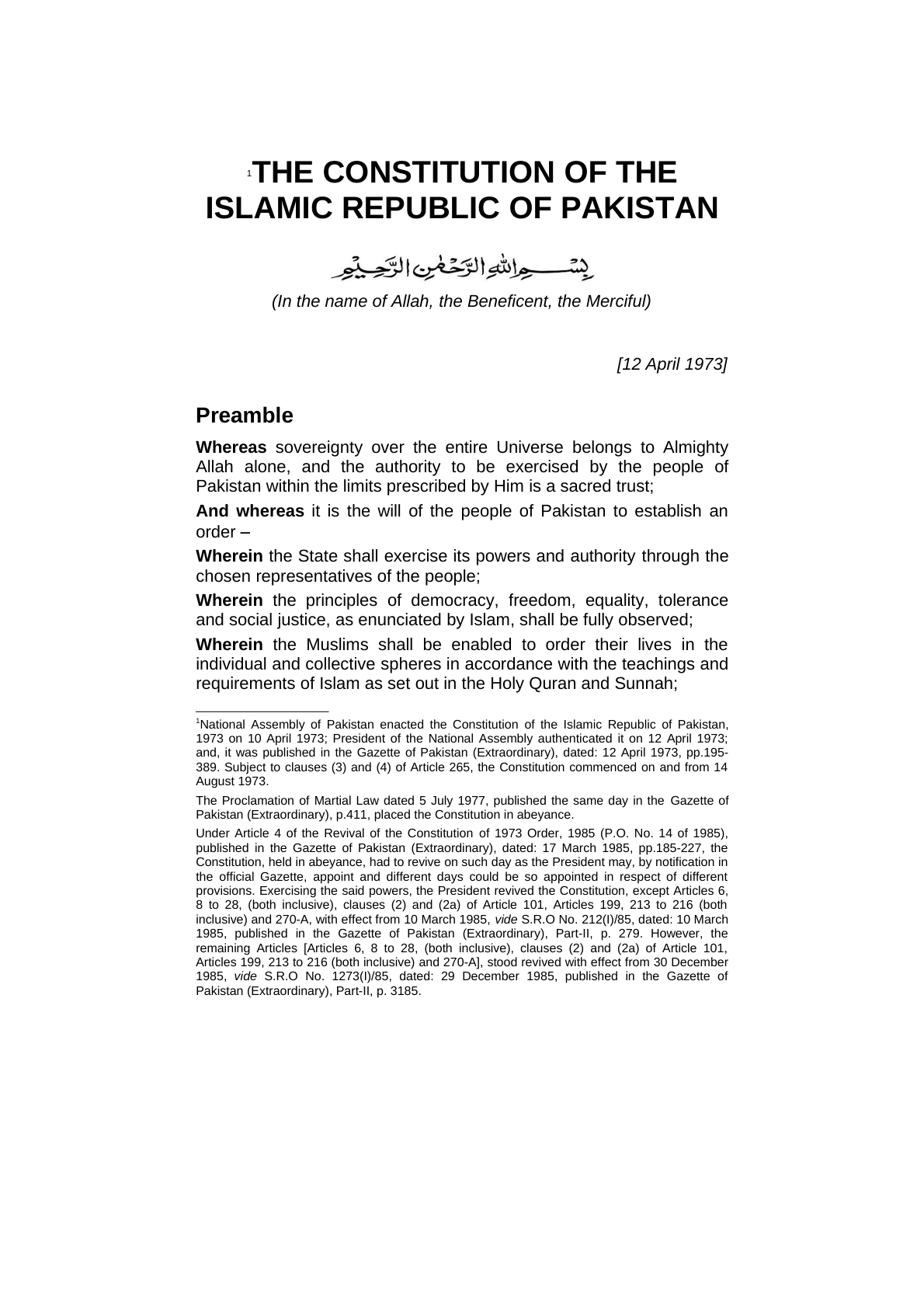
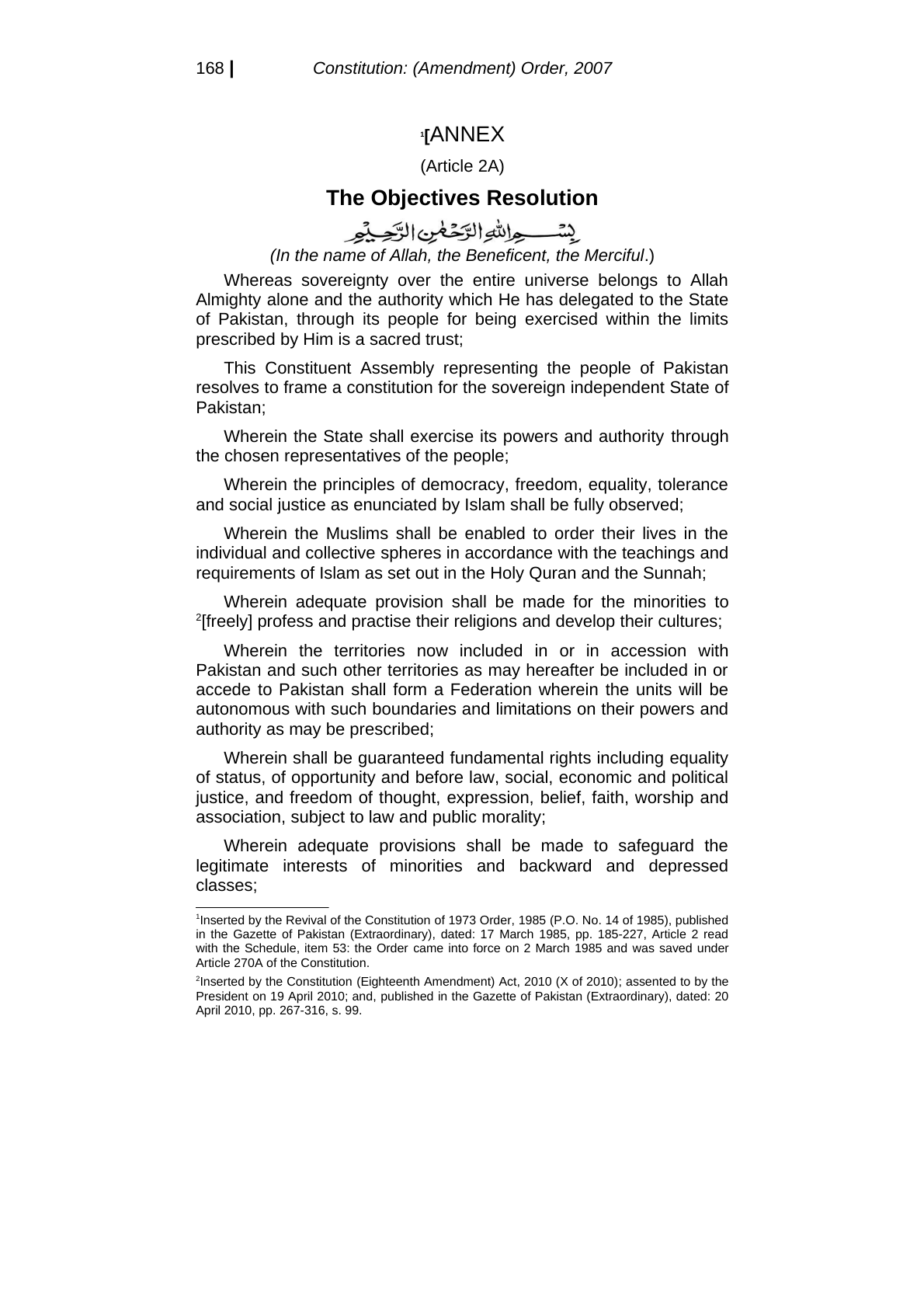
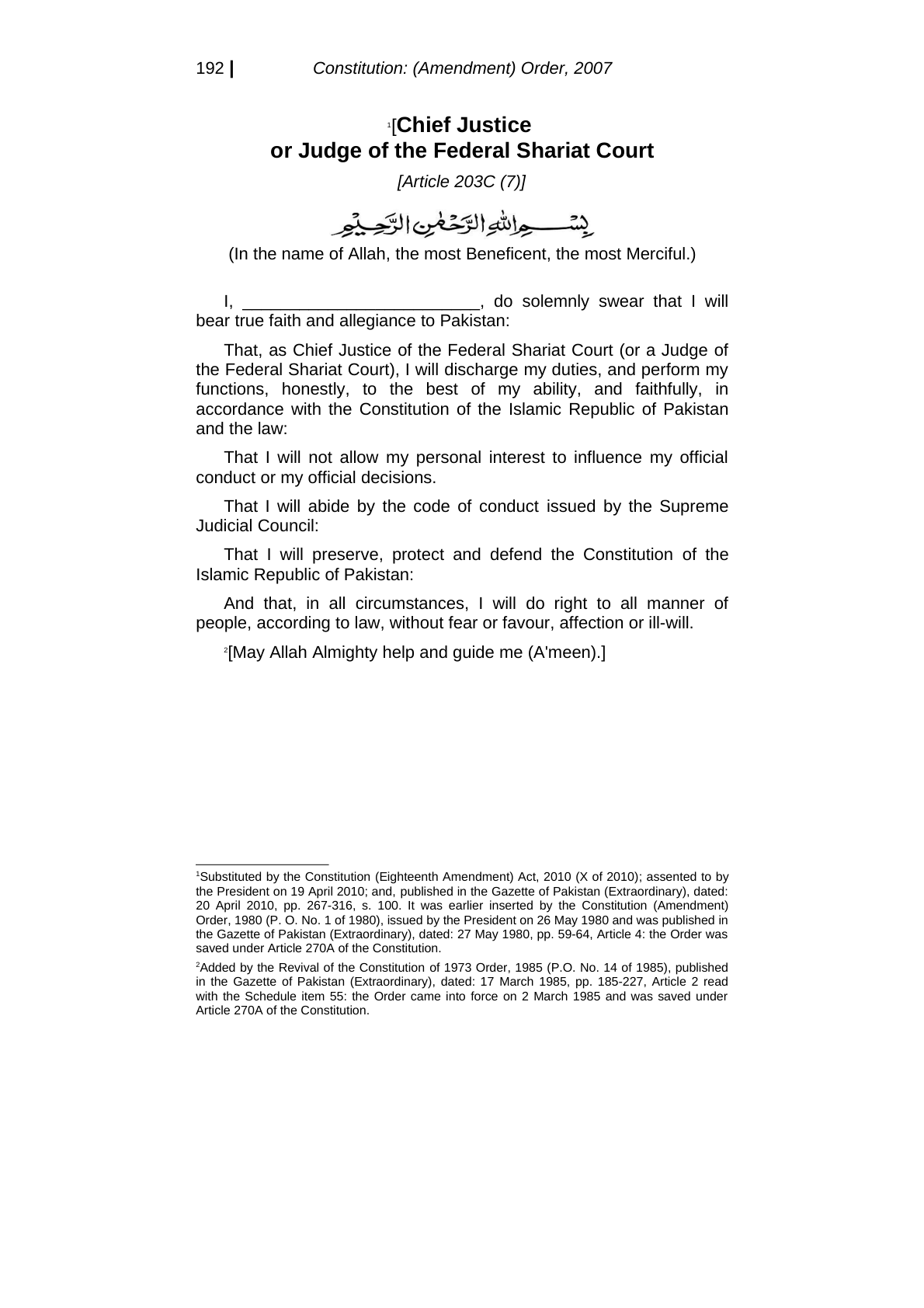
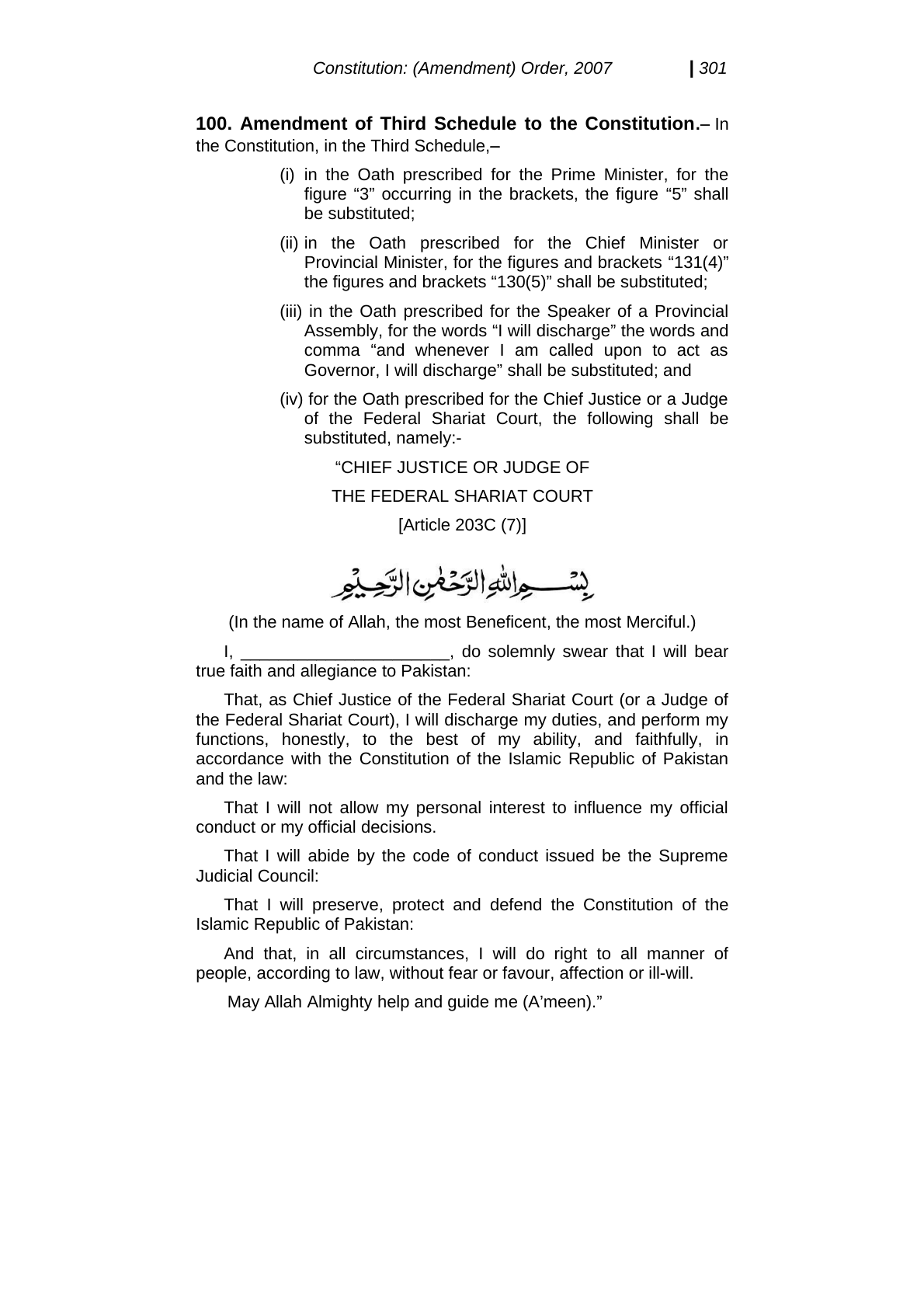
Original source and image integrity
Official original PDF source. Source PDF SHA-256: 63dfce34931493843637f9ab73871adf37761ad7530d463b5d658465f82a0b93.
Each selected page is rendered in full without clipping. The original file and every page image are hashed. The source-page review identifies graphic or form material; it does not establish a complete OCR transcription, amendment completeness or current force.
- Physical PDF page 1:
7903fae32c3c5365ada14a017c921a494e84408b3ab04d451fd5b989b7ee0ff5 - Physical PDF page 168:
119c5719f49d6324ee159c88783216cdf1a4387b487193a74368089f008aec81 - Physical PDF page 179:
25d10667ff033b9c46c45cdfc691ab3a328ca673c51bb687c1e56c4c2c122365 - Physical PDF page 180:
a28287ffa8a6d118d5ea7294a1e9ed2be6e9a24c8891cdf4691917c1b91ffa92 - Physical PDF page 192:
7433b4a314f212eaa22a16fd3d8f3841f9685440ef17a0e2db882faf4cfa6b9b - Physical PDF page 301:
2cfdfa9c616704fa06e71795a5aa46db9d02e4f898e911153ed684c918b61991
This law in the library
Follow the instruments and provisions named in this source edition, and the laws that cite it. Citation links identify the text being referred to; legal effect and current force require separate examination.
Instruments cited by this law 19
Laws that cite this instrument 19
References to provisions in this text 721
Article 265
An operative target heading has not been identified. Read the source passage
Read reference in context
enticated it on 12 April 1973; and, it was published in the Gazette of Pakistan (Extraordinary), dated: 12 April 1973, pp.195- 389. Subject to clauses (3) and (4) of Article 265, the Constitution commenced on and from 14 August 1973. The Proclamation of Martial Law dated 5 July 1977, published the same day in the Gazette of Pakistan (Extraordinary), p.411, placed the Constitution in abeyance. Un
Article 101
An operative target heading has not been identified. Read the source passage
Read reference in context
of different provisions. Exercising the said powers, the President revived the Constitution, except Articles 6, 8 to 28, (both inclusive), clauses (2) and (2a) of Article 101, Articles 199, 213 to 216 (both inclusive) and 270-A, with effect from 10 March 1985, vide S.R.O No. 212(I)/85, dated: 10 March 1985, published in the Gazette of Pakistan (Extraordinary), Part-II, p. 279. However,
Article 101
An operative target heading has not been identified. Read the source passage
Read reference in context
in the Gazette of Pakistan (Extraordinary), Part-II, p. 279. However, the remaining Articles [Articles 6, 8 to 28, (both inclusive), clauses (2) and (2a) of Article 101, Articles 199, 213 to 216 (both inclusive) and 270-A], stood revived with effect from 30 December 1985, vide S.R.O No. 1273(I)/85, dated: 29 December 1985, published in the Gazette of Pakistan (Extraordinary),
Article 2
An operative target heading has not been identified. Read the source passage
Read reference in context
the Revival of the Constitution of 1973 Order, 1985 (P.O. No.14 of 1985), published in the Gazette of Pakistan (Extraordinary), dated: 17 March 1985, pp.185-227, Article 2 read with the Schedule, item 1: the Order came into force on 2 March 1985 and was saved under Article 270A of the Constitution. 6Inserted ibid, item 2. 4 | Constitution: (Amendment) Order, 2007 (a) no action detrimental to
Article 2
An operative target heading has not been identified. Read the source passage
Read reference in context
by the Revival of the Constitution of 1973 Order, 1985 (P.O. No. 14 of 1985), published in the Gazette of Pakistan (Extraordinary), dated: 17 March 1985, pp.185- 227, Article 2 read with the Schedule, item 3: the Order came into force on 2 March 1985 and was saved under Article 270A of the Constitution. 2Substituted by the Constitution (Eighteenth Amendment) Act, 2010 (X of 2010); assented to by
Article 2
An operative target heading has not been identified. Read the source passage
Read reference in context
he Revival of the Constitution of 1973 Order, 1985 (P.O. No. 14 of 1985), published in the Gazette of Pakistan (Extraordinary), dated: 17 March 1985. pp. 185-227, Article 2 read with the Schedule, item 1: the Order came into force on 2 March 1985 and was saved under Article 270A of the Constitution. 6Substituted for the word “Parliament” by the Revival of the Constitution of 1973 Order, 1985
Article 2
An operative target heading has not been identified. Read the source passage
Read reference in context
Chapter: Provided that the appropriate Legislature may by resolution extend the said period of two years by a period not exceeding six months. 1985. pp. 185-227, Article 2 read with the Schedule, item 1: the Order came into force on 2 March 1985 and was saved under Article 270A of the Constitution. 1Substituted by the Constitution (Fourth Amendment) Act, 1975 (LXXI of 1975); assented to by
Article 2
An operative target heading has not been identified. Read the source passage
Read reference in context
he Revival of the Constitution of 1973 Order, 1985 (P.O. No. 14 of 1985), published in the Gazette of Pakistan (Extraordinary), dated: 17 March 1985. pp. 185-227, Article 2 read with the Schedule, item 1: the Order came into force on 2 March 1985 and was saved under Article 270A of the Constitution. 2Substituted for the words “one month” by the Constitution (Third Amendment) Act, 1975 (XXII of
Article 270
An operative target heading has not been identified. Read the source passage
Read reference in context
han, or of a kind different from, the penalty prescribed by law for that offence at the time the offence was committed. (2) Nothing in clause (1) or in Article 270 shall apply to any law making acts of abrogation or subversion of a Constitution in force in Pakistan at any time since the twenty-third day of March, one thousand nine hundred and fifty-six, an offence. 13. P
Article 253
An operative target heading has not been identified. Read the source passage
Read reference in context
ho, on account of unemployment, sickness, infirmity or old age, are unable to maintain themselves; or (f) any existing law or any law made in pursuance of Article 253. (4) The adequacy or otherwise of any compensation provided for by any such law as is referred to in this Article, or determined in pursuance thereof, shall not be called in question in any court. 25.Equality of citizens
Article 251
An operative target heading has not been identified. Read the source passage
Read reference in context
for a period not exceeding three years, prior to appointment under that Government or authority. 28.Preservation of language, script and culture .− Subject to Article 251 any section of citizens having a distinct language, script or culture shall have the right to preserve and promote the same and subject to law, establish institutions for that purpose. Chapter 2 Principles of Policy 29.Pr
Article 2
An operative target heading has not been identified. Read the source passage
Read reference in context
by the Revival of the Constitution of 1973 Order, 1985 (P.O. No. 14 of 1985), published in the Gazette of Pakistan (Extraordinary), dated: 17 March 1985, pp.185-227, Article 2 read with the Schedule, item 4: the Order came into force on 2 March 1985 and was saved under Article 270A of the Constitution. 2Substituted for the “full-stop” by the Constitution (Eighteenth Amendment) Act, 2010 (X of 2010)
Article 2
An operative target heading has not been identified. Read the source passage
Read reference in context
by the Revival of the Constitution of 1973 Order, 1985 (P.O. No.14 of 1985), published in the Gazette of Pakistan (Extraordinary), dated: 17 March1985, pp. 185-227, Article 2 read with the Schedule, item 5: the Order came into force on 2 March 1985 and was saved under Article 270A of the Constitution. Constitution: (Amendment) Order, 2007 | 15 32.Promotion of local Government institutions.−
Article 2
An operative target heading has not been identified. Read the source passage
Read reference in context
by the Revival of the Constitution of 1973 Order, 1985 (P.O. No. 14 of 1985), published in the Gazette of Pakistan (Extraordinary), dated: 17 March1985, pp. 185-227, Article 2 read with the Schedule, item 6: the Order came into force on 2 March 1985 and was saved under Article 270A of the Constitution. 2The expression “to be elected after the term specified in clause (7)” was omitted b
Article 2
An operative target heading has not been identified. Read the source passage
Read reference in context
the Revival of the Constitution of 1973 Order, 1985 (P.O. No. 14 of 1985), published in the Gazette of Pakistan (Extraordinary), dated: 17 March 1985, pp.185-227, Article 2 read with the Schedule, item 6: the Order came into force on 2 March 1985 and was saved under Article 270A of the Constitution. 2Ibid. The clause was earlier added by the Constitution (Seventeenth Amendment) Act, 2003 (III
Article 2
An operative target heading has not been identified. Read the source passage
Read reference in context
he Revival of the Constitution of 1973 Order, 1985 (P.O. No. 14 of 1985), published in the Gazette of Pakistan (Extraordinary), dated: 17 March 1985, pp. 185-227, Article 2 read with the Schedule, item 1: the Order came into force on 2 March 1985 and was saved under Article 270A of the Constitution. 5Ibid. 6Ibid. Constitution: (Amendment) Order, 2007 | 19 (2) Subject to the Constitution,
Article 2
An operative target heading has not been identified. Read the source passage
Read reference in context
the Revival of the Constitution of 1973 Order, 1985 (P.O. No. 14 of 1985), published in the Gazette of Pakistan (Extraordinary), dated: 17 March 1985, pp. 185-227, Article 2 read with the Schedule, item 7: the Order came into force on 2 March 1985 and was saved under Article 270A of the Constitution. 2Inserted by the Revival of the Constitution of 1973 Order, 1985 (P.O. No. 14 of 1985), published
Article 2
An operative target heading has not been identified. Read the source passage
Read reference in context
by the Revival of the Constitution of 1973 Order, 1985 (P.O. No. 14 of 1985), published in the Gazette of Pakistan (Extraordinary), dated: 17 March 1985, pp. 185-227, Article 2 read with the Schedule, item 8: the Order came into force on 2 March 1985 and was saved under Article 270A of the Constitution. 3Substituted ibid. 20 | Constitution: (Amendment) Order, 2007 (6) The joint sitting may inv
Article 2
An operative target heading has not been identified. Read the source passage
Read reference in context
the Revival of the Constitution of 1973 Order, 1985 (P.O. No. 14 of 1985), published in the Gazette of Pakistan (Extraordinary), dated: 17 March 1985, pp. 185-227, Article 2 read with the Schedule, item 1: the Order came into force on 2 March 1985 and was saved under Article 270A of the Constitution. 2Substituted ibid, item 9. 3Inserted by the Constitution (Eighteenth Amendment) Act, 2010 (X of
Article 224
An operative target heading has not been identified. Read the source passage
Read reference in context
e of the dissolution, for the holding of a general election to the Assembly; and (b) appoint a care-taker Cabinet 2[in accordance with the provisions of Article 224 or, as the case may be, Article 224A].] 3[(6) If at any time the Prime Minister considers it necessary to hold a referendum on any matter of national importance, he may refer the matter to a joint sitting of the Majlis-e
Article 224A
An operative target heading has not been identified. Read the source passage
Read reference in context
ding of a general election to the Assembly; and (b) appoint a care-taker Cabinet 2[in accordance with the provisions of Article 224 or, as the case may be, Article 224A].] 3[(6) If at any time the Prime Minister considers it necessary to hold a referendum on any matter of national importance, he may refer the matter to a joint sitting of the Majlis-e-Shoora (Parliament) and if it is app
Article 41
An operative target heading has not been identified. Read the source passage
Read reference in context
functions of the office of President, the Speaker of the National Assembly shall act as President until a President is elected in accordance with clause (3) of Article 41. (2) When the President, by reason of absence from Pakistan or any other cause, is unable to perform his functions, the Chairman or, if he too is absent or unable to perform the functions of the office of President, the
Article 2
An operative target heading has not been identified. Read the source passage
Read reference in context
he Revival of the Constitution of 1973 Order, 1985 (P.O. No. 14 of 1985), published in the Gazette of Pakistan (Extraordinary), dated: 17 March 1985, pp. 185-227, Article 2 read with the Schedule, item 1: the Order came into force on 2 March 1985 and was saved under Article 270A of the Constitution. 2Ibid. 3Substituted ibid, item 10. 4Substituted by the Constitution (Eighteenth Amendment) Act,
Article 54
An operative target heading has not been identified. Read the source passage
Read reference in context
ntion of the person presiding is drawn to the fact that less than one-fourth of the total membership of the Assembly is present, he 1Until 31 day of December 1973, Article 54 had effect as if the proviso to clause (2) thereof were omitted: see the Removal Difficulties (Sittings of National Assembly) Order, 1973 (P.O. No. 23 of 1973), published in the Gazette of Pakistan (Extraordinary), dated: 6
Article 2
An operative target heading has not been identified. Read the source passage
Read reference in context
ulties (Sittings of National Assembly) Order, 1973 (P.O. No. 23 of 1973), published in the Gazette of Pakistan (Extraordinary), dated: 6 November 1973, pp. 695- 696, Article 2. 2Substituted for the word “Parliament” by the Revival of the Constitution of 1973 Order, 1985 (P.O. No. 14 of 1985), published in the Gazette of Pakistan (Extraordinary), dated: 17 March 1985, pp. 185-227, Article 2 read
Article 2
An operative target heading has not been identified. Read the source passage
Read reference in context
he Revival of the Constitution of 1973 Order, 1985 (P.O. No. 14 of 1985), published in the Gazette of Pakistan (Extraordinary), dated: 17 March 1985, pp. 185-227, Article 2 read with the Schedule, item 1: the Order came into force on 2 March 1985 and was saved under Article 270A of the Constitution. 3Ibid. 4Substituted ibid, for the word “two”, item 12. 5Substituted for the word “sixty” by the
Article 2
An operative target heading has not been identified. Read the source passage
Read reference in context
by the Revival of the Constitution of 1973 Order, 1985 (P.O. No. 14 of 1985), published in the Gazette of Pakistan (Extraordinary), dated: 17 March 1985, pp.185-227, Article 2 read with the Schedule, item 12: the Order came into force on 2 March 1985 and was saved under Article 270A of the Constitution. 6Added by the Constitution (Fourth Amendment) Act, 1975 (LXXI of 1975); assented to by the P
Article 2
An operative target heading has not been identified. Read the source passage
Read reference in context
he Revival of the Constitution of 1973 Order, 1985 (P.O. No. 14 of 1985), published in the Gazette of Pakistan (Extraordinary), dated: 17 March 1985, pp. 185-227, Article 2 read with the Schedule, item 13: the Order came into force on 2 March 1985 and was saved under Article 270A of the Constitution. 2Added ibid. 3Substituted by the Constitution (Eighth Amendment) Act, 1985 (XVIII of 1985); as
Article 2
An operative target heading has not been identified. Read the source passage
Read reference in context
e Revival of the Constitution of 1973 Order, 1985 (P.O. No. 14 of 1985), published in the Gazette of Pakistan (Extraordinary), dated: 17 March 1985, pp. 185-227, Article 2 read with the Schedule, item 13: the Order came into force on 2 March 1985 and was saved under Article 270A of the Constitution. 4Added by the Revival of the Constitution of 1973 Order, 1985 (P.O. No. 14 of
Article 2
An operative target heading has not been identified. Read the source passage
Read reference in context
y the Revival of the Constitution of 1973 Order, 1985 (P.O. No. 14 of 1985), published in the Gazette of Pakistan (Extraordinary), dated: 17 March 1985, pp. 185-227, Article 2 read with the Schedule, item 13: the Order came into force on 2 March 1985 and was saved under Article 270A of the Constitution. 5Substituted for the word “Parliament” Added by the Revival of the Constitution of 1973 Orde
Article 2
An operative target heading has not been identified. Read the source passage
Read reference in context
he Revival of the Constitution of 1973 Order, 1985 (P.O. No. 14 of 1985), published in the Gazette of Pakistan (Extraordinary), dated: 17 March 1985, pp. 185-227, Article 2 read with the Schedule, item 1: the Order came into force on 2 March 1985 and was saved under Article 270A of the Constitution. Constitution: (Amendment) Order, 2007 | 27 1[58. Dissolution of the National Assembly .− (1) T
Article 48
An operative target heading has not been identified. Read the source passage
Read reference in context
d or who is continuing in office after his resignation or after the dissolution of the National Assembly. (2) Notwithstanding anything contained in clause (2) of Article 48, the President may also dissolve the National Assembly in his discretion where, a vote of no-confidence having been passed against the Prime Minister, no other member of the National Assembly commands
Article 53
An operative target heading has not been identified. Read the source passage
Read reference in context
n shall be 1[three] years from the day on which he enters upon his office. 61. Other provisions relating to Senate .− The provisions of clauses (2) to (7) of Article 53, clauses (2) and (3) of Article 54 and Article 55 shall apply to the Senate as they apply to the National Assembly and, in their application to the Senate, shall have effect as if references therein to the National Assemb
Article 54
An operative target heading has not been identified. Read the source passage
Read reference in context
he day on which he enters upon his office. 61. Other provisions relating to Senate .− The provisions of clauses (2) to (7) of Article 53, clauses (2) and (3) of Article 54 and Article 55 shall apply to the Senate as they apply to the National Assembly and, in their application to the Senate, shall have effect as if references therein to the National Assembly, Speaker and Deputy Speaker
Article 55
An operative target heading has not been identified. Read the source passage
Read reference in context
e enters upon his office. 61. Other provisions relating to Senate .− The provisions of clauses (2) to (7) of Article 53, clauses (2) and (3) of Article 54 and Article 55 shall apply to the Senate as they apply to the National Assembly and, in their application to the Senate, shall have effect as if references therein to the National Assembly, Speaker and Deputy Speaker were references
Article 54
An operative target heading has not been identified. Read the source passage
Read reference in context
eaker and Deputy Speaker were references, respectively, to the Senate, Chairman and Deputy Chairman 2[and as if, in the proviso to the said clause (2) of Article 54, for the words “ 3[one hundred and thirty]” the word “4[one hundred and ten]” were substituted]. Provisions as to Members of 5[Majlis-e-Shoora (Parliament)] 1Substituted for the word “two” by the Constitution (Eighth Amendm
Article 2
An operative target heading has not been identified. Read the source passage
Read reference in context
d by the Constitution (Third Amendment) Order, 1985 (P. O. No. 24 of 1985), dated: 19 March 1985, published in the Gazette of Pakistan (Extraordinary), pp.237-239, Article 2: the Order was saved under Article 270A of the Constitution. 4Substituted for the words “ninety” by the Constitution (Eighteenth Amendment) Act, 2010 (X of 2010); assented to by the President on 19 April 2010; and, published
Article 2
An operative target heading has not been identified. Read the source passage
Read reference in context
he Revival of the Constitution of 1973 Order, 1985 (P.O. No. 14 of 1985), published in the Gazette of Pakistan (Extraordinary), dated: 17 March 1985, pp. 185-227, Article 2 read with the Schedule, item 1: the Order came into force on 2 March 1985 and was saved under Article 270A of the Constitution. 30 | Constitution: (Amendment) Order, 2007 1[62. Qualifications for membership of Majlis-e
Article 2
An operative target heading has not been identified. Read the source passage
Read reference in context
the Revival of the Constitution of 1973 Order, 1985 (P.O. No. 14 of 1985), published in the Gazette of Pakistan (Extraordinary), dated: 17 March 1985, pp.185-227, Article 2 read with the Schedule, item 16: the Order came into force on 2 March 1985 and was saved under Article 270A of the Constitution. The colon at the end of clause (g) and the semi-colon at the end of sub-Article (2) were repla
Article 2
An operative target heading has not been identified. Read the source passage
Read reference in context
the Revival of the Constitution of 1973 Order, 1985 (P.O. No. 14 of 1985), published in the Gazette of Pakistan (Extraordinary), dated: 17 March 1985, pp. 185-227, Article 2 read with the Schedule, item 16: the Order came into force on 2 March 1985 and was saved under Article 270A of the Constitution. 32 | Constitution: (Amendment) Order, 2007 (j) he has been removed or compulsorily retire
Article 89
An operative target heading has not been identified. Read the source passage
Read reference in context
incial Assembly under any law for the time being inforce. Explanation.− For the purposes of this paragraph “law” shall not include an Ordinance promulgated under Article 89 or Article 128. (2) If any question arises whether a member of the Majlis-e- Shoora (Parliament) has become disqualified from being a member, the Speaker or, as the case may be, the Chairman shall, unless he dec
Article 128
An operative target heading has not been identified. Read the source passage
Read reference in context
nder any law for the time being inforce. Explanation.− For the purposes of this paragraph “law” shall not include an Ordinance promulgated under Article 89 or Article 128. (2) If any question arises whether a member of the Majlis-e- Shoora (Parliament) has become disqualified from being a member, the Speaker or, as the case may be, the Chairman shall, unless he decides that no su
Article 63A
An operative target heading has not been identified. Read the source passage
Read reference in context
residing Officer" means the Speaker of the National Assembly, the Chairman of the Senate or the Speaker of the Provincial Assembly, as the case may be. (8) Article 63A substituted as aforesaid shall come into effect from the next general elections to be held after the commencement of the Constitution (Eighteenth Amendment) Act, 2010: Provided that till Article 63A substituted as aforesa
Article 63A
An operative target heading has not been identified. Read the source passage
Read reference in context
shall come into effect from the next general elections to be held after the commencement of the Constitution (Eighteenth Amendment) Act, 2010: Provided that till Article 63A substituted as aforesaid comes into effect the provisions of existing Article 63A shall remain operative.] 64. Vacation of seats.− (1) A member of 1[Majlis-e-Shoora (Parliament)] may, by writing under his hand addressed
Article 63A
An operative target heading has not been identified. Read the source passage
Read reference in context
cement of the Constitution (Eighteenth Amendment) Act, 2010: Provided that till Article 63A substituted as aforesaid comes into effect the provisions of existing Article 63A shall remain operative.] 64. Vacation of seats.− (1) A member of 1[Majlis-e-Shoora (Parliament)] may, by writing under his hand addressed to the Speaker or, as the case may be, the Chairman resign his seat, and there
Article 2
An operative target heading has not been identified. Read the source passage
Read reference in context
he Revival of the Constitution of 1973 Order, 1985 (P.O. No. 14 of 1985), published in the Gazette of Pakistan (Extraordinary), dated: 17 March 1985, pp. 185-227, Article 2 read with the Schedule, item 1: the Order came into force on 2 March 1985 and was saved under Article 270A of the Constitution. 2Ibid. 3Ibid. 4Ibid. 5Substituted for the word “Parliament” by the Revival of the Constitutio
Article 2
An operative target heading has not been identified. Read the source passage
Read reference in context
he Revival of the Constitution of 1973 Order, 1985 (P.O. No. 14 of 1985), published in the Gazette of Pakistan (Extraordinary), dated: 17 March 1985, pp. 185-227, Article 2 read with the Schedule, item 1: the Order came into force on 2 March 1985 and was saved under Article 270A of the Constitution. 6Ibid. 36 | Constitution: (Amendment) Order, 2007 the members of 1[Majlis-e-Shoora (Parliament
Article 66
An operative target heading has not been identified. Read the source passage
Read reference in context
he jurisdiction of any court in respect of the exercise by him of those powers. (3) In this Article, “ 7[Majlis-e-Shoora (Parliament)]” has the same meaning as in Article 66. Legislative Procedure 8[70. Introduction and passing of Bills .− (1) A Bill with respect to any matter in the Federal Legislative List may originate in either House and shall, if it is passed by the House in wh
Article 2
An operative target heading has not been identified. Read the source passage
Read reference in context
he Revival of the Constitution of 1973 Order, 1985 (P.O. No. 14 of 1985), published in the Gazette of Pakistan (Extraordinary), dated: 17 March 1985, pp. 185-227, Article 2 read with the Schedule, item 1: the Order came into force on 2 March 1985 and was saved under Article 270A of the Constitution. 2Ibid. 3Ibid. 4Ibid. 5Ibid. 6Ibid. 7Ibid. 8Substituted by the Constitution (Eighteenth Am
Article 70
An operative target heading has not been identified. Read the source passage
Read reference in context
by the votes of the majority of the members present and voting. 73. Procedure with respect to Money Bills .− 3[(1) Notwithstanding anything contained in Article 70, a Money Bill shall originate in the National Assembly: Provided that simultaneously when a Money Bill, including the Finance Bill containing the Annual Budget Statement, is presented in the National Assembl
Article 10
An operative target heading has not been identified. Read the source passage
Read reference in context
Legal Framework Order, 2002 (Chief Executive’s Order No. 24 of 2002), published in the Gazette of Pakistan (Extraordinary), dated: 21 August 2002, pp.1031-1049, Article 10. The said Order was declared as without lawful authority and of no legal effect by Article 270AA of the Constitution. 2For the Parliament (Joint Sitting), Rules 1973, see Gazette of Pakistan (Extraordinary), Part-II, dat
Article 270A
An operative target heading has not been identified. Read the source passage
Read reference in context
f Pakistan (Extraordinary), dated: 21 August 2002, pp.1031-1049, Article 10. The said Order was declared as without lawful authority and of no legal effect by Article 270AA of the Constitution. 2For the Parliament (Joint Sitting), Rules 1973, see Gazette of Pakistan (Extraordinary), Part-II, dated: 8 August 1973, pp.1657-1672. 3Substituted by the Constitution (Eighteenth Amendment) Act, 2010 (
Article 2
An operative target heading has not been identified. Read the source passage
Read reference in context
he Revival of the Constitution of 1973 Order, 1985 (P.O. No. 14 of 1985), published in the Gazette of Pakistan (Extraordinary), dated: 17 March 1985, pp. 185-227, Article 2 read with the Schedule, item 1: the Order came into force on 2 March 1985 and was saved under Article 270A of the Constitution. 2Substituted ibid, item 19. 3Substituted for the word “thirty” by the Constitution (Eighteenth
Article 2
An operative target heading has not been identified. Read the source passage
Read reference in context
he Revival of the Constitution of 1973 Order, 1985 (P.O. No. 14 of 1985), published in the Gazette of Pakistan (Extraordinary), dated: 17 March 1985, pp. 185-227, Article 2 read with the Schedule, item 1: the Order came into force on 2 March 1985 and was saved under Article 270A of the Constitution. 2Substituted for the word “Parliament” by the Revival of the Constitution of 1973 Order, 1985
Article 2
An operative target heading has not been identified. Read the source passage
Read reference in context
he Revival of the Constitution of 1973 Order, 1985 (P.O. No. 14 of 1985), published in the Gazette of Pakistan (Extraordinary), dated: 17 March 1985, pp. 185-227, Article 2 read with the Schedule, item 1: the Order came into force on 2 March 1985 and was saved under Article 270A of the Constitution. 42 | Constitution: (Amendment) Order, 2007 National Assembly a statement of the estimated
Article 82
An operative target heading has not been identified. Read the source passage
Read reference in context
Prime Minister shall authenticate by his signature a schedule specifying − (a) the grants made or deemed to have been made by the National Assembly under Article 82, and (b) the several sums required to meet the expenditure charged upon the Federal Consolidated Fund but not exceeding, in the case of any sum, the sum shown in the statement previously laid before the National
Article 2
An operative target heading has not been identified. Read the source passage
Read reference in context
he Revival of the Constitution of 1973 Order, 1985 (P.O. No. 14 of 1985), published in the Gazette of Pakistan (Extraordinary), dated: 17 March 1985, pp. 185-227, Article 2 read with the Schedule, item 1: the Order came into force on 2 March 1985 and was saved under Article 270A of the Constitution. 44 | Constitution: (Amendment) Order, 2007 specified in the schedule so authenticated and such
Article 82
An operative target heading has not been identified. Read the source passage
Read reference in context
ce in respect of the estimated expenditure for a part of any financial year, not exceeding four months, pending completion of the procedure prescribed in Article 82 for the voting of such grant and the authentication of the schedule of authorized expenditure in accordance with the provisions of Article 83 in relation to the expenditure. 86. Power to authorize expenditur
Article 83
An operative target heading has not been identified. Read the source passage
Read reference in context
prescribed in Article 82 for the voting of such grant and the authentication of the schedule of authorized expenditure in accordance with the provisions of Article 83 in relation to the expenditure. 86. Power to authorize expenditure when Assembly stands dissolved.− Notwithstanding anything contained in the foregoing provisions relating to financial matters, at any time w
Article 82
An operative target heading has not been identified. Read the source passage
Read reference in context
in respect of the estimated expenditure for a period not exceeding four months in any financial year, pending completion of the procedure prescribed in Article 82 for the voting of grants and the authentication of the schedule of authorized expenditure in accordance with the provisions of Article 83 in relation to the expenditure. Constitution: (Amendment) Order,
Article 83
An operative target heading has not been identified. Read the source passage
Read reference in context
prescribed in Article 82 for the voting of grants and the authentication of the schedule of authorized expenditure in accordance with the provisions of Article 83 in relation to the expenditure. Constitution: (Amendment) Order, 2007 | 45 87. Secretariats 1[of] 2[Majlis-e-Shoora (Parliament)].− (1) Each House shall have a separate Secretariat: Provided that nothing in this
Article 2
An operative target heading has not been identified. Read the source passage
Read reference in context
he Revival of the Constitution of 1973 Order, 1985 (P.O. No. 14 of 1985), published in the Gazette of Pakistan (Extraordinary), dated: 17 March 1985, pp. 185-227, Article 2 read with the Schedule, item 1: the Order came into force on 2 March 1985 and was saved under Article 270A of the Constitution. 3Ibid. 4Ibid. 5For the National Assembly Secretariat (Recruitment) Rules, 1973, see the Gazett
Article 73
An operative target heading has not been identified. Read the source passage
Read reference in context
Ordinance − (a) shall be laid − (i) before the National Assembly if it 3[contains provisions dealing with all or any of the matters specified in clause (2) of Article 73], and shall stand repealed at the expiration of 4[one hundred and twenty days] from its promulgation or, if before the expiration of that period a resolution disapproving it is passed by the Assembly, upon the p
Article 2
An operative target heading has not been identified. Read the source passage
Read reference in context
he Revival of the Constitution of 1973 Order, 1985 (P.O. No. 14 of 1985), published in the Gazette of Pakistan (Extraordinary), dated: 17 March 1985, pp. 185-227, Article 2 read with the Schedule, item 1: the Order came into force on 2 March 1985 and was saved under Article 270A of the Constitution. 2Ibid. 3Substituted for the expression “is with respect to a mater in Part I of the Federal Leg
Article 2
An operative target heading has not been identified. Read the source passage
Read reference in context
tive List” by the Constitution (Second Amendment) Order,1985 (20 of 1985), published in the Gazette of Pakistan (Extraordinary), dated: 17 March 1985, pp. 181-183, Article 2: the Order was saved under Article 270A of the Constitution. 4Substituted for the words “four months” by the Constitution (Eighteenth Amendment) Act, 2010 (X of 2010); assented to by the President on 19 April 2010; and, p
Article 2
An operative target heading has not been identified. Read the source passage
Read reference in context
ve List” by the Constitution (Second Amendment) Order, 1985 (20 of 1985), published in the Gazette of Pakistan (Extraordinary), dated: 17 March 1985, pp. 181-183, Article 2: the Order was saved under Article 270A of the Constitution. 8Substituted for the words “four months” by the Constitution (Eighteenth Amendment) Act, 2010 (X of 2010); assented to by the President on 19 April 2010; and, publ
Article 2
An operative target heading has not been identified. Read the source passage
Read reference in context
the Revival of the Constitution of 1973 Order, 1985 (P.O. No. 14 of 1985), published in the Gazette of Pakistan (Extraordinary), dated: 17 March 1985, pp. 185-227, Article 2 read with the Schedule, item 20: the Order came into force on 2 March 1985 and was saved under Article 270A of the Constitution. The 48 | Constitution: (Amendment) Order, 2007 1[91. The Cabinet .− (1) There shall be a Ca
Article 91
An operative target heading has not been identified. Read the source passage
Read reference in context
ther Minister or a Minister of State during any such period.] 1[92. Federal Ministers and Ministers of State .− (1) Subject to clauses 2[(9) and (10)] of Article 91, the President shall appoint Federal Ministers and Ministers of State from amongst the members of Majlis-e-Shoora (Parliament) on the advice of the Prime Minister: Provided that the number of Federal Ministers and Mini
Article 2
An operative target heading has not been identified. Read the source passage
Read reference in context
by the Revival of the Constitution of 1973 Order, 1985 (P.O. No. 14 of 1985), published in the Gazette of Pakistan (Extraordinary), dated: 17 March 1985, pp.185-227, Article 2 read with the Schedule, item 20: the Order came into force on 2 March 1985 and was saved under Article 270A of the Constitution. 2Substituted for the expression “(7) and (8)” by the Constitution (Eighteenth Amendment) Act,
Article 57
An operative target heading has not been identified. Read the source passage
Read reference in context
dent may, on the advice of the Prime Minister, appoint not more than five Advisers, on such terms and conditions as he may determine. (2) The provisions of Article 57 shall also apply to an Adviser.] 2[94. Prime Minister continuing in office .− The President may ask the Prime Minister to continue to hold office until his successor enters upon the office of Prime Minister.] 3[95.
Article 2
An operative target heading has not been identified. Read the source passage
Read reference in context
y the Revival of the Constitution of 1973 Order, 1985 (P.O. No. 14 of 1985), published in the Gazette of Pakistan (Extraordinary), dated: 17 March 1985, pp. 185-227, Article 2 read with the Schedule, item 20: the Order came into force on 2 March 1985 and was saved under Article 270A of the Constitution. 2Ibid. 3Ibid. 4Omitted by the Revival of the Constitution of 1973 Order, 1985 (P.O. No. 14 of
Article 2
An operative target heading has not been identified. Read the source passage
Read reference in context
by the Revival of the Constitution of 1973 Order, 1985 (P.O. No. 14 of 1985), published in the Gazette of Pakistan (Extraordinary), dated: 17 March 1985, pp. 185-227, Article 2 read with the Schedule, item 20: the Order came into force on 2 March 1985 and was saved under Article 270A of the Constitution. 5Inserted by the Constitution (Seventh Amendment) Act, 1977 (XXIII of 1977); assented to by t
Article 2
An operative target heading has not been identified. Read the source passage
Read reference in context
the Revival of the Constitution of 1973 Order, 1985 (P.O. No. 14 of 1985), published in the Gazette of Pakistan (Extraordinary), dated: 17 March 1985, pp. 185-227 Article 2 read with the Schedule, item 1: the Order came into force on 2 March 1985 and was saved under Article 270A of the Constitution. Constitution: (Amendment) Order, 2007 | 51 has power to make laws, including exercise of rights,
Article 2
An operative target heading has not been identified. Read the source passage
Read reference in context
y the Revival of the Constitution of 1973 Order, 1985 (P.O. No. 14 of 1985), published in the Gazette of Pakistan (Extraordinary), dated: 17 March 1985, pp. 185-227, Article 2 read with the Schedule, item 22: the Order came into force on 2 March 1985 and was saved under Article 270A of the Constitution. 2Added by the Constitution (Eighth Amendment) Act, 1985 (XVIII of 1985); assented to by the
Article 2
An operative target heading has not been identified. Read the source passage
Read reference in context
he Revival of the Constitution of 1973 Order, 1985 (P.O. No. 14 of 1985), published in the Gazette of Pakistan (Extraordinary), dated: 17 March 1985, pp. 185-227, Article 2 read with the Schedule, item 1: the Order came into force on 2 March 1985 and was saved under Article 270A of the Constitution. 4Ibid. 5Ibid. 6Substituted by the Constitution (Eighteenth Amendment) Act, 2010 (X of 2010); as
Article 2
An operative target heading has not been identified. Read the source passage
Read reference in context
y the Revival of the Constitution of 1973 Order, 1985 (P.O. No. 14 of 1985), published in the Gazette of Pakistan (Extraordinary), dated: 17 March 1985, pp. 185-227, Article 2 read with the Schedule, item 23: the Order came into force on 2 March 1985 and was saved under Article 270A of the Constitution. 54 | Constitution: (Amendment) Order, 2007 act 1[on and] in accordance with the advice of the
Article 48
An operative target heading has not been identified. Read the source passage
Read reference in context
for the holding of a general election to the Assembly; and (b) appoint a care-taker Cabinet.] 9[(4) * * * * * * ] (5) The provisions of clause 10[(2)] of Article 48 shall have effect in relation to a Governor as if reference therein to "President" were reference to "Governor".] Chapter 2 Provincial Assemblies 1Inserted by the Constitution (Eighteenth Amendment) Act, 2010 (X
Article 2
An operative target heading has not been identified. Read the source passage
Read reference in context
y the Revival of the Constitution of 1973 Order, 1985 (P.O. No. 14 of 1985), published in the Gazette of Pakistan (Extraordinary), dated: 17 March 1985, pp. 185-227, Article 2 read with the Schedule, item 25: the Order came into force on 2 March 1985 and was saved under Article 270A of the Constitution. 58 | Constitution: (Amendment) Order, 2007 (a) for the imposition or alteration of any f
Article 2
An operative target heading has not been identified. Read the source passage
Read reference in context
y the Revival of the Constitution of 1973 Order, 1985 (P.O. No. 14 of 1985), published in the Gazette of Pakistan (Extraordinary), dated: 17 March 1985, pp. 185-227, Article 2 read with the Schedule, item 26: the Order came into force on 2 March 1985 and was saved under Article 270A of the Constitution. 2Substituted for the word “thirty” by the Constitution (Eighteenth Amendment) Act, 2010 (X of
Article 122
An operative target heading has not been identified. Read the source passage
Read reference in context
) The Chief Minister shall authenticate by his signature a schedule specifying − (a) the grants made or deemed to have been made by the Provincial Assembly under Article 122, and (b) the several sums required to meet the expenditure charged upon the Provincial Consolidated Fund but not exceeding, in the case of any sum, the sum shown in the statement previously laid before the Assembly. (2)
Article 122
An operative target heading has not been identified. Read the source passage
Read reference in context
pril 2010, pp. 267-316, s. 39. 62 | Constitution: (Amendment) Order, 2007 year, not exceeding three months, pending completion of the procedure prescribed in Article 122 for the voting of such grant and the authentication of the schedule of expenditure in accordance with the provisions of Article 123 in relation to the expenditure. 126. Power to authorize expenditure when As
Article 123
An operative target heading has not been identified. Read the source passage
Read reference in context
procedure prescribed in Article 122 for the voting of such grant and the authentication of the schedule of expenditure in accordance with the provisions of Article 123 in relation to the expenditure. 126. Power to authorize expenditure when Assembly stands dissolved .− Notwithstanding anything contained in the foregoing provisions relating to financial matters, at any time when
Article 122
An operative target heading has not been identified. Read the source passage
Read reference in context
idated Fund in respect of the estimated expenditure for a period not exceeding four months in any financial year, pending completion of the procedure prescribed in Article 122 for the voting of grants and the authentication of the schedule of authorized expenditure in accordance with the provisions of Article 123 in relation to the expenditure. 127. Provisions relating to National A
Article 123
An operative target heading has not been identified. Read the source passage
Read reference in context
dure prescribed in Article 122 for the voting of grants and the authentication of the schedule of authorized expenditure in accordance with the provisions of Article 123 in relation to the expenditure. 127. Provisions relating to National Assembly, etc., to apply to Provincial Assembly, etc .− Subject to the Constitution, the provisions of clauses (2) to (8) of Arti
Article 53
An operative target heading has not been identified. Read the source passage
Read reference in context
lating to National Assembly, etc., to apply to Provincial Assembly, etc .− Subject to the Constitution, the provisions of clauses (2) to (8) of Article 53, clauses (2) and (3) of Article 54, Article 55, Articles 63 to 67, Article 69, Article 77, Article 87 and Article 88 shall apply to and in relation to a Provincial Assembly or a committee or members thereof o
Article 54
An operative target heading has not been identified. Read the source passage
Read reference in context
to apply to Provincial Assembly, etc .− Subject to the Constitution, the provisions of clauses (2) to (8) of Article 53, clauses (2) and (3) of Article 54, Article 55, Articles 63 to 67, Article 69, Article 77, Article 87 and Article 88 shall apply to and in relation to a Provincial Assembly or a committee or members thereof or the Provincial Government, but so th
Article 55
An operative target heading has not been identified. Read the source passage
Read reference in context
to Provincial Assembly, etc .− Subject to the Constitution, the provisions of clauses (2) to (8) of Article 53, clauses (2) and (3) of Article 54, Article 55, Articles 63 to 67, Article 69, Article 77, Article 87 and Article 88 shall apply to and in relation to a Provincial Assembly or a committee or members thereof or the Provincial Government, but so that − (a) a
Article 69
An operative target heading has not been identified. Read the source passage
Read reference in context
Subject to the Constitution, the provisions of clauses (2) to (8) of Article 53, clauses (2) and (3) of Article 54, Article 55, Articles 63 to 67, Article 69, Article 77, Article 87 and Article 88 shall apply to and in relation to a Provincial Assembly or a committee or members thereof or the Provincial Government, but so that − (a) any reference in those provision
Article 77
An operative target heading has not been identified. Read the source passage
Read reference in context
the Constitution, the provisions of clauses (2) to (8) of Article 53, clauses (2) and (3) of Article 54, Article 55, Articles 63 to 67, Article 69, Article 77, Article 87 and Article 88 shall apply to and in relation to a Provincial Assembly or a committee or members thereof or the Provincial Government, but so that − (a) any reference in those provisions to 1[Maj
Article 87
An operative target heading has not been identified. Read the source passage
Read reference in context
stitution, the provisions of clauses (2) to (8) of Article 53, clauses (2) and (3) of Article 54, Article 55, Articles 63 to 67, Article 69, Article 77, Article 87 and Article 88 shall apply to and in relation to a Provincial Assembly or a committee or members thereof or the Provincial Government, but so that − (a) any reference in those provisions to 1[Majlis-e-Shoora
Article 88
An operative target heading has not been identified. Read the source passage
Read reference in context
provisions of clauses (2) to (8) of Article 53, clauses (2) and (3) of Article 54, Article 55, Articles 63 to 67, Article 69, Article 77, Article 87 and Article 88 shall apply to and in relation to a Provincial Assembly or a committee or members thereof or the Provincial Government, but so that − (a) any reference in those provisions to 1[Majlis-e-Shoora (Parliament)
Article 2
An operative target heading has not been identified. Read the source passage
Read reference in context
he Revival of the Constitution of 1973 Order, 1985 (P.O. No. 14 of 1985), published in the Gazette of Pakistan (Extraordinary), dated: 17 March 1985. pp. 185-227, Article 2 read with the Schedule, item 1: the Order came into force on 2 March 1985 and was saved under Article 270A of the Constitution. 2The word “and” was omitted by the Constitution (First Amendment) Act, 1974 (XXXIII of 1974);
Article 54
An operative target heading has not been identified. Read the source passage
Read reference in context
, pp. 179-182, s. 7. Constitution: (Amendment) Order, 2007 | 63 Assembly in existence immediately before the commencing day 1[; and] 2[(g) the said clause (2) of Article 54 shall have effect as if, in the proviso thereto, for the words "one hundred and thirty" the word “3[one hundred]” were substituted.] Ordinances 128. Power of Governor to promulgate Ordinances.− (1) The Governor may, exc
Article 2
An operative target heading has not been identified. Read the source passage
Read reference in context
the Revival of the Constitution of 1973 Order, 1985 (P.O. No. 14 of 1985), published in the Gazette of Pakistan (Extraordinary), dated: 17 March 1985, pp. 185-227, Article 2 read with the Schedule, item 27: the Order came into force on 2 March 1985 and was saved under Article 270A of the Constitution. 2Substituted by the Constitution (Eighteenth Amendment) Act, 2010 (X of 2010); assented to by
Article 2
An operative target heading has not been identified. Read the source passage
Read reference in context
the Revival of the Constitution of 1973 Order, 1985 (P.O. No. 14 of 1985), published in the Gazette of Pakistan (Extraordinary), dated: 17 March 1985, pp. 185-227, Article 2 read with the Schedule, item 27: the Order came into force on 2 March 1985 and was saved under Article 270A of the Constitution. The Constitution: (Amendment) Order, 2007 | 65 before entering upon the office, make before t
Article 2
An operative target heading has not been identified. Read the source passage
Read reference in context
the Revival of the Constitution of 1973 Order, 1985 (P.O. No. 14 of 1985), published in the Gazette of Pakistan (Extraordinary), dated: 17 March 1985, pp. 185-227, Article 2 read with the Schedule, item 27: the Order came into force on 2 March 1985 and was saved under Article 270A of the Constitution. 66 | Constitution: (Amendment) Order, 2007 1[132. Provincial Ministers.− (1) Subject to clau
Article 130
An operative target heading has not been identified. Read the source passage
Read reference in context
s saved under Article 270A of the Constitution. 66 | Constitution: (Amendment) Order, 2007 1[132. Provincial Ministers.− (1) Subject to clauses 2[(9) and (10)] of Article 130, the Governor shall appoint Provincial Ministers from amongst members of the Provincial Assembly on the advice of the Chief Minister. (2) Before entering upon office, a Provincial Minister shall make before the G
Article 2
An operative target heading has not been identified. Read the source passage
Read reference in context
y the Revival of the Constitution of 1973 Order, 1985 (P.O. No. 14 of 1985), published in the Gazette of Pakistan (Extraordinary), dated: 17 March 1985, pp. 185-227, Article 2 read with the Schedule, item 28: the Order came into force on 2 March 1985 and was saved under Article 270A of the Constitution. 2Substituted for the expression “(7) and (8)” by the Constitution (Eighteenth Amendment) Act,
Article 2
An operative target heading has not been identified. Read the source passage
Read reference in context
y the Revival of the Constitution of 1973 Order, 1985 (P.O. No. 14 of 1985), published in the Gazette of Pakistan (Extraordinary), dated: 17 March 1985, pp. 185-227, Article 2 read with the Schedule, item 28: the Order came into force on 2 March 1985 and was saved under Article 270A of the Constitution. 4Omitted ibid, item 29. 5Ibid. 6Substituted ibid, item 30. Constitution: (Amendment) Order, 2
Article 2
An operative target heading has not been identified. Read the source passage
Read reference in context
he Revival of the Constitution of 1973 Order, 1985 (P.O. No. 14 of 1985), published in the Gazette of Pakistan (Extraordinary), dated: 17 March 1985. pp. 185-227, Article 2 read with the Schedule, item 1: the Order came into force on 2 March 1985 and was saved under Article 270A of the Constitution.2Ibid. 3Substituted by the Revival of the Constitution of 1973 Order, 1985 (P.O. No. 14 of 1985),
Article 2
An operative target heading has not been identified. Read the source passage
Read reference in context
y the Revival of the Constitution of 1973 Order, 1985 (P.O. No. 14 of 1985), published in the Gazette of Pakistan (Extraordinary), dated: 17 March 1985. pp. 185-227, Article 2 read with the Schedule, item 31: the Order came into force on 2 March 1985 and was saved under Article 270A of the Constitution. 4Substituted for the word “Governor” by the Constitution (Eighteenth Amendment) Act, 2010 (X of
Article 3
An operative target heading has not been identified. Read the source passage
Read reference in context
ier inserted by the Legal Framework Order, 2002 (C.E.O. No. 24 0f 2002), published in the Gazette of Pakistan (Extraordinary), dated: 21 August 2002, pp. 1031- 1049, Article 3 read with the Schedule, item 16 but was declared void by the Constitution (Eighteenth Amendment) Act, 2010 (X of 2010); assented to by the President on 19 April 2010; and, published in the Gazette of Pakistan (Extraordinary
Article 2
An operative target heading has not been identified. Read the source passage
Read reference in context
he Revival of the Constitution of 1973 Order, 1985 (P.O. No. 14 of 1985), published in the Gazette of Pakistan (Extraordinary), dated: 17 March 1985, pp. 185-227, Article 2 read with the Schedule, item 1: the Order came into force on 2 March 1985 and was saved under Article 270A of the Constitution. 5Ibid. Constitution: (Amendment) Order, 2007 | 69 1[(b) Majlis-e-Shoora (Parliament) and a
Article 2
An operative target heading has not been identified. Read the source passage
Read reference in context
he Revival of the Constitution of 1973 Order, 1985 (P.O. No. 14 of 1985), published in the Gazette of Pakistan (Extraordinary), dated: 17 March 1985, pp. 185-227, Article 2 read with the Schedule, item 1: the Order came into force on 2 March 1985 and was saved under Article 270A of the Constitution. 6Substituted for the word “two” by the Constitution (Eighteenth Amendment) Act, 2010 (X of 2
Article 2
An operative target heading has not been identified. Read the source passage
Read reference in context
he Revival of the Constitution of 1973 Order, 1985 (P.O. No. 14 of 1985), published in the Gazette of Pakistan (Extraordinary), dated: 17 March 1985, pp. 185-227, Article 2 read with the Schedule, item 1: the Order came into force on 2 March 1985 and was saved under Article 270A of the Constitution. 9Substituted for the words “either List” by the Constitution (Eighteenth Amendment) Act, 2010 (
Article 105
An operative target heading has not been identified. Read the source passage
Read reference in context
ch functions relating to such areas in the Federation which are not included in any Province as may be specified in the direction. (2) The provisions of Article 105 shall not apply to the discharge by the Governor of his functions under clause (1). 146. Power of Federation to confer powers, etc., on Provinces, in certain cases .− (1) Notwithstanding anything contained
Article 2
An operative target heading has not been identified. Read the source passage
Read reference in context
he Revival of the Constitution of 1973 Order, 1985 (P.O. No. 14 of 1985), published in the Gazette of Pakistan (Extraordinary), dated: 17 March 1985, pp. 185-227, Article 2 read with the Schedule, item 1: the Order came into force on 2 March 1985 and was saved under Article 270A of the Constitution. 2Omitted by the Constitution (Eighth Amendment) Act, 1985 (XVIII of 1985); assented to by the
Article 2
An operative target heading has not been identified. Read the source passage
Read reference in context
he Revival of the Constitution of 1973 Order, 1985 (P.O. No. 14 of 1985), published in the Gazette of Pakistan (Extraordinary), dated: 17 March 1985, pp. 185-227, Article 2 read with the Schedule, item 1: the Order came into force on 2 March 1985 and was saved under Article 270A of the Constitution. Constitution: (Amendment) Order, 2007 | 71 determined by an arbitrator appointed by the Chief Ju
Article 2
An operative target heading has not been identified. Read the source passage
Read reference in context
he Revival of the Constitution of 1973 Order, 1985 (P.O. No. 14 of 1985), published in the Gazette of Pakistan (Extraordinary), dated: 17 March 1985, pp. 185-227, Article 2 read with the Schedule, item 1: the Order came into force on 2 March 1985 and was saved under Article 270A of the Constitution. 2Ibid. Constitution: (Amendment) Order, 2007 | 73 be determined by an arbitrator appoint
Article 3
An operative target heading has not been identified. Read the source passage
Read reference in context
rted by the Legal Framework Order, 2002 (CEO No. 24 of 2002), published the Gazette of Pakistan (Extraordinary), dated: 21 August 2002, pp. 1031-1049, Article 3 read with the Schedule, item 17. Before that It was inserted by the Revival of the Constitution of 1973 Order, 1985 (P.O. No. 14 of 1985), published in the Gazette of Pakistan (Extraordinary), dated: 17 March 1985, pp. 1
Article 2
An operative target heading has not been identified. Read the source passage
Read reference in context
the Revival of the Constitution of 1973 Order, 1985 (P.O. No. 14 of 1985), published in the Gazette of Pakistan (Extraordinary), dated: 17 March 1985, pp. 185-227, Article 2 read with Schedule, item 32: the Order came into force on 2 March 1985 and saved under Article 270A. It was omitted by the Constitution (Eighth Amendment) Act, 1985 (XVIII of 1985); assented to by the President on 9 Novemb
Article 270A
An operative target heading has not been identified. Read the source passage
Read reference in context
te of Pakistan (Extraordinary), dated: 17 March 1985, pp. 185-227, Article 2 read with Schedule, item 32: the Order came into force on 2 March 1985 and saved under Article 270A. It was omitted by the Constitution (Eighth Amendment) Act, 1985 (XVIII of 1985); assented to by the President on 9 November 1985; and, published in the Gazette of Pakistan (Extraordinary), dated: 11 November 1985, pp. 403-
Article 267B
An operative target heading has not been identified. Read the source passage
Read reference in context
f 1985); assented to by the President on 9 November 1985; and, published in the Gazette of Pakistan (Extraordinary), dated: 11 November 1985, pp. 403-410, s. 18. Under Article 267B, Article 152A shall be deemed always to have been so omitted: the said Article was inserted by the Constitution (Eighteenth Amendment) Act, 2010 (X of 2010); assented to by the President on 19 April 2010; and, published i
Article 152A
An operative target heading has not been identified. Read the source passage
Read reference in context
to by the President on 9 November 1985; and, published in the Gazette of Pakistan (Extraordinary), dated: 11 November 1985, pp. 403-410, s. 18. Under Article 267B, Article 152A shall be deemed always to have been so omitted: the said Article was inserted by the Constitution (Eighteenth Amendment) Act, 2010 (X of 2010); assented to by the President on 19 April 2010; and, published in the Gazette of
Article 2
An operative target heading has not been identified. Read the source passage
Read reference in context
he Revival of the Constitution of 1973 Order, 1985 (P.O. No. 14 of 1985), published in the Gazette of Pakistan (Extraordinary), dated: 17 March 1985, pp. 185-227, Article 2 read with the Schedule, item 1: the Order came into force on 2 March 1985 and was saved under Article 270A of the Constitution.5Added by the Constitution (Eighteenth Amendment) Act, 2010 (X of 2010); assented to by the Pre
Article 2
An operative target heading has not been identified. Read the source passage
Read reference in context
e Revival of the Constitution of 1973 Order, 1985 (P.O. No. 14 of 1985), published in the Gazette of Pakistan (Extraordinary), dated: 17 March 1985,. pp. 185-227, Article 2 read with the Schedule, item 1: the Order came into force on 2 March 1985 and was saved under Article 270A of the Constitution. 6Clause (4) was renumbered by the Constitution (Eighteenth Amendment) Act, 2010 (X of 2010); as
Article 2
An operative target heading has not been identified. Read the source passage
Read reference in context
he Revival of the Constitution of 1973 Order, 1985 (P.O. No. 14 of 1985), published in the Gazette of Pakistan (Extraordinary), dated: 17 March 1985, pp. 185-227, Article 2 read with the Schedule, item 1: the Order came into force on 2 March 1985 and was saved under Article 270A of the Constitution. 8Ibid. 9Clause (5) was renumbered by the Constitution (Eighteenth Amendment) Act, 2010 (X of 201
Article 154
An operative target heading has not been identified. Read the source passage
Read reference in context
l record its decision on all matters referred to the Commission. (5) Notwithstanding any law to the contrary, but subject to the provisions of clause (5) of Article 154, it shall be the duty of the Federal Government and the Provincial Government concerned in the 10Substituted for the word “Parliament” by the Revival of the Constitution of 1973 Order, 1985 (P.O. No. 14 of 1985), publi
Article 2
An operative target heading has not been identified. Read the source passage
Read reference in context
he Revival of the Constitution of 1973 Order, 1985 (P.O. No. 14 of 1985), published in the Gazette of Pakistan (Extraordinary), dated: 17 March 1985, pp. 185-227, Article 2 read with the Schedule, item 1: the Order came into force on 2 March 1985 and was saved under Article 270A of the Constitution. 1Inserted by the Constitution (Eighteenth Amendment) Act, 2010 (X of 2010); assented to by the
Article 2
An operative target heading has not been identified. Read the source passage
Read reference in context
the Revival of the Constitution of 1973 Order, 1985 (P.O. No. 14 of 1985), published in the Gazette of Pakistan (Extraordinary), dated: 17 March 1985, pp. 185-227 Article 2 read with the Schedule, item 1: the Order came into force on 2 March 1985 and was saved under Article 270A of the Constitution. 76 | Constitution: (Amendment) Order, 2007 matter in issue to give effect to the decision of the
Article 78
An operative target heading has not been identified. Read the source passage
Read reference in context
ause (3) which is to be allocated to each Province, and that share shall be paid to the Government of the Province concerned, and, notwithstanding the provision of Article 78 shall not form part of the Federal Consolidated Fund. (5) The recommendations of the National Finance Commission, together with an explanatory memorandum as to the action taken thereon, shall be laid before b
Article 2
An operative target heading has not been identified. Read the source passage
Read reference in context
he Revival of the Constitution of 1973 Order, 1985 (P.O. No. 14 of 1985), published in the Gazette of Pakistan (Extraordinary), dated: 17 March 1985, pp. 185-227, Article 2 read with the Schedule, item 1: the Order came into force on 2 March 1985 and was saved under Article 270A of the Constitution. 2Substituted by the Constitution (Fifth Amendment) Act, 1976 (LXII of 1976); assented to by the
Article 78
An operative target heading has not been identified. Read the source passage
Read reference in context
ance and such grants shall be charged upon the Federal Consolidated Fund. 161. Natural gas and hydro-electric power .− 1[(1) Notwithstanding the provisions of Article 78,− (a) the net proceeds of the Federal duty of excise on natural gas levied at well-head and collected by the Federal Government and of the royalty collected by the Federal Government, shall not form part of
Article 2
An operative target heading has not been identified. Read the source passage
Read reference in context
he Revival of the Constitution of 1973 Order, 1985 (P.O. No. 14 of 1985), published in the Gazette of Pakistan (Extraordinary), dated: 17 March 1985, pp. 185-227, Article 2 read with the Schedule, item 1: the Order came into force on 2 March 1985 and was saved under Article 270A of the Constitution. 2Ibid. 3Ibid. 4Ibid. 5Added by the Constitution (Amendment) Order, 1985 (P.O. No.11 of 1985)
Article 2
An operative target heading has not been identified. Read the source passage
Read reference in context
. 5Added by the Constitution (Amendment) Order, 1985 (P.O. No.11 of 1985), published in the Gazette of Pakistan (Extraordinary), dated: 24 February 1985, pp. 83-84, Article 2: the Order was saved under Article 270A of the Constitution. 6Substituted for the word “Parliament” by the Revival of the Constitution of 1973 Order, 1985 (P.O. No. 14 of 1985), published in the Gazette of Pakistan (Extra
Article 2
An operative target heading has not been identified. Read the source passage
Read reference in context
he Revival of the Constitution of 1973 Order, 1985 (P.O. No. 14 of 1985), published in the Gazette of Pakistan (Extraordinary), dated: 17 March 1985, pp. 185-227, Article 2 read with the Schedule, item 1: the Order came into force on 2 March 1985 and was saved under Article 270A of the Constitution. 82 | Constitution: (Amendment) Order, 2007 of doubt, it is hereby declared that 1[Majlis-
Article 166
An operative target heading has not been identified. Read the source passage
Read reference in context
e so fixed. (2) The Federal Government may, subject to such conditions, if any, as it may think fit to impose, make loans to, or so long as any limits fixed under Article 166 are not exceeded, give guarantees in respect of loans raised by, any Province, and any sums required for 1Ibid. 2Ibid. Constitution: (Amendment) Order, 2007 | 83 the purpose of making loans to a Province shall be charge
Article 2
An operative target heading has not been identified. Read the source passage
Read reference in context
he Revival of the Constitution of 1973 Order, 1985 (P.O. No. 14 of 1985), published in the Gazette of Pakistan (Extraordinary), dated: 17 March 1985, pp. 185-227, Article 2 read with the Schedule, item 1: the Order came into force on 2 March 1985 and was saved under Article 270A of the Constitution. 2The existing clause was renumbered by the Constitution (Eighteenth Amendment) Act, 2010 (X of
Article 2
An operative target heading has not been identified. Read the source passage
Read reference in context
he Revival of the Constitution of 1973 Order, 1985 (P.O. No. 14 of 1985), published in the Gazette of Pakistan (Extraordinary), dated: 17 March 1985, pp. 185-227, Article 2 and the Schedule, item 33: the Order came into force on 2 March 1985 and was saved under Article 270A of the Constitution. It was earlier substituted for the word “three” by the Constitution (Fifth Amendment) Act, 1976 (LXI
Article 68
An operative target heading has not been identified. Read the source passage
Read reference in context
rom any meeting thereof. 4[(15) The meetings of the Committee shall be held in camera and the record of its proceedings shall be maintained. (16) The provisions of Article 68 shall not apply to the proceedings of the Committee.] 5[(17)] The Committee may make rules for regulating its procedure.] Chapter 2 Supreme Court of Pakistan 176. Constitution of Supreme Court .− The Supreme Court sha
Article 175A
An operative target heading has not been identified. Read the source passage
Read reference in context
upreme Court Judges .− 2[(1) The Chief Justice of Pakistan and each of the other Judges of the Supreme Court shall be appointed by the President in accordance with Article 175A.] (2) A person shall not be appointed a Judge of the Supreme Court unless he is a citizen of Pakistan and − (a) has for a period of, or for periods aggregating, not less than five years been a judge of a High Court (includ
Article 2
An operative target heading has not been identified. Read the source passage
Read reference in context
he Revival of the Constitution of 1973 Order, 1985 (P.O. No. 14 of 1985), published in the Gazette of Pakistan (Extraordinary), dated: 17 March 1985, pp. 185-227, Article 2 read with the Schedule, item 1: the Order came into force on 2 March 1985 and was saved under Article 270A of the Constitution. 2Substituted by the Constitution (Eighteenth Amendment) Act, 2010 (X of 2010); assented to by
Article 2
An operative target heading has not been identified. Read the source passage
Read reference in context
Legal Framework Order (Amendment) Order, 2002 (CEO No. 29 of 2002), published in the Gazette of Pakistan (Extraordinary), dated: 9 October 2002, pp. 1295-1297, Article 2. The said Order was declared as without lawful authority and of no legal effect by Article 270AA, substituted by the Constitution (Eighteenth Amendment) Act, 2010 (X of 2010); assented to by the President on 1
Article 270A
An operative target heading has not been identified. Read the source passage
Read reference in context
f Pakistan (Extraordinary), dated: 9 October 2002, pp. 1295-1297, Article 2. The said Order was declared as without lawful authority and of no legal effect by Article 270AA, substituted by the Constitution (Eighteenth Amendment) Act, 2010 (X of 2010); assented to by the President on 19 April 2010; and, published in the Gazette of Pakistan (Extraordinary), dated: 20 April 2010, pp
Article 267B
An operative target heading has not been identified. Read the source passage
Read reference in context
); assented to by the President on 19 April 2010; and, published in the Gazette of Pakistan (Extraordinary), dated: 20 April 2010, pp. 267-316, s. 2. Under Article 267B, Article 179 shall be deemed always to have been so substituted: the said Article was inserted by the said Constitution (Eighteenth Amendment) Act, 2010 (X of 2010), s. 93. Constitution: (Amendment) Order, 2007 | 91 (b)
Article 179
An operative target heading has not been identified. Read the source passage
Read reference in context
to by the President on 19 April 2010; and, published in the Gazette of Pakistan (Extraordinary), dated: 20 April 2010, pp. 267-316, s. 2. Under Article 267B, Article 179 shall be deemed always to have been so substituted: the said Article was inserted by the said Constitution (Eighteenth Amendment) Act, 2010 (X of 2010), s. 93. Constitution: (Amendment) Order, 2007 | 91 (b) the Chief J
Article 177
An operative target heading has not been identified. Read the source passage
Read reference in context
f the Supreme Court is absent or is unable to perform the functions of his office due to any other cause, the President may, in the manner provided in clause (1) of Article 177, appoint a Judge of a High Court who is qualified for appointment as a Judge of the Supreme Court to act temporarily as a Judge of the Supreme Court. 2[Explanation.− In this clause, 'Judge of a High Court' includes a
Article 175A
An operative target heading has not been identified. Read the source passage
Read reference in context
rarily the number of Judges of the Supreme Court, the Chief Justice of Pakistan 3[, in consultation with the Judicial Commission as provided in clause (2) of Article 175A,] may, in writing, − (a) with the approval of the President, request any person who has held the office of a Judge of that Court and since 1Substituted for the words “one of the Judges of the Supreme Court who
Article 2
An operative target heading has not been identified. Read the source passage
Read reference in context
the Revival of the Constitution of 1973 Order, 1985 (P.O. No. 14 of 1985), published in the Gazette of Pakistan (Extraordinary), dated: 17 March 1985, pp. 185-227, Article 2 read with the Schedule: the Order came into force on 2 March 1985 and was saved under Article 270A of the Constitution. The words “the most senior of the other Judges of the Supreme Court” were substituted by the Constit
Article 2
An operative target heading has not been identified. Read the source passage
Read reference in context
s. 6. 2Added by the Constitution (Amendment) Order, 1982 (P.O. No. 2 of 1982), published in the Gazette of Pakistan (Extraordinary), dated: 28 February 1982, p. 3, Article 2. The Order was first validated under Article 270A, inserted by the by the Revival of the Constitution of 1973 Order, 1985 (P.O. No. 14 of 1985), published in the Gazette of Pakistan (Extraordinary), dated: 17 March 1985,
Article 270A
An operative target heading has not been identified. Read the source passage
Read reference in context
der, 1982 (P.O. No. 2 of 1982), published in the Gazette of Pakistan (Extraordinary), dated: 28 February 1982, p. 3, Article 2. The Order was first validated under Article 270A, inserted by the by the Revival of the Constitution of 1973 Order, 1985 (P.O. No. 14 of 1985), published in the Gazette of Pakistan (Extraordinary), dated: 17 March 1985, pp. 185-227, Article 2 read with the Schedule, item
Article 2
An operative target heading has not been identified. Read the source passage
Read reference in context
the Revival of the Constitution of 1973 Order, 1985 (P.O. No. 14 of 1985), published in the Gazette of Pakistan (Extraordinary), dated: 17 March 1985, pp. 185-227, Article 2 read with the Schedule, item 52: the Order came into force on 2 March 1985 and was saved under Article 270A of the Constitution. It was substituted by the Constitution (Eighth Amendment) Act, 1985 (XVIII of 1985) ; assented
Article 199
An operative target heading has not been identified. Read the source passage
Read reference in context
exercise of the jurisdiction conferred on it by clause (1), the Supreme Court shall pronounce declaratory judgments only. (3) Without prejudice to the provisions of Article 199, the Supreme Court shall, if it considers that a question of public importance with reference to the enforcement of any of the Fundamental Rights conferred by Chapter I of Part II is involved, have the power to m
Article 2
An operative target heading has not been identified. Read the source passage
Read reference in context
he Revival of the Constitution of 1973 Order, 1985 (P.O. No. 14 of 1985), published in the Gazette of Pakistan (Extraordinary), dated: 17 March 1985, pp. 185-227, Article 2 read with the Schedule, item 1: the Order came into force on 2 March 1985 and was saved under Article 270A of the Constitution. 2Inserted by the Revival of the Constitution of 1973 Order, 1985 (P.O. No. 14 of 1985), published
Article 2
An operative target heading has not been identified. Read the source passage
Read reference in context
by the Revival of the Constitution of 1973 Order, 1985 (P.O. No. 14 of 1985), published in the Gazette of Pakistan (Extraordinary), dated: 17 March 1985, pp. 185-227, Article 2 read with the Schedule, item 36: the Order came into force on 2 March 1985 and was saved under Article 270A of the Constitution. 94 | Constitution: (Amendment) Order, 2007 187. Issue and execution of processes of Supreme
Article 175
An operative target heading has not been identified. Read the source passage
Read reference in context
rticle 270A of the Constitution. 94 | Constitution: (Amendment) Order, 2007 187. Issue and execution of processes of Supreme Court .− (1) 1[Subject to clause (2) of Article 175, the] Supreme Court shall have power to issue such directions, orders or decrees as may be necessary for doing complete justice in any case or matter pending before it, including an order for the purpose of securing the
Article 2
An operative target heading has not been identified. Read the source passage
Read reference in context
he Revival of the Constitution of 1973 Order, 1985 (P.O. No. 14 of 1985), published in the Gazette of Pakistan (Extraordinary), dated: 17 March 1985, pp. 185-227, Article 2 read with the Schedule, item 1: the Order came into force on 2 March 1985 and was saved under Article 270A of the Constitution. The Constitution: (Amendment) Order, 2007 | 95 1[(2) The Sindh and Balochistan High Court shall
Article 175A
An operative target heading has not been identified. Read the source passage
Read reference in context
ce. 193. Appointment of High Court Judges.− 4[(1) The Chief Justice and each of other Judges of a High Court shall be appointed by the President in accordance with Article 175A.] (2) A person shall not be appointed a Judge of a High Court unless he is a citizen of Pakistan, is not less than 5[forty-five] years of age, and − (a) he has for a period of, or for periods aggregating, not le
Article 2
An operative target heading has not been identified. Read the source passage
Read reference in context
he Revival of the Constitution of 1973 Order, 1985 (P.O. No. 14 of 1985), published in the Gazette of Pakistan (Extraordinary), dated: 17 March 1985, pp. 185-227, Article 2 read with the Schedule, item 1: the Order came into force on 2 March 1985 and was saved under Article 270A of the Constitution. 4Substituted by the Constitution (Eighteenth Amendment) Act, 2010 (X of 2010); assented to by
Article 2
An operative target heading has not been identified. Read the source passage
Read reference in context
Legal Framework Order (Amendment) Order, 2002 (CEO No. 29 of 2002), published in the Gazette of Pakistan (Extraordinary), dated: 9 October 2002, pp. 1295-1297, Article 2. The said Order was declared as without lawful authority and of no legal effect by Article 270AA, substituted by the Constitution (Eighteenth Amendment) Act, 2010 (X of 2010); assented to by the President on 1
Article 270A
An operative target heading has not been identified. Read the source passage
Read reference in context
f Pakistan (Extraordinary), dated: 9 October 2002, pp. 1295-1297, Article 2. The said Order was declared as without lawful authority and of no legal effect by Article 270AA, substituted by the Constitution (Eighteenth Amendment) Act, 2010 (X of 2010); assented to by the President on 19 April 2010; and, published in the Gazette of Pakistan (Extraordinary), dated: 20 April 2010, pp
Article 267B
An operative target heading has not been identified. Read the source passage
Read reference in context
); assented to by the President on 19 April 2010; and, published in the Gazette of Pakistan (Extraordinary), dated: 20 April 2010, pp. 267-316, s. 2. Under Article 267B, Article 195 shall be deemed always to have been so substituted: the said Article was inserted by the said Constitution (Eighteenth Amendment) Act, 2010 (X of 2010), s. 93. Constitution: (Amendment) Order, 2007 | 97 (b)
Article 195
An operative target heading has not been identified. Read the source passage
Read reference in context
to by the President on 19 April 2010; and, published in the Gazette of Pakistan (Extraordinary), dated: 20 April 2010, pp. 267-316, s. 2. Under Article 267B, Article 195 shall be deemed always to have been so substituted: the said Article was inserted by the said Constitution (Eighteenth Amendment) Act, 2010 (X of 2010), s. 93. Constitution: (Amendment) Order, 2007 | 97 (b) the Chief Ju
Article 193
An operative target heading has not been identified. Read the source passage
Read reference in context
her cause; or (c) for any reason it is necessary to increase the number of Judges of a High Court, the President may, in the manner provided in clause (1) of Article 193, appoint a person qualified for appointment as a Judge of the High Court to be Additional Judge of the Court for such period as the President may determine, being a period not exceeding such period, if any, as may
Article 2
An operative target heading has not been identified. Read the source passage
Read reference in context
the Revival of the Constitution of 1973 Order, 1985 (P.O. No. 14 of 1985), published in the Gazette of Pakistan (Extraordinary), dated: 17 March 1985, pp. 185-227, Article 2 read with the Schedule, item 38: the Order came into force on 2 March 1985 and was saved under Article 270A of the Constitution. Earlier, the original words “the most senior of the other Judges of the High C
Article 2
An operative target heading has not been identified. Read the source passage
Read reference in context
he Revival of the Constitution of 1973 Order, 1985 (P.O. No. 14 of 1985), published in the Gazette of Pakistan (Extraordinary), dated: 17 March 1985, pp. 185-227, Article 2 read with the Schedule, item 39: the Order came into force on 2 March 1985 and was saved under Article 270A of the Constitution. 3Inserted by the Constitution (Eighteenth Amendment) Act, 2010 (X of 2010); assented to by the
Article 2
An operative target heading has not been identified. Read the source passage
Read reference in context
y the Revival of the Constitution of 1973 Order, 1985 (P.O. No. 14 of 1985), published in the Gazette of Pakistan (Extraordinary), dated: 17 March 1985, pp. 185-227, Article 2 read with the Schedule, item 39: the Order came into force on 2 March 1985 and was saved under Article 270A of the Constitution. 98 | Constitution: (Amendment) Order, 2007 (3) The Lahore High Court shall have a Ben
Article 2
An operative target heading has not been identified. Read the source passage
Read reference in context
by the Revival of the Constitution of 1973 Order, 1985 (P.O. No. 14 of 1985), published in the Gazette of Pakistan (Extraordinary), dated: 17 March 1985, pp. 185-227, Article 2 read with the Schedule, item 40: the Order came into force on 2 March 1985 and was saved under Article 270A of the Constitution. Clause (3A) was inserted by the Constitution (Fourth Amendment) Act, 1975 (LXXI o
Article 2
An operative target heading has not been identified. Read the source passage
Read reference in context
dment) Order, 1980 (I of 1980), issued by the President on 26 May 1980 and was published in the Gazette of Pakistan (Extraordinary), dated: 27 May 1980, pp. 59-64, Article 2. 100 | Constitution: (Amendment) Order, 2007 (b) the making of an interim order would have the effect of prejudicing or interfering with the carrying out of a public work or of otherwise being harmful to the public intere
Article 3
An operative target heading has not been identified. Read the source passage
Read reference in context
as omitted by the Legal Framework Order, 2002 (C.E. No. 24 of 2002 , published in the Gazette of Pakistan (Extraordinary), dated: 21 August 2002, pp. 1031-1049, Article 3 read with the Schedule, item 18. The said Order was declared as without lawful authority and of no legal effect by Article 270AA: it was substituted by the Constitution (Eighteenth Amendment) Act, 2010 (X o
Article 270A
An operative target heading has not been identified. Read the source passage
Read reference in context
August 2002, pp. 1031-1049, Article 3 read with the Schedule, item 18. The said Order was declared as without lawful authority and of no legal effect by Article 270AA: it was substituted by the Constitution (Eighteenth Amendment) Act, 2010 (X of 2010) ; assented to by the President on 19 April 2010; and, published in the Gazette of Pakistan (Extraordinary), dated: 20 April 2010, pp
Article 2
An operative target heading has not been identified. Read the source passage
Read reference in context
the Revival of the Constitution of 1973 Order, 1985 (P.O. No. 14 of 1985), published in the Gazette of Pakistan (Extraordinary), dated: 17 March 1985, pp. 185-227, Article 2 read with the Schedule, item 40: the Order came into force on 2 March 1985 and was saved under Article 270A of the Constitution. Constitution: (Amendment) Order, 2007 | 101 "person" includes any body politic or corporate, any
Article 196
An operative target heading has not been identified. Read the source passage
Read reference in context
me being acting as Chief Justice of a High Court other than a Judge of the Supreme Court acting as such in pursuance of a request made under paragraph (b) of Article 196].] 5[(2) Where a Judge is so transferred or is appointed to an office other than that of Judge at a place other than the principal seat of the High Court, he shall, during the period for which he serves as a Judge of th
Article 3
An operative target heading has not been identified. Read the source passage
Read reference in context
ded by the Constitution (Third Amendment) Order, 1985 (P. O. No. 24 of 1985), published in the Gazette of Pakistan (Extraordinary), dated: 19 March 1985, pp. 237-239, Article 3: the Order was saved under Article 270A of the Constitution. 5Substituted by the Revival of the Constitution of 1973 Order, 1985 (P.O. No. 14 of 1985), published in the Gazette of Pakistan (Extraordinary), dated: 17 March
Article 2
An operative target heading has not been identified. Read the source passage
Read reference in context
y the Revival of the Constitution of 1973 Order, 1985 (P.O. No. 14 of 1985), published in the Gazette of Pakistan (Extraordinary), dated: 17 March 1985, pp. 185-227, Article 2 read with the Schedule, item 41: the Order came into force on 2 March 1985 and was saved under Article 270A of the Constitution. 102 | Constitution: (Amendment) Order, 2007 be entitled to such allowances and privileges, in ad
Article 189
An operative target heading has not been identified. Read the source passage
Read reference in context
icle, "High Court" includes a Bench of a High Court.] 3[(4) * * * * * * * ] 201. Decision of High Court binding on subordinate courts .− Subject to Article 189, any decision of a High Court shall, to the extent that it decides a question of law or is based upon or enunciates a principle of law, be binding on all courts subordinate to it. 202. Rules of procedure .− Subject to the
Article 2
An operative target heading has not been identified. Read the source passage
Read reference in context
y the Revival of the Constitution of 1973 Order, 1985 (P.O. No. 14 of 1985), published in the Gazette of Pakistan (Extraordinary), dated: 17 March 1985, pp. 185-227, Article 2 read with the Schedule, item 41: the Order came into force on 2 March 1985 and was saved under Article 270A of the Constitution. 3Omitted by the Constitution (Eighteenth Amendment) Act, 2010 (X of 2010) ; assented to by the
Article 3
An operative target heading has not been identified. Read the source passage
Read reference in context
he Constitution (Third Amendment) Order, 1985 (P. O. No. 24 of 1985), published in the Gazette of Pakistan (Extraordinary), dated: 19 March 1985, pp. 237-239, Article 3: the Order was saved under Article 270A of the Constitution. 4Substituted by the Constitution (Amendment) Order, 1980 (P. O. No. 1 of 1980), issued by the President on 26 May 1980 and was published in the Gazette
Article 3
An operative target heading has not been identified. Read the source passage
Read reference in context
er, 1980 (P. O. No. 1 of 1980), issued by the President on 26 May 1980 and was published in the Gazette of Pakistan (Extraordinary), dated: 27 May 1980, pp. 59-64, Article 3. It was originally inserted by the Constitution (Amendment) Order, 1979 (P.O. No. 3 of 1979), published in the Gazette of Pakistan (Extraordinary), dated: 7 February 1979, pp. 29-32, Article 2: it came into force on 10 Febr
Article 2
An operative target heading has not been identified. Read the source passage
Read reference in context
inserted by the Constitution (Amendment) Order, 1979 (P.O. No. 3 of 1979), published in the Gazette of Pakistan (Extraordinary), dated: 7 February 1979, pp. 29-32, Article 2: it came into force on 10 February 1979, Article 1(2). Both the Orders were saved under Article 270A of the Constitution. Constitution: (Amendment) Order, 2007 | 103 203A. Provisions of Chapter to override other provisions of
Article 1(2)
An operative target heading has not been identified. Read the source passage
Read reference in context
1979 (P.O. No. 3 of 1979), published in the Gazette of Pakistan (Extraordinary), dated: 7 February 1979, pp. 29-32, Article 2: it came into force on 10 February 1979, Article 1(2). Both the Orders were saved under Article 270A of the Constitution. Constitution: (Amendment) Order, 2007 | 103 203A. Provisions of Chapter to override other provisions of Constitution.− The provisions of this Chapter
Article 203C
An operative target heading has not been identified. Read the source passage
Read reference in context
n the subject or context,− 1[(a) ‘Chief Justice’ means Chief Justice of the Court;] (b) "Court" means the Federal Shariat Court constituted in pursuance of Article 203C; 2[(bb) ‘Judge’ means Judge of the Court;] (c) "law" includes any custom or usage having the force of law but does 3[not] include the Constitution , Muslim personal law, any law relating to the procedure of any
Article 2
An operative target heading has not been identified. Read the source passage
Read reference in context
o. 5 of 1982), issued by the President on 22 March 1982 and was published in the Gazette of Pakistan (Extraordinary), dated: 25 March 1982, pp. 19-21, Article 2: the Order was saved under Article 270A of the Constitution. 2Inserted by the Constitution (Second Amendment) Order, 1982 (P. O. No. 5 of 1982), issued by the President on 22 March 1982 and was published in the Gazette of
Article 2
An operative target heading has not been identified. Read the source passage
Read reference in context
1982 (P. O. No. 5 of 1982), issued by the President on 22 March 1982 and was published in the Gazette of Pakistan (Extraordinary), dated: 25 March 1982, pp. 19-21, Article 2: the Order was saved under Article 270A of the Constitution. 3The word “not” has been added during editing in the light of the import of the text. 4Substituted for the word “five” by the Revival of the Constitution of 1973
Article 2
An operative target heading has not been identified. Read the source passage
Read reference in context
he Revival of the Constitution of 1973 Order, 1985 (P.O. No. 14 of 1985), published in the Gazette of Pakistan (Extraordinary), dated: 17 March 1985, pp. 185-227, Article 2 read with the Schedule, item 42: the Order came into force on 2 March 1985. The word “four” was substituted by the Constitution (Second Amendment) Order, 1984 (P. O. No. 2 of 1984), published in the Gazette of Pakistan (Ext
Article 2
An operative target heading has not been identified. Read the source passage
Read reference in context
ed by the Constitution (Second Amendment) Order, 1984 (P. O. No. 2 of 1984), published in the Gazette of Pakistan (Extraordinary), dated: 26 April 1984, pp. 71-72, Article 2. The word “three” was substituted by Constitution (Second Amendment) Order, 1983 (P. O. No. 7 of 1983), published in the Gazette of Pakistan (Extraordinary), dated: 19 May 1983, p. 87, Article 2: the said three Orders were
Article 2
An operative target heading has not been identified. Read the source passage
Read reference in context
substituted by Constitution (Second Amendment) Order, 1983 (P. O. No. 7 of 1983), published in the Gazette of Pakistan (Extraordinary), dated: 19 May 1983, p. 87, Article 2: the said three Orders were saved under Article 270A of the Constitution. 5Omitted by the Constitution (Second Amendment) Order, 1982 (P. O. No. 5 of 1982), issued by the President on 22 March 1982 and was published in the Ga
Article 2
An operative target heading has not been identified. Read the source passage
Read reference in context
1982 (P. O. No. 5 of 1982), issued by the President on 22 March 1982 and was published in the Gazette of Pakistan (Extraordinary), dated: 25 March 1982, pp. 19-21, Article 2: the Order was saved under Article 270A of the Constitution. 104 | Constitution: (Amendment) Order, 2007 1[(2) The Court shall consist of not more than eight Muslim 2[Judges], including the 3[Chief Justice], to be appoi
Article 175A
An operative target heading has not been identified. Read the source passage
Read reference in context
2007 1[(2) The Court shall consist of not more than eight Muslim 2[Judges], including the 3[Chief Justice], to be appointed by the President 4[in accordance with Article 175A].] 5[(3) The Chief Justice shall be a person who is, or has been, or is qualified to be, a Judge of the Supreme Court or who is or has been a permanent Judge of a High Court. (3A) Of the Judges, not more than four shall
Article 2
An operative target heading has not been identified. Read the source passage
Read reference in context
d by the Constitution (Second Amendment) Order, 1981 (P.O. No. 7 of 1981), published in the Gazette of Pakistan (Extraordinary), dated: 27 May 1981, p. 107, Article 2: the Order was saved under Article 270A of the Constitution. 2Substituted for the word “members” by the Constitution (Second Amendment) Order, 1982 (P. O. No. 5 of 1982), issued by the President on 22 March 1982 and was p
Article 3
An operative target heading has not been identified. Read the source passage
Read reference in context
1982 (P. O. No. 5 of 1982), issued by the President on 22 March 1982 and was published in the Gazette of Pakistan (Extraordinary), dated: 25 March 1982, pp. 19-21, Article 3: the Order was saved under Article 270A of the Constitution. 3Substituted ibid, for the word “Chairman”. 4Inserted by the Constitution (Eighteenth Amendment) Act, 2010 (X of 2010) ; assented to by the President on 19 April
Article 4
An operative target heading has not been identified. Read the source passage
Read reference in context
e Constitution (Third Amendment) Order, 1985 (P. O. No. 24 of 1985), published in the Gazette of Pakistan (Extraordinary), dated: 19 March 1985, pp. 237-239, Article 4: the Order was saved under Article 270A of the Constitution. 6Substituted for the words “who are well-versed in Islamic law” by the Constitution (Eighteenth Amendment) Act, 2010 (X of 2010); assented to by the Presi
Article 3
An operative target heading has not been identified. Read the source passage
Read reference in context
1982 (P. O. No. 5 of 1982), issued by the President on 22 March 1982 and was published in the Gazette of Pakistan (Extraordinary), dated: 25 March 1982, pp. 19-21, Article 3: the Order was saved under Article 270A of the Constitution. 8Substituted ibid, for the word “member”. 9Ibid. 10The words “for a period exceeding two years” were omitted by the Constitution (Eighteenth Amendment) Act,
Article 2
An operative target heading has not been identified. Read the source passage
Read reference in context
erted by the Constitution (Second Amendment) Order, 1980 (P. O. No. 4 of 1980), published in the Gazette of Pakistan (Extraordinary), dated: 21 June 1980, pp. 107-108, Article 2. Constitution: (Amendment) Order, 2007 | 105 1[(4A) The 2[Chief Justice], if he is not a Judge of the Supreme Court, and a 3[Judge] who is not a Judge of a High Court, may, by writing under his hand addressed to the Pre
Article 3
An operative target heading has not been identified. Read the source passage
Read reference in context
l appoint another person qualified for the purpose to act as 12[Chief Justice] or, as the case may be, 13[Judge]. 1Ibid. 2Substituted ibid, for the word “Chairman”, Article 3. 3Substituted ibid, for the word “member”. 4Substituted by the Constitution (Eighteenth Amendment) Act, 2010 (X of 2010) ; assented to by the President on 19 April 2010; and, published in the Gazette of Pakistan (Extraordinar
Article 2
An operative target heading has not been identified. Read the source passage
Read reference in context
the Revival of the Constitution of 1973 Order, 1985 (P.O. No. 14 of 1985), published in the Gazette of Pakistan (Extraordinary), dated: 17 March 1985, pp. 185-227, Article 2 read with the Schedule, item 43: the Order came into force on 2 March 1985 and was saved under Article 270A of the Constitution. 5Omitted ibid. It was earlier inserted by the Revival of the Constitution of 1973 Order, 1985 (P.
Article 2
An operative target heading has not been identified. Read the source passage
Read reference in context
the Revival of the Constitution of 1973 Order, 1985 (P.O. No. 14 of 1985), published in the Gazette of Pakistan (Extraordinary), dated: 17 March 1985, pp. 185-227, Article 2 read with the Schedule, item 43: the Order came into force on 2 March 1985 and was saved under Article 270A of the Constitution. 6Omitted by the Constitution (Eighteenth Amendment) Act, 2010 (X of 2010) ; assented to by the
Article 3
An operative target heading has not been identified. Read the source passage
Read reference in context
1982 (P. O. No. 5 of 1982), issued by the President on 22 March 1982 and was published in the Gazette of Pakistan (Extraordinary), dated: 25 March 1982, pp. 19-21, Article 3: the Order was saved under Article 270A of the Constitution. 8Ibid. 9Ibid, for the word “member”. 10Ibid, for the word “Chairman”. 11Ibid, for the word “member”. 12Ibid, for the word “Chairman”. 13Ibid, for the word “mem
Article 3
An operative target heading has not been identified. Read the source passage
Read reference in context
. 2Omitted by the Constitution (Second Amendment) Order, 1981 (P. O. No. 7 of 1981), published in the Gazette of Pakistan (Extraordinary), dated: 27 May 1981, p. 107, Article 3. It was earlier inserted by the Constitution (Amendment) Order, 1981 (P. O. No. 5 of 1981), published in the Gazette of Pakistan (Extraordinary), dated: 13 April 1981, pp. 73-74, Article 2: both the Orders were saved un
Article 2
An operative target heading has not been identified. Read the source passage
Read reference in context
inserted by the Constitution (Amendment) Order, 1981 (P. O. No. 5 of 1981), published in the Gazette of Pakistan (Extraordinary), dated: 13 April 1981, pp. 73-74, Article 2: both the Orders were saved under Article 270A of the Constitution. 3Inserted by the Constitution (Second Amendment) Order, 1982 (P. O. No. 5 of 1982), issued by the President on 22 March 1982 and was published in the Gaze
Article 4
An operative target heading has not been identified. Read the source passage
Read reference in context
1982 (P. O. No. 5 of 1982), issued by the President on 22 March 1982 and was published in the Gazette of Pakistan (Extraordinary), dated: 25 March 1982, pp. 19-21, Article 4: the Order was saved under Article 270A of the Constitution. 4Inserted by the Constitution (Amendment) Order, 1984 (P. O. No. 1 of 1984), published in the Gazette of Pakistan (Extraordinary), dated: 14 February 1984, pp.
Article 2
An operative target heading has not been identified. Read the source passage
Read reference in context
Inserted by the Constitution (Amendment) Order, 1984 (P. O. No. 1 of 1984), published in the Gazette of Pakistan (Extraordinary), dated: 14 February 1984, pp. 27-28, Article 2: the Order was saved under Article 270A of the Constitution. 5The words “or the Concurrent Legislative List” were omitted by the Constitution (Eighteenth Amendment) Act, 2010 (X of 2010); assented to by the Presi
Article 2
An operative target heading has not been identified. Read the source passage
Read reference in context
stop” by the Constitution (Amendment) Order, 1984 (P. O. No. 1 of 1984), published in the Gazette of Pakistan (Extraordinary), dated: 14 February 1984, pp. 27-28, Article 2: it came into force from the date of the commencement of the Constitution i.e. 14 August 1973: the Order was saved under Article 270A of the Constitution. 2Added ibid. 3As a consequence of the omission of the Concurr
Article 3
An operative target heading has not been identified. Read the source passage
Read reference in context
tted by the Constitution (Second Amendment) Order, 1980 (P. O. No. 4 of 1980), published in the Gazette of Pakistan (Extraordinary), dated: 21 June 1980, pp. 107-108, Article 3: the Order was saved under Article 270A of the Constitution. 6Substituted by the Constitution (Second Amendment) Order, 1982 (P. O. No. 5 of 1982), issued by the President on 22 March 1982 and was published in th
Article 5
An operative target heading has not been identified. Read the source passage
Read reference in context
1982), issued by the President on 22 March 1982 and was published in the Gazette of Pakistan (Extraordinary), dated: 25 March 1982, pp. 19-21, Article 5. It was earlier inserted by the Constitution (Second Amendment) Order, 1980 (P. O. No. 4 of 1980), published in the Gazette of Pakistan (Extraordinary), dated: 21 June1980, pp.107-108, Article 4: both the Orders were sa
Article 4
An operative target heading has not been identified. Read the source passage
Read reference in context
ted by the Constitution (Second Amendment) Order, 1980 (P. O. No. 4 of 1980), published in the Gazette of Pakistan (Extraordinary), dated: 21 June1980, pp.107-108, Article 4: both the Orders were saved under Article 270A of the Constitution. 108 | Constitution: (Amendment) Order, 2007 any criminal court under any law relating to the enforcement of Hudood for the purpose of satisfy
Article 203D
An operative target heading has not been identified. Read the source passage
Read reference in context
it deems fit. (3) The Court shall have the power of a High Court to punish its own contempt. (4) A party to any proceedings before the Court under clause (1) of Article 203D may be represented by a legal practitioner who is a Muslim and has been enrolled as an advocate of a High Court for a period of not less than five years or as an advocate of the Supreme Court or by a jurisconsult selecte
Article 203D
An operative target heading has not been identified. Read the source passage
Read reference in context
e it and render such assistance as may be required of him. (8) No court fee shall be payable in respect of any petition or application made to the Court under 1[Article 203D]. 2[(9) The Court shall have power to review any decision given or order made by it.] 203F. Appeal to Supreme Court .− (1) Any party to any proceedings before the Court under Article 203D aggrieved by the final
Article 203D
An operative target heading has not been identified. Read the source passage
Read reference in context
hall have power to review any decision given or order made by it.] 203F. Appeal to Supreme Court .− (1) Any party to any proceedings before the Court under Article 203D aggrieved by the final decision of the Court in such proceedings may, within sixty days of such decision, prefer an appeal to the Supreme Court 3[:] 4[Provided that an appeal on behalf of the Federation or of a
Article 203D
An operative target heading has not been identified. Read the source passage
Read reference in context
appeal on behalf of the Federation or of a Province may be preferred within six months of such decision.] (2) The provisions of clauses (2) and (3) of Article 203D and clauses (4) to (8) of Article 203E shall apply to and in relation to the Supreme Court as if reference in those provisions to Court were a reference to the Supreme Court. 5[(2A) An appeal shall lie to the Supreme Co
Article 203E
An operative target heading has not been identified. Read the source passage
Read reference in context
of a Province may be preferred within six months of such decision.] (2) The provisions of clauses (2) and (3) of Article 203D and clauses (4) to (8) of Article 203E shall apply to and in relation to the Supreme Court as if reference in those provisions to Court were a reference to the Supreme Court. 5[(2A) An appeal shall lie to the Supreme Court from any judgment, final order or s
Article 5
An operative target heading has not been identified. Read the source passage
Read reference in context
le” by the Constitution (Second Amendment) Order, 1980 (P. O. No. 4 of 1980), published in the Gazette of Pakistan (Extraordinary), dated: 21 June 1980, pp.107-108, Article 5: the Order was saved under Article 270A of the Constitution. 2Added by the Constitution (Amendment) Order, 1981 (P.O. No. 5 of 1981), published in the Gazette of Pakistan (Extraordinary), dated: 13 April 1981, pp. 73-74, Art
Article 3
An operative target heading has not been identified. Read the source passage
Read reference in context
ion. 2Added by the Constitution (Amendment) Order, 1981 (P.O. No. 5 of 1981), published in the Gazette of Pakistan (Extraordinary), dated: 13 April 1981, pp. 73-74, Article 3: the Order was saved under Article 270A of the Constitution. 3Substituted for the “full-stop” by the Constitution (Third Amendment) Order, 1983 (P. O. No. 9 of 1983), published in the Gazette of Pakistan (Extraordinary), da
Article 2
An operative target heading has not been identified. Read the source passage
Read reference in context
“full-stop” by the Constitution (Third Amendment) Order, 1983 (P. O. No. 9 of 1983), published in the Gazette of Pakistan (Extraordinary), dated: 28 July 1983, p. 171, Article 2: the Order was saved under Article 270A of the Constitution. 4Added ibid. 5Inserted by the Constitution (Second Amendment) Order, 1982 (P. O. No. 5 of 1982), issued by the President on 22 March 1982 and was published in the
Article 6
An operative target heading has not been identified. Read the source passage
Read reference in context
1982 (P. O. No. 5 of 1982), issued by the President on 22 March 1982 and was published in the Gazette of Pakistan (Extraordinary), dated: 25 March 1982, pp. 19-21, Article 6: the Order was saved under Article 270A of the Constitution. 110 | Constitution: (Amendment) Order, 2007 exceeding fourteen years; or, on revision, has enhanced a sentence as aforesaid; or (b) if the Federal Shariat Cour
Article 203F
An operative target heading has not been identified. Read the source passage
Read reference in context
the same privileges, as a Judge of the Supreme Court, and be paid such allowances as the President may determine.] 203G. Bar of jurisdiction .− Save as provided in Article 203F, no court or tribunal, including the Supreme Court and a High Court, shall entertain any proceedings or exercise any power or jurisdiction in respect of any matter within the power or jurisdiction of the Court.
Article 2
An operative target heading has not been identified. Read the source passage
Read reference in context
Constitution (Third Amendment) Order, 1982 (P. O. No. 12 of 1982), published in the Gazette of Pakistan (Extraordinary), dated: 15 August 1982, pp. 117-118, Article 2: the Order was saved under Article 270A of the Constitution.2Inserted by the Constitution (Second Amendment) Order, 1982 (P. O. No. 5 of 1982), issued by the President on 22 March 1982 and was published in the Gazette of Pakis
Article 7
An operative target heading has not been identified. Read the source passage
Read reference in context
1982 (P. O. No. 5 of 1982), issued by the President on 22 March 1982 and was published in the Gazette of Pakistan (Extraordinary), dated: 25 March 1982, pp. 19-21, Article 7: the Order was saved under Article 270A of the Constitution. Constitution: (Amendment) Order, 2007 | 111 203H. Pending proceedings to continue, etc .− (1) Subject to clause (2) nothing in this Chapter shall be deemed to r
Article 203A
An operative target heading has not been identified. Read the source passage
Read reference in context
hall continue, and the point in issue therein shall be decided, in accordance with the law for the time being in force. (2) All proceedings under clause (1) of Article 203A1 of the Constitution that may be pending before any High Court immediately before the commencement of this Chapter shall stand transferred to the Court and shall be dealt with by the Court from the stage from which t
Article 203D
An operative target heading has not been identified. Read the source passage
Read reference in context
by the Court to defray the expenses, if any, incurred by them in attending for the purposes of the proceedings before the Court; 3[*] 1May have to be read as “Article 203D”: Chapter 3A (Federal Shariat Court), earlier inserted by the Constitution (Amendment) Order, 1979 (P.O. No. 3 of 1979), published in the Gazette of Pakistan (Extraordinary), dated: 7 February 1979, pp. 29-33: it came into
Article 1(2)
An operative target heading has not been identified. Read the source passage
Read reference in context
Order, 1979 (P.O. No. 3 of 1979), published in the Gazette of Pakistan (Extraordinary), dated: 7 February 1979, pp. 29-33: it came into force on 10 February 1979, Article 1(2). It was earlier substituted by the Constitution (Amendment) Order, 1980 (P.O. No. 1 of 1980), issued by the President on 26 May 1980 and was published in Gazette of Pakistan (Extraordinary) dated: 27 May 1980, pp. 59-65. In
Article 203H
An operative target heading has not been identified. Read the source passage
Read reference in context
.O. No. 1 of 1980), issued by the President on 26 May 1980 and was published in Gazette of Pakistan (Extraordinary) dated: 27 May 1980, pp. 59-65. In clause (2) of Article 203H, the expression “Article 203A” has been mentioned in the said Gazette; however, the printed books on the Constitution reflect it as Article 203B. In any case, Article 203A and 203B have no nexus with the contents in the
Article 203A
An operative target heading has not been identified. Read the source passage
Read reference in context
the President on 26 May 1980 and was published in Gazette of Pakistan (Extraordinary) dated: 27 May 1980, pp. 59-65. In clause (2) of Article 203H, the expression “Article 203A” has been mentioned in the said Gazette; however, the printed books on the Constitution reflect it as Article 203B. In any case, Article 203A and 203B have no nexus with the contents in the said clause (2): the natural nexu
Article 203B
An operative target heading has not been identified. Read the source passage
Read reference in context
. In clause (2) of Article 203H, the expression “Article 203A” has been mentioned in the said Gazette; however, the printed books on the Constitution reflect it as Article 203B. In any case, Article 203A and 203B have no nexus with the contents in the said clause (2): the natural nexus appears to be with “Article 203D”. 2Omitted by the Constitution (Second Amendment) Order, 1982 (P. O. No. 5 of 198
Article 203A
An operative target heading has not been identified. Read the source passage
Read reference in context
203H, the expression “Article 203A” has been mentioned in the said Gazette; however, the printed books on the Constitution reflect it as Article 203B. In any case, Article 203A and 203B have no nexus with the contents in the said clause (2): the natural nexus appears to be with “Article 203D”. 2Omitted by the Constitution (Second Amendment) Order, 1982 (P. O. No. 5 of 1982), issued by the Presid
Article 203D
An operative target heading has not been identified. Read the source passage
Read reference in context
stitution reflect it as Article 203B. In any case, Article 203A and 203B have no nexus with the contents in the said clause (2): the natural nexus appears to be with “Article 203D”. 2Omitted by the Constitution (Second Amendment) Order, 1982 (P. O. No. 5 of 1982), issued by the President on 22 March 1982 and was published in the Gazette of Pakistan (Extraordinary), dated: 25 March 1982, pp. 19-21,
Article 8
An operative target heading has not been identified. Read the source passage
Read reference in context
1982 (P. O. No. 5 of 1982), issued by the President on 22 March 1982 and was published in the Gazette of Pakistan (Extraordinary), dated: 25 March 1982, pp. 19-21, Article 8: the Order was saved under Article 270A of the Constitution. 3The word “and” was omitted by the Constitution (Second Amendment) Order, 1980 (P. O. No. 4 of 1980), published in the Gazette of Pakistan (Extraordinary), date
Article 6
An operative target heading has not been identified. Read the source passage
Read reference in context
d by the Constitution (Second Amendment) Order, 1980 (P. O. No. 4 of 1980), published in the Gazette of Pakistan (Extraordinary), dated: 21 June 1980, pp. 107- 108, Article 6: the Order was saved under Article 270A of the Constitution. 112 | Constitution: (Amendment) Order, 2007 (b) the form of oath to be made by a jurisconsult, expert or witness appearing before the Court 1[;] 2[(c) the power
Article 2
An operative target heading has not been identified. Read the source passage
Read reference in context
y the Revival of the Constitution of 1973 Order, 1985 (P.O. No. 14 of 1985), published in the Gazette of Pakistan (Extraordinary), dated: 17 March 1985, pp. 185-227, Article 2 read with the Schedule, item 44: the Order came into force on 2 March 1985 and was saved under Article 270A of the Constitution. Constitution: (Amendment) Order, 2007 | 113 206. Resignation.− 1[(1)] A Judge of the Supreme Co
Article 9
An operative target heading has not been identified. Read the source passage
Read reference in context
1982 (P. O. No. 5 of 1982), issued by the President on 22 March 1982 and was published in the Gazette of Pakistan (Extraordinary), dated: 25 March 1982, pp. 19-21, Article 9: the Order was saved under Article 270A of the Constitution. 114 | Constitution: (Amendment) Order, 2007 rules providing for the appointment by the Court of officers and servants of the Court and for their
Article 204
An operative target heading has not been identified. Read the source passage
Read reference in context
iscovery or production of any document; and any such direction or order shall be enforceable as if it had been issued by the Supreme Court. (2) The provisions of Article 204 shall apply to the Council as they apply to the Supreme Court and a High Court. 211. Bar of jurisdiction .− The proceedings before the Council, its report to the President and the removal of a Judge under clause (6) of
Article 209
An operative target heading has not been identified. Read the source passage
Read reference in context
ourt and a High Court. 211. Bar of jurisdiction .− The proceedings before the Council, its report to the President and the removal of a Judge under clause (6) of Article 209 shall not be called in question in any court. 212. Administrative Courts and Tribunals .− (1) Notwithstanding anything hereinbefore contained, the appropriate Legislature may by Act 1[provide for the establishment of]
Article 2
An operative target heading has not been identified. Read the source passage
Read reference in context
he Revival of the Constitution of 1973 Order, 1985 (P.O. No. 14 of 1985), published in the Gazette of Pakistan (Extraordinary), dated: 17 March 1985, pp. 185-227, Article 2 read with the Schedule, item 1: the Order came into force on 2 March 1985 and was saved under Article 270A of the Constitution. 4For such law see the Punjab Service Tribunals (Extension of Provisions of the Constitution) Act,
Article 2
An operative target heading has not been identified. Read the source passage
Read reference in context
by the Revival of the Constitution of 1973 Order, 1985 (P.O. No. 14 of 1985), published in the Gazette of Pakistan (Extraordinary), dated: 17 March 1985, pp. 185-227, Article 2 read with the Schedule , item 45: the Order came into force on 2 March 1985 and was saved under Article 270A of the Constitution. It was earlier added by the Constitution (Second Amendment) Order, 1979 (P.O No. 21 0f 197
Article 2
An operative target heading has not been identified. Read the source passage
Read reference in context
(P.O No. 21 0f 1979), issued by the President on 16 October 1979 and was published in the Gazette of Pakistan (Extraordinary), dated: 18 October 1979, pp. 517-518, Article 2: the Order was saved under Article 270A of the Constitution. 6Inserted by the Constitution (Twelfth Amendment) Act, 1991 (XIV of 1991); assented to by the President on 27 July 1991; and, published in the Gazette of Pakistan
Article 2
An operative target heading has not been identified. Read the source passage
Read reference in context
by the Revival of the Constitution of 1973 Order, 1985 (P.O. No. 14 of 1985), published in the Gazette of Pakistan (Extraordinary), dated: 17 March 1985, pp. 185-227, Article 2 read with the Schedule, item 46: the Order came into force on 2 March 1985 and was saved under Article 270A of the Constitution. 3Substituted by the Constitution (Twenty-second Amendment) Act, 2016 (XXV of 2016);
Article 209
An operative target heading has not been identified. Read the source passage
Read reference in context
member whose vacancy he has filled.] 2[ * * * * * * * ] (2) The Commissioner 3[or a member] shall not be removed from office except in the manner prescribed in Article 209 for the removal from office of a Judge and, in the application of the Article for the purposes of this clause, any reference in that Article to a Judge shall be construed as a reference to the Commissioner 4[or, as the
Article 213
An operative target heading has not been identified. Read the source passage
Read reference in context
s not more than sixty-five years of age, to be appointed by the President in the manner provided for appointment of the Commissioner in clauses (2A) and (2B) of Article 213. 1Ibid. 2Substituted for the colon by the Constitution (Twenty-second Amendment) Act, 2016 (XXV of 2016); assented to by the President on 8 June 2016; and, published in the Gazette of Pakistan (Extraordinary), dated: 10
Article 213
An operative target heading has not been identified. Read the source passage
Read reference in context
-392, s. 8. Constitution: (Amendment) Order, 2007 | 121 Explanation.− “senior civil servant” and “technocrat” shall have the same meaning as given in clause (2) of Article 213.] (3)It shall be the duty of the Election Commission 1[* * * * * *] to organize and conduct the election and to make such arrangements as are necessary to ensure that the election is conducted honestly, justly, fairly
Article 218
An operative target heading has not been identified. Read the source passage
Read reference in context
ent) 7[:]] 8[Provided that till such time as the members of the Commission are first appointed in accordance with the provisions of paragraph (b) of clause (2) of Article 218 pursuant to the Constitution (Eighteenth Amendment) Act, 2010, and enter upon their office, the Commissioner shall remain charged with the duties enumerated in paragraphs (a), (b) and (c) of this Article.] 1The words
Article 51
An operative target heading has not been identified. Read the source passage
Read reference in context
e Constitution , 7[Majlis-e-Shoora (Parliament)] may by law provide for − (a) the allocation of seats in the National Assembly as required by clauses (3) and (4) of Article 51; (b) the delimitation of constituencies by the Election Commission 8[including delimitation of constituencies of local governments]; 1Substituted for the word “servants” by the Constitution (Twenty-second Amendme
Article 2
An operative target heading has not been identified. Read the source passage
Read reference in context
he Revival of the Constitution of 1973 Order, 1985 (P.O. No. 14 of 1985), published in the Gazette of Pakistan (Extraordinary), dated: 17 March 1985, pp. 185-227, Article 2 read with the Schedule, item 1: the Order came into force on 2 March 1985 and was saved under Article 270A of the Constitution. 3Substituted for the word “Commissioner” by the Constitution (Eighteenth Amendment) Act, 2010 (
Article 2
An operative target heading has not been identified. Read the source passage
Read reference in context
he Revival of the Constitution of 1973 Order, 1985 (P.O. No. 14 of 1985), published in the Gazette of Pakistan (Extraordinary), dated: 17 March 1985, pp. 185-227, Article 2 read with the Schedule, item 1: the Order came into force on 2 March 1985 and was saved under Article 270A of the Constitution. 8Added by the Constitution (Twenty-second Amendment) Act, 2016 (XXV of 2016); assented to by
Article 58
An operative target heading has not been identified. Read the source passage
Read reference in context
shall be declared not later than fourteen days before that day.] 2[(1A) On dissolution of the Assembly on completion of its term, or in case it is dissolved under Article 58 or Article 112, the President, or the Governor, as the case may be, shall appoint a care-taker Cabinet: Provided that the care-taker Prime Minister shall be 3[appointed] by the President in consultation with the Prime Mini
Article 112
An operative target heading has not been identified. Read the source passage
Read reference in context
red not later than fourteen days before that day.] 2[(1A) On dissolution of the Assembly on completion of its term, or in case it is dissolved under Article 58 or Article 112, the President, or the Governor, as the case may be, shall appoint a care-taker Cabinet: Provided that the care-taker Prime Minister shall be 3[appointed] by the President in consultation with the Prime Minister and the Le
Article 224A
An operative target heading has not been identified. Read the source passage
Read reference in context
of the Opposition do not agree on any person to be appointed as a care-taker Prime Minister or the care-taker Chief Minister, as the case may be, the provisions of Article 224A shall be followed:] Provided 5[also] that the Members of the Federal and Provincial care-taker Cabinets shall be appointed on the advice of the care-taker Prime Minister or the care-taker Chief Minister, as the case ma
Article 2
An operative target heading has not been identified. Read the source passage
Read reference in context
he Revival of the Constitution of 1973 Order, 1985 (P.O. No. 14 of 1985), published in the Gazette of Pakistan (Extraordinary), dated: 17 March 1985, pp. 185-227, Article 2 read with the Schedule, item 1: the Order came into force on 2 March 1985 and was saved under Article 270A of the Constitution. 2Substituted by the Constitution (Eighteenth Amendment) Act, 2010 (X of 2010); assented to by
Article 2
An operative target heading has not been identified. Read the source passage
Read reference in context
(P. O. No. 14 of 1980), issued by the President on 17 September 1980 and was published in the Gazette of Pakistan (Extraordinary), dated: 18 September 1980, p. 463, Article 2: the Order was saved under Article 270A of the Constitution. 2Substituted for the word “fifteen” by the Constitution (Fourth Amendment) Order, 1980 (P. O. No. 16 of 1980), published in the Gazette of Pakistan (Extraordina
Article 2
An operative target heading has not been identified. Read the source passage
Read reference in context
” by the Constitution (Fourth Amendment) Order, 1980 (P. O. No. 16 of 1980), published in the Gazette of Pakistan (Extraordinary), dated: 30 November 1980, p. 531, Article 2: the Order was saved under Article 270A of the Constitution. 3Substituted for the word “four” by the Constitution (Eighteenth Amendment) Act, 2010 (X of 2010); assented to by the President on 19 April 2010; and, published in
Article 2
An operative target heading has not been identified. Read the source passage
Read reference in context
the Constitution (Fourth Amendment) Order, 1982 (P. O. No. 13 of 1982), published in the Gazette of Pakistan (Extraordinary), dated: 22 September 1982, p. 135, Article 2: the Order was saved under Article 270A of the Constitution. 2Substituted for the word “Parliament” by the Revival of the Constitution of 1973 Order, 1985 (P.O. No. 14 of 1985), published in the Gazette of Pakistan (Extraord
Article 2
An operative target heading has not been identified. Read the source passage
Read reference in context
he Revival of the Constitution of 1973 Order, 1985 (P.O. No. 14 of 1985), published in the Gazette of Pakistan (Extraordinary), dated: 17 March 1985, pp. 185-227, Article 2 read with the Schedule, item 1: the Order came into force on 2 March 1985 and was saved under Article 270A of the Constitution. 3Ibid. Constitution: (Amendment) Order, 2007 | 129 (d) to compile in a suitable form, for the g
Article 229
An operative target heading has not been identified. Read the source passage
Read reference in context
, for the guidance of 1[Majlis-e- Shoora (Parliament)] and the Provincial Assemblies, such Injunctions of Islam as can be given legislative effect. (2) When, under Article 229, a question is referred by a House, a Provincial Assembly, the President or a Governor to the Islamic Council, the Council shall, within fifteen days thereof, inform the House, the Assembly, the President
Article 2
An operative target heading has not been identified. Read the source passage
Read reference in context
he Revival of the Constitution of 1973 Order, 1985 (P.O. No. 14 of 1985), published in the Gazette of Pakistan (Extraordinary), dated: 17 March 1985, pp. 185-227, Article 2 read with the Schedule, item 1: the Order came into force on 2 March 1985 and was saved under Article 270A of the Constitution. 130 | Constitution: (Amendment) Order, 2007 disturbance beyond the power of a Provincial Governm
Article 2
An operative target heading has not been identified. Read the source passage
Read reference in context
y the Revival of the Constitution of 1973 Order, 1985 (P.O. No. 14 of 1985), published in the Gazette of Pakistan (Extraordinary), dated: 17 March 1985, pp. 185-227, Article 2 read with the Schedule, item 47: the Order came into force on 2 March 1985 and was saved under Article 270A of the Constitution. 4As a consequence of the omission of the Concurrent Legislative List by the Constit
Article 2
An operative target heading has not been identified. Read the source passage
Read reference in context
he Revival of the Constitution of 1973 Order, 1985 (P.O. No. 14 of 1985), published in the Gazette of Pakistan (Extraordinary), dated: 17 March 1985, pp. 185-227, Article 2 read with the Schedule, item 1: the Order came into force on 2 March 1985 and was saved under Article 270A of the Constitution. 2Ibid. 3Ibid. 4Ibid. 5Ibid. 6Ibid. 7Ibid. 8Ibid. 132 | Constitution: (Amendment) Order, 200
Article 7
An operative target heading has not been identified. Read the source passage
Read reference in context
od.− (1) Nothing contained in Articles 15, 16, 17, 18, 19 and 24 shall, while a proclamation of Emergency is in force, restrict the power of the State as defined in Article 7 to make any law or to take any executive action which it would, but for the provisions in the said Articles, be competent to make or to take, but any law so made shall, to the extent of the incompetency, cease to have ef
Article 232
An operative target heading has not been identified. Read the source passage
Read reference in context
all, as soon as may be, be laid before 2[both Houses of Majlis-e-Shoora (Parliament) separately] for approval and the provisions of clauses (7) and (8) of Article 232 shall apply to such an Order as they apply to a Proclamation of Emergency. 1Substituted by the Constitution (Third Amendment) Act, 1975 (XXII of 1975); assented to by the President on 13 February 1975; and, publ
Article 105
An operative target heading has not been identified. Read the source passage
Read reference in context
able by, a High Court, or to suspend either in whole or in part the operation of any provisions of the Constitution relating to High Courts. (2) The Provisions of Article 105 shall not apply to the discharge by the Governor of his functions under clause (1). (3) A Proclamation issued under this Article shall be laid before a joint sitting and shall cease to be in force at the expiration of two
Article 2
An operative target heading has not been identified. Read the source passage
Read reference in context
he Revival of the Constitution of 1973 Order, 1985 (P.O. No. 14 of 1985), published in the Gazette of Pakistan (Extraordinary), dated: 17 March 1985, pp. 185-227, Article 2 read with the Schedule, item 1: the Order came into force on 2 March 1985 and was saved under Article 270A of the Constitution. 134 | Constitution: (Amendment) Order, 2007 (4) Notwithstanding anything contained in clause
Article 2
An operative target heading has not been identified. Read the source passage
Read reference in context
he Revival of the Constitution of 1973 Order, 1985 (P.O. No. 14 of 1985), published in the Gazette of Pakistan (Extraordinary), dated: 17 March 1985, pp. 185-227, Article 2 read with the Schedule, item 1: the Order came into force on 2 March 1985 and was saved under Article 270A of the Constitution. 2Ibid. 3Ibid. 4Ibid. 5Ibid. 6Ibid. 7Substituted for the word “Parliament” by the Revival o
Article 2
An operative target heading has not been identified. Read the source passage
Read reference in context
he Revival of the Constitution of 1973 Order, 1985 (P.O. No. 14 of 1985), published in the Gazette of Pakistan (Extraordinary), dated: 17 March 1985, pp. 185-227, Article 2 read with the Schedule, item 1: the Order came into force on 2 March 1985 and was saved under Article 270A of the Constitution. 8Ibid. Constitution: (Amendment) Order, 2007 | 135 would not, but for the issue of a Proclamati
Article 234
An operative target heading has not been identified. Read the source passage
Read reference in context
the salaries and allowances of all or any class of persons serving in connection with the affairs of the Federation. (4) The provisions of clauses (3) and (4) of Article 234 shall apply to a Proclamation issued under this Article as they apply to a Proclamation issued under that Article. 236. Revocation of Proclamation, etc .− (1) A Proclamation issued under this part may be
Article 2
An operative target heading has not been identified. Read the source passage
Read reference in context
he Revival of the Constitution of 1973 Order, 1985 (P.O. No. 14 of 1985), published in the Gazette of Pakistan (Extraordinary), dated: 17 March 1985, pp. 185-227, Article 2 read with the Schedule, item 1: the Order came into force on 2 March 1985 and was saved under Article 270A of the Constitution. 2Ibid. 136 | Constitution: (Amendment) Order, 2007 any other person, in respect of any act done
Article 3
An operative target heading has not been identified. Read the source passage
Read reference in context
2Substituted by the Constitution (Second Amendment) Order, 1985 (20 of 1985), published in the Gazette of Pakistan (Extraordinary), dated: 17 March 1985, pp. 181-183, Article 3: the Order was saved under Article 270A of the Constitution. It was earlier substituted by the Revival of the Constitution of 1973 Order, 1985 (P.O. No. 14 of 1985), published in the Gazette of Pakistan (Extraordinary), d
Article 2
An operative target heading has not been identified. Read the source passage
Read reference in context
the Revival of the Constitution of 1973 Order, 1985 (P.O. No. 14 of 1985), published in the Gazette of Pakistan (Extraordinary), dated: 17 March 1985, pp. 185-227, Article 2 read with the Schedule, item 48: the Order came into force on 2 March 1985 and was saved under Article 270A of the Constitution. of Constitution Constitution: (Amendment) Order, 2007 | 137 PART XII Misce
Article 240
An operative target heading has not been identified. Read the source passage
Read reference in context
which may be created by Act of 2[Majlis-e-Shoora (Parliament)]. 241. Existing rules, etc., to continue .− Until the appropriate Legislature makes a law under Article 240, all rules and orders in force immediately before the commencing day shall, so far as consistent with the provisions of the Constitution , continue in force and may be amended from time to time by the Federal Government o
Article 2
An operative target heading has not been identified. Read the source passage
Read reference in context
he Revival of the Constitution of 1973 Order, 1985 (P.O. No. 14 of 1985), published in the Gazette of Pakistan (Extraordinary), dated: 17 March 1985, pp. 185-227, Article 2 read with the Schedule, item 1: the Order came into force on 2 March 1985 and was saved under Article 270A of the Constitution. 2Ibid. 3Ibid. 138 | Constitution: (Amendment) Order, 2007 1[(1A) The Chairman of the Public Se
Article 2
An operative target heading has not been identified. Read the source passage
Read reference in context
by the Revival of the Constitution of 1973 Order, 1985 (P.O. No. 14 of 1985), published in the Gazette of Pakistan (Extraordinary), dated: 17 March 1985, pp. 185-227, Article 2 read with the Schedule, item 1: the Order came into force on 2 March 1985 and was saved under Article 270A of the Constitution, item 49. 2Substituted for the words “in his discretion” by the Constitution (Eighteenth Amend
Article 199
An operative target heading has not been identified. Read the source passage
Read reference in context
direction issued by the Federal Government under clause (1) shall not be called in question in any court. (3) A High Court shall not exercise any jurisdiction under Article 199 in relation to any area in which the Armed Forces of Pakistan are, for the time being, acting in aid of civil power in pursuance of Article 245: Provided that this clause shall not be deemed to affect the juri
Article 245
An operative target heading has not been identified. Read the source passage
Read reference in context
jurisdiction under Article 199 in relation to any area in which the Armed Forces of Pakistan are, for the time being, acting in aid of civil power in pursuance of Article 245: Provided that this clause shall not be deemed to affect the jurisdiction of the High Court in respect of any proceeding pending immediately before the day on which the Armed Forces start acting in aid of civi
Article 2
An operative target heading has not been identified. Read the source passage
Read reference in context
Order, 1985 (P.O. No. 14 of 1985) came into force on 2 March 1985 and , published in the Gazette of Pakistan (Extraordinary), dated: 17 March 1985, pp. 185-227, Article 2 read with the Schedule, item 1: the Order came into force on 2 March 1985 and was saved under Article 270A of the Constitution.2Ibid. 3Ibid. 4Substituted for the word “Parliament” by the Revival of the Constitution of 19
Article 2
An operative target heading has not been identified. Read the source passage
Read reference in context
he Revival of the Constitution of 1973 Order, 1985 (P.O. No. 14 of 1985), published in the Gazette of Pakistan (Extraordinary), dated: 17 March 1985, pp. 185-227, Article 2 read with the Schedule, item 1: the Order came into force on 2 March 1985 and was saved under Article 270A of the Constitution. 142 | Constitution: (Amendment) Order, 2007 Provided that nothing in this clause shall af
Article 2
An operative target heading has not been identified. Read the source passage
Read reference in context
he Revival of the Constitution of 1973 Order, 1985 (P.O. No. 14 of 1985), published in the Gazette of Pakistan (Extraordinary), dated: 17 March 1985, pp. 185-227, Article 2 read with the Schedule, item 1: the Order came into force on 2 March 1985 and was saved under Article 270A of the Constitution. 2Substituted for the word “Parliament” by the Revival of the Constitution of 1973 Order, 1985
Article 2
An operative target heading has not been identified. Read the source passage
Read reference in context
he Revival of the Constitution of 1973 Order, 1985 (P.O. No. 14 of 1985), published in the Gazette of Pakistan (Extraordinary), dated: 17 March 1985, pp. 185-227, Article 2 read with the Schedule, item 1: the Order came into force on 2 March 1985 and was saved under Article 270A of the Constitution. Constitution: (Amendment) Order, 2007 | 145 (a) prescribe the maximum limits as to property or a
Article 2
An operative target heading has not been identified. Read the source passage
Read reference in context
he Revival of the Constitution of 1973 Order, 1985 (P.O. No. 14 of 1985), published in the Gazette of Pakistan (Extraordinary), dated: 17 March 1985, pp. 185-227, Article 2 read with the Schedule, item 1: the Order came into force on 2 March 1985 and was saved under Article 270A of the Constitution. 1Inserted by the Constitution (First Amendment) Act, 1974 (XXXIII of 1974) ; assented to by the
Article 2
An operative target heading has not been identified. Read the source passage
Read reference in context
n” by the Constitution (Third Amendment) Order, 1981 (P. O. No. 12 of 1981), published in the Gazette of Pakistan (Extraordinary), dated: 12 October 1981, p. 507, Article 2: the Order was saved under Article 270A of the Constitution. 3Inserted by the Constitution (First Amendment) Act, 1974 (XXXIII of 1974) ) ; assented to by the President on 4 May 1974; and, published in the Gazette of Pakistan
Article 2
An operative target heading has not been identified. Read the source passage
Read reference in context
he Revival of the Constitution of 1973 Order, 1985 (P.O. No. 14 of 1985), published in the Gazette of Pakistan (Extraordinary), dated: 17 March 1985, pp. 185-227, Article 2 read with the Schedule, item 1: the Order came into force on 2 March 1985 and was saved under Article 270A of the Constitution. 5Ibid. Constitution: (Amendment) Order, 2007 | 147 "Act of Provincial Assembly" means an
Article 49
An operative target heading has not been identified. Read the source passage
Read reference in context
udes the raising of money by the grant of annuities, and "loans" shall be construed accordingly; "Chairman" means the Chairman of the Senate and, except in Article 49, includes a person acting as Chairman of the Senate; 1["Chief Justice", in relation to the Supreme Court or a High Court, includes the Judge for the time being acting as Chief Justice of the Court;] "citizen
Article 24
An operative target heading has not been identified. Read the source passage
Read reference in context
the Legal Framework Order, 2002 (Chief Executive’s Order No. 24 of 2002), published in the Gazette of Pakistan (Extraordinary), dated: 21 August 2002, pp. 1031-1049, Article 24. The said Order was declared as without lawful authority and of no legal effect by Article 270AA: the said Article was substituted by the Constitution (Eighteenth Amendment) Act, 2010 (X of 2010) ; assented to by the Pr
Article 270A
An operative target heading has not been identified. Read the source passage
Read reference in context
ette of Pakistan (Extraordinary), dated: 21 August 2002, pp. 1031-1049, Article 24. The said Order was declared as without lawful authority and of no legal effect by Article 270AA: the said Article was substituted by the Constitution (Eighteenth Amendment) Act, 2010 (X of 2010) ; assented to by the President on 19 April 2010; and, published in the Gazette of Pakistan (Extraordinary), dated: 20
Article 268
An operative target heading has not been identified. Read the source passage
Read reference in context
ngly; "estate duty" means a duty assessed on, or by reference to, the value of property passing upon death; "existing law" has the same meaning as in clause (7) of Article 268; "Federal law" means a law made by or under the authority of 1[Majlis-e-Shoora (Parliament)]; "financial year" means a year commencing on the first day of July; "goods" includes all materials, commodities and articles;
Article 2
An operative target heading has not been identified. Read the source passage
Read reference in context
he Revival of the Constitution of 1973 Order, 1985 (P.O. No. 14 of 1985), published in the Gazette of Pakistan (Extraordinary), dated: 17 March 1985, pp. 185-227, Article 2 read with the Schedule, item 1: the Order came into force on 2 March 1985 and was saved under Article 270A of the Constitution. Constitution: (Amendment) Order, 2007 | 149 interest thereon or any addition thereto, of subscr
Article 2
An operative target heading has not been identified. Read the source passage
Read reference in context
he Revival of the Constitution of 1973 Order, 1985 (P.O. No. 14 of 1985), published in the Gazette of Pakistan (Extraordinary), dated: 17 March 1985, pp. 185-227, Article 2 read with the Schedule, item 1: the Order came into force on 2 March 1985 and was saved under Article 270A of the Constitution. 2Inserted by the Constitution (First Amendment) Act, 1974 (XXXIII of 1974); assented to by the
Article 2
An operative target heading has not been identified. Read the source passage
Read reference in context
he Revival of the Constitution of 1973 Order, 1985 (P.O. No. 14 of 1985), published in the Gazette of Pakistan (Extraordinary), dated: 17 March 1985, pp. 185-227, Article 2 read with the Schedule, item 1: the Order came into force on 2 March 1985 and was saved under Article 270A of the Constitution. 2Substituted by the Constitution (Third Amendment) Order, 1985 (P. O. No. 24 of 1985)
Article 6
An operative target heading has not been identified. Read the source passage
Read reference in context
e Constitution (Third Amendment) Order, 1985 (P. O. No. 24 of 1985), published in the Gazette of Pakistan (Extraordinary), dated: 19 March 1985, pp. 237-239, Article 6: the Order was saved under Article 270A of the Constitution. Constitution: (Amendment) Order, 2007 | 151 262. Gregorian calendar to be used .− For the purposes of the Constitution, period of time shall be reckoned acc
Article 152A
An operative target heading has not been identified. Read the source passage
Read reference in context
shall be available for a period of one year from the commencement of the Act. 267B. Removal of doubt.− For removal of doubt it is hereby declared that Article 152A omitted and Articles 179 and 195 substituted by the Constitution (Seventeenth Amendment) Act, 2003 (Act No. III of 2003), notwithstanding its repeal, shall be deemed always to have been so omitted and subs
Article 2
An operative target heading has not been identified. Read the source passage
Read reference in context
he Revival of the Constitution of 1973 Order, 1985 (P.O. No. 14 of 1985), published in the Gazette of Pakistan (Extraordinary), dated: 17 March 1985, pp. 185-227, Article 2 read with the Schedule, item 1: the Order came into force on 2 March 1985 and was saved under Article 270A of the Constitution. Constitution: (Amendment) Order, 2007 | 155 Law Orders and other laws made between the tw
Article 2
An operative target heading has not been identified. Read the source passage
Read reference in context
he Revival of the Constitution of 1973 Order, 1985 (P.O. No. 14 of 1985), published in the Gazette of Pakistan (Extraordinary), dated: 17 March 1985, pp. 185-227, Article 2 read with the Schedule, item 1: the Order came into force on 2 March 1985 and was saved under Article 270A of the Constitution. 3Substituted by the Constitution (Eighth Amendment) Act, 1985 (XVIII of 1985); assented to by
Article 2
An operative target heading has not been identified. Read the source passage
Read reference in context
the Revival of the Constitution of 1973 Order, 1985 (P.O. No. 14 of 1985), published in the Gazette of Pakistan (Extraordinary), dated: 17 March 1985, pp. 185-227, Article 2 read with the Schedule, item 52: the Order came into force on 2 March 1985 and was saved under Article 270A of the Constitution. 156 | Constitution: (Amendment) Order, 2007 Ordinances, Martial Law Regulations, Martial Law Or
Article 41
An operative target heading has not been identified. Read the source passage
Read reference in context
became the President of Pakistan on the day of the first meeting of the Majlis-e-Shoora (Parliament) in joint sitting for the term specified in clause (7) of Article 41,” was omitted by the Constitution (Eighteenth Amendment) Act, 2010 (X of 2010); assented to by the President on 19 April 2010; and, published in the Gazette of Pakistan (Extraordinary), dated: 20 April 201
Article 270A
An operative target heading has not been identified. Read the source passage
Read reference in context
assented to by the President on 19 April 2010; and, published in the Gazette of Pakistan (Extraordinary), dated: 20 April 2010, pp. 267-316, s. 95. 2Ibid, s. 96. Article 270AA was initially inserted by the Legal Framework Order, 2002 (C.E.O No. 24 of 2002), published in the Gazette of Pakistan (Extraordinary), dated: 21 August 2002, pp. 1031-1049, Article 26. The Constitution (Seventeenth
Article 26
An operative target heading has not been identified. Read the source passage
Read reference in context
ly inserted by the Legal Framework Order, 2002 (C.E.O No. 24 of 2002), published in the Gazette of Pakistan (Extraordinary), dated: 21 August 2002, pp. 1031-1049, Article 26. The Constitution (Seventeenth Amendment) Act, 2003 (III of 2003), published in the Gazette of Pakistan (Extraordinary), dated: 31 December 2003, pp. 149-153, s. 10 validated with modification. However, Article
Article 270A
An operative target heading has not been identified. Read the source passage
Read reference in context
2003 (III of 2003), published in the Gazette of Pakistan (Extraordinary), dated: 31 December 2003, pp. 149-153, s. 10 validated with modification. However, Article 270AA, which was substituted by the said Constitution (Eighteenth Amendment) Act, 2010 (X of 2010) declared the said Legal Framework Order, 2002 (C.E.O No. 24 of 2002) as without lawful authority and of no legal effect.
Article 6
An operative target heading has not been identified. Read the source passage
Read reference in context
Added by the Constitution (Amendment) Order, 2007 (P. O. No.5 of 2007), published in the Gazette of Pakistan (Extraordinary), dated: 20 November 2007, pp. 1479-1482, Article 6. It was declared ultra vires the Constitution by the Supreme Court in the case citied as Sindh High Court Bar Association versus Federation of Pakistan (PLD 2009 Supreme Court 879). 2Inserted by the Revival of the Consti
Article 2
An operative target heading has not been identified. Read the source passage
Read reference in context
by the Revival of the Constitution of 1973 Order, 1985 (P.O. No. 14 of 1985), published in the Gazette of Pakistan (Extraordinary), dated: 17 March 1985, pp. 185-227, Article 2 read with the Schedule, item 52: the Order came into force on 2 March 1985 and was saved under Article 270A of the Constitution. 160 | Constitution: (Amendment) Order, 2007 Provincial Assemblies (Elections) Order, 1977 1,
Article 63
An operative target heading has not been identified. Read the source passage
Read reference in context
270C. Oath of office of Judges, etc.− * * * * ] 5271. First National Assembly .− (1) Notwithstanding anything contained in the Constitution, but subject to 6[Article 63,] Article 64 and Article 223,− 7[(a) the first National Assembly shall consist of − 1President’s (Post-Proclamation) Order No. 5 of 1977, published in the Gazette of Pakistan (Extraordinary), dated: 28 July 1977, pp.449-
Article 64
An operative target heading has not been identified. Read the source passage
Read reference in context
office of Judges, etc.− * * * * ] 5271. First National Assembly .− (1) Notwithstanding anything contained in the Constitution, but subject to 6[Article 63,] Article 64 and Article 223,− 7[(a) the first National Assembly shall consist of − 1President’s (Post-Proclamation) Order No. 5 of 1977, published in the Gazette of Pakistan (Extraordinary), dated: 28 July 1977, pp.449-450. The Orde
Article 223
An operative target heading has not been identified. Read the source passage
Read reference in context
, etc.− * * * * ] 5271. First National Assembly .− (1) Notwithstanding anything contained in the Constitution, but subject to 6[Article 63,] Article 64 and Article 223,− 7[(a) the first National Assembly shall consist of − 1President’s (Post-Proclamation) Order No. 5 of 1977, published in the Gazette of Pakistan (Extraordinary), dated: 28 July 1977, pp.449-450. The Order was repealed by
Article 12
An operative target heading has not been identified. Read the source passage
Read reference in context
f General Elections (Fourth Amendment) Order, 2002 (C.E.O. No. 21 of 2002), published in the Gazette of Pakistan (Extraordinary), dated: 31 July 2002, pp. 885-898, Article 12, saved under Article 270AA of the Constitution. 2Inserted by the Constitution (Eighteenth Amendment) Act, 2010 (X of 2010); assented to by the President on 19 April 2010; and, published in the Gazette of Pakistan (Extraor
Article 270A
An operative target heading has not been identified. Read the source passage
Read reference in context
rth Amendment) Order, 2002 (C.E.O. No. 21 of 2002), published in the Gazette of Pakistan (Extraordinary), dated: 31 July 2002, pp. 885-898, Article 12, saved under Article 270AA of the Constitution. 2Inserted by the Constitution (Eighteenth Amendment) Act, 2010 (X of 2010); assented to by the President on 19 April 2010; and, published in the Gazette of Pakistan (Extraordinary), dated: 20 April 2
Article 3
An operative target heading has not been identified. Read the source passage
Read reference in context
Framework Order, 2002 (Chief Executive’s Order No. 24 of 2002), published in the Gazette of Pakistan (Extraordinary), dated: 21 August 2002, pp.1031-1049, Article 3 read with the Schedule, item 28. The said Order was, however, declared as without lawful authority and of no legal effect under Article 270AA as substituted by the Constitution (Eighteenth Amendment) Act, 2010 (X of 2010);
Article 270A
An operative target heading has not been identified. Read the source passage
Read reference in context
ugust 2002, pp.1031-1049, Article 3 read with the Schedule, item 28. The said Order was, however, declared as without lawful authority and of no legal effect under Article 270AA as substituted by the Constitution (Eighteenth Amendment) Act, 2010 (X of 2010); assented to by the President on 19 April 2010; and, published in the Gazette of Pakistan (Extraordinary), dated: 20 April 2010, pp. 267-316,
Article 2
An operative target heading has not been identified. Read the source passage
Read reference in context
ulties (Bar Against Double Membership) Order, 1973 (P.O. No. 22 of 1973), published in the Gazette of Pakistan (Extraordinary), dated: 2 November 1973, pp. 688- 689, Article 2, Article 271 shall, during the period of five years from the 27 October 1973, have effect as if,- (a) after clause (2) thereof, the following new clause was inserted namely:- “(2A) A person referred to in clause (2) shall re
Article 271
An operative target heading has not been identified. Read the source passage
Read reference in context
Against Double Membership) Order, 1973 (P.O. No. 22 of 1973), published in the Gazette of Pakistan (Extraordinary), dated: 2 November 1973, pp. 688- 689, Article 2, Article 271 shall, during the period of five years from the 27 October 1973, have effect as if,- (a) after clause (2) thereof, the following new clause was inserted namely:- “(2A) A person referred to in clause (2) shall resign one of h
Article 51
An operative target heading has not been identified. Read the source passage
Read reference in context
re the commencing day, and (ii) the persons to be elected in accordance with law by the members of the Assembly to fill the seats referred to in clause (2A) of Article 51, and, unless sooner dissolved, shall continue until the fourteenth day of August, one thousand nine hundred and seventy seven; and reference to ‘total membership’ of the National Assembly in the Constitution shall be co
Article 51
An operative target heading has not been identified. Read the source passage
Read reference in context
the first National Assembly shall, except in case of members filling casual vacancies 1[, or to be elected to the additional seats referred to in clause (2A) of Article 51,] after the commencing day, be the same as under the Interim Constitution of the Islamic Republic of Pakistan: Provided that no person holding an office of profit in the service of Pakistan shall continue to be a memb
Article 65
An operative target heading has not been identified. Read the source passage
Read reference in context
ng day. (4) A person referred to in paragraph (a) of clause (1) shall not sit or vote in the National Assembly until he has made the oath prescribed by Article 65 and, if, without the leave of the Speaker of the National Assembly granted on reasonable cause shown, he fails to make the oath within twenty-one days from the day of the first meeting of the Assembly, his seat shall bec
Article 63
An operative target heading has not been identified. Read the source passage
Read reference in context
Constitution: (Amendment) Order, 2007 1272. First 2[constitution of] Senate .− 3[* *] Notwithstanding anything contained in the Constitution , but subject to 4[Article 63 and] Article 223,− (a) the Senate shall, until the first National Assembly under the Constitution continues in existence, consist of forty-five members and the provisions of Article 59 shall have effect as if, in
Article 223
An operative target heading has not been identified. Read the source passage
Read reference in context
dment) Order, 2007 1272. First 2[constitution of] Senate .− 3[* *] Notwithstanding anything contained in the Constitution , but subject to 4[Article 63 and] Article 223,− (a) the Senate shall, until the first National Assembly under the Constitution continues in existence, consist of forty-five members and the provisions of Article 59 shall have effect as if, in paragraph (a) of cla
Article 59
An operative target heading has not been identified. Read the source passage
Read reference in context
23,− (a) the Senate shall, until the first National Assembly under the Constitution continues in existence, consist of forty-five members and the provisions of Article 59 shall have effect as if, in paragraph (a) of clause (1) thereof, for the word "fourteen" the word "ten", and in paragraph (b) of that clause for the word "five" the word "three", were substituted, and r
Article 272
An operative target heading has not been identified. Read the source passage
Read reference in context
ion to the Senate Order, 1973 (P.O. No. 8 of 1973), published in the Gazette of Pakistan (Extraordinary), dated: 9 June 1973, pp. 422-423, the following clause (2) of Article 272 would be deemed to have been inserted between 19 June 1973 and 14 August, 1974, namely:- “(2) Until Parliament by law makes provision in that behalf, the President may, for the purpose of the Constitution of, and elect
Article 63
An operative target heading has not been identified. Read the source passage
Read reference in context
ose of the Constitution of, and election to, the Senate, by Order, make provision for any of the matters referred to in- (a) Paragraphs (d) and (e) of clause (1) of Article 63; (b) Paragraphs (d), (e) and (f) of Article 222; and (c) Article 225.”.2Inserted by the Constitution (First Amendment) Act, 1974 (XXXIII of 1974); assented to by the President on 4 May 1974; and, published in the Gazette o
Article 222
An operative target heading has not been identified. Read the source passage
Read reference in context
e Senate, by Order, make provision for any of the matters referred to in- (a) Paragraphs (d) and (e) of clause (1) of Article 63; (b) Paragraphs (d), (e) and (f) of Article 222; and (c) Article 225.”.2Inserted by the Constitution (First Amendment) Act, 1974 (XXXIII of 1974); assented to by the President on 4 May 1974; and, published in the Gazette of Pakistan (Extraordinary), dated: 8 May 1974,
Article 225
An operative target heading has not been identified. Read the source passage
Read reference in context
make provision for any of the matters referred to in- (a) Paragraphs (d) and (e) of clause (1) of Article 63; (b) Paragraphs (d), (e) and (f) of Article 222; and (c) Article 225.”.2Inserted by the Constitution (First Amendment) Act, 1974 (XXXIII of 1974); assented to by the President on 4 May 1974; and, published in the Gazette of Pakistan (Extraordinary), dated: 8 May 1974, pp. 179-182, s. 16. 3
Article 63
An operative target heading has not been identified. Read the source passage
Read reference in context
d term of the members of the second group. 1273. First Provincial Assembly .− (1) Notwithstanding anything contained in the Constitution, but subject to 2[Article 63,] Article 64 and Article 223,− 3[(a) the first Assembly of a Province under the Constitution shall consist of − (i) the members of the Assembly of that Province in existence immediately before the commencing day,
Article 64
An operative target heading has not been identified. Read the source passage
Read reference in context
the members of the second group. 1273. First Provincial Assembly .− (1) Notwithstanding anything contained in the Constitution, but subject to 2[Article 63,] Article 64 and Article 223,− 3[(a) the first Assembly of a Province under the Constitution shall consist of − (i) the members of the Assembly of that Province in existence immediately before the commencing day, and (ii) th
Article 223
An operative target heading has not been identified. Read the source passage
Read reference in context
the second group. 1273. First Provincial Assembly .− (1) Notwithstanding anything contained in the Constitution, but subject to 2[Article 63,] Article 64 and Article 223,− 3[(a) the first Assembly of a Province under the Constitution shall consist of − (i) the members of the Assembly of that Province in existence immediately before the commencing day, and (ii) the additional membe
Article 106
An operative target heading has not been identified. Read the source passage
Read reference in context
mmencing day, and (ii) the additional members to be elected in accordance with law by the members of the Assembly to fill the seats referred to in clause (3) of Article 106, and, unless sooner dissolved, shall continue until the fourteenth day of August, one thousand nine hundred and seventy-seven; and reference to "total membership" of the Assembly of a Province in the Constit
Article 106
An operative target heading has not been identified. Read the source passage
Read reference in context
he first Assembly of a Province shall, except in case of members filling casual vacancies 4[, or to be elected to the additional seats referred to in clause (3) of Article 106,] after the commencing day, be the same as were provided in the Interim Constitution of the Islamic Republic of Pakistan: Provided that no person holding an office of profit in the service of Pakistan shall co
Article 273
An operative target heading has not been identified. Read the source passage
Read reference in context
ulties (Bar against Double Membership) Order, 1973 (P.O. No. 22 of 1973), published in the Gazette of Pakistan (Extraordinary), dated: 2 November 1973, pp. 688- 689, Article 273 shall, during the period of five years from the 27 October 1973, have effect as if, in clause (2) thereof, after the words “elections petitions”, the words “or otherwise” were inserted. 2Inserted by the Constitution (Fourth
Article 65
An operative target heading has not been identified. Read the source passage
Read reference in context
commencing day. (3) A member referred to in paragraph (a) of clause (1) shall not sit or vote in the Provincial Assembly until he has made the oath prescribed by Article 65 read with Article 127 and, if, without leave of the Speaker of the Provincial Assembly granted on reasonable cause shown, he fails to make the oath within twenty-one days from the day of the first meeting of the Provinci
Article 127
An operative target heading has not been identified. Read the source passage
Read reference in context
A member referred to in paragraph (a) of clause (1) shall not sit or vote in the Provincial Assembly until he has made the oath prescribed by Article 65 read with Article 127 and, if, without leave of the Speaker of the Provincial Assembly granted on reasonable cause shown, he fails to make the oath within twenty-one days from the day of the first meeting of the Provincial Assembly, his seat
Article 240
An operative target heading has not been identified. Read the source passage
Read reference in context
volve upon the Federal Government. 275. Continuance in office of persons in service of Pakistan, etc.− (1) Subject to the Constitution and until law is made under Article 240 any person who, immediately before the commencing day, was in the service of Pakistan shall, as from that day, continue in the service of Pakistan on the same terms and conditions as were applicable to him un
Article 2
An operative target heading has not been identified. Read the source passage
Read reference in context
he Revival of the Constitution of 1973 Order, 1985 (P.O. No. 14 of 1985), published in the Gazette of Pakistan (Extraordinary), dated: 17 March 1985, pp. 185-227, Article 2 read with the Schedule, item 1: the Order came into force on 2 March 1985 and was saved under Article 270A of the Constitution. 166 | Constitution: (Amendment) Order, 2007 (a) all civil, criminal and revenue courts exercisi
Article 42
An operative target heading has not been identified. Read the source passage
Read reference in context
t .− Notwithstanding anything contained in the Constitution, the first President may, in the absence of the Chief Justice of Pakistan, make the oath referred to in Article 42 before the Speaker of the National Assembly. 277. Transitional financial provisions.− (1) The schedule of authorized expenditure authenticated by the President for the financial year ending on the thirtieth day of J
Article 171
An operative target heading has not been identified. Read the source passage
Read reference in context
ed or audited before the commencing day as, by virtue of the Constitution, he is empowered to perform or exercise in relation to other accounts, and Article 171 shall, with the necessary modifications, apply accordingly. Constitution: (Amendment) Order, 2007 | 167 279. Continuance of taxes.− Notwithstanding anything contained in the Constitution, all taxes and fees levied
Article 232
An operative target heading has not been identified. Read the source passage
Read reference in context
y issued on the twenty-third day of November, one thousand nine hundred and seventy-one, shall be deemed to be a Proclamation of Emergency issued under Article 232, and for the proposes of clause (7) and clause (8) thereof to have been issued on the commencing day, and any law, rule or order made or purporting to have been made in pursuance of that Proclamation shall be deemed t
Article 2A
An operative target heading has not been identified. Read the source passage
Read reference in context
ll be deemed to have always been so added i.e. 14 August 1973 (the date of commencement of the Constitution). 168 | Constitution: (Amendment) Order, 2007 1[ANNEX (Article 2A) The Objectives Resolution (In the name of Allah, the Beneficent, the Merciful.) Whereas sovereignty over the entire universe belongs to Allah Almighty alone and the authority which He has delegated to the State of P
Article 2
An operative target heading has not been identified. Read the source passage
Read reference in context
by the Revival of the Constitution of 1973 Order, 1985 (P.O. No. 14 of 1985), published in the Gazette of Pakistan (Extraordinary), dated: 17 March 1985, pp. 185-227, Article 2 read with the Schedule, item 53: the Order came into force on 2 March 1985 and was saved under Article 270A of the Constitution. 2Inserted by the Constitution (Eighteenth Amendment) Act, 2010 (X of 2010) ; assented to by th
Article 8(3)
An operative target heading has not been identified. Read the source passage
Read reference in context
their full contribution towards international peace and progress and happiness of humanity.] 170 | Constitution: (Amendment) Order, 2007 1 First Schedule [Article 8(3)(b) and (4)] Laws exempted from the operation of Article 8 (1) and (2) Part I I. President's Orders 1. The Acceding State (Property) Order, 1961 (P. O. No. 12 of 1961). 2. The Economic Reforms Order, 1972 (P. O. No. 1 of 1
Article 8(1)
An operative target heading has not been identified. Read the source passage
Read reference in context
progress and happiness of humanity.] 170 | Constitution: (Amendment) Order, 2007 1 First Schedule [Article 8(3)(b) and (4)] Laws exempted from the operation of Article 8 (1) and (2) Part I I. President's Orders 1. The Acceding State (Property) Order, 1961 (P. O. No. 12 of 1961). 2. The Economic Reforms Order, 1972 (P. O. No. 1 of 1972). II. Regulations 1. The Land Reforms Regulation, 1972.
Article 41(3)
An operative target heading has not been identified. Read the source passage
Read reference in context
ntrol and Prevention of Speculation in Land) Ordinance, 1971 (N.W.F.P. Ordinance No. VIII of 1971). Constitution: (Amendment) Order, 2007 | 175 1 Second Schedule [Article 41(3)] Election of President 1. The 2[Election Commission of Pakistan] shall hold and conduct election to the office of President, and 3[Chief Election Commissioner] shall be the Returning Officer for such election.
Article 2
An operative target heading has not been identified. Read the source passage
Read reference in context
y the Revival of the Constitution of 1973 Order, 1985 (P.O. No. 14 of 1985), published in the Gazette of Pakistan (Extraordinary), dated: 17 March 1985, pp. 185-227, Article 2 read with the Schedule, item 54: the Order came into force on 2 March 1985 and was saved under Article 270A of the Constitution. 2Substituted for the words “Chief Election Commissioner” by the Constitution (Twentieth
Article 42
An operative target heading has not been identified. Read the source passage
Read reference in context
azette of Pakistan (Extraordinary), dated: 29 February 2012, pp. 93-97, s. 10. Constitution: (Amendment) Order, 2007 | 179 Third Schedule Oaths of Office President [Article 42] I, ____________, do solemnly swear that I am a Muslim and believe in the Unity and Oneness of Almighty Allah, the Books of Allah, the Holy Quran being the last of them, the Prophethood of Muhammad (peac
Article 2
An operative target heading has not been identified. Read the source passage
Read reference in context
y the Revival of the Constitution of 1973 Order, 1985 (P.O. No. 14 of 1985), published in the Gazette of Pakistan (Extraordinary), dated: 17 March 1985, pp. 185-227, Article 2 read with the Schedule, item 55: the Order came into force on 2 March 1985 and was saved under Article 270A of the Constitution. 180 | Constitution: (Amendment) Order, 2007 Prime Minister [Article 91 ( 1[5])] I, ___
Article 91( 1[5])
An operative target heading has not been identified. Read the source passage
Read reference in context
item 55: the Order came into force on 2 March 1985 and was saved under Article 270A of the Constitution. 180 | Constitution: (Amendment) Order, 2007 Prime Minister [Article 91 ( 1[5])] I, ____________, do solemnly swear that l am a Muslim and believe in the Unity and Oneness of Almighty Allah, the Books of Allah, the Holy Quran being the last of them, the Prophethood of Muhammad (peace be
Article 91
An operative target heading has not been identified. Read the source passage
Read reference in context
azette of Pakistan (Extraordinary), dated: 20 April 2010, pp. 267-316, s. 100. The original figure of “4” was substituted by virtue of substitution of Article 91 by the Revival of the Constitution of 1973 Order, 1985 (P.O. No. 14 of 1985), published in the Gazette of Pakistan (Extraordinary), dated: 17 March 1985, pp. 185-227, Article 2 read with the Schedule, item 20: the Order cam
Article 2
An operative target heading has not been identified. Read the source passage
Read reference in context
the Revival of the Constitution of 1973 Order, 1985 (P.O. No. 14 of 1985), published in the Gazette of Pakistan (Extraordinary), dated: 17 March 1985, pp. 185-227, Article 2 read with the Schedule, item 20: the Order came into force on 2 March 1985 and was saved under Article 270A of the Constitution. 2Added by the Revival of the Constitution of 1973 Order, 1985 (P.O. No. 14 of 1985), published
Article 2
An operative target heading has not been identified. Read the source passage
Read reference in context
y the Revival of the Constitution of 1973 Order, 1985 (P.O. No. 14 of 1985), published in the Gazette of Pakistan (Extraordinary), dated: 17 March 1985, pp. 185-227, Article 2 read with the Schedule, item 55: the Order came into force on 2 March 1985 and was saved under Article 270A of the Constitution. Constitution: (Amendment) Order, 2007 | 181 Federal Minister or Minister of State [Article 9
Article 92(2)
An operative target heading has not been identified. Read the source passage
Read reference in context
into force on 2 March 1985 and was saved under Article 270A of the Constitution. Constitution: (Amendment) Order, 2007 | 181 Federal Minister or Minister of State [Article 92 (2)] I, ____________, do solemnly swear that I will bear true faith and allegiance to Pakistan: That, as Federal Minister (or Minister of State); I will discharge my duties, and perform my functions, honestly, to the best of
Article 2
An operative target heading has not been identified. Read the source passage
Read reference in context
y the Revival of the Constitution of 1973 Order, 1985 (P.O. No. 14 of 1985), published in the Gazette of Pakistan (Extraordinary), dated: 17 March 1985, pp. 185-227, Article 2 read with the Schedule, item 55: the Order came into force on 2 March 1985 and was saved under Article 270A of the Constitution. 182 | Constitution: (Amendment) Order, 2007 Speaker of National Assembly or Chairman of Sen
Article 2
An operative target heading has not been identified. Read the source passage
Read reference in context
y the Revival of the Constitution of 1973 Order, 1985 (P.O. No. 14 of 1985), published in the Gazette of Pakistan (Extraordinary), dated: 17 March 1985, pp. 185-227, Article 2 read with the Schedule, item 55: the Order came into force on 2 March 1985 and was saved under Article 270A of the Constitution. Constitution: (Amendment) Order, 2007 | 183 Deputy Speaker of National Assembly or Deputy Ch
Article 2
An operative target heading has not been identified. Read the source passage
Read reference in context
y the Revival of the Constitution of 1973 Order, 1985 (P.O. No. 14 of 1985), published in the Gazette of Pakistan (Extraordinary), dated: 17 March 1985, pp. 185-227, Article 2 read with the Schedule, item 55: the Order came into force on 2 March 1985 and was saved under Article 270A of the Constitution. 184 | Constitution: (Amendment) Order, 2007 Member of National Assembly or Member of Senate
Article 65
An operative target heading has not been identified. Read the source passage
Read reference in context
e on 2 March 1985 and was saved under Article 270A of the Constitution. 184 | Constitution: (Amendment) Order, 2007 Member of National Assembly or Member of Senate [Article 65] I, ____________, do solemnly swear that I will bear true faith and allegiance to Pakistan: That as a member of the National Assembly (or Senate), I will perform my function
Article 2
An operative target heading has not been identified. Read the source passage
Read reference in context
y the Revival of the Constitution of 1973 Order, 1985 (P.O. No. 14 of 1985), published in the Gazette of Pakistan (Extraordinary), dated: 17 March 1985, pp. 185-227, Article 2 read with the Schedule, item 55: the Order came into force on 2 March 1985 and was saved under Article 270A of the Constitution. Constitution: (Amendment) Order, 2007 | 185 Governor of Province [Article 102]
Article 102
An operative target heading has not been identified. Read the source passage
Read reference in context
5: the Order came into force on 2 March 1985 and was saved under Article 270A of the Constitution. Constitution: (Amendment) Order, 2007 | 185 Governor of Province [Article 102] I, ____________, do solemnly swear that I will bear true faith and allegiance to Pakistan: That, as the Governor of the Province of ____________ I will discharge my duties, and perform my functions, hon
Article 2
An operative target heading has not been identified. Read the source passage
Read reference in context
y the Revival of the Constitution of 1973 Order, 1985 (P.O. No. 14 of 1985), published in the Gazette of Pakistan (Extraordinary), dated: 17 March 1985, pp. 185-227, Article 2 read with the Schedule, item 55: the Order came into force on 2 March 1985 and was saved under Article 270A of the Constitution. 186 | Constitution: (Amendment) Order, 2007 Chief Minister or Provincial Minister [Articles
Article 2
An operative target heading has not been identified. Read the source passage
Read reference in context
y the Revival of the Constitution of 1973 Order, 1985 (P.O. No. 14 of 1985), published in the Gazette of Pakistan (Extraordinary), dated: 17 March 1985, pp. 185-227, Article 2 read with the Schedule, item 55: the Order came into force on 2 March 1985 and was saved under Article 270A of the Constitution. Constitution: (Amendment) Order, 2007 | 187 Speaker of a Provincial Assembly [Articles 53( 2
Article 2
An operative target heading has not been identified. Read the source passage
Read reference in context
y the Revival of the Constitution of 1973 Order, 1985 (P.O. No. 14 of 1985), published in the Gazette of Pakistan (Extraordinary), dated: 17 March 1985, pp. 185-227, Article 2 read with the Schedule, item 55: the Order came into force on 2 March 1985 and was saved under Article 270A of the Constitution. 188 | Constitution: (Amendment) Order, 2007 Deputy Speaker of a Provincial Assembly [Articl
Article 2
An operative target heading has not been identified. Read the source passage
Read reference in context
y the Revival of the Constitution of 1973 Order, 1985 (P.O. No. 14 of 1985), published in the Gazette of Pakistan (Extraordinary), dated: 17 March 1985, pp. 185-227, Article 2 read with the Schedule, item 55: the Order came into force on 2 March 1985 and was saved under Article 270A of the Constitution. Constitution: (Amendment) Order, 2007 | 189 Member of a Provincial Assembly [Articles 65 an
Article 2
An operative target heading has not been identified. Read the source passage
Read reference in context
y the Revival of the Constitution of 1973 Order, 1985 (P.O. No. 14 of 1985), published in the Gazette of Pakistan (Extraordinary), dated: 17 March 1985, pp. 185-227, Article 2 read with the Schedule, item 55: the Order came into force on 2 March 1985 and was saved under Article 270A of the Constitution. 190 | Constitution: (Amendment) Order, 2007 Auditor-General of Pakistan [Article 168 (2)]
Article 168(2)
An operative target heading has not been identified. Read the source passage
Read reference in context
rder came into force on 2 March 1985 and was saved under Article 270A of the Constitution. 190 | Constitution: (Amendment) Order, 2007 Auditor-General of Pakistan [Article 168 (2)] I, _________, do solemnly swear that I will bear true faith and allegiance to Pakistan: That, as Auditor-General of Pakistan, I will discharge my duties an
Article 2
An operative target heading has not been identified. Read the source passage
Read reference in context
y the Revival of the Constitution of 1973 Order, 1985 (P.O. No. 14 of 1985), published in the Gazette of Pakistan (Extraordinary), dated: 17 March 1985, pp. 185-227, Article 2 read with the Schedule, item 55: the Order came into force on 2 March 1985 and was saved under Article 270A of the Constitution. Constitution: (Amendment) Order, 2007 | 191 Chief Justice of Pakistan or of a High Court or
Article 2
An operative target heading has not been identified. Read the source passage
Read reference in context
y the Revival of the Constitution of 1973 Order, 1985 (P.O. No. 14 of 1985), published in the Gazette of Pakistan (Extraordinary), dated: 17 March 1985, pp. 185-227, Article 2 read with the Schedule, item 55: the Order came into force on 2 March 1985 and was saved under Article 270A of the Constitution. 192 | Constitution: (Amendment) Order, 2007 1[Chief Justice or Judge of the Federal Sharia
Article 203C(7)
An operative target heading has not been identified. Read the source passage
Read reference in context
rch 1985 and was saved under Article 270A of the Constitution. 192 | Constitution: (Amendment) Order, 2007 1[Chief Justice or Judge of the Federal Shariat Court [Article 203C (7)] (In the name of Allah, the most Beneficent, the most Merciful.) I, _________________________, do solemnly swear that I will bear true faith and allegiance to Pakistan: That, as Chief Justice of the Federal Shariat Court
Article 4
An operative target heading has not been identified. Read the source passage
Read reference in context
Order, 1980 (P. O. No. 1 of 1980), issued by the President on 26 May 1980 and was published in the Gazette of Pakistan (Extraordinary), dated: 27 May 1980, pp. 59-64, Article 4: the Order was saved under Article 270A of the Constitution. 2Added by the Revival of the Constitution of 1973 Order, 1985 (P.O. No. 14 of 1985), published in the Gazette of Pakistan (Extraordinary), dated: 17 March 1985,
Article 2
An operative target heading has not been identified. Read the source passage
Read reference in context
y the Revival of the Constitution of 1973 Order, 1985 (P.O. No. 14 of 1985), published in the Gazette of Pakistan (Extraordinary), dated: 17 March 1985, pp. 185-227, Article 2 read with the Schedule item 55: the Order came into force on 2 March 1985 and was saved under Article 270A of the Constitution. Constitution: (Amendment) Order, 2007 | 193 Chief Election Commissioner 1[or a Member of th
Article 214
An operative target heading has not been identified. Read the source passage
Read reference in context
Article 270A of the Constitution. Constitution: (Amendment) Order, 2007 | 193 Chief Election Commissioner 1[or a Member of the Election Commission of Pakistan] [Article 214] I, ____________, do solemnly swear that as Chief Election Commissioner 2[or, as the case may be, member of the Election Commission of Pakistan] I will discharge my duties, and perform my functions, hone
Article 2
An operative target heading has not been identified. Read the source passage
Read reference in context
y the Revival of the Constitution of 1973 Order, 1985 (P.O. No. 14 of 1985), published in the Gazette of Pakistan (Extraordinary), dated: 17 March 1985, pp. 185-227, Article 2 read with the Schedule, item 55: the Order came into force on 2 March 1985 and was saved under Article 270A of the Constitution. 194 | Constitution: (Amendment) Order, 2007 Members of the Armed Forces [Article 244] I, __
Article 244
An operative target heading has not been identified. Read the source passage
Read reference in context
Order came into force on 2 March 1985 and was saved under Article 270A of the Constitution. 194 | Constitution: (Amendment) Order, 2007 Members of the Armed Forces [Article 244] I, ____________, do solemnly swear that I will bear true faith and allegiance to Pakistan and uphold the Constitution of the Islamic Republic of Pakistan which embodies the will of the people, that I will not en
Article 2
An operative target heading has not been identified. Read the source passage
Read reference in context
y the Revival of the Constitution of 1973 Order, 1985 (P.O. No. 14 of 1985), published in the Gazette of Pakistan (Extraordinary), dated: 17 March 1985, pp. 185-227, Article 2 read with the Schedule, item 55: the Order came into force on 2 March 1985 and was saved under Article 270A of the Constitution. Constitution: (Amendment) Order, 2007 | 195 Fourth Schedule [Article 70(41)] Legislative Li
Article 70(41)
An operative target heading has not been identified. Read the source passage
Read reference in context
tem 55: the Order came into force on 2 March 1985 and was saved under Article 270A of the Constitution. Constitution: (Amendment) Order, 2007 | 195 Fourth Schedule [Article 70(41)] Legislative Lists Federal Legislative List Part I 1. The defence of the Federation or any part thereof in peace or war; the military, naval and air forces of the Federation and any other armed forces raised or maintain
Article 70
An operative target heading has not been identified. Read the source passage
Read reference in context
cations; Post Office Saving Bank. 8. Currency, coinage and legal tender. 1The original figure “6” shall be read as the figure “4” as a consequence of substitution of Article 70 by the Constitution (Eighteenth Amendment) Act, 2010 (X of 2010) ; assented to by the President on 19 April 2010; and, published in the Gazette of Pakistan (Extraordinary), dated: 20 April 2010, pp. 267-316, s. 23(4). 196
Article 2
An operative target heading has not been identified. Read the source passage
Read reference in context
he Revival of the Constitution of 1973 Order, 1985 (P.O. No. 14 of 1985), published in the Gazette of Pakistan (Extraordinary), dated: 17 March 1985, pp. 185-227, Article 2 read with the Schedule, item 1: the Order came into force on 2 March 1985 and was saved under Article 270A of the Constitution. 200 | Constitution: (Amendment) Order, 2007 Part II 1. Railways. 2. Mineral oil and natural
Article 205
An operative target heading has not been identified. Read the source passage
Read reference in context
existing entry “(7)” was renumbered ibid. 5The existing entry “(8)” was renumbered ibid. 6Omitted ibid. 202 | Constitution: (Amendment) Order, 2007 Fifth Schedule [Article 205] Remuneration and Terms and Conditions of Service of Judges The Supreme Court 1. There shall be paid to the Chief Justice of Pakistan a salary of Rs. 1 [9,900] per mensem, and to every other Judge of the Supreme Court a
Article 2
An operative target heading has not been identified. Read the source passage
Read reference in context
as “7,900” by the Constitution (Amendment) Order, 1985 (P.O. No. 6 of 1985), published in the Gazette of Pakistan (Extraordinary), dated: 17 January 1985, pp. 37-39, Article 2: it came into force on 1 July 1983. Earlier, the figure “5,500” was replaced by the figure “6,500” by the Constitution (Fourth Amendment) Order, 1981 (P. O. No. 13 of 1981), published in the Gazette of Pakistan (Extraord
Article 2
An operative target heading has not been identified. Read the source passage
Read reference in context
e Constitution (Fourth Amendment) Order, 1981 (P. O. No. 13 of 1981), published in the Gazette of Pakistan (Extraordinary), dated: 17 November 1981, p. 513, Article 2. The amendment was given effect from 1st July 1981 under the Constitution (Fifth Amendment) Order, 1981 (P. O. No. 14 of 1981), published in the Gazette of Pakistan (Extraordinary), dated: 25 November 1981, p. 515, Artic
Article 2
An operative target heading has not been identified. Read the source passage
Read reference in context
under the Constitution (Fifth Amendment) Order, 1981 (P. O. No. 14 of 1981), published in the Gazette of Pakistan (Extraordinary), dated: 25 November 1981, p. 515, Article 2: All the three Orders were saved under Article 270A of the Constitution. 2Substituted for the figure “7,400” by the Constitution (Twelfth Amendment) Act, 1991 (XIV of 1991); assented to by the President on 27 July 1991;
Article 2
An operative target heading has not been identified. Read the source passage
Read reference in context
as “7,400” by the Constitution (Amendment) Order, 1985 (P.O. No. 6 of 1985), published in the Gazette of Pakistan (Extraordinary), dated: 17 January 1985, pp. 37-39, Article 2: it came into force on 1 July 1983. Earlier, the figure “5,100” was replaced by the figure “6,000” by the Constitution (Fourth Amendment) Order, 1981 (P. O. No. 13 of 1981), published in the Gazette of Pakistan (Extraord
Article 2
An operative target heading has not been identified. Read the source passage
Read reference in context
e Constitution (Fourth Amendment) Order, 1981 (P. O. No. 13 of 1981), published in the Gazette of Pakistan (Extraordinary), dated: 17 November 1981, p. 513, Article 2. The amendment was given effect from 1st July 1981 under the Constitution (Fifth Amendment) Order, 1981 (P. O. No. 14 of 1981), published in the Gazette of Pakistan (Extraordinary), dated: 25 November 1981, p. 515, Artic
Article 2
An operative target heading has not been identified. Read the source passage
Read reference in context
under the Constitution (Fifth Amendment) Order, 1981 (P. O. No. 14 of 1981), published in the Gazette of Pakistan (Extraordinary), dated: 25 November 1981, p. 515, Article 2: All the three Orders were saved under Article 270A of the Constitution. 3Added by the Constitution (Twelfth Amendment) Act, 1991 (XIV of 1991); assented to by the President on 27 July 1991; and, published in the Gazett
Article 2
An operative target heading has not been identified. Read the source passage
Read reference in context
t 1Added by the Constitution (Amendment) Order, 1985 (P.O. No. 6 of 1985), published in the Gazette of Pakistan (Extraordinary), dated: 17 January 1985, pp. 37-39, Article 2: it came into force on 1 July 1981. 2Substituted for the figure “7,200” by the Constitution (Twelfth Amendment) Act, 1991 (XIV of 1991); assented to by the President on 27 July 1991; and, published in the Gazette of Pakis
Article 2
An operative target heading has not been identified. Read the source passage
Read reference in context
as “7,200” by the Constitution (Amendment) Order, 1985 (P.O. No. 6 of 1985), published in the Gazette of Pakistan (Extraordinary), dated: 17 January 1985, pp. 37-39, Article 2: it came into force on 1 July 1983. Earlier, the figure “5,000” was replaced by the figure “5,800” by the Constitution (Fourth Amendment) Order, 1981 (P. O. No. 13 of 1981), published in the Gazette of Pakistan (Extraord
Article 2
An operative target heading has not been identified. Read the source passage
Read reference in context
e Constitution (Fourth Amendment) Order, 1981 (P. O. No. 13 of 1981), published in the Gazette of Pakistan (Extraordinary), dated: 17 November 1981, p. 513, Article 2. The amendment was given effect from 1st July 1981 under the Constitution (Fifth Amendment) Order, 1981 (P. O. No. 14 of 1981), published in the Gazette of Pakistan (Extraordinary), dated: 25 November 1981, p. 515, Artic
Article 2
An operative target heading has not been identified. Read the source passage
Read reference in context
under the Constitution (Fifth Amendment) Order, 1981 (P. O. No. 14 of 1981), published in the Gazette of Pakistan (Extraordinary), dated: 25 November 1981, p. 515, Article 2: All the three Orders were saved under Article 270A of the Constitution. 204 | Constitution: (Amendment) Order, 2007 a salary of Rs. 1[8,400] per mensem 2[,or such higher salary as the President may, from time to time,
Article 2
An operative target heading has not been identified. Read the source passage
Read reference in context
as “6,500” by the Constitution (Amendment) Order, 1985 (P.O. No. 6 of 1985), published in the Gazette of Pakistan (Extraordinary), dated: 17 January 1985, pp. 37-39, Article 2: it came into force on 1 July 1983. Earlier, the figure “4,000” was replaced by the figure “5,000” by the Constitution (Fourth Amendment) Order, 1981 (P. O. No. 13 of 1981), published in the Gazette of Pakistan (Extraord
Article 2
An operative target heading has not been identified. Read the source passage
Read reference in context
e Constitution (Fourth Amendment) Order, 1981 (P. O. No. 13 of 1981), published in the Gazette of Pakistan (Extraordinary), dated: 17 November 1981, p. 513, Article 2. The amendment was given effect from 1st July 1981 under the Constitution (Fifth Amendment) Order, 1981 (P. O. No. 14 of 1981), published in the Gazette of Pakistan (Extraordinary), dated: 25 November 1981, p. 515, Artic
Article 2
An operative target heading has not been identified. Read the source passage
Read reference in context
under the Constitution (Fifth Amendment) Order, 1981 (P. O. No. 14 of 1981), published in the Gazette of Pakistan (Extraordinary), dated: 25 November 1981, p. 515, Article 2: All the three Orders were saved under Article 270A of the Constitution. 2Added ibid. 3The salary of the Judges of the Superior Courts was last revised vide President’s Order No.2 of 2015 with effect from 1 day of July
Article 2
An operative target heading has not been identified. Read the source passage
Read reference in context
. 3. 5Added by the Constitution (Amendment) Order, 1985 (P.O.No.6 of 1985), published in the Gazette of Pakistan (Extraordinary), dated: 17 January 1985, pp. 37-39, Article 2: it came into force on 1 July 1981. The Order was saved under Article 270A of the Constitution. Constitution: (Amendment) Order, 2007 | 205 (b) if the Judge dies after having rendered not less than five years’ service as
Article 1
An operative target heading has not been identified. Read the source passage
Read reference in context
2. Amendment of Article 1 of the Constitution .− In the Constitution of the Islamic Republic of Pakistan, hereinafter referred to as the Constitution, in Article 1, for clauses (2), (3) and (4) the following shall be substituted, namely:− “(2) The territories of Pakistan shall comprise − (a) the Provinces of Baluchistan, the North-West Frontier, the Punjab and Sind; (b) the
Article 8
An operative target heading has not been identified. Read the source passage
Read reference in context
the Federation new States or areas on such terms and conditions as it thinks fit.". 3. Amendment of Article 8 of the Constitution .− In the Constitution, in Article 8, in clause (3), in paragraph (b), after the word "day" at the end, the words "or as amended by any of the laws specified in that Schedule" shall be added. 4. Amendment of Article 17 of the Constitution .−
Article 17
An operative target heading has not been identified. Read the source passage
Read reference in context
as amended by any of the laws specified in that Schedule" shall be added. 4. Amendment of Article 17 of the Constitution .− In the Constitution, in Article 17, for clause (2), the following shall be substituted, namely:− 1This Act received the assent of the President on 4 May 1974; and, was published in the Gazette of Pakistan (Extraordinary), Part I, dated: 8 May 1974, pp
Article 61
An operative target heading has not been identified. Read the source passage
Read reference in context
olitical party shall account for the source of its funds in accordance with law.”. 5. Amendment of Article 61 of the Constitution .− In the Constitution, in Article 61, after the words "Deputy Chairman" at the end, the words, commas, brackets and figures "and as if, in the proviso to the said clause (2) of Article 54, for the words "one hundred and thirty" the word "ninety" w
Article 54
An operative target heading has not been identified. Read the source passage
Read reference in context
in Article 61, after the words "Deputy Chairman" at the end, the words, commas, brackets and figures "and as if, in the proviso to the said clause (2) of Article 54, for the words "one hundred and thirty" the word "ninety" were substituted" shall be added. 6. Amendment of Article 101 of the Constitution .− In the Constitution, in Article 101, in clause (3), after the word "Presi
Article 101
An operative target heading has not been identified. Read the source passage
Read reference in context
ords "one hundred and thirty" the word "ninety" were substituted" shall be added. 6. Amendment of Article 101 of the Constitution .− In the Constitution, in Article 101, in clause (3), after the word "President" at the end, the words and comma " and shall be entitled to such salary, allowances and privileges as the President may determine" shall be added. 7. Amendment of Article 12
Article 127
An operative target heading has not been identified. Read the source passage
Read reference in context
ry, allowances and privileges as the President may determine" shall be added. 7. Amendment of Article 127 of the Constitution .− In the Constitution, in Article 127,− (a) in paragraph (e), the word "and" at the end shall be omitted; (b) in paragraph (f), for the full stop at the end the semi-colon and word "; and" shall be substituted; and (c) after paragraph (f) amen
Article 54
An operative target heading has not been identified. Read the source passage
Read reference in context
nd" shall be substituted; and (c) after paragraph (f) amended as aforesaid, the following new paragraph shall be added, namely:− "(g) the said clause (2) of Article 54 shall have effect as if, in the proviso thereto, for the words "one hundred and thirty" the word "seventy" were substituted.". 8. Amendment of Article 193 of the Constitution .− In the Constitution, in Article
Article 193
An operative target heading has not been identified. Read the source passage
Read reference in context
for the words "one hundred and thirty" the word "seventy" were substituted.". 8. Amendment of Article 193 of the Constitution .− In the Constitution, in Article 193, in clause (2), after paragraph (c), the following Explanation shall be added, namely:− “Explanation.− In computing the period during which a person has been an advocate of a High court or held judicial offic
Article 199
An operative target heading has not been identified. Read the source passage
Read reference in context
during which he has been an advocate after having held judicial office.". 9. Amendment of Article 199 of the Constitution .− In the Constitution, in Article 199, for clause (3) the following shall be substituted, namely:− “(3) An order shall not be made under clause (1) on application made by or in relation to a person who is a member of the Armed Forces of Pakist
Article 200
An operative target heading has not been identified. Read the source passage
Read reference in context
as a member of the Armed Forces of Pakistan or as a person subject to such law.". 10.Amendment of Article 200 of the Constitution .− In the Constitution, in Article 200, after clause (2), the following new clause shall be added, namely:− “(3) If any time it is necessary for any reason to increase temporarily the number of Judges of a High Court, the Chief Justice of that High Court ma
Article 209
An operative target heading has not been identified. Read the source passage
Read reference in context
ce of Pakistan and the Chief Justice of the High Court of which he is a Judge.". 11.Amendment of Article 209 of the Constitution .− In the Constitution, in Article 209, in clause (2), in the Explanation, after the words "Chief Justice", the words "otherwise than as acting Chief Justice" shall be inserted. 12.Amendment of Article 212 of the Constitution .− In the Constitu
Article 212
An operative target heading has not been identified. Read the source passage
Read reference in context
ice", the words "otherwise than as acting Chief Justice" shall be inserted. 12.Amendment of Article 212 of the Constitution .− In the Constitution, in Article 212,− (a) in clause (1),− (i) for the word "establish" the words "provide for the establishment of" shall be substituted and shall be deemed always to have been so substituted; and 210 | Constitution: (Amendme
Article 250
An operative target heading has not been identified. Read the source passage
Read reference in context
f the Administrative Court or Tribunal shall abate on such establishment". 13.Amendment of Article 250 of the Constitution .− In the Constitution, in Article 250, in clauses (1) and (2), the words and comma "a Governor ," , wherever occurring, shall be omitted. 14.Amendment of Article 259 of the Constitution .− In the Constitution, in Article 259,− (a) in clause (2), aft
Article 259
An operative target heading has not been identified. Read the source passage
Read reference in context
(2), the words and comma "a Governor ," , wherever occurring, shall be omitted. 14.Amendment of Article 259 of the Constitution .− In the Constitution, in Article 259,− (a) in clause (2), after the word " gallantry", the comma and words ", meritorious service in the Armed Forces" shall be inserted; and (b) in clause (3) after the word “gallantry” , the comma and words ", meritori
Article 260
An operative target heading has not been identified. Read the source passage
Read reference in context
shall be inserted and shall be deemed always to have been so inserted. 15.Amendment of Article 260 of the Constitution .− In the Constitution, in Article 260, in clause (1),− (a) after the definition of "Chairman", the following new definition shall be inserted, namely:− "Chief Justice", in relation to the Supreme Court or a High Court, includes the Judge for the time
Article 272
An operative target heading has not been identified. Read the source passage
Read reference in context
ommas and words ", Attorney- General, Parliamentary Secretary" shall be inserted. 16.Amendment of Article 272 of the Constitution .− In the Constitution, in Article 272, in the marginal heading, after the word "First" the words "constitution of" shall be inserted. 17.Amendment of First Schedule to the Constitution .− In the Constitution, in the First Schedule, for Part IV the following sha
Article 106
An operative target heading has not been identified. Read the source passage
Read reference in context
Amendment of Article 106 of the Constitution .− In the Constitution of the Islamic Republic of Pakistan, hereinafter referred to as the Constitution, in Article 106, in clause (3), after the word "communities", the words and brackets "and persons of the Quadiani group or the Lahori group (who call themselves 'Ahmadis')" shall be inserted. 3. Amendment of Article 260 of
Article 260
An operative target heading has not been identified. Read the source passage
Read reference in context
group or the Lahori group (who call themselves 'Ahmadis')" shall be inserted. 3. Amendment of Article 260 of the Constitution .− In the Constitution, in Article 260, after clause (2), the following new clause shall be added, namely:− “(3)A person who does not believe in the absolute and unqualified finality of the Prophethood of Muhammad (peace be upon him) the last of the Proph
Article 10
An operative target heading has not been identified. Read the source passage
Read reference in context
. 2. Amendment of Article 10 of the Constitution .− In the Constitution of the Islamic Republic of Pakistan, hereinafter referred to as the Constitution, in Article 10,− (a) in clause (4), for the words "one month" twice occurring the words "three months" shall be substituted; (b) in clause (5), for the words and comma "as soon as may be, but not later than one week" the words "withi
Article 232
An operative target heading has not been identified. Read the source passage
Read reference in context
objects, or which indulges in, any such anti-national activity" shall be added. 3. Amendment of Article 232 of the Constitution.− In the Constitution, in Article 232, in clause (7), for paragraph (b) the following shall be substituted, namely:− “(b)shall, subject to the provisions of paragraph (a) cease to be in force upon a resolution disapproving the proclamation being pass
Article 8
An operative target heading has not been identified. Read the source passage
Read reference in context
. 2. Amendment of Article 8 of the Constitution .− In the Constitution of the Islamic Republic of Pakistan, hereinafter referred to as the Constitution, in Article 8,− (a) in clause (3), for paragraph (b) the following shall be substituted, namely:− “(b) any of the − (i) laws specified in the First Schedule as in force immediately before the commencing day or as
Article 17
An operative target heading has not been identified. Read the source passage
Read reference in context
forms,” the words and figure “Part II of the First Schedule” shall be substituted. 3. Amendment of Article 17 of the Constitution .− In the Constitution, in Article 17, in clause (1), for the words "morality or public order" the words and comma "sovereignty or integrity of Pakistan, public order or morality" shall be substituted. 1This Act received the assent of the President on 2
Article 19
An operative target heading has not been identified. Read the source passage
Read reference in context
ated: 25 November 1975, pp. 579-585. Constitution: (Amendment) Order, 2007 | 215 4. Amendment of Article 19 of the Constitution .− In the Constitution, in Article 19, for the word "defamation" the words "commission of" shall be substituted. 5. Amendment of Article 51 of the Constitution .− In the Constitution, in Article 51,− (a) after clause (2), the following new clause sh
Article 51
An operative target heading has not been identified. Read the source passage
Read reference in context
19, for the word "defamation" the words "commission of" shall be substituted. 5. Amendment of Article 51 of the Constitution .− In the Constitution, in Article 51,− (a) after clause (2), the following new clause shall be inserted, namely:− “(2A) In addition to the number of seats referred to in clause (1), there shall be in the National Assembly six additional seats re
Article 106
An operative target heading has not been identified. Read the source passage
Read reference in context
ats referred to in clause (1), there shall be in the National Assembly six additional seats reserved for the persons referred to in clause (3) of Article 106.”; and (b) after clause (4), the following new clause shall be inserted, namely:− “(4A) As soon as practicable after the general election to the National Assembly, the members to fill seats reserved in that Assembly fo
Article 54
An operative target heading has not been identified. Read the source passage
Read reference in context
ed in accordance with law by the members of the Assembly referred in clause (1).” 6. Amendment of Article 54 of the Constitution .− In the Constitution, in Article 54, in clause (2), the following explanation shall be added at the end, namely:− “Explanation.− In this clause, `working days' includes any day on which there is a joint sitting and any period, not exceeding two days, for
Article 106
An operative target heading has not been identified. Read the source passage
Read reference in context
y period, not exceeding two days, for which the National Assembly is adjourned.”. 7. Amendment of Article 106 of the Constitution .− In the Constitution, in Article 106, in clause (3),− (a) for the word “or”, occurring for the second time, the words “and other non-Muslims and persons belonging to” shall be substituted; and (b) for the figure "3" against the Province of the Pun
Article 199
An operative target heading has not been identified. Read the source passage
Read reference in context
ure "3" against the Province of the Punjab the figure "5" shall be substituted. 8. Amendment of Article 199 of the Constitution .− In the Constitution, in Article 199,− (a) after clause (3), the following new clause shall be inserted, namely:− “(3A) A High Court shall not make an order under clause (1) − 216 | Constitution: (Amendment) Order, 2007 (a) prohibiting the making of an
Article 271
An operative target heading has not been identified. Read the source passage
Read reference in context
is finally decided, or the interim order is withdrawn, by the court earlier.". 9. Amendment of Article 271 of the Constitution .− In the Constitution, in Article 271, in clause (1),− (a) after the words "subject to", the word, figure and comma "Article 63," shall be inserted; (b) for paragraph (a) the following shall be substituted, namely:− “(a) the first National Assembly sha
Article 63
An operative target heading has not been identified. Read the source passage
Read reference in context
ent of Article 271 of the Constitution .− In the Constitution, in Article 271, in clause (1),− (a) after the words "subject to", the word, figure and comma "Article 63," shall be inserted; (b) for paragraph (a) the following shall be substituted, namely:− “(a) the first National Assembly shall consist of − (i) persons who have taken oath in the National Assembly of Pakistan
Article 51
An operative target heading has not been identified. Read the source passage
Read reference in context
the commencing day, and (ii) the persons to be elected in accordance with law by the members of the Assembly to fill the seats referred to in clause (2A) of Article 51, and, unless sooner dissolved, shall continue until the fourteenth day of August, one thousand nine hundred and seventy seven; and reference to ‘total membership’ of the National Assembly in the Constitution shall be
Article 51
An operative target heading has not been identified. Read the source passage
Read reference in context
(b), after the word "vacancies", the commas, words, brackets, figures and letter ", or to be elected to the additional seats referred to in clause (2A) of Article 51," shall be inserted. Constitution: (Amendment) Order, 2007 | 217 10. Amendment of Article 272 of the Constitution .− In the Constitution, in Article 272,− (a) the brackets and figure "(1)", occurring after the fig
Article 272
An operative target heading has not been identified. Read the source passage
Read reference in context
) of Article 51," shall be inserted. Constitution: (Amendment) Order, 2007 | 217 10. Amendment of Article 272 of the Constitution .− In the Constitution, in Article 272,− (a) the brackets and figure "(1)", occurring after the figure “272”, shall be omitted; and (b) after the words "subject to", the words and figure "Article 63 and" shall be inserted. 11. Amendment of Article 273
Article 63
An operative target heading has not been identified. Read the source passage
Read reference in context
ticle 272,− (a) the brackets and figure "(1)", occurring after the figure “272”, shall be omitted; and (b) after the words "subject to", the words and figure "Article 63 and" shall be inserted. 11. Amendment of Article 273 of the Constitution .− In the Constitution, in Article 273, in clause (1),− (a) after the words “subject to”, the word, figure and comma "Article 63," shall be inse
Article 273
An operative target heading has not been identified. Read the source passage
Read reference in context
r the words "subject to", the words and figure "Article 63 and" shall be inserted. 11. Amendment of Article 273 of the Constitution .− In the Constitution, in Article 273, in clause (1),− (a) after the words “subject to”, the word, figure and comma "Article 63," shall be inserted; and (b) for paragraph (a) the following shall be substituted, namely:− “(a) the first Assembly of a
Article 63
An operative target heading has not been identified. Read the source passage
Read reference in context
dment of Article 273 of the Constitution .− In the Constitution, in Article 273, in clause (1),− (a) after the words “subject to”, the word, figure and comma "Article 63," shall be inserted; and (b) for paragraph (a) the following shall be substituted, namely:− “(a) the first Assembly of a Province under the Constitution shall consist of − (i) the members of the Assembly of t
Article 106
An operative target heading has not been identified. Read the source passage
Read reference in context
, and (ii) the additional members to be elected in accordance with law by the members of the Assembly to fill the seats referred to in clause (3) of Article 106, and, unless sooner dissolved, shall continue until the fourteenth day of August, one thousand nine hundred and seventy-seven; and reference to “total membership” of the Assembly of a Province in the Constitution sha
Article 106
An operative target heading has not been identified. Read the source passage
Read reference in context
h (b), after the word "vacancies", the commas, words, brackets and figures ", or to be elected to the additional seats referred to in clause (3) of Article 106," shall be inserted. 12. Substitution of the First Schedule to the Constitution .− In the Constitution, for the First Schedule the Schedule set out in the Schedule to this Act shall be substituted. 13. Amendment of the Fou
Article 8(3)
An operative target heading has not been identified. Read the source passage
Read reference in context
rom such commencement, unless the case is finally decided, or the interim order is withdrawn, by the Court earlier. THE SCHEDULE [See section 12] “FIRST SCHEDULE [Article 8(3)(b) and (4)] Laws exempted from the operation of Article 8(1) and (2). PART I I. PRESIDENT'S ORDERS 1. The Acceding State (Property) Order, 1961 (P. O. No. 12 of 1961). 2. The Economic Reforms Order, 1972 (P. O. No. 1 of 1972
Article 8(1)
An operative target heading has not been identified. Read the source passage
Read reference in context
or the interim order is withdrawn, by the Court earlier. THE SCHEDULE [See section 12] “FIRST SCHEDULE [Article 8(3)(b) and (4)] Laws exempted from the operation of Article 8(1) and (2). PART I I. PRESIDENT'S ORDERS 1. The Acceding State (Property) Order, 1961 (P. O. No. 12 of 1961). 2. The Economic Reforms Order, 1972 (P. O. No. 1 of 1972). II. REGULATIONS 1. The Land Reforms Regulation, 1972. 2.
Article 101
An operative target heading has not been identified. Read the source passage
Read reference in context
2. Amendment of Article 101 of the Constitution .− In the Constitution of the Islamic Republic of Pakistan, hereinafter referred to as the Constitution, in Article 101, in clause (2), for the full stop at the end a colon shall be substituted and thereafter the following proviso and new clause shall be added, namely:− “Provided that, after the holding of the first general election to t
Article 232
An operative target heading has not been identified. Read the source passage
Read reference in context
h he is a permanent resident. (2A) Nothing contained in the proviso to clause (2) shall apply during the period that an Order under paragraph (c) of clause (2) of Article 232 or a Proclamation under Article 234 is in force.". 3. Amendment of Article 160 of the Constitution .− In the Constitution, in Article 160, in clause (3), for paragraph (ii) the following shall be substituted
Article 234
An operative target heading has not been identified. Read the source passage
Read reference in context
Nothing contained in the proviso to clause (2) shall apply during the period that an Order under paragraph (c) of clause (2) of Article 232 or a Proclamation under Article 234 is in force.". 3. Amendment of Article 160 of the Constitution .− In the Constitution, in Article 160, in clause (3), for paragraph (ii) the following shall be substituted, namely:− “(ii) taxes on the s
Article 160
An operative target heading has not been identified. Read the source passage
Read reference in context
of clause (2) of Article 232 or a Proclamation under Article 234 is in force.". 3. Amendment of Article 160 of the Constitution .− In the Constitution, in Article 160, in clause (3), for paragraph (ii) the following shall be substituted, namely:− “(ii) taxes on the sales and purchases of goods imported, exported, produced, manufactured or consumed;". 4. Amendment of Ar
Article 175
An operative target heading has not been identified. Read the source passage
Read reference in context
purchases of goods imported, exported, produced, manufactured or consumed;". 4. Amendment of Article 175 of the Constitution .− In the Constitution, in Article 175, in clause (3), for the word "three" the word "five" shall be substituted. 5. Amendment of Article 179 of the Constitution .− In the Constitution, Article 179 shall be renumbered as clause (1) of that 1This A
Article 179
An operative target heading has not been identified. Read the source passage
Read reference in context
175, in clause (3), for the word "three" the word "five" shall be substituted. 5. Amendment of Article 179 of the Constitution .− In the Constitution, Article 179 shall be renumbered as clause (1) of that 1This Act received the assent of the President on 13 September 1976; and, was published in the Gazette of Pakistan (Extraordinary), Part I, dated: 15 September 1976, pp.511-515. Co
Article 180
An operative target heading has not been identified. Read the source passage
Read reference in context
he other Judges shall rank next after him in order of seniority. (4) A person who has once held office as Chief Justice of the Supreme Court, otherwise than under Article 180, shall not again be appointed to that office. (5) The provisions of clauses (2), (3) and (4) shall have effect notwithstanding anything contained in Article 275.”. 6. Amendment of Article 180 of the Constitution .−
Article 275
An operative target heading has not been identified. Read the source passage
Read reference in context
r Article 180, shall not again be appointed to that office. (5) The provisions of clauses (2), (3) and (4) shall have effect notwithstanding anything contained in Article 275.”. 6. Amendment of Article 180 of the Constitution .− In the Constitution, in Article 180, for the words "the most senior of the other Judges of the Supreme Court" the words "one of the Judges of the Supreme C
Article 180
An operative target heading has not been identified. Read the source passage
Read reference in context
3) and (4) shall have effect notwithstanding anything contained in Article 275.”. 6. Amendment of Article 180 of the Constitution .− In the Constitution, in Article 180, for the words "the most senior of the other Judges of the Supreme Court" the words "one of the Judges of the Supreme Court who have not previously held the office of Chief Justice of Pakistan otherwise t
Article 187
An operative target heading has not been identified. Read the source passage
Read reference in context
stice of Pakistan otherwise than under this Article" shall be substituted. 7. Amendment of Article 187 of the Constitution .− In the Constitution, in Article 187, in clause (1), for the word "The" the words, brackets, figures and comma "Subject to clause (2) of Article 175, the" shall be substituted. 8. Amendment of Article 192 of the Constitution .− In the Constitution,
Article 175
An operative target heading has not been identified. Read the source passage
Read reference in context
of the Constitution .− In the Constitution, in Article 187, in clause (1), for the word "The" the words, brackets, figures and comma "Subject to clause (2) of Article 175, the" shall be substituted. 8. Amendment of Article 192 of the Constitution .− In the Constitution, in Article 192, for clauses (2), (3) and (4) the following shall be substituted, namely:− “(2)The Sind and Ba
Article 192
An operative target heading has not been identified. Read the source passage
Read reference in context
res and comma "Subject to clause (2) of Article 175, the" shall be substituted. 8. Amendment of Article 192 of the Constitution .− In the Constitution, in Article 192, for clauses (2), (3) and (4) the following shall be substituted, namely:− “(2)The Sind and Baluchistan High Court shall cease to function as a common High Court for the Provinces of Baluchistan and Sind. 224 |
Article 195
An operative target heading has not been identified. Read the source passage
Read reference in context
asing to function and the establishment of the two High Courts as he may deem fit.". 9. Amendment of Article 195 of the Constitution .− In the Constitution, Article 195 shall be renumbered as clause (1) of that Article and, after clause (1) renumbered as aforesaid, the following new clauses shall be added, namely:− “(2) The Chief Justice of a High Court, whether appointed before or
Article 196
An operative target heading has not been identified. Read the source passage
Read reference in context
of the other Judges shall rank next after him in order of seniority. (4) A person who has once held office as Chief Justice of a High Court, otherwise than under Article 196, shell not again be appointed to be the Chief Justice of that High Court. (5) The provisions of clauses (2), (3) and (4) shall have effect notwithstanding anything contained in Article 275.". 10. Amendment of Article 196
Article 275
An operative target heading has not been identified. Read the source passage
Read reference in context
in be appointed to be the Chief Justice of that High Court. (5) The provisions of clauses (2), (3) and (4) shall have effect notwithstanding anything contained in Article 275.". 10. Amendment of Article 196 of the Constitution .− In the Constitution, in Article 196, for the words "the most senior of the other Judges of the High Court" the words "one of the Judges of the High Court who
Article 196
An operative target heading has not been identified. Read the source passage
Read reference in context
(3) and (4) shall have effect notwithstanding anything contained in Article 275.". 10. Amendment of Article 196 of the Constitution .− In the Constitution, in Article 196, for the words "the most senior of the other Judges of the High Court" the words "one of the Judges of the High Court who have not previously held the office of Chief Justice of the High Court otherwise than under this
Article 199
An operative target heading has not been identified. Read the source passage
Read reference in context
er this Article" shall be substituted. Constitution: (Amendment) Order, 2007 | 225 11. Amendment of Article 199 of the Constitution .− In the Constitution, in Article 199, for clause (3A) the following shall be substituted, namely:− “(3A) A High Court shall not make under this Article − (a) an order prohibiting the making, or suspending the operation, of an order for the detent
Article 200
An operative target heading has not been identified. Read the source passage
Read reference in context
immediately before the commencement of the Constitution (Fifth Amendment) Act, 1976.". 12. Amendment of Article 200 of the Constitution .− In the Constitution, in Article 200, in clause (1), for the full stop at the end a colon shall be substituted and thereafter the following proviso shall be added, namely:− 226 | Constitution: (Amendment) Order, 2007 “Provided that such consent, or consultat
Article 204
An operative target heading has not been identified. Read the source passage
Read reference in context
a time. Explanation.− In this Article, "Judge" does not include a “Chief Justice.”. 13. Amendment of Article 204 of the Constitution .− In the Constitution, in Article 204, for clauses (2) and (3) the following shall be substituted, namely:− “(2)A Court shall have the power to punish a person for contempt of court in accordance with law.". 14. Amendment of Article 206 of the Consti
Article 206
An operative target heading has not been identified. Read the source passage
Read reference in context
have the power to punish a person for contempt of court in accordance with law.". 14. Amendment of Article 206 of the Constitution .− In the Constitution, Article 206 shall be renumbered as clause (1) of that Article and, after clause (1) renumbered as aforesaid, the following new clause shall be added, namely:− “(2) A Judge of a High Court who does not accept appointment as a Judge o
Article 212
An operative target heading has not been identified. Read the source passage
Read reference in context
ngth of his service as Judge and total service, if any, in the service of Pakistan.". 15. Amendment of Article 212 of the Constitution .− In the Constitution, in Article 212, in clause (2) after the word "Tribunal" occurring for the third time, the commas and words ", other than an appeal pending before the Supreme Court," shall be inserted and shall be deemed always to have been so inserted
Article 260
An operative target heading has not been identified. Read the source passage
Read reference in context
Supreme Court," shall be inserted and shall be deemed always to have been so inserted. 16. Amendment of Article 260 of the Constitution .− In the Constitution, in Article 260, in the definition of "service of Pakistan", after the word and comma "Attorney-General,", the word and comma "Advocate-General," shall be inserted. 17.Amendment of Article 280 of the Constitution .− In the
Article 280
An operative target heading has not been identified. Read the source passage
Read reference in context
"Attorney-General,", the word and comma "Advocate-General," shall be inserted. 17.Amendment of Article 280 of the Constitution .− In the Constitution, in Article 280, after the word "made" at the end, the words and figures "and shall not be called in question in any court on the ground of inconsistency with any of the rights conferred by Chapter 1 of Part II" shall be added
Article 179
An operative target heading has not been identified. Read the source passage
Read reference in context
nce. 2. Amendment of Article 179 of the Constitution .− In the Constitution of Islamic Republic of Pakistan, hereinafter referred to as the Constitution, in Article 179, after clause (5), the following new clause shall be added, namely:− "(6) Notwithstanding anything contained in clause (1) or clause (2), a Chief Justice of the Supreme Court who attains the age of sixty-five years bef
Article 195
An operative target heading has not been identified. Read the source passage
Read reference in context
ive years may continue to hold that office until he has completed that term." 3. Amendment of Article 195 of the Constitution .− In the Constitution, in Article 195, after clause (5), the following new clause shall be added, namely:− "(6) Notwithstanding anything contained in clause (1) or clause (2), a Chief justice of the High Court who attains the age of sixty- two years before he
Article 246
An operative target heading has not been identified. Read the source passage
Read reference in context
f five years may continue to hold that office until he has completed that term." 4. Amendment of Article 246 of the Constitution .− In the Constitution, in Article 246,− (a) in paragraph (b), in sub-paragraph (i),− (i) after the brackets, words and comma "(which includes Kalam)," the words and comma "the Tribal Area in Kohistan District," shall be inserted and shall be 1Th
Article 260
An operative target heading has not been identified. Read the source passage
Read reference in context
e first day of December, 1976, namely:− "(v)Bajaur Agency; (va) Orakzai Agency;". 5. Amendment of Article 260 of the Constitution .− In the Constitution, in Article 260, in the definition, of "service of Pakistan", after the words "Parliamentary Secretary", the commas and words, "Chairman or member of a law commission, Chairman or member of the Council of Islamic Ideology,
Article 96A
An operative target heading has not been identified. Read the source passage
Read reference in context
to have taken effect on the twenty-first day of April 1977. (3) Section 2 shall cease to be in force on the thirtieth day of September, 1977. 2. Insertion of new Article 96A in the Constitution .− In the Constitution of the Islamic Republic of Pakistan, hereinafter referred to as the Constitution, after Article 96, the following new Article shall be inserted, namely:− “96A. Referendum as to
Article 96
An operative target heading has not been identified. Read the source passage
Read reference in context
2. Insertion of new Article 96A in the Constitution .− In the Constitution of the Islamic Republic of Pakistan, hereinafter referred to as the Constitution, after Article 96, the following new Article shall be inserted, namely:− “96A. Referendum as to confidence in Prime Minister .− (1) If at any time the Prime Minister considers it necessary to obtain a vote of confidence of the peopl
Article 94
An operative target heading has not been identified. Read the source passage
Read reference in context
ity of the total votes cast in the matter of the confidence of the people of Pakistan, he shall be deemed to have tendered his resignation within the meaning of Article 94.". 3. Amendment of Article 101 of the Constitution .− In the Constitution, in Article 101, in clause (2A), for the words, brackets, letter and figures "an Order under paragraph (c) of clause (2) of Article 232 or a
Article 101
An operative target heading has not been identified. Read the source passage
Read reference in context
be deemed to have tendered his resignation within the meaning of Article 94.". 3. Amendment of Article 101 of the Constitution .− In the Constitution, in Article 101, in clause (2A), for the words, brackets, letter and figures "an Order under paragraph (c) of clause (2) of Article 232 or a Proclamation under" the words and figure "a Proclamation under Article 232 or" shall be substi
Article 232
An operative target heading has not been identified. Read the source passage
Read reference in context
he Constitution .− In the Constitution, in Article 101, in clause (2A), for the words, brackets, letter and figures "an Order under paragraph (c) of clause (2) of Article 232 or a Proclamation under" the words and figure "a Proclamation under Article 232 or" shall be substituted. 4. Amendment of Article 245 of the Constitution .− In the Constitution, Article 245 shall be renumbered as c
Article 232
An operative target heading has not been identified. Read the source passage
Read reference in context
ds, brackets, letter and figures "an Order under paragraph (c) of clause (2) of Article 232 or a Proclamation under" the words and figure "a Proclamation under Article 232 or" shall be substituted. 4. Amendment of Article 245 of the Constitution .− In the Constitution, Article 245 shall be renumbered as clause (1) of that Article and, after clause (1) renumbered as aforesaid, the follo
Article 245
An operative target heading has not been identified. Read the source passage
Read reference in context
" the words and figure "a Proclamation under Article 232 or" shall be substituted. 4. Amendment of Article 245 of the Constitution .− In the Constitution, Article 245 shall be renumbered as clause (1) of that Article and, after clause (1) renumbered as aforesaid, the following new clauses shall be added, namely:− “(2)The validity of any direction issued by the Federal Governme
Article 199
An operative target heading has not been identified. Read the source passage
Read reference in context
ed by the Federal Government under clause (1) shall not be called in question in any court. (3)A High Court shall not exercise any jurisdiction under Article 199 in relation to any area in which the Armed Forces of Pakistan are, for the time being, acting in aid of civil power in pursuance of Article 245: Provided that this clause shall not be deemed to affect the jurisdiction
Article 245
An operative target heading has not been identified. Read the source passage
Read reference in context
risdiction under Article 199 in relation to any area in which the Armed Forces of Pakistan are, for the time being, acting in aid of civil power in pursuance of Article 245: Provided that this clause shall not be deemed to affect the jurisdiction of the High Court in respect of any proceeding pending immediately before the day on which the Armed Forces start acting in aid of
Article 48
An operative target heading has not been identified. Read the source passage
Read reference in context
d. 2. Amendment of Article 48 of the Constitution .− In the Constitution of the Islamic Republic of Pakistan, hereinafter referred to as the Constitution, in Article 48,− (a) in clause (1),− (i) for the commas and words ", the Prime Minister, or appropriate Minister" the words "or the Prime Minister" shall be substituted; and (ii) for the proviso the following shall be substitute
Article 51
An operative target heading has not been identified. Read the source passage
Read reference in context
paragraph (a), for the words "one hundred" the word "ninety" shall be substituted. 3. Amendment of Article 51 of the Constitution .− In the Constitution, in Article 51, in clause (4), for the word "second" the word "third" shall be substituted. 4. Amendment of Article 56 of the Constitution .− In the Constitution, in Article 56, for clause (3) the following shall be sub
Article 56
An operative target heading has not been identified. Read the source passage
Read reference in context
51, in clause (4), for the word "second" the word "third" shall be substituted. 4. Amendment of Article 56 of the Constitution .− In the Constitution, in Article 56, for clause (3) the following shall be substituted, namely:− “(3)At the commencement of the first session after each general election to the National Assembly and at the commencement of the first se
Article 58
An operative target heading has not been identified. Read the source passage
Read reference in context
together and inform the Majlis-e-Shoora (Parliament) of the causes of its summons. 5. Amendment of Article 58 of the Constitution .− In the Constitution, in Article 58,− (a) in clause (1), in the Explanation, for the words "resolution for a vote of no-confidence has been moved" the words "notice of a resolution for a vote of no-confidence has been given" shall be substituted; and (b)
Article 48
An operative target heading has not been identified. Read the source passage
Read reference in context
een given" shall be substituted; and (b) for clause (2) the following shall be substituted, namely:− “(2) Notwithstanding anything contained in clause (2) of Article 48, the President may also dissolve the National Assembly in his discretion where, in his opinion,− (a) a vote of no-confidence having been passed against the Prime Minister, no other member of the National Ass
Article 59
An operative target heading has not been identified. Read the source passage
Read reference in context
provisions of the Constitution and an appeal to the electorate is necessary.” 6. Amendment of Article 59 of the Constitution .− In the Constitution, in Article 59 − 234 | Constitution: (Amendment) Order, 2007 (a) in clause (1), in paragraph (c), for the word "chosen" the word "elected" shall be substituted: (b) in clause (3), (i) for paragraphs (a), (b) and (c) the following shall b
Article 60
An operative target heading has not been identified. Read the source passage
Read reference in context
iso, the words “or chosen” shall be omitted; and (c) clause (4) shall be omitted. 7. Amendment of Article 60 of the Constitution .− In the Constitution, in Article 60, in clause (2), for the word "two" the word "three" shall be substituted. 8. Amendment of Article 75 of the Constitution .− In the Constitution, in Article 75,− (a) in clause (1), for the word "forty-five" the word
Article 75
An operative target heading has not been identified. Read the source passage
Read reference in context
ticle 60, in clause (2), for the word "two" the word "three" shall be substituted. 8. Amendment of Article 75 of the Constitution .− In the Constitution, in Article 75,− (a) in clause (1), for the word "forty-five" the word "thirty" shall be substituted; and (b) for clause (2) the following shall be substituted, namely:− “(2)When the President has returned a Bill to the Majlis-e- Shoora
Article 90
An operative target heading has not been identified. Read the source passage
Read reference in context
to the President and the President shall not withhold assent therefrom.". 9. Amendment of Article 90 of the Constitution .− In the Constitution, Article 90 shall be renumbered as clause (1) of that Article and, after clause (1) renumbered as aforesaid, the following new clause shall be added, namely:− “(2) Nothing contained in clause (1) shall − (a) be deemed to transf
Article 91
An operative target heading has not been identified. Read the source passage
Read reference in context
ament) from conferring by law functions on authorities other than the President.". 10.Amendment of Article 91 of the Constitution .− In the Constitution, in Article 91,− (a) after clause (2), the following new clause shall be inserted, namely:− “(2A) Notwithstanding anything contained in clause (2), after the twentieth day of March, one thousand nine hundred and ninety, the Presid
Article 101
An operative target heading has not been identified. Read the source passage
Read reference in context
a vote of confidence from the Assembly.". 236 | Constitution: (Amendment) Order, 2007 11.Amendment of Article 101 of the Constitution .− In the Constitution, in Article 101,− (a) in clause (1), for the words "in his discretion" the words “after consultation with the Prime Minister” shall be substituted; (aa) in clause (2), the proviso shall be omitted; (b) clause (2A) shall be omitted
Article 105
An operative target heading has not been identified. Read the source passage
Read reference in context
the end, the words "in any contingency not provided for in this Part" shall be added. 12.Amendment of Article 105 of the Constitution .− In the Constitution in Article 105,− (a) in clause (1),− (i) for the comma and words ", Chief Minister or appropriate Minister" the words " or the Chief Minister" shall be substituted; (ii) for the first proviso, the following shall be substituted,
Article 106
An operative target heading has not been identified. Read the source passage
Read reference in context
, for the brackets and figure "(3)" the brackets and figure "(2)” shall be substituted. 13.Amendment of Article 106 of the Constitution .− In the Constitution, in Article 106, in clause (4), for the word "second" the word "third" shall be substituted. 14.Amendment of Article 112 of the Constitution .− In the Constitution Article 112 shall be renumbered as clause (1) of that Article and,− Co
Article 112
An operative target heading has not been identified. Read the source passage
Read reference in context
in Article 106, in clause (4), for the word "second" the word "third" shall be substituted. 14.Amendment of Article 112 of the Constitution .− In the Constitution Article 112 shall be renumbered as clause (1) of that Article and,− Constitution: (Amendment) Order, 2007 | 237 (a) in clause (1), renumbered as aforesaid, in the Explanation, for the words "resolution for a vote of no- confi
Article 116
An operative target heading has not been identified. Read the source passage
Read reference in context
the provisions of the Constitution and an appeal to the electorate is necessary.”. 15.Amendment of Article 116 of the Constitution .− In the Constitution, in Article 116,− (a) in clause (2), for the word "forty-five" the word "thirty" shall be substituted; and (b) for clause (3) the following shall be substituted, namely:− “(3)When the Governor has returned a Bill to the Provincial
Article 130
An operative target heading has not been identified. Read the source passage
Read reference in context
to the Governor and the Governor shall not withhold assent therefrom.". 16.Amendment of Article 130 of the Constitution.− In the Constitution, in Article 130,− (a) after clause (2), the following new clause shall be inserted, namely:− 238 | Constitution: (Amendment) Order, 2007 “(2A) Notwithstanding anything contained in clause (2), after the twentieth day of March, one th
Article 144
An operative target heading has not been identified. Read the source passage
Read reference in context
uire the Chief Minister to obtain a vote of confidence from the Assembly.". 17.Amendment of Article 144 of the Constitution.− In the Constitution, in Article 144, clause (2) shall be omitted. 18.Omission of Article 152A of the Constitution .− In the Constitution, Article 152A shall be omitted. 19.Substitution of Article 270A of the Constitution .− In the Constitution, for
Article 152A
An operative target heading has not been identified. Read the source passage
Read reference in context
he Constitution.− In the Constitution, in Article 144, clause (2) shall be omitted. 18.Omission of Article 152A of the Constitution .− In the Constitution, Article 152A shall be omitted. 19.Substitution of Article 270A of the Constitution .− In the Constitution, for Article 270A the following shall be substituted, namely:− “270A. Affirmation of President's Orders, etc.− (1)
Article 270A
An operative target heading has not been identified. Read the source passage
Read reference in context
2A of the Constitution .− In the Constitution, Article 152A shall be omitted. 19.Substitution of Article 270A of the Constitution .− In the Constitution, for Article 270A the following shall be substituted, namely:− “270A. Affirmation of President's Orders, etc.− (1) The Proclamation of the fifth day of July, 1977, all President's Orders, Ordinances, Martial Law Regulations, M
Article 41
An operative target heading has not been identified. Read the source passage
Read reference in context
q became the President of Pakistan on the day of the first meeting of the Majlis-e-Shoora (Parliament) in joint sitting for the term specified in clause (7) of Article 41, the Revival of the Constitution of 1973 Constitution: (Amendment) Order, 2007 | 239 Order ,1985 (P.O. No. 14 of 1985), the Constitution (Second Amendment) Order, 1985(P.O. No. 20 of 1985), the Constitution (Thi
Article 270A(6)
An operative target heading has not been identified. Read the source passage
Read reference in context
f new Schedule to the Constitution .− In the Constitution, after the Sixth Schedule, the following new Schedule shall be added, namely:- “SEVENTH SCHEDULE [Article 270A (6).] Laws to be amended in the manner provided for amendment of the Constitution. PRESIDENT’S ORDERS (1) The Zulfiqar Ali Bhutto Trust and Peoples Foundation Trust (Re- naming and Administration) Order, 1978 (P.O. No. 4 of 197
Article 54
An operative target heading has not been identified. Read the source passage
Read reference in context
2. Amendment of Article 54 of the Constitution .− In the Constitution of the Islamic Republic of Pakistan, hereinafter referred to as the Constitution, in Article 54, in clause (2) , in the proviso, for the word "sixty” the word "thirty" shall be substituted. 3. Amendment of Article 61 of the Constitution .− In the Constitution, in Article 61, for the words "one hundred and sixt
Article 61
An operative target heading has not been identified. Read the source passage
Read reference in context
2) , in the proviso, for the word "sixty” the word "thirty" shall be substituted. 3. Amendment of Article 61 of the Constitution .− In the Constitution, in Article 61, for the words "one hundred and sixty" the words "one hundred and thirty” shall be substituted. 2The Constitution 1This Act received the assent of the President on 25 March 1987; and, was published in the Gazette of Paki
Article 212B
An operative target heading has not been identified. Read the source passage
Read reference in context
once. (3) The provisions of this Act, other than those of section 3, shall remain in force for a period of three years and, on the expiration of the said period, Article 212B inserted by it shall cease to form part of the Constitution and shall stand repealed. 2. Addition of new Article 212B in the Constitution .− In the Constitution of the Islamic Republic of Pakistan, hereinafter referred to
Article 212B
An operative target heading has not been identified. Read the source passage
Read reference in context
s and, on the expiration of the said period, Article 212B inserted by it shall cease to form part of the Constitution and shall stand repealed. 2. Addition of new Article 212B in the Constitution .− In the Constitution of the Islamic Republic of Pakistan, hereinafter referred to as the Constitution, in Part VII, in Chapter 4, after Article 212, the following new Article shall be added, namely:
Article 212
An operative target heading has not been identified. Read the source passage
Read reference in context
212B in the Constitution .− In the Constitution of the Islamic Republic of Pakistan, hereinafter referred to as the Constitution, in Part VII, in Chapter 4, after Article 212, the following new Article shall be added, namely:− “212B.Establishment of Special Courts for trial of heinous offences.− (1) In order to ensure speedy trial of cases of persons accused of such of the heinous offence
Article 209
An operative target heading has not been identified. Read the source passage
Read reference in context
ge of a Special Court shall hold office for the period this Article remains in force and shall not be removed from office except in the manner prescribed in Article 209 for the removal from office of a Judge, and, in the application of the said Article for the purposes of this clause, any reference in that Article to a Judge shall be construed as a reference to a Judge of a Special
Article 58
An operative target heading has not been identified. Read the source passage
Read reference in context
2. Amendment of Article 58 of the Constitution .− In the Constitution of the Islamic Republic of Pakistan, hereinafter referred to as the Constitution, in Article 58, in clause (2) sub-clause (b) shall be omitted. 3. Amendment of Article 101 of the Constitution .− In the Constitution, in Article 101, in clause (1) for the words "after consultation with" the words "on
Article 101
An operative target heading has not been identified. Read the source passage
Read reference in context
he Constitution, in Article 58, in clause (2) sub-clause (b) shall be omitted. 3. Amendment of Article 101 of the Constitution .− In the Constitution, in Article 101, in clause (1) for the words "after consultation with" the words "on the advice of" shall be substituted. 4. Amendment of Article 112 of the Constitution .− In the Constitution, in Article 112, in clause
Article 112
An operative target heading has not been identified. Read the source passage
Read reference in context
s "after consultation with" the words "on the advice of" shall be substituted. 4. Amendment of Article 112 of the Constitution .− In the Constitution, in Article 112, in clause (2) sub-clause (b) shall be omitted. 5. Amendment of Article 243 of the Constitution .− In the Constitution, in Article 243, in clause (2) in sub-clause (c) the words "in his discretion" shall be
Article 243
An operative target heading has not been identified. Read the source passage
Read reference in context
itution, in Article 112, in clause (2) sub-clause (b) shall be omitted. 5. Amendment of Article 243 of the Constitution .− In the Constitution, in Article 243, in clause (2) in sub-clause (c) the words "in his discretion" shall be omitted. 1 This Act received the assent of the President on 3 April 1997; and, was published in the Gazette of Pakistan (Extraordinary), Part I, dated
Article 63A
An operative target heading has not been identified. Read the source passage
Read reference in context
Short title and commencement .− (1) This Act may be Constitution (Fourteenth Amendment) Act, 1997. (2) It shall come into force at once. 2. Addition of new Article 63A in the Constitution .− In the Constitution of the Islamic Republic of Pakistan after Article 63 the following new Article shall be inserted, namely:− "63A Disqualification on ground of defection, etc.− (1) If a
Article 63
An operative target heading has not been identified. Read the source passage
Read reference in context
t, 1997. (2) It shall come into force at once. 2. Addition of new Article 63A in the Constitution .− In the Constitution of the Islamic Republic of Pakistan after Article 63 the following new Article shall be inserted, namely:− "63A Disqualification on ground of defection, etc.− (1) If a member of a Parliamentary Party defects, he may by means of a notice in writing addressed to him
Article 27
An operative target heading has not been identified. Read the source passage
Read reference in context
t, 1999. (2) It shall come into force at once. 2. Amendment of Article 27 of the Constitution .− In the Constitution of the Islamic Republic of Pakistan, in Article 27, in clause (1), in the first proviso for the word "twenty" the word "forty" shall be substituted and shall be deemed always to have been so substituted. 1This Act received the assent of the President on 3 August 1999; and,
Article 41
An operative target heading has not been identified. Read the source passage
Read reference in context
. 2. Amendment of Article 41 of the Constitution .− In the Constitution of the Islamic Republic of Pakistan, hereinafter referred to as the Constitution, in Article 41,− (1) in clause (7), in paragraph (b), for the full stop at the end, a colon shall be substituted and thereafter the following proviso shall be added, namely:− “Provided that paragraph (d) of clause (1) of Article
Article 63
An operative target heading has not been identified. Read the source passage
Read reference in context
l stop at the end, a colon shall be substituted and thereafter the following proviso shall be added, namely:− “Provided that paragraph (d) of clause (1) of Article 63 shall become operative on and from the 31st day of December, 2004."; and (2) after clause (7) amended as aforesaid, the following new clauses shall be added, namely:− “(8) Without prejudice to the provisions o
Article 58
An operative target heading has not been identified. Read the source passage
Read reference in context
forthcoming vote of confidence for the current term of the President in office.”. 3. Amendment of Article 58 of the Constitution .− In the Constitution, in Article 58, after clause (2), the following new clause shall be added, namely:− “(3) The President in case of dissolution of the National Assembly under paragraph (b) of clause (2) shall, within fifteen days of the dissol
Article 112
An operative target heading has not been identified. Read the source passage
Read reference in context
rt shall decide the reference within thirty days whose decision shall be final.". 4. Amendment of Article 112 of the Constitution .− In the Constitution, in Article 112, after clause (2), the following new clause shall be added, namely:− “(3) The Governor in case of dissolution of the Provisional Assembly under paragraph (b) of clause (2) shall, within fifteen days of the dissol
Article 152A
An operative target heading has not been identified. Read the source passage
Read reference in context
rt shall decide the reference within thirty days whose decision shall be final.". 5. Omission of Article 152A of the Constitution .− In the Constitution, Article 152A shall be omitted. Constitution: (Amendment) Order, 2007 | 253 6. Substitution of Article 179 of the Constitution .− In the Constitution, for Article 179, the following shall be substituted, namely:− “179.
Article 179
An operative target heading has not been identified. Read the source passage
Read reference in context
, Article 152A shall be omitted. Constitution: (Amendment) Order, 2007 | 253 6. Substitution of Article 179 of the Constitution .− In the Constitution, for Article 179, the following shall be substituted, namely:− “179. Retiring age.− A Judge of the Supreme Court shall hold office until he attains the age of sixty-five years, unless he sooner resigns or is removed from office in
Article 195
An operative target heading has not been identified. Read the source passage
Read reference in context
er resigns or is removed from office in accordance with the Constitution.”. 7. Substitution of Article 195 of the Constitution .− In the Constitution, for Article 195, the following shall be substituted, namely:− “195. Retiring age.− A Judge of a High Court shall hold office until he attains the age of sixty-two years, unless he sooner resigns or is removed from office in
Article 243
An operative target heading has not been identified. Read the source passage
Read reference in context
esigns or is removed from office in accordance with the Constitution.". 8. Amendment of Article 243 of the Constitution .− In the Constitution, in Article 243, in clause (3), for the words "in his discretion" the words "in consultation with the Prime Minister" shall be substituted. 9. Amendment of Article 268 of the Constitution .− In the Constitution, in Article
Article 268
An operative target heading has not been identified. Read the source passage
Read reference in context
retion" the words "in consultation with the Prime Minister" shall be substituted. 9. Amendment of Article 268 of the Constitution .− In the Constitution, in Article 268, in clause (2), for the full stop at the end, a colon shall be substituted and thereafter the following proviso shall be added, namely:− “Provided that the laws mentioned at entries 27 to 30 and entry 35 in the Sixth S
Article 270A
An operative target heading has not been identified. Read the source passage
Read reference in context
ed, namely:− “Provided that the laws mentioned at entries 27 to 30 and entry 35 in the Sixth Schedule shall stand omitted after six years.". 10.Substitution of Article 270AA of the Constitution .− In the Constitution, for Article 270AA, the following shall be substituted, namely:− "270AA. Validation and affirmation of laws etc.− (1) The Proclamation of Emergency of the fourteenth day
Article 270A
An operative target heading has not been identified. Read the source passage
Read reference in context
30 and entry 35 in the Sixth Schedule shall stand omitted after six years.". 10.Substitution of Article 270AA of the Constitution .− In the Constitution, for Article 270AA, the following shall be substituted, namely:− "270AA. Validation and affirmation of laws etc.− (1) The Proclamation of Emergency of the fourteenth day of October, 1999, all President's Orders, Ordinances, Chie
Article 264
An operative target heading has not been identified. Read the source passage
Read reference in context
led the Constitution (Eighteenth Amendment) Act, 2010. (2) It shall come into force at once, save as otherwise provided in this Act. 2. Repeal, etc .− Subject to Article 264 and the provisions of the Constitution (Eighteenth Amendment) Act, 2010,− (a) the Legal Framework Order, 2002 (Chief Executive's Order No. 24 of 2002), the Legal Framework (Amendment) Order, 2002 (Chief Executive's Orde
Article 1
An operative target heading has not been identified. Read the source passage
Read reference in context
d. 3. Amendment of Article 1 of the Constitution .− In the Constitution of the Islamic Republic of Pakistan, hereinafter referred to as the Constitution, in Article 1, in clause (2), in paragraph (a), for the word “Baluchistan” the word “Balochistan”, for the words “North West Frontier” the words “Khyber Pakhtunkhwa”, and for the word “Sind” the word “Sindh”, shall be substituted. 4.
Article 6
An operative target heading has not been identified. Read the source passage
Read reference in context
hyber Pakhtunkhwa”, and for the word “Sind” the word “Sindh”, shall be substituted. 4. Amendment of Article 6 of the Constitution .− In the Constitution, in Article 6,− (i) for clause (1), the following shall be substituted, namely:− “(1) Any person who abrogates or subverts or suspends or holds in abeyance, or attempts or conspires to abrogate or subvert or suspend or hold in abey
Article 10
An operative target heading has not been identified. Read the source passage
Read reference in context
ot be validated by any court including the Supreme Court and a High Court.”. 5. Insertion of new Article in the Constitution .− In the Constitution, after Article 10, the following new Article shall be inserted, namely:− “10A. Right to fair trial.− For the determination of his civil rights and obligations or in any criminal charge against him a person shall be entitled to a f
Article 17
An operative target heading has not been identified. Read the source passage
Read reference in context
harge against him a person shall be entitled to a fair trial and due process.” 6. Substitution of Article 17 of the Constitution .− In the Constitution, for Article 17, the following shall be substituted, namely:− “17. Freedom of association .− (1) Every citizen shall have the right to form associations or unions, subject to any reasonable restrictions imposed by law in the intere
Article 19
An operative target heading has not been identified. Read the source passage
Read reference in context
al party shall account for the source of its funds in accordance with law.”. 7. Insertion of new Article in the Constitution .− In the Constitution, after Article 19, the following new Article shall be inserted, namely:− “19A. Right to information .− Every citizen shall have the right to have access to information in all matters of public importance subject to regulat
Article 25
An operative target heading has not been identified. Read the source passage
Read reference in context
lic importance subject to regulation and reasonable restrictions imposed by law.”. 8. Amendment of Article 25 of the Constitution .− In the Constitution, in Article 25, in clause (2), the word “alone” occurring at the end shall be omitted. 9. Insertion of new Article in the Constitution .− In the Constitution, after Article 25, the following new Article shall be inserted
Article 25
An operative target heading has not been identified. Read the source passage
Read reference in context
e 25, in clause (2), the word “alone” occurring at the end shall be omitted. 9. Insertion of new Article in the Constitution .− In the Constitution, after Article 25, the following new Article shall be inserted, namely:− “25A. Right to education.− The State shall provide free and compulsory education to all children of the age of five to sixteen years in such manner as
Article 27
An operative target heading has not been identified. Read the source passage
Read reference in context
of the age of five to sixteen years in such manner as may be determined by law.”. 10.Amendment of Article 27 of the Constitution .− In the Constitution, in Article 27, in clause (1), in the second proviso, for the full stop at the end a colon shall be substituted and thereafter the following proviso shall be inserted, namely:− “Provided also that under-representation of any class or a
Article 29
An operative target heading has not been identified. Read the source passage
Read reference in context
in such manner as may be determined by an Act of Majlis-e-Shoora (Parliament).”. 11.Amendment of Article 29 of the Constitution .− In the Constitution, in Article 29, in clause (3), for the word “the National Assembly” occurring for the first time the words and brackets, “each House of Majlis-e-Shoora (Parliament)” shall be substituted and after the word “National Assembly” occurring
Article 38
An operative target heading has not been identified. Read the source passage
Read reference in context
mbly” occurring for the second time the words “and the Senate” shall be inserted. 12.Amendment of Article 38 of the Constitution .− In the Constitution, in Article 38,− (i) in paragraph (e), the word “and” at the end shall be omitted; Constitution: (Amendment) Order, 2007 | 259 (ii) in paragraph (f), for the full stop at the end a semicolon and the word “; and” shall be a
Article 41
An operative target heading has not been identified. Read the source passage
Read reference in context
allocation of the shares of the Provinces in the past shall be rectified.” . 13.Amendment of Article 41 of the Constitution .− In the Constitution, in Article 41,− (i) in clause (3), the words, brackets and figure “to be elected after the term specified in clause (7)” shall be omitted; and (ii) clauses (7), (8) and (9) shall be omitted. 14.Substitution of Article 46 of the C
Article 46
An operative target heading has not been identified. Read the source passage
Read reference in context
ause (7)” shall be omitted; and (ii) clauses (7), (8) and (9) shall be omitted. 14.Substitution of Article 46 of the Constitution .− In the Constitution, for Article 46, the following shall be substituted, namely:− “46. President to be kept informed.− The Prime Minister shall keep the President informed on all matters of internal and foreign policy and on all legislative pro
Article 48
An operative target heading has not been identified. Read the source passage
Read reference in context
Federal Government intends to bring before Majlis-e-Shoora (Parliament).”. 15.Amendment of Article 48 of the Constitution .− In the Constitution, in Article 48,− (i) in clause (1),− (a) after the word “act” the words “on and” shall be inserted; and (b) in the proviso, after the word “that” the words “within fifteen days” shall be inserted and after the word “shall”
Article 51
An operative target heading has not been identified. Read the source passage
Read reference in context
orm of a question that is capable of being answered by either “Yes” or “No”.”. 16.Substitution of Article 51 of the Constitution .− In the Constitution, for Article 51, the following shall be substituted and shall be deemed always to have been so substituted with effect from the 21st day of August, 2002, namely:− “51. National Assembly .− (1) There shall be three hundred and forty-
Article 58
An operative target heading has not been identified. Read the source passage
Read reference in context
publication in the official Gazette of the names of the returned candidates.” 17.Substitution of Article 58 of the Constitution .− In the Constitution, for Article 58, the following shall be substituted, namely:− “58. Dissolution of the National Assembly .− (1) The President shall dissolve the National Assembly if so advised by the Prime Minister; and the National Assembly shall, u
Article 48
An operative target heading has not been identified. Read the source passage
Read reference in context
d or who is continuing in office after his resignation or after the dissolution of the National Assembly. (2) Notwithstanding anything contained in clause (2) or Article 48, the President may also dissolve the National Assembly in his discretion where, a vote of no-confidence having been passed against the Prime Minister, no other member of the National Assembly commands the
Article 59
An operative target heading has not been identified. Read the source passage
Read reference in context
ascertained in a session of the National Assembly summoned for the purpose.”. 18.Substitution of Article 59 of the Constitution .− In the Constitution, for Article 59, the following shall be substituted, namely:− “59. The Senate .− (1) The Senate shall consist of one hundred and four members, of whom,− (a) fourteen shall be elected by the members of each Provincial Assembly;
Article 61
An operative target heading has not been identified. Read the source passage
Read reference in context
shall be the unexpired term of the member whose vacancy he has filled.”. 19.Amendment of Article 61 of the Constitution .− In the Constitution, in Article 61, for the word “ninety” the words “one hundred and ten” shall be substituted. 20.Substitution of Article 62 of the Constitution .− In the Constitution, for Article 62, the following shall be substituted, namely
Article 62
An operative target heading has not been identified. Read the source passage
Read reference in context
the word “ninety” the words “one hundred and ten” shall be substituted. 20.Substitution of Article 62 of the Constitution .− In the Constitution, for Article 62, the following shall be substituted, namely:− “62.Qualifications for membership of Majlis-e-Shoora (Parliament).− (1) A person shall not be qualified to be elected or chosen as a member of Majlis-e-Shoora (Parl
Article 63
An operative target heading has not been identified. Read the source passage
Read reference in context
o is a non-Muslim, but such a person shall have good moral reputation;”. 21.Substitution of Article 63 of the Constitution .− In the Constitution, for Article 63, the following shall be substituted, namely:− “63. Disqualifications for membership of Majlis-e-Shoora (Parliament).− (1) A person shall be disqualified from being elected or chosen as, and from being, a member of the Maj
Article 89
An operative target heading has not been identified. Read the source passage
Read reference in context
ing in force. 268 | Constitution: (Amendment) Order, 2007 Explanation.− For the purposes of this paragraph “law” shall not include an Ordinance promulgated under Article 89 or Article 128. (2) If any question arises whether a member of the Majlis-e- Shoora (Parliament) has become disqualified from being a member, the Speaker or, as the case may be, the Chairman shall, unless he deci
Article 128
An operative target heading has not been identified. Read the source passage
Read reference in context
268 | Constitution: (Amendment) Order, 2007 Explanation.− For the purposes of this paragraph “law” shall not include an Ordinance promulgated under Article 89 or Article 128. (2) If any question arises whether a member of the Majlis-e- Shoora (Parliament) has become disqualified from being a member, the Speaker or, as the case may be, the Chairman shall, unless he decides that no s
Article 63A
An operative target heading has not been identified. Read the source passage
Read reference in context
qualified, he shall cease to be a member and his seat shall become vacant.”. 22.Substitution of Article 63A of the Constitution.− In the Constitution, for Article 63A, the following shall be substituted, namely:− “63A. Disqualification on grounds of defection, etc.− (1) If a member of a Parliamentary Party composed of a single political party in a House − (a) resigns fro
Article 63A
An operative target heading has not been identified. Read the source passage
Read reference in context
(b) “Presiding Officer” means the Speaker of the National Assembly, the Chairman of the Senate or the Speaker of the Provincial Assembly, as the case may be. (8) Article 63A substituted as aforesaid shall come into effect from the next general elections to be held after the commencement of the Constitution (Eighteenth Amendment) Act, 2010: Provided that till Article 63A substitute
Article 63A
An operative target heading has not been identified. Read the source passage
Read reference in context
nto effect from the next general elections to be held after the commencement of the Constitution (Eighteenth Amendment) Act, 2010: Provided that till Article 63A substituted as aforesaid comes into effect the provisions of existing Article 63A shall remain operative.”. 270 | Constitution: (Amendment) Order, 2007 23.Substitution of Article 70 of the Constitution .− In the
Article 63A
An operative target heading has not been identified. Read the source passage
Read reference in context
ncement of the Constitution (Eighteenth Amendment) Act, 2010: Provided that till Article 63A substituted as aforesaid comes into effect the provisions of existing Article 63A shall remain operative.”. 270 | Constitution: (Amendment) Order, 2007 23.Substitution of Article 70 of the Constitution .− In the Constitution, for Article 70, the following shall be substituted, namely:− “70. I
Article 70
An operative target heading has not been identified. Read the source passage
Read reference in context
le 63A shall remain operative.”. 270 | Constitution: (Amendment) Order, 2007 23.Substitution of Article 70 of the Constitution .− In the Constitution, for Article 70, the following shall be substituted, namely:− “70. Introduction and passing of Bills .− (1) A Bill with respect to any matter in the Federal Legislative List may originate in either House and shall, if it i
Article 71
An operative target heading has not been identified. Read the source passage
Read reference in context
islative List” means the Federal Legislative List and the in the Fourth Schedule.”. 24.Omission of Article 71 of the Constitution .− In the Constitution, Article 71 shall be omitted. 25.Amendment of Article 73 of the Constitution .− In the Constitution, in Article 73,− (i) For clause (1) the following shall be substituted, namely:− “(1) Notwithstanding anything contained in
Article 73
An operative target heading has not been identified. Read the source passage
Read reference in context
le 71 of the Constitution .− In the Constitution, Article 71 shall be omitted. 25.Amendment of Article 73 of the Constitution .− In the Constitution, in Article 73,− (i) For clause (1) the following shall be substituted, namely:− “(1) Notwithstanding anything contained in Article 70, a Money Bill shall originate in the National Assembly: Provided that simultaneously when a
Article 70
An operative target heading has not been identified. Read the source passage
Read reference in context
nstitution .− In the Constitution, in Article 73,− (i) For clause (1) the following shall be substituted, namely:− “(1) Notwithstanding anything contained in Article 70, a Money Bill shall originate in the National Assembly: Provided that simultaneously when a Money Bill, including the Finance Bill containing the Annual Budget Statement, is presented in the National Assembly,
Article 75
An operative target heading has not been identified. Read the source passage
Read reference in context
ecommendations of the Senate, it shall be presented to the President for assent.”. 26.Amendment of Article 75 of the Constitution .− In the Constitution, in Article 75,− (i) in clause (1), for the word “thirty”, the word “ten” shall be substituted; (ii) for clause (2), the following shall be substituted, namely:− “(2) When the President has returned a Bill to the Majlis-e- Shoora (Parl
Article 89
An operative target heading has not been identified. Read the source passage
Read reference in context
e word “assented”, the words “or is deemed to have assented”, shall be inserted. 27.Amendment of Article 89 of the Constitution .− In the Constitution, in Article 89,− (i) in clause (1), before the words “National Assembly” the words “Senate or” shall be inserted; (ii) in clause (2), in paragraph (a),− (a) in sub-paragraph (i), for the words “four months” the words “one hundre
Article 90
An operative target heading has not been identified. Read the source passage
Read reference in context
all be deemed to be a Bill introduced in the House where it was first laid.”. 28.Substitution of Article 90 of the Constitution .− In the Constitution, for Article 90, the following shall be substituted, namely:− “90. The Federal Government .− (1) Subject to the Constitution, the executive authority of the Federation shall be exercised in the name of the President by the
Article 91
An operative target heading has not been identified. Read the source passage
Read reference in context
rime Minister may act either directly or through the Federal Ministers.”. 29.Substitution of Article 91 of the Constitution .− In the Constitution, for Article 91, the following shall be substituted, namely:− Constitution: (Amendment) Order, 2007 | 273 “91.The Cabinet .− (1) There shall be a Cabinet of Ministers, with the Prime Minister at its head, to aid and advise the
Article 92
An operative target heading has not been identified. Read the source passage
Read reference in context
s Prime Minister or other Minister or a Minister of State during any such period.” 30.Amendment of Article 92 of the Constitution .− In the Constitution, in Article 92, in clause (1),− (i) for the brackets and figures “(7) and (8)” the brackets and figures “(9) and (10)” shall be substituted; and (ii) in the proviso, for full stop at the end a colon shall be substituted and thereafte
Article 99
An operative target heading has not been identified. Read the source passage
Read reference in context
r the commencement of the Constitution (Eighteenth Amendment) Act, 2010.”. 31.Amendment of Article 99 of the Constitution .− In the Constitution, in Article 99,− (i) in clause (2), for the word “President” occurring for the first time the words “Federal Government” shall be substituted and for the words “in his name” the words “in the name of the President” shall be substitut
Article 100
An operative target heading has not been identified. Read the source passage
Read reference in context
nment shall also make rules for the allocation and transaction of its business.”. 32.Amendment of Article 100 of the Constitution .− In the Constitution, in Article 100, in clause (2), after the word “President” the Constitution: (Amendment) Order, 2007 | 275 words “and shall not engage in private practice so long as he holds the office of the Attorney-General” shall be added. 33.Amendme
Article 101
An operative target heading has not been identified. Read the source passage
Read reference in context
practice so long as he holds the office of the Attorney-General” shall be added. 33.Amendment of Article 101 of the Constitution .− In the Constitution, in Article 101,− (i) for clause (1) the following shall be substituted, namely:− “(1) There shall be a Governor for each Province, who shall be appointed by the President on the advice of the Prime Minister.”. (ii) in clause (2), aft
Article 104
An operative target heading has not been identified. Read the source passage
Read reference in context
registered voter and resident of the Province concerned” shall be added. 34.Substitution of Article 104 of the Constitution.− In the Constitution, for Article 104, the following shall be substituted, namely:− “104. Speaker Provincial Assembly to act as, or perform functions of Governor in his absence .− When the Governor, by reason of absence from Pakistan or for any other ca
Article 105
An operative target heading has not been identified. Read the source passage
Read reference in context
he Governor returns to Pakistan or, as the case may be, resumes his functions.”. 35. Amendment of Article 105 of the Constitution .− In the Constitution, in Article 105,− (i) in clause (1), after the word “act” the words “on and” shall be inserted, and in the proviso, after the word “that” the words “within fifteen days” shall be inserted and after the word “shall” the commas and wor
Article 106
An operative target heading has not been identified. Read the source passage
Read reference in context
(iii) clause (4) shall be omitted. 276 | Constitution: (Amendment) Order, 2007 36. Amendment of Article 106 of the Constitution .− In the Constitution, for Article 106, the following shall be substituted and shall be deemed always to have been so substituted with effect from 21st day of August, 2002, namely:− “106. Constitution of Provincial Assemblies .− (1) Each Provincial A
Article 112
An operative target heading has not been identified. Read the source passage
Read reference in context
lication in the official Gazette of the names of the returned candidates.”. 37.Substitution of Article 112 of the Constitution.− In the Constitution, for Article 112, the following shall be substituted, namely:− “112. Dissolution of Provincial Assembly .− (1) The Governor shall dissolve the Provincial Assembly if so advised by the Chief Minister; and the Provincial Assembly
Article 116
An operative target heading has not been identified. Read the source passage
Read reference in context
ertained in a session of the Provincial Assembly summoned for the purpose.”. 38.Amendment of Article 116 of the Constitution .− In the Constitution, in Article 116,− (i) in clause (2), for the word “thirty” the word “ten” shall be substituted; (ii) in clause (3), for the words “not withhold his assent therefrom” the words “give his assent within ten days, failin
Article 122
An operative target heading has not been identified. Read the source passage
Read reference in context
he word “assented” the words “or is deemed to have assented” shall be inserted. 39.Amendment of Article 122 of the Constitution .− In the Constitution, in Article 122, in clause (2), proviso shall be omitted. 278 | Constitution: (Amendment) Order, 2007 40.Amendment of Article 127 of the Constitution.− In the Constitution, in Article 127, in paragraph (g), for the word “seventy” the
Article 127
An operative target heading has not been identified. Read the source passage
Read reference in context
in clause (2), proviso shall be omitted. 278 | Constitution: (Amendment) Order, 2007 40.Amendment of Article 127 of the Constitution.− In the Constitution, in Article 127, in paragraph (g), for the word “seventy” the words “one hundred” shall be substituted. 41.Amendment of Article 128 of the Constitution .− In the Constitution, in Article 128, in clause (2), in paragraph (a), for the
Article 128
An operative target heading has not been identified. Read the source passage
Read reference in context
aragraph (g), for the word “seventy” the words “one hundred” shall be substituted. 41.Amendment of Article 128 of the Constitution .− In the Constitution, in Article 128, in clause (2), in paragraph (a), for the words “three months” the words “ninety days” shall be substituted and for the semi-colon and the word “; and” at the end a colon shall be substituted and thereafter, the followin
Article 129
An operative target heading has not been identified. Read the source passage
Read reference in context
vided further that extension for a further period may be made only once.”. 42.Substitution of Article 129 of the Constitution.− In the Constitution, for Article 129, the following shall be substituted, namely:− “129. The Provincial Government .− (1) Subject to the Constitution, the executive authority of the Province shall be exercised in the name of the Governor b
Article 130
An operative target heading has not been identified. Read the source passage
Read reference in context
Minister may act either directly or through the Provincial Ministers.”. 43.Substitution of Article 130 of the Constitution.− In the Constitution, for Article 130, the following shall be substituted, namely:− “130. The Cabinet.− (1) There shall be a Cabinet of Ministers, with the Chief Minister at its head, to aid and advise the Governor in the exercise of his func
Article 131
An operative target heading has not been identified. Read the source passage
Read reference in context
eriod. (11) The Chief Minister shall not appoint more than five Advisers.”. 44.Substitution of Article 131 of the Constitution.− In the Constitution, for Article 131, the following shall be substituted, namely:− “131. Governor to be kept informed .− The Chief Minister shall keep the Governor informed on matters relating to Provincial administration and on all legisl
Article 132
An operative target heading has not been identified. Read the source passage
Read reference in context
s the Provincial Government intends to bring before the Provincial Assembly.” 45.Amendment of Article 132 of the Constitution .− In the Constitution, in Article 132, in clause (1), for the brackets and figures “(7) and (8)” the brackets and figures “(9) and (10)” shall, respectively, be substituted. 46.Amendment of Article 139 of the Constitution .− In the Constitution, in Art
Article 139
An operative target heading has not been identified. Read the source passage
Read reference in context
(8)” the brackets and figures “(9) and (10)” shall, respectively, be substituted. 46.Amendment of Article 139 of the Constitution .− In the Constitution, in Article 139,− (i) in clause (2), for the word “Governor” occurring for the first time the words “Provincial Government” shall be substituted and for the words “in his name” the words “in the name of Governor” shall be substi
Article 140
An operative target heading has not been identified. Read the source passage
Read reference in context
nment shall also make rules for the allocation and transaction of its business.”. 47.Amendment of Article 140 of the Constitution .− In the Constitution, in Article 140, in clause (3), after the word “Governor” occurring at the end, the words “and shall not engage in private practice so long as he holds the office of the Advocate-General” shall be added. 48.Insertion of new
Article 140
An operative target heading has not been identified. Read the source passage
Read reference in context
ctice so long as he holds the office of the Advocate-General” shall be added. 48.Insertion of new Article in the Constitution .− In the Constitution, after Article 140 amended as aforesaid, the following new Article shall be inserted, namely:− “140A.Local Government .− (1) Each Province shall, by law, establish a local government system and devolve political, Constitution: (Ame
Article 142
An operative target heading has not been identified. Read the source passage
Read reference in context
to the local governments shall be held by the Election Commission of Pakistan.”. 49.Amendment of Article 142 of the Constitution .− In the Constitution, in Article 142,− (i) for paragraph (b) the following shall be substituted, namely:− “(b) Majlis-e-Shoora (Parliament) and a Provincial Assembly shall have power to make laws with respect to criminal law, criminal procedur
Article 143
An operative target heading has not been identified. Read the source passage
Read reference in context
ing to such areas in the Federation as are not included in any Province.” 50.Substitution of Article 143 of the Constitution.− In the Constitution, for Article 143, the following shall be substituted, namely:− “143. Inconsistency between Federal and Provincial law .− If any provision of an Act of a Provincial Assembly is repugnant to any provision of an Act of Majlis-e-S
Article 144
An operative target heading has not been identified. Read the source passage
Read reference in context
Act of the Provincial Assembly shall, to the extent of the repugnancy, be void.” 51.Amendment of Article 144 of the Constitution .− In the Constitution, in Article 144,− (i) in the marginal note, for the word “two” the word “one” shall be substituted; 282 | Constitution: (Amendment) Order, 2007 (ii) for the word “two” occurring after the word “if” the word “one” shall be substituted; a
Article 147
An operative target heading has not been identified. Read the source passage
Read reference in context
“either List” the words “the Federal Legislative List”, shall be substituted. 52.Amendment of Article 147 of the Constitution .− In the Constitution, in Article 147, for the full stop at the end a colon shall be substituted and thereafter the following proviso shall be added, namely: “Provided that the Provincial Government shall get the functions so entrusted ratifie
Article 149
An operative target heading has not been identified. Read the source passage
Read reference in context
functions so entrusted ratified by the Provincial Assembly within sixty days.”. 53.Amendment of Article 149 of the Constitution .− In the Constitution, in Article 149, clause (2) shall be omitted. 54.Amendment of Article 153 of the Constitution .− In the Constitution, in Article 153,− (i) for clause (2) the following shall be substituted, namely:− “(2) The Council shall consist o
Article 153
An operative target heading has not been identified. Read the source passage
Read reference in context
Constitution .− In the Constitution, in Article 149, clause (2) shall be omitted. 54.Amendment of Article 153 of the Constitution .− In the Constitution, in Article 153,− (i) for clause (2) the following shall be substituted, namely:− “(2) The Council shall consist of − (a) the Prime Minister who shall be the Chairman of the Council; (b) the Chief Ministers of the Provinces; and (c) th
Article 154
An operative target heading has not been identified. Read the source passage
Read reference in context
ual Report to both Houses of Majlis-e-Shoora (Parliament)” shall be added. 55.Amendment of Article 154 of the Constitution.− In the Constitution, in Article 154,− (i) for clause (1), the following shall be substituted, namely:− “(1) The Council shall formulate and regulate policies in relation to matters in Part II of the Federal Legislative List and shall exercise supervisi
Article 155
An operative target heading has not been identified. Read the source passage
Read reference in context
ter may convene a meeting on the request of a Province on an urgent matter.”. 56.Amendment of Article 155 of the Constitution .− In the Constitution, for Article 155, in clause (1) after the word “supply” the words “or reservoir” shall be inserted. 57.Substitution of Article 156 in the Constitution .− In the Constitution, for Article 156, the following shall be substitute
Article 156
An operative target heading has not been identified. Read the source passage
Read reference in context
the Constitution .− In the Constitution, for Article 155, in clause (1) after the word “supply” the words “or reservoir” shall be inserted. 57.Substitution of Article 156 in the Constitution .− In the Constitution, for Article 156, the following shall be substituted, namely:− “156. National Economic Council .− (1) The President shall constitute a National Economic Council whic
Article 156
An operative target heading has not been identified. Read the source passage
Read reference in context
use (1) after the word “supply” the words “or reservoir” shall be inserted. 57.Substitution of Article 156 in the Constitution .− In the Constitution, for Article 156, the following shall be substituted, namely:− “156. National Economic Council .− (1) The President shall constitute a National Economic Council which shall consist of − (a) the Prime Minister, who shall be the Chair
Article 157
An operative target heading has not been identified. Read the source passage
Read reference in context
e of Majlis-e-Shoora (Parliament).”. 284 | Constitution: (Amendment) Order, 2007 58.Amendment of Article 157 of the Constitution .− In the Constitution, in Article 157,− (i) in clause (1) for the full stop at the end a colon shall be substituted and thereafter the following proviso shall be inserted, namely:− “Provided that the Federal Government, prior to taking a decision to
Article 160
An operative target heading has not been identified. Read the source passage
Read reference in context
ents may move the Council of Common Interests for resolution of the dispute.”. 59.Amendment of Article 160 of the Constitution .− In the Constitution, in Article 160, after clause (3), the following new clauses shall be inserted, namely:− “(3A) The share of the Provinces in each Award of National Finance Commission shall not be less than the share given to the Provinces in the prev
Article 161
An operative target heading has not been identified. Read the source passage
Read reference in context
ore both Houses of Majlis-e- Shoora (Parliament) and the Provincial Assemblies.”. 60.Amendment of Article 161 of the Constitution .− In the Constitution, in Article 161, for clause (1) the following shall be substituted, namely:− “(1) Notwithstanding the provisions of Article 78,− (a) the net proceeds of the Federal duty of excise on natural gas levied at well-head and
Article 78
An operative target heading has not been identified. Read the source passage
Read reference in context
Constitution .− In the Constitution, in Article 161, for clause (1) the following shall be substituted, namely:− “(1) Notwithstanding the provisions of Article 78,− (a) the net proceeds of the Federal duty of excise on natural gas levied at well-head and collected by the Federal Government and of the royalty collected by the Federal Government, shall not form part of t
Article 167
An operative target heading has not been identified. Read the source passage
Read reference in context
nd and shall be paid to the Province in which the well-head of oil is situated.”. 61.Amendment of Article 167 of the Constitution.− In the Constitution, in Article 167, after clause (3) the following new clause shall be inserted, namely:− “(4) A Province may raise domestic or international loan, or give guarantees on the security of the Provincial Consolidated Fund within such limits
Article 168
An operative target heading has not been identified. Read the source passage
Read reference in context
bject to such conditions as may be specified by the National Economic Council.”. 62.Amendment of Article 168 of the Constitution .− In the Constitution, in Article 168,− (i) for clause (3) the following shall be substituted, namely:− “(3) The Auditor-General shall, unless he sooner resigns or is removed from office in accordance with clause (5), hold office for a term of
Article 170
An operative target heading has not been identified. Read the source passage
Read reference in context
most senior officer in the Office of the Auditor-General to” shall be substituted. 63. Amendment of Article 170 of the Constitution .− In the Constitution, Article 170 shall be renumbered as clause (1) of that Article and after clause (1) renumbered as aforesaid the following new clause shall be added, namely:− “(2) The audit of the accounts of the Federal and of the Provin
Article 171
An operative target heading has not been identified. Read the source passage
Read reference in context
neral, who shall determine the extent and nature of such audit.”. 286 | Constitution: (Amendment) Order, 2007 64.Amendment of Article 171 of the Constitution .− In Article 171, for the words “the National Assembly” the words and brackets “both Houses of Majlis-e-Shoora (Parliament)” shall be substituted. 65.Amendment of Article 172 of the Constitution .− In the Constitution, in Article
Article 172
An operative target heading has not been identified. Read the source passage
Read reference in context
and brackets “both Houses of Majlis-e-Shoora (Parliament)” shall be substituted. 65.Amendment of Article 172 of the Constitution .− In the Constitution, in Article 172,− (i) in clause (2), for the word “within” occurring for the second time the word “beyond” shall be substituted; and (ii) after clause (2) amended as aforesaid, the following new clause shall be inserted, namely:− “(3
Article 175
An operative target heading has not been identified. Read the source passage
Read reference in context
eto shall vest jointly and equally in that Province and the Federal Government.”. 66.Amendment of Article 175 of the Constitution .− In the Constitution, in Article 175, in clause (1), after the word “Province” the words “and a High Court for the Islamabad Capital Territory” shall be inserted and under clause (1) amended as aforesaid, the following Explanation shall be added, namely:−
Article 175A
An operative target heading has not been identified. Read the source passage
Read reference in context
xplanation.− The words “High Court” wherever occurring in the Constitution shall include the High Court for the Islamabad Capital Territory.”. 67.Insertion of Article 175A in the Constitution .− In the Constitution, after Article 175, the following new Article shall be inserted, namely: − “175A. Appointment of Judges to the Supreme Court, High Courts and the Federal Shariat Cou
Article 175
An operative target heading has not been identified. Read the source passage
Read reference in context
ution shall include the High Court for the Islamabad Capital Territory.”. 67.Insertion of Article 175A in the Constitution .− In the Constitution, after Article 175, the following new Article shall be inserted, namely: − “175A. Appointment of Judges to the Supreme Court, High Courts and the Federal Shariat Court .− (1) There shall be a Judicial Commission of Pakistan, here
Article 177
An operative target heading has not been identified. Read the source passage
Read reference in context
reof. (15) The Committee may make rules for regulating its procedure.”. 68.Amendment of Article 177 of the Constitution .− In the Constitution, in Article 177, for clause (1) the following shall be substituted, namely:− “(1) The Chief Justice of Pakistan and each of the other Judges of the Supreme Court shall be appointment by the President in accordance wit
Article 175A
An operative target heading has not been identified. Read the source passage
Read reference in context
namely:− “(1) The Chief Justice of Pakistan and each of the other Judges of the Supreme Court shall be appointment by the President in accordance with Article 175A.”. 69.Amendment of Article 193 of the Constitution .− In the Constitution, in Article 193,− (i) for clause (1), the following shall be substituted, namely:− “(1) The Chief Justice and each of the other Judg
Article 193
An operative target heading has not been identified. Read the source passage
Read reference in context
e Court shall be appointment by the President in accordance with Article 175A.”. 69.Amendment of Article 193 of the Constitution .− In the Constitution, in Article 193,− (i) for clause (1), the following shall be substituted, namely:− “(1) The Chief Justice and each of the other Judges of a High Court shall be appointed by the President in accordance with Article 175A.”; (ii
Article 175A
An operative target heading has not been identified. Read the source passage
Read reference in context
ng shall be substituted, namely:− “(1) The Chief Justice and each of the other Judges of a High Court shall be appointed by the President in accordance with Article 175A.”; (ii) in clause (2) for the word “forty” the word “forty-five” shall be substituted and shall be deemed always to have been so substituted with effect from the 21 st day of August, 2002. 70.Amendment of Art
Article 194
An operative target heading has not been identified. Read the source passage
Read reference in context
ys to have been so substituted with effect from the 21 st day of August, 2002. 70.Amendment of Article 194 of the Constitution .− In the Constitution, in Article 194, for the full stop at the end a colon shall be substituted and thereafter the following proviso shall be added, namely:− “Provided that the Chief Justice of the Islamabad High Court shall make oath before
Article 198
An operative target heading has not been identified. Read the source passage
Read reference in context
at Court shall make oath before the Chief Justice of the Islamabad High Court.”. 71.Amendment of Article 198 of the Constitution .− In the Constitution, in Article 198, − (i) after clause (1), the following new clause shall be inserted, namely:− 290 | Constitution: (Amendment) Order, 2007 “(1A) The High Court for Islamabad Capital Territory shall have its principal seat at
Article 199
An operative target heading has not been identified. Read the source passage
Read reference in context
r the word “Sibi” occurring at the end, the words “and Turbat” shall be added. 72.Amendment of Article 199 of the Constitution .− In the Constitution, in Article 199, for clause (4A), the following shall be substituted, namely,− “(4A) An interim order made by a High Court on an application made to it to question the validity or legal effect of any order made, proceedi
Article 200
An operative target heading has not been identified. Read the source passage
Read reference in context
urt within six months from the date on which the interim order in made.”. 73.Amendment of Article 200 of the Constitution.− In the Constitution, in Article 200,− (i) in clause (1), the proviso shall be omitted; and (ii) clause (4) shall be omitted. 74.Amendment of Article 203C of the Constitution .− In the Constitution, in Article 203C, − (i) in clause (2), after the word “Pres
Article 203C
An operative target heading has not been identified. Read the source passage
Read reference in context
(i) in clause (1), the proviso shall be omitted; and (ii) clause (4) shall be omitted. 74.Amendment of Article 203C of the Constitution .− In the Constitution, in Article 203C, − (i) in clause (2), after the word “President” occurring at the end the words, figures and letters “in accordance with Article 175A” shall be inserted; (ii) in clause (3A), for the words “who are well-versed in I
Article 175A
An operative target heading has not been identified. Read the source passage
Read reference in context
In the Constitution, in Article 203C, − (i) in clause (2), after the word “President” occurring at the end the words, figures and letters “in accordance with Article 175A” shall be inserted; (ii) in clause (3A), for the words “who are well-versed in Islamic law” the words and comma “having at least fifteen years experience in Islamic law, research or instruction” shall be s
Article 203D
An operative target heading has not been identified. Read the source passage
Read reference in context
t of such pension shall be deducted from the pension admissible under this clause.”. 75.Amendment of Article 203D of the Constitution .− In the Constitution, in Article 203D, in clause (1A), the words “or the Concurrent Legislative List” shall be omitted and for the words “in the either of those Lists” the words “in the Federal Legislative List” shall be substituted. 76.Amendment of
Article 209
An operative target heading has not been identified. Read the source passage
Read reference in context
those Lists” the words “in the Federal Legislative List” shall be substituted. 76.Amendment of Article 209 of the Constitution .− In the Constitution, in Article 209, for clause (5) the following shall be substituted, namely:− “(5) If, on information from any source, the Council or the President is of the opinion that a Judge of the Supreme Court or of a High Court − (a) ma
Article 213
An operative target heading has not been identified. Read the source passage
Read reference in context
the Council to, or the Council may, on its own motion, inquire into the matter.”. 77.Amendment of Article 213 of the Constitution.− In the Constitution, in Article 213,− 292 | Constitution: (Amendment) Order, 2007 (i) in clause (1), the words “in his discretion” shall be omitted; (ii) after clause (2), the following new clauses shall be inserted, namely:− “(2A) The Pr
Article 215
An operative target heading has not been identified. Read the source passage
Read reference in context
ly and the foregoing provisions of this clause shall, mutatis mutandis, apply.”. 78.Amendment of Article 215 of the Constitution .− In the Constitution, in Article 215, in clause (1),− (i) for the word “three” the word “five” shall be substituted and thereafter the following proviso shall be inserted, namely:− “Provided that the aforesaid amendment shall be effective after the exp
Article 216
An operative target heading has not been identified. Read the source passage
Read reference in context
the existing proviso shall be omitted. Constitution: (Amendment) Order, 2007 | 293 79.Amendment of Article 216 of the Constitution .− In the Constitution, in Article 216, in clause (2), in the proviso,− (i) in paragraph (a), for the semicolon and the word “; and” a full stop shall be substituted; and (ii) paragraph (b) shall be omitted. 80.Amendment of Article 218 of the Constitution
Article 218
An operative target heading has not been identified. Read the source passage
Read reference in context
and” a full stop shall be substituted; and (ii) paragraph (b) shall be omitted. 80.Amendment of Article 218 of the Constitution .− In the Constitution, in Article 218, − (i) for clause (1), the following shall be substituted, namely:− “(1) For the purpose of election to both Houses of Majlis-e-Shoora (Parliament), Provincial Assemblies and for election to such other public
Article 213
An operative target heading has not been identified. Read the source passage
Read reference in context
a Judge of a High Court from each Province, appointed by the President in the manner provided for appointment of the Commissioner in clauses (2A) and (2B) of Article 213.”. 81.Amendment of Article 219 of the Constitution .− In the Constitution, in Article 219,- (i) for the word “Commissioner” the word “Commission” shall be substituted; and (ii) in paragraph (c), for the ful
Article 219
An operative target heading has not been identified. Read the source passage
Read reference in context
or appointment of the Commissioner in clauses (2A) and (2B) of Article 213.”. 81.Amendment of Article 219 of the Constitution .− In the Constitution, in Article 219,- (i) for the word “Commissioner” the word “Commission” shall be substituted; and (ii) in paragraph (c), for the full stop at the end a semi colon shall be substituted and after paragraph (c), amended as aforesa
Article 221
An operative target heading has not been identified. Read the source passage
Read reference in context
t of Majlis-e-Shoora (Parliament).”. 294 | Constitution: (Amendment) Order, 2007 82.Amendment of Article 221 of the Constitution .− In the Constitution, in Article 221, for the word “Commissioner” occurring for the first and second time, the words, “Election Commission” shall be substituted and the words “Commissioner or an” shall be omitted. 83.Amendment of Article 224 of the Cons
Article 224
An operative target heading has not been identified. Read the source passage
Read reference in context
ssion” shall be substituted and the words “Commissioner or an” shall be omitted. 83.Amendment of Article 224 of the Constitution .− In the Constitution, in Article 224,− (i) for clause (1), the following shall be substituted, namely:− “(1) A general election to the National Assembly or a Provincial Assembly shall be held within a period of sixty days immediately following the
Article 58
An operative target heading has not been identified. Read the source passage
Read reference in context
aforesaid, the following new clauses shall be inserted, namely:− “(1A) On dissolution of the Assembly on completion of its term, or in case it is dissolved under Article 58 or Article 112, the President, or the Governor, as the case may be, shall appoint a care-taker Cabinet: Provided that the care-taker Prime Minister shall be selected by the President in consultation with the Prime M
Article 112
An operative target heading has not been identified. Read the source passage
Read reference in context
following new clauses shall be inserted, namely:− “(1A) On dissolution of the Assembly on completion of its term, or in case it is dissolved under Article 58 or Article 112, the President, or the Governor, as the case may be, shall appoint a care-taker Cabinet: Provided that the care-taker Prime Minister shall be selected by the President in consultation with the Prime Minister and the
Article 226
An operative target heading has not been identified. Read the source passage
Read reference in context
on Commission by the political party whose member has vacated such seat.”. 84.Substitution of Article 226 of the Constitution.− In the Constitution, for Article 226, the following shall be substituted, namely:− “226. Election by secret ballot .− All elections under the Constitution, other than those of the Prime Minister and the Chief Minister, shall be by secret ballot.
Article 228
An operative target heading has not been identified. Read the source passage
Read reference in context
n those of the Prime Minister and the Chief Minister, shall be by secret ballot.”. 85.Amendment of Article 228 of the Constitution.− In the Constitution, in Article 228, in clause (3), in paragraph (c), for the word “four” the words “one-third” shall be substituted. 86.Amendment of Article 232 of the Constitution .− In the Constitution, in Article 232, in clause (1), for the full s
Article 232
An operative target heading has not been identified. Read the source passage
Read reference in context
n paragraph (c), for the word “four” the words “one-third” shall be substituted. 86.Amendment of Article 232 of the Constitution .− In the Constitution, in Article 232, in clause (1), for the full stop at the end a colon shall be substituted and after clause (1) amended as aforesaid, the following provisos shall be inserted, namely:− “Provided that for imposition of emergency due to int
Article 233
An operative target heading has not been identified. Read the source passage
Read reference in context
es of Majlis-e-Shoora (Parliament) for approval by each House within ten days.”. 87.Amendment of Article 233 of the Constitution .− In the Constitution, in Article 233, in clause (3), for the words “a joint sitting” the words “both Houses of Majlis-e-Shoora (Parliament) separately” shall be substituted. 88.Amendment of Article 234 of the Constitution .− In the Constitution, in Ar
Article 234
An operative target heading has not been identified. Read the source passage
Read reference in context
ds “both Houses of Majlis-e-Shoora (Parliament) separately” shall be substituted. 88.Amendment of Article 234 of the Constitution .− In the Constitution, in Article 234, in clause (1),− (i) the words “or otherwise” shall be omitted; and 296 | Constitution: (Amendment) Order, 2007 (ii) for the words “at a joint sitting” the words “by each House separately” shall be substituted.
Article 242
An operative target heading has not been identified. Read the source passage
Read reference in context
“at a joint sitting” the words “by each House separately” shall be substituted. 89.Amendment of Article 242 of Constitution .− In the Constitution, in Article 242,− (i) in clause (1A), for the words “in his discretion” the words “on the advice of the Prime Minister” shall be substituted”; and (ii) after clause (1A) amended as aforesaid, the following new clause shall
Article 243
An operative target heading has not been identified. Read the source passage
Read reference in context
ce Commission constituted in relation to affairs of a Province shall be appointed by the Governor on advice of the Chief Minister.”. 90.Substitution of Article 243 in the Constitution .− In the Constitution, for Article 243, the following shall be substituted, namely:− “243. Command of Armed Forces .− (1) The Federal Government shall have control and command of the
Article 243
An operative target heading has not been identified. Read the source passage
Read reference in context
vince shall be appointed by the Governor on advice of the Chief Minister.”. 90.Substitution of Article 243 in the Constitution .− In the Constitution, for Article 243, the following shall be substituted, namely:− “243. Command of Armed Forces .− (1) The Federal Government shall have control and command of the Armed Forces. (2) Without prejudice to the generality of t
Article 246
An operative target heading has not been identified. Read the source passage
Read reference in context
Chief of the Air Staff, and shall also determine their salaries and allowances.”. 91.Amendment of Article 246 of the Constitution .− In the Constitution, in Article 246, in paragraph (a),− Constitution: (Amendment) Order, 2007 | 297 (a) in sub-paragraph (i), for the word “Baluchistan” the word “Balochistan” and for the words “North West Frontier” the words “Khyber Pakhtu
Article 260
An operative target heading has not been identified. Read the source passage
Read reference in context
adjoining Lakki Marwat District; and (iv) Tribal Areas adjoining Tank District.”. 92.Amendment of Article 260 of the Constitution .− In the Constitution, in Article 260, in clause (1), the definition of expression “consultation” shall be omitted. 93.Insertion of new Articles in the Constitution .− In the Constitution, after Article 267, the following new Articles shall be
Article 267
An operative target heading has not been identified. Read the source passage
Read reference in context
clause (1), the definition of expression “consultation” shall be omitted. 93.Insertion of new Articles in the Constitution .− In the Constitution, after Article 267, the following new Articles shall be inserted, namely:− “267A. Power to remove difficulties.− (1) If any difficulty arises in giving effect to the provisions of the Constitution (Eighteenth Amendment
Article 152A
An operative target heading has not been identified. Read the source passage
Read reference in context
his power shall be available for a period of one year from the commencement of the Act. 267B. Removal of doubt .− For removal of doubt it is hereby declared that Article 152A omitted and Articles 179 and 195 substituted by the Constitution (Seventeenth Amendment) Act, 2003 (Act No. III of 2003), notwithstanding its repeal, shall be deemed always to have been so omitted and substituted.”. 94.
Article 268
An operative target heading has not been identified. Read the source passage
Read reference in context
ing its repeal, shall be deemed always to have been so omitted and substituted.”. 94.Amendment of Article 268 of the Constitution .− In the Constitution, in Article 268, clause (2) shall be omitted. 95.Amendment of Article 270A of the Constitution .− In the Constitution, in Article 270A,− (a) in clause (1), the words, commas, brackets and figures “under which, in consequence of the
Article 270A
An operative target heading has not been identified. Read the source passage
Read reference in context
the Constitution .− In the Constitution, in Article 268, clause (2) shall be omitted. 95.Amendment of Article 270A of the Constitution .− In the Constitution, in Article 270A,− (a) in clause (1), the words, commas, brackets and figures “under which, in consequence of the result of the referendum held on the nineteenth day of December, 1984, General Mohammad Zia-ul-Haq became the
Article 41
An operative target heading has not been identified. Read the source passage
Read reference in context
der, 2007 President of Pakistan on the day of the first meeting of the Majlis-e-Shoora (Parliament) in joint sitting for the term specified in clause (7) of Article 41,” shall be omitted; and (b) for clause (6), the following shall be substituted, namely:− “(6) The laws referred to in clause (1) may be amended by the appropriate Legislature in the manner provided f
Article 270A
An operative target heading has not been identified. Read the source passage
Read reference in context
appropriate Legislature in the manner provided for amendment of such laws.”. 96.Substitution of new Article in the Constitution.− In the Constitution, for Article 270AA, the following shall be substituted, namely:− “270AA. Declaration and continuance of laws etc.− (1) The Proclamation of Emergency of the fourteenth day of October, 1999, the Provisional Constitution O
Article 270B
An operative target heading has not been identified. Read the source passage
Read reference in context
days of the commencement of the Constitution (Eighteenth Amendment) Act, 2010.”. 97.Amendment of Article 270B of the Constitution .− In the Constitution, in Article 270B, after the figure and comma “1977,”, the words, commas, figures and brackets “and the Conduct of General Elections, Order, 2002 (Chief Executive's Order No. 7 of 2002),” shall be inserted and shall be deemed always to h
Article 270B
An operative target heading has not been identified. Read the source passage
Read reference in context
e's Order No. 7 of 2002),” shall be inserted and shall be deemed always to have been so inserted with effect from the 21st day of August, 2002. 98.Insertion of new Article 270BB of the Constitution .− In the Constitution, after Article 270B, amended as aforesaid, the following new Article shall be inserted, namely:− “270BB. General Elections 2008 .− Notwithstanding anything contained in the
Article 270B
An operative target heading has not been identified. Read the source passage
Read reference in context
d always to have been so inserted with effect from the 21st day of August, 2002. 98.Insertion of new Article 270BB of the Constitution .− In the Constitution, after Article 270B, amended as aforesaid, the following new Article shall be inserted, namely:− “270BB. General Elections 2008 .− Notwithstanding anything contained in the Constitution or any other law for the time being in force, the
Article 203C(7)
An operative target heading has not been identified. Read the source passage
Read reference in context
hief Justice or a Judge of the Federal Shariat Court, the following shall be substituted, namely:- “CHIEF JUSTICE OR JUDGE OF THE FEDERAL SHARIAT COURT [Article 203C (7)] (In the name of Allah, the most Beneficent, the most Merciful.) I, ______________________, do solemnly swear that I will bear true faith and allegiance to Pakistan: That, as Chief Justice of the Federal Shariat Court (or
Article 81
An operative target heading has not been identified. Read the source passage
Read reference in context
. 2. Amendment of Article 81 of the Constitution .− In the Constitution of the Islamic Republic of Pakistan, hereinafter referred to as the Constitution, in Article 81,− (i) in paragraph (a), in sub-paragraph (i), after the word "Court" occurring at the end, the words " and the Islamabad High Court" shall be added; and (ii) for paragraph (b), the following shall be substi
Article 175
An operative target heading has not been identified. Read the source passage
Read reference in context
n Commission and the Secretariats of the Senate and the National Assembly;" . 3. Amendment of Article 175 of the Constitution .− In the Constitution, in Article 175, in clause (1), for the Explanation the following shall be substituted, namely:− “Explanation.- Unless the context otherwise requires, the words “High Court” wherever occurring in the Constitution shall incl
Article 175A
An operative target heading has not been identified. Read the source passage
Read reference in context
ary), Part I, dated: 4 January 2011, pp.1-4. Constitution: (Amendment) Order, 2007 | 305 4. Amendment of Article 175A of the Constitution .− In the Constitution, in Article 175A,− (a) in clause (2),− (i) in paragraph (ii), for the word " two" the word "four " shall be substituted; and (ii) in paragraph (iii), for the word "two" occurring for the first time, the word "four" shall be substituted
Article 68
An operative target heading has not been identified. Read the source passage
Read reference in context
be inserted, namely:− "(15) The meetings of the Committee shall be held in camera and the record of its proceedings shall be maintained. (16) The provisions of Article 68 shall not apply to the proceedings of the Committee." 5. Amendment of Article 182 of the Constitution .− In the Constitution, in Article 182, after the word "Pakistan" the commas, words, figure and letter ", in co
Article 182
An operative target heading has not been identified. Read the source passage
Read reference in context
he provisions of Article 68 shall not apply to the proceedings of the Committee." 5. Amendment of Article 182 of the Constitution .− In the Constitution, in Article 182, after the word "Pakistan" the commas, words, figure and letter ", in consultation with the Judicial Commission as provided in clause (2) of Article 175A," shall be inserted. 6. Amendment of Article 213 of the Const
Article 175A
An operative target heading has not been identified. Read the source passage
Read reference in context
tution, in Article 182, after the word "Pakistan" the commas, words, figure and letter ", in consultation with the Judicial Commission as provided in clause (2) of Article 175A," shall be inserted. 6. Amendment of Article 213 of the Constitution .− In the Constitution, in Article 213, in clause (2B),− (i) for the second proviso, the following shall be substituted, namely:− Const
Article 213
An operative target heading has not been identified. Read the source passage
Read reference in context
dicial Commission as provided in clause (2) of Article 175A," shall be inserted. 6. Amendment of Article 213 of the Constitution .− In the Constitution, in Article 213, in clause (2B),− (i) for the second proviso, the following shall be substituted, namely:− Constitution: (Amendment) Order, 2007 | 307 “Provided further that the total strength of the Parliamentary Committ
Article 246
An operative target heading has not been identified. Read the source passage
Read reference in context
ership of the Parliamentary Committee shall consist of " shall be substituted. 7. Amendment of Article 246 of the Constitution .− In the Constitution, in Article 246,− (i) in paragraph (a), sub-paragraphs (iii) and (iv) shall be omitted; and (ii) in paragraph (c),− (a) after sub-paragraph (iii) the following new sub- paragraph shall be inserted, namely:− "(iiia) Tribal Areas
Article 48
An operative target heading has not been identified. Read the source passage
Read reference in context
. 2. Amendment of Article 48 of the Constitution .− In the Constitution of the Islamic Republic of Pakistan, hereinafter referred to as the Constitution, in Article 48, in clause (5), in paragraph (b), after the word "Cabinet", the words, commas, figures and letter "in accordance with the provisions of Article 224 or, as the case may be, Article 224A", shall be added. 3. Amend
Article 224
An operative target heading has not been identified. Read the source passage
Read reference in context
tion, in Article 48, in clause (5), in paragraph (b), after the word "Cabinet", the words, commas, figures and letter "in accordance with the provisions of Article 224 or, as the case may be, Article 224A", shall be added. 3. Amendment of Article 214 of the Constitution .− In the Constitution, in Article 214,− (a) in the marginal note, the word “Commissioner’s”, shall be omit
Article 224A
An operative target heading has not been identified. Read the source passage
Read reference in context
paragraph (b), after the word "Cabinet", the words, commas, figures and letter "in accordance with the provisions of Article 224 or, as the case may be, Article 224A", shall be added. 3. Amendment of Article 214 of the Constitution .− In the Constitution, in Article 214,− (a) in the marginal note, the word “Commissioner’s”, shall be omitted; and (b) after the word “Pakistan”
Article 214
An operative target heading has not been identified. Read the source passage
Read reference in context
provisions of Article 224 or, as the case may be, Article 224A", shall be added. 3. Amendment of Article 214 of the Constitution .− In the Constitution, in Article 214,− (a) in the marginal note, the word “Commissioner’s”, shall be omitted; and (b) after the word “Pakistan”, the commas and words “, and a member of the Election Commission shall make before the Commissioner,”, shall
Article 215
An operative target heading has not been identified. Read the source passage
Read reference in context
the Election Commission shall make before the Commissioner,”, shall be inserted. 4. Amendment of Article 215 of the Constitution .− In the Constitution, in Article 215,− (a) in the marginal note, after the word "Commissioner", the words "and members", shall be added; (b) in clause (1),− (i) after the word "Commissioner", the words "and a member", shall be inserted; and 1This
Article 216
An operative target heading has not been identified. Read the source passage
Read reference in context
e (3), after the word “Commissioner”, the words “or a member”, shall be inserted. 5. Amendment of Article 216 of the Constitution .− In the Constitution, in Article 216,− (a) in the marginal note, after the word "Commissioner", the words "and members", shall be inserted; (b) in clause (1), after the word “Commissioner”, the words “or a member”, shall be inserted; and (c) in clause (2)
Article 218
An operative target heading has not been identified. Read the source passage
Read reference in context
oner”, occurring for the first time, the words “or a member”, shall be inserted. 6. Amendment of Article 218 of the Constitution .− In the Constitution, in Article 218, in clause (3), the words "constituted in relation to an election", shall be omitted. 7. Amendment of Article 219 of the Constitution .− In the Constitution, in Article 219, in paragraph (e), for the full stop, at
Article 219
An operative target heading has not been identified. Read the source passage
Read reference in context
ause (3), the words "constituted in relation to an election", shall be omitted. 7. Amendment of Article 219 of the Constitution .− In the Constitution, in Article 219, in paragraph (e), for the full stop, at the end, a colon shall be substituted and thereafter the following proviso shall be inserted, namely:− “Provided that till such time as the members of the Commission ar
Article 218
An operative target heading has not been identified. Read the source passage
Read reference in context
that till such time as the members of the Commission are first appointed in accordance with the provisions of paragraph (b) of clause (2) of Article 218 pursuant to the Constitution (Eighteenth Amendment) Act, 2010, and enter upon their office, the Commissioner shall remain charged with the duties enumerated in paragraphs (a), (b) and (c) of this Article.”.
Article 224
An operative target heading has not been identified. Read the source passage
Read reference in context
ged with the duties enumerated in paragraphs (a), (b) and (c) of this Article.”. 8. Amendment of Article 224 of the Constitution .− In the Constitution, in Article 224,− (a) in clause (1A),− (i) in the first proviso, for the word "selected", the word "appointed", shall be substituted; 310 | Constitution: (Amendment) Order, 2007 (ii) after the proviso, as amended hereinabove, the
Article 224A
An operative target heading has not been identified. Read the source passage
Read reference in context
n do not agree on any person to be appointed as a care-taker Prime Minister or the care-taker Chief Minister, as the case may be, the provisions of Article 224A shall be followed:” ; and (iii) in the second proviso, for the word “further”, the word “also”, shall be substituted; and (b) in clause (6), for the full stop, at the end, a colon shall be substituted and thereafter th
Article 224
An operative target heading has not been identified. Read the source passage
Read reference in context
political party may submit a name for any vacancy which may occur thereafter.”. 9. Insertion of new Article 224A of the Constitution .− In the Constitution, after Article 224, amended as aforesaid, the following new Article, shall be inserted, namely:− “224A. Resolution by Committee or Election Commission .− (1) In case the Prime Minister and the Leader of the Opposition in the outgoing Nati
Article 175
An operative target heading has not been identified. Read the source passage
Read reference in context
period. 2. Amendment of Article 175 of the Constitution .− In the Constitution of the Islamic Republic of Pakistan, hereinafter called the Constitution, in Article 175, in clause (3), for the full stop at the end a colon shall be substituted and thereafter, the following proviso shall be inserted, namely:− “Provided that the provisions of this Article shall have no applicatio
Article 81
An operative target heading has not been identified. Read the source passage
Read reference in context
. Amendment of Article 81 of the Constitution .− In the Constitution of the Islamic Republic of Pakistan, hereinafter referred to as the Constitution, in Article 81, in paragraph (b), for the word “servants”, the word “staff”, shall be substituted. 3. Amendment of heading of CHAPTER 1, PART VIII of the Constitution.− In the Constitution, in PART VIII, in CHAPTER 1, in
Article 213
An operative target heading has not been identified. Read the source passage
Read reference in context
ng, for the word “COMMISSIONS” the word “COMMISSION” shall be substituted. 4. Amendment of Article 213 of the Constitution .− In the Constitution, in Article 213,− (i) for clause (2), the following shall be substituted namely:− “(2) No person shall be appointed Commissioner unless he has been a judge of the Supreme Court or has been a senior civil servant or is a technocrat a
Article 215
An operative target heading has not been identified. Read the source passage
Read reference in context
use (3), after the word “Commissioner” the words “or a member” shall be inserted. 5. Amendment of Article 215 of the Constitution. − In the Constitution, in Article 215,− (i) in clause (1), for the proviso, the following provisos shall be substituted, namely:− “Provided that two of the members shall retire after the expiration of first two and a half years and two shall retire after th
Article 216
An operative target heading has not been identified. Read the source passage
Read reference in context
office of the Commissioner or a member shall be filled within forty-five days.”. 6. Amendment of Article 216 of the Constitution .− In the Constitution, in Article 216, in clause (2), for the colon a full-stop shall be substituted and the proviso shall be omitted. 316 | Constitution: (Amendment) Order, 2007 7. Amendment of Article 217 of the Constitution. − In the Constitution, in
Article 217
An operative target heading has not been identified. Read the source passage
Read reference in context
tuted and the proviso shall be omitted. 316 | Constitution: (Amendment) Order, 2007 7. Amendment of Article 217 of the Constitution. − In the Constitution, in Article 217, for the word “a Judge of the Supreme Court nominated by the Chief Justice of Pakistan”, the words “the most senior member in age of the members of Commission” shall be substituted. 8. Amendment of Article 218 of t
Article 218
An operative target heading has not been identified. Read the source passage
Read reference in context
most senior member in age of the members of Commission” shall be substituted. 8. Amendment of Article 218 of the Constitution. − In the Constitution, in Article 218, in clause (2), for paragraph (b), the following shall be substituted, namely:− “(b) four members, one from each Province, each of whom shall be a person who has been a judge of a High Court or has been a s
Article 213
An operative target heading has not been identified. Read the source passage
Read reference in context
than sixty-five years of age, to be appointed by the President in the manner provided for appointment of the Commissioner in clause (2A) and (2B) of Article 213. Explanation.− “senior civil servant” and “technocrat” shall have the same meaning as given in clause (2) of Article 213.”. 9. Amendment of Article 219 of the Constitution .− In the Constitution, in Article 219,−
Article 213
An operative target heading has not been identified. Read the source passage
Read reference in context
Commissioner in clause (2A) and (2B) of Article 213. Explanation.− “senior civil servant” and “technocrat” shall have the same meaning as given in clause (2) of Article 213.”. 9. Amendment of Article 219 of the Constitution .− In the Constitution, in Article 219,− (i) in the marginal heading, for the word “Commissioner”, the word “Commission” shall be substituted; and (ii) for p
Article 219
An operative target heading has not been identified. Read the source passage
Read reference in context
echnocrat” shall have the same meaning as given in clause (2) of Article 213.”. 9. Amendment of Article 219 of the Constitution .− In the Constitution, in Article 219,− (i) in the marginal heading, for the word “Commissioner”, the word “Commission” shall be substituted; and (ii) for paragraph “(a)” the following shall be substituted, namely:− “(a) preparing electoral roll
Article 221
An operative target heading has not been identified. Read the source passage
Read reference in context
governments, and revising such rolls periodically to keep them up-to-date;”. 10.Amendment of Article 221 of the Constitution. − In the Constitution, in Article 221,− (i) in the marginal heading, for the word “servants”, the word “staff” shall be substituted; and (ii) for the words “Election Commission”, occurring for the second time, the word “Commissioner” and for the word
Article 222
An operative target heading has not been identified. Read the source passage
Read reference in context
Commissioner” and for the word “servants”, the word “staff” shall be substituted. 11.Amendment of Article 222 of the Constitution .− In the Constitution, in Article 222,− (i) in paragraph (b), after the word “Commission”, occurring at the end, the word “including delimitation of constituencies of local governments” shall be added; (ii) in paragraph (f),− Constitution: (Amendment) Order,
Article 1(2)
An operative target heading has not been identified. Read the source passage
Read reference in context
cal law, or any law relating 1Published in the Gazette of Pakistan (Extraordinary), Part-I, dated 7 February 1979, pp.29-32: it came into force on 10 February 1979, Article 1(2). Constitution: (Amendment) Order, 2007 | 319 to the collection of taxes and fees or banking or insurance practice and procedure. (2) If the High Court decides that any law or provision of law is repugnant to the Injunc
Article 203B
An operative target heading has not been identified. Read the source passage
Read reference in context
he High Court shall be construed as a reference to the Shariat Bench. 203C Appeal to Supreme Court.− (1) Any party in any proceedings before a High Court under Article 203B aggrieved by the final decision of the High Court in such proceedings may, within sixty days of such decision, prefer an appeal to the Supreme Court. (2) The provisions of clauses (2) to (9) of Article 203B shall apply
Article 203B
An operative target heading has not been identified. Read the source passage
Read reference in context
on of the High Court in such proceedings may, within sixty days of such decision, prefer an appeal to the Supreme Court. (2) The provisions of clauses (2) to (9) of Article 203B shall apply to and in relation to the Supreme Court as if reference in those provisions to High Court were a reference to the Supreme Court. (3) For the purpose of the exercise of the jurisdiction conferred by
Article 203B
An operative target heading has not been identified. Read the source passage
Read reference in context
e preceding clauses to the Supreme Court shall be construed as a reference to the Shariat Appellate Bench. 203D Pending proceedings to continue .− Nothing in Article 203B or Article 203C shall be deemed to require any proceedings pending in any court or tribunal immediately before the commencement of this Chapter, or initiated after such commencement, to be adjourned or sta
Article 203C
An operative target heading has not been identified. Read the source passage
Read reference in context
s to the Supreme Court shall be construed as a reference to the Shariat Appellate Bench. 203D Pending proceedings to continue .− Nothing in Article 203B or Article 203C shall be deemed to require any proceedings pending in any court or tribunal immediately before the commencement of this Chapter, or initiated after such commencement, to be adjourned or stayed by reason of
Article 212A
An operative target heading has not been identified. Read the source passage
Read reference in context
(Second Amendment) Order, 1979. (2) It shall come into force at once and shall be deemed to have taken effect on the fifth day of July, 1977. 2. Addition of new Article 212-A in the Constitution .− In the Constitution, in Part VII, after Article 212, the following new Article shall be added, namely:− "212A. Establishment of Military Courts or Tribunals .− (1) Notwithstanding anything her
Article 212
An operative target heading has not been identified. Read the source passage
Read reference in context
deemed to have taken effect on the fifth day of July, 1977. 2. Addition of new Article 212-A in the Constitution .− In the Constitution, in Part VII, after Article 212, the following new Article shall be added, namely:− "212A. Establishment of Military Courts or Tribunals .− (1) Notwithstanding anything hereinbefore contained, the Chief Martial Law Administrator may, by a Mar
Article 1(2)
An operative target heading has not been identified. Read the source passage
Read reference in context
t on 16 October 1979; published in the Gazette of Pakistan (Extraordinary), Part-I, dated 18 October 1979, pp.517-518, and came into force on 5 July 1977. Article 1(2). Constitution: (Amendment) Order, 2007 | 323 proceedings in respect of any such matter which may be pending before such other Court, other than an appeal pending before the Supreme Court shall abate.". 1The Const
Article 199
An operative target heading has not been identified. Read the source passage
Read reference in context
d the Constitution (Amendment) Order, 1980. (2) It shall come into force at once. 2. Amendment of Article 199 of the Constitution .− In the Constitution, in Article 199, after clause (3), the following new clauses shall be inserted, namely:− "(3A) Notwithstanding any judgment of any court, including any judgment in respect of the powers of courts relating to judicial review, a High Co
Article 203C
An operative target heading has not been identified. Read the source passage
Read reference in context
g repugnant in the subject or context,− (a) "Chairman" means Chairman of the Court; (b) "Court" means the Federal Shariat Court constituted in pursuance of Article 203C; (c) "law" includes any custom or usage having the force of law but does [not] 1 include the Constitution, Muslim personal law, any law relating to the procedure of any court or tribunal or, until the expi
Article 203D
An operative target heading has not been identified. Read the source passage
Read reference in context
t deems fit. (3) The Court shall have the power of a High Court to punish its own contempt. (4) A party to any proceedings before the Court under clause (1) of Article 203D may be represented by a legal practitioner who is a Muslim and has been enrolled as an advocate of a High Court for a period of not less than five years or as an advocate of the Supreme Court or by a jurisconsult selecte
Article 203D
An operative target heading has not been identified. Read the source passage
Read reference in context
any petition or application made to the Court under this Article. 203F. Appeal to Supreme Court .− (1) Any party to any proceedings before the Court under Article 203D aggrieved by the final decision of the Court in such proceedings may, within sixty days of such decision, prefer an appeal to the Supreme Court. (2) The provisions of clauses (2) and (3) of Article 203D and cl
Article 203D
An operative target heading has not been identified. Read the source passage
Read reference in context
f the Court in such proceedings may, within sixty days of such decision, prefer an appeal to the Supreme Court. (2) The provisions of clauses (2) and (3) of Article 203D and clauses (4) to (8) of Article 203E shall apply to and in relation to the Supreme Court as if reference in those provisions to Court were a reference to the Supreme Court. (3) For the purpose of the exercise of the
Article 203E
An operative target heading has not been identified. Read the source passage
Read reference in context
sixty days of such decision, prefer an appeal to the Supreme Court. (2) The provisions of clauses (2) and (3) of Article 203D and clauses (4) to (8) of Article 203E shall apply to and in relation to the Supreme Court as if reference in those provisions to Court were a reference to the Supreme Court. (3) For the purpose of the exercise of the jurisdiction conferred by this Article,
Article 203F
An operative target heading has not been identified. Read the source passage
Read reference in context
ce in the preceding clauses to "Supreme Court" shall be construed as a reference to the Shariat Appellate Bench. 203G. Bar of jurisdiction .− Save as provided in Article 203F, no court or tribunal, including the Supreme Court and a High Court, shall entertain any proceedings or exercise any power or jurisdiction in respect of any matter within the power or jurisdiction of the Court.
Article 203C(7)
An operative target heading has not been identified. Read the source passage
Read reference in context
orm of oath prescribed for the office of Chief Justice of Pakistan, the following form shall be inserted, namely:− "Chairman or member of Federal Shariat Court [Article 203C(7)] I, ___________________, do solemnly swear that, as the Chairman (or a member) of the Federal Shariat Court, I will discharge my duties, and perform my functions, honestly, to the best of my ability and faithfully
Article 203C
An operative target heading has not been identified. Read the source passage
Read reference in context
the Constitution (Second Amendment) Order, 1980. (2) It shall come into force at once. 2. Amendment of Article 203C of the Constitution .− In the Constitution, in Article 203C,− (a) in clause (2), after the word “five”, the word “Muslim” shall be inserted; (b) in clause (4), in the proviso, after the word “and”, the commas and words “ , except where the Judge is himself the Chief J
Article 203D
An operative target heading has not been identified. Read the source passage
Read reference in context
rt, may, by writing under his hand addressed to the President, resign his office.”. 3. Amendment of Article 203D of the Constitution .− In t he Constitution, in Article 203D, clause (4) shall be omitted. 4. Insertion of new Article 203DD in the Constitution .− In the Constitution, after Article 203D, amended as aforesaid, the following new Article shall be inserted, namely:− “203DD. Further j
Article 203D
An operative target heading has not been identified. Read the source passage
Read reference in context
, resign his office.”. 3. Amendment of Article 203D of the Constitution .− In t he Constitution, in Article 203D, clause (4) shall be omitted. 4. Insertion of new Article 203DD in the Constitution .− In the Constitution, after Article 203D, amended as aforesaid, the following new Article shall be inserted, namely:− “203DD. Further jurisdiction of the Court.− The Court shall have such other jur
Article 203D
An operative target heading has not been identified. Read the source passage
Read reference in context
stitution .− In t he Constitution, in Article 203D, clause (4) shall be omitted. 4. Insertion of new Article 203DD in the Constitution .− In the Constitution, after Article 203D, amended as aforesaid, the following new Article shall be inserted, namely:− “203DD. Further jurisdiction of the Court.− The Court shall have such other jurisdiction as may be conferred on it by or under any law.” 5. A
Article 203E
An operative target heading has not been identified. Read the source passage
Read reference in context
t shall have such other jurisdiction as may be conferred on it by or under any law.” 5. Amendment of Article 203E of the Constitution .− In the Constitution, in Article 203E, in clause (8), for the words “this Article” the word, figure and letter Article 203D shall be substituted. 6. Amendment of Article 203J of the Constitution .− In the Constitution, in Article 203J, in clause (2),− (a) in
Article 203D
An operative target heading has not been identified. Read the source passage
Read reference in context
” 5. Amendment of Article 203E of the Constitution .− In the Constitution, in Article 203E, in clause (8), for the words “this Article” the word, figure and letter Article 203D shall be substituted. 6. Amendment of Article 203J of the Constitution .− In the Constitution, in Article 203J, in clause (2),− (a) in paragraph (a), the word “and” at the end shall be omitted; (b) in paragrap
Article 203J
An operative target heading has not been identified. Read the source passage
Read reference in context
he words “this Article” the word, figure and letter Article 203D shall be substituted. 6. Amendment of Article 203J of the Constitution .− In the Constitution, in Article 203J, in clause (2),− (a) in paragraph (a), the word “and” at the end shall be omitted; (b) in paragraph (b), for the full stop at the end a semicolon shall be substituted; and Constitution: (Amendment) Order, 2007
Article 227
An operative target heading has not been identified. Read the source passage
Read reference in context
Constitution (Third Amendment) Order, 1980. (2) It shall come into force at once. 2. Amendment of Article 227 of the Constitution .− In the Constitution, in Article 227, in clause (1), the following Explanation shall be added at the end, namely:− “Explanation.- In the application of this clause to the personal law of any Muslim sect, the expression “Quran and Sunnah” shall mea
Article 228
An operative target heading has not been identified. Read the source passage
Read reference in context
the Constitution (Fourth Amendment) Order, 1980. (2) It shall come into force at once. 2. Amendment of Article 228 of the Constitution.− In the Constitution, in Article 228, in clause (2), for the word “fifteen” the word “twenty” shall be substituted. 334 | Constitution: (Amendment) Order, 2007 1The Constitution (Amendment) Order, 1981 (President's Order No. 5 of 1981) [13 April 1981] I
Article 203C
An operative target heading has not been identified. Read the source passage
Read reference in context
rt title and commencement .− (1) This Order may be called the Constitution (Amendment) Order, 1981. (2) It shall come into force at once. 2. Insertion of new Article 203CC in the Constitution .− In the Constitution, after 203C, the following new Article shall be inserted namely:− “203CC. Panel of Ulema and Ulema members.− (1) The President may, in consultation with the Chairman, dr
Article 203E
An operative target heading has not been identified. Read the source passage
Read reference in context
rivileges, as a member and such allowances as may be determined by the President.” 3. Amendment of Article 203E of the Constitution .− In the Constitution, in Article 203E, after clause (8), the following new clause shall be added, namely:− “(9) The Court shall have power to review any decision given or order made by it.”. 1Published in the Gazette of Pakistan (Extraordinary), Part-I, date
Article 203C
An operative target heading has not been identified. Read the source passage
Read reference in context
he Constitution (Second Amendment) Order, 1981. (2) It shall come into force at once. 2. Amendment of Article 203C of the Constitution .− In the Constitution, in Article 203C, for clause (2) the following shall be substituted, namely:− “(2) The Court shall consist of not more than eight Muslim members, including the Chairman, to be appointed by the President.”. 3. Om
Article 203C
An operative target heading has not been identified. Read the source passage
Read reference in context
“(2) The Court shall consist of not more than eight Muslim members, including the Chairman, to be appointed by the President.”. 3. Omission of Article 203CC of the Constitution.− In the Constitution, Article 203CC shall be omitted. 1Published in the Gazette of Pakistan (Extraordinary), Part-I, dated: 27 May 1981, p. 107. 336 | Constitution: (Amendment) Order, 2007 1The Con
Article 203C
An operative target heading has not been identified. Read the source passage
Read reference in context
uslim members, including the Chairman, to be appointed by the President.”. 3. Omission of Article 203CC of the Constitution.− In the Constitution, Article 203CC shall be omitted. 1Published in the Gazette of Pakistan (Extraordinary), Part-I, dated: 27 May 1981, p. 107. 336 | Constitution: (Amendment) Order, 2007 1The Constitution (Third Amendment) Order, 1981 (President’s Order No
Article 259
An operative target heading has not been identified. Read the source passage
Read reference in context
e Constitution (Third Amendment) Order, 1981. (2) It shall come into force at once. 2. Amendment of Article 259 of the Constitution .− In the Constitution, in Article 259, in clause (2), for the words “or academic distinction” the comma and words “, academic distinction or distinction in the field of sports or nursing” shall be substituted. 1Published in the Gazette of Pakistan (Extraordina
Article 1
An operative target heading has not been identified. Read the source passage
Read reference in context
. Short title and commencement.− (1) This Order may be called the Constitution (Fifth Amendment) Order, 1981. (2) It shall come into force at once. 2. Amendment of Article 1, P.O. No. 13 of 1981 .− In the Constitution (Fourth Amendment) Order, 1981 (P. O. No. 13 of 1981), in Article 1, in clause (2), after the word “once” at the end, the words, comma and figure “and shall be deemed to h
Article 1
An operative target heading has not been identified. Read the source passage
Read reference in context
l come into force at once. 2. Amendment of Article 1, P.O. No. 13 of 1981 .− In the Constitution (Fourth Amendment) Order, 1981 (P. O. No. 13 of 1981), in Article 1, in clause (2), after the word “once” at the end, the words, comma and figure “and shall be deemed to have taken effect on the first day of July, 1981” shall be added and shall be deemed always to have been so added. 1P
Article 181
An operative target heading has not been identified. Read the source passage
Read reference in context
the Constitution (Amendment) Order, 1982. (2) It shall come into force at once. 2. Amendment of Article 181 of the Constitution .− In the Constitution, in Article 181, in clause (1), the following explanation shall be added at the end, namely:− “Explanation.- In this clause, ‘Judge of a High Court’ includes a person who has retired as a judge of a High Court.”. 1Issued by the Pres
Article 203B
An operative target heading has not been identified. Read the source passage
Read reference in context
the Constitution (Second Amendment) Order, 1982. (2) It shall come into force at once. 2. Amendment of Article 203B of the Constitution .− In the Constitution, in Article 203B,− (a) for paragraph (a) the following shall be substituted, namely:− “(a) ‘Chief Justice’ means Chief Justice of the Court;”; (b) after paragraph (b), the following new paragraph shall be inserted, namely:− “(bb) ‘Judge
Article 203C
An operative target heading has not been identified. Read the source passage
Read reference in context
“(bb) ‘Judge’ means Judge of the Court;”; and (b) paragraph (d) shall be omitted. 3. Amendment of Article 203C of the Constitution .− In the Constitution, in Article 203C,− (a) for the word “members” the word “Judges” shall be substituted; (b) for the word “Chairman”, wherever occurring, the words “Chief Justice” shall be shall be substituted ; and (c) for the word “member”
Article 203D
An operative target heading has not been identified. Read the source passage
Read reference in context
r the word “member”, wherever occurring, the word “Judge” shall be substituted. 4. Amendment of Article 203D of the Constitution .− In the Constitution, in Article 203D, in clause (1), after the word and comma “may”, the words “either of its own motion or” shall be inserted. 5. Substitution of Article 203DD of the Constitution.− In the Constitution, for Article 203DD the following
Article 203D
An operative target heading has not been identified. Read the source passage
Read reference in context
n the Constitution, in Article 203D, in clause (1), after the word and comma “may”, the words “either of its own motion or” shall be inserted. 5. Substitution of Article 203DD of the Constitution.− In the Constitution, for Article 203DD the following shall be substituted, namely:− “203DD. Revisional and other jurisdiction of the Court .− (1) The Court may call for and examine
Article 203D
An operative target heading has not been identified. Read the source passage
Read reference in context
rd and comma “may”, the words “either of its own motion or” shall be inserted. 5. Substitution of Article 203DD of the Constitution.− In the Constitution, for Article 203DD the following shall be substituted, namely:− “203DD. Revisional and other jurisdiction of the Court .− (1) The Court may call for and examine the record of any case 1Issued by the President on 22 M
Article 203F
An operative target heading has not been identified. Read the source passage
Read reference in context
ll have such other jurisdiction, as may be conferred on it by or under any law.”. 6. Amendment of Article 203F of the Constitution .− In the Constitution in Article 203F, after clause (2), the following new clauses shall be inserted namely:− “(2A) An appeal shall lie to the Supreme Court from any judgment, final order or sentence of the Federal Shariat Court − (a) if the Federal Shariat
Article 203G
An operative target heading has not been identified. Read the source passage
Read reference in context
the Federal Shariat Court in a case to which the preceding clauses do not apply shall lie only if the Supreme Court grants leave to appeal.”. 7. Insertion of new Article 203GG in the Constitution .− In the Constitution, after Article 203G, the following new Article shall be inserted, namely:− “203GG. Decision of Court binding on High Court and Courts subordinate to it.− Subjec
Article 203G
An operative target heading has not been identified. Read the source passage
Read reference in context
es do not apply shall lie only if the Supreme Court grants leave to appeal.”. 7. Insertion of new Article 203GG in the Constitution .− In the Constitution, after Article 203G, the following new Article shall be inserted, namely:− “203GG. Decision of Court binding on High Court and Courts subordinate to it.− Subject to Articles 203D and 203F, any decision of the Court in the exerc
Article 203I
An operative target heading has not been identified. Read the source passage
Read reference in context
l courts subordinate to a High Court.”. 342 | Constitution: (Amendment) Order, 2007 8. Omission of Article 203I of the Constitution .− In the Constitution, Article 203I shall be omitted. 9. Amendment of Article 208 of the Constitution .− In the Constitution, in Article 208, after the words “Supreme Court”, the words “and the Federal Shariat Court” shall be inserted. Constit
Article 208
An operative target heading has not been identified. Read the source passage
Read reference in context
I of the Constitution .− In the Constitution, Article 203I shall be omitted. 9. Amendment of Article 208 of the Constitution .− In the Constitution, in Article 208, after the words “Supreme Court”, the words “and the Federal Shariat Court” shall be inserted. Constitution: (Amendment) Order, 2007 | 343 1The Constitution (Third Amendment) Order, 1982 (President's Order No. 12 of 1
Article 203F
An operative target heading has not been identified. Read the source passage
Read reference in context
the Constitution (Third Amendment) Order, 1982. (2) It shall come into force at once. 2. Amendment of Article 203F of the Constitution .− In the Constitution, in Article 203F, for clause (3) the following shall be substituted, namely:− “(3) For the purpose of the exercise of the jurisdiction conferred by this Article, there shall be constituted in the Supreme Court a Bench to
Article 228
An operative target heading has not been identified. Read the source passage
Read reference in context
nstitution (Fourth Amendment) Order, 1982. (2) It shall come into force at once. 2. Amendment of Article 228 of the Constitution .− In the Constitution, in Article 228, for clause (4) the following shall be substituted, namely:− “(4) The President shall appoint one of the members of the Islamic Council to be the Chairman thereof.”. 1Published in the Gazette of Pakistan (Extraordi
Article 203B
An operative target heading has not been identified. Read the source passage
Read reference in context
the Constitution (Second Amendment) Order, 1983. (2) It shall come into force at once. 2. Amendment of Article 203B of the Constitution .− In the Constitution, in Article 203B, for the word "three" the word "four" shall be substituted. 1Published in the Gazette of Pakistan (Extraordinary), Part-I, dated: 19 May 1983, p. 87. Constitution: (Amendment) Order, 2007 | 347 1The Constitution (Third A
Article 203F
An operative target heading has not been identified. Read the source passage
Read reference in context
the Constitution (Third Amendment) Order, 1983. (2) It shall come into force at once. 2. Amendment of Article 203F of the Constitution .− In the Constitution, in Article 203F, in clause (1), for the full stop at the end a colon shall be substituted and thereafter the following proviso shall be added, namely:− “Provided that an appeal on behalf of the Federation or of a Province may
Article 203D
An operative target heading has not been identified. Read the source passage
Read reference in context
lled the Constitution (Amendment) Order, 1984. (2) It shall come into force at once. 2. Amendment of Article 203D of the Constitution .− In the Constitution, in Article 203D,− (a) after clause (1), the following new clause shall be inserted, namely:− “(1A) Where the Court takes up the examination of any law or provision of law under clause (1) and such law or provision of law
Article 203B
An operative target heading has not been identified. Read the source passage
Read reference in context
the Constitution (Second Amendment) Order, 1984. (2) It shall come into force at once. 2. Amendment of Article 203-B of the Constitution .− In the Constitution, in Article 203-B, for the word "four" the word "five" shall be substituted. 2Published in the Gazette of Pakistan (Extraordinary), Part-I, dated: 26 April 1984, p.71. 350 | Constitution: (Amendment) Order, 2007 1The Constitution (Amendme
Article 165A
An operative target heading has not been identified. Read the source passage
Read reference in context
− 1. Short title and commencement.− (1) This Order may be called the Constitution (Amendment) Order, 1985. (2) It shall come into force at once. 2. Addition of new Article 165A in the Constitution .− In the Constitution, in Part VI, in Chapter 1, after Article 165, the following new Article shall be added, namely:− “165A.Power of Parliament to impose tax on the income of certain corporations,
Article 165
An operative target heading has not been identified. Read the source passage
Read reference in context
ent) Order, 1985. (2) It shall come into force at once. 2. Addition of new Article 165A in the Constitution .− In the Constitution, in Part VI, in Chapter 1, after Article 165, the following new Article shall be added, namely:− “165A.Power of Parliament to impose tax on the income of certain corporations, etc.− (1) For the removal of doubt, it is hereby declared that Parliament has, and shall
Article 101
An operative target heading has not been identified. Read the source passage
Read reference in context
of different provisions. Exercising the said powers, the President revived the Constitution, except Articles 6, 8 to 28, (both inclusive), clauses (2) and (2a) of Article 101, Articles 199, 213 to 216 (both 354 | Constitution: (Amendment) Order, 2007 appoint and different days may be so appointed in respect of different provisions. 5. Removal of difficulties .− (1) If any difficulty arises i
Article 2
An operative target heading has not been identified. Read the source passage
Read reference in context
rises in giving effect to any of the Provisions of this Order, the President may make such provisions and pass such orders as he may deem fit. THE SCHEDULE (See Article 2) inclusive) and 270-A, with effect from 10 March 1985, vide S.R.O No. 212(I)/85, dated: 10 March 1985, published in the Gazette of Pakistan (Extraordinary), Part-II, p. 279. However, the remaining Articles [Artic
Article 101
An operative target heading has not been identified. Read the source passage
Read reference in context
in the Gazette of Pakistan (Extraordinary), Part-II, p. 279. However, the remaining Articles [Articles 6, 8 to 28, (both inclusive), clauses (2) and (2a) of Article 101, Articles 199, 213 to 216 (both inclusive) and 270-A], stood revived with effect from 30 December 1985, vide S.R.O No. 1273(I)/85, dated: 29 December 1985, published in the Gazette of Pakistan (Extraordinary),
Article 2
An operative target heading has not been identified. Read the source passage
Read reference in context
e Constitution, for the word "Parliament", wherever occurring, the words and brackets "Majlis-e-Shoora (Parliament)" shall be substituted. 2. Part I. After Article 2, the following new Article shall be inserted, namely:− "2A. The Objectives Resolution to form part of substantive provisions.− The principles and provisions set out in the Objectives Resolution reproduced in the
Article 43
An operative target heading has not been identified. Read the source passage
Read reference in context
cial Assemblies.". 2 After clause (6), the following new clause shall be inserted, namely:- (7) Notwithstanding anything contained in this Article or Article 43 or any other Article of the Constitution or any other law, General Muhammad Zia-ul-Haq, in consequence of the result of the referendum held on the nineteenth day of December, 1984, shall become the President of P
Article 44
An operative target heading has not been identified. Read the source passage
Read reference in context
nt) in joint sitting summoned after the elections to the Houses of Majlis-e-Shoora (Parliament) and shall hold office for a term of five years from that day, and Article 44 and other provisions of the Constitution shall apply accordingly.". 7. 46. For this Article the following shall be substituted, namely:− 46.Duties of Prime Minister in relation to President.− It shall be the duty of
Article 2
An operative target heading has not been identified. Read the source passage
Read reference in context
(Amendment) Order, 2007 (2)The validity of any provision made, or orders passed, under clause (1) shall not be called in question in any Court. THE SCHEDULE (See Article 2) THE SCHEDULE “SECOND SCHEDULE [Article 41(3)] Election of President 1. The Chief Election Commissioner shall hold and conduct election to the office of President, and shall be the Returning Officer for such election.
Article 41(3)
An operative target heading has not been identified. Read the source passage
Read reference in context
any provision made, or orders passed, under clause (1) shall not be called in question in any Court. THE SCHEDULE (See Article 2) THE SCHEDULE “SECOND SCHEDULE [Article 41(3)] Election of President 1. The Chief Election Commissioner shall hold and conduct election to the office of President, and shall be the Returning Officer for such election. 2. The Chief Election Commissioner shall appoint
Article 89
An operative target heading has not been identified. Read the source passage
Read reference in context
Constitution (Second Amendment) Order, 1985. (2) It shall come into force at once. 2. Amendment of Article 89 of the Constitution .− In the Constitution, in Article 89, in clause (2), in paragraph (a),− (a) in sub-paragraph (i), for the words and figure "is with respect to a matter in Part I of the Federal Legislative List" the words, brackets and figures "contains provisio
Article 73
An operative target heading has not been identified. Read the source passage
Read reference in context
t I of the Federal Legislative List" the words, brackets and figures "contains provisions dealing with all or any of the matters specified in clause (2) of Article 73" shall be substituted; and (b) in sub-paragraph (ii), for the words and figure "is with respect to a matter in Part II of the Federal Legislative List or a matter in the Concurrent Legislative List" the words,
Article 239
An operative target heading has not been identified. Read the source passage
Read reference in context
h any of the matters referred to in sub-paragraph (i)" shall be substituted. 3. Substitution of Article 239 of the Constitution .− In the Constitution, for Article 239 the following shall be substituted, namely:− “239. Constitution amendment Bill .− (1) A Bill to amend the Constitution may originate in either House and, when the Bill has been passed by the votes of not less than two-thi
Article 270A
An operative target heading has not been identified. Read the source passage
Read reference in context
Majlis-e-Shoora (Parliament) to amend any of the provisions of the Constitution.”. 4. Amendment of Article 270A of the Constitution .− In the Constitution, in Article 270A, for clause (6) the following shall be substituted, namely:− “(6) The President's Orders referred to in clause (1) shall not be altered, repealed or amended without the previous sanction of the President.”. 362
Article 61
An operative target heading has not been identified. Read the source passage
Read reference in context
e Constitution (Third Amendment) Order, 1985. (2) It shall come into force at once. 2. Amendment of Article 61 of the Constitution .− In the Constitution, in Article 61, for the words "one hundred and thirty" the words "one hundred and sixty" shall be substituted. 3. Amendment of Article 200 of the Constitution .− In the Constitution, in Article 200,− (a) in clause (1), in the e
Article 200
An operative target heading has not been identified. Read the source passage
Read reference in context
"one hundred and thirty" the words "one hundred and sixty" shall be substituted. 3. Amendment of Article 200 of the Constitution .− In the Constitution, in Article 200,− (a) in clause (1), in the explanation, after the words "Chief Justice", at the end, the words, brackets, letter and figure "but includes a Judge for the time being acting as Chief Justice of a High Court other than
Article 196
An operative target heading has not been identified. Read the source passage
Read reference in context
e time being acting as Chief Justice of a High Court other than a Judge of the Supreme Court acting as such in pursuance of a request made under paragraph (b) of Article 196" shall be added; and (b) after clause (3), the following new clause shall be added, namely:− “(4) A Judge of a High Court who does not accept transfer to another High Court under clause (1) shall be deemed to
Article 203C
An operative target heading has not been identified. Read the source passage
Read reference in context
s service as Judge and total service, if any, in the service of Pakistan.". 4. Amendment of Article 203C of the Constitution .− In the Constitution, in Article 203C,− (a) for clause (3) the following shall be substituted, namely:− “(3) The Chief Justice shall be a person who is, or has been, or is qualified to be, a Judge of the Supreme or who is or has been a permanent Judge of a
Article 226
An operative target heading has not been identified. Read the source passage
Read reference in context
e proviso, for the words "one year" the words "two years" shall be substituted. 5. Amendment of Article 226 of the Constitution .− In the Constitution, in Article 226, the commas and words ", other than those of the Prime Minister and a Chief Minister," shall be omitted. 6. Amendment of Article 260 of the Constitution .− In the Constitution, in Article 260, for clause (3) t
Article 260
An operative target heading has not been identified. Read the source passage
Read reference in context
other than those of the Prime Minister and a Chief Minister," shall be omitted. 6. Amendment of Article 260 of the Constitution .− In the Constitution, in Article 260, for clause (3) the following shall be substituted, namely:− “(3) In the Constitution and all enactments and other legal instruments, unless there is anything repugnant in the subject or context,− (a) “
Article 175
An operative target heading has not been identified. Read the source passage
Read reference in context
Amendment of Article 175 of the Constitution .− In the Constitution of the Islamic Republic of Pakistan, hereinafter referred to as the Constitution, in Article 175, in clause (1), after the word "Province" the words "and a High Court for the Islamabad Capital Territory" shall be inserted. “Explanation.- The words "High Court" wherever occurring in the Constitution shall
Article 186A
An operative target heading has not been identified. Read the source passage
Read reference in context
Constitution shall include the High Court for Islamabad Capital Territory". 3. Amendment of Article 186A of the Constitution .− (1) In the Constitution, Article 186A shall be renumbered as clause (1) thereof and in clause (1) renumbered as aforesaid, after the word "High Court" occurring at the end the words "or withdraw any case, appeal 1Published in the Gazette of Pak
Article 198
An operative target heading has not been identified. Read the source passage
Read reference in context
edings pending before a High Court to it and dispose of the same" shall be added. 4. Amendment of Article 198 of the Constitution. − In the Constitution, in Article 198, after clause (1), the following new clause shall be inserted, namely:− "(1A) The High Court for Islamabad Capital Territory shall have its principal seat at Islamabad.". 5. Amendment of Article 218 of the Constitut
Article 218
An operative target heading has not been identified. Read the source passage
Read reference in context
urt for Islamabad Capital Territory shall have its principal seat at Islamabad.". 5. Amendment of Article 218 of the Constitution :− In the Constitution, in Article 218, in clause (2), in sub-clause (b), for the word "Four" the word "Five" shall be substituted and after the word "Province" the words "and Islamabad Capital Territory" shall be inserted. 6. Addition of Article 270
Article 270A
An operative target heading has not been identified. Read the source passage
Read reference in context
rd "Four" the word "Five" shall be substituted and after the word "Province" the words "and Islamabad Capital Territory" shall be inserted. 6. Addition of Article 270AAA to the Constitution .− In the Constitution, after Article 270AA, the following new Article shall be added, namely:− "270AAA. Validation and affirmation of laws etc. (1) The proclamation of Emergency of 3rd Nov
Article 270A
An operative target heading has not been identified. Read the source passage
Read reference in context
"Province" the words "and Islamabad Capital Territory" shall be inserted. 6. Addition of Article 270AAA to the Constitution .− In the Constitution, after Article 270AA, the following new Article shall be added, namely:− "270AAA. Validation and affirmation of laws etc. (1) The proclamation of Emergency of 3rd November, 2007, all President's Orders, Ordinances, Chief of Arm
Article 270B
An operative target heading has not been identified. Read the source passage
Read reference in context
ade, taken or done in good faith and for the purpose intended to be served thereby. 7. Amendment of Article 270B of the Constitution .− In the Constitution, in Article 270B after the word "Assemblies" occurring for the second time, the comma, words and figure ", and the General Elections 2008 to the National Assembly and the Provincial Assemblies" shall be inserted. 8. Amendment of
Article 270C
An operative target heading has not been identified. Read the source passage
Read reference in context
2008 to the National Assembly and the Provincial Assemblies" shall be inserted. 8. Amendment of Article 270C of the Constitution .− In the Constitution, in Article 270C after the brackets, figures and word "(1 of 2000)", the words, brackets, figure and comma "or the Oath of Office (Judges) Order, 2007," shall be inserted and for the words "that Order" the words "the said Orders" shall be
Provisions explicitly cited in other instruments 2
Section 14B of Pakistan Citizenship Act, 1951
Cited by CONSTITUTION OF PAKISTAN
The named instrument matches multiple source editions; no edition is selected.
- Pakistan Citizenship Act, 1951 · Federal
- PAKISTAN CITIZENSHIP ACT, 1951 · Punjab
Read source and target evidence
Explicit source reference
ody which is owned or controlled by the Government or in which the Government has a controlling share or interest; or (f) being a citizen of Pakistan by virtue of section 14B of the Pakistan Citizenship Act, 1951 (II of 1951), he is for the time being disqualified under any law in force in Azad Jammu and Kashmir from being elected as a member of the Legislative Assembly of Azad Jammu and Kashmir; or (g) he has been conv
Section 14B of Pakistan Citizenship Act, 1951
Cited by CONSTITUTION OF PAKISTAN
The named instrument matches multiple source editions; no edition is selected.
- Pakistan Citizenship Act, 1951 · Federal
- PAKISTAN CITIZENSHIP ACT, 1951 · Punjab
Read source and target evidence
Explicit source reference
ch is owned or controlled by the Government or in which the Government has a controlling share or interest; or (f) being a citizen of Pakistan by virtue of section 14B of the Pakistan Citizenship Act, 1951 (II of 1951), he is for the time being disqualified under any law in force in Azad Jammu and Kashmir from being elected as a member of the Legislative Assembly of Azad Jammu and Kashmir; or (g) he has been
Other laws referring to provisions of this instrument 6
Article 232 of CONSTITUTION OF PAKISTAN
Cited by Prevention of Gambling Act, 1977
A matching operative heading has not been identified.
Read source and target evidence
Explicit source reference
see Gaz. of P., 1977, Ext., Pt. III, p. 3544. This Act has ceased to have effect w.e.f. 15-3-78 clue to the revocation of Proclamation of Emergency on 15-9-77, under Article 232 of the Constitution of Pakistan. 1973 except the Islamabad Capital Territory. Page 3 of 4 (d) “prescribed” means prescribed by rules made under this Act. 3. Penalty for owning or keeping or having charge of a common gaming -house:___ (1) Whoever—
Article 259(1) of CONSTITUTION OF PAKISTAN
Cited by Estacode
A matching operative heading has not been identified.
The source cites (1). The target link identifies the numbered heading; this subparagraph chain has not been independently matched.
Read source and target evidence
Explicit source reference
the Government Servants (Efficiency and Discipline) Rules, 1973 . [Authority.- Estt. Div.‘s Letter No. 4/4/63-D.II, dated 15-3-1963]. Article 259(1) of the Constitution of Pakistan, 1973 reads. ― No citizen shall accept any title, honour or decoration from any foreign State except with the approval of the Federal Government‖. Rules 7 and 9 of the Government Servants (Conduct) Rules, 1964. Now C
Article 19 of CONSTITUTION OF PAKISTAN
Cited by Protection of Journalists and Media Professionals Act, 2021
A matching operative heading has not been identified.
Read source and target evidence
Explicit source reference
of expression of journalists and media professionals. WHEREAS it is the responsibility of the State to safeguard the right to freedom of expression, as contained in Article 19 of the Constitution of Pakistan, 1973, as well as in Article 19 of the international Covenant on Civil and Political Rights (ICCPR), which includes the freedom to seek, receive and impart information and ideas of all kinds, regardless of frontiers, either o
Article 188 of CONSTITUTION OF PAKISTAN
Cited by Supreme Court (Review of Judgments and Orders) Act, 2023
A matching operative heading has not been identified.
Read source and target evidence
Explicit source reference
f 2023 [26th May, 2023] An Act to facilitate and strengthen the Supreme Court of Pakistan in the exercise of its powers to review its judgment and orders WHEREAS Article 188 of the Constitution of Pakistan empowers the Supreme Court, subject to the provision of any Act of Majlis-e-Shoora (Parliament) and any rules made by the Supreme Court, to review any judgment pronounced or any order made by it; AND WHEREAS to facilitate a
Article 87 of CONSTITUTION OF PAKISTAN
Cited by Senate Secretariat Services Act, 2017
A matching operative heading has not been identified.
Read source and target evidence
Explicit source reference
WHEREAS it is expedient to regulate by law the appointment and the terms and conditions of service of persons in the Senate Secretariat as provided for in clause (2) of Article 87 of the Constitution of Pakistan, 1973 and to provide for matters connected therewith or ancillary thereto; It is hereby enacted as follows: - 1. Short title, application and commencement. 1) This Act may be called the Senate Secretariat Services Act, 2017.
Article 259(1) of CONSTITUTION OF PAKISTAN
Cited by Estacode
A matching operative heading has not been identified.
The source cites (1). The target link identifies the numbered heading; this subparagraph chain has not been independently matched.
Read source and target evidence
Explicit source reference
the Government Servants (Efficiency and Discipline) Rules, 1973 . [Authority.- Estt. Div.‘s Letter No. 4/4/63-D.II, dated 15-3-1963]. Article 259(1) of the Constitution of Pakistan, 1973 reads. ― No citizen shall accept any title, honour or decoration from any foreign State except with the approval of the Federal Government‖. Rules 7 and 9 of the Government Servants (Conduct) Rules, 1964. Now C
Cited instruments not matched in this library 47
Explore this law in the whole-library map · Download this law’s relationship evidence · Download preserved source record
Original-source comparison
Read the original graphic and form pages retained with this law. Their visual content is separate from the text comparison below.
Original-source text comparison matched
Open the compared original source
Source comparison checks the identified transcription and edition. The law's current force, later amendments and territorial application require separate legal review.
Comparison evidence
- Stored text SHA-256
- 1f1e67055db98526f0f983b35a3810c4d28597e6060fb90b4c7f2be7250cc820
- Original source SHA-256
- 63dfce34931493843637f9ab73871adf37761ad7530d463b5d658465f82a0b93
- Comparison method
- NFKC, typography-equivalent quotation marks, soft-hyphen removal and whitespace normalization; full-text equality required
Source, version and text details
- Recorded title
- CONSTITUTION OF PAKISTAN
- Source collection
- Punjab — this does not establish territorial applicability.
- Recorded version
- Not supplied in this record
- Source snapshot
- 2026-08-06T16:29:26Z
- Legal status
- not independently verified
- Text quality
- Complete stored UTF-8 TXT file recovered byte-for-byte from owned Drive. Source transcription retained verbatim; legal completeness, OCR accuracy and current consolidation unverified.
- Recorded quality flags
- No additional flags recorded
- Stable record
- punjab-code-85706601105214af
- Content extent
- Legal completeness not independently established
- Integrity scope
- Stored UTF-8 text and TXT download bytes checked against their recorded hash. This does not establish legal authenticity or currency.
- Passage offsets
- zero-based Unicode code points and UTF8 bytes; end exclusive
- Stored text SHA-256
- 1f1e67055db98526f0f983b35a3810c4d28597e6060fb90b4c7f2be7250cc820