
Income Tax Ordinance, 2001 (Same as on the official website of FBR dated 31-07-2025)
Stored extracted text; legal completeness and current force have not been independently established. Inspect source and version details
Reading view reduces excess blank space and hides page extraction markers. Original text and downloads are retained.
Reading layout follows the stored source. Open the original transcription below to compare wording and extraction details.
45
GOVERNMENT OF PAKISTAN FEDERAL BOARD OF REVENUE (REVENUE DIVISION) ….
INCOME TAX MANUAL
PART I
INCOME TAX ORDINANCE, 2001
AMENDED UPTO 31st JULY, 2025
FIRST SCHEDULE PART I RATES OF TAX 488
Division I
488
Rates of Tax for Individuals 488
Rates of Tax for Association of Persons 488
Division IA 493
(Omitted by the Finance Act, 2013)
Division IB (Omitted by the Finance Act, 2012) 494
Division II Rates of Tax for Companies 494
Division IIA Rates of Super Tax 495
Division IIB Super Tax on high earning persons 496
Division III Rate of Dividend Tax 498
Division IIIA Rate for Profit on Debt 500
Division IIIB Rate of Tax on Return on investment in Sukuks received from a special purpose vehicle 501
Division IV Rate of Tax on Certain Payments to Non-residents 501
Division IVA Rate of Tax on Payments for Digital Transactions in E-commerce Platforms 501
Division V Rate of Tax on Shipping or Air Transport Income of a Non- resident Person 502
Division VI (Omitted by the Finance Act, 2013) 502
Division VIA Income from Property (Omitted by the Finance Act, 2021) 503
Division VII Capital Gains on disposal of Securities 506
Division VIII Capital Gains on Disposal of Immovable Property 510
Division VIIIA Tax on Builders 511
Division VIIIB Tax on Developers 512
Division VIIIC Tax on deemed income 512
Division IX 512
Minimum tax under section 113
PART II Rates of Advance Tax 514
PART IIA Collection of Tax from Distributors, Dealers, And Wholesalers
Omitted by the Finance Act, 2014 517
Part IIB Rates of Advance Tax 518
PART III DEDUCTION OF TAX AT SOURCE
519
Division I Advance Tax on Dividend 519
Division IA Profit on Debt 521
Division IB Return on Investment in Sukuks 522
Division II Payments to non-residents 522
Division III Payments for Goods or Services 524
Division III A (Omitted by the Finance Act, 2012) 528
Division IIIAA Gain arising on disposal of certain debt securities 528
Division III B (Omitted by the Finance Act, 2012) 529
Division IV Exports 529
Division IVA Exports of Services 529
Division V Income from Property 530
Division VI Prizes and Winnings 531
Division VIA Petroleum Products 532
Division VIB
Omitted by the Finance Act, 2021 532
Division VII
Omitted by the Finance Act, 2002 532
PART IV DEDUCTION OR COLLECTION OF ADVANCE TAX 533
Division I
Omitted by the Finance Act, 2002 533
Division II Brokerage and Commission 533
Division IIA
Omitted by the Finance Act, 2021 533
Division IIB
Omitted by the Finance Act, 2021 534
Division III Tax on motor vehicles 534
Division IV Electricity Consumption 536
Division V Telephone users 538
Division VI
omitted by the Finance Act, 2021 540
Division VIA
omitted by the Finance Act, 2021 540
Division VII Advance tax on Purchase, Registration and Transfer Motor Vehicles 540
Division VIII Advance tax at the time of sale by auction 543
Division IX
omitted by the Finance Act, 2021 543
Division X Advance tax on sale or transfer of Immovable property 543
Division XA Advance tax on TV plays and advertisements 544
Division XI Omitted through Finance Act, 2020 dated 30th June, 2020 545
Division XII
Omitted by the Finance Act, 2016 545
Division XIII Omitted through Finance Act, 2020 dated 30th June, 2020 546
Division XIV Advance tax on sale to distributors, dealers or wholesalers 546
Division XV Advance tax on sale to retailers 548
Division XVA
Omitted by the Finance Act, 2021 548
Division XVI
Omitted by the Finance Act, 2022 548
Division XVII Omitted through Finance Act, 2020 dated 30th June, 2020 548
Division XVIII Advance Tax on purchase of immoveable property 549
Division XIX
Omitted by the Finance Act, 2021 553
Division XX
Omitted by the Finance Act, 2021 553
Division XXI
Omitted by the Finance Act, 2021 553
Division XXII
Omitted by the Finance Act, 2016 553
Division XXIII
Omitted by the Finance Act, 2022 554
Division XXIV omitted through Finance Act, 2020 dated 30th June, 2020 554
Division XXV Omitted through Finance Act, 2020 dated 30th June, 2020 554
Division XXVI
Omitted by the Finance Act, 2021 554
Division XXVII Advance tax on amount remitted abroad through credit, debit or prepaid cards 554
Division XXVII
Omitted by the Finance Act, 2021 554
Division XXVII Advance tax on amount remitted abroad through credit, debit or prepaid cards 554
THE SECOND SCHEDULE
EXEMPTIONS AND TAX CONCESSIONS 555
PART I EXEMPTIONS FROM TOTAL INCOME 555
PART II REDUCTION IN TAX RATES 609
PART III REDUCTION IN TAX LIABILITY 624
PART IV EXEMPTION FROM SPECIFIC PROVISIONS 631
THE THIRD SCHEDULE 700
PART I DEPRECIATION 700
PART II INITIAL ALLOWANCE AND FIRST YEAR ALLOWANCE 702
PART III PRE-COMMENCEMENT EXPENDITURE 702
THE FOURTH SCHEDULE RULES FOR THE COMPUTATION OF THE PROFITS AND GAINS OF INSURANCE BUSINESS 703 THE FIFTH SCHEDULE 708
PART I RULES FOR THE COMPUTATION OF THE PROFITS AND GAINS FROM THE EXPLORATION AND PRODUCTION OF PETROLEUM 708
PART II RULES FOR THE COMPUTATION OF THE PROFITS AND GAINS FROM THE EXPLORATION AND EXTRACTION OF MINERALS DEPOSITS (OTHER THAN PETROLEUM) 714 THE SIXTH SCHEDULE 717
PART I RECOGNIZED PROVIDENT FUNDS 717
PART II APPROVED SUPERANNUATION FUNDS 726
PART III APPROVED GRATUITY FUNDS 730 THE SEVENTH SCHEDULE 733
RULES FOR THE COMPUTATION OF THE PROFITS AND GAINS OF A BANKING COMPANY AND TAX PAYABLE THEREON
733 THE EIGHTH SCHEDULE 753
RULES FOR THE COMPUTATION OF CAPITAL GAINS ON LISTED SECURITIES 753
THE NINTH SCHEDULE 757
PART I RULES FOR THE COMPUTATION OF THE PAYABLE ON PROFITS AND GAINS OF A TRADER FALLING UNDER SUB- SECTION (1) OF SECTION 99A 757
PART II RULES FOR THE COMPUTATION OF THE PAYABLE ON PROFITS AND GAINS OF A TRADER FALLING UNDER SUB- SECTION (2) OF SECTION 99A 758
PART III GENERAL PROVISIONS FOR THE TRADERS UNDER PART I AND PART II 758
THE TENTH SCHEDULE RULES FOR PERSONS NOT APPEARING IN THE ACTIVE TAXPAYERS’ LIST 763
ELEVENTH SCHEDULE RULES FOR COMPUTATION OF PROFITS AND GAINS OF BUILDERS AND DEVELOPERS AND TAX PAYABLE THEREON 771
THE TWELFTH SCHEDULE 777
THE THIRTEENTH SCHEDULE 797
FOURTEENTH SCHEDULE RULES FOR COMPUTATION OF PROFIT AND GAINS FOR SMALL AND MEDIUM ENTERPRISES 800
FIFTEENTH SCHEDULE
THRESHOLD FOR ECONOMIC TRANSACTIONS 802
Chapter I – Preliminary__________________________________
1
F.No.2(1)/2001—Pub.— The following Ordinance promulgated by the President is hereby published for general information:—
AN
ORDINANCE
To consolidate and amend the law relating to income tax
WHEREAS it is expedient to consolidate and amend the law relating to income tax and to provide for matters ancillary thereto or connected therewith;
WHEREAS the President is satisfied that circumstances exist which render it necessary to take immediate action;
NOW, THEREFORE, in pursuance of the Proclamation of Emergency of the fourteenth day of October, 1999, and the Provisional Constitution Order No. 1 of 1999, read with Provisional Constitutional Amendment Order No. 9 of 1999, and in exercise of all powers enabling him in that behalf, the President of the Islamic Republic of Pakistan is pleased to make and promulgate the following Ordinance:—
CHAPTER I
PRELIMINARY
Section 1. Short title, extent and commencement
(1) This Ordinance may be called the Income Tax Ordinance, 2001.
(2) It extends to the whole of Pakistan.
(3) It shall come into force on such date as the Federal Government may, by notification in official Gazette, appoint.
Section 2. Definitions
In this Ordinance, unless there is anything repugnant in the subject or context —
(1) "accumulated profits" in relation to 1[distribution or payment of] a dividend, 2[include] —
*Vide notification S.R.O.381(I)/2002 dated 15.06.2002 the Federal Government appointed the first day of July, 2002 on which the Ordinance shall come into force.
1 Inserted by the Finance Act, 2003.
2 The word “includes” substituted by the Finance Act, 2005.
Chapter I – Preliminary__________________________________
2
(a) any reserve made up wholly or partly of any allowance, deduction, or exemption admissible under this Ordinance;- .9230
(b) for the purposes of 1[sub-clauses (a), (b) and (e) of clause (19)”] all profits of the company including income and gains of a trust up to the date of such distribution or such payment, as the case may be; and
(c) for the purposes of 2[sub-clause (c) of clause (19)], includes all profits of the company including income and gains of a trust up to the date of its liquidation;
3[(1A) “active taxpayer’ list” means the list instituted by the Board under Section 181A and includes such list issued by the Azad Jammu and Kashmir Central Board of Revenue or Gilgit-Baltistan Council Board of Revenue;]
4[5(1B) “amalgamation” means the merger of one or more banking companies or non-banking financial institutions, 6[or insurance companies,] 7[or companies owning and managing industrial undertakings] 8[or companies engaged in providing services and not being a trading company or companies] in either case 9[at least one of them] being a public company, or a company incorporated under any law, other than 10[Companies Act, 2017 (XIX of 2017)], for the time being in force, (the company or companies which so merge being referred to as the “amalgamating company” or companies and the company with which they merge or which is formed as a result of merger, as the “amalgamated company”) in such manner that –
(a) the assets of the amalgamating company or companies immediately before the amalgamation become the assets of the amalgamated company by virtue of the amalgamation, otherwise than by purchase of such assets by the amalgamated
1 Clauses (a), (d) and (e) of sub-section (20) substituted by the Finance Act, 2002. 2 Clause (c) of sub-section (20) substituted by the Finance Act, 2002. 3 Clause 1A inserted through Finance Act, 2019.
4 Inserted by the Finance Act, 2002.
51A renumbered by 1B by the Finance Act, 2019.
6 Inserted by the Finance Act, 2004.
7 Inserted by the Finance Act, 2005.
8Inserted by the Finance Act, 2007.
9 Inserted by the Finance Act, 2005.
10 The expression “Companies Ordinance, 1984 (XLVII of 1984)” substituted by the Finance Act,
2021.
Chapter I – Preliminary__________________________________
3
company or as a result of distribution of such assets to the amalgamated company after the winding up of the amalgamating company or companies; 1[and]
(b) the liabilities of the amalgamating company or companies immediately before the amalgamation become the liabilities of the amalgamated company by virtue of the amalgamation 2[.]
3[ ]
4[(2) “Appellate Tribunal” means the Appellate Tribunal Inland Revenue established under section 130;]
(3) “approved gratuity fund” means a gratuity fund approved by the Commissioner in accordance with Part III of the Sixth Schedule;
5[(3A) “Approved Annuity Plan” means an Annuity Plan approved by Securities and Exchange Commission of Pakistan (SECP) under Voluntary Pension System Rules, 2005 and offered by a Life Insurance Company registered with the SECP under Insurance Ordinance, 2000 (XXXIX of 2000);]
6[(3B) “Approved Income Payment Plan” means an Income Payment Plan approved by Securities and Exchange Commission of Pakistan
(SECP) under Voluntary Pension System Rules, 2005 and offered by a Pension Fund Manager registered with the SECP under Voluntary Pension System Rules, 2005;]
7[(3C) “Approved Pension Fund” means Pension Fund approved by Securities and Exchange Commission of Pakistan (SECP) under Voluntary Pension System Rules, 2005, and managed by a Pension
1 Added by the Finance Act, 2005.
2 The semi-colon and word “and” substituted by the Finance Act, 2005. 3 Clause (c) omitted by the Finance Act, 2005. The omitted clause (c) read as follows: - “(c) the scheme of amalgamation is approved by the State Bank of Pakistan or by the Securities and Exchange Commission of Pakistan on or before thirtieth day of June, 2006;”
4 Substituted by the Finance Act, 2010. The substituted provision has been made effective from 05.06.2010 by sub-clause (77) of clause 8 of the Finance Act, 2010. Earlier the substitution was made through Finance (Amendment) Ordinance, 2009 which was re-promulgated as Finance
(Amendment) Ordinance, 2010 and remained effective till 05.06.2010. Clause (2) before substitution by the Finance (Amendment) Ordinance, 2009 read as follows: “(2) “Appellate Tribunal” means the Appellate Tribunal Inland Revenue established under section 130;”.
5 Inserted by the Finance Act, 2005.
6 Inserted by the Finance Act, 2005.
7 Inserted by the Finance Act, 2005.
Chapter I – Preliminary__________________________________
4
Fund Manager registered with the SECP under Voluntary Pension System Rules, 2005;]
1[(3D) “Approved Employment Pension or Annuity Scheme” means any employment related retirement scheme approved under this Ordinance, which makes periodical payment to a beneficiary i.e. pension or annuity such as approved superannuation fund, public sector pension scheme and Employees Old-Age Benefit Scheme;]
2[(3E) “Approved Occupational Savings Scheme” means any approved gratuity fund or recognized provident fund;]
(4) “approved superannuation fund” means a superannuation fund, or any part of a superannuation fund, approved by the Commissioner in accordance with Part II of the Sixth Schedule;
3[(5) “assessment” includes 4[provisional assessment,] re-assessment and amended assessment and the cognate expressions shall be construed accordingly;]
5[(5A) “assessment year” means assessment year as defined in the repealed Ordinance;]
6[(5B) “asset management company” means an asset management company as defined in the Non-Banking Finance Companies and Notified Entities Regulations, 2007;]
7[(5C) “assets move” means the transfer of an offshore asset to an unspecified jurisdiction by or on behalf of a person who owns,
1Inserted by the Finance Act, 2006.
2Inserted by the Finance Act, 2006 3 Clause (5) substituted by the Finance Act, 2002. The substituted clause read as follows: “(5) “assessment” means –
(a) an assessment referred to in section 120;
(b) an assessment raised under section 121;
(c) an amended assessment under section 122;
(d) a demand for an amount due under sections 141, 142, 143 and 144; or
(e) an assessment of penalty under section 190;”.
4Inserted by the Finance Act, 2011.
5Inserted by the Finance Act, 2002 6Clause (5B) substituted by the Finance Act, 2008. The substituted clause (5B) read as follows: “(5B) “assets management company” means a company registered under the Assets Management companies Rules, 1995;” 7 Clause (5C) inserted by Finance Act, 2019
Chapter I – Preliminary__________________________________
5
possesses, controls or is the beneficial owner of such offshore assets for the purpose of tax evasion;]
(6) “association of persons” means an association of persons as defined in section 80;
(7) “banking company” means a banking company as defined in the Banking Companies Ordinance, 1962 (LVII of 1962) 1[ ];
2[(7A) “beneficial owner” means a natural person who –
(a) ultimately owns or controls a Company or association of persons, whether directly or indirectly, through at least twenty five percent shares or voting rights; or
(b) exercise ultimate effective control, through direct or indirect means, over the company or association of persons including control over the finances or decisions or other affairs of the company or association of persons;]
3[(8) “Board” means the Central Board of Revenue established under the Central Board of Revenue Act, 1924 (IV of 1924), and on the commencement of Federal Board of Revenue Act, 2007, the Federal Board of Revenue established under section 3 thereof 4[and includes a Member of the Federal Board of Revenue to whom powers of the Board have been delegated under section 8 of the Federal Board of Revenue Act, 2007;];
(9) “bonus shares” includes bonus units in a unit trust;
(10) “business” includes any trade, commerce, manufacture, profession, vocation or adventure or concern in the nature of trade, commerce, manufacture, profession or vocation, but does not include employment;
5[(10A) “business bank account” means a bank account utilized by the taxpayer for business transaction declared to the Commissioner through original or modified registration form prescribed under section 181;]
(11)] “capital asset” means a capital asset as defined in section 37;
1 Expression “and includes anybody corporate which transacts the business of banking in Pakistan”
omitted by the Finance Act, 2025.
2 Clause (7A) Inserted by the Finance Act, 2022. 3Clauses (8), (9), (10) and (11) re-numbered as clauses (9), (10), (11) and (8) respectively by the Finance Act, 2014. 4 Expression inserted by the Finance Act, 2024. 5 Clause (10A) inserted by the Finance Act, 2021.
Chapter I – Preliminary__________________________________
6
1[(11A) “charitable purpose” includes relief of the poor, education, medical relief and the advancement of any other object of general public utility;]
2[(11B) “Chief Commissioner” means a person appointed as Chief Commissioner Inland Revenue under section 208 and includes a 3[Chief Investigator,] Regional Commissioner of Income Tax and a Director-General of Income Tax and Sales Tax;]
4[(11C) “Collective Investment Scheme” shall have the same meanings as are assigned under the Non-Banking Finance Companies (Establishment and Regulation) Rules, 2003;]
(12) “company” means a company as defined in section 80;
5[(13) “Commissioner” means a person appointed as Commissioner Inland Revenue under section 208 and includes any other authority vested with all or any of the powers and functions of the Commissioner;]
6[(13A) “Commissioner (Appeals)” means a person appointed as Commissioner Inland Revenue (Appeals) under section 208;]
7[(13AA) concealment of income includes –
1Inserted by the Finance Act, 2002.
2 Substituted by the Finance Act, 2010. The substituted provision has been made effective from 05.06.2010 by sub-clause (77) of clause 8 of the Finance Act, 2010. Earlier the substitution was made through Finance (Amendment) Ordinance, 2009 which was re-promulgated as Finance
(Amendment) Ordinance, 2010 and remained effective till 05.06.2010. The substituted clause (11B) read as follows:
“(11B) “Chief Commissioner” means a person appointed as Chief Commissioner Inland Revenue under section 208 and includes a Regional Commissioner of Income Tax and a Director-General of Income Tax and Sales Tax.” 3 Expression inserted by the Finance Act, 2024.
4Inserted by the Finance Act, 2011.
5Substituted by the Finance Act, 2010. The substituted provision has been made effective from 05.06.2010 by sub-clause (77) of clause 8 of the Finance Act, 2010. Earlier the substitution was made through Finance (Amendment) Ordinance, 2009 which was re-promulgated as Finance
(Amendment) Ordinance, 2010 and remained effective till 05.06.2010. The substituted Clause (13) read as follows:
“(13) Commissioner” means a person appointed as Commissioner Inland Revenue under section 208, and includes any other authority vested with all or any of the powers and functions of the Commissioner;”.
6Substituted by the Finance Act, 2010. The substituted provision has been made effective from 05.06.2010 by sub-clause (77) of clause 8 of the Finance Act, 2010. Earlier the substitution was made through Finance (Amendment) Ordinance, 2009 which was re-promulgated as Finance
(Amendment) Ordinance, 2010 and remained effective till 05.06.2010. The substituted Clause (13A) read as follows:
“(13A) “Commissioner (Appeals)” means a person appointed as Commissioner Inland Revenue (Appeals) under section 208;
7 New clause (13AA) inserted by the Finance Act, 2021.
Chapter I – Preliminary__________________________________
7
(a) the suppression of any item of receipt liable to tax in whole or in part, or failure to disclose income chargeable to tax;
(b) claiming any deduction or any expenditure not actually incurred;
(c) any act referred to in sub-section (1) of section 111; and
(d) claiming of any income or receipt as exempt which is otherwise taxable.
Explanation.- For removal of doubt it is clarified that none of the aforementioned acts would constitute concealment of income unless it is proved that taxpayer has knowingly and willfully committed these acts;]
1[2[(13AB)] “consumer goods” means goods that are consumed by the end consumer rather than used in the production of another good;”]
3[(13B) “Contribution to an Approved Pension Fund” means contribution as defined in rule 2(j) of the Voluntary Pension System Rules, 20054[ ];]
(14) “co-operative society” means a co-operative society registered under the Co-operative Societies Act, 1925 (VII of 1925) or under any other law for the time being in force in Pakistan for the registration of co- operative societies;
(15) “debt” means any amount owing, including accounts payable and the amounts owing under promissory notes, bills of exchange, debentures, securities, bonds or other financial instruments;
(16) “deductible allowance” means an allowance that is deductible from total income under Part IX of Chapter III;
(17) “depreciable asset” means a depreciable asset as defined in section 22;
5[17A. ”Developmental REIT Scheme” means Developmental REIT Scheme as defined under the Real Estate Investment Trust Regulations, 2015;]
6[(17B) "digital means" means digital payments and financial services including but not limited to— online portals or platforms for digital payments/receipts; online interbank fund transfer services; online bill
1Inserted by the Finance Act, 2015 2 Clause (13AA) re-numbered as clause (13AB) by the Finance Act, 2021.
3 Inserted by the Finance Act, 2005.
4The comma and words “, but not exceeding five hundred thousand rupees in a tax year” omitted by the Finance Act, 2006.
5Inserted by the Finance Act, 2015 6 Clause (17B) Inserted through Finance (Supplementary) Act, 2022.
Chapter I – Preliminary__________________________________
8
or invoice presentment and payment services; over the Counter digital payment services or facilities; card payments using Point of Sale terminals, QR codes, mobile devices, ATMs, Kiosk or any other digital; payments enabled devices; or any other digital or online payment modes.]
1[(17C) “digitally delivered services” means any service delivered over the internet or electronic networks, where the delivery is automated and requires minimal or no human intervention including music, audio and video streaming services, cloud services, online software applications services, services delivered through online inter-personal interaction i.e., tele medicines, e-learning etc., online banking services, architectural design services, research and consultancy reports, accounting services in the form of digital files or any other online facility;]
(18) “disposal” in relation to an asset, means a disposal as defined in section 75;
2[(18A) “distributor” means a person appointed by a manufacturer, importer or any other person for a specified area to purchase goods from him for further supply;]
(19) “dividend” includes —
(a) any distribution by a company of accumulated profits to its shareholders, whether capitalised or not, if such distribution entails the release by the company to its shareholders of all or any part of the assets including money of the company;
(b) any distribution by a company, to its shareholders of debentures, debenture-stock or deposit certificate in any form, whether with or without profit, 3[ ] to the extent to which the company possesses accumulated profits whether capitalised or not;
(c) any distribution made to the shareholders of a company on its liquidation, to the extent to which the distribution is attributable to the accumulated profits of the company immediately before its liquidation, whether capitalised or not;
(d) any distribution by a company to its shareholders on the reduction of its capital, to the extent to which the company
1 Clause (17C) inserted by the Finance Act, 2025. 2 Clause (18A) Inserted by the Finance Act, 2022. 3 The words “and any distribution to its shareholders of shares by way of bonus or bonus shares”,
omitted by the Finance Act, 2002
Chapter I – Preliminary__________________________________
9
possesses accumulated profits, whether such accumulated profits have been capitalised or not; 1[ ]
(e) any payment by a private company 2[as defined in the 3[Companies Act, 2017 (XIX of 2017)] ] or trust of any sum (whether as representing a part of the assets of the company or trust, or otherwise) by way of advance or loan to a shareholder or any payment by any such company or trust on behalf, or for the individual benefit, of any such shareholder, to the extent to which the company or trust, in either case, possesses accumulated profits;4[or]
5[(f) 6[remittance of] after tax profit of a branch of a foreign company operating in Pakistan;]
but does not include —
(i) a distribution made in accordance with 7[sub-clause] (c) or (d) in respect of any share for full cash consideration, or redemption of debentures or debenture stock, where the holder of the share or debenture is not entitled in the event of liquidation to participate in the surplus assets;
(ii) any advance or loan made to a shareholder by a company in the ordinary course of its business, where the lending of money is a substantial part of the business of the company; 8[ ]
(iii) any dividend paid by a company which is set off by the company against the whole or any part of any sum previously paid by it and treated as a dividend within the meaning of 9[sub-clause] (e) to the extent to which it is so set off;10[and]
1The word ‘or’ omitted by Finance Act, 2008.
2 Inserted by the Finance Act, 2003.
3 The expression “Companies Ordinance, 1984 (XLVII of 1984)” substituted by the Finance Act,
2021. 4The word ‘or’ added by the Finance Act, 2008.
5Inserted by the Finance Act, 2008.
6The word “any” substituted by the Finance Act, 2009.
7 Substituted for “clause” by the Finance Act, 2002 8The word “and” omitted by the Finance Act, 2009.
9 The word “clause” substituted by the Finance Act, 2002 10The word “and” inserted by the Finance Act, 2009.
Chapter I – Preliminary__________________________________
10
1[(iv) remittance of after tax profit by a branch of Petroleum Exploration and Production (E&P) foreign company, operating in Pakistan.]
2[(19A) “Eligible Person”, for the purpose of Voluntary Pension System Rules, 2005, means an individual Pakistani who 3[holds] a valid National Tax Number4[or Computerized National Identity Card5[or National Identity Card for Overseas Pakistanis] issued by the National Database and Registration Authority] 6[ ]7[:]]
8[Provided that the total tax credit available for the contribution made to approved employment pension or annuity scheme and approved pension fund under Voluntary Pension System Rules, 2005, should not exceed the limit prescribed or specified in section 63.]
9[(19AA) “e-commerce” means sale or purchase of goods and services conducted over computer networks by methods specifically designed for the purpose of receiving or placing of orders either through websites, mobile applications or online marketplace having digital ordering features by using either mobile phone, iPad, Tablet or automated computer-to-computer ordering system;]
10[(19B) The expressions “addressee”, “automated”, “electronic”, “electronic signature”, “information”, “information system”, “originator” and “transaction”, shall have the same meanings as are assigned to them in the Electronic Transactions Ordinance, 2002 (LI of 2002);]
11[(19C) “electronic record” includes the contents of communications, transactions and procedures under this Ordinance, including attachments, annexes, enclosures, accounts, returns, statements, certificates, applications, forms, receipts, acknowledgements, notices,
1Added by the Finance Act, 2009.
2 Inserted by the Finance Act, 2005.
3 The words “has obtained” substituted by the Finance Act, 2007.
4 Inserted by the Finance Act, 2007.
5Inserted by the Finance Act, 2008.
6The words “but does not include an individual who is entitled to benefit under any other approved employment pension or annuity scheme” omitted by the Finance Act, 2006. 7The semicolon substituted by the Finance Act, 2006.
8Inserted by the Finance Act, 2006.
9 Clause (19AA) inserted by the Finance Act, 2025.
10 Inserted by the Finance Act, 2008.
11New clause (19C) inserted by Finance Act, 2008.
Chapter I – Preliminary__________________________________
11
orders, judgments, approvals, notifications, circulars, rulings, documents and any other information associated with such communications, transactions and procedures, created, sent, forwarded, replied to, transmitted, distributed, broadcast, stored, held, copied, downloaded, displayed, viewed, read, or printed, by one or several electronic resources and any other information in electronic form;]
1[(19D) “electronic resource” includes telecommunication systems, transmission devices, electronic video or audio equipment, encoding or decoding equipment, input, output or connecting devices, data processing or storage systems, computer systems, servers, networks and related computer programs, applications and software including databases, data warehouses and web portals as may be prescribed by the Board from time to time, for the purpose of creating electronic record;]
2[(19E) “telecommunication system” includes a system for the conveyance, through the agency of electric, magnetic, electro-magnetic, electro- chemical or electro-mechanical energy, of speech, music and other sounds, visual images and signals serving for the impartation of any matter otherwise than in the form of sounds or visual images and also includes real time online sharing of any matter in manner and mode as may be prescribed by the Board from time to time.]
(20) “employee” means any individual engaged in employment;
(21) “employer” means any person who engages and remunerates an employee;
(22) “employment” includes –
(a) a directorship or any other office involved in the management of a company;
(b) a position entitling the holder to a fixed or ascertainable remuneration; or
(c) the holding or acting in any public office;
3[(22A) “fast moving consumer goods” means consumer goods which are supplied in retail marketing as per daily demand of a consumer4[excluding durable goods].
1Inserted by the Finance Act, 2008.
2Inserted by the Finance Act, 2008.
3Inserted by the Finance Act 2015
4Inserted by the Finance Act 2017
Chapter I – Preliminary__________________________________
12
1[(22AA) “fair market value” means value as provided in section 68;]
2[(22B) ”fee for offshore digital services” means any consideration for providing or rendering services by a non-resident person for online advertising including digital advertising space, designing, creating, hosting or maintenance of websites, digital or cyber space for websites, advertising, e-mails, online computing, blogs, online content and online data, providing any facility or service for uploading, storing or distribution of digital content including digital text, digital audio or digital video, online collection or processing of data related to users in Pakistan, any facility for online sale of goods or services or any other online facility.]
3[(22C) “FBR Refund Settlement Company Limited” means the company with this name as incorporated under the Companies Act, 2017 (XIX of 2017), for the purposes of settlement of income tax refund claims including payment by way of issuing refund bonds under section 171A;]
(23) “fee for technical services” means any consideration, whether periodical or lump sum, for the rendering of any managerial, technical or consultancy services including the services of technical or other personnel, but does not include —
(a) consideration for services rendered in relation to a construction, assembly or like project undertaken by the recipient; or
(b) consideration which would be income of the recipient chargeable under the head “Salary”;
4[ ]
(24) “financial institution” means an institution 5[as defined] under the 6[Companies Act, 2017 (XIX of 2017)] ] 7[ ];
1 Clause (22AA) Inserted by the Finance Act, 2022.
2Inserted by the Finance Act 2018 3Clause (22C) Inserted by the Finance Act 2019
4Omitted by Finance Act 2019. The Omitted clause read as follow:
(23A) “filer” means a taxpayer whose name appears in the active taxpayers’ list issued by the Board 4[or Azad Jammu and Kashmir Council Board of Revenue or Gilgit-Baltistan Council Board of Revenue] from time to time or is holder of a taxpayer’s card;
5 The word “notified” substituted by the Finance Act, 2005. 6 The expression “Companies Ordinance, 1984 (XLVII of 1984)” substituted by the Finance Act, 2021. 7 The words “by the Federal Government in the official Gazette as a financial institution” omitted by the Finance Act, 2003.
Chapter I – Preliminary__________________________________
(25) “finance society” includes a co-operative society which accepts money on deposit or otherwise for the purposes of advancing loans or making investments in the ordinary course of business;
(26) “firm” means a firm as defined in section 80;
(27) “foreign-source income” means foreign-source income as defined in sub-section (16) of section 101.
1[(27A) “greenfield industrial undertaking” means –
(a) a new industrial undertaking which is –
(i) setup on land which has not previously been utilized for any commercial, industrial or manufacturing activity and is free from constraints imposed by any prior work;
(ii) built without demolishing, revamping, renovating, upgrading, remodeling or modifying any existing structure, facility or plant;
(iii) not formed by the splitting up or reconstitution of an undertaking already in existence or by transfer of machinery, plant or building from an undertaking established in Pakistan prior to commencement of the new business and is not part of an expansion project;
(iv) using any process or technology that has not earlier been used in Pakistan and is so approved by the Engineering Development Board; and
(b) is approved by the Commissioner on an application made in the prescribed form and manner, accompanied by the prescribed documents and, such other documents as may be required by the Commissioner:
Provided that this definition shall be applicable from the 1st July, 2019 and onwards.]
(28) “House Building Finance Corporation” means the Corporation constituted under the House Building Finance Corporation Act, 1952 (XVIII of 1952);
1 New clause (27A) inserted through Tax Laws (Second Amendment) Ordinance 2019 dated 26th December, 2019
Chapter I – Preliminary__________________________________
1[(28A) “imputable income” in relation to an amount subject to final tax means the income which would have resulted in the same tax, had this amount not been subject to final tax;”]
2[(29) “income” includes any amount chargeable to tax under this Ordinance, any amount subject to collection 3[or deduction] of tax under section 148, 4[150, 152(1), 153, 154, 156, 156A, 233, 5[ ] ] 6[,] sub-section (5) of section 234 7[, section 236Z] 8[ ] 9[and] 10[any amount treated as income under any provision of this Ordinance] and any loss of income11[ ];
12[(29A) “income year” means income year as defined in the repealed Ordinance;]
13[(29B) “Individual Pension Account” means an account maintained by an eligible person with a Pension Fund Manager approved under the Voluntary Pension System Rules, 2005;]
14[(29C) “Industrial undertaking” means —
1Inserted by the Finance Act, 2015 2 Clause (29) substituted by the Finance Act, 2002. The substituted clause read as follows: “(29) “income” includes any amount chargeable to tax under this Ordinance, any amount subject to collection of tax under Division II of Part V of Chapter X, sub-section (5) of 234 Division III of Chapter XII, and any loss of income;”
3 Inserted by the Finance Act, 2003.
4 The figures, commas and word “153, 154 and 156,” substituted by the Finance Act, 2005. 5 The expression “233A,” omitted by the Finance Act, 2021. 6 The word “and” substituted by a comma by the Finance Act, 2014. 7 The expression “, section 236Z” inserted by the Finance Act, 2023. 8The word and figure “and 236M” substituted by a comma by the Finance Act, 2015 9The expression “, 236M and 236N,” substituted by the Finance Act, 2018
10 Inserted by the Finance Act, 2003.
11Omitted by the Finance Act, 2014. The omitted text read as follows: “but does not include, in case of a shareholder of a company, the amount representing the face value of any bonus share or the amount of any bonus declared, issued or paid by the company to the shareholders with a view to increasing its paid up share capital.”
12 Inserted by the Finance Act, 2002.
13 Inserted by the Finance Act, 2005.
14Clause (29C) substituted by the Finance Act, 2010. The substituted clause (29C) read as follows:- “(29C) “Industrial undertaking” means –
(a) an undertaking which is set up in Pakistan and which employs, (i) ten or more persons in Pakistan and involves the use of electrical energy or any other form of energy which is mechanically transmitted and is not generated by human or animal energy; or (ii) twenty or more persons in Pakistan and does not involve the use of electrical energy or any other form of energy which is mechanically transmitted and is not generated by human or animal energy and which is engaged in,-
(i) the manufacture of goods or materials or the subjection of goods or materials to any process which substantially changes their original condition;
Chapter I – Preliminary__________________________________
(a) an undertaking which is set up in Pakistan and which employs,—
(i) ten or more persons in Pakistan and involves the use of electrical energy or any other form of energy which is mechanically transmitted and is not generated by human or animal energy; or
(ii) twenty or more persons in Pakistan and does not involve the use of electrical energy or any other form of energy which is mechanically transmitted and is not generated by human or animal energy:
and which is engaged in,—
(i) the manufacture of goods or materials or the subjection of goods or materials to any process which substantially changes their original condition; or
(ii) ship-building; or
(iii) generation, conversion, transmission or distribution of electrical energy, or the supply of hydraulic power; or
(iv) the working of any mine, oil-well or any other source of mineral deposits; 1[ ]
2[(aa) from the 1st day of May, 2020, a person directly involved in the construction of buildings, roads, bridges and other such structures or the development of land, to the extent and for the purpose of import of plant and machinery to be utilized in such activity, subject to such conditions as may be notified by the Board;
(ab) from the first day of July, 2020 a resident company engaged in the hotel business in Pakistan;] 3[and]
4[ ] ]
(ii) ship-building;
(iii) generation, conversion, transmission or distribution of electrical energy, or the supply of hydraulic power; or
(iv) the working of any mine, oil-well or any other source of mineral deposits; and
(b) any other industrial undertaking which the Board may by notification in the official Gazette, specify;”. 1 The word “and” omitted through Finance Act, 2020 dated 30.06.2020. 2 New sub-clauses inserted through Finance Act, 2020 dated 30th June, 2020. 3 The word “and” added by the Finance Act, 2021. 4 Sub-clause (b) omitted by the Finance Act, 2021. Earlier this sub-clause was omitted through Tax Laws (Second Amendment) Ordinance, 2021. The omitted sub-clause read as follows:
Chapter I – Preliminary__________________________________
1[(c) telecommunication companies operating under the license of Pakistan Telecommunication Authority (PTA).;]
(30) “intangible” means an intangible as defined in section 24;
2[(30A) “integrated enterprise” means a person integrated with the Board through approved fiscal electronic device and software, and who fulfills obligations and requirements for integration as may be prescribed;]
3[4[(30AA)] “investment company” means an investment company as defined in the Non-Banking Finance Companies (Establishment and Regulation) Rules, 2003;]
5[6[(30AB)] KIBOR means Karachi Inter Bank Offered Rate prevalent on the first day of each quarter of the financial year;]
7[(30AC) “Iris” means a web based computer programme for operation and management of Inland Revenue taxes and laws administered by the Board;]
8[(30AD) Information Technology (IT) services include 9[but not limited to] software development, software maintenance, system integration, web design, web development, web hosting and network design; and
(30AE) IT enabled services include 10[but not limited to] inbound or outbound call centres, medical transcription, remote monitoring, graphics design, accounting services, Human Resource (HR) services, telemedicine centers, data entry operations, cloud computing
“(b) any other industrial undertaking which the Board may by notification in the official gazette, specify.” 1 Clause (c) added by the Finance Act, 2021. 2 New sub-clause (30A) inserted through Finance Act, 2020 dated 30th June, 2020 3 Clause (30A) substituted by the Finance Act, 2008. The substituted clause (30A) read as follows: “ (30A) “investment company” means a company registered under the Investment Companies and Investment Advisors Rules, 1971;” 4 Clause (30A) renumbered as clause (30AA) through Finance Act, 2020 dated 30th June, 2020
5Inserted by the Finance Act, 2009.
6 Clause (30AA) renumbered as (30AB) through Finance Act, 2020 dated 30th June, 2020 7 New clause (30AC) inserted through Finance Act, 2020 dated 30th June,2020 8 Clauses (30AD) and (30AE) inserted by the Finance Act, 2021.
9 Inserted by the Finance Act, 2022.
10 Inserted by the Finance Act, 2022.
Chapter I – Preliminary__________________________________
services, data storage services, locally produced television programs and insurance claims processing;]
1[(30B) “leasing company” means a leasing company as defined in the Non- Banking Finance Companies and Notified Entities Regulation, 2007;]
2[(30C) “liaison office” means a place of business acting for the principal, head office or any entity of which it is a part, and
(a) its activities do not result in deriving income in Pakistan; and
(b) maintains itself out of any amount remitted from outside Pakistan received through normal banking channels.
Explanation,— It is clarified that—
(i) a place of business shall not be treated as liaison office if it engages in -
(a) commercial activities;
(b) trading or industrial activities; or
(c) the negotiation and conclusion of contracts;
(ii) the activities shall be treated to be commercial activities, if these include—
(a) providing after sales services for goods or services; or
(b) marketing or promoting pharmaceutical and medical products or services;
(iii) subject to clause (i), a place of business shall be treated as a liaison office, if it undertakes activities of—
(a) an exploratory or preparatory nature, to investigate the possibilities of trading with, or in, Pakistan;
(b) exploring the possibility of joint collaboration and export promotion;
1Clause (30B) substituted by the Finance Act, 2008. The substituted clause (30B) read as follows: “ (30B) “leasing company” means a company licensed under the Leasing Companies (Establishment and Regulation) Rules, 2000;
2Inserted by the Finance Act, 2017.
Chapter I – Preliminary__________________________________
18
(c) promoting products where such products are yet to be supplied to, or sold in, Pakistan;
(d) promoting technical and financial collaborations between its principal and taxpayers in Pakistan; or
(e) provision of technical advice and assistance.]
(31) “liquidation” in relation to a company, includes the termination of a trust;
1[(31A) “Local Government” shall have the same meaning for respective provisions and Islamabad Capital Territory as contained in the Balochistan Local Government Act,2010 (V of 2010), the Khyber Pakhtunkhwa Local Government Act, 2013 (XXVIII of 2013), the Sindh Local Government Act, 2013 (XLII of 2013), the Islamabad Capital Territory Local Government Act, 2015 (X of 2015) and the Punjab Local Government Act, 2019(XIII of 2019)]
(32) “member” in relation to an association of persons, includes a partner in a firm;
(33) “minor child” means an individual who is under the age of eighteen years at the end of a tax year;
(34) “modaraba” means a modaraba as defined in the Modaraba Companies and Modarabas (Floatation and Control) Ordinance, 1980 (XXXI of 1980);
(35) “modaraba certificate” means a modaraba certificate as defined in the Modaraba Companies and Modarabas (Floatation and Control) Ordinance, 1980 (XXXI of 1980);
2[(35A) “Mutual Fund” means a mutual fund 3[registered or approved by the Securities and Exchange Commission of Pakistan];]
1 Clause (31A) is substituted through Finance Act 2020 dated 30th June, 2020 the substituted clause read as follows: “(31A) “Local Government” shall have the same meaning as defined in the Punjab Local Government Ordinance, 2001 (XIII of 2001), the Sindh Local Government Ordinance, 2001 (XXVII of 2001), the NWFP Local Government Ordinance, 2001 (XIV of 2001) and the Balochistan Local Government Ordinance, 2001 (XVIII of 2001);”
2 Inserted by the Finance Act, 2002 3 The words “set up by the Investment Corporation of Pakistan or by an investment company”
substituted by the Finance Act, 2003.
Chapter I – Preliminary__________________________________
19
1[(35AA) “NCCPL” means National Clearing Company of Pakistan Limited, which is a company incorporated under the 2[Companies Act, 2017 (XIX of 2017)] and licensed as “Clearing House” by the Securities and Exchange Commission of Pakistan,3[or any subsidiary of NCCPL notified by the Board for the purpose of this clause]
4[(35B) “non-banking finance company” means an NBFC as defined in the Non-Banking Finance Companies (Establishment and Regulation) Rules, 2003;]
5[ ]
6[(36) “non-profit organization” means any person other than an individual, which is —
(a) established for religious, educational, charitable, welfare 7[purposes for general public], or for the promotion of an amateur sport 8[excluding recreational clubs where the joining fee for membership exceeds one million for any class of new members];
(b) formed and registered 9[by or] under any law as a non-profit organization;
(c) approved by the Commissioner for specified period, on an application made by such person in the prescribed form and manner, accompanied by the prescribed documents and, on
1Inserted by the Finance Act, 2012.
2 The expression “Companies Ordinance, 1984 (XLVII of 1984)” substituted by the Finance Act, 2021.
3Inserted by the Finance Act, 2017 4Clause (35B) substituted by the Finance Act, 2008. The substituted clause (35B) read as follows: “ (35B) “non-banking finance company” means an institution notified under the Non-Banking Finance Companies (Establishment and Regulation) Rules, 2003.”
5Omitted by Finance Act, 2019. Omitted clause read as follow: (35C)“non-filer” means a person who is not a filer; 6 Clause (36) substituted by the Finance Act, 2002. The substituted clause (36) read as follows: “(36) “non-profit organization” means any person –
(a) established for religious, charitable or educational purposes, or for the promotion of amateur sport;
(b) which is registered under any law as a non-profit organization and in respect of which the Commissioner has issued a ruling certifying that the person is a non- profit organization for the purposes of this Ordinance; and
(c) none of the income or assets of the person confers, or may confer a private benefit on any other person”;. 7 The expressions “or development purposes” substituted through Finance Act,2020 dated 30th June, 2020 8 Words inserted by Finance Act, 2025. 9 Words “by or” inserted through Finance Act, 2020 dated 30th June, 2020
Chapter I – Preliminary__________________________________
20
requisition, such other documents as may be required by the Commissioner;
and none of the assets of such person confers, or may confer, a private benefit to any other person;]
(37) “non-resident person” means a non-resident person as defined in Section 81;
(38) “non-resident taxpayer” means a taxpayer who is a non-resident person;
1[(38A) “Officer of Inland Revenue” means any Additional Commissioner Inland Revenue, Deputy Commissioner Inland Revenue, Assistant Commissioner Inland Revenue, Inland Revenue Officer, Inland Revenue Audit Officer,2[District Taxation Officer Inland Revenue, Assistant Director Audit,]or any other officer however designated or appointed by the Board for the purposes of this Ordinance;]
3[(38AA) “offshore asset” in relation to a person, includes any movable or immovable asset held, any gain, profit, or income derived, or any expenditure incurred outside Pakistan;
(38AB) “offshore evader” means a person who owns, possesses, controls, or is the beneficial owner of an offshore asset and does not declare, or under declares or provides inaccurate particulars of such asset to the Commissioners.;
(38AC) “offshore enabler” includes any person who, enables, assists, or advises any person to plan, design, arrange or manage a transaction or declaration relating to an offshore asset, which has resulted or may result in tax evasion;]
4[(38B) “online marketplace” means an information technology platform run by e-commerce entity over an electronic network that acts as a
1Substituted by the Finance Act, 2010. The substituted provision has been made effective from 05.06.2010 by sub-clause (77) of clause 8 of the Finance Act, 2010. Earlier the substitution was made through Finance (Amendment) Ordinance, 2009 which was re-promulgated as Finance
(Amendment) Ordinance, 2010 and remained effective till 05.06.2010. The substituted clause (38A) read as follows:
“(38A) “Officer of Inland Revenue” means any Additional Commissioner Inland Revenue, Deputy Commissioner Inland Revenue, Assistant Commissioner Inland Revenue, Inland Revenue Officer, Special Officer Inland Revenue or any other officer however designated or appointed by the Board for the purposes of this Ordinance.”
2Inserted by the Finance Act, 2017 3New clauses (38AA), (38AB) & (38AC) inserted by Finance Act, 2019
4Inserted by the Finance Act, 2017
Chapter I – Preliminary__________________________________
21
facilitator in transactions that occur between a buyer and a seller 1[and includes “online interfaces” that facilitate, for a fee, the direct interaction between multiple buyers and multiple sellers via digital orders for supply of goods and services, with or without the platform taking economic ownership of the goods or providing or rendering the services that are being sold.];]
(39) “Originator” means Originator as defined in the Asset Backed Securitization Rules, 1999;
(40) “Pakistan-source income” means Pakistan-source income as defined in section 101;
2[(40A) “Pension Fund Manager” means an asset management company registered under the Non-Banking Finance Companies (Establishment and Regulations) Rules, 2003, or a life insurance company registered under Insurance Ordinance, 2000 (XXXIX of 2000), duly authorized by the Securities and Exchange Commission of Pakistan and approved under the Voluntary Pension System Rules, 2005, to manage the Approved Pension Fund;]
(41) “permanent establishment” in relation to a person, means a 3[ ] 4[ ] place of business through which the business of the person is wholly or partly carried on, and includes –
(a) a place of management, branch, office, factory or workshop, 5[premises for soliciting orders, warehouse, permanent sales exhibition or sales outlet,] other than a liaison office except where the office engages in the negotiation of contracts (other than contracts of purchase);
(b) a mine, oil or gas well, quarry or any other place of extraction of natural resources;
6[(ba) an agricultural, pastoral or forestry property;]
7[(bb) virtual business presence in Pakistan including any business where transactions are conducted through internet or any other
1 Expression inserted by the Finance Act, 2025.
2 Inserted by the Finance Act, 2005.
3 The word “fixed” inserted by the Finance Act, 2006. 4 The word “fixed” omitted by the Finance Act, 2023.
5 Inserted by the Finance Act, 2003.
6 Inserted by the Finance Act, 2003.
7 The sub-clause (bb) inserted by the Finance Act, 2023.
Chapter I – Preliminary__________________________________
22
electronic medium, with or without having any physical presence;]
(c) a building site, a construction, assembly or installation project or supervisory activities 1[connected] with such site or project 2[but only where such site, project and its 3[connected] supervisory activities continue for a period or periods aggregating more than ninety days within any twelve-months period] ;
(d) the furnishing of services, including consultancy services, by any person through employees or other personnel 4[or entity] engaged by the person for such purpose 5[ ];
(e) a person acting in Pakistan on behalf of the person (hereinafter referred to as the “agent 6[”),] other than an agent of independent status acting in the ordinary course of business as such, if the agent –
7[(i) has and habitually exercises an authority to conclude contracts on behalf of the other person or habitually concludes contracts or habitually plays the principal role leading to the conclusion of contracts that are routinely concluded without material modification by the person and these contracts are─
(a) in the name of the person; or
(b) for the transfer of the ownership of or for the granting of the right to use property owned by that enterprise or that the enterprise has the right to use; or
(c) for the provision of services by that person; or”]
1 The word “connect” substituted by the Finance Act, 2010.
2 Inserted by the Finance Act, 2006.
3 The word “connect” substituted by the Finance Act, 2010. 4 Words inserted by the Finance Act, 2023. 5 The words “, but only where activities of that nature continue for the same or a connected project within Pakistan for a period or periods aggregating more than ninety days within any twelve-month period” omitted by the Finance Act, 2003. 6 Comma substituted by the Finance Act, 2002 7Paragraph (i) substituted by Finance Act 2018, the substituted Paragraph (i) is read as under: “has and habitually exercises an authority to conclude contracts on behalf of the other person;”
Chapter I – Preliminary__________________________________
23
(ii) has no such authority, but habitually maintains a stock-in- trade or other merchandise from which the agent regularly delivers goods or merchandise on behalf of the other person; or
1[Explanation.—For removal of doubt, it is clarified that an agent of independent status acting in the ordinary course of business does not include a person acting exclusively or almost exclusively on behalf of the person to which it is an associate; or ”;]
(f) any substantial equipment installed, or other asset or property capable of activity giving rise to income;
2[(g) a 3[ ] place of business that is used or maintained by a person if the person or an associate of a person carries on business at that place or at another place in Pakistan and ─
(i) that place or other place constitutes a permanent establishment of the person or an associate of the person under this sub-clause; or
(ii) business carried on by the person or an associate of the person at the same place or at more than one place constitute complementary functions that are part of a cohesive business operation.
Explanation.— For the removal of doubt, it is clarified that ─
(A) the term ”cohesive business operation” includes an overall arrangement for the supply of goods, installation, construction, assembly, commission, guarantees or supervisory activities and all or principal activities are undertaken or performed either by the person or the associates of the person; and
(B) supply of goods include the goods imported in the name of the associate or any other person, whether or not the title to the goods passes outside Pakistan.]
(42) “person” means a person as defined in section 80;
1Added by the Finance Act, 2018
2Added by the Finance Act, 2018 3 The word “fixed” omitted by the Finance Act, 2023.
Chapter I – Preliminary__________________________________
24
1[(42A) “PMEX” means Pakistan Mercantile Exchange Limited a futures commodity exchange company incorporated under the 2[Companies Act, 2017 (XIX of 2017)] and is licensed and regulated by the Securities and Exchange Commission of Pakistan;”]
(43) “pre-commencement expenditure” means a pre-commencement expenditure as defined in section 25;
(44) “prescribed” means prescribed by rules made under this Ordinance;
3[(44A) “principal officer” used with reference to a company or association of persons includes –
(a) a director, a manager, secretary, agent, accountant or any similar officer; and
(b) any person connected with the management or administration of the company or association of persons upon whom the Commissioner has served a notice of treating him as the principal officer thereof;]
(45) “private company” means a company that is not a public company;
4[ ]
5[ ]
(46) “profit on a debt” 6[whether payable or receivable, means] —
(a) any profit, yield, interest, discount, premium or other amount 7[,] owing under a debt, other than a return of capital; or
1Inserted by the Finance Act, 2015.
2 The expression “Companies Ordinance, 1984 (XLVII of 1984)” substituted by the Finance Act,
2021.
3 Inserted by the Finance Act, 2003.
4Clause (45A) omitted by the Finance Act, 2008. The omitted clause (45A) read as follows: “ (45A) “Private Equity and Venture Capital Fund” means a fund registered with the Securities and Exchange Commission of Pakistan under the Private Equity and Venture Capital Fund Rules, 2007;” 5Clause (45B) omitted by the Finance Act, 2008. The omitted clause (45B) read as follows: “(45B) “Private Equity and Venture Capital Fund Management Company” means a company licensed by the Securities and Exchange Commission of Pakistan under the Private Equity and Venture Capital Fund Rules, 2007;” 6 The word “means” substituted by the Finance Act, 2003. 7 Comma inserted by the Finance Act, 2002.
Chapter I – Preliminary__________________________________
25
(b) any service fee or other charge in respect of a debt, including any fee or charge incurred in respect of a credit facility which has not been utilized;
(47) “public company” means —
(a) a company in which not less than fifty per cent of the shares are held by the Federal Government 1[or Provincial Government];
2[(ab) a company in which 3[not less than fifty per cent of the] shares are held by a foreign Government, or a foreign company owned by a foreign Government 4[;]]
(b) a company whose shares were traded on a registered stock exchange in Pakistan at any time in the tax year and which remained listed on that exchange 5[ ] at the end of that year; or
6[(c) a unit trust whose units are widely available to the public and any other trust as defined in the Trusts Act, 1882 (II of 1882);] 7[(47A) “REIT Scheme” means a REIT Scheme as defined in the Real Estate Investment Trust Regulations, 2015;”]
8[(47B) “Real Estate Investment Trust Management Company 9[RMC]means 10[RMC] as defined under the Real Estate Investment Trust Regulations, 11[2015];]
1 Inserted by the Finance Act, 2003.
2 Inserted by the Finance Act, 2003.
3 Inserted by the Finance Act, 2005.
4 The full stop substituted by the Finance Act, 2005. 5 The words “and was on the Central Depository System,” omitted by the Finance Act, 2002. 6 Clause (c) substituted by the Finance Act, 2003. The substituted clause (c) read as follows: “(c) a unit trust whose units are widely available to the public and any other public trust;” 7Clause (47A) substituted by the Finance Act, 2015. The substituted clause read as follows: “(47A) “Real Estate Investment Trust (REIT) Scheme” means a REIT Scheme as defined in the Real Estate Investment Trust Regulations, 2008; 8Clause (47B) substituted by the Finance Act, 2008. The substituted clause (47B) read as follows: “(47B) “Real Estate Investment Trust Management Company” means a company licensed by the Security and Exchange Commission of Pakistan under the Real Estate Investment Trust Rules, 2006.”
9Inserted by the Finance Act, 2015.
10Inserted by the Finance Act, 2015.
11 The figure “2008” substituted by the Finance Act, 2015.
Chapter I – Preliminary__________________________________
26
1[(47C) “Rental REIT Scheme” means a Rental REIT Scheme as defined
under the Real Estate Investment Trust Regulations, 2015;”]
(48) “recognised provident fund” means a provident fund recognised by the Commissioner in accordance with Part I of the Sixth Schedule;
2[ ]
(49) “rent” means rent as defined in sub-section (2) of section 15 and includes an amount treated as rent under section 16;
3[(49A) “repealed Ordinance” means Income Tax Ordinance, 1979 (XXXI of 1979);]
(50) “resident company” means a resident company as defined in section 83;
(51) “resident individual” means a resident individual as defined in section 82;
(52) “resident person” means a resident person as defined in section 81;
(53) “resident taxpayer” means a taxpayer who is a resident person;
(54) 4[“royalty”]means any amount paid or payable, however described or computed, whether periodical or a lump sum, as consideration for —
(a) the use of, or right to use any patent, invention, design or model, secret formula or process, trademark or other like property or right;
(b) the use of, or right to use any copyright of a literary, artistic or scientific work, including films or video tapes for use in connection with television or tapes in connection with radio broadcasting, but shall not include consideration for the sale, distribution or exhibition of cinematograph films;
(c) the receipt of, or right to receive, any visual images or sounds, or both, transmitted by satellite, cable, optic fibre or similar
1Inserted by the Finance Act, 2015.
2Clause (48A) omitted by the Finance Act, 2010. The omitted clause (48A) read as follows: “(48) “Regional Commissioner” means a person appointed as a Regional Commissioner of Income Tax under section 208 and includes a Director-General of Income Tax and Sales Tax.”
3 Inserted by the Finance Act, 2002 4 The word “royalties” substituted by the Finance Act, 2002.
Chapter I – Preliminary__________________________________
27
technology in connection with television, radio or internet broadcasting;
(d) the supply of any technical, industrial, commercial or scientific knowledge, experience or skill;
(e) the use of or right to use any industrial, commercial or scientific equipment;
(f) the supply of any assistance that is ancillary and subsidiary to, and is furnished as a means of enabling the application or enjoyment of, any such property or right as mentioned in 1[sub- clauses] (a) through (e); 2[and]
(g) the disposal of any property or right referred to in 3[sub-clauses]
(a) through (e);
(55) “salary” means salary as defined in section 12;
(56) “Schedule” means a Schedule to this Ordinance;
(57) “securitization” means securitization as defined in the Asset Backed Securitization Rules, 1999;
(58) “share” in relation to a company, includes a modaraba certificate and the interest of a beneficiary in a trust (including units in a trust);
(59) “shareholder” in relation to a company, includes a modaraba certificate holder, 4[a unit holder of a unit trust] and a beneficiary of a trust;
5[(59A) “small and medium enterprise” means a person who is engaged in manufacturing as defined in clause (iv) of sub-section (7) of section 153 of the Ordinance and his business turnover in a tax year does not exceed two hundred and fifty million rupees:
Provided that if annual business turnover of a small and medium enterprise exceeds two hundred and fifty million rupees, it shall not
1 The word “clauses” substituted by the Finance Act, 2002.
2 Added by the Finance Act, 2005.
3 The word “clauses” substituted by the Finance Act, 2002
4 Inserted for “, a unit holder of a unit trust” by the Finance Act, 2002 5 New clause (59A) inserted by the Finance Act, 2021.
Chapter I – Preliminary__________________________________
28
qualify as small and medium enterprise in the tax year in which annual turnover exceeds that turnover or any subsequent tax year.]
1[2[(59AB)] “Small Company” means a company registered on or after the first day of July, 2005, under the 3[Companies Act, 2017 (XIX of 2017)], which,—
(i) has paid up capital plus undistributed reserves not exceeding 4[fifty]million rupees;
5[(ia) has employees not exceeding two hundred and fifty any time during the year;]
(ii) has annual turnover not exceeding two hundred 6[and fifty] million rupees; 7[ ]
(iii) is not formed by the splitting up or the reconstitution of company already in existence;] 8[and]
9[(iv) is not a small and medium enterprise as defined in clause (59A);]
10[(59B) “Special Judge” means the Special Judge appointed under section 203;]
(60) “Special Purpose Vehicle” means a Special Purpose Vehicle as defined in the Asset Backed Securitization Rules, 1999;
11[(60A) “specified jurisdiction” means any jurisdiction which has committed to automatically exchange information under the Common Reporting Standard with Pakistan;]
(61) “speculation business” means a speculation business as defined in section 19;
1 Inserted by the Finance Act, 2005.
2 Clause (59A) re-numbered as clause (59AB) by the Finance ACT, 2021. 3 The expression “Companies Ordinance, 1984 (XLVII of 1984)” substituted by the Finance Act,
2021. 4The word “twenty-five” substituted by the Finance Act, 2015
5Inserted by the Finance Act, 2007.
6Inserted by the Finance Act, 2007.
7 The word “and “ omitted by the Finance Act, 2021. 8 The word “and “ added by the Finance Act, 2021. 9 New sub-clause (iv) added by the Finance Act, 2021.
10Inserted by the Finance Act, 2014.
11(60A)Inserted by the Finance Act, 2019
Chapter I – Preliminary__________________________________
1[(61A) “stock fund” means a collective investment scheme or a mutual fund where the investible funds are invested by way of equity shares in companies, to the extent of more than seventy per cent of the investment;]
(62) “stock-in-trade” means stock-in-trade as defined in section 35;
2[(62A) “startup” means,—
(i) a business of a resident individual, AOP or a company that commenced on or after first day of July, 2012 and the person is engaged in or intends to offer technology driven products or services to any sector of the economy provided that the person is registered with and duly certified by the Pakistan Software Export Board (PSEB) and has turnover of less than one hundred million in each of the last five tax years; or
(ii) any business of a person or class of persons, subject to the conditions as the 3[Board with the approval of Federal Minister- in-charge] may, by notification in the official Gazette, specify.;]
4[(62B) “Synchronized Withholding Administration and Payment System agent” or “SWAPS agent” means any person or class of persons notified by Board to collect or deduct withholding taxes through Synchronized Withholding Administration and Payment System;]
(63) “tax” means any tax imposed under Chapter II, and includes any penalty, fee or other charge or any sum or amount leviable or payable under this Ordinance;
(64) “taxable income” means taxable income as defined in section 9;
5[ ]
(66) “taxpayer” means any person who derives an amount chargeable to tax under this Ordinance, and includes —
1Inserted by the Finance Act, 2014..
2Inserted by the Finance Act, 2017 3 The words “Federal Government” substituted by the Finance Act, 2021.
4 Inserted by the Finance Act, 2022.
5Clause (65) omitted by the Finance Act, 2010. The omitted Clause (65) read as follows: “(65) “taxation officer” means any Additional Commissioner of Income Tax, Deputy Commissioner of Income Tax, Assistant Commissioner of Income Tax, Income Tax Officer, Special Officer or any other officer however designated appointed by the Board for the purposes of this Ordinance;”
Chapter I – Preliminary__________________________________
(a) any representative of a person who derives an amount chargeable to tax under this Ordinance;
(b) any person who is required to deduct or collect tax under Part V of Chapter X 1[and Chapter XII;] or
(b) any person required to furnish a return of income or pay tax under this Ordinance;
2[(66A) “tax invoice” means an invoice as prescribed under the Income Tax Rules, 2002;]
(67) “tax treaty” means an agreement referred to in section 107;
(68) “tax year” means the tax year as defined in sub-section (1) of section 74 and, in relation to a person, includes a special year or a transitional year that the person is permitted to use under section 74;
(69) “total income” means total income as defined in section 10;
(70) “trust” means a “trust” as defined in section 80;
3[(70A) “turnover” means turnover as defined in sub-section (3) of section 113;]
(71) “underlying ownership” means an underlying ownership as defined in section 98;
(72) “units” means units in a unit trust;
(73) “unit trust” means a unit trust as defined in section 80; and 4[(73A) “unspecified jurisdiction” means a jurisdiction which is not a specified jurisdictions.]
5[(74) “Venture Capital Company” and “Venture Capital Fund” shall have the same meanings as are assigned to them under the 6[Non-Banking Finance 7[Companies] (Establishment and Regulation) Rules, 2003];
8[(75) “whistleblower” means whistleblower as defined in section 227B;”]
1 Inserted by the Finance Act, 2002
2 Inserted by the Finance Act, 2022.
3Inserted by the Finance Act, 2009.
4(73A) inserted through Finance Act, 2019.
5 Added by Finance Act, 2002 6 The words, brackets, comma and figure “Venture Capital Company and Venture Capital Fund Rules, 2001” substituted by the Finance Act, 2004.
7 The word “Company” substituted by the Finance Act, 2005.
8 Inserted by the Finance Act, 2015.
Chapter I – Preliminary__________________________________
Section 3. Ordinance to override other laws
The provisions of this Ordinance shall apply notwithstanding anything to the contrary contained in any other law for the time being in force.
Chapter II – Charge of Tax_______________________________
32
CHAPTER II
CHARGE OF TAX
Section 4. Tax on taxable income
(1) Subject to this Ordinance, income tax shall be imposed for each tax year, at the rate or rates specified in 1[Division I 2[ ] or II] of Part I of the First Schedule, as the case may be, on every person who has taxable income for the year.
(2) The income tax payable by a taxpayer for a tax year shall be computed by applying the rate or rates of tax applicable to the taxpayer under this Ordinance to the taxable income of the taxpayer for the year, and from the resulting amount shall be subtracted any tax credits allowed to the taxpayer for the year.
(3) Where a taxpayer is allowed more than one tax credit for a tax year, the credits shall be applied in the following order –
(a) any foreign tax credit allowed under section 103; then
(b) any tax credit allowed under Part X of Chapter III; and then
(c) any tax credit allowed under sections 3[ ] 147 and 168.
(4) Certain classes of income (including the income of certain classes of persons) may be subject to –
(a) separate taxation as provided 4[under this chapter]; or
(b) collection of tax under Division II of Part V of Chapter X or deduction of tax under Division III of Part V of Chapter X as a final tax on the income 5[of] the person.
(5) Income referred to in sub-section (4) shall be subject to tax as
provided for 6[under this chapter], or Part V of Chapter X, as the case may be, and shall not be included in the computation of taxable income in accordance with section 8 or 169, as the case may be.
1The words and letters “Division I or II” substituted by the Finance Act, 2010. 2The expression “IB” omitted through Finance Act, 2020 dated 30th June, 2020 3 The figure and comma “140,” omitted by the Finance Act, 2003. 4 The expression “in sections 5, 6 and 7” substituted by the Finance Act, 2022. 5The word “or” substituted by the Finance Act, 2010. 6 The expression “in sections 5, 6 and 7” substituted by the Finance Act, 2022.
Chapter II – Charge of Tax__________________________
1[(6) Where, by virtue of any provision of this Ordinance, income tax is to be deducted at source or collected or paid in advance, it shall, as the case may be, be so deducted, collected or paid, accordingly 2[.] ] 3[ ]
4[(4AB) Subject to this Ordinance, a surcharge shall be payable by every individual and association of persons at the rate of ten percent of the income tax imposed under Division I of Part I of the First Schedule where the taxable income exceeds rupees ten million 5[:
Provided that in case of an individual deriving income chargeable under the head “Salary”, a surcharge shall be payable at the rate of nine percent of the income tax imposed under Division I of Part I of the First Schedule where the taxable income exceeds rupees ten million in a tax year.]
6[4B. Super tax for rehabilitation of temporarily displaced persons.― (1) A super tax shall be imposed for rehabilitation of temporarily displaced persons, for tax years 2015 7[and onwards], at the rates specified in Division IIA of Part I of the First Schedule, on income of every person specified in the said Division.
(2) For the purposes of this section, “income” shall be the sum of the following:—
(i) profit on debt, dividend, capital gains, brokerage and commission;
1 Added by the Finance Act, 2003.
2 The semicolon substituted by the Finance Act, 2005.
3Omitted by the Finance Act, 2014. Section 4A was added by Income Tax (Amendment) Ordinance, dated 30.05.2011. Earlier the identical section 4A was added by Income Tax (Amendment) Ordinance, dated 16.03.2011. The omitted section 4A read as follows: — “4A Surcharge. — (1) Subject to this Ordinance, a surcharge shall be payable by every taxpayer at the rate of fifteen per cent of the income tax payable under this Ordinance including the tax payable under Part V of Chapter X of Chapter XIII, as the case may be, for the period commencing from the promulgation of this Ordinance, till the 30th June, 2011.
(2) Surcharge shall be paid, collected, educated and deposited at the same time and in the same manner as the tax is paid, collected, deducted and deposited under this Ordinance including Chapter X or XII as the case may be:
Provided that this surcharge shall not be payable for the tax year 2010 and prior tax years and shall be applicable, subject to the provisions of sub-section (1), for the tax year 2011 only.” 4 Section (4AB) inserted by the Finance Act, 2024. 5 Full stop substituted by semi-colon and a new proviso added by the Finance Act, 2025.
6Inserted by the Finance Act, 2015.
7The “expression” “to 2020” substituted by “and onwards” through Finance Supplementary (Second Amendment) Act, 2019.
Chapter II – Charge of Tax__________________________
(ii) taxable income1[(other than brought forward depreciation and brought forward business losses)] under section (9) of this Ordinance, if not included in clause (i);
(iii) imputable income as defined in clause (28A) of section 2 excluding amounts specified in clause (i); and
(iv) income computed, 2[other than brought forward depreciation, brought forward amortization and brought forward business lossess] under Fourth, Fifth, Seventh and Eighth Schedules.
(3) The super tax payable under sub-section (1) shall be paid, collected and deposited on the date and in the manner as specified in sub-section (1) of section 137 and all provisions of Chapter X of the Ordinance shall apply.
(4) Where the super tax is not paid by a person liable to pay it, the Commissioner shall by an order in writing, determine the super tax payable, and shall serve upon the person, a notice of demand specifying the super tax payable and within the time specified under section 137 of the Ordinance.
(5) Where the super tax is not paid by a person liable to pay it, the Commissioner shall recover the super tax payable under subsection (1) and the provisions of Part IV,X, XI and XII of Chapter X and Part I of Chapter XI of the Ordinance shall, so far as may be, apply to the collection of super tax as these apply to the collection of tax under the Ordinance.
(6) The Board may, by notification in the official Gazette, make rules for carrying out the purposes of this section.]
[3] Section 4C. Super tax on high earning persons
― (1) A super tax shall be imposed for tax year 2022 and onwards at the rates specified in Division IIB of Part I of the First Schedule, on income of every person:
Provided that this section shall not apply to a banking company for tax year 2022.
(2) For the purposes of this section, “income” shall be the sum of the following:—
(i) profit on debt, dividend, capital gains, brokerage and commission;
(ii) taxable income (other than brought forward depreciation and brought forward business losses) under section 9 of the Ordinance, excluding amounts specified in clause (i);
1Inserted by the Finance Act, 2016.
2Inserted by the Finance Act, 2019.
3 Inserted by the Finance Act, 2022.
Chapter II – Charge of Tax__________________________
(iii) imputable income as defined in clause (28A) of section 2 excluding amounts specified in clause (i); and
(iv) income computed, other than brought forward depreciation, brought forward amortization and brought forward business losses under Fourth, Fifth 1[, Seventh and Eighth] Schedules.
(3) The tax payable under sub-section (1) shall be paid, collected and deposited on the date and in the manner as specified in sub-section (1) of section 137 and all provisions of Chapter X of the Ordinance shall apply.
(4) Where the tax is not paid by a person liable to pay it, the Commissioner shall by an order in writing, determine the tax payable, and shall serve upon the person, a notice of demand specifying the tax payable and within the time specified under section 137 of the Ordinance.
(5) Where the tax is not paid by a person liable to pay it, the Commissioner shall recover the tax payable under sub-section (1) and the provisions of Part IV, X, XI and XII of Chapter X and Part I of Chapter XI of the Ordinance shall, so far as may be, apply to the collection of tax as these apply to the collection of tax under the Ordinance.
2[(5A) The provisions of section 147 shall apply on tax payable under this section.]
(6) The Board may, by notification in the official Gazette, make rules for carrying out the purposes of this section.]
Section 5. Tax on dividends
(1) Subject to this Ordinance, a tax shall be imposed, at the rate specified in Division III of Part I of the First Schedule, on every person who receives a dividend from a 3[ ] company 4[or treated as dividend under clause
(19) of section 2].
(2) The tax imposed under sub-section (1) on a person who receives a dividend shall be computed by applying the relevant rate of tax to the gross amount of the dividend.
(3) This section shall not apply to a dividend that is exempt from tax under this Ordinance.
1 The words “and Seventh” substituted by the Finance Act, 2023. 2 The sub-section (5A) inserted by the Finance Act, 2023. 3The word “resident” omitted by the Finance Act, 2003.
4Inserted by the Finance Act, 2009.
Chapter II – Charge of Tax__________________________
36
[1] Section 5A. Tax on undistributed profits
(1) For tax 2[years 2017 to 2019], a tax shall be imposed at the rate of 3[five] percent of its accounting profit before tax on every public company, other than a scheduled bank or a modaraba, that derives profit for a tax year but does not distribute at least 4[twenty] percent of its after tax profits within six months of the end of the tax year through cash 5[ ]:
Provided that for tax year 2017, bonus shares or cash dividends may be distributed before the due date mentioned in sub-section (2) of section 118, for filing of a return.
(2) The provisions of sub-section (1) shall not apply to—
(a) a company qualifying for exemption under clause (132) of Part I of the Second Schedule; and
(b) a company in which not less than fifty percent shares are held by the Government.]
[6] Section 5AA. Tax on return on investments in sukuks
(1) Subject to this Ordinance, a tax shall be imposed, at the rate specified in Division IIIB of Part I of the First
1 section 5A substituted by the Finance Act, 2017. The substituted section read as follows:- “5A. Tax on undistributed reserves.—(1) Subject to this Ordinance, a tax shall be imposed at the rate of ten percent, on every public company other than a scheduled bank or a modaraba, that derives profits for a tax year but does not distribute cash dividends within six months of the end of the said tax year or distributes dividends to such an extent that its reserves, after such distribution, are in excess of hundred percent of its paid up capital, so much of its reserves as exceed hundred per cent of its paid up capital shall be treated as income of the said company:
Provided that for tax year 2015, cash dividends may be distributed before the due date mentioned in sub-section (2) of section 118, for filing of return for tax year 2015.
(2) The provisions of sub-section (1) shall not apply to—
(a) a public company which distributes profit equal to either forty per cent of its after tax profits or fifty per cent of its paid up capital, whichever is less, within six months of the end of the tax year;
(a) a company qualifying for exemption under clause (132) of Part I of the Second Schedule; and
(b) a company in which not less than fifty percent shares are held by the Government.
(3) For the purpose of this section, ‘reserve‘ includes amounts setaside out of revenue or other surpluses excluding capital reserves, share premium reserves and reserves required to be created under any law, rules or regulations.”] 2 The “expression” “year 2017 and onwards” substituted by “years 2017 to 2019” through Finance Supplementary (Second Amendment) Act, 2019 5The word “seven and half” substituted by the Finance Act, 2018 4The word “forty” substituted by the Finance Act, 2018
5The word “or bonus shares” omitted by the Finance Act, 2018
6Inserted by the Presidential Order No. F.2(1)/2016-Pub dated 31.08.2016.
Chapter II – Charge of Tax__________________________
37
Schedule, on every person who receives a return on investment in sukuks from a special purpose vehicle1[, or a company].
(2) The tax imposed under sub-section (1) on a person who receives a return on investment in sukuks shall be computed by applying the relevant rate of tax to the gross amount of the return on investment in sukuks.
(3) This section shall not apply to a return on investment in sukuks that is exempt from tax under this Ordinance.”]
Section 6. Tax on certain payments to non-residents
(1) Subject to this Ordinance, a tax shall be imposed, at the rate specified in Division IV of Part I of the First Schedule, on every non-resident person who receives any Pakistan- source royalty 2[, fee for offshore digital services 3[, fee for money transfer operations, card network services, payment gateway services, interbank financial telecommunication services] ] or fee for technical services.
(2) The tax imposed under sub-section (1) on a non-resident person shall be computed by applying the relevant rate of tax to the gross 4[amounts of receipts mentioned in sub-section (1)].
(3) This section shall not apply to —
(a) any royalty where the property or right giving rise to the royalty is effectively connected with a permanent establishment in Pakistan of the non-resident person;
(b) any fee 5[ ] where the services giving rise to the fee are rendered through a permanent establishment in Pakistan of the non-resident person; or
(c) any royalty or fee for technical services that is exempt from tax under this Ordinance.
1Inserted by the Finance Act, 2017
2Inserted by the Finance Act, 2018 3 The expression inserted by the Finance Act, 2022.
4 The expression “amount of the royalty 4[,free for offshore digital services] or fee for technical services” substituted by the Finance Act, 2022. 5 The expression “for technical services 5[or fee for offshore digital services” omitted by the Finance Act, 2022.
Chapter II – Charge of Tax__________________________
38
(4) Any Pakistani-source royalty 1[ 2[or fee] received by a non-resident person to which this section does not apply by virtue of clause (a) or (b) of sub- section (3) shall be treated as income from business attributable to the permanent establishment in Pakistan of the person.
[3] Section 6A. Tax on payments for digital transactions in e-commerce platforms
(1) Subject to this Ordinance, a tax shall be imposed, at the rate specified in Division IVA of Part I of the First Schedule, on every person who receives payment for supply of digitally ordered goods or services which are delivered from within Pakistan using locally operated online platforms including online marketplace or websites:
Provided that the export proceeds subjected to withholding under section 154 and 154A shall not fall within the ambit of this section.
(2) The tax imposed under sub-section (1) shall be computed by applying the relevant rate of tax to the gross amounts of receipts mentioned in sub-section (1).]
Section 7. Tax on shipping and air transport income of a non-resident person
(1) Subject to this Ordinance, a tax shall be imposed, at the rate specified in Division V of Part I of the First Schedule, on every non-resident person carrying on the business of operating ships or aircrafts as the owner or charterer thereof in respect of –
(a) the gross amount received or receivable (whether in or out of Pakistan) for the carriage of passengers, livestock, mail or goods embarked in Pakistan; and
(b) the gross amount received or receivable in Pakistan for the carriage of passengers, livestock, mail or goods embarked outside Pakistan.
(2) The tax imposed under sub-section (1) on a non-resident person shall be computed by applying the relevant rate of tax to the gross amount referred to in sub-section (1).
(3) This section shall not apply to any amounts exempt from tax under this Ordinance.
1Inserted by the Finance Act, 2018 2 The expression “, fee for offshore digital services] or fee for technical services” substituted by the Finance Act, 2022.
3 Section 6A inserted by the Finance Act, 2025.
Chapter II – Charge of Tax__________________________
39
[1] Section 7A. Tax on shipping of a resident person
(1) In the case of any resident person engaged in the business of shipping, a presumptive income tax shall be charged in the following manner, namely:—
(a) ships and all floating crafts including tugs, dredgers, survey vessels and other specialized craft purchased or bare-boat chartered and flying Pakistan flag shall pay tonnage tax of an amount equivalent to one US $ per gross registered tonnage per annum; 2[ ]
(b) ships, vessels and all floating crafts including tugs, dredgers, survey vessels and other specialized craft not registered in Pakistan and hired under any charter other than bare-boat charter shall pay tonnage tax of an amount equivalent to fifteen US cents per ton of gross registered tonnage per chartered voyage provided that such tax shall not exceed one US $ per ton of gross registered tonnage per annum:
Explanation.—For the purpose of this section, the expression “equivalent amount” means the rupee equivalent of a US dollar according to the exchange rate prevalent on the first day of December in the case of a company and the first day of September in other cases in the relevant assessment year 3[;and
(c) A Pakistan resident ship owning company registered with the Securities and Exchange Commission of Pakistan after the 15th day of November, 2019 and having its own sea worthy vessel registered under Pakistan Flag shall pay tonnage tax of an amount equivalent to seventy five US Cents per ton of gross registered tonnage per annum.]
(2) The provisions of this section shall not be applicable after the 30thJune, 4[2030].”]
[5] Section 7B. Tax on profit on debt
(1) Subject to this Ordinance, a tax shall be imposed, at the rate specified in Division IIIA of Part I of the First Schedule, on every person, other than a company, who receives a profit on debt from any person mentioned in clauses (a) to (d) of sub-section (1)of section 151.
1Inserted by the Finance Act, 2015 2The word “and” omitted through Finance Act, 2020 dated 30th June, 2020 3 Full stop at the end substituted by semi-colon and the word “and” thereafter new clause “(c)” shall be added namely through Finance Act, 2020 dated 30th June, 2020 4 The word 2020 substituted by 2030 through Finance Act 2020 dated 30th June, 2020
5Inserted by the Finance Act, 2015
Chapter II – Charge of Tax__________________________
(2) The tax imposed under sub-section (1) on a person, other than a company, who receives a profit on debt shall be computed by applying the relevant rate of tax to the gross amount of the profit on debt.
1[(3) This section shall not apply to a profit on debt that –
(a) is exempt from tax under this Ordinance; or
(b) exceeds 2[five] million Rupees.]
[3] Section 7C. Tax on builders
(1) Subject to this Ordinance, a tax shall be imposed on the profits and gains of a person deriving income from the business of construction and sale of residential, commercial or other buildings at the rates specified in Division VIIIA of Part I of the First Schedule.
(2) The tax imposed under sub-section (1) shall be computed by applying the relevant rate of tax to the area of the residential, commercial or other building being constructed for sale.
(3) The Board may prescribe:
(a) the mode and manner for payment and collection of tax under this section;
(b) the authorities granting approval for computation and payment plan of tax; and
(c) responsibilities and powers of the authorities approving, suspending and cancelling no objection certificate to sell and the matters connected and ancillary thereto.
4[(4) This section shall apply to projects undertaken for construction and sale of residential and commercial buildings initiated and approved.─
(a) during tax year 2017 only;
(b) for which payment under rule 13S of the Income Tax Rules, 2002 has been made by the developer during tax year 2017; and
1Sub clause 3 of 7B substituted by Finance Act, 2019, substituted clause read as follow: “(3) This section shall not apply to a profit on debt that is exempt from tax under this Ordinance.” 2 The words “thirty six” substituted by the Finance Act, 2021.
3 Inserted by the Finance Act, 2016.
4Section 4 substituted by the Finance Act, 2017. The substituted section read as follows: “This section shall apply to business or projects undertaken for construction and sale of residential, commercial or other buildings initiated and approved after the 1st July, 2016.”]
Chapter II – Charge of Tax__________________________
(c) the Chief Commissioner has issued online schedule of advance tax installments to be paid by the developer in accordance with rule 13U of the Income Tax Rules, 2002.]
[1] Section 7D. Tax on developers
(1) Subject to this Ordinance, a tax shall be imposed on the profits and gains of a person deriving income from the business of development and sale of residential, commercial or other plots at the rates specified in Division VIIIB of Part I of the First Schedule.
(2) The tax imposed under sub-section (1) shall be computed by applying the relevant rate of tax to the area of the residential, commercial or other plots for
sale.
(3) The Board may prescribe:
(a) the mode and manner for payment and collection of tax under this section;
(b) the authorities granting approval for computation and payment plan of tax; and
(c) responsibilities and powers of the authorities approving, suspending and cancelling no objection certificate to sell and the matters connected and ancillary thereto. 2[(4) This section shall apply to projects undertaken for development and sale of residential and commercial plots initiated and approved.─
(a) during tax year 2017 only;
(b) for which payment under rule 13S of the Income Tax Rules, 2002 has been made by the developer during tax year 2017; and
(c) the Chief Commissioner has issued online schedule of advance tax installments to be paid by the developer in accordance with rule 13ZB of the Income Tax Rules, 2002.”;
[3] Section 7E. Tax on deemed income
(1) For tax year 2022 and onwards, a tax shall be imposed at the rates specified in Division VIIIC of Part-I of the First Schedule on the income specified in this section.
(2) A resident person shall be treated to have derived, as income chargeable to tax under this section, an amount equal to five percent of the fair
1 Inserted by the Finance Act, 2016.
2Section 4 substituted by the Finance Act, 2017. The substituted section read as follows: “This section shall apply to projects undertaken for development and sale of residential, commercial or other plots initiated and approved after the 1st July, 2016.” 3 Section 7E inserted by the Finance Act, 2022.
Chapter II – Charge of Tax__________________________
market value of capital assets situated in Pakistan held on the last day of tax year excluding the following, namely:–
(a) one capital asset owned by the resident person;
(b) self-owned business premises from where the business is carried out by the persons appearing on the active taxpayers’ list at any time during the year;
(c) self-owned agriculture land where agriculture activity is carried out by person excluding farmhouse and land annexed thereto;
(d) capital asset allotted to –
(i) a Shaheed or dependents of a shaheed belonging to Pakistan Armed Forces;
(ii) a person or dependents of the person who dies while in the service of Pakistan armed forces or Federal or provincial government;
(iii) a war wounded person while in service of Pakistan armed forces or Federal or provincial government; and
(iv) an ex-serviceman and serving personal of armed forces or ex-employees or serving personnel of Federal and provincial governments, being original allottees of the capital asset duly certified by the allotment authority;
(e) any property from which income is chargeable to tax under the Ordinance and tax leviable is paid thereon;
(f) capital asset in the first tax year of acquisition where tax under section 236K has been paid;
(g) where the fair market value of the capital assets in aggregate excluding the capital assets mentioned in clauses (a), (b), (c), (d), (e) and (f) does not exceed Rupees twenty-five million;
(h) capital assets owned by a provincial government or a local government; or
(i) capital assets owned by a local authority, a development authority, builders and developers for land development and construction, subject to the condition that such persons are
Chapter II – Charge of Tax__________________________
registered with Directorate General of Designated Non- Financial Businesses and Professions 1[:
Provided that the exclusions mentioned at clauses (a), (e), (f) and (g) of this sub-section shall not apply in case of a person not appearing in the active taxpayers’ list, other than persons covered in rule 2 of the Tenth Schedule.]
(3) The Federal Government may include or exclude any person or property for the purpose of this section.
(4) In this section–
(a) “capital asset” means property of any kind held by a person, whether or not connected with a business, but does not include –
(i) any stock-in-trade, consumable stores or raw materials held for the purpose of business;
(ii) any shares, stocks or securities;
(iii) any property with respect to which the person is entitled to a depreciation deduction under section 22 or amortization deduction under section 24; or
(iv) any movable asset not mentioned in clauses (i), (ii) or (iii);
(b) “farmhouse” means a house constructed on a total minimum area of 2000 square yards with a minimum covered area of 5000 square feet used as a single dwelling unit with or without an annex:
Provided that where there are more than one dwelling units in a compound and the average area of the compound is more than 2000 square yards for a dwelling unit, each one of such dwelling units shall be treated as a separate farmhouse.
[2] Section 7F. Tax on builders and developers
(1) A tax shall be imposed at the rate specified in Division I or II of Part-I of the First Schedule on the taxable profit of every person deriving income from the business of –
(a) construction and sale of residential, commercial or other buildings;
(b) development and sale of residential commercial or other plots; or
(c) activities as mentioned in (a) and (b) above.
1 The full stop substituted with colon and new proviso added by the Finance Act, 2023. 2 Section 7F inserted by the Finance Act, 2024.
Chapter II – Charge of Tax__________________________
(2) For the purpose of this section, taxable profit shall be –
(a) ten percent of gross receipts in respect of activities specified in clause
(a) of sub-section (1);
(b) fifteen percent of gross receipts in respect of activities specified in clause (b) of sub-section (1); and
(c) twelve percent of gross receipts in respect of activities specified in clause (c) of sub-section (1).
Explanation.- For the removal of doubt, it is clarified that the provisions of this section shall only apply in respect of income accruing from gross receipts from activities specified in sub-section (1) and shall not be applicable to income or incomes from any other source or under any head of income.
(3) Where a taxpayer, while explaining the nature and source of the amount credited or the investment made, money or valuable article owned or the funds from which the expenditure was made, takes into account any source of income which is subject to tax under this section, the taxpayer shall not be allowed to take credit of any sum as is in excess of taxable profit:
Provided that where taxable income under section 9 is more than the taxable profit under this section, taxpayer shall be entitled to take credit of such taxable income subject to the payment of tax at the rate specified in Division I or II of Part- I of First Schedule.
(4) The provisions of this section shall not apply to a builder or developer established by an Act of the Parliament or a Provincial Assembly or by a Presidential Order and who is engaged in activities for the benefit of its employees or otherwise including activities for the planning and development of and for providing and regulating housing and ancillary facilities in a specified or notified area.]
Section 8. General provisions relating to taxes imposed under sections 1[ 2[ 3[5, 5A, 5AA, 6, 6A,] 7, 7A, 7B and 7E]
(1) Subject to this Ordinance, the tax imposed under Sections 4[ 5[5, 5A, 5AA, 6, 6A,] 7, 7A, 7B and 7E] shall be a final tax on the amount in respect of which the tax is imposed and—
1 The expression “5, 6 and 7” substituted by the Finance Act, 2021. 2 The expression “5, 5AA, 6, 7, 7A and 7B” substituted by the Finance Act, 2022. 3 The expression “5, 5AA, 6,” substituted by the Finance Act, 2025. 4 The expression ”5, 4[ ] 4[ ] 4[“, 5AA”] 6, 7, 7A 4[and 7B]”” substituted by the Finance Act, 2022. 5 The expression “5, 5AA, 6,” substituted by the Finance Act, 2025.
Chapter II – Charge of Tax__________________________
(a) such amount shall not be chargeable to tax under any head of income in computing the taxable income of the person who derives it for any tax year;
(b) no deduction shall be allowable under this Ordinance for any expenditure incurred in deriving the amount;
(c) the amount shall not be reduced by —
(i) any deductible allowance; or
(ii) the set off of any loss;
(d) the tax payable by a person under 1[section] 2[5, 5A, 5AA, 6, 6A,] 7, 3[7A, 7B and 7E] shall not be reduced by any tax credits allowed under this Ordinance; and
(e) the liability of a person under 4[section] 5, 6 5[, 6A] or 7 shall be discharged to the extent that —
(i) in the case of shipping and air transport income, the tax has been paid in accordance with section 143 or 144, as the case may be; or
(ii) in any other case, the tax payable has been deducted at source under Division III of Part V of Chapter X 6[.]
7[ ]
1The word “sections” substituted by the word “section”by the Finance Act, 2014. 2 The expression “5, 2[5A,2[“, 5AA”] 6,” substituted by the Finance Act, 2025. 3 The expression “7A and 7B” substituted by the Finance Act, 2022. 4The word “sections” substituted by the word “section”by the Finance Act, 2014. 5 The expression inserted by the Finance Act, 2025. 6 Colon substituted by the Finance Act, 2013. 7 Proviso omitted by the Finance Act, 2013. The omitted proviso read as follows: “Provided that the provision of this section shall not apply to dividend received by a company.”
Chapter III – Tax on Taxable Income_______________________
CHAPTER III
TAX ON TAXABLE INCOME
PART I
COMPUTATION OF TAXABLE INCOME
Section 9. Taxable income
The taxable income of a person for a tax year shall be the total income 1[under clause (a) of section 10] of the person for the year reduced (but not below zero) by the total of any deductible allowances under Part IX of this Chapter of the person for the year.
Section 10. Total Income
The total income of a person for a tax year shall be the sum of the 2[—]
3[(a) person’s income under all heads of income for the year; and]
4[(b) person’s income exempt from tax under any of the provisions of this Ordinance.]
Section 11. Heads of income
(1) For the purposes of the imposition of tax and the computation of total income, all income shall be classified under the following heads, namely: —
(a) Salary;
5[(b) Income from Property;]
6[(c) Income from Business;]
7[(d) Capital Gains; and]
8[(e) Income from Other Sources.]
1Inserted by the Finance Act, 2012.
2The words “person’s income under each of the heads of income for the year” substituted by the Finance Act, 2012.
3Inserted by the Finance Act, 2012.
4Inserted by the Finance Act, 2012.
5 Clause (b) substituted by the Finance Act, 2002. The substituted clause (b) read as follows: “(b) income from property;” 6 Clause (c) substituted by the Finance Act, 2002. The substituted clause (c) read as follows: “(c) income from business;” 7 Clause (d) substituted by the Finance Act, 2002. The substituted clause (d) read as follows: “(d) capital gains; and” 8 Clause (e) substituted by the Finance Act, 2002. The substituted clause (e) read as follows: “(e) income from other sources.”
Chapter III – Tax on Taxable Income ______________________
(2) Subject to this Ordinance, the income of a person under a head of income for a tax year shall be the total of the amounts derived by the person in that year that are chargeable to tax under the head as reduced by the total deductions, if any, allowed under this Ordinance to the person for the year under that head.
(3) Subject to this Ordinance, where the total deductions allowed under this Ordinance to a person for a tax year under a head of income exceed the total of the amounts derived by the person in that year that are chargeable to tax under that head, the person shall be treated as sustaining a loss for that head for that year of an amount equal to the excess.
(4) A loss for a head of income for a tax year shall be dealt with in accordance with Part VIII of this Chapter.
(5) The income of a resident person under a head of income shall be computed by taking into account amounts that are Pakistan-source income and amounts that are foreign-source income.
(6) The income of a non-resident person under a head of income shall be computed by taking into account only amounts that are Pakistan-source income.
Chapter III – Tax on Taxable Income ______________________
PART II
HEAD OF INCOME: SALARY
Section 12. Salary
(1) Any salary received by an employee in a tax year, other than salary that is exempt from tax under this Ordinance, shall be chargeable to tax in that year under the head “Salary”.
(2) Salary means any amount received by an employee from any employment, whether of a revenue or capital nature, including —
(a) any pay, wages or other remuneration provided to an employee, including leave pay, payment in lieu of leave, overtime payment, bonus, commission, fees, gratuity or work condition supplements (such as for unpleasant or dangerous working conditions)1[;]
2[ ]
(b) any perquisite, whether convertible to money or not;
(c) the amount of any allowance provided by an employer to an employee including a cost of living, subsistence, rent, utilities, education, entertainment or travel allowance, but shall not include any allowance solely expended in the performance of the employee’s duties of employment.
3[Explanation.– For removal of doubt, it is clarified that the allowance solely expended in the performance of employee’s duty does not include –
(i) allowance which is paid in monthly salary on fixed basis or percentage of salary; or
(ii) allowance which is not wholly, exclusively, necessarily or actually spent on behalf of the employer;]
(d) the amount of any expenditure incurred by an employee that is paid or reimbursed by the employer, other than expenditure incurred on behalf of the employer in the performance of the employee’s duties of employment;
1Semi-colon substituted by the Finance Act, 2015.
2 Omitted by the Finance Act, 2015. The omitted proviso read as follows:-
Provided that any bonus paid or payable to corporate employees receiving salary income of one million rupees or more (excluding bonus) in tax year 2010, shall be chargeable to tax at the rate
provided in paragraph (2) of Division I of Part I of the First Schedule; 3 Explanation added by the Finance Act, 2021.
Chapter III – Tax on Taxable Income ______________________
(e) the amount of any profits in lieu of, or in addition to, salary or wages, including any amount received —
(i) as consideration for a person’s agreement to enter into an employment relationship;
(ii) as consideration for an employee’s agreement to any conditions of employment or any changes to the employee’s conditions of employment;
(iii) on termination of employment, whether paid voluntarily or under an agreement, including any compensation for redundancy or loss of employment and golden handshake payments;
(iv) from a provident or other fund, to the extent to which the amount is not a repayment of contributions made by the employee to the fund in respect of which the employee was not entitled to a deduction; and
(v) as consideration for an employee’s agreement to a restrictive covenant in respect of any past, present or prospective employment;
(f) any pension or annuity, or any supplement to a pension or annuity; and
(g) any amount chargeable to tax as “Salary” under section 14.
1[(2A) In case of pension under clause (f) of sub-section (2),—
(i) the pension shall be charged to tax as a final tax at the rates specified in the proviso to clause (2) of Division I of Part I of the First Schedule where the amount received by an individual from a former employer for a tax year exceeds ten million rupees and the individual who has attained the age of seventy years shall not be charged to tax on pension income; and
(ii) the pension of an individual who continues to work for former employer or its associate shall be charged to tax at the rates specified under clause (1) or (2) of Division I of Part I to First Schedule as the case may be.]
(3) Where an employer agrees to pay the tax chargeable on an employee’s salary, the amount of the employee’s income chargeable under the head “Salary” shall be grossed up by the amount of tax payable by the employer.
(4) No deduction shall be allowed for any expenditure incurred by an employee in deriving amounts chargeable to tax under the head “Salary”.
1 Sub-section (2A) inserted by the Finance Act, 2025.
Chapter III – Tax on Taxable Income ______________________
50
(5) For the purposes of this Ordinance, an amount or perquisite shall be treated as received by an employee from any employment regardless of whether the amount or perquisite is paid or provided —
(a) by the employee’s employer, an associate of the employer, or by a third party under an arrangement with the employer or an associate of the employer;
(b) by a past employer or a prospective employer; or
(c) to the employee or to an associate of the employee 1[or to a third party under an agreement with the employee or an associate of the employee.]
(6) An employee who has received an amount referred to in sub-clause
(iii) of clause (e) of sub-section (2) in a tax year may, by notice in writing to the Commissioner, elect for the amount to be taxed at the rate computed in accordance with the following formula, namely: —
A/B% where —
A is the total tax paid or payable by the employee on the employee’s total taxable income for the three preceding tax years; and
B is the employee’s total taxable income for the three preceding tax years.
(7) Where —
(a) any amount chargeable under the head “Salary” is paid to an employee in arrears; and
(b) as a result the employee is chargeable at higher rates of tax than would have been applicable if the amount had been paid to the employee in the tax year in which the services were rendered,
the employee may, by notice in writing to the Commissioner, elect for the amount to be taxed at the rates of tax that would have been applicable if the salary had been paid to the employee in the tax year in which the services were rendered.
(8) An election under sub-section (6) or (7) shall be made by the due date for furnishing the employee’s return of income or employer certificate, as the case may be, for the tax year in which the amount was received or by such later date as the Commissioner may allow.
Section 13. Value of perquisites
(1) For the purposes of computing the income of an employee for a tax year chargeable to tax under the head “Salary”, the value of
1 Inserted by the Finance Act, 2002
Chapter III – Tax on Taxable Income ______________________
51
any perquisite provided by an employer to the employee in that year that is included in the employee’s salary under section 12 shall be determined in accordance with this section.
(2) This section shall not apply to any amount referred to in clause (c) or
(d) of sub-section (2) of section 12.
1(3) Where, in a tax year, a motor vehicle is provided by an employer to an employee wholly or partly for the private use of the employee, the amount chargeable to tax to the employee under the head “Salary” for that year shall include an amount computed as may be prescribed.]
2[ ]
(5) Where, in a tax year, the services of a housekeeper, driver, gardener or other domestic assistant is provided by an employer to an employee, the amount chargeable to tax to the employee under the head “Salary” for that year shall include the total salary paid to the domestic assistant 3[such house keeper, driver, gardener or other domestic assistant] in that year for services rendered to the employee, as reduced by any payment made 4[to the employer]for such services.
(6) Where, in a tax year, utilities are provided by an employer to an employee, the amount chargeable to tax to the employee under the head “Salary” for that year shall include the fair market value of the utilities provided, as reduced by any payment made by the employee for the utilities.
1Substituted by the Finance Ordinance, 2002. The substituted sub-section (3) read as follows:-
“ (3) Subject to sub-section (4), where, in a tax year, a motor vehicle is provided by an employer to an employee wholly or partly for the private use of the employee, the amount chargeable to tax to the employee under the head “Salary” for that year shall include the amount computed in accordance with the following formula, namely:- (A*B)-C Where, A is the cost to the employer of acquiring the motor vehicle or, if the vehicle is leased by the employer, the fair market value of the vehicle at the commencement of the lease; B is-
(a) where the vehicle is wholly for private use, fifteen per cent;
(b) where the vehicle is only partly for private use, seven and a half per cent; and C is any payment made by the employee for the use of the motor vehicle or for its running costs.” 2 Sub-section (4) omitted by the Finance Act, 2002. The omitted sub-section (4) read as follows: “(4) Where a motor vehicle referred to in sub-section (3) is available to more than one employee for a tax year, the amount chargeable to tax under the head “Salary” for each such employee for that year shall be the amount determined under sub-section (3) divided by the number of employees permitted to use the vehicle.” 3 The words “domestic assistant” substituted by the Finance Act, 2002 4 The words “by the employee” substituted by the Finance Act, 2002
Chapter III – Tax on Taxable Income ______________________
52
1[(7) Where a loan is made, on or after the 1st day of July, 2002, by an employer to an employee and either no profit on loan is payable by the employee or the rate of profit on loan is less than the benchmark rate, the amount chargeable to tax to the employee under the head “Salary” for a tax year shall include an amount equal to—
(a) the profit on loan computed at the benchmark rate, where no profit on loan is payable by the employee, or
(d) the difference between the amount of profit on loan paid by the employee in that tax year and the amount of profit on loan computed at the benchmark rate, as the case may be2[:] ] 3[Provided that this sub-section shall not apply to such benefit arising to an employee due to waiver of interest by such employee on his account with the employer4[:] ]
5[Provided further that this sub-section shall not apply to loans not exceeding 6[one million]rupees.]
(8) For the purposes of this Ordinance not including sub-section (7), where the employee uses a loan referred to in sub-section (7) wholly or partly for the acquisition of 7[any asset or property]producing income chargeable to tax under any head of income, the employee shall be treated as having paid an amount as profit equal to the benchmark rate on the loan or that part of the loan used to acquire 8[ ][asset or property.]
(9) Where, in a tax year, an obligation of an employee to pay or repay an amount owing by the employee to the employer is waived by the employer, the amount chargeable to tax to the employee under the head “Salary” for that year shall include the amount so waived.
1 Sub-section (7) substituted by the Finance Act, 2002. The substituted sub-section (7) read as follows:
“(7) Where, in a tax year, a loan is made by an employer to an employee, the amount chargeable to tax to the employee under the head “Salary” for that year shall include the difference between the profit paid by the employee on the loan in the tax year, if any, and the profit which would have been paid by the employee on the loan for the year if the loan had been made at the benchmark rate for that year.” 2Full stop substituted by the Finance Act, 2010.
3Added by the Finance Act, 2010.
4Full stop substituted by the Finance Act, 2012.
5Added by the Finance Act, 2012.
6The word “five hundred thousand” substituted by Finance Act, 2017 7 The word “property” substituted by the Finance Act, 2002 8The word “the” omitted by the Finance Act, 2014
Chapter III – Tax on Taxable Income ______________________
(10) Where, in a tax year, an obligation of an employee to pay or repay an amount 1[owing]by the employee to another person is paid by the employer, the amount chargeable to tax to the employee under the head “Salary” for that year shall include the amount so paid.
(11) Where, in a tax year, property is transferred or services are provided by an employer to an employee, the amount chargeable to tax to the employee under the head “Salary” for that year shall include the fair market value of the property or services determined at the time the property is transferred or the services are provided, as reduced by any payment made by the employee for the property or services.
2[(12) Where, in the tax year, accommodation or housing is provided by an employer to an employee, the amount chargeable to tax to the employee under the head “Salary" for that year shall include an amount computed as may be prescribed.]
(13) Where, in a tax year, an employer has provided an employee with a perquisite which is not covered by sub-sections (3) through (12), the amount chargeable to tax to the employee under the head “Salary” for that year shall include the fair market value of the perquisite, 3[except where the rules, if any, provide otherwise,] determined at the time it is provided, as reduced by any payment made by the employee for the perquisite.
4[(14) In this section,—
(a) “benchmark rate” means —-
1 The word “owed” substituted by the Finance Act, 2002 2 Sub-section (12) substituted by the Finance Act, 2002. The substituted sub-section (12) read as follows:
“(12) Where, in a tax year, accommodation or housing is provided by an employer to an employee, the amount chargeable to tax to the employee under the head “Salary” for that year shall include –
(a) where the employer or an associate owns the accommodation or housing, the fair market rent of the accommodation or housing; or
(b) in any other case, the rent paid by the employer for the accommodation or housing, as reduced by any payment made by the employee for the accommodation or housing.”
3Inserted by the Finance Act, 2002 4 Sub-section (14) substituted by the Finance Act, 2002. The substituted sub-section (14) read as follows:
“(14) In this section, - “benchmark rate” means the State Bank of Pakistan discount rate at the commencement of the tax year;
“services” includes the making available of any facility; and “utilities” includes electricity, gas, water and telephone.”
Chapter III – Tax on Taxable Income ______________________
(i) for the tax year commencing on the first day of July, 2002, a rate of five per cent per annum; and
(ii) for the tax years next following the tax year referred to in sub-clause (i), the rate for each successive year taken at one per cent above the rate applicable for the immediately preceding tax year, but not exceeding 1[ten per cent per annum] in respect of any tax year;
(b) “services” includes the provision of any facility; and
(c) “utilities” includes electricity, gas, water and telephone.]
Section 14. Employee share schemes
(1) The value of a right or option to acquire shares under an employee share scheme granted to an employee shall not be chargeable to tax.
(2) Subject to sub-section (3), where, in a tax year, an employee is issued with shares under an employee share scheme including as a result of the exercise of an option or right to acquire the shares, the amount chargeable to tax to the employee under the head “Salary” for that year shall include the fair market value of the shares determined at the date of issue, as reduced by any consideration given by the employee for the shares including any amount given as consideration for the grant of a right or option to acquire the shares.
(3) Where shares issued to an employee under an employee share scheme are subject to a restriction on the transfer of the shares —
(a) no amount shall be chargeable to tax to the employee under the head “Salary” until the earlier of —
(i) the time the employee has a free right to transfer the shares; or
(ii) the time the employee disposes of the shares; and
(b) the amount chargeable to tax to the employee shall be the fair market value of the shares at the time the employee has a free right to transfer the shares or disposes of the shares, as the case may be, as reduced by any consideration given by the employee for the shares including any amount given as consideration for the grant of a right or option to acquire the shares.
1The words “such rate, if any, as the Federal. Government may, by notification, specify” substituted by the Finance Act, 2012
Chapter III – Tax on Taxable Income ______________________
(4) For purposes of this Ordinance, where sub-section (2) or (3) applies, the cost of the shares to the employee shall be the sum of —
(a) the consideration, if any, given by the employee for the shares;
(b) the consideration, if any, given by the employee for the grant of any right or option to acquire the shares; and
(c) the amount chargeable to tax under the head “Salary” under those sub-sections.
(5) Where, in a tax year, an employee disposes of a right or option to acquire shares under an employee share scheme, the amount chargeable to tax to the employee under the head “Salary” for that year shall include the amount of any gain made on the disposal computed in accordance with the following formula, namely:—
A—B where —
A is the consideration received for the disposal of the right or option; and
B is the employee’s cost in respect of the right or option.
(6) In this sub-section, “employee share scheme” means any agreement or arrangement under which a company may issue shares in the company to —
(a) an employee of the company or an employee of an associated company; or
(b) the trustee of a trust and under the trust deed the trustee may transfer the shares to an employee of the company or an employee of an associated company.
Chapter III – Tax on Taxable Income ______________________
PART III
HEAD OF INCOME: INCOME FROM PROPERTY
Section 15. Income from property
(1) The rent received or receivable by a person 1[for] a tax year, other than rent exempt from tax under this Ordinance, shall be chargeable to tax in that year under the head “Income from Property”.
(2) Subject to sub-section (3), “rent” means any amount received or receivable by the owner of land or a building as consideration for the use or occupation of, or the right to use or occupy, the land or building, and includes any forfeited deposit paid under a contract for the sale of land or a building.
(3) This section shall not apply to any rent received or receivable by any person in respect of the lease of a building together with plant and machinery and such rent shall be chargeable to tax under the head “Income from Other Sources”.
2[(3A) Where any amount is included in rent received or receivable by any person for the provision of amenities, utilities or any other service connected with the renting of the building, such amount shall be chargeable to tax under the head “Income from Other Sources”.]
(4) Subject to sub-section (5), where the rent received or receivable by a person is less than the fair market rent for the property, the person shall be treated as having derived the fair market rent for the period the property is let on rent in the tax year.
(5) Sub-section (4) shall not apply where the fair market rent is included in the income of the lessee chargeable to tax under the head “Salary”.
3[ ]
4[ ]
5[ ]
1 Substituted for the word “in” by the Finance Act, 2003.
2 Inserted by the Finance Act, 2003.
3 Sub-section (6) omitted by the Finance Act, 2013. The omitted sub-section (6) read as follows: “(6) Income under this section shall be liable to tax at the rate specified in Division VI of Part I of the First Schedule.” 4Sub-section (7) omitted by the Finance Act, 2013. The omitted sub-section (6) read as follows: “(7) the provisions of sub-section (1), shall not apply in respect of a taxpayer who—
(i) is an individual or association of persons;
(ii) derives income chargeable to tax under this section not exceeding Rs. 150,000 in a tax year; and
(iii) does not derive taxable income under any other head.” 5 Clause (6) inserted by the Finance Act, 2016.
Chapter III – Tax on Taxable Income ______________________
1[ ]
2[ ]
3[ ]
[4] Section 15A. Deductions in computing income chargeable under the head “Income from Property”
(1) In computing the income of a 5[ ] 6[person] chargeable to tax under the head “Income from Property” for a tax year, a deduction shall be allowed for the following expenditures or allowances, namely:-
(a) In respect of repairs to a building, an allowance equal to one-fifth of the rent chargeable to tax in respect of the building for the year, computed before any deduction allowed under this section;
(b) any premium paid or payable by the 7[ ] 8[person] in the year to insure the building against the risk of damage or destruction;
(c) any local rate, tax, charge or cess in respect of the property or the rent from the property paid or payable by the 9[ ] 10[person] to any local authority or government in the year, not being any tax payable under this Ordinance;
(d) any ground rent paid or payable by the 11[ ] 12[person] in the year in respect of the property;
(e) any profit paid or payable by the 13[ ] 14[person] in the year on any money borrowed including by way of mortgage, to acquire, construct, renovate, extend or reconstruct the property;
1 Clause (6) omitted by the Finance Act, 2021. The omitted clause read as follows: “(6) Income under this section derived by an individual or an association of persons shall be liable to tax at the rate specified in Division VIA of Part I of the First Schedule.” 2 Clause (7) inserted by the Finance Act, 2016. 3 Clause (7) omitted by the Finance Act, 2021. The omitted clause read as follows: “(7) The provisions of sub-section (1), shall not apply in respect of an individual or association of persons who derive income chargeable to tax under this section not exceeding two hundred thousand rupees in a tax year and does not derive taxable income under any other head.”
4Inserted by the Finance Act, 2013.
5 The word “person” substituted by the Finance Act, 2016. 6 The word “company” substituted by the Finance Act, 2021. 7The word “person” substituted by the Finance Act, 2016. 8 The word “company” substituted by the Finance Act, 2021. 9The word “person” substituted by the Finance Act, 2016. 10 The word “company” substituted by the Finance Act, 2021. 11The word “person” substituted by the Finance Act, 2016. 12 The word “company” substituted by the Finance Act, 2021. 13 The word “person” substituted by the Finance Act, 2016. 14 The word “company” substituted by the Finance Act, 2021.
Chapter III – Tax on Taxable Income ______________________
(f) where the property has been acquired, constructed, renovated, extended, or reconstructed by the 1[ ] 2[person] with capital contributed by the House Building Finance Corporation or a scheduled bank under a scheme of investment in property on the basis of sharing the rent made by the Corporation or bank, the share in rent and share towards appreciation in the value of property (excluding the return of capital, if
any) from the property paid or payable by the 3[ ] 4[person] to the said Corporation or the bank in the year under that scheme;
(g) where the property is subject to mortgage or other capital charge, the amount of profit or interest paid on such mortgage or charge;
5[(h) any expenditure, not exceeding 6[four] per cent of the rent chargeable to tax in respect of the property for the year computed before any deduction allowed under this section, paid or payable by the 7[ ] 8[person] in the year wholly and exclusively for the purpose of deriving rent chargeable to tax under the head, “Income from Property” including administration and collection charges;”]
(i) any expenditure paid or payable by the 9[ ] 10[person] in the tax year for legal services acquired to defend the 11[ ] 12[persons]’s title to the property or any suit connected with the property in a court; and
(j) where there are reasonable grounds for believing that any unpaid rent in respect of the property is irrecoverable, an allowance equal to the unpaid rent where—
(i) the tenancy was bona fide, the defaulting tenant has vacated the property or steps have been taken to compel the tenant to vacate the property and the defaulting tenant is not in occupation of any other property of the 13[ ] 14[person];
1The word “person” substituted by the Finance Act, 2016. 2 The word “company” substituted by the Finance Act, 2021. 3The word “person” substituted by the Finance Act, 2016. 4 The word “company” substituted by the Finance Act, 2021. 5Clause (h) substituted by the Finance Act, 2015. The substituted (h) read as follows:- “(h) any expenditure (not exceeding six per cent of the rent chargeable to tax in respect of the property for the year computed before any deduction allowed under this section) paid or payable by the person in the year for the purpose of collecting the rent due in respect of the property;” 6The word “six” substituted by “four” through Finance Act, 2020 dated 30th June, 2020 7The word “person” substituted by the Finance Act, 2016. 8 The word “company” substituted by the Finance Act, 2021. 9The word “person” substituted by the Finance Act, 2016. 10 The word “company” substituted by the Finance Act, 2021. 11The word “person” substituted by the Finance Act, 2016. 12 The word “company” substituted by the Finance Act, 2021. 13The word “person” substituted by the Finance Act, 2016. 14 The word “company” substituted by the Finance Act, 2021.
Chapter III – Tax on Taxable Income ______________________
59
(ii) the 1[ ] 2[persons] has taken all reasonable steps to institute legal proceedings for the recovery of the unpaid rent or has reasonable grounds to believe that legal proceedings would be useless; and
(iii) the unpaid rent has been included in the income of the 3[ ] 4[persons] chargeable to tax under the head “Income from Property” for the tax year in which the rent was due and tax has been duly paid on such income.
(2) Where any unpaid rent allowed as a deduction under clause (j) of sub-section (1) is wholly or partly recovered, the amount recovered shall be chargeable to tax in the tax year in which it is recovered.
(3) Where a person has been allowed a deduction for any expenditure incurred in deriving rent chargeable to tax under the head “Income from Property” and the person has not paid the liability or a part of the liability to which the deduction relates within three years of the end of the tax year in which the deduction was allowed, the unpaid amount of the liability shall be chargeable to tax under the head “Income from Property” in the first tax year following the end of the three years.
(4) Where an unpaid liability is chargeable to tax as a result of the application of sub-section (3) and the person subsequently pays the liability or a part of the liability, the person shall be allowed a deduction for the amount paid in the tax year in which the payment is made.
(5) Any expenditure allowed to a person under this section as a deduction shall not be allowed as a deduction in computing the income of the person chargeable to tax under any other head of income.
(6) The provisions of section 21 shall apply in determining the deductions allowed to a person under this section in the same manner as they apply in determining the deductions allowed in computing the income of a person chargeable to tax under the head “Income from Business”.]
5[ ]
6[ ]
1The word “person” substituted by the Finance Act, 2016. 2 The word “company” substituted by the Finance Act, 2021. 3The word “person” substituted by the Finance Act, 2016. 4 The word “company” substituted by the Finance Act, 2021. 5 New sub-section (7) added by Finance Act, 2019 6 Sub-section (7) omitted by the Finance Act, 2021. The omitted sub-section read as follows:
Chapter III – Tax on Taxable Income ______________________
Section 16. Non-adjustable amounts received in relation to buildings
(1) Where the owner of a building receives from a tenant an amount which is not adjustable against the rent payable by the tenant, the amount shall be treated as rent chargeable to tax under the head “Income from Property” in the tax year in which it was received and the following nine tax years in equal proportion.
(2) Where an amount (hereinafter referred to as the “earlier amount”) referred to in sub-section (1) is refunded by the owner to the tenant on termination of the tenancy before the expiry of ten years, no portion of the amount shall be allocated to the tax year in which it is refunded or to any subsequent tax year except as provided for in sub-section (3).
(3) Where the circumstances specified in sub-section (2) occur and the owner lets out the building or part thereof to another person (hereinafter referred to as the “succeeding tenant”) and receives from the succeeding tenant any amount (hereinafter referred to as the “succeeding amount”) which is not adjustable against the rent payable by the succeeding tenant, the succeeding amount as reduced by such portion of the earlier amount as was charged to tax shall be treated as rent chargeable to tax under the head “Income from Property” as specified in sub-section (1). 1[ ]
“(7) Notwithstanding sub-section (6) of section 15, the provisions of this section shall apply to an individual or an association of persons,6[ ] who opts to pay tax at the rate specified in Division I of Part I of the First Schedule.” 1 Section 17 omitted by the Finance Act, 2006. The omitted section 17 read as follows:
“17. Deductions in computing income chargeable under the head “Income from Property”.- (1) In computing the income of a person chargeable to tax under the head “Income from Property” for a tax year, a deduction shall be allowed for the following expenditures or allowances, namely:–
(a) In respect of repairs to a building, an allowance equal to one-fifth of the rent chargeable to tax in respect of the building for the year, computed before any deduction allowed under this section;
(b) any premium paid or payable by the person in the year to insure the building against the risk of damage or destruction;
(c) any local rate, tax, charge, or cess in respect of the property or the rent from the property paid or payable by the person to any local authority or government in the year, not being any tax payable under this Ordinance;
(d) any ground rent paid or payable by the person in the year in respect of the property;
(e) any profit paid or payable by the person in the year on any money borrowed including by way of mortgage, to acquire, construct, renovate, extend, or reconstruct the property;
(f) where the property has been acquired, constructed, renovated, extended, or reconstructed by the person with capital contributed by the House Building Finance Corporation or a scheduled bank under a scheme of investment in property on the basis of sharing the rent made by the Corporation or bank, the share in rent and share towards appreciation in the value of property (excluding the return of capital, if any) from the property paid or payable by the person to the said Corporation or the bank in the year under that scheme;
(fa) where the property is subject to mortgage or other capital charge, the amount of profit or interest paid on such mortgage or charge;
(g) any expenditure (not exceeding six per cent of the rent chargeable to tax in respect of the property for the year computed before any deduction allowed under this section) paid or payable by the person in the year for the purpose of collecting the rent due in respect of the property;
Chapter III – Tax on Taxable Income ______________________
PART IV
HEAD OF INCOME: INCOME FROM BUSINESS
Division I Income from Business
Section 18. Income from business
(1) The following incomes of a person for a tax year, other than income exempt from tax under this Ordinance, shall be chargeable to tax under the head “Income from Business” —
(a) the profits and gains of any business carried on by a person at any time in the year;
(b) any income derived by any trade, professional or similar association from the sale of goods or provision of services to its members 1[.
Explanation.– For the removal of doubt, it is clarified that income derived by co-operative societies 2[including recreational club] from the sale of goods, immoveable property or provision of services to its
(h) any expenditure paid or payable by the person in the tax year for legal services acquired to defend the person’s title to the property or any suit connected with the property in a Court; and
(i) where there are reasonable grounds for believing that any unpaid rent in respect of the property is irrecoverable, an allowance equal to the unpaid rent where –
(i) the tenancy was bona fide, the defaulting tenant has vacated the property or steps have been taken to compel the tenant to vacate the property, and the defaulting tenant is not in occupation of any other property of the person;
(ii) the person has taken all reasonable steps to institute legal proceedings for the recovery of the unpaid rent or has reasonable grounds to believe that legal proceedings would be useless; and
(iii) the unpaid rent has been included in the income of the person chargeable to tax under the head “Income from Property” for the tax year in which the rent was due and tax has been duly paid on such income.
(2) Where any unpaid rent allowed as a deduction under clause (i) of sub-section (1) is wholly or partly recovered, the amount recovered shall be chargeable to tax in the tax year in which it is recovered.
(3) Where a person has been allowed a deduction for any expenditure incurred in deriving rent chargeable to tax under the head “Income from Property” and the person has not paid the liability or a part of the liability to which the deduction relates within three years of the end of the tax year in which the deduction was allowed, the unpaid amount of the liability shall be chargeable to tax under the head “Income from Property” in the first tax year following the end of the three years.
(4) Where an unpaid liability is chargeable to tax as a result of the application of sub-section
(3) and the person subsequently pays the liability or a part of the liability, the person shall be allowed a deduction for the amount paid in the tax year in which the payment is made.
(5) Any expenditure allowed to a person under this section as a deduction shall not be allowed as a deduction in computing the income of the person chargeable to tax under any other head of income.
(6) The provisions of section 21 shall apply in determining the deductions allowed to a person under this section in the same manner as they apply in determining the deductions allowed in computing the income of a person chargeable to tax under the head “Income from Business”.” 1 Semi colon substituted and Explanation added by the Finance Act, 2021. 2 Words inserted by the Finance Act, 2025.
Chapter III – Tax on Taxable Income ______________________
members is and has always been chargeable to tax under the provisions of this Ordinance;]
(c) any income from the hire or lease of tangible movable property;
(d) the fair market value of any benefit or perquisite, whether convertible into money or not, derived by a person in the course of, or by virtue of, a past, present, or prospective business relationship1[.]
2[Explanation. — For the purposes of this clause, it is declared that the word ‘benefit’ includes any benefit derived by way of waiver of profit on debt or the debt itself under the State Bank of Pakistan Banking Policy Department’s Circular No.29 of 2002 or in any other scheme issued by the State Bank of Pakistan;]
(e) any management fee derived by a management company (including a modaraba 3[management company] ).]
4[Explanation.—For the removal of doubt it is clarified that income subject to taxation under sections 5A, 5AA, 6, 7 and 7A shall not be chargeable to tax under this section.”]
(2) Any profit on debt derived by a person where the person’s business is to derive such income shall be chargeable to tax under the head “Income from Business” and not under the head “Income from Other Sources”.
5[(3) Where a 6[lessor], being a scheduled bank or an investment bank or a development finance institution or a modaraba or a leasing company has leased out any asset, whether owned by it or not, to another person, any amount paid or payable by the said person in connection with the lease of said asset shall be treated as the income of the said 7[lessor] and shall be chargeable to tax under the head “Income from Business”.]
8[(4) Any amount received by a banking company or a non-banking finance company, where such amount represents distribution by a mutual fund 9[or a
1The semi-colon and the word “and” substituted by the Finance Act, 2011.
2Inserted by the Finance Act, 2011.
3 Inserted by the Finance Act, 2002
4 Added by the Finance Act, 2018
5 Added by the Finance Act, 2003.
6The word “lesser” substituted by the word “lessor” by the Finance Act, 2014. 7The word “lesser” substituted by the word “lessor” by the Finance Act, 2014.
8Added by the Finance Act, 2003.
9Inserted by the Finance Act, 2007.
Chapter III – Tax on Taxable Income ______________________
63
Private Equity and Venture Capital Fund] out of its income from profit on debt, shall be chargeable to tax under the head “Income from Business” and not under the head “Income from Other Sources”.]
Section 19. Speculation business
(1) Where a person carries on a speculation business –
(a) that business shall be treated as distinct and separate from any other business carried on 1[by]the person;
(b) this Part shall apply separately to the speculation business and the other business of the person; b head “Income from Business” for that year; and
(e) any loss of the person arising from the speculation business sustained for a tax year computed in accordance with this Part shall be dealt with under section 58.
(2) In this section, “speculation business” means any business in which a contract for the purchase and sale of any commodity (including 2[stocks] and shares) is periodically or ultimately settled otherwise than by the actual delivery or transfer of the commodity, but does not include a business in which —
(a) a contract in respect of raw materials or merchandise is entered into by a person in the course of a manufacturing or mercantile business to guard against loss through future price fluctuations for the purpose of fulfilling the person’s other contracts for the actual delivery of the goods to be manufactured or merchandise to be sold;
(b) a contract in respect of stocks and shares is entered into by a dealer or investor therein to guard against loss in the person’s holding of stocks and shares through price fluctuations; or
(c) a contract is entered into by a member of a forward market or stock exchange in the course of any transaction in the nature of jobbing 3[arbitrage] to guard against any loss which may arise in the ordinary course of the person’s business as such member.
1Inserted by the Finance Act, 2002 2 The word “stock” substituted by the Finance Act, 2005.
3 The word “arbitrate” substituted by the Finance Act, 2005.
Chapter III – Tax on Taxable Income ______________________
64
Division II Deductions: General Principles
Section 20. Deductions in computing income chargeable under the head “Income from Business”
(1) Subject to this Ordinance, in computing the income of a person chargeable to tax under the head “Income from Business” for a tax year, a deduction shall be allowed for any expenditure incurred by the person in the year 1[wholly and exclusively for the purposes of business].
2[(1A) Subject to this Ordinance, where animals which have been used for the purposes of the business or profession otherwise than as stock-in-trade and have died or become permanently useless for such purposes, 3[a deduction shall be allowed equal to] the difference between the actual cost to the taxpayer of the animals and the amount, if any, realized in respect of the carcasses or animals.]
(2) Subject to this Ordinance, where the expenditure referred to in sub- section (1) is incurred in acquiring a depreciable asset or an intangible with a useful life of more than one year or is pre-commencement expenditure, the person must depreciate or amortise the expenditure in accordance with sections 22, 23, 24 and
25.
4[(3) Subject to this Ordinance, where any expenditure is incurred by an amalgamated company on legal and financial advisory services and other administrative cost relating to planning and implementation of amalgamation, a deduction shall be allowed for such expenditure.]
Section 21. Deductions not allowed
Except as otherwise provided in this Ordinance, no deduction shall be allowed in computing the income of a person under the head “Income from Business” for —
(a) any cess, rate or tax paid or payable by the person in Pakistan or a foreign country that is levied on the profits or gains of the business or assessed as a percentage or otherwise on the basis of such profits or gains;
(b) any amount of tax deducted under Division III of Part V of Chapter X from an amount derived by the person;
1 The words “to the extent the expenditure is incurred in deriving income from business chargeable to tax” substituted by the Finance Act, 2004.
2Inserted by the Finance Act, 2009.
3 Inserted by the Finance Act, 2021.
4 Added by the Finance Act, 2002
Chapter III – Tax on Taxable Income ______________________
65
1[(c) any expenditure from which the person is required to deduct or collect tax under Part V of Chapter X or Chapter XII, unless the person has paid or deducted and paid the tax as required by Division IV of Part V of Chapter X:
Provided that disallowance in respect of purchases of raw materials and finished goods under this clause shall not exceed twenty per cent of purchases of raw materials and finished goods:
Provided further that recovery of any amount of tax under sections 161 or 162 shall be considered as tax paid.] 2[(ca) any amount of commission paid or payable in respect of supply of products listed in the Third Schedule of the Sales Tax Act, 1990, where the amount of commission paid or payable exceeds 0.2 percent of gross amount of supplies thereof unless the person to whom commission is paid or payable, as the case may be, is appearing in the active taxpayer list under this Ordinance;]
(d) any entertainment expenditure in excess of such limits 3[or in violation of such conditions] as may be prescribed;
(e) any contribution made by the person to a fund that is not a recognized provident fund4[,]5[approved pension fund], approved superannuation fund or approved gratuity fund;
6[(ea) an amount in excess of fifty percent of contribution made by a person to an approved gratuity fund, an approved pension fund or an approved superannuation fund.]
(f) any contribution made by the person to any provident or other fund established for the benefit of employees of the person, unless the person has made effective arrangements to secure that tax is deducted under section 149 from any payments made by the fund in respect of which the recipient is chargeable to tax under the head "Salary";
1Clause (c) substituted by the Finance Act, 2016. The substituted clause (c) read as follows: “(c) any salary, rent, brokerage or commission, profit on debt, payment to non-resident, payment for services or fee paid by the person from which the person is required to deduct tax under Division III of Part V of Chapter X or section 233 of chapter XII, 1[unless] the person has 1[paid or] deducted and paid the tax as required by Division IV of Part V of Chapter X” 2New clause (ca) inserted by Finance Act, 2019.
3 Inserted by the Finance Act, 2003.
4Inserted by Finance Act, 2014.
5 Inserted by the Finance Act, 2005.
6 Clause (ea) inserted by the Finance Act, 2022.
Chapter III – Tax on Taxable Income ______________________
66
(g) any fine or penalty paid or payable by the person for the violation of any law, rule or regulation;
(h) any personal expenditures incurred by the person;
(i) any amount carried to a reserve fund or capitalised in any way;
(j) any profit on debt, brokerage, commission, salary or other remuneration paid by an association of persons to a member of the association;
1[ ] 2[(l) any expenditure for a transaction, paid or payable under a single account head which, in aggregate, exceeds 3[two hundred and fifty] thousand rupees, made other than by a crossed cheque drawn on a bank or by crossed bank draft or crossed pay order or any other crossed banking instrument showing transfer of amount from the business bank account of the taxpayer:
Provided that online transfer of payment from the business account of the payer to the business account of payee as well as payments through credit card shall be treated as transactions through the banking channel, subject to the condition that such transactions are verifiable from the bank statements of the respective payer and the payee:
Provided further that this clause shall not apply in the case of —
(a) expenditures not exceeding 4[twenty-five] thousand rupees;
(b) expenditures on account of —
(i) utility bills;
(ii) freight charges;
1 Clause (k) omitted by the Finance Act, 2006. The omitted clause (k) read as follows: “(k) any expenditure paid or payable by an employer on the provision of perquisites and allowances to an employee where the sum of the value of the perquisites computed under section 13 and the amount of the allowances exceeds fifty per cent of the employee’s salary for a tax year (excluding the value of the perquisites or amount of the allowances);” 2 Clause (l) substituted by the Finance Act, 2006. The substituted clause (l) read as follows: “(l) any expenditure paid or payable under a single account head which, in aggregate, exceeds fifty thousand rupees made other than by a crossed bank cheque or crossed bank draft, except expenditures not exceeding ten thousand rupees or on account of freight charges, travel fare, postage, utilities or payment of taxes, duties, fee, fines or any other statutory obligation;” 3 Expression substituted through Finance Act, 2020 dated 30th June, 2020 4 Expression substituted through Finance Act, 2020 dated 30th June, 2020
Chapter III – Tax on Taxable Income ______________________
(iii) travel fare;
(iv) postage; and
(v) payment of taxes, duties, fee, fines or any other statutory obligation 1[:]] 2[Provided further also that this clause shall not apply to a company from the date clause (la) has been made effective through the notification issued by the
Board.
(la) any expenditure by a taxpayer being a company for a transaction, paid or payable under a single account head which, in aggregate, exceeds rupees two hundred and fifty thousand, made other than by digital means from business bank account of the taxpayer notified to the Commissioner under section 114A:
Provided that this clause shall not apply in the case of-
(a) expenditures not exceeding Rupees twenty-five thousand; and
(b) expenditures on account of —
(i) utility bills;
(ii) freight charges;
(iii) travel fare;
(iv) postage; and
(v) payment of taxes, duties, fee, fines or any other statutory obligation:
Provided further that this clause shall be effective from such date as the Board may notify.]
(m) any salary paid or payable exceeding 3[ ] 4[thirty-two thousand rupees per month to an individual] other than by a crossed cheque or direct transfer of funds to the employee’s bank account 5[or through digital means]; 6[ ]
1 Semi colon substituted by the Finance Act, 2022.
2 Inserted by the Finance Act, 2022.
3 The word “fifteen” substituted by the Finance Act, 2020 dated 30th June, 2020. 4 The expression “twenty-five thousand rupees per month” substituted by the Finance Act,
2023.
5 Inserted by the Finance Act, 2022.
6 The word “and” omitted by the Finance Act, 2016.
Chapter III – Tax on Taxable Income ______________________
(n) except as provided in Division III of this Part, any expenditure paid or payable of a capital nature; 1[ ] 2[(o) any expenditure in respect of sales promotion, advertisement and publicity in excess of 3[ten] per cent of turnover incurred by pharmaceutical manufacturers 4[;] ] 5[(p) any expenditure on account of utility bill in excess of such limits and in violation of such conditions as may be prescribed; 6[ ] 7[(q) ten percent of the claimed expenditure made attributable to purchases made from persons who are not National Tax Number holders:
Provided that in case of purchase of agricultural produce this clause shall only apply to the purchase made from middle man:
Provided further that the Board may, by notification in the official Gazette, exempt persons or classes of persons from this clause subject to such conditions and limitations as may be specified therein;] 8[(r) any expenditure attributable to sales claimed by any person who is required to integrate but fails to integrate his business with the Board through approved fiscal electronic device and software:
1 The word “and” omitted by the Finance Act, 2020 dated 30th June, 2020.
2 Inserted by the Finance Act, 2016 3 The word “five” substituted by the Finance Act, 2017 4 Full stop substituted by semi colon through Finance Act, 2020 dated 30th June, 2020 5 New clauses (p) and (q) added through Finance Act, 2020 dated 30th June, 2020 6 The word “and” omitted by the Finance Act, 2025.
7 Clause (q) substituted by the Finance Act, 2025. The substituted clause read as follows: “(q) any expenditure attributable to sales made to persons required to be registered but not registered under the Sales Tax Act, 1990 by an industrial undertaking computed according to the following formula, namely:- (A/B) x C
Where—
A is the total amount of deductions claimed under this Part;
B is the turnover for the tax year; and C is the total amount of sales exclusive of sales tax and federal excise duty to persons required to be registered but not registered under the Sales Tax, 1990 where sales equal or exceed rupees one hundred million per person:
Provided that disallowance of expenditure under this clause shall not exceed ten percent of total deductions claimed under this Part:
Provided further that the Board may, by notification in the official Gazette, exempt persons or classes of persons from this clause subject to such conditions and limitations as may be specified therein:
Provided also that this clause shall come into force with effect from the first day of October, 2020.]”
8 Inserted by the Finance Act, 2022.
Chapter III – Tax on Taxable Income ______________________
Provided that disallowance of expenditure under this clause shall not exceed eight percent of the allowable deduction 1[; and] ]
2[(s) fifty percent of the expenditure claimed in respect of sale where the taxpayer received payment exceeding two hundred thousand rupees otherwise than through a banking channel or digital means against a single invoice containing one or more than one transactions of supply of goods or provisions of services.]
Division III Deductions: Special Provisions
Section 22. Depreciation
(1) Subject to this section, a person shall be allowed a deduction for the depreciation of the person’s depreciable assets used in the person’s business in the tax year 3[:
Provided that the depreciation expense shall not be allowed for the amount paid for addition of capital assets to a seller in all relevant tax years if the tax deductible under sections 152 or 153 of the Ordinance in respect of those payments has not been deducted and deposited in the treasury, by not adding such amount paid for addition in capital assets in the assets for computation of tax depreciation.]
(2) Subject to 4[sub-section] (3) 5[ ], the depreciation deduction for a tax year shall be computed by applying the rate specified in Part I of the Third Schedule against the written down value of the asset at the beginning of the year 6[ ] 7[.]
8[ ]
(3) Where a depreciable asset is used in a tax year partly in deriving income from business chargeable to tax and partly for another use, the deduction allowed under this section for that year shall be restricted to the fair proportional
1 Full stop substituted by the Finance Act, 2025. 2 Clause (s) inserted by the Finance Act, 2025. 3 Full stop substituted by colon and thereafter the new proviso added by the Finance Act, 2025. 4 The word “sub-sections” substituted by the Finance Act, 2005. 5 The word, brackets and figure “and (4)” omitted by Finance Act, 2004. 6 Full stop substituted by colon and thereafter the new proviso added through Finance Act, 2020 dated 30th June, 2020 7 Colon substituted by the Finance Act, 2025. 8 Proviso omitted by the Finance Act, 2022. The omitted proviso read as follows: “Provided that where a depreciable asset is used in the person’s business for the first time in a tax year commencing on or after the 1st day of July, 2020, the depreciation deduction shall be reduced by fifty percent.”
Chapter III – Tax on Taxable Income ______________________
part of the amount that would be allowed if the asset 1[was] wholly used to 2[derive] income from business chargeable to tax.
3[ ]
(5) The written down value of a depreciable asset of a person at the beginning of the tax year shall be —
(a) where the asset was acquired in the tax year, the cost of the asset to the person as reduced by any initial allowance in respect of the asset under section 23; or
(b) in any other case, the cost of the asset to the person as reduced by the total depreciation deductions (including any initial allowance under section 23) allowed to the person in respect of the asset in previous tax years.
4[“Explanation,- For the removal of doubt, it is clarified that where any building, furniture, plant or machinery is used for the purposes of business during any tax year for which the income from such business is exempt, depreciation admissible under sub-section (1) shall be treated to have been allowed in respect of the said tax year and after expiration of the exemption period, written down value of such assets shall be determined after reducing total depreciation deductions (including any initial allowance under section 23) in accordance with clauses (a) and (b) of this sub-section.”]
(6) Where sub-section (3) applies to a depreciable asset for a tax year, the written down value of the asset shall be computed on the basis that the asset has been solely used to derive income from business chargeable to tax.
(7) The total deductions allowed to a person during the period of ownership of a depreciable asset under this section and section 23 shall not exceed the cost of the asset.
1The word “were” substituted by the Finance Act, 2010. 2 The word “derived” substituted by the Finance Act, 2003. 3 Sub-section (4) omitted by the Finance Act, 2004. The omitted sub-section (4) reads as follows: “(4) Where a depreciable asset is not used for the whole of the tax year in deriving income from business chargeable to tax, the deduction allowed under this section shall be computed according to the following formula, namely:– A x B/C where – A is the amount of depreciation computed under sub-section (2) or (3), as the case may be; B is the number of months in the tax year the asset is used in deriving income from business chargeable to tax; and C is the number of months in the tax year.”
4 Inserted by the Finance Act, 2016.
Chapter III – Tax on Taxable Income ______________________
(8) Where, in any tax year, a person disposes of a depreciable asset, no depreciation deduction shall be allowed under this section for that year and —
(a) if the consideration received exceeds the written down value of the asset at the time of disposal, the excess shall be chargeable to tax in that year under the head “Income from Business”; or
(b) if the consideration received is less than the written down value of the asset at the time of disposal, the difference shall be allowed as a deduction in computing the person’s income chargeable under the head “Income from Business” for that year 1[:] 2[ ]
(9) Where sub-section (3) applies, the written down value of the asset for the purposes of sub-section (8) shall be increased by the amount that is not allowed as a deduction as a result of the application of sub-section (3).
(10) Where clause (a) of sub-section (13) applies, the 3[consideration received on disposal] of the passenger transport vehicle for the purposes of sub- section (8) shall be computed according to the following formula — A x B/C where – A is the 4[amount] received on disposal of the vehicle; B is the amount referred to in clause (a) of sub-section (13); and C is the actual cost of acquiring the vehicle.
(11) Subject to sub-sections (13) and (14), the rules in Part III of Chapter IV shall apply in determining the cost and consideration received in respect of a depreciable asset for the purposes of this section.
5[(12) The depreciation deductions allowed to a leasing company or an investment bank or a modaraba or a scheduled bank or a development finance
1 Full stop substituted by colon and thereafter the new proviso added through Finance Act, 2020 dated 30th June, 2020
2 Proviso omitted by the Finance Act, 2022. The omitted proviso read as follows: “Provided that where a depreciable asset is used in the person’s business for the first time in a tax year commencing on or after the 1st day of July, 2020, depreciation deduction equal to fifty percent of the rate specified in Part I of the Third Schedule shall be allowed in the year of disposal.”. 3 The words “written down value” substituted by the Finance Act, 2004. 4 The word “consideration” substituted by the Finance Act, 2004. 5 Sub-section (12) substituted by the Finance Act, 2002. The substituted sub-section (12) read as follows:
“(12) The depreciation deductions allowed to a leasing company in respect of assets owned by the company and leased to another person shall be deductible only against the lease rental income derived in respect of such assets.”
Chapter III – Tax on Taxable Income ______________________
institution in respect of assets owned by the leasing company or an investment bank or a modaraba or a scheduled bank or a development finance institution and leased to another person shall be deductible only against the lease rental income derived in respect of such assets.]
(13) For the purposes of this section, —
(a) the cost of a depreciable asset being a passenger transport vehicle not plying for hire shall not exceed 1[seven and a half] million rupees;
2[ ]
(b) the cost of immovable property or a structural improvement to immovable property shall not include the cost of the land;
3[(c) any asset owned by a leasing company or an investment bank or a modaraba or a scheduled bank or a development finance institution and leased to another person is treated as used in the leasing company or the investment bank or the modaraba or the scheduled bank or the development finance institution’s business; and]
(d) where the consideration received on the disposal of immovable property exceeds the cost of the property, the consideration received shall be treated as the cost of the property.
(14) Where a depreciable asset that has been used by a person in Pakistan is exported or transferred out of Pakistan, the person shall be treated as having disposed of the asset at the time of the export or transfer for a consideration received equal to the cost of the asset.
(15) In this section, —
“depreciable asset” means any tangible movable property, immovable property (other than unimproved land), or structural improvement to immovable property, owned by a person that —
(a) has a normal useful life exceeding one year;
1 The expression “1[two]1[and half]” substituted by the Finance Act, 2022. 2Proviso omitted by the Finance Act, 2009. The omitted proviso read as follows: “Provided that the prescribed limit of one million rupees shall not apply to passenger transport vehicles, not plying for hire, acquired on or after the first day of July, 2005.” 3Clause (c) substituted by the Finance Act, 2002. The substituted clause read as follows: “(c) an asset owned by a financial institution or leasing company and leased to another person is treated as used in the financial institution or leasing company’s business; and”.
Chapter III – Tax on Taxable Income ______________________
(b) is likely to lose value as a result of normal wear and tear, or obsolescence; and
(c) is used wholly or partly by the person in deriving income from business chargeable to tax,
but shall not include any tangible movable property, immovable property, or structural improvement to immovable property in relation to which a deduction has been allowed under another section of this Ordinance for the entire cost of the property or improvement in the tax year in which the property is acquired or improvement made by the person; and
“structural improvement” in relation to immovable property, includes any building, road, driveway, car park, railway line, pipeline, bridge, tunnel, airport runway, canal, dock, wharf, retaining wall, fence, power lines, water or sewerage pipes, drainage, landscaping or dam1[:]
2[Provided that where a depreciable asset is jointly owned by a taxpayer and an Islamic financial institution licensed by the State Bank of Pakistan or Securities and Exchange Commission of Pakistan, as the case may be, pursuant to an arrangement of Musharika financing or diminishing Musharika financing, the depreciable asset shall be treated to be wholly owned by the taxpayer.]
Section 23. Initial allowance
(1) A person who places an eligible depreciable asset into service in Pakistan for the first time in a tax year shall be allowed a deduction (hereinafter referred to as an “initial allowance”) computed in accordance with sub- section (2), provided the asset is 3[used by the person for the purposes of his business for the first time or the tax year in which commercial production is commenced, whichever is later].
(2) The amount of the initial allowance of a person shall be computed by applying the rate specified in Part II of the Third Schedule against the cost of the
asset.
(3) The rules in section 76 shall apply in determining the cost of an eligible depreciable asset for the purposes of this section.
1Full stop substituted by Finance Act, 2017.
2Added by the Finance Act, 2017.
3Substituted for “wholly and exclusively used by the person in deriving income from business chargeable to tax” by Finance Act,2004 dated June 24,2004 w.e.f July 1,2004
Chapter III – Tax on Taxable Income ______________________
74
1[(4) A deduction allowed under this section to a leasing company or an investment bank or a modaraba or a scheduled bank or a development finance institution in respect of assets owned by the leasing company or the investment bank or the modaraba or the scheduled bank or the development finance institution and leased to another person shall be deducted only against the leased rental income derived in respect of such assets.]
(5) In this section, “eligible depreciable asset” means a depreciable asset 2[ ] other than —
(a) any road transport vehicle unless the vehicle is plying for hire;
(b) any furniture, including fittings;
(c) any plant or machinery3[that has been used previously in Pakistan]; 4[ ]
(d) any plant or machinery in relation to which a deduction has been allowed under another section of this Ordinance for the entire cost of the asset in the tax year in which the asset is acquired 5[; or
(e) immovable property or structural improvement to the immovable property.]
6[ ] 7[ ]
1 Sub-section (4) substituted by the Finance Act, 2002. The substituted sub-section (4) read as follows:
“(4) A deduction allowed under this section to a leasing company in respect of assets owned by the company and leased to another person shall be deductible only against the lease rental income derived in respect of such assets.” 2 The words and comma “that is plant and machinery,” omitted by the Finance Act, 2003. 3The words “that is acquired second hand” substituted by the Finance Act.2003 4 The word “or” omitted by the Finance Act, 2022. 5 The full stop substituted with semi colon and the word “or” and thereafter clause (e) added by the Finance Act, 2022.
6Inserted by the Finance Act, 2008.
7 Section 23A omitted by the Finance Act, 2021. Earlier this omission was made through Tax Laws (Second Amendment) Ordinance, 2021. The omitted section read as follows: “23A. First Year Allowance.— (1) Plant, machinery and equipment installed by any industrial undertaking set up in specified rural and under developed areas 7[or engaged in the manufacturing of cellular mobile phones and qualifying for exemption under clause (126N) of Part I of the Second Schedule] and owned and managed by a company shall be allowed first year allowance in lieu of initial allowance under section 23 at the rate specified in Part II of the Third Schedule against the cost of the “eligible depreciable assets” put to use after July 1, 2008.
(2) The provisions of section 23 except sub-sections (1) and (2) thereof, shall mutatis mutandis
apply.
(3) The Federal Government may notify “specified areas” for the purposes of sub-section (1).]
Chapter III – Tax on Taxable Income ______________________
75
[1] Section 23B. Accelerated depreciation to alternate energy projects
(1) Any plant, machinery and equipments installed for generation of alternate energy by an industrial undertaking set up anywhere in Pakistan and owned and managed by a company shall be allowed first year allowance in lieu of initial allowance under section 23, at the rate specified in Part II of the Third Schedule against the cost of the eligible depreciation assets put to use after first day of July, 2009.
(2) The provisions of section 23 except sub-sections (1) and (2) thereof, shall mutatis mutandis apply.]
Section 24. Intangibles
(1) A person shall be allowed an amortisation deduction in accordance with this section in a tax year for the cost of the person’s intangibles–
(a) that are wholly or partly used by the person in the tax year in deriving income from business chargeable to tax; and
(b) that have a normal useful life exceeding one year.
(2) No deduction shall be allowed under this section where a deduction has been allowed under another section of this Ordinance for the entire cost of the intangible in the tax year in which the intangible is acquired.
(3) Subject to sub-section (7), the amortization deduction of a person for a tax year shall be computed according to the following formula, namely:—
A B where —
A is the cost of the intangible; and
B is the normal useful life of the intangible in whole years.
2[(4) An intangible that does not have an ascertainable useful life shall be treated as if it had a normal useful life of 3[fifteen years].]
(5) Where an intangible is used in a tax year partly in deriving income from business chargeable to tax and partly for another use, the deduction allowed under this section for that year shall be restricted to the fair proportional part of the amount that would be allowed if the intangible were wholly used to derive income from business chargeable to tax.
1Inserted by the Finance Act, 2009.
2 In sub-section 4 of section 24 is substituted by the Finance Act, 2019, the substituted sub-section read as follow:
(4) An intangible —
(a) with a normal useful life of more than ten years; or
(b) that does not have an ascertainable useful life, shall be treated as if it had a normal useful life of ten years.
3 The expression “twenty-five years” substituted by the Finance Act, 2025.
Chapter III – Tax on Taxable Income ______________________
76
(6) Where an intangible is not used for the whole of the tax year in deriving income from business chargeable to tax, the deduction allowed under this section shall be computed according to the following formula, namely: —
A x B/C where —
A is the amount of 1[amortization] computed under sub-section (3) or (5), as the case may be;
B is the number of days in the tax year the intangible is used in deriving income from business chargeable to tax; and
C is the number of days in the tax year.
(7) The total deductions allowed to a person under this section in the current tax year and all previous tax years in respect of an intangible shall not exceed the cost of the intangible.
(8) Where, in any tax year, a person disposes of an intangible, no amortisation deduction shall be allowed under this section for that year and —
(a) if the consideration received by the person exceeds the written down value of the intangible at the time of disposal, the excess shall be income of the person chargeable to tax in that year under the head “Income from Business”; or
(b) if the consideration received is less than the written down value of the intangible at the time of disposal, the difference shall be allowed as a deduction in computing the person’s income chargeable under the head “Income from Business” in that year.
(9) For the purposes of sub-section (8) —
(a) the written down value of an intangible at the time of disposal shall be the cost of the intangible reduced by the total deductions allowed to the person under this section in respect of the intangible or, where the intangible is not wholly used to derive income chargeable to tax, the amount that would be allowed under this section if the intangible were wholly so used; and
1 The word “depreciation” substituted by the Finance Act, 2002
Chapter III – Tax on Taxable Income ______________________
77
(b) the consideration received on disposal of an intangible shall be determined in accordance with section 77.
(10) For the purposes of this section, an intangible that is available for use on a day (including a non-working day) is treated as used on that day.
(11) In this section, —
“cost” in relation to an intangible, means any expenditure incurred in acquiring or creating the intangible, including any expenditure incurred in improving or renewing the intangible; and
“intangible” means any patent, invention, design or model, secret formula or process, copyright 1[, trade mark, scientific or technical knowledge, computer software, motion picture film, export quotas, franchise, licence, intellectual property], or other like property or right, contractual rights and any expenditure that provides an advantage or benefit for a period of more than one year (other than expenditure incurred to acquire a depreciable asset or unimproved land, 2[but shall not include self-generated goodwill or any adjustment arising on account of accounting treatment in the manner as may be prescribed]
Section 25. Pre-commencement expenditure
(1) A person shall be allowed a deduction for any pre-commencement expenditure in accordance with this section.
(2) Pre-commencement expenditure shall be amortized on a straight-line basis at the rate specified in Part III of the Third Schedule.
(3) The total deductions allowed under this section in the current tax year and all previous tax years in respect of an amount of pre-commencement expenditure shall not exceed the amount of the expenditure.
(4) No deduction shall be allowed under this section where a deduction has been allowed under another section of this Ordinance for the entire amount of the pre-commencement expenditure in the tax year in which it is incurred.
(5) In this section, “pre-commencement expenditure” means any expenditure incurred before the commencement of a business wholly and exclusively to derive income chargeable to tax, including the cost of feasibility studies, construction of prototypes, and trial production activities, but shall not include any expenditure which is incurred in acquiring land, or which is depreciated or amortised under section 22 or 24.
1 Inserted by the Finance Act, 2003.
2The words Inserted by the Finance Act, 2019.
Chapter III – Tax on Taxable Income ______________________
78
Section 26. Scientific research expenditure
(1) A person shall be allowed a deduction for scientific research expenditure incurred in Pakistan in a tax year wholly and exclusively for the purpose of deriving income from business chargeable to tax.
(2) In this section — “scientific research” means any 1[activity] 2[undertaken in Pakistan] in the fields of natural or applied science for the development of human knowledge;
“scientific research expenditure” means any expenditure incurred by a person on scientific research 3[undertaken in Pakistan] for the purposes of developing the person’s business, including any contribution to a scientific research institution to undertake scientific research for the purposes of the person’s business, other than expenditure incurred –
(a) in the acquisition of any depreciable asset or intangible;
(b) in the acquisition of immovable property; or
(c) for the purpose of ascertaining the existence, location, extent or quality of a natural deposit; and
“scientific research institution” means any institution certified by the 4[Board] as conducting scientific research in Pakistan.
Section 27. Employee training and facilities
A person shall be allowed a deduction for any expenditure (other than capital expenditure) incurred in a tax year in respect of—
(a) any educational institution or hospital in Pakistan established for the benefit of the person’s employees and their dependents;
(b) any institute in Pakistan established for the training of industrial workers recognized, aided, or run by the Federal Government 5[or a Provincial Government] or a 6[Local Government]; or
1 The word “activities” substituted by the Finance Act, 2002
2 Inserted by the Finance Act, 2003.
3 Inserted by the Finance Act, 2003.
4The words “Central Board of Revenue” substituted by the Finance Act, 2007.
5Inserted by the Finance Act, 2003.
6The words “local authority” substituted by the Finance Act, 2008.
Chapter III – Tax on Taxable Income ______________________
79
(c) the training of any person, being a citizen of Pakistan, in connection with a scheme approved by the 1[Board] for the purposes of this section.
Section 28. Profit on debt, financial costs and lease payments
(1) Subject to this Ordinance, a deduction shall be allowed for a tax year for —
(a) any profit on debt incurred by a person in the tax year to the extent that the proceeds or benefit of the debt have been used by the person 2[for the purposes of business];
(b) any lease rental incurred by a person in the tax year to a scheduled bank, financial institution, an approved modaraba, an approved leasing company or a Special Purpose Vehicle on behalf of the Originator for an asset used by the person 3[for the purposes of business] 4[:]
5[Provided that for the purpose of determining the deduction on account of lease rentals the cost of a passenger transport vehicle not paying for hire to the extent of principal amount shall not exceed two and a half million rupees;]
(c) any amount incurred by a person in the tax year to a modaraba or a participation term certificate holder for any funds borrowed and used by the person 6[for the purposes of business];
(d) any amount incurred by a scheduled bank in the tax year to a person maintaining a profit or loss sharing account or a deposit with the bank as a distribution of profits by the bank in respect of the account or deposit;
(e) any amount incurred by the House Building Finance Corporation (hereinafter referred to as “the Corporation”) constituted under the House Building Finance Corporation Act, 1952 (XVIII of 1952), in the tax year to the State Bank of
1The words “Central Board of Revenue” substituted by the Finance Act, 2007. 2 The words “in deriving income chargeable to tax under the head “Income from Business”
substituted by the Finance Act, 2004.
3 The words “in deriving income chargeable to tax under the head “Income from Business”
substituted by the Finance Act, 2004.
4 Sami colon substituted by colon and thereafter the new proviso added through Finance Act, 2020 dated 30th June, 2020
5 Proviso added through Finance Act, 2020 dated 30th June, 2020 6 The words “in deriving income chargeable to tax under the head “Income from Business”
substituted by the Finance Act, 2004.
Chapter III – Tax on Taxable Income ______________________
Pakistan (hereinafter referred to as “the Bank”) as the share of the Bank in the profits derived by the Corporation on its investment in property made under a scheme of partnership in profit and loss, where the investment is provided by the Bank under the House Building Finance Corporation (Issue and Redemption of Certificates) Regulations, 1982;
(f) any amount incurred by the National Development Leasing Corporation Limited (hereinafter referred to as “the Corporation”) in the tax year to the State Bank of Pakistan (hereinafter referred to as “the Bank”) as the share of the Bank in the profits derived by the Corporation on its leasing operations financed out of a credit line provided by the Bank on a profit and loss sharing basis;
(g) any amount incurred by the 1[Small and Medium Enterprises Bank (hereinafter referred to as “the SME Bank”)]in the tax year to the State Bank of Pakistan (hereinafter referred to as the “Bank”) as the share of the Bank in the profits derived by the 2[SME Bank] on investments made in small business out of a credit line provided by the Bank on a profit and loss sharing basis;
(h) any amount incurred by a person in the tax year to a banking company under a scheme of musharika representing the bank’s share in the profits of the musharika;
(i) any amount incurred by a person in the tax year to a certificate holder under a musharika scheme approved by the Securities and Exchange Commission and Religious Board formed under the Modaraba Companies and Modaraba (Floatation and Control) Ordinance, 1980 (XXXI of 1980) representing the certificate holder’s share in the profits of the musharika; or
(j) the financial cost of the securitization of receivables incurred by an Originator in the tax year from a Special Purpose Vehicle being the difference between the amount received by the Originator and the amount of receivables securitized from a Special Purpose Vehicle.
(2) Notwithstanding any other provision in this Ordinance, where any assets are transferred by an Originator, as a consequence of securitisation3[“or issuance of
1The words “Small Business Finance Corporation (hereinafter referred to as “the Corporation”)”
substituted by the Finance Act, 2009.
2The word “Corporation” substituted by the Finance Act, 2011.
3 Inserted by the Presidential Order No.F.2(1)/2016-Pub dated 31.08.2016.
Chapter III – Tax on Taxable Income ______________________
sukuks”], to a Special Purpose Vehicle, it shall be treated as a financing transaction irrespective of the method of accounting adopted by the Originator.
(3) In this section, —
“approved leasing company” means a leasing company approved by the 1[Board] for the purposes of clause (b) of sub-section (1); and “approved modaraba” means a modaraba approved by the 2[Board] for the purposes of clause (b) of sub-section (1).
Section 29. Bad debts
(1) A person shall be allowed a deduction for a bad debt in a tax year if the following conditions are satisfied, namely:—
(a) the amount of the debt was –
(i) previously included in the person’s income from business chargeable to tax; or
(ii) in respect of money lent by a financial institution in deriving income from business chargeable to tax;
(b) the debt or part of the debt is written off in the accounts of the person in the tax year; and
(c) there are reasonable grounds for believing that the debt is irrecoverable.
(2) The amount of the deduction allowed to a person under this section for a tax year shall not exceed the amount of the debt written off in the accounts of the person in the tax year.
(3) Where a person has been allowed a deduction in a tax year for a bad debt and in a subsequent tax year the person receives in cash or kind any amount in respect of that debt, the following rules shall apply, namely:–
(a) where the amount received exceeds the difference between the whole of such bad debt and the amount previously allowed as a deduction under this section, the excess shall be included in the person’s income under the head “Income from Business” for the tax year in which it was received; or
(b) where the amount received is less than the difference between the whole of such bad debt and the amount allowed as a
1The words “Central Board of Revenue” substituted by the Finance Act, 2007. 2The words “Central Board of Revenue” substituted by the Finance Act, 2007.
Chapter III – Tax on Taxable Income ______________________
deduction under this section, the shortfall shall be allowed as a bad debt deduction in computing the person’s income under the head “Income from Business” for the tax year in which it was received.
[1] Section 29A. Provision regarding consumer loans
(1) A 2[ ] 3[non-banking finance company or the House Building Finance Corporation] shall be allowed a deduction, not exceeding three per cent of the income for the tax year, arising out of consumer loans for creation of a reserve to off-set bad debts arising out of such
loans.
(2) Where bad debt cannot be wholly set off against reserve, any amount of bad debt, exceeding the reserves shall be carried forward for adjustment against the reserve for the following years.]
4[Explanation.— In this section, “consumer loan” means a loan of money or its equivalent made by 5[ ] a non-banking finance company or the House Building Finance Corporation to a debtor (consumer) and the loan is entered primarily for personal, family or household purposes and includes debts created by the use of a lender credit card or similar arrangement as well as insurance premium financing.]
Section 30. Profit on non-performing debts of a banking company or development finance institution
(1) A banking company or development finance institution 6[or Non-Banking Finance Company (NBFC) or modaraba] shall be allowed a deduction for any profit accruing on a non-performing debt of the banking company or institution 7[or Non-Banking Finance Company (NBFC) or modaraba] where the profit is credited to a suspense account in accordance with the Prudential Regulations for Banks or 8[Non- Banking Finance Company or modaraba] Non-bank Financial Institutions, as the case may be, issued by the State Bank of Pakistan 9[or the Securities and Exchange Commission of Pakistan].
(2) Any profit deducted under sub-section (1) that is subsequently recovered by the banking company or development finance institution 10[or Non- Banking Finance Company (NBFC) or modaraba] shall be included in the income
1 Inserted by the Finance Act, 2003.
2The words “banking company or” omitted by the Finance Act, 2009.
3 Inserted by the Finance Act, 2004.
4 Added by the Finance Act, 2004.
5The words “a banking company or” omitted by the Finance Act, 2009.
6 Inserted by the Finance Act, 2003.
7 Inserted by the Finance Act, 2003.
8 The words “Non-bank Financial Institutions” substituted by the Finance Act, 2003.
9 Inserted by the Finance Act, 2003.
10 Inserted by the Finance Act, 2003.
Chapter III – Tax on Taxable Income ______________________
83
of the company or institution 1[or Non-Banking Finance Company (NBFC) or modaraba] chargeable under the head “Income from Business” for the tax year in which it is recovered.
Section 31. Transfer to participatory reserve
(1) Subject to this section, a company shall be allowed a deduction for a tax year for any amount transferred by the company in the year to a participatory reserve created under 2[section 66 of the Companies Act, 2017 (XIX of 2017)] in accordance with an agreement relating to participatory redeemable capital entered into between the company and a banking company as defined in the3[Financial Institutions(Recovery of Finances) Ordinance,2001 (XLVI of 2001).]
(2) The deduction allowed under subsection (1) for a tax year shall be limited to five per cent of the value of the company’s participatory redeemable capital.
(3) No deduction shall be allowed under subsection (1) if the amount of the tax exempted accumulation in the participatory reserve exceeds ten per cent of the amount of the participatory redeemable capital.
(4) Where any amount accumulated in the participatory reserve of a company has been allowed as a deduction under this section is applied by the company towards any purpose other than payment of share of profit on the participatory redeemable capital or towards any purpose not allowable for deduction or exemption under this Ordinance the amount so applied shall be included in the income from business of the company in the tax year in which it is so applied.
1 Inserted by the Finance Act, 2003.
2 The expression “section 120 of the Companies Ordinance, 1984 (XLVII of 1984)” substituted by the Finance Act, 2021. 3The words “Banking Tribunals Ordinance, 1984” substituted by the words “Financial Institutions (Recovery Of Finances) Ordinance, 2001 (XLVI of 2001) by the Finance Act 2014”.
Chapter III – Tax on Taxable Income ______________________
84
Division IV Tax Accounting
Section 32. Method of accounting
1[(1) Subject to this Ordinance, a person’s income chargeable to tax shall be computed in accordance with the method of accounting regularly employed by such person.]
(2) Subject to sub-section (3), a company shall account for income chargeable to tax under the head “Income from Business” on an accrual basis, while other persons may account for such income on a cash or accrual basis.
(3) The 2[Board] may prescribe that any class of persons shall account for income chargeable to tax under the head “Income from Business” on a cash or accrual basis.
(4) A person may apply, in writing, for a change in the person’s method of accounting and the Commissioner may, by 3[order] in writing, approve such an application but only if satisfied that the change is necessary to clearly reflect the person’s income chargeable to tax under the head “Income from Business”.
(5) If a person’s method of accounting has changed, the person shall make adjustments to items of income, deduction, or credit, or to any other items affected by the change so that no item is omitted and no item is taken into account more than once.
Section 33. Cash-basis accounting
A person accounting for income chargeable to tax under the head “Income from Business” on a cash basis shall derive income when it is received and shall incur expenditure when it is paid.
Section 34. Accrual-basis accounting
(1) A person accounting for income chargeable to tax under the head “Income from Business” on an accrual basis shall derive income when it is due to the person and shall incur expenditure when it is payable by the person.
(2) Subject to this Ordinance, an amount shall be due to a person when the person becomes entitled to receive it even if the time for discharge of the entitlement is postponed or the amount is payable by instalments.
1 Sub-section (1) substituted by the Finance Act, 2003. The substituted sub-section (1) read as follows: “(1) A person’s income chargeable to tax under the head “Income from Business” shall be computed in accordance with the method of accounting regularly employed by the person.” 2The words “Central Board of Revenue” substituted by the Finance Act, 2007.
3 Substituted for the word “notice” by the Finance Act, 2003.
Chapter III – Tax on Taxable Income ______________________
85
(3) Subject to this Ordinance, an amount shall be payable by a person when all the events that determine liability have occurred and the amount of the liability can be determined with reasonable accuracy 1[ ].
2[ ]
(5) Where a person has been allowed a deduction for any expenditure incurred in deriving income chargeable to tax under the head “Income from Business” and the person has not paid the liability or a part of the liability to which the deduction relates within three years of the end of the tax year in which the deduction was allowed, the unpaid amount of the liability shall be chargeable to tax under the head “Income from Business” in the first tax year following the end of the three years.
3[(5A) Where a person has been allowed a deduction in respect of a trading liability and such person has derived any benefit in respect of such trading liability, the value of such benefit shall be chargeable to tax under 4[the] head “Income from Business” for the tax year in which such benefit is received.]
(6) Where an unpaid liability is chargeable to tax as a result of the application of sub-section (5) and the person subsequently pays the liability or a part of the liability, the person shall be allowed a deduction for the amount paid in the tax year in which the payment is made.
Section 35. Stock-in-trade
(1) For the purposes of determining a person’s income chargeable to tax under the head “Income from Business” for a tax year, the cost of stock-in-trade disposed of by the person in the year shall be computed in accordance with the following formula, namely:—
(A + B) – C where —
A is the opening value of the person’s stock-in-trade for the year;
B is cost of stock-in-trade acquired by the person in the year; and
1The comma and words “, but not before economic performance occurs” omitted by the Finance Act, 2004. 2 Sub-section (4) omitted by the Finance Act, 2004. The omitted sub-section (4) read as follows: “(4) For the purposes of sub-section (3), economic performance shall occur -
(a) in the case of the acquisition of services or assets, at the time the services or assets are provided;
(b) in the case of the use of assets, at the time the assets are used; and
(c) in any other case, at the time payment is made in full satisfaction of the liability.”
3 Inserted by the Finance Act, 2003.
4 Inserted by the Finance Act, 2005.
Chapter III – Tax on Taxable Income ______________________
86
C is the closing value of stock-in-trade for the year.
(2) The opening value of stock-in-trade of a person for a tax year shall be —
(a) the closing value of the person’s stock-in-trade at the end of the previous year; or
(b) where the person commenced to carry on business in the year, the fair market value of any stock-in-trade acquired by the person prior to the commencement of the business.
(3) The fair market value of stock-in-trade referred to in clause (b) of sub- section (2) shall be determined at the time the stock-in-trade is ventured in the business.
(4) The closing value of a person’s stock-in-trade for a tax year shall be the lower of cost or 1[net realisable]value of the person’s stock-in-trade on hand at the end of the year.
(5) A person accounting for income chargeable to tax under the head “Income from Business” on a cash basis may compute the person’s cost of stock- in-trade on the prime-cost method or absorption-cost method, and a person accounting for such income on an accrual basis shall compute the person’s cost of stock-in-trade on the absorption-cost method.
(6) Where particular items of stock-in-trade are not readily identifiable, a person may account for that stock on the first-in-first-out method or the average- cost method but, once chosen, a stock valuation method may be changed only with the written permission of the Commissioner and in accordance with any conditions that the Commissioner may impose.
(7) In this section, —
“absorption-cost method” means the generally accepted accounting principle under which the cost of an item of stock-in-trade is the sum of direct material costs, direct labour costs, and factory overhead costs;
“average-cost method” means the generally accepted accounting principle under which the valuation of stock-in-trade is based on a weighted average cost of units on hand;
“direct labour costs” means labour costs directly related to the manufacture or production of stock-in-trade;
1 Substituted for the words “fair market” by the Finance Act, 2002
Chapter III – Tax on Taxable Income ______________________
“direct material costs” means the cost of materials that become an integral part of the stock-in-trade manufactured or produced, or which are consumed in the manufacturing or production process; “factory overhead costs” means the total costs of manufacturing or producing stock-in-trade, other than direct labour and direct material costs;
“first-in-first-out method” means the generally accepted accounting principle under which the valuation of stock-in-trade is based on the assumption that stock is sold in the order of its acquisition;
“prime-cost method” means the generally accepted accounting principle under which the cost of stock-in-trade is the sum of direct material costs, direct labour costs, and variable factory overhead costs;
“stock-in-trade” means anything produced, manufactured, purchased, or otherwise acquired for manufacture, sale or exchange, and any materials or supplies to be consumed in the production or manufacturing process, but does not include stocks or shares; and
“variable factory overhead costs” means those factory overhead costs which vary directly with changes in volume of stock-in-trade manufactured or produced.
Section 36. Long-term contracts
(1) A person accounting for income chargeable to tax under the head “Income from Business” on an accrual basis shall compute such income arising for a tax year under a long-term contract on the basis of the percentage of completion method.
(2) The percentage of completion of a long-term contract in a tax year shall be determined by comparing the total costs allocated to the contract and incurred before the end of the year with the estimated total contract costs as determined at the commencement of the contract.
(3) In this section, —
“long-term contract” means a contract for manufacture, installation, or construction, or, in relation to each, the performance of related services, which is not completed within the tax year in which work under the contract commenced, other than a contract estimated to be completed within six months of the date on which work under the contract commenced; and
“percentage of completion method” means the generally accepted accounting principle under which revenue and expenses arising under a long-term contract are recognised by reference to the stage of completion of the contract, as modified by sub-section (2).
Chapter III – Tax on Taxable Income ______________________
PART V
HEAD OF INCOME: CAPITAL GAINS
Section 37. Capital gains
(1) Subject to this Ordinance, a gain arising on the disposal of a capital asset by a person in a tax year, other than a gain that is exempt from tax under this Ordinance, shall be chargeable to tax in that year under the head “Capital Gains”.
1[ ]
2[(1A) Notwithstanding anything contained in sub-section (1), gain arising on disposal of immovable property situated in Pakistan, to a person in a tax year shall be chargeable to tax under the head capital gains at the rates specified in Division VIII of Part I of the First Schedule.]
(2) Subject to 3[sub-section (4)], the gain arising on the disposal of a capital asset by a person shall be computed in accordance with the following formula, namely:–
A – B where —
A is the consideration received by the person on disposal of the asset; and
B is the cost of the asset.
4[ ]
1Inserted by the Finance Act, 2012.
2 Sub-section (1A) substituted by the Finance Act, 2022. Substituted sub-section (1A) reads as follows:
“(1A) Notwithstanding anything contained in sub-sections (1) and (3) gain 2[under sub-section
(3A) 2[ ] ] 2[ ] by a person in a tax year, shall be chargeable to tax in that year under the head Capital Gains at the rates specified in Division VIII of Part I of the First Schedule.” 3 The expression “sub-sections (3) and” omitted by the Finance Act, 2022. 4 Sub-section (3) omitted by the Finance Act, 2022. Omitted sub-section (3) reads as follows: “(3) Where a capital asset has been held by a person for more than one year,4[other than shares of public companies including the vouchers of Pakistan Telecommunication Corporation, modaraba certificates or any instrument of redeemable capital as defined in the 4[Companies Act, 2017 (XIX of 2017)], ] the amount of any gain arising on disposal of the asset shall be computed in accordance with the following formula, namely: — A x ¾ where A is the amount of the gain determined under sub-section (2).”
Chapter III – Tax on Taxable Income ______________________
1[ ]
2[ ]
3[ ]
1 The sub-section (3A) substituted through Finance Act, 2020 dated 30th June, 2020 the substituted sub-section read as follows:
(3A) Notwithstanding anything contained in sub-section (3), the amount of any gain arising on disposal of immovable property being an open plot shall be computed in accordance with the formula specified in the Table below, namely:- TABLE S.No. Holding Period Gain
(1)
(2)
(3)
1. Where the holding period of open plot does not exceed one year A
2. Where the holding period of open plot exceeds one year but does not exceed eight years A x 3/4
3. Where the holding period of open plot exceeds eight years 0
where A is the amount of the gain determined under sub-section (2).
2 Sub-sections (3A) omitted by the Finance Act, 2022. Omitted sub-section reads as follows:
(3A) Notwithstanding anything contained in sub-section (3), the amount of any gain arising on disposal of an immovable property shall be computed in accordance with the formula specified in the Table below, namely:- TABLE S.No. Holding period Gain
(1)
(2)
(3)
1. Where the holding period of an immovable property does not exceed one year A
2. Where the holding period of an immovable property exceeds one year but does not exceed two years A x 3/4
3. Where the holding period of an immovable property exceeds two years but does not exceed three years A x 1/2
4. Where the holding period of an immovable property exceeds three years but does not exceed four years A x 1/4
5. Where the holding period of an immovable property exceeds four years 0 where A is the amount of gain determined under sub-section (2).] 3 Sub-section (3B) omitted through Finance Act, 2020 dated 30th June, 2020. The omitted clause read as follows: (3B) Notwithstanding anything contained in sub-section (3), the amount of any gain arising on disposal of immovable property being a constructed property shall be computed in accordance with the formula specified in the Table below, namely:- TABLE S.No. Holding Period Gain
(1)
(2)
(3)
1. Where the holding period of constructed property does not exceed one year A
2. Where the holding period of constructed property exceeds one year but does not exceed four years A x 3/4
3. Where the holding period of constructed property exceeds four years 0 where A is the amount of the gain determined under sub-section (2).]
Chapter III – Tax on Taxable Income ______________________
(4) For the purposes of determining component B of the formula in sub- section (2), no amount shall be included in the cost of a capital asset for any expenditure incurred by a person –
(a) that is or may be deducted under another provision of this Chapter; or
(b) that is referred to in section 21.
1[ ]
2[ ]
(5) In this section, “capital asset” means property of any kind held by a person, whether or not connected with a business, but does not include —
3[(a) any stock-in-trade 4[ ], consumable stores or raw materials held for the purpose of business;]
(b) any property with respect to which the person is entitled to a depreciation deduction under section 22 or amortisation deduction under section 24; 5[or]
6[ ]
(d) any movable property 7[excluding capital assets specified in sub-section (5) of section 38] held for personal use by the
1 Inserted by the Finance Act, 2003.
2 Sub-section (4A) omitted through Finance Act, 2022. Omitted sub-section read as follows: “(4A) Where the capital asset becomes the property of the person —
(a) under a gift 2[from a relative as defined in sub section (5) of section 85], bequest or will;
(b) by succession, inheritance or devolution;
(c) a distribution of assets on dissolution of an association of persons; or
(d) on distribution of assets on liquidation of a company,
the fair market value of the asset, on the date of its transfer or acquisition by the person shall be treated to be the cost of the asset 2[:
Provided that, if the capital asset acquired through gift is disposed of within two years of acquisition and the Commissioner is satisfied that such gift arrangement is a part of tax avoidance scheme, then the provisions of sub-section (3) of section 79 shall apply for the purpose of determining the cost of asset in the hands of recipient of the gift.] 3 The brackets and words “(a) any stock-in-trade;” substituted by the Finance Act, 2002 4The brackets and words “(not being stocks and shares)” omitted by the Finance Act, 2010.
5Inserted by the Finance Act, 2012.
6Clause (c) omitted by the Finance Act, 2012. Omitted clause (c) read as follows:- “(c) any immovable property; or” 7 The brackets, commas and words “(including wearing apparel, jewellery, or furniture)” substituted by the Finance Act, 2003.
Chapter III – Tax on Taxable Income ______________________
person or any member of the person’s family dependent on the person1[.]
2[ ]
3[(6) The person acquiring a capital asset, being shares of a company, shall deduct advance adjustable tax from the gross amount paid 4[or payable] as consideration for the shares 5[at the time of payment or at the time of registration of shares by the Securities and Exchange Commission of Pakistan or by the State Bank of Pakistan, whichever is earlier] at the rate of ten percent of the fair market value of the shares which shall be paid to the Commissioner by way of credit to the Federal Government, within fifteen days of the payment.
(7) Notwithstanding the provisions of section 68, the value of shares, for the purpose of sub-section (6), shall be the fair market value, as prescribed for sub- section (4) of section 101A, without reduction of liabilities.
(8) The Commissioner may, on application made by the person acquiring of the shares, and after making such inquiry as the Commissioner thinks fit, allow to make the payment, without deduction of tax or deduction of tax at a reduced rate.
(9) The provisions of sections 161, 162, entry No. 15 of the Table in section 182, clause (c) of sub-section (1) of section 191 and section 205 shall mutatis mutandis apply to the tax deductible and payable under this section.
(10) The person disposing of the capital asset, being shares of a company, shall furnish to the Commissioner within thirty days of the transaction of disposal, the prescribed information or documents, in a statement as may be prescribed:
Provided that the Commissioner may, by notice in writing, require the said person, to furnish information, documents and statement within a period of less than thirty days as specified in the notice.]
1 The comma and word “; or” substituted by the Finance Act, 2002 2 Clause (e) omitted by the Finance Act, 2001. The omitted clause (e) read as follows: “(e) any modaraba certificate or any instrument of redeemable capital listed on any stock exchange or shares of a public company.” 3 Sub-sections (6) to (10) added by the Finance (Supplementary) Act, 2023 (X of 2023) dated 23.02.2023. 4 Words inserted by the Finance Act, 2024. 5 Expression inserted by the Finance Act, 2024.
Chapter III – Tax on Taxable Income ______________________
[1] Section 37A. Capital gain on disposal of securities
(1) The capital gain arising on or after the first day of July 2010, from disposal of securities2[ ]3[, other than a gain that is exempt from tax under this Ordinance], shall be chargeable to tax at the rates specified in Division VII of Part I of the First Schedule: 4[ ]
Provided 5[ ] that this section shall not apply to a banking
company and an insurance company 6[:
7[Provided further that this section shall not apply to the disposal of shares –
(i) of a listed company made otherwise than through registered stock exchange and which are not settled through NCCPL;
(ii) through initial public offer during listing process except where the detail of such disposal is furnished to NCCPL for computation of capital gains and tax thereon under this section,
and the provisions of section 37 shall apply on such disposal of shares of a listed company or disposal of shares through initial public offer, accordingly.]]
8[(1A) The gain arising on the disposal of a security by a person shall be computed in accordance with the following formula, namely: —
A – B
Where —
(i) ‘A’ is the consideration received by the person on disposal of the security; and
1Added by the Finance Act, 2010.
2 Omitted by Finance Act, 2015. The omitted words read as follows:- “ held for a period of less than a year,”
3Inserted by the Finance Act, 2012.
5 The First proviso omitted by Finance Act, 2014. The omitted proviso read as follows: “Provided that this section shall not apply if the securities are held for a period of more than a year.” 5The word “further” omitted by Finance Act, 2014 6 Full stop substituted with colon and new proviso added by the by the Finance (Supplementary) Act, 2023 (X of 2023) dated 23.02.2023. 7 Second proviso substituted by the by the Finance Act, 2023. The substituted second proviso read as follows:
“Provided further that this section shall not apply to the disposal of shares of a listed company made otherwise than through registered stock exchange and which are not settled through NCCPL and the provisions of section 37 shall apply on such disposal of shares of a listed company, accordingly.”
8Inserted by the Finance Act,2012.
Chapter III – Tax on Taxable Income ______________________
93
(ii) ‘B’ is the cost of acquisition of the security.]
(2) The holding period of a security, for the purposes of this section, shall be reckoned from the date of acquisition (whether before, on or after the thirtieth day of June, 2010) to the date of disposal of such security falling after the thirtieth day of June, 2010.
(3) For the purposes of this section “security” means share of a public company, voucher of Pakistan Telecommunication Corporation, Modaraba Certificate, an instrument of redeemable capital1[,debt Securities] 2[, unit of exchange traded fund] and derivative products.
3[(3A) For the purpose of this section, “debt securities” means -
(a) Corporate Debt Securities such as Term Finance Certificates (TFCs), Sukuk Certificates (Sharia Compliant Bonds), Registered Bonds, Commercial Papers, Participation Term Certificates (PTCs) and all kinds of debt instruments issued by any Pakistani or foreign company or corporation registered in Pakistan; and
(b) Government Debt Securities such as Treasury Bills (T-bills), Federal Investment Bonds (FIBs), Pakistan Investment Bonds (PIBs), Foreign Currency Bonds, Government Papers, Municipal Bonds, Infrastructure Bonds and all kinds of debt instruments issued by Federal Government, Provincial Governments, Local Authorities and other statutory bodies.]
4[“Explanation: For removal of doubt it is clarified that derivative products include future commodity contracts entered into by the members of Pakistan Mercantile Exchange whether or not settled by physical delivery.”]
5[(3B) For the purpose of this section, “shares of a public company” shall be considered as security if such company is a public company at the time of disposal of such shares.]
(4) Gain under this section shall be treated as a separate block of income.
(5) Notwithstanding anything contained in this Ordinance, where a person sustains a loss on disposal of securities in a tax year, the loss shall be set off only
1Inserted by the Finance Act, 2014.
2 Inserted by the Finance Act, 2021.
3The sub-section (3A) inserted by the Finance Act, 2014.
4Inserted by the Finance Act, 2016.
5 New sub-section (3B) inserted through Finance Act, 2020 dated 30th June, 2020
Chapter III – Tax on Taxable Income ______________________
94
against the gain of the person from any other securities chargeable to tax under this section and no loss shall be carried forward to the subsequent tax year 1[:]
2[Provided that so much of the loss sustained on disposal of securities in tax year 20l9 and onwards that has not been set off against the gain of the person from disposal of securities chargeable to tax under this section shall be carried forward to the following tax year and set off only against the gain of the person from disposal of securities chargeable to tax under this section, but no such loss shall be carried forward to more than three tax years immediately succeeding the tax year for which the loss was first computed.]
3[(6) To carry out purpose of this section, the Board may prescribe rules.]
Section 38. Deduction of losses in computing the amount chargeable under the head “Capital Gains”
(1) Subject to this Ordinance, in computing the amount of a person chargeable to tax under the head “Capital Gains” for a tax year, a deduction shall be allowed for any loss on the disposal of a capital asset by the person in the year.
(2) No loss shall be deducted under this section on the disposal of a capital asset where a gain on the disposal of such asset would not be chargeable to tax.
(3) The loss arising on the disposal of a capital asset by a person shall be computed in accordance with the following formula, namely: —
A – B where —
A is the cost of the asset; and
B is the consideration received by the person on disposal of the asset.
(4) The provisions of sub-section (4) of section 37 shall apply in determining component A of the formula in sub-section (3).
(5) No loss shall be recognized under this Ordinance on the disposal of the following capital assets, namely:—
(a) A painting, sculpture, drawing or other work of art;
(b) jewellery;
(c) a rare manuscript, folio or book;
(d) a postage stamp or first day cover;
(e) a coin or medallion; or
(f) an antique.
1 Full stop substituted by colon through Finance Supplementary (Second Amendment) Act, 2019 2 New Proviso added through Finance Supplementary (Second Amendment) Act, 2019
3 Added by the Finance Act, 2021.
Chapter III – Tax on Taxable Income ______________________
95
PART VI
HEAD OF INCOME: INCOME FROM OTHER SOURCES
Section 39. Income from other sources
(1) Income of every kind received by a person in a tax year, 1[if it is not included in any other head,] other than income exempt from tax under this Ordinance, shall be chargeable to tax in that year under the head “Income from Other Sources”, including the following namely: —
(a) 2[Dividend;]
(b) 3[royalty;]
(c) profit on debt;
4[(cc) additional payment on delayed refund under any tax law;]
(d) ground rent;
(e) rent from the sub-lease of land or a building;
(f) income from the lease of any building together with plant or machinery;
5[(fa) income from provision of amenities, utilities or any other service connected with renting of building;]
(g) any annuity or pension;
(h) any prize bond, or winnings from a raffle, lottery6[, prize on winning a quiz, prize offered by companies for promotion of sale] or cross-word puzzle;
(i) any other amount received as consideration for the provision, use or exploitation of property, including from the grant of a right to explore for, or exploit, natural resources;
1 Inserted by the Finance Act, 2002 2 The word “Dividends” substituted by the Finance Act, 2002 3 The word “royalties” substituted by the Finance Act, 2002
4Inserted by the Finance Act, 2012.
5 Inserted by the Finance Act, 2003.
6 Inserted by the Finance Act, 2003.
Chapter III – Tax on Taxable Income ______________________
96
(j) the fair market value of any benefit, whether convertible to money or not, received in connection with the provision, use or exploitation of property; 1[ ]
(k) any amount received by a person as consideration for vacating the possession of a building or part thereof, reduced by any amount paid by the person to acquire possession of such building or part thereof; 2[ ]
3[(l) any amount received by a person from Approved Income Payment Plan or Approved Annuity Plan under Voluntary Pension System Rules, 20054[; 5[ ] ]
6[(Ia) subject to sub-section (3), any amount or fair market value of any property received without consideration or received as gift, other than gift received from 7[relative as defined in sub-section (5) of section 85] ] 8[; and]
9[(lb) income arising to the shareholder of a company, from the issuance of bonus shares;]
10[ 11[ ] ]
(2) Where a person receives an amount referred to in clause (k) of sub- section (1), the amount shall be chargeable to tax under the head “Income from Other Sources” in the tax year in which it was received and the following nine tax years in equal proportion.
(3) Subject to sub-section (4), any amount received as a loan, advance, deposit 12[for issuance of shares] or gift by a person in 13[a tax year] from another person (not being a banking company or financial institution) otherwise than by a
1 The word “and” omitted by the Finance Act, 2014. 2 The word “and” omitted by the Finance Act, 2019.
3 Added by the Finance Act, 2005.
4 The “full stop” substituted by word “;and” by the Finance Act, 2019. 5 The word “and” omitted by the Finance Act, 2023. 6 New clause (Ia) inserted by the Finance Act, 2019. 7 The expression “grandparents, parents, spouse, brother, sister, son or a daughter” substituted by the Finance Act, 2021. 8 Full stop substituted with a semi-colon and the word “and” added by the Finance Act, 2023. 9 Clause added by the Finance Act, 2023. 10 Clause (m) added by the Finance Act, 2014. 11 Clause (m) omitted by the Finance Act, 2018,the omitted clause(m) reads as follows:- “(m) income arising to the shareholder of a company, from the issuance of bonus shares”
12 Inserted by the Finance Act, 2003.
13 The words “an income year” substituted by the Finance Act, 2002
Chapter III – Tax on Taxable Income ______________________
crossed cheque drawn on a bank or through a banking channel 1[or through digital means as defined in section 2] from a person holding a National Tax Number 2[ ] shall be treated as income chargeable to tax under the head “Income from Other Sources” for the tax year in which it was received.
(4) Sub-section (3) shall not apply to an advance payment for the sale of goods or supply of services.
3[(4A) Where —
(a) any profit on debt derived from investment in National Savings Deposit Certificates including Defence Savings Certificate paid to a person in arrears or the amount received includes profit chargeable to tax in the tax year or years preceding the tax year in which it is received; and
(b) as a result the person is chargeable at higher rate of tax than would have been applicable if the profit had been paid to the person in the tax year to which it relates,
the person may, by notice in writing to the Commissioner, elect for the profit to be taxed at the rate of tax that would have been applicable if the profit had been paid to the person in the tax year to which it relates.]
4[(4B) An election under sub-section (4A) shall be made by the due date for furnishing the person’s return of income for the tax year in which the amount was received or by such later date as the Commissioner may allow by an order in writing.]
(5) This section shall not apply to any income received by a person in a tax year that is chargeable to tax under any other head of income or subject to tax under section 5[5, 5AA, 6, 7 or 7B].
6[ ]
Section 40. Deductions in computing income chargeable under the head “Income from Other Sources”
(1) Subject to this Ordinance, in computing the income of a person chargeable to tax under the head “Income from Other Sources” for a tax year, a deduction shall be allowed for any expenditure paid by the person in
1 The expression inserted by the Finance Act, 2025. 2 The word “Card” omitted by the Finance Act, 2006.
3 Inserted by the Finance Act, 2003.
4 Inserted by the Finance Act, 2003.
5 The expression “5, 6 or 7” substituted by the Finance Act, 2021. 6 Sub-section (6) omitted by the Finance Act, 2002. The omitted sub-section (6) read as follows: “(6) Expenditure is of a capital nature if it has a normal useful life of more than one year.”
Chapter III – Tax on Taxable Income ______________________
the year to the extent to which the expenditure is paid in deriving income chargeable to tax under that head, other than expenditure of a capital nature.
(2) A person receiving any profit on debt chargeable to tax under the head “Income from Other Sources” shall be allowed a deduction for any Zakat paid by the person 1[ ] under the Zakat and Ushr Ordinance, 1980 (XVIII of 1980), at the time the profit is paid to the person.
(3) A person receiving income referred to in clause 2[ ] (f) of sub-section
(1) of section 39 chargeable to tax under the head “Income from Other Sources” shall be allowed —
(a) a deduction for the depreciation of any plant, machinery or building used to derive that income in accordance with section 22; and
(b) an initial allowance for any plant or machinery used to derive that income in accordance with section 23.
(4) No deduction shall be allowed to a person under this section to the extent that the expenditure is deductible in computing the income of the person under another head of income.
(5) The provisions of section 21 shall apply in determining the deductions allowed to a person under this section in the same manner as they apply in determining the deductions allowed in computing the income of the person chargeable to tax under the head "Income from Business".
3[(6) Expenditure is of a capital nature if it has a normal useful life of more than one year.]
1 The words “on the profit” omitted by the Finance Act, 2003. 2 The brackets, letter and word “(e) or” omitted by the Finance Act, 2003.
3 Added by the Finance Act, 2002.
Chapter III – Tax on Taxable Income ______________________
PART VII
EXEMPTIONS AND TAX CONCESSIONS
Section 41. Agricultural income
(1) Agricultural income derived by a person shall be exempt from tax under this Ordinance.
(2) In this section, “agricultural income” means, —
(a) any rent or revenue derived by a person from land which is situated in Pakistan and is used for agricultural purposes;
(b) any income derived by a person from land situated in Pakistan from —
(i) agriculture;
(ii) the performance by a cultivator or receiver of rent-in-kind of any process ordinarily employed by such person to render the produce raised or received by the person fit to be taken to market; or
(iii) the sale by a cultivator or receiver of rent-in-kind of the produce raised or received by such person, in respect of which no process has been performed other than a process of the nature described in sub-clause (ii); or
(c) any income derived by a person from —
(i) any building owned and occupied by the receiver of the rent or revenue of any land described in clause (a) or (b);
(ii) any building occupied by the cultivator, or the receiver of rent-in-kind, of any land in respect of which, or the produce of which, any operation specified in sub-clauses
(ii) or (iii) of clause (b) is carried on,
but only where the building is on, or in the immediate vicinity of the land and is a building which the receiver of the rent or revenue, or the cultivator, or the receiver of the rent-in-kind by reason of the person’s connection with the land, requires as a dwelling-house, a store-house, or other out-building.
Chapter III – Tax on Taxable Income ______________________
100
Section 42. Diplomatic and United Nations exemptions
(1) The income of an individual entitled to privileges under the Diplomatic and Consular Privileges Act, 1972 (IX of 1972) shall be exempt from tax under this Ordinance to the extent
provided for in that Act.
(2) The income of an individual entitled to privileges under the United Nations (Privileges and Immunities) Act, 1948 (XX of 1948), shall be exempt from tax under this Ordinance to the extent provided for in that Act.
(3) Any pension received by a person, being a citizen of Pakistan, by virtue of the person’s former employment in the United Nations or its specialised agencies (including the International Court of Justice) provided the person’s salary from such employment was exempt under this Ordinance.
Section 43. Foreign government officials
Any salary received by an employee of a foreign government as remuneration for services rendered to such government shall be exempt from tax under this Ordinance provided —
(a) the employee is a citizen of the foreign country and not a citizen of Pakistan;
(b) the services performed by the employee are of a character similar to those performed by employees of the Federal Government in foreign countries; 1[and]
(c) the foreign government grants a similar exemption to employees of the Federal Government performing similar services in such foreign country2[.]
3[ ]
Section 44. Exemptions under international agreements
(1) Any Pakistan-source income which Pakistan is not permitted to tax under a tax treaty shall be exempt from tax under this Ordinance.
(2) Any salary received by an individual (not being a citizen of Pakistan) shall be exempt from tax under this Ordinance to the extent provided for in an Aid Agreement between the Federal Government and a foreign government or public international organization, where –
1 Added by the Finance Act, 2002 2 The comma and word “,and” substituted by the Finance Act, 2002 3 Clause (d) omitted by the Finance Act, 2002. The omitted clause (d) read as under: “(d) the income is subject to tax in that foreign country.”
Chapter III – Tax on Taxable Income ______________________
(a) the individual is either 1[not a resident] individual or a resident individual solely by reason of the performance of services under the Aid Agreement;
(b) if the Aid Agreement is with a foreign country, the individual is a citizen of that country; and
(c) the salary is paid by the foreign government or public international organisation out of funds or grants released as aid to Pakistan in pursuance of such Agreement.
(3) Any income received by 2[any person] engaged as a contractor, consultant, or expert on a project in Pakistan shall be exempt from tax under this Ordinance to the extent provided for in a bilateral or multilateral 3[ ] agreement between the Federal Government and a foreign government or public international organisation, where —
(a) the project is financed out of grant funds in accordance with the agreement;
(b) the person is either a non-resident person or a resident person solely by reason of the performance of services under the agreement; and
(c) the income is paid out of the funds of the grant in pursuance of the agreement.
4[(4) Federal Government may, in respect of an official development assistance financed loans and grants-in-aid, subject to such conditions and limitations as it may specify, exempt income of any person on a case to case basis through a notification in the official Gazette.]
[5] Section 44A. Exemption under Foreign Investment (Promotion and Protection) Act, 2022 (XXXV of 2022)
(1) Taxes on income (including capital gains), advance tax, withholding taxes, minimum and final taxes under this Ordinance shall, for the period and to the extent provided in the Second and Third Schedules to the Foreign Investment (Promotion and Protection) Act, 2022 (XXXV of 2022) in respect of qualified investment as specified at Sr. No.1 of the First Schedule to the said Act
1 The words “a non-resident” substituted by the Finance Act, 2003. 2 The expression “a person (not being a citizen of Pakistan)” substituted by the Finance Act, 2022. 3 The expression “technical assistance” omitted by the Finance Act, 2022. 4 Sub-section (4) inserted by the Finance Act, 2022. 5 Section 44A inserted by the Finance Act, 2023.
Chapter III – Tax on Taxable Income ______________________
or investors, be exempt or subject to tax at the rate and in the manner specified under the said Act.
(2) All investors and shareholders of the qualified investment, their associates and companies specified in the Second and Third Schedules to the said Act including third party lenders on account of any loan shall also be exempt from taxes and other provisions of this Ordinance or subject to tax at the rate and in the manner specified under the said Act for the period and to the extent provided in the Second and Third Schedules to the said Act.
(3) Provisions of this Ordinance relating to Anti-Avoidance, for the period and to the extent specified in the said Act including sections 106, 106A, 108, 109 and 109A, shall not apply to the persons and amounts mentioned in sub-sections
(1) and (2).
(4) Rates of depreciation, initial allowance and pre-commencement expenditure under sections 22, 23 and 25 as on the 20th day of March, 2022 shall continue to be applicable for thirty years as provided in the Third Schedule to the said Act in respect of persons mentioned in sub-sections (1) and (2).
(5) For the purpose of this section, the terms defined under the Second and Third Schedules to the said Act shall apply mutatis mutandis to this Ordinance.]
Section 45. President’s honours
(1) Any allowance attached to any Honour, Award, or Medal awarded to a person by the President of Pakistan shall be exempt from tax under this Ordinance.
(2) Any monetary award granted to a person by the President of Pakistan shall be exempt from tax under this Ordinance.
Section 46. Profit on debt
Any profit received by a non-resident person on a security issued by a resident person shall be exempt from tax under this Ordinance where—
(a) the persons are not associates;
(b) the security was widely issued by the resident person outside Pakistan for the purposes of raising a loan outside Pakistan for use in a business carried on by the person in Pakistan;
(c) the profit was paid outside Pakistan; and
(d) the security is approved by the 1[Board] for the purposes of this section.
1The words “Central Board of Revenue” substituted by the Finance Act, 2007.
Chapter III – Tax on Taxable Income ______________________
Section 47. Scholarships
Any scholarship granted to a person to meet the cost of the person’s education shall be exempt from tax under this Ordinance, other than where the scholarship is paid directly or indirectly by an associate.
Section 48. Support payments under an agreement to live apart
1[Any income received by a spouse as support payment under an agreement to live apart] shall be exempt from tax under this Ordinance.
49. Federal 2[Government,] Provincial Government, and 3[Local Government] income.— (1) The income of the Federal Government shall be exempt from tax under this Ordinance.
(2) The income of a Provincial Government or a 4[Local Government] in Pakistan shall be exempt from tax under this Ordinance, other than income chargeable under the head “Income from Business” derived by a Provincial Government or 5[Local Government] from a business carried on outside its jurisdictional area.
6[(3) Subject to sub-section (2), any payment received by the Federal Government, a Provincial Government or a 7[Local Government] shall not be liable to any collection or deduction of advance tax.]
8[(4) Exemption under this section shall not be available in the case of corporation, company, a regulatory authority, a development authority, other body or institution established by or under a Federal law or a Provincial law or an existing law or a corporation, company, a regulatory authority, a development authority or other body or institution set up, owned and controlled, either directly or indirectly, by the Federal Government or a Provincial Government, regardless of the ultimate destination of such income as laid down in Article 165A of the Constitution of the Islamic Republic of Pakistan9[:]
1 The words “Any support payment received by a spouse under an agreement to live apart” substituted by the Finance Act, 2002. 2 The word “and” substituted by the Finance Act, 2009. 3The words “local authority” substituted by the Finance Act, 2008. 4The words “local authority” substituted by the Finance Act, 2008. 5The words “local authority” substituted by the Finance Act, 2008.
6Added by the Finance Act, 2006.
7The words “local authority” substituted by the Finance Act, 2008.
8Added by the Finance Act, 2007.
9Full stop substituted by a colon by the Finance Act, 2014.
Chapter III – Tax on Taxable Income ______________________
104
1[Provided that the income from sale of spectrum licenses 2[and renewal thereof] by Pakistan Telecommunication Authority on behalf of the Federal Government after the first day of March 2014 shall be treated as income of the Federal Government and not of the Pakistan Telecommunication Authority.]
Section 50. Foreign-source income of short-term resident individuals
(1) Subject to sub-section (2), the foreign-source income of an individual 3[ ] —
(a) who is a resident individual solely by reason of the individual’s employment; and
(b) who is present in Pakistan for a period or periods not exceeding three years,
shall be exempt from tax under this Ordinance.
(2) This section shall not apply to —
(a) any income derived from a business of the person established in Pakistan; or
(b) any foreign-source income brought into or received in Pakistan by the person.
Section 51. Foreign-source income of returning expatriates
4[(1)] Any foreign- source income derived by a citizen of Pakistan in a tax year who was not a resident individual in any of the four tax years preceding the tax year in which the individual became a resident shall be exempt from tax under this Ordinance in the tax year in which the individual became a resident individual and in the following tax year.
5[(2) Where a citizen of Pakistan leaves Pakistan during a tax year and remains abroad during that tax year, any income chargeable under the head “Salary” earned by him outside Pakistan during that year shall be exempt from tax under this Ordinance.] 6[ ]
1Added by the Finance Act, 2014.
2 The words “and renewal thereof” inserted through Finance Supplementary (Second Amendment) Act, 2019 3 The brackets and words “(other than a citizen of Pakistan)” omitted by the Finance Act, 2003. 4 Section 51 numbered as sub-section (1) of section 51 by the Finance Act, 2003.
5 Added by the Finance Act, 2003.
6 Section 52 omitted by the Finance Act, 2002. The omitted section 52 read as follows: “52. Non-resident shipping and airline enterprises.- (1) Subject to sub-section (2), any income of a non- resident person, for the time being approved by the Federal Government for the purpose of this section,
Chapter III – Tax on Taxable Income ______________________
105
Section 53. Exemptions and tax concessions in the Second Schedule
(1) The income or classes of income, or persons or classes of persons specified in the Second Schedule shall be —
(a) exempt from tax under this Ordinance, subject to any conditions and to the extent specified therein;
(b) subject to tax under this Ordinance at such rates, which are less than the rates specified in the First Schedule, as are specified therein;
(c) allowed a reduction in tax liability under this Ordinance, subject to any conditions and to the extent specified therein; or
(d) exempted from the operation of any provision of this Ordinance, subject to any conditions and to the extent specified therein.
1[ ]
(2) The 2[Federal Government or the] 3[ ] 4[ ] 5[ ] 6[Board with the approval of the Federal Minister-in-charge may, from time to time, pursuant to the approval of the Economic Coordination Committee of the Cabinet] whenever circumstances exist to take immediate action for the purposes of national security, natural disaster, national food security in emergency situations, protection of national economic interests in situations arising out of abnormal fluctuation in international commodity prices, 7[ ] 8[,] implementation of bilateral and multilateral agreements
from the operation of ships and aircraft in international traffic shall be exempt from tax under this Ordinance, other than income from ships and aircraft operated principally to transport passengers, livestock, mail, or goods exclusively between places in Pakistan.
(2) Sub-section (1) shall not apply to a non-resident person where the person’s country of residence does not allow a similar exemption to a resident of Pakistan.” 1Sub-section (1A) omitted by the Finance Act, 2012. The omitted sub-section (1A) read as follows:- “(1A) Where any income which is exempt from tax under any provision of the Second Schedule, such income, as may be specified in the said Schedule and subject to such conditions as may be specified therein, shall be included in the total income, however the tax shall not be payable in respect of such income.”
2Inserted by the Finance Act, 2022.
3 the expression “Federal Government” substituted by Finance Act, 2017.
4Inserted by the Finance Act, 2015.
5The expression “Board with the approval of Federal Minister-in-charge may, from time to time pursuant to the approval of the Economic Coordination Committee of Cabinet, ” substituted by the Finance Act, 2018. 6 The words “Federal Government may” substituted by the Finance Act, 2021. 7 The words “removal of anomalies in taxes, development of backward areas” omitted by Finance Act, 2019.
8 Inserted by the Finance Act, 2016.
Chapter III – Tax on Taxable Income ______________________
106
1[or granting an exemption from any tax imposed under this Ordinance including a reduction in the rate of tax imposed under this Ordinance or a reduction in tax liability under this Ordinance or an exemption from the operation of any provision of this Ordinance to any international financial institution or foreign Government owned financial institution operating under an agreement, memorandum of understanding or any other arrangement with the Government of Pakistan] ], by notification in the official Gazette, make such amendment in the Second Schedule by —
(a) adding any clause or condition therein;
(b) omitting any clause or condition therein; or
(c) making any change in any clause or condition therein, as the Government may think fit, and all such amendments shall have effect in respect of any tax year beginning on any date before or after the commencement of the financial year in which the notification is issued.
(3) The Federal Government shall place before the National Assembly all amendments made by it to the Second Schedule in a financial year.
2[“(4) Any notification issued under sub-section (2) after the commencement of the Finance Act, 2015, shall, if not earlier rescinded, stand rescinded on the expiry of the financial year in which it was issued3[:]
4[Provided that all such notifications, except those earlier rescinded, shall be deemed to have been in force with effect from the first day of July, 2016 and shall continue to be in force till the thirtieth day of June, 2018, if not earlier rescinded:
Provided further that all notifications issued on or after the first day of July, 2016 and placed before the National Assembly as required under sub- section (3) shall continue to remain in force till the thirtieth day of June, 2018, if not earlier rescinded by the Federal Government or the National Assembly.]
Section 54. Exemptions and tax provisions in other laws
No provision in any other law providing for —
(a) an exemption from any tax imposed under this Ordinance;
1Inserted by the Finance Act, 2016.
2Inserted by the Finance Act, 2015.
3Full stop substituted by the Finance Act, 2017.
4Added by the Finance Act, 2017
Chapter III – Tax on Taxable Income ______________________
(b) a reduction in the rate of tax imposed under this Ordinance;
(c) a reduction in tax liability of any person under this Ordinance; or
(d) an exemption from the operation of any provision of this Ordinance,
shall have legal effect unless also provided for in this Ordinance 1[.]
2[ ]
Section 55. Limitation of exemption
(1) Where any income is exempt from tax under this Ordinance, the exemption shall be, in the absence of a specific provision to the contrary contained in this Ordinance, limited to the original recipient of that income and shall not extend to any person receiving any payment wholly or in part out of that income.
3[ ]
1The colon substituted by the Finance Act, 2008. 2Proviso omitted by the Finance Act, 2008. The omitted proviso read as follows: “Provided that any exemption from income tax or a reduction in the rate of tax or a reduction in tax liability of any person or an exemption from the operation of any provision of this Ordinance
provided in any other law and in force on the commencement of this Ordinance shall continue to be available unless withdrawn.” 3 Sub-section (2) omitted by the Finance Act, 2003. Omitted sub-section (2) read as follows: - “(2) Where a person’s income from business is exempt from tax under this Ordinance as a result of a tax concession, any loss sustained in the period of the exemption shall not be set off against the person’s income chargeable to tax after the exemption expires.”
Chapter III – Tax on Taxable Income ______________________
PART VIII
LOSSES
Section 56. Set off of losses
(1) Subject to sections 58 and 59, where a person sustains a loss for any tax year under any head of income specified in section 11, the person shall be entitled to have the amount of the loss set off against the person’s income, if any, chargeable to tax under any other head of income 1[except income under the head salary 2[ ] ] for the year 3[:
Provided that the adjustment of business loss shall not be allowed against income from property for the tax year.]
(2) Except as provided in this Part, where a person sustains a loss under a head of income for a tax year that cannot be set off under sub-section (1), the person shall not be permitted to carry the loss forward to the next tax year.
(3) Where,4[in a tax year,]a person sustains a loss under the head “Income from Business” and a loss under another head of income, the loss under the head “Income from Business shall be set off last.
[5] Section 56A. Set off of losses of companies operating hotels
Subject to sections 56 and 57, where a 6[public company as defined in the Companies Act, 2017 and] registered in Pakistan 7[,Gilgit-Baltistan] or Azad Jammu and Kashmir (AJ&K), operating hotels in Pakistan 8[,Gilgit-Baltistan] or AJ&K, sustains a loss in Pakistan 9[,Gilgit-Baltistan] or AJ&K for any tax year under the head “income from business” shall be entitled to have the amount of the loss set off against the company’s income in Pakistan 10[,Gilgit-Baltistan] or AJ&K, as the case may be, from the tax year 2007 11[onward].
Section 57. Carry forward of business losses
(1) Where a person sustains a loss for a tax year under the head “Income from Business” (other than a loss to which
1Inserted by the Finance Act, 2013.
2 The words “or income from property” omitted by the Finance Act, 2021. 3 Full stop substituted with a colon and thereafter a new proviso added by the Finance Act, 2025.
4 Inserted by the Finance Act, 2002
5 Inserted by the Finance Act, 2007.
6 The word “company” substituted by the Finance Act, 2019. 7After word “Pakistan” the expression “, Gilgit-Baltistan” inserted by the Finance Act, 2019. 8After word “Pakistan” the expression “, Gilgit-Baltistan” inserted by the Finance Act, 2019. 9After word “Pakistan” the expression “, Gilgit-Baltistan” inserted by the Finance Act, 2019. 10After word “Pakistan” the expression “, Gilgit-Baltistan” inserted by the Finance Act, 2019. 11The word “onward” substituted by the word “onward” by the Finance Act, 2014.
Chapter III – Tax on Taxable Income ______________________
1[sub-section (4) or] section 58 applies) and the loss cannot be wholly set off under section 56, so much of the loss that has not been set off shall be carried forward to the following tax year and set off against the person’s income chargeable under the head “Income from Business” for that year.
(2) If a loss sustained by a person for a tax year under the head “Income from Business” is not wholly set off under sub-section (1), then the amount of the loss not set off shall be carried forward to the following tax year and applied as specified in sub-section (1) in that year, and so on, but no loss can be carried forward to more than six tax years immediately succeeding the tax year for which the loss was first computed.
2[(2A) Where a loss, referred to in sub-section (2), relating to any assessment year commencing on or after 1st day of July, 1995, and ending on the 30th day of June 2001, is sustained by a banking company wholly owned by the Federal Government as on first day of June, 2002, which is approved by the State Bank of Pakistan for the purpose of this sub-section, the said loss shall be carried forward for a period of ten years.]
3[(2B) Where a loss, referred to in sub-section (2), relating to a tax year commencing on or after the first day of July, 2020 is sustained by a resident company engaged in the hotel business in Pakistan, the said loss shall be carried forward for a period of eight years.]
4[(2C) Where a loss, referred to in sub-section (2), relating to a tax year commencing on or after the first day of January, 2017 is sustained by Pakistan International Airlines Corporation Limited, the said loss shall be carried forward for a period of ten years.]
(3) Where a person has a loss carried forward under this section for more than one tax year, the loss of the earliest tax year shall be set off first.
5[(4) The loss attributable to deductions allowed under sections 22, 23, 6[ ] 23B and 24 that has not been set off against income, the loss not set off shall be
1Inserted by the Finance Act, 2018.
2 Inserted by the Finance Act, 2002.
3 New sub-section (2B) inserted through Finance Act, 2020 dated 30th June, 2020 4 Sub-section (2C) inserted by the Finance Act, 2024. 5Sub Section (4) substituted by the finance Act 2018,the substituted subsection (4) is read as follows “(4) Where the loss referred to in sub-section (1) includes deductions allowed under sections 22, 23 5[23A, 23B] and 24 that have not been set off against income, the amount not set off shall be added to the deductions allowed under those sections in the following tax year, and so on until completely set off”. 6 The expression “23A” omitted by the Finance Act, 2021. Earlier this omission was made through Tax Laws (Second Amendment) Ordinance, 2021.
Chapter III – Tax on Taxable Income ______________________
set off against fifty percent of the person's balance income chargeable under the head "income from business" after setting off loss under sub-section (1), in the following tax year and so on until completely set off:
Provided that such loss shall be set off against hundred percent of the said balance income if the taxable income for the year is less than ten million Rupees."]
(5) In determining whether a person’s deductions under sections 22, 23, 1[ 2[ ] 23B] and 24 have been set off against income, the deductions allowed under those sections shall be taken into account last.
[3] Section 57A. Set off of business loss consequent to amalgamation
4[(1) The assessed loss (excluding capital loss) for the tax year, other than brought forward and capital loss, of the amalgamating company or companies shall be set off against business profits and gains of the amalgamated company, and vice versa, in the year of amalgamation and where the loss is not adjusted against the profits and gains for the tax year the unadjusted loss shall be carried forward for adjustment upto a period of six tax years succeeding the year of amalgamation.]
(2) The provisions of sub-section (4) and (5) of section 57 shall, mutatis mutandis, apply for the purposes of allowing unabsorbed depreciation of amalgamating company or companies in the assessment of amalgamated company 5[and vice versa]6[:]
7[Provided that the losses referred to in sub-section (1) and unabsorbed depreciation referred to in sub-section (2) shall be allowed set off subject to the condition that the amalgamated company continues the business of the amalgamating company for a minimum period of five years from the date of amalgamation.]
1Inserted by the Finance Act, 2009.
2 The expression “23A” omitted by the Finance Act, 2021. Earlier this omission was made through Tax Laws (Second Amendment) Ordinance, 2021.
3 Added by the Finance Act, 2002.
4Sub-section (1) substituted by the Finance Act, 2007. The substituted sub-section (1) read as follows: “(1) The accumulated loss under the head “Income from Business” (not being a loss to which section 58 applies) of an amalgamating company or companies shall be set off or carried forward against the business profits and gains of the amalgamated company and vice versa, up to a period of six tax years immediately succeeding the tax year in which the loss was first computed in the case of amalgamated company or amalgamating company or companies.”
5 Inserted by the Finance Act, 2005.
6 Full stop substituted by the Finance Act, 2005.
7 Inserted by the Finance Act, 2005.
Chapter III – Tax on Taxable Income ______________________
1[(2A).In case of amalgamation of Banking Company or Non-banking Finance Company, modarabas or insurance company, the accumulated loss under the head “Income from Business” (not being speculation business losses) of an amalgamating company or companies shall be set off or carried forward against the business profits and gains of the amalgamated company and vice versa, up to a period of six tax years immediately succeeding the tax year in which the loss was first computed in the case of amalgamated company or amalgamating company or companies:
Provided that the provisions of this sub-section shall in the case of Banking companies be applicable from July 1, 2007.]
(3) Where any of the conditions as laid down by the State Bank of Pakistan or the Securities and Exchange Commission of Pakistan 2[or any court], as the case may be, in the scheme of amalgamation, are not fulfilled, the set off of loss or allowance for depreciation made in any tax year of the amalgamated company 3[or the amalgamating company or companies] shall be deemed to be the income of that amalgamated company 4[or the amalgamating company or companies, as the case may be,] for the year in which such default is discovered by the Commissioner or taxation officer, and all the provisions of this Ordinance shall apply accordingly.]
Section 58. Carry forward of speculation business losses
(1) Where a person sustains a loss for a tax year in respect of a speculation business carried on by the person (hereinafter referred to as a “speculation loss”), the loss shall be set off only against the income of the person from any other speculation business of the person chargeable to tax for that year.
(2) If a speculation loss sustained by a person for a tax year is not wholly set off under sub-section (1), then the amount of the loss not set off shall be carried forward to the following tax year and applied against the income of any speculation business of the person in that year and applied as specified in sub-section (1) in that year, and so on, but no speculation loss shall be carried forward to more than six tax years immediately succeeding the tax year for which the loss was first computed.
(3) Where a person has a loss carried forward under this section for more than one tax year, the loss of the earliest tax year shall be set off first.
Section 59. Carry forward of capital losses
(1) Where a person sustains a loss for a tax year under the head “Capital Gains” (hereinafter referred to as a “capital loss”), the loss shall not be set off against the person’s income, if any, chargeable
1Inserted by the Finance Act, 2008.
2 Inserted by the Finance Act, 2005.
3 Inserted by the Finance Act, 2005.
4 Inserted by the Finance Act, 2005.
Chapter III – Tax on Taxable Income ______________________
under any other head of income for the year, but shall be carried forward to the next tax year and set off against the capital gain, if any, chargeable under the head “Capital Gains” for that year.
(2) If a capital loss sustained by a person for a tax year under the head “Capital Gains” is not wholly set off under sub-section (1), then the amount of the loss not set off shall be carried forward to the following tax year, and so on, but no loss shall be carried forward to more than six tax years immediately succeeding the tax year for which the loss was first computed.
(3) Where a person has a loss carried forward under this section for more than one tax year, the loss of the earliest tax year shall be set off first.
[1] Section 59A. Limitations on set off and carry forward of losses
2[ ]
3[ ]
(3) In case of association of persons 4[any loss] shall be set off or carried forward and set off only against the income of the association.
(4) Nothing contained in section 56, 57, 58 or 59 shall entitle —
(a) any member of an association of persons 5[ ] to set off any loss sustained by such association of persons, as the case may be, or have it carried forward and set off, against his income; or
(b) any person who has succeeded, in such capacity, any other person carrying on any business or profession, otherwise than by inheritance, to carry forward and set off against his income, any loss sustained by such other person.
6[(5) Subject to sub-section (4) of section 57, sub-section (12) of section 22 and sub-section (6), where in computing the taxable income for any tax year,
1 Added by the Finance Act, 2003.
2Sub-section (1) omitted by the Finance Act, 2012. The omitted sub-section (1) read as follows: “(1) In case of an association of persons to which sub-section (3) of section 92 applies, any loss which cannot be set off against any other income of the association of persons in accordance with section 56, shall be dealt with as provided under sub-section (2) of section 93. 3Sub-section (2) omitted by the Finance Act, 2012. The omitted sub-section (2) read as follows: “(2) Nothing contained in section 57, section 58 or section 59 shall entitle an association of persons, to which sub-section (3) of section 92 applies to have its loss carried forward and set off thereunder. 4The words, figures, commas and brackets “, to which sub-section (3) of section 92 does not apply, any loss for such association” substituted by the Finance Act, 2012. 5 The words, figures, commas and brackets “to which sub-section (3) of section 92 does not apply,”
omitted by the Finance Act, 2012.
6 Sub section (5) substituted by the finance Act 2018,the substituted sub section (5) is read as follows
Chapter III – Tax on Taxable Income ______________________
113
full effect cannot be given to the loss relating to deductions under section 22, 23, 24 or 25 owing to there being no profits or gains chargeable for that year or such profits or gains as mentioned in sub-section (4) of section 57, being less than the said loss, the loss or part of the loss, as the case may be, shall be set off against fifty percent of the person’s income chargeable under the head “income from business” for the following year or if there is no “income from business” for that year, be set off against fifty percent of the person’s income chargeable under the head ”income from business” for the next following year and soon for succeeding years.]
(6) Where, under sub-section (5), deduction is also to be carried forward, effect shall first be given to the provisions of section 56 and sub-section (2) of section
58.
(7) Notwithstanding anything contained in this Ordinance, no loss which has not been assessed or determined in pursuance of an order made under section 59, 59A, 62, 63 or 65 of the repealed Ordinance or an order made or treated as made under section 120, 121 or 122 shall be carried forward and set off under section 57, sub-section (2)of section 58 or section 59.]
[1] Section 59AA. Group taxation
(1) Holding companies and subsidiary companies of 100% owned group may opt to be taxed as one fiscal unit. In such cases, besides consolidated group accounts as required under the 2[Companies Act, 2017 (XIX of 2017)], computation of income and tax payable shall be made for tax purposes.
(2) The companies in the group shall give irrevocable option for taxation under this section as one fiscal unit.
(3) The group taxation shall be restricted to companies locally incorporated under the 3[Companies Act, 2017 (XIX of 2017)].
(4) The relief under group taxation would not be available to losses prior to the formation of the group.
“(5) Where in computing the taxable income for any tax year, full effect cannot be given to a deduction mentioned in section 22, 23, 24 or 25 owing to there being no profits or gains chargeable for that year or such profits or gains being less than the deduction, then, subject to sub-section (12) of section 22, and sub-section (6), the deduction or part of the deduction to which effect has not been given, as the case may be, shall be added to the amount of such deduction for the following year and be treated to be part of that deduction, or if there is no such deduction for that year, be treated to be the deduction for that year and so on for succeeding years.”
1 Inserted by the Finance Act, 2007.
2 The expression “Companies Ordinance, 1984 (XLVII of 1984)” substituted by the Finance Act, 2021. 3 The expression “Companies Ordinance, 1984 (XLVII of 1984)” substituted by the Finance Act, 2021.
Chapter III – Tax on Taxable Income ______________________
114
(5) The option of group taxation shall be available to those group companies which comply with such corporate governance requirements 1[and group designation rules or regulations] as may be specified by the Securities and Exchange Commission of Pakistan from time to time and are designated as companies entitled to avail group taxation.
(6) Group taxation may be regulated through rules as may be made by the2[Board].
[3] Section 59B. Group relief
(1) Subject to sub-section (2), any company, being a subsidiary 4[or] a holding company, may surrender its assessed loss 5[as computed in sub-section (1A)] (excluding capital loss) for the tax year (other than brought forward losses and capital losses), in favour of its holding company or its subsidiary or between another subsidiary of the holding company:
Provided that where one of the company in the group is a public company listed on a registered stock exchange in Pakistan, the holding company shall directly hold fifty-five per cent or more of the share capital of the subsidiary company. Where none of the companies in the group is a listed company, the holding company shall hold directly seventy-five per cent or more of the share capital of the subsidiary company.
1Inserted by the Finance Act, 2013.
2The words “Central Board of Revenue” substituted by the word “Board” by the Finance Act. 2014. 3Section 59B substituted by the Finance Act, 2007. The substituted section 59B read as follows: “59B. Group Relief.- (1) Subject to sub-section (2), any company, being a subsidiary of a public company listed on a registered stock exchange in Pakistan, owning and managing an industrial undertaking or an undertaking engaged in providing services, may surrender its assessed loss for the tax year other than brought forward losses, in favour of its holding company provided such holding company owns or acquires seventy-five per cent or more of the share capital of the subsidiary company.
(2) The loss surrendered by the subsidiary company may be claimed by the holding company for set off against its income under the head “income from Business” in the tax year and the following two tax years subject to the following conditions, namely:-
(a) there is continued ownership of share capital of the subsidiary company to the extent of seventy-five per cent or more for five years; and
(b) the subsidiary company continues the same business during the said period of five years.
(3) The subsidiary company shall not be allowed to surrender its assessed losses for set off against income of the holding company for more than three tax years.
(4) Where the losses surrendered by a subsidiary company are not adjusted against income of the holding company in the said three tax years, the subsidiary company shall carry forward the unadjusted losses in accordance with the provision of section 57.
(5) If there has been any disposal of shares by the holding company during the aforesaid period of five years to bring the ownership of the holding company to less than seventy-five per cent, the holding company shall, in the year of disposal, offer the amount of profit on which taxes have not been paid due to set off of losses surrendered by the subsidiary company.” 4 The word “of” substituted by the Finance Act, 2021.
5Inserted by the Finance Act, 2016.
Chapter III – Tax on Taxable Income ______________________
115
1[(1A) The loss to be surrendered under sub-section (1) shall be allowed as per following formula, namely:-
(A/100) x B where—
A is the percentage share capital held by the holding company of its subsidiary company; and
B is the assessed loss of the subsidiary company.]
(2) The loss surrendered by the subsidiary company may be claimed by the holding company or a subsidiary company for set off against its income under the head “Income from Business” in the tax year and the following two tax years subject to the following conditions, namely:—
(a) there is continued ownership for five years, of share capital of the subsidiary company to the extent of fifty-five per cent in the case of a listed company, or seventy-five per cent or more, in the case of other companies;
(b) a company within the group engaged in the business of trading shall not be entitled to avail group relief;
2[(ba) a company or companies within the group whose income from business is chargeable to tax under any provisions of this Ordinance other than Division II of Part I of the First Schedule to the Ordinance shall not be entitled to avail group relief;]
(c) holding company, being a private limited company with seventy- five per cent of ownership of share capital gets itself listed within three years from the year in which loss is claimed;
(d) the group companies are locally incorporated companies under the 3[Companies Act, 2017 (XIX of 2017)];
(e) the loss surrendered and loss claimed under this section shall have approval of the Board of Directors of the respective companies;
(f) the subsidiary company continues the same business during the said period of three years;
1 Inserted by the Finance Act, 2016.
2 Clause (ba) inserted by the Finance Act, 2025. 3 The expression “Companies Ordinance, 1984 (XLVII of 1984)” substituted by the Finance Act, 2021.
Chapter III – Tax on Taxable Income ______________________
(g) all the companies in the group shall comply with such corporate governance requirements 1[and group designation rules or regulations] as may be specified by the Securities and Exchange Commission of Pakistan from time to time, and are designated as companies entitled to avail group relief; and
(h) any other condition as may be prescribed.
(3) The subsidiary company shall not be allowed to surrender its assessed losses for set off against income of the holding company for more than three tax years.
(4) Where the losses surrendered by a subsidiary company are not adjusted against income of the holding company in the said three tax years, the subsidiary company shall carry forward the unadjusted losses in accordance with section 57.
(5) If there has been any disposal of shares by the holding company during the aforesaid period of five years to bring the ownership of the holding company to less than fifty-five per cent or seventy-five per cent, as the case may be, the holding company shall, in the year of disposal, offer the amount of profit on which taxes have not been paid due to set off of losses surrendered by the subsidiary company.
(6) Loss claiming company shall, with the approval of the Board of Directors, transfer cash to the loss surrendering company equal to the amount of tax payable on the profits to be set off against the acquired loss at the applicable tax rate. The transfer of cash would not be taken as a taxable event in the case of either of the two companies.
(7) The transfer of shares between companies and the share holders, in one direction, would not be taken as a taxable event provided the transfer is to acquire share capital for formation of the group and approval of the Security and Exchange Commission of Pakistan or State Bank of Pakistan, as the case may be, has been obtained in this effect. Sale and purchase from third party would be taken as taxable event.]
2[ ]
1Inserted by the Finance Act, 2013.
2 Section 59C shall be omitted and shall be deemed to have been omitted with effect from 2nd March, 2022 through Finance Act, 2022. The omitted section read as follows:
Section 59C. Carry forward of business losses of sick industrial units
(I) Subject to sub-section (2), where a company hereinafter referred to as acquiring company, acquires under a scheme of acquisition majority share capital of another company being a sick industrial unit, hereinafter referred to as acquired company, the acquiring company shall be entitled to adjust loss for the latest tax year
Chapter III – Tax on Taxable Income ______________________
PART IX
DEDUCTIBLE ALLOWANCES
Section 60. Zakat
(1) A person shall be entitled to a deductible allowance for the amount of any Zakat paid by the person in a tax year under the Zakat and Ushr Ordinance, 1980 (XVIII of 1980).
(2) Sub-section (1) does not apply to any Zakat taken into account under sub-section (2) of section 40.
(3) Any allowance or part of an allowance under this section for a tax year that is not able to be deducted under section 9 for the year shall not be refunded, carried forward to a subsequent tax year, or carried back to a preceding tax year.
[1] Section 60A. Workers’ Welfare Fund
A person shall be entitled to a deductible allowance for the amount of any Workers’ Welfare Fund paid by the person in tax
and brought forward assessed business losses excluding capital loss of the acquired company subject to provisions of section 57 for a period of three years.
(2) Sub-section (I) shall apply subject to the following conditions, namely:– (a) there is continued ownership for five years starting from the 30th June, 2023 and there is no change in share capital of the acquiring company;
(b) the assets of the acquired company shall not be sold upto the 30" June, 2026; and
(c) the acquired company continues the same business till the 30th June, 2026.
(3) Where the losses surrendered by the acquired company are not adjusted against income of the acquiring company in the said three tax years, the acquired company shall carry forward the unadjusted losses in accordance with section 57.
(4) The loss of the acquired company referred to in sub-section (1) shall be adjusted against income under the head "income from business" of the acquiring company as per following formula, namely:- (A/I00) x B where— A is the percentage share capital held by the acquiring company of the acquired company; and B is the loss of the acquired company referred to in sub-section (I).
(5) If the acquiring company fails to revive the acquired company by tax year 2026, the acquiring company shall, in tax year 2027 offer the amount of profit on which taxes have not been paid due to set off of losses surrendered by the acquired company.
(6) For the removal of doubt, this section shall not apply to any scheme of amalgamation or merger.
(7) For the purposes of this section, -
(a) a sick industrial unit referred to as acquired company in sub-section (I), shall be deemed to be revived if the said company attains maximum production capacity that was obtained before the industrial unit vent sick:
Provided that the acquired company produces a certificate to the effect that it stands revived, duly issued by Engineering Development Board, along with the return of income filed for tax year 2026.
(b) "sick industrial unit" means a company being an industrial undertaking, which –
(i) has accumulated losses, for a continuous period of three years prior to the I" July, 2022, equal to or exceeding its entire capital and reserves at the time of acquisition, as the ease may be; or
(ii) has defaulted towards repayment of outstanding debts owing to banking companies or non- banking financial institutions for a consecutive period of three years immediately before acquisition, as the case may be, or
(iii) has been declared as such by the Federal Government in a notification published in the official Gazette.";
1Added by the Finance Act, 2003.
Chapter III – Tax on Taxable Income ______________________
year under Workers’ Welfare Fund Ordinance, 1971 (XXXVI of 1971) 1[or under any law relating to the Workers’ Welfare Fund enacted by Provinces after the eighteenth Constitutional amendment Act, 2010:
Provided that this section shall not apply in respect of any amount of Workers’ Welfare Fund paid to the Provinces by a trans-provincial establishment.]
[2] Section 60B. Workers’ Participation Fund
A person shall be entitled to a deductible allowance for the amount of any Workers’ Participation Fund paid by the person in a tax year in accordance with the provisions of the Companies Profit (Workers’ Participation) Act, 1968 (XII of 1968) 3[or under any law relating to the Workers’ Profit Participation Fund enacted by Provinces after the eighteenth Constitutional amendment Act, 2010:
Provided that this section shall not apply in respect of any amount of Workers’ Profit Participation Fund paid to the province by a trans-provincial establishment.]
4[ ] 5[ ]
[6] Section 60D. Deductible allowance for education expenses
(1) Every individual shall be entitled to a deductible allowance in respect of tuition fee paid by the individual in a tax year provided that the taxable income of the individual is less than one 7[and a half]million rupees.
(2) The amount of an individual‘s deductible allowance allowed under sub-section (1) for a tax year shall not exceed the lesser of —
(a) five per cent of the total tuition fee paid by the individual referred to in sub-section (1) in the year;
1 Added by the Finance Act, 2021.
2 Added by the Finance Act, 2004.
3 Added by the Finance Act, 2021.
4 Section 64A is re-numbered by the Finance Act 2017. 5 Section 60C omitted by Finance Act, 2022 . Omitted section read as follows: "60C. Deductible allowance for profit on debt.— (1) Every individual shall be entitled to a deductible allowance for the amount of any profit or share in rent and share in appreciation for value of house paid by the individual in a tax year on a loan by a scheduled bank or non-banking finance institution regulated by the Securities and Exchange Commission of Pakistan or advanced by Government or the Local Government, Provincial Government or a statutory body or a public company listed on a registered stock exchange in Pakistan where the individual utilizes the loan for the construction of a new house or the acquisition of a house.
(2) The amount of an individual‘s deductible allowance allowed under sub-section (1) for a tax year shall not exceed fifty percent of taxable income or 5[“two”] million rupees, whichever is lower.
(3) Any allowance or part of an allowance under this section for a tax year that is not able to be deducted for the year shall not be carried forward to a subsequent tax year.” 6 Section 64AB is re-numbered by the Finance Act, 2017.
7 Inserted by the Finance Act, 2017.
Chapter III – Tax on Taxable Income ______________________
(b) twenty-five per cent of the person’s taxable income for the year; and
(c) an amount computed by multiplying sixty thousand with number of children of the individual.
(3) Any allowance or part of an allowance under this section for a tax year that is not able to be deducted for the year shall not be carried forward to a subsequent tax year.
(4) Allowance under this section shall be allowed against the tax liability of either of the parents making payment of the feeon furnishing national tax number
(NTN) or name of the educational institution.
(5) Allowance under this section shall not be taken into account for computation of tax deduction under section 149.]
PART X
TAX CREDITS
Section 61. Charitable donations
1[(1) A person shall be entitled to a tax credit in respect of any sum paid, or any property given by the person in the tax year as a donation 2[, voluntary contribution or subscription] to —
(a) any board of education or any university in Pakistan established by, or under, a Federal or a Provincial law;
(b) any educational institution, hospital or relief fund established or run in Pakistan by Federal Government or a Provincial Government or a3[Local Government]; or
(c) any non-profit organization 4[or any person eligible for tax credit under section 100C of this Ordinance; or
(d) entities, organizations and funds mentioned in the Thirteenth Schedule to this Ordinance.]
1 Sub-section (1) substituted by the Finance Act, 2003. The substituted sub-section (1) read as follows:
“(1) A person shall be entitled to a tax credit for a tax year in respect of any amount paid, or property given by the person in the tax year as a donation to a non-profit organization.”
2 Inserted by the Finance Act, 2021. Earlier this insertion was made through Tax Laws (Second Amendment) Ordinance, 2021.
3The words “local authority” substituted by the Finance Act, 2008.
4 Inserted by the Finance Act, 2021. Earlier this insertion was made through Tax Laws (Second Amendment) Ordinance, 2021.
Chapter III – Tax on Taxable Income ______________________
(2) The amount of a person’s tax credit allowed under sub-section (1) for a tax year shall be computed according to the following formula, namely:—
(A/B) x C where —
A is the amount of tax assessed to the person for the tax year before allowance of any tax credit under this Part;
B is the person’s taxable income for the tax year; and
C is the lesser of —
(a) the total amount of the person’s donations referred to in sub- section (1) in the year, including the fair market value of any property given; or
(b) where the person is —
(i) an individual or association of persons, thirty per cent of the taxable income of the person for the year; or
(ii) a company, 1[twenty] per cent of the taxable income of the person for the year 2[:
Provided that where any sum is paid or any property is given to an associate by a donor, clause (b) of component C shall be, in the case of –
(i) an individual or association of persons, fifteen percent of the taxable income of the person for the year; or
(ii) a company, ten percent of the taxable income of the person for the year.]
(3) For the purposes of clause (a) of component C of the formula in sub- section (2), the fair market value of any property given shall be determined at the time it is given.
(4) A cash amount paid by a person as a donation shall be taken into account under clause (a) of component C3[of]sub-section (2) only if it was paid by a crossed cheque drawn on a bank.
1The word “fifteen” substituted by the Finance Act, 2009. 2 Full stop substituted by colon and thereafter new proviso added through Finance Act, 2020 dated 30th June, 2020
3 Inserted by the Finance Act, 2002.
Chapter III – Tax on Taxable Income ______________________
1[(5) The 2[Board] may make rules regulating the procedure of the grant of approval under sub-clause (c) of clause (36) of section 2 and any other matter connected with, or incidental to, the operation of this section.]
3[ ] 4[ ]
1 Added by the Finance Act, 2003.
2The words “Central Board of Revenue” substituted by the Finance Act, 2007. 3Section 62 substituted by the Finance Act, 2011. The substituted section 62 read as follows: “62. Investment in shares.— (1) A person 3[other than a company] shall be entitled to a tax credit for a tax year in respect of the cost of acquiring in the year new shares offered to the public by a public company listed on a stock exchange in Pakistan where the person 3[other than a company] is the original allottee of the shares or the shares are acquired from the Privatization Commission of Pakistan.
(2) The amount of a person’s tax credit allowed under sub-section (1) for a tax year shall be computed according to the following formula, namely: —
(A/B) x C
where – A is the amount of tax assessed to the person for the tax year before allowance of any tax credit under this Part;
B is the person’s taxable income for the tax year; and C is the lesser of —
(a) the total cost of acquiring the shares referred to in sub-section (1) in the year;
(b) ten per cent of the person’s 3[taxable] income for the year; or
(c) 3[ 3[three] hundred] thousand rupees.
(3) Where –
(a) a person has 3[been allowed] a tax credit under sub-section (1) in a tax year in respect of the purchase of a share; and
(b) the person has made a disposal of the share within twelve months of the date of acquisition, the amount of tax payable by the person for the tax year in which the shares were disposed of shall be increased by the amount of the credit allowed.” 4 Section 62 omitted by the Finance Act, 2022. Omitted section read as follows: “62. Tax credit for investment in shares and insurance. — (1) A resident person other than a company shall be entitled to a tax credit for a tax year either—
(i) in respect of the cost of acquiring in the year new shares offered to the public by a public company listed on a stock exchange in Pakistan, provided the resident person is the original allottee of the shares or the shares are acquired from the Privatization Commission of Pakistan;4[ ] 4[(ia) in respect of cost of acquiring in the tax year, sukuks offered to the public by a public company listed and traded on stock exchange in Pakistan, provided the resident person is the original allottee of the sukuks; 4[ ] ] 4[(ib) in respect of cost of acquiring in the tax year, unit of exchange traded fund offered to public and traded on stock exchange in Pakistan; or]
(ii) in respect of any life insurance premium paid on a policy to a life insurance company registered by the Securities and Exchange Commission of Pakistan under the Insurance Ordinance, 2000 (XXXIX of 2000), provided the resident person is deriving income chargeable to tax under the head “salary” or “income from business4[:] 4[Provided that where tax credit has been allowed under this clause and subsequently the insurance policy is surrendered within two years of its acquisition, the tax credit allowed shall be deemed to have been wrongly allowed and the Commissioner, notwithstanding anything contained in this Ordinance, shall re-
Chapter III – Tax on Taxable Income ______________________
1[ ]
2[ ]
[3] Section 63. Contribution to an Approved Pension Fund
(1) An eligible person as defined in sub-section (19A) of section 2 deriving income chargeable to tax under the
compute the tax payable by the taxpayer for the relevant tax years and the provisions of this Ordinance, shall, so far as may, apply accordingly. ]
(2) The amount of a person’s tax credit allowed under sub-section (1) for a tax year shall be computed according to the following formula, namely: — (A/B) x C
where— A is the amount of tax assessed to the person for the tax year before allowance of any tax credit under this Part;
B is the person’s taxable income for the tax year; and C is the lesser of —
(a) the total cost of acquiring the shares,4[or sukuks], or the total contribution or premium paid by the person referred to in sub-section (1) in the year;
(b) 4[twenty] per cent of the person’s taxable income for the year; or
(c) 4[ ] 4[ ] 4[two] million rupees].
(3) Where —
(a) a person has been allowed a tax credit under sub-section (1) in a tax year in respect of the purchase of a share; and
(b) the person has made a disposal of the share within 4[twenty-four] months of the date of acquisition, the amount of tax payable by the person for the tax year in which the shares were disposed of shall be increased by the amount of the credit allowed.”
1Inserted by the Finance Act, 2016.
2 Section 62A omitted by the Finance Act, 2022. The omitted section read as follows: “62A. Tax credit for investment in health insurance.— (1) A resident person 2[ ] other than a company shall be entitled to a tax credit for a tax year in respect of any health insurance premium or contribution paid to any insurance company registered by the Securities and Exchange Commission of Pakistan under the Insurance Ordinance, 2000 (XXXIX of 2000), provided the resident person 2[ ] is deriving income chargeable to tax under the head “salary” or “income from business”.
(2) The amount of a person’s tax credit allowed under sub-section (1) for a tax year shall be computed according to the following formula, namely: — (A/B) x C where— A is the amount of tax assessed to the person for the tax year before allowance of tax credit under this section;
B is the person’s taxable income for the tax year; and C is the lesser of —
(a) the total contribution or premium paid by the person referred to in sub-section
(1) in the year;
(a) five per cent of the person’s taxable income for the year; and
(b) one hundred2[and fifty] thousand rupees.” 3 Section 63 substituted by the Finance Act, 2005. The original section 63 read as follows: “63. Retirement annuity scheme. – (1) Subject to sub-section (3), a resident individual deriving income chargeable to tax under the head “Salary” or the head “Income from Business” shall be entitled to a tax credit for a tax year in respect of any contribution or premium paid in the year by the person under a contract of annuity scheme approved by, Securities and Exchange Commission of
Chapter III – Tax on Taxable Income ______________________
head “Salary” or the head “Income from Business” shall be entitled to a tax credit for a tax year in respect of any contribution or premium paid in the year by the person in approved pension fund under the Voluntary Pension System Rules, 2005.
(2) The amount of a person’s tax credit allowed under sub-section (1) for a tax year shall be computed according to the following formula, namely: —
(A/B) x C
Where.-
A is the amount of tax assessed to the person for the tax year, before allowance of any tax credit under this Part; B is the person’s taxable income for the tax year; and C is the lesser of —
(i) the total contribution or premium referred to in sub-section (1) paid by the person in the year; or
(ii) twenty per cent of the 1[eligible] person’s taxable income for the relevant tax year; Provided that 2[an eligible person] joining the pension fund at the age of forty-one years or above, during the first ten years 3[starting from July 1, 2006] shall be allowed
Pakistan] of an insurance company duly registered under the Insurance Ordinance, 2000 (XXXIX of 2000), having its main object the provision to the person of an annuity in old age.
(2) The amount of a resident individual’s tax credit allowed under sub-section (1) for a tax year shall be computed according to the following formula, namely: – (A/B) x C where – A is the amount of tax assessed to the person for the tax year before allowance of any tax credit under this Part;
B is the person’s taxable income for the tax year; and C is the lesser of –
(a) the total contribution or premium referred to in sub-section (1) paid by the individual in the year;
(b) ten per cent of the person’s taxable income for the tax year; or
(c) two hundred thousand rupees.
(3) A person shall not be entitled to a tax credit under sub-section (1) in respect of a contract of annuity which provides –
(a) for the payment during the life of the person of any amount besides an annuity;
(b) for the annuity payable to the person to commence before the person attains the age of sixty years;
(c) that the annuity is capable, in whole or part, of surrender, commutation, or assignment; or for payment of the annuity outside Pakistan.”
1 Inserted by the Finance Act, 2006.
2 The words “a person” substituted by the Finance Act, 2006. 3 The words, figure and commas “of the notification of the Voluntary Pension System Rules, 2005,”
substituted by the Finance Act, 2006.
Chapter III – Tax on Taxable Income ______________________
additional contribution of 2% per annum for each year of age exceeding forty years. Provided further that the total contribution allowed to such person shall not exceed 50% of the total taxable income of the preceding year 1[2[:] ] ]
3[Provided also that the additional contribution of two percent per annum for each year of age exceeding forty years shall be allowed up to the 30th June, 2019 subject to the condition that the total contribution allowed to such person shall not exceed thirty percent of the total taxable income of the preceding year.”]
4[ ]
5[(3) The transfer by the members of approved employment pension or annuity scheme or approved occupational saving scheme of their existing balance to their individual pension accounts maintained with one or more pension fund managers shall not qualify for tax credit under this section.]
[6] Section 63A. Tax credit for interest paid on low-cost housing loan
(1) An individual shall be entitled to a tax credit for a tax year in respect of any profit on debt or share in rent or share in appreciation for value of house paid by the person in the year on a loan by a scheduled bank or any other financial institution regulated by the Securities and Exchange Commission of Pakistan or advanced by Government or the Local Government or a statutory body or a public company listed on a registered stock exchange in Pakistan where the person utilizes the loan for the construction (including land) or acquisition of one personal house having land area up to two thousand five hundred square feet or flat having total area up to two thousand square feet.
(2) The amount of a person‘s tax credit allowed under sub-section (1) for a tax year shall be computed according to the following formula, namely: —
(A/B) x C
where — A is the amount of tax assessed to the person for the tax year before allowance of any tax credit under this Part;
B is the person‘s taxable income for the tax year; and
1 The semi-colon and the word “or” substituted by the Finance Act, 2011. 2 Full stop substituted by the Finance Act, 2016.
3 Inserted by the Finance Act, 2016.
4 Clause (iii) omitted by the Finance Act, 2011. The omitted clause (iii) read as follows:
“(iii) five hundred thousand rupees.”
5 Added by the Finance Act, 2006.
6 Section 63A inserted by the Finance Act, 2025.
Chapter III – Tax on Taxable Income ______________________
125
C is the lesser of —
(a) the total profit on debt referred to in sub-section (1) paid by the person in the year; or
(b) thirty per cent of the person‘s taxable income for the year.
(3) The person shall not be entitled to tax credit under this section for any profit deductible under section 15A.
(4) Where an individual has claimed tax credit under this section, he shall not be entitled to claim tax credit for another house or flat under this section during the subsequent fifteen tax years.]
1[ ] 2[ ] 3[ ] 4[ ]
[5] Section 64B. Tax credit for employment generation by manufacturers
(1) Where a taxpayer being a company formed for establishing and operating a new manufacturing unit sets up a new manufacturing unit between the 1st day of July,
1 Section 64 omitted by the Finance Act, 2015. Omitted section read as follows:- “64. Profit on debt.—1[(1) A person shall be entitled to a tax credit for a tax year in respect of any profit or share in rent and share in appreciation for value of house paid by the person in the year on a loan by a scheduled bank or non-banking finance institution regulated by the Securities and Exchange Commission of Pakistan or advanced by Government or the1[Local Government] 1[or a statutory body or a public company listed on a registered stock exchange in Pakistan] where the person utilizes the loan for the construction of a new house or the acquisition of a house.]
(2) The amount of a person’s tax credit allowed under sub-section (1) for a tax year shall be computed according to the following formula, namely:— (A/B) x C where — A is the amount of tax assessed to the person for the tax year before allowance of any tax credit under this Part;
B is the person’s taxable income for the tax year; and C is the lesser of —
(a) the total profit referred to in sub-section (1) paid by the person in the year;
(b) 1[fifty] per cent of the person’s 1[taxable] income for the year; or
(c) 1[seven hundred and fifty] thousand rupees.
(3) A person is not entitled to 1[tax credit]under this section for any profit deductible under section 17.”
2 Inserted by the Finance Act, 2016.
3 Section 64A is re-numbered as section 60C by Finance Act, 2017 4 Section 64AB is re-numbered as section 60D by Finance Act, 2017
5 Inserted by the Finance Act, 2015.
Chapter III – Tax on Taxable Income ______________________
126
2015 and the 30th day of June, 1[2019], (both days inclusive) it shall be given a tax credit for a period of ten years.
(2) The tax credit under sub-section (1) for a tax year shall be equal to 2[two] percent of the tax payable for every fifty employees registered with The Employees Old Age Benefits Institution or the Employees Social Security Institutions of Provincial Governments during the tax year, subject to a maximum of ten percent of the tax payable.
(3) Tax credit under this section shall be admissible where—
(a) the company is incorporated and manufacturing unit is setup between the first day of July, 2015 and the 30th day of June, 2018, both days inclusive;
(b) employs more than fifty employees in a tax year registered with The Employees Old Age Benefits Institution and the Employees Social Security Institutions of Provincial Governments;
(c) manufacturing unit is managed by a company formed for operating the said manufacturing unit and registered under the 3[Companies Act, 2017 (XIX of 2017)] and having its registered office in Pakistan; and
(d) the manufacturing unit is not established by the splitting up or reconstruction or reconstitution of an undertaking already in existence or by transfer of machinery or plant from an undertaking established in Pakistan at any time before the1st July 2015.
(4) Where any credit is allowed under this section and subsequently it is discovered, on the basis of documents or otherwise, by the Commissioner that any of the conditions specified in this section were not fulfilled, the credit originally allowed shall be deemed to have been wrongly allowed and the Commissioner may, notwithstanding anything contained in this Ordinance, re-compute the tax payable by the taxpayer for the relevant year and the provisions of this Ordinance shall, so far as may be, apply accordingly.
(5) For the purposes of this section, a manufacturing unit shall be treated to have been setup on the date on which the manufacturing unit is ready to go into production, whether trial production or commercial production.”]
1 The figure “2018” substituted by the Finance Act, 2016. 2 The word “one” substituted by the Finance Act, 2016. 3 The expression “Companies Ordinance, 1984 (XLVII of 1984)” substituted by the Finance Act,
2021.
Chapter III – Tax on Taxable Income ______________________
1[ ] 2[ ]
[3] Section 64D. Tax credit for point of sale machine
(1) Any person who is required to integrate with Board’s computerized system for real time reporting of sale or receipt, shall be entitled to tax credit in respect of the amount invested in purchase of point of sale machine.
(2) The amount of tax credit allowed under sub-section (1) for a tax year in which point of sale machine is installed, integrated and configured with the Board’s computerized system shall be lesser of—
(a) amount actually invested in purchase of point of sale machine; or
(b) rupees one hundred and fifty thousand per machine.
(3) For the purpose of this section, the term point of sale machine means a machine meant for processing and recording the sale transactions for goods or services, either in cash or through credit and debit cards or online payments in an internet enabled environment.]
1 New sub-section 64C inserted by the Finance Act, 2019. 2 Section 64C omitted by the Finance Act, 2021. Earlier this omission was made through Tax Laws (Second Amendment) Ordinance, 2021. The omitted section read as follows: “64C. Tax credit for persons employing fresh graduates.– (1) A person employing freshly qualified graduates from a university or institution recognized by Higher Education Commission shall be entitled to a tax credit in respect of the amount of annual salary paid to the freshly qualified graduates for a tax year in which such graduates are employed.
(2) The amount of tax credit allowed under sub-section (1) for a tax year shall be computed according to the following formula, namely:- (A/B) x C where- A is the amount of tax assessed to the person for the tax year before allowance of tax credit under this section;
B is the person’s taxable income for the tax year; and
C is the lessor of –
(a) the annual salary paid to the freshly qualified graduates referred to in sub- section (1) in the year; and
(b) five percent of the person’s taxable income for the year;
(3) The tax credit shall be allowed for salary paid to the number of freshly qualified graduates not exceeding fifteen percent of the total employees of the company in the tax year.
(4) In this section, “freshly qualified graduate” means a person who has graduated after the first day of July, 2017 from any institute or university recognized by the Higher Education Commission.”
3 Inserted by the Finance Act, 2021.
Chapter III – Tax on Taxable Income ______________________
Section 65. Miscellaneous provisions relating to tax credits
(1) Where the person entitled to a tax credit under 1[this]Part is a member of an association of persons to which sub-section (1) of section 92 applies, the following shall apply—
(a) component A of the formula in sub-section (2) of section 61, sub- section (2) of section 62, sub-section (2) of section 63 and sub- section (2) of section 64 shall be the amount of tax that would be assessed to the individual if any amount derived in the year that is exempt from tax under sub-section (1) of section 92 were chargeable to tax; and
(b) component B of the formula in sub-section (2) of section 61, sub- section (2) of section 62, sub-section (2) of section 63 and sub- section (2) of section 64 shall be the taxable income of the individual for the year if any amount derived in the year that is exempt from tax under sub-section (1) of section 92 were chargeable to tax.
(2) Any tax credit allowed under this Part shall be applied in accordance with sub-section (3) of section 4.
(3) Subject to sub-section (4), any tax credit or part of a tax credit allowed to a person under this Part for a tax year that is not able to be credited under sub- section (3) of section 4 for the year shall not be refunded, carried forward to a subsequent tax year, or carried back to a preceding tax year.
(4) Where the person to whom sub-section (3) applies is a member of an association of persons to which sub-section (1) of section 92 applies, the amount of any excess credit under sub-section (3) for a tax year may be claimed as a tax credit by the association for that year.
(5) Sub-section (4) applies only where the member and the association agree in writing for the sub-section to apply and such agreement in writing must be furnished with the association’s return of income for that year.
2[(6) Where the person is entitled to a tax credit under section 65B, 65D or 65E, provisions of clause (d) of sub-section (2) of section 169 and clause (d) of sub-section (1) of section 113 shall not apply.]
3[ ]
1 Inserted by the Finance Act, 2002
2Inserted by the Finance Act, 2015 3Section 65A omitted by the Finance Act, 2017, Omitted section reads as follows:
[3] Section 65A. Tax credit to a person registered under the Sales Tax Act, 1990
(1) Every manufacturer, registered under the Sales Tax Act, 1990, shall be entitled to a tax credit of 3[“three”] per cent of tax
Chapter III – Tax on Taxable Income ______________________
[1] Section 65B. Tax credit for investment
(1) Where a taxpayer being a company invests any amount in the purchase of plant and machinery, for the purposes of 2[extension, expansion,] balancing, modernization and replacement of the plant and machinery, already installed therein, in an industrial undertaking set up in Pakistan and owned by it, credit equal to ten per cent of the amount so invested shall be allowed against the tax payable 3[, including on account of minimum tax and final taxes payable under any of the provisions of this Ordinance,] by it in the manner hereinafter provided 4[:]
5[Provided that for the tax year 2019 the rate of credit shall be equal to five percent of the amount so invested:
Provided further that the provisions of sub-section (5) relating to carry forward of the credit to be deducted from tax payable, to the following tax years, as specified in the said sub-section, shall continue to apply after tax year 2019; and]
(2) The provisions of sub-section (1) shall apply if the plant and machinery is purchased and installed at any time between the first day of July, 2010, and the 30th day of June, 6[ ] 7[ ] 8[2019].
(3) The amount of credit admissible under this section shall be deducted from the tax payable by the taxpayer in respect of the tax year in which the plant or machinery in the purchase of which the amount referred to in sub-section (1) is invested and installed.
payable for a tax year, if ninety per cent of his sales are to the person who is registered under the aforesaid Act during the said tax year.
(2) For claiming of the credit, the person shall provide complete details of the persons to whom the sales were made.
(3) No credit will be allowed to a person whose income is covered under final tax or minimum
tax.
(4) Carry forward of any amount where full credit may not be allowed against the tax liability for the tax year, shall not be allowed.
1Added by the Finance Act, 2010.
2Inserted by the Finance Act, 2012.
3 The coma and words inserted by Finance Act, 2012 4Full stop” substituted by “colon” by the Finance Act, 2019 5New provisos added by the Finance Act, 2019 6The figure “2015” substituted by Finance Act, 2015. 7 The figure “2016” substituted by the Finance Act, 2016. 8The figure “2021” substituted by Finance Act, 2019.
Chapter III – Tax on Taxable Income ______________________
1[(4) The provisions of this section shall mutatis mutandis apply to a company setup in Pakistan before the first day of July, 2011, which makes investment, through hundred per cent new equity, during first day of July, 2011 and 30th day of June, 2016, for the purposes of balancing, modernization and replacement of the plant and machinery already installed in an industrial undertaking owned by the company. However, credit equal to twenty per cent of the amount so invested shall be allowed against the tax payable, including on account of minimum tax and final taxes payable under any of the provisions of this Ordinance. The credit shall be allowed in the year in which the plant and machinery in the purchase of which the investment as aforesaid is made, is installed therein.
“Explanation.— For the purpose of this section the term “new equity” shall, have the same meaning as defined in sub-section (7) of section 65E.]
2[(5) Where no tax is payable by the taxpayer in respect of the tax year in which such plant or machinery is installed, or where the tax payable is less than the amount of credit as aforesaid, the amount of the credit or so much of it as is in excess thereof, as the case may be, shall be carried forward and deducted from the tax payable by the taxpayer in respect of the following tax year and so on, but no such amount shall be carried forward for more than two tax years in the case of investment referred to in sub-section (1) and for more than five tax years in respect of investment referred to in sub-section (4), however, the deduction made under this section shall not exceed in aggregate the limit specified in sub-section
(1) or sub-section (4), as the case may be.]
3[(6) Where any credit is allowed under this section and subsequently it is discovered by the Commissioner Inland Revenue that any one or more of the conditions specified in this section was, or were, not fulfilled, as the case may be, the credit originally allowed shall be deemed to have been wrongly allowed and the Commissioner, notwithstanding anything contained in this Ordinance, shall re- compute the tax payable by the taxpayer for the relevant year and the provisions of this Ordinance shall, so far as may be, apply accordingly.]
1Sub-section (4) substituted by the Finance Act, 2012. The substituted sub-section (4) read as follows:
“(4) Where no tax is payable by the taxpayer in respect of the tax year in which such plant or machinery is installed, or where the tax payable is less than the amount of credit, the amount of the credit or so much of it as is in excess thereof, as the case may be, shall be carried forward and deducted from the tax payable by the taxpayer in respect of the following tax year, and so on, but no such amount shall be carried forward for more than two tax years, however, the deduction made under sub-section (2) and this sub-section shall not exceed in aggregate the limit specified in sub- section (1).” 2Sub-section (5) substituted by the Finance Act, 2012. The substituted sub-section (5) read as follows:
“(5) Where any credit is allowed under this section and subsequently it is discovered by the Commissioner Inland Revenue that any one or more of the conditions specified in this section was, or were, not fulfilled, as the case may be, the credit originally allowed shall be deemed to have been wrongly allowed and the Commissioner Inland Revenue may, notwithstanding anything contained in this Ordinance, re-compute the tax payable by the taxpayer for the relevant year and the provisions of this Ordinance shall, so far as may be, apply accordingly.”
3Added by the Finance Act, 2012.
Chapter III – Tax on Taxable Income ______________________
1[ ] 2[ ] 3[ ] 4[ ]
1Added by the Finance Act, 2010.
2 Section 65C omitted by the Finance Act, 2021. Earlier this omission was made through Tax Laws (Second Amendment) Ordinance, 2021. The omitted section read as follows:
Section 65C. Tax credit for enlistment
(1) Where a taxpayer being a company opts for enlistment in any registered stock exchange in Pakistan2[on or before the 30th day of June, 2022] a tax credit equal to 2[twenty] percent of the tax payable shall be allowed for the tax year in which the said company is enlisted 2[“and for the following 2[three tax years:] [Provided that the tax credit for the last two years shall be ten per cent of the tax payable.]
3Added by the Finance Act, 2011.
4 Section 65D omitted by the Finance Act, 2021. The omitted section read as follows: “65D. Tax credit for newly established industrial undertakings. — (1) Where a taxpayer being a company formed for establishing and operating a new industrial undertaking 4[including corporate dairy farming] sets up a new industrial undertaking4[including a corporate dairy farm], it shall be given a tax credit equal to 4[“an amount as computed in sub-section (1A)”] of the tax payable 4[, including on account of minimum tax and final taxes payable under any of the provisions of this Ordinance,] on the taxable income arising from such industrial undertaking for a period of five years beginning from the date of setting up or commencement of commercial production, whichever is
later.
4[“(1A) The amount of a person’s tax credit allowed under sub-section (1) for a tax year shall be computed according to the following formula, namely: — A x (B/C) where— A is the amount of tax assessed to the person for the tax year before allowance of any tax credit for the tax year; B is the equity raised through issuance of new shares for cash consideration; and C is the total amount invested in setting up the new industrial undertaking.”]
(2) Tax credit under this section shall be admissible where—
(a) the company is incorporated and industrial undertaking is setup between the first day of July, 2011 and 30th day of June, 4[4[“2021”]];
(b) industrial undertaking is managed by a company formed for operating the said industrial undertaking and registered under the Companies Ordinance, 1984 (XLVII of 1984) and having its registered office in Pakistan;
(c) the industrial undertaking is not established by the splitting up or reconstruction or reconstitution of an undertaking already in existence or by transfer of machinery or plant from an industrial undertaking established in Pakistan at any time before 1st July 2011; and
(d) the industrial undertaking is set up with 4[“at least seventy per cent”] equity4[raised through issuance of new shares for cash consideration:]
Provided that short term loans and finances obtained from banking companies or non-banking financial institutions for the purposes of meeting working capital requirements shall not disqualify the taxpayer from claiming tax credit under this section.] [ ]
(4) Where any credit is allowed under this section and subsequently it is discovered, on the basis of documents or otherwise, by the Commissioner Inland Revenue that4[“the business has been discontinued in the subsequent five years after the credit has been allowed or”] any of the 4[conditions] specified in this section [were] not fulfilled, the credit originally allowed shall be deemed to have been wrongly allowed and the Commissioner Inland Revenue may, notwithstanding anything contained in
Chapter III – Tax on Taxable Income ______________________
[1] Section 65E. Tax credit for industrial undertakings established before the first day of July, 2011
2[(1) Where a taxpayer being a company, setup in Pakistan before the first day of July, 2011, invests any amount, with 3[at least seventy per cent] new equity raised through issuance of new shares, in the purchase and installation of plant and machinery for an industrial undertaking, including corporate dairy farming, for the purposes of-
(i) expansion of the plant and machinery already installed therein; or
(ii) undertaking a new project,
a tax credit shall be allowed against the tax payable in the manner provided in sub- section (2) and sub-section (3), as the case may be, for a period of five years beginning from the date of setting up or commencement of commercial production from the new plant or expansion project, whichever is later.]
4[(2) Where a taxpayer maintains separate accounts of an expansion project or a new project, as the case may be, the taxpayer shall be allowed a tax credit equal to one 5[an amount as computed in sub-section (3A)] of the tax payable, including minimum tax and final taxes payable under any of the provisions of this Ordinance, attributable to such expansion project or new project.]
6[(3) In all other cases, the credit under 7[sub-section (3A)] shall be such proportion of the tax payable, including minimum tax and final taxes payable under
this Ordinance, re-compute the tax payable by the taxpayer for the relevant year and the provisions of this Ordinance shall, so far as may be, apply accordingly.] [(5) For the purposes of this section and sections 65B and 65E, an industrial undertaking shall be treated to have been setup on the date on which the industrial undertaking is ready to go into production, whether trial production or commercial production.]
1Added by the Finance Act, 2011.
2Sub-section (1) substituted by the Finance Act, 2012. The substituted sub-section (1) read as follows:
“(1) Where a taxpayer being a company invests any amount, with hundred per cent equity investment, in the purchase and installation of plant and machinery for the purposes of balancing, modernization, replacement, or for expansion of the plant and machinery already installed in an industrial undertaking setup in Pakistan before the first day of July 2011, a tax credit shall be allowed against the tax payable in the manner provided hereinafter, in the same proportion, which exists between the total investment and such equity investment made by the industrial undertaking.” 3 The words “hundred per cent” substituted by the Finance Act, 2016. 4Sub-section (2) substituted by the Finance Act, 2012. The substituted sub-section (1) read as follows:
“(2) The provisions of sub-section (1) shall apply if the plant and machinery is purchased and installed at any time between the first day of July, 2011, and the 30th day of June, 2016.” 5 The words “hundred per cent” substituted by the Finance Act, 2016. 6Sub-section (3) substituted by the Finance Act, 2012. The substituted sub-section (1) read as follows:
“(3) The amount of credit admissible under this section shall be deducted from the tax payable by the taxpayer in respect of the tax year in which the plant or machinery referred in sub-section (1) is purchased and installed and for the subsequent four years.” 7 The words “this section” substituted by the Finance Act, 2016.
Chapter III – Tax on Taxable Income ______________________
any of the provisions of this Ordinance, as is the proportion between the new equity and the total equity including new equity.]
1[(3A) The amount of a person’s tax credit allowed under sub-section (1) for a tax year shall be computed according to the following formula, namely: —
A x (B/C) where—
A is the amount of tax assessed to the person for the tax year before allowance of any tax credit for the tax year;
B is the equity raised through issuance of new shares for cash consideration; and
C is the total amount invested in the purchase and installation of plant and machinery for the industrial undertaking.]
2[(4) The provisions of sub-section (1) shall apply if the plant and machinery is installed at any time between the first day of July, 2011 and the 30th day of June, 3[ 4[2021] .]
5[(5) The amount of credit admissible under this section shall be deducted from the tax payable, including minimum tax and final taxes payable under any of the provisions of this Ordinance, by the taxpayer 6[, for a period of five years beginning from the date of setting up or commencement of commercial production from the new plant or expansion project, whichever is later.]
7[(6)] Where any credit is allowed under this section and subsequently it is discovered, on the basis of documents or otherwise, by the Commissioner Inland Revenue that 8[“the business has been discontinued in the subsequent five years after the credit has been allowed or”]any of the condition specified in this section
1Inserted by the Finance Act, 2016.
2Sub-section (4) substituted by the Finance Act, 2012. The substituted sub-section (1) read as follows: “(4) Where no tax is payable by the taxpayer in respect of the tax year in which such plant or machinery is installed, or where the tax payable is less than the amount of tax credit, the amount of such credit or so much of it as is in excess thereof, shall be carried forward and deducted from the tax payable by the taxpayer in respect of the following tax year:
Provided that no such amount shall be carried forward for more than four tax years:
Provided further that deduction made under sub-section (1) and under this sub-section shall not exceed in aggregate the limit of the tax credit specified in sub-section (1).” 3 The figure “2016” substituted by the Finance Act, 2016. 4The figure “2019” substituted by Finance Act, 2018.
5Inserted by the Finance Act, 2012.
6 The words “in respect of the tax year in which the plant or machinery referred to in sub-section (1) is installed and for the subsequent four years” substituted by Finance Act, 2015. 7Sub-section (5) renumbered by the Finance Act, 2012.
8 Inserted by the Finance Act, 2016.
Chapter III – Tax on Taxable Income ______________________
134
was not fulfilled, the credit originally allowed shall be deemed to have been wrongly allowed and the Commissioner Inland Revenue may, notwithstanding anything contained in this Ordinance, re-compute the tax payable by the taxpayer for the relevant year and the provisions of this Ordinance shall apply accordingly.
1[(7) For the purposes of this section, ‘new equity’ means equity raised through fresh issue of shares against cash by the company and shall not include loans obtained from shareholders or directors:
Provided that short term loans and finances obtained from banking companies or non-banking financial institutions for the purposes of meeting working capital requirements shall not disqualify the taxpayer from claiming tax credit under this section.]
[2] Section 65F. Tax credit for certain persons
(1) Following persons or incomes shall be allowed a tax credit equal to one hundred per cent of the tax payable under any provisions of this Ordinance including minimum, alternate corporate tax and final taxes for the period, to the extent, upon fulfillment of conditions and subject to limitations detailed as under:-
3[(a) persons engaged in coal mining projects in Sindh, to the extent, the income is derived from supplying coal to power generation projects.]
(b) a startup as defined in clause (62A) of section 2 for the tax year in which the startup is certified by the Pakistan Software Export Board and the next following two tax years 4[.]
5[Explanation. – For the removal of doubt it is clarified that tax credit under clause (a) shall only be available to the income derived from the operations of coal mining projects in Sindh supplying coal to power generation projects.]
6[ ]
(2) The tax credit under sub-section (1) shall be available subject to fulfillment of the following conditions, where applicable, namely:-
1Added by the Finance Act, 2012.
2 Sections 65F and 65G inserted by the Finance Act, 2021. Earlier this insertion was made through Tax Laws (Second Amendment) Ordinance, 2021. 3 Clause (a) substituted by the Finance Act, 2025. The substituted clause (a) read as follows: “(a) persons engaged in coal mining projects in Sindh supplying coal exclusively to power generation projects;” 4 Expression “; and” substituted by the Finance Act, 2024. 5 Explanation inserted by the Finance Act, 2024. 6 Clause (c) omitted by the Finance Act, 2022. The omitted clause read as follows: “(c) Income from exports of computer software or IT services or IT enabled services as defined in clause (30AD) and (30AE) of section 2 upto the period ending on the 30th day of June, 2025:
Provided that eighty percent of the export proceeds is brought into Pakistan in foreign exchange remitted from outside Pakistan through normal banking channels.”
Chapter III – Tax on Taxable Income ______________________
(a) return has been filed;
(b) withholding tax statements for the relevant tax year have been filed in respect of those provisions of the Ordinance, where the person is a withholding agent; and
(c) sales tax returns for the tax periods corresponding to relevant tax year have been filed if the person is required to file Sales Tax Return under any of the Federal or Provincial sales tax laws.
Section 65G. Tax credit for specified industrial undertakings
(1) When making certain eligible capital investments as specified in sub-section (2), the eligible taxpayers defined in sub-section (3) shall be allowed to take an investment tax credit of twenty five percent of the eligible investment amount, against tax payable under the provisions of this Ordinance including minimum and final taxes. The tax credit not fully adjusted during the year of investment shall be carried forward to the subsequent tax year subject to the condition that it may be carried forward for a period not exceeding two years.
(2) For the purposes of this section, the eligible investment means investment made in purchase and installation of new machinery, buildings, equipment, hardware and software, except self-created software and used capital
goods.
(3) For the purpose of this section, eligible person means —
(a) green field industrial undertaking as defined in clause (27A) of section 2 engaged in —
(i) the manufacture of goods or materials or the subjection of goods or materials to any process which substantially changes their original condition; or
(ii) ship building:
Provided that the person incorporated between the 30th day of June, 2019 and the 30th day of June, 2024 and the person is not formed by the splitting up or reconstitution of an undertaking already in existence or by transfer of machinery, plant or building from an undertaking established in Pakistan prior to commencement of the new business and is not part of an expansion project; and
(b) industrial undertaking set up by the 30th day of June 2023 and engaged in the manufacture of plant, machinery, equipment and items with dedicated use (no multiple uses) for generation of renewable energy from sources like solar and wind, for a period of five years beginning from the date such industrial undertaking is set up.]
Chapter III – Tax on Taxable Income ______________________
1[ ]
1 Section 65H shall be omitted and shall be deemed to have been omitted with effect from 2nd March, 2022 through Finance Act, 2022. The omitted section read as follows: "65H. Tax credit for foreign investment for industrial promotion.- (I) Where a taxpayer being —
(a) a non-resident Pakistani citizen having continued non-residential status for more than five years; or
(b) a resident individual having foreign assets declared in terms of section 116 or 116A by the 31" December, 2021, invests in a company incorporated on or after the 1st March, 2022, to set up an industrial undertaking in Pakistan with equity, not less than fifty million rupees, with funds remitted into Pakistan through proper banking channel as per the procedure to be prescribed by the State Bank of Pakistan, at any time up to the 31st December, 2022, that company shall be entitled to a one-time tax credit equal to one hundred percent of the amount remitted and credited in rupees in the bank account of such company against tax liability for the tax year in which commercial production commences.
(2) Where no tax is payable by the taxpayer in respect of the tax year in which the commercial production has commenced or where the tax payable is less than the amount of credit as aforesaid, the amount of the credit or so much of it as is in excess thereof, as the case may be, shall be carried forward and deducted from the tax payable by the taxpayer in respect of the following tax year and so on, but no such amount shall be carried forward for more than five tax years in the case of investment referred to in sub-section (1), however, the deduction made under this section shall not exceed in aggregate the limit specified in sub-section (1).
(3) This section shall not apply to a company or an industrial undertaking established by splitting up or reconstitution of a company or an industrial undertaking already in existence or by transfer of machinery or plant from an industrial undertaking established at any time before the 1st March, 2022.
(4) The provisions of sub-section ( I) shall apply if commercial production commences by the 30th June, 2024.
(5) Where any credit is allowed under this section and subsequently it is discovered by the Commissioner Inland Revenue that any one or more of the conditions specified in this section was or were not fulfilled, as the case may be, the credit originally allowed shall be deemed to have been wrongly allowed and the Commissioner, notwithstanding anything contained in this Ordinance, shall re- compute the tax payable by the taxpayer for the relevant year and the provisions of this Ordinance shall, so far as may be, apply accordingly.”
Chapter IV – Common Rules_____________________________
CHAPTER IV
COMMON RULES
PART I
GENERAL
Section 66. Income of joint owners
(1) For the purposes of this Ordinance and subject to sub-section (2), where any property is owned by two or more persons and their respective shares are definite and ascertainable –
(a) the persons shall not be assessed as an association of persons in respect of the property; and
(b) the share of each person in the income from the property for a tax year shall be taken into account in the computation of the person’s taxable income for that year.
(2) This section shall not apply in computing income chargeable under the head “Income from Business”.
Section 67. Apportionment of deductions
(1) Subject to this Ordinance, where an expenditure1[“expenditures, deductions and allowances”] relates to –
(a) the derivation of more than one head of income; or
2[(ab) derivation of income comprising of taxable income and any class of income to which sub-sections (4) and (5) of section 4 apply, or;]
(b) the derivation of income chargeable to tax under a head of income and to some other purpose, the expenditure 3[“expenditures, deductions and allowances”] shall be apportioned on any reasonable basis taking account of the relative nature and size of the activities to which the amount relates.
(2) The 4[Board] may make rules under section 5[237] for the purposes of apportioning deductions 6[expenditures and allowances].
1 Substituted by the Finance Act, 2016.
2Inserted by the Finance Act, 2002.
3Substituted by the Finance Act, 2016.
4The words “Central Board of Revenue” substituted by the Finance Act, 2007. 5The figure “232” substituted by the Finance Act, 2002.
6 Inserted by the Finance Act, 2016.
Chapter IV – Common Rules _____________________________
138
Section 68. Fair market value
(1) For the purposes of this Ordinance, the fair market value of any property 1[or rent], asset, service, benefit or perquisite at a particular time shall be the price which the property 2[or rent], asset, service, benefit or perquisite would ordinarily fetch on sale or supply in the open market at that time.
(2) The fair market value of any property 3[or rent], asset, service, benefit or perquisite shall be determined without regard to any restriction on transfer or to the fact that it is not otherwise convertible to cash.
4[(3) Where the price 5[other than the price of immoveable property] referred to in sub-section (1) is not ordinarily ascertainable, such price may be determined by the Commissioner.]
6[(4) Notwithstanding anything contained in sub-sections (1) and (3), 7[the Board may, from time to time, by notification in the official Gazette, determine the fair market value of immovable property of the area or areas as may be specified in the notification] .]
8[(5) Where the fair market value of any immovable property of an area or areas has not been determined by the Board in the notification referred to in sub- section (4), the fair market value of such immovable property shall be deemed to be the value fixed by the District Officer (Revenue) or provincial or any other authority authorized in this behalf for the purposes of stamp duty.]
9[(6) In respect of immovable property—
(i) component A of the formula in sub-section (2) of section 37;
(ii) “consideration received" as mentioned in Division X of Part IV of First Schedule;
(iii) “value of immovable property" as mentioned in Divisions XVIII of Part IV of the First Schedule; and
(iv) valuation for the purposes of section 111,shall not be less than the fair market value as determined under sub-section (4) or (5).
1 Inserted by the Finance Act, 2003.
2Inserted by the Finance Act, 2003.
3 Inserted by the Finance Act, 2003.
4 Added by the Finance Act, 2003.
5 Inserted by the Finance Act, 2016.
6Inserted by the Finance Act, 2016.
7Substituted by the Income Tax (Fourth Amendment) Act, 2016 dated 02.12.2016. The substituted expression read as follows:
“the fair market value of immovable property shall be determined on the basis of valuation made by a panel of approved values of the State Bank of Pakistan”.
8Added by the Income Tax (Fourth Amendment) Act, 2016 dated 02.12.2016.
9Added by the Income Tax (Fourth Amendment) Act, 2016 dated 02.12.2016.
Chapter IV – Common Rules _____________________________
Explanation.—(1) For the removal of doubt, it is clarified that the fair market value as determined under sub-section (4) or(5) shall be for carrying out the purposes of this Ordinance only.
(2) It is further clarified that for the purposes of clauses (i) to (iv) of this sub-section if the fair market value determined under sub-section (4) or
(5) is different than the auction price the applicable price shall be the higher of the two.]
Section 69. Receipt of income
For the purposes of this Ordinance, a person shall be treated as having received an amount, benefit, or perquisite if it is —
(a) actually received by the person;
(b) applied on behalf of the person, at the instruction of the person or under any law; or
(c) made available to the person.
Section 70. Recouped expenditure
Where a person has been allowed a deduction for any expenditure or loss incurred in a tax year in the computation of the person’s income chargeable to tax under a head of income and, subsequently, the person has received, in cash or in kind, any amount in respect of such expenditure or loss, the amount so received shall be included in the income chargeable under that head for the tax year in which it is received.
Section 71. Currency conversion
(1) Every amount taken into account under this Ordinance shall be in Rupees.
(2) Where an amount is in a currency other than rupees, the amount shall be converted to the Rupee at the State Bank of Pakistan 1[ ] rate applying between the foreign currency and the Rupee on the date the amount is taken into account for the purposes of this Ordinance.
Section 72. Cessation of source of income
Where —
(a) any income is derived by a person in a tax year from any business, activity, investment or other source that has ceased either before the commencement of the year or during the year; and
(b) if the income had been derived before the business, activity, investment or other source ceased it would have been chargeable to tax under this Ordinance,
this Ordinance shall apply to the income on the basis that the business, activity, investment or other source had not ceased at the time the income was derived.
1 The word “mid-exchange” omitted by the Finance Act, 2003.
Chapter IV – Common Rules _____________________________
Section 73. Rules to prevent double derivation and double deductions
(1) For the purposes of this Ordinance, where –
(a) any amount is chargeable to tax under this Ordinance on the basis that it is receivable, the amount shall not be chargeable again on the basis that it is received; or
(b) any amount is chargeable to tax under this Ordinance on the basis that it is received, the amount shall not be chargeable again on the basis that it is receivable.
(2) For the purposes of this Ordinance, where —
(a) any expenditure is deductible under this Ordinance on the basis that it is payable, the expenditure shall not be deductible again on the basis that it is paid; or
(b) any expenditure is deductible under this Ordinance on the basis that it is paid, the expenditure shall not be deductible again on the basis that it is payable.
Chapter IV – Common Rules _____________________________
PART II
TAX YEAR
[1] Section 74. Tax year
(1) For the purpose of this Ordinance and subject to this section, the tax year shall be a period of twelve months ending on the 30th day of June (hereinafter referred to as ‘normal tax year’) and shall, subject to sub-section (3), be denoted by the calendar year in which the said date falls.
(2) Where a person’s income year, under the repealed Ordinance, is different from the normal tax year, or where a person is allowed, by an order under sub-section (3), to use a twelve months’ period different from normal tax year, such income year or such period shall be that person’s tax year (hereinafter referred to as ‘special tax year’) and shall, subject to sub-section (3), be denoted by the calendar year relevant to normal tax year in which the closing date of the special tax year falls.
2[(2A) The 3[Board],—
(i) in the case of a class of persons having a special tax year different from a normal tax year may permit, by a notification in the official Gazette, to use a normal tax year; and
1Section 74 substituted by the Finance Act, 2002. The substituted section 74 read as follows: “74. Tax year.- (1) For the purposes of this Ordinance and subject to this section, the tax year shall be the period of twelve months ending on the 30th day of June (referred to in this section as the financial year).
(2) A person may apply, in writing, to use as the person’s tax year a twelve-month period (hereinafter referred to as a “special year”) other than the financial year and the Commissioner may, subject to sub-section (4), by notice in writing, approve the application.
(3) A person granted permission under sub-section (2) to use a special year may apply, in writing, to change the person’s tax year to the financial year or to another special year and the Commissioner may, subject to sub-section (4), by notice in writing, approve such application.
(4) The Commissioner may approve an application under sub-section (2) or (3) only if the person has shown a compelling need to use a special year or to change the person’s tax year and any approval shall be subject to such conditions as the Commissioner may prescribe.
(5) The Commissioner may, by notice in writing to a person, withdraw the permission to use a special year granted under sub-section (2) or (3).
(6) A notice served by the Commissioner under sub-section (2) shall take effect on the date specified in the notice and a notice under sub-section (3) or (5) shall take effect at the end of the special year of the person in which the notice was served.
(7) Where the tax year of a person changes as a result of sub-section (2), (3) or (5), the period between the last full tax year prior to the change and the date on which the changed tax year commences shall be treated as a separate tax year, to be known as the “transitional year”.
(8) In this Ordinance, a reference to a particular financial year shall include a special year or a transitional year of a person commencing during the financial year.
(9) A person dissatisfied with a decision of the Commissioner under sub-section (2), (3) or
(5) may challenge the decision only under the appeal procedure in Part III of Chapter X.”
2 Added by the Finance Act, 2004.
3The words “Central Board of Revenue” substituted by the Finance Act, 2007.
Chapter IV – Common Rules _____________________________
(ii) in the case of a class of persons having a normal tax year may permit, by a notification in the official Gazette, to use a special tax year.]
(3) A person may apply, in writing, to the Commissioner to allow him to use a twelve months’ period, other than normal tax year, as special tax year and the Commissioner may, subject to sub-section (5), by an order, allow him to use such special tax year.
(4) A person using a special tax year, under sub-section (2), may apply in writing, to the Commissioner to allow him to use normal tax year and the Commissioner may, subject to sub-section (5), by an order, allow him to use normal tax year.
(5) The Commissioner shall grant permission under sub-section (3) or (4) only if the person has shown a compelling need to use special tax year or normal tax year, as the case may be, and the permission shall be subject to such conditions, if any, as the Commissioner may impose.
(6) An order under sub-section (3) or (4) shall be made after providing to the applicant an opportunity of being heard and where his application is rejected the Commissioner shall record in the order the reasons for rejection.
(7) The Commissioner may, after providing to the person concerned an opportunity of being heard, by an order, withdraw the permission granted under sub-section (3) or (4).
(8) An order under sub-section (3) or (4) shall take effect from such date, being the first day of the special tax year or the normal tax year, as the case may be, as may be specified in the order.
(9) Where the tax year of a person changes as a result of an order under sub-section (3) or sub-section (4), the period between the end of the last tax year prior to change and the date on which the changed tax year commences shall be treated as a separate tax year, to be known as the “transitional tax year”.
(10) In this Ordinance, a reference to a particular financial year shall, unless the context otherwise requires, include a special tax year or a transitional tax year commencing during the financial year.
(11) A person dissatisfied with an order under sub-section (3), (4) or (7) may file a review application to the 1[Board], and the decision by the 2[Board] on such application shall be final.]
1The words “Central Board of Revenue” substituted by the Finance Act, 2007. 2The words “Central Board of Revenue” substituted by the Finance Act, 2007.
Chapter IV – Common Rules _____________________________
PART III
ASSETS
Section 75. Disposal and acquisition of assets
(1) A person who holds an asset shall be treated as having made a disposal of the asset at the time the person parts with the ownership of the asset, including when the asset is —
(a) sold, exchanged, transferred or distributed; or
(b) cancelled, redeemed, relinquished, destroyed, lost, expired or surrendered.
(2) The transmission of an asset by succession or under a will shall be treated as a disposal of the asset by the deceased at the time asset is transmitted.
(3) The application of a business asset to personal use shall be treated as a disposal of the asset by the owner of the asset at the time the asset is so applied.
1[(3A) Where a business asset is discarded or ceases to be used in business, it shall be treated to have been disposed of.]
(4) A disposal shall include the disposal of a part of an asset.
(5) A person shall be treated as having acquired an asset at the time the person begins to own the asset, including at the time the person is granted any right.
(6) The application of a personal asset to business use shall be treated as an acquisition of the asset by the owner at the time the asset is so applied.
(7) In this section, -
“business asset” means an asset held wholly or partly for use in a business, including stock-in-trade and a depreciable asset; and
“personal asset” means an asset held wholly for personal use.
[2] Section 75A. Purchase of assets through banking channel 3[or digital means]
(1) Notwithstanding anything contained in any other law, for the time being in force, no person shall purchase-
1 Inserted by the Finance Act, 2003.
2 New section 75A inserted by the Finance Act, 2019. 3 Words inserted by the Finance Act, 2025.
Chapter IV – Common Rules _____________________________
(a) immovable property having fair market value greater than five million Rupees; or
(b) any other asset having fair market value more than one million Rupees, otherwise than by a crossed cheque drawn on a bank or through crossed demand draft or crossed pay order or any other crossed banking instrument 1[or through digital means] showing transfer of amount from one bank account to another bank account.
(2) For the purposes of this section in case of immovable property, fair market value means value notified by the Board under sub-section (4) of section 68 or value fixed by the provincial authority for the purposes of stamp duty, whichever is higher.
(3) In case the transaction is not undertaken in the manner specified in sub-section (1), -
(a) such asset shall not be eligible for any allowance under sections 22, 23, 24 and 25 of this Ordinance; and
(b) such amount shall not be treated as cost in terms of section 76 of this Ordinance for computation of any gain on sale of such asset.]
Section 76. Cost
(1) Except as otherwise provided in this Ordinance, this section shall establish the cost of an asset for the purposes of this Ordinance.
(2) Subject to sub-section (3), the cost of an asset purchased by a person shall be the sum of the following amounts, namely:—
(a) The total consideration given by the person for the asset, including the fair market value of any consideration in kind determined at the time the asset is acquired;
(b) any incidental expenditure incurred by the person in acquiring and disposing of the asset; and
(c) any expenditure incurred by the person to alter or improve the asset,
but shall not include any expenditure under clauses (b) and (c) that has been fully allowed as a deduction under this Ordinance.
(3) The cost of an asset treated as acquired under sub-section (6) of section 75 shall be the fair market value of the asset determined at the date it is applied to business use.
1 Words inserted by the Finance Act, 2025.
Chapter IV – Common Rules _____________________________
(4) The cost of an asset produced or constructed by a person shall be the total costs incurred by the person in producing or constructing the asset plus any expenditure referred to 1[in] clauses (b) and (c) of sub-section (2) incurred by the person.
(5) Where an asset has been acquired by a person with a loan denominated in a foreign currency and, before full and final repayment of the loan, there is an increase or decrease in the liability of the person under the loan as expressed in Rupees, the amount by which the liability is increased or reduced shall be added to or deducted from the cost of the asset, as the case may be.
2[Explanation.-Difference, if any, on account of foreign currency fluctuation, shall be taken into account in the year of occurrence for the purposes of depreciation.]
(6) In determining whether the liability of a person has increased or decreased for the purposes of sub-section (5), account shall be taken of the person’s position under any hedging agreement relating to the loan.
(7) Where a part of an asset is disposed of by a person, the cost of the asset shall be apportioned between the part of the asset retained and the part disposed of in accordance with their respective fair market values determined at the time the person acquired the asset.
(8) Where the acquisition of an asset by a person is the derivation of an amount chargeable to tax, the cost of the asset shall be the amount so charged plus any amount paid by the person for the asset.
(9) Where the acquisition of an asset by a person is the derivation of an amount exempt from tax, the cost of the asset shall be the exempt amount plus any amount paid by the person for the asset.
(10) The cost of an asset does not include the amount of any grant, subsidy, rebate, commission or any other assistance (other than a loan repayable with or without profit) received or receivable by a person in respect of the acquisition of the asset, except to the extent to which the amount is chargeable to tax under this Ordinance.
3[(11) Notwithstanding anything contained in this section, the Board may prescribe rules for determination of cost for any asset.]
1Inserted by the Finance Act, 2003.
2Added by the Finance Act, 2009.
3Added by the Finance Act, 2012.
Chapter IV – Common Rules _____________________________
Section 77. Consideration received
(1) The consideration received by a person on disposal of an asset shall be the total amount received by the person for the asset 1[or the fair market value thereof, whichever is the higher], including the fair market value of any consideration received in kind determined at the time of disposal.
(2) Where an asset has been lost or destroyed by a person, the consideration received for the asset shall include any compensation, indemnity or damages received by the person under —
(a) an insurance policy, indemnity or other agreement;
(b) a settlement; or
(c) a judicial decision.
(3) The consideration received for an asset treated as disposed of under sub-section (3) 2[or (3A)] of section 75 shall be the fair market value of the asset determined at the time it is applied to personal use 3[or discarded or ceased to be used in business, as the case may be].
(4) The consideration received by a scheduled bank, financial institution, modaraba, or leasing company approved by the Commissioner (hereinafter referred to as a “leasing company”) in respect of an asset leased by the company to another person shall be the residual value received by the leasing company on maturity of the lease agreement subject to the condition that the residual value plus the amount realized during the term of the lease towards the cost of the asset is not less than the original cost of the asset.
(5) Where two or more assets are disposed of by a person in a single transaction and the consideration received for each asset is not specified, the total consideration received by the person shall be apportioned among the assets disposed of in proportion to their respective fair market values determined at the time of the transaction.
4[(6) Notwithstanding anything contained in this section, the Board may prescribe rules for determination of consideration received for any asset.]
Section 78. Non-arm’s length transactions
Where an asset is disposed of in a non- arm’s length transaction —
(a) the person disposing of the asset shall be treated as having received consideration equal to the fair market value of the asset determined at the time the asset is disposed; and
(b) the person acquiring the asset shall be treated as having a cost equal to the amount determined under clause (a).
1 Inserted by the Finance Act, 2003.
2 Inserted by the Finance Act, 2003.
3Inserted by the Finance Act, 2003.
4Added by the Finance Act, 2012.
Chapter IV – Common Rules _____________________________
Section 79. Non-recognition rules
(1) For the purposes of this Ordinance and subject to sub-section (2), no gain or loss shall be taken to arise on the disposal of an asset –
(a) between spouses under an agreement to live apart;
(b) by reason of the transmission of the asset to an executor or beneficiary on the death of a person;
(c) by reason of a gift of the asset 1[to a relative, as defined in sub-section
(5) of section 85];
(d) by reason of the compulsory acquisition of the asset under any law where the consideration received for the disposal is reinvested by the recipient in an asset of a like kind within one year of the disposal;
(e) by a company to its shareholders on liquidation of the company; or
(f) by an association of persons to its members on dissolution of the association where the assets are distributed to members in accordance with their interests in the capital of the association.
(2) Sub-section (1) shall not apply where the person acquiring the asset is a non-resident person at the time of the acquisition 2[in respect of disposal of an asset as mentioned in clauses (d), (e) and (f) of sub-section (1)].
(3) Where clause (a), (b), (c), (e) or (f) of sub-section (1) applies, the person acquiring the asset shall be treated as —
(a) acquiring an asset of the same character as the person disposing of the asset; and
(b) acquiring the asset for a cost equal to the cost of the asset for the person disposing of the asset at the time of the disposal.
(4) The person’s cost of a replacement asset referred to in clause (d) of sub-section (1) shall be the cost of the asset disposed of plus the amount by which any consideration given by the person for the replacement asset exceeds the consideration received by the person for the asset disposed of.
1Inserted by the Finance Act, 2018.
2 Inserted by the Finance Act, 2021.
Chapter V – Provisions Governing Persons_________________
CHAPTER V
PROVISIONS GOVERNING PERSONS
PART I
CENTRAL CONCEPTS
Division I Persons
Section 80. Person
(1) The following shall be treated as persons for the purposes of this Ordinance, namely: —
(a) An individual;
(b) a company or association of persons incorporated, formed, organised or established in Pakistan or elsewhere;
(c) the Federal Government, a foreign government, a political sub-Division of a foreign government, or public international organisation.
(2) For the purposes of this Ordinance —
(a) “association of persons” includes a firm, a Hindu undivided family, any artificial juridical person and anybody of persons formed under a foreign law, but does not include a company;
(b) “company” means —
(i) a company as defined in the 1[Companies Act, 2017 (XIX of 2017)];
(ii) a body corporate formed by or under any law in force in Pakistan;
(iii) a modaraba;
(iv) a body incorporated by or under the law of a country outside Pakistan relating to incorporation of companies;
2[(v) a co-operative society, a finance society or any other society;]
1 The expression “Companies Ordinance, 1984 (XLVII of 1984)” substituted by the Finance Act, 2021. 2Clause (v) substituted by the Finance Act, 2013. The substituted Clause (v) read as follows:- “(v) a trust, a co-operative society or a finance society or any other society established or constituted by or under any law for the time being in force;”
Chapter V – Provisions Governing Persons ________________
1[(va) a non-profit organization;]
2[(vb) a trust, an entity or a body of persons established or constituted by or under any law for the time being in force;]
(vi) a foreign association, whether incorporated or not, which the 3[Board] has, by general or special order, declared to be a company for the purposes of this Ordinance;
(vii) a Provincial Government; 4[ ]
(viii) a 5[Local Government] in Pakistan; 6[or]
7[(ix) a Small Company as defined in section 2;]
(c) “firm” means the relation between persons who have agreed to share the profits of a business carried on by all or any of them acting for all;
(d) “trust” means an obligation annexed to the ownership of property and arising out of the confidence reposed in and accepted by the owner, or declared and accepted by the owner for the benefit of another, or of another and the owner, and includes a unit trust; and
(e) “unit trust” means any trust under which beneficial interests are divided into units such that the entitlements of the beneficiaries to income or capital are determined by the number of units held.
1Inserted by the Finance Act, 2013.
2Inserted by the Finance Act, 2013.
3The words “Central Board of Revenue” substituted by the Finance Act, 2007. 4The word “or” omitted by the Finance Act, 2005. 5The words “local authority” substituted by the Finance Act, 2008.
6Inserted by the Finance Act, 2005.
7 Added by the Finance Act, 2005.
Chapter V – Provisions Governing Persons ________________
Division II Resident and Non-Resident Persons
Section 81. Resident and non-resident persons
(1) A person shall be a resident person for a tax year if the person is —
(a) a resident individual, resident company or resident association of persons for the year; or
(b) the Federal Government.
(2) A person shall be a non-resident person for a tax year if the person is not a resident person for that year.
Section 82. Resident individual
An individual shall be a resident individual for a tax year if the individual —
(a) is present in Pakistan for a period of, or periods amounting in aggregate to, one hundred and 1[eighty-three] days or more in the tax year; 2[ ] 3[or]
4[ ] 5[ ] 6[ ]
(c) is an employee or official of the Federal Government or a Provincial Government posted abroad in the tax year 7[;
(d) being a citizen of Pakistan is not present in any other country for more than one hundred and eighty-two days during the tax year or who is not a resident taxpayer of any other country.]
1The words “eighty-two” substituted by the Finance Act, 2006. 2The word “or” omitted by the Finance Act, 2019. 3The word “or” added by the Finance Act, 2022. 4New clause (ab) inserted by Finance Act, 2019 5 Clause (ab) omitted by the Finance Act, 2021. The omitted clause read as follows: “(ab) is present in Pakistan for a period of, or periods amounting in aggregate to, one hundred and twenty days or more in the tax year and, in the four years preceding the tax year, has been in Pakistan for a period of, or periods amounting in aggregate to, three hundred and sixty-five days or more; or” 6 Clause (b) omitted by the Finance Act, 2003. The omitted clause (b) read as follows: “(b) is present in Pakistan for a period of, or periods amounting in aggregate to, ninety days or more in the tax year and who, in the four years preceding the tax year, has been in Pakistan for a period of, or periods amounting in aggregate to, three hundred and sixty-five days or more; or” 7The full stop substituted with a semicolon and clause (d) inserted by the Finance Act, 2022.
Chapter V – Provisions Governing Persons ________________
Section 83. Resident company
A company shall be a resident company for a tax year if —
(a) it is incorporated or formed by or under any law in force in Pakistan;
(b) the control and management of the affairs of the company is situated wholly 1[ ] in Pakistan at any time in the year; or
(c) it is a Provincial Government or 2[Local Government] in Pakistan.
Section 84. Resident association of persons
An association of persons shall be a resident association of persons for a tax year if the control and management of the affairs of the association is situated wholly or partly in Pakistan at any time in the
year.
Division III Associates
Section 85. Associates
3[(1) Subject to sub-section (2), two persons shall be associates where –
(i) the relationship between the two is such that one may reasonably be expected to act in accordance with the intentions of the other, or both persons may reasonably be expected to act in accordance with the intentions of a third person;
(ii) one person sufficiently influences, either alone or together with an associate or associates, the other person;
Explanation. – For the purpose of this section, two persons shall be treated as sufficiently influencing each other, where one or both persons, directly or indirectly, are economically and financially dependent on each other and, decisions are made in accordance with the directions, instructions or wishes of each other for common economic goal; or
(iii) one person enters into a transaction, directly or indirectly, with the other who is a resident of jurisdiction with zero taxation regime.]
1The words “or almost wholly” omitted by the Finance Act, 2003. 2The words “local authority” substituted by the Finance Act, 2008. 3 Sub-section (1) substituted by the Finance Act, 2023. The substituted sub-section read as follows: “(1) Subject to sub-section (2), two persons shall be associates where the relationship between the two is such that one may reasonably be expected to act in accordance with the intentions of the other, or both persons may reasonably be expected to act in accordance with the intentions of a third person.”
Chapter V – Provisions Governing Persons ________________
(2) Two persons shall not be associates solely by reason of the fact that one person is an employee of the other or both persons are employees of a third person.
(3) Without limiting the generality of sub-section (1) and subject to sub- section (4), the following shall be treated as associates —
(a) an individual and a relative of the individual;
(b) members of an association of persons;
(c) a member of an association of persons and the association, where the member, either alone or together with an associate or associates under another application of this section, controls fifty per cent or more of the rights to income or capital of the association;
(d) a trust and any person who benefits or may benefit under the trust;
(e) a shareholder in a company and the company, where the shareholder, either alone or together with an associate or associates under another application of this section, controls either directly or through one or more interposed persons —
(i) fifty per cent or more of the voting power in the company;
(ii) fifty per cent or more of the rights to dividends; or
(iii) fifty per cent or more of the rights to capital; and
(f) two companies, where a person, either alone or together with an associate or associates under another application of this section, controls either directly or through one or more interposed persons —
(i) fifty per cent or more of the voting power in both companies;
(ii) fifty per cent or more of the rights to dividends in both companies; or
(iii) fifty per cent or more of the rights to capital in both companies.
Chapter V – Provisions Governing Persons ________________
(4) Two persons shall not be associates under clause (a) or (b) of sub- section (3) where the Commissioner is satisfied that neither person may reasonably be expected to act in accordance with the intentions of the other.
1[(5) In this section, –
(i) “relative” in relation to an individual, means —
(a) an ancestor, a descendant of any of the grandparents, or an adopted child, of the individual, or of a spouse of the individual; or
(b) a spouse of the individual or of any person specified in clause (a);
(ii) jurisdiction with zero taxation regime means jurisdiction as may be prescribed.]
1 Sub-section (5) substituted by the Finance Act. 2023. The substituted sub-section (5) read as follows:
“(5) In this section, “relative” in relation to an individual, means —
(a) an ancestor, a descendant of any of the grandparents, or an adopted child, of the individual, or of a spouse of the individual; or
(b) a spouse of the individual or of any person specified in clause (a).”
Chapter V – Provisions Governing Persons ________________
PART II
INDIVIDUALS
Division I Taxation of Individuals
Section 86. Principle of taxation of individuals
Subject to this Ordinance, the taxable income of each individual shall be determined separately.
Section 87. Deceased individuals
(1) The legal representative of a deceased individual shall be liable for —
(a) any tax that the individual would have become liable for if the individual had not died; and
(b) any tax payable in respect of the income of the deceased’s estate.
(2) The liability of a legal representative under this section shall be limited to the extent to which the deceased’s estate is capable of meeting the liability.
1[(2A) The liability under this Ordinance shall be the first charge on the deceased’s estate.]
(3) For the purpose of this Ordinance, —
(a) any proceeding taken under this Ordinance against the deceased before his or her death shall be treated as taken against the legal representative and may be continued against the legal representative from the stage at which the proceeding stood on the date of the deceased’s death; and
(b) any proceeding which could have been taken under this Ordinance against the deceased if the deceased had survived may be taken against the legal representative of the deceased.
(4) In this section, “legal representative” means a person who in law represents the estate of a deceased person, and includes any person who intermeddles with the estate of the deceased and where a party sues or is sued in representative character the person on whom the estate devolves on the death of the party so suing or sued.
1Added by the Finance Act, 2010.
Chapter V – Provisions Governing Persons ________________
Division II Provisions Relating to Averaging
Section 88. An individual as a member of an association of persons
If, for a tax year, an individual has taxable income and derives an amount or amounts exempt from tax under sub-section (1) of section 92, the amount of tax payable on the taxable income of the individual shall be computed in accordance with the following formula, namely: —
(A/B) x C where —
A is the amount of tax that would be assessed to the individual for the year if the amount or amounts exempt from tax under sub-section (1) of section 92 were chargeable to tax;
B is the taxable income of the individual for the year if the amount or amounts exempt from tax under sub-section (1) of section 92 were chargeable to tax; and
C is the individual’s actual taxable income for the year.
1[ ]
Section 89. Authors
Where the time taken by an author of a literary or artistic work to complete the work exceeds twenty-four months, the author may elect to treat any lump sum amount received by the author in a tax year on account of royalties in respect of the work as having been received in that tax year and the preceding two tax years in equal proportions.
1Section 88A omitted by Finance Act, 2014. The omitted section read as follows: “88A. Share profits of company to be added to taxable income.—(1) Notwithstanding the provisions of sub-section (1) of section 92, the share of profits derived by a company from an association of persons shall be added to the taxable income of the company.
(2) The company shall be allowed a tax credit in accordance with the following formula, namely: — (A/B) x C Where —
A is the amount of share of profits received by the company from the association; B is the taxable income of the association; and C is the amount of tax assessed on the association.
(3) The tax credit allowed under this section shall be applied in accordance with sub-section
(3) of section 4.”
Chapter V – Provisions Governing Persons ________________
Division III Income Splitting
Section 90. Transfers of assets
(1) For the purposes of this Ordinance and subject to sub-section (2), where there has been a revocable transfer of an asset, any income arising from the asset shall be treated as the income of the transferor and not of the transferee.
(2) Sub-section (1) shall not apply to any income derived by a person by virtue of a transfer that is not revocable during the lifetime of the person and the transferor derives no direct or indirect benefit from such income.
(3) For the purposes of this Ordinance, where there has been a transfer of an asset but the asset remains the property of the transferor, any income arising from the asset shall be treated as the income of the transferor.
(4) For the purposes of this Ordinance and subject to sub-section (5), any income arising from any asset transferred by a person directly or indirectly to—
(a) the person’s spouse or minor child; or
(b) any other person for the benefit of a person or persons referred to in clause (a),
shall be treated as the income of the transferor.
(5) Sub-section (4) shall not apply to any transfer made —
(a) for adequate consideration; or
(b) in connection with an agreement to live apart.
(6) For the purposes of clause (a) of sub-section (5), a transfer shall not be treated as made for adequate consideration if the transferor has provided, by way of loan or otherwise, to the transferee, directly or indirectly, with the funds for the acquisition of the asset.
(7) Sub-section (5) does not apply where the transferor fails to produce evidence of the transfer of the asset by way of its registration or mutation in the relevant record and the income arising from the asset shall be treated as the income of the transferor for the purposes of this Ordinance.
(8) For the purposes of this section, —
(a) a transfer of an asset shall be treated as revocable if —
(i) there is any provision for the re-transfer, directly or indirectly, of the whole or any part of the asset to the transferor; or
Chapter V – Provisions Governing Persons ________________
(ii) the transferor has, in any way, the right to resume power, directly or indirectly, over the whole or any part of the asset;
(b) “minor child” shall not include a married daughter; and
(c) “transfer” includes any disposition, settlement, trust, covenant, agreement or arrangement.
Section 91. Income of a minor child
(1) Any income of a minor child for a tax year chargeable under the head "Income from Business" shall be chargeable to tax as the income of the parent of the child with the highest taxable income for that year.
(2) Sub-section (1) shall not apply to the income of a minor child from a business acquired by the child through an inheritance.
Chapter V – Provisions Governing Persons ________________
PART III
ASSOCIATIONS OF PERSONS
Section 92. Principles of taxation of associations of persons
(1) 1[ ] An association of persons shall be liable to tax separately from the members of the association and 2[where the association of persons has paid tax the] amount received by a member of the association in the capacity as member out of the income of the association shall be exempt from tax3[:]
4[Provided that if at least one member of the association of persons is a company, the share of such company or companies shall be excluded for the purpose of computing the total income of the association of persons and the company or the companies shall be taxed separately, at the rate applicable to the companies, according to their share5[: ]
Provided further that the share of a member of an association of persons having turnover of three hundred million rupees or above during the tax year or any of the preceding tax years shall not be exempt if financial statements duly audited by a firm of Chartered Accountants as defined under the Chartered Accountants Ordinance, 1961 (X of 1961), or a firm of Cost and Management Accountants as defined under the Cost and Management Accountants Act, 1966 (XIV of 1966) have not been filed along with return of income by the association of persons to whom he is a member:]
6[Explanation.– For removal of doubt it is clarified that if the income of association of persons is exempt and no tax is payable under the Ordinance due to this exemption, the share received in the capacity as member out of the income of the association shall remain exempt.]
7[ ]
8[ ]
9[ ]
1The words, brackets, figure and comma “Subject to sub-section (2)” omitted by the Finance Act, 2007.
2 Inserted by the Finance Act, 2003.
3Full stop substituted by a colon by the Finance Act, 2014.
4Added by the Finance Act, 2014.
5 Full stop substituted and new proviso inserted by the Finance Act, 2024. 6 Explanation added by the Finance Act, 2022. 7 Sub-section (2) omitted by the Finance Act, 2007. The omitted sub-section (2) read as follows: “ (2) Sub-section (1) shall not apply to an association of persons that is a professional firm prohibited from incorporating by any law or the rules of the body regulating the profession.” 8Sub-section (3) omitted by the Finance Act, 2007. The omitted sub-section (3) read as follows: “(3) An association of persons to which subsection (2) applies shall not be liable to tax and the income of the association shall be taxed to the members in accordance with section 93”. 9 Sub-section (4) omitted by the Finance Act, 2007. The omitted sub-section (4) read as follows:
Chapter V – Provisions Governing Persons ________________
1[ ]
2[ ]
PART IV
COMPANIES
Section 94. Principles of taxation of companies
(1) A company shall be liable to tax separately from its shareholders.
(2) A dividend paid by a 3[ ] company shall be taxable in accordance with Section 5.
4[ ]
“(4)An association of persons referred to in sub-section (3) shall furnish a return of total income for each tax year. 1Sub-section (5) omitted by the Finance Act, 2007. The omitted sub-section (5) read as follows: “(5) Sections 114, 118 and 119 shall apply to a return of total income required to be furnished under sub-section (4).” 2 Section 93 omitted by the Finance Act, 2007. The omitted section read as follows: “93. Taxation of members of an association of persons.- (1) Where sub-section (3) of section 92 applies, the income of a member of an association of persons chargeable under the head “Income from Business” for a tax year shall include –
(a) in the case of a resident member, the member’s share in the total income of the association; or
(b) in the case of a non-resident member, the member’s share in so much of the total income of the association as is attributable to Pakistani-source income.
(2) Where an association of persons to which sub-section (3) of section 92 applies sustains a loss that cannot be set off against any other income of the association in accordance with section 56, the amount of the loss shall be apportioned among the members of the association according to their interest in the association and the members shall be entitled to have their share of the loss set off and carried forward for set off under Part VIII of Chapter III in computing their taxable income under this Ordinance.
(3) The share of a loss referred to in sub-section (2) of a non-resident member shall be limited to the extent that the loss relates to the derivation of Pakistan-source income.
(4) The total income of an association of persons for the purposes of sub-section (1) and the loss of an association for the purposes of sub-section (2) shall be computed as if the association were a resident person.
(5) Income, expenditures and losses of an association of persons to which this section applies shall retain their character as to geographic source and type of income, expenditure or loss in the hands of the members of the association, and shall be treated as having passed through the association on a pro rata basis, unless the Commissioner permits otherwise by order in writing to the association.
(6) The share of a member in the total income of an association of persons shall be determined according to the member’s interest in the association and shall include any profit on debt, brokerage, commission, salary or other remuneration received or due from the association.” 3The word “resident” omitted by the Finance Act, 2015 4Sub-section (3) omitted by the Finance Act 2017. Omitted sub-section reads as follows: “A dividend paid by a non-resident company to a resident person shall be chargeable to tax under the head “Income from Business” or “Income from Other Sources”, as the case may be, unless the dividend is exempt from tax.”
Chapter V – Provisions Governing Persons ________________
Section 95. Disposal of business by individual to wholly-owned company
(1) Where a resident individual (hereinafter referred to as the “transferor”) disposes of all the assets of a business of the transferor to a resident company, no gain or loss shall be taken to arise on the disposal if the following conditions are satisfied, namely:—
(a) The consideration received by the transferor for the disposal is a share or shares in the company (other than redeemable shares);
(b) the transferor must beneficially own all the issued shares in the company immediately after the disposal;
(c) the company must undertake to discharge any liability in respect of the assets disposed of to the company;
(d) any liability in respect of the assets disposed of to the company must not exceed the transferor’s cost of the assets at the time of the disposal;
(e) the fair market value of the share or shares received by the transferor for the disposal must be substantially the same as the fair market value of the assets disposed of to the company, less any liability that the company has undertaken to discharge in respect of the assets; and
(f) the company must not be exempt from tax for the tax year in which the disposal takes place.
(2) Where sub-section (1) applies —
(a) each of the assets acquired by the company shall be treated as having the same character as it had in the hands of the transferor;
(b) the company’s cost in respect of the acquisition of the assets shall be —
(i) in the case of a depreciable asset or amortised intangible, the written down value of the asset or intangible immediately before the disposal;
(ii) in the case of stock-in-trade valued for tax purposes under sub-section (4) of section 35 1[ ], that value; or
1The words “at fair market value” omitted by the Finance Act, 2007.
Chapter V – Provisions Governing Persons ________________
(iii) in any other case, the transferor’s cost at the time of the disposal;
(c) if, immediately before the disposal, the transferor has deductions allowed under sections 22, 23 and 24 in respect of the assets transferred which have not been set off against the transferor’s income, the amount not set off shall be added to the deductions allowed under those sections to the company in the tax year in which the transfer is made; and
(d) the transferor’s cost in respect of the share or shares received as consideration for the disposal shall be —
(i) in the case of a consideration of one share, the transferor’s cost of the assets transferred as determined under clause (b), less the amount of any liability that the company has undertaken to discharge in respect of the assets; or
(ii) in the case of a consideration of more than one share, the amount determined under sub-clause (i) divided by the number of shares received.
(3) In determining whether the transferor’s deductions under sections 22, 23 or 24 have been set off against income for the purposes of clause (c) of sub- section (2), those deductions shall be taken into account last.
Section 96. Disposal of business by association of persons to wholly-owned company
(1) Where a resident association of persons disposes of all the assets of a business of the association to a resident company, no gain or loss shall be taken to arise on the disposal if the following conditions are satisfied, namely: —
(a) The consideration received by the association for the disposal is a share or shares in the company (other than redeemable shares);
(b) the association must own all the issued shares in the company immediately after the disposal;
(c) each member of the association must have an interest in the shares in the same proportion to the member’s interest in the business assets immediately before the disposal;
(d) the company must undertake to discharge any liability in respect of the assets disposed of to the company;
(e) any liability in respect of the assets disposed of to the company must not exceed the association’s cost of the asset at the time of the disposal;
Chapter V – Provisions Governing Persons ________________
(f) the fair market value of the share or shares received by the association for the disposal must be substantially the same as the fair market value of the assets disposed of to the company, as reduced by any liability that the company has undertaken to discharge in respect of the assets; and
(g) the company must not be exempt from tax for the tax year in which the disposal takes place.
(2) Where sub-section (1) applies —
(a) each of the assets acquired by the company shall be treated as having the same character as it had in the hands of the association;
(b) the company’s cost in respect of the acquisition of the assets shall be —
(i) in the case of a depreciable asset or amortised intangible, the written down value of the asset or intangible immediately before the disposal;
(ii) in the case of stock-in-trade valued for tax purposes under sub-section (4) of section 351[ ], that value; or
(iii) in any other case, the association’s cost at the time of the disposal;
(c) if, immediately before the disposal, the association is subject to tax in accordance with sub-section (1) of section 92 and the association has deductions allowed under sections 22, 23 and 24 in respect of the assets transferred which have not been set off against the association’s income, the amount not set off shall be added to the deductions allowed under those sections to the company in the tax year in which the transfer is made; and
(d) the association’s cost in respect of the share or shares received as consideration for the disposal shall be —
(i) in the case of a consideration of one share, the association’s cost of the assets transferred as determined under clause (b), as reduced by the amount of any liability that the company has undertaken to discharge in respect of the assets; or
1 The words “at fair market value” omitted by the Finance Act, 2007.
Chapter V – Provisions Governing Persons ________________
(ii) in the case of a consideration of more than one share, the amount determined under sub-clause (i) divided by the number of shares received.
(3) In determining whether the association’s deductions under Sections 22, 23 or 24 have been set off against income for the purposes of clause (c) of sub-section (2), those deductions are taken into account last.
Section 97. Disposal of asset between wholly-owned companies
(1) Where a resident company (hereinafter referred to as the “transferor”) disposes of an asset to another resident company (hereinafter referred to as the “transferee”), no gain or loss shall be taken to arise on the disposal if the following conditions are satisfied, namely:-
(a) Both companies belong to a wholly-owned group of 1[resident] companies at the time of the disposal;
(b) the transferee must undertake to discharge any liability in respect of the asset acquired;
(c) any liability in respect of the asset must not exceed the transferor’s cost of the asset at the time of the disposal; and
(d) the transferee must not be exempt from tax for the tax year in which the disposal takes place.
(2) Where sub-section (1) applies —
(a) the asset acquired by the transferee shall be treated as having the same character as it had in the hands of the transferor;
(b) the transferee’s cost in respect of the acquisition of the asset shall be —
(i) in the case of a depreciable asset or amortized intangible, the written down value of the asset or intangible immediately before the disposal;
(ii) in the case of stock-in-trade valued for tax purposes under sub-section (4) of section 35 2[ ], that value; or
(iii) in any other case, the transferor’s cost at the time of the disposal;
(c) if, immediately before the disposal, the transferor has deductions allowed under sections 22, 23 and 24 in respect of the asset transferred which have not been set off against the transferor’s income, the amount not set off shall be added to the
1Inserted by the Finance Act, 2003.
2The words “at fair market value” omitted by the Finance Act, 2007.
Chapter V – Provisions Governing Persons ________________
164
deductions allowed under those sections to the transferee in the tax year in which the transfer is made; and
(d) the transferor’s cost in respect of any consideration in kind received for the asset shall be the transferor’s cost of the asset transferred as determined under clause (b), as reduced by the amount of any liability that the transferee has undertaken to discharge in respect of the asset.
(3) In determining whether the transferor’s deductions under sections 22, 23 or 24 in respect of the asset transferred have been set off against income for the purposes of clause (c) of sub-section (2), those deductions shall be taken into account last.
(4) The transferor and transferee companies belong to a wholly-owned group if —
(a) one company beneficially holds all the issued shares of the other company; or
(b) a third company beneficially holds all the issued shares in both companies. 1[97A. Disposal of asset under a scheme of arrangement and reconstruction.—(1) No gain or loss shall be taken to arise on disposal of asset from one company (hereinafter referred to as the “transferor”) to another company (hereinafter referred to as the “transferee”) by virtue of operation of a Scheme of Arrangement and Reconstruction under sections 282L and 284 to 287 of the 2[Companies Act, 2017 (XIX of 2017)] or section 48 of the Banking Companies Ordinance, 1962 (LVII of 1962), if the following conditions are satisfied, namely:—
(a) the transferee must undertake to discharge any liability in respect of the asset acquired;
(b) any liability in respect of the asset must not exceed the transferor’s cost of the asset at the time of the disposal;
(c) the transferee must not be exempt from tax for the tax year in which the disposal takes place; and
(d) scheme is approved by the High Court, State Bank of Pakistan or Securities and Exchange Commission of Pakistan, as the case may be, on or after first day of July, 2007.
(2) No gain or loss shall be taken to arise on issue, cancellation, exchange or receipt of shares as a result of Scheme of Arrangement and Reconstruction under sections 282L and 284 to 287 of the Companies Act, 2017
1 Inserted by the Finance Act, 2007.
2 The expression “Companies Ordinance, 1984 (XLVII of 1984)” wherever occurring substituted by “Companies Act, 2017 (XIX of 2017)” through Finance Act, 2020 dated 30th June, 2020
Chapter V – Provisions Governing Persons ________________
(XIX of 2017) or section 48 of the Banking Companies Ordinance, 1962 (LVII of
1962) and approved by:—
(a) the High Court;
(b) State Bank of Pakistan; or
(c) Securities and Exchange Commission of Pakistan, as the case may be, on or after first day of July, 2007.
(3) Where sub-section (1) applies—
(a) the asset acquired by the transferee shall be treated as having the same character as it had in the hands of the transferor;
(b) the transferee’s cost in respect of acquisition of the asset shall be—
(i) in the case of a depreciable asset or amortised intangible, the written down value of the asset or intangible immediately before the disposal;
(ii) in the case of stock-in-trade valued for tax purposes under sub-section (4) of section 35, that value; or
(iii) in any other case, the transferor’s cost at the time of the disposal;
(c) if, immediately before the disposal, the transferor has deductions allowed under sections 22, 23 and 24 in respect of the asset transferred which have not been set off against the transferor’s income, the amount not set off shall be added to the deduction allowed under those sections to the transferee in the tax year in which the transfer is made.
(4) In determining whether the transferor’s deductions under sections 22, 23 or 24 in respect of the asset transferred have been set off against income for the purposes of clause (c) of sub-section (2), those deductions shall be taken into account last.
(5) Where sub-section (2) applies and the shares issued vested by virtue of the Scheme of Arrangement and Reconstruction under sections 282L and 284 to 287 of the Companies Act, 2017 (XIX of 2017) or section 48 of the Banking Companies Ordinance, 1962 (LVII of 1962) and approved by the Court or State Bank of Pakistan or Securities and Exchange Commission of Pakistan as the case may be, are disposed of, the cost of shares shall be the cost prior to the operation of the said scheme.]
Chapter V – Provisions Governing Persons ________________
PART V
COMMON PROVISIONS APPLICABLE TO ASSOCIATIONS OF PERSONS AND COMPANIES
Section 98. Change in control of an entity
(1) Where there is a change of fifty per cent or more in the underlying ownership of an entity, any loss incurred for a tax year before the change shall not be allowed as a deduction in a tax year after the change, unless the entity —
(a) continues to conduct the same business after the change as it conducted before the change until the loss has been fully set off; and
(b) does not, until the loss has been fully set off, engage in any new business or investment after the change where the principal purpose of the entity or the beneficial owners of the entity is to utilise the loss so as to reduce the income tax payable on the income arising from the new business or investment.
(2) In this section, —
“entity” means a company or association of persons to which sub- section (1) of section 92 applies;
“ownership interest” means a share in a company or the interest of a member in an association of persons; and
“underlying ownership” in relation to an entity, means an ownership interest in the entity held, directly or indirectly through an interposed entity or entities, by an individual or by a person not ultimately owned by individuals.
Chapter V – Provisions Governing Persons ________________
1[PART VA TAX LIABILITY IN CERTAIN CASES
Section 98A. Change in the constitution of an association of persons
Where, during the course of a tax year, a change occurs in the constitution of an association of persons, liability of filing the return on behalf of the association of persons for the tax year shall be on the association of persons as constituted at the time of filing of such return but the income of the association of persons shall be apportioned among the members who were entitled to receive it and, where the tax assessed on a member cannot be recovered from him it shall be recovered from the association of persons as constituted at the time of filing the return.
Section 98B. Discontinuance of business or dissolution of an association of persons
(1) Subject to the provisions of section 117, where any business or profession carried on by an association of persons has been discontinued, or where an association of persons is dissolved, all the provisions of this Ordinance, shall, so far as may be, apply as if no such discontinuance or dissolution had taken
place.
(2) Every person, who was, at the time of such discontinuance or dissolution, a member of such association of persons and the legal representative of any such person who is deceased, shall be jointly and severally liable for the amount of tax payable by the association of persons.
Section 98C. Succession to business, otherwise than on death
(1) Where a person carrying on any business or profession has been succeeded in any tax year by any other person (hereafter in this section referred to as the “predecessor” and “successor” respectively), otherwise than on the death of the predecessor, and the successor continues to carry on that business or profession,-
(a) the predecessor shall be liable to pay tax in respect of the income of the tax year in which the succession took place upto the date of succession and of the tax year or years preceding that year; and
(b) the successor shall be liable to pay tax in respect of the income of such tax year after the date of succession.
(2) Notwithstanding anything contained in sub-section (1), where the predecessor cannot be found, the tax liability in respect of the tax year in which the succession took place upto the date of succession and of the tax year or years preceding that year shall be that of the successor in like manner and to the same extent as it would have been that of the predecessor, and all the provisions of this Ordinance shall, so far as may be, apply accordingly.
1Inserted by the Finance Act, 2003.
Chapter V – Provisions Governing Persons ________________
(3) Where any tax payable under this section in respect of such business or profession cannot be recovered from the predecessor, it shall be recoverable from the successor, who shall be entitled to recover it from the predecessor.]
Chapter VI – Special Industries___________________________
169
CHAPTER VI
SPECIAL INDUSTRIES
PART I
INSURANCE BUSINESS
Section 99. Special provisions relating to insurance business
The profits and gains of any insurance business shall be computed in accordance with the rules in the Fourth Schedule.
1[ ]
2[ ]
[3] Section 99A. Special provisions relating to payment of tax through electricity connections
(1) Notwithstanding anything contained in the Ordinance, a tax shall
1 Inserted by the National Assembly Secretariat’s O.M. No.F.22(2)/2016-Legis dated 29.01.2016.
2 Section 99A substituted by the Finance Act, 2022. The substituted section read as follows: “99A. Special provisions relating to traders.-(1) Subject to sub-section (3), tax payable on the profits and gains of a trader as defined in sub-section (4) who upto thirty first day of December, 2015 has not filed a return for any of the preceding ten tax years shall be computed in accordance with the rules laid down in Part I of the Ninth Schedule.
(2) Subject to sub-section (3), tax payable on the profits and gains of any trader as defined in sub-section (4), who-
(a) is a filer; or
(b) is NTN holder and a non-filer but has filed return or returns in any of the last ten preceding tax years, shall be computed in accordance with the rules laid down in Part II of the Ninth Schedule.
(3) Sub-sections (1) and (2) shall apply, if-
(a) the return filed by the trader qualifies for acceptance in accordance with the rules laid down in the Ninth Schedule;
(b) return relates to tax years 2015 to 2018; and
(c) income from business consists of profits and gains from trading activity only.
(4) For the purpose of this section and the Ninth Schedule, ‘trader’ means an individual or an association of persons (AOP) buying goods or merchandise and selling the same without further processing and providing, business-related after sales, services by doing repair jobs. Explanation 1.- For the removal of doubt it is clarified that any person engaged in-
(a) rendering of, or providing, services as defined in clause (ii) of sub-section (7) of section 153; or
(b) business of retailer falling under rule (5) of Chapter II of the Sales Tax Special Procedures Rules, 2007, shall not be treated as a trader for the purposes of this section. Explanation 2.- It is also clarified that this section shall not apply to a person who is a Member of the Senate of Pakistan, the National Assembly of Pakistan or a Provincial Assembly.”] 3 Section 99A substituted and shall be deemed to have been so substituted from 1st day of July, 2022 by the Tax Laws (Amendment) Act, 2023 (XVI of 2023) dated 20.04.2023. Earlier this section was
substituted through Tax Laws (Second Amendment) Ordinance, 2022 (VI of 2022) dated 22.08.2022.
The substituted section read as follows: “99A. Special provisions relating to payment of tax through electricity connections.– (1) Notwithstanding anything contained in the Ordinance, a tax shall be charged and collected from retailers other than Tier-I retailers as defined in Sales Tax Act, 1990 (VII of 1990) and specified service
Chapter VI – Special Industries ___________________________
be charged and collected from retailers other than Tier-I retailers as defined in the Sales Tax Act, 1990 (VII of 1990) and specified service providers on commercial electricity connections at the rates specified in the income tax general order issued in terms of sub-section (2).
(2) For the purposes of this section, the Federal Government or the Board with the approval of the Minister in-charge pursuant to the approval of the Economic Coordination Committee of the Cabinet may, issue an income tax general order to —
(a) provide the scope, time, payment, recovery, penalty, default surcharge, adjustment or refund of tax payable under this section in such manner and with such conditions as may be specified;
(b) provide the collection of tax on the amount of bill or on any basis of consumption, in addition to or in lieu of advance tax collectible under sub-section (1) of section 235, at such rates or amounts, from such date and with such conditions as may be specified;
(c) provide record keeping, filing of return, statement and assessment in such manner and with such conditions as may be specified;
(d) provide mechanism of collection, deduction and payment of tax in respect of any person;
(e) include or exempt any person or classes of persons, any income or classes of income from the application of this section, in such manner and with such conditions as may be specified; and
(f) provide that tax collected under this section shall in respect of such persons or classes of persons be adjustable, final or minimum, in
providers on commercial electricity connections at the rates provided in clause (2A) of Division IV, Part IV of the First Schedule.
(2) A retailer who has paid sales tax under sub-section (9) of section 3 of Sales Tax Act, 1990 (VII of 1990), shall not be required to pay tax under this section and the sales tax so paid shall constitute discharge of tax liability under this section.
(3) The tax collected or paid under this section shall be final tax on the income of persons covered under this section in respect of business being carried out from the premises where the electricity connection is installed.
(4) For the purposes of this section, Board with the approval of the Minister in-charge may issue an income tax general order to-
(a) provide the scope, time, payment, recovery, penalty, default surcharge, adjustment or refund of tax payable under this section in such manner and with such conditions as may be specified.
(b) provide record keeping, filing of return, statement and assessment in such manner and with such conditions as may be specified;
(c) provide mechanism of collection, deduction and payment of tax in respect of any person; or
(d) include or exempt any person or classes of persons, any income or classes of income from the application of this section, in such manner and with such conditions as may be specified.]
Chapter VI – Special Industries ___________________________
respect of any income to such extent and with such conditions as may be specified.
(3) The provisions of sub-section (1) of section 235 shall apply to the persons as specified therein unless specifically exempted under the income tax general order issued under sub-section (2).
(4) The provisions of section 100BA and rule 1 of the Tenth Schedule shall not apply to the tax collectible under this section unless specifically provided in respect of the person or class of persons mentioned in the income tax general order issued under sub-section (2).]
[1] Section 99B. Special procedure for small traders and shopkeepers
Notwithstanding anything contained in this Ordinance the 2[Board with the approval of the Minister- in-charge] may, by notification in the official Gazette, prescribe special procedure for scope and payment of tax, filing of return and assessment in respect of such small traders and shopkeepers, in such cities or territories, as may be specified therein.]
[3] Section 99C. Special procedure for certain persons
Notwithstanding anything contained in this Ordinance, the 4[Board with the approval of the Minister-in- charge] may, by notification in the official Gazette, prescribe special procedure for scope and payment of tax, record keeping, filing of return and assessment in respect of small businesses, construction businesses, medical practitioners, hospitals, educational institutions and any other sector specified by 5[Board with the approval of the Minister-in-charge], in such cities or territories, as may be specified therein.]
[6] Section 99D. Additional tax on certain income, profits and gains
(1) Notwithstanding anything contained in this Ordinance or any other law for the time being in force, for any of the last three tax years preceding the tax year 2023 and onwards, in addition to any tax charged or chargeable, paid or payable under any of the provisions of this Ordinance, an additional tax shall be imposed on every person being a company who has any income, profit or gains that have arisen due to any economic factor or factors that resulted in windfall income, profits or gains.
(2) The Federal Government may, by notification in the official Gazette, –
(a) specify sector or sectors, for which this section applies;
1 New Section 99B inserted through Finance Supplementary (Second Amendment) Act, 2019. 2 The words “Federal Government” substituted by the Finance Act, 2021. 3 New section 99C inserted through Finance Act, 2019
4 The words “Federal Government” substituted by the Finance Act, 2021. 5 The words “Federal Government” substituted by the Finance Act, 2021. 6 New section 99D inserted by the Finance Act, 2023.
Chapter VI – Special Industries ___________________________
(b) determine windfall income, profits or gains and economic factor or factors including but not limited to international price fluctuation having bearing on any commodity price in Pakistan or any sector of the economy or difference in income, profit or gains on account of foreign currency fluctuation;
(c) provide the rate not exceeding fifty percent of such income, profits or gains;
(d) provide for the scope, time and payment of tax payable under this section in such manner and with such conditions as may be specified in the notification; and
(e) exempt any person or classes of persons, any income or classes of income from the application of this section, subject to any conditions as may be specified in the notification.
(3) The Federal Government shall place before the National Assembly the notification issued under this section within ninety days of the issuance of such notification or by the 30th day of June of the financial year, whichever is earlier.]
Chapter VI – Special Industries ___________________________
PART II
OIL, NATURAL GAS AND OTHER MINERAL DEPOSITS
Section 100. Special provisions relating to the production of oil and natural gas, and exploration and extraction of other mineral deposits
(1) Subject to sub- section (2), the profits and gains from —
(a) the exploration and production of petroleum including natural gas and from refineries set up at the Dhodak and Bobi fields;
(b) the pipeline operations of exploration and production companies; or
(c) the manufacture and sale of liquefied petroleum gas or compressed natural gas,
and the tax payable thereon shall be computed in accordance with the rules in Part I of the Fifth Schedule.
(2) Sub-section (1) shall not apply to the profits and gains attributable to the production of petroleum including natural gas discovered before the 24th day of September, 19541[:]
2[Provided that the for tax year 2017 and onward the provisions of this sub-section shall not apply on profit and gains derived from sui gas field.]
(3) The profits and gains of any business which consists of, or includes, the exploration and extraction of such mineral deposits of a wasting nature (not being petroleum or natural gas) as may be specified in this behalf by the 3[Board with the approval of the Minister-in-charge] carried on by a person in Pakistan shall be computed in accordance with the rules in Part II of the Fifth Schedule.
[4] Section 100A. Special provisions relating to banking business
(1) Subject to sub- section (2), the income, profits and gains of any banking company as defined in clause (7) of section 2 and tax payable thereon shall be computed in accordance with the rules in the Seventh Schedule.
(2) Sub-section (1) shall apply to the profits and gains of the banking companies relevant to tax year 2009 and onwards.
1Full stop substituted by the Finance Act 2017.
2Inserted by the Finance Act, 2017.
3 The words “Federal Government” substituted by the Finance Act, 2021.
4Inserted by the Finance Act, 2007.
Chapter VI – Special Industries ___________________________
174
1[(3) Notwithstanding anything contained in sub-section (1), income, profits and gains and tax payable thereon shall be computed subject to the limitations and provisions contained in Chapters VII and VIII.]
[2] Section 100B. Special provision relating to capital gain tax
(1) Capital gains on disposal of listed securities and tax thereon 3[including super tax under section 4C ], subject to section 37A, shall be computed, determined, collected and deposited in accordance with the rules laid down in the Eighth Schedule.
(2) The provisions of sub–section (1) shall not apply to the following persons or class of persons, namely:-
(a) a mutual fund;
(b) banking company, a non-banking finance company and an insurance company subject to tax under the Fourth Schedule;
(c) a modaraba;
4[(d) a company, in respect of debt securities only; and]
(e) any other person or class of persons notified by the Board.]
[5] Section 100BA. Special provisions relating to persons not appearing in active taxpayers’ list
(1) The collection or deduction of advance income tax, computation of income and tax payable thereon 6[in respect of a person not appearing on the active taxpayers’ list] 7[or persons appearing on the active taxpayers’ list who have not filed return by the due date specified in section 118 or by the due date as extended under section 119 or 214A] shall be determined in accordance with the rules in the Tenth Schedule.
(2) The provisions of the Tenth Schedule shall have effect notwithstanding anything to the contrary contained in this Ordinance.]
1 Added by the Finance Act, 2018.
2 Added by the Finance Act, 2012.
3 Words inserted by the Finance Act, 2023. 4 Clause (d) substituted by new clause (d) by the Finance Act, 2014. The substituted clause read as follows:
“(d) “a foreign institutional investor” being a person registered with NCCPL as a foreign institutional investor; and” 5 New section 100BA inserted through Finance Act, 2019. 6 Words inserted through Finance Act, 2020 dated 30th June, 2020. 7 Expression inserted by the Finance Act, 2024.
Chapter VI – Special Industries ___________________________
1[ ]
[2] Section 100C. Tax credit for charitable organizations
(1) The persons mentioned in sub-section (2) shall be allowed a tax credit equal to one hundred percent of tax payable under any of the provisions of this Ordinance including minimum and final
1 Inserted by the Finance Act, 2014.
2 Section 100C substituted by the Finance Act, 2021. Earlier this substitution was made through Tax Laws (Second Amendment) Ordinance, 2021. The substituted section read as follows: “100C. Tax credit for certain persons.- (1) 2[The income of]Non-profit organizations, trusts or welfare institutions, as mentioned in sub-section (2) shall be allowed a tax credit equal to one hundred per cent of the tax payable, including minimum tax and final taxes payable under any of the provisions of this Ordinance, subject to the following conditions, namely:-
(a) return has been filed;
(b) tax required to be deducted or collected has been deducted or collected and paid;2[ ]
(c) withholding tax statements for the immediately preceding tax year have been filed2[;] 2[(d) the administrative and management expenditure does not exceed 15% of the total receipts: “Provided that clause (d) shall not apply to a non-profit organization, if— 2[(i) charitable and welfare activities of the non-profit organization have commenced for the first time within last three years; and (ii)] total receipts of the non-profit organization during the tax year are less than one hundred million Rupees” 2[;] 2[(e) approval of Commissioner has been obtained as per the requirement of clause (36) of section 2:
Provided that this clause shall take effect from the first day of July, 2020; 2[ ]
(f) none of the assets of trusts or welfare institutions confers, or may confer, a private benefit to the donors or family, children or author of the trust or his descendents or the maker of the institution or to any other person:
Provided that where such private benefit is conferred, the amount of such benefit shall be added to the income of the donor 2[; and]
(g) a statement of voluntary contributions and donations received in the immediately preceding tax year has been filed in the prescribed from and manner.] 2[(1A) Notwithstanding anything contained in sub-section (1), surplus funds of non-profit 2[organizations, trusts or welfare institutions] shall be taxed at a rate of ten percent.
(1B) For the purpose of sub-section (1A), surplus funds mean funds or monies:
(a) not spent on charitable and welfare activities during the tax year;
(b) received during the tax year as donations, voluntary contributions, subscriptions and other incomes;
(c) which are more than twenty-five percent of the total receipts of the non-profit organization received during the tax year; and
(d) are not part of restricted funds.
Explanation.- For the purpose of this sub-section, “restricted funds” mean any fund received by the organization but could not be spent and treated as revenue during the year due to any obligation placed by the donor.]
(2) Persons 2[and incomes] eligible for tax credit under this section include-
(a) any income of a trust or welfare institution or non-profit organization from donations, voluntary contributions, subscriptions, house property, investments in the securities of the Federal Government and so much of the income chargeable under the head "income from business" as is expended in Pakistan for the purposes of carrying out welfare activities:
Provided that in the case of income under the head "income from business", the exemption in respect of income under the said head shall not exceed an amount which bears to the income, under the said head, the same proportion as the said amount bears to the aggregate of the incomes from the aforesaid sources of income.
Chapter VI – Special Industries ___________________________
taxes in respect of incomes mentioned in sub-section (3) subject to the conditions and limitations laid down in subsection (4).
(2) The provisions of this section shall apply to the following persons, namely:—
(a) persons specified in 1[ ] clause (66) of Part I of the Second Schedule to this Ordinance;
(b) a trust administered under a scheme approved by the Federal Government and established in Pakistan exclusively for the purposes of
(b) a trust administered under a scheme approved by the Federal Government in this behalf and established in Pakistan exclusively for the purposes of carrying out such activities as are for the benefit and welfare of—
(i) ex-servicemen and serving personnel, including civilian employees of the Armed Forces, and their dependents; or
(ii) ex-employees and serving personnel of the Federal Government or a Provincial Government and their dependents, where the said trust is administered by a committee nominated by the Federal Government or, as the case may be, a Provincial Government;
(c) 2[ ]
(d) income of a university or other educational institution being run by a non-profit organization existing solely for educational purposes and not for purposes of profit;
(e) any income which is derived from investments in securities of the Federal Government, profit on debt from scheduled banks 2[and microfinance banks], grant received from Federal Government or Provincial Government or District Governments, foreign grants and house property held under trust or other legal obligations wholly, or in part only, for religious or charitable purposes and is actually applied or finally set apart for application thereto:
Provided that nothing in this clause shall apply to so much of the income as is not expended within Pakistan:
Provided further that if any sum out of the amount so set apart is expended outside Pakistan, it shall be included in the total income of the tax year in which it is so expended or of the year in which it was set apart, whichever is the greater, and the provisions of section 122 shall not apply to any assessment made or to be made in pursuance of this proviso. Explanation.— Notwithstanding anything contained in the Mussalman Wakf Validating Act, 1913 (VI of 1913), or any other law for the time being in force or in the instrument relating to the trust or the institution, if any amount is set apart, expended or disbursed for the maintenance and support wholly or partially of the family, children or descendants of the author of the trust or the donor or, the maker of the institution or for his own maintenance and support during his life time or payment to himself or his family, children, relations or descendants or for the payment of his or their debts out of the income from house property dedicated, or if any expenditure is made other than for charitable purposes, in each case such expenditure, provision, setting apart, payment or disbursement shall not be deemed, for the purposes of this clause, to be for religious or charitable purposes; or
(f) any income of a religious or charitable institution derived from voluntary contributions applicable solely to religious or charitable purposes of the institution:
Provided that nothing contained in this clause shall apply to the income of a private religious trust which does not ensure for the benefit of the public.”;]
1 The expression “Table - II of” omitted by the Finance Act, 2025.
Chapter VI – Special Industries ___________________________
carrying out such activities as are for the welfare of ex-employees and serving personnel of the Federal Government or a Provincial Government or armed forces including civilian employees of armed forces and their dependents where the said trust is administered by a committee nominated by the Federal Government or a Provincial Government;
(c) a trust;
(d) a welfare institution registered with Provincial or Islamabad Capital Territory (ICT) social welfare department;
(e) a not for profit company registered with the Securities and Exchange Commission of Pakistan under section 42 of the Companies Act, 2017;
(f) a welfare society registered under the provincial or Islamabad Capital Territory (ICT) laws related to registration of co-operative societies;
(g) a waqf registered under Mussalman Waqf Validating Act, 1913 (VI of
1913) or any other law for the time being in force or in the instrument relating to the trust or the institution;
(h) a university or education institutions being run by nonprofit organization existing solely for educational purposes and not for the purposes of profit;
(i) a religious or charitable institution for the benefit of public registered under any law for the time being in force; and
(j) international non-governmental organizations (INGOs) approved by the Federal Government.
(3) The following income is eligible for tax credit, namely:—
(a) income from donations, voluntary contributions and subscriptions;
(b) income from house property;
(c) income from investments in the securities of the Federal Government;
(d) profit on debt from scheduled banks and microfinance banks;
(e) grant received from Federal, Provincial, Local or foreign Government;
Chapter VI – Special Industries ___________________________
(f) so much of the income chargeable under the head “income from business” as is expended in Pakistan for the purposes of carrying out welfare activities:
Provided that in the case of income under the head “income from business”, only so much of such income shall be eligible for tax credit under this section that bears the same proportion as the said amount of business income bears to the aggregate of income from all sources; and
(g) any income of the persons mentioned in clauses (a), (b) and (h) of sub- section (2) of this section.
(4) Eligibility for tax credit shall be subject to the following conditions, namely:—
(a) return has been filed;
(b) tax required to be deducted or collected has been deducted or collected and paid;
(c) withholding tax statements for the relevant tax year have been filed;
(d) the administrative and management expenditure does not exceed 15% of the total receipts:
Provided that clause (d) shall not apply to a nonprofit organization, if—
(i) charitable and welfare activities of the non-profit organization have commenced for the first time within last three years; or
(ii) total receipts of the non-profit organization during the tax year are less than one hundred million Rupees;
(e) approval of Commissioner has been obtained as per requirement of clause (36) of section 2:
Provided that the condition of approval in respect of persons mentioned in 1[ ] clause (66) of Part I of the Second Schedule to this Ordinance, shall take effect from the first day of July, 2[2023] and the requirements of clause (36) of section 2, shall not be applicable for earlier years;
1 The expression “Table - II of” omitted by the Finance Act, 2025. 2 The figure 2022 substituted by the Finance Act, 2022.
Chapter VI – Special Industries ___________________________
179
(f) none of the assets of trusts or welfare institutions confers, or may confer, a private benefit to the donors or family, children or author of the trust or his descendants or the maker of the institution or to any other person:
Provided that where such private benefit is conferred, the amount of such benefit shall be added to the income of the donor; and
(g) a statement of voluntary contributions and donations received in the immediately preceding tax year has been filed in the prescribed form and manner.
(5) Notwithstanding anything contained in sub-section (1), surplus funds of organizations to which this section applies shall be taxed at a rate of ten percent.
(6) For the purpose of sub-section (5), surplus funds mean funds or monies—
(a) not spent on charitable and welfare activities during the tax year;
(b) received during the tax year as donations, voluntary contributions, subscriptions and other incomes;
(c) which are more than twenty-five percent of the total receipts of the non- profit organization received during the tax year; and
(d) are not part of restricted funds.
Explanation.—For the purpose of this clause, “restricted funds” mean any fund received by the organization but could not be spent and treated as revenue during the year due to any obligation placed by the donor or funds received in kind.]
[1] Section 100D. Special provisions relating to builders and developers
(1) For tax year 2020 and onwards, the tax payable by a builder or a developer, as defined in sub-section (9), who opt to pay tax under this section shall be computed and paid in accordance with the rules in the Eleventh Schedule on a project by project basis
1 New section (100D) inserted through Finance Act, 2020 dated 30th June, 2020
Chapter VI – Special Industries ___________________________
on the income, profits and gains derived from the sale of buildings or sale of plots, as the case may be, from –
(a) a new project to be completed by the 1[30th day of September, 2023]; or
(b) an incomplete existing project to be completed by the 2[30th day of September, 2023]:
Provided that any income, profits and gains of a builder or developer of an incomplete existing project earned up to tax year 2019 3[or tax year 2020, as the case may be] shall be subject to the provisions of this Ordinance as were in force prior to the commencement of the Tax Laws
(Amendment) Ordinance, 2020 (Ordinance I of 2020):
Provided further that any income of a builders or developer other than income, profits and gains subject to this section shall be subject to tax as per the provisions of this Ordinance.
(2) Where sub-section (1) applies,-
(a) the income shall not be chargeable to tax under any head of income in computing the taxable income of the person;
(b) no deduction shall be allowed under this Ordinance for any expenditure incurred in deriving the income:
(c) the amount of the income shall not be reduced by –
(i) any deductible allowance under Part IX of Chapter III: or
(ii) the set off of any loss;
(d) no tax credit shall be allowed against the tax payable under sub-section
(1) except credit for tax under section 236A or 236K collected from the builder or developer after the commencement of the Tax Law
(Amendment) Ordinance, 2020 (1 of 2020) on purchase of immoveable property utilized in a project;
1 The expression “30th day of September, 2022” substituted by the Finance Act, 2021. Earlier the substitution was made through Income Tax (Amendment) Ordinance, 2021. 2 The expression “30th day of September, 2022” substituted by the Finance Act, 2021. Earlier the substitution was made through Income Tax (Amendment) Ordinance, 2021. 3 This expression inserted by the Finance Act, 2021. Earlier this expression was made through Income Tax (Amendment) Ordinance, 2021.
Chapter VI – Special Industries ___________________________
(e) there shall be no refund of any tax collected or deducted under this Ordinance;
(f) if the tax payable has not been paid or short paid, the said amount of tax may be recovered and all the provisions of this Ordinance shall apply accordingly; and
(g) section 113 and 113C shall not apply on the turnover, income, profits and gains of a builder or developer from a project.
(3) The provisions of section 111 shall not apply to capital investment made in a new project under clause (a) of sub-section (1) in the form of money or land, subject to the following conditions, namely:-
(a) if the investment is made by a builder or developer being an individual-
(i) in the form of money, such builder or developer shall open a new bank account and deposit such amount in it on or before the 1[30th day of June, 2021]; or
(ii) in the form of land, such builder or developer shall have the ownership title of the land at the time of commencement of the Tax Laws (Amendment) Ordinance, 2020 (I of 2020);
(b) if the investment is made by a person in a project through a company or an association of persons,-
(i) such company or association of person shall be a single object (builder or developer) company or association of persons registered under the Companies Act, 2017 (XIX of 2017), the Limited Liability Partnership Act, 2017 (XV of 2017) or the Partnership Act 1932 (IX of 1932), as the case may be, after the date of commencement of the Tax Laws (Amendment) Ordinance, 2020 (I of 2020) and on or before the 2[30th day of June, 2021]; and
(ii) the person shall be a member or shareholder of such association of persons or company, as the case may be;
and if the capital investment is made,-
1 The expression “31st day of December, 2020” substituted by the Finance Act, 2021. Earlier the substitution was made through Income Tax (Amendment) Ordinance, 2021. 2 The expression “31st day of December, 2020” substituted by the Finance Act, 2021. Earlier the substitution was made through Income Tax (Amendment) Ordinance, 2021.
Chapter VI – Special Industries ___________________________
(i) in the form of money, such amount shall be invested through a crossed banking instrument deposited in the bank account of such association of persons or company, as the case may be, no or before the 1[30th day of June, 2021]; or
(ii) in the form of land, such land shall be transferred to such association of persons or company, as the case may be, on or before the 2[30th day of June, 2021]:
Provided that the person shall have the ownership title of the land at the time of commencement of the Tax Laws
(Amendment) Ordinance, 2020 (I of 2020)
(c) a person making an investment under clause (a) or (b) shall submit a prescribed form on Iris web portal 3[by 30th day of June, 2021];
(d) the money or land invested under clause (a) or (b) shall be wholly utilized in a project; and
(e) completion of the project shall be certified in the following manner, namely:-
(i) in case of a builder, the map approving authority or NESPAK shall certify that grey structure as per the approved map has been completed by the builder on or before the 4[30th day of September, 2023]; and
(ii) in case of a develop,-
(A) the map approving authority or NESPAK shall certify that landscaping has been completed on or before the 5[30th day of September, 2023];
(B) a firm of chartered accountants having an ICAP QCR rating of ‘satisfactory’, notified by the Board for this purpose, shall
1 The expression “31st day of December, 2020” substituted by the Finance Act, 2021. Earlier the substitution was made through Income Tax (Amendment) Ordinance, 2021. 2 The expression “31st day of December, 2020” substituted by the Finance Act, 2021. Earlier the substitution was made through Income Tax (Amendment) Ordinance, 2021. 3 The expression inserted by the Finance Act, 2021. Earlier this insertion was made through Income Tax (Amendment) Ordinance, 2021. 4 The expression “30th day of September, 2022” substituted by the Finance Act, 2021. Earlier the substitution was made through Income Tax (Amendment) Ordinance, 2021. 5 The expression “30th day of September, 2022” substituted by the Finance Act, 2021. Earlier the substitution was made through Income Tax (Amendment) Ordinance, 2021.
Chapter VI – Special Industries ___________________________
certify that at least 50% of the plots have been booked for sale and at least 40% of the sale proceeds have been received by the 1[30th day of September, 2023]; and
(C) at least 50% of the roads have been laid up to sub-grade level as certified by the approving authority of NESPAK.
(4) The provisions of section 111 shall also not apply to.-
(a) the first purchaser of a building or a unit of the building purchased from the builder in respect of purchase price of the building or unit of the building subject to the following conditions, namely:-
(i) full payment is made through a crossed banking instrument to the builder during a period starting from the date of registration of the project with the Board under this section and ending on the 2[31st day of March, 2023], in case the purchase is from a new project; and
(ii) full or balance amount of payment is made through a crossed banking instrument to the builder during a period starting from the date of registration of the project with the Board under this section and ending on the 3[31st day of March, 2023], in case the purchase is from an existing incomplete project; and
(b) the purchaser of a plot who intends to construct a building thereon, if-
(i) the purchase is made on a before the 4[30th day of June, 2021];
(ii) the full payment is made on or before the 5[30th day of June, 2021] through a crossed banking instrument;
(iii) construction on such plot is commenced on or before the 6[31st day of December, 2021];
1 The expression “30th day of September, 2022” substituted by the Finance Act, 2021. Earlier the substitution was made through Income Tax (Amendment) Ordinance, 2021. 2 The expression “30th day of September, 2022” substituted by the Finance Act, 2021. Earlier the substitution was made through Income Tax (Amendment) Ordinance, 2021. 3 The expression “30th day of September, 2022” substituted by the Finance Act, 2021. Earlier the substitution was made through Income Tax (Amendment) Ordinance, 2021. 4 The expression “31st day of December, 2020” substituted by the Finance Act, 2021. Earlier the substitution was made through Income Tax (Amendment) Ordinance, 2021.. 5 The expression “31st day of December, 2020” substituted by the Finance Act, 2021. Earlier the substitution was made through Income Tax (Amendment) Ordinance, 2021. 6 The expression “31st day of December, 2020” ” substituted by the Finance Act, 2021. Earlier the substitution was made through Income Tax (Amendment) Ordinance, 2021.
Chapter VI – Special Industries ___________________________
(iv) such construction is completed on or before the 1[30th day of September, 2023]; and
(v) the person registers himself with the Board on the online Iris werb portal.
(5) Where sub-section (3) or (4) apply, the value or price of land or building, as the case may be, shall be the higher of clause (a) or (b) below:-
(a) 130% of the fair market value as determined by the Board under sub- section (4) of section 68; or
(b) at the option of the person making investment, the lower of the values as determined by at least two independent valuers from the list of valuers approved by the State Bank of Pakistan.
(6) Sub-sections (3) and (4) shall not apply to -
(a) holder of any public office as defined in the Voluntary Declaration of Domestic Assets Act, 2018 or his benamidar as defined in the Benami Transactions (Prohibition) Act, 2017 (V of 2017) or his spouse or dependents;
(b) a public listed company, a real estate investment trust or a company whose income is exempt under any provision of this Ordinance; or
(c) any proceeds derived from the commission of a criminal offence including the crimes of money laundering extortion or terror financing but excluding the offences under this Ordinance.
(7) Divided income paid to a person by a builder or developer being a company out of the profits and gains derived from a project shall be exempt from
tax.
(8) Notwithstanding anything contained in this section or the Eleventh Schedule, where a return or declaration has been made through misrepresentation or suppression of facts, such return or declaration shall be void and all the provisions of this Ordinance shall apply:
Provided that no action under this sub-section shall be taken if such misrepresentation has been made on account of a bona fide mistake:
1 The expression “30th day of September, 2022” ” substituted by the Finance Act, 2021. Earlier the substitution was made through Income Tax (Amendment) Ordinance, 2021.
Chapter VI – Special Industries ___________________________
Provided further that no action under this sub-section shall be taken without providing an opportunity of being heard and without prior approval of the Board.
(9) In this section.-
(a) “builder” means a person who is registered as a builder with the Board and is engaged in the construction and disposal of residential or commercial buildings;
(b) “capital investment” means investment as equity resources and does not include borrowed funds;
(c) “developer” means a person who is registered as a developer with the Board and is engaged in the development of land in the form of plots of any kind either for itself or otherwise;
(d) “existing project” means a construction or development project, which-
(i) has commenced before the date of commencement of the Tax Laws
(Amendment) Ordinance, 2020;
(ii) is incomplete;
(iii) is completed on or before the 1[30th day of September, 2023];and
(iv) a declaration is provided in the registration from under Eleventh Schedule to the effect of percentage of the project completed up to the last day of the accounting period pertaining to tax year 2019 2[or tax year 2020 at the option of the taxpayer];
(e) “first purchaser” means a person who purchases a building or a unit, as the case may be, directly from the builder and does not include a subsequent or a substituted purchaser;
(f) “new project” means a construction or development project, which-
(i) is commenced during the period starting from the date of commencement of the Tax Laws (Amendment) Ordinance, 2020 and ending on the 3[31st day of December, 2021]; and
1 The expression “30th day of September, 2022” ” substituted by the Finance Act, 2021. Earlier the substitution was made through Income Tax (Amendment) Ordinance, 2021. 2 This expression inserted ” by the Finance Act, 2021. Earlier this insertion was made through Income Tax (Amendment) Ordinance, 2021. 3 The expression “31st day of December, 2020” substituted by the Finance Act, 2021. Earlier the substitution was made through Income Tax (Amendment) Ordinance, 2021.
Chapter VI – Special Industries ___________________________
(ii) is competed on or before the 1[30th day of September, 2023];
(g) “project” means a project for construction of a building with the object of disposal, or a project for development of land into plots with the object of disposal or otherwise;
(h) “registered with the Board” means registered after submission of form on project-by-project basis on the online Iris web portal;
(10) The provisions of the Ordinance not specifically dealt with in this section or the rules made thereunder shall apply mutatis mutandis to builders and developers in so far as they are not inconsistent with this section or the rules made thereunder.]
[2] Section 100E. Special provisions relating to small and medium enterprises
(1) For tax year 2021 and onwards, the tax payable by a small and medium enterprise as defined in clause (59A) of section 2 shall be computed and paid in accordance with rules made under the Fourteenth Schedule.
(2) The Board may prescribe a simplified return for a small and medium enterprise.]
3[ ]
1 The expression “30th day of September, 2022” ” substituted by the Finance Act, 2021. Earlier the substitution was made through Income Tax (Amendment) Ordinance, 2021. 2 Section 100E inserted by the Finance Act, 2021. 3 Section 100F shall be omitted and shall be deemed to have been omitted with effect from 02nd March, 2022 by the Finance Act, 2022. The omitted section read as follows: "100F. Special provisions relating to investment for industrial promotion. — (1) Any eligible person may file a statement by the 30th September, 2022, declaring therein the amount of funds (which have not been declared in any of the returns of income upto tax year 2021 filed by the 31st December, 2021) for investment in a new company formed for establishing and operating an industrial undertaking in accordance with this section:
Provided that the funds referred to in sub-section (I) shall be deposited in rupees in a dedicated bank account in Pakistan as equity of the newly formed company, incorporated under the Companies Act, 2017 (XIX of 2017), before the filing of the statement and such funds shall only be used for purchase or import of plant and machinery through letter of credit or for construction of building and structure for the industrial undertaking:
Provided further that the minimum amount which would qualify for the purposes of this section shall be fifty million rupees.
(2) The provisions of section 111 shall not apply to the funds declared under sub-section (I) subject to fulfilment of conditions as laid down in this section and payment of an amount equal to five percent thereof along with the statement filed under sub-section (1).
(3) The new industrial undertaking in which such investment is made shall commence commercial production by the 30th June, 2024 and a certificate to that effect, duly issued by Engineering Development Board, is submitted to the Commissioner along with the return filed for tax year 2024.
(4) Any amount of tax paid under this section shall not be refundable or adjustable against any other tax liability of the declarant.
Chapter VI – Special Industries ___________________________
(5) Where a declarant has paid tax under this section in respect of funds declared under sub- section (I), the declarant shall be entitled to incorporate the same in his wealth statement, financial statements or books of accounts, as the case may be.
(6) For the purposes of this section, eligible person means all persons, except–
(a) holders of' public office, their spouses and dependent children;
(b) a public company as defined in clause (47) of section 2 of this Ordinance;
(c) a person who has filed a declaration under the Voluntary Declaration of Domestic Assets Act, 2018, the Foreign Assets (Declaration and Repatriation) Act, 2018, or the Assets Declaration Act, 2019;
(d) a person that has been declared a bank loan defaulter by a bank or a financial institution within the last three years; or
(e) a director of a company who has been declared a bank loan defaulter by a bank or a financial institution within the last three years.
(7) The provisions of this section shall not apply to —
(a) any proceeds of crime, corruption, money laundering and terror financing;
(b) any amount which is subject of any departmental or court proceedings;
(c) the investments made in following sectors, namely:—
(i) arms and ammunitions;
(ii) explosives;
(i) sugar;
(ii) cigarettes;
(iii) aerated beverages;
(iv) flour mills;
(v) vegetable ghee; and
(vi) cooking oil manufacturing excluding extraction units.
(8) Notwithstanding the provisions of any other law for the time being in force including sub- section (3) of section 216 of this Ordinance excluding clauses (a) and (g) of sub-section (3) thereof, the National Accountability Ordinance, 1999 (XVIII of 1999), the Federal Investigation Agency Act, 1974 (VIII of 1975) and the Right of Access to Information Act, 2017 (XXXI V of 2017), particulars of any person making a statement under this section or any information received in any statement made under this section shall be confidential.
(9) The statement filed under sub-section (1) shall not be valid, if—
(a) the newly formed industrial undertaking company fails to prove commercial production in terms of sub-section (3);
(b) there is change in ownership of industrial undertaking company prior to the 30th June, 2026; or
(c) the newly formed industrial undertaking company disposes of any of its assets prior to the 30th June, 2026.
(10) Notwithstanding anything contained in this section, where the provisions of sub-section (7) or (9) apply, or where the statement under sub-section (I) has been made by misrepresentation or suppression of facts, such statement shall be void as if it had never been made and all the provisions of this Ordinance shall apply accordingly:
Provided that the Commissioner shall not take any action under this section without providing the declarant an opportunity of being heard.
(11) The statement filed under this section shall be made in the form and manner as specified by the Board through a notification in the official Gazette.
(12) The provisions of this section shall apply, mutatis mutandis, to an existing company being an industrial undertaking, for investment in expansion and modernization from amount of funds (which have not been declared in any of the returns of income upto tax year 2021 filed by the 31st December, 2021):
Provided that such company opens a dedicated bank account to deposit the said funds before the filing of the statement and such funds shall only be used for expansion and modernization by way of purchase or import of plant and machinery including IT hardware through letter of credit, or software and IT services or for construction of building and structure for the manufacturing premises of the existing industrial undertaking:
Chapter VI – Special Industries ___________________________
Provided further that the expansion and modernization shall be completed by the 30th June, 2024, and a certificate to that effect, duly issued by the Engineering Development Board, is submitted to the Commissioner along with the return filed for tax year 2024.
(13) In this section, unless there is anything repugnant in the subject or context,—
(a) "declarant" means a person filing a statement under sub-section (1);
(b) "holder of public office" means a person as defined in the Voluntary Declaration of Domestic Assets Act, 2018;
(c) "industrial undertaking" means a company being a new industrial undertaking setup for the purpose of this section and is not established by the splitting up or reconstruction or reconstitution of an undertaking already in existence or by transfer of machinery or plant from an existing industrial undertaking established in Pakistan;
(d) "investment" means investment in equity and does not include borrowed funds and investment in land; and
(e) "modernization" includes acquisition or upgradation of IT hardware, software and IT services.";
Chapter VII – International_______________________________
CHAPTER VII
INTERNATIONAL
PART I
GEOGRAPHICAL SOURCE OF INCOME
Section 101. Geographical source of income
(1) Salary shall be Pakistan-source income to the extent to which the salary —
(a) is received from any employment exercised in Pakistan, wherever paid; or
(b) is paid by, or on behalf of, the Federal Government, a Provincial Government, or a 1[Local Government] in Pakistan, wherever the employment is exercised.
(2) Business income of a resident person shall be Pakistan-source income to the extent to which the income is derived from any business carried on in Pakistan.
(3) Business income of a non-resident person shall be Pakistan-source income to the extent to which it is directly or indirectly attributable to –
(a) a permanent establishment of the non-resident person in Pakistan;
(b) sales in Pakistan of goods merchandise of the same or similar kind as those sold by the person through a permanent establishment in Pakistan; 2[ ]
(c) other business activities carried on in Pakistan of the same or similar kind as those effected by the non-resident through a permanent establishment in Pakistan 3[; or]
4[(d) any business connection in Pakistan 5[; or]
1The words “local authority” substituted by the Finance Act, 2008. 2 The word “or” omitted by the Finance Act, 2003. 3 Full stop substituted by the Finance Act, 2003.
4 Inserted by the Finance Act, 2003.
5Full stop substituted by the Finance Act, 2018.
Chapter VII – International_______________________________
1[(e) import of goods, whether or not the title to the goods passes outside Pakistan, if the import is part of an overall arrangement for the supply of goods, installation, construction, assembly, commission, guarantees or supervisory activities and all or principal activities are undertaken or performed either by the associates of the person supplying the goods or its permanent establishment, whether or not the goods are imported in the name of the person, associate of the person or any other person.
Explanation.—For the removal of doubt, it is clarified that where the income is subject to taxation under sections 5A, 5AA, 6, 7 and 7A, the income shall not be chargeable to tax under the head income from business.”]
2[(3A) For the purposes of clause (d) of sub-section (3), business connection in Pakistan shall include “significant economic presence in Pakistan” of a non- resident.
(3B) significant economic presence in Pakistan shall mean –
(a) transaction in respect of any goods, services or property carried out by a non-resident with any person in Pakistan including provision of download of data or software in Pakistan, if the aggregate of payments arising from such transaction or transactions during the tax year exceeds such amount as may be prescribed; and
(b) systematic and continuous soliciting of business activities or engaging in interaction through digital means with such number of users in Pakistan as may be prescribed, irrespective of whether or not —
(i) the agreement for such transactions or activities is signed in Pakistan;
(ii) the non-resident has a residence or place of business in Pakistan; or
(iii) the non-resident renders services in Pakistan:
Provided that only so much of income as is attributable to the transactions or activities referred to in clause (a) or clause (b) shall be deemed to accrue or arise from a business connection in Pakistan.]
1Added by the Finance Act, 2018.
2 Sub-sections (3A) and (3B) added by the Finance Act, 2024.
Chapter VII – International_______________________________
1[(4) Where the business of a non-resident person comprises the rendering of independent services (including professional services and the services of entertainers and sports persons), the Pakistan-source business income of the person shall include [in addition to any amounts treated as Pakistan-source income under sub-section (3)] any remuneration derived by the person where the remuneration is paid by a resident person or borne by a permanent establishment in Pakistan of a non-resident person.]
(5) Any gain from the disposal of any asset or property used in deriving any business income referred to in sub-section (2), (3) or (4) shall be Pakistan- source income.
(6) A dividend shall be Pakistan-source income if it is 2[—]
3[( a) paid by a resident company; or]
4[(b) dividend as per provisions of sub-clause (f) of clause (19) of section 2.]
(7) Profit on debt shall be Pakistan-source income if it is —
(a) paid by a resident person, except where the profit is payable in respect of any debt used for the purposes of a business carried on by the resident outside Pakistan through a permanent establishment; or
(b) borne by a permanent establishment in Pakistan of a non- resident person.
(8) A royalty shall be Pakistan-source income if it is —
(a) paid by a resident person, except where the royalty is payable in respect of any right, property, or information used, or services utilised for the purposes of a business carried on by the resident outside Pakistan through a permanent establishment; or
1 Sub-section (4) substituted by the Finance Act, 2003. The substituted sub-section (4) read as follows: - “(4) Where the business of a non-resident person comprises the rendering of independent services (including professional services and the services of entertainers and sports-persons), the Pakistan-source business income of the person shall include (in addition to any amounts treated as Pakistan-source income under sub-section (3)) any remuneration derived by the person where –
(a) the remuneration is paid by a resident person or borne by a permanent establishment in Pakistan of a non-resident; person; and
(b) the aggregate gross amount (before deduction of expenses) of the remuneration is sixty thousand rupees or more.” 2 The words and full stop “paid by a resident company.” substituted by the Finance Act, 2012.
3Added by the Finance Act, 2012.
4Added by the Finance Act, 2012.
Chapter VII – International_______________________________
(b) borne by a permanent establishment in Pakistan of a non- resident person.
(9) Rental income shall be Pakistan-source income if it is derived from the lease of immovable property in Pakistan whether improved or not, or from any other interest in or over immovable property, including a right to explore for, or exploit, natural resources in Pakistan.
(10) Any gain from the alienation of any property or right referred to in sub- section (9) or from the alienation of any share in a company the assets of which consist wholly or principally, directly or indirectly, of property or rights referred to in sub-section (9) shall be Pakistan-source income.
(11) A pension or annuity shall be Pakistan-source income if it is paid by a resident or borne by a permanent establishment in Pakistan of a non-resident person.
(12) A technical fee shall be Pakistan-source income if it is –
(a) paid by a resident person, except where the fee is payable in respect of services utilised in a business carried on by the resident outside Pakistan through a permanent establishment; or
(b) borne by a permanent establishment in Pakistan of a non- resident person.
1[(12A) A fee for offshore digital services shall be Pakistan- source income, if it is –
(a) paid by a resident person, except where the fee is payable in respect of services utilised in a business carried on by the resident outside Pakistan through a permanent establishment; or
(b) borne by a permanent establishment in Pakistan of a non- resident person.]
(13) Any gain arising on the disposal of shares in a resident company shall be Pakistan-source income.
2[(13A).Any amount paid on account of insurance or re-insurance premium by an insurance company to an overseas insurance or re-insurance company shall be deemed to be Pakistan source income.]
(14) Any amount not mentioned in the preceding sub-sections shall be Pakistan-source income if it is paid by a resident person or borne by a permanent establishment in Pakistan of a non-resident person.
1Inserted by the Finance Act, 2018.
2Inserted by the Finance Act, 2008.
Chapter VII – International_______________________________
(15) Where an amount may be dealt with under sub-section (3) and under another sub-section (other than sub-section (14)), this section shall apply—
(a) by first determining whether the amount is Pakistan-source income under that other sub-section; and
(b) if the amount is not Pakistan-source income under that sub- section, then determining whether it is Pakistan-source income under sub-section (3).
(16) An amount shall be foreign-source income to the extent to which it is not Pakistan-source income.
Chapter VII – International_______________________________
[1] Section 101A. Gain on disposal of assets outside Pakistan
(1) Any gain from the disposal or alienation outside Pakistan of an asset located in Pakistan of a non- resident company shall be Pakistan-source.
(2) The gain under sub-section (1) shall be chargeable to tax at the rate and in the manner as specified in sub-section (10).
(3) Where the asset is any share or interest in a non-resident company, the asset shall be treated to be located in Pakistan, if ─
(a) the share or interest derives, directly or indirectly, its value wholly or principally from the assets located in Pakistan; and
(b) shares or interest representing ten per cent or more of the share capital of the non-resident company are disposed or alienated.
(4) The share or interest, as mentioned in sub-section (3), shall be treated to derive its value principally from the assets located in Pakistan, if on the last day of the tax year preceding the date of transfer ofa share or an interest, the value of such assets exceeds one hundred million Rupees and represents at least fifty per cent of the value of all the assets owned by the non- resident company.
(5) Notwithstanding the provisions of section 68, the value as mentioned in sub-section (4) shall be the fair market value, as may be prescribed, for the purpose of this section without reduction of liabilities.
(6) Where the entire assets by the non-resident company are not located in Pakistan, the income of the non-resident company, from disposal or alienation outside Pakistan of a share of, or interest in, such non-resident company shall be treated to be located in Pakistan, to the extent it is reasonably attributable to assets located in Pakistan and determined as may be prescribed.
(7) Where the asset of a non-resident company derives, directly or indirectly, its value wholly or principally from the assets located in Pakistan and the non-resident company holds, directly or indirectly, such assets through a resident company, such resident company shall, for the purposes of determination
1Inserted by the finance Act 2018.
Chapter VII – International_______________________________
of gain and tax thereon under sub-section (8)or, as the case may be, sub-section (9), shall furnish to the Commissioner within sixty days of the transaction of disposal or alienation of the asset by the non-resident company, the prescribed information or documents, in a statement as may be prescribed:
Provided that the Commissioner may, by notice in writing, require the resident company, to furnish information, documents and statement within a period of less than sixty days as specified in the notice.
(8) The person acquiring the asset from the non-resident person shall deduct tax from the gross amount paid as consideration for the asset at the rate of ten percent of the fair market value of the asset and shall be paid to the Commissioner by way of credit to the Federal Government through remittance to the Government Treasury or deposit in an authorized branch of the State Bank of Pakistan or the National Bank of Pakistan, within fifteen days of the payment to the non-resident.
(9) The resident company as referred to in sub-section (7) shall collect advance tax as computed in sub-section (10) from the non-resident company within thirty days of the transaction of disposal or alienation of the asset by such non-resident company:
Provided that where the tax has been deducted and paid by the person acquiring the asset from the non-resident person under sub- section (8), the said tax shall be treated as tax collected and paid under this
Chapter VII – International_______________________________
sub-section and shall be allowed a tax credit for that tax in computing the tax under sub-section (10).
(10) The tax to be collected under sub-section (9) shall be the higher of ─
(a) 20% of A, where A – fair market value less cost of acquisition of the asset; or
(b) 10% of the fair market value of the asset.
(11) Where tax has been paid under sub-section (8) or (9), no tax shall be payable by the non-resident company in respect of gain under sub-section (8) of section 22 or capital gains under section 37 or 37A.
(12) Where any gain is taxable under this section and also under any other provision of this Ordinance, the said gain shall be taxable under other provision of the Ordinance.]
Chapter VII – International_______________________________
PART II
TAXATION OF FOREIGN-SOURCE INCOME OF RESIDENTS
Section 102. Foreign source salary of resident individuals
(1) Any foreign-source salary received by a resident individual shall be exempt from tax if the individual has paid foreign income tax in respect of the salary.
(2) A resident individual shall be treated as having paid foreign income tax in respect of foreign-source salary if tax has been withheld from the salary by the individual’s employer and paid to the revenue authority of the foreign country in which the employment was exercised.
Section 103. Foreign tax credit
(1) Where a resident taxpayer derives foreign source income chargeable to tax under this Ordinance in respect of which the taxpayer has paid foreign income tax, the taxpayer shall be allowed a tax credit of an amount equal to the lesser of –
(a) the foreign income tax paid; or
(b) the Pakistan tax payable in respect of the income.
(2) For the purposes of clause (b) of sub-section (1), the Pakistan tax payable in respect of foreign source income derived by a taxpayer in a tax year shall be computed by applying the average rate of Pakistan income tax applicable to the taxpayer for the year against the taxpayer’s net foreign-source income for the year.
(3) Where, in a tax year, a taxpayer has foreign income under more than one head of income, this section shall apply separately to each head of income.
(4) For the purposes of sub-section (3), income derived by a taxpayer from carrying on a speculation business shall be treated as a separate head of income.
(5) The tax credit allowed under this section shall be applied in accordance with sub-section (3) of section 4.
(6) Any tax credit or part of a tax credit allowed under this section for a tax year that is not credited under sub-section (3) of section 4 shall not be refunded, carried back to the preceding tax year, or carried forward to the following tax year.
(7) A credit shall be allowed under this section only if the foreign income tax is paid within two years after the end of the tax year in which the foreign income to which the tax relates was derived by the resident taxpayer.
Chapter VII – International_______________________________
(8) In this section,— “average rate of Pakistan income tax” in relation to a taxpayer for a tax year, means the percentage that the Pakistani income tax (before allowance of the tax credit under this section) is of the taxable income of the taxpayer for the year;
“foreign income tax” includes a foreign withholding tax; and
“net foreign-source income” in relation to a taxpayer for a tax year, means the total foreign-source income of the taxpayer charged to tax in the year, as reduced by any deductions allowed to the taxpayer under this Ordinance for the year that –
(a) relate exclusively to the derivation of the foreign-source income; and
(b) are reasonably related to the derivation of foreign-source income in accordance with sub-section (1) of section 67 and any rules made for the purposes of that section.
Section 104. Foreign losses
(1) Deductible expenditures incurred by a person in deriving foreign-source income chargeable to tax under a head of income shall be deductible only against that income.
(2) If the total deductible expenditures referred to in sub-section (1) exceed the total foreign source income for a tax year chargeable to tax under a head of income (hereinafter referred to as a “foreign loss”), the foreign loss shall be carried forward to the following tax year and set off against the foreign source income chargeable to tax under that head in that year, and so on, but no foreign loss shall be carried forward to more than six tax years immediately succeeding the tax year for which the loss was computed.
(3) Where a taxpayer has a foreign loss carried forward for more than one tax year, the loss for the earliest year shall be set off first.
(4) Section 67 shall apply for the purposes of this section on the basis that —
(a) income from carrying on a speculation business is a separate head of income; and
(b) foreign source income chargeable under a head of income (including the head specified in clause (a)) shall be a separate head of income.
Chapter VII – International_______________________________
PART III
TAXATION OF NON-RESIDENTS
Section 105. Taxation of a permanent establishment in Pakistan of a non-resident person
(1) The following principles shall apply in determining the income of a permanent establishment in Pakistan of a non-resident person chargeable to tax under the head “Income from Business”, namely: —
(a) The profit of the permanent establishment shall be computed on the basis that it is a distinct and separate person engaged in the same or similar activities under the same or similar conditions and dealing wholly independently with the non-resident person of which it is a permanent establishment;
(b) subject to this Ordinance, there shall be allowed as deductions any expenses incurred for the purposes of the business activities of the permanent establishment including executive and administrative expenses so incurred, whether in Pakistan or elsewhere;
(c) no deduction shall be allowed for amounts paid or payable by the permanent establishment to its head office or to another permanent establishment of the non-resident person (other than towards reimbursement of actual expenses incurred by the non-resident person to third parties) by way of:
(i) royalties, fees or other similar payments for the use of any tangible or intangible asset by the permanent establishment;
(ii) compensation for any services including management services performed for the permanent establishment; or
(iii) profit on debt on moneys lent to the permanent establishment, except in connection with a banking business; and
(d) no account shall be taken in the determination of the income of a permanent establishment of amounts charged by the permanent establishment to the head office or to another permanent establishment of the non-resident person (other than towards reimbursement of actual expenses incurred by the permanent establishment to third parties) by way of:
(i) royalties, fees or other similar payments for the use of any tangible or intangible asset;
Chapter VII – International_______________________________
200
(ii) compensation for any services including management services performed by the permanent establishment; or
(iii) profit on debt on moneys lent by the permanent establishment, except in connection with a banking business.
(2) No deduction shall be allowed in computing the income of a permanent establishment in Pakistan of a non-resident person chargeable to tax under the head “Income from Business” for a tax year for head office expenditure in excess of the amount as bears to the turnover of the permanent establishment in Pakistan the same proportion as the non-resident’s total head office expenditure bears to its worldwide turnover.
(3) In this section, “head office expenditure” means any executive or general administration expenditure incurred by the non-resident person outside Pakistan for the purposes of the business of the Pakistan permanent establishment of the person, including —
(a) any rent, local rates and taxes excluding any foreign income tax, current repairs, or insurance against risks of damage or destruction outside Pakistan;
(b) any salary paid to an employee employed by the head office outside Pakistan;
(c) any travelling expenditures of such employee; and
(d) any other expenditures which may be prescribed.
(4) No deduction shall be allowed in computing the income of a permanent establishment in Pakistan of a non-resident person chargeable under the head “Income from Business” for —
(a) any profit paid or payable by the non-resident person on debt to finance the operations of the permanent establishment; or
(b) any insurance premium paid or payable by the non-resident person in respect of such debt.
Section 106. Thin capitalisation
(1) Where a foreign-controlled resident company (other than a financial institution 1[or a banking company)] 2[or a branch of a foreign
1Inserted by the Finance Act, 2002
2Inserted by the Finance Act, 2008.
Chapter VII – International_______________________________
201
company operating in Pakistan,] has a foreign debt-to-foreign equity ratio in excess of three to one at any time during a tax year, a deduction shall be disallowed for the profit on debt paid by the company in that year on that part of the debt which exceeds the three to one ratio.
(2) In this section, —
“foreign-controlled resident company” means a resident company in which fifty per cent or more of the underlying ownership of the company is held by a non-resident person (hereinafter referred to as the “foreign controller”) either alone or together with an associate or associates;
“foreign debt” in relation to a foreign-controlled resident company, means the greatest amount, at any time in a tax year, of the sum of the following amounts, namely: —
(a) The balance outstanding at that time on any debt obligation owed by the foreign-controlled resident company to a foreign controller or non-resident associate of the foreign controller on which profit on debt is payable which profit on debt is deductible to the foreign-controlled resident company and is not taxed under this Ordinance or is taxable at a rate lower than the 1[corporate rate] of tax applicable on assessment to the foreign controller or associate; and
(b) the balance outstanding at that time on any debt obligation owed by the foreign-controlled resident company to a person other than the foreign controller or an associate of the foreign controller where that person has a balance outstanding of a similar amount on a debt obligation owed by the person to the foreign controller or a non-resident associate of the foreign controller; and
“foreign equity” in relation to a foreign-controlled resident company and for a tax year, means the sum of the following amounts, namely: —
(a) The paid-up value of all shares in the company owned by the foreign controller or a non-resident associate of the foreign controller at the beginning of the tax year;
(b) so much of the amount standing to the credit of the share premium account of the company at the beginning of the
1 The words “corporate tax” substituted by the Finance Act, 2002
Chapter VII – International_______________________________
202
tax year as the foreign controller or a non-resident associate would be entitled to if the company were wound up at that time; and
(c) so much of the accumulated profits and asset revaluation reserves of the company at the beginning of the tax year as the foreign controller or a non-resident associate of the foreign controller would be entitled to if the company were wound up at that time;
reduced by the sum of the following amounts, namely: —
(i) the balance outstanding at the beginning of the tax year on any debt obligation owed to the foreign- controlled resident company by the foreign controller or a non-resident associate of the foreign controller; and
(ii) where the foreign-controlled resident company has accumulated losses at the beginning of the tax year, the amount by which the return of capital to the foreign controller or non-resident associate of the foreign controller would be reduced by virtue of the losses if the company were wound up at that
time.
[1] Section 106A. Restriction on deduction of profit on debt payable to associated enterprise
(1) Subject to sections 108 and 109, a part of deduction for foreign profit on debt claimed by a foreign-controlled resident company(other than an insurance company, or a banking company) during a tax year, shall be disallowed according to the following formula, namely:-
[B] – [(A+B) x 0.15] where-
A is the taxable income before depreciation and amortization; and
B is the foreign profit on debt claimed as deduction
(2) This section shall not apply to a foreign-controlled resident company if the total foreign profit on debt claimed as deduction is less than ten million rupees for a tax year.
(3) Where in computing the taxable income for a tax year, full effect cannot be given to a deduction for foreign profit on debt, the excessive amount shall be added to the amount of foreign profit on debt for the
1 New section 106A inserted through Finance Act, 2020 dated 30th June, 2020
Chapter VII – International_______________________________
203
following tax year and shall be treated to be part of that deduction, or if there is no such deduction for that tax year, be treated to be the deduction for that tax year, be treated to be the deduction for that tax year and so on for three tax years.
(4) Notwithstanding the provisions of section 106, where deduction of foreign profit on debt is disallowed under this section and also under section 106, the disallowed amount shall be the higher of the disallowed amount under this section and section 106.
(5) This section shall apply in respect of foreign profit on debt accrued with effect from the first day of July, 2020, ever if debts were contracted before the first day of July, 2020.
(6) In this section-
(a) “foreign-controlled resident company” means a resident company in which fifty per cent or more of the underlying ownership of the company is held by a non-resident person either alone or together with an associate or association; and
(b) “foreign profit on debt” means interest paid or payable to a non- resident person or an associate of the foreign-controlled resident company and includes-
(i) interest on all forms of debt;
(ii) payments made which are economically equivalent to interest;
(i) expenses incurred in connection with the raising of finance;
(ii) payments under profit participating loans;
(iii) imputed interest on instruments such as convertible bonds and zero coupon bonds;
(iv) amounts under alternative financing arrangements such as Islamic finance;
(v) the finance cost element of finance lease payments;
(vi) capitalized interest included in the balance sheet value of related asset, or the amortisation of capitalised interest;
(vii) amounts measured by reference to a funding return under transfer pricing rules;
Chapter VII – International_______________________________
204
(viii) where applicable, national interest amounts under derivative instruments or hedging arrangements related to an entity’s borrowings;
(ix) certain foreign exchange gains and losses on borrowings and instruments connected with the raising of finance;
(x) guarantee fees with respect to financing arrangements; and
(xi) arrangements fee and similar cost related to the borrowing funds.]
Chapter VII – International_______________________________
205
PART IV
AGREEMENTS FOR THE AVOIDANCE OF DOUBLE TAXATION AND PREVENTION OF FISCAL EVASION
Section 107. Agreements for the avoidance of double taxation and prevention of fiscal evasion
1[2[(1) The Federal Government may enter into a tax treaty, a tax information exchange agreement, a multilateral convention, an inter- governmental agreement or similar agreement or mechanism for the avoidance of double taxation 3[or assistance in the recovery of taxes] or for the exchange of information for the prevention of fiscal evasion or avoidance of taxes including automatic 4[and spontaneous] exchange of information with respect to taxes on income imposed under this Ordinance or any other law for the time being in force and under the corresponding laws in force in that country and may, by notification in the official Gazette, make such provisions as may be necessary for implementing the said instruments.”;] and]
5[“(1A) Notwithstanding anything contained in any other law to the contrary, the Board shall have the powers to obtain and collect information when solicited by another country under a tax treaty, a tax information exchange agreement, a multilateral convention, an inter-governmental agreement, a similar arrangement or mechanism.]
6[(1B) Notwithstanding the provisions of the Freedom of Information Ordinance, 2002 (XCVI of 2002), 7[subject to clause (a) of sub-section (3) of section 216 of this Ordinance] any information received or supplied, and any
1The sub-section (1) substituted by Finance Act, 2015. Substituted sub-section (1) read as follows:- “(1) The Federal Government may enter into an agreement with the government of a foreign country for the avoidance of double taxation and the prevention of fiscal evasion with respect to taxes on income imposed under this Ordinance and under the corresponding laws in force in that country, and may, by notification in the official Gazette make such provisions as may be necessary for implementing the agreement.” 2Sub-section (1) substituted by the Finance Act, 2016. The substituted sub-section (1) reads as follows:- “(1) The Federal Government may enter into an agreement, bilateral or multilateral with the government or governments of foreign countries or tax jurisdictions for the avoidance of double taxation and the prevention of fiscal evasion and exchange of information including automatic exchange of information with respect to taxes on income imposed under this Ordinance or any other law for the time being in force and under the corresponding laws in force in that country, and may, by notification in the official Gazette, make such provisions as may be necessary for implementing the agreement.”
3 Inserted by the Finance Act, 2021.
4 The words “and spontaneous” inserted through Finance Act, 2020 dated 30th June, 2020
5Inserted by the Finance Act, 2015
6Inserted by the Finance Act, 2015 7The words inserted by the Finance Act, 2019.
Chapter VII – International_______________________________
206
concomitant communication or correspondence made, under a tax treaty, a tax information exchange agreement, a multilateral convention, a similar arrangement or mechanism, shall be confidential 1[ ].
(2) 2[Subject to section 109, where] any agreement is made in accordance with sub-section (1), the agreement and the provisions made by notification for implementing the agreement shall, notwithstanding anything contained in any law for the time being in force, have effect in so far as they provide for 3[at least one of the following] –
(a) relief from the tax payable under this Ordinance;
(b) the determination of the Pakistan-source income of non- resident persons;
(c) where all the operations of a business are not carried on within Pakistan, the determination of the income attributable to operations carried on within and outside Pakistan, or the income chargeable to tax in Pakistan in the hands of non-resident persons, including their agents, branches, and permanent establishments in Pakistan;
(d) the determination of the income to be attributed to any resident person having a special relationship with a non-resident person; and
(e) the exchange of information for the prevention of fiscal evasion or avoidance of taxes on income chargeable under this Ordinance and under the corresponding laws in force in that other country.
(3) Notwithstanding anything4[contained] in sub-sections (1) or (2), any agreement referred to in sub-section (1) may include provisions for the relief from tax for any period before the commencement of this Ordinance or before the making of the agreement.
1The expression “subject to sub-section (3) of section 216” omitted by the Finance Act, 2016 2The word “where” substituted by the Finance Act, 2018.
3Inserted by the Finance Act, 2016.
4Inserted by the Finance Act, 2016.
Chapter VIII – Anti-Avoidance____________________________
207
CHAPTER VIII
ANTI-AVOIDANCE
Section 108. Transactions between associates
(1) The Commissioner may, in respect of any transaction between persons who are associates, distribute, apportion or allocate income, deductions or tax credits between the persons as is necessary to reflect the income that the persons would have realised in an arm’s length transaction.
(2) In making any adjustment under sub-section (1), the Commissioner may determine the source of income and the nature of any payment or loss as revenue, capital or otherwise.
1[(3) Every taxpayer who has entered into a transaction with its associate shall:
(a) maintain a master file and a local file containing documents and information as may be prescribed;
(b) keep 2[, maintain and furnish to the Board] prescribed country-by- country report, where applicable;
(c) keep and maintain any other information and document in respect of transaction with its associate as may be prescribed; and
(d) keep the files, documents, information and reports specified in clauses
(a) to (c) for the period as may be prescribed.
(4) A taxpayer who has entered into a transaction with its associate shall furnish, within thirty days the documents and information to be kept and maintained under 3[clause (a), (c) or (d) of] sub-section (3) if required by the Commissioner in the course of any proceedings under this Ordinance.;
(5) The Commissioner may, by an order in writing, grant the taxpayer an extension of time for furnishing the documents and information under sub-section (4), if the taxpayer applies in writing to the Commissioner for an extension of time to furnish the said documents or information:
Provided that the Commissioner shall not grant an extension of more than forty-five days, when such information or documents were required to be furnished under sub-section (4), unless there are exceptional circumstances justifying a longer extension of time.]
1 Added by the Finance Act, 2016.
2The words “and maintain” substituted by the Finance Act, 2018 3Insertedby the Finance Act, 2018
Chapter VIII – Anti-Avoidance____________________________
208
1[(6) Notwithstanding the provisions of sub-section (1), for the tax year 2024 and onwards, where any amount is claimed as deduction for the tax year or for any of the two preceding tax years on account of royalty paid or payable to an associate directly or indirectly in respect of use of any brand name, logo, patent, invention, design or model, secret formula or process, copyright, trademark, scientific or technical knowledge, franchise, license, intellectual property or other like property or right or contractual right and on a notice issued by the Commissioner, the taxpayer fails to furnish any explanation or evidence that no benefit has been conferred on the associate, twenty five percent of the total expenditure for the tax year in respect of sales promotion, advertisement and publicity shall be disallowed and allocated to the said associate.]
[2] Section 108A. Report from independent chartered accountant or cost and management accountant
(1) Where the Commissioner is of the opinion that a transaction has not been declared at arm’s length, the Commissioner may obtain report from an independent chartered accountant or cost and management accountant to determine the fair market value of asset, product, expenditure or service at the time of transaction.
(2) The scope, terms and conditions of the report shall be as may be prescribed.
(3) Where the Commissioner is satisfied with the report of the independent chartered accountant or cost and management accountant, the fair market value of asset, product, expenditure or service determined in the report shall be treated as definite information for the purpose of sub-section (8) of section
122.
(4) Where the Commissioner is not stratified with the report of the independent chartered accountant or cost and management accountant, the Commissioner may record reasons for being not satisfied with the report and seek report from another independent chartered accountant or cost and management accountant, to determine the fair market value of asset, product, expenditure or service at the time of transaction.
(5) The Commissioner shall seek report under sub-section (1) or sub- section (3), as the case may be, with prior approval of the Board.
Section 108B. Transactions under dealership arrangements
(1) Where a person supplies products listed in the Third Schedule to the Sales Tax Act, 1990 or any other products as prescribed by the Board, under a dealership arrangement with the dealers who are not registered under Sales Tax Act, 1990 and are not appearing in the active taxpayers’ list under this Ordinance, an amount equal to
1 Sub-section (6) added by the Finance Act, 2024. 2New sections (108A) & (108B) inserted through Finance Act, 2019
Chapter VIII – Anti-Avoidance____________________________
209
seventy-five percent of the dealer’s margin shall be added to the income of the person making such supplies.
(2) For the purposes of operation of this section, ten percent of the sale price of the manufacturer shall be treated as dealers margin.]
Section 109. Recharacterisation of income and deductions
(1) For the purposes of determining liability to tax under this Ordinance, the Commissioner may –
(a) recharacterise a transaction or an element of a transaction that was entered into as part of a tax avoidance scheme;
(b) disregard a transaction that does not have substantial economic effect; 1[ ]
(c) recharacterise a transaction where the form of the transaction does not reflect the substance2[;]
3[(d) from tax year 2018 and onwards, disregard an entity or a corporate structure that does not have an economic or commercial substance or was created as part of the tax avoidance scheme] 4[; or
(e) from tax year 2018 and onwards, treat a place of business in Pakistan as a permanent establishment, if the said place fulfills the conditions as specified in sub-clause (g) of clause (41) of section 2.]
(2) In this section, “tax avoidance scheme” means any transaction where one of the main purposes of a person in entering into the transaction is the avoidance or reduction of any person’s liability to tax under this Ordinance.
5[(3) Reduction in a person's liability to tax as referred to in sub-section (2) means a reduction, avoidance or deferral of tax or increase in a refund of tax and includes a reduction, avoidance or deferral of tax that would have been payable under this Ordinance, but are not payable due to a tax treaty for the avoidance of double taxation as referred to in section 107.]
1The word “or” omitted by the finance Act 2022. 2Full stop substituted with a semicolon by the finance Act 2022.
3Inserted by the finance Act 2018 4Full stop substituted and a new clause (e) added by the Finance Act 2022.
5 Added by the finance Act 2018
Chapter VIII – Anti-Avoidance____________________________
210
[1] Section 109A. Controlled foreign company
(1) There shall be included in the taxable income of a resident person for a tax year an income attributable to controlled foreign company as defined in sub- section (2).
(2) For the purpose of this section, controlled foreign company means a non-resident company, if ─
(a) more than fifty percent of the capital or voting rights of the non- resident company are held, directly or indirectly, by one or more persons resident in Pakistan o more than forty percent of the capital of the or voting rights of the non-resident company are held, directly or indirectly, by a single resident person in Pakistan;
(b) tax paid, after taking into account any foreign tax credits available to the non-resident company, on the income derived or accrued, during a foreign tax year, by the non-resident company to any tax authority outside Pakistan is less than sixty percent of the tax payable on the said income under this Ordinance;
(c) the non-resident company does not derive active business income as defined under sub-section (3); and
(d) the shares of the company are not traded on any stock exchange recognized by law of the country or jurisdiction of which the non- resident company is resident for tax purposes.
(3) A company shall be treated to have derived active income if─
(a) more than eighty percent of income of the company does not include income from dividend, interest, property, capital gains, royalty, annuity payment, supply of goods or services to an associate, sale or licensing of intangibles and management, holding or investment in securities and financial assets; and
(b) principally derives income under the head “income from business” in the country or jurisdiction of which it is a resident.
(4) Income of a controlled foreign company is an amount equal to the taxable income of that company determined in accordance with the provisions of this Ordinance as if that controlled foreign company is a resident taxpayer and shall be taxed at the rate specified in Division III of Part I of the First Schedule.
(5) The amount of attributable income under sub-section (1) for a tax year shall be computed according to the following formula, namely:—
1Inserted by the finance Act 2018
Chapter VIII – Anti-Avoidance____________________________
211
A x (B/100)
Where -
A is the amount of income of a controlled foreign company under sub- section (2); and
B is the percentage of capital or voting rights, whichever is higher, held by the person, directly or indirectly, in the controlled foreign company.
(6) The amount of attributable income shall be treated as zero, if the capital or voting rights of the resident person is less than ten percent.
(7) Income of a controlled foreign company shall be treated as zero, if it is less than ten million Rupees.
(8) The income of a controlled foreign company in respect of a foreign tax year, as defined in sub-section (9), shall be determined in the currency of that controlled foreign company and shall, for purposes of determining the amount to be included in the income of any resident person during any tax year under the provisions of this section, be converted into Rupees at the State Bank of Pakistan rate applying between that foreign currency and the Rupee on the last day of the tax year.
(9) Foreign tax year, in relation to a non-resident company, means any year or period of reporting for income tax purposes by that non-resident company in the country or jurisdiction of residence or, if that company is not subject to income tax, any annual period of financial reporting by that company.
(10) The income attributable to controlled foreign company under sub- section (1) and taxed in Pakistan under this section shall not be taxed again when the same income is received in Pakistan by the resident taxpayer.
(11) Where tax has been paid by the resident person on the income attributable to controlled foreign company and in a subsequent tax year the resident person receives dividend distributed by the controlled foreign company, after deduction of tax on dividend, the resident person shall be allowed a tax credit equal to the lesser of, —
(i) foreign tax paid, as defined in sub-section (8) of section 103, on dividends; and
(ii) Pakistan tax payable, as defined in section 103, for the tax year in which the dividend is received by the resident taxpayer.]
Chapter VIII – Anti-Avoidance____________________________
212
Section 110. Salary paid by private companies
Where, in any tax year, salary is paid by a private company to an employee of the company for services rendered by the employee in an earlier tax year and the salary has not been included in the employee’s salary chargeable to tax in that earlier year, the Commissioner may, if there are reasonable grounds to believe that payment of the salary was deferred, include the amount in the employee’s income under the head “Salary” in that earlier
year.
Section 111. Unexplained income or assets
(1) Where —
(a) any amount is credited in a person’s books of account;
(b) a person has made any investment or is the owner of any money or valuable article; 1[ ]
(c) a person has incurred any expenditure2[; or]
3[(d) any person has concealed income or furnished inaccurate particulars of income including —
(i) the suppression of any production, sales or any amount chargeable to tax; or
(ii) the suppression of any item of receipt liable to tax in whole or in part,]
and the person offers no explanation about the nature and source of the amount credited or the investment, money, valuable article, or funds from which the expenditure was made 4[suppression of any production, sales, any amount chargeable to tax and of any item of receipt liable to tax] or the explanation offered by the person is not, 5[in the Commissioner’s opinion, satisfactory-
(a) the amount credited, value of the investment, money, value of the article, or amount of expenditure shall be included in the person’s income chargeable to tax under the head “Income from Other Sources” to the extent it is not adequately explained; and
1The word “or” omitted by the Finance Act, 2011. 2Comma substituted by the Finance Act, 2011.
3Added by the Finance Act, 2011
4Inserted by the Finance Act, 2011.
5The expressions “in the Commissioner’s opinion, satisfactory, the amount credited, value of the investment, money, value of the article, or amount of expenditure 5[suppressed amount of production, sales or any amount chargeable to tax or of any item of receipt liable to tax] shall be included in the person’s income chargeable to tax under head “Income from 5[Other Sources”] to the extent it is not adequately explained” substituted through Finance Act, 2020 dated 30th June, 2020
Chapter VIII – Anti-Avoidance____________________________
213
(b) the suppressed amount of production, sales or any amount chargeable to tax or of any item of receipt liable to tax shall be included in the person’s income chargeable to tax under the head “Income from Business” to the extent it is not adequately explained”] 1[:]
2[Provided that where a taxpayer explains the nature and source of the amount credited or the investment made, money or valuable article owned or funds from which the expenditure was made, by way of agricultural income, such explanation shall be accepted to the extent of agricultural income worked back on the basis of agricultural income tax paid under the relevant provincial law.]
3[(2) The amount referred to in sub-section (1) shall be included in the person’s income chargeable to tax:
(i) in the tax year to which such amount relates if the amount representing investment, money, valuable article or expenditure is situated or incurred in Pakistan or concealed income is Pakistan-source; and
(ii) in the tax year immediately preceding the tax year in which the investment, money, valuable article or expenditure is discovered by the Commissioner and is situated or incurred outside Pakistan 4[or] concealed income is foreign-source.
Explanation.—For the removal of doubt, it is clarified that where the investment, money, valuable article or expenditure is acquired or incurred outside Pakistan in a prior tax year and is liable to be included in the income of tax year 2018 and onwards on the basis of discovery made by the Commissioner during tax year 2019 and onwards and the person explains the acquisition of such asset or expenditure from sources relating to tax year in which such asset was acquired or expenditure was incurred, such explanation shall not be rejected on the basis that the source does not relate to the tax year in which the amount chargeable to tax is to be included.]
1Full stop substituted by the Finance Act, 2013.
2Added by the Finance Act, 2013.
3Sub-section (2) substituted by the Finance Act, 2018. The substituted sub-section (2) read as follows: “(2) The amount referred to in sub-section (1) shall be included in the person’s income chargeable to tax in the tax year 3[to which such amount relates.” 4 The word “and” substituted by the Finance Act, 2021.
Chapter VIII – Anti-Avoidance____________________________
214
1[(2A) For the purposes of clause (ii) of sub-section (2) of this section, the “year of discovery of foreign assets or expenditure or concealed income”, shall mean the year in which the Commissioner has issued a notice requiring the person to explain the nature and source of such foreign assets, expenditure or concealed income.]
2[(3) Where the declared cost of any investment or valuable article or the declared amount of expenditure of a person is less than reasonable cost of the investment or the valuable article, or the reasonable amount of the expenditure, the Commissioner may, having regard to all the circumstances, include the difference in the person’s income chargeable to tax under the head “Income from Other Sources” in the tax year 3[to which the investment, valuable article or the expenditure relates].]
4[ ]
5[(4) Sub-section (1) does not apply to any amount of foreign exchange remitted from outside Pakistan through normal banking channels not exceeding five million Rupees in a tax year that is en-cashed into rupees by a scheduled bank and a certificate from such bank is produced to that effect.]
6[Explanation.— For removal of doubt, it is clarified that the remittance through money service bureaus, exchange companies or money transfer operators shall be deemed to constitute foreign exchange remitted from outside Pakistan through normal banking channels as provided under this sub-section.
1 Sub-section (2A) inserted by the Finance Act, 2024. 2 Sub-section (3) substituted by the Finance Act, 2003. The substituted sub-section (3) read as follows:
“(3) Where the declared value of any investment, valuable article or expenditure of a person is less than the cost of the investment or valuable article, or the amount of the expenditure, the Commissioner may, having regard to all the circumstances, include the difference in the person’s income chargeable to tax under the head “Income from Other Sources” in the tax year in which the difference is discovered.” 3The words “immediately preceding the financial year in which the difference is discovered” substituted by the Finance Act, 2010. 4Sub-section (4) substituted by the Finance Act, 2004. The substituted sub-section (4) read as follows: “(4) Sub-section (1) does not apply to any amount of foreign exchange remitted from outside Pakistan through normal banking channels that is encashed into rupees by a scheduled bank and a certificate from such bank is produced to that effect.” 5 Sub-section (4) substituted by the Finance Act, 2021. The substituted sub-section read as follows:
(4) Sub-section (1) does not apply,—
(a) to any amount of foreign exchange remitted from outside Pakistan through normal banking channels 5[not exceeding 5[five] million Rupees in a tax year] that is encashed into rupees by a scheduled bank and a certificate from such bank is produced to that effect5[.] 5[ ] 5[ ] 6 The explanation and sub-section (4A) inserted by the Finance Act, 2022.
Chapter VIII – Anti-Avoidance____________________________
215
(4A) Where a taxpayer, while explaining the nature and source of any amount referred to in sub-section (1), takes into account any source of income which is subject to final tax under any provision of the Ordinance, the taxpayer shall not be entitled to take credit of any sum as is in excess of imputable income, unless the excess amount is reasonably attributed to the business activities subject to final tax and the taxpayer furnishes financial statements and accounts duly audited by a chartered accountant.]
(5) The 1[Board] may make rules under section 2[237] for the purposes of this section.
3[ ]
4[Explanation.— For the removal of doubt, it is clarified that a separate notice under this section is not required to be issued if the explanation regarding nature and sources of;
(i) any amount credited in a person’s books of account; or
(ii) any investment made or ownership of money or valuable article; or
(iii) funds from which expenditure was made; or
(iv) suppression of any production, sales, or any amount chargeable to tax; or
(v) suppression of any item of receipt liable to tax in whole or in part has been confronted to the taxpayer through a notice under sub-section
(9) of section 122 of the Ordinance.]
Section 112. Liability in respect of certain security transactions
(1) Where the owner of any security disposes of the security and thereafter re-acquires the security and the result of the transaction is that any income payable in respect of the security is receivable by any person other than the owner, the income shall be treated, for all purposes of the Ordinance, as the income of the owner and not of the other person.
(2) In this section, “security” includes 5[bonds, certificates, debentures,] stocks and shares.
1 The words “Central Board of Revenue” substituted by the Finance Act, 2007. 2 The figure “232” substituted by the Finance Act, 2002.
3 Added by the Finance Act, 2021.
4 The explanation substituted by the Finance Act, 2022. The substituted Explanation read as follows: “Explanation.—For the removal of doubt, a separate notice under this section is not required to be issued if the explanation regarding nature and sources of amount credited or the investment of money, valuable article, or the funds from which expenditure was made has been confronted to the taxpayer through a notice under sub-section (9) of section 122 of this Ordinance.”
5 Inserted by the Finance Act, 2003.
Chapter IX – Minimum Tax ______________________________
216
CHAPTER IX
MINIMUM TAX
[1] Section 113. Minimum tax on the income of certain persons
(1) This section shall apply to a resident company,2[permanent establishment of a non-resident company,] 3[, an individual (having turnover of 4[ ] 5[hundred] million rupees or above in the tax year 6[2017] or in any subsequent tax year) and an association of persons (having turnover of 7[ ] 8[hundred] million rupees or above in the tax year 9[2017] or in any subsequent tax year)] where, for any reason whatsoever allowed under this Ordinance, including any other law for the time being in force —
(a) loss for the year;
(b) the setting off of a loss of an earlier year;
(c) exemption from tax;
(d) the application of credits or rebates; or
(e) the claiming of allowances or deductions (including depreciation and amortization deductions) no tax is payable or paid by the person for a tax year or the tax payable or paid by the person for a tax year is less than 10[ 11[the percentage as specified in column (3) of the Table in Division IX of Part-I of the First
1Inserted by the Finance Act, 2009.
2The expressions inserted through Finance Act, 2020 dated 30th June, 2020
3Inserted by the Finance Act, 2010.
4The word “fifty” substituted by the Finance Act, 2016. 5 The word “ten” substituted by the Finance Act, 2021. 6The figure “2009” substituted by the Finance Act, 2016 7The word “fifty” substituted by the Finance Act, 2016. 8 The word “ten” substituted by the Finance Act, 2021. 9The figure “2007” substituted by the Finance Act, 2016 10The word “one-half” substituted by the Finance Act, 2013. 11The word “one per cent” substituted by the Finance Act, 2017.
Chapter IX – Minimum Tax ______________________________
Schedule] ] of the amount representing the person’s turnover from all sources for that year:
1[ ]
2[ 3[Explanation.-For the purpose of this sub-section, the expression “tax payable or paid” does not include-
(a) tax already paid or payable in respect of deemed income which is assessed as final discharge of the tax liability under section 169 or under any other provision of this Ordinance; and
(b) tax payable or paid under section 4B 4[or 4C]. ]
(2) Where this section applies:
(a) the aggregate of the person’s turnover as defined in sub-section
(3) for the tax year shall be treated as the income of the person for the year chargeable to tax 5[.
Explanation.—For the removal of doubt, it is clarified that the definition of turnover covers receipts from all business activities in line with expression “ turnover from all sources” used in sub- section (1) including but not limited to receipts from sale of immoveable property where such receipt is taxable under the head Income from Business;]
(b) the person shall pay as income tax for the tax year (instead of the actual tax payable under this Ordinance),6[minimum tax computed on the basis of rates as specified in Division IX of Part I of First Schedule];
1 Proviso omitted by the Finance Act, 2016. The omitted proviso reads as follows:- “Provided that this sub-section shall not apply in the case of a company, which has declared gross loss before set off of depreciation and other inadmissible expenses under the Ordinance. If the loss is arrived at by setting off the aforesaid or changing accounting pattern, the Commissioner may ignore such claim and proceed to compute the tax as per historical accounting pattern and provision of this Ordinance and all other provisions of the Ordinance shall apply accordingly.”
2Added by the Finance Act, 2012.
3Explanation substituted by the Finance Act, 2016. The substituted Explanation reads as follows:- [“Explanation.- For the purpose of this sub-section, the expression “tax payable or paid” does not include tax already paid or payable in respect of deemed income which is assessed as final discharge of the tax liability under section 169 or under any other provision of this Ordinance.]
4 Inserted by the Finance Act, 2022.
5 Semi colon substituted and explanation added by the Finance Act, 2021. 6The words “an amount equal to one percent of the person’s turnover for the year” substituted by the words “minimum tax computed on the basis of rates as specified in Division IX of Part I of First Schedule”, by the Finance Act, 2014.
Chapter IX – Minimum Tax ______________________________
(c) where tax paid under sub-section (1) exceeds the actual tax payable under Part I,1[clause (1) of Division I, or] Division II of the First Schedule, the excess amount of tax paid shall be carried forward for adjustment against tax liability under the aforesaid Part of the subsequent tax year:
2[Provided that if tax is paid under sub-section (1) due to the fact that no tax is payable or paid for the year, the entire amount of tax paid under sub-section (1) shall be carried forward for adjustment in the manner stated aforesaid:
Provided further that the amount under this clause shall be carried forward and adjusted against tax liability for 3[ ] 4[two] tax years immediately succeeding the tax year for which the amount was paid.]
5[Explanation. – For the removal of doubt it is clarified that the aforesaid Part referred to in this clause means clause (1) of Division I or Division II of Part I of the First Schedule.]
(3) “turnover” means,-
(a) the 6[gross sales or] gross receipts, exclusive of Sales Tax and Federal Excise duty or any trade discounts shown on invoices, or bills, derived from the sale of goods, and also excluding any amount taken as deemed income and is assessed as final discharge of the tax liability for which tax is already paid or payable;
(b) the gross fees for the rendering of services for giving benefits including commissions; except covered by final discharge of tax liability for which tax is separately paid or payable;
(c) the gross receipts from the execution of contracts; except covered by final discharge of tax liability for which tax is separately paid or payable; and
1 Inserted by the Finance Act, 2013.
2 The proviso substituted by the Finance Act, 2021. The substituted proviso read as follows: “Provided that the amount under this clause shall be carried forward and adjusted against tax liability for 2[five] tax years immediately succeeding the tax year for which the amount was paid.” 3 The word “five” substituted by the Finance Act, 2022. 4 The word “three” substituted by the Finance Act, 2025. 5 The explanation added by the Finance Act, 2023.
6Inserted by the Finance Act, 2011.
Chapter IX – Minimum Tax ______________________________
(d) the company’s share of the amounts stated above of any association of persons of which the company is a member.]
1[2[ ] ]
3[ ]
1Section 113A substituted by the Finance Act, 2013. The substituted section 113A read as follows:- “113A. Tax on Income of certain persons. — (1) Subject to this Ordinance, where a retailer being an individual or an association of persons has turnover upto rupees five million for any tax year, such person may opt for payment of tax as a final tax at the rates specified in Division IA of Part I of the First Schedule.
(2) For the purposes of this section, —
(a) “retailer” means a person selling goods to general public for the purpose of consumption;
(b) “turnover” shall have the same meaning as assigned to it in sub-section (3) of section 113.
(3) The tax paid under this section shall be a final tax on the income arising from the turnover as specified in sub-section (1). The retailer shall not be entitled to claim any adjustment of withholding tax collected or deducted under any head during the year.” 2 Section 113A omitted by the Finance Act, 2016. The omitted section 113a reads as follows:- “113A. Minimum tax on builders.— (1) Subject to this Ordinance, where a person derives income from the business of construction and sale of residential, commercial or other buildings, he shall pay minimum tax at the rates as the Federal Government may notify in the official Gazette. The Federal Government may also specify the mode, manner and time of payment of such amount of tax.
(2) The tax paid under this section shall be minimum tax on the income of the builder from the sale of such residential, commercial or other building.]
2[“(3) This section shall not have effect till the 30th June, 2018.”]” 3Section 113B substituted by the Finance Act, 2013. The substituted section 113B read as follows:- “113B. Taxation of income of certain retailers. — Subject to this Ordinance, a retailer being an individual or association of persons,-
(a) whose turnover exceeds five million rupees; and
(b) who is subject to special procedure for payment of sales tax under Chapter II of the Sales Tax Special Procedures Rules, 2007, shall pay final tax at the following rates which shall form part of single stage sales tax as envisaged in the aforesaid rules;________________________________________________________________ S.No. Amount of turnover Rate of tax ________________________________________________________________
1. Where turnover Rs.25,000 plus
exceeds Rs.5,000,000 0.5% of the
but does not exceed turnover exceeding
Rs. 10,000,000 Rs.5 ,000,000
2. Where turnover
Rs. 50,000 plus
exceeds 0.75% of the
Rs.10,000,000 turnover exceeding
Rs.10,000,000.
(c) The retailer shall not be entitled to claim any adjustment of withholding tax collected or deducted under any head during the year:
Provided that turnover chargeable to tax under this section shall not include the sale of goods on which tax is deducted or deductible under clause (a) of sub-section (1) of section 153.”
Chapter IX – Minimum Tax ______________________________
220
1[ ]
[2] Section 113C. Alternative Corporate Tax
(1) Notwithstanding anything contained in this Ordinance, for tax year 2014 and onwards, tax payable by a company 3[in respect of income which is subject to tax under Division II of Part I of the First Schedule or minimum tax under any of the provisions of this Ordinance”] shall be higher of the Corporate Tax or Alternative Corporate Tax.
(2) For the purposes of this section.-
(a) “Accounting Income” means the accounting profit before tax for the tax year, as disclosed in the financial statements or as adjusted under sub-section (7) or sub-section (11) excluding share from the associate recognized under equity method of accounting;
(b) "Alternative Corporate Tax" means the tax at a rate of seventeen per cent of a sum equal to accounting income less the amounts, as specified in sub-section (8), and determined in accordance with provisions of sub-section (7) hereinafter;
4[“(c) “corporate tax” means higher of tax payable by the company under Division II of Part I of the First Schedule and minimum tax payable under any of the provisions of this Ordinance.”]
(3) The sum equal to accounting income, less any amount to be excluded there from under sub-section (8), shall be treated as taxable income for the purpose of this section.
(4) The excess of Alternative Corporate Tax paid over the Corporate Tax payable for the tax year shall be carried forward and adjusted against the tax payable under Division II of Part I of the First Schedule, for following year.
1Section 113B omitted by the Finance Act, 2016. The omitted section reads as follows:- “113B. Minimum tax on land developers.— (1) Subject to this Ordinance, where a person derives income from the business of development and sale of residential, commercial or other plots, he shall pay minimum tax1[at the rate of two per cent of the value of land notified by any authority for the purpose of stamp duty]. The Federal Government may also specify the mode, manner and time of payment of such amount of tax.
(2) The tax paid under this section shall be minimum tax on the income of the developer from the sale of such residential, commercial or other plots sold or booked."] 2Section 113C inserted by the Finance Act, 2014.
3Inserted by the Finance Act, 2015 4 Clause (c) Substituted by the Finance Act, 2015. The substituted clause (c) read as follows:- “Corporate Tax” means total tax payable by the company, including tax payable on account of minimum tax and final taxes payable, under any of the provisions of this Ordinance but not including those mentioned in sections 8, 161 and 162 and any amount charged or paid on account of default surcharge or penalty and the tax payable under this section.
Chapter IX – Minimum Tax ______________________________
221
(5) If the excess tax, as mentioned in sub-section (4), is not wholly adjusted, the amount not adjusted shall be carried forward to the following tax year and adjusted as specified in sub-section (4) in that year, and so on, but the said excess cannot be carried forward to more than ten tax years immediately succeeding the tax year for which the excess was first computed.
Explanation.- For the purpose of this sub-section the mechanism for adjustment of excess of Alternative Corporate Tax over Corporate Tax, specified in this section, shall not prejudice or affect the entitlement of the taxpayer regarding carrying forward and adjustment of minimum tax referred to in section 113 of this Ordinance.
(6) If Corporate Tax or Alternative Corporate Tax is enhanced or reduced as a result of any amendment, or as a result of any order under the Ordinance, the excess amount to be carried forward shall be reduced or enhanced accordingly.
(7) For the purposes of determining the “Accounting Income”, expenses shall be apportioned between the amount to be excluded from accounting income under sub-section (8) and the amount to be treated as taxable income under sub- section (2).
(8) The following amounts shall be excluded from accounting income for the purposes of computing Alternative Corporate Tax:-
(i) exempt income;
1[“(ii) income which is subject to tax other than under Division II of Part I of the First Schedule or minimum tax under any of the provisions of this Ordinance;”;]
(xii) income subject to tax credit under section 65D 2[,65E and 100C]
3[ ]
(9) The provisions of this section shall not apply to taxpayers chargeable to tax in accordance with the provisions contained in the Fourth, Fifth and Seventh Schedules.
1Sub-Clause (ii) substituted by Finance Act, 2015. The substituted clause read as follows:-
(ii) income subject to tax under section 37A and final tax chargeable under sub-section (7) of
section 148, section 150, sub-section (3) of section 153, sub-section (4) of sections 154, 156
and sub-section (3) of section 233;” 2The word and figure “and 65E” substituted by the Finance Act, 2015 3 Sub-clause (iv) and (v) omitted by Finance Act, 2015. The omitted clause read as follows:- “(iv) income subject to tax credit under section 100C;”
“(v) income of the company subject to clause (18A) of Part-II of the Second Schedule;”
Chapter IX – Minimum Tax ______________________________
222
(10) Tax credit under 1[sections 64B and] 65B shall be allowed against Alternative Corporate Tax.
(11) The Commissioner may make adjustments and proceed to compute accounting income as per historical accounting pattern after providing an opportunity of being heard.”;]
2[Explanation.— For the removal of doubt, it is clarified that taxes paid or payable other than payable under Division II of Part I of the First Schedule shall remain payable in accordance with the mode or manner prescribed under the respective provisions of this Ordinance.]
1The words “section” substituted by Finance Act, 2015.
2Added by Finance Act, 2015.
Chapter X – Procedure__________________________________
223
CHAPTER X
PROCEDURE
PART I
RETURNS
Section 114. Return of income
(1) Subject to this Ordinance, the following persons are required to furnish a return of income for a tax year, namely:–
1[(a) every company;]
2[(ab) every person (other than a company) whose taxable income for the year exceeds the maximum amount that is not chargeable to tax under this Ordinance for the year;3[or]]
4[(ac) any non-profit organization as defined in clause (36) of section 2; 5[ ]
6[ ] 7[ ]
8[(ae) every person whose income for the year is subject to final taxation under any provision of this Ordinance;]
1Clause (a) substituted by the Finance Act, 2003. The substituted clause (a) read as follows: “(a) Every company and any other person whose taxable income for the year exceeds the maximum amount that is not chargeable to tax under this Ordinance for the year; and”
2 Inserted by the Finance Act, 2003.
3Inserted by the Finance Act, 2011.
4 Inserted by the Finance Act, 2006.
5The word “and” omitted by the Finance Act, 2011. 6Clause (ad) Inserted by the Finance Act, 2006. 7 Clause (ad) omitted by the Finance Act, 2021. The omitted clause read as follows: “(ad) any welfare institution approved under clause (58) of Part I of the Second Schedule;” 8Added through Finance Act, 2020
Chapter X – Procedure__________________________________
1[(b) any person not covered by clause 2[(a), (ab), (ac) or (ad)] who,—
(i) has been charged to tax in respect of any of the two preceding tax years;
(ii) claims a loss carried forward under this Ordinance for a tax year;
(iii) owns immovable property with a land area of 3[five hundred] square yards or more or owns any flat located in areas falling within the municipal limits existing immediately before the commencement of Local Government laws in the provinces; or areas in a Cantonment; or the Islamabad Capital Territory4[;] ]
5[(iv) owns immoveable property with a land area of five hundred square yards or more located in a rating area;]
6[(v) owns a flat having covered area of two thousand square feet or more located in a rating area;]
7[(vi) owns a motor vehicle having engine capacity above 1000 CC; 8[ ] ]
9[(vii) has obtained National Tax Number10[; or] ]
1Clause (b) substituted by the Finance Act, 2005. The substituted clause (b) read as follows:
(b) any person not covered by clause (a) or (ab) who –
(i) has been charged to tax in respect of any of the four preceding tax years;
(ii) claims a loss carried forward under this Ordinance for a tax year;
(iii) owns immovable property, with a land area of two hundred and fifty square yards or more, located in areas falling in the limits of a Metropolitan/Municipal Corporation, a Cantonment Board, or the Islamabad Capital Territory or owns any flat;
(iv) owns a motor vehicle (other than a motor cycle) in Pakistan;
(v) subscribes for a telephone including a mobile phone in Pakistan;
(vi) has undertaken foreign travel in the tax year other than travel by a non-resident person or any travel for the purposes of the Haj, Umrah, or Ziarat; or
(vii) is member of a club where the monthly subscription exceeds five hundred rupees or the admission fee exceeds twenty-five thousand rupees. 2The letters and word “(a) or (ab)” substituted by the Finance Act, 2006. 3The words “two hundred and fifty” substituted by “five hundred” through Finance Act, 2019. 4Full stop substituted by the Finance Act, 2009.
5Inserted by the Finance Act, 2009.
6Inserted by the Finance Act, 2009.
7Inserted by the Finance Act, 2009.
8The word “and” omitted by the Finance Act, 2011.
9Inserted by the Finance Act, 2009.
10Full stop substituted by the Finance Act, 2011.
Chapter X – Procedure__________________________________
1[(viii) is the holder of commercial or industrial connection of electricity where the amount of annual bill exceeds rupees 2[five hundred thousand] 3[; 4[ ] ]
5[(ix) is 6[a resident person] registered with any chamber of commerce and industry or any trade or business association or any market committee or any professional body including Pakistan Engineering Council, Pakistan Medical and Dental Council, Pakistan Bar Council or any Provincial Bar Council, Institute of Chartered Accountants of Pakistan or Institute of Cost and Management Accountants of Pakistan 7[; or]
8[(x) 9[is a] resident person being an individual required to file foreign income and assets statement under section 116A.]
10[(c) persons or classes of persons notified by the Board with the approval of the Minister in-charge.]
11[(1A) Every individual whose income under the head ‘Income from business’ exceeds rupees three hundred thousand but does not exceed rupees 12[four hundred thousand] in a tax year is also required to furnish return of income from the tax year.]
13[(2) A return of income -
1Inserted by the Finance Act, 2011.
2The words “one million” substituted by the Finance Act, 2013. 3Full stop substituted by the Finance Act, 2013. 4The word “or” omitted by the Finance Act, 2018.
5Added by the Finance Act, 2013.
6The words “a resident person” inserted by the Finance Act, 2014. 7Full stop substituted by the Finance Act, 2018.
8Added by the Finance Act, 2018.
9The word “every” substituted through Finance Act, 2020 dated 30th June, 2020 10 Clause (c) inserted by the Finance, Act 2021.
11Inserted by the Finance Act, 2011.
12The words “three hundred and fifty thousand” substituted by the Finance Act, 2013. 13Sub-section (2) substituted by the Finance Act, 2003. The substituted sub-section (2) read as follows:
“(2) A return of income –
(a) shall be in the prescribed form;
(b) shall state the information required by the form, including a declaration of the records kept by the taxpayer;
(c) in the case of a person carrying on a business, shall include an income statement, balance sheet, and any other document as may be prescribed for the tax year; and
(d) shall be signed by the person or the person’s representative.”
Chapter X – Procedure__________________________________
(a) shall be in the prescribed form and shall be accompanied by such annexures, statements or documents as may be prescribed 1[:
Provided that the Board may prescribe different returns for different classes of income or persons including persons subject to final taxation;]
(b) shall fully state all the relevant particulars or information as specified in the form of return, including a declaration of the records kept by the taxpayer; 2[ ]
(c) shall be signed by the person, being an individual, or the person’s representative where section 172 applies3[;] ]
4[(d) shall be accompanied with evidence of payment of due tax as per return of income; 5[ ]
6[(e) shall be accompanied with a wealth statement as required under section 116 7[; and] 8[(f) shall be accompanied with a foreign income and assets statement as required under section 116A.]
9[(2A) A return of income filed electronically on the web or any magnetic media or any other computer readable media as may be specified by the Board shall also be deemed to be a return for the purpose of sub-section (1); and the Board may, by notification in the official Gazette, make rules for determining eligibility of the data of such returns and e-intermediaries who will digitise the data of such returns and transmit the same electronically to the Income Tax Department under their digital signatures10[and other matters relating to electronic filing of returns, statements or documents, etc.]]
(3) The Commissioner may, by notice in writing, require a person, or a person’s representative, as the case may be, to furnish a return of income by the date specified in the notice for a period of less than twelve months, where -
1Proviso added through Finance Act, 2020 dated 30th June, 2020 2The word “and” omitted by the Finance Act, 2011. 3Full stop substituted by the Finance Act, 2011.
4Inserted by the Finance Act, 2011.
5The word “and” omitted by the Finance Act, 2018.
6Inserted by the Finance Act, 2011.
7 Full stop substituted by the Finance Act, 2018.
8 Added by the Finance Act 2018.
9Inserted by the Finance Act, 2005.
10Inserted by the Finance Act, 2007.
Chapter X – Procedure__________________________________
(a) the person has died;
(b) the person has become bankrupt or gone into liquidation;
(c) the person is about to leave Pakistan permanently;
1[ ]
(e) the Commissioner otherwise considers it appropriate to require such a return to be furnished.
(4) Subject to sub-section (5), the Commissioner may, by notice in writing, require any person who, in the Commissioner’s opinion, is required to file a return of income under this section for a tax year 2[or assessment year] but who has failed to do so to furnish a return of income for that year within thirty days from the date of service of such notice or such longer 3[or shorter] period as may be specified in such notice or as the Commissioner may allow.
(5) A notice under sub-section (4) may be issued 4[in respect of one or more] 5[of the] last five completed tax years 6[or assessment years] 7[:]
8[Provided that in case of a person who has not filed return for any of the last five completed tax years, notice under sub-section (4) may be issued in respect of one or more of the last ten completed tax years] 9[:
Provided further that the time-limitation provided under this sub- section shall not apply if the Commissioner is satisfied on the basis of reasons to be recorded in writing that a person who failed to furnish his return has foreign income or owns foreign assets.]
1 Clause (d) omitted by the Finance Act, 2003. Earlier this was omitted by S.R.O. 633(I)/2002 dated 14.09.2002 which stands rescinded by SRO 608(I)/2003, dated 24.06.2003 with effect from 01.07.2003. The omitted clause (d) read as follows: “(d) the person is otherwise about to cease carrying on business in Pakistan; or “
2 Inserted by the Finance Act, 2003.
3Inserted by the Finance Act, 2013.
4 The words “only in respect of the” substituted by Finance Act, 2003. Earlier these were substituted by S.R.O. 633(I)/2002 dated 14.09.2002 which stands rescinded by SRO 608(I)/2003, dated 24.06.2003 with effect from 01.07.2003.
5Inserted by the Finance Act, 2005.
6Inserted by the Finance Act, 2004.
7Full stop substituted by the Finance Act, 2016.
8 Added by the Finance Act, 2016.
9 Added by the Finance Act, 2021.
Chapter X – Procedure__________________________________
1[(6) Subject to sub-section (6A), any person who, having furnished a return, discovers any omission or wrong statement therein, may file revised return subject to the following conditions, namely: —
(a) it is accompanied by the revised accounts or revised audited accounts, as the case may be [:] 2[ ]
3[Provided that Commissioner may waive this condition if the Commissioner is satisfied that filing of revised accounts or audited accounts is not necessary;]
(b) the reasons for revision of return, in writing, duly signed, by the taxpayers are filed with the return4[; 5[ ] ]
6[(ba) it is accompanied by approval of the Commissioner in writing for revision of return; and]
7[(c) taxable income declared is not less than and loss declared is not more than income or loss, as the case may be, determined by an order issued under sections 121, 122, 122A, 8[ ] 129, 132, 133 or 221:-
Provided that if any of the above conditions is not fulfilled, the return furnished shall be treated as an invalid return as if it had not been furnished] 9[:]
1 Sub-section (6) substituted by the Finance Act, 2010. The substituted provision has been made effective from 05.06.2010 by sub-clause (77) of clause 8 of the Finance Act, 2010. Earlier the substitution was made through Finance (Amendment) Ordinance, 2009 which was re-promulgated as Finance
(Amendment) Ordinance, 2010 and remained effective till 05.06.2010. The substituted sub-section
(6) read as follows:
“(6) Subject to sub-section (6A), any person who, having furnished a return, discovers any omission or wrong statement therein, may file revised return subject to the following conditions, namely:-
(a) it is accompanied by the revised accounts or revised audited accounts, as the case may be; and
(b) the reasons for revision of return, in writing, duly signed, by the taxpayers are filed with the return.” 2The word “and” omitted by the Finance Act, 2012.
3 Added by the Finance Act, 2021.
4Substituted by the Finance Act, 2012.
5The word “and” omitted by the Finance Act, 2013.
6Inserted by the Finance Act, 2013.
7Added by the Finance Act, 2012.
8The expression “122C,” omitted by the Finance Act, 2017.
9 Substituted by Finance Act, 2015.
Chapter X – Procedure__________________________________
1[Provided further that the condition specified in clause (ba) shall not apply if revised return is filed within sixty days of filing of return:
Provided also that where the Commissioner has not made an order of approval in writing, for revision of return, before the expiration of sixty days from the date when the revision of return was sought, the approval required under clause (ba) shall be deemed to have been granted by the Commissioner, and condition specified in clause (ba) shall not apply:
2[Provided also that condition specified in clause (ba) shall not apply and the approval required thereunder shall be deemed to have been granted by the Commissioner, if-
(a) the Commissioner has not made an order of approval in writing, for revision of return, before the expiration of sixty days from the date when the revision of return was sought; or
(b) taxable income declared is more than or the loss declared is less than the income or loss, as the case may be, determined under section 120] 3[:
“Provided also that the Commissioner shall grant approval in case of a bonafide omission or wrong statement.]
4[(6A) If a taxpayer 5[files] a revised return voluntarily along with deposit of the amount of tax short paid or amount of tax sought to be evaded along with the default surcharge, whenever it comes to his notice, before receipt of notice under sections 177 or sub-section(9) of 122, no penalty shall be recovered from him:
Provided that in case the taxpayer 6[deposits] the amount of tax as pointed out by the Commissioner during the audit or before the issuance of notice under sub-section (9) of section 122, he shall deposit the amount of tax sought to be evaded, the default surcharge and twenty-five per cent of the penalties leviable under the Ordinance along with the revised return:
1Added by Finance Act, 2015.
2 Proviso substituted by the Finance Act, 2016. Substituted proviso reads as follows:- “ Provided further that the mode and manner for seeking the revision shall be as prescribed by the Board.” 3 Proviso added through Finance Act, 2020
4 Added by the Finance Act, 2010.
5The words “wishes to file” substituted by the Finance Act, 2011. 6The words “wishes to deposit” substituted by the Finance Act, 2011.
Chapter X – Procedure__________________________________
Provided further that in case the taxpayer 1[revises] the return after the issuance of a show cause notice under sub-section (9) of section 122, he shall deposit the amount of tax sought to be evaded, default surcharge and fifty per cent of the leviable penalties under the Ordinance along with the revised return and thereafter, the show cause notice shall stand abated.]
(7) Every return purporting to be made or signed by, or on behalf of a person shall be treated as having been duly made by the person or with the person’s authority until the person proves the contrary. 2[ ]
[3] Section 114A. Business bank account
(1) Every taxpayer shall declare to the Commissioner the bank account utilized by the taxpayer for business transactions.
(2) Business bank account shall be declared through original or modified registration form prescribed under section 181.]
1 The words “wishes to revise” substituted by the Finance Act, 2011. 2New section 114A added through Finance Act, 2020 dated 30th June, 2020 3 Section 114A substituted by the Finance Act, 2021. The substituted section read as follows: “114A. Taxpayer’s profile.-(1) Subject to this Ordinance, the following persons shall furnish a profile, namely:-
(a) every person applying for registration under section 181;
(b) every person deriving income chargeable to tax under the head, “Income from business”;
(c) every person whose income is subject to final taxation;
(d) any non-profit organization as defined in clause (36) of section 2;
(e) any trust or welfare institution; or
(f) any other person prescribed by the Board.
(2) A taxpayer’s profile-
(a) shall be in the prescribed form and shall be accompanied by such annexures, statements or documents as may be prescribed;
(b) shall fully state, in the specified form and manner, the relevant particulars of –
(i) bank accounts;
(ii) utility connections;
(iii) business premises including all manufacturing, storage or retail outlets operated or leased by the taxpayer;
(iv) types of businesses; and
(v) such other information as may be prescribed;
(c) shall be signed by the person being an individual, or the person’s representative where section 172 applies; and
(d) shall be filed electronically on the web prescribed by the Board.
(3) A taxpayer’s profile shall be furnished,-
(a) on or before the 31st day of December, 2020 in case of a person registered under section 181 before the 30th day of September, 2020; and
(b) within ninety days registration in case of a person not registered under section 181 before the 30th day of September, 2020.
(4) A taxpayer’s profile shall be updated within ninety days of change in any of the relevant particulars of information as mentioned in clause (b) of sub-section (2).]
Chapter X – Procedure__________________________________
[1] Section 114B. Powers to enforce filing of returns
(1) Notwithstanding anything contained in any other law for the time being in force, the Board shall have the powers to issue income tax general order in respect of persons who are not appearing on active taxpayers’ list but are liable to file return under the provisions of the Ordinance.
(2) The income tax general order issued under sub-section (1) may entail any or all of the following consequences for the persons mentioned therein, namely:–
(a) disabling of mobile phones or mobile phone SIMS;
(b) discontinuance of electricity connection; 2[ ]
(c) discontinuance of gas connection3[; or
(d) restriction on foreign travel from the country for a citizen of Pakistan, excluding persons holding National Identity Card for Overseas Pakistanis (NICOP), minors, students, persons proceeding abroad for Hajj or Umrah and such other classes of persons as notified by the Board.]
(3) The Board or the Commissioner having jurisdiction over the person mentioned in the income tax general order may order restoration of mobile phones, mobile phone SIMS and connections of electricity and gas, in cases where he is satisfied that —
(a) the return has been filed; or
(b) person was not liable to file return under the provisions of the Ordinance.
(4) No person shall be included in the general order under sub-section (1) unless following conditions have been met with, namely:–
(a) notice under sub-section (4) of section 114 has been issued;
(b) date of compliance of the notice under sub-section (4) of section 114 has elapsed; and
(c) the person has not filed the return.
(5) The action under this section shall not preclude any other action
provided under the provisions of the Ordinance.]
[4] Section 114C. Restriction on economic transactions by certain persons
(1) Notwithstanding anything contained in any law for the time being in force, —
1 New section 114B added through Finance Act, 2022. 2 The word “or” omitted by the Finance Act, 2024. 3 Full stop substituted and clause (d) added by the Finance Act, 2024. 4 Section 114C inserted by Finance Act, 2025.
Chapter X – Procedure__________________________________
(a) any application, by any ineligible person, for booking, purchase or registration of a motor vehicle of the value exceeding the threshold given in Fifteenth Schedule, shall not be accepted or processed by any manufacturer of a motor vehicle or vehicle registering authority of Excise and Taxation Department, as the case may be;
(b) any application or request by any ineligible person, to any authority responsible for registering, recording or attesting transfer of any immovable property, of the value exceeding the threshold given in Fifteenth Schedule, shall not be accepted or processed by such authority;
(c) Any person authorized to open and maintain an account in respect of securities, units of mutual fund or similar investment, shall not open an account or maintain such account if the total investment by an ineligible person in any such account exceeds the threshold specified in Fifteenth Schedule; and
(d) a banking company shall not allow cash withdrawal from any of the bank account of any person, exceeding the threshold as specified in Fifteenth Schedule.
(2) The provisions of sub-section (1), shall not apply on transactions made by a non-resident person or a public company except that mentioned in clause (d) of sub-section (1).
(3) The sources of investment and expenditure statement filed by the person and sufficient resources mentioned in sub-section (5), shall not be construed as nature and source of income for the purposes of section 111.
(4) For the purposes of this section, –
(a) “eligible person” shall mean a person who has filed –
(i) a return of income for the tax year immediately preceding the year of transaction mentioned in sub-section (1) and has sufficient resources in the wealth statement in case of an individual, or financial statement in case of a company or an association of persons, as the case may be, for such transaction; or
(ii) sources of investment and expenditure statement declaring sufficient resources and furnishing explanation thereof for a particular purchase or investment transaction covered in clauses (a), (b) and (c) of sub- section (1):
Chapter X – Procedure__________________________________
Provided that in case of an individual, the eligible person shall include his immediate family members.;
(b) “immediate family members” in respect of an individual, shall include his parents, spouse and dependent children;
(c) “ineligible person” shall mean a person who is not an eligible person as defined in clause (a) of this sub-section;
(d) “sources of investment and expenditure statement” shall mean a declaration by a person filed on the Board‘s web portal, specifying the sources of funds for making such transaction; and
(e) ”sufficient resources” shall mean one hundred and thirty percent of the cash and equivalent assets comprising cash denominated in local or foreign currency, fair market value of gold, net realizable value of stocks, bonds, receivables or any other cash equivalent asset as may be prescribed, declared by a person either in his sources of investment and expenditure statement, or wealth statement filed for the latest tax year and in the case of a company or association of persons, cash and equivalent assets, declared in the financial statements attached with the income tax return for the latest tax year:
Provided that where an asset mentioned in sub-section (1), other than clause (d) of this sub-section, has been purchased by way of exchange of capital assets already declared in the wealth statement, or financial statement, or sources of investment and expenditure statement, the disposal of such capital assets shall be treated to be part of cash equivalent assets to the extent of the value mentioned in the agreement.
(5) All or any of the restrictions or limitations imposed on the ineligible person under this section shall come into force on such date as the Federal Government may, by notification in official Gazette, appoint with such reductions and enhancements in the thresholds specified in the Fifteenth Schedule as deemed appropriate.]
Section 115. Persons not required to furnish a return of income
1[ ]
1Sub-section (1) and the proviso there under omitted by the Finance Act, 2013. The omitted sub- section (1) and the proviso read as follows:
“(1) Where the entire income of a taxpayer in a tax year consists of income chargeable under the head “Salary”, Annual Statement of Deduction of Income Tax from Salary, filed by the employer
Chapter X – Procedure__________________________________
1[ ]
(3) The following persons shall not be required to furnish a return of income for a tax year solely by reason of 2[sub-clause (iii)3[, (iv),(v) and (vi)]] of clause (b) of sub-section (1) of section 114 –
(a) A widow;
(b) an orphan below the age of twenty-five years;
(c) a disabled person; or
(d) in the case of ownership of immovable property, a non-resident person.
4[ ]
5[ ]
6[ ]
7[ ]
of such taxpayer, in prescribed form, the same shall, for the purposes of this Ordinance, be treated as a return of income furnished by the taxpayer under section 114:
Provided that where salary income, for the tax year is five hundred thousand rupees or more, the taxpayer shall file return of income electronically in the prescribed form and it shall be accompanied by the proof of deduction or payment of tax and wealth statement as required under section 116.” 1 Sub-section (2) omitted by the Finance Act, 2004. Omitted sub-section (2) read as follows:
“(2) Clause (b) of sub-section (1) shall not apply to a person whose declared income for the tax year, or whose last declared or assessed income, is less than two hundred thousand rupees.” 2The words, brackets and figures “sub-clauses (iii) through (vii)” substituted by the Finance Act, 2008.
3Inserted by the Finance Act, 2017 4Sub-section (4) omitted by Finance Act, 2020. The omitted sub-section (4) read as follows:
(4) Any person who is not obliged to furnish a return for a tax year because all the person’s income is subject to final taxation under sections 5, 6, 7, 148, 151 and 152, sub-section (3) of section 153, sections 154, 156 and 156A, sub-section (3) of section 233 or sub-section (3) of section 234A shall furnish to the Commissioner a statement showing such particulars relating to the person’s income for the tax year in such form and verified in such manner as may be prescribed. 5Sub-section(4A) omitted through Finance Act, 2020. The omitted sub-section (4A) read as follows:
(4A) Any person who, having furnished a statement, discovers any omission or wrong statement therein, he may, without prejudice to any other liability which he may incur under this Ordinance, furnish a revised statement for that tax year, at any time within five years from the end of the financial year in which the original statement was furnished. 6 Sub-section (4B) omitted by the Finance Act, 2010. The omitted sub-section (4B) read as follows:
“(4B) Every person (other than a company) filing statement under sub-section (4), falling under final tax regime (FTR) and has paid tax amounting to twenty thousand rupees or more for the tax year, shall file a wealth statement along with reconciliation of wealth statement.” 7Sub section (5) and (6) omitted through Finance Act, 2020 dated 30th June, 2020 the omitted sub- sections read as follows:
Chapter X – Procedure__________________________________
Section 116. Wealth statement
(1) 1[The] Commissioner may, by notice in writing, require any person 2[being an individual] to furnish, on the date specified in the notice, a statement (hereinafter referred to as the "wealth statement") in the prescribed form and verified in the prescribed manner giving particulars of —
(a) the person’s total assets and liabilities 3[assets including foreign assets and liabilities including foreign liabilities] as on the date or dates specified in such notice;
(b) the total assets and liabilities 4[assets including foreign assets and liabilities including foreign liabilities] of the person’s spouse, minor children, and other dependents as on the date or dates specified in such notice;
5[Explanation. – For removal of doubt, it is clarified that assets of spouse shall only be included in the wealth statement of the person if the spouse is dependent;]
(c) any assets 6[including foreign assets] transferred by the person to any other person during the period or periods specified in such notice and the consideration for the transfer; 7[ ]
(d) the total expenditures incurred by the person, and the person’s spouse, minor children, and other dependents during the period or periods specified in the notice and the details of such expenditures 8[; and]
9[(e) the reconciliation statement of wealth.]
(5) Subject to sub-section (6), the Commissioner may, by notice in writing, require any person who, in his opinion, is required to file a prescribed statement under this section for a tax year but who has failed to do so, to furnish a prescribed statement for that year within thirty days from the date of service of such notice or such longer period as may be specified in such notice or as he may, allow.
(6) A notice under sub-section (5) may be issued in respect of one or more of the last five completed tax years. 1 The words, brackets, figure, comma and word “Subject to sub-section (2)”. The” substituted by the Finance Act, 2007.
2 Inserted by the Finance Act, 2013.
3 The words “assets and liabilities” substituted by the Finance Act, 2024. 4 The words “assets and liabilities” substituted by the Finance Act, 2024. 5 The words “assets and liabilities” substituted by the Finance Act, 2024. 6 Words inserted by the Finance Act, 2024. 7The word “and” omitted by the Finance Act, 2009. 8Full stop substituted by the Finance Act, 2009.
9Inserted by the Finance Act, 2009.
Chapter X – Procedure__________________________________
(2) Every resident taxpayer1[being an individual] filing a return of income for any tax year2[ ] shall furnish a wealth statement3[and wealth reconciliation statement] for that year along with such return 4[:]
5[Provided that every member of an association of persons 6[ ] shall also furnish wealth statement and wealth reconciliation statement for the year along with return of income of the association.]
7[8[ ] ]
9[(3) Where a person, who has furnished a wealth statement, discovers any omission or wrong statement therein, he may, without prejudice to any liability incurred by him under any provision of this Ordinance, furnish a revised wealth statement 10[along with the revised wealth reconciliation and the reasons for filing revised wealth statement,] 11[under intimation to the Commissioner in the prescribed form and manner,]at any time before 12[the receipt of notice under sub- section (9) of section 122, for the tax year to which it relates13[:]
1Inserted by the Finance Act, 2011.
2The words and comma “whose last declared or assessed income or the declared income for the year, is one million rupees or more” omitted by the Finance Act, 2013. Note: This amendment shall be effective for the tax year 2013 and onwards.
3Inserted by the Finance Act, 2009.
4Full stop substituted by the Finance Act, 2011.
5Inserted by the Finance Act, 2011.
6The words and commas “ whose share from the income of such association of persons, before tax, for the year is one million rupees or more” omitted by the Finance Act, 2013. Note: This amendment shall be effective for the tax year 2013 and onwards. 7 Sub-section (2A) substituted by the Finance Act, 2011. The substituted sub-section (2A) read as follows:
“(2A) Where a person files a return in response to a provisional assessment under section 122C, he shall furnish a wealth statement for that year along with that return and such wealth statement shall be accompanied by a wealth reconciliation statement and an explanation of sources of acquisition of assets specified therein.” 8Section (2A) omitted by Finance Act 2017,the omitted section is read as under “(2A) “Where a person, being an individual or an association of persons, files a return in response to a provisional assessment order under section 122C, such return shall be accompanied by wealth statement along with a wealth reconciliation statement and an explanation of source of acquisition of assets specified therein in the case of an individual and wealth statements of all members in the case of an association of persons and such wealth statements shall be accompanied by wealth reconciliation statements and explanation of source of acquisition of assets specified therein.”
9Added by the Finance Act, 2003.
10 Inserted by the Finance Act, 2013.
11The expressions inserted through Finance Act, 2020 dated 30th June, 2020 12The expression “an assessment, for the tax year to which it relates, is made under sub-section (1) or sub-section (4) of section 122”substituted by the Finance Act, 2017. 13Full stop substituted by colon and provision and explanation inserted through Finance Act, 2020 dated 30th June, 2020
Chapter X – Procedure__________________________________
237
Provided that where the Commissioner is of the opinion that the revision under this sub-section is not for the purpose of correcting a bona fide omission or wrong statement, he may declare such revision as void through an order in writing after providing an opportunity of being heard.
Explanation.- For the removal of doubt it is clarified that wealth statement cannot be revised after the expiry of five years from the due date of filing of return of income for that tax year.]
1[ ]
[2] Section 116A. Foreign income and assets statement
(1) Every resident taxpayer being an individual having foreign income of not less than ten thousand United States dollars or having foreign assets with a value of not less than one hundred thousand United States dollars shall furnish a statement, hereinafter referred to as the foreign income and assets statement, in the prescribed form and verified in the prescribed manner giving particulars of—
(a) the person’s total foreign assets and liabilities as on the last day of the tax year;
(b) any foreign assets transferred by the person to any other person during the tax year and the consideration for the said transfer; and
(c) complete particulars of foreign income, the expenditure derived during the tax year and the expenditure wholly and necessarily for the purposes of deriving the said income.
(2) The Commissioner may by a notice in writing require any person being an individual who, in the opinion of the Commissioner on the basis of reasons to be recorded in writing, was required to furnish a foreign income and assets statement under sub-section (1) but who has failed to do so to furnish the foreign income and assets statement on the date specified in the notice.]
Section 117. Notice of discontinued business
(1) Any person discontinuing a business shall give the Commissioner a notice in writing to that effect within fifteen days of the discontinuance.
(2) The person discontinuing a business shall, under the provisions of this Ordinance or on being required by the Commissioner by notice, in writing, furnish a return of income for the period commencing on the first day of the tax year in which the discontinuance occurred and ending on the date of discontinuance and this period shall be treated as a separate tax year for the purposes of this Ordinance.
1 Sub section (4) omitted through Finance Act, 2020 dated 30th June 2020 omitted sub-section read as follows;
(4) Every person (other than a company5 [or an association of persons])filing statement under sub-section (4) of section 115, falling under final tax regime (FTR) 6 [ ] shall file a wealth statement along with reconciliation of wealth statement.]
2 Inserted by the Finance Act 2018.
Chapter X – Procedure__________________________________
238
(3) Where no notice has been given under sub-section (1) but the Commissioner has reasonable grounds to believe that a business has discontinued or is likely to discontinue, the Commissioner may serve a notice on the person who has discontinued the business or is likely to discontinue the business to furnish to the Commissioner within the time specified in the notice a return of income for the period specified in the notice.
(4) A return furnished under this section shall be treated for all purposes of this Ordinance as a return of income, including the application of Section 120.
Section 118. Method of furnishing returns and other documents
(1) A return of income under section 114, 1[ ] 2[ ] 3[,] a wealth statement under section 116 4[or a foreign income and assets statement under 116A, if applicable] shall be furnished in the prescribed manner.
(2) A return of income 5[under section 114 6[ ] ] of a company shall be furnished —
(a) in the case of a company with a tax year ending any time between the first day of January and the thirtieth day of June, on or before the thirty-first day of December next following the end of the tax year to which the return relates; or
(b) in any other case, on or before the thirtieth day of September next following the end of the tax year to which the return relates. 7[(2A) Where salary income for the tax year is five hundred thousand rupees or more, the taxpayer shall file return of income electronically in the prescribed form and it shall be accompanied by the proof of deduction or payment of tax and wealth statement as required under section 116 8[or a foreign income and assets statement under 116A, if applicable”] ] 9[:]
1The words, figure and comma “an employer’s certificate under section 115,” omitted by the Finance Act, 2013. 2The expressions “ a statement required under sub-section (4) of section 115” omitted through Finance Act, 2020 dated 30th June, 2020 3The word ‘or” ssubstituted by Finance Act, 2018.
4 Inserted by the Finance Act, 2018.
5Inserted by the Finance Act, 2003.
6 The expressions “or a statement required under sub-section (4) of section 115” omitted through Finance Act, 2020 dated 30th June, 2020
7Inserted by the Finance Act, 2013.
8Added the Finance Act, 2018.
9Substituted by Finance Act, 2015
Chapter X – Procedure__________________________________
239
1[“Provided that the Board may amend the condition specified in this sub-section or direct that the said condition shall not apply for a tax year.”;]
2[ * ]
3[(3) A return of income for any person (other than a company) 4[ ] 5[ ] shall be furnished as per the following schedule, namely:—
6[(a) in the case of 7[ ] a return required to be filed through e-portal in the case of a salaried individual, on or before the 8[30th day of September] next following the end of the tax year to which the statement or return relates; or]
(b) in the case of a return of income for any person (other than a company), as described under clause (a), on or before the 30th day of September next following the end of the tax year to which the return relates.]
(4) A wealth statement shall be furnished by the due date specified in the notice requiring the person to furnish such statement or, where the person is required to furnish the wealth statement for a tax year under sub-section (2) of section 116, by the due date for furnishing the return of income for that year.
1Substituted by Finance Act, 2015
2Inserted by the S.R.O. 791(I)/2015 dated 10.08.2015.
“ *Notification In exercise of the powers conferred by the proviso to sub-section (2A) of section 118 of the Income Tax Ordinance, 2001 (XLIX of 2001), the Federal Government is pleased to direct that all individuals earning taxable salary income shall be liable to file their Income Tax returns electronically from Tax Year 2015 onwards. The condition of five hundred thousand rupees or more, as provided in the said sub-section shall not be applicable until further orders.”] 3Sub-section (3) substituted by the Finance Act, 2010. The substituted sub-section (3) read as follows: “(3) A return of income for any person (other than a company), an employer certificate of an individual or a statement required under sub-section (4) of section 115 shall be furnished on or before the thirtieth day of September next following the end of the tax year to which the return, certificate or statement relates.” 4The words and comma “an Annual Statement of deduction of income tax from salary, filed by the employer of an individual” omitted by the Finance Act, 2013. 5 The expressions “or a statement required under sub-section (4) of section 115” omitted through Finance Act, 2020 dated 30th June, 2020 6Clause (a) substituted by the Finance Act, 2013. The substituted clause (a) read as follows: “(a) in the case of an Annual statement of deduction of income tax from salary, filed by the employer of an individual, return of income through e-portal in the case of a salaried person or a statement required under sub-section (4) of section 115, on or before the 31st day of August next following the end of the tax year to which the return, Annual Statement of deduction of income tax from salary, filed by the employer or statement relates.” 7 The expression “a statement required under sub-section (4) of section 115 or” omitted through Finance Act, 2020 dated 30th June, 2020 8The expression “31stday of August” substituted through Finance Act, 2019.
Chapter X – Procedure__________________________________
240
(5) A return required to be furnished by a notice issued under section 117 shall be furnished by the due date specified in the notice.
(6) Where a taxpayer is not borne on the National Tax Number Register and fails to file an application in the prescribed form and manner with the taxpayer’s return of income 1[ ], such return 2[ ] shall not be treated as a return 3[ ] furnished under this section.
Section 119. Extension of time for furnishing returns and other documents
(1) A person required to furnish —
(a) a return of income under section 114 or 117;
4[ ]
5[ ]
(d) a wealth statement under section 116,
may apply, in writing, to the Commissioner for an extension of time to furnish the return, 6[ ] or statement, as the case may be.
(2) An application under sub-section (1) shall be made by the due date for furnishing the return of income, 7[ ] or 8[ ] statement to which the application relates.
(3) Where an application has been made under sub-section (1) and the Commissioner is satisfied that the applicant is unable to furnish the return of income, 9[ ] or 10[ ] statement to which the application relates by the due date because of —
(a) absence from Pakistan;
(b) sickness or other misadventure; or
(c) any other reasonable cause,
1The words “or employer’s certificate” omitted by the Finance Act, 2013. 2The words “or certificate” omitted by the Finance Act, 2013. 3The words “or certificate” omitted by the Finance Act, 2013. 4 Clause (b) omitted by the Finance Act, 2013. The omitted clause (b) read as follows: “(b) an employer’s certificate under section 115;” 5 Clause (c) omitted through Finance Act, 2020 dated 30th June, 2020 the omitted clause read as follows:” (c) a statement required under sub-section (4) of section 115; or”. 6The word and comma “certificate,” omitted by the Finance Act, 2013. 7The words and comma “employer’s certificate,” omitted by the Finance Act, 2013. 8The word “wealth” omitted by the Finance Act, 2002 9The words and comma “employer’s certificate,” omitted by the Finance Act, 2013. 10 The word “wealth” omitted by the Finance Act, 2002
Chapter X – Procedure__________________________________
241
the Commissioner may, by 1[order], in writing, grant the applicant an extension of time for furnishing the return, 2[ ] or statement, as the case may be.
(4) An extension of time under sub-section (3) should not exceed fifteen days from the due date for furnishing the return of income, employer’s certificate, or 3[ ] statement, as the case may be, unless there are exceptional circumstances justifying a longer extension of time4[:]
5[Provided that where the Commissioner has not granted extension for furnishing return under sub-section (3) or sub-section (4), the Chief Commissioner may on an application made by the taxpayer for extension or further extension, as the case may be, grant extension or further extension for a period not exceeding fifteen days unless there are exceptional circumstances justifying a longer extension of time.]
6[ ]
(6) An extension of time granted under sub-section (3) shall not 7[, for the purpose of charge of 8[default surcharge]under sub-section (1) of section 205,]change the due date for payment of income tax under section 137.
1 Substituted for the word “notice” by the Finance Act, 2002 2The word and comma “certificate,” omitted by the Finance Act, 2013.
3The word “wealth” omitted by the Finance Ordinance, 2002 4Full stop substituted by the Finance Act, 2017.
5Added by the Finance Act, 2017.
6Sub-section (5) omitted by the Finance Act, 2002. The omitted sub-section (5) read as follows: “(5) An applicant dissatisfied with a decision under sub-section (3) may challenge the decision only under the Part III of this Chapter.”
7 Inserted by the Finance Act, 2002 8The words “additional tax” substituted by the Finance Act, 2010. The substituted provision has been made effective from 05.06.2010 by sub-clause (77) of clause 8 of the Finance Act, 2010. Earlier the substitution was made through Finance (Amendment) Ordinance, 2009 which was re-promulgated as Finance (Amendment) Ordinance, 2010 and remained effective till 05.06.2010.
Chapter X – Procedure__________________________________
242
PART II
ASSESSMENTS
[1] Section 120. Assessments
(1) Where a taxpayer has furnished a complete return of income (other than a revised return under sub-section (6) of section 114) for a tax year ending on or after the 1st day of July, 2002,—
(a) the Commissioner shall be taken to have made an assessment of taxable income for that tax year, and the tax due thereon 2[equal to the respective amounts adjusted under sub-section (2A)] 3[ ] ; and
(b) the return shall be taken for all purposes of this Ordinance to be an assessment order issued to the taxpayer by the Commissioner on the day the 4[adjustments were made under sub-section (2A)] 5[ ] 6[return was furnished] 7[:
Provided that until the date specified under the fourth proviso to sub-section (2A) is notified, this subsection shall be in force as if sub- section (2A) is not in operation:
Provided further that once the date under the fourth proviso to sub-section (2A) is notified, clauses (a) and (b) shall only apply when the provisions of sub-section (2A), if invoked, are first complied with:
Provided further once compliance is made under the second proviso,—
(i) the adjusted amount under sub-section (2A) shall be construed to be the tax payable and due under clause (a); and
1 Section 120 substituted by the Finance Act, 2003. The substituted section 120 read as follows: “120. Assessments.- Where a taxpayer has furnished a return of income (other than a revised return under sub-section (6) of section 114) for a tax year ending on or after the 1st day of July, 2002, –
(a) the Commissioner shall be taken to have made an assessment of the taxable income of the taxpayer for the year and the tax due thereon, equal to those respective amounts specified in the return; and
(b) the taxpayer’s return shall be taken for all purposes of this Ordinance to be an assessment order issued to the taxpayer by the Commissioner on the day the return was furnished.” 2 The expression inserted by the Finance Act, 2025. 3 The expression “, equal to the respective amounts adjusted under sub-section (2A)” omitted by the Finance Act, 2021. Earlier this omission was made through Income Tax (Amendment) Ordinance,
2021. 4 The expression inserted by the Finance Act, 2025. 5 The expressions “return was furnished” substituted through Finance Act, 2020 6 The expression “adjustments were made under sub-section (2A)” substituted by the Finance Act,
2021. ” substituted by the Finance Act, 2021. Earlier the substitution was made through Income Tax
(Amendment) Ordinance, 2021. 7 Full stop substituted and provisos added by the Finance Act, 2021. Earlier the substitution and addition was made through Income Tax (Amendment) Ordinance, 2021.
Chapter X – Procedure__________________________________
243
(ii) the date of the compliance under sub-section (2A) shall be the date for the purposes of clause (b).]
1[(1A) Notwithstanding the provisions of sub-section (1), the Commissioner may 2[conduct audit of the income tax affairs of a person] under section 177 and all the provisions of that section shall apply accordingly.]
(2) A return of income shall be taken to be complete if it is in accordance with the provisions of sub-section (2) of section 114.
3[(2A) A return of income furnished under sub-section (2) of section 114 shall be processed through automated system to arrive at correct amounts of total income, taxable income and tax payable by making adjustments for-
(i) any arithmetical error in the return;
(ii) any incorrect claim, if such incorrect claim is apparent from any information in the return;
(iii) disallowance of any loss, deductible allowance or tax credit under Parts VIII, IX and X respectively of Chapter III; and
(iv) disallowance of carry forward of any loss under clause (b) of sub- section (I)of section 182A:
Provided that no such adjustments shall be made unless a system generated notice is given to the taxpayer specifying the adjustments intended to be made:
Provided further that the response received from the taxpayer, if any, shall be considered before making any adjustment, and in a case where no response is received within thirty days of the issue of such notice, adjustments shall be made.
Provided also that where no such adjustments have been made within six month of filing of return, the amounts specified in the return as declared by the taxpayer shall be deemed to have been taken as
1 Inserted by the Finance Act, 2005.
2The words “select a person for an audit of his income tax affairs” substituted by the Finance Act, 2010. The substituted provision has been made effective from 05.06.2010 by sub-clause (77) of clause 8 of the Finance Act, 2010. Earlier the substitution was made through Finance (Amendment) Ordinance, 2009 which was re-promulgated as Finance (Amendment) Ordinance, 2010 and remained effective till 05.06.2010. 3New sub-section (2A) inserted through Finance Act, 2020 dated 30th June, 2020
Chapter X – Procedure__________________________________
244
adjusted amounts on the day the return was filed and the taxpayer shall be intimated automatically through Iris] 1[:
Provided also that the provisions of this sub-section shall apply from the date notified by the Federal Board of Revenue in the official Gazette.]
(3) Where the return of income furnished is not complete, the Commissioner shall issue a notice to the taxpayer informing him of the deficiencies (other than incorrect amount of tax payable on taxable income, as specified in the return, or short payment of tax payable) and directing him to provide such information, particulars, statement or documents by such date specified in the notice.
(4) Where a taxpayer fails to fully comply, by the due date, with the requirements of the notice under sub-section (3), the return furnished shall be treated as an invalid return as if it had not been furnished.
(5) Where, in response to a notice under sub-section (3), the taxpayer has, by the due date, fully complied with the requirements of the notice, the return furnished shall be treated to be complete on the day it was furnished and the provisions of sub-section (1) shall apply accordingly.
(6) No notice under sub-section (3) shall be issued after the 2[expiry of one hundred and eighty days from the end of the financial year in which return was furnished], and the provisions of sub-section (1) shall apply accordingly.]
3[(7) For the purposes of this section,-
(a) “arithmetical error” includes any wrong or incorrect calculation of tax payable including any minimum or final tax payable.
(b) “an incorrect claim apparent from any information in the return” shall mean a claim, on the basis of an entry, in the return,-
(i) of an item, which is inconsistent with another entry of the same or some other item in such return;
(ii) regarding any tax payment which is not verified from the collection system; or
(iii) in respect of a deduction, where such deduction exceeds specified statutory limit which may have been expressed as monetary amount or percentage or ratio or fraction.]
1 Full stop substituted and proviso added by the Finance Act, 2021. Earlier the substitution and addition was made through Income Tax (Amendment) Ordinance, 2021. 2The words “end of the financial year in which return was furnished” the Finance Act, 2012. 3 New sub-section 7 added through Finance Act, 2020
Chapter X – Procedure__________________________________
1[ ]
[2] Section 120B. Restriction of proceedings
(1) Where any person entitled to declare undisclosed assets, expenditure and undisclosed sales under the Assets Declaration Act, 2019 declares such assets, expenditures or sales to pay tax, no proceedings shall be undertaken under this Ordinance in respect of such declaration.
(2) Notwithstanding anything contained in any other law, for the time being in force, sub-section (3) of section 216, except the provisions of clauses (a) and (g) of sub-section (3) of section 216, particulars of the persons making declaration under the Assets Declaration Act, 2019 or any information received in any declaration made under the said Act shall be confidential.]
[3] Section 121. Best judgement assessment
(1) Where a person fails to —
1 Section 120A omitted by the Finance Act, 2013. The omitted section 120A read as follows: “120A.Investment Tax on income.— (1) Subject to this Ordinance, the Board may make a scheme of payment of investment tax in respect of undisclosed income, representing any amount or investment made in movable or immovable assets.
(2) Where any person declares undisclosed income under sub-section (1) in accordance with the scheme and the rules, the tax on such income called investment tax shall be charged at such rate as may be prescribed.
(3) Where a person has paid tax on his undisclosed income in accordance with the scheme and the rules, he shall –
(a) be entitled to incorporate in his books of account such undisclosed income in tangible form; and
(b) not be liable to pay any tax, charge, levy, penalty or prosecution in respect of such income under this Ordinance.
(4) For the purposes of this section —
(i) “undisclosed income” means any income, including any investment to be deemed as income under section 111 or any other deemed income, for any year or years, which was chargeable to tax but was not so charged; and
(ii) “investment tax” means tax chargeable on the undisclosed income under the scheme under sub-section (1) and shall have the same meaning as given in clause
(63) of section 2 of the Income Tax Ordinance, 2001.” 2New Section (120B) inserted though Finance Act, 2019. 3Section 121 substituted by the Finance Act, 2003. The substituted section 121 read as follows: “121. Assessment of persons who have not furnished a return.- (1) Where a person required by the Commissioner through a notice] to furnish a return of income for a tax year fails to do so by the due date, the Commissioner may, based on any available information and to the best of the Commissioner’s judgement, make an assessment of the taxable income of the person and the tax due thereon for the year.
(2) As soon as possible after making an assessment under this section, the Commissioner shall issue, in writing, an assessment order to the taxpayer stating –
(a) the taxable income of the taxpayer for the year;
(b) the amount of tax due;
(c) the amount of tax paid, if any; and
(d) the time, place, and manner of appealing the assessment order.
(3) An assessment order shall only be issued within five years after the end of the tax year, or the income year, to which it relates.”
Chapter X – Procedure__________________________________
1[ ]
2[ ]
3[(ab) furnish return of income in response to notice under sub- section (3) or sub-section (4) of section 114; or”;]
4[(ac) furnish return of income in response to notice under sub-section
(3) of section 117; or]
(b) furnish a return as required under section 143 or section 144; or
(c) furnish the statement as required under section 116; or
(d) produce before the Commissioner, or 5[a special audit panel appointed under sub-section (11) of section 177 or]any person employed by a firm of chartered accountants 6[or a firm of cost and management accountants] under section 177, accounts, documents and records required to be maintained under section 174, or any other relevant document or evidence that may be required by him for the purpose of making assessment of income and determination of tax due thereon,
the Commissioner may, based on any available information or material and to the best of his judgement, make an assessment of the taxable income 7[or income] of the person and the tax due thereon 8[and the assessment, if any, treated to have been made on the basis of return or revised return filed by the taxpayer shall be of no legal effect].
1Omitted by the Finance Act, 2010. The omitted clause (a) read as follows: “(a) furnish a return of income as required by a notice under sub-section (3) or sub-section (4) of section 114; or 2Clause “(aa)” omitted through Finance Act, 2020 dated 30th June, 2020 the omitted clause read as follows: “(aa) furnish a statement as required by a notice under sub-section (5) of section 115; or”
3Inserted by the Finance Act, 2017.
4 Clause (ac) inserted by the Finance Act, 2024.
5Inserted by the Finance Act, 2015
6 Inserted by the Finance Act, 2010.
7Inserted by the Finance Act, 2010.
8Inserted by the Finance Act, 2012.
Chapter X – Procedure__________________________________
1[(1A) For the purposes of making a best judgment assessment under sub- section (1), the Commissioner may determine taxable income on the basis of sectoral benchmark ratios prescribed by the Board.
Explanation.- The expression “sectoral benchmark ratios” means standard business sector ratios notified by the Board on the basis of comparative cases and includes financial ratios, 102 production ratios, gross profit ratio, net profit ratio, recovery ratio, wastage ratio and such other ratios in respect of such sectors as may be prescribed.]
(2) As soon as possible after making an assessment under this section, the Commissioner shall issue the assessment order to the taxpayer stating—
(a) the taxable income;
(b) the amount of tax due;
(c) the amount of tax paid, if any; and
(d) the time, place and manner of appealing the assessment order.
(3) An assessment order under this section shall only be issued within 2[six] years after the end of the tax year or the income year to which it relates 3[:]
4[Provided that where notice for furnishing a return of income under sub-section (4) of section 114 is issued in respect of one or more of the last ten completed tax years in pursuance of proviso to sub-section (5) of section 114 an assessment order under this section shall only be issued within two years from the end of tax year in which such notice is issued.]
Section 122. Amendment of assessments
(1) Subject to this section, the Commissioner may amend an assessment order treated as issued under section 120 or issued under section 1215[, 6[ ] 7[or 8[ ], by making such alterations or additions as the Commissioner considers necessary 9[ ].
1 Sub-section (1A) inserted by the Finance Act, 2024. 2 The word “five” substituted by the Finance Act, 2022. 3Full stop substituted by the Finance Act 2018.
4Added by the Finance Act, 2018.
5 Inserted by the Finance Act, 2012.
6The expression “or issued under section 122C,”omitted by the Finance Act, 2017
7 Inserted by the Finance Act, 2002 8The words, commas and the figures “issued under section 59, 59A, 62, 63 or 65 of the repealed Ordinance “ omitted by the Finance Act, 2012.
9The words “to ensure that the taxpayer is liable for correct amount of tax for the tax year to which the assessment order relates” omitted by the Finance Act, 2003.
Chapter X – Procedure__________________________________
248
1[(2) No order under sub-section (1) shall be amended by the Commissioner after the expiry of five years from the end of the financial year in which the Commissioner has issued or treated to have issued the assessment order to the taxpayer.]
(3) Where a taxpayer furnishes a revised return under sub-section (6) 2[or (6A)] of section 114 —
(a) the Commissioner shall be treated as having made an amended assessment of the taxable income and tax payable thereon as set out in the revised return; and
(b) the taxpayer’s revised return shall be taken for all purposes of this Ordinance to be an amended assessment order issued to the taxpayer by the Commissioner on the day on which the revised return was furnished.
(4) Where an assessment order (hereinafter referred to as the “original assessment”) has been amended under sub-section (1) 3[,] (3) 4[or (5A)], the Commissioner may further amend,5[as many times as may be necessary,] the original assessment within the later of —
(a) five years 6[from the end of the financial year in which] the Commissioner has issued or is treated as having issued the original assessment order to the taxpayer; or
(b) one year 7[from the end of the financial year in which] the Commissioner has issued or is treated as having issued the amended assessment order to the taxpayer.
1Sub-section (2) substituted by the Finance Act, 2009. The substituted sub-section (2) read as follows:
“(2) An assessment order shall only be amended under subsection (1) within five years after the Commissioner has issued or is treated as having issued the assessment order on the taxpayer.”
2 Substituted by the Finance Act, 2010. The substituted provision has been made effective from 05.06.2010 by sub-clause (77) of clause 8 of the Finance Act, 2010. Earlier the substitution was made through Finance (Amendment) Ordinance, 2009 which was re-promulgated as Finance
(Amendment) Ordinance, 2010 and remained effective till 05.06.2010. 3The word “or” substituted by the Finance Act, 2010.
4 Inserted by the Finance Act, 2010. Amendment made in sub-section (4) has been validated through sub-clause (18)(b) of clause (8) of Finance Act, 2010, with effect from the first day of July, 2003.
5Inserted by the Finance Act, 2002 6The word “after” substituted by the Finance Act, 2009.
7The word “after” substituted by the Finance Act, 2009.
Chapter X – Procedure__________________________________
1[(4A) In respect of an assessment made under the repealed Ordinance, nothing contained in sub-section (2) or, as the case may be, sub-section (4) shall be so construed as to have extended or curtailed the time limit specified in section 65 of the aforesaid Ordinance in respect of an assessment order passed under that section and the time-limit specified in that section shall apply accordingly.]
2[(5) An assessment order in respect of tax year, or an assessment year, shall only be amended under sub-section (1) and an amended assessment for that year shall only be further amended under sub-section (4) where, on the basis of 3[audit or on the basis of definite information] the Commissioner is satisfied that —
(i) any income chargeable to tax has escaped assessment; or
(ii) total income has been under-assessed, or assessed at too low a rate, or has been the subject of excessive relief or refund; or
(iii) any amount under a head of income has been mis-classified.]
4[(5A) Subject to sub-section (9), the Commissioner may 5[, ] 6[ ] amend, or further amend, an assessment order, if he considers that the assessment order is erroneous in so far it is prejudicial to the interest of revenue.]
1Inserted by the Finance Act, 2003. Earlier sub-section (4A) was inserted by S.R.O. 633(I)/2002, dated 14.09.2002 which stands rescinded by SRO 608(I)/2003, dated 24.06.2003 with effect from 01.07.2003. The said sub-section (4A) read as follows: “(4A) An amended assessment shall only be made within six years of the date of original assessment.” 2 Sub-section (5) substituted by the Finance Act, 2003. The substituted sub-section (5) read as follows: “(5) An assessment order shall only be amended under sub-section (1) and an amended assessment shall only be amended under subsection (4) where the Commissioner –
(a) is of the view that this Ordinance or the repealed Ordinance] has been incorrectly applied in making the assessment (including the misclassification of an amount under a head of income, incorrect payment of tax with the return of income, an incorrect claim for tax relief or rebate, an incorrect claim for exemption of any amount or an incorrect claim for a refund); or
(b) has definite information acquired from an audit or otherwise that the income has been concealed or inaccurate particulars of income have been furnished or the assessment is otherwise incorrect.” 3Expressions “definite information acquired from an audit or otherwise,” substituted through Finance Act, 2020 dated 30th June, 2020
4Inserted by the Finance Act, 2003. Earlier sub-section (5A) was inserted by S.R.O. 633(I)/2002, dated 14.09.2002 which stands rescinded by SRO 608(I)/2003, dated 24.06.2003 with effect from 01.07.2003. The said sub-section (5A) read as follows: “(5A) Where a person does not produce accounts and records, or details of expenditure, assets and liabilities or any other information required for the purposes of audit under section177, or does not file wealth statement under section 116, the Commissioner may, based on any available information and to the best of Commissioner’s judgement; make an amended assessment.”
5Added by Finance Act, 2012.
6 The expression “after making, or causing to be made, such enquiries as he deems necessary,”
omitted by the Finance Act, 2021.
Chapter X – Procedure__________________________________
1[(5AA) In respect of any subject matter which was not in dispute in an appeal the Commissioner shall have and shall be deemed always to have had the powers to amend or further amend an assessment order under sub-section (5A).]
2[(5B) Any amended assessment order under sub-section (5A) may be passed within the time-limit specified in sub-section (2) or sub-section (4), as the case may be.]
(6) As soon as possible after making an amended assessment under 3[sub- section (1), sub-section (4) or sub-section (5A)], the Commissioner shall issue an amended assessment order to the taxpayer stating –
(a) the amended taxable income of the taxpayer;
(b) the amended amount of tax due;
(c) the amount of tax paid, if any; and
(d) the time, place, and manner of appealing the amended assessment.
(7) An amended assessment order shall be treated in all respects as an assessment order for the purposes of this Ordinance, other than for the purposes of sub-section (1).
(8) For the purposes of this section, “definite information” includes information on sales or purchases of any goods made by the taxpayer, 4[receipts of the taxpayer from services rendered or any other receipts that may be chargeable to tax under this Ordinance,]and on the acquisition, possession or disposal of any money, asset, valuable article or investment made or expenditure incurred by the taxpayer.
5[(9) No assessment shall be amended, or further amended, under this section unless the taxpayer has been provided with an opportunity of being heard] 6[:
7[Provided that order under this section shall be made within one year of issuance of show cause notice or within such extended period as the Commissioner may, for
1 Added by the Finance Act, 2010.
2 Inserted by the Finance Act, 2003.
3 The words, brackets and figures “sub-section (1) or (4)” substituted by the Finance Act, 2003.
4 Inserted by the Finance Act, 2002
5 Added by the Finance Act, 2002 6 Full stop substituted and two provisos added by the Finance Act, 2021.
7 Provisos substituted by the Finance Act, 2025.Substituted provisos read as follows: “Provided that order under this section shall be made within one hundred and 7[eighty] days of issuance of show cause notice or within such extended period as the Commissioner may, for reasons to be recorded in writing, so however, such extended period shall in no case exceed ninety days. This proviso shall be applicable to a show cause notice issued on or after the first day of July, 2021.
Provided further that any period during which the proceedings are adjourned on account of a stay order or Alternative Dispute Resolution proceedings or agreed assessment proceedings under section 122D or the time taken through adjournment by the taxpayer not exceeding sixty days shall be excluded from the computation of the period specified in the first proviso.]”
Chapter X – Procedure__________________________________
reasons to be recorded in writing, so however, such extended period shall in no case exceed ninety days. This proviso shall be applicable to a show cause notice issued on or after the first day of July, 2021:
Provided further that any period during which the proceedings are adjourned on account of a stay order or Alternative Dispute Resolution proceedings or agreed assessment proceedings under section 122D or the time taken through adjournment by the taxpayer not exceeding sixty days shall be excluded from the computation of the period specified in the first proviso.] ]
[1] Section 122A. Revision by the Commissioner
(1) The Commissioner may 2[ 3[, suomoto,] ] call for the record of any proceeding under this Ordinance or under the repealed Ordinance in which an order has been passed by any 4[Officer of Inland Revenue] 5[ ] .
(2) Subject to sub-section (3), where, after making such inquiry as is necessary, Commissioner considers that the order requires revision, the Commissioner may 6[suomoto] make such revision to the order as the Commissioner deems fit.
(3) An order under sub-section (2) shall not be prejudicial to the person to whom the order relates.
(4) The Commissioner shall not revise any order under sub-section (2) if—
(a) an appeal against the order lies to the Commissioner (Appeals) or to the Appellate Tribunal, the time within which such appeal may be made has not expired; or
(b) the order is pending in appeal before the Commissioner (Appeals) or has been made the subject of an appeal to the Appellate Tribunal.]
7[(5) If any order is remanded back to any lower authority by the Commissioner for modification, alteration, implementation of directions or de novo proceedings, the order giving effect to the directions of the Commissioner shall be issued within one hundred and twenty days.]
1Added by the Finance Act, 2003.
2Inserted by the Finance Act, 2004.
3The word “suomoto” substituted by the Finance Act, 2005. 4The words “Taxation Officer” substituted by the Finance Act, 2010. The substituted provision has been made effective from 05.06.2010 by sub-clause (77) of clause 8 of the Finance Act, 2010. Earlier the substitution was made through Finance (Amendment) Ordinance, 2009 which was re-promulgated as Finance (Amendment) Ordinance, 2010 and remained effective till 05.06.2010. 5 The expression “other than the Commissioner (Appeals) 5[if the value of the assessment or, as the case may be, refund of the tax does not exceed twenty million rupees,]” omitted by the Finance Act,
2024. 6 Words added by Finance Act, 2004.
7 Added by the Finance Act, 2021.
Chapter X – Procedure__________________________________
[1] Section 122B. Revision by the 2[Chief Commissioner]
(1) The 3[Chief Commissioner] may, either of his own motion or on an application made by the taxpayer for revision, call for the record of any proceedings relating to issuance of an exemption or lower rate certificate with regard to collection or deduction of tax at source under this Ordinance, in which an order has been passed by any authority subordinate to him.
(2) Where, after making such inquiry as is necessary, 4[Chief Commissioner] considers that the order requires revision, the 5[Chief Commissioner] may, after providing reasonable opportunity of being heard to the taxpayer, make such order as he may deem fit in the circumstances of the case.]
6[7[ ] ]
1 Added by the Finance Act, 2006.
2 The words “Regional Commissioner” Substituted by “Chief Commissioner” by Finance Act, 2014. 3The words “Regional Commissioner” Substituted by “Chief Commissioner” by Finance Act, 2014. 4The words “Regional Commissioner” Substituted by “Chief Commissioner” by Finance Act, 2014 5 The words “Regional Commissioner” Substituted by “Chief Commissioner” by Finance Act, 2014
6Substituted by the Finance Act, 2010. The substituted provision has been made effective from 05.06.2010 by sub-clause (77) of clause 8 of the Finance Act, 2010. Earlier the substitution was made through Finance
(Amendment) Ordinance, 2009 which was re-promulgated as Finance (Amendment) Ordinance, 2010 and remained effective till 05.06.2010. The substituted section “122C” read as follows: “122C. Provisional assessment. — (1) Where in response to a notice under sub-section (3) or sub-section
(4) of section 114 a person fails to furnish return of income for any tax year, the Commissioner may, based on any available information or material and to the best of his judgment, make a provisional assessment of the taxable income of the person and issue a provisional assessment order specifying the taxable income assessed and the tax due thereon.
(2) Notwithstanding anything contained in this Ordinance, the provisional assessment completed under sub-section (1) shall be treated as the final assessment after the expiry of sixty days from the date of service of order of provisional assessment and the provisions of this Ordinance shall apply accordingly:
Provided that the provisions of sub-section (2) shall not apply if return of income along with wealth statement, wealth reconciliation statement and other documents required under sub-section (2A) of section 116 are filed by the person for the relevant tax year during the said period of sixty days.” 7Section 122C omitted by Finance Act 2017,the omitted section 122C is read as under: “122C. Provisional assessment.— (1) Where in response to a notice under sub-section (3) or sub-section (4) of section 114 a person fails to furnish return of income for any tax year, the Commissioner may, based on any available information or material and to the best of his judgment, make a provisional assessment of the taxable income or income of the person and issue a provisional assessment order specifying the taxable income or income assessed and the tax due thereon.
(2) Notwithstanding anything contained in this Ordinance, the provisional assessment order completed under sub-section (1) shall be treated as the final assessment order after the expiry of 7[forty-five] days from the date of service of order of provisional assessment and the provisions of this Ordinance shall apply accordingly: 7[“Provided that the provisions of this sub-section shall not apply, if—
(a) return of income along with wealth statement, wealth reconciliation statement and other documents required under sub-section (2A) of section 116 are filed by the person being an individual or an association of persons for the relevant tax year during the said period of forty- five days; and
(b) the individual or an association of persons presents accounts and documents for conducting audit of income tax affairs for that tax year:
Provided further that the provisions of sub-section (2) shall not apply—
Chapter X – Procedure__________________________________
253
[1] Section 122D. Agreed assessment in certain cases
(1) Where a taxpayer, in response to a notice under sub-section (9) of section 122, intends to settle his case, he may file offer of settlement in the prescribed form before the assessment oversight committee, hereinafter referred to as the Committee, in addition to filing reply to the Commissioner.
(2) The Committee after examining the aforesaid offer may call for the record of the case and after affording opportunity of being heard to the taxpayer, may decide to accept or modify the offer of the taxpayer through consensus and communicate its decision to the taxpayer.
(3) Where the taxpayer is stratified with the decision of the Committee,-
(a) the taxpayer shall deposit the amount of tax payable including any amount of penalty and default surcharge as per decision of the Committee;
(b) the Commissioner shall amend assessment in accordance with the decision of the Committee after tax payable including any amount of penalty and default surcharge as per decision of the Committee has been paid;
(c) the taxpayer shall waive the right to prefer appeal against such amended assessment; and
(d) no further proceedings shall be undertaken under this Ordinance in respect of issues decided by the Committee unless the tax as per clause
(c) has not been deposited by the taxpayer.
(4) Where the Committee has not been able to arrive at a consensus or where the taxpayer is not satisfied with the decision of the Committee, the case shall be referred back to the Commissioner for decision on the basis of reply of the taxpayer in response to notice under sub-section (9) of section 122 notwithstanding proceedings or decision, if any, of the Committee.
(5) The Committee shall comprise the following income tax authorities having jurisdiction over the taxpayer, namely:-
(a) the Chief Commissioner Inland Revenue;
(b) the Commissioner Inland Revenue; and
(c) the Additional Commissioner Inland Revenue.
(a) to a company, if return of income tax alongwith audited accounts or final accounts, as the case may be, for the relevant tax year are filed by the company electronically during the said period of forty-five days; and
(b) if the company presents accounts and documents for conducting audit of its income tax affairs for that tax year.” 1 New Section 122D inserted through Finance Act, 2020 dated 30th June, 2020
Chapter X – Procedure__________________________________
(6) This section shall not apply in cases involving concealment of income or where interpretation of question of law is involved having effect on other cases.
(7) The Board may make rules regulating the procedure of the Committee and for any matter connected with, or incidental to the proceedings of the Committee.]
Section 123. Provisional assessment in certain cases
(1) Where a concealed asset of any person is impounded by any department or agency of the Federal Government or a Provincial Government, the Commissioner may, at any time before issuing any assessment order under section 121 or any amended assessment order under section 122, issue to the person a provisional assessment order or provisional amended assessment order, as the case may be, for the last completed tax year of the person taking into account the concealed asset.
1[(1A) Where an offshore asset of any person, not declared earlier, is discovered by the Commissioner or any department or agency of the Federal Government or a Provincial Government, the Commissioner may at any time before issuing any assessment order under section 121 or amended assessment order under section 122, issue to the person a provisional assessment order or provisional amended assessment order, as the case may be, for the last completed tax year of the person taking into account the offshore asset discovered.]
(2) The Commissioner shall finalise a provisional assessment order or a provisional amended assessment order as soon as practicable 2[ ].
(3) In this section, “concealed asset” means any property or asset which, in the opinion of the Commissioner, was acquired from any income subject to tax under this Ordinance.
Section 124. Assessment giving effect to an order
(1) Except where sub-section
(2) applies, where, in consequence of, or to give effect to, any finding or direction in any order made under Part III of this Chapter by the Commissioner (Appeals), 3[if the value of the assessment or, as the case may be, refund of the tax does not exceed twenty million rupees,] Appellate Tribunal, High Court, or Supreme Court an assessment order or amended assessment order is to be issued to any person, the Commissioner shall issue the order within two years from the end of the financial year in which the order of the Commissioner (Appeals), 4[if the value of the assessment or, as the case may be, refund of the tax does not exceed twenty million rupees,] Appellate Tribunal, High Court or Supreme Court, as the case may be, was served on the Commissioner.
1 New subsection 1A inserted through Finance Supplementary (Second Amendment) Act, 2019 2 The words “after making it” omitted by the Finance Act, 2003.
3 Inserted through The Tax Laws (Amendment) Act, 2024.
4 Inserted through The Tax Laws (Amendment) Act, 2024.
Chapter X – Procedure__________________________________
(2) Where, by an order made under Part III of this Chapter by the 1[ ] Appellate Tribunal, High Court, or Supreme Court, an assessment order is set aside 2[wholly or partly,] and the Commissioner 3[or Commissioner (Appeals), as the case may be,] 4[if the value of the assessment or, as the case may be, refund of the tax does not exceed twenty million rupees,] is directed to 5[pass] a new assessment order, the Commissioner 6[or Commissioner (Appeals), as the case may be,] 7[if the value of the assessment or, as the case may be, refund of the tax does not exceed twenty million rupees,] shall 8[pass] the new order within 9[one year from the end of the financial year in which] the Commissioner 10[or Commissioner (Appeals), as the case may be,] 11[if the value of the assessment or, as the case may be, refund of the tax does not exceed twenty million rupees,] is served with the order 12[:]
13[Provided that limitation under this sub-section shall not apply, if an appeal or reference has been preferred, against the order 14[ ], passed by 15[ ] Appellate Tribunal or a High Court.]
(3) Where an assessment order has been set aside or modified, the proceedings may commence from the stage next preceding the stage at which such setting aside or modification took place and nothing contained in this Ordinance shall render necessary the re-issue of any notice which had already been issued or the re-furnishing or re-filing of any return, statement, or other particulars which had already been furnished or filed.
(4) Where direct relief is provided in an order under section 129 or 132, the Commissioner shall issue appeal effect orders within two months of the date the Commissioner is served with the order.
1 The words “Commissioner (Appeals)” omitted by the Finance Act, 2010.
2Inserted by the Finance Act, 2003.
3Inserted by the Finance Act, 2008.
4 Inserted through The Tax Laws (Amendment) Act, 2024.
5The word “make” substituted by the Finance Act, 2010.
6Inserted by the Finance Act, 2008.
7 Inserted through The Tax Laws (Amendment) Act, 2024.
8The word “make” substituted by the Finance Act, 2010. 9 The words “six months from the date” substituted by the Finance Act, 2002.
10Inserted by the Finance Act, 2008.
11 Inserted through Tax Laws (Amendment) Act, 2024.
12 The full stop substituted by the Finance Act, 2005.
13Inserted by the Finance Act, 2005.
14 The words “setting aside the assessment” omitted by the Finance Act, 2010. 15 The words “a Commissioner (Appeals)” omitted by the Finance Act, 2010.
Chapter X – Procedure__________________________________
1[(4A) Where the Commissioner (Appeals), Appellate Tribunal, High Court or Supreme Court has confirmed the tax payable as determined in the order appealed against no appeal effect order will be required to be issued and the Commissioner shall proceed to effect recovery.
(4B) Subject to the provisions of sub-section (2) where the Appellate Tribunal, High Court or Supreme Court has partly set aside the order and confirmed or modified the order on some other issues that were subject matter of the appeal, the Commissioner shall issue an appeal effect order on the prescribed form determining the tax payable as a result of the confirmation or modification by the Appellate Tribunal, High Court or Supreme Court and excluding the tax payable on the matters that have been set aside or remanded and the tax payable on the basis of the issues that have been confirmed or modified shall be paid or recovered under the provisions of the Ordinance.]
(5) Where, by any order referred to in sub-section (1), any income is excluded —
(a) from the computation of the taxable income of a taxpayer for any year and held to be included in the computation of the taxable income of the taxpayer for another year; or
(b) from the computation of the taxable income of one taxpayer and held to be included in the computation of the taxable income of another taxpayer,
the assessment or amended assessment relating to that other tax year or other taxpayer, as the case may be, shall be treated as an assessment or amended assessment to be made in consequence of, or to give effect to, a finding or direction contained in such order.
(6) Nothing in this Part shall prevent the issuing of an assessment order or an amended assessment order to give effect to an order made under Part III of this Chapter by the Commissioner (Appeals), 2[if the value of the assessment or, as the case may be, refund of the tax does not exceed twenty million rupees,] Appellate Tribunal, High Court, or Supreme Court.
3[(7) The provisions of this section shall in like manner apply to any order issued by any High Court or the Supreme Court in exercise of original or appellate jurisdiction.]
1 Sub-sections (4A) and (4B) inserted by the Finance Act, 2025.
2 Inserted through Tax Laws (Amendment) Act, 2024.
3Added by the Finance Act, 2003.
Chapter X – Procedure__________________________________
[1] Section 124A. Powers of tax authorities to modify orders, etc
(1) Where a question of law has been decided by a High Court or the Appellate Tribunal in the case of a taxpayer, on or after first day of July 2002, the Commissioner may, notwithstanding that he has preferred an appeal against the decision of the High Court or made an application for reference against the order of the Appellate Tribunal, as the case may be, follow the said decision in the case of the said taxpayer in so far as it applies to said question of law arising in any assessment pending before the Commissioner until the decision of the High Court or of the Appellate Tribunal is reversed or modified.
(2) In case the decision of High Court or the Appellate Tribunal, referred to in sub-section (1), is reversed or modified, the Commissioner may, notwithstanding the expiry of period of limitation prescribed for making any assessment or order, within a period of one year from the date of receipt of decision, modify the assessment or order in which the said decision was applied so that it conforms to the final decision.]
Section 125. Assessment in relation to disputed property
Where the ownership of any property the income from which is chargeable to tax under this Ordinance is in dispute in any Civil Court in Pakistan, an assessment order or amended assessment order in respect of such income may be issued at any time within one year after the end of the financial year in which the decision of the Court is made.
Section 126. Evidence of assessment
(1) The production of an assessment order or a certified copy of an assessment order shall be conclusive evidence of the due making of the assessment and, except in proceedings under Part III of this Chapter relating to the assessment, that the amount and all particulars of the assessment are correct.
(2) Any 2[order] of assessment or other document purporting to be made, issued, or executed under this Ordinance may not be –
(a) quashed or deemed to be void or voidable for want of form; or
(b) affected by reason of any mistake, defect, or omission therein,
if it is, in substance and effect, in conformity with this Ordinance and the person assessed, or intended to be assessed or affected by the document, is designated in it according to common understanding.
1 Inserted by the Finance Act, 2002.
2The word “notice” substituted by the Finance Act, 2003.
Chapter X – Procedure__________________________________
258
PART III
APPEALS 1[ ] 2[ ]
Section 127. Appeal to the Commissioner (Appeals)
3[(1) 4[ ] 5[Any person, other than State-Owned Enterprise (SOE),] dissatisfied with any order passed by a Commissioner or an6[Officer of Inland Revenue] under 7[sub-section (2A) of section 120,] section 121,122, 143, 144, 8[162,] 170, 182, 9[ ] 10[or 205], or an order under sub- section (1) of section 161 holding a person to be personally liable to pay an amount of tax, or an order under clause (f) of sub-section (3) of section 172 11[declaring] a person to be the representative of a non-resident person [or an order giving effect to any finding
1 Inserted through The Tax Laws (Amendment) Act, 2024.
2 Section 126A omitted by the Finance Act, 2025. The omitted section read as follows: “126A. Pecuniary jurisdiction in appeals. — (1) 2[Notwithstanding anything contained in any other provision of this Ordinance,– ]
(a) an appeal to the Commissioner (Appeals) shall lie where the value of assessment of tax or, as the case may be, refund of tax does not exceed twenty million rupees; or
(b) an appeal to the Appellate Tribunal Inland Revenue shall lie where the value of assessment of tax or, as the case may be, refund of tax exceeds twenty million rupees 2[Explanation. – For the purposes of this section value of assessment of tax means the net increase in tax liability of a person as a result of order sought to be assailed and value of refund means net reduction in refund as a result of order sought to be assailed.]
(2) A person or, as the case may be, officer of Inland Revenue aggrieved by an order of the Commissioner (Appeals) in Cases under clause (a) of sub-section (1) may file a reference before the High Court in accordance with section 133.
(3) A person or, as the case may be, officer of Inland Revenue aggrieved by an order of the Appellate Tribunal in cases under clause (b) of sub-section (1) may file a reference before the High Court in accordance with section 133.
(4) The cases pending before the Commissioner (Appeals) having the value of assessment of tax or, as the case may be, refund of tax exceeding twenty million rupees shall on 2[or before the 31st day of December], 2024 2[and shall be deemed to have taken effect on and from the 16th day of June, 2024] stand transferred to the Appellate Tribunal Inland Revenue.
(5) All cases transferred from the Commissioner (Appeals) to the Appellate Tribunal under sub-section (4) shall be decided by the Appellate Tribunal within the period provided for under section 132 which period shall commence from 2[the date of transfer under sub-section (4).]” 3 Sub-section (1) substituted by the Finance Act, 2002. The substituted sub-section (1) read as follows: “(1) Any person dissatisfied with any proceeding under this Ordinance in which an order has been issued by a Commissioner of Income Tax (other than the Commissioner (Appeals)) or a taxation officer may prefer an appeal to the Commissioner (Appeals) against the order.” 4 Expression inserted by the Finance Act, 2024. 5 The expression “Subject to section 126A, any] person” substituted by the Finance Act, 2025. 6 The words “Taxation officer” substituted by the Finance Act, 2014. 7 The expressions inserted through Finance Act, 2020 dated 30th June, 2020
8Inserted by the Finance Act, 2004.
9 The figures and commas “183, 184, 185, 186, 187, 188 and 189” omitted by the Finance Act, 2010. 10The word and figure “or 189” substituted by the Finance Act, 2009. 11The word “treating” substituted by the Finance Act, 2003
Chapter X – Procedure__________________________________
259
or directions in any order made under this Part by the Commissioner (Appeals), Appellate Tribunal, High Court or Supreme Court], or an order under section 221 refusing to rectify the mistake, either in full or in part, as claimed by the taxpayer or an order having the effect of enhancing the assessment or reducing a refund or otherwise increasing the liability of the person 1[, 2[ 3[ ] ]may prefer an appeal to the Commissioner (Appeals) against the order] 4[:
Provided that an aggrieved person under sub-section (1) may have the option to either file appeal before Commissioner Inland Revenue (Appeals) directly or may surrender his right of appeal before Commissioner Inland Revenue (Appeals) and avail the next statutory appellate forum by filing the appeal directly before the Appellate Tribunal Inland Revenue.]
5[ ]
6[(2) No appeal under sub-section (1), shall be made by a taxpayer against an order of assessment unless the taxpayer has paid the amount of tax due under sub section (1) of section 137.]
(3) An appeal under sub-section (1) shall —
(a) be in the prescribed form;
(b) be verified in the prescribed manner;
(c) state precisely the grounds upon which the appeal is made;
(d) be accompanied by the prescribed fee specified in sub-section (4); and
1 Inserted by the Finance Act, 2011.
2The words “a provisional” substituted by the word “an” by the Finance Act, 2012. 3The expression “except an assessment order under section 122C,” omitted by the Finance Ordinance, 2017. 4 Full stop substituted and new proviso added by the Finance Act, 2025. 5 Sub-section (2) substituted by the Finance Ordinance, 2002. The substituted sub-section (2) read as follows:
“No appeal may be made by a taxpayer against an assessment unless the amount of tax due under the assessment that is not in dispute and fifteen percent of the disputed tax has been paid by the taxpayer.” 6 Sub-section (2) substituted by the Finance Act, 2021. The substituted sub-section (2) read as follows: “(2) No appeal under sub-section (1), shall be made by a taxpayer against an order of assessment unless the taxpayer has paid,—
(a) the amount of tax due under sub-section (1) of section 137 and
(b) no appeal under sub-section (1) shall be made by a taxpayer against] an order of assessment unless the taxpayer has paid the amount of tax due under sub-section (1) of section 137.”
Chapter X – Procedure__________________________________
(e) be lodged with the Commissioner (Appeals) within the time set out in sub-section (5).
1[(3A) The Board may prescribe mechanism for electronic filing of the appeals.]
(4) The prescribed fee 2[shall be] —
3[(a) in the case of appeal against an assessment-
(i) where the appellant is a company, five thousand rupees; or
(ii) where the appellant is not a company, two thousand and five hundred rupees; or]
(b) in any other case —
(i) where the appellant is a company, 4[five] thousand rupees; or
(ii) where the appellant is not a company, 5[one thousand] rupees.
6[(5) An appeal shall be preferred to the Commissioner (Appeals) within thirty days of the following—
(a) where the appeal relates to any assessment or penalty, the date of service of the notice of demand relating to the said assessment or penalty, as the case may be; and
(b) in any other case, the date on which the order to be appealed against is served.]
(6) The Commissioner (Appeals) may, upon application in writing by the appellant, admit an appeal after the expiration of the period specified in sub-section (5) if the Commissioner (Appeals) is satisfied that the appellant was prevented by sufficient cause from lodging the appeal within that period.
1 Sub-section (3) inserted by the Finance Act, 2021. 2The word “is” substituted by the Finance Act, 2002 3 Clause (a) substituted through Finance Act, 2020 dated 30th June, 2020 the substituted clause read as follows: “(a) in the case of an appeal against an assessment, 3[one thousand rupees]3[ ]; or”
4 The word “one” substituted through Finance Act, 2020 dated 30th June, 2020 5 The word “two hundred” substituted through Finance Act, 2020 dated 30th June, 2020 6Sub-section (5) substituted by the Finance Act, 2002. The substituted sub-section (5) read as follows: “ “(5) An appeal shall be lodged with the Commissioner (Appeals) –
(a) where the appeal relates to an assessment order, within thirty days of the date of service of the demand relating to the assessment; or
(b) in any other case, within thirty days of the date of service of the notice of the decision or determination appealed against.”
Chapter X – Procedure__________________________________
Section 128. Procedure in appeal
(1) The Commissioner (Appeals) shall give notice of the day fixed for the hearing of the appeal to the appellant and to the Commissioner against whose order the appeal has been made.
1[(1A) Where in a particular case, the Commissioner (Appeals) is of the opinion that the recovery of tax levied under this Ordinance, shall cause undue hardship to the taxpayer, he, after affording opportunity of being heard to the Commissioner against whose order appeal has been made, may stay the recovery of such tax for a period not exceeding thirty days in aggregate.]
2[“(1AA) The Commissioner (Appeals), after affording opportunity of being heard to the Commissioner against whose order appeal has been made, may stay the recovery of such tax for a further period of thirty days, provided that the order on appeal shall be passed within the said period of thirty days.”]
(2) The Commissioner (Appeals) may adjourn the hearing of the appeal from time to time.
(3) The Commissioner (Appeals) may, before the hearing of an appeal, allow an appellant to file any new ground of appeal not specified in the grounds of appeal already filed by the appellant where the Commissioner (Appeals) is satisfied that the omission of the ground from the form of the appeal was not wilful or unreasonable.
(4) The Commissioner (Appeals) may, before disposing of an appeal, call for such particulars as the Commissioner (Appeals) may require respecting the matters arising in the appeal or cause further enquiry to be made by the Commissioner.
(5) The Commissioner (Appeals) shall not admit any documentary material or evidence which was not produced before the Commissioner unless the Commissioner (Appeals) is satisfied that the appellant was prevented by sufficient cause from producing such material or evidence before the Commissioner.
Section 129. Decision in appeal
(1) In disposing of an appeal lodged under section 127, the Commissioner (Appeals) may –
3[(a) make an order to confirm, modify or annul the assessment order after examining such evidence as required by him respecting
1Inserted by the Finance Act, 2012.
2Inserted by the Finance Act, 2015 3Clause (a) substituted by the Finance Act, 2005. The original clause (a) read as follows:
(a) in the case of an appeal against an assessment order –
(i) make an order to set aside the assessment order and direct the Commissioner to make a new assessment order in accordance with any directions or recommendations of the Commissioner (Appeals); or
(ii) make an order to confirm, modify or annul the assessment order; or
Chapter X – Procedure__________________________________
the matters arising in appeal or causing such further enquires to be made as he deems fit; or]
(b) in any other case, make such order as the Commissioner
(Appeals) thinks fit.
(2) The Commissioner (Appeals) shall not increase the amount of any assessment order or decrease the amount of any refund unless the appellant has been given a reasonable opportunity of showing cause against such increase or decrease, as the case may be.
(3) Where, as the result of an appeal, any change is made in the assessment of an association of persons or a new assessment of an association of persons is ordered to be made, the Commissioner (Appeals) may authorise the Commissioner to amend accordingly any assessment order made on a member of the association and the time limit in sub-section (2) of section 122 shall not apply to the making such amended assessment.
(4) As soon as practicable after deciding an appeal, the Commissioner
(Appeals) shall 1[specify in the order the amount of tax upheld and] serve 2[ ] his order on the appellant and the Commissioner 3[:]
4[Provided that such order shall be passed not later than one hundred and twenty days from the date of filing of appeal or within an extended period of sixty days, for reasons to be recorded in writing by the Commissioner (Appeals):
Provided further that any period during which the hearing of an appeal is adjourned at the request of the appellant or is postponed due to any appeal or proceedings or stay order, remand or alternative dispute resolution proceedings or for any other reason, shall be excluded in the computation of the aforementioned periods.]
5[ ]
6[ ]
1The words inserted through Finance Act, 2020 dated 30th June, 2020 2 The words “notice of” omitted by the Finance Act, 2002 3 Full stop substituted by the Finance Act, 2009.
4 Inserted by the Finance Act, 2009.
5Sub-section (5) omitted by the Finance Act, 2012. The omitted sub-section (5) read as follows: “(5) Where the Commissioner (Appeals) has not made an order on an appeal before the expiration of 5[four] months from the end of the month in which the appeal was lodged, the relief sought by the appellant in the appeal shall be treated as having been given and all the provisions of this Ordinance shall have effect accordingly. 6Sub-section (6) omitted by the Finance Act, 2012. The omitted sub-section (6) read as follows: “(6) For the purposes of sub-section (5), any period during which the hearing of an appeal is adjourned on the request of the appellant shall be excluded in the computation of the period of four months referred to in that sub-section.”
Chapter X – Procedure__________________________________
1[ ]
2[ ]
1 Sub-section (7) omitted by the Finance Act, 2012. The omitted sub-section (7) read as follows: “(7) The provisions of sub-section (5) shall not apply unless a notice by the appellant stating that no order under sub-section (1) has been made is personally served by the appellant on the Commissioner (Appeals) not less than thirty days before the expiration of the period of four months.” 2 Section 130 substituted through Tax Laws (Second Amendment) Ordinance, 2019 dated 26th December, 2019, the substituted section read as follows: “130. Appointment of the Appellate Tribunal.—2[(1) There shall be established an Appellate Tribunal to be called the Appellate Tribunal Inland Revenue to exercise the powers and perform the functions conferred on the Appellate Inland Revenue tribunal by this Ordinance,
(2) The Inland Revenue Appellate Tribunal shall consist of a chairman and such other judicial and accountant members as are appointed in such numbers and in the manner as the Prime Minister may prescribe by the rules.]
(3) A person may be appointed as a judicial member of the Appellate Tribunal if the person –
(a) has exercised the powers of a District Judge and is qualified to be a Judge of the High Court; 2[ 2[or] ]
(b) is or has been an advocate of a High Court and is qualified to be a Judge of the High Court 2[ 2[.] ] 2[ 2[ ] ]
2[(4) A person may be appointed as an accountant member of an appellate tribunal if,—
(a) he is an officer of Inland Revenue 2[Service] equivalent to the rank of Regional Commissioner; 2[ ]
(b) a Commissioner Inland Revenue or Commissioner Inland Revenue (Appeals) having at least 2[three] years experience as Commissioner or Collector 2[; 2[ ] ] 2[(c) a person who has, for a period of not less than ten years, practiced professionally as a chartered accountant within the meaning of the Chartered Accountants Ordinance, 1961 (X of 1961)2[;or] 2[(d) a person who has, for a period of not less than ten years, practiced professionally as a cost and management accountant within the meaning of Cost and Management Accountants Act,1966 (XIV of 1966).]
(5) The Federal Government shall appoint a member of the Appellate Tribunal as Chairperson of the Tribunal2[and, except in special circumstances, the person appointed should be a judicial member]2[ ].
(6) The powers and functions of the Appellate Tribunal shall be exercised and discharged by Benches constituted from members of the Tribunal by the Chairperson of the Tribunal.
(7) Subject to sub-section (8), a Bench shall consist of not less than two members of the Appellate Tribunal and shall be constituted so as to contain an equal number of judicial and accountant members, or so that the number of members of one class does not exceed the number of members of the other class by more than one.
(8) The Federal Government may direct that all or any of the powers of the Appellate Tribunal shall be exercised by —
(a) any one member; or
(b) more members than one, jointly or severally. 2[(8A) Notwithstanding anything contained in sub-sections (7) and (8), the 2[Chairperson] may constitute as many benches consisting of a single member as he may deem necessary to hear such cases or class of cases as the Federal Government may by order in writing, specify.] 2[(8AA) The 2[Chairperson] or other member of the Appellate Tribunal authorized, in this behalf by the 2[Chairperson] may, sitting singly, dispose of any case where the amount of tax or penalty involved does not exceed 2[one] million rupees.]
Chapter X – Procedure__________________________________
264
[1] Section 130. Appellate Tribunal
(1) There shall be established an Appellate Tribunal Inland Revenue hereinafter called as the Appellate Tribunal to exercise jurisdiction, conferred on it under this Ordinance:
Provided that the existing members including Chairman of the Appellate Tribunal shall continue to hold office, on the same terms and conditions as applicable to them prior to the commencement of the Tax Laws (Amendment) Act,
(9) Subject to sub-section (10), if the members of a Bench differ in opinion on any point, the point shall be decided according to the opinion of the majority.
(10) If the members of a 2[Bench] are equally divided on a point, they shall state the point on which they differ and the case shall be referred by the Chairperson for hearing on that point by one or more other members of the Appellate Tribunal, and the point shall be decided according to the opinion of the majority of the members of the Tribunal who have heard the case including those who first heard it.
(11) If there are an equal number of members of the Appellate Tribunal, the Federal Government may appoint an additional member for the purpose of deciding the case on which there is a difference of opinion.
(12) Subject to this Ordinance, the Appellate Tribunal shall have the power to regulate its own procedure, and the procedure of Benches of the Tribunal in all matters arising out of the discharge of its functions including the places at which the Benches shall hold their sittings.”
1 Section 130 substituted through The Tax Laws (Amendment) Act, 2024. The Substituted section read as follows:
“130. Appellate Tribunal.- (1) There shall be established an Appellate Tribunal to be called the Appellate Tribunal Inland Revenue to exercise the powers and perform the functions conferred on the Appellate Tribunal Inland Revenue by this Act.
(2) The Appellate Tribunal Inland Revenue shall consist of a chairman and such other judicial and accountant members who shall be appoints in such numbers and in such manner as the Prime Minister may prescribe by rules, which may be made and shall take effect notwithstanding anything contained in section 237 or any other law or rules for the time being in force.
(3) No person shall be appointed as judicial member of an Appellate Tribunal Inland Revenue unless he -
(a) has been a Judge of a High Court;
(b) is or has been a District Judge; or
(c) is an advocate of a High Court with a standing of not less than ten years; or
(d) possesses such other qualification as may be prescribed under sub-section (2) of this section.
(4) No person shall be appointed as an accountant member of a Appellate Tribunal Inland Revenue unless he -
(a) is an officer of the Inland Revenue Service equivalent in rank to that of 1[Chief Commissioner Inland Revenue];
(b) is a Commissioner Inland Revenue or Commissioner Inland Revenue (Appeals) having not less than three years experience as Commissioner 1[ ];
(c) has for a period of not less than ten years practiced professionally as a chartered accountant within the meaning of the Chartered Accountants’ Ordinance, 1961 (X of 1961); or
(d) has for a period of not less than ten years practiced professionally as a cost and management accountant within the meaning of the Cost and Management Accountant’ Act, 1966 (XIV of 1966).
(5) The constitution, functioning of benches and procedure of the Appellate Tribunal Inland Revenue shall be regulated by rules which the Prime Minister may prescribe.
(6) The rules in respect of the matters covered under this section made prior to commencement of the Tax Laws (Second Amendment) Ordinance, 2019 shall continue in force unless amended or repealed.]”
Chapter X – Procedure__________________________________
265
2024 ( of 2024), till the completion of their term of office unless resigned or removed earlier on the grounds provided in the proviso to sub-section (5).
(2) The Appellate Tribunal shall consist of members who shall be appointed by the Federal Government in such numbers, in accordance with such procedure and on such terms and conditions as the Federal Government may prescribe by rules, which shall be made and take effect notwithstanding anything contained in section 237 of this Ordinance or the Federal Public Service Commission Ordinance, 1977 (XLV of 1977) or any other law or rules, for the time being in force.
(3) A person shall be eligible to be appointed as a member of the Appellate Tribunal, if he —
(a) is an advocate of a High Court for not less than fifteen years and possesses such other qualifications as may be prescribed by rules under this section;
1[(b) has, for an aggregate period of not less than ten years, been –
(i) in practice as a chartered accountant, either individually or in a firm of the chartered accountants, within the meaning of Chartered Accountants Ordinance, 1961 (X of 1961); or
(ii) a chartered accountant, within the meaning of the Chartered Accountants Ordinance, 1961 (X of 1961), and has been in employment of a chartered accountant in practice as specified in sub-clause (i) above at least for a period of ten years;]
(c) has for a period of not less than ten years practiced professionally as a cost and management accountant within the meaning of the Cost and Management Accountants Act, 1966 (XIV of 1966);
(d) is an officer of the Inland Revenue in BS-21 or above; or
(e) is an officer of the Inland Revenue in BS-20, having served in such grade for three years or more.
(4) The Federal Government shall appoint any member possessing qualifications provided in clauses (a), (13) and (c) of sub-section (3) as Chairman of the Appellate Tribunal. The Chairman shall hold office for a period of three years
provided that the Federal Government may reappoint the Chairman for such further term or terms as it may deem appropriate.
1 Clause (b) substituted by the Finance Act, 2025. The substituted clause read as follows: “(b) has for a period of not less than ten years practiced professionally as a chartered accountant within the meaning of the Chartered Accountants’ Ordinance, 1961 (X of 1961);”
Chapter X – Procedure__________________________________
(5) The members including the Chairman shall cease to hold office on attaining the age of sixty-two years provided that the members falling under clauses (c) and (d) of sub-section (3) shall cease to hold office on attaining the age of superannuation, under the law regulating their service:
Provided that a member including the Chairman may resign or may be removed by the Federal Government, on the recommendation of performance review committee, to be constituted by the rules made under sub-section (2), at any time before the expiry of his term or attaining the age of superannuation, as the case may be, on grounds, interalia, of inefficiency or misconduct, as prescribed by the rules made under sub-section (2).
(6) The procedure of the Appellate Tribunal Inland Revenue including constitution of benches, case management system, distribution of cases and other matters ancillary or incidental thereto shall be regulated by the rules made under sub-section (2).]
Chapter X – Procedure__________________________________
[1] Section 131. Appeal to the Appellate Tribunal
2[(1) Where the taxpayer, or the Commissioner objects to an order passed by the Commissioner (Appeals), the taxpayer or Commissioner may appeal to the Appellate Tribunal against such order within thirty days of the receipt of such order:
Provided that the taxpayer may directly appeal against the order of the Officer Inland Revenue or the Commissioner as the case may be to the Appellate Tribunal by exercising the option as provided in sub-section (1) of section 127.]
(2) An appeal under sub-section (1) shall be —
(a) in the prescribed form;
(b) verified in the prescribed manner;
1 Section 131 substituted through The Tax Laws (Amendment) Act, 2024. The Substituted section read as follows:
“131. Appeal to the Appellate Tribunal.— (1) Where the 1[taxpayer] or Commissioner objects to an order passed by the Commissioner (Appeals), the 1[taxpayer] or Commissioner may appeal to the Appellate Tribunal against such order.
(2) An appeal under sub-section (1) shall be –
(a) in the prescribed form;
(b) verified in the prescribed manner;
(c) accompanied 1[, except in case of an appeal preferred by the Commissioner,] by the prescribed fee specified in sub-section (3); and 1[(d) preferred to the Appellate Tribunal within sixty days of the date of service of order of the Commissioner (Appeals) on the taxpayer or the Commissioner, as the case may be.]
1[(3) The prescribed fee shall be five thousand rupees in case of a company and two thousand rupees in case other than a company.]
(4) The Appellate Tribunal may, upon application in writing, admit an appeal after the expiration of the period specified in clause (d) of sub-section (2) if it is satisfied that the person appealing was prevented by sufficient cause from filing the appeal within that period.
1[(5) Notwithstanding that an appeal has been filed under this section, tax shall, unless recovery thereof has been stayed by the Appellate Tribunal, be payable in accordance with the assessment made in the case:
1[Provided that if on filing of application in a particular case, the Appellate Tribunal is of the opinion that the recovery of tax levied under this Ordinance and upheld by the Commissioner (Appeals), shall cause undue hardship to the taxpayer, the Tribunal, after affording opportunity of being heard to the Commissioner, may stay the recovery of such tax for a period not exceeding one hundred and eighty days in aggregate 1[:] 1[Provided further that where recovery of tax has been stayed under this section, such stay order shall cease to have effect on expiration of the said period of one hundred and eighty days following the date on which the stay order was made and the Commissioner shall proceed to recover the said tax: ]
Provided further that in computing the aforesaid period of one hundred and eighty days, the period, if any, for which the recovery of tax was stayed by a High Court, shall be excluded.]”. 2 Sub-section (1) substituted by the Finance Act, 2025. The substituted sub-section read as follows: “(1) Subject to section 126A, any person, other than an SOE, aggrieved by any order passed by an officer of Inland Revenue or Commissioner or Chief Commissioner or the Board 2[ ] under this Ordinance or the rules made thereunder may, within thirty days of the receipt of such order, prefer an appeal to the Appellate Tribunal or, as the case may be, a reference to the High Court:
Provided that where sub-section (11) of section 134A apply, an SOE may prefer an appeal under this sub-section.”
Chapter X – Procedure__________________________________
(c) accompanied, by the prescribed fee specified in sub-section (3); and
(d) preferred to the Appellate Tribunal within thirty days of the date of service of order on the taxpayer.
(3) The prescribed fee shall be twenty thousand rupees in case of a company and five thousand rupees in case other than a company.
(4) The Appellate Tribunal may, upon application in writing, admit an appeal after the expiration of the period specified in clause (d) of sub-section (2) if it is satisfied that the person preferring appeal was prevented by sufficient cause from filing the appeal within that period.
(5) Notwithstanding that an appeal has been filed under this section, tax shall, unless recovery thereof has been stayed by the Appellate Tribunal, be payable in accordance with the assessment made in the case:
Provided that on filing of application in a particular case, the Appellate Tribunal may after affording an opportunity of being heard to the Commissioner having jurisdiction, for reasons to be recorded, stay the recovery of tax for ninety days:
Provided further that the stay order shall cease to have effect, and the Commissioner shall be entitled to recover tax, if the taxpayer does not adhere to the hearing schedule for the appeal, as determined by the Appellate Tribunal in accordance with the rules made under sub-section (2) of section 130:
Provided also that where an appeal is not decided within the statutory period by the Appellate Tribunal, the stay order under the second proviso shall not cease to have effect till finalization of the appeal by the Appellate Tribunal.]
[1] Section 132. Decision of appeals by the Appellate Tribunal
(1) The Appellate Tribunal shall decide the appeal within ninety days of its filing:
1 Section 132 substituted through The Tax Laws (Amendment) Act, 2024. The Substituted section read as follows:
“132. Disposal of appeals by the Appellate Tribunal.— (1) The Appellate Tribunal may, before disposing of an appeal, call for such particulars as it may require in respect of the matters arising on the appeal or cause further enquiry to be made by the Commissioner. 1[(2) The Appellate Tribunal shall afford an opportunity of being heard to the parties to the appeal and, in case of default by any of the party on the date of hearing, the Tribunal 1[ ] may proceed ex parte to decide the appeal on the basis of the available record.] 1[(2A) The Appellate Tribunal shall decide the appeal within six months of its filing;]
(3) Where the appeal relates to an assessment order, the Appellate Tribunal may, 1[without prejudice to the powers specified in sub-section (2),] make an order to —
(a) affirm, modify or annul the assessment order; or 1[ ] 1[(c) remand the case to the Commissioner or the Commissioner (Appeals) for making such enquiry or taking such action as the Tribunal may direct.]
Chapter X – Procedure__________________________________
Provided that appeals pending before the Appellate Tribunal on the date of commencement of the Tax Laws (Amendment) Act, 2024 (ACT NO. V of 2024), shall be decided within one hundred and eighty days:
Provided further that where an appeal is not decided within the aforesaid period, the Appellate Tribunal shall seek condonation from the Minister of Law and Justice and such condonation shall not extend beyond ninety days.
(2) At the first hearing of appeal, the Appellate Tribunal shall —
(a) bring to the notice of the taxpayer, the provisions relating to alternative dispute resolution under section 134A of this Ordinance; and
(b) if the taxpayer declines the option of alternative dispute resolution and wishes to continue with the appeal, fix date or dates for hearing and decision of the appeal in consultation with the taxpayer and Commissioner and in accordance with the rules.
(3) The Appellate Tribunal shall ensure strict adherence by the taxpayer and the Commissioner, to the hearing schedule as prescribed, and shall hear and decide the appeal on the date or dates fixed, and no adjournment shall be granted, except —
(a) where there are compelling reasons for adjournment, to be recorded by the Appellate Tribunal; and
(b) on mandatory payment of such cost as the Appellate Tribunal may deem fit, which shall not be less than fifty thousand rupees.
(4) Where the appeal relates to an assessment order, the Appellate Tribunal may, without prejudice to the powers specified in sub-section (3), make an order to —
(4) The Appellate Tribunal shall not increase the amount of any assessment 1[or penalty] or decrease the amount of any refund unless the taxpayer has been given a reasonable opportunity of showing cause against such increase or decrease, as the case may be.
(5) Where, as the result of an appeal, any change is made in the assessment of an association of persons or a new assessment of an association of persons is ordered to be made, the Appellate Tribunal may authorise the Commissioner to amend accordingly any assessment order made on a member of the association and the time limit in sub-section (2) of section 122 shall not apply to the making of such amended assessment.
(6) Where the appeal relates to a decision other than in respect of an assessment, the Appellate Tribunal may make an order to affirm, vary or annul the decision, and issue such consequential directions as the case may require. 1[(7) The Appellate Tribunal shall communicate its order to the taxpayer and the Commissioner.] 1[ ] 1[ ]
(10) Save as provided in section 133, the decision of the Appellate Tribunal on an appeal shall be final.”
Chapter X – Procedure__________________________________
(a) affirm, modify or annul the assessment order;
(b) remand the case to the Commissioner for making such enquiry or taking such action as the Tribunal may direct; or
(c) make such order as the Appellate Tribunal may deem fit.
(5) The Appellate Tribunal shall not increase the amount of any assessment or penalty or decrease the amount of any refund unless the taxpayer has been given a reasonable opportunity of showing cause against such increase or decrease, as the case may be.
(6) Where, as the result of an appeal, any change is made in the assessment of an association of persons or a new assessment of an association of persons is ordered to be made, the Appellate Tribunal may authorize the Commissioner to amend accordingly any assessment order made on a member of the association and the time limit in sub-section (2) of section 122 shall not apply to the making of such amended assessment.
(7) Where the appeal relates to a decision other than in respect of an assessment, the Appellate Tribunal may make an order to affirm, vary or annul the decision, and issue such consequential directions as the case may require.
(8) The Appellate Tribunal shall communicate its order to the taxpayer and the Commissioner.
(9) Save as provided in section 133, the decision of the Appellate Tribunal on an appeal shall be final.]
1[ ]
1Section 133 substituted by the Finance Act, 2005. The original section 133 read as follows:
Section 133. Reference to High Court
(1) Where the Appellate Tribunal has made an order on an appeal under section132, the taxpayer or Commissioner may, by application in such form and accompanied by such documents as may be prescribed, require the Appellate Tribunal to refer any question of law arising out of such order to the High Court.
(2) An application under sub-section (1) shall be made within ninety days of the date on which the taxpayer or Commissioner, as the case may be, was served with the Appellate Tribunal’s order.
(3) Where, on an application under sub-section (1), the Appellate Tribunal is satisfied that a question of law arises out of its order, it shall, within ninety days of receipt of the application, draw up a statement of the case and refer it to the High Court.
(4) Where, on an application under sub-section (1), the Appellate Tribunal refuses to state the case on the ground that no question of law arises, the taxpayer or the Commissioner, as the case may be, may apply to the High Court and the High Court may, if it is not satisfied with the correctness of the decision of the Appellate Tribunal, frame a question of law for its consideration.
(5) An application under sub-section (4) shall be made within one-hundred and twenty days from the date on which the taxpayer or Commissioner, as the case may be, was served with order of the refusal.
(6) Sub-sections (10) through (14) shall apply to a question of law framed by the High Court in the same manner as they apply to a reference made under sub-section (1).
Chapter X – Procedure__________________________________
271
(7) If, on an application under sub-section (1), the Appellate Tribunal rejects the application on the ground that it is time-barred, the taxpayer or Commissioner may apply to the High Court and, if the High Court is not satisfied with the correctness of the Appellate Tribunal’s decision, the Court may require the Appellate Tribunal to treat the application as made within the time allowed under sub-section (2).
(8) An application under sub-section (7) shall be made within ninety days from the date on which the taxpayer or Commissioner, as the case may be, was served with order of the rejection.
(9) If the High Court is not satisfied that the statement in a case referred under sub-section (3) is sufficient to enable it to determine the question raised thereby, the Court may refer the case back to the Appellate Tribunal to make such modification therein as the Court may direct.
(10) A reference to the High Court under this section shall be heard by a Bench of not less than two Judges of the High Court and, in respect of the reference, the provisions of section 98 of the Code of Civil Procedure, 1908 (V of 1908) shall apply, so far as may be, notwithstanding anything contained in any other law for the time being in force.
(11) The High Court upon hearing a reference under this section shall decide the questions of law raised by the reference and deliver judgment thereon containing the grounds on which such decision is founded.
(12) A copy of the judgment of the High Court shall be sent under the seal of the Court and the signature of the Registrar to the Appellate Tribunal which shall pass such orders as are necessary to dispose of the case conformably to such judgment.
(13) The costs of a reference to the High Court under this section shall be at the discretion of the Court.
(14) Where a reference relates to an assessment, the tax due under the assessment shall be payable in accordance with the assessment, unless recovery of the tax has been stayed by the High Court.
(15) Section 5 of the Limitation Act, 1908 (IX of 1908) shall apply to an application under sub-section (1).
(16) An application under sub-section (1) by a person other than the Commissioner shall be accompanied by a fee of one hundred rupees.”
Chapter X – Procedure__________________________________
1[133. Reference to High Court. — (1) 2[ ] 3[Within sixty] days of the communication of the order of the Appellate Tribunal 4[ ], the aggrieved person or the Commissioner may file a reference, in the prescribed form along with a statement of the case, before the High Court, stating any question of law 5[ ] arising out of such order:
Provided that the applicant shall also file complete record of the Appellate Tribunal 6[ ] 7[ ] within fifteen days of preferring an application under this section.
1 Section 133 substituted through The Tax Laws (Amendment) Act, 2024. The Substituted section read as follows:
“133. Reference to High Court.— (1) Within ninety days of the communication of the order of the Appellate Tribunal under sub-section (7) of section 132, the aggrieved person or the Commissioner may prefer an application, in the prescribed form along with a statement of the case, to the High Court, stating any question of law arising out of such order.
(2) The statement to the High Court referred to in sub-section (1), shall set out the facts, the determination of the Appellate Tribunal and the question of law which arises out of its order.
(3) Where, on an application made under sub-section (1), the High Court is satisfied that a question of law arises out of the order referred to in sub-section (1), it may proceed to hear the case.
(4) A reference to the High Court under this section shall be heard by a Bench of not less than two judges of the High Court and, in respect of the reference, the provisions of section 98 of the Code of Civil Procedure, 1908 (Act V of 1908), shall apply, so far as may be, notwithstanding anything contained in any other law for the time being in force.
(5) The High Court upon hearing a reference under this section shall decide the question of law raised by the reference and pass judgment thereon specifying the grounds on which such judgment is based and the Tribunal’s order shall stand modified accordingly. The Court shall send a copy of the judgment under the seal of the Court to the Appellate Tribunal.
(6) Notwithstanding that a reference has been made to the High Court, the tax shall be payable in accordance with the order of the Appellate Tribunal:
Provided that, if the amount of tax is reduced as a result of the judgment in the reference by the High Court and the amount of tax found refundable, the High Court may, on application by the Commissioner within thirty days of the receipt of the judgment of the High Court that he wants to prefer petition for leave to appeal to the Supreme Court, make an order authorizing the Commissioner to postpone the refund until the disposal of the appeal by the Supreme Court.
(7) Where recovery of tax has been stayed by the High Court by an order, such order shall cease to have effect on the expiration of a period of six months following the day on which it was made unless the appeal is decided or such order is withdrawn by the High Court earlier.
(8) Section 5 of the Limitation Act, 1908 (IX of 1908), shall apply to an application made to the High Court under sub-section (1).
(9) An application under sub-section (1) by a person other than the Commissioner shall be accompanied by a fee of one hundred rupees.” 2 The word “Within” substituted by the Finance Act, 2024. 3 The expression “Subject to section 126A, within thirty” substituted by the Finance Act, 2025. 4 The expression “or, as the case may be, the Commissioner (Appeals)” omitted by the Finance Act,
2025. 5 The expression “or a mixed question of law and facts” omitted by the Finance Act, 2025. 6 Expression inserted by the Finance Act, 2024. 7 The expression “or, as the case may be, the Commissioner (Appeals)” omitted by the Finance Act,
2025.
Chapter X – Procedure__________________________________
1[ ] 2[ ]
(2) The statement to the High Court referred to in sub-section (1), shall set out the facts, the determination of the Appellate Tribunal 3[ ] 4[ ] and the question of law 5[ ] which arises out of its order.
(3) Where, on an application made under sub-section (1), the High Court is satisfied that a question of law 6[ ] arises out of such order referred to in sub- section (1), it may proceed to hear the case.
(4) A reference to the High Court under this section shall be heard by Special Bench or the Special Benches, as the case may be, to be constituted by the Chief Justice, as deemed necessary for hearing cases under this section, comprising of not less than two judges of the High Court and, in respect of the reference, the provisions of section 98 of the Code of Civil Procedure, 1908 (Act V of 1908), shall apply, so far as may be, notwithstanding anything contained in any other law for the time being in force.
(5) The Special Bench shall decide a reference within six months from the date of its filing.
(6) The High Court shall establish a case management system to ensure that sufficient number of Special Benches are constituted, so as to ensure that a reference filed under this section is decided within the stipulated six months.
(7) The High Court upon hearing a reference under this section shall decide the question of law 7[ ] raised by the reference and pass judgment thereon specifying the grounds on which such judgment is based and the Appellate Tribunal's order 8[ ] 9[ ] shall stand modified accordingly.
1 Explanation added by the Finance Act, 2024. 2 Explanation omitted by the Finance Act, 2025. The omitted Explanation read as follows: “Explanation.– For the removal of doubt it is clarified that reference against order of the Commissioner (Appeals), communicated after the date of commencement of the Tax Laws (Amendment) Act, 2024 (V of 2024), shall lie before the High Court notwithstanding the proceedings pending prior to the date of commencement of the said Act.]” 3 Expression inserted by the Finance Act, 2024. 4 The expression “or, as the case may be, the Commissioner (Appeals)” omitted by the Finance Act,
2025. 5 The expression “or a mixed question of law and facts” omitted by the Finance Act, 2025. 6 The expression “or a mixed question of law and facts” omitted by the Finance Act, 2025. 7 The expression “or a mixed question of law and facts” omitted by the Finance Act, 2025. 8 Expression inserted by the Finance Act, 2024. 9 The expression “or, as the case may be, the Commissioner (Appeals)’s order” omitted by the Finance Act, 2025.
Chapter X – Procedure__________________________________
(8) The High Court shall send a copy of the judgment under the seal of the High Court to the Appellate Tribunal 1[ ].
(9) Notwithstanding that a reference has been made to the High Court, the tax shall be payable in accordance with the order of the Appellate Tribunal 2[ ]:
Provided that the tax recovery shall not be made by the Commissioner for thirty days from the date of communication of the order of the Appellate Tribunal 3[ ]:
Provided further that, if the amount of tax is reduced as a result of the judgment in the reference by the High Court and some amount of tax is found to be refundable, the High Court may, on application by the Commissioner within thirty days of the receipt of the judgment of the High Court that he wants to prefer petition for leave to appeal to the Supreme Court, make an order authorizing the Commissioner to postpone the refund until the disposal of the appeal by the Supreme Court.
(10) On an application filed in a particular reference and after affording an opportunity of being heard to the Commissioner, the High Court may stay recovery of tax, subject to deposit with the assessing authority of not less than thirty percent of the tax determined by the Appellate Tribunal 4[ ] 5[ ]. Where recovery of tax has been stayed by the High Court by an order, such order shall cease to have effect on the expiration of a period of six months following the day on which it was made unless the reference is decided or such order is withdrawn by the High Court earlier.
(11) Section 5 of the Limitation Act, 1908 (IX of 1908), shall apply to an application made to the High Court under sub-section (1).
(12) An application under sub-section (1) 6[, by the aggrieved person other than the Commissioner,] shall be accompanied by a fee of fifty thousand rupees.
1 The expression “or, as the case may be, the Commissioner (Appeals)” omitted by the Finance Act,
2025. 2 The expression “or, as the case may be, the Commissioner (Appeals)” omitted by the Finance Act,
2025. 3 The expression “or, as the case may be, the Commissioner (Appeals)” omitted by the Finance Act,
2025. 4 Expression inserted by the Finance Act, 2024. 5 The expression “or, as the case may be, the Commissioner (Appeals)” omitted by the Finance Act,
2025. 6 Expression inserted by the Finance Act, 2024.
Chapter X – Procedure__________________________________
(13) No application filed by the Commissioner under subsection (1) shall be entertained unless it is accompanied by a written authorization by the relevant Chief Commissioner.]
1[ ] 2[ ]
1Section 134 omitted by the Finance Act, 2005. The omitted section 134 read as follows: “134. Appeal to Supreme Court.- (1) An appeal shall lie to the Supreme Court from any judgment of the High Court delivered on a reference made or question of law framed under section 133 in any case which the High Court certifies to be a fit one for appeal to the Supreme Court.
(2) The provisions of the Code of Civil Procedure, 1908 (V of 1908), relating to appeals to the Supreme Court shall apply, so far as may be, in the case of an appeal under this section in like manner as they apply in the case of an appeal from decrees of a High Court.
(3) Where the judgment of the High Court is varied or reversed in appeal under this section, effect shall be given to the order of the Supreme Court in the manner provided in sub-section (12) of section 133 in the case of a judgment of the High Court.
(4) The provisions of sub-sections (11), (12) and (13) of section 133 shall apply in the case of an appeal to the Supreme Court made under this section as they apply to an appeal to the High Court under section 133.” 2The section 134A substituted by the Finance Act 2020 dated 30th June, 2020, the substituted section read as follows:134A. Alternative Dispute Resolution.— (1) Notwithstanding any other provision of this Ordinance, or the rules made thereunder, an aggrieved person in connection with any dispute pertaining to—
(a) the liability of tax against the aggrieved person, or admissibility of refunds, as the case may be;
(b) the extent of waiver of default surcharge and penalty; or
(c) any other specific relief required to resolve the dispute, may apply to the Board for the appointment of a committee for the resolution of any hardship or dispute mentioned in detail in the application, which is under litigation in any court of law or an Appellate Authority, except where criminal proceedings have been initiated or where interpretation of question of law is involved having effect on other cases.
(2) The Board may, after examination of the application of an aggrieved person, appoint a committee, within sixty days of receipt of such application in the Board, comprising,—
(i) an officer of Inland Revenue not below the rank of a Commissioner;
(ii) person to be nominated by the taxpayer from a panel notified by the Board comprising,—
(a) 2[ ] chartered accountants, 2[cost and management accountants] and 2[ ] advocates having 2[minimum ten years] experience in the field of taxation; and
(b) reputable businessmen as nominated by Chambers of Commerce and industry:
Provided that the taxpayer shall not nominate a Chartered Accountant 2[or cost and management accountant] or an advocate if the said Chartered Accountant 2[or cost and management accountant] or the advocate is or has been an auditor or an authorized representative of the taxpayer; and
(iii) a retired Judge not below the rank of District and Sessions Judge, to be nominated through consensus by the members appointed under clauses (i) and (ii).
(3) The aggrieved person, or the Commissioner, or both, as the case may be, shall withdraw the appeal pending before any court of law or an Appellate Authority, after constitution of the committee by the Board under sub- section (2).
(4) The committee shall not commence the proceedings under sub-section (5) unless the order of withdrawal by the court of law or the Appellate Authority is communicated to the Board:
Provided that if the order of withdrawal is not communicated within seventy five days of the appointment of the committee, the said committee shall be dissolved and provisions of this section shall not apply.
(5) The Committee appointed under sub-section (2) shall examine the issue and may, if it deems necessary, conduct inquiry, seek expert opinion, direct any officer of the Inland Revenue or any other person to conduct an audit and shall decide the dispute by majority, within one hundred and twenty days of its appointment:
Provided that in computing the aforesaid period of one hundred and twenty days, the period, if any, for communicating the order of withdrawal under sub-section (4) shall be excluded.
(6) The recovery of tax payable by a taxpayer in connection with any dispute for which a Committee has been appointed under sub- section (2) shall be deemed to have been stayed on withdrawal of appeal up to the date of decision by the Committee.
(7) The decision of the committee under sub-section (5) shall be binding on the Commissioner and the aggrieved person.
Chapter X – Procedure__________________________________
(8) If the Committee fails to decide within the period of one hundred and twenty days under sub-section (5), the Board shall dissolve the committee by an order in writing and the matter shall be decided by the court of law or the Appellate Authority which issued the order of withdrawal under sub-section (4) and the appeal shall be treated to be pending before such court of law or the Appellate Authority as if the appeal had never been withdrawn.
(9) The Board shall communicate the order of dissolution to the court of law or the Appellate Authority and the Commissioner.
(10) The aggrieved person, on receipt of the order of dissolution, shall communicate it to the court of law or the Appellate Authority, which shall decide the appeal within six months of the communication of said order.
(11) The aggrieved person may make the payment of income tax and other taxes as decided by the committee under sub-section (5) and all decisions, orders and judgments made or passed shall stand modified to that extent.
(12) The Board may prescribe the amount to be paid as remuneration for the services of the members of the Committee, other than the member appointed under clause (i) of sub-section (2).
(13) The Board may, by notification in the official Gazette, make rules for carrying out the purposes of this section.
Chapter X – Procedure__________________________________
[1] Section 134A. Alternative Dispute Resolution
1[(1) Notwithstanding any other provision of this Ordinance, or the rules made thereunder, an aggrieved person in connection with any dispute pertaining to —
1 Section 134A substituted by the Finance Act, 2023. The Substituted section read as follows: “134A. Alternative Dispute Resolution. — (1) Notwithstanding any other provision of the Ordinance, or the rules made thereunder, an aggrieved person in connection with any dispute pertaining to—
(a) the liability of tax of one hundred million and above against the aggrieved person or admissibility of refund, as the case may be;
(b) the extent of waiver of default surcharge and penalty; or
(c) any other specific relief required to resolve the dispute; may apply to the Board for the appointment of a committee for the resolution of any hardship or dispute mentioned in detail in the application, which is under litigation in any court of law or an Appellate Authority, except where criminal proceedings have been initiated.
(2) The application for dispute resolution shall be accompanied by an initial proposition for resolution of the dispute, including an offer of tax payment, from which, the applicant would not be entitled to retract.
(3) The Board may, after examination of the application of an aggrieved person, appoint a committee, within forty five days of receipt of such application in the Board, comprising,—
(i) Chief Commissioner Inland Revenue having jurisdiction over the case;
(ii) person to be nominated by the taxpayer from a panel notified by the Board comprising –
(a) chartered accountants, cost and management accountants and advocates having a minimum of ten years’ experience in the field of taxation;
(b) officers of the Inland Revenue Service who have retired in BS 21 or above; or
(c) reputable businessmen as nominated by Chambers of Commerce and Industry:
Provided that the taxpayer shall not nominate a Chartered Accountant or an advocate if the said Chartered Accountant or the advocate is or has been an auditor or an authorized representative of the taxpayer; and
(d) person to be nominated through consensus by the members appointed under (i) and (ii) above, from the panel as notified by the Board in clause (ii) above:
Provided that where the member under this clause cannot be appointed through consensus, the Board may nominate a member proposed by the taxpayer eligible to be nominated as per clause (ii).
(4) The aggrieved person, or the Commissioner, or both, as the case may be, shall withdraw the appeal pending before any court of law or an Appellate Authority, after constitution of the committee by the Board under sub-section (3), in respect of dispute as mentioned in sub-section (1).
(5) The committee shall not commence the proceedings under sub-section (6) unless the order of withdrawal by the court of law or the Appellate Authority is communicated to the Board:
Provided that if the order of withdrawal is not communicated within seventy five days of the appointment of the committee, the said committee shall be dissolved and provisions of this section shall not apply.
(6) The Committee appointed under sub-section (3) shall examine the issue and may, if it deems necessary, conduct inquiry, seek expert opinion, direct any officer of the Inland Revenue or any other person to conduct an audit and shall decide the dispute by majority, within one hundred and twenty days of its appointment:
Provided that in computing the aforesaid period of one hundred and twenty days, the period, if any, for communicating the order of withdrawal under sub-section (5) shall be excluded.
(7) The decision by the Committee under sub-section (6) shall not be cited or taken as a precedent in any other case or in the same case for a different tax year.
(8) The recovery of tax payable by a taxpayer in connection with any dispute for which a Committee has been appointed under sub-section (3) shall be deemed to have been stayed on withdrawal of appeal up to the date of decision by the Committee or the dissolution of the Committee whichever is earlier.
Chapter X – Procedure__________________________________
(a) the liability of tax of fifty million rupees or above against the aggrieved person or admissibility of refund, as the case may be;
(b) the extent of waiver of default surcharge and penalty; or
(c) any other specific relief required to resolve the dispute,
may apply, except where criminal proceedings have been initiated, to the Board for the appointment of a committee for the resolution of any hardship or dispute mentioned in detail in the application:
Provided that where the aggrieved person is a state-owned enterprise (SOE), the limit of tax liability of fifty million rupees or above mentioned in clause
(a) of sub-section (1) shall not apply and it shall be mandatory for such aggrieved SOE to apply to the Board for the appointment of a committee for the resolution of any dispute under this section:
Provided further that no suit, prosecution, or other legal proceedings shall lie against the SOE or the committee in relation to the dispute resolved under this section.
(9) The decision of the committee under sub-section (6) shall be binding on the Commissioner and the aggrieved person.
(10) If the Committee fails to decide within the period of one hundred and twenty days under sub-section (6), the Board shall dissolve the committee by an order in writing and the matter shall be decided by the court of law or the Appellate Authority which issued the order of withdrawal under sub- section (5) and the appeal shall be treated to be pending before such court of law or the Appellate Authority as if the appeal had never been withdrawn.
(11) The Board shall communicate the order of dissolution to the court of law or the Appellate Authority and the Commissioner.
(12) The aggrieved person, on receipt of the order of dissolution, shall communicate it to the court of law or the Appellate Authority, which shall decide the appeal within six months of the communication of said order.
(13) The aggrieved person may make the payment of income tax and other taxes as decided by the committee under sub-section (6) and all decisions, orders and judgments made or passed shall stand modified to that extent.
(14) The Board may prescribe the amount to be paid as remuneration for the services of the members of the Committee, other than the member appointed under clause (i) of sub-section (3).
(15) The Board may, by notification in the official Gazette, make rules for carrying out the purposes of this section.] 1 Sub-sections (1) and (2) substituted through The Tax Laws (Amendment) Act, 2024. The substituted sub-sections read as follows:
“(1) Notwithstanding any other provision of this Ordinance, or the rules made thereunder, an aggrieved person in connection with any dispute pertaining to –
(a) the liability of tax of one hundred million rupees or above against the aggrieved person or admissibility of refund, as the case may be;
(b) the extent of waiver of default surcharge and penalty; or
(c) any other specific relief required to resolve the dispute, may apply to the Board for the appointment of a committee for the resolution of any hardship or dispute mentioned in detail in the application, which is under litigation in any court of law or an appellate authority, except where criminal proceedings have been initiated.
(2) The application for dispute resolution under sub-section (1) shall be accompanied by an initial proposition for resolution of the dispute, including an offer of tax payment.”
Chapter X – Procedure__________________________________
Explanation.—State-owned enterprise shall have the same meaning as assigned thereto in the State-Owned Enterprises (Governance and Operations) Act, 2023 (VII of 2023).
(2) The application for dispute resolution under sub-section (1) shall be accompanied by —
(a) an initial proposition for resolution of the dispute, including an offer of tax payment; and
(b) an undertaking that the applicant shall accept the decision of the Committee which shall be binding on him in all respects and shall on receipt of the decision immediately withdraw any and all pending litigation or cases of any kind in respect of the dispute, mentioning details thereof:
Provided that if the applicant is an SOE, it shall withdraw any and all such pending litigation and cases immediately and mention the details thereof in the undertaking:
Provided further that the SOE may file an appeal to the Appellate Tribunal or a reference to the High Court or a petition for leave to appeal the Supreme Court, as the case may be, where subsection (11) is applicable.]
(3) The Board may, after examination of the application of an aggrieved person, appoint a committee, within fifteen days of receipt of such application in the Board, comprising, –
(i) a retired judge not below the rank of a judge of a High Court, who shall also be the Chairperson of the Committee, to be nominated by the Board from a panel notified by the Law and Justice Division for such purpose;
(ii) the Chief Commissioner Inland Revenue having jurisdiction over the case; and
(iii) a person to be nominated by the taxpayer from a panel notified by the Board comprising –
(a) chartered accountants, cost and management accountants and advocates having a minimum of ten years’ experience in the field of taxation;
(b) officers of the Inland Revenue Service who stood retired in BS 21 or above; or
(c) reputable businessmen as nominated by the Chambers of Commerce and Industry:
Chapter X – Procedure__________________________________
Provided that the taxpayer shall not nominate a chartered accountant or an advocate if the said chartered accountant or the advocate is or has been an auditor or an authorized representative of the taxpayer.
(4) The Board shall communicate the order of appointment of Committee to the aggrieved person, court of law or the appellate authority where the dispute is pending and to the concerned Commissioner.
(5) The Committee appointed under sub-section (3) shall examine the issue and may, if it deems necessary, conduct inquiry, seek expert opinion, direct any officer of the Inland Revenue or any other person to conduct an audit and shall decide the dispute by majority, within forty-five days of its appointment extendable by another fifteen days for the reasons to be recorded in writing.
(6) The decision by the Committee under sub-section (5) shall not be cited or taken as a precedent in any other case or in the same case for a different tax
year.
(7) The recovery of tax payable by a taxpayer in connection with any dispute for which a Committee has been appointed under sub-section (3) shall be deemed to have been stayed on the constitution of Committee till the final decision or dissolution of the Committee, whichever is earlier.
(8) The decision of the Committee under sub-section (5) shall be binding on the Commissioner when the aggrieved person, being satisfied with the decision, has withdrawn the appeal pending before the court of law or any appellate authority in respect of dispute as mentioned in sub-section (1) and has communicated the order of withdrawal to the Commissioner:
Provided that if the order of withdrawal is not communicated to the Commissioner within sixty days of the service of decision of the Committee upon the aggrieved person, the decision of the Committee shall not be binding on the Commissioner.
(9) Subject to sub-section (10), the Commissioner shall also withdraw the appeal, if any, pending before any court of law or an appellate authority in respect of dispute as mentioned in sub-section (1) within thirty days of the communication of the order of withdrawal by the aggrieved person to the Commissioner.
(10) The aggrieved person shall make the payment of income tax and other taxes and within such time as decided by the Committee under sub-section
(5) and all decisions and orders made or passed shall stand modified to that extent.
(11) 1[Subject to sub-section (11A), if] the Committee fails to decide within the period of sixty days under sub-section (5), the Board shall dissolve the
1 The word “If” substituted by the Finance Act, 2025.
Chapter X – Procedure__________________________________
Committee by an order in writing and the matter shall be decided by the court of law or the appellate authority where the dispute is pending under litigation.
1[(11A) In the case of a state-owned enterprise, if the Committee fails to decide within a period of sixty days, the Board shall reappoint a Committee under sub-section (3), that shall decide the dispute in accordance with sub-section (5) of this section.
(11B) Sub-section (11) shall apply, in case of a state-owned enterprise, if the reappointed Committee fails to decide the matter within a further period of sixty days.]
(12) The Board shall communicate the order of dissolution to the aggrieved person, court of law or the appellate authority and to the Commissioner.
2[(13) On receipt of the order of dissolution, the court of law or the Appellate Tribunal shall decide the appeal within ninety days of the communication of the said order.]
(14) The Board may prescribe the amount to be paid as remuneration for the services of the members of the Committee, other than the member appointed under clause (ii) of sub-section (3).
(15) The Board may, by notification in the official Gazette, make rules for carrying out the purposes of this section.]
3[ ]
1 Sub-sections (11A) and (11B) inserted by the Finance Act, 2025. 2 Sub-section (13) substituted through Tax Laws (Amendment) Act, 2024. The substituted sub-section read as follows:
“(13) On receipt of the order of dissolution, the court of law or the appellate authority shall decide the appeal within six months of the communication of the said order.” 3Section 135 omitted by the Finance Act, 2002. The omitted section 135 read as follows: “135. Revision by the Commissioner.- (1) The Commissioner may either of the Commissioner’s own motion or on application in writing by a person for revision, call for the record of any proceeding under this Ordinance in which an order has been passed by any taxation officer other than the Commissioner (Appeals).
(2) Subject to sub-section (3), where, after making such inquiry as is necessary, Commissioner considers that the order requires revision, the Commissioner may make such revision to the order as the Commissioner thinks fit.
(3) An order under sub-section (2) shall not be prejudicial to the person to whom the order relates.
(4) The Commissioner shall not revise any order under sub-section (2) if –
(a) where an appeal against the order lies to the Commissioner (Appeals) or to the Appellate Tribunal, the time within which such appeal may be made has not expired, or the person has not waived their right of appeal;
(b) the order is pending on appeal before the Commissioner (Appeals) or has been made the subject of an appeal to the Appellate Tribunal; or
(c) in the case of an application made by a person, the application has not been made within ninety days of the date on which such order was served on the person, unless the Commissioner is satisfied that the person was prevented by sufficient cause from making the application within the time allowed.
(5) No application for revision of an assessment order may be made under sub-section (1) unless the amount of tax due under the assessment that is not in dispute has been paid by the taxpayer.
Chapter X – Procedure__________________________________
Section 136. Burden of proof
In any appeal 1[by a taxpayer] under this Part, the burden shall be on the taxpayer to prove, on the balance of probabilities —
(a) in the case of an assessment order, the extent to which the order does not correctly reflect the taxpayer’s tax liability for the tax year; or
(b) in the case of any other decision, that the decision is erroneous.
(6) An application under sub-section (1) shall be accompanied by –
(a) in relation to an assessment order, a fee of the lesser of two thousand five hundred rupees or ten per cent of the tax assessed; or
(b) in any other case –
(i) where the applicant is a company, a fee of two thousand rupees; or
(ii) where the applicant is not a company, a fee of five hundred rupees.
(7) An order by the Commissioner declining to interfere shall not be treated as an order prejudicial to the applicant.”
1 Inserted by the Finance Act, 2003.
Chapter X – Procedure__________________________________
PART IV
COLLECTION AND RECOVERY OF TAX
Section 137. Due date for payment of tax
(1) The tax payable by a taxpayer on the taxable income of the taxpayer 1[including the tax payable under 2[ ] ] 3[section 4[113 or] 113A] for a tax year shall be due on the due date for furnishing the taxpayer’s return of income for that year.
5[(2) Where any tax is payable under an assessment order or an amended assessment order or any other order issued by the Commissioner under this Ordinance, a notice shall be served upon the taxpayer in the prescribed form specifying the amount payable and thereupon the sum so specified shall be paid within 6[ 7[thirty] ] days from the date of service of the notice 8[:] 9[ ]
10[Provided that the due date for payment of tax payable under sub- section
(7) of section 147 shall be the date specified in sub-section (5) or sub-section (5A) or first proviso to sub-section (5B) of section 147.]
11[ 12[ ] ]
13[ 14[ ] ]
1 Inserted by the Finance Act, 2003. Earlier this was inserted by S.R.O. 633(I)/2002, dated 14.09.2002 which stands rescinded by SRO 608(I)/2003, dated 24.06.2003 with effect from 01.07.2003.
2The words and figure “section 113 or” omitted by the Finance Act, 2008.
3 Inserted by the Finance Act, 2004.
4 Inserted by the Finance Act, 2009.
5 Substituted by the Finance Act, 2003. The substituted sub-section (2) read as follows: “(2) Where an assessment order or amended assessment order is issued by the Commissioner, the tax payable under the order shall be payable within fifteen days from the date of the assessment order is issued. “ 6The word “thirty” substituted by the Finance Act, 2008.
7The word “fifteen” substituted by the Finance Act, 2015. 8 Full stop substituted by the Finance Act, 2018 9Colon substituted by the Finance Act, 2017.
10Added by the Finance Act, 2018.
11Added by the Finance Act, 2010.
12 Proviso omitted by the Finance Act, 2017. The omitted provision read as follows:
“Provided that the tax payable as a result of provisional assessment order under section 122C, as specified in the notice under sub-section (2) shall be payable immediately after a period of forty- five days from the date of service of the notice”
13Added by the Finance Act, 2012.
14Proviso omitted by the Finance Act, 2017. The omitted provision read as follows:
“Provided further that the taxpayer may pay the tax payable prior to expiry of the period of forty- five days specified in the first proviso.”
Chapter X – Procedure__________________________________
(3) Nothing in sub-section (2) 1[or (4)] shall affect the operation of sub- section (1).
(4) Upon written application by a taxpayer, the Commissioner may, where good cause is shown, grant the taxpayer an extension of time for payment of tax due 2[under sub-section (2)] or allow the taxpayer to pay 3[such tax] in instalments of equal or varying amounts as the Commissioner may determine having regard to the circumstances of the case.
(5) Where a taxpayer is permitted to pay tax by instalments and the taxpayer defaults in payment of any instalments, the whole balance of the tax outstanding shall become immediately payable.
(6) The grant of an extension of time to pay tax due or the grant of permission to pay tax due by instalments shall not preclude the liability for 4[default surcharge] arising under section 205 from the due date of the tax under sub- section 5[(2)].
6[ ]
[7] Section 138. Recovery of tax out of property and through arrest of taxpayer
(1) For the purpose of recovering any tax due by a taxpayer, the Commissioner may serve upon the taxpayer a notice in the prescribed form requiring him to pay the said amount within such time as may be specified in the notice.
(2) If the amount referred to in the notice issued under sub-section (1) is not paid within the time specified therein or within the further time, if any, allowed
1Inserted by the Finance Act, 2003. Earlier this was inserted by S.R.O. 633(I)/2002, dated 14.09.2002 which stands rescinded by SRO 608(I)/2003, dated 24.06.2003 with effect from 01.07.2003.
2 Inserted by the Finance Act, 2003.
3The words “any tax due” substituted by the Finance Act, 2003. 4The word s “additional tax” substituted by the Finance Act, 2010. 5The brackets and figure “(1)” substituted by the Finance Act, 2003. 6Sub-section (7) omitted by the Finance Act, 2002. The omitted sub-section (7) read as under: “(7) A taxpayer dissatisfied with a decision under sub-section (4) may challenge the decision only under Part III of this Chapter.” 7Section 138 substituted by Finance Act, 2002. The substituted section 138 read as follows: “138. Tax as a debt due to the Federal Government.- (1) Any tax due under this Ordinance by a taxpayer shall be a debt due to the Federal Government and shall be payable in the manner and at the place prescribed.
(2) Any tax that has not been paid by the due date may be sued for and recovered in any court of competent jurisdiction by the Commissioner acting in the Commissioner’s official name.
(3) In any suit under sub-section (2), the production of a certificate signed by the Commissioner stating the name and address of the taxpayer and the amount of tax due shall be conclusive evidence of the amount of tax due by such taxpayer.”
Chapter X – Procedure__________________________________
285
by the Commissioner, the Commissioner may proceed to recover from the taxpayer the said amount by one or more of the following modes, namely:—
(a) attachment and sale of any movable or immovable property of the taxpayer;
(b) appointment of a receiver for the management of the movable or immovable property of the taxpayer; 1[ ]
(c) arrest of the taxpayer and his detention in prison for a period not exceeding six months 2[; and
(d) as specified under clauses (a), (ca) and (d) of sub-section (I) of section 48 of the Sales Tax Act, 1990.]
(3) For the purposes of recovery of tax under sub-section (2), the Commissioner shall have the same powers as a Civil Court has under the Code of Civil Procedure, 1908 (Act V of 1908), for the purposes of the recovery of any amount due under a decree.
3[(3A) Notwithstanding anything contained in this Ordinance or any other law or any rule, any decision or judgment of any court, forum or authority, the tax payable under any provision of this Ordinance or any assessment order shall become immediately payable subject to the following conditions —
(a) that the case has been decided in the favor of the department at three appellate forums including the High Court;
(b) that the recovery under this section shall only be made to the extent of lowest amount of demand which has been confirmed by any of the three appellate forums; and
(c) that the tax payable exceeds rupees two hundred million,
and the Commissioner shall proceed to recover the said amount irrespective of the time provided under any other provision or the said decision or judgment.]
(4) The 4[Board] may make rules regulating the procedure for the recovery of tax under this section and any other matter connected with, or incidental to, the operation of this section.]
1 The word “and” omitted through Finance Act, 2020 dated 30th June, 2020 2 Full stop substituted by “semi colon” and the word “and” thereafter new clause (d) added through Finance Act, 2020 dated 30th June, 2020 3 Sub-section (3A) inserted by the Finance Act, 2025. 4 The words “Central Board of Revenue” substituted by the Finance Act, 2007.
Chapter X – Procedure__________________________________
286
[1] Section 138A. Recovery of tax by District Officer (Revenue)
(1) The Commissioner may forward to the District Officer (Revenue) of the district in which the taxpayer resides or carries on business or in which any property belonging to the taxpayer is situated, a certificate specifying the amount of any tax due from the taxpayer, and, on receipt of such certificate, the District Officer (Revenue) shall proceed to recover from the taxpayer the amount so specified as, it were an arrear of land revenue.
(2) Without prejudice to any other power of the District Officer (Revenue) in this behalf, he shall have the same powers as a Civil Court has under the Code of Civil Procedure, 1908 (Act V of 1908), for the purpose of the recovery of the amount due under a decree.]
[2] Section 138B. Estate in bankruptcy
(1) If a taxpayer is declared bankrupt, the tax liability under this Ordinance shall pass on to the estate in bankruptcy.
(2) If tax liability is incurred by an estate in bankruptcy, the tax shall be deemed to be a current expenditure in the operations of the estate in bankruptcy and shall be paid before the claims preferred by other creditors are settled.]
Section 139. Collection of tax in the case of private companies and associations of persons
(1) Notwithstanding anything in the 3[Companies Act, 2017 (XIX of 2017)], where any tax payable by a private company (including a private company that has been wound up or gone into liquidation) in respect of any tax year cannot be recovered from the company, every person who was, at any time in that tax year —
(a) a director of the company, other than an employed director; or
(b) a shareholder in the company owning not less than ten per cent of the paid-up capital of the company,
shall be jointly and severally liable for payment of the tax due by the company.
(2) Any director who pays tax under sub-section (1) shall be entitled to recover the tax paid from the company or a share of the tax from any other director.
(3) A shareholder who pays tax under sub-section (1) shall be entitled to recover the tax paid from the company or from any other shareholder to whom clause (b) of sub-section (1) applies in proportion to the shares owned by that other shareholder.
1Inserted by the Finance Act, 2002.
2Added by the Finance Act, 2010.
3 The expression “Companies Ordinance, 1984 (XLVII of 1984)” substituted by the Finance Act, 2021.
Chapter X – Procedure__________________________________
287
(4) Notwithstanding anything in any law, where any tax payable by a member of an association of persons in respect of the member’s share of the income of the association in respect of any tax year cannot be recovered from the member, the association shall be liable for the tax due by the member.
1[(5) Notwithstanding anything contained in any other law, for the time being in force, where any tax payable by an association of persons in respect of any tax year cannot be recovered from the association of persons, every person who was, at any time in that year, a member of the association of persons, shall be jointly and severally liable for payment of the tax due by the association of persons.
(6) Any member who pays tax under sub-section (5) shall be entitled to recover the tax paid from the association of persons or a share of the tax from any other member.]
2[(7)] The provisions of this Ordinance shall apply to any amount due under this section as if it were tax due under an assessment order.
Section 140. Recovery of tax from persons holding money on behalf of a taxpayer
(1) For the purpose of recovering any tax due by a taxpayer, the Commissioner may, by notice, in writing, require any person –
(a) owing or who may owe money to the taxpayer; or
(b) holding or who may hold money for, or on account of the taxpayer;
(c) holding or who may hold money on account of some other person for payment to the taxpayer; or
(d) having authority of some other person to pay money to the taxpayer,
to pay to the Commissioner so much of the money as set out in the notice by the date set out in the notice3[:]
4[Provided that the Commissioner shall not issue notice under this sub-section for recovery of any tax due from a taxpayer if the said taxpayer has filed an appeal under section 127 in respect of the order under which the tax sought to be recovered has become payable and the appeal has not been decided by the Commissioner (Appeals), subject to the condition that 5[ten] per cent of the said amount of tax due has been paid by the taxpayer.]
1New sub-sections (5) and (6) inserted through Finance Act, 2019. 2Sub-section (5) re-numbered as sub-section (7) through Finance Act, 2019. 3 Full-stop substituted by the Finance Act, 2016.
4 Added by the Finance Act, 2016.
5The expression “twenty-five” substituted by the Finance Act, 2018
Chapter X – Procedure__________________________________
288
(2) Subject to sub-section (3), the amount set out in a notice under sub- section (1) —
(a) where the amount of the money is equal to or less than the amount of tax due by the taxpayer, shall not exceed the amount of the money; or
(b) in any other case, shall be so much of the money as is sufficient to pay the amount of tax due by the taxpayer.
(3) Where a person is liable to make a series of payments (such as salary) to a taxpayer, a notice under sub-section (1) may specify an amount to be paid out of each payment until the amount of tax due by the taxpayer has been paid.
(4) The date for payment specified in a notice under sub-section (1) shall not be a date before the money becomes payable to the taxpayer or held on the taxpayer’s behalf.
(5) The provisions of sections 160, 161, 162 and 163, so far as may be, shall apply to an amount due under this section as if the amount were required to be deducted from a payment under Division III of Part V of this Chapter.
(6) Any person who has paid any amount in compliance with a notice under sub-section (1) shall be treated as having paid such amount under the authority of the taxpayer and the receipt of the Commissioner constitutes a good and sufficient discharge of the liability of such person to the taxpayer to the extent of the amount referred to in such receipt.
1[(6A) Notwithstanding anything contained in this Ordinance or any other law or any rule, any decision or judgment of any court, forum or authority, the tax payable under any provision of this Ordinance or any assessment order shall become immediately payable subject to the following conditions —
(a) that the case has been decided in the favor of the department at three appellate forums including the High Court;
(b) that the recovery under this section shall only be made to the extent of lowest amount of demand which has been confirmed by any of the three appellate forums; and
(c) that the tax payable exceeds rupees two hundred million,
and the Commissioner shall proceed to recover the said amount irrespective of the time provided under any other provision or the said decision or judgment.]
1 Sub-section (6A) inserted by the Finance Act, 2025.
Chapter X – Procedure__________________________________
289
1[ ]
2[ ]
3[ ]
(10) In this section, "person" includes any Court, Tribunal or any other authority.
Section 141. Liquidators
(1) Every person (hereinafter referred to as a “liquidator”) who is –
(a) a liquidator of a company;
(b) a receiver appointed by a Court or appointed out of Court;
(c) a trustee for a bankrupt; or
(d) a mortgagee in possession, shall, within fourteen days of being appointed or taking possession of an asset in Pakistan, whichever occurs first, give written notice thereof to the Commissioner.
(2) The Commissioner shall, within three months of being notified under sub-section (1), notify the liquidator in writing of the amount which appears to the Commissioner to be sufficient to provide for any tax which is or will become payable by the person whose assets are in the possession of the liquidator.
(3) A liquidator shall not, without leave of the Commissioner, part with any asset held as liquidator until the liquidator has been notified under sub-section (2).
(4) A liquidator —
(a) shall set aside, out of the proceeds of sale of any asset by the liquidator, the amount notified by the Commissioner under sub- section (2), or such lesser amount as is subsequently agreed to by the Commissioner;
(b) shall be liable to the extent of the amount set aside for the tax of the person who owned the asset; and
1 Sub-section (7) omitted by the Finance Act, 2003. The omitted sub-section (7) read as follows: “(7) Where an amount has been paid under sub-section (1), the taxpayer shall be allowed a tax credit for the amount (unless the amount paid represents a final tax on the taxpayer’s income) in computing the tax due by the taxpayer on the taxpayer’s taxable income for the tax year in which the amount was paid.” 2Sub-section (8) omitted by the Finance Act, 2003. The omitted sub-section (8) read as follows: “(8) The tax credit allowed under this section shall be applied in accordance with sub-section
(3) of section 4.” 3 Sub-section (9) omitted by the Finance Act, 2003. The omitted sub-section (9) read as follows: “(9) A tax credit or part of a tax credit allowed under this section for a tax year that is not able to be credited under sub-section (3) of section 4 for the year must be refunded to the taxpayer in accordance with section 170.”
Chapter X – Procedure__________________________________
290
(c) may pay any debt that has priority over the tax referred to in this section notwithstanding any provision of this section.
(5) A liquidator shall be personally liable to the extent of any amount required to be set aside under sub-section (4) for the tax referred to in sub-section
(2) if, and to the extent that, the liquidator fails to comply with the requirements of this section.
(6) Where the proceeds of sale of any asset are less than the amount notified by the Commissioner under sub-section (2), the application of sub-sections
(4) and (5) shall be limited to the proceeds of sale.
(7) This section shall have effect notwithstanding anything contained in any other law for the time being in force.
(8) The provisions of this Ordinance shall apply to any amount due under this section as if it were tax due under an assessment order.
Section 142. Recovery of tax due by non-resident member of an association of persons
(1) The tax due by a non-resident member of an association of persons in respect of the member’s share of the profits of the association shall be assessable in the name of the association or of any resident member of the association and may be recovered out of the assets of the association or from the resident member personally.
(2) A person making a payment under this section shall be treated as acting under the authority of the non-resident member and is hereby indemnified in respect of the payment against all proceedings, civil or criminal, and all processes, judicial or extra-judicial, notwithstanding any provisions to the contrary in any written law, contract or agreement.
(3) The provisions of this Ordinance shall apply to any amount due under this section as if it were tax due under an assessment order.
Section 143. Non-resident ship owner or charterer
(1) Before the departure of a ship owned or chartered by a non-resident person from any port in Pakistan, the master of the ship shall furnish to the Commissioner a return showing the gross amount specified in sub-section (1) of section 7 in respect of the ship.
(2) Where the master of a ship has furnished a return under sub-section (1), the Commissioner shall 1[, after calling for such particulars, accounts or documents as he may require,] determine the amount of tax due under section 7 in respect of the ship and, as soon as possible, notify the master, in writing, of the amount payable.
1 Inserted by the Finance Act, 2002.
Chapter X – Procedure__________________________________
291
(3) The master of a ship shall be liable for the tax notified under sub- section (2) and the provisions of this Ordinance shall apply to such tax as if it were tax due under an assessment order.
(4) Where the Commissioner is satisfied that the master of a ship or non- resident owner or charterer of the ship is unable to furnish the return required under sub-section (1) before the departure of the ship from a port in Pakistan, the Commissioner may allow the return to be furnished within thirty days of departure of the ship provided the non-resident owner or charterer has made satisfactory arrangements for the payment of the tax due under section 7 in respect of the ship.
(5) The Collector of Customs or other authorised officer shall not grant a port clearance for a ship owned or chartered by a non-resident person until the Collector or officer is satisfied that any tax due under section 7 in respect of the ship has been paid or that arrangements for its payment have been made to the satisfaction of the Commissioner.
(6) This section shall not relieve the non-resident owner or charterer of the ship from liability to pay any tax due under this section that is not paid by the master of the ship.
Section 144. Non-resident aircraft owner or charterer
(1) A non-resident owner or charterer of an aircraft 1[ ] liable for tax under section 7, or an agent authorised by the non-resident person for this purpose, shall furnish to the Commissioner, within forty- five days from the last day of each quarter of the financial year, a return, in respect of the quarter, showing the gross amount specified in sub-section (1) of section 7 of the non-resident person for the quarter.
(2) Where a return has been furnished under sub-section (1), the Commissioner shall 2[, after calling for such particulars, accounts or documents as he may require,] determine the amount of tax due under section 7 by the non- resident person for the quarter and notify the non-resident person, in writing, of the amount payable.
(3) The non-resident person shall be liable to pay the tax notified under sub-section (2) within the time specified in the notice and the provisions of this Ordinance shall apply to such tax as if it were tax due under an assessment order.
(4) Where the tax referred to in sub-section (3) is not paid within three months of service of the notice, the Commissioner may issue to the authority by whom clearance may be granted to the aircraft operated by the non-resident person a certificate specifying the name of the non-resident person and the amount of tax due.
1 The words “shall be” omitted by the Finance Act, 2003.
2 Inserted by the Finance Act, 2002
Chapter X – Procedure__________________________________
292
(5) The authority to whom a certificate is issued under sub-section (4) shall refuse clearance from any airport in Pakistan to any aircraft owned or chartered by the non-resident until the tax due has been paid.
[1] Section 145. Assessment of persons about to leave Pakistan
(1) Where any person is likely to leave Pakistan during the currency of tax year or shortly after its expiry with no intention of returning to Pakistan, he shall give to the Commissioner a notice to that effect not less than fifteen days before the probable date of his departure (hereinafter in this section referred to as the ‘said date’).
(2) The notice under sub-section (1) shall be accompanied by a return or returns of taxable income in respect of the period commencing from the end of the latest tax year for which an assessment has been or, where no such assessment has been made, a return has been made, as the case may be, and ending on the said date, or where no such assessment or return has been made, the tax year or tax years comprising the period ending on the said date; and the period commencing from the end of the latest tax year to the said date shall, for the purposes of this section, be deemed to be a tax year (distinct and separate from any other tax year) in which the said date falls.
(3) Notwithstanding anything contained in sub-sections (1) and (2), the Commissioner may serve a notice on any person who, in his opinion, is likely to leave Pakistan during the current tax year or shortly after its expiry and has no intention of returning to Pakistan, to furnish within such time as may be specified in such notice, a return or returns of taxable income for the tax year or tax years for which the taxpayer is required to furnish such return or returns under sub-section (2).
(4) The taxable income shall be charged to tax at the rates applicable to the relevant tax year and all the provisions of this Ordinance shall, so far as may be, apply accordingly.]
2[(5) Notwithstanding anything contained in any other law, for the time being in force, where on the basis of information received from any offshore
1Section 145 substituted by the Finance Act, 2003. The substituted section 145 read as follows: “145. Collection of tax from persons leaving Pakistan permanently.- (1) Where the Commissioner has reasonable grounds to believe that a person may leave Pakistan permanently without paying tax due under this Ordinance, the Commissioner may issue a certificate containing particulars of the tax due to the Commissioner of Immigration and request the Commissioner of Immigration to prevent that person from leaving Pakistan until that person -
(a) makes payment of tax in full; or
(b) makes an arrangement satisfactory to the Commissioner for payment of the tax
due.
(2) A copy of a certificate issued under sub-section (1) shall be served on the person named in the certificate if it is practicable to do so.
(3) Payment of the tax specified in the certificate to a customs or immigration officer or the production of a certificate signed by the Commissioner stating that the tax has been paid or satisfactory arrangements for payment have been made shall be sufficient authority for allowing the person to leave Pakistan.” 2New sub-section (5) added through Finance Act, 2019.
Chapter X – Procedure__________________________________
293
jurisdiction, the Commissioner has reason to believe that such person who is likely to leave Pakistan may be involved in offshore tax evasion or such person is about to dispose of any such asset, the Commissioner may freeze any domestic asset of the person including any asset beneficially owned by the person for a period of one hundred and twenty days or till the finalization of proceeding including but not limited to recovery proceedings under this Ordinance whichever is earlier.]
Section 146. Recovery of tax from persons assessed in Azad Jammu and Kashmir 1[and Gilgit-Baltistan.]
(1) Where any person assessed to tax for any tax year under the law relating to income tax in the Azad Jammu and Kashmir 2[or Gilgit- Baltistan] has failed to pay the tax and the income tax authorities of the Azad Jammu and Kashmir 3[or Gilgit-Baltistan] cannot recover the tax because —
(a) the person’s resi44dence is in Pakistan; or
(b) the person has no movable or immovable property in the Azad Jammu and Kashmir4[or Gilgit-Baltistan],
the Deputy Commissioner in the Azad Jammu and Kashmir 5[or Gilgit-Baltistan] may forward a certificate of recovery to the Commissioner and, on receipt of such certificate, the Commissioner shall recover the tax referred to in the certificate in accordance with this Part.
(2) A certificate of recovery under sub-section (1) shall be in the prescribed form specifying —
(a) the place of residence of the person in Pakistan;
(b) the description and location of movable or immovable property of the person in Pakistan; and
(c) the amount of tax payable by the person.
[6] Section 146A. Initiation, validity, etc., of recovery proceedings
(1) Any proceedings for the recovery of tax under this Part may be initiated at any time.
1Inserted by the Finance Act, 2017.
2Inserted by the Finance Act 2017.
3Inserted by the Finance Act 2017.
4Inserted by the Finance Act 2017.
5Inserted by the Finance Act 2017.
6 Inserted by the Finance Act, 2002.
Chapter X – Procedure__________________________________
294
(2) The Commissioner may, at any time, amend the certificate issued under section 138A, or recall such certificate and issue fresh certificate, as he thinks fit.
(3) It shall not be open to a taxpayer to question before the District Officer
(Revenue) the validity or correctness of any certificate issued under section 138A, or any such certificate as amended, or any fresh certificate issued, under sub- section (2).
(4) The several modes of recovery provided in this Part shall be deemed to be neither mutually exclusive nor affect in any way any other law for the time being in force relating to the recovery of debts due to the Government and the Commissioner may have recourse to any such mode of recovery notwithstanding that the tax due is being recovered from a taxpayer by any other mode.]
[1] Section 146B. Tax arrears settlement incentives scheme
(1) Subject to provisions of this Ordinance, the Board may make scheme in respect of recovery of tax arrears or withholding taxes and waiver of 2[default surcharge]or penalty levied thereon.
(2) The Board may make rules under section 237 for implementation of such scheme.]
[3] Section 146C. Assistance in the recovery and collection of taxes
The provisions of sections 138, 138A, 138B, 139, 140, 141, 142, 143, 144, 145, 146, 146A, and 146B shall mutatis mutandis apply in respect of assistance in collection and recovery of taxes in pursuance of a request from a foreign jurisdiction under a tax treaty, a multilateral convention, an intergovernmental agreement or similar arrangement or mechanism.]
[4] Section 146D. Recovery of liability outstanding under other laws
(1) Where any outstanding liability in or under any other statute or law for the time being in force enacted through an Act of Parliament, in respect of any defaulter is –
(a) treated as Income Tax arrears in that law;
(b) required to be recovered or collected by Commissioner (Inland Revenue); or
1Inserted by the Finance Act, 2008.
2The word “additional tax” substituted by the Finance Act, 2010. The substituted provision has been made effective from 05.06.2010 by sub-clause (77) of clause 8 of the Finance Act, 2010. Earlier the substitution was made through Finance (Amendment) Ordinance, 2009 which was re-promulgated as Finance (Amendment) Ordinance, 2010 and remained effective till 05.06.2010. 3 Section 146C inserted by the Finance Act, 2021. 4 Section 146D inserted by the Finance Act, 2023.
Chapter X – Procedure__________________________________
(c) is referred to Commissioner (Inland Revenue) for the recovery –
the Commissioner (Inland Revenue) shall recover the said liability and deposit the receipts in the designated account specified in that law.]
Chapter X – Procedure__________________________________
PART V
ADVANCE TAX AND DEDUCTION OF TAX AT SOURCE
Division I Advance Tax Paid by the Taxpayer
Section 147. Advance tax paid by the taxpayer
(1) Subject to sub-section (2), every taxpayer 1[whose income was charged to tax for the latest tax year under this Ordinance or latest assessment year under the repealed Ordinance] other than –
2[ ]
(b) income chargeable to tax under sections 5, 6 and 7;
3[ ]
(c) income subject to deduction of tax at source under section 149; 4[and]
5[ ]
(d) income from which tax has been collected under Division II or deducted under Division III6[or deducted or collected under Chapter XII] and for which no tax credit is allowed as a result of sub-section (3) of section 168,
shall be liable to pay advance tax for the year in accordance with this section.
(2) This section does not apply to an individual where the individual’s 7[] latest assessed taxable income excluding income referred to in clauses 8[(b),] (c) and (d) of sub-section (1) is less than 9[ 10[ 11[one million] ] rupees.
1 The words “who derives or expects to derive income chargeable to tax under this Ordinance in a tax year” substituted by the Finance Act, 2003. 2Clause (a) omitted by the Finance Act, 2010. Omitted clause (a) read as follows:
“(a) income chargeable to tax under the head “Capital Gains”; 3 Clause (ba) omitted by the Finance Act, 2013. The omitted clause (ba) read as follows: “(ba) income chargeable to tax under section 15;” 4The word “or” substituted by the Finance Act, 2009. 5Clause (ca) omitted by the Finance Act, 2009. The omitted clause (ca) read as follows: “(ca) income chargeable to tax under section 233 and clauses (a) and (b) of sub-section (1) of section 233A;”
6Inserted by the Finance Act, 2009.
7The words “or association of persons” omitted by the Finance Act, 2010. 8 The words “(a), (b),(ba)” substituted by (b) through Finance Act, 2020 dated 30th June, 2020 9 The words “one hundred and fifty thousand” substituted by the Finance Act, 2003. 10The word “two” substituted by the Finance Act, 2010. 11The words “five hundred thousand” substituted by the Finance Act, 2017.
Chapter X – Procedure__________________________________
1[ ]
2[(4) Where the taxpayer is 3[an association of persons or] a company, the amount of advance tax due for a quarter shall be computed according to the following formula, namely:-
(A x B/C) –D
Where –
A is the taxpayer’s turnover for the quarter 4[:]
5[Provided that where the taxpayer fails to provide turnover or the turnover for the quarter is not known, it shall be taken to be one-fourth of one hundred and 6[twenty] percent of the turnover of the latest tax year for which a return has been filed;]
B is the tax assessed to the taxpayer for the latest tax year 7[.]
1 Sub-section (3) omitted by the Finance Act, 2004. The omitted sub-section (3) read as follows: “(3) Advance tax shall be payable by a taxpayer in respect of the following periods, namely:–
(a) 1st of July to 30th September (referred to as the “September quarter”);
(b) 1st October to 31st December (referred to as the “December quarter”);
(c) 1st January to 31st March (referred to as the “March quarter”); and
(d) 1st April to 30th June (referred to as the “June quarter”).” 2 Sub-section (4) substituted by the Finance Act, 2009. The substituted sub-section (4) read as follows:
“(4) where the taxpayer is a company, the amount of advance tax due for a quarter shall be computed according to the following formula, namely:-
(A/4) - B Where – A is the tax assessed to the taxpayer for the latest tax year or latest assessment year under the repealed Ordinance; and B is the tax paid in the quarter for which a tax credit is allowed under section 168, other than tax deducted under section 149 or 155.”
3Inserted by the Finance Act, 2010.
4The semi colon substituted by the Finance Act, 2018
5Added by the Finance Act, 2018.
6 The word “ten” substituted by the Finance Act, 2024. 7 Semicolon substituted by the Finance Act, 2016.
Chapter X – Procedure__________________________________
1[“Explanation.- For removal of doubt it is clarified that tax assessed includes tax under sections 2[4C,] 113 and 113C.”]
C is the taxpayer’s turnover for the latest tax year; and
D is the tax paid in the quarter for which a tax credit is allowed under section 1683[ ].]
4[(4A) Any taxpayer 5[including a banking company] who is required to make payment of advance tax in accordance with sub-section (4), shall estimate the tax payable for the relevant tax year, at any time before the second installment is due. In case the tax payable is likely to be more than the amount that the taxpayer 6[including a banking company] is required to pay under sub-section (4), the taxpayer 7[including a banking company] shall furnish to the Commissioner on or before the due date of the second quarter an estimate of the amount of tax payable by the taxpayer 8[including a banking company] and thereafter pay fifty per cent of such amount by the due date of the second quarter of the tax year after making adjustment for the amount, if any, already paid in terms of sub-section (4). The remaining fifty per cent of the estimate shall be paid after the second quarter in two equal installments payable by the due date of the third and fourth quarter of the tax year.”]
9[(4AA) Tax liability under 10[sections 11[4C,] 113 and 113C] shall also be taken into account while working out payment of advance tax liability under this section.]
1Added by the Finance Act, 2016.
2 Expression inserted by the Finance Act, 2023. 3The words, comma and figure “, other than tax deducted under section 155” omitted by the Finance Act, 2013. 4Sub-section (4A) omitted by Finance Act, 2015. The substituted sub-section read as follows:-
“(4A) Any taxpayer who is required to make payment of advance tax in accordance with sub- section (4), shall estimate the tax payable by him for the relevant tax year, at any time before the last instalment is due. In case the tax payable is likely to be more than the amount he is required to pay under sub-section (4), the taxpayer shall furnish to the Commissioner an estimate of the amount of tax payable by him and thereafter pay such amount after making adjustment for the amount (if any) already paid in terms of sub-section (4)”.
5Inserted by the Finance Act, 2018
6Inserted by the Finance Act, 2018.
7Inserted by the Finance Act, 2018.
8Inserted by the Finance Act, 2018.
9Inserted by the Finance Act, 2009.
10The expression “section 113” substituted by the Finance Act, 2016. 11 Expression inserted by the Finance Act, 2023.
Chapter X – Procedure__________________________________
1[(2[4B]) Where the taxpayer is an individual 3[ ] having latest assessed income of 4[ 5[one million] rupees or more as determined under sub-section (2), the amount of advance tax due for a quarter shall be computed according to the following formula, namely: - “(A/4) - B Where –
A is the tax assessed to the taxpayer for the latest tax year or latest assessment year under the repealed Ordinance; and
B is the tax paid in the quarter for which a tax credit is allowed under section 168, other than tax deducted under section 149 6[ ].]
7[Explanation. – For removal of doubt, it is clarified that tax assessed includes tax liability under section 4C.]
(5) Advance tax is payable by 8[an individual 9[]] to the Commissioner—
(a) in respect of the September quarter, on or 10[before] the 11[15th day of September];
(b) in respect of the December quarter, on or before the 12[15th day of December];
(c) in respect of the March quarter, on or before the 13[15th day of March]; and
(d) in respect of the June quarter, on or before the 14[15th day of June].
1 Inserted by Finance Act, 2003.
2 Sub-section (4A) re-numbered by the Finance Act, 2006. 3The words “or an association of persons” omitted by the Finance Act, 2010. 4The word “two” substituted by the Finance Act, 2010. 5The word “five hundred thousand” substituted by the Finance Act 2017. 6The words and figure “or 155” omitted by the Finance Act, 2013. 7 Explanation added by the Finance Act, 2023. 8The words “a taxpayer” substituted by the Finance Act, 2009. 9The words “or an association of persons” omitted by the Finance Act, 2010. 10 The word “by” substituted by the Finance Act, 2005. 11 The figure and words “7th day of October” substituted by the Finance Act, 2004. 12 The figure and words “7th day of January” substituted by the Finance Act, 2004. 13The figure and words “7th day of April” substituted by the Finance Act, 2004. 14 The figure and words “21st day of June” substituted by the Finance Act, 2004.
Chapter X – Procedure__________________________________
1[(5A) Advance tax shall be payable by an association of persons or a company to the Commissioner —
(a) in respect of the September quarter, on or before the 25th day of September;
(b) in respect of the December quarter, on or before the 25th day of December;
(c) in respect of the March quarter, on or before the 25th day of March; and
(d) in respect of the June quarter, on or before the 15th day of June.]
2[(5B) Adjustable advance tax on capital gain from sale of securities shall be chargeable as under, namely:—
TABLE ________________________________________________________________
S.No. Period Rate of Advance Tax
-----------------------------------------------------------------------------------------------------------
1 2 3
-----------------------------------------------------------------------------------------------------------
1. Where holding period of a security is less than six months.
2% of the capital gains derived during the quarter.
2. Where holding period of a security is more than six months but less than twelve months. 1.5% of the capital gains derived during the quarter:
------------------------------------------------------------------------------------------------------------
Provided that such advance tax shall be payable to the Commissioner within a period of 3[twenty-one] days after the close of each quarter:
Provided further that the provisions of this sub-section shall not be applicable to individual investors.]
1Sub-section (5A) substituted by the Finance Act, 2010. The substituted sub-section (5A) read as follows:
“(5A) Advance tax is payable by a company to the Commissioner –
(a) in respect of the September quarter, on or before the 15th day of October;
(b) in respect of the December quarter, on or before the 15th day of January;
(c) in respect of the March quarter, on or before the 15th day of April; and
(d) in respect of the June quarter, on or before the 15th day of June.”
2 Inserted by the Finance Act, 2010.
3The word “seven” substituted by the Finance Act, 2011.
Chapter X – Procedure__________________________________
1[(5C) Notwithstanding anything contained in this section, every person deriving income from the business of –
(i) construction and disposal of residential, commercial or other buildings; or
(ii) development and sale of residential, commercial or other plots for itself or otherwise, shall be liable to pay adjustable advance tax on Project-by-Project basis, as may be prescribed, for the tax year as per the rates specified in Part IIB of the First Schedule in four equal installments:
Provided that such advance tax shall be payable to the Commissioner in accordance with sub-sections (5) and (5A):
Provided further that the provisions of sub-sections (7) to (10) shall mutatis mutandis apply.]
2[(6) If any taxpayer who is required to make payment of advance tax under sub-section (1) estimates at any time before the last installment is due, that the tax payable by him for the relevant tax year is likely to be less than the amount he is required to pay under sub-section (1), the taxpayer may furnish to the Commissioner an estimate of the amount of the tax payable by him, and thereafter pay such estimated amount, as reduced by the amount, if any, already paid under sub-section (1), in equal installments on such dates as have not expired 3[:]
4[Provided that an estimate of the amount of tax payable shall contain turnover for the completed quarters of the relevant tax year, estimated turnover of the remaining quarters along with reasons for any decline in estimated turnover, documentary evidence of estimated expenses or deductions which may result in lower payment of advance tax and the computation of the estimated taxable income of the relevant tax year 5[.]
6[ ] ]
1 Sub-section (5C) inserted by the Finance Act, 2023. 2Sub-section (6) substituted by the Finance Act, 2004. The substituted sub-section (6) read as follows:
“(6) The turnover of a taxpayer for the period from 16th to 30th June of the June quarter shall be taken to be equal to the turnover for the period from 1st to 15th June of that quarter.” 3 Full stop substituted by the Finance Act, 2018.
4 Added by the Finance Act 2018.
5 Colon substituted by the Finance Act, 2021. 6 Second proviso omitted by the Finance Act, 2021. The omitted proviso read as follows: “Provided further that where the Commissioner is not satisfied with the documentary evidence provided or where an estimate of the amount of tax payable is not accompanied by details mentioned in the first proviso, the Commissioner may reject the estimate after providing an opportunity of being heard to the taxpayer and the taxpayer shall pay advance tax according to the formula contained in sub-section (4).”
Chapter X – Procedure__________________________________
1[(6A) Notwithstanding anything contained in this section, where the taxpayer is a company or an association of persons, advance tax shall be payable by it in the absence of last assessed income or declared turnover also. The taxpayer shall estimate the amount of advance tax payable on the basis of quarterly turnover of the company or an association of persons, as the case may be, and thereafter pay such amount after, —
(a) taking into account tax payable under 2[sections 113 and 113C] as provided in sub-section (4AA); and
(b) making adjustment for the amount (if any) already paid.]
3[ ]
4[ ]
5[(6B) Where an estimate of the amount of tax payable has been filed by the taxpayer under sub-section (6) as the case may be, the estimate shall contain turnover for the completed quarters of the relevant tax year, estimated turnover for the remaining quarters, supporting evidence of expenses or deductions in computing income, evidence of tax payments and tax credits and computation of estimated taxable income:
Provided that where the Commissioner is not satisfied with the documentary evidence provided or where an estimate of the amount of tax payable is not accompanied by details mentioned in this sub-section, the Commissioner may reject the estimate after providing an opportunity of being heard to the taxpayer and the taxpayer shall pay advance tax according to the formula set out in sub- section (4) or sub-section (4B), as the case may be.
(6C) Notwithstanding anything contained in this Ordinance, the persons specified in sub-sections (1), (3), (3A), (3B) and (3C) of section 154 shall, at the time of realization of foreign exchange proceeds, or realization of the proceeds on account of sale of goods, or export of goods, or at the time of making payment to
1Sub-section (6A) substituted by the Finance Act, 2009. The substituted sub-section (6A) read as follows:
“(6A) Notwithstanding anything contained in this section, where the taxpayer is a company, advance tax shall be payable by it in the absence of last assessed income also. The taxpayer shall estimate the amount of advance tax payable on the basis of estimated Inserted by the Finance Act, 2009.” 2 The expression “section 113” substituted by the Finance Act, 2016. 3 Clause (a) omitted by the Finance Act, 2008. The omitted clause (a) read as follows: “(a) taking into account tax payable under section 113 as provided in sub-section (4AA);” 4Clause (b) omitted by the Finance Act, 2008. The omitted clause (b) read as follows: “(b) making adjustment for the amount (if any) already paid.” 5 New sub-sections (6B) and (6C) inserted by the Finance Act, 2024.
Chapter X – Procedure__________________________________
an indirect exporter, or clearing of goods exported, respectively, deduct or collect, as the case may be, advance income tax under this section at the rate of one percent of such foreign exchange proceeds, or export proceeds, or exports, or payment, in addition to tax collectable or deductible under section 154 of this Ordinance.]
(7) The provisions of this Ordinance shall apply to any advance tax due under this section as if the amount due were tax due under an assessment order.
1[(7A) The Board may prescribe the manner for furnishing of the estimate and calculation of the amount of tax payable under this section through Iris or any other automated system specified by the Board.]
(8) A taxpayer who has paid advance tax under this section for a tax year shall be allowed a tax credit for that tax in computing the tax due by the taxpayer on the taxable income of the taxpayer for that year.
(9) A tax credit allowed for advance tax paid under this section shall be applied in accordance with sub-section (3) of section 4.
(10) A tax credit or part of a tax credit allowed under this section for a tax year that is not able to be credited under sub-section (3) of section 4 for the year shall be refunded to the taxpayer in accordance with section 170.
2[ ]
[3] Section 147A. Advance tax from provincial sales tax registered person
(1) Every provincial sales tax registered person shall be liable to pay adjustable advance tax at the rate of three per cent of the turnover declared before the provincial revenue authority.
(2) The advance tax under sub-section (1) shall be paid monthly at the time when sales tax return is to be filed with the provincial revenue authority.
(3) Advance tax paid under this section may be taken into account while working out advance tax payable under section 147.
(4) The provisions of this Ordinance shall apply to any advance tax due under this section as if the amount due were tax due under an assessment order.
1New sub-section (7A) inserted through Finance Act, 2020 dated 30th June, 2020 2Sub-section (11) omitted by the Finance Act, 2004. The omitted sub-section (11) read as follows: “(11) In this section, “turnover” shall not include amounts referred to in clauses (a), (b), (ba), (c) and
(d) of sub-section (1).”
3Inserted by the Finance Act, 2016.
Chapter X – Procedure__________________________________
(5) A taxpayer who has paid advance tax under this section for a tax year shall be allowed a tax credit for that tax in computing the tax due by the taxpayer on the taxable income of the taxpayer for that year.
(6) A tax credit allowed for advance tax paid under this section shall be applied in accordance with sub-section (3) of section 4.
(7) A tax credit or part of a tax credit allowed under this section for a tax year that is not able to be credited under sub-section (3) of section 4 for the year shall be refunded to the taxpayer in accordance with section 170.
(8) This section shall not apply to a person 1[whose name was appearing in the active taxpayers’ list] on the thirtieth day of June of the previous tax year.]
Division II Advance Tax Paid to a Collection Agent
Section 148. Imports
(1) The Collector of Customs shall collect advance tax from every importer of goods on the value of the goods at the rate specified in Part II of the First Schedule 2[in respect of goods classified in Parts I to III of the Twelfth Schedule] 3[:
Provided that the Board may, by a notification in the official Gazette, add in the Twelfth Schedule any entry thereto or omit any entry therefrom or amend any entry therein:
Provided further that in case of goods classified under Part III of the Twelfth Schedule which are used both as raw material and finished goods, the Board may, by notification in the official Gazette, specify that goods imported by a person or class of persons as raw material for its own use shall be treated as classified under Part II of the Twelfth Schedule, subject to such conditions and procedure as may be prescribed] 4[:
Provided also that the Collector of Customs, shall not collect tax under this section, where the recipient of goods is also liable under the Digital Presence Proceeds tax, Act, 2025 and same has been collected by the payment intermediary as defined in section 153.]
1Words “who was filer” substituted from Finance Act, 2019 2 The expression inserted through Finance Act, 2020 dated 30th June, 2020 3 The “full stop” substituted by “colon” and thereafter proviso added through Finance Act, 2020 dated 30th June, 2020 4 Full stop substituted and a new proviso inserted by the Finance Act, 2025.
Chapter X – Procedure__________________________________
1[ 2[ ] ]
3[(2A) Notwithstanding omission of sub-section (2), any notification issued under the said sub-section and for the time being in force, shall continue to remain in force, unless 4[amended or] rescinded by the Board through notification in the official Gazette.”;]
5[ ]
6[ ]
7[ ]
(5) Advance tax shall be collected in the same manner and at the same time as the customs-duty payable in respect of the import or, if the goods are exempt from customs-duty, at the time customs-duty would be payable if the goods were dutiable.
1 Sub-section (2) substituted by the Finance Act, 2007. The substituted sub-section (2) read as follows:
“(2) This section shall not apply to –
(a) the re-importation of re-usable containers for re-export qualifying for customs- duty and sales tax exemption on temporary import under the Customs Notification No. S.R.O. 344(1)/95, dated the 25th day of April, 1995; or
(b) the importation of the following petroleum products – “Motor Spirit (MS), Furnace Oil (FO), JP-1 and MTBE”.”
2 Omitted by Finance act, 2015. The omitted sub-section (2) read as follows:- “(2)Nothing contained in sub-section (1) shall apply to any goods or class of goods or persons or class of persons importing such goods or class of goods as may be specified by the Board.”
3 Inserted by Finance Act, 2015.
4Inserted by the Finance Act, 2018.
5Sub-section (3) omitted by the Finance Act, 2007. The omitted sub-section (3) read as follows: “(3) Where a manufacturer imports raw materials (other than edible oils) exclusively for the manufacturer’s own use, the Commissioner may certify a reduction (of up to seventy five per cent) of the rate of advance tax applicable under this section if the aggregate of tax paid or collected in a tax year equals the amount of tax paid by the manufacturer in the immediately preceding year.” 6 Sub-section (4) omitted by the Finance Act, 2007. The omitted sub-section (4) read as follows: “ (4) Notwithstanding the provisions of sub-section (3), a person being a manufacturer who is liable to pay advance tax under section 147, imports raw materials (other than edible oils) exclusively for his, or as the case may be, its own use, the Commissioner shall upon application in writing by such person, issue an exemption certificate effective from the date on which the certificate is issued to the 30th day of June next falling:
Provided that where the person to whom an exemption certificate has been issued fails to pay any instalment due, the Commissioner may cancel the certificate.” 7Sub-section (4A) omitted by the Finance Act, 2008. The omitted sub-section (4A) read as follows:- “(4A) Where, in the case of a person whose income is not subject to final taxation, the Commissioner is satisfied that such person is not likely to pay any tax (other than tax under section 113), the Commissioner shall, upon application in writing made by such person, issue certificate allowing payment of tax collectable under this section at a reduced rate of 0.5%”
Chapter X – Procedure__________________________________
(6) 1[Subject to sub-section (6A), the] provisions of the Customs Act, 1969 (IV of 1969), in so far as relevant, shall apply to the collection of tax under this section.
2[(6A) The Board may, by notification in the official Gazette, determine the minimum value of goods for the purpose of collection of advance tax under this section.]
3[(7) The tax 4[required to be] collected under this section shall be 5[minimum] tax 6[ ] on the income of the importer arising from the imports subject to sub-section (1) and this sub-section shall not apply in the case of import of 7[goods on which tax is required to be collected under this section 8[ ] by an industrial undertaking for its own use.] 9[ ]
1 The word “The” substituted by the Finance Act, 2024. 2 Sub-section (6A) inserted by the Finance Act, 2024. 3Sub-section (7) substituted by the Finance Act, 2006. The substituted sub-section (7) read as follows:
“(7) Except in the case of an industrial undertaking importing goods as raw materials, plant, machinery and equipment for its own use, the tax collected under this section shall be a final tax on the income of the importer arising from the imports subject to sub-section (1).”
4Inserted by the Finance Act, 2012.
5Words “a final” substituted through Finance Act, 2019. 6Expression “except as provided under sub-section (8)” omitted through Finance Act, 2019. 7The expression inserted through Finance Act, 2020 dated 30th June, 2020 8 Words “at the rate of 1% or 2%” omitted by the Finance Act, 2022. 9The hyphen and clauses (a),(c),(d)and (e) omitted through Finance Act 2020 dated 30th June, 2020 — (a) raw material, plant, machinery, equipment and parts by an industrial undertaking for its own use;
[ ]
(c) [motor vehicles] in CBU condition by manufacturer of [motor vehicles] [;] [(d) large import houses, who,—
(i) have paid-up capital of exceeding Rs. [250] million;
(ii) have imports exceeding Rs.500 million during the tax year;
(iii) own total assets exceeding Rs [350] million at the close of the tax year;
(iv) is single object company;
(v) maintain computerized records of imports and sale of goods;
(vi) maintain a system for issuance of 100% cash receipts on sales;
(vii) present accounts for tax audit every year;
(viii) is registered9[under the Sales Tax Act, 1990] and
(ix) make sales of industrial raw material of manufacturer registered [Under the Sales Tax Act,1990] [; and] ] [(e) a foreign produced film imported for the purposes of screening and viewing.]
Chapter X – Procedure__________________________________
1[(7A) Notwithstanding anything contained in sub-section (7), the tax required to be collected under this section shall be minimum tax on the income every person arising from imports of following goods –
(i) edible oil;
(ii) packaging material;
(iii) paper and paper board; or
(iv) plastics:
Provided that the Board with the approval of Minister in-charge may, by a notification in the official Gazette, add any entry thereto or omit any entry therefrom or amend any entry therein this sub-section.]
2[ ]
(9) In this section –
“Collector of Customs” means the person appointed as Collector of Customs under section 3 of the Customs Act, 1969 (IV of 1969), and includes a Deputy Collector of Customs, an Additional Collector of Customs, or an officer of customs appointed as such under the aforesaid section; 3[ ]
4[Value of goods means –
(a) in case of goods chargeable to tax at retail price under the Third Schedule of the Sales Tax Act, 1990, the retail price of such goods increased by sales tax payable in respect of the import and taxable supply of the goods; 5[ ] ]
1 The sub-section (7A) inserted by the Finance Act, 2022. 2 Sub-section (8) and (8A) omitted through Finance Act, 2020 dated 30th June 2020 the omitted sub- section read as follows:
[ ] [(8) The tax required to be collected from a person under this section shall be minimum tax for a tax year on the import of─ [(a)]
(b) edible oil;
(c) packing material; and
(d) plastic raw material imported by an industrial undertaking falling under PCT headings 39.01 to 39.12.] [(8A) The tax collected under this section at the time of import of ships by ship-breakers shall be [minimum] tax.]
3The word “and” omitted by the Finance Act, 2004. 4 The expressions substituted by the Finance Act, 2020 dated 30th June, 2020 the substituted expressions read as follows:
“value of the goods means the value of the goods as determined under the Customs Act, 1969 (IV of 1969), as if the goods were subject to ad valorem duty increased by the customs-duty, federal excise duty and sales tax, if any, payable in respect of the import of the goods.” 5 The word “and” omitted by the Finance Act, 2024.
Chapter X – Procedure__________________________________
(b) in case of 1[goods other than those specified in clauses (a) and (c)]; the value of the goods as determined under the Customs Act, 1969 (IV of 1969), as if the goods were subject to ad valorem duty increased by the custom-duty, federal excise duty and sales tax, if any, payable in respect of the import of the goods 2[; and] ; and]]
3[(c) minimum value as notified by the Board under subsection (6A) as if such goods were subject to ad valorem duty as increased by the custom-duty, federal excise duty and sales tax, payable in respect of the import of the goods.] 4[ ]
5[ ]
Division III Deduction of Tax at Source
Section 149. Salary
(1) Every 6[person responsible for] paying salary to an employee shall, at the time of payment, deduct tax from the amount paid at the employee’s average rate of tax computed at the rates specified in Division I of Part I of the First Schedule on the estimated income of the employee chargeable under the head “Salary” for the tax year in which the payment is made 7[including tax under section 4AB] after making 8[adjustment of tax withheld from employee under other heads and tax credit admissible under section 61 9[and 63] during the tax year after obtaining documentary evidence], as may be necessary, for 10[:]
1 The words “all other goods” substituted by the Finance Act, 2024. 2 The word “and” omitted by the Finance Act, 2024. 3 Clause (c) added by the Finance Act, 2024. 4The Explanation omitted through Finance Act, 2020 dated 30th June, 2020 the omitted explanation read as follows:
“Explanation.- For the purpose of this section the expression “edible oils” includes crude oil, imported as raw material for manufacture of ghee or cooking oil” 5Section 148(A) omitted through Finance Act, 2020 dated 30th June, 2020 the omitted section read as follows:
“148A. Tax on local purchase of cooking oil or vegetable ghee by certain persons.— (1)The manufacturers of cooking oil or vegetable ghee, or both, shall be chargeable to tax at the rate of two percent on purchase of locally produced edible oil.
(2) The tax payable under sub-section (1) shall be final tax in respect of income accruing from locally produced edible oil.” 6 The word “employer” substituted by the Finance Act, 2013. 7 Expression inserted by the Finance Act, 2024. 8The words “such adjustment” substituted by the Finance Act, 2007. 9The expression “62, 63 and 64” substituted by the Finance Act, 2022.
10Inserted by the Finance Act, 2007.
Chapter X – Procedure__________________________________
1[(i) tax withheld from the employee under this Ordinance during the tax year;
(ii) any excess deduction or deficiency arising out of any previous deduction; or
(iii) failure to make deduction during the year;]
2[(1A) Notwithstanding the provisions of sub-section (1), any person responsible for paying pension to a former employee who is below the age of seventy years and deriving pension income during a tax year in which the payment exceeds rupees ten million, shall at the time of payment, deduct tax from the amount which is over and above rupees ten million at the rate provided in Division I of Part I of the First Schedule of the Ordinance, along with tax deducted under section 4AB after making adjustment of tax withheld from former employee under other heads and tax credit admissible under sections 61 and 63 of the Ordinance during the tax year after obtaining documentary evidence, as may be necessary, for –
(i) tax withheld from the former employee under this Ordinance during the tax year; or
(ii) any excess deduction or deficiency arising out of any previous deduction; or
(iii) failure to make deduction during the year.]
(2) The average rate of tax of an employee for a tax year for the purposes of sub-section (1) shall be computed in accordance with the following formula, namely:–
A/B where –
A is the tax that would be payable if the amount referred to in component B of the formula were the employee’s taxable income for that year; and
B is the employee’s estimated income under the head “Salary” for that year 3[plus tax chargeable under section 4AB].
4[(3) Notwithstanding anything contained in sub-sections (1) and (2), every person responsible for making payment for directorship fee or fee for attending board meeting or such fee by whatever name called, shall at the time of payment, deduct tax at the rate of twenty percent of the gross amount payable.
(4) Tax deductible under sub-section (3) shall be adjustable.]
1The words “any excess deduction or deficiency arising out of any previous deduction or failure to make a deduction during the year.” substituted by the Finance Act, 2007. 2 Sub-section (1A) inserted by the Finance Act, 2025. 3 Expression inserted by the Finance Act, 2024. 4 Sub-section (3) and (4) added by the Finance Act, 2014.
Chapter X – Procedure__________________________________
Section 150. Dividends
Every 1[person] paying a dividend shall deduct tax from the gross amount of the dividend paid 2[or collect tax from the amount of dividend in specie] 3[ ] at the rate specified in 4[Division I of Part III] of the First Schedule.
5[ ] 6[ ]
Section 151. Profit on debt
(1) Where –
7[(a) a person pays yield on an account, deposit or a certificate under the National Savings Scheme or Post Office Savings Account;]
(b) a banking company 8[or] financial institution pays any profit on a debt, being an account or deposit maintained with the company or institution; 9[ ] 10[(c) the Federal Government, a Provincial Government or a 11[Local Government] pays to any person 12[ ] profit on any security 13[other than that referred to in clause (a)] issued by such Government or authority; or]
14[(d) a banking company, a financial institution, a company referred
1The words “resident company” substituted by the Finance Act, 2009.
2 Inserted by the Finance Act, 2021.
3The words “or collect tax from the shareholder in the case of bonus shares,” omitted by the Finance Act, 2002. 4The expression “Division III of Part I” substituted by the expression “Division I of Part III” by the Finance Act, 2014.
5 Inserted by the Presidential Order No.F.2(1)/2016-Pub dated 31.08.2016.
6 Section 150A omitted by the Finance Act, 2021. The omitted section read as follows: “150A. Return on investment in Sukuks— Every special purpose vehicle, or a company, at the time of]making payment of a return on investment in sukuks to a sukuk holder shall deduct tax from the gross amount of return on investment at the rate specified in Division IB of Part III of the First Schedule.”] 7Clause (a) substituted by the Finance Act, 2003. The substituted clause (a) read as follows: “(a) a person pays yield on a National Savings Deposit Certificate, including a Defence Savings Certificate, under the National Savings Scheme;” 8 The word “and” substituted by the Finance Act, 2003. 9The word “or” omitted by the Finance Act, 2002. 10 Clause (c) substituted by the Finance Act, 2002. The substituted clause (c) read as follows: “(c) the Federal Government, a Provincial Government, a local authority, banking company, financial institution, company referred to in clauses (a) and (b) of the definition of “company” in sub- section (2) of section 80, or finance society pays any profit on any bond, certificate, debenture, security or instrument of any kind (other than a loan agreement between a borrower and a banking company or a development finance institution) to any person other than a financial institution, “ 11The words “local authority” substituted by the Finance Act, 2008. 12The commas and words “, other than a financial institution,” omitted by the Finance Act, 2003.
13 Inserted by the Finance Act, 2003.
14Added by the Finance Act, 2002.
Chapter X – Procedure__________________________________
to in 1[sub-clauses (i) and (ii) of clause (b)] of sub-section (2) of section 80, or a finance society pays any profit on any bond, certificate, debenture, security or instrument of any kind (other than a loan agreement between a borrower and a banking company or a development finance institution) to any person other than financial institution.]
the payer of the profit shall deduct tax at the rate specified in Division IA of Part III of the First Schedule from the gross amount of the yield or profit paid as reduced by the amount of Zakat, if any, paid by the recipient under the Zakat and Ushr Ordinance, 1980 (XVII of 1980), at the time the profit is paid to the recipient.
2[(1A) Every special purpose vehicle or a company, at the time of making payment of a return on investment in sukuks to a sukuk holder shall deduct tax from the gross amount of return on investment at the rate specified in Division IB of Part III of the First Schedule.]
(2) This section shall not apply to any profit on debt that is subject to sub- section (2) of section 152.
3[(3) Tax deductible under this section shall be a 4[minimum] tax on the profit on debt arising to a taxpayer, except where —
(a) taxpayer is a company; or
(b) profit on debt is taxable under section 7B.]
[5] Section 151A. Gain arising on disposal of certain debt securities
(1) Every custodian of debt securities including a banking company responsible to maintain Investor Portfolio Securities (IPS) Account on behalf of holder of a debt security shall at the time of disposal of debt securities including government securities deduct tax at the rate specified in Division IIIAA of Part III of the First Schedule on the gross amount of capital gain arising to such holder and deposit the same in government treasury:
Provided that this section shall not apply on disposal of debt securities made through registered stock exchange and which are settled through NCCPL.
1The words, letters and brackets “clauses (a) and (b)” substituted by the Finance Act, 2003. 2 Sub-section (1A) inserted by the Finance Act, 2021.
3 Substituted by the Finance Act, 2015. The substituted sub-section (3) read as follows:-
“(3) Tax deductible under this section shall be a final tax on the profit on debt arising to a taxpayer other than a company:
Provided that in the case of a non-filer other than a company the final tax shall be equal to the tax deductible in the case of filer and the tax deducted in excess of that shall be advance income tax adjustable against tax liability.” 4The word “final” substituted through Finance Act, 2019. 5 Section 151A inserted by the Finance Act, 2025.
Chapter X – Procedure__________________________________
(2) The capital gain arising to the holder on disposal of debt security mentioned in sub-section (1) shall be computed in accordance with the formula
provided in sub-section (1A) of section 37A of the Ordinance.]
Section 152. Payments to non-residents
(1) Every person paying an amount of 1[royalty] or fees for technical services to a non-resident person that is chargeable to tax under section 6 shall deduct tax from the gross amount paid at the rate specified in Division IV of Part I of the First Schedule.
2[(1A) Every person making a payment in full or part (including a payment by way of advance) to a non-resident person on the execution of –
(a) a contract or sub-contract under a construction, assembly or installation project in Pakistan, including a contract for the supply of supervisory activities in relation to such project; or
(b) any other contract for construction or services rendered relating thereto; or
(c) a contract for advertisement services rendered by T.V. Satellite Channels,
shall deduct tax from the gross amount payable under the contract at the rate specified in Division II of Part III of the First Schedule.]
3[(1AA) Every person making a payment of insurance premium or re- insurance premium to a non-resident person shall deduct tax from the gross amount paid at the rate specified in Division II of Part III of the First Schedule.]
4[(1AAA)Every person making a payment for advertisement services to a non-resident media person relaying from outside Pakistan shall deduct tax from the gross amount paid at the rate specified in 5[Division II] of Part III of the First Schedule.]
6[ ]
1Substituted for the word “royalties” by the Finance Act, 2002.
2Inserted by the Finance Act, 2006.
3 Inserted by the Finance Act, 2008.
4Inserted by the Finance Act, 2012.
5The expression “Division IIIA” substituted by the Finance Act, 2017. 6Sub-section (1B) inserted by the Finance Act, 2006.
Chapter X – Procedure__________________________________
1[(1B) The tax deductible under sub-sections (1A), (1AA) and (1AAA) shall be a minimum tax on the income of the non-resident persons in respect of payments mentioned therein.
(1BA) Every person responsible for making payment directly or through an agent or intermediary to a non-resident person for foreign produced commercial for advertisement on any television channel or any other media, shall deduct tax at the rate of twenty percent from the gross amount paid. The tax deductible under this sub-section shall be final tax on the income of non-resident person arising out of such payment.]
2[ ]
3[ ] 4[ ]
5[(1C) Every banking company or a financial institution remitting outside Pakistan an amount of fee for offshore digital services, chargeable to tax under section 6, to a non-resident person on behalf of any resident or a permanent establishment of a non-resident in Pakistan shall deduct tax from the gross amount paid at the rate specified in Division IV of Part I of the First Schedule] 6[:
Provided that the banking company and financial institution shall not deduct the tax under this sub-section where the recipient is also liable to Digital Presence Proceeds tax and same has been collected.]
7[(1D) Every banking company or a financial institution maintaining 8[, for a period not less than six months,] special convertible rupee account (SCRA) of a
1 Sub-sections (1B), (1BB) and (1BBB) substituted by the Finance Act, 2021. The substituted sub- sections read as follows:
“(1B) The tax 1[deductible] under sub-section (1A) shall be a 1[minimum] tax on the income of a non- resident person arising from a contract 1[.]
(1BB) The tax 1[deductible] under sub-section (1AA) shall be a 1[minimum] tax on the income of the non-resident person arising out of such payment.]
(1BBB) The tax deductible under sub-section (1AAA) shall be minimum tax on the income of non- resident person arising out of such payment.” 2Proviso omitted by the Finance Act, 2019 omitted proviso read as follow:
Provided that the provisions of this sub-section shall not apply in respect of a non-resident person unless he opts for the final tax regime. 3 Sub-section (1BB) inserted by the Finance Act, 2008. 4The new Sub-section (1BBB) inserted through Finance Act, 2020 dated 30th June, 2020.
5 Inserted by the Finance Act, 2018.
6 Full stop substituted with a colon and thereafter a new proviso added by the Finance Act, 2025. 7 New sub-sections (1D) and (1E) inserted through Tax Laws (Second Amendment), 2019 dated 26th December, 2019. 8 Words inserted by the Finance Act, 2025.
Chapter X – Procedure__________________________________
non-resident company having no permanent establishment in Pakistan shall deduct tax from capital gain arising on the disposal of debt instruments and Government securities including treasury bills and Pakistan investment bonds invested through SCRA at the rate specified in Division II of Part III of the First Schedule] 1[:
Provided that in case of holding period of debt instruments and Government securities including treasury bills and Pakistan investment bonds is less than six months, the capital gain arising on the disposal of such securities to the non- resident person shall be taxed at the rates provided in paragraph (2) of Division II of Part III of the First Schedule of the Ordinance.]
2[(1DA) Every banking company maintaining a Foreign Currency Value Account (FCVA) or a non-resident Pakistani Rupee Value Account (NRVA) of a non-resident individual holding Pakistan Origin Card (POC) or National ID Card for Overseas Pakistanis (NICOP) or Computerized National ID Card (CNIC) shall deduct tax from capital gain arising on the disposal of debt instruments and government securities and certificates (including Shariah compliant variant) invested through aforesaid accounts at the rate specified in Division II of Part III of the First Schedule.]
3[(1DB) Every special purpose vehicle or a company, at the time of making payment of a return on investment in sukuks to a non-resident sukuk holder shall deduct tax from the gross amount of return on investment at the rate specified in Division IB of Part III of the First Schedule.] ]
4[(1DC) Every exchange company licensed by the State Bank of Pakistan shall deduct tax at the time of making payment of service charges or commission or fee, by whatever name called, to the global money transfer operators, international money transfer operators or such other persons engaged in international money transfers or cross-border remittances for facilitating outward remittances, at the rates given in Division IV, Part I of the First Schedule:
Provided that where such person retains service charges or commission or fee, by whatever name called from the amount payable to the exchange company on any account, the exchange company shall be deemed to have paid the service charges or commission or fee, by whatever name called and the exchange company shall collect the tax accordingly.
1 Full stop substituted with a colon and thereafter a new proviso added by the Finance Act, 2025. 2 Sub-section (1DA) inserted by the Finance Act, 2021. Earlier this insertion was made through Tax Laws (Amendment) Ordinance, 2021. 3 Sub-section (1DB) inserted by the Finance Act, 2021. 4 Sub-sections (1DC) and (1DD) inserted by the Finance Act, 2022.
Chapter X – Procedure__________________________________
(1DD) Every banking company while making payment to card network company or payment gateway or any other person, of any transaction fee or licensing fee or service charges or commission or fee by whatever name called or interbank financial telecommunication services, shall deduct tax at the rates given in Division IV, Part I of the First Schedule:
Provided that where card network company or payment gateway or any other person retains money in relation to aforementioned services from the amount payable to the banking company on any account, the banking company shall be deemed to have paid the amount and the banking company shall collect the tax accordingly]
1[(1E) The tax deductible under sub-sections (1D), (1DA) 2[(IDB), (1DC) and (IDD)] shall be a final tax in respect of persons and income mentioned therein.]
(2) Subject to sub-section (3), every person paying an amount to a non-resident person (other than an amount to which sub-section (1) 3[or sub- section (1A) 4[, (1AA)] 5[, (1AAA), 6[(1C)] or (2A)] applies)] shall deduct tax from the gross amount paid at the rate specified in Division II of Part III of the First Schedule.
7[(2A) Every prescribed person making a payment in full or part including a payment by way of advance to a permanent establishment in Pakistan of a non- resident person—
8[(a)] for the sale of goods 9[except where the sale is made by the importer of the goods and tax under section 148 in respect of such goods has been paid and the goods are sold in the same condition as they were when imported];
10[(b)] for the rendering of or providing services; and
1 Sub-section (1E) substituted by the Finance Act, 2021. Earlier an amendment was made through Tax Laws (Amendment) Ordinance, 2021. The substituted sub-section read as follows: “(1E) The tax deductible under sub-section (1D) shall be a final tax on the income of the non- resident company arising out of such capital gain.” 2 The expression “and (1DB)” substituted by the Finance Act, 2022.
3Inserted by the Finance Act, 2007.
4Inserted by the Finance Act, 2010.
5 Inserted by the Finance Act, 2012.
6Inserted by the Finance Act, 2019
7 Added by the Finance Act, 2012.
8Clause (i) re-numbered by Finance Act 2017.
9Added by the Finance Act, 2016.
10Clause (ii) re-numbered by Finance Act 2017.
Chapter X – Procedure__________________________________
1[(c)] on the execution of a contract, other than a contract for the sale of goods or the rendering of or providing services, shall, at the time of making the payment, deduct tax from the gross amount payable (including sales tax, if any) at the rate specified in Division II of Part III of the First Schedule.]
2[(2AA) sub-section (1AA) shall not apply to an amount, with the written approval of the Commissioner, hat is taxable to a permanent establishment in Pakistan of the non-resident person.]
3[(2B) the tax deductible under sub-section (2A) shall be minimum tax:
Provided that tax deductible under clause (a) of sub-section (2A) shall not be minimum tax where payments are received for sale of goods by a company being a manufacturer of such goods.]
(3) Sub-section (2) does not apply to an amount —
(a) that is subject to deduction of tax under section 149, 150, 4[ ] 5[ ] 156 6[or 233];
(b) with the written approval of the Commissioner, that is taxable to a permanent establishment in Pakistan of the non-resident person;
(c) that is payable by a person who is liable to pay tax on the amount as representative of the non-resident person under sub- section (3) of section 172; or
(d) where the non-resident person is not chargeable to tax in respect of the amount.
(4) Where a person claims to be a representative of a non-resident person for the purposes of clause (c) of sub-section (3), the person shall file a declaration to that effect with the Commissioner prior to making any payment to the non-resident person.
1Clause (iii) re-numbered by Finance Act 2017.
2 Added by the Finance Act, 2012.
3Sub-section (2B) substituted through Finance Act, 2020 dated 30th June, 2020 the substituted sub- section read as follows:
“(2B) The tax deductible under clause (b) of sub-section (2A) shall be a minimum tax and the provisions of sub-clauses (i), (ii) and (iii) of clause (b) of sub-section (3) 3[ ] of section 153 shall mutatis mutandis apply.” 4 The figure and comma “153,” omitted by the Finance Act, 2012. 5The figure and comma “155,” omitted by the Finance Act, 2013.
6Inserted by the Finance Act, 2006.
Chapter X – Procedure__________________________________
317
1[2[(4A) The Commissioner may, on application made 3[in the prescribed form] by the recipient of payment referred to in sub-section (1A) having permanent establishment in Pakistan, or by a recipient of payment referred to in sub-section (2A), as the case may be, and after making such inquiry as the Commissioner thinks fit, allow by order in writing, in cases where the tax deductable under sub- section (1) or sub-section (2A) is 4[not minimum tax], any person to make the payment 5[after deduction of tax at a reduced rate but such reduction shall not exceed eighty percent of the rate specified in the said Division].] ]
6[(4B) The Commissioner may, in case of payment that constitutes part of an overall arrangement of a cohesive business operation as referred to in paragraph (ii) of sub-clause (g) of clause (41) of section 2, on application made by the person making payment and after making such inquiry, as the Commissioner thinks fit, allow by order in writing, the person to make payment after deduction of tax equal to 7[twenty] percent of the tax chargeable on such payment under sub- section (1A):
Provided that the credit of the tax so deducted shall be available to the permanent establishment of the non-resident accounting for overall profits arising on the overall cohesive business operation.]
(5) Where a person intends to make a payment to a non-resident person without deduction of tax under this section,8[other than payments liable to reduced rate under relevant agreement for avoidance of double taxation,] the person shall, before making the payment, furnish to the Commissioner a notice in writing setting out —
(a) the name and address of the non-resident person; 9[ ]
1Inserted by the Finance Act, 2015.
2Sub-section (4A) substituted by the Finance Act, 2017. The substituted sub-section (4A) reads as follows:
“(4A) The Commissioner may, on application made by the recipient of a payment referred to in sub-section (2A) and after making such inquiry as the Commissioner thinks fit, may allow in cases where the tax deductable under sub-section (2A) is adjustable, by order in writing, any person to make the payment, without deduction of tax or deduction of tax at a reduced rate.”;] 3The words inserted through Finance Act, 2020 dated 30th June, 2020 4The word “adjustable” substituted through Finance Act, 2019. 5 The expression “without deduction of tax or deduction of tax at a reduced rate” substituted by the Finance Act, 2024. 6New sub-section (4B) inserted through Finance Act, 2019. 7The word “thirty” substituted by “twenty” through Finance Act, 2020 dated 30th June, 2020
8Inserted by the Finance Act, 2008.
9The word “and” omitted through Finance Act, 2020 dated 30th June, 2020
Chapter X – Procedure__________________________________
(b) the nature and amount of the payment 1[;and
(c) such other particulars as may be prescribed.]
2[(5A) The Commissioner on receipt of notice shall 3[, within thirty days,] pass an order accepting the contention or making the order under sub-section (6)] 4[:
Provided that the Commissioner shall be deemed to have issued the exemption certificate upon the expiry of thirty days and the certificate shall be automatically processed and issued by Iris subject to the condition that in computing the said period of thirty days, there shall be excluded days taken for adjournment by the applicant:
Provided further that the Commissioner may modify or cancel the certificate issued automatically by Iris on the basis of reasons to be recorded in writing after providing an opportunity of being heard.]
(6) Where a person has notified the Commissioner of a payment under sub-section (5) and the Commissioner has reasonable grounds to believe that the non-resident person is chargeable to tax under this Ordinance in respect of the payment, the Commissioner may, by 5[order] in writing, direct the person making the payment to deduct tax from the payment in accordance with sub-section (2).
(7) Sub-section (5) shall not apply to a payment on account of –
6[(a) an import of goods where title to the goods passes outside Pakistan and is supported by import documents, except where —
1The “full stop” substituted by “semi colon” and the word “and” thereafter new clause (c) added through Finance Act, 2020 dated 30th June, 2020.
2 Inserted by the Finance Act, 2003.
3Inserted by the Finance Act, 2004.
4 Full stop substituted with a colon and new provisos added by the Finance Act, 2023. 5 The word “notice” substituted by the Finance Act, 2004. 6Clause (a) substituted by the finance Act 2018, the substituted clause (a) is read as follows “(a) an import of goods where title to the goods passes outside Pakistan6[and is supported by import documents], except an 6[ ] import that is part of an overall arrangement for the supply of goods, their installation, and any commission and guarantees in respect of the supply where –
(i) the supply is made by the head office outside Pakistan of a person to a permanent establishment of the person in Pakistan;
(ii) the supply is made by a permanent establishment of the person outside Pakistan to a permanent establishment of the person in Pakistan;
(iii) the supply is made between associates; or
(iv) the supply is made by a resident person or a Pakistan permanent establishment of a non- resident person; or”
Chapter X – Procedure__________________________________
(i) the supply is made in connection with the overall arrangement for the supply of goods, installation, construction, assembly, commission, guarantees or supervisory activities and all or principal activities are undertaken or performed either by the associates of the person supplying the goods or its permanent establishment, whether or not the title passes outside Pakistan and whether or not the goods are imported in the name of the associate or any other person; or
(ii) the supply is made by a resident person or a Pakistan permanent establishment of a non-resident person in connection with the overall arrangement as referred to in sub-clause (i); or” ]
(b) educational and medical expenses remitted in accordance with the regulations of the State Bank of Pakistan.
1[(8) In this section “prescribed person” means a prescribed person as defined in sub-section (7) of section 153.]
2[ ]
3[ ]
1 Added by the Finance Act, 2012.
2 Inserted by the Finance Act, 2016.
3 Section 152A omitted by the Finance Act, 2021. The omitted section read as follows: “152A. Payment for foreign produced commercials.─ (1) Every person responsible for making payment directly or through an agent or intermediary to a non-resident person for foreign produced commercial for advertisement on any television channel or any other media shall deduct tax at the rate of twenty percent from the gross amount paid.
(2) The tax deductable under sub-section (1), shall be final tax on the income of non- resident person arising out of such payment.”
Chapter X – Procedure__________________________________
[1] Section 153. Payments for goods, services and contracts
(1) Every prescribed person making a payment in full or part including a payment by way of advance to a resident person 1[ ] 2[ ] —
1 Section 153 substituted by the Finance Act, 2011. The substituted section 153 read as follows: “153. Payments for goods and services. — (1) Every prescribed person making a payment in full or part including a payment by way of advance to a resident person or permanent establishment in Pakistan of a non-resident person—
(a) for the sale of goods;
(b) for the rendering of or providing of services;
(c) on the execution of a contract, other than a contract for the sale of goods or the rendering of or providing of services, shall, at the time of making the payment, deduct tax from the gross amount payable at the rate specified in Division III of Part III of the First Schedule.
(1A) Every exporter or an export house making a payment in full or part including a payment by way of advance to a resident person or permanent establishment in Pakistan of a non-resident person for the rendering of or providing of services of stitching, dying, printing, embroidery, washing, sizing and weaving, shall at the time of making the payment, deduct tax from the gross amount payable at the rate specified in Division IV of Part III of the First Schedule.
(2) The gross amount payable for a sale of goods shall include the sales tax, if any, payable in respect of the sale.
(3) Omitted.
(4) The Commissioner may, on application made by the recipient of a payment referred to in sub-section (1) and after making such enquiry as the Commissioner thinks fit, allow, by order in writing, any person to make the payment without deduction of tax.
(5) Sub-section (1) shall not apply to –
(a) a sale of goods where –
(i) the sale is made by the importer of the goods;
(ii) the importer has paid tax under section 148 in respect of the goods; and
(iii) the goods are sold in the same condition they were in when imported;
(b) a refund of any security deposit;
(ba) a payment made by the Federal Government, a Provincial Government or a Local Government] to a contractor for construction materials supplied to the contractor by the said Government or the authority;
(bb) a cotton ginner who deposits in the Government Treasury, an amount equal to the amount of tax deductible on the payment being made to him, and evidence to this effect is provided to the “prescribed person”;
(c) the purchase of an asset under a lease and buy back agreement by a modaraba, leasing company, banking company or financial institution; or
(d) any payment for securitization of receivables by a Special Purpose Vehicle to the Originator.
(e) Omitted.
(6) The tax deducted under this section shall be a final tax on the income of a resident person arising from transactions referred to in sub-section (1) or (1A):
Provided that sub-section (6) shall not apply to companies in respect of transactions referred to in clause (b) of sub-section (1):
Provided further that this sub-section shall not apply to payments received on account of—
(i) advertisement services, by owners of newspapers and magazines;
(ii) sale of goods and execution of contracts by a public company listed on a registered stock exchange in Pakistan; and
(iii) the rendering of or providing of services referred to in sub-clause (b) of sub-section (1):
Provided that tax deducted under sub-clause (b) of sub-section (1) of section 153 shall be minimum tax.
Chapter X – Procedure__________________________________
(a) for the sale of goods 3[including toll manufacturing] 4[, except where payment is less than seventy-five thousand Rupees in aggregate, during a financial year];
(b) for the rendering of or providing of services 5[except where payment is less than thirty thousand Rupees in aggregate, during a financial year];
(c) on the execution of a contract, 6[including contract signed by a sportsperson] 7[but not including] a contract for the sale of goods or the rendering of or providing services, shall, at the time of
(6A) The provisions of sub-section (6) in so far as they relate to payments on account of supply of goods from which tax is deductible under this section shall not apply in respect of a company being a manufacturer of such goods.
(6B) Omitted previously.
(7) Omitted previously.
(8) Where any tax is deducted by a person making a payment to a Special Purpose Vehicle, on behalf of the Originator, the tax is credited to the Originator.
(8A) Omitted previously.
(9) In this section, – “prescribed person” means –
(a) the Federal Government;
(b) a company;
(c) an association of persons constituted by, or under law;
(cc) a non-profit organization;
(d) a foreign contractor or consultant;
(e) a consortium or joint venture;
(f) an exporter or an export house for the purpose of sub-section (1A);
(g) an association of persons, having turnover of fifty million rupees or above in tax year 2007 1[or in any subsequent tax year .
(h) an individual, having turnover of fifty million rupees or above in the tax year 2009 or in any subsequent year. “services” includes the services of accountants, architects, dentists, doctors, engineers, interior decorators and lawyers, otherwise than as an employee. “sale of goods” includes a sale of goods for cash or on credit, whether under written contract or not “manufacturer” for the purpose of this section means, a person who is engaged in production or manufacturing of goods, which includes-
(a) any process in which an article singly or in combination with other articles, material, components, is either converted into another distinct article or produce is so changed, transferred, or reshaped that it becomes capable of being put to use differently or distinctly; or
(b) a process of assembling, mixing, cutting or preparation of goods in any other manner.” 1 The word “or” omitted through Finance Act, 2020 dated 30th June, 2020 2 The words “permanent establishment in Pakistan of a non-resident person” omitted by the Finance Act, 2012. 3 The words inserted through Finance Act, 2020 dated 30th June, 2020
4 Inserted by the Finance Act, 2018.
5 Inserted by the Finance Act, 2018.
6 Inserted by the Finance Act, 2014.
7 The words “other than” substituted by the words “but not including” by the Finance Act, 2014.
Chapter X – Procedure__________________________________
making the payment, deduct tax from the gross amount payable (including sales tax, if any) at the rate specified in Division III of Part III of the First Schedule 1[;]
2[Provided that where the recipient of the payment under clause (b) receives the payment through an agent or any other third person and the agent or, as the case may be, the third person retains service charges or fee, by whatever name called, from the payment remitted to the recipient, the agent or the third person shall be treated to have been paid the service charges or fee by the recipient and the recipient shall collect tax along with the payment received.]
(2) Every exporter or an export house making a payment in full or part including a payment by way of advance to a resident person or permanent establishment in Pakistan of a non-resident person for rendering of or providing services of stitching, dying, printing, embroidery, washing, sizing and weaving, shall at the time of making the payment, deduct tax from the gross amount payable at the rate specified in Division IV of Part III of the First Schedule.
3[(2A) Notwithstanding the provision of sub-section (1), –
(i) every payment intermediary at the time of processing payment through digital means, on behalf of a seller of digitally ordered goods or services through locally operated e-commerce platforms (including websites); and
(ii) every courier business providing courier services collecting cash from a buyer under Cash on Delivery (CoD) payment terms on behalf of a seller for the supply of digitally ordered goods and services through e-commerce platforms (including websites);
shall collect tax from the gross amount payable (including sales tax, if any) to the seller at the rate specified in Division IVA of Part I of the First Schedule to the Ordinance and deposit to government treasury.]
1 Full stop substituted by the Finance Act, 2017.
2 Added by the Finance Act, 2017.
3 Sub-section (2A) inserted by the Finance Act, 2025.
Chapter X – Procedure__________________________________
(3) The tax 1[deductible] under 2[ ] sub-section (1) and under sub-section
(2) of this section, on the income of a resident person or 3[ ], shall be 4[minimum]
tax.
Provided that,—
(a) tax deducted under clause (a) of sub-section (1) shall 5[not be minimum tax] where payments are received on sale or supply of goods, by a, —
(i) company being a manufacturer of such goods; or
(ii) public company listed on a registered stock exchange in Pakistan;
6[ ]
(c) tax deducted under clause (c) of sub-section (1) shall be adjustable if payments are received by a public company listed on a registered stock exchange in Pakistan, on account of execution of contracts7[ ] 8[ ] 9[.
1 The words “deducted” substituted by the Finance Act, 2012. 2 The words “clauses (a) and (c) of” omitted through Finance Act, 2020 dated 30th June, 2020 3 The words “ permanent establishment in Pakistan of a non-resident person” omitted by the Finance Act, 2012. 4 The word “final” substituted by the Finance Act, 2019 5 The words “be adjustable” substituted through Finance Act, 2019. 6 Clause (b) omitted through Finance Act, 2020 dated 30th June, 2020 the omitted clause reads as follow:- “(b) tax deductible shall be a minimum tax on transactions referred to in clause (b) of sub-section (1)." 6[“(i) where the aforesaid minimum tax for providing or rendering services, in respect of sectors as specified in clause (94) of Part IV of the Second Schedule is in excess of tax payable under Division II of Part. I of the First Schedule, the excess amount of tax paid shall be carried forward for adjustment against tax liability under the aforesaid Part of the subsequent tax year;”]
6[“(ii) where the excess tax is not wholly adjusted, the amount not adjusted shall be carried forward to the following tax year and adjusted against tax liability under the aforesaid Part for that year, and so on, but the said excess shall not be carried forward to more than five tax years immediately succeeding the tax year for which the excess was first paid; and”]
6[“(iii) the said excess amount shall not be carried forward in case of a company for which provisions of this clause are not applicable under clause (94) of Part IV of the Second Schedule; 6[ ] ";]
7substituted “.” by the Finance Act, 2015 8The word “and” omitted by the Finance Act, 2016.
9 Semi colon substituted with a full stop and new explanation added by the by the Finance
(Supplementary) Act, 2022.
Chapter X – Procedure__________________________________
"Explanation.— For the removal of doubt, it is explained that the income of resident person referred to in sub-section (3) means the amount on which tax is deductible under sub-section (1) or
(2) of this section.]
1[ ]
2[ ]
3[(4) The Commissioner may, on application made by the recipient of a payment referred to in sub-section (1) and after making such inquiry as the Commissioner thinks fit, may allow in cases where tax deductible under sub- section (1) is not minimum, by an order in writing, any person to make the payment after deduction of tax at reduced rate but such reduction shall not exceed eighty percent of the rate specified in the said Division 4[except in cases of public limited companies where the Commissioner may allow payment without deduction of any tax]:
Provided that the Commissioner shall issue reduced rate certificate within fifteen days of filing of application to a company if advance tax liability has been discharged:
Provided further that the Commissioner shall be deemed to have issued the reduced rate certificate upon the expiry of fifteen days to the aforesaid company and the certificate shall be automatically processed and issued by Iris:
1 Claude (d) omitted through Finance Act, 2020 dated 30th June, 2020 the omitted clause read as follows: “(d)tax deducted under clause (c) of sub-section (1) in respect of a sportsperson shall be 1[minimum] tax 1[ ] 1[; and] “ 2 Claude (e) omitted through Finance Act, 2020 dated 30th June, 2020 the omitted clause read as follows: “(e) tax deducted under clause (b) of sub-section (1) by person making payments to electronic and print media for advertising services shall be 2[minimum] tax 2[ ].” 3 Sub-section (4) substituted by the Finance Act, 2024. The substituted sub-section read as follows: “(4) The Commissioner may, on application made by the recipient of a payment referred to in sub- section (1) and after making such inquiry as the Commissioner thinks fit, may allow in cases where tax deductible under sub-section (1) is 3[not minimum], by an order in writing, any person to make the payment,—
(a) without deduction of tax; or
(b) deduction of tax at a reduced rate 3[;
Provided that the Commissioner shall issue certificate for payment under clause (a) of sub-section
(1) without deduction of tax within fifteen days of filing of application to a 3[company] if advance tax liability has been discharged:
Provided further that the Commissioner shall be deemed to have issued the exemption certificate upon the expiry of fifteen days to the aforesaid 3[ ] company and the certificate shall be automatically processed and issued by Iris:
Provided also that the Commissioner may modify or cancel the certificate issued automatically by Iris on the basis of reasons to be recorded in writing after providing an opportunity of being heard.]” 4 Words inserted by the Finance Act, 2025.
Chapter X – Procedure__________________________________
Provided also that the Commissioner may modify or cancel the certificate issued automatically by Iris on the basis of reasons to be recorded in writing after providing an opportunity of being heard.]
1[ ]
(5) Sub-section (1) shall not apply to —
(a) a sale of goods where the sale is made by the importer of the goods and tax under section 148 in respect of such goods has been paid and the goods are sold in the same condition as they were when imported;
2[ ]
(c) a refund of any security deposit;
(d) a payment made by the Federal Government, a Provincial Government or a Local Government to a contractor for construction materials supplied to the contractor by the said Government or the authority;
3[ ]
(f) the purchase of an asset under a lease and buy back agreement by a modaraba, leasing company, banking company or financial institution; or
(g) any payment for securitization of receivables 4[or issuance of sukuks] by a Special Purpose Vehicle to the Originator.
(6) Where any tax is deducted by a person making a payment for a Special Purpose Vehicle, on behalf of the Originator, the tax is credited to the Originator.
1Sub-section (4A) omitted through Finance Act, 2019, omitted sub-section read as follows:
(4A) The Commissioner, on an application made by the recipient of a payment referred to in clause (94) of Part IV of the Second Schedule, in cases where the said recipient has fulfilled the conditions as specified in the said clause, by an order in writing for a period of at least three months, may allow any person to make the payment without deduction of tax in respect of payments as referred to in clauses (b) of sub-section (1) of section 153:
Provided that the recipient of the payment has made advance payment of tax equal to two percent of the total turnover of the corresponding period of the immediately preceding tax year. 2 Clause (b) omitted by the Finance Act, 2021. The omitted clause read as follows: “(b) payments made to traders of yarn by the taxpayers specified in the zero- rated regime of sales tax (as provided under clause (45A) of Part-IV of the Second Schedule);” 3 Clause (e) omitted by the Finance Act, 2016. The omitted clause (e) read as follows:- “(e) a cotton ginner who deposits in the Government Treasury, an amount equal to the amount of tax deductible on the payment being made to him, and evidence to this effect is provided to the “prescribed person”.
4 Inserted by the Presidential Order No.F.2(1)/2016-Pub dated 31.08.2016.
Chapter X – Procedure__________________________________
(7) In this section, —
(i) “prescribed person” means—
(a) the Federal Government;
(b) a company;
(c) an association of persons constituted by, or under law;
(d) a non-profit organization;
(e) a foreign contractor or consultant;
(f) a consortium or joint venture;
(g) an exporter or an export house for the purpose of sub- section (2);
(h) an association of persons, having turnover of 1[one hundred] million rupees or above in 2[any of the preceding tax years]; 3[ ]
(i) an individual, having turnover of 4[one hundred] million rupees or above in 5[any of the preceding tax years]; 6[ ]
[(j) a person registered under the Sales Tax Act, 1990 7[having turnover of one hundred million rupees or more in any of the preceding tax years]; 8[ ] 9[ ] ]
10[(k) a person deriving income from the business of construction and sale of residential, commercial or other buildings (builder); 11[ ]
1 The word “fifty” substituted through Finance Act, 2020 dated 30th June, 2020 2 The expression “tax year 2007 or in any subsequent tax year” substituted by the finance Act 2018. 3 The word “or” omitted by the Finance Act, 2013. 4 The word “fifty” substituted through Finance Act, 2020 dated 30th June, 2020 5 The expression “the tax year 2009 or in any subsequent tax year” substituted by the finance Act 2018. 6 The word “or” omitted by the finance Act 2018. 7 The expression inserted through Finance Act, 2020 dated 30th June, 2020
8 Inserted by the finance Act 2018.
9 The word “or” omitted by the Finance Act, 2025.
10Added by the Finance Act, 2018.
11 The word “or” omitted by the Finance Act, 2025.
Chapter X – Procedure__________________________________
(l) a person deriving income from the business of development and sale of residential, commercial or other plots (developer)] 1[;]
2[(m) for the purpose of sub-section (2A), a payment intermediary; or
(n) for the purpose of sub-section (2A), a courier service.]
(ii) “services” includes the services of accountants, architects, dentists, doctors, engineers, interior decorators and lawyers, otherwise than as an employee;
3[(iia) “courier service” means any specialized entity that provides fast, secure and often tracked transportation of documents, packages and small freight, typically offering door-to-door delivery solutions of goods within specific timeframes and in case of digitally ordered goods in e-commerce delivery and collection of cash (CoD) on behalf of the seller and such delivery service provider includes but not limited to –
(a) Logistics services;
(b) ride-haling services;
(c) food delivery platforms; and
(d) e-commerce services;
(iib) “payment intermediary” means any third party entity including a banking company, financial institution, a licensed foreign exchange company or payments gateways that facilitate the transfer of funds or payment instructions between two or more parties to enable, process, route or settle payments in a financial transaction, without being the ultimate source or recipient of the payment;]
(iii) “sale of goods” includes a sale of goods for cash or on credit, whether under written contract or not; 4[and]
1 Full stop substituted by the Finance Act, 2025. 2 Sub-clauses (m) and (n) added by the Finance Act, 2025. 3 Sub-clauses (m) and (n) added by the Finance Act, 2025. 4 Word added by the Finance Act, 2025.
Chapter X – Procedure__________________________________
(iv) “manufacturer” means a person who is engaged in production or manufacturing of goods, which includes—
(a) any process in which an article singly or in combination with other articles, material, components, is either converted into another distinct article or product is so changed, transferred, or reshaped that it becomes capable of being put to use differently or distinctly; or
(b) a process of assembling, mixing, cutting or preparation of goods in any other manner; and
(v) “turnover” means—
(a) the gross sales or gross receipts, inclusive of sales tax and federal excise duty or any trade discounts shown on invoices, or bills, derived from the sale of goods;
(b) the gross fees for the rendering of services for giving benefits including commissions;
(c) the gross receipts from the execution of contracts; and
(d) the company’s share of the amounts stated above of any association of persons of which the company is a member.]
1[ ] 2[ ] 3[ ]
Section 154. Exports
(1) Every authorised dealer in foreign exchange shall, at the time of realisation of foreign exchange proceeds on account of the export of goods
1 Section 153A omitted by the Finance Act, 2013. Earlier it was substituted by the Finance Act, 2012, which was inserted by the Finance Act, 2008. The omitted section 153A read as follows: “153A. Payment to traders and distributors.— (1) Every manufacturer, at the time of sale to distributors, dealers and wholesalers, shall collect tax at the rate specified in Part IIA of the First Schedule, from the aforesaid persons, to whom such sales have been made.
(2) Tax credit for the tax collected under sub-section (1) shall be allowed in computing the tax due by the person on the taxable income for the tax year in which the tax was collected.” 2New section 153B inserted through Finance Act, 2019. 3 Section 153B omitted by the Finance Act, 2021. The omitted section read as follows: “153B. Payment of royalty to resident persons.- (1) Every person paying an amount of royalty, in full or in part including by way of advance, to a resident person shall deduct tax from the gross amount payable (including Federal excise duty and provincial sales tax, if any) at the rate specified in Division IIIB of Part III of the First Schedule.
(2) The tax deductible under sub-section (1) shall be adjustable.”
Chapter X – Procedure__________________________________
by an exporter, deduct tax 1[including advance tax] from the proceeds at the rate specified in Division IV of Part III of the First Schedule.
2[ ]
(3) Every banking company shall, at the time of realisation of the proceeds on account of a sale of goods to an exporter under an inland back-to- back letter of credit or any other arrangement as prescribed by the 3[Board], deduct tax from the amount of the proceeds at the rate specified in Division IV of Part III of the First Schedule.
4[(3A) The Export Processing Zone Authority established under the Export Processing Zone Authority Ordinance, 1980 (VI of 1980), shall at the time of export of goods by an industrial undertaking located in the areas declared by the Federal Government to be a Zone within the meaning of the aforesaid Ordinance, collect tax at the rate specified in Division IV of Part III of the First Schedule.]
5[(3B) Every direct exporter and an export house registered under the Duty and Tax Remission for Exports Rules, 2001 provided in Sub-Chapter 7 of Chapter XII of the Customs Rules, 2001 6[and Export Facilitation Scheme, 2021] shall, at the time of making payment for a firm contract to an indirect exporter defined under the said rules, deduct tax at the rates specified in Division IV of Part III of the First Schedule.]
7[(3C) The Collector of Customs at the time of clearing of goods exported shall collect tax from the gross value of such goods at the rate specified in Division IV of Part III of the First Schedule.]
(4) The tax 8[deductible] under 9[this section] shall be a 10[minimum] tax on the income arising from the 11[transactions referred to in this section].
12[ ]
1 Words inserted by the Finance Act, 2024. 2 Sub-sections (2) omitted by the Finance Act, 2022. The omitted sub-section read as follows: “(2) Every authorised dealer in foreign exchange shall, at the time of realisation of foreign exchange proceeds on account of the commission due to an indenting commission agent, deduct tax from the proceeds at the rate specified in Division IV of Part III of the First Schedule.” 3 The words “Central Board of Revenue” substituted by the Finance Act, 2007.
4 Inserted by the Finance Act, 2003.
5 Inserted by the Finance Act, 2003.
6 Expression inserted by the Finance Act, 2023.
7 Inserted by the Finance Act, 2009.
8The words “deducted” substituted by the Finance Act, 2012. 9The word, figures, brackets and commas “sub-section (1), (3), (3A) or (3B)” substituted by the Finance Act, 2006. 10 The word “final” substituted by the Finance Act, 2024. 11The words ”export or sale to an exporter” substituted by the Finance Act, 2007. 12 Sub-section (5) inserted by the Finance Act, 2015.
Chapter X – Procedure__________________________________
1[ ]
[2] Section 154A. Export of Services
(1) Every authorized dealer in foreign exchange shall, at the time of realization of foreign exchange proceeds on account of the following, deduct tax from the proceeds at the rates specified in Division IVA of Part III of the First Schedule –
(a) exports of computer software or IT services or IT enabled services 3[where the exporter is registered with and duly certified by the Pakistan Software Export Board (PSEB).];
(b) services or technical services rendered outside Pakistan or exported from Pakistan;
(c) royalty, commission or fees derived by a resident company from a foreign enterprise in consideration for the use outside Pakistan of any patent, invention, model, design, secret process or formula or similar property right, or information concerning industrial, commercial or scientific knowledge, experience or skill made available or provided to such enterprise;
(d) construction contracts executed outside Pakistan 4[:
(da) foreign commission due to an indenting commission agent;]
(e) other services rendered outside Pakistan as notified by the Board from time to time;
(2) The tax deductible under this section shall be a final tax on the income arising from the transactions referred to in this section, upon fulfilment of the following conditions –
(a) return has been filed;
1 Sub-section (5) omitted by the Finance Act, 2024. The omitted sub-section read as follows: “[(5) The provisions of sub-section (4) shall not apply to a person who opts not to be subject to final taxation:
Provided that this sub-section shall be applicable from tax year 2015 and the option shall be exercised every year at the time of filing of return under section 114:
Provided further that the tax deducted under this sub-section shall be minimum tax.]” ” 2 Section 154A inserted by the Finance Act, 2021. 3 The expression “in case tax credit under section 65F is not available” substituted by the Finance Act,
2022. 4 The expression “; and“ substituted with colon and new clause (da) inserted by the Finance Act, 2022.
Chapter X – Procedure__________________________________
1[(b) withholding tax statements for the relevant tax year have been filed if required under the Ordinance;] and
(c) sales tax returns under Federal or Provincial laws have been filed, if required under the law 2[:
Provided that this condition shall not apply in case of an exporter mentioned in clause (a) of sub-section (1) of this section.]
(d) no credit for foreign taxes paid shall be allowed.
(3) The provisions of sub-section (2) shall not apply to a person who does not fulfill the specified conditions or who opts not to be subject to final taxation:
Provided that the option shall be exercised every year at the time of filing of return under section 114.
3[ ]
(5) The Board in consultation with State Bank of Pakistan shall prescribe mode, manner and procedure of payment of tax under this section.
(6) The Board shall have power to include or exclude certain services for applicability of provisions of this section.]
Section 155. 4[Rent of immoveable] property
(1) 5[Every] prescribed person making a payment in full or part (including a payment by way of advance) to any person on account of rent of immovable property (including rent of furniture and fixtures, and amounts for services relating to such property) shall deduct tax from the gross amount of rent paid at the rate specified in Division V of Part III of the First Schedule.
6[Explanation.- “gross amount of rent” includes the amount referred to in sub- section (1) or (3) of section 16, if any.]
1 Clause (b) substituted by the Finance Act, 2022. The substituted clause read as follows: “(b) withholding tax statements for the relevant tax year have been filed;” 2 Full stop substituted with a colon and proviso added by the Finance Act, 2023. 3 Sub-section (4) omitted by the Finance Act, 2022. The omitted sub-section read as follows: “(4) Where a taxpayer, while explaining the nature and source of any amount, investment, money, valuable article, expenditure, referred to in section 111, takes into account any source of income which is subject to final tax in accordance with the provisions of this section, he shall not be entitled to take credit of a sum that can be reasonably attributed to the business activity or activities mentioned in sub- section (1).] 4 The words “income from” substituted by the Finance Act, 2021. 5 The words, brackets, figure and comma “Subject to sub-section (2), every” substituted by the Finance Act, 2006.
6Inserted by the Finance Act, 2006.
Chapter X – Procedure__________________________________
1[Explanation.— For removal of doubt, it is clarified that the sub section (1) shall apply when a payment is made on account of rent of immoveable property irrespective of head of income]
2[ ]
3[(3) In this section, “prescribed person” means –
(i) the Federal Government;
(ii) a Provincial Government;
(iii) 4[Local Government];
(iv) a company;
(v) a non-profit organization5[or a charitable institution];
(vi) a diplomatic mission of a foreign state; 6[ ]
7[(via) a private educational institution, a boutique, a beauty parlour, a hospital, a clinic or a maternity home;]
8[(vib) individuals or association of persons paying gross rent of rupees one and a half million and above in a year; or]
(vii) any other person notified by the 9[Board] for the purpose of this section.]
Section 156. Prizes and winnings
(1) Every person paying 10[prize on] a prize bond, or winnings from a raffle, lottery, 11[prize on winning a quiz, prize offered by companies for promotion of sale,] or cross-word puzzle shall deduct tax from the
1 Added by the Finance Act, 2021.
2 Sub-section (2) omitted by the Finance Act, 2010. The omitted sub-section (2) read as follows:
“(2) The tax deducted under sub-section (1) shall be a final tax on the income from property.” 3Sub-section (3) substituted by the Finance Act, 2006. The substituted sub-section (3) read as follows:
“(3) In this section, “prescribed person” means the Federal Government, a Provincial Government, local authority, a company, a non-profit organisation or a diplomatic mission of a foreign state.” 4The words “local authority” substituted by the Finance Act, 2008.
5Inserted by the Finance Act, 2013.
6 The word “or” omitted by the Finance Act, 2013.
7 Inserted by the Finance Act, 2013.
8 Inserted by the Finance Act, 2013.
9 The words “Central Board of Revenue” substituted by the Finance Act, 2007.
10 Inserted by the Finance Act, 2002.
11Inserted by the Finance Act, 2003.
Chapter X – Procedure__________________________________
gross amount paid at the rate specified in Division VI of Part III of the First Schedule.
(2) Where a prize, referred to in sub-section (1), is not in cash, the person while giving the prize shall collect tax on the fair market value of the prize.
1[(3) The tax 2[deductible] under sub-section (1) or collected under 3[sub-]section (2) shall be final tax on the income from prizes or winnings referred to in the said sub-sections.]
[4] Section 156A. Petroleum Products
(1) Every person selling petroleum products to a petrol pump operator shall deduct tax from the amount of commission or discount allowed to the operator at the rate specified in Division VIA of Part III of the First schedule.
(2) The tax 5[deductible] under sub-section (1) shall be a final tax on the income arising from the sale of petroleum products to which sub-section (1) applies.]
6[ ]
1 Sub-section (3) substituted by the Finance Act, 2002. The substituted sub-section (3) read as follows: “(3) The tax deducted under sub-section (1) shall be a final tax on the prize bond or winnings.“ 2 The words “deducted” substituted by the Finance Act, 2012.
3Inserted by the Finance Act, 2014.
4 Added by the Finance Act, 2004.
5 The words “deducted” substituted by the Finance Act, 2012. 6 Section 156B omitted through Finance Act, 2020 dated 30th June, 2020 the omitted section read as follows: 156B. Withdrawal of balance under Pension Fund.— (1) A pension fund manager making payment from individual pension accounts, maintained under any approved Pension Fund, shall deduct tax at the rate specified in sub-section (6) of section 12 from any amount –
(a) withdrawn before the retirement age 6[:] 6[Provided that the tax shall not be deducted in case of the eligible person suffering from any disability as mentioned in sub-rule (2) of rule 17 of the Voluntary Pension System Rules, 2005 which renders him unable to continue with any employment at the age which he may so elect to be treated as the retirement age or the age as on the date of such disability if not so elected by him.]
6[Provided further that the tax shall not be deducted on the share of the nominated survivor of the deceased eligible person and would be treated as if the eligible person had reached the age of retirement.]
(b) withdrawn, if in excess of 6[fifty per cent] of his accumulated balance at or after the retirement age:
6[Provided that the tax shall not be deducted in case, the balance in the eligible persons’ individual pension account is invested in an approved income payment plan of a pension fund manager or paid to a life insurance company for the purchase of an approved annuity plan or is transferred to another individual pension account of the eligible person or the survivors’ pension account in case of death of the eligible person maintained with any other pension fund manager as specified in the Voluntary Pension System Rules, 2005.
Chapter X – Procedure__________________________________
1[ ]
[2] Section 158. Time of deduction of tax
A person required to deduct tax from an amount paid by the person shall deduct tax —
(a) in the case of deduction under section 151, at the time the amount is 3[paid or] credited to the account of recipient 4[, whichever is earlier]; and
(b) in other cases, at the time the amount is actually paid 5[;and]
6[“(c) amount actually paid shall have the meaning as may be prescribed.”;]
1 Omitted by the Finance Act, 2002. The omitted section 157 read as follows: “157. Petroleum products.- (1) Every person selling petroleum products to a petrol pump operator shall deduct tax from the amount of commission or discount allowed to the operator at the rate specified in Division VII of Part III of the First Schedule.
(2) The tax deducted under sub-section (1) shall be a final tax on the income arising from the sale of petroleum products to which sub-section (1) applies.”
2Substituted by the Finance Act, 2002. The substituted section 158 read as follows: “158. Time of deduction of tax.- A person required to deduct tax from an amount paid by the person shall deduct the tax at the earlier of –
(a) the time the amount is credited to the account of the recipient; or
(b) the time of amount is actually paid.”
3 Inserted by the Finance Act, 2003.
4 Inserted by the Finance Act, 2003.
5Substituted “.” By Finance Act, 2015.
6Added by the Finance Act, 2015.
Chapter X – Procedure__________________________________
335
Division IV General Provisions Relating to the Advance Payment of Tax or the Deduction of Tax at Source
Section 159. Exemption or lower rate certificate
(1) Where the Commissioner is satisfied that an amount 1[ ] to which Division II or III of this Part 2[or Chapter XII] applies is –
(a) exempt from tax under this Ordinance; or
(b) subject to tax at a rate lower than that specified in the First Schedule 3[; or
(c) is subject to hundred percent tax credit under 4[under this Ordinance],]
the Commissioner shall, upon application in writing by the person,5[in the prescribed form] issue the person with an exemption or lower rate certificate 6[:
Provided that in case of a company, the Commissioner shall issue exemption or lower rate certificate under this section within fifteen days of filing of application by the company:
Provided further that the Commissioner shall be deemed to have issued the exemption certificate upon the expiry of fifteen days from filing of application by the aforesaid company and the certificate shall be automatically processed and issued by Iris:
Provided also that the Commissioner may modify or cancel the certificate issued automatically by Iris on the basis of reasons to be recorded in writing after providing an opportunity of being heard.]
7[(1A) The Commissioner shall, upon application from a person,8[in the prescribed form] whose income is not likely to be chargeable to tax under 9[ ] this Ordinance, issue exemption certificate for the profit on debt referred to in clause
(c) of sub-section (1) of section 151.]
1The words “paid to a person” omitted by the Finance Act, 2003.
2Inserted by the Finance Act, 2002.
3Comma substituted by a semi colon and a new clause (c) added by the Finance Act, 2014. 4 The expression “section 100C” substituted by the Finance Act, 2021. 5The words inserted through Finance Act, 2020 dated 30th June, 2020 6 Full stop substituted and three provisos added by the Finance Act, 2021.
7 Inserted by the Finance Act, 2003.
8The words inserted through Finance Act, 2020 dated 30th June, 2020 9 The word “the” omitted by the Finance Act, 2004.
Chapter X – Procedure__________________________________
336
1[(1B) The Commissioner shall, upon application from a person, in the prescribed form whose income from capital gains is not chargeable to tax under sub-section (1A) of section 37, issue exemption certificate for collection of advance tax under section 236C, in respect of a residential immovable property, which —
(a) has been in the personal use for the last fifteen years;
(b) has been declared by the person in his wealth statement under section 116 for the last fifteen years; and
(c) appears as residence for personal use in tax record of the person:
Provided that the exemption certificate under this section shall be issued once in fifteen years.]
(2) A person required to collect advance tax under Division II of this Part or deduct tax from a payment under Division III of this Part 2[or deduct or collect tax under Chapter XII] shall collect or deduct the full amount of tax specified in Division II or III 3[or Chapter XII], as the case may be, unless there is in force a certificate issued under sub-section (1) relating to the collection or deduction of such tax, in which case the person shall comply with the certificate.
4[ 5[ ] ]
6[ ]
7[ [ ] ]
1 Sub-section (1B) inserted by the Finance Act, 2025.
2 Inserted by the Finance Act, 2003.
3 Inserted by the Finance Act, 2003.
4Sub-section (3) substituted by the Finance Act, 2008. The substituted sub-section (3) read as follows: “(3) The Board may, from time to time, by notification in the official Gazette, amend the rates of withholding tax prescribed under the Ordinance.”
5Omitted by Finance Act, 2015. The omitted sub-section (3) read as follows:- “(3) The Board may, from time to time, by notification in the official Gazette –
(a) amend the rates of withholding tax prescribed under this Ordinance; or
(b) exempt persons, class of persons, goods or class of goods from withholding tax under this Ordinance.”
6Omitted by Finance Act, 2015. The omitted sub-section (4) read as follows:- “(4)All such amendments shall have effect in respect of any tax year beginningon any date before or after the commencement of the financial year in which the notification is issued and shall not be applicable in respect of income on which tax withheld is treated as discharge of final tax liability.
7Omitted by Finance Act, 2015. The omitted sub-section (4) read as follows:- “(5) The Board shall place all notifications issued under sub-section (3) in a financial year before both Houses of Majlis-e-Shoora (Parliament).”
Chapter X – Procedure__________________________________
337
1[(6) Notwithstanding omission of sub-sections (3), (4) and (5), any notification issued under the said sub-sections and for the time being in force, shall continue to remain in force, unless rescinded by the Board through notification in the official Gazette.]
Section 160. Payment of tax collected or deducted
Any tax that has been collected or purported to be collected under Division II of this Part or deducted or purported to be deducted under Division III of this Part 2[or deducted or collected, or purported to be deducted or collected under Chapter XII] shall be paid to the Commissioner by the person making the collection or deduction within the time and in the manner as may be prescribed.
Section 161. Failure to pay tax collected or deducted
(1) Where a person–
(a) fails to collect tax as required under Division II of this Part 3[or Chapter XII] or deduct tax from a payment as required under Division III of this Part 4[or Chapter XII] 5[or as required under section 50 of the repealed Ordinance]; or
(b) having collected tax under Division II of this Part 6[or Chapter XII] or deducted tax under Division III of this Part 7[or Chapter XII] fails to pay the tax to the Commissioner as required under section 160, 8[or having collected tax under section 50 of the repealed Ordinance pay to the credit of the Federal Government as required under sub-section (8) of section 50 of the repealed Ordinance,]
the person shall be personally liable to pay the amount of tax to the Commissioner 9[who may 10[pass an order to that effect and] proceed to recover the same.]
11[(1A) No recovery under sub-section (1) shall be made unless the person referred to in sub-section (1) has been provided with an opportunity of being heard.
1Inserted by the Finance Act, 2015
2 Inserted by the Finance Act, 2002.
3 Inserted by the Finance Act, 2003.
4 Inserted by the Finance Act, 2002.
5Inserted by the Finance Act, 2003. Earlier this was inserted by S.R.O. 633(I)/2002, dated 14.09.2002 which stands rescinded by SRO 608(I)/2003, dated 24.06.2003 with effect from 01.07.2003.
6Inserted by the Finance Act, 2003.
7 Inserted by the Finance Act, 2002.
8 Inserted by the Finance Act, 2003. Earlier this was inserted by S.R.O. 633(I)/2002, dated 14.09.2002 which stands rescinded by SRO 608(I)/2003, dated 24.06.2003 with effect from 01.07.2003.
9Inserted by the Finance Act, 2002.
10 Inserted by the Finance Act, 2003.
11New sub-sections “(1A) & (1B)” inserted by the Finance Act, 2002.
Chapter X – Procedure__________________________________
338
(1B) Where at the time of recovery of tax under sub-section (1) it is established that the tax that was to be deducted from the payment made to a person or collected from a person has meanwhile been paid by that person, no recovery shall be made from the person who had failed to collect or deduct the tax but the said person shall be liable to pay 1[default surcharge]at the rate of 2[twelve”]per cent per annum from the date he failed to collect or deduct the tax to the date the tax was paid.]
(2) A person personally liable for an amount of tax under sub-section (1) as a result of failing to collect or deduct the tax shall be entitled to recover the tax from the person from whom the tax should have been collected or deducted.
3[(3) The Commissioner may, after making, or causing to be made, such enquiries as he deems necessary, amend or further amend an order of recovery under sub-section (1), if he considers that the order is erroneous in so far it is prejudicial to the interest of revenue:
Provided that the order recovery shall not be amended, unless the person referred to in sub-section (1) has been provided an opportunity of being heard.]
Section 162. Recovery of tax from the person from whom tax was not collected or deducted
(1) Where a person fails to collect tax as required under Division II of this Part 4[or Chapter XII] or deduct tax from a payment as required under Division III of this Part 5[or Chapter XII,] the Commissioner may 6[pass an order to that effect and] recover the amount not collected or deducted from the person from whom the tax should have been collected or to whom the payment was made.
(2) The recovery of tax under sub-section (1) does not absolve the person who failed to deduct tax as required under Division III of this Part 7[or Chapter XII] from any other legal action in relation to the failure, or from a charge of 8[default surcharge] or the disallowance of a deduction for the expense to which the failure relates, as provided for under this Ordinance.
1The words “additional tax” substituted by the Finance Act, 2010. 2The word “eighteen” substituted by Finance Act, 2015. 3New sub-section (3) added through Finance Act, 2019.
4 Inserted by the Finance Act, 2003.
5 Inserted by the Finance Act, 2002.
6 Inserted by the Finance Act, 2003.
7 Inserted by the Finance Act, 2002.
8The words “additional tax” substituted by the Finance Act, 2010. The substituted provision has been made effective from 05.06.2010 by sub-clause (77) of clause 8 of the Finance Act, 2010. Earlier the substitution was made through Finance (Amendment) Ordinance, 2009 which was re-promulgated as Finance (Amendment) Ordinance, 2010 and remained effective till 05.06.2010.
Chapter X – Procedure__________________________________
339
Section 163. Recovery of amounts payable under this Division
The provisions of this Ordinance shall apply to any amount required to be paid to the Commissioner under this Division as if it were tax due under an assessment order.
Section 164. Certificate of collection or deduction of tax
(1) Every person collecting tax under Division II of this Part or deducting tax from a payment under Division III of this Part 1[or 2[deducting or collecting tax under] Chapter XII] shall, at the time of collection or deduction of the tax, furnish to the person from whom the tax has been collected or to whom the payment from which tax has been deducted has been made, 3[copies of the 4[Computerized Payment Receipt (CPR)] or any other equivalent document along with] a certificate setting out the amount of tax collected or deducted and such other particulars as may 5[ ] be prescribed6[:
Provided that in case of persons or class of persons notified as SWAPS agent, SWAPS Payment Receipt (SPR) shall be replaced with Computerized Payment Receipt (CPR).]
(2) A person required to furnish a return of taxable income for a tax year shall attach to the return 7[copies of the 8[Computerized Payment Receipt (CPR) or SWAPS Payment Receipt (SPR)] on the basis of which a certificate is] provided to the person under this section in respect of tax collected or deducted in that year 9[ ].]
10[164A. 11[Settlement of transactions liable to Withholding Tax by SWAPS agents]. – (1) Subject to the Ordinance, the Board may, by notification in the official gazette, notify any person or class of persons required to deduct or collect tax under the Ordinance to integrate with Synchronized Withholding Administration and Payment System and to act as SWAPS agent within the time and in the manner as may be prescribed.
(2) The tax collected or purported to be collected or deducted or purported to be deducted under the Ordinance by a notified SWAPS agent and
1 Inserted by the Finance Act, 2002.
2 Inserted by the Finance Act, 2003.
3 Inserted by the Finance Act, 2009.
4 The words “challan of payment“ substituted by the Finance Act, 2022. 5 The words “pass an order to that effect and” omitted by the Finance Act, 2004. 6 The Full stop substituted with colon and proviso added by the Finance Act, 2022. 7 The words “any certificate” substituted by the Finance Act, 2009. 8 The words “challan of payment“ substituted by the Finance Act, 2022. 9 The words and figure “and such certificate shall be treated as sufficient evidence of the collection or deduction for the purposes of section 168”. 10 Section 164A inserted by the Finance Act, 2022. 11 The words “Payment of tax collected or deducted by SWAPS agents” substituted by the Finance Act, 2023
Chapter X – Procedure__________________________________
340
credited to the Commissioner through digital mode, shall be treated to have been paid under section 160 of the Ordinance.
(3) Where tax has been paid by a notified SWAPS agent in accordance with sub-section (2) of this section, copy or number of SWAPS Payment Receipt
(SPR) shall replace copy or number of Computerized Payment Receipts (CPR) for the purposes of the Ordinance.
(4) Any notified SWAPS agent shall not be eligible for tax credit under Part X of Chapter III of the Ordinance and exemption under any of the provisions of the Ordinance if notified SWAPS agent fails to integrate with Board.
(5) All persons from whom the tax has been collected or deducted by the notified SWAPS agents shall be eligible for credit of tax withheld against SPR issued by SWAPS Agent.
(6) All other provisions of the Ordinance, not specifically dealt with in this section, shall, mutatis mutandis, apply to the notified SWAPS agents.]
Section 165. Statements
(1) Every person collecting tax under Division II of this Part 1[or Chapter XII 2[or the Tenth Schedule]] or deducting tax from a payment under Division III of this Part 3[or Chapter XII 4[or the Tenth Schedule]] shall, 5[ ] furnish to the Commissioner a 6[quarterly] statement in the prescribed form setting out—
(a) the name, 7[Computerized National Identity Card Number, National Tax Number] and address of each person from whom tax has been collected under Division II of this Part 8[or Chapter XII 9[or the Tenth Schedule]] or to whom payments have been made from which tax has been deducted under Division III of this Part 10[or Chapter XII 11[or the Tenth Schedule]] in 12[each 13[quarter]]
1 Inserted by the Finance Act, 2003.
2After expression “Chapter XII” the words “or the Tenth Schedule” inserted by the Finance Act, 2019.
3Inserted by the Finance Act, 2002.
4After expression “Chapter XII” the words “or the Tenth Schedule” inserted by the Finance Act, 2019. 5The words “within two months after the end of the financial year or within such further time as the Commissioner may allow by order in writing, ” omitted by the Finance Act, 2010. 6The word “biannual” substituted through Finance Act 2020 dated 30th June, 2020
7Inserted by the Finance Act, 2011.
8 Inserted by the Finance Act, 2003.
9After expression “Chapter XII” the words “or the Tenth Schedule” inserted by the Finance Act, 2019.
10Inserted by the Finance Act, 2002.
11After expression “Chapter XII” the words “or the Tenth Schedule” inserted by the Finance Act, 2019. 12The words “the year” substituted by the Finance Act, 2010. 13 The word ”half year” substituted through Finance Act, 2020 dated 30th June, 2020
Chapter X – Procedure__________________________________
341
(b) the total amount of payments made to a person from which tax has been deducted under Division III of this Part 1[or Chapter XII 2[or the Tenth Schedule]] in 3[each 4[quarter]]
(c) the total amount of tax collected from a person under Division II of this Part 5[or Chapter XII 6[or the Tenth Schedule]] or deducted from payments made to a person under Division III of this Part 7[or Chapter XII 8[or the Tenth Schedule]] in9[each 10[quarter]]; and
(d) such other particulars as may be prescribed 11[:]
12[Provided that every person as provided in sub-section (1) shall be required to file withholding statement even where no withholding tax is collected or deducted during the period 13[:]
“Provided further that this section shall not apply where information required under sub-section (1) has been furnished under section 165A.”;]
14[Explanation.— For the removal of doubt, it is clarified that this sub- section overrides all conflicting provisions contained in the Protection of Economic Reforms Act, 1992 (XII of 1992), the Banking Companies Ordinance, 1962 (LVII of 1962), the Foreign Exchange Regulation Act, 1947 (VII of 1947) and the regulations made under the State Bank of Pakistan Act, 1956 (XXXIII of 1956), if any, on the subject, in so far as divulgence of information under section 165 is concerned.]
15[(1A) Every person involved or engaged in economic transactions as prescribed by the Board shall furnish to the Commissioner a quarterly statement in the prescribed form and manner. ”;and]
1Inserted by the Finance Act, 2002.
2After expression “Chapter XII” the words “or the Tenth Schedule” inserted by the Finance Act, 2019. 3The words “the year” substituted by the Finance Act, 2010. 4The word “half year” substituted through Finance Act, 2020 dated 30th June, 2020
5 Inserted by the Finance Act, 2003.
6After expression “Chapter XII” the words “or the Tenth Schedule” inserted by the Finance Act, 2019.
7Inserted by the Finance Act, 2002.
8After expression “Chapter XII” the words “or the Tenth Schedule” inserted by the Finance Act, 2019. 9The words “the year” substituted by the Finance Act, 2010. 10 The word “half year” substituted through Finance Act, 2020 dated 30th June, 2020
11Full stop substituted by the Finance Act, 2010.
12Inserted by the Finance Act, 2010.
13Full stop substituted by colon and thereafter new provision added through Finance Act 2020 dated 30th June, 2020
14 Added by the Finance Act, 2013.
15New sub-section (1A) inserted through Finance Act, 2020 dated 30th June 2020.
Chapter X – Procedure__________________________________
1[(2) Every prescribed person collecting tax under Division II of this Part or Chapter XII 2[or the Tenth Schedule] or deducting tax under Division III of this
Part of Chapter XII 3[or the Tenth Schedule] shall furnish statements under sub- section (l) 4[or (1A)] as per the following schedule, namely:-
5[(a) in respect of quarter ending on the 31st day of March, on or before the 20th day of April;
(b) in respect of quarter year ending on the 30th day of June, on or before the 20th day of July;
(c) in respect of quarter ending on the 30th day of September, on or before the 20th day of October; and
(d) in respect of quarter ending on or before the 31st day of December, on or before the 20th day of January.]
6[(2A) Any person who, having furnished statement under sub-section (1) or sub-section (2), discovers any omission or wrong statement therein, may file a revised statement within sixty days of filing of statement under sub-section (1) or sub-section (2), as the case may be.]
7[(2B) Notwithstanding anything contained in this section, the Commissioner as he deems lit may by notice in writing require any person, collecting or deducting tax under this Ordinance, to furnish a statement for any period specified in the notice within such period of time as may be specified in the notice.]
1Sub-section (2) substituted through Finance Supplementary (Second Amendment) Act, 2019. 2In section 165 expression “Chapter XII” wherever occurs the words “or the Tenth Schedule” inserted by the Finance Act, 2019. 3After expression “Chapter XII” the words “or the Tenth Schedule” inserted by the Finance Act, 2019. 4The expression added through Finance Act, 2020 dated 30th June, 2020 5The clauses (a) and (b) substituted through Finance Act, 2020 dated 30th June, 2020 the substituted clauses read as follows:
(a) in respect of the half-year ending on the 30th June, on or before the 31st day of July; and
(b) in respect of the half-year ending on the 31st December, on or before the 31st day of January.
6Inserted by the Finance Act, 2017.
7 Sub-section (2B) inserted through Finance Supplementary (Second Amendment) Act, 2019.
Chapter X – Procedure__________________________________
1[(3) 2[Board] may prescribe a statement requiring any person to furnish information 3[ ] in respect of any transactions in the prescribed form and verified in the prescribed manner 4[.] ]
5[(4) A person required to furnish a statement under sub-section 6[(1)], may apply in writing, to the Commissioner for an extension of time to furnish the statement after the due date and the Commissioner if satisfied that a reasonable cause exists for non-furnishing of the statement by the due date may, by an order in writing, grant the applicant an extension of time to furnish the statement.]
7[(5) The Board may make rules relating to electronic furnishing of statements under this section including,-
(a) mandatory electronic filing of statements; and
(b) determination of eligibility of the data of such statements and e- intermediaries, etc.]
8[(6) Every person deducting tax from payment under section 149 shall furnish to the Commissioner an annual statement in the prescribed form and manner 9[.]
10[ ]
11[(7) Every prescribed person collecting tax under Division II of this Part, Chapter XII or the Tenth Schedule or deducting tax from a payment under Division III of this Part, Chapter XII or the Tenth Schedule shall, e-file to the Commissioner an annual statement for the relevant tax year within thirty days of the end of tax year in addition to statement to be filed under sub-section (6) of this section.
4Inserted by the Finance Act, 2006.
5The words “Central Board of Revenue” substituted by the Finance Act, 2007. 6The word “periodically” omitted by the Finance Act, 2011. 7Colon substituted by the Finance Act, 2011.
9Inserted by the Finance Act, 2006.
10The figure “(2)” substituted by the Finance Act, 2010.
7Inserted by the Finance Act, 2006.
8Added by the Finance Act, 2011.
9Semi-colon substituted by the Finance Act, 2013. 10 Proviso omitted by the Finance Act, 2013. The omitted proviso read as follows: “Provided that annual statement shall also be filed where the income exceeds three hundred thousand rupees but does not exceed three hundred and fifty thousand rupees in a tax year.” 11 Sub-sections (7) and (8) added by the Finance Act, 2021.
Chapter X – Procedure__________________________________
(8) Every prescribed person collecting tax under Division II of this Part or Chapter XII, the Tenth Schedule or deducting tax from a payment under Division III of this Part, Chapter XII or the Tenth Schedule shall also e-file to the Commissioner a statement in the prescribed form reconciling the amounts mentioned in annual statement filed under sub-section (7) with the amounts declared in the return, audited accounts or financial statements by the due date of filing of return of income as provided under section 118 of the Ordinance.]
[1] Section 165A. Furnishing of information by banks
(1) Notwithstanding anything contained in any law for the time being in force including but not limited to the Banking Companies Ordinance, 1962 (LVII of 1962), the Protection of Economic Reforms Act, 1992 (XII of 1992), the Foreign Exchange Regulation Act, 1947 (VII of 1947) and the regulations made under the State Bank of Pakistan Act, 1956 (XXXIII of 1956), if any, on the subject every banking company shall make arrangements to provide to the Board in the prescribed form and manner,—
2[(a) a list of persons containing particulars of cash withdrawals exceeding fifty thousand Rupees in a day and tax deductions thereon 3[ ], aggregating to Rupees one million or more during each preceding calendar month.";]
(b) a list containing particulars of deposits aggregating rupees 4[ten] million or more made during the preceding calendar month;
(c) a list of payments made by any person against bills raised in respect of a credit card issued to that person, aggregating to rupees 5[two] hundred thousand or more during the preceding calendar month;
6[(d) a list of persons receiving profit on debt 7[ ] 8[ ] and tax deductions thereon during preceding financial year] 9[; and
1Added by the Finance Act, 2013.
2 Clause (a) substituted by the Finance Act, 2018 ,the substituted clause is read as follows:- “ (a) online access to its central database containing details of its account holders and all transactions made in their accounts;” 3 Words “for filers and non-filers” omitted through Finance Act, 2019. 4The word “one” substituted by the Finance Act, 2018. 5The word “one” substituted by the Finance Act, 2018. 6 Clause (d) substituted by the Finance Supplementary (Amendment) Act, 2018. The substituted clause
(d) read as follows: “a consolidated list of loans written off exceeding rupees one million during a calendar year” and 7The expressions “exceeding 7[ ] five hundred thousand rupees” omitted through Finance Act, 2020 dated 30th June, 2020 8Words “for non-filers” omitted through Finance Act, 2019. 9 Full stop substituted with semi colon and the word “and” and a new clause added by the by the Finance (Supplementary) Act, 2022.
Chapter X – Procedure__________________________________
345
1[ ]
(f) a list of persons containing particulars of their business accounts opened or re-designated during each preceding calendar month.]
(2) Each banking company shall also make arrangements to nominate a senior officer at the head office to coordinate with the Board for provision of any information and documents in addition to those listed in sub-section (1), as may be required by the Board.
(3) The banking companies and their officers shall not be liable to any civil, criminal or disciplinary proceedings against them for furnishing information required under this Ordinance.
(4) Subject to section 216, all information received under this section shall be used only for tax purposes and kept confidential.]
[2] Section 165B. Furnishing of information by financial institutions including banks
(1) Notwithstanding anything contained in any law for the time being in force including but not limited to the Banking Companies Ordinance, 1962 (LVII of 1962), the Protection of Economic Reforms Act,1992 (XII of 1992), the Foreign Exchange Regulation Act, 1947 (VII of1947) and any regulations made under the State Bank of Pakistan Act,1956 (XXXIII of 1956) on the subject, every financial institution shall make arrangements to provide information regarding non-resident3[or any other reportable] persons to the Board in the prescribed form and manner for the purpose of automatic exchange of information under bilateral agreement or multilateral convention.
(2) 4[All] information received under this section shall be used only for tax and related purposes and kept confidential.”]
5[(3) For the purpose of this section, the terms "reportable person" and "financial institution" shall have the meaning as provided in Chapter XIIA of the Income Tax Rules, 2002.]
1 Clause (e) omitted by the Finance Supplementary (Amendment) Act, 2018. The omitted clause (e) read as follows:
“(e) a copy of each currency transactions report and suspicious transactions report generated and submitted by it to the Financial Monitoring Unit under the Anti-Money Laundering Act, 2010 (VII of 2010).”
2Inserted by the Finance Act, 2015.
3Inserted by the Finance Act, 2017.
4The word and figure “Subject to section 216, all” substituted by the Finance Act, 2016.
5Added by the Finance Act, 2017
Chapter X – Procedure__________________________________
346
[1] Section 165C. Furnishing of information by online marketplace, payment intermediary and courier service
(1) Notwithstanding the provisions of section 165 of the Ordinance, every payment intermediary and courier service responsible for deducting tax under sub-section (2A) of section 153 of the Ordinance shall file a quarterly withholding statement to the Commissioner for tax deduction regarding sale of digitally ordered goods and services for each quarter of a tax year in the prescribed form setting out –
(a) name, identification number (NTN/CNIC) and address of the seller;
(b) transaction date, unique identifier (invoice number) and total transaction value;
(c) the total amount of tax deducted at the time of payments to the seller; and
(d) any other particular may be prescribed.
(2) Every online marketplace in Pakistan shall submit a monthly statement containing name, address, Sales Tax and Income Tax registration number of every vendor registered on its platform supplying digitally ordered goods and services in e-commerce, transactional and aggregated quantum of seller‘s monthly turnover and the amount deposited into the vendor‘s bank account against such sale transactions.
(3) All the provisions of the section 165 excluding sub-sections (1), (1A) and (6) shall mutatis mutandis apply with respect to the due date of the filing of the withholding statements, revision of the statements, power to call for statement by the Commissioner, extension of time to furnish the statement after due date, power of the Board, filing of annual withholding statement and reconciliation of the withholding statement with the annual income tax return.]
Section 166. Priority of tax collected or deducted
(1) Tax collected by a person under Division II 2[of this Part or Chapter XII] or deducted from a payment under Division III of this Part 3[or Chapter XII] shall be —
(a) held by the person in trust for the 4[Federal] Government; and
(b) not subject to attachment in respect of any debt or liability of the person.
1 Section 165C inserted by the Finance Act, 2025.
2Inserted by the Finance Act, 2003.
3Inserted by the Finance Act, 2002.
4 Inserted by the Finance Act, 2003.
Chapter X – Procedure__________________________________
347
(2) In the event of the liquidation or bankruptcy of a person who has collected 1[ ] or deducted tax from a payment under Division III of this Part 2[or Chapter XII], the amount collected or deducted shall not form part of the estate of the person in liquidation or bankruptcy and the Commissioner shall have a first claim for that amount before any distribution of property is made.
(3) Every amount that a person is required to deduct from a payment under Division III of this Part 3[or Chapter XII] shall be –
(a) a first charge on the payment; and
(b) deducted prior to any other amount that the person may be required to deduct from the payment by virtue of an order of any Court or under any other law.
Section 167. Indemnity
A person who has deducted tax from a payment under 4[Division III of this Part] 5[or Chapter XII] and remitted the deducted amount to the Commissioner shall be treated as having paid the deducted amount to the recipient of the payment for the purposes of any claim by the recipient for payment of the deducted tax.
Section 168. Credit for tax collected or deducted
(1) For the purposes of this Ordinance —
(a) the amount of any tax deducted from a payment under Division III of this Part 6[or Chapter XII] shall be treated as income derived by the person to whom the payment was made; and
(b) the amount of any tax collected under Division II of this Part 7[or Chapter XII] or deducted under Division III of this Part 8[or Chapter XII] shall be treated as tax paid by the person from whom the tax was collected or deducted.
(2) Subject to sub-sections 9[(2A), (2B),] (3) and (4), where an amount of tax has been collected from a person under Division II of this Part 10[or Chapter XII] or deducted from a payment made to a person under Division III of this Part
1 The words “tax under Division II of this Part” omitted by the Finance Act, 2003.
2 Inserted by the Finance Act, 2002.
3 Inserted by the Finance Act, 2003.
4 Substituted for the words, figure and comma “Division II, Division III” by the Finance Act, 2003.
5 Inserted by the Finance Act, 2002.
6Inserted by the Finance Act, 2002.
7Inserted by the Finance Act, 2003.
8 Inserted by the Finance Act, 2002.
9Inserted by the Finance Act, 2018.
10 Inserted by the Finance Act, 2003.
Chapter X – Procedure__________________________________
348
1[or Chapter XII], the person shall be allowed a tax credit for that tax in computing the tax due by the person on the taxable income of the person for the tax year in which the tax was collected or deducted.
2[(2A) Where a company is a member of an association of persons which is taxed in accordance with section 92 and an amount of tax has been collected from an association of persons under Division II of this Part or Chapter XII or deducted from a payment made to the said association under Division III of this Part or Chapter XII, the company shall be allowed a tax credit, in respect of tax collected or deducted from the association of persons, according to the following formula, namely:—
(A/B) x C
Where —
A is the amount of share of profits before tax received by the company as a member from the association of persons;
B is the taxable income of the association of persons; and
C is the amount of tax withheld in the name of the association of persons.
(2B) No tax credit shall be allowed for any tax collected or deducted from an association of persons in respect of an amount for which credit has been allowed under sub-section (2A) to a company being a member of the association.]
3[(3) No tax credit shall be allowed for any tax collected or deducted that is a final tax under—
4[ ]
1Inserted by the Finance Act, 2002.
2Inserted by the Finance Act, 2018.
3Sub-section (3) substituted by the Finance Act, 2011. The substituted sub-section (3) read as follows:
“(3) No tax credit shall be allowed for any tax collected or deducted that is a final tax under clauses (a), (b) and (d) of sub-section (1) of section 151, sub-section (1B) of section 152, sub-section (6)] of section 153, sub-section (4) of section 154, section 155 sub-section (3) of section 156, sub- section (2) of section 156A, section 233, clauses (a) and (b) of sub-section (1) of section 233A or sub-section (5) of section 234 or section 234A. 4 In section 168 in sub-section (3) clause (a) omitted by the Finance Act, 2019. The omitted clause read as follows: (a) sub-section (7) of section 148;
Chapter X – Procedure__________________________________
1[ ]
2[ ]
3[(ca) sub-section (1E) of section 152;
(cb) sub-section (2) of section 152A;] 4[ ] 5[ ]
6[ ]
7[(ea) sub-section (2) of section 154A;]
(f) sub-section (3) of section 156;
(g) sub-section (2) of section 156A;
8[ ] 9[and]
10[ ]
11[(j)] ]
12[(k) sub-section (7) of section 236Z.]
(4) A tax credit allowed under this section shall be applied in accordance with sub-section (3) of section 4.
1 In section 168 in sub-section (3) clause (b) omitted by the Finance Act, 2019 the omitted clause read as follows: (b) sub-section (3) of section 151; 2 In section 168 in sub-section (3) clause (c) omitted by the Finance Act, 2019 the omitted clause read as follows: (c) sub-section (1B) and (1BB) of section 152; 3 After omitted clause (c) new clauses (ca) and (cb) inserted through Finance Act, 2020 dated 30th June, 2020 4 In section 168 in sub-section (3) clause (d) omitted by the Finance Act, 2019 the omitted clause read as follows: [(d)] sub-section (3) of section 153; 5The words, comma and brackets “clauses (a), (c) and (d) of” omitted by the Finance Act, 2013. 6 Clause (e) omitted by the Finance Act, 2024. The omitted clause read as follow: “(e) sub-section (4) of section 154;” 7 Clause (ea) inserted by the Finance Act, 2021. 8In section 168 in sub-section (3) clause (b) omitted by the Finance Act, 2019 the omitted clause read as follows: (h) sub-section (3) of section 233;2[and]
9Added by the Finance Act, 2013.
10Clause (i) omitted by the Finance Act, 2013. The omitted clause (i) read as follows:
“(i) sub-section (5) of section 234; and” 11 In section 168 in sub-section (3) clause (b) omitted by the Finance Act, 2019 the omitted clause read as follows: Sub-section (3) of section 234(A) 12 Clause (k) added by the Finance Act, 2023.
Chapter X – Procedure__________________________________
(5) A tax credit or part of a tax credit allowed under this section for a tax year that is not able to be credited under sub-section (3) of section 4 for the year shall be refunded to the taxpayer in accordance with section 170.
1[(6) Notwithstanding anything contained in any other law or any rules for the time being in force, no amount shall be deducted on account of service charges from the tax withheld or collected by any person under the provisions of this Ordinance.]
2[(7) In case any amount is deducted on account of service charges, by the person, the said person will be liable to pay the said amount to the Federal Government and all the provisions of this Ordinance shall apply in so far as they apply to the recovery of tax.]
Section 169. Tax collected or deducted as a final tax
(1) This section shall apply where —
3[ ]
(b) the 4[tax required to be deducted] is a final tax under 5[sub- section (1E) of section 152, 152A], 6[ ] 7[sub-section (2) of section 154A] 8[ ] sub-section (3) of section 156, 9[ ] 10[sub-
1 Added by the Finance Act, 2009.
2 Added by the Finance Act, 2009.
3 Clause (a) omitted through Finance Act, 2020 the substituted clause read as follows: “(a) the 3[advance tax required to be collected 3[or paid]] is a final tax under sub-section (7) of section 148 3[,148A] 3[ ] 3[or section 234A] on the income to which it relates; or”
4 The words “deduction of tax” substituted by the Finance Act, 2012. 5 The expressions “sub-section (3) of section 151], sub-section (1B) 5[or sub-section (1BB)] of section 152, 5[ 5[ ] sub-section (3) of section 153], 5[ 5[sub-section (1AAA) of section 152”substituted by Finance Act, 2020 dated 30th June, 2020 6 The expression “sub-section (4) of section 154,” omitted by the Finance Act, 2024.
7 Inserted by the Finance Act, 2021.
8 The word, digit and comma “section 155,” omitted by the Finance Act, 2010. 9 The words, figures and brackets “or sub-section (2) of section 157” omitted by the Finance Act, 2002
10 Inserted by the Finance Act, 2004.
Chapter X – Procedure__________________________________
section (2) [or] 1section 156A or 2[sub-section (7) of section 236Z] 3[ ]4[ ] ] on the income from which it 5[was deductible].
(2) Where this section applies —
(a) the income shall not be chargeable to tax under any head of income in computing the taxable income of the person;
(b) no deduction shall be allowable under this Ordinance for any expenditure incurred in deriving the income;
(c) the amount of the income shall not be reduced by —
(i) any deductible allowance under Part IX of Chapter III; or
(ii) the set off of any loss;
(d) the tax deducted shall not be reduced by any tax credit allowed under this Ordinance; 6[ ]
(e) there shall be no refund of the tax collected or deducted 7[unless the tax so collected or deducted is in excess of the amount for which the taxpayer is chargeable under this Ordinance8[; and].]
9[(f) tax deductible has not been deducted, or short deducted, the said non-deduction or short deduction may be recovered under section 162, and all the provisions of this Ordinance shall apply accordingly.]
(3) Where all the income derived by a person in a tax year is subject to final taxation under the provisions referred to in sub-section (1) or under sections
1 The word “of” substituted by the word “or” by the Finance Act, 2014. 2 Expression inserted by the Finance Act, 2023. 3 The expressions omitted through Finance Act, 2020 dated 30th June, 2020 the omitted expressions read as follows: “sub-section 3[(1) and] (3) of section 233” 4 The words, brackets, figure and letters “or clause (a) and clause (b) of sub-section (1) of section 233A” omitted by the Finance Act, 2008. 5 The words “has been deducted” substituted by the Finance Act, 2012. 6The word “and” omitted by the Finance Act, 2012.
7Added by the Finance Act, 2002.
8Full stop substituted by the Finance Act, 2012.
9Added by the Finance Act, 2008.
Chapter X – Procedure__________________________________
5, 6 1[and] 7 2[ ] 3[an assessment shall be treated to have been made under section 120 4[ ]
5[Explanation.— The expression, “an assessment shall be treated to have been made under section 120” means,—
(a) the Commissioner shall be taken to have made an assessment of income for that tax year, and the tax due thereon equal to those respective amounts specified in the return 6[ ] ; and
(b) the return 7[ ] shall be taken for all purposes of this Ordinance to be an assessment order.]
8[ ]
9[(4) Where the tax collected or deducted is final tax under any provision of this Ordinance and hundred percent higher tax rate has been prescribed for the said tax under the Tenth Schedule, the final tax shall be the tax rate prescribed in the First Schedule and the excess tax collected under the Tenth Schedule specified for persons not appearing in the active taxpayers’ list shall be adjustable
1Comma substituted by the Finance Act, 2013. 2The words, figure, comma and brackets “and 15, (other than dividend received by a company)”
omitted by the Finance Act, 2013.
3Inserted by the Finance Act, 2002.
4The expression omitted through Finance Act, 2020 dated 30th June, 2020 the omitted expressions read as follows: “and the person shall not be required to furnish a return of income under section 114 for the year”
5Inserted by the Finance Act, 2010.
6 The expression omitted through Finance Act, 2020 dated 30th June, 2020 the omitted expressions read as follows: “or statement under “sub-section (4) of section 115” 7 The expression omitted through Finance Act, 2020 dated 30th June, 2020 the omitted expressions read as follows: “or statement under “sub-section (4) of section 115”
8 Omitted by the Finance Act, 2004. The omitted sub-section (4) read as follows: “(4) Where a taxpayer, while explaining the nature and source of any amount, investment, money, valuable article, expenditure, referred to in section 111, takes into account any source of income which is subject to tax in accordance with the provisions of sections 148, 153, 154, 156 or sub- section (5) of section 234, he shall not be entitled to take credit of any sum as is in excess of an amount which if taxed at a rate or rates, other than the rate applicable to the income chargeable to tax under aforesaid sections 148, 153, 154, 156 or sub-section (5) of section 234 would have resulted in tax liability equal to the tax payable in respect of income under any of the aforesaid sections.” 9 In section 169 for sub-section (4) substituted through Finance Act, 2019, substituted sub-section read as follows:
(4) Where the tax collected or deducted is final tax under any provision of the Ordinance and separate rates for filer and non-filer have been prescribed for the said tax, the final tax shall be the tax rate for filer and the excess tax deducted or collected on account of higher rate of non-filer shall be adjustable in the return filed for the relevant tax year.
Chapter X – Procedure__________________________________
in case the return is filed before finalization of assessment as provided in rule 4 of the Tenth Schedule.]
Chapter X – Procedure__________________________________
PART VI
REFUNDS
Section 170. Refunds
(1) A taxpayer who has paid tax in excess of the amount which the taxpayer is properly chargeable under this Ordinance may apply to the Commissioner for a refund of the excess.
1[(1A) Where any advance or loan, to which sub-clause (e) of clause (19) of section 2 applies, is repaid by a taxpayer, he shall be entitled to a refund of the tax, if any, paid by him as a result of such advance or loan having been treated as dividend under the aforesaid provision.]
(2) An application for a refund under sub-section (1) shall be –
(a) made in the prescribed form;
(b) verified in the prescribed manner; and
(c) made within 2[three] years of the later of -
(i) the date on which the Commissioner has issued the assessment order to the taxpayer for the tax year to which the refund application relates; or
(ii) the date on which the tax was paid.
(3) Where the Commissioner is satisfied that tax has been overpaid, the Commissioner shall —
(a) apply the excess in reduction of any other tax due from the taxpayer under this Ordinance;
(b) apply the balance of the excess, if any, in reduction of any outstanding liability of the taxpayer to pay other taxes; and
(c) refund the remainder, if any, to the taxpayer.
(4) The Commissioner shall, within 3[sixty] days of receipt of a refund application under sub-section (1), serve on the person applying for the refund an order in writing of the decision 4[after providing the taxpayer an opportunity of being heard].
1Inserted by the Finance Act, 2003.
2The word “two” substituted by the Finance Act, 2016. 3The word “forty five” substituted by the Finance Act, 2009.
4Inserted by the Finance Act, 2003.
Chapter X – Procedure__________________________________
1[(5) A person aggrieved by—
(a) an order passed under sub-section (4); or
(b) the failure of the Commissioner to pass an order under sub- section (4) within the time specified in that sub-section,
may prefer an appeal under Part III of this Chapter.]
2[(6) The Board may make rules regulating procedure for expeditious processing and automatic payment of refunds through centralized processing system with effect from a date to be notified by the Board.]
[3] Section 170A. Electronic processing and electronic issuance of Refunds by the Board
Notwithstanding anything contained in section 170 of this Ordinance, commencing from tax year 2021, the Board may process and issue refund to the taxpayer who has filed the return of income without requiring refund application by the taxpayer to the extent of tax credit verified by the Board’s computerized system as may be prescribed. The refund amount sanctioned under this section shall be electronically transferred in the taxpayer’s notified bank account.]
Section 171. Additional payment for delayed refunds
(1) Where a refund due to a taxpayer is not paid within three months of the date on which it becomes due, the Commissioner shall pay to the taxpayer a further amount by way of compensation at the rate of 4[ 5[KIBOR plus 0.5 per cent] ] per annum of the amount of the refund computed for the period commencing at the end of the three month period and ending on the date on which it was paid 6[:]
7[Provided that where there is reason to believe that a person has claimed the refund which is not admissible to him, the provision regarding the payment of such additional amount shall not apply till the investigation of the claim is completed and the claim is either accepted or rejected.]
(2) For the purposes of this section, a refund shall be treated as having become due —
1 Sub-section (5) substituted by the Finance Act, 2003. The substituted sub-section (5) read as follows: “(5) A person dissatisfied with a decision referred to in sub-section (4) may challenge the decision only under Part III of this Chapter.” 2New sub-section (6) added through Finance Act, 2020 dated 30th June,2020 3 Section 170A inserted by the Finance Act, 2021. 4The word “KIBOR” substituted by the Finance Act, 2012. 5 The word “fifteen” substituted by Finance Act, 2015. 6Full stop substituted by the Finance Act, 2009.
7 Inserted by the Finance Act, 2009.
Chapter X – Procedure__________________________________
(a) in the case of a refund required to be made in consequence of an order on an appeal to the Commissioner (Appeals), an appeal to the Appellate Tribunal, a reference to the High Court or an appeal to the Supreme Court, on the date of receipt of such order by the Commissioner; 1[or]
(b) in the case of a refund required to be made as a consequence of a revision order under section 2[122A], on the date the order is made by the Commissioner; or
(c) in any other case, on the date the refund order is made.
3[Explanation.—For the removal of doubt, it is clarified that where a refund order is made on an application under sub- section (1) of section 170, for the purpose of compensation, the refund becomes due from the date refund order is made and not from the date the assessment of income treated to have been made by the Commissioner under section 120.]
[4] Section 171A. Payment of refund through income tax refund bonds
(1) Notwithstanding anything contained in sections 170 and 171, the income tax refunds payable under this Ordinance may also be paid through income tax refund bonds to be issued by FBR Refund Settlement Company Limited, in book-entry form through an establishment licensed by the Securities and Exchange Commission of Pakistan as a central depository under the Securities Act, 2015 (III of 2015), in lieu of payment to be made through issuance of cheques or bank debit advice.
(2) The Board shall issue a promissory note to FBR Refund Settlement Company Limited, hereinafter referred to as the company, incorporating the details of refund claimants and the amount of refund determined as payable to each for issuance of income tax refund bonds, hereinafter referred to as the bonds, of the same amount.
(3) The bonds shall be issued in value in multiples of one hundred thousand rupees.
(4) The bonds so issued have maturity period of three years and shall bear annual simple profit at ten percent.
(5) The bonds shall be traded freely in the country’s secondary markets.
1 Inserted by the Finance Act, 2003.
2 Substituted for the figure “135” by the Finance Act, 2003.
3Added by the Finance Act, 2013.
4New Section 171A inserted through Finance Act, 2019.
Chapter X – Procedure__________________________________
(4) The bonds shall be approved security for calculating the statutory liquidity reserve.
(5) The bonds shall be accepted by the banks as collateral.
(6) There shall be no compulsory deduction of Zakat against bonds and Sahib-e-Nisab may pay Zakat voluntarily according to Shariah.
(7) After period of maturity, the company shall return the promissory note to the Board and the Board shall make the payment of amount due under the bonds, along with profit due, to the bond holders.
(8) The bonds shall be redeemable in the manner as in sub-section (9) before maturity only at the option of the Board along with simple profit payable at the time of redemption in the light of general or specific policy to be formulated by the Board.
(9) The refund under sub-section (1) shall be paid in the aforesaid manner to the claimants who opt for payment in such manner.
(10) The Federal Government may notify procedure to regulate the issuance, redemption and other matters relating to the bonds, as may be required.]
Chapter X – Procedure__________________________________
PART VII
REPRESENTATIVES
Section 172. Representatives
(1) For the purposes of this Ordinance and subject to sub-sections (2) and (3), “representative” in respect of a person for a tax year, means –
(a) where the person is an individual under a legal disability, the guardian or manager who receives or is entitled to receive income on behalf, or for the benefit of the individual;
(b) where the person is a company (other than a trust, a Provincial Government, or 1[Local Government] in Pakistan), the principal officer of the company;
(c) where the person is a trust declared by a duly executed instrument in writing whether testamentary or otherwise (including any Wakf deed which is valid under the MussalmanWakf Validation Act, 1913 (VI of 1913)), any trustee of the trust;
(d) where the person is a Provincial Government, or 2[Local Government] in Pakistan, any individual responsible for accounting for the receipt and payment of moneys or funds on behalf of the Provincial Government or3[Local Government];
(e) where the person is an association of persons, the principal officer of the association or, in the case of a firm, any partner in the firm;
(f) where the person is the Federal Government, any individual responsible for accounting for the receipt and payment of moneys or funds on behalf of the Federal Government; or
(g) where the person is a public international organisation, or a foreign government or political sub-Division of a foreign government, any individual responsible for accounting for the receipt and payment of moneys or funds in Pakistan on behalf of the organisation, government, or political sub-Division of the government.
(2) Where the Court of Wards, the Administrator General, the Official Trustee, or any receiver or manager appointed by, or under, any order of a Court receives or is entitled to receive income on behalf, or for the benefit of any person,
1The words “local authority” substituted by the Finance Act, 2008. 2The words “local authority” substituted by the Finance Act, 2008. 3The words “local authority” substituted by the Finance Act, 2008.
Chapter X – Procedure__________________________________
such Court of Wards, Administrator General, Official Trustee, receiver, or manager shall be the representative of the person for a tax year for the purposes of this Ordinance.
(3) Subject to sub-sections (4) and (5), where a person is a non-resident person, the representative of the person for the purposes of this Ordinance for a tax year shall be any person in Pakistan –
(a) who is employed by, or on behalf of, the non-resident person;
(b) who has any business connection with the non-resident person1[:]
2[Explanation.— In this clause the expression “business connection” includes transfer of an asset or business in Pakistan by a non-resident;]
(c) from or through whom the non-resident person is in receipt of any income, whether directly or indirectly;
(d) who holds, or controls the receipt or disposal of any money belonging to the non-resident person;
(e) who is the trustee of the non-resident person; or
(f) who is declared by the Commissioner by 3[an order] in writing to be the representative of the non-resident person.
(4) A bonafide independent broker in Pakistan who, in respect of any transactions, does not deal directly with, or on behalf of, a non-resident principal but deals with, or through a non-resident broker, shall not be treated as a representative of the non-resident principal in respect of such transactions, if –
(a) the transactions are carried on in the ordinary course of business through the first-mentioned broker; and
(b) the non-resident broker is carrying on such transactions in the ordinary course of its business and not as a principal.
(5) No person shall be declared 4[ ] as the representative of a non- resident person unless the person has been given an opportunity by the Commissioner of being heard.
1Semi-colon substituted by the Finance Act, 2013.
2 Added by the Finance Act, 2013.
3 Substituted for the word “notice” by the Finance Act, 2003.
4The words “or treated” omitted by the Finance Act, 2003.
Chapter X – Procedure__________________________________
Section 173. Liability and obligations of representatives
(1) Every representative of a person shall be responsible for performing any duties or obligations imposed by or under this Ordinance on the person, including the payment of tax.
(2) Subject to sub-section (4), any tax that, by virtue of sub-section (1), is payable by a representative of a taxpayer shall be recoverable from the representative only to the extent of any assets of the taxpayer that are in the possession or under the control of the representative.
(3) Every representative of a taxpayer who pays any tax owing by the taxpayer shall be entitled to recover the amount so paid from the taxpayer or to retain the amount so paid out of any moneys of the taxpayer that are in the representative’s possession or under the representative’s control.
1[(3A) Any representative, or any person who apprehends that he may be assessed as a representative, may retain out of any money payable by him to the person on whose behalf he is liable to pay tax (hereinafter in this section referred to as the “principal”), a sum equal to his estimated liability under this Ordinance, and in the event of disagreement between the principal and such a representative or a person as to the amount to be so retained, such representative or person may obtain from the Commissioner a certificate stating the amount to be so retained pending final determination of the tax liability, and the certificate so obtained shall be his authority for retaining that amount.]
(4) Every representative shall be personally liable for the payment of any tax due by the representative in a representative capacity if, while the amount remains unpaid, the representative -
(a) alienates, charges or disposes of any moneys received or accrued in respect of which the tax is payable; or
(b) disposes of or parts with any moneys or funds belonging to the taxpayer that is in the possession of the representative or which comes to the representative after the tax is payable, if such tax could legally have been paid from or out of such moneys or
funds.
(5) Nothing in this section shall relieve any person from performing any duties imposed by or under this Ordinance on the person which the representative of the person has failed to perform.
1Inserted by the Finance Act, 2003.
Chapter X – Procedure__________________________________
PART VIII
RECORDS, INFORMATION COLLECTION AND AUDIT
Section 174. Records
(1) Unless otherwise authorised by the Commissioner, every taxpayer shall maintain in Pakistan such accounts, documents and records as may be prescribed.
(2) The Commissioner may disallow 1[or reduce] a taxpayer’s claim for a deduction if the taxpayer is unable, without reasonable 2[cause], to provide a receipt, or other record or evidence of the transaction or circumstances giving rise to the claim for the deduction.
(3) The accounts and documents required to be maintained under this section shall be maintained for 3[six]years after the end of the tax year to which they relate 4[:]
5[Provided that where any proceeding is pending before any authority or court the taxpayer shall maintain the record till final decision of the proceedings.]
6[Explanation.— Pending proceedings include proceedings for assessment or amendment of assessment, appeal, revision, reference, petition or prosecution and any proceedings before an Alternative Dispute Resolution Committee”] 7[:
Provided that limitation prescribed under this sub-section shall not apply to the records pertaining to income, assets, expenses or transactions to which clause (ii) of sub-section (2) of section 111 applies.]
8[(4) For the purpose of this section, the expression “deduction” means any amount debited to trading account, manufacturing account, receipts and expenses account or profit and loss account.]
1 Inserted by the Finance Act, 2003.
2The word “excuse” substituted by the Finance Act, 2003. 3The word “five” substituted by the Finance Act, 2010. 4Full stop substituted by the Finance Act, 2010.
5Added by the Finance Act, 2010.
6Added by the Finance Act, 2010.
7Full stop substituted and proviso added by the Finance Act, 2022.
8 Added by the Finance Act, 2003.
Chapter X – Procedure__________________________________
1[(5) The Commissioner may require any person to install and use an Electronic Tax Register of such type and description as may be prescribed for the purpose of storing and accessing information regarding any transaction that has a bearing on the tax liability of such person.]
Section 175. Power to enter and search premises
(1) In order to enforce any provision of this Ordinance (including for the purpose of making an audit of a taxpayer or a survey of persons liable to tax), the Commissioner or any officer authorised in writing by the Commissioner for the purposes of this section –
(a) shall, at all times and without prior notice, have full and free access2[including real-time electronic access]to any premises, place, accounts, documents or computer;
(b) may stamp, or make an extract or copy of any accounts, documents or computer-stored information to which access is obtained under clause (a);
(c) may impound any accounts or documents and retain them for so long as may be necessary for examination or for the purposes of prosecution;
(d) may, where a hard copy or computer disk of information stored on a computer is not made available, impound and retain the computer for as long as is necessary to copy the information required; and
(e) may make an inventory of any articles found in any premises or place to which access is obtained under clause (a).
3[(2) The Commissioner may authorize any valuer or expert to enter any premises and perform any task assigned to him by the Commissioner.]
(3) The occupier of any premises or place to which access is sought under sub-section (1) shall provide all reasonable facilities and assistance for the effective exercise of the right of access.
1Added by the Finance Act, 2008.
2The expression inserted through Finance Act, 2020 dated 30th June, 2020 3Sub-section (2) substituted by the Finance Act, 2003. The substituted sub-section (2) read as follows:
“(2) The Commissioner may authorise any valuer to enter any premises or place to inspect such accounts and documents as may be necessary to enable the valuer to make a valuation of an asset for the purposes of this Ordinance.”
Chapter X – Procedure__________________________________
363
(4) Any accounts, documents or computer impounded and retained under sub-section (1) shall be signed for by the Commissioner or an authorised officer.
(5) A person whose accounts, documents or computer have been impounded and retained under sub-section (1) may examine them and make extracts or copies from them during regular office hours under such supervision as the Commissioner may determine.
(6) Where any accounts, documents or computer impounded and retained under sub-section (1) are lost or destroyed while in the possession of the Commissioner, the Commissioner shall make reasonable compensation to the owner of the accounts, documents or computer for the loss or destruction.
(7) This section shall have effect notwithstanding any rule of law relating to privilege or the public interest in relation to access to premises or places, or the production of accounts, documents or computer-stored information.
(8) In this section, “occupier” in relation to any premises or place, means the owner, manager or any other responsible person on the premises or place.
1[(9) For the purpose of clause (a) of sub-section (1), the Board may make rules relating to electronic real-time assess for audit or a survey of persons liable to tax.]
2[175A. Real-time access to information and databases.-
(1) Notwithstanding anything contained in any law for the time being in force, including but not limited to the National Database and Registration Authority Ordinance, 2000 (Ordinance VIII of 2000), and the Emigration Ordinance, 1979(Ordinance XVIII of 1979), arrangements shall be made to provide real-time access of information and database to the Board in the prescribed form and manner by-
(a) the National Database and Registration Authority with respect to information pertaining to National Identity Card, Pakistan Origin Card, Overseas Identity Card, Alien Registration Card, and other particulars contained in the Citizen Database.
(b) the Federal Investigation Agency and the Bureau of Emigration and Overseas Employment with respect to details of international travel;
(c) the Federal Investigation Agency and the Bureau of Emigration and Overseas Employment with respect to details of international entry and exit of all persons and information pertaining to work permits, employment visas and immigration visas;
1New sub-section (9) added through Finance Act, 2020 dated 30th June, 2020 2New section 175A inserted through Finance Act, 2020 dated 30th June, 2020
Chapter X – Procedure__________________________________
(d) the Islamabad Capital Territory and provincial and local land record and development authorities with respect to record-of-rights including digitized edition of record-of-rights, periodic record, record of mutations and report of acquisition of right;
(e) the Islamabad Capital Territory and provincial Excise and Taxation Departments with respect to information regarding registration of vehicles, transfer of ownership and other associated record;
(f) All electricity suppliers and gas transmission and distribution companies with respect to particulars of a consumer, the units consumed and the amount of bill charged or paid:
Provided that where the connection is shared or is used by a person other than the owner, the name and CNIC of the owner and the user shall also be furnished:
Provided further that all electricity suppliers and gas transmission and distribution companies shall make arrangements by the 1st day of January, 2021 for allowing consumers to update the ratio of sharing of a connection or the particulars of users, as the case may be; and
(g) any other agency, authority, institution or organization notified by the
Board.
(2) The Board shall make arrangements for laying the infrastructure for real-time access to information and database under sub-section (1) and aligning it with its own database in the manner as may be prescribed.
(3) Until real-time access to information and database is made available under sub-section (1), such information and data shall be provided periodically in such form and manner as may be prescribed.
(4) Subject to section 216, all information received under this section shall be used only for tax purposes and kept confidential.]
[1] Section 175AA. Exchange of banking and tax information related to high-risk persons
(1) Notwithstanding anything contained in any law for the time being in force, including but not limited to the Banking Companies Ordinance, 1962 (LVII of 1962), section 216 of this Ordinance and any regulations made under the State Bank of Pakistan Act,1956 (XXXIII of 1956), —
1 Section 175AA inserted by the Finance Act, 2025.
Chapter X – Procedure__________________________________
(a) the Board may share information obtained from the tax declarations with scheduled banks in Pakistan, in respect of persons or classes of persons, for the purpose of cross-matching with the bank data through the data-based algorithms, as may be prescribed; and
(b) the Scheduled banks shall provide to the Board the final results where the banking data is at variance with the algorithms provided under clause (a) of this sub-section.
(2) All information received under this section shall be used only for tax and related purposes and kept confidential.]
[1] Section 175B. National Database and Registration Authority (NADRA)
(1) The National Database and Registration Authority shall, on its own motion or upon application by the Board, share its records and any information available or held by it, with the Board, for broadening of the tax base or carrying out the purposes of the Ordinance.
(2) The National Database and Registration Authority may —
(i) submit proposals and information to the Board with a view to broadening the tax base;
(ii) identify in relation to any person, whether a taxpayer or not –
(a) income, receipts, assets, properties, liabilities, expenditures, or transactions that have escaped assessment or are under-assessed or have been assessed at a low rate, or have been subjected to excessive relief or refund or have been misdeclared or misclassified under a particular head of income or otherwise;
(b) the value of anything mentioned in sub-clause (a) of clause (ii), if such value is at variance with the value notified by the Board or the district authorities, as the case may be, or if no such value has been notified the true or market value; and
(iii) enter into a memorandum of understanding with the Board for a secure exchange and utilization of a person's information.
(3) The Board may use and utilize any information communicated to it by the National Database and Registration Authority and forward such information to an income tax authority having jurisdiction in relation to the subject matter regarding the information, who may utilize the information for the purposes of the Ordinance.
1New section 175B inserted through Finance Act, 2022.
Chapter X – Procedure__________________________________
(4) The National Database and Registration Authority may compute indicative income and tax liability of anyone mentioned under sub-sections (1) or
(2) by use of artificial intelligence, mathematical or statistical modeling or any other modern device or calculation method.
(5) The indicative income and tax liability computed by the National Database and Registration Authority under sub-section (4) shall be notified by the Board to the person in respect of whom such indicative income and tax liability has been determined, who shall have the option to pay the determined amount on such terms, conditions, installments, discounts, reprieves pertaining to penalty and default surcharge, and time limits that may be prescribed by the Board.
(6) In case the person against whom a liability has been determined under sub-section (4), does not pay such liability within the time prescribed under sub-section (5), the Board shall take action under the Ordinance, upon the basis of tax liability computed under sub-section (4).
(7) If the person against whom the liability has been determined under sub-section (4) pays such liability in terms of sub-section (5), such payment shall be construed to be an amended assessment order under section 120 or sub- section (1) of section 122 or sub-section (4) of section 122, as the case may be.
(8) For the purposes of sub-sections (4) and (5), the Board may prescribe the extent of installments, reprieves pertaining to penalty and default surcharge and time limits.]
[1] Section 175C. Posting of officer of Inland Revenue
Subject to such conditions and restrictions, as deemed fit to be imposed, the Board or the Chief Commissioner may post an officer of Inland Revenue or such other officials with any designation working under the control of the Board or the Chief Commissioner, to the business premises of any person or class of such persons, to monitor production, supply of goods or rendering of services and the stock of goods not sold at any time for determining tax payable under this Ordinance.]
Section 176. Notice to obtain information or evidence
(1) The Commissioner may, by notice in writing, require any person, whether or not liable for tax under this Ordinance –
2[(a) to furnish to the Commissioner or an authorised officer, any information relevant to any tax leviable under this Ordinance or to fulfill any
1 Section 175C inserted by the Finance Act, 2025.
2 Substituted by the Finance Act, 2015. The substituted clause (a) read as follows:- “(a) to furnish to the Commissioner or an authorised officer, any information relevant to any tax 2[leviable] under this Ordinance as specified in the notice; or”
Chapter X – Procedure__________________________________
obligation under any agreement with foreign government or governments or tax jurisdiction, as specified in the notice; or; and]
(b) to attend at the time and place designated in the notice for the purpose of being examined on oath by the Commissioner or an authorised officer concerning the tax affairs of that person or any other person and, for that purpose, the Commissioner or authorised officer may require the person examined to produce any accounts, documents, or computer-stored information in the control of the person 1[; “or”]
2[(c) the firm of chartered accountants 3[ 4[ ] or a firm of cost and management accountants as defined under the Cost and Management Accountants Act, 1966 (XIV of 1966)], as appointed by the 5[Board or the Commissioner], to conduct audit under section 177, for any tax year, may with the prior approval of the Commissioner concerned, enter the business premises of a taxpayer, 6[ ] to obtain any information, require production of any record, on which the required information is stored and examine it within such premises; and such firm may if specifically delegated by the Commissioner, also exercise the powers as provided in sub-section (4).]
7[(1A) A special audit panel appointed under sub-section (11)of section 177, for any tax year, may, with the prior approval of the Commissioner concerned, enter the business premises of a taxpayer, to obtain any information, require production of any record, on which the required information is stored and examine it within such premises and such panel may if specifically delegated by the Commissioner, also exercise the powers as provided in subsection(4).]
(2) The Commissioner may impound any accounts or documents produced under sub-section (1) and retain them for so long as may be necessary for examination or for the purposes of prosecution.
(3) 8[The person from whom information is required, may at his option, furnish the same electronically in any computer readable media.] Where a hard
1 Full stop substituted by the Finance Act, 2009.
2 Inserted by the Finance Act, 2009.
3 Inserted by the Finance Act, 2017.
4 Comma omitted by the Finance Act, 2022. 5 The word “Board” substituted by the Finance Act, 2010. The substituted provision has been made effective from 05.06.2010 by sub-clause (77) of clause 8 of the Finance Act, 2010. Earlier the substitution was made through Finance (Amendment) Ordinance, 2009 which was re-promulgated as Finance (Amendment) Ordinance, 2010 and remained effective till 05.06.2010. 6 The words and comma “selected for audit,” omitted by the Finance Act, 2012.
7 Added by the Finance Act, 2015.
8Inserted by the Finance Act, 2005.
Chapter X – Procedure__________________________________
copy or computer disk of information stored on a computer is not made available as required under sub-section (1), the Commissioner may require production of the computer on which the information is stored, and impound and retain the computer for as long as is necessary to copy the information required.
(4) For the purposes of this section, the Commissioner shall have the same powers as are vested in a Court under the Code of Civil Procedure, 1908 (Act V of 1908), in respect of the following matters, namely: —
(a) enforcing the attendance of any person and examining the person on oath or affirmation;
(b) compelling the production of any accounts, records, computer- stored information, or computer;
(c) receiving evidence on affidavit; or
(d) issuing commissions for the examination of witnesses.
(5) This section shall have effect notwithstanding any 1[law or rules] relating to privilege or the public interest in relation to the production of accounts, documents, or computer-stored information or the giving of information.
1The words “rule of law” substituted by the Finance Act, 2011.
Chapter X – Procedure__________________________________
[1] Section 177. Audit
2[(1) The Commissioner may call for any record or documents including books of accounts maintained under this Ordinance or any there law for the time being in force for conducting audit of the income tax affairs of the person and where such record or documents have been kept on electronic data, the person shall allow access to the Commissioner or the officer authorized by the Commissioner for use of machine and software on which such data is kept and the Commissioner or the officer may have access to the required information and data and duly attested hard copies of such information or data for the purpose of investigation and proceedings under this Ordinance in respect of such person or any other person:
Provided that—
(a) the Commissioner may, after recording reasons in writing call for record or documents including books of accounts of the taxpayer; and
1 Section 177 substituted by the Finance Act, 2004. The Substituted section 177 read as follows:- “177. Audit:- (1) The commissioner may select any person for an audit of the person’s income tax affairs having regard to-
(a) the person’s history of compliance or non-compliance with this Ordinance;
(b) the amount of tax payable by the person;
(c) the class of business conducted by the person; and
(d) any other matter that the commissioner considers relevant.
(1A) After selection of a person for audit under sub-section (1), the Commissioner shall conduct an audit of the income tax affairs (including examination of accounts and records, enquiry into expenditure, assets and liabilities) of that person.
(1B) After completion of the audit under sub-section (1A) or sub-section (3), the Commissioner may, if considered necessary, after obtaining taxpayer’s explanation on all the issues raised in the audit, amend the assessment under sub-section (1) or sub-section (4) of section 122, as the case may be.
(2) The fact that a person has been audited in a year shall not preclude the person from being audited again in the next and following years where there are reasonable grounds for such audits, particularly having regard to the factors in sub-section (1).
(3) The Central Board of Revenue may appoint a firm of Chartered Accountants as defined under the Chartered Accountants Ordinance, 1961(X of 1961), to conduct an audit of the income tax affairs of any person and the scope of such audit shall be as determined by the Central Board of Revenue on a case by case basis.
(4) Any person employed by a firm referred to in sub-section (3) may by authorised by the commissioner, in writing, to exercise the powers in sections 175 and 176 for the purposes of the conducting audit under that subsection.” 2 Sub-section (1) substituted by the Finance Act, 2010. The substituted sub-section (1) read as follows: “(1) The Commissioner may call for any record or documents including books of accounts maintained under this Ordinance or any other law for the time being in force for conducting audit of the income tax affairs of the person and where such record or documents have been kept on electronic data, the person shall allow access to the Commissioner or the officer authorized by the Commissioner for use of machine and software on which such data is kept and the Commissioner or the officer may take into possession such machine and duly attested hard copies of such information or data for the purpose of investigation and proceedings under this Ordinance in respect of such person or any other person:
Provided that the Commissioner shall not call for record or documents of the taxpayer after expiry of six years from the end of the tax year to which they relate.”
Chapter X – Procedure__________________________________
370
(b) the reasons shall be communicated to the taxpayer while calling record or documents including books of accounts of the taxpayer:
Provided further that the Commissioner shall not call for record or documents of the taxpayer after expiry of six years from the end of the tax year to which they relate.]
1[(2) After obtaining the record of a person under sub-section (1) or where necessary record is not maintained, the Commissioner shall conduct an audit of the income tax affairs (including examination of accounts and records, enquiry into expenditure, assets and liabilities) of that person or any other person and may call for such other information and documents as he may deem appropriate.]
2[(2A) For the purpose of sub-section (2), the Commissioner may conduct audit proceedings electronically through video links, or any other facility as prescribed by the Board.
(2AA) Where a taxpayer—
(a) has not furnished record or documents including books of accounts;
(b) has furnished incomplete record or books of accounts; or
(c) is unable provide sufficient explanation regarding the defects in records, documents or books of accounts,
it shall be construed that taxable income has not been correctly declared and the Commissioner shall determine taxable income on the basis of sectoral benchmark ratios prescribed by the Board.
Explanation.—The expression “sectoral benchmark ratios” means standard business sector ratios notified by the Board on the basis of comparative cases and includes financial ratios, production ratios, gross profit ratio, not profit ratio, recovery ratio, wastage ratio and such other ratios in respect of such sectors as may be prescribed.]
1Sub-section (2) substituted by the Finance Act, 2010. The substituted sub-section (2) read as follows:
“(2) After obtaining the record of a person under sub-section (1) or where necessary record is not maintained, the Commissioner shall conduct an audit of the income tax affairs (including examination of accounts and records, enquiry into expenditure, assets and liabilities) of that person or any other person and may call for such other information and documents as he may deem appropriate.” 2New sub-sections (2A) and (2AA) inserted through Finance Act, 2020 dated 30th June, 2020
Chapter X – Procedure__________________________________
1[ ]
2[ ]
3[ ]
4[(6) After compilation of the audit, the Commissioner shall, after obtaining taxpayer’s explanation on all the issues raised in the audit, issue an audit report containing audit observations and finding.]
5[(6A) After issuing the audit report, the Commissioner may, if considered necessary, amend the assessment under sub-section (1) or sub-section (4) of section 122, as the case may be, after providing an opportunity of being heard to the taxpayer under sub-section (9) of section 122.]
(7) The fact that a person has been audited in a year shall not preclude the person from being audited again in the next and following years where there are reasonable grounds for such audits 6[ ].
(8) The 7[Board] may appoint a firm of Chartered Accountants as defined under the Chartered Accountants Ordinance, 1961 (X of 1961) 8[or a firm of Cost and Management Accountants as defined under the Cost and Management Accountants Act, 1966 (XIV of 1966)], or a firm of Cost and Management Accountants as defined under the Cost and Management Accountants Act, 1966
1 Sub-section (3) omitted by the Finance Act, 2010. The omitted sub-section (3) read as follows:
“(3) The Board shall keep the criteria confidential.” 2 Sub-section (4) omitted by the Finance Act, 2010. The omitted sub-section (4) read as follows:
“(4) In addition to the selection referred to in sub-section (2), the Commissioner may also select a person or classes of persons for an audit of the person’s income tax affairs having regard to -
(a) the person’s history of compliance or non-compliance with this Ordinance;
(b) the amount of tax payable by the person;
(c) the class of business conducted by the person; and
(d) any other matter which in the opinion of Commissioner is material for determination of correct income.” 3Sub-section (5) omitted by the Finance Act, 2010. The omitted sub-section (5) read as follows:
“(5) After selection of a person or classes of persons for audit under sub-section (2) or (4), the Commissioner shall conduct an audit of the income tax affairs (including examination of accounts and records, enquiry into expenditure, assets and liabilities) of such person or classes of persons.” 4Sub-section (6) substituted through Finance Act, 2019 substituted sub-section (6) read as follows:
(6) After completion of the audit 4[ ], the Commissioner may, if considered necessary, after obtaining taxpayer’s explanation on all the issues raised in the audit, amend the assessment under sub-section
(1) or sub-section (4) of section 122, as the case may be.
5 New sub-section (6A) inserted through Finance Act, 2019. 6The words, comma, brackets and figure “particularly having regard to the factors in sub-section (4)“
omitted by the Finance Act, 2010.
7The words “Central Board of Revenue” substituted by the Finance Act, 2007.
8 Inserted by the Finance Act, 2010.
Chapter X – Procedure__________________________________
(XIV of 1966) to conduct an audit of the income tax affairs of any person 1[or classes of persons 2[ ] ] and the scope of such audit shall be as determined by the 3[Board] 4[or the Commissioner] on a case to case basis.
(9) Any person employed by a firm referred to in sub-section (8) may be authorized by the Commissioner, in writing, to exercise the powers in sections 175 and 176 for the purposes of conducting an audit under that sub-section.]
5[(10) Notwithstanding anything contained in sub-sections (2) and (6) where a person fails to produce before the Commissioner or a firm of Chartered Accountants or a firm of Cost and Management Accountants appointed by the Board or the Commissioner under sub-section (8) to conduct an audit, any accounts, documents and records, required to be maintained under section 174 or any other relevant document, electronically kept record, electronic machine or any other evidence that may be required by the Commissioner or the firm of Chartered Accountants or the firm of Cost and Management Accountants for the purpose of audit or determination of income and tax due thereon, the Commissioner may proceed to make best judgment assessment under section 121 of this Ordinance and the assessment treated to have been made on the basis of return or revised return filed by the taxpayer shall be of no legal effect.]
6[Explanation.— For the removal of doubt, it is declared that the powers of the Commissioner under this section are independent of the powers of the Board under section 214C and nothing contained in section 214C restricts the powers of the Commissioner to call for the record or documents including books of accounts of a taxpayer for audit and to conduct audit under this section.]
7[(11) The Board may appoint as many special audit panels as may be necessary, comprising two or more members from the following:—
(a) an officer or officers of Inland Revenue;
(b) a firm of chartered accountants as defined under the Chartered Accountants Ordinance, 1961 (X of 1961);
(c) a firm of cost and management accountants as defined under the Cost and Management Accountants Act, 1966 (XIV of 1966); or
1Inserted by the Finance Act, 2009.
2The words “selected for audit by the Commissioner or by the Board” omitted by the Finance Act, 2010. 3The words “Central Board of Revenue” substituted by the Finance Act, 2007.
4Inserted by the Finance Act, 2010.
5 Added by the Finance Act, 2010.
6 Added by the Finance Act, 2013.
7 Added by Finance Act, 2015.
Chapter X – Procedure__________________________________
(d) any other person 1[including a foreign expert or specialist] as directed by the Board, to conduct an audit, including a forensic audit, of the income tax affairs of any person or classes of persons and the scope of such audit shall be as determined by the Board or the Commissioner on case-to-case basis.
2[(e) a tax audit expert deployed under an audit assistance programme of an international tax organization or a tax authority outside Pakistan:
Provided that in case the member is not an officer of Inland Revenue, the person shall only be included as a member in the special audit panel if an agreement of confidentiality has been entered into between the Board and the person, international tax organization or a tax authority, as the case may be.]
(12) Special audit panel under sub-section (1) shall be headed by a Chairman who shall be an officer of Inland Revenue.
(13) Powers under sections 175 and 176 for the purposes of conducting an audit under sub-section (11), shall only be exercised by an officer or officers of Inland Revenue, who are member or members of the special audit panel, and authorized by the Commissioner.
(14) Notwithstanding anything contained in sub-sections (2) and(6), where a person fails to produce before the Commissioner or a special audit panel under sub-section (11) to conduct an audit, any accounts, documents and records, required to be maintained under section 174 or any other relevant document, electronically kept record, electronic machine or any other evidence that may be required by the Commissioner or the panel, the Commissioner may proceed to make best judgment assessment under section 121 and the assessment treated to have been made on the basis of return or revised return filed by the taxpayer shall be of no legal effect.
(15) If any one member of the special audit panel, other than the Chairman, is absent from conducting an audit, the proceedings of the audit may continue, and the audit conducted by the special audit panel shall not be invalid or be called in question merely on the ground of such absence.
(16) Functions performed by an officer or officers of Inland Revenue as members of the special audit panel, for conducting audit, shall be treated to have been performed by special audit panel.
(17) The Board may prescribe the mode and manner of constitution, procedure and working of the special audit panel.”]
1Inserted by Finance Act, 2018
2Added by Finance Act, 2018
Chapter X – Procedure__________________________________
Section 178. Assistance to Commissioner
Every Officer of Customs, 1[ ] Provincial Excise and Taxation, District Coordination Officer, District Officers including District Officer – Revenue, the Police and the Civil Armed Forces is empowered and required to assist the Commissioner in the discharge of the Commissioner’s functions under this Ordinance.
Section 179. Accounts, documents, records and computer-stored information not in Urdu or English language
Where any account, document, record or computer-stored information referred to in section 174, 175 or 176 is not in the Urdu or English language, the Commissioner may, by notice in writing, require the person keeping the account, document, record or computer-stored information to provide, at the person's expense, a translation into the Urdu or English language by a translator approved by the Commissioner for this purpose.
Section 180. Power to collect information regarding exempt income
The 2[Board] may, by notification in the official Gazette, authorise any department or agency of the Government to collect and compile any data in respect of incomes from industrial and commercial undertakings exempt from tax under this Ordinance.
1The words and commas “Federal Excise, Sales Tax,” omitted by the Finance Act, 2013. 2The words “Central Board of Revenue” substituted by the Finance Act, 2007.
Chapter X – Procedure__________________________________
1[PART IX TAXPAYER’S REGISTRATION
Section 181. Taxpayer’s registration
(1) Every taxpayer 2[including a person selling digitally ordered goods or services from within Pakistan using online marketplace or a courier service, as the case may be,] shall apply in the prescribed form and in the prescribed manner for registration.
3[(1A) Every online marketplace or courier service, involved in e-commerce by supplying or delivering digitally ordered goods or services from within Pakistan, shall not allow any vendor to use its platform services to carry out e-commerce transactions unless such vendors have been registered under this Ordinance.]
(2) The Commissioner having jurisdiction over a case, where necessitated by the facts of the case, may also register a taxpayer in the prescribed manner.
(3) Taxpayers’ registration scheme shall be regulated through the rules to be notified by the Board 4[ 5[“.”] ] ]
6[ 7[ ] ]
8[(4) From tax year 2015 and onwards, in case of individuals having Computerized National Identity Card (CNIC) issued by the National Database and Registration Authority, CNIC shall be used as National Tax Number.]
1 Part IX ssubstituted by the Finance Act, 2008. The substituted “Part IX” read as follows: “PART IX NATIONAL TAX NUMBER CERTIFICATE
181. National Tax Number Certificate.- (1) Every taxpayer shall apply in the prescribed form and in the prescribed manner for a National Tax Number Certificate.
(2) An application under sub-section (1) shall be accompanied by the prescribed fee.
(3) The Commissioner having jurisdiction over an applicant under sub-section (1) may after examination of all relevant documents and evidence, and after satisfying himself of the genuineness of the application, may direct issuance of the National Tax Number Certificate for a period prescribed by Commissioner:
Provided that the Board may in the case of individuals allow use of National Identity Card, issued by the National Database and Registration Authority, in place of National Tax Number.” 2 Expression inserted by the Finance Act, 2025. 3 Section (1A) inserted by the Finance Act, 2025. 4 Full stop substituted by the Finance Act, 2013.
5 Substituted “:” by the Finance Act, 2015.
6 Added by the Finance Act, 2013.
7 Omitted by the Finance Act, 2015. The omitted proviso read as follows:- “Provided that the Board may in case of individuals allow, in place of National Tax Number, use of Computerized National Identity Card issued by the National Database and Registration Authority.”
8 Added by the Finance Act, 2015.
Chapter X – Procedure__________________________________
[1] Section 181A. Active taxpayers’ list
(1) The Board shall have the power to institute active taxpayers’ list.
(2) Active taxpayers’ list shall be regulated as may be prescribed.]
[2] Section 181AA. Compulsory registration in certain cases
(1) Notwithstanding anything contained in any law, for the time being in force, any application for commercial or industrial connection of electricity or natural gas, shall not be processed and such connection shall not be provided unless the person applying for electricity or gas connection is registered under section 181.]
[3] Section 181B. Taxpayer card
Subject to this Ordinance, the Board may make a scheme for introduction of a tax-payer honour card for individual taxpayers, who fulfill a minimum criteria to be eligible for the benefits as contained in the scheme.]
[4] Section 181C. Displaying of National Tax Number
Every person deriving income from business chargeable to tax, who has been issued a National Tax Number, shall display his National Tax Number at a conspicuous place at every place of his business.]
[5] Section 181D. Business licence scheme
6[(1)] Every person engaged in any business, profession or vocation shall be required to obtain and display a business licence as prescribed by the Board.]
7[(2) Where a person fails to obtain business licence under sub-section (1), the Commissioner may, in addition to and not in derogation of any punishment to which the person may be liable under this Ordinance or any other law, impose a fine of –
(a) twenty thousand Rupees, in case of a taxpayer deriving income chargeable to tax under this Ordinance; or
(b) five thousand Rupees, in all other cases.
1 Inserted by the Finance Act, 2010.
2Inserted by the Finance Act, 2014.
3 Added by the Finance Act, 2012.
4 Added by the Finance Act, 2013.
5 New Section (181D) inserted through Finance Act, 2019. 6 Provision re-numbered as sub-section (1) through Tax Law (Second Amendment) 2019 dated 26th December, 2019 7 New sub-sections (2) & (3) inserted through Tax Law (Second Amendment) 2019, dated 26th December, 2019
Chapter X – Procedure__________________________________
(3) The Commissioner may, by an order in writing, cancel a business licence issued under sub-section (1) after providing an opportunity of being heard to the person, if –
(a) such person fails to notify any change in particulars within thirty days of such charge; or
(b) such person is convicted of any offence under any federal tax law.]
[1] Section 181E. Record of beneficial owners
(1) Every company and association of persons shall electronically furnish particulars of its beneficial owners in such form and manner as may be prescribed.
(2) Every company and association of persons shall update the particulars of its beneficial owners as and when there is a change in the particulars of the beneficial owners.]
1 New Section 181E inserted by the Finance Act, 2022.
Chapter X – Procedure__________________________________
378
PART X
PENALTY
[1] Section 182. Offences and penalties
(1) Any person who commits any offence specified in column (2) of the Table below shall, in addition to and not in derogation of any punishment to which he may be liable under this Ordinance or any other law, be liable to the penalty mentioned against that offence in column (3) thereof:—
TABLE
1Section 182 substituted by the Finance Act, 2010. The substituted section 182 read as follows:
“182. Penalty for failure to furnish a return or statement.- (1) Any person who, without reasonable excuse, fails to furnish, within the time allowed under this Ordinance, return of income or a statement as required under sub-section (4) of section 115 or wealth statement for any tax year as required under this Ordinance shall be liable for a penalty equal to one-tenth of one per cent of the tax payable for each day of default subject to a minimum penalty of five hundred rupees and a maximum penalty of twenty-five per cent of the tax payable in respect of that tax year.
(2) Any person who, without reasonable excuse, fails to furnish, within the time allowed under this Ordinance, any statement required under section 165 shall be liable for a penalty of two thousand rupees.
(3) Where a person liable to a penalty under sub-section (2) continues to fail to furnish the statement, the person shall be liable for an additional penalty of two hundred rupees for each day of default after the imposition of the penalty under sub-section (2).”
Chapter X – Procedure__________________________________
379
S.
No. Offences Penalties Section of the Ordinance to which offence has reference
(1)
(2)
(3)
(4)
1. 1[Where any person fails to furnish a return of income as required under section 114 within the due date.] 2[ ]
3[Such person shall pay a penalty equal to higher of –
(a) 0.1% of the tax payable in respect of that tax year for each day of default; or
(b) rupees one thousand for each day of default:
Provided that minimum penalty shall be —
(i) rupees ten thousand in case of individual having seventy-five percent or more income from salary; or
(ii) rupees fifty thousand in all other cases:
Provided further that maximum penalty shall not exceed two hundred percent of tax payable by the person in a tax year:
Provided also that the amount of penalty shall be reduced by 75%, 50% and 25% if the return is filed within one, two and three months respectively after the due date or extended due date of filing of return as prescribed under the law;
Explanation.— For the purposes of this entry, it is declared that the expression "tax payable" means tax chargeable on the taxable income on the basis of assessment made or treated to have been made under section 120, 121, 122 or 122D;]
114 *[and 118] 4[1A. Where any person fails to furnish a statement as required under section 5[ ] 6[165, 165A, 165B or 165C] within the due date.] 7[Such person shall pay a penalty of Rs. 8[50000] if the person had already paid the tax collected or withheld by him within the due date for payment and the statement is filed within ninety days from the due date for filing the statement and, in all other cases, a penalty of Rs.2500 for each day of default from the due date subject to a minimum penalty of Rs. 10,000] 9[:
Provided that where it stands established that no tax was required to be deducted or collected during the relevant period, minimum amount of penalty shall be ten thousand Rupees.”;
10[ ] 11[165, 165A, 165B and 165C]
Chapter X – Procedure__________________________________
380
1The words and figures “Where any person fails to furnish a return of income or a statement as required under section 115 or wealth statement or wealth reconciliation statement or statement under section 165 within the due date” substituted by the Finance Act, 2013 2 The words and figures “Such person shall pay a penalty equal to 0.1% of the tax payable for each day of default subject to a minimum penalty of five thousand rupees and a maximum penalty of 25% of the tax payable in respect of that tax year” substituted by the Finance Act, 2013. 3The expression “Such person shall pay a penalty equal to 0.1% of the tax payable in respect of that tax year for each day of default subject to a maximum penalty of 50% of the tax payable provided that if the penalty worked out as aforesaid is less than 3[forty] thousand rupees or no tax is payable for that tax year such person shall pay a penalty of 3[forty] thousand rupees] 3[:] 3[Provided that If seventy-five percent of the income is from salary and the amount of income under salary is less than five million Rupees, the minimum amount of penalty shall be five thousand Rupees] 3[:
“Provided further that if taxable income is up-to eight hundred thousand Rupees, the minimum amount of penalty shall be five thousand Rupees:
Provided also that the amount of penalty shall be reduced by 75%, 50% and 25% if the return is filed within one, two and three months respectively after the due date or extended due date of filing of return as prescribed under the law.] 3[Explanation.— For the purposes of this entry, it is declared that the expression “tax payable” means tax chargeable on the taxable income on the basis of assessment made or treated to have been made under section 120, 121, 122 or 122C.” substituted by the Finance Act, 2022.
4 Inserted by the Finance Act, 2013.
5 In column (2) the figure “115” omitted through Finance Act, 2020 dated 30th June, 2020 6 The expression “165, or 165A,165A or 165B” substituted by the Finance Act, 2025. 7 The expression “Such person shall pay a penalty of Rs. 2500 for each day of default subject to a minimum penalty of ten thousand rupees” substituted by the Finance Act, 2018. 8 The figure “5000” substituted by the Finance Act, 2025. 9 Full stop substituted and proviso added by the Finance Act, 2021. Earlier these amendments were made through Tax Laws (Second Amendment) Ordinance, 2021. 10 In column (4) the figure “115” omitted through Finance Act, 2020 dated 30th June, 2020 11 The expression “165 and 165A,165A and 165B” substituted by the Finance Act, 2025.
Chapter X – Procedure__________________________________
1[1AA. Where any person fails to furnish wealth statement or wealth reconciliation statement. Such person shall pay a penalty of 2[“0.1% of the taxable income per week or Rs.3[100,000] whichever is higher.”] 114, 4[ ] and 116]
5[IAAA Where any person fails to furnish a foreign assets and income statement within the due date. Such persons shall pay a penalty of 2 percent of the foreign income or value of the foreign assets for each year of default. 116A] 6[1B Where any person fails to furnish a return of income as required under sub-section (3) of section 117 within the time specified in the notice Such person shall pay a penalty equal to higher of –
(a) 0.1% of the tax payable in
respect of that tax year for
each day of default;
or
(b)
Rs. 1,000 per day of default:
Provided that minimum
penalty shall be Rs.10,000 in case of an
individual and Rs.50,000 in all other cases. 117(3)]
2. Any person who fails to issue cash memo or invoice or receipt when required under this Ordinance or the rules made thereunder. Such person shall pay a penalty of five thousand rupees or three per cent of the amount of the tax involved, whichever is higher.
174 and Chapter VII of the Income Tax
Rules.
3. Any person who is required to apply for registration under this Ordinance but fails to make an application for registration. Such person shall pay a penalty of 7[ten] thousand rupees.
181 8[3A. Where any person being a trader or a shopkeeper who is required to apply for registration under this Ordinance but fails to register or fails to pay advance tax as specified in a scheme of special procedure prescribed under section 99B. The shop of such person shall be sealed for seven days for first default and for twenty one days for each subsequent default 99B]
4. Any person who fails to notify the changes of material nature in the particulars of registration. Such person shall pay a penalty of five thousand rupees. 181 9[ ]
10[ ]
4B Any person who contravenes the provisions of section
181AA. Such a person shall pay a penalty at the rate of Rs. 11[100,000] for each connection provided to an unregistered person. 181AA]
Chapter X – Procedure__________________________________
1Inserted by the Finance Act, 2013.
2Substituted “Rs.100 for each day of default.” by the Finance Act, 2015.
3 Figure “20,000” substituted by “100,000” though Finance Act, 2019. 4In column (4) the figure “115” omitted through Finance Act, 2020 dated 30th June, 2020
5Inserted by the Finance Act, 2018.
6 Inserted by the Finance Act, 2024.
7Word “five” substituted by “ten” through Finance Act, 2019.
8 Inserted by the Finance Act, 2024.
9New serials “4A” and “4B” inserted through Finance Act, 2020 dated 30th June, 2020 10 S. No. 4A and entries relating thereto in column (2), (3) and (4) omitted by the Finance Act, 2021. The omitted S. No. 4 read as follows:
“4A. Any person who is required to furnish or update a taxpayer’s profile but fails to furnish or update within the due
date. Such a person shall pay a penalty of Rs. 2,500 for each day of default from the due date subject to a minimum penalty of Rs. 10,000. 114A”
11 The figure “10,000” substituted by the Finance Act, 2021.
Chapter X – Procedure__________________________________
5. Any person who fails to deposit the amount of tax due or any part thereof in the time or manner laid down under this Ordinance or rules made thereunder.
1[Provided that if the person opts to pay the tax due on the basis of an order under section 129 on or before the due date given in the notice under sub-section (2) of section 137 issued in consequence of the said order, and does not file an appeal under section 131 the penalty payable shall be reduced by 50%.]
Such person shall pay a penalty of five per cent of the amount of the tax in default. For the second default an additional penalty of 25% of the amount of tax in default.
For the third and subsequent defaults an additional penalty of 50% of the amount of tax in default.
137
6. Any person who repeats erroneous calculation in the return for more than one year whereby amount of tax 2[paid is] less than the actual tax payable under this Ordinance 3[ ].
Such person shall pay a penalty of 4[thirty] thousand rupees or three per cent of the amount of the tax involved, whichever is higher] 5[:
Provided that no penalty shall be imposed to the extent of the tax shortfall occurring as a result of the taxpayer taking a reasonably arguable position on the application of this Ordinance to the taxpayer’s position.]
137
7. Any person who fails to maintain records required under this Ordinance or the rules made thereunder. Such person shall pay a penalty of ten thousand rupees or five per cent of the amount of tax on income whichever is higher. 174 6[,108]
8. Where a taxpayer who, without any reasonable cause, in non- compliance with provisions of section 177—
177
(a) fails to produce the record
of documents on receipt of first notice.
Such person shall pay a penalty of 7[twenty-five] thousand rupees;
(b) fails to produce the record
or documents on receipt of second notice; and
such person shall pay a penalty of 8[fifty] thousand rupees; and
Chapter X – Procedure__________________________________
1Inserted by the Finance Act, 2011.
2 Inserted by the Finance Act, 2021. Earlier this amendment was made through Tax Laws (Second Amendment) Ordinance, 2021.
3 The words “is paid” omitted by the Finance Act, 2021. Earlier this amendment was made through Tax Laws (Second Amendment) Ordinance, 2021. 4Word “five” substituted by “thirty” through Finance Act, 2019. 5 Full stop substituted and proviso added by the Finance Act, 2021. Earlier this amendment was made through Tax Laws (Second Amendment) Ordinance, 2021.
6Added by the Finance Act, 2017.
7The word “five” substituted by the Finance Act, 2013. 8The word “ten” substituted by the Finance Act, 2013.
Chapter X – Procedure__________________________________
(c) Fails to produce the record
or documents on receipt of third notice.
such person shall pay a penalty of 1[one hundred] thousand rupees.
9. Any person who fails to furnish the information required or to comply with any other term of the notice served under section 1762[or 108]. Such person shall pay a penalty of 3[twenty-five] thousand rupees for the first default and 4[fifty] thousand rupees for each subsequent default.
176
10. Any person who—
(a) makes a false or misleading statement to an Inland Revenue Authority either in writing or orally or electronically including a statement in an application, certificate, declaration, notification, return, objection or other document including books of accounts made, prepared, given, filed or furnished under this Ordinance;
Such person shall pay a penalty of twenty five thousand rupees or 5[50%] of the amount of tax shortfall whichever is higher:
Provided that in case of an assessment order deemed under section 120, no penalty shall be imposed to the extent of the tax shortfall occurring as a result of the taxpayer taking a reasonably arguable position on the application of this Ordinance to the taxpayers’ position.
114, 6[ ], 116, 174, 176, 177 7[ [118]
(b)furnishes or files a false or mis- leading information or document or statement to an Income Tax Authority either in writing or orally or electronically;
(c) omits from a statement made or information furnished to an Income Tax Authority any matter or thing without which the statement or the information is false or misleading in a material particular.
Chapter X – Procedure__________________________________
386
1 The word “fifty” substituted by the Finance Act, 2013.
2Added by the Finance Act, 2017.
3 The word “five” substituted by the Finance Act, 2013. 4 The word “ten” substituted by the Finance Act, 2013. 5 Figure “100%” substituted by the Finance Act, 2021. Earlier this amendment was made through Tax Laws (Second Amendment) Ordinance, 2021. 6In column (4) the figure “115” omitted through Finance Act, 2020 dated 30th June, 2020 7 The words “and general” substituted by the Finance Act, 2021. Earlier this amendment was made through Tax Laws (Second Amendment) Ordinance, 2021.
Chapter X – Procedure__________________________________
1[10A Any person who fails to comply with income tax general order issued by the Board within fifteen days of issue of such order. Such person shall pay penalty of fifty million rupees for first default and one hundred million for each subsequent default:
Provided that said penalty shall be imposed effective from such date as the Board may notify. 114B]
11. Any person who denies or obstructs the access of the Commissioner or any officer authorized by the Commissioner to the premises, place, accounts, documents, computers or stocks. Such person shall pay a penalty of 2[fifty] thousand rupees or 3[fifty] per cent of the amount of tax involved, whichever, is higher. 175 and 177
12. Where a person has concealed income or furnished inaccurate particulars of such income, including but not limited to the suppression of any income or amount chargeable to tax, the claiming of any deduction for any expenditure not actually incurred or any act referred to in sub- section (1) of section 111, in the course of any proceeding under this Ordinance before any Income Tax authority or the appellate tribunal.
Such person shall pay a penalty of 4[one hundred] thousand rupees or an amount equal to the tax which the person sought to evade whichever is higher. However, no penalty shall be payable on mere disallowance of a claim of exemption from tax of any income or amount declared by a person or mere disallowance of any expenditure declared by a person to be deductible, unless it is proved that the person made the claim knowing it to be wrong.
20, 111 and General 5[12A Where any person fails to pay tax at the time of making payment as consideration of shares or at the time of registration of shares by the Securities and Exchange Commission of Pakistan or the State Bank of Pakistan, whichever is earlier. Such person shall pay a penalty equal to fifty percent of the amount of tax involved 37(6)]
1 Inserted by the Finance Act, 2024.
2The Word “twenty five” substituted by “fifty” through Finance Act, 2019. 3 The words “one hundred” substituted by the Finance Act, 2021. Earlier this amendment was made through Tax Laws (Second Amendment) Ordinance, 2021. 4The words “twenty five” substituted by “one hundred” through Finance Act, 2019.
5 Inserted by the Finance Act, 2024.
Chapter X – Procedure__________________________________
1[12B Where a banking company or payment gateway or a courier service provider, as the case may be, fails to deduct tax at the time of making payment to a seller, or fails to pay the tax deducted as required under section 160, with respect to digitally ordered goods or rendering or providing of digitally delivered services using e-commerce platform. Such person shall pay a penalty equal to hundred percent of the amount of tax involved. 153(2A)]
13. Any person who obstructs any Income Tax Authority in the performance of his official duties. Such person shall pay a penalty of twenty five thousand rupees. 209, 210 and General.
14. Any person who contravenes any of the provision of this Ordinance for which no penalty has, specifically, been provided in this section. Such person shall pay a penalty of five thousand rupees or three per cent of the amount of tax involved, which-ever is higher.
General.
15. Any person who fails to collect or deduct tax as required under any provision of this Ordinance or fails to pay the tax collected or deducted as required under section 160. Such person shall pay a penalty of 2[forty] thousand rupees or the 10% of the amount of tax which-ever is higher. 1[Division II or Division III 2[, excluding sub- section (2A) of section 153,] of Part V of Chapter X or Chapter XII] 3[15A Any seller supplying digitally ordered goods and digitally delivered services through online marketplace who is required to registered under Income Tax Ordinance, 2001 (XLIX of 2001) fails to register. Such seller shall pay a penalty of five hundred thousand rupees for the first default and one million rupees for every subsequent default. 181] 4[16. Any person who fails to display his NTN 5[or business licence] at the place of business as required under this Ordinance or the rules made thereunder. Such person shall pay a penalty of five thousand rupees. 181C 6[and 181D] ]
1 S. No. 12B and corresponding entries inserted by the Finance Act, 2025. 2The words “twenty five” substituted by “forty” through Finance Act, 2019.
Chapter X – Procedure__________________________________
7[17. Any reporting financial institution or reporting entity who fails to furnish information or country- by-country report to the Board as required under section 107, 108 or 165B within the due
date. Such reporting financial institution or reporting entity shall pay a penalty of two thousand rupees for each day of default subject to a minimum penalty of twenty five thousand rupees.
107, 108 and 165B
18. Any person who fails to keep and maintain document and information required under section 108 or Income Tax Rules,
2002. 1% of the value of transactions, the record of which is required to be maintained under section 108 and Income Tax Rules, 2002. 108.] 8[ 9[
1 The entries “148, 149, 150, 151, 152, 153, 153A, 154, 155, 156, 156A, 156B, 158, 160, 231A, 231B, 233, 233A, 234, 234A, 235, 236, 236A,” in column (4), substituted by the Finance Act, 2021. Earlier this amendment was made through Tax Laws (Second Amendment) Ordinance, 2021. 2 Expression and corresponding entries inserted by the Finance Act, 2025. 3 S. No. 15A and corresponding entries added by the Finance Act, 2025.
4 Added by the Finance Act, 2013.
5 Inserted by the Finance Act, 2021. Earlier this amendment was made through Tax Laws (Second Amendment) Ordinance, 2021.
6 Inserted by the Finance Act, 2021. Earlier this amendment was made through Tax Laws (Second Amendment) Ordinance, 2021.
7Added by the Finance Act, 2017.
8Inserted by the Finance Supplementary (Amendment) Act, 2018.
9 S. Nos. 19 and 20 omitted by the Finance Act, 2021. Earlier this amendment was made through Tax Laws (Second Amendment) Ordinance, 2021. The omitted S. Nos read as follows:
19 Where any manufacturer of a motor vehicle accepts or processes any application for booking or purchase of a locally manufactured motor vehicle in violation of the provisions of clause (a) of section 227C Such person shall pay a penalty of 5 percent of the value of the motor vehicle 227C 20
(i) Where any registering authority of Excise and Taxation Department accepts, processes or registers any application for registration of a locally manufactured motor vehicle or for the first registration of an imported vehicle in violation of the provisions of clause (a) of section 227C.
(ii) Where any authority responsible for registering, recording or attesting the transfer of immovable property accepts or processes the registration or attestation of such property in violation of the provisions of clause (b) of section 227C. Such person shall pay a penalty of 3 percent of the value of motor vehicle or immovable property. 227C”
Chapter X – Procedure__________________________________
] ] 1[21 Any person who purchases immovable property having fair market value greater than rupees five million through cash or bearer cheque. Such person shall pay a penalty of five percent of the value of property determined by the Board under sub-section (4) of section 68 or by the provincial authority for the purpose of stamp duty, whichever is higher. 75A 22 Where an offshore tax evader is involved in offshore tax evasion in the course of any proceedings under this Ordinance before any Income Tax authority or the appellate tribunal. Such person shall pay a penalty of one hundred thousand rupees or an amount equal to two hundred per cent of the tax which the person sought to evade, whichever is higher. General 23 Where in the course of any translation or declaration made by a person an enabler has enable, guided, advised or managed any person to design, arrange or manage that transaction or declaration in such a manner which has resulted or may result in offshore tax evasion in the course of any proceedings under this Ordinance. Such person shall pay a penalty of three hundred thousand rupees or an amount equal to two hundred per cent of the tax which was sought to be evaded, whichever is higher. General 24 Any person who is involved in asset move as defined in clause (5C) of section 2 of the Ordinance from specified territory to an un- specified territory. Such person shall pay a penalty of one hundred thousand rupees or an amount equal to one hundred per cent of the tax whichever is higher. General
1New serial numbers (21 to 28) and corresponding entries added through Finance Act, 2019.
Chapter X – Procedure__________________________________
25 Where a Reporting Financial Institution fails to comply with any provisions of section 165B of the Ordinance or Common Reporting Standard Rules in Chapter XIIA of Income Tax Rules,
2002. Such Reporting Financial Institution shall pay a penalty of Rs.10,000 for each default and an additional Rs. 10,000 each month until the default is redressed.
26 Where a Reporting Financial Institution files an incomplete or inaccurate report under provisions of section 165B of the Ordinance and Common Reporting Standard Rules in Chapter XIIA of Income Tax Rules,
2002. Such Reporting Financial Institution shall pay a penalty of Rs.10,000 for each default and an additional Rs. 10,000 each month until the default is redressed.
27 Where a Reporting Financial Institution fails to obtain valid self-certification for new accounts or furnishes false self- certification for new accounts or furnishes false self-certification made by the Reportable Jurisdiction Person under Common Reporting Standard Rules in Chapter XIIA of Income Tax Rules,
2002. Such Reporting Financial Institution shall pay a penalty of Rs.10,000 for each default and an additional Rs. 10,000 each month until the default is redressed.
28 Where a Reportable Jurisdiction Person fails to furnish valid self-certification or furnishes false self- certification under Common Reporting Standard Rules in Chapter XIIA of Income Tax Rules,
2002. Such Reporting Financial Institution shall pay a penalty of Rs.5,000 for each default and an additional Rs. 5,000 each month until the default is redressed.]
Chapter X – Procedure__________________________________
392
1[29 Where any person fails to declare business bank account(s), in his registration application or fails to amend his registration profile to declare existing business bank account(s) willfully. Such person shall pay a penalty of Rs. 10,000 for each day of default since the date of submission of application for registration or date of opening of undeclared business bank account whichever is later:
Provided that if penalty worked out as aforesaid is less than Rs.100,000 for each undeclared bank account, such person shall pay a penalty of Rs.100,000 for each undeclared business bank account:
Provided further that this provision shall be applicable from the first day of October, 2021 during which period the taxpayer may update their registration forms. 181] 2[30 Any company or Association of Persons who contravenes the provisions of Section
181E.
Such company or Association of Persons shall pay a penalty of Rs. 1,000,000/- for each default. 181E 31 Any person who fails to integrate or perform roles and functions as specified, after being duly notified by the Board as SWAPS
Agent. Such person shall pay a penalty of:
(i) Rs.50,000 for first default of 07 days
(ii) Rs. 100,000 for second default of next 07 days
(iii) Rs. 50,000 for each week after the second consecutive week of default:
Provided that no penalty shall be imposed for the period for which extension from integration is granted by the Commissioner subject to the condition that, if the SWAPS Agent fails to integrate within such extended time, penalties shall be imposed as if no extension was granted.
164A 32 Any person, who is integrated for monitoring, tracking, reporting or recording of sales, services and similar business transactions with the Board or its computerized system, conducts such transactions in a manner so as to avoid monitoring, tracking, reporting or recording of such transactions, or issues an invoice Such person shall pay a penalty of five hundred thousand rupees or two hundred per cent of the amount of tax involved, whichever is higher. 237A
1 S. No. 29 added by the Finance Act, 2021. 2 S. Nos. 30, 31, 32, 33 and 34 and entries relating thereto inserted by the Finance Act, 2022.
Chapter X – Procedure__________________________________
which does not carry the prescribed invoice number or QR code or bears duplicate invoice number or counterfeit QR code, or defaces the prescribed invoice number or QR code, or any person who abets commissioning of such offence.
33 Any person, who is required to integrate his business for monitoring, tracking, reporting or recording of sales, services and similar business transactions with the Board or its computerized system, fails to get himself registered under the Ordinance, and if registered, fails to integrate in the manner as required under law.
Such person shall be liable to pay a penalty up to one million rupees, and if continues to commit the same offence after a period of two months after imposition of penalty as aforesaid, his business premises shall be sealed till such time he integrates his business in the manner as stipulated under sub- section (3) of section 237A, as the case may be. 237A 34 A person required to integrate his business as stipulated under sub-section
(3) of section 237A, who fails to get himself registered under the Ordinance, and if registered, fails to integrate in the manner as required under the law and rules made thereunder. Such person shall be liable to pay-
i) penalty of five hundred thousand rupees for first default;
ii) penalty of one million rupees for second default after fifteen days of order for first default;
iii) penalty of two million rupees for third default after fifteen days of order for second default; iv)penalty of three million rupees for fourth default after fifteen days of order for third default:
Provided that if such person fails to integrate his business within fifteen days of imposition of penalty for fourth default, his business premises shall be sealed till such time he integrates his business in the manner as stipulated under sub- section (3) of section 237A:
Provided further that if the person integrates his business with the Board's computerized system before imposition of penalty for second default, penalty for first default shall be waived by the Commissioner.]
237A
Chapter X – Procedure__________________________________
1[35 Any company and an association of persons who –
(a) fails to fully
state all the
relevant
particulars or
information as
specified in
the form
of return,
including a
declaration of
the records
kept by the
taxpayer;
(b) furnishes any
annexure,
statement or
document
specified in
the return
of
income as
blank or with
incomplete or
irrelevant
particulars; or
(c) attaches
blank or
incomplete
annexures,
statements or
documents
where such
annexures,
statements or
records were
required to be
filed. Such company, including a banking company and an association of persons shall pay a penalty of Rs.500,000 or 10% of the tax chargeable on the taxable income, whichever is higher.” 114(2)]
(2) The penalties specified under sub-section (1) shall be applied in a consistent manner and no penalty shall be payable unless an order in writing is passed by the Commissioner, Commissioner (Appeals) or the Appellate Tribunal after providing an opportunity of being heard to the person concerned 2[:]
1 Inserted by the Finance Act, 2024.
2 Full stop substituted by the Finance Act, 2012.
Chapter X – Procedure__________________________________
1[Provided that where the taxpayer admits his default he may voluntarily pay the amount of penalty due under this section.]
2[Explanation.—For the removal of doubt, it is clarified that establishing mens rea is not necessary for levying of penalty under this section.]
(3) Where a Commissioner (Appeals) or the Appellate Tribunal makes an order under sub-section (2), the Commissioner (Appeals) or the Appellate Tribunal, as the case may be, shall immediately serve a copy of the order on the Commissioner and thereupon all the provision of this Ordinance relating to the recovery of penalty shall apply as if the order was made by the Commissioner.
(4) Where in consequence of any order under this Ordinance, the amount of tax in respect of which any penalty payable under sub-section (1) is reduced, the amount of penalty shall be reduced accordingly.]
[3] Section 182A. Return not filed within due date
(1) Notwithstanding anything contained in this Ordinance, where a person fails to file a return of income under section 114 by the due date as specified in section 118 or by the date as extended by the Board under section 214A or extended by the Commissioner under section 119, as the case may be, such person shall—
(a) not be included in the active taxpayers' list for the year for which return was not filed within the due date 4[:]
5[Provided that without prejudice to any other liability under this Ordinance, the person shall be included in the active taxpayer ‘ list on filing return after the due date, if the person pays surcharge at Rupees-
(i) twenty thousand in case of a company;
(ii) ten thousand in case of an association of persons;
(iii) one thousand in case of an individual.]
“Explanation.—For the removal of doubt it is clarified that the provisions of this section shall apply from tax year 2018 and onwards for which the first Active Taxpayers List is to be issued on first day of March, 2019 under Income Tax Rules, 2002.; and
1 Added by the Finance Act, 2011.
2 Added by the Finance Act, 2021.
3Inserted by the Finance Act, 2018.
4Word “;and” substituted by colon through Finance Act, 2019. 5New proviso inserted through Finance Act, 2019.
Chapter X – Procedure__________________________________
(b) not be allowed, for that tax year, to carry forward any loss under Part VIII of Chapter IV 1[ ; ]
2[(c) not be issued refund during the period the person is not included in the active taxpayers’ list; and
(d) not be entitled to additional payment for delayed refund under section 171 and the period the person is not included in the active taxpayers’ list, shall not be counted for computation of additional payment for delayed refund.]
3[ ] 4[ ]
[5] Section 183. Exemption from penalty and default surcharge
The Federal Government may, by notification in the official Gazette, or the Board by an order published in the official Gazette for reasons to be recorded in writing, exempt any person or class of persons from payment of the whole or part of the penalty and default surcharge payable under this Ordinance subject to such conditions and limitations as may be specified in such notification or, as the case may be, order.]
1Full stop substituted by semicolon through Finance Act, 2019. 2 New clauses (c) & (d) added through Finance Act, 2019. 3New sub-section (2) added through Finance Act, 2020 dated 30th June, 2020. 4 Sub-section (2) omitted by the Finance Act, 2021. The omitted sub-section read as follows: “(2) Where a person fails to furnish or update a taxpayer’s profile within the due date or time period specified in sub-section (3) of section 114A or within the date as extended by the Board under section 214A, such person shall not be included in the active taxpayers’ list for the latest tax year ending prior to the aforesaid due date or extended date:
Provided that without prejudice to any other liability under this Ordinance, such person shall be included in the active taxpayers’ list upon filing the taxpayer’s profile after the due date or extended date, if the person pays surcharge at Rupees—
(a) twenty thousand in case of a company;
(b) ten thousand in case of an association of persons; and
(c) one thousand in case of an individual.” 5Section 183 substituted by the Finance Act, 2010. The substituted section 183 read as follows: “183. Penalty for non-payment of tax.- (1) A taxpayer who fails to pay any tax (other than penalty imposed under this section) due under this Ordinance by the due date shall be liable for a penalty equal to –
(a) in the case of the first default, five per cent of the amount of tax in default;
(b) in the case of a second default, an additional penalty of twenty per cent of the amount of tax in default;
(c) in the case of a third default, an additional penalty of twenty-five per cent of the amount of tax in default; and
(d) in the case of a fourth and subsequent default, an additional penalty of up to fifty per cent of the amount of tax in default as determined by the Commissioner, but the total penalty in respect of the amount of tax in default shall not exceed one hundred per cent of such amount of tax.
(2) Where, in consequence of any order under this Ordinance, the amount of tax in respect of which any penalty imposed under sub-section (1) is reduced, the amount of the penalty shall be reduced accordingly.”
Chapter X – Procedure__________________________________
1[ ] 2[ ] 3[ ]
4[ ]
1Section 184 omitted by the Finance Act, 2010. The omitted section 184 read as follows: “184. Penalty for concealment of income.- (1) Where, in the course of any proceedings under this Ordinance, the Commissioner, Commissioner (Appeals), or the Appellate Tribunal is satisfied that any person has either in the said proceedings or in any earlier proceedings relating to an assessment in respect of the same tax year concealed income or furnished inaccurate particulars of such income, the Commissioner, Commissioner (Appeals), or the Appellate Tribunal, as the case may be, may, by an order in writing, impose upon the person a penalty equal to the amount of tax which the person sought to evade by concealment of income or the furnishing of inaccurate particulars of such income.
(2) For the purposes of sub-section (1), concealment of income or the furnishing of inaccurate particulars of income shall include –
(a) the suppression of any income or amount chargeable to tax;
(b) the claiming of any deduction for any expenditure not actually incurred; or
(c) any act referred to in sub-section (1) of section 111.
(3) Where any income or amount declared by a taxpayer is claimed by the taxpayer to be exempt from tax or any expenditure declared by a taxpayer is claimed by the taxpayer to be deductible, the mere disallowance of such claim shall not constitute concealment of income or the furnishing of inaccurate particulars of income, unless it is proved that the taxpayer made the claim knowing it to be wrong.
(4) Where a Commissioner (Appeals) or the Appellate Tribunal makes an order under sub-section (1), the Commissioner (Appeals) or the Appellate Tribunal, as the case may be, shall immediately serve a copy of the order on the Commissioner and thereupon all the provisions of this Ordinance relating to the recovery of penalty shall apply as if the order were made by the Commissioner.
(5) Where, in consequence of any order under this Ordinance, the amount of tax in respect of which any penalty imposed under sub-section (1) is reduced, the amount of the penalty shall be reduced accordingly.” 2 Section 185 omitted by the Finance Act, 2010. The omitted section 185 read as follows: “185. Penalty for failure to maintain records.- A person who, without reasonable excuse, fails to maintain records as required under this Ordinance shall be liable for a penalty equal to –
(a) in the case of the first failure, two thousand rupees;
(b) in the case of a second failure, five thousand rupees; and
(c) in the case of a third and subsequent failure, ten thousand rupees.” 3 Section 186 omitted by the Finance Act, 2010. The omitted section 186 read as follows: “186. Penalty for non-compliance with notice.- (1) A person who, without reasonable excuse, fails to comply with any notice served on the person under section 116 or 176 shall be liable for a penalty equal to –
(a) in the case of the first failure, two thousand rupees;
(b) in the case of a second failure, five thousand rupees; or
(c) in the case of a third and subsequent failure, ten thousand rupees.
(2) Where a person liable for a penalty under sub-section (1) has an assessed tax liability for the tax year in which the failure occurred of less than twenty thousand rupees, the amount of the penalty imposed under sub-section (1) shall be reduced by seventy-five per cent.“ 4 Section 187 omitted by the Finance Act, 2010. The omitted section 187 read as follows: “187. Penalty for making false or misleading statements.- (1) Where a person –
(a) makes a statement to an income tax authority that is false or misleading in a material particular or omits from a statement made to an income tax authority any matter or thing without which the statement is false or misleading in a material particular; and
(b) the tax liability (including the liability for advance tax under section 147) of the person computed on the basis of the statement is less than it would have been if the statement had not been false or misleading (the difference hereinafter referred to as the “tax shortfall”),
Chapter X – Procedure__________________________________
398
1[ ] 2[ ] 3[ ]
PART XI
OFFENCES AND PROSECUTIONS
Section 191. Prosecution for non-compliance with certain statutory obligations
(1) Any person who, without reasonable excuse, fails to —
the person shall be liable for a penalty equal to –
(i) where the statement or omission was made knowingly or recklessly, two hundred per cent of the tax shortfall; or
(ii) in any other case (other than where sub-section (2) applies), twenty-five per cent of the tax shortfall.
(2) In the case of an assessment order under section 120, no penalty shall be imposed under sub-section (1) to the extent to which the tax shortfall arose as a result of the taxpayer taking a reasonably arguable position on the application of this Ordinance to the taxpayer’s position.
(3) A reference in this section to a statement made to an income tax authority is a reference to a statement made in writing or orally to that authority acting in the performance of the authority’s duties under this Ordinance, and shall include a statement made -
(a) in an application, certificate, declaration, notification, return, objection or other document made, prepared, given, filed or furnished under this Ordinance;
(b) in information required to be furnished under this Ordinance;
(c) in a document furnished to an income tax authority otherwise than pursuant to this Ordinance;
(d) in answer to a question asked of a person by an income tax authority; or
(e) to another person with the knowledge or reasonable expectation that the statement would be conveyed to an income tax authority.” 1Section 188 omitted by the Finance Act, 2010. The omitted section 188 read as follows: “188. Penalty for failure to give notice.- (1) Where a person fails to give notice of the discontinuance of the person’s business as required under section 117, the Commissioner may impose a penalty on the person not exceeding the amount of tax payable by the person for the tax year in which the business was discontinued.
(2) Where a person fails to give notice of the person’s appointment as liquidator as required under section 141, the Commissioner may impose a penalty on the person not exceeding ten thousand rupees.” 2Section 189 omitted by the Finance Act, 2010. The omitted section 189 read as follows: “189. Penalty for obstruction.- Where any person obstructs the Commissioner or a taxation officer in discharge of the Commissioner or officer’s functions under this Ordinance, the Commissioner may impose a penalty on the person not exceeding ten thousand rupees.” 3Section 190 omitted by the Finance Act, 2010. The omitted section 190 read as follows: “190. Imposition of penalty.- (1) No penalty may be imposed under this Part on any person unless the person is given a reasonable opportunity of being heard.
(2) Subject to sub-section (3), the imposition of a penalty under this Part shall be without prejudice to any other liability incurred by the person under this Ordinance.
(3) The imposition of a penalty in relation to an act or omission shall be an alternative to prosecution under Part XI of this Chapter.
(4) If a penalty has been paid under this Part and the Commissioner institutes a prosecution proceeding under Part XI of this Chapter in respect of the same act or omission, the Commissioner shall refund the amount of penalty paid, and the penalty shall not be payable unless the prosecution is withdrawn.
(5) A penalty under sections 182, 183, 185, 186 and 187 shall be imposed by the Commissioner.
(6) The provisions of Parts III and IV of this Chapter shall apply to an assessment of penalty as if it were an assessment of tax.”
Chapter X – Procedure__________________________________
1[(a) comply with a notice under sub-section (3)2[and sub-section (4)] of section 114 3[, sub-section (3) of section 117] or sub-section (1) of section 116;]
(b) pay advance tax as required under section 147;
(c) comply with the obligation under Part V of this Chapter4[or chapter XII] to collect or deduct tax and pay the tax to the Commissioner;
5[(ca) furnish particulars or complete or accurate particulars of persons mentioned in sub-section (1) of section 165;]
(d) comply with a notice served under section 140 or 176;
(e) comply with the requirements of 6[sub-section (3) or sub-section (4) of] section 141; 7[ ]
(f ) provide reasonable facilities and assistance as required under sub- section (3) of section 175 8[; 9[ ]
(g) declare business bank account(s) in the registration form or updated registration form or return of income or wealth statement] 10[;
(h) integrate his business with Board’s computerized system; or
(i) generate tax invoice verifiable by the Board’s system;”; shall commit an offence punishable on conviction with a fine or imprisonment for a term not exceeding one year, or both.
(2) If a person convicted of an offence under clause (a) of sub-section (1) fails, without reasonable excuse, to furnish the return of income or wealth statement to which the offence relates within the period specified by the Court, the person shall commit a further offence punishable on conviction with a fine 11[not exceeding fifty thousand rupees] or imprisonment for a term not exceeding two years, or both.
1 Substituted by the Finance Act, 2003. The substituted clause (a) read as follows: “(a) furnish a return of income as required under section 114 or a wealth statement as required under section 116;”
2Inserted by the Finance Act, 2017
3 Inserted by the Finance Act, 2024.
4Inserted by the Finance Act, 2017 5New clause (ca) inserted through Finance Act, 2019.
6 Inserted by the Finance Act, 2003.
7 The word “or” omitted by the Finance Act, 2021. 8 Comma substituted, the word “and” inserted and clause (g) added by the Finance Act, 2021. 9 The word “and” omitted by the Finance Act, 2022. 10 Comma substituted and clauses (h) and (i) added by the Finance Act, 2022.
11Inserted by the Finance Act, 2009.
Chapter X – Procedure__________________________________
[1] Section 191A. Prosecution for failure to furnish information in return of income
Any company including a banking company and an association of persons who –
(a) fails to fully state all the relevant particulars or information as specified in the form of return, including a declaration of the records kept by the taxpayer;
(b) furnishes blank or incomplete particulars or information as specified in the return of income; or
(c) attaches blank or incomplete annexures, statements or documents where such annexures, statements or records were required to be filed, shall commit an offence punishable on conviction with a fine or imprisonment for a term not exceeding one year or both.]
Section 191B. Prosecution for non-registration
Any person specified in section 99B who is required to apply for registration but fails to do so shall commit an offence punishable on conviction with imprisonment for a term not exceeding six months or fine or both.]
Section 192. Prosecution for false statement in verification
Any person who makes a statement in any verification in any return or other document furnished under this Ordinance which is false and which the person knows or believes to be false, or does not believe to be true, the person shall commit an offence punishable on conviction with a fine 2[upto hundred thousand rupees] or imprisonment for a term not exceeding three years, or both.
[3] Section 192A. Prosecution for concealment of income
(1) Where, in the course of any proceedings under this Ordinance, any person has either in the said proceedings or in any earlier proceedings concealed income or furnished inaccurate particulars of such income and revenue impact of such concealment or furnishing of inaccurate particulars of such income is five hundred thousand rupees or more shall commit an offence punishable on conviction with imprisonment upto two years or with fine or both.
(2) For the purposes of sub-section (1), concealment of income or the furnishing of inaccurate particulars of income shall include–
(a) the suppression of any income or amount chargeable to tax;
(b) the claiming of any deduction for any expenditure not actually incurred; or
(c) any act referred to in sub-section (1) of section 111.]
1 Inserted by the Finance Act, 2024.
2 Inserted by the Finance Act, 2009.
3 Inserted by the Finance Act, 2009.
Chapter X – Procedure__________________________________
[1] Section 192B. Prosecution for concealment of an offshore asset
(1) Any person who fails to declare an offshore asset to the Commissioner or furnished inaccurate particulars of an offshore asset and revenue impact of such concealment or furnishing of inaccurate particulars is ten million rupees or more shall commit an offence punishable on conviction with imprisonment up to three years or with a fine up to five hundred thousand Rupees or both.]
Section 193. Prosecution for failure to maintain records
A person who fails to maintain records as required under this Ordinance shall commit an offence punishable on conviction with –
(a) where the failure was deliberate, a fine2[not exceeding fifty thousand rupees] or imprisonment for a term not exceeding two years, or both; or
(b) in any other case, a fine3[not exceeding fifty thousand rupees].
Section 194. Prosecution for improper use of National Tax Number 4[Certificate]
A person who knowingly or recklessly uses a false National Tax Number 5[Certificate] including the National Tax Number 6[Certificate] of another person on a return or other document prescribed or used for the purposes of this Ordinance shall commit an offence punishable with a fine 7[not exceeding fifty thousand rupees] or imprisonment for a term not exceeding two years, or both.
Section 195. Prosecution for making false or misleading statements
(1) A person who –
(a) makes a statement to 8[an income tax authority] that is false or misleading in a material particular; or
(b) omits from a statement made to 9[an income tax authority] any matter or thing without which the statement is misleading in a material particular,
shall commit an offence punishable on conviction –
1New sub section 192B inserted through Finance Act, 2019.
2 Inserted by the Finance Act, 2009.
3Inserted by the Finance Act, 2008.
4 The word “Card” substituted by the Finance Act, 2005. 5 The word “Card” substituted by the Finance Act, 2005. 6The word “Card” substituted by the Finance Act, 2005.
7Inserted by the Finance Act, 2009.
8 The words “a taxation officer” substituted by the Finance Act, 2002. 9The words “a taxation officer” substituted by the Finance Act, 2002.
Chapter X – Procedure__________________________________
(i) where the statement or omission was made knowingly or recklessly, with a fine or imprisonment for a term not exceeding two years, or both; or
(ii) in any other case, with a fine.
(2) A person shall not commit an offence under sub-section (1) if the person did not know and could not reasonably be expected to have known that the statement to which the prosecution relates was false or misleading.
(3) 1[“Entry against S.No 10 in column (2) of the Table in sub-section (1) of section 182”] shall apply in determining whether a person has made a statement to 2[an income tax authority].
[3] Section 195A. Prosecution for non-compliance with notice under section 116A
Any person who, without reasonable excuse, fails to comply with a notice under sub-section (2) of section 116A; shall commit an offence punishable on conviction with imprisonment up to one year or with a fine up to fifty thousand Rupees or both.
Section 195B. Prosecution for enabling offshore tax evasion
Any enabler who enables, guides or advises any person to design, arrange or manage a transaction or declaration in such a manner which results in offshore tax evasion, shall commit an offence punishable on conviction with imprisonment for a term not exceeding seven years or with a fine up to five million Rupees or both.]
Section 196. Prosecution for obstructing 4[an income tax authority
] A person who obstructs 5[an income tax authority]in discharge of functions under this Ordinance shall commit an offence punishable on conviction with a fine or imprisonment for a term not exceeding one year, or both.
Section 197. Prosecution for disposal of property to prevent attachment
Where the owner of any property, or a person acting on the owner’s behalf or claiming under the owner, sells, mortgages, charges, leases or otherwise deals with the property after the receipt of a notice from the Commissioner with a view to preventing the Commissioner from attaching it, shall commit an offence punishable on conviction with a fine 6[upto hundred thousand rupees] or imprisonment for a term not exceeding three years, or both.
1 Substituted “Sub-section (3) of section 187” by the Finance Act, 2015.
2 The words “a taxation officer” substituted by the Finance Act, 2002. 3New sub-sections (195A) & (195B) inserted through Finance Act, 2019. 4The words “a taxation officer” substituted by the Finance Act, 2002. 5The words “a taxation officer” substituted by the Finance Act, 2002.
6Inserted by the Finance Act, 2009.
Chapter X – Procedure__________________________________
Section 198. Prosecution for unauthorised disclosure of information by a public servant
A person who discloses any particulars in contravention of 1[sub- section 1B of section 107 or] section 216 shall commit an offence punishable on conviction with a fine 2[of not less than five hundred thousand rupees] or imprisonment for a term not exceeding 3[one year], or both.
Section 199. Prosecution for abetment
Where a person 4[knowingly and wilfully] aids, abets, assists, incites or induces another person to commit an offence under this Ordinance, the first-mentioned person shall commit an offence punishable on conviction with a fine or imprisonment for a term not exceeding three years, or
both.
Section 200. Offences by companies and associations of persons
(1) Where an offence under this Part is committed by a company, every person who, at the time the offence was committed, was –
(a) the principal officer, a director, general manager, company secretary or other similar officer of the company; o
(b) acting or purporting to act in that capacity, shall be, notwithstanding anything contained in any other law, guilty of the offence and all the provisions of this Ordinance shall apply accordingly.
(2) Where an offence under this Part is committed by an association of persons, every person who, at the time the offence was committed, was a member of the association shall be, notwithstanding anything contained in any other law, guilty of the offence and all the provisions of this Ordinance shall apply accordingly.
(3) Sub-sections (1) and (2) shall not apply to a person where –
(a) the offence was committed without the person’s consent or knowledge; and
(b) the person has exercised all diligence to prevent the commission of the offence as ought to have been exercised having regard to the nature of the person’s functions and all the circumstances.
Section 201. Institution of prosecution proceedings without prejudice to other action
Notwithstanding anything contained in any law for the time being in force, a prosecution for an offence against this Ordinance may be instituted without prejudice to any other liability incurred by any person under this Ordinance.
1Inserted by the Finance Act, 2016.
2Inserted by the Finance Act, 2013.
3 The words “six months” substituted by the Finance Act, 2013.
4Inserted by the Finance Act, 2003.
Chapter X – Procedure__________________________________
[1] Section 202. Power to compound offences
Notwithstanding any provisions of this Ordinance, where any person has committed any offence, the 2[Chief Commissioner] may, with the prior approval of the Board, either before or after the institution of proceedings, compound such offence subject to payment of tax due along with 3[default surcharge]and penalty as is determined under the provisions of this Ordinance.]
Section 203. Trial by Special Judge
4[(1) The Federal Government may, by notification in the official Gazette, appoint as many Special Judges as it may consider necessary, and where it appoints more than one Special Judge, it shall specify in the notification the territorial limits within which each of them shall exercise jurisdiction 5[:
Provided that the Federal Government may, by notification in official Gazette, declare that a special judge appointed under section 185 of the Customs Act 1969 (IV of 1969) shall have jurisdiction to try offences under this Ordinance.]
6[(1A) A Special Judge shall be a person who is or has been a Sessions Judge and shall, on appointment, have the jurisdiction to try exclusively an offence punishable under this Part other than an offence referred to in section 198.]
7[(1B) The provisions of the Code of Criminal Procedure, 1898 (Act V of 1898), except those of Chapter XXXVIII, thereof shall apply to the proceedings of the court of a Special Judge and, for the purposes of the said provisions, the court of Special Judge shall be deemed to be a Court of Sessions trying cases, and a person conducting prosecution before the court of a Special Judge shall be deemed to be a Public Prosecutor.]
(2) A Special Judge shall take cognisance of, and have jurisdiction to try, an offence triable under sub-section (1) only upon a complaint in writing made by the Commissioner 8[:
1Section 202 substituted by the Finance Act, 2009. The substituted sub-section “202” read as follows: “202. Power to compound offences.- Where any person has committed any offence under this Part, the Commissioner may either before or after the institution of proceedings, compound such offence and order that such person pay the amount for which the offence may be compounded.” 2The words “Director General” substituted by Finance Act, 2012. 3The words “additional tax” substituted by Finance Act, 2010. 4Sub-section (1) substituted by Finance Act, 2010. The substituted sub-section (1) read as follows: “(1) The Federal Government” may, by notification in the official Gazette, appoint as many special judges as it may consider necessary, and where it appoints more than one Special Judge, shall specify in the notification the territorial limits within which each of them shall exercise jurisdiction.” 5 Full stop substituted by a colon and a proviso added by the Finance Act, 2014.
6Inserted by Finance Act, 2010.
7Inserted by Finance Act, 2010.
8 Full stop substituted and proviso added by the Finance Act, 2021.
Chapter X – Procedure__________________________________
Provided that where the offence of concealment of income which has resulted in non-payment of tax of rupees one hundred and above in case of a filer and rupees twenty five million or above in case of non-filer, the procedure provided in section 203B shall be applicable.]
1[(3) The Federal Government may, by order in writing, direct the transfer, at any stage of the trial, of any case from the court of one Special Judge to the court of another Special Judge for disposal, whenever it appears to the Federal Government that such transfer shall promote the ends of justice or tend to the general convenience of parties or witnesses.]
2[(4) In respect of a case transferred to a Special Judge by virtue of sub-section
(1) or under sub-section (3), such Judge shall not, by reason of the said transfer, be bound to recall and record again any witness who has given evidence in the case before the transfer and may act on the evidence already recorded by or produced before the court which tried the case before the transfer.]
[3] Section 203A. Appeal against the order of a Special Judge
An appeal against the order of a Special Judge shall lie to the respective High Court of a Province within thirty days of the passing of the order and it shall be heard as an appeal under the Code of Criminal Procedure 1898 (Act V of 1898) by a single Judge of the High Court.]
[4] Section 203B. Power to arrest and prosecute
(1) Where on the basis of material evidence brought on record, as a result of audit conducted by the auditors in terms of sub-section (8) of section 177 read with section 214C of this Ordinance, an assessment is made or amended under section 121 or 122 of this Ordinance, as the case may be, and the assessing officer records a finding that the taxpayer has committed the offence of concealment of income which has resulted in non- payment of tax of Rupees one hundred million and above in case of a filer and rupees twenty five million or above in case of non-filer, the taxpayer may be arrested after obtaining written approval of the committee specified under sub- section (2).
(2) The committee under sub-section (1) shall comprise the Minister for Finance and Revenue, the Chairman of the Board and the senior most member of the Board.
(3) All arrests made under this Ordinance shall be carried out in accordance with the relevant provisions of the Code of Criminal Procedure, 1898 (Act V of 1898).
1Inserted by Finance Act, 2010.
2Inserted by Finance Act, 2010.
3Inserted by Finance Act, 2010.
4 Sections 203B to 203I added by the Finance Act, 2021.
Chapter X – Procedure__________________________________
(4) Notwithstanding anything contained in sub-sections (1) and (2) or any other provision of this Ordinance, where any person has committed offence of concealment of income or any offence warranting prosecution under this Ordinance, the Chief Commissioner with the prior approval of the Board may, either before or after the institution of any proceedings for recovery of tax, compound the offence if such person pays the amount of tax due along with such default surcharge and penalty as is determined under the provisions of this Ordinance.
(5) Where the person suspected of offence of concealment of income or any offence warranting prosecution under this Ordinance is a company, every director or officer of that company whom the authorised officer has reason to believe is personally responsible for actions of the company contributing to offence of concealment of income or any offence warranting prosecution under this Ordinance shall be liable to arrest:
Provided that any arrest under this sub-section shall not absolve the company from the liabilities of payment of tax, default surcharge and penalty imposed under this Ordinance.
Section 203C. Procedure to be followed on arrest of a person
(1) When an officer of Inland Revenue authorized under sub-section (1) of section 203B in this behalf arrests a person under section 203B, he shall immediately intimate the fact of the arrest of that person to the Special Judge who may direct such officer to produce that person at such time and place and on such date as the Special Judge considers expedient and such Officer shall act accordingly.
(2) Notwithstanding anything contained in the sub-section (1), any person arrested under this Ordinance shall be produced before the Special Judge or, if there is no Special Judge within a reasonable distance, to the nearest Judicial Magistrate, within twenty-four hours of such arrest, excluding the time necessary for the journey from the place of arrest to the Court of the Special Judge or, as the case may be, of such Magistrate.
(3) When any person is produced under sub-section (2) before the Special Judge, he may, on the request of such person, after perusing the record, if any and after giving the prosecution an opportunity of being heard, admit him to bail on his executing a bond, with or without sureties, or refuse to admit him to bail and direct his detention at such place as he deems fit:
Provided that nothing herein contained shall preclude the Special Judge from cancelling the bail of any such person at a subsequent stage if, for any reason, he considers such cancellation necessary, but before passing such order he shall afford such person an opportunity of being heard, unless for reasons to be recorded he considers that the affording of such opportunity shall defeat the purposes of this Ordinance.
Chapter X – Procedure__________________________________
(4) When such person is produced under sub-section (2) before a Judicial Magistrate, such Magistrate may, after authorising his detention in such custody at such place and for such period as he considers necessary or proper for facilitating his earliest production before the Special Judge, direct his production before the Special Judge on a date and time to be fixed by him or direct such person to be forthwith taken to, and produced before, the Special Judge and he shall be so taken.
(5) Nothing in sub-section (3) or sub-section (4) shall preclude the Special Judge or the Judicial Magistrate from remanding any such person to the custody of an officer of Inland Revenue holding inquiry against that person if such officer makes a request in writing to that effect, and the Special Judge or the Judicial Magistrate, after perusing the record, if any, and hearing such person, is of the opinion that for the completion of inquiry or investigation it is necessary to make such order:
Provided that the period of such custody shall not exceed more than fourteen
days.
(6) When any person is arrested under this Ordinance, an officer of Inland Revenue shall record the fact of arrest and other relevant particulars in the register specified in sub-section (10) and shall immediately proceed to inquire into the charge against such person and if he completes the inquiry within twenty four hours of his arrest, excluding the time necessary for journey as aforesaid, he may, after producing such person before the Special Judge or the nearest Judicial Magistrate, make a request for his further detention in his custody.
(7) While holding an inquiry under sub-section (6), an officer of Inland Revenue shall exercise the same powers as are exercisable by an officer in charge of a police station under the Code of Criminal Procedure, 1898 (Act V of 1898), but such officer shall exercise such powers subject to the foregoing provisions of this section while holding an inquiry under this Ordinance.
(8) If an officer of Inland Revenue, after holding an inquiry as aforesaid, is of the opinion that there is no sufficient evidence or reasonable ground for suspicion against such person, he shall release him on his executing a bond, with or without sureties, and shall direct such person to appear, as and when required, before the Special Judge, and make a report to the Special Judge for the discharge of such person and shall make a full report of the case to his immediate superior.
(9) The Special Judge to whom a report has been made under sub-section,
(8) may, after the perusal of record of the inquiry, and hearing the prosecution, agree with such report and discharge the accused or, if he is of the opinion that there is sufficient ground for proceedings against such person, proceed with his trial and direct the prosecution to produce evidence.
Chapter X – Procedure__________________________________
(10) An officer of Inland Revenue empowered to hold inquiry under this section shall maintain a register to be called “Register of Arrests and Detentions” in the prescribed form in which he shall enter the name and other particulars of every person arrested under this Ordinance, together with the time and date of arrest, the details of the information received, the details of things, goods or documents, recovered from his custody, the name of the witnesses and the explanation, if any, given by him and the manner in which the inquiry has been conducted from day to day and, such register or authenticated copies of its aforesaid entries shall be produced before the Special Judge, whenever such Officer is so directed by him.
(11) After completing the inquiry, an officer of Inland Revenue shall, as early as possible, submit to Special Judge a complaint in the same form and manner in which the officer in-charge of a police station submits a report, before a court.
(12) Magistrate of the first class may record any statement or confession during inquiry under this Ordinance, in accordance with the provisions of section 164 of the Code of Criminal Procedure, 1898 (Act V of 1898).
(13) Without prejudice to the foregoing provisions of this section, Board, with the approval of the Federal Minister-in-charge, may, by notification in the official Gazette, authorize any other officer working under the Board to exercise the powers and perform the functions of an officer of Inland Revenue under this section, subject to such conditions, if any, that it may deem fit to impose.
Section 203D. Special Judges
(1) The Federal Government shall by notification in the official Gazette, appoint as many Special Judges as it considers necessary and, where it appoints more than one Special Judge, it shall specify in the notification the headquarter of each Special Judge and the territorial limits within which he shall exercise jurisdiction under this Ordinance.
(2) No person shall be appointed as a Special Judge unless he is or has been a Sessions Judge.
Section 203E. Cognizance of offences by Special Judges
(1) Notwithstanding anything contained in this Ordinance or any other law for the time being in force, a Special Judge may, within the limits of his jurisdiction, take cognizance of any offence punishable under this Ordinance upon—
(a) a report in writing made by an officer of Inland Revenue or by any other officer especially authorized in this behalf by the Federal Government; or
(b) receiving a complaint or information of facts constituting such offence made or communicated by any person; or
Chapter X – Procedure__________________________________
(c) his own knowledge acquired during any proceeding before him under this Ordinance or under any other law for the time being in force.
(2) Upon the receipt of report under clause (a) of sub-section (1), the Special Judge shall proceed with the trial of the accused.
(3) Upon the receipt of a complaint or information under clause (b), or acquired in the manner referred to in clause (c) of subsection (1), the Special Judge may, before issuing a summon or warrant for appearance of the person complained against, hold a preliminary inquiry for the purpose of ascertaining the truth or falsehood of the complaint, or direct any magistrate or any officer of Inland Revenue or any police officer to hold such inquiry and submit a report, and such Magistrate or officer shall conduct such inquiry and make report accordingly.
(4) If, after conducting such inquiry or after considering the report of such Magistrate or officer, the Special Judge is of the opinion that there is—
(a) no sufficient ground for proceeding, he may dismiss the complaint, or
(b) sufficient ground for proceeding, he may proceed against the person complained against in accordance with law.
(5) A special Judge or a Magistrate or an officer holding inquiry under sub- section (3) may hold such inquiry, as early as possible, in accordance with the provision of section 202 of the Code of Criminal Procedure, 1898 (Act V of 1898).
Section 203F. Special Judge, etc. to have exclusive jurisdiction
Notwithstanding anything contained in this Ordinance or in any other law for the time being in force no,–
(a) court other than the Special Judge having jurisdiction, shall try an offence punishable under this Ordinance;
(b) other court or officer, except in the manner and to the extent specifically provided for in this Ordinance, shall exercise any power, or perform any function under this Ordinance;
(c) court, other than the High Court, shall entertain, hear or decide any application, petition or appeal under chapters XXXI and XXXII of the Code of Criminal Procedure, 1898 (Act V of 1898), against or in respect of any order or direction made under this Ordinance; and
(d) no court, other than the Special Judge or the High Court, shall entertain any application or petition or pass any order or give any direction under chapters XXXVII, XXXIX, XLIV or XLV of the aforesaid
Code.
Chapter X – Procedure__________________________________
Section 203G. Provisions of Code of Criminal Procedure, 1898, to apply
(1) The provision of the Code of Criminal procedure, 1898 (Act V of 1898), so far as they are not inconsistent with the provisions of this Ordinance, shall apply to the proceedings of the court of a Special Judge and such court shall be deemed to be a court of Sessions for the purpose of the said Code and the provisions of Chapter XXIIA of the foresaid Code, so far as applicable and with the necessary modifications, shall apply to the trial of cases by the Special Judge under this Ordinance.
(2) For the purposes of sub-section (1), the Code of Criminal Procedure, 1898 (Act V of 1898), shall have effect as if an offence punishable under this Ordinance were one of the offences referred to in sub-section (1) of section 337 of the said Code.
Section 203H. Transfer of cases
(1) Where more than one Special Judge are appointed within the territorial jurisdiction of a High Court, the High Court, and where not more than one Special Judge is so appointed, the Federal Government, may by order in writing direct the transfer, at any stage of the trial, of any case from the court of one Special Judge to the Court of another Special Judge for disposal, whenever it appears to the High Court or, as the case may be, the Federal Government, that such transfer may promote the ends of justice or tend to the general convenience of the parties or witnesses.
(2) In respect of a case transferred to a Special Judge under subsection (1), such Special Judge shall not by reason of the said transfer, be bound to recall and rehear any witness whose evidence has been recorded in the case before the transfer and may act upon the evidence already recorded or produced before the court which tried the case before the transfer.
Section 203I. Place of sittings
A Special Judge shall ordinarily hold sittings at his headquarters but, keeping in view the general convenience of the parties or the witnesses, he may hold sittings at any other place.]
Section 204. Power to tender immunity from prosecution
(1) The 1[Board with the approval of the Minister-in-charge] may, for the purpose of obtaining the evidence of any person appearing to have been directly or indirectly concerned in, or privy to the concealment of income or to the evasion of tax, tender to such person immunity from prosecution for any offence under this Ordinance or under the Pakistan Penal Code (Act XLV of 1860), or under any other Federal Law on condition of the person making full and true disclosure of the whole circumstances relating to the concealment of income or evasion of tax.
1 The words “Federal Government” substituted by the Finance Act, 2021.
Chapter X – Procedure__________________________________
411
(2) A tender of immunity made to, and accepted by, the person concerned shall render the person immune from prosecution for any offence in respect of which the tender was made and to the extent specified in the immunity.
(3) If it appears to the 1[Board with the approval of the Minister-in-charge] that any person to whom immunity has been tendered under this section has not complied with the conditions on which the tender was made or is concealing anything or giving false evidence, the 2[Board with the approval of the Minister-in- charge] may withdraw the immunity, and any such person may be tried for the offence in respect of which the tender of immunity was made or for any other offence of which the person appears to have been guilty in connection with the same matter.
PART XII
3[DEFAULT SURCHARGE]
Section 205. 4[Default surcharge]
(1) A person who fails to pay –
5[(a) any tax, excluding the advance tax under section 147 and 6[default surcharge]under this section;]
(b) any penalty; or
(c) any amount referred to in section 140 or 141,
1 The words “Federal Government” substituted by the Finance Act, 2021. 2 The words “Federal Government” substituted by the Finance Act, 2021. 3 The words “ADDITIONAL TAX” substituted by the Finance Act, 2010. The substituted provision has been made effective from 05.06.2010 by sub-clause (77) of clause 8 of the Finance Act, 2010. Earlier the substitution was made through Finance (Amendment) Ordinance, 2009 which was re- promulgated as Finance (Amendment) Ordinance, 2010 and remained effective till 05.06.2010. 4 The words “Additional tax” substituted by the Finance Act, 2010. The substituted provision has been made effective from 05.06.2010 by sub-clause (77) of clause 8 of the Finance Act, 2010. Earlier the substitution was made through Finance (Amendment) Ordinance, 2009 which was re-promulgated as Finance (Amendment) Ordinance, 2010 and remained effective till 05.06.2010.
5 Substituted by the Finance Act, 2003. The substituted clause (a) read as follows: “(a) any tax, including any advance payment of tax under section 147;” 6 The words “additional tax” substituted by the Finance Act, 2010. The substituted provision has been made effective from 05.06.2010 by sub-clause (77) of clause 8 of the Finance Act, 2010. Earlier the substitution was made through Finance (Amendment) Ordinance, 2009 which was re-promulgated as Finance (Amendment) Ordinance, 2010 and remained effective till 05.06.2010.
Chapter X – Procedure__________________________________
412
on or before the due date for payment shall be liable for 1[default surcharge] at a rate equal to 2[ ] 3[ ] 4[twelve percent or KIBOR plus three percent per annum, whichever is higher] on the tax, penalty or other amount unpaid computed for the period commencing on the date on which the tax, penalty or other amount was due and ending on the date on which it was paid [:]
5[Provided that if the person opts to pay the tax due on the basis of an order under section 129 on or before the due date given in the notice under sub- section (2) of section 137 issued in consequence of the said order, and does not file an appeal under section 131, he shall not be liable to pay default surcharge for the period beginning from the due date of payment in consequence of an order appealed against to the date of payment in consequence of notice under sub-section (2) of section 137.]
6[(1A) A person who fails to pay advance tax under section 147 shall be liable for 7[default surcharge] at a rate equal to 8[ ] 9[ ] 10[twelve percent or KIBOR plus three percent per annum, whichever is higher] on the amount of tax unpaid computed for the period commencing on the date on which it was due and ending on the date on which it was paid or date on which the return of income for the relevant tax year was due, whichever is earlier.]
11[(1B) Where, in respect of any tax year, any taxpayer fails to pay tax under sub-section 12[(4A), or] (6) of section 147 or the tax so paid is less than 13[ninety] per cent of the tax chargeable for the relevant tax year, he shall be liable to pay
1 The words “additional tax” substituted by the Finance Act, 2010. The substituted provision has been made effective from 05.06.2010 by sub-clause (77) of clause 8 of the Finance Act, 2010. Earlier the substitution was made through Finance (Amendment) Ordinance, 2009 which was re-promulgated as Finance (Amendment) Ordinance, 2010 and remained effective till 05.06.2010. 2 The words “KIBOR plus three per cent per quarter” substituted by the Finance Act, 2012. 3 The figure “18” substituted by Finance Act, 2015. 4 The expression “12 per cent per annum” substituted by Finance Act, 2024.
5 Added by the Finance Act, 2012.
6 Inserted by the Finance Act, 2003.
7The words “additional tax” substituted by the Finance Act, 2010. The substituted provision has been made effective from 05.06.2010 by sub-clause (77) of clause 8 of the Finance Act, 2010. Earlier the substitution was made through Finance (Amendment) Ordinance, 2009 which was re-promulgated as Finance (Amendment) Ordinance, 2010 and remained effective till 05.06.2010. 8The words “KIBOR plus three per cent per quarter” substituted by the Finance Act, 2012. 9 The figure “18” substituted by Finance Act, 2015 10 The expression “12 per cent per annum” substituted by Finance Act, 2024.
11Inserted by the Finance Act, 2004.
12 Inserted by the Finance Act, 2006.
13 The word “eighty” substituted by the Finance Act, 2006.
Chapter X – Procedure__________________________________
413
1[default surcharge]at the rate of 2[ ] 3[ ] 4[twelve percent or KIBOR plus three percent per annum, whichever is higher] on the amount of tax so chargeable or the amount by which the tax paid by him falls short of the 5[ninety] per cent, as the case may be; and such 6[default surcharge] shall be calculated from the first day of April in that year to the date on which assessment is made or the thirtieth day of June of the financial year next following, whichever is the earlier 7[:]
8[“Provided that in the case of person having a special tax year, the default surcharge shall be calculated on and from the first day of the fourth quarter of the special tax year till the date on which assessment is made or the last day of special tax year, whichever is earlier.”;]
(2) Any 9[default surcharge] paid by a person under sub-section (1) shall be refunded to the extent that the tax, penalty or other amount to which it relates is held not to be payable.
(3) A person who fails to 10[collect tax, as required under Division II of Part V of this Chapter or Chapter XII or deduct tax as required under Division III of Part V of this Chapter or Chapter XII or fails to] pay an amount of tax collected or deducted as required under section 160 on or before the due date for payment
1The words “additional tax” substituted by the Finance Act, 2010. The substituted provision has been made effective from 05.06.2010 by sub-clause (77) of clause 8 of the Finance Act, 2010. Earlier the substitution was made through Finance (Amendment) Ordinance, 2009 which was re-promulgated as Finance (Amendment) Ordinance, 2010 and remained effective till 05.06.2010. 2The words “KIBOR plus three per cent per quarter” substituted by the Finance Act, 2012. 3 The figure “18” substituted by Finance Act, 2015 4 The expression “12 per cent per annum” substituted by Finance Act, 2024. 5 The word “eighty” substituted by the Finance Act, 2006. 6The words “additional tax” substituted by the Finance Act, 2010. The substituted provision has been made effective from 05.06.2010 by sub-clause (77) of clause 8 of the Finance Act, 2010. Earlier the substitution was made through Finance (Amendment) Ordinance, 2009 which was re-promulgated as Finance (Amendment) Ordinance, 2010 and remained effective till 05.06.2010. 7Full stop substituted by the Finance Act, 2017
8Added by the Finance Act, 2017 9The words “additional tax” substituted by the Finance Act, 2010. The substituted provision has been made effective from 05.06.2010 by sub-clause (77) of clause 8 of the Finance Act, 2010. Earlier the substitution was made through Finance (Amendment) Ordinance, 2009 which was re-promulgated as Finance (Amendment) Ordinance, 2010 and remained effective till 05.06.2010.
10Inserted by the Finance Act, 2003.
Chapter X – Procedure__________________________________
414
shall be liable for 1[default surcharge] at a rate equal to 2[ ] 3[ ] 4[twelve percent or KIBOR plus three percent per annum, whichever is higher] on the amount unpaid computed for the period commencing on the date the amount was required to be collected or deducted and ending on the date on which it was paid to the Commissioner 5[:]
6[Provided that if the person opts to pay the tax due on the basis of an order under section 129 on or before the due date given in the notice under sub-section (2) of section 137 issued in consequence of the said order and does not file an appeal under section 131, he shall not be liable to pay default surcharge for the period beginning from the date of order under section 161 to the date of payment.]
7[ ]
(5) The Commissioner shall make an assessment of any 8[default surcharge]imposed under this Part in accordance with the provisions of Part II of this Chapter as if the 9[default surcharge] were tax.
(6) The provisions of Parts III and IV apply to an assessment of 10[default surcharge]as if it were an assessment of tax.
1The words “additional tax” substituted by the Finance Act, 2010. The substituted provision has been made effective from 05.06.2010 by sub-clause (77) of clause 8 of the Finance Act, 2010. Earlier the substitution was made through Finance (Amendment) Ordinance, 2009 which was re- promulgated as Finance (Amendment) Ordinance, 2010 and remained effective till 05.06.2010. 2 The words “KIBOR plus three per cent per quarter” substituted by the Finance Act, 2012. 3 The figure “18” substituted by Finance Act, 2015 4 The expression “12 per cent per annum” substituted by Finance Act, 2024. 5 Full stop substituted by the Finance Act, 2012.
6Added by the Finance Act, 2012.
7Sub-section (4) omitted by the Finance Act, 2003. The omitted sub-section (4) read as follows: ”(4) Additional tax imposed under sub-section (3) shall be borne personally by the person obliged to collect or deduct the tax, and no part shall be recoverable from the taxpayer.” 8The words “additional tax” substituted by the Finance Act, 2010. The substituted provision has been made effective from 05.06.2010 by sub-clause (77) of clause 8 of the Finance Act, 2010. Earlier the substitution was made through Finance (Amendment) Ordinance, 2009 which was re-promulgated as Finance (Amendment) Ordinance, 2010 and remained effective till 05.06.2010. 9The words “additional tax” substituted by the Finance Act, 2010. The substituted provision has been made effective from 05.06.2010 by sub-clause (77) of clause 8 of the Finance Act, 2010. Earlier the substitution was made through Finance (Amendment) Ordinance, 2009 which was re-promulgated as Finance (Amendment) Ordinance, 2010 and remained effective till 05.06.2010. 10 The words “additional tax” substituted by the Finance Act, 2010. The substituted provision has been made effective from 05.06.2010 by sub-clause (77) of clause 8 of the Finance Act, 2010. Earlier the substitution was made through Finance (Amendment) Ordinance, 2009 which was re-promulgated as Finance (Amendment) Ordinance, 2010 and remained effective till 05.06.2010.
Chapter X – Procedure__________________________________
1[(7) Where a person is liable for default surcharge under this Part, the Commissioner may, at his discretion, make assessment of default surcharge for the period of default or part thereof, notwithstanding that the tax due has not actually been paid.]
[2] Section 205A. Reduction in 3[default surcharge], consequential to reduction in tax or penalty
Where, in consequence of any order made under this Ordinance, the amount of tax or penalty in respect of which 4[default surcharge] is chargeable under section 205 is reduced, the 5[default surcharge], if any, levied under the aforesaid section shall be reduced accordingly.]
PART XIII
CIRCULARS
Section 206. Circulars
(1) To achieve consistency in the administration of this Ordinance and to provide guidance to taxpayers and officers of the 6[Board], the 7[Board] may issue Circulars setting out the Board’s interpretation of this Ordinance.
8[(2) A circular issued by the 9[Board] shall be binding on all Income Tax Authorities and other persons employed in the execution of the Ordinance, under the control of the said Board other than Commissioners of Income Tax (Appeals).]
(3) A Circular shall not 10[be] binding on a taxpayer.
1 New sub-section (7) added through Finance Act, 2020 dated 30th June, 2020.
2 Added by the Finance Act, 2003.
3The words “additional tax” substituted by the Finance Act, 2010. The substituted provision has been made effective from 05.06.2010 by sub-clause (77) of clause 8 of the Finance Act, 2010. Earlier the substitution was made through Finance (Amendment) Ordinance, 2009 which was re-promulgated as Finance (Amendment) Ordinance, 2010 and remained effective till 05.06.2010. 4The words “additional tax” substituted by the Finance Act, 2010. The substituted provision has been made effective from 05.06.2010 by sub-clause (77) of clause 8 of the Finance Act, 2010. Earlier the substitution was made through Finance (Amendment) Ordinance, 2009 which was re-promulgated as Finance (Amendment) Ordinance, 2010 and remained effective till 05.06.2010. 5 The words “additional tax” substituted by the Finance Act, 2010. The substituted provision has been made effective from 05.06.2010 by sub-clause (77) of clause 8 of the Finance Act, 2010. Earlier the substitution was made through Finance (Amendment) Ordinance, 2009 which was re-promulgated as Finance (Amendment) Ordinance, 2010 and remained effective till 05.06.2010. 6 The words “Central Board of Revenue” substituted by the Finance Act, 2007. 7The words “Central Board of Revenue” substituted by the Finance Act, 2007. 8Sub-section (2) substituted by the Finance Act, 2006. The substituted sub-section (2) read as follows: “(2) A Circular shall be binding on the Central Board of Revenue, other than the Commissioner (Appeals).” 9 The words “Central Board of Revenue” substituted by the Finance Act, 2007.
10Inserted by the Finance Act, 2002.
Chapter X – Procedure__________________________________
[1] Section 206A. Advance ruling
(1) The 2[Board] may, on application in writing by a non-resident taxpayer, issue to the taxpayer an advance ruling setting out the Commissioner’s position regarding the application of this Ordinance to a transaction proposed or entered into by the taxpayer.
(2) Where the taxpayer has made a full and true disclosure of the nature of all aspects of the transaction relevant to the ruling and the transaction has proceeded in all material respects as described in the taxpayer’s application for the ruling, the ruling is 3[binding] on the Commissioner with respect to the application to the transaction of the law as it stood at the time the ruling was issued.
(3) Where there is any inconsistency between a circular and an advance ruling, priority shall be given to the terms of the advance ruling 4[ 5[.] ] ]
6[7[ ] ]
1 Added by the Finance Act, 2003.
2 The words “Central Board of Revenue” substituted by the Finance Act, 2007. 3 The word “blinding” substituted by the Finance Act, 2005. 4Full stop substituted by the Finance Act, 2011. 5The colon substituted by the Finance Act, 2017.
6Inserted by the Finance Act, 2011.
7The proviso omitted by the Finance Act, 2017. The omitted proviso read as follows: “Provided that this section shall not apply to a non-resident taxpayer having a permanent establishment in Pakistan.”
Chapter XI – Administration______________________________
CHAPTER XI
ADMINISTRATION
PART I
GENERAL
[1] Section 207. Income tax authorities
(1) There shall be the following Income Tax authorities for the purposes of this Ordinance and rules made thereunder, namely:—
1 Section 207 substituted by the Finance Act, 2010. The substituted provision has been made effective from 05.06.2010 by sub-clause (77) of clause 8 of the Finance Act, 2010. Earlier the substitution was made through Finance (Amendment) Ordinance, 2009 which was re-promulgated as Finance
(Amendment) Ordinance, 2010 and remained effective till 05.06.2010. The substituted section 207 read as follows:
“207. Income tax authorities.- (1) There shall be the following income tax authorities for the purposes of this Ordinance and rules made thereunder, namely:-
(a) Board;
(b) Chief Commissioner Inland Revenue;
(c) Commissioner Inland Revenue;
(d) Commissioner Inland Revenue (Appeals);
(e) Additional Commissioner Inland Revenue;
(f) Deputy Commissioner Inland Revenue;
(g) Assistant Commissioner Inland Revenue;
(h) Officer of Inland Revenue;
(i) Special Officer Inland Revenue; and
(j) Inspector Inland Revenue.
(2) The Board shall examine, supervise and oversee the general administration of this Ordinance.
(3) The Chief Commissioners Inland Revenue and Commissioners Inland Revenue
(Appeals) shall be subordinate to the Board and Commissioners Inland Revenue, shall be subordinate to the Chief Commissioner Inland Revenue.
(4) Subject to sub-section (5), Additional Commissioners Inland Revenue, Deputy Commissioners Inland Revenue, Assistant Commissioners Inland Revenue, Officer of Inland Revenue, Special Officers Inland Revenue and Inspectors Inland Revenue shall be subordinate to the Commissioners Inland Revenue.
(5) An officer vested with the powers and functions of the Commissioner, shall be subordinate to the Chief Commissioner Inland Revenue.”
Chapter XI – Administration______________________________
(a)
(b)
(c)
(d)
(e)
(f)
(g) 1[(ga)
(h)
(i) 2[(ia)
(ib)
(j)
(k)
(l)
(m) Board:
Chief Commissioner Inland Revenue;
Commissioner Inland Revenue;
Commissioner Inland Revenue (Appeals);
Additional Commissioner Inland Revenue;
Deputy Commissioner Inland Revenue;
Assistant Commissioner Inland Revenue;
Special audit panel;”] Inland Revenue Officer;
Inland Revenue Audit Officer;
District Taxation Officer Inland Revenue; Assistant Director Audit.] Superintendent Inland Revenue;
Inspector Inland Revenue; 3[ ] Auditor Inland Revenue; 4[and auditor appointed under section 222.]
(2) The Board shall examine, supervise and oversee the general administration of this Ordinance.
5[(3) The income tax authorities specified in sub-section (1) except in clause (a) shall be subordinate to the Board.]
6[(3A) Commissioners Inland Revenue, Additional Commissioners Inland Revenue, Deputy Commissioners Inland Revenue, Assistant Commissioners
1 Inserted by Finance Act, 2015.
2Inserted by Finance Act, 2017.
3 The word “and” omitted by the Finance Act, 2025. 4 The word “and” omitted by the Finance Act, 2025. 5 Sub-section (3) substituted by the Finance Act, 2012. The substituted sub-section (3) read as follows:
“(3) The Chief Commissioners Inland Revenue and Commissioners Inland Revenue
(Appeals) shall be subordinate to the Board and Commissioners Inland Revenue, shall be subordinate to the Chief Commissioner Inland Revenue.”
6 Inserted by the Finance Act, 2012.
Chapter XI – Administration______________________________
Inland Revenue, Inland Revenue Officers, Inland Revenue Audit 1[Officers] 2[, District Taxation Officer Inland Revenue, Assistant Director Audit], Superintendents Inland Revenue, Auditors Inland Revenue and Inspectors Inland Revenue, shall be subordinate to the Chief Commissioners Inland Revenue.]
(4) Subject to sub-section (5), Additional Commissioners Inland Revenue, Deputy Commissioner Inland Revenue, Assistant Commissioners Inland Revenue, Inland Revenue Officers, Inland Revenue Audit Officers 3[, District Taxation Officer Inland Revenue, Assistant Director Audit], Superintendents Inland Revenue, Auditors Inland Revenue and Inspectors Inland Revenue shall be subordinate to the Commissioners Inland Revenue.
(4A) Deputy Commissioners Inland Revenue, Assistant Commissioners Inland Revenue, Inland Revenue Officers, Inland Revenue Audit Officers 4[, District Taxation Officer Inland Revenue, Assistant Director Audit], Superintendents Inland Revenue, Auditors Inland Revenue and Inspectors Inland Revenue shall be subordinate to the Additional Commissioners Inland Revenue.
(5) An officer vested with the powers and functions of Commissioner shall be subordinate to the Chief Commissioner Inland Revenue.]
[5] Section 208. Appointment of income tax authorities
6[(1) The Board may appoint as many Chief Commissioners Inland Revenue, Commissioners Inland Revenue, Commissioners Inland Revenue (Appeals), Additional Commissioners Inland Revenue, Deputy Commissioners Inland Revenue, Assistant Commissioners Inland Revenue, Inland Revenue Officers, Inland Revenue Audit Officers 7[, District Taxation Officer Inland Revenue, Assistant Director Audit],Superintendents Inland Revenue, Inspectors Inland Revenue, Auditors Inland Revenue and such other executive or ministerial officers and staff as may be necessary.]
1The word “officer” substituted by finance act 2017.
2Inserted by Finance Act, 2017.
3Inserted by Finance Act, 2017.
4Inserted by Finance Act, 2017.
5Section 208 substituted by the Finance Act, 2002. The substituted section 208 read as follows: “208. Central Board of Revenue.- The Central Board of Revenue shall exercise the general administration of this Ordinance.” 6Sub-section (1) substituted by the Finance Act, 2010. The substituted provision has been made effective from 05.06.2010 by sub-clause (77) of clause 8 of the Finance Act, 2010. Earlier the substitution was made through Finance (Amendment) Ordinance, 2009 which was re-promulgated as Finance (Amendment) Ordinance, 2010 and remained effective till 05.06.2010. The substituted sub-section (1) read as follows: “(1) The Central Board of Revenue may appoint as many Regional Commissioners of Income Tax, Commissioners of Income Tax, Commissioners of Income Tax (Appeals), taxation officers and such other executive or ministerial officers and staff as may be necessary.”
7Inserted by Finance Act 2017.
Chapter XI – Administration______________________________
(2) Subject to such orders or directions as may be issued by the 1[Board], any income tax authority may appoint any income tax authority subordinate to it and such other executive or ministerial officers and staff as may be necessary.
(3) All appointments, other than of valuers, chartered accountants or experts, made under this Ordinance, shall be subject to rules and orders of the Federal Government regulating the terms and conditions of persons in public services and posts.]
[2] Section 209. Jurisdiction of income tax authorities
3[(1) Subject to this Ordinance, the 4[Chief Commissioners], the Commissioners and the Commissioners (Appeals) shall perform all or such functions and exercise all or such powers under this Ordinance as may be assigned to them in respect of such persons or classes of persons or such areas as the 5[Board] may direct 6[:] ]
7[Provided that the Board or the Chief Commissioner, as the case may be, may transfer jurisdiction in respect of cases or persons from one Commissioner to another.]
1 The words “Central Board of Revenue” substituted by the Finance Act, 2007. 2 Section 209 substituted by the Finance Act, 2002. The substituted section 209 read as follows: “209. Appointment of Regional Commissioners of Income Tax and Commissioners of Income Tax.-
(1) The Central Board of Revenue may appoint as many Regional Commissioners of Income Tax and Commissioners of Income Tax as may be necessary.
(2) Subject to such orders or directions as may be issued by the Central Board of Revenue, any Regional Commissioner of Income Tax may appoint any subordinate income tax authority subordinate and such other executive or ministerial officers and staff as may be necessary.
(3) Subject to such orders or directions as may be issued by the Central Board of Revenue, any Commissioner of Income Tax may appoint such executive or ministerial officers and staff as may be necessary.
(4) All appointments under this Ordinance shall be subject to the rules and orders of the Federal Government regulating the terms and conditions of service of persons in public services and posts.”
3Substituted by the Finance Act, 2003. The substituted sub-section (1) read as follows: “(1) Subject to this Ordinance, the Regional Commissioners, the Commissioners and the Commissioners (Appeals) shall perform all or such functions and exercise all or such powers, under this Ordinance, in respect of such persons or classes of persons or such areas, as may be assigned to them by orders or directions issued by the Central Board of Revenue.” 4The words “Regional Commissioners” substituted by the Finance Act, 2010.
5The words “Central Board of Revenue” substituted by the Finance Act, 2007. 6Full stop substituted by the Finance Act, 2011.
7 Inserted by the Finance Act, 2011.
Chapter XI – Administration______________________________
421
(2) The 1[Board] or the 2[Chief Commissioner] may, by an order, confer upon or assign to any 3[officer of Inland Revenue] all or any of the powers and functions conferred upon or assigned to the Commissioner, under this Ordinance, in respect of any person or persons or classes of persons or areas 4[as may be specified in the order] 5[;
Provided that the Board may also confer upon or assign to any Officer of Inland Revenue the aforesaid powers and functions through Automated Case Selection System:
Provided further that the Board may make rules for conferment or assignment of such powers and functions through Automated Case Selection System.]
6[Explanation.--- For the purpose of this sub-section, the expression “Automated Case Selection System” means an algorithm for randomized allocation of cases by using suitable technological modes.]
(3) An order under sub-section (2) by the 7[Chief Commissioner] shall be made only with the approval of the 8[Board].
(4) The 9[Officer of Inland Revenue] referred to in sub-section (2) shall, for the purposes of this Ordinance, be treated to be the Commissioner.
1The words “Central Board of Revenue” substituted by the Finance Act, 2007. 2The words “Regional Commissioner” substituted by the Finance Act, 2010. The substituted provision has been made effective from 05.06.2010 by sub-clause (77) of clause 8 of the Finance Act, 2010. Earlier the substitution was made through Finance (Amendment) Ordinance, 2009 which was re- promulgated as Finance (Amendment) Ordinance, 2010 and remained effective till 05.06.2010. 3The words “taxation officer” substituted by Finance Act, 2010. The substituted provision has been made effective from 05.06.2010 by sub-clause (77) of clause 8 of the Finance Act, 2010. Earlier the substitution was made through Finance (Amendment) Ordinance, 2009 which was re-promulgated as Finance (Amendment) Ordinance, 2010 and remained effective till 05.06.2010.
4 Inserted by the Finance Act, 2003.
5 In sub-section (2) for the full stop at the end, a colon shall be substituted and thereafter provisos added through Finance Act, 2020 dated 30th June, 2020. 6Explanation added through Finance act, 2020 dated 30th June, 2020 7The words “Regional Commissioner” substituted by the Finance Act, 2010. The substituted provision has been made effective from 05.06.2010 by sub-clause (77) of clause 8 of the Finance Act, 2010. Earlier the substitution was made through Finance (Amendment) Ordinance, 2009 which was re- promulgated as Finance (Amendment) Ordinance, 2010 and remained effective till 05.06.2010. 8 The words “Central Board of Revenue” substituted by the Finance Act, 2007. 9The words “taxation officer” substituted by the Finance Act, 2010. The substituted provision has been made effective from 05.06.2010 by sub-clause (77) of clause 8 of the Finance Act, 2010. Earlier the substitution was made through Finance (Amendment) Ordinance, 2009 which was re-promulgated as Finance (Amendment) Ordinance, 2010 and remained effective till 05.06.2010.
Chapter XI – Administration______________________________
(5) Within the area assigned to him, the Commissioner shall have jurisdiction, —
(a) in respect of any person carrying on business, if the person’s place of business is within such area, or where the business is carried on in more than one place, the person’s principal place of business is within such area; or
(b) in respect of any other person, if the person resides in such area:
(6) Where a question arises as to whether a Commissioner has jurisdiction over a person, the question shall be decided by the 1[Chief Commissioner] or 2[Chief Commissioners] concerned and, if they are not in agreement, by the 3[Board].
(7) No person shall call into question the jurisdiction of a Commissioner after that person has furnished a return of income to the Commissioner or, where the person has not furnished a return of income, after the time allowed by any notice served on the person for furnishing such return has expired.
(8) Notwithstanding anything contained in this section, every Commissioner shall have all the powers conferred by, or under, this Ordinance on him in respect of any income arising within the area assigned to him.
4[(8A) The power to confer jurisdiction under this section shall include the power to transfer jurisdiction from one income tax authority to another.]
(9) Where, in respect of any proceedings under this Ordinance, an income tax authority is succeeded by another, the succeeding authority may continue the proceedings from the stage it was left by that authority’s predecessor.]
[5] Section 209A. Uniform
The Board may by notification in the official gazette, prescribe rules for wearing of uniform by officers and staff of Inland Revenue Service of Pakistan.]
1The words “Regional Commissioner” substituted by the Finance Act, 2010. The substituted provision has been made effective from 05.06.2010 by sub-clause (77) of clause 8 of the Finance Act, 2010. Earlier the substitution was made through Finance (Amendment) Ordinance, 2009 which was re- promulgated as Finance (Amendment) Ordinance, 2010 and remained effective till 05.06.2010. 2The words “Regional Commissioners” substituted by the Finance Act, 2010. The substituted provision has been made effective from 05.06.2010 by sub-clause (77) of clause 8 of the Finance Act, 2010. Earlier the substitution was made through Finance (Amendment) Ordinance, 2009 which was re-promulgated as Finance (Amendment) Ordinance, 2010 and remained effective till 05.06.2010. 3The words “Central Board of Revenue” substituted by the Finance Act, 2007.
4 Inserted by the Finance Act, 2003.
5 Inserted by the Finance Act, 2022.
Chapter XI – Administration______________________________
[1] Section 210. Delegation
(1) The Commissioner 2[subject to sub-section (1A),] may, by an order in writing, delegate to any 3[Officer of Inland Revenue, subordinate to the Commissioner] all or any of the powers or functions conferred upon or assigned to the Commissioner under this Ordinance, other than the power of delegation.
4[(1A) The Commissioner shall not delegate the powers of amendment of assessment contained in sub-section (5A) of section 122 5[ and amendment of an order of recovery under sub-section (3) of section 161] to 6[an officer of Inland Revenue below the rank of Additional Commissioner Inland Revenue.]
7[(1B) The Commissioner may, by an order in writing, delegate to a special audit panel appointed under sub-section (11) of section 177, or to a firm of chartered accountants or a firm of cost and management accountants appointed
1Substituted by the Finance Act, 2002. The substituted section 210 read as follows: “210. Jurisdiction of Regional Commissioners of Income Tax and Commissioners of Income Tax.- (1) Subject to this Ordinance, the Regional Commissioners of Income Tax and the Commissioners of Income Tax shall perform such functions in respect of such persons or classes of person, or such areas, as may be assigned to them by directions issued by the Central Board of Revenue.
(2)Where any directions issued under sub-section (1) have assigned to two or more income tax authorities the same function in respect of the same persons or class of persons, or the same areas, they shall perform their functions in accordance with such orders as the Central Board of Revenue, or any other authority to whom they are subordinate, may make for the allocation of functions and the distribution of the work performed. (3)Within a Commissioner’s assigned area, the Commissioner shall have jurisdiction, -
(a) in respect of any person carrying on business, if the person’s place of business is within such area, or where the business is carried on in more than one place, the person’s principal place of business is within such area; or
(b) in respect of any other person, if the person resides within such area. (4)Where a question arises as to whether a Commissioner has jurisdiction over any person, the question shall be decided by the Regional Commissioner or Regional Commissioners concerned and, if they are not in agreement, by the Central Board of Revenue. (5)No person shall call into question the jurisdiction of a Commissioner after the person has furnished a return of income to the Commissioner or, where the person has not furnished a return, after the time allowed by any notice served on the person for furnishing such return has expired. (6)Notwithstanding anything contained in this section, every Commissioner shall have all the powers conferred by, or under this Ordinance on a Commissioner in respect of any income arising within the Commissioner’s assigned area. (7)Where any application may be made by a person under this Ordinance, the application shall be made to the Commissioner with jurisdiction over the person or to the taxation officer with delegated power in respect of the application.”
2Inserted by the Finance Act, 2004.
3The words “taxation officer” substituted by Finance Act, 2010. The substituted provision has been made effective from 05.06.2010 by sub-clause (77) of clause 8 of the Finance Act, 2010. Earlier the substitution was made through Finance (Amendment) Ordinance, 2009 which was re-promulgated as Finance
(Amendment) Ordinance, 2010 and remained effective till 05.06.2010.
4 Added by the Finance Act, 2004.
5The expression inserted through Finance Act, 2020 dated 30th June, 2020 6The words “taxation officer below the rank of Additional Commissioner of Income Tax” substituted by the Finance Act, 2010.
7Substituted by Finance Act, 2015. The substituted sub-section (1B) read as follows:- “(1B) The Commissioner may delegate the powers to a firm of chartered accountants or a firm of Cost and Management Accountants]appointed by the Board or the Commissioner to conduct the audit of persons for audit under section 177.”
Chapter XI – Administration______________________________
by the Board or the Commissioner to conduct an audit of person under section 177, all or any of the powers or functions to conduct an audit under this Ordinance.]
(2) An order under sub-section (1) may be in respect of all or any of the persons, classes of persons or areas falling in the jurisdiction of the Commissioner.
(3) The Commissioner shall have the power to cancel, modify, alter or amend an order under sub-section (1).
[1] Section 211. Power or function exercised
(1) Where, by virtue of an order under section 210, a 2[an officer of Inland Revenue 3[or by a special audit panel appointed under sub-section (11) of section 177] ] exercises a power or performs a function of the Commissioner, such power or function shall be treated as having been exercised or performed by the Commissioner.
(2) The exercise of a power, or the performance of a function, of the Commissioner by a 4[an officer of Inland Revenue] shall not prevent the exercise of the power, or the performance of the function, by the Commissioner.]
5[(3) The Board or, with the approval of the Board, an authority appointed under this Ordinance, shall be competent to exercise all powers conferred upon any authority subordinate to it.]
[6] Section 212. Authority of approval
The 7[Board] may, by a general or special order, authorise the 8[Chief Commissioner Inland Revenue] or the Commissioner to grant approval in any case where such approval is required from the 9[Board] under any provision of this Ordinance.]
1Substituted by the Finance Act, 2002. The substituted section 211 read as follows: “211. Delegation.- The Commissioner may delegate to any taxation officer any duty, power, or function conferred or imposed on the Commissioner under this Ordinance, other than the power of delegation under this section.” 2The words “a taxation officer” substituted by Finance Act, 2010. The substituted provision has been made effective from 05.06.2010 by sub-clause (77) of clause 8 of the Finance Act, 2010. Earlier the substitution was made through Finance (Amendment) Ordinance, 2009 which was re-promulgated as Finance (Amendment) Ordinance, 2010 and remained effective till 05.06.2010.
3 Inserted by the Finance Act, 2015.
4The words “a taxation officer” substituted by Finance (amendment) ordinance, 2009.
5 Added by the Finance Act, 2012.
6 Substituted by the Finance Act, 2002. The substituted section 212 read as follows: “212. Authority of approval.- The Central Board of Revenue may, by general or special order, in writing, authorise the Regional Commissioner or the Commissioner to grant approval in any case where such approval is required from the Central Board of Revenue under any provision of this Ordinance.” 7 The words “Central Board of Revenue” substituted by the Finance Act, 2007.
8 The words “Regional Commissioner” substituted by the Finance Act, 2021. 9The words “Central Board of Revenue” substituted by the Finance Act, 2007.
Chapter XI – Administration______________________________
[1] Section 213. Guidance to income tax authorities
In the course of any proceedings under this Ordinance, the Commissioner or any taxation officer may be assisted, guided or instructed by any income tax authority to whom he is subordinate or any other person authorised in this behalf by the 2[Board].]
[3] Section 214. Income tax authorities to follow orders of the 4[Board]
(1) Subject to sub-section (2), all income tax authorities and other persons employed in the execution of this Ordinance shall observe and follow the orders, instructions and directions issued by the 5[Board].
(2) No orders, instructions or directions shall be given by the 6[Board] that will interfere with the discretion of the Commissioner (Appeals) in the exercise of his appellate function.]
[7] Section 214A. Condonation of time limit
Where any time or period has been specified under any of the provisions of the Ordinance or rules made there-under within which any application is to be made or any act or thing is to be done, the Board may, 8[at any time before or after the expiry of such time or period,] in any case or class of cases, permit such application to be made or such act or thing to be done within such time or period as it may consider appropriate 9[.]
10[Explanation,— For the purpose of this section, the expression “any act or thing is to be done” includes any act or thing to be done by the taxpayer or by the authorities specified in section 207.]
Provided that the Board may, by notification in the official Gazette, and subject to such limitations or conditions as may be specified therein, empower
1 Substituted by the Finance Act, 2002. The substituted section 213 read as follows: “213. Exercise of jurisdiction by successor.- Where, in respect of any proceedings under this Ordinance, an income tax authority is succeeded by another, the succeeding authority may continue the proceedings from the stage at which it was left by that authority’s predecessor.” 2The words “Central Board of Revenue” substituted by the Finance Act, 2007.
3 Section 214 substituted by the Finance Act, 2002. The substituted section 214 read as follows: “214. Guidance to Commissioner or taxation officer.- In the course of any proceedings under this Ordinance, the Commissioner or any taxation officer with delegated power under section 211 may be assisted, guided or instructed by any income tax authority to whom he is subordinate or any other person authorised in this behalf by the Central Board of Revenue.” 4 The words “Central Board of Revenue” substituted by the Finance Act, 2007. 5 The words “Central Board of Revenue” substituted by the Finance Act, 2007. 6 The words “Central Board of Revenue” substituted by the Finance Act, 2007.
7Inserted by the Finance Act, 2009.
8 Expression inserted by the Finance Act, 2022. 9 Colon substituted by the Finance Act, 2012.
10 Inserted by the Finance Act, 2012.
Chapter XI – Administration______________________________
any Commissioner or 1[Chief Commissioner] under this Ordinance to exercise the powers under this section in any case or class of cases] 2[:
Provided further that regardless of anything stipulated in this section, or any provision of this Ordinance, or any other applicable law currently in force, and notwithstanding any decision, order or judgment issued by any forum, authority or court, the maximum period of extension under this section by the Board or the Commissioner, as the case may be, shall not exceed two years in aggregate:
Provided also that where there are reasons to believe that significant loss to exchequer or the taxpayer has been caused by an act of omission or commission by the person or by the Commissioner, a committee of members as notified by the Board may further condone the limitation specified for a period as it may deem fit, after providing a reasonable opportunity of being heard to the person concerned.]
[3] Section 214B. Power of the Board to call for records
(1) The Board may, of its own motion, call for and examine the record of any departmental proceedings under this Ordinance or the rules made there-under for the purpose of satisfying itself as to the legality or propriety of any decision or order passed therein and may pass such order as it may think fit:
Provided that no order imposing or enhancing any tax or penalty than the originally levied shall be passed unless the person affected by such order has been given an opportunity of showing cause and of being heard.
(2) No proceedings under this section shall be initiated in a case where an appeal is pending.
(3) No order shall be made under this section after the expiry of three years from the date of original decision or order.]
[4] Section 214C. Selection for audit by the Board
(1) The Board may select persons or classes of persons for audit of Income Tax affairs through computer ballot which may be random or parametric as the Board may deem fit.
5[(1A) Notwithstanding anything contained in this Ordinance or any other law, for the time being in force, the Board shall keep the parameters confidential.]
1 The words “Director General” substituted by the Finance Act, 2012. 2 Full stop substituted with a colon and thereafter two new provisos added by the Finance Act, 2025.
3 Inserted by the Finance Act, 2009.
4 Added by the Finance Act, 2010.
5 Added by the Finance Act, 2013.
Chapter XI – Administration______________________________
(2) Audit of Income Tax affairs of persons selected under sub-section (1) shall be conducted as per procedure given in section 177 and all the provisions of the Ordinance, except the first proviso to sub-section (1) of section 177, shall apply accordingly.
(3) For the removal of doubt it is hereby declared that Board shall be deemed always to have had the power to select any persons or classes of persons for audit of Income Tax affairs.]
1[Explanation.— For the removal of doubt, it is declared that the powers of the Commissioner under section 177 are independent of the powers of the Board under this section and nothing contained in this section restricts the powers of the Commissioner to call for the record or documents including books of accounts of a taxpayer for audit and to conduct audit under section 177.]
2[ ] 3[ ] 4[214E. Closure of audit.─ 5[(1)] Notwithstanding the omission of section 214D, audit of income tax affairs of a taxpayer under sub-section (2) of section 214D shall be deemed to have been concluded, if ─
(i) taxpayer has been selected for audit under sub-section (1) of the omitted section 214D;
(ii) notice under section 122 has not been issued;
1 Added by the Finance Act, 2013.
2 Section 214D Inserted by the Finance Act, 2015. 3Section 214D omitted by the Finance Act, 2018. The omitted section 214D is read as follows:“214D. Automatic selection for audit.—(1) A person shall be automatically selected for audit of its income tax affairs for a tax year, if— the return is not filed within the date it is required to be filed as specified in section 118, or, as the case may be, not filed within the time extended by the Board under section 214A or further extended for a period not exceeding thirty days by the Commissioner under section 119; or the tax payable under sub-section (1) of section 137has not been paid.
(2) Audit of income tax affairs of persons automatically selected under sub-section (1) shall be conducted as per procedure given in section 177 and all the provisions of this Ordinance shall apply accordingly:
Provided that audit proceedings shall only be initiated after the expiry of ninety days from the date as mentioned in sub-section (1).
(3) Subject to section 182, 205 and 214C, sub-section (1) shall not apply if the person files the return within ninety days from the date as mentioned in sub-section (1) and— twenty-five percent higher tax, than the tax paid during immediately preceding tax year, has been paid by a person on the basis of taxable income and had declared taxable income in the return for immediately preceding tax year; or tax at the rate of two percent of the turnover or the tax payable under Part I of the First Schedule, whichever is higher, has been paid by a person alongwith the return and in the immediately preceding tax year has either not filed a return or had declared income below taxable limit:
Provided that where return has been filed for the immediately preceding tax year, turnover declared for the tax year is not less than the turnover declared for the immediately preceding tax year.
(4) The provisions of sub-section (1) and sections 177 and214C shall not apply, for a tax year, to a person registered as retailer under rule (4) of the Sales Tax Special Procedure Rules, 2007 subject to the condition that name of the person registered under rule (4) of the Sales Tax Special Procedure Rules, 2007remained on the sales tax active taxpayers‘ list throughout the tax year.
(5) Sub-section (4) shall have effect from the date as the Board may, by notification in the official Gazette, appoint.
4 Inserted by the Finance Supplementary (Amendment) Act, 2018.
5 Provision re-numbered through Tax Law (Second Amendment) 2019, dated 26th December, 2019
Chapter XI – Administration______________________________
428
(iii) the taxpayer has revised return voluntarily, by thirty first day of December, 2018, alongwith payment of 25% higher tax than the tax paid with return on the basis of taxable income and where no tax is payable 2% of the turnover and where no turnover is declared penalty under entry at Serial No. 1 of sub-section (1) of section 182 has been paid voluntarily:
Provided that the condition of revision, 25% higher tax or 2% of the turnover shall not apply, if the taxable income of the taxpayer includes only salary income or income subject to final taxation under sub-section (1) of section 169 or subject to taxation under section 5, 5AA, 6, 7, 7A or 7B. Explanation.— For the removal of doubt it is clarified that only audit initiated as a result of automatic selection under the omitted section 214D shall stand abated under this section and audit initiated or to be initiated on the basis of definite information or otherwise as per provisions of section 177 or 214C shall be conducted independently.”]
1[(2) Notwithstanding anything contained in sub-section (1), the Board may prescribe procedure for conclusion of audit of income tax affairs of a person automatically selected for audit under omitted section 214D.
(3) The prescribed procedure under sub-section (2) may include acceptance of declared income of a taxpayer for a tax year subject to conditions specified therein.]
[2] Section 215. Furnishing of returns, documents etc
(1) Where, by virtue of an order under section 210, the Commissioner has delegated to any 3[an officer of Inland Revenue]the function and power to receive, or to call for and receive, any returns of income,
1 Sub-sections (2) & (3) inserted through Tax Law (Second Amendment) 2019 dated 26th December, 2019 2 Section 215 substituted by the Finance Act, 2002. The substituted section 215 read as follows: “215. Taxation officers to follow orders of Central Board of Revenue.- (1) Subject to sub-section (2), all taxation officers and other persons employed in the execution of this Ordinance shall observe and follow the orders, instructions and directions of the Central Board of Revenue.
(2) No orders, instructions or directions shall be given by the Central Board of Revenue that will interfere with the discretion of the Commissioner (Appeals) in the exercise the appellate function of the Commissioner (Appeals).” 3The words “taxation officer” substituted by the Finance Act, 2010. The substituted provision has been made effective from 05.06.2010 by sub-clause (77) of clause 8 of the Finance Act, 2010. Earlier the substitution was made through Finance (Amendment) Ordinance, 2009 which was re-promulgated as Finance (Amendment) Ordinance, 2010 and remained effective till 05.06.2010.
Chapter XI – Administration______________________________
certificates, documents, accounts and statements from any person 1[ ] the 2[person] shall furnish such returns, certificates, documents, accounts and statements to that 3[officer of Inland Revenue]and, when furnished, shall be treated as having been furnished to the Commissioner.
(2) where a person is allowed, under any provision of this Ordinance, to make an application to the Commissioner and the Commissioner has delegated to any 4[officer of Inland Revenue]the function or power to receive the application, such application, when made, shall be treated as having been made to the Commissioner.]
Section 216. Disclosure of information by a public servant
(1) All particulars contained in –
(a) any statement made, return furnished, or accounts or documents produced under the provisions of this Ordinance;
(b) any evidence given, or affidavit or deposition made, in the course of any proceedings under this Ordinance, other than proceedings under Part XI of Chapter X; or
(c) any record of any assessment proceedings or any proceeding relating to the recovery of a demand,
shall be confidential and no public servant save as provided in this Ordinance may disclose any such particulars.
5[(2) Notwithstanding anything contained in the Qanun-e-Shahadat, 1984 (P.O. No. 10 of 1984), the National Accountability Ordinance, 1999 (XVIII of 1999),
1The words “or persons or class of persons (hereinafter called ‘filer’),” omitted through Finance Act, 2019. 2The word “filer” substituted by “person” through Finance Act, 2019. 3The words “taxation officer” substituted by the Finance Act, 2010. The substituted provision has been made effective from 05.06.2010 by sub-clause (77) of clause 8 of the Finance Act, 2010. Earlier the substitution was made through Finance (Amendment) Ordinance, 2009 which was re-promulgated as Finance (Amendment) Ordinance, 2010 and remained effective till 05.06.2010. 4The words “taxation officer” substituted by the Finance Act, 2010. The substituted provision has been made effective from 05.06.2010 by sub-clause (77) of clause 8 of the Finance Act, 2010. Earlier the substitution was made through Finance (Amendment) Ordinance, 2009 which was re-promulgated as Finance (Amendment) Ordinance, 2010 and remained effective till 05.06.2010. 5The Sub-section (2) substituted by the Finance Act, 2022. The substituted sub-section read as follows:
“(2) Notwithstanding anything contained in the Qanun-e-5[Shahadat], 1984 (P.O. Order No. 10 of 1984), or any other law for the time being in force, no court or other authority shall be, save as
provided in this Ordinance, entitled to require any public servant to produce before it any return, accounts, or documents contained in, or forming a part of the records relating to any proceedings under this Ordinance, or any records of the Income Tax Department generally, or any part thereof, or to give evidence before it in respect thereof.”
Chapter XI – Administration______________________________
the Federal Investigation Agency Act, 1974 (VIII or 1975) and the Right of Access to Information Act, 2017 (XXXIV of 2017), or any other law for the time being in force, no court or any other authority shall, save as provided in the Ordinance, require any public servant to produce before it any return, accounts, or documents contained in, or forming a part of the records relating to any proceedings under the Ordinance, or declarations made under the Voluntary Declaration of Domestic Assets Act, 2018, the Foreign Assets (Declaration and Repatriation) Act, 2018 or the Assets Declaration Act, 2019 or any records of the Income Tax Department generally, or any part thereof, or to give evidence before it in respect thereof;]
(3) Nothing contained in sub-section (1) shall preclude the disclosure of any such particulars –
(a) to any person acting in the execution of this Ordinance, where it is necessary to disclose the same to him for the purposes of this Ordinance;
(b) to any person authorised by the Commissioner in this behalf, where it is necessary to disclose the same to such person for the purposes of processing of data and preparation of computer printouts relating to returns of income or calculation of tax;
1[(ba) to an auditor appointed on contractual basis or engaged through a third party including a payroll firm in the Federal Board of Revenue, after a non-disclosure agreement is made with such auditor as may be prescribed, to assist any authority mentioned in clauses (b) to (g) of sub-section (1) of section 207.]
(c) where the disclosure is occasioned by the lawful employment under this Ordinance of any process for the service of any notice or the recovery of any demand;
(d) to the Auditor-General of Pakistan for the purpose of enabling the Auditor-General to discharge his functions under the Constitution;
(e) to any officer appointed by the Auditor-General of Pakistan or the Commissioner to audit income tax receipts or refunds;
(f ) to any officer of the Federal Government or a Provincial Government authorised by such Government in this behalf as may be necessary for the purpose of enabling that Government to levy or realise any tax imposed by it;
1 Clause (ba) inserted by the Finance Act, 2025.
Chapter XI – Administration______________________________
(g) to any authority exercising powers under 1[the 2[Federal Excise Act, 2005], ] the Sales Tax Act, 1990, the Wealth Tax Act, 1963 (XV of 1963), or the Customs Act, 1969 (IV of 1969), as may be necessary for the purpose of enabling its duty to exercise such powers;
(h) occasioned by the lawful exercise by a public servant of powers under the Stamp Act, 1899 (II of 1899) to impound an insufficiently stamped document;
(i) to the State Bank of Pakistan to enable it to compile financial statistics of international investment and balance of payment;
(j) as may be required by any order made under sub-section (2) of section 19 of the Foreign Exchange Regulation Act, 1947 (VII of 1947), or for the purposes of any prosecution for an offence under section 23 of that Act;
(k) to the Securities and Exchange Commission or the Monopolies Control Authority for the purposes of the Securities and Exchange Ordinance, 1969 (XVII of 1969), the Monopolies and Restrictive Trade Practices (Control and Prevention) Ordinance, 1970 (VI of 1970), the 3[Companies Act, 2017 (XIX of 2017)] or the Securities and Exchange Commission of Pakistan Act, 1997, as the case may be;
4[(ka) Employees Old Age Benefit Institution in respect of information regarding salaries in statements furnished under section 165;]
5[ ]
6[ ]
7[(kc) to National Database and Registration Authority to process and analyze such data for the purposes of broadening of tax base;]
1The words, commas, figures and brackets ” the Central Excises and Salt Act, 1944 (I of 1944), the Estate Duty Act, 1950 (X of 1950)” substituted by the Finance Act, 2002. 2 The words, comma, figure and brackets “Central Excises Act, 1944 (I of 1944)” substituted by the Finance Act, 2005. 3 The expression “Companies Ordinance, 1984 (XLVII of 1984)” substituted by the Finance Act,
2021.
4Inserted by the Finance Act, 2017
5 Inserted by the Finance Act, 2018 6 Clause (kb) omitted by the Finance Act, 2022. The omitted clause read as follows: “(kb) to National Database and Registration Authority for the purpose of broadening of the tax base;” 7 Clause (kc) added by the Finance Act, 2024.
Chapter XI – Administration______________________________
1[(kd) to the Tax Policy Office for the purpose of processing and analyzing data for research and policy analysis; and
(ke) to the recognized universities and international donor agencies subject to the conditions that before sharing, the taxpayer‘s data shall be anonymized.]
(l) relevant to any inquiry into a charge of misconduct in connection with income tax proceedings against a legal practitioner or an accountant;
(m) to a Civil Court in any suit or proceeding to which the Federal Government or any income tax authority is a party which relates to any matter arising out of any proceedings under this Ordinance;
(n) for the purposes of a prosecution for any offence under the Pakistan Penal Code, 1860 (XLVI of 1860), in respect of any such statement, returns, accounts, documents, evidence, affidavit or deposition, or for the purposes of a prosecution for any offence under this Ordinance;
(o) relevant to any inquiry into the conduct of an official of the Income Tax Department to any person or officer appointed to hold such inquiry, or to a Public Service Commission, established under the Federal Public Service Commission Ordinance, 1977 (XLV of 1977), when exercising its functions in relation to any matter arising out of such inquiry;
(p) as may be required by any officer or department of the Federal Government or of a Provincial Government for the purpose of investigation into the conduct and affairs of any public servant, or to a Court in connection with any prosecution of the public servant arising out of any such investigation;
(q) to an authorised officer of the government of any country outside Pakistan with which the Government has entered into an agreement under section 107 for the avoidance of double taxation and the prevention of fiscal evasion as may be required to be disclosed in pursuance of that agreement; or
1 Clauses (kd) and ((ke) inserted by the Finance Act, 2025.
Chapter XI – Administration______________________________
433
(r) to the Federal Tax Ombudsman appointed under the Establishment of the Office of Federal Tax Ombudsman Ordinance, 2000 (XXXV of 2000) 1[; or]
2[(s) to the Financial Monitoring Unit (FMU) for the purpose of performing functions as laid down in the Anti-Money Laundering Act, 2010 (VII of 2010)] 3[; or
(t) in respect of any high-level public officials and public servants in BPS-17 and above, their spouses, children or benamidars, or any person in relation to whom the afore-mentioned persons are beneficial owner:
Provided that nothing in clause (t) shall apply to those who are expressly excepted under clause (iv) of sub-section (m) of section 5 of the National Accountability Ordinance, 1999 (Ordinance No. XVIII of 1999).
Explanation.— "High-level public officials" mean politically exposed persons as defined by a rule, regulation, executive order or instrument; or under any law for the time being in force.]
(4) Nothing in this section shall apply to the production by a public servant before a Court of any document, declaration, or affidavit filed or the giving of evidence by a public servant in respect thereof.
(5) Nothing contained in sub-section (1) shall prevent the 4[Board] from publishing, with the prior approval of the Federal 5[ ] 6[Government], any such particulars as are referred to in that sub-section.
(6) Nothing contained in sub-section (1) shall prevent the Federal Government from publishing particulars and the amount of tax paid by a holder of a public office as defined in the 7[National Accountability Bureau Ordinance, 1999 (XVIII of 1999).]
1 Full stop substituted by semi colon and word “or” through Tax Law (Second Amendment) 2019 dated 26th December, 2019. 2 New clause (s) added through Tax Law(Second Amendment) 2019, dated 26th December, 2019. 3 Full stop substituted by semi colon and word “or” and clause (t) added by the Finance
(Supplementary) Act, 2022. 4The word “Commissioner” substituted by the Finance Act, 2011. 5The word “Government” substituted by the Finance Act, 2017. 6The expression “Minister-in-charge” substituted by the Finance Act, 2018. 7The words, figures brackets and comma “Ehtesab Act, 1997 (IX of 1997)” substituted by the Finance Act, 2002.
Chapter XI – Administration______________________________
434
1[(6A) Nothing contained in sub-section (1) shall prevent the Board from providing data to any person approved by the Federal Government to process and analyze such data for broadening of tax base or for checking evasion:
Provided that such data shall be anonymized before transmission to the person and identifying particulars of the taxpayers shall be kept confidential.”]
2[(6B) Nothing contained in sub-section (1) shall prevent the Board from publishing the names of offshore evaders, in the print and electronic media who have evaded offshore tax equal to or exceeding rupees two and half million Rupees.
(6C) Nothing contained in sub-section (1) shall prevent the Board from publishing the names of offshore tax enablers, in the print and electronic media who have enabled offshore tax evasion.]
(7) Any person to whom any information is communicated under this section, and any person or employee under the first-mentioned person’s control, shall be, in respect of that information, subject to the same rights, privileges, obligations, and liabilities as if the person were a public servant and all the provisions of this Ordinance, so far as may be, shall apply accordingly.
(8) No prosecution may be instituted under this section except with the previous sanction of the 3[Board].
4[ ]
5[ ]
1 Inserted by the Finance Supplementary (Amendment) Act, 2018.
2Sub-sections (6B) & (6C) inserted through Finance Act, 2019. 3The words “Central Board of Revenue” substituted by the Finance Act, 2007. 4New section 216A inserted through Finance Act, 2019. 5 Section 216A omitted by Finance Act, 2022. The omitted section read as follows:
Section 216A. Proceeding against authority and persons
(1) Subject to section 227, the Board shall prescribe rules for initiating criminal proceedings against any authority mentioned in section 207 and officer of the Directorate General mentioned in Part II and Part III of Chapter XI including any person subordinate to the aforesaid authorities or officers of the Directorates General who wilfully and deliberately commits or omits an act which results in under benefit or advantage to the authority or the officer or official or to any other person.
(2) Where proceedings under sub-section (1) have been initiated against the authority or officer or official, the Board shall simultaneously intimate the relevant Government agency to initiate criminal proceedings against the person referred to in sub-section (1).
(3) The proceedings under this section shall be without prejudice to any other liability that the authority or officer or official or the person may incur under any other law for the time being in force.”
Chapter XI – Administration______________________________
435
217. Forms and notices; authentication of documents.—(1) Forms, notices, returns, statements, tables and other documents required under this Ordinance may be in such form as determined by the 1[Board] for the efficient administration of this Ordinance and publication of such documents in the official Gazette shall not be required.
(2) The Commissioner shall make the documents referred to in sub- section (1) available to the public in the manner prescribed.
(3) A notice or other document issued, served or given by the Commissioner under this Ordinance shall be sufficiently authenticated if the name or title of the Commissioner, or authorised 2[Officer of Inland Revenue], is printed, stamped or written on the notice or document3[or if it is computer generated and bears the authentication in the manner prescribed by the Board].
Section 218. Service of notices and other documents
(1) Subject to this Ordinance, any notice, order or requisition required to be served on a resident individual (other than in a representative capacity) for the purposes of this Ordinance shall be treated as properly served on the individual if –
(a) personally served on the individual or, in the case of an individual under a legal disability or a non-resident individual, the representative of the individual;
(b) sent by registered post or courier service to the place specified in clause (b) 4[of sub-section (2)] or to the individual’s usual or last known address in Pakistan; 5[ ]
(c) served on the individual in the manner prescribed for service of a summons under the Code of Civil Procedure, 1908 (V of 1908) 6[; or] 7[(d) served on the individual electronically in the prescribed manner.]
1The words “Central Board of Revenue” substituted by the Finance Act, 2007. 2The words “taxation officer” substituted by the Finance Act, 2010. The substituted provision has been made effective from 05.06.2010 by sub-clause (77) of clause 8 of the Finance Act, 2010. Earlier the substitution was made through Finance (Amendment) Ordinance, 2009 which was re-promulgated as Finance (Amendment) Ordinance, 2010 and remained effective till 05.06.2010.
3Added by the Finance Act, 2010. The substituted provision has been made effective from 05.06.2010 by sub-clause (77) of clause 8 of the Finance Act, 2010. Earlier the substitution was made through Finance (Amendment) Ordinance, 2009 which was re-promulgated as Finance (Amendment) Ordinance, 2010 and remained effective till 05.06.2010.
4 Inserted by the Finance Act, 2003.
5 The word “or” omitted by the Finance Act 2022. 6 Full stop substituted by the Finance Act 2018
7Added by the Finance Act, 2018.
Chapter XI – Administration______________________________
(2) Subject to this Ordinance, any notice, order or requisition required to be served on any person (other than a resident individual to whom sub-section (1) applies) for the purposes of this Ordinance shall be treated as properly served on the person if –
(a) personally served on the representative of the person;
(b) sent by registered post or courier service to the person’s registered office or address for service of notices under this Ordinance in Pakistan, or where the person does not have such office or address, the notice is sent by registered post to any office or place of business of the person in Pakistan; 1[ ]
(c) served on the person in the manner prescribed for service of a summons under the Code of Civil Procedure, 1908 (V of 1908) 2[; or]
3[(d) served on the 4[person] electronically in the prescribed manner.]
(3) Where an association of persons is dissolved, any notice, order or requisition required to be served under this Ordinance on the association may be served on any person who was 5[the principal officer or] a member of the association immediately before such dissolution.
(4) Where section 117 applies, any notice, order or requisition required to be served under this Ordinance on the person discontinuing the business may be served on the person personally or on any individual who was the person’s representative at the time of discontinuance.
(5) The validity of any notice issued under this Ordinance or the validity of any service of a notice under this Ordinance shall not be called into question after the return to which the notice relates has been furnished or the notice has been otherwise complied with.
Section 219. Tax or refund to be computed to the nearest Rupee
In the determination of any amount of tax or refund payable under this Ordinance, fractions of a rupee less than fifty paisa shall be disregarded and fractions of a rupee equal to or exceeding fifty paisa shall be treated as one rupee.
Section 220. Receipts for amounts paid
The Commissioner shall give a receipt for any tax or other amount paid or recovered under this Ordinance.
1 The word “or” omitted by the Finance Act 2023. 2 Full stop substituted by the Finance Act 2018.
3Added by the Finance Act, 2018.
4 The word “individual” substituted by the Finance Act 2025.
5Inserted by the Finance Act, 2002.
Chapter XI – Administration______________________________
Section 221. Rectification of mistakes
(1) The Commissioner, the Commissioner
(Appeals) or the Appellate Tribunal may, by an order in writing, amend any order passed by 1[him] to rectify any mistake apparent from the record on 2[his or its] own motion or any mistake brought to 3[his or its] notice by a taxpayer or, in the case of the Commissioner (Appeals) or the Appellate Tribunal, the Commissioner.
4[(1A) The Commissioner may, by an order in writing, amend any order passed under the repealed Ordinance by the Deputy Commissioner, or an Income Tax Panel, as defined in section 2 of the repealed Ordinance to rectify any mistake apparent from the record on his own motion or any mistake brought to his notice by a taxpayer and the provisions of sub-section (2), sub-section (3) and sub- section (4) shall apply in like manner as these apply to an order under sub-section (1).]
(2) No order under sub-section (1) which has the effect of increasing an assessment, reducing a refund or otherwise applying adversely to the taxpayer shall be made unless the taxpayer has been given a reasonable opportunity of being heard.
(3) Where a mistake apparent on the record is brought to the notice of the Commissioner 5[or] Commissioner (Appeals) 6[ ], as the case may be, and no order has been made under sub-section (1) before the expiration of the financial year next following the date on which the mistake was brought to their notice, the mistake shall be treated as rectified and all the provisions of this Ordinance shall have effect accordingly.
(4) No order under sub-section (1) may be made after five years from the date of the order sought to be rectified.
Section 222. Appointment of expert
7[(1)] The Commissioner may appoint any expert as the Commissioner considers necessary for the purposes of this Ordinance, including for the purposes of audit or valuation.
1 The word “them” substituted by the Finance Act, 2003. 2The word “their” substituted by the Finance Act, 2003. 3The word “their” substituted by the Finance Act, 2003.
4Inserted by the Finance Act, 2003. Earlier sub-section (1A) was inserted by S.R.O. 633(I)/2002, dated 14.09.2002 which stands rescinded by SRO 608(I)/2003, dated 24.06.2003 with effect from 01.07.2003. The said sub-section (1A) read as follows: “(1A) The Commissioner may, by an order in writing, amend any order passed under the repealed Ordinance by the Deputy Commissioner, or an Income Tax Panel, as defined in section 2 of the repealed Ordinance.” 5Comma substituted by the Finance Act, 2003.
6The words “or the Appellate Tribunal” omitted by the Finance Act, 2003. 7 The existing provision re-numbered as sub-section (1) thereof, by the Finance Act 2025.
Chapter XI – Administration______________________________
1[(2) The Board may also appoint as many auditors on contractual basis or through a third-party arrangement, as the case may be, as it deems fit for carrying out the purposes of this Ordinance:
Provided that the total number of auditors appointed under this section shall not be more than two thousand.]
[2] Section 222A. Fee and service charges
3[(1)] The 4[Board with the approval of Federal Minister-in-charge] may, be notification in the official Gazette, and subject to such conditions, limitations or restrictions as it may deem fit to impose, levy fee and services charges for valuation or in respect of any other service or control mechanism provided by any formation under the control of the Board, including ventures of public-private partnership at such rates as may be specified in the notification.]
5[(2) The Board may authorize and prescribe the manner in which fee and service charges collected including by ventures of public-private partnership under this section are expended.]
Section 223. Appearance by authorised representative
(1) Any taxpayer who is entitled or required to attend before the Commissioner, the Commissioner
(Appeals) or the Appellate Tribunal in connection with any proceeding under this Ordinance may, except when required under section 176 to attend personally, attend by an authorised representative.
(2) For the purposes of this section and subject to sub-section (3), an authorised representative of a taxpayer shall be a person who is a representative of the person under section 172 and any of the following persons, namely:–
(a) A relative of the taxpayer;
(b) a current full-time employee of the taxpayer;
(c) any officer of a scheduled bank with which the taxpayer maintains a current account or has other regular dealings;
(d) any legal practitioner entitled to practice in any Civil Court in Pakistan;
(e) any accountant; or
1 Sub-section (2) added by the Finance Act 2025. 2 New section 222A added through Finance Act, 2019. 3 Re-numbered as sub-section (1) of section 222A by the by the Finance Act, 2021. 4 The words “Federal Government” substituted through Tax Laws (Second Amendment), 2019 dated 26th December, 2019. 5 Sub-section (2) added by the Finance Act, 2021.
Chapter XI – Administration______________________________
(f) any income tax practitioner.
(3) For the purposes of this section —
(a) no person who has been dismissed or removed from service in the Income Tax Department shall be entitled to represent a taxpayer under sub-section (1);
(b) no person having resigned from service after having been employed in the Income Tax Department for not less than two years shall be entitled to represent a taxpayer under sub-section
(1) for a period of two years from the date of resignation;
(c) no person having retired from service in the Income Tax Department shall be entitled to represent a taxpayer under sub- section (1) for a period of one year from the date of retirement in any case in which the person had made or approved, as the case may be, any order of assessment, refund or appeal within one year before the date of retirement; or
(d) no person who has become insolvent shall be entitled to represent a taxpayer under sub-section (1) for so long as the insolvency continues;
(e) no person who has been convicted of an offence in relation to any income tax proceedings under this Ordinance shall be entitled to represent a taxpayer under sub-section (1) for such period as the Commissioner may, by order in writing, determine.
(4) Where any legal practitioner or accountant is found guilty of misconduct in a professional capacity by any authority entitled to take disciplinary action against the legal practitioner or accountant, an order passed by that authority shall have effect in relation to any right to represent a taxpayer under sub-section (1) as it has in relation to the person’s right to practice as a legal practitioner or accountant.
(5) Where any person (other than a person to whom sub-section (4) applies) is found guilty of misconduct in relation to any income tax proceeding, the Commissioner may, by an order in writing, direct that the person cease to represent a taxpayer under sub-section (1) before the Commissioner, Commissioner (Appeals) or Appellate Tribunal.
(6) The Commissioner shall not make an order under clause (e) of sub- section (3) or sub-section (5) in respect of any person, unless the Commissioner has given the person a reasonable opportunity to be heard.
Chapter XI – Administration______________________________
(7) Any person against whom an order under clause (e) of sub-section (3) or sub-section (5) has been made may, within thirty days of service of notice of the order, appeal to the 1[Board] to have the order cancelled.
(8) The 2[Board] may admit an appeal after the expiration of the period specified in sub-section (7) if satisfied that the appellant was prevented by sufficient cause from lodging the appeal within the period.
(9) No order made under clause (e) of sub-section (3) or sub-section (5) shall take effect until thirty days after notice of the order is served on the person or, where an appeal has been lodged under sub-section (7), until the disposal of the appeal.
(10) The 3[Board] may make rules under section 4[237]for the registration of income tax practitioners and related matters, including establishing a code of conduct for such practitioners.
(11) In this section –
“accountant” means –
(a) a chartered accountant within the meaning of the Chartered Accountants Ordinance, 1961 (X of 1961);
(b) a cost and management accountant within the meaning of the Cost and Management Accountants Act, 1966 (XIV of 1966); or
(c) a member of any association of accountants recognised for the purposes of this section by the 5[Board]; and
“income tax practitioner” means a person who is registered as such by the 6[Board], being a person who possesses such qualifications as may be prescribed for the purposes of this section or who has retired after putting in satisfactory service in the Income Tax Department for a period of not less than ten years in a post or posts not below that of Income Tax Officer.
Section 224. Proceedings under the Ordinance to be judicial proceedings
Any proceedings under this Ordinance before the Commissioner, Commissioner
1The words “Central Board of Revenue” substituted by the Finance Act, 2007. 2The words “Central Board of Revenue” substituted by the Finance Act, 2007. 3The words “Central Board of Revenue” substituted by the Finance Act, 2007. 4 The figure “232” substituted by the Finance Act, 2002. 5The words “Central Board of Revenue” substituted by the Finance Act, 2007. 6 The words “Central Board of Revenue” substituted by the Finance Act, 2007.
Chapter XI – Administration______________________________
(Appeals) or Appellate Tribunal shall be treated as judicial proceedings within the meaning of sections 193 and 228 of the Pakistan Penal Code, 1860 (Act XLV of 1860), and for the purposes of section 196 of the Pakistan Penal Code, 1860 (Act XLV of 1860).
Section 225. Proceedings against companies under liquidation
Notwithstanding anything contained in 1[section 310 of the Companies Act, 2017 (XIX of 2017)], leave of the Court shall not be required for continuing with or commencing any proceeding under this Ordinance against a company in respect of which a winding up order has been made or Provisional Liquidator appointed.
Section 226. Computation of limitation period
In computing the period of limitation, there shall be excluded –
(a) in the case of an appeal or an application under this Ordinance, the day on which the order complained of was served and, if the taxpayer was not furnished with a copy of the order when the notice of the order was served on the taxpayer, the time requisite for obtaining a copy of such order; and
2[(b) in the case of an assessment or other proceeding under this Ordinance,—
(i) the period, if any, for which such proceedings were stayed by any Court, Appellate Tribunal or any other authority; or
(ii) the period, if any, for which any proceeding for the tax year remained pending before any Court, Appellate Tribunal 3[, Alternate Dispute Resolution Committee (ADRC)] or any other authority.]
Section 227. Bar of suits in Civil Courts
4[(1)] No suit or other legal proceeding shall be brought in any Civil Court against any order made 5[or any notice issued] under this Ordinance, and no prosecution, suit or other proceedings shall be made
1 The expression “section 316 of the Companies Ordinance, 1984 (XLVII of 1984)” substituted by the Finance Act, 2021. 2Clause (b) substituted by the Finance Act, 2010. The substituted clause (b) read as follows: “(b) in the case of an assessment or other proceeding under this Ordinance, the period, if any, for which such proceedings were stayed by any Court, Appellate Tribunal or any other authority.” 3 Expression inserted by the Finance Act 2025. 4 Re-numbered as sub-section (1) by the Finance Act, 2010.
5 Inserted by the Finance Act, 2018.
Chapter XI – Administration______________________________
442
against any person for anything which is in good faith done or intended to be done under this Ordinance or any rules or orders made 1[or notices issued] thereunder.
2[“Explanation.—For the removal of doubt, it is clarified that Civil Court includes any court exercising power of the civil court.”]
3[(2) Notwithstanding anything contained in any other law for the time being in force, no investigation or inquiry shall be undertaken or initiated by any governmental agency against any officer or official for anything done in his official capacity under this Ordinance, rules, instructions or direction made or issued there-under without the prior approval of the Board.]
[4] Section 227A. Reward to officers and officials of Inland Revenue
(1) In cases 5[(i)] involving concealment or evasion of income tax and other taxes, cash reward shall, only after realization of part or whole of the taxes involved in such cases, be sanctioned to the officers and officials of Inland Revenue for their meritorious conduct in such cases 6[and (ii) for other meritorious services] and to the informer providing credible information leading to such detection.
(2) The Board may, by notification in the official Gazette, prescribe the procedure in this behalf and also specify the apportionment of reward sanctioned under this section for individual performance or to collective welfare of the officers and officials of Inland Revenue.]
[7] Section 227B. Reward to whistleblowers
(1) The Board may sanction reward to whistleblowers in cases of concealment or evasion of income tax, fraud, corruption or misconduct providing credible information leading to such detection of tax.
(2) The Board may, by notification in the official Gazette, prescribe the procedure in this behalf and also specify the apportionment of reward sanctioned under this section for whistleblowers.
(3) The claim for reward by the whistleblower shall be rejected, if—
(a) the information provided is of no value;
8[(aa) the information is not supported by any evidence;]
1 Inserted by the Finance Act, 2018.
2 Added by the Finance Act, 2018.
3 Added by the Finance Act, 2010.
4 Added by the Finance Act, 2013.
5 Inserted by the Finance Act, 2017.
6 Inserted by the Finance Act, 2017
7 inserted by the Finance Act, 2015.
8inserted by the Finance Act, 2017.
Chapter XI – Administration______________________________
(b) the Board already had the information;
(c) the information was available in public records; or
(d) no collection of taxes is made from the information provided from which the Board can pay the reward.
(4) For the purpose of this section, “whistleblower” means a person who reports concealment or evasion of income tax leading to detection or collection of taxes, fraud, corruption or misconduct, to the competent authority having power to take action against the person or an income tax authority committing fraud, corruption, misconduct, or involved in concealment or evasion of taxes.”]
[1] Section 227BA. Reward and benefits for certain persons
(1) The Board may sanction rewards to e-intermediaries for filing of returns of new taxpayers.
(2) The Board with the approval of Federal Minister in-charge may announce benefits, rebates, tax credits, allowances and any other incentive in cash or otherwise for class or classes of persons.
(3) The Board with the approval of the Federal Minister in-charge may, by notification in the official Gazette, prescribe the procedure in this behalf and also notify the class or classes of persons eligible under this section. The provisions of this section shall take effect from the date notified by the Board.]
2[ ]
1 Section 227BA inserted by the Finance Act, 2021. 2Section 227C omitted through Finance Act 2019, omitted section read as follows:-
Section 227C. Restriction on purchase of certain assets.─ Notwithstanding anything contained in any law, for the time being in force,
(a) any application for booking, registration or purchase of a new locally manufactured motor vehicle or for first registration of an imported vehicle shall not be accepted or processed by any vehicle registering authority of Excise and Taxation Department or a manufacturer of a motor vehicle respectively, unless the person is a filer.; and
(b) any application or request by a person to any authority responsible for registering, recording or attesting transfer of any immovable property, exceeding five million rupees, for registering or attesting the transfer shall not be accepted or processed by such authority, unless the person is a filer2[:]” ] 2[“Provided that the provisions of clause (a) shall not apply in respect of,─ 2[(i) locally manufactured motor vehicle; or]
(ii) a person holding a Pakistan origin card or a national identity card for overseas Pakistanis 2[or a non-resident Pakistani citizen holding international passport] who produces a certificate from a scheduled bank of receipt of foreign exchange remitted from outside Pakistan through normal banking channels during a period of sixty days prior to the date of booking, registration or purchase of motor vehicle:
Provided further that the provisions of clause (b) shall not apply to,─
(i) a legal heir acquiring property in inheritance; or
Chapter XI – Administration______________________________
[1] Section 227D. - Automated impersonal tax regime
(1) The Board may design an alternate impersonal taxation regime whereby personal interaction will be minimized.
(2) The Board may, by notification in the official Gazette, prescribe the procedure in this behalf.
(3) This section shall be applicable only for low risk and compliant taxpayers as may be prescribed.]
[2] Section 227E. E-hearing
(1) The Board may design and prescribe e-hearing module for the purpose of conducting hearings, granting opportunity of being heard and electronically receiving any information for the purpose of this Ordinance.
(2) The recording of e-hearing proceedings shall be admissible as evidence before any forum or court of law for the purpose of this Ordinance.
(3) The Board may make rules for the purpose of this section.]
PART II
3[DIRECTORATES-GENERAL]
[4] Section 228. The Directorate General of 5[ ] Internal Audit
(1) The Directorate General of 6[ ] Internal Audit shall consist of a Director-General and as many Directors, Additional Directors, Deputy Directors and Assistant Directors and such other officers as the Board, may by notification in the official Gazette, appoint.
(ii) a person holding a Pakistan origin card or a national identity card for overseas Pakistanis 2[or a non-resident Pakistani citizen holding international passport] who produces a certificate from a scheduled bank for receipt of foreign exchange remitted from outside Pakistan through normal banking channels during a period of sixty days prior to the date of registering, recording or attesting transfer. 1New section 227D inserted through Finance Act, 2009. 2 Section 227BA inserted by the Finance Act, 2021. 3 The heading “DIRECTORATE-GENERAL OF INTERNAL AUDIT” substituted by the Finance Act, 2013. 4Section 228 substituted by the Finance Act, 2005. The substituted section 228 read as follows: “228. Appointment of Directorate-General of Inspection.- (1) The Federal Government shall appoint a Directorate-General of Inspection to exercise the powers and discharge the functions conferred on it under this Part.
(2) The Directorate-General shall consist of a Director-General and as many Directors, Additional Directors, Deputy Directors, Assistant Directors, Extra-Assistant Directors and Inspectors, as the Director-General may consider necessary to be appointed from among the officers of the Income Tax Group.” 5The words “Inspection and” omitted by the Finance Act, 2007. 6The words “Inspection and” omitted by the Finance Act, 2007.
Chapter XI – Administration______________________________
(2) The Board may, by notification in the official Gazette, specify the functions, jurisdiction and powers of the Directorate General of 1[ ] Internal Audit.]
2[229. 3[Inland Revenue Service Academy].— (1) The 4[Inland Revenue Service Academy] shall consist of a Director-General, Additional Director-General and as many Directors, Additional Directors, Deputy Directors, Assistant Directors and such officers as the Board, may, by notification in the official Gazette, appoint.
(2) The Board may, by notification in the official Gazette, specify the functions, jurisdiction and powers of the 5[Inland Revenue Service Academy] and its officers.]
[6] Section 230. Directorate General (Intelligence and Investigation), Inland Revenue
(1) The Directorate General (Intelligence and Investigation) Inland Revenue shall consist of a Director General and as many Directors, Additional Directors, Deputy Directors and Assistant Directors and such other officers as the Board, may by notification in the official Gazette, appoint.
(2) The Board may, by notification in the official Gazette,—
(a) specify the functions and jurisdiction of the Directorate General and its officers; and
(b) confer the powers of authorities specified in section 207 upon the Directorate General and its officers.]
1The words “Inspection and” omitted by the Finance Act, 2007.
2 Added by the Finance Act, 2010. Earlier section 229 was omitted by the Finance Act, 2005. Which read as follows:- “229. Inspection authorities.- (1) There shall be the following classes of inspection authorities for the purposes of this Ordinance, namely:-
(a) The Director-General of Inspection; and
(b) Directors of Inspection.
(2) The Directors of Inspection shall be subordinate to the Director-General of Inspection.” 3 The words “Directorate General of Training and Research” substituted by the Finance Act, 2022. 4 The words “Directorate General of Training and Research” substituted by the Finance Act, 2022. 5 The words “Directorate General of Training and Research” substituted by the Finance Act, 2022.
6Inserted by the Finance Act, 2012. Earlier it was omitted by the Finance Act, 2005, which read as follows:- “230. Jurisdiction of Inspection Authorities.- (1) Subject to the provisions of this Chapter, the Directors of Inspection shall perform their functions in respect of such persons or classes of persons or such areas as may be assigned to them by the Director-General.
(2) The Director-General or a Director of Inspection may assign any function in respect of any area, or office or offices located within an area, case, class of cases, person or classes of persons to any inspection officer working under his control.
(3) In this section, “inspection officer” means an Additional Director of Inspection, a Deputy Director of Inspection, an Assistant Director and an Extra-Assistant Director.”
Chapter XI – Administration______________________________
1[PART III
2[DIRECTORATES-GENERAL]
Section 230A. Directorate-General of Withholding Taxes
(1) The Directorate-General of Withholding Taxes shall consist of a Director General and as many Directors, Additional Directors, Deputy Directors and Assistant Directors and such other officers as the Board, may by notification in the official Gazette, appoint.
(2) The Board may, by notification in the official Gazette, specify the functions, jurisdiction and powers of the Directorate-General of Withholding Taxes.]
[3] Section 230B. Directorate-General of Law
The Directorate-General of Law shall consist of a Director General and as many Directors, Additional Directors, Deputy Directors, Assistant Directors, Law Officers and such other officers as the Board may, by notification in the official Gazette, appoint.
(2) The Board may, by notification in the official Gazette, specify the functions, jurisdiction and powers of the Directorate-General of Law.]
[4] Section 230C. Directorate-General of Research and Development
(1) The Directorate-General of Research and Development shall consist of a Director General and as many Directors, Additional Directors, Deputy Directors, Assistant Directors and such other officers as the Board may, by notification in the official Gazette, appoint.
(2) The Board may, by notification in the official Gazette, specify the functions, jurisdiction and powers of the Directorate-General of Research and Development.]
[5] Section 230D. Directorate-General of Broadening of Tax Base
(1) The Directorate- General of Broadening of Tax Base shall consist of a Director-General and as many Directors, Additional Directors, Deputy Directors, Assistant Directors and such other officers as the Board may, by notification in the official Gazette, appoint.
(2) The Board may, by notification in the official Gazette, specify the functions, jurisdiction and powers of the Directorate-General of Broadening of Tax Base.]
1Added by the Finance Act, 2008.
2The heading “DIRECTORATE-GENERAL OF WITHHOLDING TAXES” substituted by the Finance Act, 2013.
3Added by the Finance Act, 2013.
4 Added by the Finance Act, 2013.
5Inserted by the Finance Act, 2017.
Chapter XI – Administration______________________________
[1] Section 230E. Directorate General of International 2[Tax] Operations
(l) The Directorate General of international Tax Operations shall consist of a Director General and as many Directors, Additional Directors, Deputy Directors, Assistant Directors and such other officers as the Board may, by notification in the official Gazette, appoint.
(2) The Board may, by notification in the official Gazette,
(a) specify the functions and jurisdiction of the Directorate General and its officers; and
(b) confer the powers of authorities specified in section 207 upon the Directorate General and its officers.
(3) The functions and powers of the Directorate General of International Tax Operations shall include but not limited to-
(a) receive and send information from other jurisdictions under spontaneous, automatic and on demand exchange of information under exchange of information agreements;
(b) levy and recover tax by passing an assessment order under section I23(1A) in case of undeclared off-shore assets and incomes;
(c) receive, transmit and exchange country reports to the jurisdictions that are parties to international by country agreements with Pakistan; and
(d) conduct transfer pricing audit in cases selected for such audit by the Director General of international Tax Operations.
(4) The Board may, by notification in the official Gazette, specify the criteria for selection of the taxpayer for transfer pricing audit.
1[230E. Directorate-General of Transfer Pricing.— (1) The Directorate-General of Transfer Pricing shall consist of a Director-General and as many Directors, Additional Directors, Deputy Directors, Assistant Directors and such other officers as the Board may, by notification in the official Gazette, appoint.
(2) The functions of the Directorate General of Transfer Pricing shall be to conduct transfer pricing audit. Explanation: For the removal of doubt, it is clarified that transfer pricing audit refers to the audit for determination of transfer price at arm's length in transactions between associates and is independent of audit under section 177, 214C or 214D which is audit of the income tax affairs of the taxpayer.
(3) The Board may, by notification in the official Gazette, specify the criteria for selection of the taxpayer for transfer pricing audit and may further specify functions, jurisdiction and powers of the Directorate-General of Transfer Pricing.] 2 The word “Tar” substituted by the Finance Act, 2019.
Chapter XI – Administration______________________________
Explanation- For the removal of doubt, it is clarified that transfer pricing audit refers to the audit for determination of transfer price at arm's length in transactions between associates and is independent tax audit under section 177 and 2l4C which is audit of the income tax affairs of the taxpayer.
1[(5) Transfer pricing audit of cases selected under clause (d) of sub- section (3) shall be conducted as per procedure given in section 177 and all the provisions of the Ordinance, except the first proviso to sub-section (1), sub-section (6A), (10) and (14) of section 177, shall apply accordingly.
(6) Nothing contained in this section shall prevent the Commissioner from determination of transfer price at arm’s length in transactions between associates while conducting audit of income tax affairs of a taxpayer under section 177 or 214C or during proceedings under section 122.]
[2] Section 230F. Directorate General of Immovable Property
(1) The Directorate- General of Immovable Property, (hereinafter referred to as Directorate-General in this section, shall consist of a Director General and as many Directors, Additional Directors, Deputy Directors and Assistant Directors and such other officers as the Board may, by notification in the official Gazette, appoint.
(2) The Board may, by notification in the official Gazette, specify the functions and jurisdiction of the Directorate-General and its officers.
(3) The Directorate-General may, subject to the provisions and conditions as may be prescribed, initiate proceedings for the acquisition of property for the reasons and purposes specified in sub-section (4).
(4) The proceedings under sub-section (3) shall be initiated, where the Directorate-General, on the basis of valuation made by it, has reason to believe that any immovable property of a fair market value has been transferred by a person, hereinafter referred to as the transferor, to another person, hereinafter referred to as the transferee, for a consideration which is less than the fair market value of the immovable property and that the consideration for such transfer as
1 New sub-sections (5) & (6) inserted through Tax Law (Second Amendment) 2019, dated 26th December, 2019
2Inserted by the Finance Act, 2018.
Chapter XI – Administration______________________________
agreed to between the transferor and transferee has been understated in the instrument of transfer for the purposes of ─
(a) the avoidance or reduction of withholding tax obligations under this Ordinance;
(b) concealment of unexplained amount referred to in sub- section
(1) of section 111 representing investment in immovable property; or
(c) avoidance or reduction of capital gains tax under section 37.
(5) The Directorate-General may appoint any valuer or expert as it considers necessary for the purposes of determination of valuation including fair market value of immovable property.
(6) The mode and manner of appointment of a valuer or expert shall be as may be prescribed.
(7) The valuation made under sub-section (4) and reasons that consideration is less than the fair market value shall be recorded in writing.
(8) No proceedings shall be initiated in respect of any immovable property after expiration of a period of six months from the end of the month in which the instrument of transfer in respect of such property is registered, recorded or attested.
(9) The mode and manner of initiation of proceedings and acquisition of immovable property under this section shall be as may be prescribed:
Provided that the proceedings shall not be initiated unless the transferee is provided with an opportunity of being heard and where the objection by the transferee, if any, is rejected by the Directorate-General, it shall record in writing the reasons for rejection through an order.
(10) If the Directorate-General is satisfied with the objections or reasons furnished by the transferee or the transferor, it shall, by order in writing, declare that the property shall not be acquired under this section.
(11) If after hearing the objections, if any, and after taking into account all the relevant material on record, the Directorate-General is satisfied that the fair market value of such property exceeds the consideration by more than fifty per cent of such consideration and that transfer as agreed to between the transferor and the transferee has not been truly stated in the instrument of transfer it may,
Chapter XI – Administration______________________________
after obtaining approval of the Board, make an order for acquisition of the immovable property under this section.
(12) The transferee may prefer express appeal to the Appellate Tribunal of Immovable Property against the order of acquisition of any immovable property under sub-section (11) within sixty days of service of a copy of such order.
(13) There shall be established an Appellate Tribunal of Immovable Property to exercise the powers conferred on the Tribunal under this section.
(14) The appointment of members of the Tribunal, powers, functions, constitution of the Tribunal and mode and manner of disposal of appeals shall be as may be prescribed.
(15) The Appellate Tribunal may, after giving the appellant and the Directorate-General an opportunity of being heard, pass such order as it thinks fit.
(16) The transferee or the Directorate-General aggrieved by any order of the Tribunal may, within sixty days of the date on which the order under sub-section
(15) is served, prefer an appeal against such order to the High Court.
(17) As soon as may be after the order for acquisition of immovable property made under sub-section (11) becomes final, the Directorate-General may, by notice in writing, order the transferee or any other person who may be in possession of the immovable property to surrender or deliver possession thereof to the Directorate-General within thirty days of the date of the service of the notice.
(18) The order referred to in sub-section (11) becomes final if either no appeal has been there against filed or on appeal filed before the Tribunal, the order is confirmed and no appeal is filed before the High Court or on appeal filed before the High Court the order is confirmed.
(19) Notwithstanding anything contained in any law or any agreement for the time being in force, where order referred to in sub-section (11) becomes final, the immovable property and all rights including ownership rights thereof shall be vested in the Federal Government and shall be treated to be in the same position in relation to such rights as the person in whom such rights would have continued to vest if such order had not become final.
(20) Where any immovable property is acquired under this section, the Board shall make the payment of consideration for acquisition to the person or
Chapter XI – Administration______________________________
persons entitled thereto, as soon as may be, after the property becomes vested in the Federal Government.
(21) Notwithstanding the provisions of section 68, for the purpose of this section,—
(a) “consideration for acquisition” means a sum equal to the aggregate of the amount of the consideration for the transfer of immovable property and hundred per cent of such consideration;
(b) “fair market value” in relation to an immovable property means the price that the immovable property would ordinarily fetch on sale in the open market on the date of execution of the instrument of transfer of such property;
(c) "immovable property" means any land with or without a superstructure or any building or part of a building or any rights therein and includes, where any land or any building or part of a building is transferred along with any machinery, plant, equipment, furniture and fittings; and
(d) "transfer" in relation to any immovable property means transfer of such property by way of sale or exchange or lease for a term of not less than ten years.
(22) The provisions of this section shall come into force on such date as the Federal Government may, by notification in official Gazette, appoint.
1[ ]
[2] Section 230G. Directorate General of Special Initiative
(1) The Directorate General of Special Initiative shall consist of a Director General and as many Directors, Additional Directors, Deputy Directors, Assistant Directors and such other officers as the Board may, by notification in the official Gazette, appoint.
(2) The Board may, by notification in the official Gazette,-
1In section 230F, sub-section (23) omitted through Finance Act 2019, omitted sub-section read as follows:
(23) From the date of appointment as mentioned in sub-section (22), rates mentioned in column
(3) of the Table in Division XVIII shall be 1% and provisions of clause (c) of sub-section (4) of section 111, section 236C, section 236W and Division X of Part IV of the First Schedule shall not
apply.
2New section (230G) & (230H) inserted through Finance Act, 2019.
Chapter XI – Administration______________________________
(a) specify the functions, jurisdiction and powers of the Directorate General of Special Initiative and its officers; and
(b) confer the powers of authorities specified in section 207 upon the Directorate General and its officers.
Section 230H. Directorate General of Valuation
(1) The Directorate General of Valuation shall consist of a Director General and as many Directors, Additional Directors, Deputy Directors, Assistant Directors and such other officers as the Board may, by notification in the official Gazette, appoint.
(2) The Board may, by notification in the official Gazette,-
(a) specify the functions, jurisdiction and powers of the Directorate General of Valuation and its officers; and
(b) confer the powers authorities specified in section 207 upon the Directorate General and its officers.]
[1] Section 230I. Directorate General of Compliance Risk Management
(1) The Directorate General of Compliance Risk Management shall consist of a Director General and as many Directors, Additional Directors, Deputy Directors, Assistant Directors and such other officers as the Board may, by notification in the official Gazette, appoint.
(2) The Board may, by notification in the official Gazette —
(a) specify the functions, jurisdiction and powers of the Directorate General of Compliance Risk Management and its officers; and
(b) confer the powers of authorities specified in section 207 upon the Directorate General and its officers.]
[2] Section 230J. International Centre of Tax Excellence
(1) There shall be established an Institute to be known as International Centre of Tax Excellence.
(2) The functions of the Institute shall be to help contribute to the development of tax policy, prepare model national tax policy, deliver inter- disciplinary research in tax administration and policy, international tax cooperation, revenue forecasting, conduct international seminars, workshops and conferences on the current issues faced by tax authorities in the field of international taxation, capacity building of Inland Revenue Officers, tax analysis, improve the design and delivery of tax administration for maximising revenue within existing provisions to
1 Section 230I inserted by the Finance Act, 2021. 2 Section 230J inserted by the Finance Act 2023.
Chapter XI – Administration______________________________
close the tax gap or any other function as directed by the Board or the Federal Government.
(3) There shall be a Nominating Committee comprising the Minister-in- Charge, Secretary Revenue Division and Secretary Finance which shall be responsible for recommending a panel to the Federal Government for the appointment of an Executive Director and independent members of the Executive Committee.
(4) There shall an Executive Committee comprising Chairman, Federal Board of Revenue, Member (IR-Policy), Member (IR-Operations) and two independent members to be appointed by the Federal Government. Executive Director shall act as Secretary of the Executive Committee.
(5) The Nominating Committee shall apply the prescribed criteria for making recommendations of the panel for Executive Director and independent members of the Executive Committee.
(6) Executive Director and independent members of the Executive Committee shall be appointed by the Federal Government.
(7) Executive Director shall also be the Chief Executive of the Institute and shall work to ensure efficient functioning and day to day administrative functions of the Institute and shall be independent in the discharge of its functions specified under sub-section (8).
(8) Executive Committee, for every fiscal year, shall assign the requirements of the Board to be undertaken by the Institute, during the year.
(9) The Executive Committee shall prescribe rules for recruitment of the employees of the Institute and Executive Director shall act in accordance with the
rules. At least fifty per cent of the employees shall be serving Inland Revenue officers having at least 5 years of experience of tax policy or tax administration.
(10) The remuneration and term of employment of the employees of the Institute shall be as prescribed by the Federal Government.
(11) The Board may establish a committee to monitor the establishment of the Institute including appointment of the Project Director for the purpose.
(12) The Board may, provide such data to the Institute as is necessary for processing and analysis and for discharging its obligations under sub-section (8):
Provided that such data shall be anonymized before transmission to the Institute and identifying particulars of the taxpayers shall be kept
Chapter XI – Administration______________________________
confidential and provisions of sub-section (7) of section 216 shall apply accordingly.
(13) The Executive Committee may by notification in the official gazette make rules for carrying out the purposes of this section.]
[1] Section 230K. Tax Fraud Investigation Wing Inland Revenue
(1) There shall be established a wing to be known as Tax Fraud Investigation Wing Inland Revenue.
(2) The functions of the Tax Fraud Investigation Wing Inland Revenue shall be to detect, analyze, investigate, combat and prevent tax evasion and fraud.
(3) The Tax Fraud Investigation Wing Inland Revenue shall comprise Fraud Intelligence and Analysis Unit, Fraud Investigation Unit, Legal Unit, Accountants Unit, Digital Forensic and Scene of Crime Unit, Administrative Unit or any other Unit as may be approved by the Board or the Federal Government.
(4) The Tax Fraud Investigation Wing Inland Revenue shall consist of a Chief Investigator and as many following officers, as may be notified by the Board –
(a) Senior Investigators, Investigators, Junior Investigators or any other officer of Inland Revenue with any other designation;
(b) a Senior Forensic Analyst and as many Forensic Analysts and Junior Forensic Analysts; and
(c) a Senior Data Analyst and as many Data Analysts and Junior Data Analysts.
(5) The Board may, by notification in the official Gazette, -
(a) specify the functions and jurisdiction of the Tax Fraud Investigation Wing Inland Revenue and its officers; and
(b) confer the powers of authorities specified in section 207 upon the Tax Fraud Investigation Wing Inland Revenue and its officers in clause (a) of sub-section 4.
(6) Nothing contained in this section shall prevent the authorities appointed under sections 207 and 208 or any other authority or officer conferred with the power of authorities under sections 207 and 208 from conducting prosecution Part XI of Chapter X of the Ordinance.]
1 Section 230K inserted by the Finance Act 2024.
Chapter XI – Administration______________________________
1[ ]
1 Section 231 omitted by the Finance Act, 2005. The omitted section 231 read as follows: “231. Functions and Powers of Directorate.- (1) The functions of the Directorate-General of Inspection shall be, namely:-
(a) To carry out inspections of income tax cases and offices;
(b) to investigate or cause investigation to be carried out in respect of –
(i) cases involving leakage of revenue or evasion of taxes; and
(ii) Regional Commissioners of Income Tax, Commissioners of Income Tax, taxation officers and any other staff of income tax offices allegedly involved in corruption and malpractice, and recommend to the competent authority appropriate disciplinary action;
(c) to carry out audit of cases or offices involving income tax revenues;
(d) to recommend to the Central Board of Revenue in matters of tax policy, tax administration and tax operations;
(e) to furnish an annual report about the workings of Income Tax Offices to the Central Board of Revenue by the thirty-first day of December, following the end of the financial year to which it relates; and
(f) to carry out any other work or function that may be assigned to it by the Federal Government.
(2) In discharge of its functions under sub-section (1), the Directorate-General shall have the powers specified in section 176.”
Chapter XII – Transitional Advance Tax Provisions__________
CHAPTER XII
TRANSITIONAL ADVANCE TAX PROVISIONS
1[ ] 2[ ] 3[ ] 4[ ] 5[ ] 6[ ]
[7] Section 231AB. Advance tax on cash withdrawal
(1) Every banking company shall deduct advance adjustable tax at the rate of 8[0.8%] of the cash withdrawal from a
1Inserted by the Finance Act, 2005.
2 Section 231A omitted by the Finance Act, 2021. The omitted section read as follows: “231A. Cash withdrawal from a bank.—2[(1) Every banking company shall deduct tax at the rate specified in Division VI of Part IV of the First Schedule, if the payment for cash withdrawal, or the sum total of the payments for cash withdrawal in a day, exceeds 2[fifty] thousand rupees.] 2[“Explanation.- For removal of doubt, it is clarified that the said fifty thousand rupees shall be aggregate withdrawals from all the bank accounts in a single day.” 3 Sub-section (2) omitted by Finance Act, 2015. The omitted sub-section (2) read as follows:- “(2) Advance tax under this section shall not be collected in the case of withdrawals made by,-
(a) the Federal Government or a Provincial Government;
(b) a foreign diplomat or a diplomatic mission in Pakistan; or
(c) a person who produces a certificate from the Commissioner that his income during the tax year is exempt.”
4Added by the Finance Act, 2010.
5 Section 231AA omitted by the Finance Act, 2021. The omitted section read as follows: “231AA. Advance tax on transactions in bank.— (1) Every banking company, non-banking financial institution, exchange company or any authorized dealer of foreign exchange shall collect advance tax at the time of sale against cash of any instrument, including Demand Draft, Pay Order, CDR, STDR, SDR, RTC, or any other instrument of bearer nature or on receipt of cash on cancellation of any of these instruments5[“.”] 5[ ]
(2) Every banking company, non-banking financial institution, exchange company or any authorized dealer of foreign exchange shall collect advance tax at the time of transfer of any sum against cash through online transfer, telegraphic transfer, mail transfer or any other mode of electronic transfer.
(3) The advance tax under this section shall be collected at the rate specified in Division VIA of Part IV of the First Schedule, where the sum total of payments for transactions mentioned in sub-section (1) or sub-section (2) as the case may be, exceed twenty-five thousand rupees in a day. 6 Sub-section (4) omitted by Finance Act, 2015. Omitted sub-section (4) read as follows:- “(4) Advance tax under this section shall not be collected in the case of transactions made by,—
(a) the Federal Government or a Provincial Government;
(b) a foreign diplomat or a diplomatic mission in Pakistan; or
(c) a person who produces a certificate from the Commissioner that its income during the tax year is exempt.] 7 Section 231AB inserted by the Finance Act, 2023. 8 The expression “0.6%” substituted by the Finance Act 2025.
Chapter XII – Transitional Advance Tax Provisions__________
person whose name is not appearing in the active taxpayers’ list on the sum total of the payments for cash withdrawal in a day, exceeding fifty thousand rupees.
Explanation. – For removal of doubt, it is clarified that the said fifty thousand rupees shall be aggregate cash withdrawals in a single day.]
[1] Section 231B. Advance tax on 2[ ] motor vehicles
(1) Every motor vehicle registering authority of Excise and Taxation Department shall collect advance tax at the time of registration of a motor vehicle, at the rates specified in Division VII of Part IV of the First Schedule 3[:]
4[Provided that no collection of advance tax under this sub- section shall be made after five years from the date of first registration as specified in clauses (a), (b) and (c) of sub-section (6).]
5[6[(1A) Every leasing company or a scheduled bank or a non-banking financial institution or an investment bank or a modaraba or a development finance institution, whether shariah compliant or under conventional mode, at the time of leasing of a motor vehicle to a 7[“person whose name is not appearing in the active taxpayers’ list”], either through ijara or otherwise, shall collect advance tax at the rate of four per cent of the value of the motor vehicle. ]
(2) Every motor vehicle registering authority of Excise and Taxation Department shall collect advance tax at the time of transfer of registration or ownership of a 8[ ] motor vehicle, at the rates specified in Division VII of Part IV of the First Schedule:
1 Section 231B substituted by the Finance Act, 2014. The substituted section 231B read as follows:
1[231B. Advance tax on private motor vehicles.— Every motor vehicle registering authority of Excise and Taxation Department shall collect advance tax at the time of registration of a new locally manufactured motor vehicle, at the rates specified in Division VII of Part IV of the First Schedule:
Provided that the provisions of this section shall not be applicable in the case of –
(a) the Federal Government;
(b) the Provincial Government;
(c) the Local Government;
(d) a foreign diplomat; or
(e) a diplomatic mission in Pakistan.” 2 The word “private” omitted by the Finance Act, 2022. 3 Full-stop substituted by the Finance Act 2016.
4 Added by the Finance Act, 2016.
5Added by the Finance Act, 2016.
6Sub-section (1A) substituted by the Finance Act, 2017. The substituted sub-section (1A) read as follows:
“ (1A) Every leasing company or a scheduled bank or an investment bank or a development finance institution or a modaraba shall, at the time of leasing of a motor vehicle to a non-filer, collect advance tax at the rate of three per cent of the value of the motor vehicle.” 7 The word “non-filer” substituted though Finance Act, 2019. 8The word “private” omitted by the Finance Act, 2022.
Chapter XII – Transitional Advance Tax Provisions__________
Provided that no collection of advance tax under this sub- section shall be made on transfer of vehicle after five year from the date of first registration in Pakistan.
1[(2A) Every motor vehicle registration authority of Excise and Taxation Department shall, at the time of registration, collect tax at the rates specified in Division VII of Part IV of the First Schedule, if the locally manufactured motor vehicle has been sold prior to registration by the person who originally purchased it from the local manufacturer.]
(3) Every manufacturer of a motor 2[“vehicle”]shall collect, at the time of sale of a motor car or jeep, advance tax at the rate specified in Division VII of Part IV of the First Schedule from the person to whom such sale is made.
(4) Sub-section (1) shall not apply if a person produces evidence that tax under sub-section (3) in case of a locally manufactured vehicle or tax under section 148 in the case of imported vehicle was collected from the same person in respect of the same vehicle.
(5) The advance tax collected under this section shall be adjustable:
Provided that the provisions of this section shall not be applicable in the case of –
(a) the Federal Government;
(b) a Provincial Government;
(c) a Local Government;
(d) a foreign diplomat; or
(e) a diplomatic mission in Pakistan.]
3[(6) For the purposes of this section the expression “date of first registration” means—
(a) the date of issuance of broad arrow number in case a vehicle is acquired from the Armed Forces of Pakistan;
(b) the date of registration by the Ministry of Foreign Affairs in case the vehicle is acquired from a foreign diplomat or a diplomatic mission in Pakistan;
(c) the last day of the year of manufacture in case of acquisition of an unregistered vehicle from the Federal or a Provincial Government; and
1 Sub-section (2A) inserted by the Finance Act, 2021. Earlier sub-section (2A) was inserted through Tax Laws (Amendment) Ordinance, 2021. 2 The word “car or jeep” substituted by the Finance Act, 2015.
3 Added by the Finance Act, 2015.
Chapter XII – Transitional Advance Tax Provisions__________
(d) in all other cases the date of first registration by the Excise and Taxation Department.
1[(7) For the purpose of this section, motor vehicle includes car, caravan automobiles, jeep, limousine, pickup, sports utility vehicle, trucks, vans, wagon and any other automobile excluding–
(i) a motor vehicle used for public transportation, carriage of goods and agriculture machinery;
(ii) a rickshaw or a motorcycle rickshaw and
(iii) any other motor vehicle having engine capacity upto 200cc.]
[2] Section 231C. Advance tax on foreign domestic workers
(1) Any authority issuing or renewing domestic aide visa to any foreign national as a domestic worker at the time of issuing or renewing such visa shall collect from the agency, sponsor or the person as the case may be, employing the services of such foreign national a tax of two hundred thousand rupees.
(2) The tax collected or collectible under this section shall be adjustable advance tax for the tax year to which it relates on the income of such agency, sponsor or a person, as the case may be, employing the services of such foreign national.]
3[ ]
1 Sub-section (7) substituted by the Finance Act, 2022. The substituted sub-section read as follows: “(7) For the purpose of this section “motor vehicle” includes car, jeep, van, sports utility vehicle, pick-up trucks for private use, caravan automobile, limousine, wagon and any other automobile used for private purpose. 1[Explanation.--- For the removal of doubt, it is clarified that a motor vehicle does not include a rickshaw, motorcycle-rickshaw and any other motor vehicle having engine capacity upto 200cc.” 2 Section 231C inserted by the Finance Act, 2023.
3 Omitted by the Finance Act, 2002. The omitted section 232 read as follows: “232. Transfer of funds. - (1) Advance tax at the rate specified in Part-IV of the First Schedule shall be collected by a person —
(a) clearing an outstation cheque of an amount excluding twenty-five thousand rupees;
(b) issuing a demand draft, pay order, special deposit receipts, cash deposit receipt or rupee traveller’s cheque; and
(c) effecting a telegraphic or electronic transfer of funds, from the drawer of such cheque, draft, pay order, receipt or person ordering transfer of funds.
(2) Advance tax under sub-section (1) shall not be collected in the case of payments made by —
(a) Federal Government, Provincial Governments, statutory bodies and universities;
(b) a non-profit organization within the meaning of clause (37) of section 2;
(c) an industrial undertaking or institution exempt from tax under the Second Schedule;
(d) a public company whose shares are traded on a registered stock exchange in Pakistan;
Chapter XII – Transitional Advance Tax Provisions__________
[1] Section 233. Brokerage and commission
(1) Where any payment on account of brokerage or commission is made by the Federal Government, a Provincial Government, a 2[Local Government], a company or an 3[association of person or individual having turnover of hundred million rupees or more] (hereinafter called the “principal”) to a 4[ ] person (hereinafter called the “agent”), the principal shall deduct advance tax at the rate specified in 5[Division II of] Part IV of the First Schedule from such payment.
(2) If the agent retains Commission or brokerage from any amount remitted by him to the principal, he shall be deemed to have been paid the commission or brokerage by the principal and the principal shall collect advance tax from the agent.
6[(2A) Notwithstanding the provisions of sub-section (1), where the principal is making payment on account of commission to an advertising agent, directly or through electronic or print media, the principal shall deduct tax (in addition to tax required to be deducted under clause (b) of sub-section (1) of section 153 on advertising services excluding commission), at the rate specified in Division II of Part IV of the First Schedule on the amount equal to-
A x 15 85
(e) a foreign diplomat or a foreign diplomatic mission in Pakistan;
(f) a branch or office of a company to another branch or office of such company;
(g) a person who holds National Tax Number and furnishes a statement to that bank in the prescribed form and manner.” 1 Section 233 substituted by the Finance Act, 2005. The substituted section 233 read as follows: “233. Brokerage and Commission.- (1) Where any payment on account of brokerage or commission is made by the Federal Government, a Provincial Government, a local authority, a company or an association of persons constituted by, or under, any law (hereinafter called the “principal”) to any person B[other than travel agents and insurance agents] (hereinafter called the “agent”), the principal shall deduct advance tax at the rate specified in Part IV of the First Schedule from such payment.
(2) If the agent retains commission or brokerage from any amount remitted by him to the principal, he shall be deemed to have been paid the commission or brokerage by the principal and the principal shall collect advance tax from the agent.
(3) Where any payment on account of brokerage or commission is made by the principal to a travel agent or an insurance agent, the principal shall deduct advance tax at the rate specified in Part IV of the First Schedule from such payment.
(4) Where any tax is collected from a person under sub-section (1) or sub-section (3), the tax so collected shall be the final tax on the income of such persons.” 2The words “local authority” substituted by the Finance Act, 2008. 3 The expression “association of persons constituted by, or under any law” substituted by the Finance Act, 2021. 4The word “resident” omitted by the Finance Act, 2006.
5Inserted by the Finance Act, 2010.
6Inserted by the Finance Act, 2017.
Chapter XII – Transitional Advance Tax Provisions__________
Where A = amount paid or to be paid to electronic or print media for advertising services (excluding commission) on which tax is deductible under clause (b) of sub-section (I) of section 153.
(2B) Tax deducted under sub-section (2A) shall be 1[minimum] tax on the income of the advertising agent.]
(3) Where any tax is 2[required to be] collected from a person under sub- section (1), 3[such tax] shall be the 4[minimum] tax on the income of such persons.]
5[Explanation.— For the removal of doubt, it is explained that the income of person referred to in sub-sections (2B) and (3) means the amount on which tax is deductible under sub-sections (1) or (2A) of this section.]
6[ ]
7[ ]
8[ ]
9[ ]
1The word “final” substituted through Finance Act, 2019.
2Inserted by the Finance Act, 2012.
3The words “the tax so collected” substituted by the Finance Act, 2012. 4The word “final” substituted through Finance Act, 2019. 5 Explanation added by the Finance (Supplementary) Act, 2022
6Inserted by the Finance Act, 2004.
7 Section 233A omitted by the Finance Act, 2021. The omitted section read as follows: “233A. Collection of tax by a stock exchange registered in Pakistan.— (1) A stock exchange registered in Pakistan shall collect advance tax,—
(a) at the rates specified in Division IIA of Part IV of First Schedule from its Members on purchase of shares in lieu of 7[tax on] the commission earned by such Members; 7[and]
(b) at the rates specified in Division IIA of Part IV of First 7[Schedule] from its Members on sale of shares in lieu of 7[tax on] the commission earned by such Members7[.] 7[ ] 7[ ] 7[7[(2) The tax collected under sub-section (1) shall be 7[adjustable].] 7[(3) This section shall not apply from the first day of March. 2019.”
8 Inserted by the Finance Act, 2012.
9 Section 233AA omitted by the Finance Act, 2021. The omitted section read as follows: “233AA. Collection of tax by NCCPL.—NCCPL shall collect advance tax from the members of Stock Exchange registered in Pakistan 9[, margin financiers, trading financiers and lenders],in respect of margin financing in share business 9[or providing of any margin financing, margin trading or securities lending under Securities (Leveraged Markets and Pledging) Rules, 2011 in share business] at the rate specified in Division 9[IIB] of Part IV of First Schedule9[:] ]
Chapter XII – Transitional Advance Tax Provisions__________
Section 234. 1[Tax on motor vehicles]
(1) Any person 2[at the time of] collecting motor vehicle tax shall also collect advance tax at the rates specified in 3[Division III of] Part IV of the First Schedule.
(2) If the motor vehicle tax is collected in instalments4[or lump sum] the advance tax may also be collected in instalments 5[or lump sum] in like manner.
6[(2A) In respect of motor cars used for more than ten years in Pakistan, no advance tax shall be collected after a period of ten years.]
(3) In respect of a passenger transport vehicle with registered seating capacity of ten or more persons, advance tax shall not be collected after a period of ten years from the first day of July of the year of make of the vehicle.
(4) In respect of a goods transport vehicle with registered laden weight of 7[ ] less than 8120 kilograms, advance tax shall not be collected after a period of ten years from the date of first registration of vehicle in Pakistan.
8[(5) Advance tax collected under this section shall be adjustable.] 9[“(6) For the purpose of sub-sections (1) and (2) “motor vehicle” shall include the vehicles specified in sub-section (7) of section 231B.”]
10[ ]
11[ ]
9[Provided that the provisions of this section shall not apply to any Mutual Fund specified in sub-clause (2) of clause (57) of Part I of the Second Schedule.” 1The words “Transport business” substituted by the Finance Act, 2008.
2 Inserted by the Finance Act, 2002.
3 Inserted by the Finance Act, 2013.
4Comma substituted by the Finance Act, 2013.
5 Inserted by the Finance Act, 2013.
6 Inserted by the Finance Act, 2002.
7 The words “2030 kilogram or more but” omitted by the Finance Act, 2003. 8 Sub-section (5) substituted by the Finance Act, 2013. The substituted sub-section (5) read as follows:
“(5) Where tax is collected from any person being the owner of goods transport vehicle, the tax so collected shall be the final tax on the income of such person from plying, or hiring out, of such vehicle.”
9 Added by the Finance Act, 2015.
10 Inserted by the Finance Act, 2007.
11 Section 234A omitted by the Finance Act, 2021. The omitted section read as follows: “234A CNG Stations.—(1) There shall be collected advance tax at the rate specified in Division VIB of Part III of the First Schedule on the amount of gas bill of a Compressed Natural Gas station.
Chapter XII – Transitional Advance Tax Provisions__________
463
1[ ]
Section 235. Electricity consumption
(1) There shall be collected advance tax at the rates specified in 2[Division IV of] Part-IV of the First Schedule on the amount of electricity bill of a commercial or industrial 3[or domestic] consumer 4[:
Provided that the provisions of sub-section (1) shall not apply to a domestic consumer of electricity if his name appears on the Active Taxpayers’ List.]
5[ ]
6[ ]
(2) The person preparing electricity consumption bill shall charge advance tax under sub-section (1) in the manner electricity consumption charges are charged.
7[Explanation.— For removal of doubt, it is clarified that for the purposes of this section electricity consumption bill referred to in sub-section (2) means electricity bill inclusive of sales tax and all incidental charges.]
(3) Advance tax under this section shall not be collected from a person who produces a certificate from the Commissioner that his income during tax year
(2) The person preparing gas consumption bill shall charge advance tax under sub-section (1) in the manner gas consumption charges are charged.
(3) The tax collected under this section11[and under section 235] shall be a 11[minimum] tax on the income of a CNG station arising from the consumption of the gas referred to in sub-section (1). 11[Explanation.— For removal of doubt, it is clarified that for the purposes of this section tax on income arising from consumption of gas referred to in sub-section (3) means the tax collected under sub-section (1) which is inclusive of sales tax and all incidental charges.] 1Sub-section (4) omitted by the Finance Act, 2017. The omitted sub-section (4) is read as follows: “(4) The taxpayers shall not be entitled to claim any adjustment of withholding tax collected or deducted under any other head, during the tax year.” 2 Expression inserted through Finance Act, 2020 dated 30th June, 2020
3 Inserted by the Finance Act, 2021.
4 Full stop substituted and proviso added by the Finance Act, 2021. 5 Sub-section (1A) added by the Finance Act, 2022. 6 Sub-section (1A) omitted and deemed to have been so omitted from the 1st day of July, 2022 by the Tax Laws (Amendment) Act, 2023 (XVI of 2023) dated 20.04.2023. Earlier this sub-section was omitted through Tax Laws (Second Amendment) Ordinance, 2022 (VI of 2022) dated 22.08.2022. Omitted sub-section (1A) read as follows: “(1A) In addition to tax collectible under sub-section (1), there shall be collected tax at the rates given in the Division IV of Part IV of First Schedule from retailers and service providers as provided under section 99A of the Ordinance:
Provided that the tax shall not be collectible under this sub-section if the tax has been collected from the person under sub-section (9) of section 3 of the Sales Tax Act, 1990 as provided in the general order issued under section 99A of the Ordinance.”
7 Added by Finance Act 2017.
Chapter XII – Transitional Advance Tax Provisions__________
464
is exempt from tax 1[or that he has discharged advance tax liability 2[under section 147 or whose entire income is subject to final tax regime or minimum tax regime under any provisions of this Ordinance other than this section]. ]
3[(4) Under this section, —
(a) in the case of a taxpayer other than a company, tax collected upto bill amount of 4[three hundred and sixty thousand Rupees per annum]shall be treated as minimum tax on the income of such persons and no refund shall be allowed;
(b) in the case of a taxpayer other than a company, tax collected on monthly bill over and above thirty thousand rupees per month shall be adjustable; and
5[(c)] in the case of a company, tax collected shall be adjustable against tax liability.]
6[ ] 7[ ] 8[ ]
1Expression inserted through Finance Act, 2020 dated 30th June, 2020 2 The words “for the tax year” substituted by the Finance Act, 2021. 3Sub-section (4) substituted by the Finance Act, 2009. The substituted sub-section (4) read as follows: “(4) The tax collected under this section up to bill amount of twenty thousand rupees per month shall be minimum tax on the income of a person (other than a company). There shall be no refund of the tax collected under this section, unless the tax so collected is in excess of the amount for which the taxpayer is chargeable under this Ordinance in the case of a company.” 4The word “thirty thousand rupees per month” substituted by the Finance Act 2017. 5Clause (d) re-numbered by the Finance Act 2017. 6Sections 235A and 235B inserted by the Finance Act, 2014. 7 Section 235A omitted by the Finance Act, 2021. The omitted section read as follows: “235A. Domestic electricity consumption.- (1) There shall be collected advance tax at the rates specified in Division XIX of Part IV of the First Schedule on the amount of electricity bill of a domestic consumer. 7[Explanation.— For removal of doubt, it is clarified that for the purposes of this section, electricity consumption bill referred to in sub-section (2) means electricity bill inclusive of sales tax and all incidental charges.]
(2) The person preparing electricity consumption bill shall charge advance tax under sub- section (1) in the manner electricity consumption charges are charged.
(3) Tax collected under this section shall be adjustable against tax liability. 8Section 235B omitted through Finance Act, 2020 dated 30th June, 2020 the omitted section read as follows: 235B. Tax on steel melters 8[and composite units].- (1) There shall be collected tax from every steel melter, 8[and] composite steel units, registered for the purpose of Chapter XI of Sales Tax Special Procedure Rules, 2007 at the rate of one rupee per unit of electricity consumed for the production of steel billets, ingots and mild steel (MS products) excluding stainless steel .
(2) The person preparing electricity consumption bill shall charge and collect the tax under sub-section (1) in the manner electricity consumption charges are charged and collected.
Chapter XII – Transitional Advance Tax Provisions__________
465
Section 236. Telephone 1[and internet] users
(1) Advance tax at the rates specified in 2[Division V] Part IV of the First Schedule shall be collected on the amount of –
(a) telephone bill of a subscriber; 3[ ]
(b) prepaid cards for 4[ ] telephones 5[; 6[ ] ]
(c) sale of units through any electronic medium or whatever form 7[; and]
8[“(d) internet bill of a subscriber; and
(e) prepaid cards for internet.”]
(2) The person preparing the telephone9[or internet] bill shall charge advance tax under sub-section (1) in the manner telephone10[or internet] charges are charged.
(3) The person issuing or selling prepaid cards for 11[ ] telephones 12[or internet] shall 13[collect] advance tax under sub-section (1) from the purchasers at the time of issuance or sale of cards.
14[(3A) The person issuing or selling units through any electronic medium or whatever form shall collect advance tax under sub-section (1) from the purchaser at the time of issuance of sale of units.]
(3) The tax collected under sub- section (1) shall be deemed to be the tax required to be deducted under sub-section (1) of section 153, on the payment for local purchase of scrap.
(4) Tax collected under sub-section (1) shall be non-adjustable and credit of the same shall not be allowed to any person.]
1Inserted by the Finance Act, 2015.
2 Inserted by the Finance Act, 2021.
3The word “and” omitted by the Finance Act, 2010. 4 The word “mobile“ omitted by the Finance Act, 2002. 5Full stop substituted by the Finance Act, 2010. 6The word “and” omitted by Finance Act, 2015.
7 Substituted by the Finance Act, 2015
8Added by the Finance Act, 2015.
9Inserted by the Finance Act, 2015.
10Inserted by the Finance Act, 2015.
11 The word “mobile” omitted by the Finance Act, 2002.
12 Inserted by the Finance Act, 2015.
13The word “called” substituted by the Finance Act, 2003.
14Added by the Finance Act, 2010.
Chapter XII – Transitional Advance Tax Provisions__________
466
(4) Advance tax under this section shall not be collected from Government, a foreign diplomat, a diplomatic mission in Pakistan, or a person who produces a certificate from the Commissioner that his income during the tax year is exempt from tax.
[1] Section 236A. Advance tax at the time of sale by auction
(1) Any person making sale by public auction2[or auction by a tender], of any property or goods 3[(including property or goods confiscated or attached)] either belonging to or not belonging to the Government, local Government, any authority, a company, a foreign association declared to be a company under sub-clause (vi) of clause (b) of sub- section (2) of section 80, or a foreign contractor or a consultant or a consortium or Collector of Customs or Commissioner of 4[Inland Revenue] or any other authority, shall collect advance tax, computed on the basis of sale price of such property and at the rate specified in Division VIII of Part IV of the First Schedule, from the person to whom such property or goods are being sold.
5[Explanation.--- For the removal of doubt it is clarified for the purpose of this section that---
(a) the expression “sale by public auction or auction by a tender” includes renewal of a license previously sold by public auction or auction by a tender; and
(b) where payment is received in instalments, advance tax is to be collected with each instalment.]
(2) The credit for the tax collected under sub-section (1) in that tax year shall, subject to the provisions of section 147, be given in computing the tax payable by the person purchasing such property in the relevant tax year or in the case of a taxpayer to whom section 98B or section 145 applies, the tax year, in which the “said date” as referred to in that section, falls or whichever is later.
Explanation.- For the purposes of this section, sale of any property includes the awarding of any lease to any person, including a lease of the right to collect tolls, fees or other levies, by whatever name called.]
6[(3) Notwithstanding the provisions of sub-section (2), tax collected on a lease of the right to collect tolls shall be final tax.]
1 Added by the Finance Act, 2009.
2Inserted by the Finance Act, 2011.
3The words “confiscated or attached” substituted by the Finance Act, 2010. 4 The words “Income Tax” substituted by the Finance Act, 2011. 5Explanation added through Finance Act, 2020 dated 30th June, 2020.
6 Added by the Finance Act, 2016.
Chapter XII – Transitional Advance Tax Provisions__________
1[ ] 2[ ] 3[ ]
[4] Section 236C. Advance Tax on sale or transfer of immovable Property
(1) 5[Subject to sub-section (2A), any person] responsible for registering 6[, recording] or attesting transfer of any immovable property shall at the time of registering 7[,recording] or attesting the transfer shall collect from the seller or transferor advance tax at the rate specified in Division X of Part IV of the First Schedule 8[:]
9[Explanation,—For removal of doubt, it is clarified that the person responsible for registering, recording or attesting transfer includes person responsible for registering, recording or attesting transfer for local authority, housing authority, housing society, co-operative society 10[, public and private real estate projects registered/governed under any law, joint ventures, private commercial concerns] and registrar of properties.]
11[Provided that this sub-section shall not apply to a seller, being the dependant of a Shaheed belonging to Pakistan Armed Forces or a person who dies while in the service of the Pakistan Armed Forces or the service of Federal or Provincial Government 12[or a war wounded person while in service of Pakistan Armed Forces or Federal or Provincial Government or an ex-serviceman and serving personnel of armed
1 Section 236B added by the Finance Act, 2010. 2 Sub-section (4) omitted by the Finance Act, 2015. The omitted sub-section (4) read as follows:- [(4) The advance tax under this section shall not be collected in the case of—
(a) the Federal Government or a Provincial Government; or
(b) a person who produces a certificate from the Commissioner Inland Revenue that income of such person during the tax year is exempt.] 3 Section 236B omitted by the Finance Act, 2021. The omitted section read as follows: “236B. Advance tax on purchase of air ticket.— (1) There shall be collected advance tax at the rate specified in Division IX of Part IV of the First Schedule, on the purchase of gross amount of domestic air ticket3[“:”] 3[“Provided that this section shall not apply to routes of Baluchistan coastal belt, Azad Jammu and Kashmir, Federally Administered Tribal Areas, Gilgit-Baltistan and Chitral.”]
(2) The 3[airline issuing] air ticket shall charge advance tax under sub-section (1) in the manner air ticket charges are charged.] 3[(2A) The mode, manner and time of collection shall be as may be prescribed.]
3[(3) The advance tax collected under sub-section (1) shall be adjustable.]”
4 Inserted by the Finance Act, 2012.
5 The words “Any person” substituted by the Finance Act, 2023.
6 Inserted by the Finance Act, 2017.
7Inserted by the Finance Act, 2017.
8Full stop substituted by the Presidential Order No.F.2(1)/2016-Pub dated 31.08.2016.
9Added by the Finance Act, 2017.
10 Inserted by the Finance Act, 2021.
11 Added by the Presidential Order No.F.2(1)/2016-Pub dated 31.08.2016.
12 Expression inserted by the Finance Act, 2024.
Chapter XII – Transitional Advance Tax Provisions__________
forces or ex-employees or serving personnel of Federal and Provincial Government], in respect of first sale of immovable property acquired from or allotted by the Federal Government or Provincial Government or any authority duly certified by the official allotment authority, and the property acquired or allotted is in recognition of or for services rendered by the Shaheed or the person who dies in service 1[or a war wounded person while in service of Pakistan Armed Forces or Federal or Provincial Government or an ex-serviceman and serving personnel of armed forces or ex-employees or serving personnel of Federal and Provincial Government] ] 2[:
[Provided further that if the seller or transferor is a non-resident individual holding Pakistan Origin Card (POC) or National ID Card for Overseas Pakistanis (NICOP) or Computerized National ID Card (CNIC) who had acquired the said immovable property through a Foreign Currency Value Account (FCVA) or NRP Rupee Value Account
(NRVA) maintained with authorized banks in Pakistan under the foreign exchange regulations issued by the State Bank of Pakistan, the tax collected under this section from such persons shall be final discharge of tax liability in lieu of capital gains taxable under section 37 earned by the seller or transferor from the property so disposed of.]
(2) The Advance tax collected under sub-section (1) shall be adjustable
3[:]
4[Provided that where immovable property referred to in sub- section (1) is acquired and disposed of within the same tax year, the tax collected under this section shall be minimum tax.]
5[(2A) Notwithstanding anything contained in any other law, for the time being in force, any person responsible for registering, recording or attesting transfer of any immovable property shall not register, record or attest transfer unless the seller or transferor has discharged its tax liability under section 7E and evidence to this effect has been furnished to the said person in the prescribed mode, form and manner.”; ]
6[ ]
1 Expression inserted by the Finance Act, 2024. 2 Full stop substituted and proviso added by the Finance Act, 2021. Earlier this substitution and addition were made through Tax Laws (Amendment) Ordinance, 2021. 3Full stop substituted by the Finance Act, 2017
4inserted by the Finance Act, 2017 5 Sub-section (2A) inserted by the Finance Act, 2023.
6 Sub-section (3) omitted by the Finance Act 2015. The omitted sub-section read as follows:
“(3) The advance tax under this section shall not be collected in the case of Federal
Government, Provincial Government or a Local Government.”
Chapter XII – Transitional Advance Tax Provisions__________
1[ ]
2[ ]
3[ ] 4[(4) Sub-section (1) shall not apply to:—
(a) a seller, if the seller is dependent of:
(i) a seller, if the seller is dependent of: a Shaheed belonging to Pakistan Armed Forces; or
(ii) a person who dies while in the service of the Pakistan Armed Forces or the Federal and Provincial Governments; and
(b) to the first sale of immovable property which has been acquired or allotted as an original allottee, duly certified by the official allotment authority.]
[5] Section 236CA. Advance tax on TV plays and advertisements
(1) Any licensing authority certifying any foreign TV drama serial or a play dubbed in Urdu or any other language, for screening and viewing on any landing rights channel, shall collect advance tax at the rates specified in Division XA of Part IV of the First Schedule.
(2) Any licensing authority certifying any commercial for advertisement starring foreign actor, for screening and viewing on any landing rights channel shall collect advance tax at the rates specified in Division XA of Part IV of the First Schedule.
1 Added by the Finance Act, 2016.
2 Sub-section (3) omitted by the Finance Act, 2022. The omitted sub-section read as follows: “(3) Advance tax under sub-section (1) shall not be collected if the immovable property is held for a period exceeding 2[four] years.” 3 Sub-section (4) omitted by the Presidential Order No.F.2(1)/2016-Pub dated 31.08.2016. The omitted sub-section read as follows:- “(4) Sub-section (1) shall not apply to:—
(a) a seller, if the seller is dependent of:
(i) a Shaheed belonging to Pakistan Armed Forces; or
(ii) a person who dies while in the service of the Pakistan Armed Forces or the Federal and Provincial Governments; and
(b) to the first sale of immovable property which has been acquired or allotted as an original allottee, duly certified by the official allotment authority."] 4 Sub-section (4) added by the Income Tax (Fourth Amendment) Act, 2016 dated 02.12.2016. 5 Section 236CA inserted by the Finance (Supplementary) Act, 2022.
Chapter XII – Transitional Advance Tax Provisions__________
(3) The tax required to be collected under this section shall be minimum tax in respect of income arising from such drama serial or play or advertisement referred to in sub-section (1) or (2) of this section.]
[1] Section 236CB. Advance tax on functions and gatherings
(1) Every prescribed person shall collect advance tax at the rate specified in Division Xl of Part IV of the First Schedule on the total amount of the bill from a person arranging or holding a function in a marriage hall, marquee, hotel, restaurant, commercial lawn, club, a community place or any other place used for such purpose, subject to such conditions or limitations as may be prescribed.
(2) Where the food, service or any other facility is provided by any other person, the prescribed person shall also collect advance tax on the payment for such food, service or facility at the rate specified in Division Xl of Part IV of the First Schedule from the person arranging or holding the function.
(3) The advance tax collected under sub-section (1) and subsection (2) shall be adjustable.
(4) ln this section –
(a) "function" includes any wedding related event, a seminar, a workshop, a session, an exhibition, a concert, a show, a party or any other gathering held for such purpose; and
(b) "prescribed person" includes the owner, a lease-holder, an operator or a manager of a marriage hall, marquee, hotel, restaurant, commercial lawn, club, a community place or any other place used for such purpose.]
2[ ]
1 Section 236CB inserted by the Finance (Supplementary) Act, 2023 (X of 2023) dated 23.02.2023. 2Section 236D and 236F omitted through Finance Act, 2020 dated 30th June, 2020 the omitted sections read as follows: 236D. Advance tax on functions and gatherings.— (1) Every prescribed person shall collect advance tax at the rate specified in Division XI of Part IV of the First Schedule on the total amount of the bill from a person arranging or holding a function in a marriage hall, marquee, hotel, restaurant, commercial lawn, club, a community place or any other place used for such purpose.
(2) Where the food, service or any other facility is provided by any other person, the prescribed person shall also collect advance tax on the payment for such food, service or facility at the rate specified in Division XI of Part IV of the First Schedule from the person arranging or holding the function.
(3) The advance tax collected under sub-section (1) and sub-section (2) shall be adjustable.
(4) In this section,—
(a) “function” includes any wedding related event, a seminar, a workshop, a session, an exhibition, a concert, a show, a party or any other gathering held for such purpose; and
(b) “prescribed person” includes the owner, a lease-holder, an operator or a manager of a marriage hall, marquee, hotel, restaurant, commercial lawn, club, a community place or any other place used for such purpose.]
2[ 2[ ] ]
[2] Section 236F. Advance tax on cable operators and other electronic media
(1) Pakistan Electronic Media Regulatory Authority, at the time of issuance of licence for distribution services or renewal of the licence to a licencee, shall collect advance tax at the rates specified in Division XIII of Part IV of the First Schedule.
(2) The tax collected under sub-section (1) shall be adjustable.
Chapter XII – Transitional Advance Tax Provisions__________
[1] Section 236G. Advance tax on sales to distributors, dealers and wholesalers
(1) Every manufacturer or commercial importer 2[ ] at the time of sale to distributors, dealers and wholesalers, shall collect advance tax at the rate specified in Division XIV of Part IV of the First Schedule, from the aforesaid person to whom such sales have been made.
(2) Credit for tax collected under sub-section (1) shall be allowed in computing the tax due by the distributor, dealer or wholesaler on the taxable income for the tax year in which the tax was collected.]
[3] Section 236H. Advance tax on sales to retailers
(1) Every manufacturer, distributor, dealer, wholesaler or commercial importer 4[ ] at the time of sale to retailers5[“, and every distributor or dealer to another wholesaler in respect of the said sectors”], shall collect advance tax at the rate specified in Division XV of Part IV of the First Schedule, from the aforesaid person to whom such sales have been made.
(2) Credit for the tax collected under sub-section (1) shall be allowed in computing the tax due by the retailer on the taxable income for the tax year in which the tax was collected.]
6[ ]
7[ ]
(3) For the purpose of this section, “cable television operator” “DTH”, “Distribution Service”, “electronic media”, “IPTV”, “loop holder”, “MMDS”, “mobile TV”, shall have the same meanings as defined in Pakistan Electronic Media Regulatory Authority Ordinance, 2002 (XIII of 2002) and rules made thereunder
1Added by the Finance Act, 2013.
2 The expression “of 2[pharmaceuticals, poultry and animal feed, edible oil and ghee, auto-parts, tyres, varnishes, chemicals, cosmetics, IT equipment,] electronics, sugar, cement, iron and steel products, fertilizer, motorcycles, pesticides, cigarettes, glass, textile, beverages, paint or foam sector,” Added by the Finance Act, 2013.” omitted by the Finance Act, 2024.
3Added by the Finance Act, 2013.
4 The expression “of 4[pharmaceuticals, poultry and animal feed, edible oil and ghee, auto-parts, tyres, varnishes, chemicals, cosmetics, IT equipment,] electronics, sugar, cement, iron and steel products, 4[ ]motorcycles, pesticides, cigarettes, glass, textile, beverages, paint or foam sector,” omitted by the Finance Act, 2024.
5 Inserted by the Finance Act, 2015.
6Inserted by the Finance Act, 2018 7 Section 236HA omitted by the Finance Act, 2021. The omitted section read as follows: “236HA. Tax on sale of certain petroleum products.— (1) Every person selling petroleum products to a petrol pump operator or distributer, where such operator or distributer is not allowed a commission or discount, shall collect advance tax on ex-depot sale price of such products at the rate specified in Division XVA of Part IV of the First schedule.
(2) The tax deductible under sub-section (1) shall be a final tax on the income arising from the sale of petroleum products to which sub-section (1) applies.]”
Chapter XII – Transitional Advance Tax Provisions__________
472
1[ ]
2[ ] 3[ ]
[4] Section 236K. Advance tax on purchase or transfer of immovable property
(1) Any person responsible for registering 5[,recording] or attesting transfer of any immovable property shall at the time of registering 6[,recording] or attesting the transfer shall collect from the purchaser or transferee advance tax at the rate specified in Division XVIII of Part IV of the First Schedule.
7[Explanation,—For removal of doubt, it is clarified that the person responsible for registering, recording or attesting transfer includes person responsible for registering, recording or attesting transfer for local authority,
1 Added by the Finance Act, 2013.
2 Section 236I omitted by the Finance Act, 2022. The omitted section read as follows: “236I. Collection of advance tax by educational institutions.— (1) There shall be collected advance tax 2[from a person not appearing on the active taxpayers’ list] at the rate specified in Division XVI of Part-IV of the First Schedule on the amount of fee paid to an educational institution.
(2) The person preparing fee voucher or challan shall charge advance tax under sub- section (1) in the manner the fee is charged.
(3) Advance tax under this section shall not be collected from a person 2[on an amount which is paid by way of scholarship or] where annual fee does not exceed two hundred thousand rupees.
(4) The term “fee” includes, tuition fee and all charges received by the educational institution, by whatever name called, excluding the amount which is refundable.
(4) Tax collected under this section shall be adjustable against the tax liability of either of the parents or guardian making payment of the fee.]
2[“(6) Advance tax under this section shall not be collected from a person who is a non- resident and,—
(i) furnishes copy of passport as an evidence to the educational institution that during previous tax year, his stay in Pakistan was less than one hundred eighty-three days;
(ii) furnishes a certificate that he has no Pakistan-source income; and
(iii) the fee is remitted directly from abroad through normal banking channels to the bank account of the educational institution.” 3The section 236J omitted through Finance Act, 2020 dated 30th June, 2020 the omitted section read as follows:
“236J. Advance tax on dealers, commission agents and arhatis etc.— (1) Every market committee shall collect advance tax from dealers, commission agents or arhatis, etc. at the rates specified in Division XVII of Part-IV of the First Schedule at the time of issuance or renewal of licences.
(2) The advance tax collected under sub-section (1) shall be adjustable.
(4) In this section “market committee” includes any committee or body formed under any provincial or local law made for the purposes of establishing, regulating or organizing agricultural, livestock and other commodity markets.” 4Sections 236K, 236L, 236M and 236N inserted by the Finance Act, 2014.
5Inserted by the Finance Act, 2017.
6Inserted by the Finance Act, 2017.
7Added by the Finance Act, 2017
Chapter XII – Transitional Advance Tax Provisions__________
housing authority, housing society, co-operative society 1[, public and private real estate projects registered/governed under any law, joint ventures, private commercial concerns] and registrar of properties.]
(2) The advance tax collected under sub-section (1) shall be adjustable 2[:
Provided that if the buyer or transferee is a non-resident individual holding a Pakistan Origin Card (POC) or National ID Card for Overseas Pakistanis (NICOP) or Computerized National ID Card (CNIC) who has acquired the said immovable property through a Foreign Currency Value Account (FCVA) or NRP Rupee Value Account (NRVA) maintained with authorized banks in Pakistan under the foreign exchange regulations issued by the State Bank of Pakistan, the tax collected under this section from such persons shall be final discharge of tax liability for such buyer or transferee.]
3[ ]
4[(3) Any person responsible for collecting payments in installments for purchase or allotment of any immovable property where the transfer is to be effected after making payment of all installments, shall at the time of collecting installments collect from the allotee or transferee advance tax at the rate specified in Division XVIII of Part IV of the First Schedule] 5[:
Provided that where tax has been collected along with installments, no further tax under this section shall be collected at the time of transfer of property in the name of buyer from whom tax has been collected in installments which is equal to the amount payable in this section.]
(4) Nothing contained in this section shall apply to a scheme introduced by the Federal Government, or Provincial Government or an Authority established under a Federal or Provincial law for expatriate Pakistanis6[:]
1 Inserted by the Finance Act, 2021.
2 Full stop substituted and proviso added by the Finance Act, 2021. Earlier this substitution and addition were made through Tax Laws (Amendment) Ordinance, 2021. 3 Sub-section (3) omitted by the Finance Act, 2015. The omitted sub-section (3) read as follows:- “(3) The advance tax under this section shall not be collected in the case of the Federal Government, a Provincial Government, a Local Government or a foreign diplomatic mission in Pakistan.” 4Sub-section (3) inserted by the Finance Act, 2018. 5 Full stop substituted and proviso added by the Finance Act, 2021. 6Full stop substituted by the finance Act, 2015.
Chapter XII – Transitional Advance Tax Provisions__________
1[“Provided that the mode of payment by the expatriate Pakistanis in the said scheme or schemes shall be in the foreign exchange remitted from outside Pakistan through normal banking channels.”]
2[ ]
3[ ] 4[ ]
1Added by the Finance Act, 2015.
2 Section 236L omitted by the Finance Act, 2021. The omitted section read as follows:
Section 236L. Advance tax on purchase of international air ticket
(1) Every airline, issuing ticket for journey originating from Pakistan, shall collect advance tax at the rates specified in Division XX of Part IV of the First Schedule, on the gross amount of international air tickets issued to passengers booking one-way or return, from Pakistan.
(2) The airline issuing air ticket shall collect or charge advance tax under sub-section (1) in the manner air ticket charges are collected or charged, either manually or electronically.
(3) The mode, manner and time of collection under sub-section (1) and time of collection shall be as may be prescribed.
(4) The advance tax collected under sub-section (1) shall be adjustable.” 3 Section 236M omitted by the Finance Act, 2018. The omitted section 236M read as follows: “236M. Bonus shares issued by companies quoted on stock exchange .- (1) Notwithstanding anything contained in any law for the time being in force, every company, quoted on stock exchange, issuing bonus shares to the shareholders of the company, shall withhold five percent of the bonus shares to be issued.
(2) Bonus shares withheld under sub-section (1) shall only be issued to a shareholder, if the company collects from the shareholder, tax equal to five percent of the value of the bonus shares issued to the shareholder including bonus share withheld, determined on the basis of day-end price on the first day of closure of books.
(3) Tax under sub-section (2), shall be collected by the company, within fifteen days of the first day of closure of books.
(4) If the shareholder fails to make the payment of tax under sub-section (2) within fifteen days or the company fails to collect the said tax within fifteen days, the company shall deposit the bonus share withheld under sub-section (1) in the Central Depository Company of Pakistan Limited or any other entity as may be prescribed.
(5) Bonus share deposited in the Central Depository Company of Pakistan Limited or the entity prescribed under sub-section (4) shall be disposed of in the mode and manner as may be prescribed and the proceeds thereof shall be paid to the Commissioner, by way of credit to the Federal Government.
(6) Issuance of bonus shares shall be deemed to be the income of the shareholder and the tax collected by a company under sub-section (2) or proceeds of the bonus shares disposed of and paid under sub-section (5) shall be treated to have been paid on behalf of shareholder.
(7) Tax paid under this section shall be final tax on the income of the shareholder of the company arising from issuing of bonus shares.” 4Section 236N omitted by the Finance Act, 2018. The omitted section 236N read as follows: “236N. Bonus shares issued by companies not quoted on stock exchange .- (1) Notwithstanding anything contained in any law for the time being in force, every company, not quoted on stock exchange, issuing bonus shares to the shareholders of the company, shall deposit tax, within fifteen days of the closure of books, at the rate of five percent of the value of the bonus shares on the first day of closure of books, whether or not tax has been collected by the company under sub-section (3).
(2) Issuance of bonus shares shall be deemed to be the income of the shareholder and tax deposited under sub-section (1) shall be treated to have been deposited on behalf of the shareholder.
Chapter XII – Transitional Advance Tax Provisions__________
[1] Section 236O. Advance tax under this chapter
The advance tax under this chapter shall not be collected 2[“or deducted from”] —
(a) the Federal Government or a Provincial Government;
(b) a foreign diplomat or a diplomatic mission in Pakistan; or
(c) a person who produces a certificate from the Commissioner that his income during the tax year is exempt.”] 3[ ]
4[ ] 5[ ]
6[ ]
(3) A company liable to deposit tax under sub-section (1), shall be entitled to collect and recover the tax deposited under sub-section (1),from the shareholder, on whose behalf the tax has been deposited, before the issuance of bonus shares.
(4) If a shareholder neither makes payment of tax to the company nor collects its bonus shares, within three months of the date of issuance of bonus shares, the company may proceed to dispose of its bonus shares to the extent it has paid tax on its behalf under sub-section (1).
(5) Tax paid under this section shall be a final tax on the income of the shareholder of the company arising from issuance of bonus shares.
(6) The Board may prescribe rules for determination of value of shares under sub-section (1).]” 1 Section “236O” inserted by the Finance Act, 2015. 2 The words “in the case of withdrawals made by” substituted by the Finance Act, 2016. 3 Section “236P” inserted by the Finance Act, 2015. 4 Section 236P omitted by the Finance Act, 2021. The omitted section read as follows: “236P. Advance tax on banking transactions otherwise than through cash.— (1) Every banking company shall collect advance adjustable tax from a 4[person whose name is not appearing in the active taxpayers’ list] at the time of sale of any instrument, including demand draft, pay order, special deposit receipt, cash deposit receipt, short term deposit receipt, call deposit receipt, rupee traveller‘s cheque or any other instrument of such nature.
(2) Every banking company shall collect advance adjustable tax from a 4[ person whose name is not appearing in the active taxpayers’ list] at the time of transfer of any sum through cheque or clearing, interbank or intra bank transfers through cheques, online transfer, telegraphic transfer, mail transfer, direct debit, payments through internet, payments through mobile phones, account to account funds transfer, third party account to account funds transfers, real time account to account funds transfer, real time third party account to account fund transfer, automated teller machine (ATM) transfers, or any other mode of electronic or paper based funds transfer.
(3) The advance tax under this section shall be collected at the rate specified in Division XXI of Part IV of the First Schedule, where the sum total of payments for all transactions mentioned in sub- section (1) or subsection (2), as the case may be, exceed fifty thousand rupees in a day. 4[“Explanation.- For removal of doubt, it is clarified that the said fifty thousand rupees shall be aggregate transfers from all the bank accounts in a single day.”]
(4) Advance tax under this section shall not be collected in the case of 4[ ] payments made for Federal, Provincial or local Government taxes.”]” 5 Section “236Q” inserted by the Finance Act, 2015. 6 Section “236Q” omitted by the Finance Act, 2022. The omitted section read as follows: “236Q. Payment to residents for use of machinery and equipment.—(1) Every prescribed person making a payment in full or in part including a payment by way of advance to a resident person
Chapter XII – Transitional Advance Tax Provisions__________
1[ ] 2[ ]
3[ ] 4[ 5[ ] ]
for use or right to use industrial, commercial and scientific equipment shall deduct tax from the gross amount at the rate specified in Division XXIII of Part IV of the First Schedule.
(2) Every prescribed person making a payment in full or in part including a payment by way of advance to a resident person on account of rent of machinery shall deduct tax from the gross amount at the rate specified in Division XXIII of Part IV of the First Schedule.
(3) The tax deductible under sub-sections (1) and (2) shall be 6[minimum] tax on the income of such resident person. [Explanation.— For the removal of doubt, it is explained that the income of person referred to in sub-section (3) means the amount on which tax is deductible under sub-section (1) or (2) of this section.]
(4) In this section ―prescribed person‖ means a prescribed person as defined in sub-section
(7) of section 153.
(5) The provisions of sub-section (1) and (2) shall not apply to—
(a) agricultural machinery; and
(b) machinery leased by a leasing company, an investment bank or a modaraba or a scheduled bank or a development finance institution in respect of assets owned by the leasing company or an investment bank or a modaraba or a scheduled bank or a development finance institution.” 1 Section “236R” omitted through Finance Act, 2020 dated 30th June, 2020 the omitted section read as follows: “236R. Collection of advance tax on education related expenses remitted abroad.―(1) There shall be collected advance tax at the rate specified in Division XXIIV of Part-IV of the First Schedule on the amount of education related expenses remitted abroad.
(2) Banks, financial institutions, foreign exchange companies or any other person responsible for remitting foreign currency abroad shall collect advance tax from the payer of education related expenses.
(3) Tax collected under this section shall be adjustable against the income of the person remitting payment of education related expenses.
(4) For the purpose of this section, “education related expenses” includes tuition fee, boarding and lodging expenses, any payment for distant learning to any institution or university in a foreign country and any other expense related or attributable to foreign education.” 2 Section “236S” inserted by the Finance Act, 2015. 3 Section 236S omitted by the Finance Act, 2021. The omitted section read as follows: “236S. Dividend in specie.—Every person making payment of dividend-in-specie shall collect tax from the gross amount of the dividend in specie paid at the rate specified in Division I of Part III of the First Schedule.”] 4 Section “236T” inserted by the Finance Act, 2015. 5Section “236T” omitted by the Finance Act, 2016. Omitted section read as follows:- “236T. Collection of tax by Pakistan Mercantile Exchange Limited (PMEX).—(1) Pakistan Mercantile Exchange Limited (PMEX) shall collect advance tax—
(a) at the rates specified in Division XXII of Part IV of First Schedule from its members on purchase of futures commodity contracts;
(b) at the rates specified in Division XXII of Part IV of First Schedule from its members on sale of futures commodity contracts; and
(2) The tax collected under clauses (a) and (b) of sub-section (1) shall be an adjustable tax.”]
Chapter XII – Transitional Advance Tax Provisions__________
1[ ]
2[ ]
3[ ]
4[ ] 5[ ]
6[ ]
7[ ]
1Section 236U omitted through Finance Act, 2020 dated 30th June, 2020 the omitted section read as follows: “236U. Advance tax on insurance premium.- (1) Every insurance company shall collect advance tax at the time of collection of insurance premium from 1[person whose name is not appearing in the active taxpayers’ list] in respect of general insurance premium and life insurance premium, at the rates specified in Division XXV of Part IV of the First Schedule.
(2) Insurance premium collected through agents of the insurance company shall be treated to have been collected by the insurance company.
(3) Advance tax collected under this section shall be adjustable.”
2Inserted by the Finance Act, 2016.
3 Section 236V omitted by the Finance Act, 2021. The omitted section read as follows: “236V. Advance tax on extraction of minerals.- (1) There shall be collected advance tax at the rate specified in Division XXVI of Part-IV of the First Schedule on the value of minerals extracted, produced, despatched and carried away from the licensed or leased areas of the mines.
(2) Advance tax under sub-section (1) shall be collected by the provincial authority collecting royalty per metric ton from the lease-holder of mines or any person extracting minerals.
(3) Advance tax collected under this section shall be adjustable.
(4) The value of the minerals for the purpose of this section shall be as specified by the Board.”]” 4Section 236W omitted through Finance Act, 2019, omitted section read as follow:
Section 236W. Tax on purchase or transfer of immovable property
(1) Every person responsible for registering4[,recording] or attesting transfer of any immovable property shall at the time of registering 4[,recording] or attesting the transfer shall collect from the purchaser or transferee advance tax at the rate of three per cent of the amount computed under clause (c) of sub-section (4) of section 111. 4[Explanation,—For removal of doubt, it is clarified that the person responsible for registering, recording or attesting transfer includes person responsible for registering, recording or attesting transfer for local authority, housing authority, housing society, co-operative society and registrar of properties.]
2. Tax collected under sub-section (1) shall not be adjustable.
5Section 236X omitted through Finance Act, 2020 dated 30th June, 2020 omitted section read as follows: “236X. Advance tax on tobacco.— (1)Pakistan Tobacco Board or its contractors, at the time of collecting cess on tobacco, directly or indirectly, shall collect advance tax at the rate of five percent of the purchase value of tobacco from every person purchasing tobacco including manufacturers of cigarettes.
(2) Tax collected under this section shall be adjustable.”
6Inserted by the Finance Act, 2018.
7 Section 236Y omitted by the Finance Act, 2021. The omitted section read as follows:
Section 236Y. Advance tax on persons remitting amounts abroad through credit or debit or prepaid cards
(1) Every banking company shall collect advance tax, at the time of transfer of any sum
Chapter XII – Transitional Advance Tax Provisions__________
1[236Y. Advance tax on persons remitting amounts abroad through credit or debit or prepaid cards.— (1) Every banking company shall collect advance tax, at the time of transfer of any sum remitted outside Pakistan, on behalf of any person who has completed a credit card or debit card or prepaid card transaction with a person outside Pakistan at the rate specified in Division XXVII of Part IV of the First Schedule.
(2) The advance tax collected under this section shall be adjustable.]
[2] Section 236Z. Bonus shares issued by companies
(1) Notwithstanding anything contained in any law for the time being in force, every company, issuing bonus shares to the shareholders of the company, shall withhold ten percent of the bonus shares to be issued.
(2) Bonus shares withheld under sub-section (1) shall only be issued to a shareholder, if the company collects from the shareholder, tax equal to ten percent of the value of the bonus shares issued to the shareholder including bonus share withheld, determined on the basis of day-end price on the first day of closure of books in the case of listed company and the value as prescribed in case of other companies.
(3) Tax under sub-section (2), shall be deposited by the company, within fifteen days of closure of books, whether or not tax has been collected by the company under subsection (2).
(4) A company liable to deposit tax under this section shall be entitled to collect and recover the tax deposited from the shareholder, on whose behalf the tax has been deposited, before the issuance of bonus shares.
(5) If a shareholder neither makes payment of tax to the company nor collects its bonus shares, within fifteen days of the date of issuance of bonus shares, the company may proceed to dispose of its bonus shares to the extent it has paid tax on its behalf under this section.
(6) Issuance of bonus shares shall be deemed to be the income of the shareholder and the tax collected by a company under this section or proceeds of the bonus shares disposed of and paid under this section shall be treated to have been paid on behalf of the shareholder.
remitted outside Pakistan, on behalf of any person who has completed a credit card transaction, a debit card transaction, or a prepaid card transaction with a person outside Pakistan at the rate specified in Division XXVII of Part IV of the First Schedule.
(2) The advance tax collected under this section shall be adjustable."]” 1 Section 236Y inserted by the Finance Act, 2022. 2 Section 236Z inserted by the Finance Act, 2023.
Chapter XII – Transitional Advance Tax Provisions__________
(7) Tax paid under this section shall be final tax on the income of the shareholder of the company arising from issuing of bonus shares.]
Chapter XIII – Miscellaneous_____________________________
CHAPTER XIII
MISCELLANEOUS
Section 237. Power to make rules
(1) The 1[Board] may, by notification in the official Gazette, make rules for carrying out 2[ ] the purposes of this Ordinance.
(2) In particular, and without prejudice to the generality of the foregoing power, such rules may provide for all or any of the following matters, namely:–
(a) the manner in, and procedure by, which the income, profits and gains chargeable to tax and the tax payable thereon under this Ordinance shall be determined in the case of –
(i) income derived partly from agriculture and partly from other business; or
(ii) non-resident persons;
3[(ab) ascertainment or determination of any income or class of income to be included in the total income of a taxpayer and any deduction from such income;]
(b) fees and other charges to be paid in respect of any matter referred to in this Ordinance;
(c) anything which is to be or may be prescribed under this Ordinance;
(d) the procedure for furnishing returns and other documents as required under this Ordinance, including on computer media or through electronic medium or for issuance of orders or notices, or levy of 4[default surcharge]or penalty through electronic medium;
5[(da) the procedure for approval of a non-profit organization;]
(e) contain provisions of a saving or transitional nature consequent upon the making of this Ordinance; and
1The words “Central Board of Revenue” substituted by the Finance Act, 2007. 2 The word “of” omitted by the Finance Act, 2005.
3Inserted by the Finance Act, 2003.
4The words “additional tax ” substituted by the Finance Act, 2010.
5 Inserted by the Finance Act, 2003.
Chapter XIII – Miscellaneous_____________________________
(f) penalties for the contravention of the rules made under this Ordinance.
(3) The power to make rules conferred by this section shall be, except on the first occasion of the exercise thereof, subject to the condition of previous publication.
(4) Where rules made under this section –
(a) adversely affect a person;
(b) are of a transitional nature; and
(c) are made within twelve months after commencement of this Ordinance,
these may provide that they shall take effect from the date on which this Ordinance comes into force or a later date.
[1] Section 237A. Electronic record
(1) The Board may require any person to use its information system and electronic resource, in order to replace or supplement, its manual business processes by automated business processes and substitute its paper based records by electronic record.
(2) Electronic record generated, maintained, issued, served, received, filed or requisitioned through the electronic resource of the Board shall by itself sufficiently and conclusively prove its validity, authenticity and integrity and shall be treated to have been done so according to the provisions of this Ordinance.]
2[(3) In case of an integrated enterprise, no sale shall be made or service shall be rendered, as the case may be, without generating fiscal invoices as prescribed.]
[3] Section 237B. Prize schemes to promote tax culture
(1) The Board may prescribe prize schemes to encourage the general public to make purchases, or avail services only from integrated enterprises issuing tax invoices.
(2) The Board may prescribe procedure for mystery shopping in respect of invoices issued by integrated enterprises randomly and in case of any discrepancy, all the relevant provisions of the Ordinance shall apply accordingly.]
Section 238. Repeal
The Income Tax Ordinance, 1979 (XXXI of 1979), shall stand repealed on the date this Ordinance comes into force in pursuance of sub-section
(3) of section 1.
1Added by the Finance Act, 2008.
2 Sub-section (3) added by the Finance Act, 2022. 3 Section 237B added by the Finance Act, 2022.
Chapter XIII – Miscellaneous_____________________________
482
Section 239. Savings
1[(1) Subject to sub-section (2), in making any assessment in respect of any income year ending on or before the 30th day of June, 2002, the provisions of the repealed Ordinance in so far as these relate to computation of total income and tax payable thereon shall apply as if this Ordinance had not come into force.]
2[(2) The assessment, referred to in sub-section (1), shall be made by an income tax authority which is competent under this Ordinance to make an assessment in respect of a tax year ending on any date after the 30th day of June, 2002, and in accordance with the procedure specified in section 59 or 59A 3[or 61] or 62 or 63, as the case may be, of the repealed Ordinance.]
4[(3) The provisions of 5[sub-sections] (1) and (2) shall apply, in like manner, to the imposition or charge of any penalty, 6[default surcharge]or any other amount, under the repealed Ordinance, as these apply to the assessment, so however that procedure for such imposition or charge shall be in accordance with the corresponding provisions of this Ordinance.]
(4) Any proceeding under the repealed Ordinance pending on the commencement of this Ordinance before any income tax authority, the Appellate Tribunal or any Court by way of appeal, reference, revision or prosecution shall be continued and disposed of as if this Ordinance has not come into force.
(5) Where the period prescribed for any application, appeal, reference or revision under the repealed Ordinance had expired on or before the commencement of this Ordinance, nothing in this Ordinance shall be construed as enabling such application, appeal, reference or revision to be made under this Ordinance by reason only of the fact that a longer period is specified or provision for an extension of time in suitable cases by the appropriate authority.
1Sub-section (1) substituted by the Finance Act, 2002. The substituted sub-section (1) read as follows: “(1) The repealed Ordinance shall continue to apply to the assessment year ending on the 30th day of June 2003. “ 2Sub-section (2) substituted by the Finance Act, 2002. The substituted sub-section (2) read as follows: “(2) In making any assessment in respect of any income year ending on or before the 30th day of June 2002, the provisions of the repealed Ordinance relating to the computation of total income and the tax payable thereon shall apply as if this Ordinance has not come into force.”
3Inserted by the Finance Act, 2003. Earlier this was inserted by S.R.O. 633(I)/2002, dated 14.09.2002 which stands rescinded by SRO 608(I)/2003, dated 24.06.2003 with effect from 01.07.2003.
4Sub-section (3) substituted by the Finance Act, 2002. The substituted sub-section (3) read as follows: “(3) Where any return of income has been furnished by a person for any assessment year ending on or before the 30th day of June 2003, proceedings for the assessment of the person for that year shall be taken and continued as if this Ordinance has not come into force. “ 5The word “sub-section” substituted by the Finance Act, 2005. 6The words “additional tax” substituted by the Finance Act, 2010. The substituted provision has been made effective from 05.06.2010 by sub-clause (77) of clause 8 of the Finance Act, 2010. Earlier the substitution was made through Finance (Amendment) Ordinance, 2009 which was re-promulgated as Finance (Amendment) Ordinance, 2010 and remained effective till 05.06.2010.
Chapter XIII – Miscellaneous_____________________________
483
(6) Any proceeding for 1[ ] prosecution in respect of an assessment for an income year ending on or before the 30th day of June 2002 shall be taken and continued as if this Ordinance has not come into force.
(7) Any income tax, super tax, surcharge, penalty, 2[default surcharge], or other amount payable under the repealed Ordinance may be recovered under this Ordinance, but without prejudice to any action already taken for the recovery of the amount under the repealed Ordinance.
(8) Any election or declaration made or option exercised by any person under any provision of the repealed Ordinance and in force immediately before the commencement of this Ordinance shall be treated as an election or declaration made, or option exercised under the corresponding provisions, if any, of this Ordinance.
(9) Anything done or action taken under the repealed Ordinance in so far as it is not inconsistent with the 3[provisions] of this Ordinance shall, without prejudice to anything already done or any action already taken, be treated as having been done or taken under this Ordinance.
(10) Any agreement entered into, appointment made, approval given, recognition granted, direction, instruction, notification, notice, order or rule issued or made under any provision of the repealed Ordinance and in force or valid at the commencement of this Ordinance shall, so far as it is not inconsistent with the corresponding provision of this Ordinance or any agreement, appointment entered into, approval given, recognition granted, direction, instruction, notification, notice, order or rule issued or made under this Ordinance, be treated as entered into, made, given, granted or issued, as the case may be, under that corresponding provision and shall unless revoked, cancelled or repealed by, or under, this Ordinance, continue in force accordingly.
(11) Any appointment, act of authority or other thing made or done by any authority or person and subsisting or in force at the commencement of this Ordinance which would have been made or done under any substantially corresponding provision of this Ordinance by any authority or person other than the one specified in the repealed Ordinance, or in any manner other than as specified in the repealed Ordinance shall continue in force and have effect as if it has been made or done under the corresponding provision of this Ordinance by
1 The words “the imposition of penalty or” omitted by the Finance Act, 2002. 2The words “additional tax” substituted by the Finance Act, 2010. The substituted provision has been made effective from 05.06.2010 by sub-clause (77) of clause 8 of the Finance Act, 2010. Earlier the substitution was made through Finance (Amendment) Ordinance, 2009 which was re-promulgated as Finance (Amendment) Ordinance, 2010 and remained effective till 05.06.2010. 3 The word “provision” substituted by the Finance Act, 2005.
Chapter XIII – Miscellaneous_____________________________
the authority or person, or in the manner specified in the corresponding provision as if such provision had been in force when it was made or done.
1[(12) Any notification issued under section 50 of the repealed Ordinance and in force on the commencement of this Ordinance shall continue to remain in force, unless 2[amended, modified], cancelled or repealed by, or under, this Ordinance.]
3[(13) The authority which issued any notification, notice, direction or instruction, or made any rule, agreement or appointment, or granted any approval or recognition, referred to in sub-sections (10) and (12), shall have the power to 4[ ] 5[amend, modify], cancel or repeal any such notification, notice, direction, instruction, rule, agreement, appointment, approval or recognition.]
6[(14) Any yield from National Saving Schemes of Directorate of National Savings where investment was made on or before 30th June, 2001 and any income derived from Mahana Amdani Account where monthly instalment does not 7[exceed] one thousand rupees shall continue to remain exempt and any person paying such yield or income shall not deduct tax under section 151 therefrom and the recipient of such yield or income shall not be required to produce an exemption certificate under section 159 in support of the said exemption.]
(15) Section 107AA of the repealed Ordinance shall continue to apply until the 30th day of June, 2002.
1Sub-section (12) substituted by the Finance Act, 2002. The substituted sub-section (12) read as follows:
“(12) Clause 77C of Part I of the First Schedule of the repealed Ordinance shall continue to apply to the yield on National Savings Deposit Certificates issued before 1st July, 2001 and a person paying yield on such a Certificate shall not deduct tax under section 151 from the payment.” 2 The word “revoked” substituted by the Finance Act, 2005. 3Sub-section (13) substituted by the Finance Ordinance, 2002. The substituted sub-section (13) read as follows:
“ (13) There is no requirement for the holder of Certificate to which sub-section (14) applies to acquire an exemption certificate under section 159 to give effect to the exemption.“ 4The word “revoke” substituted by the Finance Act, 2005. 5 The words and comma “amended, modified” substituted by the words and comma “amend, modify” by the Finance Act, 2014. 6Sub-section (14) substituted by the Finance Act, 2003. The substituted sub-section (14) read as follows:
“ (14) Clause (77C) of Part I of the First Schedule of the repealed Ordinance shall continue to apply to the yield on National Savings Deposit Certificates issued before 1st July, 2001, and a person paying yield on such a Certificate shall not deduct tax under section 151 from the payment, and the holder of such Certificate shall not be required to acquire an exemption certificate under section 159 to give effect to the said exemption. 7 The word “exceeds” substituted by the Finance Act, 2005.
Chapter XIII – Miscellaneous_____________________________
(16) The Income Tax Rules made under the repealed Ordinance, on the valuation of perquisites shall continue to apply 1[in respect of any income year ending on or before] the 30th day of June 2002.
(17) Item 8(5)(h) of the Third Schedule to the repealed Ordinance shall continue to apply to assets covered by the item.
2[(18)The period of limitation provided in clause (d) of subsection (2) of section 131 and sub-section (1) of section 133 shall continue to apply where any decision of the Commissioner (Appeals) or the Appellate Tribunal is received prior to the date of commencement of the Tax Laws (Amendment) Act, 2024.]
3[ ]
[4] Section 239A. Transition to Federal Board of Revenue
Any reference to the Central Board of Revenue, wherever occurring, in this Ordinance and the rules made thereunder and Notifications, Orders, or any other instrument issued thereunder shall be construed as a reference to the Federal Board of Revenue on the commencement of the Federal Board of Revenue Act, 2007.]
[5] Section 239B. Reference to authorities
(1) Any reference to the Regional Commissioner of Income Tax, Commissioner of Income Tax, Commissioner of Income Tax (Appeals)
1The word “until” substituted by the Finance Act, 2002. 2 Sub-section (18) added by the Finance Act, 2024.
3Omitted by the Finance Act, 2003. Earlier this was omitted by S.R.O. 633(I)/2002, dated 14.09.2002 which stands rescinded by SRO 608(I)/2003, dated 24.06.2003 with effect from 01.07.2003. The omitted sub-section (18) read as under:- “(18) In this section, ‘Income Tax authority’ means an Income Tax authority as specified in section 3 of the repealed Ordinance.” Earlier this was substituted by Finance Act, 2002. The substituted sub-section (18) read as follows:
“(18) In this section, - “assessment year” means assessment year as defined in the repealed Ordinance; “income tax authority” means income tax authority as defined in section 3 of the repealed Ordinance;
“income year” means income year as defined in the repealed Ordinance; and “repealed Ordinance” means the Income Tax Ordinance, 1979 (XXXI of 1979).”
4Inserted by the Finance Act, 2007.
5 Substituted by the Finance Act, 2010. The substituted provision has been made effective from 05.06.2010 by sub-clause (77) of clause 8 of the Finance Act, 2010. Earlier the substitution was made through Finance (Amendment) Ordinance, 2009 which was re-promulgated as Finance
(Amendment) Ordinance, 2010 and remained effective till 05.06.2010.Added by the Finance Act,
2010. The substituted Section 239B read as follows: “239B. Reference to authorities.— (1) Any reference to the Regional Commissioner of Income Tax, Commissioner of Income Tax, Commissioner of Income Tax (Appeals) and Taxation Officer, wherever occurring, in this Ordinance and the rules made thereunder and notifications, orders, circulars or clarifications or any instrument issued thereunder shall be construed as reference to the Chief Commissioner Inland Revenue, Commissioner Inland Revenue, Commissioner Inland Revenue (Appeals) and officer of Inland Revenue, respectively.”
Chapter XIII – Miscellaneous_____________________________
and Taxation Officer, wherever occurring, in this Ordinance and the rules made thereunder 1[and in any other law in force at the time of promulgation of this Ordinance] and notifications, orders, circulars or clarifications or any instrument issued thereunder shall be construed as reference to the Chief Commissioner Inland Revenue, Commissioner Inland Revenue, Commissioner Inland Revenue (Appeals) and officer of Inland Revenue, respectively.]
Section 240. Removal of difficulties
(1) Subject to sub-section (2), if any difficulty arises in giving effect to any of the provisions of this Ordinance, the Federal Government may, by notification in the official Gazette, make such order, 2[not]inconsistent with the provisions of this Ordinance, as may appear to it to be necessary for the purpose of removing the difficulty.
3[ ]
[4] Section 241. Validation
5[(1)] All notifications and orders issued and notified, in exercise of the powers conferred upon the Federal Government, before the commencement of Finance Act, 2017 shall be deemed to have been validly issued and notified in exercise of those powers.]
6[(2) Notwithstanding any omission, irregularity or deficiency in the establishment, or conferment of powers and functions, of the Directorate-General (Intelligence and Investigation), Inland Revenue and authorities specified in section 230, all orders passed, notices issued and actions taken in exercise or purported exercise of the powers and functions of the Commissioner under this Ordinance by the Directorate-General (Intelligence and Investigation), Inland Revenue or the authorities specified in section 230 shall be deemed to have been validly passed, issued and taken under this Ordinance.]
[7] Section 242. Benefits of repealed provisions
The existing beneficiaries of exemptions or concessionary provisions of the Ordinance, already expired or expiring, on thirtieth day of June, 2021 or repealed by Tax Laws (Second
1 Inserted by the Finance Act, 2013.
2 The word “no” substituted by the Finance Act, 2002. 3Sub-section (2) omitted by the Finance Act, 2010. The omitted sub-section (2) read as follows: “(2) No such power shall be exercised under sub-section (1) after the 30th day of June 2004.”
4Added by Finance Act 2017.
5 Re-numbered by the Finance Act, 2018.
6Added by the Finance Act, 2018.
7 Section 242 added by the Finance Act, 2021. Earlier this amendment was made through Tax Laws (Second Amendment) Ordinance, 2021. The amendment read as follows: “The following provisions of the Income Tax Ordinance, 20021 (XLIX of 2001) already expired or expiring on thirtieth day of June, 2021 are omitted, provided that the existing beneficiaries shall continue to enjoy benefits of the repealed provisions for the periods and subject to conditions and limitations specified in theses repealed provisions, namely:- 1- Section 65D;
2- Following clauses of Part-I of the Second Schedule :– (72), (126C), (126H), (126J), (126K),
(126L) and (126N); and 3- Clause (18A) of Part-II of the Second Schedule.”
Chapter XIII – Miscellaneous_____________________________
Amendment) Ordinance, 2021 shall continue to enjoy benefits of the repealed provisions for the periods prescribed therein and subject to conditions and limitations specified therein.]
First Schedule – Part I __________________________________
THE FIRST SCHEDULE
PART I
RATES OF TAX (See Chapter II)
1[ Division I
1 Division I substituted though Finance Act, 2019, substituted Division I read as follows: Division I Rates of Tax for Individuals 1[(1) The rates of tax imposed on the taxable income of every individual, not being an individual to which paragraph
(1A) of this Division applies, shall be as set out in the following table, namely:— TABLE
S. No. Taxable income Rate of tax
(1)
(2)
(3)
1. Where the taxable income does not exceed Rs. 400,000 0%
2. Where the taxable income exceeds Rs. 400,000 but does not exceed Rs. 800,000
Rs. 1,000
3. Where the taxable income exceeds Rs. 800,000 but does not exceed Rs. 1,200,000
Rs. 2,000
4. Where the taxable income exceeds Rs.1,200,000 but does not exceed Rs. 2,400,000 5% of the amount exceeding Rs. 1,200,000
5. Where the taxable income exceeds Rs. 2,400,000 but does not exceed Rs. 3,000,000 60,000 + 15% of the amount exceeding Rs. 2,400,000
6. Where the taxable income exceeds Rs. 3,000,000 but does not exceed Rs. 4,000,000 150,000 + 20% of the amount exceeding Rs. 3,000,000
7. Where the taxable income exceeds Rs. 4,000,000 but does not exceed Rs. 5,000,000 350,000 + 25% of the amount exceeding Rs. 4,000,000
8. Where the taxable income exceeds Rs. 5,000,000 600,000 + 29% of the amount exceeding Rs. 5,000,000
Provided that where the taxable income exceeds eight hundred thousand rupees the minimum tax payable shall be two thousand rupees.
(1A) Where the income of an individual chargeable under the head “salary” exceeds fifty per cent of his taxable income, the rates of tax to be applied shall be as set out in the following table, namely:—
TABLE
S. No. Taxable income Rate of tax
(1)
(2)
(3)
1. Where the taxable income does not exceed Rs. 400,000 0%
2. Where the taxable income exceeds Rs. 400,000 but does not exceed Rs. 800,000
Rs. 1,000
3. Where the taxable income exceeds Rs. 800,000 but does not exceed Rs. 1,200,000
Rs. 2,000
4. Where the taxable income exceeds Rs. 1,200,000 but does not exceed Rs. 2,500,000 5% of the amount exceeding Rs. 1,200,000
5. Where the taxable income exceeds Rs.2,500,000 but does not exceed Rs. 4,000,000 65,000 + 15% of the amount exceeding Rs. 2,500,000
6. Where the taxable income exceeds Rs. 4,000,000 but does not exceed Rs. 8,000,000 290,000 + 20% of the amount exceeding Rs. 4,000,000
7. Where the taxable income exceeds Rs. 8,000,000 1,090,000 + 25% of the amount exceeding Rs. 8,000,000
First Schedule – Part I __________________________________
[Rates of Tax for Individuals and Association of Persons]
(1) Subject to clause (2), the rates of tax imposed on income of every individual and association of persons except a salaried individual shall be as set out in the following Table, namely:— 1[ ]
Provided that where the taxable income exceeds eight hundred thousand rupees the minimum tax payable shall be two thousand rupees.”] Rates of Tax for Association of Persons
(2) The rates of tax imposed on the taxable income of every Association of Persons shall be as set out in the following table, namely:— TABLE
S. No. Taxable Income Rate of Tax
(1)
(2)
(3) 1 Where the tax able income does not exceed Rs.400,000 0% 2 Where the tax able income exceeds Rs.400,000 but does not exceed Rs.1,200,000 5% of the amount exceeding Rs.400,000 3 Where the taxable income exceeds Rs.1,200,000 but does not exceed Rs.2,400,000 Rs.40,000 + 10% of the amount exceeding Rs.1,200,000 4 Where the taxable income exceeds Rs 2,400,000 but does not exceed Rs.3,600,000 Rs.160,000 + 15% of The amount exceeding Rs.2,400,000 5 Where the taxable income Exceeds Rs.3,600,000 but does not exceed Rs.4,800,000 Rs.340,000 + 20% of the amount exceeding Rs.3,600,000 6 Where the taxable income exceeds Rs.4,800,000 but does not exceed Rs.6,000,000 Rs.580,000+ 25% of The amount exceeding Rs.4,800,000 7 Where the tax able income exceeds Rs.6,000,000 Rs.880,000+ 30% of the amount exceeding Rs.6,000,000;
1 Table substituted by the Finance Act, 2023. The substituted Table read as follows: TABLE S# Taxable Income Rate of Tax
(1)
(2)
(3)
1. Where taxable income does not exceed Rs.600,000/- 0%
2. Where taxable income exceeds Rs. 600,000 but does not exceed Rs. 800,000 5% of the amount exceeding Rs. 600,000
3. Where taxable income exceeds Rs. 800,000 but does not exceed Rs. 1,200,000
Rs. 10,000 + 12.5% of the amount exceeding Rs.800,000
4. Where taxable income exceeds Rs.1,200,000 but does not exceed Rs. 2,400,000 Rs.60,000 + 17.5% of the amount exceeding Rs.1,200,000
5. Where taxable income exceeds Rs.2,400,000 but does not exceed Rs. 3,000,000
Rs. 270,000 + 22.5% of the amount exceeding Rs.2,400,000
6. Where taxable income exceeds Rs.3,000,000 but does not exceed Rs. 4,000,000 Rs.405,000 + 27.5% of the amount exceeding Rs.3,000,000
7. Where taxable income exceeds Rs.4,000,000 but does not exceed Rs. 6,000,000
Rs. 680,000 + 32.5% of the amount exceeding Rs.4,000,000
8. Where taxable income exceeds Rs.6,000,000
Rs. 1,330,000 + 35% of the amount exceeding Rs.6,000,000.
First Schedule – Part I __________________________________
1[TABLE
S# Taxable Income Rate of Tax
(1)
(2)
(3)
1. Where taxable income does not exceed
Rs. 600,000/- 0%
2. Where taxable income exceeds Rs. 600,000 but does not exceed Rs. 1,200,000 15% of the amount exceeding Rs. 600,000
3. Where taxable income exceeds Rs. 1,200,000 but does not exceed Rs. 1,600,000
Rs. 90,000 + 20% of the amount exceeding
Rs. 1,200,000
4. Where taxable income exceeds Rs. 1,600,000 but does not exceed Rs. 3,200,000
Rs. 170,000 + 30% of the amount exceeding
Rs. 1,600,000
5. Where taxable income exceeds Rs. 3,200,000 but does not exceed Rs. 5,600,000
Rs. 650,000 + 40% of the amount exceeding
Rs. 3,200,000
6. Where taxable income exceeds Rs. 5,600,000
Rs. 1,610,000 + 45% of the amount exceeding
Rs. 5,600,000:
Provided that in the case of an association of persons that is a professional firm prohibited from incorporating by any law or the rules of the
1 Table substituted by the Finance Act, 2024. The substituted Table read as follows: “[ S# Taxable Income Rate of Tax
(1)
(2)
(3)
1. Where taxable income does not exceed Rs. 600,000/- 0%
2. Where taxable income exceeds Rs. 600,000 but does not exceed Rs. 800,000 7.5% of the amount exceeding Rs. 600,000
3. Where taxable income exceeds Rs. 800,000 but does not exceed Rs. 1,200,000
Rs. 15,000 + 15% of the amount exceeding Rs. 800,000
4. Where taxable income exceeds Rs. 1,200,000 but does not exceed Rs. 2,400,000
Rs. 75,000 + 20% of the amount exceeding Rs. 1,200,000
5. Where taxable income exceeds Rs. 2,400,000 but does not exceed Rs. 3,000,000
Rs. 315,000 + 25% of the amount exceeding Rs. 2,400,000
6. Where taxable income exceeds Rs. 3,000,000 but does not exceed Rs. 4,000,000
Rs. 465,000 + 30% of the amount exceeding Rs. 3,000,000
7. Where taxable income exceeds Rs. 4,000,000
Rs. 765,000 + 35% of the amount exceeding Rs. 4,000,000. ]”
First Schedule – Part I __________________________________
body regulating their profession, the 45% rate of tax mentioned against serial number 6 of the Table shall be 40%.]
(2) Where the income of an individual chargeable under the head “salary” exceeds seventy-five per cent of his taxable income, the rates of tax to be applied shall be as set out in the following table, namely:—
1[ ]
2[ ]
1 Table substituted by the Finance Act, 2023. The substituted Table read as follows: TABLE S# Taxable Income Rate of Tax
(1)
(2)
(3)
1. Where taxable income does not exceed Rs. 600,000
Rs. 0
2. Where taxable income exceeds Rs.600,000 but does not exceed Rs.1,200,000 2.5% of the amount exceeding
Rs. 600,000
3. Where taxable income exceeds Rs.1,200,000 but does not exceed Rs.2,400,000
Rs. 15,000 + 12.5% of the amount exceeding Rs.1,200,000
4. Where taxable income exceeds Rs.2,400,000 but does not exceed Rs.3,600,000
Rs. 165,000 + 20% of the amount exceeding
Rs. 2,400,000
5. Where taxable income exceeds Rs.3,600,000 but does not exceed Rs.6,000,000
Rs. 405,000 + 25% of the amount exceeding Rs.3,600,000
6. Where taxable income exceeds Rs.6,000,000 but does not exceed Rs.12,000,000
Rs. 1,005,000 + 32.5% of the amount exceeding Rs.6,000,000
7. Where taxable income exceeds Rs.12,000,000
Rs. 2,955,000 + 35% of the amount exceeding
Rs. 12,000,000
2 Table substituted by the Finance Act, 2024. The substituted Table read as follows: “[ S# Taxable Income Rate of Tax
(1)
(2)
(3)
1. Where taxable income does not exceed Rs. 600,000/ 0%
2. Where taxable income exceeds Rs. 600,000 but does not exceed Rs. 1,200,000 2.5% of the amount exceeding
Rs. 600,000
3. Where taxable income exceeds Rs. 1,200,000 but does not exceed Rs. 2,400,000
Rs. 15,000 + 12.5% of the amount exceeding Rs. 1,200,000
4. Where taxable income exceeds Rs. 2,400,000 but does not exceed Rs. 3,600,000
Rs. 165,000 + 22.5% of the amount exceeding Rs. 2,400,000
5. Where taxable income exceeds Rs. 3,600,000 but does not exceed Rs. 6,000,000
Rs. 435,000 + 27.5% of the amount exceeding Rs. 3,600,000
6. Where taxable income exceeds Rs. 6,000,000
Rs. 1,095,000 + 35% of the amount exceeding
Rs. 6,000,000.
First Schedule – Part I __________________________________
1[TABLE
S# Taxable Income Rate of Tax
(1)
(2)
(3)
1. Where taxable income does not exceed Rs. 600,000/- 0%
2. Where taxable income exceeds Rs. 600,000 but does not exceed Rs. 1,200,000/- 1% of the amount exceeding
Rs. 600,000/-
3. Where taxable income exceeds Rs. 1,200,000/- but does not exceed Rs. 2,200,000/-
Rs. 6,000 + 11% of the amount exceeding Rs. 1,200,000/-
4. Where taxable income exceeds Rs. 2,200,000/- but does not exceed Rs. 3,200,000/-
Rs. 116,000 + 23% of the amount exceeding
Rs. 2,200,000/-
5. Where taxable income exceeds Rs. 3,200,000/- but does not exceed Rs. 4,100,000/-
Rs. 346,000 + 30% of the amount exceeding
Rs. 3,200,000/-
6. Where taxable income exceeds Rs. 4,100,000/-
Rs. 616,000/- + 35% of the amount exceeding
Rs. 4,100,000/-:
Provided that pension received by an individual from a former employer in a tax year, the rate of tax on such income shall be set out in the following Table namely: —
1 Table substituted by the Finance Act, 2025. The substituted Table read as follows: “ S# Taxable Income Rate of Tax
(1)
(2)
(3)
1. Where taxable income does not exceed Rs. 600,000/- 0%
2. Where taxable income exceeds Rs. 600,000 but does not exceed Rs. 1,200,000 5% of the amount exceeding Rs. 600,000
3. Where taxable income exceeds Rs. 1,200,000 but does not exceed Rs. 2,200,000
Rs. 30,000 + 15% of the amount exceeding Rs. 1,200,000
4. Where taxable income exceeds Rs. 2,200,000 but does not exceed Rs. 3,200,000
Rs. 180,000 + 25% of the amount exceeding Rs. 2,200,000
5. Where taxable income exceeds Rs. 3,200,000 but does not exceed Rs. 4,100,000
Rs. 430,000 + 30% of the amount exceeding Rs. 3,200,000
6. Where taxable income exceeds Rs. 4,100,000
Rs. 700,000 + 35% of the amount exceeding Rs. 4,100,000] ”
First Schedule – Part I __________________________________
S. No. Description Rate of Tax
(1)
(2)
(3)
1. Where the amount of pension received does not exceed rupees ten million 0% of the amount
2. Where the amount of pension received exceeds rupees ten million 5% of the amount exceeding rupees ten million]
1[ ] 2[ ] 3[ ] 4[ ]
1Para 2 omitted by the Finance Act, 2014. The omitted para (2) read as follows:
“(2) The rate of tax payable on bonus as IDPT as income tax shall be 30% for the tax year 2010.” 2 Clause (2) omitted by the Finance Act, 2006. The omitted clause (2) read as follows: “2. Where, for a tax year, an individual or association of persons to which subsection (1) of section 92 applies derives income from agriculture to which section 41 applies and the gross amount of such income for the year exceeds Rs. 80,000, the rates of tax imposed on the taxable income of the individual or association of persons for the year shall be as set out in the following table, namely:– “TABLE
S. No.
(1) Taxable income
(2) Rate of tax.
(3)
1.
Where taxable income does not exceed Rs.150,000 7.5%
2.
Where taxable income exceeds Rs.150,000 but does not exceed Rs.300,000 Rs.11,250 plus 12.5% of the amount exceeding Rs.150,000.
3.
Where taxable income exceeds Rs.300,000 but does not exceed Rs.400,000 Rs.30,000 plus 20% of the amount exceeding Rs.150,000.
4.
Where taxable income exceeds Rs.400,000 but does not exceed Rs.700,000 Rs.50,000 plus 25% of the amount exceeding Rs.400,000
5.
Where taxable income exceeds Rs.700,000 Rs.125,000 plus 35% of the amount exceeding Rs.700,000”
3Clause 3 omitted by the Finance Act 2002. The omitted clause 3 read as follows: “3. The rates of tax applicable to a legal representative of a deceased individual liable for tax under clause (b) of sub-section (1) of section 87 shall be –
(a) in the tax year in which the deceased died and the following tax year, the rates applicable under clause 1; or
(b) in any subsequent year, 35%.”
4 “Division IA” omitted by the Finance Act, 2013. The omitted “Division IA” read as follows: “Division IA Rate of Tax on certain persons
The rate of tax to be paid under sub-section (1) of section 113A shall be one per cent of the turnover.”
First Schedule – Part I __________________________________
494
1[ ] 2[ ]
3[Division II Rates of Tax for Companies
The rate of tax imposed on the taxable income of a company shall be as set out in the following Table, namely:-
1 “Division IB” omitted by the Finance Act, 2012. The omitted “Division IB” read as follows:- “Division IB Rates of Tax for Association of Persons
The rate of tax imposed on the taxable income of Association of Persons for the tax year 2010 and onward shall be 25%.” 2Division II substituted by the Finance Act, 2002. The substituted Division II read as follows: “Division II Rates of Tax for Companies
The rates of tax imposed on the taxable income of a company shall be as set out in the following table, namely:– TABLE Banking company
(1) Public company, other than a banking company.
(2) Private company, other than a banking company.
(3) 50% 35% 45%”
3 Division II substituted by the Finance Act, 2022. The substituted Division read as follows:
Division II Rates of Tax for Companies 3[(i) The rate of tax imposed on the taxable income of a company for the tax year 2007 and onward shall be 35% 3[:] ] 3[Provided that the rate of tax imposed on the taxable income of a company other than a banking company, shall be 34% for the tax year 20143[:
Provided further that the rate of tax imposed on the taxable income of a company, other than a banking company, shall be 33% for the tax year 2015 3[“:”] ] ] 3[“Provided further that the rate of tax imposed on taxable income of a company, other than banking company shall be 32% for the tax year 2016, 31% for tax year 2017 3[,] 30% for tax year 2018 and 3[29% for tax year 2019 and onwards.] 3[ ] 3[ ] 3[(iii) where the taxpayer is a small company as defined in section 2, tax shall be payable at the rate of 3[25]% 3[:] ] 3[ ] 3[Provided that for tax year 2019 and onwards tax rates shall be as set out in the following Table, namely:— Tax year Rate of Tax 2019 24% 2020 23% 2021 22% 2022 21% 2023 and onwards 20%”;
First Schedule – Part I __________________________________
495
1[Type of Company
Rate of Tax
(1)
(2) Banking Company Tax Year 2025 Tax Year 2026 Tax Year 2027 and onwards 44% 43% 42% Small Company 20% Any other company 29%]
2[ ] 3[Division IIA
Rate of super tax
TABLE
S.No. Person Rate of super tax Rate (percentage of income)
Tax Year 2018 Tax Year 2019 Tax Year 2020 4[Tax Years 2021 and 2022]
(1)
(2)
(3)
(4)
(5)
(6)
1 Table substituted by The Income Tax (Amendment) Act, 2025 (Act No. XIII of 2025). The substituted Table read as follows:
“Type of Company Rate of Tax
(1)
(2) Small company 20% Banking company 39% Any other company 29%.]”
2 Inserted by the Finance Act, 2015.
3The Division IIA substituted by the Finance Act, 2018, the substituted Division IIA is read as under. Division IIA Rates of Super Tax Person Rate of super tax
Banking Company
4% of the income
Person, other than a banking 3% of the income” company, having income equal to or exceeding Rs.500 million
4 The expression “Tax Year 2021 4[and onwards]” substituted by the Finance Act, 2022.
First Schedule – Part I __________________________________
496
1. Banking company 1[4]% 4% 2[4]% 3 [4]%
2. Person other than a banking company, having income equal to or exceeding Rs. 500 million 3% 2% 4[0]% 0%
Provided that in case of a banking company, super tax for tax year 2019 shall be payable, on estimate basis, by thirtieth day of June, 2018. ]]
5[Division IIB Super Tax on high earning persons
The rate of tax under section 4C shall be –
6[ ] 7[TABLE
1 The figure “0” substituted by “4” through Finance Supplementary (Second Amendment) Act, 2019 2 The figure “3” substituted by “4” through Finance Supplementary (Second Amendment) Act, 2019 3 The figure “2” substituted by “4” through Finance Supplementary (Second Amendment) Act, 2019 4 The figure “1” substituted by “0” through Finance Supplementary (Second Amendment) Act, 2019 5 Division IIB inserted by the Finance Act, 2022. 6 Table substituted by the Finance Act, 2023. The substituted Table read as follows:
S.No Income under section 4C Rate of Tax
(1)
(2)
(3)
1. Where income does not exceed Rs.150 million 0% of the income
2. Where income exceeds Rs. 150 million but does not exceed Rs. 200 million 1% of the income
3. Where income exceeds Rs. 200 million but does not exceed Rs. 250 million 2% of the income
4. Where income exceeds Rs. 250 million but does not exceed Rs. 300 million 3% of the income
5. Where income exceeds Rs. 300 million 4% of the income:
7 Table substituted by the Finance Act, 2025. The substituted Table read as follows: “Table
S. No Income under section 4C Rate of Tax For tax year 2022 For tax year 2023 and onwards
(1)
(2)
(3)
(4)
1. Where income does not exceed Rs. 150 million 0% of the income 0% of the income
2. Where income exceeds Rs. 150 million but does not exceed Rs. 200 million 1% of the income 1% of the income
3. Where income exceeds Rs. 200 million but does not exceed Rs. 250 million 2% of the income 2% of the income
First Schedule – Part I __________________________________
497
S. No Income under section 4C
Rate of Tax
For tax year 2022 For tax year 2023, 2024 and 2025 For tax year 2026 and onwards
(1)
(2)
(3)
(4)
(5)
1. Where income does not exceed
Rs. 150 million 0% of the income 0% of the income 0% of the income
2. Where income exceeds Rs. 150 million but does not exceed Rs. 200 million 1% of the income 1% of the income 1% of the income
3. Where income exceeds Rs. 200 million but does not exceed Rs. 250 million 2% of the income 2% of the income 1.5% of the income
4. Where income exceeds Rs. 250 million but does not exceed Rs. 300 million 3% of the income 3% of the income 2.5% of the income
5. Where income exceeds Rs. 300 million but does not exceed Rs. 350 million
4% of the income 4% of the income 3.5% of the income
6. Where income exceeds Rs. 350 million but does not exceed Rs. 400 million 6% of the income 5.5% of the income
7. Where income exceeds Rs. 400 8% of the income 7.5% of the income
4. Where income exceeds Rs. 250 million but does not exceed Rs. 300 million 3% of the income 3% of the income
5. Where income exceeds Rs. 300 million but does not exceed Rs. 350 million
4% of the income 4% of the income
6. Where income exceeds Rs. 350 million but does not exceed Rs. 400 million 6% of the income
7. Where income exceeds Rs. 400 million but does not exceed Rs. 500 million 8% of the income
8. Where income exceeds Rs. 500 million 10% of the income:
”
First Schedule – Part I __________________________________
million but does not exceed Rs. 500 million
8. Where income exceeds Rs. 500 million 10% of the income:
10% of the income
Provided that for tax year 2022 for persons engaged, whether partly or wholly, in the business of airlines, automobiles, beverages, cement, chemicals, cigarette and tobacco, fertilizer, iron and steel, LNG terminal, oil marketing, oil refining, petroleum and gas exploration and production, pharmaceuticals, sugar and textiles the rate of tax shall be 10% where the income exceeds Rs. 300 million:
Provided further that in case of banking companies for tax year 2023, the rate of tax shall be 10% where the income exceeds Rs. 300 million.]
1[Division III Rate of Dividend Tax
The rate of tax imposed under section 5 on dividend received from a company shall be-
(a) 7.5% in the case of dividends paid by Independent Power 2[Producers] where such dividend is a pass through item under an Implementation Agreement or Power Purchase Agreement or Energy Purchase Agreement and is required to be re-imbursed by Central Power Purchasing (CPPA-G) or its predecessor or successor entity.
1Division III substituted though Finance Act, 2019, substituted Division read as follows: “Rate of Dividend Tax
The rate of tax imposed under section 5 on dividend received from a company shall be-
(a) 7.5% in the case of dividends declared or distributed by purchaser of a power project privatized by WAPDA or on shares of a company set up for power generation or on shares of a company, supplying coal exclusively to power generation projects; and 1[(b) 1[15]%, in cases other than mentioned in clauses (a) and (c);
(c) 1[12.5]% in case of dividend received by a person from a mutual fund 1[if the amount of dividend is above 2.5 million and 10% if the amount of dividend is less than or equal to 2.5 million.] ]
Provided that the dividend received by a person from a stock fund shall be taxed at the rate of 12.5% for tax year 2015 and onwards, if dividend receipts are less than capital gains:
Provided further that the dividend received by a company from a collective investment scheme 1[,REIT Scheme”] or a mutual fund, other than a stock fund, shall be taxed at the rate of 1[15] for tax year 2015 and onwards1[:] ] 1[Provided also that if a Developmental REIT Scheme with the object of development and construction of residential buildings is set up by thirtieth day of June, 1[2020], tax imposed on dividend received by a person from such Developmental REIT Scheme shall be reduced by fifty percent for three years from 1[the date of setting up of the said scheme”. 2 The word “Purchasers” substituted through Tax Law (Second Amendment) 2019 dated 26th December, 2019
First Schedule – Part I __________________________________
1[ ]
2[(b) 15% in the case of Real Estate Investment Trust and cases other than those mentioned in clauses (a), (ba), (c) and (d);]
3[(ba) 25% and 15%, in case of mutual funds, contingent upon proportional income derived from average annual investments in debt securities and equities respectively:
Provided that where the corporate entity is recipient of the dividend, the component derived from the debt securities shall be taxed at the rate of twenty-nine percent.]
4[(c) 0% in case of dividend received by a REIT scheme from Special Purpose Vehicle and 35% in case of dividend received by others from Special Purpose Vehicle as defined under the Real Estate Investment Trust Regulations, 2015.]
(d) 25% in case of a person receiving dividend from a company where no tax payable by such company, due to exemption of income or carry forward of business losses under Part VIII of Chapter III or claim of tax credits under Part X of Chapter III.]
5[ ]
1 Clause (b) substituted by the Finance Act, 2024. The substituted clause read as follows: “[(b) 15% in mutual funds 1[, Real Estate Investment Trusts] and cases other than those mentioned in clauses (a) 1[, (c) and (d).]” 2 The Clause (b) substituted by the Finance Act, 2025. The substituted clause read as follows:
“(b) 15% in the case of mutual funds, Real Estate Investment Trusts and cases other than those mentioned in clauses (a), (c) and (d):
Provided that the rate of tax on dividend received from mutual funds deriving fifty percent or more income from profit on debt shall be 25%.” 3 The existing clause (c) re-numbered as clause (d) and a new clause (c) inserted by the Finance
(Supplementary) Act, 2022. 4 The existing clause (c) re-numbered as clause (d) and a new clause (c) inserted by the Finance
(Supplementary) Act, 2022.
5 Added by the Finance Act, 2015.
First Schedule – Part I __________________________________
1[Division IIIA
Rate for Profit on Debt
The rate of tax for profit on debt imposed under section 7B shall be –
(a) 20% of the yield or profit paid by a banking company or financial institution on an account or deposit maintained with such company or institution;
(b) 20% of the yield or profit on Government securities under clause
(c) of sub-section (1) of section 151 paid to any person other than an individual; and
(c) 15% of the yield or profit in cases other than those mentioned in clauses (a) and (b).]
2[ ]
3[ ]
1 Division IIIA substituted by the Finance Act, 2025. The substituted Division read as follows: “Division IIIA Rate for Profit on Debt The rate of tax for profit on debt imposed under section 7B shall be 1[15%]” 2 Table substituted through Finance Act, 2019, substituted table read as follow:
TABLE S.NO Profit on Debt Rate of tax
(1)
(2)
(3)
1. Where profit on debt does not exceed Rs.5,000,000 10%
2. Where profit on debt exceeds Rs.5,000,000 but does not exceed Rs.25,000,000 12.5%
3. Where profit on debt exceeds Rs.25,000,000 15%
3 TABLE omitted by the Finance Act, 2021. The TABLE read as follows: “TABLE S.NO Profit on Debt Rate of tax
(1)
(2)
(3)
1. Where profit on debt does not exceed Rs.5,000,000 15%
2. Where profit on debt exceeds Rs.5,000,000 but does not exceed Rs.25,000,000 17.5%
3. Where profit on debt exceeds Rs.25,000,000 but does not exceed Rs. 36,000,000 20%]
First Schedule – Part I __________________________________
1[Division IIIB Rate of Tax on Return on investment in sukuks received from a special purpose vehicle
The rate of tax imposed under section 5AA on return on investment in sukuks received from a special purpose vehicle shall be—
(a) 25% in the case the sukuk-holder is a company;
(b) 12.5% in case the sukuk-holder is an individual or an association of person, if the return on investment is more than one million; and
(c) 10% in case the sukuk-holder is an individual and an association of person, if the return on investment is less than one million.”]
2[DIVISION IV
Rate of Tax on Certain Payments
The rate of tax imposed under section 6 on payments shall be 15% of the gross amount of royalty or fee for technical services 3[or fee of offshore digital services] and 10% in any other case. 4[Division IVA
Rate of Tax on Payments for Digital Transactions in E-commerce Platforms
1 Inserted by the Presidential Order No.F.2(1)2016-Pub dated 31.08.2016.
2 Division IV substituted by the Finance Act, 2022. The substituted Division read as follows: “Division IV Rate of Tax on Certain Payments to Non-residents
The rate of tax imposed under section 6 on payments to non-residents shall be 15% of the gross amount of the royalty or fee for technical services 2[and 5% of the gross amount of the fee for offshore digital services”.” 3 Words inserted by the Finance Act, 2025. 4 Division IVA inserted by the Finance Act, 2025.
First Schedule – Part I __________________________________
The rate of tax imposed under section 6A on payment for digitally ordered goods or digitally delivered services through e-commerce platforms including websites shall be in case of payment through –
(i) Digital Means or banking channels by payment intermediary at the rate of 1% of gross amount paid or payable; and
(ii) Cash on Delivery by courier service at the rate of 2% of the gross amount paid or payable.]
Division V Rate of Tax on Shipping or Air Transport Income of a Non-resident Person
The rate of tax imposed under section 7 shall be –
(a) in the case of shipping income, 8% of the gross amount received or receivable; or
(b) in the case of air transport income, 3% of the gross amount received or receivable. 1[ ]
1 “Division VI” omitted by the Finance Act, 2013. The omitted “Division VI” read as follows: “Division VI Income from Property
(a) The rate of tax to be paid under section 15, in the case of individual and association of persons, shall be— S.No. Gross amount of rent Rate of tax
(1) Where the gross amount of rent does not exceed Rs.150,000. Nil
(2) Where the gross amount of rent exceeds Rs.150,000 but does not exceed Rs.400,000. 5 per cent of the gross amount exceeding Rs.150,000.
(3) Where the gross amount of rent exceeds Rs.400,000 but does not exceed Rs.1,000,000. Rs.12,500 plus 7.5 per cent of the gross amount exceeding Rs.400,000.
(4) Where the gross amount of rent exceeds Rs.1,000,000. Rs.57,500 plus 10 per cent of the gross amount exceeding Rs.1,000,000.
(b) The rate of tax to be paid under section 15, in the case of company, shall be— S.No. Gross amount of rent Rate of tax
(1) Where the gross amount of rent does not exceed Rs.400,000. 5 per cent of the gross amount of rent.
(2) Where the gross amount of rent exceeds Rs.400,000 but does not exceed Rs.1,000,000. Rs.20,000 plus 7.5 per cent of the gross amount of rent exceeding Rs.400,000.
First Schedule – Part I __________________________________
1[ ] 2[ ]
(3) Where the gross amount of rent exceeds Rs.1,000,000. Rs.65,000 plus 10 per cent of the gross amount of rent exceeding Rs.1,000,000.”
1 Inserted by the Finance Act, 2016.
2 Division VIA omitted by the Finance Act, 2021. The omitted Division read as follows: “Division VIA INCOME FROM PROPERTY The rate of tax to be paid under section 15, in the case of individual and association of persons, shall be as follows:- S.No. Gross amount of rent Rate of tax
(1)
(2)
(3)
1. Where the gross amount of rent does not exceed Rs.200,000. Nil
2. Where the gross amount of rent exceeds Rs.200,000 but does not exceed Rs.600,000. 5 per cent of the gross amount exceeding Rs.200,000.
3. Where the gross amount of rent exceeds Rs.600,000 but does not exceed Rs.1,000,000.
Rs.20,000 plus 10 per cent of the gross amount exceeding Rs.600,000.
4. Where the gross amount of rent exceeds Rs.1,000,000 but does not exceed Rs.2,000,000.
Rs.60,000 plus 15 per cent of the gross amount exceeding Rs.1,000,000.
5.
6.
7.
8. Where the gross amount of rent exceeds Rs.2,000,000 2[but does not exceed Rs. 4,000,000].
2[Where the gross amount of rent exceeds Rs. 4,000,000 but does not exceed Rs. 6,000,000
Where the gross amount of rent exceeds Rs. 6000,000 but does not exceeds Rs. 8,000,000
Where the gross amount of rent exceeds Rs. 8,000,000 Rs.210,000 plus 20 per cent of the gross amount exceeding Rs.2,000,000”]
Rs.610,000 plus 25 per cent of the gross amount exceeding Rs.4,000,000
Rs.1,110,000 plus 30 per cent of the gross amount exceeding Rs.6,000,000
Rs.1,710,000 plus 35 percent of the gross amount exceeding Rs.8,000,000] “
First Schedule – Part I __________________________________
1[ ] 2[ ]
1Division VII substituted by the Finance Act, 2015. The substituted Division VII read as follows:-
[Division VII Capital Gains on disposal of Securities
The rate of tax to be paid under section 37A shall be as follows
S.No. Period. Tax Year. Rate of tax. 1 2 3 4
1. Where holding period of a security is less than six months.
2011 2012 2013 2014 10% 10% 10% 10%
2. Where holding period of a security is [more than six months] but less than twelve months.
Tax Year 2015
2011 2012 2013 2014
7.5% 8% 8% 8%
3.
Where holding period of a security is less than twelve months.
12.5%
4. Where holding period of a security is twelve months or more but less than twenty-four months.
10%
5. Where holding period of a security is twenty-four months or more.”
0%
Provided that the rate for companies shall be as specified in Division II of Part I of First Schedule, in respective of debt securities;]
Provided that a mutual fund or a collective investment scheme shall deduct Capital Gains Tax at the rates as specified above, on redemption of securities as Prescribed.
2 Division VII substituted by the Finance Act, 2016. Substituted Division read as follows:- [“Division VII Capital Gains on disposal of Securities
The rate of tax to be paid under section 37A shall be as follows— S.No. Period Tax Year 2015 Tax Year 2016
(1)
(2)
(3)
(4)
1. Where holding period of a security is less than twelve months. 12.5%
15%
2. Where holding period of a security is twelve months or more but less than twenty four months. 10% 12.5%
3. Where holding period of a security is twenty four months or more but less than four years. 0% 7.5%
First Schedule – Part I __________________________________
1[ ] 2[ ]
4. Where holding period of a security is more than four years 0% 0%
1Substituted by the Finance Act, 2016.
2 Division VII substituted by the Finance Act, 2022. The substituted Division read as follows: “Division VII CAPITAL GAINS ON DISPOSAL OF SECURITIES The rate of tax to be paid under section 37A shall be as follows:— 2[ ] 2[TABLE
S.
No. Period Tax Year 2015 Tax Year 2016 Tax Year 2017 Tax Years 2018, 2019 , 2020 and 2021]
Tax Year 2022 and onwards Securities acquired before 01.07.2016 Securities acquired after 01.07.2016
(1)
(2)
(3)
(4)
(5)
(6)
(7)
(8)
1. Where holding period of a security is less than twelve months 12.5% 15% 15% 15%
15%
12.5%
2. Where holding period of a security is twelve months or more but less than twenty-four months 10% 12.5% 12.5% 12.5%
3. Where holding period of a security is twenty - four months or more but the security was acquired on or after 1st July,
2013. 0% 7.5% 7.5% 7.5%
4. Where the security was acquired before 1st July, 2013 0% 0% 0% 0% 0% 0%
5. Future commodity contracts entered into by members of Pakistan 0% 0% 5% 5% 5% 5%”
First Schedule – Part I __________________________________
1[DIVISION VII
Mercantile Exchange 2[Provided that the rate of tax on cash settled derivatives traded on the stock exchange shall be 5% for the tax years 2018 to 2020.]
Provided that the rate for companies shall be as specified in Division II of Part I of First Schedule, in respective of debt securities;
Provided further that a mutual fund or a collective investment scheme or a REIT scheme shall deduct Capital Gains Tax at the rates as specified below, on redemption of securities as prescribed, namely:— Category Rate Individual and association of persons 10% for stock funds 10% for other funds Company
10% for stock funds 25% for other funds
Provided further that in case of a stock fund if dividend receipts of the fund are less than capital gains, the rate of tax deduction shall be 12.5%:
Provided further that no capital gains tax shall be deducted, if the holding period of the security is more than four years.”] 2[Explanation.- For removal of doubt, it is clarified that, the provisions of this proviso shall be applicable only in case of a mutual fund or collective investment scheme or a REIT scheme.] 1 Division VII substituted by the Finance Act, 2024. The substituted Division read as follows: “DIVISION VII Capital Gains on Disposal of Securities The rate of tax to be paid under section 37A shall be as follows:— TABLE S.No Holding Period Rate of Tax for Tax year 2023 and onwards
(1)
(2)
(3)
1. Where the holding period does not exceed one year 15%
2. Where the holding period exceeds one year but does not exceed two years 12.5%
3. Where the holding period exceeds two years but does not exceed three years 10%
4. Where the holding period exceeds three years but does not exceed four years 7.5%
5. Where the holding period exceeds four years but does not exceed five years
5%
6. Where the holding period exceeds five years but does not exceed six years 2.5%
7. Where the holding period exceeds six years 0%
8. Future commodity contracts entered into by members of Pakistan Mercantile Exchange 5%:
Provided that for securities except at S. No. 8 of the table,-
(i) the reduced rates of tax on capital gain arising on disposal shall apply where the securities are acquired on or after the first day of July, 2022; and 1[(ii) the rate of 12.5% tax shall be charged on capital gain arising on disposal where the securities are acquired on or after the first day of July, 2013 but on or before the 30th day of June, 2022; and
(iii) the rate of 0% tax shall be charged on capital gain arising on disposal where the securities are acquired before the first day of July, 2013:]
Provided further that the rate for companies in respect of debt securities shall be as specified in Division II of Part I of the First Schedule:
First Schedule – Part I __________________________________
Capital Gains on Disposal of Securities
The rate of tax to be paid under section 37A shall be as follows: —
TABLE
S. No. Holding Period Rate of Tax on disposal of securities acquired between 1st day of July, 2022 and 30th June, 2024 (both dates inclusive) Rate of Tax on disposal of securities acquired on or after 1st day of July, 2024
(1)
(2)
(3)
(4)
1. Where the holding period does not exceed one year 15% 15% for persons appearing on the Active Taxpayers’ List on the date of acquisition and the date of disposal of securities and at the rate specified in Division I for individuals and association of persons and Division II for companies in respect of persons not appearing on the Active Taxpayers’ List on the date of
2. Where the holding period exceeds one year but does not exceed two years 12.5%
3. Where the holding period exceeds two years but does not exceed three years 10%
4. Where the holding period exceeds three years but does not exceed four years 7.5%
Provided further that a mutual fund or a collective investment scheme or a REIT scheme shall deduct Capital Gains Tax at the rates as specified below, on redemption of securities as prescribed namely:— Category Rate Individual and association of persons 10% for stock funds 10% for other funds Company 10% for stock funds 25% for other funds
Provided further that in case of a stock fund if dividend receipts of the fund are less than capital gains, the rate of tax deduction shall be 12.5%:
Provided further that no capital gains tax shall be deducted, if the holding period of the security is more than six years. Explanation.- For removal of doubt, it is clarified that, the provisions of this proviso shall be applicable only in case of a mutual fund or collective investment scheme or a REIT scheme.]”
First Schedule – Part I __________________________________
5. Where the holding period exceeds four years but does not exceed five years 5% acquisition and date of disposal of securities:
Provided that the rate of tax for individuals and association of persons not appearing on the Active Taxpayers’ List, the rate of tax shall not be less than 15% in any case.
6. Where the holding period exceeds five years but does not exceed six years 2.5%
7. Where the holding period exceeds six years 0%
8. Future commodity contracts entered into by members of Pakistan Mercantile Exchange 5% 5%:
Provided that for securities except at S. No. 8 of the Table –
(i) the rate of 12.5% tax shall be charged on capital gain arising on disposal where the securities are acquired on or after the first day of July, 2013 but on or before the 30th day of June, 2022; and
(ii) the rate of 0% tax shall be charged on capital gain arising on disposal where the securities are acquired before the first day of July, 2013:
Provided further that the rate for companies in respect of debt securities shall be as specified in Division II of Part I of the First Schedule:
Provided also that a mutual fund or a collective investment scheme or a REIT scheme shall deduct Capital Gains Tax at the rates as specified below, on redemption of securities as prescribed, namely: —
Category Rate Individual and association of persons 15% for stock funds 15% for other funds Company 15% for stock funds 25% for other funds
Provided also that in case of a stock fund if dividend receipts of the fund are less than capital gains, the rate of tax deduction shall be 15%:
First Schedule – Part I __________________________________
509
Provided also that no capital gain shall be deducted, if the holding period of the security acquired on or before 30th day of June 2024 is more than six years.
Explanation.– For the removal of doubt, it is clarified that provisions of this proviso shall be applicable only in case of mutual fund or collective investment scheme or a REIT scheme.]
1[ ] 2[ ] 3[ ]
1Division VIII substituted through Finance Act, 2019, substituted Division read as follows: “Division VIII Capital Gains on disposal of Immovable Property
The rate of tax to be paid under sub-section (1A) of section 37 shall be as follows:— 3 Table substituted through Finance Act, 2020 dated 30th June, 2020 S.No. Amount of Gain Rate of tax
(1)
(2)
(3)
1. Where the gain does not exceed Rs. 5 million 5%
2. Where the gain exceeds Rs. 5 million but does not exceed
Rs. 10 million 10%
3. Where the gain exceeds Rs. 10 million but does not exceed
Rs. 15 million 15%
4. Where the gain exceeds Rs. 15 million 20%]
Provided that gain arising on the disposal of immovable property by a person in a tax year to a Rental REIT Scheme shall be taxed at the rate of five percent upto thirtieth day of June, 2019, irrespective of the holding period.]
1[Provided that rate of tax to be paid under sub-section (1A) of section 37 shall be reduced by fifty per cent on the first sale of immovable property acquired or allotted to ex-servicemen and serving personnel of Armed Forces or ex-employees or serving personnel of Federal and Provincial Governments, being original allottees of the immovable property, duly certified by the allotment authority.] 2 Division VIII substituted by the Finance Act, 2021. The substituted Division read as follows: 3 Division VIII substituted by the Finance Act, 2022. The Division read as follows: “Division VIII Tax on Capital Gains on disposal of Immovable Property The rate of tax to be paid under sub-section (1A) of section 37 shall be as follows:— TABLE
S. No. Amount of Gain Rate of tax
(1)
(2)
(3)
1. Where the gain does not exceed Rs. 5 million 3.5%
2. Where the gain exceeds Rs. 5 million but does not exceed
Rs. 10 million 7.5%
3. Where the gain exceeds Rs. 10 million but does not exceed
Rs. 15 million 10%
4. Where the gain exceeds Rs. 15 million 15%”
First Schedule – Part I __________________________________
1[Division VIII
The rate of tax to be paid shall under sub-section (1A) of section 37 shall be as follows: – TABLE
S. No. Holding Period Rate of Tax on properties acquired on or before 30th day of June, 2024 Rate of Tax on properties acquired on or after 1st day of July, 2024
Open Plots Constructed Property Flats
(1)
(2)
(3)
(4)
(5)
(6)
1. Where the holding period does not exceed one year 15% 15% 15% 15% for persons appearing on the Active Taxpayers’ List on date of disposal of property and at the rates specified in Division I for individuals and association of persons and Division II for
2. Where the holding period exceeds one year but does not exceed two years 12.5% 10% 7.5%
3. Where the holding period exceeds two years but does 10% 7.5% 0
1 Division VIII substituted by the Finance Act, 2024. The substituted Division read as follows: “Division VIII The rate of tax to be paid shall under sub-section (1A) of section 37 shall be as follows:
S. No Holding Period Rate of Tax
Open Plots Constructed Property Flats
(1)
(2)
(3)
(4)
(5)
1. Where the holding period does not exceed one year 15% 15% 15%
2. Where the holding period exceeds one year but does not exceed two years 12.5% 10% 7.5%
3. Where the holding period exceeds two years but does not exceed three years 10% 7.5% 0
4. Where the holding period exceeds three years but does not exceed four years 7.5% 5% -
5. Where the holding period exceeds four years but does not exceed five years 5% 0 -
6. Where the holding period exceeds five years but does not exceed six years 2.5% - -
7. Where the holding period exceeds six years 0% - -] ]”
First Schedule – Part I __________________________________
not exceed three years companies in respect of persons not appearing on the Active Taxpayers’ List on the date of disposal of property:
Provided that the rate of tax for individuals and association of persons not appearing on the Active Taxpayers’ List on the date of disposal, the rate of tax shall not be less than 15% of the gain.
4. Where the holding period exceeds three years but does not exceed four years 7.5% 5% -
5. Where the holding period exceeds four years but does not exceed five years 5% 0 -
6. Where the holding period exceeds five years but does not exceed six years 2.5% - -
7. Where the holding period exceeds six years 0% - - ]
1[Division VIIIA TAX ON BUILDERS
The rate of tax under section 7C shall be as follows:
(A) Karachi, Lahore and Islamabad
(B) Hyderabad, Sukkur, Multan, Faisalabad, Rawalpindi, Gujranwala, Sahiwal, Peshawar, Mardan, Abbottabad, Quetta
(C) Urban Areas not specified in A and B For commercial buildings
Rs. 210/ Sq Ft
Rs. 210/ Sq Ft
Rs. 210/ Sq Ft For residential buildings
1 Inserted by the Finance Act, 2016.
First Schedule – Part I __________________________________
Area in Sq. ft Rate/
Sq. Ft Area in Sq. Ft Rate/ Sq. Ft Area in
Sq. Ft Rate/ Sq. Ft Up to750
Rs. 20 Up to750
Rs. 15 Up to 750
Rs. 10 751 to 1500
Rs. 40 751 to 1500
Rs. 35 751 to 1500
Rs. 25 1501 & more
Rs. 70 1501 and more
Rs. 55 1501 and more
Rs. 35
1[Division VIIIB TAX ON DEVELOPERS
The rate of tax under section 7D shall be as follows:
(A) Karachi, Lahore and Islamabad
(B) Hyderabad, Sukkur, Multan, Faisalabad, Rawalpindi, Gujranwala, Sahiwal, Peshawar, Mardan, Abbottabad, Quetta
(C) Urban Areas not specified in A and B For commercial Plots
Rs. 210/ Sq Yd
Rs. 210/ Sq Yd
Rs. 210/ Sq Yd For residential Plots Area in Sq. Yd Rate/
Sq. Yd Area in sq. Yd Rate/ Sq. Yd Area in Sq. Yd Rate/ Sq. Yd Up to 120
Rs. 20 Up to 120
Rs. 15 Up to 120
Rs. 10 121 to 200
Rs. 40 121 to 200
Rs. 35 121 to 200
Rs. 25 201 and more
Rs. 70 201 and more
Rs. 55 201 and more
Rs. 35”]
2[Division VIIIC Tax on deemed income
The rate of tax under section 7E shall be 20%.]
3[Division IX
1 Inserted by the Finance Act, 2016.
2Division VIIIC added by the Finance Act, 2022. 3Division IX added by the Finance Act, 2014.
First Schedule – Part I __________________________________
Minimum tax under section 113]
1[S. No. Person(s) Minimum Tax as percentage of the person’s turnover for the year
(1)
(2)
(3)
1.
(a) 2[ ] Sui Southern Gas Company Limited and Sui Northern Gas Pipelines Limited (for the cases where annual turnover exceeds rupees one billion.)
(b) Pakistani International Airlines Corporation; and
(c) Poultry industry including poultry breeding, broiler production, egg production and poultry feed production;
0.75%
1 Table of Division IX substituted by the Finance Act, 2021. The substituted Table read as follows: S.No Person(s) Minimum Tax as percentage of the person’s turnover for the year
(1)
(2)
(3)
1.
(a) Oil marketing companies, Oil refineries, Sui Southern Gas Company Limited and Sui Northern Gas Pipelines Limited (for the cases where annual turnover exceeds rupees one billion.)
(b) Pakistani Airlines; and
(c) Poultry industry including poultry breeding, broiler production, egg production and poultry feed production. 1[(d) Dealers or distributors of fertilizer 1[; and] 1[(e) person running an online marketplace as defined in clause
(38B) of section 2.] 1[0.75%
2.
(a) Distributors of pharmaceutical products, 1[ ] fast moving consumer goods 1[ ] and cigarettes;
(b) Petroleum agents and distributors who are registered under the Sales Tax Act, 1990;
(c) Rice mills and dealers; and
(d) Flour mills. 0.25%
3. Motorcycle dealers registered under the Sales Tax Act, 1990. 0.3%
4. In all other cases. 1.5%]
2 The expression “Oil marketing companies,” omitted by the Finance Act, 2022.
First Schedule – Part II________ __________________________
2.
(a) Oil refineries
(b) Motorcycle dealers registered under the Sales Tax Act, 1990 1[(c) Oil marketing companies]
0.5%
3.
(a) Distributors of pharmaceutical products, fast moving consumer goods and cigarettes;
(b) Petroleum agents and distributors who are registered under the Sales Tax Act, 1990;
(c) Rice mills and dealers;
(d) Tier-1 retailers of fast moving consumer goods who are integrated with Board or its computerized system for real time reporting of sales and receipts;
(e) Person’s turnover from supplies through e- commerce including from running an online marketplace as defined in clause (38B) of section 2.
(f) Persons engaged in the sale and purchase of used vehicles; and
(g) Flour mills 0.25%
4. In all other cases. 1.25%]
2[PART II RATES OF ADVANCE TAX [See Division II of Part V of Chapter X]
1 The paragraph (c) added by the Finance Act, 2022. 2 Table substituted thought Finance Act, 2020 dated 30th June, 2020, substituted table read as follows: “PART II RATES OF ADVANCE TAX [See Division II of Part V of Chapter X] The rate of advance tax to be collected by the Collector of Customs under section 148 shall be- S.No. Persons Rate
(1)
(2)
(3)
1.
(i) Industrial undertaking importing remeltable steel (PCT Heading 72.04) and directly reduced iron for its own use;
(ii) Persons importing potassic fertilizers in pursuance of Economic Coordination Committee of the cabinet’s decision No.ECC- 155/12/2004 dated the 9th December, 2004;
(iii) Persons importing urea;
(iv) Manufacturers covered under Notification No. S.R.O. 1125(I)/2011 dated the 31st December, 2011 and importing items covered under S.R.O. 1125(I)/2011 dated the 31st December, 2011;
(v) Persons importing Gold;
(vi) Persons importing Cotton; and
(vii) 2[Persons importing LNG] 1% of the import value as increased by customs-duty, sales tax and federal excise duty
First Schedule – Part II________ __________________________ 515
The rate of advance tax to be collected by the Collector of Customs under section 148 shall be-
S.No Persons Rate
(1)
(2)
(3)
1. Persons importing goods classified in Part I of the Twelfth Schedule 1% of the import value as increased by customs-duty, sales tax and federal excise duty
2. Persons importing goods classified in Part II of the Twelfth Schedule 2% of the import value as increased by customs-duty, sales tax and federal excise duty 1[and 3.5% of the
2. Persons importing pulses 2% of the import value as increased by customs-duty, sales tax and federal excise duty
3. Commercial importers covered under Notification
No. S.R.O. 1125(I)/2011 dated the 31st December, 2011 and importing items covered under S.R.O. 1125(I)/2011 dated the 31st December, 2011. 3% of the import value as increased by customs-duty, sales tax and federal excise duty 2[3A Persons importing coal 4%
4. Ship breakers on import of ships 4.5%
5. Industrial undertakings not covered under S. Nos. 1 to 4 5.5%
6. Companies not covered under S. Nos. 1 to 5 5.5%
7. Persons not covered under S. Nos. 1 to 6 6%]
Provided that the rate specified in column (3),—
(a) in the case of industrial undertaking, 2[ ] importing plastic raw material falling under PCT Heading 39.01 to 39.12 for its own use shall be 1.75% of the import value as increased by customs duty, sales tax and Federal excise duty; and
(b) in the case of a commercial importer, 2[ ] importing plastic raw material falling under PCT Heading 39.01 to 39.12 shall be 4.5 % of the import value as increased by customs duty, sales tax and Federal excise duty] 2[:] 2[Provided further that the rate of tax on value of import of mobile phone by any person shall be as set out in the following Table, namely:- Table S.No. C & F Value of mobile phone (in US Dollar) Tax (in Rs.)
(1)
(2)
(3) 1 Up to 30 70 2 Exceeding 30 and up to 100 2[100] 3 Exceeding 100 and up to 200 930 4 Exceeding 200 and up to 350 970 5 Exceeding 350 and up to 500 3,000 6 Exceeding 500 5,200]
1 The expression added by the Finance Act, 2022.
First Schedule – Part II________ __________________________
import value as increased by customs duty, sales tax and federal excise duty in case of commercial importer]
3. Persons importing goods classified in Part III of the Twelfth Schedule 5.5% of the import value as increased by customs-duty, sales tax and federal excise duty 1[and 6% of the import value as increased by customs duty, sales tax and federal excise duty in case of a commercial importer:] ’;] 2[Provided that the rate specified in column (3),—
(a) in the case of manufacturers covered under rescinded Notification
No. S.R.O 1125(I)/2011 dated the 31st December, 2011 as it stood on the 28th June, 2019 on import of items covered under the aforementioned S.R.O shall be 1%;
(b) in case of persons importing finished pharmaceutical products that are not manufactured otherwise in Pakistan, as certified by the Drug Regulatory Authority of Pakistan shall be 4% 3[:
(c) in case of importers of CKD kits of electric vehicles for small cars or SUVs with 50 kwh battery or below and LCVs with 150 kwh battery or below shall be one percent:]
Provided further that the rate of tax on value of import of mobile phone by any person shall be as set out in the following table, namely:-
Table
1 The expression added by the Finance Act, 2023.
3 Colon substituted and new clause (c) added by the Finance Act, 2021. Earlier this substitution and addition were made through Tax Laws (Amendment) Ordinance, 2021.
First Schedule – Part II________ __________________________
S. No.
C & F Value of mobile phone (in US Dollar) Tax (in Rs.) In CBU condition PCT Heading 8517.1219 IN CKD/SKD condition under PCT Heading 8517.1211
(1)
(2)
(3)
(4) 1 Up to 30 except smart phones 70 0 2 Exceeding 30 and up to 100 and smart phones up to 100 100 0 3 Exceeding 100 and up to 200 930 0 4 Exceeding 200 and up to 350 970 0 1[5 Exceeding 350 and up to 500 5000 3000 6 Exceeding 500 11,500 5,200]
2[ ]
1 S. Nos 5 & 6 and entries relating thereto substituted by the Finance Act, 2022. The substituted S. Nos read as follows:
5 Exceeding 350 and up to 500 3,000 5,000 6 Exceeding 500 5,200 11,500
2 Part IIA omitted by the Finance Act, 2014. The omitted part IIA read as follows: “PART IIA COLLECTION OF TAX FROM DISTRIBUTORS, DEALERS AND WHOLESALERS (See section 153A) The rate of tax to be collected under section 153A, shall be 0.5% of the gross amount of sales.”
First Schedule – Part IIB______ __________________________
1[Part IIB Rates of Advance Tax [see sub-section (5C) of section 147] TABLE
Rate in respect of
(1)
(2)
(3)
(4)
Area in
Karachi, Lahore and Islamabad Hyderabad, Sukkur, Multan, Faisalabad, Rawalpindi, Gujranwala, Sahiwal, Sialkot, Bahawalpur, Peshawar, Mardan, Abbottabad, Quetta
Urban Areas not specified in columns (2) and (3)
TAX ON PERSONS FALLING UNDER SECTION 147(5C)(i) FOR COMMERCIAL BUILDINGS
Sq. Ft. - - - Any size Rs.250 per Sq. ft. Rs.230 per Sq. ft. Rs.210 per Sq. ft. TAX ON PERSONS FALLING UNDER SECTION 147(5C)(i) FOR RESIDENTIAL BUILDINGS
Sq. Ft. - - - upto 3000 Rs.80 per Sq. ft. Rs.65 per Sq. ft. Rs.50 per Sq. ft. 3000 and above Rs.125 per Sq. ft. Rs.110 per Sq. ft. Rs.100 per Sq. ft. TAX ON PERSONS FALLING UNDER SECTION 147(5C)(ii)
Sq. Yds. - - - Any size Rs.150 per Sq. yd Rs.130 per Sq. yd Rs.100 per Sq. yd TAX ON PERSONS FALLING UNDER SECTION 147(5C)(ii) FOR DEVELOPMENT OF INDUSTRIAL AREA
Sq. Yds. - - - Any size Rs.20 per Sq. yd Rs.20 per Sq. yd Rs.10 per Sq. yd:
Provided that in case of mixed use buildings having both commercial and residential areas, respective rates mentioned above shall apply:
Provided further that in case of development of plots and constructing buildings on the same plots as one project, both rates shall apply.]
1 Part IIB inserted by the Finance Act, 2023.
First Schedule – Part III______ __________________________
PART III
DEDUCTION OF TAX AT SOURCE (See Division III of Part V of Chapter X)
1[Division I Advance Tax on Dividend
The rate of tax to be deducted under section 150 2[ ] 3[ ] shall be-
4[(a) 7.5% in case of dividend paid by Independent Power 5[Producers] where such dividend is a pass through item under an Implementation Agreement or Power Purchase Agreement or Energy Purchase Agreement and is required to be re-imbursed by Central Power Purchasing Agency (CPPA-G) or its predecessor or successor entity.]
6[ ]
7[ ]
8[(b) 15% in the case of Real Estate Investment Trust and cases other than those mentioned in clauses (a), (ba), (c) and (d);]
1Division-I substituted by the Finance Act, 2014. The substituted Division-I read as follows: “ [Division I Profit on Debt
The rate of tax to be deducted under section 151 shall be 10% of the yield or profit paid.”
2Inserted by the Finance Act, 2015.
3 The expression “and 236S” omitted by the Finance Act, 2021. 4 Paragraph (a) substituted though Finance Act, 2019, substituted para read as follow:
(a) “7.5% in the case of dividends declared or distributed by purchaser of a power project privatized by WAPDA or on shares of a company set up for power generation or on shares of a company, supplying coal exclusively to power generation projects;” 5 The word “Purchasers” substituted through Tax Laws (Second Amendment), 2019 dated 26th December, 2019. 6 The clause (b) substituted and new clause (ba) added through Finance Act, 2020 dated 30th June 2020 the substituted clause (b) read as follows: “6[ 6[15] % 6[ ] other than mentioned in (a) above;” 7 Clause (b) substituted by the Finance Act, 2024. The substituted clause read as follows: “[(b) 15% in mutual funds 7[, Real Estate Investment Trusts] and cases other than those mentioned in clauses (a) 7[, (c) and (d).]” 8 The Clause (b) substituted by the Finance Act, 2025. The substituted clause read as follows:
“(b) 15% in the case of mutual funds, Real Estate Investment Trusts and cases other than those mentioned in clauses (a), (c) and (d):
Provided that the rate of tax on dividend received from mutual funds deriving fifty percent or more income from profit on debt shall be 25%.”
First Schedule – Part III_______ __________________________
1[(ba) 25% and 15%, in case of mutual funds, contingent upon proportional income derived from average annual investments in debt securities and equities respectively:
Provided that where the corporate entity is recipient of the dividend, the component derived from the debt securities shall be taxed at the rate of twenty-nine percent.]
2[(c) 0% in case of dividend received by a REIT scheme from Special Purpose Vehicle and 35% in case of dividend received by others from Special Purpose Vehicle as defined under the Real Estate Investment Trust Regulations, 2015; and]
3[(d)] 25% in case of a person receiving dividend from a company where no tax is payable by such company, due to exemption of income or carry forward of
1 The existing clause (c) re-numbered as clause (d) and a new clause (c) inserted by the Finance
(Supplementary) Act, 2022. 2 Clause (c) inserted by the Finance (Supplementary) Act, 2022. 3 Clause (ba) re-numbered as clause (d) by the Finance (Supplementary) Act, 2022.
First Schedule – Part III_______ __________________________
business losses under Part VIII Chapter III or claim of tax credits under Part X of Chapter III.]
1[ ] 2[Division IA Profit on Debt
The rate of tax to be deducted under section 151 shall be –
(a) 20% of the yield or profit paid by a banking company or financial institution on an account or deposit maintained with such company or institution;
(b) 20% of the yield or profit on Government securities under clause (c) of sub-section (1) of section 151 paid to any person other than an individual; and
(c) 15% of the yield or profit in cases other than those mentioned in clauses
(a) and (b).]
1 Para (c) and provisos thereafter omitted through Finance Act, 2019, omitted para read as follows:
(c) 20% for non-filers other than mentioned in (a) above:
Provided that the rate of tax required to be deducted by a collective investment scheme 1[, REIT Scheme] or a mutual fund shall be- 1[Person Stock Fund Money market fund, income fund or REIT scheme or any other fund Filer Non-Filer
(1)
(2)
(3)
(4) Individual 1[12.5]% 1[12.5]% 15% Company 1[12.5]% 1[15%] 25% AOP 1[12.5]% 1[12.5]% 15%”]
Provided further that in case of a stock fund if dividend receipts of the fund are less than capital gains, the rate of tax deduction shall be 12.5% 1[“:”] ] 1[“Provided further that if a Developmental REIT Scheme with the object of development and construction of residential buildings is setup by thirtieth day of June, 1[2020], rate of tax on dividend received by a person from such Developmental REIT Scheme shall be reduced by fifty percent for three years from 1[the date of setting up of the said scheme]1[:] 1[Provided further that the rate of tax on dividend received by a person, other than a company, from a money market mutual fund shall be 10%, if the amount of dividend does not exceed two and a half million Rupees.1[;]] 1[Provided also that the rate of tax on dividend received by an individual, from a Rental REIT Scheme shall be 7.5%.”;]”
2 Division IA substituted by the Finance Act, 2025. The substituted Division read as follows: “Division IA Profit on Debt
The rate of tax to be deducted under section 151 shall be 2[15%] of the yield or profit 2[.] 2[ ]
2[ ]”
First Schedule – Part III_______ __________________________
1[Division IB Return on Investment in Sukuks
The rate of tax to be deducted 2[on return on investment in sukuks from a sukuk holder] shall be—
(a) 3[25]% in case the sukuk-holder is a company;
(b) 12.5% in case the sukuk-holder is an individual or an association of person, if the return on investment is more than one million;
(c) 10% in case the sukuk-holder is an individual and an association of person, if the return on investment is less than one million; and] 4[ ]
5[Division II Payments to non-residents
(1) The rate of tax to be deducted from a payment referred to in sub-section
(1A) of section 152 shall be 6[7% of the gross amount payable 7[ ] s].
8[(1A) The rate of tax to be deducted from payments referred to in sub- section (1AA) of section 152, shall be 5% of the gross amount paid.]
(2) The rate of tax to be deducted under sub-section (2) of section 152 shall be 9[20]% of the gross amount paid.]
10[(3) The rate of tax to be deducted under sub-section (1AAA) of section152, shall be 10% of the gross amount paid.]
1 Inserted by the Presidential Order No.F.2(1)/2016-Pub dated 31.08.2016.
2 The expression “under section 150A” substituted by the Finance Act, 2021. 3The figure “15” substituted through Finance Act, 2020 dated 30th June 2020. 4In Division IB, paragraph(d)omitted through Finance Act, omitted paragraph read as follow: “(d) 17.5% in case the sukuk-holder is a non-filer” 5 Division-II substituted by the Finance Act, 2006. The substituted “Division-II” read as follows: “Division II Payments to non-residents The rate of tax to be deducted under sub-section (2) of section 152 shall be 30% of the gross amount paid.” 6The expression “6% of the gross amount payable” substituted by the Finance Act, 2016. 7The words “in case a person is a filer 13% in case the person is a non-filer” omitted through Finance Act, 2019.
8Inserted by the Finance Act, 2008.
9The figure “30” substituted by the Finance Act, 2010.
10Added by the Finance Act, 2012.
First Schedule – Part III_______ __________________________
1[(3A) The rate of tax to be deducted under 2[sub-sections (1D) and (1DA)] of section 152 shall be 10% of the amount of capital gain.]
3[(4) The rate of tax to be deducted from a payment referred to in clause (a) of sub-section (2A) of section 152 shall be—
(i) in case of a company, 4[5%] of the gross amount payable 5[ ] ; and
(ii) in any other case, 6[5.5%] of the gross amount payable 7[ ]
8[(5) The rate of tax to be deducted from a payment referred to in clause
(b) of sub-section (2A) of section 152 shall be —
9[(i) 10[ ] 11[8%] of the gross amount payable, in the cases of transport services, freight forwarding services, air cargo services, courier services, manpower outsourcing services, hotel services, security guard services, software development services, IT services and IT enabled services as defined in 12[section 2], tracking services, advertising services (other than by print or electronic media), share registrar services, engineering services, car rental services, building maintenance services, services rendered of Pakistan Stock Exchange Limited and Pakistan Mercantile Exchange Limited inspection
1 New clause (3A) inserted through Tax Law (Second Amendment) Ordinance, 2019 dated 26th December, 2019 2 The expression “sub-section (1D)” substituted by the Finance Act, 2021. Earlier this substitution was made through Tax Laws (Amendment) Ordinance, 2021. 3 Paragraph (4) substituted by the Finance Act, 2015. The substituted paragraph read as follows:- “(4) The rate of tax to be deducted from a payment referred to in clause (a) of sub-section
(2A) of section 152 shall be 3.5% of the gross amount payable.” 4 The expression “4%” substituted by Finance Act, 2023. 5 The words “, if the company is a filer, 7% if the company is a non-filer” omitted through Finance Act,
2019. 6 The expression “4.5%” substituted by Finance Act, 2023. 7 The words “, if the person is a filer and 7.75% if the person is a non-filer.” Omitted through Finance Act, 2019
8 Added by the Finance Act, 2012.
9 Sub para (i) substituted through Finance Act, 2020 dated 30th June, 2020 the substituted para read as follows: “(i) in the case of transport services, two per cent of the gross amount payable; or” 10 The expression “3%” substituted by Finance Act, 2023. 11 The expression “4%” substituted by Finance Act, 2025. 12 The expression “clause(133) of Part I of the Second Schedule” substituted by the Finance Act,
2021.
First Schedule – Part III_______ __________________________
and certification, testing and training services 1[, oilfield services] 2[:
Provided that the rate of tax shall be 4% in case of IT services and IT enabled services as defined in section 2.]
3[ ] 4[(ii) in case of rendering of or providing of services other than sub- paragraph (i) shall be 15% of the gross amount payable.]
5[(6) The rate of tax to be deducted from a payment referred to in clause
(c) of sub-section (2A) of section 152 shall be,—
(i) 6[15%] of the gross amount payable in case of sportspersons;
7[(ii) 8[ ] 9[8%] of the gross amount payable 10[ ].]
11[ ] Division III Payments for Goods or Services
(1) The rate of tax to be deducted from a payment referred to in clause
(a) of sub-section (1) of section 153 shall be –
1 Inserted by the Finance Act, 2021.
2 The expression “3%” substituted by Finance Act, 2023. 3 Sub-paragraph (ii) substituted by the Finance Act, 2015. Substituted sub-paragraph read as follows:- “(ii) in any other case, six per cent of the gross amount payable.” 4 Sub-paragraph (ii) substituted by the Finance Act, 2025. Substituted sub-paragraph read as follows:- (ii) in cases other than 4[sub-paragraph (i)],—
(a) in case of a company, 4[9%] of the gross amount payable 4[ ]; and
(b) in any other case, 4[11%] of the gross amount payable, 4[ ];] “ 5paragraph (6) substituted by the Finance Act, 2015. Substituted paragraph read as follows:- “(6) The rate of tax to be deducted from a payment referred to in clause (c) of sub-section
(2A) of section 152 shall be six per cent of the gross amount payable.” 6 The expression “10%” substituted by the Finance Act, 2025. 7 Sub-paragraph (ii) substituted by the Finance Act, 2016. Substituted sub-paragraph read as follows:- “(ii) in case of a company, 7% of the gross amount payable, if the company is a filer and 10% if the company is a non-filer;” 8 The words “in case a person is a filer,” omitted through Finance Act, 2019. 9 The expression “7%” substituted by Finance Act, 2023. 10 The words “and 13 % if the person is a non-filer ,” omitted through Finance Act, 2019 11 Sub-paragraph (iii) omitted by the Finance Act, 2016. Omitted sub-paragraph read as follows:-
(iii) in any other case, 7.5% of the gross amount payable, if the person is a filer and 10% if the person is a non-filer.”]
First Schedule – Part III_______ __________________________
(a) in the case of the sale of rice, 1[ ], cotton seed or edible oils, 2[1.5]% of the gross amount payable; or 3[:]
4[Explanation.— For removal of doubt, it is clarified that “cotton seed and edible oils” means cotton seed oil and edible oils;]
5[ 6[ ] ] 7[ ]
(b) in the case of sale of goods 8[including toll manufacturing],—
9[ ]
10[(i) in case of a company, 9% of the gross amount payable for toll manufacturing and 5% of the gross amount payable in case other than toll manufacturing; and
(ii) in case other than a company, 11% of the gross amount payable for toll manufacturing and 5.5% of the gross amount payable in other than toll manufacturing.]
1 The word “cotton” omitted by the Finance Act, 2005.
2 Substituted for the figure “1” by the Finance Act, 2003. Earlier this was substituted by S.R.O.
586(I)/2002 dated 28.08.2002 which stands rescinded by SRO 608(I)/2003, dated 24.06.2003 with effect from 01.07.2003. 3 Full stop substituted by finance act 2017.
4 Added by the Finance Act, 2016.
5 Inserted by the Finance Act, 2016.
6 Sub-paragraph (ab) substituted by the Finance Act, 2017. The substituted sub-paragraph (ab) read as follows:
“(ab) in the case of the supplies made by the distributors of fast moving consumer goods, 3% of the gross amount payable, if the supplier is a company and 3.5% if the supplier is other than a company.” 7 Sub-paragraph (ab) omitted by the Finance Act, 2021. The sub-paragraph read as follows: “(ab) in the case of supplies made by the distributer of fast moving consumer goods,─
(i) in case of a company, 2% of the gross amount payable; and
(ii) in any other case, 2.5% of the gross amount payable.]” 8The expression inserted through Finance Act, 2020 dated 30th June, 2020 9 Clauses (i) and (ii) of sub-paragraph (b) of paragraph (1) substituted by the Finance Act, 2015. The
substituted clauses read as follows:- “(i) 4% of the gross amount payable in the case of companies; and
(ii) 4.5%of the gross amount payable in the case of other taxpayers.” 10 Clause (i) and (ii) substituted by the Finance Act, 2024. The substituted clauses read as follows: “[(i) in case of a company, 10[5%] of the gross amount payable, 10[ ]; and
(ii) in any other case, 10[5.5%] of the gross amount payable, 10[ ] ]]”
First Schedule – Part III_______ __________________________
1[(2) The rate of tax to be deducted from a payment referred to in clause (b) of sub-section (1) of section 153 shall be —
2[(i) 3[ ] 4[6%] of the gross amount payable, in the cases of transport services, freight forwarding services, air cargo services, courier services, manpower outsourcing services, hotel services, security guard services, software development services, IT services and IT enabled services as defined in section 2, tracking services, advertising services (other than by print or electronic media), share registrar services, engineering services including architectural services, warehousing services, services rendered by asset management companies, data services provided under license issued by the Pakistan Telecommunication Authority, telecommunication infrastructure
(tower) services, car rental services, building maintenance services, services rendered by Pakistan Stock Exchange Limited and Pakistan Mercantile Exchange Limited, inspection, certification, testing and training services, oilfield services, telecommunication services, collateral management services,
1Substituted by the Finance Act, 2019. The substituted clause (2) read as follows: “(i) in the case of transport services, two per cent of the gross amount payable; or
(ii) in the case of rendering of or providing of services, —
1[(a) in case of a company, 8% of the gross amount payable, if the company is a filer and 1[14.5]% if the company is a non-filer; and
(b) in any other case, 10% of the gross amount payable, if the person is a filer and 1[17.5]% if the person is a non-filer;
(a) in respect of persons making payments to electronic and print media for advertising services,—
(i) in case of a filer, 1[1.5%] of the gross amount payable; and
(ii) in case of a non-filer, 12% of the gross amount payable, if the non-filer is a company and 15% if the non-filer is other than a company;” 2 Sub-paragraph (i) substituted by the Finance Act, 2021. The substituted sub-paragraph read as follows: “
(i) 3% of the gross amount payable, in the cases of transport services, freight forwarding services, air cargo services, courier services, manpower outsourcing services, hotel services, security guard services, software development services, IT services and IT enabled services as defined in clause
(133) of Part I of the Second Schedule, tracking services, advertising services (other than by print or electronic media), share registrar services, engineering services, 2[warehousing services, services rendered by asset management companies, data services provided under licence issued by the Pakistan Telecommunication Authority, telecommunication infrastructure (tower) services,] car rental services, building maintenance services, services rendered by Pakistan Stock Exchange Limited and Pakistan Mercantile Exchange Limited inspection, certification, testing and training services;” 3 The expression “3%” substituted by Finance Act, 2023. 4 The expression “4%” substituted by Finance Act, 2025.
First Schedule – Part III_______ __________________________
travel and tour services 1[, REIT management services, services rendered by National Clearing Company of Pakistan Limited] 2[:
Provided that the rate of tax shall be 4% in case of IT services and IT enabled services as defined in section 2.]
Explanation:—The tax rate under this subparagraph shall be applicable only to a service provider whose services are subjected to withholding tax on gross receipts and the service provider has not agitated taxation of gross receipts before any court of law;]
3[(ii) in case of rendering of or providing of services other than sub- paragraph (i) shall be 15% of the gross amount payable:
Provided that in respect of persons making payments to electronic and print media for advertising services the rate shall be 1.5% of the gross amount payable.]
(3) The rate of tax to be deducted from a payment referred to in clause (c) of sub-section (1) of section 153 shall be 4[ ] - ]
5[(i) 6[15%] of the gross amount payable in case of sportspersons;
(ii) in case of a company, 7[ ] 8[7.5%] of the gross amount payable 9[ ] ; and
1 Expression added by the Finance Act, 2022. 2 The expression “3%” substituted by Finance Act, 2023. 3 Sub-paragraph (ii) substituted by the Finance Act, 2025. Substituted sub-paragraph read as follows:-
(ii) in case of rendering of or providing of services other than sub-clause (i),-
(a) in case of a company, 3[9%] of the gross amount payable;
(b) in any other case, 3[11%] of the gross amount payable; and
(c) in respect of persons making payments to electronic and print media for advertising services, 1.5% of the gross amount payable.] 4The figure, words and full stop “6% of the gross amount payable.” Substituted by the Finance Act,
2013. 5Sub-paragraphs (i), (ii) and (iii) of paragraph (3) substituted by the Finance Act, 2015. The substituted sub-paragraphs read as follows:- “(i) 7%of the gross amount payable in the case of companies; and
(ii) 7.5% of the gross amount payable in the case of other taxpayers.
(iii) 10% of the gross amount payable in case of sportspersons.” 6 The expression “10%” substituted by the Finance Act, 2025. 7 The figure “7%” substituted by the Finance Act, 2021. 8 The expression “6.5%” substituted by Finance Act, 2023. 9The words “, if the company is a filer and 9[ ] 9[14]% if the company is a non-filer” omitted though Finance Act, 2019.
First Schedule – Part III_______ __________________________
(iii) in any other case, 1[ ] 2[8%] of the gross amount payable 3[ ]]
4[(3A) The rate of tax to be deducted from a payment referred to in sub- section (2A) of section 153 for digitally ordered goods or digitally delivered services through e-commerce platforms including websites shall be in case of payment through –
(i) Digital Means or banking channels by payment intermediary at the rate of 1% of gross amount paid or payable;
(ii) Cash on Delivery by courier service at the rate of 2% of gross amount paid or payable:]
5[ ] 6[ ] 7[Division IIIAA Gain arising on disposal of certain debt securities The rate of tax to be deducted under section 151A shall be 15% of the gross amount of the capital gain.]
1 The figure “7.5%” substituted by the Finance Act, 2021. 2 The expression “7%” substituted by Finance Act, 2023. 3The words “, if the person is a filer and 3[ ] 3[15]% if the person is a non-filer” omitted through Finance Act, 2019. 4 The figure “7.5%” substituted by the Finance Act, 2021. 5 Clause (4) omitted by the Finance Act, 2006. The omitted clause (4) read as follows: “ (4) The rate of tax to be deducted from a payment referred to in sub-section (3) of section 153 shall be 6% of the gross amount payable.” 6“Division IIIA” omitted by the Finance Act, 2012. The omitted “Division IIIA” read as follows:- “Division IIIA Payments to non-resident media persons
The rate of tax to be deducted under section 153A, shall be 10% of the gross amount paid.” 7 Division IIIAA inserted by the Finance Act, 2025.
First Schedule – Part III_______ __________________________
1[ ] 2[ ]
Division IV Exports
3[(1) The rate of tax to be deducted under sub-sections (1), (3), (3A), (3B) or (3C) of section 154 shall be 1% of the proceeds of the export.]
4[ ]
(3) The rate of tax to be deducted under sub-section 5[(2)] of section 153 shall be 6[1] %.
7[ ]
8[DIVISION IVA Export of Services The rate of tax to be deducted under section 154A shall be:-
S. No. Types of Receipts Rate of Tax
(1)
(2)
(3)
1. Export proceeds of Computer software or IT services or IT Enabled services by persons registered with Pakistan Software Export Board 0.25% of proceeds 9[for tax years 2024 up to tax year 2026]
2. Any other case 1% of proceeds]
1 New Division IIIB inserted through Finance Act, 2019. 2 Division IIIB omitted by the Finance Act, 2021. The omitted Division read as follows: Division IIIB Royalty paid to resident persons The rate of tax to be deducted under section 153B shall be 15% of the gross amount payable.] 3 Clause (1) substituted by the Finance Act, 2009. The substituted clause (1) read as follows: - “(1) The rate of tax to be deducted under sub-sections (1), (3), (3A) or (3B) of section 154 shall be 1% of the proceeds of the export.” 4 Clause (2) omitted by the Finance Act, 2022. 5 The figure, brackets and letter “(1A)” substituted by the Finance Act, 2011. 6 Figure “0.5” substituted by the figure “1” by the Finance Act, 2014. 7 Division IVA added by the Finance Act, 2021. 8 Division IVA substituted by the Finance Act, 2022. The substituted Division read as follows: “Division IVA Exports of Services The rate of tax to be deducted under section 154A shall be one percent of the proceeds of the export.” 9 Expression added by the Finance Act, 2023.
First Schedule – Part III_______ __________________________
1[Division V Income from Property
(a) The rate of tax to be deducted under section 155, in the case of individual and association of persons, shall be— 2[TABLE
1 Division V substituted by the Finance Act, 2013. The substituted “Division V” read as follows: “Division V Income from Property
(a) The rate of tax to be deducted under section 155, in the case of individual and association of persons, shall be— S.No. Gross amount of rent Rate of tax
(1) Where the gross amount of rent does not exceed Rs.150,000. Nil
(2) Where the gross amount of rent exceeds Rs.150,000 but does not exceed Rs.400,000. 5 per cent of the gross amount exceeding Rs.150,000.
(3) Where the gross amount of rent exceeds Rs.400,000 but does not exceed Rs.1,000,000. Rs.12,500 plus 7.5 per cent of the gross amount exceeding Rs.400,000.
(4) Where the gross amount of rent exceeds Rs.1,000,000. Rs.57,500 plus 10 per cent of the gross amount exceeding Rs.1,000,000.
(b) The rate of tax to be deducted under section 155, in the case of company, shall be— S.No. Gross amount of rent Rate of tax
(1) Where the gross amount of rent does not exceed Rs.400,000. 5 per cent of the gross amount of rent.
(2) Where the gross amount of rent exceeds Rs.400,000 but does not exceed Rs.1,000,000. Rs.20,000 plus 7.5 per cent of the gross amount of rent exceeding Rs.400,000.
(3) Where the gross amount of rent exceeds Rs.1,000,000. Rs.65,000 plus 10 per cent of the gross amount of rent exceeding Rs.1,000,000.”
2 The Table of Division V substituted by the Finance Act, 2021. The substituted Table read as follows:
2[ S.No. Gross amount of rent Rate of tax
(1)
(2)
(3)
First Schedule – Part III_______ __________________________
S. No. Gross amount of rent Rate of tax
(1)
(2)
(3)
1. Where the gross amount of rent does not exceed Rs.300,000. Nil
2. Where the gross amount of rent exceeds Rs.300,000 but does not exceed Rs.600,000. 5 per cent of the gross amount exceeding Rs.300,000.
3. Where the gross amount of rent exceeds Rs.600,000 but does not exceed Rs.2,000,000. Rs.15,000 plus 10 per cent of the gross amount exceeding Rs.600,000.
4. Where the gross amount of rent exceed Rs.2,000,000. Rs.155,000 plus 25 per cent of the gross amount exceeding Rs.2,000,000.
(b) The rate of tax to be deducted under section 155, in the case of company shall be 15% of the gross amount of rent 1[ ]
Division VI Prizes and Winnings
1. Where the gross amount of rent does not exceed Rs.200,000. Nil
2. Where the gross amount of rent exceeds Rs.200,000 but does not exceed Rs.600,000. 5 per cent of the gross amount exceeding Rs.200,000.
3. Where the gross amount of rent exceeds Rs.600,000 but does not exceed Rs.1,000,000. Rs.20,000 plus 10 per cent of the gross amount exceeding Rs.600,000.
4. Where the gross amount of rent exceeds Rs.1,000,000 but does not exceed Rs.2,000,000. Rs.60,000 plus 15 per cent of the gross amount exceeding Rs.1,000,000.
5. Where the gross amount of rent exceeds Rs.2,000,000 2[but not exceed Rs. 4000,000]. Rs.210,000 plus 20 per cent of the gross amount exceeding Rs.2,000,000”] 2[6. Where the gross amount of rent exceeds Rs.4,000,000 but does not exceed Rs.6,000,000. Rs.610,000 plus 25 per cent of the gross amount exceeding Rs.4,000,000.
7. Where the gross amount of rent exceeds Rs.6,000,000 but does not exceed Rs.8,000,000. Rs.1,110,000 plus 30 per cent of the gross amount exceeding Rs.6,000,000.
8. Where the gross amount of rent exceeds Rs.8,000,000. Rs.1,710,000 plus 35 per cent of the gross amount exceeding Rs.8,000,000.]
1 The words “for filers and 17.5% of the gross amount of rent for non-filers” omitted through Finance Act, 2019
First Schedule – Part III_______ __________________________ 532
(1) The rate of tax to be deducted under section 156 on a prize on prize bond or cross-word puzzle shall be 1[15]% of the gross amount paid 2[ ].
(2) The rate of tax to be deducted under section 156 on winnings from a raffle, lottery, prize on winning a quiz, prize offered by a company for promotion of sale, shall be 20% of the gross amount paid.]
Division VIA Petroleum Products
Rate of collection of tax under section 156A shall be 3[12] of the amount of payment 4[ ].
5[ ]
6[ ]
7[ ]
1 The figure “10” substituted by the Finance Act, 2013. 2 The words “for filers and 2[25]% of the gross amount paid for non-filers” omitted through Finance Act, 2019. 3 Figure “10” substituted by the figure “12” by the Finance Act, 2014. 4 The words “for filers and 4[17.5]% for non-filers” omitted through Finance Act, 2019.
5 Added by the Finance Act, 2007.
6 Division VIB Omitted by the Finance Act, 2021. The omitted Division read as follows: Division VIB CNG STATIONS
The rate of tax to be collected under section 234A in the case of a Compressed Natural Gas station shall be four per cent of the gas consumption charges 6[ ] . ]” 7 Division VII omitted by the Finance Act, 2002. The omitted Division VII read as follows: “Division VII Petroleum Products The Rate of tax to be deducted under section 157 shall be 10% of the commission or discount.”
First Schedule – Part IV_____ __________________________
PART IV
(See Chapter XII) DEDUCTION OR COLLECTION OF ADVANCE TAX
1[ ]
2[Division II BROKERAGE AND COMMISSION
The rate of tax for deduction or collection under section 233 shall be as set out in the following Table, namely:-
TABLE
S. No. Person
Rate of Tax
(1)
(2)
(3)
1. Advertising Agents 10%
2. Life Insurance Agents where commission received is less than Rs.0.5 million per annum 8%
3. Persons not covered in 1 and 2 above 12%]
3[ 4[ ] ]
1 Division I omitted by the Finance Act, 2002. The omitted Division I read as follows: “Division I Transfer of Funds Rate of tax for the purpose of collection of tax under section 232 is 0.30 per cent of the amount.” 2 Rate of tax set out through Finance Act, 2019. Pervious table read as under: S.No. Person Rate applicable on the amount of payment. Filer Non-filer
(1)
(2)
(3)
(4)
1. Advertising Agents 10% 15%
2. Life Insurance Agents where commission received is less than Rs.0.5 million per annum 8% 16%
3. Persons not covered in 1 and 2 above 12% 15%”]
3Inserted by the Finance Act, 2004.
4Division IIA substituted by the Finance Act, 2016. Substituted Division read as follows:- “Division IIA
First Schedule – Part IV_____ __________________________
1[ ]
2[ ] 3[ ]
Division III 4[Tax on Motor Vehicles]
Rates of collection of tax under section 234,—
5[(1) In case of goods transport vehicles, tax of two rupees and fifty paisa per kilogram of the laden weight shall be charged 6[ ] .] 7[(1A) In the case of goods transport vehicles with laden weight of 8120 kilograms or more, advance tax after a period of ten years from the date of first registration of vehicle in Pakistan shall be collected at the rate of twelve hundred rupees per annum;]
Rates for Collection of Tax by a Stock Exchange Registered in Pakistan
(i) in case of purchase of shares as per clause (a) of sub-section (1) of section 233A. 4[0.01%] of purchase value
(ii) in case of sale of shares as per clause (b) of sub- section (1) of section 233A. 4[0.01%] of sale value 4[ ]
4[ ]”
1 Division IIA omitted by the Finance Act, 2021. The omitted Division read as follows: “Division IIA RATES FOR COLLECTION OF TAX BY A STOCK EXCHANGE REGISTERED IN PAKISTAN
S.No. Description Rate
(1)
(2)
(3)
1. in case of purchase of shares as per clause
(a) of sub-section (1) of section 233A. 0.02% of purchase value
2. in case of sale of shares as per clause (b) of sub-section (1) of section 233A. 0.02% of sale value”;”
2 Inserted by the Finance Act, 2013.
3 Division IIB omitted by the Finance Act, 2021. The omitted Division read as follows: “Division IIB Rates for collection of tax by NCCPL
The rate of deduction under section 233AA shall be 10% of profit or mark-up or interest earned by the member, margin financier or securities lender.]” 4 The heading “Transport Business” substituted by the Finance Act, 2008. 5Paragraph (i) substituted by the Finance Act, 2015. The substituted paragraph (i) read as follows:-“(i) in case of goods transport vehicles, tax of five rupees per kilogram of the laden weight shall be charged.” 6The words “for filer and four rupees per kilogram of the laden weight for non-filer” omitted though Finance Act, 2019.
7 Inserted by the Finance Act, 2003.
First Schedule – Part IV_____ __________________________
(2) In the case of passenger transport vehicles plying for hire with registered seating capacity of —
1[S. No Capacity
Rs. per seat per annum Non Air Conditioned
Rs. per seat per annum Air Conditioned
(1)
(2)
(3)
(4)
1. 4 or more persons but less than 10 persons 200 375
2. 10 or more persons but less than 20 persons 500 750
3. 20 persons or more 1000 1500]
2[(3) In case of other 3[ ] motor vehicles shall be as set out in the following Table, namely:-
4[S. No. Engine capacity Tax
1 The Table substituted by the Tax Laws (Amendment) Act, 2023 (XVI of 2023) dated 20.04.2023. Earlier this Table was substituted through Tax Laws (Second Amendment) Ordinance, 2022 (VI of
2022) dated 22.08.2022. The substituted Table read as follows: “S. No Capacity
Rs. per seat per annum Non Air Conditioned
Rs. per seat per annum Air Conditioned
(1)
(2)
(3)
(4)
1. 4 or more persons but less than 10 persons 500 1000
2. 10 or more persons but less than 20 persons 1500 2000
3. 20 persons or more 2500 4000”
2Clause (3) substituted by Finance Act, 2014. The substituted clause (3) read as follows: “(3) Other private motor cars with engine capacity of—
(a) upto 1000cc
Rs. 750
(b) 1001cc to 1199cc
Rs. 1250
(c) 1200cc to 1299 cc Rs.1750
(d) 1300cc to 1599cc
Rs. 3000
(e) 1600cc to 1999 cc
Rs. 4000
(f) 2000cc and above
Rs. 8000”
3The word “private” omitted by the Finance Act, 2022. 4 Clause (3) substituted through Finance Act, 2019. Substituted clause read as follows: “(3) In case of other private motor vehicles shall be as following,- “S. No. Engine capacity for filers for non-filer
(1)
(2)
(3)
(4)
1. upto 1000cc
Rs. 800
Rs. 1,200
2. 1001cc to 1199cc
Rs. 1,500
Rs. 4,000
3. 1200cc to 1299cc
Rs. 1,750
Rs. 5,000
4. 1300cc to 1499cc
Rs. 2,500
Rs. 7,500
5. 1500cc to 1599cc
Rs. 3,750
Rs. 12,000
6. 1600cc to 1999cc
Rs. 4,500
Rs. 15,000
First Schedule – Part IV_____ __________________________ 536
(1)
(2)
(3)
1. upto 1000cc
Rs. 800
2. 1001cc to 1199cc
Rs. 1,500
3. 1200cc to 1299cc
Rs. 1,750
4. 1300cc to 1499cc
Rs. 2,500
5. 1500cc to 1599cc
Rs. 3,750
6. 1600cc to 1999cc
Rs. 4,500
7. 2000cc & above
Rs. 10,000]
(4) where the motor vehicle tax is collected in lump sum,
1[S.
No. Engine capacity Tax
(1)
(2)
(3)
1. upto 1000cc
Rs. 10,000
2. 1001cc to 1199cc
Rs. 18,000
3. 1200cc to 1299cc
Rs. 20,000
4. 1300cc to 1499cc
Rs. 30,000
5. 1500cc to 1599cc
Rs. 45,000
6. 1600cc to 1999cc
Rs. 60,000
7. 2000cc & above
Rs. 120,000]
2[DIVISION IV
7. 2000cc & above
Rs. 10,000
Rs. 30,000”]
1 Table substituted through Finance Act, 2019. Substituted table read as follows:
S. No. Engine capacity for filers for non-filer
(1)
(2)
(3)
(4)
1. upto 1000cc
Rs. 10,000
Rs. 10,000
2. 1001cc to 1199cc
Rs. 18,000
Rs. 36,000
3. 1200cc to 1299cc
Rs. 20,000
Rs. 40,000
4. 1300cc to 1499cc
Rs. 30,000
Rs. 60,000
5. 1500cc to 1599cc
Rs. 45,000
Rs. 90,000
6. 1600cc to 1999cc
Rs. 60,000
Rs. 120,000
7. 2000cc & above
Rs. 120,000
Rs. 240,000]
2 Division IV omitted by the Finance Act, 2021. The omitted Division read as follows: Division IV Electricity Consumption
Rate of collection of tax under section 235 2[where the 2[gross] amount of electricity bill,]-
2[(a) does not exceed Rs. 400
Rs. 2[0]
(b)
exceeds Rs. 400 but does not exceed Rs. 600 Rs. 80
(c) exceeds Rs. 600 but does not exceed Rs. 800
Rs. 100
First Schedule – Part IV_____ __________________________ 537
Electricity Consumption
(1) The rate of collection of tax from commercial and industrial consumers from gross amount of bills shall be as set out in the following Table, namely:—
TABLE
S. No Gross amount of Bill Tax 1 upto Rs. 500
Rs. 0 2 exceeds Rs. 500 but does not exceed Rs. 20,000 10% of the amount 3 exceeds Rs.20,000
Rs. 1950 plus 12% of the amount exceeding Rs.20,000 for commercial consumers Rs. 1950 plus 5% of the amount exceeding Rs.20,000 for industrial consumers
(2) The rate of tax to be collected on domestic electricity consumption shall be—
(i) zero percent the amount of monthly bill is less than Rs.25,000; and
(ii) 7.5% if the amount of monthly bill is Rs. 25,000 or more;] 1[ ]
(d) exceeds Rs. 800 but does not exceed Rs. 1000
Rs. 160
(e) exceeds Rs. 1000 but does not exceed Rs. 1500
Rs. 300
(f) exceeds Rs. 1500 but does not exceed Rs. 3000
Rs. 350
(g) exceeds Rs. 3000 but does not exceed Rs. 4500
Rs. 450
(h) exceeds Rs. 4500 but does not exceed Rs. 6000
Rs. 500
(i) exceeds Rs. 6000 but does not exceed Rs. 10000
Rs. 650
(j) exceeds Rs. 10000 but does not exceed Rs. 15000
Rs. 1000
(k) exceeds Rs. 15000 but does not exceed Rs. 20000
Rs. 1500
(l) exceeds Rs. 20000. 2[(i) at the rate of 2[12] per cent for commercial consumers;
(ii) at the rate of 5 per cent for industrial consumers.] ]
1 Clause (3) inserted by the Finance Act, 2022.
First Schedule – Part IV_____ __________________________ 538
1 [ ]
Division V Telephone users
Rates of collection of tax under section 236, —
2[(a)
3[(b) in the case of a telephone subscriber (other than mobile phone subscriber) where the amount of monthly bill exceeds Rs.1000.
10% of the exceeding amount of bill.]
1 Clause (3) omitted by Tax Laws (Amendment) Act, 2023 (XVI of 2023) dated 20.04.2023. Earlier this clause was omitted through Tax Laws (Second Amendment) Ordinance, 2022 (VI of 2022) dated 22.08.2022.The omitted clause (3) read as follows: “(3) the rate of tax leviable under section (99A), and collectable under sub section (1A) of Section 235 shall be as set out in the TABLE under:- TABLE
S. No Gross amount of monthly bill Tax
(1)
(2)
(3)
1. Where the amount does not exceed Rs. 30,000 Rs.3,000
2. Where the amount exceeds Rs. 30,000 but does not exceed Rs. 50,000 Rs.5,000
3. Where the amount exceeds Rs. 50,000 but does not exceed Rs. 100,000 Rs.10,000
4. Retailers and service providers as notified by the Board in the income tax general order Up to Rs.200,000”
2Paragraph (a) substituted by the Finance Act, 2008. The substituted paragraph (a) read as follows: “(a) In the case of telephone subscriber (other than mobile phone subscriber) where the monthly bill—
(a) exceeds Rs. 1000 but does not exceed Rs. 2000
Rs. 50
(b) exceeds Rs. 2000 but does not exceed
Rs. 3000.
Rs. 100
(c) exceeds Rs. 3000 but does not exceed
Rs. 5000.
Rs. 200
(d) exceeds Rs. 5000.
Rs. 300”
3Clause (b) of Division V substituted by the Finance Act, 2015. The substituted clause (b) read as follows:- “(b) in the case of subscriber of mobile telephone and pre-paid telephone card 14% of the amount of bill or sales price of pre-paid telephone card 3[or sale of units through 3[any electronic medium] or whatever form ]
First Schedule – Part IV_____ __________________________ 539
in the case of subscriber of internet, mobile telephone and pre-paid internet or telephone card
1[ ] 2[ ] 3[15%] of the amount of bill or sales price of internet pre-paid card or prepaid telephone card or sale of units through any electronic medium or whatever form 4[:
Provided that in the case of persons mentioned in income tax general order issued under section 114B, the rate of collection of tax shall be 75% of the amount of bill or sale price of internet pre-paid card or prepaid telephone card or sale of units to any electronic medium or whatever form.]
1 The figure “14” substituted by Finance Act 2017. 2 The expression “12.5%” substituted by the Finance Act, 2021. 3 The expression “10% for tax year 2022 and 8% onwards” substituted by the Finance (Supplementary) Act, 2022. 4 Colon inserted and Proviso added by the Finance Act 2024.
First Schedule – Part IV_____ __________________________
1[ ]
2[DIVISION VII Advance Tax on Purchase, Registration and Transfer of Motor Vehicles
3 [(1) The rate of tax under sub-sections (1) and (3) of section 231B shall be as set out in the following Table: –
1 Division VI and VIA omitted by the Finance Act, 2021. The omitted divisions read as follows: Division VI Cash withdrawal from a bank The Rate of tax to be deducted under section 231A shall be 1[ ] 1[0.6] % of the cash amount withdrawn, for 1[the person whose name is not appearing in the active taxpayers’ list]]. 1[Division VIA Advance tax on Transactions in Bank The rate of tax to be deducted under section 231AA shall be at the rate of 4[0.6% of the transactions for 1[the person whose name is not appearing in the active taxpayers’ list].]” 1Division VII of Part IV substituted by the Finance Act, 2015. The substituted Division VII readas follows:-
“DIVISION VII Advance Tax on purchase of Motor Car and Jeep The rate of tax under sub-sections (1), (2) and (3) of section 231B shall be as follows:–
S. No. Engine capacity For filers Tax for non-filer
(1)
(2)
(3)
(4)
1. upto 850cc
Rs. 10,000
Rs. 10,000
2. 851cc to 1000cc
Rs. 20,000
Rs. 25,000
3. 1001cc to 1300cc
Rs. 30,000
Rs. 40,000
4. 1301cc to 1600cc
Rs. 50,000
Rs. 100,000
5. 1601cc to 1800cc
Rs. 75,000
Rs. 150,000
6. 1801cc to 2000cc
Rs. 100,000
Rs. 200,000
7. 2001cc to 2500cc
Rs. 150,000
Rs. 300,000
8. 2501cc to 3000cc
Rs. 200,000
Rs. 400,000
9. Above 3000cc
Rs. 250,000
Rs. 450,000”
Provided that the rate of tax to be collected under sub-section (2) of section 231B, shall be reduced by 10% each year from the date of first registration in Pakistan.” 3 Clause (1) substituted by the Finance Act, 2023. The substituted clause (1) read as follows: “(1) The rate of tax under sub-sections (1) and (3) of section 231B shall be as set out in the following Table:– TABLE S.No Engine Capacity Tax
(1)
(2)
(3)
1. Upto 850 cc Rs.10,000
2. 851cc to 1000cc Rs.20,000
3. 1001cc to 1300cc Rs.25,000
4. 1301cc to 1600cc Rs.50,000
5. 1601cc to 1800cc Rs.150,000
6. 1801cc to 2000cc Rs.200,000
7. 2001cc to 2500cc Rs.300,000
8. 2501cc to 3000cc Rs.400,000
9. Above 3000cc Rs.500,000
Provided that in cases where engine capacity is not applicable and the value of vehicle is Rupees five million or more, the rate of tax collectible shall be 3% of the import value as increased
First Schedule – Part IV_____ __________________________
1[TABLE
S. No. Engine capacity Rate of Tax
(1)
(2)
(3)
1. Upto 850 cc 0.5% of the value
2. 851cc to 1000cc 1% of the value
3. 1001cc to 1300cc 1.5% of the value
4. 1301cc to 1600cc 2% of the value
5. 1601cc to 1800cc 3% of the value
6. 1801cc to 2000cc 5% of the value
7. 2001cc to 2500cc 7% of the value
8. 2501cc to 3000cc 9% of the value
9. Above 3000cc 12% of the value:]
Provided that the value for the purpose of 2[ ] of the above Table shall be in case of motor vehicle –
(i) imported in Pakistan, the import value assessed by the Customs authorities as increased by customs duty, federal excise duty and sales tax payable at import stage;
(ii) manufactured or assembled locally in Pakistan, the invoice value inclusive of all duties and taxes; or
(iii) auctioned, the auction value inclusive of all duties and taxes:
Provided further that in cases where engine capacity is not applicable and the value of vehicle is Rupees five million or more, the rate of tax collectible shall be 3% of the import value as increased by customs duty, sales tax and federal excise duty in case of imported vehicles or invoice value in case of locally manufactured or assembled vehicles.]
by customs duty, sales tax and federal excise duty in case of imported vehicles or invoice value in case of locally manufactured or assembled vehicles.] 1 Table substituted by the Finance Act 2024. The substituted Table read as follows: “[TABLE
S. No. Engine capacity Tax
(1)
(2)
(3)
1. Upto 850 cc Rs.10,000
2. 851cc to 1000cc Rs.20,000
3. 1001cc to 1300cc Rs.25,000
4. 1301cc to 1600cc Rs.50,000
5. 1601cc to 1800cc Rs.150,000
6. 1801cc to 2000cc Rs.200,000
Rate of Tax
7. 2001cc to 2500cc 6% of the value
8. 2501cc to 3000cc 8% of the value
9. Above 3000cc 10% of the value:
]” 2 Expression “S. Nos. 7 to 9” omitted by the Finance Act 2024.
First Schedule – Part IV_____ __________________________
1[(2) The rate of tax under sub-sections (2) of section 231B shall be as follows:–
S. No. Engine capacity Tax
(1)
(2)
(3)
1. upto 850cc -
2. 851cc to 1000cc 5,000
3. 1001cc to 1300cc 7,500
4. 1301cc to 1600cc 12,500
5. 1601cc to 1800cc 18,750
6. 1801cc to 2000cc 25,000
7. 2001cc to 2500cc 37,500
8. 2501cc to 3000cc 50,000
9. Above 3000cc 62,500]
2[Provided that in cases where engine capacity is not applicable and the value of vehicle is Rupees five million or more, the rate of tax collectible shall be Rupees twenty thousand:
Provided further that the rate of tax to be collected under this clause shall be reduced by ten percent each year from the date of first registration in Pakistan.]
3[(3) The rate of tax under sub-section (2A) of section 231B shall be as follows:— 4[TABLE
1 Clause (2) substituted through Finance Act, 2019. Substituted clause read as follows:
S. No. Engine capacity For filers Tax for non-filer
(1)
(2)
(3)
(4)
1. upto 850cc - 5000
2. 851cc to 1000cc 5,000 15,000
3. 1001cc to 1300cc 7,500 25,000
4. 1301cc to 1600cc 12,500 65,000
5. 1601cc to 1800cc 18,750 100,000
6. 1801cc to 2000cc 25,000 135,000
7. 2001cc to 2500cc 37,500 200,000
8. 2501cc to 3000cc 50,000 270,000
9. Above 3000cc 62,500 300,000
2 Proviso substituted by the Finance Act, 2022. Substituted proviso read as follows: “Provided that the rate of tax to be collected shall be reduced by 10% each year from the date of first registration in Pakistan.” 3 Clause (3) added by the Finance Act, 2021. Earlier this addition was made through Tax Laws
(Amendment) Ordinance, 2021. 4 TABLE substituted by the Finance (Supplementary) Act, 2022. Substituted TABLE read as follows: “TABLE
S. No. Engine capacity Tax
(1)
(2)
(3)
1. Up to 1000cc
Rs. 50,000
2. 1001cc to 2000cc Rs.100,000
First Schedule – Part IV_____ __________________________
S. No. Engine capacity Tax
(1)
(2)
(3)
1. Up to 1000cc
Rs. 100,000
2. 1001cc to 2000cc Rs.200,000
3. 2001cc and above Rs.400,000]
1[Division VIII Advance tax at the time of sale by auction
The rate of collection of tax under section 236A shall be 2[10]% of the gross sale price of any property or goods sold by auction 3[ ] 4[:
Provided that in case of immovable property sold by auction 5[and sale by auction of train management services by Pakistan Railways], the rate of collection of tax under this section shall be 5% of the gross sale price.]
6[ ] 7[ ]
8[ ] 9[ ]
10[Division X
3. 2001cc and above Rs.200,000”
1 Added by the Finance Act, 2009.
2 The figure “5” substituted by the Finance Act, 2013. 3 The words “for filers and 15% of the gross sale price of any property or goods sold by auction for non-filers” omitted through Finance Act, 2019. 4 Proviso added through Finance Act, 2020. 5 Words inserted by the Finance Act, 2023.
6 Added by the Finance Act, 2010.
7 Division IX omitted by the Finance Act, 2021. The omitted Division read as follows: “Division IX Advance tax on Purchase of Air Ticket The rate of tax to be deducted under section 236B shall be 5% of the gross amount of air ticket.” 8 Division X added by the Finance Act, 2012. 9 Division X substituted by the Finance Act 2024. The substituted Division read as follows: “[Division X Advance tax on sale or transfer of Immovable property
The rate of tax to be collected under section 236C shall be 9[ ] 9[ ] 9[3%] of the gross amount of the consideration received 9[ ] ]”
10 Division X substituted by the Finance Act 2024. The substituted Division read as follows: . “Division X
First Schedule – Part IV_____ __________________________
Advance tax on sale or transfer of immovable property
The rate of tax to be collected under section 236C shall be as set out in the following table: – TABLE
S. No. Amount Tax Rate
(1)
(2)
(3) 1 Where the gross amount of the consideration received does not exceed Rs. 50 million 4.5% 2 Where the gross amount of the consideration received exceeds Rs. 50 million but does not exceed Rs 100 million 5% 3 Where the gross amount of the consideration received exceeds Rs. 100 million 5.5%]
1[Division XA Advance Tax on TV plays and advertisements
The rate of tax to be collected under section 236CA shall be, —
2[S. No Description Rate of Tax
(1)
(2)
(3)
Advance tax on sale or transfer of immovable property The rate of tax to be collected under section 236C shall be as set out in the following table: –
S. No. Amount Tax Rate
(1)
(2)
(3) 1 Where the gross amount of the consideration received does not exceed Rs. 50 million 3% 2 Where the gross amount of the consideration received exceeds Rs. 50 million but does not exceed Rs 100 million 3.5% 3 Where the gross amount of the consideration received exceeds Rs. 100 million 4%] ” 1 Division XA inserted by the Finance (Supplementary) Act, 2022. 2 TABLE substituted by the Finance Act, 2022. The substituted TABLE read as follows:
[S.No Description Rate of Tax
(1)
(2)
(3)
1. Foreign-produced TV drama serial or play Rs.1,000,000 per episode
2. Foreign-produced TV play (single episode) Rs.3,000,000
3. Advertisement starring foreign actor Rs.100,000 per second.]
First Schedule – Part IV_____ __________________________
1. Foreign-produced TV drama serial or play Rs.1,000,000 per episode
2. Foreign-produced TV play (single episode) Rs.3,000,000
3. Advertisement starring foreign actor Rs.100,000 per second.]
1[Division XI Advance tax on functions and gatherings
The rate of tax to be collected under section 236CB shall be 10%.]
2[ ] 3[ ]
1 Division XI added by the Finance (Supplementary) Act, 2023 (X of 2023) dated 23.02.2023. 2Division XI omitted through Finance Act, 2020 dated 30th June, 2020 the omitted Division read as follows:
“Division XI Advance tax on functions and gatherings
The rate of tax to be collected under each sub-sections (1) and (2) of section 236D shall be 2[5] %]2[;]
2[Provided that the rate for the function of marriage in a marriage hall, marquee, hotel, restaurant, commercial lawn, club, a community place or any other place used for such purpose shall be as set out in the Table below:─ TABLE S.No. Rate of tax
(1)
(2)
(3)
1. 5% of the bill ad valorem or Rs. 20,000 per function, whichever is higher For Islamabad, Lahore, Multan,Faisalabad, Rawalpindi, Gujranwala, Bahawalpur, Sargodha, Sahiwal, Shekhurpura, Dera Ghazi Khan, Karachi, Hyderabad, Sukkur, Thatta, Larkana, Mirpur Khas, Nawabshah, Peshawar, Mardan, Abbottabad, Kohat, Dera Ismail Khan, Quetta, Sibi, Loralai, Khuzdar, Dera Murad Jamali and Turbat.
2. 5% of the bill ad valorem or Rs. 10,000 per function, whichever is higher For cities other than those mentioned above. 2[Provided further that the rate for the function of marriage in a marriage hall, marquee or a community place with the total function area less than 500 square yards or, in case of a multi storied premises, with the largest total function area on one floor less than 500 square yards, shall be 5% of the bill ad valorem or Rs. 5.000 per function whichever is higher.”
3 Division XII omitted by the Finance Act, 2016. Omitted Division read as follows:- 3[Division XII Advance tax on foreign-produced films and TV plays
Rate of collection of tax under section 236E shall be as follows: —
(a) Foreign-produced TV drama
Rs.100,000 per episode
Serial
(b) Foreign-produced TV play
Rs. 100,000]
(single episode)
First Schedule – Part IV_____ __________________________
1[ ] 2[Division XIV Advance tax on sale to distributors, dealers or wholesalers.
The rate of collection of tax under section 236G shall be as set out in the following table namely:- TABLE
1Division XIII omitted through Finance Act, 2020 dated 30th June, 2020 the omitted Division is read as follows:
“Division XIII
(1) The rate of tax to be collected under section 236F in the case of Cable Television Operator shall be as follows:— License Category as provided in PEMRA Rules Tax on License Fee Tax on Renewal H
Rs. 7,500
Rs. 10,000 H-I
Rs. 10,000
Rs. 15,000 H-II
Rs. 25,000
Rs. 30,000 R
Rs. 5,000
Rs. 1[12,000] B
Rs. 5,000
Rs. 40,000 B-1
Rs. 30,000
Rs. 1[35,000] B-2
Rs. 40,000
Rs. 1[45,000] B-3
Rs. 50,000
Rs. 75,000 B-4
Rs. 75,000
Rs. 100,000 B-5
Rs. 87,500
Rs. 150,000 B-6
Rs. 175,000
Rs. 200,000 B-7
Rs. 262,500
Rs. 300,000 B-8
Rs. 437,500
Rs. 500,000 B-9
Rs. 700,000
Rs. 800,000 B-10
Rs. 875,500
Rs. 900,000
(2) The rate of tax to be collected by Pakistan Electronic Media Regulatory Authority under section 236F in the case of IPTV, FM Radio, MMDS, Mobile TV, Mobile Audio, Satellite TV Channel and Landing Rights, shall be 20 per cent of the permission fee or renewal fee, as the case may be.] 1[“(3) In addition to tax collected under paragraph (2) Pakistan Electronic Media Regulatory Authority shall collect tax at the rate of fifty per cent of the permission fee or renewal fee, as the case may be, from every TV Channel on which foreign TV drama serial or a play in any language, other than English, is screened or viewed.”
2[ Division XIV substituted through finance Act, 2019. Substituted Division read as follows:-
Division XIV Advance tax on sale to distributors, dealers or wholesalers. The rate of collection of tax under section 236G shall be as follows:- Category of Sale Rate of Tax Filer Non-filer Fertilizers 0.7% 1.4% Other than Fertilizers 0.1% 0.2%
First Schedule – Part IV_____ __________________________ 547
S.No. Category of Sale Rate of Tax
(1)
(2)
(3)
1. Fertilizers 0.7%
2. Other than Fertilizers 0.1%]
1[Provided that the rate of advance tax on sale to distributors, dealers or wholesalers of fertilizer shall be 0.25%, if they are already appearing on both the Active Taxpayers’ Lists issued under the provisions of the Sales Tax Act, 1990 and the Income Tax Ordinance, 2001 (XLIX of 2001).]
2[ 3[ ] ]
4[DIVISION XV Advance tax on sale to retailers The rate of collection of tax under section 236H on the gross amount of sales shall be 0.5%.] 5[ ]
1 Proviso added by the Finance Act, 2021. Earlier this addition was made through Tax Laws
(Amendment) Ordinance, 2021.
2 Added by the Finance Act, 2013.
3 Division XV substituted through Finance Act, 2019. Substituted Division read as follows:- [Category of sale Rate of tax Filer Non-filer
(1)
(2)
(3) Electronics 1% 1%] Others 0.5%
4Division XV substituted by the Finance Act, 2021. The substituted Division read as follows: Division XV Advance tax on sale to retailers 4[The rate of collection of tax under section 236H on the gross amount of sales shall be as set out in the following table namely:-
TABLE S.No Category of sale Rate of tax
(1)
(2)
(3)
1. Electronics 1%
2. Others 0.5%] ]
5Inserted by the Finance Act, 2018
First Schedule – Part IV_____ __________________________ 548
1[ ]
2[ ]
3[ ]
4[ ] 5[ ]
6[ ]
1 Divisions XVA, omitted by the Finance Act, 2021. The Divisions read as follows: Division XVA Advance tax on sale of certain petroleum products
The rate of collection of tax under section 236HA shall be 0.5% of ex-depot sale price 1[ ]. ]
2Added by the Finance Act, 2013.
3 Division XVI omitted by the Finance Act, 2022. The omitted Division read as follows: “Division XVI Collection of advance tax by educational institutions
The rate of collection of tax under section 236I shall be 5% of the amount of fee.”
4Added by the Finance Act, 2013.
5 Division XVII omitted through Finance Act, 2020 dated 30th June, 2020 the omitted Division read as follows:
“Division XVII Advance tax on dealers, commission agents and arhatis, etc.
The amount of collection of tax under section 236J shall be as set out in the following table:— TABLE Group Amount of tax (per annum)
Group or Class A:
Rs. 100,000
Group or Class B:
Rs. 75,000
Group or Class C:
Rs. 50,000
Any other category:
Rs. 50,000”
6 Division XVIII substituted through Finance Act, 2019.Substituted Division read as follows: Division XVIII Advance tax on purchase of immovable property
The rate of tax to be collected under section 236K shall be 1% of the fair market value.”;
S. No. Period Rate of Tax
(1)
(2)
(3)
1. Where value of Immovable property is up to 6[“4 million”]. 0%
2. Filer 6[2]%
First Schedule – Part IV_____ __________________________ 549
1[Division XVIII
Advance tax on purchase of immovable property
The rate of tax to be collected under section 236K shall be as set out in the following table: –
2[ TABLE
S. No. Amount Tax Rate
(1)
(2)
(3) 1 Where the fair market value does not exceed
Rs. 50 million 1.5% 2 Where the fair market value exceeds Rs. 50 million but does not exceed Rs 100 million 2% 3 Where the fair market value exceeds Rs. 100 million 2.5%]
3[ ]
Where the value of Immovable property is more than 6[“4 million”]. Non-Filer 6[4]%
Provided that the rate of tax for Non-Filter shall be 1% upto the date appointed by the Board through notification in official gazette 6[ * ]. 1 Division XVIII substituted by the Finance Act 2024. The substituted Division read as follows: “[Division XVIII Advance tax on purchase of immovable property The rate of tax to be collected under section 236K shall be 1[ ] 1[3%] of the fair market value. ]”
2 Table substituted by the Finance Act 2025. The substituted Table read as follows: “
S. No. Amount Tax Rate
(1)
(2)
(3) 1 Where the fair market value does not exceed Rs. 50 million 3% 2 Where the fair market value exceeds Rs. 50 million but does not exceed Rs 100 million 3.5% 3 Where the fair market value exceeds Rs. 100 million 4%”
3 Added by the Finance Act, 2015.
First Schedule – Part IV_____ __________________________ 550
1[ ] 2[ ] 3[:]”]
4[ ] 5[ ] 6[ * ]
7[ ** ]
8[ *** ]
9[ **** ]
10[ ***** ]
1 Inserted by the Presidential Order NoF.2(1)/2015-Pub dated 11.07.2015.
2 The proviso omitted by the Finance Act 2018, the omitted provisos reads as follows:- “Provided that the rate specified in this Division 2[for the period it deems appropriate] shall be 0.3 per cent for the period commencing from the 11th day of July, 2015 and ending on the 30th day of September, 2015 (both days inclusive) or till the date as the 2[Board with the approval of Federal Minister-in-charge] may, by notification in the official Gazette on recommendation of the Economic Coordination Committee of the Cabinet, extend
3 Substituted by the National Assembly Secretariat’s O.M. No F.22(30)/2015-Legis dated 29.01.2016.
4 Inserted by the National Assembly Secretariat O.M. No F.22(30)/2015-Legis dated 29.01.2016.
5 The proviso omitted by the Finance Act 2018,the omitted provisos reads as follows:- “Provided that the 5[Board with the approval of Federal Minister-in-charge] may, by notification in the official Gazette and on recommendation of the Economic Coordination Committee of the Cabinet, amend the rate specified in this Division.”
6 Inserted by the S.R.O. 964(I)/2015 dated 30.09.2015.
“ *Notification In exercise of the powers conferred by proviso under Division XXI of Part IV of the First Schedule to the Income Tax Ordinance, 2001 (XLIX of 2001), the Federal Government, on the recommendation of the Economic Coordination Committee of the Cabinet, is pleased to extend the time period for applicability of 0.3 per cent reduced rate under Division XXI of Part IV of the First Schedule read with section 236P of the said Ordinance, to thirty first day of October, 2015.”]
7Inserted by the S.R.O.1056(I)/2015 dated 30.10.2015.
“ **Notification In exercise of the powers conferred by proviso under Division XXI of Part IV of the First Schedule to the Income Tax Ordinance, 2001 (XLIX of 2001), the Federal Government, is pleased to extend the time period for applicability of 0.3 percent reduced rate under Division XXI of Part IV of the First Schedule read with section 236P of the said Ordinance, to seventh day of November, 2015.”]
8Inserted by the S.R.O.1092(I)/2015 dated 09.11.2015.
“ ***Notification In exercise of the powers conferred by proviso under Division XXI of Part IV of the First Schedule to the Income Tax Ordinance, 2001 (XLIX of 2001), the Federal Government, is pleased to extendthe time period for applicability of 0.3 percent reduced rate under Division XXI of Part IV of the First Schedule read with section 236P of the said Ordinance, from 8th day of November, 2015 to 15th day of November, 2015.”]
9Inserted by the S.R.O.1135(I)/2015 dated 14.11.2015.
“ *****Notification In exercise of the powers conferred by proviso under Division XXI of Part IV of the First Schedule to the Income Tax Ordinance, 2001 (XLIX of 2001), the Federal Government, is pleased to direct that in its Notification No.S.R.O.1092(I)/2015, dated the 9th November, 2015 the following amendment shall be made, namely:- In the aforesaid Notification, for the figure “15th” the figure “30th” shall be substituted.”]
10 Inserted by the S.R.O.1182(I)/2015 dated 01.12.2015.
“ ******Notification In exercise of the powers conferred by proviso under Division XXI of Part IV of the First Schedule to the Income Tax Ordinance, 2001 (XLIX of 2001), the Federal Government, is pleased to direct that in its Notification No.S.R.O.1092(I)/2015, dated the 9th November, 2015 the following amendment shall be made, namely:-
First Schedule – Part IV_____ __________________________ 551
1[ ****** ] 2[ ******* ]
3[ ******** ]
4[ ********* ]
5[ # ] 6[ ## ]
In the aforesaid Notification, for the expression “from 8th day of November, 2015 to 15th day of November, 2015” the expression “from the 1st day of December, 2015 to the 31st day of December, 2015” shall be substituted.”]
1Inserted by the S.R.O.1329(I)/2015 dated 31.12.2015.
“ ******Notification In exercise of the powers conferred by proviso under Division XXI of Part IV of the First Schedule to the Income Tax Ordinance, 2001 (XLIX of 2001), the Federal Government, is pleased to direct that in its Notification No.S.R.O.1092(I)/2015, dated the 9th November, 2015 the following amendment shall be made, namely:- In the aforesaid Notification, for the expression “from 8th day of November, 2015 to 15th day of November, 2015” the expression “from the 1st day of January, 2016 to 31st day of January, 2016” shall be substituted.”]
2 Inserted by the S.R.O.72(I)/2016 dated 01.02.2016.
“ *******Notification In exercise of the powers conferred by proviso under Division XXI of Part IV of the First Schedule to the Income Tax Ordinance, 2001 (XLIX of 2001), the Federal Government, is pleased to amend the rate specified under Division XXI of Part IV of the First Schedule to 0.3% w.e.f. first day of February, 2016 to twenty ninth day of February, 2016.”]
3Inserted by the S.R.O.169(I)/2016 dated 29.02.2016.
[“ ********Notification In exercise of the powers conferred by proviso under Division XXI of Part IV of the First Schedule to the Income Tax Ordinance, 2001 (XLIX of 2001), the Federal Government, is pleased to amend the rate specified under Division XXI of Part IV of the First Schedule to 0.4% w.e.f. first day of March, 2016 to fifteenth day of March, 2016.”]
4Inserted by the S.R.O.216(I)/2016 dated 15.03.2016.
[“ ********Notification In exercise of the powers conferred by proviso under Division XXI of Part IV of the First Schedule to the Income Tax Ordinance, 2001 (XLIX of 2001), the Federal Government, is pleased to direct that in its Notification No.S.R.O.169(I)/2016 dated the 29th February, 2016 the following amendments shall be made, namely:- In the aforesaid Notification, for the words “first day of March, of 2016 to fifteenth day of March, 2016” the words “sixteenth day of March, 2016 to thirty first day of March 2016” shall be substituted.”]
5Inserted by the S.R.O.286(I)/2016 dated 01.04.2016.
[“ # Notification In exercise of the powers conferred by proviso under Division XXI of Part IV of the First Schedule to the Income Tax Ordinance, 2001 (XLIX of 2001), the Federal Government, is pleased to direct that in its Notification No.S.R.O.216(I)/2016 dated 15th March, 2016, the following amendments shall be made, namely:- In the aforesaid Notification, for the words “sixteenth day of March, 2016 to thirty first day of March 2016” the words “first day of April, 2016 to thirtieth day of April, 2016” shall be substituted.”]
6 Inserted by the S.R.O.370(I)/2016 dated 30.04.2016.
[“ ## Notification In exercise of the powers conferred by proviso under Division XXI of Part IV of the First Schedule to the Income Tax Ordinance, 2001 (XLIX of 2001), the Federal Government, is pleased to direct that in its Notification No.S.R.O.286(I)/2016 dated 1st April, 2016, the following amendments shall be made, namely:- In the aforesaid Notification, for the words “first day of April, 2016 to thirtieth day of April, 2016”, the words “first day of May, 2016 to thirty first day of May, 2016” shall be substituted.”]
First Schedule – Part IV_____ __________________________ 552
1[ ### ] 2[ #### ]
3[ ##### ]
4[ ###### ]
5[ % ] 6[ %% ]
7[ %%% ]
1 Inserted by the S.R.O.472(I)/2016 dated 31.05.2016.
[“ ### Notification In exercise of the powers conferred by proviso under Division XXI of Part IV of the First Schedule to the Income Tax Ordinance, 2001 (XLIX of 2001), the Federal Government, is pleased to direct that in its Notification No.S.R.O.370(I)/2016 dated 30th April, 2016, the following amendments shall be made, namely:- In the aforesaid Notification, for the words “first day of May, 2016 to thirty first day of May, 2016”, the words “first day of June, 2016 to thirtieth day of June, 2016” shall be substituted.”]
2 Inserted by the S.R.O.494(I)/2016 dated 30.06.2016.
[“ #### Notification In exercise of the powers conferred by proviso under Division XXI of Part IV of the First Schedule to the Income Tax Ordinance, 2001 (XLIX of 2001), the Federal Government, is pleased to direct that in its Notification No.S.R.O.472(I)/2016 dated 31st May, 2016, the following amendments shall be made, namely:- In the aforesaid Notification, for the words “first day of June, 2016 to thirtieth day of June, 2016”, the words “first day of July, 2016 to thirty first day of July, 2016” shall be substituted.”]
3 Inserted by the S.R.O.720(I)/2016 dated 01.08.2016.
[“ ##### Notification In exercise of the powers conferred by proviso under Division XXI of Part IV of the First Schedule to the Income Tax Ordinance, 2001 (XLIX of 2001), the Federal Government, is pleased to direct that in its Notification No.S.R.O.494(I)/2016 dated 30th June, 2016, the following amendments shall be made, namely:- In the aforesaid Notification, for the words “first day of July, 2016 to thirty first day of July, 2016”, the words “first day of August, 2016 to thirty first day of August, 2016” shall be substituted.”]
4 Inserted by the S.R.O.811(I)/2016 dated 31.08.2016.
[“ ###### Notification In exercise of the powers conferred by proviso under Division XXI of Part IV of the First Schedule to the Income Tax Ordinance, 2001 (XLIX of 2001), the Federal Government, is pleased to direct that in its Notification No.S.R.O.720(I)/2016 dated 1st August, 2016, the following amendments shall be made, namely:- In the aforesaid Notification, for the words “first day of August, 2016 to thirty first day of August, 2016”, the words “first day of September, 2016 to thirty first day of December, 2016” shall be substituted.”]
5Inserted by the S.R.O.37(I)/2017 dated 23.01.2017.
[“ % Notification In exercise of the powers conferred by proviso under Division XXI of Part IV of the First Schedule to the Income Tax Ordinance, 2001 (XLIX of 2001), the Federal Government, is pleased to direct that in its Notification No.S.R.O.811(I)/2016 dated 31st August, 2016, the following amendments shall be made, namely:- In the aforesaid Notification, for the words “first day of September, 2016 to thirty first day of December, 2016”, the words “first day of January, 2017 to thirty first day of March, 2017” shall be substituted.”]
6Inserted by the S.R.O.289(I)/2017 dated 27.04.2017.
[“ %% Notification In exercise of the powers conferred by proviso under Division XXI of Part IV of the First Schedule to the Income Tax Ordinance, 2001 (XLIX of 2001), the Federal Government, is pleased to direct that in its Notification No.S.R.O.37(I)/2017 dated 23rd April, 2017, the following amendments shall be made, namely:- In the aforesaid Notification, for the words “first day of January, 2017 to thirty first day of March, 2017”, the words “first day of April, 2017 to thirtieth day of June, 2017” shall be substituted.”]
7 Inserted by the S.R.O.602(I)/2017 dated 03.07.2017.
[“ %%% Notification
First Schedule – Part IV_____ __________________________ 553
1[ %%%% ]
2[ %%% %%] 3[ ] 4[ ]
In exercise of the powers conferred by proviso under Division XXI of Part IV of the First Schedule to the Income Tax Ordinance, 2001 (XLIX of 2001), the Board with approval of Federal Minister-in-charge is pleased to direct that in its Notification No.S.R.O.289(I)/2017 dated 27th April, 2017, the following amendments shall be made, namely:- In the aforesaid Notification, for the words “first day of April, 2017 to thirtieth day of June, 2017”, the words “first day of July, 2017 to thirtieth day of September, 2017” shall be substituted.”]
1 Inserted by the S.R.O.983(I)/2017 dated 29.09.2017.
[“ %%% %Notification In exercise of the powers conferred by proviso under Division XXI of Part IV of the First Schedule to the Income Tax Ordinance, 2001 (XLIX of 2001), the Board with approval of Federal Minister-in-charge is pleased to direct that in its Notification No.S.R.O.602(I)/2017 dated 29th September, 2017, the following amendments shall be made, namely:- In the aforesaid Notification, for the words “first day of July, 2017 to thirtieth day of September, 2017”, the words “first day of October, 2017 to thirty first day of December, 2017” shall be substituted.”]
2 Inserted by the S.R.O.1330(I)/2017 dated 30.12.2017.
[“ %%%%% Notification In exercise of the powers conferred by proviso under Division XXI of Part IV of the First Schedule to the Income Tax Ordinance, 2001 (XLIX of 2001), the Board with approval of Federal Minister-in-charge is pleased to direct that in its Notification No.S.R.O.983(I)/2017 dated 29th September, 2017, the following amendments shall be made, namely:- In the aforesaid Notification, for the words “first day of October, 2017 to thirty first day of December, 2017”, the words “first day of January, 2018 to thirtieth day of June, 2018” shall be substituted.”] 3 Divisions XIX, XX, XXI, XXVI and XXVII omitted by the Finance Act, 2021. The Divisions read as follows:
Division XIX Advance tax on Domestic Electricity Consumption The rate of tax to be collected under section 235A shall be---
(i) 7.5% if the amount of monthly bill is Rs. 3[“75,000”] or more; and
(ii) 0% the amount of monthly bill is less than Rs. 3[75,000]. Division XX Advance tax on international air ticket The rate of tax to be collected under section 236L shall be:-
3[“S. No. Type of Ticket Rate
(1)
(2)
(3)
1. First/Executive Class
Rs. 16,000 per person
2. Others excluding Economy
Rs. 12,000 per person
3. Economy 0”]
Division XXI Advance Tax on Banking Transactions Otherwise Than Through Cash The rate of tax to be collected under section 236P shall be 3[ ] 3[0.6]% of the transaction for 3[the person whose name is not appearing in the active taxpayers’ list].
4Division XXII omitted by the Finance Act, 2016. Omitted Division read as follows:- “Division XXII Rate of Collection of Tax by Pakistan Mercantile Exchange Limited The rate of tax to be collected under section 236T shall be as follows:– in case of sale or purchase of future commodity contract as per clause (a) and (b) of sub- section (1) of section 236T shall be 0.05%.”
First Schedule – Part IV_____ __________________________ 554
1[ ] 2[ ] 3[ ] 4[ ] 5[ ]
6[DIVISION XXVII Advance tax on amount remitted abroad through credit, debit or prepaid cards
The rate of tax to be deducted under section 236Y shall be 7[5%] of the gross amount remitted abroad.]
1 Division XXIII omitted by the Finance Act, 2022. The omitted Division read as follows: “DIVISION XXIII Payment to a resident person for right to use machinery and equipment Rate of collection of tax under section 236Q shall be 10 percent of the amount of payment.” 2 Division XXIV omitted through Finance Act, 2020 dated 30th June, 2020 the omitted Division read as follows:
“DIVISION XXIV Collection of advance tax on education related expenses remitted abroad Rate of collection of tax under section 236R shall be 5percent of the amount of total education related expenses.”
3Division XXV omitted through Finance Act, 2020 dated 30th June, 2020 the omitted Division read as follows:
“Division XXV ADVANCE TAX ON INSURANCE PREMIUM The rate of tax to be collected from 3[persons who are not appearing in the active taxpayers’ list] under section 236U shall be as under:- S.No. Type of Premium Rate
(1)
(2)
(3)
1. General insurance premium 4%
2. Life insurance premium if 3[exceeding Rs 0.3 million in aggregate] per annum 1%
3. Others 0%”
4 Inserted by the Finance Act, 2016.
5 Divisions XXVI and XXVII omitted by the Finance Act, 2021. The Divisions read as follows: Division XXVI ADVANCE TAX ON EXTRACTION OF MINERALS The rate of tax to be collected under section 236V shall be 5% of the value of the minerals 5[ ].] Division XXVII Advance tax on amount remitted abroad through credit, debit or prepaid cards The rate of tax to be deducted under section 236Y shall be 1% of the gross amount remitted abroad 5[ ].]
6 Inserted by the Finance Act, 2022.
7 The expression “1%” substituted by the Finance Act, 2023.
Second Schedule – Part-I_____ __________________________
533 THE SECOND SCHEDULE EXEMPTIONS AND TAX CONCESSIONS [See section 53]
PART I
EXEMPTIONS FROM TOTAL INCOME
Incomes, or classes of income, or persons or classes of persons, enumerated below, shall be exempt from tax, subject to the conditions and to the extent specified hereunder:
1[ ]
2[ ]
(3) Any income chargeable under the head "Salary" received by a person who, not being a citizen of Pakistan, is engaged as an expert or technical, professional, scientific advisor or consultant or senior management staff by institutions of the Agha Khan Development Network, (Pakistan) listed in Schedule I of the Accord and Protocol dated, November 13, 1994 executed between the Government of the Islamic Republic of Pakistan and Agha Khan Development Network.
3[ ]
4[ ]
5[(5A) Any allowance or perquisite paid or allowed as such outside Pakistan by the Government to a citizen of Pakistan for rendering service outside Pakistan.]
1Clause (1) omitted by the Finance Act, 2003. The omitted clause (1) read as follows: “(1) Any income chargeable under the head "Salary" received by any person being an employee of the International Irrigation Management Institute (IIMI) in Pakistan, who is neither a citizen of Pakistan nor a resident individual in any of the four years immediately preceding the year in which he arrived in Pakistan.” 2Clause (2) omitted by the Finance Act, 2008. The omitted clause (2) read as follows: “(2) Any income chargeable under the head "Salary" received by, or due to, any person, not being a citizen of Pakistan or a resident individual, as remuneration for services rendered by him as a health professional under the contract of service concluded with Shaukat Khanum Memorial Hospital and Research Center, Lahore, and approved by the Federal Government for the purposes of this clause.” 3 Clause (4) omitted by the Finance Act, 2021. The omitted clause read as follows: “(4) Any income chargeable under the head “Salary” received by-
(a) a Pakistani seafarer, working on Pakistan flag vessels for one hundred and eighty three days or more during a tax year; or
(b) a Pakistani seafarer working on a foreign vessel provided that such income is remitted to Pakistan, not later than two months of the relevant 3[tax year], through normal banking channels.” 4Clause (5) omitted by the Finance Act, 2022. The omitted clause read as follows: “(5) Any allowance or perquisite paid or allowed as such outside Pakistan by the Government to a citizen of Pakistan for rendering service outside Pakistan.” 5 Clause (5A) inserted and deemed to have been so inserted from the 1st day of July, 2022 by the Tax Laws (Amendment) Act, 2023 (XVI of 2023) dated 20.04.2023. Earlier this clause was inserted through Tax Laws (Second Amendment) Ordinance, 2022 (VI of 2022) dated 22.08.2022.
Second Schedule – Part-I_____ __________________________
1[ ] 2[ ]
3[ ]
4[(9) Any pension –
5[ ]
(ii) granted under the relevant rules to the families and dependents of public servants or members of the Armed Forces of Pakistan who die during service.] 6[ ] 7[ ]
(12) Any payment in the nature of commutation of pension received from Government or under any pension scheme approved by the 8[Board] for the purpose of this clause.
(13) Any income representing any payment received by way of gratuity or commutation of pension by an employee on his retirement or, in the event of his death, by his heirs as does not exceed –
1 Clause (6) omitted by the Finance Act, 2008. The omitted clause (6) read as follows: “(6) Any income chargeable under the head “Salary” received by a person, not being a citizen of Pakistan, by virtue of his employment with the British Council.” 2 Clause (7) omitted by the Finance Act, 2002. The omitted clause (7) read as follows: “(7) Any income chargeable under the head "Salary" paid by Government to Khasadars, levies and Badraggas employed in the tribal territory on the North West Frontier and of all persons employed in the tribal levy services in Baluchistan.” 3 Clause (8) omitted by the Finance Act 2025. The omitted clause read as follows: “(8) Any pension received by a citizen of Pakistan from a former employer, other than where the person continues to work for the employer (or an associate of the employer).
Provided that where the person receives more than one such pension, the exemption applies only to the higher of the pensions received.” 4 Clause (9) substituted by the Finance Act, 2006. The substituted clause (9) read as follows: “(9) Any pension received in respect of any service rendered by a member of the Armed Forces of Pakistan or as an employee of the Federal Government or a Provincial Government.“ 5 Sub-clause (i) omitted by the Finance Act 2025. The omitted sub-clause read as follows: “(i) received in respect of services rendered by a member of the Armed Forces of Pakistan or Federal Government or a Provincial Government;” 6 Clause (10) omitted by the Finance Act, 2006. The omitted clause (10) read as follows: “(10) Any pension granted to any public servant to whom clause (14) does not apply in respect of injuries received in the performance of his duties.” 7 Clause (11) omitted by the Finance Act, 2006. The omitted clause (11) read as follows: “(11) Any pension granted to any public servant to whom clause (15) does not apply who has been invalidated from service on account of any bodily disability.” 8 The words “Central Board of Revenue” substituted by the Finance Act, 2007.
Second Schedule – Part-I_____ __________________________
(i) in the case of an employee of the Government, a 1[Local Government], a statutory body or corporation established by any law for the time being in force, the amount receivable in accordance with the rules and conditions of the employee’s services;
(ii) any amount receivable from any gratuity fund approved by the Commissioner in accordance with the rules in Part III of the Sixth Schedule;
(iii) in the case of any other employee, the amount not exceeding 2[three] hundred thousand rupees receivable under any scheme applicable to all employees of the employer and approved by the 3[Board] for the purposes of this sub-clause; and
(iv) in the case of any employee to whom sub-clause (i), (ii) and (iii) do not apply, fifty per cent of the amount receivable or seventy-five thousand rupees, whichever is the less:
Provided that nothing in this sub-clause shall apply –
(a) to any payment which is not received in Pakistan;
(b) to any payment received from a company by a director of such company who is not a regular employee of such company;
(c) to any payment received by an employee who is not a resident individual; and to any gratuity received by an employee who has already received any gratuity from the same or any other employer.
4[ ]
5[ ]
(16) Any income derived by the families and dependents of the "Shaheeds" belonging to Pakistan Armed Forces from the special family pension, dependents pension or children's allowance granted under the provisions of the Joint Services Instruction No. 5/66.
1 The words “local authority” substituted by the Finance Act, 2008. 2The word “two” substituted by the Finance Act, 2016. 3The words “Central Board of Revenue” substituted by the Finance Act, 2007. 4Clause (14) omitted by the Finance Act, 2006. The omitted clause (14) read as follows: “(14) Any pension granted to the personnel of Armed Forces of Pakistan (including personnel of the Territorial Force and the National Service of Pakistan) in respect of injuries received in the performance of their duties as such.” 5Clause (15) omitted by the Finance Act, 2006. The omitted clause (15) read as follows: “(15) Any pension granted to the personnel of the Armed Forces of Pakistan (including personnel of the Territorial Force and the National Service of Pakistan) invalidated from service with such Forces on account of bodily disability attributable to, or aggravated by, such service.”
Second Schedule – Part-I_____ __________________________
(17) Any income derived by the families and dependents of the "Shaheeds" belonging to the Civil Armed Forces of Pakistan to whom the provisions of the Joint Services Instruction No. 5/66 would have applied had they belonged to the Pakistan Armed Forces from any like payment made to them.
1[ ]
(19) Any sum representing encashment of leave preparatory to retirement of a member of the Armed Forces of Pakistan or an employee of the Federal Government or a Provincial Government.
2[ ]
3[ ]
(22) Any payment from a provident fund to which the Provident Funds Act, 1925 (XIX of 1925) applies.
(23) The accumulated balance due and becoming payable to an employee participating in a recognized provident fund.
4[(23A) the accumulated balance upto 5[50]% received from the voluntary pension system offered by a pension fund manager under the Voluntary Pension System Rules, 2005 at the time of eligible person’s-
(a) retirement; or
(b) disability rendering him unable to work; or
(c) death by his nominated survivors6[:]
Provided that, excluding the cases mentioned in sub-clauses (b) and (c), in case of withdrawal before retirement age or withdrawal at the time of or after retirement age in excess of fifty percent of the accumulated balance, tax shall be
1Clause (18) omitted by the Finance Act, 2006. The omitted clause (18) read as follows: “(18) Any pensions granted under the relevant rules to the families and dependents of public servants or members of the Armed Forces of Pakistan who die during service.“ 2Clause (20) omitted by the Finance Act, 2015. The omitted clause (20) read as follows:- “(20) Any income received by a person from an annuity issued under the Pakistan Postal Annuity Certificate Scheme on or after the 27th July, 1977, not exceeding ten thousand rupees per annum.” 3Clause (21) omitted by the Finance Act, 2008. The omitted clause (21) read as follows: “(21) Any income received by a person from an annuity or annuities issued upto 30th June, 2005 by the State Life Insurance Corporation of Pakistan or a life insurance company registered under section 3 of the Insurance Ordinance, 2000 (XXXIX of 2000):
Provided that this clause shall not apply to so much of the income received by a person from an annuity or annuities which, together with the income from any annuity or annuities referred to in clause (20), exceeds ten thousand rupees per annum.”
4Inserted by the Finance Act, 2006.
5The figure “25” substituted by the Finance Act, 2009. 6The full stop substituted by colon and thereafter new proviso added through Finance Act, 2020 dated 30th June, 2020
Second Schedule – Part-I_____ __________________________
charged at the rate specified in sub-section (6) of section 12 and the pension fund manager shall at the time of making payment deduct tax at the said rate.]
1[ ]
2[ ]
3[(23C) Any withdrawal of accumulated balance from approved pension fund that represent the transfer of balance of approved provident fund to the said approved pension fund under the Voluntary Pension System Rules , 2005.]
(24) Any benevolent grant paid from the Benevolent Fund to the employees or members of their families in accordance with the provisions of the Central Employee Benevolent Fund and Group Insurance Act, 1969.
(25) Any payment from an approved superannuation fund made on the death of a beneficiary or in lieu of or in commutation of any annuity, or by way of refund of contribution on the death of a beneficiary 4[.]
5[ ]
6[ ]
7[ ]
1Inserted by the Finance Act, 2012.
2Clause (23B) omitted by the Finance Act, 2022. The omitted clause read as follows: “(23B) The amounts received as monthly installment from an income payment plan invested out of the accumulated balance of an individual pension accounts with a pension fund manager or an approved annuity plan or another individual pension account of eligible person or the survivors pension account maintained with any other pension fund manager as specified in the Voluntary Pension System Rules 2005 shall be exempt from tax provided accumulated balance is invested for a period of ten years:
Provided that where any amount is exempted under this clause and subsequently it is discovered, on the basis of documents or otherwise, by the Commissioner that any of the conditions specified in this clause were not fulfilled, the exemption originally allowed shall be deemed to have been wrongly allowed and the Commissioner may, notwithstanding anything contained in this Ordinance, re-compute the tax payable by the taxpayer for the relevant years and the provisions of this Ordinance shall, so far as may be, apply accordingly.”
3 Inserted by the Finance Act, 2012.
4Added by the Finance Act, 2008.
5Sub-clause (i) omitted by the Finance Act, 2008. The omitted sub-clause (i) read as follows: “ (i) in the case of an employee of the Government or a local authority or a statutory body or corporation established by any law for the time being in force, the amount receivable in accordance with the rules and conditions of his service;” 6Sub-clause (ii) omitted by the Finance Act, 2008. The omitted sub-clause (ii) read as follows: “(ii) any amount receivable from any gratuity fund approved by the Commissioner in accordance with the rules contained in Part III of the Sixth Schedule; 7 Sub-clause (iii) omitted by the Finance Act, 2008. The omitted sub-clause (iii) read as follows: “(iii) in the case of any other employee, the amount not exceeding two hundred thousand rupees receivable under any scheme applicable to all employees of the employer and approved by the Central Board of Revenue for the purposes of this sub-clause; and
Second Schedule – Part-I_____ __________________________
1[ ]
(26) Any income of a person representing the sums received by him as a worker from out of the Workers Participation Fund established under the Companies Profits (Workers Participation) Act, 1968 (XII of 1968).
2[ ]
3[ ]
4[ ]
5[ ]
6[ ]
7[ ]
1 Sub-clause (iv) omitted by the Finance Act, 2008. The omitted sub-clause (iii) read as follows: “(iv) in the case of any employee to whom sub-clauses (i), (ii) and (iii) do not apply, fifty per cent of the amount receivable or seventy-five thousand rupees, whichever is the less:
Provided that nothing in this sub-clause shall apply-
(a) to any payment which is not received in Pakistan ;
(b) to any payment received from a company by a director of such company who is not regular employee of such company;
(c) to any payment received by an employee who is not a resident of Pakistan; and
(d) to any gratuity received by an employee who has already received any gratuity from the same or any other employer.” 2Clause (28) omitted by the Finance Act, 2002. The omitted clause (28) read as follows: “(28) Any income of an officer representing the sum received by him as Entertainment Allowance admissible to him under the Ministry of Finance (Finance Division) Office Memorandum No. F.1 (1)- Imp/83, dated the 18th August, 1983.” 3Clause (29) omitted by the Finance Act, 2002. The omitted clause (29) read as follows: “(29) Any income of an officer of the Pakistan Armed Forces representing the sum received as Entertainment Allowance admissible to him under the Ministry of Defence Office Memorandum No. 716(D)/(B)/77, dated the 29th April, 1977.” 4Clause (30) omitted by the Finance Act, 2002. The omitted clause (30) read as follows: “(30) Any income of an officer representing the sum received by him as Entertainment Allowance admissible to him under the Cabinet Secretariat (Establishment Division) Office Memorandum No. 18/2/78-CV, dated the 13th July, 1978.” 5Clause (31) omitted by the Finance Act, 2002. The omitted clause (31) read as follows: “(31) Any income of an officer representing the sum received by him as Senior Post Allowance admissible to him under the Ministry of Finance, Planning and Development (Finance Division) Office Memorandum No. F.1(36) Gaz-IMP-I/73, dated the 18th August, 1973.” 6Clause (32) omitted by the Finance Act, 2002. The omitted clause (32) read as follows: “(32) Any income of an officer representing the sum received by him as Senior Post Allowance admissible to him under the Ministry of Finance and Provincial Coordination (Finance Division) Office Memorandum No. F.1(1) Imp-I/77, dated the 28th April, 1977.” 7Clause (33) omitted by the Finance At, 2003. The omitted clause (33) read as follows: “(33) Any income of any officer representing the sum received by him as Orderly Allowance admissible to him under the Finance Division O.M. No. F.1(3)-IMP-II/85, dated the 24th October, 1985.”
Second Schedule – Part-I_____ __________________________
1[ ]
2[ ]
3[ ]
4[ ]
5[ ]
6[ ]
7[(39A) Any amount paid as8[,internal security allowance, compensation in lieu of bearer allowance,] kit allowance, ration allowance, special messing allowance, SSG allowance, Northern Areas compensatory allowance, special pay for Northern Areas and height allowance to the Armed Forces personnel.]
(40) Any income of a newspaper employee representing Local Travelling Allowance paid in accordance with the decision of the Third Wage Board for Newspaper Employees constituted under the Newspaper Employees (Conditions of Service) Act, 1973, published in Part II of the Gazette of Pakistan, Extraordinary, dated the 28th June, 1980.
9[ ]
1 Clause (34) omitted by the Finance At, 2003. The omitted clause (34) read as follows: “(34) Any income of an employee of a recognized University in Pakistan representing the sums received by him as Orderly Allowance admissible under the terms and conditions of his service.” 2Clause (35) omitted by the Finance Act, 2014. The omitted clause read as follows:
“(35) Any income representing compensatory allowance payable to a citizen of Pakistan locally recruited in Pakistan Mission abroad as does not exceed 75 per cent of his gross salary.” 3Clause (36) omitted by the Finance At, 2003. The omitted clause (36) read as follows: “(36) Any income of an officer representing the sum received by him as Personal Staff Subsidy admissible to him under the Cabinet Secretariat (Establishment Division) Office Memorandum No. 18/2/78-CV, dated the 13th July, 1978.” 4Clause (37) omitted by the Finance Act, 2002. The omitted clause (37) read as follows: “(37) Any income representing cost of living allowance admissible to the Government employees at the rate of 7%.” 5 Clause (38) omitted by the Finance Act, 2006. The omitted clause (38) read as follows: “(38) Any sum paid, for purpose of meeting the charges for gas, water and electricity, or the value of gas, water and electricity provided free of charge to an employee up to ten per cent of the minimum of time scale, and where there is no time scale, up to ten per cent of the basic salary.” 6 Clause (39) omitted by the Finance Act, 2021. The omitted clause read as follows: “(39) Any special allowance or benefit (not being entertainment or conveyance allowance) or other perquisite within the meaning of section 12 specially granted to meet expenses wholly and necessarily incurred in the performance of the duties of an office or employment of profit.”
7Inserted by the Finance Act, 2018.
8Words “internal security allowance, compensation in lieu of bearer allowance,” inserted though Finance Act, 2019. 9Clause (41) omitted by the Finance Act, 2003. The omitted clause (41) read as follows: “(41) Such portion of the income of a member of Pakistan Armed Forces as is compulsorily payable by him under any orders issued by Government to mess, entertainment or band fund.”
Second Schedule – Part-I_____ __________________________
1[ ]
2[ ]
3[ ]
4[ ]
5[ ]
6[ ]
7[ ]
8[ ]
9[ ]
(51) The perquisite represented by the right of the President of Pakistan 10[ ] the Provincial Governors and the Chiefs of Staff, Pakistan Armed Forces to occupy free of rent as a place of residence any premises provided by the Government.
(52) The perquisite represented by free conveyance provided and the sumptuary
(entertainment) allowance granted by Government to 11[ ] the Chiefs of Staff, Pakistan Armed Forces and the Corps Commanders.
1Clause (42) omitted by the Finance Act, 2006. The omitted clause (42) read as follows: “(42) Any amount received as flying allowance by pilots, flight engineers and navigators employed by any Pakistani airline or by Civil Aviation Authority.” 2Clause (43) omitted by the Finance Act, 2006. The omitted clause (43) read as follows: “(43) Any amount notified as flying allowance payable to pilots, flight engineers and navigators of the Pakistan Air Force.” 3Clause (44) omitted by the Finance Act, 2006. The omitted clause (44) read as follows: “(44) Any amount notified as flying allowance payable to pilots, flight engineers and navigators of the Pakistan Army and the Pakistan Navy.“ 4Clause (45) omitted by the Finance Act, 2006. The omitted clause (45) read as follows: “(45) Any amount received as flying allowance by junior commissioned officers or other ranks of Pakistan Armed Forces.“ 5Clause (46) omitted by the Finance Act, 2006. The omitted clause (46) read as follows: “(46) Any amount notified as submarine allowance payable to officers of the Pakistan Navy.” 6Clause (47) omitted by the Finance Act, 2006. The omitted clause (47) read as follows: “(47) The value of rations issued in kind, or cash allowance paid in lieu thereof, to members of Pakistan Armed Forces or of Territorial Forces.” 7Clause (48) omitted by the Finance Act, 2006. The omitted clause (48) read as follows: “(48) The value of rent-free quarters occupied by, or cash allowance paid in lieu thereof, to members of the Pakistan Armed Forces, including Territorial Force.” 8Clause (49) omitted by the Finance Act, 2006. The omitted clause (49) read as follows: “(49) The conservancy allowance granted in lieu of free conservancy to personnel below commissioned rank of Pakistan Armed Forces and Territorial Force.” 9Clause (50) omitted by the Finance Act, 2003. The omitted clause (50) read as follows: “(50) Deferred pay admissible to Armed Forces personnel under the new Pay Code.” 10 The comma and words “,the Provincial Governors” omitted by the Finance Supplementary
(Amendment) Act, 2018. 11 The words and comma “the Provincial Governors,” omitted by the Finance Supplementary
(Amendment) Act, 2018.
Second Schedule – Part-I_____ __________________________
1[ ]
2[(53A) The following perquisites received by an employee by virtue of his employment, namely:-
3[ ]
(ii) free or subsidized food provided by hotels and restaurants to its employees during duty hours;
(iii) free or subsidized education provided by an educational institution to the children of its employees;
(iv) free or subsidized medical treatment provided by a hospital or a clinic to its employees; and
(v) any other perquisite or benefit for which the employer does not have to bear any marginal cost, as notified by the4[Board].]
5[ ]
(55) The perquisites represented by the right of a judge of the Supreme Court of Pakistan or of a judge of High Court to occupy free of rent as a place of residence any premises provided by Federal or Provincial Government, as the case may be, or in case a judge chooses to reside in a house not provided by Government, so much of income which represents the sum paid to him as house rent allowance.
(56) The following perquisites, benefits and allowances received by a Judge of Supreme Court of Pakistan and Judge of High Court, shall be exempt from tax.
(1) (a) Perquisites and benefits derived 6[from] use of official car maintained at Government expenses.
1 Clause (53) omitted by the Finance Supplementary (Amendment) Act, 2018. The omitted clause (53) read as follows:
“(53) The following perquisites and allowances provided or granted by Government to the Ministers of the Federal Government, namely:-
(a) rent-free accommodation in so far as the value thereof exceeds ten per cent of the basic salary of the Ministers concerned;
(b) house-rent allowance paid by Government in lieu of rent-free accommodation in so far as it exceeds five hundred and fifty rupees per month;
(c) free conveyance; and
(d) sumptuary allowance
2 Inserted by the Finance Act, 2005.
3 Sub-clause (i) omitted by the Finance Act, 2013. The omitted sub-clause (i) read as follows: “(i) free or concessional passage provided by transporters including airlines to its employees (including the members of their household and dependents);” 4The words “Central Board of Revenue” substituted by the Finance Act, 2007. 5Clause (54) omitted by the Finance Act, 2002. The omitted clause (54) read as follows: “(54) Any sum paid, for purpose of meeting the charges for gas, water and electricity, or the value of gas, water and electricity provided free of charge to the Federal and Provincial Ministers.” 6 The word “form” substituted by the Finance Act, 2005.
Second Schedule – Part-I_____ __________________________
(b) Superior judicial allowance payable to a Judge of supreme Court of Pakistan and Judge of a High Court.
(c) Transfer allowance payable to a Judge of High Court.
(2) The following perquisites of the Judge of Supreme Court of Pakistan and Judge of High Court shall also be exempt from tax during service, and on or after retirement.
(a) The services of a driver and an orderly.
(b) 1000 (one thousand) free local telephone calls per month.
(c) 1000 units of electricity as well as (25 hm3 of gas) per month and free supply of water; and
(d) 200 litres of petrol per month.
(3) If during service, a judge dies, exemption from tax in respect of benefits and perquisites provided to widow as mentioned in sub-clause (2) shall also be available to the widow.
(57) (1) Any income from voluntary contributions, house property and investments in securities of the Federal Government derived by the following, namely:-
(i) National Investment (Unit) Trust of Pakistan established by the National Investment Trust Limited, if not less than ninety per cent of its Units at the end of that year are held by the public and not less than ninety per cent of its come of the year is distributed among the Unit-holders;
(ii) Any Mutual Fund approved by the 1[Securities and Exchanges commission of Pakistan] and set up by the Investment Corporation of Pakistan, if not less than ninety per cent of its Certificates at the end of that year are held by the public and not less than ninety per cent of its income of that year is distributed among the Certificate-holders; and
2[ ]
(2) Any income 3[other than capital gain on stock and shares of public company, PTC vouchers, modaraba certificates, or any instrument of redeemable capital and derivative products held for less than 12 months] derived by any Mutual
1The words “Controller of Capital Issues” substituted by the Finance Ordinance, 2002 2 Paragraph (iii) of sub-clause (1) omitted by the Finance Act, 2021. Earlier this amendment was made through Tax Laws (Second Amendment) Ordinance, 2021. The omitted paragraph read as follows: “(iii) Sheikh Sultan Trust, Karachi”
3Inserted by the Finance Act, 2010.
Second Schedule – Part-I_____ __________________________
Fund, investment company, or a collective investment scheme 1[or a 2[REIT Scheme] 3[or Private Equity and Venture Capital Fund]] 4[ ] or the National Investment (Unit) Trust of Pakistan established by the National Investment Trust Limited from any instrument of redeemable capital as defined in the 5[Companies Act, 2017 (XIX of 2017), if not less than ninety per cent of its income of that year is distributed amongst the Unit- holders.
(3) Any income of the following funds and institution, namely:-
(i) a provident fund to which the Provident Funds Act, 1925 (XIX of 1925), applies;
(ii) trustees on behalf of a recognized provident fund or an approved superannuation fund or an approved gratuity fund;
(iii) a benevolent fund or group insurance scheme approved by the 6[Board] for the purposes of this clause;
(iv) Service Fund;
(v) Employees Old Age Benefits Institution established under the Employees Old Age Benefit Act, 1976 (XIV of 1976);
(vi) any Unit, Station or Regimental Institute; and
(vii) any recognized Regimental Thrift and Savings Fund, the assets of which consist solely of deposits made by members and profits earned by investment thereof;
7[(viii) a Pension Fund approved by the Securities and Exchange Commission of Pakistan under the Voluntary Pension System Rules, 2005;]
8[(ix) any profit or gain or benefit derived by a pension fund manager from a pension Fund approved under the Voluntary Pension System Rules, 2005, on redemption of the seed capital invested in pension
1Words inserted by the Finance Act, 2006. 2The words “real estate investment trust” substituted by the Finance Act, 2008.
3Inserted by the Finance Act, 2007.
4The words “approved by the Securities and Exchange Commission of Pakistan” Omitted by the Finance Act, 2008. 5 The expression “Companies Ordinance, 1984 (XLVII of 1984)” substituted by the Finance Act, 2021. 6The words “Central Board of Revenue” substituted by the Finance Act, 2007.
7Added by the Finance Act, 2005.
8Added by the Finance Act, 2005.
Second Schedule – Part-I_____ __________________________
fund as specified in the Voluntary Pension System Rules, 2005 1[;] ]
2[ ]
3[xi. International Irrigation Management Institute.]
4[xii. Punjab Pension Fund established under the Punjab Pension Fund Act, 2007 (I of 2007) and the trust established thereunder.]
5[xiii. Sindh Province Pension Fund established under the Sindh Province Pension Fund Ordinance, 2002.]
6[(xiv) Punjab General Provident Investment Fund established under the Punjab General Provident Investment Fund Act, 2009 (V of 2009) and the trust established thereunder.]
Explanation.—For the purpose of this clause, "Service Fund" means a fund which is established under the authority, or with the approval of the Federal Government for the purpose of —
(a) securing deferred annuities to the subscribers of payment to them in the event of their leaving the service in which they are employed; or
(b) making provision for their wives or children after their death; or
(c) making payment to their estate or their nominees upon their
death.
7[(xv) Khyber Pakhtunkhwa Retirement Benefits and Death Compensation
Fund.
(xvi) Khyber Pakhtunkhwa General Provident Investment Fund.
(xvii) Khyber Pakhtunkhwa Pension Fund.]
1 Full stop substituted by the Finance Act, 2006. 2 Paragraph (x) omitted by the Finance Act, 2008. The omitted paragraph (x) read a follows: “(x) the accumulated balance upto 25% received from the voluntary pension system offered by a pension fund manager under the Voluntary Pension System Rules, 2005 at the time of eligible person’s:
(a) retirement; or
(b) disability rendering him unable to work; or
(c) death by his nominated survivors.”
3 Inserted by S.R.O. 1038(I)/2006, dated 09.10.2006.
4 Added by the Finance Act, 2010.
5 Clause (xiii) added by the Finance Act, 2014.
6 Inserted by the Finance Act, 2015.
7 Added by the Finance Act, 2018.
Second Schedule – Part-I_____ __________________________
1[(4) any income of the following funds, institutions, foundations and trusts, namely:-
TABLE
Sr. No. Name
(1)
(2)
i. Pension of a former President of Pakistan and his widow.
ii. State Bank of Pakistan and State Bank of Pakistan Banking Services Corporation.
iii. Federal Board of Revenue Foundation.
iv. Pakistan Council of Scientific and Industrial Research.
v. The Pakistan Water and Power Development Authority established under the Pakistan Water and Power Development Authority Act, 1958 (W. P. Act XXXI of 1958).
vi. Pakistan Agricultural Research Council.
vii. The corporatized entities of Pakistan Water and Power Development Authority from the date of their creation upto the date of completion of the process of corporatization i.e. till the tariff is notified.
viii. The Prime Minister’s Special Fund for victims of terrorism.
ix. Chief Minister’s (Punjab) Relief Fund for Internally Displaced Persons
(IDPs) of NWFP.
x. Supreme Court of Pakistan – Diamer Bhasha & Mohmand Dams –
Fund.
xi. National Disaster Risk Management Fund.
xii. The Prime Minister’s COVID-19 Pandemic Relief Fund-2020.
xiii. National Endowment Scholarship for Talent (NEST).
xiv. Securities and Exchange Commission of Pakistan.
xv. Privatisation Commission of Pakistan.
xvi. Fauji Foundation.
xvii. Audit Oversight Board.
xviii. Supreme Court Water Conservation Account.
xix. Baluchistan Education Endowment Fund (BEEF).
xx. Army Welfare Trust.
xxi. Public Private Partnership Authority for tax year 2022 and subsequent four tax years
xxii. The Prime Minister's Relief Fund for Flood, Earthquake and Other Calamities with effect on and from the 5th August, 2022.
xxiii. Export-Import Bank of Pakistan
xxiv. Deposit Protection Corporation established under sub-section (l) of section 3 of Deposit Protection Corporation Act, 2016 (XXXVII of 2016).
xxv. WAPDA First Sukuk Company Limited.
xxvi. Pakistan Domestic Sukuk Company Ltd.
1 Sub-clause (4) inserted by the Finance Act, 2025.
Second Schedule – Part-I_____ __________________________
xxvii. WAPDA on issuance of twenty billion rupees TFC’s/SUKUK certificates for consideration of Diamer Bhasha Dam Projects. xxviii. WAPDA Second Sukuk Company Limited.
xxix. Pakistan International Sukuk Company Limited.
xxx. Second Pakistan International Sukuk Company Limited.
xxxi. Third Pakistan International Sukuk Company Limited.
xxxii. Islamic Naya Pakistan Certificates Company Limited (INPCCL). xxxiii. Pakistan Mortgage Refinance Company Limited.;
xxxiv. The Pakistan Global Sukuk Programme Company Limited.
xxxv. Shaheed Mohtarma Benazir Bhutto Institute of Trauma, Karachi
xxxvi. National Memorial Bab-e-Pakistan Trust. xxxvii. Pakistan Poverty Alleviation Fund. xxxviii. National Rural Support Programme.
xxxix. Karandaaz Pakistan from Tax Year 2015 onwards
xl. The Institutions of the Agha Khan Development Network (Pakistan) as contained in Schedule 1 of the Accord and Protocol, dated November 13, 1994, executed between the Government of the Islamic Republic of Pakistan and the Agha Khan Development Network.
xli. International Finance Corporation established under the International Finance Corporation Act, 1956 (XXVIII of 1956) and provided in section 9 of Article VI of Articles of Agreement 1955 as amended through April 1993.
xlii. Asian Infrastructure Investment Bank and persons as provided in Article 51 of Chapter IX of the Articles of Agreement signed and ratified by Pakistan and entered into force on the 25th December, 2015.
xliii. SAARC Energy Centre.
xliv. The Asian Development Bank established under the Asian Development Bank Ordinance, 1971 (IX of 1971).
xlv. International Islamic Trade Finance Corporation.
xlvi. Islamic Corporation for Development of Private Sector.
xlvii. ECO Trade and Development Bank. xlviii. The Islamic Chamber of Commerce and Industry under the Organization of Islamic Conference (OIC).
xlix. Commission on Science and Technology for Sustainable Development in the South (COMSATS) formed under International Agreement signed on 5th October, 1994.
l. Saarc Arbitration Council (SARCO).
li. International Parliamentarians’ Congress.
lii. Army Officers Benevolent Fund/Benevolent Fund/Bereaved Family Scheme.
1[ ]
1 Clauses (58), (58A), (59) and (60) omitted by the Finance Act, 2014. The omitted clauses read as follows:
Second Schedule – Part-I_____ __________________________
1[ ]
“(58) (1) Any income of a trust or welfare institution or non-profit organization specified in sub- clauses (2) and (3) from donations, voluntary contributions, subscriptions, house property, investments in the securities of the Federal Government and so much of the income chargeable under the head "Income from business" as is expended in Pakistan for the purposes of carrying out welfare activities:
Provided that in the case of income under the head "Income from business", the exemption in respect of income under the said head shall not exceed an amount which bears to the income under the said head the same proportion as the said amount bears to the aggregate of the incomes from the aforesaid sources of income.
(2) A trust administered under a scheme approved by the Federal Government in this behalf and established in Pakistan exclusively for the purposes of carrying out such activities as are for the benefit and welfare of—
(i) ex-servicemen and serving personnel, including civilian employees of the Armed Forces, and their dependents; or
(ii) ex-employees and serving personnel of the Federal Government or a Provincial Government and their dependents, where the said trust is administered by a committee nominated by the Federal Government or, as the case may be, a Provincial Government.
(3) A trust or welfare institution or non-profit organization approved by Regional Commissioner of Income Tax for the purposes of this sub-clause.
(58A) Income of a university or other educational institution being run by a non-profit organization existing solely for educational purposes and not for purposes of profit.
(59) Any income which is derived from investments in securities of the Federal Government, profit on debt from scheduled banks, grant received from Federal Government or Provincial Government or District Government, foreign grants and house property held under trust or other legal obligations wholly, or in part only, for religious or charitable purposes and is actually applied or finally set apart for application thereto:
Provided that nothing in this clause shall apply to so much of the income as is not expended within Pakistan:
Provided further that if any sum out of the amount so set apart is expended outside Pakistan, it shall be included in the total income of the tax year in which it is so expended or of the year in which it was set apart, whichever is the greater, and the provisions of section 122 shall not apply to any assessment made or to be made in pursuance of this proviso. Explanation.— Notwithstanding anything contained in the Mussalman Wakf Validating Act, 1913 (VI of 1913), or any other law for the time being in force or in the instrument relating to the trust or the institution, if any amount is set apart, expended or disbursed for the maintenance and support wholly or partially of the family, children or descendents of the author of the trust or the donor or, the maker of the institution or for his own maintenance and support during his life time or payment to himself or his family, children, relations or descendents or for the payment of his or their debts out of the income from house property dedicated, or if any expenditure is made other than for charitable purposes, in each case such expenditure, provision, setting apart, payment or disbursement shall not be deemed, for the purposes of this clause, to be for religious or charitable purposes.
(60) Any income of a religious or charitable institution derived from voluntary contributions applicable solely to religious or charitable purposes of the institution:
Provided that nothing contained in clause (61) or this clause shall apply to the income of a private religious trust which does not ensure for the benefit of the public.” 1 Clause (61) omitted by the Finance Act, 2021. Earlier this amendment was made through Tax Laws (Second Amendment) Ordinance, 2021. The omitted clause read as follows: “(61) 1[Any] amount paid as donation to the following institution, foundations, societies, boards, trusts and funds, namely: —
(i) any Sports Board or institution recognised by the Federal Government for the purposes of promoting, controlling or regulating any sport or game;
1[(ia) The Citizens Foundation;]
1[ ]
(iii) Fund for Promotion of Science and Technology in Pakistan;
(iv) Fund for Retarded and Handicapped Children;
Second Schedule – Part-I_____ __________________________
(v) National Trust Fund for the Disabled;
1[ ]
(vii) Fund for Development of Mazaar of HazaratBurri Imam;
(viii) Rabita-e-Islami's Project for printing copies of the Holy Quran;
(ix) Fatimid Foundation, Karachi;
(x) Al-Shifa Trust;
1[ ]
(xii) Society for the Promotion of Engineering Sciences and Technology in Pakistan;
1[ ]
1[ ]
1[ ]
1[ ]
1[ ]
1[ ]
1[ ]
1[ ]
1[ ]
1[ ]
(xxiii) Citizens-Police Liaison Committee, Central Reporting Cell, Sindh Governor House, Karachi;
(xxiv) ICIC Foundation;
1[ ]
(xxvi) National Management Foundation;
(xxvii) Endowment Fund of the institutions of the Agha Khan Development Network (Pakistan listed in Schedule 1 of the Accord and Protocol, dated November 13, 1994, executed between the Government of the Islamic Republic of Pakistan and Agha Khan Development Network;
(xxviii) Shaheed Zulfiqar Ali Bhutto Memorial Awards Society;
(xxix) Iqbal Memorial Fund;
(xxx) Cancer Research Foundation of Pakistan, Lahore;
(xxxi) Shaukat Khanum Memorial Trust, Lahore;
(xxxii) Christian Memorial Hospital, Sialkot;
(xxxiii) National Museums, National Libraries and Monuments or institutions declared to be National Heritage by the Federal Government;
(xxxiv) Mumtaz Bakhtawar Memorial Trust Hospital, Lahore;
(xxxv) Kashmir Fund for Rehabilitation of Kashmir Refugees and Freedom Fighters;
(xxxvi) Institutions of the Agha Khan Development Network (Pakistan) listed in Schedule 1 of the Accord and Protocol, dated November 13, 1994, executed between the Government of the Islamic Republic of Pakistan and Agha Khan Development Network;
(xxxvii) Azad Kashmir President's Mujahid Fund, 1972 ; National Institute of Cardiovascular Diseases, (Pakistan) Karachi; Businessmen Hospital Trust, Lahore; Premier Trust Hospital, Mardan ; Faisal Shaheed Memorial Hospital Trust, Gujranwala; Khair-un- Nisa Hospital Foundation, Lahore; Sind and Balochistan Advocates' Benevolent Fund; Rashid Minhas Memorial Hospital Fund;
(xxxviii) Any relief 1[or] welfare fund established by the Federal Government;
(xxxix) Mohatta Palace Gallery Trust; 1[ ]
1[(xl)] Bagh-e-Quaid-e-Azam project, Karachi1[; 1[ ] ]
1[(xli) Any amount donated for Tameer-e-Karachi Fund1[:] ]
1[(xlii) Pakistan Red Crescent Society;]
1[(xliii) Bank of Commerce and Credit International Foundation for Advancement of Science and Technology;]
1[(xliv) Any amount donated to Federal Board of Revenue Foundation.]
1[“(xlv) The Indus Hospital, Karachi.”]
1[(xlvi) Pakistan Sweet Homes Angels and Fairies Place.
(xlvii) Al-Shifa Trust Eye Hospital.
Second Schedule – Part-I_____ __________________________
1[ ]
2[ ]
3[ ]
4[ ]
5[ ]
6[ ]
(xlviii) Aziz Tabba Foundation
1[(liv) Supreme Court of Pakistan – Diamer Bhasha & Mohmand Dams – Fund.]
1[(lv) Layton Rahmatullah Benevolent Trust (LRBT).
(lvi) Akhuwat.]
1[(lvii) The Prime Minister’s COVID-19 Pandemic Relief Fund-2020;
(lviii) Ghulam Ishaq Khan Institute of Engineering Sciences and Technology (GIKI);
(lvix) Lahore University of Management Sciences;
(lvx) Dawat-e-Hadiya, Karachi;
(lvxi) Baitussalam Welfare Trust;
(lvxii) Patients’ Aid Foundation;
(lvxiii) Alkhidmat Foundation;
(lvxiv) Alamgir Welfare Trust International] 1[:
Provided further that the amount so donated by an associate shall not exceed-
(a) in the case of an individual or association of persons, fifteen percent of the taxable income of the person for the year; and
(b) in the case of company, ten percent of taxable income of the person for the year:
Provided also that the provisions of this clause shall apply only if donation is paid by a crossed cheque drawn on a bank.] 1 Clause (62) omitted by the Finance Act, 2008. The omitted clause (62) read as follows: “(62) Such portion of the total income of a taxpayer as is paid by him during the income year as donation to the Liaquat National Hospital Association, Karachi:
Provided that the amount so donated shall be included in computing the total income of the taxpayer:
Provided further that the amount by which the taxable by a taxpayer is reduced on account of the exemption under this clause shall be equal to the sum which bears the same proportion to the sum exempted from tax under this clause as the tax payable on the total income of the taxpayer bears to the said total income.” 2Clause (63) omitted by the Finance Act, 2006. The omitted clause (63) read as follows: “ (63) Any amount paid as donation to the President’s Relief Fund for Tsunami Victims.” Earlier Clause (63) was omitted by the Finance Act, 2002. which read as follows: “(63) Any amount paid as donation to the Prime Minister's Fund for National Debt Retirement:
Provided that the exemption under this clause shall not apply in respect of any assessment year commencing on, or after, the first day of July,2002. “ 3 Clause (63A) omitted by the Finance Act, 2008. The omitted clause (63A) read as follows: “(63A) Any amount paid as donation to the President’s Relief Fund for Earthquake Victims 2005.” 4Clause (63B) omitted by the Finance Act, 2008. The omitted clause (63B) read as follows: “(63B) Any amount donated or paid, as sponsorship in connection with the holding of 2nd session of the World Islamic Economic Forum, 2006.” 5Clause (64) omitted by the Finance Act, 2002. The omitted clause (64) read as follows: “(64) Any amount paid as donation to the National Self Reliance Fund:
Provided that the exemption under this clause shall not apply in respect of any assessment year commencing on, or after, the first day of July,2002.”
6Inserted by S.R.O. 389(I)/2009, dated 19.05.2009.
Second Schedule – Part-I_____ __________________________
1[ ]
2[ ]
3[ ]
4[ ]
5[ ]
6[(65A) Income for any tax year commencing from the tax year 2003, derived from the Welfare Fund created under rule-26 of the Emigration Rules, 1979 (made under section 16 of the Emigration Ordinance, 1979 (XVIII of 1979), except the income generated by the aforesaid Fund through commercial activities.]
7[(65B) Any monetary award received from the Federal or Provincial Government or from a Public Office holder by a sportsperson winning a medal in international Olympic Games representing Pakistan:
Provided that this clause shall be applicable from tax year 2025.]
8[ ]
1 Clause (64A) omitted by the Finance Act, 2021. Earlier this amendment was made through Tax Laws (Second Amendment) Ordinance, 2021. The omitted clause read as follows: “(64A) Any amount donated to the Prime Minister’s Special Fund for victims of terrorism.]
2 Inserted by S.R.O. 576(I)/2009, dated 18.06.2009.
3 Clause (64B) omitted by the Finance Act, 2021. Earlier this amendment was made through Tax Laws (Second Amendment) Ordinance, 2021. The omitted clause read as follows: “((64B) Any amount donated to the Chief Minister’s (Punjab) Relief Fund for Internally Displaced Persons (IDPs) of NWFP.]”
4 Inserted by S.R.O. 755(I)/2010, dated 09.08.2011.
5 Clauses (64C) and (65) omitted by the Finance Act, 2021. Earlier this amendment was made through Tax Laws (Second Amendment) Ordinance, 2021. The omitted clauses read as follows: “(64C) Prime Minister’s Flood Relief Fund 2010 and Provincial Chief Ministers’ Relief Funds, for victims of flood 2010.]
(65) Any income derived from donations made by non-official or private sector sources in Pakistan to the Waqf for Research on Islamic History, Art and Culture, Istanbul set up by the Research Centre for Islamic History, Art and Culture (IRCICA).” 6 Serial No. (65A) inserted by S.R.O 819(I)/202, dated 04.07.2012. 7 Clause (65B) inserted by the Finance Act 2025. 8 Clause (66) substituted by the Finance Act, 2020. The substituted clause (66) read as follows:
(66) Any income derived by—
i. Abdul SattarEdhi Foundation, Karachi;
ii. Al-Shifa Trust, Rawalpindi.
iii. BilquisEdhiFoundation, Karachi.
iv. Fatimid Foundation, Karachi. 8[ ]
vi. International Islamic Trade Finance Corporation”.
vii. Islamic Corporation for Development of Private Sector;
viii. National Memorial Bab-e-Pakistan Trust for the assessment year commencing on or after the 1st day of July, 1994.
ix. Pakistan Agricultural Research Council, Islamabad.
x. Pakistan Engineering Council;
Second Schedule – Part-I_____ __________________________
xi. The corporatized entities of Pakistan Water and Power Development Authority from the date of their creation upto the date of completion of the process of corporatization i.e. till the tariff is notified.
xii. The Institution of Engineers, Pakistan, Lahore. 8[(xiia) The Prime Minister’s Special Fund for victims of terrorism.] 8[(xiib) Chief Minister’s (Punjab) Relief Fund for Internally Displaced Persons (IDPs) of NWFP.]
xiii. The Institutions of the Agha Khan Development Network (Pakistan) as contained in Schedule 1 of the Accord and Protocol, dated November 13, 1994, executed between the Government of the Islamic Republic of Pakistan and the Agha Khan Development Network.
xiv. The Liaquat National Hospital Association, Karachi.
xv. The Pakistan Council of Scientific and Industrial Research.
xvi. The Pakistan Water and Power Development Authority established under the Pakistan Water and Power Development Authority Act, 1958 (W. P. Act XXXI of 1958).] 8[xvii. WAPDA First Sukuk Company Limited.] 8[8[ ] ] 8[(xix) Pension of a former President of Pakistan and his widow under the President Pension Act, 1974 (IX of 1975).] 8[(xx) State Bank of Pakistan and State Bank of Pakistan Banking Services Corporation.] 8[(xxi) International Finance Corporation established under the International Finance Corporation Act, 1956 (XXVIII of 1956) and provided in section 9 of Article VI of Articles of Agreement 1955 as amended through April 1993.] 8[(xxii) Pakistan Domestic Sukuk Company Ltd.] 8[(xxiii) The Asian Development Bank established under the Asian
Development Bank Ordinance, 1971 (IX of 1971).] 8[(xxiv) The ECO Trade and Development Bank.] 8[8[(xxv)] The Islamic Chamber of Commerce and Industry under the Organization of Islamic Conference (OIC).] 8[8[(xxvi)]
Commission on Science and Technology for Sustainable Development in the South (COMSATS) formed under International Agreement signed on 5th October, 1994.] 8[8[(xxvii)] WAPDA on issuance of twenty billion rupees TFC’s/SUKUK certificates for consideration of DiamerBhasha Dam Projects.] 8[8[(xxviii)] Federal Board of Revenue Foundation.] 8[8[(xxix)] WAPDA Second Sukuk Company Limited.] 8[8 [(xxx)] The Citizens Foundation.] 8[8[(xxxi)] Sindh Institute of Urology and Transplantation, SIUT Trust and8[Society for the Welfare of SIUT.]] 8[8[“(xxxii)” Greenstar Social Marketing Pakistan (Guarantee) Limited.]] 8[“(xxxiii) Pakistan International Sukuk Company Limited.”] 8[“(xxxiii) The Indus Hospital, Karachi.”] 8[“(xxxiv) Second Pakistan International Sukuk Company Limited.”] 8[(xxxv) Third Pakistan International Sukuk Company Limited.”;] 8[(xxxv) Third Pakistan International Sukuk Company Limited.] 8[(xxxvi) Asian Infrastructure Investment Bank and persons as provided in Article 51 of Chapter IX of the Articles of Agreement signed and ratified by Pakistan and entered into force on the 25th December, 2015.
(xxxvii) Gulab Devi Chest Hospital.
(xxxviii) Pakistan Poverty Alleviation Fund.
(xxxix) National Academy of Performing Arts.
(xl) Pakistan Sweet Homes Angels and Fairies Place.
(xli) National Rural Support Programme.] 8[(xlii) SAARC Energy Centre.
(xliii) Pakistan Bar Council.
(xliv) Pakistan Centre for Philanthropy.
Second Schedule – Part-I_____ __________________________
1[(66) Subject to the provisions of section 100C, any income, derived by the
(xlv) Pakistan Mortgage Refinance Company Limited.
(xlvi) Aziz Tabba Foundation.
(l) Al-Shifa Trust Eye Hospital.
(li) Saylani Welfare International Trust.
(lii) Shaukat Khanum Memorial Trust.
(liii) Layton Rahmatullah Benevolent Trust (LRBT).
(liv) The Kidney Centre Post Graduate Training Institute.
(lv) Pakistan Disabled Foundation.
(lvi) Forman Christian College.;
(lvii) Habib University Foundation.
(lviii) Begum Akhtar Rukhsana Memorial Trust Hospital.
(lix) Al-Khidmat Foundation.
(lx) Dawat-e-Islami Trust
(Ixi) Sardar Trust Eye Hospital, Lahore.] 8[(lxii) Supreme Court of Pakistan – Diamer Bhasha & Mohmand Dams – Fund.”;]
8[(lxiii) National Disaster Risk Management Fund. (lxiv) Deposit Protection Corporation established under sub-section (l) of section 3 of Deposit
Protection Corporation Act, 2016 (XXXVII of 2016).
(lxv) SARMAYA-E-PAKISTAN LIMITED] 8[(lxvi) Akhuwat
(lxvii) Audit Oversight Board.
(lxviii) Patient’s Aid Foundation.”
1 Clause (66) substituted by the Finance Act, 2025. The substituted clause read as follows: “(66)
(1) Any income derived by the following institutions, foundations, societies, boards, trusts and funds, namely: — Table 1
Sr. No. Name
(1)
(2)
(i) International Islamic Trade Finance Corporation.
(ii) Islamic Corporation for Development of Private Sector.
(iii) National Memorial Bab-e-Pakistan Trust.
(iv) Pakistan Agricultural Research Council.
(v) The corporatized entities of Pakistan Water and Power Development Authority from the date of their creation upto the date of completion of the process of corporatization i.e. till the tariff is notified.
(vi) The Prime Minister’s Special Fund for victims of terrorism.
(vii) Chief Minister’s (Punjab) Relief Fund for Internally Displaced Persons (IDPs) of
NWFP.
(viii) The Institutions of the Agha Khan Development Network (Pakistan) as contained in Schedule 1 of the Accord and Protocol, dated November 13, 1994, executed between the Government of the Islamic Republic of Pakistan and the Agha Khan Development Network.
(ix) Pakistan Council of Scientific and Industrial Research.
(x) The Pakistan Water and Power Development Authority established under the Pakistan Water and Power Development Authority Act, 1958 (W. P. Act XXXI of 1958).
(xi) WAPDA First Sukuk Company Limited.
(xii) Pension of a former President of Pakistan and his widow.
(xiii) State Bank of Pakistan and State Bank of Pakistan Banking Services Corporation.
Second Schedule – Part-I_____ __________________________
(xiv) International Finance Corporation established under the International Finance Corporation Act, 1956 (XXVIII of 1956) and provided in section 9 of Article VI of Articles of Agreement 1955 as amended through April 1993.
(xv) Pakistan Domestic Sukuk Company Ltd.
(xvi) ECO Trade and Development Bank.
(xvii) The Islamic Chamber of Commerce and Industry under the Organization of Islamic Conference (OIC).
(xviii) Commission on Science and Technology for Sustainable Development in the South (COMSATS) formed under International Agreement signed on 5th October, 1994.
(xix) WAPDA on issuance of twenty billion rupees TFC’s/SUKUK certificates for consideration of Diamer Bhasha Dam Projects.
(xx) Federal Board of Revenue Foundation.
(xxi) WAPDA Second Sukuk Company Limited.
(xxii) Pakistan International Sukuk Company Limited.
(xxiii) Second Pakistan International Sukuk Company Limited.
(xxiv) Third Pakistan International Sukuk Company Limited.
(xxv) Asian Infrastructure Investment Bank and persons as provided in Article 51 of Chapter IX of the Articles of Agreement signed and ratified by Pakistan and entered into force on the 25th December, 2015.
(xxvi) Supreme Court of Pakistan – Diamer Bhasha & Mohmand Dams – Fund.
(xxvii) National Disaster Risk Management Fund.
(xxviii) Deposit Protection Corporation established under sub-section (l) of section 3 of Deposit Protection Corporation Act, 2016 (XXXVII of 2016).
(xxix) SAARC Energy Centre.
(xxx) The Asian Development Bank established under the Asian Development Bank Ordinance, 1971 (IX of 1971).
(xxxi) The Prime Minister’s COVID-19 Pandemic Relief Fund-2020.
(xxxii) Saarc Arbitration Council (SARCO).
(xxxiii) International Parliamentarians’ Congress.
(xxxiv) Sindh Institute of Urology and Transplantation, SIUT Trust and Society for the Welfare of SIUT.
(xxxv) Shaukat Khanum Memorial Trust.
(xxxvi) National Endowment Scholarship for Talent (NEST). 1[(xxxvii) Islamic Naya Pakistan Certificates Company Limited (INPCCL).
(xxxviii) Abdul Sattar Edhi Foundation.
(xxxix) Patient’s Aid Foundation.
(xl) Indus Hospital and Health Network.
(xli) Securities and Exchange Commission of Pakistan.
(xlii) Dawat-e-Hadiya, Karachi.
(xliii) Privatisation Commission of Pakistan.
(xliv) The Citizens Foundation.
(xlv) Sundus Foundation.
(xlvi) Ali Zaib Foundation
(xlvii) Fauji Foundation.
(xlviii) Make a Wish Foundation
(xlix) Audit Oversight Board. 1[(l) Supreme Court Water Conservation Account.
(li) Layton Rahmatullah Benevolent Trust (LRBT).
(lii) Baluchistan Education Endowment Fund(BEEF).
Second Schedule – Part-I_____ __________________________
(liii) Saylani Welfare International Trust.
(liv) Chiniot Anjuman Islamia. (lv)] Army Welfare Trust.] [ [(lvi) Pakistan Mortgage Refinance Company Limited.;
(lvii) The Pakistan Global Sukuk Programme Company Limited."
(lviii) Karandaaz Pakistan from tax year 2015 onwards
(lix) Pakistan Sweet Homes Angels and Fairies Place.
(lx) Public Private Partnership Authority for tax year 2022 and subsequent four tax years
(lxi) Dawat-e-Islami Trust
(lxii) Hamdard Laboratories (Waqf) Pakistan 1[(lxiii) The Prime Minister's Relief Fund for Flood, Earthquake and Other Calamities with effect on and from the 5th August, 2022.
(lxiv) Film and Drama Finance Fund
(lxv) Export-Import Bank of Pakistan
(lxvi) Shaheed Mohtarma Benazir Bhutto Institute of Trauma, Karachi
(lxvii) Shaheed Zulfikar Ali Bhutto Institute of Science and Technology]
(2) Subject to the provisions of section 100C, any income derived by the following institution, foundations, societies, boards, trusts and funds, namely: Table 2
Sr. No. Name
(1)
(2) 1[ ]
(ii) Al-Shifa Trust.
(iii) Bilquis Edhi Foundation.
(iv) Fatimid Foundation.
(v) Pakistan Engineering Council.
(vi) The Institution of Engineers.
(vii) Liaquat National Hospital Association. [ ]
(ix) Greenstar Social Marketing Pakistan (Guarantee) Limited. [ ]
(xi) Gulab Devi Chest Hospital.
(xii) Pakistan Poverty Alleviation Fund.
(xiii) National Academy of Performing Arts. 1[ ]
(xv) National Rural Support Programme.
(xvi) Pakistan Bar Council.
(xvii) Pakistan Centre for Philanthropy. [ ]
(xix) Aziz Tabba Foundation. [ ]
(xxi) The Kidney Centre Post Graduate Training Institute.
(xxii) Pakistan Disabled Foundation..
(xxiii) Forman Christian College..
(xxiv) Habib University Foundation.
(xxv) Begum AkhtarRukhsana Memorial Trust Hospital.
(xxvi) Al-Khidmat Foundation.
Second Schedule – Part-I_____ __________________________
following institutions, foundations, societies, boards, trust and funds, namely:-
TABLE
Sr. No. Name
(1)
(2)
(i) Al-Shifa Trust.
(ii) Fatimid Foundation.
(iii) Pakistan Engineering Council.
(iv) The Institution of Engineers.
(v) Liaquat National Hospital Association.
(vi) Greenstar Social Marketing Pakistan (Guarantee) Limited.
(vii) Gulab Devi Chest Hospital.
(viii) National Academy of Performing Arts.
(ix) Pakistan Bar Council.
(x) Pakistan Centre for Philanthropy.
(xi) Aziz Tabba Foundation.
(xii) The Kidney Centre Post Graduate Training Institute.
[ ]
(xxviii) Sardar Trust Eye Hospital, Lahore..
(xxix) Akhuwat. [ ]
[ ]
(xxxii) Al-Shifa Trust Eye Hospital. [ ]
(xxxiv) SARMAYA-E-PAKISTAN LIMITED.
(xxxv) Lahore University of Management Sciences, Lahore. [ ]
(xxxvii) Ghulam Ishaq Khan Institute of Engineering Sciences and Technology.
(xxxviii) Society for the Promotion of Engineering Sciences and Technology in Pakistan (SOPREST).
(xxxix) Businessmen Hospital Trust.
(xl) Baitussalam Welfare Trust.
(xli) Alamgir Welfare Trust International.
(xlii) Foundation University. 1[(xliii) Burhani Qarzan Hasnan Trust
(xliv) Saifee Hospital Karachi
(xlv) Saifiyah Girls Taalim Trust] 1[(xlvi) Balochistan Bar Council
(xlvii) Islamabad Bar Council
(xlviii) Khyber Pakhtunkhwa Bar Council
(xlix) Punjab Bar Council
(l) Sindh Bar Council
(li) Shaheed Zulfikar Ali Bhutto Foundation (SZABF)]
Provided that with effect from the 1st day of July, 2021, exemption under this sub- clause shall be subject to fulfilling the conditions specified in section 100C.”
Second Schedule – Part-I_____ __________________________
(xiii) Pakistan Disabled Foundation.
(xiv) Forman Christian College.
(xv) Habib University Foundation.
(xvi) Begum AkhtarRukhsana Memorial Trust Hospital.
(xvii) Al-Khidmat Foundation.
(xviii) Sardar Trust Eye Hospital, Lahore.
(xix) Akhuwat.
(xx) Al-Shifa Trust Eye Hospital.
(xxi) Sarmaya-E-Pakistan Limited.
(xxii) Lahore University of Management Sciences, Lahore.
(xxiii) Ghulam Ishaq Khan Institute of Engineering Sciences and Technology.
(xxiv) Society for the Promotion of Engineering Sciences and Technology in Pakistan (SOPREST).
(xxv) Businessmen Hospital Trust.
(xxvi) Baitussalam Welfare Trust.
(xxvii) Alamgir Welfare Trust International.
(xxviii) Foundation University.
(xxix) Burhani Qarzan Hasnan Trust
(xxx) Saifee Hospital Karachi
(xxxi) Saifiyah Girls Taalim Trust]
(xxxii) Balochistan Bar Council
(xxxiii) Islamabad Bar Council
(xxxiv) Khyber Pakhtunkhwa Bar Council
(xxxv) Punjab Bar Council
(xxxvi) Sindh Bar Council
(xxxvii) Shaheed Zulfikar Ali Bhutto Foundation (SZABF)]
(xxxviii) Pakistan Sweet Homes Angels and Fairies Place.
(xxxix) Sindh Institute of Urology and Transplantation, SIUT Trust and Society for the Welfare of SIUT.
(xl) Shaukat Khanum Memorial Trust.
(xli) Abdul Sattar Edhi Foundation.
(xlii) Patient’s Aid Foundation.
(xliii) Indus Hospital and Health Network.
(xliv) Sundus Foundation.
(xlv) Ali Zaib Foundation
(xlvi) Layton Rahmatullah Benevolent Trust (LRBT).
(xlvii) Dawat-e-Hadiya, Karachi.
(xlviii) The Citizens Foundation.
(xlix) Make a Wish Foundation
(l) Saylani Welfare International Trust.
(li) Dawat-e-Islami Trust
(lii) Chiniot Anjuman Islamia.
(liii) Hamdard Laboratories (Waqf) Pakistan
(liv) Film and Drama Finance Fund
(lv) Shaheed Zulfikar Ali Bhutto Institute of Science and Technology
Second Schedule – Part-I_____ __________________________
(lvi) Beaconhouse National University
(lvii) Federal Ziauddin University
(lviii) Punjab Police Welfare Organization, Lahore.
] 1[ ]
2[ ]
3[ ]
4[ ]
5[ ]
6[ ] 7[ ] 8[ ]
1Clause (67) omitted by the Finance Act, 2006. The omitted clause (67) read as follows: “(67) Any income of the Liaquat National Hospital Association, Karachi.” 2Clause (68) omitted by the Finance Act, 2006. The omitted clause (68) read as follows: “(68) Any income derived by-
(i) Abdul Sattar Edhi Foundation, Karachi; and
(ii) Bilquis Edhi Foundation, Karachi.” 3Clause (69) omitted by the Finance Act, 2006. The omitted clause (69) read as follows: “(69) Any income derived by Al-Shifa Trust, Rawalpindi.” 4 Clause (70) omitted by the Finance Act, 2006. The omitted clause (70) read as follows: “(70) Any income derived by Fatimid Foundation, Karachi.” 5Clause (71) omitted by the Finance Act, 2006. The omitted clause (71) read as follows: “(71) Any income of Hamadard Laboratories (Waqf) Pakistan.” 6Clause (71A) omitted by the Finance Act, 2006. The omitted clause (71A) read as follows: “(71A) Any income of National Memorial Bab-e-Pakistan Trust for the assessment year commencing on or after the 1st day of July, 1994.” 7Clause (72) substituted by the Finance Act, 2006. The substituted clause (72) read as follows: “(72) Any profit on debt payable to a non-resident person in respect of such private loan to be utilised on such project in Pakistan as may be approved by the Federal Government for the purposes of this clause, having regard to the rate of profit and the terms of re-payment of the loan and the nature of project on which it is to be utilised.” 8 Clauses (72) and (72A) omitted by the Finance Act, 2021. Earlier clause (72A) was omitted through Tax Laws (Second Amendment) Ordinance, 2021. The omitted clauses read as follows: “(72) Any profit on debt payable to a non-resident person,-
(i) in respect of such private loan to be utilized on such project in Pakistan as may be approved by the Federal Government for the purposes of this clause, having regard to the rate of profit and the terms of repayment of the loan and the nature of project on which it is to be utilized;
(ii) on a loan in foreign exchange against export letter of credit which is used exclusively for export of goods manufactured or processed for exports in Pakistan 8[.] 8[(iii) being a foreign individual, company, firm or association of persons in respect of a foreign loan as is utilized for industrial investment in Pakistan provided that the agreement for such loan is concluded on or after the first day of February, 1991, and is duly registered with the State Bank of Pakistan:
Provided that this clause shall have retrospective effect of exemption to the agreements entered into in the past and shall not be applicable to new contracts after the 30th day of June, 2010, prospectively.]
Second Schedule – Part-I_____ __________________________
1[ ]
2[ ]
3[ ] 4[ ]
5[(75) Any profit on debt and capital gains derived by any agency of foreign Government or any non-resident person approved by the Federal Government for the purpose of this clause from debt and debt instruments approved by the Federal Government.]
6[ ]
7[ ]
(78) Any profit on debt derived from foreign currency accounts held with authorised banks in Pakistan, 8[or certificate of investment issued by investment banks] in accordance with Foreign Currency Accounts Scheme introduced by the State Bank of Pakistan, by 9[non-resident individuals, non-resident association of
(72A) Any income derived by Sukuk holder in relation to Sukuk issued by “The Second Pakistan International Sukuk Company Limited” 8[and the Third Pakistan International Sukuk Company Limited], including any gain on disposal of such Sukuk.”]
1Inserted by S.R.O. 1029(I)/2014 dated 19.11.2014.
2 Clause (73) omitted by the Finance Act, 2006. The omitted clause (73) read as follows: “(73) Any profit on debt payable to a non-resident person on a loan in foreign exchange against export letter of credit which is used exclusively for export of goods manufactured or processed for exports in Pakistan.” 3 Clause (74) omitted by the Finance Act, 2021. Earlier this amendment was made through Tax Laws (Second Amendment) Ordinance, 2021.The omitted clause read as follows: “(74) Any profit on debt derived by Hub Power Company Limited on or after the first day of July, 1991, on its bank deposits or accounts with3[financial institutions] directly connected with financial transactions relating to the project operations.” 4Clause (74A) omitted by the Finance Act, 2011. The omitted clause (74A) read as follows: “(74A) Any profit on debt, payable to National Bank of Pakistan, on foreign currency loan of US $ 100 million, given to Pakistan State Oil Company Limited (PSO) under agreement executed at Bahrain on the 29th May, 2001, approved by the Federal Government vide Finance Division’s letter No.F.3(3)EF(B-III)/2001, dated the May 29, 2001. 5 Clause (75) substituted by the Finance Act, 2021. Earlier this amendment was made through Tax Laws (Second Amendment) Ordinance, 2021. The substituted clause read as follows: “(75) Any income of an agency of a foreign Government, a foreign national (company, firm or association of persons), or any other non-resident person approved by the Federal Government for the purposes of this clause, from profit on moneys borrowed under a loan agreement or in respect of foreign currency instrument approved by the Federal Government.” 6Clause (76) omitted by the Finance Act, 2006. The omitted clause (76) read as follows: “(76) Any profit on debt payable to a non-resident person being a foreign individual, company, firm or association of persons in respect of a foreign loan as is utilised for industrial investment in Pakistan provided that the agreement for such loan is concluded on or after the First day of February 1991, and is duly registered with the State Bank of Pakistan.” 7 Clause (77) omitted by the Finance Act, 2008. The omitted clause (77) read as follows: “(77) Any profit derived by a non-resident person (whether a citizen of Pakistan or otherwise) in respect of the Islamic mode of financing, including istisna, morabaha, musharika.”
8Inserted by the Finance Act, 2004.
9 The expression “citizens of Pakistan and foreign nationals residing abroad, foreign association of
Second Schedule – Part-I_____ __________________________
persons and non-resident companies].
(79) Any profit on debt derived from a rupee account held with a scheduled bank in Pakistan by a 1[non-resident individual holding a Pakistan Origin Card (POC) or National ID Card for Overseas Pakistanis (NICOP) or Computerized National ID Card (CNIC)], where the deposits in the said account are made exclusively from foreign exchange remitted into the said account.
2[ ]
3[ ]
4[ ]
5[ ]
6[ ]
7[ ]
persons, companies registered and operating abroad and foreign nationals residing in Pakistan”
substituted by the Finance Act, 2021. Earlier this expression was made through Tax Laws
(Amendment) Ordinance, 2021. 1 The expression “citizen of Pakistan residing abroad” substituted by the Finance Act, 2021. Earlier this expression was made through Tax Laws (Amendment) Ordinance, 2021. 2 Clause (80) omitted by the Finance Act, 2021. The omitted clause read as follows: “(80) Any income derived from a private foreign currency account held with an authorised bank in Pakistan, 2[or certificate of investment issued by investment banks] in accordance with the Foreign Currency Accounts Scheme introduced by the State Bank of Pakistan, by a resident individual who is a citizen of Pakistan:
Provided that the exemption under this clause shall not be available in respect of any incremental deposits made in the said accounts on or after the 16th day of December, 1999, or in respect of any accounts opened under the said scheme on or after the said date.” 3Clause (81) omitted by the Finance Act, 2004. The omitted clause (81) read as follows: “(81) The income of a person, other than a bank or a financial institution, by way of interest on Foreign Currency Bearer Certificates issued under the Three-Years Foreign Currency Bearer Certificate Rules, 1997.” 4Clause (81A) omitted by Finance Act, 2014. The omitted clause (81A) read as follows: “(81A) Notwithstanding omission of clause (81), the existing holders of Foreign Currency Bearer Certificate shall continue to have the benefit of exemption till such certificates are encashed.” 5Clause (82) omitted by the Finance Act, 2008. The omitted clause (82) read as follows: “(82) Any profit on Special US Dollar Bonds issued under the Special US Dollar Bonds Rules, 1998:
Provided that the exemption under this clause shall not apply to profits on the said bonds purchased by a resident person out of any incremental deposits made in the foreign currency accounts on or after the 16th day of December, 1999, or out of new accounts opened on or after the said date.” 6Clause (83) omitted by the Finance Act, 2008. The omitted clause (83) read as follows: “(83) Any profit on debt derived from Pak rupees account or certificates of deposit which have been created by conversion of a foreign currency account or deposit held on the 28th day of May, 1998, with a bank authorised under the Foreign Currency Accounts Scheme of State Bank of Pakistan:
Provided that nothing contained in this clause shall apply to such Pak rupee account or certificates which are created out of foreign currency deposits which are not exempt under clause (78) and (80).” 7 Clause (84) omitted by the Finance Act, 2004. The omitted clause (84) read as follows: “(84) Any profit on debt received from a Pakistani bank by a foreign bank, approved by the Federal
Second Schedule – Part-I_____ __________________________
1[ ]
2[ ]
3[ ]
4[ ]
5[ ] 6[ ]
Government for the purposes of this clause, for such period as may be determined by the Federal Government:
Provided that-
(i) the profit is earned on deposits comprising of remittances from abroad held in a rupee account opened with a Pakistani bank with the prior approval of the State Bank of Pakistan;
(ii) the Pakistani bank maintaining the said rupee account holds 20 per cent or more of the equity capital of the said foreign bank and the management of the latter vests in the Pakistani bank; and
(iii) the rate of profit chargeable on the said deposits does not exceed the rate of interest chargeable on the deposits in the foreign currency accounts allowed to be opened with banks in Pakistan by the State Bank of Pakistan.” 1Clause (85) omitted by the Finance Act, 2002. The omitted clause (85) read as follows: “(85) Any income derived by any person, not being a bank, a banking company, financial institution, a development financing institution or a company engaged in the business of insurance, by way of return on bearer bonds issued by the Pakistan Water and Power Development Authority, established under the Pakistan Water and Power Development Authority Act, 1958 (West Pakistan Act. No.( XXXI of 1958):
Provided that nothing contained in this clause shall apply in respect of return on bonds issued on or after the first day of July, 1991.” 2 Clause (86) omitted by the Finance Act, 2002. The omitted clause (86) read as follows: “(86) Any income derived by any person, being an individual, by way of return on bearer or registered bonds (Second issue, 1989), issued by the Pakistan Water and Power Development Authority, established under the Pakistan Water and Power Authority Act, 1958 (West Pakistan Act, No. XXXI of 1958):
Provided that nothing contained in this clause shall apply in respect of return on bonds issued on or after the first day of July, 1991.” 3 Clause (87) omitted by the Finance Act, 2003. The omitted clause (87) read as follows: “(87) Any income derived by a non-resident person from foreign investment in 7th issue of Pak rupee denominated WAPDA Energy Bonds issued under the WAPDA Energy Bonds (7th Issue) Regulations, 1997.” 4 Clause (88) omitted by the Finance Act, 2004. The omitted clause (88) read as follows: “(88) Any income derived by a non-resident person(excluding local branches, subsidiaries or offices of foreign banks, companies, associations of persons or any other person operating in Pakistan) from Federal Government securities and redeemable capital, as defined in the Companies Ordinance, 1984, (XLVII of
1984) listed on a registered stock exchange, where the investments are made exclusively from foreign exchange remitted into Pakistan through a Special Convertible Rupee Account maintained with a bank in Pakistan.” 5Clause (88A) omitted by Finance Act, 2014. The omitted clause (88A) read as follows:
“ (88A) Notwithstanding omission of clause (88), the existing holders of Federal Government Securities and redeemable capital shall continue to have benefit of exemption till the maturity of the securities and redeemable capital.” 6 Clause (89) omitted by the Finance Act, 2002. The omitted clause (89) read as follows: ”(89) Any income derived by an individual or association of persons from rated and listed Term Finance Certificates being the instruments of redeemable capital under the Companies Ordinance 1984, issued on or after the 14th day of September 1997:
Provided that the exemption under this clause shall not apply in respect of any assessment year commencing on, or after, the first day of July, 2002.”
Second Schedule – Part-I_____ __________________________
1[ ] 2[ ]
3[ ]
4[ ]
5[ ]
6[ ] 7[ ]
1 Clause (90) omitted by the Finance Act, 2021. Earlier this amendment was made through Tax Laws (Second Amendment) Ordinance, 2021. The omitted clause read as follows: “(90) Any profit on debt payable by an industrial undertaking in Pakistan —
(i) on moneys borrowed by it under a loan agreement entered into with any such financial institution in a foreign country as may be approved in this behalf by the Federal Government by a general or special order; and
(ii) on moneys borrowed or debts incurred by it in a foreign country in respect of the purchase outside Pakistan of capital plant and machinery in any case where the loan or debt is approved by the Federal Government, having regard to its terms generally and in particular to the terms of its payment, from so much of the tax payable in respect thereof as exceeds the tax or taxes on income paid on such interest in the foreign country from which the loan emanated or in which the debt was incurred (hereinafter referred to as the `said country'):
Provided that, where the amount of such tax or taxes paid in the said country exceeds the amount of the tax payable in Pakistan, no refund of the amount paid in excess shall be allowed:
Provided further that, where the said country exempts such interest or allows credit against its own tax for the tax which would have been payable in Pakistan if the said interest were liable to tax in Pakistan, no tax shall be payable in Pakistan in respect of such interest.”
2Inserted by the Finance Act, 2018.
3 Clauses (90A) and (91) omitted by the Finance Act, 2021. Earlier this amendment was made through Tax Laws (Second Amendment) Ordinance, 2021. The omitted clauses read as follows: “(90A) Any profit on debt derived by any person on bonds issued by Pakistan Mortgage Refinance Company to refinance the residential housing mortgage market, for a period of five years with effect from the 1st day of July, 2018.
(91) Any income of a text-book board of a Province established under any law for the time being in force, accruing or arising from the date of its establishment.” 4 Clause (92) omitted by the Finance Act, 2013. The omitted clause (92) read as follows: “(92) Any income of any university or other educational institution established solely for educational purposes and not for purposes of profit.” 5Clause (92 A) omitted by Finance Act, 2014. The omitted clause (92A) read as follows:
“(92A) Any income of any university or any other educational institution established in the most affected and moderately affected areas of Khyber Pakhtunkhwa, FATA and PATA, for a period of two years ending on the 30th day of June, 2011.” 6 Clause (93) omitted by the Finance Act, 2011. The omitted clause (93) read as follows: “(93) Profits and gains derived by a taxpayer from the running of any computer training institution or computer training scheme, recognized by a Board of Education or a University or the University Grant Commission, as the case may be, set up between the first day of July, 1997, and the thirtieth day of June, 2005, both days inclusive, for a period of five years beginning with the month in which such institution is set up:
Provided that a computer training institution or computer training scheme approved by the Central Board of Revenue before the first day of July, 2000 shall continue to avail exemption under this clause till the expiry of the specified period.” 7Clause (93 A) omitted by Finance Act, 2014. The Omitted clause (93A) read as follows:
“(93A) Profits and gains derived by a taxpayer from the running of any vocational institute or
Second Schedule – Part-I_____ __________________________ 584
1[ ] 2[ ] 3[ ] 4[ ] 5[ ] 6[ ] 7[(98AA) Any income derived by ICC Business Corporation (IBC) or International Cricket Council (ICC) or employees, officials, agents and representatives of IBC and ICC, officials from ICC members, players, coaches, medical doctors and officials of member countries, IBC partners and media representatives, other than persons who are resident of Pakistan, from ICC champions Trophy, 2025 hosted in Pakistan.]
technical institute or poly-technical institute, recognized by a Board of Technical Education or a university or any other authority appointed in this behalf by the Federal Government or a Provincial Government, as the case may be, set up between the first day of July, 2004, and the thirtieth day of June, 2008, both days inclusive, for a period of five years beginning from the tax year in which such institution is recognized.” 1 Clause (94) omitted by the Finance Act, 2002. The omitted clause (94) read as follows: “(94) Any amount paid by way of Federal Educational Fee or expended on setting up and managing or running of a middle, high or technical school in accordance with the conditions laid down in the Federal Education Fee Scheme.” 2 Clause (95) omitted by the Finance Act, 2006. The omitted clause (95) read as follows: “(95) Any income derived by the Pakistan Council of Scientific and Industrial Research.”
3 Omitted by the Finance Act, 2006. The omitted clause (96) read as follows: “(96) Any income derived by the Institution of Engineers, Pakistan, Lahore.” 4 Clause (97) omitted by the Finance Act, 2006. The omitted clause (97) read as follows: “(97) Income of Pakistan Agricultural Research Council, Islamabad.” 5 Clause (98) omitted by the Finance Act, 2021. Earlier this amendment was made through Tax Laws (Second Amendment) Ordinance, 2021. The omitted clause read as follows: “(98) Any income derived by any Board or other organization established 5[by Government] 5[ ] in Pakistan for the purposes of controlling, regulating or encouraging major games and sports recognised by Government 5[:] 5[Provided that the exemption of this clause shall not be applicable to the Pakistan Cricket Board.] 6 Clause (98A) omitted by the Finance Act, 2013. The omitted clause (98A) read as follows: “(98A) Any income derived by International Cricket Council Development (International) Limited (IDI), International Cricket Council (ICC), employees, officials, agents and representatives of IDI and ICC officials from ICC members, players, coaches, medical doctors and officials of member countries, IDI partners and media representatives, other than persons who are resident of Pakistan, from ICC champions Trophy, 2001 hosted in Pakistan” 7 Clause (98AA) added by the Finance Act 2025. Earlier this clause was inserted through S.R.O.579(I)/2025 dated 9th April, 2025.
Second Schedule – Part-I_____ __________________________ 585
1[(99) Any income derived by a Collective Investment Scheme or a REIT Scheme 2[including Special Purpose Vehicle], if not less than ninety per cent of its accounting income of that year, as reduced by 3[accumulated losses and] capital gains whether realized or unrealized, is distributed amongst the unit or certificate holders or shareholders as the case may be 4[:
Provided that for the purpose of determining distribution of at least 90% of accounting income, the income distributed through bonus shares, units or certificates as the case may be, shall not be taken into account.]
Explanation.— For the purpose of this clause the expression “accounting income” means income calculated under the generally accepted Accounting Principles and verified by the auditors 5[and Special Purpose Vehicle shall have the same meaning as defined under the Real Estate Investment Trust Regulations, 2015].] 6[ ]
7[(99A) Profits and gains accruing to a person on the sale of immoveable property 8[or shares of Special Purpose Vehicle] to any type of REIT scheme upto the 30th
1Clause (99) substituted by the Finance Act, 2008. Earlier it was substituted by SRO 728(I)/2002 dated 23.10.2002. The substituted clause (99) read as follows:
“(99) Any income derived by a mutual fund or an investment company registered under the Non Banking finance companies (Establishment and Regulation) Rules, 2003, or a unit trust scheme constituted by an assets management company registered under the Assets Management companies Rules, 1995, or a Real Estate Investment Trust approved an authorized under Real Estate Investment Trust Rules, 2006, established and managed by a REIT Management Company licensed under the Real Estate Investment Trust Rules, 2006, if not less than ninety percent of its accounting income of that year, as reduced by capital gains whether realized or unrealized, is distributed amongst the unit or certificate holders or shareholders as the case may be:” The original Clause (99) read as under:
“(99) Any income derived by a Mutual Fund or an investment company registered under the Investment companies and Investment Advisors Rules, 1971 or a unit trust scheme constituted by an asset management company registered under the Assets Management companies rules, 1995, if not less than ninety percent of its income of that year is distributed amongst the unit or certificate holders or shareholders, as the case may be.” 2 Words inserted by the Finance (Supplementary) Act, 2022. 3 Expression inserted by the Finance Act, 2022. 4Full stop at the end substituted by a colon and a proviso added by the Finance Act, 2014. 5 Words inserted by the Finance (Supplementary) Act, 2022.
6Inserted by the Finance Act, 2007.
7 Clause (99A) substituted by the Finance Act, 2021. The omitted clause read as follows: “(99A) Profits and gains accruing to a person on sale of immovable property to a 7[REIT Scheme] upto thirtieth day of June, 7[2015]7[“:”]] 7[“Provided that profit and gains on sale of immovable property to a Developmental REIT Scheme with the object of development and construction of residential buildings shall be exempt upto thirtieth day of June, 7[2023]”], 7[Provided further that the profit and gains on sale of immovable property to a rental REIT scheme shall be exempt up to the 30th day of June, 7[2023].” 8 Words inserted by the Finance (Supplementary) Act, 2022.
Second Schedule – Part-I_____ __________________________ 586
day of June, 2023.]
1[Explanation.— For the purpose of this clause, Special Purpose Vehicle shall have the same meaning as defined under the Real Estate Investment Trust Regulations, 2015.]
2[(99B) Income of a Special Purpose Vehicle buying Diversified Payment Rights from the Authorized Dealers in Pakistan.
Explanation.— For the purpose of this clause, Diversified Payment Rights, Special Purpose Vehicle and Authorized Dealers shall mean the ‘Diversified Payment Rights’, ‘Special Purpose Vehicle’ and ‘Authorized Dealers’, respectively, in each case, as referred in the State Bank of Pakistan‘s Circular(s) or Regulations on Diversified Payment Rights;]
3[ ]
4[ ]
5[ ]
6[ ]
7[ ]
1 Explanation added by the Finance (Supplementary) Act, 2022. 2 Clause (99B) inserted by the Finance Act, 2024. 3 Clauses (100) and (101) omitted by the Finance Act, 2021. Earlier this amendment was made through Tax Laws (Second Amendment) Ordinance, 2021. The omitted clauses read as follows: “(100) Any income, not being income from 3[manufacturing or] trading activity, of a modaraba registered under the Modaraba Companies and Modaraba (Floatation and Control) Ordinance, 1980 (XXXI of 1980), for any assessment year commencing on or after the first day of July, 1999 3[:]
Provided that not less than ninety per cent of its total profits in the year as reduced by the amount transferred to a mandatory reserve, as required under the provisions of the said Ordinance or the rules made 3[thereunder, as are distributed amongst the shareholders]:
Provided further that with effect from the first day of July, 1999 for the purpose of determining the distribution of ninety per cent profits, the profits distributed through bonus certificates or shares to the certificate holders shall not be taken into account.
(101) Profits and gains derived between the first day of July, 2000 and the thirtieth day of June, 3[2024] both days inclusive, by a venture capital company and venture capital fund registered under Venture Capital Companies and Funds Management Rules, 2000 3[and a Private Equity and Venture Capital Fund]” 4Clause (102) omitted by the Finance Act, 2010. The omitted clause (102) read as follows: “(102) Any dividend received by the Investment Corporation of Pakistan from any other company which has paid or will pay tax in respect of the profits out of which such dividends are paid.” 5Clause (102A) inserted by the Finance Act, 2006. 6 Clause (102A) omitted by the Finance Act, 2024. The omitted clause read as follows: “(102A) Income of a person as represents a subsidy granted to him by the Federal Government for the purposes of implementation of any orders of the Federal Government in this behalf.” 7Clause (103) substituted by the Finance Act, 2008. The substituted clause (103) read as follows:
Second Schedule – Part-I_____ __________________________ 587
1[ ]
2[(103A) Any income derived from inter-corporate dividend within the group companies entitled to group taxation under section 59AA 3[ 4[ ] ] 5[“subject to the condition that return of the group has been filed for the tax year.”].]
6[ ]
7[ ] 8[ ]
9[(103D) Dividend income and long term capital gains of any venture capital fund from investments in zone enterprises as defined in 10[the Special Technology Zones Authority Act, 2021 (XVII of 2021)] for a period of ten years commencing from issuance of licence by the Authority to the zone enterprise.]
11[ ]
“(103) Any distribution received by a taxpayer from the National Investment (Unit) Trust or 7[a collective Investment Scheme authorized or registered under the Non-Banking Finance Companies (Establishment and Regulation) Rules, 2003] 7[or a Private Equity and Venture Capital Fund] out of the capital gains of the said Trust or Fund on which tax has already been paid.” 1 Clause (103) omitted by the Finance Act, 2021. The omitted clauses read as follows: “(103) Any distribution received by a taxpayer from a collective investment scheme registered by the Securities and Exchange Commission of Pakistan under the Non-Banking Finance Companies and Notified Entities Regulations, 2007, including National Investment (Unit) Trust or REIT Scheme or a Private Equity and Venture Capital Fund out of the capital gains of the said Schemes or Trust or Fund 1[:] ] 1[Provided that this exemption shall be available to only such mutual funds, collective investment schemes that are debt or money market funds and these do not invest in shares.]”
2Inserted by the Finance Act, 2007.
3 Inserted by the Finance Act, 2008.
4Expression “or section 59B” omitted by the Finance Act, 2016.
5 Inserted by the Finance Act, 2015.
6Clause (103B) omitted by the Finance Act, 2013. The omitted clause (103B) read as follows: “(103B) Any dividend in specie derived in the form of shares in a company, as defined in the Companies Ordinance, 1984 (XLVII of 1984):
Provided that when such shares are disposed off by the recipient, the amount representing the dividend in specie shall be taxed in accordance with provisions of section 5 of this Ordinance and the amount, representing the difference between the consideration received and the amount hereinabove, shall be treated in accordance with provisions of section 37 or section 37A, as the case may be.” 7 New Clause 103C inserted through Finance Supplementary (Second Amendment) Act, 2019 8 Clause (103C) omitted by the Finance Act, 2021. Earlier this amendment was made through Tax Laws (Second Amendment) Ordinance, 2021. The omitted clauses read as follows: “(103C) Dividend income derived by a company, if the recipient of the dividend, for the tax year 8[is eligible for] group relief under section 59B, 8[ ].”
9Inserted by the Finance Act, 2021.
10 Expression “clause (p) of section 2 of the Special Technology Zones Authority Ordinance, 2020”
substituted by the Finance Act, 2022.
11 Clauses (104) and (105) omitted by the Finance Act, 2021. Earlier this amendment was made
Second Schedule – Part-I_____ __________________________
1[ ]
2[ ]
3[(105B) Any income received by a taxpayer from a corporate agricultural enterprise, distributed as dividend out of tis income from agriculture.]
4[(105C) Any income derived by Kuwait Foreign Trading Contracting and Investment Company or Kuwait Investment Authority being dividend of the Pak- Kuwait Investment Company in Pakistan from the year of incorporation of Pak- Kuwait Investment Company.]
5[ ]
6[ ]
(107) Any income derived by any subsidiary of the Islamic Development Bank wholly owned by it and set up in Pakistan and engaged in owning and leasing of tankers.
7[(107A) Any income derived by the Islamic Development Bank from its operations in Pakistan in connection with its social and economic development activities.]
8[ ]
through Tax Laws (Second Amendment) Ordinance, 2021. The omitted clauses read as follows: “((104) Any income derived by the Libyan Arab Foreign Investment Company being dividend of the Pak-Libya Holding Company.
(105) Any income derived by the Government of Kingdom of Saudi Arabia being dividend of the Saudi-Pak Industrial and Agricultural Investment Company Limited.]” 1 Clause (105A) inserted by S.R.O. 749(I)/2004, dated 30.08.2004. 2 Clause (105A) omitted by the Finance Act, 2021. Earlier this amendment was made through Tax Laws (Second Amendment) Ordinance, 2021. The omitted clause read as follows: “(105A) Any income derived by Kuwait Foreign Trading Contracting and Investment Company or Kuwait Investment Authority being dividend of the Pak-Kuwait Investment Company in Pakistan from the year of incorporation of Pak-Kuwait Investment Company.]” 3 Clause (105B) inserted by the SRO 106(I)/2008, dated 01.02. 2008. 4 Clause (105C) inserted by the Tax Laws (Amendment) Act, 2023 (XVI of 2023) dated 20.04.2023. Earlier this clause was inserted through Tax Laws (Second Amendment) Ordinance, 2022 (VI of
2022) dated 23.08.2022. 5Clause (106) omitted by the Finance Act, 2006. The omitted clause (106) read as follows:- “(106) Any income derived by the Pakistan Water and Power Development Authority, established under the Pakistan Water and Power Development Authority Act, 1958 (West Pakistan Act. No. XXXI of 1958).” 6Clause (106A) omitted by the Finance Act, 2006. The omitted clause (106A) read as follows: “(106A) Any income derived by the corporatized entities of Pakistan Water and Power Development Authority from the date of their creation upto the date of completion of the process of corporatization i.e. till the tariff is notified.”
7Inserted by the Finance Act, 2011.
8 Clause (108) omitted by the Finance Act, 2003. The omitted clause (108) read as follows: “(108) Any income derived by the International Irrigating Management Institute (IIMI), Pakistan.”
Second Schedule – Part-I_____ __________________________
1[ ]
2[ ] 3[ ]
4[ ]
5[ ]
6[ ]
7[ ]
8[ ]
9[ ]
1 Clause (109) omitted by the Finance Act, 2003. The omitted clause (109) read as follows: “(109) Any amount collected by the Civil Aviation Authority up to the thirty-first December, 1998, on account of security charges.” 2Clause (110) omitted by the Finance Act, 2010. The omitted clause (110) read as follows: “(110) Any income chargeable under the head "capital gains", being income from the sale of modaraba certificates or any instrument of redeemable capital as defined in the Companies Ordinance, 1984 (XLVII of 1984), listed on any stock exchange in Pakistan or shares of a public company (as defined in sub-section (47) of section 2 ) and the Pakistan Telecommunications Corporation vouchers issued by the Government of Pakistan, derived by a taxpayer upto tax year ending on the thirtieth day of June, 2010.” 3Clause (110A) omitted by the Finance Act, 2010. The omitted clause (110A) read as follows: “(110A) Any gain on transfer of a capital asset of the existing stock exchanges to new corporatized stock exchange, in the course of corporatization of an existing stock exchange.”
4Inserted by the Finance Act, 2007.
5 Clause (110B) omitted by the Finance Act, 2021. Earlier this amendment was made through Tax Laws (Second Amendment) Ordinance, 2021. The omitted clause read as follows:
(110B) Any gain on transfer of a capital asset, being a membership right held by a member of an existing stock exchange, for acquisition of shares and trading or clearing rights acquired by such member in new corporatized stock exchange in the course of corporatization of an existing stock exchange.]” 6Clause (110C) inserted by the Finance Act, 2018. 7 Clause (110C) omitted by the Finance Act, 2021. Earlier this amendment was made through Tax Laws (Second Amendment) Ordinance, 2021. The omitted clauses read as follows: “(110C) Any gain by a person on transfer of a capital asset, being a bond issued by Pakistan Mortgage Refinance Company to refinance the residential housing mortgage market, during the period from the 1st day of July, 2018 till the 30th day of June, 2023.]” 8Clause (111) omitted by the Finance Act, 2010. The omitted clause (111) read as follows: “(111) Any income chargeable under the head “capital gains”, being income from the sale of shares of a public company derived by any foreign institutional investor as is approved by the Federal Government for the purpose of this clause.” 9Clause (112) omitted by the Finance Act, 2002. The omitted clause (112) read as follows: “(112) Any income chargeable under the head "capital gains" derived by a person from the sale of shares of industrial units of public sector corporations by the Privatisation Commission.”
Second Schedule – Part-I_____ __________________________
1[ ]
2[ ] 3[ ] 4[ ] 5[ ]
6[(114B) Profit and gains accruing to persons mentioned in proviso to sub-section
(1) of section 236C in respect of first sale of immovable property acquired from or allotted by the Federal Government or Provincial Government or any authority duly certified by the official allotment authority, and the property acquired or allotted is in recognition of services rendered by the 7[persons specified in the said proviso].]
8[ ]
1Clause (113) omitted by the Finance Act, 2015. The omitted clause (113) read as follows:- “(113)Any income chargeable under the head "capital gains", being income from the sale of shares of a public company set up in any Special Industrial Zone referred to in clause (126) of this Schedule, derived by a person for a period of five years from the date of commencement of its commercial production:
Provided that the exemption under this clause shall not be available to a person from the sale of shares of such companies which are not eligible for exemption from tax under clause (126).” 2 Clause (114) omitted by the Finance Act, 2021. Earlier this amendment was made through Tax Laws (Second Amendment) Ordinance, 2021. The omitted clause read as follows: “(114) Any income chargeable under the head "capital gains" derived by a person from an industrial undertaking set up in an area declared by the Federal Government to be a "Zone" within the meaning of the Export Processing Zones Authority Ordinance, 1980 (IV of 1980).]” 3 Clause (114A) omitted by the Finance Act, 2011. The omitted clause (114A) read as follows: “(114A) Any income chargeable under the head “capital gains”, derived by a person from sale of ships and all floating crafts including tugs, dredgers, survey vessels and other specialized craft upto tax year ending on the thirtieth day of June, 2011. 4New clause (114AA) added through Finance Act, 2020 dated 30th June, 2020. 5 Clause (114AA) omitted by the Finance Act, 2021. The omitted clause read as follows: “(114AA) Any income chargeable under the head “capital gains” derived by a resident individual from the sale of constructed residential property:
Provided that exemption under this clause shall only apply, if –
(a) at the time of sale, the residential property was being used for the purpose of personal accommodation by the resident individual, his spouse or dependents and for which any of the utility bills is issued in the name of such individual;
(b) the land area of the property does not exceed 500 square yards in case of a house and 4000 square feet in case of a flat; and
(c) exemption under this clause has not previously been availed by the individual, his spouse or dependents.] 6 New clause (114B) added through Finance Act, 2019. 7 The words “Shaheed or the person who dies in service” substituted by the Finance Act, 2024. 8Clause (115) omitted by the Finance Act, 2003. The omitted clause (115) read as follows: “(115) Any share of income received by a taxpayer out of capital gains on which tax has been paid
Second Schedule – Part-I_____ __________________________
1[ ] 2[ ] 3[ ] 4[ ] 5[ ]
by the firm of which he is a partner:
Provided that exemption under this clause shall not apply in respect of any tax year commencing on or after the 1st day of July, 2002.” 1Clause (116) omitted by the Finance Act, 2002, The omitted clause (116) read as follows: “(116) Any income derived by a taxpayer from the business of fish catching or fish processing, where the fish catching business or fish processing unit is established by the taxpayer for the first time between first day of July, 1993, and 30th day of June, 1997, for a period of five years from the date of such establishment, subject to the condition that the said date shall be determined by the Commissioner on an application made by the taxpayer.” 2 Clause (117) omitted by the Finance Act, 2021. The omitted clause read as follows: “(117) Any income derived by a person from plying of any vehicle registered in the territories of Azad Jammu and Kashmir, excluding income arising from the operation of such vehicle in Pakistan to a person who is resident in Pakistan and non-resident in those territories.] 3Clause (118) omitted by the Finance Act, 2002. The omitted clause (118) read as follows: “(118). Profits and gains derived by a taxpayer from a pioneer industrial undertaking which is set up by 30th day of June, 1997 for a period of five years from the date of commencement of commercial production. The exemption under this clause shall apply to a pioneer industrial undertaking which-
(a) is owned and managed by a company formed and registered under the Companies Act, 1913, (VII of 1913), having its registered office in Pakistan;
(b) is an undertaking the income, profits and gains of which are not liable to be computed in accordance with the rules contained in the Fifth Schedule;
(c) fulfils the following conditions, namely :-
(i) that the undertaking is based on highly sophisticated technology;
(ii) that the technology employed has fast obsolescence;
(iii) that investment in the undertaking involves high risk; and
(iv) that the goods produced, or to be produced, are such that neither these goods, nor identical or close substitutes thereof, are being produced in Pakistan; and
(d) is approved, on an application made by the taxpayer in such form and manner and accompanied by such statements, certificates, documents and undertakings, and in accordance with such procedure, as may be prescribed, by the Central Board of Revenue.” 4Clause (119) omitted by the Finance Act, 2002. The omitted clause (119) read as follows: “(119). Profits and gains derived by a taxpayer, being a resident company, from an industrial undertaking engaged in the manufacture of electronic equipment or components thereof which is set up in the North West Frontier Province or in the Islamabad Capital Territory by 30th day of June, 1997, and is approved by the Central Board of Revenue for purposes of this clause, for a period of five years from the date of commencement of commercial production.” 5Clause (120) omitted by the Finance Act, 2006. The omitted clause (120) read as follows: “(120) (1) Profits and gains derived by a taxpayer from an industrial undertaking for a period of five years from the date of commencement of commercial production.
(2) The exemption under this clause shall apply to an undertaking which is-
(a) set up between the first day of July, 1994, and the thirtieth day of June,2000, both days inclusive;
(b) owned and managed by a company formed exclusively for operating the said industrial undertaking engaged in fruit processing and registered under the Companies Ordinance, 1984 (XLVII of 1984), and having its registered office in Pakistan; and
(c) is not formed by splitting up or the reconstruction or reconstitution of business already in existence or by transfer to a new business of any machinery or plant in Pakistan at any time before the commencement of the new business.”
Second Schedule – Part-I_____ __________________________
1[ ] 2[ ]
3[ ] 4[ ] 5[ ]
1 Clause (121) omitted by the Finance Act, 2003. The omitted clause (121) read as follows: “(121) Profits and gains derived by an assessee from an Industrial undertaking set up in an area declared by the Federal Government to be a “Zone” within the meaning of the Export Processing Zones Authority Ordinance, 1980 (IV of 1980) for the assessment years 1998-99, 1999-2000 and 2000-2001. However, exemption under this clause shall be restricted to the remaining period of exemption to which a company was entitled before the relevant amendments made by the Finance Act, 1996 (IX of 1996). 2Clause (122) omitted by the Finance Act, 2002. The omitted clause (122) read as follows: “ (122) (1) Profits and gains derived by a taxpayer from an industrial undertaking for a period of five years from the date of commencement of commercial production.
(2) The exemption under this clause shall apply to an industrial undertaking which is -
(a) engaged in the manufacture of solar thermal, photovoltaic equipment for production of solar energy and solar appliances;
(b) set up between the first day of July, 1997 and the thirtieth day of June, 2000; and
(c) is not formed by splitting up or the reconstruction or reconstitution of business already in existence or by transfer to a new business of any machinery or plant in Pakistan at any time before the commencement of the new business.” 3Clause (123) omitted by the Finance Act, 2002. The omitted clause (123) read as follows: “ (123) Profits and gains derived by a taxpayer from an industrial undertaking set up in an area declared by the Federal Government to be a "Zone" within the meaning of the Export Processing Zones Authority Ordinance, 1980 (IV of 1980), for a period of five years from the date of commencement of production, and for such further period as may be allowed by the Federal Government:
Provided that nothing contained in this clause shall apply to an industrial undertaking set up after the 30th June, 1997.” 4Clause (124) omitted by the Finance Act, 2002. The omitted clause (124) read as follows:: “(124) Profits and gains derived by a taxpayer up to the thirtieth day of June, 1997,from an industrial undertaking set up in the Karachi Export Processing Zone, declared by the Federal Government as a ‘Zone’ within the meaning of the Export Processing Zone, Authority Ordinance, 1980 (IV of 1980).” 5Clause (125) omitted by the Finance Act, 2002. The omitted clause (125) read as follows:: “(125) (1) Profits and gains derived by a company for a period of five years from an industrial undertaking set up in such area and within such period and on such conditions as the Federal Government may, by notification in the Official Gazette, specify:
Provided that the exemption under this sub-clause shall not be available after the 31st January, 1996, except to such companies otherwise qualifying under this clause, which have established letters of credit for the import of plant and machinery for such industrial undertaking by the 31st January, 1996.
(2) Income chargeable under the head "Capital gains" derived by a taxpayer from the sale of shares representing foreign equity in such company and on such conditions as the Federal Government may, by notification in the official Gazette, specify:
Provided that the exemption under this sub-clause shall not be available to a taxpayer from the sale of shares representing foreign equity in such companies which do not qualify for exemption under sub-clause (1).”
Second Schedule – Part-I_____ __________________________ 593
1[(126) Any income of a public sector university established sololy for educational purposes and not for the purposes of profit, with effect from the 1st day of July, 2013.]
2[3[(126A) Income derived by China Overseas Ports Holding Company Limited, China Overseas Ports Holding Company Pakistan (Private) Limited, 4[Gawadar] International Terminal Limited, 5[Gawadar] Marine Services Limited and 6[Gawadar] Free Zone Company Limited from 7[Gawadar] Port 8[9[and Gawadar
1Clause (126) substituted by the Finance Act, 2014. The substituted Clause (126) read as follows:
“(126) (1) Profits and gains derived by a taxpayer from an industrial undertaking set up between the first day of July, 1995, and the 31st day of December, 2002, both days inclusive, for a period of ten years beginning with the month in which the undertaking is set up or commercial production is commenced, whichever is the later:
Provided that the exemption under this clause shall not be available after the 31st January, 1996, except to such taxpayers, otherwise qualifying under this clause, who have established letters of credit for the import of plant and machinery for such industrial undertaking by the 31st January, 1996:
Provided further that the extension in deadline from the 30th June, 1999, to the 31st December, 2002, shall not apply to those projects whose cases are sub judice and that the Federal Government shall decide such cases in accordance with the verdict of the apex Court.
(2) The exemption under this clause shall apply to an industrial undertaking which fulfils the following conditions, namely :-
(a) that it is set up in such area as may be notified by the Federal Government to be a Special Industrial Zone ;
(b) that it is not formed by the splitting up, or the reconstruction or reconstitution of a business already in existence or by transfer to a new business of any machinery or plant used in a business which was being carried on in Pakistan at any time before the commencement of the new business;
(c) that it is owned and managed by a company formed exclusively for operating such industrial undertaking and registered under the Companies Ordinance, 1984 (XLVII of 1984), having its registered office in Pakistan ; and
(d) that it is not engaged in the manufacture of arms and ammunition, security printing, currency and mint, high explosives, radioactive substances, alcohol (except industrial alcohol), cotton ginning, spinning (except as part of integrated textile unit), sugar manufacturing (white), flour milling, steel re-rolling and furnace, Tobacco industry, ghee or vegetable oil industry, plastic bags (including Polyropylene, and Polyethylene), beverages (excluding fruit juices), polyester industry, automobile assembly and cement industry. 2Clause (126 A) substituted by the Finance Act, 2014. The substituted clause (126A) read as follows: “(126A) income derived by –
(a) Gawadar Free Zone Company Limited;
(b) PSA Gawadar International Terminal Limited;
(c) Gawadar Marine Services Limited; and
(d) P.S.A. Gawadar (PTE) Ltd. from Gwadar Port operations for a period of twenty years beginning from the year in which the company is set up or commercial operation is commenced, whichever is the later.” 3Clause (126A) substituted by the Finance Act, 2016. Substituted clause read as follows:- “(126A) income derived by China Overseas Ports Holding Company Limited from Gwadar Port operations for a period of 3[“twenty three”]years, with effect from the sixth day of February, 2007.” 4The word “Gawadar” substituted by Finance Act 2017. 5The word “Gawadar” substituted by Finance Act 2017. 6The word “Gawadar” substituted by Finance Act 2017. 7The word “Gawadar” substituted by Finance Act 2017. 8 The words inserted through Tax Laws (Amendment) Ordinance, 2019 dated 8th October, 2019
9 Inserted through Finance Act, 2020 dated 30th June, 2020
Second Schedule – Part-I_____ __________________________ 594
Free Zone]] operations for a period of twenty-three years, with effect from the sixth day of February, 2007.]
1[(126AA)Profit and gains derived by a taxpayer from businesses set up in the 2[Gawadar] Free Zone Area for a period of twenty three years with effect from the first day of July, 2016.]
3[(126AB) Profit on debt derived by-
(a) any foreign lender; or
(b) any local bank having more than 75 per cent shareholding of the Government or the State Bank of Pakistan,
under a Financing Agreement with the China Overseas Ports Holding Company Limited, 4[China Overseas Port Holding Company Pakistan
(Private) Limited, Gawadar International Terminals Limited, Gwadar Marine Services Limited and Gawadar Free Zone Company Limited,] Gawadar International terminals Limited, Gawadar Marine Services Limited and Gawadar Free Zone Company Limited] for a period of twenty three years with effect from the first day of July, 2016;]
5[(126AC) Income derived by contractors and sub-contractors of China Overseas Ports Holding Company Limited, China Overseas Ports Holding Company Pakistan (Private) Limited, 6[Gawadar] International Terminal Limited, 7[Gawadar] Marine Services Limited and 8[Gawadar] Free Zone Company Limited from 9[Gawadar] Port 10[and Gawardar Free Zone] 11[and Gawadar Free Zone] operations for a period of twenty years, with effect from the first day of July, 2016.]
12[(126AD) (1) Any income derived by China Overseas Ports Holding Company Limited being dividend received from China Overseas Ports Holding Company Pakistan (Private) Limited, Gwadar International Terminal Limited Gwadar Marine
1 Inserted by the Finance Act, 2016.
2The word “Gawadar” substituted by Finance Act 2017.
3Inserted by the Finance Act, 2016.
4The expression inserted though Finance Act, 2020 dated 30th June, 2020,with effect from 1st June,2020
5 Inserted by the Finance Act, 2016.
6The word “Gawadar” substituted by Finance Act 2017. 7The word “Gawadar” substituted by Finance Act 2017. 8The word “Gawadar” substituted by Finance Act 2017. 9The word “Gawadar” substituted by Finance Act 2017. 10The expression inserted though Finance Act, 2020 dated 30th June, 2020, with effect from 1st June, 2020 11 Words inserted through Tax Laws (Amendment) Ordinance 2019 dated 8th October, 2019
12Inserted by the Finance Act, 2016.
Second Schedule – Part-I_____ __________________________ 595
Services Limited and Gwadar Free Zone Company Limited for a period of twenty- three years with effect from the first day of July, 2016.
(2) Any income derived by China Overseas Ports Holding Company Pakistan (Private) Limited being dividend received from, Gwadar International Terminal Limited Gwadar Marine Services Limited and Gwadar Free Zone Company Limited for a period of twenty-three years with effect from the first day of July, 2016.]
1[ ]
2[(126B) Profits and gains derived by a refinery—
(a) from new deep conversion refinery of at least 100,000 barrels per day for which approval is given by the Federal Government before the 31st day of December, 2021; or
(b) for the purpose of upgradation, modernization or expansion project of any existing refinery which makes undertaking to the Federal Government in writing before the 31st day of December, 2021 in this regard:
Provided that this exemption shall be available for a period of twenty years beginning from the date of commencement of commercial production in the case of new refinery and ten years from the date of completion of up gradation, modernization or expansion project of existing refinery.
Provided further that the exemption under this clause shall only be available to those refineries whose products fulfill Euro 5 standards.]
3[ ] 4[ ]
1Clause (126B) inserted by S.R.O. 1100(I)/2007, dated 10.11.2007. 2Clause (126B) substituted by the Finance Act, 2021. Earlier this amendment was made through Tax Laws (Second Amendment) Ordinance, 2021. The substituted clause read as follows: “(126B) Profit and gains derived by 2[Khalifa Coastal Refinery] for a period of twenty years beginning in the month in which the refinery is setup or commercial production is commenced, whichever is the later.]”
3Inserted by the Finance Act, 2018.
4Clause (126BA) omitted by the Finance Act, 2021. Earlier this amendment was made through Tax Laws (Second Amendment) Ordinance, 2021. The omitted clause read as follows: “(126BA) Profits and gains derived by a refinery set up between the 1st day of July, 2018 and the 30th day of June, 2023 with minimum 100,000 barrels per day production capacity for a period of twenty years beginning in the month in which the refinery is set up or commercial production is commenced, whichever is later. Exemption under this clause shall also be available to existing refineries, if—
(a) existing production capacity is enhanced by at least 100,000 barrels per day;
(b) the refinery maintains separate accounts for income arising from aforesaid additional production capacity; and
(c) the refinery is a deep conversion refinery.]”
Second Schedule – Part-I_____ __________________________ 596
1[ ] 2[ ]
3[(126D) Profit and gains derived by a taxpayer from an industrial undertaking set up in the 4[Gawadar] declared by the Federal Government to be a Zone within the meaning of Export Processing Zone Authority Ordinance, 1980 (IV of 1980) as Export Processing Zone, 5[Gawadar], for a period of ten years beginning with the month and year in which the industrial undertaking is set up or commercial operation commenced, whichever is later.]
6[(126E) Income derived by a zone enterprise as defined in the Special Economic Zones Act, 2012 (XX of 2012) for a period of ten years starting from the date the developer certifies that the zone enterprise has commenced commercial operation 7[or up to the 30th day of June, 2035, whichever is earlier] and for a period of ten years to a developer of zone starting from the date of signing of the development agreement in the special economic zone as announced by the Federal Government] 8[:
Provided that this clause shall also apply to a co-developer as defined in Special Economic Zone Rules, 2013 subject to the condition that a certificate has been furnished—
(a) by the developer that he has not claimed exemption under this clause and has relinquished his claim in favour of the co-developer; and
(b) by the Special Economic Zone Authority validating that the developer has not claimed exemption under this clause and has relinquished claim in favour of the co-developer.]
1Inserted by S.R.O. 741(I)/2008, dated 10.07.2008.
2Clause (126C) omitted by the Finance Act, 2021. The omitted clause read as follows: “(126C) (1) Profits and gains derived by a taxpayer from an industrial undertaking set up in Larkano Industrial Estate between the 1st day of July, 2008 and the thirtieth day of June, 2013, both days inclusive, for a period of ten years beginning with the month in which the industrial undertaking is set up or commercial production commenced, whichever is the later.
(2) Exemption under this clause shall apply to an industrial undertaking which is owned and managed by a company registered under the Companies Ordinance 1984 (XLVII of 1984) and formed exclusively for operating the said undertaking.]
3Inserted by S.R.O. 606(I)/2009, dated 29th June, 2009.
4The word “Gawadar” substituted by Finance Act 2017. 5The word “Gawadar” substituted by Finance Act 2017. 6Clause (126E) substituted by the Finance Act, 2013. The substituted clause (126E) read as follows: “(126E) Corporate income tax holiday for a period of five years for projects from the date of start of commercial operations, and for developers of the Zone for a period of ten years from the date of start of developmental activity in the Special Economic Zones as announced by the Federal Government.” 7 Expression inserted by the Finance Act, 2025. 8The new proviso inserted though Finance Act, 2020 dated 30th June, 2020
Second Schedule – Part-I_____ __________________________ 597
1[ ]
2[(126EA) Profits and gains derived by –
(a) zone developer as defined in the Special Technology Zones Authority Act, 2021 (XVII of 2021) from development and operations of the zones for a period of ten years starting from the date of signing of the development agreement;
(b) zone Enterprises as defined in the Special Technology Zones Authority Act, 2021 (XVII of 2021) for a period of ten years from the date of issuance of license by the Special Technology Zone Authority 3[or up the 30th day of June, 2035, whichever is earlier]; and
(c) Special Technology Zones Authority established under the Special Technology Zones Authority Act, 2021 (XVII of 2021).]
4[ ] 5[ ] 6[ ]
1 Clause (126EA) inserted by the Finance Act, 2021. 2The Clause (126EA) substituted by the Finance Act 2022. Substituted clause read as follows: “(126EA) Profits and gains derived by—
(a) zone developer as defined in section 2 of the Special Technology Zones Authority Ordinance, 2020 from development and operations of the zones for a period of ten years starting from the date of signing of the development agreement;
(b) profits and gains of Zone Enterprises as defined in section 2 of the Special Technology Zones Authority Ordinance, 2020 for a period of ten years from the date of issuance of license by the Special Technology Zone Authority; and
(c) Special Technology Zones Authority established under the Special Technology Zones Ordinance 2020.” 3 Expression inserted by the Finance Act, 2025. 4 Clause “(126F)” omitted by the Finance Act, 2015. The omitted clause (126F) read as follows:-
“(126F) Profits and gains derived by a taxpayer located in the most affected and moderately
affected areas of Khyber Pakhtunkhwa, FATA and PATA for a period of three years starting
from the tax year 2010:
Provided that this concession shall not be available to the manufacturers and suppliers of cement, sugar, beverages and cigarettes.” 5 Clause (126G) added by S.R.O 281(I)/2014, dated 10.04.2014. 6Clause (126G) omitted by the Finance Act, 2021. Earlier this amendment was made through Tax Laws (Second Amendment) Ordinance, 2021. The omitted clause read as follows: “((126G) Profits and gains derived for a period of five years from the date of start of commercial production by the following companies from the projects mentioned against each that have been declared ‘Pioneer Industry’ by Economic Coordination Committee of the Cabinet:-
(i) M/s. Astro Plastics (Pvt) Limited from their Biaxially Oriented Polyethylene Terephthalate (BOPET) Project; and
(ii) M/s. Novatex Limited from their Biaxially Oriented Polyethylene Terephthalate (BOPET) Project.]
Second Schedule – Part-I_____ __________________________ 598
1[ ] 2[ ] 3[ ] 4[ ] 5[ ] 6[ ] 7[ ] 8[ ] 9[ ] 10[ ]
1 Clause (126H) inserted by the Finance Act, 2014. 2Clause (126H) omitted by the Finance Act, 2021. The omitted clause read as follows: “(126H) Profits and gains derived by a taxpayer, from a fruit processing or preservation unit set up in Balochistan Province, Malakand Division, Gilgit Baltistan and FATA between the first day of July, 2014 to the thirtieth day of June, 2017, both days inclusive, engaged in processing of locally grown fruits for a period of five years beginning with the month in which the industrial undertaking is set up or commercial production is commenced, whichever is later.] 3 Clause “(126I)”added by the Finance Act, 2015. 4 Clause (126I) omitted by the Finance Act, 2021. The omitted clause read as follows: “(126I) Profits and gains derived by a taxpayer, from an industrial undertaking set up by 31st day of December, 2016 and engaged in the manufacture of plant, machinery, equipment and items with dedicated use (no multiple uses) for generation of renewable energy from sources like solar and wind, for a period of five years beginning from first day of July, 2015. 4[:] [Provided that this clause shall also apply to such undertaking set up between the 1st March 2019 and the 30th June, 2023 for a period of five years beginning from the date such industrial undertaking is set up.] 5 Clause “(126J)” added by the Finance Act, 2015. 6Clause (126J) omitted by the Finance Act, 2021. The omitted clause read as follows: “(126J) Profits and gains derived by a taxpayer, from an industrial undertaking set up between 1st day of July, 2015 and 30th day of June, 2016 engaged in operating warehousing or cold chain facilities for storage of agriculture produce for a period of three years beginning with the month in which the industrial undertaking is set up or commercial operations are commenced, whichever is later.]” 7 Clause “(126K)” added by the Finance Act, 2015. 8Clause (126K) omitted by the Finance Act, 2021. The omitted clause read as follows: “(126K) Profits and gains derived by a taxpayer, from an industrial undertaking set up between the first day of July, 2015 and the 30th day of June, 2017 for establishing and operating a halal meat production unit, for a period of four years beginning with the month in which the industrial undertaking commences commercial production. The exemption under this clause shall apply if the industrial undertaking is –
(a) owned and managed by a company formed for operating the said halal meat production unit and registered under the Companies Ordinance, 1984 (XLVII of 1984), and having its registered office in Pakistan;
(b) not formed by the splitting up, or the re construction or reconstitution, of a business already in existence or by transfer to a new business of any machinery or plant used in a business which was being carried on in Pakistan at any time before the commencement of the new business; and
(c) halal meat production unit is established and obtains a halal certification within the period between the first day of July, 2015 and the 30th day of June, 2017.]” 9 Clause “(126L)” added by the Finance Act, 2015. 10Clause (126L) omitted by the Finance Act, 2021. Earlier this amendment was made through Tax Laws (Second Amendment) Ordinance, 2021. The omitted clause read as follows:
Second Schedule – Part-I_____ __________________________ 599
1[(126M) Profits and gains derived by a taxpayer from a transmission line project set up in Pakistan on or after the1st day of July, 2015 for a period of ten years. The exemption under this clause shall apply to such project which is—
(a) owned and managed by a company formed for operating the said project and registered under the 2[Companies Act, 2017 (XIX of 2017)], and having its registered office in Pakistan;
(b) not formed by the splitting up, or the reconstruction or reconstitution, of a business already in existence or by transfer to a new business of any machinery or plant used in a business which was being carried on in Pakistan at any time before the commencement of the new business; and
(c) owned by a company fifty per cent of whose shares are not held by the Federal Government or Provincial Government or a Local Government or which is not controlled by the Federal Government or a Provincial Government or a Local Government:
Provided that the exemption under this clause shall not apply to projects set up on or after the thirtieth day of June, 3[2022].]
4[ ] 5[ ]
“(126L) Profits and gains derived by a taxpayer, from an industrial undertaking set up in the Provinces of Khyber Pukhtunkhwa and Baluchistan between 1st day of July, 2015and 30th day of June, 2018 for a period of five years beginning with the month in which the industrial undertaking is set up or commercial production is commenced, whichever is later:
Provided that exemption under this clause shall be admissible where—
(a) the industrial undertaking is setup between the first day of July, 2015 and 30th day of June,2018, both days inclusive; and
(b) the industrial undertaking is not established by the splitting up or reconstruction or reconstitution of an undertaking already inexistence or by transfer of machinery or plant from an undertaking established in Pakistan at any time before 1st July 2015.] 1 Clause “(126M)” added by the Finance Act, 2015. 2 The expression “Companies Ordinance, 1984 (XLVII of 1984)” substituted by the Finance Act,
2021. 3 The figure “2018” substituted by the Finance Act, 2021. Earlier this substitution was made through Tax Laws (Amendment) Ordinance, 2021. 4 Clause “(126N)” added by the Finance Act, 2015.
5Clause (126N) omitted by the Finance Act, 2021. The omitted clause read as follows: “(126N) Profits and gains derived by a taxpayer from an industrial undertaking, duly certified by the Pakistan Telecommunication Authority, engaged in the manufacturing of cellular mobile phones, for a period of five years, from the month of commencement of commercial production:
Provided that the industrial undertaking has been setup and commercial production has commenced between the first day of July, 2015 and the thirtieth day of June, 2017 and the industrial undertaking is not formed by the splitting up, or the reconstruction or reconstitution, of a business
Second Schedule – Part-I_____ __________________________ 600
1[ ] 2[ ] 3[ ]
already inexistence or by transfer to a new business of any machinery or plant used in a business which was being carried on in Pakistan 5[:]” 1 New clause (126O) inserted through Finance Supplementary (Second Amendment) Act, 2019 2Clause (126O) omitted by the Finance Act, 2021. Earlier this amendment was made through Tax Laws (Second Amendment) Ordinance, 2021. The omitted clause read as follows: “(126O) Profits and gains of a company from a green field industrial undertaking for a period of five years incorporated on or after the first day of July, 2019 provided that the green field industrial undertaking is not formed by the splitting up or reconstitution of an undertaking already in existence or by transfer of machinery or plant from an undertaking established in Pakistan before the commencement of the new business.]” 3Clause (127) omitted by the Finance Act, 2002. The omitted clause (127) read as follows: “ (127) (1) Profit and gains derived by a taxpayer from an industrial undertaking set up between the first day of July, 1995, and the thirtieth day of June,1997, both days inclusive, for a period of eight years beginning with the month in which commercial production is commenced.
(2) The exemption under this clause shall apply to an industrial undertaking which fulfils the following conditions, namely :-
(i) It is set up in a rural area i.e., outside the limits of any municipal corporation, municipal committee, cantonment board or Islamabad Capital Territory and in no case within the following areas namely :-
(a) up to ten kilometres from the municipal or cantonment limits of Karachi or Lahore; and
(b) up to ten kilometres from the existing limits of municipal corporations or cantonments boards;
Explanation: The distance between an industrial undertaking and the outer boundary of a municipal or cantonment limit shall be measured in a straight line on horizontal plane as provided in section 11 of the General Clauses Act, (X of 1897), and the said distance, wherever required, will be defined and determined by the concerned officer of the District Administration.
(ii) It is not formed by the splitting up, or the reconstruction or reconstitution of a business already in existence or by transfer to a new business of any machinery or plant used in a business which was being carried on in Pakistan at any time before the commencement of the new business.
(iii) It is owned and managed by a company formed for operating such industrial undertaking and registered under the Companies Ordinance, 1984 (XLVII of 1984), having its registered office in Pakistan.
(iv) It is an undertaking engaged in any of the following agro-based industries:-
(a) cultivation, production, processing and preservation of flowers and ornamental plants;
(b) cattle, sheep and goat forming for the production and processing of meat. It will cover rearing, sale and slaughtering of animals and processing and packing of meat and meat products;
(c) dairy farming for the production of milk;
(d) processing, packing, preservation and canning of milk and milk products with or without addition of other things;
(e) processing, packing, preservation and canning of meat and meat products;
(f) processing, packing, preservation and canning of fruits and vegetable;
(g) inland farming and preservation, packing and canning of fish and seafood with or without addition of other things;
(h) cultivation, production and multiplication of high yielding seeds of cereals, pulses, vegetables, fruits, oilseeds, and cash crops like sugarcane, cotton coca, coffee, tea, herbs and spices;
(i) cultivation, production and extraction of edible oils;
(j) poultry farming and processing, packing, preservation and canning of poultry meat with or without addition of other things; and
(k) manufacture of cattle and poultry feeds.”
Second Schedule – Part-I_____ __________________________ 601
1[ ] 2[ ] 3[ ] 4[ ]
(132) Profits and gains derived by a taxpayer from an electric power generation project set up in Pakistan on or after the 1st day of July, 1988. The exemption under this clause shall apply to such project which is—
(a) owned and managed by a company formed for operating the said project and registered under the 5[Companies Act, 2017 (XIX of 2017), and
1Clause (128) omitted by the Finance Act, 2002. The omitted clause (128) read as follows: “ (128) Any income accruing or arising outside Pakistan to an industrial undertaking set up in an area declared by the Federal Government to be a `Zone' within the meaning of the Export Processing Zones Authority Ordinance, 1980 (IV of 1980), provided the said income accrues or arises from such activities of the said undertaking as are approved by the Federal Government:
Provided that nothing contained in this clause shall apply to an industrial undertaking set up after the 30th June, 1997.” 2Clause (129) omitted by the Finance Act, 2003. The omitted clause (129) read as follows: “(129) Any income of Saudi-Pak Industrial and Agricultural Investment Company Limited in Pakistan for a period of twenty years commencing with the thirty-first day of December, 1982.” 3Clause (130) omitted by the Finance Act, 2002. The omitted clause (130) read as follows: “(130) Any income of Pakistan-Kuwait Investment Company in Pakistan for a period of twenty years from the date of its incorporation.” 4Clause (131) omitted by the Finance Act, 2021. Earlier this amendment was made through Tax Laws (Second Amendment) Ordinance, 2021. The omitted clause read as follows: “(131) Any income-
(a) of company registered under the Companies Ordinance 1984 (XLVII of 1984), and having its registered office in Pakistan, as is derived by it by way of royalty, commission or fees from a foreign enterprise in consideration for the use outside Pakistan of any patent, invention, model, design, secret process or formula or similar property right, or information concerning industrial, commercial or scientific knowledge, experience or skill made available or provided to such enterprise by the company or in the consideration of technical services rendered outside Pakistan to such enterprise by the company under an agreement in this behalf, or
(b) of any other taxpayer as is derived by him, in the income year relevant to assessment year beginning with the first day of July, 1982 and any assessment year thereafter, by way of fees for technical services rendered outside Pakistan to a foreign enterprise under an agreement entered into in this behalf :-
Provided that—
(i) such income is received in Pakistan by or on behalf of the said company or other taxpayer, as the case may be, in accordance with the law for the time being in force for regulating payments and dealings in foreign exchange ; and
(ii) where any income as aforesaid is not brought into Pakistan in the year in which it is earned and tax is paid thereon, an amount equal to the tax so paid shall be deducted from the tax payable for the year in which it is brought into Pakistan and, where no tax is payable for that year or the tax payable is less than the amount to be deducted, the whole or such part of the said amount as is not deducted shall be carried forward and deducted from the tax payable for the year next following and so on.” 5 The expression “Companies Ordinance, 1984 (XLVII of 1984)” substituted by the Finance Act,
2021.
Second Schedule – Part-I_____ __________________________
having its registered office in Pakistan;
(b) not formed by the splitting up, or the reconstruction or reconstitution, of a business already in existence or by transfer to a new business of any machinery or plant used in a business which was being carried on in Pakistan at any time before the commencement of the new business; and
(c) owned by a company fifty per cent of whose shares are not held by the Federal Government or Provincial Government or a 1[Local Government] or which is not controlled by the Federal Government or a Provincial Government or a 2[Local Government]:
Provided that the condition laid down in sub-clause (a) shall not apply to the Hub Power Company Limited 3[:]
4[Provided further the exemption under this clause shall not apply to oil fired power plants setup 5[between 22nd October, 2002 and 30th June, 2006] 6[but shall apply to Dual Fuel (Oil/Gas) power projects set up on or after the first September, 2005] 7[:] ]
8[Provided further that the exemption under this clause shall be available to companies registered in Pakistan or Azad Jammu and Kashmir owning and managing Hydel Power Projects, set up in Azad Jammu and Kashmir or Pakistan 9[:]]
10[Provided further that exemption under this clause shall also be available to the expansion projects of the existing Independent Power Projects already in operation11[“:”]
12[Provided also that conditions laid down in sub-clause (b)
1The words “local authority” substituted by the Finance Act, 2008. 2The words “local authority” substituted by the Finance Act, 2008. 3 Full stop substituted by S.R.O. 940(I)/2002, dated 19.12.2002.
4Inserted by the Finance Act, 2007.
5 The words, figures and comma “on or after 22nd October, 2002” substituted by the Finance Act,
2006.
6Inserted by S.R.O. 1009(I)/2005 dated 26.09.2005.
7Full stop substituted by the Finance Act, 2007.
8Inserted by the Finance Act, 2007.
9Full stop substituted by S.R.O. 405(I)/2008, dated 26.04.2008.
10 Added by S.R.O. 405(I)/208, dated 26.04.2008.
11 Full stop substituted by S.R.O. 248(I)/2015 dated 27.03.2015. 12 Proviso added by S.R.O. 248(I)/2015 dated 27.03.2015
Second Schedule – Part-I_____ __________________________
shall not apply to electric power generation project formed by the splitting up, or the reconstruction or the reconstitution of an electric power generation business already in existence and availing exemption under this clause] 1[:
2[Provided further that the exemption under this clause shall be available to persons, who enter into agreement or to whom letter of intent is issued by the Federal or Provincial Government for setting up an electric power generation project in Pakistan on or before the 30th day of June, 2021 and who obtains the letter of support on or before the 30th day of June, 2023.]
3[ ] 4[ ]
5[(132AA) Profits and gains derived from sale of electricity by National Power Parks Management Company (Private) Limited or demerged entities of National Power Parks Management Company (Private) Limited commencing from the commercial operation dates and continuing after the date of change of ownership as a result of privatization by the Privatization Commission of Pakistan.]
6[ ]
7[ ] 8[(132C) Profits and gains derived by a taxpayer from a bagasse/biomass based cogeneration power project having one or more boilers of not less than 60 bar (kg/CM3) pressure each, commissioned after the first day of January 2013.]
1Full stop substituted and proviso added by the Finance Act, 2021. Earlier this amendment was made through Tax Laws (Second Amendment) Ordinance, 2021. 2 Proviso substituted by the Finance (Supplementary) Act, 2022. The substituted proviso read as follows:
“Provided further that no exemption under this clause shall be available to persons, who enter into agreement or to whom letter of intent is issued by Federal or Provincial Government for setting up an electric power generation project in Pakistan after the 30th day of June, 2021.”
3Inserted by S.R.O. 650(I)/2009, dated 09.07.2009.
4Clause (132A) omitted by the Finance Act, 2021. Earlier this amendment was made through Tax Laws (Second Amendment) Ordinance, 2021. The omitted clause read as follows: “(132A) Profit and gains derived by Bosicor Oil Pakistan Limited for a period of seven and half years beginning from the day on which the refinery is set up or commercial production is commenced whichever is later.]”
5Inserted by the Finance Act, 2021.
6Clause (132B) inserted by the Finance Act, 2014. 7Clause (132B) omitted by the Finance Act, 2021. Earlier this amendment was made through Tax Laws (Second Amendment) Ordinance, 2021. The omitted clause read as follows: “(132B) Profits and gains derived by a taxpayer from a coal mining project in Sindh, supplying coal exclusively to power generation projects.]” 8 Clause (132C) inserted by the Finance Act, 2021.
Second Schedule – Part-I_____ __________________________
1[ ] 2[ ]
3[ ]
4[ ]
5[ ]
6[ ] 7[ ] 8[ ]
1 Clause (133) substituted by the Finance Act, 2003. The substituted clause (133) read as follows: “(133) Income from export of computer software and its related services developed in Pakistan:
Provided that the exemption under this clause shall not be available after the 30th day of June, 2016.” 2Clause (133) omitted by the Finance Act, 2021. Earlier this amendment was made through Tax Laws (Second Amendment) Ordinance, 2021. The omitted clause read as follows: “(133) Income from exports of computer software or IT services or IT enabled services upto the period ending on 30th day of June, 2[ ] 2[2025:] 2[“Provided that eighty per cent of the export proceeds is brought into Pakistan in foreign exchange remitted from outside Pakistan through normal banking channels.”]
Explanation.- For the purpose of this clause –
(a) “IT Services” include software development, software maintenance, system integration, web design, web development, web hosting, and network design, and
(b) “IT enabled services” include inbound or outbound call centres, medical transcription, remote monitoring, graphics design, accounting services, HR services, telemedicine centers, data entry operations 2[, locally produced television programs] and insurance claims processing.] 3Clause (133A) omitted by the Finance Act, 2008. The omitted clause (133A) read as follows: “(133A) Any income derived by an individual from transfer of his membership rights or shares of a stock exchange in Pakistan along with a room in the Stock Exchange to a company at any time between the first day of July, 2005, and the thirtieth day of June, 2008.” 4 Clause (134) omitted by the Finance Act, 2003. The omitted clause (134) read as follows: “(134) Any amount received on encashment of any certificate issued in pursuance of the US Dollar Bearer Certificate Rules, 1991:
Provided that exemption under this clause shall not be available in respect of certificates purchased on or after the 15 June, 1995.” 5Clause (135) omitted by the Finance Act, 2014. The Omitted clause (135) read as follows:
“(135) Any amount received on encashment of Special US Dollar Bond issued under the Special US Dollar Bonds Rules, 1998.”
6 Inserted by S.R.O. 64(I)/2012, dated 27.01.2012.
7Clauses (135A) and (136) omitted by the Finance Act, 2021. Earlier this amendment was made through Tax Laws (Second Amendment) Ordinance, 2021. The omitted clauses read as follows: “(135A)Any income derived by a non-resident from investment in OGDCL exchangeable bonds issued by the Federal Government.]
(136) Any income of a special purpose vehicle as defined in the Asset Backed Securitization Rules, 1999 made under the Companies Ordinance, 1984 (XLVII of 1984):
Provided that, if there is any income which accrues or arises in the accounts of the special purpose vehicle, after completion of the process of the securitization7[“or redemption of sukuks”], it shall be returned to the Originator as defined by the said rules within the income year next following the year in which the income has been determined and such income shall be taxable in the hands of the Originator.]” 8Clause (137) omitted by the Finance Act, 2006. The omitted clause (137) read as follows:
Second Schedule – Part-I_____ __________________________
1[ ]
2[(139) (a) The benefit represented by free provision to the employee of medical treatment or hospitalization or both by an employer or the reimbursement received by the employee of the medical charges or hospital charges or both paid by him, where such provision or reimbursement is in accordance with the terms of employment:
Provided that National Tax Number of the hospital or clinic, as the case may be, is given and the employer also certifies and attests the medical or hospital bills to which this clause applies;
(a) any medical allowance received by an employee not exceeding ten per cent of the basic salary of the employee if free medical treatment or hospitalization or reimbursement of medical or hospitalization charges is not provided for in the terms of employment; or
3[ ]
“ (137) Income of Fugro Geodetic Limited from execution of contract with the Government of Pakistan for survey for the establishment of the Continental Shelf of Pakistan.” 1Clause (138) omitted by the Finance Act, 2008. The omitted clause (138) read as follows: “(138) Any income referred to in Section 3.4 (a) of the Facilitation Agreement between the President of the Islamic Republic of Pakistan and the taxpayer purchasing the KotAddu Power Station from Pakistan Water and Power Development Authority for a period of ten years from 28th June, 1996;
provided, however, that the exemption under this clause shall only be available subject to the business of the said taxpayer being restricted to owing and operating the KotAddu power station.” 2Clause (139) substituted by the Finance Act, 2003. The substituted clause (139) read as follows: “(139) (a) Any benefit, reimbursement received by an employee on account of medical charges or hospital charges, or both, incurred by an employee, as provided for under the terms of the employee’s employment agreement; or where such benefit for reimbursement, medical charges or hospital charges, or both are not
provided for under the terms of employment’s agreement, medical allowance upto maximum of 10% of the basic pay for the year:
Provided that National Tax Number of the hospital or clinic, as the case may be, is given and the employer also certifies and attests the medical or hospital bills to which this clause applies; or
(b) Any amount paid by a taxpayer, being an individual and resident in Pakistan, by way of personal expenditure on medical service, to the extent of 10% of taxable income returned in return of income or Rs 30,000 whichever is lower.
Provided that the receipts in respect of such expenditure being name, National Tax Number and complete address of the medical practitioners are furnished along with his return of income.” 3Sub-clause (c) omitted by the Finance Act, 2006. The omitted sub-clause (c) read as follows: “(c) any amount paid during a year by a taxpayer, being a resident individual, by way of personal expenditure on medical service to the extent of ten per cent of taxable income declared in his return of income for the said tax year or thirty thousand rupees – whichever is the less:
Provided that the receipts of such expenditure bearing name, National Tax Number and complete address of the medical practitioners are furnished along with his return of income.”
Second Schedule – Part-I_____ __________________________
1[(140) All payments on account of principal, interest, or fees received by the Overseas Private Investment Corporation (OPIC), from development project undertaken in pursuance to the Investment Incentive Agreement signed between the Government of Pakistan and the Government of the United States of America, dated 18th November, 1997.]
2[(140A) Any profit on debt received by Japan International Cooperation Agency (JICA), from Islamabad-Burhan Transmission Reinforcement Project (Phase-I) undertaken in pursuance to the loan agreement for Islamabad-Burhan Transmission Reinforcement Project (Phase-I).]
3[ ]
4[ ]
5[(142) Income from social security contributions derived by Balochistan Employees‘ Social Security Institution, Employees‘ Social Security Institution Khyber Pakhtunkhwa, Punjab Employees‘ Social Security Institution and Sindh Employees‘ Social Security Institution.
Explanation.— For the removal of doubt, it is clarified that all incomes other than social security contributions shall not be exempt;]
6[ ] 7[ ] 8[ ] 9[ ]
1Added by S.R.O. 1353(I)/2012, dated 31.10.2012.
2Inserted by the Finance Act, 2017 3 Clause “(141)” added by the Finance Act, 2015.
4Clause (141) omitted by the Finance Act, 2021. Earlier this amendment was made through Tax Laws (Second Amendment) Ordinance, 2021. The omitted clause read as follows: “(141) Profit and gains derived by LNG Terminal Operators and Terminal Owners for a period of five years beginning from the date when commercial operations are commenced.”]”.]” 5 Clause “(142)” added by the Finance Act, 2015.
6Added by the Finance Act, 2017 7Clause (143) omitted by the Finance Act, 2021. Earlier this amendment was made through Tax Laws (Second Amendment) Ordinance, 2021. The omitted clause read as follows: “(143) Profit and gains derived by a start–up as defined in clause (62A) of section 2 for the tax year in which the start-up is certified by the Pakistan Software Export Board and the following two tax years.]” 8 Clauses (144) and (145) added by S.R.O. 887(I)/2018, dated 23.07.2018.
9 Clauses (144) and (145) omitted by S.R.O. 1213(I)/2018 dated 05.10.2018.The omitted clauses read as under:
“(144) Profits and gains derived by individuals from any source in the districts of Chitral, Dir and Swat (which includes Kalam), the former Tribal Area in Kohistan district, Malakand former Protected Areas the former Tribal Area adjoining Mansehra district, the former State of Amb, Zhob district, Loralai district
Second Schedule – Part-I_____ __________________________
1[(145A) Any income which was not chargeable to tax prior to the commencement of the Constitution (Twenty-fifth Amendment) Act, 2018 (XXXVII of 2018) of any individual domiciled or company and association of persons resident in the Tribal Area forming part of the Provinces of Khyber Pakhtunkhwa and Balochistan under paragraph (d) of Article 246 of the Constitution with effect from the 1st day of June, 2018 to the 30th day of June, 2[ ] 3[ ] 4[2026] (both days inclusive).]
5[ ] 6[ ]
7[(147) Any income derived by the Federal Government Employees Housing Authority and Naya Pakistan Housing and Development Authority for the tax year 2020 and the following four tax years.]
8[ ]
(excluding Duki Tehsil), Dalbandin Tehsil of Chagai district and Marri and former Bugti Tribal territories of Sibi district, former Tribal Areas adjoining the district of Peshawar, Kohat, Bannu, Lakki Marwat, Dera Ismail Khan, Tank as well as former Tribal Areas i.e. Bajaur Agency, Orakzai Agency, Mohmand Agency, Khyber Agency, Kurram Agency, North Waziristan Agency and South Waziristan Agency,
provided that existing business set ups register themselves with field offices of FBR by 30th September,
2018. “(145) Profits and gains of existing businesses conducted by association of persons and companies from any source in the districts of Chitral, Dir and Swat (which includes Kalam), the former Tribal Area in Kohistan district, Malakand former Protected Areas the former Tribal Area adjoining Mansehra district, the former State of Amb, Zhob district, Loralai district (excluding Duki Tehsil), Dalbandin Tehsil of Chagai district and Marri and former Bugti Tribal territories of Sibi district, former Tribal Areas adjoining the district of Peshawar, Kohat, Bannu, Lakki Marwat, Dera Ismail Khan, Tank as well as former Tribal Areas i.e. Bajaur Agency, Orakzai Agency, Mohmand Agency, Khyber Agency, Kurram Agency, North Waziristan Agency and South Waziristan Agency, provided that existing business set ups register themselves with field offices of FBR by 30th September, 2018.
Provided further that the exemption under this clause shall be restricted to the association of persons and companies whose registered offices are in the aforesaid Areas.] 1 New clause (145A) added through Finance Act, 2019. 2 The figure “2023” substituted by Finance Act, 2023. 3 The figure “2024” substituted by Finance Act, 2024. 4 The figure “2025” substituted by Finance Act, 2025.
5 Added by S.R.O. 1213(I)/2018, dated 05.10.2018.
6 Clause (146) omitted by the Finance Act, 2021. Earlier this amendment was made through Tax Laws (Second Amendment) Ordinance, 2021. The omitted clause read as follows: “(146) Any income which was not chargeable to tax prior to the commencement of the Constitution (Twenty-fifth Amendment) Act, 2018 (XXXVII of 2018) of any individual domiciled or company and association of persons resident in the Tribal Areas forming part of the Provinces of Khyber Pakhtunkhwa and Balochistan under paragraph (d) of Article 246 of the Constitution with effect from the 1st day of June, 2018 to the 30th day of June, 2023 (both days inclusive).] 7 New clause (147) added though Finance Act, 2020 dated 30th June, 2020. 8 Clause (148) omitted by the Finance Act, 2021. Earlier this amendment was made through Tax Laws (Second Amendment) Ordinance, 2021. The omitted clause read as follows: “(148) Any income derived by Islamic Naya Pakistan Certificates Company Limited (INPCCL)”.
Second Schedule – Part-I_____ __________________________
1[(149) Any sum—
(i) remitted to Pakistan through banking channels in foreign currency received by an international buying house from its non-resident principal to meet its expenses in Pakistan; and
(ii) chargeable under the head “Salary” received by a person who, not being a citizen or resident of Pakistan, is engaged as an expert by an international buying house.
Explanation.—For the purpose of this clause international buying house means persons acting as buying offices, buyers’ agents, or representatives of international buyers for facilitating exports from Pakistan and are registered as liaison offices with Board of Investment or companies registered with SECP. Provided that such buying houses act as cost centers with the sole purpose to bring export orders to Pakistan on behalf of their principals and do not enter into any local business transactions in Pakistan and their expenses are remitted to Pakistan.]
2[(150) Income derived by Siyahkalem Engineering Construction Industry and Trade Company Limited 3[and Alteraz Engineering Consultant] from contract dated 23rd day of May 2017 with Earthquake Reconstruction and Rehabilitation Authority, financed by the Saudi Fund for Development with effect from tax year
2017.
(151) Any income derived by a person from cinema operations for five years from the commencement of cinema operations 4[:
Provided that the exemption under this clause shall be available to a person till 30th June, 2030 or five years from commencement of cinema operations whichever is earlier.]
5[ ]
(153) Profits and gains from the production of feature film derived between the first day of July, 2022 and the thirtieth day of June, 2027 both days inclusive by a resident producer or a resident production house.]
1 Clause (149) inserted by the Finance Act, 2021. 2 Clause (150), (151), (152) and (153) added by the Finance Act, 2022. 3 Words inserted by the Finance Act, 2023. 4 Full stop substituted with a colon and thereafter a new proviso added by the Finance Act, 2025. 5 Clause (152) omitted by the Finance Act, 2025. The omitted clause read as follows: “(152) Profits and gains derived between the first day of July, 2022 and the thirtieth day of June, 2025 both days inclusive, by a venture capital company and venture capital fund registered under relevant Venture Capital Companies and Funds Management Rules issued by Securities and Exchange Commission of Pakistan.” ”
Second Schedule – Part-II_____ __________________________
533
PART II
REDUCTION IN TAX RATES
Incomes or classes of income, or persons or classes of persons, enumerated below, shall be liable to tax at such rates which are less than the rates specified in the First Schedule, as are specified hereunder:
1[ ]
2[ ]
3[ ]
4[ ]
5[ ]
6[ ]
1Clause (1) omitted by the Finance Act, 2005. The omitted clause (1) read as follows: “(1) The rates of income tax, as specified in the First Schedule and as applicable to the profits and gains derived by a resident company from an undertaking setup between the First day of July, 1981 and the Thirtieth day of June, 1998, both days inclusive, and engaged in the exploration and extraction of such mineral deposits, other than petroleum, as is specified by the Federal Government by a notification in the Official Gazette, shall be reduced by 50% for a period of five years immediately next following the period of five years from the date of commercial production.” 2 Clause (2) omitted by the Finance Act, 2021. Earlier this amendment was made through Tax Laws (Second Amendment) Ordinance, 2021. The omitted clause read as follows: “(2) Any income of persons whose profits or gains from business are computed under the Fifth Schedule to this Ordinance as is derived from letting out to other similar persons any pipeline for the purpose of carriage of petroleum shall be charged to tax at the same rate as is applicable to such persons in accordance with the provisions of the said Schedule.” 3 Clause (3) substituted by the Finance Act, 2016. Substituted clause read as follows:-
(3) The tax in respect of income from services rendered 3[and construction contracts] outside Pakistan shall be charged at the rate of one per cent of the gross receipts, provided that 3[receipts from services and income from contracts] are brought into Pakistan in foreign exchange through normal banking channel. 4 Clause (3) omitted by the Finance Act, 2021. Earlier this amendment was made through Tax Laws (Second Amendment) Ordinance, 2021. The omitted clause read as follows: “(3) (a) The tax in respect of income from services rendered outside Pakistan and construction contracts executed outside Pakistan shall be charged at the rates as specified in sub-clause (b),
provided that receipts from services and income from contracts are brought into Pakistan in foreign exchange through normal banking channel. (b)The rates in respect of income from services rendered outside Pakistan shall be 50% of the rates as specified in clause (2) of Division III of Part III of the First Schedule and the rates in respect of contracts executed outside Pakistan shall be 50% of the rates as specified in clause (3) of Division III of Part III of the First Schedule.”]” 5Clause (3A) omitted by the Finance Act, 2014. The omitted clause (3A) read as follows:
“(3A) The tax in respect of income from construction contracts out side Pakistan shall be charged at the rate of one per cent of the gross receipts provided that such income is brought into Pakistan in foreign exchange through normal banking channel.” 6 Clause (3B) inserted by the Finance Act, 2016.
Second Schedule – Part-II_____ __________________________
1[ ] 2[ ] 3[ ]
4[(5A) The rate of tax to be deducted under sub-section (2) of section 152, in respect of payments 5[from] profit on debt payable to a non-resident person having no permanent establishment in Pakistan, 6[other than those covered under clauses
(78) and (79) of Part I of the Second Schedule,] shall be 10% of the gross amount paid 7[:]
8[Provided that tax deducted on profit on debt from debt instruments, Government securities including treasury bills and Pakistan Investment Bonds shall be final tax on profit on debt payable to a non-resident person having no permanent establishment in Pakistan and the investments are exclusively made through a Special Rupee Convertible Account maintained with a Bank in Pakistan.]
1 Clause (3B) omitted by the Finance Act, 2021. Earlier this amendment was made through Tax Laws (Second Amendment) Ordinance, 2021. The omitted clause read as follows: “(3B) The income of Pakistan Cricket Board derived from sources outside Pakistan including media rights, gate money, sponsorship fee, in-stadium rights, out-stadium rights, payments made by International Cricket Council, Asian Cricket Council or any other Cricket Board shall be taxed at a rate of four per cent of the gross receipts from such sources:
Provided that Pakistan Cricket Board may opt to pay tax at the rate of four per cent of the gross receipts from tax year 2010 and onwards:
Provided further that this option shall be available subject to withdrawal of appeals, references and petitions on the issue of tax rate pending before any appellate forum or tax authority:
Provided further that the outstanding tax liability payable under this clause up to tax year 2015 is paid by 30th June, 2016.”] 2Clause (4) omitted by the Finance Act, 2003. The omitted clause (4) read as follows: “(4) In the case of an industrial undertaking set up in an area declared by the Federal Government to be a "Zone" within the meaning of the Export Processing Zones Authority Ordinance, 1980 (IV of 1980), the income, profits and gains of such undertaking accruing or arising after the expiry of the period of exemption under clause (132) of Part I shall be charged to tax for a period of five years thereafter at the rate equal to twenty-five per cent of the rates specified in the First Schedule:
Provided that nothing contained in this clause shall apply in respect of undertakings whose period of exemption under clause (124) of Part I will expire after the 30th June, 1997.” 3Clause (5) omitted by the Finance Act, 2009. The omitted clause (5) read as follows: - “(5) The tax chargeable in respect of commission received by an export indenting agent or an export buying house shall be at the rate equal to the rate of tax applicable to the exporter on export of goods to which such commission relates.” 4Clause (5A) substituted by SRO 218(I)/2008, dated 06.03.2008. The substituted clause (5A) read as follows:
“(5A)The rate of withholding tax in respect of payments for profit on debt payable to a non-resident person, having no permanent establishment in Pakistan, shall be the rate as provided in Avoidance of Double Taxation Treaty of the respective country of the non-resident.” 5The word “for” substituted by the Finance Act, 2009. 6 This expression inserted by the Finance Act, 2021. Earlier this expression was inserted through Tax Laws (Amendment) Ordinance, 2021. 7 Full stop substituted by the Finance Act, 2011.
8 Inserted by the Finance Act, 2011.
Second Schedule – Part-II_____ __________________________
1[(5AA) The rate of tax to be deducted under sub-section (2) of section 152, in respect of payments to an individual, on account of profit on debt earned from a debt instrument, whether conventional or shariah compliant, issued by the Federal Government under the Public Debt Act, 1944 and purchased exclusively through a bank account maintained abroad, a non-resident Rupee account repatriable (NRAR) or a foreign currency account maintained with a banking company in Pakistan shall be ten percent of the gross amount paid:
Provided that tax deducted on such profit on debt shall be final tax.]
2[(5AB) The rate of tax to be deducted under section 151 shall be ten percent from the profit on debt from a debt instrument, whether conventional or Shariah compliant, issued by the Federal Government under the Public Debt Act, 1944 (XVIII of 1944) or its wholly owned special purpose company, purchased by a resident citizen of Pakistan who has already declared foreign assets to the Board through a Foreign Currency Value Account (FCVA) maintained with authorized banks in Pakistan under the foreign exchange regulation issued by the State Bank of Pakistan:
Provided that the tax so deducted shall be the final tax.
(5AC) The rate of tax to be deducted under sub-section (2) of section 152 or under section 151, as the case may be, shall be zero percent of the gross amount of profit on debt paid, covered under clauses (78) and (79) of Part I of the Second Schedule.]
3[ ] 4[ ] 5[ ]
1Clause (5AA) inserted though Finance Act, 2020 dated 30th June, 2020 2 Clauses (5AB) and (5AC) inserted by the Finance Act, 2021. Earlier these clauses were inserted through Tax Laws (Amendment) Ordinance, 2021.
3Inserted by the Finance Act, 2007.
4 Clause (5B) omitted by the Finance Act, 2021. Earlier this amendment was made through Tax Laws (Second Amendment) Ordinance, 2021. The omitted clause read as follows: “(5B) The tax in respect of capital gains derived by a person from the sale of shares or assets by a private limited company to Private Equity and Venture Capital Fund shall be charged at the rate of ten per cent of such gains.]” 5Clause (6) omitted by the Finance Act, 2008. The omitted clause (6) read as follows: “(6) In the case of resident person the profit on Special US Dollar Bonds purchased out of any incremental deposits made in the existing foreign currency accounts on or after the 16th day of December, 1999, or out of new accounts opened on or after the said date, shall be liable to deduction of income tax under clause (c) of sub-section (1) of section 151 at the rate of 10 per cent of the amount of the said profit.”
Second Schedule – Part-II_____ __________________________
1[ ] 2[ ] 3[ ] 4[ ]
5[(9AA) In respect of import of white sugar from the 25th day of August, 2020 to the 15th day of November, 2020 both days inclusive, tax under section 148 shall be collected at the rate of 0.25% as per quantity, quality, mode and manner prescribed by Ministry of Commerce during the said period.
(9AB) Tax under section 148 on commercial import of the white sugar shall be collected at the rate of 0.25% from the 26th day of January 2021 till the 30th day of June, 2021.
6[ ]
1Clause (7) omitted by the Finance Act, 2005. The omitted clause (7) read as follows: “(7) In case of any resident individual, the tax from profit or interest of any National Savings Schemes of Directorate of National Savings or Post Office Savings Account in which investment is made on, or after, the first day of July, 2001, shall be deducted at the rate of ten per cent of such profit or interest:
Provided that no tax shall be deducted from income or profits paid on-
(a) Defence Savings Certificates, Special Savings Certificates Savings Accounts or Post Office Savings Account, made on, or after, the first day of July, 2001, where such deposit does not exceed one hundred and fifty thousand rupees; and
(b) Investment in Monthly income Saving Accounts Scheme of Directorate of National Savings on, or after, the first day of July, 2001, where monthly installment in an account does not exceed one thousand rupees.” 2Clause (8) omitted by the Finance Act, 2005. The omitted clause (8) read as follows: “(8) In the case of Daewoo Corporation, Seoul, Korea (hereinafter referred to as the Contractor), payments received in full or in part (including a payment by way of an advance) in pursuance of the contract agreements made with the National Highway Authority on the thirtieth day of December, 1991, for design and construction of Lahore-Islamabad Motorway shall be deemed to be the income of the Contractor and charged to tax at the rate of three per cent of such payments which shall constitute final discharge of his tax liability under this Ordinance and the Contractor shall not be required to file the return of income under section 114.” 3Clause (9) omitted by S.R.O. 140(I)?2013, dated 26.02.2013. The omitted clause (9) read as follows:
“(9) Tax under section 148 shall be collected at rate of the 1% on import of all fibres, yarns and fabrics and goods covered by the Zero Rating Regime of the Sales Tax notified by Central Board of Revenue.” 4Clause (9A) omitted by S.R.O. 140(I)?2013, dated 26.02.2013. The omitted clause (9A) read as follows:
“(9A) Tax under section 148 shall be collected at the rate of 3% on the import value of raw material imported by an industrial undertaking for its own use:
Provided that the rate of 3% shall be applicable on production of an exemption
certificate issued by the Commissioner.” 5 Clauses (9AA), (9AB) and (9AC) inserted by the Finance Act, 2021. Earlier theses clauses were
inserted through SROs 771(I)/2020 dated 24.08.2020 and 235(I)/2021 dated 23.02.2021.
6 Clause (9AC) omitted by the Finance Act, 2025. The omitted clause read as follows: “(9AC) Subject to quota allotment by Commerce Division, tax under section 148 shall be collected at the rate of 0.25% on import of raw sugar imported by sugar mills from the 26th day of January,
Second Schedule – Part-II_____ __________________________
1[ ] 2[ ] 3[ ] 4[ ] 5[ ] 6[ ] 7[ ] 8[ ]
2021 to the 30th day of June, 2021 both days inclusive provided that such imports shall not exceed fifty thousand metric tons per sugar mill and three hundred thousand metric tons in aggregate by the sugar industry.]
1Clause (9B) omitted by Finance Act, 2014. The omitted clause (9B) read as follows: “(9B) Tax under section 148 shall be collected at the rate of 1% on import value of remeltable steel (PCT Heading 72.04) and directly reduced Iron imported by an industrial undertaking for its own use.”
2Clause (9C) omitted by Finance Act, 2014. The omitted clause (9C) read as follows: “(9C) Tax under section 148 shall be collected at the rate of 1% in case of manufacturers and 3% in case of commercial importers covered under Notification No. S.R.O. 1125(I)/2011 dated the 31st December, 2011.” 3Clause (10) omitted by the Finance Act, 2008. The omitted clause (10) read as follows: “(10) In the case of M/s Fauji Foundation and Army Welfare Trust, so much of the income chargeable under the head "Income from business " as is not exempt under clause (58) of Part I, shall be charged to tax at the rate of 20% of such income.” 4Clause (11) omitted by the Finance Act, 2006. The omitted clause (11) read as follows: “(11) In the case of a non-resident O&M Contractor payments, received in full or in part including a payment by way of an advance, for the operation and maintenance of a private sector power project and transmission line projects approved by the Federal Government shall be deemed to be the income of the said O&M Contractor and charged to tax at the rate of five per cent of such payments for a period of three years beginning with the date of commencement of company's operations which shall constitute the final discharge of tax liability by the O&M Contractor under this Ordinance in respect of the said project.” 5Clause (12) omitted by the Finance Act, 2006. The omitted clause (12) read as follows: “(12) In the case of consortium of M/s. STFA Construction Company of Turkey and M/s. JDN of Belgium (hereinafter referred to as the contractor) all payments received in pursuance of the contract agreement No. CEN-126/93, made with the Ormara Naval Harbour Project Board, on the fourteenth day of June, 1993, for the construction of a Naval Harbour at Ormara (including off- shore and land development works), chargeable to tax in any assessment year, shall be deemed to be the income of the contractor and charged to tax at the rate of three per cent which shall constitute final discharge of contractor's tax liability under this Ordinance.” 6 Clause (13) omitted by the Finance Act, 2008. The omitted clause (13) read as follows: “(13) Tax under section 148 shall be collected at the rate of 1% on imports of capital goods and raw material imported exclusively for its own use by a manufacturer registered with Sales Tax Department.” 7 Clause (13A) omitted by the Finance Act, 2008. The omitted clause (13A) read as follows: “(13A) In respect of phosphatic fertilizers imported and specified in Notification No. S.R.O. 609(I)/2004, dated 16th July, 2004 the tax under section 148 of the Income Tax Ordinance, 2001 shall be collected at the rate of 1% of its import value as increased by customs-duty, sales tax and federal excise duty, if any, levied thereon.” 8 Clause (13B) omitted by the Finance Act, 2008. The omitted clause (13B) read as follows: “(13B) In respect of goods falling under HS Code 801.1100, 801.3200, 802.1200, 802.9010,
Second Schedule – Part-II_____ __________________________
1[ ] 2[ ] 3[ ] 4[ ] 5[ ] 6[ ]
902.4010, 902.4090, 2101.1110, 2101.1120, 0902.2000, 904.1110, 907.0000, 908.1000, 3702.3100, 3705.2000, 3707.9000, 4011.2090, 6301.1000, 8204.0000, 8301.1000, 8511.1000, 8525.4000, 8529.9010, 9004.1000 0904.1120 (White Pepper), 0904.1190 (Long Pepper), 0906.1000 (Cassia), 0813.4010 (Tamarind), 0908.3020 (Small Cardamom), 0908.3010 (Big Cardamom), 0909.1000 (Star Aniseeds), 0802.5000 (Pistachio), 1211.9000 (Medical Herbs), 1301.1010 (Seed Lac), 1903.0010 (Sago Seeds), 1301.9090 (Gum Gopal), 3706.9000 Other (cinematographic film), 9613.1000 (Pocket lighters, gas fuelled, non-refillable) and 9613.2000 (Pocket lighters, gas fuelled, refillable) and such other goods as notified by Central Board of Revenue of the First Schedule to the Customs Act, 1969 (IV of 1969), imported, the tax under section 148 shall be collected at the rate of 2% of its import value as increased by customs-duty, sales tax and federal excise duty, if any, levied thereon.” 1Clause (13C) omitted by the Finance Act, 2015. The omitted clause (13C) read as follows:- “(13C) In respect of manufacturers of cooking oil or vegetable ghee or both, the rate of income tax on purchase of locally produced edible oil shall be 2% of the purchase price.” 2Clause (13D) omitted by the Finance Act, 2005. Earlier clause (13D) was inserted by S.R.O. 769(I)/2004, dated 06.09.2004. The omitted clause (13D) read as follows: “(13D) In respect of import of polyester yarn/fibre all types, the tax under section 148 shall be collected at the rate of two per cent of the value of such items as increased by customs-duty and sales tax, if any, levied thereon.” 3Clause (13E) omitted by Finance Act, 2014. The omitted clause (13E) read as follows:
“(13E) In respect of potassic fertilizers imported in pursuance of Economic Coordination Committee of the cabinet’s decision No. ECC-155/12/2004 dated the 9th December, 2004, the tax under section 148 of the Income Tax Ordinance, 2001 shall be collected at the rate of one per cent of its import value as increased by customs-duty and sales tax, if any, levied thereon.” 4 Clause (13F) omitted by S.R.O. 1037(I)/2005, dated 14.10.2005. The omitted clause (13F) read as follows:
“(13F) In respect of import of blankets (acrylic), the tax under section 148 of the Income Tax Ordinance, 2001 shall be collected at the rate of two per cent of the value of such items as increased by customs-duty and sales tax, if any, levied thereon.” 5Clause (13G) omitted by S.R.O.140(I)/2013, dated 26.02.2013. The omitted clause (13G) read as follows:
“(13G) Tax under section 148 on the following item shall be collected @ 1% of their import value as increased by customs-duty, sales tax and federal excise duty, if any levied thereon:
iv. Gold;
v. Mobile telephone sets;
vi. Silver;” 6Clause (13H) omitted by Finance Act, 2008. The omitted clause (13H) read as follows:
“(13H) Tax under section 148 on the following items shall be collected @ 2% of their import value as increased by Customs duty, Federal Excise Duty and sales tax, if any levied thereon;
(i) raw material for steel industry including remeltable; and re-rollable scrap;
(ii) raw material for manufacturer of poultry feed;
(iii) stationery;
(iv) edibale oil including crude oil imported as raw material for manufacturer of ghee or cooking oil;
(v) Energy saver lamps [PCT heading 8539.10];
(vi) Bitumem [PCT heading 2714];
(vii) Fixed wireless terminal [PCT heading 8525.2040]
Second Schedule – Part-II_____ __________________________
1[ ] 2[ ] 3[ ] 4[ ] 5[ ] 6[ ] 7[ ] 8[ ]
(viii) Pesticides and wedicides.” 1Clause (13HH) omitted by Finance Act, 2014. The omitted clause (13HH) read as follows:
“(13HH) Tax shall be deducted under section 153 at the rate of 1% on the sale value of rice to be sold by Rice Exporters Association of Pakistan (REAP) to Utility Store Corporation, in accordance with the provisions of the agreement, signed with Ministry of Food, Agriculture and Livestock (MINFAL) on May 5, 2008.” 2Clause (13HHH) omitted by the Finance Act, 2014. Earlier it was inserted by SRO 645(I)/2008, dated 20.06.2008. The omitted clause (13HHH) read as follows: “(13HHH) Tax shall be deducted under section 153 at the rate 0.75% on the sale value of rice to be sold by Rice Exporters Association of Pakistan (REAP) to Utility Store Corporation, in accordance with the provisions of the agreement, signed by REAP with Ministry of Food, Agriculture and Livestock
(MINFAL) on May 5, 2008:
Provided that this clause shall be applicable up to June 30, 2008.”
3Clause “(14)” omitted by the Finance Act, 2015. The omitted clause (14) read as follows:- “(14) In case of owners of 3[goods transport vehicles], the rate of tax as specified in clause (i) of Division III of Part IV of First Schedule shall be reduced to Rs.2 per kilogram of the laden weight.” 4Clause (14A) omitted by the Finance Act, 2015. The omitted clause (14A) read as follows:- “(14A) In case of passenger transport vehicles, the rate of tax as specified in sub-clause (c) of clause (2) in Division III of Part IV of the First Schedule shall be reduced to 250 rupees per seat per annum.” 5Clause (14B) omitted by the Finance Act, 2015. The omitted clause (14B) read as follows:- “(14B) In case of owners of goods transport vehicles, the rate of tax as specified in clause (i) of Division III of Pat IV of First Schedule shall be reduced to two Rupees per kilogram of the laden weight for the period commencing on the 1st July, 2012 and ending on the 17th November, 2012 (both days inclusive):
Provided that owners of the passenger transport vehicles may pay tax for the period 1st day of July, 2012 to 30th day of June, 2013 at the rates under this clause, if the tax is paid by the 30th day of June, 2014:
Provided further that the tax already paid from 1st day of July, 2012, as per rates specified in Division III of part IV of the First Schedule, shall not be refunded.” 6 Clause (14) omitted by the Finance Act, 2008. The omitted clause (14) read as follows: “(14) Tax shall be deducted under section 154 at the rate of 0.75% from foreign exchange proceeds on account of exports of –
(i) rice marketed under a brand name up to fifty kilograms packs;
(ii) canned and bottled fish including sea-food and other food items; and
(iii) precious and semi-precious stones whether uncut, cut, or polished.” 7Clause (15) omitted by the Finance Act, 2008. The omitted clause (15) read as follows: “(15) Tax shall be deducted under section 154 at the rate of 0.75% from foreign exchange proceeds on account of exports of fish and fisheries products packed in retail packs of five hundred grams to two kilograms.” 8 Clause (16) omitted by the Finance Act, 2008. The omitted clause (16) read as follows: “(16) In the case of a non-resident company, rate of deduction of tax under section 150 on dividends received from a company engaged exclusively in mining operations, other than petroleum, shall be 7.5 per cent of the gross amount of dividend.”
Second Schedule – Part-II_____ __________________________
1[ ] 2[ ] 3[ ] 4[ ] 5[ ] 6[ ] 7[ ]
8[(18C) The rate of tax as specified in Division-III of Part-I of First Schedule shall be reduced to 7.5% in case of dividends declared by a company as are “attributable” to profits and gains derived from a bagasse and biomass based co- generation power project qualifying for exemption under clause (132C) of Part-I of this Schedule:
Provided that the amount of “attributable” dividends shall be computed in accordance with the following formula, namely:-
AXB/C
Where-
1Clause (17) omitted by Finance Act, 2014. The omitted clause (17) read as follows:
“(17) The rates of tax as specified in Division III of Part-I of First Schedule shall be reduced to 7.5% in case of dividends declared or distributed by purchaser of a power project privatised by WAPDA.” 2 Clauses (18) added by the Finance Act, 2002. 3 Clause (18) omitted by the Finance Act, 2021. Earlier this amendment was made through Tax Laws (Second Amendment) Ordinance, 2021. The omitted clause read as follows: “(18) In the case of a modaraba the rate of income tax shall be 25% of total income excluding such part of total income to which Division III of Part I of the First Schedule or section153 or section 154 applies.] 4 Clause (18A) Inserted by the Finance Act, 2014. 5 Clause (18A) omitted by the Finance Act, 2021. The omitted clause read as follows: “(18A) The rate of tax as specified in Division II of Part 1 of the First Schedule shall be reduced to 20% for a company setting up an industrial undertaking between the first day of July, 2014 to the thirtieth day of June, 2017, for a period of five years beginning from the month in which the industrial undertaking is set up or commercial production is commenced whichever is later:
Provided that fifty percent of the cost of the project including working capital is through owner equity foreign direct investment.]” 6 Clause (18B) inserted by the Finance Act, 2016. 7 Clause (18B) omitted by the Finance Act, 2021. Earlier this amendment was made through Tax Laws (Second Amendment) Ordinance, 2021. The omitted clause read as follows: “(18B) The rate of tax as specified in Division II of Part I of the First Schedule shall be reduced by 2% in case of a company whose shares are traded on stock exchange if:
(a) it fulfils prescribed shari’ah compliant criteria approved by State Bank of Pakistan, Securities and Exchange Commission of Pakistan and the Board;
(b) derives income from manufacturing activities only;
(c) has declared taxable income for the last three consecutive tax years; and
(d) has issued dividend for the last five consecutive tax years.”]” 8 Clause (18C) inserted by the Finance Act, 2021.
Second Schedule – Part-II_____ __________________________
A is the total amount of dividend for the year;
B is the accounting profit for the year attributable to the bagasse and biomass based cogeneration power project qualifying for exemption under clause (132C) of Part-I of this Schedule; and
C is the total accounting profit before tax for the year.
Explanation. — For the removal of doubt, it is clarified that accounting profit attributable to the bagasse/biomass based cogeneration power project would be determined by the external auditor of the company and the external auditor shall issue a certificate to this effect.]
1[ ] 2[ ] 3[ ] 4[ ]
5[ ]
1Clause (19) omitted by the Finance Act, 2014. The omitted clause (19) read as follows: “(19) In respect of tax year commencing on or after the first day of July, 2002,the rate of income tax in respect of income of amalgamated company for its different businesses shall be the same as applicable to such businesses in the relevant tax year for the tax year in which amalgamation takes place and two tax years next following.”
2Clause (20) omitted by the Finance Act, 2014. The omitted clause (20) read as follows: “(20) The rates of tax as specified in clause (b) of Division-III of Part-I of First Schedule shall be reduced to 7.5% in case of dividend declared or distributed on shares of a company set up for power generation.” 3Clause (21) omitted by the Finance Act, 2015. The omitted clause (21) read as follows: “(21) In the case of any resident person engaged in the business of shipping, a presumptive income tax shall be charged in the following manner, namely:-
(a) ships and all floating crafts including tugs, dredgers, survey vessels and other specialized craft purchased or bare-boat chartered and flying Pakistan flag shall pay tonnage tax of an amount equivalent to one US $ per gross registered tonnage per annum; and
(b) ships, vessels and all floating crafts including tugs, dredgers, survey vessels and other specialized craft not registered in Pakistan and hired under any charter other than bare-boat charter shall pay tonnage tax of an amount equivalent to fifteen US cents per tonne of gross registered tonnage per chartered voyage provided that such tax shall not exceed one US $ per tonne of gross registered tonnage per annum:
Provided that the reduction under this clause shall not be available after the 30th June, 2020. Explanation.- For the purpose of this clause the expression “equivalent amount” means the rupee equivalent of a US dollar according to the exchange rate prevalent on the first day of December in the case of a company and the first day of September in other cases in the relevant assessment year.” 4Clause (22) omitted by the Finance Act, 2007. The omitted clause (22) read as follows; “[(22) In respect of companies getting enlisted on any stock exchange in Pakistan during the period first July, 2005 to thirtieth June, 2006, the rate of income tax shall be reduced by 1%.]” 5Clause (23) omitted by the Finance Act, 2014. The omitted clause (23) read as follows:
Second Schedule – Part-II_____ __________________________ 618
1[ ]
2[(24A) The rate of tax, under clause (a) of sub-section (1) of section 153, from distributors of cigarette 3[shall be 2.5% gross amount of payment] and pharmaceutical products 4[ ] 5[ ] shall be 1% of the gross amount of payments.]
6[ ] 7[ ] 8[ ]
“(23) In respect of Urea fertilizer imported, the tax under section 148 shall be collected at the rate of 1% of its import value as increased by customs-duty, sales tax and federal excise duty], if any levied thereon.” 1Clause (24) omitted by the Finance Act, 2014. The omitted clause (24) read as follows: “(24) In respect of pulses imported, the tax under section 148 shall be collected at the rate of two per cent of the value of such pulses as increased by customs-duty, sales tax and federal excise duty], if any, levied thereon.”
2Inserted by the Finance Act, 2009.
3 Expression inserted by the Finance Act, 2024.
4Inserted by the Finance Act, 2010.
5 The expression “and for large distribution houses who fulfill all the conditions for a large import house as laid down under clause (d) of sub-section (7) of section 148, for large import houses,” omitted by the Finance Act, 2021. 6 Clause (24AA) added by the Finance Act, 2018. 7 Clause (24AA) omitted by the Finance Act, 2021. Earlier this amendment was made through Tax Laws (Second Amendment) Ordinance, 2021. The omitted clause read as follows: “(24AA) The rate of tax, under section 152 in the case of M/S CR-NORINCO JV (Chinese Contractor) as recipient, on payments arising out of commercial contract agreement signed with the Government of Punjab for installation of electrical and mechanical (E&M) equipment for construction of the Lahore Orange Line Metro Train Project, shall be 6% of the gross amount of payment.]” 8Clause (24B) omitted by the Finance Act, 2014. The omitted clause (24B) read as follows:
“(24B) (a) In case of Steel Melters, who have opted under the Sales Tax Special Procedure Rules 2007.—
(i) for the Tax Year 2011, the rate of minimum tax under sub-section (1) of section 113 shall be 0.5% of turnover of Rs. 280 per metric ton, whichever is higher,
provided that the consequent tax liability is deposited by 31st May, 2012.
(ii) for the Tax Years 2008 to 2010, the rate of Withholding Tax under section 153(1)(a) on purchase of steel scrap shall be 1% of value of purchases or Rs. 300 per metric ton whichever is higher, provided that the consequent tax liability is deposited by 30th June, 2012; and
(iii) for the Tax Years 2011 and 2012 the rate of Withholding Tax under section 153(1)(a) on purchase of steel scrap shall be 1% of value of purchases of Rs. 400 per metric ton whichever is higher provided that the consequent tax liability for the Tax Year 2011 is deposited by 30th June, 2012.
(b) In case of Steel Re-rolling Mills, who have opted under the Sales Tax Special Procedure Rules, 2007.—
(i) for the Tax Year 2011, the rate of minimum tax under sub-section (1) of section 113 shall be 0.5% of turnover of Rs.315 per metric ton, whichever is higher,
provided that the consequent tax liability is deposited by 31st May, 2012.
(ii) for the Tax Years 2008 to 2010, the rate of Withholding Tax under section 153(1)(a) on purchase of ingots and billets shall be 1% of value of purchases of
Second Schedule – Part-II_____ __________________________
1[ ]
2[(24C) The rate of tax under clause (a) of sub-section (1) of section 153 in the case of distributors, dealers, sub-dealers, wholesalers and retailers of fast moving consumer goods, fertilizer, electronics excluding mobile phones, sugar, cement 3[, steel], and edible oil as recipient of payment shall be 0.25% of gross amount of payments subject to the condition that beneficiaries of reduced rate are appearing on the Active Taxpayers’ Lists issued under the provisions of the Sales Tax Act, 1990 and the Income Tax Ordinance, 2001 (XLIX of 2001):
Provided that the benefit under this clause shall only be available to those Tier-1 retailers as defined under Sales Tax Act, 1990 who are integrated and configured with Board or its computerized system for real time reporting of sales or receipts.]
4[ ]
5[ ]
6[(24CB) The rate of tax under clauses (b) and (c) of sub-section (1) of section 153 and sub-section (1) of section 236A to be deducted and collected from the National Logistics Corporation shall be 3% of the gross amount of payment and gross sale price of a lease of the right to collect tolls, respectively:
Rs.400 per metric ton, whichever is higher provided that the consequent tax liability is deposited by 30th June, 2012; and
(iii) for the Tax Years 2011 and 2012, the rate of Withholding Tax under section 153(1)(a) on purchase of ingots and billets shall be 1% of the value of purchases of Rs.450 per metric ton, whichever is higher, provided that the consequent tax liability for the tax year 2011 is deposited by 30th June, 2012.” 1New clauses (24C) & (24D) added through Finance Act, 2019. 2 Clause (24C) substituted by the Finance Act, 2021. Earlier an amendment was made through Tax Laws (Amendment) Ordinance, 2021. The substituted clause read as follows: “(24C) The rate of tax under clause (a) of sub-section (1) of section 153 in case of dealers and sub- dealers of sugar, cement and edible oil, as recipient of the payment, shall be 0.25% of the gross amount of payments.]” 3 Expression added by the Finance Act, 2022. 4New clause (24CA) inserted through Finance Act, 2020 dated 30th June, 2020 5 Clause (24CA) omitted by the Finance act, 2025. The omitted clause read as follows: “(24CA) The rate of tax under clause (a) of sub-section (1) of section 153 in case of a person, other than a company, as a recipient of payment for goods supplied to Utility Stores Corporation of Pakistan shall be 1.5% of the gross amount of payment in respect of supply of tea, spices, salt, dry milk, sugar, pulses wheat flour and ghee for the period commencing from the 7th day of April, 2020 and ending on 30th day of September, 2020:
Provided that this clause shall not be applicable to supply of tea, spices, salt and dry milk which are sold under a brand name:
Provided further that this clause shall not be applicable where rate of tax under clause (a) of sub-section (1) of section 153 is less than 1.5% of the gross amount of payment under any provisions of the Ordinance.” 6 Clause (24CB) inserted by Finance Act, 2025.
Second Schedule – Part-II_____ __________________________
Provided that the tax so deductible and collected shall be minimum tax and in case the normal income tax, chargeable under Division II of Part I of the First Schedule on the taxable income of the taxpayer, is higher than the amount of tax under this clause, the taxpayer shall be liable to pay the normal income tax.]
1[(24D) The rate of minimum tax under sub-section (1) of section 113 in the case of distributors, dealers, sub-dealers, wholesalers and retailers of fast moving consumer goods, fertilizer, locally manufactured mobile phones, sugar, electronics excluding imported mobile phones, cement 2[, steel] and edible oil shall be 0.25% subject to the condition that beneficiaries of reduced rate are appearing on the Active Taxpayers’ Lists issued under the provisions of the Sales Tax Act, 1990 and the Income Tax Ordinance, 2001:
Provided that the benefit under this clause shall be available to only those Tier-1 retailers as defined under Sales Tax Act, 1990 who are integrated and configured with Board or its computerized system for real time reporting of sales or receipts.]
3[ ]
4[ ]
5[(27) The tax on payments under the Compulsory Monetization of Transport Facility for Civil Servants in BS-20 to BS-22 (as reduced by deduction of driver’s salary) shall be charged at the rate of 5% as a separate block of income.]
6[ ]
1 Clause (24D) substituted by the Finance Act, 2021. Earlier an amendment was made through Tax Laws (Amendment) Ordinance, 2021. The substituted clause read as follows: “(24D) The rate of minimum tax under sub-section (1) of section 113 in case of dealers and sub- dealers of sugar, cement and edible oil shall be 0.25% subject to the condition that the names of such dealers and sub-dealers are appearing on the active taxpayers’ lists issued under the provisions of the Sales Tax Act, 1990 and the Income Tax Ordinance, 2001 (XLIX of 2001).]”
2 Expression added by the Finance Act, 2022. 3Clause (25) omitted by the Finance Act, 2007. The omitted clause (25) read as follows: “(25) Services of sizing, weaving stitching, dying, printing, embroidery and washing rendered or
provided to an exporter or an export house shall be treated as export and chargeable to tax at the rate equal to the rate of tax applicable to the exporter on export of goods to which such services relate as specified in Division IV of Part III of the First Schedule.”. 4Clause (26) omitted by the Finance Act, 2014. The omitted clause (26) read as follows: “(26) The rate of tax as specified in Division II of Part IV, of the First Schedule, in the case of advertising agents, shall be 5% of the amount of the payment.”
5 Added by S.R.O. 569(I)/2012, dated 26.05.2012.
6 Clause (28) omitted by the Finance Act, 2009. The omitted clause (28) read as follows: “(28) The rate of tax to be deducted under section 155, as specified in Division V, Part III of First Schedule, shall be as under:-
(a) in the case of individual and association of persons at S.Nos.3 and 4 of the Table─
Second Schedule – Part-II_____ __________________________
1[ ] 2[ ] 3[ ] 4[ ] 5[ ] 6[ ]
S.No. Gross amount of rent Rate of tax
(1)
(2)
(3)
(3) Where the gross amount of rent exceeds Rs.400,000 but does not exceed Rs.1,000,000
Rs.12,500 plus 7.5 per cent of the gross amount exceeding Rs.400,000
(4) Where the gross amount of rent exceeds Rs.1,000,000 Rs.57,500 plus 10 per cent of the gross amount exceeding Rs.1,000,000; and
(b) in the case of company at S.Nos.2 and 3 of the Table─ S.No. Gross amount of rent Rate of tax
(1)
(2)
(3)
(2) Where the gross amount of rent exceeds Rs.400,000 but does not exceed Rs.1,000,000
Rs.20,000 plus 7.5 per cent of the gross amount exceeding Rs.400,000
(3) Where the gross amount of rent exceeds Rs.1,000,000 Rs.65,000 plus 10 per cent of the gross amount exceeding Rs.1,000,000.”
1Clause (28A) inserted by the Finance Act, 2013. 2 Clause (28A) omitted by the Finance Act, 2021. Earlier this amendment was made through Tax Laws (Second Amendment) Ordinance, 2021. The omitted clause read as follows: “(28A) The rate of tax under section 148 on import of hybrid cars shall be reduced as below:—
Engine Capacity Rate of reduction Upto 1200 cc 100% 1201 to 1800 cc 50% 1801 to 2500 cc 25%]
3Clause (29) omitted by the Finance Act, 2014. The omitted clause (29) read as follows: “(29) The rate of tax under section 153A as specified in Part IIA of the First Schedule shall be reduced to 0.1% in case of cigarette manufacturers who are registered under the Sales Tax Act, 1990.” 4Clause (30) omitted by the Finance Act, 2014. The omitted clause (30) read as follows: “(30) The rate of tax as specified in column (3), against serial no. 2 in clause (1), in Division I of the Part I of First Schedule to the ordinance shall be reduced to 5%, for taxable income declared in a return for tax year 2012, filed under clause (87) or (88) of the Part IV of this Schedule.” 5 Clause (28B) added by the Finance Act, 2015. 6 Clause (28B) omitted by the Finance Act, 2021. Earlier this amendment was made through Tax Laws (Second Amendment) Ordinance, 2021. The omitted clause read as follows: “(28B) The rate of tax shall be 0.15% under section 231A on cash withdrawal by an exchange company, duly licensed and authorized by the State Bank of Pakistan, exclusively dedicated for its authorized business related transactions, subject to the condition that a certificate issued by the concerned Commissioner Inland Revenue for a financial year mentioning details and particulars of its Bank Account being used entirely for business transactions is provided.”
Second Schedule – Part-II_____ __________________________
1[(28C)The rates of tax as specified in Division II of Part-IV of the First Schedule shall be five percent in the case of a person running online marketplace as defined in clause (38B) of section 2.]
2[(28D) The rate of minimum tax under section 113 for tax year 2020 shall be 0.5% in the case of a trader having turnover upto one hundred million Rupees:
Provided that the tax liability of traders for tax year 2019 and 2020 in case of traders who filed return of income for tax year 2018 shall not be less than the tax paid for the tax year 2018.
Explanation.- For the purpose of this clause, ‘trader’ shall mean an individual engaged in business of buying and selling of goods in the same state not include a distributor.
(28E) The rate of minimum tax under section 113 3[ ] shall be 0.5% in case of a trader of yarn being an individual.]
4[(28F) The rate of tax under clause (b) of sub-section (1) of section 153 in case of oil tanker contractor services shall be 2% of the gross amount of the payments.
5[(31) The rate of tax under clause (a) of sub-section (1) of section 153 shall be 1% on payment for sale of gold and silver and articles thereof and the tax so deducted shall be adjustable;]
1Added by the Finance Act, 2017.
2Clauses (28D) & (28E) inserted through Tax Laws(Second Amendment), 2019 dated 26th December, 2019. 3 The expression “for tax year 2020” omitted by the Finance Act, 2021. 4 Clause (28F) added by the Finance Act, 2021. 5 Clause (31) added by the Finance Act, 2022.
Second Schedule – Part III____ __________________________
624
PART III
REDUCTION IN TAX LIABILITY
Income, or classes of income, or person or classes of person, enumerated below, shall be allowed reduction in tax liability to the extent and subject to such conditions as are specified hereunder:-
1[ ] 2[ ] 3[ ] 4[ ]
5[(2) The tax payable by a full time teacher or a researcher, employed in a non profit education or research institution duly recognized by Higher Education Commission, a Board of Education or a University recognized by the Higher Education Commission, including government 6[ ] research institution, shall be reduced by an amount equal to 7[25]% of tax payable on his income from salary 8[:]
1 Clause (1) omitted by the Finance Act, 2022. The omitted clause read as follows:
(1) 1[(1) Any amount received as-
(a) flying allowance by 1[ ]flight engineers, navigators of Pakistan Armed Forces, Pakistani Airlines or Civil Aviation Authority, Junior Commissioned Officers or other ranks of Pakistan Armed Forces; and
(b) submarine allowance by the officers of the Pakistan Navy, shall be taxed @ 2.5% as a separate block of income 1[:] ] [Provided that the reduction under this clause shall be available to so much of the flying allowance or the submarine allowance as does not exceed an amount equal to the basic salary.]” 2Sub-Clause (1A) omitted by Finance Act, 2014. The omitted sub-clause (1A) read as follows: “(1A) Where the taxable income 2[other than income on which the deduction of tax is final], in a tax year, of a taxpayer aged 2[60] years or more on the first day of that tax year does not exceed 2[one million] rupees, his tax liability on such income shall be reduced by 50%.” 3Clause (1AA) inserted by the Finance Act, 2014. 4 Clause (1AA) omitted by the Finance Act, 2022. The omitted clause read as follows: “(1AA) Total allowances received by pilots of any Pakistani airlines shall be taxed at a rate of 7.5%,
provided that the reduction under this clause shall be available to so much of the allowances as exceeds an amount equal to the basic pay.” 5Sub-Clause (2) substituted by the Finance Act, 2006. The substituted sub-clause (2) read as follows: “(2) In addition to the reduction specified in sub-clause (1), the tax payable by a full time teacher or a researcher, employed in a non-profit education or research institution including government training and research institution duly recognized by a Board of Education or a University or the Higher Education Commission, shall be further reduced by an amount equal to 75% of the tax payable after the aforesaid reduction.” 6The words “training and” omitted through Finance Act, 2019. 7The figure “40” substituted by the Finance Act, 2019. 8 Full stop substituted by “colon” though Finance Act, 2019.
Second Schedule – Part III____ __________________________
1[Provided that this clause shall not apply to teacher of medical profession who derive income from private medical practice or who receive share of consideration received from patients.]
2[ ] 3[ ]
4[(3A) The tax payable by a full-time teacher or a researcher, employed in a non- profit education or research institution duly recognized by Higher Education Commission, a Board of Education or a University recognized by the Higher Education Commission, including government research institution, shall be reduced by an amount equal to 25% of tax payable on his income from salary:
Provided that this clause shall not apply to teacher of medical profession who derive income from private medical practice or who receive share of consideration received from patients:
Provided further that the provision of this clause shall be deemed to have been in force with effect from the first day of July, 2022 and shall cease to have effect after tax year 2025.]
5[(4) In respect of old and used automotive vehicles, tax under section 148 shall not exceed the amount specified in Notification No. S.R.O. 577(I)/2005, dated the 6th June, 2005.]
1New provision inserted through Finance Act, 2019. 2 Clause (2) omitted by the Finance Act, 2021. Earlier this amendment was made through Tax Laws (Second Amendment) Ordinance, 2021. The omitted clause read as follows: “(2) The amount of tax payable, in a year in which the rupee is revalued or devalued, by a taxpayer whose profits or gains are computed in accordance with the rules contained in the Fifth Schedule to this Ordinance and who had entered with the Government into an agreement which provides for such reduction, shall be reduced to the amount that would be payable in the absence of the revaluation or devaluation of the rupee.”
3Omitted by the Finance Act, 2008. The omitted clause (3) read as follows: “(3) Where any company engaged in the business of distribution of cigarette manufactured in Pakistan is required to pay minimum tax on the amount representing its turnover under section 113, the amount of tax payable under the said section shall be reduced by eighty per cent.” 4 Clause (3A) inserted by Finance Act, 2025.
5Clause (4) substituted by the Finance Act, 2011. The substituted clause (4) read as follows: “(4) In respect of old and used automotive vehicles specified in Notification No. S.R.O. 932(I)/2004, dated the 20th November, 2004, the tax under section 148 of the Income Tax Ordinance, 2001, shall not exceed the amount specified in column (3) of the Table below, namely:— TABLE S.No. Vehicles meant for transport of persons Income tax in Pak Rupees
(1)
(2)
(3)
1. Upto 800CC Rs.29,852
2. From 801CC to 1000CC Rs.34,497
3. From 1001CC to 1300CC Rs.67,282
4. From 1301CC to 1600CC Rs.105,061
5. From 1601CC to 1800CC Rs.120,256”
Second Schedule – Part III____ __________________________
1[ ]
2[(3[6]) The tax payable under clause (c) of sub-section (1) of section 39, in respect of any amount paid as yield or profit on investment in Bahbood Savings Certificate or Pensioners Benefit Account 4[and Shuhada Family Welfare Account] shall not exceed 5[5%] of such profit.]
6[ ] 7[ ]
(9) The tax payable on profits and gains derived by a person from low cost housing projects shall be reduced by fifty percent. The reduction in tax liability under this clause shall apply to such project which is—
(a) owned and managed by a company formed for operating the said project and registered under the Companies Act, 2017 (XIX of 2017) and having its registered office in Pakistan; and
(b) not formed by the splitting up, or the reconstruction or reconstitution, of a business already in existence or by transfer to a new business of any machinery or plant used in a business which was being carried on in Pakistan at any time before the commencement of the new business; and
(c) a low cost housing project under which the maximum sale price of a single housing unit is two and a half million rupees] 8[:
Provided that exemption under this clause shall continue to remain available to such projects which commence on or before the 30th day of June, 2024.]
1Clause (5) omitted by the Finance Act, 2014. The Omitted clause (5) read as follows: “(5) Where the corporatized entities of Pakistan Water and Power Development Authority (DISCOs) and National Transmission and Dispatch Company (NTDC), are required to pay minimum tax under section 113, the purchase price of electricity shall be excluded from the turnover liable to minimum tax up to the tax year 2013.”
2Added by the Finance Act, 2008.
3 Clause (5) renumbered by the Finance Act, 2009.
4Inserted by the Finance Act, 2018 5 The expression “10%” substituted by the Finance Act, 2022.
6 Clause (7) added by the Finance Act, 2018. 7 Clauses (7) and (8) omitted by the Finance Act, 2021. Earlier this amendment was made through Tax Laws (Second Amendment) Ordinance, 2021. The omitted clauses read as follows: “((7) The amount of tax payable by foreign film-makers from making films in Pakistan shall be reduced by fifty percent on income from film-making in Pakistan.
(8) The amount of tax payable by resident companies deriving income from film-making shall be reduced by seventy percent on income from film-making..” 8 Full stop substituted and proviso added by the Finance Act, 2021. Earlier this amendment was made through Tax Laws (Second Amendment) Ordinance, 2021.
Second Schedule – Part III____ __________________________
1[ ] 2[ ] 3[ ]
4[(9A) The amount of tax payable on income chargeable under the head, “Capital Gains” on disposal of immovable property shall be reduced by fifty percent on the first sale of immovable property acquired or allotted to ex-servicemen and serving acquired or allotted to ex-servicemen and serving personal of Armed Forces or ex- employees or serving personnel of Federal and Provincial Governments, being original allottees of the immovable property, duly certified by the allotment authority5[:]]
6[Provided that for capital gains arising after completion of three years from the date of acquisition of immovable property the amount of tax payable shall be reduced by seventy-five percent.]
7[(9B) The tax payable on the income, profits and gains of projects of ‘low cost housing’ developed or approved by Naya Pakistan Housing and Development Authority (NAPHDA) or under the Ehsaas Programme shall be reduced by 90%] 8[:
Provided that exemption under this clause shall continue to remain available to such projects which commence on or before the 30th day of June, 2024.]
9[ ]
1Clause (7) omitted by Finance Act, 2014.the omitted clause (7) read as follows: “(7) Where any 1[taxpayer] engaged in the business of distribution of cigarettes manufactured in Pakistan is required to pay minimum tax on the amount representing its turnover under section 113, the amount of tax payable under the said section shall be reduced by eighty per cent.” 2Clause (8) omitted by Finance Act, 2014. The omitted clause (8) read as follows: “(8) For the distributors of pharmaceutical products, fertilizers, consumers goods including fast moving consumers goods, the rate of minimum tax on the amount representing their annual turnover under section 113 shall be reduced by eight per cent.” 3Clause (9) omitted by Finance Act, 2014. The Omitted clause (9) read as follows: “(9)In cases of oil marketing companies, oil refineries and Sui Southern Gas Company Limited 3[and Sui Northern Gas Pipelines Limited] the rate of minimum tax shall be reduced to 0.5% only for the cases where annual turnover exceeds rupees one billion.” 4New clause (9A) added through Finance Act, 2019. 5Full stop substituted by semi colon through Tax Laws(Second Amendment) Ordinance, 2019 dated 26th December, 2019. 6New proviso inserted through Tax Laws(Second Amendment) Ordinance, 2019 dated 26th December, 2019, 7New clause (9B) inserted through Finance Act, 2020 dated 30th June, 2020 8 Full stop substituted and proviso added by the Finance Act, 2021. Earlier this amendment was made through Tax Laws (Second Amendment) Ordinance, 2021. 9Clause (10) omitted by Finance Act, 2014. The Omitted clause (10) read as follows: “(10) For cases of flour mills the rate of minimum tax on the amount representing their annual turnover under section 113 shall be reduced by eighty per cent.”
Second Schedule – Part III____ __________________________
1[ ] 2[ ] 3[ ] 4[ ] 5[ ] 6[ ]
7[(17) The tax payable by cotton ginners on their income and profits shall not be more than sum of 1% of their turnover from cotton lint, cotton seed, cotton seed oil and cotton seed cake:
Provided that the tax so payable shall be final tax in respect of their cotton ginning and oil milling activities only.]
8[(18) The rate of withholding tax on value of offshore supply contract of an Independent Power Producer located wholly or partly in territories of AJ&K shall be 1% provided:
(i) PPIB has issued Letter of Support for the project;
1Clause (11) omitted by Finance Act, 2014. The Omitted clause (11) read as follows: “(11) The amount of surcharge payable on the Income Tax liability for the Tax Year 2011 under section 4A shall be computed on the proportionate amount of Income Tax liability for three and a half months.” 2Clause (12) omitted by Finance Act, 2014. The Omitted clause (12) read as follows: “(12) For the ease of M/s Pakistan International Airlines Corporation the rate of minimum tax on the amount representing their annual turnover under section 113 shall be reduced by fifty per cent.” 3Clause (13) omitted by Finance Act, 2014. The Omitted clause (13) read as follows: “(13) For the petroleum agents and distributors who are registered under the Sales Tax Act, 1990 and rice mills and dealers, the rate of minimum tax under section 113 on the amount representing their annual turnover under section 113 shall be reduced by eighty per cent.” 4Clause (14) omitted by Finance Act, 2014. The Omitted clause (14) read as follows: “(14) For the poultry industry including poultry breeding, broiler production, egg production and poultry feed production, the rate of minimum tax under section 113 on the amount representing their annual turnover under section 113 shall be reduced by fifty per cent.” 5Clause (15) omitted by Finance Act, 2014. The Omitted clause (15) read as follows: “[(15) For the motorcycle dealers registered under the Sales Tax Act, 1990, the rate of minimum tax under section 113.—
(i) for the Tax Year 2011 shall be reduced by fifty per cent provided that they deposit their minimum tax on turnover by the 30th June, 2012; and
(ii) for the Tax Year 2012 onwards shall be reduced by seventy-five per cent.” 6Clause (16) omitted by Finance Act, 2015. The Omitted clause (16) read as follows:- “(16) The minimum penalty for failure to furnish statement under section 115, 165 or 165A as mentioned in column (3) against serial No. (1A) in the Table given in sub-section (1) of section 182 shall be reduced to ten thousand rupees.” 7 Clause (17) inserted and shall be deemed to have been inserted with effect from the 1st day of July, 2019, by the Finance Act, 2021. Earlier this clause was inserted through Tax Laws (Amentment) Ordinance, 2021. 8 Clauses (18), (19) and (20) inserted by the Finance Act, 2021.
Second Schedule – Part III____ __________________________
(ii) its EPC Contract has been executed and submitted to NEPRA for EPC stage tariff determination prior to the enactment of Finance Act, 2018;
(iii) offshore supply contract arrangement of offshore supply contractor having permanent establishment in Pakistan falls under the purview of cohesive business operation as contemplated under Income Tax Ordinance, 2001; and
(iv) such 1% tax shall be full and final liability of the offshore contractor.
(19) The tax payable by woman enterprises on profit and gains derived from business chargeable to tax under the head “Income from Business” shall be reduced by 25%.
Explanation.—For the purpose of this clause a woman enterprise means a startup established on or after first day of July 2021 as sole proprietorship concern owned by a woman or an AOP all of whose members are women or a company whose 100% shareholding is held or owned by women:
Provided that benefit of this clause shall not be available to a business that is formed by the transfer or reconstitution or reconstruction or splitting up of an existing business.
1[ ]
1 Clause (20) omitted by the Finance Act, 2022. The omitted clause read as follows: “(20) The tax payable by a person other than a banking or insurance company in respect of profit on debt from investment in Federal Government securities shall be fifteen percent of the gross amount of the profit on debt:
Provided that tax so payable shall be final tax on the income representing profit on debt from investment in Federal Government securities.”
Second Schedule – Part IV____ __________________________
631
PART IV
EXEMPTION FROM SPECIFIC PROVISIONS
Income, or classes of income, or persons or classes of persons, enumerated below, shall be exempt from the operation of such provisions of this Ordinance, subject to such conditions and to the extent, as are specified hereunder:-
1[ ]
2[(1A) the provision of clause (d) of section 46 shall not apply to Sukuk issued by “The Second Pakistan International Sukuk Company Limited” 3[and the Third Pakistan International Sukuk Company Limited].]
4[ ]
(3) The provisions of clause (b) of 5[component C of the formula contained in] sub-section (2) of section 61 shall not apply in case of donations made to Agha Khan Hospital and Medical College, Karachi:
6[ ]
7[ ]
1Clause (1) omitted by the Finance Act, 2003. The omitted clause (1) read as follows: “(1) The provisions ofclause (k) of section 21 shall not apply to any expenditure incurred by a banking company or a financial institution owned and controlled by the Federal Government on the provisions of perquisites, allowances or other benefits to any employee in pursuance of any law.” 2Clause (1A) inserted by S.R.O. 1029(I)/2014 dated 29.11.2014. 3Addedby the Finance Act, 2018. 4 Clause (2) omitted by the Finance Act, 2021. Earlier this amendment was made through Tax Laws (Second Amendment) Ordinance, 2021. The omitted clause read as follows: “(2) In the case of losses referred to in section 57 in respect of an industrial undertaking set up in an area declared by the Federal Government to be a "Zone" within the meaning of Export Processing Zones Authority Ordinance, 1980 (IV of 1980), the period of six 4[tax years] specified in the said section shall not apply.” 5 The words “component C of” substituted by the Finance Act, 2003. 6Clause (3A) omitted by the Finance Act, 2008. The omitted clause (3A) read as follows: “(3A) The provisions of sub-sections (5) and (5A) of section 34 and section 70 shall not apply to any benefit derived by way of waiver of profit on debt or the debt itself under the State Bank of Pakistan, Banking Policy Department’s Circular No.29 of 2002, dated the 15th October, 2002, to the extent not set off against the losses under Part VIII of Chapter III.” 7Clause (4) omitted by the Finance Act, 2003. The omitted clause (4) read as follows: “(4) The provisions of section 111 shall not apply in respect of any amount invested in the acquisition of Foreign Exchange Bearer Certificates issued under the Foreign Exchange Bearer Certificates Rule, 1985.”
Second Schedule – Part IV____ __________________________
1[(4A) No provision of this Ordinance shall apply for recoup of tax credit already allowed to National Power Parks Management Company (Private) Limited for investment in plant and machinery notwithstanding non issuance of share certificates or any restructuring of its ownership pattern or debt to equity ratio prior to privatization as part of the privatization process.]
2[(5) The provisions of section 111 regarding un-explained income or assets shall not apply in respect of, —
(i) any amount of foreign exchange deposited in a private Foreign Currency account held with an authorized bank in Pakistan in accordance with the Foreign Currency Accounts Scheme introduced by the State Bank of Pakistan:
Provided that the exemption clause shall not be available in respect of any incremental deposits made on or after the 16th day of December, 1999 in such accounts held by a resident person or in respect of any amount deposited in accounts opened on or after the said date by such person.
(ii) any amount invested in the acquisition of Three Years Foreign Currency Bearer Certificates issued under the Foreign Currency Bearer Certificates Rules, 1997.
(iii) rupees withdrawn or assets created out of such withdrawal in rupees from private foreign currency accounts, or encashment of Foreign Exchange Bearer Certificates, US Dollar Bearer Certificates and Foreign Currency Bearer Certificates.]
3[ ]
1 Clauses (4A) inserted by the Finance Act, 2021. 2 Clause (5) substituted by the Finance Act, 2005. The substituted clause (5) read as follows: “(5) The provisions of section 111 shall not apply in respect of any amount of foreign exchange deposited in a private Foreign Currency account held with an authorized bank in Pakistan in accordance with the Foreign Currency Accounts Scheme introduced by the State Bank of Pakistan:
Provided that the exemption under this clause shall not be available in respect of any incremental deposits made on or after the 16th day of December, 1999 in such accounts held by a resident person or in respect of 2[any amount] deposited in accounts opened on or after the said date by such person.” 3Clause (9A) omitted though Finance Act, 2020 dated 30th June, 2020 the omitted clause read a follows: “(9A) Provisions of clause (a) of sub-section (1) of section 153, shall not apply to steel melters 3[and] composite steel units, as a payer, in respect of purchase of scrap, provided that tax is collected in accordance with section 235B:
Provided that steel melters 3[ ] and composite steel units may opt to pay tax in accordance with section 235B, for tax year 2012 and 2013, if tax liability for the said tax years is paid by the 30th day of June, 2014:
Second Schedule – Part IV____ __________________________
1[(9AA) Provisions of clause (a) of sub-section (1) of section 153, shall not apply to ship breakers as recipient of payment:
Provided that this clause shall only apply for ships imported after the 1st July 2014.]
2[ ]
3[ ]
4[ ] 5[ ] 6[ ] 7[ ]
Provided further that where tax has been deducted under clause (a) of sub-section (1) of section 153 or paid under an order under section 161, it shall not be refundable.”
1Inserted by the Finance Act, 2014.
2Clause (6) omitted by the Finance Act, 2003. The omitted clause (6) read as follows: “(6) The provisions of section 111 shall not apply in respect of any amount invested in the acquisition of US Dollar Bearer Certificate issued under the US Dollar Bearer Certificates Rules, 1991.” 3Clause (7) omitted by the Finance Act, 2005. The omitted clause (7) read as follows: “(7) The provisions of section 111 shall not apply in respect of any amount invested in the acquisition of Three-Years Foreign Currency Bearer Certificates issued under the Foreign Currency Bearer certificates Rules, 1997.” 4Clause (8) omitted by the Finance Act, 2005. The omitted clause (7) read as follows: “(8) The provisions of section 111 shall not apply in respect of rupees withdrawn or assets created out of such withdrawal in rupees from private foreign currency accounts, or encashment of Foreign Exchange Bearer Certificates, US Dollar Bearer Certificates and Foreign Currency Bearer Certificates.” 5 Clause (9) omitted by the Finance Act, 2003. The omitted clause (9) read as follows: “(9) The provisions of section 111 shall not apply in respect of any amount invested by a sponsor or an original allottee in the purchase of shares of a company owning and managing an industrial undertaking specified in rule 5A of the Third Schedule of the Income Tax Ordinance, 1979.” 6Clause (10) omitted by Finance Act, 2014. The omitted clause (10) read as follows:
“(10) The provisions of section 111, Part-X and Part-XI of Chapter X shall not apply in respect of any amount invested in the purchase of Special US Dollar Bonds issued under the Special U.S. Dollar Bond Rules, 1998:
Provided that the exemption under this clause shall not be available in respect of the amount invested in the said Bonds purchased out of incremental deposits made in the existing foreign currency accounts on or after 16th day of December, 1999, or out of foreign currency accounts opened on or after the said date, or on payment of the amount referred to in sub-rule
(3) of rule 5 of Special U.S. Dollar Bond Rules, 1998 after the said date.” 7Clause (10A) omitted by Finance Act, 2014. The omitted clause (10A) read as follows: “(10A) (i) The provisions of serial No.5 of the Table given in sub-section (1) of section 182 and clause (a) of sub-section (1) of section 205 shall not apply to business located in the most affected and moderately affected areas of Khyber Pakhtunkhwa, FATA and PATA, provided that the principal amount of tax due is paid by the 30th day of June, 2010;
(ii) the provisions of section 235, regarding advance tax on electricity, shall not apply to commercial and industrial consumers of electricity located in the most affected and moderately affected areas of Khyber Pakhtunkhwa, FATA and PATA till the 30th day of June, 2011;
(iii) the provisions of section 154, regarding withholding tax on exports, shall not be applicable to
Second Schedule – Part IV____ __________________________
1[ ]
the export of goods originating from the most affected and moderately affected areas of Khyber Pakhtunkhwa, FATA and PATA, till the 30th day of June,2011:
Provided that this clause shall only be restricted to the exporters based in the above areas;
(iv) the provisions of section 148 shall not be applicable on the import of plant and machinery for establishment of businesses in the most affected and moderately affected areas of Khyber Pakhtunkhwa, FATA and PATA till the 30th day of June, 2011:
Provided that this concession shall not be available to the manufacturers and suppliers of cement, sugar, beverages and cigarettes;
Explanation.— For the purpose of this Schedule,—
(a) most affected areas means district Peshawar, Malakand Agency, and districts of Swat, Buner, Shangla, Upper Dir, Lower Dir, Hangu, Bannu, Tank, Kohat and Chitral; and
(b) moderately affected areas means districts of Charsadda, Nowshera, D.I. Khan, Batagram, LakkiMarwat, Swabi and Mardan.” 1 Clause (11) omitted by the Finance Act, 2008. The omitted clause (11) read as follows: “(11) The provisions of section 113, regarding minimum tax, shall not apply to,-
(i) National Investment (Unit) Trust or a collective investment scheme authorized or registered under the Non-banking Finance Companies (Establishment and Regulation) Rule, 2003 1[or a real estate investment trust approved and authorized under the Real Estate Investment Trust Rules, 2006], or any other company in respect of turnover representing transactions in shares, or securities listed on a registered stock exchange;
(ii) petroleum dealers, in so far as they relate to turnover on account of sale of petroleum and petroleum products, notwithstanding their status as a company, a registered firm or an individual, engaged in retail sale of petroleum and petroleum products through petrol pumps for the purposes of assessment of their income and determination of tax thereon:
Provided that this exemption shall not apply to the sale of petroleum and petroleum products through petrol pumps which are directly operated or managed by companies engaged in distribution of petroleum and petroleum products. Explanation.- For the removal of doubt it is declared that the companies engaged in distribution of petroleum and petroleum products other than through petrol pumps shall not be entitled to the benefits of this exemption;
(iii) Hub Power Company Limited so far as they relate to its receipts on account of sale of electricity;
(iv) KotAddu Power Company Limited (KAPCO) for the period it continues to be entitled to exemption under clause (138) of Part-I of this Schedule;
(v) companies, qualifying for exemption under clause (132) of Part-I of this Schedule, in respect of receipts from sale of electricity;
(vi) Provincial Governments and local authorities, qualifying for exemption under section 49 and other Government or semi-Government bodies which are otherwise exempt from income tax:
Provided that nothing shall be construed to authorize any refund of tax already paid or the collection of any outstanding demand created under the said section;
(vii) Pakistan Red Crescent Society;
(viii) special purpose, non-profit companies engaged in scrutinizing the receivables of Provincial Governments or the companies;
(ix) non-profit organizations approved under clause (36) of section 2 or clause (58) or included in clause (61) of Part-I of this Schedule;
(x) a taxpayer who qualifies for exemption under clause (133) of Part-I of this Schedule, in respect of income from export of computer software or IT services or IT enabled services;
(xi) a resident person engaged in the business of shipping who qualifies for application of reduced rate of tax on tonnage basis as final tax under clause (21) of Part II of the Second Schedule;
(xii) a venture capital company, venture capital fund and Private Equity and Venture
Second Schedule – Part IV____ __________________________
1[(11A) The provisions of section 113, regarding minimum tax, shall not apply to,-
(i) National Investment (Unit) Trust or a collective investment scheme authorized or registered under the Non-banking Finance Companies (Establishment and Regulation) Rules, 2003 or a real estate investment trust approved and authorized under the Real Estate Investment Trust 2[“Regulations, 2015”], 3[or a pension fund registered under the Voluntary Pension System Rules, 2005] or any other company in respect of turnover representing transactions in shares, or securities listed on a registered stock exchange;
(ii) petroleum dealers, in so far as they relate to turnover on account of sale of petroleum and petroleum products, notwithstanding their status as a company, a registered firm or an individual, engaged in retail sale of petroleum and petroleum products through petrol pumps for the purposes of assessment of their income and determination of tax thereon:
Provided that this exemption shall not apply to the sale of petroleum and petroleum products through petrol pumps which are directly operated or managed by companies engaged in distribution of petroleum and petroleum products.
Explanation.- For the removal of doubt it is declared that the companies engaged in distribution of petroleum and petroleum products other than through petrol pumps shall not be entitled to the benefits of this exemption;
(iii) Hub Power Company Limited so far as they relate to its receipts on account of sale of electricity;
CapitalFund] which is exempt under clause (101) of Part-I of this Schedule;
(xiii) a Modaraba registered under the Modaraba Companies and Modaraba (Floatation and Control) Ordinance, 1980 (XXXI of 1980);
(xiv) Corporate and Industrial Restructuring Corporation (CIRC);
(xv) a Small Company as defined in section 2;
(xvi) The corporatized entities of Pakistan Water and Power Development Authority, so far as they relate to their receipts on account of sales of electricity, from the date of their creation upto the date of completion of the process of corporatization i.e. till the tariff is notified; and
(xvii) a morabaha bank or a financial institution approved by the State Bank of Pakistan or the Securities and Exchange Commission of Pakistan (SECP), as the case may be, for the purpose of Islamic Banking and Finance in respect of turnover under a morabaha arrangement; and
(xviii) WAPDA First Sukuk Company Limited.”
1Inserted by the Finance Act, 2009.
2 The word and figure “Rules, 2006” substituted by the Finance Act, 2015.
3 Inserted by the Finance Act, 2011.
Second Schedule – Part IV____ __________________________ 634
1[ ]
(v) companies, qualifying for exemption under clause (132)2[3[ ] ]of Part-I of this Schedule, in respect of receipts from sale of electricity;
(vi) Provincial Governments and Local Governments, qualifying for exemption under section 49 and other Government bodies which are otherwise exempt from income tax:
Provided that nothing shall be construed to authorize any refund of tax already paid or the collection of any outstanding demand created under the said section;
(vii) Pakistan Red Crescent Society;
(viii) special purpose, non-profit companies engaged in securitizing the receivables of Provincial Governments;
4[ ]
[ ]
(xi) a resident person engaged in the business of shipping who qualifies for application of reduced rate of tax on tonnage basis as final tax under clause (21) of Part II of the Second Schedule;
(xii) a venture capital company, venture capital fund and Private Equity and Venture Capital Fund which is exempt under clause (101) of Part- I of this Schedule;
5[ ]
1Sub-clause (iv) omitted by the Finance Act, 2015. The omitted sub-clause (iv) read as follows:- “(iv) KotAddu Power Company Limited (KAPCO) for the period it continues to be entitled to exemption under clause (138) of Part-I of this Schedule;” 2The words and brackets “and clause (132B)” inserted by the Finance Act, 2014. 3The word “and (132B)” omitted by the Finance Act, 2015. 4 Sub-clauses (ix) and (x) omitted by the Finance Act, 2021. The omitted sub-clauses read as follows: “(ix) non-profit organizations approved under clause (36) of section 2 or clause (58) or included in clause (61) of Part-I of this Schedule;
(x) a taxpayer who qualifies for exemption under clause (133) of Part-I of this Schedule, in respect of income from export of computer software or IT services or IT enabled services;” 5Sub-clause (xiii) substituted though Finance Act 2020 dated 30th June, 2020 the substituted sub- clause read as follows: “(xiii) a Modaraba registered under the Modaraba Companies and Modaraba (Floatation and Control) Ordinance, 1980 (XXXI of 1980);”
Second Schedule – Part IV____ __________________________ 635
1[ ]
(xiv) Corporate and Industrial Restructuring Corporation (CIRC);
2[ ]
(xvi) a morabaha bank or a financial institution approved by the State Bank of Pakistan or the Securities and Exchange Commission of Pakistan (SECP), as the case may be, for the purpose of Islamic Banking and Finance in respect of turnover under a morabaha arrangement; 3[ ]
(xvii) WAPDA First Sukuk Company Limited4[“; and”]
5[ ]
6[ ]
7[“(xviii) Pakistan International Sukuk Company Limited.”]
8[“(xix) Second Pakistan International Sukuk Company Limited.”]
(xix) LNG Terminal Operators and LNG Terminal Owners.
(xx) taxpayers located in the most affected and moderately affected areas of Khyber Pakhtunkhwa, FATA and PATA for tax year 2010, 2011 and 2012 excluding manufacturers and suppliers of cement, sugar, beverages and cigarettes.
(xxi) Rice Mills for the Tax Year 2015.
(xxii) taxpayers qualifying for exemption under clauses (126I) of Part-I of this Schedule in respect of income from manufacture of equipment with dedicated use for generation of renewable energy.
1 Sub-clause (xiii) omitted by the Finance Act, 2021. The omitted sub-clauses read as follows: “(xiii) a modaraba qualifying for exemption under clause (100) of Part-I of this Schedule.” 2 Sub-clause (xv) omitted by the Finance Act, 2021. The omitted sub-clause read as follows: “(xv) The corporatized entities of Pakistan Water and Power Development Authority, so far as they relate to their receipts on account of sales of electricity, from the date of their creation upto the date of completion of the process of corporatization i.e. till the tariff is notified;” 3The word “and” omitted by the Finance Act, 2015. 4Full stop substituted by Finance Act, 2015. 5 Clauses (xviii), (xix), (xx), (xxi), (xxii), (xxiii), (xxiv) and (xxv) added by the Finance Act, 2015. 6 Sub-clause (xviii) omitted by the Finance Act, 2021. The omitted sub-clauses read as follows: “(xviii) companies, qualifying for exemption under clause (132B) of Part-I of this Schedule, in respect of receipts from a coal mining project in Sindh, supplying coal exclusively to power generation projects.”
7Inserted by S.R.O. 1029(I)/2014 date 19.11.2014.
8Inserted by S.R.O. 1029(I)/2014 date 19.11.2014.
Second Schedule – Part IV____ __________________________ 636
(xxiii) taxpayers qualifying for exemption under clauses (126J) of Part-I of this Schedule in respect of income from operating warehousing or cold chain facilities for storage of agriculture produce.
(xxiv) taxpayers qualifying for exemption under clauses (126K) of Part-I of this Schedule in respect of income from operating halal meat production, during the period mentioned in clause (126K).
(xxv) taxpayers qualifying for exemption under clauses (126L) of Part-I of this Schedule in respect of income from a manufacturing unit set up in Khyber Pukhtunkhwa Province between 1st day of July, 2015 and 30th day of June, 20181[; and] ]
2[“(xxvi) China Overseas Ports Holding Company Limited, China Overseas Ports Holding Company Pakistan (Private) Limited, Gwadar International Terminal Limited, Gwadar Marine Services Limited and Gwadar Free Zone Company Limited for a period of twenty three years, with effect from the sixth day of February, 2007.”]
3[(xxvii) companies, qualifying for exemption under clause (126M) of Part-I of this Schedule, in respect of profits and gains derived from a transmission line project.”]
4[“(xxviii) Third Pakistan International Sukuk Company Limited.”]
5[ ]
6[ ]
7[(xxx) taxpayers qualifying for exemption under clause (126) of Part-I of this Schedule with effect from the tax year 2014.]
8[(xxxi) National Disaster Risk Management Fund.
(xxxii) Deposit Protection Corporation established under sub-section (1) of section 3 of the Deposit Protection Corporation Act, 2016 (XXXVII of 2016).
1Inserted by the Finance Act, 2016
2Inserted by the Finance Act, 2016
3Inserted by the Finance Act, 2016
4Inserted by the Finance Act, 2018.
5Added by the Finance Act, 2017.
6 Sub-clause (xxix) omitted by the Finance Act, 2021. The omitted sub-clause read as follows: “((xxix) start-up as defined in clause (62A) of section 2.]”
7Inserted by the Finance Act, 2018 8New Subclauses shall be added through Finance Supplementary (Second Amendment) Act, 2019.
Second Schedule – Part IV____ __________________________ 637
(xxxiii) SARMAYA-E-PAKISTAN LIMITED.
(xxxiv) Green field industrial undertaking qualifying for exemption under clause (126O) of Part I of the Second Schedule:]
1[(xxxv) The Prime Minister’s COVID-19 Pandemic Relief Fund-2020;
(xxxvi) the Federal Government Employees Housing Authority and Naya Pakistan Housing and Development Authority for the tax year 2020 and the following four tax years;
(xxxvii) Hajj Group Operators in respect of turnover relating to Hajj operations for the tax year 2021;
(xxxviii) A resident company engaged in hotel business in Pakistan in respect of turnover for the period starting on the first day of April, 2020 and ending on the thirtieth day of September, 2020.]
2[(xxxix) Islamic Naya Pakistan Certificates Company Limited (INPCCL);
(xl) receipts from sale of electricity produced from a bagasse and biomass based cogeneration power project qualifying for exemption under clause (132C) of Part-I of this Schedule;
(xli) National Power Parks Management Company (Private) Limited or demerged entities of National Power Parks Management Company
(Private) Limited commencing from the commercial operation dates and continuing after the date of change of ownership as a result of privatization by the Privatization Commission of Pakistan.”;
3[ ]
(xliii) Persons qualifying for exemption under clause 4[(126E) and (126EA)] of Part I of this Schedule;
(xliv) Persons mentioned in Table I of clause (66) of Part I of Second Schedule.]
5 [(xlv) Mobile phone manufacturers engaged in the local manufacturing of mobile phone devices.]
1New sub-clauses inserted through Finance Act, 2020 dated 30th June, 2020. 2 Clauses (xxxix), (xl), (xli), (xlii), (xliii) and (xliv) added by the Finance Act, 2021. Earlier sub-clause
(xxxix) wad added through Tax Laws (Amendment) Ordinance, 2021. 3 Sub-clause (xlii) omitted by the Finance Act, 2022. The omitted sub-clause read as follows: “(xlii) Persons qualifying for exemption under clause (126E) of Part I of this Schedule for tax year 2021 and onwards;” 4 The expression “(126EA)” substituted by the Finance Act, 2024. 5 Sub-clause (xlv) added by the Finance Act, 2022.
Second Schedule – Part IV____ __________________________ 638
1 [(xlvi) The Prime Minister's Relief Fund for Flood, Earthquake and Other Calamities with effect on and from the 5th August, 2022.]
2[(11B) The provisions of section 150 shall not apply in respect of inter- corporate dividend within the group companies entitled to group taxation under section 59AA 3[ ] 4[“subject to the condition that the return of the group has been filed for the latest completed tax year”].]
5[(11C) The provisions of section 151 shall not apply in respect of inter- corporate profit on debt within the group companies entitled to group taxation under section 59AA 6[ ] 7[“subject to the condition that the return of the group has been filed for the latest completed tax year”].]
8[(11D) The provisions of section 113C shall not apply to LNG Terminal Operators and LNG Terminal Owners.”]
9[(11E) The provisions of clause (b) of sub-section (1) of section 153 shall not apply to payments received by Sui Southern Gas Company Limited and Pakistan LNG Terminal Limited from Sui Northern Gas Pipelines Limited on account of re- gasification charges.]
10[(12)
(a) The provisions of clause (l) of section 21 and clause (a) of sub-section
(1) of section 153 shall not apply where agricultural produce is purchased directly from the grower of such produce subject to provision of a certificate by the grower to the withholding agent in the following format, namely:—
CERTIFICATE TO BE FILED BY THE GROWER OF AGRICULTURAL PRODUCE
It is certified that I …………………………. Holder of CNIC Number
1 Sub-clause (xlvi) added by the Finance Act, 2023. Earlier sub-clause (xlvi) was added through S.R.O. 1590(I)/2022 dated 23.08.2022.
2Added by the Finance Act, 2012.
3The words “or section 59B” omitted by the Finance Act, 2016. 4 Clauses (xxxix), (xl), (xli), (xlii), (xliii) and (xliv) added by the Finance Act, 2021.
5Added by the Finance Act, 2012.
6The words “or section 59B” omitted by the Finance Act, 2016.
7Substituted by the Finance Act, 2015.
8 Inserted by the Finance Act, 2015.
9Inserted by the Finance Act, 2018
10Added by S.R.O. 787(I)/2011, dated 22.08.2011.
Second Schedule – Part IV____ __________________________ 639
…………………………………… have sold following agricultural produce, namely:
i) name of agricultural produce (wheat, rice, cotton, sugarcane, etc. …………………………………………………..
ii) quantity ………………………………………..
iii) total price ……………………………………...
iv) land identification (if any) ……………………
to Mr / M/s ………………………………………. on (date) ……………………. and being the grower / producer of the said agricultural produce and owner of agricultural land area measuring (optional) …………………………… located in ………………………………. I am not liable to any Withholding Income Tax.
Signature / Thumb impression …………………………………..
Name ………………………………………………………………..
CNIC …………………………………………………………………
Address ……………………………………………………………..
Date…………………………….
(b) the provisions of clause (a) of sub-section (1) of section 153 shall not apply only in case of cash payments made for meeting the incidental expenses of a business trip to the crew of oil tanker. This exemption shall not apply in case of any other payments made by owners of oil tankers; and
1[(12A) The provisions of section 150 shall not apply to dividend paid to Transmission Line Projects under Transmission Line Policy 2015.]
2[(12B) The provisions of section 148 shall not apply to the import of following goods for a period commencing from 20th day of March, 2020 and ending on 3[ ] 4[31st day of December, 2021]]. TABLE
S. No. Description PCT
(1)
(2)
(3)
1. Real-time PCR system (standard 96-well plate and 0.2ml tubes format, 5 channel)
1Inserted by the Finance Act, 2018 2New clause (12B) inserted though Finance Act, 2020 dated 30th June, 2020 3 The expression “30th day of September, 2020” substituted by the Finance Act, 2021. Earlier this
substituted by the SRO 1241(I)/2020 dated 20.11.2020.
4 The expression “30th day of June, 2021” substituted by the Finance Act, 2022. Earlier this substitution was made through SRO 1008(I)/2021 dated 09.08.2021.
Second Schedule – Part IV____ __________________________ 640
2. Biosafety Cabinet Respective Headings.";
Respective Headings.";
3. Auto Clave 50 Liter Capacity
4. Multi channel pipette (0.5-10 µl)
5. Single channel pipette
a) 2 µl b) 10 µl c) 200 µl d) 1000 µl
6. Muti channel pipette 20-200 ml
7. Vacuum fold
8. Micro Centrifuge (Non-refrigerated, Rotor capacity: 12 x 1.5 / 2.0 ml vessels, 2 x PCR strip, Max. speed: 12,100 x g (13,400 rpm))
9. PCR Cabinet (HEPA filter system, UV and white light) 10 Real-time PCR kit for the detection of Coronavirus (SARS-CoV-2) 11 Viral RNA Extraction Kit and machine (Automatic Extractors) 12 VTM (Viral Transport Medium) 13 Dr Oligo Synthesizer 14 Refrigerator/freezer (-20 ºC) 15 Vortex Machine 16 Refrigerated Centrifuge Machine (Rotor capacity 1.5ml x 24, max. speed 14000 rpm) 17 UPS (6 KVA) 18 Tyvek Suits 19 N-95 20 Biohazard Bags (18 Liters) 21 PAPR (Powdered Air Purifying respirators) 22 Multimode ventilator with air compressor 23 Vital sign monitor with 2IBPand ETco2 two Temp. 24 ICU motorized patient bed with side cabinet and over bed table 25 Syringe infusion pump 26 Infusion pump 27 Electric suction machine 28 Defibrillator 29 X-Ray Mobile Machine 30 Simple Nebulizer 31 Ultrasound machine 32 Noninvasive BIPAP 33 ECG Machine 34 Pulse Oximeters 35 Ripple mattress 36 Blood gas analyzer 37 AMBU Bag 38 Nitrile Gloves 39 Latex Gloves 40 Goggles 41 Face Shields
Second Schedule – Part IV____ __________________________ 641
42 Gum Boots
Respective Headings.";
43 Mackintosh bed sheets 44 Surgical Masks 45 Air Ways 46 Diaflow 47 Disposible Nebulizer Mask Kit 48 ECG Electrodes 49 ETT Tube (Endotracheal Tubes) All sizes 50 Humidifier Disposable Flexible 51 IV Cannula all sizes 52 IV Chambers 53 Oxygen Recovery Kit 54 Padded Sheets 55 Stomach Tube 56 Stylet for Endotracheal Tube 57 Suction Tube control valve 58 Tracheostomy Tube 7, 7.5, 8 59 Ventilator Circuit 60 Ventury Masks 61 Disposable shoes cover (water proof)
1[(12BA) The provisions of section 148 shall not apply on import of thirty million adult 3xPly Knit face masks received as humanitarian assistance from M/s HANES Brands Inc. North Carolina, USA for distribution within the population of Lahore Division, Government of the Punjab.]
2[(12C) The provision of section 148 shall not apply to persons importing pulses for a period commencing from the 7th day of April, 2020 and ending on 30th September, 2020.
(12D) The provisions of section 148 shall not apply on the import of finished drug Remdesivir 100 mg injection and injectable solution 100 mg vial for the period starting from the 22nd day of June, 2020 and ending on the date as may be notified by the Board in the official Gazette on recommendation of the National Health Services, Regulation and Coordination Division.
(12E) The provisions of section 148 shall not apply to persons on import of medicines for treatment of life threatening rare diseases not manufactured in Pakistan, subject to the following conditions, namely:—
1New clause (12BA) added by the Finance Act 2022. Earlier this addition was made through SRO 1009(I)/2021 dated 09.08.2021. 2New clauses (12C), (12D) and (12E) inserted through Finance Act 2020 dated 30th June, 2020
Second Schedule – Part IV____ __________________________ 642
(i) the import is approved by the Board, through notification in the official Gazette;
(ii) the specification and quantity of medicine is recommended by the National Health Services, Regulation and Coordination Division in a prescribed format on a case to case basis; and
(iii) such medicine is required for the personal use of the importing person or his immediate family member:
Provided that where circumstances exist to take immediate action in emergency situations, the Board may, on recommendation of a provincial health department or a tertiary care hospital of the Federal or Provincial Government, provisionally allow import of such quantity of medicine under this clause which does not exceed sixty days usage.]
1[ ]
2[ ]
3[ ]
(12H) (a) The provisions of section 148 shall not apply on import of following goods for a period of three months starting from the 23rd of June, 2020, namely:—
S. No. Description PCT Code
(1)
(2)
(3)
1. Oxygen gas 2804.4000
2. Cylinders (for oxygen gas) 7311.0090
3. Cryogenic tanks (for oxygen gas) 7311.0030
(b) the concessions given in this clause shall also apply in respect of the letters of credit opened or goods declaration forms filed on or after the 23rd June, 2020;
1 Clauses (12F), (12G), (12H), (12I), (12J), (112K), (12L), (12M) and (12N) added by the Finance Act,
2021. Earlier these clauses were inserted through SROs 642(I)/2020 dated 28.07.2020, 750(I)/2020 dated 20.08.2020, 772(I)/2020 dated 24.08.2020, 922(I)/2020 dated 29.09.2020, 99(I)/2021 dated 26.01.2021, 132(I)/2021 dated 03.02.2021, 235(I)/2021 dated 23.02.2021 (read with corrigendum dated 17.05.2021), 589(I)/2021 dated 25.05.2021 respectively. 2 Clause (12F) omitted by the Finance Act, 2025. The omitted clause read as follows: “(12F) The provision of section 148 shall not apply on import of 1.5 million tons of wheat having PCT Heading 1001.1900 and 1001.9900 in pursuance of Cabinet Decision in case No.399/23/2020 dated the 16th June, 2020;”
3 Clause (12G) omitted by the Finance Act, 2025. The omitted clause read as follows: “(12G) The provisions of section 148 shall, in pursuance of the Cabinet Decision in case No. 541/30/2020 dated the 4th August, 2020, not apply on import by the Trading Corporation of Pakistan of 300,000 metric tons of white sugar having PCT heading 1701.9910,1701.9920, specification B;”
Second Schedule – Part IV____ __________________________ 643
(12I) The provisions of section 148 shall not apply on import of 83 X Micron sprayers for Anti-Locust Operation (Respective heading) by National Disaster Management Authority (NDMA).
1[ ]
(12K) (a) The provisions of section 148 shall not apply on import of following goods by the manufacturers of oxygen for a period of three months starting from the 25th day of December, 2020, namely:—
S. No. Description PCT Code
(1)
(2)
(3)
1. Cryogenic Tanks (for oxygen Gas) 7311.0030
(b) the concessions given in this clause shall also apply in respect of the letters of credit opened or goods declaration forms filed on or after the 25th day of December, 2020;
(12L) The provisions of section 148 and 153 shall not apply on import and subsequent supply of five hundred thousand metric tons of white sugar imported by the Trading Corporation of Pakistan;
(12M) The provisions of section 148 shall not apply on import of following goods for a period of one hundred and eighty days starting from the 14th day of May, 2021, namely:—
S. No. Description PCT Code
(1)
(2)
(3)
1. - Oxygen 2804.4000
2. - - - Other (Oxygen Cylinders) 7311.0090
3. - - - For Cryogenic (Tanks/Vessels) 7311.0030 Oxygen Concentrators/Generators/Manufacturing Plants of all specifications and capacities. Respective headings.
(12N) Border sustenance markets—
(a) The provisions of section 148 shall not apply on the import of goods which takes place within the jurisdiction of Border sustenance markets specified in Table-I below:—
TABLE-I
1 Clause (12J) omitted by the Finance Act, 2025. The omitted clause read as follows: “(12J) The provisions of section 148 shall, in pursuance of the Cabinet Decision in case No. 34/02/2021, dated the 12th January, 2021, not apply on import of three hundred thousand metric tons of wheat through tendering process by the Trading Corporation of Pakistan;”
Second Schedule – Part IV____ __________________________ 644
PCT Heading
1. 07011000 -SEED (Potatoes)
2. 07020000 TOMATOES, FRESH OR CHILLED.
3. 07031000 -ONIONS AND SHALLOTS
4. 07032000 -GARLIC
5. 07049000 -OTHERS which qualifies for exemption or concession or reduced rate under the provisions of Customs Act, 1969 and Sales Tax Act, 1990 or Federal Excise Act, 2005 for Border Sustenance Markets
6. 07061000 -CARROTS AND TURNIPS
7. 07070000 CUCUMBERS AND GHERKINS FRESH OR CHILLED.
8. 07081000 -PEAS (PISUM SATIVUM)
9. 07082000 -BEANS (VIGNA SPP., PHASEOLUS SPP.)
10. 07089000 -OTHER LEGUMINOUS VEGETABLES
11. 07131000 - Peas (Pisum sativum)
12. 07132010 Grams (Dry/Whole)
13. 07132090 ---other- which qualifies for exemption or concession or reduced rate under the provisions of Customs Act, 1969 and Sales Tax Act, 1990 or Federal Excise Act, 2005 for Border Sustenance Markets
14. 07133100 -- Beans of the species Vigna mungo (L.) Hepper or Vigna radiata (L.) Wilczek
15. 07133200 -- small red (Adzuki) beans (Phaseolus or Vigna angularis)
16. 07133300 Kidney beans including white beans
Section 17. Omitted by the Finance Act, 2006
07133400 -- Bambara – vigna subteranea or vaahdzeia subterrea
18. 07133500 - - Cow peas (Vigna unguiculata)
19. 07133990 -- Other which qualifies for exemption or concession or reduced rate under the provisions of Customs Act, 1969 and Sales Tax Act, 1990 or Federal Excise Act, 2005 for Border Sustenance Markets
20. 07134010 - Lentils (Dry Whole)
21. 07135000 - Broad beans (Vicia faba var. major) and horse beans (Vicia faba var. equina, Vicia faba var. minor)
22. 07136000 - Pigeon peas (cajanus cajan)
23. 07139090 - Other which qualifies for exemption or concession or reduced rate under the provisions of Customs Act, 1969 and Sales Tax Act, 1990 or Federal Excise Act, 2005 for Border Sustenance Markets
Second Schedule – Part IV____ __________________________ 645
24. 09051000 Vanilla (Neither crushed nor ground)
25. 09061100 Cinnamon
26. 09061900 Other (Cinnamon And Cinnamon Tree Flowers)
27. 09071000 - - Neither crushed nor ground (Cloves)
28. 09072000 - - Crushed or ground (Cloves)
29. 09081100 - - Neither Crushed nor ground (Nutmeg)
30. 09081200 - - Crushed or ground (Nutmeg)
31. 09082100 - - Neither crushed nor ground (Maze)
32. 09082200 - - Crushed or ground (Maze)
33. 09083110 - - - Large (Cardammoms)
34. 09083120 - - - Small (Cardammoms)
35. 09083200 - - Crushed or ground (Cardammoms)
36. 09092100 - - Neither crushed nor ground (Coriander)
37. 09092200 - - Crushed or ground (Coriander)
38. 09093100 - - Neither crushed nor ground (Seeds of Cumins)
39. 09093200 - - Crushed or ground (Seeds of Cumins)
40. 09096100 - - Neither crushed nor ground (Seeds of Anise, Badian, Caraway, Fennel etc)
41. 09096200 - - Crushed or ground (Seeds of Anise, Badian, Caraway, Fennel etc)
42. 09109910 - - - THYME; BAY LEAVES
43. 10031000 Barley (Seeds)
44. 10039000 Other (Barley)
45. 12060000 Sunflower seeds ,whether or not broken
46. 12129200 Locust beans
47. 12130000 Cereal straws and husks
48. 15161000 Animal Fats and Oil and their fractions
Section 49. Federal Governments, Provincial Government and Local Government
15162010 Vegetable Fats and their fractions
50. 15162020 Vegetable Oils and their fractions
51. 82089010 - - - Knives and cutting blades for paper and paper board
Section 52. Omitted by Finance Ordinance, 2002
04011000 -OF A FAT CONTENT, BY WEIGHT, NOT EXCEEDING 1 % (Milk and Cream)
53. 04012000 -OF A FAT CONTENT, BY WEIGHT, EXCEEDING 1 % BUT NOT EXCEEDING 6 % (Milk and Cream)
54. 04014000 - Of a fat content, by weight, exceeding 6 % but not exceeding 10% (Milk and Cream)
55. 04015000 - Of a fat content, by weight, exceeding 10 % (Milk and Cream)
56. 07039000 -LEEKS AND OTHER ALLIACEOUS VEGETABLES
57. 07041000 -CAULIFLOWERS AND HEADED BROCCOLI
58. 07042000 -BRUSSELS SPROUTS
59. 07051100 - - CABBAGE LETTUCE (HEAD LETTUCE)
Second Schedule – Part IV____ __________________________ 646
60. 07051900 - - OTHER which qualifies for exemption or concession or reduced rate under the provisions of Customs Act, 1969 and Sales Tax Act, 1990 or Federal Excise Act, 2005 for Border Sustenance Markets
61. 07052100 - - WITLOOF CHICORY (CICHORIUM INTYBUS VAR.FOLIOSUM)
Section 62. Omitted by the Finance Act, 2022
07052900 - - OTHER which qualifies for exemption or concession or reduced rate under the provisions of Customs Act, 1969 and Sales Tax Act, 1990 or Federal Excise Act, 2005 for Border Sustenance Markets
63. 07069000 -OTHER which qualifies for exemption or concession or reduced rate under the provisions of Customs Act, 1969 and Sales Tax Act, 1990 or Federal Excise Act, 2005 for Border Sustenance Markets
Section 64. Omitted by Finance Act, 2015. 125 64A Section re-numbered as 60C 126 64AB Section re-numbered as 60D
07096000 Fruits of the genus Capsicum or of the genus Pimenta
65. 08042000 Figs
66. 08061000 -FRESH (Grapes)
67. 08062000 ---DRIED (Grapes)
68. 08071100 - - WATERMELONS
69. 08071900 - - OTHER which qualifies for exemption or concession or reduced rate under the provisions of Customs Act, 1969 and Sales Tax Act, 1990 or Federal Excise Act, 2005 for Border Sustenance Markets
70. 08081000 -APPLES
71. 09021000 Green Tea
72. 09022000 Other Green Tea
73. 09101200 - - Crushed or ground (Ginger)
74. 09103000 -TURMERIC (CURCUMA)
75. 09109990 - - - OTHER which qualifies for exemption or concession or reduced rate under the provisions of Customs Act, 1969 and Sales Tax Act, 1990 or Federal Excise Act, 2005 for Border Sustenance Markets
76. 17021110 Lactose (Sugar )
77. 17021120 - - - Lactose syrup
78. 17021900 - - OTHER which qualifies for exemption or concession or reduced rate under the provisions of Customs Act, 1969 and Sales Tax Act, 1990 or Federal Excise Act, 2005 for Border Sustenance Markets
79. 17029020 - - - CARAMEL
Second Schedule – Part IV____ __________________________
80. 23040000 OIL-CAKE AND OTHER SOLID RESIDUES, WHETHER OR NOT GROUND OR IN THE FORM OF PELLETS, RESULTING FROM THE EXTRACTION OF SOYA BEAN OIL.
81. 23099000 Other (animal feed)
82. 52042010 --- FOR Sewing (Thread)
83. 52042020 For embroidery (Thread)
84. 82011000 - Spades and shovels
85. 82055900 Other (Tools for masons, watchmakers, miners and hand tools nes)
86. 82083000 - For kitchen appliances or for machines used by the food industry
87. 82089090 - - - Other which qualifies for exemption or concession or reduced rate under the provisions of Customs Act, 1969 and Sales Tax Act, 1990 or Federal Excise Act, 2005 for Border Sustenance Markets
88. 04031000 -YOGURT
89. 07019000 Other (Potatoes)
90. 07104000 - Sweet corn
91. 07109000 - Mixtures of vegetables
92. 08041010 Fresh (Dates)
Section 93. Omitted by the Finance Act, 2007
08041020 Dried (Dates)
94. 08091000 -APRICOTS
95. 08092100 - - Sour cherries (Prunus cerasus)
96. 08092900 - - Other which qualifies for exemption or concession or reduced rate under the provisions of Customs Act, 1969 and Sales Tax Act, 1990 or Federal Excise Act, 2005 for Border Sustenance Markets
97. 08093000 -PEACHES, INCLUDING NECTARINES
98. 08094000 -PLUMS AND SLOES
99. 08101000 Strawberries
100. 08105000 Kiwi Fruit
101. 09101100 - - Neither crushed nor ground (Ginger)
102. 10011900 Other (Durum wheat (excl. seed for sowing))
103. 10019900 Other (Wheat and meslin (excl. seed for sowing, and durum wheat))
104. 11010010 Of Wheat (Flour)
105. 11010020 Of Meslin (Flour)
106. 19021920 - - - VERMACELLI
107. 19059000 Other (Packed Cake)
108. 20071000 Homogenised perparations
109. 20079100 Citrus Fruit
Second Schedule – Part IV____ __________________________
110. 20079900 Other which qualifies for exemption or concession or reduced rate under the provisions of Customs Act, 1969 and Sales Tax Act, 1990 or Federal Excise Act, 2005 for Border Sustenance Markets
111. 34013000 -ORGANIC SURFACE-ACTIVE PRODUCTS AND PREPARATIONS FOR WASHING THE SKIN, IN THE FORM OF LIQUID OR CREAM AND PUT UP FOR RETAIL SALE, WHETHER OR NOT CONTAINING SOAP
112. 34022000 - Preparations put up for retail sale
113. 34029000 ---- Other which qualifies for exemption or concession or reduced rate under the provisions of Customs Act, 1969 and Sales Tax Act, 1990 or Federal Excise Act, 2005 for Border Sustenance Markets
114. 69111090 Others (Tableware and kitchenware of porcelain or
china)
115. 69119000 Other (Household articles nes & toilet articles of porcelain or china)
116. 70134900 Other (Glassware for table or kitchen purposes (excl. glass having a linear c)
117. 70139900 Other (Glassware nes (other than that of 70.10 or 70.18))
118. 82159910 - - - Spoons
119. 82159990 Other (Tableware articles not in sets and not plated with precious meta)l
120. 87120000 Bicycles and other cycles (including delivery tricycles), not motorised.
121. 96170010 - - - Vacuum flasks
122. 96170020 - - - OTHER which qualifies for exemption or concession or reduced rate under the provisions of Customs Act, 1969 and Sales Tax Act, 1990 or Federal Excise Act, 2005 for Border Sustenance Markets
(b) The provisions of section 154 shall not apply to the export of goods which takes place within the jurisdiction of Border sustenance markets specified in Table - II below:—
TABLE-II
Second Schedule – Part IV____ __________________________
Sr.# PCT Heading Description
1. 02012000 Other cuts with bone in (Meat of bovine animals, fresh or chilled)
2. 02013000 Boneless (Meat of bovine animals, fresh or chilled)
3.
02022000 Other cuts with bone in (Meat of bovine animals, frozen)
4. 02023000 Boneless (Meat of bovine animals, frozen)
5. 03021100 Fish
6. 04090000 Honey
7. 06022000 Plants
8. 07011000 -SEED (Potatoes)
9. 07019000 Other (Potatoes)
10. 07020000 TOMATOES, FRESH OR CHILLED.
11. 07031000 -ONIONS AND SHALLOTS
12. 07032000 Garlic
13. 07061000 -CARROTS AND TURNIPS
14. 07069000 -OTHER which qualifies for exemption or concession or reduced rate under the provisions of Customs Act, 1969 and Sales Tax Act, 1990 or Federal Excise Act, 2005 for Border Sustenance Markets
15. 07070000 Cucumbers
16. 07093000 Egg Plant
17. 07096000 Fruits of the genus Capsicum or of the genus Pimenta (pepper)
18. 07099900 Others (Lady Finger)
19. 07101000 Fresh Potato
20. 07102100 Pea
21. 07103000 Spinach
22. 08031000 - Plantains (Bananas)
23. 08039000 - Other (Bananas)
24. 08041010 Fresh (Dates)
25. 08041020 Dried (Dates)
26. 08045020 --- Mangoes
27. 08052100 -- Mandarins (including tangerines and satsumas)
28. 08052910 ---Kino (fresh)
29. 08061000 Grapes (Fresh)
30. 08071100 - - WATERMELONS
31. 08071900 Melons
32. 08091000 Apricots
33. 08092900 Cherries
34. 08093000 Peaches
35. 08101000 Strawberries
36. 08109010 Pomegranates
Second Schedule – Part IV____ __________________________
37. 08109090 Fresh fruits nes (Other)
38. 08133000 Apple
39. 09021000 Green Tea
40. 09022000 Other green tea
41. 09030000
Mate.
42. 09042110 Red Chillies (Whole)
43. 09042190 --- Other which qualifies for exemption or concession or reduced rate under the provisions of Customs Act, 1969 and Sales Tax Act, 1990 or Federal Excise Act, 2005 for Border Sustenance Markets
44. 09042210 Red Chillies (Powder)
45. 09042290 --- Other which qualifies for exemption or concession or reduced rate under the provisions of Customs Act, 1969 and Sales Tax Act, 1990 or Federal Excise Act, 2005 for Border Sustenance Markets
46. 09051000 - - Neither crushed nor ground (Vanilla)
47. 09052000 - - Crushed or ground (Vanilla)
48. 10061010 - - - SEED FOR SOWING (Rice)
49. 10061090 - - - OTHER which qualifies for exemption or concession or reduced rate under the provisions of Customs Act, 1969 and Sales Tax Act, 1990 or Federal Excise Act, 2005 for Border Sustenance Markets
50. 10062000 -HUSKED (BROWN) RICE
51. 10063010 - - - BASMATI (Rice)
52. 10063090 - - - OTHER which qualifies for exemption or concession or reduced rate under the provisions of Customs Act, 1969 and Sales Tax Act, 1990 or Federal Excise Act, 2005 for Border Sustenance Markets
53. 10064000 -BROKEN RICE
54. 11010010 Flour (of Wheat)
55. 12074000 - Sesamum seeds
56. 12079900 Other (hemp Seeds)
57. 12119000 Ajwain
58. 15162020 Vegetable Oils and their fractions
59. 19021920 - - - VERMACELLI
60. 19041090 Papad
61. 20071000 - Homogenised preparations
62. 20081900 --Nimko
63. 21069090 - - - OTHER (Custard Powder)
64. 23099000 Other (Animal feed)
65. 25010010 Table Salt
Second Schedule – Part IV____ __________________________
66. 25010020 --- Rock Salt
67. 25010030 --- Sea Salt
68. 25010090 --- Other which qualifies for exemption or concession or reduced rate under the provisions of Customs Act, 1969 and Sales Tax Act, 1990 or Federal Excise Act, 2005 for Border Sustenance Markets
69. 34060000 Candles
70. 36050000 Safety Match
71. 39264090 -OTHER (Plastic Articles)
72. 53101000 Woven fabrics of jute or of other textile bast fibres, unbleached
73. 53109010 - - - Jute (hessian cloth)
74. 56074100 - - Binder or baler twine
75. 56074900 - - Other which qualifies for exemption or concession or reduced rate under the provisions of Customs Act, 1969 and Sales Tax Act, 1990 or Federal Excise Act, 2005 for Border Sustenance Markets
76. 56075000 - Of other synthetic fibres
77. 58021100 -- Unbleached (Terry toweling in similar woven terry fabrics, of cotton)
78. 58021900 -- Other (Terry toweling In similar woven Terry fabrics, OF cotton)
79. 58022000 - Terry towelling and similar woven terry fabrics, of other textile materials
80. 58023000 - Tufted textile fabrics
81. 58043000 - Hand made lace
82. 58050000 Hand-woven tapestries of the type Gobelins, Flanders, Aubusson, Beauvais and the like, and needle-worked tapestries (for example, petit point, cross stitch), whether or not made up.
83. 58064000 - Fabrics consisting of warp without weft assembled by means of an adhesive (bolducs)
84. 59011000 - Textile fabrics coated with gum or amylaceous substances, of a kind used for the outer covers of books or the like
85. 61119000 Mix Goods/Garments (Babies garments & clothg accessories)
86. 62031990 ---OTHER (Men or Boys Suits etc.)
87. 62042200 - - Of cotton
88. 62042900 - - Of other textile materials
89. 62043900 - - Of other textile materials
90. 62044210 - - - Shisha embroidered dresses
Second Schedule – Part IV____ __________________________
91. 62129000 -OTHER which qualifies for exemption or concession or reduced rate under the provisions of Customs Act, 1969 and Sales Tax Act, 1990 or Federal Excise Act, 2005 for Border Sustenance Markets
92. 63021090 -OTHER (Bed linen, Toilet linen etc.)
93. 63051000 Jute Bags (of jute or of other textile bast fibres of heading 53.03)
94. 63052000 Sacks and bags, for packing of goods, of cotton
95. 63090000 Worn clothing and other worn articles
96. 69111090 Other (Tableware and kitchenware of porcelain or
china)
97. 69119000 Others (Household articles nes & toilet articles of porcelain or china)
98. 70133700 Drinking glasses (excl. glasses of glass ceramics or of lead crystal a
99. 73181690 Nuts, iron or steel, nes (Others)
100. 82055900 Tools for masons, watchmakers, miners and hand tools nes (Other)
101. 82059000 Hand tools (Other, including sets of articles of two or more subheadings of this heading)
102. 82119100 - - Table knives having fixed blades
103. 82119200 - - Other knives having fixed blades
104. 82159990 Tableware articles not in sets and not plated with precious metal
105. 84485100 Needle
106. 96170010 - - - Vacuum flasks
107. 96170020 - - - Other which qualifies for exemption or concession or reduced rate under the provisions of Customs Act, 1969 and Sales Tax Act, 1990 or Federal Excise Act, 2005 for Border Sustenance Markets
The exemption under this clause shall be available on the import of goods subject to following conditions, namely:—
(i) Such goods shall be supplied only within the limits of Border Sustenance Markets established in cooperation with Iran and Afghanistan;
(ii) If the goods, on which exemption under this table has been availed, are brought outside the limits of such markets, income tax shall be charged on the import value as per provisions of section 148 of this Ordinance;
(iii) Such items in case of import, shall be allowed clearance by the
Second Schedule – Part IV____ __________________________ 653
Customs Authorities subject to furnishing of bank guarantee equal to the amount of income tax involved and the same shall be released after presentation of consumption certificate issued by the Commissioner Inland Revenue having jurisdiction;
(iv) The said exemption shall only be available to a person upon furnishing proof of having a functional business premises located within limits of the Border Sustenance Markets; and
(v) Breach of any of the conditions specified herein shall attract relevant legal provisions of the Ordinance, besides recovery of the amount of income tax along with default surcharge and penalties involved.]
1[ ]
2[(12O) The provisions of section 148 shall not apply on import of drones donated by Ministry of Agriculture and Rural Affairs (MARA), Government of China to Pakistan through Sea Route.
(12P) The provisions of section 148 shall not apply on import of machinery and equipment as listed in S. No 32 of Part-I of Fifth Schedule to the Customs Act, 1969 subject to the same conditions and limitations as specified therein.]
3[ ] 4[ ] 5[ ] 6[ ]
1 Clause (12)(c) omitted by SRO 550(I)/2012 dated 23-5-20012. The Omitted clause (12)(c) read as: follows:-
“(12)(c) Withholding Tax under clause (a) of sub-section (1) of section 153 shall be deductible at one per cent on local purchase of steel scrap by those steel melters who have opted under Sales Tax Special Procedures and are compliantly filing returns under the said scheme.” 2 New clauses (12O) and (12P) added by the Finance Act 2022. Earlier clause (12O) was added through SRO 1407(I)/2021 dated 29.10.2021. 3 Clause (13) omitted by the Finance Act, 2005. The omitted clause (13) read as follows: “(13) The provisions of section 113 shall not apply to Hub Power Company Limited so far as they relate to its receipts on account of sale of electricity.” 4 Clause (13A) omitted by the Finance Act, 2005. The omitted clause (13A) read as follows: “(13A) The provisions of section 113 shall not apply to KotAddu Power Company Limited (KAPCO) for the period it continues to be entitled to exemption under clause (138) of Part-I of this Schedule.” 5 Clause (14) omitted by the Finance Act, 2006. The omitted clause (14) read as follows: “(14) A company registered and authorized by the Federal Government to import gold and silver shall be liable to pay tax on import of gold at the rate of two rupees per eleven grams six hundred and sixty-four milligrams and five rupees per kilogram in the case of silver in accordance with the provisions of section 148 and such payment of tax shall be deemed to be full and final liability of tax in respect of income accruing from such import including liability of tax under section 113.” 6Clause (15) omitted by the Finance Act, 2005. The omitted clause (15) read as follows: “(15) The provisions of section 113 shall not apply to companies, qualifying for exemption under
Second Schedule – Part IV____ __________________________ 654
(16) The provisions of sections 1[113,] 148, 151, 153, 155 2[and 156] shall not apply to the institutions of the Agha Khan Development Network (Pakistan) listed in Schedule 1 of the Accord and Protocol dated November 13, 1994, executed between the Government of the Islamic Republic of Pakistan and Agha Khan Development Network:
Provided that such institutions shall continue to collect and deduct tax under section 3[149, 151, 152, 153, 155, 156 or 233] from others persons, wherever required thereunder 4[.]
5[ ]
6[ ]
7[ ] 8[ ]
(19) The provisions of 9[sections 113 and] 151 shall not apply to non-residents, (excluding local branches or subsidiaries or offices of foreign banks, companies, associations of persons or any other person operating in Pakistan), in respect of their receipts from Pak rupees denominated Government and corporate securities and redeemable capital, as defined in the 10[Companies Act, 2017 (XIX of 2017)], listed on a registered stock exchange, where the investments are made exclusively from foreign exchange remitted into Pakistan through a Special Convertible Rupee Account maintained with a bank in Pakistan.
clause (132) of Part-I of this Schedule, in respect of receipts from sale of electricity.”
1 Inserted by the Finance Act, 2009.
2The comma, figures and words ” ,156 and 157” substituted by the Finance Act, 2003. 3The figure “113” substituted by the Finance Act, 2003. 4Colon substituted by the Finance Act, 2008. 5Clause (16A) omitted by the Finance Act, 2015. The omitted clause (16A) read as follows:- “(16A) The provisions of section 153(1)(b) shall not be applicable to the persons making payments to electronic and print media in respect of the advertising services. 6Proviso omitted by the Finance Act, 2008. The omitted proviso read as follows:
“Provided further that in respect of application of section 113, this clause shall take effect from the first day of July, 1991.” 7Clause (17) omitted by the Finance Act, 2005. The omitted clause (17) read as follows: “(17) The provisions of section 113, shall not apply to Provincial Governments and local authorities, qualifying for exemption under section 49 and other Government or semi-Government bodies which are otherwise exempt from income tax:
Provided that nothing contained in this clause shall be construe to authorize any refund of tax already paid or the collection of any outstanding demand created under the said section.” 8Clause (18) omitted by the Finance Act, 2005. The omitted clause (18) read as follows: “(18) The provisions of section 113 shall not apply to Pakistan Red Crescent Society.” 9The word “section” substituted by the Finance Act, 2009. 10 The expression “Companies Ordinance, 1984 (XLVII of 1984)” substituted by the Finance Act, 2021.
Second Schedule – Part IV____ __________________________ 655
1[ ] 2[ ] 3[ ] 4[ ] 5[ ] 6[ ] 7[ ] 8[ ] 9[ ] 10[ ] 11[ ]
1 Clause (20) omitted by the Finance Act, 2005. The omitted clause (20) read as follows: “(20) The provisions of section 113 shall not apply to special purpose, non-profit companies engaged in securitizing the receivables of Provincial Governments or the companies.” 2Clause (21) omitted by the Finance Act, 2005. The omitted clause (21) read as follows: “(21) The provisions of section 113 shall not apply to non-profit organisations approved under clause
(36) of section 2 or clause (58) or included in clause (61) of Part-I of this Schedule.” 3Clause (22) omitted by the Finance Act, 2005. The omitted clause (22) read as follows: “(22) The provisions of section 113 shall not apply to a taxpayer who qualifies for exemption under clause (133) of Part-I of this Schedule.” 4Clause (22A) omitted by the Finance Act, 2005. The omitted clause (22A) read as follows: “ (22A) The provisions of section 113 shall not apply to a resident person engaged in the business of shipping who qualifies for application of reduced rate of tax on tonnage basis as final tax under clause (21) of Part II of the Schedule.” 5Clause (23) omitted by the Finance Act, 2005. The omitted clause (23) read as follows: “(23) The provisions of section 113 shall not apply to a venture capital company and venture capital fund which is exempt under clause (101) of Part-I of this Schedule.” 6 Clause (24) omitted by the Finance Act, 2005. The omitted clause (24) read as follows: “(24) The provisions of section 113 shall not apply to a modaraba registered under the Modaraba Companies and Modaraba (Floatation and Control) Ordinance, 1980 (XXXI of 1980).” 7Clause (25) omitted by the Finance Act, 2005. The omitted clause (25) read as follows: “(25) Nothing in section 113 shall apply to Corporate and Industrial Restructuring Corporation (CIRC).” 8 Clause (26) omitted by the Finance Act, 2005. The omitted clause (26) read as follows: “(26) The provisions of section 148 shall not apply to goods or classes of goods imported by contractors and sub-contractors engaged in the execution of power project under the agreement between the Islamic Republic of Pakistan and Hub Power Company Limited.” 9 Clause (27) omitted by the Finance Act, 2005. The omitted clause (27) read as follows: “(27) The provisions of section 148 shall not apply to such specially equipped motor vehicle or support equipment imported by a disabled person, as is allowed by the Federal Government.” 10Clause (28) omitted by the Finance Act, 2005. The omitted clause (28) read as follows: “(28) The provision of section 148 shall not apply to in case of such goods imported into Pakistan as are exempt from customs duties and sales tax under Headings 9913, 9914 and 9915 of Sub- Chapter III of Chapter 99 of First Schedule the Customs Act, 1969 (IV of 1969).” 11Clause (29) omitted by the Finance Act, 2005. The omitted clause (29) read as follows: “(29) The provisions of section 148 shall not apply to goods imported by direct and indirect exporters covered under —
(a) Sub-Chapter 4 of Chapter XII of S.R.O. 450(I)/2001 dated 18.06.2001;
(b) Sub-Chapter 6 of Chapter XII of S.R.O. 450(I)/2001 dated 18.06.2001; and
(c) Sub-Chapter 7 of Chapter XII of S.R.O. 450(I)/2001 dated 18.06.2001;”
Second Schedule – Part IV____ __________________________ 656
1[ ] 2[ ] 3[ ] 4[ ] 5[ ] 6[ ] 7[ ] 8[ ]
9[ ]
1Clause (30) omitted by the Finance Act, 2005. The omitted clause (30) read as follows: “(30) The provisions of section 148 shall not apply in respect of goods specified under Heading 9929, Sub-Chapter VIII of Chapter 99 of the First Schedule to the Customs Act, 1969 (IV of 1969);” 2 Clause (31) omitted by the Finance Act, 2005. The omitted clause (31) read as follows: “(31) The provisions of section 148shall not apply in respect of such mobile telephone sets as are exempt from custom duty and are charged to sales tax in the manner prescribe in the Notification
No. S.R.O 390(I)/2001 dated 18th June, 2001.” 3 Clause (31A) omitted by the Finance Act, 2005. The omitted clause (31A) read as follows: “(31A) The provisions of section 148 shall not apply to plant, machinery and equipment imported as are subject to 5% rate of customs-duty under Chapter 84 of the First Schedule to the Customs Act, 1969 (IV of 1969), or are exempt from customs-duty or subject to a lower rate of customs-duty under relevant Customs notifications.” 4Clause (31B) omitted by the Finance Act, 2005. The omitted clause (31B) read as follows: “(31B) The provisions of section 148 shall not apply in respect of agricultural tractors imported in CBU condition.” 5Clause (32) omitted by the Finance Act, 2003. The omitted clause (32) read as follows: “(32) The provisions of sections 149 and 152 relating to fee for technical services shall not apply to M/s Siddiq Sons Tin Plate Limited in respect of salaries of expatriate employees, royalty or technological and know-how fee for technical assistance for projects located in Special Industrial Zone, Windher, Balochistan, who have established L/Cs prior to the 31st January, 1996.” 6Clause (33) omitted by the Finance Act, 2008. The omitted clause (33) read as follows: “(33) The provisions of sections 151 and 233 shall not apply to any person making payment to National Investment (Unit) Trust or a mutual fund established by the Investment Corporation of Pakistan or an investment company registered under the Investment Companies and Investment Advisers Rules 1971 or a unit trust scheme constituted by an Asset Management Company registered under the Asset Management Companies Rules, 1995 or a real investment trust, approved and authorized under the Real Estate Investment Trust Rules, 2006, established and managed by a REIT management company licensed under the Real Estate Investment Trust Rules, 2006 or a Private Equity and Venture Capital Fund.” 7Clause (34) omitted by the Finance Act, 2005. The omitted clause (34) read as follows: “(34) The provision of section 151 shall not apply in respect of profit or interest paid on a Term Finance Certificate held by a company which has been issued on, or after, the first day of July, 1999.” 8 Clause (35) omitted by the Finance Act, 2005. The omitted clause (35) read as follows: “(35) The provisions of section 151 shall not apply to any payment made by way profit or interest to any person on Term Finance Certificates being the instruments of redeemable capital under the Companies Ordinance, 1984 (XLVII of 1984), issued by Prime Minister’s Housing Development Company (Pvt) Limited (PHDCL).” 9 Clause (36) omitted by the Finance Act, 2008. The omitted clause (36) read as follows: “(36) The provisions of clause (c) of sub-section (1) of section 151 shall not apply in respect of any amount paid as interest or profit on Special US Dollar Bonds issued under the Special US Dollar Bonds Rules, 1998.”
Second Schedule – Part IV____ __________________________ 657
1[(36A) The provisions of clause (a) of sub-section (1) of section 151 shall not apply in respect of any amount paid as yield or profit on investment in Bahbood Savings Certificate or Pensioner’s Benefit Account 2[and Shuhada Family Welfare Account.]
3[(36B) The provisions of section 151 shall not apply to profit on debt paid on promissory notes and sales tax refund bonds issued under the provisions of the Sales Tax ,Act, 1990.
(36C) The provisions of section 151 shall not apply to profit on debt paid on Pakistan Banao Certificate,
(36D) The provisions of sections 150 and 151 shall not be apply to SARMAYA-E- PAKISTAN LIMITED
(36E) The provisions of section 151 shall not apply on profit on debt paid on bonds issued under the Federal Government Duty Drawback Bonds Rules,2019]
4[ ]
(38) The provisions of section 151, 5[153 6[“,233 and 236Q”] ] shall not apply to special purpose vehicle for the purpose of securitization7[“or issue of sukuks”].
8[(38A) The provisions of sections 150, 151 and 233 shall not apply to a Venture Capital Company;]
9[(38AA) The provisions of section 150 shall not apply to China Overseas Ports Holding Company Limited, China Overseas Ports Holding Company Pakistan
(Private) Limited, Gwadar International Terminal Limited, Gwadar Marine Services Limited and Gwadar Free Zone Company Limited for a period of twenty-three years.]
10[(38AAA) The provisions of section 152 shall not apply to Special Purpose Vehicle referred to in clause 99B of Part I of this Schedule.]
1Inserted by the Finance Act, 2004.
2Inserted by the Finance Act, 2018 3 New Clauses 36B, 36C, 36D & 36E inserted through Finance Supplementary (Second Amendment) Act, 2019 4Clause (37) omitted by the Finance Act, 2005. The omitted clause (37) read as follows: “(37) The provisions of section 151 shall not apply to Pak rupee accounts or certificates referred to in clause (83) of Part I of this Schedule.”
5Inserted by the Finance Act, 2002.
6The figure and word “and 233” substituted by the Presidential Order No.F.2(1)2016-Pub dated 31.08.2016.
7Added by the Presidential Order No.F.2(1)2016-Pub dated 31.08.2016.
8 Inserted by the Finance Act, 2004.
9inserted by the Finance Act, 2016.
10 Clause (38AAA) inserted by the Finance Act, 2024.
Second Schedule – Part IV____ __________________________ 658
1[ ]
2[(38C) The provisions of section3[150,] 151, 152, 153 and 233 shall not apply to the Islamic Development Bank.]
4[(38D) The provisions of section 151 and 153 shall not apply to the National Disaster Risk Management Fund.]
5[ ] 6[ ] 7[ ] 8[ ]
1Clause (38B) omitted by Finance Act, 2014. The omitted clause (38B) read as follows: “(38B) The provisions of section 150 shall not apply to the Islamic Development Bank.” 2Clause (38C) inserted by the Finance Act, 2011.. 3The figure and comma “150,” inserted by Finance Act, 2014. 4 New clause (38D) inserted through Finance Supplementary (Second Amendment) Act, 2019 5Clause (39) omitted by the Finance Act, 2003. The omitted clause (39) read as follows: “(39) The provisions of section 151 shall not apply to a person who produces a certificate from the Commissioner of Income Tax concerned to the effect that his income during the income year is exempt from tax.” 6 Clause (40 omitted by the Finance Act, 2005. The omitted clause (40) read as follows: “(40) The provisions of sub-section (6) of section 153in so far as they relate to payments on account of supply of goods from which tax is deductible under the said section shall not apply in respect of any person being a manufacturer of such goods, unless he opts for the presumptive tax regime:
Provided that a declaration of option is furnished in writing within three months of the commencement of the tax year and such declaration shall be irrevocable and shall remain in force for three years:
Provided further nothing contained in this clause shall apply to any manufacturer of goods for which special rates of deduction of tax are specified under the repealed Ordinance.” 7Clause (41) omitted by the Finance Act, 2017. The omitted clause (41) read as follows: “(41)The provisions of 7[sub-section “7[(1B) of section 152]] shall not apply in respect of a non- resident person unless he opts for the presumptive tax regime:
Provided that a declaration of option is furnished in writing within three months of the commencement of the 7[tax] year and such declaration shall be irrevocable and shall remain in force for three years.” 8Clause (41A) omitted by Finance Act 2014. The omitted clause (41A) read as follows: “(41A) The provisions of sub-section (7) of section 148 and clause (a) of sub-section (1) of section 169 shall not apply in respect of a person if he opts out of presumptive tax regime subject to the condition that minimum tax liability under normal tax regime shall not be less than 60% of tax already collected under sub-section (7) of section148.”
Earlier Clause (41A) was omitted by the Finance Act, 2008. Which was inserted by S.R.O. 1130(I)/2005, dated 14.11.2005 and read as follows: “(41A) Notwithstanding anything contained in the Finance Act, 2005 (VII of 2005), with respect to the omission of clause (40) of Part IV of the Second Schedule to this Ordinance, nothing in sub-section
(6A) of Section 153 of this Ordinance shall apply to any person being a manufacturer, where declaration of option for the presumptive tax regime has been furnished and transactions pertaining to such option have been undertaken and completed on or before the 30th June, 2005:
Provided that all declaration of options already furnished shall cease to have effect after the 30th June, 2005.”
Second Schedule – Part IV____ __________________________ 659
1[ ] 2[ ] 3[ ]
(42) The provisions of 4[sub-section 5[(3)] of section 153] shall not apply in respect of payments received by a resident person for providing services by way of operation of container or chemical or oil terminal at a sea-port in Pakistan or of an infrastructure project covered by the Government’s Investment Policy, 1997.
6[ ] 7[ ] 8[(43A) The provisions of sub-section (1) of section 153 shall not apply to payments received by a person 9[ ] on account of supply of petroleum product imported by the same person under the Government of Pakistan’s deregulation policy of POL products;]
10[(43B) The provisions of clause (a) sub-section (1) of section 153 shall not apply
1Clause (41AA) omitted by Finance Act 2014. The omitted clause (41AA) read as follows: “(41AA) The provisions of sub-section (4) of section 154 and clause (b) of sub-section (1) of section 169 shall not apply in respect of a person if he opts out of presumptive tax regime subject to the condition that minimum tax liability under normal tax regime shall not be less than 50% of tax already deducted under sub-section (4) of section 154.” 2Clause (41AAA) omitted by Finance Act 2014. The omitted clause (41AAA) read as follows: “(41AAA) The provisions of clause (a) of sub-section (1) of section 153 and clause (b) of sub-section
(1) of section 169 shall not apply in respect of a person if he opts out of presumptive tax regime subject to the condition that minimum tax liability under normal tax regime shall not be less than 70% of tax already deducted under clause (a) of sub-section (1) of section 153.” 3Clause (41B) omitted by Finance Act 2014. The omitted clause (41B) read as follows:
“(41B)The provisions of sub-section (2) of section 152 shall not apply in respect of payments to foreign news agencies, syndicate services and non-resident contributors, who have no permanent establishment in Pakistan”
4Substituted for the word and figure “section 153” by the Finance Act, 2002 5The brackets and figure (6) substituted by the Finance Act, 2011.
6 Omitted by the Finance Act, 2008. The omitted clause (42A) read as follows: “(42A) The provisions of sub-section (6) of section 153 shall not apply in respect of payments received by a person for supply of relief goods for earthquake victims against funds from the President Relief Fund for Earthquake Victims, 2005, or any other such source of the Government or the purchases made by approved voluntary Non-Profit Organizations or welfare bodies for the aforesaid purpose.” 7 Clause (43) omitted by the Finance Act, 2004. The omitted clause (43) read as follows: “(43) The provisions of sub-section (1) of section 153shall not apply to payments received by Pak- Arab Refinery Limited on account of supply of its products.” 8Clause (43A) substituted by the Finance Act, 2003. The substituted clause (43A) read as follows: “(43A) The provisions of section 153, shall not apply to payments received by M/s Total PARCO Pakistan Limited for the supply of petroleum products.” 9The words and brackets “including Permanent Establishment of Non-resident Petroleum Exploration and Production (E&P) Companies” omitted by the Finance Act, 2008.
10Inserted by the Finance Act, 2007. Earlier it was omitted vide Finance Act, 2003 which read as follows:
“(43B) The provisions of section 153 shall not apply to the payments received by Al Rahim Trading
Co. (Pvt) Limited, Karachi for the supply of petroleum products.”
Second Schedule – Part IV____ __________________________
to payments received on sale of air tickets by travelling agents, who have paid withholding tax on their commission income.]
1[(43C) The provision of clause (a) of sub-section (1) of section 153 shall not be applicable to any payment received by a petroleum agent or distributor who is registered under Sales Tax Act, 1990 on account of supply of petroleum products.]
2[(43D) The provisions of 3[clauses (a) and (b)] of sub-section (1) of section 153 shall not apply in case of an oil tanker contractor with effect from 1st July 2008,
provided that such contractor pays tax @ 2.5%, on the payments for rendering or providing of carriage services 4[ ] ].]
5[(43E) The provisions of 6[clauses (a) and (b)] of sub section (1) of section 153 shall not apply in case of goods transport contractors, provided that such contractors pay tax at the rate of 7[ ] 8[3.5%] on payments for rendering or providing of carriage services.] 9[(43F) The provisions of section 153 shall not apply in the case of a start-up, being recipient of payment, as defined in clause (62A) of section 2.]
10[(43G) The provisions of section 153 shall not apply to commodity futures contracts listed on a Futures Exchange licensed under the Futures Market Act, 2016 (XIV of 2016).]
11[(43H) The provisions of clause (b) of sub-section (1) of section 153 shall not apply to an exhibitor or a distributor of a feature film, as a payer, on payment made to a distributor, producer or importer of a feature film.]
1Added by S.R.O. 57(I)/2012, dated 24.01.2012. Earlier it was inserted by S.R.O. 961(I)/2002, dated 23.12.2002 and then omitted by the Finance Act, 2003. The omitted clause (43C) read as follows: “(43C) The provisions of section 153 shall not apply to the payments received by Hascombe Storage
(PVT) Limited, Karachi, for the supply of petroleum products.”
2Inserted by S.R.O. 126(I)/2013, dated 13.02.2013. Earlier it was inserted by S.R.O. 253(I)/2003, dated 07.03.2003 and then omitted by the Finance Act, 2003. The omitted clause (43D) read as follows: “(43D) The provisions of section 153 shall not apply to the payments received by M/s. Overseas Trading Corporation, Karachi, for the supply of petroleum products.” 3 The expression “clause (a)” substituted by the Finance Act, 2021.
4 The expression “w.e.f. tax year 2012” omitted by the Finance Act, 2021.
5Inserted by S.R.O 980(I)/2013, dated 18.11.2013. Earlier it was inserted by S.R.O. 408(I)/2003, dated 08.05.2003 and then omitted by the Finance Act, 2003. The omitted clause (43E) read as follows:
“(43E) The provisions of section 153 shall not apply to the payments received by M/s. ICI Pakistan Limited, for the supply of petroleum products.” 6 The expression “clause (a)” substituted by the Finance Act, 2021. 7Figure “2.5” substituted through Finance Act, 2019. 8 The figure “3%” substituted by the Finance Act, 2021.
9Inserted by the Finance Act, 2017.
10 Clause (43G) inserted by the Finance Act, 2021. 11 Clause (43H) inserted by the Finance Act, 2022.
Second Schedule – Part IV____ __________________________
1[ ]
(45) The provisions of 2[sub-section 3[(1)] of section 153] shall not apply to any manufacturer-cum-exporter as 4[the prescribed person]:
Provided that—
(a) the manufacturer-cum-exporter shall deduct tax from payments made in respect of goods sold in Pakistan;
(b) if tax has not been deducted from payments on account of supply of goods in respect of goods sold in Pakistan, the tax shall be paid by the manufacture-cum-exporter, if the sales in Pakistan are in excess of five per cent of export sales 5[.] ]
6[(45A) 7[ ] The rate of deduction of withholding tax under clauses (a) and (b) of sub-section (1) of section 153 shall be one per cent on local sales, supplies
1Clause (44) omitted by the Finance Act, 2005. The omitted clause (44) read as follows: “(44) The provisions of section 148shall not apply to an indirect exporter as defined in the Duty and Tax Remission for Export Rules, 2001 issued under Notification No. S.R.O. 185(I)/2001, dated the 21st March 2001.” 2 The word and figure “section 153” substituted by the Finance Act, 2002. 3 The brackets and figure “(6)” substituted by the Finance Act, 2003. 4The words “a payer” substituted by the Finance Act, 2003. 5 The expression “; and” and paragraph (c) omitted by the Finance Act, 2021. The omitted paragraph read as follows:
“(c) nothing contained in this clause shall apply to payments made on account of purchase of the goods in respect of which special rates of tax deduction have been specified 5[under the provisions of the repealed Ordinance.]” 6Clause (45A) substituted by S.R.O. 333(I)/2011, dated 02.05.2011. The substituted clause (45A) read as follows:
“(45A)
(a) The rate of deduction of withholding tax under clauses
(a) and (b) of sub-section (1) of section 153 shall be one per cent on local sales, supplies or services made or rendered to the following categories of sales tax zero- rated taxpayers, namely:—
(i) textile and articles thereof;
(ii) carpets;
(iii) leather and articles thereof including artificial leather footwear;
(iv) surgical goods; and
(v) sports goods;
(b) provisions of clause (a) of sub-section (1) of section 111 of the Income Tax Ordinance, 2001 (XLIX of 2001) shall not apply to the amounts credited in the books of accounts maintained for the period ending the 30th June, 2011 by the sellers suppliers, service providers to the categories of sales tax zero-rated tax payers as mentioned at sub-clause (i) above; and
(c) provisions of sub-clauses (a) and (b) above shall be applicable only to new cases of sellers, suppliers, service providers of the above mentioned categories of sales tax zero-rated taxpayers, who get themselves registered by the 30th June, 2011.” 7 The expression “(a)” omitted by the Finance Act, 2021.
Second Schedule – Part IV____ __________________________
and services provided or rendered to the 1[taxpayers falling in the] following categories 2[ ] namely:-
(i) textile and articles thereof;
(ii) carpets;
(iii) leather and articles thereof including artificial leather footwear;
(iv) surgical goods; and
(v) sports goods;
3[Explanation.—For removal of doubt, it is clarified that the relief of reduced rate for withholding tax under clause (a) and (b) of subsection
(1) of section 153 is available only to the local sales, supplies and services made by the taxpayers of categories specified at serial no (i) to
(v) of this clause:]
4[Provided that the rate of deduction of withholding tax under clauses (a) and (b) of sub-section (1) of section 153 shall be 0.5% on local sales, supplies and services made by traders of yarn to the above mentioned categories of taxpayers.] 5[ ]
6[ ] ]
7[(45B) The provisions of section 153 shall not apply on the purchase of used motor vehicles from general public.]
1Words inserted by S.R.O 669(I)/2013, dated 17.07.2013. 2The words “of sales tax zero-rated taxpayers,” omitted by S.R.O 669(I)/2013, dated 17.07.2013. 3 Explanation inserted by the Finance Act, 2021. 4Proviso substituted through Tax Laws(Second Amendment) 2019 dated 26th December, 2019, the
substituted proviso read as under:
“Provided that withholding tax under clauses (a) and (b) of sub-section (1) of section 153 shall not be deducted from sales, supplies and services made by traders of yarn to the above mentioned categories of taxpayers. Such traders of yarn shall pay minimum tax @ 0.1% on their annual turnover on monthly basis on 30th day of each month and monthly withholding tax statement shall be e-filed under the provisions of section 165 of this Ordinance.” 5 Sub-clause (b) omitted by the Finance Act, 2021. The sub-clause read as follows: “(b) provisions of clause (a) of sub-section (1) of section 111 of this Ordinance shall not apply to the amounts credited in the books of accounts maintained for the period ending on the 30th June 2011, by the sellers, suppliers, service providers to the categories of sales tax zero-rated taxpayers, as mentioned in sub-clause (a) [.]” 6Sub-clause (c) omitted through Tax Laws (Second Amendment) Ordinance 2019 dated 28th December, 2019. omitted sub-clause read as under: “(c) provisions of sub-clauses (a) and (b) shall be applicable only to the cases of sellers, suppliers, service providers of the above mentioned categories of sales tax zero- rated taxpayers, who are already registered and to those taxpayers who get themselves registered by the 30th June, 2011.” 7 Clause (45B) added by the Finance Act, 2021.
Second Schedule – Part IV____ __________________________
1[(46) The provisions of sub-section (1) of section 153 shall not apply to any payment received by an oil distribution company or an oil refinery 2[3[“and provisions of sub-section (2A) of section152 shall not apply to”] Permanent Establishment of Non-resident Petroleum Exploration and Production (E&P) Companies] for supply of its petroleum products.]
4[(46A) the provisions of sub-section 5[(3)] of section 153 shall not apply to any payment received by a manufacturer of iron and steel products relating to sale of goods manufactured by him.]
6[(46AA) The provisions of section 153 shall not apply to the following persons as recipients of payment, namely:—
(i) a Provincial Government;
(ii) a local authority;
(iii) persons who are residents of Azad Kashmir and execute contracts in Azad Kashmir only and produce a certificate to this effect from the concerned income tax authority;
7[(iv) subject to fulfillment of procedure laid down in clause (12) of Part IV of Second Schedule, persons receiving payments exclusively for the supply of agriculture produce including following—
(I) fresh milk;
(II) fish by any person engaged in fish farming;
1Clause (46) substituted by the Finance Act, 2004. The substituted clause (46) read as follows: “(46) The provisions of sub-section (1) of section 153, shall not apply in respect of payments received on account of supply of petroleum products by Attock Petroleum Limited.”
2Inserted by the Finance Act, 2008.
3 Substituted by the Finance Act, 2015.
4Inserted by S.R.O. 847(I)/2007, dated 22nd August, 2007.
5 The brackets and figure “(6)” substituted by the Finance Act, 2011. 6New clause (46AA) inserted through Finance Act 2020 dated 30th June, 2020 7 Sub-clause (iv) and (v) substituted by the Finance Act, 2021. The substituted sub-clauses read as follows:
“(iv) persons receiving payments from a company or an association of persons having turnover of fifty million rupees or more or from an individual having turnover of fifty million rupees or more exclusively for the supply of agriculture produce including fresh milk, fish by any person engaged in fish farming, live chicken, birds and eggs by any person engaged in poultry farming and by an industrial undertaking engaged in poultry processing which has not been subjected to any process other than that which is ordinarily performed to render such produce fit to be taken to market;
(v) companies receiving payments for the supply of electricity and gas;”
Second Schedule – Part IV____ __________________________
(III) live chicken, birds and eggs by any person engaged in poultry farming;
(IV) live animals by any person engaged in cattle farming;
(V) unpackaged meat; and
(VI) raw hides:
Provided that this clause shall not apply to the payments for agriculture produce which has been subjected to any process other than that which is ordinarily performed to render such produce to be fit to be taken to the market.”; and
(v) companies receiving payments for the supply of electricity and gas including companies receiving payments for the transmission of electricity and gas.]
(vi) companies receiving payments for the supply of crude oil;
(vii) hotels and restaurants receiving payments in cash for providing accommodation or food or both, as the case may be;
(viii) shipping companies and air carriers receiving payments for the supply of passenger tickets and for the cargo charges of goods transported;
(ix) individuals who are not registered under section 181 of the Ordinance, receiving payments for the supply of sand, bricks, grit, gravel, crushed stone, soft mud or clay; and
(x) artisans, plumbers, electricians, surface finishers, carpenters, painters or daily wagers, receiving payments in respect of services
provided or rendered to the construction sector including construction of buildings, roads, bridges and other such structures or the development of land, subject to the following conditions, namely:—
(a) services under this clause are provided or rendered by an individual who is not registered under section 181;
(b) the name, Computerized National Identity Card Number and address of such individual is recorded by the recipient of such service; and
(c) payment for such services is made directly to such individual.”;]
Second Schedule – Part IV____ __________________________
1[ ] 2[ ] 3[ ] 4[ ] 5[(47A) The provisions of section 153 shall not apply in respect of payments received by a resident person for supply of such goods as were imported by the same person and on which tax has been paid under section 148.]
6[(47B) The provisions of sections 150, 151 7[, ] 233 8[and Part I, Division VII of the First Schedule] shall not apply to any person making payment to National Investment Unit Trust or a collective investment scheme 9[ ] or Approved Pension Fund or an Approved Income Payment Plan or a REIT Scheme 10[including Special Purpose Vehicle] 11[ ] or a recognized provident fund or an approved superannuation fund or an approved gratuity fund.]
1.Clause (46A) omitted by the Finance Act, 2004. Earlier clause (46A) was inserted by S.R.O. 855(I)/2003 dated 29.08.2003. The omitted clause (46A) read as follows: “(46A) The provisions of sub-section (1) of section 153, shall not apply to the payments received by M/s. TOTAL PARCO Pakistan Limited (TPPL) for the supply of petroleum products.” 2Clause (46B) omitted by the Finance Act, 2009. The omitted clause (46B) read as follows: “(46B) the provisions of sub-section (6B) of section 153, in so far as they relate to payments on account of sale of goods from which tax is deductible under section 153, shall not apply in respect of an individual or association of persons being a manufacturer of such goods, for the tax year 2007.” 3Clause (46C) omitted by the Finance Act, 2004. Earlier clause (46C) was inserted by S.R.O. 857(I)/2003 dated 27.08.2003. The omitted clause (46C) read as follows: “(46C) The provisions of sub-section (1) of section 153, shall not apply to the payments received by M/s. Bosicor Pakistan Limited for the supply of its products.” 4Clause (47) omitted by the Finance Act, 2009. The omitted clause (47) read as follows: “(47) The provisions of sections 151 and 155 shall not apply to a person who produces a certificate from the Commissioner of Income Tax concerned to the effect that his income during the income year is exempt from tax.”
5 Added by the Finance Act, 2002.
6Clause (47B) substituted by the Finance Act, 2008. The substituted clause (47B) read as follows: “(47B) The provisions of sections 150, 151 and 233 shall not apply to any person making payment to National Investment (Unit) Trust or a mutual fund established by the Investment Corporation of Pakistan or a collective investment scheme authorized or registered under the Non-Banking Finance Companies (Establishment and Regulation) Rules, 2003 or a modaraba or Approved Pension Fund or an Approved Income Payment Plan constituted by a Pension Fund Manager registered under Voluntary Pension Systems Rules, 2005 or a Real Estate Investment Trust approved and authorized under the Real Estate Investment Trust Rules, 2006, established and managed by a REIT Management Company licensed under the Real Estate Investment Trust Rules, 2006 or a Private Equity and Venture Capital Fund.” 7The words “and” substituted by the Finance Act, 2012.
8Inserted by the Finance Act, 2012.
9 The words “or a modaraba” omitted by the Finance Act, 2021. 10 Words inserted by the Finance (Supplementary) Act, 2022. 11 The words “or a Private Equity and Venture Capital Fund” omitted by the Finance Act, 2021.
Second Schedule – Part IV____ __________________________ 666
1[Explanation.— For the purpose of this clause, Special Purpose Vehicle shall have the same meaning as defined under the Real Estate Investment Trust Regulations, 2015.]
2[(47C) The provisions of sub-section (1) of section 154 shall not apply to an exporter in respect of cooking oil or vegetable ghee exported to Afghanistan, from whom advance tax has been collected under section 148 on import of edible oil.]
3[(47D) The provisions of clause (a) of sub-section (3) of section 153 shall not apply to cotton ginners.]
4[ ]
5[ ]
6[ ]
7[ ]
8[ ]
9[ ]
1 Explanation added by the Finance (Supplementary) Act, 2022.
2 Inserted by the Finance Act, 2004.
3 Clause (47D) substituted by the Finance Act, 2011. The substituted clause (47D) read as follows: “(47D) The provisions of sub-section (6A) of section 153 shall not apply to cotton ginners.” 4Clause (48) omitted by the Finance Act, 2003. The omitted clause (48) read as follows: “(48) The provisions of section 236 shall not apply to a person who produces a certificate from the Commissioner of Income Tax concerned to the effect that his income during the income year is exempt from tax.” 5 Clause (49) omitted by the Finance Act, 2003. The omitted clause (49) read as follows: “(49) The provisions of section 236 shall not apply where the subscriber is a non-taxable non-profit organization.” 6 Clause (50) omitted by the Finance Act, 2003. The omitted clause (50) read as follows: “(50) The provisions of section 234 shall not apply to a person who produces a certificate from Commissioner of Income Tax concerned to the effect that his income during the income year is exempt from tax.” 7Clause (51) omitted by the Finance Act, 2003. The omitted clause (51) read as follows: “(51) The provisions of section 235 shall not apply to a person who produces a certificate from the Commissioner of Income Tax concerned to the effect that his income during the income year is exempt from tax.” 8 Clause (52) omitted by the Finance Act, 2010. The omitted (clause (52) read as follows: “(52) The provisions of clause (vi) of Notification No. SRO 593(I)/91, dated the 30th June, 1991, shall not apply to any importer being an industrial undertaking engaged in the manufacture of vanaspati ghee or oil.” 9Clause (53) omitted by the Finance Act, 2005. The omitted clause (53) read as follows: “ (53) The provision of sections 148 and 153 shall not apply to the wheat imported by Trading Corporation of Pakistan in pursuance of Economic Coordination Committee of the Cabinet decision No.ECC-67/5/2005 dated the 2nd July, 2004.”
Second Schedule – Part IV____ __________________________ 667
1[ ]
2[ ]
3[(56) The provisions of section 148, regarding withholding tax on imports shall not apply in respect of—
1Clause (54) omitted by the Finance Act, 2005. The omitted clause (54) read as follows: “(54) The provisions of section 148 shall not apply to sugar imported in pursuance of Economic Coordination Committee of the Cabinet’s decision No.ECC16/2/2005 dated 08.02.2005.” 2Clause (55) omitted by the Finance Act, 2005. Earlier this was inserted by S.R.O. 423(I)/2005, dated 13.05.2005. The omitted clause (55) read as follows: “(55) The provision of section 148 shall not apply to the import of the following items, namely:-
(a) onions;
(b) potatoes;
(c) tomatoes;
(d) garlic;
(e) halal meat of -
(1)
(i) goat; and
(ii) sheep; and
(2) beef; and
(f) live animals (bovine animals i.e. buffalos, cows, sheep, goats and camels only).” 3 Clause (56) substituted by the Finance Act, 2008. The substituted clause (56) read as follows: “(56) The provisions of section 148, regarding withholding tax on imports, shall not apply in respect of;-
(i) goods or classes of goods imported by contractors and sub-contractors engaged in the execution of power project under the agreement between the Islamic Republic of Pakistan and Hub Power Company Limited;
(ii) such specially equipped motor vehicle or support equipment imported by a disabled person, as is allowed by the Federal Government;
(iii) such goods imported into Pakistan as are exempt from customs duties and sales tax under Headings 9913, 9914 and 9915 of Sub-Chapter III of Chapter 99 of First Schedule the Customs Act, 1969 (IV of 1969);
(iv) goods imported by direct and indirect exporters covered under -
(a) Sub-Chapter 4 of Chapter XII of S.R.O. 450(I)/2001 dated 18.06.2001;
(b) Sub-Chapter 6 of Chapter XII of S.R.O. 450(I)/2001 dated 18.06.2001; and
(c) Sub-Chapter 7 of Chapter XII of S.R.O. 450(I)/2001 dated 18.06.2001;
(v) goods specified under Heading 9929, Sub-Chapter VIII of Chapter 99 of the First Schedule to the Customs Act, 1969 (IV of 1969);
(vi) Liquefied Petroleum Gas (LPG)
(vii) Liquefied Natural Gas (LNG)
(viii) agricultural tractors imported in CBU condition;
(ix) an indirect exporter as defined in the Duty and Tax Remission for Export Rules, 2001 issued under Notification No. S.R.O. 85(I)/2001, dated the 21st March 2001;
(x) Radio Navigational Aid Apparatus imported for an airport or on after First January,
2006.
(xii) import of the following items, namely:-
(a) onions;
(b) potatoes;
(c) tomatoes;
(d) garlic;
(e) halal meat of-
(1)
(i) goat; and
(ii) sheep; and
(2) beef; and
(f) live animals (bovine animals i.e. buffalos, cows, sheep, goats and camels only);
Second Schedule – Part IV____ __________________________ 668
(xiv) goods donated for the relief of earthquake victims as are exempt from customs duties and sales tax; and
(xv) tents, tarpaulin and blankets.
(xvii) import of ships and floating crafts including tugs, dredgers, survey vessels and other specialized crafts, registered in Pakistan.
(xviii) goods specified in column (2) of the Table below, falling under the PCT heading number mentioned in column (3) of the said Table, namely: -
TABLE S.No. Description of goods. PCT heading number.
(1)
(2)
(3)
1. Camera. 9007.1100
2. Studio lights. 9405.4010
3. Screen. 9010.6000
4. Camera all kind lenses. 9002.1100
5. Stand filers. 9002.2000
6. Lenses video assist. 9002.1900
7. Lights/studio lights. 9405.4010
8. Laboratory for processing. 9010.5000
9. Steam back. 9405.4010
10. Mixing studio facility. 9010.5000
11. Re-mixing and accessories. 9010.5000
12. Jummygib. 9010.5000
13. Negative. 9010.5000
14. Postive. 9010.5000
15.
Sound. 9010.5000
16. Magnetic sound/negative. 9010.5000
17. Lighting equipment imported 9405.4010
By M/s Rafi Peer Theatre
Workshop. _____________________________________________
(xix) one time import of 32 buses by Daewoo Express Bus Service Ltd.
(xx) goods temporarily imported into Pakistan for subsequent exportation and which are exempt from customs duty and sales tax under Notification No. S.R.O. 1065(I)/2005, dated the 20th October, 2005. xxi capital goods imported by a manufacturer whose sales are 100% exports and produces a certificate from the Commissioner of Income Tax to the effect that the imported capital goods shall be
(a) installed in his own industrial undertaking; and
(b) exclusively used for production of goods to be exported.
(xxii) Capital goods and raw material imported by manufacturer exporter registered with Sales Tax Department as a manufacturer.
(xxiii) Petroleum (E&P) companies covered under SRO. 678(I)2004 dated 07.08.2004 except motor vehicles imported by such companies.
(xxiv) Companies importing high speed diesel oil, light diesel oil, high octane blending component or motor spirit, furnace oil, JP-1, MTBE, kerosene oil, crude oil for refining and chemical use in refining thereof in respect of such goods;
(xxv) The re-importation of re-usable containers for re-export qualifying for customs-duty and sales tax exemption on temporary import under the Customs Notification No. S.R.O.344(I)/95 dated the 25th day of April, 1995; and
(xxvi) goods donated for relief of flood victims of year 2007 as exempt from customs-duty and sales tax.
(xxvii) Plant, machinery, equipment and specific items used in production of bio-diesel as are exempt from customs-duty and sales tax.”
Second Schedule – Part IV____ __________________________ 669
(i) goods classified under Pakistan Customs Tariff falling under1[“Chapter 86 and 99 except PCT Heading 9918”];
2[(ia) Petroleum oils and oils obtained from bituminous minerals crude (PCT Code 2709.0000), Furnace-oil (PCT Code 2710.1941), High speed diesel oil (PCT) Code 2710.1931), Motor spirit (PCT Code 2710.1210), J.P.1 (PCT Code 2710.1912), base oil for lubricating oil (PCT Code 2710.1993), Light diesel oil (PCT Code 2710.1921) and Super Kerosene Oil imported by Pakistan State Oil Company Limited, Shell Pakistan Limited, Attock Petroleum Limited, Byco Petroleum Pakistan Limited, Admore Gas Private Limited, Chevron Pakistan Limited, Total-PARCO Pakistan(Private) Limited, Hascol Petroleum Limited,3[Barki Energy (Private) Limited], Gas and Oil Pakistan (Pvt) Ltd4[or any other oil marketing company licensed by Oil and Gas Regulatory Authority (OGRA)]and oil refineries.]
(ii) goods imported by direct and indirect exporters covered under sub- chapter 7 of Chapter XII of SRO 450(I)/2001 dated June 18, 2001;
(iii) goods temporarily imported into Pakistan for subsequent exportation and which are exempt from customs duty and sales tax under Notification 5[No.492(I)/2009, dated the 13th June, 2009];6[ ]
7[(iiia) Goods temporarily imported into Pakistan by international athletes which would be subsequently taken back by them within one hundred and twenty days of temporary import;]
(iv) Manufacturing Bond as prescribed under Chapter XV of Customs Rules, 2001 notified vide S.R.O. 450(I)/2001, dated June 18, 2001 8[; and] ]
9[(v) mineral oil imported by a manufacturer or formulator of pesticides which is exempt from customs-duties under the customs Notification
No. S.R.O. 857(I)/2008, dated the 16th August, 2008.]
10[(vi) the Federal Government;
(vii) a Provincial Government;
(viii) a Local Government
1The word and figures “Chapters 27, 86 and 99” substituted by the Finance Act, 2015.
2 Inserted by the Finance Act, 2015.
3The expression “Bakri Trading Company Pakistan (Pvt) Ltd, Overseas Oil Trading Company (Pvt) Ltd”
substituted by the Finance Act, 2018.
4Inserted by the Finance Act, 2017.
5The words, figures, brackets, commas and symbol “No. S.R.O.1065(I)/2005, dated the 20th October, 2005” substituted by the Finance Act, 2012. 6The word “and” omitted by S.R.O. 860(I)/2008, dated 19.08.2008. 7 Sub-clause (iiia) inserted by the Finance Act, 2021. Earlier this sub-clause was inserted through Tax Laws (Amendment) Ordinance, 2021. 8Full stop substituted by S.R.O. 860(I)/2008, dated 19.08.2008.
9Inserted by S.R.O. 860(I)/2008, dated 19.08.2008.
10New clauses (vi) to (xii) added through Finance Act, 2020 dated 30th June, 2020
Second Schedule – Part IV____ __________________________
(ix) a foreign company and its associations whose majority share capital is held by a foreign government;
(x) a person who imports plant and machinery for execution of a contract with the Federal Government or a provincial government or a local government and produces a certificate from that government;
(xi) companies importing high speed diesel oil, light diesel oil, high octane blending component or kerosene oil, crude oil for refining and chemical used in refining thereof in respect of such imports; and
(xii) Petroleum (E&P) companies covered under the Customs and Sales Tax Notification No. S.R.O.678(I)/2004, dated the 7th August, 2004, except motor vehicles imported by such companies.]
1[(xiii) Goods produced or manufactured and exported from Pakistan which are subsequently imported in Pakistan within one year of their exportation, provided conditions of section 22 of the Customs Act, 1969 (IV of 1969) are complied with;
(xiv) plant and machinery imported for setting up of a bagasse/biomass based cogeneration power project qualifying for exemption under clause (132C) of Part-I of this Schedule.;
(xv) persons authorized under Export Facilitation Scheme 2021 notified by the Board with such scope, conditions, limitation, restrictions and specification of goods.;
(xvi) motor vehicles upto 1000cc in CBU condition;
(xvii) Printed books excluding brochures, leaflets and similar printed matter, whether or not in single sheets.(PCT code 49.01);
(xviii) Newspapers, journals and periodicals, whether or not illustrated or containing advertising material (PCT code 49.02); and
(xix) blind talking mobile phones imported by blind persons as per rules issued by the Board (respective PCT headings);]
2[(xx) Import of Cystagon, Cysta drops and Trientine capsules]
1 Sub-clause (xiii), (xiv), (xv), (xvi), (xvii), (xviii) and (xix) added by the Finance Act, 2021. 2 Sub-clause (xx) added by the Finance Act, 2025.
Second Schedule – Part IV____ __________________________
1[ 2[ ] ]
3[ 4[ ] ]
5[ ]
6[ ] 7[ ]
8[(56F) The provision of sub-section (2) of section 156A and clause (a) of sub- section (1) of section 169 shall not apply in respect of a person if the person opts to file return of total income along with accounts and documents as may be prescribed, subject to the condition that minimum tax liability under normal tax regime shall not be less than 10% of the commission or discount received.]
1Inserted by the Finance Act, 2013.
2Clause (56A) omitted by the Finance Act, 2017. The omitted clause (56A) is read as follows: “(56A) The provisions of sub-section (7) of section 148 and clause (a) of sub-section (1) of section 169 shall not apply to a person who is liable to withholding tax under section 236E.”
3Added by S.R.O 341(I)/2014, dated 02.05.2014.
4Expression in clause (56B) omitted by the Finance Act, 2015. The omitted expression read as follows:- “(56B)Provisions of section 148 shall not apply in respect of import of potatoes between 5th of May, 2014 and 31st of July, 2014, provided that such imports shall not exceeds 200,000 metric tons in aggregate during the said period.”
5Inserted by the Finance Act, 2014 and erroneously numbered (56B) as clause (56B) already existed.
6Clause (56B) omitted by the Finance Act 2018,the omitted clause (5656B) reads as follows
(56B) The provision of sub-section (7) of section 148, and clause (a) of sub-section (1) of section 169 shall not apply to a person being a commercial importer if the person opts to file return of total income along with accounts and documents as may be prescribed, subject to the condition that minimum tax liability under normal tax regime shall not be less than 5.5%, of the imports, if the person is a company and 6% otherwise. 7Clauses (56C),(56D),(56E) omitted through Finance Act, 2020 dated 30th June, 2020 the omitted clauses read as follows:
“(56C) The provisions of sub-section (3) of section 153, in respect of sale of goods and clause (a) of sub-section (1) of section 169 shall not apply to a person, if the person opts to file return of total income along with accounts and documents as may be prescribed subject to the condition that minimum tax liability under normal tax regime shall not be less than 3.5% of the gross amount of sales, if the person is a company and 4% otherwise.] [(56D) The provisions of sub-section (3) of section 153, in respect of contracts and clause (a) of sub- section (1) of section 169 shall not apply to a person if the person opts to file return of total income along with accounts and documents as may be prescribed subject to the condition that minimum tax liability under normal tax regime shall not be less than 6% of contract receipts, if the person is a company and 6.5 %otherwise.] [(56E) The provisions of sub-section (2) of section 153 and clause (a) of sub-section (1) of section 169 shall not apply in respect of a person if the person opts to file return of total income along with accounts and documents as may be prescribed subject to the condition that minimum tax liability under normal tax regime shall not be less than 0.5% of gross amount of services received.”
8Inserted by the Finance Act, 2014.
Second Schedule – Part IV____ __________________________
1[ ]
2[ ]
3[(57) The provisions of 4[ 5[section] 6[ ] ] 7[ ] 8[ ] 153 shall not apply to companies operating Trading Houses which—
(i) have paid up capital of exceeding Rs.250 million;
(ii) own fixed assets exceeding Rs.300 million at the close of the Tax Year;
(iii) maintain computerized records of imports and sales of goods;
(iv) maintain a system for issuance of 100% cash receipts on sales;
(v) present accounts for tax audit every year; and
(vi) is registered 9[under the Sales Tax Act, 1990]
Provided that the exemption under this clause shall not be available if any of the aforementioned conditions are not fulfilled for a tax year 10[ 11[:] ]
1Clause (56G) omitted though Finance Act, 2020 dated 30th June, 2020 the omitted clause read as follows:
“(56G) The provisions of sub-section (3) of section 233 and clause (a) of sub-section (1) of section 169 shall not apply in respect of a person if the person opts to file return of total income along with accounts and documents as may be prescribed, subject to the condition that minimum tax liability under normal tax regime shall not be less than 10% of the commission.” 2Clause (56H) omitted by the Finance Act, 2015. The omitted clause (56H) read as follows:- “(56H) Provisions of section 148 shall not apply in respect of import of potatoes between 5th of May, 2014 and 15th of November, 2014, provided that such import shall not exceed 300,000 metric tons in aggregate during the said period.”
3 Added by the Finance Act, 2005.
4The word “section” substituted by S.R.O. 439(I)/2013, dated 20.05.2013. 5 The expression “sections 113 and” substituted by the Finance Act, 2016.
6Inserted by S.R.O. 439(I)/2013, dated 20.05.2013.
7The figure “113” omitted by S.R.O. 140(I)/2013 dated 26.02.2013. 8The figure “148” omitted by S.R.O. 140(I)/2013 dated 26.02.2013. 9The words “with sales tax department” substituted by the Finance Act, 2014 10The colon substituted by the Finance Act, 2008. 11 Full stop substituted by Finance Act, 2009.
Second Schedule – Part IV____ __________________________
1[2[“Provided further that minimum tax under section 113 shall be 0.5% upto the tax year 3[2021] and one per cent thereafter.”] ]
4[Explanation.-5[(i)]For the removal of doubt, exemption under this clause, in respect of section 153, shall only be available as a recipient and not as withholding agent.]
6[“(ii) It is further clarified that in-house preparation and processing of food and allied items for sale to customers shall not disqualify a company from being treated as a Trading House, provided that all the conditions in this clause are fulfilled and sale of such items does not exceed two per cent of the total sales.”]
7[ ]
8[ ] 9[ ] 10[ ]
11[(59) The provisions of section 151, regarding withholding tax on profit on debt, shall not apply—
1 Added by S.R.O. 439(I)2013, dated 20.05.2013. Earlier second proviso was omitted vide S.R.O.
140(I)/2013 dated 26.02.2013. The omitted proviso read as follows: “Provided further that the exemption from application of section 113 shall be available for the first ten years, starting from the tax year in which the business operations commenced.” 2Second proviso substituted by the Finance Act, 2016. Substituted second proviso read as follows:- “Provided further that the exemption from application of section 113 shall be available for the first ten years, starting from the tax year in which the business operations commenced.” 3The figure “2019” substituted by the Finance Act, 2018.
4Added by the Finance Act, 2014.
5Numbered by the Finance Act, 2015.
6Added by the Finance Act, 2015.
7 Proviso omitted by the Finance Act, 2008. The omitted proviso read as follows”
“Provided further that the exemption from application of section 113 shall be available for the first ten years, starting from the tax year in which the business operations concerned.”
8Inserted by the Finance Act, 2007.
9 Clause (57A) omitted by the Finance Act, 2021. The omitted clause read as follows: “(57A) The provisions of sections 153 and 169 shall not apply to large import houses:
Provided that the exemption under this clause shall not be available if any of the conditions
provided in section 148 are not fulfilled for a tax year.]” 10 Clause (58) omitted by the Finance Act, 2008. The omitted clause (58) read as follows: “(58) The provisions of section 205 shall not apply to telecom companies for default of not collecting withholding tax under section 236 (1)(b) on sale of prepaid cards during tax year 2004, if the amount not collected is deposited within three months:
Provided that nothing contained in this clause shall apply to the amounts collected under section 236(1)(b), but not deposited in the Treasury.”
11Added by the Finance Act, 2005.
Second Schedule – Part IV____ __________________________
1[ ]
(ii) to any payment made by way profit or interest to any person on Term Finance Certificates being the instruments of redeemable capital under the 2[Companies Act, 2017 (XIX of 2017)], issued by Prime Minister’s Housing Development Company (Pvt) Limited (PHDCL);
3[ ]
(iv) in the case of any resident individual, no tax shall be deducted from income or profits paid on,-
4[ ]
(b) Investment in monthly income Savings Accounts Scheme of Directorate of National Savings, where monthly installment in an account does not exceed one thousand rupees.]
5[(60) The provisions of sections 148 and 153 shall not apply to fully as well partly designed/assembled cypher devices, for use within the country as are verified by 6[Cabinet Division (NTISB)] with reference to design, quality and quantity.]
7[(60A) The provisions of section 148 shall not apply for import of plant, machinery and equipment including dumpers and special purposes motor vehicles imported by the following for construction of Sukkur-Multan section of Karachi-Peshawar Motorway project and Karakorum Highway(KKH) Phase-II (Thakot to Havellian Section) of CPEC project respectively, namely:-
(a) M/s China State Construction Engineering Corporation Ltd. (M/s CSCEC); and
(b) M/s China Communication Construction Company (M/s CCCC).
1Sub-clause (i) omitted by the Finance Act, 2016. Omitted sub-clause read as follows:- “(i) in respect of profit or interest paid on a Term Finance Certificate held by a company which has been issued on, or after, the first day of July, 1999” 2 The expression “Companies Ordinance, 1984 (XLVII of 1984)” substituted by the Finance Act,
2021. 3 Sub-clause (iii) omitted by the Finance Act, 2015. The omitted sub-clause (iii) reads as follows:- “(iii) to Pak rupee accounts or certificates referred to in clause (83) of Part-I of this Schedule; and” 4Paragraph (a) omitted by the Finance Act, 2013. The omitted paragraph (a) read as follows: “(a) Defence Savings Certificates, Special Savings Certificates, Savings Accounts or Post Office Savings Accounts, or Term Finance Certificates (TFCs), where such deposit does not exceed one hundred and fifty thousand rupees; and”
5Inserted by S.R.O. 85(I)/2006, dated 03.02.2006.
6The letters “NTISB” substituted by the Finance Act, 2006.
7Inserted by the Finance Act, 2018.
Second Schedule – Part IV____ __________________________ 675
(60AA) The provisions of section 148 of the Income Tax Ordinance, 2001(XLIX of 2001), shall not apply for import of construction materials or goods upto a maximum of 10,898.000 million rupees imported by China State Construction Engineering Corporation (M/s CSCEC) for construction of Sukkur-Multan section of Karachi- Peshawar Motorway project of National Highway Authority under CPEC.
(60B) The provisions of section 148 shall not apply on import of thirty-five armoured and security vehicles imported by or for Ministry of Foreign Affairs, Government of Pakistan meant for security of visiting foreign dignitaries, subject to the following conditions, namely:-
(a) that the vehicles imported under this clause shall only be used for the security purpose of foreign dignitaries and will be parked in Central Pool of Cars (CPC) in the Cabinet Division for further use as and when needed; and
(b) that the importing Ministry at the time of import shall furnish an undertaking to the concerned Collector of Customs to the extent of customs-dues exempted under this clause on consignment to consignment basis binding themselves that the vehicles imported under this clause shall not be re-exported, sold or otherwise disposed of without prior approval of the Board and in the manner prescribed therefor.
(60C) The provision of section 148 shall not apply on import of equipment to be furnished or installed for Rail Based Mass Transit Projects in Lahore, Karachi, Peshawar and Quetta under CPEC.]
1[(60D) The provisions of section 148 shall not apply on import of fire fighting equipments by industrial undertakings set up in the special economic zones established by the Federal Government.]
2[ ]
3[(60DA) The provisions of section 148 shall not apply to the import of the capital equipment as defined in Special Technology Zones Authority Act, 2021 (XVII of 2021).
1 New clause (60D) added through Finance Supplementary (Second Amendment) Act, 2019 2 Clause (60DA) inserted by the Finance Act, 2021. 3 Clause (60DA) substituted by the Finance Act, 2022. The substituted clause read as follows: “(60DA) The provisions of section 148 shall not apply to the import of the capital equipment as defined in section 2 of the Special Technology Zones Ordinance 2020 (XIII of 2020) by—
(a) zone developers as defined in section 2 of the Special Technology Zones Ordinance 2020 for consumption in the special technology zones for the period of 10 years commencing from the date of signing the development agreement;
(b) zone enterprises as defined in section 2 of the Special Technology Zones Authority Ordinance, 2020 for a period of ten years from the date of issuance of license by the Special Technology Zone Authority; and
Second Schedule – Part IV____ __________________________
(a) Zone developers as defined in Special Technology Zones Authority Act, 2021 (XVII of 2021) for consumption in the special technology zones for the period of ten years commencing from the date of signing the development agreement;
(b) Zone enterprises as defined in Special Technology Zones Authority Act, 2021 (XVII of 2021) for a period of ten years from the date of issuance of license by the Special Technology Zone Authority; and
(c) Special Technology Zones Authority established under Special Technology Zones Authority Act, 2021 (XVII of 2021).]
1[(60E) The provisions of section 148 shall not apply on mobile phones brought in personal baggage under Baggage Rules, 2006.]
2[ ]
3[ ]
4[ ]
5[(62) The following provisions of Section 97 shall not apply in case of transfer of assets on amalgamation of companies or their businesses or acquisition of shares, requiring that transferor:
(a) be resident company; and
(b) belong to a wholly-owned group of resident companies.
Provided that:
(c) Special Technology Zones Authority established under the Special Technology Zones Ordinance 2020.]” 1New clause (60E) added through Finance Act, 2019.
2 Added by S.R.O. 273(I)/2006, dated 21.03.2006.
3 Clause (61) omitted by the Finance Act, 2021. The omitted clause read as follows: “(61) The provisions of section 231A shall not apply in respect of any cash withdrawal, from a bank, made by an earthquake victim against compensation received from GOP including payments through Earthquake Reconstruction and Rehabilitation Authority (ERRA) account.” 4 Clause (61A) omitted by the Finance Act, 2015. The omitted clause (61A) read as follows:- “(61A) The provisions of section 231A shall not apply in respect of any cash withdrawal by exchange companies duly licensed and authorized by the State Bank of Pakistan on their bank account exclusively dedicated for their authorized business related transaction:
Provided that.—
(a) exemption under this clause shall be available to exchange companies who are issued exemption certificate by the concerned Commissioner Inland Revenue for a financial year; and
(b) the Commissioner shall issue the exemption certificate after obtaining relevant details and particulars of the Bank Accounts.”
5 Inserted by S.R.O. 885(I)/2006, dated 29.08.2006.
Second Schedule – Part IV____ __________________________
(i) the transferee resident company shall own or acquire atleast 75% of the share capital of the transferor company or the business in Pakistan of the transferor company;
(ii) the amalgamated company is a company incorporated in Pakistan;
(iii) the assets of the amalgamating company or companies immediately before the amalgamation become the assets of the amalgamated company by virtue of the amalgamation, otherwise than by purchase of such assets by the amalgamated company or as a result of distribution of such assets to the amalgamated company after the winding up of the amalgamating company or companies;
(iv) the liabilities of the amalgamating company or companies immediately before the amalgamation become the liabilities of the amalgamated company by virtue of the amalgamation; and
(v) the scheme of amalgamation is sanctioned by the State Bank of Pakistan, any court or authority as may be required under the law.]
1[ ] ]
2[ ]
3[(65) Any income derived by a project, approved by Designated National Authority (DNA), from the transfer or sale of Clean Development Mechanism Credits i.e. Certified Emission Reductions, verified Emission Reductions.]
4[ ]
1Clause (63) omitted though Finance Act, 2020 dated 30th June, 2020 the omitted clause read as follows:
“(63) M/s Dawat-e-Hadiya, Karachi 1[and Lahore University of Management Sciences, Lahore] shall be deemed to have been approved by the Commissioner for the purpose of sub-section (36) of section 2 notwithstanding the provisions of clause (c) of sub-section (36) of section 2.” 2 Clause (64) omitted by the Finance Act, 2009. The omitted clause (64) read as follows: “(64)No tax shall be collected under section 231B during the period commencing from the 21st February, 2008 and ending on the 20th April, 2008 and shall apply to booking of a motor car and delivered during the said period.
3 Added by the Finance Act, 2008.
4 Added by the Finance Act, 2008.
Second Schedule – Part IV____ __________________________
1[(66) The provisions of section 235 shall not be applicable to the taxpayers 2[ ] registered with sales tax as exporters or manufacturer of —
(a) carpets;
(b) leather and articles thereof including artificial leather footwear;
(c) surgical goods;
(d) sports goods; and
(e) textile and articles thereof.] 3[(67) The provisions of sections 150, 151, 152, 153 and 233 shall not apply in respect of payments made to the International Finance Corporation established under the International Finance Corporation Act, 1956 (XXVII of 1956).] 4[(67A) The provisions of section 100B and Eighth Schedule shall not apply to transactions carried on upto 30th day of June, 2015, on any Stock Exchange of Pakistan, by International Finance Corporation established under the International Finance Corporation Act, 1956 (XXVIII of 1956).]
5[(68) The provisions of sections 151, 153 and 155 shall not apply in respect of payments made to the Pakistan Domestic Sukuk Company Ltd.]
6[(69) The provisions of sections 150, 151, 152, 153 and 233 shall not apply in respect of payments made to the Asian Development Bank established under the Asian Development Bank Ordinance, 1971 (IX of 1971).]
7[(70) The provisions of section 148, regarding withholding tax on imports, shall not apply in respect of goods or classes of goods for the execution of contract,
1 Clause (66) substituted through S.R.O. 1055(I)/2008 dated 10th October 2008. Substituted clause read as follows:- “(66) The provisions of section 235, shall not be applicable to the exporters-cum-manufacturers of —
(a) carpets;
(b) leather and articles thereof including artificial leather footwear;
(c) surgical goods;
(d) sports goods; and
(e) textile and articles thereof.]
2 Words “who fall under the zero rated regime of sales tax and” omitted through Tax Laws(Second Amendment) 2019 dated 26th December, 2019
3 Added by S.R.O. 767(I)/2008, dated 21.07.2008.
4Added by the Finance Act, 2015.
5Added by S.R.O. 772(I)/2008, dated 22.07.2008.
6Added by S.R.O. 1012(I)/2008, dated 23.09.2008.
7Added by S.R.O. 129(I)/2009, dated 07.02.2009.
Second Schedule – Part IV____ __________________________
imported by contractors and sub-contractors engaged in the execution of power project under the agreement between the Islamic Republic of Pakistan and HUB Power Company Limited.]
1[(71) The provisions of this Ordinance shall not be applicable to the M/s TAISEI Corporation under the agreement between National Highway Authority, GOP, which falls under the zero rated regime of sales tax and registered with sales tax in respect of supply of products, services and equipment.]
2[(72) The provisions of sections 150, 151, 152, 153 and 233 shall not apply in respect of payments made to The ECO Trade and Development Bank.]
3[ ]
4[ ]
5[(72AA) The provisions of section 152 shall not apply in case of a Hajj Group Operator in respect of Hajj operations.]
6[ ]
1Inserted vide S.R.O. 712(I)/2009, dated 05.08.2009.
2Added by S.R.O. 810(I)/2009, dated 19.09.2009.
3 Inserted by the Finance Act, 2013.
4 Clause (72A) omitted by the Finance Act, 2021. The omitted clause read as follows: “(72A) The provisions of clause (l) and section 21, sections 113 and 152 shall not apply in case of a Hajj Group Operator in respect of Hajj operations provided that the tax has been paid at the rate of Rs.3,500 per Hajji for the tax year 2013 and Rs.5,000 per Hajji for the tax year 20144[4[to 4[2017] ] in respect of income from Hajj operations.]” 5Clause (72AA) inserted though Finance Act, 2020 dated 30th June, 2020. 6Clause (72B) omitted though Finance Act, 2020 dated 30th June, 2020 the omitted clause read as follows:
“(72B) The provisions of section 148 shall not apply to an industrial undertaking if the tax liability for the current tax year, on the basis of determined tax liability for any of the preceding two tax years, whichever is the higher, has been paid 6[in the manner as may be prescribed] and a certificate to this effect is issued by the concerned Commissioner.]
Provided that the certificate shall only be issued by the Commissioner if an application for the said certificate is filed before the Commissioner, in the manner and after fulfilling the conditions as specified by notification in the official Gazette, issued by the Board for the purpose of this clause6[:] ] 6[Provided further that the Commissioner shall be deemed to have issued the exemption certificate in cases where the certificate is automatically processed and issued by IRIS upon expiry of prescribed time period:
“Provided also that the Commissioner may modify or cancel the certificate issued automatically by IRIS on the basis of reasons to be recorded in writing after providing an opportunity of being heard.] 6[“Provided further that the quantity of raw material to be imported which is sought to be exempted from tax under section 148 shall not exceed 6[125] per cent of the quantity of raw material imported and consumed during the previous tax year:
Provided also that the Commissioner shall conduct audit of taxpayer’s accounts during the financial year in which the certificate is issued in respect of consumption, production and sales of the latest tax year for which return has been filed and the taxpayer shall be treated to have been selected for audit under section 214C:
Second Schedule – Part IV____ __________________________
1[(73) To mitigate part of the cost of obtaining foreign support to fill productivity gap, income tax payable by a foreign expert shall be exempted provided that such expert is acquired with the prior approval of the Ministry of Textile Industry.]
2[(74) The provisions of sub-section (8) of section 22 shall not apply to Civil Aviation Authority (CAA) in respect of the asset transferred for the purpose of the ijara agreement between Pakistan Domestic Sukuk Company Limited and the Federal Government.]
3[(75) The provisions of sub-section (15) of section 22 shall not apply to Civil Aviation Authority (CAA) on the assets acquired from the Federal Government which were previously transferred for the purpose of the ijara agreement between Pakistan Domestic Sukuk Company Limited and the Federal Government:
Provided that depreciation shall be allowed at the written down value of the assets immediately before their transfer for the purpose of above mentioned Ijara agreement.]
4[ ] 5[(77) Provisions of sections 148 and 153 shall not be applicable on import and subsequent supply of items with dedicated use of renewable sources of energy like solar and wind etc., even if locally manufactured, which include induction lamps, SMD, LEDs with or without ballast with fittings and fixtures, wind turbines including alternator and mast, solar torches, 6[tubular day lighting devices such assolatube,] lanterns and related instruments, PV modules 7[with or without] the related components including invertors, charge controllers and batteries.]
8[(78) 9[Coal Mining and Coal based Power Generation Projects in Sindh],—
Provided also if the taxpayer fails to present accounts or documents to the Commissioner or the officer authorized by the Commissioner, the Commissioner shall, by an order in writing, cancel the certificate issued and shall proceed to recover the tax not collected under section 148 for the period prior to such cancellation and all the provisions of the Ordinance shall apply accordingly 6[:] 6[Provided also that exemption certificate shall not be issued to an industrial undertaking importing raw materials, specified in sub-section (8) of section 148.”
1Added by the Finance Act, 2010.
2Added by the Finance Act, 2010.
3 Added by the Finance Act, 2010.
4 Clause (76) omitted by the Finance Act, 2012. The omitted clause (76) read as follows: “(76) The provisions of section 148 shall not apply on import of solar PV panels / modules, along with related components including investors, charge controllers and batteries, LVD induction lamps, SMD LEDs with or without ballast with fittings and fixtures, fully assembled wind turbines including alternator and mast, solar torches, lanterns and related instruments.”
5 Added by S.R.O. 263(I)/2011, dated 19.03.2011.
6Added by the Finance Act, 2015.
7The word “along with” substituted by the Finance Act, 2012.
8Added by S.R.O. 317(I)/2011, dated 19.04.2011.
9 The words “With respect to a project situated in the Special Economic Zone at Thar coalfield”
substituted by S.R.O. 609(I)/2011, dated 13.06.2011.
Second Schedule – Part IV____ __________________________ 681
(i) the dividend income of the shareholders of such a project shall be exempt from provisions of section 150 from the date of commencement of business till 30 years from such date; and
(ii) the payments made on account of sale or supply of goods or providing or rendering of services during project construction and operations, shall be exempt from the provisions of section 1[152(2A) and section] 153.] 2[ ]
3[(79A) The provisions of clause (b) of sub-section (1) of section 153 shall not apply to payments received by National Telecommunication Corporation against provision of telecommunication services including ancillary services specified in subsection (3) of section 41 of the Pakistan Telecommunication (Re-organization) Act, 1996 (XVII of 1996).]
4[ ]
5[ ] 6[ ] 7[ ] 8[ ] 9[ ]
1The words “152(2A) and section” inserted by S.R.O. 235(I)/2015, dated 18.03.2015. 2Clause (79) omitted by the Finance Act, 2015. The omitted clause (79) read as follows:- “[(79) The provisions of clause (b) of proviso to sub-section (3) of section 153 shall not be applicable to the tax withheld on payments received by a company for providing or rendering of services.] 3 Clause (79A) inserted by the Finance Act, 2021. Earlier this clause was inserted through Tax Laws
(Amendment) Ordinance, 2021. 4Clause (80) omitted by the Finance Act, 2014. The omitted clause read as follows: “(80) The provisions of section 153A, shall not apply to any manufacturer till 30th June, 2013.” 5Clause (81) omitted by the Finance Act, 2019, omitted clause read as follows: “(81) The provisions of clause (a) of section 165, shall not apply to any manufacturer, distributor, dealer and wholesaler required to collect advance tax under sub section (1) of section 236H”. 6 Clause (81A) omitted by the Finance Act, 2019, omitted clause read as follows: “(81A) The provisions of clause (a) of sub-section (1) of section 165 shall not apply to banking companies for furnishing information of taxes collected and deducted under sections 231A and 151.” 7Clause (82) added by S.R.O. 978(I)/2013, dated 13.11.2013. 8Clause (82) omitted by the Finance Act, 2016. Omitted clause read as follows:- “(82) The provisions of sub-section (2) of section 116 shall not apply for the tax year 8[2014] to an individual or a member of an association of persons whose last declared or assessed income, or the declared income for the year is less than one million rupees. 9Clause (83) omitted by the Finance Act, 2015. The omitted clause (83) read as follows:- “(83) The provision of sub-section (4) of section 116 shall not apply for the tax year 2013 to a person other than a company or a member of an association of person falling under final tax regime (FTR) and has paid tax less than thirty five thousand rupees.”
Second Schedule – Part IV____ __________________________ 682
1[ ] 2[ ] 3[ ] 4[ ] 5[ ]
1Clause (84) omitted by the Finance Act, 2014. The omitted clause (84) was added by S.R.O. 1040(I)/2013, dated 05.12.2013 and read as follows: “(84) For tax year 2013, the provisions of section 177 and section 214C shall not apply to a taxpayer, if the tax paid on the basis of taxable income declared by the taxpayer for the tax year 2013 is at least twenty five percent more than the tax assessed or paid, whichever is higher, for the tax year 2012.:
Provided that the taxpayer files separate proforma for the said exemption with return, in the manner specified in the circular issued by the Board.] 2Clause (85) omitted by the Finance Act, 2014. The omitted clause read as follows: “(85) The provisions of section 114(6)(ba) shall not apply to persons availing the benefit as provided in clause (84) who revise their returns before the due date of filing of return, for tax year 2013.”
3Inserted by SRO 1065(I)/2013, dated 20.12.2013 4Clause (86)(a) substituted by the Finance Act, 2018. The substituted Clause (86)(a) read as follows: (86)(a) The provisions of section 111 shall not apply to-
(i) investment made by an individual in a Greenfield industrial undertaking directly or as an original allottee in the purchase of shares of a company establishing an industrial undertaking or capital contribution in an association of persons establishing an industrial undertaking;
(ii) investment made by an association of persons in an industrial undertaking; and
(iii) investment made by a company in an industrial undertaking; If the said investment is made on or after the 1st day of January, 2014, and commercial production commences on or before the 30th day of June, [ [2019] ].
(b) The concessions given in this clause shall also apply to investment made in:-
(i) Construction industry in corporate sector.
(ii) Low cost housing construction in the corporate sector.
(iii) Livestock development projects in the corporate sector.
(iv) New captive power plants.
(v) Mining and quarrying in Thar coal, Balochistan and Khyber Pakhtunkhawa.
(c) The concessions given in sub-clause (a) shall not apply to investment made in:-
(i)
Arms and ammunitions
(ii) Explosives
(iii) Fertilizers
(i) Sugar
(ii) Cigarettes
(vi) Aerated beverages
(vii) Cement
(viii) Textile spinning units
(ix) Flour mills
(x) Vegetable ghee and
(xi) Cooking oil manufacturing
(d) The term Green filed industrial undertaking shall include expansion projects for the purposes of this clause.
(e) Immunity under this clause shall not be available to proceeds of crime relating to offences under the following laws:
(a) Control of Narcotics Substances Act, 1997;
(ii) Anti Terrorism Act, 1997; and
(iii) Anti-Money Laundering Act, 2010]. 5 Clause (86) omitted by the Finance Act, 2022. The omitted clause read as follows: “(86)(a) The provisions of section 111 shall not apply to-
Second Schedule – Part IV____ __________________________
1[ ]
(i) investment made by an individual in a green field industrial undertaking directly or as an original allottee in the purchase of shares of a company establishing an industrial undertaking or capital contribution in an association of persons establishing an industrial undertaking;
(ii) investment made by an association of persons in an industrial undertaking; and
(iii) investment made by a company in an industrial undertaking— if the said investment is made on or after the 1st day of January, 2014 and commercial production commences on or before the 30th day of June, 2019;
(b) The concessions given in this clause shall also apply to investment made in –
(i) construction industry in corporate sector;
(ii) low cost housing construction in the corporate sector;
(iii) livestock development projects in the corporate sector;
(iv) new captive power plants; and
(v) mining and quarrying in Thar coal, Balochistan and Khyber Pakhtunkhawa;
(c) The concessions given in sub-clause (a) shall not apply to investment made in-
(i) arms and ammunitions;
(ii) explosives;
(iii) fertilizers;
(iv) sugar;
(v) cigarettes;
(vi) aerated beverages;
(vii) cement;
(viii) textile spinning units;
(ix) flour mills;
(x) vegetable ghee; and
(xi) cooking oil manufacturing;
(d) The term green field industrial undertaking shall include expansion projects for the purposes of this clause; and
(e) Immunity under this clause shall not be available to proceeds of crime relating to offences under the following laws, namely:-
(i) Control of Narcotics Substances Act, 1997;
(ii) Anti Terrorism Act, 1997; and
(iii) Anti-Money Laundering Act, 2010.” 1Clause (87) omitted by the Finance Act, 2014. The omitted clause read as follows: “(87) The provisions of sections 182, 205, 177 and 214C shall not apply to an individual, holding an NTN who files a return, as specified in Form “A” below, by twenty eight day of February, 2014, of the tax years from 2008 to 2012, for which returns have not been field:
Provided that for each of the tax year, a minimum tax of twenty thousand rupees on the basis of taxable income is paid by the taxpayer:
Provided further that the taxpayer shall not be entitled to claim any adjustment of withholding tax collected or deducted under the Ordinance:
Provided also that the due date of filing of return for tax year 2013, in respect of individuals availing concessions under this clause shall be twenty eighth day of February, 2014.
Second Schedule – Part IV____ __________________________
1[ ]
1Clause (88) omitted by the Finance Act, 2014. The omitted clause read as follows: “(88) The provisions of sections 182, 205, 177 and 214C shall not apply to an individual, if the individual files a return or returns, as prescribed for this clause, by twenty eighth day of February, 2014 for any or all of the tax years from 2008 to 2012; and
(i) has not filed any return for the last five years;
(ii) is not an NTN holder as on 28th day of November, 2013;
(iii) declares taxable income for the year which exceeds the amount on the basis of which, tax payable is twenty five thousand rupees or more; and
(iv) has paid the tax on the basis of taxable income declared in the return or returns:
Provided that concession under this clause shall only apply for the tax year or years, for which the returns have been filed and for equal number of succeeding consecutive tax year, if tax paid for the succeeding tax year is at least equal to tax paid for tax year 2012:
Provided further that the taxpayers shall not be entitled to claim any adjustment of withholding tax under the Ordinance, collected or deducted during a tax year, for which a return is filed:
Provided also that the due date of filing of return for tax year 2013, in respect of individuals availing concessions under this clause shall be twenty eighth day of February, 2014.]
Second Schedule – Part IV____ __________________________
1[ ]
2[ ]
3[4[ ] ]
5[(91) The provisions of section 148 shall not apply to-
(i) Tillage and seed bed preparation equipment as specified below
Equipment PCT Code
(i) Rotavator
8432.8010
(ii) Cultivator
8432.2910
(iii) Ridger
8432.8090
(iv) Sub soiler
6[8432.3900]
(v) Rotary slasher
8432.8090
(vi) Chisel plow
8432.1010
(vii) Ditcher
8432.1090
(viii) Border disc
8432.2990
1Clause (89) omitted by the Finance Act, 2015. The omitted clause (89) read as follows:- “(89) The Provisions of section 236I shall not apply to-
(a) the Federal Government or a Provincial Government;
(b) an individual entitled to privileges under the United Nations (Privileges and Immunities) Act, 1948 (XX of 1948);
(c) a foreign diplomat or a diplomatic mission in Pakistan; or
(d) a person who is a non-resident and-
(i) furnishes copy of passport as an evidence to the educational institution that during previous tax year, his stay in Pakistan was less than one hundred eighty-three days;
(ii) furnishes a certificate that he has no Pakistan-source income; and
(iii) fee is remitted directly from abroad through normal banking channels to the bank account of the educational institution.” 2Clause (90) omitted by the Finance Act, 2015. The omitted clause (90) read as follows:- “(90) The provisions of section 236D shall not apply to-
(a) the Federal Government or a Provincial Government;
(b) an individual entitled to privileges under the United Nations (Privileges and Immunities) Act, 1948(XX of 1948); or
(c) a foreign diplomat or diplomatic mission in Pakistan.”
3Inserted by S.R.O. 1029(I)/2014 date 19.11.2014.
4Clause (91) substituted by the Finance Act, 2016. Substituted clause read as follows:- “(91) the provisions of sections 147, 151, 152, 231A, 231AA, 236A and 236K shall not apply to “The Second Pakistan International Sukuk Company Limited”, as a payer.” 5 Clause (91) added by the Finance Act, 2015. 6The figure “8432.3090” substituted by the Finance Act, 2017.
Second Schedule – Part IV____ __________________________
(ix) Disc harrow
8432.2100
(x) Bar harrow
8432.2990
(xi) Mould board plow
8432.1090
(xii) Tractor rear or front blade 8430.6900 Land leveller or land planer 8430.6900
(xiv) Rotary tiller
8432.8090
(xv) Disc plow
8432.1090
(xvi) Soil-scrapper
8432.8090
(xvii) K.R.Karundi
8432.8090
(xviii) Tractor mounted trancher 1[8701.9200]
(xix) Land leveler
8430.6900
Equipment PCT Code
(i) Seed-cum-fertilizer 2[8432.3100] drill (wheat, rice barley, etc.)
(ii) Cotton or maize
3[8432.3900] planter withfertilizer attachment
(iii) Potato planter
4[8432.3900]
(iv) Fertilizer or
5[8432.4100] manure spreader or broadcaster
(v) Rice transplanter 6[8432.3900]
(vi) Canola or
7[8432.3100] sunflower drill
1The figure “8701.9020” substituted by finance act 2017. 2The figure “8432.3010” substituted by finance act 2017. 3The figure “8432.3090” substituted by finance act 2017. 4The figure “8432.3090” substituted by finance act 2017. 5The figure “8432.4000” substituted by finance act 2017. 6The figure “8432.3090” substituted by finance act 2017. 7The figure “8432.3010” substituted by finance act 2017.
(ii) Seeding or planting equipment
Second Schedule – Part IV____ __________________________
(vii) Sugarcane planter 1[8432.3900]
(i) Tubewells filters or 8421.2100, Strainers
8421.9990
(ii) Knapsack sprayers 8424.2010
(iii) Granular applicator 8424.2010
(iv) Boom or field sprayers 8424.2010
(v) Self propelled sprayers 8424.2010
(vi) Orchard sprayer 8424.2010
(i) Wheat thresher
8433.5200
(ii) Maize or groundnut
8433.5200 thresheror sheller
(iii) Groundnut digger
8433.5900
(iv) Potato digger or harvester 8433.5300
(iv) Sunflower thresher
8433.5200
(v) Post hole digger
8433.5900
(vi) Straw balers
8433.4000
(vii) Fodder rake
8433.5900
(viii) Wheat or rice reaper
8433.5900
(ix) Chaff or fodder cutter
8433.5900
(x) Cotton picker
8433.5900
(xi) Onion or garlic harvester 8433.5200
(xii) Sugar harvester
8433.5200
(xiii) Tractor trolley or forage wagon8716.8090
(xiv) Reaping machines
8433.5900
(xv) Combined harvesters
8433.5100
(xvi) Pruner/shears
8433.5900 2[(xvii) Corn harvester/corn picker and silage maker with their respective PCT heading]
1 The figure “8432.3090” substituted by Finance Act 2017. 2 Sub-paragraph (xvii) added by the Finance Act 2021.
(iii) Irrigation, drainage and agro-chemical application equipment Equipment PCT Code
(iv) Harvesting, threshing and storage equipment
Equipment PCT Code
(v) Post-harvest handling and processing & miscellaneous machinery
Second Schedule – Part IV____ __________________________ 688
(i) Vegetables and fruits
8437.1000 Cleaning and sorting or grading equipment
(ii) Fodder and feed cube 8433.4000 Maker equipment”]
1[2[ ] ]
3[(92) The provisions of section 148 shall not apply to.—
PCT Code
Aircraft, whether imported or
8802.4000 acquired on wet or dry lease
Maintenance kits for use in
Respective trainer aircrafts of PCT
headings
headings 8802.2000 and
8802.3000
Spare parts for use in
Respective aircrafts, trainer aircrafts or
headings simulators Machinery, equipment and
Respective tools for setting up
headings maintenance, repair and overhaul (MRO) workshop by MRO company recognized by Aviation Division
Operational tools, machinery,
Respective equipment and furniture and
headings fixtures on one-time basis for setting up Greenfield airports by a company authorized by Aviation Division
1Inserted by S.R.O. 1029(I)/2014 date 19.11.2014 2Clause (92) substituted by the Finance Act, 2016 substituted clause read as follows:- . “(92) the provisions of sections 147, 151 and 155 shall not apply to “The Second Pakistan International Sukuk Company Limited”, as a recipient.
3 Clause (92) added by the Finance Act, 2015. Equipment PCT Code
Second Schedule – Part IV____ __________________________ 689
Aviation simulators imported
Respective by airline company
headings recognized by Aviation Division”]
1[2[ ]]
3[(93) The provisions of sub-section (1) of section 154 shall not apply to taxpayers operating halal meat production and qualifying for exemption under clause(126K) of Part-I of this Schedule for the period specified in clause (126K).”]
4[ ] 5[ ] 6[ ]
7[(95) The provisions of sections 147, 151, 152, 236A and 236K shall not apply to the Second Pakistan International Sukuk Company Limited, the Third Pakistan International Sukuk Company Limited and The Pakistan Global Sukuk Programme Company Limited, as a payer.]
1Inserted by S.R.O. 1029(I)/2014 date 19.11.2014 2 Clause (93) substituted by the Finance Act, 2016 substituted clause read as follows:- “(93) the provision of section 236C shall not apply to “Pakistan International Sukuk Company Limited”.] 3Clause (93) added by the Finance Act, 2015.
4 Clause (94) omitted through Finance Act, 2019, omitted clause read as follows: "(94) The provisions of clause (b) of the proviso to sub-section (3) of section 153 shall not apply for 4[“the period beginning on the first day of July, 2015 and ending on the thirtieth day of June, 4[ 4[ ] 4[2019] ] to a company being a filer and engaged in providing or rendering freight forwarding services, air cargo services, courier services, manpower outsourcing services, hotel services, security guard services, software development services,4[“IT services and IT enabled services as defined in clause (133) of Part I of this Schedule”] tracking services, advertising services (other than by print or electronic media), share registrar services, engineering services 4[,] car rental services 4[, building maintenance services, services rendered by Pakistan Stock Exchange Limited and Pakistan Mercantile Exchange Limited 4[inspection, certification, testing and training services]]:
Provided that the tax payable or paid on the income from providing or rendering aforesaid services shall not be less than two percent of the gross amount of turnover from all sources and that the company furnishes in writing an irrevocable undertaking by the fifteenth day of November, 2015 to present its accounts to the Commissioner within thirty days of filing of return, for audit of its income tax affairs for 4[ 4[any of the tax years 2016 to 4[2019] ] 4[:] ”]
4[“Provided further that for tax year 4[ ] 4[2019], the company shall furnish irrevocable undertaking by November, 4[ ] 4[2018], to present its accounts to the Commissioner.”
5 Substituted by the Finance Act, 2016.
6Clause (95) substituted by the Finance Act 2018, the substituted clause (95) reads as follows “(95) the provisions of sections 147, 150A , 151, 152, 231A, 231AA, 236A and 236K shall not apply to “The Second Pakistan International Sukuk Company Limited”[“and the Third Pakistan International Sukuk Company Limited”, as a payer.” 7 Clause (95) substituted by the Finance Act, 2022. Earlier this clause was inserted through S.R.O 1457(I)/2021 dated 11.11.2021. Substituted clause read as follows: “(95) the provisions of sections 147, 150A, 151, 152, 7[ ] 236A and 236K shall not apply to “The second Pakistan international Sukuk Company Limited” and the Third Pakistan International Sukuk Company Limited, as a payer.”
Second Schedule – Part IV____ __________________________ 690
1[(95A) The provisions of section 236A shall not apply in respect of auction of franchise rights to participating teams in a national or international league organized by any board or other organization established by the Government in Pakistan for the purposes of controlling, regulating or encouraging major games and sports recognized by the Government with effect from the first day of July; 2019.]
2[ ] 3[ ]
4[(96) The provisions of sections 151, 153, 155 and 236C shall not apply to the Second Pakistan International Sukuk Company Limited, the Third Pakistan International Sukuk Company Limited and the Pakistan Global Sukuk Programme Company Limited, as a recipient;]
5[(97) the provision of section 236C shall not apply to “Pakistan International Sukuk Company Limited.] 6[(97A) The provisions of sections 37, 236C and 236K shall not apply to National Highway Authority in respect of transfer of immovable property to the Pakistan Global Sukuk Programme Company Limited and in respect of transfer of immoveable property to National Highway Authority from the Second Pakistan International Sukuk Company Limited or the Pakistan Global Sukuk Programme Company Limited.]
7[(98) The provisions of section 148 shall not apply to import of ships and other floating crafts including tugs, survey vessels and other specialized crafts purchased or bare-boat chartered by a Pakistani entity and flying Pakistani flag:
Provided that exemption under this clause shall be available up to the year 8[2030], subject to the condition that the ships and crafts are used for the purpose for which they were procured, and in case such ships and
1 New cluse (95A) inserted through Finance Supplementary (Second Amendment) Act, 2019
2Substituted by the Finance Act, 2016.
3Clause (96) substituted by the Finance Act 2018,the substituted clause (96) reads as follows “(96)the provisions of sections 147 3[, 150A] , 151 3[, 155 and 236K] shall not apply to “The Second Pakistan International Sukuk Company Limited” 3[“and the Third Pakistan International Sukuk Company Limited”], as a recipient.” 4 Clause (96) substituted by the Finance Act, 2022. Earlier this clause was inserted through S.R.O 1457(I)/2021 dated 11.11.2021. Substituted clause read as follows: “(96) the provisions of sections 147, 150A, 151, 155 and 236K shall not apply to “The second Pakistan international Sukuk Company Limited” and the Third Pakistan International Sukuk Company Limited, as a recipient.”
5 Substituted by the Finance Act, 2016.
6 New cluse (97A) inserted by the Finance Act, 2022. Earlier this clause was inserted through S.R.O 1457(I)/2021 dated 11.11.2021.
7 Added by the Finance Act, 2016.
8 The figure “2020” substituted by “2030” though Finance Act, 2020 dated 30th June, 2020
Second Schedule – Part IV____ __________________________ 691
crafts are used for demolition purposes, tax collectible under section 148, applicable to ships and crafts purchased for demolition purposes, shall be chargeable.]
1[(99) The provisions of section 148 shall not apply to import or acquisition of aircraft on wet or dry lease by M/s Pakistan International Airlines Corporation with effect from 19th March, 2015.]
2[ ] 3[ ] 4[ ] 5[ ] 6[ ] 7[ ] 8[ ]
9[ ]
(102) The provisions of section 231B (1A) shall not apply to light commercial vehicles leased under the Prime Minister’s Youth Business Loan Scheme.]
10[(102A) The provisions of section 233 shall not apply to commission received by a retail branchless banking agent on any amount disbursed by the Ehsaas Emergency Cash Transfer Programme for the period commencing on 16th April, 2020 and ending on 30th day of September, 2020.]
1 Added by the Finance Act, 2016.
2 Clause (100) inserted by the Finance Act, 2018. 3 Clause (100) omitted by the Finance Act, 2023. The omitted clause read as follows: “(100) The provisions of section 236U shall not apply to an insurance collecting premium under:-
(a) Crop Loan Insurance Scheme (CLIS); and
(b) Livestock Insurance Scheme (LIS).”
4Added by the Finance Act, 2017.
5 clause (101) omitted by the Finance Act 2021. The omitted clause read as follows: “(101) The provisions of section 231A shall not apply in respect of cash withdrawal made from a “Branchless Banking (BB) Agent Account” utilized to render branchless banking services to customers.] 6 New clause (101A) inserted through Finance Supplementary (Second Amendment) Act, 2019 7 clause (101A) omitted by the Finance Act 2021. The omitted clause read as follows: “(101A) The provisions of section 231A shall not apply to a Pak Rupee account if the deposits in the account are made solely from foreign remittances credited directly into such account.] 8New clause (101AA) inserted through Finance Act, 2020 dated 30th June, 2020. 9 clause (101AA) omitted by the Finance Act 2021. The omitted clause read as follows: “(101AA) The provisions of sections 231A, 231AA and 236P shall not apply to a Pak Rupee Account in a tax year to the extent of foreign remittances credited into such account during that tax year.] 10New clause (102A) inserted through Finance Act, 2020 dated 30th June, 2020.
Second Schedule – Part IV____ __________________________
1[(103) The provisions of section 7B shall not apply to yield or profit on investment in Bahbood Savings Certificate or Pensioner’s Benefit Account, provided that tax on the said yield or profit on debt is paid at the rates specified in Division I of Part I of the First Schedule subject to clause (6) of Part III.
(104) The provisions of section 5A shall not apply to a company where a restriction has been imposed on distribution of dividend on account of an agreement with the Government of Pakistan.
2[(104A) The provisions of section 4C shall not apply on capital gain derived from the disposal of one residential immovable property, if the property —
(a) has been in the personal use of the person for the last fifteen years;
(b) has been declared by the person in his wealth statement under section 116 for the last fifteen years; and
(c) appears as residence for personal use in tax record of the person.
Provided that this clause shall apply once in fifteen years.] 3[ ]
4[(105A) The provisions of section 177 and 214C 5[for selection of a person for audit shall not apply whose income tax affairs have been selected for audit in any of the preceding three tax years]:
Provided that the Commissioner may select a person under section 177 for audit with approval of the Board.]
6[ ]
7[ ]
1Added by the Finance Act, 2018.
2 Clause (104A) inserted by the Finance Act, 2025. 3 Clause (105) omitted through Finance Act, 2019, omitted clause read as follows:
(105) The provisions of section 177 and 214C shall not apply to a person whose income tax affairs have been audited in any of the preceding three tax years:
Provided that the Commissioner may select a person under section 177 for audit, with approval of the
Board. 4New clause (105A) inserted by the Finance Act, 2022. 5 The expression “shall not apply to a person whose income tax affairs have been audited in any of the preceding four tax years” substituted by Finance Act, 2025. 6 Clause (106) added by S.R.O. 887(I)/2018 dated 23.07.2018. 7 Clause (106) omitted by S.R.O. 1213(I)/2018, dated 05.10.2018.The omitted clause is read as under:
[“(106) The provisions of sections in Division III of Part V of Chapter X and Chapter XII of the Ordinance for deduction or collection of tax shall not apply in the districts of Chitral, Dir and Swat (which includes Kalam), the former Tribal Area in Kohistan district, Malakand former Protected Areas the former Tribal
Second Schedule – Part IV____ __________________________
1[(107) The provisions of section 111 relating to unexplained income or assets shall not apply in respect of any contribution paid to the Supreme Court of Pakistan – Diamer Bhasha & Mohmand Dams – Fund.
(108) The provisions of sections 2[113 and 151] shall not apply to the Supreme Court of Pakistan – Diamer Bhasha & Mohmand Dams – Fund.
3[ ]
4[(109A) The provisions of sections in Division III of Part V of Chapter X and Chapter XII of the Ordinance for deduction or collection of withholding tax which were not applicable prior to commencement of the Constitution (Twenty-fifth Amendment) Act, 2018 (XXXVII of 2018) shall not apply to individual domiciled or company and association of persons resident in the Tribal Areas forming part of the Provinces of Khyber Pakhtunkhwa and Balochistan under paragraph (d) of Article 246 of the Constitution with effect from the 1st day of June, 2018 to the 30th day of June, 5[ ] 6[ ] 7[2026] (both days inclusive).]
8[(110) The provisions of sections in Division III of Part V of Chapter X and Chapter XII of the Ordinance for deduction or collection of withholding tax which were not applicable prior to commencement of the Constitution (Twenty-fifth Amendment) Act, 2018 (XXXVII of 2018) shall not apply to individual domiciled or company and association of person resident in the Tribal Areas forming part of the Provinces of Khyber Pakhtunkhwa and Balochistan under paragraph (d) of Article 246 of the
Area adjoining Mansehra district, the former State of Amb, Zhob district, Loralai district (excluding Duki Tehsil), Dalbandin Tehsil of Chagai district and Marri and former Bugti Tribal territories of Sibi district, former Tribal Areas adjoining the district of Peshawar, Kohat, Bannu, Lakki Marwat, Dera Ismail Khan, Tank as well as former Tribal Areas i.e. Bajaur Agency, Orakzai Agency, Mohmand Agency, Khyber Agency, Kurram Agency, North Waziristan Agency and South Waziristan Agency, if the payer and the recipient are residents of the aforesaid areas.
Provided the provision of section 149 shall not apply in respect of persons working in the aforesaid areas even if the payer resides outside the aforesaid areas.”]
1 Added by the Finance Supplementary (Amendment) Act, 2018.
2 The expression “113, 151, 231A, 231AA and 236P “ substituted by the Finance Act 2021. 3 Clause (109) omitted by the Finance Act 2021. The omitted clause read as follows: “(109) The provisions of section 236P shall not apply at the time of transfer of any sum to the Supreme Court of Pakistan - Diamer Bhasha & Mohmand Dams- Fund.] 4 New clause (109A) added through Finance Act, 2019. 5 The figure “2023” substituted by the Finance Act, 2023. 6 The figure “2024” substituted by Finance Act, 2024. 7 The figure “2025” substituted by Finance Act, 2025.
8 Added by S.R.O. 1213(I)/2018, dated 05.10.2018.
Second Schedule – Part IV____ __________________________
Constitution with effect from the 1st day of June, 2018 to the 30th day of June, 1[ ] 2[ ] 3[2026] (both days inclusive).]
4[(111) The provisions of section 48 shall not apply to so much of the income of banking company as defined in the said section subject to reduced rate of tax at 20% under rules 7D, 7E and 7F of the Seventh Schedule for tax years 2020 to 2023.]
5[(111A) The provisions of section 100BA and rule 1 of the Tenth Schedule shall not apply to the extent of payment of dividend to non-resident persons.]
6[(111AB) The provisions of section 100BA and rule 1 of the Tenth Schedule shall not apply to non-resident individual holding Pakistan Origin Card (POC) or National ID Card for Overseas Pakistanis (NICOP) or Computerized National ID Card (CNIC) maintaining a Foreign Currency Value Account (FCVA) or Non-resident Pakistani Rupee Value Account (NRVA) with authorized banks in Pakistan under the foreign exchange regulations issued by the State Bank of Pakistan.]
7[(111AC) The provisions of section 100BA and rule 1 of the Tenth Schedule shall not apply to non-resident individual holding Pakistan Origin Card (POC) or National ID Card for Overseas Pakistanis (NICOP) in respect of transactions on which tax is collectible under section 236C and 236K of the Ordinance;]
8[ ] 9[ ] 10[ ] 11[ ]
1 The figure “2023” substituted by the Finance Act, 2023. 2 The figure “2024” substituted by Finance Act, 2024. 3 The figure “2025” substituted by Finance Act, 2025. 4 New Clause 111 added through Finance Supplementary (Second Amendment) Act, 2019 5 New clause (111A) inserted through Finance Act, 2020 dated 30th June, 2020 6 Clause (111AB) inserted by the Finance Act, 2021. Earlier this clause was inserted through Tax Laws
(Amendment) Ordinance, 2021. 7 Clause (111AC) inserted by the Finance Act, 2022. 8 New clauses (112), (113), (114) and (115) added through Tax Laws (Second Amendment) 2019 dated 26th December, 2019. 9 Clause (112) omitted by the Finance Act 2021. The omitted clause read as follows: “(112) The provision of section 236P shall not apply to special convertible rupee account (SCRA) of a non-resident company having no permanent establishment in Pakistan.]” 10 New clause (112A) inserted through Finance Act, 2020 dated 30th June, 2020. 11 Clause (112A) substituted through Tax Laws (Amendment) Ordinance, 2021. The substituted clause read as follows:
“(112A) The provisions of section 236P shall not apply to a non-resident rupee account repatriable (NRAR) or a foreign currency account maintained with a banking company in Pakistan of a non-resident individual investing in a debt instrument, whether conventional or shariah compliant, issued by the Federal Government under the Public Debt Act, 1944.]
Second Schedule – Part IV____ __________________________
1[ ]
(113) The provision of sub-section (5B) of sections 147 shall not apply in respect of capital gains arising to a non-resident company having no permanent establishment in Pakistan from investment in debt instruments and Government securities including treasury bills and Pakistan investment bonds through special convertible rupee account (SCRA) maintained with a banking company or financial institution in Pakistan.
(114) The provisions of section 2[“clause (ae) of sub-section (a) of section 114”] and 181 shall not apply to a non-resident company having no permanent establishment in Pakistan solely by reason of capital gain or profit on debt earned from investments in debt securities and Government securities including treasury bills and Pakistan investment bonds through special convertible rupee account maintained with a banking company or financial institution in Pakistan.
3[ ]
4[(114A) The provisions of clause (ae) of sub-section (1) of section 114 and section 181 shall not apply to a non-resident individual holding Pakistan Origin Card (POC) or National ID Card for Overseas Pakistanis (NICOP) or Computerized National ID Card (CNIC) maintaining a Foreign Currency Value Account (FCVA) or a Non- resident Pakistani Rupee Value Account (NRVA) with authorized banks in Pakistan under the foreign exchange regulations issued by the State Bank of Pakistan:
Provided that this clause shall not apply if the person referred in this clause has Pakistan-source taxable income other than the following; namely:—
(a) profit on debt on FCVA or Non-resident Pakistani Rupee Value Account (NRVA);
(b) profit on debt earned on Government of Pakistan (GOP) securities either conventional or Shariah Compliant where investment has been made from proceeds of FCVA or NRVA;
1 Clause (112A) omitted by the Finance Act 2021. The omitted clause read as follows: “(112A) The provisions of section 231A, 231AA and 236P shall not apply to the holders of Foreign Currency Value Account (FCVA) or Non-resident Pakistani Rupee Value Account (NRPRVA) in respect of these accounts only.]
2 The expression 115(4) substituted through Finance Act, 2020 dated 30th June, 2020. 3 New clause (114A) inserted though Finance Act, 2020 dated 30th June,2020 4 Clause (114A) substituted by the Finance Act 2021. Earlier this clause was substituted through Tax Laws (Amendment) Ordinance, 2021.The substituted clause read as follows: “(114A) The provisions of clause (ae) of sub-section (1) of section 114 and section 181 shall not apply to a non-resident individual solely by reason of profit on debt earned from a debt instrument, whether conventional or shariah compliant, issued by the Federal Government under the Public Debt Act, 1944 and purchased exclusively through a bank account maintained abroad, a non-resident rupee account repatriable (NRAR) or a foreign currency account maintained with a banking company in Pakistan.]
Second Schedule – Part IV____ __________________________
(c) capital gain on disposal of immovable property acquired from proceeds of FCVA or NRVA;
(d) capital gain on disposal of securities traded on Pakistan Stock Exchange and units of mutual funds that are acquired from proceeds of FCVA or NRVA; or
(e) dividend income from securities traded on Pakistan Stock Exchange and mutual funds that are acquired from proceeds of FCVA or NRVA.]
(115) The provisions of section 153 shall not apply to traders being individuals having turnover upto one hundred million Rupees as a prescribed person.
Explanation.- Trader in this clause shall have the meaning as provided in clause (28D) of Part II of the Second Schedule.]
1[(116) The provisions of section 151 2[ ] and 236P shall not apply to The Prime Minister’s COVID-19 Pandemic Relief Fund-2020.
3[ ]
4[(118) The provisions of withholding taxes contained in the Income Tax Ordinance, 2001 (XLIX of 2001) shall not apply to Islamic Naya Pakistan Certificates Company Limited (INPCCL) as a recipient.
(119) The provisions of section 153(1)(a) shall with effect from the first day of July, 2020 not apply to distributors, dealers, wholesalers and retailers of locally manufactured mobile phone devices as withholding agent.]
5[(120) The provisions of Divisions II and III of Part V of Chapter X and Chapter XII of the Ordinance for deduction or collection of withholding tax shall not apply to the persons mentioned in Table 1 of clause (66) of Part I of the second schedule as recipients of payment:
Provided that such persons shall continue to perform functions as withholding and collecting agent under the aforesaid provisions.]
1 New clauses (116) and (117) added through Finance Act, 2020 dated 30th June, 2020 2 The expression “, 231A, 231AA and 236P“ omitted by the Finance Act 2021. 3 Clause (117) omitted by the Finance Act 2021. The omitted clause read as follows: “(117) The provisions of section 236P shall not apply at the time of transfer of any sum to The Prime Minister’s COVID-19 Pandemic Relief Fund- 2020.]” 4 Clauses (118) and (119) added by the Finance Act, 2021. Earlier these clauses were inserted through Tax Laws (Amendment) Ordinance, 2021. 5 Clause (120) added by the Finance Act, 2022.
Second Schedule – Part IV____ __________________________
1[(121) The provisions of section 151 shall not apply to the Prime Minister's Relief Fund for Flood, Earthquake and other calamities with effect on and from the 5th August, 2022.
(122) The provisions of section 236 shall not apply on the amount donated through SMS to the Prime Minister's Relief Fund for Flood, Earthquake and other calamities with effect on and from the 5th day of August, 2022.
(123) The provisions of section 148 shall for a period of 2[three months from the 1st day of December, 2022] not apply to goods required and imported for relief operation for flood affectees, duly certified by the National Disaster Management Authority or the Provincial Disaster Management Authority.
(124) The provisions of section 148 shall not apply to tomato (PCT heading 0702.0000) and onion (PCT heading 0703.1000) imported till the 31st day of December, 2022.]
1 Clauses (121), (122), (123) and (124) added by the Finance Act, 2023. Earlier these clauses were added through S.R.O. Nos. 1590(I)/2022 dated 23.08.2022, 1634(I)/2022 dated 30.08.2022 and 1639(I)/2022 dated 31.08.2022 respectively. 2 The words “ninety days” substituted through S.R.O. No. 72(I)/2023 dated 25.01.2023.
Third Schedule – Part I_______ __________________________
700 THE THIRD SCHEDULE 1[PART-I DEPRECIATION (See Section 22)
Depreciation rates specified for the purposes of section 22 shall be, —
1 Substituted by the Finance Act, 2005. The substituted Part I read as follows:
PART I
DEPRECIATION (See Section 22)
Depreciation rates specified for the purposes of section 22 shall be –
Class of
asset. Description. Rate per cent of the written down value.
BUILDINGS
I Building (not otherwise specified). 5 (General rate) II Factory, workshop, cinema, hotel, hospital. 10 III Residential quarters for labour. 10
FURNITURE
IV Furniture (including fittings). 10
MACHINERY AND PLANT
V Machinery and plant (not otherwise specified). 10 (General rate) VI Computer hardware, including printer, monitor and allied items. 30 VII Technical or professional books. 20 VIII
(i)
(ii)
Ships.
New. Second hand. Age at time of purchase:
(a) Not more than ten years
(b) Ten or more years.
5
10 20 IX Motor vehicles (all types) 20 X Aircraft, aero-engines and aerial photographic apparatus. 30 XI Below ground installations in mineral oil concerns the income of which is liable to be computed in accordance with the rules in Part I of the Fifth Schedule. 100%
XII Below ground installations, including but not limited to the cost of drilling, casing, cementing, logging and testing of wells, in offshore mineral oil concerns the income of which is liable to be computed in accordance with the rules in Part I of the Fifth Schedule. 100 XIII Offshore platforms and production installation in mineral oil concerns the income of which is liable to be computed in accordance with the rules in Part I of the Fifth Schedule. 20
Third Schedule – Part I _________________________________ 699
I. Building (all types).
10%
II. Furniture (including fittings) and machinery and plant (not otherwise specified), Motor vehicles (all types), ships, technical or professional books.
15%
III. Computer hardware including printer, monitor and allied items 1[,machinery and equipment used in manufacture of I.T. products], aircrafts and aero engines.
30%
IV. In case of mineral oil concerns the income of which is liable to be computed in accordance with the rules in Part-I of the Fifth Schedule.
2[ ]
(b) Offshore platform and production
installations.
20%] 3[V. A ramp built to provide access to persons with disabilities not exceeding Rs.250,000 each. 100%]
1 Inserted by the Finance Act, 2006.
2 Entry (a) of serial number IV of the Table omitted by the Finance Act, 2021. Earlier this amendment was made through Tax Laws (Second Amendment) Ordinance, 2021. The omitted entry read as follows:
“(a) Below ground installations 100%”
3 Added by the Finance Act, 2010.
Third Schedule – Part II and Part III_______________________
702
PART II
INITIAL ALLOWANCE 1[AND FIRST YEAR ALLOWANCE] 2[(3[See Sections 23, 4[ ] and 23B])]
(1) The rate of initial allowance under section 23 shall be 5[25]% 6[for plant and machinery 7[ ] ].
8[(2) The rate of First Year Allowance under 9[ ] 10[section 23B] shall be 90%.
PART III
PRE-COMMENCEMENT EXPENDITURE (See Section 25)
The rate of amortisation of pre-commencement expenditure under section 25 shall be 20%.
1Added by the Finance Act, 2008.
2The word and figure “section 23” substituted by the Finance Act, 2008. 3 The words, figures and letter “See Sections 23 and 23A” substituted by the Finance Act, 2009. 4 The expression “23A” by the Finance Act, 2021. Earlier this amendment was made through Tax Laws (Second Amendment) Ordinance, 2021.
5 Substituted for 50% by the Finance Act, 2013. Earlier it was substituted for 40% by the Finance Act,
2002.
6Inserted by the Finance Act, 2012.
7Words “and 7[15]% for buildings” omitted through Finance Act, 2019.
8Added by the Finance Act, 2008.
9 The expression “section 23A and” by the Finance Act, 2021. Earlier this amendment was made through Tax Laws (Second Amendment) Ordinance, 2021.
10Inserted by the Finance Act, 2009.
Fourth Schedule ____________ __________________________
703 THE FOURTH SCHEDULE (See Section 99)
RULES FOR THE COMPUTATION OF THE PROFITS AND GAINS OF INSURANCE BUSINESS
Profits on Life Insurance to be Computed Separately
1. The profits and gains of a taxpayer carrying on life insurance business chargeable under the head “Income from Business” shall be computed separately from the taxpayer’s income from other business. 1[Income from other business shall be profit or loss before tax as per profit and loss account prepared under the Insurance Ordinance, 2000 (XXXIX of 2000), excluding any surplus appropriation made during the year.]
Computation of Profits and Gains of Life Insurance Business
2[2. The profits and gains of a life insurance business shall be the current year’s surplus appropriated to profit and loss account prepared under the Insurance Ordinance, 2000 (XXXIX of 2000), as per advice of the Appointed Actuary, net of adjustments under sections 22(8), 23(8) and 23(11) of the Insurance Ordinance, 2000 (XXXIX of 2000) so as to exclude from it any expenditure other than expenditure which is, under the provisions of Part IV of Chapter III, allowed as a deduction in computing profits and gains of a business to the extent of the proportion of surplus not distributed to policy holders.] Computing the Surplus under Rule 2
3.
(1) The following 3[provisions] shall apply in computing the surplus for the purposes of rule 2, namely:–
(a) the amounts paid to, or reserved for, or expended on behalf of policy-holders shall be allowed as a deduction;
(b) any amount either written off or reserved in the accounts, or through the actuarial valuation balance sheet to meet depreciation, or loss on the realization of investments shall be
1Added by the Finance Act, 2004.
2 Rule (2) substituted by the Finance Act, 2004. The substituted rule (2) read as follows: “2. The profits and gains of a life insurance business shall be the annual average of the surplus arrived at by adjusting the surplus or deficit disclosed by actuarial valuation made for the last inter- valuation period ending before the tax year for which the assessment is to be made so as to exclude from it any surplus or deficit included therein which was made in any earlier inter-valuation period and any expenditure other than expenditure which is, under the provisions of Part IV of Chapter III, allowed as a deduction in computing the profits and gains of a business.” 3The word “rules” substituted by the Finance Act, 2003.
Fourth Schedule_____________ __________________________
allowed as a deduction, and any sums taken credit for in the accounts or actuarial valuation balance sheet on account of appreciation, or gains on the realisation of investments 1[shall be included in the surplus]; and
(c) profit on debt 2[accrued] in the inter-valuation period in respect of any securities of the Federal Government which have been issued or declared to be income tax-free shall not be excluded, but shall be exempt from tax 3[ ].
(2) For the purposes of clause (a) of sub-rule (1) –
(a) in the first computation of the surplus, no account shall be taken of amounts referred to in the 4[said clause] to the extent to which they are paid out, or in respect of any surplus brought forward from a previous inter-valuation period; and
(b) if any amount reserved for policy-holders ceases to be so reserved, and is not paid to, or expended on behalf of policy- holders, the sums previously allowed as a deduction under this Ordinance 5[or the repealed Ordinance] shall be treated as part of the 6[respective statutory fund] for the tax year in which the amount ceased to be so reserved.
(3) For the purposes of clause (b) of sub-rule (1), if it appears to the Commissioner, after consultation with the Securities and Exchange Commission of Pakistan, that the rate of profit on debt or other factors employed in determining the liability in respect of outstanding policies is inconsistent with the valuation of investments so as artificially to reduce the surplus, the Commissioner may make such adjustment to the allowance for depreciation, or in respect of appreciation, of such investment as the Commissioner thinks reasonable.
7[ ]
1 Inserted by the Finance Act, 2003.
2The word “received” substituted by the Finance Act, 2004. 3The words and figures “in accordance with Part VII of Chapter III” omitted by the Finance Act, 2003. 4 The word ”sub-clause” by the Finance Act, 2003.
5 Inserted by the Finance Act, 2003.
6The word “surplus” by the Finance Act, 2004. 7Rule (4) omitted by the Finance Act, 2004. The omitted rule (4) read as follows: “Adjustment of Tax Paid by Deduction at Source
4. Where, for any tax year, an assessment of the profits and gains of life insurance business is made in accordance with the annual average of a surplus disclosed by a valuation for an inter- valuation period exceeding twelve months, then, in computing the tax due for that year, no credit shall be allowed for the tax paid in the tax year, but credit shall be given for the annual average of the tax paid by deduction 7[or otherwise on profit on debt received on any security of the Federal Government, a Provincial Government, a local authority or a company] during the period.”
Fourth Schedule_____________ __________________________
General Insurance
5. The profits and gains of any business of insurance (other than life insurance) shall be taken to be the balance of the profits disclosed by the annual accounts required under the Insurance Ordinance, 2000 (XXXIX of 2000), to be furnished to the Securities and Exchange 1[Commission] of Pakistan subject to the following adjustments –
(a) any expenditure or allowance, or any reserve or provision for any expenditure, or the amount of any tax deducted at source from dividends or profit on debt received which is not deductible in computing the income chargeable under the head “Income from Business” shall be excluded;
2[(b) subject to the provisions of rule 6A, any amount of investment written off shall be allowed as a deduction, but any amount taken to reserve to meet depreciation of investments shall not be allowed as a deduction, and any sums taken credit for in the accounts on account of appreciation of investment shall not be treated as part of the profits and gains, unless these have been crystallized as gains or losses on the realization of investments;]
(c) no deduction shall be allowed for any expenditure, allowance, reserve, or provision in excess of the limits laid down in the Insurance Ordinance, 2000 (XXXIX of 2000), unless the excess is allowed by the 3[Securities] and Exchange Commission and is incurred in deriving income chargeable to tax 4[; and]
5[(d) no deduction shall be allowed for any expenditure incurred on account of insurance premium or re-insurance premium paid to an overseas insurance or re-insurance company or a local agent of an overseas insurance company until tax at the rate of 5% is withheld on the gross amount of insurance or re-insurance premium.]
1The word “Commissioner” substituted by the Finance Act, 2002. 2Sub-rule (b) substituted by the Finance Act, 2008. The substituted sub-rule (b) read as follows: “(b) any amount either written off or taken to reserve to meet depreciation or loss on the realization of investments shall be allowed as a deduction, and any sums taken credit for in the accounts on account of appreciation, or gains on the realization of 2[investments] shall be treated as part of the profits and gains,
provided the Commissioner considers the amount to be reasonable; and” 3The word “Security” substituted by the Finance Act, 2003. 4Full stop substituted by the Finance Act, 2008.
5Added by the Finance Act, 2008.
Fourth Schedule_____________ __________________________
Mutual Insurance Association
6. These rules shall also apply to the assessment of the profits and gains of any business of insurance carried on by a mutual insurance association and such profits and gains shall be chargeable to tax under the head “Income from Business”.
1[ ]
2[3[6B.In computing income under this Schedule, there shall be included capital gains on disposal of shares and dividend of listed companies, vouchers of Pakistan Telecommunication corporation, modaraba certificate or instruments of redeemable capital and derivative products and shall be taxed at the rates specified in Division II of Part I of First Schedule.”]
4[ ]
5[(6C) Notwithstanding anything contained in this Ordinance, where loss on disposal of securities is sustained in a tax year, the loss shall be set off only against the gain from any other securities chargeable to tax under Rule 6B and no loss shall be carried forward to the subsequent tax year.]
1 Rule (6A) omitted by the Finance Act, 2015. The omitted rule (6) read as follows:- “(6A)Exemption of Capital Gains from the sale of shares.- In computing income under this Schedule, there shall not be included “capital gains”, being income from the sale of modaraba certificates or any instrument of redeemable capital as defined in the Companies Ordinance, 1984 (XLVII of 1984), listed on any stock exchange in Pakistan or shares of a public company (as defined in sub-section (47) of section 2) and the Pakistan Telecommunications Corporation vouchers issued by the Government of Pakistan, derived up to tax year ending on the thirtieth day of June, 2010.”
2Added by the Finance Act, 2010.
3 Rule 6B substituted by the Finance Act, 2016. Substituted rule read as follows:- “(6B) Capital gains on disposal of shares of listed companies, vouchers of Pakistan Telecommunication corporation, modaraba certificate or instruments of redeemable capital and derivative products shall be taxed at the following rates:
3[“S.No. Period Tax Year 2015 Tax Year 2016
(1)
(2)
(3)
(4) 1 Where holding period of a security is less than twelve months 12.5% 15% 2 Where holding period of a security is twelve months or more but less than twenty four months 10% 12.5% 3 Where holding period of a security is twenty four months or more but less than four years; and”] 0% 7.5%
4Proviso omitted by the Finance Act, 2015. The omitted proviso read as follows:- “Provided thatthis rule shall not apply to the securities held for a period of more than twelve months.”
5Added by the Finance Act, 2010.
Fourth Schedule_____________ __________________________
1[6D. The provisions of section 4B shall apply to the taxpayers under this schedule and taxed at the rates specified in Division IIA of Part I of the First Schedule.”]
2[6DA. The provisions of section 4C shall apply to the taxpayers under this Schedule and shall be taxed at the rates specified in Division IIB of Part I of the First Schedule from tax year 2022 onwards.]
3[(6DB) The provisions of section 99D shall apply to the taxpayers under this Schedule.]
4[6E. Notwithstanding anything contained in this Schedule, the Commissioner shall be authorized to examine and amend the amount of income as disclosed in the financial statement presented to the Securities and Exchange Commission of Pakistan with respect to commission paid and claimed for losses.]
Definitions
7. In this Schedule, –
“investments” includes all forms of shares, debentures, bonds, deposits and other securities, derivative instruments, and includes immovable property whether or not occupied by the insurer;
“life insurance business” means life insurance business as defined in section 4 of the Insurance Ordinance, 2000 (XXXIX of 2000);5[and]
“Securities and Exchange Commission of Pakistan” means the Securities and Exchange Commission established under the Securities and Exchange Commission of Pakistan Act, 1997 (XLII of 1997) 6[:]
7[“Securities” for the purposes of Rule 6B means shares of a public company, vouchers of Pakistan Telecommunication Corporation, Modaraba Certificates or instruments of redeemable capital and derivative products.”]
8 [ ]
1 Inserted by the Finance Act, 2015.
2 Rule 6DA inserted by the Finance Act, 2022. 3 Rule (6DB) added by the Finance Act, 2023. 4New clause (6E) inserted through Finance Act, 2019.
5 Inserted by the Finance Act, 2002 6 Full stop substituted by the Finance Act, 2010.
7 Added by the Finance Act, 2010.
8Paragraph four omitted by the Finance Act, 2002. The omitted fourth paragraph of the Fourth Schedule read as under:
“Securities and Exchange Commissioner of Pakistan” means the Securities and Exchange Commissioner of Pakistan established under the Securities and Exchange Commission of Pakistan Act, 1997 (XLII of 1997).”
Fifth Schedule – Part I________ __________________________
708 THE FIFTH SCHEDULE (See Section 100)
PART I
RULES FOR THE COMPUTATION OF THE PROFITS AND GAINS FROM THE EXPLORATION AND PRODUCTION OF PETROLEUM
Exploration and Production of Petroleum a Separate Business
1. Where any person carries on, or is treated as carrying on, under an agreement with the Federal Government, any business which consists of, or includes, the exploration or production of petroleum in Pakistan or setting up refineries at Dhodak and Bobi fields, income of exploration and production companies from pipeline operations, and manufacture and sale of liquified petroleum gas or compressed natural gas, such business or part thereof, as the case may be, shall be, for the purposes of this Ordinance, treated as a separate business undertaking (hereinafter referred to as “such undertaking”) and the profits and gains of such undertaking shall be computed separately from the income, profits, or gains from any other business, if any, carried on by the person.
Computation of Profits
2
(1) Subject to the provisions of this Part, the profits and gains of such undertaking 1[shall be] computed in the manner applicable to income, profits and gains chargeable under the head “Income from Business”.
(2) Where such person incurs any expenditure on searching for or discovering and testing a petroleum deposit or winning access thereto but the search, exploration, enquiry upon which the expenditure is incurred is given up before the commencement of commercial production, the expenditure allocable to a surrendered area or to the drilling of a dry-hole shall be treated as lost at the time of the surrender of the area or the completion of the dry-hole, as the case may be.
(3) Where the agreement provides that any portion of the expenditure is treated as lost under sub-rule (2) (hereinafter referred to as the “said loss”) and is allowed against any income of such undertaking, it shall be allowed in either of the following ways as may be provided for in the agreement, namely: —
(a) The said loss in any year shall be set off against the income of that year chargeable under the head “Income from Business” or any income (other than income from dividends) chargeable under any other head and where the loss cannot be wholly set off in this manner the portion not so set off shall be carried forward to the following year and set off in the same manner and
1The word “are” substituted by the Finance Act, 2003.
Fifth Schedule – Part I________ __________________________ 707
so on, but no loss shall be carried forward for more than six years; or
(b) the said loss in any year shall be set off against the income of such undertaking of the tax year in which commercial production has commenced and where the loss cannot be wholly set off against the income of such undertaking of that year, the portion not set off against the income, if any, of such undertaking of that year, and if it cannot be wholly so set off the amount of loss not so set off shall be carried forward to the following year, and so on, but no loss shall be carried forward for more than ten years.
(4) After the commencement of commercial production, all expenditure incurred prior thereto and not 1[treated as] lost under sub-rule (2) and not represented by physical assets in use at the time the commercial production shall be allowed as a deduction, so, however, that the portion of such deduction to be so allowed in any year shall be such amount not exceeding ten per cent of the aggregate amount deductible in respect of 2[onshore] areas, and not exceeding twenty five per cent for offshore areas, as may be selected by the taxpayer.
(5) Any expenditure, including a royalty paid to the Federal Government by an onshore petroleum exploration and production undertaking on, or after, the first day of July 2001 (not being in the nature of capital expenditure or personal expenses of the taxpayer) laid out or expended after the commencement of commercial production wholly and exclusively for the purpose of the business of production and exploration of petroleum carried on by such undertaking shall be allowed as a deduction, provided that –
(a) no deduction shall be allowed in respect of such expenditure incurred in the acquisition of depreciable assets to which section 22 applies or in the acquisition of an intangible to which section 24 applies;
(b) 3[deductions under sections 22, 23 and 24 shall be admissible] in respect of assets referred to in clause (a);
(c) a depreciation deduction shall also be allowed under section 22 in respect of such expenditure incurred on the acquisition of the physical assets acquired before the commencement of commercial production and were being used by such undertaking on and after that date, as if such assets had been acquired at the time of the commencement of commercial production at their original cost, as reduced by the amount of
1 The words “deemed to be” substituted by the Finance Act, 2003. 2The words “inshore” substituted by the Finance Act, 2003. 3The words, comma and figures “sections 22, 23 and 24 apply” substituted by the Finance Act, 2003.
Fifth Schedule – Part I________ __________________________ 708
depreciation deduction, if any, previously allowed to be deducted under this Ordinance.
(6) If, in any year, the deductions allowed Part IV of Chapter III and sub-rules (3) and (4) exceed the gross receipts from the sale of petroleum produced in Pakistan, such excess shall be set off against other income (not being dividends) and carried forward in the manner and subject to the limitations in section 57, so however that no portion of such excess shall be carried forward for more than six years.
(7) The limitation of six years specified in 1[sub-rule] (6) shall not apply to depreciation allowed to a person carrying on the business of offshore petroleum exploration and production, in respect of any machinery, plant or other equipment used in such exploration or production.
(8) For the purposes of section 22, where any asset used by a person in the exploration and production of petroleum is exported or transferred out of Pakistan, the person shall be treated as having made a disposal of the asset for a consideration received equal to the cost of the asset as reduced by any depreciation deductions allowed under this Ordinance (other than an initial allowance under section 23).
Depletion Allowance
3. In determining the income of such undertaking for any year ending after the date on which commercial production has commenced, an allowance for depletion shall be made equal to fifteen per cent of the gross receipts representing the well- head value of the production, but not exceeding fifty per cent of the profits or gains of such undertaking before the deduction of such allowance.
Limitation on Payment to Federal Government and Taxes
4.
(1) The aggregate of the taxes on income and other payments excluding a royalty as specified in the Pakistan Petroleum2[exploration] (Production) Rules, 1949 or the Pakistan Petroleum (Exploration and Production) Rules, 1986 and paid by an onshore petroleum and production undertaking on, or after, the first day of July 2001 to the Government in respect of the profits or gains derived from such undertaking for a tax year shall not exceed the limits provided for in the agreement,
provided the 3[said aggregate shall not be] less than fifty per cent of the profits or gains derived by an onshore petroleum exploration and production undertaking and forty per cent of the profits or gains derived by an offshore petroleum exploration and production undertaking, before deduction of the payment to the Federal Government.
1The word “sub-section” substituted by the Finance Act, 2003.
2Inserted by the Finance Act, 2003 3 The words “aggregate is not” substituted by the Finance Act, 2003.
Fifth Schedule – Part I________ __________________________
(2) In respect of any tax year commencing on, or after, the first day of July, 2002, the aggregate referred to in sub-clause (1) shall not be less than forty per cent of the profit or gains derived by an onshore petroleum exploration and production undertaking before the deduction of payment excluding royalty paid by an onshore 1[petroleum exploration and production undertaking] to the Federal Government.
(3) If, in respect of any tax year, the aggregate of the taxes on income and payments to the Federal Government is greater or less than the amount
provided for in the agreement, an 2[additional amount of tax] shall be payable by the taxpayer, or an abatement of tax shall be allowed to the taxpayer, as the case may be, so as to make the aggregate of the taxes on income and payments to the Federal Government equal to the amount provided for in the agreement.
(4) If, in respect of any year, the payments to the Federal Government exceed the amount provided for in the agreement, so much of the excess as consists of any tax or levy referred to in sub-clause (b) of clause (3) of rule 6 shall be carried forward and treated, for the purposes of this rule, as payments to the Federal Government for the succeeding year, provided that the whole of the payments to the Federal Government exceeding the amount provided for in such agreement may be carried forward if so provided for in any agreement with a taxpayer made before the first day of 1970.
3[(4A) Notwithstanding anything contained in this Schedule, a person, for tax year 2012 and onward, may opt to pay tax at the rate of forty per cent of the profits and gains, net of royalty, derived by a petroleum exploration and production undertaking:
Provided that this option shall be available subject to withdrawal of appeals, references and petitions on the issue of tax rate pending before any appellate forum:
Provided further that the outstanding tax liability created under this Ordinance up to tax year 2011 is paid by the 30th June, 2012:
Provided also that this option is available only for one time and
shall be irrevocable.]
[4] Section 4A. Decommissioning cost
With effect from the Tax Year 2010, “Decommissioning Cost” as certified by a Chartered Accountant or a Cost Accountants, in the manner prescribed, shall be allowed over a period of ten years
1 The word “company” substituted by the Finance Act, 2003. 2 The words “additional tax” substituted by the Finance Act, 2003.
3Added by the Finance Act, 2012.
4 Inserted by the Finance Act, 2010.
Fifth Schedule – Part I________ __________________________
or the life of the development and production or mining lease whichever is less, starting from the year of commencement of commercial production or commenced prior to the 1st July, 2010, deduction for decommissioning cost as referred earlier shall be allowed from the Tax Year 2010 over the period of ten years or the remaining life of the development and production or mining lease, whichever is less.]
1[4AA. The provisions of section 4B shall apply to the tax payers under this Part and taxed at the rates specified in Division IIA of Part I of the First Schedule.]
[2] Section 4AB. Subject to this Ordinance, a surcharge payable
The provisions of section 4C shall apply to the taxpayers under this schedule and shall be taxed at the rates specified in Division IIB of Part I of the First Schedule from tax year 2022 onwards.]
3[(4AC) The provisions of section 99D shall apply to the taxpayers under this Schedule.]
Provision Relating to Rules
5. The 4[Board]may make rules for the purposes of any matter connected with, or incidental to the operation of this Part.
Definitions
6. In this Part, –
(1) “agreement” means an agreement entered into between the Federal Government and a taxpayer for the exploration and production of petroleum in Pakistan;
(2) “commercial production” means production as determined by the Federal Government;
(3) “payments to the Federal Government” means amounts payable to the Federal Government or to any Federal Governmental authority in Pakistan –
(a) in respect of royalties as specified in the Pakistan Petroleum
(Production) Rules, 1949, or the Pakistan Petroleum (Exploration and Production) Rules, 1986; and
1Inserted by the Finance Act, 2015.
2 Rule 4AB inserted by the Finance Act, 2022. 3 Rule (4AC) inserted by the Finance Act, 2023. 4The words “Central Board of Revenue” substituted by the Finance Act, 2007.
Fifth Schedule – Part I________ __________________________
(b) in respect of any tax or levy imposed in Pakistan peculiarly applicable to oil production or to extractive industries or any of them and not generally imposed upon all industrial and commercial activities;
(4) “petroleum” means crude oil, natural gas, and case-head petroleum spirits as defined in the Pakistan Petroleum (Production) Rules, 1949, or the Pakistan Petroleum (Exploration and Production) Rules, 1986, but does not include refined petroleum products;
(5) “surrender” means the termination of rights with respect to an area including the expiration of rights according to the terms of an agreement;
(6) “surrendered area” means an area with respect to which the rights of the person have terminated by surrender or by assignment or by termination of the business;
(7) “Taxes on income” and “tax” includes income tax, but does not include payments to the Federal Government; and
(8) “well-head value” shall have the meaning assigned to it in the agreement between the Federal Government and the taxpayer, and in the absence of any such definition in the agreement, the meaning assigned to it in the Pakistan Petroleum (Production) Rules, 1949, or the Pakistan Petroleum (Exploration and Production) Rules, 1986.
Fifth Schedule – Part II________ __________________________
714
PART II
RULES FOR THE COMPUTATION OF THE PROFITS AND GAINS FROM THE EXPLORATION AND EXTRACTION OF MINERAL DEPOSITS (OTHER THAN PETROLEUM)
Exploration and Extraction of Mineral Deposits a Separate Business
1. Where any person carries on, or is treated as carrying on, any business which consists of or includes the exploration or extraction of mineral deposits of a wasting nature (other than petroleum) in Pakistan, such business or part thereof, as the case may be, shall be, for the purposes of this Ordinance 1[or the repealed Ordinance], treated as a separate undertaking (hereinafter referred to as “such undertaking”) and the profits and gains of such undertaking shall be computed separately from the income, profits and gains from any other business, if any, carried on by the person.
Computation of Profits
2.
(1) Subject to the provisions of this Part, the profits and gains of such undertaking shall be computed in the manner applicable to income, profits and gains chargeable under the head “Income from Business”.
(2) All expenditure on prospecting and exploration incurred by such undertaking up to the date of commercial production shall be, to the extent to which it cannot be set off against any other income of such undertaking, treated as a loss.
(3) The loss referred to in sub-rule (2) shall be carried forward and set off against the income of such undertaking after the commencement of commercial production, so, however, that if it cannot be wholly set off against the income of such undertaking of the tax year in which the commercial production had commenced, the portion not so set off shall be carried forward to the following year and so on, but no such loss shall be carried forward for more than ten years beginning with the year in which commercial production commenced.
(4) After the commencement of commercial production, depreciation in respect of machinery and plant for extracting the ore shall be allowed as a deduction from the profits and gains of the tax year in which they are used for the first time in an amount equal to the original cost of such asset and the provisions of section 22 shall apply accordingly.
2[2A. The provisions of section 4B shall apply to the taxpayers under this Part and taxed at the rates specified in Division IIA of Part I of the First Schedule.]
1 Inserted by the Finance Act, 2003.
2 Inserted by the Finance Act, 2015.
Fifth Schedule – Part II________ __________________________ 713
Depletion Allowance
3.
(1) In determining the profits and gains of such undertaking for any year an additional allowance (hereinafter referred to as the “depletion allowance”) shall be made equal to twenty per cent of the taxable income of such undertaking (before the deduction of such allowance).
(2) No deduction under sub-rule (1) shall be made unless an amount equal to the depletion allowance is set apart and left as a reserve to be utilised for the development and expansion of such undertaking.
(3) Where a depletion allowance is made in any tax year and subsequently it is utilised for any purpose contrary to the provisions of sub-rule (2), the amount originally allowed under this Ordinance shall be treated as having been wrongly allowed and the Commissioner may, notwithstanding anything contained in the Ordinance, recompute the taxable income of the taxpayer for the relevant tax years and the provisions of section 122 shall apply, so far as may be, thereto, the period of five years specified in the section being reckoned from the end of the tax year 1[ ] in which the amount was so utilised.
2[ ]
Provisions Relating to Rules
5. The 3[Board] may make rules providing for any matter connected with, or incidental to, the operations of this Part.
1 The words “relevant to the tax year” omitted by the Finance Act, 2003. 2 Rule 4 omitted by the Finance Act, 2021. Earlier this amendment was made through Tax Laws (Second Amendment) Ordinance, 2021. The omitted rule read as follows: “Tax Exemption of Profits from Refining or Concentrating Mineral Deposits
4.
(1) Where such undertaking is also engaged in the business of refining or concentrating in Pakistan the mineral deposits extracted by it in Pakistan, so much of the profits and gains (hereinafter referred to as the “said amount”) derived from such business as does not exceed ten per cent of the capital employed in such business (such capital being computed in accordance with such rules as may be made by the 2[Board] for the purposes of this rule) shall be exempt from tax.
(2) Where the profits and gains of such business computed for any tax year cover a period which is less or more than one year, the amount of profits and gains exempt under sub-rule (1) shall be the amount which bears the same proportion to the said amount of profits as the said period bears to a period of one year.
(3) The profits and gains of the business to which this rule applies shall be computed in accordance with Part IV of Chapter III.
(4) Nothing contained in this rule shall apply to an undertaking formed by the splitting up or reconstruction or reconstitution of business already in existence or by the transfer to a new business of any building, machinery, or plant used in a business which was carried on before the 1st day of July, 1975.
(5) The provisions of this rule shall apply to the tax year 2[ ] in which commercial production is commenced or the loss or allowance, if any, under sub-rules (3) or (4) of rule 2, as the case may be, has been set off or deducted in full, whichever is the latter, and for the next following four years.
3 Substituted by the Finance Act, 2007.
Fifth Schedule – Part II________ __________________________ 714
Definitions
6. In this Part, –
(1) “commercial production” means production as determined by the Commissioner; and
(2) “petroleum” has the same meaning as in clause (4) of rule 6 of Part I.
Sixth Schedule – Part I________ __________________________
717 THE SIXTH SCHEDULE
PART I
RECOGNISED PROVIDENT FUNDS [See sections 2( 1[48] ) and 21(e)]
1. Recognition of provident funds.— (1) The Commissioner may accord recognition to any provident fund which, in his opinion, complies with the requirements of rule 2, and may at any time, withdraw such recognition if, in his opinion, the circumstances of the fund cease to warrant the continuance of the recognition.
(2) An order according recognition shall take effect on such date as the Commissioner may fix in accordance with such rules as the 2[Board] may make in this behalf, such date not being later than the last day of the financial year in which the order is made.
(3) An order according recognition to a provident fund shall not, unless the Commissioner otherwise directs, be affected by the fact that the fund is subsequently amalgamated with another provident fund on the occurrence of an amalgamation of the undertakings in connection with which the two funds are maintained or that it subsequently absorbs the whole or a part of another provident fund belonging to an undertaking which is wholly or in part transferred to, or merged in, the undertaking of the employer maintaining the first-mentioned fund.
(4) An order withdrawing recognition shall take effect from such date as the Commissioner may fix.
(5) The Commissioner shall neither refuse nor withdraw recognition of any provident fund, unless he has given to the trustees of the fund a reasonable opportunity of being heard.
2. Conditions for approval. — (1) In order that a provident fund may receive and retain recognition it shall satisfy the conditions hereinafter specified and any other conditions which the 3[Board] may, by rules, prescribe -
(a) all employees shall be employed in Pakistan , or shall be employed by an employer whose principal place of business is in Pakistan:
1 The figure “49” substituted by the Finance Act, 2005. 2The words “Central Board of Revenue” substituted by the Finance Act, 2007. 3 The words “Central Board of Revenue” substituted by the Finance Act, 2007.
Sixth Schedule – Part I________ __________________________
Provided that the Commissioner may, if he thinks fit, and subject to such conditions, if any, as he thinks proper to attach to the recognition, accord recognition to a fund maintained by an employer whose principal place of business is not in Pakistan, provided the proportion of employees employed outside Pakistan does not exceed ten per cent;
(b) the contributions of an employee in any year shall be a definite proportion of his salary for that year, and shall be deducted by the employer from the employee's salary in that proportion, at each periodical payment of such salary in that year, and credited to the employee's individual account in the fund:
Provided that an employee, who retains his employment while serving in armed forces of Pakistan or when taken into, or employed in, the national service under any law for the time being in force, may, whether he receives from the employer any salary or not contribute to the fund during his service in the armed forces of Pakistan or while so taken into, or employed in, the national service a sum not exceeding the amount he would have contributed had he continued to serve the 1[employer];
(c) the contributions of an employer to the individual account of an employee in any year shall not exceed the amount of the contributions of the employee in that year, and shall be credited to the employee's individual account at intervals not exceeding one year:
Provided that, subject to any rules which the 2[Board] may make in this behalf, the Commissioner may, in respect of any particular fund, relax the provisions of this clause —
(i) so as to permit the payment of larger contributions by an employer to the individual accounts of employees whose salaries do not, in each case, exceed five hundred rupees per month;
(ii) so as to permit the crediting by employers to the individual accounts of employees of periodical bonuses or other contributions 3[ ] of a contingent nature, where the calculation and payment of such bonuses or other contributions is provided for on definite principles by the regulations of the fund;
1The word “employers” substituted by the Finance Act, 2003. 2 The words “Central Board of Revenue” ssubstituted by the Finance Act, 2007. 3The words “is provided for on definite principles by the regulations” omitted by the Finance Act,
2003.
Sixth Schedule – Part I________ __________________________
(d) the employer shall not be entitled to recover any sum whatsoever from the fund, save in cases where the employee is dismissed for misconduct or voluntarily leaves his employment otherwise than on account of ill-health or other unavoidable cause before the expiration of the term of service specified in this behalf in the regulations of the fund:
Provided that in such cases the recoveries made by the employer shall be limited to the contributions made by him to the individual account of the employee, and to interest credited in respect of such contributions in accordance with the regulations of the fund and accumulations thereof;
(e) the fund shall be vested in two or more trustees or in the Official Trustees under a trust which shall not be recoverable save with the consent of all the beneficiaries;
(f) the fund shall consist of contributions as above specified, received by the trustees, or accumulations thereof, and of interest credited in respect of such contributions and accumulations, and of securities purchased therewith and of any capital gains arising from the transfer of capital assets of the fund, and of no other sums;
(g) the accumulated balance due to an employee shall be payable on the day he ceases to be an employee of the employer maintaining the 1[fund]:
Provided that notwithstanding anything contained in clause (f) or (g):—
(i) at the request made in writing by the employee who ceases to be an employee of the employer maintaining the fund, the trustees of the fund may consent to retain the whole or any part of the accumulated balance due to the employee to be drawn by him at any time on demand;
(ii) where the accumulated balance due to an employee who has ceased to be an employee is retained in the fund in accordance with the preceding clause, the fund may consist also of interest in respect of such accumulated balance;
1The word “funds” substituted by the Finance Act, 2003.
Sixth Schedule – Part I________ __________________________
(iii) the fund may also consist of any amount transferred from the individual account of an employee in any recognised provident fund maintained by his former employer and the interest in respect thereof;
(h) save as provided in clause (g) or in accordance with such conditions and restrictions as the Central Board of Revenue may, by rules, specify, no portion of the balance to the credit of an employee shall be payable to him:
Provided that in order to enable an employee to pay the amount of tax assessed on his total income as determined under sub-rule (4) of rule 7, he shall be entitled to withdraw from the balance to his credit in the recognised provident fund a sum not exceeding the difference between such amount and the amount to which he would have been assessed if the transferred balance referred to in sub-rule (2) of rule 7 had not been included in his total income.
3. Employer's annual contributions, when deemed to be income received by employee. —That portion of the annual accretion in any year to the balance at the credit of an employee participating in a recognised provident fund as consists of -
(a) contributions made by the employer in excess of 1[one-tenth of] the salary 2[or Rs.3[150,000], whichever is low] of the employee; and
(b) interest credited on the balance to the credit of the employee in so far as it exceeds one-third of the salary of the employee or is allowed at a rate exceeding such rate as may be fixed by the Federal Government in this behalf by notification in the official Gazette, shall be 4[treated]to have been received by the employee in that year and shall be included in his total income for that year and shall be liable to income tax.
4. Exclusion from total income of accumulated balance. — (1) Subject to such rules as may be made by the 5[Board] in this behalf, the accumulated balance due and becoming payable to an employee participating in a recognised provident fund shall be excluded from the computation of his total income.
1The words “one-twelfth of” substituted by the Finance Act, 2002.
2Inserted by the Finance Act, 2008.
3The figure “100,000” substituted by the Finance Act, 2016. 4The word “deemed” substituted by the Finance Act, 2002. 5 The words “Central Board of Revenue” substituted by the Finance Act, 2007.
Sixth Schedule – Part I________ __________________________
(2) The provisions of sub-rule (1) shall also apply where, on the cessation of his employment, the employee obtains employment with any other employer and the accumulated balance due and becoming payable to him is transferred to his individual account in any recognised provident fund maintained by such other employer.
5. Tax on accumulated balance. — Where the accumulated balance due to an employee participating in a recognised provident fund is included in his total income, the Commissioner shall calculate the total of the various sums of tax which would have been payable by the employee in respect of his total income for each of the years concerned if the fund had not been a recognised provident fund and the amount by which such total exceeds the total of all sums paid by, or on behalf of such employee by way of tax for such years shall be payable by the employee in addition to any other tax for which he may be liable for the income year in which the accumulated balance due to him becomes payable.
6. Deduction at source of tax payable on accumulated balance.— The trustees of a recognised provident fund, or any person authorised by the regulations of the fund to make payment of accumulated balance due to employees shall, in cases where rule 5 applies, at the time an accumulated balance due to an employee is paid, deduct therefrom the amount payable under that rule and the provisions of Part V of Chapter X shall, so far as may be, apply as if the accumulated balance were income chargeable under the head "Salary".
7. Treatment of balance in newly recognised provident fund. — (1) Where recognition is accorded to a provident fund with existing balance, an account shall be made of the fund up to the day immediately preceding the day on which the recognition takes effect showing the balance to the credit of each employee on such day and containing such further particulars as the Central Board of Revenue may prescribe.
(2) The account referred to in sub-rule (1) shall also show in respect of the balance to the credit of an employee the amount thereof which is to be transferred to that employee's account in the recognised provident fund, and such amount (hereinafter called his `transferred balance') shall be shown as the balance to his credit in the recognised provident fund on the date on which the recognition of the fund takes effect, and the provisions of sub-rule (4) and the proviso to clause
(h) of rule 2 shall apply thereto.
(3) Any portion of the balance to the credit of an employee in the existing fund which is not transferred to the recognised fund shall be excluded from the accounts of the recognised fund and shall be liable to income tax in accordance with the provisions of this Ordinance, other than this Part.
Sixth Schedule – Part I________ __________________________
(4) Subject to such rules as the 1[Board] may make in this behalf, the Commissioner shall make a calculation of the aggregate of all sums comprised in a transferred balance which would have been liable to income-tax if this Part had been in force from the date of the institution of the fund, without regard to any tax which may have been paid on any sum, and such aggregate, if any, shall be deemed to be income received by the employee in the income year in which the recognition of the fund takes effect and shall be included in the employee's total income for that year, and, for the purposes of assessment, the remainder of the transferred balance shall be disregarded, but no other exemption or relief, by way of refund or otherwise, shall be granted in respect of any sum comprised in such transferred balance:
Provided that, in cases of serious accounting difficulty, the Commissioner may, subject to the said rules, make a summary calculation of such aggregate.
(5) Nothing in this rule shall affect the rights of the persons administering an unrecognised provident fund or dealing with it, or with the balance to the credit of any individual employees, before recognition is accorded, in any manner which may be lawful.
8. Accounts of recognised provident funds. — (1) The accounts of a recognised provident fund shall be maintained by the trustees of the fund and shall be in such form and for such periods, and shall contain such particulars, as may be prescribed.
(2) The accounts shall be open to inspection at all reasonable times by income tax authorities, and the trustees shall furnish to the Commissioner such abstracts thereof as may be prescribed.
9. Treatment of fund transferred by employer to trustee. — (1) Where an employer, who maintains a provident fund (whether recognised or not) for the benefit of his employees and has not transferred the fund or any portion of it, transfers such fund or portion to trustees in trust for the employees participating in the fund, the amount so transferred shall be deemed to be of the nature of capital expenditure.
(2) When an employee participating in such fund is paid the accumulated balance due to him therefrom, any portion of such balance as represents his share in the amount so transferred to the trustees (without addition of interest, and exclusive of the employee's contributions and interest thereon) shall, if the employer has made effective arrangement to secure that tax shall be deducted at source from the amount of such share when paid to the employee, be deemed to
1The words “Central Board of Revenue” substituted by the Finance Act, 2007.
Sixth Schedule – Part I________ __________________________
be an expenditure by the employer, within the meaning of section 1[20], incurred in the 2[tax] year in which the accumulated balance due to the employee is paid.
10. Particulars to be furnished in respect of recognised provident funds.— The trustees of a recognised provident fund and any employer who contributes to a recognised provident fund shall, when required by notice from the Commissioner, within such period (not being less than twenty one days from the date 3[of service] of the notice), as may be specified in the notice, furnish such return, statement, particulars or information, as the Commissioner may require.
11. Provisions of this Part to prevail against regulations of the fund. — Where there is a repugnance between any regulations of a recognised provident fund and any provision of this Part or of the rules made thereunder, the regulation shall, to the extent of the repugnance, be of no effect, and the Commissioner may, at any time, require that such repugnance shall be removed from the regulations of the fund.
12. Appeals.— (1) An employer objecting to an order of Commissioner refusing to recognise, or an order withdrawing recognition from a provident fund may appeal, within sixty days of the 4[service] of such order, to the 5[Board].
(2) The 6[Board] may admit an appeal after the expiration of the period specified in sub-rule (1), if it is satisfied that the appellant was prevented by sufficient cause from presenting it within that period.
(3) The appeal shall be in such form and shall be verified in such manner and shall be accompanied by such fee as may be prescribed.
13. Provisions relating to rules. — In addition to any power conferred by this Part, the 7[Board] may make rules:-
(a) prescribing the form of application for recognition and the statement and other particulars and documents to be submitted therewith;
1The figure “23” substituted by the Finance Act, 2003. 2The word “income” substituted by the Finance Act, 2003.
3Inserted by the Finance Act, 2003.
4The word “making” substituted by the Finance Act, 2003. 5The words “Central Board of Revenue” substituted by the Finance Act, 2007 6The words “Central Board of Revenue” substituted by the Finance Act, 2007 7 The words “Central Board of Revenue” substituted by the Finance Act, 2007
Sixth Schedule – Part I________ __________________________
(b) limiting the contributions to a recognised provident fund by employees of a company, who are shareholders in the company;
(c) providing for the assessment by way of penalty of any consideration received by an employee for an assignment of, or creation of a charge upon, his beneficial interest in a recognised provident fund;
(d) determining the extent to, and the manner in, which exemption from payment of tax may be granted in respect of contributions and interest credited to the individual accounts of employees in a provident fund from which recognition has been withdrawn;
(e) regulating the investment of the moneys of a recognised provident fund; and
(f) generally, to carry out the purposes of this Part and to secure such further control over the recognition of provident funds and the administration of recognised provident funds as it may deem requisite.
14. Definitions. —In this Part, unless the context otherwise requires ,
(a) "accumulated balance due to an employee" means the balance to his credit, or such portion thereof as may be claimable by him under the regulations of the fund, on the day he ceases to be an employee of the employer maintaining the 1[fund];
(b) "annual accretion" in relation to the balance to the credit of an employee, means the increase to such balance in any year, arising from contributions and interest;
(c) "balance to the credit of an employee" means the total amount to the credit of his individual account in a provident fund at any time;
(d) "contribution" means any sum credited by or on behalf of, any employee out of his salary or by an employer out of his own money, to the individual account of an employee, but does not include any sum credited as interest;
(e) "employee" means an employee participating in a provident fund, but does not include a personal or domestic servant;
1The word “funds” substituted by the Finance Act, 2003.
Sixth Schedule – Part I________ __________________________
(f) "employer" means any person who maintains a provident fund for the benefit of his or its employees, being an individual, a company or an association of persons engaged in any business the profits and gains whereof are chargeable to income tax under the head "Income from Business";
(g) "regulations of fund" means the special body of regulations governing the constitution and administration of a particular provident fund; and
(h) "salary" includes dearness allowance, if the terms of employment so provide, but excludes all other allowances and perquisites.
15. Application of this Part. — This Part shall not apply to any provident fund to which the Provident Funds Act, 1925 (XIX of 1925) applies.
Sixth Schedule – Part II_______ __________________________
726
PART II
[ See sections1 [12](5) and 21(e), and the Second Schedule]
APPROVED SUPERANNUATION FUNDS
1. Approval of superannuation funds.— (1) The Commissioner may accord approval to any superannuation fund or any part of a superannuation fund which, in his opinion, complies with the requirements of rule 2, and may, at any time withdraw such approval if, in his opinion, the circumstances of the fund or the part, as the case may be, cease to warrant the continuance of the approval.
(2) An order according approval or withdrawing approval shall take effect from such date as the Commissioner may fix.
(3) The Commissioner shall neither refuse nor withdraw approval to any superannuation fund or any part of a superannuation fund unless he has given the trustees of that fund a reasonable opportunity of being heard.
2. Conditions for approval. — In order that a superannuation fund may receive and retain approval, it shall satisfy the conditions hereinafter specified and any other conditions which the 2[Board] may, by rules prescribe -
(a) the fund shall be a fund established under an irrevocable trust, in connection with a trade or undertaking carried on in Pakistan, and not less than ninety per cent of the employees shall be employed in Pakistan;
(b) the fund shall have for its sole purpose the provision of annuities for employees in the trade or undertaking on their retirement at or after a specified age or on their becoming incapacitated prior to such retirement, or for widows, children or dependants of persons who are or have been such employees on the death of these persons;
(c) the employer in the trade or undertaking shall be a contributor to the fund; and
(d) all annuities, pensions and other benefits granted from the fund shall be payable only in Pakistan.
3. Application for approval.— (1) An application for approval of a superannuation fund, or part of a superannuation fund, shall be made in writing by the trustees of the fund to the Commissioner by whom the employer is assessable,
1The figure “2” substituted by the Finance Act, 2009. 2 The words “Central Board of Revenue” substituted by the Finance Act, 2007
Sixth Schedule – Part II_______ __________________________
and shall be accompanied by a copy of the instrument under which the fund is established and by two copies of the regulations and, where the fund has been in existence during any year or years prior to the financial year in which the application for approval is made, also two copies of the accounts of the funds relating to such prior year or years (not being more than three years immediately preceding the year in which the said application is made) for which such accounts have been made up, but the Commissioner may require such further information to be supplied as he thinks proper.
(2) If any alternation in the regulations, constitutions, objects or conditions of the fund is made at any time after the date of the application for approval, the trustees of the fund shall forthwith communicate such alteration to the Commissioner mentioned in sub-rule (1), and, in default of such communication, any approval given shall, unless the Commissioner otherwise directs, be deemed to have been withdrawn from the date on which the alteration took effect.
4. Contributions by employer, when deemed to be his income. — Where any contributions by an employer (including the interest thereon, if any), are repaid to the employer, the amount so repaid shall be deemed for the purpose of tax to be the income of the employer of the income year in which it is so repaid.
5. Deduction of tax on contributions paid to an employee. — Where any contributions made by an employer (including interest on contributions, if any), are repaid to an employee during his life-time in circumstances other than those referred to in clause (25) of Part I of the Second Schedule, tax on the amount so repaid shall be deducted by the trustees 1[at the rate applicable to the year of withdrawal] and shall be paid by the trustees to the credit of the Federal Government within such time and in such manner as may be prescribed.
6. Deduction from pay of and contributions on behalf of employees to be included in a statement under section 165. — Where an employer deducts from the emoluments paid to an employee or pays on his behalf any contributions of that employee to an approved superannuation fund, he shall include all such deductions or payments in a statement which he is required to furnish under section 165.
7. Liability of trustees on cessation of approval. — If a fund, or a part of a fund, for any reason ceases to be an approved superannuation fund, the trustees of the fund shall nevertheless remain liable to tax on any sum paid on account of returned contributions (including interest on contributions, if any), in so far as the sum so paid is in respect of contributions made before the fund or part of the fund, as the case may be, ceased to be an approved superannuation fund under the provisions of this Part.
1The words and commas “at the average rate of tax at which the employee was liable to tax during the preceding three years or during such period, if less than three years, as he was a member of the fund,” substituted by the Finance Act, 2008.
Sixth Schedule – Part II_______ __________________________
8. Particulars to be furnished in respect of superannuation fund. — The trustees of an approved superannuation fund and any employer who contributes to an approved superannuation fund shall, when required by notice from the Commissioner, within such period (not being less than twenty-one days from the date 1[of service] of the notice), as may be specified in the notice, furnish such return, statement, particulars or information, as the Commissioner may require.
9. Provisions of the Part to prevail against regulations of the fund. — Where there is a repugnance between any regulation of an approved superannuation fund and any provision of this Part or of the rules made thereunder the regulation shall, to the extent of the repugnance, be of no effect ; and the Commissioner may, at any time, require that such repugnance shall be removed from the regulations of the fund.
10. Appeals. —(1) An employer objecting to an order of the Commissioner refusing to accord approval to a superannuation fund or an order withdrawing such approval may appeal, within sixty days of the 2[service] of such order, to the 3[Board].
(2) The 4[Board] may admit an appeal after the expiration of the period specified in sub-rule (1), if it is satisfied that the appellant was prevented by sufficient cause from presenting it within that period.
(3) The appeal shall be in such form and shall be verified in such manner and shall be accompanied by such fee as may be prescribed.
11. Provisions relating to rules. —(1) In addition to any power conferred by this Part, the 5[Board] may make rules -
(a) prescribing the statements and other information to be submitted along with an application for approval;
(b) prescribing the returns, statements, particulars, or information which the Commissioner may require from the trustees of an approved superannuation fund or from the employer;
(c) limiting the ordinary annual contribution and any other contributions to an approved superannuation fund by an employer;
1 Inserted by the Finance Act, 2003..
2The word “making” substituted by the Finance Act, 2003. 3The words “Central Board of Revenue” substituted by the Finance Act, 2007. 4 The words “Central Board of Revenue” substituted by the Finance Act, 2007. 5The words “Central Board of Revenue” substituted by the Finance Act, 2007.
Sixth Schedule – Part II_______ __________________________
(d) regulating the investment or deposit of the moneys of any approved superannuation fund;
(e) providing for the assessment by way of penalty of any consideration received by an employee for an assignment of, or creation of a charge upon, his beneficial interest in an approved superannuation fund;
(f) providing for the withdrawal of approval in the case of a fund which ceases to satisfy the requirements of this Part or of the rules made thereunder; and
(g) generally, to carry out the purposes of this Part and to secure such further control over the approval of superannuation funds and the administration of approved superannuation funds as it may deem requisite.
12. Definitions.— In this Part, unless the context otherwise requires "contributions", "employee', "employer", "regulations of a fund" and "salary" have, in relation to superannuation funds, the meanings assigned to those expressions in rule 14 of Part I in relation to provident funds.
Sixth Schedule – Part III_______ __________________________
730
PART III
[ See sections 2(4) and 21(e), and the Second Schedule]
APPROVED GRATUITY FUNDS
1. Approval of Gratuity Funds. — (1) The Commissioner may accord approval to any gratuity fund which, in his opinion, complies with the requirements of rule 2 and may, at any time, withdraw such approval if, in his opinion, the circumstances of the fund cease to warrant the continuance of the approval.
(2) An order according approval or withdrawing approval shall take effect from such date as the Commissioner may fix.
(3) The Commissioner shall neither refuse nor withdraw approval to any gratuity fund unless he has given the trustees of that fund a reasonable opportunity of being heard.
2. Conditions for approval. — In order that a gratuity fund may receive and retain approval, it shall satisfy the conditions hereinafter specified and any other conditions which the 1[Board] may, by rules, prescribe –
(a) the fund shall be a fund established under an irrevocable trust in connection with trade or undertaking carried on in Pakistan, and not less than ninety per cent of the employees shall be employed in Pakistan;
(b) the fund shall have for its sole purpose the provision of a gratuity to employees in the trade or undertaking on their retirement at or after a specified age or on their 2[becoming incapacitated prior to] such retirement, or on termination of their employment after a minimum period of service specified in the regulations of the fund or to the widows, children or dependents of such employees on their death;
(c) the employer in the trade or undertaking shall be a contributor to the fund; and
(d) all benefits granted by the fund shall be payable only in Pakistan.
3. Application for approval. — (1) An application for approval of a gratuity fund shall be made in writing by the trustees of the fund to the Commissioner by whom the employer is assessable and shall be accompanied by copy of the instrument under which the fund is established and by two copies of the rules and, where the fund has been in existence during any year or years prior to the financial year in which the application for approval is made, also two copies of the accounts
1The words “Central Board of Revenue” substituted by the Finance Act, 2007. 2The words “employment after” substituted by the Finance Act, 2003.
Sixth Schedule – Part III_______ __________________________ 729
of the fund relating to such prior year or years (not being more than three years immediately preceding year in which the said application is made) for which such accounts have been made up, but the Commissioner may require such further information to be supplied as he thinks proper.
(2) If any alteration in the rules, constitution, objects or conditions of the fund is made at any time after the date of the application for approval, the trustees of the fund shall forthwith communicate such 1[alteration] to the Commissioner mentioned in sub-rule (1), and in default of such communication, any approval given shall, unless the Commissioner otherwise orders, be deemed to have been withdrawn from the date on which the alteration took effect.
4. Gratuity deemed to be salary. —Where any gratuity is paid to an employee during his life-time, the gratuity shall be treated as salary paid to the employee for the purposes of this Ordinance.
5. Liability of trustees on cessation of approval. —If a gratuity fund for any reason ceases to be an approved gratuity fund, the trustees of the fund shall nevertheless remain liable to tax on any gratuity paid to any employee.
6. Contributions by employer, when deemed to be his income. — Where any contributions by an employer (including the interest thereon, if any,) are repaid to the employer, the amount so repaid shall be deemed for the purposes of tax to be the income of the employer of the income year in which they are so repaid.
7. Particulars to be furnished in respect of gratuity funds. — The trustees of an approved gratuity fund and any employer who contributes to an approved gratuity fund shall, when required by notice from the Commissioner, furnish, within such period not being less than twenty-one days from the date 2[of service] of the notice as may be specified in the notice, such return, statement, particulars or information, as the Commissioner may require.
8. Provisions of the Part to prevail against regulations of the fund. — Where there is a repugnance between any rule of an approved gratuity fund and any provision of this Part or of the rules made thereunder the said rule shall, to the extent of repugnance, be of no effect and the Commissioner may, at any time, require that such repugnance shall be removed from the rules of the fund.
9. Appeals. — (1) An employer objecting to an order of the Commissioner refusing to accord approval to a gratuity fund or an order withdrawing such approval may appeal, within sixty days of the 3[receipt] of such order, to the 4[Board].
1The word “alterations” substituted by the Finance Act, 2003.
2Inserted by the Finance Act, 2003.
3 The word “making” substituted by the Finance Act, 2003. 4The words “Central Board of Revenue” substituted by the Finance Act, 2007.
Sixth Schedule – Part III_______ __________________________ 730
(2) The 1[Board] may admit an appeal after the expiration of the period specified in sub-rule (1), if it is satisfied that the appellant was prevented by sufficient cause from presenting it within that period.
(3) The appeal shall be in such form and shall be verified in such manner and shall be accompanied by such fee as may be prescribed.
10. Provisions relating to rules. —(1) In addition to any power conferred in this Part, the 2[Board] may make rules –
(a) prescribing the statements and other information to be submitted along with an application for approval;
(b) limiting the ordinary annual and other contributions of an employer to the fund;
(c) regulating the investment or deposit of the moneys of an approved gratuity fund;
(d) providing for the assessment by way of penalty of any consideration received by an employee for an assignment of, or the creation of a charge upon, his beneficial interest in an approved gratuity fund;
(e) providing for withdrawal of the approval in the case of a fund which ceases to satisfy the requirements of this Part or the rules made thereunder; and
(f) generally, to carry out the purposes of this Part and to secure such further control over the approval of gratuity funds and the administration of gratuity funds as it may deem requisite.
11. Definitions.—In this Part, unless the context otherwise requires, "contribution", "employee", "employer", "regulations of a fund" and "salary" have in relation to gratuity funds, the meaning assigned to those expressions in rule 14 of Part I in relation to provident funds.
1The words “Central Board of Revenue” substituted by the Finance Act, 2007. 2The words “Central Board of Revenue” substituted by the Finance Act, 2007.
Seventh Schedule ___________ __________________________
733 1[THE SEVENTH SCHEDULE] (See section 100A)
RULES FOR THE COMPUTATION OF THE PROFITS AND GAINS OF A BANKING COMPANY AND TAX PAYABLE THEREON
1 The Seventh Schedule substituted by the Finance Act, 2007. The substituted “The Seventh Schedule” read as follows:
“THE SEVENTH SCHEDULE EXPORTED GOODS [See Division IV of Part III of First Schedule]
PART I
[Specified goods manufactured in Pakistan]
S. No.
(1) Description
(2) Description
(3)
1. A[ ]
2. Engineering goods, including electrical goods
3. B[ ]
4. Jewellery, pharmaceuticals, C[ ], durries, horticultural products
5. Ceramic D[tiles] and wares
6. Cutlery
7. Engineering goods manufactured in Pakistan as specified in the Engineering Goods (Control) Order, 1983
8. Wooden furniture and wooden doors and windows
9. Goods specified under Chapters, Heading and Sub-Heading Nos. of the Pakistan Custom Tariff
E[ ]
10. Vegetables, fresh fruit and cut flowers
F[11. Processed poultry meat]
AEarlier the words “Leather and textile made ups” omitted by the Finance Act, 2005. B Earlier the words , figures, brackets and comma “Goods specified under heading No.90.18of the Fifth Schedule to the Customs Act, 1969 (IV of 1969) omitted by the Finance Act, 2005. C Earlier the words “Sports goods, toilet linen including terry towels” omitted by the Finance Act, 2005. D Earlier substituted the word “tiples” by the Finance Act, 2003. E Earlier omitted by the Finance Act, 2005. F Earlier added by the Finance Act, 2002.
PART II
[Goods manufactured in Pakistan]
S.
No. Description
Description
(1)
(2)
(3)
1. Export of goods manufactured in Pakistan subject to other provisions of A[this] Schedule
B[1A
(1) Leather and textile made ups
(2) Goods specified under heading No.90.18 of the First
Schedule to the Customs Act, 1969 (IV of 1969).
(3) Sports goods, toilet linen including terry towels.
(4) Goods specified under Chapters, Heading and Sub-
Heading Nos. of The Pakistan Customs Tariff.
(i) 42.05 Other articles of leather
(ii) 57.01 Hand-knitted carpets and rugs
(iii) 61.01 Men and boys overcoats, jackets knitted or crocheted
Seventh Schedule ___________ __________________________ 732
(iv) 61.02 Women and girls overcoats, jackets knitted or crocheted
(v) 61.03 Men and boys suits, jackets, trousers, shirts knitted or crocheted
(vi) 61.05 Men and boys shirts knitted or crocheted
(vii) 61.06 Women and girls blouses, shirts knitted or crocheted
(viii) 61.09 T-shirts knitted or crocheted
(ix) 61.12 Tracksuits, swimwear knitted or crocheted
(x) 63.01, 2000, 3000, 4000 Blankets, wool, cotton and MMF.
(xi) 63.02 Bed linen, table linen and kitchen linen]
2.
(i) Refined/treated salt
(ii) Ground barytes
(iii) Granite blocks and slabs
(iv) Heat insulating bricks
(v) Magnesite refractory
3. Sale in Pakistan of goods manufactured in Pakistan against an international tender, where the contract under which such sale is made is approved by the Commissioner
A Earlier inserted by the Finance Act, 2003. B Earlier inserted by the Finance Act, 2005.
PART III
[Goods not covered by Part I A[, II or IV] II]
S. No.
Description
1. All other goods not covered under Part I B[, ] Part II C[and Part IV] of this Schedule
2. The following goods or class of goods produced or manufactured in Pakistan, namely: -
D[ ]
(ii) rice
(iii) rice bran
(iv) wheat bran
(v) lamb skin
E[ ] F[2A. Following types of goods not covered by other provisions of this Schedule, namely:-
(i) leather and articles thereof
(ii) textile and textile articles
(iii) carpets
(iv) surgical goods
3.
Such other goods as may be notified by the Central Board of Revenue A Earlier the word “or” substituted by the Finance Act, 2005. B Earlier the word “and” substituted by the Finance Act, 2005. C Earlier inserted by the Finance Act, 2005. D Earlier the figure and word “(i) raw cotton” omitted by the Finance Act, 2005. E Earlier the bracket, figures and words “(vi) cotton yarn” omitted by the Finance Act, 2005. F Inserted by the Finance Act, 2005. A[PART IV [goods not covered by Part I, II and III] S.No. Description
(i) raw cotton
(ii) Cotton yarn
(iii) such other goods as may be notified by the Central Board of Revenue]” A Earlier added by the Finance Act, 2005.
Seventh Schedule ___________ __________________________ 733
1. 1[Subject to the provisions of Chapter VII and VIII, income], profits and gains of a banking company shall be taken to be the balance of the income from all sources before tax, disclosed in the annual accounts required to be furnished to the State Bank of Pakistan subject to the following provisions, namely:—
(a) Deduction shall be allowed in respect of depreciation, initial allowance and amortization under sections 22, 23 and 24 provided that accounting depreciation, initial allowance or amortization deduction shall be added to the income. No allowance or deduction under this rule shall be admissible on assets given on finance lease.
2[(aa) Where a taxpayer incurs expenditure on leasehold improvements in respect of leased or rented property, the amount so incurred, as reflected in the audited accounts, shall be capitalized and amortized at the rate of ten percent (10%) per annum:
(i) amortization under this clause shall commence from the date
on which the leasehold improvements are first put to use by
the taxpayer; and
(ii) in the event of termination of the lease prior to the completion
of the amortization period, the unamortized balance of the
capitalized leasehold improvements shall be allowed as a
deduction in the tax year in which such termination occurs,
after setting off any proceeds received from the disposal or
transfer of such leasehold improvements.]
(b) Section 21, sub-section (8) of section 22 and Part III of Chapter IV shall, mutatis mutandis, for computation of a banking company
apply.
3[(ba) Notwithstanding anything contained in any applicable financial reporting standard, including International Financial Reporting Standard (IFRS) 16, the depreciation on right-of-use assets and the finance cost relating thereto shall not be admissible as a deduction. In lieu thereof, the actual rent expense incurred during the tax year shall be allowed as an expense, subject to the condition that the banking company furnishes a certificate from its external auditor to the effect that such rent expense has been actually incurred during the tax year:
1The word “Income” substituted by the Finance Act, 2018 2 Clause (aa) inserted by the Finance Act, 2025. 3 Clause (ba) inserted by the Finance Act, 2025.
Seventh Schedule ___________ __________________________
Provided that, in view of the implementation of IFRS 16 with effect from the tax year 2020, where a banking company has claimed excess deductions on account of right-of-use asset depreciation and related finance costs in prior tax years, the differential amount, being the excess of such deductions over the actual rent expense incurred, shall be offered to tax in the tax year 2025;
Provided further that, where the deduction claimed in respect of right-of-use asset depreciation and related finance cost in the prior tax years is less than the actual rent expense incurred, the differential amount shall be allowed as an admissible expense in the tax year 2025:
Explanation. — The adjustments specified in the foregoing provisos shall be duly certified by the external auditor of the banking company.] 1[(c)
Provisions for advances and off balance sheet items shall be allowed upto a maximum of 1% of total advances; 2[and provisions for advances and off-balance sheet items shall be allowed at 5% of total advances for consumers and small and medium enterprises (SMEs) (as defined under the State Bank Prudential Regulations)] provided a certificate from the external auditor is furnished by the banking company to the effect that such provisions are based upon and are in line with the Prudential Regulations. Provisioning in excess of 1% 3[of total advances for a banking company and 5% of total advances for consumers and small and medium enterprises (SMEs)] would be allowed to be carried over to succeeding years:
4[Provided that if provisioning is less than 1% of advances, for a banking company then actual provisioning for the year shall be allowed:]
5[Provided further that if provisioning is less than 5% of advances for consumers and small and medium enterprises (SMEs) then actual provisioning for the year shall be allowed and this provisioning shall be allowable from the first day of July, 2010] 6[:
1 Substituted by the Finance Act, 2009. The substituted sub-rule (c) read as follows: “(c) Provisions for classified advances and off balance sheet items shall be allowed in accordance with the provisions of sections 29 and 29A.”
2 Inserted by the Finance Act, 2010.
3 Proviso substituted by the Finance Act, 2011. The substituted proviso read as follows: “Provided that if provisioning is less than 1% of the advances, then actual provisioning for the year shall be allowed.”
4 Inserted by the Finance Act, 2011.
5 Inserted by the Finance Act, 2011.
6 Full stop substituted and new proviso inserted by the Finance Act, 2025.
Seventh Schedule ___________ __________________________
Provided also that the certificate from the external auditor shall be complete in all respects and shall on prescribed format containing following —
(i) the amount of provision, category-wise, allowed in accordance with the Prudential Regulations issued by the State Bank of Pakistan;
(ii) the amount of provision, category-wise, recognized under the International Financial Reporting Standard (IFRS) 9;
(iii) the amount of provision, category-wise, as disclosed in the annual accounts of the banking company; and
(iv) the amount of provision, category-wise, which is eligible for deduction under clauses (c), (d), (da), (e) and (f) of Rule 1 of this Schedule, and the certificate shall specifically identify and certify such amount, confirming its consistency with the applicable regulatory framework, the Seventh Schedule, and financial reporting standards.
Explanation – For removal of the doubt, it is further clarified that in case of non-filing of certificate or incomplete filing of certificate at the time of filing of return, the provisions under rule 1(c) shall not be admissible and requirements specified herein, shall apply in respect of tax year 2025 and onwards.]
1[Explanation.- For removal of doubt, it is clarified that-
(i) provision for advance and off balance sheet items allowed under this clause, at the rate of 1 percent or 5 percent, as the case may be, shall be exclusive of reversals of such provisions;
(ii) reversal of “bad debts” classified as “doubtful” or “loss” are taxable as the respective provisions have been allowed under this clause; 2[ ]
(iii) with effect from tax year 2020 and onward; reversal of “bad debts” classified as “loss” are taxable as the respective provisions have been allowed under this clause 3[; and]
1 Explanation added through Finance Act, 2019. 2 The word “and” omitted by the Finance Act, 2025. 3 Full stop substituted by the Finance Act, 2025.
Seventh Schedule ___________ __________________________
1[(iv) only such provisions in respect of non-performing advances as are classified as “loss”, in accordance with and based upon the Prudential Regulations issued by the State Bank of Pakistan shall be admissible as an expense under clause (c) of Rule 1 of this Schedule; and
(v) any provision including general provision made otherwise than in accordance with the aforesaid Prudential Regulations shall not be admissible as a deduction in computing the taxable income of a banking company under this Schedule.]
2[ ]
3[(d) The amount of “bad debts” classified as “substandard” or “doubtful” under the Prudential Regulations issued by the State Bank of Pakistan or provisions for advances, off-balance sheet items or any other financial asset classified in stage I, II or III as performing, under- performing or non-performing under any applicable accounting standard including IFRS 09 shall not be allowed as expense:
Provided that only “bad debts” classified as “loss” pertaining to non-performing assets under the Prudential Regulations issued by the State Bank of Pakistan shall be allowed as expense.]
4[(da) Provisions or Expected Credit loss for Advances and off balance sheet items or any other financial asset existing before or after the 1st day of January, 2024 under IFRS 09 shall not be allowed as an expense or deduction.]
5[(e) Where any addition made under sub-rule (d) is reclassified by the taxpayer under the Prudential Regulations issued by the SBP, 6[ ]
1 Serial numbers (iv) and (v) inserted by the Finance Act, 2025.
2Inserted by the Finance Act, 2009. Earlier sub-rule (d) was omitted by the Finance Act, 2008 which read as follows:
“(d) The amount claimed as expense, on account of “irrecoverable debt” classified under the Prudential Regulations issued by the State Bank of Pakistan as “substandard”, shall not be allowed.” 3 sub-rule (d) substituted by the Finance Act, 2024. The substituted sub-rule read as follows: “[(d) The amount of “bad debts” classified as “sub-standard” 3[“or doubtful”] under the Prudential Regulations issued by the State Bank of Pakistan shall not be allowed as expense.]” 4 Sub-rule (da) inserted by the Finance Act, 2024.
5 Inserted by the Finance Act, 2009. Earlier sub-rule (e) was omitted by the Finance Act, 2008 which read as follows:
“(e) Where any addition made under paragraph (d) is reclassified by the taxpayer as ‘doubtful’ or ‘loss’, under the Prudential Regulations issued by the State Bank of Pakistan, a deduction shall be allowed in computing the income for that tax year.” 6 Words “as ‘doubtful’ or” omitted though Finance Act, 2019.
Seventh Schedule ___________ __________________________
‘loss’, provision of sub-rule (c) shall mutatis mutandis apply in computing the provision for that tax year.]
1[(f) Where any addition made under sub-rule (d) is reclassified by the taxpayer in a subsequent year as ‘recoverable’, a deduction shall be allowed in computing the income for that tax year.]
2[(fa) the auditor‘s certificate, as required under clause (c), shall be on the following format, namely:-
[On the Letterhead of the External Auditor-Chartered Accountant Firm]
CERTIFICATE UNDER RULE 1(C) OF THE SEVENTH SCHEDULE TO THE INCOME TAX ORDINANCE, 2001 FOR TAX YEAR ____________
To:
The Commissioner Inland Revenue, Zone-, Federal Board of Revenue,
I, the undersigned statutory auditor of [Name of Banking Company], having conducted the audit of the annual financial statements for the year ended [insert date], in accordance with the applicable auditing standards and the requirements of the Prudential Regulations issued by the State Bank of Pakistan (SBP), the International Financial Reporting Standard (IFRS) 9, and the Seventh Schedule to the Income Tax Ordinance, 2001, hereby certify the following:
Table-1 Category wise Gross Provisions "In Rupees" Particulars Allowed under SBP Prudential Regulations:
Recognized under IFRS 9:
Disclosed in Annual Accounts Eligible for Deduction under Rule 1(c), 1(d) & 1(e) Substandard
(xxxx)
(xxxx)
(xxxx) Doubtful
(xxxx)
(xxxx)
(xxxx) Loss
(xxxx)
(xxxx)
(xxxx) General Provision
(xxxx)
(xxxx)
(xxxx)
1 Inserted by the Finance Act, 2009. Earlier sub-rule (f) was omitted by the Finance Act, 2008 which read as follows:
“(f) Where any addition made under paragraph (d) is reclassified by the taxpayer in a subsequent year as ‘recoverable’, a deduction shall be allowed in computing the income for that tax year.” 2 Clause (fa) inserted by the Finance Act, 2025.
Seventh Schedule ___________ __________________________
Specific
(xxxx)
(xxxx) Stage 1
(xxxx)
(xxxx)
(xxxx) Stage 2
(xxxx)
(xxxx)
(xxxx) Stage 3
(xxxx)
(xxxx)
(xxxx) Others (if any)
(xxxx)
(xxxx)
(xxxx)
(xxxx) Total
(xxxx)
(xxxx)
(xxxx)
(xxxx)
Table-2 Category wise Reversal against Provisions "In Rupees" Particulars Under SBP Prudential Regulations:
Recognized under IFRS 9:
Disclosed in Annual Accounts:
Taxable under Rule 1(c), 1(d) & 1(e):
Substandard
(xxxx)
(xxxx)
(xxxx) Doubtful
(xxxx)
(xxxx)
(xxxx) Loss
(xxxx)
(xxxx)
(xxxx) General Provision
(xxxx)
(xxxx)
(xxxx) Specific
(xxxx)
(xxxx) Stage 1
(xxxx)
(xxxx)
(xxxx) Stage 2
(xxxx)
(xxxx)
(xxxx) Stage 3
(xxxx)
(xxxx)
(xxxx) Others (if any)
(xxxx)
(xxxx)
(xxxx)
(xxxx) Total
(xxxx)
(xxxx)
(xxxx)
(xxxx)
We further certify that the above amounts have been derived from and are consistent with:
(i) The relevant provisions of the Prudential Regulations of SBP;
(ii) IFRS 9 and applicable financial reporting frameworks;
(iii) The disclosures made in the audited financial statements of the banking company; and
(iv) The eligibility criteria specified in clause (c), (d) and (e) of Rule 1 of the Seventh Schedule to the Income Tax Ordinance, 2001.
This certificate is issued specifically for the purpose of compliance with the proviso to Rule 1(c) of the Seventh Schedule to the Income Tax Ordinance, 2001, as applicable for the tax year 2025 and onwards.
For and on behalf of [Name of Audit Firm and Signing Partner] Chartered Accountants]
Seventh Schedule ___________ __________________________ 739
(g) 1[Subject to the aforesaid clauses of rule 1 of this Schedule] Adjustment made in the annual accounts, on account of 2[ 3[the application of International Financial Reporting Standard IFRS-09 (Financial Instruments),] or policy or any guidelines or instructions of State Bank of Pakistan 4[in respect of IFRS-09] ] shall be excluded in arriving at taxable income.
5[Provided that the provisions of this clause, to the extent of the amendments made herein, shall apply in respect of the tax year 2025 and onwards.]
6[Explanation.─ For removal of doubt, it is clarified that nothing in this clause shall be so construed as to allow a notional loss, or charge to tax any notional gain on any investment under any regulation or instruction unless all the events that determine such gain or loss have occurred and the gain or loss can be determined with reasonable accuracy.]
(h) An adjustment shall be made for exclusions from income on account of paragraph (g) for determining the cost of related item in the financial statement in the year of disposal of such item or asset or the discharge of the liability, as the case may be.
7[Explanation.- For removal of doubt, it is clarified that nothing contained in this Schedule shall be so construed as to restrict power of Commissioner, while conducting audit of the income tax affairs under section 177, to call for record or such other information and documents as he may deem appropriate in order to examine accounts and records to conduct enquiry into expenditure, income, assets and liabilities of a banking company and all provisions of this Ordinance shall be applicable accordingly.]
2.
(i) Where a deduction is allowed for any expenditure (other than on account of charge for irrecoverable debt) in the manner referred to in rule 1 and the liability or a part of the liability to which the deduction relates is not paid within three years of
1 Expression inserted by the Finance Act, 2025. 2 Expression “application of international accounting standards 39 and 40” substituted by the Finance Act, 2024. 3 Expression “any applicable accounting standard” substituted by the Finance Act, 2025. 4 Expression inserted by the Finance Act, 2025. 5 Proviso inserted by the Finance Act, 2025.
6 Added by the Finance Act, 2017 7 Explanation added through Finance Act, 2019.
Seventh Schedule ___________ __________________________
the end of the tax year in which the deduction was allowed, the unpaid amount of the liability shall be chargeable to tax under the head “Income from Business” in the first tax year following the end of three years.
(ii) Where an unpaid liability is chargeable to tax as a result of the application of sub-rule (i) and such liability or a part thereof is subsequently paid, a deduction shall be allowed for the amount paid in the tax year in which the payment is
made.
(iii) Loss on sale of shares of listed companies, disposed of within one year of the date of acquisition, shall be adjustable against business income of the tax year. Where such loss is not fully set off against business income during the tax year, it shall be carried forward to the following tax year and set off against capital gain only. No loss shall be carried forward for more than six years immediately succeeding the tax year for which the loss was first computed.
3. Treatment for shariah compliant banking.—
(1) Any special treatment for ‘Shariah Compliant Banking’ approved by the State Bank of Pakistan shall not be provided for any reduction or addition to income and tax liability for the said ‘Shariah Compliant Banking’ as computed in the manner laid down in this schedule.
(2) A statement, certified by the auditors of the bank, shall be attached to the return of income to disclose the comparative position of transaction as per Islamic mode of financing and as per normal accounting principles. Adjustment to the income of the company on this account shall be made according to the accounting income for purpose of this schedule.
1[3A. Notwithstanding any other provision of this Ordinance, where any assets are transferred by an Authorized Dealer, as a consequence of a Diversified Payment Rights transaction, to a Special Purpose Vehicle, it shall be treated as a financing transaction irrespective of the method of accounting adopted by the Authorized Dealer.
Explanation.— For the purpose of this clause, Diversified Payment Rights, Special Purpose Vehicle and Authorized Dealer shall mean the ‘Diversified Payment Rights’, ‘Special Purpose Vehicle’ and ‘Authorized
1 Rule 3A added by the Finance Act, 2024.
Seventh Schedule ___________ __________________________
Dealer’, respectively, in each case, as referred in the State Bank of Pakistan‘s Circular(s) or Regulations on Diversified Payment Rights.]
4. Head office expenditure.—
(1) In case of foreign banks head office expenditure shall be allowed as deduction as per the following formula, namely:—
Head office expenditure = (A/B) XC
Where—
A. is the gross receipts of permanent establishment in Pakistan;
B. is the world gross receipts; and
C. is the total Head Office expenditure.
(2) The head office expenditure shall have the meaning as given in sub-sections (3) and (4) of section 105.
(3) The head office expenditure shall only be allowed if it is charged in the books of accounts of the permanent establishment and a certificate from external auditors is provided to the effect that the claim of such expenditure:
(i) has been made in accordance with the provision of this rule; and
(ii) is reasonable in relation to operation of the permanent establishment in Pakistan.
5. Advance tax.—
(1) The banking company shall be required to pay advance tax for the year under section 147 in twelve 1[ ] installments payable by 15th of every month. Other provisions of section 147 2[ ] shall apply as such.
3[(1A) A banking company required to make payment of advance tax in accordance with sub-rule (1), shall estimate the tax payable by it for the relevant Tax Year, at any time before the installment payable on 15th June, of the relevant year is due. In case the tax payable is likely to be more than the amount it is required to pay under sub-rule (1), the banking company shall furnish to the Commissioner an estimate of the amount of tax payable by it
1The word “equal” omitted by the Finance Act, 2018. 2The expression “except sub section (4A) and (6)” omitted by the Finance Act, 2018.
3 Inserted by S.R.O. 561(I)/2012, dated 29.05.2012.
Seventh Schedule ___________ __________________________
and thereafter pay in the installment due on 15th June the difference, if any, of fifty per cent of such estimate and advance tax already paid upto 15th June, of the relevant tax year. The remaining fifty per cent of the estimate shall be paid after 15th June in six equal installments payable by 15th of each succeeding month of the relevant tax year.]
(2) Provisions of withholding tax under this Ordinance shall not apply to a banking company as a recipient of the amount on which tax is deductible.
6. Tax on income computed—Income computed under this Schedule shall be chargeable to tax under the head “Income from Business” and tax payable thereon shall be computed at the rate applicable in Division II of Part I of the First Schedule. 1[ ]
2[ ]
3[ ]
4[ ]
5[ ]
6[ ]
1The expression omitted by the Finance Act, 2015. The omitted expression read as follows:- “The net income from “Dividend” and net income from “Capital Gains on sale of shares of listed companies” shall be taxed at the rate of ten 1[and twelve and a half, respectively:” 2First proviso omitted by the Finance Act, 2015. The omitted proviso read as follows:-
“Provided that where the shares of listed companies are disposed of within one year of the date of acquisition, the gain shall be taxed at the rate provided in Division II of Part I of the First Schedule:” 3 Second proviso omitted by the Finance Act, 2015. The omitted proviso read as follows:-
“Provided further that the “Dividend” received by a banking company from its asset management company shall be taxed at the rate of 20%:” 4Third proviso omitted by the Finance Act, 2015. The omitted proviso read as follows:- “Provided also that the dividend received from Money Market Funds and Income Funds shall be taxed at the rate of 25% for tax year 2013onwards.”
5Rule (6A) omitted by the Finance Act, 2015. The omitted rule (6A) read as follows:- “6A. For the purpose of rule 6, net income from dividend shall be computed according to the following formula, namely:- (A/C) × B
Where-
A is the total amount of expenditure as per this Schedule;
B is the gross amount of dividend received; and
C is the gross amount of receipts including dividend.” 6Rule (6B) omitted by the Finance Act, 2015. The omitted rule (6B) read as follows:-
Seventh Schedule ___________ __________________________
[1] Section 6C. Enhanced rate of tax on taxable income from Federal Government securities
(1) The taxable income arising from additional income earned from additional investment in Federal Government securities for the tax years 2020 and 2[2021], shall be taxed at the rate of 37.5% instead of the rate provided in Division II of Part I of the First Schedule.
(2) A banking company shall furnish a certificate from external auditor along with accounts while e-filing return of Income certifying the amount of the money invested in Federal Government securities in preceding tax year, additional investments made for the tax year and mark-up income earned from the additional investments for the tax year.
(3) Notwithstanding anything contained in this Ordinance, the Commissioner may require the banking company to furnish details of the investments in Federal Government securities to determine the applicability of the enhanced rate of tax.
(4) “Additional income earned” means mark-up income earned from additional investment in Federal Government securities by the bank for the tax
year.
(5) “Additional investments” means average investment made in Federal Government securities by the bank during the tax year, in addition to the average investments held during the tax year 2019.
(6) The taxable income arising from additional investment under sub- rule (1) shall be determined according to the following formula, namely:-
Table income subject to enhanced rate of tax = A x B/C
Where –
A. is taxable income of the banking company;
B. is mark up income earned from the additional investment for the tax year; and
“6B. For the purpose of rule 6, net income from capital gains shall be computed according to the following formula, namely:
(A/C) × B
Where-
A is the total amount of expenditure as per this Schedule;
B is the gross amount of capital gains; and
C is the gross amount of receipts including capital gains.” 1New rule (6C) inserted through Finance Act, 2019. 2 The word “onwards” substituted by the Finance Act, 2021.
Seventh Schedule ___________ __________________________
C. is the total of the mark-up income and non-make-up income of the banking company as per accounts.]
1[ ]
2[(6A) For tax year 3[2023], the taxable income attributable to investment in the Federal Government securities shall be taxed at the rate of—
(i) 55% instead of rate provided in Division II of Part I of the First schedule if the gross advances to deposit ratio as on last day of the tax year is upto 40%;
(ii) 49% instead of rate provided in Division II of Part I of the First schedule if the gross advances to deposit ratio as on last day of the tax year exceeds 40% but does not exceed 50%; and
(i) at the rates provided in Division II of Part I of the First schedule if gross advances to deposit ratio as on last day of the tax year exceeds 50%.
4[Explanation-I].- For the removal of doubt it is clarified that the tax rate under this sub-rule is applicable to total income attributable to total investment in Federal Government securities.
5[Explanation-2.– For removal of doubt, it is clarified that the term "gross advances and deposit" referred to in this sub-rule for the purpose of computing gross advances to deposit ratio shall be the amount of “gross advances and deposit” at the end of the accounting period and as disclosed in the annual audited accounts:
1 Sub-rules (6A) inserted by the Finance Act, 2021. 2 Sub-rules (6A) substituted by the Finance Act, 2022. The substituted sub-rule read as follows: “(6A) For tax year 2022 onwards, the taxable income attributable to investment in the Federal Government securities shall be taxed at the rate of—
(i) 40% instead of rate provided in Division II of Part I of the First schedule if the assets to deposit ratio as on last day of the tax year is upto 40%;
(ii) 37.5% instead of rate provided in Division II of Part I of the First schedule if the assets to deposit ratio as on last day of the tax year exceeds 40% but does not exceed 50%; and
(iii) at the rates provided in Division II of Part I of the First schedule if assets to deposit ratio as on last day of the tax year exceeds 50%.” 3 The expression “2022 and onwards” substituted by The Income Tax (Amendment) Act, 2025 (Act No. XIII of 2025). 4 The existing Explanation numbered by The Income Tax (Amendment) Act, 2025 (Act No. XIII of 2025). 5 The Expression-2 and proviso added by The Income Tax (Amendment) Act, 2025 (Act No. XIII of 2025).
Seventh Schedule ___________ __________________________
Provided that from tax year 2025 and onwards profits and gains of a banking company shall be subjected to tax rates under Division II of Part I to the First Schedule and nothing contained in this sub- rule shall apply to compute part or whole of the tax liability of a banking company.] 1[ ]
2[7A. The provisions of section 113 shall apply to banking companies as they apply to any other resident company.]
3[(7B) From tax year 2015 and onwards, income from Dividend and income from Capital Gains shall be taxed at the rate specified in Division II of Part I of First Schedule.
(7C) For tax year 4[years 2015 5[ ] 6[and onwards] ] the provisions of section 4B shall apply to banking companies and shall be taxed at the rate specified in Division IIA of Part I of First Schedule 7[:] ]
8[Provided that brought forward losses, if any, shall be excluded from income computed under this Schedule for the purpose of section 4B of this Ordinance.]
9[(7CA) The provisions of section 4C shall apply to the taxpayers under this schedule and shall be taxed at the rates specified in Division IIB of Part I of the First Schedule from tax year 10[2023] onwards.]
11[Explanation. — For removal of doubt it is clarified that the expression “tax year 2023 onwards”, means that provisions of section 4C are applicable for the tax year 2023 and for all subsequent tax years.]
1 Rule 7 omitted by the Finance Act, 2008. The omitted rule 7 read as follows: “7. The provisions of section 113 shall apply to banking companies as they apply to any other resident company.”
2 Inserted by the Finance Act, 2009.
3 Sub-rules (7B) and (7C) inserted by the Finance Act, 2010. 4 The expression “year 2015, 2016 and 2017” substituted by the Finance Act, 2018. 5 The figure “2020” substituted by “2021” through Finance Act, 2020 dated 30th June, 2020 6 The expression “to 2021” substituted by the Finance Act, 2021. Earlier this expression was substituted through Tax Laws (Amendment) Ordinance, 2021. 7 Full stop substituted by “colon” though Finance Act, 2019. 8 New proviso added through Finance Act, 2019. 9 Rule (7CA) inserted by the Finance Act, 2022. 10 The figure “2022” substituted by the Finance Act, 2023. 11 Explanation added by the Finance Act, 2024.
Seventh Schedule ___________ __________________________
1[(7CB) The provisions of section 99D shall apply to the taxpayers under this Schedule.]
2[7D. Reduced rate of tax on additional advances for micro, small and medium enterprises.- (1) The taxable income 3[ ] arising from additional advances to micro, small and medium enterprises, for the tax years 2020 to 2023, shall be taxed at the rate of 20% instead of the rate provided in Division II of Part I of the First Schedule-
(2) A banking company shall furnish a certificate from external auditor along with accounts while e-filing return of Income certifying the amount of such advances made in preceding lax year, additional advance made for the tax year and net mark-up earned from such additional advances for the tax year.
(3) Notwithstanding anything contained in this Ordinance, the Commissioner may require the banking company to furnish details of the advances to micro, small and medium enterprises to determine the applicability of the reduced rate of tax.
(4) For the purposes of this rule, the term ''micro, small and medium enterprises" shall have the same meaning as provided in Prudential Regulations issued by the State Bank of Pakistan.
(5) “Additional advances" means any average advances disbursed in addition to average amount of such advances made in such sector by the bank for the tax year.
(6) The taxable income arising from additional advances under sub-rule (1) shall be determined according to the following formula, namely:-
Taxable income subject to reduced rate of tax = A x B/C
Where-
A. is taxable income of the banking company;
B is not mark up income earned from such additional advances for the tax year as declared in the annual accounts; and
C is total of the net mark-up and non mark-up income of the banking company as per accounts.
7E. Reduced rate of tax on additional advances for low cost housing.- (l) The taxable income arising from additional advances for low cost housing, for the tax
1 Rule (7CB) added by the Finance Act, 2023. 2 Sub-rule (7D, 7E & 7F) inserted by through Finance Supplementary (Second Amendment) Act, 2019 3 Words “interest income” omitted through Finance Act, 2019.
Seventh Schedule ___________ __________________________
years 2020 to 2023, shall be taxed at the rate of 20% instead of the rate provided in Division II of Part I of the First Schedule1[:
Provided that the taxable income arising from additional advances to Naya Pakistan Housing and Development Authority for low cost housing schemes shall be taxed at the rate of 10%.]
(2) A banking company shall furnish a certificate from external auditor along with accounts while e-filing return of income certifying the amount of such advances made in preceding tax year, additional advance made for the tax year and net mark-up earned from such additional advances for the tax year.
(3) Notwithstanding anything contained in this Ordinance, the Commissioner may require the banking company to furnish details of the advances made for low cost housing to determine the applicability of the reduced rate of tax.
(4) For the purposes of this rule, the term "low cost housing" shall have the same meaning as provided in Prudential Regulations issued by the Stare Bark of Pakistan.
(5) "Additional advances" means any average advances disbursed in addition to average amount of such advances made in such sector by the bank for the tax year 2019.
(6) The taxable income arising from additional advances under sub rule.(1) shall be determined according to the following formula. namely:-
Taxable income subject to reduced rate of tax = A x B/C
Where-
A. is taxable income of the banking company;
B. is net mark-up income earned from such additional advances for the tax year as declared in the annual accounts; and
C. is total of the net mark-up and non mark-up income of the banking company as per accounts.
7F. Reduced rate of tax on additional advances as Farm Credit.-- (1) The taxable income arising from additional advances for Farm Credit in Pakistan for the tax years 2020 to 2023, shall be taxed at the rate of 20% instead of the rate
provided in Division II of Part 1 of the First Schedule.
1Full stop substituted by colon thereafter new proviso inserted though Finance Act, 2020 dated 30th June, 2020.
Seventh Schedule ___________ __________________________
(2) A banking company shall furnish a certificate from external auditor along with accounts while e-filing return of income certifying the amount of such advances made in preceding tax year, additional advance made for the tax year and net mark-up earned from such additional advances for the tax year.
(3) Notwithstanding anything contained in this Ordinance, the Commissioner may require the banking company to furnish details of the advances made for Farm Credit to determine the applicability of the reduced rate of tax.
(4) For the purposes of this rule, the term ''Farm Credit" shall have the same meaning as provided in Prudential Regulations issued by the State Bank of Pakistan for agriculture financing excluding such advances made to a company as defined in section 80.
(5) "Additional advances" means any average advances disbursed in addition to average amount of such advances made in such sector by the bank for the tax year 2019.
(6) The taxable income arising from additional advances under sub-rule
(1) shall be determined according to the following formula namely:-
Taxable income subject to reduced rate of tax = A x B/C
Where-
A. is taxable income of the banking company;
B. is net mark-up income earned from such additional advances for the tax year as declared in the annual accounts: and
C. is total of the net mark-up and non mark-up income of the banking company as per accounts.
8. Exemptions—(1) Exemptions and tax concessions under the Second Schedule to this Ordinance shall not apply to income of a banking company computed under this Schedule.
1[(1A) The accumulated loss under the head “Income from Business” (not being speculation business losses) of an amalgamating banking company or banking companies shall be set off or carried forward against the business profits and gains of the amalgamated company and vice versa, up to a period of six tax years immediately succeeding the tax year in which the loss was first computed in the case of amalgamated banking company or amalgamating banking company or companies.]
(2) The provisions relating to group relief as contained in section 59B shall be available to the banking companies provided the holding and subsidiary companies are banking companies. The accounts of the group companies shall be
1Inserted by the Finance Act, 2008.
Seventh Schedule ___________ __________________________
audited by the chartered accountants firm on the panel of auditors of the State Bank of Pakistan. The surrender and claim of loss would be subject to the approval of the State Bank of Pakistan.
(3) The holding and subsidiary companies of 100% owned group of banking companies may opt to be taxed as one fiscal unit as per the provisions of section 59AA relating to group taxation subject to the approval of the State Bank of Pakistan.
1[(4) Profit on debt and capital gains from Federal Government’s sovereign debt or a sovereign debt instrument shall be exempt from tax chargeable under this Ordinance, derived by any non-resident banking company approved by the Federal Government under a sovereign agreement for the purpose of this sub-rule.
(5) The provisions of sub-rule (6A) of rule 6C shall not apply to a banking company for tax year 2024.]
[2] Section 8A. Transitional provisions
(1) Amounts provided for in the tax year 2008 and prior to the said tax year for or against irrecoverable or doubtful advances, which were neither claimed nor allowed as a tax deductible in any tax year, shall be allowed in the tax year in which such advances are actually written off against such provisions, in accordance with the provision of section 29 and 29A.
(2) Amounts provided for in the tax year 2008 and prior to the said tax year for or against irrecoverable or doubtful advances, which were neither claimed nor allowed as a tax deductible in any tax year, which are written back in the tax year 2009 and thereafter in any tax year and credited to the profit and loss account, shall be excluded in computing the total income of that tax year under rule 1 of this Schedule.
(3) The provisions of this Schedule shall not apply to any asset given or acquired on finance lease by a banking company up to the tax year 2008, and recognition of income and deductions in respect of such asset shall be dealt in accordance with the provisions of the Ordinance as if this Schedule has not come into force:
Provided that un-absorbed depreciation in respect of such assets shall be allowed to be set-off against the said lease rental income only.]
9. Provision of Ordinance to apply— The provisions of the Ordinance not specifically dealt with in the aforesaid rules shall apply, mutatis mutandis, to the banking company.
1 Sub-rules (4) and (5) added by the Finance Act, 2023. Earlier theses sub-rules were added through S.R.O Nos. 213(I)/2023 dated 22.02.2023 and 226(I)/2023 dated 27.02.2023.
2 Added by the Finance Act, 2010.
Seventh Schedule ___________ __________________________
10. The Federal Government may, from time to time, by notification in the official Gazette, amend the schedule so as to add any entry therein or modify or omit any entry therein.
Eighth Schedule ___________ __________________________
753 [THE EIGHTH SCHEDULE [Section 100B]
RULES FOR THE COMPUTATION OF CAPITAL GAINS ON LISTED SECURITIES
1. Manner and basis of computation of capital gains and tax thereon.— (1) Capital gains on disposal of listed securities, subject to tax under section 37A, and to which section 100B apply, shall be computed and determined under this Schedule and tax thereon shall be collected and deposited on behalf of taxpayers by NCCPL in the manner prescribed. 1[(1A) Capital gains on disposal of units of open ended mutual funds and to which section 100B apply, shall be computed and determined under this Schedule and tax thereon shall be collected and deposited by NCCPL in the prescribed manner:
Provided that second and third proviso in Division VII of Part I of the First Schedule regarding capital gains arising on redemption of securities shall continue to apply.] 2[(1B) Gain or loss arising to persons through trading of future commodity contracts on Pakistan Mercantile Exchange, subject to tax under section 37A and to which section 100B apply, shall be computed and determined under this Schedule and tax thereon shall be collected and deposited on behalf of taxpayers by NCCPL in the manner prescribed.]
(2) For the purpose of sub-rule (1)3[,(1A) and (IB)], NCCPL shall develop an automated system.
(3) Central Depository Company of Pakistan Limited shall furnish information as required by NCCPL for discharging obligations under this Schedule4[:] 5[Provided that if the said information is not furnished under this sub- rule or sub-rule (3A), NCCPL shall forward the details to the Commissioner who shall exercise powers under the Ordinance to enforce furnishing of the said information including all penalty provisions.].
1Inserted by the Finance Act, 2016.
2 Inserted by the Finance Act, 2016.
3Inserted by the Finance Act, 2016.
4 Full-stop substituted by the Finance Act, 2016.
5Added by the Finance Act, 2016.
Eighth Schedule ___________ __________________________ 752
1[(3A)The Asset Management Companies, Pakistan Mercantile Exchange and any other person shall furnish information when required by NCCPL for discharging obligations under this Schedule.]
(4) NCCPL shall issue an annual certificate to the taxpayer on the prescribed form in respect of capital gains subject to tax under this Schedule for a financial year:
Provided that on the request of a taxpayer or if required by the Commissioner, NCCPL shall issue a certificate for a shorter period within a financial year.
(5) Every taxpayer shall file the certificate referred to in sub-rule (4) along with the return of income and such certificate shall be conclusive evidence in respect of the income under this Schedule.
(6) NCCPL shall furnish to the Board within 2[forty-five] days of the end of each quarter, a statement of capital gains and tax computed thereon in that quarter in the prescribed manner and format.
(7) Capital gains computed under this Schedule shall be chargeable to tax at the rate applicable in Division VII of Part I of the First Schedule. 3[(8) The provisions of section 4B shall apply to the taxpayers under this schedule and taxed at the rates specified in Division IIA of Part I of the First Schedule.]
2. Sources of Investment.— (1) Where a person has made any investment in the listed securities, enquiries as to the nature and source of the amount invested shall not be made for any investment made prior to the introduction of this Schedule,
provided that —
(a) a statement of investments is filed with the Commissioner along with the return of income and wealth statement for tax year 2012 within the due date as provided in section 118 of this Ordinance and in the manners prescribed; and
(b) that the amount remains invested for a period of forty- five days upto 30th of June 2012, in the manner as may be prescribed.
(2) Where a person has made any investment in the shares of a public company traded at a registered stock exchange in Pakistan from the date of coming into force of this Schedule till June 30, 2014, enquiries as to the nature and sources of amount invested shall not be made provided that —
1Inserted by the Finance Act, 2016.
2The word “thirty” substituted by the Finance Act, 2017.
3Added by the Finance Act, 2015.
Eighth Schedule ___________ __________________________ 753
(a) the amount remains invested for a period of one hundred and twenty days in the manner as may be prescribed ;
(b) tax on capital gains, if any, has duly been discharged in the manner laid down in this Schedule; and
(c) a statement of investments is filed with the Commissioner along with the return of income and wealth statement for the relevant tax year within the due date as provided in section 118 of this Ordinance and in the manner prescribed.
(3) For the purpose of this rule, amount of investment shall be calculated in the prescribed manner, excluding market value of net open sale position in futures and derivatives, if such sale is in a security that constitutes the said investment.
3. Certain provisions of this Ordinance not to apply.— The respective provisions for collection and recovery of tax, advance tax and deduction of tax at source laid down in the Parts IV and V of Chapter X shall not apply on the income from capital gains subject to tax under this Schedule and these provisions shall apply in the manner as laid down in the rules made under this Ordinance, except where the recovery of tax is referred by NCCPL to the Board in terms of rule 6(3).
4. Payment of tax collected by NCCPL to the Board.— The amount collected by NCCPL on behalf of the Board as computed in the manner laid down under this Schedule shall be deposited in a separate bank account with National Bank of Pakistan and the said amount shall be paid to the Board along with interest accrued thereon on yearly basis by July 31st next following the financial year in which the amount was collected. 1[4A. Computation, collection and payment of tax under section 4C. – In addition to capital gains tax, NCCPL shall also compute and collect tax under section 4C at the rates specified in Division IIB of Part I of the First Schedule on the amount of capital gains computed under this Schedule in the manner specified in this Schedule and rules made thereunder.]
5. Persons to whom this Schedule shall not apply.— If a person intends not to opt for determination and payment of tax as laid down in this Schedule, he shall file an irrevocable option to NCCPL after obtaining prior approval of the Commissioner in the manner prescribed. In such case the provisions of rule 2 shall not apply.
6. Responsibility and obligation of NCCPL.— (1) Pakistan Revenue Automation Limited (PRAL), a company incorporated under the 2[Companies Act, 2017 (XIX of 2017)] or any other company or firm approved by the Board and any authority appointed under section 209 of this Ordinance, not below the level of an Additional
1 Rule 4A inserted by the Finance Act, 2023. 2 The expression “Companies Ordinance, 1984 (XLVII of 1984)” substituted by the Finance Act,
2021.
Eighth Schedule ___________ __________________________ 754
Commissioner Inland Revenue, shall conduct regular system and procedural audits of NCCPL on quarterly basis to verify the implementation of this Schedule and rules made under this Ordinance.
(2) NCCPL shall implement the recommendations, if any, of the audit report under sub-rule (1), as approved by the Commissioner, and make adjustments for short or excessive deductions. However, no penal action shall be taken against NCCPL on account of any error, omission or mistake that has occurred from application of the system as audited under sub-rule (1).
(3) NCCPL shall be empowered to refer a particular case for recovery of tax to the Board in case NCCPL is unable to recover the amount of tax.
7. Transitional Provisions.— In respect of tax year 2012, for the period commencing from coming into force of this Schedule till June 30, 2012, the certificate issued by NCCPL under rule 1(4) shall be the basis of capital gains and tax thereon for that period.]
Ninth Schedule – Part I_______ __________________________
1[THE NINTH SCHEDULE (See section 99A)
Notwithstanding anything contained in this Ordinance or any other law for the time being in force, a trader qualifying under this Schedule shall have the option to be assessed including for filing of return, either-
(a) under the provisions of this Ordinance, other than this Schedule; or
(b) under the provision of this Schedule.
PART I
RULES FOR THE COMPUTATION OF THE TAX PAYABLE ON PROFITS AND GAINS OF A TRADER FALLING UNDER SUB-SECTION (1) OF SECTION 99A
1. The tax payable on profits and gains of a trader falling under sub- section (1) of section 99A in respect of trading activities chargeable under the head “income from business” shall be computed in the manner hereinafter provided.
2. For trader qualifying under this Part, working capital for tax year 2015 shall not exceed rupees fifty million and tax at the rate of one per cent of the working capital shall be the tax payable on profits and gains from the trading activity.
3. For tax years 2016, 2017 and 2018, trader qualifying under this Part and who has paid tax for the tax year 2015 under rule 2 of this Part shall pay tax specified in rule 4 of this Part subject to the following conditions, namely:-
(a) for tax year 2016, the trader shall declare turnover at least three times of the working capital declared during tax year 2015; and
(b) for tax years 2017 and 2018 the trader shall declare turnover on which tax paid is at least twenty-five per cent more than the tax paid for the preceding tax year.
4. For the purpose of rule 3 of this Part, the following shall be tax rate on turnover:-
1Inserted by the National Assembly Secretariat’s O.M. No.F.22(2)/2016-Legis dated 29.01.2016.
Ninth Schedule – Part II_______ __________________________
Turnover Rate
(1)
(2) Where turnover does not exceed 50 million rupees 0.2% Where turnover exceeds 50 million rupees but does not exceeds 250 million rupees Rs 100,000 plus 0.15% of the amount exceeding 50 million rupees Where turnover exceeds 250 million rupees Rs 400,000 plus 0.1% of the amount exceeding 250 million rupees
5. Trader qualifying under this Part shall be entitled to take credit of imputable income as defined in clause (28A) of section 2, for tax years 2016 to 2018, in relation to tax paid under rule 3 of this Part for the purpose of section 111.
PART II
RULES FOR THE COMPUTATION OF THE TAX PAYABLE ON PROFITS AND GAINS OF A TRADER FALLING UNDER SUB-SECTION (2) OF SECTION 99A
1. The tax payable on profits and gains of a trader falling under sub- section (2) of section 99A in respect of trading activities chargeable under the head “income from business” shall be computed in the manner hereinafter provided.
2. For tax year 2015, the tax payable on profits and gains of a trader qualifying under this Part shall be higher of the following:
(a) 25% higher tax than paid for tax year 2014 or for the latest tax year for which return has been filed on the basis of taxable income;
(b) tax on turnover at the rates specified in rule 4 of Part I; or
(c) rupees thirty thousand.
3. For tax years 2016 to 2018, the tax payable on profits and gains of a trader qualifying under this Part shall be higher of the following:
(a) 25% higher tax on the basis of taxable income than tax paid for the preceding tax year; or
(b) tax on turnover at the rates specified in rule 4 of Part I.
Ninth Schedule – Part III______ __________________________
4. Trader qualifying under this Part, who has filed return for tax year 2015 before the due date of filing of return under this Schedule, may file a revised return subject to the condition that the tax paid is higher of the following:
(a) tax as per rule 2 of this Part on the basis of revised return; or
(b) 10% higher tax than the tax paid as per original return.
5. For tax year 2015, the provisions of clause (ba) of sub-section (6) of section 114 shall not apply to a trader who has revised the return under rule 4 of this Part before the due date of filing of return under this Schedule.
6. Where the imputable income as defined in clause (28A) of section 2 in relation to tax on turnover at the rates specified in rule 4 of Part I is higher than the taxable income declared, the trader qualifying under this Part may opt to take the credit for the purpose of section 111, of the difference between the said imputable income and taxable income, provided that tax at the rate of one per cent of the difference is paid along with the return.
PART III
GENERAL PROVISIONS FOR THE TRADERS UNDER PART I AND PART II
1. Traders deriving income other than from trading activities chargeable under the head “income from business” shall not qualify under this Schedule.
2. The provisions of sections 177 and 214C shall not apply to a trader qualifying under this Schedule, for tax years 2015 to 2018.
3. Trader qualifying under Part I of this Schedule shall file a return as specified in Form ‘A” to rule 17 of this Part and trader qualifying under Part II of this Schedule shall file a return as prescribed under the Income Tax Rules, 2002.
4. A trader qualifying under this Schedule shall not be entitled to claim any adjustment of withholding tax collected or deducted under this Ordinance, against tax payable in respect of profits and gains relating to trading activity.
5. A trader qualifying under this Schedule shall not be entitled to claim any adjustment of refund due against tax payable under rule 2 or 3 of Part I or rule 1, 3, or 4 of Part II.
6. A trader qualifying under this Schedule shall not be entitled for any tax credit under this Ordinance.
Ninth Schedule – Part III_________________________________ 758
7. If a trader fails to furnish a return for any of the tax years 2016, 2017 or 2018 after having furnished a return for tax year 2015 shall not qualify under this Schedule for any of the tax years 2015 to 2018 notwithstanding the fact that the return for tax year 2015 stood qualified under this Schedule at the time of furnishing of such return and all the provisions of this Ordinance shall apply.
8. Where it is subsequently discovered by the Commissioner that the trader was not eligible to be qualified under this Schedule or became ineligible to be qualified under this Schedule during any time between tax years 2015 to 2018 due to non-payment of tax or filing of return or otherwise, the trader shall be treated to have exercised the option to be assessed under the provisions of this Ordinance, other than this Schedule and all this provisions of this Ordinance shall apply accordingly.
9. Tax payable under rule 2 or 3 of Part I or rule 1, 3, or 4 of Part II shall be paid in the State Bank of Pakistan or authorized branches of National Bank of Pakistan and evidence in the form of a copy of computerized tax payment receipt
(CPR) shall be provided along with the specified or prescribed return, as the case may be, by the due date.
10. A trader qualifying under this Schedule shall not be a prescribed person for the purpose of section 153.
11. For the income relating to trading activity and qualifying under this Schedule-
(a) the Commissioner shall be deemed to have made an assessment of income for that tax year and the tax due thereon as equal to those respective amounts computed under rules 2 or 3 of Part I or rule 1, 3, or 4 of Part II; and
(b) the specified or prescribed return, as the case may be, shall, for all purposes of this Ordinance, be deemed to be an assessment order including the application of section 120.
Explanation.- For removal of doubt and for the purpose of this rule, it is declared that income means taxable income or imputable income as the case may be.
12. The Federal Government may, from time to time, by notification in the official Gazette, amend the Schedule so as to add any rule therein or modify or omit any rule therefrom.
13. The provisions of sub-section (2) of section 116 shall not apply for the tax year 2015 to the trader qualifying under this Schedule if the declared income for the year is less than one million rupees.
Ninth Schedule – Part III_________________________________ 759
14. Notwithstanding anything contained in aforesaid rules, a return qualifying under this Schedule may be subject to amendment under section 122 where definite information, as defined in sub-section (8) of section 122, comes into the knowledge or possession of the Commissioner in which case all the provisions of the Ordinance shall apply accordingly.
15. In this Schedule,-
(a) ‘due date’ means the date as specified by the Federal Government 1[*] for tax year 2015 and for the tax years 2016, 2017 and 2018 the date specified in clause (b) of sub-section (2) of section 118.
(b) ‘turnover’ means turnover as defined in clause (a) of sub-section
(3) of section 113.
16. Persons convicted under Control of Narcotics Substances Act, 1997 (XXV of 1997), Anti-Terrorism Act, 1997 (XXVII of 1997) and Anti-Money Laundering Act, 2010 (VII of 2010) shall not be eligible to qualify under this Schedule.
17. Return for the trader qualifying under Part I of this Schedule shall be on Form A as specified below:-
1Inserted by the notification dated 30.01.2016.
[“ *Notification In exercise of the powers conferred by sub-rule (a) of Rule 15 of Part III of the Ninth Schedule to the Income Tax Ordinance, the Federal Government, is pleased to specify the due date as twenty ninth February, 2016 for filing of income tax returns for the tax year 2015 under rule 3 read with rule 17 of Part III of the Ninth Schedule to the Income Tax Ordinance, 2001.”]
Ninth Schedule – Part III_________________________________ 760
Form A RETURN FOR TRADER QUALIFYING UNDER PART I OF THE SCHEDULE FOR THE TAX YEARS 2015 TO 2018
Name of proprietor/Managing Member of AOP____________________________ CNIC: (please attach copy of CNIC)____________________________________ Business (es) Name & Address(es) ____________________________________ ________________________________________________________________ Phone:______________ Email:__________________ Mobile: ______________ Residential Address of the proprietor:
________________________________________________________________ ________________________________________________________________ Name(s) and Residential address(es) of Members of AOP (if applicable) ________________________________________________________________ ________________________________________________________________ ________________________________________________________________ ________________________________________________________________ ________________________________________________________________
(1) Amount of working capital ________________________________________
(2) Tax payable on (1) above (for tax year 2015 only)______________________
(3) Total Turnover _________________________________________________
(4) Tax payable on (3) above (for tax years 2016, 2017 and 2018 only)________
(5) Amount of Tax [(2) or (4)] _________________________________________
(6) CPR No: _________________________ Dated: _______________________
Declaration:
I_____________________________ CNIC No._____________________ in my capacity as self /representative of taxpayer named above, do hereby solemnly declare that to the best of my knowledge and belief the information given in simplified return is correct and complete in accordance with the provisions of Part I of the Ninth Schedule to Income Tax Ordinance, 2001 (XLIX of 2001).
Signature : ________________________
Date : ________________________”]
Tenth Schedule _____________ __________________________
763 1[THE TENTH SCHEDULE
(See section 100BA)
RULES FOR PERSONS NOT APPEARING IN THE ACTIVE TAXPAYERS’ LIST
1. Rate of deduction or collection of tax. – Where tax is required to be deducted or collected under any provision of this Ordinance from persons not appearing in the active taxpayers’ list, the rate of tax required to be deducted or collected, as the case may be, shall be increased by hundred percent of the rate specified in 2[ ] this Ordinance 3[:
Provided that the tax required to be collected under section 231B shall be increased by two hundred percent of the rate specified in First Schedule in case of persons not appearing in the active taxpayers’ list:
4[Provided further that the tax required to be collected under section 236K shall be at the rates set out in the following table, in case of persons not appearing in the active taxpayers‘ list: –
TABLE
S. No. Fair Market Value of Immovable Property Tax Rate
(1)
(2)
(3) 1 Where the fair market value does not exceed
Rs. 50 million 5[10.5%] 2 Where the fair market value exceeds Rs. 50 million but does not exceed Rs. 100 million 6[14.5%]
3 Where the fair market value exceeds Rs. 100 million 7[18.5%]:
1 New “Tenth Schedule” inserted though Finance Act, 2019. 2 The expression “the First Schedule to” omitted by the Finance Act, 2024. 3 The full stop substituted with a colon and two provisos added by the Finance Act, 2022. 4 The Second Proviso substituted by the Finance Act, 2024. The substituted proviso read as follows: “[Provided further that the tax required to be collected under section 236K shall be increased by two hundred and fifty percent of the rate specified in Division XVIII of Part IV of the First Schedule in case of persons not appearing in the active taxpayers.]” 5 The expression “12%” substituted by the Finance Act, 2025. 6 The expression “16%” substituted by the Finance Act, 2025. 7 The expression “20%” substituted by the Finance Act, 2025.
Tenth Schedule ________________________________________
Provided also that the tax required to be collected or deducted, under sections specified in column (2) against transactions specified in column (3) shall be at the rates specified in column (4) of the following Table, in case of persons not appearing in the active taxpayers‘ list: –
S. No. Section Description Tax Rate
(1)
(2)
(3)
(4) 1[ - - ] 2 Section 236C On the gross amount of consideration received on sale or transfer of immovable property 2[11.5%]
3 Section 236G On the gross amount of sale to distributors, dealers or wholesalers other than sale of fertilizer. 2% 4 Section 236H On the gross amount of sale to retailers 2.5%]
[3] Section 1A. Rate of deduction or collection of tax from persons who are appearing on active taxpayers’ list but have not filed return by the due date
Where tax is required to be collected in respect of persons appearing on the active taxpays‘ list who have not filed the return by the due date specified in section 118 or by the due date as extended under section 119 or 214A, the rate of tax shall be –
(a) as per rates set out in the following Table in case of tax to be collected under section 236C;
S. No. Gross Amount of Consideration Received Tax Rate
(1)
(2)
(3) 1 Where the gross amount of consideration received does not exceed Rs. 50 million 4[7.5%]
2 Where the gross amount of consideration received exceeds Rs. 50 million but does not exceed
Rs. 100 million 5[8.5%]
1 S. No. 1 and entries relating thereto in columns (2), (3) and (4) omitted by the Finance Act, 2025. . the omitted S. No. read as follows:
“1 Section 151 On yield or profit on debt 35%”
2 The expression “10%” substituted by the Finance Act, 2025. 3 Rule 1A inserted by the Finance Act, 2024. 4 The expression “6%” substituted by the Finance Act, 2025. 5 The expression “7%” substituted by the Finance Act, 2025.
Tenth Schedule ________________________________________
3 Where the gross amount of consideration received exceeds Rs. 100 million 1[9.5%]:
(b) as per rates set out in the following Table in case of tax to be collected under section 236K:
S. No. Fair Market Value of Immovable Property Tax Rate
(1)
(2)
(3) 1 Where the fair market value does not exceed
Rs. 50 million 2[4.5%]
2 Where the fair market value exceeds Rs. 50 million but does not exceed Rs. 100 million 3[5.5%]
3 Where the fair market value exceeds Rs. 100 million 4[6.5%]:
Provided that the provisions of this rule shall not apply to a person who has filed return by the due date specified in section 118 or by the due date as extended under section 119 or section 214A for all of the last three tax years preceding the tax year for which the return has not been filed by the due date specified in section 118 or by the due date as extended under section 119 or 214A.]
2. Persons not required to file return or statement. – (1) Where the withholding agent or the person from whom tax is required to be collected or deducted is satisfied that a person not appearing in the active taxpayers’ list was not required to file a return of income under section 114, 5[ ] as the case may be, he shall before collecting or deducting tax under this Ordinance, furnish to Commissioner a notice in writing electronically setting out -
(a) the name, CNIC or NTN and address of the person not appearing in the active taxpayers’ list’
(b) the nature and amount of the transaction on which tax is required to be collected or deducted; and
(c) reason on the basis of which it is considered that the person was not required to file return or statement, as the case may be.
1 The expression “8%” substituted by the Finance Act, 2025. 2 The expression “6%” substituted by the Finance Act, 2025. 3 The expression “7%” substituted by the Finance Act, 2025. 4 The expression “8%” substituted by the Finance Act, 2025. 5 The expressions “or a statement under sub-section (4) of section 115, omitted though Finance Act, 2020 dated 30th June, 2020
Tenth Schedule ________________________________________
(2) The Commissioner, on receipt of a notice under sub-rule (1), shall within thirty days pass an order accepting the contention or making the order under sub-rule(3).
(3) Where the withholding agent or the person from whom tax is required to be collected or deducted has notified the Commissioner under sub-rule(1) and the Commissioner has reasonable grounds to believe that the person not appearing in the active taxpayers’ list was required to file return or statement, as the case may be, the Commissioner may, by an order in writing, direct the withholding agent to deduct or collect tax under rule 1:
Provided that in case the Commissioner does not pass any order within thirty days or receipt of notice under sub-rule(1), the Commissioner shall be deemed to have accepted the contention under sub-rule (2) and approval shall be treated to have been granted.
3. Provisional assessment. (1) Where for a tax year person’s tax has been collected or deducted in accordance with rule 1 and the person fails to file return of income 1[ ] for that tax year within the due date provided in section 118 or as extended by the Board, the Commissioner shall notwithstanding anything contained in sub-sections (3) and (4) of section 114 2[ ], within sixty days of the due date provided in section 118 or as extended by the Board make a provisional assessment of the taxable income of the person and issue a provisional assessment order specifying the taxable income assessed and tax due thereon.
(2) In making the provisional assessment under sub-rule (1), the Commissioner shall impute taxable income on the amount of tax deducted or collected under rule 1 by treating the imputed income as concealed income for the purposes of clause (d) of sub-section (1) of section 111:
Provided that the provision of section 111 shall be applicable on unexplained income, asset or expenditure in excess of imputed income treated as concealed income under this rule.”
“Explanation.- For the removal of doubt it is clarified that the imputable income so calculated or concealed income so determined shall not absolve the person so assessed, from requirement of filing of wealth statement under sub- section (1) of section 116, the nature and source of amounts subject to deduction or collection of tax under section 111, section of audit under section 177 or 214C or subsequent amendment of assessment as provided in rule 8 and all the provisions of the Ordinance shall apply.”
1The expressions “or statement, as the case may be, omitted though Finance Act, 2020 dated 30th June, 2020 2 The expressions “or sub-section (5) of section 115” omitted through Finance Act, 2020 dated 30th June, 2020
Tenth Schedule ________________________________________
4. Finalization or abatement of provisional assessment.-(1) The provisional assessment under rule 3, shall be treated as the final assessment order after the expiry of forty-five days from the date of service of order of provisional assessment and the provisions of this Ordinance shall apply accordingly.
(2) The provisional assessment shall stand abated and shall be taken be assessment finalized under sub-section (1) of section 120 where the returns of income and wealth statement for the relevant tax year and the preceding tax year along with prescribed form, statements or documents are filed by the person within a period of forty-five days of receipt of provisional assessment order.
(3) Where returns have been filed before provisional assessment or under sub-rule (2), the tax deducted or collected under rule 1 shall be adjustable against the tax payable in the return filed for the relevant tax year.
5. Where the provisional assessment has been treated as final assessment under sub-rule (1) of rule 4, the Commissioner may within thirty days of the final assessment initiate proceedings for imposition of penalties under section 182 on account of non-furnishing and concealment of income.
6. For the purposes of this Schedule, imputed income means- (a) income for individuals and association of persons which have resulted in the amount of tax given in paragraph (1) of Division I of the First Schedule equal to the tax collected or deducted under rule 1 for not appearing in the active taxpayers’ list; or
(b) income for companies which would have resulted in the amount of tax given in Division II of the First Schedule equal to the tax collected or deducted at the higher rate under rule 1 for not appearing in the active taxpayers’ list.
7. Where the withholding agent fails to furnish in the withholding statement complete or accurate particulars of persons not appearing on active taxpayers’ list, the Commissioner shall initiate proceedings under sections 182 and 191 against the withholding agent within thirty days of filing of withholding statement under section 165.
8. Amendment of assessment.-(1) The Commissioner may amend an assessment order where the imputed income is less than the amount on which tax was deducted or collected under rule 1 or on the basis of definite information acquired from an audit or otherwise, the Commissioner is satisfied that-
(a) any income chargeable to tax has escaped assessment; or
(b) total income has been under-assessed, or assessed at too low a rate, or has been the subject of excessive relief or refund; or
Tenth Schedule ________________________________________
(c) any amount under a head of income has been misclassified.
(2) Notwithstanding the provisions of sub-rule (1), where a provisional assessment has been treated as final assessment or where in response to the provisional assessment, return has been filed within forty-five days or where assessment has been amended under sub-rule (1) and the assessment order is considered erroneous in so far it is prejudicial to the interest of revenue, the Commissioner may, after making or causing to be made, such enquiries as he deems necessary, amend the assessment order.
(3) For the purposes of sub-rule (1), “definite information” shall have the same meaning as defined in sub-section (8) of section 122.
9. Provisions of Ordinance to apply.- The provisions of this Ordinance not specifically dealt with in the aforesaid rules shall apply, mutatis mutandis, in the case of proceedings against the persons not appearing on active taxpayers’ list.
10. The provisions of this Schedule shall not apply on tax collectible or deductible in case of the following sections:-
(a) tax deducted under section 149;
(b) tax deducted under section 152 other than sub-section 1[(2A)(a),] (2A)(b) and (2A)(c) of section 152;
2[(ba) Tax deducted under clause (5A) of Part II of the Second Schedule read with sub-section (2) of section 152.] 3[(bb) tax deducted under sub-section (2) of section 152 to the extent of clause
(5AA) of Part II.
(c) tax collected or deducted under section 154; 4[(ca) tax collected or deducted under section 154A;] 5[ ] Omitted
(d)
1 The expressions “(1), (1AA), (2)” substituted by Finance Act, 2020 dated 30th June, 2020 2 Clause (ba) inserted through Tax Laws (Second Amendment) Ordinance 2019, dated 26th December, 2019. 3 New sub rule (bb) inserted through Finance Act, 2020 dated 30th June, 2020. 4 New sub-rule (ca) inserted by the Finance Act, 2022. 5 Clauses (d), (f), (g), (h), (j), (m), (r) and (s) omitted by the Finance Act, 2021. The omitted clauses read as follows:
(d) tax deducted under section 155;
(f) tax deducted under section 231A;
(g) tax deducted under section 231AA;
(h) tax deducted under section 233AA;
(j) tax deducted under section 235A;
(m) tax collected under section 236B;
(r) tax collected under section 236L;
(s) tax collected under section 236P;
Tenth Schedule ________________________________________ 767
(e) 1[Omitted]
(f) Omitted
(g) Omitted
2[(ga) tax deducted under section 231AB;]
(h) Omitted
3[(ha) tax collected under section 234 during the period starting from the date of commencement of the Tax Laws (Second Amendment) Ordinance, 2022 and ending on the 30th day of June, 2023 in respect of goods transport and passenger transport vehicle.]
(i) tax deducted under section 235;
(j) Omitted
(k) 4[ ]
(l) tax collected under section 236;
(m) Omitted
(n) 5[ ]
(o) 6[ ]
(p) Omitted
(q) 7[ ]
(r) Omitted
(s) Omitted
(t) Omitted
8[ ]
1 Sub-rule (e), (p) and (t) omitted by the Finance Act, 2022. The omitted sub-rules read as follows: “(e) tax deducted under section 156B;
(p) tax deducted under section 236I;
(q) tax deducted under section 236Q;”
2 Sub-rule (ga) inserted by the Finance Act, 2023. 3 Clause (ha) inserted by the Tax Laws (Amendment) Act, 2023 (XVI of 2023) dated 20.04.2023. Earlier this clause was inserted through Tax Laws (Second Amendment) Ordinance, 2022 (VI of 2022) dated 23.08.2022. 4 Sub-rule (k) omitted through Finance Act, 2020 dated 30th June, 2020 the omitted rule read as follows: (k) tax collected under section 235B;. 5 Sub-rule (n) omitted though Finance Act, 2020 dated 30th June, 2020 the omitted rule read as follows: “(n) tax collected under section 236D;” 6 Sub-rule (o) omitted though Finance Act, 2020 dated 30th June, 2020 the omitted rule read as follows: “(o) tax collected under section 236F;” 7 Sub-rule (q) omitted through Finance Act, 2020 dated 30th June, 2020 the omitted rule read as follows: “(q) tax collected under section 236J;”
8 Sub-rules (u),(v),(w) and (x) omitted though Finance Act, 2020 dated 30th June, 2020 the omitted rules read as follows :
(u) tax collected under section 236R;
(v) tax collected under section 236U;
Tenth Schedule ________________________________________ 768
1[(y) tax collected under section 2[37A on disposal of securities acquired on and from 1st day of July, 2025;]
(w) tax collected under section 236V;
(x) tax collected under section 236X;” 1 New sub-rule (y) inserted by the Finance Act, 2024. 2 The expression “37A%” substituted by the Finance Act, 2025.
Eleventh Schedule___________ __________________________
771
1[ELEVENTH SCHEDULE
[See section 100D]
RULES FOR COMPUTATION OF PROFITS AND GAINS OF BUILDERS AND DEVELOPERS AND TAX PAYABLE THEREON
Paragraph 1. Eligibility
These rules shall apply to projects undertaken by builders and developers under section 100D.
Paragraph 2. Scope and payment of tax
(1) Income computed and tax payable thereon shall be on Project-by-Project basis which shall be computed and paid at the rates provided in rule 10.
(2) (a) The above-referred rates shall be applicable for computing tax liability for the project on annual basis. The annual tax liability shall be worked out as under:
Tax liability as per the rates in rule 10 Estimated project life in years
(b) The estimated project life for tax purposes shall not exceed 2[three] and a half years:
3[Provided that in case of existing incomplete projects, the estimated project life shall be treated as four years maximum from tax year 2020 through tax year 2023 and the tax payable shall be reduced by the percentage of completion up to the last day of accounting period pertaining to tax year 2019 or tax year 2020 as declared in the registration form.]
4[ ]
1New Eleventh Schedule added through Finance Act, 2020 dated 30th June, 2020. 2 The word “two” substituted by the Finance Act, 2021. Earlier this substitution was made through Income Tax (Amendment) Ordinance, 2021. 3 The first proviso substituted by the Finance Act, 2021. Earlier this substitution was made through Income Tax (Amendment) Ordinance, 2021. The substituted proviso read as follows: “Provided that in case of existing incomplete projects, the estimated project life shall be treated as three years from tax year 2020 through tax year 2022, and the tax payable shall be reduced by the percentage of completion up to the last day of the accounting period pertaining to tax year 2019 as declared in registration form:” 4 The second proviso omitted by the Finance Act, 2021. Earlier this omission was made through Income Tax (Amendment) Ordinance, 2021.The omitted proviso read as follows:
Provided further that tax liability of tax year 2020 shall be paid along with return.
(b) Year shall include fraction of a year; and
Eleventh Schedule_____________________________________
Paragraph 3. Registration and filing of return
(1) A builder or developer shall electronically register a project on Iris through FBR website on or before the 1[31st day of December, 2021] through submission of—
(a) registration form as may be prescribed which shall include, inter alia, details of a member or shareholder of a builder or developer, as the case may be:
Provided that a developer who is also a builder in case of a project shall submit two separate forms for registration as a developer and as a builder 2[:
Provided further that where benefit of sub-section (3) of section 100D is required to be claimed by builder or developer, the project shall be registered latest by 30th day of June, 2021; and]
(b) an irrevocable option to be assessed under this Schedule in respect of each project.
(2) A builder or developer availing this scheme shall electronically file a return of income and wealth statement as may be prescribed accompanied with evidence of payment of due tax which shall be taken for all purposes of this Ordinance to be an assessment order issued to the taxpayer by the Commissioner to the extent of income computed under these rules.
Paragraph 4. Certification
Every builder or developer shall be required to obtain and provide to the Board in the prescribed manner a certificate from approving authority or map approving authority or NESPAK, as the case may be, to the following effect, namely:—
(a) ‘total land area’ in square yards;
(b) ‘covered area’ in square feet;
(c) ‘saleable area’ in square feet; and
(d) type (commercial, residential or industrial) of saleable area or the total land area, as the case may be.
Paragraph 5. Advance tax
A builder or developer falling under this scheme shall pay advance tax equal to one-fourth of the tax liability for the year as determined in accordance with sub- rule (1) of rule 2 in four equal installments in the manner laid down in section 147.
(c) The tax liability so calculated and paid shall be final tax.”. 1 The expression “31st day of December, 2020” substituted by the Finance Act, 2021. Earlier this substitution was made through Income Tax (Amendment) Ordinance, 2021. 2 Semi colon and the word “and” substituted and proviso added by the Finance Act, 2021. Earlier this substitution and addition was made through Income Tax (Amendment) Ordinance, 2021.
Eleventh Schedule_____________________________________
Paragraph 6. Incorporation of profits and gains for computation of income
A builder or developer opting for taxation under section 100D shall not be allowed to incorporate profits and gains accruing from such projects in his books of account or wealth statement, as the case may be, in excess of ten times of the tax paid under rule 2:
Provided that such builder or developer shall not be allowed to incorporate profits and gains accruing from a low cost housing project as defined in clause (f) of rule 9 in excess of ten times of the tax liability under rule 2:
Provided further that where profits and gains accruing from a project are in excess of ten times of the tax paid under rule 2, such excess profits and gains shall be incorporated in the books of account or wealth statement, as the case may be, and taxed under Part I of the First Schedule 1[:
Provided that profits and gains accruing from such projects in excess of ten times of tax paid under Rule (2) shall be incorporated by paying tax at the rate of 20% on profits and gains which are in excess of said limit.]
Paragraph 7. Exemption from withholding of tax under sections 150 and 153
(1) The provisions of section 153 shall not apply to builders and developers on—
(a) the purchase of building material except steel and cement;
(b) services of plumbing, electrification, shuttering and other similar services other than those provided by companies.
(2) The provisions of section 150 shall not apply to payment of dividend exempt under sub-section (7) of section 100D.
Paragraph 8. Restriction on change in pattern of ownership of a builder or developer before completion of a project
Where exemption from the provisions of section 111 has been claimed under sub-section (3) of section 100D, the following restrictions shall apply, namely:—
(a) a shareholder or a partner of a builder or developer shall not be allowed a change in ownership of an incomplete project except where at least fifty percent of the total project cost, as certified by a firm of chartered accountants having an ICAP QCR rating of ‘satisfactory’ notified by the Board for this purpose, has been incurred up to the date of change of ownership;
(b) The succession to legal heirs in case of deceased shareholder or a partner shall be allowed;
(c) The additional partners or shareholders in a builder or developer after
1 Full stop substituted and proviso added by the Finance Act, 2021.
Eleventh Schedule_____________________________________
the 1[30th day of June, 2021] may join but additional partners or shareholders shall not be eligible for exemption provided under sub- section (3) of section 100D.
Paragraph 9. Definitions
(1) In these rules, unless there is anything repugnant in the subject or context,
(a) “area” means
(i) in case of a builder,—
(a) in case of a commercial or a residential building excluding a house, the saleable area of the building; and
(b) in case of a house, the covered area of house;
(ii) in case of a developer, the total land area of the project;
(b) “building” means a residential or commercial building or unit thereof;
(c) “commercial building” includes any building or part thereof which is to be used for commercial purposes in accordance with the relevant laws;
(d) “commencement of project” means,-
(i) in case of a construction project, when layout plan is approved by the concerned authority; and
(ii) in case of a development project, when the development plan is approved by the concerned authority:
Provided that where the building or developer has taken all actions and done all things which are required and necessary to procure any approvals but any such approval is delayed beyond a period of 30 days from date of relevant application and the cutoff date of 2[31st day of December, 2021] is not adhered to by the builder or developer, the Board may provisionally accept commencement of such project on a case to case basis;
(e) “completion of project” means.-
1 The expression “31st day of December, 2020” substituted by the Finance Act, 2021. Earlier this substitution was made through Income Tax (Amendment) Ordinance, 2021. 2 The expression “31st day of December, 2020” substituted by the Finance Act, 2021. Earlier this substitution was made through Income Tax (Amendment) Ordinance, 2021.
Eleventh Schedule_____________________________________
(i) in the case of a builder, the date on which the grey structure is completed:
Provided that such grey structure shall only be considered as completed when the roof of the top floor has been laid as per the approved plan;
(ii) in the case of a developer, the date on which—
(A) at least 50% of the total plots have been booked in name of buyers;
(B) at least 40% of the sale proceeds have been received;
(C) landscaping has been completed; and
(D) at least 50% of the roads have been laid up to sub-grade level as certified by the approving authority or NESPAK;
(f) ‘low cost housing‟ means a housing scheme as developed or approved by NAPHDA or under the Ehsaas Programme;
(g) “NAPHDA” means Naya Pakistan Housing and Development Authority;
(h) “NESPAK” means National Engineering Services Pakistan (Private) Limited;
(i) “residential building” means a building which is not a commercial building but does not include buildings used for industrial purposes;
(j) “saleable area” in case of buildings, means saleable area as determined by the approving authority or map approving authority or NESPAK under the relevant laws;
(k) “unit” means a self-contained or independent building or part thereof including houses, apartments, shops, offices, etc.
(2) All other expressions used but not defined in these rules shall have the same meaning as assigned to them under this Ordinance.
Paragraph 10. Rate and computation of tax liability
(1) The rate of tax under section 100D shall be computed in accordance with the Table below, namely:—
Eleventh Schedule_____________________________________
TABLE
Rate in respect of
(1)
(2)
(3)
(4) Area in Karachi, Lahore and Islamabad Hyderabad, Sukkur, Multan, Faisalabad, Rawalpindi, Gujranwala, Sahiwal, Peshawar, Mardan, Abbottabad, Quetta Urban Areas not specified in columns (2) and (3) TAX ON BUILDERS FOR COMMERCIAL BUILDINGS
Sq. Ft. - - - Any size Rs.250 per Sq. ft Rs.230 per Sq. ft Rs.210 per Sq. ft FOR RESIDENTIAL BUILDINGS
Sq. ft. - - - upto 3000 Rs.80 per Sq. ft Rs.65 per Sq. ft Rs.50 per Sq. ft 3000 and above Rs.125 per Sq. ft Rs.110 per Sq. ft Rs.100 per Sq. ft TAX ON DEVELOPERS (ENTIRE PROJECT)
Sq. Yds. - - - Any size Rs.150 per Sq. yd Rs.130 per Sq. yd Rs.100 per Sq. yd FOR DEVELOPMENT OF INDUSTRIAL AREA
Sq. Yds. - - - Any size Rs.20 per Sq. yd Rs.20 per Sq. yd Rs.10 per Sq. yd
(2) In case of mixed use buildings having both commercial and residential areas, respective rates mentioned above shall apply.
(3) In case of development of plots and constructing buildings on the same plots as one project, both rates shall apply:
Provided that in the case of ‘low cost housing and all projects developed by NAPHDA, the higher rates shall apply.
Twelfth Schedule___________ __________________________
777 THE TWELFTH SCHEDULE [See Section148]
PART I
PCT CODE DESCRIPTION
(1)
(2) 1[07.01 Potatoes, fresh or chilled. 0702.0000 Tomatoes, fresh or chilled. 07.03 Onions, shallots, garlic, leeks and other alliaceous vegetables, fresh or chilled. 1006.1010 Seed for sowing. 27.01 Coal; briquettes, ovoids and similar solid fuels manufactured from coal.] 2711.1100 - - Natural Gas 3102.1000 - Urea, Whether Or Not In Aqueous Solution 31.04 Mineral or chemical fertilisers, potassic. 52.01 Cotton, not carded or combed. 52.02 Cotton waste (including yarn waste and garnetted stock). 5203.0000 Cotton, carded or combed. 71.08 Gold (including gold plated with platinum) unwrought or in semi- manufactured forms, or in powder form. 2[ ]
84.01 Nuclear reactors; fuel elements (cartridges), non- irradiated, for nuclear reactors; machinery and apparatus for isotopic separation. 84.02 Steam or other vapour generating boilers (other than central heating hot water boilers capable also of producing low pressure steam); super- heated water boilers. 84.03 Central heating boilers other than those of heading 84.02. 84.04 Auxiliary plant for use with boilers of heading 84.02 or 84.03 (for example, economisers, super- heaters, soot removers, gas recoverers); condensers for steam or other vapour power units. 84.05 Producer gas or water gas generators, with or without their purifiers; acetylene gas generators and similar water process gas generators, with or without their purifiers. 84.06 Steam turbines and other vapour turbines. 84.10 Hydraulic turbines, water wheels, and regulators therefor. 84.11 Turbo- jets, turbo- propellers and other gas turbines. 84.12 Other engines and motors. 84.16 Furnace burners for liquid fuel, for pulverised solid fuel or for gas; mechanical stokers, including their mechanical grates, mechanical ash dischargers and similar appliances. 84.17 Industrial or laboratory furnaces and ovens, including incinerators, non- electric.
1 The PCT Codes 07.01, 0702.0000, 07.03, 1006.1010 and 27.01 and entries relating thereto inserted by the Finance Act, 2022. 2 The PCT Code 72.04 and entry relating thereto omitted by the Finance Act, 2022. The omitted PCT Code read as follows:
“72.04 Ferrous waste and scrap; remelting scrap ingots of iron or steel.”
Twelfth Schedule_____________________________________
84.19 Machinery, plant or laboratory equipment, whether or not electrically heated (excluding furnaces, ovens and other equipment of heading 85.14), for the treatment of materials by a process involving a change of temperature such as heating, cooking, roasting, distilling, rectifying, sterilising, pasteurising, steaming, drying, evaporating, vaporising, condensing or cooling, other than machinery or plant of a kind used for domestic purposes; instantaneous or storage water heaters, non- electric. 84.20 Calendering or other rolling machines, other than for metals or glass, and cylinders therefor. 84.21 Centrifuges, including centrifugal dryers; filtering or purifying machinery and apparatus, for liquids or gases. 8422.3000 - Machinery for filling, closing, sealing, or labelling bottles, cans, boxes, bags or other containers; machinery for capsuling bottles, jars, tubes and similar containers; machinery for aerating beverages 8422.4000 - Other packing or wrapping machinery (including heat- shrink wrapping machinery) 84.23 (Except 8423.1000) Weighing machinery (excluding balances of a sensitivity of 5 cg or better), including weight operated counting or checking machines; weighing machine weights of all
kinds. 84.26 Ships’ derricks; cranes, including cable cranes; mobile lifting frames, straddle carriers and works trucks fitted with a crane. 84.27 Fork- lift trucks; other works trucks fitted with lifting or handling equipment. 84.28 (Except 8428.1010 and 8428.4000) Other lifting, handling, loading or unloading machinery (for example, lifts, escalators, conveyors, teleferics). 84.29 Self- propelled bulldozers, angledozers, graders, levellers, scrapers, mechanical shovels, excavators, shovel loaders, tamping machines and road rollers.
84.30 Other moving, grading, levelling, scraping, excavating, tamping, compacting, extracting or boring machinery, for earth, minerals or ores; pile- drivers and pile- extractors; snow- ploughs and snow- blowers. 84.31 Parts suitable for use solely or principally with the machinery of headings 84.25 to 84.30. 84.32 Agricultural, horticultural or forestry machinery for soil preparation or cultivation; lawn or sports- ground rollers. 84.33 (Except 8433.1100 and 8433.1900) Harvesting or threshing machinery, including straw or fodder balers; grass or hay mowers; machines for cleaning, sorting or grading eggs, fruit or other agricultural produce, other than machinery of heading 84.37. 84.34 Milking machines and dairy machinery. 84.35 Presses, crushers and similar machinery used in the manufacture of wine, cider, fruit juices or similar beverages.
84.36 Other agricultural, horticultural, forestry, poultry- keeping or bee- keeping machinery, including germination plant fitted with mechanical or thermal equipment; poultry incubators and brooders.
84.37 Machines for cleaning, sorting or grading seed, grain or dried leguminous vegetables; machinery used in the milling industry or for the working of cereals or dried leguminous vegetables, other than farm- type machinery.
84.38 Machinery, not specified or included elsewhere in this Chapter, for the industrial preparation or manufacture of food or drink, other than machinery for the extraction or preparation of animal or fixed vegetable fats or oils. 84.39 Machinery for making pulp of fibrous cellulosic material or for making or finishing paper or paperboard. 84.40 Book- binding machinery, including book- sewing machines. 84.41 Other machinery for making up paper pulp, paper or paperboard, including cutting machines of all kinds.
Twelfth Schedule_____________________________________
84.42 Machinery, apparatus and equipment (other than the machines of headings 84.56 to 84.65), for preparing or making plates, cylinders or other printing components; plates, cylinders and other printing components; plates, cylinders and lithographic stones, prepared for printing purposes (for example, planed, grained or polished). 8443.1100 Offset printing machinery, reel-fed 8443.1200 Offset printing machinery, sheet-fed, office type (using sheets with one side not exceeding 22 cm and the other side not exceeding 36 cm in the unfolded state) 8443.1300 Other offset printing machinery 8443.1400 Letterpress printing machinery, reel fed, excluding flexographic printing 8443.1500 Letterpress printing machinery, other than reel fed, excluding flexographic printing 8443.1600 - Flexographic printing machinery 8443.1700 Gravure printing machinery 8443.1910 Hot stamping machines 8443.1920 Label printing/embossing machines 8443.1930 Flat bed printing presses 8443.1940 Proof presses 8443.1951 On cotton textile 8443.1959 Other 8443.1990 Other 8444.0000 Machines for extruding, drawing, texturing or cutting man- made textile materials.
84.45 Machines for preparing textile fibres; spinning, doubling or twisting machines and other machinery for producing textile yarns; textile reeling or winding (including weft- winding) machines and machines for preparing textile yarns for use on the machines of heading 84.46 or 84.47. 84.46 Weaving machines (looms). 84.47 Knitting machines, stitch- bonding machines and machines for making gimped yarn, tulle, lace, embroidery, trimmings, braid or net and machines for tufting.
84.48 Auxiliary machinery for use with machines of heading 84.44, 84.45, 84.46 or 84.47 (for example, dobbies, Jacquards, automatic stop motions, shuttle changing mechanisms); parts and accessories suitable for use solely or principally with the machines of this heading or of heading 84.44, 84.45, 84.46 or 84.47 (for example, spindles and spindle flyers, card clothing, combs, extruding nipples, shuttles, healds and heald- frames, hosiery needles). 8449.0000 Machinery for the manufacture or finishing of felt or nonwovens in the piece or in shapes, including machinery for making felt hats; blocks for making hats.
84.51 Machinery (other than machines of heading 84.50) for washing, cleaning, wringing, drying, ironing, pressing (including fusing presses), bleaching, dyeing, dressing, finishing, coating or impregnating textile yarns, fabrics or made up textile articles and machines for applying the paste to the base fabric or other support used in the manufacture of floor coverings such as linoleum; machines for reeling, unreeling, folding, cutting or pinking textile fabrics.
84.53 Machinery for preparing, tanning or working hides, skins or leather or for making or repairing footwear or other articles of hides, skins or leather, other than sewing machines. 84.54 Converters, ladles, ingot moulds and casting machines, of a kind used in metallurgy or in metal foundries. 84.55 Metal- rolling mills and rolls therefor.
84.56 Machine- tools for working any material by removal of material, by laser or other light or photon beam, ultrasonic, electro- discharge, electro- chemical, electron
Twelfth Schedule_____________________________________
beam, ionic- beam or plasma arc processes; water- jet cutting machines. 84.57 Machining centres, unit construction machines (single station) and multi- station transfer machines, for working metal. 84.58 Lathes (including turning centres) for removing metal.
84.59 Machine- tools (including way- type unit head machines) for drilling, boring, milling, threading or tapping by removing metal, other than lathes (including turning centres) of heading 84.58.
84.60 Machine- tools for deburring, sharpening, grinding, honing, lapping, polishing or otherwise finishing metal or cermets by means of grinding stones, abrasives or polishing products, other than gear cutting, gear grinding or gear finishing machines of heading 84.61.
84.61 Machine- tools for planing, shaping, slotting, broaching, gear cutting, gear grinding or gear finishing, sawing, cutting- off and other machine- tools working by removing metal or cermets, not elsewhere specified or included.
84.62 Machine- tools (including presses) for working metal by forging, hammering or die- stamping; machine- tools (including presses) for working metal by bending, folding, straightening, flattening, shearing, punching or notching; presses for working metal or metal carbides, not specified above. 84.63 Other machine- tools for working metal or cermets, without removing material. 84.64 Machine- tools for working stone, ceramics, concrete, asbestos- cement or like mineral materials or for cold working glass.
84.68 Machinery and apparatus for soldering, brazing or welding, whether or not capable of cutting, other than those of heading 85.15; gas- operated surface tempering machines and appliances.
84.74 Machinery for sorting, screening, separating, washing, crushing, grinding, mixing or kneading earth, stone, ores or other mineral substances, in solid (including powder or paste) form; machinery for agglomerating, shaping or moulding solid mineral fuels, ceramic paste, unhardened cements, plastering materials or other mineral products in powder or paste form; machines for forming foundry moulds of sand. 84.75 Machines for assembling electric or electronic lamps, tubes or valves or flashbulbs, in glass envelopes; machines for manufacturing or hot working glass or glassware. 84.77 Machinery for working rubber or plastics or for the manufacture of products from these materials, not specified or included elsewhere in this Chapter. 84.78 Machinery for preparing or making up tobacco, not specified or included elsewhere in this Chapter. 84.79 (Except 8479.8960 and 8479.8990) Machines and mechanical appliances having individual functions, not specified or included elsewhere in this Chapter. 84.80 Moulding boxes for metal foundry; mould bases; moulding patterns; moulds for metal (other than ingot moulds), metal carbides, glass, mineral materials, rubber or plastics.
84.86 Machines and apparatus of a kind used solely or principally for the manufacture of semiconductor boules or wafers, semiconductor devices, electronic integrated circuits or flat panel displays; machines and apparatus specified in Note 9 (c) to this Chapter; parts and accessories. 8501.3300 Of an output exceeding 75 kW but not exceeding 375 kW 8501.3400 Of an output exceeding 375 kW 8502.1190 Other 8502.1200 Of an output exceeding 75 kVA but not exceeding 375 kVA 8502.3100 Wind-powered 8502.3900 Other 8503.0090 Other
Twelfth Schedule_____________________________________
8504.2100 Having a power handling capacity not exceeding 650 kVA 8504.2200 Having a power handling capacity exceeding 650 kVA but not exceeding 10,000 kVA 8504.2300 Having a power handling capacity exceeding 10,000 kVA 8504.3400 Having a power handling capacity exceeding 500 kVA 8504.5000 Other inductors
85.14 Industrial or laboratory electric furnaces and ovens (including those functioning by induction or dielectric loss); other industrial or laboratory equipment for the heat treatment of materials by induction or dielectric loss.
85.15 Electric (including electrically heated gas), laser or other light or photon beam, ultrasonic, electron beam, magnetic pulse or plasma arc soldering, brazing or welding machines and apparatus, whether or not capable of cutting; electric machines and apparatus for hot spraying of metals or cermets. 8543.3000 - Machines and apparatus for electroplating, electrolysis or electrophoresis 85.45 (Except 8545.1100 and 8545.9020) Carbon electrodes, carbon brushes, lamp carbons, battery carbons and other articles of graphite or other carbon, with or without metal, of a kind used for electrical purposes. 85.46 Electrical insulators of any material.
85.47 Insulating fittings for electrical machines, appliances or equipment, being fittings wholly of insulating material apart from any minor components of metal (for example, threaded sockets) incorporated during moulding solely for purposes of assembly, other than insulators of heading 85.46; electrical conduit tubing and joints therefor, of base metal lined with insulating material. 89052000 - Floating Or Submersible Drilling Or Production Platforms
Part II
PCT CODE DESCRIPTION
(1)
(2) 05.05 Skins and other parts of birds, with their feathers or down, feathers and parts of feathers (whether or not with trimmed edges) and down, not further worked than cleaned, disinfected or treated for preservation; powder and waste of feathers or parts of feathers. 05.06 Bones and horn- cores, unworked, defatted, simply prepared (but not cut to shape), treated with acid or degelatinised; powder and waste of these products. 05.07 Ivory, tortoise- shell, whalebone and whalebone hair, horns, antlers, hooves, nails, claws and beaks, unworked or simply prepared but not cut to shape; powder and waste of these products. 05.08 Coral and similar materials, unworked or simply prepared but not otherwise worked; shells of molluscs, crustaceans or echinoderms and cuttle- bone, unworked or simply prepared but not cut to shape, powder and waste thereof. 0510.0000 Ambergris, castoreum, civet and musk; cantharides; bile, whether or not dried; glands and other animal products used in the preparation of pharmaceutical products, fresh, chilled, frozen or otherwise provisionally preserved. 05.11 Animal products not elsewhere specified or included; dead animals of Chapter 1 or 3, unfit for human consumption.
Twelfth Schedule_____________________________________
1[ ]
[ ]
[ ]
07.04 Cabbages, cauliflowers, kohlrabi, kale and similar edible brassicas, fresh or chilled. 07.05 Lettuce (Lactuca sativa) and chicory (Cichorium spp.), fresh or chilled. 07.06 Carrots, turnips, salad beetroot, salsify, celeriac, radishes and similar edible roots, fresh or chilled. 0707.0000 Cucumbers and gherkins fresh or chilled. 07.08 Leguminous vegetables, shelled or unshelled, fresh or chilled. 07.11 Vegetables provisionally preserved (for example, by sulphur dioxide gas, in brine, in sulphur water or in other preservative solutions), but unsuitable in that state for immediate consumption. 07.13 Dried leguminous vegetables, shelled, whether or not skinned or split. 10.02
Rye. 10.03 Barley. 10.04
Oats. 10.05 Maize (corn). [ ]
11.08 Starches; inulin. 12.01 Soya beans, whether or not broken. 12.05 Rape or colza seeds, whether or not broken. 1206.0000 Sunflower seeds, whether or not broken. 12.07 Other oil seeds and oleaginous fruits, whether or not broken. 12.09 Seeds, fruit and spores, of a kind used for sowing. 12.10 Hop cones, fresh or dried, whether or not ground, powdered or in the form of pellets; lupulin. 12.11 Plants and parts of plants (including seeds and fruits), of a kind used primarily in perfumery, in pharmacy or for insecticidal, fungicidal or similar purposes, fresh, chilled, frozen or dried, whether or not cut, crushed or powdered. 15.02 Fats of bovine animals, sheep or goats, other than those of heading 15.03. 15.07 Soya- bean oil and its fractions, whether or not refined, but not chemically modified. 15.11 Palm oil and its fractions, whether or not refined, but not chemically modified.
1518.0000 Animal or vegetable fats and oils and their fractions, boiled, oxidised, dehydrated, sulphurised, blown, polymerised by heat in vacuum or in inert gas or otherwise chemically modified, excluding those of heading 15.16; inedible mixtures or preparations of animal or vegetable fats or oils or of fractions of different fats or oils of this Chapter, not elsewhere specified or included. 18.03 Cocoa paste, whether or not defatted.
1 The PCT Codes 07.01, 0702.000, 07.03, 1006.1010 and 27.01 and entries relating thereto omitted by the Finance Act, 2022. The omitted PCT Codes read as follows: “07.01 Potatoes, fresh or chilled. 0702.0000 Tomatoes, fresh or chilled. 07.03 Onions, shallots, garlic, leeks and other alliaceous vegetables, fresh or chilled. 1006.1010 Seed for sowing 27.01 Coal; briquettes, ovoids and similar solid fuels manufactured from coal.”
Twelfth Schedule_____________________________________
23.06 Oil- cake and other solid residues, whether or not ground or in the form of pellets, resulting from the extraction of vegetable fats or oils, other than those of heading 23.04 or 23.05. 2502.0000 Unroasted iron pyrites. 2503.0000 Sulphur of all kinds, other than sublimed sulphur, precipitated sulphur and colloidal sulphur. 25.04 Natural graphite. 25.05 Natural sands of all kinds, whether or not coloured, other than metal bearing sands of chapter 26.
25.06 Quartz (other than natural sands); quartzite, whether or not roughly trimmed or merely cut, by sawing or otherwise, into blocks or slabs of a rectangular (including square) shape. 2507.0000 Kaolin and other kaolinic clays,whether or not calcined. 25.08 Other clays (not including expanded clays of heading 68.06), andalusite, kyanite and sillimanite, whether or not calcined; mullite; chamotte or dinas earths. 2509.0000
Chalk. 25.10 Natural calcium phosphates, natural aluminium calcium phosphates and phosphatic chalk. 25.11 Natural barium sulphate (barytes); natural barium carbonate (witherite), whether or not calcined, other than barium oxide of heading 28.16. 2512.0000 Siliceous fossil meals (for example, kieselguhr, tripolite and diatomite) and similar siliceous earths, whether or not calcined, of an apparent specific gravity of 1 or less. 25.13 Pumice stone; emery; natural corundum, natural garnet and other natural abrasives, whether or not heat- treated. 2514.0000 Slate, whether or not roughly trimmed or merely cut, by sawing or otherwise, into blocks or slabs of a rectangular (including square) shape.
25.18 Dolomite, whether or not calcined or sintered, including dolomite roughly trimmed or merely cut, by sawing or otherwise, into blocks or slabs of a rectangular (including square) shape; dolomite ramming mix.
25.19 Natural magnesium carbonate (magnesite); fused magnesia; dead- burned
(sintered) magnesia, whether or not containing small quantities of other oxides added before sintering; other magnesium oxide, whether or not pure. 25.20 Gypsum; anhydrite; plasters (consisting of calcined gypsum or calcium sulphate) whether or not coloured, with or without small quantities of accelerators or retarders. 2521.0000 Limestone flux; limestone and other calcareous stone, of a kind used for the manufacture of lime or cement. 25.25 Mica, including splittings; mica waste.
2528.0000 Natural borates and concentrates thereof (whether or not calcined), but not including borates separated from natural brine; natural boric acid containing not more than 85 % of H3BO3 calculated on the dry weight. 25.29 Feldspar; leucite; nepheline and nepheline syenite; fluorspar. 25.30 Mineral substances not elsewhere specified or included. 26.01 Iron ores and concentrates, including roasted iron pyrites.
2602.0000 Manganese ores and concentrates, Including ferruginous manganese ores and concentrates with a manganese content of 20 % or more, calculated on the dry weight. 2603.0000 Copper ores and concentrates. 2604.0000 Nickel ores and concentrates. 2605.0000 Cobalt ores and concentrates.
Twelfth Schedule_____________________________________
2606.0000 Aluminium ores and concentrates. 2607.0000 Lead ores and concentrates. 2608.0000 Zinc ores and concentrates. 2609.0000 Tin ores and concentrates. 2610.0000 Chromium ores and concentrates. 2611.0000 Tungsten ores and concentrates. 26.12 Uranium or thorium ores and concentrates. 26.13 Molybdenum ores and concentrates. 2614.0000 Titanium ores and concentrates. 26.15 Niobium, tantalum, vanadium or zirconium ores and concentrates. 26.16 Precious metal ores and concentrates. 26.17 Other ores and concentrates. 2618.0000 Granulated slag (slag sand) from the manufacture of iron or steel. 2619.0000 Slag, dross (other than granulated slag), scalings and other waste from the manufacture of iron or steel. 26.20 Slag, ash and residues (other than from the manufacture of iron or steel) containing metals, arsenic or their compounds. [ ]
27.02 Lignite, whether or not agglomerated, excluding jet. 2703.0000 Peat (including peat litter), whether or not agglomerated. 27.04 Coke and semi- coke of coal, of lignite or of peat, whether or not agglomerated; retort carbon. 2705.0000 Coal gas, water gas, producer gas and similar gases, other than petroleum gases and other gaseous hydrocarbons.
27.07 Oils and other products of the distillation of high temperature coal tar; similar products in which the weight of the aromatic constituents exceeds that of the non- aromatic constituents. 27.08 Pitch and pitch coke, obtained from coal tar or from other mineral tars. 2709.0000 Petroleum oils and oils obtained from bituminous minerals, crude 28.03 Carbon (carbon blacks and other forms of carbon not elsewhere specified or included). 28.04 Hydrogen, rare gases and other non- metals. 28.05 Alkali or alkaline- earth metals; rare- earth metals, scandium and yttrium, whether or not intermixed or inter- alloyed; mercury. 28.08 Nitric acid; sulphonitric acids. 28.09 Diphosphorus pentaoxide; phosphoric acid; polyphosphoric acids, whether or not chemically defined. 28.11 Other inorganic acids and other inorganic oxygen compounds of non- metals. 28.14 Ammonia, anhydrous or in aqueous solution. 28.15 Sodium hydroxide (caustic soda); potassium hydroxide (caustic potash); peroxides of sodium or potassium. 2817.0000 Zinc oxide; zinc peroxide. 28.18 Artificial corundum, whether or not chemically defined; aluminium oxide; aluminium hydroxide. 28.19 Chromium oxides and hydroxides. 28.20 Manganese oxides. 28.21 Iron oxides and hydroxides; earth colours containing 70 % or more by weight of combined iron evaluated as Fe2O3. 2822.0000 Cobalt oxides and hydroxides; commercial cobalt oxides. 28.23 Titanium oxides.
Twelfth Schedule_____________________________________
28.24 Lead oxides; red lead and orange lead. 28.25 Hydrazine and hydroxylamine and their inorganic salts; other inorganic bases; other metal oxides, hydroxides and peroxides. 28.26 Fluorides; fluorosilicates, fluoroaluminates and other complex fluorine salts. 28.27 Chlorides, chloride oxides and chloride hydroxides; bromides and bromide oxides; iodides and iodide oxides. 28.28 Hypochlorites; commercial calcium hypochlorite; chlorites; hypobromites. 28.29 Chlorates and perchlorates; bromates and perbromates; iodates and periodates. 28.30 Sulphides; polysulphides, whether or not chemically defined. 28.31 Dithionites and sulphoxylates. 28.32 Sulphites; thiosulphates. 28.33 Sulphates; alums; peroxosulphates (persulphates). 28.34 Nitrites; nitrates. 28.35 Phosphinates(hypophosphites), phosphonates (phosphites) and phosphates; polyphosphates, whether or not chemically defined. 28.36 Carbonates;peroxocarbonates (percarbonates); commercial ammonium carbonate containing ammonium carbamate. 28.39 Silicates; commercial alkali metal silicates. 28.40 Borates; peroxoborates (perborates). 28.41 Salts of oxometallic or peroxometallic acids. 28.42 Other salts of inorganic acids or peroxoacids (including aluminosilicates whether or not chemically defined), other than azides. 28.43 Colloidal precious metals; inorganic or organic compounds of precious metals, whether or not chemically defined; amalgams of precious metals.
28.44 Radioactive chemical elements and radioactive isotopes (including the fissile or fertile chemical elements and isotopes) and their compounds; mixtures and residues containing these products. 28.45 Isotopes other than those of heading 28.44; compounds, inorganic or organic, of such isotopes, whether or not chemically defined. 28.46 Compounds, inorganic or organic, of rare- earth metals, of yttrium or of scandium or of mixtures of these metals. 28.49 Carbides, whether or not chemically defined. 2850.0000 Hydrides, nitrides, azides, silicides and borides, whether or not chemically defined, other than compounds which are also carbides of heading 28.49. 28.52 Inorganic or organic compounds of mercury, whether or not chemically defined, excluding amalgams.
28.53 Phosphides, whether or not chemically defined, excluding ferrophosphorus; other inorganic compounds (including distilled or conductivity water and water of similar purity); liquid air (whether or not rare gases have been removed); compressed air; amalgams, other than amalgams of precious metals. 29.01 Acyclic hydrocarbons. 29.02 Cyclic hydrocarbons. 29.03 Halogenated derivatives of hydrocarbons. 29.04 Sulphonated, nitrated or nitrosated derivatives of hydrocarbons, whether or not halogenated. 29.05 Acyclic alcohols and their halogenated, sulphonated, nitrated or nitrosated derivatives. 29.06 Cyclic alcohols and their halogenated, sulphonated, nitrated or nitrosated derivatives.
Twelfth Schedule_____________________________________
29.07 Phenols; phenol- alcohols. 29.08 Halogenated, sulphonated, nitrated or nitrosated derivatives of phenols or phenol- alcohols.
29.09 Ethers, ether- alcohols, ether- phenols, ether- alcohol- phenols, alcohol peroxides, ether peroxides, ketone peroxides (whether or not chemically defined), and their halogenated, sulphonated, nitrated or nitrosated derivatives. 29.10 Epoxides, epoxyalcohols, epoxyphenols and epoxyethers, with a three- membered ring, and their halogenated, sulphonated, nitrated or nitrosated derivatives. 2911.0000 Acetals and hemiacetals, whether or not with other oxygen function, and their halogenated, sulphonated, nitrated or nitrosated derivatives. 29.12 Aldehydes, whether or not with other oxygen function; cyclic polymers of aldehydes; paraformaldehyde. 2913.0000 Halogenated, sulphonated, nitrated or nitrosated derivatives of products of heading 29.12. 29.14 Ketones and quinones, whether or not with other oxygen function, and their halogenated, sulphonated, nitrated or nitrosated derivatives. 29.15 Saturated acyclic monocarboxylic acids and their anhydrides, halides, peroxides and peroxyacids; their halogenated, sulphonated, nitrated or nitrosated derivatives.
29.16 Unsaturated acyclic monocarboxylic acids, cyclic monocarboxylic acids, their anhydrides, halides, peroxides and peroxyacids; their halogenated, sulphonated, nitrated or nitrosated derivatives. 29.17 Polycarboxylic acids, their anhydrides, halides, peroxides and peroxyacids; their halogenated, sulphonated, nitrated or nitrosated derivatives.
29.18 Carboxylic acids with additional oxygen function and their anhydrides, halides, peroxides and peroxyacids; their halogenated, sulphonated, nitrated or nitrosated derivatives. 29.19 Phosphoric esters and their salts, including lactophosphates; their halogenated, sulphonated, nitrated or nitrosated derivatives. 29.20 Esters of other inorganic acids of non- metals (excluding esters of hydrogen halides) and their salts; their halogenated, sulphonated, nitrated or nitrosated derivatives. 29.21 Amine- function compounds. 29.22 Oxygen- function amino- compounds. 29.23 Quaternary ammonium salts and hydroxides; lecithins and other phosphoaminolipids, whether or not chemicallydefined. 29.24 Carboxyamide- function compounds; amide- function compounds of carbonic
acid. 29.25 Carboxyimide- function compounds (including saccharin and its salts) and imine- function compounds. 29.26 Nitrile- function compounds. 29.27 Diazo- , azo- or azoxy- compounds. 29.28 Organic derivatives of hydrazine or of hydroxylamine. 29.29 Compounds with other nitrogen function. 29.30 Organo- sulphur compounds. 29.31 Other organo- inorganic compounds. 29.32 Heterocyclic compounds with oxygen hetero- atom(s) only. 29.33 Heterocyclic compounds with nitrogen hetero- atom(s) only. 29.34 Nucleic acids and their salts, whether or not chemically defined; other heterocyclic compounds. 29.35 Sulphonamides.
Provitamins and vitamins, natural or reproduced by synthesis (including natural
Twelfth Schedule_____________________________________
29.36 concentrates), derivatives thereof used primarily as vitamins, and intermixtures of the foregoing, whether or not in any solvent.
29.37 Hormones, prostaglandins, thromboxanes and leukotrienes, natural or reproduced by synthesis; derivatives and structural analogues thereof, including chain modified polypeptides, used primarily as hormones. 29.38 Glycosides, natural or reproduced by synthesis, and their salts, ethers, esters and other derivatives. 29.39 Alkaloids, natural or reproduced by synthesis, and their salts, ethers, esters and other derivatives. 29.41 Antibiotics. 2942.0000 Other organic compounds.
30.01 Glands and other organs for organo- therapeutic uses, dried, whether or not powdered; extracts of glands or other organs or of their secretions for organo- therapeutic uses; heparin and its salts; other human or animal substances prepared for therapeutic or prophylactic uses, not elsewhere specified or included. 31.02 (except 3102.1000) Mineral or chemical fertilisers, nitrogenous. 31.03 Mineral or chemical fertilisers, phosphatic.
31.05 Mineral or chemical fertilisers containing two or three of the fertilising elements nitrogen, phosphorus and potassium; other fertilisers; goods of this Chapter in tablets or similar forms or in packages of a gross weight not exceeding 10 kg. 32.01 Tanning extracts of vegetable origin; tannins and their salts, ethers, esters and other derivatives.
32.02 Synthetic organic tanning substances; inorganic tanning substances; tanning preparations, whether or not containing natural tanning substances; enzymatic preparations for pre- tanning. 1[3204.1100 Disperse Dyes And Preparations Based Thereon 3204.1200 Acid dyes, whether or not premetallised, and preparations based thereon; mordant dyes and preparations based thereon 3204.1300 Basic dyes and preparations based thereon 3204.1400 Direct Dyes And Preparations Based Thereon 3204.1510 Indigo Blue 3204.1590 Other Vat dyes (including those usable in that state as pigments) and preparations based thereon:
3204.1600 Reactive Dyes And Preparations Based Thereon
Pigments and preparations based thereon: 3204.1710
(a) Powdered 3204.1720
(b) Liquid 3204.1790
(c) Other 3204.1910 Dyes, Sulphur 3204.1990 Dyes, Synthetic 3204.2000 Synthetic Organic Products Of A Kind Used As Fluorescent Brightening Agents 3204.9000 Other Synthetic organic colouring matter 3206.1900 Pigments and preparations based on titanium dioxide]
1 The PCT Codes 3204.1100, 3204.1200, 3204.1300, 3204.1400, 3204.1510, 3204.1590, 3204.1600, 3204.1710, 3204.171, 03204.1790, 3204.1910, 3204.1990, 3204.2000, 3204.9000, 3206.1900 and entry relating thereto in column (2) inserted through S.R.O.1240(I)/2020 dated 20.11.2020.
Twelfth Schedule_____________________________________
32.14
Glaziers’ putty, grafting putty, resin cements, caulking compounds and other mastics;
painters’ fillings; non- refractory surfacing preparations for facades, indoor walls, floors, ceilings or the like.
33.02 Mixtures of odoriferous substances and mixtures (including alcoholic solutions) with a basis of one or more of these substances, of a kind used as raw materials in industry;
other preparations based on odoriferous substances, of a kind used for the manufacture of beverages. 1 [3402.1220 Cationic surface active agents 3402.1300 Non-ionic surface active agents 3402.9000 Surface active preparations and cleaning preparations excluding detergents]
34.03 Lubricating preparations (including cutting- oil preparations, bolt or nut release preparations, anti- rust or anti- corrosion preparations and mould release preparations, based on lubricants) and preparations of a kind used for the oil or grease treatment of textile materials, leather, furskins or other materials, but excluding preparations containing, as basic constituents, 70 % or more by weight of petroleum oils or of oils obtained from bituminous minerals. 2 [3404.9090 Other artificial waxes] 3504.0000 Peptones and their derivatives; other protein substances and their derivatives, not elsewhere specified or included; hide powder, whether or not chromed. 35.05 Dextrins and other modified starches (for example, pre- gelatinised or esterified starches); glues based on starches, or on dextrins or other modified starches. 3 [3506.9110 3506.9190 Hot melt adhesive 3507.9000 Enzymes] 37.02 Photographic film in rolls, sensitised, unexposed, of any material other than paper, paperboard or textiles; instant print film in rolls, sensitised, unexposed. 37.03 Photographic paper, paperboard and textiles, sensitised, unexposed. 3704.0000 Photographic plates, film, paper, paperboard and textiles, exposed but not developed. 3705.0000 Photographic plates and film, exposed and developed, other than cinematographic film.
37.07 Chemical preparations for photographic uses (other than varnishes, glues, adhesives and similar preparations); unmixed products for photographic uses, put up in measured portions or put up for retail sale in a form ready for use. 38.01 Artificial graphite; colloidal or semi- colloidal graphite; preparations based on graphite or other carbon in the form of pastes, blocks, plates or other semi- manufactures. 3803.0000 Tall oil, whether or not refined.
1 The PCT Codes 3402.1220, 3402.1300, 3402.9000 and entry relating thereto in column (2) inserted through S.R.O.1240(I)/2020 dated 20.11.2020. 2 The PCT Code 3404.9090 and entry relating thereto in column (2) inserted through S.R.O.1240(I)/2020 dated 20.11.2020. 3 The PCT Codes 3506.9110, 3506.9190, 3507.9000 and entry relating thereto in column (2) inserted through S.R.O.1240(I)/2020 dated 20.11.2020.
Twelfth Schedule_____________________________________
3804.0000 Residual lyes from the manufacture of wood pulp, whether or not concentrated, desugared or chemically treated, including lignin sulphonates, but excluding tall oil of heading 38.03. 38.06 Rosin and resin acids, and derivatives thereof; rosin spirit and rosin oils; run gums. 38.09 Finishing agents, dye carriers to accelerate the dyeing or fixing of dyestuffs and other products and preparations (for example, dressings and mordants), of a kind used in the textile, paper, leather or like industries, not elsewhere specified or included. 38.10 Pickling preparations for metal surfaces; fluxes and other auxiliary preparations for soldering, brazing or welding; soldering, brazing or welding powders and pastes consisting of metal and other materials; preparations of a kind used as cores or coatings for welding electrodes or rods. 38.12 Prepared rubber accelerators; compound plasticisers for rubber or plastics, not elsewhere specified or included; anti- oxidising preparations and other compound stabilisers for rubber or plastics. 38.15 Reaction initiators, reaction accelerators and catalytic preparations, not elsewhere specified or included. 3816.0000 Refractory cements, mortars, concretes and similar compositions, other than products of heading 38.01. 3817.0000 Mixed alkylbenzenes and mixed alkylnaphthalenes, other than those of heading 27. 07 or 29. 02. 3818.0000 Chemical elements doped for use in electronics, in the form of discs, wafers or similar forms; chemical compounds doped for use in electronics. 3821.0000 Prepared culture media for the development or maintenance of micro- organisms (including viruses and the like) or of plant, human or animal cells 38.23 Industrial monocarboxylic fatty acids; acid oils from refining; industrial fatty alcohols. 38.24 Prepared binders for foundry moulds or cores; chemical products and preparations of the chemical or allied industries (including those consisting of mixtures of natural products), not elsewhere specified or included. 39.01 Polymers of ethylene, in primary forms. 39.02 Polymers of propylene or of other olefins, in primary forms. 39.03 Polymers of styrene, in primary forms. 39.04 Polymers of vinyl chloride or of other halogenated olefins, in primary forms. 1 [3905.3000 Polymers in vinyl alchol 3906.9030 Other acrylic polymers] 39.07 Polyacetals, other polyethers and epoxide resins, in primary forms; polycarbonates, alkyd resins, polyallyl esters and other polyesters, in primary forms. 39.08 Polyamides in primary forms. 3910.0000 Silicones in primary forms. 39.11 Petroleum resins, coumarone- indene resins, polyterpenes, polysulphides, polysulphones and other products specified in Note 3 to this Chapter, not elsewhere specified or included, in primary forms. 39.12 Cellulose and its chemical derivatives, not elsewhere specified or included, in primary
forms. 2 [3912.2010 Cellulose Nitrates Nonplasticised
1 The PCT Codes 3905.3000, 3906.9030 and entry relating thereto in column (2) inserted through S.R.O.1240(I)/2020 dated 20.11.2020. 2 The PCT Codes 3912.2010, 3912.2090, 3912.3100 and entry relating thereto in column (2) inserted through S.R.O.1240(I)/2020 dated 20.11.2020.
Twelfth Schedule_____________________________________
3912.2090 Other cellulose Nitrates 3912.3100 Carboxymethylcellulose And Its Salts] 39.14 Ion- exchangers based on polymers of headings 39.01 to 39.13, in primary forms. 1[3919.9020 - - - PVC electric insulation tapes in logs exceeding 100 cm.] 40.01 Natural rubber, balata, gutta- percha, guayule, chicle and similar natural gums, in primary forms or in plates, sheets or strip. 40.02 Synthetic rubber and factice derived from oils, in primary forms or in plates, sheets or strip; mixtures of any product of heading 40.01 with any product of this heading, in primary forms or in plates, sheets or strip. 4003.0000 Reclaimed rubber in primary forms or in plates, sheets or strip. 40.04 Waste, parings and scrap of rubber (other than hard rubber) and powders and granules obtained therefrom. 40.05 Compounded rubber, unvulcanised, in primary forms or in plates, sheets or strip. 41.01 Raw hides and skins of bovine (including buffalo) or equine animals (fresh, or salted, dried, limed, pickled or otherwise preserved, but not tanned, parchment- dressed or further prepared), whether or not dehaired or split. 41.02 Raw skins of sheep or lambs (fresh, or salted, dried, limed, pickled or otherwise preserved, but not tanned, parchment- dressed or further prepared), whether or not with wool on or split, other than those excluded by Note 1 (c) to this Chapter. 41.03 Other raw hides and skins (fresh, or salted, dried, limed, pickled or otherwise preserved, but not tanned, parchment- dressed or further prepared), whether or not dehaired or split, other than those excluded by Note 1 (b) or 1 (c) to this Chapter. 41.04 Tanned or crust hides and skins of bovine (including buffalo) or equine animals, without hair on, whether or not split, but not further prepared. 41.05 Tanned or crust skins of sheep or lambs, without wool on, whether or not split, but not further prepared. 41.06 Tanned or crust hides and skins of other animals, without wool or hair on, whether or not split, but not further prepared. 41.07 Leather further prepared after tanning or crusting, including parchment- dressed leather, of bovine (including buffalo) or equine animals, without hair on, whether or not split, other than leather of heading 41. 14. 4112.0000 Leather further prepared after tanning or crusting, including parchment- dressed leather, of sheep or lamb, without wool on, whether or not split, other than leather of heading 41.14. 41.13 Leather further prepared after tanning or crusting, including parchment- dressed leather, of other animals, without wool or hair on, whether or not split, other than leather of heading 41. 14. 41.14 Chamois (including combination chamois) leather; patent leather and patent laminated leather; metallised leather. 41.15 Composition leather with a basis of leather or leather fibre, in slabs, sheets or strip, whether or not in rolls; parings and other waste of leather or of composition leather, not suitable for the manufacture of leather articles; leather dust, powder and flour. 42.05 (Except 4205.0090) Other articles of leather or of composition leather. 43.01 Raw furskins (including heads,tails, paws and other pieces or cuttings, suitable for furriers’ use), other than raw hides and skins of heading 41.01, 41.02 or 41.03.
1 The PCT Code 3919.9020 and entry relating thereto inserted by the Finance Act, 2022.
Twelfth Schedule_____________________________________
43.02 Tanned or dressed furskins (including heads, tails, paws and other pieces or cuttings), unassembled, or assembled (without the addition of other materials) other than those of heading 43.03. 44.01 Fuel wood, in logs, in billets, in twigs, in faggots or in similar forms; wood in chips or particles; sawdust and wood waste and scrap, whether or not agglomerated in logs, briquettes, pellets or similar forms. 44.02 Wood charcoal (including shell or nut charcoal), whether or not agglomerated. 44.03 Wood in the rough, whether or not stripped of bark or sapwood, or roughly squared. 44.04 Hoopwood; split poles; piles, pickets and stakes of wood, pointed but not sawn lengthwise; wooden sticks, roughly trimmed but not turned, bent or otherwise worked, suitable for the manufacture of walking- sticks, umbrellas, tool handles or the like;chipwood and the like. 4405.0000 Wood wool; wood flour. 44.06 Railway or tramway sleepers (cross- ties) of wood. 1 [4407.1100 Of Pine (Pinus Spp.) 4407.1200 Of Fir (Abies Spp.) And Spruce (Picea Spp.) 4407.1900 Other - Coniferous:
4407.2100 Mahogany (Swietenia Spp.) 4407.2200 Virola, Imbuia And Balsa 4407.2500 Dark Red Meranti, Light Red Meranti And MerantiBakau 4407.2600 White Lauan, White Meranti, White Seraya, Yellow Meranti And Alan 4407.2700 Sapelli 4407.2900 Other - Of tropical wood:
4407.9100 Of Oak (Quercus Spp.) 4407.9200 Of Beech (Fagus Spp. ) 4407.9300 Of Maple (Acer Spp.) 4407.9500 Of Ash (Fraxinus Spp.) 4407.9700 Of Poplar And Aspen (Populus Spp.) 4407.9900 Wood sawn or chipped lengthwise, sliced or peeled, whether or not planned, sanded or end-jointed, of a thickness exceeding 6mm. – Other] 4701.0000 Mechanical wood pulp. 4702.0000 Chemical wood pulp, dissolving grades. 47.03 Chemical wood pulp, soda or sulphate, other than dissolving grades. 47.04 Chemical wood pulp, sulphite, other than dissolving grades. 4705.0000 Wood pulp obtained by a combination of mechanical and chemical pulping processes. 47.06 Pulps of fibres derived from recovered (waste and scrap) paper or paperboard or of other fibrous cellulosic material. 47.07 Recovered (waste and scrap) paper or paperboard. 48.04 Uncoated kraft paper and paperboard, in rolls or sheets, other than that of heading 48.02 or 48.03. 48.10 Paper and paperboard, coated on one or both sides with kaolin (China clay) or other inorganic substances, with or without a binder, and with no other coating, whether or not surface- coloured, surface- decorated or printed, in rolls or rectangular (including square) sheets, of any size.
1 The PCT Codes 4407.1100, 4407.1200, 4407.1900, 4407.2100, 4407.2200, 4407.2500, 4407.2600, 4407.2700, 4407.2900, 4407.9100, 4407.9200, 4407.9300, 4407.9500, 4407.9700, 4407.9900 and entry relating thereto in column (2) inserted through S.R.O.1240(I)/2020 dated 20.11.2020.
Twelfth Schedule_____________________________________
48.13 Cigarette paper, whether or not cut to size or in the form of booklets or tubes. 48.22 Bobbins, spools, cops and similar supports of paper pulp, paper or paperboard (whether or not perforated or hardened). 4823.9040 - - - Double Side Adhesive Tapes 5001.0000 Silk- worm cocoons suitable for reeling. 5002.0000 Raw silk (not thrown). 5003.0000 Silk waste (including cocoons unsuitable for reeling, yarn waste and garnetted stock). 5004.0000 Silk yarn (other than yarn spun from silk waste) not put up for retail sale. 5005.0000 Yarn spun from silk waste, not put up for retail sale. 51.01 Wool, not carded or combed. 51.02 Fine or coarse animal hair, not carded or combed. 51.03 Waste of wool or of fine or coarse animal hair, including yarn waste but excluding garnetted stock. 5104.0000 Garnetted stock of wool or of fine or coarse animal hair. 51.05 Wool and fine or coarse animal hair, carded or combed (including combed wool in fragments). 51.06 Yarn of carded wool, not put up for retail sale. 51.07 Yarn of combed wool, not put up for retail sale. 51.08 Yarn of fine animal hair (carded or combed), not put up for retail sale. 52.05 Cotton yarn (other than sewing thread), containing 85 % or more by weight of cotton, not put up for retail sale. 52.06 Cotton yarn (other than sewing thread), containing less than 85 % by weight of cotton, not put up for retail sale. 53.01 Flax, raw or processed but not spun; flax tow and waste (including yarn waste and garnetted stock). 53.02 True hemp (Cannabis sativa L.), raw or processed but not spun; tow and waste of true hemp (including yarn waste and garnetted stock). 53.03 Jute and other textile bast fibres (excluding flax, true hemp and ramie), raw or processed but not spun; tow and wastes of these fibres (including yarn waste and garnetted stock). 53.05 Coconut, abaca (Manila hemp or Musa textilis Nee), ramie and other vegetable textile fibres, not elsewhere specified or included, raw or processed but not spun; tow, noils and waste of these fibres (including yarn waste and garnetted stock). 53.06 Flax yarn. 53.07 Yarn of jute or of other textile bast fibres of heading 53.03. 54.02 Synthetic filament yarn (other than sewing thread), not put up for retail sale, including synthetic monofilament of less than 67 decitex. 1 [5403.3100 Viscose Rayon, Untwisted Or With A Twist Not Exceeding 120 Turns Per Metre 5403.3910 Cuprammonium Rayon] 55.01 Synthetic filament tow. 55.02 Artificial filament tow. 55.03 Synthetic staple fibres, not carded, combed or otherwise processed for spinning.
1 The PCT Codes 5403.3100, 5403.3910 and entry relating thereto in column (2) inserted through S.R.O.1240(I)/2020 dated 20.11.2020.
Twelfth Schedule_____________________________________
1 [5403.2010 Synthetic staple fibres, not carded, combed or otherwise] 55.04 Artificial staple fibres, not carded, combed or otherwise processed for spinning. 55.05 Waste (including noils, yarn waste and garnetted stock) of man- made fibres. 55.06 Synthetic staple fibres, carded, combed or otherwise processed for spinning. 5507.0000 Artificial staple fibres, carded, combed or otherwise processed for spinning. 55.08 Sewing thread of man- made staple fibres, whether or not put up for retail sale. 55.09 Yarn (other than sewing thread) of synthetic staple fibres, not put up for retail sale. 55.10 Yarn (other than sewing thread) of artificial staple fibres, not put up for retail sale. 55.11 Yarn (other than sewing thread) of man- made staple fibres, put up for retail sale. 55.12 Woven fabrics of synthetic staple fibres, containing 85 % or more by weight of synthetic staple fibres. 55.13 Woven fabrics of synthetic staple fibres, containing less than 85 % by weight of such fibres, mixed mainly or solely with cotton, of a weight not exceeding 170 g/m2. 55.14 Woven fabrics of synthetic staple fibres, containing less than 85 % by weight of such fibres, mixed mainly or solely with cotton, of a weight exceeding 170 g/m2. 55.15 Other woven fabrics of synthetic staple fibres. 55.16 Woven fabrics of artificial staple fibres. 56.01 Wadding of textile materials and articles thereof; textile fibres, not exceeding 5 mm in length (flock), textile dust and mill neps. 56.08 Knotted netting of twine, cordage or rope; made up fishing nets and other made up nets, of textile materials. 59.02 Tyre cord fabric of high tenacity yarn of nylon or other polyamides, polyesters or viscose rayon. 63.10 Used or new rags, scrap twine, cordage, rope and cables and worn out articles of twine, cordage, rope or cables, of textile materials. 68.15 Articles of stone or of other mineral substances (including carbon fibres, articles of carbon fibres and articles of peat), not elsewhere specified or included. 70.02 Glass in balls (other than microspheres of heading 70.18), rods or tubes, unworked. 71.05 Dust and powder of natural or synthetic precious or semi- precious stones. 72.01 Pig iron and, spiegeleisen in pigs, blocks or other primary form. 72.02 Ferro- alloys. 72.03 Ferrous products obtained by direct reduction of iron ore and other spongy ferrous products, in lumps, pellets or similar forms; iron having a minimum purity by weight of 99.94 %, In lumps, pellets or similar forms. 2[72.04 Ferrous waste and scrap; remelting scrap ingots of iron or steel.] 72.05 Granules and powders, of pig iron, spiegeleisen, iron or steel. 72.06 Iron and non- alloy steel in ingots or other primary forms (excluding iron of heading 72.03). 72.08 Flat- rolled products of iron or non- alloy steel, of a width of 600 mm or more, hot- rolled, not clad, plated or coated. 72.09 Flat- rolled products of iron or non- alloy steel, of a width of 600 mm or more, cold- rolled (cold- reduced), not clad, plated or coated. 72.10 Flat- rolled products of iron or non- alloy steel, of a width of 600 mm or more, clad, plated or coated.
1 The PCT Code 5503.2010 and entry relating thereto in column (2) inserted through S.R.O.1240(I)/2020 dated 20.11.2020. 2 The PCT Code 72.04 and entry relating thereto inserted by the Finance Act, 2022.
Twelfth Schedule_____________________________________
72.11 Flat- rolled products of iron or non- alloy steel, of a width of less than 600 mm, not clad, plated or coated. 72.12 Flat- rolled products of iron or non- alloy steel, of a width of less than 600 mm, clad, plated or coated. 72173010 Of A Kind Used In Manufacture Of Pneumatic Tyres(Bead Wire) 72.18 Stainless steel in ingots or other primary forms; semi- finished products of stainless
steel. 72.19 Flat- rolled products of stainless steel, of a width of 600 mm or more. 72.20 Flat- rolled products of stainless steel, of a width of less than 600 mm. 72.25 Flat- rolled products of other alloy steel, of a width of 600 mm or more. 72.26 Flat- rolled products of other alloy steel, of a width of less than 600 mm. 72.27 Bars and rods, hot- rolled, in irregularly wound coils, of other alloy steel. 7315.1920 Other For Motor Cars And Vehicles 7401.0000 Copper mattes; cement copper (precipitated copper). 7402.0000 Unrefined copper; copper anodes for electrolytic refining. 74.03 Refined copper and copper alloys, unwrought. 74.04 Copper waste and scrap. 7405.0000 Master alloys of copper. 74.06 Copper powders and flakes. 74.07 Copper bars, rods and profiles. 74.08 Copper wire. 74.09 Copper plates, sheets and strip, of a thickness exceeding 0.15 mm. 74.10 Copper foil (whether or not printed or backed with paper, paperboard, plastics or similar backing materials), of a thickness (excluding any backing) not exceeding 0.15
mm. 74.11 Copper tubes and pipes. 7413.0000 Stranded wire, cables, plaited bands and the like, of copper, not electrically insulated. 75.01 Nickel mattes, nickel oxide sinters and other intermediate products of nickel metallurgy. 75.02 Unwrought nickel. 7503.0000 Nickel waste and scrap. 7504.0000 Nickel powders and flakes. 75.05 Nickel bars, rods, profiles and wire. 75.06 Nickel plates, sheets, strip and foil. 76.01 Unwrought aluminium. 76.02 Aluminium waste or scrap. 76.03 Aluminium powders and flakes. 76.06 Aluminium plates, sheets and strip, of a thickness exceeding 0.2 mm. 76071100 Rolled But Not Further Worked 76.08 Aluminium tubes and pipes. 78.01 Unwrought lead. 7802.0000 Lead waste and scrap. 78.04 Lead plates, sheets, strip and foil; lead powders and flakes. 79.01 Unwrought zinc. 7902.0000 Zinc waste and scrap. 79.03 Zinc dust, powders and flakes. 79.04 Zinc bars, rods, profiles and wire. 79.07 Other articles of zinc.
Twelfth Schedule_____________________________________
80.01 Unwrought tin. 8002.0000 Tin waste and scrap. 8003.0000 Tin bars, rods, profiles and wire 81.01 Tungsten (wolfram) and articles thereof, including waste and scrap. 81.02 Molybdenum and articles thereof, including waste and scrap. 81.03 Tantalum and articles thereof, including waste and scrap. 81.04 Magnesium and articles thereof, including waste and scrap. 81.05 Cobalt mattes and other intermediate products of cobalt metallurgy; cobalt and articles thereof, including waste and scrap. 8106.0000 Bismuth and articles thereof, including waste and scrap. 81.07 Cadmium and articles thereof, including waste and scrap. 81.08 Titanium and articles thereof, including waste and scrap. 81.09 Zirconium and articles thereof, including waste and scrap. 81.10 Antimony and articles thereof, including waste and scrap. 8111.0000 Manganese and articles thereof, including waste and scrap. 81.12 Beryllium, chromium, germanium, vanadium, gallium, hafnium, indium, niobium (columbium), rhenium and thallium, and articles of these metals, including waste and
scrap. 8113.0000 Cermets and articles thereof, including waste and scrap. 83.09 Stoppers, caps and lids (including crown corks, screw caps and pouring stoppers), capsules for bottles, threaded bungs, bung covers, seals and other packing accessories, of base metal. 83.11 Wire, rods, tubes, plates, electrodes and similar products, of base metal or of metal carbides, coated or cored with flux material, of a kind used for soldering, brazing, welding or deposition of metal or of metal carbides; wire and rods, of agglomerated base metal powder, used for metal spraying. 84.07 Spark- ignition reciprocating or rotary internal combustion piston engines. 84.08 Compression- ignition internal combustion piston engines (diesel or semi- diesel engines). 84.09 Parts suitable for use solely or principally with the engines of heading 84.07 or 84.08. 8414.1000 Vacuum pumps 8414.3010 Used with HCFC and non-CFC gases 8414.9010 Of machines of heading 8414.1000 and 8414.3010 84.65 Machine- tools (including machines for nailing, stapling, glueing or otherwise assembling) for working wood, cork, bone, hard rubber, hard plastics or similar hard materials. 84.66 Parts and accessories suitable for use solely or principally with the machines of headings 84.56 to 84.65, including work or tool holders, self- opening dieheads, dividing heads and other special attachments for the machines; tool holders for any type of tool for working in the hand. 84.67 Tools for working in the hand, pneumatic, hydraulic or with self- contained electric or non- electric motor. 8479.8990 Other 84.82 Ball or roller bearings. 84.84 Gaskets and similar joints of metal sheeting combined with other material or of two or more layers of metal; sets or assortments of gaskets and similar joints, dissimilar in composition, put up in pouches, envelopes or similar packings; mechanical seals. 8501.1000 Motors of an output not exceeding 37.5 W 8501.2000 Universal AC/DC motors of an output exceeding 37.5 W
Twelfth Schedule_____________________________________
8501.3110 Photovoltaic generators consisting of panels of photocells combined with other apparatus 8501.4010 Of an output not exceeding 60 watts 8501.4090 Other 8501.5120 AC clutch motors for industrial sewing machine 8501.5310 Of an output exceeding 75 kW but not exceeding 375 kW (500 HP) 85.03 (except 8503.0090) Parts suitable for use solely or principally with the machines of heading 85.01 or 85.02. 1[8504.3100 SMD Inductors for LED Bulb and Lights. 8504.4090 Constant Current Power Supply of LED Lights and Bulbs.] 8504.9010 On load-tape changer for power transformers 8504.9020 Bushings for power transformers 8504.9030 Of machines of heading 8504.4090 8504.9040 Toroidal cores and strips 8504.9090 Other 85.05 Electro- magnets; permanent magnets and articles intended to become permanent magnets after magnetisation; electro- magnetic or permanent magnet chucks, clamps and similar holding devices; electro- magnetic couplings, clutches and brakes; electro- magnetic lifting heads. 85.11 Electrical ignition or starting equipment of a kind used for spark- ignition or compression- ignition internal combustion engines (for example, ignition magnetos, magneto- dynamos, ignition coils, sparking plugs and glow plugs, starter motors); generators (for example, dynamos, alternators) and cut- outs of a kind used in conjunction with such engines. 85.12 Electrical lighting or signalling equipment (excluding articles of heading 85.39), windscreen wipers, defrosters and demisters, of a kind used for cycles or motor vehicles. 8528.7213 In CKD/SKD condition 85.29 Parts suitable for use solely or principally with the apparatus of headings 85.25 to 85.28. 2[8532.2200 Electrical Capacitors Aluminum Electrolytic for LED Bulbs and Lights.] 85.33 Electrical resistors (including rheostats and potentiometers), other than heating resistors. 8534.0000 Printed circuits. 85.35 Electrical apparatus for switching or protecting electrical circuits, or for making connections to or in electrical circuits (for example, switches, fuses, lightning arresters, voltage limiters, surge suppressors, plugs and other connectors, junction boxes), for a voltage exceeding 1,000 volts. 85.37 Boards, panels, consoles, desks, cabinets and other bases, equipped with two or more apparatus of heading 85.35 or 85.36, for electric control or the distribution of electricity, including those incorporating instruments or apparatus of Chapter 90, and numerical control apparatus, other than switching apparatus of heading 85.17. 85.38 Parts suitable for use solely or principally with the apparatus of heading 85.35, 85.36 or 85.37.
1 The PCT Codes 8504.3100 and 8504.4090 and entries relating thereto inserted by the Finance Act,
2022. 2 The PCT Code 8532.2200 and entry relating thereto inserted by the Finance Act, 2022.
Twelfth Schedule_____________________________________
1[8539.9020 Base Cap for all Kinds of LED Bulbs. 8539.9090 Bare or Stuffed Metal Clad Printed Circuit Boards (MCPCB) for all kinds of LED Bulbs. 8539.9090 Housing/Shell, Shell Cover and Base Cap for all Kinds of LED Bulbs.] 85.40 Thermionic, cold cathode or photo- cathode valves and tubes (for example, vacuum or vapour or gas filled valves and tubes, mercury arc rectifying valves and tubes, cathode- ray tubes, television camera tubes). 85.41 Diodes, transistors and similar semi- conductor devices; photosensitive semiconductor devices, including photovoltaic cells whether or not assembled in modules or made up into panels; light-emitting diodes(LED); mounted piezo- electric crystals. 85.42 Electronic integrated circuits. 8545.1100 Of A Kind Used For Furnaces 8545.9020 For dry battery cells 85.48 Waste and scrap of primary cells, primary batteries and electric accumulators; spent primary cells, spent primary batteries and spent electric accumulators; electrical parts of machinery or apparatus, not specified or included elsewhere in this Chapter. 8701.2010 Components For The Assembly / Manufacture Of Road Tractors For Semi-Trailers (Prime Movers), In Any Kit Form, Of Less Than 280 Hp 8701.2030 Components For The Assembly / Manufacture Of Road Tractors For Semi-Trailers (Prime Movers), In Any Kit Form, Of 280 Hp And Above 8702.1010 Components For Assembly / Manufacture Of Vehicles, In Any Kit Form 8703.2111 Components For The Assembly/ Manufacture Of Vehicles, In Any Kit Form Excluding Those Of Headings 8703.2113 And 8703.2115 8703.2112 Components For The Assembly / Manufacture Of Mini Van Type Vehicles, In Any Kit Form 8703.2114 Components For The Assembly/ Manufacture Of Auto Rickshaws, In Any Kit Form 8703.2191 Components For The Assembly / Manufacture Of Vehicles, In Any Kit Form Excluding Those Of Heading 8703.2193 And 8703.2195 8703.2194 Components For The Assembly / Manufacture Of Mini Van, In Any Kit Form 8703.2210 Components For The Assembly / Manufacture Of Vehicles, In Any Kit Form Excluding Those Of Heading 8703.2240 8703.2311 Components For The Assembly / Manufacture Of Vehicles, In Any Kit Form 8703.2321 Components For The Assembly / Manufacture Of Vehicles, In Any Kit Form Excluding Of Heading 8703.2323 8703.2322 Components For The Assembly / Manufacture Of Sport Utility Vehicles 4X4, In Any Kit Form 8703.3310 Components For The Industrial Assembly/ Manufacture Of Vehicles, In Any Kit Form 8704.1010 Components For Assembly/ Manufacture Of Dump Trucks Designed For Off-Highway Use 8704.2110 Components For The Assembly / Manufacture Of Vehicles, In Any Kit Form 8704.2211 Components For The Assembly / Manufacture Of Vehicles, In Any Kit Form 8704.2291 Components For The Assembly / Manufacture Of Vehicles, In Any Kit Form 8704.2310 Components For The Assembly / Manufacture Of Vehicles, In Any Kit Form
1 The PCT Codes 8539.9020, 8539.9090 & 8539.9090 and entries relating thereto inserted by the Finance Act, 2022.
Twelfth Schedule_____________________________________
8704.3110 Components For The Assembly / Manufacture, In Any Kit Form Excluding Those Of Heading 8704.3130 And 8704.3150 8704.3120 Components For The Assembly / Manufacture Of Mini Cargo Van, In Any Kit Form 8704.3140 Components For The Assembly / Manufacture Of 3-Wheeler Cargo Loader, In Any Kit Form 8711.2010 Components For The Assembly / Manufacture Of Vehicles, In Any Kit Form 8908.0000 Vessels and other floating structures for breaking up. 90.32 Automatic regulating or controlling instruments and apparatus. 1[9001.9000 Lenses for LED Bulbs and Lights.] 91.04 Instrument panel clocks and clocks of a similar type for vehicles, aircraft, spacecraft or vessels. 9107.0000 Time switches with clock or watch movement or with synchronous motor. 9401.9010 Seat Parts Made Of Foam, Head/Arm Rests And Seat Frames For Motor Cars Of Heading 87.03 And Vehicles Of Sub-Headings 8703.2113, 8703.2115, 8703.2193, 8703.2195, 8703.2240, 9401.9030 Other For Motor Cars And Vehicles 2[9405.1090 Housing/Shell, Shell Cover and Base Cap for all Kinds of LED Lights. 9405.9900 Bare or Stuffed Metal Clad Printed Circuit Boards (MCPCB) for all kinds of LED Lights.] 96.06 Buttons, press- fasteners, snap- fasteners and press- studs, button moulds and other parts of these articles; button blanks. 96.07 Slide fasteners and parts thereof.
Part III
PCT CODE DESCRIPTION
(1)
(2) Respective headings Goods not specifically mentioned in Part I or II.
1 The PCT Code 9001.9000 and entry relating thereto inserted by the Finance Act, 2022. 2 The PCT Codes 9405.1090 & 9405.9900 and entries relating thereto inserted by the Finance Act,
2022.
Thirteenth Schedule__________ __________________________
1[THE THIRTEENTH SCHEDULE (See section 61)
S. No. Name
(1)
(2)
1. any Sports Board or institution recognised by the Federal Government for the purposes of promoting, controlling or regulating any sport or game.
2. The Citizens Foundation.
3. Fund for Promotion of Science and Technology in Pakistan.
4. Fund for Retarded and Handicapped Children.
5. National Trust Fund for The Disabled.
6. Fund for Development of Mazaar of Hazarat Burn i Imam.
7. Rabita-e-lslami's Project for printing copies of the Holy Quran.
8. Fatimid Foundation, Karachi.
9. Al-Shifa Trust.
10. Society for the Promotion of Engineering Sciences and Technology in Pakistan.
11. Citizens-Police Liaison Committee, Central Reporting Cell, Sindh Governor House, Karachi.
12. ICIC Foundation.
13. National Management Foundation.
14. Endowment Fund of the institutions of the Agha Khan Development Network (Pakistan listed in Schedule 1 of the Accord and Protocol, dated November 13, 1994, executed between the Government of the Islamic Republic of Pakistan and Agha Khan Development Network.
15. Shaheed Zulfigar Ali Bhutto Memorial Awards Society.
16. Iqbal Memorial fund.
17. Cancer Research Foundation of Pakistan, Lahore. ,
18. Shaukat Khanum Memorial Trust, Lahore.
19. Christian Memorial Hospital, Sialkot.
20. National Museums, National Libraries and Monuments or institutions declared to be National Heritage by the Federal Government.
21. Mumtaz Bakhtawar Memorial Trust Hospital, Lahore.
22. Kashmir Fund for Rehabilitation of Kashmir Refugees and Freedom Fighters.
23. Institutions of the Agha Khan Development Network (Pakistan) listed in Schedule 1 of the Accord and Protocol, dated November 13, 1994, executed between the Government of the Islamic Republic of Pakistan and Agha Khan Development Network.
24. Azad Kashmir President's Mujahid Fund,1972.
25. National Institute of Cardiovascular Diseases, (Pakistan) Karachi.
26. Businessmen Hospital Trust, Lahore.
27. Premier Trust Hospital, Mardan.
28. Faisal Shaheed Memorial Hospital Trust, Gujranwala.
1 The Thirteenth Schedule added by the Finance Act, 2021. Earlier this amendment was made through Tax Laws (Second Amendment) Ordinance, 2021.
Thirteenth Schedule____________________________________
29. Khair-un-Nisa Hospital Foundation, Lahore.
30. Sind and Balochistan Advocates' Benevolent Fund.
31. Rashid Minhas Memorial Hospital Fund.
Paragraph 32. Method of accounting
Any relief or welfare fund established by the Federal Government.
33. Mohatta Palace Gallery Trust.
34. Bagh-e-Quaid-e-Azam project, Karachi.
Paragraph 35. Stock-in-trade
Any amount donated for Tameer-e-Karachi Fund.
36. Pakistan Red Cres-cent Society.
37. Sank of Commerce and Credit International Foundation for Advancement of Science and Technology.
38. Federal Board of Revenue Foundation.
Paragraph 39. Income from other sources
The Indus Hospital, Karachi.
40. Pakistan Sweet Homes Angels and Fairies Place.
41. Al-Shifa Trust Eye Hospital.
42. Aziz Tabba Foundation.
43. Sindh Institute of Urology and Transplantation, SIUT Trust and Society for the Welfare of SIUT.
44. Sharif Trust.
Paragraph 45. President’s honours
The Kidney Centre Post Graduate Institute.
46. Pakistan Disabled Foundation.
47. Sardar Trust Eye Hospital, Lahore.
Paragraph 48. Supreme Court of Pakistan
Diamer Bhasha & Mohmand Dams — Fund.
49. Layton Rahmatullah Benevolent Trust (LRBT).
50. Akhuwat.
Paragraph 51. Foreign-source income of returning expatriates
The Prime Minister's COVIE)-19 Pandemic Relief Fund-2020.
52. Ghulam Ishaq Khan Institute of Engineering Sciences and Technology (GIKI).
53. Lahore University of Management Sciences.
54. Dawat-e-Hadiya, Karachi.
55. Baitussalam Welfare Trust.
56. Patients' Aid Foundation.
57. Alkhidmat Foundation.
58. Alamqir Welfare Trust International.
59. Prime Minister's Special Fund for victims of terrorism.
60. Chief Ministers(Punjab) Relief Fund for Internally Displaced Persons (1DPs) of KPK.
61. Prime Ministers Flood Relief Fund 2010 and Provincial Chief Ministers Relief Funds for victims of flood 2010.
62. Waqf for Research on Islamic History, Art and Culture, Istanbul. 1[63. All entities mentioned in Table-I of clause (66) of Part-I of the Second Schedule of the Ordinance.]
1 The S. No 63 and entry relating thereto in column (2) inserted by the Finance Act, 2022.
Thirteenth Schedule____________________________________
1 [64. The Prime Minister's Relief Fund for Flood, Earthquake and Other Calamities with effect on and from the 5th August, 2022.
65. Film and Drama Finance Fund.]
Provided that the Federal Government shall have the power to add, amend or omit any entry in this Schedule.
1 S. Nos. 64 and 65 and entry relating thereto in column (2) added by the Finance Act, 2023. Earlier these serial numbers were added through S.R.O. Nos. 1634(I)/2022 dated 30.08.2023 and 212(I)/2023 dated 22.02.2023 respectively.
Fourteenth Schedule _________ __________________________
1[FOURTEENTH SCHEDULE
(See section 100E)
RULES FOR COMPUTATION OF PROFIT AND GAINS FOR SMALL AND MEDIUM ENTERPRISES
Paragraph 1. Application
These rules shall apply to small and medium enterprises as defined in Clause (59A) of Section 2 of the Ordinance.
Paragraph 2. Registration
Small and medium enterprise shall be required to register with FBR on its Iris web portal or Small and Medium Enterprises Development Authority on its SME registration portal (SMERP).
Paragraph 3. Categories and tax rates
There shall be following two categories of small and medium enterprises and tax on their taxable income shall be computed at the tax rates given in the table below, namely:-
Sr. No. Category Turnover Rates
(1)
(2)
(3)
(4)
1. Category-1 Where annual business turnover does not exceed Rupees 100 million 7.5% of taxable income
2. Category-2 Where annual turnover exceeds Rupees 100 Million but does not exceed Rupees 250 Million 15% of taxable income
Paragraph 4. Option for Final Tax Regime
(1) The small and medium enterprises may opt for taxation under final tax regime at the rates given in the table below:
Sr. No. Category Turnover Rates
(1)
(2)
(3)
(4)
1. Category-1 Where annual business turnover does not exceed Rupees 100 million 0.25% of gross turnover
2. Category-2 Where annual business turnover exceeds Rupees 100 million but does not exceed Rupees 250 million 0.5% of gross turnover
(2) Option under sub-rule (1) of this rule shall be exercised at the time of filing of return of income and option once exercised shall be irrevocable for three tax years.
(3) The provisions of section 177 and 214C shall not apply to SME who opts for taxation under sub-rule (1) of this rule.
1 The Fourteenth Schedule added by the Finance Act, 2021.
Fourteenth Schedule__________________________________
Paragraph 5. Audit
(1) SMEs who opt for taxation under normal law under rule 3 may be selected for tax audit through risk based parametric computer ballot under section 214C of the Ordinance if its tax to turnover ratio is below tax rates given in rule 4 of these rules.
(2) The cases selected under sub-rule (1) of this rule shall not exceed 5% of the total population of SMEs whose tax to turnover ratio is below tax rates given in rule 4 of these rules.
Paragraph 6. Exports
The export proceeds of SMEs shall be subject to tax as per rates prescribed in Rule (4) under final tax regime.”;
Paragraph 7. Exclusion from Minimum Tax on Turnover
The provisions of section 113 of the Ordinance shall not apply to SMEs.
Paragraph 8. Tax on Supply of Goods
The tax deductible under clause (a) of sub-section (1) of section 153 shall not be minimum tax where payments are received on sale or supply of goods by SMEs.
Paragraph 9. Provisions of Ordinance to apply
The other provisions of the Ordinance shall apply mutatis mutandis to the SMEs.]
Fifteenth Schedule _________ __________________________
1[The Fifteenth Schedule [See section 114C] Threshold for Economic Transactions
For the purposes of section 114C of the Ordinance, the threshold of the economic transactions specified herein, to be applied in respect of ineligible persons shall be determined as follows
S. No. Transaction reference Description Transaction value specification Threshold limitation for ineligibility
(1)
(2)
(3)
(4)
(5)
1. 114C(1)(a) In relation to an application for booking, purchase or registration of motor vehicle. The invoice value for locally manufactured vehicle; or the import value as assessed by the Customs Authority inclusive of all applicable taxes, duties, levies and charge. Exceeding seven million rupees.
2. 114C(1)(b) In relation to an application for registering, recording or attesting transfer of any immoveable property Fair Market Value as defined in clause (22AA) of section 2 of the Ordinance Exceeding one hundred million rupees.
3. 114C(1)(c) In relation to the investment in securities, debt securities, units of mutual funds or money market instruments subject to the condition that the investment amount up to rupees fifty million shall be new investment in any financial year excluding reinvestment either by Acquisition cost of securities or debt securities or unit of mutual funds or money market instruments Exceeding fifty million rupees”;
1 Fifteenth Schedule inserted by the Finance Act, 2025.
Fifteenth Schedule__________________________________
liquidation of similar type of securities and or reinvestment of returns earned on already held securities
4. 114C(1)(d) Annual cash withdrawal limit - One hundred million rupees in all bank accounts held by an individual.
****
Print contents from the source
TABLE OF CONTENTS
SECTIONS
CHAPTER 1
PRELIMINARY
PAGE NO.
1.
Short title, extent and commencement
1
2.
Definitions
1
3.
Ordinance to override other laws
31
CHAPTER II
CHARGE OF TAX
4.
Tax on taxable income
32
4A.
Omitted by Finance Act 2014
33
4AB.
Subject to this Ordinance, a surcharge payable
33
4B.
Super tax for rehabilitation of temporary displaced persons.
33
4C.
Super tax on high earning persons.
34
5.
Tax on dividends
35
5A.
Tax on undistributed Profits.
36
5AA.
Tan on return on investments in Sukuks.
36
6.
Tax on certain payments to non-residents
37
6A.
Tax on payments for digital transactions in e-commerce platforms
38
7.
Tax on shipping and air transport income of a non-resident
person
38
7A.
Tax on shipping of a resident person.
39
7B.
Tax on profit on debt
39
7C.
Tax on builders
40
7D.
Tax on developers
41
7E.
Tax on deemed income.
41
7F.
Tax on Builders and Developers
43
8.
General provisions relating to taxes imposed under sections 5, 6
and 7
44
CHAPTER III
TAX ON TAXABLE INCOME
PART I
COMPUTATION OF TAXABLE INCOME
9.
Taxable income
45
10.
Total income
45
11.
Heads of income
45
PART II
HEAD OF INCOME
SALARY
12.
Salary
48
13.
Value of perquisites
50
14.
Employee share schemes
54
PART III
HEAD OF INCOME
INCOME FROM PROPERTY
15.
Income from property
56
15A.
Deductions in computing income chargeable under the head
“Income from Property”
57
16.
Non-adjustable amounts received in relation to buildings.
60
17.
Omitted by the Finance Act, 2006.
60
PART IV
HEAD OF INCOME
INCOME FROM BUSINESS
Division I
Income from Business
18.
Income from business
61
19.
Speculation business
63
Division II
Deductions
General Principles
20.
Deductions in computing income chargeable under the head
“Income from Business”
64
21.
Deductions not allowed
64
Division III
Deductions
Special Provisions
22.
Depreciation
68
23.
Initial allowance
73
23A.
Omitted by the Finance Act, 2021.
74
23B.
Accelerated depreciation to alternate energy projects.
75
24.
Intangibles
75
25.
Pre-commencement expenditure
77
26.
Scientific research expenditure
78
27.
Employee training and facilities
78
28.
Profit on debt, financial costs and lease payments
79
29.
Bad debts
81
29A
Provision regarding consumer loans
82
30.
Profit on non-performing debts of a banking company or
development finance institution
82
31.
Transfer to participatory reserve
83
Division IV
Tax Accounting
32.
Method of accounting
84
33.
Cash-basis accounting
84
34.
Accrual-basis accounting
84
35.
Stock-in-trade
85
36.
Long-term contracts
87
PART V
HEAD OF INCOME
CAPITAL GAINS
37.
Capital gains
88
37A.
Capital gain on disposal of securities
92
38.
Deduction of losses in computing the amount chargeable under
the head “Capital Gains”
94
PART VI
HEAD OF INCOME
INCOME FROM OTHER SOURCES
39.
Income from other sources
95
40.
Deductions in computing income chargeable under the head
“Income from Other Sources”
97
PART VII
EXEMPTIONS AND TAX CONCESSIONS
41.
Agricultural income
99
42.
Diplomatic and United Nations exemptions
100
43.
Foreign government officials
100
44.
Exemptions under international agreements
100
44A.
Exemption under Foreign Investment (Promotion and Protection)
Act, 2022 (XXXV of 2022).
101
45.
President’s honours
102
46.
Profit on debt
102
47.
Scholarships
103
48.
Support payments under an agreement to live apart
103
49.
Federal Governments, Provincial Government and Local
Government
103
50.
Foreign-source income of short-term resident individuals
104
51.
Foreign-source income of returning expatriates
104
52.
Omitted by Finance Ordinance, 2002
104
53.
Exemptions and tax concessions in the Second Schedule
105
54.
Exemptions and tax provisions in other laws
106
55.
Limitation of exemption
107
PART VIII
LOSSES
56.
Set off of losses
108
56A.
Set off of losses of companies operating hotels.
108
57.
Carry forward of business losses
108
57A.
Set off of business loss consequent to amalgamation
110
58.
Carry forward of speculation business losses
111
59.
Carry forward of capital losses
111
59A.
Limitations on set off and carry forward of losses
112
59AA.
Group Taxation.
113
59B.
Group relief
114
59C.
Omitted by Finance Act, 2022
116
PART IX
DEDUCTIBLE ALLOWANCES
60.
Zakat
117
60A.
Workers’ Welfare Fund
117
60B.
Workers’ Participation Fund
118
60C.
Omitted by the Finance Act, 2022.
118
60D.
Deductible allowance for education expenses
118
PART X
TAX CREDITS
61.
Charitable donations
119
62.
Omitted by the Finance Act, 2022.
121
62A.
Omitted by the Finance Act, 2022.
122
63.
Contribution to an Approved Pension Fund.
122
63A.
Tax credit for interest paid on low-cost housing loan.
124
64.
Omitted by Finance Act, 2015.
125
64A
Section re-numbered as 60C
126
64AB
Section re-numbered as 60D
126
64B.
Tax credit for employment generation by manufacturers
126
64C.
Omitted by Finance Act, 2021
127
64D.
Tax credit for point of sale machine
127
65.
Miscellaneous provisions relating to tax credits
128
65A.
Omitted by the Finance Act, 2017
129
65B.
Tax credit for investment
129
65C.
Omitted by the Finance Act, 2021
131
65D.
Omitted by the Finance Act, 2021
131
65E.
Tax credit for industrial undertakings established before the first
day of July, 2011
132
65F.
Tax credit for certain persons
134
65G.
Tax credit for specified industrial undertakings
135
65H.
Omitted by the Finance Act, 2022.
136
CHAPTER-IV
COMMON RULES
PART I
GENERAL
66.
Income of joint owners
137
67.
Apportionment of deductions
137
68.
Fair market value
138
69.
Receipt of income
139
70.
Recouped expenditure
139
71.
Currency conversion
139
72.
Cessation of source of income
139
73.
Rules to prevent double derivation and double deductions
140
PART II
TAX YEAR
74.
Tax year
141
PART III
ASSETS
75.
Disposal and acquisition of assets
143
75A.
Purchase of assets through banking channel
143
76.
Cost
144
77.
Consideration received
146
78.
Non-arm's length transactions
146
79.
Non-recognition rules
147
CHAPTER V
PROVISIONS GOVERNING PERSONS
PART I
CENTRAL CONCEPTS
Division I
Persons
80.
Person
146
Division II
Resident and Non-resident Persons
81.
Resident and non-resident persons
150
82.
Resident individual
150
83.
Resident company
151
84.
Resident association of persons
151
Division III
Associates
85.
Associates
151
PART II
INDIVIDUALS
Division I
Taxation of Individuals
86.
Principle of taxation of individuals
154
87.
Deceased individuals
154
Division II
Provisions Relating to Averaging
88.
An individual as a member of an association of persons
155
88A.
Omitted by Finance Act, 2014
155
89.
Authors
155
Division III
Income Splitting
90.
Transfers of assets
156
91.
Income of a minor child
157
PART III
ASSOCIATIONS OF PERSONS
92.
Principles of taxation of associations of persons
158
93.
Omitted by the Finance Act, 2007.
159
PART IV
COMPANIES
94.
Principles of taxation of companies
159
95.
Disposal of business by individual to wholly-owned company
160
96.
Disposal of business by association of persons to wholly-owned
company
161
97.
Disposal of asset between wholly-owned companies
163
97A.
Disposal of asset under a scheme of arrangement and
reconstruction.
164
PART V
COMMON PROVISIONS APPLICABLE TO ASSOCIATIONS
OF PERSONS AND COMPANIES
98.
Change in control of an entity
166
PART VA
TAX LIABILITY IN CERTAIN CASES
98A.
Change in the constitution of an association of persons
167
98B.
Discontinuance of business or dissolution of an association of
persons
167
98C.
Succession to business, otherwise than on death
167
CHAPTER-VI
SPECIAL INDUSTRIES
PART I
INSURANCE BUSINESS
99.
Special provisions relating to insurance business
169
99A.
Special provisions relating to payment of tax through electricity
connections
169
99B.
Special procedure for small traders and shopkeepers
171
99C.
Special procedure for certain persons
171
99D.
Additional tax on certain income, profits and gains.
171
PART II
OIL, NATURAL GAS AND OTHER MINERAL DEPOSITS
100.
Special provisions relating to the production of oil and natural
gas, and exploration and extraction of other mineral deposits
173
100A.
Special provisions relating to banking business.
173
100B.
Special provision relating to capital gain tax.
174
100BA.
Special provisions relating to persons not appearing in active
taxpayers’ list.
174
100C.
Tax credit for certain persons
175
100D.
Special provisions relating to builders and developers
179
100E.
Special provisions relating to small and medium enterprises
186
100F
Omitted by the Finance Act, 2022
186
CHAPTER VII
INTERNATIONAL
PART I
GEOGRAPHICAL SOURCE OF INCOME
101.
Geographical source of income
187
101A
Gain on disposal of assets outside Pakistan
194
PART II
TAXATION OF FOREIGN-SOURCE INCOME OF RESIDENTS
102.
Foreign source salary of resident individuals
197
103.
Foreign tax credit
197
104.
Foreign losses
198
PART III
TAXATION OF NON-RESIDENTS
105.
Taxation of a permanent establishment in Pakistan of a non-
resident person
199
106.
Thin capitalization
200
106A.
Restriction on deduction of profit on debt payable to associated
enterprise
202
PART IV
AGREEMENTS FOR THE AVOIDANCE OF
DOUBLE TAXATION AND
PREVENTION OF FISCAL EVASION
107.
Agreements for the avoidance of double taxation and prevention
of fiscal evasion
205
CHAPTER VIII
ANTI-AVOIDANCE
108.
Transactions between associates
207
108A.
Report from independent chartered accountant or cost and
management accountant
208
108B.
Transactions under dealership arrangements
208
109.
Recharacterisation of income and deductions
209
109A
Controlled foreign company.
210
110.
Salary paid by private companies
212
111.
Unexplained income or assets
212
112.
Liability in respect of certain security transactions
215
CHAPTER IX
MINIMUM TAX
113.
Minimum tax on the income of certain persons.
214
113A.
Omitted by the Finance Act, 2016
219
113B.
Omitted by the Finance Act, 2016
220
113C.
Alternative Corporate Tax
220
CHAPTER X
PROCEDURE
PART I
RETURNS
114.
Return of income
221
114A.
Business bank account
230
114B.
Powers to enforce filing of returns.
231
114C.
Restriction on economic transactions by certain persons.
231
115.
Persons not required to furnish a return of income
233
116.
Wealth statement
235
116A
Foreign income and assets statement
237
117.
Notice of discontinued business
237
118.
Method of furnishing returns and other documents
236
119.
Extension of time for furnishing returns and other documents
240
PART II
ASSESSMENTS
120.
Assessments
242
120A.
Omitted by Finance Act, 2013
245
120B.
Restriction of proceedings
245
121.
Best judgment assessment
245
122.
Amendment of assessments
247
122A.
Revision by the Commissioner
251
122B.
Revision by the Chief Commissioner
252
122C.
Omitted by the Finance Act, 2017
252
122D.
Agreed assessment in certain cases
253
123.
Provisional assessment in certain cases
254
124.
Assessment giving effect to an order
254
124A.
Powers of tax authorities to modify orders, etc.
257
125.
Assessment in relation to disputed property
257
126.
Evidence of assessment
257
PART III
APPEALS
126A.
Omitted by the Finance Act, 2025
258
127.
Appeal to the Commissioner (Appeals)
258
128.
Procedure in appeal
261
129.
Decision in appeal
261
130.
Appellate Tribunal
263
131.
Appeal to the Appellate Tribunal
267
132.
Disposal of appeals by the Appellate Tribunal
268
133.
Reference to High Court
272
134.
Omitted by Finance Act, 2005
275
134A.
Alternative Dispute Resolution
277
135.
Omitted by the Finance Ordinance, 2002
281
136.
Burden of proof
282
PART IV
COLLECTION AND RECOVERY OF TAX
137.
Due date for payment of tax
283
138.
Recovery of tax out of property and through arrest of taxpayer
284
138A.
Recovery of tax by District Officer (Revenue)
286
138B.
Estate in bankruptcy
286
139.
Collection of tax in the case of private companies and
associations of persons
286
140.
Recovery of tax from persons holding money on behalf of a
taxpayer
287
141.
Liquidators
289
142.
Recovery of tax due by non-resident member of an association
of persons
290
143.
Non-resident ship owner or charterer
290
144.
Non-resident aircraft owner or charterer
291
145.
Assessment of persons about to leave Pakistan
292
146.
Recovery of tax from persons assessed in Azad Jammu and
Kashmir
293
146A.
Initiation, validity, etc., of recovery proceedings.
293
146B.
Tax arrears settlement incentives scheme
294
146C.
Assistance in the recovery and collection of taxes
294
146D.
Recovery of liability outstanding under other laws.
294
PART V
ADVANCE TAX AND DEDUCTION OF TAX AT SOURCE
Division I
Advance Tax Paid by the Taxpayer
147.
Advance tax paid by the taxpayer
296
147A.
Advance tax from provincial sales tax registered person
303
Division II
Advance Tax Paid to a Collection Agent
148.
Imports
304
148A.
omitted through Finance Act, 2020 dated 30th June, 2020
308
Division III
Deduction of Tax at Source
149.
Salary
308
150.
Dividends
310
150A
omitted by the Finance Act, 2021
310
151.
Profit on debt
310
151A.
Gain arising on disposal of certain debt securities.
311
152.
Payments to non-residents
312
152A.
Omitted by the Finance Act, 2021
320
153.
Payments for goods, services and contracts
320
153A.
Omitted by Finance Act, 2013
328
153B.
Omitted by Finance Act, 2021
328
154.
Exports
328
154A.
Export of Services
330
155.
Rent of immoveable property
331
156.
Prizes and winnings
332
156A.
Petroleum products
333
156B.
Omitted by Finance Act, 2020
333
157.
Omitted by the Finance Ordinance, 2002
334
158.
Time of deduction of tax
334
Division IV
General Provisions Relating to the Advance Payment of Tax
or the Deduction of Tax at Source
159.
Exemption or lower rate certificate
335
160.
Payment of tax collected or deducted
337
161.
Failure to pay tax collected or deducted
337
162.
Recovery of tax from the person from whom tax was not
collected or deducted
338
163.
Recovery of amounts payable under this Division
339
164.
Certificate of collection or deduction of tax
339
164A.
Settlement of transactions liable to Withholding Tax by SWAPS
agents
339
165.
Statements
340
165A.
Furnishing of information by banks
344
165B.
Furnishing of information by financial institutions
including banks
345
165C.
Furnishing of information by online marketplace, payment
intermediary and courier service.
346
166.
Priority of tax collected or deducted
346
167.
Indemnity
347
168.
Credit for tax collected or deducted
347
169.
Tax collected or deducted as a final tax
350
PART VI
REFUNDS
170.
Refunds
354
170A.
Electronic processing and electronic issuance of Refunds by the
Board
355
171.
Additional payment for delayed refunds
355
171A.
Payment of refund through income tax refund bonds.-
356
PART VII
REPRESENTATIVES
172.
Representatives
358
173.
Liability and obligations of representatives
360
PART VIII
RECORDS, INFORMATION COLLECTION AND AUDIT
174.
Records
361
175.
Power to enter and search premises
362
175A.
Real-time access to information and databases
363
175AA.
Exchange of banking and tax information related to high-risk
persons.
364
175B.
National Database and Registration Authority (NADRA)
365
175C.
Posting of officer of Inland Revenue.
366
176.
Notice to obtain information or evidence
366
177.
Audit
369
178.
Assistance to Commissioner
374
179.
Accounts, documents, records and computer-stored information
not in Urdu or English language
374
180.
Power to collect information regarding exempt income
374
PART IX
TAXPAYER’S REGISTRATION
181.
Taxpayer’s Registration
375
181A.
Active taxpayers’ list
376
181AA.
Compulsory registration in certain cases
376
181B.
Taxpayer card
376
181C.
Displaying of National Tax Number
376
181D.
Business licence scheme
376
181E.
Record of beneficial owners.
377
PART X
PENALTY
182.
Offences and penalties
378
182A
Return not filed within due date.
395
183.
Exemption from penalty and default surcharge
396
184.
Omitted by the Finance Act, 2010.
397
185.
Omitted by the Finance Act, 2010.
397
186.
Omitted by the Finance Act, 2010.
397
187.
Omitted by the Finance Act, 2010.
397
188.
Omitted by the Finance Act, 2010.
398
189.
Omitted by the Finance Act, 2010.
398
190.
Omitted by the Finance Act, 2010.
398
PART XI
OFFENCES AND PROSECUTIONS
191.
Prosecution for non-compliance with certain statutory obligations
398
191A.
Prosecution for failure to furnish information in return of income.
400
191B.
Prosecution for non-registration
400
192.
Prosecution for false statement in verification
400
192A.
Prosecution for concealment of income.
400
192B
Prosecution for concealment of and offshore assets
401
193.
Prosecution for failure to maintain records
401
194.
Prosecution for improper use of National Tax Number Certificate
401
195.
Prosecution for making false or misleading statements
401
195A.
Prosecution for non-compliance with notice under section
116A.—
402
195B.
Prosecution for enabling offshore tax evasion
402
196.
Prosecution for obstructing an income tax authority
402
197.
Prosecution for disposal of property to prevent attachment
402
198.
Prosecution for unauthorised disclosure of information by a
public servant
403
199.
Prosecution for abetment
403
200.
Offences by companies and associations of persons
403
201.
Institution of prosecution proceedings without prejudice to other
action
403
202.
Power to compound offences
404
203.
Trial by Special Judge
404
203A.
Appeal against the order of a Special Judge
405
203B.
Power to arrest and prosecute
405
203C.
Procedure to be followed on arrest of a person
406
203D.
Special Judges
408
203E.
Cognizance of offences by Special Judges
408
203F.
Special Judge, etc. to have exclusive jurisdiction
409
203G.
Provisions of Code of Criminal Procedure, 1898, to apply
410
203H.
Transfer of cases
410
203I.
Place of sittings
410
204.
Power to tender immunity from prosecution
410
PART XII
DEFAULT SURCHARGE
205.
Default surcharge
411
205A.
Reduction in default surcharge, consequential to reduction in tax
or penalty
415
PART XIII
CIRCULARS
206.
Circulars
415
206A.
Advance ruling
416
CHAPTER XI
ADMINISTRATION
PART I
GENERAL
207.
Income tax authorities
404
208.
Appointment of income tax authorities
419
209.
Jurisdiction of income tax authorities
420
209A.
Uniform
422
210.
Delegation
423
211.
Power or function exercised
424
212.
Authority of approval
424
213.
Guidance to income tax authorities
425
214.
Income tax authorities to follow orders of the Board
425
214A.
Condonation of time limit
425
214B.
Power of the Board to call for records
426
214C.
Selection for audit by the Board
426
214D.
Omitted by the Finance Act, 2018
427
214E.
Inserted by the Finance Supplementary (Amendment) Act, 2018
427
215.
Furnishing of returns, documents etc.
428
216.
Disclosure of information by a public servant
429
216A.
Omitted by the Finance Act, 2022
434
217.
Forms and notices; authentication of documents
435
218.
Service of notices and other documents
435
219.
Tax or refund to be computed to the nearest Rupee
436
220.
Receipts for amounts paid
436
221.
Rectification of mistakes
437
222.
Appointment of expert
437
222A.
Fee and service charges
438
223.
Appearance by authorized representative
438
224.
Proceedings under the Ordinance to be judicial proceedings
440
225.
Proceedings against companies under liquidation
441
226.
Computation of limitation period
441
227.
Bar of suits in Civil Courts
441
227A.
Reward to officers and officials of Inland Revenue
442
227B.
Reward of whistleblowers
442
227BA.
Reward and benefits for certain persons
443
227C
omitted through Finance Act 2019
443
227D
Automated impersonal tax regime
444
227E
E-hearing
444
PART II
DIRECTORATES-GENERAL
228.
The Directorate-General of Internal Audit
444
229.
Directorate General of Training and Research
445
230.
Directorate General (Intelligence and Investigation), Inland
Revenue
445
PART III
DIRECTORATES-GENERAL
230A.
Directorate-General of Withholding Taxes
446
230B.
Directorate-General of Law
446
230C.
Directorate-General of Research and Development
446
230D.
Directorate-General of Broadening of Tax Base
446
230E.
Directorate-General of Transfer Pricing
447
230F.
Directorate-General of Immovable Property.
448
230G.
Directorate General of Special Initiative
451
230H.
Directorate General of Valuation
452
230I.
Directorate General of Compliance Risk Management
452
230J.
International Centre of Tax Excellence
452
230K.
Tax Fraud Investigation Wing Inland Revenue
454
231.
Omitted by Finance Act, 2005
455
CHAPTER XII
TRANSITIONAL ADVANCE TAX PROVISIONS
231A.
Omitted by the Finance Act, 2021
456
231AA.
Omitted by the Finance Act, 2021
456
231AB.
Advance tax on cash withdrawal
456
231B.
Advance tax on private motor vehicles
457
231C.
Advance tax on foreign domestic workers
459
232.
Omitted by the Finance Ordinance, 2002
459
233.
Brokerage and Commission
460
233A.
Omitted by the Finance Act, 2021
461
233AA.
Omitted by the Finance Act, 2021
461
234.
Tax on motor vehicles
462
234A.
omitted by the Finance Act, 2021
462
235.
Electricity Consumption
463
235A.
omitted by the Finance Act, 2021
464
235B.
omitted through Finance Act, 2020 dated 30th June, 2020
464
236.
Telephone and internet users
465
236A.
Advance tax at the time of sale by auction
466
236B.
Omitted by the Finance Act, 2021
467
236C.
Advance Tax on sale or transfer of immovable Property
467
236CA.
Advance Tax on TV plays and advertisements
469
236CB.
Advance tax on functions and gatherings
470
236D.
Omitted by the Finance Act, 2020
470
236E
Omitted by the Finance Act, 2016
470
236F.
Omitted through Finance Act, 2020
470
236G.
Advance tax on sales to distributors, dealers and wholesalers
471
236H.
Advance tax on sales to retailers
471
236HA
Omitted by the Finance Act, 2021
471
236I.
Omitted by the Finance Act, 2022
472
236J.
Omitted through Finance Act, 2020
472
236K.
Advance tax on purchase or transfer of immovable property
472
236L.
Omitted by the Finance Act, 2021
474
236M.
Omitted by the Finance Act, 2018
474
236N.
Omitted by the Finance Act, 2018
474
236O.
Advance tax under this chapter
475
236P.
omitted by the Finance Act, 2021
475
236Q.
Omitted by the Finance Act, 2022
475
236R.
Omitted through Finance Act, 2020
476
236S.
omitted by the Finance Act, 2021
476
236T.
Omitted by the Finance Act, 2016
476
236U.
omitted through Finance Act, 2020 dated 30th June, 2020
477
236V.
Omitted by the Finance Act, 2021
477
236W.
Omitted through Finance Act, 2019
477
236X.
omitted through Finance Act, 2020 dated 30th June, 2020
477
236Y
Omitted by the Finance Act, 2021
477
236Y.
Advance tax on persons remitting amounts abroad through
credit or debit or prepaid cards
478
236Z.
Bonus shares issued by companies.
478
CHAPTER XIII
MISCELLANEOUS
237.
Power to make rules
480
237A.
Electronic record
481
237B.
Prize schemes to promote tax culture
481
238.
Repeal
481
239.
Savings
482
239A.
Transition to Federal Board of Revenue.
485
239B.
Reference to authorities
485
240.
Removal of difficulties
486
241.
Validation
486
242.
Benefits of repealed provisions
486Compare the original stored transcription
Exact source transcription retained, including print layout and extraction artifacts. Text SHA-256: 2b2ba40482fdceaafe1169e233500b67c9cf19fdbf558cf058405eef2cc51791.
45
GOVERNMENT OF PAKISTAN
FEDERAL BOARD OF REVENUE
(REVENUE DIVISION)
….
INCOME TAX MANUAL
PART I
INCOME TAX ORDINANCE, 2001
AMENDED UPTO 31st JULY, 2025
TABLE OF CONTENTS
SECTIONS
CHAPTER 1
PRELIMINARY
PAGE NO.
1.
Short title, extent and commencement
1
2.
Definitions
1
3.
Ordinance to override other laws
31
CHAPTER II
CHARGE OF TAX
4.
Tax on taxable income
32
4A.
Omitted by Finance Act 2014
33
4AB.
Subject to this Ordinance, a surcharge payable
33
4B.
Super tax for rehabilitation of temporary displaced persons.
33
4C.
Super tax on high earning persons.
34
5.
Tax on dividends
35
5A.
Tax on undistributed Profits.
36
5AA.
Tan on return on investments in Sukuks.
36
6.
Tax on certain payments to non-residents
37
6A.
Tax on payments for digital transactions in e-commerce platforms
38
7.
Tax on shipping and air transport income of a non-resident
person
38
7A.
Tax on shipping of a resident person.
39
7B.
Tax on profit on debt
39
7C.
Tax on builders
40
7D.
Tax on developers
41
7E.
Tax on deemed income.
41
7F.
Tax on Builders and Developers
43
8.
General provisions relating to taxes imposed under sections 5, 6
and 7
44
CHAPTER III
TAX ON TAXABLE INCOME
PART I
COMPUTATION OF TAXABLE INCOME
9.
Taxable income
45
10.
Total income
45
11.
Heads of income
45
PART II
HEAD OF INCOME
SALARY
12.
Salary
48
13.
Value of perquisites
50
14.
Employee share schemes
54
PART III
HEAD OF INCOME
INCOME FROM PROPERTY
15.
Income from property
56
15A.
Deductions in computing income chargeable under the head
“Income from Property”
57
16.
Non-adjustable amounts received in relation to buildings.
60
17.
Omitted by the Finance Act, 2006.
60
PART IV
HEAD OF INCOME
INCOME FROM BUSINESS
Division I
Income from Business
18.
Income from business
61
19.
Speculation business
63
Division II
Deductions
General Principles
20.
Deductions in computing income chargeable under the head
“Income from Business”
64
21.
Deductions not allowed
64
Division III
Deductions
Special Provisions
22.
Depreciation
68
23.
Initial allowance
73
23A.
Omitted by the Finance Act, 2021.
74
23B.
Accelerated depreciation to alternate energy projects.
75
24.
Intangibles
75
25.
Pre-commencement expenditure
77
26.
Scientific research expenditure
78
27.
Employee training and facilities
78
28.
Profit on debt, financial costs and lease payments
79
29.
Bad debts
81
29A
Provision regarding consumer loans
82
30.
Profit on non-performing debts of a banking company or
development finance institution
82
31.
Transfer to participatory reserve
83
Division IV
Tax Accounting
32.
Method of accounting
84
33.
Cash-basis accounting
84
34.
Accrual-basis accounting
84
35.
Stock-in-trade
85
36.
Long-term contracts
87
PART V
HEAD OF INCOME
CAPITAL GAINS
37.
Capital gains
88
37A.
Capital gain on disposal of securities
92
38.
Deduction of losses in computing the amount chargeable under
the head “Capital Gains”
94
PART VI
HEAD OF INCOME
INCOME FROM OTHER SOURCES
39.
Income from other sources
95
40.
Deductions in computing income chargeable under the head
“Income from Other Sources”
97
PART VII
EXEMPTIONS AND TAX CONCESSIONS
41.
Agricultural income
99
42.
Diplomatic and United Nations exemptions
100
43.
Foreign government officials
100
44.
Exemptions under international agreements
100
44A.
Exemption under Foreign Investment (Promotion and Protection)
Act, 2022 (XXXV of 2022).
101
45.
President’s honours
102
46.
Profit on debt
102
47.
Scholarships
103
48.
Support payments under an agreement to live apart
103
49.
Federal Governments, Provincial Government and Local
Government
103
50.
Foreign-source income of short-term resident individuals
104
51.
Foreign-source income of returning expatriates
104
52.
Omitted by Finance Ordinance, 2002
104
53.
Exemptions and tax concessions in the Second Schedule
105
54.
Exemptions and tax provisions in other laws
106
55.
Limitation of exemption
107
PART VIII
LOSSES
56.
Set off of losses
108
56A.
Set off of losses of companies operating hotels.
108
57.
Carry forward of business losses
108
57A.
Set off of business loss consequent to amalgamation
110
58.
Carry forward of speculation business losses
111
59.
Carry forward of capital losses
111
59A.
Limitations on set off and carry forward of losses
112
59AA.
Group Taxation.
113
59B.
Group relief
114
59C.
Omitted by Finance Act, 2022
116
PART IX
DEDUCTIBLE ALLOWANCES
60.
Zakat
117
60A.
Workers’ Welfare Fund
117
60B.
Workers’ Participation Fund
118
60C.
Omitted by the Finance Act, 2022.
118
60D.
Deductible allowance for education expenses
118
PART X
TAX CREDITS
61.
Charitable donations
119
62.
Omitted by the Finance Act, 2022.
121
62A.
Omitted by the Finance Act, 2022.
122
63.
Contribution to an Approved Pension Fund.
122
63A.
Tax credit for interest paid on low-cost housing loan.
124
64.
Omitted by Finance Act, 2015.
125
64A
Section re-numbered as 60C
126
64AB
Section re-numbered as 60D
126
64B.
Tax credit for employment generation by manufacturers
126
64C.
Omitted by Finance Act, 2021
127
64D.
Tax credit for point of sale machine
127
65.
Miscellaneous provisions relating to tax credits
128
65A.
Omitted by the Finance Act, 2017
129
65B.
Tax credit for investment
129
65C.
Omitted by the Finance Act, 2021
131
65D.
Omitted by the Finance Act, 2021
131
65E.
Tax credit for industrial undertakings established before the first
day of July, 2011
132
65F.
Tax credit for certain persons
134
65G.
Tax credit for specified industrial undertakings
135
65H.
Omitted by the Finance Act, 2022.
136
CHAPTER-IV
COMMON RULES
PART I
GENERAL
66.
Income of joint owners
137
67.
Apportionment of deductions
137
68.
Fair market value
138
69.
Receipt of income
139
70.
Recouped expenditure
139
71.
Currency conversion
139
72.
Cessation of source of income
139
73.
Rules to prevent double derivation and double deductions
140
PART II
TAX YEAR
74.
Tax year
141
PART III
ASSETS
75.
Disposal and acquisition of assets
143
75A.
Purchase of assets through banking channel
143
76.
Cost
144
77.
Consideration received
146
78.
Non-arm's length transactions
146
79.
Non-recognition rules
147
CHAPTER V
PROVISIONS GOVERNING PERSONS
PART I
CENTRAL CONCEPTS
Division I
Persons
80.
Person
146
Division II
Resident and Non-resident Persons
81.
Resident and non-resident persons
150
82.
Resident individual
150
83.
Resident company
151
84.
Resident association of persons
151
Division III
Associates
85.
Associates
151
PART II
INDIVIDUALS
Division I
Taxation of Individuals
86.
Principle of taxation of individuals
154
87.
Deceased individuals
154
Division II
Provisions Relating to Averaging
88.
An individual as a member of an association of persons
155
88A.
Omitted by Finance Act, 2014
155
89.
Authors
155
Division III
Income Splitting
90.
Transfers of assets
156
91.
Income of a minor child
157
PART III
ASSOCIATIONS OF PERSONS
92.
Principles of taxation of associations of persons
158
93.
Omitted by the Finance Act, 2007.
159
PART IV
COMPANIES
94.
Principles of taxation of companies
159
95.
Disposal of business by individual to wholly-owned company
160
96.
Disposal of business by association of persons to wholly-owned
company
161
97.
Disposal of asset between wholly-owned companies
163
97A.
Disposal of asset under a scheme of arrangement and
reconstruction.
164
PART V
COMMON PROVISIONS APPLICABLE TO ASSOCIATIONS
OF PERSONS AND COMPANIES
98.
Change in control of an entity
166
PART VA
TAX LIABILITY IN CERTAIN CASES
98A.
Change in the constitution of an association of persons
167
98B.
Discontinuance of business or dissolution of an association of
persons
167
98C.
Succession to business, otherwise than on death
167
CHAPTER-VI
SPECIAL INDUSTRIES
PART I
INSURANCE BUSINESS
99.
Special provisions relating to insurance business
169
99A.
Special provisions relating to payment of tax through electricity
connections
169
99B.
Special procedure for small traders and shopkeepers
171
99C.
Special procedure for certain persons
171
99D.
Additional tax on certain income, profits and gains.
171
PART II
OIL, NATURAL GAS AND OTHER MINERAL DEPOSITS
100.
Special provisions relating to the production of oil and natural
gas, and exploration and extraction of other mineral deposits
173
100A.
Special provisions relating to banking business.
173
100B.
Special provision relating to capital gain tax.
174
100BA.
Special provisions relating to persons not appearing in active
taxpayers’ list.
174
100C.
Tax credit for certain persons
175
100D.
Special provisions relating to builders and developers
179
100E.
Special provisions relating to small and medium enterprises
186
100F
Omitted by the Finance Act, 2022
186
CHAPTER VII
INTERNATIONAL
PART I
GEOGRAPHICAL SOURCE OF INCOME
101.
Geographical source of income
187
101A
Gain on disposal of assets outside Pakistan
194
PART II
TAXATION OF FOREIGN-SOURCE INCOME OF RESIDENTS
102.
Foreign source salary of resident individuals
197
103.
Foreign tax credit
197
104.
Foreign losses
198
PART III
TAXATION OF NON-RESIDENTS
105.
Taxation of a permanent establishment in Pakistan of a non-
resident person
199
106.
Thin capitalization
200
106A.
Restriction on deduction of profit on debt payable to associated
enterprise
202
PART IV
AGREEMENTS FOR THE AVOIDANCE OF
DOUBLE TAXATION AND
PREVENTION OF FISCAL EVASION
107.
Agreements for the avoidance of double taxation and prevention
of fiscal evasion
205
CHAPTER VIII
ANTI-AVOIDANCE
108.
Transactions between associates
207
108A.
Report from independent chartered accountant or cost and
management accountant
208
108B.
Transactions under dealership arrangements
208
109.
Recharacterisation of income and deductions
209
109A
Controlled foreign company.
210
110.
Salary paid by private companies
212
111.
Unexplained income or assets
212
112.
Liability in respect of certain security transactions
215
CHAPTER IX
MINIMUM TAX
113.
Minimum tax on the income of certain persons.
214
113A.
Omitted by the Finance Act, 2016
219
113B.
Omitted by the Finance Act, 2016
220
113C.
Alternative Corporate Tax
220
CHAPTER X
PROCEDURE
PART I
RETURNS
114.
Return of income
221
114A.
Business bank account
230
114B.
Powers to enforce filing of returns.
231
114C.
Restriction on economic transactions by certain persons.
231
115.
Persons not required to furnish a return of income
233
116.
Wealth statement
235
116A
Foreign income and assets statement
237
117.
Notice of discontinued business
237
118.
Method of furnishing returns and other documents
236
119.
Extension of time for furnishing returns and other documents
240
PART II
ASSESSMENTS
120.
Assessments
242
120A.
Omitted by Finance Act, 2013
245
120B.
Restriction of proceedings
245
121.
Best judgment assessment
245
122.
Amendment of assessments
247
122A.
Revision by the Commissioner
251
122B.
Revision by the Chief Commissioner
252
122C.
Omitted by the Finance Act, 2017
252
122D.
Agreed assessment in certain cases
253
123.
Provisional assessment in certain cases
254
124.
Assessment giving effect to an order
254
124A.
Powers of tax authorities to modify orders, etc.
257
125.
Assessment in relation to disputed property
257
126.
Evidence of assessment
257
PART III
APPEALS
126A.
Omitted by the Finance Act, 2025
258
127.
Appeal to the Commissioner (Appeals)
258
128.
Procedure in appeal
261
129.
Decision in appeal
261
130.
Appellate Tribunal
263
131.
Appeal to the Appellate Tribunal
267
132.
Disposal of appeals by the Appellate Tribunal
268
133.
Reference to High Court
272
134.
Omitted by Finance Act, 2005
275
134A.
Alternative Dispute Resolution
277
135.
Omitted by the Finance Ordinance, 2002
281
136.
Burden of proof
282
PART IV
COLLECTION AND RECOVERY OF TAX
137.
Due date for payment of tax
283
138.
Recovery of tax out of property and through arrest of taxpayer
284
138A.
Recovery of tax by District Officer (Revenue)
286
138B.
Estate in bankruptcy
286
139.
Collection of tax in the case of private companies and
associations of persons
286
140.
Recovery of tax from persons holding money on behalf of a
taxpayer
287
141.
Liquidators
289
142.
Recovery of tax due by non-resident member of an association
of persons
290
143.
Non-resident ship owner or charterer
290
144.
Non-resident aircraft owner or charterer
291
145.
Assessment of persons about to leave Pakistan
292
146.
Recovery of tax from persons assessed in Azad Jammu and
Kashmir
293
146A.
Initiation, validity, etc., of recovery proceedings.
293
146B.
Tax arrears settlement incentives scheme
294
146C.
Assistance in the recovery and collection of taxes
294
146D.
Recovery of liability outstanding under other laws.
294
PART V
ADVANCE TAX AND DEDUCTION OF TAX AT SOURCE
Division I
Advance Tax Paid by the Taxpayer
147.
Advance tax paid by the taxpayer
296
147A.
Advance tax from provincial sales tax registered person
303
Division II
Advance Tax Paid to a Collection Agent
148.
Imports
304
148A.
omitted through Finance Act, 2020 dated 30th June, 2020
308
Division III
Deduction of Tax at Source
149.
Salary
308
150.
Dividends
310
150A
omitted by the Finance Act, 2021
310
151.
Profit on debt
310
151A.
Gain arising on disposal of certain debt securities.
311
152.
Payments to non-residents
312
152A.
Omitted by the Finance Act, 2021
320
153.
Payments for goods, services and contracts
320
153A.
Omitted by Finance Act, 2013
328
153B.
Omitted by Finance Act, 2021
328
154.
Exports
328
154A.
Export of Services
330
155.
Rent of immoveable property
331
156.
Prizes and winnings
332
156A.
Petroleum products
333
156B.
Omitted by Finance Act, 2020
333
157.
Omitted by the Finance Ordinance, 2002
334
158.
Time of deduction of tax
334
Division IV
General Provisions Relating to the Advance Payment of Tax
or the Deduction of Tax at Source
159.
Exemption or lower rate certificate
335
160.
Payment of tax collected or deducted
337
161.
Failure to pay tax collected or deducted
337
162.
Recovery of tax from the person from whom tax was not
collected or deducted
338
163.
Recovery of amounts payable under this Division
339
164.
Certificate of collection or deduction of tax
339
164A.
Settlement of transactions liable to Withholding Tax by SWAPS
agents
339
165.
Statements
340
165A.
Furnishing of information by banks
344
165B.
Furnishing of information by financial institutions
including banks
345
165C.
Furnishing of information by online marketplace, payment
intermediary and courier service.
346
166.
Priority of tax collected or deducted
346
167.
Indemnity
347
168.
Credit for tax collected or deducted
347
169.
Tax collected or deducted as a final tax
350
PART VI
REFUNDS
170.
Refunds
354
170A.
Electronic processing and electronic issuance of Refunds by the
Board
355
171.
Additional payment for delayed refunds
355
171A.
Payment of refund through income tax refund bonds.-
356
PART VII
REPRESENTATIVES
172.
Representatives
358
173.
Liability and obligations of representatives
360
PART VIII
RECORDS, INFORMATION COLLECTION AND AUDIT
174.
Records
361
175.
Power to enter and search premises
362
175A.
Real-time access to information and databases
363
175AA.
Exchange of banking and tax information related to high-risk
persons.
364
175B.
National Database and Registration Authority (NADRA)
365
175C.
Posting of officer of Inland Revenue.
366
176.
Notice to obtain information or evidence
366
177.
Audit
369
178.
Assistance to Commissioner
374
179.
Accounts, documents, records and computer-stored information
not in Urdu or English language
374
180.
Power to collect information regarding exempt income
374
PART IX
TAXPAYER’S REGISTRATION
181.
Taxpayer’s Registration
375
181A.
Active taxpayers’ list
376
181AA.
Compulsory registration in certain cases
376
181B.
Taxpayer card
376
181C.
Displaying of National Tax Number
376
181D.
Business licence scheme
376
181E.
Record of beneficial owners.
377
PART X
PENALTY
182.
Offences and penalties
378
182A
Return not filed within due date.
395
183.
Exemption from penalty and default surcharge
396
184.
Omitted by the Finance Act, 2010.
397
185.
Omitted by the Finance Act, 2010.
397
186.
Omitted by the Finance Act, 2010.
397
187.
Omitted by the Finance Act, 2010.
397
188.
Omitted by the Finance Act, 2010.
398
189.
Omitted by the Finance Act, 2010.
398
190.
Omitted by the Finance Act, 2010.
398
PART XI
OFFENCES AND PROSECUTIONS
191.
Prosecution for non-compliance with certain statutory obligations
398
191A.
Prosecution for failure to furnish information in return of income.
400
191B.
Prosecution for non-registration
400
192.
Prosecution for false statement in verification
400
192A.
Prosecution for concealment of income.
400
192B
Prosecution for concealment of and offshore assets
401
193.
Prosecution for failure to maintain records
401
194.
Prosecution for improper use of National Tax Number Certificate
401
195.
Prosecution for making false or misleading statements
401
195A.
Prosecution for non-compliance with notice under section
116A.—
402
195B.
Prosecution for enabling offshore tax evasion
402
196.
Prosecution for obstructing an income tax authority
402
197.
Prosecution for disposal of property to prevent attachment
402
198.
Prosecution for unauthorised disclosure of information by a
public servant
403
199.
Prosecution for abetment
403
200.
Offences by companies and associations of persons
403
201.
Institution of prosecution proceedings without prejudice to other
action
403
202.
Power to compound offences
404
203.
Trial by Special Judge
404
203A.
Appeal against the order of a Special Judge
405
203B.
Power to arrest and prosecute
405
203C.
Procedure to be followed on arrest of a person
406
203D.
Special Judges
408
203E.
Cognizance of offences by Special Judges
408
203F.
Special Judge, etc. to have exclusive jurisdiction
409
203G.
Provisions of Code of Criminal Procedure, 1898, to apply
410
203H.
Transfer of cases
410
203I.
Place of sittings
410
204.
Power to tender immunity from prosecution
410
PART XII
DEFAULT SURCHARGE
205.
Default surcharge
411
205A.
Reduction in default surcharge, consequential to reduction in tax
or penalty
415
PART XIII
CIRCULARS
206.
Circulars
415
206A.
Advance ruling
416
CHAPTER XI
ADMINISTRATION
PART I
GENERAL
207.
Income tax authorities
404
208.
Appointment of income tax authorities
419
209.
Jurisdiction of income tax authorities
420
209A.
Uniform
422
210.
Delegation
423
211.
Power or function exercised
424
212.
Authority of approval
424
213.
Guidance to income tax authorities
425
214.
Income tax authorities to follow orders of the Board
425
214A.
Condonation of time limit
425
214B.
Power of the Board to call for records
426
214C.
Selection for audit by the Board
426
214D.
Omitted by the Finance Act, 2018
427
214E.
Inserted by the Finance Supplementary (Amendment) Act, 2018
427
215.
Furnishing of returns, documents etc.
428
216.
Disclosure of information by a public servant
429
216A.
Omitted by the Finance Act, 2022
434
217.
Forms and notices; authentication of documents
435
218.
Service of notices and other documents
435
219.
Tax or refund to be computed to the nearest Rupee
436
220.
Receipts for amounts paid
436
221.
Rectification of mistakes
437
222.
Appointment of expert
437
222A.
Fee and service charges
438
223.
Appearance by authorized representative
438
224.
Proceedings under the Ordinance to be judicial proceedings
440
225.
Proceedings against companies under liquidation
441
226.
Computation of limitation period
441
227.
Bar of suits in Civil Courts
441
227A.
Reward to officers and officials of Inland Revenue
442
227B.
Reward of whistleblowers
442
227BA.
Reward and benefits for certain persons
443
227C
omitted through Finance Act 2019
443
227D
Automated impersonal tax regime
444
227E
E-hearing
444
PART II
DIRECTORATES-GENERAL
228.
The Directorate-General of Internal Audit
444
229.
Directorate General of Training and Research
445
230.
Directorate General (Intelligence and Investigation), Inland
Revenue
445
PART III
DIRECTORATES-GENERAL
230A.
Directorate-General of Withholding Taxes
446
230B.
Directorate-General of Law
446
230C.
Directorate-General of Research and Development
446
230D.
Directorate-General of Broadening of Tax Base
446
230E.
Directorate-General of Transfer Pricing
447
230F.
Directorate-General of Immovable Property.
448
230G.
Directorate General of Special Initiative
451
230H.
Directorate General of Valuation
452
230I.
Directorate General of Compliance Risk Management
452
230J.
International Centre of Tax Excellence
452
230K.
Tax Fraud Investigation Wing Inland Revenue
454
231.
Omitted by Finance Act, 2005
455
CHAPTER XII
TRANSITIONAL ADVANCE TAX PROVISIONS
231A.
Omitted by the Finance Act, 2021
456
231AA.
Omitted by the Finance Act, 2021
456
231AB.
Advance tax on cash withdrawal
456
231B.
Advance tax on private motor vehicles
457
231C.
Advance tax on foreign domestic workers
459
232.
Omitted by the Finance Ordinance, 2002
459
233.
Brokerage and Commission
460
233A.
Omitted by the Finance Act, 2021
461
233AA.
Omitted by the Finance Act, 2021
461
234.
Tax on motor vehicles
462
234A.
omitted by the Finance Act, 2021
462
235.
Electricity Consumption
463
235A.
omitted by the Finance Act, 2021
464
235B.
omitted through Finance Act, 2020 dated 30th June, 2020
464
236.
Telephone and internet users
465
236A.
Advance tax at the time of sale by auction
466
236B.
Omitted by the Finance Act, 2021
467
236C.
Advance Tax on sale or transfer of immovable Property
467
236CA.
Advance Tax on TV plays and advertisements
469
236CB.
Advance tax on functions and gatherings
470
236D.
Omitted by the Finance Act, 2020
470
236E
Omitted by the Finance Act, 2016
470
236F.
Omitted through Finance Act, 2020
470
236G.
Advance tax on sales to distributors, dealers and wholesalers
471
236H.
Advance tax on sales to retailers
471
236HA
Omitted by the Finance Act, 2021
471
236I.
Omitted by the Finance Act, 2022
472
236J.
Omitted through Finance Act, 2020
472
236K.
Advance tax on purchase or transfer of immovable property
472
236L.
Omitted by the Finance Act, 2021
474
236M.
Omitted by the Finance Act, 2018
474
236N.
Omitted by the Finance Act, 2018
474
236O.
Advance tax under this chapter
475
236P.
omitted by the Finance Act, 2021
475
236Q.
Omitted by the Finance Act, 2022
475
236R.
Omitted through Finance Act, 2020
476
236S.
omitted by the Finance Act, 2021
476
236T.
Omitted by the Finance Act, 2016
476
236U.
omitted through Finance Act, 2020 dated 30th June, 2020
477
236V.
Omitted by the Finance Act, 2021
477
236W.
Omitted through Finance Act, 2019
477
236X.
omitted through Finance Act, 2020 dated 30th June, 2020
477
236Y
Omitted by the Finance Act, 2021
477
236Y.
Advance tax on persons remitting amounts abroad through
credit or debit or prepaid cards
478
236Z.
Bonus shares issued by companies.
478
CHAPTER XIII
MISCELLANEOUS
237.
Power to make rules
480
237A.
Electronic record
481
237B.
Prize schemes to promote tax culture
481
238.
Repeal
481
239.
Savings
482
239A.
Transition to Federal Board of Revenue.
485
239B.
Reference to authorities
485
240.
Removal of difficulties
486
241.
Validation
486
242.
Benefits of repealed provisions
486
FIRST SCHEDULE
PART I
RATES OF TAX
488
Division I
488
Rates of Tax for Individuals
488
Rates of Tax for Association of Persons
488
Division IA
493
(Omitted by the Finance Act, 2013)
Division IB
(Omitted by the Finance Act, 2012)
494
Division II
Rates of Tax for Companies
494
Division IIA
Rates of Super Tax
495
Division IIB
Super Tax on high earning persons
496
Division III
Rate of Dividend Tax
498
Division IIIA
Rate for Profit on Debt
500
Division IIIB
Rate of Tax on Return on investment in
Sukuks received from a special
purpose vehicle
501
Division IV
Rate of Tax on Certain Payments to Non-residents
501
Division IVA
Rate of Tax on Payments for Digital Transactions in
E-commerce Platforms
501
Division V
Rate of Tax on Shipping or Air Transport Income of a Non-
resident Person
502
Division VI
(Omitted by the Finance Act, 2013)
502
Division VIA
Income from Property
(Omitted by the Finance Act, 2021)
503
Division VII
Capital Gains on disposal of Securities
506
Division VIII
Capital Gains on Disposal of Immovable Property
510
Division VIIIA
Tax on Builders
511
Division VIIIB
Tax on Developers
512
Division VIIIC
Tax on deemed income
512
Division IX
512
Minimum tax under section 113
PART II
Rates of Advance Tax
514
PART IIA
Collection of Tax from Distributors, Dealers, And
Wholesalers
Omitted by the Finance Act, 2014
517
Part IIB
Rates of Advance Tax
518
PART III
DEDUCTION OF TAX AT SOURCE
519
Division I
Advance Tax on Dividend
519
Division IA
Profit on Debt
521
Division IB
Return on Investment in Sukuks
522
Division II
Payments to non-residents
522
Division III
Payments for Goods or Services
524
Division III A
(Omitted by the Finance Act, 2012)
528
Division IIIAA
Gain arising on disposal of certain debt securities
528
Division III B
(Omitted by the Finance Act, 2012)
529
Division IV
Exports
529
Division IVA
Exports of Services
529
Division V
Income from Property
530
Division VI
Prizes and Winnings
531
Division VIA
Petroleum Products
532
Division VIB
Omitted by the Finance Act, 2021
532
Division VII
Omitted by the Finance Act, 2002
532
PART IV
DEDUCTION OR COLLECTION OF
ADVANCE TAX
533
Division I
Omitted by the Finance Act, 2002
533
Division II
Brokerage and Commission
533
Division IIA
Omitted by the Finance Act, 2021
533
Division IIB
Omitted by the Finance Act, 2021
534
Division III
Tax on motor vehicles
534
Division IV
Electricity Consumption
536
Division V
Telephone users
538
Division VI
omitted by the Finance Act, 2021
540
Division VIA
omitted by the Finance Act, 2021
540
Division VII
Advance tax on Purchase, Registration and Transfer Motor
Vehicles
540
Division VIII
Advance tax at the time of sale by auction
543
Division IX
omitted by the Finance Act, 2021
543
Division X
Advance tax on sale or transfer of
Immovable property
543
Division XA
Advance tax on TV plays and advertisements
544
Division XI
Omitted through Finance Act, 2020 dated 30th June, 2020
545
Division XII
Omitted by the Finance Act, 2016
545
Division XIII
Omitted through Finance Act, 2020 dated 30th June, 2020
546
Division XIV
Advance tax on sale to distributors, dealers or wholesalers
546
Division XV
Advance tax on sale to retailers
548
Division XVA
Omitted by the Finance Act, 2021
548
Division XVI
Omitted by the Finance Act, 2022
548
Division XVII
Omitted through Finance Act, 2020 dated 30th June, 2020
548
Division XVIII
Advance Tax on purchase of immoveable property
549
Division XIX
Omitted by the Finance Act, 2021
553
Division XX
Omitted by the Finance Act, 2021
553
Division XXI
Omitted by the Finance Act, 2021
553
Division XXII
Omitted by the Finance Act, 2016
553
Division XXIII
Omitted by the Finance Act, 2022
554
Division XXIV
omitted through Finance Act, 2020 dated 30th June, 2020
554
Division XXV
Omitted through Finance Act, 2020 dated 30th June, 2020
554
Division XXVI
Omitted by the Finance Act, 2021
554
Division XXVII
Advance tax on amount remitted abroad through credit,
debit or prepaid cards
554
Division XXVII
Omitted by the Finance Act, 2021
554
Division XXVII
Advance tax on amount remitted abroad through credit,
debit or prepaid cards
554
THE SECOND SCHEDULE
EXEMPTIONS AND TAX CONCESSIONS
555
PART I
EXEMPTIONS FROM TOTAL INCOME
555
PART II
REDUCTION IN TAX RATES
609
PART III
REDUCTION IN TAX LIABILITY
624
PART IV
EXEMPTION FROM SPECIFIC PROVISIONS
631
THE THIRD SCHEDULE
700
PART I
DEPRECIATION
700
PART II
INITIAL ALLOWANCE AND FIRST YEAR ALLOWANCE
702
PART III
PRE-COMMENCEMENT EXPENDITURE
702
THE FOURTH SCHEDULE
RULES FOR THE COMPUTATION OF THE PROFITS AND
GAINS OF INSURANCE BUSINESS
703
THE FIFTH SCHEDULE 708
PART I
RULES FOR THE COMPUTATION OF THE PROFITS AND
GAINS FROM THE EXPLORATION AND PRODUCTION OF
PETROLEUM
708
PART II
RULES FOR THE COMPUTATION OF THE PROFITS AND
GAINS FROM THE EXPLORATION AND EXTRACTION OF
MINERALS DEPOSITS (OTHER THAN PETROLEUM)
714
THE SIXTH SCHEDULE 717
PART I
RECOGNIZED PROVIDENT FUNDS
717
PART II
APPROVED SUPERANNUATION FUNDS
726
PART III
APPROVED GRATUITY FUNDS
730
THE SEVENTH SCHEDULE 733
RULES FOR THE
COMPUTATION OF THE PROFITS AND GAINS OF A
BANKING COMPANY AND TAX PAYABLE THEREON
733
THE EIGHTH SCHEDULE 753
RULES FOR THE COMPUTATION OF CAPITAL GAINS ON
LISTED SECURITIES
753
THE NINTH SCHEDULE 757
PART I
RULES FOR THE COMPUTATION OF THE PAYABLE ON
PROFITS AND GAINS OF A TRADER FALLING UNDER SUB-
SECTION (1) OF SECTION 99A
757
PART II
RULES FOR THE COMPUTATION OF THE PAYABLE ON
PROFITS AND GAINS OF A TRADER FALLING UNDER SUB-
SECTION (2) OF SECTION 99A
758
PART III
GENERAL PROVISIONS FOR THE TRADERS UNDER PART I
AND PART II
758
THE TENTH SCHEDULE
RULES FOR PERSONS NOT APPEARING IN THE ACTIVE
TAXPAYERS’ LIST
763
ELEVENTH SCHEDULE
RULES FOR COMPUTATION OF PROFITS AND GAINS OF
BUILDERS AND DEVELOPERS AND TAX PAYABLE
THEREON
771
THE TWELFTH SCHEDULE
777
THE THIRTEENTH SCHEDULE
797
FOURTEENTH SCHEDULE
RULES FOR COMPUTATION OF PROFIT AND GAINS FOR
SMALL AND MEDIUM ENTERPRISES
800
FIFTEENTH SCHEDULE
THRESHOLD FOR ECONOMIC TRANSACTIONS
802
Chapter I – Preliminary__________________________________
1
F.No.2(1)/2001—Pub.— The following Ordinance promulgated by the President is
hereby published for general information:—
AN
ORDINANCE
To consolidate and amend the law relating to income tax
WHEREAS it is expedient to consolidate and amend the law relating to
income tax and to provide for matters ancillary thereto or connected therewith;
WHEREAS the President is satisfied that circumstances exist which render
it necessary to take immediate action;
NOW, THEREFORE, in pursuance of the Proclamation of Emergency of the
fourteenth day of October, 1999, and the Provisional Constitution Order No. 1 of
1999, read with Provisional Constitutional Amendment Order No. 9 of 1999, and
in exercise of all powers enabling him in that behalf, the President of the Islamic
Republic of Pakistan is pleased to make and promulgate the following
Ordinance:—
CHAPTER I
PRELIMINARY
1.
Short title, extent and commencement.—(1) This Ordinance may be
called the Income Tax Ordinance, 2001.
(2)
It extends to the whole of Pakistan.
(3)
It shall come into force on such date as the Federal Government may,
by notification in official Gazette, appoint.
2.
Definitions. — In this Ordinance, unless there is anything repugnant in the
subject or context —
(1)
"accumulated profits" in relation to 1[distribution or payment of] a
dividend, 2[include] —
*Vide notification S.R.O.381(I)/2002 dated 15.06.2002 the Federal Government appointed the first day
of July, 2002 on which the Ordinance shall come into force.
1 Inserted by the Finance Act, 2003.
2 The word “includes” substituted by the Finance Act, 2005.
Chapter I – Preliminary__________________________________
2
(a)
any reserve made up wholly or partly of any allowance,
deduction, or exemption admissible under this Ordinance;-
.9230
(b)
for the purposes of 1[sub-clauses (a), (b) and (e) of clause (19)”]
all profits of the company including income and gains of a trust
up to the date of such distribution or such payment, as the case
may be; and
(c)
for the purposes of 2[sub-clause (c) of clause (19)], includes all
profits of the company including income and gains of a trust up
to the date of its liquidation;
3[(1A)
“active taxpayer’ list” means the list instituted by the Board under
Section 181A and includes such list issued by the Azad Jammu and Kashmir
Central Board of Revenue or Gilgit-Baltistan Council Board of Revenue;]
4[5(1B) “amalgamation” means the merger of one or more banking companies
or non-banking financial institutions, 6[or insurance companies,] 7[or
companies owning and managing industrial undertakings]
8[or
companies engaged in providing services and not being a trading
company or companies] in either case 9[at least one of them] being a
public company, or a company incorporated under any law, other than
10[Companies Act, 2017 (XIX of 2017)], for the time being in force, (the
company or companies which so merge being referred to as the
“amalgamating company” or companies and the company with which
they merge or which is formed as a result of merger, as the
“amalgamated company”) in such manner that –
(a)
the assets of the amalgamating company or companies
immediately before the amalgamation become the assets of the
amalgamated company by virtue of the amalgamation,
otherwise than by purchase of such assets by the amalgamated
1 Clauses (a), (d) and (e) of sub-section (20) substituted by the Finance Act, 2002.
2 Clause (c) of sub-section (20) substituted by the Finance Act, 2002.
3 Clause 1A inserted through Finance Act, 2019.
4 Inserted by the Finance Act, 2002.
51A renumbered by 1B by the Finance Act, 2019.
6 Inserted by the Finance Act, 2004.
7 Inserted by the Finance Act, 2005.
8Inserted by the Finance Act, 2007.
9 Inserted by the Finance Act, 2005.
10 The expression “Companies Ordinance, 1984 (XLVII of 1984)” substituted by the Finance Act,
2021.
Chapter I – Preliminary__________________________________
3
company or as a result of distribution of such assets to the
amalgamated
company
after
the
winding
up
of
the
amalgamating company or companies; 1[and]
(b)
the liabilities of the amalgamating company or companies
immediately before the amalgamation become the liabilities of
the amalgamated company by virtue of the amalgamation 2[.]
3[ ]
4[(2) “Appellate Tribunal” means the Appellate Tribunal Inland Revenue
established under section 130;]
(3)
“approved gratuity fund” means a gratuity fund approved by the
Commissioner in accordance with Part III of the Sixth Schedule;
5[(3A)
“Approved Annuity Plan” means an Annuity Plan approved by
Securities and Exchange Commission of Pakistan (SECP) under
Voluntary Pension System Rules, 2005 and offered by a Life
Insurance Company registered with the SECP under Insurance
Ordinance, 2000 (XXXIX of 2000);]
6[(3B)
“Approved Income Payment Plan” means an Income Payment Plan
approved by Securities and Exchange Commission of Pakistan
(SECP) under Voluntary Pension System Rules, 2005 and offered by
a Pension Fund Manager registered with the SECP under Voluntary
Pension System Rules, 2005;]
7[(3C)
“Approved Pension Fund” means Pension Fund approved by
Securities and Exchange Commission of Pakistan (SECP) under
Voluntary Pension System Rules, 2005, and managed by a Pension
1 Added by the Finance Act, 2005.
2 The semi-colon and word “and” substituted by the Finance Act, 2005.
3 Clause (c) omitted by the Finance Act, 2005. The omitted clause (c) read as follows: -
“(c) the scheme of amalgamation is approved by the State Bank of Pakistan or by the Securities
and Exchange Commission of Pakistan on or before thirtieth day of June, 2006;”
4 Substituted by the Finance Act, 2010. The substituted provision has been made effective from
05.06.2010 by sub-clause (77) of clause 8 of the Finance Act, 2010. Earlier the substitution was
made through Finance (Amendment) Ordinance, 2009 which was re-promulgated as Finance
(Amendment) Ordinance, 2010 and remained effective till 05.06.2010. Clause (2) before substitution
by the Finance (Amendment) Ordinance, 2009 read as follows:
“(2) “Appellate Tribunal” means the Appellate Tribunal Inland Revenue established under section
130;”.
5 Inserted by the Finance Act, 2005.
6 Inserted by the Finance Act, 2005.
7 Inserted by the Finance Act, 2005.
Chapter I – Preliminary__________________________________
4
Fund Manager registered with the SECP under Voluntary Pension
System Rules, 2005;]
1[(3D)
“Approved Employment Pension or Annuity Scheme” means any
employment related retirement scheme approved under this
Ordinance, which makes periodical payment to a beneficiary i.e.
pension or annuity such as approved superannuation fund, public
sector pension scheme and Employees Old-Age Benefit Scheme;]
2[(3E)
“Approved Occupational Savings Scheme” means any approved
gratuity fund or recognized provident fund;]
(4)
“approved superannuation fund” means a superannuation fund, or any
part of a superannuation fund, approved by the Commissioner in
accordance with Part II of the Sixth Schedule;
3[(5)
“assessment” includes 4[provisional assessment,] re-assessment and
amended assessment and the cognate expressions shall be
construed accordingly;]
5[(5A)
“assessment year” means assessment year as defined in the repealed
Ordinance;]
6[(5B)
“asset management company” means an asset management
company as defined in the Non-Banking Finance Companies and
Notified Entities Regulations, 2007;]
7[(5C)
“assets move” means the transfer of an offshore asset to an
unspecified jurisdiction by or on behalf of a person who owns,
1Inserted by the Finance Act, 2006.
2Inserted by the Finance Act, 2006
3 Clause (5) substituted by the Finance Act, 2002. The substituted clause read as follows:
“(5)
“assessment” means –
(a)
an assessment referred to in section 120;
(b)
an assessment raised under section 121;
(c)
an amended assessment under section 122;
(d)
a demand for an amount due under sections 141, 142, 143 and 144; or
(e)
an assessment of penalty under section 190;”.
4Inserted by the Finance Act, 2011.
5Inserted by the Finance Act, 2002
6Clause (5B) substituted by the Finance Act, 2008. The substituted clause (5B) read as follows:
“(5B) “assets management company” means a company registered under the Assets Management
companies Rules, 1995;”
7 Clause (5C) inserted by Finance Act, 2019
Chapter I – Preliminary__________________________________
5
possesses, controls or is the beneficial owner of such offshore assets
for the purpose of tax evasion;]
(6)
“association of persons” means an association of persons as defined
in section 80;
(7)
“banking company” means a banking company as defined in the
Banking Companies Ordinance, 1962 (LVII of 1962) 1[ ];
2[(7A) “beneficial owner” means a natural person who –
(a) ultimately owns or controls a Company or association of persons,
whether directly or indirectly, through at least twenty five percent
shares or voting rights; or
(b) exercise ultimate effective control, through direct or indirect
means, over the company or association of persons including
control over the finances or decisions or other affairs of the
company or association of persons;]
3[(8)
“Board” means the Central Board of Revenue established under the
Central Board of Revenue Act, 1924 (IV of 1924), and on the
commencement of Federal Board of Revenue Act, 2007, the Federal
Board of Revenue established under section 3 thereof 4[and includes
a Member of the Federal Board of Revenue to whom powers of the
Board have been delegated under section 8 of the Federal Board of
Revenue Act, 2007;];
(9)
“bonus shares” includes bonus units in a unit trust;
(10) “business” includes any trade, commerce, manufacture, profession,
vocation or adventure or concern in the nature of trade, commerce,
manufacture, profession or vocation, but does not include employment;
5[(10A) “business bank account” means a bank account utilized by the taxpayer
for business transaction declared to the Commissioner through original
or modified registration form prescribed under section 181;]
(11)]
“capital asset” means a capital asset as defined in section 37;
1 Expression “and includes anybody corporate which transacts the business of banking in Pakistan”
omitted by the Finance Act, 2025.
2 Clause (7A) Inserted by the Finance Act, 2022.
3Clauses (8), (9), (10) and (11) re-numbered as clauses (9), (10), (11) and (8) respectively by the
Finance Act, 2014.
4 Expression inserted by the Finance Act, 2024.
5 Clause (10A) inserted by the Finance Act, 2021.
Chapter I – Preliminary__________________________________
6
1[(11A)
“charitable purpose” includes relief of the poor, education, medical relief
and the advancement of any other object of general public utility;]
2[(11B) “Chief Commissioner” means a person appointed as Chief
Commissioner Inland Revenue under section 208 and includes a
3[Chief Investigator,] Regional Commissioner of Income Tax and a
Director-General of Income Tax and Sales Tax;]
4[(11C) “Collective Investment Scheme” shall have the same meanings as are
assigned under the Non-Banking Finance Companies (Establishment
and Regulation) Rules, 2003;]
(12)
“company” means a company as defined in section 80;
5[(13)
“Commissioner” means a person appointed as Commissioner Inland
Revenue under section 208 and includes any other authority vested with
all or any of the powers and functions of the Commissioner;]
6[(13A)
“Commissioner (Appeals)” means a person appointed as Commissioner
Inland Revenue (Appeals) under section 208;]
7[(13AA) concealment of income includes –
1Inserted by the Finance Act, 2002.
2 Substituted by the Finance Act, 2010. The substituted provision has been made effective from
05.06.2010 by sub-clause (77) of clause 8 of the Finance Act, 2010. Earlier the substitution was
made through Finance (Amendment) Ordinance, 2009 which was re-promulgated as Finance
(Amendment) Ordinance, 2010 and remained effective till 05.06.2010. The substituted clause (11B)
read as follows:
“(11B) “Chief Commissioner” means a person appointed as Chief Commissioner Inland
Revenue under section 208 and includes a Regional Commissioner of Income Tax and
a Director-General of Income Tax and Sales Tax.”
3 Expression inserted by the Finance Act, 2024.
4Inserted by the Finance Act, 2011.
5Substituted by the Finance Act, 2010. The substituted provision has been made effective from
05.06.2010 by sub-clause (77) of clause 8 of the Finance Act, 2010. Earlier the substitution was
made through Finance (Amendment) Ordinance, 2009 which was re-promulgated as Finance
(Amendment) Ordinance, 2010 and remained effective till 05.06.2010. The substituted Clause (13)
read as follows:
“(13) Commissioner” means a person appointed as Commissioner Inland Revenue under
section 208, and includes any other authority vested with all or any of the powers and
functions of the Commissioner;”.
6Substituted by the Finance Act, 2010. The substituted provision has been made effective from
05.06.2010 by sub-clause (77) of clause 8 of the Finance Act, 2010. Earlier the substitution was
made through Finance (Amendment) Ordinance, 2009 which was re-promulgated as Finance
(Amendment) Ordinance, 2010 and remained effective till 05.06.2010. The substituted Clause (13A)
read as follows:
“(13A) “Commissioner (Appeals)” means a person appointed as Commissioner Inland
Revenue (Appeals) under section 208;
7 New clause (13AA) inserted by the Finance Act, 2021.
Chapter I – Preliminary__________________________________
7
(a) the suppression of any item of receipt liable to tax in whole or in
part, or failure to disclose income chargeable to tax;
(b) claiming any deduction or any expenditure not actually incurred;
(c) any act referred to in sub-section (1) of section 111; and
(d) claiming of any income or receipt as exempt which is otherwise
taxable.
Explanation.- For removal of doubt it is clarified that none of the
aforementioned acts would constitute concealment of income
unless it is proved that taxpayer has knowingly and willfully
committed these acts;]
1[2[(13AB)] “consumer goods” means goods that are consumed by the end
consumer rather than used in the production of another good;”]
3[(13B) “Contribution to an Approved Pension Fund” means contribution as
defined in rule 2(j) of the Voluntary Pension System Rules, 20054[ ];]
(14) “co-operative society” means a co-operative society registered under
the Co-operative Societies Act, 1925 (VII of 1925) or under any other
law for the time being in force in Pakistan for the registration of co-
operative societies;
(15) “debt” means any amount owing, including accounts payable and the
amounts owing under promissory notes, bills of exchange,
debentures, securities, bonds or other financial instruments;
(16) “deductible allowance” means an allowance that is deductible from
total income under Part IX of Chapter III;
(17) “depreciable asset” means a depreciable asset as defined in section 22;
5[17A. ”Developmental REIT Scheme” means Developmental REIT
Scheme as defined under the Real Estate Investment Trust
Regulations, 2015;]
6[(17B) "digital means" means digital payments and financial services
including but not limited to— online portals or platforms for digital
payments/receipts; online interbank fund transfer services; online bill
1Inserted by the Finance Act, 2015
2 Clause (13AA) re-numbered as clause (13AB) by the Finance Act, 2021.
3 Inserted by the Finance Act, 2005.
4The comma and words “, but not exceeding five hundred thousand rupees in a tax year” omitted by
the Finance Act, 2006.
5Inserted by the Finance Act, 2015
6 Clause (17B) Inserted through Finance (Supplementary) Act, 2022.
Chapter I – Preliminary__________________________________
8
or invoice presentment and payment services; over the Counter
digital payment services or facilities; card payments using Point of
Sale terminals, QR codes, mobile devices, ATMs, Kiosk or any other
digital; payments enabled devices; or any other digital or online
payment modes.]
1[(17C) “digitally delivered services” means any service delivered over the
internet or electronic networks, where the delivery is automated and
requires minimal or no human intervention including music, audio and
video streaming services, cloud services, online software applications
services, services delivered through online inter-personal interaction
i.e., tele medicines, e-learning etc., online banking services,
architectural design services, research and consultancy reports,
accounting services in the form of digital files or any other online
facility;]
(18) “disposal” in relation to an asset, means a disposal as defined in
section 75;
2[(18A) “distributor” means a person appointed by a manufacturer, importer
or any other person for a specified area to purchase goods from him
for further supply;]
(19) “dividend” includes —
(a)
any distribution by a company of accumulated profits to its
shareholders, whether capitalised or not, if such distribution
entails the release by the company to its shareholders of all or
any part of the assets including money of the company;
(b)
any distribution by a company, to its shareholders of
debentures, debenture-stock or deposit certificate in any form,
whether with or without profit, 3[ ] to the extent to which the
company possesses accumulated profits whether capitalised or
not;
(c)
any distribution made to the shareholders of a company on its
liquidation, to the extent to which the distribution is attributable
to the accumulated profits of the company immediately before
its liquidation, whether capitalised or not;
(d)
any distribution by a company to its shareholders on the
reduction of its capital, to the extent to which the company
1 Clause (17C) inserted by the Finance Act, 2025.
2 Clause (18A) Inserted by the Finance Act, 2022.
3 The words “and any distribution to its shareholders of shares by way of bonus or bonus shares”,
omitted by the Finance Act, 2002
Chapter I – Preliminary__________________________________
9
possesses accumulated profits, whether such accumulated
profits have been capitalised or not; 1[ ]
(e)
any payment by a private company 2[as defined in the
3[Companies Act, 2017 (XIX of 2017)] ] or trust of any sum
(whether as representing a part of the assets of the company or
trust, or otherwise) by way of advance or loan to a shareholder
or any payment by any such company or trust on behalf, or for
the individual benefit, of any such shareholder, to the extent to
which the company or trust, in either case, possesses
accumulated profits;4[or]
5[(f) 6[remittance of] after tax profit of a branch of a foreign company
operating in Pakistan;]
but does not include —
(i)
a distribution made in accordance with 7[sub-clause] (c)
or (d) in respect of any share for full cash consideration,
or redemption of debentures or debenture stock, where
the holder of the share or debenture is not entitled in the
event of liquidation to participate in the surplus assets;
(ii)
any advance or loan made to a shareholder by a company
in the ordinary course of its business, where the lending
of money is a substantial part of the business of the
company; 8[ ]
(iii)
any dividend paid by a company which is set off by the
company against the whole or any part of any sum
previously paid by it and treated as a dividend within the
meaning of 9[sub-clause] (e) to the extent to which it is so
set off;10[and]
1The word ‘or’ omitted by Finance Act, 2008.
2 Inserted by the Finance Act, 2003.
3 The expression “Companies Ordinance, 1984 (XLVII of 1984)” substituted by the Finance Act,
2021.
4The word ‘or’ added by the Finance Act, 2008.
5Inserted by the Finance Act, 2008.
6The word “any” substituted by the Finance Act, 2009.
7 Substituted for “clause” by the Finance Act, 2002
8The word “and” omitted by the Finance Act, 2009.
9 The word “clause” substituted by the Finance Act, 2002
10The word “and” inserted by the Finance Act, 2009.
Chapter I – Preliminary__________________________________
10
1[(iv) remittance of after tax profit by a branch of Petroleum
Exploration and Production (E&P) foreign company,
operating in Pakistan.]
2[(19A)
“Eligible Person”, for the purpose of Voluntary Pension System Rules,
2005, means an individual Pakistani who 3[holds] a valid National Tax
Number4[or Computerized National Identity Card5[or National Identity
Card for Overseas Pakistanis] issued by the National Database and
Registration Authority] 6[ ]7[:]]
8[Provided that the total tax credit available for the contribution made to
approved employment pension or annuity scheme and approved
pension fund under Voluntary Pension System Rules, 2005, should not
exceed the limit prescribed or specified in section 63.]
9[(19AA) “e-commerce” means sale or purchase of goods and services
conducted over computer networks by methods specifically designed
for the purpose of receiving or placing of orders either through
websites, mobile applications or online marketplace having digital
ordering features by using either mobile phone, iPad, Tablet or
automated computer-to-computer ordering system;]
10[(19B) The expressions “addressee”, “automated”, “electronic”, “electronic
signature”, “information”, “information system”, “originator” and
“transaction”, shall have the same meanings as are assigned to them
in the Electronic Transactions Ordinance, 2002 (LI of 2002);]
11[(19C) “electronic record” includes the contents of communications,
transactions and procedures under this Ordinance, including
attachments, annexes, enclosures, accounts, returns, statements,
certificates, applications, forms, receipts, acknowledgements, notices,
1Added by the Finance Act, 2009.
2 Inserted by the Finance Act, 2005.
3 The words “has obtained” substituted by the Finance Act, 2007.
4 Inserted by the Finance Act, 2007.
5Inserted by the Finance Act, 2008.
6The words “but does not include an individual who is entitled to benefit under any other approved
employment pension or annuity scheme” omitted by the Finance Act, 2006.
7The semicolon substituted by the Finance Act, 2006.
8Inserted by the Finance Act, 2006.
9 Clause (19AA) inserted by the Finance Act, 2025.
10 Inserted by the Finance Act, 2008.
11New clause (19C) inserted by Finance Act, 2008.
Chapter I – Preliminary__________________________________
11
orders, judgments, approvals, notifications, circulars, rulings,
documents and any other information associated with such
communications, transactions and procedures, created, sent,
forwarded, replied to, transmitted, distributed, broadcast, stored, held,
copied, downloaded, displayed, viewed, read, or printed, by one or
several electronic resources and any other information in electronic
form;]
1[(19D) “electronic resource” includes telecommunication systems, transmission
devices, electronic video or audio equipment, encoding or decoding
equipment, input, output or connecting devices, data processing or
storage systems, computer systems, servers, networks and related
computer programs, applications and software including databases,
data warehouses and web portals as may be prescribed by the Board
from time to time, for the purpose of creating electronic record;]
2[(19E)
“telecommunication system” includes a system for the conveyance,
through the agency of electric, magnetic, electro-magnetic, electro-
chemical or electro-mechanical energy, of speech, music and other
sounds, visual images and signals serving for the impartation of any
matter otherwise than in the form of sounds or visual images and also
includes real time online sharing of any matter in manner and mode
as may be prescribed by the Board from time to time.]
(20)
“employee” means any individual engaged in employment;
(21)
“employer” means any person who engages and remunerates an
employee;
(22)
“employment” includes –
(a)
a directorship or any other office involved in the management of
a company;
(b)
a position entitling the holder to a fixed or ascertainable
remuneration; or
(c)
the holding or acting in any public office;
3[(22A) “fast moving consumer goods” means consumer goods which are
supplied
in
retail
marketing
as
per
daily
demand
of
a
consumer4[excluding durable goods].
1Inserted by the Finance Act, 2008.
2Inserted by the Finance Act, 2008.
3Inserted by the Finance Act 2015
4Inserted by the Finance Act 2017
Chapter I – Preliminary__________________________________
12
1[(22AA) “fair market value” means value as provided in section 68;]
2[(22B) ”fee for offshore digital services” means any consideration for providing
or rendering services by a non-resident person for online advertising
including digital advertising space, designing, creating, hosting or
maintenance of websites, digital or cyber space for websites,
advertising, e-mails, online computing, blogs, online content and online
data, providing any facility or service for uploading, storing or
distribution of digital content including digital text, digital audio or digital
video, online collection or processing of data related to users in
Pakistan, any facility for online sale of goods or services or any other
online facility.]
3[(22C) “FBR Refund Settlement Company Limited” means the company with this
name as incorporated under the Companies Act, 2017 (XIX of 2017), for
the purposes of settlement of income tax refund claims including payment
by way of issuing refund bonds under section 171A;]
(23)
“fee for technical services” means any consideration, whether
periodical or lump sum, for the rendering of any managerial, technical
or consultancy services including the services of technical or other
personnel, but does not include —
(a)
consideration for services rendered in relation to a construction,
assembly or like project undertaken by the recipient; or
(b)
consideration which would be income of the recipient
chargeable under the head “Salary”;
4[ ]
(24)
“financial institution” means an institution 5[as defined] under the
6[Companies Act, 2017 (XIX of 2017)] ] 7[ ];
1 Clause (22AA) Inserted by the Finance Act, 2022.
2Inserted by the Finance Act 2018
3Clause (22C) Inserted by the Finance Act 2019
4Omitted by Finance Act 2019. The Omitted clause read as follow:
(23A) “filer” means a taxpayer whose name appears in the active taxpayers’ list issued by the Board
4[or Azad Jammu and Kashmir Council Board of Revenue or Gilgit-Baltistan Council Board of
Revenue] from time to time or is holder of a taxpayer’s card;
5 The word “notified” substituted by the Finance Act, 2005.
6 The expression “Companies Ordinance, 1984 (XLVII of 1984)” substituted by the Finance Act, 2021.
7 The words “by the Federal Government in the official Gazette as a financial institution” omitted by the
Finance Act, 2003.
Chapter I – Preliminary__________________________________
13
(25)
“finance society” includes a co-operative society which accepts money
on deposit or otherwise for the purposes of advancing loans or making
investments in the ordinary course of business;
(26)
“firm” means a firm as defined in section 80;
(27)
“foreign-source income” means foreign-source income as defined in
sub-section (16) of section 101.
1[(27A) “greenfield industrial undertaking” means –
(a) a new industrial undertaking which is –
(i)
setup on land which has not previously been utilized for any
commercial, industrial or manufacturing activity and is free from
constraints imposed by any prior work;
(ii) built without demolishing, revamping, renovating, upgrading,
remodeling or modifying any existing structure, facility or plant;
(iii) not formed by the splitting up or reconstitution of an undertaking
already in existence or by transfer of machinery, plant or building
from an undertaking established in Pakistan prior to
commencement of the new business and is not part of an
expansion project;
(iv) using any process or technology that has not earlier been used
in Pakistan and is so approved by the Engineering Development
Board; and
(b) is approved by the Commissioner on an application made in the
prescribed form and manner, accompanied by the prescribed
documents and, such other documents as may be required by the
Commissioner:
Provided that this definition shall be applicable from the 1st July, 2019
and onwards.]
(28)
“House Building Finance Corporation” means the Corporation
constituted under the House Building Finance Corporation Act, 1952
(XVIII of 1952);
1 New clause (27A) inserted through Tax Laws (Second Amendment) Ordinance 2019 dated 26th
December, 2019
Chapter I – Preliminary__________________________________
14
1[(28A) “imputable income” in relation to an amount subject to final tax means
the income which would have resulted in the same tax, had this
amount not been subject to final tax;”]
2[(29)
“income” includes any amount chargeable to tax under this Ordinance,
any amount subject to collection 3[or deduction] of tax under section
148, 4[150, 152(1), 153, 154, 156, 156A, 233, 5[ ] ] 6[,] sub-section (5)
of section 234 7[, section 236Z] 8[ ] 9[and] 10[any amount treated as
income under any provision of this Ordinance] and any loss of
income11[ ];
12[(29A) “income year” means income year as defined in the repealed
Ordinance;]
13[(29B) “Individual Pension Account” means an account maintained by an
eligible person with a Pension Fund Manager approved under the
Voluntary Pension System Rules, 2005;]
14[(29C) “Industrial undertaking” means —
1Inserted by the Finance Act, 2015
2 Clause (29) substituted by the Finance Act, 2002. The substituted clause read as follows:
“(29) “income” includes any amount chargeable to tax under this Ordinance, any amount subject to
collection of tax under Division II of Part V of Chapter X, sub-section (5) of 234 Division III of
Chapter XII, and any loss of income;”
3 Inserted by the Finance Act, 2003.
4 The figures, commas and word “153, 154 and 156,” substituted by the Finance Act, 2005.
5 The expression “233A,” omitted by the Finance Act, 2021.
6 The word “and” substituted by a comma by the Finance Act, 2014.
7 The expression “, section 236Z” inserted by the Finance Act, 2023.
8The word and figure “and 236M” substituted by a comma by the Finance Act, 2015
9The expression “, 236M and 236N,” substituted by the Finance Act, 2018
10 Inserted by the Finance Act, 2003.
11Omitted by the Finance Act, 2014. The omitted text read as follows:
“but does not include, in case of a shareholder of a company, the amount representing the face
value of any bonus share or the amount of any bonus declared, issued or paid by the company to
the shareholders with a view to increasing its paid up share capital.”
12 Inserted by the Finance Act, 2002.
13 Inserted by the Finance Act, 2005.
14Clause (29C) substituted by the Finance Act, 2010. The substituted clause (29C) read as follows:-
“(29C)
“Industrial undertaking” means –
(a) an undertaking which is set up in Pakistan and which employs, (i) ten or more persons in
Pakistan and involves the use of electrical energy or any other form of energy which is
mechanically transmitted and is not generated by human or animal energy; or (ii) twenty or more
persons in Pakistan and does not involve the use of electrical energy or any other form of energy
which is mechanically transmitted and is not generated by human or animal energy and which is
engaged in,-
(i)
the manufacture of goods or materials or the subjection of goods or materials to any
process which substantially changes their original condition;
Chapter I – Preliminary__________________________________
15
(a)
an undertaking which is set up in Pakistan and which
employs,—
(i)
ten or more persons in Pakistan and involves the use
of electrical energy or any other form of energy which is
mechanically transmitted and is not generated by
human or animal energy; or
(ii)
twenty or more persons in Pakistan and does not
involve the use of electrical energy or any other form of
energy which is mechanically transmitted and is not
generated by human or animal energy:
and which is engaged in,—
(i)
the manufacture of goods or materials or the subjection
of goods or materials to any process which substantially
changes their original condition; or
(ii)
ship-building; or
(iii)
generation, conversion, transmission or distribution of
electrical energy, or the supply of hydraulic power; or
(iv)
the working of any mine, oil-well or any other source of
mineral deposits; 1[ ]
2[(aa) from the 1st day of May, 2020, a person directly involved in the
construction of buildings, roads, bridges and other such
structures or the development of land, to the extent and for the
purpose of import of plant and machinery to be utilized in such
activity, subject to such conditions as may be notified by the
Board;
(ab) from the first day of July, 2020 a resident company engaged in
the hotel business in Pakistan;] 3[and]
4[ ] ]
(ii)
ship-building;
(iii)
generation, conversion, transmission or distribution of electrical energy, or the supply
of hydraulic power; or
(iv)
the working of any mine, oil-well or any other source of mineral deposits; and
(b) any other industrial undertaking which the Board may by notification in the official Gazette,
specify;”.
1 The word “and” omitted through Finance Act, 2020 dated 30.06.2020.
2 New sub-clauses inserted through Finance Act, 2020 dated 30th June, 2020.
3 The word “and” added by the Finance Act, 2021.
4 Sub-clause (b) omitted by the Finance Act, 2021. Earlier this sub-clause was omitted through Tax
Laws (Second Amendment) Ordinance, 2021. The omitted sub-clause read as follows:
Chapter I – Preliminary__________________________________
16
1[(c) telecommunication companies operating under the license of
Pakistan Telecommunication Authority (PTA).;]
(30) “intangible” means an intangible as defined in section 24;
2[(30A)
“integrated enterprise” means a person integrated with the Board
through approved fiscal electronic device and software, and who
fulfills obligations and requirements for integration as may be
prescribed;]
3[4[(30AA)] “investment company” means an investment company as defined in
the
Non-Banking
Finance
Companies
(Establishment
and
Regulation) Rules, 2003;]
5[6[(30AB)] KIBOR means Karachi Inter Bank Offered Rate prevalent on the
first day of each quarter of the financial year;]
7[(30AC)
“Iris” means a web based computer programme for operation and
management of Inland Revenue taxes and laws administered by the
Board;]
8[(30AD) Information Technology (IT) services include 9[but not limited to]
software development, software maintenance, system integration,
web design, web development, web hosting and network design;
and
(30AE) IT enabled services include 10[but not limited to] inbound or outbound
call centres, medical transcription, remote monitoring, graphics
design, accounting services, Human Resource (HR) services,
telemedicine centers, data entry operations, cloud computing
“(b) any other industrial undertaking which the Board may by notification in the official gazette,
specify.”
1 Clause (c) added by the Finance Act, 2021.
2 New sub-clause (30A) inserted through Finance Act, 2020 dated 30th June, 2020
3 Clause (30A) substituted by the Finance Act, 2008. The substituted clause (30A) read as follows:
“ (30A) “investment company” means a company registered under the Investment Companies and
Investment Advisors Rules, 1971;”
4 Clause (30A) renumbered as clause (30AA) through Finance Act, 2020 dated 30th June, 2020
5Inserted by the Finance Act, 2009.
6 Clause (30AA) renumbered as (30AB) through Finance Act, 2020 dated 30th June, 2020
7 New clause (30AC) inserted through Finance Act, 2020 dated 30th June,2020
8 Clauses (30AD) and (30AE) inserted by the Finance Act, 2021.
9 Inserted by the Finance Act, 2022.
10 Inserted by the Finance Act, 2022.
Chapter I – Preliminary__________________________________
17
services, data storage services, locally produced television
programs and insurance claims processing;]
1[(30B) “leasing company” means a leasing company as defined in the Non-
Banking Finance Companies and Notified Entities Regulation, 2007;]
2[(30C) “liaison office” means a place of business acting for the principal, head
office or any entity of which it is a part, and
(a)
its activities do not result in deriving income in Pakistan; and
(b)
maintains itself out of any amount remitted from outside
Pakistan received through normal banking channels.
Explanation,— It is clarified that—
(i)
a place of business shall not be treated as liaison office if
it engages in -
(a)
commercial activities;
(b)
trading or industrial activities; or
(c)
the negotiation and conclusion of contracts;
(ii)
the activities shall be treated to be commercial activities, if
these include—
(a)
providing after sales services for goods or services;
or
(b)
marketing or promoting pharmaceutical and medical
products or services;
(iii) subject to clause (i), a place of business shall be treated
as a liaison office, if it undertakes activities of—
(a)
an exploratory or preparatory nature, to investigate
the possibilities of trading with, or in, Pakistan;
(b)
exploring the possibility of joint collaboration and
export promotion;
1Clause (30B) substituted by the Finance Act, 2008. The substituted clause (30B) read as follows:
“ (30B) “leasing company” means a company licensed under the Leasing Companies (Establishment
and Regulation) Rules, 2000;
2Inserted by the Finance Act, 2017.
Chapter I – Preliminary__________________________________
18
(c)
promoting products where such products are yet to
be supplied to, or sold in, Pakistan;
(d)
promoting technical and financial collaborations
between its principal and taxpayers in Pakistan; or
(e)
provision of technical advice and assistance.]
(31) “liquidation” in relation to a company, includes the termination of a
trust;
1[(31A) “Local Government” shall have the same meaning for respective
provisions and Islamabad Capital Territory as contained in the
Balochistan Local Government Act,2010 (V of 2010), the Khyber
Pakhtunkhwa Local Government Act, 2013 (XXVIII of 2013), the Sindh
Local Government Act, 2013 (XLII of 2013), the Islamabad Capital
Territory Local Government Act, 2015 (X of 2015) and the Punjab
Local Government Act, 2019(XIII of 2019)]
(32) “member” in relation to an association of persons, includes a partner
in a firm;
(33) “minor child” means an individual who is under the age of eighteen
years at the end of a tax year;
(34) “modaraba” means a modaraba as defined in the Modaraba Companies
and Modarabas (Floatation and Control) Ordinance, 1980 (XXXI of
1980);
(35) “modaraba certificate” means a modaraba certificate as defined in the
Modaraba Companies and Modarabas (Floatation and Control)
Ordinance, 1980 (XXXI of 1980);
2[(35A) “Mutual Fund” means a mutual fund 3[registered or approved by the
Securities and Exchange Commission of Pakistan];]
1 Clause (31A) is substituted through Finance Act 2020 dated 30th June, 2020 the substituted clause
read as follows: “(31A)
“Local Government” shall have the same meaning as defined in the
Punjab Local Government Ordinance, 2001 (XIII of 2001), the Sindh Local Government Ordinance,
2001 (XXVII of 2001), the NWFP Local Government Ordinance, 2001 (XIV of 2001) and the
Balochistan Local Government Ordinance, 2001 (XVIII of 2001);”
2 Inserted by the Finance Act, 2002
3 The words “set up by the Investment Corporation of Pakistan or by an investment company”
substituted by the Finance Act, 2003.
Chapter I – Preliminary__________________________________
19
1[(35AA) “NCCPL” means National Clearing Company of Pakistan Limited,
which is a company incorporated under the 2[Companies Act, 2017
(XIX of 2017)] and licensed as “Clearing House” by the Securities and
Exchange Commission of Pakistan,3[or any subsidiary of NCCPL
notified by the Board for the purpose of this clause]
4[(35B) “non-banking finance company” means an NBFC as defined in the
Non-Banking Finance Companies (Establishment and Regulation)
Rules, 2003;]
5[ ]
6[(36)
“non-profit organization” means any person other than an individual,
which is —
(a)
established for religious, educational, charitable, welfare
7[purposes for general public], or for the promotion of an
amateur sport 8[excluding recreational clubs where the joining
fee for membership exceeds one million for any class of new
members];
(b)
formed and registered 9[by or] under any law as a non-profit
organization;
(c)
approved by the Commissioner for specified period, on an
application made by such person in the prescribed form and
manner, accompanied by the prescribed documents and, on
1Inserted by the Finance Act, 2012.
2 The expression “Companies Ordinance, 1984 (XLVII of 1984)” substituted by the Finance Act, 2021.
3Inserted by the Finance Act, 2017
4Clause (35B) substituted by the Finance Act, 2008. The substituted clause (35B) read as follows:
“ (35B) “non-banking finance company” means an institution notified under the Non-Banking Finance
Companies (Establishment and Regulation) Rules, 2003.”
5Omitted by Finance Act, 2019. Omitted clause read as follow:
(35C)“non-filer” means a person who is not a filer;
6 Clause (36) substituted by the Finance Act, 2002. The substituted clause (36) read as follows:
“(36)
“non-profit organization” means any person –
(a)
established for religious, charitable or educational purposes, or for the
promotion of amateur sport;
(b)
which is registered under any law as a non-profit organization and in respect of
which the Commissioner has issued a ruling certifying that the person is a non-
profit organization for the purposes of this Ordinance; and
(c)
none of the income or assets of the person confers, or may confer a private
benefit on any other person”;.
7 The expressions “or development purposes” substituted through Finance Act,2020 dated 30th June,
2020
8 Words inserted by Finance Act, 2025.
9 Words “by or” inserted through Finance Act, 2020 dated 30th June, 2020
Chapter I – Preliminary__________________________________
20
requisition, such other documents as may be required by the
Commissioner;
and none of the assets of such person confers, or may confer,
a private benefit to any other person;]
(37) “non-resident person” means a non-resident person as defined in
Section 81;
(38) “non-resident taxpayer” means a taxpayer who is a non-resident
person;
1[(38A) “Officer of Inland Revenue” means any Additional Commissioner
Inland Revenue, Deputy Commissioner Inland Revenue, Assistant
Commissioner Inland Revenue, Inland Revenue Officer, Inland
Revenue Audit Officer,2[District Taxation Officer Inland Revenue,
Assistant Director Audit,]or any other officer however designated or
appointed by the Board for the purposes of this Ordinance;]
3[(38AA) “offshore asset” in relation to a person, includes any movable or
immovable asset held, any gain, profit, or income derived, or any
expenditure incurred outside Pakistan;
(38AB) “offshore evader” means a person who owns, possesses, controls, or
is the beneficial owner of an offshore asset and does not declare, or
under declares or provides inaccurate particulars of such asset to the
Commissioners.;
(38AC) “offshore enabler” includes any person who, enables, assists, or
advises any person to plan, design, arrange or manage a transaction
or declaration relating to an offshore asset, which has resulted or may
result in tax evasion;]
4[(38B) “online marketplace” means an information technology platform run
by e-commerce entity over an electronic network that acts as a
1Substituted by the Finance Act, 2010. The substituted provision has been made effective from
05.06.2010 by sub-clause (77) of clause 8 of the Finance Act, 2010. Earlier the substitution was
made through Finance (Amendment) Ordinance, 2009 which was re-promulgated as Finance
(Amendment) Ordinance, 2010 and remained effective till 05.06.2010. The substituted clause (38A)
read as follows:
“(38A) “Officer of Inland Revenue” means any Additional Commissioner Inland Revenue,
Deputy Commissioner Inland Revenue, Assistant Commissioner Inland Revenue,
Inland Revenue Officer, Special Officer Inland Revenue or any other officer however
designated or appointed by the Board for the purposes of this Ordinance.”
2Inserted by the Finance Act, 2017
3New clauses (38AA), (38AB) & (38AC) inserted by Finance Act, 2019
4Inserted by the Finance Act, 2017
Chapter I – Preliminary__________________________________
21
facilitator in transactions that occur between a buyer and a seller 1[and
includes “online interfaces” that facilitate, for a fee, the direct
interaction between multiple buyers and multiple sellers via digital
orders for supply of goods and services, with or without the platform
taking economic ownership of the goods or providing or rendering the
services that are being sold.];]
(39) “Originator” means Originator as defined in the Asset Backed
Securitization Rules, 1999;
(40) “Pakistan-source income” means Pakistan-source income as defined
in section 101;
2[(40A) “Pension Fund Manager” means an asset management company
registered
under
the
Non-Banking
Finance
Companies
(Establishment and Regulations) Rules, 2003, or a life insurance
company registered under Insurance Ordinance, 2000 (XXXIX of
2000), duly authorized by the Securities and Exchange Commission
of Pakistan and approved under the Voluntary Pension System Rules,
2005, to manage the Approved Pension Fund;]
(41)
“permanent establishment” in relation to a person, means a 3[ ] 4[ ]
place of business through which the business of the person is wholly
or partly carried on, and includes –
(a)
a place of management, branch, office, factory or workshop,
5[premises for soliciting orders, warehouse, permanent sales
exhibition or sales outlet,] other than a liaison office except
where the office engages in the negotiation of contracts (other
than contracts of purchase);
(b)
a mine, oil or gas well, quarry or any other place of extraction of
natural resources;
6[(ba) an agricultural, pastoral or forestry property;]
7[(bb) virtual business presence in Pakistan including any business
where transactions are conducted through internet or any other
1 Expression inserted by the Finance Act, 2025.
2 Inserted by the Finance Act, 2005.
3 The word “fixed” inserted by the Finance Act, 2006.
4 The word “fixed” omitted by the Finance Act, 2023.
5 Inserted by the Finance Act, 2003.
6 Inserted by the Finance Act, 2003.
7 The sub-clause (bb) inserted by the Finance Act, 2023.
Chapter I – Preliminary__________________________________
22
electronic medium, with or without having any physical
presence;]
(c)
a building site, a construction, assembly or installation project or
supervisory activities 1[connected] with such site or project 2[but
only where such site, project and its 3[connected] supervisory
activities continue for a period or periods aggregating more than
ninety days within any twelve-months period] ;
(d)
the furnishing of services, including consultancy services, by
any person through employees or other personnel 4[or entity]
engaged by the person for such purpose 5[ ];
(e)
a person acting in Pakistan on behalf of the person
(hereinafter referred to as the “agent 6[”),] other than an agent
of independent status acting in the ordinary course of business
as such, if the agent –
7[(i) has and habitually exercises an authority to conclude
contracts on behalf of the other person or habitually
concludes contracts or habitually plays the principal role
leading to the conclusion of contracts that are routinely
concluded without material modification by the person
and these contracts are─
(a) in the name of the person; or
(b) for the transfer of the ownership of or for the
granting of the right to use property owned by that
enterprise or that the enterprise has the right to use;
or
(c)
for the provision of services by that person; or”]
1 The word “connect” substituted by the Finance Act, 2010.
2 Inserted by the Finance Act, 2006.
3 The word “connect” substituted by the Finance Act, 2010.
4 Words inserted by the Finance Act, 2023.
5 The words “, but only where activities of that nature continue for the same or a connected project
within Pakistan for a period or periods aggregating more than ninety days within any twelve-month
period” omitted by the Finance Act, 2003.
6 Comma substituted by the Finance Act, 2002
7Paragraph (i) substituted by Finance Act 2018, the substituted Paragraph (i) is read as under:
“has and habitually exercises an authority to conclude contracts on behalf of the other person;”
Chapter I – Preliminary__________________________________
23
(ii)
has no such authority, but habitually maintains a stock-in-
trade or other merchandise from which the agent regularly
delivers goods or merchandise on behalf of the other
person; or
1[Explanation.—For removal of doubt, it is clarified that an
agent of independent status acting in the ordinary course
of business does not include a person acting exclusively
or almost exclusively on behalf of the person to which it
is an associate; or ”;]
(f)
any substantial equipment installed, or other asset or property
capable of activity giving rise to income;
2[(g) a 3[ ] place of business that is used or maintained by a person if
the person or an associate of a person carries on business at
that place or at another place in Pakistan and ─
(i) that place or other place constitutes a permanent
establishment of the person or an associate of the person
under this sub-clause; or
(ii) business carried on by the person or an associate of the
person at the same place or at more than one place
constitute complementary functions that are part of a
cohesive business operation.
Explanation.— For the removal of doubt, it is clarified that ─
(A) the term ”cohesive business operation” includes an overall
arrangement for the supply of goods, installation,
construction,
assembly,
commission,
guarantees
or
supervisory activities and all or principal activities are
undertaken or performed either by the person or the
associates of the person; and
(B) supply of goods include the goods imported in the name of
the associate or any other person, whether or not the title to
the goods passes outside Pakistan.]
(42) “person” means a person as defined in section 80;
1Added by the Finance Act, 2018
2Added by the Finance Act, 2018
3 The word “fixed” omitted by the Finance Act, 2023.
Chapter I – Preliminary__________________________________
24
1[(42A) “PMEX” means Pakistan Mercantile Exchange Limited a futures
commodity exchange company incorporated under the 2[Companies
Act, 2017 (XIX of 2017)] and is licensed and regulated by the
Securities and Exchange Commission of Pakistan;”]
(43) “pre-commencement expenditure” means a pre-commencement
expenditure as defined in section 25;
(44) “prescribed” means prescribed by rules made under this Ordinance;
3[(44A) “principal officer” used with reference to a company or association of
persons includes –
(a)
a director, a manager, secretary, agent, accountant or any
similar officer; and
(b)
any person connected with the management or administration
of the company or association of persons upon whom the
Commissioner has served a notice of treating him as the
principal officer thereof;]
(45) “private company” means a company that is not a public company;
4[ ]
5[ ]
(46) “profit on a debt” 6[whether payable or receivable, means] —
(a)
any profit, yield, interest, discount, premium or other amount 7[,]
owing under a debt, other than a return of capital; or
1Inserted by the Finance Act, 2015.
2 The expression “Companies Ordinance, 1984 (XLVII of 1984)” substituted by the Finance Act,
2021.
3 Inserted by the Finance Act, 2003.
4Clause (45A) omitted by the Finance Act, 2008. The omitted clause (45A) read as follows:
“ (45A)
“Private Equity and Venture Capital Fund” means a fund registered with the Securities
and Exchange Commission of Pakistan under the Private Equity and Venture Capital Fund Rules,
2007;”
5Clause (45B) omitted by the Finance Act, 2008. The omitted clause (45B) read as follows:
“(45B) “Private Equity and Venture Capital Fund Management Company” means a company
licensed by the Securities and Exchange Commission of Pakistan under the Private Equity and
Venture Capital Fund Rules, 2007;”
6 The word “means” substituted by the Finance Act, 2003.
7 Comma inserted by the Finance Act, 2002.
Chapter I – Preliminary__________________________________
25
(b)
any service fee or other charge in respect of a debt, including
any fee or charge incurred in respect of a credit facility which
has not been utilized;
(47) “public company” means —
(a)
a company in which not less than fifty per cent of the shares are
held by the Federal Government 1[or Provincial Government];
2[(ab)
a company in which 3[not less than fifty per cent of the] shares
are held by a foreign Government, or a foreign company owned
by a foreign Government 4[;]]
(b)
a company whose shares were traded on a registered stock
exchange in Pakistan at any time in the tax year and which
remained listed on that exchange 5[ ] at the end of that year; or
6[(c) a unit trust whose units are widely available to the public and
any other trust as defined in the Trusts Act, 1882 (II of 1882);]
7[(47A) “REIT Scheme” means a REIT Scheme as defined in the Real Estate
Investment Trust Regulations, 2015;”]
8[(47B)
“Real Estate Investment Trust Management Company 9[RMC]means
10[RMC] as defined under the Real Estate Investment Trust
Regulations, 11[2015];]
1 Inserted by the Finance Act, 2003.
2 Inserted by the Finance Act, 2003.
3 Inserted by the Finance Act, 2005.
4 The full stop substituted by the Finance Act, 2005.
5 The words “and was on the Central Depository System,” omitted by the Finance Act, 2002.
6 Clause (c) substituted by the Finance Act, 2003. The substituted clause (c) read as follows:
“(c) a unit trust whose units are widely available to the public and any other public trust;”
7Clause (47A) substituted by the Finance Act, 2015. The substituted clause read as follows:
“(47A) “Real Estate Investment Trust (REIT) Scheme” means a REIT Scheme as defined in the
Real Estate Investment Trust Regulations, 2008;
8Clause (47B) substituted by the Finance Act, 2008. The substituted clause (47B) read as follows:
“(47B) “Real Estate Investment Trust Management Company” means a company licensed by the
Security and Exchange Commission of Pakistan under the Real Estate Investment Trust Rules,
2006.”
9Inserted by the Finance Act, 2015.
10Inserted by the Finance Act, 2015.
11 The figure “2008” substituted by the Finance Act, 2015.
Chapter I – Preliminary__________________________________
26
1[(47C) “Rental REIT Scheme” means a Rental REIT Scheme as defined
under the Real Estate Investment Trust Regulations, 2015;”]
(48) “recognised provident fund” means a provident fund recognised by the
Commissioner in accordance with Part I of the Sixth Schedule;
2[ ]
(49) “rent” means rent as defined in sub-section (2) of section 15 and
includes an amount treated as rent under section 16;
3[(49A) “repealed Ordinance” means Income Tax Ordinance, 1979 (XXXI of
1979);]
(50) “resident company” means a resident company as defined in section
83;
(51) “resident individual” means a resident individual as defined in section
82;
(52) “resident person” means a resident person as defined in section 81;
(53) “resident taxpayer” means a taxpayer who is a resident person;
(54)
4[“royalty”]means any amount paid or payable, however described or
computed, whether periodical or a lump sum, as consideration for —
(a)
the use of, or right to use any patent, invention, design or model,
secret formula or process, trademark or other like property or
right;
(b)
the use of, or right to use any copyright of a literary, artistic or
scientific work, including films or video tapes for use in
connection with television or tapes in connection with radio
broadcasting, but shall not include consideration for the sale,
distribution or exhibition of cinematograph films;
(c)
the receipt of, or right to receive, any visual images or sounds,
or both, transmitted by satellite, cable, optic fibre or similar
1Inserted by the Finance Act, 2015.
2Clause (48A) omitted by the Finance Act, 2010. The omitted clause (48A) read as follows:
“(48) “Regional Commissioner” means a person appointed as a Regional Commissioner of Income
Tax under section 208 and includes a Director-General of Income Tax and Sales Tax.”
3 Inserted by the Finance Act, 2002
4 The word “royalties” substituted by the Finance Act, 2002.
Chapter I – Preliminary__________________________________
27
technology in connection with television, radio or internet
broadcasting;
(d)
the supply of any technical, industrial, commercial or scientific
knowledge, experience or skill;
(e)
the use of or right to use any industrial, commercial or scientific
equipment;
(f)
the supply of any assistance that is ancillary and subsidiary to,
and is furnished as a means of enabling the application or
enjoyment of, any such property or right as mentioned in 1[sub-
clauses] (a) through (e); 2[and]
(g)
the disposal of any property or right referred to in 3[sub-clauses]
(a) through (e);
(55) “salary” means salary as defined in section 12;
(56) “Schedule” means a Schedule to this Ordinance;
(57) “securitization” means securitization as defined in the Asset Backed
Securitization Rules, 1999;
(58) “share” in relation to a company, includes a modaraba certificate and
the interest of a beneficiary in a trust (including units in a trust);
(59) “shareholder” in relation to a company, includes a modaraba
certificate holder, 4[a unit holder of a unit trust] and a beneficiary of a
trust;
5[(59A) “small and medium enterprise” means a person who is engaged in
manufacturing as defined in clause (iv) of sub-section (7) of section
153 of the Ordinance and his business turnover in a tax year does
not exceed two hundred and fifty million rupees:
Provided that if annual business turnover of a small and medium
enterprise exceeds two hundred and fifty million rupees, it shall not
1 The word “clauses” substituted by the Finance Act, 2002.
2 Added by the Finance Act, 2005.
3 The word “clauses” substituted by the Finance Act, 2002
4 Inserted for “, a unit holder of a unit trust” by the Finance Act, 2002
5 New clause (59A) inserted by the Finance Act, 2021.
Chapter I – Preliminary__________________________________
28
qualify as small and medium enterprise in the tax year in which
annual turnover exceeds that turnover or any subsequent tax year.]
1[2[(59AB)] “Small Company” means a company registered on or after the first
day of July, 2005, under the 3[Companies Act, 2017 (XIX of 2017)],
which,—
(i)
has paid up capital plus undistributed reserves not
exceeding 4[fifty]million rupees;
5[(ia)
has employees not exceeding two hundred and fifty any
time during the year;]
(ii)
has annual turnover not exceeding two hundred 6[and
fifty] million rupees; 7[ ]
(iii)
is not formed by the splitting up or the reconstitution of
company already in existence;] 8[and]
9[(iv) is not a small and medium enterprise as defined in clause
(59A);]
10[(59B) “Special Judge” means the Special Judge appointed under section
203;]
(60) “Special Purpose Vehicle” means a Special Purpose Vehicle as
defined in the Asset Backed Securitization Rules, 1999;
11[(60A) “specified jurisdiction” means any jurisdiction which has committed to
automatically exchange information under the Common Reporting
Standard with Pakistan;]
(61) “speculation business” means a speculation business as defined in
section 19;
1 Inserted by the Finance Act, 2005.
2 Clause (59A) re-numbered as clause (59AB) by the Finance ACT, 2021.
3 The expression “Companies Ordinance, 1984 (XLVII of 1984)” substituted by the Finance Act,
2021.
4The word “twenty-five” substituted by the Finance Act, 2015
5Inserted by the Finance Act, 2007.
6Inserted by the Finance Act, 2007.
7 The word “and “ omitted by the Finance Act, 2021.
8 The word “and “ added by the Finance Act, 2021.
9 New sub-clause (iv) added by the Finance Act, 2021.
10Inserted by the Finance Act, 2014.
11(60A)Inserted by the Finance Act, 2019
Chapter I – Preliminary__________________________________
29
1[(61A) “stock fund” means a collective investment scheme or a mutual fund
where the investible funds are invested by way of equity shares in
companies, to the extent of more than seventy per cent of the
investment;]
(62) “stock-in-trade” means stock-in-trade as defined in section 35;
2[(62A) “startup” means,—
(i)
a business of a resident individual, AOP or a company that
commenced on or after first day of July, 2012 and the person
is engaged in or intends to offer technology driven products or
services to any sector of the economy provided that the person
is registered with and duly certified by the Pakistan Software
Export Board (PSEB) and has turnover of less than one
hundred million in each of the last five tax years; or
(ii)
any business of a person or class of persons, subject to the
conditions as the 3[Board with the approval of Federal Minister-
in-charge] may, by notification in the official Gazette, specify.;]
4[(62B) “Synchronized Withholding Administration and Payment System
agent” or “SWAPS agent” means any person or class of persons
notified by Board to collect or deduct withholding taxes through
Synchronized Withholding Administration and Payment System;]
(63) “tax” means any tax imposed under Chapter II, and includes any
penalty, fee or other charge or any sum or amount leviable or payable
under this Ordinance;
(64) “taxable income” means taxable income as defined in section 9;
5[ ]
(66) “taxpayer” means any person who derives an amount chargeable to
tax under this Ordinance, and includes —
1Inserted by the Finance Act, 2014..
2Inserted by the Finance Act, 2017
3 The words “Federal Government” substituted by the Finance Act, 2021.
4 Inserted by the Finance Act, 2022.
5Clause (65) omitted by the Finance Act, 2010. The omitted Clause (65) read as follows:
“(65) “taxation officer” means any Additional Commissioner of Income Tax, Deputy
Commissioner of Income Tax, Assistant Commissioner of Income Tax, Income Tax
Officer, Special Officer or any other officer however designated appointed by the Board
for the purposes of this Ordinance;”
Chapter I – Preliminary__________________________________
30
(a)
any representative of a person who derives an amount
chargeable to tax under this Ordinance;
(b)
any person who is required to deduct or collect tax under Part V
of Chapter X 1[and Chapter XII;] or
(b)
any person required to furnish a return of income or pay tax
under this Ordinance;
2[(66A) “tax invoice” means an invoice as prescribed under the Income Tax
Rules, 2002;]
(67) “tax treaty” means an agreement referred to in section 107;
(68) “tax year” means the tax year as defined in sub-section (1) of section 74
and, in relation to a person, includes a special year or a transitional year
that the person is permitted to use under section 74;
(69) “total income” means total income as defined in section 10;
(70) “trust” means a “trust” as defined in section 80;
3[(70A) “turnover” means turnover as defined in sub-section (3) of section 113;]
(71) “underlying ownership” means an underlying ownership as defined in
section 98;
(72) “units” means units in a unit trust;
(73) “unit trust” means a unit trust as defined in section 80; and
4[(73A) “unspecified jurisdiction” means a jurisdiction which is not a specified
jurisdictions.]
5[(74)
“Venture Capital Company” and “Venture Capital Fund” shall have the
same meanings as are assigned to them under the 6[Non-Banking
Finance 7[Companies] (Establishment and Regulation) Rules, 2003];
8[(75) “whistleblower” means whistleblower as defined in section 227B;”]
1 Inserted by the Finance Act, 2002
2 Inserted by the Finance Act, 2022.
3Inserted by the Finance Act, 2009.
4(73A) inserted through Finance Act, 2019.
5 Added by Finance Act, 2002
6 The words, brackets, comma and figure “Venture Capital Company and Venture Capital Fund
Rules, 2001” substituted by the Finance Act, 2004.
7 The word “Company” substituted by the Finance Act, 2005.
8 Inserted by the Finance Act, 2015.
Chapter I – Preliminary__________________________________
31
3.
Ordinance to override other laws.—The provisions of this Ordinance shall
apply notwithstanding anything to the contrary contained in any other law for the
time being in force.
Chapter II – Charge of Tax_______________________________
32
CHAPTER II
CHARGE OF TAX
4.
Tax on taxable income.— (1) Subject to this Ordinance, income tax shall
be imposed for each tax year, at the rate or rates specified in 1[Division I 2[ ] or II]
of Part I of the First Schedule, as the case may be, on every person who has
taxable income for the year.
(2)
The income tax payable by a taxpayer for a tax year shall be computed
by applying the rate or rates of tax applicable to the taxpayer under this Ordinance
to the taxable income of the taxpayer for the year, and from the resulting amount
shall be subtracted any tax credits allowed to the taxpayer for the year.
(3)
Where a taxpayer is allowed more than one tax credit for a tax year,
the credits shall be applied in the following order –
(a)
any foreign tax credit allowed under section 103; then
(b)
any tax credit allowed under Part X of Chapter III; and then
(c)
any tax credit allowed under sections 3[ ] 147 and 168.
(4)
Certain classes of income (including the income of certain classes of
persons) may be subject to –
(a)
separate taxation as provided 4[under this chapter]; or
(b)
collection of tax under Division II of Part V of Chapter X or
deduction of tax under Division III of Part V of Chapter X as a
final tax on the income 5[of] the person.
(5)
Income referred to in sub-section (4) shall be subject to tax as
provided for 6[under this chapter], or Part V of Chapter X, as the case may be, and
shall not be included in the computation of taxable income in accordance with
section 8 or 169, as the case may be.
1The words and letters “Division I or II” substituted by the Finance Act, 2010.
2The expression “IB” omitted through Finance Act, 2020 dated 30th June, 2020
3 The figure and comma “140,” omitted by the Finance Act, 2003.
4 The expression “in sections 5, 6 and 7” substituted by the Finance Act, 2022.
5The word “or” substituted by the Finance Act, 2010.
6 The expression “in sections 5, 6 and 7” substituted by the Finance Act, 2022.
Chapter II – Charge of Tax__________________________
33
1[(6)
Where, by virtue of any provision of this Ordinance, income tax is to
be deducted at source or collected or paid in advance, it shall, as the case may
be, be so deducted, collected or paid, accordingly 2[.] ]
3[ ]
4[(4AB) Subject to this Ordinance, a surcharge shall be payable by every individual
and association of persons at the rate of ten percent of the income tax imposed
under Division I of Part I of the First Schedule where the taxable income exceeds
rupees ten million 5[:
Provided that in case of an individual deriving income chargeable under
the head “Salary”, a surcharge shall be payable at the rate of nine percent of the
income tax imposed under Division I of Part I of the First Schedule where the
taxable income exceeds rupees ten million in a tax year.]
6[4B. Super tax for rehabilitation of temporarily displaced persons.― (1) A
super tax shall be imposed for rehabilitation of temporarily displaced persons, for
tax years 2015 7[and onwards], at the rates specified in Division IIA of Part I of the
First Schedule, on income of every person specified in the said Division.
(2)
For the purposes of this section, “income” shall be the sum of the
following:—
(i)
profit on debt, dividend, capital gains, brokerage and
commission;
1 Added by the Finance Act, 2003.
2 The semicolon substituted by the Finance Act, 2005.
3Omitted by the Finance Act, 2014. Section 4A was added by Income Tax (Amendment) Ordinance,
dated 30.05.2011. Earlier the identical section 4A was added by Income Tax (Amendment)
Ordinance, dated 16.03.2011. The omitted section 4A read as follows: —
“4A Surcharge. — (1) Subject to this Ordinance, a surcharge shall be payable by every taxpayer at
the rate of fifteen per cent of the income tax payable under this Ordinance including the tax payable
under Part V of Chapter X of Chapter XIII, as the case may be, for the period commencing from the
promulgation of this Ordinance, till the 30th June, 2011.
(2)
Surcharge shall be paid, collected, educated and deposited at the same time and in the
same manner as the tax is paid, collected, deducted and deposited under this Ordinance including
Chapter X or XII as the case may be:
Provided that this surcharge shall not be payable for the tax year 2010 and prior tax years
and shall be applicable, subject to the provisions of sub-section (1), for the tax year 2011
only.”
4 Section (4AB) inserted by the Finance Act, 2024.
5 Full stop substituted by semi-colon and a new proviso added by the Finance Act, 2025.
6Inserted by the Finance Act, 2015.
7The “expression” “to 2020” substituted by “and onwards” through Finance Supplementary (Second
Amendment) Act, 2019.
Chapter II – Charge of Tax__________________________
34
(ii) taxable income1[(other than brought forward depreciation and
brought forward business losses)] under section (9) of this
Ordinance, if not included in clause (i);
(iii) imputable income as defined in clause (28A) of section 2
excluding amounts specified in clause (i); and
(iv) income computed, 2[other than brought forward depreciation,
brought forward amortization and brought forward business
lossess] under Fourth, Fifth, Seventh and Eighth Schedules.
(3)
The super tax payable under sub-section (1) shall be paid, collected
and deposited on the date and in the manner as specified in sub-section (1) of
section 137 and all provisions of Chapter X of the Ordinance shall apply.
(4)
Where the super tax is not paid by a person liable to pay it, the
Commissioner shall by an order in writing, determine the super tax payable, and
shall serve upon the person, a notice of demand specifying the super tax payable
and within the time specified under section 137 of the Ordinance.
(5)
Where the super tax is not paid by a person liable to pay it, the
Commissioner shall recover the super tax payable under subsection (1) and the
provisions of Part IV,X, XI and XII of Chapter X and Part I of Chapter XI of the
Ordinance shall, so far as may be, apply to the collection of super tax as these
apply to the collection of tax under the Ordinance.
(6)
The Board may, by notification in the official Gazette, make rules for
carrying out the purposes of this section.]
3[4C. Super tax on high earning persons.― (1) A super tax shall be imposed for
tax year 2022 and onwards at the rates specified in Division IIB of Part I of the First
Schedule, on income of every person:
Provided that this section shall not apply to a banking company for tax
year 2022.
(2) For the purposes of this section, “income” shall be the sum of the
following:—
(i) profit on debt, dividend, capital gains, brokerage and commission;
(ii) taxable income (other than brought forward depreciation and
brought forward business losses) under section 9 of the Ordinance,
excluding amounts specified in clause (i);
1Inserted by the Finance Act, 2016.
2Inserted by the Finance Act, 2019.
3 Inserted by the Finance Act, 2022.
Chapter II – Charge of Tax__________________________
35
(iii) imputable income as defined in clause (28A) of section 2 excluding
amounts specified in clause (i); and
(iv) income computed, other than brought forward depreciation,
brought forward amortization and brought forward business losses
under Fourth, Fifth 1[, Seventh and Eighth] Schedules.
(3)
The tax payable under sub-section (1) shall be paid, collected and
deposited on the date and in the manner as specified in sub-section (1) of section
137 and all provisions of Chapter X of the Ordinance shall apply.
(4)
Where the tax is not paid by a person liable to pay it, the
Commissioner shall by an order in writing, determine the tax payable, and shall
serve upon the person, a notice of demand specifying the tax payable and within
the time specified under section 137 of the Ordinance.
(5)
Where the tax is not paid by a person liable to pay it, the
Commissioner shall recover the tax payable under sub-section (1) and the
provisions of Part IV, X, XI and XII of Chapter X and Part I of Chapter XI of the
Ordinance shall, so far as may be, apply to the collection of tax as these apply to
the collection of tax under the Ordinance.
2[(5A) The provisions of section 147 shall apply on tax payable under this
section.]
(6)
The Board may, by notification in the official Gazette, make rules for
carrying out the purposes of this section.]
5.
Tax on dividends.— (1) Subject to this Ordinance, a tax shall be imposed,
at the rate specified in Division III of Part I of the First Schedule, on every person
who receives a dividend from a 3[ ] company 4[or treated as dividend under clause
(19) of section 2].
(2)
The tax imposed under sub-section (1) on a person who receives a
dividend shall be computed by applying the relevant rate of tax to the gross amount
of the dividend.
(3)
This section shall not apply to a dividend that is exempt from tax under
this Ordinance.
1 The words “and Seventh” substituted by the Finance Act, 2023.
2 The sub-section (5A) inserted by the Finance Act, 2023.
3The word “resident” omitted by the Finance Act, 2003.
4Inserted by the Finance Act, 2009.
Chapter II – Charge of Tax__________________________
36
1[5A. Tax on undistributed profits.—(1) For tax 2[years 2017 to 2019], a tax shall
be imposed at the rate of 3[five] percent of its accounting profit before tax on every
public company, other than a scheduled bank or a modaraba, that derives profit
for a tax year but does not distribute at least 4[twenty] percent of its after tax
profits within six months of the end of the tax year through cash 5[ ]:
Provided that for tax year 2017, bonus shares or cash dividends may
be distributed before the due date mentioned in sub-section (2) of section
118, for filing of a return.
(2)
The provisions of sub-section (1) shall not apply to—
(a)
a company qualifying for exemption under clause (132) of Part
I of the Second Schedule; and
(b)
a company in which not less than fifty percent shares are held
by the Government.]
6[5AA. Tax on return on investments in sukuks.—(1) Subject to this Ordinance,
a tax shall be imposed, at the rate specified in Division IIIB of Part I of the First
1 section 5A substituted by the Finance Act, 2017. The substituted section read as follows:-
“5A. Tax on undistributed reserves.—(1) Subject to this Ordinance, a tax shall be imposed at the
rate of ten percent, on every public company other than a scheduled bank or a modaraba, that derives
profits for a tax year but does not distribute cash dividends within six months of the end of the said tax
year or distributes dividends to such an extent that its reserves, after such distribution, are in excess of
hundred percent of its paid up capital, so much of its reserves as exceed hundred per cent of its paid
up capital shall be treated as income of the said company:
Provided that for tax year 2015, cash dividends may be distributed before the due date
mentioned in sub-section (2) of section 118, for filing of return for tax year 2015.
(2) The provisions of sub-section (1) shall not apply to—
(a) a public company which distributes profit equal to either forty per cent of its after tax
profits or fifty per cent of its paid up capital, whichever is less, within six months of
the end of the tax year;
(a) a company qualifying for exemption under clause (132) of Part I of the Second
Schedule; and
(b) a company in which not less than fifty percent shares are held by the Government.
(3) For the purpose of this section, ‘reserve‘ includes amounts setaside out of revenue or other
surpluses excluding capital reserves, share premium reserves and reserves required to be
created under any law, rules or regulations.”]
2 The “expression” “year 2017 and onwards” substituted by “years 2017 to 2019” through Finance
Supplementary (Second Amendment) Act, 2019
5The word “seven and half” substituted by the Finance Act, 2018
4The word “forty” substituted by the Finance Act, 2018
5The word “or bonus shares” omitted by the Finance Act, 2018
6Inserted by the Presidential Order No. F.2(1)/2016-Pub dated 31.08.2016.
Chapter II – Charge of Tax__________________________
37
Schedule, on every person who receives a return on investment in sukuks from a
special purpose vehicle1[, or a company].
(2)
The tax imposed under sub-section (1) on a person who receives a
return on investment in sukuks shall be computed by applying the relevant rate of
tax to the gross amount of the return on investment in sukuks.
(3) This section shall not apply to a return on investment in sukuks that is
exempt from tax under this Ordinance.”]
6.
Tax on certain payments to non-residents.— (1) Subject to this
Ordinance, a tax shall be imposed, at the rate specified in Division IV of Part I of
the First Schedule, on every non-resident person who receives any Pakistan-
source royalty 2[, fee for offshore digital services 3[, fee for money transfer
operations, card network services, payment gateway services, interbank financial
telecommunication services] ] or fee for technical services.
(2)
The tax imposed under sub-section (1) on a non-resident person shall
be computed by applying the relevant rate of tax to the gross 4[amounts of receipts
mentioned in sub-section (1)].
(3)
This section shall not apply to —
(a)
any royalty where the property or right giving rise to the royalty
is effectively connected with a permanent establishment in
Pakistan of the non-resident person;
(b)
any fee 5[ ] where the services giving rise to the fee are
rendered through a permanent establishment in Pakistan of the
non-resident person; or
(c)
any royalty or fee for technical services that is exempt from tax
under this Ordinance.
1Inserted by the Finance Act, 2017
2Inserted by the Finance Act, 2018
3 The expression inserted by the Finance Act, 2022.
4 The expression “amount of the royalty 4[,free for offshore digital services] or fee for technical
services” substituted by the Finance Act, 2022.
5 The expression “for technical services 5[or fee for offshore digital services” omitted by the Finance
Act, 2022.
Chapter II – Charge of Tax__________________________
38
(4)
Any Pakistani-source royalty 1[ 2[or fee] received by a non-resident
person to which this section does not apply by virtue of clause (a) or (b) of sub-
section (3) shall be treated as income from business attributable to the permanent
establishment in Pakistan of the person.
3[6A. Tax on payments for digital transactions in e-commerce platforms.– (1)
Subject to this Ordinance, a tax shall be imposed, at the rate specified in Division
IVA of Part I of the First Schedule, on every person who receives payment for
supply of digitally ordered goods or services which are delivered from within
Pakistan using locally operated online platforms including online marketplace or
websites:
Provided that the export proceeds subjected to withholding under section
154 and 154A shall not fall within the ambit of this section.
(2) The tax imposed under sub-section (1) shall be computed by applying
the relevant rate of tax to the gross amounts of receipts mentioned in sub-section
(1).]
7.
Tax on shipping and air transport income of a non-resident person.—
(1) Subject to this Ordinance, a tax shall be imposed, at the rate specified in
Division V of Part I of the First Schedule, on every non-resident person carrying on
the business of operating ships or aircrafts as the owner or charterer thereof in
respect of –
(a)
the gross amount received or receivable (whether in or out of
Pakistan) for the carriage of passengers, livestock, mail or
goods embarked in Pakistan; and
(b)
the gross amount received or receivable in Pakistan for the
carriage of passengers, livestock, mail or goods embarked
outside Pakistan.
(2)
The tax imposed under sub-section (1) on a non-resident person shall
be computed by applying the relevant rate of tax to the gross amount referred to
in sub-section (1).
(3)
This section shall not apply to any amounts exempt from tax under
this Ordinance.
1Inserted by the Finance Act, 2018
2 The expression “, fee for offshore digital services] or fee for technical services” substituted by the
Finance Act, 2022.
3 Section 6A inserted by the Finance Act, 2025.
Chapter II – Charge of Tax__________________________
39
1[7A. Tax on shipping of a resident person.—(1) In the case of any resident
person engaged in the business of shipping, a presumptive income tax shall be
charged in the following manner, namely:—
(a)
ships and all floating crafts including tugs, dredgers, survey
vessels and other specialized craft purchased or bare-boat
chartered and flying Pakistan flag shall pay tonnage tax of an
amount equivalent to one US $ per gross registered tonnage
per annum; 2[ ]
(b)
ships, vessels and all floating crafts including tugs, dredgers,
survey vessels and other specialized craft not registered in
Pakistan and hired under any charter other than bare-boat
charter shall pay tonnage tax of an amount equivalent to fifteen
US cents per ton of gross registered tonnage per chartered
voyage provided that such tax shall not exceed one US $ per
ton of gross registered tonnage per annum:
Explanation.—For the purpose of this section, the
expression “equivalent amount” means the rupee equivalent of a
US dollar according to the exchange rate prevalent on the first day
of December in the case of a company and the first day of
September in other cases in the relevant assessment year 3[;and
(c)
A Pakistan resident ship owning company registered with the
Securities and Exchange Commission of Pakistan after the 15th
day of November, 2019 and having its own sea worthy vessel
registered under Pakistan Flag shall pay tonnage tax of an
amount equivalent to seventy five US Cents per ton of gross
registered tonnage per annum.]
(2)
The provisions of this section shall not be applicable after the
30thJune, 4[2030].”]
5[7B. Tax on profit on debt.—(1) Subject to this Ordinance, a tax shall be
imposed, at the rate specified in Division IIIA of Part I of the First Schedule, on
every person, other than a company, who receives a profit on debt from any person
mentioned in clauses (a) to (d) of sub-section (1)of section 151.
1Inserted by the Finance Act, 2015
2The word “and” omitted through Finance Act, 2020 dated 30th June, 2020
3 Full stop at the end substituted by semi-colon and the word “and” thereafter new clause “(c)” shall
be added namely through Finance Act, 2020 dated 30th June, 2020
4 The word 2020 substituted by 2030 through Finance Act 2020 dated 30th June, 2020
5Inserted by the Finance Act, 2015
Chapter II – Charge of Tax__________________________
40
(2)
The tax imposed under sub-section (1) on a person, other than a
company, who receives a profit on debt shall be computed by applying the relevant
rate of tax to the gross amount of the profit on debt.
1[(3)
This section shall not apply to a profit on debt that –
(a)
is exempt from tax under this Ordinance; or
(b)
exceeds 2[five] million Rupees.]
3[7C. Tax on builders.— (1) Subject to this Ordinance, a tax shall be imposed
on the profits and gains of a person deriving income from the business of
construction and sale of residential, commercial or other buildings at the rates
specified in Division VIIIA of Part I of the First Schedule.
(2)
The tax imposed under sub-section (1) shall be computed by applying
the relevant rate of tax to the area of the residential, commercial or other building
being constructed for sale.
(3)
The Board may prescribe:
(a)
the mode and manner for payment and collection of tax under this
section;
(b)
the authorities granting approval for computation and payment plan
of tax; and
(c)
responsibilities and powers of the authorities approving, suspending
and cancelling no objection certificate to sell and the matters
connected and ancillary thereto.
4[(4) This section shall apply to projects undertaken for construction and
sale of residential and commercial buildings initiated and approved.─
(a)
during tax year 2017 only;
(b)
for which payment under rule 13S of the Income Tax Rules, 2002 has
been made by the developer during tax year 2017; and
1Sub clause 3 of 7B substituted by Finance Act, 2019, substituted clause read as follow:
“(3) This section shall not apply to a profit on debt that is exempt from tax under this Ordinance.”
2 The words “thirty six” substituted by the Finance Act, 2021.
3 Inserted by the Finance Act, 2016.
4Section 4 substituted by the Finance Act, 2017. The substituted section read as follows:
“This section shall apply to business or projects undertaken for construction and sale of residential,
commercial or other buildings initiated and approved after the 1st July, 2016.”]
Chapter II – Charge of Tax__________________________
41
(c) the Chief Commissioner has issued online schedule of advance tax
installments to be paid by the developer in accordance with rule 13U
of the Income Tax Rules, 2002.]
1[7D. Tax on developers.—(1) Subject to this Ordinance, a tax shall be imposed
on the profits and gains of a person deriving income from the business of
development and sale of residential, commercial or other plots at the rates
specified in Division VIIIB of Part I of the First Schedule.
(2)
The tax imposed under sub-section (1) shall be computed by applying
the relevant rate of tax to the area of the residential, commercial or other plots for
sale.
(3)
The Board may prescribe:
(a) the mode and manner for payment and collection of tax under
this section;
(b) the authorities granting approval for computation and payment
plan of tax; and
(c)
responsibilities and powers of the authorities approving,
suspending and cancelling no objection certificate to sell and the
matters connected and ancillary thereto.
2[(4) This section shall apply to projects undertaken for development and
sale of residential and commercial plots initiated and approved.─
(a)
during tax year 2017 only;
(b)
for which payment under rule 13S of the Income Tax Rules, 2002 has
been made by the developer during tax year 2017; and
(c)
the Chief Commissioner has issued online schedule of advance tax
installments to be paid by the developer in accordance with rule 13ZB
of the Income Tax Rules, 2002.”;
3[7E. Tax on deemed income.- (1) For tax year 2022 and onwards, a tax shall
be imposed at the rates specified in Division VIIIC of Part-I of the First Schedule
on the income specified in this section.
(2)
A resident person shall be treated to have derived, as income
chargeable to tax under this section, an amount equal to five percent of the fair
1 Inserted by the Finance Act, 2016.
2Section 4 substituted by the Finance Act, 2017. The substituted section read as follows:
“This section shall apply to projects undertaken for development and sale of residential,
commercial or other plots initiated and approved after the 1st July, 2016.”
3 Section 7E inserted by the Finance Act, 2022.
Chapter II – Charge of Tax__________________________
42
market value of capital assets situated in Pakistan held on the last day of tax year
excluding the following, namely:–
(a)
one capital asset owned by the resident person;
(b)
self-owned business premises from where the business is
carried out by the persons appearing on the active taxpayers’
list at any time during the year;
(c)
self-owned agriculture land where agriculture activity is carried
out by person excluding farmhouse and land annexed thereto;
(d)
capital asset allotted to –
(i)
a Shaheed or dependents of a shaheed belonging to
Pakistan Armed Forces;
(ii)
a person or dependents of the person who dies while in the
service of Pakistan armed forces or Federal or provincial
government;
(iii) a war wounded person while in service of Pakistan armed
forces or Federal or provincial government; and
(iv) an ex-serviceman and serving personal of armed forces or
ex-employees or serving personnel of Federal and
provincial governments, being original allottees of the
capital asset duly certified by the allotment authority;
(e)
any property from which income is chargeable to tax under the
Ordinance and tax leviable is paid thereon;
(f)
capital asset in the first tax year of acquisition where tax under
section 236K has been paid;
(g)
where the fair market value of the capital assets in aggregate
excluding the capital assets mentioned in clauses (a), (b), (c),
(d), (e) and (f) does not exceed Rupees twenty-five million;
(h)
capital assets owned by a provincial government or a local
government; or
(i)
capital assets owned by a local authority, a development
authority, builders and developers for land development and
construction, subject to the condition that such persons are
Chapter II – Charge of Tax__________________________
43
registered with Directorate General of Designated Non-
Financial Businesses and Professions 1[:
Provided that the exclusions mentioned at clauses (a), (e), (f)
and (g) of this sub-section shall not apply in case of a person not
appearing in the active taxpayers’ list, other than persons covered in
rule 2 of the Tenth Schedule.]
(3)
The Federal Government may include or exclude any person or
property for the purpose of this section.
(4)
In this section–
(a)
“capital asset” means property of any kind held by a person,
whether or not connected with a business, but does not include
–
(i)
any stock-in-trade, consumable stores or raw materials
held for the purpose of business;
(ii)
any shares, stocks or securities;
(iii)
any property with respect to which the person is entitled
to a depreciation deduction under section 22 or
amortization deduction under section 24; or
(iv)
any movable asset not mentioned in clauses (i), (ii) or (iii);
(b)
“farmhouse” means a house constructed on a total minimum
area of 2000 square yards with a minimum covered area of 5000
square feet used as a single dwelling unit with or without an
annex:
Provided that where there are more than one dwelling
units in a compound and the average area of the compound is
more than 2000 square yards for a dwelling unit, each one of
such dwelling units shall be treated as a separate farmhouse.
2[7F. Tax on builders and developers. – (1) A tax shall be imposed at the rate
specified in Division I or II of Part-I of the First Schedule on the taxable profit of
every person deriving income from the business of –
(a)
construction and sale of residential, commercial or other buildings;
(b)
development and sale of residential commercial or other plots; or
(c)
activities as mentioned in (a) and (b) above.
1 The full stop substituted with colon and new proviso added by the Finance Act, 2023.
2 Section 7F inserted by the Finance Act, 2024.
Chapter II – Charge of Tax__________________________
44
(2) For the purpose of this section, taxable profit shall be –
(a)
ten percent of gross receipts in respect of activities specified in clause
(a) of sub-section (1);
(b)
fifteen percent of gross receipts in respect of activities specified in
clause (b) of sub-section (1); and
(c)
twelve percent of gross receipts in respect of activities specified in
clause (c) of sub-section (1).
Explanation.- For the removal of doubt, it is clarified that the provisions of
this section shall only apply in respect of income accruing from gross receipts from
activities specified in sub-section (1) and shall not be applicable to income or
incomes from any other source or under any head of income.
(3)
Where a taxpayer, while explaining the nature and source of the
amount credited or the investment made, money or valuable article owned or the
funds from which the expenditure was made, takes into account any source of
income which is subject to tax under this section, the taxpayer shall not be allowed
to take credit of any sum as is in excess of taxable profit:
Provided that where taxable income under section 9 is more than the taxable
profit under this section, taxpayer shall be entitled to take credit of such taxable
income subject to the payment of tax at the rate specified in Division I or II of Part-
I of First Schedule.
(4)
The provisions of this section shall not apply to a builder or developer
established by an Act of the Parliament or a Provincial Assembly or by a
Presidential Order and who is engaged in activities for the benefit of its employees
or otherwise including activities for the planning and development of and for
providing and regulating housing and ancillary facilities in a specified or notified
area.]
8.
General provisions relating to taxes imposed under sections 1[ 2[ 3[5,
5A, 5AA, 6, 6A,] 7, 7A, 7B and 7E]. – (1) Subject to this Ordinance, the tax
imposed under Sections 4[ 5[5, 5A, 5AA, 6, 6A,] 7, 7A, 7B and 7E] shall be a final
tax on the amount in respect of which the tax is imposed and—
1 The expression “5, 6 and 7” substituted by the Finance Act, 2021.
2 The expression “5, 5AA, 6, 7, 7A and 7B” substituted by the Finance Act, 2022.
3 The expression “5, 5AA, 6,” substituted by the Finance Act, 2025.
4 The expression ”5, 4[ ] 4[ ] 4[“, 5AA”] 6, 7, 7A 4[and 7B]”” substituted by the Finance Act, 2022.
5 The expression “5, 5AA, 6,” substituted by the Finance Act, 2025.
Chapter II – Charge of Tax__________________________
45
(a)
such amount shall not be chargeable to tax under any head of
income in computing the taxable income of the person who
derives it for any tax year;
(b)
no deduction shall be allowable under this Ordinance for any
expenditure incurred in deriving the amount;
(c)
the amount shall not be reduced by —
(i)
any deductible allowance; or
(ii)
the set off of any loss;
(d)
the tax payable by a person under 1[section] 2[5, 5A, 5AA, 6,
6A,] 7, 3[7A, 7B and 7E] shall not be reduced by any tax credits
allowed under this Ordinance; and
(e)
the liability of a person under 4[section] 5, 6 5[, 6A] or 7 shall
be discharged to the extent that —
(i)
in the case of shipping and air transport income, the tax
has been paid in accordance with section 143 or 144, as
the case may be; or
(ii)
in any other case, the tax payable has been deducted at
source under Division III of Part V of Chapter X 6[.]
7[ ]
1The word “sections” substituted by the word “section”by the Finance Act, 2014.
2 The expression “5, 2[5A,2[“, 5AA”] 6,” substituted by the Finance Act, 2025.
3 The expression “7A and 7B” substituted by the Finance Act, 2022.
4The word “sections” substituted by the word “section”by the Finance Act, 2014.
5 The expression inserted by the Finance Act, 2025.
6 Colon substituted by the Finance Act, 2013.
7 Proviso omitted by the Finance Act, 2013. The omitted proviso read as follows:
“Provided that the provision of this section shall not apply to dividend received by a company.”
Chapter III – Tax on Taxable Income_______________________
46
CHAPTER III
TAX ON TAXABLE INCOME
PART I
COMPUTATION OF TAXABLE INCOME
9.
Taxable income.—The taxable income of a person for a tax year shall be
the total income 1[under clause (a) of section 10] of the person for the year reduced
(but not below zero) by the total of any deductible allowances under Part IX of this
Chapter of the person for the year.
10.
Total Income.— The total income of a person for a tax year shall be the
sum of the 2[—]
3[(a) person’s income under all heads of income for the year; and]
4[(b) person’s income exempt from tax under any of the provisions of
this Ordinance.]
11.
Heads of income.— (1) For the purposes of the imposition of tax and the
computation of total income, all income shall be classified under the following
heads, namely: —
(a)
Salary;
5[(b)
Income from Property;]
6[(c)
Income from Business;]
7[(d)
Capital Gains; and]
8[(e)
Income from Other Sources.]
1Inserted by the Finance Act, 2012.
2The words “person’s income under each of the heads of income for the year” substituted by the
Finance Act, 2012.
3Inserted by the Finance Act, 2012.
4Inserted by the Finance Act, 2012.
5 Clause (b) substituted by the Finance Act, 2002. The substituted clause (b) read as follows:
“(b)
income from property;”
6 Clause (c) substituted by the Finance Act, 2002. The substituted clause (c) read as follows:
“(c)
income from business;”
7 Clause (d) substituted by the Finance Act, 2002. The substituted clause (d) read as follows:
“(d)
capital gains; and”
8 Clause (e) substituted by the Finance Act, 2002. The substituted clause (e) read as follows:
“(e)
income from other sources.”
Chapter III – Tax on Taxable Income ______________________
47
(2)
Subject to this Ordinance, the income of a person under a head of
income for a tax year shall be the total of the amounts derived by the person in
that year that are chargeable to tax under the head as reduced by the total
deductions, if any, allowed under this Ordinance to the person for the year under
that head.
(3)
Subject to this Ordinance, where the total deductions allowed under
this Ordinance to a person for a tax year under a head of income exceed the total
of the amounts derived by the person in that year that are chargeable to tax under
that head, the person shall be treated as sustaining a loss for that head for that
year of an amount equal to the excess.
(4)
A loss for a head of income for a tax year shall be dealt with in
accordance with Part VIII of this Chapter.
(5)
The income of a resident person under a head of income shall be
computed by taking into account amounts that are Pakistan-source income and
amounts that are foreign-source income.
(6)
The income of a non-resident person under a head of income shall be
computed by taking into account only amounts that are Pakistan-source income.
Chapter III – Tax on Taxable Income ______________________
48
PART II
HEAD OF INCOME: SALARY
12.
Salary.— (1) Any salary received by an employee in a tax year, other than
salary that is exempt from tax under this Ordinance, shall be chargeable to tax in
that year under the head “Salary”.
(2)
Salary means any amount received by an employee from any
employment, whether of a revenue or capital nature, including —
(a)
any pay, wages or other remuneration provided to an employee,
including leave pay, payment in lieu of leave, overtime payment,
bonus,
commission,
fees,
gratuity
or
work
condition
supplements (such as for unpleasant or dangerous working
conditions)1[;]
2[ ]
(b)
any perquisite, whether convertible to money or not;
(c)
the amount of any allowance provided by an employer to an
employee including a cost of living, subsistence, rent, utilities,
education, entertainment or travel allowance, but shall not
include any allowance solely expended in the performance of
the employee’s duties of employment.
3[Explanation.– For removal of doubt, it is clarified that the
allowance solely expended in the performance of employee’s
duty does not include –
(i) allowance which is paid in monthly salary on fixed basis or
percentage of salary; or
(ii) allowance which is not wholly, exclusively, necessarily or
actually spent on behalf of the employer;]
(d)
the amount of any expenditure incurred by an employee that is
paid or reimbursed by the employer, other than expenditure
incurred on behalf of the employer in the performance of the
employee’s duties of employment;
1Semi-colon substituted by the Finance Act, 2015.
2 Omitted by the Finance Act, 2015. The omitted proviso read as follows:-
Provided that any bonus paid or payable to corporate employees receiving salary income of
one million rupees or more (excluding bonus) in tax year 2010, shall be chargeable to tax at the rate
provided in paragraph (2) of Division I of Part I of the First Schedule;
3 Explanation added by the Finance Act, 2021.
Chapter III – Tax on Taxable Income ______________________
49
(e)
the amount of any profits in lieu of, or in addition to, salary or
wages, including any amount received —
(i)
as consideration for a person’s agreement to enter into an
employment relationship;
(ii)
as consideration for an employee’s agreement to any
conditions of employment or any changes to the
employee’s conditions of employment;
(iii)
on termination of employment, whether paid voluntarily or
under an agreement, including any compensation for
redundancy or loss of employment and golden handshake
payments;
(iv)
from a provident or other fund, to the extent to which the
amount is not a repayment of contributions made by the
employee to the fund in respect of which the employee
was not entitled to a deduction; and
(v)
as consideration for an employee’s agreement to a
restrictive covenant in respect of any past, present or
prospective employment;
(f)
any pension or annuity, or any supplement to a pension or
annuity; and
(g)
any amount chargeable to tax as “Salary” under section 14.
1[(2A) In case of pension under clause (f) of sub-section (2),—
(i)
the pension shall be charged to tax as a final tax at the rates
specified in the proviso to clause (2) of Division I of Part I of the
First Schedule where the amount received by an individual from
a former employer for a tax year exceeds ten million rupees and
the individual who has attained the age of seventy years shall
not be charged to tax on pension income; and
(ii)
the pension of an individual who continues to work for former
employer or its associate shall be charged to tax at the rates
specified under clause (1) or (2) of Division I of Part I to First
Schedule as the case may be.]
(3)
Where an employer agrees to pay the tax chargeable on an
employee’s salary, the amount of the employee’s income chargeable under the
head “Salary” shall be grossed up by the amount of tax payable by the employer.
(4)
No deduction shall be allowed for any expenditure incurred by an
employee in deriving amounts chargeable to tax under the head “Salary”.
1 Sub-section (2A) inserted by the Finance Act, 2025.
Chapter III – Tax on Taxable Income ______________________
50
(5)
For the purposes of this Ordinance, an amount or perquisite shall be
treated as received by an employee from any employment regardless of whether
the amount or perquisite is paid or provided —
(a)
by the employee’s employer, an associate of the employer, or
by a third party under an arrangement with the employer or an
associate of the employer;
(b)
by a past employer or a prospective employer; or
(c)
to the employee or to an associate of the employee 1[or to a third
party under an agreement with the employee or an associate of
the employee.]
(6)
An employee who has received an amount referred to in sub-clause
(iii) of clause (e) of sub-section (2) in a tax year may, by notice in writing to the
Commissioner, elect for the amount to be taxed at the rate computed in
accordance with the following formula, namely: —
A/B%
where —
A
is the total tax paid or payable by the employee on the employee’s total
taxable income for the three preceding tax years; and
B
is the employee’s total taxable income for the three preceding tax years.
(7)
Where —
(a)
any amount chargeable under the head “Salary” is paid to an
employee in arrears; and
(b)
as a result the employee is chargeable at higher rates of tax than
would have been applicable if the amount had been paid to the
employee in the tax year in which the services were rendered,
the employee may, by notice in writing to the Commissioner, elect for the
amount to be taxed at the rates of tax that would have been applicable if the salary
had been paid to the employee in the tax year in which the services were rendered.
(8)
An election under sub-section (6) or (7) shall be made by the due
date for furnishing the employee’s return of income or employer certificate, as the
case may be, for the tax year in which the amount was received or by such later
date as the Commissioner may allow.
13.
Value of perquisites.— (1) For the purposes of computing the income of
an employee for a tax year chargeable to tax under the head “Salary”, the value of
1 Inserted by the Finance Act, 2002
Chapter III – Tax on Taxable Income ______________________
51
any perquisite provided by an employer to the employee in that year that is
included in the employee’s salary under section 12 shall be determined in
accordance with this section.
(2)
This section shall not apply to any amount referred to in clause (c) or
(d) of sub-section (2) of section 12.
1(3) Where, in a tax year, a motor vehicle is provided by an employer to
an employee wholly or partly for the private use of the employee, the amount
chargeable to tax to the employee under the head “Salary” for that year shall
include an amount computed as may be prescribed.]
2[ ]
(5)
Where, in a tax year, the services of a housekeeper, driver, gardener or
other domestic assistant is provided by an employer to an employee, the amount
chargeable to tax to the employee under the head “Salary” for that year shall include
the total salary paid to the domestic assistant 3[such house keeper, driver, gardener
or other domestic assistant] in that year for services rendered to the employee, as
reduced by any payment made 4[to the employer]for such services.
(6)
Where, in a tax year, utilities are provided by an employer to an
employee, the amount chargeable to tax to the employee under the head “Salary”
for that year shall include the fair market value of the utilities provided, as reduced
by any payment made by the employee for the utilities.
1Substituted by the Finance Ordinance, 2002. The substituted sub-section (3) read as follows:-
“ (3) Subject to sub-section (4), where, in a tax year, a motor vehicle is provided by an employer to
an employee wholly or partly for the private use of the employee, the amount chargeable to tax to
the employee under the head “Salary” for that year shall include the amount computed in accordance
with the following formula, namely:-
(A*B)-C
Where,
A
is the cost to the employer of acquiring the motor vehicle or, if the vehicle is leased by the
employer, the fair market value of the vehicle at the commencement of the lease;
B
is-
(a)
where the vehicle is wholly for private use, fifteen per cent;
(b)
where the vehicle is only partly for private use, seven and a half per cent; and
C
is any payment made by the employee for the use of the motor vehicle or for its running costs.”
2 Sub-section (4) omitted by the Finance Act, 2002. The omitted sub-section (4) read as follows:
“(4)
Where a motor vehicle referred to in sub-section (3) is available to more than one
employee for a tax year, the amount chargeable to tax under the head “Salary” for each such
employee for that year shall be the amount determined under sub-section (3) divided by the number
of employees permitted to use the vehicle.”
3 The words “domestic assistant” substituted by the Finance Act, 2002
4 The words “by the employee” substituted by the Finance Act, 2002
Chapter III – Tax on Taxable Income ______________________
52
1[(7)
Where a loan is made, on or after the 1st day of July, 2002, by an
employer to an employee and either no profit on loan is payable by the employee
or the rate of profit on loan is less than the benchmark rate, the amount chargeable
to tax to the employee under the head “Salary” for a tax year shall include an
amount equal to—
(a) the profit on loan computed at the benchmark rate, where no profit
on loan is payable by the employee, or
(d) the difference between the amount of profit on loan paid by the
employee in that tax year and the amount of profit on loan
computed at the benchmark rate, as the case may be2[:] ]
3[Provided that this sub-section shall not apply to such benefit
arising to an employee due to waiver of interest by such employee on
his account with the employer4[:] ]
5[Provided further that this sub-section shall not apply to loans
not exceeding 6[one million]rupees.]
(8)
For the purposes of this Ordinance not including sub-section (7),
where the employee uses a loan referred to in sub-section (7) wholly or partly for
the acquisition of 7[any asset or property]producing income chargeable to tax
under any head of income, the employee shall be treated as having paid an amount
as profit equal to the benchmark rate on the loan or that part of the loan used to
acquire 8[ ][asset or property.]
(9)
Where, in a tax year, an obligation of an employee to pay or repay an
amount owing by the employee to the employer is waived by the employer, the
amount chargeable to tax to the employee under the head “Salary” for that year
shall include the amount so waived.
1 Sub-section (7) substituted by the Finance Act, 2002. The substituted sub-section (7) read as
follows:
“(7)
Where, in a tax year, a loan is made by an employer to an employee, the amount
chargeable to tax to the employee under the head “Salary” for that year shall include the difference
between the profit paid by the employee on the loan in the tax year, if any, and the profit which would
have been paid by the employee on the loan for the year if the loan had been made at the benchmark
rate for that year.”
2Full stop substituted by the Finance Act, 2010.
3Added by the Finance Act, 2010.
4Full stop substituted by the Finance Act, 2012.
5Added by the Finance Act, 2012.
6The word “five hundred thousand” substituted by Finance Act, 2017
7 The word “property” substituted by the Finance Act, 2002
8The word “the” omitted by the Finance Act, 2014
Chapter III – Tax on Taxable Income ______________________
53
(10)
Where, in a tax year, an obligation of an employee to pay or repay an
amount 1[owing]by the employee to another person is paid by the employer, the
amount chargeable to tax to the employee under the head “Salary” for that year
shall include the amount so paid.
(11)
Where, in a tax year, property is transferred or services are provided
by an employer to an employee, the amount chargeable to tax to the employee
under the head “Salary” for that year shall include the fair market value of the
property or services determined at the time the property is transferred or the
services are provided, as reduced by any payment made by the employee for the
property or services.
2[(12) Where, in the tax year, accommodation or housing is provided by an
employer to an employee, the amount chargeable to tax to the employee under
the head “Salary" for that year shall include an amount computed as may be
prescribed.]
(13) Where, in a tax year, an employer has provided an employee with a
perquisite which is not covered by sub-sections (3) through (12), the amount
chargeable to tax to the employee under the head “Salary” for that year shall
include the fair market value of the perquisite, 3[except where the rules, if any,
provide otherwise,] determined at the time it is provided, as reduced by any
payment made by the employee for the perquisite.
4[(14) In this section,—
(a)
“benchmark rate” means —-
1 The word “owed” substituted by the Finance Act, 2002
2 Sub-section (12) substituted by the Finance Act, 2002. The substituted sub-section (12) read as
follows:
“(12)
Where, in a tax year, accommodation or housing is provided by an employer to an
employee, the amount chargeable to tax to the employee under the head “Salary” for that year shall
include –
(a)
where the employer or an associate owns the accommodation or housing, the
fair market rent of the accommodation or housing; or
(b)
in any other case, the rent paid by the employer for the accommodation or
housing, as reduced by any payment made by the employee for the
accommodation or housing.”
3Inserted by the Finance Act, 2002
4 Sub-section (14) substituted by the Finance Act, 2002. The substituted sub-section (14) read as
follows:
“(14)
In this section, -
“benchmark rate” means the State Bank of Pakistan discount rate at the
commencement of the tax year;
“services” includes the making available of any facility; and
“utilities” includes electricity, gas, water and telephone.”
Chapter III – Tax on Taxable Income ______________________
54
(i)
for the tax year commencing on the first day of July, 2002,
a rate of five per cent per annum; and
(ii)
for the tax years next following the tax year referred to in
sub-clause (i), the rate for each successive year taken at
one per cent above the rate applicable for the immediately
preceding tax year, but not exceeding 1[ten per cent per
annum] in respect of any tax year;
(b)
“services” includes the provision of any facility; and
(c)
“utilities” includes electricity, gas, water and telephone.]
14.
Employee share schemes.— (1) The value of a right or option to acquire
shares under an employee share scheme granted to an employee shall not be
chargeable to tax.
(2)
Subject to sub-section (3), where, in a tax year, an employee is issued
with shares under an employee share scheme including as a result of the exercise
of an option or right to acquire the shares, the amount chargeable to tax to the
employee under the head “Salary” for that year shall include the fair market value
of the shares determined at the date of issue, as reduced by any consideration
given by the employee for the shares including any amount given as consideration
for the grant of a right or option to acquire the shares.
(3)
Where shares issued to an employee under an employee share
scheme are subject to a restriction on the transfer of the shares —
(a)
no amount shall be chargeable to tax to the employee under the
head “Salary” until the earlier of —
(i)
the time the employee has a free right to transfer the
shares; or
(ii)
the time the employee disposes of the shares; and
(b)
the amount chargeable to tax to the employee shall be the fair
market value of the shares at the time the employee has a free
right to transfer the shares or disposes of the shares, as the
case may be, as reduced by any consideration given by the
employee for the shares including any amount given as
consideration for the grant of a right or option to acquire the
shares.
1The words “such rate, if any, as the Federal. Government may, by notification, specify” substituted
by the Finance Act, 2012
Chapter III – Tax on Taxable Income ______________________
55
(4)
For purposes of this Ordinance, where sub-section (2) or (3) applies,
the cost of the shares to the employee shall be the sum of —
(a)
the consideration, if any, given by the employee for the shares;
(b)
the consideration, if any, given by the employee for the grant of
any right or option to acquire the shares; and
(c)
the amount chargeable to tax under the head “Salary” under
those sub-sections.
(5)
Where, in a tax year, an employee disposes of a right or option to
acquire shares under an employee share scheme, the amount chargeable to tax
to the employee under the head “Salary” for that year shall include the amount of
any gain made on the disposal computed in accordance with the following formula,
namely:—
A—B
where —
A
is the consideration received for the disposal of the right or option; and
B
is the employee’s cost in respect of the right or option.
(6)
In this sub-section, “employee share scheme” means any agreement
or arrangement under which a company may issue shares in the company to —
(a)
an employee of the company or an employee of an associated
company; or
(b)
the trustee of a trust and under the trust deed the trustee may
transfer the shares to an employee of the company or an
employee of an associated company.
Chapter III – Tax on Taxable Income ______________________
56
PART III
HEAD OF INCOME: INCOME FROM PROPERTY
15.
Income from property.— (1) The rent received or receivable by a person
1[for] a tax year, other than rent exempt from tax under this Ordinance, shall be
chargeable to tax in that year under the head “Income from Property”.
(2)
Subject to sub-section (3), “rent” means any amount received or
receivable by the owner of land or a building as consideration for the use or
occupation of, or the right to use or occupy, the land or building, and includes any
forfeited deposit paid under a contract for the sale of land or a building.
(3)
This section shall not apply to any rent received or receivable by any
person in respect of the lease of a building together with plant and machinery and
such rent shall be chargeable to tax under the head “Income from Other Sources”.
2[(3A)
Where any amount is included in rent received or receivable by any
person for the provision of amenities, utilities or any other service connected with
the renting of the building, such amount shall be chargeable to tax under the head
“Income from Other Sources”.]
(4)
Subject to sub-section (5), where the rent received or receivable by a
person is less than the fair market rent for the property, the person shall be treated
as having derived the fair market rent for the period the property is let on rent in
the tax year.
(5)
Sub-section (4) shall not apply where the fair market rent is included
in the income of the lessee chargeable to tax under the head “Salary”.
3[ ]
4[ ]
5[ ]
1 Substituted for the word “in” by the Finance Act, 2003.
2 Inserted by the Finance Act, 2003.
3 Sub-section (6) omitted by the Finance Act, 2013. The omitted sub-section (6) read as follows:
“(6)
Income under this section shall be liable to tax at the rate specified in Division VI of Part
I of the First Schedule.”
4Sub-section (7) omitted by the Finance Act, 2013. The omitted sub-section (6) read as follows:
“(7)
the provisions of sub-section (1), shall not apply in respect of a taxpayer who—
(i)
is an individual or association of persons;
(ii)
derives income chargeable to tax under this section not exceeding Rs. 150,000 in a
tax year; and
(iii)
does not derive taxable income under any other head.”
5 Clause (6) inserted by the Finance Act, 2016.
Chapter III – Tax on Taxable Income ______________________
57
1[ ]
2[ ]
3[ ]
4[15A.
Deductions in computing income chargeable under the head
“Income from Property”.— (1) In computing the income of a 5[ ] 6[person]
chargeable to tax under the head “Income from Property” for a tax year, a
deduction shall be allowed for the following expenditures or allowances, namely:-
(a) In respect of repairs to a building, an allowance equal to one-fifth of
the rent chargeable to tax in respect of the building for the year,
computed before any deduction allowed under this section;
(b)
any premium paid or payable by the 7[ ] 8[person] in the year to insure
the building against the risk of damage or destruction;
(c)
any local rate, tax, charge or cess in respect of the property or the rent
from the property paid or payable by the 9[ ] 10[person] to any local
authority or government in the year, not being any tax payable under
this Ordinance;
(d)
any ground rent paid or payable by the 11[ ] 12[person] in the year in
respect of the property;
(e)
any profit paid or payable by the 13[ ] 14[person] in the year on any
money borrowed including by way of mortgage, to acquire, construct,
renovate, extend or reconstruct the property;
1 Clause (6) omitted by the Finance Act, 2021. The omitted clause read as follows:
“(6)
Income under this section derived by an individual or an association of persons shall be liable
to tax at the rate specified in Division VIA of Part I of the First Schedule.”
2 Clause (7) inserted by the Finance Act, 2016.
3 Clause (7) omitted by the Finance Act, 2021. The omitted clause read as follows:
“(7)
The provisions of sub-section (1), shall not apply in respect of an individual or association of
persons who derive income chargeable to tax under this section not exceeding two hundred
thousand rupees in a tax year and does not derive taxable income under any other head.”
4Inserted by the Finance Act, 2013.
5 The word “person” substituted by the Finance Act, 2016.
6 The word “company” substituted by the Finance Act, 2021.
7The word “person” substituted by the Finance Act, 2016.
8 The word “company” substituted by the Finance Act, 2021.
9The word “person” substituted by the Finance Act, 2016.
10 The word “company” substituted by the Finance Act, 2021.
11The word “person” substituted by the Finance Act, 2016.
12 The word “company” substituted by the Finance Act, 2021.
13 The word “person” substituted by the Finance Act, 2016.
14 The word “company” substituted by the Finance Act, 2021.
Chapter III – Tax on Taxable Income ______________________
58
(f)
where the property has been acquired, constructed, renovated,
extended, or reconstructed by the 1[ ] 2[person] with capital contributed
by the House Building Finance Corporation or a scheduled bank under
a scheme of investment in property on the basis of sharing the rent
made by the Corporation or bank, the share in rent and share towards
appreciation in the value of property (excluding the return of capital, if
any) from the property paid or payable by the 3[ ] 4[person] to the said
Corporation or the bank in the year under that scheme;
(g)
where the property is subject to mortgage or other capital charge, the
amount of profit or interest paid on such mortgage or charge;
5[(h) any expenditure, not exceeding 6[four] per cent of the rent chargeable
to tax in respect of the property for the year computed before any
deduction allowed under this section, paid or payable by the 7[ ]
8[person] in the year wholly and exclusively for the purpose of deriving
rent chargeable to tax under the head, “Income from Property”
including administration and collection charges;”]
(i)
any expenditure paid or payable by the 9[ ] 10[person] in the tax year
for legal services acquired to defend the 11[ ] 12[persons]’s title to the
property or any suit connected with the property in a court; and
(j)
where there are reasonable grounds for believing that any unpaid rent
in respect of the property is irrecoverable, an allowance equal to the
unpaid rent where—
(i)
the tenancy was bona fide, the defaulting tenant has vacated
the property or steps have been taken to compel the tenant to
vacate the property and the defaulting tenant is not in
occupation of any other property of the 13[ ] 14[person];
1The word “person” substituted by the Finance Act, 2016.
2 The word “company” substituted by the Finance Act, 2021.
3The word “person” substituted by the Finance Act, 2016.
4 The word “company” substituted by the Finance Act, 2021.
5Clause (h) substituted by the Finance Act, 2015. The substituted (h) read as follows:-
“(h) any expenditure (not exceeding six per cent of the rent chargeable to tax in respect of the
property for the year computed before any deduction allowed under this section) paid or
payable by the person in the year for the purpose of collecting the rent due in respect of
the property;”
6The word “six” substituted by “four” through Finance Act, 2020 dated 30th June, 2020
7The word “person” substituted by the Finance Act, 2016.
8 The word “company” substituted by the Finance Act, 2021.
9The word “person” substituted by the Finance Act, 2016.
10 The word “company” substituted by the Finance Act, 2021.
11The word “person” substituted by the Finance Act, 2016.
12 The word “company” substituted by the Finance Act, 2021.
13The word “person” substituted by the Finance Act, 2016.
14 The word “company” substituted by the Finance Act, 2021.
Chapter III – Tax on Taxable Income ______________________
59
(ii)
the 1[ ] 2[persons] has taken all reasonable steps to institute
legal proceedings for the recovery of the unpaid rent or has
reasonable grounds to believe that legal proceedings would be
useless; and
(iii)
the unpaid rent has been included in the income of the 3[ ]
4[persons] chargeable to tax under the head “Income from
Property” for the tax year in which the rent was due and tax has
been duly paid on such income.
(2) Where any unpaid rent allowed as a deduction under clause (j) of
sub-section (1) is wholly or partly recovered, the amount recovered shall be
chargeable to tax in the tax year in which it is recovered.
(3) Where a person has been allowed a deduction for any expenditure
incurred in deriving rent chargeable to tax under the head “Income from Property”
and the person has not paid the liability or a part of the liability to which the
deduction relates within three years of the end of the tax year in which the
deduction was allowed, the unpaid amount of the liability shall be chargeable to
tax under the head “Income from Property” in the first tax year following the end of
the three years.
(4) Where an unpaid liability is chargeable to tax as a result of the
application of sub-section (3) and the person subsequently pays the liability or a
part of the liability, the person shall be allowed a deduction for the amount paid in
the tax year in which the payment is made.
(5) Any expenditure allowed to a person under this section as a
deduction shall not be allowed as a deduction in computing the income of the
person chargeable to tax under any other head of income.
(6) The provisions of section 21 shall apply in determining the
deductions allowed to a person under this section in the same manner as they
apply in determining the deductions allowed in computing the income of a person
chargeable to tax under the head “Income from Business”.]
5[ ]
6[ ]
1The word “person” substituted by the Finance Act, 2016.
2 The word “company” substituted by the Finance Act, 2021.
3The word “person” substituted by the Finance Act, 2016.
4 The word “company” substituted by the Finance Act, 2021.
5 New sub-section (7) added by Finance Act, 2019
6 Sub-section (7) omitted by the Finance Act, 2021. The omitted sub-section read as follows:
Chapter III – Tax on Taxable Income ______________________
60
16.
Non-adjustable amounts received in relation to buildings.— (1) Where
the owner of a building receives from a tenant an amount which is not adjustable
against the rent payable by the tenant, the amount shall be treated as rent
chargeable to tax under the head “Income from Property” in the tax year in which
it was received and the following nine tax years in equal proportion.
(2)
Where an amount (hereinafter referred to as the “earlier amount”)
referred to in sub-section (1) is refunded by the owner to the tenant on termination
of the tenancy before the expiry of ten years, no portion of the amount shall be
allocated to the tax year in which it is refunded or to any subsequent tax year
except as provided for in sub-section (3).
(3)
Where the circumstances specified in sub-section (2) occur and the
owner lets out the building or part thereof to another person (hereinafter referred
to as the “succeeding tenant”) and receives from the succeeding tenant any
amount (hereinafter referred to as the “succeeding amount”) which is not
adjustable against the rent payable by the succeeding tenant, the succeeding
amount as reduced by such portion of the earlier amount as was charged to tax
shall be treated as rent chargeable to tax under the head “Income from Property”
as specified in sub-section (1).
1[ ]
“(7)
Notwithstanding sub-section (6) of section 15, the provisions of this section shall apply to
an individual or an association of persons,6[ ] who opts to pay tax at the rate specified in
Division I of Part I of the First Schedule.”
1 Section 17 omitted by the Finance Act, 2006. The omitted section 17 read as follows:
“17.
Deductions in computing income chargeable under the head “Income from
Property”.- (1) In computing the income of a person chargeable to tax under the head “Income from
Property” for a tax year, a deduction shall be allowed for the following expenditures or allowances,
namely:–
(a) In respect of repairs to a building, an allowance equal to one-fifth of the rent chargeable to tax in respect
of the building for the year, computed before any deduction allowed under this section;
(b) any premium paid or payable by the person in the year to insure the building against the risk
of damage or destruction;
(c) any local rate, tax, charge, or cess in respect of the property or the rent from the property paid
or payable by the person to any local authority or government in the year, not being any tax
payable under this Ordinance;
(d) any ground rent paid or payable by the person in the year in respect of the property;
(e) any profit paid or payable by the person in the year on any money borrowed including by way
of mortgage, to acquire, construct, renovate, extend, or reconstruct the property;
(f)
where the property has been acquired, constructed, renovated, extended, or reconstructed by
the person with capital contributed by the House Building Finance Corporation or a scheduled
bank under a scheme of investment in property on the basis of sharing the rent made by the
Corporation or bank, the share in rent and share towards appreciation in the value of property
(excluding the return of capital, if any) from the property paid or payable by the person to the
said Corporation or the bank in the year under that scheme;
(fa) where the property is subject to mortgage or other capital charge, the amount of profit or interest
paid on such mortgage or charge;
(g) any expenditure (not exceeding six per cent of the rent chargeable to tax in respect of the
property for the year computed before any deduction allowed under this section) paid or
payable by the person in the year for the purpose of collecting the rent due in respect of the
property;
Chapter III – Tax on Taxable Income ______________________
61
PART IV
HEAD OF INCOME: INCOME FROM BUSINESS
Division I
Income from Business
18.
Income from business.— (1) The following incomes of a person for a tax
year, other than income exempt from tax under this Ordinance, shall be chargeable
to tax under the head “Income from Business” —
(a) the profits and gains of any business carried on by a person at any time
in the year;
(b) any income derived by any trade, professional or similar association from
the sale of goods or provision of services to its members 1[.
Explanation.– For the removal of doubt, it is clarified that income
derived by co-operative societies 2[including recreational club] from the
sale of goods, immoveable property or provision of services to its
(h) any expenditure paid or payable by the person in the tax year for legal services acquired to defend the
person’s title to the property or any suit connected with the property in a Court; and
(i)
where there are reasonable grounds for believing that any unpaid rent in respect of the
property is irrecoverable, an allowance equal to the unpaid rent where –
(i)
the tenancy was bona fide, the defaulting tenant has vacated the property or steps have
been taken to compel the tenant to vacate the property, and the defaulting tenant is not
in occupation of any other property of the person;
(ii)
the person has taken all reasonable steps to institute legal proceedings for the recovery
of the unpaid rent or has reasonable grounds to believe that legal proceedings would
be useless; and
(iii)
the unpaid rent has been included in the income of the person chargeable to tax under
the head “Income from Property” for the tax year in which the rent was due and tax has
been duly paid on such income.
(2)
Where any unpaid rent allowed as a deduction under clause (i) of sub-section (1) is
wholly or partly recovered, the amount recovered shall be chargeable to tax in the tax year in which it
is recovered.
(3)
Where a person has been allowed a deduction for any expenditure incurred in deriving
rent chargeable to tax under the head “Income from Property” and the person has not paid the liability
or a part of the liability to which the deduction relates within three years of the end of the tax year in
which the deduction was allowed, the unpaid amount of the liability shall be chargeable to tax under
the head “Income from Property” in the first tax year following the end of the three years.
(4)
Where an unpaid liability is chargeable to tax as a result of the application of sub-section
(3) and the person subsequently pays the liability or a part of the liability, the person shall be allowed a
deduction for the amount paid in the tax year in which the payment is made.
(5)
Any expenditure allowed to a person under this section as a deduction shall not be
allowed as a deduction in computing the income of the person chargeable to tax under any other head
of income.
(6)
The provisions of section 21 shall apply in determining the deductions allowed to a
person under this section in the same manner as they apply in determining the deductions allowed in
computing the income of a person chargeable to tax under the head “Income from Business”.”
1 Semi colon substituted and Explanation added by the Finance Act, 2021.
2 Words inserted by the Finance Act, 2025.
Chapter III – Tax on Taxable Income ______________________
62
members is and has always been chargeable to tax under the
provisions of this Ordinance;]
(c)
any income from the hire or lease of tangible movable property;
(d)
the fair market value of any benefit or perquisite, whether
convertible into money or not, derived by a person in the course
of, or by virtue of, a past, present, or prospective business
relationship1[.]
2[Explanation. — For the purposes of this clause, it is declared that
the word ‘benefit’ includes any benefit derived by way of waiver of
profit on debt or the debt itself under the State Bank of Pakistan
Banking Policy Department’s Circular No.29 of 2002 or in any other
scheme issued by the State Bank of Pakistan;]
(e)
any management fee derived by a management company
(including a modaraba 3[management company] ).]
4[Explanation.—For the removal of doubt it is clarified that
income subject to taxation under sections 5A, 5AA, 6, 7 and 7A
shall not be chargeable to tax under this section.”]
(2)
Any profit on debt derived by a person where the person’s business is
to derive such income shall be chargeable to tax under the head “Income from
Business” and not under the head “Income from Other Sources”.
5[(3) Where a 6[lessor], being a scheduled bank or an investment bank or
a development finance institution or a modaraba or a leasing company has leased
out any asset, whether owned by it or not, to another person, any amount paid or
payable by the said person in connection with the lease of said asset shall be
treated as the income of the said 7[lessor] and shall be chargeable to tax under the
head “Income from Business”.]
8[(4) Any amount received by a banking company or a non-banking finance
company, where such amount represents distribution by a mutual fund 9[or a
1The semi-colon and the word “and” substituted by the Finance Act, 2011.
2Inserted by the Finance Act, 2011.
3 Inserted by the Finance Act, 2002
4 Added by the Finance Act, 2018
5 Added by the Finance Act, 2003.
6The word “lesser” substituted by the word “lessor” by the Finance Act, 2014.
7The word “lesser” substituted by the word “lessor” by the Finance Act, 2014.
8Added by the Finance Act, 2003.
9Inserted by the Finance Act, 2007.
Chapter III – Tax on Taxable Income ______________________
63
Private Equity and Venture Capital Fund] out of its income from profit on debt, shall
be chargeable to tax under the head “Income from Business” and not under the
head “Income from Other Sources”.]
19.
Speculation business.— (1) Where a person carries on a speculation
business –
(a)
that business shall be treated as distinct and separate from any
other business carried on 1[by]the person;
(b)
this Part shall apply separately to the speculation business and
the other business of the person; b head “Income from
Business” for that year; and
(e)
any loss of the person arising from the speculation business
sustained for a tax year computed in accordance with this Part
shall be dealt with under section 58.
(2)
In this section, “speculation business” means any business in which a
contract for the purchase and sale of any commodity (including 2[stocks] and
shares) is periodically or ultimately settled otherwise than by the actual delivery or
transfer of the commodity, but does not include a business in which —
(a)
a contract in respect of raw materials or merchandise is entered
into by a person in the course of a manufacturing or mercantile
business to guard against loss through future price fluctuations
for the purpose of fulfilling the person’s other contracts for the
actual delivery of the goods to be manufactured or merchandise
to be sold;
(b)
a contract in respect of stocks and shares is entered into by a
dealer or investor therein to guard against loss in the person’s
holding of stocks and shares through price fluctuations; or
(c)
a contract is entered into by a member of a forward market or
stock exchange in the course of any transaction in the nature of
jobbing 3[arbitrage] to guard against any loss which may arise in
the ordinary course of the person’s business as such member.
1Inserted by the Finance Act, 2002
2 The word “stock” substituted by the Finance Act, 2005.
3 The word “arbitrate” substituted by the Finance Act, 2005.
Chapter III – Tax on Taxable Income ______________________
64
Division II
Deductions: General Principles
20.
Deductions in computing income chargeable under the head “Income
from Business”.— (1) Subject to this Ordinance, in computing the income of a
person chargeable to tax under the head “Income from Business” for a tax year, a
deduction shall be allowed for any expenditure incurred by the person in the year
1[wholly and exclusively for the purposes of business].
2[(1A) Subject to this Ordinance, where animals which have been used for
the purposes of the business or profession otherwise than as stock-in-trade and
have died or become permanently useless for such purposes, 3[a deduction shall
be allowed equal to] the difference between the actual cost to the taxpayer of the
animals and the amount, if any, realized in respect of the carcasses or animals.]
(2)
Subject to this Ordinance, where the expenditure referred to in sub-
section (1) is incurred in acquiring a depreciable asset or an intangible with a useful
life of more than one year or is pre-commencement expenditure, the person must
depreciate or amortise the expenditure in accordance with sections 22, 23, 24 and
25.
4[(3) Subject to this Ordinance, where any expenditure is incurred by an
amalgamated company on legal and financial advisory services and other
administrative cost relating to planning and implementation of amalgamation, a
deduction shall be allowed for such expenditure.]
21.
Deductions not allowed.— Except as otherwise provided in this
Ordinance, no deduction shall be allowed in computing the income of a person
under the head “Income from Business” for —
(a)
any cess, rate or tax paid or payable by the person in Pakistan or a
foreign country that is levied on the profits or gains of the business or
assessed as a percentage or otherwise on the basis of such profits or
gains;
(b)
any amount of tax deducted under Division III of Part V of Chapter X
from an amount derived by the person;
1 The words “to the extent the expenditure is incurred in deriving income from business chargeable to
tax” substituted by the Finance Act, 2004.
2Inserted by the Finance Act, 2009.
3 Inserted by the Finance Act, 2021.
4 Added by the Finance Act, 2002
Chapter III – Tax on Taxable Income ______________________
65
1[(c) any expenditure from which the person is required to deduct or collect
tax under Part V of Chapter X or Chapter XII, unless the person has
paid or deducted and paid the tax as required by Division IV of Part V
of Chapter X:
Provided that disallowance in respect of purchases of raw
materials and finished goods under this clause shall not exceed twenty
per cent of purchases of raw materials and finished goods:
Provided further that recovery of any amount of tax under
sections 161 or 162 shall be considered as tax paid.]
2[(ca) any amount of commission paid or payable in respect of supply of
products listed in the Third Schedule of the Sales Tax Act, 1990,
where the amount of commission paid or payable exceeds 0.2 percent
of gross amount of supplies thereof unless the person to whom
commission is paid or payable, as the case may be, is appearing in
the active taxpayer list under this Ordinance;]
(d)
any entertainment expenditure in excess of such limits 3[or in violation
of such conditions] as may be prescribed;
(e)
any contribution made by the person to a fund that is not a recognized
provident fund4[,]5[approved pension fund], approved superannuation
fund or approved gratuity fund;
6[(ea) an amount in excess of fifty percent of contribution made by a person
to an approved gratuity fund, an approved pension fund or an
approved superannuation fund.]
(f)
any contribution made by the person to any provident or other fund
established for the benefit of employees of the person, unless the
person has made effective arrangements to secure that tax is
deducted under section 149 from any payments made by the fund in
respect of which the recipient is chargeable to tax under the head
"Salary";
1Clause (c) substituted by the Finance Act, 2016. The substituted clause (c) read as follows:
“(c) any salary, rent, brokerage or commission, profit on debt, payment to non-resident, payment
for services or fee paid by the person from which the person is required to deduct tax under
Division III of Part V of Chapter X or section 233 of chapter XII, 1[unless] the person has 1[paid
or] deducted and paid the tax as required by Division IV of Part V of Chapter X”
2New clause (ca) inserted by Finance Act, 2019.
3 Inserted by the Finance Act, 2003.
4Inserted by Finance Act, 2014.
5 Inserted by the Finance Act, 2005.
6 Clause (ea) inserted by the Finance Act, 2022.
Chapter III – Tax on Taxable Income ______________________
66
(g)
any fine or penalty paid or payable by the person for the violation of
any law, rule or regulation;
(h)
any personal expenditures incurred by the person;
(i)
any amount carried to a reserve fund or capitalised in any way;
(j)
any profit on debt, brokerage, commission, salary or other
remuneration paid by an association of persons to a member of the
association;
1[ ]
2[(l)
any expenditure for a transaction, paid or payable under a single account
head which, in aggregate, exceeds 3[two hundred and fifty] thousand
rupees, made other than by a crossed cheque drawn on a bank or by
crossed bank draft or crossed pay order or any other crossed banking
instrument showing transfer of amount from the business bank account
of the taxpayer:
Provided that online transfer of payment from the business
account of the payer to the business account of payee as well as
payments through credit card shall be treated as transactions through
the banking channel, subject to the condition that such transactions
are verifiable from the bank statements of the respective payer and
the payee:
Provided further that this clause shall not apply in the case of —
(a)
expenditures not exceeding
4[twenty-five] thousand
rupees;
(b)
expenditures on account of —
(i)
utility bills;
(ii)
freight charges;
1 Clause (k) omitted by the Finance Act, 2006. The omitted clause (k) read as follows:
“(k) any expenditure paid or payable by an employer on the provision of perquisites and allowances
to an employee where the sum of the value of the perquisites computed under section 13 and
the amount of the allowances exceeds fifty per cent of the employee’s salary for a tax year
(excluding the value of the perquisites or amount of the allowances);”
2 Clause (l) substituted by the Finance Act, 2006. The substituted clause (l) read as follows:
“(l) any expenditure paid or payable under a single account head which, in aggregate, exceeds fifty
thousand rupees made other than by a crossed bank cheque or crossed bank draft, except
expenditures not exceeding ten thousand rupees or on account of freight charges, travel fare,
postage, utilities or payment of taxes, duties, fee, fines or any other statutory obligation;”
3 Expression substituted through Finance Act, 2020 dated 30th June, 2020
4 Expression substituted through Finance Act, 2020 dated 30th June, 2020
Chapter III – Tax on Taxable Income ______________________
67
(iii)
travel fare;
(iv) postage; and
(v)
payment of taxes, duties, fee, fines or any other
statutory obligation 1[:]]
2[Provided further also that this clause shall not
apply to a company from the date clause (la) has been
made effective through the notification issued by the
Board.
(la)
any expenditure by a taxpayer being a company for a transaction, paid
or payable under a single account head which, in aggregate, exceeds
rupees two hundred and fifty thousand, made other than by digital
means from business bank account of the taxpayer notified to the
Commissioner under section 114A:
Provided that this clause shall not apply in the case of-
(a)
expenditures not exceeding Rupees twenty-five thousand; and
(b)
expenditures on account of —
(i)
utility bills;
(ii)
freight charges;
(iii)
travel fare;
(iv)
postage; and
(v)
payment of taxes, duties, fee, fines or any other statutory
obligation:
Provided further that this clause shall be effective from such date
as the Board may notify.]
(m)
any salary paid or payable exceeding 3[ ] 4[thirty-two thousand rupees
per month to an individual] other than by a crossed cheque or direct
transfer of funds to the employee’s bank account 5[or through digital
means]; 6[ ]
1 Semi colon substituted by the Finance Act, 2022.
2 Inserted by the Finance Act, 2022.
3 The word “fifteen” substituted by the Finance Act, 2020 dated 30th June, 2020.
4 The expression “twenty-five thousand rupees per month” substituted by the Finance Act,
2023.
5 Inserted by the Finance Act, 2022.
6 The word “and” omitted by the Finance Act, 2016.
Chapter III – Tax on Taxable Income ______________________
68
(n)
except as provided in Division III of this Part, any expenditure paid or
payable of a capital nature; 1[ ]
2[(o)
any expenditure in respect of sales promotion, advertisement and
publicity in excess of 3[ten] per cent of turnover incurred by
pharmaceutical manufacturers 4[;] ]
5[(p)
any expenditure on account of utility bill in excess of such limits and in
violation of such conditions as may be prescribed; 6[ ]
7[(q)
ten percent of the claimed expenditure made attributable to purchases
made from persons who are not National Tax Number holders:
Provided that in case of purchase of agricultural produce this
clause shall only apply to the purchase made from middle man:
Provided further that the Board may, by notification in the official
Gazette, exempt persons or classes of persons from this clause
subject to such conditions and limitations as may be specified therein;]
8[(r) any expenditure attributable to sales claimed by any person who is
required to integrate but fails to integrate his business with the Board
through approved fiscal electronic device and software:
1 The word “and” omitted by the Finance Act, 2020 dated 30th June, 2020.
2 Inserted by the Finance Act, 2016
3 The word “five” substituted by the Finance Act, 2017
4 Full stop substituted by semi colon through Finance Act, 2020 dated 30th June, 2020
5 New clauses (p) and (q) added through Finance Act, 2020 dated 30th June, 2020
6 The word “and” omitted by the Finance Act, 2025.
7 Clause (q) substituted by the Finance Act, 2025. The substituted clause read as follows:
“(q)
any expenditure attributable to sales made to persons required to be registered but not
registered under the Sales Tax Act, 1990 by an industrial undertaking computed according to
the following formula, namely:-
(A/B) x C
Where—
A
is the total amount of deductions claimed under this Part;
B
is the turnover for the tax year; and
C
is the total amount of sales exclusive of sales tax and federal excise duty to persons
required to be registered but not registered under the Sales Tax, 1990 where sales
equal or exceed rupees one hundred million per person:
Provided that disallowance of expenditure under this clause shall not exceed
ten percent of total deductions claimed under this Part:
Provided further that the Board may, by notification in the official Gazette,
exempt persons or classes of persons from this clause subject to such conditions and
limitations as may be specified therein:
Provided also that this clause shall come into force with effect from the first day
of October, 2020.]”
8 Inserted by the Finance Act, 2022.
Chapter III – Tax on Taxable Income ______________________
69
Provided that disallowance of expenditure under this clause
shall not exceed eight percent of the allowable deduction 1[; and] ]
2[(s) fifty percent of the expenditure claimed in respect of sale where the
taxpayer received payment exceeding two hundred thousand rupees
otherwise than through a banking channel or digital means against a
single invoice containing one or more than one transactions of supply
of goods or provisions of services.]
Division III
Deductions: Special Provisions
22.
Depreciation.— (1) Subject to this section, a person shall be allowed a
deduction for the depreciation of the person’s depreciable assets used in the
person’s business in the tax year 3[:
Provided that the depreciation expense shall not be allowed for the
amount paid for addition of capital assets to a seller in all relevant tax years
if the tax deductible under sections 152 or 153 of the Ordinance in respect
of those payments has not been deducted and deposited in the treasury, by
not adding such amount paid for addition in capital assets in the assets for
computation of tax depreciation.]
(2)
Subject to 4[sub-section] (3) 5[ ], the depreciation deduction for a tax year
shall be computed by applying the rate specified in Part I of the Third Schedule against
the written down value of the asset at the beginning of the year 6[ ] 7[.]
8[ ]
(3)
Where a depreciable asset is used in a tax year partly in deriving
income from business chargeable to tax and partly for another use, the deduction
allowed under this section for that year shall be restricted to the fair proportional
1 Full stop substituted by the Finance Act, 2025.
2 Clause (s) inserted by the Finance Act, 2025.
3 Full stop substituted by colon and thereafter the new proviso added by the Finance Act, 2025.
4 The word “sub-sections” substituted by the Finance Act, 2005.
5 The word, brackets and figure “and (4)” omitted by Finance Act, 2004.
6 Full stop substituted by colon and thereafter the new proviso added through Finance Act, 2020
dated 30th June, 2020
7 Colon substituted by the Finance Act, 2025.
8 Proviso omitted by the Finance Act, 2022. The omitted proviso read as follows:
“Provided that where a depreciable asset is used in the person’s business for the first
time in a tax year commencing on or after the 1st day of July, 2020, the depreciation deduction
shall be reduced by fifty percent.”
Chapter III – Tax on Taxable Income ______________________
70
part of the amount that would be allowed if the asset 1[was] wholly used to 2[derive]
income from business chargeable to tax.
3[ ]
(5)
The written down value of a depreciable asset of a person at the
beginning of the tax year shall be —
(a)
where the asset was acquired in the tax year, the cost of the
asset to the person as reduced by any initial allowance in
respect of the asset under section 23; or
(b)
in any other case, the cost of the asset to the person as reduced
by the total depreciation deductions (including any initial
allowance under section 23) allowed to the person in respect of
the asset in previous tax years.
4[“Explanation,- For the removal of doubt, it is clarified that where any
building, furniture, plant or machinery is used for the purposes of
business during any tax year for which the income from such business
is exempt, depreciation admissible under sub-section (1) shall be
treated to have been allowed in respect of the said tax year and after
expiration of the exemption period, written down value of such assets
shall be determined after reducing total depreciation deductions
(including any initial allowance under section 23) in accordance with
clauses (a) and (b) of this sub-section.”]
(6)
Where sub-section (3) applies to a depreciable asset for a tax year,
the written down value of the asset shall be computed on the basis that the asset
has been solely used to derive income from business chargeable to tax.
(7)
The total deductions allowed to a person during the period of
ownership of a depreciable asset under this section and section 23 shall not
exceed the cost of the asset.
1The word “were” substituted by the Finance Act, 2010.
2 The word “derived” substituted by the Finance Act, 2003.
3 Sub-section (4) omitted by the Finance Act, 2004. The omitted sub-section (4) reads as follows:
“(4)
Where a depreciable asset is not used for the whole of the tax year in deriving income
from business chargeable to tax, the deduction allowed under this section shall be computed
according to the following formula, namely:–
A x B/C
where –
A
is the amount of depreciation computed under sub-section (2) or (3), as the case may be;
B
is the number of months in the tax year the asset is used in deriving income from business
chargeable to tax; and
C
is the number of months in the tax year.”
4 Inserted by the Finance Act, 2016.
Chapter III – Tax on Taxable Income ______________________
71
(8)
Where, in any tax year, a person disposes of a depreciable asset, no
depreciation deduction shall be allowed under this section for that year and —
(a)
if the consideration received exceeds the written down value of
the asset at the time of disposal, the excess shall be chargeable
to tax in that year under the head “Income from Business”; or
(b)
if the consideration received is less than the written down value of
the asset at the time of disposal, the difference shall be allowed as
a deduction in computing the person’s income chargeable under
the head “Income from Business” for that year 1[:]
2[ ]
(9)
Where sub-section (3) applies, the written down value of the asset for
the purposes of sub-section (8) shall be increased by the amount that is not
allowed as a deduction as a result of the application of sub-section (3).
(10) Where clause (a) of sub-section (13) applies, the 3[consideration
received on disposal] of the passenger transport vehicle for the purposes of sub-
section (8) shall be computed according to the following formula —
A x B/C
where –
A
is the 4[amount] received on disposal of the vehicle;
B
is the amount referred to in clause (a) of sub-section (13); and
C
is the actual cost of acquiring the vehicle.
(11) Subject to sub-sections (13) and (14), the rules in Part III of Chapter IV
shall apply in determining the cost and consideration received in respect of a
depreciable asset for the purposes of this section.
5[(12) The depreciation deductions allowed to a leasing company or an
investment bank or a modaraba or a scheduled bank or a development finance
1 Full stop substituted by colon and thereafter the new proviso added through Finance Act, 2020
dated 30th June, 2020
2 Proviso omitted by the Finance Act, 2022. The omitted proviso read as follows:
“Provided that where a depreciable asset is used in the person’s business for the first time in
a tax year commencing on or after the 1st day of July, 2020, depreciation deduction equal to fifty
percent of the rate specified in Part I of the Third Schedule shall be allowed in the year of disposal.”.
3 The words “written down value” substituted by the Finance Act, 2004.
4 The word “consideration” substituted by the Finance Act, 2004.
5 Sub-section (12) substituted by the Finance Act, 2002. The substituted sub-section (12) read as
follows:
“(12)
The depreciation deductions allowed to a leasing company in respect of assets owned
by the company and leased to another person shall be deductible only against the lease rental
income derived in respect of such assets.”
Chapter III – Tax on Taxable Income ______________________
72
institution in respect of assets owned by the leasing company or an investment
bank or a modaraba or a scheduled bank or a development finance institution and
leased to another person shall be deductible only against the lease rental income
derived in respect of such assets.]
(13) For the purposes of this section, —
(a)
the cost of a depreciable asset being a passenger transport
vehicle not plying for hire shall not exceed 1[seven and a half]
million rupees;
2[ ]
(b)
the cost of immovable property or a structural improvement to
immovable property shall not include the cost of the land;
3[(c) any asset owned by a leasing company or an investment bank
or a modaraba or a scheduled bank or a development finance
institution and leased to another person is treated as used in the
leasing company or the investment bank or the modaraba or the
scheduled bank or the development finance institution’s
business; and]
(d)
where the consideration received on the disposal of immovable
property exceeds the cost of the property, the consideration
received shall be treated as the cost of the property.
(14) Where a depreciable asset that has been used by a person in Pakistan
is exported or transferred out of Pakistan, the person shall be treated as having
disposed of the asset at the time of the export or transfer for a consideration
received equal to the cost of the asset.
(15) In this section, —
“depreciable asset” means any tangible movable property, immovable
property (other than unimproved land), or structural improvement to
immovable property, owned by a person that —
(a)
has a normal useful life exceeding one year;
1 The expression “1[two]1[and half]” substituted by the Finance Act, 2022.
2Proviso omitted by the Finance Act, 2009. The omitted proviso read as follows:
“Provided that the prescribed limit of one million rupees shall not apply to passenger transport
vehicles, not plying for hire, acquired on or after the first day of July, 2005.”
3Clause (c) substituted by the Finance Act, 2002. The substituted clause read as follows:
“(c)
an asset owned by a financial institution or leasing company and leased to another person
is treated as used in the financial institution or leasing company’s business; and”.
Chapter III – Tax on Taxable Income ______________________
73
(b)
is likely to lose value as a result of normal wear and tear, or
obsolescence; and
(c)
is used wholly or partly by the person in deriving income from
business chargeable to tax,
but shall not include any tangible movable property, immovable
property, or structural improvement to immovable property in relation
to which a deduction has been allowed under another section of this
Ordinance for the entire cost of the property or improvement in the tax
year in which the property is acquired or improvement made by the
person; and
“structural improvement” in relation to immovable property, includes
any building, road, driveway, car park, railway line, pipeline, bridge,
tunnel, airport runway, canal, dock, wharf, retaining wall, fence, power
lines, water or sewerage pipes, drainage, landscaping or dam1[:]
2[Provided that where a depreciable asset is jointly owned by a
taxpayer and an Islamic financial institution licensed by the State Bank
of Pakistan or Securities and Exchange Commission of Pakistan, as
the case may be, pursuant to an arrangement of Musharika financing
or diminishing Musharika financing, the depreciable asset shall be
treated to be wholly owned by the taxpayer.]
23.
Initial allowance.—(1) A person who places an eligible depreciable asset
into service in Pakistan for the first time in a tax year shall be allowed a deduction
(hereinafter referred to as an “initial allowance”) computed in accordance with sub-
section (2), provided the asset is 3[used by the person for the purposes of his
business for the first time or the tax year in which commercial production is
commenced, whichever is later].
(2)
The amount of the initial allowance of a person shall be computed by
applying the rate specified in Part II of the Third Schedule against the cost of the
asset.
(3)
The rules in section 76 shall apply in determining the cost of an eligible
depreciable asset for the purposes of this section.
1Full stop substituted by Finance Act, 2017.
2Added by the Finance Act, 2017.
3Substituted for “wholly and exclusively used by the person in deriving income from business
chargeable to tax” by Finance Act,2004 dated June 24,2004 w.e.f July 1,2004
Chapter III – Tax on Taxable Income ______________________
74
1[(4)
A deduction allowed under this section to a leasing company or an
investment bank or a modaraba or a scheduled bank or a development finance
institution in respect of assets owned by the leasing company or the investment
bank or the modaraba or the scheduled bank or the development finance institution
and leased to another person shall be deducted only against the leased rental
income derived in respect of such assets.]
(5)
In this section, “eligible depreciable asset” means a depreciable asset
2[ ] other than —
(a)
any road transport vehicle unless the vehicle is plying for hire;
(b)
any furniture, including fittings;
(c)
any plant or machinery3[that has been used previously in
Pakistan]; 4[ ]
(d)
any plant or machinery in relation to which a deduction has been
allowed under another section of this Ordinance for the entire
cost of the asset in the tax year in which the asset is acquired
5[; or
(e)
immovable property or structural improvement to the immovable
property.]
6[ ]
7[ ]
1 Sub-section (4) substituted by the Finance Act, 2002. The substituted sub-section (4) read as follows:
“(4)
A deduction allowed under this section to a leasing company in respect of assets owned
by the company and leased to another person shall be deductible only against the lease rental
income derived in respect of such assets.”
2 The words and comma “that is plant and machinery,” omitted by the Finance Act, 2003.
3The words “that is acquired second hand” substituted by the Finance Act.2003
4 The word “or” omitted by the Finance Act, 2022.
5 The full stop substituted with semi colon and the word “or” and thereafter clause (e) added by the
Finance Act, 2022.
6Inserted by the Finance Act, 2008.
7 Section 23A omitted by the Finance Act, 2021. Earlier this omission was made through Tax Laws
(Second Amendment) Ordinance, 2021. The omitted section read as follows:
“23A. First Year Allowance.— (1) Plant, machinery and equipment installed by any industrial
undertaking set up in specified rural and under developed areas 7[or engaged in the manufacturing of
cellular mobile phones and qualifying for exemption under clause (126N) of Part I of the Second
Schedule] and owned and managed by a company shall be allowed first year allowance in lieu of initial
allowance under section 23 at the rate specified in Part II of the Third Schedule against the cost of the
“eligible depreciable assets” put to use after July 1, 2008.
(2) The provisions of section 23 except sub-sections (1) and (2) thereof, shall mutatis mutandis
apply.
(3) The Federal Government may notify “specified areas” for the purposes of sub-section (1).]
Chapter III – Tax on Taxable Income ______________________
75
1[23B. Accelerated depreciation to alternate energy projects.— (1) Any plant,
machinery and equipments installed for generation of alternate energy by an
industrial undertaking set up anywhere in Pakistan and owned and managed by a
company shall be allowed first year allowance in lieu of initial allowance under
section 23, at the rate specified in Part II of the Third Schedule against the cost of
the eligible depreciation assets put to use after first day of July, 2009.
(2)
The provisions of section 23 except sub-sections (1) and (2) thereof,
shall mutatis mutandis apply.]
24.
Intangibles.—(1) A person shall be allowed an amortisation deduction in
accordance with this section in a tax year for the cost of the person’s intangibles–
(a)
that are wholly or partly used by the person in the tax year in
deriving income from business chargeable to tax; and
(b)
that have a normal useful life exceeding one year.
(2)
No deduction shall be allowed under this section where a deduction
has been allowed under another section of this Ordinance for the entire cost of the
intangible in the tax year in which the intangible is acquired.
(3)
Subject to sub-section (7), the amortization deduction of a person for
a tax year shall be computed according to the following formula, namely:—
A
B
where —
A
is the cost of the intangible; and
B
is the normal useful life of the intangible in whole years.
2[(4) An intangible that does not have an ascertainable useful life shall be
treated as if it had a normal useful life of 3[fifteen years].]
(5)
Where an intangible is used in a tax year partly in deriving income
from business chargeable to tax and partly for another use, the deduction allowed
under this section for that year shall be restricted to the fair proportional part of the
amount that would be allowed if the intangible were wholly used to derive income
from business chargeable to tax.
1Inserted by the Finance Act, 2009.
2 In sub-section 4 of section 24 is substituted by the Finance Act, 2019, the substituted sub-section
read as follow:
(4)
An intangible —
(a)
with a normal useful life of more than ten years; or
(b)
that does not have an ascertainable useful life,
shall be treated as if it had a normal useful life of ten years.
3 The expression “twenty-five years” substituted by the Finance Act, 2025.
Chapter III – Tax on Taxable Income ______________________
76
(6)
Where an intangible is not used for the whole of the tax year in deriving
income from business chargeable to tax, the deduction allowed under this section
shall be computed according to the following formula, namely: —
A x B/C
where —
A
is the amount of 1[amortization] computed under sub-section (3) or (5), as
the case may be;
B
is the number of days in the tax year the intangible is used in deriving income
from business chargeable to tax; and
C
is the number of days in the tax year.
(7)
The total deductions allowed to a person under this section in the
current tax year and all previous tax years in respect of an intangible shall not
exceed the cost of the intangible.
(8)
Where, in any tax year, a person disposes of an intangible, no
amortisation deduction shall be allowed under this section for that year and —
(a)
if the consideration received by the person exceeds the written
down value of the intangible at the time of disposal, the excess
shall be income of the person chargeable to tax in that year
under the head “Income from Business”; or
(b)
if the consideration received is less than the written down value
of the intangible at the time of disposal, the difference shall be
allowed as a deduction in computing the person’s income
chargeable under the head “Income from Business” in that year.
(9)
For the purposes of sub-section (8) —
(a)
the written down value of an intangible at the time of disposal
shall be the cost of the intangible reduced by the total
deductions allowed to the person under this section in respect
of the intangible or, where the intangible is not wholly used to
derive income chargeable to tax, the amount that would be
allowed under this section if the intangible were wholly so used;
and
1 The word “depreciation” substituted by the Finance Act, 2002
Chapter III – Tax on Taxable Income ______________________
77
(b)
the consideration received on disposal of an intangible shall be
determined in accordance with section 77.
(10) For the purposes of this section, an intangible that is available for use
on a day (including a non-working day) is treated as used on that day.
(11) In this section, —
“cost” in relation to an intangible, means any expenditure incurred in
acquiring or creating the intangible, including any expenditure incurred
in improving or renewing the intangible; and
“intangible” means any patent, invention, design or model, secret
formula or process, copyright 1[, trade mark, scientific or technical
knowledge, computer software, motion picture film, export quotas,
franchise, licence, intellectual property], or other like property or right,
contractual rights and any expenditure that provides an advantage or
benefit for a period of more than one year (other than expenditure
incurred to acquire a depreciable asset or unimproved land, 2[but shall
not include self-generated goodwill or any adjustment arising on
account of accounting treatment in the manner as may be prescribed]
25.
Pre-commencement expenditure.—(1) A person shall be allowed a
deduction for any pre-commencement expenditure in accordance with this section.
(2)
Pre-commencement expenditure shall be amortized on a straight-line
basis at the rate specified in Part III of the Third Schedule.
(3)
The total deductions allowed under this section in the current tax year
and all previous tax years in respect of an amount of pre-commencement
expenditure shall not exceed the amount of the expenditure.
(4)
No deduction shall be allowed under this section where a deduction
has been allowed under another section of this Ordinance for the entire amount of
the pre-commencement expenditure in the tax year in which it is incurred.
(5)
In this section, “pre-commencement expenditure” means any
expenditure incurred before the commencement of a business wholly and
exclusively to derive income chargeable to tax, including the cost of feasibility
studies, construction of prototypes, and trial production activities, but shall not
include any expenditure which is incurred in acquiring land, or which is depreciated
or amortised under section 22 or 24.
1 Inserted by the Finance Act, 2003.
2The words Inserted by the Finance Act, 2019.
Chapter III – Tax on Taxable Income ______________________
78
26.
Scientific research expenditure.— (1) A person shall be allowed a
deduction for scientific research expenditure incurred in Pakistan in a tax year
wholly and exclusively for the purpose of deriving income from business
chargeable to tax.
(2)
In this section —
“scientific research” means any 1[activity] 2[undertaken in Pakistan] in
the fields of natural or applied science for the development of human
knowledge;
“scientific research expenditure” means any expenditure incurred by
a person on scientific research 3[undertaken in Pakistan] for the
purposes of developing the person’s business, including any
contribution to a scientific research institution to undertake scientific
research for the purposes of the person’s business, other than
expenditure incurred –
(a)
in the acquisition of any depreciable asset or intangible;
(b)
in the acquisition of immovable property; or
(c)
for the purpose of ascertaining the existence, location, extent or
quality of a natural deposit; and
“scientific research institution” means any institution certified by the
4[Board] as conducting scientific research in Pakistan.
27.
Employee training and facilities.— A person shall be allowed a deduction
for any expenditure (other than capital expenditure) incurred in a tax year in
respect of—
(a)
any educational institution or hospital in Pakistan established for
the benefit of the person’s employees and their dependents;
(b)
any institute in Pakistan established for the training of industrial
workers recognized, aided, or run by the Federal Government
5[or a Provincial Government] or a 6[Local Government]; or
1 The word “activities” substituted by the Finance Act, 2002
2 Inserted by the Finance Act, 2003.
3 Inserted by the Finance Act, 2003.
4The words “Central Board of Revenue” substituted by the Finance Act, 2007.
5Inserted by the Finance Act, 2003.
6The words “local authority” substituted by the Finance Act, 2008.
Chapter III – Tax on Taxable Income ______________________
79
(c)
the training of any person, being a citizen of Pakistan, in
connection with a scheme approved by the 1[Board] for the
purposes of this section.
28.
Profit on debt, financial costs and lease payments.— (1) Subject to this
Ordinance, a deduction shall be allowed for a tax year for —
(a)
any profit on debt incurred by a person in the tax year to the
extent that the proceeds or benefit of the debt have been used
by the person 2[for the purposes of business];
(b)
any lease rental incurred by a person in the tax year to a
scheduled bank, financial institution, an approved modaraba, an
approved leasing company or a Special Purpose Vehicle on
behalf of the Originator for an asset used by the person 3[for the
purposes of business] 4[:]
5[Provided that for the purpose of determining the
deduction on account of lease rentals the cost of a passenger
transport vehicle not paying for hire to the extent of principal
amount shall not exceed two and a half million rupees;]
(c)
any amount incurred by a person in the tax year to a modaraba
or a participation term certificate holder for any funds borrowed
and used by the person 6[for the purposes of business];
(d)
any amount incurred by a scheduled bank in the tax year to a
person maintaining a profit or loss sharing account or a deposit
with the bank as a distribution of profits by the bank in respect
of the account or deposit;
(e)
any amount incurred by the House Building Finance
Corporation (hereinafter referred to as “the Corporation”)
constituted under the House Building Finance Corporation Act,
1952 (XVIII of 1952), in the tax year to the State Bank of
1The words “Central Board of Revenue” substituted by the Finance Act, 2007.
2 The words “in deriving income chargeable to tax under the head “Income from Business”
substituted by the Finance Act, 2004.
3 The words “in deriving income chargeable to tax under the head “Income from Business”
substituted by the Finance Act, 2004.
4 Sami colon substituted by colon and thereafter the new proviso added through Finance Act, 2020
dated 30th June, 2020
5 Proviso added through Finance Act, 2020 dated 30th June, 2020
6 The words “in deriving income chargeable to tax under the head “Income from Business”
substituted by the Finance Act, 2004.
Chapter III – Tax on Taxable Income ______________________
80
Pakistan (hereinafter referred to as “the Bank”) as the share of
the Bank in the profits derived by the Corporation on its
investment in property made under a scheme of partnership in
profit and loss, where the investment is provided by the Bank
under the House Building Finance Corporation (Issue and
Redemption of Certificates) Regulations, 1982;
(f)
any amount incurred by the National Development Leasing
Corporation
Limited
(hereinafter
referred
to
as
“the
Corporation”) in the tax year to the State Bank of Pakistan
(hereinafter referred to as “the Bank”) as the share of the Bank
in the profits derived by the Corporation on its leasing operations
financed out of a credit line provided by the Bank on a profit and
loss sharing basis;
(g)
any amount incurred by the 1[Small and Medium Enterprises
Bank (hereinafter referred to as “the SME Bank”)]in the tax year to
the State Bank of Pakistan (hereinafter referred to as the “Bank”)
as the share of the Bank in the profits derived by the 2[SME Bank]
on investments made in small business out of a credit line provided
by the Bank on a profit and loss sharing basis;
(h)
any amount incurred by a person in the tax year to a banking
company under a scheme of musharika representing the bank’s
share in the profits of the musharika;
(i)
any amount incurred by a person in the tax year to a certificate
holder under a musharika scheme approved by the Securities
and Exchange Commission and Religious Board formed under
the Modaraba Companies and Modaraba (Floatation and
Control) Ordinance, 1980 (XXXI of 1980) representing the
certificate holder’s share in the profits of the musharika; or
(j)
the financial cost of the securitization of receivables incurred by
an Originator in the tax year from a Special Purpose Vehicle
being the difference between the amount received by the
Originator and the amount of receivables securitized from a
Special Purpose Vehicle.
(2)
Notwithstanding any other provision in this Ordinance, where any assets
are transferred by an Originator, as a consequence of securitisation3[“or issuance of
1The words “Small Business Finance Corporation (hereinafter referred to as “the Corporation”)”
substituted by the Finance Act, 2009.
2The word “Corporation” substituted by the Finance Act, 2011.
3 Inserted by the Presidential Order No.F.2(1)/2016-Pub dated 31.08.2016.
Chapter III – Tax on Taxable Income ______________________
81
sukuks”], to a Special Purpose Vehicle, it shall be treated as a financing transaction
irrespective of the method of accounting adopted by the Originator.
(3)
In this section, —
“approved leasing company” means a leasing company approved by
the 1[Board] for the purposes of clause (b) of sub-section (1); and
“approved modaraba” means a modaraba approved by the 2[Board]
for the purposes of clause (b) of sub-section (1).
29.
Bad debts.— (1) A person shall be allowed a deduction for a bad debt in
a tax year if the following conditions are satisfied, namely:—
(a)
the amount of the debt was –
(i)
previously included in the person’s income from business
chargeable to tax; or
(ii)
in respect of money lent by a financial institution in
deriving income from business chargeable to tax;
(b)
the debt or part of the debt is written off in the accounts of the
person in the tax year; and
(c)
there are reasonable grounds for believing that the debt is
irrecoverable.
(2)
The amount of the deduction allowed to a person under this section
for a tax year shall not exceed the amount of the debt written off in the accounts
of the person in the tax year.
(3)
Where a person has been allowed a deduction in a tax year for a bad
debt and in a subsequent tax year the person receives in cash or kind any amount
in respect of that debt, the following rules shall apply, namely:–
(a)
where the amount received exceeds the difference between the
whole of such bad debt and the amount previously allowed as a
deduction under this section, the excess shall be included in the
person’s income under the head “Income from Business” for the
tax year in which it was received; or
(b)
where the amount received is less than the difference between
the whole of such bad debt and the amount allowed as a
1The words “Central Board of Revenue” substituted by the Finance Act, 2007.
2The words “Central Board of Revenue” substituted by the Finance Act, 2007.
Chapter III – Tax on Taxable Income ______________________
82
deduction under this section, the shortfall shall be allowed as a
bad debt deduction in computing the person’s income under the
head “Income from Business” for the tax year in which it was
received.
1[29A.
Provision regarding consumer loans.— (1) A 2[ ] 3[non-banking
finance company or the House Building Finance Corporation] shall be allowed a
deduction, not exceeding three per cent of the income for the tax year, arising out
of consumer loans for creation of a reserve to off-set bad debts arising out of such
loans.
(2)
Where bad debt cannot be wholly set off against reserve, any amount
of bad debt, exceeding the reserves shall be carried forward for adjustment against
the reserve for the following years.]
4[Explanation.— In this section, “consumer loan” means a loan of
money or its equivalent made by 5[ ] a non-banking finance company
or the House Building Finance Corporation to a debtor (consumer)
and the loan is entered primarily for personal, family or household
purposes and includes debts created by the use of a lender credit card
or similar arrangement as well as insurance premium financing.]
30.
Profit on non-performing debts of a banking company or development
finance institution.—(1) A banking company or development finance institution 6[or
Non-Banking Finance Company (NBFC) or modaraba] shall be allowed a deduction for
any profit accruing on a non-performing debt of the banking company or institution 7[or
Non-Banking Finance Company (NBFC) or modaraba] where the profit is credited to a
suspense account in accordance with the Prudential Regulations for Banks or 8[Non-
Banking Finance Company or modaraba] Non-bank Financial Institutions, as the case
may be, issued by the State Bank of Pakistan 9[or the Securities and Exchange
Commission of Pakistan].
(2)
Any profit deducted under sub-section (1) that is subsequently
recovered by the banking company or development finance institution 10[or Non-
Banking Finance Company (NBFC) or modaraba] shall be included in the income
1 Inserted by the Finance Act, 2003.
2The words “banking company or” omitted by the Finance Act, 2009.
3 Inserted by the Finance Act, 2004.
4 Added by the Finance Act, 2004.
5The words “a banking company or” omitted by the Finance Act, 2009.
6 Inserted by the Finance Act, 2003.
7 Inserted by the Finance Act, 2003.
8 The words “Non-bank Financial Institutions” substituted by the Finance Act, 2003.
9 Inserted by the Finance Act, 2003.
10 Inserted by the Finance Act, 2003.
Chapter III – Tax on Taxable Income ______________________
83
of the company or institution 1[or Non-Banking Finance Company (NBFC) or
modaraba] chargeable under the head “Income from Business” for the tax year in
which it is recovered.
31.
Transfer to participatory reserve.—(1)
Subject
to
this
section,
a
company shall be allowed a deduction for a tax year for any amount transferred by
the company in the year to a participatory reserve created under 2[section 66 of
the Companies Act, 2017 (XIX of 2017)] in accordance with an agreement relating
to participatory redeemable capital entered into between the company and a
banking company as defined in the3[Financial Institutions(Recovery of Finances)
Ordinance,2001 (XLVI of 2001).]
(2)
The deduction allowed under subsection (1) for a tax year shall be limited
to five per cent of the value of the company’s participatory redeemable capital.
(3)
No deduction shall be allowed under subsection (1) if the amount of
the tax exempted accumulation in the participatory reserve exceeds ten per cent
of the amount of the participatory redeemable capital.
(4)
Where any amount accumulated in the participatory reserve of a company
has been allowed as a deduction under this section is applied by the company towards
any purpose other than payment of share of profit on the participatory redeemable capital
or towards any purpose not allowable for deduction or exemption under this Ordinance
the amount so applied shall be included in the income from business of the company in
the tax year in which it is so applied.
1 Inserted by the Finance Act, 2003.
2 The expression “section 120 of the Companies Ordinance, 1984 (XLVII of 1984)” substituted by the
Finance Act, 2021.
3The words “Banking Tribunals Ordinance, 1984” substituted by the words “Financial Institutions
(Recovery Of Finances) Ordinance, 2001 (XLVI of 2001) by the Finance Act 2014”.
Chapter III – Tax on Taxable Income ______________________
84
Division IV
Tax Accounting
32.
Method of accounting.—1[(1) Subject to this Ordinance, a person’s income
chargeable to tax shall be computed in accordance with the method of accounting
regularly employed by such person.]
(2)
Subject to sub-section (3), a company shall account for income
chargeable to tax under the head “Income from Business” on an accrual basis,
while other persons may account for such income on a cash or accrual basis.
(3)
The 2[Board] may prescribe that any class of persons shall account
for income chargeable to tax under the head “Income from Business” on a cash or
accrual basis.
(4)
A person may apply, in writing, for a change in the person’s method
of accounting and the Commissioner may, by 3[order] in writing, approve such an
application but only if satisfied that the change is necessary to clearly reflect the
person’s income chargeable to tax under the head “Income from Business”.
(5)
If a person’s method of accounting has changed, the person shall
make adjustments to items of income, deduction, or credit, or to any other items
affected by the change so that no item is omitted and no item is taken into account
more than once.
33.
Cash-basis accounting.—A person accounting for income chargeable to
tax under the head “Income from Business” on a cash basis shall derive income
when it is received and shall incur expenditure when it is paid.
34.
Accrual-basis accounting.—(1) A person accounting for income
chargeable to tax under the head “Income from Business” on an accrual basis shall
derive income when it is due to the person and shall incur expenditure when it is
payable by the person.
(2)
Subject to this Ordinance, an amount shall be due to a person when
the person becomes entitled to receive it even if the time for discharge of the
entitlement is postponed or the amount is payable by instalments.
1 Sub-section (1) substituted by the Finance Act, 2003. The substituted sub-section (1) read as follows:
“(1)
A person’s income chargeable to tax under the head “Income from Business” shall be
computed in accordance with the method of accounting regularly employed by the person.”
2The words “Central Board of Revenue” substituted by the Finance Act, 2007.
3 Substituted for the word “notice” by the Finance Act, 2003.
Chapter III – Tax on Taxable Income ______________________
85
(3)
Subject to this Ordinance, an amount shall be payable by a person
when all the events that determine liability have occurred and the amount of the
liability can be determined with reasonable accuracy 1[ ].
2[ ]
(5)
Where a person has been allowed a deduction for any expenditure
incurred in deriving income chargeable to tax under the head “Income from
Business” and the person has not paid the liability or a part of the liability to which
the deduction relates within three years of the end of the tax year in which the
deduction was allowed, the unpaid amount of the liability shall be chargeable to
tax under the head “Income from Business” in the first tax year following the end
of the three years.
3[(5A) Where a person has been allowed a deduction in respect of a trading
liability and such person has derived any benefit in respect of such trading liability,
the value of such benefit shall be chargeable to tax under 4[the] head “Income from
Business” for the tax year in which such benefit is received.]
(6)
Where an unpaid liability is chargeable to tax as a result of the
application of sub-section (5) and the person subsequently pays the liability or a
part of the liability, the person shall be allowed a deduction for the amount paid in
the tax year in which the payment is made.
35.
Stock-in-trade.— (1) For the purposes of determining a person’s income
chargeable to tax under the head “Income from Business” for a tax year, the cost
of stock-in-trade disposed of by the person in the year shall be computed in
accordance with the following formula, namely:—
(A + B) – C
where —
A
is the opening value of the person’s stock-in-trade for the year;
B
is cost of stock-in-trade acquired by the person in the year; and
1The comma and words “, but not before economic performance occurs” omitted by the Finance Act, 2004.
2 Sub-section (4) omitted by the Finance Act, 2004. The omitted sub-section (4) read as follows:
“(4)
For the purposes of sub-section (3), economic performance shall occur -
(a)
in the case of the acquisition of services or assets, at the time the services or
assets are provided;
(b)
in the case of the use of assets, at the time the assets are used; and
(c)
in any other case, at the time payment is made in full satisfaction of the
liability.”
3 Inserted by the Finance Act, 2003.
4 Inserted by the Finance Act, 2005.
Chapter III – Tax on Taxable Income ______________________
86
C
is the closing value of stock-in-trade for the year.
(2)
The opening value of stock-in-trade of a person for a tax year shall be —
(a)
the closing value of the person’s stock-in-trade at the end of the
previous year; or
(b)
where the person commenced to carry on business in the year,
the fair market value of any stock-in-trade acquired by the
person prior to the commencement of the business.
(3)
The fair market value of stock-in-trade referred to in clause (b) of sub-
section (2) shall be determined at the time the stock-in-trade is ventured in the
business.
(4)
The closing value of a person’s stock-in-trade for a tax year shall be
the lower of cost or 1[net realisable]value of the person’s stock-in-trade on hand at
the end of the year.
(5)
A person accounting for income chargeable to tax under the head
“Income from Business” on a cash basis may compute the person’s cost of stock-
in-trade on the prime-cost method or absorption-cost method, and a person
accounting for such income on an accrual basis shall compute the person’s cost
of stock-in-trade on the absorption-cost method.
(6)
Where particular items of stock-in-trade are not readily identifiable, a
person may account for that stock on the first-in-first-out method or the average-
cost method but, once chosen, a stock valuation method may be changed only
with the written permission of the Commissioner and in accordance with any
conditions that the Commissioner may impose.
(7)
In this section, —
“absorption-cost method” means the generally accepted accounting
principle under which the cost of an item of stock-in-trade is the sum
of direct material costs, direct labour costs, and factory overhead
costs;
“average-cost method” means the generally accepted accounting
principle under which the valuation of stock-in-trade is based on a
weighted average cost of units on hand;
“direct labour costs” means labour costs directly related to the
manufacture or production of stock-in-trade;
1 Substituted for the words “fair market” by the Finance Act, 2002
Chapter III – Tax on Taxable Income ______________________
87
“direct material costs” means the cost of materials that become an
integral part of the stock-in-trade manufactured or produced, or which
are consumed in the manufacturing or production process;
“factory overhead costs” means the total costs of manufacturing or
producing stock-in-trade, other than direct labour and direct material
costs;
“first-in-first-out method” means the generally accepted accounting
principle under which the valuation of stock-in-trade is based on the
assumption that stock is sold in the order of its acquisition;
“prime-cost method” means the generally accepted accounting
principle under which the cost of stock-in-trade is the sum of direct
material costs, direct labour costs, and variable factory overhead
costs;
“stock-in-trade” means anything produced, manufactured, purchased,
or otherwise acquired for manufacture, sale or exchange, and any
materials or supplies to be consumed in the production or
manufacturing process, but does not include stocks or shares; and
“variable factory overhead costs” means those factory overhead costs
which vary directly with changes in volume of stock-in-trade
manufactured or produced.
36.
Long-term contracts.— (1) A person accounting for income chargeable to
tax under the head “Income from Business” on an accrual basis shall compute
such income arising for a tax year under a long-term contract on the basis of the
percentage of completion method.
(2)
The percentage of completion of a long-term contract in a tax year
shall be determined by comparing the total costs allocated to the contract and
incurred before the end of the year with the estimated total contract costs as
determined at the commencement of the contract.
(3)
In this section, —
“long-term contract” means a contract for manufacture, installation, or
construction, or, in relation to each, the performance of related
services, which is not completed within the tax year in which work
under the contract commenced, other than a contract estimated to be
completed within six months of the date on which work under the
contract commenced; and
“percentage of completion method” means the generally accepted
accounting principle under which revenue and expenses arising under
a long-term contract are recognised by reference to the stage of
completion of the contract, as modified by sub-section (2).
Chapter III – Tax on Taxable Income ______________________
88
PART V
HEAD OF INCOME: CAPITAL GAINS
37.
Capital gains.— (1) Subject to this Ordinance, a gain arising on the
disposal of a capital asset by a person in a tax year, other than a gain that is
exempt from tax under this Ordinance, shall be chargeable to tax in that year under
the head “Capital Gains”.
1[ ]
2[(1A) Notwithstanding anything contained in sub-section (1), gain arising on
disposal of immovable property situated in Pakistan, to a person in a tax year shall
be chargeable to tax under the head capital gains at the rates specified in Division
VIII of Part I of the First Schedule.]
(2)
Subject to 3[sub-section (4)], the gain arising on the disposal of a
capital asset by a person shall be computed in accordance with the following
formula, namely:–
A – B
where —
A
is the consideration received by the person on disposal of the asset; and
B
is the cost of the asset.
4[ ]
1Inserted by the Finance Act, 2012.
2 Sub-section (1A) substituted by the Finance Act, 2022. Substituted sub-section (1A) reads as
follows:
“(1A) Notwithstanding anything contained in sub-sections (1) and (3) gain 2[under sub-section
(3A) 2[ ] ] 2[ ] by a person in a tax year, shall be chargeable to tax in that year under the head Capital
Gains at the rates specified in Division VIII of Part I of the First Schedule.”
3 The expression “sub-sections (3) and” omitted by the Finance Act, 2022.
4 Sub-section (3) omitted by the Finance Act, 2022. Omitted sub-section (3) reads as follows:
“(3) Where a capital asset has been held by a person for more than one year,4[other than shares of
public companies including the vouchers of Pakistan Telecommunication Corporation,
modaraba certificates or any instrument of redeemable capital as defined in the 4[Companies
Act, 2017 (XIX of 2017)], ] the amount of any gain arising on disposal of the asset shall be
computed in accordance with the following formula, namely: —
A x ¾
where A is the amount of the gain determined under sub-section (2).”
Chapter III – Tax on Taxable Income ______________________
89
1[ ]
2[ ]
3[ ]
1 The sub-section (3A) substituted through Finance Act, 2020 dated 30th June, 2020 the substituted
sub-section read as follows:
(3A)
Notwithstanding anything contained in sub-section (3), the amount of any gain arising on
disposal of immovable property being an open plot shall be computed in accordance with the formula
specified in the Table below, namely:-
TABLE
S.No.
Holding Period
Gain
(1)
(2)
(3)
1.
Where the holding period of open plot does not exceed one year
A
2.
Where the holding period of open plot exceeds one year but does not
exceed eight years
A x 3/4
3.
Where the holding period of open plot exceeds eight years
0
where A is the amount of the gain determined under sub-section (2).
2 Sub-sections (3A) omitted by the Finance Act, 2022. Omitted sub-section reads as follows:
(3A)
Notwithstanding anything contained in sub-section (3), the amount of any gain arising
on disposal of an immovable property shall be computed in accordance with the formula specified
in the Table below, namely:-
TABLE
S.No.
Holding period
Gain
(1)
(2)
(3)
1.
Where the holding period of an immovable property
does not exceed one year
A
2.
Where the holding period of an immovable property
exceeds one year but does not exceed two years
A x 3/4
3.
Where the holding period of an immovable property
exceeds two years but does not exceed three
years
A x 1/2
4.
Where the holding period of an immovable property
exceeds three years but does not exceed four
years
A x 1/4
5.
Where the holding period of an immovable property
exceeds four years
0
where A is the amount of gain determined under sub-section (2).]
3 Sub-section (3B) omitted through Finance Act, 2020 dated 30th June, 2020. The omitted clause read
as follows: (3B) Notwithstanding anything contained in sub-section (3), the amount of any gain arising
on disposal of immovable property being a constructed property shall be computed in accordance with
the formula specified in the Table below, namely:-
TABLE
S.No.
Holding Period
Gain
(1)
(2)
(3)
1.
Where the holding period of constructed property does not exceed one year
A
2.
Where the holding period of constructed property exceeds one year but
does not exceed four years
A x 3/4
3.
Where the holding period of constructed property exceeds four years
0
where A is the amount of the gain determined under sub-section (2).]
Chapter III – Tax on Taxable Income ______________________
90
(4)
For the purposes of determining component B of the formula in sub-
section (2), no amount shall be included in the cost of a capital asset for any
expenditure incurred by a person –
(a)
that is or may be deducted under another provision of this
Chapter; or
(b)
that is referred to in section 21.
1[ ]
2[ ]
(5)
In this section, “capital asset” means property of any kind held by a
person, whether or not connected with a business, but does not include —
3[(a) any stock-in-trade 4[ ], consumable stores or raw materials held
for the purpose of business;]
(b)
any property with respect to which the person is entitled to a
depreciation deduction under section 22 or amortisation
deduction under section 24; 5[or]
6[ ]
(d)
any movable property 7[excluding capital assets specified in
sub-section (5) of section 38] held for personal use by the
1 Inserted by the Finance Act, 2003.
2 Sub-section (4A) omitted through Finance Act, 2022. Omitted sub-section read as follows:
“(4A) Where the capital asset becomes the property of the person —
(a) under a gift 2[from a relative as defined in sub section (5) of section 85], bequest or will;
(b) by succession, inheritance or devolution;
(c) a distribution of assets on dissolution of an association of persons; or
(d) on distribution of assets on liquidation of a company,
the fair market value of the asset, on the date of its transfer or acquisition by the person shall be
treated to be the cost of the asset 2[:
Provided that, if the capital asset acquired through gift is disposed of within two years of
acquisition and the Commissioner is satisfied that such gift arrangement is a part of tax avoidance
scheme, then the provisions of sub-section (3) of section 79 shall apply for the purpose of
determining the cost of asset in the hands of recipient of the gift.]
3 The brackets and words “(a) any stock-in-trade;” substituted by the Finance Act, 2002
4The brackets and words “(not being stocks and shares)” omitted by the Finance Act, 2010.
5Inserted by the Finance Act, 2012.
6Clause (c) omitted by the Finance Act, 2012. Omitted clause (c) read as follows:-
“(c)
any immovable property; or”
7 The brackets, commas and words “(including wearing apparel, jewellery, or furniture)” substituted
by the Finance Act, 2003.
Chapter III – Tax on Taxable Income ______________________
91
person or any member of the person’s family dependent on the
person1[.]
2[ ]
3[(6) The person acquiring a capital asset, being shares of a company, shall
deduct advance adjustable tax from the gross amount paid 4[or payable] as
consideration for the shares 5[at the time of payment or at the time of registration
of shares by the Securities and Exchange Commission of Pakistan or by the State
Bank of Pakistan, whichever is earlier] at the rate of ten percent of the fair market
value of the shares which shall be paid to the Commissioner by way of credit to
the Federal Government, within fifteen days of the payment.
(7) Notwithstanding the provisions of section 68, the value of shares, for the
purpose of sub-section (6), shall be the fair market value, as prescribed for sub-
section (4) of section 101A, without reduction of liabilities.
(8) The Commissioner may, on application made by the person acquiring of
the shares, and after making such inquiry as the Commissioner thinks fit, allow to
make the payment, without deduction of tax or deduction of tax at a reduced rate.
(9) The provisions of sections 161, 162, entry No. 15 of the Table in section
182, clause (c) of sub-section (1) of section 191 and section 205 shall mutatis
mutandis apply to the tax deductible and payable under this section.
(10) The person disposing of the capital asset, being shares of a company,
shall furnish to the Commissioner within thirty days of the transaction of disposal,
the prescribed information or documents, in a statement as may be prescribed:
Provided that the Commissioner may, by notice in writing, require the
said person, to furnish information, documents and statement within a period of
less than thirty days as specified in the notice.]
1 The comma and word “; or” substituted by the Finance Act, 2002
2 Clause (e) omitted by the Finance Act, 2001. The omitted clause (e) read as follows:
“(e)
any modaraba certificate or any instrument of redeemable capital listed on any stock exchange
or shares of a public company.”
3 Sub-sections (6) to (10) added by the Finance (Supplementary) Act, 2023 (X of 2023) dated
23.02.2023.
4 Words inserted by the Finance Act, 2024.
5 Expression inserted by the Finance Act, 2024.
Chapter III – Tax on Taxable Income ______________________
92
1[37A.
Capital gain on disposal of securities. — (1) The capital gain arising
on or after the first day of July 2010, from disposal of securities2[ ]3[, other than a
gain that is exempt from tax under this Ordinance], shall be chargeable to tax at
the rates specified in Division VII of Part I of the First Schedule:
4[ ]
Provided 5[ ] that this section shall not apply to a banking
company and an insurance company 6[:
7[Provided further that this section shall not apply to the disposal
of shares –
(i) of a listed company made otherwise than through registered
stock exchange and which are not settled through NCCPL;
(ii) through initial public offer during listing process except
where the detail of such disposal is furnished to NCCPL for
computation of capital gains and tax thereon under this
section,
and the provisions of section 37 shall apply on such disposal of
shares of a listed company or disposal of shares through initial public
offer, accordingly.]]
8[(1A) The gain arising on the disposal of a security by a person shall be
computed in accordance with the following formula, namely: —
A – B
Where —
(i)
‘A’ is the consideration received by the person on disposal of
the security; and
1Added by the Finance Act, 2010.
2 Omitted by Finance Act, 2015. The omitted words read as follows:-
“ held for a period of less than a year,”
3Inserted by the Finance Act, 2012.
5 The First proviso omitted by Finance Act, 2014. The omitted proviso read as follows:
“Provided that this section shall not apply if the securities are held for a period of more than a
year.”
5The word “further” omitted by Finance Act, 2014
6 Full stop substituted with colon and new proviso added by the by the Finance (Supplementary) Act,
2023 (X of 2023) dated 23.02.2023.
7 Second proviso substituted by the by the Finance Act, 2023. The substituted second proviso read as
follows:
“Provided further that this section shall not apply to the disposal of shares of a listed company made
otherwise than through registered stock exchange and which are not settled through NCCPL and
the provisions of section 37 shall apply on such disposal of shares of a listed company, accordingly.”
8Inserted by the Finance Act,2012.
Chapter III – Tax on Taxable Income ______________________
93
(ii)
‘B’ is the cost of acquisition of the security.]
(2)
The holding period of a security, for the purposes of this section, shall
be reckoned from the date of acquisition (whether before, on or after the thirtieth
day of June, 2010) to the date of disposal of such security falling after the thirtieth
day of June, 2010.
(3)
For the purposes of this section “security” means share of a public
company, voucher of Pakistan Telecommunication Corporation, Modaraba
Certificate, an instrument of redeemable capital1[,debt Securities] 2[, unit of
exchange traded fund] and derivative products.
3[(3A)
For the purpose of this section, “debt securities” means -
(a)
Corporate Debt Securities such as Term Finance Certificates
(TFCs),
Sukuk
Certificates
(Sharia
Compliant
Bonds),
Registered Bonds, Commercial Papers, Participation Term
Certificates (PTCs) and all kinds of debt instruments issued by
any Pakistani or foreign company or corporation registered in
Pakistan; and
(b)
Government Debt Securities such as Treasury Bills (T-bills),
Federal Investment Bonds (FIBs), Pakistan Investment Bonds
(PIBs), Foreign Currency Bonds, Government Papers,
Municipal Bonds, Infrastructure Bonds and all kinds of debt
instruments issued by Federal Government, Provincial
Governments, Local Authorities and other statutory bodies.]
4[“Explanation: For removal of doubt it is clarified that derivative
products include future commodity contracts entered into by the
members of Pakistan Mercantile Exchange whether or not
settled by physical delivery.”]
5[(3B)
For the purpose of this section, “shares of a public company”
shall be considered as security if such company is a public company at the time of
disposal of such shares.]
(4)
Gain under this section shall be treated as a separate block of income.
(5)
Notwithstanding anything contained in this Ordinance, where a person
sustains a loss on disposal of securities in a tax year, the loss shall be set off only
1Inserted by the Finance Act, 2014.
2 Inserted by the Finance Act, 2021.
3The sub-section (3A) inserted by the Finance Act, 2014.
4Inserted by the Finance Act, 2016.
5 New sub-section (3B) inserted through Finance Act, 2020 dated 30th June, 2020
Chapter III – Tax on Taxable Income ______________________
94
against the gain of the person from any other securities chargeable to tax under
this section and no loss shall be carried forward to the subsequent tax year 1[:]
2[Provided that so much of the loss sustained on disposal of securities in tax
year 20l9 and onwards that has not been set off against the gain of the person
from disposal of securities chargeable to tax under this section shall be carried
forward to the following tax year and set off only against the gain of the person
from disposal of securities chargeable to tax under this section, but no such loss
shall be carried forward to more than three tax years immediately succeeding the
tax year for which the loss was first computed.]
3[(6) To carry out purpose of this section, the Board may prescribe rules.]
38.
Deduction of losses in computing the amount chargeable under the
head “Capital Gains”.— (1) Subject to this Ordinance, in computing the amount
of a person chargeable to tax under the head “Capital Gains” for a tax year, a
deduction shall be allowed for any loss on the disposal of a capital asset by the
person in the year.
(2)
No loss shall be deducted under this section on the disposal of a
capital asset where a gain on the disposal of such asset would not be chargeable
to tax.
(3)
The loss arising on the disposal of a capital asset by a person shall
be computed in accordance with the following formula, namely: —
A – B
where —
A
is the cost of the asset; and
B
is the consideration received by the person on disposal of the asset.
(4)
The provisions of sub-section (4) of section 37 shall apply in
determining component A of the formula in sub-section (3).
(5)
No loss shall be recognized under this Ordinance on the disposal of
the following capital assets, namely:—
(a)
A painting, sculpture, drawing or other work of art;
(b)
jewellery;
(c)
a rare manuscript, folio or book;
(d)
a postage stamp or first day cover;
(e)
a coin or medallion; or
(f)
an antique.
1 Full stop substituted by colon through Finance Supplementary (Second Amendment) Act, 2019
2 New Proviso added through Finance Supplementary (Second Amendment) Act, 2019
3 Added by the Finance Act, 2021.
Chapter III – Tax on Taxable Income ______________________
95
PART VI
HEAD OF INCOME: INCOME FROM OTHER SOURCES
39.
Income from other sources. — (1) Income of every kind received by a
person in a tax year, 1[if it is not included in any other head,] other than income
exempt from tax under this Ordinance, shall be chargeable to tax in that year under
the head “Income from Other Sources”, including the following namely: —
(a)
2[Dividend;]
(b)
3[royalty;]
(c)
profit on debt;
4[(cc) additional payment on delayed refund under any tax law;]
(d)
ground rent;
(e)
rent from the sub-lease of land or a building;
(f)
income from the lease of any building together with plant or machinery;
5[(fa)
income from provision of amenities, utilities or any other service
connected with renting of building;]
(g)
any annuity or pension;
(h)
any prize bond, or winnings from a raffle, lottery6[, prize on winning a
quiz, prize offered by companies for promotion of sale] or cross-word
puzzle;
(i)
any other amount received as consideration for the provision, use or
exploitation of property, including from the grant of a right to explore
for, or exploit, natural resources;
1 Inserted by the Finance Act, 2002
2 The word “Dividends” substituted by the Finance Act, 2002
3 The word “royalties” substituted by the Finance Act, 2002
4Inserted by the Finance Act, 2012.
5 Inserted by the Finance Act, 2003.
6 Inserted by the Finance Act, 2003.
Chapter III – Tax on Taxable Income ______________________
96
(j)
the fair market value of any benefit, whether convertible to money or
not, received in connection with the provision, use or exploitation of
property; 1[ ]
(k)
any amount received by a person as consideration for vacating the
possession of a building or part thereof, reduced by any amount paid
by the person to acquire possession of such building or part thereof;
2[ ]
3[(l) any amount received by a person from Approved Income Payment
Plan or Approved Annuity Plan under Voluntary Pension System
Rules, 20054[; 5[ ] ]
6[(Ia) subject to sub-section (3), any amount or fair market value of any
property received without consideration or received as gift, other than
gift received from 7[relative as defined in sub-section (5) of section 85]
] 8[; and]
9[(lb) income arising to the shareholder of a company, from the issuance of
bonus shares;]
10[ 11[ ] ]
(2)
Where a person receives an amount referred to in clause (k) of sub-
section (1), the amount shall be chargeable to tax under the head “Income from
Other Sources” in the tax year in which it was received and the following nine tax
years in equal proportion.
(3)
Subject to sub-section (4), any amount received as a loan, advance,
deposit 12[for issuance of shares] or gift by a person in 13[a tax year] from another
person (not being a banking company or financial institution) otherwise than by a
1 The word “and” omitted by the Finance Act, 2014.
2 The word “and” omitted by the Finance Act, 2019.
3 Added by the Finance Act, 2005.
4 The “full stop” substituted by word “;and” by the Finance Act, 2019.
5 The word “and” omitted by the Finance Act, 2023.
6 New clause (Ia) inserted by the Finance Act, 2019.
7 The expression “grandparents, parents, spouse, brother, sister, son or a daughter” substituted by
the Finance Act, 2021.
8 Full stop substituted with a semi-colon and the word “and” added by the Finance Act, 2023.
9 Clause added by the Finance Act, 2023.
10 Clause (m) added by the Finance Act, 2014.
11 Clause (m) omitted by the Finance Act, 2018,the omitted clause(m) reads as follows:-
“(m) income arising to the shareholder of a company, from the issuance of bonus shares”
12 Inserted by the Finance Act, 2003.
13 The words “an income year” substituted by the Finance Act, 2002
Chapter III – Tax on Taxable Income ______________________
97
crossed cheque drawn on a bank or through a banking channel 1[or through digital
means as defined in section 2] from a person holding a National Tax Number 2[ ]
shall be treated as income chargeable to tax under the head “Income from Other
Sources” for the tax year in which it was received.
(4)
Sub-section (3) shall not apply to an advance payment for the sale of
goods or supply of services.
3[(4A) Where —
(a)
any profit on debt derived from investment in National Savings
Deposit Certificates including Defence Savings Certificate paid
to a person in arrears or the amount received includes profit
chargeable to tax in the tax year or years preceding the tax year
in which it is received; and
(b)
as a result the person is chargeable at higher rate of tax than
would have been applicable if the profit had been paid to the
person in the tax year to which it relates,
the person may, by notice in writing to the Commissioner, elect for the profit to be
taxed at the rate of tax that would have been applicable if the profit had been paid
to the person in the tax year to which it relates.]
4[(4B) An election under sub-section (4A) shall be made by the due date for
furnishing the person’s return of income for the tax year in which the amount was
received or by such later date as the Commissioner may allow by an order in
writing.]
(5)
This section shall not apply to any income received by a person in a
tax year that is chargeable to tax under any other head of income or subject to tax
under section 5[5, 5AA, 6, 7 or 7B].
6[ ]
40.
Deductions in computing income chargeable under the head “Income
from Other Sources”.— (1) Subject to this Ordinance, in computing the income
of a person chargeable to tax under the head “Income from Other Sources” for a
tax year, a deduction shall be allowed for any expenditure paid by the person in
1 The expression inserted by the Finance Act, 2025.
2 The word “Card” omitted by the Finance Act, 2006.
3 Inserted by the Finance Act, 2003.
4 Inserted by the Finance Act, 2003.
5 The expression “5, 6 or 7” substituted by the Finance Act, 2021.
6 Sub-section (6) omitted by the Finance Act, 2002. The omitted sub-section (6) read as follows:
“(6)
Expenditure is of a capital nature if it has a normal useful life of more than one year.”
Chapter III – Tax on Taxable Income ______________________
98
the year to the extent to which the expenditure is paid in deriving income
chargeable to tax under that head, other than expenditure of a capital nature.
(2)
A person receiving any profit on debt chargeable to tax under the head
“Income from Other Sources” shall be allowed a deduction for any Zakat paid by
the person 1[ ] under the Zakat and Ushr Ordinance, 1980 (XVIII of 1980), at the
time the profit is paid to the person.
(3)
A person receiving income referred to in clause 2[ ] (f) of sub-section
(1) of section 39 chargeable to tax under the head “Income from Other Sources”
shall be allowed —
(a)
a deduction for the depreciation of any plant, machinery or
building used to derive that income in accordance with section
22; and
(b)
an initial allowance for any plant or machinery used to derive
that income in accordance with section 23.
(4)
No deduction shall be allowed to a person under this section to the
extent that the expenditure is deductible in computing the income of the person
under another head of income.
(5)
The provisions of section 21 shall apply in determining the deductions
allowed to a person under this section in the same manner as they apply in
determining the deductions allowed in computing the income of the person
chargeable to tax under the head "Income from Business".
3[(6) Expenditure is of a capital nature if it has a normal useful life of more
than one year.]
1 The words “on the profit” omitted by the Finance Act, 2003.
2 The brackets, letter and word “(e) or” omitted by the Finance Act, 2003.
3 Added by the Finance Act, 2002.
Chapter III – Tax on Taxable Income ______________________
99
PART VII
EXEMPTIONS AND TAX CONCESSIONS
41.
Agricultural income. — (1) Agricultural income derived by a person shall
be exempt from tax under this Ordinance.
(2)
In this section, “agricultural income” means, —
(a)
any rent or revenue derived by a person from land which is
situated in Pakistan and is used for agricultural purposes;
(b)
any income derived by a person from land situated in Pakistan
from —
(i)
agriculture;
(ii)
the performance by a cultivator or receiver of rent-in-kind
of any process ordinarily employed by such person to
render the produce raised or received by the person fit to
be taken to market; or
(iii)
the sale by a cultivator or receiver of rent-in-kind of the
produce raised or received by such person, in respect of
which no process has been performed other than a
process of the nature described in sub-clause (ii); or
(c)
any income derived by a person from —
(i)
any building owned and occupied by the receiver of the
rent or revenue of any land described in clause (a) or (b);
(ii)
any building occupied by the cultivator, or the receiver of
rent-in-kind, of any land in respect of which, or the
produce of which, any operation specified in sub-clauses
(ii) or (iii) of clause (b) is carried on,
but only where the building is on, or in the immediate vicinity of
the land and is a building which the receiver of the rent or
revenue, or the cultivator, or the receiver of the rent-in-kind by
reason of the person’s connection with the land, requires as a
dwelling-house, a store-house, or other out-building.
Chapter III – Tax on Taxable Income ______________________
100
42.
Diplomatic and United Nations exemptions. — (1) The income of an
individual entitled to privileges under the Diplomatic and Consular Privileges Act,
1972 (IX of 1972) shall be exempt from tax under this Ordinance to the extent
provided for in that Act.
(2)
The income of an individual entitled to privileges under the United
Nations (Privileges and Immunities) Act, 1948 (XX of 1948), shall be exempt from
tax under this Ordinance to the extent provided for in that Act.
(3)
Any pension received by a person, being a citizen of Pakistan, by
virtue of the person’s former employment in the United Nations or its specialised
agencies (including the International Court of Justice) provided the person’s salary
from such employment was exempt under this Ordinance.
43.
Foreign government officials.— Any salary received by an employee of a
foreign government as remuneration for services rendered to such government
shall be exempt from tax under this Ordinance provided —
(a)
the employee is a citizen of the foreign country and not a citizen
of Pakistan;
(b)
the services performed by the employee are of a character
similar to those performed by employees of the Federal
Government in foreign countries; 1[and]
(c)
the foreign government grants a similar exemption to
employees of the Federal Government performing similar
services in such foreign country2[.]
3[ ]
44.
Exemptions under international agreements.— (1) Any Pakistan-source
income which Pakistan is not permitted to tax under a tax treaty shall be exempt
from tax under this Ordinance.
(2)
Any salary received by an individual (not being a citizen of Pakistan)
shall be exempt from tax under this Ordinance to the extent provided for in an Aid
Agreement between the Federal Government and a foreign government or public
international organization, where –
1 Added by the Finance Act, 2002
2 The comma and word “,and” substituted by the Finance Act, 2002
3 Clause (d) omitted by the Finance Act, 2002. The omitted clause (d) read as under:
“(d)
the income is subject to tax in that foreign country.”
Chapter III – Tax on Taxable Income ______________________
101
(a)
the individual is either 1[not a resident] individual or a resident
individual solely by reason of the performance of services under
the Aid Agreement;
(b)
if the Aid Agreement is with a foreign country, the individual is a
citizen of that country; and
(c)
the salary is paid by the foreign government or public
international organisation out of funds or grants released as aid
to Pakistan in pursuance of such Agreement.
(3)
Any income received by 2[any person] engaged as a contractor,
consultant, or expert on a project in Pakistan shall be exempt from tax under this
Ordinance to the extent provided for in a bilateral or multilateral 3[ ] agreement
between the Federal Government and a foreign government or public international
organisation, where —
(a)
the project is financed out of grant funds in accordance with the
agreement;
(b)
the person is either a non-resident person or a resident person
solely by reason of the performance of services under the
agreement; and
(c)
the income is paid out of the funds of the grant in pursuance of
the agreement.
4[(4) Federal Government may, in respect of an official development
assistance financed loans and grants-in-aid, subject to such conditions and
limitations as it may specify, exempt income of any person on a case to case basis
through a notification in the official Gazette.]
5[44A. Exemption under Foreign Investment (Promotion and Protection) Act,
2022 (XXXV of 2022). – (1) Taxes on income (including capital gains), advance
tax, withholding taxes, minimum and final taxes under this Ordinance shall, for the
period and to the extent provided in the Second and Third Schedules to the Foreign
Investment (Promotion and Protection) Act, 2022 (XXXV of 2022) in respect of
qualified investment as specified at Sr. No.1 of the First Schedule to the said Act
1 The words “a non-resident” substituted by the Finance Act, 2003.
2 The expression “a person (not being a citizen of Pakistan)” substituted by the Finance Act, 2022.
3 The expression “technical assistance” omitted by the Finance Act, 2022.
4 Sub-section (4) inserted by the Finance Act, 2022.
5 Section 44A inserted by the Finance Act, 2023.
Chapter III – Tax on Taxable Income ______________________
102
or investors, be exempt or subject to tax at the rate and in the manner specified
under the said Act.
(2) All investors and shareholders of the qualified investment, their
associates and companies specified in the Second and Third Schedules to the said
Act including third party lenders on account of any loan shall also be exempt from
taxes and other provisions of this Ordinance or subject to tax at the rate and in the
manner specified under the said Act for the period and to the extent provided in
the Second and Third Schedules to the said Act.
(3) Provisions of this Ordinance relating to Anti-Avoidance, for the period
and to the extent specified in the said Act including sections 106, 106A, 108, 109
and 109A, shall not apply to the persons and amounts mentioned in sub-sections
(1) and (2).
(4) Rates of depreciation, initial allowance and pre-commencement
expenditure under sections 22, 23 and 25 as on the 20th day of March, 2022 shall
continue to be applicable for thirty years as provided in the Third Schedule to the
said Act in respect of persons mentioned in sub-sections (1) and (2).
(5) For the purpose of this section, the terms defined under the Second and
Third Schedules to the said Act shall apply mutatis mutandis to this Ordinance.]
45.
President’s honours.— (1) Any allowance attached to any Honour, Award,
or Medal awarded to a person by the President of Pakistan shall be exempt from
tax under this Ordinance.
(2)
Any monetary award granted to a person by the President of Pakistan
shall be exempt from tax under this Ordinance.
46.
Profit on debt.— Any profit received by a non-resident person on a security
issued by a resident person shall be exempt from tax under this Ordinance
where—
(a)
the persons are not associates;
(b)
the security was widely issued by the resident person outside
Pakistan for the purposes of raising a loan outside Pakistan for
use in a business carried on by the person in Pakistan;
(c)
the profit was paid outside Pakistan; and
(d)
the security is approved by the 1[Board] for the purposes of this
section.
1The words “Central Board of Revenue” substituted by the Finance Act, 2007.
Chapter III – Tax on Taxable Income ______________________
103
47.
Scholarships.— Any scholarship granted to a person to meet the cost of
the person’s education shall be exempt from tax under this Ordinance, other than
where the scholarship is paid directly or indirectly by an associate.
48.
Support payments under an agreement to live apart.—1[Any income
received by a spouse as support payment under an agreement to live apart] shall
be exempt from tax under this Ordinance.
49.
Federal
2[Government,]
Provincial
Government,
and
3[Local
Government] income.— (1) The income of the Federal Government shall be
exempt from tax under this Ordinance.
(2)
The income of a Provincial Government or a 4[Local Government] in
Pakistan shall be exempt from tax under this Ordinance, other than income
chargeable under the head “Income from Business” derived by a Provincial
Government or 5[Local Government] from a business carried on outside its
jurisdictional area.
6[(3) Subject to sub-section (2), any payment received by the Federal
Government, a Provincial Government or a 7[Local Government] shall not be liable
to any collection or deduction of advance tax.]
8[(4) Exemption under this section shall not be available in the case of
corporation, company, a regulatory authority, a development authority, other body
or institution established by or under a Federal law or a Provincial law or an existing
law or a corporation, company, a regulatory authority, a development authority or
other body or institution set up, owned and controlled, either directly or indirectly,
by the Federal Government or a Provincial Government, regardless of the ultimate
destination of such income as laid down in Article 165A of the Constitution of the
Islamic Republic of Pakistan9[:]
1 The words “Any support payment received by a spouse under an agreement to live apart” substituted
by the Finance Act, 2002.
2 The word “and” substituted by the Finance Act, 2009.
3The words “local authority” substituted by the Finance Act, 2008.
4The words “local authority” substituted by the Finance Act, 2008.
5The words “local authority” substituted by the Finance Act, 2008.
6Added by the Finance Act, 2006.
7The words “local authority” substituted by the Finance Act, 2008.
8Added by the Finance Act, 2007.
9Full stop substituted by a colon by the Finance Act, 2014.
Chapter III – Tax on Taxable Income ______________________
104
1[Provided that the income from sale of spectrum licenses 2[and
renewal thereof] by Pakistan Telecommunication Authority on behalf
of the Federal Government after the first day of March 2014 shall be
treated as income of the Federal Government and not of the Pakistan
Telecommunication Authority.]
50.
Foreign-source income of short-term resident individuals.— (1)
Subject to sub-section (2), the foreign-source income of an individual 3[ ] —
(a)
who is a resident individual solely by reason of the individual’s
employment; and
(b)
who is present in Pakistan for a period or periods not exceeding
three years,
shall be exempt from tax under this Ordinance.
(2)
This section shall not apply to —
(a)
any income derived from a business of the person established
in Pakistan; or
(b)
any foreign-source income brought into or received in Pakistan
by the person.
51.
Foreign-source income of returning expatriates.—4[(1)] Any foreign-
source income derived by a citizen of Pakistan in a tax year who was not a resident
individual in any of the four tax years preceding the tax year in which the individual
became a resident shall be exempt from tax under this Ordinance in the tax year
in which the individual became a resident individual and in the following tax year.
5[(2) Where a citizen of Pakistan leaves Pakistan during a tax year and
remains abroad during that tax year, any income chargeable under the head
“Salary” earned by him outside Pakistan during that year shall be exempt from tax
under this Ordinance.]
6[ ]
1Added by the Finance Act, 2014.
2 The words “and renewal thereof” inserted through Finance Supplementary (Second Amendment)
Act, 2019
3 The brackets and words “(other than a citizen of Pakistan)” omitted by the Finance Act, 2003.
4 Section 51 numbered as sub-section (1) of section 51 by the Finance Act, 2003.
5 Added by the Finance Act, 2003.
6 Section 52 omitted by the Finance Act, 2002. The omitted section 52 read as follows:
“52. Non-resident shipping and airline enterprises.- (1) Subject to sub-section (2), any income of a non-
resident person, for the time being approved by the Federal Government for the purpose of this section,
Chapter III – Tax on Taxable Income ______________________
105
53.
Exemptions and tax concessions in the Second Schedule.—(1) The
income or classes of income, or persons or classes of persons specified in the
Second Schedule shall be —
(a)
exempt from tax under this Ordinance, subject to any conditions
and to the extent specified therein;
(b)
subject to tax under this Ordinance at such rates, which are less
than the rates specified in the First Schedule, as are specified
therein;
(c)
allowed a reduction in tax liability under this Ordinance, subject
to any conditions and to the extent specified therein; or
(d)
exempted from the operation of any provision of this Ordinance,
subject to any conditions and to the extent specified therein.
1[ ]
(2)
The 2[Federal Government or the] 3[ ] 4[ ] 5[ ] 6[Board with the approval
of the Federal Minister-in-charge may, from time to time, pursuant to the approval
of the Economic Coordination Committee of the Cabinet] whenever circumstances
exist to take immediate action for the purposes of national security, natural
disaster, national food security in emergency situations, protection of national
economic interests in situations arising out of abnormal fluctuation in international
commodity prices, 7[ ] 8[,] implementation of bilateral and multilateral agreements
from the operation of ships and aircraft in international traffic shall be exempt from tax under this Ordinance,
other than income from ships and aircraft operated principally to transport passengers, livestock, mail, or
goods exclusively between places in Pakistan.
(2)
Sub-section (1) shall not apply to a non-resident person where the person’s country of
residence does not allow a similar exemption to a resident of Pakistan.”
1Sub-section (1A) omitted by the Finance Act, 2012. The omitted sub-section (1A) read as follows:-
“(1A)
Where any income which is exempt from tax under any provision of the Second
Schedule, such income, as may be specified in the said Schedule and subject to such conditions
as may be specified therein, shall be included in the total income, however the tax shall not be
payable in respect of such income.”
2Inserted by the Finance Act, 2022.
3 the expression “Federal Government” substituted by Finance Act, 2017.
4Inserted by the Finance Act, 2015.
5The expression “Board with the approval of Federal Minister-in-charge may, from time to time
pursuant to the approval of the Economic Coordination Committee of Cabinet, ” substituted by the
Finance Act, 2018.
6 The words “Federal Government may” substituted by the Finance Act, 2021.
7 The words “removal of anomalies in taxes, development of backward areas” omitted by Finance
Act, 2019.
8 Inserted by the Finance Act, 2016.
Chapter III – Tax on Taxable Income ______________________
106
1[or granting an exemption from any tax imposed under this Ordinance including
a reduction in the rate of tax imposed under this Ordinance or a reduction in tax
liability under this Ordinance or an exemption from the operation of any provision
of this Ordinance to any international financial institution or foreign Government
owned financial institution operating under an agreement, memorandum of
understanding or any other arrangement with the Government of Pakistan] ], by
notification in the official Gazette, make such amendment in the Second Schedule
by —
(a)
adding any clause or condition therein;
(b)
omitting any clause or condition therein; or
(c)
making any change in any clause or condition therein,
as the Government may think fit, and all such amendments shall have effect in
respect of any tax year beginning on any date before or after the commencement
of the financial year in which the notification is issued.
(3)
The Federal Government shall place before the National Assembly all
amendments made by it to the Second Schedule in a financial year.
2[“(4) Any notification issued under sub-section (2) after the commencement
of the Finance Act, 2015, shall, if not earlier rescinded, stand rescinded on the
expiry of the financial year in which it was issued3[:]
4[Provided that all such notifications, except those earlier rescinded,
shall be deemed to have been in force with effect from the first day of July,
2016 and shall continue to be in force till the thirtieth day of June, 2018, if not
earlier rescinded:
Provided further that all notifications issued on or after the first day
of July, 2016 and placed before the National Assembly as required under sub-
section (3) shall continue to remain in force till the thirtieth day of June, 2018,
if not earlier rescinded by the Federal Government or the National Assembly.]
54.
Exemptions and tax provisions in other laws.—No provision in any other
law providing for —
(a)
an exemption from any tax imposed under this Ordinance;
1Inserted by the Finance Act, 2016.
2Inserted by the Finance Act, 2015.
3Full stop substituted by the Finance Act, 2017.
4Added by the Finance Act, 2017
Chapter III – Tax on Taxable Income ______________________
107
(b)
a reduction in the rate of tax imposed under this Ordinance;
(c)
a reduction in tax liability of any person under this Ordinance; or
(d)
an exemption from the operation of any provision of this
Ordinance,
shall have legal effect unless also provided for in this Ordinance 1[.]
2[ ]
55.
Limitation of exemption.— (1) Where any income is exempt from tax
under this Ordinance, the exemption shall be, in the absence of a specific provision
to the contrary contained in this Ordinance, limited to the original recipient of that
income and shall not extend to any person receiving any payment wholly or in part
out of that income.
3[ ]
1The colon substituted by the Finance Act, 2008.
2Proviso omitted by the Finance Act, 2008. The omitted proviso read as follows:
“Provided that any exemption from income tax or a reduction in the rate of tax or a reduction in
tax liability of any person or an exemption from the operation of any provision of this Ordinance
provided in any other law and in force on the commencement of this Ordinance shall continue to be
available unless withdrawn.”
3 Sub-section (2) omitted by the Finance Act, 2003. Omitted sub-section (2) read as follows: -
“(2)
Where a person’s income from business is exempt from tax under this Ordinance as a
result of a tax concession, any loss sustained in the period of the exemption shall not be set off
against the person’s income chargeable to tax after the exemption expires.”
Chapter III – Tax on Taxable Income ______________________
108
PART VIII
LOSSES
56.
Set off of losses.— (1) Subject to sections 58 and 59, where a person
sustains a loss for any tax year under any head of income specified in section 11,
the person shall be entitled to have the amount of the loss set off against the
person’s income, if any, chargeable to tax under any other head of income 1[except
income under the head salary 2[ ] ] for the year 3[:
Provided that the adjustment of business loss shall not be allowed against
income from property for the tax year.]
(2)
Except as provided in this Part, where a person sustains a loss under a
head of income for a tax year that cannot be set off under sub-section (1), the person
shall not be permitted to carry the loss forward to the next tax year.
(3)
Where,4[in a tax year,]a person sustains a loss under the head
“Income from Business” and a loss under another head of income, the loss under
the head “Income from Business shall be set off last.
5[56A. Set off of losses of companies operating hotels.— Subject to sections
56 and 57, where a 6[public company as defined in the Companies Act, 2017 and]
registered in Pakistan 7[,Gilgit-Baltistan] or Azad Jammu and Kashmir (AJ&K),
operating hotels in Pakistan 8[,Gilgit-Baltistan] or AJ&K, sustains a loss in Pakistan
9[,Gilgit-Baltistan] or AJ&K for any tax year under the head “income from business”
shall be entitled to have the amount of the loss set off against the company’s
income in Pakistan 10[,Gilgit-Baltistan] or AJ&K, as the case may be, from the tax
year 2007 11[onward].
57. Carry forward of business losses.—(1) Where a person sustains a loss
for a tax year under the head “Income from Business” (other than a loss to which
1Inserted by the Finance Act, 2013.
2 The words “or income from property” omitted by the Finance Act, 2021.
3 Full stop substituted with a colon and thereafter a new proviso added by the Finance Act, 2025.
4 Inserted by the Finance Act, 2002
5 Inserted by the Finance Act, 2007.
6 The word “company” substituted by the Finance Act, 2019.
7After word “Pakistan” the expression “, Gilgit-Baltistan” inserted by the Finance Act, 2019.
8After word “Pakistan” the expression “, Gilgit-Baltistan” inserted by the Finance Act, 2019.
9After word “Pakistan” the expression “, Gilgit-Baltistan” inserted by the Finance Act, 2019.
10After word “Pakistan” the expression “, Gilgit-Baltistan” inserted by the Finance Act, 2019.
11The word “onward” substituted by the word “onward” by the Finance Act, 2014.
Chapter III – Tax on Taxable Income ______________________
109
1[sub-section (4) or] section 58 applies) and the loss cannot be wholly set off under
section 56, so much of the loss that has not been set off shall be carried forward
to the following tax year and set off against the person’s income chargeable under
the head “Income from Business” for that year.
(2)
If a loss sustained by a person for a tax year under the head “Income
from Business” is not wholly set off under sub-section (1), then the amount of the
loss not set off shall be carried forward to the following tax year and applied as
specified in sub-section (1) in that year, and so on, but no loss can be carried
forward to more than six tax years immediately succeeding the tax year for which
the loss was first computed.
2[(2A) Where a loss, referred to in sub-section (2), relating to any
assessment year commencing on or after 1st day of July, 1995, and ending on the
30th day of June 2001, is sustained by a banking company wholly owned by the
Federal Government as on first day of June, 2002, which is approved by the State
Bank of Pakistan for the purpose of this sub-section, the said loss shall be carried
forward for a period of ten years.]
3[(2B) Where a loss, referred to in sub-section (2), relating to a tax year
commencing on or after the first day of July, 2020 is sustained by a resident
company engaged in the hotel business in Pakistan, the said loss shall be carried
forward for a period of eight years.]
4[(2C) Where a loss, referred to in sub-section (2), relating to a tax year
commencing on or after the first day of January, 2017 is sustained by Pakistan
International Airlines Corporation Limited, the said loss shall be carried forward for
a period of ten years.]
(3) Where a person has a loss carried forward under this section for more
than one tax year, the loss of the earliest tax year shall be set off first.
5[(4) The loss attributable to deductions allowed under sections 22, 23, 6[ ]
23B and 24 that has not been set off against income, the loss not set off shall be
1Inserted by the Finance Act, 2018.
2 Inserted by the Finance Act, 2002.
3 New sub-section (2B) inserted through Finance Act, 2020 dated 30th June, 2020
4 Sub-section (2C) inserted by the Finance Act, 2024.
5Sub Section (4) substituted by the finance Act 2018,the substituted subsection (4) is read as follows
“(4)
Where the loss referred to in sub-section (1) includes deductions allowed under sections 22, 23
5[23A, 23B] and 24 that have not been set off against income, the amount not set off shall be added to the deductions
allowed under those sections in the following tax year, and so on until completely set off”.
6 The expression “23A” omitted by the Finance Act, 2021. Earlier this omission was made through
Tax Laws (Second Amendment) Ordinance, 2021.
Chapter III – Tax on Taxable Income ______________________
110
set off against fifty percent of the person's balance income chargeable under the
head "income from business" after setting off loss under sub-section (1), in the
following tax year and so on until completely set off:
Provided that such loss shall be set off against hundred percent of the
said balance income if the taxable income for the year is less than ten million
Rupees."]
(5)
In determining whether a person’s deductions under sections 22, 23,
1[ 2[ ] 23B] and 24 have been set off against income, the deductions allowed under
those sections shall be taken into account last.
3[57A. Set off of business loss consequent to amalgamation.—4[(1) The
assessed loss (excluding capital loss) for the tax year, other than brought forward
and capital loss, of the amalgamating company or companies shall be set off
against business profits and gains of the amalgamated company, and vice versa,
in the year of amalgamation and where the loss is not adjusted against the profits
and gains for the tax year the unadjusted loss shall be carried forward for
adjustment upto a period of six tax years succeeding the year of amalgamation.]
(2)
The provisions of sub-section (4) and (5) of section 57 shall, mutatis
mutandis, apply for the purposes of allowing unabsorbed depreciation of
amalgamating company or companies in the assessment of amalgamated
company 5[and vice versa]6[:]
7[Provided that the losses referred to in sub-section (1) and
unabsorbed depreciation referred to in sub-section (2) shall be allowed set
off subject to the condition that the amalgamated company continues the
business of the amalgamating company for a minimum period of five years
from the date of amalgamation.]
1Inserted by the Finance Act, 2009.
2 The expression “23A” omitted by the Finance Act, 2021. Earlier this omission was made through Tax
Laws (Second Amendment) Ordinance, 2021.
3 Added by the Finance Act, 2002.
4Sub-section (1) substituted by the Finance Act, 2007. The substituted sub-section (1) read as follows:
“(1) The accumulated loss under the head “Income from Business” (not being a loss to which section
58 applies) of an amalgamating company or companies shall be set off or carried forward against
the business profits and gains of the amalgamated company and vice versa, up to a period of six
tax years immediately succeeding the tax year in which the loss was first computed in the case of
amalgamated company or amalgamating company or companies.”
5 Inserted by the Finance Act, 2005.
6 Full stop substituted by the Finance Act, 2005.
7 Inserted by the Finance Act, 2005.
Chapter III – Tax on Taxable Income ______________________
111
1[(2A).In case of amalgamation of Banking Company or Non-banking
Finance Company, modarabas or insurance company, the accumulated loss under
the head “Income from Business” (not being speculation business losses) of an
amalgamating company or companies shall be set off or carried forward against
the business profits and gains of the amalgamated company and vice versa, up to
a period of six tax years immediately succeeding the tax year in which the loss was
first computed in the case of amalgamated company or amalgamating company or
companies:
Provided that the provisions of this sub-section shall in the case of
Banking companies be applicable from July 1, 2007.]
(3)
Where any of the conditions as laid down by the State Bank of
Pakistan or the Securities and Exchange Commission of Pakistan 2[or any court],
as the case may be, in the scheme of amalgamation, are not fulfilled, the set off of
loss or allowance for depreciation made in any tax year of the amalgamated
company 3[or the amalgamating company or companies] shall be deemed to be
the income of that amalgamated company 4[or the amalgamating company or
companies, as the case may be,] for the year in which such default is discovered
by the Commissioner or taxation officer, and all the provisions of this Ordinance
shall apply accordingly.]
58. Carry forward of speculation business losses.—(1) Where a person
sustains a loss for a tax year in respect of a speculation business carried on by the
person (hereinafter referred to as a “speculation loss”), the loss shall be set off
only against the income of the person from any other speculation business of the
person chargeable to tax for that year.
(2)
If a speculation loss sustained by a person for a tax year is not wholly
set off under sub-section (1), then the amount of the loss not set off shall be carried
forward to the following tax year and applied against the income of any speculation
business of the person in that year and applied as specified in sub-section (1)
in that year, and so on, but no speculation loss shall be carried forward to more
than six tax years immediately succeeding the tax year for which the loss was first
computed.
(3)
Where a person has a loss carried forward under this section for more
than one tax year, the loss of the earliest tax year shall be set off first.
59.
Carry forward of capital losses.— (1) Where a person sustains a loss for
a tax year under the head “Capital Gains” (hereinafter referred to as a “capital
loss”), the loss shall not be set off against the person’s income, if any, chargeable
1Inserted by the Finance Act, 2008.
2 Inserted by the Finance Act, 2005.
3 Inserted by the Finance Act, 2005.
4 Inserted by the Finance Act, 2005.
Chapter III – Tax on Taxable Income ______________________
112
under any other head of income for the year, but shall be carried forward to the
next tax year and set off against the capital gain, if any, chargeable under the head
“Capital Gains” for that year.
(2)
If a capital loss sustained by a person for a tax year under the head
“Capital Gains” is not wholly set off under sub-section (1), then the amount of the
loss not set off shall be carried forward to the following tax year, and so on, but no
loss shall be carried forward to more than six tax years immediately succeeding
the tax year for which the loss was first computed.
(3)
Where a person has a loss carried forward under this section for more
than one tax year, the loss of the earliest tax year shall be set off first.
1[59A. Limitations on set off and carry forward of losses.—
2[ ]
3[ ]
(3)
In case of association of persons 4[any loss] shall be set off or carried
forward and set off only against the income of the association.
(4)
Nothing contained in section 56, 57, 58 or 59 shall entitle —
(a)
any member of an association of persons 5[ ] to set off any loss
sustained by such association of persons, as the case may be,
or have it carried forward and set off, against his income; or
(b)
any person who has succeeded, in such capacity, any other
person carrying on any business or profession, otherwise than
by inheritance, to carry forward and set off against his income,
any loss sustained by such other person.
6[(5) Subject to sub-section (4) of section 57, sub-section (12) of section 22 and
sub-section (6), where in computing the taxable income for any tax year,
1 Added by the Finance Act, 2003.
2Sub-section (1) omitted by the Finance Act, 2012. The omitted sub-section (1) read as follows:
“(1) In case of an association of persons to which sub-section (3) of section 92 applies, any loss which
cannot be set off against any other income of the association of persons in accordance with section
56, shall be dealt with as provided under sub-section (2) of section 93.
3Sub-section (2) omitted by the Finance Act, 2012. The omitted sub-section (2) read as follows:
“(2) Nothing contained in section 57, section 58 or section 59 shall entitle an association of persons,
to which sub-section (3) of section 92 applies to have its loss carried forward and set off thereunder.
4The words, figures, commas and brackets “, to which sub-section (3) of section 92 does not apply,
any loss for such association” substituted by the Finance Act, 2012.
5 The words, figures, commas and brackets “to which sub-section (3) of section 92 does not apply,”
omitted by the Finance Act, 2012.
6 Sub section (5) substituted by the finance Act 2018,the substituted sub section (5) is read as follows
Chapter III – Tax on Taxable Income ______________________
113
full effect cannot be given to the loss relating to deductions under section
22, 23, 24 or 25 owing to there being no profits or gains chargeable for
that
year
or
such
profits
or
gains
as
mentioned
in
sub-section (4) of section 57, being less than the said loss, the loss or
part of the loss, as the case may be, shall be set off against fifty percent
of the person’s income chargeable under the head “income from
business” for the following year or if there is no “income from business”
for that year, be set off against fifty percent of the person’s income
chargeable under the head ”income from business” for the next following
year and soon for succeeding years.]
(6)
Where, under sub-section (5), deduction is also to be carried forward,
effect shall first be given to the provisions of section 56 and sub-section (2) of section
58.
(7)
Notwithstanding anything contained in this Ordinance, no loss which
has not been assessed or determined in pursuance of an order made under
section 59, 59A, 62, 63 or 65 of the repealed Ordinance or an order made or
treated as made under section 120, 121 or 122 shall be carried forward and set off
under section 57, sub-section (2)of section 58 or section 59.]
1[59AA. Group taxation.— (1) Holding companies and subsidiary companies of
100% owned group may opt to be taxed as one fiscal unit. In such cases, besides
consolidated group accounts as required under the 2[Companies Act, 2017 (XIX of
2017)], computation of income and tax payable shall be made for tax purposes.
(2)
The companies in the group shall give irrevocable option for taxation
under this section as one fiscal unit.
(3)
The group taxation shall be restricted to companies locally
incorporated under the 3[Companies Act, 2017 (XIX of 2017)].
(4)
The relief under group taxation would not be available to losses prior
to the formation of the group.
“(5)
Where in computing the taxable income for any tax year, full effect cannot be given to
a deduction mentioned in section 22, 23, 24 or 25 owing to there being no profits or gains
chargeable for that year or such profits or gains being less than the deduction, then, subject to
sub-section (12) of section 22, and sub-section (6), the deduction or part of the deduction to which
effect has not been given, as the case may be, shall be added to the amount of such deduction
for the following year and be treated to be part of that deduction, or if there is no such deduction
for that year, be treated to be the deduction for that year and so on for succeeding years.”
1 Inserted by the Finance Act, 2007.
2 The expression “Companies Ordinance, 1984 (XLVII of 1984)” substituted by the Finance Act, 2021.
3 The expression “Companies Ordinance, 1984 (XLVII of 1984)” substituted by the Finance Act, 2021.
Chapter III – Tax on Taxable Income ______________________
114
(5)
The option of group taxation shall be available to those group
companies which comply with such corporate governance requirements 1[and
group designation rules or regulations] as may be specified by the Securities and
Exchange Commission of Pakistan from time to time and are designated as
companies entitled to avail group taxation.
(6)
Group taxation may be regulated through rules as may be made by
the2[Board].
3[59B. Group relief.— (1) Subject to sub-section (2), any company, being a
subsidiary 4[or] a holding company, may surrender its assessed loss 5[as computed
in sub-section (1A)] (excluding capital loss) for the tax year (other than brought
forward losses and capital losses), in favour of its holding company or its subsidiary
or between another subsidiary of the holding company:
Provided that where one of the company in the group is a public
company listed on a registered stock exchange in Pakistan, the holding
company shall directly hold fifty-five per cent or more of the share capital of
the subsidiary company. Where none of the companies in the group is a listed
company, the holding company shall hold directly seventy-five per cent or
more of the share capital of the subsidiary company.
1Inserted by the Finance Act, 2013.
2The words “Central Board of Revenue” substituted by the word “Board” by the Finance Act. 2014.
3Section 59B substituted by the Finance Act, 2007. The substituted section 59B read as follows:
“59B. Group Relief.- (1) Subject to sub-section (2), any company, being a subsidiary of a public
company listed on a registered stock exchange in Pakistan, owning and managing an industrial
undertaking or an undertaking engaged in providing services, may surrender its assessed loss for
the tax year other than brought forward losses, in favour of its holding company provided such
holding company owns or acquires seventy-five per cent or more of the share capital of the subsidiary
company.
(2)
The loss surrendered by the subsidiary company may be claimed by the holding
company for set off against its income under the head “income from Business” in the tax year and the
following two tax years subject to the following conditions, namely:-
(a)
there is continued ownership of share capital of the subsidiary company to the
extent of seventy-five per cent or more for five years; and
(b)
the subsidiary company continues the same business during the said period of
five years.
(3)
The subsidiary company shall not be allowed to surrender its assessed losses for set
off against income of the holding company for more than three tax years.
(4)
Where the losses surrendered by a subsidiary company are not adjusted against
income of the holding company in the said three tax years, the subsidiary company shall carry forward
the unadjusted losses in accordance with the provision of section 57.
(5)
If there has been any disposal of shares by the holding company during the aforesaid
period of five years to bring the ownership of the holding company to less than seventy-five per cent,
the holding company shall, in the year of disposal, offer the amount of profit on which taxes have not
been paid due to set off of losses surrendered by the subsidiary company.”
4 The word “of” substituted by the Finance Act, 2021.
5Inserted by the Finance Act, 2016.
Chapter III – Tax on Taxable Income ______________________
115
1[(1A) The loss to be surrendered under sub-section (1) shall be
allowed as per following formula, namely:-
(A/100) x B
where—
A
is the percentage share capital held by the holding
company of its subsidiary company; and
B
is the assessed loss of the subsidiary company.]
(2)
The loss surrendered by the subsidiary company may be claimed by
the holding company or a subsidiary company for set off against its income under
the head “Income from Business” in the tax year and the following two tax years
subject to the following conditions, namely:—
(a)
there is continued ownership for five years, of share capital of
the subsidiary company to the extent of fifty-five per cent in the
case of a listed company, or seventy-five per cent or more, in
the case of other companies;
(b)
a company within the group engaged in the business of trading
shall not be entitled to avail group relief;
2[(ba) a company or companies within the group whose income from
business is chargeable to tax under any provisions of this
Ordinance other than Division II of Part I of the First Schedule
to the Ordinance shall not be entitled to avail group relief;]
(c)
holding company, being a private limited company with seventy-
five per cent of ownership of share capital gets itself listed within
three years from the year in which loss is claimed;
(d)
the group companies are locally incorporated companies under
the 3[Companies Act, 2017 (XIX of 2017)];
(e)
the loss surrendered and loss claimed under this section shall have
approval of the Board of Directors of the respective companies;
(f)
the subsidiary company continues the same business during
the said period of three years;
1 Inserted by the Finance Act, 2016.
2 Clause (ba) inserted by the Finance Act, 2025.
3 The expression “Companies Ordinance, 1984 (XLVII of 1984)” substituted by the Finance Act, 2021.
Chapter III – Tax on Taxable Income ______________________
116
(g)
all the companies in the group shall comply with such corporate
governance requirements 1[and group designation rules or
regulations] as may be specified by the Securities and
Exchange Commission of Pakistan from time to time, and are
designated as companies entitled to avail group relief; and
(h)
any other condition as may be prescribed.
(3)
The subsidiary company shall not be allowed to surrender its
assessed losses for set off against income of the holding company for more than
three tax years.
(4)
Where the losses surrendered by a subsidiary company are not
adjusted against income of the holding company in the said three tax years, the
subsidiary company shall carry forward the unadjusted losses in accordance with
section 57.
(5)
If there has been any disposal of shares by the holding company
during the aforesaid period of five years to bring the ownership of the holding
company to less than fifty-five per cent or seventy-five per cent, as the case may
be, the holding company shall, in the year of disposal, offer the amount of profit on
which taxes have not been paid due to set off of losses surrendered by the
subsidiary company.
(6)
Loss claiming company shall, with the approval of the Board of
Directors, transfer cash to the loss surrendering company equal to the amount of
tax payable on the profits to be set off against the acquired loss at the applicable
tax rate. The transfer of cash would not be taken as a taxable event in the case of
either of the two companies.
(7)
The transfer of shares between companies and the share holders, in
one direction, would not be taken as a taxable event provided the transfer is to
acquire share capital for formation of the group and approval of the Security and
Exchange Commission of Pakistan or State Bank of Pakistan, as the case may be,
has been obtained in this effect. Sale and purchase from third party would be taken
as taxable event.]
2[ ]
1Inserted by the Finance Act, 2013.
2 Section 59C shall be omitted and shall be deemed to have been omitted with effect from 2nd March,
2022 through Finance Act, 2022. The omitted section read as follows:
59C. Carry forward of business losses of sick industrial units.- (I) Subject to sub-section (2),
where a company hereinafter referred to as acquiring company, acquires under a scheme of
acquisition majority share capital of another company being a sick industrial unit, hereinafter referred
to as acquired company, the acquiring company shall be entitled to adjust loss for the latest tax year
Chapter III – Tax on Taxable Income ______________________
117
PART IX
DEDUCTIBLE ALLOWANCES
60. Zakat.— (1) A person shall be entitled to a deductible allowance for the
amount of any Zakat paid by the person in a tax year under the Zakat and Ushr
Ordinance, 1980 (XVIII of 1980).
(2)
Sub-section (1) does not apply to any Zakat taken into account under
sub-section (2) of section 40.
(3)
Any allowance or part of an allowance under this section for a tax year
that is not able to be deducted under section 9 for the year shall not be refunded,
carried forward to a subsequent tax year, or carried back to a preceding tax year.
1[60A. Workers’ Welfare Fund.— A person shall be entitled to a deductible
allowance for the amount of any Workers’ Welfare Fund paid by the person in tax
and brought forward assessed business losses excluding capital loss of the acquired company subject
to provisions of section 57 for a period of three years.
(2) Sub-section (I) shall apply subject to the following conditions, namely:– (a) there is continued
ownership for five years starting from the 30th June, 2023 and there is no change in share capital of
the acquiring company;
(b) the assets of the acquired company shall not be sold upto the 30" June, 2026; and
(c) the acquired company continues the same business till the 30th June, 2026.
(3) Where the losses surrendered by the acquired company are not adjusted against income of
the acquiring company in the said three tax years, the acquired company shall carry forward the
unadjusted losses in accordance with section 57.
(4) The loss of the acquired company referred to in sub-section (1) shall be adjusted against
income under the head "income from business" of the acquiring company as per following formula,
namely:-
(A/I00) x B
where—
A is the percentage share capital held by the acquiring company of the acquired company; and
B
is the loss of the acquired company referred to in sub-section (I).
(5)
If the acquiring company fails to revive the acquired company by tax year 2026, the
acquiring company shall, in tax year 2027 offer the amount of profit on which taxes have not been paid
due to set off of losses surrendered by the acquired company.
(6)
For the removal of doubt, this section shall not apply to any scheme of amalgamation
or merger.
(7) For the purposes of this section, -
(a) a sick industrial unit referred to as acquired company in sub-section (I), shall be deemed to
be revived if the said company attains maximum production capacity that was obtained before the
industrial unit vent sick:
Provided that the acquired company produces a certificate to the effect that it stands revived,
duly issued by Engineering Development Board, along with the return of income filed for tax year 2026.
(b) "sick industrial unit" means a company being an industrial undertaking, which –
(i) has accumulated losses, for a continuous period of three years prior to the I" July, 2022,
equal to or exceeding its entire capital and reserves at the time of acquisition, as the ease may be; or
(ii) has defaulted towards repayment of outstanding debts owing to banking companies or non-
banking financial institutions for a consecutive period of three years immediately before acquisition, as
the case may be, or
(iii) has been declared as such by the Federal Government in a notification published in the
official Gazette.";
1Added by the Finance Act, 2003.
Chapter III – Tax on Taxable Income ______________________
118
year under Workers’ Welfare Fund Ordinance, 1971 (XXXVI of 1971) 1[or under
any law relating to the Workers’ Welfare Fund enacted by Provinces after the
eighteenth Constitutional amendment Act, 2010:
Provided that this section shall not apply in respect of any amount of
Workers’ Welfare Fund paid to the Provinces by a trans-provincial establishment.]
2[60B. Workers’ Participation Fund.— A person shall be entitled to a deductible
allowance for the amount of any Workers’ Participation Fund paid by the person in
a tax year in accordance with the provisions of the Companies Profit (Workers’
Participation) Act, 1968 (XII of 1968) 3[or under any law relating to the Workers’
Profit Participation Fund enacted by Provinces after the eighteenth Constitutional
amendment Act, 2010:
Provided that this section shall not apply in respect of any amount of
Workers’ Profit Participation Fund paid to the province by a trans-provincial
establishment.]
4[ ]
5[ ]
6[60D. Deductible allowance for education expenses.— (1) Every individual
shall be entitled to a deductible allowance in respect of tuition fee paid by the
individual in a tax year provided that the taxable income of the individual is less
than one 7[and a half]million rupees.
(2)
The amount of an individual‘s deductible allowance allowed under
sub-section (1) for a tax year shall not exceed the lesser of —
(a)
five per cent of the total tuition fee paid by the individual referred to in
sub-section (1) in the year;
1 Added by the Finance Act, 2021.
2 Added by the Finance Act, 2004.
3 Added by the Finance Act, 2021.
4 Section 64A is re-numbered by the Finance Act 2017.
5 Section 60C omitted by Finance Act, 2022 . Omitted section read as follows:
"60C. Deductible allowance for profit on debt.— (1) Every individual shall be entitled to a
deductible allowance for the amount of any profit or share in rent and share in appreciation for value
of house paid by the individual in a tax year on a loan by a scheduled bank or non-banking finance
institution regulated by the Securities and Exchange Commission of Pakistan or advanced by
Government or the Local Government, Provincial Government or a statutory body or a public
company listed on a registered stock exchange in Pakistan where the individual utilizes the loan for
the construction of a new house or the acquisition of a house.
(2) The amount of an individual‘s deductible allowance allowed under sub-section (1) for a tax
year shall not exceed fifty percent of taxable income or 5[“two”] million rupees, whichever is lower.
(3) Any allowance or part of an allowance under this section for a tax year that is not able to be
deducted for the year shall not be carried forward to a subsequent tax year.”
6 Section 64AB is re-numbered by the Finance Act, 2017.
7 Inserted by the Finance Act, 2017.
Chapter III – Tax on Taxable Income ______________________
119
(b)
twenty-five per cent of the person’s taxable income for the year; and
(c)
an amount computed by multiplying sixty thousand with number of
children of the individual.
(3)
Any allowance or part of an allowance under this section for a tax year
that is not able to be deducted for the year shall not be carried forward to a
subsequent tax year.
(4)
Allowance under this section shall be allowed against the tax liability
of either of the parents making payment of the feeon furnishing national tax number
(NTN) or name of the educational institution.
(5)
Allowance under this section shall not be taken into account for
computation of tax deduction under section 149.]
PART X
TAX CREDITS
61. Charitable donations.—1[(1) A person shall be entitled to a tax credit in
respect of any sum paid, or any property given by the person in the tax year as a
donation 2[, voluntary contribution or subscription] to —
(a)
any board of education or any university in Pakistan established
by, or under, a Federal or a Provincial law;
(b)
any educational institution, hospital or relief fund established or
run in Pakistan by Federal Government or a Provincial
Government or a3[Local Government]; or
(c)
any non-profit organization 4[or any person eligible for tax credit
under section 100C of this Ordinance; or
(d) entities, organizations and funds mentioned in the Thirteenth
Schedule to this Ordinance.]
1 Sub-section (1) substituted by the Finance Act, 2003. The substituted sub-section (1) read as
follows:
“(1)
A person shall be entitled to a tax credit for a tax year in respect of any amount paid, or
property given by the person in the tax year as a donation to a non-profit organization.”
2 Inserted by the Finance Act, 2021. Earlier this insertion was made through Tax Laws (Second
Amendment) Ordinance, 2021.
3The words “local authority” substituted by the Finance Act, 2008.
4 Inserted by the Finance Act, 2021. Earlier this insertion was made through Tax Laws (Second
Amendment) Ordinance, 2021.
Chapter III – Tax on Taxable Income ______________________
120
(2)
The amount of a person’s tax credit allowed under sub-section (1) for
a tax year shall be computed according to the following formula, namely:—
(A/B) x C
where —
A
is the amount of tax assessed to the person for the tax year before allowance
of any tax credit under this Part;
B
is the person’s taxable income for the tax year; and
C
is the lesser of —
(a)
the total amount of the person’s donations referred to in sub-
section (1) in the year, including the fair market value of any
property given; or
(b)
where the person is —
(i)
an individual or association of persons, thirty per cent of
the taxable income of the person for the year; or
(ii)
a company, 1[twenty] per cent of the taxable income of
the person for the year 2[:
Provided that where any sum is paid or any property is given to
an associate by a donor, clause (b) of component C shall be, in the
case of –
(i)
an individual or association of persons, fifteen percent of
the taxable income of the person for the year; or
(ii)
a company, ten percent of the taxable income of the
person for the year.]
(3)
For the purposes of clause (a) of component C of the formula in sub-
section (2), the fair market value of any property given shall be determined at the
time it is given.
(4)
A cash amount paid by a person as a donation shall be taken into
account under clause (a) of component C3[of]sub-section (2) only if it was paid by
a crossed cheque drawn on a bank.
1The word “fifteen” substituted by the Finance Act, 2009.
2 Full stop substituted by colon and thereafter new proviso added through Finance Act, 2020 dated
30th June, 2020
3 Inserted by the Finance Act, 2002.
Chapter III – Tax on Taxable Income ______________________
121
1[(5) The 2[Board] may make rules regulating the procedure of the grant of
approval under sub-clause (c) of clause (36) of section 2 and any other matter
connected with, or incidental to, the operation of this section.]
3[ ]
4[ ]
1 Added by the Finance Act, 2003.
2The words “Central Board of Revenue” substituted by the Finance Act, 2007.
3Section 62 substituted by the Finance Act, 2011. The substituted section 62 read as follows:
“62.
Investment in shares.— (1) A person 3[other than a company] shall be entitled to a tax credit for a tax year in respect
of the cost of acquiring in the year new shares offered to the public by a public company listed on a stock exchange in Pakistan
where the person 3[other than a company] is the original allottee of the shares or the shares are acquired from the Privatization
Commission of Pakistan.
(2)
The amount of a person’s tax credit allowed under sub-section (1) for a tax year shall
be computed according to the following formula, namely: —
(A/B) x C
where –
A
is the amount of tax assessed to the person for the tax year before allowance of any tax credit
under this Part;
B
is the person’s taxable income for the tax year; and
C
is the lesser of —
(a)
the total cost of acquiring the shares referred to in sub-section (1) in the year;
(b)
ten per cent of the person’s 3[taxable] income for the year; or
(c)
3[ 3[three] hundred] thousand rupees.
(3)
Where –
(a)
a person has 3[been allowed] a tax credit under sub-section (1) in a tax year in
respect of the purchase of a share; and
(b)
the person has made a disposal of the share within twelve months of the date
of acquisition,
the amount of tax payable by the person for the tax year in which the shares were disposed of shall
be increased by the amount of the credit allowed.”
4 Section 62 omitted by the Finance Act, 2022. Omitted section read as follows:
“62. Tax credit for investment in shares and insurance. — (1) A resident person other than a company
shall be entitled to a tax credit for a tax year either—
(i)
in respect of the cost of acquiring in the year new shares offered to the public by a
public company listed on a stock exchange in Pakistan, provided the resident person
is the original allottee of the shares or the shares are acquired from the Privatization
Commission of Pakistan;4[ ]
4[(ia)
in respect of cost of acquiring in the tax year, sukuks offered to the public by a public
company listed and traded on stock exchange in Pakistan, provided the resident
person is the original allottee of the sukuks; 4[ ] ]
4[(ib)
in respect of cost of acquiring in the tax year, unit of exchange traded fund offered
to public and traded on stock exchange in Pakistan; or]
(ii)
in respect of any life insurance premium paid on a policy to a life insurance company
registered by the Securities and Exchange Commission of Pakistan under the
Insurance Ordinance, 2000 (XXXIX of 2000), provided the resident person is
deriving income chargeable to tax under the head “salary” or “income from
business4[:]
4[Provided that where tax credit has been allowed under this clause and
subsequently the insurance policy is surrendered within two years of its acquisition,
the tax credit allowed shall be deemed to have been wrongly allowed and the
Commissioner, notwithstanding anything contained in this Ordinance, shall re-
Chapter III – Tax on Taxable Income ______________________
122
1[ ]
2[ ]
3[63. Contribution to an Approved Pension Fund.— (1) An eligible person as
defined in sub-section (19A) of section 2 deriving income chargeable to tax under the
compute the tax payable by the taxpayer for the relevant tax years and the
provisions of this Ordinance, shall, so far as may, apply accordingly. ]
(2)
The amount of a person’s tax credit allowed under sub-section (1) for a tax year shall be
computed according to the following formula, namely: —
(A/B) x C
where—
A
is the amount of tax assessed to the person for the tax year before allowance
of any tax credit under this Part;
B
is the person’s taxable income for the tax year; and
C
is the lesser of —
(a)
the total cost of acquiring the shares,4[or sukuks], or the total
contribution or premium paid by the person referred to in sub-section (1)
in the year;
(b)
4[twenty] per cent of the person’s taxable income for the year; or
(c)
4[ ] 4[ ] 4[two] million rupees].
(3)
Where —
(a)
a person has been allowed a tax credit under sub-section (1) in a tax year in
respect of the purchase of a share; and
(b)
the person has made a disposal of the share within 4[twenty-four] months of the
date of acquisition, the amount of tax payable by the person for the tax year in
which the shares were disposed of shall be increased by the amount of the
credit allowed.”
1Inserted by the Finance Act, 2016.
2 Section 62A omitted by the Finance Act, 2022. The omitted section read as follows:
“62A. Tax credit for investment in health insurance.— (1) A resident person 2[ ] other than a
company shall be entitled to a tax credit for a tax year in respect of any health insurance premium or
contribution paid to any insurance company registered by the Securities and Exchange Commission of
Pakistan under the Insurance Ordinance, 2000 (XXXIX of 2000), provided the resident person 2[ ] is
deriving income chargeable to tax under the head “salary” or “income from business”.
(2)
The amount of a person’s tax credit allowed under sub-section (1) for a tax year shall
be computed according to the following formula, namely: —
(A/B) x C
where—
A
is the amount of tax assessed to the person for the tax year before allowance of tax
credit under this section;
B
is the person’s taxable income for the tax year; and
C
is the lesser of —
(a)
the total contribution or premium paid by the person referred to in sub-section
(1) in the year;
(a) five per cent of the person’s taxable income for the year; and
(b) one hundred2[and fifty] thousand rupees.”
3 Section 63 substituted by the Finance Act, 2005. The original section 63 read as follows:
“63. Retirement annuity scheme. – (1) Subject to sub-section (3), a resident individual deriving
income chargeable to tax under the head “Salary” or the head “Income from Business” shall be
entitled to a tax credit for a tax year in respect of any contribution or premium paid in the year by the
person under a contract of annuity scheme approved by, Securities and Exchange Commission of
Chapter III – Tax on Taxable Income ______________________
123
head “Salary” or the head “Income from Business” shall be entitled to a tax credit for a
tax year in respect of any contribution or premium paid in the year by the person in
approved pension fund under the Voluntary Pension System Rules, 2005.
(2)
The amount of a person’s tax credit allowed under sub-section (1) for
a tax year shall be computed according to the following formula, namely: —
(A/B) x C
Where.-
A
is the amount of tax assessed to the person for the tax year, before
allowance of any tax credit under this Part;
B
is the person’s taxable income for the tax year; and
C
is the lesser of —
(i)
the total contribution or premium referred to in sub-section (1)
paid by the person in the year; or
(ii)
twenty per cent of the 1[eligible] person’s taxable income for the
relevant tax year; Provided that 2[an eligible person] joining the
pension fund at the age of forty-one years or above, during the
first ten years 3[starting from July 1, 2006] shall be allowed
Pakistan] of an insurance company duly registered under the Insurance Ordinance, 2000 (XXXIX of
2000), having its main object the provision to the person of an annuity in old age.
(2)
The amount of a resident individual’s tax credit allowed under sub-section (1) for a tax
year shall be computed according to the following formula, namely: –
(A/B) x C
where –
A is the amount of tax assessed to the person for the tax year before allowance of any tax credit
under this Part;
B is the person’s taxable income for the tax year; and
C is the lesser of –
(a)
the total contribution or premium referred to in sub-section (1) paid by the
individual in the year;
(b)
ten per cent of the person’s taxable income for the tax year; or
(c)
two hundred thousand rupees.
(3)
A person shall not be entitled to a tax credit under sub-section (1) in respect of a contract
of annuity which provides –
(a)
for the payment during the life of the person of any amount besides an annuity;
(b)
for the annuity payable to the person to commence before the person attains
the age of sixty years;
(c)
that the annuity is capable, in whole or part, of surrender, commutation,
or assignment; or for payment of the annuity outside Pakistan.”
1 Inserted by the Finance Act, 2006.
2 The words “a person” substituted by the Finance Act, 2006.
3 The words, figure and commas “of the notification of the Voluntary Pension System Rules, 2005,”
substituted by the Finance Act, 2006.
Chapter III – Tax on Taxable Income ______________________
124
additional contribution of 2% per annum for each year of age
exceeding forty years. Provided further that the total
contribution allowed to such person shall not exceed 50% of the
total taxable income of the preceding year 1[2[:] ] ]
3[Provided also that the additional contribution of two percent
per annum for each year of age exceeding forty years shall be
allowed up to the 30th June, 2019 subject to the condition that
the total contribution allowed to such person shall not exceed
thirty percent of the total taxable income of the preceding year.”]
4[ ]
5[(3) The transfer by the members of approved employment pension or
annuity scheme or approved occupational saving scheme of their existing balance
to their individual pension accounts maintained with one or more pension fund
managers shall not qualify for tax credit under this section.]
6[63A. Tax credit for interest paid on low-cost housing loan. — (1) An individual
shall be entitled to a tax credit for a tax year in respect of any profit on debt or
share in rent or share in appreciation for value of house paid by the person in the
year on a loan by a scheduled bank or any other financial institution regulated by
the Securities and Exchange Commission of Pakistan or advanced by Government
or the Local Government or a statutory body or a public company listed on a
registered stock exchange in Pakistan where the person utilizes the loan for the
construction (including land) or acquisition of one personal house having land area
up to two thousand five hundred square feet or flat having total area up to two
thousand square feet.
(2) The amount of a person‘s tax credit allowed under sub-section (1) for a
tax year shall be computed according to the following formula, namely: —
(A/B) x C
where —
A
is the amount of tax assessed to the person for the tax year before
allowance of any tax credit under this Part;
B
is the person‘s taxable income for the tax year; and
1 The semi-colon and the word “or” substituted by the Finance Act, 2011.
2 Full stop substituted by the Finance Act, 2016.
3 Inserted by the Finance Act, 2016.
4 Clause (iii) omitted by the Finance Act, 2011. The omitted clause (iii) read as follows:
“(iii) five hundred thousand rupees.”
5 Added by the Finance Act, 2006.
6 Section 63A inserted by the Finance Act, 2025.
Chapter III – Tax on Taxable Income ______________________
125
C
is the lesser of —
(a)
the total profit on debt referred to in sub-section (1) paid by the
person in the year; or
(b)
thirty per cent of the person‘s taxable income for the year.
(3)
The person shall not be entitled to tax credit under this section for any
profit deductible under section 15A.
(4)
Where an individual has claimed tax credit under this section, he shall
not be entitled to claim tax credit for another house or flat under this section during
the subsequent fifteen tax years.]
1[ ]
2[ ]
3[ ]
4[ ]
5[64B. Tax credit for employment generation by manufacturers.—(1) Where a
taxpayer being a company formed for establishing and operating a new
manufacturing unit sets up a new manufacturing unit between the 1st day of July,
1 Section 64 omitted by the Finance Act, 2015. Omitted section read as follows:-
“64.
Profit on debt.—1[(1) A person shall be entitled to a tax credit for a tax year in respect of any
profit or share in rent and share in appreciation for value of house paid by the person in the year on a
loan by a scheduled bank or non-banking finance institution regulated by the Securities and Exchange
Commission of Pakistan or advanced by Government or the1[Local Government] 1[or a statutory body
or a public company listed on a registered stock exchange in Pakistan] where the person utilizes the
loan for the construction of a new house or the acquisition of a house.]
(2)
The amount of a person’s tax credit allowed under sub-section (1) for a tax year shall
be computed according to the following formula, namely:—
(A/B) x C
where —
A
is the amount of tax assessed to the person for the tax year before allowance of any tax credit
under this Part;
B
is the person’s taxable income for the tax year; and
C
is the lesser of —
(a)
the total profit referred to in sub-section (1) paid by the person in the year;
(b)
1[fifty] per cent of the person’s 1[taxable] income for the year; or
(c)
1[seven hundred and fifty] thousand rupees.
(3)
A person is not entitled to 1[tax credit]under this section for any profit deductible under
section 17.”
2 Inserted by the Finance Act, 2016.
3 Section 64A is re-numbered as section 60C by Finance Act, 2017
4 Section 64AB is re-numbered as section 60D by Finance Act, 2017
5 Inserted by the Finance Act, 2015.
Chapter III – Tax on Taxable Income ______________________
126
2015 and the 30th day of June, 1[2019], (both days inclusive) it shall be given a tax
credit for a period of ten years.
(2)
The tax credit under sub-section (1) for a tax year shall be equal to
2[two] percent of the tax payable for every fifty employees registered with The
Employees Old Age Benefits Institution or the Employees Social Security
Institutions of Provincial Governments during the tax year, subject to a maximum
of ten percent of the tax payable.
(3)
Tax credit under this section shall be admissible where—
(a)
the company is incorporated and manufacturing unit is setup
between the first day of July, 2015 and the 30th day of June,
2018, both days inclusive;
(b)
employs more than fifty employees in a tax year registered with
The Employees Old Age Benefits Institution and the Employees
Social Security Institutions of Provincial Governments;
(c)
manufacturing unit is managed by a company formed for
operating the said manufacturing unit and registered under the
3[Companies Act, 2017 (XIX of 2017)] and having its registered
office in Pakistan; and
(d)
the manufacturing unit is not established by the splitting up or
reconstruction or reconstitution of an undertaking already in
existence or by transfer of machinery or plant from an
undertaking established in Pakistan at any time before the1st
July 2015.
(4)
Where any credit is allowed under this section and subsequently it is
discovered, on the basis of documents or otherwise, by the Commissioner that any
of the conditions specified in this section were not fulfilled, the credit originally
allowed shall be deemed to have been wrongly allowed and the Commissioner
may, notwithstanding anything contained in this Ordinance, re-compute the tax
payable by the taxpayer for the relevant year and the provisions of this Ordinance
shall, so far as may be, apply accordingly.
(5)
For the purposes of this section, a manufacturing unit shall be treated
to have been setup on the date on which the manufacturing unit is ready to go into
production, whether trial production or commercial production.”]
1 The figure “2018” substituted by the Finance Act, 2016.
2 The word “one” substituted by the Finance Act, 2016.
3 The expression “Companies Ordinance, 1984 (XLVII of 1984)” substituted by the Finance Act,
2021.
Chapter III – Tax on Taxable Income ______________________
127
1[ ]
2[ ]
3[64D. Tax credit for point of sale machine.—(1) Any person who is required to
integrate with Board’s computerized system for real time reporting of sale or
receipt, shall be entitled to tax credit in respect of the amount invested in purchase
of point of sale machine.
(2) The amount of tax credit allowed under sub-section (1) for a tax year in
which point of sale machine is installed, integrated and configured with the Board’s
computerized system shall be lesser of—
(a) amount actually invested in purchase of point of sale machine; or
(b) rupees one hundred and fifty thousand per machine.
(3) For the purpose of this section, the term point of sale machine means a
machine meant for processing and recording the sale transactions for goods or
services, either in cash or through credit and debit cards or online payments in an
internet enabled environment.]
1 New sub-section 64C inserted by the Finance Act, 2019.
2 Section 64C omitted by the Finance Act, 2021. Earlier this omission was made through Tax Laws
(Second Amendment) Ordinance, 2021. The omitted section read as follows:
“64C. Tax credit for persons employing fresh graduates.– (1) A person employing freshly qualified
graduates from a university or institution recognized by Higher Education Commission shall be entitled
to a tax credit in respect of the amount of annual salary paid to the freshly qualified graduates for a
tax year in which such graduates are employed.
(2)
The amount of tax credit allowed under sub-section (1) for a tax year shall be computed
according to the following formula, namely:-
(A/B) x C
where-
A
is the amount of tax assessed to the person for the tax year before allowance
of tax credit under this section;
B
is the person’s taxable income for the tax year; and
C
is the lessor of –
(a) the annual salary paid to the freshly qualified graduates referred to in sub-
section (1) in the year; and
(b) five percent of the person’s taxable income for the year;
(3)
The tax credit shall be allowed for salary paid to the number of freshly qualified
graduates not exceeding fifteen percent of the total employees of the company in the tax year.
(4)
In this section, “freshly qualified graduate” means a person who has graduated after the
first day of July, 2017 from any institute or university recognized by the Higher Education Commission.”
3 Inserted by the Finance Act, 2021.
Chapter III – Tax on Taxable Income ______________________
128
65.
Miscellaneous provisions relating to tax credits.— (1) Where the
person entitled to a tax credit under 1[this]Part is a member of an association of
persons to which sub-section (1) of section 92 applies, the following shall apply—
(a)
component A of the formula in sub-section (2) of section 61, sub-
section (2) of section 62, sub-section (2) of section 63 and sub-
section (2) of section 64 shall be the amount of tax that would be
assessed to the individual if any amount derived in the year that is
exempt from tax under sub-section (1) of section 92 were chargeable
to tax; and
(b)
component B of the formula in sub-section (2) of section 61, sub-
section (2) of section 62, sub-section (2) of section 63 and sub-
section (2) of section 64 shall be the taxable income of the individual
for the year if any amount derived in the year that is exempt from tax
under sub-section (1) of section 92 were chargeable to tax.
(2)
Any tax credit allowed under this Part shall be applied in accordance
with sub-section (3) of section 4.
(3)
Subject to sub-section (4), any tax credit or part of a tax credit allowed
to a person under this Part for a tax year that is not able to be credited under sub-
section (3) of section 4 for the year shall not be refunded, carried forward to a
subsequent tax year, or carried back to a preceding tax year.
(4)
Where the person to whom sub-section (3) applies is a member of an
association of persons to which sub-section (1) of section 92 applies, the amount
of any excess credit under sub-section (3) for a tax year may be claimed as a tax
credit by the association for that year.
(5)
Sub-section (4) applies only where the member and the association
agree in writing for the sub-section to apply and such agreement in writing must
be furnished with the association’s return of income for that year.
2[(6) Where the person is entitled to a tax credit under section 65B, 65D or
65E, provisions of clause (d) of sub-section (2) of section 169 and clause (d) of
sub-section (1) of section 113 shall not apply.]
3[ ]
1 Inserted by the Finance Act, 2002
2Inserted by the Finance Act, 2015
3Section 65A omitted by the Finance Act, 2017, Omitted section reads as follows:
3[65A. Tax credit to a person registered under the Sales Tax Act, 1990. — (1) Every manufacturer,
registered under the Sales Tax Act, 1990, shall be entitled to a tax credit of 3[“three”] per cent of tax
Chapter III – Tax on Taxable Income ______________________
129
1[65B. Tax credit for investment.— (1) Where a taxpayer being a company
invests any amount in the purchase of plant and machinery, for the purposes of
2[extension, expansion,] balancing, modernization and replacement of the plant
and machinery, already installed therein, in an industrial undertaking set up in
Pakistan and owned by it, credit equal to ten per cent of the amount so invested
shall be allowed against the tax payable 3[, including on account of minimum tax
and final taxes payable under any of the provisions of this Ordinance,] by it in the
manner hereinafter provided 4[:]
5[Provided that for the tax year 2019 the rate of credit shall be equal to five
percent of the amount so invested:
Provided further that the provisions of sub-section (5) relating to carry
forward of the credit to be deducted from tax payable, to the following tax years,
as specified in the said sub-section, shall continue to apply after tax year 2019;
and]
(2)
The provisions of sub-section (1) shall apply if the plant and machinery
is purchased and installed at any time between the first day of July, 2010, and the
30th day of June, 6[ ] 7[ ] 8[2019].
(3)
The amount of credit admissible under this section shall be deducted
from the tax payable by the taxpayer in respect of the tax year in which the plant
or machinery in the purchase of which the amount referred to in sub-section (1) is
invested and installed.
payable for a tax year, if ninety per cent of his sales are to the person who is registered under the
aforesaid Act during the said tax year.
(2) For claiming of the credit, the person shall provide complete details of the persons to whom
the sales were made.
(3) No credit will be allowed to a person whose income is covered under final tax or minimum
tax.
(4) Carry forward of any amount where full credit may not be allowed against the tax liability for
the tax year, shall not be allowed.
1Added by the Finance Act, 2010.
2Inserted by the Finance Act, 2012.
3 The coma and words inserted by Finance Act, 2012
4Full stop” substituted by “colon” by the Finance Act, 2019
5New provisos added by the Finance Act, 2019
6The figure “2015” substituted by Finance Act, 2015.
7 The figure “2016” substituted by the Finance Act, 2016.
8The figure “2021” substituted by Finance Act, 2019.
Chapter III – Tax on Taxable Income ______________________
130
1[(4) The provisions of this section shall mutatis mutandis apply to a company
setup in Pakistan before the first day of July, 2011, which makes investment, through
hundred per cent new equity, during first day of July, 2011 and 30th day of June, 2016,
for the purposes of balancing, modernization and replacement of the plant and
machinery already installed in an industrial undertaking owned by the company.
However, credit equal to twenty per cent of the amount so invested shall be allowed
against the tax payable, including on account of minimum tax and final taxes payable
under any of the provisions of this Ordinance. The credit shall be allowed in the year in
which the plant and machinery in the purchase of which the investment as aforesaid is
made, is installed therein.
“Explanation.— For the purpose of this section the term “new equity” shall,
have the same meaning as defined in sub-section (7) of section 65E.]
2[(5) Where no tax is payable by the taxpayer in respect of the tax year in
which such plant or machinery is installed, or where the tax payable is less than
the amount of credit as aforesaid, the amount of the credit or so much of it as is in
excess thereof, as the case may be, shall be carried forward and deducted from
the tax payable by the taxpayer in respect of the following tax year and so on, but
no such amount shall be carried forward for more than two tax years in the case
of investment referred to in sub-section (1) and for more than five tax years in
respect of investment referred to in sub-section (4), however, the deduction made
under this section shall not exceed in aggregate the limit specified in sub-section
(1) or sub-section (4), as the case may be.]
3[(6) Where any credit is allowed under this section and subsequently it is
discovered by the Commissioner Inland Revenue that any one or more of the
conditions specified in this section was, or were, not fulfilled, as the case may be,
the credit originally allowed shall be deemed to have been wrongly allowed and
the Commissioner, notwithstanding anything contained in this Ordinance, shall re-
compute the tax payable by the taxpayer for the relevant year and the provisions
of this Ordinance shall, so far as may be, apply accordingly.]
1Sub-section (4) substituted by the Finance Act, 2012. The substituted sub-section (4) read as follows:
“(4)
Where no tax is payable by the taxpayer in respect of the tax year in which such plant
or machinery is installed, or where the tax payable is less than the amount of credit, the amount of
the credit or so much of it as is in excess thereof, as the case may be, shall be carried forward and
deducted from the tax payable by the taxpayer in respect of the following tax year, and so on, but no
such amount shall be carried forward for more than two tax years, however, the deduction made
under sub-section (2) and this sub-section shall not exceed in aggregate the limit specified in sub-
section (1).”
2Sub-section (5) substituted by the Finance Act, 2012. The substituted sub-section (5) read as follows:
“(5)
Where any credit is allowed under this section and subsequently it is discovered by the
Commissioner Inland Revenue that any one or more of the conditions specified in this section was,
or were, not fulfilled, as the case may be, the credit originally allowed shall be deemed to have been
wrongly allowed and the Commissioner Inland Revenue may, notwithstanding anything contained in
this Ordinance, re-compute the tax payable by the taxpayer for the relevant year and the provisions
of this Ordinance shall, so far as may be, apply accordingly.”
3Added by the Finance Act, 2012.
Chapter III – Tax on Taxable Income ______________________
131
1[ ]
2[ ]
3[ ]
4[ ]
1Added by the Finance Act, 2010.
2 Section 65C omitted by the Finance Act, 2021. Earlier this omission was made through Tax Laws
(Second Amendment) Ordinance, 2021. The omitted section read as follows:
65C. Tax credit for enlistment. —(1) Where a taxpayer being a company opts for enlistment in any
registered stock exchange in Pakistan2[on or before the 30th day of June, 2022] a tax credit equal to
2[twenty] percent of the tax payable shall be allowed for the tax year in which the said company is
enlisted 2[“and for the following 2[three tax years:]
[Provided that the tax credit for the last two years shall be ten per cent of the tax payable.]
3Added by the Finance Act, 2011.
4 Section 65D omitted by the Finance Act, 2021. The omitted section read as follows:
“65D. Tax credit for newly established industrial undertakings. — (1) Where a taxpayer being a
company formed for establishing and operating a new industrial undertaking 4[including corporate
dairy farming] sets up a new industrial undertaking4[including a corporate dairy farm], it shall be given
a tax credit equal to 4[“an amount as computed in sub-section (1A)”] of the tax payable 4[,
including on account of minimum tax and final taxes payable under any of the provisions of this
Ordinance,] on the taxable income arising from such industrial undertaking for a period of five years
beginning from the date of setting up or commencement of commercial production, whichever is
later.
4[“(1A) The amount of a person’s tax credit allowed under sub-section (1) for a tax year shall
be computed according to the following formula, namely: —
A x (B/C)
where—
A
is the amount of tax assessed to the person for the tax year before
allowance of any tax credit for the tax year;
B
is the equity raised through issuance of new shares for cash consideration;
and
C
is the total amount invested in setting up the new industrial undertaking.”]
(2)
Tax credit under this section shall be admissible where—
(a)
the company is incorporated and industrial undertaking is setup between the
first day of July, 2011 and 30th day of June, 4[4[“2021”]];
(b)
industrial undertaking is managed by a company formed for operating the
said industrial undertaking and registered under the Companies
Ordinance, 1984 (XLVII of 1984) and having its registered office in
Pakistan;
(c)
the industrial undertaking is not established by the splitting up or reconstruction
or reconstitution of an undertaking already in existence or by transfer of
machinery or plant from an industrial undertaking established in Pakistan at any
time before 1st July 2011; and
(d)
the industrial undertaking is set up with 4[“at least seventy per cent”]
equity4[raised through issuance of new shares for cash consideration:]
Provided that short term loans and finances obtained from banking companies or non-banking
financial institutions for the purposes of meeting working capital requirements shall not disqualify the
taxpayer from claiming tax credit under this section.]
[ ]
(4)
Where any credit is allowed under this section and subsequently it is discovered, on the
basis of documents or otherwise, by the Commissioner Inland Revenue that4[“the business has been
discontinued in the subsequent five years after the credit has been allowed or”] any of the 4[conditions]
specified in this section [were] not fulfilled, the credit originally allowed shall be deemed to have been
wrongly allowed and the Commissioner Inland Revenue may, notwithstanding anything contained in
Chapter III – Tax on Taxable Income ______________________
132
1[65E. Tax credit for industrial undertakings established before the first day
of July, 2011.—2[(1) Where a taxpayer being a company, setup in Pakistan before
the first day of July, 2011, invests any amount, with 3[at least seventy per cent]
new equity raised through issuance of new shares, in the purchase and installation
of plant and machinery for an industrial undertaking, including corporate dairy
farming, for the purposes of-
(i)
expansion of the plant and machinery already installed therein; or
(ii) undertaking a new project,
a tax credit shall be allowed against the tax payable in the manner provided in sub-
section (2) and sub-section (3), as the case may be, for a period of five years
beginning from the date of setting up or commencement of commercial production
from the new plant or expansion project, whichever is later.]
4[(2) Where a taxpayer maintains separate accounts of an expansion
project or a new project, as the case may be, the taxpayer shall be allowed a tax
credit equal to one 5[an amount as computed in sub-section (3A)] of the tax
payable, including minimum tax and final taxes payable under any of the provisions
of this Ordinance, attributable to such expansion project or new project.]
6[(3) In all other cases, the credit under 7[sub-section (3A)] shall be such
proportion of the tax payable, including minimum tax and final taxes payable under
this Ordinance, re-compute the tax payable by the taxpayer for the relevant year and the provisions of
this Ordinance shall, so far as may be, apply accordingly.]
[(5)
For the purposes of this section and sections 65B and 65E, an industrial undertaking
shall be treated to have been setup on the date on which the industrial undertaking is ready to go into
production, whether trial production or commercial production.]
1Added by the Finance Act, 2011.
2Sub-section (1) substituted by the Finance Act, 2012. The substituted sub-section (1) read as
follows:
“(1) Where a taxpayer being a company invests any amount, with hundred per cent equity
investment, in the purchase and installation of plant and machinery for the purposes of balancing,
modernization, replacement, or for expansion of the plant and machinery already installed in an
industrial undertaking setup in Pakistan before the first day of July 2011, a tax credit shall be allowed
against the tax payable in the manner provided hereinafter, in the same proportion, which exists
between the total investment and such equity investment made by the industrial undertaking.”
3 The words “hundred per cent” substituted by the Finance Act, 2016.
4Sub-section (2) substituted by the Finance Act, 2012. The substituted sub-section (1) read as
follows:
“(2) The provisions of sub-section (1) shall apply if the plant and machinery is purchased and
installed at any time between the first day of July, 2011, and the 30th day of June, 2016.”
5 The words “hundred per cent” substituted by the Finance Act, 2016.
6Sub-section (3) substituted by the Finance Act, 2012. The substituted sub-section (1) read as
follows:
“(3) The amount of credit admissible under this section shall be deducted from the tax payable
by the taxpayer in respect of the tax year in which the plant or machinery referred in sub-section (1)
is purchased and installed and for the subsequent four years.”
7 The words “this section” substituted by the Finance Act, 2016.
Chapter III – Tax on Taxable Income ______________________
133
any of the provisions of this Ordinance, as is the proportion between the new equity
and the total equity including new equity.]
1[(3A) The amount of a person’s tax credit allowed under sub-section (1) for
a tax year shall be computed according to the following formula, namely: —
A x (B/C)
where—
A
is the amount of tax assessed to the person for the tax year before
allowance of any tax credit for the tax year;
B
is the equity raised through issuance of new shares for cash
consideration; and
C
is the total amount invested in the purchase and installation of plant
and machinery for the industrial undertaking.]
2[(4) The provisions of sub-section (1) shall apply if the plant and machinery
is installed at any time between the first day of July, 2011 and the 30th day of June,
3[ 4[2021] .]
5[(5) The amount of credit admissible under this section shall be deducted
from the tax payable, including minimum tax and final taxes payable under any of
the provisions of this Ordinance, by the taxpayer 6[, for a period of five years
beginning from the date of setting up or commencement of commercial production
from the new plant or expansion project, whichever is later.]
7[(6)] Where any credit is allowed under this section and subsequently it is
discovered, on the basis of documents or otherwise, by the Commissioner Inland
Revenue that 8[“the business has been discontinued in the subsequent five years
after the credit has been allowed or”]any of the condition specified in this section
1Inserted by the Finance Act, 2016.
2Sub-section (4) substituted by the Finance Act, 2012. The substituted sub-section (1) read as follows:
“(4) Where no tax is payable by the taxpayer in respect of the tax year in which such plant or
machinery is installed, or where the tax payable is less than the amount of tax credit, the amount of
such credit or so much of it as is in excess thereof, shall be carried forward and deducted from the
tax payable by the taxpayer in respect of the following tax year:
Provided that no such amount shall be carried forward for more than four tax years:
Provided further that deduction made under sub-section (1) and under this sub-section
shall not exceed in aggregate the limit of the tax credit specified in sub-section (1).”
3 The figure “2016” substituted by the Finance Act, 2016.
4The figure “2019” substituted by Finance Act, 2018.
5Inserted by the Finance Act, 2012.
6 The words “in respect of the tax year in which the plant or machinery referred to in sub-section (1) is
installed and for the subsequent four years” substituted by Finance Act, 2015.
7Sub-section (5) renumbered by the Finance Act, 2012.
8 Inserted by the Finance Act, 2016.
Chapter III – Tax on Taxable Income ______________________
134
was not fulfilled, the credit originally allowed shall be deemed to have been wrongly
allowed and the Commissioner Inland Revenue may, notwithstanding anything
contained in this Ordinance, re-compute the tax payable by the taxpayer for the
relevant year and the provisions of this Ordinance shall apply accordingly.
1[(7) For the purposes of this section, ‘new equity’ means equity raised
through fresh issue of shares against cash by the company and shall not include
loans obtained from shareholders or directors:
Provided that short term loans and finances obtained from banking
companies or non-banking financial institutions for the purposes of meeting
working capital requirements shall not disqualify the taxpayer from claiming
tax credit under this section.]
2[65F. Tax credit for certain persons.– (1) Following persons or incomes shall
be allowed a tax credit equal to one hundred per cent of the tax payable under any
provisions of this Ordinance including minimum, alternate corporate tax and final
taxes for the period, to the extent, upon fulfillment of conditions and subject to
limitations detailed as under:-
3[(a) persons engaged in coal mining projects in Sindh, to the extent, the
income is derived from supplying coal to power generation projects.]
(b) a startup as defined in clause (62A) of section 2 for the tax year in which
the startup is certified by the Pakistan Software Export Board and the
next following two tax years 4[.]
5[Explanation. – For the removal of doubt it is clarified that tax credit under
clause (a) shall only be available to the income derived from the operations
of coal mining projects in Sindh supplying coal to power generation
projects.]
6[ ]
(2) The tax credit under sub-section (1) shall be available subject to
fulfillment of the following conditions, where applicable, namely:-
1Added by the Finance Act, 2012.
2 Sections 65F and 65G inserted by the Finance Act, 2021. Earlier this insertion was made through
Tax Laws (Second Amendment) Ordinance, 2021.
3 Clause (a) substituted by the Finance Act, 2025. The substituted clause (a) read as follows:
“(a) persons engaged in coal mining projects in Sindh supplying coal exclusively to power generation
projects;”
4 Expression “; and” substituted by the Finance Act, 2024.
5 Explanation inserted by the Finance Act, 2024.
6 Clause (c) omitted by the Finance Act, 2022. The omitted clause read as follows:
“(c) Income from exports of computer software or IT services or IT enabled services as defined in
clause (30AD) and (30AE) of section 2 upto the period ending on the 30th day of June, 2025:
Provided that eighty percent of the export proceeds is brought into Pakistan in foreign
exchange remitted from outside Pakistan through normal banking channels.”
Chapter III – Tax on Taxable Income ______________________
135
(a) return has been filed;
(b) withholding tax statements for the relevant tax year have been filed in
respect of those provisions of the Ordinance, where the person is a
withholding agent; and
(c) sales tax returns for the tax periods corresponding to relevant tax year
have been filed if the person is required to file Sales Tax Return under
any of the Federal or Provincial sales tax laws.
65G. Tax credit for specified industrial undertakings.- (1) When making certain
eligible capital investments as specified in sub-section (2), the eligible taxpayers
defined in sub-section (3) shall be allowed to take an investment tax credit of
twenty five percent of the eligible investment amount, against tax payable under
the provisions of this Ordinance including minimum and final taxes. The tax credit
not fully adjusted during the year of investment shall be carried forward to the
subsequent tax year subject to the condition that it may be carried forward for a
period not exceeding two years.
(2) For the purposes of this section, the eligible investment means
investment made in purchase and installation of new machinery, buildings,
equipment, hardware and software, except self-created software and used capital
goods.
(3) For the purpose of this section, eligible person means —
(a) green field industrial undertaking as defined in clause (27A) of
section 2 engaged in —
(i) the manufacture of goods or materials or the subjection of goods
or materials to any process which substantially changes their
original condition; or
(ii) ship building:
Provided that the person incorporated between the 30th
day of June, 2019 and the 30th day of June, 2024 and the
person is not formed by the splitting up or reconstitution of an
undertaking already in existence or by transfer of machinery,
plant or building from an undertaking established in Pakistan
prior to commencement of the new business and is not part of
an expansion project; and
(b) industrial undertaking set up by the 30th day of June 2023 and
engaged in the manufacture of plant, machinery, equipment and
items with dedicated use (no multiple uses) for generation of
renewable energy from sources like solar and wind, for a period of
five years beginning from the date such industrial undertaking is set
up.]
Chapter III – Tax on Taxable Income ______________________
136
1[ ]
1 Section 65H shall be omitted and shall be deemed to have been omitted with effect from 2nd March,
2022 through Finance Act, 2022. The omitted section read as follows:
"65H. Tax credit for foreign investment for industrial promotion.- (I) Where a taxpayer being —
(a) a non-resident Pakistani citizen having continued non-residential status for more than five
years; or
(b) a resident individual having foreign assets declared in terms of section 116 or 116A by the
31" December, 2021,
invests in a company incorporated on or after the 1st March, 2022, to set up an industrial undertaking
in Pakistan with equity, not less than fifty million rupees, with funds remitted into Pakistan through
proper banking channel as per the procedure to be prescribed by the State Bank of Pakistan, at any
time up to the 31st December, 2022, that company shall be entitled to a one-time tax credit equal to one
hundred percent of the amount remitted and credited in rupees in the bank account of such company
against tax liability for the tax year in which commercial production commences.
(2) Where no tax is payable by the taxpayer in respect of the tax year in which the commercial
production has commenced or where the tax payable is less than the amount of credit as aforesaid,
the amount of the credit or so much of it as is in excess thereof, as the case may be, shall be carried
forward and deducted from the tax payable by the taxpayer in respect of the following tax year and so
on, but no such amount shall be carried forward for more than five tax years in the case of investment
referred to in sub-section (1), however, the deduction made under this section shall not exceed in
aggregate the limit specified in sub-section (1).
(3) This section shall not apply to a company or an industrial undertaking established by splitting
up or reconstitution of a company or an industrial undertaking already in existence or by transfer of
machinery or plant from an industrial undertaking established at any time before the 1st March, 2022.
(4) The provisions of sub-section ( I) shall apply if commercial production commences by the
30th June, 2024.
(5) Where any credit is allowed under this section and subsequently it is discovered by the
Commissioner Inland Revenue that any one or more of the conditions specified in this section was or
were not fulfilled, as the case may be, the credit originally allowed shall be deemed to have been
wrongly allowed and the Commissioner, notwithstanding anything contained in this Ordinance, shall re-
compute the tax payable by the taxpayer for the relevant year and the provisions of this Ordinance
shall, so far as may be, apply accordingly.”
Chapter IV – Common Rules_____________________________
137
CHAPTER IV
COMMON RULES
PART I
GENERAL
66. Income of joint owners.—(1) For the purposes of this Ordinance and subject
to sub-section (2), where any property is owned by two or more persons and their
respective shares are definite and ascertainable –
(a)
the persons shall not be assessed as an association of persons
in respect of the property; and
(b)
the share of each person in the income from the property for a
tax year shall be taken into account in the computation of the
person’s taxable income for that year.
(2)
This section shall not apply in computing income chargeable under
the head “Income from Business”.
67. Apportionment of deductions.— (1) Subject to this Ordinance, where an
expenditure1[“expenditures, deductions and allowances”] relates to –
(a)
the derivation of more than one head of income; or
2[(ab)
derivation of income comprising of taxable income and any
class of income to which sub-sections (4) and (5) of section 4
apply, or;]
(b)
the derivation of income chargeable to tax under a head of
income and to some other purpose,
the expenditure 3[“expenditures, deductions and allowances”] shall be apportioned
on any reasonable basis taking account of the relative nature and size of the
activities to which the amount relates.
(2)
The 4[Board] may make rules under section 5[237] for the purposes of
apportioning deductions 6[expenditures and allowances].
1 Substituted by the Finance Act, 2016.
2Inserted by the Finance Act, 2002.
3Substituted by the Finance Act, 2016.
4The words “Central Board of Revenue” substituted by the Finance Act, 2007.
5The figure “232” substituted by the Finance Act, 2002.
6 Inserted by the Finance Act, 2016.
Chapter IV – Common Rules _____________________________
138
68. Fair market value.— (1) For the purposes of this Ordinance, the fair market
value of any property 1[or rent], asset, service, benefit or perquisite at a particular
time shall be the price which the property 2[or rent], asset, service, benefit or
perquisite would ordinarily fetch on sale or supply in the open market at that time.
(2)
The fair market value of any property 3[or rent], asset, service, benefit
or perquisite shall be determined without regard to any restriction on transfer or to
the fact that it is not otherwise convertible to cash.
4[(3) Where the price 5[other than the price of immoveable property]
referred to in sub-section (1) is not ordinarily ascertainable, such price may be
determined by the Commissioner.]
6[(4)
Notwithstanding anything contained in sub-sections (1) and (3), 7[the
Board may, from time to time, by notification in the official Gazette, determine the
fair market value of immovable property of the area or areas as may be specified
in the notification] .]
8[(5)
Where the fair market value of any immovable property of an area or
areas has not been determined by the Board in the notification referred to in sub-
section (4), the fair market value of such immovable property shall be deemed to
be the value fixed by the District Officer (Revenue) or provincial or any other
authority authorized in this behalf for the purposes of stamp duty.]
9[(6)
In respect of immovable property—
(i)
component A of the formula in sub-section (2) of section 37;
(ii)
“consideration received" as mentioned in Division X of Part IV of First
Schedule;
(iii)
“value of immovable property" as mentioned in Divisions XVIII of Part
IV of the First Schedule; and
(iv)
valuation for the purposes of section 111,shall not be less than the fair
market value as determined under sub-section (4) or (5).
1 Inserted by the Finance Act, 2003.
2Inserted by the Finance Act, 2003.
3 Inserted by the Finance Act, 2003.
4 Added by the Finance Act, 2003.
5 Inserted by the Finance Act, 2016.
6Inserted by the Finance Act, 2016.
7Substituted by the Income Tax (Fourth Amendment) Act, 2016 dated 02.12.2016. The substituted
expression read as follows:
“the fair market value of immovable property shall be determined on the basis of valuation made by a
panel of approved values of the State Bank of Pakistan”.
8Added by the Income Tax (Fourth Amendment) Act, 2016 dated 02.12.2016.
9Added by the Income Tax (Fourth Amendment) Act, 2016 dated 02.12.2016.
Chapter IV – Common Rules _____________________________
139
Explanation.—(1) For the removal of doubt, it is clarified that the fair
market value as determined under sub-section (4) or(5) shall be for carrying
out the purposes of this Ordinance only.
(2)
It is further clarified that for the purposes of clauses (i) to (iv) of
this sub-section if the fair market value determined under sub-section (4) or
(5) is different than the auction price the applicable price shall be the higher
of the two.]
69. Receipt of income.— For the purposes of this Ordinance, a person shall be
treated as having received an amount, benefit, or perquisite if it is —
(a)
actually received by the person;
(b)
applied on behalf of the person, at the instruction of the person
or under any law; or
(c)
made available to the person.
70. Recouped expenditure.— Where a person has been allowed a deduction
for any expenditure or loss incurred in a tax year in the computation of the person’s
income chargeable to tax under a head of income and, subsequently, the person
has received, in cash or in kind, any amount in respect of such expenditure or loss,
the amount so received shall be included in the income chargeable under that head
for the tax year in which it is received.
71. Currency conversion.— (1) Every amount taken into account under this
Ordinance shall be in Rupees.
(2)
Where an amount is in a currency other than rupees, the amount shall
be converted to the Rupee at the State Bank of Pakistan 1[ ] rate applying between
the foreign currency and the Rupee on the date the amount is taken into account
for the purposes of this Ordinance.
72. Cessation of source of income.— Where —
(a)
any income is derived by a person in a tax year from any business,
activity, investment or other source that has ceased either before the
commencement of the year or during the year; and
(b)
if the income had been derived before the business, activity,
investment or other source ceased it would have been chargeable to
tax under this Ordinance,
this Ordinance shall apply to the income on the basis that the business, activity,
investment or other source had not ceased at the time the income was derived.
1 The word “mid-exchange” omitted by the Finance Act, 2003.
Chapter IV – Common Rules _____________________________
140
73. Rules to prevent double derivation and double deductions.— (1) For the
purposes of this Ordinance, where –
(a)
any amount is chargeable to tax under this Ordinance on the basis that
it is receivable, the amount shall not be chargeable again on the basis
that it is received; or
(b)
any amount is chargeable to tax under this Ordinance on the basis that
it is received, the amount shall not be chargeable again on the basis
that it is receivable.
(2)
For the purposes of this Ordinance, where —
(a)
any expenditure is deductible under this Ordinance on the basis
that it is payable, the expenditure shall not be deductible again
on the basis that it is paid; or
(b)
any expenditure is deductible under this Ordinance on the basis
that it is paid, the expenditure shall not be deductible again on
the basis that it is payable.
Chapter IV – Common Rules _____________________________
141
PART II
TAX YEAR
1[74. Tax year.— (1) For the purpose of this Ordinance and subject to this section,
the tax year shall be a period of twelve months ending on the 30th day of June
(hereinafter referred to as ‘normal tax year’) and shall, subject to sub-section (3),
be denoted by the calendar year in which the said date falls.
(2)
Where a person’s income year, under the repealed Ordinance, is
different from the normal tax year, or where a person is allowed, by an order under
sub-section (3), to use a twelve months’ period different from normal tax year, such
income year or such period shall be that person’s tax year (hereinafter referred to
as ‘special tax year’) and shall, subject to sub-section (3), be denoted by the
calendar year relevant to normal tax year in which the closing date of the special
tax year falls.
2[(2A) The 3[Board],—
(i)
in the case of a class of persons having a special tax year
different from a normal tax year may permit, by a notification in
the official Gazette, to use a normal tax year; and
1Section 74 substituted by the Finance Act, 2002. The substituted section 74 read as follows:
“74. Tax year.- (1) For the purposes of this Ordinance and subject to this section, the tax year shall
be the period of twelve months ending on the 30th day of June (referred to in this section as the
financial year).
(2)
A person may apply, in writing, to use as the person’s tax year a twelve-month period
(hereinafter referred to as a “special year”) other than the financial year and the Commissioner may,
subject to sub-section (4), by notice in writing, approve the application.
(3)
A person granted permission under sub-section (2) to use a special year may apply, in
writing, to change the person’s tax year to the financial year or to another special year and the
Commissioner may, subject to sub-section (4), by notice in writing, approve such application.
(4)
The Commissioner may approve an application under sub-section (2) or (3) only if the
person has shown a compelling need to use a special year or to change the person’s tax year and
any approval shall be subject to such conditions as the Commissioner may prescribe.
(5)
The Commissioner may, by notice in writing to a person, withdraw the permission to
use a special year granted under sub-section (2) or (3).
(6)
A notice served by the Commissioner under sub-section (2) shall take effect on the date
specified in the notice and a notice under sub-section (3) or (5) shall take effect at the end of the
special year of the person in which the notice was served.
(7)
Where the tax year of a person changes as a result of sub-section (2), (3) or (5), the
period between the last full tax year prior to the change and the date on which the changed tax year
commences shall be treated as a separate tax year, to be known as the “transitional year”.
(8)
In this Ordinance, a reference to a particular financial year shall include a special year
or a transitional year of a person commencing during the financial year.
(9)
A person dissatisfied with a decision of the Commissioner under sub-section (2), (3) or
(5) may challenge the decision only under the appeal procedure in Part III of Chapter X.”
2 Added by the Finance Act, 2004.
3The words “Central Board of Revenue” substituted by the Finance Act, 2007.
Chapter IV – Common Rules _____________________________
142
(ii) in the case of a class of persons having a normal tax year may
permit, by a notification in the official Gazette, to use a special
tax year.]
(3)
A person may apply, in writing, to the Commissioner to allow him to
use a twelve months’ period, other than normal tax year, as special tax year and
the Commissioner may, subject to sub-section (5), by an order, allow him to use
such special tax year.
(4)
A person using a special tax year, under sub-section (2), may apply
in writing, to the Commissioner to allow him to use normal tax year and the
Commissioner may, subject to sub-section (5), by an order, allow him to use
normal tax year.
(5)
The Commissioner shall grant permission under sub-section (3) or (4)
only if the person has shown a compelling need to use special tax year or normal
tax year, as the case may be, and the permission shall be subject to such
conditions, if any, as the Commissioner may impose.
(6)
An order under sub-section (3) or (4) shall be made after providing to
the applicant an opportunity of being heard and where his application is rejected
the Commissioner shall record in the order the reasons for rejection.
(7)
The Commissioner may, after providing to the person concerned an
opportunity of being heard, by an order, withdraw the permission granted under
sub-section (3) or (4).
(8)
An order under sub-section (3) or (4) shall take effect from such date,
being the first day of the special tax year or the normal tax year, as the case may
be, as may be specified in the order.
(9)
Where the tax year of a person changes as a result of an order under
sub-section (3) or sub-section (4), the period between the end of the last tax year
prior to change and the date on which the changed tax year commences shall be
treated as a separate tax year, to be known as the “transitional tax year”.
(10) In this Ordinance, a reference to a particular financial year shall,
unless the context otherwise requires, include a special tax year or a transitional
tax year commencing during the financial year.
(11) A person dissatisfied with an order under sub-section (3), (4) or (7)
may file a review application to the 1[Board], and the decision by the 2[Board] on
such application shall be final.]
1The words “Central Board of Revenue” substituted by the Finance Act, 2007.
2The words “Central Board of Revenue” substituted by the Finance Act, 2007.
Chapter IV – Common Rules _____________________________
143
PART III
ASSETS
75. Disposal and acquisition of assets.—(1) A person who holds an asset shall
be treated as having made a disposal of the asset at the time the person parts with
the ownership of the asset, including when the asset is —
(a)
sold, exchanged, transferred or distributed; or
(b)
cancelled, redeemed, relinquished, destroyed, lost, expired or
surrendered.
(2)
The transmission of an asset by succession or under a will shall be
treated as a disposal of the asset by the deceased at the time asset is transmitted.
(3)
The application of a business asset to personal use shall be treated as a
disposal of the asset by the owner of the asset at the time the asset is so applied.
1[(3A) Where a business asset is discarded or ceases to be used in
business, it shall be treated to have been disposed of.]
(4)
A disposal shall include the disposal of a part of an asset.
(5)
A person shall be treated as having acquired an asset at the time the
person begins to own the asset, including at the time the person is granted any right.
(6)
The application of a personal asset to business use shall be treated
as an acquisition of the asset by the owner at the time the asset is so applied.
(7)
In this section, -
“business asset” means an asset held wholly or partly for use in a
business, including stock-in-trade and a depreciable asset; and
“personal asset” means an asset held wholly for personal use.
2[75A. Purchase of assets through banking channel 3[or digital means].- (1)
Notwithstanding anything contained in any other law, for the time being in force,
no person shall purchase-
1 Inserted by the Finance Act, 2003.
2 New section 75A inserted by the Finance Act, 2019.
3 Words inserted by the Finance Act, 2025.
Chapter IV – Common Rules _____________________________
144
(a) immovable property having fair market value greater than five million
Rupees; or
(b) any other asset having fair market value more than one million Rupees,
otherwise than by a crossed cheque drawn on a bank or through crossed
demand draft or crossed pay order or any other crossed banking
instrument 1[or through digital means] showing transfer of amount from
one bank account to another bank account.
(2)
For the purposes of this section in case of immovable property, fair
market value means value notified by the Board under sub-section (4) of section
68 or value fixed by the provincial authority for the purposes of stamp duty,
whichever is higher.
(3)
In case the transaction is not undertaken in the manner specified in
sub-section (1), -
(a) such asset shall not be eligible for any allowance under sections 22, 23,
24 and 25 of this Ordinance; and
(b) such amount shall not be treated as cost in terms of section 76 of this
Ordinance for computation of any gain on sale of such asset.]
76. Cost.—(1) Except as otherwise provided in this Ordinance, this section shall
establish the cost of an asset for the purposes of this Ordinance.
(2)
Subject to sub-section (3), the cost of an asset purchased by a person
shall be the sum of the following amounts, namely:—
(a)
The total consideration given by the person for the asset,
including the fair market value of any consideration in kind
determined at the time the asset is acquired;
(b)
any incidental expenditure incurred by the person in acquiring
and disposing of the asset; and
(c)
any expenditure incurred by the person to alter or improve the
asset,
but shall not include any expenditure under clauses (b) and (c) that has been fully
allowed as a deduction under this Ordinance.
(3)
The cost of an asset treated as acquired under sub-section (6) of
section 75 shall be the fair market value of the asset determined at the date it is
applied to business use.
1 Words inserted by the Finance Act, 2025.
Chapter IV – Common Rules _____________________________
145
(4)
The cost of an asset produced or constructed by a person shall be the
total costs incurred by the person in producing or constructing the asset plus any
expenditure referred to 1[in] clauses (b) and (c) of sub-section (2) incurred by the
person.
(5)
Where an asset has been acquired by a person with a loan denominated
in a foreign currency and, before full and final repayment of the loan, there is an
increase or decrease in the liability of the person under the loan as expressed in
Rupees, the amount by which the liability is increased or reduced shall be added to or
deducted from the cost of the asset, as the case may be.
2[Explanation.-Difference, if any, on account of foreign currency fluctuation,
shall be taken into account in the year of occurrence for the purposes of
depreciation.]
(6)
In determining whether the liability of a person has increased or
decreased for the purposes of sub-section (5), account shall be taken of the
person’s position under any hedging agreement relating to the loan.
(7)
Where a part of an asset is disposed of by a person, the cost of the
asset shall be apportioned between the part of the asset retained and the part
disposed of in accordance with their respective fair market values determined at
the time the person acquired the asset.
(8)
Where the acquisition of an asset by a person is the derivation of an
amount chargeable to tax, the cost of the asset shall be the amount so charged
plus any amount paid by the person for the asset.
(9)
Where the acquisition of an asset by a person is the derivation of an
amount exempt from tax, the cost of the asset shall be the exempt amount plus
any amount paid by the person for the asset.
(10) The cost of an asset does not include the amount of any grant,
subsidy, rebate, commission or any other assistance (other than a loan repayable
with or without profit) received or receivable by a person in respect of the
acquisition of the asset, except to the extent to which the amount is chargeable to
tax under this Ordinance.
3[(11) Notwithstanding anything contained in this section, the Board may
prescribe rules for determination of cost for any asset.]
1Inserted by the Finance Act, 2003.
2Added by the Finance Act, 2009.
3Added by the Finance Act, 2012.
Chapter IV – Common Rules _____________________________
146
77. Consideration received.—(1) The consideration received by a person on
disposal of an asset shall be the total amount received by the person for the asset
1[or the fair market value thereof, whichever is the higher], including the fair market
value of any consideration received in kind determined at the time of disposal.
(2)
Where an asset has been lost or destroyed by a person, the
consideration received for the asset shall include any compensation, indemnity or
damages received by the person under —
(a)
an insurance policy, indemnity or other agreement;
(b)
a settlement; or
(c)
a judicial decision.
(3)
The consideration received for an asset treated as disposed of under
sub-section (3) 2[or (3A)] of section 75 shall be the fair market value of the asset
determined at the time it is applied to personal use 3[or discarded or ceased to be
used in business, as the case may be].
(4)
The consideration received by a scheduled bank, financial institution,
modaraba, or leasing company approved by the Commissioner (hereinafter
referred to as a “leasing company”) in respect of an asset leased by the company
to another person shall be the residual value received by the leasing company on
maturity of the lease agreement subject to the condition that the residual value
plus the amount realized during the term of the lease towards the cost of the asset
is not less than the original cost of the asset.
(5)
Where two or more assets are disposed of by a person in a single
transaction and the consideration received for each asset is not specified, the total
consideration received by the person shall be apportioned among the assets
disposed of in proportion to their respective fair market values determined at the
time of the transaction.
4[(6) Notwithstanding anything contained in this section, the Board may
prescribe rules for determination of consideration received for any asset.]
78. Non-arm’s length transactions.— Where an asset is disposed of in a non-
arm’s length transaction —
(a)
the person disposing of the asset shall be treated as having received
consideration equal to the fair market value of the asset determined at
the time the asset is disposed; and
(b)
the person acquiring the asset shall be treated as having a cost equal
to the amount determined under clause (a).
1 Inserted by the Finance Act, 2003.
2 Inserted by the Finance Act, 2003.
3Inserted by the Finance Act, 2003.
4Added by the Finance Act, 2012.
Chapter IV – Common Rules _____________________________
147
79. Non-recognition rules.— (1) For the purposes of this Ordinance and
subject to sub-section (2), no gain or loss shall be taken to arise on the disposal of
an asset –
(a)
between spouses under an agreement to live apart;
(b)
by reason of the transmission of the asset to an executor or beneficiary
on the death of a person;
(c)
by reason of a gift of the asset 1[to a relative, as defined in sub-section
(5) of section 85];
(d)
by reason of the compulsory acquisition of the asset under any law
where the consideration received for the disposal is reinvested by the
recipient in an asset of a like kind within one year of the disposal;
(e)
by a company to its shareholders on liquidation of the company; or
(f)
by an association of persons to its members on dissolution of the
association where the assets are distributed to members in accordance
with their interests in the capital of the association.
(2)
Sub-section (1) shall not apply where the person acquiring the asset
is a non-resident person at the time of the acquisition 2[in respect of disposal of an
asset as mentioned in clauses (d), (e) and (f) of sub-section (1)].
(3)
Where clause (a), (b), (c), (e) or (f) of sub-section (1) applies, the
person acquiring the asset shall be treated as —
(a)
acquiring an asset of the same character as the person
disposing of the asset; and
(b)
acquiring the asset for a cost equal to the cost of the asset for
the person disposing of the asset at the time of the disposal.
(4)
The person’s cost of a replacement asset referred to in clause (d) of
sub-section (1) shall be the cost of the asset disposed of plus the amount by which
any consideration given by the person for the replacement asset exceeds the
consideration received by the person for the asset disposed of.
1Inserted by the Finance Act, 2018.
2 Inserted by the Finance Act, 2021.
Chapter V – Provisions Governing Persons_________________
148
CHAPTER V
PROVISIONS GOVERNING PERSONS
PART I
CENTRAL CONCEPTS
Division I
Persons
80. Person. — (1) The following shall be treated as persons for the purposes of
this Ordinance, namely: —
(a)
An individual;
(b)
a company or association of persons incorporated, formed, organised
or established in Pakistan or elsewhere;
(c)
the Federal Government, a foreign government, a political sub-Division
of a foreign government, or public international organisation.
(2)
For the purposes of this Ordinance —
(a)
“association of persons” includes a firm, a Hindu undivided
family, any artificial juridical person and anybody of persons
formed under a foreign law, but does not include a company;
(b)
“company” means —
(i)
a company as defined in the 1[Companies Act, 2017 (XIX
of 2017)];
(ii)
a body corporate formed by or under any law in force in
Pakistan;
(iii)
a modaraba;
(iv)
a body incorporated by or under the law of a country
outside Pakistan relating to incorporation of companies;
2[(v) a co-operative society, a finance society or any other
society;]
1 The expression “Companies Ordinance, 1984 (XLVII of 1984)” substituted by the Finance Act, 2021.
2Clause (v) substituted by the Finance Act, 2013. The substituted Clause (v) read as follows:-
“(v)
a trust, a co-operative society or a finance society or any other society
established or constituted by or under any law for the time being in force;”
Chapter V – Provisions Governing Persons ________________
149
1[(va) a non-profit organization;]
2[(vb) a trust, an entity or a body of persons established or
constituted by or under any law for the time being in force;]
(vi)
a foreign association, whether incorporated or not, which
the 3[Board] has, by general or special order, declared to
be a company for the purposes of this Ordinance;
(vii)
a Provincial Government; 4[ ]
(viii) a 5[Local Government] in Pakistan; 6[or]
7[(ix) a Small Company as defined in section 2;]
(c)
“firm” means the relation between persons who have agreed to
share the profits of a business carried on by all or any of them
acting for all;
(d)
“trust” means an obligation annexed to the ownership of
property and arising out of the confidence reposed in and
accepted by the owner, or declared and accepted by the owner
for the benefit of another, or of another and the owner, and
includes a unit trust; and
(e)
“unit trust” means any trust under which beneficial interests are
divided into units such that the entitlements of the beneficiaries
to income or capital are determined by the number of units held.
1Inserted by the Finance Act, 2013.
2Inserted by the Finance Act, 2013.
3The words “Central Board of Revenue” substituted by the Finance Act, 2007.
4The word “or” omitted by the Finance Act, 2005.
5The words “local authority” substituted by the Finance Act, 2008.
6Inserted by the Finance Act, 2005.
7 Added by the Finance Act, 2005.
Chapter V – Provisions Governing Persons ________________
150
Division II
Resident and Non-Resident Persons
81. Resident and non-resident persons.— (1) A person shall be a resident
person for a tax year if the person is —
(a)
a resident individual, resident company or resident association of
persons for the year; or
(b)
the Federal Government.
(2)
A person shall be a non-resident person for a tax year if the person is
not a resident person for that year.
82. Resident individual. — An individual shall be a resident individual for a tax
year if the individual —
(a) is present in Pakistan for a period of, or periods amounting in aggregate
to, one hundred and 1[eighty-three] days or more in the tax year; 2[ ] 3[or]
4[ ]
5[ ]
6[ ]
(c) is an employee or official of the Federal Government or a Provincial
Government posted abroad in the tax year 7[;
(d) being a citizen of Pakistan is not present in any other country for more
than one hundred and eighty-two days during the tax year or who is not
a resident taxpayer of any other country.]
1The words “eighty-two” substituted by the Finance Act, 2006.
2The word “or” omitted by the Finance Act, 2019.
3The word “or” added by the Finance Act, 2022.
4New clause (ab) inserted by Finance Act, 2019
5 Clause (ab) omitted by the Finance Act, 2021. The omitted clause read as follows:
“(ab) is present in Pakistan for a period of, or periods amounting in aggregate to, one hundred and
twenty days or more in the tax year and, in the four years preceding the tax year, has been in
Pakistan for a period of, or periods amounting in aggregate to, three hundred and sixty-five
days or more; or”
6 Clause (b) omitted by the Finance Act, 2003. The omitted clause (b) read as follows:
“(b)
is present in Pakistan for a period of, or periods amounting in aggregate to,
ninety days or more in the tax year and who, in the four years preceding the tax
year, has been in Pakistan for a period of, or periods amounting in aggregate
to, three hundred and sixty-five days or more; or”
7The full stop substituted with a semicolon and clause (d) inserted by the Finance Act, 2022.
Chapter V – Provisions Governing Persons ________________
151
83. Resident company.— A company shall be a resident company for a tax year
if —
(a)
it is incorporated or formed by or under any law in force in
Pakistan;
(b)
the control and management of the affairs of the company is
situated wholly 1[ ] in Pakistan at any time in the year; or
(c) it is a Provincial Government or 2[Local Government] in Pakistan.
84. Resident association of persons. — An association of persons shall be a
resident association of persons for a tax year if the control and management of the
affairs of the association is situated wholly or partly in Pakistan at any time in the
year.
Division III
Associates
85. Associates. — 3[(1) Subject to sub-section (2), two persons shall be
associates where –
(i)
the relationship between the two is such that one may reasonably be
expected to act in accordance with the intentions of the other, or both
persons may reasonably be expected to act in accordance with the
intentions of a third person;
(ii)
one person sufficiently influences, either alone or together with an
associate or associates, the other person;
Explanation. – For the purpose of this section, two persons shall be
treated as sufficiently influencing each other, where one or both persons,
directly or indirectly, are economically and financially dependent on each
other and, decisions are made in accordance with the directions,
instructions or wishes of each other for common economic goal; or
(iii)
one person enters into a transaction, directly or indirectly, with the other
who is a resident of jurisdiction with zero taxation regime.]
1The words “or almost wholly” omitted by the Finance Act, 2003.
2The words “local authority” substituted by the Finance Act, 2008.
3 Sub-section (1) substituted by the Finance Act, 2023. The substituted sub-section read as follows:
“(1) Subject to sub-section (2), two persons shall be associates where the relationship between the
two is such that one may reasonably be expected to act in accordance with the intentions of the other,
or both persons may reasonably be expected to act in accordance with the intentions of a third
person.”
Chapter V – Provisions Governing Persons ________________
152
(2)
Two persons shall not be associates solely by reason of the fact that
one person is an employee of the other or both persons are employees of a third
person.
(3)
Without limiting the generality of sub-section (1) and subject to sub-
section (4), the following shall be treated as associates —
(a)
an individual and a relative of the individual;
(b)
members of an association of persons;
(c)
a member of an association of persons and the association,
where the member, either alone or together with an associate
or associates under another application of this section, controls
fifty per cent or more of the rights to income or capital of the
association;
(d)
a trust and any person who benefits or may benefit under the
trust;
(e)
a shareholder in a company and the company, where the
shareholder, either alone or together with an associate or
associates under another application of this section, controls
either directly or through one or more interposed persons —
(i)
fifty per cent or more of the voting power in the company;
(ii)
fifty per cent or more of the rights to dividends; or
(iii)
fifty per cent or more of the rights to capital; and
(f)
two companies, where a person, either alone or together with
an associate or associates under another application of this
section, controls either directly or through one or more
interposed persons —
(i)
fifty per cent or more of the voting power in both
companies;
(ii)
fifty per cent or more of the rights to dividends in both
companies; or
(iii)
fifty per cent or more of the rights to capital in both
companies.
Chapter V – Provisions Governing Persons ________________
153
(4)
Two persons shall not be associates under clause (a) or (b) of sub-
section (3) where the Commissioner is satisfied that neither person may
reasonably be expected to act in accordance with the intentions of the other.
1[(5) In this section, –
(i)
“relative” in relation to an individual, means —
(a)
an ancestor, a descendant of any of the grandparents, or
an adopted child, of the individual, or of a spouse of the
individual; or
(b)
a spouse of the individual or of any person specified in
clause (a);
(ii)
jurisdiction with zero taxation regime means jurisdiction as may
be prescribed.]
1 Sub-section (5) substituted by the Finance Act. 2023. The substituted sub-section (5) read as
follows:
“(5) In this section, “relative” in relation to an individual, means —
(a)
an ancestor, a descendant of any of the grandparents, or an adopted child, of the
individual, or of a spouse of the individual; or
(b)
a spouse of the individual or of any person specified in clause (a).”
Chapter V – Provisions Governing Persons ________________
154
PART II
INDIVIDUALS
Division I
Taxation of Individuals
86. Principle of taxation of individuals.— Subject to this Ordinance, the
taxable income of each individual shall be determined separately.
87. Deceased individuals.— (1) The legal representative of a deceased
individual shall be liable for —
(a)
any tax that the individual would have become liable for if the
individual had not died; and
(b)
any tax payable in respect of the income of the deceased’s
estate.
(2)
The liability of a legal representative under this section shall be limited
to the extent to which the deceased’s estate is capable of meeting the liability.
1[(2A) The liability under this Ordinance shall be the first charge on the
deceased’s estate.]
(3)
For the purpose of this Ordinance, —
(a)
any proceeding taken under this Ordinance against the
deceased before his or her death shall be treated as taken
against the legal representative and may be continued against
the legal representative from the stage at which the proceeding
stood on the date of the deceased’s death; and
(b)
any proceeding which could have been taken under this
Ordinance against the deceased if the deceased had survived
may be taken against the legal representative of the deceased.
(4)
In this section, “legal representative” means a person who in law
represents the estate of a deceased person, and includes any person who
intermeddles with the estate of the deceased and where a party sues or is sued in
representative character the person on whom the estate devolves on the death of
the party so suing or sued.
1Added by the Finance Act, 2010.
Chapter V – Provisions Governing Persons ________________
155
Division II
Provisions Relating to Averaging
88. An individual as a member of an association of persons.— If, for a tax
year, an individual has taxable income and derives an amount or amounts exempt
from tax under sub-section (1) of section 92, the amount of tax payable on the
taxable income of the individual shall be computed in accordance with the following
formula, namely: —
(A/B) x C
where —
A
is the amount of tax that would be assessed to the individual for the year if
the amount or amounts exempt from tax under sub-section (1) of section 92
were chargeable to tax;
B
is the taxable income of the individual for the year if the amount or amounts
exempt from tax under sub-section (1) of section 92 were chargeable to tax;
and
C
is the individual’s actual taxable income for the year.
1[ ]
89.
Authors. — Where the time taken by an author of a literary or artistic work
to complete the work exceeds twenty-four months, the author may elect to treat
any lump sum amount received by the author in a tax year on account of royalties
in respect of the work as having been received in that tax year and the preceding
two tax years in equal proportions.
1Section 88A omitted by Finance Act, 2014. The omitted section read as follows:
“88A. Share profits of company to be added to taxable income.—(1) Notwithstanding the
provisions of sub-section (1) of section 92, the share of profits derived by a company from an
association of persons shall be added to the taxable income of the company.
(2)
The company shall be allowed a tax credit in accordance with the following formula,
namely: —
(A/B) x C
Where —
A
is the amount of share of profits received by the company from the association;
B
is the taxable income of the association; and
C
is the amount of tax assessed on the association.
(3)
The tax credit allowed under this section shall be applied in accordance with sub-section
(3) of section 4.”
Chapter V – Provisions Governing Persons ________________
156
Division III
Income Splitting
90.
Transfers of assets. — (1) For the purposes of this Ordinance and subject
to sub-section (2), where there has been a revocable transfer of an asset, any
income arising from the asset shall be treated as the income of the transferor and
not of the transferee.
(2)
Sub-section (1) shall not apply to any income derived by a person by
virtue of a transfer that is not revocable during the lifetime of the person and the
transferor derives no direct or indirect benefit from such income.
(3)
For the purposes of this Ordinance, where there has been a transfer
of an asset but the asset remains the property of the transferor, any income arising
from the asset shall be treated as the income of the transferor.
(4)
For the purposes of this Ordinance and subject to sub-section (5), any
income arising from any asset transferred by a person directly or indirectly to—
(a)
the person’s spouse or minor child; or
(b)
any other person for the benefit of a person or persons referred
to in clause (a),
shall be treated as the income of the transferor.
(5)
Sub-section (4) shall not apply to any transfer made —
(a)
for adequate consideration; or
(b)
in connection with an agreement to live apart.
(6)
For the purposes of clause (a) of sub-section (5), a transfer shall not
be treated as made for adequate consideration if the transferor has provided, by
way of loan or otherwise, to the transferee, directly or indirectly, with the funds for
the acquisition of the asset.
(7)
Sub-section (5) does not apply where the transferor fails to produce
evidence of the transfer of the asset by way of its registration or mutation in the
relevant record and the income arising from the asset shall be treated as the
income of the transferor for the purposes of this Ordinance.
(8)
For the purposes of this section, —
(a)
a transfer of an asset shall be treated as revocable if —
(i)
there is any provision for the re-transfer, directly or
indirectly, of the whole or any part of the asset to the
transferor; or
Chapter V – Provisions Governing Persons ________________
157
(ii)
the transferor has, in any way, the right to resume power,
directly or indirectly, over the whole or any part of the
asset;
(b)
“minor child” shall not include a married daughter; and
(c)
“transfer” includes any disposition, settlement, trust, covenant,
agreement or arrangement.
91.
Income of a minor child.— (1) Any income of a minor child for a tax year
chargeable under the head "Income from Business" shall be chargeable to tax as the
income of the parent of the child with the highest taxable income for that year.
(2)
Sub-section (1) shall not apply to the income of a minor child from a
business acquired by the child through an inheritance.
Chapter V – Provisions Governing Persons ________________
158
PART III
ASSOCIATIONS OF PERSONS
92. Principles of taxation of associations of persons.—(1) 1[ ] An association
of persons shall be liable to tax separately from the members of the association and
2[where the association of persons has paid tax the] amount received by a member
of the association in the capacity as member out of the income of the association
shall be exempt from tax3[:]
4[Provided that if at least one member of the association of persons is
a company, the share of such company or companies shall be excluded for
the purpose of computing the total income of the association of persons and
the company or the companies shall be taxed separately, at the rate
applicable to the companies, according to their share5[: ]
Provided further that the share of a member of an association of
persons having turnover of three hundred million rupees or above during the
tax year or any of the preceding tax years shall not be exempt if financial
statements duly audited by a firm of Chartered Accountants as defined under
the Chartered Accountants Ordinance, 1961 (X of 1961), or a firm of Cost
and Management Accountants as defined under the Cost and Management
Accountants Act, 1966 (XIV of 1966) have not been filed along with return
of income by the association of persons to whom he is a member:]
6[Explanation.– For removal of doubt it is clarified that if the income of
association of persons is exempt and no tax is payable under the Ordinance
due to this exemption, the share received in the capacity as member out of
the income of the association shall remain exempt.]
7[ ]
8[ ]
9[ ]
1The words, brackets, figure and comma “Subject to sub-section (2)” omitted by the Finance Act, 2007.
2 Inserted by the Finance Act, 2003.
3Full stop substituted by a colon by the Finance Act, 2014.
4Added by the Finance Act, 2014.
5 Full stop substituted and new proviso inserted by the Finance Act, 2024.
6 Explanation added by the Finance Act, 2022.
7 Sub-section (2) omitted by the Finance Act, 2007. The omitted sub-section (2) read as follows:
“ (2) Sub-section (1) shall not apply to an association of persons that is a professional firm prohibited
from incorporating by any law or the rules of the body regulating the profession.”
8Sub-section (3) omitted by the Finance Act, 2007. The omitted sub-section (3) read as follows:
“(3) An association of persons to which subsection (2) applies shall not be liable to tax and the income
of the association shall be taxed to the members in accordance with section 93”.
9 Sub-section (4) omitted by the Finance Act, 2007. The omitted sub-section (4) read as follows:
Chapter V – Provisions Governing Persons ________________
159
1[ ]
2[ ]
PART IV
COMPANIES
94. Principles of taxation of companies.- (1) A company shall be liable to tax
separately from its shareholders.
(2)
A dividend paid by a 3[ ] company shall be taxable in accordance with
Section 5.
4[ ]
“(4)An association of persons referred to in sub-section (3) shall furnish a return of total income for
each tax year.
1Sub-section (5) omitted by the Finance Act, 2007. The omitted sub-section (5) read as follows:
“(5)
Sections 114, 118 and 119 shall apply to a return of total income required to be furnished under
sub-section (4).”
2 Section 93 omitted by the Finance Act, 2007. The omitted section read as follows:
“93.
Taxation of members of an association of persons.- (1) Where sub-section (3) of section
92 applies, the income of a member of an association of persons chargeable under the head “Income
from Business” for a tax year shall include –
(a)
in the case of a resident member, the member’s share in the total income of the
association; or
(b)
in the case of a non-resident member, the member’s share in so much of the total income
of the association as is attributable to Pakistani-source income.
(2)
Where an association of persons to which sub-section (3) of section 92 applies sustains
a loss that cannot be set off against any other income of the association in accordance with section 56,
the amount of the loss shall be apportioned among the members of the association according to their
interest in the association and the members shall be entitled to have their share of the loss set off and
carried forward for set off under Part VIII of Chapter III in computing their taxable income under this
Ordinance.
(3)
The share of a loss referred to in sub-section (2) of a non-resident member shall be
limited to the extent that the loss relates to the derivation of Pakistan-source income.
(4)
The total income of an association of persons for the purposes of sub-section (1) and
the loss of an association for the purposes of sub-section (2) shall be computed as if the association
were a resident person.
(5)
Income, expenditures and losses of an association of persons to which this section
applies shall retain their character as to geographic source and type of income, expenditure or loss in
the hands of the members of the association, and shall be treated as having passed through the
association on a pro rata basis, unless the Commissioner permits otherwise by order in writing to the
association.
(6)
The share of a member in the total income of an association of persons shall be
determined according to the member’s interest in the association and shall include any profit on debt,
brokerage, commission, salary or other remuneration received or due from the association.”
3The word “resident” omitted by the Finance Act, 2015
4Sub-section (3) omitted by the Finance Act 2017. Omitted sub-section reads as follows:
“A dividend paid by a non-resident company to a resident person shall be chargeable to tax under
the head “Income from Business” or “Income from Other Sources”, as the case may be, unless the
dividend is exempt from tax.”
Chapter V – Provisions Governing Persons ________________
160
95. Disposal of business by individual to wholly-owned company.- (1)
Where a resident individual (hereinafter referred to as the “transferor”) disposes of
all the assets of a business of the transferor to a resident company, no gain or loss
shall be taken to arise on the disposal if the following conditions are satisfied,
namely:—
(a)
The consideration received by the transferor for the disposal is
a share or shares in the company (other than redeemable
shares);
(b)
the transferor must beneficially own all the issued shares in the
company immediately after the disposal;
(c)
the company must undertake to discharge any liability in respect
of the assets disposed of to the company;
(d)
any liability in respect of the assets disposed of to the company
must not exceed the transferor’s cost of the assets at the time
of the disposal;
(e)
the fair market value of the share or shares received by the
transferor for the disposal must be substantially the same as the
fair market value of the assets disposed of to the company, less
any liability that the company has undertaken to discharge in
respect of the assets; and
(f)
the company must not be exempt from tax for the tax year in
which the disposal takes place.
(2)
Where sub-section (1) applies —
(a)
each of the assets acquired by the company shall be treated as
having the same character as it had in the hands of the
transferor;
(b)
the company’s cost in respect of the acquisition of the assets
shall be —
(i)
in the case of a depreciable asset or amortised intangible,
the written down value of the asset or intangible
immediately before the disposal;
(ii)
in the case of stock-in-trade valued for tax purposes under
sub-section (4) of section 35 1[ ], that value; or
1The words “at fair market value” omitted by the Finance Act, 2007.
Chapter V – Provisions Governing Persons ________________
161
(iii)
in any other case, the transferor’s cost at the time of the
disposal;
(c)
if, immediately before the disposal, the transferor has
deductions allowed under sections 22, 23 and 24 in respect of
the assets transferred which have not been set off against the
transferor’s income, the amount not set off shall be added to the
deductions allowed under those sections to the company in the
tax year in which the transfer is made; and
(d)
the transferor’s cost in respect of the share or shares received
as consideration for the disposal shall be —
(i)
in the case of a consideration of one share, the
transferor’s cost of the assets transferred as determined
under clause (b), less the amount of any liability that the
company has undertaken to discharge in respect of the
assets; or
(ii)
in the case of a consideration of more than one share, the
amount determined under sub-clause (i) divided by the
number of shares received.
(3)
In determining whether the transferor’s deductions under sections 22,
23 or 24 have been set off against income for the purposes of clause (c) of sub-
section (2), those deductions shall be taken into account last.
96. Disposal of business by association of persons to wholly-owned
company.— (1) Where a resident association of persons disposes of all the assets
of a business of the association to a resident company, no gain or loss shall be taken
to arise on the disposal if the following conditions are satisfied, namely: —
(a)
The consideration received by the association for the disposal is a
share or shares in the company (other than redeemable shares);
(b)
the association must own all the issued shares in the company
immediately after the disposal;
(c)
each member of the association must have an interest in the
shares in the same proportion to the member’s interest in the
business assets immediately before the disposal;
(d)
the company must undertake to discharge any liability in respect
of the assets disposed of to the company;
(e)
any liability in respect of the assets disposed of to the company
must not exceed the association’s cost of the asset at the time
of the disposal;
Chapter V – Provisions Governing Persons ________________
162
(f)
the fair market value of the share or shares received by the
association for the disposal must be substantially the same as
the fair market value of the assets disposed of to the company,
as reduced by any liability that the company has undertaken to
discharge in respect of the assets; and
(g)
the company must not be exempt from tax for the tax year in
which the disposal takes place.
(2)
Where sub-section (1) applies —
(a)
each of the assets acquired by the company shall be treated as
having the same character as it had in the hands of the
association;
(b)
the company’s cost in respect of the acquisition of the assets
shall be —
(i)
in the case of a depreciable asset or amortised intangible,
the written down value of the asset or intangible
immediately before the disposal;
(ii)
in the case of stock-in-trade valued for tax purposes
under sub-section (4) of section 351[ ], that value; or
(iii)
in any other case, the association’s cost at the time of the
disposal;
(c)
if, immediately before the disposal, the association is subject to tax
in accordance with sub-section (1) of section 92 and the
association has deductions allowed under sections 22, 23 and 24
in respect of the assets transferred which have not been set off
against the association’s income, the amount not set off shall be
added to the deductions allowed under those sections to the
company in the tax year in which the transfer is made; and
(d)
the association’s cost in respect of the share or shares received
as consideration for the disposal shall be —
(i)
in the case of a consideration of one share, the
association’s cost of the assets transferred as determined
under clause (b), as reduced by the amount of any liability
that the company has undertaken to discharge in respect
of the assets; or
1 The words “at fair market value” omitted by the Finance Act, 2007.
Chapter V – Provisions Governing Persons ________________
163
(ii)
in the case of a consideration of more than one share, the
amount determined under sub-clause (i) divided by the
number of shares received.
(3)
In determining whether the association’s deductions under Sections
22, 23 or 24 have been set off against income for the purposes of clause (c) of
sub-section (2), those deductions are taken into account last.
97. Disposal of asset between wholly-owned companies.— (1) Where a resident
company (hereinafter referred to as the “transferor”) disposes of an asset to another
resident company (hereinafter referred to as the “transferee”), no gain or loss shall
be taken to arise on the disposal if the following conditions are satisfied, namely:-
(a)
Both companies belong to a wholly-owned group of 1[resident]
companies at the time of the disposal;
(b)
the transferee must undertake to discharge any liability in
respect of the asset acquired;
(c)
any liability in respect of the asset must not exceed the
transferor’s cost of the asset at the time of the disposal; and
(d)
the transferee must not be exempt from tax for the tax year in
which the disposal takes place.
(2)
Where sub-section (1) applies —
(a)
the asset acquired by the transferee shall be treated as having
the same character as it had in the hands of the transferor;
(b)
the transferee’s cost in respect of the acquisition of the asset
shall be —
(i)
in the case of a depreciable asset or amortized intangible,
the written down value of the asset or intangible
immediately before the disposal;
(ii)
in the case of stock-in-trade valued for tax purposes under
sub-section (4) of section 35 2[ ], that value; or
(iii)
in any other case, the transferor’s cost at the time of the
disposal;
(c)
if, immediately before the disposal, the transferor has
deductions allowed under sections 22, 23 and 24 in respect of
the asset transferred which have not been set off against the
transferor’s income, the amount not set off shall be added to the
1Inserted by the Finance Act, 2003.
2The words “at fair market value” omitted by the Finance Act, 2007.
Chapter V – Provisions Governing Persons ________________
164
deductions allowed under those sections to the transferee in the
tax year in which the transfer is made; and
(d)
the transferor’s cost in respect of any consideration in kind
received for the asset shall be the transferor’s cost of the asset
transferred as determined under clause (b), as reduced by the
amount of any liability that the transferee has undertaken to
discharge in respect of the asset.
(3)
In determining whether the transferor’s deductions under sections 22,
23 or 24 in respect of the asset transferred have been set off against income for
the purposes of clause (c) of sub-section (2), those deductions shall be taken into
account last.
(4)
The transferor and transferee companies belong to a wholly-owned
group if —
(a)
one company beneficially holds all the issued shares of the
other company; or
(b)
a third company beneficially holds all the issued shares in both
companies.
1[97A.
Disposal
of
asset
under
a
scheme
of
arrangement
and
reconstruction.—(1) No gain or loss shall be taken to arise on disposal of asset
from one company (hereinafter referred to as the “transferor”) to another company
(hereinafter referred to as the “transferee”) by virtue of operation of a Scheme of
Arrangement and Reconstruction under sections 282L and 284 to 287 of the
2[Companies Act, 2017 (XIX of 2017)] or section 48 of the Banking Companies
Ordinance, 1962 (LVII of 1962), if the following conditions are satisfied, namely:—
(a)
the transferee must undertake to discharge any liability in
respect of the asset acquired;
(b)
any liability in respect of the asset must not exceed the
transferor’s cost of the asset at the time of the disposal;
(c)
the transferee must not be exempt from tax for the tax year in
which the disposal takes place; and
(d)
scheme is approved by the High Court, State Bank of Pakistan
or Securities and Exchange Commission of Pakistan, as the
case may be, on or after first day of July, 2007.
(2)
No gain or loss shall be taken to arise on issue, cancellation,
exchange or receipt of shares as a result of Scheme of Arrangement and
Reconstruction under sections 282L and 284 to 287 of the Companies Act, 2017
1 Inserted by the Finance Act, 2007.
2 The expression “Companies Ordinance, 1984 (XLVII of 1984)” wherever occurring substituted by
“Companies Act, 2017 (XIX of 2017)” through Finance Act, 2020 dated 30th June, 2020
Chapter V – Provisions Governing Persons ________________
165
(XIX of 2017) or section 48 of the Banking Companies Ordinance, 1962 (LVII of
1962) and approved by:—
(a)
the High Court;
(b)
State Bank of Pakistan; or
(c)
Securities and Exchange Commission of Pakistan, as the case
may be, on or after first day of July, 2007.
(3)
Where sub-section (1) applies—
(a)
the asset acquired by the transferee shall be treated as having
the same character as it had in the hands of the transferor;
(b)
the transferee’s cost in respect of acquisition of the asset shall be—
(i)
in the case of a depreciable asset or amortised intangible,
the written down value of the asset or intangible
immediately before the disposal;
(ii)
in the case of stock-in-trade valued for tax purposes
under sub-section (4) of section 35, that value; or
(iii)
in any other case, the transferor’s cost at the time of the
disposal;
(c)
if, immediately before the disposal, the transferor has
deductions allowed under sections 22, 23 and 24 in respect of
the asset transferred which have not been set off against the
transferor’s income, the amount not set off shall be added to the
deduction allowed under those sections to the transferee in the
tax year in which the transfer is made.
(4)
In determining whether the transferor’s deductions under sections 22,
23 or 24 in respect of the asset transferred have been set off against income for
the purposes of clause (c) of sub-section (2), those deductions shall be taken into
account last.
(5)
Where sub-section (2) applies and the shares issued vested by virtue
of the Scheme of Arrangement and Reconstruction under sections 282L and 284
to 287 of the Companies Act, 2017 (XIX of 2017) or section 48 of the Banking
Companies Ordinance, 1962 (LVII of 1962) and approved by the Court or State
Bank of Pakistan or Securities and Exchange Commission of Pakistan as the case
may be, are disposed of, the cost of shares shall be the cost prior to the operation
of the said scheme.]
Chapter V – Provisions Governing Persons ________________
166
PART V
COMMON PROVISIONS APPLICABLE TO
ASSOCIATIONS OF PERSONS AND COMPANIES
98. Change in control of an entity.- (1) Where there is a change of fifty per
cent or more in the underlying ownership of an entity, any loss incurred for a tax
year before the change shall not be allowed as a deduction in a tax year after the
change, unless the entity —
(a)
continues to conduct the same business after the change as it
conducted before the change until the loss has been fully set
off; and
(b)
does not, until the loss has been fully set off, engage in any new
business or investment after the change where the principal
purpose of the entity or the beneficial owners of the entity is to
utilise the loss so as to reduce the income tax payable on the
income arising from the new business or investment.
(2)
In this section, —
“entity” means a company or association of persons to which sub-
section (1) of section 92 applies;
“ownership interest” means a share in a company or the interest of a
member in an association of persons; and
“underlying ownership” in relation to an entity, means an ownership
interest in the entity held, directly or indirectly through an interposed
entity or entities, by an individual or by a person not ultimately owned
by individuals.
Chapter V – Provisions Governing Persons ________________
167
1[PART VA
TAX LIABILITY IN CERTAIN CASES
98A. Change in the constitution of an association of persons.—Where,
during the course of a tax year, a change occurs in the constitution of an
association of persons, liability of filing the return on behalf of the association of
persons for the tax year shall be on the association of persons as constituted at
the time of filing of such return but the income of the association of persons shall
be apportioned among the members who were entitled to receive it and, where the
tax assessed on a member cannot be recovered from him it shall be recovered
from the association of persons as constituted at the time of filing the return.
98B. Discontinuance of business or dissolution of an association of
persons.— (1) Subject to the provisions of section 117, where any business or
profession carried on by an association of persons has been discontinued, or
where an association of persons is dissolved, all the provisions of this Ordinance,
shall, so far as may be, apply as if no such discontinuance or dissolution had taken
place.
(2)
Every person, who was, at the time of such discontinuance or
dissolution, a member of such association of persons and the legal representative
of any such person who is deceased, shall be jointly and severally liable for the
amount of tax payable by the association of persons.
98C. Succession to business, otherwise than on death.— (1) Where a person
carrying on any business or profession has been succeeded in any tax year by any
other person (hereafter in this section referred to as the “predecessor” and
“successor” respectively), otherwise than on the death of the predecessor, and the
successor continues to carry on that business or profession,-
(a)
the predecessor shall be liable to pay tax in respect of the income of
the tax year in which the succession took place upto the date of
succession and of the tax year or years preceding that year; and
(b)
the successor shall be liable to pay tax in respect of the income of
such tax year after the date of succession.
(2)
Notwithstanding anything contained in sub-section (1), where the
predecessor cannot be found, the tax liability in respect of the tax year in which the
succession took place upto the date of succession and of the tax year or years
preceding that year shall be that of the successor in like manner and to the same
extent as it would have been that of the predecessor, and all the provisions of this
Ordinance shall, so far as may be, apply accordingly.
1Inserted by the Finance Act, 2003.
Chapter V – Provisions Governing Persons ________________
168
(3)
Where any tax payable under this section in respect of such business
or profession cannot be recovered from the predecessor, it shall be recoverable
from the successor, who shall be entitled to recover it from the predecessor.]
Chapter VI – Special Industries___________________________
169
CHAPTER VI
SPECIAL INDUSTRIES
PART I
INSURANCE BUSINESS
99.
Special provisions relating to insurance business. — The profits and
gains of any insurance business shall be computed in accordance with the rules in
the Fourth Schedule.
1[ ]
2[ ]
3[99A. Special provisions relating to payment of tax through electricity
connections. (1) Notwithstanding anything contained in the Ordinance, a tax shall
1 Inserted by the National Assembly Secretariat’s O.M. No.F.22(2)/2016-Legis dated 29.01.2016.
2 Section 99A substituted by the Finance Act, 2022. The substituted section read as follows:
“99A. Special provisions relating to traders.-(1) Subject to sub-section (3), tax payable on the profits
and gains of a trader as defined in sub-section (4) who upto thirty first day of December, 2015 has not
filed a return for any of the preceding ten tax years shall be computed in accordance with the rules laid
down in Part I of the Ninth Schedule.
(2)
Subject to sub-section (3), tax payable on the profits and gains of any trader as defined
in sub-section (4), who-
(a)
is a filer; or
(b)
is NTN holder and a non-filer but has filed return or returns in any of the last ten
preceding tax years, shall be computed in accordance with the rules laid down in
Part II of the Ninth Schedule.
(3)
Sub-sections (1) and (2) shall apply, if-
(a)
the return filed by the trader qualifies for acceptance in accordance with the rules
laid down in the Ninth Schedule;
(b)
return relates to tax years 2015 to 2018; and
(c)
income from business consists of profits and gains from trading activity only.
(4)
For the purpose of this section and the Ninth Schedule, ‘trader’ means an individual or
an association of persons (AOP) buying goods or merchandise and selling the same without further
processing and providing, business-related after sales, services by doing repair jobs.
Explanation 1.- For the removal of doubt it is clarified that any person engaged in-
(a)
rendering of, or providing, services as defined in clause (ii) of sub-section (7) of section 153; or
(b)
business of retailer falling under rule (5) of Chapter II of the Sales Tax Special Procedures Rules,
2007, shall not be treated as a trader for the purposes of this section.
Explanation 2.- It is also clarified that this section shall not apply to a person who is a Member of
the Senate of Pakistan, the National Assembly of Pakistan or a Provincial Assembly.”]
3 Section 99A substituted and shall be deemed to have been so substituted from 1st day of July, 2022
by the Tax Laws (Amendment) Act, 2023 (XVI of 2023) dated 20.04.2023. Earlier this section was
substituted through Tax Laws (Second Amendment) Ordinance, 2022 (VI of 2022) dated 22.08.2022.
The substituted section read as follows:
“99A. Special provisions relating to payment of tax through electricity connections.– (1)
Notwithstanding anything contained in the Ordinance, a tax shall be charged and collected from
retailers other than Tier-I retailers as defined in Sales Tax Act, 1990 (VII of 1990) and specified service
Chapter VI – Special Industries ___________________________
170
be charged and collected from retailers other than Tier-I retailers as defined in the
Sales Tax Act, 1990 (VII of 1990) and specified service providers on commercial
electricity connections at the rates specified in the income tax general order issued
in terms of sub-section (2).
(2) For the purposes of this section, the Federal Government or the Board
with the approval of the Minister in-charge pursuant to the approval of the
Economic Coordination Committee of the Cabinet may, issue an income tax
general order to —
(a) provide the scope, time, payment, recovery, penalty, default
surcharge, adjustment or refund of tax payable under this section in
such manner and with such conditions as may be specified;
(b) provide the collection of tax on the amount of bill or on any basis of
consumption, in addition to or in lieu of advance tax collectible under
sub-section (1) of section 235, at such rates or amounts, from such
date and with such conditions as may be specified;
(c)
provide record keeping, filing of return, statement and assessment in
such manner and with such conditions as may be specified;
(d) provide mechanism of collection, deduction and payment of tax in
respect of any person;
(e) include or exempt any person or classes of persons, any income or
classes of income from the application of this section, in such manner
and with such conditions as may be specified; and
(f)
provide that tax collected under this section shall in respect of such
persons or classes of persons be adjustable, final or minimum, in
providers on commercial electricity connections at the rates provided in clause (2A) of Division IV, Part
IV of the First Schedule.
(2)
A retailer who has paid sales tax under sub-section (9) of section 3 of Sales Tax Act,
1990 (VII of 1990), shall not be required to pay tax under this section and the sales tax so paid shall
constitute discharge of tax liability under this section.
(3)
The tax collected or paid under this section shall be final tax on the income of persons
covered under this section in respect of business being carried out from the premises where the
electricity connection is installed.
(4)
For the purposes of this section, Board with the approval of the Minister in-charge may
issue an income tax general order to-
(a)
provide the scope, time, payment, recovery, penalty, default surcharge, adjustment or
refund of tax payable under this section in such manner and with such conditions as
may be specified.
(b)
provide record keeping, filing of return, statement and assessment in such manner and
with such conditions as may be specified;
(c)
provide mechanism of collection, deduction and payment of tax in respect of any person;
or
(d)
include or exempt any person or classes of persons, any income or classes of income
from the application of this section, in such manner and with such conditions as may be
specified.]
Chapter VI – Special Industries ___________________________
171
respect of any income to such extent and with such conditions as
may be specified.
(3) The provisions of sub-section (1) of section 235 shall apply to the
persons as specified therein unless specifically exempted under the income tax
general order issued under sub-section (2).
(4) The provisions of section 100BA and rule 1 of the Tenth Schedule
shall not apply to the tax collectible under this section unless specifically provided
in respect of the person or class of persons mentioned in the income tax general
order issued under sub-section (2).]
1[99B. Special procedure for small traders and shopkeepers:-Notwithstanding
anything contained in this Ordinance the 2[Board with the approval of the Minister-
in-charge] may, by notification in the official Gazette, prescribe special procedure
for scope and payment of tax, filing of return and assessment in respect of such
small traders and shopkeepers, in such cities or territories, as may be specified
therein.]
3[99C. Special procedure for certain persons.- Notwithstanding anything
contained in this Ordinance, the 4[Board with the approval of the Minister-in-
charge] may, by notification in the official Gazette, prescribe special procedure for
scope and payment of tax, record keeping, filing of return and assessment in
respect of small businesses, construction businesses, medical practitioners,
hospitals, educational institutions and any other sector specified by 5[Board with
the approval of the Minister-in-charge], in such cities or territories, as may be
specified therein.]
6[99D. Additional tax on certain income, profits and gains.– (1)
Notwithstanding anything contained in this Ordinance or any other law for the time
being in force, for any of the last three tax years preceding the tax year 2023 and
onwards, in addition to any tax charged or chargeable, paid or payable under any
of the provisions of this Ordinance, an additional tax shall be imposed on every
person being a company who has any income, profit or gains that have arisen due
to any economic factor or factors that resulted in windfall income, profits or gains.
(2)
The Federal Government may, by notification in the official Gazette, –
(a)
specify sector or sectors, for which this section applies;
1 New Section 99B inserted through Finance Supplementary (Second Amendment) Act, 2019.
2 The words “Federal Government” substituted by the Finance Act, 2021.
3 New section 99C inserted through Finance Act, 2019
4 The words “Federal Government” substituted by the Finance Act, 2021.
5 The words “Federal Government” substituted by the Finance Act, 2021.
6 New section 99D inserted by the Finance Act, 2023.
Chapter VI – Special Industries ___________________________
172
(b)
determine windfall income, profits or gains and economic factor or
factors including but not limited to international price fluctuation having
bearing on any commodity price in Pakistan or any sector of the
economy or difference in income, profit or gains on account of foreign
currency fluctuation;
(c)
provide the rate not exceeding fifty percent of such income, profits or
gains;
(d)
provide for the scope, time and payment of tax payable under this
section in such manner and with such conditions as may be specified
in the notification; and
(e)
exempt any person or classes of persons, any income or classes of
income from the application of this section, subject to any conditions
as may be specified in the notification.
(3)
The Federal Government shall place before the National Assembly
the notification issued under this section within ninety days of the issuance of such
notification or by the 30th day of June of the financial year, whichever is earlier.]
Chapter VI – Special Industries ___________________________
173
PART II
OIL, NATURAL GAS AND OTHER MINERAL DEPOSITS
100. Special provisions relating to the production of oil and natural gas, and
exploration and extraction of other mineral deposits.—(1) Subject to sub-
section (2), the profits and gains from —
(a)
the exploration and production of petroleum including natural
gas and from refineries set up at the Dhodak and Bobi fields;
(b)
the pipeline operations of exploration and production
companies; or
(c)
the manufacture and sale of liquefied petroleum gas or
compressed natural gas,
and the tax payable thereon shall be computed in accordance with the rules in Part
I of the Fifth Schedule.
(2)
Sub-section (1) shall not apply to the profits and gains attributable to
the production of petroleum including natural gas discovered before the 24th day
of September, 19541[:]
2[Provided that the for tax year 2017 and onward the provisions of this
sub-section shall not apply on profit and gains derived from sui gas field.]
(3)
The profits and gains of any business which consists of, or includes,
the exploration and extraction of such mineral deposits of a wasting nature (not
being petroleum or natural gas) as may be specified in this behalf by the 3[Board
with the approval of the Minister-in-charge] carried on by a person in Pakistan shall
be computed in accordance with the rules in Part II of the Fifth Schedule.
4[100A. Special provisions relating to banking business.—(1) Subject to sub-
section (2), the income, profits and gains of any banking company as defined in
clause (7) of section 2 and tax payable thereon shall be computed in accordance
with the rules in the Seventh Schedule.
(2)
Sub-section (1) shall apply to the profits and gains of the banking
companies relevant to tax year 2009 and onwards.
1Full stop substituted by the Finance Act 2017.
2Inserted by the Finance Act, 2017.
3 The words “Federal Government” substituted by the Finance Act, 2021.
4Inserted by the Finance Act, 2007.
Chapter VI – Special Industries ___________________________
174
1[(3) Notwithstanding anything contained in sub-section (1), income, profits
and gains and tax payable thereon shall be computed subject to the limitations
and provisions contained in Chapters VII and VIII.]
2[100B.
Special provision relating to capital gain tax.— (1) Capital gains on
disposal of listed securities and tax thereon 3[including super tax under section 4C
], subject to section 37A, shall be computed, determined, collected and deposited
in accordance with the rules laid down in the Eighth Schedule.
(2)
The provisions of sub–section (1) shall not apply to the following
persons or class of persons, namely:-
(a)
a mutual fund;
(b)
banking company, a non-banking finance company and an
insurance company subject to tax under the Fourth Schedule;
(c)
a modaraba;
4[(d) a company, in respect of debt securities only; and]
(e)
any other person or class of persons notified by the Board.]
5[100BA. Special provisions relating to persons not appearing in active
taxpayers’ list.-(1) The collection or deduction of advance income tax,
computation of income and tax payable thereon 6[in respect of a person not
appearing on the active taxpayers’ list] 7[or persons appearing on the active
taxpayers’ list who have not filed return by the due date specified in section 118
or by the due date as extended under section 119 or 214A] shall be determined
in accordance with the rules in the Tenth Schedule.
(2)
The provisions of the Tenth Schedule shall have effect
notwithstanding anything to the contrary contained in this Ordinance.]
1 Added by the Finance Act, 2018.
2 Added by the Finance Act, 2012.
3 Words inserted by the Finance Act, 2023.
4 Clause (d) substituted by new clause (d) by the Finance Act, 2014. The substituted clause read as
follows:
“(d) “a foreign institutional investor” being a person registered with NCCPL as a foreign
institutional investor; and”
5 New section 100BA inserted through Finance Act, 2019.
6 Words inserted through Finance Act, 2020 dated 30th June, 2020.
7 Expression inserted by the Finance Act, 2024.
Chapter VI – Special Industries ___________________________
175
1[ ]
2[100C. Tax credit for charitable organizations.— (1) The persons mentioned in
sub-section (2) shall be allowed a tax credit equal to one hundred percent of tax
payable under any of the provisions of this Ordinance including minimum and final
1 Inserted by the Finance Act, 2014.
2 Section 100C substituted by the Finance Act, 2021. Earlier this substitution was made through Tax
Laws (Second Amendment) Ordinance, 2021. The substituted section read as follows:
“100C. Tax credit for certain persons.- (1) 2[The income of]Non-profit organizations, trusts or welfare
institutions, as mentioned in sub-section (2) shall be allowed a tax credit equal to one hundred per cent
of the tax payable, including minimum tax and final taxes payable under any of the provisions of this
Ordinance, subject to the following conditions, namely:-
(a)
return has been filed;
(b)
tax required to be deducted or collected has been deducted or collected and paid;2[ ]
(c)
withholding tax statements for the immediately preceding tax year have been filed2[;]
2[(d)
the administrative and management expenditure does not exceed 15% of the total receipts:
“Provided that clause (d) shall not apply to a non-profit organization, if—
2[(i)
charitable and welfare activities of the non-profit organization have commenced for
the first time within last three years; and
(ii)]
total receipts of the non-profit organization during the tax year are less than one
hundred million Rupees” 2[;]
2[(e)
approval of Commissioner has been obtained as per the requirement of clause (36) of
section 2:
Provided that this clause shall take effect from the first day of July, 2020; 2[ ]
(f)
none of the assets of trusts or welfare institutions confers, or may confer, a private benefit
to the donors or family, children or author of the trust or his descendents or the maker of
the institution or to any other person:
Provided that where such private benefit is conferred, the amount of such benefit shall be
added to the income of the donor 2[; and]
(g)
a statement of voluntary contributions and donations received in the immediately preceding
tax year has been filed in the prescribed from and manner.]
2[(1A)
Notwithstanding anything contained in sub-section (1), surplus funds of non-profit
2[organizations, trusts or welfare institutions] shall be taxed at a rate of ten percent.
(1B)
For the purpose of sub-section (1A), surplus funds mean funds or monies:
(a)
not spent on charitable and welfare activities during the tax year;
(b)
received during the tax year as donations, voluntary contributions, subscriptions and
other incomes;
(c)
which are more than twenty-five percent of the total receipts of the non-profit
organization received during the tax year; and
(d)
are not part of restricted funds.
Explanation.- For the purpose of this sub-section, “restricted funds” mean any
fund received by the organization but could not be spent and treated as revenue during
the year due to any obligation placed by the donor.]
(2)
Persons 2[and incomes] eligible for tax credit under this section include-
(a)
any income of a trust or welfare institution or non-profit organization from donations,
voluntary contributions, subscriptions, house property, investments in the securities of
the Federal Government and so much of the income chargeable under the head
"income from business" as is expended in Pakistan for the purposes of carrying out
welfare activities:
Provided that in the case of income under the head "income from business", the
exemption in respect of income under the said head shall not exceed an amount which
bears to the income, under the said head, the same proportion as the said amount
bears to the aggregate of the incomes from the aforesaid sources of income.
Chapter VI – Special Industries ___________________________
176
taxes in respect of incomes mentioned in sub-section (3) subject to the conditions
and limitations laid down in subsection (4).
(2) The provisions of this section shall apply to the following persons,
namely:—
(a) persons specified in 1[ ] clause (66) of Part I of the Second Schedule to
this Ordinance;
(b) a trust administered under a scheme approved by the Federal
Government and established in Pakistan exclusively for the purposes of
(b)
a trust administered under a scheme approved by the Federal Government in this
behalf and established in Pakistan exclusively for the purposes of carrying out such
activities as are for the benefit and welfare of—
(i)
ex-servicemen and serving personnel, including civilian employees of the
Armed Forces, and their dependents; or
(ii)
ex-employees and serving personnel of the Federal Government or a Provincial
Government and their dependents, where the said trust is administered by a
committee nominated by the Federal Government or, as the case may be, a
Provincial Government;
(c)
2[ ]
(d)
income of a university or other educational institution being run by a non-profit
organization existing solely for educational purposes and not for purposes of profit;
(e)
any income which is derived from investments in securities of the Federal
Government, profit on debt from scheduled banks 2[and microfinance banks], grant
received from Federal Government or Provincial Government or District Governments,
foreign grants and house property held under trust or other legal obligations wholly,
or in part only, for religious or charitable purposes and is actually applied or finally set
apart for application thereto:
Provided that nothing in this clause shall apply to so much of the income as is
not expended within Pakistan:
Provided further that if any sum out of the amount so set apart is expended
outside Pakistan, it shall be included in the total income of the tax year in which it is
so expended or of the year in which it was set apart, whichever is the greater, and the
provisions of section 122 shall not apply to any assessment made or to be made in
pursuance of this proviso.
Explanation.— Notwithstanding anything contained in the Mussalman Wakf
Validating Act, 1913 (VI of 1913), or any other law for the time being in force or in the
instrument relating to the trust or the institution, if any amount is set apart, expended
or disbursed for the maintenance and support wholly or partially of the family, children
or descendants of the author of the trust or the donor or, the maker of the institution
or for his own maintenance and support during his life time or payment to himself or
his family, children, relations or descendants or for the payment of his or their debts
out of the income from house property dedicated, or if any expenditure is made other
than for charitable purposes, in each case such expenditure, provision, setting apart,
payment or disbursement shall not be deemed, for the purposes of this clause, to be
for religious or charitable purposes; or
(f)
any income of a religious or charitable institution derived from voluntary contributions
applicable solely to religious or charitable purposes of the institution:
Provided that nothing contained in this clause shall apply to the income of a private
religious trust which does not ensure for the benefit of the public.”;]
1 The expression “Table - II of” omitted by the Finance Act, 2025.
Chapter VI – Special Industries ___________________________
177
carrying out such activities as are for the welfare of ex-employees and
serving personnel of the Federal Government or a Provincial
Government or armed forces including civilian employees of armed
forces and their dependents where the said trust is administered by a
committee nominated by the Federal Government or a Provincial
Government;
(c) a trust;
(d) a welfare institution registered with Provincial or Islamabad Capital
Territory (ICT) social welfare department;
(e) a not for profit company registered with the Securities and Exchange
Commission of Pakistan under section 42 of the Companies Act, 2017;
(f) a welfare society registered under the provincial or Islamabad Capital
Territory (ICT) laws related to registration of co-operative societies;
(g) a waqf registered under Mussalman Waqf Validating Act, 1913 (VI of
1913) or any other law for the time being in force or in the instrument
relating to the trust or the institution;
(h) a university or education institutions being run by nonprofit organization
existing solely for educational purposes and not for the purposes of
profit;
(i) a religious or charitable institution for the benefit of public registered
under any law for the time being in force; and
(j) international non-governmental organizations (INGOs) approved by the
Federal Government.
(3) The following income is eligible for tax credit, namely:—
(a) income from donations, voluntary contributions and subscriptions;
(b) income from house property;
(c) income from investments in the securities of the Federal Government;
(d) profit on debt from scheduled banks and microfinance banks;
(e) grant received from Federal, Provincial, Local or foreign Government;
Chapter VI – Special Industries ___________________________
178
(f) so much of the income chargeable under the head “income from
business” as is expended in Pakistan for the purposes of carrying out
welfare activities:
Provided that in the case of income under the head “income from
business”, only so much of such income shall be eligible for tax credit
under this section that bears the same proportion as the said amount of
business income bears to the aggregate of income from all sources; and
(g) any income of the persons mentioned in clauses (a), (b) and (h) of sub-
section (2) of this section.
(4) Eligibility for tax credit shall be subject to the following conditions,
namely:—
(a) return has been filed;
(b) tax required to be deducted or collected has been deducted or collected
and paid;
(c) withholding tax statements for the relevant tax year have been filed;
(d) the administrative and management expenditure does not exceed 15%
of the total receipts:
Provided that clause (d) shall not apply to a nonprofit organization, if—
(i) charitable and welfare activities of the non-profit organization have
commenced for the first time within last three years; or
(ii) total receipts of the non-profit organization during the tax year are less
than one hundred million Rupees;
(e) approval of Commissioner has been obtained as per requirement of
clause (36) of section 2:
Provided that the condition of approval in respect of persons
mentioned in 1[ ] clause (66) of Part I of the Second Schedule to this
Ordinance, shall take effect from the first day of July, 2[2023] and the
requirements of clause (36) of section 2, shall not be applicable for
earlier years;
1 The expression “Table - II of” omitted by the Finance Act, 2025.
2 The figure 2022 substituted by the Finance Act, 2022.
Chapter VI – Special Industries ___________________________
179
(f) none of the assets of trusts or welfare institutions confers, or may confer,
a private benefit to the donors or family, children or author of the trust or
his descendants or the maker of the institution or to any other person:
Provided that where such private benefit is conferred, the amount
of such benefit shall be added to the income of the donor; and
(g) a statement of voluntary contributions and donations received in the
immediately preceding tax year has been filed in the prescribed form
and manner.
(5) Notwithstanding anything contained in sub-section (1), surplus funds of
organizations to which this section applies shall be taxed at a rate of ten percent.
(6) For the purpose of sub-section (5), surplus funds mean funds or
monies—
(a) not spent on charitable and welfare activities during the tax year;
(b) received during the tax year as donations, voluntary contributions,
subscriptions and other incomes;
(c) which are more than twenty-five percent of the total receipts of the non-
profit organization received during the tax year; and
(d) are not part of restricted funds.
Explanation.—For the purpose of this clause, “restricted funds” mean
any fund received by the organization but could not be spent and treated
as revenue during the year due to any obligation placed by the donor or
funds received in kind.]
1[100D. Special provisions relating to builders and developers. – (1) For tax
year 2020 and onwards, the tax payable by a builder or a developer, as defined in
sub-section (9), who opt to pay tax under this section shall be computed and paid
in accordance with the rules in the Eleventh Schedule on a project by project basis
1 New section (100D) inserted through Finance Act, 2020 dated 30th June, 2020
Chapter VI – Special Industries ___________________________
180
on the income, profits and gains derived from the sale of buildings or sale of plots,
as the case may be, from –
(a) a new project to be completed by the 1[30th day of September, 2023]; or
(b) an incomplete existing project to be completed by the 2[30th day of
September, 2023]:
Provided that any income, profits and gains of a builder or developer
of an incomplete existing project earned up to tax year 2019 3[or tax year
2020, as the case may be] shall be subject to the provisions of this
Ordinance as were in force prior to the commencement of the Tax Laws
(Amendment) Ordinance, 2020 (Ordinance I of 2020):
Provided further that any income of a builders or developer other than
income, profits and gains subject to this section shall be subject to tax as
per the provisions of this Ordinance.
(2)
Where sub-section (1) applies,-
(a) the income shall not be chargeable to tax under any head of income in
computing the taxable income of the person;
(b) no deduction shall be allowed under this Ordinance for any expenditure
incurred in deriving the income:
(c) the amount of the income shall not be reduced by –
(i)
any deductible allowance under Part IX of Chapter III: or
(ii)
the set off of any loss;
(d) no tax credit shall be allowed against the tax payable under sub-section
(1) except credit for tax under section 236A or 236K collected from the
builder or developer after the commencement of the Tax Law
(Amendment) Ordinance, 2020 (1 of 2020) on purchase of immoveable
property utilized in a project;
1 The expression “30th day of September, 2022” substituted by the Finance Act, 2021. Earlier the
substitution was made through Income Tax (Amendment) Ordinance, 2021.
2 The expression “30th day of September, 2022” substituted by the Finance Act, 2021. Earlier the
substitution was made through Income Tax (Amendment) Ordinance, 2021.
3 This expression inserted by the Finance Act, 2021. Earlier this expression was made through Income
Tax (Amendment) Ordinance, 2021.
Chapter VI – Special Industries ___________________________
181
(e) there shall be no refund of any tax collected or deducted under this
Ordinance;
(f) if the tax payable has not been paid or short paid, the said amount of tax
may be recovered and all the provisions of this Ordinance shall apply
accordingly; and
(g) section 113 and 113C shall not apply on the turnover, income, profits and
gains of a builder or developer from a project.
(3) The provisions of section 111 shall not apply to capital investment made
in a new project under clause (a) of sub-section (1) in the form of money or land,
subject to the following conditions, namely:-
(a) if the investment is made by a builder or developer being an individual-
(i) in the form of money, such builder or developer shall open a new
bank account and deposit such amount in it on or before the 1[30th
day of June, 2021]; or
(ii) in the form of land, such builder or developer shall have the
ownership title of the land at the time of commencement of the Tax
Laws (Amendment) Ordinance, 2020 (I of 2020);
(b) if the investment is made by a person in a project through a company
or an association of persons,-
(i) such company or association of person shall be a single object
(builder or developer) company or association of persons registered
under the Companies Act, 2017 (XIX of 2017), the Limited Liability
Partnership Act, 2017 (XV of 2017) or the Partnership Act 1932 (IX
of 1932), as the case may be, after the date of commencement of
the Tax Laws (Amendment) Ordinance, 2020 (I of 2020) and on or
before the 2[30th day of June, 2021]; and
(ii) the person shall be a member or shareholder of such association of
persons or company, as the case may be;
and if the capital investment is made,-
1 The expression “31st day of December, 2020” substituted by the Finance Act, 2021. Earlier the
substitution was made through Income Tax (Amendment) Ordinance, 2021.
2 The expression “31st day of December, 2020” substituted by the Finance Act, 2021. Earlier the
substitution was made through Income Tax (Amendment) Ordinance, 2021.
Chapter VI – Special Industries ___________________________
182
(i)
in the form of money, such amount shall be invested through a
crossed banking instrument deposited in the bank account of
such association of persons or company, as the case may be,
no or before the 1[30th day of June, 2021]; or
(ii)
in the form of land, such land shall be transferred to such
association of persons or company, as the case may be, on or
before the 2[30th day of June, 2021]:
Provided that the person shall have the ownership title of the
land at the time of commencement of the Tax Laws
(Amendment) Ordinance, 2020 (I of 2020)
(c) a person making an investment under clause (a) or (b) shall submit a
prescribed form on Iris web portal 3[by 30th day of June, 2021];
(d) the money or land invested under clause (a) or (b) shall be wholly utilized
in a project; and
(e) completion of the project shall be certified in the following manner,
namely:-
(i)
in case of a builder, the map approving authority or NESPAK
shall certify that grey structure as per the approved map has
been completed by the builder on or before the 4[30th day of
September, 2023]; and
(ii)
in case of a develop,-
(A) the map approving authority or NESPAK shall certify that
landscaping has been completed on or before the 5[30th day
of September, 2023];
(B) a firm of chartered accountants having an ICAP QCR rating
of ‘satisfactory’, notified by the Board for this purpose, shall
1 The expression “31st day of December, 2020” substituted by the Finance Act, 2021. Earlier the
substitution was made through Income Tax (Amendment) Ordinance, 2021.
2 The expression “31st day of December, 2020” substituted by the Finance Act, 2021. Earlier the
substitution was made through Income Tax (Amendment) Ordinance, 2021.
3 The expression inserted by the Finance Act, 2021. Earlier this insertion was made through Income
Tax (Amendment) Ordinance, 2021.
4 The expression “30th day of September, 2022” substituted by the Finance Act, 2021. Earlier the
substitution was made through Income Tax (Amendment) Ordinance, 2021.
5 The expression “30th day of September, 2022” substituted by the Finance Act, 2021. Earlier the
substitution was made through Income Tax (Amendment) Ordinance, 2021.
Chapter VI – Special Industries ___________________________
183
certify that at least 50% of the plots have been booked for
sale and at least 40% of the sale proceeds have been
received by the 1[30th day of September, 2023]; and
(C) at least 50% of the roads have been laid up to sub-grade
level as certified by the approving authority of NESPAK.
(4)
The provisions of section 111 shall also not apply to.-
(a) the first purchaser of a building or a unit of the building purchased from
the builder in respect of purchase price of the building or unit of the
building subject to the following conditions, namely:-
(i)
full payment is made through a crossed banking instrument to
the builder during a period starting from the date of registration
of the project with the Board under this section and ending on
the 2[31st day of March, 2023], in case the purchase is from a
new project; and
(ii)
full or balance amount of payment is made through a crossed
banking instrument to the builder during a period starting from
the date of registration of the project with the Board under this
section and ending on the 3[31st day of March, 2023], in case
the purchase is from an existing incomplete project; and
(b) the purchaser of a plot who intends to construct a building thereon, if-
(i)
the purchase is made on a before the 4[30th day of June, 2021];
(ii)
the full payment is made on or before the 5[30th day of June,
2021] through a crossed banking instrument;
(iii) construction on such plot is commenced on or before the 6[31st
day of December, 2021];
1 The expression “30th day of September, 2022” substituted by the Finance Act, 2021. Earlier the
substitution was made through Income Tax (Amendment) Ordinance, 2021.
2 The expression “30th day of September, 2022” substituted by the Finance Act, 2021. Earlier the
substitution was made through Income Tax (Amendment) Ordinance, 2021.
3 The expression “30th day of September, 2022” substituted by the Finance Act, 2021. Earlier the
substitution was made through Income Tax (Amendment) Ordinance, 2021.
4 The expression “31st day of December, 2020” substituted by the Finance Act, 2021. Earlier the
substitution was made through Income Tax (Amendment) Ordinance, 2021..
5 The expression “31st day of December, 2020” substituted by the Finance Act, 2021. Earlier the
substitution was made through Income Tax (Amendment) Ordinance, 2021.
6 The expression “31st day of December, 2020” ” substituted by the Finance Act, 2021. Earlier the
substitution was made through Income Tax (Amendment) Ordinance, 2021.
Chapter VI – Special Industries ___________________________
184
(iv) such construction is completed on or before the 1[30th day of
September, 2023]; and
(v)
the person registers himself with the Board on the online Iris
werb portal.
(5)
Where sub-section (3) or (4) apply, the value or price of land or
building, as the case may be, shall be the higher of clause (a) or (b) below:-
(a) 130% of the fair market value as determined by the Board under sub-
section (4) of section 68; or
(b) at the option of the person making investment, the lower of the values
as determined by at least two independent valuers from the list of
valuers approved by the State Bank of Pakistan.
(6)
Sub-sections (3) and (4) shall not apply to -
(a) holder of any public office as defined in the Voluntary Declaration of
Domestic Assets Act, 2018 or his benamidar as defined in the Benami
Transactions (Prohibition) Act, 2017 (V of 2017) or his spouse or
dependents;
(b) a public listed company, a real estate investment trust or a company
whose income is exempt under any provision of this Ordinance; or
(c) any proceeds derived from the commission of a criminal offence
including the crimes of money laundering extortion or terror financing
but excluding the offences under this Ordinance.
(7)
Divided income paid to a person by a builder or developer being a
company out of the profits and gains derived from a project shall be exempt from
tax.
(8)
Notwithstanding anything contained in this section or the Eleventh
Schedule, where a return or declaration has been made through misrepresentation
or suppression of facts, such return or declaration shall be void and all the
provisions of this Ordinance shall apply:
Provided that no action under this sub-section shall be taken if such
misrepresentation has been made on account of a bona fide mistake:
1 The expression “30th day of September, 2022” ” substituted by the Finance Act, 2021. Earlier the
substitution was made through Income Tax (Amendment) Ordinance, 2021.
Chapter VI – Special Industries ___________________________
185
Provided further that no action under this sub-section shall be taken
without providing an opportunity of being heard and without prior approval of
the Board.
(9)
In this section.-
(a) “builder” means a person who is registered as a builder with the Board
and is engaged in the construction and disposal of residential or
commercial buildings;
(b) “capital investment” means investment as equity resources and does not
include borrowed funds;
(c) “developer” means a person who is registered as a developer with the
Board and is engaged in the development of land in the form of plots of
any kind either for itself or otherwise;
(d) “existing project” means a construction or development project, which-
(i) has commenced before the date of commencement of the Tax Laws
(Amendment) Ordinance, 2020;
(ii) is incomplete;
(iii) is completed on or before the 1[30th day of September, 2023];and
(iv) a declaration is provided in the registration from under Eleventh
Schedule to the effect of percentage of the project completed up to
the last day of the accounting period pertaining to tax year 2019 2[or
tax year 2020 at the option of the taxpayer];
(e) “first purchaser” means a person who purchases a building or a unit, as
the case may be, directly from the builder and does not include a
subsequent or a substituted purchaser;
(f) “new project” means a construction or development project, which-
(i)
is commenced during the period starting from the date of
commencement of the Tax Laws (Amendment) Ordinance,
2020 and ending on the 3[31st day of December, 2021]; and
1 The expression “30th day of September, 2022” ” substituted by the Finance Act, 2021. Earlier the
substitution was made through Income Tax (Amendment) Ordinance, 2021.
2 This expression inserted ” by the Finance Act, 2021. Earlier this insertion was made through Income
Tax (Amendment) Ordinance, 2021.
3 The expression “31st day of December, 2020” substituted by the Finance Act, 2021. Earlier the
substitution was made through Income Tax (Amendment) Ordinance, 2021.
Chapter VI – Special Industries ___________________________
186
(ii)
is competed on or before the 1[30th day of September, 2023];
(g) “project” means a project for construction of a building with the object of
disposal, or a project for development of land into plots with the object
of disposal or otherwise;
(h) “registered with the Board” means registered after submission of form
on project-by-project basis on the online Iris web portal;
(10)
The provisions of the Ordinance not specifically dealt with in this
section or the rules made thereunder shall apply mutatis mutandis to builders and
developers in so far as they are not inconsistent with this section or the rules made
thereunder.]
2[100E. Special provisions relating to small and medium enterprises.— (1)
For tax year 2021 and onwards, the tax payable by a small and medium enterprise
as defined in clause (59A) of section 2 shall be computed and paid in accordance
with rules made under the Fourteenth Schedule.
(2) The Board may prescribe a simplified return for a small and medium
enterprise.]
3[ ]
1 The expression “30th day of September, 2022” ” substituted by the Finance Act, 2021. Earlier the
substitution was made through Income Tax (Amendment) Ordinance, 2021.
2 Section 100E inserted by the Finance Act, 2021.
3 Section 100F shall be omitted and shall be deemed to have been omitted with effect from 02nd March,
2022 by the Finance Act, 2022. The omitted section read as follows:
"100F. Special provisions relating to investment for industrial promotion. — (1) Any eligible
person may file a statement by the 30th September, 2022, declaring therein the amount of funds
(which have not been declared in any of the returns of income upto tax year 2021 filed by the 31st
December, 2021) for investment in a new company formed for establishing and operating an
industrial undertaking in accordance with this section:
Provided that the funds referred to in sub-section (I) shall be deposited in rupees in a
dedicated bank account in Pakistan as equity of the newly formed company, incorporated under the
Companies Act, 2017 (XIX of 2017), before the filing of the statement and such funds shall only be
used for purchase or import of plant and machinery through letter of credit or for construction of
building and structure for the industrial undertaking:
Provided further that the minimum amount which would qualify for the purposes of this
section shall be fifty million rupees.
(2) The provisions of section 111 shall not apply to the funds declared under sub-section (I)
subject to fulfilment of conditions as laid down in this section and payment of an amount equal to five
percent thereof along with the statement filed under sub-section (1).
(3) The new industrial undertaking in which such investment is made shall commence
commercial production by the 30th June, 2024 and a certificate to that effect, duly issued by
Engineering Development Board, is submitted to the Commissioner along with the return filed for tax
year 2024.
(4) Any amount of tax paid under this section shall not be refundable or adjustable against
any other tax liability of the declarant.
Chapter VI – Special Industries ___________________________
187
(5) Where a declarant has paid tax under this section in respect of funds declared under sub-
section (I), the declarant shall be entitled to incorporate the same in his wealth statement, financial
statements or books of accounts, as the case may be.
(6) For the purposes of this section, eligible person means all persons, except–
(a) holders of' public office, their spouses and dependent children;
(b)
a public company as defined in clause (47) of section 2 of this Ordinance;
(c)
a person who has filed a declaration under the Voluntary Declaration of Domestic
Assets Act, 2018, the Foreign Assets (Declaration and Repatriation) Act, 2018, or the Assets
Declaration Act, 2019;
(d) a person that has been declared a bank loan defaulter by a bank or a financial institution
within the last three years; or
(e) a director of a company who has been declared a bank loan defaulter by a bank or a financial
institution within the last three years.
(7) The provisions of this section shall not apply to —
(a) any proceeds of crime, corruption, money laundering and terror financing;
(b) any amount which is subject of any departmental or court proceedings;
(c) the investments made in following sectors, namely:—
(i) arms and ammunitions;
(ii) explosives;
(i)
sugar;
(ii)
cigarettes;
(iii)
aerated beverages;
(iv)
flour mills;
(v)
vegetable ghee; and
(vi)
cooking oil manufacturing excluding extraction units.
(8) Notwithstanding the provisions of any other law for the time being in force including sub-
section (3) of section 216 of this Ordinance excluding clauses (a) and (g) of sub-section (3) thereof,
the National Accountability Ordinance, 1999 (XVIII of 1999), the Federal Investigation Agency Act,
1974 (VIII of 1975) and the Right of Access to Information Act, 2017 (XXXI V of 2017), particulars of
any person making a statement under this section or any information received in any statement made
under this section shall be confidential.
(9) The statement filed under sub-section (1) shall not be valid, if—
(a) the newly formed industrial undertaking company fails to prove commercial production in
terms of sub-section (3);
(b) there is change in ownership of industrial undertaking company prior to the 30th June, 2026;
or
(c) the newly formed industrial undertaking company disposes of any of its assets prior to the
30th June, 2026.
(10) Notwithstanding anything contained in this section, where the provisions of sub-section (7)
or (9) apply, or where the statement under sub-section (I) has been made by misrepresentation or
suppression of facts, such statement shall be void as if it had never been made and all the provisions
of this Ordinance shall apply accordingly:
Provided that the Commissioner shall not take any action under this section without providing
the declarant an opportunity of being heard.
(11) The statement filed under this section shall be made in the form and manner as specified
by the Board through a notification in the official Gazette.
(12) The provisions of this section shall apply, mutatis mutandis, to an existing company being
an industrial undertaking, for investment in expansion and modernization from amount of funds
(which have not been declared in any of the returns of income upto tax year 2021 filed by the 31st
December, 2021):
Provided that such company opens a dedicated bank account to deposit the said funds before
the filing of the statement and such funds shall only be used for expansion and modernization by
way of purchase or import of plant and machinery including IT hardware through letter of credit,
or software and IT services or for construction of building and structure for the manufacturing
premises of the existing industrial undertaking:
Chapter VI – Special Industries ___________________________
188
Provided further that the expansion and modernization shall be completed by the 30th June,
2024, and a certificate to that effect, duly issued by the Engineering Development Board, is
submitted to the Commissioner along with the return filed for tax year 2024.
(13) In this section, unless there is anything repugnant in the subject or context,—
(a) "declarant" means a person filing a statement under sub-section (1);
(b) "holder of public office" means a person as defined in the Voluntary Declaration of Domestic
Assets Act, 2018;
(c) "industrial undertaking" means a company being a new industrial undertaking setup for the
purpose of this section and is not established by the splitting up or reconstruction or reconstitution
of an undertaking already in existence or by transfer of machinery or plant from an existing
industrial undertaking established in Pakistan;
(d) "investment" means investment in equity and does not include borrowed funds and
investment in land; and
(e) "modernization" includes acquisition or upgradation of IT hardware, software and IT
services.";
Chapter VII – International_______________________________
189
CHAPTER VII
INTERNATIONAL
PART I
GEOGRAPHICAL SOURCE OF INCOME
101. Geographical source of income. — (1) Salary shall be Pakistan-source
income to the extent to which the salary —
(a)
is received from any employment exercised in Pakistan,
wherever paid; or
(b)
is paid by, or on behalf of, the Federal Government, a Provincial
Government, or a 1[Local Government] in Pakistan, wherever
the employment is exercised.
(2)
Business income of a resident person shall be Pakistan-source
income to the extent to which the income is derived from any business carried on
in Pakistan.
(3)
Business income of a non-resident person shall be Pakistan-source
income to the extent to which it is directly or indirectly attributable to –
(a)
a permanent establishment of the non-resident person in
Pakistan;
(b)
sales in Pakistan of goods merchandise of the same or similar
kind as those sold by the person through a permanent
establishment in Pakistan; 2[ ]
(c)
other business activities carried on in Pakistan of the same or
similar kind as those effected by the non-resident through a
permanent establishment in Pakistan 3[; or]
4[(d)
any business connection in Pakistan 5[; or]
1The words “local authority” substituted by the Finance Act, 2008.
2 The word “or” omitted by the Finance Act, 2003.
3 Full stop substituted by the Finance Act, 2003.
4 Inserted by the Finance Act, 2003.
5Full stop substituted by the Finance Act, 2018.
Chapter VII – International_______________________________
190
1[(e) import of goods, whether or not the title to the goods passes outside
Pakistan, if the import is part of an overall arrangement for the supply of
goods, installation, construction, assembly, commission, guarantees
or supervisory activities and all or principal activities are undertaken
or performed either by the associates of the person supplying the goods
or its permanent establishment, whether or not the goods are imported
in the name of the person, associate of the person or any other person.
Explanation.—For the removal of doubt, it is clarified that where the
income is subject to taxation under sections 5A, 5AA, 6, 7 and 7A, the income
shall not be chargeable to tax under the head income from business.”]
2[(3A) For the purposes of clause (d) of sub-section (3), business connection in
Pakistan shall include “significant economic presence in Pakistan” of a non-
resident.
(3B) significant economic presence in Pakistan shall mean –
(a)
transaction in respect of any goods, services or property carried out
by a non-resident with any person in Pakistan including provision of
download of data or software in Pakistan, if the aggregate of payments
arising from such transaction or transactions during the tax year
exceeds such amount as may be prescribed; and
(b)
systematic and continuous soliciting of business activities or engaging
in interaction through digital means with such number of users in
Pakistan as may be prescribed, irrespective of whether or not —
(i)
the agreement for such transactions or activities is signed in
Pakistan;
(ii)
the non-resident has a residence or place of business in
Pakistan; or
(iii)
the non-resident renders services in Pakistan:
Provided that only so much of income as is attributable to the
transactions or activities referred to in clause (a) or clause (b) shall be
deemed to accrue or arise from a business connection in Pakistan.]
1Added by the Finance Act, 2018.
2 Sub-sections (3A) and (3B) added by the Finance Act, 2024.
Chapter VII – International_______________________________
191
1[(4) Where the business of a non-resident person comprises the rendering of
independent services (including professional services and the services of
entertainers and sports persons), the Pakistan-source business income of the
person shall include [in addition to any amounts treated as Pakistan-source income
under sub-section (3)] any remuneration derived by the person where the
remuneration is paid by a resident person or borne by a permanent establishment
in Pakistan of a non-resident person.]
(5)
Any gain from the disposal of any asset or property used in deriving
any business income referred to in sub-section (2), (3) or (4) shall be Pakistan-
source income.
(6)
A dividend shall be Pakistan-source income if it is 2[—]
3[( a) paid by a resident company; or]
4[(b) dividend as per provisions of sub-clause (f) of clause (19) of
section 2.]
(7)
Profit on debt shall be Pakistan-source income if it is —
(a)
paid by a resident person, except where the profit is payable in
respect of any debt used for the purposes of a business carried
on by the resident outside Pakistan through a permanent
establishment; or
(b)
borne by a permanent establishment in Pakistan of a non-
resident person.
(8)
A royalty shall be Pakistan-source income if it is —
(a)
paid by a resident person, except where the royalty is payable
in respect of any right, property, or information used, or services
utilised for the purposes of a business carried on by the resident
outside Pakistan through a permanent establishment; or
1 Sub-section (4) substituted by the Finance Act, 2003. The substituted sub-section (4) read as
follows: -
“(4)
Where the business of a non-resident person comprises the rendering of independent
services (including professional services and the services of entertainers and sports-persons), the
Pakistan-source business income of the person shall include (in addition to any amounts treated as
Pakistan-source income under sub-section (3)) any remuneration derived by the person where –
(a)
the remuneration is paid by a resident person or borne by a permanent
establishment in Pakistan of a non-resident; person; and
(b)
the aggregate gross amount (before deduction of expenses) of the
remuneration is sixty thousand rupees or more.”
2 The words and full stop “paid by a resident company.” substituted by the Finance Act, 2012.
3Added by the Finance Act, 2012.
4Added by the Finance Act, 2012.
Chapter VII – International_______________________________
192
(b)
borne by a permanent establishment in Pakistan of a non-
resident person.
(9)
Rental income shall be Pakistan-source income if it is derived from
the lease of immovable property in Pakistan whether improved or not, or from any
other interest in or over immovable property, including a right to explore for, or
exploit, natural resources in Pakistan.
(10) Any gain from the alienation of any property or right referred to in sub-
section (9) or from the alienation of any share in a company the assets of which
consist wholly or principally, directly or indirectly, of property or rights referred to in
sub-section (9) shall be Pakistan-source income.
(11) A pension or annuity shall be Pakistan-source income if it is paid by
a resident or borne by a permanent establishment in Pakistan of a non-resident
person.
(12) A technical fee shall be Pakistan-source income if it is –
(a)
paid by a resident person, except where the fee is payable in
respect of services utilised in a business carried on by the resident
outside Pakistan through a permanent establishment; or
(b)
borne by a permanent establishment in Pakistan of a non-
resident person.
1[(12A) A fee for offshore digital services shall be Pakistan- source income, if
it is –
(a) paid by a resident person, except where the fee is payable in respect
of services utilised in a business carried on by the resident
outside Pakistan through a permanent establishment; or
(b) borne by a permanent establishment in Pakistan of a non-
resident person.]
(13) Any gain arising on the disposal of shares in a resident company shall
be Pakistan-source income.
2[(13A).Any amount paid on account of insurance or re-insurance premium
by an insurance company to an overseas insurance or re-insurance company shall
be deemed to be Pakistan source income.]
(14) Any amount not mentioned in the preceding sub-sections shall be
Pakistan-source income if it is paid by a resident person or borne by a permanent
establishment in Pakistan of a non-resident person.
1Inserted by the Finance Act, 2018.
2Inserted by the Finance Act, 2008.
Chapter VII – International_______________________________
193
(15) Where an amount may be dealt with under sub-section (3) and under
another sub-section (other than sub-section (14)), this section shall apply—
(a)
by first determining whether the amount is Pakistan-source
income under that other sub-section; and
(b)
if the amount is not Pakistan-source income under that sub-
section, then determining whether it is Pakistan-source income
under sub-section (3).
(16) An amount shall be foreign-source income to the extent to which it is
not Pakistan-source income.
Chapter VII – International_______________________________
194
1[101A. Gain on disposal of assets outside Pakistan.— (1) Any gain from the
disposal or alienation outside Pakistan of an asset located in Pakistan of a non-
resident company shall be Pakistan-source.
(2)
The gain under sub-section (1) shall be chargeable to tax at the rate
and in the manner as specified in sub-section (10).
(3)
Where the asset is any share or interest in a non-resident
company, the asset shall be treated to be located in Pakistan, if ─
(a) the share or interest derives, directly or indirectly, its value
wholly or principally from the assets located in Pakistan; and
(b) shares or interest representing ten per cent or more of the
share capital of the non-resident company are disposed or
alienated.
(4)
The share or interest, as mentioned in sub-section (3), shall be
treated to derive its value principally from the assets located in Pakistan, if
on the last day of the tax year preceding the date of transfer ofa share or an
interest, the value of such assets exceeds one hundred million Rupees and
represents at least fifty per cent of the value of all the assets owned by the non-
resident company.
(5)
Notwithstanding the provisions of section 68, the value as
mentioned in sub-section (4) shall be the fair market value, as may be
prescribed, for the purpose of this section without reduction of liabilities.
(6)
Where the entire assets by the non-resident company are not
located in Pakistan, the income of the non-resident company, from disposal
or alienation outside Pakistan of a share of, or interest in, such non-resident
company shall be treated to be located in Pakistan, to the extent it is
reasonably attributable to assets located in Pakistan and determined as may
be prescribed.
(7)
Where the asset of a non-resident company derives, directly or
indirectly, its value wholly or principally from the assets located in Pakistan
and the non-resident company holds, directly or indirectly, such assets through a
resident company, such resident company shall, for the purposes of determination
1Inserted by the finance Act 2018.
Chapter VII – International_______________________________
195
of gain and tax thereon under sub-section (8)or, as the case may be, sub-section
(9), shall furnish to the Commissioner within sixty days of the transaction of
disposal or alienation of the asset by the non-resident company, the
prescribed information or documents, in a statement as may be prescribed:
Provided that the Commissioner may, by notice in writing, require the
resident company, to furnish information, documents and statement
within a period of less than sixty days as specified in the notice.
(8)
The person acquiring the asset from the non-resident person shall
deduct tax from the gross amount paid as consideration for the asset at the rate of
ten percent of the fair market value of the asset and shall be paid to the
Commissioner by way of credit to the Federal Government through remittance to
the Government Treasury or deposit in an authorized branch of the State Bank of
Pakistan or the National Bank of Pakistan, within fifteen days of the payment to the
non-resident.
(9)
The resident company as referred to in sub-section (7) shall collect
advance tax as computed in sub-section (10) from the non-resident company
within thirty days of the transaction of disposal or alienation of the asset by such
non-resident company:
Provided that where the tax has been deducted and paid by the
person acquiring the asset from the non-resident person under sub-
section (8), the said tax shall be treated as tax collected and paid under this
Chapter VII – International_______________________________
196
sub-section and shall be allowed a tax credit for that tax in computing the
tax under sub-section (10).
(10) The tax to be collected under sub-section (9) shall be the higher of ─
(a)
20% of A, where A – fair market value less cost of acquisition of the
asset; or
(b)
10% of the fair market value of the asset.
(11) Where tax has been paid under sub-section (8) or (9), no tax shall be
payable by the non-resident company in respect of gain under sub-section (8) of
section 22 or capital gains under section 37 or 37A.
(12) Where any gain is taxable under this section and also under any other
provision of this Ordinance, the said gain shall be taxable under other provision of
the Ordinance.]
Chapter VII – International_______________________________
197
PART II
TAXATION OF FOREIGN-SOURCE INCOME OF RESIDENTS
102. Foreign source salary of resident individuals.— (1) Any foreign-source
salary received by a resident individual shall be exempt from tax if the individual
has paid foreign income tax in respect of the salary.
(2)
A resident individual shall be treated as having paid foreign income
tax in respect of foreign-source salary if tax has been withheld from the salary by
the individual’s employer and paid to the revenue authority of the foreign country
in which the employment was exercised.
103. Foreign tax credit.— (1) Where a resident taxpayer derives foreign source
income chargeable to tax under this Ordinance in respect of which the taxpayer
has paid foreign income tax, the taxpayer shall be allowed a tax credit of an amount
equal to the lesser of –
(a)
the foreign income tax paid; or
(b)
the Pakistan tax payable in respect of the income.
(2)
For the purposes of clause (b) of sub-section (1), the Pakistan tax
payable in respect of foreign source income derived by a taxpayer in a tax year
shall be computed by applying the average rate of Pakistan income tax applicable
to the taxpayer for the year against the taxpayer’s net foreign-source income for
the year.
(3)
Where, in a tax year, a taxpayer has foreign income under more than
one head of income, this section shall apply separately to each head of income.
(4)
For the purposes of sub-section (3), income derived by a taxpayer
from carrying on a speculation business shall be treated as a separate head of
income.
(5)
The tax credit allowed under this section shall be applied in
accordance with sub-section (3) of section 4.
(6)
Any tax credit or part of a tax credit allowed under this section for a
tax year that is not credited under sub-section (3) of section 4 shall not be refunded,
carried back to the preceding tax year, or carried forward to the following tax year.
(7)
A credit shall be allowed under this section only if the foreign income
tax is paid within two years after the end of the tax year in which the foreign income
to which the tax relates was derived by the resident taxpayer.
Chapter VII – International_______________________________
198
(8)
In this section,—
“average rate of Pakistan income tax” in relation to a taxpayer for a
tax year, means the percentage that the Pakistani income tax (before
allowance of the tax credit under this section) is of the taxable income
of the taxpayer for the year;
“foreign income tax” includes a foreign withholding tax; and
“net foreign-source income” in relation to a taxpayer for a tax year,
means the total foreign-source income of the taxpayer charged to tax
in the year, as reduced by any deductions allowed to the taxpayer
under this Ordinance for the year that –
(a)
relate exclusively to the derivation of the foreign-source income;
and
(b)
are reasonably related to the derivation of foreign-source
income in accordance with sub-section (1) of section 67 and any
rules made for the purposes of that section.
104. Foreign losses.— (1) Deductible expenditures incurred by a person in
deriving foreign-source income chargeable to tax under a head of income shall be
deductible only against that income.
(2)
If the total deductible expenditures referred to in sub-section (1)
exceed the total foreign source income for a tax year chargeable to tax under a
head of income (hereinafter referred to as a “foreign loss”), the foreign loss shall
be carried forward to the following tax year and set off against the foreign source
income chargeable to tax under that head in that year, and so on, but no foreign
loss shall be carried forward to more than six tax years immediately succeeding
the tax year for which the loss was computed.
(3)
Where a taxpayer has a foreign loss carried forward for more than one
tax year, the loss for the earliest year shall be set off first.
(4)
Section 67 shall apply for the purposes of this section on the basis
that —
(a)
income from carrying on a speculation business is a separate
head of income; and
(b)
foreign source income chargeable under a head of income
(including the head specified in clause (a)) shall be a separate
head of income.
Chapter VII – International_______________________________
199
PART III
TAXATION OF NON-RESIDENTS
105. Taxation of a permanent establishment in Pakistan of a non-resident
person.— (1) The following principles shall apply in determining the income of a
permanent establishment in Pakistan of a non-resident person chargeable to tax
under the head “Income from Business”, namely: —
(a)
The profit of the permanent establishment shall be computed on the
basis that it is a distinct and separate person engaged in the same or
similar activities under the same or similar conditions and dealing
wholly independently with the non-resident person of which it is a
permanent establishment;
(b)
subject to this Ordinance, there shall be allowed as deductions any
expenses incurred for the purposes of the business activities of the
permanent establishment including executive and administrative
expenses so incurred, whether in Pakistan or elsewhere;
(c)
no deduction shall be allowed for amounts paid or payable by the
permanent establishment to its head office or to another permanent
establishment of the non-resident person (other than towards
reimbursement of actual expenses incurred by the non-resident person
to third parties) by way of:
(i)
royalties, fees or other similar payments for the use of any tangible
or intangible asset by the permanent establishment;
(ii)
compensation for any services including management services
performed for the permanent establishment; or
(iii)
profit on debt on moneys lent to the permanent establishment,
except in connection with a banking business; and
(d)
no account shall be taken in the determination of the income of a
permanent establishment of amounts charged by the permanent
establishment to the head office or to another permanent establishment
of the non-resident person (other than towards reimbursement of actual
expenses incurred by the permanent establishment to third parties) by
way of:
(i)
royalties, fees or other similar payments for the use of any tangible
or intangible asset;
Chapter VII – International_______________________________
200
(ii)
compensation for any services including management services
performed by the permanent establishment; or
(iii)
profit on debt on moneys lent by the permanent establishment,
except in connection with a banking business.
(2)
No deduction shall be allowed in computing the income of a
permanent establishment in Pakistan of a non-resident person chargeable to tax
under the head “Income from Business” for a tax year for head office expenditure
in excess of the amount as bears to the turnover of the permanent establishment
in Pakistan the same proportion as the non-resident’s total head office expenditure
bears to its worldwide turnover.
(3)
In this section, “head office expenditure” means any executive or
general administration expenditure incurred by the non-resident person outside
Pakistan for the purposes of the business of the Pakistan permanent establishment
of the person, including —
(a)
any rent, local rates and taxes excluding any foreign income tax,
current repairs, or insurance against risks of damage or
destruction outside Pakistan;
(b)
any salary paid to an employee employed by the head office
outside Pakistan;
(c)
any travelling expenditures of such employee; and
(d)
any other expenditures which may be prescribed.
(4)
No deduction shall be allowed in computing the income of a
permanent establishment in Pakistan of a non-resident person chargeable under
the head “Income from Business” for —
(a)
any profit paid or payable by the non-resident person on debt to
finance the operations of the permanent establishment; or
(b)
any insurance premium paid or payable by the non-resident
person in respect of such debt.
106. Thin capitalisation. — (1) Where a foreign-controlled resident company
(other than a financial institution 1[or a banking company)] 2[or a branch of a foreign
1Inserted by the Finance Act, 2002
2Inserted by the Finance Act, 2008.
Chapter VII – International_______________________________
201
company operating in Pakistan,] has a foreign debt-to-foreign equity ratio in excess
of three to one at any time during a tax year, a deduction shall be disallowed for
the profit on debt paid by the company in that year on that part of the debt which
exceeds the three to one ratio.
(2)
In this section, —
“foreign-controlled resident company” means a resident company in
which fifty per cent or more of the underlying ownership of the
company is held by a non-resident person (hereinafter referred to as
the “foreign controller”) either alone or together with an associate or
associates;
“foreign debt” in relation to a foreign-controlled resident company,
means the greatest amount, at any time in a tax year, of the sum of
the following amounts, namely: —
(a)
The balance outstanding at that time on any debt obligation
owed by the foreign-controlled resident company to a foreign
controller or non-resident associate of the foreign controller on
which profit on debt is payable which profit on debt is deductible
to the foreign-controlled resident company and is not taxed
under this Ordinance or is taxable at a rate lower than the
1[corporate rate] of tax applicable on assessment to the foreign
controller or associate; and
(b)
the balance outstanding at that time on any debt obligation owed
by the foreign-controlled resident company to a person other
than the foreign controller or an associate of the foreign
controller where that person has a balance outstanding of a
similar amount on a debt obligation owed by the person to the
foreign controller or a non-resident associate of the foreign
controller; and
“foreign equity” in relation to a foreign-controlled resident
company and for a tax year, means the sum of the following
amounts, namely: —
(a)
The paid-up value of all shares in the company owned by
the foreign controller or a non-resident associate of the
foreign controller at the beginning of the tax year;
(b)
so much of the amount standing to the credit of the share
premium account of the company at the beginning of the
1 The words “corporate tax” substituted by the Finance Act, 2002
Chapter VII – International_______________________________
202
tax year as the foreign controller or a non-resident
associate would be entitled to if the company were wound
up at that time; and
(c)
so much of the accumulated profits and asset revaluation
reserves of the company at the beginning of the tax year
as the foreign controller or a non-resident associate of the
foreign controller would be entitled to if the company were
wound up at that time;
reduced by the sum of the following amounts, namely: —
(i)
the balance outstanding at the beginning of the tax
year on any debt obligation owed to the foreign-
controlled resident company by the foreign
controller or a non-resident associate of the foreign
controller; and
(ii)
where the foreign-controlled resident company has
accumulated losses at the beginning of the tax
year, the amount by which the return of capital to
the foreign controller or non-resident associate of
the foreign controller would be reduced by virtue of
the losses if the company were wound up at that
time.
1[106A.
Restriction on deduction of profit on debt payable to associated
enterprise.-(1) Subject to sections 108 and 109, a part of deduction for foreign
profit on debt claimed by a foreign-controlled resident company(other than an
insurance company, or a banking company) during a tax year, shall be disallowed
according to the following formula, namely:-
[B] – [(A+B) x 0.15]
where-
A
is the taxable income before depreciation and amortization; and
B
is the foreign profit on debt claimed as deduction
(2)
This section shall not apply to a foreign-controlled resident company
if the total foreign profit on debt claimed as deduction is less than ten
million rupees for a tax year.
(3)
Where in computing the taxable income for a tax year, full effect
cannot be given to a deduction for foreign profit on debt, the excessive
amount shall be added to the amount of foreign profit on debt for the
1 New section 106A inserted through Finance Act, 2020 dated 30th June, 2020
Chapter VII – International_______________________________
203
following tax year and shall be treated to be part of that deduction, or
if there is no such deduction for that tax year, be treated to be the
deduction for that tax year, be treated to be the deduction for that tax
year and so on for three tax years.
(4)
Notwithstanding the provisions of section 106, where deduction of
foreign profit on debt is disallowed under this section and also under
section 106, the disallowed amount shall be the higher of the
disallowed amount under this section and section 106.
(5)
This section shall apply in respect of foreign profit on debt accrued
with effect from the first day of July, 2020, ever if debts were
contracted before the first day of July, 2020.
(6)
In this section-
(a) “foreign-controlled resident company” means a resident company
in which fifty per cent or more of the underlying ownership of the
company is held by a non-resident person either alone or together
with an associate or association; and
(b) “foreign profit on debt” means interest paid or payable to a non-
resident person or an associate of the foreign-controlled resident
company and includes-
(i)
interest on all forms of debt;
(ii) payments made which are economically equivalent to
interest;
(i)
expenses incurred in connection with the raising of finance;
(ii) payments under profit participating loans;
(iii) imputed interest on instruments such as convertible bonds
and zero coupon bonds;
(iv) amounts under alternative financing arrangements such as
Islamic finance;
(v) the finance cost element of finance lease payments;
(vi) capitalized interest included in the balance sheet value of
related asset, or the amortisation of capitalised interest;
(vii) amounts measured by reference to a funding return under
transfer pricing rules;
Chapter VII – International_______________________________
204
(viii) where applicable, national interest amounts under derivative
instruments or hedging arrangements related to an entity’s
borrowings;
(ix) certain foreign exchange gains and losses on borrowings and
instruments connected with the raising of finance;
(x) guarantee fees with respect to financing arrangements; and
(xi) arrangements fee and similar cost related to the borrowing
funds.]
Chapter VII – International_______________________________
205
PART IV
AGREEMENTS FOR THE AVOIDANCE OF DOUBLE TAXATION
AND PREVENTION OF FISCAL EVASION
107. Agreements for the avoidance of double taxation and prevention of
fiscal evasion. —1[2[(1) The Federal Government may enter into a tax treaty, a
tax information exchange agreement, a multilateral convention, an inter-
governmental agreement or similar agreement or mechanism for the avoidance of
double taxation 3[or assistance in the recovery of taxes] or for the exchange of
information for the prevention of fiscal evasion or avoidance of taxes including
automatic 4[and spontaneous] exchange of information with respect to taxes on
income imposed under this Ordinance or any other law for the time being in force
and under the corresponding laws in force in that country and may, by notification
in the official Gazette, make such provisions as may be necessary for
implementing the said instruments.”;] and]
5[“(1A) Notwithstanding anything contained in any other law to the contrary,
the Board shall have the powers to obtain and collect information when solicited
by another country under a tax treaty, a tax information exchange agreement, a
multilateral convention, an inter-governmental agreement, a similar arrangement
or mechanism.]
6[(1B) Notwithstanding the provisions of the Freedom of Information
Ordinance, 2002 (XCVI of 2002), 7[subject to clause (a) of sub-section (3) of
section 216 of this Ordinance] any information received or supplied, and any
1The sub-section (1) substituted by Finance Act, 2015. Substituted sub-section (1) read as follows:-
“(1) The Federal Government may enter into an agreement with the government of a foreign country
for the avoidance of double taxation and the prevention of fiscal evasion with respect to taxes on income
imposed under this Ordinance and under the corresponding laws in force in that country, and may, by
notification in the official Gazette make such provisions as may be necessary for implementing the
agreement.”
2Sub-section (1) substituted by the Finance Act, 2016. The substituted sub-section (1) reads as
follows:-
“(1) The Federal Government may enter into an agreement, bilateral or multilateral with the
government or governments of foreign countries or tax jurisdictions for the avoidance of double
taxation and the prevention of fiscal evasion and exchange of information including automatic
exchange of information with respect to taxes on income imposed under this Ordinance or any
other law for the time being in force and under the corresponding laws in force in that country,
and may, by notification in the official Gazette, make such provisions as may be necessary for
implementing the agreement.”
3 Inserted by the Finance Act, 2021.
4 The words “and spontaneous” inserted through Finance Act, 2020 dated 30th June, 2020
5Inserted by the Finance Act, 2015
6Inserted by the Finance Act, 2015
7The words inserted by the Finance Act, 2019.
Chapter VII – International_______________________________
206
concomitant communication or correspondence made, under a tax treaty, a tax
information exchange agreement, a multilateral convention, a similar arrangement
or mechanism, shall be confidential 1[ ].
(2)
2[Subject to section 109, where] any agreement is made in
accordance with sub-section (1), the agreement and the provisions made by
notification for implementing the agreement shall, notwithstanding anything
contained in any law for the time being in force, have effect in so far as they provide
for 3[at least one of the following] –
(a)
relief from the tax payable under this Ordinance;
(b)
the determination of the Pakistan-source income of non-
resident persons;
(c)
where all the operations of a business are not carried on within
Pakistan, the determination of the income attributable to
operations carried on within and outside Pakistan, or the income
chargeable to tax in Pakistan in the hands of non-resident
persons, including their agents, branches, and permanent
establishments in Pakistan;
(d)
the determination of the income to be attributed to any resident
person having a special relationship with a non-resident person;
and
(e)
the exchange of information for the prevention of fiscal evasion
or avoidance of taxes on income chargeable under this
Ordinance and under the corresponding laws in force in that
other country.
(3)
Notwithstanding anything4[contained] in sub-sections (1) or (2), any
agreement referred to in sub-section (1) may include provisions for the relief from
tax for any period before the commencement of this Ordinance or before the
making of the agreement.
1The expression “subject to sub-section (3) of section 216” omitted by the Finance Act, 2016
2The word “where” substituted by the Finance Act, 2018.
3Inserted by the Finance Act, 2016.
4Inserted by the Finance Act, 2016.
Chapter VIII – Anti-Avoidance____________________________
207
CHAPTER VIII
ANTI-AVOIDANCE
108. Transactions between associates. — (1) The Commissioner may, in
respect of any transaction between persons who are associates, distribute,
apportion or allocate income, deductions or tax credits between the persons as is
necessary to reflect the income that the persons would have realised in an arm’s
length transaction.
(2)
In making any adjustment under sub-section (1), the Commissioner
may determine the source of income and the nature of any payment or loss as
revenue, capital or otherwise.
1[(3)
Every taxpayer who has entered into a transaction with its associate
shall:
(a) maintain a master file and a local file containing documents and
information as may be prescribed;
(b) keep 2[, maintain and furnish to the Board] prescribed country-by-
country report, where applicable;
(c)
keep and maintain any other information and document in respect of
transaction with its associate as may be prescribed; and
(d) keep the files, documents, information and reports specified in clauses
(a) to (c) for the period as may be prescribed.
(4)
A taxpayer who has entered into a transaction with its associate shall
furnish, within thirty days the documents and information to be kept and maintained
under 3[clause (a), (c) or (d) of] sub-section (3) if required by the Commissioner in
the course of any proceedings under this Ordinance.;
(5)
The Commissioner may, by an order in writing, grant the taxpayer an
extension of time for furnishing the documents and information under sub-section
(4), if the taxpayer applies in writing to the Commissioner for an extension of time
to furnish the said documents or information:
Provided that the Commissioner shall not grant an extension of more than
forty-five days, when such information or documents were required to be furnished
under sub-section (4), unless there are exceptional circumstances justifying a
longer extension of time.]
1 Added by the Finance Act, 2016.
2The words “and maintain” substituted by the Finance Act, 2018
3Insertedby the Finance Act, 2018
Chapter VIII – Anti-Avoidance____________________________
208
1[(6) Notwithstanding the provisions of sub-section (1), for the tax year 2024
and onwards, where any amount is claimed as deduction for the tax year or for any
of the two preceding tax years on account of royalty paid or payable to an associate
directly or indirectly in respect of use of any brand name, logo, patent, invention,
design or model, secret formula or process, copyright, trademark, scientific or
technical knowledge, franchise, license, intellectual property or other like property
or right or contractual right and on a notice issued by the Commissioner, the
taxpayer fails to furnish any explanation or evidence that no benefit has been
conferred on the associate, twenty five percent of the total expenditure for the tax
year in respect of sales promotion, advertisement and publicity shall be disallowed
and allocated to the said associate.]
2[108A. Report from independent chartered accountant or cost and
management accountant. – (1) Where the Commissioner is of the opinion that a
transaction has not been declared at arm’s length, the Commissioner may obtain
report from an independent chartered accountant or cost and management
accountant to determine the fair market value of asset, product, expenditure or
service at the time of transaction.
(2)
The scope, terms and conditions of the report shall be as may be
prescribed.
(3)
Where the Commissioner is satisfied with the report of the
independent chartered accountant or cost and management accountant, the fair
market value of asset, product, expenditure or service determined in the report
shall be treated as definite information for the purpose of sub-section (8) of section
122.
(4)
Where the Commissioner is not stratified with the report of the
independent chartered accountant or cost and management accountant, the
Commissioner may record reasons for being not satisfied with the report and seek
report from another independent chartered accountant or cost and management
accountant, to determine the fair market value of asset, product, expenditure or
service at the time of transaction.
(5)
The Commissioner shall seek report under sub-section (1) or sub-
section (3), as the case may be, with prior approval of the Board.
108B. Transactions under dealership arrangements.- (1) Where a person
supplies products listed in the Third Schedule to the Sales Tax Act, 1990 or any
other products as prescribed by the Board, under a dealership arrangement with
the dealers who are not registered under Sales Tax Act, 1990 and are not
appearing in the active taxpayers’ list under this Ordinance, an amount equal to
1 Sub-section (6) added by the Finance Act, 2024.
2New sections (108A) & (108B) inserted through Finance Act, 2019
Chapter VIII – Anti-Avoidance____________________________
209
seventy-five percent of the dealer’s margin shall be added to the income of the
person making such supplies.
(2)
For the purposes of operation of this section, ten percent of the sale
price of the manufacturer shall be treated as dealers margin.]
109. Recharacterisation of income and deductions. — (1) For the purposes
of determining liability to tax under this Ordinance, the Commissioner may –
(a) recharacterise a transaction or an element of a transaction that was
entered into as part of a tax avoidance scheme;
(b) disregard a transaction that does not have substantial economic effect;
1[ ]
(c)
recharacterise a transaction where the form of the transaction does not
reflect the substance2[;]
3[(d) from tax year 2018 and onwards, disregard an entity or a
corporate structure that does not have an economic or commercial
substance or was created as part of the tax avoidance scheme] 4[;
or
(e) from tax year 2018 and onwards, treat a place of business in Pakistan
as a permanent establishment, if the said place fulfills the conditions as
specified in sub-clause (g) of clause (41) of section 2.]
(2)
In this section, “tax avoidance scheme” means any transaction where
one of the main purposes of a person in entering into the transaction is the
avoidance or reduction of any person’s liability to tax under this Ordinance.
5[(3) Reduction in a person's liability to tax as referred to in sub-section (2)
means a reduction, avoidance or deferral of tax or increase in a refund of tax and
includes a reduction, avoidance or deferral of tax that would have been payable
under this Ordinance, but are not payable due to a tax treaty for the avoidance of
double taxation as referred to in section 107.]
1The word “or” omitted by the finance Act 2022.
2Full stop substituted with a semicolon by the finance Act 2022.
3Inserted by the finance Act 2018
4Full stop substituted and a new clause (e) added by the Finance Act 2022.
5 Added by the finance Act 2018
Chapter VIII – Anti-Avoidance____________________________
210
1[109A. Controlled foreign company.— (1) There shall be included in the taxable
income of a resident person for a tax year an income attributable to controlled
foreign company as defined in sub- section (2).
(2) For the purpose of this section, controlled foreign company means a
non-resident company, if ─
(a) more than fifty percent of the capital or voting rights of the non-
resident company are held, directly or indirectly, by one or more
persons resident in Pakistan o more than forty percent of the capital
of the or voting rights of the non-resident company are held, directly
or indirectly, by a single resident person in Pakistan;
(b) tax paid, after taking into account any foreign tax credits available to
the non-resident company, on the income derived or accrued, during
a foreign tax year, by the non-resident company to any tax authority
outside Pakistan is less than sixty percent of the tax payable on the
said income under this Ordinance;
(c) the non-resident company does not derive active business income
as defined under sub-section (3); and
(d) the shares of the company are not traded on any stock exchange
recognized by law of the country or jurisdiction of which the non-
resident company is resident for tax purposes.
(3) A company shall be treated to have derived active income if─
(a) more than eighty percent of income of the company does not include
income from
dividend, interest, property, capital gains, royalty,
annuity payment, supply of goods or services to an associate, sale
or licensing of intangibles and management, holding or investment
in securities and financial assets; and
(b) principally derives income under the head “income from business”
in the country or jurisdiction of which it is a resident.
(4) Income of a controlled foreign company is an amount equal to the taxable
income of that company determined in accordance with the provisions of this
Ordinance as if that controlled foreign company is a resident taxpayer and
shall be taxed at the rate specified in Division III of Part I of the First Schedule.
(5) The amount of attributable income under sub-section (1) for a tax year
shall be computed according to the following formula, namely:—
1Inserted by the finance Act 2018
Chapter VIII – Anti-Avoidance____________________________
211
A x (B/100)
Where -
A
is the amount of income of a controlled foreign company under sub-
section (2); and
B
is the percentage of capital or voting rights, whichever is higher,
held by the person, directly or indirectly, in the controlled foreign
company.
(6)
The amount of attributable income shall be treated as zero, if the
capital or voting rights of the resident person is less than ten percent.
(7)
Income of a controlled foreign company shall be treated as zero, if it
is less than ten million Rupees.
(8)
The income of a controlled foreign company in respect of a foreign tax
year, as defined in sub-section (9), shall be determined in the currency of that
controlled foreign company and shall, for purposes of determining the amount to
be included in the income of any resident person during any tax year under
the provisions of this section, be converted into Rupees at the State Bank of
Pakistan rate applying between that foreign currency and the Rupee on the last
day of the tax year.
(9)
Foreign tax year, in relation to a non-resident company, means any
year or period of reporting for income tax purposes by that non-resident company
in the country or jurisdiction of residence or, if that company is not subject to
income tax, any annual period of financial reporting by that company.
(10) The income attributable to controlled foreign company under sub-
section (1) and taxed in Pakistan under this section shall not be taxed again when
the same income is received in Pakistan by the resident taxpayer.
(11) Where tax has been paid by the resident person on the income
attributable to controlled foreign company and in a subsequent tax year the
resident person receives dividend distributed by the controlled foreign company,
after deduction of tax on dividend, the resident person shall be allowed a tax credit
equal to the lesser of, —
(i)
foreign tax paid, as defined in sub-section (8) of section 103, on
dividends; and
(ii)
Pakistan tax payable, as defined in section 103, for the tax year
in which the dividend is received by the resident taxpayer.]
Chapter VIII – Anti-Avoidance____________________________
212
110. Salary paid by private companies. — Where, in any tax year, salary is
paid by a private company to an employee of the company for services rendered
by the employee in an earlier tax year and the salary has not been included in the
employee’s salary chargeable to tax in that earlier year, the Commissioner may, if
there are reasonable grounds to believe that payment of the salary was deferred,
include the amount in the employee’s income under the head “Salary” in that earlier
year.
111. Unexplained income or assets. — (1) Where —
(a)
any amount is credited in a person’s books of account;
(b)
a person has made any investment or is the owner of any money
or valuable article; 1[ ]
(c)
a person has incurred any expenditure2[; or]
3[(d) any person has concealed income or furnished inaccurate
particulars of income including —
(i)
the suppression of any production, sales or any amount
chargeable to tax; or
(ii)
the suppression of any item of receipt liable to tax in
whole or in part,]
and the person offers no explanation about the nature and source of the amount
credited or the investment, money, valuable article, or funds from which the
expenditure was made 4[suppression of any production, sales, any amount
chargeable to tax and of any item of receipt liable to tax] or the explanation offered
by the person is not, 5[in the Commissioner’s opinion, satisfactory-
(a)
the amount credited, value of the investment, money, value of the
article, or amount of expenditure shall be included in the person’s
income chargeable to tax under the head “Income from Other
Sources” to the extent it is not adequately explained; and
1The word “or” omitted by the Finance Act, 2011.
2Comma substituted by the Finance Act, 2011.
3Added by the Finance Act, 2011
4Inserted by the Finance Act, 2011.
5The expressions “in the Commissioner’s opinion, satisfactory, the amount credited, value of the
investment, money, value of the article, or amount of expenditure 5[suppressed amount of production,
sales or any amount chargeable to tax or of any item of receipt liable to tax] shall be included in the
person’s income chargeable to tax under head “Income from 5[Other Sources”] to the extent it is not
adequately explained” substituted through Finance Act, 2020 dated 30th June, 2020
Chapter VIII – Anti-Avoidance____________________________
213
(b)
the suppressed amount of production, sales or any amount
chargeable to tax or of any item of receipt liable to tax shall be included
in the person’s income chargeable to tax under the head “Income from
Business” to the extent it is not adequately explained”] 1[:]
2[Provided that where a taxpayer explains the nature and
source of the amount credited or the investment made, money or
valuable article owned or funds from which the expenditure was made,
by way of agricultural income, such explanation shall be accepted to
the extent of agricultural income worked back on the basis of
agricultural income tax paid under the relevant provincial law.]
3[(2) The amount referred to in sub-section (1) shall be included in the
person’s income chargeable to tax:
(i)
in the tax year to which such amount relates if the amount
representing investment, money, valuable article or expenditure
is situated or incurred in Pakistan or concealed income is
Pakistan-source; and
(ii)
in the tax year immediately preceding the tax year in which the
investment, money, valuable article or expenditure is discovered
by the Commissioner and is situated or incurred outside Pakistan
4[or] concealed income is foreign-source.
Explanation.—For the removal of doubt, it is clarified that where
the investment, money, valuable article or expenditure is acquired
or incurred outside Pakistan in a prior tax year and is liable to be
included in the income of tax year 2018 and onwards on the basis
of discovery made by the Commissioner during tax year 2019 and
onwards and the person explains the acquisition of such asset
or expenditure from sources relating to tax year in which such
asset was acquired or expenditure was incurred, such explanation
shall not be rejected on the basis that the source does not relate
to the tax year in which the amount chargeable to tax is to be
included.]
1Full stop substituted by the Finance Act, 2013.
2Added by the Finance Act, 2013.
3Sub-section (2) substituted by the Finance Act, 2018. The substituted sub-section (2) read as follows:
“(2) The amount referred to in sub-section (1) shall be included in the person’s income chargeable to tax in the
tax year 3[to which such amount relates.”
4 The word “and” substituted by the Finance Act, 2021.
Chapter VIII – Anti-Avoidance____________________________
214
1[(2A) For the purposes of clause (ii) of sub-section (2) of this section, the
“year of discovery of foreign assets or expenditure or concealed income”, shall
mean the year in which the Commissioner has issued a notice requiring the person
to explain the nature and source of such foreign assets, expenditure or concealed
income.]
2[(3) Where the declared cost of any investment or valuable article or the
declared amount of expenditure of a person is less than reasonable cost of the
investment or the valuable article, or the reasonable amount of the expenditure,
the Commissioner may, having regard to all the circumstances, include the
difference in the person’s income chargeable to tax under the head “Income from
Other Sources” in the tax year 3[to which the investment, valuable article or the
expenditure relates].]
4[ ]
5[(4) Sub-section (1) does not apply to any amount of foreign exchange
remitted from outside Pakistan through normal banking channels not exceeding
five million Rupees in a tax year that is en-cashed into rupees by a scheduled bank
and a certificate from such bank is produced to that effect.]
6[Explanation.— For removal of doubt, it is clarified that the remittance through
money service bureaus, exchange companies or money transfer operators shall
be deemed to constitute foreign exchange remitted from outside Pakistan through
normal banking channels as provided under this sub-section.
1 Sub-section (2A) inserted by the Finance Act, 2024.
2 Sub-section (3) substituted by the Finance Act, 2003. The substituted sub-section (3) read as
follows:
“(3)
Where the declared value of any investment, valuable article or expenditure of a person
is less than the cost of the investment or valuable article, or the amount of the expenditure, the
Commissioner may, having regard to all the circumstances, include the difference in the person’s
income chargeable to tax under the head “Income from Other Sources” in the tax year in which the
difference is discovered.”
3The words “immediately preceding the financial year in which the difference is discovered” substituted
by the Finance Act, 2010.
4Sub-section (4) substituted by the Finance Act, 2004. The substituted sub-section (4) read as follows:
“(4)
Sub-section (1) does not apply to any amount of foreign exchange remitted from outside
Pakistan through normal banking channels that is encashed into rupees by a scheduled bank and a
certificate from such bank is produced to that effect.”
5 Sub-section (4) substituted by the Finance Act, 2021. The substituted sub-section read as follows:
(4)
Sub-section (1) does not apply,—
(a)
to any amount of foreign exchange remitted from outside Pakistan through normal
banking channels 5[not exceeding 5[five] million Rupees in a tax year] that is
encashed into rupees by a scheduled bank and a certificate from such bank is
produced to that effect5[.]
5[ ]
5[ ]
6 The explanation and sub-section (4A) inserted by the Finance Act, 2022.
Chapter VIII – Anti-Avoidance____________________________
215
(4A) Where a taxpayer, while explaining the nature and source of any
amount referred to in sub-section (1), takes into account any source of income
which is subject to final tax under any provision of the Ordinance, the taxpayer
shall not be entitled to take credit of any sum as is in excess of imputable income,
unless the excess amount is reasonably attributed to the business activities subject
to final tax and the taxpayer furnishes financial statements and accounts duly
audited by a chartered accountant.]
(5)
The 1[Board] may make rules under section 2[237] for the purposes of
this section.
3[ ]
4[Explanation.— For the removal of doubt, it is clarified that a separate notice
under this section is not required to be issued if the explanation regarding
nature and sources of;
(i)
any amount credited in a person’s books of account; or
(ii)
any investment made or ownership of money or valuable article; or
(iii)
funds from which expenditure was made; or
(iv)
suppression of any production, sales, or any amount chargeable to
tax; or
(v)
suppression of any item of receipt liable to tax in whole or in part has
been confronted to the taxpayer through a notice under sub-section
(9) of section 122 of the Ordinance.]
112. Liability in respect of certain security transactions.— (1) Where the
owner of any security disposes of the security and thereafter re-acquires the
security and the result of the transaction is that any income payable in respect of
the security is receivable by any person other than the owner, the income shall be
treated, for all purposes of the Ordinance, as the income of the owner and not of
the other person.
(2)
In this section, “security” includes 5[bonds, certificates, debentures,]
stocks and shares.
1 The words “Central Board of Revenue” substituted by the Finance Act, 2007.
2 The figure “232” substituted by the Finance Act, 2002.
3 Added by the Finance Act, 2021.
4 The explanation substituted by the Finance Act, 2022. The substituted Explanation read as follows:
“Explanation.—For the removal of doubt, a separate notice under this section is not required to be
issued if the explanation regarding nature and sources of amount credited or the investment of money,
valuable article, or the funds from which expenditure was made has been confronted to the taxpayer
through a notice under sub-section (9) of section 122 of this Ordinance.”
5 Inserted by the Finance Act, 2003.
Chapter IX – Minimum Tax ______________________________
216
CHAPTER IX
MINIMUM TAX
1[113. Minimum tax on the income of certain persons.- (1) This section shall
apply to a resident company,2[permanent establishment of a non-resident
company,] 3[, an individual (having turnover of 4[ ] 5[hundred] million rupees or
above in the tax year 6[2017] or in any subsequent tax year) and an association of
persons (having turnover of 7[ ] 8[hundred] million rupees or above in the tax year
9[2017] or in any subsequent tax year)] where, for any reason whatsoever allowed
under this Ordinance, including any other law for the time being in force —
(a)
loss for the year;
(b)
the setting off of a loss of an earlier year;
(c)
exemption from tax;
(d)
the application of credits or rebates; or
(e)
the claiming of allowances or deductions (including depreciation
and amortization deductions) no tax is payable or paid by the
person for a tax year or the tax payable or paid by the person
for a tax year is less than 10[ 11[the percentage as specified in
column (3) of the Table in Division IX of Part-I of the First
1Inserted by the Finance Act, 2009.
2The expressions inserted through Finance Act, 2020 dated 30th June, 2020
3Inserted by the Finance Act, 2010.
4The word “fifty” substituted by the Finance Act, 2016.
5 The word “ten” substituted by the Finance Act, 2021.
6The figure “2009” substituted by the Finance Act, 2016
7The word “fifty” substituted by the Finance Act, 2016.
8 The word “ten” substituted by the Finance Act, 2021.
9The figure “2007” substituted by the Finance Act, 2016
10The word “one-half” substituted by the Finance Act, 2013.
11The word “one per cent” substituted by the Finance Act, 2017.
Chapter IX – Minimum Tax ______________________________
217
Schedule] ] of the amount representing the person’s turnover
from all sources for that year:
1[ ]
2[ 3[Explanation.-For the purpose of this sub-section, the expression
“tax payable or paid” does not include-
(a)
tax already paid or payable in respect of deemed income which
is assessed as final discharge of the tax liability under section
169 or under any other provision of this Ordinance; and
(b)
tax payable or paid under section 4B 4[or 4C]. ]
(2) Where this section applies:
(a)
the aggregate of the person’s turnover as defined in sub-section
(3) for the tax year shall be treated as the income of the person
for the year chargeable to tax 5[.
Explanation.—For the removal of doubt, it is clarified that the
definition of turnover covers receipts from all business activities
in line with expression “ turnover from all sources” used in sub-
section (1) including but not limited to receipts from sale of
immoveable property where such receipt is taxable under the
head Income from Business;]
(b)
the person shall pay as income tax for the tax year (instead of
the actual tax payable under this Ordinance),6[minimum tax
computed on the basis of rates as specified in Division IX of Part
I of First Schedule];
1 Proviso omitted by the Finance Act, 2016. The omitted proviso reads as follows:-
“Provided that this sub-section shall not apply in the case of a company, which has declared
gross loss before set off of depreciation and other inadmissible expenses under the Ordinance. If the
loss is arrived at by setting off the aforesaid or changing accounting pattern, the Commissioner may
ignore such claim and proceed to compute the tax as per historical accounting pattern and provision
of this Ordinance and all other provisions of the Ordinance shall apply accordingly.”
2Added by the Finance Act, 2012.
3Explanation substituted by the Finance Act, 2016. The substituted Explanation reads as follows:-
[“Explanation.- For the purpose of this sub-section, the expression “tax payable or paid” does
not include tax already paid or payable in respect of deemed income which is assessed as final
discharge of the tax liability under section 169 or under any other provision of this Ordinance.]
4 Inserted by the Finance Act, 2022.
5 Semi colon substituted and explanation added by the Finance Act, 2021.
6The words “an amount equal to one percent of the person’s turnover for the year” substituted by the
words “minimum tax computed on the basis of rates as specified in Division IX of Part I of First
Schedule”, by the Finance Act, 2014.
Chapter IX – Minimum Tax ______________________________
218
(c)
where tax paid under sub-section (1) exceeds the actual tax
payable under Part I,1[clause (1) of Division I, or] Division II of
the First Schedule, the excess amount of tax paid shall be
carried forward for adjustment against tax liability under the
aforesaid Part of the subsequent tax year:
2[Provided that if tax is paid under sub-section (1) due to
the fact that no tax is payable or paid for the year, the entire
amount of tax paid under sub-section (1) shall be carried
forward for adjustment in the manner stated aforesaid:
Provided further that the amount under this clause shall
be carried forward and adjusted against tax liability for 3[ ] 4[two]
tax years immediately succeeding the tax year for which the
amount was paid.]
5[Explanation. – For the removal of doubt it is clarified that the
aforesaid Part referred to in this clause means clause (1) of
Division I or Division II of Part I of the First Schedule.]
(3)
“turnover” means,-
(a)
the 6[gross sales or] gross receipts, exclusive of Sales Tax and
Federal Excise duty or any trade discounts shown on invoices,
or bills, derived from the sale of goods, and also excluding any
amount taken as deemed income and is assessed as final
discharge of the tax liability for which tax is already paid or
payable;
(b)
the gross fees for the rendering of services for giving benefits
including commissions; except covered by final discharge of tax
liability for which tax is separately paid or payable;
(c)
the gross receipts from the execution of contracts; except
covered by final discharge of tax liability for which tax is
separately paid or payable; and
1 Inserted by the Finance Act, 2013.
2 The proviso substituted by the Finance Act, 2021. The substituted proviso read as follows:
“Provided that the amount under this clause shall be carried forward and adjusted against
tax liability for 2[five] tax years immediately succeeding the tax year for which the amount was paid.”
3 The word “five” substituted by the Finance Act, 2022.
4 The word “three” substituted by the Finance Act, 2025.
5 The explanation added by the Finance Act, 2023.
6Inserted by the Finance Act, 2011.
Chapter IX – Minimum Tax ______________________________
219
(d)
the company’s share of the amounts stated above of any
association of persons of which the company is a member.]
1[2[ ] ]
3[ ]
1Section 113A substituted by the Finance Act, 2013. The substituted section 113A read as follows:-
“113A. Tax on Income of certain persons. — (1) Subject to this Ordinance, where a retailer being
an individual or an association of persons has turnover upto rupees five million for any tax year, such
person may opt for payment of tax as a final tax at the rates specified in Division IA of Part I of the
First Schedule.
(2)
For the purposes of this section, —
(a)
“retailer” means a person selling goods to general public for the purpose of
consumption;
(b)
“turnover” shall have the same meaning as assigned to it in sub-section (3) of
section 113.
(3) The tax paid under this section shall be a final tax on the income arising from the turnover
as specified in sub-section (1). The retailer shall not be entitled to claim any adjustment of withholding
tax collected or deducted under any head during the year.”
2 Section 113A omitted by the Finance Act, 2016. The omitted section 113a reads as follows:-
“113A. Minimum tax on builders.— (1) Subject to this Ordinance, where a person derives income
from the business of construction and sale of residential, commercial or other buildings, he shall pay
minimum tax at the rates as the Federal Government may notify in the official Gazette. The Federal
Government may also specify the mode, manner and time of payment of such amount of tax.
(2)
The tax paid under this section shall be minimum tax on the income of the builder
from the sale of such residential, commercial or other building.]
2[“(3) This section shall not have effect till the 30th June, 2018.”]”
3Section 113B substituted by the Finance Act, 2013. The substituted section 113B read as follows:-
“113B. Taxation of income of certain retailers. — Subject to this Ordinance, a retailer being an
individual or association of persons,-
(a)
whose turnover exceeds five million rupees; and
(b)
who is subject to special procedure for payment of sales tax under Chapter II
of the Sales Tax Special Procedures Rules, 2007,
shall pay final tax at the following rates which shall form part of single stage sales tax as envisaged in
the aforesaid rules;________________________________________________________________
S.No.
Amount of turnover
Rate of tax
________________________________________________________________
1.
Where turnover
Rs.25,000 plus
exceeds Rs.5,000,000
0.5% of the
but does not exceed
turnover exceeding
Rs. 10,000,000
Rs.5 ,000,000
2.
Where turnover
Rs. 50,000 plus
exceeds
0.75% of the
Rs.10,000,000
turnover exceeding
Rs.10,000,000.
(c)
The retailer shall not be entitled to claim any adjustment of withholding tax
collected or deducted under any head during the year:
Provided that turnover chargeable to tax under this section shall not include the sale of
goods on which tax is deducted or deductible under clause (a) of sub-section (1) of section
153.”
Chapter IX – Minimum Tax ______________________________
220
1[ ]
2[113C. Alternative Corporate Tax.- (1) Notwithstanding anything contained in
this Ordinance, for tax year 2014 and onwards, tax payable by a company 3[in
respect of income which is subject to tax under Division II of Part I of the First
Schedule or minimum tax under any of the provisions of this Ordinance”] shall be
higher of the Corporate Tax or Alternative Corporate Tax.
(2)
For the purposes of this section.-
(a) “Accounting Income” means the accounting profit before tax for
the tax year, as disclosed in the financial statements or as
adjusted under sub-section (7) or sub-section (11) excluding
share from the associate recognized under equity method of
accounting;
(b) "Alternative Corporate Tax" means the tax at a rate of
seventeen per cent of a sum equal to accounting income less
the amounts, as specified in sub-section (8), and determined in
accordance with provisions of sub-section (7) hereinafter;
4[“(c) “corporate tax” means higher of tax payable by the company
under Division II of Part I of the First Schedule and minimum
tax payable under any of the provisions of this Ordinance.”]
(3)
The sum equal to accounting income, less any amount to be excluded
there from under sub-section (8), shall be treated as taxable income for the
purpose of this section.
(4)
The excess of Alternative Corporate Tax paid over the Corporate Tax
payable for the tax year shall be carried forward and adjusted against the tax
payable under Division II of Part I of the First Schedule, for following year.
1Section 113B omitted by the Finance Act, 2016. The omitted section reads as follows:-
“113B. Minimum tax on land developers.— (1) Subject to this Ordinance, where a person derives
income from the business of development and sale of residential, commercial or other plots, he shall
pay minimum tax1[at the rate of two per cent of the value of land notified by any authority for the purpose
of stamp duty]. The Federal Government may also specify the mode, manner and time of payment of
such amount of tax.
(2)
The tax paid under this section shall be minimum tax on the income of the developer
from the sale of such residential, commercial or other plots sold or booked."]
2Section 113C inserted by the Finance Act, 2014.
3Inserted by the Finance Act, 2015
4 Clause (c) Substituted by the Finance Act, 2015. The substituted clause (c) read as follows:-
“Corporate Tax” means total tax payable by the company, including tax payable on account of
minimum tax and final taxes payable, under any of the provisions of this Ordinance but not including
those mentioned in sections 8, 161 and 162 and any amount charged or paid on account of default
surcharge or penalty and the tax payable under this section.
Chapter IX – Minimum Tax ______________________________
221
(5)
If the excess tax, as mentioned in sub-section (4), is not wholly
adjusted, the amount not adjusted shall be carried forward to the following tax year
and adjusted as specified in sub-section (4) in that year, and so on, but the said
excess cannot be carried forward to more than ten tax years immediately
succeeding the tax year for which the excess was first computed.
Explanation.- For the purpose of this sub-section the mechanism for
adjustment of excess of Alternative Corporate Tax over Corporate Tax, specified
in this section, shall not prejudice or affect the entitlement of the taxpayer regarding
carrying forward and adjustment of minimum tax referred to in section 113 of this
Ordinance.
(6)
If Corporate Tax or Alternative Corporate Tax is enhanced or reduced
as a result of any amendment, or as a result of any order under the Ordinance, the
excess amount to be carried forward shall be reduced or enhanced accordingly.
(7)
For the purposes of determining the “Accounting Income”, expenses
shall be apportioned between the amount to be excluded from accounting income
under sub-section (8) and the amount to be treated as taxable income under sub-
section (2).
(8)
The following amounts shall be excluded from accounting income for
the purposes of computing Alternative Corporate Tax:-
(i)
exempt income;
1[“(ii)
income which is subject to tax other than under Division II of
Part I of the First Schedule or minimum tax under any of the
provisions of this Ordinance;”;]
(xii)
income subject to tax credit under section 65D 2[,65E and 100C]
3[ ]
(9)
The provisions of this section shall not apply to taxpayers chargeable
to tax in accordance with the provisions contained in the Fourth, Fifth and Seventh
Schedules.
1Sub-Clause (ii) substituted by Finance Act, 2015. The substituted clause read as follows:-
(ii) income subject to tax under section 37A and final tax chargeable under sub-section (7) of
section 148, section 150, sub-section (3) of section 153, sub-section (4) of sections 154, 156
and sub-section (3) of section 233;”
2The word and figure “and 65E” substituted by the Finance Act, 2015
3 Sub-clause (iv) and (v) omitted by Finance Act, 2015. The omitted clause read as follows:-
“(iv) income subject to tax credit under section 100C;”
“(v) income of the company subject to clause (18A) of Part-II of the Second Schedule;”
Chapter IX – Minimum Tax ______________________________
222
(10) Tax credit under 1[sections 64B and] 65B shall be allowed against
Alternative Corporate Tax.
(11) The Commissioner may make adjustments and proceed to compute
accounting income as per historical accounting pattern after providing an
opportunity of being heard.”;]
2[Explanation.— For the removal of doubt, it is clarified that taxes paid or
payable other than payable under Division II of Part I of the First Schedule shall
remain payable in accordance with the mode or manner prescribed under the
respective provisions of this Ordinance.]
1The words “section” substituted by Finance Act, 2015.
2Added by Finance Act, 2015.
Chapter X – Procedure__________________________________
223
CHAPTER X
PROCEDURE
PART I
RETURNS
114. Return of income. — (1) Subject to this Ordinance, the following persons
are required to furnish a return of income for a tax year, namely:–
1[(a) every company;]
2[(ab) every person (other than a company) whose taxable income for the
year exceeds the maximum amount that is not chargeable to tax
under this Ordinance for the year;3[or]]
4[(ac) any non-profit organization as defined in clause (36) of section 2; 5[ ]
6[ ]
7[ ]
8[(ae) every person whose income for the year is subject to final taxation
under any provision of this Ordinance;]
1Clause (a) substituted by the Finance Act, 2003. The substituted clause (a) read as follows:
“(a)
Every company and any other person whose taxable income for the year exceeds the
maximum amount that is not chargeable to tax under this Ordinance for the year; and”
2 Inserted by the Finance Act, 2003.
3Inserted by the Finance Act, 2011.
4 Inserted by the Finance Act, 2006.
5The word “and” omitted by the Finance Act, 2011.
6Clause (ad) Inserted by the Finance Act, 2006.
7 Clause (ad) omitted by the Finance Act, 2021. The omitted clause read as follows:
“(ad) any welfare institution approved under clause (58) of Part I of the Second Schedule;”
8Added through Finance Act, 2020
Chapter X – Procedure__________________________________
224
1[(b) any person not covered by clause 2[(a), (ab), (ac) or (ad)] who,—
(i)
has been charged to tax in respect of any of the two preceding
tax years;
(ii)
claims a loss carried forward under this Ordinance for a tax
year;
(iii)
owns immovable property with a land area of 3[five hundred]
square yards or more or owns any flat located in areas falling
within the municipal limits existing immediately before the
commencement of Local Government laws in the provinces; or
areas in a Cantonment; or the Islamabad Capital Territory4[;] ]
5[(iv) owns immoveable property with a land area of five hundred
square yards or more located in a rating area;]
6[(v) owns a flat having covered area of two thousand square feet or
more located in a rating area;]
7[(vi) owns a motor vehicle having engine capacity above 1000 CC;
8[ ] ]
9[(vii) has obtained National Tax Number10[; or] ]
1Clause (b) substituted by the Finance Act, 2005. The substituted clause (b) read as follows:
(b) any person not covered by clause (a) or (ab) who –
(i) has been charged to tax in respect of any of the four preceding tax years;
(ii) claims a loss carried forward under this Ordinance for a tax year;
(iii) owns immovable property, with a land area of two hundred and fifty square yards or more,
located in areas falling in the limits of a Metropolitan/Municipal Corporation, a Cantonment
Board, or the Islamabad Capital Territory or owns any flat;
(iv) owns a motor vehicle (other than a motor cycle) in Pakistan;
(v) subscribes for a telephone including a mobile phone in Pakistan;
(vi) has undertaken foreign travel in the tax year other than travel by a non-resident person or
any travel for the purposes of the Haj, Umrah, or Ziarat; or
(vii) is member of a club where the monthly subscription exceeds five hundred rupees or the
admission fee exceeds twenty-five thousand rupees.
2The letters and word “(a) or (ab)” substituted by the Finance Act, 2006.
3The words “two hundred and fifty” substituted by “five hundred” through Finance Act, 2019.
4Full stop substituted by the Finance Act, 2009.
5Inserted by the Finance Act, 2009.
6Inserted by the Finance Act, 2009.
7Inserted by the Finance Act, 2009.
8The word “and” omitted by the Finance Act, 2011.
9Inserted by the Finance Act, 2009.
10Full stop substituted by the Finance Act, 2011.
Chapter X – Procedure__________________________________
225
1[(viii) is the holder of commercial or industrial connection of
electricity where the amount of annual bill exceeds rupees
2[five hundred thousand] 3[; 4[ ] ]
5[(ix)
is 6[a resident person] registered with any chamber of
commerce and industry or any trade or business association
or any market committee or any professional body including
Pakistan Engineering Council, Pakistan Medical and Dental
Council, Pakistan Bar Council or any Provincial Bar Council,
Institute of Chartered Accountants of Pakistan or Institute of
Cost and Management Accountants of Pakistan 7[; or]
8[(x)
9[is a] resident person being an individual required to file foreign
income and assets statement under section 116A.]
10[(c) persons or classes of persons notified by the Board with the approval
of the Minister in-charge.]
11[(1A) Every individual whose income under the head ‘Income from
business’ exceeds rupees three hundred thousand but does not exceed rupees
12[four hundred thousand] in a tax year is also required to furnish return of income
from the tax year.]
13[(2) A return of income -
1Inserted by the Finance Act, 2011.
2The words “one million” substituted by the Finance Act, 2013.
3Full stop substituted by the Finance Act, 2013.
4The word “or” omitted by the Finance Act, 2018.
5Added by the Finance Act, 2013.
6The words “a resident person” inserted by the Finance Act, 2014.
7Full stop substituted by the Finance Act, 2018.
8Added by the Finance Act, 2018.
9The word “every” substituted through Finance Act, 2020 dated 30th June, 2020
10 Clause (c) inserted by the Finance, Act 2021.
11Inserted by the Finance Act, 2011.
12The words “three hundred and fifty thousand” substituted by the Finance Act, 2013.
13Sub-section (2) substituted by the Finance Act, 2003. The substituted sub-section (2) read as follows:
“(2)
A return of income –
(a)
shall be in the prescribed form;
(b)
shall state the information required by the form, including a declaration of the
records kept by the taxpayer;
(c)
in the case of a person carrying on a business, shall include an income
statement, balance sheet, and any other document as may be prescribed for
the tax year; and
(d)
shall be signed by the person or the person’s representative.”
Chapter X – Procedure__________________________________
226
(a)
shall be in the prescribed form and shall be accompanied by
such annexures, statements or documents as may be
prescribed 1[:
Provided that the Board may prescribe different returns
for different classes of income or persons including persons
subject to final taxation;]
(b)
shall fully state all the relevant particulars or information as
specified in the form of return, including a declaration of the
records kept by the taxpayer; 2[ ]
(c)
shall be signed by the person, being an individual, or the
person’s representative where section 172 applies3[;] ]
4[(d) shall be accompanied with evidence of payment of due tax as
per return of income; 5[ ]
6[(e) shall be accompanied with a wealth statement as required
under section 116 7[; and]
8[(f) shall be accompanied with a foreign income and assets
statement as required under section 116A.]
9[(2A) A return of income filed electronically on the web or any magnetic
media or any other computer readable media as may be specified by the Board
shall also be deemed to be a return for the purpose of sub-section (1); and the
Board may, by notification in the official Gazette, make rules for determining
eligibility of the data of such returns and e-intermediaries who will digitise the data
of such returns and transmit the same electronically to the Income Tax Department
under their digital signatures10[and other matters relating to electronic filing of
returns, statements or documents, etc.]]
(3)
The Commissioner may, by notice in writing, require a person, or a
person’s representative, as the case may be, to furnish a return of income by the
date specified in the notice for a period of less than twelve months, where -
1Proviso added through Finance Act, 2020 dated 30th June, 2020
2The word “and” omitted by the Finance Act, 2011.
3Full stop substituted by the Finance Act, 2011.
4Inserted by the Finance Act, 2011.
5The word “and” omitted by the Finance Act, 2018.
6Inserted by the Finance Act, 2011.
7 Full stop substituted by the Finance Act, 2018.
8 Added by the Finance Act 2018.
9Inserted by the Finance Act, 2005.
10Inserted by the Finance Act, 2007.
Chapter X – Procedure__________________________________
227
(a)
the person has died;
(b)
the person has become bankrupt or gone into liquidation;
(c)
the person is about to leave Pakistan permanently;
1[ ]
(e)
the Commissioner otherwise considers it appropriate to require
such a return to be furnished.
(4)
Subject to sub-section (5), the Commissioner may, by notice in writing,
require any person who, in the Commissioner’s opinion, is required to file a return
of income under this section for a tax year 2[or assessment year] but who has failed
to do so to furnish a return of income for that year within thirty days from the date
of service of such notice or such longer 3[or shorter] period as may be specified in
such notice or as the Commissioner may allow.
(5)
A notice under sub-section (4) may be issued 4[in respect of one or
more] 5[of the] last five completed tax years 6[or assessment years] 7[:]
8[Provided that in case of a person who has not filed return for any
of the last five completed tax years, notice under sub-section (4) may be
issued in respect of one or more of the last ten completed tax years] 9[:
Provided further that the time-limitation provided under this sub-
section shall not apply if the Commissioner is satisfied on the basis of
reasons to be recorded in writing that a person who failed to furnish
his return has foreign income or owns foreign assets.]
1 Clause (d) omitted by the Finance Act, 2003. Earlier this was omitted by S.R.O. 633(I)/2002 dated
14.09.2002 which stands rescinded by SRO 608(I)/2003, dated 24.06.2003 with effect from
01.07.2003. The omitted clause (d) read as follows:
“(d) the person is otherwise about to cease carrying on business in Pakistan; or “
2 Inserted by the Finance Act, 2003.
3Inserted by the Finance Act, 2013.
4 The words “only in respect of the” substituted by Finance Act, 2003. Earlier these were substituted by
S.R.O. 633(I)/2002 dated 14.09.2002 which stands rescinded by SRO 608(I)/2003, dated
24.06.2003 with effect from 01.07.2003.
5Inserted by the Finance Act, 2005.
6Inserted by the Finance Act, 2004.
7Full stop substituted by the Finance Act, 2016.
8 Added by the Finance Act, 2016.
9 Added by the Finance Act, 2021.
Chapter X – Procedure__________________________________
228
1[(6) Subject to sub-section (6A), any person who, having furnished a
return, discovers any omission or wrong statement therein, may file revised return
subject to the following conditions, namely: —
(a)
it is accompanied by the revised accounts or revised audited
accounts, as the case may be [:] 2[ ]
3[Provided that Commissioner may waive this condition if the
Commissioner is satisfied that filing of revised accounts or audited
accounts is not necessary;]
(b)
the reasons for revision of return, in writing, duly signed, by the
taxpayers are filed with the return4[; 5[ ] ]
6[(ba) it is accompanied by approval of the Commissioner in writing for
revision of return; and]
7[(c) taxable income declared is not less than and loss declared is not more
than income or loss, as the case may be, determined by an order
issued under sections 121, 122, 122A, 8[ ] 129, 132, 133 or 221:-
Provided that if any of the above conditions is not fulfilled, the
return furnished shall be treated as an invalid return as if it had not
been furnished] 9[:]
1 Sub-section (6) substituted by the Finance Act, 2010. The substituted provision has been made effective
from 05.06.2010 by sub-clause (77) of clause 8 of the Finance Act, 2010. Earlier the substitution was
made through Finance (Amendment) Ordinance, 2009 which was re-promulgated as Finance
(Amendment) Ordinance, 2010 and remained effective till 05.06.2010. The substituted sub-section
(6) read as follows:
“(6) Subject to sub-section (6A), any person who, having furnished a return, discovers any omission or
wrong statement therein, may file revised return subject to the following conditions, namely:-
(a)
it is accompanied by the revised accounts or revised audited accounts, as the case may
be; and
(b)
the reasons for revision of return, in writing, duly signed, by the taxpayers are filed with
the return.”
2The word “and” omitted by the Finance Act, 2012.
3 Added by the Finance Act, 2021.
4Substituted by the Finance Act, 2012.
5The word “and” omitted by the Finance Act, 2013.
6Inserted by the Finance Act, 2013.
7Added by the Finance Act, 2012.
8The expression “122C,” omitted by the Finance Act, 2017.
9 Substituted by Finance Act, 2015.
Chapter X – Procedure__________________________________
229
1[Provided further that the condition specified in clause (ba)
shall not apply if revised return is filed within sixty days of filing of
return:
Provided also that where the Commissioner has not made an
order of approval in writing, for revision of return, before the expiration
of sixty days from the date when the revision of return was sought, the
approval required under clause (ba) shall be deemed to have been
granted by the Commissioner, and condition specified in clause (ba)
shall not apply:
2[Provided also that condition specified in clause (ba) shall not
apply and the approval required thereunder shall be deemed to have
been granted by the Commissioner, if-
(a)
the Commissioner has not made an order of approval in
writing, for revision of return, before the expiration of sixty days from
the date when the revision of return was sought; or
(b)
taxable income declared is more than or the loss declared
is less than the income or loss, as the case may be, determined under
section 120] 3[:
“Provided also that the Commissioner shall grant approval in
case of a bonafide omission or wrong statement.]
4[(6A) If a taxpayer 5[files] a revised return voluntarily along with deposit of
the amount of tax short paid or amount of tax sought to be evaded along with the
default surcharge, whenever it comes to his notice, before receipt of notice under
sections 177 or sub-section(9) of 122, no penalty shall be recovered from him:
Provided that in case the taxpayer 6[deposits] the amount of tax as
pointed out by the Commissioner during the audit or before the issuance of
notice under sub-section (9) of section 122, he shall deposit the amount of
tax sought to be evaded, the default surcharge and twenty-five per cent of
the penalties leviable under the Ordinance along with the revised return:
1Added by Finance Act, 2015.
2 Proviso substituted by the Finance Act, 2016. Substituted proviso reads as follows:-
“ Provided further that the mode and manner for seeking the revision shall be as prescribed by the Board.”
3 Proviso added through Finance Act, 2020
4 Added by the Finance Act, 2010.
5The words “wishes to file” substituted by the Finance Act, 2011.
6The words “wishes to deposit” substituted by the Finance Act, 2011.
Chapter X – Procedure__________________________________
230
Provided further that in case the taxpayer 1[revises] the return after
the issuance of a show cause notice under sub-section (9) of section 122,
he shall deposit the amount of tax sought to be evaded, default surcharge
and fifty per cent of the leviable penalties under the Ordinance along with
the revised return and thereafter, the show cause notice shall stand abated.]
(7)
Every return purporting to be made or signed by, or on behalf of a
person shall be treated as having been duly made by the person or with the
person’s authority until the person proves the contrary.
2[ ]
3[114A. Business bank account.— (1) Every taxpayer shall declare to the
Commissioner the bank account utilized by the taxpayer for business transactions.
(2) Business bank account shall be declared through original or modified
registration form prescribed under section 181.]
1 The words “wishes to revise” substituted by the Finance Act, 2011.
2New section 114A added through Finance Act, 2020 dated 30th June, 2020
3 Section 114A substituted by the Finance Act, 2021. The substituted section read as follows:
“114A. Taxpayer’s profile.-(1) Subject to this Ordinance, the following persons shall furnish a profile,
namely:-
(a) every person applying for registration under section 181;
(b) every person deriving income chargeable to tax under the head, “Income from
business”;
(c) every person whose income is subject to final taxation;
(d) any non-profit organization as defined in clause (36) of section 2;
(e) any trust or welfare institution; or
(f)
any other person prescribed by the Board.
(2)
A taxpayer’s profile-
(a)
shall be in the prescribed form and shall be accompanied by such annexures,
statements or documents as may be prescribed;
(b)
shall fully state, in the specified form and manner, the relevant particulars of –
(i)
bank accounts;
(ii)
utility connections;
(iii)
business premises including all manufacturing, storage or retail outlets
operated or leased by the taxpayer;
(iv)
types of businesses; and
(v)
such other information as may be prescribed;
(c)
shall be signed by the person being an individual, or the person’s representative
where section 172 applies; and
(d)
shall be filed electronically on the web prescribed by the Board.
(3)
A taxpayer’s profile shall be furnished,-
(a)
on or before the 31st day of December, 2020 in case of a person registered
under section 181 before the 30th day of September, 2020; and
(b)
within ninety days registration in case of a person not registered under section
181 before the 30th day of September, 2020.
(4)
A taxpayer’s profile shall be updated within ninety days of change in any of the relevant
particulars of information as mentioned in clause (b) of sub-section (2).]
Chapter X – Procedure__________________________________
231
1[114B. Powers to enforce filing of returns.— (1) Notwithstanding anything
contained in any other law for the time being in force, the Board shall have the
powers to issue income tax general order in respect of persons who are not
appearing on active taxpayers’ list but are liable to file return under the provisions
of the Ordinance.
(2) The income tax general order issued under sub-section (1) may entail any
or all of the following consequences for the persons mentioned therein, namely:–
(a) disabling of mobile phones or mobile phone SIMS;
(b) discontinuance of electricity connection; 2[ ]
(c)
discontinuance of gas connection3[; or
(d) restriction on foreign travel from the country for a citizen of Pakistan,
excluding persons holding National Identity Card for Overseas
Pakistanis (NICOP), minors, students, persons proceeding abroad for
Hajj or Umrah and such other classes of persons as notified by the
Board.]
(3) The Board or the Commissioner having jurisdiction over the person
mentioned in the income tax general order may order restoration of mobile phones,
mobile phone SIMS and connections of electricity and gas, in cases where he is
satisfied that —
(a) the return has been filed; or
(b) person was not liable to file return under the provisions of the
Ordinance.
(4) No person shall be included in the general order under sub-section (1)
unless following conditions have been met with, namely:–
(a) notice under sub-section (4) of section 114 has been issued;
(b) date of compliance of the notice under sub-section (4) of section 114
has elapsed; and
(c)
the person has not filed the return.
(5)
The action under this section shall not preclude any other action
provided under the provisions of the Ordinance.]
4[114C. Restriction on economic transactions by certain persons. — (1)
Notwithstanding anything contained in any law for the time being in force, —
1 New section 114B added through Finance Act, 2022.
2 The word “or” omitted by the Finance Act, 2024.
3 Full stop substituted and clause (d) added by the Finance Act, 2024.
4 Section 114C inserted by Finance Act, 2025.
Chapter X – Procedure__________________________________
232
(a)
any application, by any ineligible person, for booking, purchase or
registration of a motor vehicle of the value exceeding the threshold given in
Fifteenth Schedule, shall not be accepted or processed by any manufacturer
of a motor vehicle or vehicle registering authority of Excise and Taxation
Department, as the case may be;
(b)
any application or request by any ineligible person, to any authority
responsible for registering, recording or attesting transfer of any immovable
property, of the value exceeding the threshold given in Fifteenth Schedule,
shall not be accepted or processed by such authority;
(c)
Any person authorized to open and maintain an account in respect of
securities, units of mutual fund or similar investment, shall not open an
account or maintain such account if the total investment by an ineligible
person in any such account exceeds the threshold specified in Fifteenth
Schedule; and
(d)
a banking company shall not allow cash withdrawal from any of the bank
account of any person, exceeding the threshold as specified in Fifteenth
Schedule.
(2)
The provisions of sub-section (1), shall not apply on transactions
made by a non-resident person or a public company except that mentioned in
clause (d) of sub-section (1).
(3)
The sources of investment and expenditure statement filed by the
person and sufficient resources mentioned in sub-section (5), shall not be
construed as nature and source of income for the purposes of section 111.
(4)
For the purposes of this section, –
(a)
“eligible person” shall mean a person who has filed –
(i)
a return of income for the tax year immediately preceding
the year of transaction mentioned in sub-section (1) and
has sufficient resources in the wealth statement in case
of an individual, or financial statement in case of a
company or an association of persons, as the case may
be, for such transaction; or
(ii)
sources of investment and expenditure statement
declaring sufficient resources and furnishing explanation
thereof for a particular purchase or investment
transaction covered in clauses (a), (b) and (c) of sub-
section (1):
Chapter X – Procedure__________________________________
233
Provided that in case of an individual, the eligible person
shall include his immediate family members.;
(b) “immediate family members” in respect of an individual, shall
include his parents, spouse and dependent children;
(c)
“ineligible person” shall mean a person who is not an eligible
person as defined in clause (a) of this sub-section;
(d)
“sources of investment and expenditure statement” shall mean
a declaration by a person filed on the Board‘s web portal,
specifying the sources of funds for making such transaction;
and
(e)
”sufficient resources” shall mean one hundred and thirty percent
of the cash and equivalent assets comprising cash
denominated in local or foreign currency, fair market value of
gold, net realizable value of stocks, bonds, receivables or any
other cash equivalent asset as may be prescribed, declared by
a person either in his sources of investment and expenditure
statement, or wealth statement filed for the latest tax year and
in the case of a company or association of persons, cash and
equivalent assets, declared in the financial statements attached
with the income tax return for the latest tax year:
Provided that where an asset mentioned in sub-section
(1), other than clause (d) of this sub-section, has been
purchased by way of exchange of capital assets already
declared in the wealth statement, or financial statement, or
sources of investment and expenditure statement, the disposal
of such capital assets shall be treated to be part of cash
equivalent assets to the extent of the value mentioned in the
agreement.
(5)
All or any of the restrictions or limitations imposed on the ineligible
person under this section shall come into force on such date as the Federal
Government may, by notification in official Gazette, appoint with such reductions
and enhancements in the thresholds specified in the Fifteenth Schedule as
deemed appropriate.]
115. Persons not required to furnish a return of income. —1[ ]
1Sub-section (1) and the proviso there under omitted by the Finance Act, 2013. The omitted sub-
section (1) and the proviso read as follows:
“(1) Where the entire income of a taxpayer in a tax year consists of income chargeable under
the head “Salary”, Annual Statement of Deduction of Income Tax from Salary, filed by the employer
Chapter X – Procedure__________________________________
234
1[ ]
(3)
The following persons shall not be required to furnish a return of
income for a tax year solely by reason of 2[sub-clause (iii)3[, (iv),(v) and (vi)]] of
clause (b) of sub-section (1) of section 114 –
(a)
A widow;
(b)
an orphan below the age of twenty-five years;
(c)
a disabled person; or
(d)
in the case of ownership of immovable property, a non-resident
person.
4[ ]
5[ ]
6[ ]
7[ ]
of such taxpayer, in prescribed form, the same shall, for the purposes of this Ordinance, be treated
as a return of income furnished by the taxpayer under section 114:
Provided that where salary income, for the tax year is five hundred thousand
rupees or more, the taxpayer shall file return of income electronically in the prescribed
form and it shall be accompanied by the proof of deduction or payment of tax and wealth
statement as required under section 116.”
1 Sub-section (2) omitted by the Finance Act, 2004. Omitted sub-section (2) read as follows:
“(2)
Clause (b) of sub-section (1) shall not apply to a person whose declared income for the
tax year, or whose last declared or assessed income, is less than two hundred thousand rupees.”
2The words, brackets and figures “sub-clauses (iii) through (vii)” substituted by the Finance Act, 2008.
3Inserted by the Finance Act, 2017
4Sub-section (4) omitted by Finance Act, 2020. The omitted sub-section (4) read as follows:
(4) Any person who is not obliged to furnish a return for a tax year because all the person’s income is subject
to final taxation under sections 5, 6, 7, 148, 151 and 152, sub-section (3) of section 153, sections 154, 156
and 156A, sub-section (3) of section 233 or sub-section (3) of section 234A shall furnish to the Commissioner
a statement showing such particulars relating to the person’s income for the tax year in such form and verified
in such manner as may be prescribed.
5Sub-section(4A) omitted through Finance Act, 2020. The omitted sub-section (4A) read as follows:
(4A) Any person who, having furnished a statement, discovers any omission or wrong statement
therein, he may, without prejudice to any other liability which he may incur under this Ordinance,
furnish a revised statement for that tax year, at any time within five years from the end of the
financial year in which the original statement was furnished.
6 Sub-section (4B) omitted by the Finance Act, 2010. The omitted sub-section (4B) read as follows:
“(4B) Every person (other than a company) filing statement under sub-section (4), falling
under final tax regime (FTR) and has paid tax amounting to twenty thousand rupees or more for the
tax year, shall file a wealth statement along with reconciliation of wealth statement.”
7Sub section (5) and (6) omitted through Finance Act, 2020 dated 30th June, 2020 the omitted sub-
sections read as follows:
Chapter X – Procedure__________________________________
235
116. Wealth statement.— (1) 1[The] Commissioner may, by notice in writing,
require any person 2[being an individual] to furnish, on the date specified in the
notice, a statement (hereinafter referred to as the "wealth statement") in the
prescribed form and verified in the prescribed manner giving particulars of —
(a)
the person’s total assets and liabilities 3[assets including foreign
assets and liabilities including foreign liabilities] as on the date or dates
specified in such notice;
(b)
the total assets and liabilities 4[assets including foreign assets and
liabilities including foreign liabilities] of the person’s spouse, minor
children, and other dependents as on the date or dates specified in
such notice;
5[Explanation. – For removal of doubt, it is clarified that assets of spouse
shall only be included in the wealth statement of the person if the spouse is
dependent;]
(c)
any assets 6[including foreign assets] transferred by the person
to any other person during the period or periods specified in
such notice and the consideration for the transfer; 7[ ]
(d)
the total expenditures incurred by the person, and the person’s
spouse, minor children, and other dependents during the period
or periods specified in the notice and the details of such
expenditures 8[; and]
9[(e) the reconciliation statement of wealth.]
(5) Subject to sub-section (6), the Commissioner may, by notice in writing, require any person who,
in his opinion, is required to file a prescribed statement under this section for a tax year but who has failed to do so,
to furnish a prescribed statement for that year within thirty days from the date of service of such notice or such longer
period as may be specified in such notice or as he may, allow.
(6) A notice under sub-section (5) may be issued in respect of one or more of the last five
completed tax years.
1 The words, brackets, figure, comma and word “Subject to sub-section (2)”. The” substituted by the
Finance Act, 2007.
2 Inserted by the Finance Act, 2013.
3 The words “assets and liabilities” substituted by the Finance Act, 2024.
4 The words “assets and liabilities” substituted by the Finance Act, 2024.
5 The words “assets and liabilities” substituted by the Finance Act, 2024.
6 Words inserted by the Finance Act, 2024.
7The word “and” omitted by the Finance Act, 2009.
8Full stop substituted by the Finance Act, 2009.
9Inserted by the Finance Act, 2009.
Chapter X – Procedure__________________________________
236
(2)
Every resident taxpayer1[being an individual] filing a return of income
for any tax year2[ ] shall furnish a wealth statement3[and wealth reconciliation
statement] for that year along with such return 4[:]
5[Provided that every member of an association of persons 6[ ]
shall also furnish wealth statement and wealth reconciliation statement
for the year along with return of income of the association.]
7[8[ ] ]
9[(3) Where a person, who has furnished a wealth statement, discovers any
omission or wrong statement therein, he may, without prejudice to any liability
incurred by him under any provision of this Ordinance, furnish a revised wealth
statement 10[along with the revised wealth reconciliation and the reasons for filing
revised wealth statement,] 11[under intimation to the Commissioner in the
prescribed form and manner,]at any time before 12[the receipt of notice under sub-
section (9) of section 122, for the tax year to which it relates13[:]
1Inserted by the Finance Act, 2011.
2The words and comma “whose last declared or assessed income or the declared income for the year,
is one million rupees or more” omitted by the Finance Act, 2013. Note: This amendment shall be
effective for the tax year 2013 and onwards.
3Inserted by the Finance Act, 2009.
4Full stop substituted by the Finance Act, 2011.
5Inserted by the Finance Act, 2011.
6The words and commas “ whose share from the income of such association of persons, before tax,
for the year is one million rupees or more” omitted by the Finance Act, 2013. Note: This amendment
shall be effective for the tax year 2013 and onwards.
7 Sub-section (2A) substituted by the Finance Act, 2011. The substituted sub-section (2A) read as
follows:
“(2A) Where a person files a return in response to a provisional assessment under section
122C, he shall furnish a wealth statement for that year along with that return and such wealth
statement shall be accompanied by a wealth reconciliation statement and an explanation of sources
of acquisition of assets specified therein.”
8Section (2A) omitted by Finance Act 2017,the omitted section is read as under
“(2A) “Where a person, being an individual or an association of persons, files a return in response to
a provisional assessment order under section 122C, such return shall be accompanied by wealth
statement along with a wealth reconciliation statement and an explanation of source of acquisition
of assets specified therein in the case of an individual and wealth statements of all members in the
case of an association of persons and such wealth statements shall be accompanied by wealth
reconciliation statements and explanation of source of acquisition of assets specified therein.”
9Added by the Finance Act, 2003.
10 Inserted by the Finance Act, 2013.
11The expressions inserted through Finance Act, 2020 dated 30th June, 2020
12The expression “an assessment, for the tax year to which it relates, is made under sub-section (1)
or sub-section (4) of section 122”substituted by the Finance Act, 2017.
13Full stop substituted by colon and provision and explanation inserted through Finance Act, 2020
dated 30th June, 2020
Chapter X – Procedure__________________________________
237
Provided that where the Commissioner is of the opinion that the revision
under this sub-section is not for the purpose of correcting a bona fide omission or
wrong statement, he may declare such revision as void through an order in writing
after providing an opportunity of being heard.
Explanation.- For the removal of doubt it is clarified that wealth statement
cannot be revised after the expiry of five years from the due date of filing of return
of income for that tax year.]
1[ ]
2[116A. Foreign income and assets statement.– (1) Every resident taxpayer
being an individual having foreign income of not less than ten thousand United
States dollars or having foreign assets with a value of not less than one hundred
thousand United States dollars shall furnish a statement, hereinafter referred to as
the foreign income and assets statement, in the prescribed form and verified in
the prescribed manner giving particulars of—
(a)
the person’s total foreign assets and liabilities as on the last day of the
tax year;
(b)
any foreign assets transferred by the person to any other person
during the tax year and the consideration for the said transfer; and
(c)
complete particulars of foreign income, the expenditure derived during
the tax year and the expenditure wholly and necessarily for the
purposes of deriving the said income.
(2)
The Commissioner may by a notice in writing require any person being
an individual who, in the opinion of the Commissioner on the basis of reasons to
be recorded in writing, was required to furnish a foreign income and assets
statement under sub-section (1) but who has failed to do so to furnish the foreign
income and assets statement on the date specified in the notice.]
117. Notice of discontinued business.— (1) Any person discontinuing a
business shall give the Commissioner a notice in writing to that effect within fifteen
days of the discontinuance.
(2)
The person discontinuing a business shall, under the provisions of this
Ordinance or on being required by the Commissioner by notice, in writing, furnish
a return of income for the period commencing on the first day of the tax year in
which the discontinuance occurred and ending on the date of discontinuance and
this period shall be treated as a separate tax year for the purposes of this
Ordinance.
1 Sub section (4) omitted through Finance Act, 2020 dated 30th June 2020 omitted sub-section read
as follows;
(4) Every person (other than a company5 [or an association of persons])filing statement under
sub-section (4) of section 115, falling under final tax regime (FTR) 6 [ ] shall file a wealth statement
along with reconciliation of wealth statement.]
2 Inserted by the Finance Act 2018.
Chapter X – Procedure__________________________________
238
(3)
Where no notice has been given under sub-section (1) but the
Commissioner has reasonable grounds to believe that a business has
discontinued or is likely to discontinue, the Commissioner may serve a notice on
the person who has discontinued the business or is likely to discontinue the
business to furnish to the Commissioner within the time specified in the notice a
return of income for the period specified in the notice.
(4)
A return furnished under this section shall be treated for all purposes
of this Ordinance as a return of income, including the application of Section 120.
118. Method of furnishing returns and other documents. — (1) A return of
income under section 114, 1[ ] 2[ ] 3[,] a wealth statement under section 116 4[or a
foreign income and assets statement under 116A, if applicable] shall be furnished
in the prescribed manner.
(2)
A return of income 5[under section 114 6[ ] ] of a company shall be
furnished —
(a)
in the case of a company with a tax year ending any time
between the first day of January and the thirtieth day of June,
on or before the thirty-first day of December next following the
end of the tax year to which the return relates; or
(b)
in any other case, on or before the thirtieth day of September next
following the end of the tax year to which the return relates.
7[(2A) Where salary income for the tax year is five hundred thousand rupees
or more, the taxpayer shall file return of income electronically in the prescribed
form and it shall be accompanied by the proof of deduction or payment of tax and
wealth statement as required under section 116 8[or a foreign income and assets
statement under 116A, if applicable”] ] 9[:]
1The words, figure and comma “an employer’s certificate under section 115,” omitted by the Finance
Act, 2013.
2The expressions “ a statement required under sub-section (4) of section 115” omitted through
Finance Act, 2020 dated 30th June, 2020
3The word ‘or” ssubstituted by Finance Act, 2018.
4 Inserted by the Finance Act, 2018.
5Inserted by the Finance Act, 2003.
6 The expressions “or a statement required under sub-section (4) of section 115” omitted through
Finance Act, 2020 dated 30th June, 2020
7Inserted by the Finance Act, 2013.
8Added the Finance Act, 2018.
9Substituted by Finance Act, 2015
Chapter X – Procedure__________________________________
239
1[“Provided that the Board may amend the condition specified in this
sub-section or direct that the said condition shall not apply for a tax year.”;]
2[ * ]
3[(3) A return of income for any person (other than a company) 4[ ] 5[ ] shall
be furnished as per the following schedule, namely:—
6[(a) in the case of 7[ ] a return required to be filed through e-portal
in the case of a salaried individual, on or before the 8[30th day of
September] next following the end of the tax year to which the
statement or return relates; or]
(b)
in the case of a return of income for any person (other than a
company), as described under clause (a), on or before the 30th
day of September next following the end of the tax year to which
the return relates.]
(4)
A wealth statement shall be furnished by the due date specified in the
notice requiring the person to furnish such statement or, where the person is
required to furnish the wealth statement for a tax year under sub-section (2) of
section 116, by the due date for furnishing the return of income for that year.
1Substituted by Finance Act, 2015
2Inserted by the S.R.O. 791(I)/2015 dated 10.08.2015.
“ *Notification
In exercise of the powers conferred by the proviso to sub-section (2A) of section 118 of the Income Tax
Ordinance, 2001 (XLIX of 2001), the Federal Government is pleased to direct that all individuals earning taxable
salary income shall be liable to file their Income Tax returns electronically from Tax Year 2015 onwards. The
condition of five hundred thousand rupees or more, as provided in the said sub-section shall not be applicable
until further orders.”]
3Sub-section (3) substituted by the Finance Act, 2010. The substituted sub-section (3) read as follows:
“(3)
A return of income for any person (other than a company), an employer certificate of an
individual or a statement required under sub-section (4) of section 115 shall be furnished on or before
the thirtieth day of September next following the end of the tax year to which the return, certificate or
statement relates.”
4The words and comma “an Annual Statement of deduction of income tax from salary, filed by the
employer of an individual” omitted by the Finance Act, 2013.
5 The expressions “or a statement required under sub-section (4) of section 115” omitted through
Finance Act, 2020 dated 30th June, 2020
6Clause (a) substituted by the Finance Act, 2013. The substituted clause (a) read as follows:
“(a)
in the case of an Annual statement of deduction of income tax from salary, filed by the
employer of an individual, return of income through e-portal in the case of a salaried
person or a statement required under sub-section (4) of section 115, on or before the
31st day of August next following the end of the tax year to which the return, Annual
Statement of deduction of income tax from salary, filed by the employer or statement
relates.”
7 The expression “a statement required under sub-section (4) of section 115 or” omitted through
Finance Act, 2020 dated 30th June, 2020
8The expression “31stday of August” substituted through Finance Act, 2019.
Chapter X – Procedure__________________________________
240
(5)
A return required to be furnished by a notice issued under section 117
shall be furnished by the due date specified in the notice.
(6)
Where a taxpayer is not borne on the National Tax Number Register
and fails to file an application in the prescribed form and manner with the taxpayer’s
return of income 1[ ], such return 2[ ] shall not be treated as a return 3[ ] furnished
under this section.
119. Extension of time for furnishing returns and other documents.— (1) A
person required to furnish —
(a)
a return of income under section 114 or 117;
4[ ]
5[ ]
(d)
a wealth statement under section 116,
may apply, in writing, to the Commissioner for an extension of time to furnish the
return, 6[ ] or statement, as the case may be.
(2)
An application under sub-section (1) shall be made by the due date
for furnishing the return of income, 7[ ] or 8[ ] statement to which the application
relates.
(3)
Where an application has been made under sub-section (1) and the
Commissioner is satisfied that the applicant is unable to furnish the return of
income, 9[ ] or 10[ ] statement to which the application relates by the due date
because of —
(a)
absence from Pakistan;
(b)
sickness or other misadventure; or
(c)
any other reasonable cause,
1The words “or employer’s certificate” omitted by the Finance Act, 2013.
2The words “or certificate” omitted by the Finance Act, 2013.
3The words “or certificate” omitted by the Finance Act, 2013.
4 Clause (b) omitted by the Finance Act, 2013. The omitted clause (b) read as follows:
“(b)
an employer’s certificate under section 115;”
5 Clause (c) omitted through Finance Act, 2020 dated 30th June, 2020 the omitted clause read as
follows:” (c) a statement required under sub-section (4) of section 115; or”.
6The word and comma “certificate,” omitted by the Finance Act, 2013.
7The words and comma “employer’s certificate,” omitted by the Finance Act, 2013.
8The word “wealth” omitted by the Finance Act, 2002
9The words and comma “employer’s certificate,” omitted by the Finance Act, 2013.
10 The word “wealth” omitted by the Finance Act, 2002
Chapter X – Procedure__________________________________
241
the Commissioner may, by 1[order], in writing, grant the applicant an extension of
time for furnishing the return, 2[ ] or statement, as the case may be.
(4)
An extension of time under sub-section (3) should not exceed fifteen
days from the due date for furnishing the return of income, employer’s certificate,
or 3[ ] statement, as the case may be, unless there are exceptional circumstances
justifying a longer extension of time4[:]
5[Provided that where the Commissioner has not granted extension for
furnishing return under sub-section (3) or sub-section (4), the Chief Commissioner
may on an application made by the taxpayer for extension or further extension, as
the case may be, grant extension or further extension for a period not exceeding
fifteen days unless there are exceptional circumstances justifying a longer
extension of time.]
6[ ]
(6)
An extension of time granted under sub-section (3) shall not 7[, for the
purpose of charge of 8[default surcharge]under sub-section (1) of section
205,]change the due date for payment of income tax under section 137.
1 Substituted for the word “notice” by the Finance Act, 2002
2The word and comma “certificate,” omitted by the Finance Act, 2013.
3The word “wealth” omitted by the Finance Ordinance, 2002
4Full stop substituted by the Finance Act, 2017.
5Added by the Finance Act, 2017.
6Sub-section (5) omitted by the Finance Act, 2002. The omitted sub-section (5) read as follows:
“(5)
An applicant dissatisfied with a decision under sub-section (3) may challenge the
decision only under the Part III of this Chapter.”
7 Inserted by the Finance Act, 2002
8The words “additional tax” substituted by the Finance Act, 2010. The substituted provision has been
made effective from 05.06.2010 by sub-clause (77) of clause 8 of the Finance Act, 2010. Earlier the
substitution was made through Finance (Amendment) Ordinance, 2009 which was re-promulgated
as Finance (Amendment) Ordinance, 2010 and remained effective till 05.06.2010.
Chapter X – Procedure__________________________________
242
PART II
ASSESSMENTS
1[120. Assessments.—(1) Where a taxpayer has furnished a complete return of
income (other than a revised return under sub-section (6) of section 114) for a tax
year ending on or after the 1st day of July, 2002,—
(a)
the Commissioner shall be taken to have made an assessment of
taxable income for that tax year, and the tax due thereon 2[equal to
the respective amounts adjusted under sub-section (2A)] 3[ ] ; and
(b)
the return shall be taken for all purposes of this Ordinance to be an
assessment order issued to the taxpayer by the Commissioner on the
day the 4[adjustments were made under sub-section (2A)] 5[ ] 6[return
was furnished] 7[:
Provided that until the date specified under the fourth proviso to
sub-section (2A) is notified, this subsection shall be in force as if sub-
section (2A) is not in operation:
Provided further that once the date under the fourth proviso to
sub-section (2A) is notified, clauses (a) and (b) shall only apply when
the provisions of sub-section (2A), if invoked, are first complied with:
Provided further once compliance is made under the second
proviso,—
(i)
the adjusted amount under sub-section (2A) shall be construed
to be the tax payable and due under clause (a); and
1 Section 120 substituted by the Finance Act, 2003. The substituted section 120 read as follows:
“120. Assessments.- Where a taxpayer has furnished a return of income (other than a revised return
under sub-section (6) of section 114) for a tax year ending on or after the 1st day of July, 2002, –
(a)
the Commissioner shall be taken to have made an assessment of the taxable
income of the taxpayer for the year and the tax due thereon, equal to those
respective amounts specified in the return; and
(b)
the taxpayer’s return shall be taken for all purposes of this Ordinance to be an
assessment order issued to the taxpayer by the Commissioner on the day the
return was furnished.”
2 The expression inserted by the Finance Act, 2025.
3 The expression “, equal to the respective amounts adjusted under sub-section (2A)” omitted by the
Finance Act, 2021. Earlier this omission was made through Income Tax (Amendment) Ordinance,
2021.
4 The expression inserted by the Finance Act, 2025.
5 The expressions “return was furnished” substituted through Finance Act, 2020
6 The expression “adjustments were made under sub-section (2A)” substituted by the Finance Act,
2021. ” substituted by the Finance Act, 2021. Earlier the substitution was made through Income Tax
(Amendment) Ordinance, 2021.
7 Full stop substituted and provisos added by the Finance Act, 2021. Earlier the substitution and
addition was made through Income Tax (Amendment) Ordinance, 2021.
Chapter X – Procedure__________________________________
243
(ii)
the date of the compliance under sub-section (2A) shall be the
date for the purposes of clause (b).]
1[(1A) Notwithstanding the provisions of sub-section (1), the Commissioner
may 2[conduct audit of the income tax affairs of a person] under section 177 and
all the provisions of that section shall apply accordingly.]
(2)
A return of income shall be taken to be complete if it is in accordance
with the provisions of sub-section (2) of section 114.
3[(2A) A return of income furnished under sub-section (2) of section 114 shall
be processed through automated system to arrive at correct amounts of total
income, taxable income and tax payable by making adjustments for-
(i)
any arithmetical error in the return;
(ii)
any incorrect claim, if such incorrect claim is apparent from any
information in the return;
(iii)
disallowance of any loss, deductible allowance or tax credit under
Parts VIII, IX and X respectively of Chapter III; and
(iv)
disallowance of carry forward of any loss under clause (b) of sub-
section (I)of section 182A:
Provided that no such adjustments shall be made unless a
system generated notice is given to the taxpayer specifying the
adjustments intended to be made:
Provided further that the response received from the taxpayer,
if any, shall be considered before making any adjustment, and in a
case where no response is received within thirty days of the issue of
such notice, adjustments shall be made.
Provided also that where no such adjustments have been made
within six month of filing of return, the amounts specified in the return
as declared by the taxpayer shall be deemed to have been taken as
1 Inserted by the Finance Act, 2005.
2The words “select a person for an audit of his income tax affairs” substituted by the Finance Act, 2010.
The substituted provision has been made effective from 05.06.2010 by sub-clause (77) of clause 8
of the Finance Act, 2010. Earlier the substitution was made through Finance (Amendment)
Ordinance, 2009 which was re-promulgated as Finance (Amendment) Ordinance, 2010 and
remained effective till 05.06.2010.
3New sub-section (2A) inserted through Finance Act, 2020 dated 30th June, 2020
Chapter X – Procedure__________________________________
244
adjusted amounts on the day the return was filed and the taxpayer
shall be intimated automatically through Iris] 1[:
Provided also that the provisions of this sub-section shall apply
from the date notified by the Federal Board of Revenue in the official
Gazette.]
(3)
Where the return of income furnished is not complete, the
Commissioner shall issue a notice to the taxpayer informing him of the deficiencies
(other than incorrect amount of tax payable on taxable income, as specified in the
return, or short payment of tax payable) and directing him to provide such
information, particulars, statement or documents by such date specified in the
notice.
(4)
Where a taxpayer fails to fully comply, by the due date, with the
requirements of the notice under sub-section (3), the return furnished shall be
treated as an invalid return as if it had not been furnished.
(5)
Where, in response to a notice under sub-section (3), the taxpayer
has, by the due date, fully complied with the requirements of the notice, the return
furnished shall be treated to be complete on the day it was furnished and the
provisions of sub-section (1) shall apply accordingly.
(6)
No notice under sub-section (3) shall be issued after the 2[expiry of
one hundred and eighty days from the end of the financial year in which return was
furnished], and the provisions of sub-section (1) shall apply accordingly.]
3[(7) For the purposes of this section,-
(a)
“arithmetical error” includes any wrong or incorrect calculation
of tax payable including any minimum or final tax payable.
(b)
“an incorrect claim apparent from any information in the return”
shall mean a claim, on the basis of an entry, in the return,-
(i)
of an item, which is inconsistent with another entry of the
same or some other item in such return;
(ii)
regarding any tax payment which is not verified from the
collection system; or
(iii)
in respect of a deduction, where such deduction exceeds
specified statutory limit which may have been expressed
as monetary amount or percentage or ratio or fraction.]
1 Full stop substituted and proviso added by the Finance Act, 2021. Earlier the substitution and
addition was made through Income Tax (Amendment) Ordinance, 2021.
2The words “end of the financial year in which return was furnished” the Finance Act, 2012.
3 New sub-section 7 added through Finance Act, 2020
Chapter X – Procedure__________________________________
245
1[ ]
2[120B. Restriction of proceedings.- (1) Where any person entitled to declare
undisclosed assets, expenditure and undisclosed sales under the Assets
Declaration Act, 2019 declares such assets, expenditures or sales to pay tax, no
proceedings shall be undertaken under this Ordinance in respect of such
declaration.
(2)
Notwithstanding anything contained in any other law, for the time
being in force, sub-section (3) of section 216, except the provisions of clauses (a)
and (g) of sub-section (3) of section 216, particulars of the persons making
declaration under the Assets Declaration Act, 2019 or any information received in
any declaration made under the said Act shall be confidential.]
3[121. Best judgement assessment.— (1) Where a person fails to —
1 Section 120A omitted by the Finance Act, 2013. The omitted section 120A read as follows:
“120A.Investment Tax on income.— (1) Subject to this Ordinance, the Board may make a scheme
of payment of investment tax in respect of undisclosed income, representing any amount or
investment made in movable or immovable assets.
(2) Where any person declares undisclosed income under sub-section (1) in accordance with
the scheme and the rules, the tax on such income called investment tax shall be charged at such rate
as may be prescribed.
(3) Where a person has paid tax on his undisclosed income in accordance with the scheme
and the rules, he shall –
(a) be entitled to incorporate in his books of account such undisclosed income in tangible form;
and
(b) not be liable to pay any tax, charge, levy, penalty or prosecution in respect of such income
under this Ordinance.
(4) For the purposes of this section —
(i)
“undisclosed income” means any income, including any investment to be deemed
as income under section 111 or any other deemed income, for any year or years,
which was chargeable to tax but was not so charged; and
(ii)
“investment tax” means tax chargeable on the undisclosed income under the
scheme under sub-section (1) and shall have the same meaning as given in clause
(63) of section 2 of the Income Tax Ordinance, 2001.”
2New Section (120B) inserted though Finance Act, 2019.
3Section 121 substituted by the Finance Act, 2003. The substituted section 121 read as follows:
“121.
Assessment of persons who have not furnished a return.- (1) Where a person
required by the Commissioner through a notice] to furnish a return of income for a tax year fails to
do so by the due date, the Commissioner may, based on any available information and to the best
of the Commissioner’s judgement, make an assessment of the taxable income of the person and
the tax due thereon for the year.
(2)
As soon as possible after making an assessment under this section, the Commissioner
shall issue, in writing, an assessment order to the taxpayer stating –
(a)
the taxable income of the taxpayer for the year;
(b)
the amount of tax due;
(c)
the amount of tax paid, if any; and
(d)
the time, place, and manner of appealing the assessment order.
(3)
An assessment order shall only be issued within five years after the end of the tax year,
or the income year, to which it relates.”
Chapter X – Procedure__________________________________
246
1[ ]
2[ ]
3[(ab) furnish return of income in response to notice under sub-
section (3) or sub-section (4) of section 114; or”;]
4[(ac) furnish return of income in response to notice under sub-section
(3) of section 117; or]
(b)
furnish a return as required under section 143 or section 144;
or
(c)
furnish the statement as required under section 116; or
(d)
produce before the Commissioner, or 5[a special audit panel
appointed under sub-section (11) of section 177 or]any person
employed by a firm of chartered accountants 6[or a firm of cost
and management accountants] under section 177, accounts,
documents and records required to be maintained under section
174, or any other relevant document or evidence that may be
required by him for the purpose of making assessment of
income and determination of tax due thereon,
the Commissioner may, based on any available information or material and to the
best of his judgement, make an assessment of the taxable income 7[or income] of
the person and the tax due thereon 8[and the assessment, if any, treated to have
been made on the basis of return or revised return filed by the taxpayer shall be of
no legal effect].
1Omitted by the Finance Act, 2010. The omitted clause (a) read as follows:
“(a) furnish a return of income as required by a notice under sub-section (3) or sub-section (4)
of section 114; or
2Clause “(aa)” omitted through Finance Act, 2020 dated 30th June, 2020 the omitted clause read as
follows: “(aa) furnish a statement as required by a notice under sub-section (5) of section 115; or”
3Inserted by the Finance Act, 2017.
4 Clause (ac) inserted by the Finance Act, 2024.
5Inserted by the Finance Act, 2015
6 Inserted by the Finance Act, 2010.
7Inserted by the Finance Act, 2010.
8Inserted by the Finance Act, 2012.
Chapter X – Procedure__________________________________
247
1[(1A) For the purposes of making a best judgment assessment under sub-
section (1), the Commissioner may determine taxable income on the basis of
sectoral benchmark ratios prescribed by the Board.
Explanation.- The expression “sectoral benchmark ratios” means standard
business sector ratios notified by the Board on the basis of comparative cases and
includes financial ratios, 102 production ratios, gross profit ratio, net profit ratio,
recovery ratio, wastage ratio and such other ratios in respect of such sectors as
may be prescribed.]
(2)
As soon as possible after making an assessment under this section,
the Commissioner shall issue the assessment order to the taxpayer stating—
(a)
the taxable income;
(b)
the amount of tax due;
(c)
the amount of tax paid, if any; and
(d)
the time, place and manner of appealing the assessment order.
(3)
An assessment order under this section shall only be issued within
2[six] years after the end of the tax year or the income year to which it relates 3[:]
4[Provided that where notice for furnishing a return of income under
sub-section (4) of section 114 is issued in respect of one or more of the last
ten completed tax years in pursuance of proviso to sub-section (5) of section
114 an assessment order under this section shall only be issued within two
years from the end of tax year in which such notice is issued.]
122. Amendment of assessments.— (1) Subject to this section, the
Commissioner may amend an assessment order treated as issued under section
120 or issued under section 1215[, 6[ ] 7[or 8[ ], by making such alterations or
additions as the Commissioner considers necessary 9[ ].
1 Sub-section (1A) inserted by the Finance Act, 2024.
2 The word “five” substituted by the Finance Act, 2022.
3Full stop substituted by the Finance Act 2018.
4Added by the Finance Act, 2018.
5 Inserted by the Finance Act, 2012.
6The expression “or issued under section 122C,”omitted by the Finance Act, 2017
7 Inserted by the Finance Act, 2002
8The words, commas and the figures “issued under section 59, 59A, 62, 63 or 65 of the repealed
Ordinance “ omitted by the Finance Act, 2012.
9The words “to ensure that the taxpayer is liable for correct amount of tax for the tax year to which the
assessment order relates” omitted by the Finance Act, 2003.
Chapter X – Procedure__________________________________
248
1[(2) No order under sub-section (1) shall be amended by the
Commissioner after the expiry of five years from the end of the financial year in
which the Commissioner has issued or treated to have issued the assessment
order to the taxpayer.]
(3)
Where a taxpayer furnishes a revised return under sub-section (6)
2[or (6A)] of section 114 —
(a)
the Commissioner shall be treated as having made an amended
assessment of the taxable income and tax payable thereon as
set out in the revised return; and
(b)
the taxpayer’s revised return shall be taken for all purposes of
this Ordinance to be an amended assessment order issued to
the taxpayer by the Commissioner on the day on which the
revised return was furnished.
(4)
Where an assessment order (hereinafter referred to as the “original
assessment”) has been amended under sub-section (1) 3[,] (3) 4[or (5A)], the
Commissioner may further amend,5[as many times as may be necessary,] the
original assessment within the later of —
(a)
five years 6[from the end of the financial year in which] the
Commissioner has issued or is treated as having issued the
original assessment order to the taxpayer; or
(b)
one year 7[from the end of the financial year in which] the
Commissioner has issued or is treated as having issued the
amended assessment order to the taxpayer.
1Sub-section (2) substituted by the Finance Act, 2009. The substituted sub-section (2) read as
follows:
“(2) An assessment order shall only be amended under subsection (1) within five years after the
Commissioner has issued or is treated as having issued the assessment order on the taxpayer.”
2 Substituted by the Finance Act, 2010. The substituted provision has been made effective from
05.06.2010 by sub-clause (77) of clause 8 of the Finance Act, 2010. Earlier the substitution was
made through Finance (Amendment) Ordinance, 2009 which was re-promulgated as Finance
(Amendment) Ordinance, 2010 and remained effective till 05.06.2010.
3The word “or” substituted by the Finance Act, 2010.
4 Inserted by the Finance Act, 2010. Amendment made in sub-section (4) has been validated through
sub-clause (18)(b) of clause (8) of Finance Act, 2010, with effect from the first day of July, 2003.
5Inserted by the Finance Act, 2002
6The word “after” substituted by the Finance Act, 2009.
7The word “after” substituted by the Finance Act, 2009.
Chapter X – Procedure__________________________________
249
1[(4A) In respect of an assessment made under the repealed Ordinance,
nothing contained in sub-section (2) or, as the case may be, sub-section (4) shall
be so construed as to have extended or curtailed the time limit specified in section
65 of the aforesaid Ordinance in respect of an assessment order passed under
that section and the time-limit specified in that section shall apply accordingly.]
2[(5) An assessment order in respect of tax year, or an assessment year,
shall only be amended under sub-section (1) and an amended assessment for that
year shall only be further amended under sub-section (4) where, on the basis of
3[audit or on the basis of definite information] the Commissioner is satisfied that —
(i)
any income chargeable to tax has escaped assessment; or
(ii)
total income has been under-assessed, or assessed at too low
a rate, or has been the subject of excessive relief or refund; or
(iii)
any amount under a head of income has been mis-classified.]
4[(5A) Subject to sub-section (9), the Commissioner may 5[, ] 6[ ] amend, or
further amend, an assessment order, if he considers that the assessment order is
erroneous in so far it is prejudicial to the interest of revenue.]
1Inserted by the Finance Act, 2003. Earlier sub-section (4A) was inserted by S.R.O. 633(I)/2002, dated
14.09.2002 which stands rescinded by SRO 608(I)/2003, dated 24.06.2003 with effect from
01.07.2003. The said sub-section (4A) read as follows:
“(4A)
An amended assessment shall only be made within six years of the date of original
assessment.”
2 Sub-section (5) substituted by the Finance Act, 2003. The substituted sub-section (5) read as follows:
“(5)
An assessment order shall only be amended under sub-section (1) and an amended
assessment shall only be amended under subsection (4) where the Commissioner –
(a) is of the view that this Ordinance or the repealed Ordinance] has been incorrectly
applied in making the assessment (including the misclassification of an amount
under a head of income, incorrect payment of tax with the return of income, an
incorrect claim for tax relief or rebate, an incorrect claim for exemption of any
amount or an incorrect claim for a refund); or
(b) has definite information acquired from an audit or otherwise that the income has
been concealed or inaccurate particulars of income have been furnished or the
assessment is otherwise incorrect.”
3Expressions “definite information acquired from an audit or otherwise,” substituted through Finance
Act, 2020 dated 30th June, 2020
4Inserted by the Finance Act, 2003. Earlier sub-section (5A) was inserted by S.R.O. 633(I)/2002, dated
14.09.2002 which stands rescinded by SRO 608(I)/2003, dated 24.06.2003 with effect from
01.07.2003. The said sub-section (5A) read as follows:
“(5A)
Where a person does not produce accounts and records, or details of expenditure,
assets and liabilities or any other information required for the purposes of audit under section177,
or does not file wealth statement under section 116, the Commissioner may, based on any available
information and to the best of Commissioner’s judgement; make an amended assessment.”
5Added by Finance Act, 2012.
6 The expression “after making, or causing to be made, such enquiries as he deems necessary,”
omitted by the Finance Act, 2021.
Chapter X – Procedure__________________________________
250
1[(5AA) In respect of any subject matter which was not in dispute in an appeal the
Commissioner shall have and shall be deemed always to have had the powers to amend
or further amend an assessment order under sub-section (5A).]
2[(5B) Any amended assessment order under sub-section (5A) may be passed
within the time-limit specified in sub-section (2) or sub-section (4), as the case may be.]
(6)
As soon as possible after making an amended assessment under 3[sub-
section (1), sub-section (4) or sub-section (5A)], the Commissioner shall issue an
amended assessment order to the taxpayer stating –
(a)
the amended taxable income of the taxpayer;
(b)
the amended amount of tax due;
(c)
the amount of tax paid, if any; and
(d)
the time, place, and manner of appealing the amended assessment.
(7)
An amended assessment order shall be treated in all respects as an
assessment order for the purposes of this Ordinance, other than for the purposes
of sub-section (1).
(8)
For the purposes of this section, “definite information” includes information
on sales or purchases of any goods made by the taxpayer, 4[receipts of the taxpayer
from services rendered or any other receipts that may be chargeable to tax under this
Ordinance,]and on the acquisition, possession or disposal of any money, asset, valuable
article or investment made or expenditure incurred by the taxpayer.
5[(9) No assessment shall be amended, or further amended, under this section
unless the taxpayer has been provided with an opportunity of being heard] 6[:
7[Provided that order under this section shall be made within one year of issuance
of show cause notice or within such extended period as the Commissioner may, for
1 Added by the Finance Act, 2010.
2 Inserted by the Finance Act, 2003.
3 The words, brackets and figures “sub-section (1) or (4)” substituted by the Finance Act, 2003.
4 Inserted by the Finance Act, 2002
5 Added by the Finance Act, 2002
6 Full stop substituted and two provisos added by the Finance Act, 2021.
7 Provisos substituted by the Finance Act, 2025.Substituted provisos read as follows:
“Provided that order under this section shall be made within one hundred and 7[eighty] days of issuance of
show cause notice or within such extended period as the Commissioner may, for reasons to be recorded in
writing, so however, such extended period shall in no case exceed ninety days. This proviso shall be applicable
to a show cause notice issued on or after the first day of July, 2021.
Provided further that any period during which the proceedings are adjourned on account of a stay order or
Alternative Dispute Resolution proceedings or agreed assessment proceedings under section 122D or the
time taken through adjournment by the taxpayer not exceeding sixty days shall be excluded from the
computation of the period specified in the first proviso.]”
Chapter X – Procedure__________________________________
251
reasons to be recorded in writing, so however, such extended period shall in no case
exceed ninety days. This proviso shall be applicable to a show cause notice issued on
or after the first day of July, 2021:
Provided further that any period during which the proceedings are adjourned on
account of a stay order or Alternative Dispute Resolution proceedings or agreed
assessment proceedings under section 122D or the time taken through adjournment by
the taxpayer not exceeding sixty days shall be excluded from the computation of the
period specified in the first proviso.] ]
1[122A. Revision by the Commissioner.—(1) The Commissioner may 2[ 3[, suomoto,]
] call for the record of any proceeding under this Ordinance or under the repealed
Ordinance in which an order has been passed by any 4[Officer of Inland Revenue] 5[ ] .
(2)
Subject to sub-section (3), where, after making such inquiry as is
necessary, Commissioner considers that the order requires revision, the Commissioner
may 6[suomoto] make such revision to the order as the Commissioner deems fit.
(3)
An order under sub-section (2) shall not be prejudicial to the person to
whom the order relates.
(4)
The Commissioner shall not revise any order under sub-section (2) if—
(a)
an appeal against the order lies to the Commissioner (Appeals) or
to the Appellate Tribunal, the time within which such appeal may be
made has not expired; or
(b)
the order is pending in appeal before the Commissioner (Appeals)
or has been made the subject of an appeal to the Appellate
Tribunal.]
7[(5) If any order is remanded back to any lower authority by the Commissioner
for modification, alteration, implementation of directions or de novo proceedings, the
order giving effect to the directions of the Commissioner shall be issued within one
hundred and twenty days.]
1Added by the Finance Act, 2003.
2Inserted by the Finance Act, 2004.
3The word “suomoto” substituted by the Finance Act, 2005.
4The words “Taxation Officer” substituted by the Finance Act, 2010. The substituted provision has been
made effective from 05.06.2010 by sub-clause (77) of clause 8 of the Finance Act, 2010. Earlier the
substitution was made through Finance (Amendment) Ordinance, 2009 which was re-promulgated
as Finance (Amendment) Ordinance, 2010 and remained effective till 05.06.2010.
5 The expression “other than the Commissioner (Appeals) 5[if the value of the assessment or, as the
case may be, refund of the tax does not exceed twenty million rupees,]” omitted by the Finance Act,
2024.
6 Words added by Finance Act, 2004.
7 Added by the Finance Act, 2021.
Chapter X – Procedure__________________________________
252
1[122B. Revision by the 2[Chief Commissioner].—(1) The 3[Chief Commissioner]
may, either of his own motion or on an application made by the taxpayer for
revision, call for the record of any proceedings relating to issuance of an exemption
or lower rate certificate with regard to collection or deduction of tax at source under
this Ordinance, in which an order has been passed by any authority subordinate
to him.
(2)
Where, after making such inquiry as is necessary, 4[Chief Commissioner]
considers that the order requires revision, the 5[Chief Commissioner] may, after
providing reasonable opportunity of being heard to the taxpayer, make such order as
he may deem fit in the circumstances of the case.]
6[7[ ] ]
1 Added by the Finance Act, 2006.
2 The words “Regional Commissioner” Substituted by “Chief Commissioner” by Finance Act, 2014.
3The words “Regional Commissioner” Substituted by “Chief Commissioner” by Finance Act, 2014.
4The words “Regional Commissioner” Substituted by “Chief Commissioner” by Finance Act, 2014
5 The words “Regional Commissioner” Substituted by “Chief Commissioner” by Finance Act, 2014
6Substituted by the Finance Act, 2010. The substituted provision has been made effective from 05.06.2010 by
sub-clause (77) of clause 8 of the Finance Act, 2010. Earlier the substitution was made through Finance
(Amendment) Ordinance, 2009 which was re-promulgated as Finance (Amendment) Ordinance, 2010 and
remained effective till 05.06.2010. The substituted section “122C” read as follows:
“122C. Provisional assessment. — (1) Where in response to a notice under sub-section (3) or sub-section
(4) of section 114 a person fails to furnish return of income for any tax year, the Commissioner may, based
on any available information or material and to the best of his judgment, make a provisional assessment of
the taxable income of the person and issue a provisional assessment order specifying the taxable income
assessed and the tax due thereon.
(2) Notwithstanding anything contained in this Ordinance, the provisional assessment completed
under sub-section (1) shall be treated as the final assessment after the expiry of sixty days from the date of
service of order of provisional assessment and the provisions of this Ordinance shall apply accordingly:
Provided that the provisions of sub-section (2) shall not apply if return of income along with wealth
statement, wealth reconciliation statement and other documents required under sub-section (2A) of
section 116 are filed by the person for the relevant tax year during the said period of sixty days.”
7Section 122C omitted by Finance Act 2017,the omitted section 122C is read as under:
“122C. Provisional assessment.— (1) Where in response to a notice under sub-section (3) or sub-section (4)
of section 114 a person fails to furnish return of income for any tax year, the Commissioner may, based on any
available information or material and to the best of his judgment, make a provisional assessment of the taxable
income or income of the person and issue a provisional assessment order specifying the taxable income or
income assessed and the tax due thereon.
(2) Notwithstanding anything contained in this Ordinance, the provisional assessment order completed
under sub-section (1) shall be treated as the final assessment order after the expiry of 7[forty-five] days from the
date of service of order of provisional assessment and the provisions of this Ordinance shall apply accordingly:
7[“Provided that the provisions of this sub-section shall not apply, if—
(a)
return of income along with wealth statement, wealth reconciliation statement and other
documents required under sub-section (2A) of section 116 are filed by the person being an
individual or an association of persons for the relevant tax year during the said period of forty-
five days; and
(b)
the individual or an association of persons presents accounts and documents for
conducting audit of income tax affairs for that tax year:
Provided further that the provisions of sub-section (2) shall not apply—
Chapter X – Procedure__________________________________
253
1[122D. Agreed assessment in certain cases.- (1) Where a taxpayer, in
response to a notice under sub-section (9) of section 122, intends to settle his
case, he may file offer of settlement in the prescribed form before the assessment
oversight committee, hereinafter referred to as the Committee, in addition to filing
reply to the Commissioner.
(2)
The Committee after examining the aforesaid offer may call for the
record of the case and after affording opportunity of being heard to the taxpayer,
may decide to accept or modify the offer of the taxpayer through consensus and
communicate its decision to the taxpayer.
(3)
Where the taxpayer is stratified with the decision of the Committee,-
(a) the taxpayer shall deposit the amount of tax payable including any
amount of penalty and default surcharge as per decision of the
Committee;
(b) the Commissioner shall amend assessment in accordance with the
decision of the Committee after tax payable including any amount of
penalty and default surcharge as per decision of the Committee has
been paid;
(c) the taxpayer shall waive the right to prefer appeal against such amended
assessment; and
(d) no further proceedings shall be undertaken under this Ordinance in
respect of issues decided by the Committee unless the tax as per clause
(c) has not been deposited by the taxpayer.
(4)
Where the Committee has not been able to arrive at a consensus or
where the taxpayer is not satisfied with the decision of the Committee, the case
shall be referred back to the Commissioner for decision on the basis of reply of the
taxpayer in response to notice under sub-section (9) of section 122
notwithstanding proceedings or decision, if any, of the Committee.
(5)
The Committee shall comprise the following income tax authorities
having jurisdiction over the taxpayer, namely:-
(a) the Chief Commissioner Inland Revenue;
(b) the Commissioner Inland Revenue; and
(c) the Additional Commissioner Inland Revenue.
(a)
to a company, if return of income tax alongwith audited accounts or final accounts, as the
case may be, for the relevant tax year are filed by the company electronically during the
said period of forty-five days; and
(b)
if the company presents accounts and documents for conducting audit of its income tax
affairs for that tax year.”
1 New Section 122D inserted through Finance Act, 2020 dated 30th June, 2020
Chapter X – Procedure__________________________________
254
(6)
This section shall not apply in cases involving concealment of income
or where interpretation of question of law is involved having effect on other cases.
(7)
The Board may make rules regulating the procedure of the Committee
and for any matter connected with, or incidental to the proceedings of the
Committee.]
123. Provisional assessment in certain cases.— (1) Where a concealed asset
of any person is impounded by any department or agency of the Federal Government
or a Provincial Government, the Commissioner may, at any time before issuing any
assessment order under section 121 or any amended assessment order under section
122, issue to the person a provisional assessment order or provisional amended
assessment order, as the case may be, for the last completed tax year of the person
taking into account the concealed asset.
1[(1A) Where an offshore asset of any person, not declared earlier, is
discovered by the Commissioner or any department or agency of the Federal
Government or a Provincial Government, the Commissioner may at any time
before issuing any assessment order under section 121 or amended assessment
order under section 122, issue to the person a provisional assessment order or
provisional amended assessment order, as the case may be, for the last completed
tax year of the person taking into account the offshore asset discovered.]
(2)
The Commissioner shall finalise a provisional assessment order or a
provisional amended assessment order as soon as practicable 2[ ].
(3)
In this section, “concealed asset” means any property or asset which,
in the opinion of the Commissioner, was acquired from any income subject to tax
under this Ordinance.
124. Assessment giving effect to an order. — (1) Except where sub-section
(2) applies, where, in consequence of, or to give effect to, any finding or direction
in any order made under Part III of this Chapter by the Commissioner (Appeals),
3[if the value of the assessment or, as the case may be, refund of the tax does not
exceed twenty million rupees,] Appellate Tribunal, High Court, or Supreme Court
an assessment order or amended assessment order is to be issued to any person,
the Commissioner shall issue the order within two years from the end of the
financial year in which the order of the Commissioner (Appeals), 4[if the value of
the assessment or, as the case may be, refund of the tax does not exceed twenty
million rupees,] Appellate Tribunal, High Court or Supreme Court, as the case may
be, was served on the Commissioner.
1 New subsection 1A inserted through Finance Supplementary (Second Amendment) Act, 2019
2 The words “after making it” omitted by the Finance Act, 2003.
3 Inserted through The Tax Laws (Amendment) Act, 2024.
4 Inserted through The Tax Laws (Amendment) Act, 2024.
Chapter X – Procedure__________________________________
255
(2)
Where, by an order made under Part III of this Chapter by the 1[ ]
Appellate Tribunal, High Court, or Supreme Court, an assessment order is set
aside 2[wholly or partly,] and the Commissioner 3[or Commissioner (Appeals), as
the case may be,] 4[if the value of the assessment or, as the case may be, refund
of the tax does not exceed twenty million rupees,] is directed to 5[pass] a new
assessment order, the Commissioner 6[or Commissioner (Appeals), as the case
may be,] 7[if the value of the assessment or, as the case may be, refund of the tax
does not exceed twenty million rupees,] shall 8[pass] the new order within 9[one
year from the end of the financial year in which] the Commissioner 10[or
Commissioner (Appeals), as the case may be,] 11[if the value of the assessment
or, as the case may be, refund of the tax does not exceed twenty million rupees,]
is served with the order 12[:]
13[Provided that limitation under this sub-section shall not
apply, if an appeal or reference has been preferred, against the order
14[ ], passed by 15[ ] Appellate Tribunal or a High Court.]
(3)
Where an assessment order has been set aside or modified, the
proceedings may commence from the stage next preceding the stage at which
such setting aside or modification took place and nothing contained in this
Ordinance shall render necessary the re-issue of any notice which had already
been issued or the re-furnishing or re-filing of any return, statement, or other
particulars which had already been furnished or filed.
(4)
Where direct relief is provided in an order under section 129 or 132,
the Commissioner shall issue appeal effect orders within two months of the date
the Commissioner is served with the order.
1 The words “Commissioner (Appeals)” omitted by the Finance Act, 2010.
2Inserted by the Finance Act, 2003.
3Inserted by the Finance Act, 2008.
4 Inserted through The Tax Laws (Amendment) Act, 2024.
5The word “make” substituted by the Finance Act, 2010.
6Inserted by the Finance Act, 2008.
7 Inserted through The Tax Laws (Amendment) Act, 2024.
8The word “make” substituted by the Finance Act, 2010.
9 The words “six months from the date” substituted by the Finance Act, 2002.
10Inserted by the Finance Act, 2008.
11 Inserted through Tax Laws (Amendment) Act, 2024.
12 The full stop substituted by the Finance Act, 2005.
13Inserted by the Finance Act, 2005.
14 The words “setting aside the assessment” omitted by the Finance Act, 2010.
15 The words “a Commissioner (Appeals)” omitted by the Finance Act, 2010.
Chapter X – Procedure__________________________________
256
1[(4A) Where the Commissioner (Appeals), Appellate Tribunal, High Court
or Supreme Court has confirmed the tax payable as determined in the order
appealed against no appeal effect order will be required to be issued and the
Commissioner shall proceed to effect recovery.
(4B) Subject to the provisions of sub-section (2) where the Appellate
Tribunal, High Court or Supreme Court has partly set aside the order and
confirmed or modified the order on some other issues that were subject matter of
the appeal, the Commissioner shall issue an appeal effect order on the prescribed
form determining the tax payable as a result of the confirmation or modification by
the Appellate Tribunal, High Court or Supreme Court and excluding the tax payable
on the matters that have been set aside or remanded and the tax payable on the
basis of the issues that have been confirmed or modified shall be paid or recovered
under the provisions of the Ordinance.]
(5)
Where, by any order referred to in sub-section (1), any income is
excluded —
(a)
from the computation of the taxable income of a taxpayer for
any year and held to be included in the computation of the
taxable income of the taxpayer for another year; or
(b)
from the computation of the taxable income of one taxpayer and
held to be included in the computation of the taxable income of
another taxpayer,
the assessment or amended assessment relating to that other tax year or other
taxpayer, as the case may be, shall be treated as an assessment or amended
assessment to be made in consequence of, or to give effect to, a finding or
direction contained in such order.
(6)
Nothing in this Part shall prevent the issuing of an assessment order
or an amended assessment order to give effect to an order made under Part III of
this Chapter by the Commissioner (Appeals), 2[if the value of the assessment or,
as the case may be, refund of the tax does not exceed twenty million rupees,]
Appellate Tribunal, High Court, or Supreme Court.
3[(7) The provisions of this section shall in like manner apply to any order
issued by any High Court or the Supreme Court in exercise of original or appellate
jurisdiction.]
1 Sub-sections (4A) and (4B) inserted by the Finance Act, 2025.
2 Inserted through Tax Laws (Amendment) Act, 2024.
3Added by the Finance Act, 2003.
Chapter X – Procedure__________________________________
257
1[124A. Powers of tax authorities to modify orders, etc.—(1) Where a question
of law has been decided by a High Court or the Appellate Tribunal in the case of a
taxpayer, on or after first day of July 2002, the Commissioner may, notwithstanding
that he has preferred an appeal against the decision of the High Court or made an
application for reference against the order of the Appellate Tribunal, as the case
may be, follow the said decision in the case of the said taxpayer in so far as it
applies to said question of law arising in any assessment pending before the
Commissioner until the decision of the High Court or of the Appellate Tribunal is
reversed or modified.
(2)
In case the decision of High Court or the Appellate Tribunal, referred
to in sub-section (1), is reversed or modified, the Commissioner may,
notwithstanding the expiry of period of limitation prescribed for making any
assessment or order, within a period of one year from the date of receipt of
decision, modify the assessment or order in which the said decision was applied
so that it conforms to the final decision.]
125. Assessment in relation to disputed property.— Where the ownership of
any property the income from which is chargeable to tax under this Ordinance is
in dispute in any Civil Court in Pakistan, an assessment order or amended
assessment order in respect of such income may be issued at any time within one
year after the end of the financial year in which the decision of the Court is made.
126. Evidence of assessment.— (1) The production of an assessment order
or a certified copy of an assessment order shall be conclusive evidence of the due
making of the assessment and, except in proceedings under Part III of this Chapter
relating to the assessment, that the amount and all particulars of the assessment
are correct.
(2)
Any 2[order] of assessment or other document purporting to be made,
issued, or executed under this Ordinance may not be –
(a)
quashed or deemed to be void or voidable for want of form; or
(b)
affected by reason of any mistake, defect, or omission therein,
if it is, in substance and effect, in conformity with this Ordinance and the person
assessed, or intended to be assessed or affected by the document, is designated
in it according to common understanding.
1 Inserted by the Finance Act, 2002.
2The word “notice” substituted by the Finance Act, 2003.
Chapter X – Procedure__________________________________
258
PART III
APPEALS
1[ ]
2[ ]
127. Appeal to the Commissioner (Appeals). — 3[(1) 4[ ] 5[Any person, other than
State-Owned Enterprise (SOE),] dissatisfied with any order passed by a
Commissioner or an6[Officer of Inland Revenue] under 7[sub-section (2A) of section
120,] section 121,122, 143, 144, 8[162,] 170, 182, 9[ ] 10[or 205], or an order under sub-
section (1) of section 161 holding a person to be personally liable to pay an amount of
tax, or an order under clause (f) of sub-section (3) of section 172 11[declaring] a person
to be the representative of a non-resident person [or an order giving effect to any finding
1 Inserted through The Tax Laws (Amendment) Act, 2024.
2 Section 126A omitted by the Finance Act, 2025. The omitted section read as follows:
“126A. Pecuniary jurisdiction in appeals. — (1) 2[Notwithstanding anything contained in any
other provision of this Ordinance,– ]
(a)
an appeal to the Commissioner (Appeals) shall lie where the value of assessment of tax or,
as the case may be, refund of tax does not exceed twenty million rupees; or
(b)
an appeal to the Appellate Tribunal Inland Revenue shall lie where the value of assessment
of tax or, as the case may be, refund of tax exceeds twenty million rupees
2[Explanation. – For the purposes of this section value of assessment of tax means the net increase
in tax liability of a person as a result of order sought to be assailed and value of refund means net
reduction in refund as a result of order sought to be assailed.]
(2)
A person or, as the case may be, officer of Inland Revenue aggrieved by an order of
the Commissioner (Appeals) in Cases under clause (a) of sub-section (1) may file a reference before
the High Court in accordance with section 133.
(3)
A person or, as the case may be, officer of Inland Revenue aggrieved by an order of
the Appellate Tribunal in cases under clause (b) of sub-section (1) may file a reference before the
High Court in accordance with section 133.
(4)
The cases pending before the Commissioner (Appeals) having the value of assessment
of tax or, as the case may be, refund of tax exceeding twenty million rupees shall on 2[or before the
31st day of December], 2024 2[and shall be deemed to have taken effect on and from the 16th day
of June, 2024] stand transferred to the Appellate Tribunal Inland Revenue.
(5)
All cases transferred from the Commissioner (Appeals) to the Appellate Tribunal under
sub-section (4) shall be decided by the Appellate Tribunal within the period provided for under section
132 which period shall commence from 2[the date of transfer under sub-section (4).]”
3 Sub-section (1) substituted by the Finance Act, 2002. The substituted sub-section (1) read as follows:
“(1) Any person dissatisfied with any proceeding under this Ordinance in which an order has
been issued by a Commissioner of Income Tax (other than the Commissioner (Appeals)) or a
taxation officer may prefer an appeal to the Commissioner (Appeals) against the order.”
4 Expression inserted by the Finance Act, 2024.
5 The expression “Subject to section 126A, any] person” substituted by the Finance Act, 2025.
6 The words “Taxation officer” substituted by the Finance Act, 2014.
7 The expressions inserted through Finance Act, 2020 dated 30th June, 2020
8Inserted by the Finance Act, 2004.
9 The figures and commas “183, 184, 185, 186, 187, 188 and 189” omitted by the Finance Act, 2010.
10The word and figure “or 189” substituted by the Finance Act, 2009.
11The word “treating” substituted by the Finance Act, 2003
Chapter X – Procedure__________________________________
259
or directions in any order made under this Part by the Commissioner (Appeals),
Appellate Tribunal, High Court or Supreme Court], or an order under section 221 refusing
to rectify the mistake, either in full or in part, as claimed by the taxpayer or an order having
the effect of enhancing the assessment or reducing a refund or otherwise increasing the
liability of the person 1[, 2[ 3[ ] ]may prefer an appeal to the Commissioner (Appeals)
against the order] 4[:
Provided that an aggrieved person under sub-section (1) may have the option to
either file appeal before Commissioner Inland Revenue (Appeals) directly or may
surrender his right of appeal before Commissioner Inland Revenue (Appeals) and avail
the next statutory appellate forum by filing the appeal directly before the Appellate
Tribunal Inland Revenue.]
5[ ]
6[(2) No appeal under sub-section (1), shall be made by a taxpayer against
an order of assessment unless the taxpayer has paid the amount of tax due under
sub section (1) of section 137.]
(3)
An appeal under sub-section (1) shall —
(a)
be in the prescribed form;
(b)
be verified in the prescribed manner;
(c)
state precisely the grounds upon which the appeal is made;
(d)
be accompanied by the prescribed fee specified in sub-section
(4); and
1 Inserted by the Finance Act, 2011.
2The words “a provisional” substituted by the word “an” by the Finance Act, 2012.
3The expression “except an assessment order under section 122C,” omitted by the Finance
Ordinance, 2017.
4 Full stop substituted and new proviso added by the Finance Act, 2025.
5 Sub-section (2) substituted by the Finance Ordinance, 2002. The substituted sub-section (2) read as
follows:
“No appeal may be made by a taxpayer against an assessment unless the amount of tax due under
the assessment that is not in dispute and fifteen percent of the disputed tax has been paid by the
taxpayer.”
6 Sub-section (2) substituted by the Finance Act, 2021. The substituted sub-section (2) read as follows:
“(2)
No appeal under sub-section (1), shall be made by a taxpayer against an order of
assessment unless the taxpayer has paid,—
(a)
the amount of tax due under sub-section (1) of section 137 and
(b)
no appeal under sub-section (1) shall be made by a taxpayer against] an order of
assessment unless the taxpayer has paid the amount of tax due under sub-section (1)
of section 137.”
Chapter X – Procedure__________________________________
260
(e)
be lodged with the Commissioner (Appeals) within the time set
out in sub-section (5).
1[(3A) The Board may prescribe mechanism for electronic filing of the
appeals.]
(4)
The prescribed fee 2[shall be] —
3[(a) in the case of appeal against an assessment-
(i) where the appellant is a company, five thousand rupees; or
(ii) where the appellant is not a company, two thousand and five
hundred rupees; or]
(b)
in any other case —
(i)
where the appellant is a company, 4[five] thousand rupees; or
(ii)
where the appellant is not a company, 5[one thousand]
rupees.
6[(5) An appeal shall be preferred to the Commissioner (Appeals) within
thirty days of the following—
(a)
where the appeal relates to any assessment or penalty, the date
of service of the notice of demand relating to the said assessment
or penalty, as the case may be; and
(b)
in any other case, the date on which the order to be appealed
against is served.]
(6)
The Commissioner (Appeals) may, upon application in writing by the
appellant, admit an appeal after the expiration of the period specified in
sub-section (5) if the Commissioner (Appeals) is satisfied that the appellant was
prevented by sufficient cause from lodging the appeal within that period.
1 Sub-section (3) inserted by the Finance Act, 2021.
2The word “is” substituted by the Finance Act, 2002
3 Clause (a) substituted through Finance Act, 2020 dated 30th June, 2020 the substituted clause read
as follows: “(a) in the case of an appeal against an assessment, 3[one thousand rupees]3[ ]; or”
4 The word “one” substituted through Finance Act, 2020 dated 30th June, 2020
5 The word “two hundred” substituted through Finance Act, 2020 dated 30th June, 2020
6Sub-section (5) substituted by the Finance Act, 2002. The substituted sub-section (5) read as follows:
“
“(5)
An appeal shall be lodged with the Commissioner (Appeals) –
(a)
where the appeal relates to an assessment order, within thirty days of the date
of service of the demand relating to the assessment; or
(b)
in any other case, within thirty days of the date of service of the notice of the
decision or determination appealed against.”
Chapter X – Procedure__________________________________
261
128. Procedure in appeal.— (1) The Commissioner (Appeals) shall give notice
of the day fixed for the hearing of the appeal to the appellant and to the
Commissioner against whose order the appeal has been made.
1[(1A) Where in a particular case, the Commissioner (Appeals) is of the
opinion that the recovery of tax levied under this Ordinance, shall cause undue
hardship to the taxpayer, he, after affording opportunity of being heard to the
Commissioner against whose order appeal has been made, may stay the recovery
of such tax for a period not exceeding thirty days in aggregate.]
2[“(1AA) The Commissioner (Appeals), after affording opportunity of being
heard to the Commissioner against whose order appeal has been made, may stay
the recovery of such tax for a further period of thirty days, provided that the order
on appeal shall be passed within the said period of thirty days.”]
(2)
The Commissioner (Appeals) may adjourn the hearing of the appeal
from time to time.
(3)
The Commissioner (Appeals) may, before the hearing of an appeal,
allow an appellant to file any new ground of appeal not specified in the grounds of
appeal already filed by the appellant where the Commissioner (Appeals) is
satisfied that the omission of the ground from the form of the appeal was not wilful
or unreasonable.
(4)
The Commissioner (Appeals) may, before disposing of an appeal, call
for such particulars as the Commissioner (Appeals) may require respecting the
matters arising in the appeal or cause further enquiry to be made by the
Commissioner.
(5)
The Commissioner (Appeals) shall not admit any documentary
material or evidence which was not produced before the Commissioner unless the
Commissioner (Appeals) is satisfied that the appellant was prevented by sufficient
cause from producing such material or evidence before the Commissioner.
129. Decision in appeal.— (1) In disposing of an appeal lodged under section
127, the Commissioner (Appeals) may –
3[(a)
make an order to confirm, modify or annul the assessment order
after examining such evidence as required by him respecting
1Inserted by the Finance Act, 2012.
2Inserted by the Finance Act, 2015
3Clause (a) substituted by the Finance Act, 2005. The original clause (a) read as follows:
(a) in the case of an appeal against an assessment order –
(i)
make an order to set aside the assessment order and direct the Commissioner to make a
new assessment order in accordance with any directions or recommendations of the
Commissioner (Appeals); or
(ii)
make an order to confirm, modify or annul the assessment order; or
Chapter X – Procedure__________________________________
262
the matters arising in appeal or causing such further enquires to
be made as he deems fit; or]
(b)
in any other case, make such order as the Commissioner
(Appeals) thinks fit.
(2)
The Commissioner (Appeals) shall not increase the amount of any
assessment order or decrease the amount of any refund unless the appellant has
been given a reasonable opportunity of showing cause against such increase or
decrease, as the case may be.
(3)
Where, as the result of an appeal, any change is made in the
assessment of an association of persons or a new assessment of an association
of persons is ordered to be made, the Commissioner (Appeals) may authorise the
Commissioner to amend accordingly any assessment order made on a member of
the association and the time limit in sub-section (2) of section 122 shall not apply
to the making such amended assessment.
(4)
As soon as practicable after deciding an appeal, the Commissioner
(Appeals) shall 1[specify in the order the amount of tax upheld and] serve 2[ ] his
order on the appellant and the Commissioner 3[:]
4[Provided that such order shall be passed not later than one hundred and
twenty days from the date of filing of appeal or within an extended period of sixty
days, for reasons to be recorded in writing by the Commissioner (Appeals):
Provided further that any period during which the hearing of an appeal is
adjourned at the request of the appellant or is postponed due to any appeal or
proceedings or stay order, remand or alternative dispute resolution proceedings or
for any other reason, shall be excluded in the computation of the aforementioned
periods.]
5[ ]
6[ ]
1The words inserted through Finance Act, 2020 dated 30th June, 2020
2 The words “notice of” omitted by the Finance Act, 2002
3 Full stop substituted by the Finance Act, 2009.
4 Inserted by the Finance Act, 2009.
5Sub-section (5) omitted by the Finance Act, 2012. The omitted sub-section (5) read as follows:
“(5) Where the Commissioner (Appeals) has not made an order on an appeal before the
expiration of 5[four] months from the end of the month in which the appeal was lodged, the relief
sought by the appellant in the appeal shall be treated as having been given and all the provisions of
this Ordinance shall have effect accordingly.
6Sub-section (6) omitted by the Finance Act, 2012. The omitted sub-section (6) read as follows:
“(6)
For the purposes of sub-section (5), any period during which the hearing of an appeal
is adjourned on the request of the appellant shall be excluded in the computation of the period of
four months referred to in that sub-section.”
Chapter X – Procedure__________________________________
263
1[ ]
2[ ]
1 Sub-section (7) omitted by the Finance Act, 2012. The omitted sub-section (7) read as follows:
“(7)
The provisions of sub-section (5) shall not apply unless a notice by the appellant stating
that no order under sub-section (1) has been made is personally served by the appellant on the
Commissioner (Appeals) not less than thirty days before the expiration of the period of four months.”
2 Section 130 substituted through Tax Laws (Second Amendment) Ordinance, 2019 dated 26th
December, 2019, the substituted section read as follows:
“130. Appointment of the Appellate Tribunal.—2[(1) There shall be established an Appellate Tribunal to
be called the Appellate Tribunal Inland Revenue to exercise the powers and perform the functions conferred
on the Appellate Inland Revenue tribunal by this Ordinance,
(2)
The Inland Revenue Appellate Tribunal shall consist of a chairman and such other judicial
and accountant members as are appointed in such numbers and in the manner as the Prime Minister may
prescribe by the rules.]
(3)
A person may be appointed as a judicial member of the Appellate Tribunal if the person
–
(a)
has exercised the powers of a District Judge and is qualified to be a Judge of the
High Court; 2[ 2[or] ]
(b) is or has been an advocate of a High Court and is qualified to be a Judge of the
High Court 2[ 2[.] ]
2[ 2[ ] ]
2[(4)
A person may be appointed as an accountant member of an appellate tribunal if,—
(a)
he is an officer of Inland Revenue 2[Service] equivalent to the rank of Regional
Commissioner; 2[ ]
(b)
a Commissioner Inland Revenue or Commissioner Inland Revenue (Appeals)
having at least 2[three] years experience as Commissioner or Collector 2[; 2[ ] ]
2[(c)
a person who has, for a period of not less than ten years, practiced
professionally as a chartered accountant within the meaning of the Chartered
Accountants Ordinance, 1961 (X of 1961)2[;or]
2[(d)
a person who has, for a period of not less than ten years, practiced
professionally as a cost and management accountant within the meaning of
Cost and Management Accountants Act,1966 (XIV of 1966).]
(5)
The Federal Government shall appoint a member of the Appellate Tribunal as
Chairperson of the Tribunal2[and, except in special circumstances, the person appointed should be a
judicial member]2[ ].
(6)
The powers and functions of the Appellate Tribunal shall be exercised and discharged
by Benches constituted from members of the Tribunal by the Chairperson of the Tribunal.
(7)
Subject to sub-section (8), a Bench shall consist of not less than two members of the
Appellate Tribunal and shall be constituted so as to contain an equal number of judicial and accountant
members, or so that the number of members of one class does not exceed the number of members of
the other class by more than one.
(8)
The Federal Government may direct that all or any of the powers of the Appellate
Tribunal shall be exercised by —
(a)
any one member; or
(b)
more members than one, jointly or severally.
2[(8A) Notwithstanding anything contained in sub-sections (7) and (8), the 2[Chairperson] may
constitute as many benches consisting of a single member as he may deem necessary to hear such
cases or class of cases as the Federal Government may by order in writing, specify.]
2[(8AA) The 2[Chairperson] or other member of the Appellate Tribunal authorized, in this behalf by
the 2[Chairperson] may, sitting singly, dispose of any case where the amount of tax or penalty involved does
not exceed 2[one] million rupees.]
Chapter X – Procedure__________________________________
264
1[130. Appellate Tribunal.— (1) There shall be established an Appellate Tribunal
Inland Revenue hereinafter called as the Appellate Tribunal to exercise jurisdiction,
conferred on it under this Ordinance:
Provided that the existing members including Chairman of the Appellate
Tribunal shall continue to hold office, on the same terms and conditions as
applicable to them prior to the commencement of the Tax Laws (Amendment) Act,
(9)
Subject to sub-section (10), if the members of a Bench differ in opinion on any point,
the point shall be decided according to the opinion of the majority.
(10)
If the members of a 2[Bench] are equally divided on a point, they shall state the point
on which they differ and the case shall be referred by the Chairperson for hearing on that point by one
or more other members of the Appellate Tribunal, and the point shall be decided according to the
opinion of the majority of the members of the Tribunal who have heard the case including those who
first heard it.
(11)
If there are an equal number of members of the Appellate Tribunal, the Federal
Government may appoint an additional member for the purpose of deciding the case on which there is
a difference of opinion.
(12)
Subject to this Ordinance, the Appellate Tribunal shall have the power to regulate its
own procedure, and the procedure of Benches of the Tribunal in all matters arising out of the discharge
of its functions including the places at which the Benches shall hold their sittings.”
1 Section 130 substituted through The Tax Laws (Amendment) Act, 2024. The Substituted section
read as follows:
“130.
Appellate Tribunal.- (1) There shall be established an Appellate Tribunal to be called the
Appellate Tribunal Inland Revenue to exercise the powers and perform the functions conferred on the
Appellate Tribunal Inland Revenue by this Act.
(2)
The Appellate Tribunal Inland Revenue shall consist of a chairman and such other judicial and
accountant members who shall be appoints in such numbers and in such manner as the Prime Minister
may prescribe by rules, which may be made and shall take effect notwithstanding anything contained
in section 237 or any other law or rules for the time being in force.
(3)
No person shall be appointed as judicial member of an Appellate Tribunal Inland Revenue
unless he -
(a) has been a Judge of a High Court;
(b) is or has been a District Judge; or
(c) is an advocate of a High Court with a standing of not less than ten years; or
(d) possesses such other qualification as may be prescribed under sub-section (2) of this
section.
(4)
No person shall be appointed as an accountant member of a Appellate Tribunal Inland Revenue
unless he -
(a)
is an officer of the Inland Revenue Service equivalent in rank to that of 1[Chief
Commissioner Inland Revenue];
(b) is a Commissioner Inland Revenue or Commissioner Inland Revenue (Appeals) having
not less than three years experience as Commissioner 1[ ];
(c) has for a period of not less than ten years practiced professionally as a chartered
accountant within the meaning of the Chartered Accountants’ Ordinance, 1961 (X of
1961); or
(d) has for a period of not less than ten years practiced professionally as a cost and
management accountant within the meaning of the Cost and Management Accountant’
Act, 1966 (XIV of 1966).
(5)
The constitution, functioning of benches and procedure of the Appellate Tribunal Inland
Revenue shall be regulated by rules which the Prime Minister may prescribe.
(6)
The rules in respect of the matters covered under this section made prior to commencement of
the Tax Laws (Second Amendment) Ordinance, 2019 shall continue in force unless amended or
repealed.]”
Chapter X – Procedure__________________________________
265
2024 ( of 2024), till the completion of their term of office unless resigned or
removed earlier on the grounds provided in the proviso to sub-section (5).
(2)
The Appellate Tribunal shall consist of members who shall be
appointed by the Federal Government in such numbers, in accordance with such
procedure and on such terms and conditions as the Federal Government may
prescribe by rules, which shall be made and take effect notwithstanding anything
contained in section 237 of this Ordinance or the Federal Public Service
Commission Ordinance, 1977 (XLV of 1977) or any other law or rules, for the time
being in force.
(3)
A person shall be eligible to be appointed as a member of the
Appellate Tribunal, if he —
(a)
is an advocate of a High Court for not less than fifteen years and
possesses such other qualifications as may be prescribed by rules
under this section;
1[(b)
has, for an aggregate period of not less than ten years, been –
(i)
in practice as a chartered accountant, either individually or in a
firm of the chartered accountants, within the meaning of
Chartered Accountants Ordinance, 1961 (X of 1961); or
(ii)
a chartered accountant, within the meaning of the Chartered
Accountants Ordinance, 1961 (X of 1961), and has been in
employment of a chartered accountant in practice as specified
in sub-clause (i) above at least for a period of ten years;]
(c)
has for a period of not less than ten years practiced professionally as
a cost and management accountant within the meaning of the Cost
and Management Accountants Act, 1966 (XIV of 1966);
(d)
is an officer of the Inland Revenue in BS-21 or above; or
(e)
is an officer of the Inland Revenue in BS-20, having served in such
grade for three years or more.
(4)
The Federal Government shall appoint any member possessing
qualifications provided in clauses (a), (13) and (c) of sub-section (3) as Chairman
of the Appellate Tribunal. The Chairman shall hold office for a period of three years
provided that the Federal Government may reappoint the Chairman for such
further term or terms as it may deem appropriate.
1 Clause (b) substituted by the Finance Act, 2025. The substituted clause read as follows:
“(b)
has for a period of not less than ten years practiced professionally as a chartered accountant
within the meaning of the Chartered Accountants’ Ordinance, 1961 (X of 1961);”
Chapter X – Procedure__________________________________
266
(5)
The members including the Chairman shall cease to hold office on
attaining the age of sixty-two years provided that the members falling under
clauses (c) and (d) of sub-section (3) shall cease to hold office on attaining the age
of superannuation, under the law regulating their service:
Provided that a member including the Chairman may resign or may be
removed by the Federal Government, on the recommendation of performance
review committee, to be constituted by the rules made under sub-section (2), at
any time before the expiry of his term or attaining the age of superannuation, as
the case may be, on grounds, interalia, of inefficiency or misconduct, as prescribed
by the rules made under sub-section (2).
(6)
The procedure of the Appellate Tribunal Inland Revenue including
constitution of benches, case management system, distribution of cases and other
matters ancillary or incidental thereto shall be regulated by the rules made under
sub-section (2).]
Chapter X – Procedure__________________________________
267
1[131. Appeal to the Appellate Tribunal. — 2[(1) Where the taxpayer, or the
Commissioner objects to an order passed by the Commissioner (Appeals), the
taxpayer or Commissioner may appeal to the Appellate Tribunal against such order
within thirty days of the receipt of such order:
Provided that the taxpayer may directly appeal against the order of the
Officer Inland Revenue or the Commissioner as the case may be to the Appellate
Tribunal by exercising the option as provided in sub-section (1) of section 127.]
(2)
An appeal under sub-section (1) shall be —
(a) in the prescribed form;
(b) verified in the prescribed manner;
1 Section 131 substituted through The Tax Laws (Amendment) Act, 2024. The Substituted section
read as follows:
“131.
Appeal to the Appellate Tribunal.— (1) Where the 1[taxpayer] or Commissioner objects to an order
passed by the Commissioner (Appeals), the 1[taxpayer] or Commissioner may appeal to the Appellate
Tribunal against such order.
(2)
An appeal under sub-section (1) shall be –
(a) in the prescribed form;
(b) verified in the prescribed manner;
(c) accompanied 1[, except in case of an appeal preferred by the Commissioner,] by the
prescribed fee specified in sub-section (3); and
1[(d) preferred to the Appellate Tribunal within sixty days of the date of service of order of the
Commissioner (Appeals) on the taxpayer or the Commissioner, as the case may be.]
1[(3)
The prescribed fee shall be five thousand rupees in case of a company and two
thousand rupees in case other than a company.]
(4)
The Appellate Tribunal may, upon application in writing, admit an appeal after the
expiration of the period specified in clause (d) of sub-section (2) if it is satisfied that the person appealing
was prevented by sufficient cause from filing the appeal within that period.
1[(5)
Notwithstanding that an appeal has been filed under this section, tax shall, unless
recovery thereof has been stayed by the Appellate Tribunal, be payable in accordance with the
assessment made in the case:
1[Provided that if on filing of application in a particular case, the Appellate Tribunal is of the
opinion that the recovery of tax levied under this Ordinance and upheld by the Commissioner (Appeals),
shall cause undue hardship to the taxpayer, the Tribunal, after affording opportunity of being heard to
the Commissioner, may stay the recovery of such tax for a period not exceeding one hundred and
eighty days in aggregate 1[:]
1[Provided further that where recovery of tax has been stayed under this section, such stay
order shall cease to have effect on expiration of the said period of one hundred and eighty days
following the date on which the stay order was made and the Commissioner shall proceed to recover
the said tax: ]
Provided further that in computing the aforesaid period of one hundred and eighty days, the
period, if any, for which the recovery of tax was stayed by a High Court, shall be excluded.]”.
2 Sub-section (1) substituted by the Finance Act, 2025. The substituted sub-section read as follows:
“(1) Subject to section 126A, any person, other than an SOE, aggrieved by any order passed by an
officer of Inland Revenue or Commissioner or Chief Commissioner or the Board 2[ ] under this
Ordinance or the rules made thereunder may, within thirty days of the receipt of such order, prefer
an appeal to the Appellate Tribunal or, as the case may be, a reference to the High Court:
Provided that where sub-section (11) of section 134A apply, an SOE may prefer an appeal
under this sub-section.”
Chapter X – Procedure__________________________________
268
(c) accompanied, by the prescribed fee specified in sub-section (3); and
(d) preferred to the Appellate Tribunal within thirty days of the date of
service of order on the taxpayer.
(3) The prescribed fee shall be twenty thousand rupees in case of a
company and five thousand rupees in case other than a company.
(4) The Appellate Tribunal may, upon application in writing, admit an
appeal after the expiration of the period specified in clause (d) of sub-section (2) if
it is satisfied that the person preferring appeal was prevented by sufficient cause
from filing the appeal within that period.
(5) Notwithstanding that an appeal has been filed under this section, tax
shall, unless recovery thereof has been stayed by the Appellate Tribunal, be
payable in accordance with the assessment made in the case:
Provided that on filing of application in a particular case, the Appellate
Tribunal may after affording an opportunity of being heard to the Commissioner
having jurisdiction, for reasons to be recorded, stay the recovery of tax for ninety
days:
Provided further that the stay order shall cease to have effect, and the
Commissioner shall be entitled to recover tax, if the taxpayer does not adhere to
the hearing schedule for the appeal, as determined by the Appellate Tribunal in
accordance with the rules made under sub-section (2) of section 130:
Provided also that where an appeal is not decided within the statutory
period by the Appellate Tribunal, the stay order under the second proviso shall not
cease to have effect till finalization of the appeal by the Appellate Tribunal.]
1[132. Decision of appeals by the Appellate Tribunal. — (1) The Appellate
Tribunal shall decide the appeal within ninety days of its filing:
1 Section 132 substituted through The Tax Laws (Amendment) Act, 2024. The Substituted section read
as follows:
“132.
Disposal of appeals by the Appellate Tribunal.— (1) The Appellate Tribunal may, before
disposing of an appeal, call for such particulars as it may require in respect of the matters arising on
the appeal or cause further enquiry to be made by the Commissioner.
1[(2)
The Appellate Tribunal shall afford an opportunity of being heard to the parties to the appeal
and, in case of default by any of the party on the date of hearing, the Tribunal 1[ ] may proceed ex parte
to decide the appeal on the basis of the available record.]
1[(2A) The Appellate Tribunal shall decide the appeal within six months of its filing;]
(3)
Where the appeal relates to an assessment order, the Appellate Tribunal may, 1[without
prejudice to the powers specified in sub-section (2),] make an order to —
(a)
affirm, modify or annul the assessment order; or
1[ ]
1[(c)
remand the case to the Commissioner or the Commissioner (Appeals) for making such
enquiry or taking such action as the Tribunal may direct.]
Chapter X – Procedure__________________________________
269
Provided that appeals pending before the Appellate Tribunal on the date
of commencement of the Tax Laws (Amendment) Act, 2024 (ACT NO. V of 2024),
shall be decided within one hundred and eighty days:
Provided further that where an appeal is not decided within the aforesaid
period, the Appellate Tribunal shall seek condonation from the Minister of Law and
Justice and such condonation shall not extend beyond ninety days.
(2) At the first hearing of appeal, the Appellate Tribunal shall —
(a) bring to the notice of the taxpayer, the provisions relating to
alternative dispute resolution under section 134A of this Ordinance;
and
(b) if the taxpayer declines the option of alternative dispute resolution
and wishes to continue with the appeal, fix date or dates for hearing
and decision of the appeal in consultation with the taxpayer and
Commissioner and in accordance with the rules.
(3) The Appellate Tribunal shall ensure strict adherence by the taxpayer
and the Commissioner, to the hearing schedule as prescribed, and shall hear and
decide the appeal on the date or dates fixed, and no adjournment shall be granted,
except —
(a)
where there are compelling reasons for adjournment, to be recorded
by the Appellate Tribunal; and
(b)
on mandatory payment of such cost as the Appellate Tribunal may
deem fit, which shall not be less than fifty thousand rupees.
(4) Where the appeal relates to an assessment order, the Appellate
Tribunal may, without prejudice to the powers specified in sub-section (3), make
an order to —
(4)
The Appellate Tribunal shall not increase the amount of any assessment 1[or penalty] or
decrease the amount of any refund unless the taxpayer has been given a reasonable opportunity of
showing cause against such increase or decrease, as the case may be.
(5)
Where, as the result of an appeal, any change is made in the assessment of an association of
persons or a new assessment of an association of persons is ordered to be made, the Appellate
Tribunal may authorise the Commissioner to amend accordingly any assessment order made on a
member of the association and the time limit in sub-section (2) of section 122 shall not apply to the
making of such amended assessment.
(6)
Where the appeal relates to a decision other than in respect of an assessment, the Appellate
Tribunal may make an order to affirm, vary or annul the decision, and issue such consequential
directions as the case may require.
1[(7)
The Appellate Tribunal shall communicate its order to the taxpayer and the Commissioner.]
1[ ]
1[ ]
(10)
Save as provided in section 133, the decision of the Appellate Tribunal on an appeal shall be
final.”
Chapter X – Procedure__________________________________
270
(a)
affirm, modify or annul the assessment order;
(b)
remand the case to the Commissioner for making such enquiry or
taking such action as the Tribunal may direct; or
(c)
make such order as the Appellate Tribunal may deem fit.
(5) The Appellate Tribunal shall not increase the amount of any
assessment or penalty or decrease the amount of any refund unless the taxpayer
has been given a reasonable opportunity of showing cause against such increase
or decrease, as the case may be.
(6) Where, as the result of an appeal, any change is made in the
assessment of an association of persons or a new assessment of an association
of persons is ordered to be made, the Appellate Tribunal may authorize the
Commissioner to amend accordingly any assessment order made on a member of
the association and the time limit in sub-section (2) of section 122 shall not apply
to the making of such amended assessment.
(7) Where the appeal relates to a decision other than in respect of an
assessment, the Appellate Tribunal may make an order to affirm, vary or annul the
decision, and issue such consequential directions as the case may require.
(8) The Appellate Tribunal shall communicate its order to the taxpayer
and the Commissioner.
(9) Save as provided in section 133, the decision of the Appellate
Tribunal on an appeal shall be final.]
1[ ]
1Section 133 substituted by the Finance Act, 2005. The original section 133 read as follows:
133.
Reference to High Court.- (1) Where the Appellate Tribunal has made an order on an appeal under
section132, the taxpayer or Commissioner may, by application in such form and accompanied by such
documents as may be prescribed, require the Appellate Tribunal to refer any question of law arising out of such
order to the High Court.
(2) An application under sub-section (1) shall be made within ninety days of the date on which the taxpayer
or Commissioner, as the case may be, was served with the Appellate Tribunal’s order.
(3) Where, on an application under sub-section (1), the Appellate Tribunal is satisfied that a question of law
arises out of its order, it shall, within ninety days of receipt of the application, draw up a statement of the case
and refer it to the High Court.
(4) Where, on an application under sub-section (1), the Appellate Tribunal refuses to state the case on the
ground that no question of law arises, the taxpayer or the Commissioner, as the case may be, may apply to the
High Court and the High Court may, if it is not satisfied with the correctness of the decision of the Appellate
Tribunal, frame a question of law for its consideration.
(5) An application under sub-section (4) shall be made within one-hundred and twenty days from the date
on which the taxpayer or Commissioner, as the case may be, was served with order of the refusal.
(6) Sub-sections (10) through (14) shall apply to a question of law framed by the High Court in the same
manner as they apply to a reference made under sub-section (1).
Chapter X – Procedure__________________________________
271
(7) If, on an application under sub-section (1), the Appellate Tribunal rejects the application on the ground
that it is time-barred, the taxpayer or Commissioner may apply to the High Court and, if the High Court is not
satisfied with the correctness of the Appellate Tribunal’s decision, the Court may require the Appellate Tribunal
to treat the application as made within the time allowed under sub-section (2).
(8) An application under sub-section (7) shall be made within ninety days from the date on which the
taxpayer or Commissioner, as the case may be, was served with order of the rejection.
(9) If the High Court is not satisfied that the statement in a case referred under sub-section (3) is sufficient
to enable it to determine the question raised thereby, the Court may refer the case back to the Appellate Tribunal
to make such modification therein as the Court may direct.
(10) A reference to the High Court under this section shall be heard by a Bench of not less than two Judges
of the High Court and, in respect of the reference, the provisions of section 98 of the Code of Civil Procedure,
1908 (V of 1908) shall apply, so far as may be, notwithstanding anything contained in any other law for the time
being in force.
(11) The High Court upon hearing a reference under this section shall decide the questions of law raised by
the reference and deliver judgment thereon containing the grounds on which such decision is founded.
(12) A copy of the judgment of the High Court shall be sent under the seal of the Court and the signature of
the Registrar to the Appellate Tribunal which shall pass such orders as are necessary to dispose of the case
conformably to such judgment.
(13) The costs of a reference to the High Court under this section shall be at the discretion of the Court.
(14) Where a reference relates to an assessment, the tax due under the assessment shall be payable in
accordance with the assessment, unless recovery of the tax has been stayed by the High Court.
(15) Section 5 of the Limitation Act, 1908 (IX of 1908) shall apply to an application under sub-section
(1).
(16) An application under sub-section (1) by a person other than the Commissioner shall be
accompanied by a fee of one hundred rupees.”
Chapter X – Procedure__________________________________
272
1[133. Reference to High Court. — (1) 2[ ] 3[Within sixty] days of the
communication of the order of the Appellate Tribunal 4[ ], the aggrieved person or
the Commissioner may file a reference, in the prescribed form along with a
statement of the case, before the High Court, stating any question of law 5[ ] arising
out of such order:
Provided that the applicant shall also file complete record of the Appellate
Tribunal 6[ ] 7[ ] within fifteen days of preferring an application under this section.
1 Section 133 substituted through The Tax Laws (Amendment) Act, 2024. The Substituted section
read as follows:
“133. Reference to High Court.— (1) Within ninety days of the communication of the order of the
Appellate Tribunal under sub-section (7) of section 132, the aggrieved person or the Commissioner
may prefer an application, in the prescribed form along with a statement of the case, to the High Court,
stating any question of law arising out of such order.
(2)
The statement to the High Court referred to in sub-section (1), shall set out the facts, the
determination of the Appellate Tribunal and the question of law which arises out of its order.
(3)
Where, on an application made under sub-section (1), the High Court is satisfied that a question
of law arises out of the order referred to in sub-section (1), it may proceed to hear the case.
(4)
A reference to the High Court under this section shall be heard by a Bench of not less than two
judges of the High Court and, in respect of the reference, the provisions of section 98 of the Code of
Civil Procedure, 1908 (Act V of 1908), shall apply, so far as may be, notwithstanding anything contained
in any other law for the time being in force.
(5)
The High Court upon hearing a reference under this section shall decide the question of law
raised by the reference and pass judgment thereon specifying the grounds on which such judgment is
based and the Tribunal’s order shall stand modified accordingly. The Court shall send a copy of the
judgment under the seal of the Court to the Appellate Tribunal.
(6)
Notwithstanding that a reference has been made to the High Court, the tax shall be payable in
accordance with the order of the Appellate Tribunal:
Provided that, if the amount of tax is reduced as a result of the judgment in the reference by the
High Court and the amount of tax found refundable, the High Court may, on application by the
Commissioner within thirty days of the receipt of the judgment of the High Court that he wants to prefer
petition for leave to appeal to the Supreme Court, make an order authorizing the Commissioner to
postpone the refund until the disposal of the appeal by the Supreme Court.
(7)
Where recovery of tax has been stayed by the High Court by an order, such order shall cease
to have effect on the expiration of a period of six months following the day on which it was made unless
the appeal is decided or such order is withdrawn by the High Court earlier.
(8)
Section 5 of the Limitation Act, 1908 (IX of 1908), shall apply to an application made to the High
Court under sub-section (1).
(9)
An application under sub-section (1) by a person other than the Commissioner shall be
accompanied by a fee of one hundred rupees.”
2 The word “Within” substituted by the Finance Act, 2024.
3 The expression “Subject to section 126A, within thirty” substituted by the Finance Act, 2025.
4 The expression “or, as the case may be, the Commissioner (Appeals)” omitted by the Finance Act,
2025.
5 The expression “or a mixed question of law and facts” omitted by the Finance Act, 2025.
6 Expression inserted by the Finance Act, 2024.
7 The expression “or, as the case may be, the Commissioner (Appeals)” omitted by the Finance Act,
2025.
Chapter X – Procedure__________________________________
273
1[ ] 2[ ]
(2) The statement to the High Court referred to in sub-section (1), shall set
out the facts, the determination of the Appellate Tribunal 3[ ] 4[ ] and the question
of law 5[ ] which arises out of its order.
(3) Where, on an application made under sub-section (1), the High Court
is satisfied that a question of law 6[ ] arises out of such order referred to in sub-
section (1), it may proceed to hear the case.
(4) A reference to the High Court under this section shall be heard by
Special Bench or the Special Benches, as the case may be, to be constituted by
the Chief Justice, as deemed necessary for hearing cases under this section,
comprising of not less than two judges of the High Court and, in respect of the
reference, the provisions of section 98 of the Code of Civil Procedure, 1908 (Act V
of 1908), shall apply, so far as may be, notwithstanding anything contained in any
other law for the time being in force.
(5) The Special Bench shall decide a reference within six months from the
date of its filing.
(6) The High Court shall establish a case management system to ensure
that sufficient number of Special Benches are constituted, so as to ensure that a
reference filed under this section is decided within the stipulated six months.
(7) The High Court upon hearing a reference under this section shall
decide the question of law 7[ ] raised by the reference and pass judgment thereon
specifying the grounds on which such judgment is based and the Appellate
Tribunal's order 8[ ] 9[ ] shall stand modified accordingly.
1 Explanation added by the Finance Act, 2024.
2 Explanation omitted by the Finance Act, 2025. The omitted Explanation read as follows:
“Explanation.– For the removal of doubt it is clarified that reference against order of the Commissioner
(Appeals), communicated after the date of commencement of the Tax Laws (Amendment) Act, 2024
(V of 2024), shall lie before the High Court notwithstanding the proceedings pending prior to the date
of commencement of the said Act.]”
3 Expression inserted by the Finance Act, 2024.
4 The expression “or, as the case may be, the Commissioner (Appeals)” omitted by the Finance Act,
2025.
5 The expression “or a mixed question of law and facts” omitted by the Finance Act, 2025.
6 The expression “or a mixed question of law and facts” omitted by the Finance Act, 2025.
7 The expression “or a mixed question of law and facts” omitted by the Finance Act, 2025.
8 Expression inserted by the Finance Act, 2024.
9 The expression “or, as the case may be, the Commissioner (Appeals)’s order” omitted by the
Finance Act, 2025.
Chapter X – Procedure__________________________________
274
(8) The High Court shall send a copy of the judgment under the seal of the
High Court to the Appellate Tribunal 1[ ].
(9) Notwithstanding that a reference has been made to the High Court, the
tax shall be payable in accordance with the order of the Appellate Tribunal 2[ ]:
Provided that the tax recovery shall not be made by the Commissioner for
thirty days from the date of communication of the order of the Appellate Tribunal
3[ ]:
Provided further that, if the amount of tax is reduced as a result of the
judgment in the reference by the High Court and some amount of tax is found to
be refundable, the High Court may, on application by the Commissioner within
thirty days of the receipt of the judgment of the High Court that he wants to prefer
petition for leave to appeal to the Supreme Court, make an order authorizing the
Commissioner to postpone the refund until the disposal of the appeal by the
Supreme Court.
(10) On an application filed in a particular reference and after affording an
opportunity of being heard to the Commissioner, the High Court may stay recovery
of tax, subject to deposit with the assessing authority of not less than thirty percent
of the tax determined by the Appellate Tribunal 4[ ] 5[ ]. Where recovery of tax has
been stayed by the High Court by an order, such order shall cease to have effect
on the expiration of a period of six months following the day on which it was made
unless the reference is decided or such order is withdrawn by the High Court
earlier.
(11) Section 5 of the Limitation Act, 1908 (IX of 1908), shall apply to an
application made to the High Court under sub-section (1).
(12) An application under sub-section (1) 6[, by the aggrieved person other
than the Commissioner,] shall be accompanied by a fee of fifty thousand rupees.
1 The expression “or, as the case may be, the Commissioner (Appeals)” omitted by the Finance Act,
2025.
2 The expression “or, as the case may be, the Commissioner (Appeals)” omitted by the Finance Act,
2025.
3 The expression “or, as the case may be, the Commissioner (Appeals)” omitted by the Finance Act,
2025.
4 Expression inserted by the Finance Act, 2024.
5 The expression “or, as the case may be, the Commissioner (Appeals)” omitted by the Finance Act,
2025.
6 Expression inserted by the Finance Act, 2024.
Chapter X – Procedure__________________________________
275
(13) No application filed by the Commissioner under subsection (1) shall
be entertained unless it is accompanied by a written authorization by the relevant
Chief Commissioner.]
1[ ]
2[ ]
1Section 134 omitted by the Finance Act, 2005. The omitted section 134 read as follows:
“134. Appeal to Supreme Court.- (1) An appeal shall lie to the Supreme Court from any judgment
of the High Court delivered on a reference made or question of law framed under section 133 in any
case which the High Court certifies to be a fit one for appeal to the Supreme Court.
(2)
The provisions of the Code of Civil Procedure, 1908 (V of 1908), relating to appeals to
the Supreme Court shall apply, so far as may be, in the case of an appeal under this section in like
manner as they apply in the case of an appeal from decrees of a High Court.
(3)
Where the judgment of the High Court is varied or reversed in appeal under this section,
effect shall be given to the order of the Supreme Court in the manner provided in sub-section (12) of
section 133 in the case of a judgment of the High Court.
(4)
The provisions of sub-sections (11), (12) and (13) of section 133 shall apply in the case
of an appeal to the Supreme Court made under this section as they apply to an appeal to the High
Court under section 133.”
2The section 134A substituted by the Finance Act 2020 dated 30th June, 2020, the substituted section
read as follows:134A. Alternative Dispute Resolution.— (1) Notwithstanding any other provision of this
Ordinance, or the rules made thereunder, an aggrieved person in connection with any dispute pertaining to—
(a)
the liability of tax against the aggrieved person, or admissibility of refunds, as the case may be;
(b)
the extent of waiver of default surcharge and penalty; or
(c)
any other specific relief required to resolve the dispute,
may apply to the Board for the appointment of a committee for the resolution of any hardship or dispute mentioned
in detail in the application, which is under litigation in any court of law or an Appellate Authority, except where criminal
proceedings have been initiated or where interpretation of question of law is involved having effect on other cases.
(2)
The Board may, after examination of the application of an aggrieved person, appoint a committee,
within sixty days of receipt of such application in the Board, comprising,—
(i)
an officer of Inland Revenue not below the rank of a Commissioner;
(ii)
person to be nominated by the taxpayer from a panel notified by the Board comprising,—
(a)
2[ ] chartered
accountants, 2[cost and management accountants] and 2[ ]
advocates having 2[minimum ten years] experience in the field of taxation; and
(b)
reputable businessmen as nominated by Chambers of Commerce and industry:
Provided that the taxpayer shall not nominate a Chartered Accountant 2[or cost and
management accountant] or an advocate if the said Chartered Accountant 2[or cost and
management accountant] or the advocate is or has been an auditor or an authorized
representative of the taxpayer; and
(iii)
a retired Judge not below the rank of District and Sessions Judge, to be nominated through
consensus by the members appointed under clauses (i) and (ii).
(3)
The aggrieved person, or the Commissioner, or both, as the case may be, shall withdraw the appeal
pending before any court of law or an Appellate Authority, after constitution of the committee by the Board under sub-
section (2).
(4)
The committee shall not commence the proceedings under sub-section (5) unless the order of
withdrawal by the court of law or the Appellate Authority is communicated to the Board:
Provided that if the order of withdrawal is not communicated within seventy five days of the
appointment of the committee, the said committee shall be dissolved and provisions of this section shall
not apply.
(5)
The Committee appointed under sub-section (2) shall examine the issue and may, if it deems
necessary, conduct inquiry, seek expert opinion, direct any officer of the Inland Revenue or any other person to
conduct an audit and shall decide the dispute by majority, within one hundred and twenty days of its appointment:
Provided that in computing the aforesaid period of one hundred and twenty days, the period, if any,
for communicating the order of withdrawal under sub-section (4) shall be excluded.
(6)
The recovery of tax payable by a taxpayer in connection with any dispute for which a Committee
has been appointed under sub- section (2) shall be deemed to have been stayed on withdrawal of appeal up to the
date of decision by the Committee.
(7)
The decision of the committee under sub-section (5) shall be binding on the Commissioner and the
aggrieved person.
Chapter X – Procedure__________________________________
276
(8)
If the Committee fails to decide within the period of one hundred and twenty days under sub-section
(5), the Board shall dissolve the committee by an order in writing and the matter shall be decided by the court of law
or the Appellate Authority which issued the order of withdrawal under sub-section (4) and the appeal shall be treated
to be pending before such court of law or the Appellate Authority as if the appeal had never been withdrawn.
(9)
The Board shall communicate the order of dissolution to the court of law or the Appellate Authority
and the Commissioner.
(10)
The aggrieved person, on receipt of the order of dissolution, shall communicate it to the court of law
or the Appellate Authority, which
shall
decide the appeal within six months of the communication of said order.
(11)
The aggrieved person may make the payment of income tax and other taxes as decided by the
committee under sub-section (5) and all decisions, orders and judgments made or passed shall stand modified to that
extent.
(12)
The Board may prescribe the amount to be paid as remuneration for the services of the members
of the Committee, other than the member appointed under clause (i) of sub-section (2).
(13)
The Board may, by notification in the official Gazette, make rules for carrying out the purposes of
this section.
Chapter X – Procedure__________________________________
277
1[134A. Alternative Dispute Resolution. – 1[(1) Notwithstanding any other
provision of this Ordinance, or the rules made thereunder, an aggrieved person in
connection with any dispute pertaining to —
1 Section 134A substituted by the Finance Act, 2023. The Substituted section read as follows:
“134A. Alternative Dispute Resolution. — (1) Notwithstanding any other provision of the Ordinance,
or the rules made thereunder, an aggrieved person in connection with any dispute pertaining to—
(a)
the liability of tax of one hundred million and above against the aggrieved person or
admissibility of refund, as the case may be;
(b)
the extent of waiver of default surcharge and penalty; or
(c)
any other specific relief required to resolve the dispute; may apply to the Board for the
appointment of a committee for the resolution of any hardship or dispute mentioned in
detail in the application, which is under litigation in any court of law or an Appellate
Authority, except where criminal proceedings have been initiated.
(2)
The application for dispute resolution shall be accompanied by an initial proposition for
resolution of the dispute, including an offer of tax payment, from which, the applicant would not be
entitled to retract.
(3)
The Board may, after examination of the application of an aggrieved person, appoint a
committee, within forty five days of receipt of such application in the Board, comprising,—
(i)
Chief Commissioner Inland Revenue having jurisdiction over the case;
(ii)
person to be nominated by the taxpayer from a panel notified by the Board comprising
–
(a) chartered accountants, cost and management accountants and advocates having
a minimum of ten years’ experience in the field of taxation;
(b) officers of the Inland Revenue Service who have retired in BS 21 or above; or
(c) reputable businessmen as nominated by Chambers of Commerce and Industry:
Provided that the taxpayer shall not nominate a Chartered Accountant or an
advocate if the said Chartered Accountant or the advocate is or has been an
auditor or an authorized representative of the taxpayer; and
(d) person to be nominated through consensus by the members appointed under (i)
and (ii) above, from the panel as notified by the Board in clause (ii) above:
Provided that where the member under this clause cannot be appointed
through consensus, the Board may nominate a member proposed by the taxpayer
eligible to be nominated as per clause (ii).
(4)
The aggrieved person, or the Commissioner, or both, as the case may be, shall
withdraw the appeal pending before any court of law or an Appellate Authority, after constitution of
the committee by the Board under sub-section (3), in respect of dispute as mentioned in sub-section
(1).
(5)
The committee shall not commence the proceedings under sub-section (6) unless the
order of withdrawal by the court of law or the Appellate Authority is communicated to the Board:
Provided that if the order of withdrawal is not communicated within seventy five days of
the appointment of the committee, the said committee shall be dissolved and provisions of this
section shall not apply.
(6)
The Committee appointed under sub-section (3) shall examine the issue and may, if it
deems necessary, conduct inquiry, seek expert opinion, direct any officer of the Inland Revenue or
any other person to conduct an audit and shall decide the dispute by majority, within one hundred and
twenty days of its appointment:
Provided that in computing the aforesaid period of one hundred and twenty days, the period, if
any, for communicating the order of withdrawal under sub-section (5) shall be excluded.
(7)
The decision by the Committee under sub-section (6) shall not be cited or taken as a
precedent in any other case or in the same case for a different tax year.
(8)
The recovery of tax payable by a taxpayer in connection with any dispute for which a
Committee has been appointed under sub-section (3) shall be deemed to have been stayed on
withdrawal of appeal up to the date of decision by the Committee or the dissolution of the Committee
whichever is earlier.
Chapter X – Procedure__________________________________
278
(a)
the liability of tax of fifty million rupees or above against the aggrieved
person or admissibility of refund, as the case may be;
(b)
the extent of waiver of default surcharge and penalty; or
(c)
any other specific relief required to resolve the dispute,
may apply, except where criminal proceedings have been initiated, to the Board
for the appointment of a committee for the resolution of any hardship or dispute
mentioned in detail in the application:
Provided that where the aggrieved person is a state-owned enterprise
(SOE), the limit of tax liability of fifty million rupees or above mentioned in clause
(a) of sub-section (1) shall not apply and it shall be mandatory for such aggrieved
SOE to apply to the Board for the appointment of a committee for the resolution
of any dispute under this section:
Provided further that no suit, prosecution, or other legal proceedings shall
lie against the SOE or the committee in relation to the dispute resolved under this
section.
(9)
The decision of the committee under sub-section (6) shall be binding on the
Commissioner and the aggrieved person.
(10)
If the Committee fails to decide within the period of one hundred and twenty days under
sub-section (6), the Board shall dissolve the committee by an order in writing and the matter shall be
decided by the court of law or the Appellate Authority which issued the order of withdrawal under sub-
section (5) and the appeal shall be treated to be pending before such court of law or the Appellate
Authority as if the appeal had never been withdrawn.
(11)
The Board shall communicate the order of dissolution to the court of law or the Appellate
Authority and the Commissioner.
(12)
The aggrieved person, on receipt of the order of dissolution, shall communicate it to the
court of law or the Appellate Authority, which shall decide the appeal within six months of the
communication of said order.
(13)
The aggrieved person may make the payment of income tax and other taxes as decided
by the committee under sub-section (6) and all decisions, orders and judgments made or passed shall
stand modified to that extent.
(14)
The Board may prescribe the amount to be paid as remuneration for the services of the
members of the Committee, other than the member appointed under clause (i) of sub-section (3).
(15)
The Board may, by notification in the official Gazette, make rules for carrying out the
purposes of this section.]
1 Sub-sections (1) and (2) substituted through The Tax Laws (Amendment) Act, 2024. The substituted
sub-sections read as follows:
“(1) Notwithstanding any other provision of this Ordinance, or the rules made thereunder, an
aggrieved person in connection with any dispute pertaining to –
(a) the liability of tax of one hundred million rupees or above against the aggrieved person or
admissibility of refund, as the case may be;
(b) the extent of waiver of default surcharge and penalty; or
(c)
any other specific relief required to resolve the dispute, may apply to the Board for the
appointment of a committee for the resolution of any hardship or dispute mentioned in detail in the
application, which is under litigation in any court of law or an appellate authority, except where
criminal proceedings have been initiated.
(2) The application for dispute resolution under sub-section (1) shall be accompanied by an initial
proposition for resolution of the dispute, including an offer of tax payment.”
Chapter X – Procedure__________________________________
279
Explanation.—State-owned enterprise shall have the same meaning as
assigned thereto in the State-Owned Enterprises (Governance and Operations)
Act, 2023 (VII of 2023).
(2) The application for dispute resolution under sub-section (1) shall be
accompanied by —
(a) an initial proposition for resolution of the dispute, including an offer
of tax payment; and
(b) an undertaking that the applicant shall accept the decision of the
Committee which shall be binding on him in all respects and shall
on receipt of the decision immediately withdraw any and all pending
litigation or cases of any kind in respect of the dispute, mentioning
details thereof:
Provided that if the applicant is an SOE, it shall withdraw any and all such
pending litigation and cases immediately and mention the details thereof in the
undertaking:
Provided further that the SOE may file an appeal to the Appellate Tribunal
or a reference to the High Court or a petition for leave to appeal the Supreme
Court, as the case may be, where subsection (11) is applicable.]
(3)
The Board may, after examination of the application of an aggrieved
person, appoint a committee, within fifteen days of receipt of such application in
the Board, comprising, –
(i)
a retired judge not below the rank of a judge of a High Court,
who shall also be the Chairperson of the Committee, to be
nominated by the Board from a panel notified by the Law and
Justice Division for such purpose;
(ii)
the Chief Commissioner Inland Revenue having jurisdiction
over the case; and
(iii)
a person to be nominated by the taxpayer from a panel notified
by the Board comprising –
(a)
chartered
accountants,
cost
and
management
accountants and advocates having a minimum of ten
years’ experience in the field of taxation;
(b)
officers of the Inland Revenue Service who stood retired
in BS 21 or above; or
(c)
reputable businessmen as nominated by the Chambers
of Commerce and Industry:
Chapter X – Procedure__________________________________
280
Provided that the taxpayer shall not nominate a chartered
accountant or an advocate if the said chartered accountant or
the advocate is or has been an auditor or an authorized
representative of the taxpayer.
(4)
The Board shall communicate the order of appointment of Committee
to the aggrieved person, court of law or the appellate authority where the dispute
is pending and to the concerned Commissioner.
(5)
The Committee appointed under sub-section (3) shall examine the
issue and may, if it deems necessary, conduct inquiry, seek expert opinion, direct
any officer of the Inland Revenue or any other person to conduct an audit and shall
decide the dispute by majority, within forty-five days of its appointment extendable
by another fifteen days for the reasons to be recorded in writing.
(6)
The decision by the Committee under sub-section (5) shall not be cited
or taken as a precedent in any other case or in the same case for a different tax
year.
(7)
The recovery of tax payable by a taxpayer in connection with any
dispute for which a Committee has been appointed under sub-section (3) shall be
deemed to have been stayed on the constitution of Committee till the final decision
or dissolution of the Committee, whichever is earlier.
(8)
The decision of the Committee under sub-section (5) shall be binding
on the Commissioner when the aggrieved person, being satisfied with the decision,
has withdrawn the appeal pending before the court of law or any appellate authority
in respect of dispute as mentioned in sub-section (1) and has communicated the
order of withdrawal to the Commissioner:
Provided that if the order of withdrawal is not communicated to the
Commissioner within sixty days of the service of decision of the Committee upon
the aggrieved person, the decision of the Committee shall not be binding on the
Commissioner.
(9)
Subject to sub-section (10), the Commissioner shall also withdraw the
appeal, if any, pending before any court of law or an appellate authority in respect
of dispute as mentioned in sub-section (1) within thirty days of the communication
of the order of withdrawal by the aggrieved person to the Commissioner.
(10) The aggrieved person shall make the payment of income tax and
other taxes and within such time as decided by the Committee under sub-section
(5) and all decisions and orders made or passed shall stand modified to that extent.
(11) 1[Subject to sub-section (11A), if] the Committee fails to decide within
the period of sixty days under sub-section (5), the Board shall dissolve the
1 The word “If” substituted by the Finance Act, 2025.
Chapter X – Procedure__________________________________
281
Committee by an order in writing and the matter shall be decided by the court of
law or the appellate authority where the dispute is pending under litigation.
1[(11A) In the case of a state-owned enterprise, if the Committee fails to
decide within a period of sixty days, the Board shall reappoint a Committee under
sub-section (3), that shall decide the dispute in accordance with sub-section (5) of
this section.
(11B) Sub-section (11) shall apply, in case of a state-owned enterprise, if
the reappointed Committee fails to decide the matter within a further period of sixty
days.]
(12) The Board shall communicate the order of dissolution to the aggrieved
person, court of law or the appellate authority and to the Commissioner.
2[(13) On receipt of the order of dissolution, the court of law or the Appellate
Tribunal shall decide the appeal within ninety days of the communication of the
said order.]
(14) The Board may prescribe the amount to be paid as remuneration for
the services of the members of the Committee, other than the member appointed
under clause (ii) of sub-section (3).
(15) The Board may, by notification in the official Gazette, make rules for
carrying out the purposes of this section.]
3[ ]
1 Sub-sections (11A) and (11B) inserted by the Finance Act, 2025.
2 Sub-section (13) substituted through Tax Laws (Amendment) Act, 2024. The substituted sub-section
read as follows:
“(13) On receipt of the order of dissolution, the court of law or the appellate authority shall decide the
appeal within six months of the communication of the said order.”
3Section 135 omitted by the Finance Act, 2002. The omitted section 135 read as follows:
“135. Revision by the Commissioner.- (1) The Commissioner may either of the Commissioner’s own motion or
on application in writing by a person for revision, call for the record of any proceeding under this Ordinance in which
an order has been passed by any taxation officer other than the Commissioner (Appeals).
(2)
Subject to sub-section (3), where, after making such inquiry as is necessary, Commissioner
considers that the order requires revision, the Commissioner may make such revision to the order as the
Commissioner thinks fit.
(3)
An order under sub-section (2) shall not be prejudicial to the person to whom the order relates.
(4)
The Commissioner shall not revise any order under sub-section (2) if –
(a)
where an appeal against the order lies to the Commissioner (Appeals) or to the Appellate
Tribunal, the time within which such appeal may be made has not expired, or the person
has not waived their right of appeal;
(b)
the order is pending on appeal before the Commissioner (Appeals) or has been made the
subject of an appeal to the Appellate Tribunal; or
(c)
in the case of an application made by a person, the application has not been made within
ninety days of the date on which such order was served on the person, unless the
Commissioner is satisfied that the person was prevented by sufficient cause from making
the application within the time allowed.
(5) No application for revision of an assessment order may be made under sub-section (1) unless the amount
of tax due under the assessment that is not in dispute has been paid by the taxpayer.
Chapter X – Procedure__________________________________
282
136. Burden of proof.— In any appeal 1[by a taxpayer] under this Part, the
burden shall be on the taxpayer to prove, on the balance of probabilities —
(a) in the case of an assessment order, the extent to which the order does
not correctly reflect the taxpayer’s tax liability for the tax year; or
(b) in the case of any other decision, that the decision is erroneous.
(6) An application under sub-section (1) shall be accompanied by –
(a)
in relation to an assessment order, a fee of the lesser of two thousand five hundred rupees
or ten per cent of the tax assessed; or
(b)
in any other case –
(i)
where the applicant is a company, a fee of two thousand rupees; or
(ii)
where the applicant is not a company, a fee of five hundred rupees.
(7) An order by the Commissioner declining to interfere shall not be treated as an order prejudicial to the
applicant.”
1 Inserted by the Finance Act, 2003.
Chapter X – Procedure__________________________________
283
PART IV
COLLECTION AND RECOVERY OF TAX
137. Due date for payment of tax.— (1) The tax payable by a taxpayer on the
taxable income of the taxpayer 1[including the tax payable under 2[ ] ] 3[section
4[113 or] 113A] for a tax year shall be due on the due date for furnishing the
taxpayer’s return of income for that year.
5[(2) Where any tax is payable under an assessment order or an amended
assessment order or any other order issued by the Commissioner under this
Ordinance, a notice shall be served upon the taxpayer in the prescribed form
specifying the amount payable and thereupon the sum so specified shall be paid
within 6[ 7[thirty] ] days from the date of service of the notice 8[:] 9[ ]
10[Provided that the due date for payment of tax payable under sub- section
(7) of section 147 shall be the date specified in sub-section (5) or sub-section (5A)
or first proviso to sub-section (5B) of section 147.]
11[ 12[ ] ]
13[ 14[ ] ]
1 Inserted by the Finance Act, 2003. Earlier this was inserted by S.R.O. 633(I)/2002, dated 14.09.2002
which stands rescinded by SRO 608(I)/2003, dated 24.06.2003 with effect from 01.07.2003.
2The words and figure “section 113 or” omitted by the Finance Act, 2008.
3 Inserted by the Finance Act, 2004.
4 Inserted by the Finance Act, 2009.
5 Substituted by the Finance Act, 2003. The substituted sub-section (2) read as follows:
“(2)
Where an assessment order or amended assessment order is issued by the
Commissioner, the tax payable under the order shall be payable within fifteen days from the date of
the assessment order is issued. “
6The word “thirty” substituted by the Finance Act, 2008.
7The word “fifteen” substituted by the Finance Act, 2015.
8 Full stop substituted by the Finance Act, 2018
9Colon substituted by the Finance Act, 2017.
10Added by the Finance Act, 2018.
11Added by the Finance Act, 2010.
12 Proviso omitted by the Finance Act, 2017. The omitted provision read as follows:
“Provided that the tax payable as a result of provisional assessment order under section 122C,
as specified in the notice under sub-section (2) shall be payable immediately after a period of forty-
five days from the date of service of the notice”
13Added by the Finance Act, 2012.
14Proviso omitted by the Finance Act, 2017. The omitted provision read as follows:
“Provided further that the taxpayer may pay the tax payable prior to expiry of the period of forty-
five days specified in the first proviso.”
Chapter X – Procedure__________________________________
284
(3)
Nothing in sub-section (2) 1[or (4)] shall affect the operation of sub-
section (1).
(4)
Upon written application by a taxpayer, the Commissioner may, where
good cause is shown, grant the taxpayer an extension of time for payment of tax
due 2[under sub-section (2)] or allow the taxpayer to pay 3[such tax] in instalments
of equal or varying amounts as the Commissioner may determine having regard
to the circumstances of the case.
(5)
Where a taxpayer is permitted to pay tax by instalments and the
taxpayer defaults in payment of any instalments, the whole balance of the tax
outstanding shall become immediately payable.
(6)
The grant of an extension of time to pay tax due or the grant of
permission to pay tax due by instalments shall not preclude the liability for 4[default
surcharge] arising under section 205 from the due date of the tax under sub-
section 5[(2)].
6[ ]
7[138. Recovery of tax out of property and through arrest of taxpayer.— (1)
For the purpose of recovering any tax due by a taxpayer, the Commissioner may
serve upon the taxpayer a notice in the prescribed form requiring him to pay the
said amount within such time as may be specified in the notice.
(2)
If the amount referred to in the notice issued under sub-section (1) is
not paid within the time specified therein or within the further time, if any, allowed
1Inserted by the Finance Act, 2003. Earlier this was inserted by S.R.O. 633(I)/2002, dated 14.09.2002
which stands rescinded by SRO 608(I)/2003, dated 24.06.2003 with effect from 01.07.2003.
2 Inserted by the Finance Act, 2003.
3The words “any tax due” substituted by the Finance Act, 2003.
4The word s “additional tax” substituted by the Finance Act, 2010.
5The brackets and figure “(1)” substituted by the Finance Act, 2003.
6Sub-section (7) omitted by the Finance Act, 2002. The omitted sub-section (7) read as under:
“(7)
A taxpayer dissatisfied with a decision under sub-section (4) may challenge the decision
only under Part III of this Chapter.”
7Section 138 substituted by Finance Act, 2002. The substituted section 138 read as follows:
“138. Tax as a debt due to the Federal Government.- (1) Any tax due under this Ordinance by a
taxpayer shall be a debt due to the Federal Government and shall be payable in the manner and at
the place prescribed.
(2)
Any tax that has not been paid by the due date may be sued for and recovered in any
court of competent jurisdiction by the Commissioner acting in the Commissioner’s official name.
(3)
In any suit under sub-section (2), the production of a certificate signed by the
Commissioner stating the name and address of the taxpayer and the amount of tax due shall be
conclusive evidence of the amount of tax due by such taxpayer.”
Chapter X – Procedure__________________________________
285
by the Commissioner, the Commissioner may proceed to recover from the
taxpayer the said amount by one or more of the following modes, namely:—
(a)
attachment and sale of any movable or immovable property of
the taxpayer;
(b)
appointment of a receiver for the management of the movable
or immovable property of the taxpayer; 1[ ]
(c)
arrest of the taxpayer and his detention in prison for a period not
exceeding six months 2[; and
(d)
as specified under clauses (a), (ca) and (d) of sub-section (I) of
section 48 of the Sales Tax Act, 1990.]
(3)
For the purposes of recovery of tax under sub-section (2), the
Commissioner shall have the same powers as a Civil Court has under the Code of
Civil Procedure, 1908 (Act V of 1908), for the purposes of the recovery of any
amount due under a decree.
3[(3A) Notwithstanding anything contained in this Ordinance or any other law
or any rule, any decision or judgment of any court, forum or authority, the tax
payable under any provision of this Ordinance or any assessment order shall
become immediately payable subject to the following conditions —
(a)
that the case has been decided in the favor of the department at three
appellate forums including the High Court;
(b)
that the recovery under this section shall only be made to the extent
of lowest amount of demand which has been confirmed by any of the
three appellate forums; and
(c)
that the tax payable exceeds rupees two hundred million,
and the Commissioner shall proceed to recover the said amount irrespective of the
time provided under any other provision or the said decision or judgment.]
(4)
The 4[Board] may make rules regulating the procedure for the
recovery of tax under this section and any other matter connected with, or
incidental to, the operation of this section.]
1 The word “and” omitted through Finance Act, 2020 dated 30th June, 2020
2 Full stop substituted by “semi colon” and the word “and” thereafter new clause (d) added through
Finance Act, 2020 dated 30th June, 2020
3 Sub-section (3A) inserted by the Finance Act, 2025.
4 The words “Central Board of Revenue” substituted by the Finance Act, 2007.
Chapter X – Procedure__________________________________
286
1[138A. Recovery of tax by District Officer (Revenue).— (1) The Commissioner
may forward to the District Officer (Revenue) of the district in which the taxpayer
resides or carries on business or in which any property belonging to the taxpayer
is situated, a certificate specifying the amount of any tax due from the taxpayer,
and, on receipt of such certificate, the District Officer (Revenue) shall proceed to
recover from the taxpayer the amount so specified as, it were an arrear of land
revenue.
(2)
Without prejudice to any other power of the District Officer (Revenue)
in this behalf, he shall have the same powers as a Civil Court has under the Code
of Civil Procedure, 1908 (Act V of 1908), for the purpose of the recovery of the
amount due under a decree.]
2[138B. Estate in bankruptcy.—(1) If a taxpayer is declared bankrupt, the tax
liability under this Ordinance shall pass on to the estate in bankruptcy.
(2)
If tax liability is incurred by an estate in bankruptcy, the tax shall be
deemed to be a current expenditure in the operations of the estate in bankruptcy
and shall be paid before the claims preferred by other creditors are settled.]
139. Collection of tax in the case of private companies and associations of
persons.—(1) Notwithstanding anything in the 3[Companies Act, 2017 (XIX of
2017)], where any tax payable by a private company (including a private company
that has been wound up or gone into liquidation) in respect of any tax year cannot
be recovered from the company, every person who was, at any time in that tax
year —
(a)
a director of the company, other than an employed director; or
(b)
a shareholder in the company owning not less than ten per cent of
the paid-up capital of the company,
shall be jointly and severally liable for payment of the tax due by the company.
(2) Any director who pays tax under sub-section (1) shall be entitled to
recover the tax paid from the company or a share of the tax from any other director.
(3)
A shareholder who pays tax under sub-section (1) shall be entitled to
recover the tax paid from the company or from any other shareholder to whom
clause (b) of sub-section (1) applies in proportion to the shares owned by that other
shareholder.
1Inserted by the Finance Act, 2002.
2Added by the Finance Act, 2010.
3 The expression “Companies Ordinance, 1984 (XLVII of 1984)” substituted by the Finance Act, 2021.
Chapter X – Procedure__________________________________
287
(4)
Notwithstanding anything in any law, where any tax payable by a
member of an association of persons in respect of the member’s share of the
income of the association in respect of any tax year cannot be recovered from the
member, the association shall be liable for the tax due by the member.
1[(5) Notwithstanding anything contained in any other law, for the time
being in force, where any tax payable by an association of persons in respect of
any tax year cannot be recovered from the association of persons, every person
who was, at any time in that year, a member of the association of persons, shall
be jointly and severally liable for payment of the tax due by the association of
persons.
(6)
Any member who pays tax under sub-section (5) shall be entitled to
recover the tax paid from the association of persons or a share of the tax from any
other member.]
2[(7)] The provisions of this Ordinance shall apply to any amount due under
this section as if it were tax due under an assessment order.
140. Recovery of tax from persons holding money on behalf of a taxpayer.—
(1) For the purpose of recovering any tax due by a taxpayer, the Commissioner
may, by notice, in writing, require any person –
(a)
owing or who may owe money to the taxpayer; or
(b)
holding or who may hold money for, or on account of the taxpayer;
(c)
holding or who may hold money on account of some other person for
payment to the taxpayer; or
(d)
having authority of some other person to pay money to the taxpayer,
to pay to the Commissioner so much of the money as set out in the notice by the
date set out in the notice3[:]
4[Provided that the Commissioner shall not issue notice under this
sub-section for recovery of any tax due from a taxpayer if the said taxpayer
has filed an appeal under section 127 in respect of the order under which
the tax sought to be recovered has become payable and the appeal has not
been decided by the Commissioner (Appeals), subject to the condition that
5[ten] per cent of the said amount of tax due has been paid by the taxpayer.]
1New sub-sections (5) and (6) inserted through Finance Act, 2019.
2Sub-section (5) re-numbered as sub-section (7) through Finance Act, 2019.
3 Full-stop substituted by the Finance Act, 2016.
4 Added by the Finance Act, 2016.
5The expression “twenty-five” substituted by the Finance Act, 2018
Chapter X – Procedure__________________________________
288
(2)
Subject to sub-section (3), the amount set out in a notice under sub-
section (1) —
(a)
where the amount of the money is equal to or less than the
amount of tax due by the taxpayer, shall not exceed the amount
of the money; or
(b)
in any other case, shall be so much of the money as is sufficient
to pay the amount of tax due by the taxpayer.
(3)
Where a person is liable to make a series of payments (such as salary) to
a taxpayer, a notice under sub-section (1) may specify an amount to be paid out of each
payment until the amount of tax due by the taxpayer has been paid.
(4)
The date for payment specified in a notice under sub-section (1) shall
not be a date before the money becomes payable to the taxpayer or held on the
taxpayer’s behalf.
(5)
The provisions of sections 160, 161, 162 and 163, so far as may be,
shall apply to an amount due under this section as if the amount were required to
be deducted from a payment under Division III of Part V of this Chapter.
(6)
Any person who has paid any amount in compliance with a notice
under sub-section (1) shall be treated as having paid such amount under the
authority of the taxpayer and the receipt of the Commissioner constitutes a good
and sufficient discharge of the liability of such person to the taxpayer to the extent
of the amount referred to in such receipt.
1[(6A) Notwithstanding anything contained in this Ordinance or any other law
or any rule, any decision or judgment of any court, forum or authority, the tax
payable under any provision of this Ordinance or any assessment order shall
become immediately payable subject to the following conditions —
(a)
that the case has been decided in the favor of the department at three
appellate forums including the High Court;
(b)
that the recovery under this section shall only be made to the extent
of lowest amount of demand which has been confirmed by any of the
three appellate forums; and
(c)
that the tax payable exceeds rupees two hundred million,
and the Commissioner shall proceed to recover the said amount irrespective of the
time provided under any other provision or the said decision or judgment.]
1 Sub-section (6A) inserted by the Finance Act, 2025.
Chapter X – Procedure__________________________________
289
1[ ]
2[ ]
3[ ]
(10) In this section, "person" includes any Court, Tribunal or any other
authority.
141. Liquidators.— (1) Every person (hereinafter referred to as a “liquidator”)
who is –
(a)
a liquidator of a company;
(b)
a receiver appointed by a Court or appointed out of Court;
(c)
a trustee for a bankrupt; or
(d)
a mortgagee in possession,
shall, within fourteen days of being appointed or taking possession of an asset in
Pakistan, whichever occurs first, give written notice thereof to the Commissioner.
(2)
The Commissioner shall, within three months of being notified under
sub-section (1), notify the liquidator in writing of the amount which appears to the
Commissioner to be sufficient to provide for any tax which is or will become
payable by the person whose assets are in the possession of the liquidator.
(3)
A liquidator shall not, without leave of the Commissioner, part with any
asset held as liquidator until the liquidator has been notified under sub-section (2).
(4)
A liquidator —
(a)
shall set aside, out of the proceeds of sale of any asset by the
liquidator, the amount notified by the Commissioner under sub-
section (2), or such lesser amount as is subsequently agreed to
by the Commissioner;
(b)
shall be liable to the extent of the amount set aside for the tax
of the person who owned the asset; and
1 Sub-section (7) omitted by the Finance Act, 2003. The omitted sub-section (7) read as follows:
“(7)
Where an amount has been paid under sub-section (1), the taxpayer shall be allowed
a tax credit for the amount (unless the amount paid represents a final tax on the taxpayer’s income)
in computing the tax due by the taxpayer on the taxpayer’s taxable income for the tax year in which
the amount was paid.”
2Sub-section (8) omitted by the Finance Act, 2003. The omitted sub-section (8) read as follows:
“(8)
The tax credit allowed under this section shall be applied in accordance with sub-section
(3) of section 4.”
3 Sub-section (9) omitted by the Finance Act, 2003. The omitted sub-section (9) read as follows:
“(9)
A tax credit or part of a tax credit allowed under this section for a tax year that is not
able to be credited under sub-section (3) of section 4 for the year must be refunded to the taxpayer
in accordance with section 170.”
Chapter X – Procedure__________________________________
290
(c)
may pay any debt that has priority over the tax referred to in this
section notwithstanding any provision of this section.
(5)
A liquidator shall be personally liable to the extent of any amount
required to be set aside under sub-section (4) for the tax referred to in sub-section
(2) if, and to the extent that, the liquidator fails to comply with the requirements of
this section.
(6)
Where the proceeds of sale of any asset are less than the amount
notified by the Commissioner under sub-section (2), the application of sub-sections
(4) and (5) shall be limited to the proceeds of sale.
(7)
This section shall have effect notwithstanding anything contained in
any other law for the time being in force.
(8)
The provisions of this Ordinance shall apply to any amount due under
this section as if it were tax due under an assessment order.
142. Recovery of tax due by non-resident member of an association of
persons.— (1) The tax due by a non-resident member of an association of
persons in respect of the member’s share of the profits of the association shall be
assessable in the name of the association or of any resident member of the
association and may be recovered out of the assets of the association or from the
resident member personally.
(2)
A person making a payment under this section shall be treated as
acting under the authority of the non-resident member and is hereby indemnified
in respect of the payment against all proceedings, civil or criminal, and all
processes, judicial or extra-judicial, notwithstanding any provisions to the contrary
in any written law, contract or agreement.
(3)
The provisions of this Ordinance shall apply to any amount due under
this section as if it were tax due under an assessment order.
143. Non-resident ship owner or charterer.— (1) Before the departure of a
ship owned or chartered by a non-resident person from any port in Pakistan, the
master of the ship shall furnish to the Commissioner a return showing the gross
amount specified in sub-section (1) of section 7 in respect of the ship.
(2)
Where the master of a ship has furnished a return under sub-section
(1), the Commissioner shall 1[, after calling for such particulars, accounts or
documents as he may require,] determine the amount of tax due under section 7
in respect of the ship and, as soon as possible, notify the master, in writing, of the
amount payable.
1 Inserted by the Finance Act, 2002.
Chapter X – Procedure__________________________________
291
(3)
The master of a ship shall be liable for the tax notified under sub-
section (2) and the provisions of this Ordinance shall apply to such tax as if it were
tax due under an assessment order.
(4)
Where the Commissioner is satisfied that the master of a ship or non-
resident owner or charterer of the ship is unable to furnish the return required under
sub-section (1) before the departure of the ship from a port in Pakistan, the
Commissioner may allow the return to be furnished within thirty days of departure
of the ship provided the non-resident owner or charterer has made satisfactory
arrangements for the payment of the tax due under section 7 in respect of the ship.
(5)
The Collector of Customs or other authorised officer shall not grant a
port clearance for a ship owned or chartered by a non-resident person until the
Collector or officer is satisfied that any tax due under section 7 in respect of the
ship has been paid or that arrangements for its payment have been made to the
satisfaction of the Commissioner.
(6)
This section shall not relieve the non-resident owner or charterer of
the ship from liability to pay any tax due under this section that is not paid by the
master of the ship.
144. Non-resident aircraft owner or charterer. — (1) A non-resident owner or
charterer of an aircraft 1[ ] liable for tax under section 7, or an agent authorised by the
non-resident person for this purpose, shall furnish to the Commissioner, within forty-
five days from the last day of each quarter of the financial year, a return, in respect of
the quarter, showing the gross amount specified in sub-section (1) of section 7 of the
non-resident person for the quarter.
(2)
Where a return has been furnished under sub-section (1), the
Commissioner shall 2[, after calling for such particulars, accounts or documents as
he may require,] determine the amount of tax due under section 7 by the non-
resident person for the quarter and notify the non-resident person, in writing, of the
amount payable.
(3)
The non-resident person shall be liable to pay the tax notified under
sub-section (2) within the time specified in the notice and the provisions of this
Ordinance shall apply to such tax as if it were tax due under an assessment order.
(4)
Where the tax referred to in sub-section (3) is not paid within three
months of service of the notice, the Commissioner may issue to the authority by
whom clearance may be granted to the aircraft operated by the non-resident
person a certificate specifying the name of the non-resident person and the amount
of tax due.
1 The words “shall be” omitted by the Finance Act, 2003.
2 Inserted by the Finance Act, 2002
Chapter X – Procedure__________________________________
292
(5)
The authority to whom a certificate is issued under sub-section (4)
shall refuse clearance from any airport in Pakistan to any aircraft owned or
chartered by the non-resident until the tax due has been paid.
1[145. Assessment of persons about to leave Pakistan.— (1) Where any person is
likely to leave Pakistan during the currency of tax year or shortly after its expiry with no
intention of returning to Pakistan, he shall give to the Commissioner a notice to that
effect not less than fifteen days before the probable date of his departure (hereinafter
in this section referred to as the ‘said date’).
(2)
The notice under sub-section (1) shall be accompanied by a return or
returns of taxable income in respect of the period commencing from the end of the
latest tax year for which an assessment has been or, where no such assessment
has been made, a return has been made, as the case may be, and ending on the
said date, or where no such assessment or return has been made, the tax year or
tax years comprising the period ending on the said date; and the period
commencing from the end of the latest tax year to the said date shall, for the
purposes of this section, be deemed to be a tax year (distinct and separate from
any other tax year) in which the said date falls.
(3)
Notwithstanding anything contained in sub-sections (1) and (2), the
Commissioner may serve a notice on any person who, in his opinion, is likely to leave
Pakistan during the current tax year or shortly after its expiry and has no intention of
returning to Pakistan, to furnish within such time as may be specified in such notice, a
return or returns of taxable income for the tax year or tax years for which the taxpayer
is required to furnish such return or returns under sub-section (2).
(4)
The taxable income shall be charged to tax at the rates applicable to
the relevant tax year and all the provisions of this Ordinance shall, so far as may
be, apply accordingly.]
2[(5) Notwithstanding anything contained in any other law, for the time
being in force, where on the basis of information received from any offshore
1Section 145 substituted by the Finance Act, 2003. The substituted section 145 read as follows:
“145. Collection of tax from persons leaving Pakistan permanently.- (1) Where the
Commissioner has reasonable grounds to believe that a person may leave Pakistan permanently
without paying tax due under this Ordinance, the Commissioner may issue a certificate containing
particulars of the tax due to the Commissioner of Immigration and request the Commissioner of
Immigration to prevent that person from leaving Pakistan until that person -
(a)
makes payment of tax in full; or
(b)
makes an arrangement satisfactory to the Commissioner for payment of the tax
due.
(2)
A copy of a certificate issued under sub-section (1) shall be served on the person named
in the certificate if it is practicable to do so.
(3)
Payment of the tax specified in the certificate to a customs or immigration officer or the
production of a certificate signed by the Commissioner stating that the tax has been paid or
satisfactory arrangements for payment have been made shall be sufficient authority for allowing the
person to leave Pakistan.”
2New sub-section (5) added through Finance Act, 2019.
Chapter X – Procedure__________________________________
293
jurisdiction, the Commissioner has reason to believe that such person who is likely
to leave Pakistan may be involved in offshore tax evasion or such person is about
to dispose of any such asset, the Commissioner may freeze any domestic asset
of the person including any asset beneficially owned by the person for a period of
one hundred and twenty days or till the finalization of proceeding including but not
limited to recovery proceedings under this Ordinance whichever is earlier.]
146. Recovery of tax from persons assessed in Azad Jammu and Kashmir
1[and Gilgit-Baltistan.]— (1) Where any person assessed to tax for any tax year
under the law relating to income tax in the Azad Jammu and Kashmir 2[or Gilgit-
Baltistan] has failed to pay the tax and the income tax authorities of the Azad Jammu
and Kashmir 3[or Gilgit-Baltistan] cannot recover the tax because —
(a) the person’s resi44dence is in Pakistan; or
(b) the person has no movable or immovable property in the Azad
Jammu and Kashmir4[or Gilgit-Baltistan],
the Deputy Commissioner in the Azad Jammu and Kashmir 5[or Gilgit-Baltistan]
may forward a certificate of recovery to the Commissioner and, on receipt of such
certificate, the Commissioner shall recover the tax referred to in the certificate in
accordance with this Part.
(2)
A certificate of recovery under sub-section (1) shall be in the
prescribed form specifying —
(a)
the place of residence of the person in Pakistan;
(b)
the description and location of movable or immovable property
of the person in Pakistan; and
(c)
the amount of tax payable by the person.
6[146A. Initiation, validity, etc., of recovery proceedings.— (1) Any proceedings
for the recovery of tax under this Part may be initiated at any time.
1Inserted by the Finance Act, 2017.
2Inserted by the Finance Act 2017.
3Inserted by the Finance Act 2017.
4Inserted by the Finance Act 2017.
5Inserted by the Finance Act 2017.
6 Inserted by the Finance Act, 2002.
Chapter X – Procedure__________________________________
294
(2)
The Commissioner may, at any time, amend the certificate issued
under section 138A, or recall such certificate and issue fresh certificate, as he
thinks fit.
(3)
It shall not be open to a taxpayer to question before the District Officer
(Revenue) the validity or correctness of any certificate issued under section 138A,
or any such certificate as amended, or any fresh certificate issued, under sub-
section (2).
(4)
The several modes of recovery provided in this Part shall be deemed
to be neither mutually exclusive nor affect in any way any other law for the time
being in force relating to the recovery of debts due to the Government and the
Commissioner may have recourse to any such mode of recovery notwithstanding
that the tax due is being recovered from a taxpayer by any other mode.]
1[146B. Tax arrears settlement incentives scheme.— (1) Subject to provisions
of this Ordinance, the Board may make scheme in respect of recovery of tax
arrears or withholding taxes and waiver of 2[default surcharge]or penalty levied
thereon.
(2) The Board may make rules under section 237 for implementation of such
scheme.]
3[146C. Assistance in the recovery and collection of taxes.— The provisions
of sections 138, 138A, 138B, 139, 140, 141, 142, 143, 144, 145, 146, 146A, and
146B shall mutatis mutandis apply in respect of assistance in collection and
recovery of taxes in pursuance of a request from a foreign jurisdiction under a tax
treaty, a multilateral convention, an intergovernmental agreement or similar
arrangement or mechanism.]
4[146D. Recovery of liability outstanding under other laws. – (1) Where any
outstanding liability in or under any other statute or law for the time being in force
enacted through an Act of Parliament, in respect of any defaulter is –
(a) treated as Income Tax arrears in that law;
(b) required to be recovered or collected by Commissioner (Inland
Revenue); or
1Inserted by the Finance Act, 2008.
2The word “additional tax” substituted by the Finance Act, 2010. The substituted provision has been
made effective from 05.06.2010 by sub-clause (77) of clause 8 of the Finance Act, 2010. Earlier the
substitution was made through Finance (Amendment) Ordinance, 2009 which was re-promulgated
as Finance (Amendment) Ordinance, 2010 and remained effective till 05.06.2010.
3 Section 146C inserted by the Finance Act, 2021.
4 Section 146D inserted by the Finance Act, 2023.
Chapter X – Procedure__________________________________
295
(c) is referred to Commissioner (Inland Revenue) for the recovery –
the Commissioner (Inland Revenue) shall recover the said liability and deposit the
receipts in the designated account specified in that law.]
Chapter X – Procedure__________________________________
296
PART V
ADVANCE TAX AND DEDUCTION OF TAX AT SOURCE
Division I
Advance Tax Paid by the Taxpayer
147. Advance tax paid by the taxpayer.— (1) Subject to sub-section (2), every
taxpayer 1[whose income was charged to tax for the latest tax year under this
Ordinance or latest assessment year under the repealed Ordinance] other than –
2[ ]
(b)
income chargeable to tax under sections 5, 6 and 7;
3[ ]
(c)
income subject to deduction of tax at source under section 149;
4[and]
5[ ]
(d)
income from which tax has been collected under Division II or
deducted under Division III6[or deducted or collected under
Chapter XII] and for which no tax credit is allowed as a result of
sub-section (3) of section 168,
shall be liable to pay advance tax for the year in accordance with this section.
(2)
This section does not apply to an individual where the individual’s 7[]
latest assessed taxable income excluding income referred to in clauses 8[(b),] (c)
and (d) of sub-section (1) is less than 9[ 10[ 11[one million] ] rupees.
1 The words “who derives or expects to derive income chargeable to tax under this Ordinance in a tax
year” substituted by the Finance Act, 2003.
2Clause (a) omitted by the Finance Act, 2010. Omitted clause (a) read as follows:
“(a) income chargeable to tax under the head “Capital Gains”;
3 Clause (ba) omitted by the Finance Act, 2013. The omitted clause (ba) read as follows:
“(ba) income chargeable to tax under section 15;”
4The word “or” substituted by the Finance Act, 2009.
5Clause (ca) omitted by the Finance Act, 2009. The omitted clause (ca) read as follows:
“(ca) income chargeable to tax under section 233 and clauses (a) and (b) of sub-section (1) of
section 233A;”
6Inserted by the Finance Act, 2009.
7The words “or association of persons” omitted by the Finance Act, 2010.
8 The words “(a), (b),(ba)” substituted by (b) through Finance Act, 2020 dated 30th June, 2020
9 The words “one hundred and fifty thousand” substituted by the Finance Act, 2003.
10The word “two” substituted by the Finance Act, 2010.
11The words “five hundred thousand” substituted by the Finance Act, 2017.
Chapter X – Procedure__________________________________
297
1[ ]
2[(4) Where the taxpayer is 3[an association of persons or] a company, the
amount of advance tax due for a quarter shall be computed according to the
following formula, namely:-
(A x B/C) –D
Where –
A
is the taxpayer’s turnover for the quarter 4[:]
5[Provided that where the taxpayer fails to provide
turnover or the turnover for the quarter is not known, it
shall be taken to be one-fourth of one hundred and
6[twenty] percent of the turnover of the latest tax year for
which a return has been filed;]
B
is the tax assessed to the taxpayer for the latest tax year
7[.]
1 Sub-section (3) omitted by the Finance Act, 2004. The omitted sub-section (3) read as follows:
“(3) Advance tax shall be payable by a taxpayer in respect of the following periods, namely:–
(a) 1st of July to 30th September (referred to as the “September quarter”);
(b) 1st October to 31st December (referred to as the “December quarter”);
(c) 1st January to 31st March (referred to as the “March quarter”); and
(d) 1st April to 30th June (referred to as the “June quarter”).”
2 Sub-section (4) substituted by the Finance Act, 2009. The substituted sub-section (4) read as
follows:
“(4) where the taxpayer is a company, the amount of advance tax due for a quarter shall be
computed according to the following formula, namely:-
(A/4) - B
Where –
A
is the tax assessed to the taxpayer for the latest tax year or latest assessment year under the
repealed Ordinance; and
B
is the tax paid in the quarter for which a tax credit is allowed under section 168, other than
tax deducted under section 149 or 155.”
3Inserted by the Finance Act, 2010.
4The semi colon substituted by the Finance Act, 2018
5Added by the Finance Act, 2018.
6 The word “ten” substituted by the Finance Act, 2024.
7 Semicolon substituted by the Finance Act, 2016.
Chapter X – Procedure__________________________________
298
1[“Explanation.- For removal of doubt it is clarified
that tax assessed includes tax under sections 2[4C,] 113
and 113C.”]
C
is the taxpayer’s turnover for the latest tax year; and
D
is the tax paid in the quarter for which a tax credit is
allowed under section 1683[ ].]
4[(4A) Any taxpayer 5[including a banking company] who is required to make
payment of advance tax in accordance with sub-section (4), shall estimate the tax
payable for the relevant tax year, at any time before the second installment is due.
In case the tax payable is likely to be more than the amount that the taxpayer
6[including a banking company] is required to pay under sub-section (4), the
taxpayer 7[including a banking company] shall furnish to the Commissioner on or
before the due date of the second quarter an estimate of the amount of tax payable
by the taxpayer 8[including a banking company] and thereafter pay fifty per cent of
such amount by the due date of the second quarter of the tax year after making
adjustment for the amount, if any, already paid in terms of sub-section (4). The
remaining fifty per cent of the estimate shall be paid after the second quarter in two
equal installments payable by the due date of the third and fourth quarter of the
tax year.”]
9[(4AA) Tax liability under 10[sections 11[4C,] 113 and 113C] shall also be
taken into account while working out payment of advance tax liability under this
section.]
1Added by the Finance Act, 2016.
2 Expression inserted by the Finance Act, 2023.
3The words, comma and figure “, other than tax deducted under section 155” omitted by the Finance
Act, 2013.
4Sub-section (4A) omitted by Finance Act, 2015. The substituted sub-section read as follows:-
“(4A) Any taxpayer who is required to make payment of advance tax in accordance with sub-
section (4), shall estimate the tax payable by him for the relevant tax year, at any time before
the last instalment is due. In case the tax payable is likely to be more than the amount he is
required to pay under sub-section (4), the taxpayer shall furnish to the Commissioner an
estimate of the amount of tax payable by him and thereafter pay such amount after making
adjustment for the amount (if any) already paid in terms of sub-section (4)”.
5Inserted by the Finance Act, 2018
6Inserted by the Finance Act, 2018.
7Inserted by the Finance Act, 2018.
8Inserted by the Finance Act, 2018.
9Inserted by the Finance Act, 2009.
10The expression “section 113” substituted by the Finance Act, 2016.
11 Expression inserted by the Finance Act, 2023.
Chapter X – Procedure__________________________________
299
1[(2[4B]) Where the taxpayer is an individual 3[ ] having latest assessed
income of 4[ 5[one million] rupees or more as determined under sub-section (2), the
amount of advance tax due for a quarter shall be computed according to the
following formula, namely: -
“(A/4) - B
Where –
A
is the tax assessed to the taxpayer for the latest tax year or latest
assessment year under the repealed Ordinance; and
B
is the tax paid in the quarter for which a tax credit is allowed under section
168, other than tax deducted under section 149 6[ ].]
7[Explanation. – For removal of doubt, it is clarified that tax assessed
includes tax liability under section 4C.]
(5)
Advance tax is payable by 8[an individual 9[]] to the Commissioner—
(a)
in respect of the September quarter, on or 10[before] the 11[15th
day of September];
(b)
in respect of the December quarter, on or before the 12[15th day
of December];
(c)
in respect of the March quarter, on or before the 13[15th day of
March]; and
(d)
in respect of the June quarter, on or before the 14[15th day of June].
1 Inserted by Finance Act, 2003.
2 Sub-section (4A) re-numbered by the Finance Act, 2006.
3The words “or an association of persons” omitted by the Finance Act, 2010.
4The word “two” substituted by the Finance Act, 2010.
5The word “five hundred thousand” substituted by the Finance Act 2017.
6The words and figure “or 155” omitted by the Finance Act, 2013.
7 Explanation added by the Finance Act, 2023.
8The words “a taxpayer” substituted by the Finance Act, 2009.
9The words “or an association of persons” omitted by the Finance Act, 2010.
10 The word “by” substituted by the Finance Act, 2005.
11 The figure and words “7th day of October” substituted by the Finance Act, 2004.
12 The figure and words “7th day of January” substituted by the Finance Act, 2004.
13The figure and words “7th day of April” substituted by the Finance Act, 2004.
14 The figure and words “21st day of June” substituted by the Finance Act, 2004.
Chapter X – Procedure__________________________________
300
1[(5A) Advance tax shall be payable by an association of persons or a
company to the Commissioner —
(a)
in respect of the September quarter, on or before the 25th day
of September;
(b)
in respect of the December quarter, on or before the 25th day of
December;
(c)
in respect of the March quarter, on or before the 25th day of
March; and
(d)
in respect of the June quarter, on or before the 15th day of June.]
2[(5B) Adjustable advance tax on capital gain from sale of securities shall be
chargeable as under, namely:—
TABLE
________________________________________________________________
S.No. Period Rate of Advance Tax
-----------------------------------------------------------------------------------------------------------
1 2 3
-----------------------------------------------------------------------------------------------------------
1.
Where holding period of a
security is less than six months.
2% of the capital gains
derived during the quarter.
2.
Where holding period of a
security is more than six months
but less than twelve months.
1.5% of the capital gains
derived during the quarter:
------------------------------------------------------------------------------------------------------------
Provided that such advance tax shall be payable to the
Commissioner within a period of 3[twenty-one] days after the close of
each quarter:
Provided further that the provisions of this sub-section shall not
be applicable to individual investors.]
1Sub-section (5A) substituted by the Finance Act, 2010. The substituted sub-section (5A) read as
follows:
“(5A) Advance tax is payable by a company to the Commissioner –
(a)
in respect of the September quarter, on or before the 15th day of
October;
(b)
in respect of the December quarter, on or before the 15th day of January;
(c)
in respect of the March quarter, on or before the 15th day of April; and
(d)
in respect of the June quarter, on or before the 15th day of June.”
2 Inserted by the Finance Act, 2010.
3The word “seven” substituted by the Finance Act, 2011.
Chapter X – Procedure__________________________________
301
1[(5C) Notwithstanding anything contained in this section, every person
deriving income from the business of –
(i)
construction and disposal of residential, commercial or other
buildings; or
(ii)
development and sale of residential, commercial or other plots for
itself or otherwise, shall be liable to pay adjustable advance tax on
Project-by-Project basis, as may be prescribed, for the tax year as per
the rates specified in Part IIB of the First Schedule in four equal
installments:
Provided that such advance tax shall be payable to the
Commissioner in accordance with sub-sections (5) and (5A):
Provided further that the provisions of sub-sections (7) to (10)
shall mutatis mutandis apply.]
2[(6) If any taxpayer who is required to make payment of advance tax under
sub-section (1) estimates at any time before the last installment is due, that the tax
payable by him for the relevant tax year is likely to be less than the amount he is
required to pay under sub-section (1), the taxpayer may furnish to the
Commissioner an estimate of the amount of the tax payable by him, and thereafter
pay such estimated amount, as reduced by the amount, if any, already paid under
sub-section (1), in equal installments on such dates as have not expired 3[:]
4[Provided that an estimate of the amount of tax payable shall contain
turnover for the completed quarters of the relevant tax year, estimated turnover
of the remaining quarters along with reasons for any decline in estimated turnover,
documentary evidence of estimated expenses or deductions which may result
in lower payment of advance tax and the computation of the estimated taxable
income of the relevant tax year 5[.]
6[ ] ]
1 Sub-section (5C) inserted by the Finance Act, 2023.
2Sub-section (6) substituted by the Finance Act, 2004. The substituted sub-section (6) read as
follows:
“(6)
The turnover of a taxpayer for the period from 16th to 30th June of the June quarter shall
be taken to be equal to the turnover for the period from 1st to 15th June of that quarter.”
3 Full stop substituted by the Finance Act, 2018.
4 Added by the Finance Act 2018.
5 Colon substituted by the Finance Act, 2021.
6 Second proviso omitted by the Finance Act, 2021. The omitted proviso read as follows:
“Provided further that where the Commissioner is not satisfied with the documentary
evidence provided or where an estimate of the amount of tax payable is not accompanied by
details mentioned in the first proviso, the Commissioner may reject the estimate after providing an
opportunity of being heard to the taxpayer and the taxpayer shall pay advance tax according to
the formula contained in sub-section (4).”
Chapter X – Procedure__________________________________
302
1[(6A) Notwithstanding anything contained in this section, where the
taxpayer is a company or an association of persons, advance tax shall be payable
by it in the absence of last assessed income or declared turnover also. The
taxpayer shall estimate the amount of advance tax payable on the basis of
quarterly turnover of the company or an association of persons, as the case may
be, and thereafter pay such amount after, —
(a)
taking into account tax payable under 2[sections 113 and 113C]
as provided in sub-section (4AA); and
(b)
making adjustment for the amount (if any) already paid.]
3[ ]
4[ ]
5[(6B) Where an estimate of the amount of tax payable has been filed by the
taxpayer under sub-section (6) as the case may be, the estimate shall contain
turnover for the completed quarters of the relevant tax year, estimated turnover for
the remaining quarters, supporting evidence of expenses or deductions in
computing income, evidence of tax payments and tax credits and computation of
estimated taxable income:
Provided that where the Commissioner is not satisfied with the documentary
evidence provided or where an estimate of the amount of tax payable is not
accompanied by details mentioned in this sub-section, the Commissioner may
reject the estimate after providing an opportunity of being heard to the taxpayer
and the taxpayer shall pay advance tax according to the formula set out in sub-
section (4) or sub-section (4B), as the case may be.
(6C) Notwithstanding anything contained in this Ordinance, the persons
specified in sub-sections (1), (3), (3A), (3B) and (3C) of section 154 shall, at the
time of realization of foreign exchange proceeds, or realization of the proceeds on
account of sale of goods, or export of goods, or at the time of making payment to
1Sub-section (6A) substituted by the Finance Act, 2009. The substituted sub-section (6A) read as
follows:
“(6A)
Notwithstanding anything contained in this section, where the taxpayer is a company,
advance tax shall be payable by it in the absence of last assessed income also. The taxpayer shall
estimate the amount of advance tax payable on the basis of estimated Inserted by the Finance Act,
2009.”
2 The expression “section 113” substituted by the Finance Act, 2016.
3 Clause (a) omitted by the Finance Act, 2008. The omitted clause (a) read as follows:
“(a)
taking into account tax payable under section 113 as provided in sub-section (4AA);”
4Clause (b) omitted by the Finance Act, 2008. The omitted clause (b) read as follows:
“(b)
making adjustment for the amount (if any) already paid.”
5 New sub-sections (6B) and (6C) inserted by the Finance Act, 2024.
Chapter X – Procedure__________________________________
303
an indirect exporter, or clearing of goods exported, respectively, deduct or collect,
as the case may be, advance income tax under this section at the rate of one
percent of such foreign exchange proceeds, or export proceeds, or exports, or
payment, in addition to tax collectable or deductible under section 154 of this
Ordinance.]
(7)
The provisions of this Ordinance shall apply to any advance tax due
under this section as if the amount due were tax due under an assessment order.
1[(7A) The Board may prescribe the manner for furnishing of the estimate
and calculation of the amount of tax payable under this section through Iris or any
other automated system specified by the Board.]
(8)
A taxpayer who has paid advance tax under this section for a tax year
shall be allowed a tax credit for that tax in computing the tax due by the taxpayer
on the taxable income of the taxpayer for that year.
(9)
A tax credit allowed for advance tax paid under this section shall be
applied in accordance with sub-section (3) of section 4.
(10) A tax credit or part of a tax credit allowed under this section for a tax
year that is not able to be credited under sub-section (3) of section 4 for the year
shall be refunded to the taxpayer in accordance with section 170.
2[ ]
3[147A. Advance tax from provincial sales tax registered person.- (1) Every
provincial sales tax registered person shall be liable to pay adjustable advance tax
at the rate of three per cent of the turnover declared before the provincial revenue
authority.
(2)
The advance tax under sub-section (1) shall be paid monthly at the
time when sales tax return is to be filed with the provincial revenue authority.
(3)
Advance tax paid under this section may be taken into account while
working out advance tax payable under section 147.
(4)
The provisions of this Ordinance shall apply to any advance tax due
under this section as if the amount due were tax due under an assessment order.
1New sub-section (7A) inserted through Finance Act, 2020 dated 30th June, 2020
2Sub-section (11) omitted by the Finance Act, 2004. The omitted sub-section (11) read as follows:
“(11) In this section, “turnover” shall not include amounts referred to in clauses (a), (b), (ba), (c) and
(d) of sub-section (1).”
3Inserted by the Finance Act, 2016.
Chapter X – Procedure__________________________________
304
(5)
A taxpayer who has paid advance tax under this section for a tax year
shall be allowed a tax credit for that tax in computing the tax due by the taxpayer
on the taxable income of the taxpayer for that year.
(6)
A tax credit allowed for advance tax paid under this section shall be
applied in accordance with sub-section (3) of section 4.
(7)
A tax credit or part of a tax credit allowed under this section for a tax
year that is not able to be credited under sub-section (3) of section 4 for the year
shall be refunded to the taxpayer in accordance with section 170.
(8)
This section shall not apply to a person 1[whose name was appearing
in the active taxpayers’ list] on the thirtieth day of June of the previous tax year.]
Division II
Advance Tax Paid to a Collection Agent
148. Imports.— (1) The Collector of Customs shall collect advance tax from
every importer of goods on the value of the goods at the rate specified in Part II of
the First Schedule 2[in respect of goods classified in Parts I to III of the Twelfth
Schedule] 3[:
Provided that the Board may, by a notification in the official Gazette, add in
the Twelfth Schedule any entry thereto or omit any entry therefrom or amend any
entry therein:
Provided further that in case of goods classified under Part III of the Twelfth
Schedule which are used both as raw material and finished goods, the Board may,
by notification in the official Gazette, specify that goods imported by a person or
class of persons as raw material for its own use shall be treated as classified under
Part II of the Twelfth Schedule, subject to such conditions and procedure as may
be prescribed] 4[:
Provided also that the Collector of Customs, shall not collect tax under this
section, where the recipient of goods is also liable under the Digital Presence
Proceeds tax, Act, 2025 and same has been collected by the payment intermediary
as defined in section 153.]
1Words “who was filer” substituted from Finance Act, 2019
2 The expression inserted through Finance Act, 2020 dated 30th June, 2020
3 The “full stop” substituted by “colon” and thereafter proviso added through Finance Act, 2020 dated
30th June, 2020
4 Full stop substituted and a new proviso inserted by the Finance Act, 2025.
Chapter X – Procedure__________________________________
305
1[ 2[ ] ]
3[(2A) Notwithstanding omission of sub-section (2), any notification issued
under the said sub-section and for the time being in force, shall continue to remain
in force, unless 4[amended or] rescinded by the Board through notification in the
official Gazette.”;]
5[ ]
6[ ]
7[ ]
(5)
Advance tax shall be collected in the same manner and at the same
time as the customs-duty payable in respect of the import or, if the goods are
exempt from customs-duty, at the time customs-duty would be payable if the goods
were dutiable.
1 Sub-section (2) substituted by the Finance Act, 2007. The substituted sub-section (2) read as
follows:
“(2) This section shall not apply to –
(a)
the re-importation of re-usable containers for re-export qualifying for customs-
duty and sales tax exemption on temporary import under the Customs
Notification No. S.R.O. 344(1)/95, dated the 25th day of April, 1995; or
(b)
the importation of the following petroleum products –
“Motor Spirit (MS), Furnace Oil (FO), JP-1 and MTBE”.”
2 Omitted by Finance act, 2015. The omitted sub-section (2) read as follows:-
“(2)Nothing contained in sub-section (1) shall apply to any goods or class of goods or persons or
class of persons importing such goods or class of goods as may be specified by the Board.”
3 Inserted by Finance Act, 2015.
4Inserted by the Finance Act, 2018.
5Sub-section (3) omitted by the Finance Act, 2007. The omitted sub-section (3) read as follows:
“(3) Where a manufacturer imports raw materials (other than edible oils) exclusively for the
manufacturer’s own use, the Commissioner may certify a reduction (of up to seventy five per cent)
of the rate of advance tax applicable under this section if the aggregate of tax paid or collected in a
tax year equals the amount of tax paid by the manufacturer in the immediately preceding year.”
6 Sub-section (4) omitted by the Finance Act, 2007. The omitted sub-section (4) read as follows:
“ (4) Notwithstanding the provisions of sub-section (3), a person being a manufacturer who is liable
to pay advance tax under section 147, imports raw materials (other than edible oils) exclusively for
his, or as the case may be, its own use, the Commissioner shall upon application in writing by such
person, issue an exemption certificate effective from the date on which the certificate is issued to the
30th day of June next falling:
Provided that where the person to whom an exemption certificate has been issued fails to
pay any instalment due, the Commissioner may cancel the certificate.”
7Sub-section (4A) omitted by the Finance Act, 2008. The omitted sub-section (4A) read as follows:-
“(4A) Where, in the case of a person whose income is not subject to final taxation, the Commissioner
is satisfied that such person is not likely to pay any tax (other than tax under section 113), the
Commissioner shall, upon application in writing made by such person, issue certificate allowing
payment of tax collectable under this section at a reduced rate of 0.5%”
Chapter X – Procedure__________________________________
306
(6)
1[Subject to sub-section (6A), the] provisions of the Customs Act, 1969
(IV of 1969), in so far as relevant, shall apply to the collection of tax under this
section.
2[(6A) The Board may, by notification in the official Gazette, determine the
minimum value of goods for the purpose of collection of advance tax under this
section.]
3[(7) The tax 4[required to be] collected under this section shall be
5[minimum] tax 6[ ] on the income of the importer arising from the imports subject
to sub-section (1) and this sub-section shall not apply in the case of import of
7[goods on which tax is required to be collected under this section 8[ ] by an
industrial undertaking for its own use.] 9[ ]
1 The word “The” substituted by the Finance Act, 2024.
2 Sub-section (6A) inserted by the Finance Act, 2024.
3Sub-section (7) substituted by the Finance Act, 2006. The substituted sub-section (7) read as
follows:
“(7)
Except in the case of an industrial undertaking importing goods as raw materials, plant,
machinery and equipment for its own use, the tax collected under this section shall be a final tax on
the income of the importer arising from the imports subject to sub-section (1).”
4Inserted by the Finance Act, 2012.
5Words “a final” substituted through Finance Act, 2019.
6Expression “except as provided under sub-section (8)” omitted through Finance Act, 2019.
7The expression inserted through Finance Act, 2020 dated 30th June, 2020
8 Words “at the rate of 1% or 2%” omitted by the Finance Act, 2022.
9The hyphen and clauses (a),(c),(d)and (e) omitted through Finance Act 2020 dated 30th June, 2020
— (a) raw material, plant, machinery, equipment and parts by an industrial undertaking for its own
use;
[ ]
(c)
[motor vehicles] in CBU condition by manufacturer of [motor vehicles] [;]
[(d)
large import houses, who,—
(i)
have paid-up capital of exceeding Rs. [250] million;
(ii)
have imports exceeding Rs.500 million during the tax year;
(iii)
own total assets exceeding Rs [350] million at the close of the tax year;
(iv)
is single object company;
(v)
maintain computerized records of imports and sale of goods;
(vi)
maintain a system for issuance of 100% cash receipts on sales;
(vii)
present accounts for tax audit every year;
(viii)
is registered9[under the Sales Tax Act, 1990] and
(ix)
make sales of industrial raw material of manufacturer registered [Under the Sales Tax
Act,1990] [; and] ]
[(e)
a foreign produced film imported for the purposes of screening and viewing.]
Chapter X – Procedure__________________________________
307
1[(7A) Notwithstanding anything contained in sub-section (7), the tax required
to be collected under this section shall be minimum tax on the income every person
arising from imports of following goods –
(i)
edible oil;
(ii)
packaging material;
(iii)
paper and paper board; or
(iv)
plastics:
Provided that the Board with the approval of Minister in-charge may, by a
notification in the official Gazette, add any entry thereto or omit any entry therefrom
or amend any entry therein this sub-section.]
2[ ]
(9)
In this section –
“Collector of Customs” means the person appointed as Collector of
Customs under section 3 of the Customs Act, 1969 (IV of 1969), and
includes a Deputy Collector of Customs, an Additional Collector of
Customs, or an officer of customs appointed as such under the
aforesaid section; 3[ ]
4[Value of goods means –
(a) in case of goods chargeable to tax at retail price under the Third
Schedule of the Sales Tax Act, 1990, the retail price of such goods
increased by sales tax payable in respect of the import and
taxable supply of the goods; 5[ ] ]
1 The sub-section (7A) inserted by the Finance Act, 2022.
2 Sub-section (8) and (8A) omitted through Finance Act, 2020 dated 30th June 2020 the omitted sub-
section read as follows:
[ ] [(8) The tax required to be collected from a person under this section shall be minimum tax
for a tax year on the import of─
[(a)]
(b)
edible oil;
(c)
packing material; and
(d)
plastic raw material imported by an industrial undertaking falling under PCT
headings 39.01 to 39.12.]
[(8A) The tax collected under this section at the time of import of ships by ship-breakers shall
be [minimum] tax.]
3The word “and” omitted by the Finance Act, 2004.
4 The expressions substituted by the Finance Act, 2020 dated 30th June, 2020 the substituted
expressions read as follows:
“value of the goods means the value of the goods as determined under the Customs Act, 1969 (IV of
1969), as if the goods were subject to ad valorem duty increased by the customs-duty, federal excise
duty and sales tax, if any, payable in respect of the import of the goods.”
5 The word “and” omitted by the Finance Act, 2024.
Chapter X – Procedure__________________________________
308
(b) in case of 1[goods other than those specified in clauses (a) and
(c)]; the value of the goods as determined under the Customs Act,
1969 (IV of 1969), as if the goods were subject to ad valorem duty
increased by the custom-duty, federal excise duty and sales tax,
if any, payable in respect of the import of the goods 2[; and] ; and]]
3[(c) minimum value as notified by the Board under subsection (6A) as
if such goods were subject to ad valorem duty as increased by the
custom-duty, federal excise duty and sales tax, payable in respect
of the import of the goods.]
4[ ]
5[ ]
Division III
Deduction of Tax at Source
149. Salary. — (1) Every 6[person responsible for] paying salary to an employee
shall, at the time of payment, deduct tax from the amount paid at the employee’s
average rate of tax computed at the rates specified in Division I of Part I of the First
Schedule on the estimated income of the employee chargeable under the head
“Salary” for the tax year in which the payment is made 7[including tax under section
4AB] after making 8[adjustment of tax withheld from employee under other heads
and tax credit admissible under section 61 9[and 63] during the tax year after
obtaining documentary evidence], as may be necessary, for 10[:]
1 The words “all other goods” substituted by the Finance Act, 2024.
2 The word “and” omitted by the Finance Act, 2024.
3 Clause (c) added by the Finance Act, 2024.
4The Explanation omitted through Finance Act, 2020 dated 30th June, 2020 the omitted explanation
read as follows:
“Explanation.- For the purpose of this section the expression “edible oils” includes crude oil,
imported as raw material for manufacture of ghee or cooking oil”
5Section 148(A) omitted through Finance Act, 2020 dated 30th June, 2020 the omitted section read as
follows:
“148A. Tax on local purchase of cooking oil or vegetable ghee by certain persons.— (1)The
manufacturers of cooking oil or vegetable ghee, or both, shall be chargeable to tax at the rate of two
percent on purchase of locally produced edible oil.
(2) The tax payable under sub-section (1) shall be final tax in respect of income accruing from
locally produced edible oil.”
6 The word “employer” substituted by the Finance Act, 2013.
7 Expression inserted by the Finance Act, 2024.
8The words “such adjustment” substituted by the Finance Act, 2007.
9The expression “62, 63 and 64” substituted by the Finance Act, 2022.
10Inserted by the Finance Act, 2007.
Chapter X – Procedure__________________________________
309
1[(i) tax withheld from the employee under this Ordinance during the tax
year;
(ii)
any excess deduction or deficiency arising out of any previous
deduction; or
(iii) failure to make deduction during the year;]
2[(1A) Notwithstanding the provisions of sub-section (1), any person
responsible for paying pension to a former employee who is below the age of
seventy years and deriving pension income during a tax year in which the payment
exceeds rupees ten million, shall at the time of payment, deduct tax from the
amount which is over and above rupees ten million at the rate provided in Division
I of Part I of the First Schedule of the Ordinance, along with tax deducted under
section 4AB after making adjustment of tax withheld from former employee under
other heads and tax credit admissible under sections 61 and 63 of the Ordinance
during the tax year after obtaining documentary evidence, as may be necessary,
for –
(i)
tax withheld from the former employee under this Ordinance during the tax
year; or
(ii) any excess deduction or deficiency arising out of any previous deduction; or
(iii) failure to make deduction during the year.]
(2)
The average rate of tax of an employee for a tax year for the purposes
of sub-section (1) shall be computed in accordance with the following formula,
namely:–
A/B
where –
A
is the tax that would be payable if the amount referred to in component B of
the formula were the employee’s taxable income for that year; and
B
is the employee’s estimated income under the head “Salary” for that year
3[plus tax chargeable under section 4AB].
4[(3) Notwithstanding anything contained in sub-sections (1) and (2), every
person responsible for making payment for directorship fee or fee for attending
board meeting or such fee by whatever name called, shall at the time of payment,
deduct tax at the rate of twenty percent of the gross amount payable.
(4) Tax deductible under sub-section (3) shall be adjustable.]
1The words “any excess deduction or deficiency arising out of any previous deduction or failure to make
a deduction during the year.” substituted by the Finance Act, 2007.
2 Sub-section (1A) inserted by the Finance Act, 2025.
3 Expression inserted by the Finance Act, 2024.
4 Sub-section (3) and (4) added by the Finance Act, 2014.
Chapter X – Procedure__________________________________
310
150. Dividends. — Every 1[person] paying a dividend shall deduct tax from the
gross amount of the dividend paid 2[or collect tax from the amount of dividend in
specie] 3[ ] at the rate specified in 4[Division I of Part III] of the First Schedule.
5[ ]
6[ ]
151. Profit on debt. — (1) Where –
7[(a) a person pays yield on an account, deposit or a certificate under the
National Savings Scheme or Post Office Savings Account;]
(b) a banking company 8[or] financial institution pays any profit on a debt,
being an account or deposit maintained with the company or institution;
9[ ]
10[(c) the Federal Government, a Provincial Government or a 11[Local
Government] pays to any person 12[ ] profit on any security 13[other than
that referred to in clause (a)] issued by such Government or authority;
or]
14[(d) a banking company, a financial institution, a company referred
1The words “resident company” substituted by the Finance Act, 2009.
2 Inserted by the Finance Act, 2021.
3The words “or collect tax from the shareholder in the case of bonus shares,” omitted by the Finance
Act, 2002.
4The expression “Division III of Part I” substituted by the expression “Division I of Part III” by the Finance
Act, 2014.
5 Inserted by the Presidential Order No.F.2(1)/2016-Pub dated 31.08.2016.
6 Section 150A omitted by the Finance Act, 2021. The omitted section read as follows:
“150A. Return on investment in Sukuks— Every special purpose vehicle, or a company, at the time
of]making payment of a return on investment in sukuks to a sukuk holder shall deduct tax from the
gross amount of return on investment at the rate specified in Division IB of Part III of the First
Schedule.”]
7Clause (a) substituted by the Finance Act, 2003. The substituted clause (a) read as follows:
“(a)
a person pays yield on a National Savings Deposit Certificate, including a Defence Savings
Certificate, under the National Savings Scheme;”
8 The word “and” substituted by the Finance Act, 2003.
9The word “or” omitted by the Finance Act, 2002.
10 Clause (c) substituted by the Finance Act, 2002. The substituted clause (c) read as follows:
“(c) the Federal Government, a Provincial Government, a local authority, banking company,
financial institution, company referred to in clauses (a) and (b) of the definition of “company” in sub-
section (2) of section 80, or finance society pays any profit on any bond, certificate, debenture, security
or instrument of any kind (other than a loan agreement between a borrower and a banking company
or a development finance institution) to any person other than a financial institution, “
11The words “local authority” substituted by the Finance Act, 2008.
12The commas and words “, other than a financial institution,” omitted by the Finance Act, 2003.
13 Inserted by the Finance Act, 2003.
14Added by the Finance Act, 2002.
Chapter X – Procedure__________________________________
311
to in 1[sub-clauses (i) and (ii) of clause (b)] of sub-section (2) of section
80, or a finance society pays any profit on any bond, certificate,
debenture, security or instrument of any kind (other than a loan
agreement between a borrower and a banking company or a
development finance institution) to any person other than financial
institution.]
the payer of the profit shall deduct tax at the rate specified in Division IA of Part III
of the First Schedule from the gross amount of the yield or profit paid as reduced
by the amount of Zakat, if any, paid by the recipient under the Zakat and Ushr
Ordinance, 1980 (XVII of 1980), at the time the profit is paid to the recipient.
2[(1A) Every special purpose vehicle or a company, at the time of making
payment of a return on investment in sukuks to a sukuk holder shall deduct tax
from the gross amount of return on investment at the rate specified in Division IB
of Part III of the First Schedule.]
(2)
This section shall not apply to any profit on debt that is subject to sub-
section (2) of section 152.
3[(3) Tax deductible under this section shall be a 4[minimum] tax on the profit
on debt arising to a taxpayer, except where —
(a) taxpayer is a company; or
(b) profit on debt is taxable under section 7B.]
5[151A. Gain arising on disposal of certain debt securities. — (1) Every
custodian of debt securities including a banking company responsible to maintain
Investor Portfolio Securities (IPS) Account on behalf of holder of a debt security
shall at the time of disposal of debt securities including government securities
deduct tax at the rate specified in Division IIIAA of Part III of the First Schedule on
the gross amount of capital gain arising to such holder and deposit the same in
government treasury:
Provided that this section shall not apply on disposal of debt securities made
through registered stock exchange and which are settled through NCCPL.
1The words, letters and brackets “clauses (a) and (b)” substituted by the Finance Act, 2003.
2 Sub-section (1A) inserted by the Finance Act, 2021.
3 Substituted by the Finance Act, 2015. The substituted sub-section (3) read as follows:-
“(3)
Tax deductible under this section shall be a final tax on the profit on debt arising to a
taxpayer other than a company:
Provided that in the case of a non-filer other than a company the final tax shall be equal
to the tax deductible in the case of filer and the tax deducted in excess of that shall be advance
income tax adjustable against tax liability.”
4The word “final” substituted through Finance Act, 2019.
5 Section 151A inserted by the Finance Act, 2025.
Chapter X – Procedure__________________________________
312
(2)
The capital gain arising to the holder on disposal of debt security
mentioned in sub-section (1) shall be computed in accordance with the formula
provided in sub-section (1A) of section 37A of the Ordinance.]
152. Payments to non-residents.— (1) Every person paying an amount of
1[royalty] or fees for technical services to a non-resident person that is chargeable
to tax under section 6 shall deduct tax from the gross amount paid at the rate
specified in Division IV of Part I of the First Schedule.
2[(1A) Every person making a payment in full or part (including a payment
by way of advance) to a non-resident person on the execution of –
(a)
a contract or sub-contract under a construction, assembly or
installation project in Pakistan, including a contract for the supply of
supervisory activities in relation to such project; or
(b)
any other contract for construction or services rendered relating
thereto; or
(c)
a contract for advertisement services rendered by T.V. Satellite
Channels,
shall deduct tax from the gross amount payable under the contract at the rate
specified in Division II of Part III of the First Schedule.]
3[(1AA) Every person making a payment of insurance premium or re-
insurance premium to a non-resident person shall deduct tax from the gross
amount paid at the rate specified in Division II of Part III of the First Schedule.]
4[(1AAA)Every person making a payment for advertisement services to a
non-resident media person relaying from outside Pakistan shall deduct tax from
the gross amount paid at the rate specified in 5[Division II] of Part III of the First
Schedule.]
6[ ]
1Substituted for the word “royalties” by the Finance Act, 2002.
2Inserted by the Finance Act, 2006.
3 Inserted by the Finance Act, 2008.
4Inserted by the Finance Act, 2012.
5The expression “Division IIIA” substituted by the Finance Act, 2017.
6Sub-section (1B) inserted by the Finance Act, 2006.
Chapter X – Procedure__________________________________
313
1[(1B) The tax deductible under sub-sections (1A), (1AA) and (1AAA) shall
be a minimum tax on the income of the non-resident persons in respect of
payments mentioned therein.
(1BA) Every person responsible for making payment directly or through an
agent or intermediary to a non-resident person for foreign produced commercial
for advertisement on any television channel or any other media, shall deduct tax
at the rate of twenty percent from the gross amount paid. The tax deductible under
this sub-section shall be final tax on the income of non-resident person arising out
of such payment.]
2[ ]
3[ ]
4[ ]
5[(1C) Every banking company or a financial institution remitting outside
Pakistan an amount of fee for offshore digital services, chargeable to tax under
section 6, to a non-resident person on behalf of any resident or a permanent
establishment of a non-resident in Pakistan shall deduct tax from the gross amount
paid at the rate specified in Division IV of Part I of the First Schedule] 6[:
Provided that the banking company and financial institution shall not deduct
the tax under this sub-section where the recipient is also liable to Digital Presence
Proceeds tax and same has been collected.]
7[(1D) Every banking company or a financial institution maintaining 8[, for a
period not less than six months,] special convertible rupee account (SCRA) of a
1 Sub-sections (1B), (1BB) and (1BBB) substituted by the Finance Act, 2021. The substituted sub-
sections read as follows:
“(1B) The tax 1[deductible] under sub-section (1A) shall be a 1[minimum] tax on the income of a non-
resident person arising from a contract 1[.]
(1BB) The tax 1[deductible] under sub-section (1AA) shall be a 1[minimum] tax on the income of the
non-resident person arising out of such payment.]
(1BBB) The tax deductible under sub-section (1AAA) shall be minimum tax on the income of non-
resident person arising out of such payment.”
2Proviso omitted by the Finance Act, 2019 omitted proviso read as follow:
Provided that the provisions of this sub-section shall not apply in respect of a non-resident person
unless he opts for the final tax regime.
3 Sub-section (1BB) inserted by the Finance Act, 2008.
4The new Sub-section (1BBB) inserted through Finance Act, 2020 dated 30th June, 2020.
5 Inserted by the Finance Act, 2018.
6 Full stop substituted with a colon and thereafter a new proviso added by the Finance Act, 2025.
7 New sub-sections (1D) and (1E) inserted through Tax Laws (Second Amendment), 2019 dated 26th
December, 2019.
8 Words inserted by the Finance Act, 2025.
Chapter X – Procedure__________________________________
314
non-resident company having no permanent establishment in Pakistan shall
deduct tax from capital gain arising on the disposal of debt instruments and
Government securities including treasury bills and Pakistan investment bonds
invested through SCRA at the rate specified in Division II of Part III of the First
Schedule] 1[:
Provided that in case of holding period of debt instruments and Government
securities including treasury bills and Pakistan investment bonds is less than six
months, the capital gain arising on the disposal of such securities to the non-
resident person shall be taxed at the rates provided in paragraph (2) of Division II
of Part III of the First Schedule of the Ordinance.]
2[(1DA) Every banking company maintaining a Foreign Currency Value
Account (FCVA) or a non-resident Pakistani Rupee Value Account (NRVA) of a
non-resident individual holding Pakistan Origin Card (POC) or National ID Card for
Overseas Pakistanis (NICOP) or Computerized National ID Card (CNIC) shall
deduct tax from capital gain arising on the disposal of debt instruments and
government securities and certificates (including Shariah compliant variant)
invested through aforesaid accounts at the rate specified in Division II of Part III of
the First Schedule.]
3[(1DB) Every special purpose vehicle or a company, at the time of making
payment of a return on investment in sukuks to a non-resident sukuk holder shall
deduct tax from the gross amount of return on investment at the rate specified in
Division IB of Part III of the First Schedule.] ]
4[(1DC) Every exchange company licensed by the State Bank of Pakistan
shall deduct tax at the time of making payment of service charges or commission
or fee, by whatever name called, to the global money transfer operators,
international money transfer operators or such other persons engaged in
international money transfers or cross-border remittances for facilitating outward
remittances, at the rates given in Division IV, Part I of the First Schedule:
Provided that where such person retains service charges or
commission or fee, by whatever name called from the amount payable to the
exchange company on any account, the exchange company shall be
deemed to have paid the service charges or commission or fee, by whatever
name called and the exchange company shall collect the tax accordingly.
1 Full stop substituted with a colon and thereafter a new proviso added by the Finance Act, 2025.
2 Sub-section (1DA) inserted by the Finance Act, 2021. Earlier this insertion was made through Tax
Laws (Amendment) Ordinance, 2021.
3 Sub-section (1DB) inserted by the Finance Act, 2021.
4 Sub-sections (1DC) and (1DD) inserted by the Finance Act, 2022.
Chapter X – Procedure__________________________________
315
(1DD) Every banking company while making payment to card network
company or payment gateway or any other person, of any transaction fee or
licensing fee or service charges or commission or fee by whatever name called
or interbank financial telecommunication services, shall deduct tax at the rates
given in Division IV, Part I of the First Schedule:
Provided that where card network company or payment gateway or
any other person retains money in relation to aforementioned services from
the amount payable to the banking company on any account, the banking
company shall be deemed to have paid the amount and the banking
company shall collect the tax accordingly]
1[(1E) The tax deductible under sub-sections (1D), (1DA) 2[(IDB), (1DC) and
(IDD)] shall be a final tax in respect of persons and income mentioned therein.]
(2)
Subject to sub-section (3), every person paying an amount to a
non-resident person (other than an amount to which sub-section (1) 3[or sub-
section (1A) 4[, (1AA)] 5[, (1AAA), 6[(1C)] or (2A)] applies)] shall deduct tax from
the gross amount paid at the rate specified in Division II of Part III of the First
Schedule.
7[(2A) Every prescribed person making a payment in full or part including a
payment by way of advance to a permanent establishment in Pakistan of a non-
resident person—
8[(a)]
for the sale of goods 9[except where the sale is made by the
importer of the goods and tax under section 148 in respect of
such goods has been paid and the goods are sold in the same
condition as they were when imported];
10[(b)] for the rendering of or providing services; and
1 Sub-section (1E) substituted by the Finance Act, 2021. Earlier an amendment was made through
Tax Laws (Amendment) Ordinance, 2021. The substituted sub-section read as follows:
“(1E)
The tax deductible under sub-section (1D) shall be a final tax on the income of the non-
resident company arising out of such capital gain.”
2 The expression “and (1DB)” substituted by the Finance Act, 2022.
3Inserted by the Finance Act, 2007.
4Inserted by the Finance Act, 2010.
5 Inserted by the Finance Act, 2012.
6Inserted by the Finance Act, 2019
7 Added by the Finance Act, 2012.
8Clause (i) re-numbered by Finance Act 2017.
9Added by the Finance Act, 2016.
10Clause (ii) re-numbered by Finance Act 2017.
Chapter X – Procedure__________________________________
316
1[(c)]
on the execution of a contract, other than a contract for the sale
of goods or the rendering of or providing services, shall, at the
time of making the payment, deduct tax from the gross amount
payable (including sales tax, if any) at the rate specified in
Division II of Part III of the First Schedule.]
2[(2AA) sub-section (1AA) shall not apply to an amount, with the written
approval of the Commissioner, hat is taxable to a permanent establishment in
Pakistan of the non-resident person.]
3[(2B) the tax deductible under sub-section (2A) shall be minimum tax:
Provided that tax deductible under clause (a) of sub-section (2A)
shall not be minimum tax where payments are received for sale of goods by a
company being a manufacturer of such goods.]
(3)
Sub-section (2) does not apply to an amount —
(a)
that is subject to deduction of tax under section 149, 150, 4[ ] 5[
] 156 6[or 233];
(b)
with the written approval of the Commissioner, that is taxable to
a permanent establishment in Pakistan of the non-resident
person;
(c)
that is payable by a person who is liable to pay tax on the
amount as representative of the non-resident person under sub-
section (3) of section 172; or
(d)
where the non-resident person is not chargeable to tax in
respect of the amount.
(4)
Where a person claims to be a representative of a non-resident
person for the purposes of clause (c) of sub-section (3), the person shall file a
declaration to that effect with the Commissioner prior to making any payment to
the non-resident person.
1Clause (iii) re-numbered by Finance Act 2017.
2 Added by the Finance Act, 2012.
3Sub-section (2B) substituted through Finance Act, 2020 dated 30th June, 2020 the substituted sub-
section read as follows:
“(2B) The tax deductible under clause (b) of sub-section (2A) shall be a minimum tax and the provisions of
sub-clauses (i), (ii) and (iii) of clause (b) of
sub-section (3) 3[ ] of section 153 shall mutatis mutandis apply.”
4 The figure and comma “153,” omitted by the Finance Act, 2012.
5The figure and comma “155,” omitted by the Finance Act, 2013.
6Inserted by the Finance Act, 2006.
Chapter X – Procedure__________________________________
317
1[2[(4A)
The Commissioner may, on application made 3[in the prescribed
form] by the recipient of payment referred to in sub-section (1A) having permanent
establishment in Pakistan, or by a recipient of payment referred to in sub-section
(2A), as the case may be, and after making such inquiry as the Commissioner
thinks fit, allow by order in writing, in cases where the tax deductable under sub-
section (1) or sub-section (2A) is 4[not minimum tax], any person to make the
payment 5[after deduction of tax at a reduced rate but such reduction shall not
exceed eighty percent of the rate specified in the said Division].] ]
6[(4B)
The Commissioner may, in case of payment that constitutes part of
an overall arrangement of a cohesive business operation as referred to in
paragraph (ii) of sub-clause (g) of clause (41) of section 2, on application made by
the person making payment and after making such inquiry, as the Commissioner
thinks fit, allow by order in writing, the person to make payment after deduction of
tax equal to 7[twenty] percent of the tax chargeable on such payment under sub-
section (1A):
Provided that the credit of the tax so deducted shall be available to
the permanent establishment of the non-resident accounting for overall
profits arising on the overall cohesive business operation.]
(5)
Where a person intends to make a payment to a non-resident person
without deduction of tax under this section,8[other than payments liable to reduced
rate under relevant agreement for avoidance of double taxation,] the person shall,
before making the payment, furnish to the Commissioner a notice in writing setting
out —
(a)
the name and address of the non-resident person; 9[ ]
1Inserted by the Finance Act, 2015.
2Sub-section (4A) substituted by the Finance Act, 2017. The substituted sub-section (4A) reads as
follows:
“(4A) The Commissioner may, on application made by the recipient of a payment referred to in sub-section (2A)
and after making such inquiry as the Commissioner thinks fit, may allow in cases where the tax deductable under
sub-section (2A) is adjustable, by order in writing, any person to make the payment, without deduction of tax or
deduction of tax at a reduced rate.”;]
3The words inserted through Finance Act, 2020 dated 30th June, 2020
4The word “adjustable” substituted through Finance Act, 2019.
5 The expression “without deduction of tax or deduction of tax at a reduced rate” substituted by the
Finance Act, 2024.
6New sub-section (4B) inserted through Finance Act, 2019.
7The word “thirty” substituted by “twenty” through Finance Act, 2020 dated 30th June, 2020
8Inserted by the Finance Act, 2008.
9The word “and” omitted through Finance Act, 2020 dated 30th June, 2020
Chapter X – Procedure__________________________________
318
(b)
the nature and amount of the payment 1[;and
(c)
such other particulars as may be prescribed.]
2[(5A) The Commissioner on receipt of notice shall 3[, within thirty days,] pass
an order accepting the contention or making the order under sub-section (6)] 4[:
Provided that the Commissioner shall be deemed to have issued the
exemption certificate upon the expiry of thirty days and the certificate shall be
automatically processed and issued by Iris subject to the condition that in
computing the said period of thirty days, there shall be excluded days taken for
adjournment by the applicant:
Provided further that the Commissioner may modify or cancel the certificate
issued automatically by Iris on the basis of reasons to be recorded in writing after
providing an opportunity of being heard.]
(6)
Where a person has notified the Commissioner of a payment under
sub-section (5) and the Commissioner has reasonable grounds to believe that the
non-resident person is chargeable to tax under this Ordinance in respect of the
payment, the Commissioner may, by 5[order] in writing, direct the person making
the payment to deduct tax from the payment in accordance with sub-section (2).
(7)
Sub-section (5) shall not apply to a payment on account of –
6[(a) an import of goods where title to the goods passes outside
Pakistan and is supported by import documents, except where —
1The “full stop” substituted by “semi colon” and the word “and” thereafter new clause (c) added
through Finance Act, 2020 dated 30th June, 2020.
2 Inserted by the Finance Act, 2003.
3Inserted by the Finance Act, 2004.
4 Full stop substituted with a colon and new provisos added by the Finance Act, 2023.
5 The word “notice” substituted by the Finance Act, 2004.
6Clause (a) substituted by the finance Act 2018, the substituted clause (a) is read as follows
“(a)
an import of goods where title to the goods passes outside Pakistan6[and is supported by
import documents], except an 6[ ] import that is part of an overall arrangement for the
supply of goods, their installation, and any commission and guarantees in respect of the
supply where –
(i) the supply is made by the head office outside Pakistan of a person to a permanent
establishment of the person in Pakistan;
(ii) the supply is made by a permanent establishment of the person outside Pakistan to a
permanent establishment of the person in Pakistan;
(iii) the supply is made between associates; or
(iv) the supply is made by a resident person or a Pakistan permanent establishment of a non-
resident person; or”
Chapter X – Procedure__________________________________
319
(i)
the supply is made in connection with the overall arrangement
for the supply of goods, installation, construction, assembly,
commission, guarantees or supervisory activities and all or
principal activities are undertaken or performed either by the
associates of the person supplying the goods or its
permanent establishment, whether or not the title passes
outside Pakistan and whether or not the goods are imported
in the name of the associate or any other person; or
(ii)
the supply is made by a resident person or a Pakistan
permanent establishment of a non-resident person in
connection with the overall arrangement as referred to in
sub-clause (i); or” ]
(b)
educational and medical expenses remitted in accordance with
the regulations of the State Bank of Pakistan.
1[(8) In this section “prescribed person” means a prescribed person as
defined in sub-section (7) of section 153.]
2[ ]
3[ ]
1 Added by the Finance Act, 2012.
2 Inserted by the Finance Act, 2016.
3 Section 152A omitted by the Finance Act, 2021. The omitted section read as follows:
“152A. Payment for foreign produced commercials.─ (1) Every person responsible for making
payment directly or through an agent or intermediary to a non-resident person for foreign produced
commercial for advertisement on any television channel or any other media shall deduct tax at the
rate of twenty percent from the gross amount paid.
(2)
The tax deductable under sub-section (1), shall be final tax on the income of non-
resident person arising out of such payment.”
Chapter X – Procedure__________________________________
320
1[153. Payments for goods, services and contracts.— (1) Every prescribed
person making a payment in full or part including a payment by way of advance to
a resident person 1[ ] 2[ ] —
1 Section 153 substituted by the Finance Act, 2011. The substituted section 153 read as follows:
“153.
Payments for goods and services. — (1) Every prescribed person making a payment in full
or part including a payment by way of advance to a resident person or permanent establishment in
Pakistan of a non-resident person—
(a)
for the sale of goods;
(b)
for the rendering of or providing of services;
(c)
on the execution of a contract, other than a contract for the sale of goods or the
rendering of or providing of services,
shall, at the time of making the payment, deduct tax from the gross amount payable at the rate specified
in Division III of Part III of the First Schedule.
(1A) Every exporter or an export house making a payment in full or part including a payment by
way of advance to a resident person or permanent establishment in Pakistan of a non-resident person
for the rendering of or providing of services of stitching, dying, printing, embroidery, washing, sizing
and weaving, shall at the time of making the payment, deduct tax from the gross amount payable at
the rate specified in Division IV of Part III of the First Schedule.
(2)
The gross amount payable for a sale of goods shall include the sales tax, if any, payable
in respect of the sale.
(3)
Omitted.
(4)
The Commissioner may, on application made by the recipient of a payment referred to
in sub-section (1) and after making such enquiry as the Commissioner thinks fit, allow, by order in
writing, any person to make the payment without deduction of tax.
(5)
Sub-section (1) shall not apply to –
(a)
a sale of goods where –
(i)
the sale is made by the importer of the goods;
(ii)
the importer has paid tax under section 148 in respect of the goods; and
(iii)
the goods are sold in the same condition they were in when imported;
(b)
a refund of any security deposit;
(ba)
a payment made by the Federal Government, a Provincial Government or a
Local Government] to a contractor for construction materials supplied to the
contractor by the said Government or the authority;
(bb)
a cotton ginner who deposits in the Government Treasury, an amount equal to
the amount of tax deductible on the payment being made to him, and evidence
to this effect is provided to the “prescribed person”;
(c)
the purchase of an asset under a lease and buy back agreement by a modaraba,
leasing company, banking company or financial institution; or
(d)
any payment for securitization of receivables by a Special Purpose Vehicle to
the Originator.
(e)
Omitted.
(6)
The tax deducted under this section shall be a final tax on the income of a resident
person arising from transactions referred to in sub-section (1) or (1A):
Provided that sub-section (6) shall not apply to companies in respect of
transactions referred to in clause (b) of sub-section (1):
Provided further that this sub-section shall not apply to payments received on
account of—
(i)
advertisement services, by owners of newspapers and magazines;
(ii)
sale of goods and execution of contracts by a public company listed on
a registered stock exchange in Pakistan; and
(iii)
the rendering of or providing of services referred to in sub-clause (b) of
sub-section (1):
Provided that tax deducted under sub-clause (b) of sub-section (1) of section
153 shall be minimum tax.
Chapter X – Procedure__________________________________
321
(a) for the sale of goods 3[including toll manufacturing] 4[, except
where payment is less than seventy-five thousand Rupees in
aggregate, during a financial year];
(b) for the rendering of or providing of services 5[except where
payment is less than thirty thousand Rupees in aggregate, during
a financial year];
(c) on the execution of a contract, 6[including contract signed by a
sportsperson] 7[but not including] a contract for the sale of goods
or the rendering of or providing services, shall, at the time of
(6A) The provisions of sub-section (6) in so far as they relate to payments on account of
supply of goods from which tax is deductible under this section shall not apply in respect of a company
being a manufacturer of such goods.
(6B)
Omitted previously.
(7)
Omitted previously.
(8)
Where any tax is deducted by a person making a payment to a Special Purpose Vehicle,
on behalf of the Originator, the tax is credited to the Originator.
(8A)
Omitted previously.
(9)
In this section, –
“prescribed person” means –
(a)
the Federal Government;
(b)
a company;
(c)
an association of persons constituted by, or under law;
(cc)
a non-profit organization;
(d)
a foreign contractor or consultant;
(e)
a consortium or joint venture;
(f)
an exporter or an export house for the purpose of sub-section (1A);
(g)
an association of persons, having turnover of fifty million rupees or above in tax
year 2007 1[or in any subsequent tax year .
(h)
an individual, having turnover of fifty million rupees or above in the tax year 2009
or in any subsequent year.
“services” includes the services of accountants, architects, dentists, doctors, engineers,
interior decorators and lawyers, otherwise than as an employee.
“sale of goods” includes a sale of goods for cash or on credit, whether under written
contract or not “manufacturer” for the purpose of this section means, a person who is
engaged in production or manufacturing of goods, which includes-
(a)
any process in which an article singly or in combination with other articles,
material, components, is either converted into another distinct article or produce
is so changed, transferred, or reshaped that it becomes capable of being put to
use differently or distinctly; or
(b)
a process of assembling, mixing, cutting or preparation of goods in any other manner.”
1 The word “or” omitted through Finance Act, 2020 dated 30th June, 2020
2 The words “permanent establishment in Pakistan of a non-resident person” omitted by the Finance
Act, 2012.
3 The words inserted through Finance Act, 2020 dated 30th June, 2020
4 Inserted by the Finance Act, 2018.
5 Inserted by the Finance Act, 2018.
6 Inserted by the Finance Act, 2014.
7 The words “other than” substituted by the words “but not including” by the Finance Act, 2014.
Chapter X – Procedure__________________________________
322
making the payment, deduct tax from the gross amount payable
(including sales tax, if any) at the rate specified in Division III of
Part III of the First Schedule 1[;]
2[Provided that where the recipient of the payment under
clause (b) receives the payment through an agent or any other
third person and the agent or, as the case may be, the third person
retains service charges or fee, by whatever name called, from the
payment remitted to the recipient, the agent or the third person
shall be treated to have been paid the service charges or fee by
the recipient and the recipient shall collect tax along with the
payment received.]
(2)
Every exporter or an export house making a payment in full or part
including a payment by way of advance to a resident person or permanent
establishment in Pakistan of a non-resident person for rendering of or providing
services of stitching, dying, printing, embroidery, washing, sizing and weaving,
shall at the time of making the payment, deduct tax from the gross amount payable
at the rate specified in Division IV of Part III of the First Schedule.
3[(2A) Notwithstanding the provision of sub-section (1), –
(i)
every payment intermediary at the time of processing payment
through digital means, on behalf of a seller of digitally ordered
goods or services through locally operated e-commerce
platforms (including websites); and
(ii)
every courier business providing courier services collecting
cash from a buyer under Cash on Delivery (CoD) payment
terms on behalf of a seller for the supply of digitally ordered
goods and services through e-commerce platforms (including
websites);
shall collect tax from the gross amount payable (including sales tax, if any) to the
seller at the rate specified in Division IVA of Part I of the First Schedule to the
Ordinance and deposit to government treasury.]
1 Full stop substituted by the Finance Act, 2017.
2 Added by the Finance Act, 2017.
3 Sub-section (2A) inserted by the Finance Act, 2025.
Chapter X – Procedure__________________________________
323
(3)
The tax 1[deductible] under 2[ ] sub-section (1) and under sub-section
(2) of this section, on the income of a resident person or 3[ ], shall be 4[minimum]
tax.
Provided that,—
(a)
tax deducted under clause (a) of sub-section (1) shall 5[not be
minimum tax] where payments are received on sale or supply
of goods, by a, —
(i)
company being a manufacturer of such goods; or
(ii)
public company listed on a registered stock exchange in
Pakistan;
6[ ]
(c)
tax deducted under clause (c) of sub-section (1) shall be
adjustable if payments are received by a public company listed
on a registered stock exchange in Pakistan, on account of
execution of contracts7[ ] 8[ ] 9[.
1 The words “deducted” substituted by the Finance Act, 2012.
2 The words “clauses (a) and (c) of” omitted through Finance Act, 2020 dated 30th June, 2020
3 The words “ permanent establishment in Pakistan of a non-resident person” omitted by the Finance
Act, 2012.
4 The word “final” substituted by the Finance Act, 2019
5 The words “be adjustable” substituted through Finance Act, 2019.
6 Clause (b) omitted through Finance Act, 2020 dated 30th June, 2020 the omitted clause reads as
follow:-
“(b) tax deductible shall be a minimum tax on transactions referred to in clause (b) of sub-section (1)."
6[“(i)
where the aforesaid minimum tax for providing or rendering services, in respect of
sectors as specified in clause (94) of Part IV of the Second Schedule is in excess of tax payable
under Division II of Part. I of the First Schedule, the excess amount of tax paid shall be carried
forward for adjustment against tax liability under the aforesaid Part of the subsequent tax year;”]
6[“(ii) where the excess tax is not wholly adjusted, the amount not adjusted shall be carried forward
to the following tax year and adjusted against tax liability under the aforesaid Part for that
year, and so on, but the said excess shall not be carried forward to more than five tax years
immediately succeeding the tax year for which the excess was first paid; and”]
6[“(iii)
the said excess amount shall not be carried forward in case of a company for which
provisions of this clause are not applicable under clause (94) of Part IV of the Second
Schedule; 6[ ] ";]
7substituted “.” by the Finance Act, 2015
8The word “and” omitted by the Finance Act, 2016.
9 Semi colon substituted with a full stop and new explanation added by the by the Finance
(Supplementary) Act, 2022.
Chapter X – Procedure__________________________________
324
"Explanation.— For the removal of doubt, it is explained that the
income of resident person referred to in sub-section (3) means
the amount on which tax is deductible under sub-section (1) or
(2) of this section.]
1[ ]
2[ ]
3[(4) The Commissioner may, on application made by the recipient of a
payment referred to in sub-section (1) and after making such inquiry as the
Commissioner thinks fit, may allow in cases where tax deductible under sub-
section (1) is not minimum, by an order in writing, any person to make the payment
after deduction of tax at reduced rate but such reduction shall not exceed eighty
percent of the rate specified in the said Division 4[except in cases of public limited
companies where the Commissioner may allow payment without deduction of any
tax]:
Provided that the Commissioner shall issue reduced rate certificate within
fifteen days of filing of application to a company if advance tax liability has been
discharged:
Provided further that the Commissioner shall be deemed to have issued the
reduced rate certificate upon the expiry of fifteen days to the aforesaid company
and the certificate shall be automatically processed and issued by Iris:
1 Claude (d) omitted through Finance Act, 2020 dated 30th June, 2020 the omitted clause read as
follows: “(d)tax deducted under clause (c) of sub-section (1) in respect of a sportsperson shall be
1[minimum] tax 1[ ] 1[; and] “
2 Claude (e) omitted through Finance Act, 2020 dated 30th June, 2020 the omitted clause read as
follows: “(e) tax deducted under clause (b) of sub-section (1) by person making payments to
electronic and print media for advertising services shall be 2[minimum] tax 2[ ].”
3 Sub-section (4) substituted by the Finance Act, 2024. The substituted sub-section read as follows:
“(4) The Commissioner may, on application made by the recipient of a payment referred to in sub-
section (1) and after making such inquiry as the Commissioner thinks fit, may allow in cases where
tax deductible under sub-section (1) is 3[not minimum], by an order in writing, any person to make
the payment,—
(a)
without deduction of tax; or
(b)
deduction of tax at a reduced rate 3[;
Provided that the Commissioner shall issue certificate for payment under clause (a) of sub-section
(1) without deduction of tax within fifteen days of filing of application to a 3[company] if advance tax
liability has been discharged:
Provided further that the Commissioner shall be deemed to have issued the exemption certificate
upon the expiry of fifteen days to the aforesaid 3[ ] company and the certificate shall be automatically
processed and issued by Iris:
Provided also that the Commissioner may modify or cancel the certificate issued automatically by
Iris on the basis of reasons to be recorded in writing after providing an opportunity of being heard.]”
4 Words inserted by the Finance Act, 2025.
Chapter X – Procedure__________________________________
325
Provided also that the Commissioner may modify or cancel the certificate
issued automatically by Iris on the basis of reasons to be recorded in writing after
providing an opportunity of being heard.]
1[ ]
(5)
Sub-section (1) shall not apply to —
(a)
a sale of goods where the sale is made by the importer of the
goods and tax under section 148 in respect of such goods has
been paid and the goods are sold in the same condition as they
were when imported;
2[ ]
(c)
a refund of any security deposit;
(d)
a payment made by the Federal Government, a Provincial
Government or a Local Government to a contractor for
construction materials supplied to the contractor by the said
Government or the authority;
3[ ]
(f)
the purchase of an asset under a lease and buy back
agreement by a modaraba, leasing company, banking company
or financial institution; or
(g)
any payment for securitization of receivables 4[or issuance of
sukuks] by a Special Purpose Vehicle to the Originator.
(6)
Where any tax is deducted by a person making a payment for a
Special Purpose Vehicle, on behalf of the Originator, the tax is credited to the
Originator.
1Sub-section (4A) omitted through Finance Act, 2019, omitted sub-section read as follows:
(4A) The Commissioner, on an application made by the recipient of a payment referred to in
clause (94) of Part IV of the Second Schedule, in cases where the said recipient has fulfilled the
conditions as specified in the said clause, by an order in writing for a period of at least three months,
may allow any person to make the payment without deduction of tax in respect of payments as referred
to in clauses (b) of sub-section (1) of section 153:
Provided that the recipient of the payment has made advance payment of tax equal to two
percent of the total turnover of the corresponding period of the immediately preceding tax year.
2 Clause (b) omitted by the Finance Act, 2021. The omitted clause read as follows:
“(b) payments made to traders of yarn by the taxpayers specified in the zero- rated regime of sales
tax (as provided under clause (45A) of Part-IV of the Second Schedule);”
3 Clause (e) omitted by the Finance Act, 2016. The omitted clause (e) read as follows:-
“(e) a cotton ginner who deposits in the Government Treasury, an amount equal to the amount of
tax deductible on the payment being made to him, and evidence to this effect is provided to the
“prescribed person”.
4 Inserted by the Presidential Order No.F.2(1)/2016-Pub dated 31.08.2016.
Chapter X – Procedure__________________________________
326
(7)
In this section, —
(i)
“prescribed person” means—
(a)
the Federal Government;
(b)
a company;
(c)
an association of persons constituted by, or under law;
(d)
a non-profit organization;
(e)
a foreign contractor or consultant;
(f)
a consortium or joint venture;
(g)
an exporter or an export house for the purpose of sub-
section (2);
(h)
an association of persons, having turnover of 1[one
hundred] million rupees or above in 2[any of the preceding
tax years]; 3[ ]
(i)
an individual, having turnover of 4[one hundred] million
rupees or above in 5[any of the preceding tax years]; 6[ ]
[(j)
a person registered under the Sales Tax Act, 1990
7[having turnover of one hundred million rupees or more
in any of the preceding tax years]; 8[ ] 9[ ] ]
10[(k) a person deriving income from the business of
construction and sale of residential, commercial or other
buildings (builder); 11[ ]
1 The word “fifty” substituted through Finance Act, 2020 dated 30th June, 2020
2 The expression “tax year 2007 or in any subsequent tax year” substituted by the finance Act 2018.
3 The word “or” omitted by the Finance Act, 2013.
4 The word “fifty” substituted through Finance Act, 2020 dated 30th June, 2020
5 The expression “the tax year 2009 or in any subsequent tax year” substituted by the finance Act 2018.
6 The word “or” omitted by the finance Act 2018.
7 The expression inserted through Finance Act, 2020 dated 30th June, 2020
8 Inserted by the finance Act 2018.
9 The word “or” omitted by the Finance Act, 2025.
10Added by the Finance Act, 2018.
11 The word “or” omitted by the Finance Act, 2025.
Chapter X – Procedure__________________________________
327
(l)
a person deriving income from the business of
development and sale of residential, commercial or other
plots (developer)] 1[;]
2[(m) for the purpose of sub-section (2A), a payment
intermediary; or
(n)
for the purpose of sub-section (2A), a courier service.]
(ii)
“services” includes the services of accountants, architects,
dentists, doctors, engineers, interior decorators and lawyers,
otherwise than as an employee;
3[(iia) “courier service” means any specialized entity that provides
fast, secure and often tracked transportation of documents,
packages and small freight, typically offering door-to-door
delivery solutions of goods within specific timeframes and in
case of digitally ordered goods in e-commerce delivery and
collection of cash (CoD) on behalf of the seller and such delivery
service provider includes but not limited to –
(a)
Logistics services;
(b)
ride-haling services;
(c)
food delivery platforms; and
(d)
e-commerce services;
(iib) “payment intermediary” means any third party entity including a
banking company, financial institution, a licensed foreign
exchange company or payments gateways that facilitate the
transfer of funds or payment instructions between two or more
parties to enable, process, route or settle payments in a
financial transaction, without being the ultimate source or
recipient of the payment;]
(iii)
“sale of goods” includes a sale of goods for cash or on credit,
whether under written contract or not; 4[and]
1 Full stop substituted by the Finance Act, 2025.
2 Sub-clauses (m) and (n) added by the Finance Act, 2025.
3 Sub-clauses (m) and (n) added by the Finance Act, 2025.
4 Word added by the Finance Act, 2025.
Chapter X – Procedure__________________________________
328
(iv) “manufacturer” means a person who is engaged in production
or manufacturing of goods, which includes—
(a)
any process in which an article singly or in combination
with other articles, material, components, is either
converted into another distinct article or product is so
changed, transferred, or reshaped that it becomes
capable of being put to use differently or distinctly; or
(b)
a process of assembling, mixing, cutting or preparation of
goods in any other manner; and
(v)
“turnover” means—
(a)
the gross sales or gross receipts, inclusive of sales tax
and federal excise duty or any trade discounts shown on
invoices, or bills, derived from the sale of goods;
(b)
the gross fees for the rendering of services for giving
benefits including commissions;
(c)
the gross receipts from the execution of contracts; and
(d)
the company’s share of the amounts stated above of any
association of persons of which the company is a
member.]
1[ ]
2[ ]
3[ ]
154. Exports. — (1) Every authorised dealer in foreign exchange shall, at the
time of realisation of foreign exchange proceeds on account of the export of goods
1 Section 153A omitted by the Finance Act, 2013. Earlier it was substituted by the Finance Act, 2012,
which was inserted by the Finance Act, 2008. The omitted section 153A read as follows:
“153A. Payment to traders and distributors.— (1) Every manufacturer, at the time of sale to
distributors, dealers and wholesalers, shall collect tax at the rate specified in Part IIA of the First
Schedule, from the aforesaid persons, to whom such sales have been made.
(2)
Tax credit for the tax collected under sub-section (1) shall be allowed in computing the
tax due by the person on the taxable income for the tax year in which the tax was collected.”
2New section 153B inserted through Finance Act, 2019.
3 Section 153B omitted by the Finance Act, 2021. The omitted section read as follows:
“153B. Payment of royalty to resident persons.- (1) Every person paying an amount of royalty, in
full or in part including by way of advance, to a resident person shall deduct tax from the gross amount
payable (including Federal excise duty and provincial sales tax, if any) at the rate specified in Division
IIIB of Part III of the First Schedule.
(2)
The tax deductible under sub-section (1) shall be adjustable.”
Chapter X – Procedure__________________________________
329
by an exporter, deduct tax 1[including advance tax] from the proceeds at the rate
specified in Division IV of Part III of the First Schedule.
2[ ]
(3)
Every banking company shall, at the time of realisation of the
proceeds on account of a sale of goods to an exporter under an inland back-to-
back letter of credit or any other arrangement as prescribed by the 3[Board], deduct
tax from the amount of the proceeds at the rate specified in Division IV of Part III
of the First Schedule.
4[(3A) The Export Processing Zone Authority established under the Export
Processing Zone Authority Ordinance, 1980 (VI of 1980), shall at the time of export of
goods by an industrial undertaking located in the areas declared by the Federal
Government to be a Zone within the meaning of the aforesaid Ordinance, collect tax at
the rate specified in Division IV of Part III of the First Schedule.]
5[(3B) Every direct exporter and an export house registered under the Duty
and Tax Remission for Exports Rules, 2001 provided in Sub-Chapter 7 of Chapter
XII of the Customs Rules, 2001 6[and Export Facilitation Scheme, 2021] shall, at
the time of making payment for a firm contract to an indirect exporter defined under
the said rules, deduct tax at the rates specified in Division IV of Part III of the First
Schedule.]
7[(3C) The Collector of Customs at the time of clearing of goods exported
shall collect tax from the gross value of such goods at the rate specified in Division
IV of Part III of the First Schedule.]
(4)
The tax 8[deductible] under 9[this section] shall be a 10[minimum] tax
on the income arising from the 11[transactions referred to in this section].
12[ ]
1 Words inserted by the Finance Act, 2024.
2 Sub-sections (2) omitted by the Finance Act, 2022. The omitted sub-section read as follows:
“(2) Every authorised dealer in foreign exchange shall, at the time of realisation of foreign exchange
proceeds on account of the commission due to an indenting commission agent, deduct tax from the
proceeds at the rate specified in Division IV of Part III of the First Schedule.”
3 The words “Central Board of Revenue” substituted by the Finance Act, 2007.
4 Inserted by the Finance Act, 2003.
5 Inserted by the Finance Act, 2003.
6 Expression inserted by the Finance Act, 2023.
7 Inserted by the Finance Act, 2009.
8The words “deducted” substituted by the Finance Act, 2012.
9The word, figures, brackets and commas “sub-section (1), (3), (3A) or (3B)” substituted by the Finance
Act, 2006.
10 The word “final” substituted by the Finance Act, 2024.
11The words ”export or sale to an exporter” substituted by the Finance Act, 2007.
12 Sub-section (5) inserted by the Finance Act, 2015.
Chapter X – Procedure__________________________________
330
1[ ]
2[154A. Export of Services. — (1) Every authorized dealer in foreign exchange
shall, at the time of realization of foreign exchange proceeds on account of the
following, deduct tax from the proceeds at the rates specified in Division IVA of
Part III of the First Schedule –
(a) exports of computer software or IT services or IT enabled services
3[where the exporter is registered with and duly certified by the
Pakistan Software Export Board (PSEB).];
(b) services or technical services rendered outside Pakistan or
exported from Pakistan;
(c) royalty, commission or fees derived by a resident company from a
foreign enterprise in consideration for the use outside Pakistan of any
patent, invention, model, design, secret process or formula or similar
property right, or information concerning industrial, commercial or
scientific knowledge, experience or skill made available or provided
to such enterprise;
(d) construction contracts executed outside Pakistan 4[:
(da) foreign commission due to an indenting commission agent;]
(e) other services rendered outside Pakistan as notified by the Board
from time to time;
(2) The tax deductible under this section shall be a final tax on the income
arising from the transactions referred to in this section, upon fulfilment of the
following conditions –
(a)
return has been filed;
1 Sub-section (5) omitted by the Finance Act, 2024. The omitted sub-section read as follows:
“[(5) The provisions of sub-section (4) shall not apply to a person who opts not to be subject to final
taxation:
Provided that this sub-section shall be applicable from tax year 2015 and the option shall be
exercised every year at the time of filing of return under section 114:
Provided further that the tax deducted under this sub-section shall be minimum tax.]”
”
2 Section 154A inserted by the Finance Act, 2021.
3 The expression “in case tax credit under section 65F is not available” substituted by the Finance Act,
2022.
4 The expression “; and“ substituted with colon and new clause (da) inserted by the Finance Act, 2022.
Chapter X – Procedure__________________________________
331
1[(b) withholding tax statements for the relevant tax year have been filed if
required under the Ordinance;] and
(c)
sales tax returns under Federal or Provincial laws have been filed, if
required under the law 2[:
Provided that this condition shall not apply in case of an
exporter mentioned in clause (a) of sub-section (1) of this section.]
(d) no credit for foreign taxes paid shall be allowed.
(3) The provisions of sub-section (2) shall not apply to a person who does
not fulfill the specified conditions or who opts not to be subject to final taxation:
Provided that the option shall be exercised every year at the time of
filing of return under section 114.
3[ ]
(5) The Board in consultation with State Bank of Pakistan shall prescribe
mode, manner and procedure of payment of tax under this section.
(6) The Board shall have power to include or exclude certain services for
applicability of provisions of this section.]
155. 4[Rent of immoveable] property.— (1) 5[Every] prescribed person making
a payment in full or part (including a payment by way of advance) to any person
on account of rent of immovable property (including rent of furniture and fixtures,
and amounts for services relating to such property) shall deduct tax from the gross
amount of rent paid at the rate specified in Division V of Part III of the First
Schedule.
6[Explanation.- “gross amount of rent” includes the amount referred to in sub-
section (1) or (3) of section 16, if any.]
1 Clause (b) substituted by the Finance Act, 2022. The substituted clause read as follows:
“(b) withholding tax statements for the relevant tax year have been filed;”
2 Full stop substituted with a colon and proviso added by the Finance Act, 2023.
3 Sub-section (4) omitted by the Finance Act, 2022. The omitted sub-section read as follows:
“(4) Where a taxpayer, while explaining the nature and source of any amount, investment, money,
valuable article, expenditure, referred to in section 111, takes into account any source of income which
is subject to final tax in accordance with the provisions of this section, he shall not be entitled to take
credit of a sum that can be reasonably attributed to the business activity or activities mentioned in sub-
section (1).]
4 The words “income from” substituted by the Finance Act, 2021.
5 The words, brackets, figure and comma “Subject to sub-section (2), every” substituted by the Finance
Act, 2006.
6Inserted by the Finance Act, 2006.
Chapter X – Procedure__________________________________
332
1[Explanation.— For removal of doubt, it is clarified that the sub section (1)
shall apply when a payment is made on account of rent of immoveable property
irrespective of head of income]
2[ ]
3[(3) In this section, “prescribed person” means –
(i)
the Federal Government;
(ii)
a Provincial Government;
(iii)
4[Local Government];
(iv) a company;
(v)
a non-profit organization5[or a charitable institution];
(vi) a diplomatic mission of a foreign state; 6[ ]
7[(via) a private educational institution, a boutique, a beauty parlour, a
hospital, a clinic or a maternity home;]
8[(vib) individuals or association of persons paying gross rent of rupees one
and a half million and above in a year; or]
(vii) any other person notified by the 9[Board] for the purpose of this
section.]
156. Prizes and winnings.—(1) Every person paying 10[prize on] a prize bond,
or winnings from a raffle, lottery, 11[prize on winning a quiz, prize offered by
companies for promotion of sale,] or cross-word puzzle shall deduct tax from the
1 Added by the Finance Act, 2021.
2 Sub-section (2) omitted by the Finance Act, 2010. The omitted sub-section (2) read as follows:
“(2) The tax deducted under sub-section (1) shall be a final tax on the income from property.”
3Sub-section (3) substituted by the Finance Act, 2006. The substituted sub-section (3) read as follows:
“(3) In this section, “prescribed person” means the Federal Government, a Provincial Government,
local authority, a company, a non-profit organisation or a diplomatic mission of a foreign state.”
4The words “local authority” substituted by the Finance Act, 2008.
5Inserted by the Finance Act, 2013.
6 The word “or” omitted by the Finance Act, 2013.
7 Inserted by the Finance Act, 2013.
8 Inserted by the Finance Act, 2013.
9 The words “Central Board of Revenue” substituted by the Finance Act, 2007.
10 Inserted by the Finance Act, 2002.
11Inserted by the Finance Act, 2003.
Chapter X – Procedure__________________________________
333
gross amount paid at the rate specified in Division VI of Part III of the First
Schedule.
(2) Where a prize, referred to in sub-section (1), is not in cash, the person
while giving the prize shall collect tax on the fair market value of the prize.
1[(3) The tax 2[deductible] under sub-section (1) or collected under
3[sub-]section (2) shall be final tax on the income from prizes or winnings referred
to in the said sub-sections.]
4[156A. Petroleum Products.— (1) Every person selling petroleum products to a
petrol pump operator shall deduct tax from the amount of commission or discount
allowed to the operator at the rate specified in Division VIA of Part III of the First
schedule.
(2)
The tax 5[deductible] under sub-section (1) shall be a final tax on the
income arising from the sale of petroleum products to which sub-section (1) applies.]
6[ ]
1 Sub-section (3) substituted by the Finance Act, 2002. The substituted sub-section (3) read as follows:
“(3) The tax deducted under sub-section (1) shall be a final tax on the prize bond or winnings.“
2 The words “deducted” substituted by the Finance Act, 2012.
3Inserted by the Finance Act, 2014.
4 Added by the Finance Act, 2004.
5 The words “deducted” substituted by the Finance Act, 2012.
6 Section 156B omitted through Finance Act, 2020 dated 30th June, 2020 the omitted section read as
follows: 156B. Withdrawal of balance under Pension Fund.— (1) A pension fund manager making
payment from individual pension accounts, maintained under any approved Pension Fund, shall deduct
tax at the rate specified in sub-section (6) of section 12 from any amount –
(a)
withdrawn before the retirement age 6[:]
6[Provided that the tax shall not be deducted in case of the eligible person suffering from any disability
as mentioned in sub-rule (2) of rule 17 of the Voluntary Pension System Rules, 2005 which renders
him unable to continue with any employment at the age which he may so elect to be treated as the
retirement age or the age as on the date of such disability if not so elected by him.]
6[Provided further that the tax shall not be deducted on the share of the nominated survivor of the
deceased eligible person and would be treated as if the eligible person had reached the age of
retirement.]
(b)
withdrawn, if in excess of 6[fifty per cent] of his accumulated balance at or after the retirement
age:
6[Provided that the tax shall not be deducted in case, the balance in the eligible persons’ individual
pension account is invested in an approved income payment plan of a pension fund manager or paid
to a life insurance company for the purchase of an approved annuity plan or is transferred to another
individual pension account of the eligible person or the survivors’ pension account in case of death of
the eligible person maintained with any other pension fund manager as specified in the Voluntary
Pension System Rules, 2005.
Chapter X – Procedure__________________________________
334
1[ ]
2[158.Time of deduction of tax.— A person required to deduct tax from an
amount paid by the person shall deduct tax —
(a)
in the case of deduction under section 151, at the time the
amount is 3[paid or] credited to the account of recipient 4[,
whichever is earlier]; and
(b)
in other cases, at the time the amount is actually paid 5[;and]
6[“(c) amount actually paid shall have the meaning as may be
prescribed.”;]
1 Omitted by the Finance Act, 2002. The omitted section 157 read as follows:
“157. Petroleum products.- (1) Every person selling petroleum products to a petrol pump operator
shall deduct tax from the amount of commission or discount allowed to the operator at the rate
specified in Division VII of Part III of the First Schedule.
(2)
The tax deducted under sub-section (1) shall be a final tax on the income arising from
the sale of petroleum products to which sub-section (1) applies.”
2Substituted by the Finance Act, 2002. The substituted section 158 read as follows:
“158. Time of deduction of tax.- A person required to deduct tax from an amount paid by the person
shall deduct the tax at the earlier of –
(a)
the time the amount is credited to the account of the recipient; or
(b)
the time of amount is actually paid.”
3 Inserted by the Finance Act, 2003.
4 Inserted by the Finance Act, 2003.
5Substituted “.” By Finance Act, 2015.
6Added by the Finance Act, 2015.
Chapter X – Procedure__________________________________
335
Division IV
General Provisions Relating to the Advance Payment of Tax or the
Deduction of Tax at Source
159. Exemption or lower rate certificate.— (1) Where the Commissioner is
satisfied that an amount 1[ ] to which Division II or III of this Part 2[or Chapter XII]
applies is –
(a)
exempt from tax under this Ordinance; or
(b)
subject to tax at a rate lower than that specified in the First Schedule
3[; or
(c)
is subject to hundred percent tax credit under 4[under this Ordinance],]
the Commissioner shall, upon application in writing by the person,5[in the
prescribed form] issue the person with an exemption or lower rate certificate 6[:
Provided that in case of a company, the Commissioner shall issue
exemption or lower rate certificate under this section within fifteen days of filing of
application by the company:
Provided further that the Commissioner shall be deemed to have issued
the exemption certificate upon the expiry of fifteen days from filing of application
by the aforesaid company and the certificate shall be automatically processed and
issued by Iris:
Provided also that the Commissioner may modify or cancel the certificate
issued automatically by Iris on the basis of reasons to be recorded in writing after
providing an opportunity of being heard.]
7[(1A) The Commissioner shall, upon application from a person,8[in the
prescribed form] whose income is not likely to be chargeable to tax under 9[ ] this
Ordinance, issue exemption certificate for the profit on debt referred to in clause
(c) of sub-section (1) of section 151.]
1The words “paid to a person” omitted by the Finance Act, 2003.
2Inserted by the Finance Act, 2002.
3Comma substituted by a semi colon and a new clause (c) added by the Finance Act, 2014.
4 The expression “section 100C” substituted by the Finance Act, 2021.
5The words inserted through Finance Act, 2020 dated 30th June, 2020
6 Full stop substituted and three provisos added by the Finance Act, 2021.
7 Inserted by the Finance Act, 2003.
8The words inserted through Finance Act, 2020 dated 30th June, 2020
9 The word “the” omitted by the Finance Act, 2004.
Chapter X – Procedure__________________________________
336
1[(1B) The Commissioner shall, upon application from a person, in the
prescribed form whose income from capital gains is not chargeable to tax under
sub-section (1A) of section 37, issue exemption certificate for collection of advance
tax under section 236C, in respect of a residential immovable property, which —
(a)
has been in the personal use for the last fifteen years;
(b)
has been declared by the person in his wealth statement under
section 116 for the last fifteen years; and
(c)
appears as residence for personal use in tax record of the person:
Provided that the exemption certificate under this section shall
be issued once in fifteen years.]
(2)
A person required to collect advance tax under Division II of this Part
or deduct tax from a payment under Division III of this Part 2[or deduct or collect
tax under Chapter XII] shall collect or deduct the full amount of tax specified in
Division II or III 3[or Chapter XII], as the case may be, unless there is in force a
certificate issued under sub-section (1) relating to the collection or deduction of
such tax, in which case the person shall comply with the certificate.
4[ 5[ ] ]
6[ ]
7[ [ ] ]
1 Sub-section (1B) inserted by the Finance Act, 2025.
2 Inserted by the Finance Act, 2003.
3 Inserted by the Finance Act, 2003.
4Sub-section (3) substituted by the Finance Act, 2008. The substituted sub-section (3) read as follows:
“(3) The Board may, from time to time, by notification in the official Gazette, amend the rates of
withholding tax prescribed under the Ordinance.”
5Omitted by Finance Act, 2015. The omitted sub-section (3) read as follows:-
“(3)
The Board may, from time to time, by notification in the official Gazette –
(a)
amend the rates of withholding tax prescribed under this Ordinance; or
(b)
exempt persons, class of persons, goods or class of goods from withholding tax
under this Ordinance.”
6Omitted by Finance Act, 2015. The omitted sub-section (4) read as follows:-
“(4)All such amendments shall have effect in respect of any tax year beginningon any date
before or after the commencement of the financial year in which the notification is issued and
shall not be applicable in respect of income on which tax withheld is treated as discharge of
final tax liability.
7Omitted by Finance Act, 2015. The omitted sub-section (4) read as follows:-
“(5)
The Board shall place all notifications issued under sub-section (3) in a financial
year before both Houses of Majlis-e-Shoora (Parliament).”
Chapter X – Procedure__________________________________
337
1[(6) Notwithstanding omission of sub-sections (3), (4) and (5), any
notification issued under the said sub-sections and for the time being in force, shall
continue to remain in force, unless rescinded by the Board through notification in
the official Gazette.]
160. Payment of tax collected or deducted.— Any tax that has been collected
or purported to be collected under Division II of this Part or deducted or purported
to be deducted under Division III of this Part 2[or deducted or collected, or
purported to be deducted or collected under Chapter XII] shall be paid to the
Commissioner by the person making the collection or deduction within the time
and in the manner as may be prescribed.
161. Failure to pay tax collected or deducted.— (1) Where a person–
(a) fails to collect tax as required under Division II of this Part 3[or Chapter
XII] or deduct tax from a payment as required under Division III of this
Part 4[or Chapter XII] 5[or as required under section 50 of the repealed
Ordinance]; or
(b) having collected tax under Division II of this Part 6[or Chapter XII] or
deducted tax under Division III of this Part 7[or Chapter XII] fails to pay
the tax to the Commissioner as required under section 160, 8[or having
collected tax under section 50 of the repealed Ordinance pay to the
credit of the Federal Government as required under sub-section (8) of
section 50 of the repealed Ordinance,]
the person shall be personally liable to pay the amount of tax to the Commissioner
9[who may 10[pass an order to that effect and] proceed to recover the same.]
11[(1A)
No recovery under sub-section (1) shall be made unless the
person referred to in sub-section (1) has been provided with an opportunity of
being heard.
1Inserted by the Finance Act, 2015
2 Inserted by the Finance Act, 2002.
3 Inserted by the Finance Act, 2003.
4 Inserted by the Finance Act, 2002.
5Inserted by the Finance Act, 2003. Earlier this was inserted by S.R.O. 633(I)/2002, dated 14.09.2002
which stands rescinded by SRO 608(I)/2003, dated 24.06.2003 with effect from 01.07.2003.
6Inserted by the Finance Act, 2003.
7 Inserted by the Finance Act, 2002.
8 Inserted by the Finance Act, 2003. Earlier this was inserted by S.R.O. 633(I)/2002, dated 14.09.2002
which stands rescinded by SRO 608(I)/2003, dated 24.06.2003 with effect from 01.07.2003.
9Inserted by the Finance Act, 2002.
10 Inserted by the Finance Act, 2003.
11New sub-sections “(1A) & (1B)” inserted by the Finance Act, 2002.
Chapter X – Procedure__________________________________
338
(1B)
Where at the time of recovery of tax under sub-section (1) it is
established that the tax that was to be deducted from the payment made to a
person or collected from a person has meanwhile been paid by that person, no
recovery shall be made from the person who had failed to collect or deduct the tax
but the said person shall be liable to pay 1[default surcharge]at the rate of
2[twelve”]per cent per annum from the date he failed to collect or deduct the tax to
the date the tax was paid.]
(2)
A person personally liable for an amount of tax under sub-section (1)
as a result of failing to collect or deduct the tax shall be entitled to recover the tax
from the person from whom the tax should have been collected or deducted.
3[(3) The Commissioner may, after making, or causing to be made, such
enquiries as he deems necessary, amend or further amend an order of recovery
under sub-section (1), if he considers that the order is erroneous in so far it is
prejudicial to the interest of revenue:
Provided that the order recovery shall not be amended, unless the
person referred to in sub-section (1) has been provided an opportunity of being
heard.]
162. Recovery of tax from the person from whom tax was not collected or
deducted.— (1) Where a person fails to collect tax as required under Division II
of this Part 4[or Chapter XII] or deduct tax from a payment as required under
Division III of this Part 5[or Chapter XII,] the Commissioner may 6[pass an order to
that effect and] recover the amount not collected or deducted from the person from
whom the tax should have been collected or to whom the payment was made.
(2)
The recovery of tax under sub-section (1) does not absolve the person
who failed to deduct tax as required under Division III of this Part 7[or Chapter
XII] from any other legal action in relation to the failure, or from a charge of 8[default
surcharge] or the disallowance of a deduction for the expense to which the failure
relates, as provided for under this Ordinance.
1The words “additional tax” substituted by the Finance Act, 2010.
2The word “eighteen” substituted by Finance Act, 2015.
3New sub-section (3) added through Finance Act, 2019.
4 Inserted by the Finance Act, 2003.
5 Inserted by the Finance Act, 2002.
6 Inserted by the Finance Act, 2003.
7 Inserted by the Finance Act, 2002.
8The words “additional tax” substituted by the Finance Act, 2010. The substituted provision has been made effective
from 05.06.2010 by sub-clause (77) of clause 8 of the Finance Act, 2010. Earlier the substitution was made through
Finance (Amendment) Ordinance, 2009 which was re-promulgated as Finance (Amendment) Ordinance, 2010 and
remained effective till 05.06.2010.
Chapter X – Procedure__________________________________
339
163. Recovery of amounts payable under this Division.— The provisions of
this Ordinance shall apply to any amount required to be paid to the Commissioner
under this Division as if it were tax due under an assessment order.
164. Certificate of collection or deduction of tax.—(1) Every person collecting
tax under Division II of this Part or deducting tax from a payment under Division III
of this Part 1[or 2[deducting or collecting tax under] Chapter XII] shall, at the time
of collection or deduction of the tax, furnish to the person from whom the tax has
been collected or to whom the payment from which tax has been deducted has
been made, 3[copies of the 4[Computerized Payment Receipt (CPR)] or any other
equivalent document along with] a certificate setting out the amount of tax collected
or deducted and such other particulars as may 5[ ] be prescribed6[:
Provided that in case of persons or class of persons notified as
SWAPS agent, SWAPS Payment Receipt (SPR) shall be replaced with
Computerized Payment Receipt (CPR).]
(2)
A person required to furnish a return of taxable income for a tax year
shall attach to the return 7[copies of the 8[Computerized Payment Receipt (CPR)
or SWAPS Payment Receipt (SPR)] on the basis of which a certificate is] provided
to the person under this section in respect of tax collected or deducted in that year
9[ ].]
10[164A. 11[Settlement of transactions liable to Withholding Tax by SWAPS
agents]. – (1) Subject to the Ordinance, the Board may, by notification in the
official gazette, notify any person or class of persons required to deduct or collect
tax under the Ordinance to integrate with Synchronized Withholding Administration
and Payment System and to act as SWAPS agent within the time and in the
manner as may be prescribed.
(2)
The tax collected or purported to be collected or deducted or
purported to be deducted under the Ordinance by a notified SWAPS agent and
1 Inserted by the Finance Act, 2002.
2 Inserted by the Finance Act, 2003.
3 Inserted by the Finance Act, 2009.
4 The words “challan of payment“ substituted by the Finance Act, 2022.
5 The words “pass an order to that effect and” omitted by the Finance Act, 2004.
6 The Full stop substituted with colon and proviso added by the Finance Act, 2022.
7 The words “any certificate” substituted by the Finance Act, 2009.
8 The words “challan of payment“ substituted by the Finance Act, 2022.
9 The words and figure “and such certificate shall be treated as sufficient evidence of the collection or deduction for
the purposes of section 168”.
10 Section 164A inserted by the Finance Act, 2022.
11 The words “Payment of tax collected or deducted by SWAPS agents” substituted by the Finance Act,
2023
Chapter X – Procedure__________________________________
340
credited to the Commissioner through digital mode, shall be treated to have been
paid under section 160 of the Ordinance.
(3)
Where tax has been paid by a notified SWAPS agent in accordance
with sub-section (2) of this section, copy or number of SWAPS Payment Receipt
(SPR) shall replace copy or number of Computerized Payment Receipts (CPR) for
the purposes of the Ordinance.
(4)
Any notified SWAPS agent shall not be eligible for tax credit under
Part X of Chapter III of the Ordinance and exemption under any of the provisions
of the Ordinance if notified SWAPS agent fails to integrate with Board.
(5)
All persons from whom the tax has been collected or deducted by the
notified SWAPS agents shall be eligible for credit of tax withheld against SPR
issued by SWAPS Agent.
(6)
All other provisions of the Ordinance, not specifically dealt with in this
section, shall, mutatis mutandis, apply to the notified SWAPS agents.]
165. Statements.— (1) Every person collecting tax under Division II of this Part
1[or Chapter XII 2[or the Tenth Schedule]] or deducting tax from a payment under
Division III of this Part 3[or Chapter XII 4[or the Tenth Schedule]] shall, 5[ ] furnish
to the Commissioner a 6[quarterly] statement in the prescribed form setting out—
(a) the name, 7[Computerized National Identity Card Number, National
Tax Number] and address of each person from whom tax has been
collected under Division II of this Part 8[or Chapter XII 9[or the Tenth
Schedule]] or to whom payments have been made from which tax has
been deducted under Division III of this Part 10[or Chapter XII 11[or the
Tenth Schedule]] in 12[each 13[quarter]]
1 Inserted by the Finance Act, 2003.
2After expression “Chapter XII” the words “or the Tenth Schedule” inserted by the Finance Act, 2019.
3Inserted by the Finance Act, 2002.
4After expression “Chapter XII” the words “or the Tenth Schedule” inserted by the Finance Act, 2019.
5The words “within two months after the end of the financial year or within such further time as the Commissioner
may allow by order in writing, ” omitted by the Finance Act, 2010.
6The word “biannual” substituted through Finance Act 2020 dated 30th June, 2020
7Inserted by the Finance Act, 2011.
8 Inserted by the Finance Act, 2003.
9After expression “Chapter XII” the words “or the Tenth Schedule” inserted by the Finance Act, 2019.
10Inserted by the Finance Act, 2002.
11After expression “Chapter XII” the words “or the Tenth Schedule” inserted by the Finance Act, 2019.
12The words “the year” substituted by the Finance Act, 2010.
13 The word ”half year” substituted through Finance Act, 2020 dated 30th June, 2020
Chapter X – Procedure__________________________________
341
(b) the total amount of payments made to a person from which tax has
been deducted under Division III of this Part 1[or Chapter XII 2[or the
Tenth Schedule]] in 3[each 4[quarter]]
(c)
the total amount of tax collected from a person under Division II of this
Part 5[or Chapter XII 6[or the Tenth Schedule]] or deducted from
payments made to a person under Division III of this Part 7[or Chapter
XII 8[or the Tenth Schedule]] in9[each 10[quarter]]; and
(d) such other particulars as may be prescribed 11[:]
12[Provided that every person as provided in sub-section (1)
shall be required to file withholding statement even where no
withholding tax is collected or deducted during the period 13[:]
“Provided further that this section shall not apply where
information required under sub-section (1) has been furnished under
section 165A.”;]
14[Explanation.— For the removal of doubt, it is clarified that this sub-
section overrides all conflicting provisions contained in the Protection of
Economic Reforms Act, 1992 (XII of 1992), the Banking Companies
Ordinance, 1962 (LVII of 1962), the Foreign Exchange Regulation Act, 1947
(VII of 1947) and the regulations made under the State Bank of Pakistan Act,
1956 (XXXIII of 1956), if any, on the subject, in so far as divulgence of
information under section 165 is concerned.]
15[(1A) Every person involved or engaged in economic transactions as
prescribed by the Board shall furnish to the Commissioner a quarterly statement
in the prescribed form and manner. ”;and]
1Inserted by the Finance Act, 2002.
2After expression “Chapter XII” the words “or the Tenth Schedule” inserted by the Finance Act, 2019.
3The words “the year” substituted by the Finance Act, 2010.
4The word “half year” substituted through Finance Act, 2020 dated 30th June, 2020
5 Inserted by the Finance Act, 2003.
6After expression “Chapter XII” the words “or the Tenth Schedule” inserted by the Finance Act, 2019.
7Inserted by the Finance Act, 2002.
8After expression “Chapter XII” the words “or the Tenth Schedule” inserted by the Finance Act, 2019.
9The words “the year” substituted by the Finance Act, 2010.
10 The word “half year” substituted through Finance Act, 2020 dated 30th June, 2020
11Full stop substituted by the Finance Act, 2010.
12Inserted by the Finance Act, 2010.
13Full stop substituted by colon and thereafter new provision added through Finance Act 2020 dated
30th June, 2020
14 Added by the Finance Act, 2013.
15New sub-section (1A) inserted through Finance Act, 2020 dated 30th June 2020.
Chapter X – Procedure__________________________________
342
1[(2) Every prescribed person collecting tax under Division II of this Part or
Chapter XII 2[or the Tenth Schedule] or deducting tax under Division III of this
Part of Chapter XII 3[or the Tenth Schedule] shall furnish statements under sub-
section (l) 4[or (1A)] as per the following schedule, namely:-
5[(a) in respect of quarter ending on the 31st day of March, on or before the
20th day of April;
(b) in respect of quarter year ending on the 30th day of June, on or before
the 20th day of July;
(c) in respect of quarter ending on the 30th day of September, on or before
the 20th day of October; and
(d) in respect of quarter ending on or before the 31st day of December, on or
before the 20th day of January.]
6[(2A) Any person who, having furnished statement under sub-section (1)
or sub-section (2), discovers any omission or wrong statement therein, may file a
revised statement within sixty days of filing of statement under sub-section (1) or
sub-section (2), as the case may be.]
7[(2B) Notwithstanding anything contained in this section, the Commissioner
as he deems lit may by notice in writing require any person, collecting or deducting
tax under this Ordinance, to furnish a statement for any period specified in the
notice within such period of time as may be specified in the notice.]
1Sub-section (2) substituted through Finance Supplementary (Second Amendment) Act, 2019.
2In section 165 expression “Chapter XII” wherever occurs the words “or the Tenth Schedule” inserted
by the Finance Act, 2019.
3After expression “Chapter XII” the words “or the Tenth Schedule” inserted by the Finance Act, 2019.
4The expression added through Finance Act, 2020 dated 30th June, 2020
5The clauses (a) and (b) substituted through Finance Act, 2020 dated 30th June, 2020 the substituted
clauses read as follows:
(a) in respect of the half-year ending on the 30th June, on or before the 31st day of July; and
(b) in respect of the half-year ending on the 31st December, on or before the 31st day of January.
6Inserted by the Finance Act, 2017.
7 Sub-section (2B) inserted through Finance Supplementary (Second Amendment) Act, 2019.
Chapter X – Procedure__________________________________
343
1[(3)
2[Board] may prescribe a statement requiring any person to furnish
information 3[ ] in respect of any transactions in the prescribed form and verified
in the prescribed manner 4[.] ]
5[(4) A person required to furnish a statement under sub-section 6[(1)], may
apply in writing, to the Commissioner for an extension of time to furnish the
statement after the due date and the Commissioner if satisfied that a reasonable
cause exists for non-furnishing of the statement by the due date may, by an order
in writing, grant the applicant an extension of time to furnish the statement.]
7[(5) The Board may make rules relating to electronic furnishing of
statements under this section including,-
(a)
mandatory electronic filing of statements; and
(b)
determination of eligibility of the data of such statements and e-
intermediaries, etc.]
8[(6) Every person deducting tax from payment under section 149 shall
furnish to the Commissioner an annual statement in the prescribed form and
manner 9[.]
10[ ]
11[(7) Every prescribed person collecting tax under Division II of this Part,
Chapter XII or the Tenth Schedule or deducting tax from a payment under Division
III of this Part, Chapter XII or the Tenth Schedule shall, e-file to the Commissioner
an annual statement for the relevant tax year within thirty days of the end of tax
year in addition to statement to be filed under sub-section (6) of this section.
4Inserted by the Finance Act, 2006.
5The words “Central Board of Revenue” substituted by the Finance Act, 2007.
6The word “periodically” omitted by the Finance Act, 2011.
7Colon substituted by the Finance Act, 2011.
9Inserted by the Finance Act, 2006.
10The figure “(2)” substituted by the Finance Act, 2010.
7Inserted by the Finance Act, 2006.
8Added by the Finance Act, 2011.
9Semi-colon substituted by the Finance Act, 2013.
10 Proviso omitted by the Finance Act, 2013. The omitted proviso read as follows:
“Provided that annual statement shall also be filed where the income exceeds three
hundred thousand rupees but does not exceed three hundred and fifty thousand rupees in a
tax year.”
11 Sub-sections (7) and (8) added by the Finance Act, 2021.
Chapter X – Procedure__________________________________
344
(8) Every prescribed person collecting tax under Division II of this Part or
Chapter XII, the Tenth Schedule or deducting tax from a payment under Division
III of this Part, Chapter XII or the Tenth Schedule shall also e-file to the
Commissioner a statement in the prescribed form reconciling the amounts
mentioned in annual statement filed under sub-section (7) with the amounts
declared in the return, audited accounts or financial statements by the due date of
filing of return of income as provided under section 118 of the Ordinance.]
1[165A. Furnishing of information by banks.— (1) Notwithstanding anything
contained in any law for the time being in force including but not limited to the
Banking Companies Ordinance, 1962 (LVII of 1962), the Protection of Economic
Reforms Act, 1992 (XII of 1992), the Foreign Exchange Regulation Act, 1947 (VII
of 1947) and the regulations made under the State Bank of Pakistan Act, 1956
(XXXIII of 1956), if any, on the subject every banking company shall make
arrangements to provide to the Board in the prescribed form and manner,—
2[(a) a list of persons containing particulars of cash withdrawals exceeding
fifty thousand Rupees in a day and tax deductions thereon 3[ ],
aggregating to Rupees one million or more during each preceding
calendar month.";]
(b)
a list containing particulars of deposits aggregating rupees 4[ten]
million or more made during the preceding calendar month;
(c)
a list of payments made by any person against bills raised in respect
of a credit card issued to that person, aggregating to rupees 5[two]
hundred thousand or more during the preceding calendar month;
6[(d)
a list of persons receiving profit on debt 7[ ] 8[ ] and tax deductions
thereon during preceding financial year] 9[; and
1Added by the Finance Act, 2013.
2 Clause (a) substituted by the Finance Act, 2018 ,the substituted clause is read as follows:-
“ (a) online access to its central database containing details of its account holders and all transactions made in their
accounts;”
3 Words “for filers and non-filers” omitted through Finance Act, 2019.
4The word “one” substituted by the Finance Act, 2018.
5The word “one” substituted by the Finance Act, 2018.
6 Clause (d) substituted by the Finance Supplementary (Amendment) Act, 2018. The substituted clause
(d) read as follows:
“a consolidated list of loans written off exceeding rupees one million during a calendar year” and
7The expressions “exceeding 7[ ] five hundred thousand rupees” omitted through Finance Act, 2020
dated 30th June, 2020
8Words “for non-filers” omitted through Finance Act, 2019.
9 Full stop substituted with semi colon and the word “and” and a new clause added by the by the
Finance (Supplementary) Act, 2022.
Chapter X – Procedure__________________________________
345
1[ ]
(f)
a list of persons containing particulars of their business accounts
opened or re-designated during each preceding calendar month.]
(2)
Each banking company shall also make arrangements to nominate a
senior officer at the head office to coordinate with the Board for provision of any
information and documents in addition to those listed in sub-section (1), as may be
required by the Board.
(3)
The banking companies and their officers shall not be liable to any
civil, criminal or disciplinary proceedings against them for furnishing information
required under this Ordinance.
(4) Subject to section 216, all information received under this section shall
be used only for tax purposes and kept confidential.]
2[165B. Furnishing of information by financial institutions including banks.— (1)
Notwithstanding anything contained in any law for the time being in force including
but not limited to the Banking Companies Ordinance, 1962 (LVII of 1962), the
Protection of Economic Reforms Act,1992 (XII of 1992), the Foreign Exchange
Regulation Act, 1947 (VII of1947) and any regulations made under the State Bank
of Pakistan Act,1956 (XXXIII of 1956) on the subject, every financial institution
shall make arrangements to provide information regarding non-resident3[or any
other reportable] persons to the Board in the prescribed form and manner for the
purpose of automatic exchange of information under bilateral agreement or
multilateral convention.
(2) 4[All] information received under this section shall be used only for tax
and related purposes and kept confidential.”]
5[(3) For the purpose of this section, the terms "reportable person" and
"financial institution" shall have the meaning as provided in Chapter XIIA of the
Income Tax Rules, 2002.]
1 Clause (e) omitted by the Finance Supplementary (Amendment) Act, 2018. The omitted clause (e)
read as follows:
“(e)
a copy of each currency transactions report and suspicious transactions report
generated and submitted by it to the Financial Monitoring Unit under the Anti-Money
Laundering Act, 2010 (VII of 2010).”
2Inserted by the Finance Act, 2015.
3Inserted by the Finance Act, 2017.
4The word and figure “Subject to section 216, all” substituted by the Finance Act, 2016.
5Added by the Finance Act, 2017
Chapter X – Procedure__________________________________
346
1[165C. Furnishing of information by online marketplace, payment
intermediary and courier service. – (1) Notwithstanding the provisions of section
165 of the Ordinance, every payment intermediary and courier service responsible
for deducting tax under sub-section (2A) of section 153 of the Ordinance shall file
a quarterly withholding statement to the Commissioner for tax deduction regarding
sale of digitally ordered goods and services for each quarter of a tax year in the
prescribed form setting out –
(a)
name, identification number (NTN/CNIC) and address of the seller;
(b)
transaction date, unique identifier (invoice number) and total transaction
value;
(c)
the total amount of tax deducted at the time of payments to the seller; and
(d)
any other particular may be prescribed.
(2)
Every online marketplace in Pakistan shall submit a monthly
statement containing name, address, Sales Tax and Income Tax registration
number of every vendor registered on its platform supplying digitally ordered goods
and services in e-commerce, transactional and aggregated quantum of seller‘s
monthly turnover and the amount deposited into the vendor‘s bank account against
such sale transactions.
(3)
All the provisions of the section 165 excluding sub-sections (1), (1A)
and (6) shall mutatis mutandis apply with respect to the due date of the filing of the
withholding statements, revision of the statements, power to call for statement by
the Commissioner, extension of time to furnish the statement after due date, power
of the Board, filing of annual withholding statement and reconciliation of the
withholding statement with the annual income tax return.]
166. Priority of tax collected or deducted. — (1) Tax collected by a person
under Division II 2[of this Part or Chapter XII] or deducted from a payment under
Division III of this Part 3[or Chapter XII] shall be —
(a) held by the person in trust for the 4[Federal] Government; and
(b) not subject to attachment in respect of any debt or liability of the person.
1 Section 165C inserted by the Finance Act, 2025.
2Inserted by the Finance Act, 2003.
3Inserted by the Finance Act, 2002.
4 Inserted by the Finance Act, 2003.
Chapter X – Procedure__________________________________
347
(2)
In the event of the liquidation or bankruptcy of a person who has
collected 1[ ] or deducted tax from a payment under Division III of this Part 2[or
Chapter XII], the amount collected or deducted shall not form part of the estate of
the person in liquidation or bankruptcy and the Commissioner shall have a first
claim for that amount before any distribution of property is made.
(3)
Every amount that a person is required to deduct from a payment
under Division III of this Part 3[or Chapter XII] shall be –
(a)
a first charge on the payment; and
(b)
deducted prior to any other amount that the person may be
required to deduct from the payment by virtue of an order of any
Court or under any other law.
167. Indemnity.— A person who has deducted tax from a payment under
4[Division III of this Part] 5[or Chapter XII] and remitted the deducted amount to the
Commissioner shall be treated as having paid the deducted amount to the recipient
of the payment for the purposes of any claim by the recipient for payment of the
deducted tax.
168. Credit for tax collected or deducted. — (1) For the purposes of this
Ordinance —
(a) the amount of any tax deducted from a payment under Division III of this
Part 6[or Chapter XII] shall be treated as income derived by the person
to whom the payment was made; and
(b) the amount of any tax collected under Division II of this Part 7[or
Chapter XII] or deducted under Division III of this Part 8[or Chapter XII]
shall be treated as tax paid by the person from whom the tax was
collected or deducted.
(2)
Subject to sub-sections 9[(2A), (2B),] (3) and (4), where an amount of
tax has been collected from a person under Division II of this Part 10[or Chapter
XII] or deducted from a payment made to a person under Division III of this Part
1 The words “tax under Division II of this Part” omitted by the Finance Act, 2003.
2 Inserted by the Finance Act, 2002.
3 Inserted by the Finance Act, 2003.
4 Substituted for the words, figure and comma “Division II, Division III” by the Finance Act, 2003.
5 Inserted by the Finance Act, 2002.
6Inserted by the Finance Act, 2002.
7Inserted by the Finance Act, 2003.
8 Inserted by the Finance Act, 2002.
9Inserted by the Finance Act, 2018.
10 Inserted by the Finance Act, 2003.
Chapter X – Procedure__________________________________
348
1[or Chapter XII], the person shall be allowed a tax credit for that tax in computing
the tax due by the person on the taxable income of the person for the tax year in
which the tax was collected or deducted.
2[(2A) Where a company is a member of an association of persons which is
taxed in accordance with section 92 and an amount of tax has been collected from
an association of persons under Division II of this Part or Chapter XII or deducted
from a payment made to the said association under Division III of this Part or
Chapter XII, the company shall be allowed a tax credit, in respect of tax collected
or deducted from the association of persons, according to the following formula,
namely:—
(A/B) x C
Where —
A
is the amount of share of profits before tax received by the company
as a member from the association of persons;
B
is the taxable income of the association of persons; and
C
is the amount of tax withheld in the name of the association of
persons.
(2B) No tax credit shall be allowed for any tax collected or deducted from an
association of persons in respect of an amount for which credit has been allowed
under sub-section (2A) to a company being a member of the association.]
3[(3) No tax credit shall be allowed for any tax collected or deducted that is
a final tax under—
4[ ]
1Inserted by the Finance Act, 2002.
2Inserted by the Finance Act, 2018.
3Sub-section (3) substituted by the Finance Act, 2011. The substituted sub-section (3) read as
follows:
“(3)
No tax credit shall be allowed for any tax collected or deducted that is a final tax under
clauses (a), (b) and (d) of sub-section (1) of section 151, sub-section (1B) of section 152, sub-section
(6)] of section 153, sub-section (4) of section 154, section 155 sub-section (3) of section 156, sub-
section (2) of section 156A, section 233, clauses (a) and (b) of sub-section (1) of section 233A or
sub-section (5) of section 234 or section 234A.
4 In section 168 in sub-section (3) clause (a) omitted by the Finance Act, 2019. The omitted clause
read as follows: (a) sub-section (7) of section 148;
Chapter X – Procedure__________________________________
349
1[ ]
2[ ]
3[(ca) sub-section (1E) of section 152;
(cb) sub-section (2) of section 152A;]
4[ ] 5[ ]
6[ ]
7[(ea) sub-section (2) of section 154A;]
(f)
sub-section (3) of section 156;
(g)
sub-section (2) of section 156A;
8[ ]
9[and]
10[ ]
11[(j)] ]
12[(k) sub-section (7) of section 236Z.]
(4)
A tax credit allowed under this section shall be applied in accordance
with sub-section (3) of section 4.
1 In section 168 in sub-section (3) clause (b) omitted by the Finance Act, 2019 the omitted clause read
as follows: (b) sub-section (3) of section 151;
2 In section 168 in sub-section (3) clause (c) omitted by the Finance Act, 2019 the omitted clause read
as follows: (c) sub-section (1B) and (1BB) of section 152;
3 After omitted clause (c) new clauses (ca) and (cb) inserted through Finance Act, 2020 dated 30th
June, 2020
4 In section 168 in sub-section (3) clause (d) omitted by the Finance Act, 2019 the omitted clause read
as follows: [(d)] sub-section (3) of section 153;
5The words, comma and brackets “clauses (a), (c) and (d) of” omitted by the Finance Act, 2013.
6 Clause (e) omitted by the Finance Act, 2024. The omitted clause read as follow:
“(e) sub-section (4) of section 154;”
7 Clause (ea) inserted by the Finance Act, 2021.
8In section 168 in sub-section (3) clause (b) omitted by the Finance Act, 2019 the omitted clause read
as follows: (h) sub-section (3) of section 233;2[and]
9Added by the Finance Act, 2013.
10Clause (i) omitted by the Finance Act, 2013. The omitted clause (i) read as follows:
“(i)
sub-section (5) of section 234; and”
11 In section 168 in sub-section (3) clause (b) omitted by the Finance Act, 2019 the omitted clause
read as follows: Sub-section (3) of section 234(A)
12 Clause (k) added by the Finance Act, 2023.
Chapter X – Procedure__________________________________
350
(5)
A tax credit or part of a tax credit allowed under this section for a tax
year that is not able to be credited under sub-section (3) of section 4 for the year
shall be refunded to the taxpayer in accordance with section 170.
1[(6) Notwithstanding anything contained in any other law or any rules for
the time being in force, no amount shall be deducted on account of service charges
from the tax withheld or collected by any person under the provisions of this
Ordinance.]
2[(7) In case any amount is deducted on account of service charges, by the
person, the said person will be liable to pay the said amount to the Federal
Government and all the provisions of this Ordinance shall apply in so far as they
apply to the recovery of tax.]
169. Tax collected or deducted as a final tax.— (1) This section shall apply
where —
3[ ]
(b)
the 4[tax required to be deducted] is a final tax under 5[sub-
section (1E) of section 152, 152A], 6[ ] 7[sub-section (2) of
section 154A] 8[ ] sub-section (3) of section 156, 9[ ] 10[sub-
1 Added by the Finance Act, 2009.
2 Added by the Finance Act, 2009.
3 Clause (a) omitted through Finance Act, 2020 the substituted clause read as follows: “(a) the
3[advance tax required to be collected 3[or paid]] is a final tax under sub-section (7) of section 148
3[,148A] 3[ ] 3[or section 234A] on the income to which it relates; or”
4 The words “deduction of tax” substituted by the Finance Act, 2012.
5 The expressions “sub-section (3) of section 151], sub-section (1B) 5[or sub-section (1BB)] of
section 152, 5[ 5[ ] sub-section (3) of section 153], 5[ 5[sub-section (1AAA) of section
152”substituted by Finance Act, 2020 dated 30th June, 2020
6 The expression “sub-section (4) of section 154,” omitted by the Finance Act, 2024.
7 Inserted by the Finance Act, 2021.
8 The word, digit and comma “section 155,” omitted by the Finance Act, 2010.
9 The words, figures and brackets “or sub-section (2) of section 157” omitted by the Finance Act,
2002
10 Inserted by the Finance Act, 2004.
Chapter X – Procedure__________________________________
351
section (2) [or] 1section 156A or 2[sub-section (7) of section
236Z] 3[ ]4[ ] ] on the income from which it 5[was deductible].
(2)
Where this section applies —
(a)
the income shall not be chargeable to tax under any head of
income in computing the taxable income of the person;
(b)
no deduction shall be allowable under this Ordinance for any
expenditure incurred in deriving the income;
(c)
the amount of the income shall not be reduced by —
(i)
any deductible allowance under Part IX of Chapter III; or
(ii)
the set off of any loss;
(d)
the tax deducted shall not be reduced by any tax credit allowed
under this Ordinance; 6[ ]
(e)
there shall be no refund of the tax collected or deducted
7[unless the tax so collected or deducted is in excess of the
amount for which the taxpayer is chargeable under this
Ordinance8[; and].]
9[(f) tax deductible has not been deducted, or short deducted, the
said non-deduction or short deduction may be recovered under
section 162, and all the provisions of this Ordinance shall apply
accordingly.]
(3)
Where all the income derived by a person in a tax year is subject to
final taxation under the provisions referred to in sub-section (1) or under sections
1 The word “of” substituted by the word “or” by the Finance Act, 2014.
2 Expression inserted by the Finance Act, 2023.
3 The expressions omitted through Finance Act, 2020 dated 30th June, 2020 the omitted expressions
read as follows: “sub-section 3[(1) and] (3) of section 233”
4 The words, brackets, figure and letters “or clause (a) and clause (b) of sub-section (1) of section
233A” omitted by the Finance Act, 2008.
5 The words “has been deducted” substituted by the Finance Act, 2012.
6The word “and” omitted by the Finance Act, 2012.
7Added by the Finance Act, 2002.
8Full stop substituted by the Finance Act, 2012.
9Added by the Finance Act, 2008.
Chapter X – Procedure__________________________________
352
5, 6 1[and] 7 2[ ] 3[an assessment shall be treated to have been made under section
120 4[ ]
5[Explanation.— The expression, “an assessment shall be treated to
have been made under section 120” means,—
(a)
the Commissioner shall be taken to have made an assessment
of income for that tax year, and the tax due thereon equal to
those respective amounts specified in the return 6[ ] ; and
(b)
the return 7[ ] shall be taken for all purposes of this Ordinance
to be an assessment order.]
8[ ]
9[(4) Where the tax collected or deducted is final tax under any provision of
this Ordinance and hundred percent higher tax rate has been prescribed for the
said tax under the Tenth Schedule, the final tax shall be the tax rate prescribed in
the First Schedule and the excess tax collected under the Tenth Schedule
specified for persons not appearing in the active taxpayers’ list shall be adjustable
1Comma substituted by the Finance Act, 2013.
2The words, figure, comma and brackets “and 15, (other than dividend received by a company)”
omitted by the Finance Act, 2013.
3Inserted by the Finance Act, 2002.
4The expression omitted through Finance Act, 2020 dated 30th June, 2020 the omitted expressions
read as follows: “and the person shall not be required to furnish a return of income under section
114 for the year”
5Inserted by the Finance Act, 2010.
6 The expression omitted through Finance Act, 2020 dated 30th June, 2020 the omitted expressions
read as follows: “or statement under “sub-section (4) of section 115”
7 The expression omitted through Finance Act, 2020 dated 30th June, 2020 the omitted expressions
read as follows: “or statement under “sub-section (4) of section 115”
8 Omitted by the Finance Act, 2004. The omitted sub-section (4) read as follows:
“(4) Where a taxpayer, while explaining the nature and source of any amount, investment, money,
valuable article, expenditure, referred to in section 111, takes into account any source of income
which is subject to tax in accordance with the provisions of sections 148, 153, 154, 156 or sub-
section (5) of section 234, he shall not be entitled to take credit of any sum as is in excess of an
amount which if taxed at a rate or rates, other than the rate applicable to the income chargeable to
tax under aforesaid sections 148, 153, 154, 156 or sub-section (5) of section 234 would have resulted
in tax liability equal to the tax payable in respect of income under any of the aforesaid sections.”
9 In section 169 for sub-section (4) substituted through Finance Act, 2019, substituted sub-section
read as follows:
(4) Where the tax collected or deducted is final tax under any provision of the Ordinance and separate
rates for filer and non-filer have been prescribed for the said tax, the final tax shall be the tax rate for
filer and the excess tax deducted or collected on account of higher rate of non-filer shall be adjustable
in the return filed for the relevant tax year.
Chapter X – Procedure__________________________________
353
in case the return is filed before finalization of assessment as provided in rule 4 of
the Tenth Schedule.]
Chapter X – Procedure__________________________________
354
PART VI
REFUNDS
170. Refunds.— (1) A taxpayer who has paid tax in excess of the amount which
the taxpayer is properly chargeable under this Ordinance may apply to the
Commissioner for a refund of the excess.
1[(1A) Where any advance or loan, to which sub-clause (e) of clause (19) of
section 2 applies, is repaid by a taxpayer, he shall be entitled to a refund of the
tax, if any, paid by him as a result of such advance or loan having been treated as
dividend under the aforesaid provision.]
(2)
An application for a refund under sub-section (1) shall be –
(a)
made in the prescribed form;
(b)
verified in the prescribed manner; and
(c)
made within 2[three] years of the later of -
(i)
the date on which the Commissioner has issued the
assessment order to the taxpayer for the tax year to which
the refund application relates; or
(ii)
the date on which the tax was paid.
(3)
Where the Commissioner is satisfied that tax has been overpaid, the
Commissioner shall —
(a)
apply the excess in reduction of any other tax due from the
taxpayer under this Ordinance;
(b)
apply the balance of the excess, if any, in reduction of any
outstanding liability of the taxpayer to pay other taxes; and
(c)
refund the remainder, if any, to the taxpayer.
(4)
The Commissioner shall, within 3[sixty] days of receipt of a refund
application under sub-section (1), serve on the person applying for the refund an
order in writing of the decision 4[after providing the taxpayer an opportunity of being
heard].
1Inserted by the Finance Act, 2003.
2The word “two” substituted by the Finance Act, 2016.
3The word “forty five” substituted by the Finance Act, 2009.
4Inserted by the Finance Act, 2003.
Chapter X – Procedure__________________________________
355
1[(5) A person aggrieved by—
(a)
an order passed under sub-section (4); or
(b)
the failure of the Commissioner to pass an order under sub-
section (4) within the time specified in that sub-section,
may prefer an appeal under Part III of this Chapter.]
2[(6) The Board may make rules regulating procedure for expeditious
processing and automatic payment of refunds through centralized processing
system with effect from a date to be notified by the Board.]
3[170A. Electronic processing and electronic issuance of Refunds by the
Board.—Notwithstanding anything contained in section 170 of this Ordinance,
commencing from tax year 2021, the Board may process and issue refund to the
taxpayer who has filed the return of income without requiring refund application by
the taxpayer to the extent of tax credit verified by the Board’s computerized system
as may be prescribed. The refund amount sanctioned under this section shall be
electronically transferred in the taxpayer’s notified bank account.]
171. Additional payment for delayed refunds.—(1) Where a refund due to a
taxpayer is not paid within three months of the date on which it becomes due, the
Commissioner shall pay to the taxpayer a further amount by way of compensation
at the rate of 4[ 5[KIBOR plus 0.5 per cent] ] per annum of the amount of the refund
computed for the period commencing at the end of the three month period and
ending on the date on which it was paid 6[:]
7[Provided that where there is reason to believe that a person has claimed
the refund which is not admissible to him, the provision regarding the payment of
such additional amount shall not apply till the investigation of the claim is
completed and the claim is either accepted or rejected.]
(2)
For the purposes of this section, a refund shall be treated as having
become due —
1 Sub-section (5) substituted by the Finance Act, 2003. The substituted sub-section (5) read as follows:
“(5)
A person dissatisfied with a decision referred to in sub-section (4) may challenge the
decision only under Part III of this Chapter.”
2New sub-section (6) added through Finance Act, 2020 dated 30th June,2020
3 Section 170A inserted by the Finance Act, 2021.
4The word “KIBOR” substituted by the Finance Act, 2012.
5 The word “fifteen” substituted by Finance Act, 2015.
6Full stop substituted by the Finance Act, 2009.
7 Inserted by the Finance Act, 2009.
Chapter X – Procedure__________________________________
356
(a)
in the case of a refund required to be made in consequence of
an order on an appeal to the Commissioner (Appeals), an
appeal to the Appellate Tribunal, a reference to the High Court
or an appeal to the Supreme Court, on the date of receipt of
such order by the Commissioner; 1[or]
(b)
in the case of a refund required to be made as a consequence
of a revision order under section 2[122A], on the date the order
is made by the Commissioner; or
(c)
in any other case, on the date the refund order is made.
3[Explanation.—For the removal of doubt, it is clarified that
where a refund order is made on an application under sub-
section (1) of section 170, for the purpose of compensation, the
refund becomes due from the date refund order is made and not
from the date the assessment of income treated to have been
made by the Commissioner under section 120.]
4[171A. Payment of refund through income tax refund bonds.- (1)
Notwithstanding anything contained in sections 170 and 171, the income tax
refunds payable under this Ordinance may also be paid through income tax refund
bonds to be issued by FBR Refund Settlement Company Limited, in book-entry
form through an establishment licensed by the Securities and Exchange
Commission of Pakistan as a central depository under the Securities Act, 2015 (III
of 2015), in lieu of payment to be made through issuance of cheques or bank debit
advice.
(2)
The Board shall issue a promissory note to FBR Refund Settlement
Company Limited, hereinafter referred to as the company, incorporating the details
of refund claimants and the amount of refund determined as payable to each for
issuance of income tax refund bonds, hereinafter referred to as the bonds, of the
same amount.
(3)
The bonds shall be issued in value in multiples of one hundred
thousand rupees.
(4)
The bonds so issued have maturity period of three years and shall
bear annual simple profit at ten percent.
(5)
The bonds shall be traded freely in the country’s secondary markets.
1 Inserted by the Finance Act, 2003.
2 Substituted for the figure “135” by the Finance Act, 2003.
3Added by the Finance Act, 2013.
4New Section 171A inserted through Finance Act, 2019.
Chapter X – Procedure__________________________________
357
(4)
The bonds shall be approved security for calculating the statutory
liquidity reserve.
(5)
The bonds shall be accepted by the banks as collateral.
(6)
There shall be no compulsory deduction of Zakat against bonds and
Sahib-e-Nisab may pay Zakat voluntarily according to Shariah.
(7)
After period of maturity, the company shall return the promissory note
to the Board and the Board shall make the payment of amount due
under the bonds, along with profit due, to the bond holders.
(8)
The bonds shall be redeemable in the manner as in sub-section (9)
before maturity only at the option of the Board along with simple profit
payable at the time of redemption in the light of general or specific
policy to be formulated by the Board.
(9)
The refund under sub-section (1) shall be paid in the aforesaid manner
to the claimants who opt for payment in such manner.
(10) The Federal Government may notify procedure to regulate the
issuance, redemption and other matters relating to the bonds, as may
be required.]
Chapter X – Procedure__________________________________
358
PART VII
REPRESENTATIVES
172. Representatives.— (1) For the purposes of this Ordinance and subject to
sub-sections (2) and (3), “representative” in respect of a person for a tax year,
means –
(a) where the person is an individual under a legal disability, the guardian
or manager who receives or is entitled to receive income on behalf, or
for the benefit of the individual;
(b) where the person is a company (other than a trust, a Provincial
Government, or 1[Local Government] in Pakistan), the principal officer
of the company;
(c)
where the person is a trust declared by a duly executed instrument in
writing whether testamentary or otherwise (including any Wakf deed
which is valid under the MussalmanWakf Validation Act, 1913 (VI of
1913)), any trustee of the trust;
(d) where the person is a Provincial Government, or 2[Local Government]
in Pakistan, any individual responsible for accounting for the receipt
and payment of moneys or funds on behalf of the Provincial
Government or3[Local Government];
(e) where the person is an association of persons, the principal officer of
the association or, in the case of a firm, any partner in the firm;
(f)
where the person is the Federal Government, any individual
responsible for accounting for the receipt and payment of moneys or
funds on behalf of the Federal Government; or
(g) where the person is a public international organisation, or a foreign
government or political sub-Division of a foreign government, any
individual responsible for accounting for the receipt and payment of
moneys or funds in Pakistan on behalf of the organisation,
government, or political sub-Division of the government.
(2)
Where the Court of Wards, the Administrator General, the Official
Trustee, or any receiver or manager appointed by, or under, any order of a Court
receives or is entitled to receive income on behalf, or for the benefit of any person,
1The words “local authority” substituted by the Finance Act, 2008.
2The words “local authority” substituted by the Finance Act, 2008.
3The words “local authority” substituted by the Finance Act, 2008.
Chapter X – Procedure__________________________________
359
such Court of Wards, Administrator General, Official Trustee, receiver, or manager
shall be the representative of the person for a tax year for the purposes of this
Ordinance.
(3)
Subject to sub-sections (4) and (5), where a person is a non-resident
person, the representative of the person for the purposes of this Ordinance for a
tax year shall be any person in Pakistan –
(a)
who is employed by, or on behalf of, the non-resident person;
(b)
who has any business connection with the non-resident
person1[:]
2[Explanation.— In this clause the expression “business
connection” includes transfer of an asset or business in Pakistan
by a non-resident;]
(c)
from or through whom the non-resident person is in receipt of
any income, whether directly or indirectly;
(d)
who holds, or controls the receipt or disposal of any money
belonging to the non-resident person;
(e)
who is the trustee of the non-resident person; or
(f)
who is declared by the Commissioner by 3[an order] in writing to
be the representative of the non-resident person.
(4)
A bonafide independent broker in Pakistan who, in respect of any
transactions, does not deal directly with, or on behalf of, a non-resident principal
but deals with, or through a non-resident broker, shall not be treated as a
representative of the non-resident principal in respect of such transactions, if –
(a)
the transactions are carried on in the ordinary course of
business through the first-mentioned broker; and
(b)
the non-resident broker is carrying on such transactions in the
ordinary course of its business and not as a principal.
(5)
No person shall be declared 4[ ] as the representative of a non-
resident person unless the person has been given an opportunity by the
Commissioner of being heard.
1Semi-colon substituted by the Finance Act, 2013.
2 Added by the Finance Act, 2013.
3 Substituted for the word “notice” by the Finance Act, 2003.
4The words “or treated” omitted by the Finance Act, 2003.
Chapter X – Procedure__________________________________
360
173. Liability and obligations of representatives. — (1) Every representative
of a person shall be responsible for performing any duties or obligations imposed
by or under this Ordinance on the person, including the payment of tax.
(2)
Subject to sub-section (4), any tax that, by virtue of sub-section (1), is
payable by a representative of a taxpayer shall be recoverable from the
representative only to the extent of any assets of the taxpayer that are in the
possession or under the control of the representative.
(3)
Every representative of a taxpayer who pays any tax owing by the
taxpayer shall be entitled to recover the amount so paid from the taxpayer or to
retain the amount so paid out of any moneys of the taxpayer that are in the
representative’s possession or under the representative’s control.
1[(3A) Any representative, or any person who apprehends that he may be
assessed as a representative, may retain out of any money payable by him to the
person on whose behalf he is liable to pay tax (hereinafter in this section referred
to as the “principal”), a sum equal to his estimated liability under this Ordinance,
and in the event of disagreement between the principal and such a representative
or a person as to the amount to be so retained, such representative or person may
obtain from the Commissioner a certificate stating the amount to be so retained
pending final determination of the tax liability, and the certificate so obtained shall
be his authority for retaining that amount.]
(4)
Every representative shall be personally liable for the payment of any
tax due by the representative in a representative capacity if, while the amount
remains unpaid, the representative -
(a)
alienates, charges or disposes of any moneys received or
accrued in respect of which the tax is payable; or
(b)
disposes of or parts with any moneys or funds belonging to the
taxpayer that is in the possession of the representative or which
comes to the representative after the tax is payable, if such tax
could legally have been paid from or out of such moneys or
funds.
(5)
Nothing in this section shall relieve any person from performing any
duties imposed by or under this Ordinance on the person which the representative
of the person has failed to perform.
1Inserted by the Finance Act, 2003.
Chapter X – Procedure__________________________________
361
PART VIII
RECORDS, INFORMATION COLLECTION AND AUDIT
174. Records.— (1) Unless otherwise authorised by the Commissioner, every
taxpayer shall maintain in Pakistan such accounts, documents and records as may
be prescribed.
(2)
The Commissioner may disallow 1[or reduce] a taxpayer’s claim for a
deduction if the taxpayer is unable, without reasonable 2[cause], to provide a
receipt, or other record or evidence of the transaction or circumstances giving rise
to the claim for the deduction.
(3)
The accounts and documents required to be maintained under this
section shall be maintained for 3[six]years after the end of the tax year to which
they relate 4[:]
5[Provided that where any proceeding is pending before any authority
or court the taxpayer shall maintain the record till final decision of the
proceedings.]
6[Explanation.— Pending proceedings include proceedings for assessment
or amendment of assessment, appeal, revision, reference, petition or
prosecution and any proceedings before an Alternative Dispute Resolution
Committee”] 7[:
Provided that limitation prescribed under this sub-section shall not
apply to the records pertaining to income, assets, expenses or transactions
to which clause (ii) of sub-section (2) of section 111 applies.]
8[(4) For the purpose of this section, the expression “deduction” means any
amount debited to trading account, manufacturing account, receipts and expenses
account or profit and loss account.]
1 Inserted by the Finance Act, 2003.
2The word “excuse” substituted by the Finance Act, 2003.
3The word “five” substituted by the Finance Act, 2010.
4Full stop substituted by the Finance Act, 2010.
5Added by the Finance Act, 2010.
6Added by the Finance Act, 2010.
7Full stop substituted and proviso added by the Finance Act, 2022.
8 Added by the Finance Act, 2003.
Chapter X – Procedure__________________________________
362
1[(5) The Commissioner may require any person to install and use an
Electronic Tax Register of such type and description as may be prescribed for the
purpose of storing and accessing information regarding any transaction that has a
bearing on the tax liability of such person.]
175. Power to enter and search premises.— (1) In order to enforce any
provision of this Ordinance (including for the purpose of making an audit of a
taxpayer or a survey of persons liable to tax), the Commissioner or any officer
authorised in writing by the Commissioner for the purposes of this section –
(a)
shall, at all times and without prior notice, have full and free
access2[including real-time electronic access]to any premises, place,
accounts, documents or computer;
(b)
may stamp, or make an extract or copy of any accounts, documents
or computer-stored information to which access is obtained under
clause (a);
(c)
may impound any accounts or documents and retain them for so long
as may be necessary for examination or for the purposes of
prosecution;
(d)
may, where a hard copy or computer disk of information stored on a
computer is not made available, impound and retain the computer for
as long as is necessary to copy the information required; and
(e)
may make an inventory of any articles found in any premises or place
to which access is obtained under clause (a).
3[(2) The Commissioner may authorize any valuer or expert to enter any
premises and perform any task assigned to him by the Commissioner.]
(3)
The occupier of any premises or place to which access is sought
under sub-section (1) shall provide all reasonable facilities and assistance for the
effective exercise of the right of access.
1Added by the Finance Act, 2008.
2The expression inserted through Finance Act, 2020 dated 30th June, 2020
3Sub-section (2) substituted by the Finance Act, 2003. The substituted sub-section (2) read as
follows:
“(2)
The Commissioner may authorise any valuer to enter any premises or place to inspect such
accounts and documents as may be necessary to enable the valuer to make a valuation of an asset
for the purposes of this Ordinance.”
Chapter X – Procedure__________________________________
363
(4)
Any accounts, documents or computer impounded and retained under
sub-section (1) shall be signed for by the Commissioner or an authorised officer.
(5)
A person whose accounts, documents or computer have been
impounded and retained under sub-section (1) may examine them and make
extracts or copies from them during regular office hours under such supervision as
the Commissioner may determine.
(6)
Where any accounts, documents or computer impounded and
retained under sub-section (1) are lost or destroyed while in the possession of the
Commissioner, the Commissioner shall make reasonable compensation to the
owner of the accounts, documents or computer for the loss or destruction.
(7)
This section shall have effect notwithstanding any rule of law relating
to privilege or the public interest in relation to access to premises or places, or the
production of accounts, documents or computer-stored information.
(8)
In this section, “occupier” in relation to any premises or place, means
the owner, manager or any other responsible person on the premises or place.
1[(9) For the purpose of clause (a) of sub-section (1), the Board may make
rules relating to electronic real-time assess for audit or a survey of persons liable
to tax.]
2[175A.
Real-time
access
to
information
and
databases.-
(1)
Notwithstanding anything contained in any law for the time being in force, including
but not limited to the National Database and Registration Authority Ordinance,
2000 (Ordinance VIII of 2000), and the Emigration Ordinance, 1979(Ordinance
XVIII of 1979), arrangements shall be made to provide real-time access of
information and database to the Board in the prescribed form and manner by-
(a) the National Database and Registration Authority with respect to
information pertaining to National Identity Card, Pakistan Origin Card,
Overseas Identity Card, Alien Registration Card, and other particulars
contained in the Citizen Database.
(b) the Federal Investigation Agency and the Bureau of Emigration and
Overseas Employment with respect to details of international travel;
(c) the Federal Investigation Agency and the Bureau of Emigration and
Overseas Employment with respect to details of international entry and
exit of all persons and information pertaining to work permits,
employment visas and immigration visas;
1New sub-section (9) added through Finance Act, 2020 dated 30th June, 2020
2New section 175A inserted through Finance Act, 2020 dated 30th June, 2020
Chapter X – Procedure__________________________________
364
(d) the Islamabad Capital Territory and provincial and local land record and
development authorities with respect to record-of-rights including
digitized edition of record-of-rights, periodic record, record of mutations
and report of acquisition of right;
(e) the Islamabad Capital Territory and provincial Excise and Taxation
Departments with respect to information regarding registration of
vehicles, transfer of ownership and other associated record;
(f) All electricity suppliers and gas transmission and distribution companies
with respect to particulars of a consumer, the units consumed and the
amount of bill charged or paid:
Provided that where the connection is shared or is used by a
person other than the owner, the name and CNIC of the owner and the
user shall also be furnished:
Provided further that all electricity suppliers and gas
transmission and distribution companies shall make arrangements by the
1st day of January, 2021 for allowing consumers to update the ratio of
sharing of a connection or the particulars of users, as the case may be;
and
(g) any other agency, authority, institution or organization notified by the
Board.
(2)
The Board shall make arrangements for laying the infrastructure for
real-time access to information and database under sub-section (1) and aligning it
with its own database in the manner as may be prescribed.
(3)
Until real-time access to information and database is made available
under sub-section (1), such information and data shall be provided periodically in
such form and manner as may be prescribed.
(4)
Subject to section 216, all information received under this section shall
be used only for tax purposes and kept confidential.]
1[175AA. Exchange of banking and tax information related to high-risk
persons. — (1) Notwithstanding anything contained in any law for the time being
in force, including but not limited to the Banking Companies Ordinance, 1962 (LVII
of 1962), section 216 of this Ordinance and any regulations made under the State
Bank of Pakistan Act,1956 (XXXIII of 1956), —
1 Section 175AA inserted by the Finance Act, 2025.
Chapter X – Procedure__________________________________
365
(a)
the Board may share information obtained from the tax declarations with
scheduled banks in Pakistan, in respect of persons or classes of persons,
for the purpose of cross-matching with the bank data through the data-based
algorithms, as may be prescribed; and
(b)
the Scheduled banks shall provide to the Board the final results where the
banking data is at variance with the algorithms provided under clause (a) of
this sub-section.
(2)
All information received under this section shall be used only for tax
and related purposes and kept confidential.]
1[175B. National Database and Registration Authority (NADRA). (1) The
National Database and Registration Authority shall, on its own motion or upon
application by the Board, share its records and any information available or held
by it, with the Board, for broadening of the tax base or carrying out the purposes
of the Ordinance.
(2) The National Database and Registration Authority may —
(i) submit proposals and information to the Board with a view to
broadening the tax base;
(ii)
identify in relation to any person, whether a taxpayer or not –
(a)
income,
receipts,
assets,
properties,
liabilities,
expenditures,
or
transactions
that
have
escaped
assessment or are under-assessed or have been assessed
at a low rate, or have been subjected to excessive relief or
refund or have been misdeclared or misclassified under a
particular head of income or otherwise;
(b)
the value of anything mentioned in sub-clause (a) of clause
(ii), if such value is at variance with the value notified by the
Board or the district authorities, as the case may be, or if no
such value has been notified the true or market value; and
(iii) enter into a memorandum of understanding with the Board for a
secure exchange and utilization of a person's information.
(3) The Board may use and utilize any information communicated to it by
the National Database and Registration Authority and forward such information to
an income tax authority having jurisdiction in relation to the subject matter
regarding the information, who may utilize the information for the purposes of the
Ordinance.
1New section 175B inserted through Finance Act, 2022.
Chapter X – Procedure__________________________________
366
(4) The National Database and Registration Authority may compute
indicative income and tax liability of anyone mentioned under sub-sections (1) or
(2) by use of artificial intelligence, mathematical or statistical modeling or any other
modern device or calculation method.
(5) The indicative income and tax liability computed by the National
Database and Registration Authority under sub-section (4) shall be notified by the
Board to the person in respect of whom such indicative income and tax liability has
been determined, who shall have the option to pay the determined amount on such
terms, conditions, installments, discounts, reprieves pertaining to penalty and
default surcharge, and time limits that may be prescribed by the Board.
(6) In case the person against whom a liability has been determined
under sub-section (4), does not pay such liability within the time prescribed under
sub-section (5), the Board shall take action under the Ordinance, upon the basis
of tax liability computed under sub-section (4).
(7) If the person against whom the liability has been determined under
sub-section (4) pays such liability in terms of sub-section (5), such payment shall
be construed to be an amended assessment order under section 120 or sub-
section (1) of section 122 or sub-section (4) of section 122, as the case may be.
(8) For the purposes of sub-sections (4) and (5), the Board may prescribe
the extent of installments, reprieves pertaining to penalty and default surcharge
and time limits.]
1[175C. Posting of officer of Inland Revenue. — Subject to such conditions and
restrictions, as deemed fit to be imposed, the Board or the Chief Commissioner
may post an officer of Inland Revenue or such other officials with any designation
working under the control of the Board or the Chief Commissioner, to the business
premises of any person or class of such persons, to monitor production, supply of
goods or rendering of services and the stock of goods not sold at any time for
determining tax payable under this Ordinance.]
176. Notice to obtain information or evidence.— (1) The Commissioner may,
by notice in writing, require any person, whether or not liable for tax under this
Ordinance –
2[(a) to furnish to the Commissioner or an authorised officer, any information
relevant to any tax leviable under this Ordinance or to fulfill any
1 Section 175C inserted by the Finance Act, 2025.
2 Substituted by the Finance Act, 2015. The substituted clause (a) read as follows:-
“(a)
to furnish to the Commissioner or an authorised officer, any information relevant to any
tax 2[leviable] under this Ordinance as specified in the notice; or”
Chapter X – Procedure__________________________________
367
obligation under any agreement with foreign government or
governments or tax jurisdiction, as specified in the notice; or; and]
(b)
to attend at the time and place designated in the notice for the purpose
of being examined on oath by the Commissioner or an authorised
officer concerning the tax affairs of that person or any other person
and, for that purpose, the Commissioner or authorised officer may
require the person examined to produce any accounts, documents, or
computer-stored information in the control of the person 1[; “or”]
2[(c) the firm of chartered accountants 3[ 4[ ] or a firm of cost and
management accountants as defined under the Cost and
Management Accountants Act, 1966 (XIV of 1966)], as appointed by
the 5[Board or the Commissioner], to conduct audit under section 177,
for any tax year, may with the prior approval of the Commissioner
concerned, enter the business premises of a taxpayer, 6[ ] to obtain
any information, require production of any record, on which the
required information is stored and examine it within such premises;
and such firm may if specifically delegated by the Commissioner, also
exercise the powers as provided in sub-section (4).]
7[(1A) A special audit panel appointed under sub-section (11)of section 177,
for any tax year, may, with the prior approval of the Commissioner concerned,
enter the business premises of a taxpayer, to obtain any information, require
production of any record, on which the required information is stored and examine
it within such premises and such panel may if specifically delegated by the
Commissioner, also exercise the powers as provided in subsection(4).]
(2)
The Commissioner may impound any accounts or documents
produced under sub-section (1) and retain them for so long as may be necessary
for examination or for the purposes of prosecution.
(3)
8[The person from whom information is required, may at his option,
furnish the same electronically in any computer readable media.] Where a hard
1 Full stop substituted by the Finance Act, 2009.
2 Inserted by the Finance Act, 2009.
3 Inserted by the Finance Act, 2017.
4 Comma omitted by the Finance Act, 2022.
5 The word “Board” substituted by the Finance Act, 2010. The substituted provision has been made
effective from 05.06.2010 by sub-clause (77) of clause 8 of the Finance Act, 2010. Earlier the
substitution was made through Finance (Amendment) Ordinance, 2009 which was re-promulgated
as Finance (Amendment) Ordinance, 2010 and remained effective till 05.06.2010.
6 The words and comma “selected for audit,” omitted by the Finance Act, 2012.
7 Added by the Finance Act, 2015.
8Inserted by the Finance Act, 2005.
Chapter X – Procedure__________________________________
368
copy or computer disk of information stored on a computer is not made available
as required under sub-section (1), the Commissioner may require production of
the computer on which the information is stored, and impound and retain the
computer for as long as is necessary to copy the information required.
(4)
For the purposes of this section, the Commissioner shall have the
same powers as are vested in a Court under the Code of Civil Procedure, 1908
(Act V of 1908), in respect of the following matters, namely: —
(a)
enforcing the attendance of any person and examining the
person on oath or affirmation;
(b)
compelling the production of any accounts, records, computer-
stored information, or computer;
(c)
receiving evidence on affidavit; or
(d)
issuing commissions for the examination of witnesses.
(5)
This section shall have effect notwithstanding any 1[law or rules]
relating to privilege or the public interest in relation to the production of accounts,
documents, or computer-stored information or the giving of information.
1The words “rule of law” substituted by the Finance Act, 2011.
Chapter X – Procedure__________________________________
369
1[177. Audit.— 2[(1) The Commissioner may call for any record or documents including
books of accounts maintained under this Ordinance or any there law for the time being
in force for conducting audit of the income tax affairs of the person and where such
record or documents have been kept on electronic data, the person shall allow access
to the Commissioner or the officer authorized by the Commissioner for use of machine
and software on which such data is kept and the Commissioner or the officer may have
access to the required information and data and duly attested hard copies of such
information or data for the purpose of investigation and proceedings under this
Ordinance in respect of such person or any other person:
Provided that—
(a) the Commissioner may, after recording reasons in writing
call for record or documents including books of accounts
of the taxpayer; and
1 Section 177 substituted by the Finance Act, 2004. The Substituted section 177 read as follows:-
“177. Audit:- (1) The commissioner may select any person for an audit of the person’s income tax
affairs having regard to-
(a) the person’s history of compliance or non-compliance with this Ordinance;
(b)
the amount of tax payable by the person;
(c)
the class of business conducted by the person; and
(d) any other matter that the commissioner considers relevant.
(1A)
After selection of a person for audit under sub-section (1), the Commissioner shall conduct an audit of
the income tax affairs (including examination of accounts and records, enquiry into expenditure, assets and
liabilities) of that person.
(1B)
After completion of the audit under sub-section (1A) or sub-section (3), the Commissioner may, if
considered necessary, after obtaining taxpayer’s explanation on all the issues raised in the audit, amend the
assessment under sub-section (1) or sub-section (4) of section 122, as the case may be.
(2)
The fact that a person has been audited in a year shall not preclude the person from being
audited again in the next and following years where there are reasonable grounds for such audits,
particularly having regard to the factors in sub-section (1).
(3)
The Central Board of Revenue may appoint a firm of Chartered Accountants as defined under
the Chartered Accountants Ordinance, 1961(X of 1961), to conduct an audit of the income tax affairs
of any person and the scope of such audit shall be as determined by the Central Board of Revenue on
a case by case basis.
(4)
Any person employed by a firm referred to in sub-section (3) may by authorised by the
commissioner, in writing, to exercise the powers in sections 175 and 176 for the purposes of the
conducting audit under that subsection.”
2 Sub-section (1) substituted by the Finance Act, 2010. The substituted sub-section (1) read as follows:
“(1) The Commissioner may call for any record or documents including books of accounts
maintained under this Ordinance or any other law for the time being in force for conducting audit of
the income tax affairs of the person and where such record or documents have been kept on
electronic data, the person shall allow access to the Commissioner or the officer authorized by the
Commissioner for use of machine and software on which such data is kept and the Commissioner
or the officer may take into possession such machine and duly attested hard copies of such
information or data for the purpose of investigation and proceedings under this Ordinance in respect
of such person or any other person:
Provided that the Commissioner shall not call for record or documents of the taxpayer
after expiry of six years from the end of the tax year to which they relate.”
Chapter X – Procedure__________________________________
370
(b)
the reasons shall be communicated to the taxpayer while
calling record or documents including books of accounts
of the taxpayer:
Provided further that the Commissioner shall not call for record or
documents of the taxpayer after expiry of six years from the end of the tax
year to which they relate.]
1[(2) After obtaining the record of a person under sub-section (1) or where
necessary record is not maintained, the Commissioner shall conduct an audit of
the income tax affairs (including examination of accounts and records, enquiry into
expenditure, assets and liabilities) of that person or any other person and may call
for such other information and documents as he may deem appropriate.]
2[(2A) For the purpose of sub-section (2), the Commissioner may conduct
audit proceedings electronically through video links, or any other facility as
prescribed by the Board.
(2AA) Where a taxpayer—
(a) has not furnished record or documents including books of
accounts;
(b) has furnished incomplete record or books of accounts; or
(c) is unable provide sufficient explanation regarding the defects in
records, documents or books of accounts,
it shall be construed that taxable income has not been correctly declared and the
Commissioner shall determine taxable income on the basis of sectoral benchmark
ratios prescribed by the Board.
Explanation.—The expression “sectoral benchmark ratios” means standard
business sector ratios notified by the Board on the basis of comparative cases and
includes financial ratios, production ratios, gross profit ratio, not profit ratio,
recovery ratio, wastage ratio and such other ratios in respect of such sectors as
may be prescribed.]
1Sub-section (2) substituted by the Finance Act, 2010. The substituted sub-section (2) read as follows:
“(2)
After obtaining the record of a person under sub-section (1) or where necessary record
is not maintained, the Commissioner shall conduct an audit of the income tax affairs (including
examination of accounts and records, enquiry into expenditure, assets and liabilities) of that person
or any other person and may call for such other information and documents as he may deem
appropriate.”
2New sub-sections (2A) and (2AA) inserted through Finance Act, 2020 dated 30th June, 2020
Chapter X – Procedure__________________________________
371
1[ ]
2[ ]
3[ ]
4[(6) After compilation of the audit, the Commissioner shall, after obtaining
taxpayer’s explanation on all the issues raised in the audit, issue an audit report
containing audit observations and finding.]
5[(6A) After issuing the audit report, the Commissioner may, if considered
necessary, amend the assessment under sub-section (1) or sub-section (4) of
section 122, as the case may be, after providing an opportunity of being heard to
the taxpayer under sub-section (9) of section 122.]
(7)
The fact that a person has been audited in a year shall not preclude
the person from being audited again in the next and following years where there
are reasonable grounds for such audits 6[ ].
(8)
The 7[Board] may appoint a firm of Chartered Accountants as defined
under the Chartered Accountants Ordinance, 1961 (X of 1961) 8[or a firm of Cost
and Management Accountants as defined under the Cost and Management
Accountants Act, 1966 (XIV of 1966)], or a firm of Cost and Management
Accountants as defined under the Cost and Management Accountants Act, 1966
1 Sub-section (3) omitted by the Finance Act, 2010. The omitted sub-section (3) read as follows:
“(3)
The Board shall keep the criteria confidential.”
2 Sub-section (4) omitted by the Finance Act, 2010. The omitted sub-section (4) read as follows:
“(4)
In addition to the selection referred to in sub-section (2), the Commissioner may also select
a person or classes of persons for an audit of the person’s income tax affairs having regard to -
(a)
the person’s history of compliance or non-compliance with this Ordinance;
(b)
the amount of tax payable by the person;
(c)
the class of business conducted by the person; and
(d)
any other matter which in the opinion of Commissioner is material for
determination of correct income.”
3Sub-section (5) omitted by the Finance Act, 2010. The omitted sub-section (5) read as follows:
“(5)
After selection of a person or classes of persons for audit under sub-section (2) or (4),
the Commissioner shall conduct an audit of the income tax affairs (including examination of accounts
and records, enquiry into expenditure, assets and liabilities) of such person or classes of persons.”
4Sub-section (6) substituted through Finance Act, 2019 substituted sub-section (6) read as follows:
(6) After completion of the audit 4[ ], the Commissioner may, if considered necessary, after obtaining
taxpayer’s explanation on all the issues raised in the audit, amend the assessment under sub-section
(1) or sub-section (4) of section 122, as the case may be.
5 New sub-section (6A) inserted through Finance Act, 2019.
6The words, comma, brackets and figure “particularly having regard to the factors in sub-section (4)“
omitted by the Finance Act, 2010.
7The words “Central Board of Revenue” substituted by the Finance Act, 2007.
8 Inserted by the Finance Act, 2010.
Chapter X – Procedure__________________________________
372
(XIV of 1966) to conduct an audit of the income tax affairs of any person 1[or
classes of persons 2[ ] ] and the scope of such audit shall be as determined by the
3[Board] 4[or the Commissioner] on a case to case basis.
(9)
Any person employed by a firm referred to in sub-section (8) may be
authorized by the Commissioner, in writing, to exercise the powers in sections 175
and 176 for the purposes of conducting an audit under that sub-section.]
5[(10) Notwithstanding anything contained in sub-sections (2) and (6) where
a person fails to produce before the Commissioner or a firm of Chartered
Accountants or a firm of Cost and Management Accountants appointed by the
Board or the Commissioner under sub-section (8) to conduct an audit, any
accounts, documents and records, required to be maintained under section 174
or any other relevant document, electronically kept record, electronic machine or
any other evidence that may be required by the Commissioner or the firm of
Chartered Accountants or the firm of Cost and Management Accountants for the
purpose of audit or determination of income and tax due thereon, the
Commissioner may proceed to make best judgment assessment under section
121 of this Ordinance and the assessment treated to have been made on the
basis of return or revised return filed by the taxpayer shall be of no legal effect.]
6[Explanation.— For the removal of doubt, it is declared that the
powers of the Commissioner under this section are independent of the
powers of the Board under section 214C and nothing contained in
section 214C restricts the powers of the Commissioner to call for the
record or documents including books of accounts of a taxpayer for
audit and to conduct audit under this section.]
7[(11) The Board may appoint as many special audit panels as may be
necessary, comprising two or more members from the following:—
(a) an officer or officers of Inland Revenue;
(b) a firm of chartered accountants as defined under the Chartered
Accountants Ordinance, 1961 (X of 1961);
(c) a firm of cost and management accountants as defined under the Cost
and Management Accountants Act, 1966 (XIV of 1966); or
1Inserted by the Finance Act, 2009.
2The words “selected for audit by the Commissioner or by the Board” omitted by the Finance Act, 2010.
3The words “Central Board of Revenue” substituted by the Finance Act, 2007.
4Inserted by the Finance Act, 2010.
5 Added by the Finance Act, 2010.
6 Added by the Finance Act, 2013.
7 Added by Finance Act, 2015.
Chapter X – Procedure__________________________________
373
(d) any other person 1[including a foreign expert or specialist] as directed
by the Board, to conduct an audit, including a forensic audit, of the
income tax affairs of any person or classes of persons and the scope
of such audit shall be as determined by the Board or the
Commissioner on case-to-case basis.
2[(e) a tax audit expert deployed under an audit assistance programme of
an international tax organization or a tax authority outside Pakistan:
Provided that in case the member is not an officer of Inland
Revenue, the person shall only be included as a member in the special
audit panel if an agreement of confidentiality has been entered into
between the Board and the person, international tax organization or a
tax authority, as the case may be.]
(12) Special audit panel under sub-section (1) shall be headed by a
Chairman who shall be an officer of Inland Revenue.
(13) Powers under sections 175 and 176 for the purposes of conducting
an audit under sub-section (11), shall only be exercised by an officer or officers of
Inland Revenue, who are member or members of the special audit panel, and
authorized by the Commissioner.
(14) Notwithstanding anything contained in sub-sections (2) and(6), where
a person fails to produce before the Commissioner or a special audit panel under
sub-section (11) to conduct an audit, any accounts, documents and records,
required to be maintained under section 174 or any other relevant document,
electronically kept record, electronic machine or any other evidence that may be
required by the Commissioner or the panel, the Commissioner may proceed to
make best judgment assessment under section 121 and the assessment treated
to have been made on the basis of return or revised return filed by the taxpayer
shall be of no legal effect.
(15) If any one member of the special audit panel, other than the Chairman,
is absent from conducting an audit, the proceedings of the audit may continue, and
the audit conducted by the special audit panel shall not be invalid or be called in
question merely on the ground of such absence.
(16) Functions performed by an officer or officers of Inland Revenue as
members of the special audit panel, for conducting audit, shall be treated to have
been performed by special audit panel.
(17) The Board may prescribe the mode and manner of constitution,
procedure and working of the special audit panel.”]
1Inserted by Finance Act, 2018
2Added by Finance Act, 2018
Chapter X – Procedure__________________________________
374
178. Assistance to Commissioner.— Every Officer of Customs, 1[ ] Provincial
Excise and Taxation, District Coordination Officer, District Officers including
District Officer – Revenue, the Police and the Civil Armed Forces is empowered
and required to assist the Commissioner in the discharge of the Commissioner’s
functions under this Ordinance.
179. Accounts, documents, records and computer-stored information not
in Urdu or English language.— Where any account, document, record or
computer-stored information referred to in section 174, 175 or 176 is not in the
Urdu or English language, the Commissioner may, by notice in writing, require the
person keeping the account, document, record or computer-stored information to
provide, at the person's expense, a translation into the Urdu or English language
by a translator approved by the Commissioner for this purpose.
180. Power to collect information regarding exempt income.— The 2[Board]
may, by notification in the official Gazette, authorise any department or agency of
the Government to collect and compile any data in respect of incomes from
industrial and commercial undertakings exempt from tax under this Ordinance.
1The words and commas “Federal Excise, Sales Tax,” omitted by the Finance Act, 2013.
2The words “Central Board of Revenue” substituted by the Finance Act, 2007.
Chapter X – Procedure__________________________________
375
1[PART IX
TAXPAYER’S REGISTRATION
181. Taxpayer’s registration.— (1) Every taxpayer 2[including a person selling
digitally ordered goods or services from within Pakistan using online marketplace
or a courier service, as the case may be,] shall apply in the prescribed form and in
the prescribed manner for registration.
3[(1A) Every online marketplace or courier service, involved in e-commerce
by supplying or delivering digitally ordered goods or services from within Pakistan,
shall not allow any vendor to use its platform services to carry out e-commerce
transactions unless such vendors have been registered under this Ordinance.]
(2)
The Commissioner having jurisdiction over a case, where
necessitated by the facts of the case, may also register a taxpayer in the prescribed
manner.
(3)
Taxpayers’ registration scheme shall be regulated through the rules
to be notified by the Board 4[ 5[“.”] ] ]
6[ 7[ ] ]
8[(4) From tax year 2015 and onwards, in case of individuals having
Computerized National Identity Card (CNIC) issued by the National Database and
Registration Authority, CNIC shall be used as National Tax Number.]
1 Part IX ssubstituted by the Finance Act, 2008. The substituted “Part IX” read as follows:
“PART IX
NATIONAL TAX NUMBER CERTIFICATE
181. National Tax Number Certificate.- (1) Every taxpayer shall apply in the prescribed form and
in the prescribed manner for a National Tax Number Certificate.
(2)
An application under sub-section (1) shall be accompanied by the prescribed fee.
(3) The Commissioner having jurisdiction over an applicant under sub-section (1) may after
examination of all relevant documents and evidence, and after satisfying himself of the genuineness
of the application, may direct issuance of the National Tax Number Certificate for a period prescribed
by Commissioner:
Provided that the Board may in the case of individuals allow use of National Identity Card,
issued by the National Database and Registration Authority, in place of National Tax Number.”
2 Expression inserted by the Finance Act, 2025.
3 Section (1A) inserted by the Finance Act, 2025.
4 Full stop substituted by the Finance Act, 2013.
5 Substituted “:” by the Finance Act, 2015.
6 Added by the Finance Act, 2013.
7 Omitted by the Finance Act, 2015. The omitted proviso read as follows:-
“Provided that the Board may in case of individuals allow, in place of National Tax
Number, use of Computerized National Identity Card issued by the National Database and
Registration Authority.”
8 Added by the Finance Act, 2015.
Chapter X – Procedure__________________________________
376
1[181A. Active taxpayers’ list.— (1) The Board shall have the power to institute
active taxpayers’ list.
(2)
Active taxpayers’ list shall be regulated as may be prescribed.]
2[181AA. Compulsory registration in certain cases.-(1) Notwithstanding
anything contained in any law, for the time being in force, any application for
commercial or industrial connection of electricity or natural gas, shall not be
processed and such connection shall not be provided unless the person applying
for electricity or gas connection is registered under section 181.]
3[181B. Taxpayer card.— Subject to this Ordinance, the Board may make a
scheme for introduction of a tax-payer honour card for individual taxpayers, who
fulfill a minimum criteria to be eligible for the benefits as contained in the scheme.]
4[181C. Displaying of National Tax Number.— Every person deriving income
from business chargeable to tax, who has been issued a National Tax Number,
shall display his National Tax Number at a conspicuous place at every place of his
business.]
5[181D. Business licence scheme.- 6[(1)] Every person engaged in any business,
profession or vocation shall be required to obtain and display a business licence
as prescribed by the Board.]
7[(2)
Where a person fails to obtain business licence under sub-section (1),
the Commissioner may, in addition to and not in derogation of any punishment to
which the person may be liable under this Ordinance or any other law, impose a
fine of –
(a) twenty thousand Rupees, in case of a taxpayer deriving income
chargeable to tax under this Ordinance; or
(b) five thousand Rupees, in all other cases.
1 Inserted by the Finance Act, 2010.
2Inserted by the Finance Act, 2014.
3 Added by the Finance Act, 2012.
4 Added by the Finance Act, 2013.
5 New Section (181D) inserted through Finance Act, 2019.
6 Provision re-numbered as sub-section (1) through Tax Law (Second Amendment) 2019 dated 26th
December, 2019
7 New sub-sections (2) & (3) inserted through Tax Law (Second Amendment) 2019, dated 26th
December, 2019
Chapter X – Procedure__________________________________
377
(3)
The Commissioner may, by an order in writing, cancel a business
licence issued under sub-section (1) after providing an opportunity of being
heard to the person, if –
(a) such person fails to notify any change in particulars within thirty days of
such charge; or
(b) such person is convicted of any offence under any federal tax law.]
1[181E. Record of beneficial owners.- (1) Every company and association of
persons shall electronically furnish particulars of its beneficial owners in such
form and manner as may be prescribed.
(2) Every company and association of persons shall update the particulars of its
beneficial owners as and when there is a change in the particulars of the
beneficial owners.]
1 New Section 181E inserted by the Finance Act, 2022.
Chapter X – Procedure__________________________________
378
PART X
PENALTY
1[182. Offences and penalties.— (1) Any person who commits any offence
specified in column (2) of the Table below shall, in addition to and not in derogation
of any punishment to which he may be liable under this Ordinance or any other
law, be liable to the penalty mentioned against that offence in column (3) thereof:—
TABLE
1Section 182 substituted by the Finance Act, 2010. The substituted section 182 read as follows:
“182. Penalty for failure to furnish a return or statement.- (1) Any person who, without reasonable excuse,
fails to furnish, within the time allowed under this Ordinance, return of income or a statement as required under
sub-section (4) of section 115 or wealth statement for any tax year as required under this Ordinance shall be
liable for a penalty equal to one-tenth of one per cent of the tax payable for each day of default subject to a
minimum penalty of five hundred rupees and a maximum penalty of twenty-five per cent of the tax payable in
respect of that tax year.
(2)
Any person who, without reasonable excuse, fails to furnish, within the time allowed under this
Ordinance, any statement required under section 165 shall be liable for a penalty of two thousand rupees.
(3)
Where a person liable to a penalty under sub-section (2) continues to fail to furnish the
statement, the person shall be liable for an additional penalty of two hundred rupees for each day of default
after the imposition of the penalty under sub-section (2).”
Chapter X – Procedure__________________________________
379
S.
No.
Offences
Penalties
Section of
the
Ordinance
to which
offence has
reference
(1)
(2)
(3)
(4)
1.
1[Where any person
fails to furnish a return
of income as required
under
section
114
within the due date.]
2[ ]
3[Such person shall pay a penalty equal to higher
of –
(a)
0.1% of the tax payable in respect of that tax
year for each day of default; or
(b)
rupees one thousand for each day of
default:
Provided that minimum penalty shall be
—
(i) rupees ten thousand in case of
individual having seventy-five percent or
more income from salary; or
(ii) rupees fifty thousand in all other cases:
Provided further that maximum penalty
shall not exceed two hundred percent of tax
payable by the person in a tax year:
Provided also that the amount of
penalty shall be reduced by 75%, 50% and
25% if the return is filed within one, two and
three months respectively after the due date
or extended due date of filing of return as
prescribed under the law;
Explanation.— For the purposes of this
entry, it is declared that the expression "tax
payable" means tax chargeable on the
taxable income on the basis of assessment
made or treated to have been made under
section 120, 121, 122 or 122D;]
114 *[and 118]
4[1A.
Where any person
fails
to
furnish
a
statement as required
under section
5[ ]
6[165, 165A, 165B or
165C] within the due
date.]
7[Such person shall pay a penalty of Rs. 8[50000] if the
person had already paid the tax collected or withheld
by him within the due date for payment and the
statement is filed within ninety days from the due date
for filing the statement and, in all other cases, a penalty
of Rs.2500 for each day of default from the due date
subject to a minimum penalty of Rs. 10,000] 9[:
Provided that where it stands established that no
tax was required to be deducted or collected during the
relevant period, minimum amount of penalty shall be
ten thousand Rupees.”;
10[
]
11[165,
165A, 165B and
165C]
Chapter X – Procedure__________________________________
380
1The words and figures “Where any person fails to furnish a return of income or a statement as required under
section 115 or wealth statement or wealth reconciliation statement or statement under section 165 within the
due date” substituted by the Finance Act, 2013
2 The words and figures “Such person shall pay a penalty equal to 0.1% of the tax payable for each day of default
subject to a minimum penalty of five thousand rupees and a maximum penalty of 25% of the tax payable in
respect of that tax year” substituted by the Finance Act, 2013.
3The expression “Such person shall pay a penalty equal to 0.1% of the tax payable in respect of that tax
year for each day of default subject to a maximum penalty of 50% of the tax payable provided that if
the penalty worked out as aforesaid is less than 3[forty] thousand rupees or no tax is payable for that
tax year such person shall pay a penalty of 3[forty] thousand rupees] 3[:]
3[Provided that If seventy-five percent of the income is from salary and the amount of income under
salary is less than five million Rupees, the minimum amount of penalty shall be five thousand Rupees]
3[:
“Provided further that if taxable income is up-to eight hundred thousand Rupees, the minimum
amount of penalty shall be five thousand Rupees:
Provided also that the amount of penalty shall be reduced by 75%, 50% and 25% if the return is filed
within one, two and three months respectively after the due date or extended due date of filing of return
as prescribed under the law.]
3[Explanation.— For the purposes of this entry, it is declared that the expression “tax payable” means
tax chargeable on the taxable income on the basis of assessment made or treated to have been
made under section 120, 121, 122 or 122C.” substituted by the Finance Act, 2022.
4 Inserted by the Finance Act, 2013.
5 In column (2) the figure “115” omitted through Finance Act, 2020 dated 30th June, 2020
6 The expression “165, or 165A,165A or 165B” substituted by the Finance Act, 2025.
7 The expression “Such person shall pay a penalty of Rs. 2500 for each day of default subject to a
minimum penalty of ten thousand rupees” substituted by the Finance Act, 2018.
8 The figure “5000” substituted by the Finance Act, 2025.
9 Full stop substituted and proviso added by the Finance Act, 2021. Earlier these amendments were
made through Tax Laws (Second Amendment) Ordinance, 2021.
10 In column (4) the figure “115” omitted through Finance Act, 2020 dated 30th June, 2020
11 The expression “165 and 165A,165A and 165B” substituted by the Finance Act, 2025.
Chapter X – Procedure__________________________________
381
1[1AA. Where any person
fails to furnish wealth
statement or wealth
reconciliation
statement.
Such person shall pay a penalty of 2[“0.1% of the
taxable
income
per
week
or
Rs.3[100,000]
whichever is higher.”]
114,
4[ ] and
116]
5[IAAA
Where any person
fails
to
furnish
a
foreign assets and
income
statement
within the due date.
Such persons shall pay a penalty of 2 percent of
the foreign income or value of the foreign assets
for each year of default.
116A]
6[1B
Where any person
fails to furnish a return
of income as required
under sub-section (3)
of section 117 within
the time specified in
the notice
Such person shall pay a penalty equal to higher of
–
(a)
0.1% of the tax
payable
in
respect
of that tax
year
for
each day of
default;
or
(b)
Rs. 1,000 per day of default:
Provided
that
minimum
penalty shall be Rs.10,000 in case of an
individual and Rs.50,000 in all other cases.
117(3)]
2.
Any person who fails
to issue cash memo
or invoice or receipt
when required under
this Ordinance or the
rules
made
thereunder.
Such person shall pay a penalty of five thousand
rupees or three per cent of the amount of the tax
involved, whichever is higher.
174
and
Chapter VII of
the Income Tax
Rules.
3.
Any person who is
required to apply for
registration under this
Ordinance but fails to
make an application
for registration.
Such person shall pay a penalty of 7[ten] thousand
rupees.
181
8[3A.
Where any person
being a trader or a
shopkeeper who is
required to apply for
registration under this
Ordinance but fails to
register or fails to pay
advance
tax
as
specified in a scheme
of special procedure
prescribed
under
section 99B.
The shop of such person shall be sealed for seven
days for first default and for twenty one days for
each subsequent default
99B]
4.
Any person who fails
to notify the changes
of material nature in
the
particulars
of
registration.
Such person shall pay a penalty of five thousand
rupees.
181
9[ ]
10[ ]
4B
Any
person
who
contravenes
the
provisions of section
181AA.
Such a person shall pay a penalty at the rate of Rs.
11[100,000] for each connection provided to an
unregistered person.
181AA]
Chapter X – Procedure__________________________________
382
1Inserted by the Finance Act, 2013.
2Substituted “Rs.100 for each day of default.” by the Finance Act, 2015.
3 Figure “20,000” substituted by “100,000” though Finance Act, 2019.
4In column (4) the figure “115” omitted through Finance Act, 2020 dated 30th June, 2020
5Inserted by the Finance Act, 2018.
6 Inserted by the Finance Act, 2024.
7Word “five” substituted by “ten” through Finance Act, 2019.
8 Inserted by the Finance Act, 2024.
9New serials “4A” and “4B” inserted through Finance Act, 2020 dated 30th June, 2020
10 S. No. 4A and entries relating thereto in column (2), (3) and (4) omitted by the Finance Act, 2021.
The omitted S. No. 4 read as follows:
“4A.
Any person who is required to furnish
or update a taxpayer’s profile but fails
to furnish or update within the due
date.
Such a person shall pay a penalty of Rs.
2,500 for each day of default from the
due date subject to a minimum penalty
of Rs. 10,000.
114A”
11 The figure “10,000” substituted by the Finance Act, 2021.
Chapter X – Procedure__________________________________
383
5.
Any person who fails
to deposit the amount
of tax due or any part
thereof in the time or
manner
laid
down
under this Ordinance
or
rules
made
thereunder.
1[Provided
that if the person opts
to pay the tax due on
the basis of an order
under section 129 on
or before the due date
given in the notice
under sub-section (2)
of section 137 issued
in consequence of the
said order, and does
not file an appeal
under section 131 the
penalty payable shall
be reduced by 50%.]
Such person shall pay a penalty of five per cent of
the amount of the tax in default.
For the second default an additional penalty of 25%
of the amount of tax in default.
For the third and subsequent defaults an additional
penalty of 50% of the amount of tax in default.
137
6.
Any
person
who
repeats
erroneous
calculation
in
the
return for more than
one
year
whereby
amount of tax 2[paid
is] less than the actual
tax payable under this
Ordinance 3[ ].
Such person shall pay a penalty of 4[thirty] thousand
rupees or three per cent of the amount of the tax
involved, whichever is higher] 5[:
Provided that no penalty shall be imposed to
the extent of the tax shortfall occurring as a result of
the taxpayer taking a reasonably arguable position
on the application of this Ordinance to the
taxpayer’s position.]
137
7.
Any person who fails
to maintain records
required under this
Ordinance or the rules
made thereunder.
Such person shall pay a penalty of ten thousand
rupees or five per cent of the amount of tax on
income whichever is higher.
174 6[,108]
8.
Where a taxpayer who,
without any reasonable
cause,
in
non-
compliance
with
provisions of section
177—
177
(a)
fails
to
produce the record
of documents
on receipt
of first
notice.
Such person shall pay a penalty of 7[twenty-five]
thousand rupees;
(b)
fails
to
produce the record
or documents
on receipt
of
second notice; and
such person shall pay a penalty of 8[fifty] thousand
rupees; and
Chapter X – Procedure__________________________________
384
1Inserted by the Finance Act, 2011.
2 Inserted by the Finance Act, 2021. Earlier this amendment was made through Tax Laws (Second
Amendment) Ordinance, 2021.
3 The words “is paid” omitted by the Finance Act, 2021. Earlier this amendment was made through Tax
Laws (Second Amendment) Ordinance, 2021.
4Word “five” substituted by “thirty” through Finance Act, 2019.
5 Full stop substituted and proviso added by the Finance Act, 2021. Earlier this amendment was made
through Tax Laws (Second Amendment) Ordinance, 2021.
6Added by the Finance Act, 2017.
7The word “five” substituted by the Finance Act, 2013.
8The word “ten” substituted by the Finance Act, 2013.
Chapter X – Procedure__________________________________
385
(c)
Fails
to
produce the
record
or documents
on
receipt of third
notice.
such person shall pay a penalty of 1[one hundred]
thousand rupees.
9.
Any person who fails
to
furnish
the
information
required
or to comply with any
other term of the
notice served under
section 1762[or 108].
Such person shall pay a penalty of 3[twenty-five]
thousand rupees for the first default and 4[fifty]
thousand rupees for each subsequent default.
176
10.
Any person who—
(a) makes a false or
misleading
statement to an
Inland
Revenue
Authority either in
writing or orally or
electronically
including
a
statement in an
application,
certificate,
declaration,
notification, return,
objection or other
document
including books of
accounts
made,
prepared,
given,
filed or furnished
under
this
Ordinance;
Such person shall pay a penalty of twenty five
thousand rupees or 5[50%] of the amount of
tax shortfall whichever is higher:
Provided that in case of an assessment order
deemed under section 120, no penalty shall be
imposed to the extent of the tax shortfall occurring
as a result of the taxpayer taking a reasonably
arguable position on the application of this
Ordinance to the taxpayers’ position.
114, 6[ ], 116,
174, 176, 177 7[
[118]
(b)furnishes or files a
false
or
mis-
leading
information
or
document
or
statement to an
Income
Tax
Authority either in
writing or orally or
electronically;
(c)
omits
from
a
statement made or
information
furnished to an
Income
Tax
Authority
any
matter or thing
without which the
statement or the
information is false
or misleading in a
material particular.
Chapter X – Procedure__________________________________
386
1 The word “fifty” substituted by the Finance Act, 2013.
2Added by the Finance Act, 2017.
3 The word “five” substituted by the Finance Act, 2013.
4 The word “ten” substituted by the Finance Act, 2013.
5 Figure “100%” substituted by the Finance Act, 2021. Earlier this amendment was made through Tax
Laws (Second Amendment) Ordinance, 2021.
6In column (4) the figure “115” omitted through Finance Act, 2020 dated 30th June, 2020
7 The words “and general” substituted by the Finance Act, 2021. Earlier this amendment was made
through Tax Laws (Second Amendment) Ordinance, 2021.
Chapter X – Procedure__________________________________
387
1[10A
Any person who fails
to comply with income
tax
general
order
issued by the Board
within fifteen days of
issue of such order.
Such person shall pay penalty of fifty million rupees
for first default and one hundred million for each
subsequent default:
Provided that said penalty shall be imposed
effective from such date as the Board may notify.
114B]
11.
Any person who denies
or obstructs the access
of the Commissioner or
any officer authorized
by the Commissioner to
the premises, place,
accounts, documents,
computers or stocks.
Such person shall pay a penalty of 2[fifty] thousand
rupees or 3[fifty] per cent of the amount of tax
involved, whichever, is higher.
175 and 177
12.
Where a person has
concealed income or
furnished
inaccurate
particulars
of
such
income, including but
not
limited
to
the
suppression
of
any
income
or
amount
chargeable to tax, the
claiming
of
any
deduction
for
any
expenditure not actually
incurred or any act
referred
to
in
sub-
section (1) of section
111, in the course of any
proceeding under this
Ordinance before any
Income Tax authority or
the appellate tribunal.
Such person shall pay a penalty of 4[one hundred]
thousand rupees or an amount equal to the tax
which the person sought to evade whichever is
higher. However, no penalty shall be payable on
mere disallowance of a claim of exemption from tax
of any income or amount declared by a person or
mere disallowance of any expenditure declared by
a person to be deductible, unless it is proved that
the person made the claim knowing it to be wrong.
20,
111
and
General
5[12A
Where any person
fails to pay tax at the
time
of
making
payment
as
consideration
of
shares or at the time
of
registration
of
shares
by
the
Securities
and
Exchange
Commission
of
Pakistan or the State
Bank
of
Pakistan,
whichever is earlier.
Such person shall pay a penalty equal to fifty
percent of the amount of tax involved
37(6)]
1 Inserted by the Finance Act, 2024.
2The Word “twenty five” substituted by “fifty” through Finance Act, 2019.
3 The words “one hundred” substituted by the Finance Act, 2021. Earlier this amendment was made
through Tax Laws (Second Amendment) Ordinance, 2021.
4The words “twenty five” substituted by “one hundred” through Finance Act, 2019.
5 Inserted by the Finance Act, 2024.
Chapter X – Procedure__________________________________
388
1[12B
Where
a
banking
company or payment
gateway or a courier
service provider, as
the case may be, fails
to deduct tax at the
time
of
making
payment to a seller, or
fails to pay the tax
deducted as required
under section 160,
with
respect
to
digitally
ordered
goods or rendering or
providing of digitally
delivered
services
using
e-commerce
platform.
Such person shall pay a penalty equal to hundred
percent of the amount of tax involved.
153(2A)]
13.
Any
person
who
obstructs any Income
Tax Authority in the
performance of his
official duties.
Such person shall pay a penalty of twenty five
thousand rupees.
209, 210 and
General.
14.
Any
person
who
contravenes any of the
provision
of
this
Ordinance for which no
penalty has, specifically,
been provided in this
section.
Such person shall pay a penalty of five thousand
rupees or three per cent of the amount of tax
involved, which-ever is higher.
General.
15.
Any person who fails to
collect or deduct tax as
required
under
any
provision
of
this
Ordinance or fails to pay
the tax collected or
deducted as required
under section 160.
Such person shall pay a penalty of 2[forty] thousand
rupees or the 10% of the amount of tax which-ever
is higher.
1[Division II or
Division III
2[,
excluding
sub-
section (2A) of
section 153,] of
Part
V
of
Chapter
X
or
Chapter XII]
3[15A
Any seller supplying
digitally ordered goods
and digitally delivered
services through online
marketplace
who
is
required to registered
under
Income
Tax
Ordinance, 2001 (XLIX
of 2001) fails to register.
Such seller shall pay a penalty of five hundred
thousand rupees for the first default and one million
rupees for every subsequent default.
181]
4[16.
Any person who fails to
display his NTN
5[or
business licence] at the
place of business as
required
under
this
Ordinance or the rules
made thereunder.
Such person shall pay a penalty of five thousand
rupees.
181C
6[and
181D] ]
1 S. No. 12B and corresponding entries inserted by the Finance Act, 2025.
2The words “twenty five” substituted by “forty” through Finance Act, 2019.
Chapter X – Procedure__________________________________
389
7[17.
Any reporting financial
institution or reporting
entity who fails to furnish
information or country-
by-country report to the
Board
as
required
under section 107, 108
or 165B within the due
date.
Such reporting financial institution or reporting entity
shall pay a penalty of two thousand rupees for each
day of default subject to a minimum penalty of
twenty five thousand rupees.
107, 108 and
165B
18.
Any person who fails to
keep
and
maintain
document
and
information
required
under section 108 or
Income
Tax
Rules,
2002.
1% of the value of transactions, the record of which
is required to be maintained under section 108 and
Income Tax Rules, 2002.
108.]
8[ 9[
1 The entries “148, 149, 150, 151, 152, 153, 153A, 154, 155, 156, 156A, 156B, 158, 160, 231A, 231B,
233, 233A, 234, 234A, 235, 236, 236A,” in column (4), substituted by the Finance Act, 2021. Earlier
this amendment was made through Tax Laws (Second Amendment) Ordinance, 2021.
2 Expression and corresponding entries inserted by the Finance Act, 2025.
3 S. No. 15A and corresponding entries added by the Finance Act, 2025.
4 Added by the Finance Act, 2013.
5 Inserted by the Finance Act, 2021. Earlier this amendment was made through Tax Laws (Second
Amendment) Ordinance, 2021.
6 Inserted by the Finance Act, 2021. Earlier this amendment was made through Tax Laws (Second
Amendment) Ordinance, 2021.
7Added by the Finance Act, 2017.
8Inserted by the Finance Supplementary (Amendment) Act, 2018.
9 S. Nos. 19 and 20 omitted by the Finance Act, 2021. Earlier this amendment was made through
Tax Laws (Second Amendment) Ordinance, 2021. The omitted S. Nos read as follows:
19
Where any manufacturer of a motor vehicle accepts
or processes any application for booking or purchase
of a locally manufactured motor vehicle in violation of
the provisions of clause (a) of section 227C
Such person shall pay a
penalty of 5 percent of the
value of the motor vehicle
227C
20
(i) Where any registering authority of Excise and
Taxation Department accepts, processes or registers
any application for registration of a locally
manufactured motor vehicle or for the first
registration of an imported vehicle in violation of the
provisions of clause (a) of section 227C.
(ii) Where any authority responsible for registering,
recording or attesting the transfer of immovable
property accepts or processes the registration or
attestation of such property in violation of the
provisions of clause (b) of section 227C.
Such person shall pay a
penalty of 3 percent of the
value of motor vehicle or
immovable property.
227C”
Chapter X – Procedure__________________________________
390
] ]
1[21
Any
person
who
purchases immovable
property having fair
market value greater
than
rupees
five
million through cash
or bearer cheque.
Such person shall pay a penalty of five percent of
the value of property determined by the Board
under sub-section (4) of section 68 or by the
provincial authority for the purpose of stamp duty,
whichever is higher.
75A
22
Where an offshore tax
evader is involved in
offshore tax evasion
in the course of any
proceedings
under
this Ordinance before
any
Income
Tax
authority
or
the
appellate tribunal.
Such person shall pay a penalty of one hundred
thousand rupees or an amount equal to two
hundred per cent of the tax which the person sought
to evade, whichever is higher.
General
23
Where in the course
of any translation or
declaration made by a
person
an
enabler
has enable, guided,
advised or managed
any person to design,
arrange or manage
that
transaction
or
declaration in such a
manner
which
has
resulted or may result
in
offshore
tax
evasion in the course
of any proceedings
under this Ordinance.
Such person shall pay a penalty of three hundred
thousand rupees or an amount equal to two
hundred per cent of the tax which was sought to be
evaded, whichever is higher.
General
24
Any person who is
involved
in
asset
move as defined in
clause (5C) of section
2 of the Ordinance
from
specified
territory to an un-
specified territory.
Such person shall pay a penalty of one hundred
thousand rupees or an amount equal to one
hundred per cent of the tax whichever is higher.
General
1New serial numbers (21 to 28) and corresponding entries added through Finance Act, 2019.
Chapter X – Procedure__________________________________
391
25
Where a Reporting
Financial
Institution
fails to comply with
any
provisions
of
section 165B of the
Ordinance
or
Common
Reporting
Standard
Rules
in
Chapter
XIIA
of
Income Tax Rules,
2002.
Such Reporting Financial Institution shall pay a
penalty of Rs.10,000 for each default and an
additional Rs. 10,000 each month until the default is
redressed.
26
Where a Reporting
Financial
Institution
files an incomplete or
inaccurate
report
under provisions of
section 165B of the
Ordinance
and
Common
Reporting
Standard
Rules
in
Chapter
XIIA
of
Income Tax Rules,
2002.
Such Reporting Financial Institution shall pay a
penalty of Rs.10,000 for each default and an
additional Rs. 10,000 each month until the default is
redressed.
27
Where a Reporting
Financial
Institution
fails to obtain valid
self-certification
for
new
accounts
or
furnishes false self-
certification for new
accounts or furnishes
false self-certification
made
by
the
Reportable
Jurisdiction
Person
under
Common
Reporting
Standard
Rules in Chapter XIIA
of Income Tax Rules,
2002.
Such Reporting Financial Institution shall pay a
penalty of Rs.10,000 for each default and an
additional Rs. 10,000 each month until the default is
redressed.
28
Where a Reportable
Jurisdiction
Person
fails to furnish valid
self-certification
or
furnishes false self-
certification
under
Common
Reporting
Standard
Rules
in
Chapter
XIIA
of
Income Tax Rules,
2002.
Such Reporting Financial Institution shall pay a
penalty of Rs.5,000 for each default and an
additional Rs. 5,000 each month until the default is
redressed.]
Chapter X – Procedure__________________________________
392
1[29
Where any person
fails
to
declare
business
bank
account(s),
in
his
registration
application or fails to
amend his registration
profile
to
declare
existing
business
bank
account(s)
willfully.
Such person shall pay a penalty of Rs. 10,000 for
each day of default since the date of submission of
application for registration or date of opening of
undeclared business bank account whichever is
later:
Provided that if penalty worked out as aforesaid
is less than Rs.100,000 for each undeclared bank
account, such person shall pay a penalty of
Rs.100,000 for each undeclared business bank
account:
Provided further that this provision shall be
applicable from the first day of October, 2021 during
which period the taxpayer may update their
registration forms.
181]
2[30
Any
company
or
Association
of
Persons
who
contravenes
the
provisions of Section
181E.
Such company or Association of Persons shall pay
a penalty of Rs. 1,000,000/- for each default.
181E
31
Any person who fails
to integrate or perform
roles and functions as
specified, after being
duly notified by the
Board
as
SWAPS
Agent.
Such person shall pay a penalty of:
(i) Rs.50,000 for first default of 07 days
(ii) Rs. 100,000 for second default of next 07 days
(iii) Rs. 50,000 for each week after the second
consecutive week of default:
Provided that no penalty shall be imposed for
the period for which extension from integration is
granted by the Commissioner subject to the
condition that, if the SWAPS Agent fails to integrate
within such extended time, penalties shall be
imposed as if no extension was granted.
164A
32
Any person, who is
integrated
for
monitoring, tracking,
reporting or recording
of sales, services and
similar
business
transactions with the
Board
or
its
computerized system,
conducts
such
transactions
in
a
manner so as to avoid
monitoring, tracking,
reporting or recording
of such transactions,
or issues an invoice
Such person shall pay a penalty of five hundred
thousand rupees or two hundred per cent of the
amount of tax involved, whichever is higher.
237A
1 S. No. 29 added by the Finance Act, 2021.
2 S. Nos. 30, 31, 32, 33 and 34 and entries relating thereto inserted by the Finance Act, 2022.
Chapter X – Procedure__________________________________
393
which does not carry
the prescribed invoice
number or QR code or
bears
duplicate
invoice
number
or
counterfeit QR code,
or
defaces
the
prescribed
invoice
number or QR code,
or any person who
abets commissioning
of such offence.
33
Any person, who is
required to integrate
his
business
for
monitoring, tracking,
reporting or recording
of sales, services and
similar
business
transactions with the
Board
or
its
computerized system,
fails to get himself
registered under the
Ordinance,
and
if
registered,
fails
to
integrate
in
the
manner as required
under law.
Such person shall be liable to pay a penalty up to
one million rupees, and if continues to commit the
same offence after a period of two months after
imposition of penalty as aforesaid, his business
premises shall be sealed till such time he integrates
his business in the manner as stipulated under sub-
section (3) of section 237A, as the case may be.
237A
34
A person required to
integrate his business
as stipulated under
sub-section
(3)
of
section 237A, who
fails to get himself
registered under the
Ordinance,
and
if
registered,
fails
to
integrate
in
the
manner as required
under the law and
rules
made
thereunder.
Such person shall be liable to pay-
i) penalty of five hundred thousand rupees for first
default;
ii) penalty of one million rupees for second default
after fifteen days of order for first default;
iii) penalty of two million rupees for third default after
fifteen days of order for second default;
iv)penalty of three million rupees for fourth default
after fifteen days of order for third default:
Provided that if such person fails to
integrate his business within fifteen days of
imposition of penalty for fourth default, his business
premises shall be sealed till such time he integrates
his business in the manner as stipulated under sub-
section (3) of section 237A:
Provided further that if the person integrates
his business with the Board's computerized system
before imposition of penalty for second default,
penalty for first default shall be waived by the
Commissioner.]
237A
Chapter X – Procedure__________________________________
394
1[35
Any company and an
association
of
persons who –
(a)
fails to fully
state all the
relevant
particulars or
information as
specified
in
the
form
of
return,
including
a
declaration of
the
records
kept by the
taxpayer;
(b)
furnishes any
annexure,
statement or
document
specified
in
the
return
of
income
as
blank or with
incomplete or
irrelevant
particulars; or
(c)
attaches
blank or
incomplete
annexures,
statements or
documents
where
such
annexures,
statements or
records were
required to be
filed.
Such company, including a banking company and
an association of persons shall pay a penalty of
Rs.500,000 or 10% of the tax chargeable on the
taxable income, whichever is higher.”
114(2)]
(2)
The penalties specified under sub-section (1) shall be applied in a
consistent manner and no penalty shall be payable unless an order in writing is
passed by the Commissioner, Commissioner (Appeals) or the Appellate Tribunal
after providing an opportunity of being heard to the person concerned 2[:]
1 Inserted by the Finance Act, 2024.
2 Full stop substituted by the Finance Act, 2012.
Chapter X – Procedure__________________________________
395
1[Provided that where the taxpayer admits his default he may
voluntarily pay the amount of penalty due under this section.]
2[Explanation.—For the removal of doubt, it is clarified that establishing
mens rea is not necessary for levying of penalty under this section.]
(3)
Where a Commissioner (Appeals) or the Appellate Tribunal makes an
order under sub-section (2), the Commissioner (Appeals) or the Appellate Tribunal,
as the case may be, shall immediately serve a copy of the order on the
Commissioner and thereupon all the provision of this Ordinance relating to the
recovery of penalty shall apply as if the order was made by the Commissioner.
(4)
Where in consequence of any order under this Ordinance, the amount
of tax in respect of which any penalty payable under sub-section (1) is reduced,
the amount of penalty shall be reduced accordingly.]
3[182A. Return not filed within due date. — (1) Notwithstanding anything
contained in this Ordinance, where a person fails to file a return of income under
section 114 by the due date as specified in section 118 or by the date as extended
by the Board under section 214A or extended by the Commissioner under section
119, as the case may be, such person shall—
(a) not be included in the active taxpayers' list for the year for which return
was not filed within the due date 4[:]
5[Provided that without prejudice to any other liability under this
Ordinance, the person shall be included in the active taxpayer ‘ list on
filing return after the due date, if the person pays surcharge at Rupees-
(i) twenty thousand in case of a company;
(ii) ten thousand in case of an association of persons;
(iii) one thousand in case of an individual.]
“Explanation.—For the removal of doubt it is clarified that the provisions of
this section shall apply from tax year 2018 and onwards for which the first
Active Taxpayers List is to be issued on first day of March, 2019 under
Income Tax Rules, 2002.; and
1 Added by the Finance Act, 2011.
2 Added by the Finance Act, 2021.
3Inserted by the Finance Act, 2018.
4Word “;and” substituted by colon through Finance Act, 2019.
5New proviso inserted through Finance Act, 2019.
Chapter X – Procedure__________________________________
396
(b) not be allowed, for that tax year, to carry forward any loss under Part
VIII of Chapter IV 1[ ; ]
2[(c) not be issued refund during the period the person is not included in the
active taxpayers’ list; and
(d) not be entitled to additional payment for delayed refund under section
171 and the period the person is not included in the active taxpayers’
list, shall not be counted for computation of additional payment for
delayed refund.]
3[ ]
4[ ]
5[183. Exemption from penalty and default surcharge.— The Federal
Government may, by notification in the official Gazette, or the Board by an order
published in the official Gazette for reasons to be recorded in writing, exempt any
person or class of persons from payment of the whole or part of the penalty and
default surcharge payable under this Ordinance subject to such conditions and
limitations as may be specified in such notification or, as the case may be, order.]
1Full stop substituted by semicolon through Finance Act, 2019.
2 New clauses (c) & (d) added through Finance Act, 2019.
3New sub-section (2) added through Finance Act, 2020 dated 30th June, 2020.
4 Sub-section (2) omitted by the Finance Act, 2021. The omitted sub-section read as follows:
“(2)
Where a person fails to furnish or update a taxpayer’s profile within the due date or time
period specified in sub-section (3) of section 114A or within the date as extended by the Board under
section 214A, such person shall not be included in the active taxpayers’ list for the latest tax year ending
prior to the aforesaid due date or extended date:
Provided that without prejudice to any other liability under this Ordinance, such person shall be
included in the active taxpayers’ list upon filing the taxpayer’s profile after the due date or extended
date, if the person pays surcharge at Rupees—
(a) twenty thousand in case of a company;
(b) ten thousand in case of an association of persons; and
(c) one thousand in case of an individual.”
5Section 183 substituted by the Finance Act, 2010. The substituted section 183 read as follows:
“183. Penalty for non-payment of tax.- (1) A taxpayer who fails to pay any tax (other than penalty imposed
under this section) due under this Ordinance by the due date shall be liable for a penalty equal to –
(a)
in the case of the first default, five per cent of the amount of tax in default;
(b)
in the case of a second default, an additional penalty of twenty per cent of the amount of tax
in default;
(c)
in the case of a third default, an additional penalty of twenty-five per cent of the amount of tax
in default; and
(d)
in the case of a fourth and subsequent default, an additional penalty of up to fifty per cent of
the amount of tax in default as determined by the Commissioner, but the total penalty in
respect of the amount of tax in default shall not exceed one hundred per cent of such amount
of tax.
(2)
Where, in consequence of any order under this Ordinance, the amount of tax in respect of which
any penalty imposed under sub-section (1) is reduced, the amount of the penalty shall be reduced
accordingly.”
Chapter X – Procedure__________________________________
397
1[ ]
2[ ]
3[ ]
4[ ]
1Section 184 omitted by the Finance Act, 2010. The omitted section 184 read as follows:
“184. Penalty for concealment of income.- (1) Where, in the course of any proceedings under this
Ordinance, the Commissioner, Commissioner (Appeals), or the Appellate Tribunal is satisfied that any
person has either in the said proceedings or in any earlier proceedings relating to an assessment in respect
of the same tax year concealed income or furnished inaccurate particulars of such income, the
Commissioner, Commissioner (Appeals), or the Appellate Tribunal, as the case may be, may, by an order
in writing, impose upon the person a penalty equal to the amount of tax which the person sought to evade
by concealment of income or the furnishing of inaccurate particulars of such income.
(2)
For the purposes of sub-section (1), concealment of income or the furnishing of inaccurate
particulars of income shall include –
(a)
the suppression of any income or amount chargeable to tax;
(b)
the claiming of any deduction for any expenditure not actually incurred; or
(c)
any act referred to in sub-section (1) of section 111.
(3)
Where any income or amount declared by a taxpayer is claimed by the taxpayer to be exempt
from tax or any expenditure declared by a taxpayer is claimed by the taxpayer to be deductible, the mere
disallowance of such claim shall not constitute concealment of income or the furnishing of inaccurate
particulars of income, unless it is proved that the taxpayer made the claim knowing it to be wrong.
(4)
Where a Commissioner (Appeals) or the Appellate Tribunal makes an order under sub-section
(1), the Commissioner (Appeals) or the Appellate Tribunal, as the case may be, shall immediately serve a
copy of the order on the Commissioner and thereupon all the provisions of this Ordinance relating to the
recovery of penalty shall apply as if the order were made by the Commissioner.
(5)
Where, in
consequence of any order under this Ordinance, the amount of tax in respect of which any penalty imposed
under sub-section (1) is reduced, the amount of the penalty shall be reduced accordingly.”
2 Section 185 omitted by the Finance Act, 2010. The omitted section 185 read as follows:
“185. Penalty for failure to maintain records.- A person who, without reasonable excuse, fails to
maintain records as required under this Ordinance shall be liable for a penalty equal to –
(a)
in the case of the first failure, two thousand rupees;
(b)
in the case of a second failure, five thousand rupees; and
(c)
in the case of a third and subsequent failure, ten thousand rupees.”
3 Section 186 omitted by the Finance Act, 2010. The omitted section 186 read as follows:
“186. Penalty for non-compliance with notice.- (1) A person who, without reasonable excuse,
fails to comply with any notice served on the person under section 116 or 176 shall be liable for a
penalty equal to –
(a)
in the case of the first failure, two thousand rupees;
(b)
in the case of a second failure, five thousand rupees; or
(c)
in the case of a third and subsequent failure, ten thousand rupees.
(2)
Where a person liable for a penalty under sub-section (1) has an assessed tax liability
for the tax year in which the failure occurred of less than twenty thousand rupees, the amount of the
penalty imposed under sub-section (1) shall be reduced by seventy-five per cent.“
4 Section 187 omitted by the Finance Act, 2010. The omitted section 187 read as follows:
“187. Penalty for making false or misleading statements.- (1) Where a person –
(a)
makes a statement to an income tax authority that is false or misleading in a
material particular or omits from a statement made to an income tax authority
any matter or thing without which the statement is false or misleading in a
material particular; and
(b)
the tax liability (including the liability for advance tax under section 147) of the
person computed on the basis of the statement is less than it would have been
if the statement had not been false or misleading (the difference hereinafter
referred to as the “tax shortfall”),
Chapter X – Procedure__________________________________
398
1[ ]
2[ ]
3[ ]
PART XI
OFFENCES AND PROSECUTIONS
191. Prosecution for non-compliance with certain statutory obligations. —
(1) Any person who, without reasonable excuse, fails to —
the person shall be liable for a penalty equal to –
(i)
where the statement or omission was made knowingly or recklessly, two
hundred per cent of the tax shortfall; or
(ii)
in any other case (other than where sub-section (2) applies), twenty-five
per cent of the tax shortfall.
(2)
In the case of an assessment order under section 120, no penalty shall be imposed
under sub-section (1) to the extent to which the tax shortfall arose as a result of the taxpayer taking
a reasonably arguable position on the application of this Ordinance to the taxpayer’s position.
(3)
A reference in this section to a statement made to an income tax authority is a reference
to a statement made in writing or orally to that authority acting in the performance of the authority’s
duties under this Ordinance, and shall include a statement made -
(a)
in an application, certificate, declaration, notification, return, objection or other
document made, prepared, given, filed or furnished under this Ordinance;
(b)
in information required to be furnished under this Ordinance;
(c)
in a document furnished to an income tax authority otherwise than pursuant to
this Ordinance;
(d)
in answer to a question asked of a person by an income tax authority; or
(e) to another person with the knowledge or reasonable expectation that the statement
would be conveyed to an income tax authority.”
1Section 188 omitted by the Finance Act, 2010. The omitted section 188 read as follows:
“188. Penalty for failure to give notice.- (1) Where a person fails to give notice of the
discontinuance of the person’s business as required under section 117, the Commissioner may
impose a penalty on the person not exceeding the amount of tax payable by the person for the tax
year in which the business was discontinued.
(2)
Where a person fails to give notice of the person’s appointment as liquidator as required
under section 141, the Commissioner may impose a penalty on the person not exceeding ten
thousand rupees.”
2Section 189 omitted by the Finance Act, 2010. The omitted section 189 read as follows:
“189. Penalty for obstruction.- Where any person obstructs the Commissioner or a taxation officer
in discharge of the Commissioner or officer’s functions under this Ordinance, the Commissioner may
impose a penalty on the person not exceeding ten thousand rupees.”
3Section 190 omitted by the Finance Act, 2010. The omitted section 190 read as follows:
“190. Imposition of penalty.- (1) No penalty may be imposed under this Part on any person unless
the person is given a reasonable opportunity of being heard.
(2)
Subject to sub-section (3), the imposition of a penalty under this Part shall be without
prejudice to any other liability incurred by the person under this Ordinance.
(3)
The imposition of a penalty in relation to an act or omission shall be an alternative to
prosecution under Part XI of this Chapter.
(4)
If a penalty has been paid under this Part and the Commissioner institutes a prosecution
proceeding under Part XI of this Chapter in respect of the same act or omission, the Commissioner
shall refund the amount of penalty paid, and the penalty shall not be payable unless the prosecution
is withdrawn.
(5) A penalty under sections 182, 183, 185, 186 and 187 shall be imposed by the Commissioner.
(6)
The provisions of Parts III and IV of this Chapter shall apply to an assessment of penalty
as if it were an assessment of tax.”
Chapter X – Procedure__________________________________
399
1[(a)
comply with a notice under sub-section (3)2[and sub-section (4)] of
section 114 3[, sub-section (3) of section 117] or sub-section (1) of section
116;]
(b)
pay advance tax as required under section 147;
(c)
comply with the obligation under Part V of this Chapter4[or chapter XII]
to collect or deduct tax and pay the tax to the Commissioner;
5[(ca) furnish particulars or complete or accurate particulars of persons
mentioned in sub-section (1) of section 165;]
(d)
comply with a notice served under section 140 or 176;
(e)
comply with the requirements of 6[sub-section (3) or sub-section (4) of]
section 141; 7[ ]
(f )
provide reasonable facilities and assistance as required under sub-
section (3) of section 175 8[; 9[ ]
(g) declare business bank account(s) in the registration form or updated
registration form or return of income or wealth statement] 10[;
(h)
integrate his business with Board’s computerized system; or
(i)
generate tax invoice verifiable by the Board’s system;”;
shall commit an offence punishable on conviction with a fine or imprisonment for a
term not exceeding one year, or both.
(2)
If a person convicted of an offence under clause (a) of sub-section (1)
fails, without reasonable excuse, to furnish the return of income or wealth
statement to which the offence relates within the period specified by the Court, the
person shall commit a further offence punishable on conviction with a fine 11[not
exceeding fifty thousand rupees] or imprisonment for a term not exceeding two
years, or both.
1 Substituted by the Finance Act, 2003. The substituted clause (a) read as follows:
“(a)
furnish a return of income as required under section 114 or a wealth statement as required
under section 116;”
2Inserted by the Finance Act, 2017
3 Inserted by the Finance Act, 2024.
4Inserted by the Finance Act, 2017
5New clause (ca) inserted through Finance Act, 2019.
6 Inserted by the Finance Act, 2003.
7 The word “or” omitted by the Finance Act, 2021.
8 Comma substituted, the word “and” inserted and clause (g) added by the Finance Act, 2021.
9 The word “and” omitted by the Finance Act, 2022.
10 Comma substituted and clauses (h) and (i) added by the Finance Act, 2022.
11Inserted by the Finance Act, 2009.
Chapter X – Procedure__________________________________
400
1[191A. Prosecution for failure to furnish information in return of income. –
Any company including a banking company and an association of persons who –
(a)
fails to fully state all the relevant particulars or information as specified in the
form of return, including a declaration of the records kept by the taxpayer;
(b)
furnishes blank or incomplete particulars or information as specified in the
return of income; or
(c)
attaches blank or incomplete annexures, statements or documents where
such annexures, statements or records were required to be filed, shall
commit an offence punishable on conviction with a fine or imprisonment for
a term not exceeding one year or both.]
191B. Prosecution for non-registration. – Any person specified in section 99B
who is required to apply for registration but fails to do so shall commit an offence
punishable on conviction with imprisonment for a term not exceeding six months
or fine or both.]
192. Prosecution for false statement in verification. — Any person who
makes a statement in any verification in any return or other document furnished
under this Ordinance which is false and which the person knows or believes to be
false, or does not believe to be true, the person shall commit an offence punishable
on conviction with a fine 2[upto hundred thousand rupees] or imprisonment for a
term not exceeding three years, or both.
3[192A. Prosecution for concealment of income.— (1) Where, in the course of
any proceedings under this Ordinance, any person has either in the said
proceedings or in any earlier proceedings concealed income or furnished
inaccurate particulars of such income and revenue impact of such concealment or
furnishing of inaccurate particulars of such income is five hundred thousand rupees
or more shall commit an offence punishable on conviction with imprisonment upto
two years or with fine or both.
(2)
For the purposes of sub-section (1), concealment of income or the
furnishing of inaccurate particulars of income shall include–
(a)
the suppression of any income or amount chargeable to tax;
(b)
the claiming of any deduction for any expenditure not actually
incurred; or
(c)
any act referred to in sub-section (1) of section 111.]
1 Inserted by the Finance Act, 2024.
2 Inserted by the Finance Act, 2009.
3 Inserted by the Finance Act, 2009.
Chapter X – Procedure__________________________________
401
1[192B. Prosecution for concealment of an offshore asset.- (1) Any person who
fails to declare an offshore asset to the Commissioner or furnished inaccurate
particulars of an offshore asset and revenue impact of such concealment or
furnishing of inaccurate particulars is ten million rupees or more shall commit an
offence punishable on conviction with imprisonment up to three years or with a fine
up to five hundred thousand Rupees or both.]
193. Prosecution for failure to maintain records.—A person who fails to
maintain records as required under this Ordinance shall commit an offence
punishable on conviction with –
(a)
where the failure was deliberate, a fine2[not exceeding fifty
thousand rupees] or imprisonment for a term not exceeding
two years, or both; or
(b)
in any other case, a fine3[not exceeding fifty thousand rupees].
194. Prosecution for improper use of National Tax Number 4[Certificate].—
A person who knowingly or recklessly uses a false National Tax Number
5[Certificate] including the National Tax Number 6[Certificate] of another person on
a return or other document prescribed or used for the purposes of this Ordinance
shall commit an offence punishable with a fine 7[not exceeding fifty thousand
rupees] or imprisonment for a term not exceeding two years, or both.
195. Prosecution for making false or misleading statements. — (1) A person
who –
(a)
makes a statement to 8[an income tax authority] that is false or
misleading in a material particular; or
(b)
omits from a statement made to 9[an income tax authority] any matter
or thing without which the statement is misleading in a material
particular,
shall commit an offence punishable on conviction –
1New sub section 192B inserted through Finance Act, 2019.
2 Inserted by the Finance Act, 2009.
3Inserted by the Finance Act, 2008.
4 The word “Card” substituted by the Finance Act, 2005.
5 The word “Card” substituted by the Finance Act, 2005.
6The word “Card” substituted by the Finance Act, 2005.
7Inserted by the Finance Act, 2009.
8 The words “a taxation officer” substituted by the Finance Act, 2002.
9The words “a taxation officer” substituted by the Finance Act, 2002.
Chapter X – Procedure__________________________________
402
(i)
where the statement or omission was made knowingly or
recklessly, with a fine or imprisonment for a term not exceeding
two years, or both; or
(ii)
in any other case, with a fine.
(2)
A person shall not commit an offence under sub-section (1) if the
person did not know and could not reasonably be expected to have known that the
statement to which the prosecution relates was false or misleading.
(3)
1[“Entry against S.No 10 in column (2) of the Table in sub-section (1)
of section 182”] shall apply in determining whether a person has made a statement
to 2[an income tax authority].
3[195A. Prosecution for non-compliance with notice under section 116A.—
Any person who, without reasonable excuse, fails to comply with a notice under
sub-section (2) of section 116A; shall commit an offence punishable on conviction
with imprisonment up to one year or with a fine up to fifty thousand Rupees or both.
195B. Prosecution for enabling offshore tax evasion.– Any enabler who
enables, guides or advises any person to design, arrange or manage a transaction
or declaration in such a manner which results in offshore tax evasion, shall commit
an offence punishable on conviction with imprisonment for a term not exceeding
seven years or with a fine up to five million Rupees or both.]
196. Prosecution for obstructing 4[an income tax authority. —] A person who
obstructs 5[an income tax authority]in discharge of functions under this Ordinance
shall commit an offence punishable on conviction with a fine or imprisonment for a
term not exceeding one year, or both.
197. Prosecution for disposal of property to prevent attachment. — Where
the owner of any property, or a person acting on the owner’s behalf or claiming
under the owner, sells, mortgages, charges, leases or otherwise deals with the
property after the receipt of a notice from the Commissioner with a view to
preventing the Commissioner from attaching it, shall commit an offence punishable
on conviction with a fine 6[upto hundred thousand rupees] or imprisonment for a
term not exceeding three years, or both.
1 Substituted “Sub-section (3) of section 187” by the Finance Act, 2015.
2 The words “a taxation officer” substituted by the Finance Act, 2002.
3New sub-sections (195A) & (195B) inserted through Finance Act, 2019.
4The words “a taxation officer” substituted by the Finance Act, 2002.
5The words “a taxation officer” substituted by the Finance Act, 2002.
6Inserted by the Finance Act, 2009.
Chapter X – Procedure__________________________________
403
198. Prosecution for unauthorised disclosure of information by a public
servant.— A person who discloses any particulars in contravention of 1[sub-
section 1B of section 107 or] section 216 shall commit an offence punishable on
conviction with a fine 2[of not less than five hundred thousand rupees] or
imprisonment for a term not exceeding 3[one year], or both.
199. Prosecution for abetment. — Where a person 4[knowingly and wilfully]
aids, abets, assists, incites or induces another person to commit an offence under
this Ordinance, the first-mentioned person shall commit an offence punishable on
conviction with a fine or imprisonment for a term not exceeding three years, or
both.
200. Offences by companies and associations of persons. — (1) Where an
offence under this Part is committed by a company, every person who, at the time
the offence was committed, was –
(a)
the principal officer, a director, general manager, company secretary
or other similar officer of the company; o
(b)
acting or purporting to act in that capacity,
shall be, notwithstanding anything contained in any other law, guilty of the offence
and all the provisions of this Ordinance shall apply accordingly.
(2)
Where an offence under this Part is committed by an association of
persons, every person who, at the time the offence was committed, was a member
of the association shall be, notwithstanding anything contained in any other law,
guilty of the offence and all the provisions of this Ordinance shall apply accordingly.
(3)
Sub-sections (1) and (2) shall not apply to a person where –
(a)
the offence was committed without the person’s consent or
knowledge; and
(b)
the person has exercised all diligence to prevent the
commission of the offence as ought to have been exercised
having regard to the nature of the person’s functions and all the
circumstances.
201. Institution of prosecution proceedings without prejudice to other action.—
Notwithstanding anything contained in any law for the time being in force, a prosecution
for an offence against this Ordinance may be instituted without prejudice to any other
liability incurred by any person under this Ordinance.
1Inserted by the Finance Act, 2016.
2Inserted by the Finance Act, 2013.
3 The words “six months” substituted by the Finance Act, 2013.
4Inserted by the Finance Act, 2003.
Chapter X – Procedure__________________________________
404
1[202. Power to compound offences.—Notwithstanding any provisions of this
Ordinance, where any person has committed any offence, the
2[Chief
Commissioner] may, with the prior approval of the Board, either before or after the
institution of proceedings, compound such offence subject to payment of tax due
along with 3[default surcharge]and penalty as is determined under the provisions
of this Ordinance.]
203. Trial by Special Judge.—4[(1) The Federal Government may, by
notification in the official Gazette, appoint as many Special Judges as it may
consider necessary, and where it appoints more than one Special Judge, it shall
specify in the notification the territorial limits within which each of them shall
exercise jurisdiction 5[:
Provided that the Federal Government may, by notification in official
Gazette, declare that a special judge appointed under section 185 of the Customs
Act 1969 (IV of 1969) shall have jurisdiction to try offences under this Ordinance.]
6[(1A) A Special Judge shall be a person who is or has been a Sessions Judge
and shall, on appointment, have the jurisdiction to try exclusively an offence punishable
under this Part other than an offence referred to in section 198.]
7[(1B) The provisions of the Code of Criminal Procedure, 1898 (Act V of
1898), except those of Chapter XXXVIII, thereof shall apply to the proceedings of
the court of a Special Judge and, for the purposes of the said provisions, the court
of Special Judge shall be deemed to be a Court of Sessions trying cases, and a
person conducting prosecution before the court of a Special Judge shall be
deemed to be a Public Prosecutor.]
(2)
A Special Judge shall take cognisance of, and have jurisdiction to try,
an offence triable under sub-section (1) only upon a complaint in writing made by
the Commissioner 8[:
1Section 202 substituted by the Finance Act, 2009. The substituted sub-section “202” read as follows:
“202. Power to compound offences.- Where any person has committed any offence under this
Part, the Commissioner may either before or after the institution of proceedings, compound such
offence and order that such person pay the amount for which the offence may be compounded.”
2The words “Director General” substituted by Finance Act, 2012.
3The words “additional tax” substituted by Finance Act, 2010.
4Sub-section (1) substituted by Finance Act, 2010. The substituted sub-section (1) read as follows:
“(1)
The Federal Government” may, by notification in the official Gazette, appoint as many
special judges as it may consider necessary, and where it appoints more than one Special Judge,
shall specify in the notification the territorial limits within which each of them shall exercise
jurisdiction.”
5 Full stop substituted by a colon and a proviso added by the Finance Act, 2014.
6Inserted by Finance Act, 2010.
7Inserted by Finance Act, 2010.
8 Full stop substituted and proviso added by the Finance Act, 2021.
Chapter X – Procedure__________________________________
405
Provided that where the offence of concealment of income which has
resulted in non-payment of tax of rupees one hundred and above in case of a filer
and rupees twenty five million or above in case of non-filer, the procedure provided
in section 203B shall be applicable.]
1[(3) The Federal Government may, by order in writing, direct the transfer, at
any stage of the trial, of any case from the court of one Special Judge to the court
of another Special Judge for disposal, whenever it appears to the Federal
Government that such transfer shall promote the ends of justice or tend to the
general convenience of parties or witnesses.]
2[(4) In respect of a case transferred to a Special Judge by virtue of sub-section
(1) or under sub-section (3), such Judge shall not, by reason of the said transfer, be
bound to recall and record again any witness who has given evidence in the case before
the transfer and may act on the evidence already recorded by or produced before the
court which tried the case before the transfer.]
3[203A. Appeal against the order of a Special Judge.— An appeal against the
order of a Special Judge shall lie to the respective High Court of a Province within
thirty days of the passing of the order and it shall be heard as an appeal under the
Code of Criminal Procedure 1898 (Act V of 1898) by a single Judge of the High
Court.]
4[203B. Power to arrest and prosecute.—(1) Where on the basis of material
evidence brought on record, as a result of audit conducted by the auditors in terms
of sub-section (8) of section 177 read with section 214C of this Ordinance, an
assessment is made or amended under section 121 or 122 of this Ordinance, as
the case may be, and the assessing officer records a finding that the taxpayer has
committed the offence of concealment of income which has resulted in non-
payment of tax of Rupees one hundred million and above in case of a filer and
rupees twenty five million or above in case of non-filer, the taxpayer may be
arrested after obtaining written approval of the committee specified under sub-
section (2).
(2) The committee under sub-section (1) shall comprise the Minister for
Finance and Revenue, the Chairman of the Board and the senior most member of
the Board.
(3) All arrests made under this Ordinance shall be carried out in accordance
with the relevant provisions of the Code of Criminal Procedure, 1898 (Act V of
1898).
1Inserted by Finance Act, 2010.
2Inserted by Finance Act, 2010.
3Inserted by Finance Act, 2010.
4 Sections 203B to 203I added by the Finance Act, 2021.
Chapter X – Procedure__________________________________
406
(4) Notwithstanding anything contained in sub-sections (1) and (2) or any
other provision of this Ordinance, where any person has committed offence of
concealment of income or any offence warranting prosecution under this
Ordinance, the Chief Commissioner with the prior approval of the Board may,
either before or after the institution of any proceedings for recovery of tax,
compound the offence if such person pays the amount of tax due along with such
default surcharge and penalty as is determined under the provisions of this
Ordinance.
(5) Where the person suspected of offence of concealment of income or
any offence warranting prosecution under this Ordinance is a company, every
director or officer of that company whom the authorised officer has reason to
believe is personally responsible for actions of the company contributing to offence
of concealment of income or any offence warranting prosecution under this
Ordinance shall be liable to arrest:
Provided that any arrest under this sub-section shall not absolve the
company from the liabilities of payment of tax, default surcharge and penalty
imposed under this Ordinance.
203C. Procedure to be followed on arrest of a person.— (1) When an officer of
Inland Revenue authorized under sub-section (1) of section 203B in this behalf
arrests a person under section 203B, he shall immediately intimate the fact of the
arrest of that person to the Special Judge who may direct such officer to produce
that person at such time and place and on such date as the Special Judge
considers expedient and such Officer shall act accordingly.
(2) Notwithstanding anything contained in the sub-section (1), any person
arrested under this Ordinance shall be produced before the Special Judge or, if
there is no Special Judge within a reasonable distance, to the nearest Judicial
Magistrate, within twenty-four hours of such arrest, excluding the time necessary
for the journey from the place of arrest to the Court of the Special Judge or, as the
case may be, of such Magistrate.
(3) When any person is produced under sub-section (2) before the Special
Judge, he may, on the request of such person, after perusing the record, if any
and after giving the prosecution an opportunity of being heard, admit him to bail on
his executing a bond, with or without sureties, or refuse to admit him to bail and
direct his detention at such place as he deems fit:
Provided that nothing herein contained shall preclude the Special Judge
from cancelling the bail of any such person at a subsequent stage if, for any
reason, he considers such cancellation necessary, but before passing such order
he shall afford such person an opportunity of being heard, unless for reasons to
be recorded he considers that the affording of such opportunity shall defeat the
purposes of this Ordinance.
Chapter X – Procedure__________________________________
407
(4) When such person is produced under sub-section (2) before a Judicial
Magistrate, such Magistrate may, after authorising his detention in such custody
at such place and for such period as he considers necessary or proper for
facilitating his earliest production before the Special Judge, direct his production
before the Special Judge on a date and time to be fixed by him or direct such
person to be forthwith taken to, and produced before, the Special Judge and he
shall be so taken.
(5) Nothing in sub-section (3) or sub-section (4) shall preclude the Special
Judge or the Judicial Magistrate from remanding any such person to the custody
of an officer of Inland Revenue holding inquiry against that person if such officer
makes a request in writing to that effect, and the Special Judge or the Judicial
Magistrate, after perusing the record, if any, and hearing such person, is of the
opinion that for the completion of inquiry or investigation it is necessary to make
such order:
Provided that the period of such custody shall not exceed more than fourteen
days.
(6) When any person is arrested under this Ordinance, an officer of Inland
Revenue shall record the fact of arrest and other relevant particulars in the register
specified in sub-section (10) and shall immediately proceed to inquire into the
charge against such person and if he completes the inquiry within twenty four
hours of his arrest, excluding the time necessary for journey as aforesaid, he may,
after producing such person before the Special Judge or the nearest Judicial
Magistrate, make a request for his further detention in his custody.
(7) While holding an inquiry under sub-section (6), an officer of Inland
Revenue shall exercise the same powers as are exercisable by an officer in charge
of a police station under the Code of Criminal Procedure, 1898 (Act V of 1898), but
such officer shall exercise such powers subject to the foregoing provisions of this
section while holding an inquiry under this Ordinance.
(8) If an officer of Inland Revenue, after holding an inquiry as aforesaid, is of
the opinion that there is no sufficient evidence or reasonable ground for suspicion
against such person, he shall release him on his executing a bond, with or without
sureties, and shall direct such person to appear, as and when required, before the
Special Judge, and make a report to the Special Judge for the discharge of such
person and shall make a full report of the case to his immediate superior.
(9) The Special Judge to whom a report has been made under sub-section,
(8) may, after the perusal of record of the inquiry, and hearing the prosecution,
agree with such report and discharge the accused or, if he is of the opinion that
there is sufficient ground for proceedings against such person, proceed with his
trial and direct the prosecution to produce evidence.
Chapter X – Procedure__________________________________
408
(10) An officer of Inland Revenue empowered to hold inquiry under this
section shall maintain a register to be called “Register of Arrests and Detentions”
in the prescribed form in which he shall enter the name and other particulars of
every person arrested under this Ordinance, together with the time and date of
arrest, the details of the information received, the details of things, goods or
documents, recovered from his custody, the name of the witnesses and the
explanation, if any, given by him and the manner in which the inquiry has been
conducted from day to day and, such register or authenticated copies of its
aforesaid entries shall be produced before the Special Judge, whenever such
Officer is so directed by him.
(11) After completing the inquiry, an officer of Inland Revenue shall, as early
as possible, submit to Special Judge a complaint in the same form and manner in
which the officer in-charge of a police station submits a report, before a court.
(12) Magistrate of the first class may record any statement or confession
during inquiry under this Ordinance, in accordance with the provisions of section
164 of the Code of Criminal Procedure, 1898 (Act V of 1898).
(13) Without prejudice to the foregoing provisions of this section, Board, with
the approval of the Federal Minister-in-charge, may, by notification in the official
Gazette, authorize any other officer working under the Board to exercise the
powers and perform the functions of an officer of Inland Revenue under this
section, subject to such conditions, if any, that it may deem fit to impose.
203D. Special Judges.— (1) The Federal Government shall by notification in the
official Gazette, appoint as many Special Judges as it considers necessary and,
where it appoints more than one Special Judge, it shall specify in the notification
the headquarter of each Special Judge and the territorial limits within which he
shall exercise jurisdiction under this Ordinance.
(2) No person shall be appointed as a Special Judge unless he is or has
been a Sessions Judge.
203E. Cognizance of offences by Special Judges.— (1) Notwithstanding
anything contained in this Ordinance or any other law for the time being in force, a
Special Judge may, within the limits of his jurisdiction, take cognizance of any
offence punishable under this Ordinance upon—
(a) a report in writing made by an officer of Inland Revenue or by any other
officer especially authorized in this behalf by the Federal Government;
or
(b) receiving a complaint or information of facts constituting such offence
made or communicated by any person; or
Chapter X – Procedure__________________________________
409
(c) his own knowledge acquired during any proceeding before him under
this Ordinance or under any other law for the time being in force.
(2) Upon the receipt of report under clause (a) of sub-section (1), the Special
Judge shall proceed with the trial of the accused.
(3) Upon the receipt of a complaint or information under clause (b), or
acquired in the manner referred to in clause (c) of subsection (1), the Special Judge
may, before issuing a summon or warrant for appearance of the person
complained against, hold a preliminary inquiry for the purpose of ascertaining the
truth or falsehood of the complaint, or direct any magistrate or any officer of Inland
Revenue or any police officer to hold such inquiry and submit a report, and such
Magistrate or officer shall conduct such inquiry and make report accordingly.
(4) If, after conducting such inquiry or after considering the report of such
Magistrate or officer, the Special Judge is of the opinion that there is—
(a) no sufficient ground for proceeding, he may dismiss the complaint, or
(b) sufficient ground for proceeding, he may proceed against the person
complained against in accordance with law.
(5) A special Judge or a Magistrate or an officer holding inquiry under sub-
section (3) may hold such inquiry, as early as possible, in accordance with the
provision of section 202 of the Code of Criminal Procedure, 1898 (Act V of 1898).
203F. Special Judge, etc. to have exclusive jurisdiction.— Notwithstanding
anything contained in this Ordinance or in any other law for the time being in force
no,–
(a) court other than the Special Judge having jurisdiction, shall try an
offence punishable under this Ordinance;
(b)
other court or officer, except in the manner and to the extent
specifically provided for in this Ordinance, shall exercise any power,
or perform any function under this Ordinance;
(c)
court, other than the High Court, shall entertain, hear or decide any
application, petition or appeal under chapters XXXI and XXXII of the
Code of Criminal Procedure, 1898 (Act V of 1898), against or in
respect of any order or direction made under this Ordinance; and
(d)
no court, other than the Special Judge or the High Court, shall
entertain any application or petition or pass any order or give any
direction under chapters XXXVII, XXXIX, XLIV or XLV of the aforesaid
Code.
Chapter X – Procedure__________________________________
410
203G. Provisions of Code of Criminal Procedure, 1898, to apply.— (1) The
provision of the Code of Criminal procedure, 1898 (Act V of 1898), so far as they
are not inconsistent with the provisions of this Ordinance, shall apply to the
proceedings of the court of a Special Judge and such court shall be deemed to be
a court of Sessions for the purpose of the said Code and the provisions of Chapter
XXIIA of the foresaid Code, so far as applicable and with the necessary
modifications, shall apply to the trial of cases by the Special Judge under this
Ordinance.
(2) For the purposes of sub-section (1), the Code of Criminal Procedure,
1898 (Act V of 1898), shall have effect as if an offence punishable under this
Ordinance were one of the offences referred to in sub-section (1) of section 337 of
the said Code.
203H. Transfer of cases.—(1) Where more than one Special Judge are appointed
within the territorial jurisdiction of a High Court, the High Court, and where not more
than one Special Judge is so appointed, the Federal Government, may by order in
writing direct the transfer, at any stage of the trial, of any case from the court of
one Special Judge to the Court of another Special Judge for disposal, whenever it
appears to the High Court or, as the case may be, the Federal Government, that
such transfer may promote the ends of justice or tend to the general convenience
of the parties or witnesses.
(2) In respect of a case transferred to a Special Judge under subsection (1),
such Special Judge shall not by reason of the said transfer, be bound to recall and
rehear any witness whose evidence has been recorded in the case before the
transfer and may act upon the evidence already recorded or produced before the
court which tried the case before the transfer.
203I. Place of sittings.—A Special Judge shall ordinarily hold sittings at his
headquarters but, keeping in view the general convenience of the parties or the
witnesses, he may hold sittings at any other place.]
204. Power to tender immunity from prosecution.— (1) The 1[Board with the
approval of the Minister-in-charge] may, for the purpose of obtaining the evidence
of any person appearing to have been directly or indirectly concerned in, or privy
to the concealment of income or to the evasion of tax, tender to such person
immunity from prosecution for any offence under this Ordinance or under the
Pakistan Penal Code (Act XLV of 1860), or under any other Federal Law on
condition of the person making full and true disclosure of the whole circumstances
relating to the concealment of income or evasion of tax.
1 The words “Federal Government” substituted by the Finance Act, 2021.
Chapter X – Procedure__________________________________
411
(2)
A tender of immunity made to, and accepted by, the person concerned
shall render the person immune from prosecution for any offence in respect of
which the tender was made and to the extent specified in the immunity.
(3)
If it appears to the 1[Board with the approval of the Minister-in-charge]
that any person to whom immunity has been tendered under this section has not
complied with the conditions on which the tender was made or is concealing
anything or giving false evidence, the 2[Board with the approval of the Minister-in-
charge] may withdraw the immunity, and any such person may be tried for the
offence in respect of which the tender of immunity was made or for any other
offence of which the person appears to have been guilty in connection with the
same matter.
PART XII
3[DEFAULT SURCHARGE]
205. 4[Default surcharge]. — (1) A person who fails to pay –
5[(a)
any tax, excluding the advance tax under section 147 and
6[default surcharge]under this section;]
(b)
any penalty; or
(c)
any amount referred to in section 140 or 141,
1 The words “Federal Government” substituted by the Finance Act, 2021.
2 The words “Federal Government” substituted by the Finance Act, 2021.
3 The words “ADDITIONAL TAX” substituted by the Finance Act, 2010. The substituted provision has
been made effective from 05.06.2010 by sub-clause (77) of clause 8 of the Finance Act, 2010. Earlier
the substitution was made through Finance (Amendment) Ordinance, 2009 which was re-
promulgated as Finance (Amendment) Ordinance, 2010 and remained effective till 05.06.2010.
4 The words “Additional tax” substituted by the Finance Act, 2010. The substituted provision has been
made effective from 05.06.2010 by sub-clause (77) of clause 8 of the Finance Act, 2010. Earlier the
substitution was made through Finance (Amendment) Ordinance, 2009 which was re-promulgated
as Finance (Amendment) Ordinance, 2010 and remained effective till 05.06.2010.
5 Substituted by the Finance Act, 2003. The substituted clause (a) read as follows:
“(a)
any tax, including any advance payment of tax under section 147;”
6 The words “additional tax” substituted by the Finance Act, 2010. The substituted provision has been
made effective from 05.06.2010 by sub-clause (77) of clause 8 of the Finance Act, 2010. Earlier the
substitution was made through Finance (Amendment) Ordinance, 2009 which was re-promulgated
as Finance (Amendment) Ordinance, 2010 and remained effective till 05.06.2010.
Chapter X – Procedure__________________________________
412
on or before the due date for payment shall be liable for 1[default surcharge] at a
rate equal to 2[ ] 3[ ] 4[twelve percent or KIBOR plus three percent per annum,
whichever is higher] on the tax, penalty or other amount unpaid computed for the
period commencing on the date on which the tax, penalty or other amount was due
and ending on the date on which it was paid [:]
5[Provided that if the person opts to pay the tax due on the basis of an
order under section 129 on or before the due date given in the notice under sub-
section (2) of section 137 issued in consequence of the said order, and does not
file an appeal under section 131, he shall not be liable to pay default surcharge
for the period beginning from the due date of payment in consequence of an
order appealed against to the date of payment in consequence of notice under
sub-section (2) of section 137.]
6[(1A) A person who fails to pay advance tax under section 147 shall be liable
for 7[default surcharge] at a rate equal to 8[ ] 9[ ] 10[twelve percent or KIBOR plus
three percent per annum, whichever is higher] on the amount of tax unpaid
computed for the period commencing on the date on which it was due and ending
on the date on which it was paid or date on which the return of income for the
relevant tax year was due, whichever is earlier.]
11[(1B) Where, in respect of any tax year, any taxpayer fails to pay tax under
sub-section 12[(4A), or] (6) of section 147 or the tax so paid is less than 13[ninety]
per cent of the tax chargeable for the relevant tax year, he shall be liable to pay
1 The words “additional tax” substituted by the Finance Act, 2010. The substituted provision has been
made effective from 05.06.2010 by sub-clause (77) of clause 8 of the Finance Act, 2010. Earlier the
substitution was made through Finance (Amendment) Ordinance, 2009 which was re-promulgated
as Finance (Amendment) Ordinance, 2010 and remained effective till 05.06.2010.
2 The words “KIBOR plus three per cent per quarter” substituted by the Finance Act, 2012.
3 The figure “18” substituted by Finance Act, 2015.
4 The expression “12 per cent per annum” substituted by Finance Act, 2024.
5 Added by the Finance Act, 2012.
6 Inserted by the Finance Act, 2003.
7The words “additional tax” substituted by the Finance Act, 2010. The substituted provision has been
made effective from 05.06.2010 by sub-clause (77) of clause 8 of the Finance Act, 2010. Earlier the
substitution was made through Finance (Amendment) Ordinance, 2009 which was re-promulgated
as Finance (Amendment) Ordinance, 2010 and remained effective till 05.06.2010.
8The words “KIBOR plus three per cent per quarter” substituted by the Finance Act, 2012.
9 The figure “18” substituted by Finance Act, 2015
10 The expression “12 per cent per annum” substituted by Finance Act, 2024.
11Inserted by the Finance Act, 2004.
12 Inserted by the Finance Act, 2006.
13 The word “eighty” substituted by the Finance Act, 2006.
Chapter X – Procedure__________________________________
413
1[default surcharge]at the rate of 2[ ] 3[ ] 4[twelve percent or KIBOR plus three
percent per annum, whichever is higher] on the amount of tax so chargeable or the
amount by which the tax paid by him falls short of the 5[ninety] per cent, as the
case may be; and such 6[default surcharge] shall be calculated from the first day
of April in that year to the date on which assessment is made or the thirtieth day of
June of the financial year next following, whichever is the earlier 7[:]
8[“Provided that in the case of person having a special tax year, the
default surcharge shall be calculated on and from the first day of the fourth
quarter of the special tax year till the date on which assessment is made or
the last day of special tax year, whichever is earlier.”;]
(2)
Any 9[default surcharge] paid by a person under sub-section (1) shall
be refunded to the extent that the tax, penalty or other amount to which it relates
is held not to be payable.
(3)
A person who fails to 10[collect tax, as required under Division II of Part
V of this Chapter or Chapter XII or deduct tax as required under Division III of Part
V of this Chapter or Chapter XII or fails to] pay an amount of tax collected or
deducted as required under section 160 on or before the due date for payment
1The words “additional tax” substituted by the Finance Act, 2010. The substituted provision has been
made effective from 05.06.2010 by sub-clause (77) of clause 8 of the Finance Act, 2010. Earlier the
substitution was made through Finance (Amendment) Ordinance, 2009 which was re-promulgated
as Finance (Amendment) Ordinance, 2010 and remained effective till 05.06.2010.
2The words “KIBOR plus three per cent per quarter” substituted by the Finance Act, 2012.
3 The figure “18” substituted by Finance Act, 2015
4 The expression “12 per cent per annum” substituted by Finance Act, 2024.
5 The word “eighty” substituted by the Finance Act, 2006.
6The words “additional tax” substituted by the Finance Act, 2010. The substituted provision has been
made effective from 05.06.2010 by sub-clause (77) of clause 8 of the Finance Act, 2010. Earlier the
substitution was made through Finance (Amendment) Ordinance, 2009 which was re-promulgated
as Finance (Amendment) Ordinance, 2010 and remained effective till 05.06.2010.
7Full stop substituted by the Finance Act, 2017
8Added by the Finance Act, 2017
9The words “additional tax” substituted by the Finance Act, 2010. The substituted provision has been
made effective from 05.06.2010 by sub-clause (77) of clause 8 of the Finance Act, 2010. Earlier the
substitution was made through Finance (Amendment) Ordinance, 2009 which was re-promulgated
as Finance (Amendment) Ordinance, 2010 and remained effective till 05.06.2010.
10Inserted by the Finance Act, 2003.
Chapter X – Procedure__________________________________
414
shall be liable for 1[default surcharge] at a rate equal to 2[ ] 3[ ] 4[twelve percent or
KIBOR plus three percent per annum, whichever is higher] on the amount unpaid
computed for the period commencing on the date the amount was required to be
collected or deducted and ending on the date on which it was paid to the
Commissioner 5[:]
6[Provided that if the person opts to pay the tax due on the basis of
an order under section 129 on or before the due date given in the notice
under sub-section (2) of section 137 issued in consequence of the said order
and does not file an appeal under section 131, he shall not be liable to pay
default surcharge for the period beginning from the date of order under
section 161 to the date of payment.]
7[ ]
(5)
The Commissioner shall make an assessment of any 8[default
surcharge]imposed under this Part in accordance with the provisions of Part II of
this Chapter as if the 9[default surcharge] were tax.
(6)
The provisions of Parts III and IV apply to an assessment of 10[default
surcharge]as if it were an assessment of tax.
1The words “additional tax” substituted by the Finance Act, 2010. The substituted provision has been
made effective from 05.06.2010 by sub-clause (77) of clause 8 of the Finance Act, 2010. Earlier
the substitution was made through Finance (Amendment) Ordinance, 2009 which was re-
promulgated as Finance (Amendment) Ordinance, 2010 and remained effective till 05.06.2010.
2 The words “KIBOR plus three per cent per quarter” substituted by the Finance Act, 2012.
3 The figure “18” substituted by Finance Act, 2015
4 The expression “12 per cent per annum” substituted by Finance Act, 2024.
5 Full stop substituted by the Finance Act, 2012.
6Added by the Finance Act, 2012.
7Sub-section (4) omitted by the Finance Act, 2003. The omitted sub-section (4) read as follows:
”(4)
Additional tax imposed under sub-section (3) shall be borne personally by the person
obliged to collect or deduct the tax, and no part shall be recoverable from the taxpayer.”
8The words “additional tax” substituted by the Finance Act, 2010. The substituted provision has been
made effective from 05.06.2010 by sub-clause (77) of clause 8 of the Finance Act, 2010. Earlier the
substitution was made through Finance (Amendment) Ordinance, 2009 which was re-promulgated
as Finance (Amendment) Ordinance, 2010 and remained effective till 05.06.2010.
9The words “additional tax” substituted by the Finance Act, 2010. The substituted provision has been
made effective from 05.06.2010 by sub-clause (77) of clause 8 of the Finance Act, 2010. Earlier the
substitution was made through Finance (Amendment) Ordinance, 2009 which was re-promulgated
as Finance (Amendment) Ordinance, 2010 and remained effective till 05.06.2010.
10 The words “additional tax” substituted by the Finance Act, 2010. The substituted provision has been
made effective from 05.06.2010 by sub-clause (77) of clause 8 of the Finance Act, 2010. Earlier the
substitution was made through Finance (Amendment) Ordinance, 2009 which was re-promulgated
as Finance (Amendment) Ordinance, 2010 and remained effective till 05.06.2010.
Chapter X – Procedure__________________________________
415
1[(7)
Where a person is liable for default surcharge under this Part, the
Commissioner may, at his discretion, make assessment of default surcharge for
the period of default or part thereof, notwithstanding that the tax due has not
actually been paid.]
2[205A. Reduction in 3[default surcharge], consequential to reduction in tax
or penalty.— Where, in consequence of any order made under this Ordinance,
the amount of tax or penalty in respect of which 4[default surcharge] is chargeable
under section 205 is reduced, the 5[default surcharge], if any, levied under the
aforesaid section shall be reduced accordingly.]
PART XIII
CIRCULARS
206. Circulars. —(1) To achieve consistency in the administration of this
Ordinance and to provide guidance to taxpayers and officers of the 6[Board], the
7[Board] may issue Circulars setting out the Board’s interpretation of this
Ordinance.
8[(2) A circular issued by the 9[Board] shall be binding on all Income Tax
Authorities and other persons employed in the execution of the Ordinance, under
the control of the said Board other than Commissioners of Income Tax (Appeals).]
(3)
A Circular shall not 10[be] binding on a taxpayer.
1 New sub-section (7) added through Finance Act, 2020 dated 30th June, 2020.
2 Added by the Finance Act, 2003.
3The words “additional tax” substituted by the Finance Act, 2010. The substituted provision has been
made effective from 05.06.2010 by sub-clause (77) of clause 8 of the Finance Act, 2010. Earlier the
substitution was made through Finance (Amendment) Ordinance, 2009 which was re-promulgated
as Finance (Amendment) Ordinance, 2010 and remained effective till 05.06.2010.
4The words “additional tax” substituted by the Finance Act, 2010. The substituted provision has been
made effective from 05.06.2010 by sub-clause (77) of clause 8 of the Finance Act, 2010. Earlier the
substitution was made through Finance (Amendment) Ordinance, 2009 which was re-promulgated
as Finance (Amendment) Ordinance, 2010 and remained effective till 05.06.2010.
5 The words “additional tax” substituted by the Finance Act, 2010. The substituted provision has been
made effective from 05.06.2010 by sub-clause (77) of clause 8 of the Finance Act, 2010. Earlier the
substitution was made through Finance (Amendment) Ordinance, 2009 which was re-promulgated
as Finance (Amendment) Ordinance, 2010 and remained effective till 05.06.2010.
6 The words “Central Board of Revenue” substituted by the Finance Act, 2007.
7The words “Central Board of Revenue” substituted by the Finance Act, 2007.
8Sub-section (2) substituted by the Finance Act, 2006. The substituted sub-section (2) read as follows:
“(2) A Circular shall be binding on the Central Board of Revenue, other than the Commissioner
(Appeals).”
9 The words “Central Board of Revenue” substituted by the Finance Act, 2007.
10Inserted by the Finance Act, 2002.
Chapter X – Procedure__________________________________
416
1[206A. Advance ruling.— (1) The 2[Board] may, on application in writing by a
non-resident taxpayer, issue to the taxpayer an advance ruling setting out the
Commissioner’s position regarding the application of this Ordinance to a
transaction proposed or entered into by the taxpayer.
(2)
Where the taxpayer has made a full and true disclosure of the nature
of all aspects of the transaction relevant to the ruling and the transaction has
proceeded in all material respects as described in the taxpayer’s application for
the ruling, the ruling is 3[binding] on the Commissioner with respect to the
application to the transaction of the law as it stood at the time the ruling was issued.
(3)
Where there is any inconsistency between a circular and an advance
ruling, priority shall be given to the terms of the advance ruling 4[ 5[.] ] ]
6[7[ ] ]
1 Added by the Finance Act, 2003.
2 The words “Central Board of Revenue” substituted by the Finance Act, 2007.
3 The word “blinding” substituted by the Finance Act, 2005.
4Full stop substituted by the Finance Act, 2011.
5The colon substituted by the Finance Act, 2017.
6Inserted by the Finance Act, 2011.
7The proviso omitted by the Finance Act, 2017. The omitted proviso read as follows:
“Provided that this section shall not apply to a non-resident taxpayer having a permanent
establishment in Pakistan.”
Chapter XI – Administration______________________________
417
CHAPTER XI
ADMINISTRATION
PART I
GENERAL
1[207. Income tax authorities. — (1) There shall be the following Income Tax
authorities for the purposes of this Ordinance and rules made thereunder,
namely:—
1 Section 207 substituted by the Finance Act, 2010. The substituted provision has been made effective
from 05.06.2010 by sub-clause (77) of clause 8 of the Finance Act, 2010. Earlier the substitution was
made through Finance (Amendment) Ordinance, 2009 which was re-promulgated as Finance
(Amendment) Ordinance, 2010 and remained effective till 05.06.2010. The substituted section 207
read as follows:
“207. Income tax authorities.- (1) There shall be the following income tax authorities for the purposes
of this Ordinance and rules made thereunder, namely:-
(a)
Board;
(b)
Chief Commissioner Inland Revenue;
(c)
Commissioner Inland Revenue;
(d)
Commissioner Inland Revenue (Appeals);
(e)
Additional Commissioner Inland Revenue;
(f)
Deputy Commissioner Inland Revenue;
(g)
Assistant Commissioner Inland Revenue;
(h)
Officer of Inland Revenue;
(i)
Special Officer Inland Revenue; and
(j)
Inspector Inland Revenue.
(2)
The Board shall examine, supervise and oversee the general administration of this
Ordinance.
(3)
The Chief Commissioners Inland Revenue and Commissioners Inland Revenue
(Appeals) shall be subordinate to the Board and Commissioners Inland Revenue, shall be
subordinate to the Chief Commissioner Inland Revenue.
(4)
Subject to sub-section (5), Additional Commissioners Inland Revenue, Deputy
Commissioners Inland Revenue, Assistant Commissioners Inland Revenue, Officer of Inland
Revenue, Special Officers Inland Revenue and Inspectors Inland Revenue shall be subordinate to
the Commissioners Inland Revenue.
(5)
An officer vested with the powers and functions of the Commissioner, shall be
subordinate to the Chief Commissioner Inland Revenue.”
Chapter XI – Administration______________________________
418
(a)
(b)
(c)
(d)
(e)
(f)
(g)
1[(ga)
(h)
(i)
2[(ia)
(ib)
(j)
(k)
(l)
(m)
Board:
Chief Commissioner Inland Revenue;
Commissioner Inland Revenue;
Commissioner Inland Revenue (Appeals);
Additional Commissioner Inland Revenue;
Deputy Commissioner Inland Revenue;
Assistant Commissioner Inland Revenue;
Special audit panel;”]
Inland Revenue Officer;
Inland Revenue Audit Officer;
District Taxation Officer Inland Revenue;
Assistant Director Audit.]
Superintendent Inland Revenue;
Inspector Inland Revenue; 3[ ]
Auditor Inland Revenue; 4[and
auditor appointed under section 222.]
(2)
The Board shall examine, supervise and oversee the general
administration of this Ordinance.
5[(3) The income tax authorities specified in sub-section (1) except in
clause (a) shall be subordinate to the Board.]
6[(3A) Commissioners Inland Revenue, Additional Commissioners Inland
Revenue, Deputy Commissioners Inland Revenue, Assistant Commissioners
1 Inserted by Finance Act, 2015.
2Inserted by Finance Act, 2017.
3 The word “and” omitted by the Finance Act, 2025.
4 The word “and” omitted by the Finance Act, 2025.
5 Sub-section (3) substituted by the Finance Act, 2012. The substituted sub-section (3) read as
follows:
“(3)
The Chief Commissioners Inland Revenue and Commissioners Inland Revenue
(Appeals) shall be subordinate to the Board and Commissioners Inland Revenue, shall be
subordinate to the Chief Commissioner Inland Revenue.”
6 Inserted by the Finance Act, 2012.
Chapter XI – Administration______________________________
419
Inland Revenue, Inland Revenue Officers, Inland Revenue Audit 1[Officers] 2[,
District
Taxation
Officer
Inland
Revenue,
Assistant
Director
Audit],
Superintendents Inland Revenue, Auditors Inland Revenue and Inspectors Inland
Revenue, shall be subordinate to the Chief Commissioners Inland Revenue.]
(4)
Subject to sub-section (5), Additional Commissioners Inland Revenue,
Deputy Commissioner Inland Revenue, Assistant Commissioners Inland Revenue,
Inland Revenue Officers, Inland Revenue Audit Officers 3[, District Taxation
Officer Inland Revenue, Assistant Director Audit], Superintendents Inland
Revenue, Auditors Inland Revenue and Inspectors Inland Revenue shall be
subordinate to the Commissioners Inland Revenue.
(4A) Deputy Commissioners Inland Revenue, Assistant Commissioners
Inland Revenue, Inland Revenue Officers, Inland Revenue Audit Officers 4[, District
Taxation Officer Inland Revenue, Assistant Director Audit], Superintendents Inland
Revenue, Auditors Inland Revenue and Inspectors Inland Revenue shall be
subordinate to the Additional Commissioners Inland Revenue.
(5)
An officer vested with the powers and functions of Commissioner shall
be subordinate to the Chief Commissioner Inland Revenue.]
5[208. Appointment of income tax authorities.— 6[(1) The Board may appoint as
many Chief Commissioners Inland Revenue, Commissioners Inland Revenue,
Commissioners Inland Revenue (Appeals), Additional Commissioners Inland Revenue,
Deputy Commissioners Inland Revenue, Assistant Commissioners Inland Revenue,
Inland Revenue Officers, Inland Revenue Audit Officers 7[, District Taxation Officer
Inland Revenue, Assistant Director Audit],Superintendents Inland Revenue, Inspectors
Inland Revenue, Auditors Inland Revenue and such other executive or ministerial
officers and staff as may be necessary.]
1The word “officer” substituted by finance act 2017.
2Inserted by Finance Act, 2017.
3Inserted by Finance Act, 2017.
4Inserted by Finance Act, 2017.
5Section 208 substituted by the Finance Act, 2002. The substituted section 208 read as follows:
“208. Central Board of Revenue.- The Central Board of Revenue shall exercise the general administration
of this Ordinance.”
6Sub-section (1) substituted by the Finance Act, 2010. The substituted provision has been made effective from
05.06.2010 by sub-clause (77) of clause 8 of the Finance Act, 2010. Earlier the substitution was made through
Finance (Amendment) Ordinance, 2009 which was re-promulgated as Finance (Amendment) Ordinance,
2010 and remained effective till 05.06.2010. The substituted sub-section (1) read as follows:
“(1) The Central Board of Revenue may appoint as many Regional Commissioners of Income Tax,
Commissioners of Income Tax, Commissioners of Income Tax (Appeals), taxation officers and such other
executive or ministerial officers and staff as may be necessary.”
7Inserted by Finance Act 2017.
Chapter XI – Administration______________________________
420
(2)
Subject to such orders or directions as may be issued by the 1[Board],
any income tax authority may appoint any income tax authority subordinate to it
and such other executive or ministerial officers and staff as may be necessary.
(3)
All appointments, other than of valuers, chartered accountants or
experts, made under this Ordinance, shall be subject to rules and orders of the
Federal Government regulating the terms and conditions of persons in public
services and posts.]
2[209. Jurisdiction of income tax authorities. — 3[(1) Subject to this Ordinance,
the 4[Chief Commissioners], the Commissioners and the Commissioners (Appeals)
shall perform all or such functions and exercise all or such powers under this
Ordinance as may be assigned to them in respect of such persons or classes of
persons or such areas as the 5[Board] may direct 6[:] ]
7[Provided that the Board or the Chief Commissioner, as the case may
be, may transfer jurisdiction in respect of cases or persons from one
Commissioner to another.]
1 The words “Central Board of Revenue” substituted by the Finance Act, 2007.
2 Section 209 substituted by the Finance Act, 2002. The substituted section 209 read as follows:
“209. Appointment of Regional Commissioners of Income Tax and Commissioners of Income Tax.-
(1) The Central Board of Revenue may appoint as many Regional Commissioners of Income Tax and
Commissioners of Income Tax as may be necessary.
(2)
Subject to such orders or directions as may be issued by the Central Board of Revenue, any
Regional Commissioner of Income Tax may appoint any subordinate income tax authority subordinate and
such other executive or ministerial officers and staff as may be necessary.
(3)
Subject to such orders or directions as may be issued by the Central Board of Revenue, any
Commissioner of Income Tax may appoint such executive or ministerial officers and staff as may be
necessary.
(4)
All appointments under this Ordinance shall be subject to the rules and orders of the
Federal Government regulating the terms and conditions of service of persons in public services and
posts.”
3Substituted by the Finance Act, 2003. The substituted sub-section (1) read as follows:
“(1)
Subject to this Ordinance, the Regional Commissioners, the Commissioners and the
Commissioners (Appeals) shall perform all or such functions and exercise all or such powers, under
this Ordinance, in respect of such persons or classes of persons or such areas, as may be assigned
to them by orders or directions issued by the Central Board of Revenue.”
4The words “Regional Commissioners” substituted by the Finance Act, 2010.
5The words “Central Board of Revenue” substituted by the Finance Act, 2007.
6Full stop substituted by the Finance Act, 2011.
7 Inserted by the Finance Act, 2011.
Chapter XI – Administration______________________________
421
(2)
The 1[Board] or the 2[Chief Commissioner] may, by an order, confer
upon or assign to any 3[officer of Inland Revenue] all or any of the powers and
functions conferred upon or assigned to the Commissioner, under this Ordinance,
in respect of any person or persons or classes of persons or areas 4[as may be
specified in the order] 5[;
Provided that the Board may also confer upon or assign to any Officer of
Inland Revenue the aforesaid powers and functions through Automated Case
Selection System:
Provided further that the Board may make rules for conferment or
assignment of such powers and functions through Automated Case Selection
System.]
6[Explanation.--- For the purpose of this sub-section, the expression “Automated
Case Selection System” means an algorithm for randomized allocation of cases
by using suitable technological modes.]
(3)
An order under sub-section (2) by the 7[Chief Commissioner] shall be
made only with the approval of the 8[Board].
(4)
The 9[Officer of Inland Revenue] referred to in sub-section (2) shall,
for the purposes of this Ordinance, be treated to be the Commissioner.
1The words “Central Board of Revenue” substituted by the Finance Act, 2007.
2The words “Regional Commissioner” substituted by the Finance Act, 2010. The substituted provision
has been made effective from 05.06.2010 by sub-clause (77) of clause 8 of the Finance Act, 2010.
Earlier the substitution was made through Finance (Amendment) Ordinance, 2009 which was re-
promulgated as Finance (Amendment) Ordinance, 2010 and remained effective till 05.06.2010.
3The words “taxation officer” substituted by Finance Act, 2010. The substituted provision has been
made effective from 05.06.2010 by sub-clause (77) of clause 8 of the Finance Act, 2010. Earlier the
substitution was made through Finance (Amendment) Ordinance, 2009 which was re-promulgated
as Finance (Amendment) Ordinance, 2010 and remained effective till 05.06.2010.
4 Inserted by the Finance Act, 2003.
5 In sub-section (2) for the full stop at the end, a colon shall be substituted and thereafter provisos
added through Finance Act, 2020 dated 30th June, 2020.
6Explanation added through Finance act, 2020 dated 30th June, 2020
7The words “Regional Commissioner” substituted by the Finance Act, 2010. The substituted provision
has been made effective from 05.06.2010 by sub-clause (77) of clause 8 of the Finance Act, 2010.
Earlier the substitution was made through Finance (Amendment) Ordinance, 2009 which was re-
promulgated as Finance (Amendment) Ordinance, 2010 and remained effective till 05.06.2010.
8 The words “Central Board of Revenue” substituted by the Finance Act, 2007.
9The words “taxation officer” substituted by the Finance Act, 2010. The substituted provision has been
made effective from 05.06.2010 by sub-clause (77) of clause 8 of the Finance Act, 2010. Earlier the
substitution was made through Finance (Amendment) Ordinance, 2009 which was re-promulgated
as Finance (Amendment) Ordinance, 2010 and remained effective till 05.06.2010.
Chapter XI – Administration______________________________
422
(5)
Within the area assigned to him, the Commissioner shall have
jurisdiction, —
(a)
in respect of any person carrying on business, if the person’s
place of business is within such area, or where the business is
carried on in more than one place, the person’s principal place
of business is within such area; or
(b)
in respect of any other person, if the person resides in such
area:
(6)
Where a question arises as to whether a Commissioner has
jurisdiction over a person, the question shall be decided by the 1[Chief
Commissioner] or 2[Chief Commissioners] concerned and, if they are not in
agreement, by the 3[Board].
(7)
No person shall call into question the jurisdiction of a Commissioner
after that person has furnished a return of income to the Commissioner or, where
the person has not furnished a return of income, after the time allowed by any
notice served on the person for furnishing such return has expired.
(8)
Notwithstanding
anything
contained
in
this
section,
every
Commissioner shall have all the powers conferred by, or under, this Ordinance on
him in respect of any income arising within the area assigned to him.
4[(8A) The power to confer jurisdiction under this section shall include the
power to transfer jurisdiction from one income tax authority to another.]
(9)
Where, in respect of any proceedings under this Ordinance, an
income tax authority is succeeded by another, the succeeding authority may
continue the proceedings from the stage it was left by that authority’s predecessor.]
5[209A. Uniform.- The Board may by notification in the official gazette, prescribe
rules for wearing of uniform by officers and staff of Inland Revenue Service of
Pakistan.]
1The words “Regional Commissioner” substituted by the Finance Act, 2010. The substituted provision
has been made effective from 05.06.2010 by sub-clause (77) of clause 8 of the Finance Act, 2010.
Earlier the substitution was made through Finance (Amendment) Ordinance, 2009 which was re-
promulgated as Finance (Amendment) Ordinance, 2010 and remained effective till 05.06.2010.
2The words “Regional Commissioners” substituted by the Finance Act, 2010. The substituted provision has been
made effective from 05.06.2010 by sub-clause (77) of clause 8 of the Finance Act, 2010. Earlier the substitution
was made through Finance (Amendment) Ordinance, 2009 which was re-promulgated as Finance (Amendment)
Ordinance, 2010 and remained effective till 05.06.2010.
3The words “Central Board of Revenue” substituted by the Finance Act, 2007.
4 Inserted by the Finance Act, 2003.
5 Inserted by the Finance Act, 2022.
Chapter XI – Administration______________________________
423
1[210. Delegation. —(1) The Commissioner 2[subject to sub-section (1A),] may,
by an order in writing, delegate to any 3[Officer of Inland Revenue, subordinate to
the Commissioner] all or any of the powers or functions conferred upon or assigned
to the Commissioner under this Ordinance, other than the power of delegation.
4[(1A) The Commissioner shall not delegate the powers of amendment of
assessment contained in sub-section (5A) of section 122 5[ and amendment of an
order of recovery under sub-section (3) of section 161] to 6[an officer of Inland
Revenue below the rank of Additional Commissioner Inland Revenue.]
7[(1B) The Commissioner may, by an order in writing, delegate to a special
audit panel appointed under sub-section (11) of section 177, or to a firm of
chartered accountants or a firm of cost and management accountants appointed
1Substituted by the Finance Act, 2002. The substituted section 210 read as follows:
“210. Jurisdiction of Regional Commissioners of Income Tax and Commissioners of Income Tax.- (1)
Subject to this Ordinance, the Regional Commissioners of Income Tax and the Commissioners of Income Tax shall
perform such functions in respect of such persons or classes of person, or such areas, as may be assigned to them
by directions issued by the Central Board of Revenue.
(2)Where any directions issued under sub-section (1) have assigned to two or more income tax authorities
the same function in respect of the same persons or class of persons, or the same areas, they shall perform their
functions in accordance with such orders as the Central Board of Revenue, or any other authority to whom they
are subordinate, may make for the allocation of functions and the distribution of the work performed.
(3)Within a Commissioner’s assigned area, the Commissioner shall have jurisdiction, -
(a)
in respect of any person carrying on business, if the person’s place of business is within
such area, or where the business is carried on in more than one place, the person’s
principal place of business is within such area; or
(b)
in respect of any other person, if the person resides within such area.
(4)Where a question arises as to whether a Commissioner has jurisdiction over any person, the question
shall be decided by the Regional Commissioner or Regional Commissioners concerned and, if they are not in
agreement, by the Central Board of Revenue.
(5)No person shall call into question the jurisdiction of a Commissioner after the person has furnished a return
of income to the Commissioner or, where the person has not furnished a return, after the time allowed by any notice
served on the person for furnishing such return has expired.
(6)Notwithstanding anything contained in this section, every Commissioner shall have all the powers
conferred by, or under this Ordinance on a Commissioner in respect of any income arising within the
Commissioner’s assigned area.
(7)Where any application may be made by a person under this Ordinance, the application shall be made to
the Commissioner with jurisdiction over the person or to the taxation officer with delegated power in respect of the
application.”
2Inserted by the Finance Act, 2004.
3The words “taxation officer” substituted by Finance Act, 2010. The substituted provision has been made effective
from 05.06.2010 by sub-clause (77) of clause 8 of the Finance Act, 2010. Earlier the substitution was made
through Finance (Amendment) Ordinance, 2009 which was re-promulgated as Finance
(Amendment) Ordinance, 2010 and remained effective till 05.06.2010.
4 Added by the Finance Act, 2004.
5The expression inserted through Finance Act, 2020 dated 30th June, 2020
6The words “taxation officer below the rank of Additional Commissioner of Income Tax” substituted by
the Finance Act, 2010.
7Substituted by Finance Act, 2015. The substituted sub-section (1B) read as follows:-
“(1B) The Commissioner may delegate the powers to a firm of chartered accountants or a
firm of Cost and Management Accountants]appointed by the Board or the Commissioner to
conduct the audit of persons for audit under section 177.”
Chapter XI – Administration______________________________
424
by the Board or the Commissioner to conduct an audit of person under section
177, all or any of the powers or functions to conduct an audit under this Ordinance.]
(2)
An order under sub-section (1) may be in respect of all or any of the
persons, classes of persons or areas falling in the jurisdiction of the Commissioner.
(3)
The Commissioner shall have the power to cancel, modify, alter or
amend an order under sub-section (1).
1[211. Power or function exercised. —(1) Where, by virtue of an order under
section 210, a 2[an officer of Inland Revenue 3[or by a special audit panel appointed
under sub-section (11) of section 177] ] exercises a power or performs a function
of the Commissioner, such power or function shall be treated as having been
exercised or performed by the Commissioner.
(2)
The exercise of a power, or the performance of a function, of the
Commissioner by a 4[an officer of Inland Revenue] shall not prevent the exercise
of the power, or the performance of the function, by the Commissioner.]
5[(3) The Board or, with the approval of the Board, an authority appointed
under this Ordinance, shall be competent to exercise all powers conferred upon
any authority subordinate to it.]
6[212. Authority of approval.— The 7[Board] may, by a general or special order,
authorise the 8[Chief Commissioner Inland Revenue] or the Commissioner to grant
approval in any case where such approval is required from the 9[Board] under any
provision of this Ordinance.]
1Substituted by the Finance Act, 2002. The substituted section 211 read as follows:
“211. Delegation.- The Commissioner may delegate to any taxation officer any duty, power, or
function conferred or imposed on the Commissioner under this Ordinance, other than the power of
delegation under this section.”
2The words “a taxation officer” substituted by Finance Act, 2010. The substituted provision has been
made effective from 05.06.2010 by sub-clause (77) of clause 8 of the Finance Act, 2010. Earlier the
substitution was made through Finance (Amendment) Ordinance, 2009 which was re-promulgated
as Finance (Amendment) Ordinance, 2010 and remained effective till 05.06.2010.
3 Inserted by the Finance Act, 2015.
4The words “a taxation officer” substituted by Finance (amendment) ordinance, 2009.
5 Added by the Finance Act, 2012.
6 Substituted by the Finance Act, 2002. The substituted section 212 read as follows:
“212. Authority of approval.- The Central Board of Revenue may, by general or special order, in writing,
authorise the Regional Commissioner or the Commissioner to grant approval in any case where such
approval is required from the Central Board of Revenue under any provision of this Ordinance.”
7 The words “Central Board of Revenue” substituted by the Finance Act, 2007.
8 The words “Regional Commissioner” substituted by the Finance Act, 2021.
9The words “Central Board of Revenue” substituted by the Finance Act, 2007.
Chapter XI – Administration______________________________
425
1[213. Guidance to income tax authorities.— In the course of any proceedings
under this Ordinance, the Commissioner or any taxation officer may be assisted,
guided or instructed by any income tax authority to whom he is subordinate or any
other person authorised in this behalf by the 2[Board].]
3[214. Income tax authorities to follow orders of the 4[Board]. —(1) Subject to
sub-section (2), all income tax authorities and other persons employed in the
execution of this Ordinance shall observe and follow the orders, instructions and
directions issued by the 5[Board].
(2)
No orders, instructions or directions shall be given by the 6[Board] that
will interfere with the discretion of the Commissioner (Appeals) in the exercise of
his appellate function.]
7[214A. Condonation of time limit.— Where any time or period has been
specified under any of the provisions of the Ordinance or rules made there-under
within which any application is to be made or any act or thing is to be done, the
Board may, 8[at any time before or after the expiry of such time or period,] in any
case or class of cases, permit such application to be made or such act or thing to
be done within such time or period as it may consider appropriate 9[.]
10[Explanation,— For the purpose of this section, the expression “any act or
thing is to be done” includes any act or thing to be done by the taxpayer or by the
authorities specified in section 207.]
Provided that the Board may, by notification in the official Gazette, and
subject to such limitations or conditions as may be specified therein, empower
1 Substituted by the Finance Act, 2002. The substituted section 213 read as follows:
“213. Exercise of jurisdiction by successor.- Where, in respect of any proceedings under this
Ordinance, an income tax authority is succeeded by another, the succeeding authority may continue
the proceedings from the stage at which it was left by that authority’s predecessor.”
2The words “Central Board of Revenue” substituted by the Finance Act, 2007.
3 Section 214 substituted by the Finance Act, 2002. The substituted section 214 read as follows:
“214. Guidance to Commissioner or taxation officer.- In the course of any proceedings under this
Ordinance, the Commissioner or any taxation officer with delegated power under section 211 may
be assisted, guided or instructed by any income tax authority to whom he is subordinate or any other
person authorised in this behalf by the Central Board of Revenue.”
4 The words “Central Board of Revenue” substituted by the Finance Act, 2007.
5 The words “Central Board of Revenue” substituted by the Finance Act, 2007.
6 The words “Central Board of Revenue” substituted by the Finance Act, 2007.
7Inserted by the Finance Act, 2009.
8 Expression inserted by the Finance Act, 2022.
9 Colon substituted by the Finance Act, 2012.
10 Inserted by the Finance Act, 2012.
Chapter XI – Administration______________________________
426
any Commissioner or 1[Chief Commissioner] under this Ordinance to exercise
the powers under this section in any case or class of cases] 2[:
Provided further that regardless of anything stipulated in this section, or
any provision of this Ordinance, or any other applicable law currently in force,
and notwithstanding any decision, order or judgment issued by any forum,
authority or court, the maximum period of extension under this section by the
Board or the Commissioner, as the case may be, shall not exceed two years in
aggregate:
Provided also that where there are reasons to believe that significant
loss to exchequer or the taxpayer has been caused by an act of omission or
commission by the person or by the Commissioner, a committee of members as
notified by the Board may further condone the limitation specified for a period as
it may deem fit, after providing a reasonable opportunity of being heard to the
person concerned.]
3[214B. Power of the Board to call for records.— (1) The Board may, of its own
motion, call for and examine the record of any departmental proceedings under
this Ordinance or the rules made there-under for the purpose of satisfying itself as
to the legality or propriety of any decision or order passed therein and may pass
such order as it may think fit:
Provided that no order imposing or enhancing any tax or penalty than the
originally levied shall be passed unless the person affected by such order has
been given an opportunity of showing cause and of being heard.
(2)
No proceedings under this section shall be initiated in a case where
an appeal is pending.
(3)
No order shall be made under this section after the expiry of three
years from the date of original decision or order.]
4[214C. Selection for audit by the Board.— (1) The Board may select persons
or classes of persons for audit of Income Tax affairs through computer ballot which
may be random or parametric as the Board may deem fit.
5[(1A) Notwithstanding anything contained in this Ordinance or any other
law, for the time being in force, the Board shall keep the parameters confidential.]
1 The words “Director General” substituted by the Finance Act, 2012.
2 Full stop substituted with a colon and thereafter two new provisos added by the Finance Act, 2025.
3 Inserted by the Finance Act, 2009.
4 Added by the Finance Act, 2010.
5 Added by the Finance Act, 2013.
Chapter XI – Administration______________________________
427
(2)
Audit of Income Tax affairs of persons selected under sub-section (1)
shall be conducted as per procedure given in section 177 and all the provisions of
the Ordinance, except the first proviso to sub-section (1) of section 177, shall apply
accordingly.
(3)
For the removal of doubt it is hereby declared that Board shall be
deemed always to have had the power to select any persons or classes of persons
for audit of Income Tax affairs.]
1[Explanation.— For the removal of doubt, it is declared that the
powers of the Commissioner under section 177 are independent of
the powers of the Board under this section and nothing contained in
this section restricts the powers of the Commissioner to call for the
record or documents including books of accounts of a taxpayer for
audit and to conduct audit under section 177.]
2[ ] 3[ ]
4[214E. Closure of audit.─ 5[(1)] Notwithstanding the omission of section 214D,
audit of income tax affairs of a taxpayer under sub-section (2) of section 214D
shall be deemed to have been concluded, if ─
(i)
taxpayer has been selected for audit under sub-section (1) of the
omitted section 214D;
(ii)
notice under section 122 has not been issued;
1 Added by the Finance Act, 2013.
2 Section 214D Inserted by the Finance Act, 2015.
3Section 214D omitted by the Finance Act, 2018. The omitted section 214D is read as follows:“214D. Automatic
selection for audit.—(1) A person shall be automatically selected for audit of its income tax affairs for a tax year, if—
the return is not filed within the date it is required to be filed as specified in section 118, or, as the case may be, not filed within
the time extended by the Board under section 214A or further extended for a period not exceeding thirty days by the Commissioner under
section 119; or the tax payable under sub-section (1) of section 137has not been paid.
(2) Audit of income tax affairs of persons automatically selected under sub-section (1) shall be conducted as per procedure
given in section 177 and all the provisions of this Ordinance shall apply accordingly:
Provided that audit proceedings shall only be initiated after the expiry of ninety days from the date as mentioned in sub-section
(1).
(3) Subject to section 182, 205 and 214C, sub-section (1) shall not apply if the person files the return within ninety days from
the date as mentioned in sub-section (1) and—
twenty-five percent higher tax, than the tax paid during immediately preceding tax year, has been paid by a person on the basis
of taxable income and had declared taxable income in the return for immediately preceding tax year; or
tax at the rate of two percent of the turnover or the tax payable under Part I of the First Schedule, whichever is higher, has
been paid by a person alongwith the return and in the immediately preceding tax year has either not filed a return or had declared income
below taxable limit:
Provided that where return has been filed for the immediately preceding tax year, turnover declared for the tax year is not less
than the turnover declared for the immediately preceding tax year.
(4)
The provisions of sub-section (1) and sections 177 and214C shall not apply, for a tax year, to a person registered
as retailer under rule (4) of the Sales Tax Special Procedure Rules, 2007 subject to the condition that name of the person registered
under rule (4) of the Sales Tax Special Procedure Rules, 2007remained on the sales tax active taxpayers‘ list throughout the tax year.
(5)
Sub-section (4) shall have effect from the date as the Board may, by notification in the official Gazette, appoint.
4 Inserted by the Finance Supplementary (Amendment) Act, 2018.
5 Provision re-numbered through Tax Law (Second Amendment) 2019, dated 26th December, 2019
Chapter XI – Administration______________________________
428
(iii) the taxpayer has revised return voluntarily, by thirty first day of
December, 2018, alongwith payment of 25% higher tax than the tax
paid with return on the basis of taxable income and where no tax is
payable 2% of the turnover and where no turnover is declared penalty
under entry at Serial No. 1 of sub-section (1) of section 182 has been
paid voluntarily:
Provided that the condition of revision, 25% higher tax or 2%
of the turnover shall not apply, if the taxable income of the taxpayer
includes only salary income or income subject to final taxation under
sub-section (1) of section 169 or subject to taxation under section 5,
5AA, 6, 7, 7A or 7B.
Explanation.— For the removal of doubt it is clarified that only
audit initiated as a result of automatic selection under the omitted
section 214D shall stand abated under this section and audit initiated
or to be initiated on the basis of definite information or otherwise as
per provisions of section 177 or 214C shall be conducted
independently.”]
1[(2) Notwithstanding anything contained in sub-section (1), the Board may
prescribe procedure for conclusion of audit of income tax affairs of a person
automatically selected for audit under omitted section 214D.
(3)
The prescribed procedure under sub-section (2) may include
acceptance of declared income of a taxpayer for a tax year subject to conditions
specified therein.]
2[215. Furnishing of returns, documents etc. —(1) Where, by virtue of an order under
section 210, the Commissioner has delegated to any 3[an officer of Inland Revenue]the
function and power to receive, or to call for and receive, any returns of income,
1 Sub-sections (2) & (3) inserted through Tax Law (Second Amendment) 2019 dated 26th December,
2019
2 Section 215 substituted by the Finance Act, 2002. The substituted section 215 read as follows:
“215. Taxation officers to follow orders of Central Board of Revenue.- (1) Subject to sub-section
(2), all taxation officers and other persons employed in the execution of this Ordinance shall observe
and follow the orders, instructions and directions of the Central Board of Revenue.
(2)
No orders, instructions or directions shall be given by the Central Board of Revenue
that will interfere with the discretion of the Commissioner (Appeals) in the exercise the appellate
function of the Commissioner (Appeals).”
3The words “taxation officer” substituted by the Finance Act, 2010. The substituted provision has been
made effective from 05.06.2010 by sub-clause (77) of clause 8 of the Finance Act, 2010. Earlier the
substitution was made through Finance (Amendment) Ordinance, 2009 which was re-promulgated
as Finance (Amendment) Ordinance, 2010 and remained effective till 05.06.2010.
Chapter XI – Administration______________________________
429
certificates, documents, accounts and statements from any person 1[ ] the 2[person] shall
furnish such returns, certificates, documents, accounts and statements to that 3[officer of
Inland Revenue]and, when furnished, shall be treated as having been furnished to the
Commissioner.
(2)
where a person is allowed, under any provision of this Ordinance, to
make an application to the Commissioner and the Commissioner has delegated to
any 4[officer of Inland Revenue]the function or power to receive the application,
such application, when made, shall be treated as having been made to the
Commissioner.]
216. Disclosure of information by a public servant.- (1) All particulars
contained in –
(a)
any statement made, return furnished, or accounts or
documents produced under the provisions of this Ordinance;
(b)
any evidence given, or affidavit or deposition made, in the
course of any proceedings under this Ordinance, other than
proceedings under Part XI of Chapter X; or
(c)
any record of any assessment proceedings or any proceeding
relating to the recovery of a demand,
shall be confidential and no public servant save as provided in this Ordinance may
disclose any such particulars.
5[(2) Notwithstanding anything contained in the Qanun-e-Shahadat, 1984
(P.O. No. 10 of 1984), the National Accountability Ordinance, 1999 (XVIII of 1999),
1The words “or persons or class of persons (hereinafter called ‘filer’),” omitted through Finance Act, 2019.
2The word “filer” substituted by “person” through Finance Act, 2019.
3The words “taxation officer” substituted by the Finance Act, 2010. The substituted provision has been
made effective from 05.06.2010 by sub-clause (77) of clause 8 of the Finance Act, 2010. Earlier the
substitution was made through Finance (Amendment) Ordinance, 2009 which was re-promulgated
as Finance (Amendment) Ordinance, 2010 and remained effective till 05.06.2010.
4The words “taxation officer” substituted by the Finance Act, 2010. The substituted provision has been
made effective from 05.06.2010 by sub-clause (77) of clause 8 of the Finance Act, 2010. Earlier the
substitution was made through Finance (Amendment) Ordinance, 2009 which was re-promulgated
as Finance (Amendment) Ordinance, 2010 and remained effective till 05.06.2010.
5The Sub-section (2) substituted by the Finance Act, 2022. The substituted sub-section read as
follows:
“(2) Notwithstanding anything contained in the Qanun-e-5[Shahadat], 1984 (P.O. Order No. 10 of
1984), or any other law for the time being in force, no court or other authority shall be, save as
provided in this Ordinance, entitled to require any public servant to produce before it any return,
accounts, or documents contained in, or forming a part of the records relating to any proceedings
under this Ordinance, or any records of the Income Tax Department generally, or any part thereof,
or to give evidence before it in respect thereof.”
Chapter XI – Administration______________________________
430
the Federal Investigation Agency Act, 1974 (VIII or 1975) and the Right of Access
to Information Act, 2017 (XXXIV of 2017), or any other law for the time being in
force, no court or any other authority shall, save as provided in the Ordinance,
require any public servant to produce before it any return, accounts, or documents
contained in, or forming a part of the records relating to any proceedings under the
Ordinance, or declarations made under the Voluntary Declaration of Domestic
Assets Act, 2018, the Foreign Assets (Declaration and Repatriation) Act, 2018 or
the Assets Declaration Act, 2019 or any records of the Income Tax Department
generally, or any part thereof, or to give evidence before it in respect thereof;]
(3)
Nothing contained in sub-section (1) shall preclude the disclosure of
any such particulars –
(a)
to any person acting in the execution of this Ordinance, where
it is necessary to disclose the same to him for the purposes of
this Ordinance;
(b)
to any person authorised by the Commissioner in this behalf,
where it is necessary to disclose the same to such person for
the purposes of processing of data and preparation of computer
printouts relating to returns of income or calculation of tax;
1[(ba) to an auditor appointed on contractual basis or engaged through
a third party including a payroll firm in the Federal Board of
Revenue, after a non-disclosure agreement is made with such
auditor as may be prescribed, to assist any authority mentioned
in clauses (b) to (g) of sub-section (1) of section 207.]
(c)
where the disclosure is occasioned by the lawful employment
under this Ordinance of any process for the service of any notice
or the recovery of any demand;
(d)
to the Auditor-General of Pakistan for the purpose of enabling
the Auditor-General to discharge his functions under the
Constitution;
(e)
to any officer appointed by the Auditor-General of Pakistan or
the Commissioner to audit income tax receipts or refunds;
(f )
to any officer of the Federal Government or a Provincial
Government authorised by such Government in this behalf as
may be necessary for the purpose of enabling that Government
to levy or realise any tax imposed by it;
1 Clause (ba) inserted by the Finance Act, 2025.
Chapter XI – Administration______________________________
431
(g)
to any authority exercising powers under 1[the 2[Federal Excise
Act, 2005], ] the Sales Tax Act, 1990, the Wealth Tax Act, 1963
(XV of 1963), or the Customs Act, 1969 (IV of 1969), as may be
necessary for the purpose of enabling its duty to exercise such
powers;
(h)
occasioned by the lawful exercise by a public servant of powers
under the Stamp Act, 1899 (II of 1899) to impound an
insufficiently stamped document;
(i)
to the State Bank of Pakistan to enable it to compile financial
statistics of international investment and balance of payment;
(j)
as may be required by any order made under sub-section (2) of
section 19 of the Foreign Exchange Regulation Act, 1947 (VII of
1947), or for the purposes of any prosecution for an offence
under section 23 of that Act;
(k)
to the Securities and Exchange Commission or the Monopolies
Control Authority for the purposes of the Securities and
Exchange Ordinance, 1969 (XVII of 1969), the Monopolies and
Restrictive Trade Practices (Control and Prevention) Ordinance,
1970 (VI of 1970), the 3[Companies Act, 2017 (XIX of 2017)] or
the Securities and Exchange Commission of Pakistan Act,
1997, as the case may be;
4[(ka)
Employees Old Age Benefit Institution in respect of information
regarding salaries in statements furnished under section 165;]
5[ ]
6[ ]
7[(kc)
to National Database and Registration Authority to process and
analyze such data for the purposes of broadening of tax base;]
1The words, commas, figures and brackets ” the Central Excises and Salt Act, 1944 (I of 1944), the
Estate Duty Act, 1950 (X of 1950)” substituted by the Finance Act, 2002.
2 The words, comma, figure and brackets “Central Excises Act, 1944 (I of 1944)” substituted by the
Finance Act, 2005.
3 The expression “Companies Ordinance, 1984 (XLVII of 1984)” substituted by the Finance Act,
2021.
4Inserted by the Finance Act, 2017
5 Inserted by the Finance Act, 2018
6 Clause (kb) omitted by the Finance Act, 2022. The omitted clause read as follows:
“(kb) to National Database and Registration Authority for the purpose of broadening of the tax base;”
7 Clause (kc) added by the Finance Act, 2024.
Chapter XI – Administration______________________________
432
1[(kd)
to the Tax Policy Office for the purpose of processing and
analyzing data for research and policy analysis; and
(ke)
to the recognized universities and international donor agencies
subject to the conditions that before sharing, the taxpayer‘s data
shall be anonymized.]
(l)
relevant to any inquiry into a charge of misconduct in connection
with income tax proceedings against a legal practitioner or an
accountant;
(m)
to a Civil Court in any suit or proceeding to which the Federal
Government or any income tax authority is a party which relates
to any matter arising out of any proceedings under this
Ordinance;
(n)
for the purposes of a prosecution for any offence under the
Pakistan Penal Code, 1860 (XLVI of 1860), in respect of any
such statement, returns, accounts, documents, evidence,
affidavit or deposition, or for the purposes of a prosecution for
any offence under this Ordinance;
(o)
relevant to any inquiry into the conduct of an official of the
Income Tax Department to any person or officer appointed to
hold such inquiry, or to a Public Service Commission,
established under the Federal Public Service Commission
Ordinance, 1977 (XLV of 1977), when exercising its functions in
relation to any matter arising out of such inquiry;
(p)
as may be required by any officer or department of the Federal
Government or of a Provincial Government for the purpose of
investigation into the conduct and affairs of any public servant,
or to a Court in connection with any prosecution of the public
servant arising out of any such investigation;
(q)
to an authorised officer of the government of any country outside
Pakistan with which the Government has entered into an
agreement under section 107 for the avoidance of double
taxation and the prevention of fiscal evasion as may be required
to be disclosed in pursuance of that agreement; or
1 Clauses (kd) and ((ke) inserted by the Finance Act, 2025.
Chapter XI – Administration______________________________
433
(r)
to the Federal Tax Ombudsman appointed under the
Establishment of the Office of Federal Tax Ombudsman
Ordinance, 2000 (XXXV of 2000) 1[; or]
2[(s)
to the Financial Monitoring Unit (FMU) for the purpose of
performing functions as laid down in the Anti-Money Laundering
Act, 2010 (VII of 2010)] 3[; or
(t) in respect of any high-level public officials and public servants
in BPS-17 and above, their spouses, children or benamidars, or
any person in relation to whom the afore-mentioned persons are
beneficial owner:
Provided that nothing in clause (t) shall apply to those
who are expressly excepted under clause (iv) of sub-section (m)
of section 5 of the National Accountability Ordinance, 1999
(Ordinance No. XVIII of 1999).
Explanation.—
"High-level
public
officials"
mean
politically exposed persons as defined by a rule, regulation,
executive order or instrument; or under any law for the time
being in force.]
(4)
Nothing in this section shall apply to the production by a public servant
before a Court of any document, declaration, or affidavit filed or the giving of
evidence by a public servant in respect thereof.
(5)
Nothing contained in sub-section (1) shall prevent the 4[Board] from
publishing, with the prior approval of the Federal 5[ ] 6[Government], any such
particulars as are referred to in that sub-section.
(6)
Nothing contained in sub-section (1) shall prevent the Federal
Government from publishing particulars and the amount of tax paid by a holder of
a public office as defined in the 7[National Accountability Bureau Ordinance, 1999
(XVIII of 1999).]
1 Full stop substituted by semi colon and word “or” through Tax Law (Second Amendment) 2019 dated
26th December, 2019.
2 New clause (s) added through Tax Law(Second Amendment) 2019, dated 26th December, 2019.
3 Full stop substituted by semi colon and word “or” and clause (t) added by the Finance
(Supplementary) Act, 2022.
4The word “Commissioner” substituted by the Finance Act, 2011.
5The word “Government” substituted by the Finance Act, 2017.
6The expression “Minister-in-charge” substituted by the Finance Act, 2018.
7The words, figures brackets and comma “Ehtesab Act, 1997 (IX of 1997)” substituted by the Finance
Act, 2002.
Chapter XI – Administration______________________________
434
1[(6A) Nothing contained in sub-section (1) shall prevent the Board from
providing data to any person approved by the Federal Government to
process
and analyze such data for broadening of tax base or for checking evasion:
Provided that such data shall be anonymized before transmission to the
person and identifying particulars of the taxpayers shall be kept
confidential.”]
2[(6B) Nothing contained in sub-section (1) shall prevent the Board from
publishing the names of offshore evaders, in the print and electronic media who
have evaded offshore tax equal to or exceeding rupees two and half million
Rupees.
(6C) Nothing contained in sub-section (1) shall prevent the Board from
publishing the names of offshore tax enablers, in the print and electronic media
who have enabled offshore tax evasion.]
(7)
Any person to whom any information is communicated under this
section, and any person or employee under the first-mentioned person’s control,
shall be, in respect of that information, subject to the same rights, privileges,
obligations, and liabilities as if the person were a public servant and all the
provisions of this Ordinance, so far as may be, shall apply accordingly.
(8)
No prosecution may be instituted under this section except with the
previous sanction of the 3[Board].
4[ ]
5[ ]
1 Inserted by the Finance Supplementary (Amendment) Act, 2018.
2Sub-sections (6B) & (6C) inserted through Finance Act, 2019.
3The words “Central Board of Revenue” substituted by the Finance Act, 2007.
4New section 216A inserted through Finance Act, 2019.
5 Section 216A omitted by Finance Act, 2022. The omitted section read as follows:
216A. Proceeding against authority and persons.- (1) Subject to section 227, the Board shall
prescribe rules for initiating criminal proceedings against any authority mentioned in section 207 and
officer of the Directorate General mentioned in Part II and Part III of Chapter XI including any person
subordinate to the aforesaid authorities or officers of the Directorates General who wilfully and
deliberately commits or omits an act which results in under benefit or advantage to the authority or
the officer or official or to any other person.
(2) Where proceedings under sub-section (1) have been initiated against the authority or officer or
official, the Board shall simultaneously intimate the relevant Government agency to initiate criminal
proceedings against the person referred to in sub-section (1).
(3) The proceedings under this section shall be without prejudice to any other liability that the
authority or officer or official or the person may incur under any other law for the time being in force.”
Chapter XI – Administration______________________________
435
217. Forms and notices; authentication of documents.—(1) Forms, notices,
returns, statements, tables and other documents required under this Ordinance
may be in such form as determined by the 1[Board] for the efficient administration
of this Ordinance and publication of such documents in the official Gazette shall
not be required.
(2)
The Commissioner shall make the documents referred to in sub-
section (1) available to the public in the manner prescribed.
(3)
A notice or other document issued, served or given by the
Commissioner under this Ordinance shall be sufficiently authenticated if the name
or title of the Commissioner, or authorised 2[Officer of Inland Revenue], is printed,
stamped or written on the notice or document3[or if it is computer generated and
bears the authentication in the manner prescribed by the Board].
218. Service of notices and other documents.— (1) Subject to this Ordinance,
any notice, order or requisition required to be served on a resident individual (other
than in a representative capacity) for the purposes of this Ordinance shall be
treated as properly served on the individual if –
(a)
personally served on the individual or, in the case of an
individual under a legal disability or a non-resident individual,
the representative of the individual;
(b)
sent by registered post or courier service to the place specified
in clause (b) 4[of sub-section (2)] or to the individual’s usual or
last known address in Pakistan; 5[ ]
(c)
served on the individual in the manner prescribed for service of a
summons under the Code of Civil Procedure, 1908 (V of 1908)
6[; or]
7[(d) served on the individual electronically in the prescribed
manner.]
1The words “Central Board of Revenue” substituted by the Finance Act, 2007.
2The words “taxation officer” substituted by the Finance Act, 2010. The substituted provision has been
made effective from 05.06.2010 by sub-clause (77) of clause 8 of the Finance Act, 2010. Earlier the
substitution was made through Finance (Amendment) Ordinance, 2009 which was re-promulgated
as Finance (Amendment) Ordinance, 2010 and remained effective till 05.06.2010.
3Added by the Finance Act, 2010. The substituted provision has been made effective from 05.06.2010
by sub-clause (77) of clause 8 of the Finance Act, 2010. Earlier the substitution was made through
Finance (Amendment) Ordinance, 2009 which was re-promulgated as Finance (Amendment)
Ordinance, 2010 and remained effective till 05.06.2010.
4 Inserted by the Finance Act, 2003.
5 The word “or” omitted by the Finance Act 2022.
6 Full stop substituted by the Finance Act 2018
7Added by the Finance Act, 2018.
Chapter XI – Administration______________________________
436
(2)
Subject to this Ordinance, any notice, order or requisition required to be
served on any person (other than a resident individual to whom sub-section (1)
applies) for the purposes of this Ordinance shall be treated as properly served on
the person if –
(a)
personally served on the representative of the person;
(b)
sent by registered post or courier service to the person’s
registered office or address for service of notices under this
Ordinance in Pakistan, or where the person does not have such
office or address, the notice is sent by registered post to any
office or place of business of the person in Pakistan; 1[ ]
(c)
served on the person in the manner prescribed for service of a
summons under the Code of Civil Procedure, 1908 (V of 1908)
2[; or]
3[(d) served on the 4[person] electronically in the prescribed manner.]
(3)
Where an association of persons is dissolved, any notice, order or
requisition required to be served under this Ordinance on the association may be
served on any person who was 5[the principal officer or] a member of the
association immediately before such dissolution.
(4)
Where section 117 applies, any notice, order or requisition required to
be served under this Ordinance on the person discontinuing the business may be
served on the person personally or on any individual who was the person’s
representative at the time of discontinuance.
(5)
The validity of any notice issued under this Ordinance or the validity
of any service of a notice under this Ordinance shall not be called into question
after the return to which the notice relates has been furnished or the notice has
been otherwise complied with.
219. Tax or refund to be computed to the nearest Rupee.—In the determination
of any amount of tax or refund payable under this Ordinance, fractions of a rupee less
than fifty paisa shall be disregarded and fractions of a rupee equal to or exceeding fifty
paisa shall be treated as one rupee.
220. Receipts for amounts paid.— The Commissioner shall give a receipt for
any tax or other amount paid or recovered under this Ordinance.
1 The word “or” omitted by the Finance Act 2023.
2 Full stop substituted by the Finance Act 2018.
3Added by the Finance Act, 2018.
4 The word “individual” substituted by the Finance Act 2025.
5Inserted by the Finance Act, 2002.
Chapter XI – Administration______________________________
437
221. Rectification of mistakes.— (1) The Commissioner, the Commissioner
(Appeals) or the Appellate Tribunal may, by an order in writing, amend any order
passed by 1[him] to rectify any mistake apparent from the record on 2[his or its] own
motion or any mistake brought to 3[his or its] notice by a taxpayer or, in the case of the
Commissioner (Appeals) or the Appellate Tribunal, the Commissioner.
4[(1A) The Commissioner may, by an order in writing, amend any order
passed under the repealed Ordinance by the Deputy Commissioner, or an Income
Tax Panel, as defined in section 2 of the repealed Ordinance to rectify any mistake
apparent from the record on his own motion or any mistake brought to his notice
by a taxpayer and the provisions of sub-section (2), sub-section (3) and sub-
section (4) shall apply in like manner as these apply to an order under sub-section
(1).]
(2)
No order under sub-section (1) which has the effect of increasing an
assessment, reducing a refund or otherwise applying adversely to the taxpayer
shall be made unless the taxpayer has been given a reasonable opportunity of
being heard.
(3)
Where a mistake apparent on the record is brought to the notice of the
Commissioner 5[or] Commissioner (Appeals) 6[ ], as the case may be, and no order
has been made under sub-section (1) before the expiration of the financial year
next following the date on which the mistake was brought to their notice, the
mistake shall be treated as rectified and all the provisions of this Ordinance shall
have effect accordingly.
(4)
No order under sub-section (1) may be made after five years from the
date of the order sought to be rectified.
222. Appointment of expert. — 7[(1)] The Commissioner may appoint any
expert as the Commissioner considers necessary for the purposes of this
Ordinance, including for the purposes of audit or valuation.
1 The word “them” substituted by the Finance Act, 2003.
2The word “their” substituted by the Finance Act, 2003.
3The word “their” substituted by the Finance Act, 2003.
4Inserted by the Finance Act, 2003. Earlier sub-section (1A) was inserted by S.R.O. 633(I)/2002, dated
14.09.2002 which stands rescinded by SRO 608(I)/2003, dated 24.06.2003 with effect from
01.07.2003. The said sub-section (1A) read as follows:
“(1A)
The Commissioner may, by an order in writing, amend any order passed under the
repealed Ordinance by the Deputy Commissioner, or an Income Tax Panel, as defined in section 2
of the repealed Ordinance.”
5Comma substituted by the Finance Act, 2003.
6The words “or the Appellate Tribunal” omitted by the Finance Act, 2003.
7 The existing provision re-numbered as sub-section (1) thereof, by the Finance Act 2025.
Chapter XI – Administration______________________________
438
1[(2) The Board may also appoint as many auditors on contractual basis or
through a third-party arrangement, as the case may be, as it deems fit for carrying
out the purposes of this Ordinance:
Provided that the total number of auditors appointed under this section shall
not be more than two thousand.]
2[222A. Fee and service charges.- 3[(1)] The 4[Board with the approval of Federal
Minister-in-charge] may, be notification in the official Gazette, and subject to such
conditions, limitations or restrictions as it may deem fit to impose, levy fee and
services charges for valuation or in respect of any other service or control
mechanism provided by any formation under the control of the Board, including
ventures of public-private partnership at such rates as may be specified in the
notification.]
5[(2) The Board may authorize and prescribe the manner in which fee and
service charges collected including by ventures of public-private partnership under
this section are expended.]
223. Appearance by authorised representative. — (1) Any taxpayer who is
entitled or required to attend before the Commissioner, the Commissioner
(Appeals) or the Appellate Tribunal in connection with any proceeding under this
Ordinance may, except when required under section 176 to attend personally,
attend by an authorised representative.
(2)
For the purposes of this section and subject to sub-section (3), an
authorised representative of a taxpayer shall be a person who is a representative
of the person under section 172 and any of the following persons, namely:–
(a)
A relative of the taxpayer;
(b)
a current full-time employee of the taxpayer;
(c)
any officer of a scheduled bank with which the taxpayer
maintains a current account or has other regular dealings;
(d)
any legal practitioner entitled to practice in any Civil Court in
Pakistan;
(e)
any accountant; or
1 Sub-section (2) added by the Finance Act 2025.
2 New section 222A added through Finance Act, 2019.
3 Re-numbered as sub-section (1) of section 222A by the by the Finance Act, 2021.
4 The words “Federal Government” substituted through Tax Laws (Second Amendment), 2019 dated
26th December, 2019.
5 Sub-section (2) added by the Finance Act, 2021.
Chapter XI – Administration______________________________
439
(f)
any income tax practitioner.
(3)
For the purposes of this section —
(a)
no person who has been dismissed or removed from service in
the Income Tax Department shall be entitled to represent a
taxpayer under sub-section (1);
(b)
no person having resigned from service after having been
employed in the Income Tax Department for not less than two
years shall be entitled to represent a taxpayer under sub-section
(1) for a period of two years from the date of resignation;
(c)
no person having retired from service in the Income Tax
Department shall be entitled to represent a taxpayer under sub-
section (1) for a period of one year from the date of retirement in
any case in which the person had made or approved, as the case
may be, any order of assessment, refund or appeal within one year
before the date of retirement; or
(d)
no person who has become insolvent shall be entitled to
represent a taxpayer under sub-section (1) for so long as the
insolvency continues;
(e)
no person who has been convicted of an offence in relation to any
income tax proceedings under this Ordinance shall be entitled to
represent a taxpayer under sub-section (1) for such period as the
Commissioner may, by order in writing, determine.
(4)
Where any legal practitioner or accountant is found guilty of
misconduct in a professional capacity by any authority entitled to take disciplinary
action against the legal practitioner or accountant, an order passed by that
authority shall have effect in relation to any right to represent a taxpayer under
sub-section (1) as it has in relation to the person’s right to practice as a legal
practitioner or accountant.
(5)
Where any person (other than a person to whom sub-section (4)
applies) is found guilty of misconduct in relation to any income tax proceeding, the
Commissioner may, by an order in writing, direct that the person cease to
represent a taxpayer under sub-section (1) before the Commissioner,
Commissioner (Appeals) or Appellate Tribunal.
(6)
The Commissioner shall not make an order under clause (e) of sub-
section (3) or sub-section (5) in respect of any person, unless the Commissioner
has given the person a reasonable opportunity to be heard.
Chapter XI – Administration______________________________
440
(7)
Any person against whom an order under clause (e) of sub-section (3) or
sub-section (5) has been made may, within thirty days of service of notice of the
order, appeal to the 1[Board] to have the order cancelled.
(8)
The 2[Board] may admit an appeal after the expiration of the period
specified in sub-section (7) if satisfied that the appellant was prevented by
sufficient cause from lodging the appeal within the period.
(9)
No order made under clause (e) of sub-section (3) or sub-section (5)
shall take effect until thirty days after notice of the order is served on the person
or, where an appeal has been lodged under sub-section (7), until the disposal of
the appeal.
(10) The 3[Board] may make rules under section 4[237]for the registration
of income tax practitioners and related matters, including establishing a code of
conduct for such practitioners.
(11) In this section –
“accountant” means –
(a)
a chartered accountant within the meaning of the Chartered
Accountants Ordinance, 1961 (X of 1961);
(b)
a cost and management accountant within the meaning of the Cost
and Management Accountants Act, 1966 (XIV of 1966); or
(c)
a member of any association of accountants recognised for the
purposes of this section by the 5[Board]; and
“income tax practitioner” means a person who is registered as such by
the 6[Board], being a person who possesses such qualifications as
may be prescribed for the purposes of this section or who has retired
after putting in satisfactory service in the Income Tax Department for
a period of not less than ten years in a post or posts not below that of
Income Tax Officer.
224. Proceedings under the Ordinance to be judicial proceedings. —Any
proceedings under this Ordinance before the Commissioner, Commissioner
1The words “Central Board of Revenue” substituted by the Finance Act, 2007.
2The words “Central Board of Revenue” substituted by the Finance Act, 2007.
3The words “Central Board of Revenue” substituted by the Finance Act, 2007.
4 The figure “232” substituted by the Finance Act, 2002.
5The words “Central Board of Revenue” substituted by the Finance Act, 2007.
6 The words “Central Board of Revenue” substituted by the Finance Act, 2007.
Chapter XI – Administration______________________________
441
(Appeals) or Appellate Tribunal shall be treated as judicial proceedings within the
meaning of sections 193 and 228 of the Pakistan Penal Code, 1860 (Act XLV of
1860), and for the purposes of section 196 of the Pakistan Penal Code, 1860 (Act
XLV of 1860).
225. Proceedings against companies under liquidation. —Notwithstanding
anything contained in 1[section 310 of the Companies Act, 2017 (XIX of 2017)],
leave of the Court shall not be required for continuing with or commencing any
proceeding under this Ordinance against a company in respect of which a winding
up order has been made or Provisional Liquidator appointed.
226. Computation of limitation period.—In computing the period of limitation,
there shall be excluded –
(a)
in the case of an appeal or an application under this Ordinance, the
day on which the order complained of was served and, if the taxpayer
was not furnished with a copy of the order when the notice of the order
was served on the taxpayer, the time requisite for obtaining a copy of
such order; and
2[(b) in the case of an assessment or other proceeding under this
Ordinance,—
(i)
the period, if any, for which such proceedings were stayed by
any Court, Appellate Tribunal or any other authority; or
(ii)
the period, if any, for which any proceeding for the tax year
remained pending before any Court, Appellate Tribunal 3[,
Alternate Dispute Resolution Committee (ADRC)] or any other
authority.]
227. Bar of suits in Civil Courts.— 4[(1)] No suit or other legal proceeding shall
be brought in any Civil Court against any order made 5[or any notice issued] under
this Ordinance, and no prosecution, suit or other proceedings shall be made
1 The expression “section 316 of the Companies Ordinance, 1984 (XLVII of 1984)” substituted by the
Finance Act, 2021.
2Clause (b) substituted by the Finance Act, 2010. The substituted clause (b) read as follows:
“(b) in the case of an assessment or other proceeding under this Ordinance, the period, if any,
for which such proceedings were stayed by any Court, Appellate Tribunal or any other
authority.”
3 Expression inserted by the Finance Act 2025.
4 Re-numbered as sub-section (1) by the Finance Act, 2010.
5 Inserted by the Finance Act, 2018.
Chapter XI – Administration______________________________
442
against any person for anything which is in good faith done or intended to be done
under this Ordinance or any rules or orders made 1[or notices issued] thereunder.
2[“Explanation.—For the removal of doubt, it is clarified that Civil Court
includes any court exercising power of the civil court.”]
3[(2) Notwithstanding anything contained in any other law for the time being
in force, no investigation or inquiry shall be undertaken or initiated by any
governmental agency against any officer or official for anything done in his official
capacity under this Ordinance, rules, instructions or direction made or issued
there-under without the prior approval of the Board.]
4[227A. Reward to officers and officials of Inland Revenue.— (1) In cases 5[(i)]
involving concealment or evasion of income tax and other taxes, cash reward shall,
only after realization of part or whole of the taxes involved in such cases, be
sanctioned to the officers and officials of Inland Revenue for their meritorious
conduct in such cases 6[and (ii) for other meritorious services] and to the informer
providing credible information leading to such detection.
(2)
The Board may, by notification in the official Gazette, prescribe the
procedure in this behalf and also specify the apportionment of reward sanctioned
under this section for individual performance or to collective welfare of the officers
and officials of Inland Revenue.]
7[227B. Reward to whistleblowers.—(1) The Board may sanction reward to
whistleblowers in cases of concealment or evasion of income tax, fraud, corruption or
misconduct providing credible information leading to such detection of tax.
(2) The Board may, by notification in the official Gazette, prescribe the
procedure in this behalf and also specify the apportionment of reward sanctioned
under this section for whistleblowers.
(3) The claim for reward by the whistleblower shall be rejected, if—
(a) the information provided is of no value;
8[(aa) the information is not supported by any evidence;]
1 Inserted by the Finance Act, 2018.
2 Added by the Finance Act, 2018.
3 Added by the Finance Act, 2010.
4 Added by the Finance Act, 2013.
5 Inserted by the Finance Act, 2017.
6 Inserted by the Finance Act, 2017
7 inserted by the Finance Act, 2015.
8inserted by the Finance Act, 2017.
Chapter XI – Administration______________________________
443
(b) the Board already had the information;
(c) the information was available in public records; or
(d) no collection of taxes is made from the information provided
from which the Board can pay the reward.
(4) For the purpose of this section, “whistleblower” means a person who
reports concealment or evasion of income tax leading to detection or collection of
taxes, fraud, corruption or misconduct, to the competent authority having power to
take action against the person or an income tax authority committing fraud,
corruption, misconduct, or involved in concealment or evasion of taxes.”]
1[227BA. Reward and benefits for certain persons.— (1) The Board may
sanction rewards to e-intermediaries for filing of returns of new taxpayers.
(2) The Board with the approval of Federal Minister in-charge may announce
benefits, rebates, tax credits, allowances and any other incentive in cash or
otherwise for class or classes of persons.
(3) The Board with the approval of the Federal Minister in-charge may, by
notification in the official Gazette, prescribe the procedure in this behalf and also
notify the class or classes of persons eligible under this section. The provisions of
this section shall take effect from the date notified by the Board.]
2[ ]
1 Section 227BA inserted by the Finance Act, 2021.
2Section 227C omitted through Finance Act 2019, omitted section read as follows:-
227C. Restriction on purchase of certain assets.─ Notwithstanding anything contained in any law,
for the time being in force,—
(a)
any application for booking, registration or purchase of a new locally manufactured motor
vehicle or for first registration of an imported vehicle shall not be accepted or processed by any
vehicle registering authority of Excise and Taxation Department or a manufacturer of a motor
vehicle respectively, unless the person is a filer.; and
(b)
any application or request by a person to any authority responsible for registering, recording or
attesting transfer of any immovable property, exceeding five million rupees, for registering or
attesting the transfer shall not be accepted or processed by such authority, unless the person is a
filer2[:]” ]
2[“Provided that the provisions of clause (a) shall not apply in respect of,─
2[(i) locally manufactured motor vehicle; or]
(ii)
a person holding a Pakistan origin card or a national identity card for overseas
Pakistanis 2[or a non-resident Pakistani citizen holding international passport] who
produces a certificate from a scheduled bank of receipt of foreign exchange remitted
from outside Pakistan through normal banking channels during a period of sixty
days prior to the date of booking, registration or purchase of motor vehicle:
Provided further that the provisions of clause (b) shall not apply to,─
(i) a legal heir acquiring property in inheritance; or
Chapter XI – Administration______________________________
444
1[227D.- Automated impersonal tax regime.- (1) The Board may design an
alternate impersonal taxation regime whereby personal interaction will be
minimized.
(2)
The Board may, by notification in the official Gazette, prescribe the
procedure in this behalf.
(3)
This section shall be applicable only for low risk and compliant
taxpayers as may be prescribed.]
2[227E. E-hearing.— (1) The Board may design and prescribe e-hearing module
for the purpose of conducting hearings, granting opportunity of being heard and
electronically receiving any information for the purpose of this Ordinance.
(2) The recording of e-hearing proceedings shall be admissible as evidence
before any forum or court of law for the purpose of this Ordinance.
(3) The Board may make rules for the purpose of this section.]
PART II
3[DIRECTORATES-GENERAL]
4[228. The Directorate General of 5[ ] Internal Audit. — (1) The Directorate
General of 6[ ] Internal Audit shall consist of a Director-General and as many
Directors, Additional Directors, Deputy Directors and Assistant Directors and such
other officers as the Board, may by notification in the official Gazette, appoint.
(ii)
a person holding a Pakistan origin card or a national identity card for overseas
Pakistanis 2[or a non-resident Pakistani citizen holding international passport] who
produces a certificate from a scheduled bank for receipt of foreign exchange
remitted from outside Pakistan through normal banking channels during a period of
sixty days prior to the date of registering, recording or attesting transfer.
1New section 227D inserted through Finance Act, 2009.
2 Section 227BA inserted by the Finance Act, 2021.
3 The heading “DIRECTORATE-GENERAL OF INTERNAL AUDIT” substituted by the Finance Act, 2013.
4Section 228 substituted by the Finance Act, 2005. The substituted section 228 read as follows:
“228. Appointment of Directorate-General of Inspection.- (1) The Federal Government shall
appoint a Directorate-General of Inspection to exercise the powers and discharge the functions
conferred on it under this Part.
(2) The Directorate-General shall consist of a Director-General and as many Directors,
Additional Directors, Deputy Directors, Assistant Directors, Extra-Assistant Directors and Inspectors,
as the Director-General may consider necessary to be appointed from among the officers of the
Income Tax Group.”
5The words “Inspection and” omitted by the Finance Act, 2007.
6The words “Inspection and” omitted by the Finance Act, 2007.
Chapter XI – Administration______________________________
445
(2)
The Board may, by notification in the official Gazette, specify the
functions, jurisdiction and powers of the Directorate General of 1[ ] Internal Audit.]
2[229. 3[Inland Revenue Service Academy].— (1) The 4[Inland Revenue Service
Academy] shall consist of a Director-General, Additional Director-General and as
many Directors, Additional Directors, Deputy Directors, Assistant Directors and
such officers as the Board, may, by notification in the official Gazette, appoint.
(2)
The Board may, by notification in the official Gazette, specify the
functions, jurisdiction and powers of the 5[Inland Revenue Service Academy] and
its officers.]
6[230. Directorate General (Intelligence and Investigation), Inland Revenue.—(1)
The Directorate General (Intelligence and Investigation) Inland Revenue shall
consist of a Director General and as many Directors, Additional Directors, Deputy
Directors and Assistant Directors and such other officers as the Board, may by
notification in the official Gazette, appoint.
(2)
The Board may, by notification in the official Gazette,—
(a)
specify the functions and jurisdiction of the Directorate General
and its officers; and
(b)
confer the powers of authorities specified in section 207 upon
the Directorate General and its officers.]
1The words “Inspection and” omitted by the Finance Act, 2007.
2 Added by the Finance Act, 2010. Earlier section 229 was omitted by the Finance Act, 2005. Which
read as follows:-
“229. Inspection authorities.- (1) There shall be the following classes of inspection authorities for
the purposes of this Ordinance, namely:-
(a) The Director-General of Inspection; and
(b) Directors of Inspection.
(2) The Directors of Inspection shall be subordinate to the Director-General of Inspection.”
3 The words “Directorate General of Training and Research” substituted by the Finance Act, 2022.
4 The words “Directorate General of Training and Research” substituted by the Finance Act, 2022.
5 The words “Directorate General of Training and Research” substituted by the Finance Act, 2022.
6Inserted by the Finance Act, 2012. Earlier it was omitted by the Finance Act, 2005, which read as
follows:-
“230. Jurisdiction of Inspection Authorities.- (1) Subject to the provisions of this Chapter, the
Directors of Inspection shall perform their functions in respect of such persons or classes of persons
or such areas as may be assigned to them by the Director-General.
(2) The Director-General or a Director of Inspection may assign any function in respect of any
area, or office or offices located within an area, case, class of cases, person or classes of persons
to any inspection officer working under his control.
(3) In this section, “inspection officer” means an Additional Director of Inspection, a Deputy
Director of Inspection, an Assistant Director and an Extra-Assistant Director.”
Chapter XI – Administration______________________________
446
1[PART III
2[DIRECTORATES-GENERAL]
230A. Directorate-General of Withholding Taxes.— (1) The Directorate-General of
Withholding Taxes shall consist of a Director General and as many Directors,
Additional Directors, Deputy Directors and Assistant Directors and such other
officers as the Board, may by notification in the official Gazette, appoint.
(2)
The Board may, by notification in the official Gazette, specify the
functions, jurisdiction and powers of the Directorate-General of Withholding Taxes.]
3[230B. Directorate-General of Law.— The Directorate-General of Law shall
consist of a Director General and as many Directors, Additional Directors, Deputy
Directors, Assistant Directors, Law Officers and such other officers as the Board
may, by notification in the official Gazette, appoint.
(2)
The Board may, by notification in the official Gazette, specify the
functions, jurisdiction and powers of the Directorate-General of Law.]
4[230C. Directorate-General of Research and Development.— (1) The
Directorate-General of Research and Development shall consist of a Director
General and as many Directors, Additional Directors, Deputy Directors, Assistant
Directors and such other officers as the Board may, by notification in the official
Gazette, appoint.
(2)
The Board may, by notification in the official Gazette, specify the
functions, jurisdiction and powers of the Directorate-General of Research and
Development.]
5[230D. Directorate-General of Broadening of Tax Base.— (1) The Directorate-
General of Broadening of Tax Base shall consist of a Director-General and as
many Directors, Additional Directors, Deputy Directors, Assistant Directors and
such other officers as the Board may, by notification in the official Gazette, appoint.
(2)
The Board may, by notification in the official Gazette, specify the
functions, jurisdiction and powers of the Directorate-General of Broadening of Tax
Base.]
1Added by the Finance Act, 2008.
2The heading “DIRECTORATE-GENERAL OF WITHHOLDING TAXES” substituted by the Finance
Act, 2013.
3Added by the Finance Act, 2013.
4 Added by the Finance Act, 2013.
5Inserted by the Finance Act, 2017.
Chapter XI – Administration______________________________
447
1[230E Directorate General of International 2[Tax] Operations.—(l) The
Directorate General of international Tax Operations shall consist of a Director
General and as many Directors, Additional Directors, Deputy Directors, Assistant
Directors and such other officers as the Board may, by notification in the official
Gazette, appoint.
(2)
The Board may, by notification in the official Gazette,
(a) specify the functions and jurisdiction of the Directorate General
and its officers; and
(b) confer the powers of authorities specified in section 207 upon the
Directorate General and its officers.
(3) The functions and powers of the Directorate General of International Tax
Operations shall include but not limited to-
(a) receive and send information from other jurisdictions under
spontaneous, automatic and on demand exchange of information
under exchange of information agreements;
(b) levy and recover tax by passing an assessment order under
section I23(1A) in case of undeclared off-shore assets and
incomes;
(c) receive, transmit and exchange country reports to the jurisdictions
that are parties to international by country agreements with
Pakistan; and
(d) conduct transfer pricing audit in cases selected for such audit by
the Director General of international Tax Operations.
(4) The Board may, by notification in the official Gazette, specify the criteria
for selection of the taxpayer for transfer pricing audit.
1[230E. Directorate-General of Transfer Pricing.— (1) The Directorate-General of Transfer Pricing
shall consist of a Director-General and as many Directors, Additional Directors, Deputy Directors,
Assistant Directors and such other officers as the Board may, by notification in the official Gazette,
appoint.
(2)
The functions of the Directorate General of Transfer Pricing shall be to conduct transfer
pricing audit.
Explanation: For the removal of doubt, it is clarified that transfer pricing audit refers to
the audit for determination of transfer price at arm's length in transactions between associates
and is independent of audit under section 177, 214C or 214D which is audit of the income tax
affairs of the taxpayer.
(3)
The Board may, by notification in the official Gazette, specify the criteria for selection of
the taxpayer for transfer pricing audit and may further specify functions, jurisdiction and powers of the
Directorate-General of Transfer Pricing.]
2 The word “Tar” substituted by the Finance Act, 2019.
Chapter XI – Administration______________________________
448
Explanation- For the removal of doubt, it is clarified that transfer pricing audit
refers to the audit for determination of transfer price at arm's length in
transactions between associates and is independent tax audit under section
177 and 2l4C which is audit of the income tax affairs of the taxpayer.
1[(5)
Transfer pricing audit of cases selected under clause (d) of sub-
section (3) shall be conducted as per procedure given in section 177 and all the
provisions of the Ordinance, except the first proviso to sub-section (1), sub-section
(6A), (10) and (14) of section 177, shall apply accordingly.
(6)
Nothing contained in this section shall prevent the Commissioner from
determination of transfer price at arm’s length in transactions between associates
while conducting audit of income tax affairs of a taxpayer under section 177 or
214C or during proceedings under section 122.]
2[230F. Directorate General of Immovable Property.—(1) The Directorate-
General of Immovable Property, (hereinafter referred to as Directorate-General in
this section, shall consist of a Director General and as many Directors, Additional
Directors, Deputy Directors and Assistant Directors and such other officers as the
Board may, by notification in the official Gazette, appoint.
(2)
The Board may, by notification in the official Gazette, specify the
functions and jurisdiction of the Directorate-General and its officers.
(3)
The Directorate-General may, subject to the provisions and conditions
as may be prescribed, initiate proceedings for the acquisition of property for the
reasons and purposes specified in sub-section (4).
(4)
The proceedings under sub-section (3) shall be initiated, where the
Directorate-General, on the basis of valuation made by it, has reason to believe
that any immovable property of a fair market value has been transferred by a
person, hereinafter referred to as the transferor, to another person, hereinafter
referred to as the transferee, for a consideration which is less than the fair market
value of the immovable property and that the consideration for such transfer as
1 New sub-sections (5) & (6) inserted through Tax Law (Second Amendment) 2019, dated 26th
December, 2019
2Inserted by the Finance Act, 2018.
Chapter XI – Administration______________________________
449
agreed to between the transferor and transferee has been understated in the
instrument of transfer for the purposes of ─
(a)
the avoidance or reduction of withholding tax obligations under
this Ordinance;
(b)
concealment of unexplained amount referred to in sub- section
(1) of section 111 representing investment in immovable
property; or
(c)
avoidance or reduction of capital gains tax under section 37.
(5)
The Directorate-General may appoint any valuer or expert as it
considers necessary for the purposes of determination of valuation including fair
market value of immovable property.
(6)
The mode and manner of appointment of a valuer or expert shall be
as may be prescribed.
(7) The valuation made under sub-section (4) and reasons that
consideration is less than the fair market value shall be recorded in writing.
(8)
No proceedings shall be initiated in respect of any immovable property
after expiration of a period of six months from the end of the month in which the
instrument of transfer in respect of such property is registered, recorded or
attested.
(9)
The mode and manner of initiation of proceedings and acquisition of
immovable property under this section shall be as may be prescribed:
Provided that the proceedings shall not be initiated unless the
transferee is provided with an opportunity of being heard and where the
objection by the transferee, if any, is rejected by the Directorate-General, it
shall record in writing the reasons for rejection through an order.
(10) If the Directorate-General is satisfied with the objections or reasons
furnished by the transferee or the transferor, it shall, by order in writing, declare
that the property shall not be acquired under this section.
(11) If after hearing the objections, if any, and after taking into account all
the relevant material on record, the Directorate-General is satisfied that the fair
market value of such property exceeds the consideration by more than fifty per
cent of such consideration and that transfer as agreed to between the transferor
and the transferee has not been truly stated in the instrument of transfer it may,
Chapter XI – Administration______________________________
450
after obtaining approval of the Board, make an order for acquisition of the
immovable property under this section.
(12) The transferee may prefer express appeal to the Appellate Tribunal of
Immovable Property against the order of acquisition of any immovable property
under sub-section (11) within sixty days of service of a copy of such order.
(13) There shall be established an Appellate Tribunal of Immovable
Property to exercise the powers conferred on the Tribunal under this section.
(14) The appointment of members of the Tribunal, powers, functions,
constitution of the Tribunal and mode and manner of disposal of appeals shall be
as may be prescribed.
(15) The Appellate Tribunal may, after giving the appellant and the
Directorate-General an opportunity of being heard, pass such order as it thinks fit.
(16) The transferee or the Directorate-General aggrieved by any order of
the Tribunal may, within sixty days of the date on which the order under sub-section
(15) is served, prefer an appeal against such order to the High Court.
(17) As soon as may be after the order for acquisition of immovable
property made under sub-section (11) becomes final, the Directorate-General
may, by notice in writing, order the transferee or any other person who may be
in possession of the immovable property to surrender or deliver possession
thereof to the Directorate-General within thirty days of the date of the service of
the notice.
(18) The order referred to in sub-section (11) becomes final if either no
appeal has been there against filed or on appeal filed before the Tribunal, the order
is confirmed and no appeal is filed before the High Court or on appeal filed before
the High Court the order is confirmed.
(19) Notwithstanding anything contained in any law or any agreement for
the time being in force, where order referred to in sub-section (11) becomes final,
the immovable property and all rights including ownership rights thereof shall be
vested in the Federal Government and shall be treated to be in the same position
in relation to such rights as the person in whom such rights would have continued
to vest if such order had not become final.
(20) Where any immovable property is acquired under this section, the
Board shall make the payment of consideration for acquisition to the person or
Chapter XI – Administration______________________________
451
persons entitled thereto, as soon as may be, after the property becomes vested in
the Federal Government.
(21) Notwithstanding the provisions of section 68, for the purpose of this
section,—
(a)
“consideration for acquisition” means a sum equal to the aggregate of
the amount of the consideration for the transfer of immovable
property and hundred per cent of such consideration;
(b)
“fair market value” in relation to an immovable property means the
price that the immovable property would ordinarily fetch on sale in the
open market on the date of execution of the instrument of transfer of
such property;
(c)
"immovable property" means any land with or without a superstructure
or any building or part of a building or any rights therein and includes,
where any land or any building or part of a building is transferred
along with any machinery, plant, equipment, furniture and fittings;
and
(d)
"transfer" in relation to any immovable property means transfer of
such property by way of sale or exchange or lease for a term of not
less than ten years.
(22) The provisions of this section shall come into force on such date as
the Federal Government may, by notification in official Gazette, appoint.
1[ ]
2[230G. Directorate General of Special Initiative.- (1) The Directorate General
of Special Initiative shall consist of a Director General and as many Directors,
Additional Directors, Deputy Directors, Assistant Directors and such other officers
as the Board may, by notification in the official Gazette, appoint.
(2) The Board may, by notification in the official Gazette,-
1In section 230F, sub-section (23) omitted through Finance Act 2019, omitted sub-section read as
follows:
(23)
From the date of appointment as mentioned in sub-section (22), rates mentioned in column
(3) of the Table in Division XVIII shall be 1% and provisions of clause (c) of sub-section (4) of
section 111, section 236C, section 236W and Division X of Part IV of the First Schedule shall not
apply.
2New section (230G) & (230H) inserted through Finance Act, 2019.
Chapter XI – Administration______________________________
452
(a) specify the functions, jurisdiction and powers of the Directorate General
of Special Initiative and its officers; and
(b) confer the powers of authorities specified in section 207 upon the
Directorate General and its officers.
230H. Directorate General of Valuation.- (1) The Directorate General of
Valuation shall consist of a Director General and as many Directors, Additional
Directors, Deputy Directors, Assistant Directors and such other officers as the
Board may, by notification in the official Gazette, appoint.
(2) The Board may, by notification in the official Gazette,-
(a) specify the functions, jurisdiction and powers of the Directorate General
of Valuation and its officers; and
(b) confer the powers authorities specified in section 207 upon the
Directorate General and its officers.]
1[230I. Directorate General of Compliance Risk Management.— (1) The
Directorate General of Compliance Risk Management shall consist of a Director
General and as many Directors, Additional Directors, Deputy Directors, Assistant
Directors and such other officers as the Board may, by notification in the official
Gazette, appoint.
(2)
The Board may, by notification in the official Gazette —
(a) specify the functions, jurisdiction and powers of the Directorate General
of Compliance Risk Management and its officers; and
(b) confer the powers of authorities specified in section 207 upon the
Directorate General and its officers.]
2[230J. International Centre of Tax Excellence. – (1) There shall be established
an Institute to be known as International Centre of Tax Excellence.
(2)
The functions of the Institute shall be to help contribute to the
development of tax policy, prepare model national tax policy, deliver inter-
disciplinary research in tax administration and policy, international tax cooperation,
revenue forecasting, conduct international seminars, workshops and conferences
on the current issues faced by tax authorities in the field of international taxation,
capacity building of Inland Revenue Officers, tax analysis, improve the design and
delivery of tax administration for maximising revenue within existing provisions to
1 Section 230I inserted by the Finance Act, 2021.
2 Section 230J inserted by the Finance Act 2023.
Chapter XI – Administration______________________________
453
close the tax gap or any other function as directed by the Board or the Federal
Government.
(3)
There shall be a Nominating Committee comprising the Minister-in-
Charge, Secretary Revenue Division and Secretary Finance which shall be
responsible for recommending a panel to the Federal Government for the
appointment of an Executive Director and independent members of the Executive
Committee.
(4)
There shall an Executive Committee comprising Chairman, Federal
Board of Revenue, Member (IR-Policy), Member (IR-Operations) and two
independent members to be appointed by the Federal Government. Executive
Director shall act as Secretary of the Executive Committee.
(5)
The Nominating Committee shall apply the prescribed criteria for
making recommendations of the panel for Executive Director and independent
members of the Executive Committee.
(6)
Executive Director and independent members of the Executive
Committee shall be appointed by the Federal Government.
(7)
Executive Director shall also be the Chief Executive of the Institute
and shall work to ensure efficient functioning and day to day administrative
functions of the Institute and shall be independent in the discharge of its functions
specified under sub-section (8).
(8)
Executive Committee, for every fiscal year, shall assign the
requirements of the Board to be undertaken by the Institute, during the year.
(9)
The Executive Committee shall prescribe rules for recruitment of the
employees of the Institute and Executive Director shall act in accordance with the
rules. At least fifty per cent of the employees shall be serving Inland Revenue
officers having at least 5 years of experience of tax policy or tax administration.
(10) The remuneration and term of employment of the employees of the
Institute shall be as prescribed by the Federal Government.
(11) The Board may establish a committee to monitor the establishment of
the Institute including appointment of the Project Director for the purpose.
(12) The Board may, provide such data to the Institute as is necessary for
processing and analysis and for discharging its obligations under sub-section (8):
Provided that such data shall be anonymized before transmission to
the Institute and identifying particulars of the taxpayers shall be kept
Chapter XI – Administration______________________________
454
confidential and provisions of sub-section (7) of section 216 shall apply
accordingly.
(13) The Executive Committee may by notification in the official gazette
make rules for carrying out the purposes of this section.]
1[230K. Tax Fraud Investigation Wing Inland Revenue. – (1) There shall be
established a wing to be known as Tax Fraud Investigation Wing Inland Revenue.
(2)
The functions of the Tax Fraud Investigation Wing Inland Revenue
shall be to detect, analyze, investigate, combat and prevent tax evasion and fraud.
(3)
The Tax Fraud Investigation Wing Inland Revenue shall comprise
Fraud Intelligence and Analysis Unit, Fraud Investigation Unit, Legal Unit,
Accountants Unit, Digital Forensic and Scene of Crime Unit, Administrative Unit or
any other Unit as may be approved by the Board or the Federal Government.
(4)
The Tax Fraud Investigation Wing Inland Revenue shall consist of a
Chief Investigator and as many following officers, as may be notified by the Board
–
(a)
Senior Investigators, Investigators, Junior Investigators or any
other officer of Inland Revenue with any other designation;
(b)
a Senior Forensic Analyst and as many Forensic Analysts and
Junior Forensic Analysts; and
(c)
a Senior Data Analyst and as many Data Analysts and Junior
Data Analysts.
(5)
The Board may, by notification in the official Gazette, -
(a)
specify the functions and jurisdiction of the Tax Fraud
Investigation Wing Inland Revenue and its officers; and
(b)
confer the powers of authorities specified in section 207 upon
the Tax Fraud Investigation Wing Inland Revenue and its
officers in clause (a) of sub-section 4.
(6)
Nothing contained in this section shall prevent the authorities
appointed under sections 207 and 208 or any other authority or officer conferred
with the power of authorities under sections 207 and 208 from conducting
prosecution Part XI of Chapter X of the Ordinance.]
1 Section 230K inserted by the Finance Act 2024.
Chapter XI – Administration______________________________
455
1[ ]
1 Section 231 omitted by the Finance Act, 2005. The omitted section 231 read as follows:
“231. Functions and Powers of Directorate.- (1) The functions of the Directorate-General of
Inspection shall be, namely:-
(a) To carry out inspections of income tax cases and offices;
(b) to investigate or cause investigation to be carried out in respect of –
(i) cases involving leakage of revenue or evasion of taxes; and
(ii) Regional Commissioners of Income Tax, Commissioners of Income Tax, taxation
officers and any other staff of income tax offices allegedly involved in corruption and
malpractice, and recommend to the competent authority appropriate disciplinary action;
(c) to carry out audit of cases or offices involving income tax revenues;
(d) to recommend to the Central Board of Revenue in matters of tax policy, tax administration
and tax operations;
(e) to furnish an annual report about the workings of Income Tax Offices to the Central Board
of Revenue by the thirty-first day of December, following the end of the financial year to
which it relates; and
(f)
to carry out any other work or function that may be assigned to it by the Federal
Government.
(2)
In discharge of its functions under sub-section (1), the Directorate-General shall have
the powers specified in section 176.”
Chapter XII – Transitional Advance Tax Provisions__________
456
CHAPTER XII
TRANSITIONAL ADVANCE TAX PROVISIONS
1[ ]
2[ ]
3[ ]
4[ ]
5[ ]
6[ ]
7[231AB. Advance tax on cash withdrawal. — (1) Every banking company shall
deduct advance adjustable tax at the rate of 8[0.8%] of the cash withdrawal from a
1Inserted by the Finance Act, 2005.
2 Section 231A omitted by the Finance Act, 2021. The omitted section read as follows:
“231A. Cash withdrawal from a bank.—2[(1) Every banking company shall deduct tax at the rate
specified in Division VI of Part IV of the First Schedule, if the payment for cash withdrawal, or the
sum total of the payments for cash withdrawal in a day, exceeds 2[fifty] thousand rupees.]
2[“Explanation.- For removal of doubt, it is clarified that the said fifty thousand rupees
shall be aggregate withdrawals from all the bank accounts in a single day.”
3 Sub-section (2) omitted by Finance Act, 2015. The omitted sub-section (2) read as follows:-
“(2)
Advance tax under this section shall not be collected in the case of withdrawals made by,-
(a)
the Federal Government or a Provincial Government;
(b)
a foreign diplomat or a diplomatic mission in Pakistan; or
(c)
a person who produces a certificate from the Commissioner that his income
during the tax year is exempt.”
4Added by the Finance Act, 2010.
5 Section 231AA omitted by the Finance Act, 2021. The omitted section read as follows:
“231AA. Advance tax on transactions in bank.— (1) Every banking company, non-banking financial
institution, exchange company or any authorized dealer of foreign exchange shall collect advance tax
at the time of sale against cash of any instrument, including Demand Draft, Pay Order, CDR, STDR,
SDR, RTC, or any other instrument of bearer nature or on receipt of cash on cancellation of any of
these instruments5[“.”]
5[ ]
(2)
Every banking company, non-banking financial institution, exchange company or any
authorized dealer of foreign exchange shall collect advance tax at the time of transfer of any sum
against cash through online transfer, telegraphic transfer, mail transfer or any other mode of electronic
transfer.
(3)
The advance tax under this section shall be collected at the rate specified in Division
VIA of Part IV of the First Schedule, where the sum total of payments for transactions mentioned in
sub-section (1) or sub-section (2) as the case may be, exceed twenty-five thousand rupees in a day.
6 Sub-section (4) omitted by Finance Act, 2015. Omitted sub-section (4) read as follows:-
“(4)
Advance tax under this section shall not be collected in the case of transactions made by,—
(a)
the Federal Government or a Provincial Government;
(b)
a foreign diplomat or a diplomatic mission in Pakistan; or
(c)
a person who produces a certificate from the Commissioner that its income during the
tax year is exempt.]
7 Section 231AB inserted by the Finance Act, 2023.
8 The expression “0.6%” substituted by the Finance Act 2025.
Chapter XII – Transitional Advance Tax Provisions__________
457
person whose name is not appearing in the active taxpayers’ list on the sum total
of the payments for cash withdrawal in a day, exceeding fifty thousand rupees.
Explanation. – For removal of doubt, it is clarified that the said fifty thousand
rupees shall be aggregate cash withdrawals in a single day.]
1[231B. Advance tax on 2[ ] motor vehicles.— (1) Every motor vehicle
registering authority of Excise and Taxation Department shall collect advance tax
at the time of registration of a motor vehicle, at the rates specified in Division VII
of Part IV of the First Schedule 3[:]
4[Provided that no collection of advance tax under this sub-
section shall be made after five years from the date of first registration
as specified in clauses (a), (b) and (c) of sub-section (6).]
5[6[(1A) Every leasing company or a scheduled bank or a non-banking financial
institution or an investment bank or a modaraba or a development finance institution,
whether shariah compliant or under conventional mode, at the time of leasing of a
motor vehicle to a 7[“person whose name is not appearing in the active taxpayers’ list”],
either through ijara or otherwise, shall collect advance tax at the rate of four per cent
of the value of the motor vehicle. ]
(2)
Every motor vehicle registering authority of Excise and Taxation
Department shall collect advance tax at the time of transfer of registration or
ownership of a 8[ ] motor vehicle, at the rates specified in Division VII of Part IV
of the First Schedule:
1 Section 231B substituted by the Finance Act, 2014. The substituted section 231B read as follows:
1[231B. Advance tax on private motor vehicles.— Every motor vehicle registering authority of Excise
and Taxation Department shall collect advance tax at the time of registration of a new locally manufactured motor
vehicle, at the rates specified in Division VII of Part IV of the First Schedule:
Provided that the provisions of this section shall not be applicable in the case of –
(a)
the Federal Government;
(b)
the Provincial Government;
(c)
the Local Government;
(d)
a foreign diplomat; or
(e)
a diplomatic mission in Pakistan.”
2 The word “private” omitted by the Finance Act, 2022.
3 Full-stop substituted by the Finance Act 2016.
4 Added by the Finance Act, 2016.
5Added by the Finance Act, 2016.
6Sub-section (1A) substituted by the Finance Act, 2017. The substituted sub-section (1A) read as
follows:
“ (1A) Every leasing company or a scheduled bank or an investment bank or a development
finance institution or a modaraba shall, at the time of leasing of a motor vehicle to a non-filer, collect
advance tax at the rate of three per cent of the value of the motor vehicle.”
7 The word “non-filer” substituted though Finance Act, 2019.
8The word “private” omitted by the Finance Act, 2022.
Chapter XII – Transitional Advance Tax Provisions__________
458
Provided that no collection of advance tax under this sub-
section shall be made on transfer of vehicle after five year from the
date of first registration in Pakistan.
1[(2A) Every motor vehicle registration authority of Excise and Taxation
Department shall, at the time of registration, collect tax at the rates specified in
Division VII of Part IV of the First Schedule, if the locally manufactured motor
vehicle has been sold prior to registration by the person who originally purchased
it from the local manufacturer.]
(3)
Every manufacturer of a motor 2[“vehicle”]shall collect, at the time of
sale of a motor car or jeep, advance tax at the rate specified in Division VII of Part
IV of the First Schedule from the person to whom such sale is made.
(4)
Sub-section (1) shall not apply if a person produces evidence that tax
under sub-section (3) in case of a locally manufactured vehicle or tax under section
148 in the case of imported vehicle was collected from the same person in respect
of the same vehicle.
(5)
The advance tax collected under this section shall be adjustable:
Provided that the provisions of this section shall not be applicable in
the case of –
(a)
the Federal Government;
(b)
a Provincial Government;
(c)
a Local Government;
(d)
a foreign diplomat; or
(e)
a diplomatic mission in Pakistan.]
3[(6) For the purposes of this section the expression “date of first registration”
means—
(a) the date of issuance of broad arrow number in case a vehicle is
acquired from the Armed Forces of Pakistan;
(b) the date of registration by the Ministry of Foreign Affairs in case the
vehicle is acquired from a foreign diplomat or a diplomatic mission in
Pakistan;
(c)
the last day of the year of manufacture in case of acquisition of an
unregistered vehicle from the Federal or a Provincial Government;
and
1 Sub-section (2A) inserted by the Finance Act, 2021. Earlier sub-section (2A) was inserted through
Tax Laws (Amendment) Ordinance, 2021.
2 The word “car or jeep” substituted by the Finance Act, 2015.
3 Added by the Finance Act, 2015.
Chapter XII – Transitional Advance Tax Provisions__________
459
(d) in all other cases the date of first registration by the Excise and
Taxation Department.
1[(7) For the purpose of this section, motor vehicle includes car, caravan
automobiles, jeep, limousine, pickup, sports utility vehicle, trucks, vans, wagon and
any other automobile excluding–
(i)
a motor vehicle used for public transportation, carriage of goods and
agriculture machinery;
(ii)
a rickshaw or a motorcycle rickshaw and
(iii) any other motor vehicle having engine capacity upto 200cc.]
2[231C. Advance tax on foreign domestic workers. – (1) Any authority issuing
or renewing domestic aide visa to any foreign national as a domestic worker at the
time of issuing or renewing such visa shall collect from the agency, sponsor or the
person as the case may be, employing the services of such foreign national a tax
of two hundred thousand rupees.
(2)
The tax collected or collectible under this section shall be adjustable
advance tax for the tax year to which it relates on the income of such agency,
sponsor or a person, as the case may be, employing the services of such foreign
national.]
3[ ]
1 Sub-section (7) substituted by the Finance Act, 2022. The substituted sub-section read as follows:
“(7) For the purpose of this section “motor vehicle” includes car, jeep, van, sports utility
vehicle, pick-up trucks for private use, caravan automobile, limousine, wagon and any other
automobile used for private purpose.
1[Explanation.--- For the removal of doubt, it is clarified that a motor vehicle does not include
a rickshaw, motorcycle-rickshaw and any other motor vehicle having engine capacity upto
200cc.”
2 Section 231C inserted by the Finance Act, 2023.
3 Omitted by the Finance Act, 2002. The omitted section 232 read as follows:
“232. Transfer of funds. - (1) Advance tax at the rate specified in Part-IV of the First Schedule shall
be collected by a person —
(a)
clearing an outstation cheque of an amount excluding twenty-five thousand rupees;
(b)
issuing a demand draft, pay order, special deposit receipts, cash deposit receipt or rupee
traveller’s cheque; and
(c)
effecting a telegraphic or electronic transfer of funds, from the drawer of such cheque,
draft, pay order, receipt or person ordering transfer of funds.
(2)
Advance tax under sub-section (1) shall not be collected in the case of payments made
by —
(a)
Federal Government, Provincial Governments, statutory bodies and universities;
(b)
a non-profit organization within the meaning of clause (37) of section 2;
(c) an industrial undertaking or institution exempt from tax under the Second Schedule;
(d) a public company whose shares are traded on a registered stock exchange in Pakistan;
Chapter XII – Transitional Advance Tax Provisions__________
460
1[233. Brokerage and commission. — (1) Where any payment on account of
brokerage or commission is made by the Federal Government, a Provincial
Government, a 2[Local Government], a company or an 3[association of person or
individual having turnover of hundred million rupees or more] (hereinafter called
the “principal”) to a 4[ ] person (hereinafter called the “agent”), the principal shall
deduct advance tax at the rate specified in 5[Division II of] Part IV of the First
Schedule from such payment.
(2)
If the agent retains Commission or brokerage from any amount
remitted by him to the principal, he shall be deemed to have been paid the
commission or brokerage by the principal and the principal shall collect advance
tax from the agent.
6[(2A) Notwithstanding the provisions of sub-section (1), where the principal
is making payment on account of commission to an advertising agent, directly or
through electronic or print media, the principal shall deduct tax (in addition to tax
required to be deducted under clause (b) of sub-section (1) of section 153 on
advertising services excluding commission), at the rate specified in Division II of
Part IV of the First Schedule on the amount equal to-
A x 15
85
(e) a foreign diplomat or a foreign diplomatic mission in Pakistan;
(f) a branch or office of a company to another branch or office of such company;
(g) a person who holds National Tax Number and furnishes a statement to that bank in the
prescribed form and manner.”
1 Section 233 substituted by the Finance Act, 2005. The substituted section 233 read as follows:
“233. Brokerage and Commission.- (1) Where any payment on account of brokerage or
commission is made by the Federal Government, a Provincial Government, a local authority, a
company or an association of persons constituted by, or under, any law (hereinafter called the
“principal”) to any person B[other than travel agents and insurance agents] (hereinafter called the
“agent”), the principal shall deduct advance tax at the rate specified in Part IV of the First Schedule
from such payment.
(2)
If the agent retains commission or brokerage from any amount remitted by him to the
principal, he shall be deemed to have been paid the commission or brokerage by the principal and
the principal shall collect advance tax from the agent.
(3)
Where any payment on account of brokerage or commission is made by the principal
to a travel agent or an insurance agent, the principal shall deduct advance tax at the rate specified
in Part IV of the First Schedule from such payment.
(4) Where any tax is collected from a person under sub-section (1) or sub-section (3), the tax so
collected shall be the final tax on the income of such persons.”
2The words “local authority” substituted by the Finance Act, 2008.
3 The expression “association of persons constituted by, or under any law” substituted by the Finance
Act, 2021.
4The word “resident” omitted by the Finance Act, 2006.
5Inserted by the Finance Act, 2010.
6Inserted by the Finance Act, 2017.
Chapter XII – Transitional Advance Tax Provisions__________
461
Where A = amount paid or to be paid to electronic or print media for
advertising services (excluding commission) on which tax is
deductible under clause (b) of sub-section (I) of section 153.
(2B) Tax deducted under sub-section (2A) shall be 1[minimum] tax on the
income of the advertising agent.]
(3)
Where any tax is 2[required to be] collected from a person under sub-
section (1), 3[such tax] shall be the 4[minimum] tax on the income of such persons.]
5[Explanation.— For the removal of doubt, it is explained that the income of
person referred to in sub-sections (2B) and (3) means the amount on which
tax is deductible under sub-sections (1) or (2A) of this section.]
6[ ]
7[ ]
8[ ]
9[ ]
1The word “final” substituted through Finance Act, 2019.
2Inserted by the Finance Act, 2012.
3The words “the tax so collected” substituted by the Finance Act, 2012.
4The word “final” substituted through Finance Act, 2019.
5 Explanation added by the Finance (Supplementary) Act, 2022
6Inserted by the Finance Act, 2004.
7 Section 233A omitted by the Finance Act, 2021. The omitted section read as follows:
“233A. Collection of tax by a stock exchange registered in Pakistan.— (1) A stock exchange
registered in Pakistan shall collect advance tax,—
(a)
at the rates specified in Division IIA of Part IV of First Schedule from its Members
on purchase of shares in lieu of 7[tax on] the commission earned by such
Members; 7[and]
(b)
at the rates specified in Division IIA of Part IV of First 7[Schedule] from its
Members on sale of shares in lieu of 7[tax on] the commission earned by such
Members7[.]
7[ ]
7[ ]
7[7[(2) The tax collected under sub-section (1) shall be 7[adjustable].]
7[(3) This section shall not apply from the first day of March. 2019.”
8 Inserted by the Finance Act, 2012.
9 Section 233AA omitted by the Finance Act, 2021. The omitted section read as follows:
“233AA. Collection of tax by NCCPL.—NCCPL shall collect advance tax from the members of
Stock Exchange registered in Pakistan 9[, margin financiers, trading financiers and lenders],in
respect of margin financing in share business 9[or providing of any margin financing, margin trading
or securities lending under Securities (Leveraged Markets and Pledging) Rules, 2011 in share
business] at the rate specified in Division 9[IIB] of Part IV of First Schedule9[:] ]
Chapter XII – Transitional Advance Tax Provisions__________
462
234. 1[Tax on motor vehicles].— (1) Any person 2[at the time of] collecting motor
vehicle tax shall also collect advance tax at the rates specified in 3[Division III of]
Part IV of the First Schedule.
(2)
If the motor vehicle tax is collected in instalments4[or lump sum] the
advance tax may also be collected in instalments 5[or lump sum] in like manner.
6[(2A)
In respect of motor cars used for more than ten years in Pakistan, no
advance tax shall be collected after a period of ten years.]
(3)
In respect of a passenger transport vehicle with registered seating
capacity of ten or more persons, advance tax shall not be collected after a period
of ten years from the first day of July of the year of make of the vehicle.
(4)
In respect of a goods transport vehicle with registered laden weight of
7[ ] less than 8120 kilograms, advance tax shall not be collected after a period of
ten years from the date of first registration of vehicle in Pakistan.
8[(5) Advance tax collected under this section shall be adjustable.]
9[“(6) For the purpose of sub-sections (1) and (2) “motor vehicle” shall
include the vehicles specified in sub-section (7) of section 231B.”]
10[ ]
11[ ]
9[Provided that the provisions of this section shall not apply to any Mutual Fund
specified in sub-clause (2) of clause (57) of Part I of the Second Schedule.”
1The words “Transport business” substituted by the Finance Act, 2008.
2 Inserted by the Finance Act, 2002.
3 Inserted by the Finance Act, 2013.
4Comma substituted by the Finance Act, 2013.
5 Inserted by the Finance Act, 2013.
6 Inserted by the Finance Act, 2002.
7 The words “2030 kilogram or more but” omitted by the Finance Act, 2003.
8 Sub-section (5) substituted by the Finance Act, 2013. The substituted sub-section (5) read as
follows:
“(5)
Where tax is collected from any person being the owner of goods transport vehicle, the
tax so collected shall be the final tax on the income of such person from plying, or hiring out, of
such vehicle.”
9 Added by the Finance Act, 2015.
10 Inserted by the Finance Act, 2007.
11 Section 234A omitted by the Finance Act, 2021. The omitted section read as follows:
“234A CNG Stations.—(1) There shall be collected advance tax at the rate specified in Division VIB
of Part III of the First Schedule on the amount of gas bill of a Compressed Natural Gas station.
Chapter XII – Transitional Advance Tax Provisions__________
463
1[ ]
235. Electricity consumption.- (1) There shall be collected advance tax at the
rates specified in 2[Division IV of] Part-IV of the First Schedule on the amount of
electricity bill of a commercial or industrial 3[or domestic] consumer 4[:
Provided that the provisions of sub-section (1) shall not apply to a domestic
consumer of electricity if his name appears on the Active Taxpayers’ List.]
5[ ]
6[ ]
(2)
The person preparing electricity consumption bill shall charge
advance tax under sub-section (1) in the manner electricity consumption charges
are charged.
7[Explanation.— For removal of doubt, it is clarified that for the purposes
of this section electricity consumption bill referred to in sub-section (2) means
electricity bill inclusive of sales tax and all incidental charges.]
(3)
Advance tax under this section shall not be collected from a person
who produces a certificate from the Commissioner that his income during tax year
(2) The person preparing gas consumption bill shall charge advance tax under sub-section (1)
in the manner gas consumption charges are charged.
(3) The tax collected under this section11[and under section 235] shall be a 11[minimum] tax on
the income of a CNG station arising from the consumption of the gas referred to in sub-section (1).
11[Explanation.— For removal of doubt, it is clarified that for the purposes of this section tax on
income arising from consumption of gas referred to in sub-section (3) means the tax collected under
sub-section (1) which is inclusive of sales tax and all incidental charges.]
1Sub-section (4) omitted by the Finance Act, 2017. The omitted sub-section (4) is read as follows:
“(4)
The taxpayers shall not be entitled to claim any adjustment of withholding tax collected
or deducted under any other head, during the tax year.”
2 Expression inserted through Finance Act, 2020 dated 30th June, 2020
3 Inserted by the Finance Act, 2021.
4 Full stop substituted and proviso added by the Finance Act, 2021.
5 Sub-section (1A) added by the Finance Act, 2022.
6 Sub-section (1A) omitted and deemed to have been so omitted from the 1st day of July, 2022 by the
Tax Laws (Amendment) Act, 2023 (XVI of 2023) dated 20.04.2023. Earlier this sub-section was
omitted through Tax Laws (Second Amendment) Ordinance, 2022 (VI of 2022) dated 22.08.2022.
Omitted sub-section (1A) read as follows:
“(1A) In addition to tax collectible under sub-section (1), there shall be collected tax at the rates given
in the Division IV of Part IV of First Schedule from retailers and service providers as provided under
section 99A of the Ordinance:
Provided that the tax shall not be collectible under this sub-section if the tax has been collected
from the person under sub-section (9) of section 3 of the Sales Tax Act, 1990 as provided in the
general order issued under section 99A of the Ordinance.”
7 Added by Finance Act 2017.
Chapter XII – Transitional Advance Tax Provisions__________
464
is exempt from tax 1[or that he has discharged advance tax liability 2[under section
147 or whose entire income is subject to final tax regime or minimum tax regime
under any provisions of this Ordinance other than this section]. ]
3[(4) Under this section, —
(a) in the case of a taxpayer other than a company, tax collected upto
bill amount of 4[three hundred and sixty thousand Rupees per
annum]shall be treated as minimum tax on the income of such
persons and no refund shall be allowed;
(b) in the case of a taxpayer other than a company, tax collected on
monthly bill over and above thirty thousand rupees per month shall
be adjustable; and
5[(c)] in the case of a company, tax collected shall be adjustable against
tax liability.]
6[ ]
7[ ]
8[ ]
1Expression inserted through Finance Act, 2020 dated 30th June, 2020
2 The words “for the tax year” substituted by the Finance Act, 2021.
3Sub-section (4) substituted by the Finance Act, 2009. The substituted sub-section (4) read as follows:
“(4) The tax collected under this section up to bill amount of twenty thousand rupees per month
shall be minimum tax on the income of a person (other than a company). There shall be no refund
of the tax collected under this section, unless the tax so collected is in excess of the amount for
which the taxpayer is chargeable under this Ordinance in the case of a company.”
4The word “thirty thousand rupees per month” substituted by the Finance Act 2017.
5Clause (d) re-numbered by the Finance Act 2017.
6Sections 235A and 235B inserted by the Finance Act, 2014.
7 Section 235A omitted by the Finance Act, 2021. The omitted section read as follows:
“235A. Domestic electricity consumption.- (1) There shall be collected advance tax at the rates
specified in Division XIX of Part IV of the First Schedule on the amount of electricity bill of a domestic
consumer.
7[Explanation.— For removal of doubt, it is clarified that for the purposes of this section,
electricity consumption bill referred to in sub-section (2) means electricity bill inclusive of sales tax and
all incidental charges.]
(2)
The person preparing electricity consumption bill shall charge advance tax under sub-
section (1) in the manner electricity consumption charges are charged.
(3)
Tax collected under this section shall be adjustable against tax liability.
8Section 235B omitted through Finance Act, 2020 dated 30th June, 2020 the omitted section read as
follows: 235B. Tax on steel melters 8[and composite units].- (1) There shall be collected tax from
every steel melter, 8[and] composite steel units, registered for the purpose of Chapter XI of Sales Tax
Special Procedure Rules, 2007 at the rate of one rupee per unit of electricity consumed for the
production of steel billets, ingots and mild steel (MS products) excluding stainless steel .
(2)
The person preparing electricity consumption bill shall charge and collect the tax under
sub-section (1) in the manner electricity consumption charges are charged and collected.
Chapter XII – Transitional Advance Tax Provisions__________
465
236. Telephone 1[and internet] users.- (1) Advance tax at the rates specified in
2[Division V] Part IV of the First Schedule shall be collected on the amount of –
(a)
telephone bill of a subscriber; 3[ ]
(b)
prepaid cards for 4[ ] telephones 5[; 6[ ] ]
(c)
sale of units through any electronic medium or whatever form
7[; and]
8[“(d)
internet bill of a subscriber; and
(e)
prepaid cards for internet.”]
(2)
The person preparing the telephone9[or internet] bill shall charge
advance tax under sub-section (1) in the manner telephone10[or internet] charges
are charged.
(3)
The person issuing or selling prepaid cards for 11[ ] telephones 12[or
internet] shall 13[collect] advance tax under sub-section (1) from the purchasers at
the time of issuance or sale of cards.
14[(3A) The person issuing or selling units through any electronic medium or
whatever form shall collect advance tax under sub-section (1) from the purchaser
at the time of issuance of sale of units.]
(3)
The tax collected under sub- section (1) shall be deemed to be the tax required to be
deducted under sub-section (1) of section 153, on the payment for local purchase of scrap.
(4)
Tax collected under sub-section (1) shall be non-adjustable and credit of the same shall
not be allowed to any person.]
1Inserted by the Finance Act, 2015.
2 Inserted by the Finance Act, 2021.
3The word “and” omitted by the Finance Act, 2010.
4 The word “mobile“ omitted by the Finance Act, 2002.
5Full stop substituted by the Finance Act, 2010.
6The word “and” omitted by Finance Act, 2015.
7 Substituted by the Finance Act, 2015
8Added by the Finance Act, 2015.
9Inserted by the Finance Act, 2015.
10Inserted by the Finance Act, 2015.
11 The word “mobile” omitted by the Finance Act, 2002.
12 Inserted by the Finance Act, 2015.
13The word “called” substituted by the Finance Act, 2003.
14Added by the Finance Act, 2010.
Chapter XII – Transitional Advance Tax Provisions__________
466
(4)
Advance tax under this section shall not be collected from
Government, a foreign diplomat, a diplomatic mission in Pakistan, or a person who
produces a certificate from the Commissioner that his income during the tax year
is exempt from tax.
1[236A. Advance tax at the time of sale by auction.— (1) Any person making
sale by public auction2[or auction by a tender], of any property or goods 3[(including
property or goods confiscated or attached)] either belonging to or not belonging to
the Government, local Government, any authority, a company, a foreign
association declared to be a company under sub-clause (vi) of clause (b) of sub-
section (2) of section 80, or a foreign contractor or a consultant or a consortium or
Collector of Customs or Commissioner of 4[Inland Revenue] or any other authority,
shall collect advance tax, computed on the basis of sale price of such property and
at the rate specified in Division VIII of Part IV of the First Schedule, from the person
to whom such property or goods are being sold.
5[Explanation.--- For the removal of doubt it is clarified for the purpose of this
section that---
(a) the expression “sale by public auction or auction by a tender”
includes renewal of a license previously sold by public auction or
auction by a tender; and
(b) where payment is received in instalments, advance tax is to be
collected with each instalment.]
(2)
The credit for the tax collected under sub-section (1) in that tax year
shall, subject to the provisions of section 147, be given in computing the tax
payable by the person purchasing such property in the relevant tax year or in the
case of a taxpayer to whom section 98B or section 145 applies, the tax year, in
which the “said date” as referred to in that section, falls or whichever is later.
Explanation.- For the purposes of this section, sale of any property includes
the awarding of any lease to any person, including a lease of the right to
collect tolls, fees or other levies, by whatever name called.]
6[(3) Notwithstanding the provisions of sub-section (2), tax collected on a
lease of the right to collect tolls shall be final tax.]
1 Added by the Finance Act, 2009.
2Inserted by the Finance Act, 2011.
3The words “confiscated or attached” substituted by the Finance Act, 2010.
4 The words “Income Tax” substituted by the Finance Act, 2011.
5Explanation added through Finance Act, 2020 dated 30th June, 2020.
6 Added by the Finance Act, 2016.
Chapter XII – Transitional Advance Tax Provisions__________
467
1[ ] 2[ ]
3[ ]
4[236C. Advance Tax on sale or transfer of immovable Property. — (1)
5[Subject to sub-section (2A), any person] responsible for registering 6[, recording]
or attesting transfer of any immovable property shall at the time of registering
7[,recording] or attesting the transfer shall collect from the seller or transferor
advance tax at the rate specified in Division X of Part IV of the First Schedule 8[:]
9[Explanation,—For removal of doubt, it is clarified that the person
responsible for registering, recording or attesting transfer includes person
responsible for registering, recording or attesting transfer for local authority,
housing authority, housing society, co-operative society 10[, public and
private real estate projects registered/governed under any law, joint
ventures, private commercial concerns] and registrar of properties.]
11[Provided that this sub-section shall not apply to a seller, being the dependant
of a Shaheed belonging to Pakistan Armed Forces or a person who dies while in the
service of the Pakistan Armed Forces or the service of Federal or Provincial Government
12[or a war wounded person while in service of Pakistan Armed Forces or Federal
or Provincial Government or an ex-serviceman and serving personnel of armed
1 Section 236B added by the Finance Act, 2010.
2 Sub-section (4) omitted by the Finance Act, 2015. The omitted sub-section (4) read as follows:-
[(4) The advance tax under this section shall not be collected in the case of—
(a)
the Federal Government or a Provincial Government; or
(b)
a person who produces a certificate from the Commissioner Inland Revenue that
income of such person during the tax year is exempt.]
3 Section 236B omitted by the Finance Act, 2021. The omitted section read as follows:
“236B. Advance tax on purchase of air ticket.— (1) There shall be collected advance tax at the
rate specified in Division IX of Part IV of the First Schedule, on the purchase of gross amount of
domestic air ticket3[“:”]
3[“Provided that this section shall not apply to routes of Baluchistan coastal belt, Azad Jammu
and Kashmir, Federally Administered Tribal Areas, Gilgit-Baltistan and Chitral.”]
(2)
The 3[airline issuing] air ticket shall charge advance tax under sub-section (1) in the
manner air ticket charges are charged.]
3[(2A) The mode, manner and time of collection shall be as may be prescribed.]
3[(3)
The advance tax collected under sub-section (1) shall be adjustable.]”
4 Inserted by the Finance Act, 2012.
5 The words “Any person” substituted by the Finance Act, 2023.
6 Inserted by the Finance Act, 2017.
7Inserted by the Finance Act, 2017.
8Full stop substituted by the Presidential Order No.F.2(1)/2016-Pub dated 31.08.2016.
9Added by the Finance Act, 2017.
10 Inserted by the Finance Act, 2021.
11 Added by the Presidential Order No.F.2(1)/2016-Pub dated 31.08.2016.
12 Expression inserted by the Finance Act, 2024.
Chapter XII – Transitional Advance Tax Provisions__________
468
forces or ex-employees or serving personnel of Federal and Provincial
Government], in respect of first sale of immovable property acquired from or allotted by
the Federal Government or Provincial Government or any authority duly certified by the
official allotment authority, and the property acquired or allotted is in recognition of or for
services rendered by the Shaheed or the person who dies in service 1[or a war
wounded person while in service of Pakistan Armed Forces or Federal or
Provincial Government or an ex-serviceman and serving personnel of armed
forces or ex-employees or serving personnel of Federal and Provincial
Government] ] 2[:
[Provided further that if the seller or transferor is a non-resident individual holding
Pakistan Origin Card (POC) or National ID Card for Overseas Pakistanis (NICOP) or
Computerized National ID Card (CNIC) who had acquired the said immovable property
through a Foreign Currency Value Account (FCVA) or NRP Rupee Value Account
(NRVA) maintained with authorized banks in Pakistan under the foreign exchange
regulations issued by the State Bank of Pakistan, the tax collected under this section
from such persons shall be final discharge of tax liability in lieu of capital gains taxable
under section 37 earned by the seller or transferor from the property so disposed of.]
(2)
The Advance tax collected under sub-section (1) shall be adjustable
3[:]
4[Provided that where immovable property referred to in sub-
section (1) is acquired and disposed of within the same tax year, the
tax collected under this section shall be minimum tax.]
5[(2A) Notwithstanding anything contained in any other law, for the time
being in force, any person responsible for registering, recording or attesting
transfer of any immovable property shall not register, record or attest transfer
unless the seller or transferor has discharged its tax liability under section 7E and
evidence to this effect has been furnished to the said person in the prescribed
mode, form and manner.”; ]
6[ ]
1 Expression inserted by the Finance Act, 2024.
2 Full stop substituted and proviso added by the Finance Act, 2021. Earlier this substitution and addition
were made through Tax Laws (Amendment) Ordinance, 2021.
3Full stop substituted by the Finance Act, 2017
4inserted by the Finance Act, 2017
5 Sub-section (2A) inserted by the Finance Act, 2023.
6 Sub-section (3) omitted by the Finance Act 2015. The omitted sub-section read as follows:
“(3)
The advance tax under this section shall not be collected in the case of Federal
Government, Provincial Government or a Local Government.”
Chapter XII – Transitional Advance Tax Provisions__________
469
1[ ]
2[ ]
3[ ]
4[(4)
Sub-section (1) shall not apply to:—
(a)
a seller, if the seller is dependent of:
(i)
a seller, if the seller is dependent of:
a Shaheed belonging to Pakistan Armed Forces; or
(ii)
a person who dies while in the service of the Pakistan
Armed
Forces
or
the
Federal
and
Provincial
Governments; and
(b) to the first sale of immovable property which has been acquired
or allotted as an original allottee, duly certified by the official
allotment authority.]
5[236CA. Advance tax on TV plays and advertisements.- (1) Any licensing
authority certifying any foreign TV drama serial or a play dubbed in Urdu or any
other language, for screening and viewing on any landing rights channel, shall
collect advance tax at the rates specified in Division XA of Part IV of the First
Schedule.
(2)
Any licensing authority certifying any commercial for advertisement
starring foreign actor, for screening and viewing on any landing rights channel shall
collect advance tax at the rates specified in Division XA of Part IV of the First
Schedule.
1 Added by the Finance Act, 2016.
2 Sub-section (3) omitted by the Finance Act, 2022. The omitted sub-section read as follows:
“(3) Advance tax under sub-section (1) shall not be collected if the immovable property is held for a
period exceeding 2[four] years.”
3 Sub-section (4) omitted by the Presidential Order No.F.2(1)/2016-Pub dated 31.08.2016. The omitted
sub-section read as follows:-
“(4) Sub-section (1) shall not apply to:—
(a) a seller, if the seller is dependent of:
(i)
a Shaheed belonging to Pakistan Armed Forces; or
(ii)
a person who dies while in the service of the Pakistan Armed Forces or the Federal and
Provincial Governments; and
(b) to the first sale of immovable property which has been acquired or allotted as an original
allottee, duly certified by the official allotment authority."]
4 Sub-section (4) added by the Income Tax (Fourth Amendment) Act, 2016 dated 02.12.2016.
5 Section 236CA inserted by the Finance (Supplementary) Act, 2022.
Chapter XII – Transitional Advance Tax Provisions__________
470
(3)
The tax required to be collected under this section shall be minimum
tax in respect of income arising from such drama serial or play or advertisement
referred to in sub-section (1) or (2) of this section.]
1[236CB. Advance tax on functions and gatherings. – (1) Every prescribed
person shall collect advance tax at the rate specified in Division Xl of Part IV of the
First Schedule on the total amount of the bill from a person arranging or holding a
function in a marriage hall, marquee, hotel, restaurant, commercial lawn, club, a
community place or any other place used for such purpose, subject to such
conditions or limitations as may be prescribed.
(2)
Where the food, service or any other facility is provided by any other
person, the prescribed person shall also collect advance tax on the payment for
such food, service or facility at the rate specified in Division Xl of Part IV of the First
Schedule from the person arranging or holding the function.
(3)
The advance tax collected under sub-section (1) and subsection (2)
shall be adjustable.
(4)
ln this section –
(a) "function" includes any wedding related event, a seminar, a
workshop, a session, an exhibition, a concert, a show, a party or
any other gathering held for such purpose; and
(b) "prescribed person" includes the owner, a lease-holder, an
operator or a manager of a marriage hall, marquee, hotel,
restaurant, commercial lawn, club, a community place or any
other place used for such purpose.]
2[ ]
1 Section 236CB inserted by the Finance (Supplementary) Act, 2023 (X of 2023) dated 23.02.2023.
2Section 236D and 236F omitted through Finance Act, 2020 dated 30th June, 2020 the omitted sections
read as follows: 236D. Advance tax on functions and gatherings.— (1) Every prescribed person
shall collect advance tax at the rate specified in Division XI of Part IV of the First Schedule on the total
amount of the bill from a person arranging or holding a function in a marriage hall, marquee, hotel,
restaurant, commercial lawn, club, a community place or any other place used for such purpose.
(2)
Where the food, service or any other facility is provided by any other person, the prescribed
person shall also collect advance tax on the payment for such food, service or facility at the rate
specified in Division XI of Part IV of the First Schedule from the person arranging or holding the function.
(3)
The advance tax collected under sub-section (1) and sub-section (2) shall be adjustable.
(4)
In this section,—
(a) “function” includes any wedding related event, a seminar, a workshop, a session, an exhibition,
a concert, a show, a party or any other gathering held for such purpose; and
(b) “prescribed person” includes the owner, a lease-holder, an operator or a manager of a marriage
hall, marquee, hotel, restaurant, commercial lawn, club, a community place or any other place
used for such purpose.]
2[ 2[ ] ]
2[236F. Advance tax on cable operators and other electronic media.— (1) Pakistan Electronic
Media Regulatory Authority, at the time of issuance of licence for distribution services or renewal of the
licence to a licencee, shall collect advance tax at the rates specified in Division XIII of Part IV of the
First Schedule.
(2) The tax collected under sub-section (1) shall be adjustable.
Chapter XII – Transitional Advance Tax Provisions__________
471
1[236G. Advance tax on sales to distributors, dealers and wholesalers.— (1)
Every manufacturer or commercial importer 2[ ] at the time of sale to distributors,
dealers and wholesalers, shall collect advance tax at the rate specified in Division
XIV of Part IV of the First Schedule, from the aforesaid person to whom such sales
have been made.
(2)
Credit for tax collected under sub-section (1) shall be allowed in
computing the tax due by the distributor, dealer or wholesaler on the taxable
income for the tax year in which the tax was collected.]
3[236H. Advance tax on sales to retailers.— (1) Every manufacturer, distributor,
dealer, wholesaler or commercial importer 4[ ] at the time of sale to retailers5[“, and
every distributor or dealer to another wholesaler in respect of the said sectors”],
shall collect advance tax at the rate specified in Division XV of Part IV of the First
Schedule, from the aforesaid person to whom such sales have been made.
(2)
Credit for the tax collected under sub-section (1) shall be allowed in
computing the tax due by the retailer on the taxable income for the tax year in
which the tax was collected.]
6[ ]
7[ ]
(3) For the purpose of this section, “cable television operator” “DTH”, “Distribution Service”, “electronic
media”, “IPTV”, “loop holder”, “MMDS”, “mobile TV”, shall have the same meanings as defined in
Pakistan Electronic Media Regulatory Authority Ordinance, 2002 (XIII of 2002) and rules made
thereunder
1Added by the Finance Act, 2013.
2 The expression “of 2[pharmaceuticals, poultry and animal feed, edible oil and ghee, auto-parts, tyres,
varnishes, chemicals, cosmetics, IT equipment,] electronics, sugar, cement, iron and steel products,
fertilizer, motorcycles, pesticides, cigarettes, glass, textile, beverages, paint or foam sector,” Added
by the Finance Act, 2013.” omitted by the Finance Act, 2024.
3Added by the Finance Act, 2013.
4 The expression “of 4[pharmaceuticals, poultry and animal feed, edible oil and ghee, auto-parts, tyres,
varnishes, chemicals, cosmetics, IT equipment,] electronics, sugar, cement, iron and steel products,
4[ ]motorcycles, pesticides, cigarettes, glass, textile, beverages, paint or foam sector,” omitted by
the Finance Act, 2024.
5 Inserted by the Finance Act, 2015.
6Inserted by the Finance Act, 2018
7 Section 236HA omitted by the Finance Act, 2021. The omitted section read as follows:
“236HA. Tax on sale of certain petroleum products.— (1) Every person selling petroleum
products to a petrol pump operator or distributer, where such operator or distributer is not allowed a
commission or discount, shall collect advance tax on ex-depot sale price of such products at the rate
specified in Division XVA of Part IV of the First schedule.
(2) The tax deductible under sub-section (1) shall be a final tax on the income arising from the sale
of petroleum products to which sub-section (1) applies.]”
Chapter XII – Transitional Advance Tax Provisions__________
472
1[ ]
2[ ]
3[ ]
4[236K. Advance tax on purchase or transfer of immovable property.—(1) Any
person responsible for registering 5[,recording] or attesting transfer of any
immovable property shall at the time of registering 6[,recording] or attesting the
transfer shall collect from the purchaser or transferee advance tax at the rate
specified in Division XVIII of Part IV of the First Schedule.
7[Explanation,—For removal of doubt, it is clarified that the person
responsible for registering, recording or attesting transfer includes person
responsible for registering, recording or attesting transfer for local authority,
1 Added by the Finance Act, 2013.
2 Section 236I omitted by the Finance Act, 2022. The omitted section read as follows:
“236I. Collection of advance tax by educational institutions.— (1) There shall be collected
advance tax 2[from a person not appearing on the active taxpayers’ list] at the rate specified in
Division XVI of Part-IV of the First Schedule on the amount of fee paid to an educational institution.
(2)
The person preparing fee voucher or challan shall charge advance tax under sub-
section (1) in the manner the fee is charged.
(3)
Advance tax under this section shall not be collected from a person 2[on an amount
which is paid by way of scholarship or] where annual fee does not exceed two hundred thousand
rupees.
(4)
The term “fee” includes, tuition fee and all charges received by the educational
institution, by whatever name called, excluding the amount which is refundable.
(4)
Tax collected under this section shall be adjustable against the tax liability of either of
the parents or guardian making payment of the fee.]
2[“(6) Advance tax under this section shall not be collected from a person who is a non-
resident and,—
(i)
furnishes copy of passport as an evidence to the educational institution that during previous
tax year, his stay in Pakistan was less than one hundred eighty-three days;
(ii)
furnishes a certificate that he has no Pakistan-source income; and
(iii) the fee is remitted directly from abroad through normal banking channels to the bank
account of the educational institution.”
3The section 236J omitted through Finance Act, 2020 dated 30th June, 2020 the omitted section read
as follows:
“236J. Advance tax on dealers, commission agents and arhatis etc.— (1) Every market committee
shall collect advance tax from dealers, commission agents or arhatis, etc. at the rates specified in
Division XVII of Part-IV of the First Schedule at the time of issuance or renewal of licences.
(2)
The advance tax collected under sub-section (1) shall be adjustable.
(4)
In this section “market committee” includes any committee or body formed under any
provincial or local law made for the purposes of establishing, regulating or organizing
agricultural, livestock and other commodity markets.”
4Sections 236K, 236L, 236M and 236N inserted by the Finance Act, 2014.
5Inserted by the Finance Act, 2017.
6Inserted by the Finance Act, 2017.
7Added by the Finance Act, 2017
Chapter XII – Transitional Advance Tax Provisions__________
473
housing authority, housing society, co-operative society 1[, public and private
real estate projects registered/governed under any law, joint ventures,
private commercial concerns] and registrar of properties.]
(2)
The advance tax collected under sub-section (1) shall be adjustable
2[:
Provided that if the buyer or transferee is a non-resident individual
holding a Pakistan Origin Card (POC) or National ID Card for Overseas
Pakistanis (NICOP) or Computerized National ID Card (CNIC) who has
acquired the said immovable property through a Foreign Currency Value
Account (FCVA) or NRP Rupee Value Account (NRVA) maintained with
authorized banks in Pakistan under the foreign exchange regulations issued
by the State Bank of Pakistan, the tax collected under this section from such
persons shall be final discharge of tax liability for such buyer or transferee.]
3[ ]
4[(3) Any person responsible for collecting payments in installments for
purchase or allotment of any immovable property where the transfer is to be
effected after making payment of all installments, shall at the time of collecting
installments collect from the allotee or transferee advance tax at the rate specified
in Division XVIII of Part IV of the First Schedule] 5[:
Provided that where tax has been collected along with installments,
no further tax under this section shall be collected at the time of transfer of
property in the name of buyer from whom tax has been collected in
installments which is equal to the amount payable in this section.]
(4)
Nothing contained in this section shall apply to a scheme introduced
by the Federal Government, or Provincial Government or an Authority established
under a Federal or Provincial law for expatriate Pakistanis6[:]
1 Inserted by the Finance Act, 2021.
2 Full stop substituted and proviso added by the Finance Act, 2021. Earlier this substitution and
addition were made through Tax Laws (Amendment) Ordinance, 2021.
3 Sub-section (3) omitted by the Finance Act, 2015. The omitted sub-section (3) read as follows:-
“(3)
The advance tax under this section shall not be collected in the case of the Federal
Government, a Provincial Government, a Local Government or a foreign diplomatic
mission in Pakistan.”
4Sub-section (3) inserted by the Finance Act, 2018.
5 Full stop substituted and proviso added by the Finance Act, 2021.
6Full stop substituted by the finance Act, 2015.
Chapter XII – Transitional Advance Tax Provisions__________
474
1[“Provided that the mode of payment by the expatriate Pakistanis in
the said scheme or schemes shall be in the foreign exchange remitted from
outside Pakistan through normal banking channels.”]
2[ ]
3[ ]
4[ ]
1Added by the Finance Act, 2015.
2 Section 236L omitted by the Finance Act, 2021. The omitted section read as follows:
236L. Advance tax on purchase of international air ticket.— (1) Every airline, issuing ticket for
journey originating from Pakistan, shall collect advance tax at the rates specified in Division XX of
Part IV of the First Schedule, on the gross amount of international air tickets issued to passengers
booking one-way or return, from Pakistan.
(2)
The airline issuing air ticket shall collect or charge advance tax under sub-section (1) in
the manner air ticket charges are collected or charged, either manually or electronically.
(3)
The mode, manner and time of collection under sub-section (1) and time of collection
shall be as may be prescribed.
(4)
The advance tax collected under sub-section (1) shall be adjustable.”
3 Section 236M omitted by the Finance Act, 2018. The omitted section 236M read as follows:
“236M. Bonus shares issued by companies quoted on stock exchange .- (1) Notwithstanding
anything contained in any law for the time being in force, every company, quoted on stock exchange,
issuing bonus shares to the shareholders of the company, shall withhold five percent of the bonus
shares to be issued.
(2) Bonus shares withheld under sub-section (1) shall only be issued to a shareholder, if the
company collects from the shareholder, tax equal to five percent of the value of the bonus
shares issued to the shareholder including bonus share withheld, determined on the basis of
day-end price on the first day of closure of books.
(3) Tax under sub-section (2), shall be collected by the company, within fifteen days of the first
day of closure of books.
(4) If the shareholder fails to make the payment of tax under sub-section (2) within fifteen days
or the company fails to collect the said tax within fifteen days, the company shall deposit the
bonus share withheld under sub-section (1) in the Central Depository Company of Pakistan
Limited or any other entity as may be prescribed.
(5) Bonus share deposited in the Central Depository Company of Pakistan Limited or the entity
prescribed under sub-section (4) shall be disposed of in the mode and manner as may be
prescribed and the proceeds thereof shall be paid to the Commissioner, by way of credit to
the Federal Government.
(6) Issuance of bonus shares shall be deemed to be the income of the shareholder and the tax
collected by a company under sub-section (2) or proceeds of the bonus shares disposed of
and paid under sub-section (5) shall be treated to have been paid on behalf of shareholder.
(7) Tax paid under this section shall be final tax on the income of the shareholder of the company
arising from issuing of bonus shares.”
4Section 236N omitted by the Finance Act, 2018. The omitted section 236N read as follows:
“236N. Bonus shares issued by companies not quoted on stock exchange .- (1) Notwithstanding
anything contained in any law for the time being in force, every company, not quoted on stock
exchange, issuing bonus shares to the shareholders of the company, shall deposit tax, within
fifteen days of the closure of books, at the rate of five percent of the value of the bonus shares
on the first day of closure of books, whether or not tax has been collected by the company
under sub-section (3).
(2) Issuance of bonus shares shall be deemed to be the income of the shareholder and tax
deposited under sub-section (1) shall be treated to have been deposited on behalf of the
shareholder.
Chapter XII – Transitional Advance Tax Provisions__________
475
1[236O. Advance tax under this chapter.—The advance tax under this chapter
shall not be collected 2[“or deducted from”] —
(a)
the Federal Government or a Provincial Government;
(b)
a foreign diplomat or a diplomatic mission in Pakistan; or
(c)
a person who produces a certificate from the Commissioner that
his income during the tax year is exempt.”]
3[ ]
4[ ]
5[ ]
6[ ]
(3) A company liable to deposit tax under sub-section (1), shall be entitled to collect and recover
the tax deposited under sub-section (1),from the shareholder, on whose behalf the tax has
been deposited, before the issuance of bonus shares.
(4) If a shareholder neither makes payment of tax to the company nor collects its bonus shares,
within three months of the date of issuance of bonus shares, the company may proceed to
dispose of its bonus shares to the extent it has paid tax on its behalf under sub-section (1).
(5) Tax paid under this section shall be a final tax on the income of the shareholder of the
company arising from issuance of bonus shares.
(6) The Board may prescribe rules for determination of value of shares under sub-section (1).]”
1 Section “236O” inserted by the Finance Act, 2015.
2 The words “in the case of withdrawals made by” substituted by the Finance Act, 2016.
3 Section “236P” inserted by the Finance Act, 2015.
4 Section 236P omitted by the Finance Act, 2021. The omitted section read as follows:
“236P. Advance tax on banking transactions otherwise than through cash.— (1) Every banking
company shall collect advance adjustable tax from a 4[person whose name is not appearing in the
active taxpayers’ list] at the time of sale of any instrument, including demand draft, pay order, special
deposit receipt, cash deposit receipt, short term deposit receipt, call deposit receipt, rupee traveller‘s
cheque or any other instrument of such nature.
(2) Every banking company shall collect advance adjustable tax from a 4[ person whose name
is not appearing in the active taxpayers’ list] at the time of transfer of any sum through cheque or
clearing, interbank or intra bank transfers through cheques, online transfer, telegraphic transfer, mail
transfer, direct debit, payments through internet, payments through mobile phones, account to account
funds transfer, third party account to account funds transfers, real time account to account funds
transfer, real time third party account to account fund transfer, automated teller machine (ATM)
transfers, or any other mode of electronic or paper based funds transfer.
(3) The advance tax under this section shall be collected at the rate specified in Division XXI of
Part IV of the First Schedule, where the sum total of payments for all transactions mentioned in sub-
section (1) or subsection (2), as the case may be, exceed fifty thousand rupees in a day.
4[“Explanation.- For removal of doubt, it is clarified that the said fifty thousand rupees shall be
aggregate transfers from all the bank accounts in a single day.”]
(4) Advance tax under this section shall not be collected in the case of 4[ ] payments made for
Federal, Provincial or local Government taxes.”]”
5 Section “236Q” inserted by the Finance Act, 2015.
6 Section “236Q” omitted by the Finance Act, 2022. The omitted section read as follows:
“236Q. Payment to residents for use of machinery and equipment.—(1) Every prescribed
person making a payment in full or in part including a payment by way of advance to a resident person
Chapter XII – Transitional Advance Tax Provisions__________
476
1[ ]
2[ ]
3[ ]
4[ 5[ ] ]
for use or right to use industrial, commercial and scientific equipment shall deduct tax from the gross
amount at the rate specified in Division XXIII of Part IV of the First Schedule.
(2) Every prescribed person making a payment in full or in part including a payment by way of
advance to a resident person on account of rent of machinery shall deduct tax from the gross amount
at the rate specified in Division XXIII of Part IV of the First Schedule.
(3) The tax deductible under sub-sections (1) and (2) shall be 6[minimum] tax on the income
of such resident person.
[Explanation.— For the removal of doubt, it is explained that the income of person referred to
in sub-section (3) means the amount on which tax is deductible under sub-section (1) or (2) of this
section.]
(4) In this section ―prescribed person‖ means a prescribed person as defined in sub-section
(7) of section 153.
(5) The provisions of sub-section (1) and (2) shall not apply to—
(a)
agricultural machinery; and
(b) machinery leased by a leasing company, an investment bank or a modaraba or a
scheduled bank or a development finance institution in respect of assets owned by the
leasing company or an investment bank or a modaraba or a scheduled bank or a
development finance institution.”
1 Section “236R” omitted through Finance Act, 2020 dated 30th June, 2020 the omitted section read as
follows: “236R. Collection of advance tax on education related expenses remitted abroad.―(1)
There shall be collected advance tax at the rate specified in Division XXIIV of Part-IV of the First
Schedule on the amount of education related expenses remitted abroad.
(2) Banks, financial institutions, foreign exchange companies or any other person responsible
for remitting foreign currency abroad shall collect advance tax from the payer of education related
expenses.
(3) Tax collected under this section shall be adjustable against the income of the person
remitting payment of education related expenses.
(4) For the purpose of this section, “education related expenses” includes tuition fee, boarding
and lodging expenses, any payment for distant learning to any institution or university in a foreign
country and any other expense related or attributable to foreign education.”
2 Section “236S” inserted by the Finance Act, 2015.
3 Section 236S omitted by the Finance Act, 2021. The omitted section read as follows:
“236S. Dividend in specie.—Every person making payment of dividend-in-specie shall collect tax
from the gross amount of the dividend in specie paid at the rate specified in Division I of Part III of the
First Schedule.”]
4 Section “236T” inserted by the Finance Act, 2015.
5Section “236T” omitted by the Finance Act, 2016. Omitted section read as follows:-
“236T. Collection of tax by Pakistan Mercantile Exchange Limited (PMEX).—(1) Pakistan
Mercantile Exchange Limited (PMEX) shall collect advance tax—
(a) at the rates specified in Division XXII of Part IV of First Schedule from its members on
purchase of futures commodity contracts;
(b) at the rates specified in Division XXII of Part IV of First Schedule from its members on sale
of futures commodity contracts; and
(2) The tax collected under clauses (a) and (b) of sub-section (1) shall be an adjustable
tax.”]
Chapter XII – Transitional Advance Tax Provisions__________
477
1[ ]
2[ ]
3[ ]
4[ ]
5[ ]
6[ ]
7[ ]
1Section 236U omitted through Finance Act, 2020 dated 30th June, 2020 the omitted section read as
follows: “236U. Advance tax on insurance premium.- (1) Every insurance company shall collect
advance tax at the time of collection of insurance premium from 1[person whose name is not appearing
in the active taxpayers’ list] in respect of general insurance premium and life insurance premium, at the
rates specified in Division XXV of Part IV of the First Schedule.
(2) Insurance premium collected through agents of the insurance company shall be treated to have
been collected by the insurance company.
(3) Advance tax collected under this section shall be adjustable.”
2Inserted by the Finance Act, 2016.
3 Section 236V omitted by the Finance Act, 2021. The omitted section read as follows:
“236V. Advance tax on extraction of minerals.- (1) There shall be collected advance tax at the
rate specified in Division XXVI of Part-IV of the First Schedule on the value of minerals extracted,
produced, despatched and carried away from the licensed or leased areas of the mines.
(2)
Advance tax under sub-section (1) shall be collected by the provincial authority
collecting royalty per metric ton from the lease-holder of mines or any person extracting minerals.
(3)
Advance tax collected under this section shall be adjustable.
(4)
The value of the minerals for the purpose of this section shall be as specified by the
Board.”]”
4Section 236W omitted through Finance Act, 2019, omitted section read as follow:
236W. Tax on purchase or transfer of immovable property.—(1) Every person responsible for
registering4[,recording] or attesting transfer of any immovable property shall at the time of registering
4[,recording] or attesting the transfer shall collect from the purchaser or transferee advance tax at the
rate of three per cent of the amount computed under clause (c) of sub-section (4) of section 111.
4[Explanation,—For removal of doubt, it is clarified that the person responsible for
registering, recording or attesting transfer includes person responsible for registering, recording
or attesting transfer for local authority, housing authority, housing society, co-operative society
and registrar of properties.]
2. Tax collected under sub-section (1) shall not be adjustable.
5Section 236X omitted through Finance Act, 2020 dated 30th June, 2020 omitted section read as
follows: “236X. Advance tax on tobacco.— (1)Pakistan Tobacco Board or its contractors, at the time
of collecting cess on tobacco, directly or indirectly, shall collect advance tax at the rate of five percent
of the purchase value of tobacco from every person purchasing tobacco including manufacturers of
cigarettes.
(2) Tax collected under this section shall be adjustable.”
6Inserted by the Finance Act, 2018.
7 Section 236Y omitted by the Finance Act, 2021. The omitted section read as follows:
236Y. Advance tax on persons remitting amounts abroad through credit or debit or prepaid
cards.—(1) Every banking company shall collect advance tax, at the time of transfer of any sum
Chapter XII – Transitional Advance Tax Provisions__________
478
1[236Y. Advance tax on persons remitting amounts abroad through credit
or debit or prepaid cards.— (1) Every banking company shall collect advance
tax, at the time of transfer of any sum remitted outside Pakistan, on behalf of any
person who has completed a credit card or debit card or prepaid card transaction
with a person outside Pakistan at the rate specified in Division XXVII of Part IV
of the First Schedule.
(2)
The advance tax collected under this section shall be adjustable.]
2[236Z. Bonus shares issued by companies. – (1) Notwithstanding anything
contained in any law for the time being in force, every company, issuing bonus
shares to the shareholders of the company, shall withhold ten percent of the bonus
shares to be issued.
(2)
Bonus shares withheld under sub-section (1) shall only be issued to a
shareholder, if the company collects from the shareholder, tax equal to ten percent
of the value of the bonus shares issued to the shareholder including bonus share
withheld, determined on the basis of day-end price on the first day of closure of
books in the case of listed company and the value as prescribed in case of other
companies.
(3)
Tax under sub-section (2), shall be deposited by the company, within
fifteen days of closure of books, whether or not tax has been collected by the
company under subsection (2).
(4)
A company liable to deposit tax under this section shall be entitled to
collect and recover the tax deposited from the shareholder, on whose behalf the
tax has been deposited, before the issuance of bonus shares.
(5)
If a shareholder neither makes payment of tax to the company nor
collects its bonus shares, within fifteen days of the date of issuance of bonus
shares, the company may proceed to dispose of its bonus shares to the extent it
has paid tax on its behalf under this section.
(6)
Issuance of bonus shares shall be deemed to be the income of the
shareholder and the tax collected by a company under this section or proceeds of
the bonus shares disposed of and paid under this section shall be treated to have
been paid on behalf of the shareholder.
remitted outside Pakistan, on behalf of any person who has completed a credit card transaction, a debit
card transaction, or a prepaid card transaction with a person outside Pakistan at the rate specified
in Division XXVII of Part IV of the First Schedule.
(2) The advance tax collected under this section shall be adjustable."]”
1 Section 236Y inserted by the Finance Act, 2022.
2 Section 236Z inserted by the Finance Act, 2023.
Chapter XII – Transitional Advance Tax Provisions__________
479
(7)
Tax paid under this section shall be final tax on the income of the
shareholder of the company arising from issuing of bonus shares.]
Chapter XIII – Miscellaneous_____________________________
480
CHAPTER XIII
MISCELLANEOUS
237. Power to make rules.—(1) The 1[Board] may, by notification in the official
Gazette, make rules for carrying out 2[ ] the purposes of this Ordinance.
(2)
In particular, and without prejudice to the generality of the foregoing
power, such rules may provide for all or any of the following matters, namely:–
(a)
the manner in, and procedure by, which the income, profits and
gains chargeable to tax and the tax payable thereon under this
Ordinance shall be determined in the case of –
(i)
income derived partly from agriculture and partly from
other business; or
(ii)
non-resident persons;
3[(ab)
ascertainment or determination of any income or class of
income to be included in the total income of a taxpayer and any
deduction from such income;]
(b)
fees and other charges to be paid in respect of any matter
referred to in this Ordinance;
(c)
anything which is to be or may be prescribed under this
Ordinance;
(d)
the procedure for furnishing returns and other documents as
required under this Ordinance, including on computer media or
through electronic medium or for issuance of orders or notices,
or levy of 4[default surcharge]or penalty through electronic
medium;
5[(da) the procedure for approval of a non-profit organization;]
(e)
contain provisions of a saving or transitional nature consequent
upon the making of this Ordinance; and
1The words “Central Board of Revenue” substituted by the Finance Act, 2007.
2 The word “of” omitted by the Finance Act, 2005.
3Inserted by the Finance Act, 2003.
4The words “additional tax ” substituted by the Finance Act, 2010.
5 Inserted by the Finance Act, 2003.
Chapter XIII – Miscellaneous_____________________________
481
(f)
penalties for the contravention of the rules made under this
Ordinance.
(3)
The power to make rules conferred by this section shall be, except on
the first occasion of the exercise thereof, subject to the condition of previous
publication.
(4)
Where rules made under this section –
(a)
adversely affect a person;
(b)
are of a transitional nature; and
(c)
are made within twelve months after commencement of this
Ordinance,
these may provide that they shall take effect from the date on which this Ordinance
comes into force or a later date.
1[237A. Electronic record. — (1) The Board may require any person to use its
information system and electronic resource, in order to replace or supplement, its
manual business processes by automated business processes and substitute its
paper based records by electronic record.
(2) Electronic record generated, maintained, issued, served, received, filed
or requisitioned through the electronic resource of the Board shall by itself
sufficiently and conclusively prove its validity, authenticity and integrity and shall
be treated to have been done so according to the provisions of this Ordinance.]
2[(3) In case of an integrated enterprise, no sale shall be made or service
shall be rendered, as the case may be, without generating fiscal invoices as
prescribed.]
3[237B. Prize schemes to promote tax culture.- (1) The Board may prescribe
prize schemes to encourage the general public to make purchases, or avail
services only from integrated enterprises issuing tax invoices.
(2)
The Board may prescribe procedure for mystery shopping in respect
of invoices issued by integrated enterprises randomly and in case of any
discrepancy, all the relevant provisions of the Ordinance shall apply accordingly.]
238. Repeal. — The Income Tax Ordinance, 1979 (XXXI of 1979), shall stand
repealed on the date this Ordinance comes into force in pursuance of sub-section
(3) of section 1.
1Added by the Finance Act, 2008.
2 Sub-section (3) added by the Finance Act, 2022.
3 Section 237B added by the Finance Act, 2022.
Chapter XIII – Miscellaneous_____________________________
482
239. Savings. —1[(1) Subject to sub-section (2), in making any assessment in
respect of any income year ending on or before the 30th day of June, 2002, the
provisions of the repealed Ordinance in so far as these relate to computation of
total income and tax payable thereon shall apply as if this Ordinance had not come
into force.]
2[(2) The assessment, referred to in sub-section (1), shall be made by an
income tax authority which is competent under this Ordinance to make an
assessment in respect of a tax year ending on any date after the 30th day of June,
2002, and in accordance with the procedure specified in section 59 or 59A 3[or 61]
or 62 or 63, as the case may be, of the repealed Ordinance.]
4[(3) The provisions of 5[sub-sections] (1) and (2) shall apply, in like manner,
to the imposition or charge of any penalty, 6[default surcharge]or any other amount,
under the repealed Ordinance, as these apply to the assessment, so however that
procedure for such imposition or charge shall be in accordance with the
corresponding provisions of this Ordinance.]
(4)
Any proceeding under the repealed Ordinance pending on the
commencement of this Ordinance before any income tax authority, the Appellate
Tribunal or any Court by way of appeal, reference, revision or prosecution shall be
continued and disposed of as if this Ordinance has not come into force.
(5)
Where the period prescribed for any application, appeal, reference or
revision under the repealed Ordinance had expired on or before the
commencement of this Ordinance, nothing in this Ordinance shall be construed as
enabling such application, appeal, reference or revision to be made under this
Ordinance by reason only of the fact that a longer period is specified or provision
for an extension of time in suitable cases by the appropriate authority.
1Sub-section (1) substituted by the Finance Act, 2002. The substituted sub-section (1) read as follows:
“(1)
The repealed Ordinance shall continue to apply to the assessment year ending on the
30th day of June 2003. “
2Sub-section (2) substituted by the Finance Act, 2002. The substituted sub-section (2) read as follows:
“(2)
In making any assessment in respect of any income year ending on or before the 30th
day of June 2002, the provisions of the repealed Ordinance relating to the computation of total
income and the tax payable thereon shall apply as if this Ordinance has not come into force.”
3Inserted by the Finance Act, 2003. Earlier this was inserted by S.R.O. 633(I)/2002, dated 14.09.2002
which stands rescinded by SRO 608(I)/2003, dated 24.06.2003 with effect from 01.07.2003.
4Sub-section (3) substituted by the Finance Act, 2002. The substituted sub-section (3) read as follows:
“(3)
Where any return of income has been furnished by a person for any assessment year
ending on or before the 30th day of June 2003, proceedings for the assessment of the person for that
year shall be taken and continued as if this Ordinance has not come into force. “
5The word “sub-section” substituted by the Finance Act, 2005.
6The words “additional tax” substituted by the Finance Act, 2010. The substituted provision has been
made effective from 05.06.2010 by sub-clause (77) of clause 8 of the Finance Act, 2010. Earlier the
substitution was made through Finance (Amendment) Ordinance, 2009 which was re-promulgated
as Finance (Amendment) Ordinance, 2010 and remained effective till 05.06.2010.
Chapter XIII – Miscellaneous_____________________________
483
(6)
Any proceeding for 1[ ] prosecution in respect of an assessment for
an income year ending on or before the 30th day of June 2002 shall be taken and
continued as if this Ordinance has not come into force.
(7)
Any income tax, super tax, surcharge, penalty, 2[default surcharge], or
other amount payable under the repealed Ordinance may be recovered under this
Ordinance, but without prejudice to any action already taken for the recovery of the
amount under the repealed Ordinance.
(8)
Any election or declaration made or option exercised by any person
under any provision of the repealed Ordinance and in force immediately before the
commencement of this Ordinance shall be treated as an election or declaration
made, or option exercised under the corresponding provisions, if any, of this
Ordinance.
(9)
Anything done or action taken under the repealed Ordinance in so far
as it is not inconsistent with the 3[provisions] of this Ordinance shall, without
prejudice to anything already done or any action already taken, be treated as
having been done or taken under this Ordinance.
(10) Any agreement entered into, appointment made, approval given,
recognition granted, direction, instruction, notification, notice, order or rule issued
or made under any provision of the repealed Ordinance and in force or valid at the
commencement of this Ordinance shall, so far as it is not inconsistent with the
corresponding provision of this Ordinance or any agreement, appointment entered
into, approval given, recognition granted, direction, instruction, notification, notice,
order or rule issued or made under this Ordinance, be treated as entered into,
made, given, granted or issued, as the case may be, under that corresponding
provision and shall unless revoked, cancelled or repealed by, or under, this
Ordinance, continue in force accordingly.
(11) Any appointment, act of authority or other thing made or done by any
authority or person and subsisting or in force at the commencement of this
Ordinance which would have been made or done under any substantially
corresponding provision of this Ordinance by any authority or person other than
the one specified in the repealed Ordinance, or in any manner other than as
specified in the repealed Ordinance shall continue in force and have effect as if it
has been made or done under the corresponding provision of this Ordinance by
1 The words “the imposition of penalty or” omitted by the Finance Act, 2002.
2The words “additional tax” substituted by the Finance Act, 2010. The substituted provision has been
made effective from 05.06.2010 by sub-clause (77) of clause 8 of the Finance Act, 2010. Earlier the
substitution was made through Finance (Amendment) Ordinance, 2009 which was re-promulgated
as Finance (Amendment) Ordinance, 2010 and remained effective till 05.06.2010.
3 The word “provision” substituted by the Finance Act, 2005.
Chapter XIII – Miscellaneous_____________________________
484
the authority or person, or in the manner specified in the corresponding provision
as if such provision had been in force when it was made or done.
1[(12) Any notification issued under section 50 of the repealed Ordinance
and in force on the commencement of this Ordinance shall continue to remain in
force, unless 2[amended, modified], cancelled or repealed by, or under, this
Ordinance.]
3[(13) The authority which issued any notification, notice, direction or
instruction, or made any rule, agreement or appointment, or granted any approval
or recognition, referred to in sub-sections (10) and (12), shall have the power to 4[
] 5[amend, modify], cancel or repeal any such notification, notice, direction,
instruction, rule, agreement, appointment, approval or recognition.]
6[(14) Any yield from National Saving Schemes of Directorate of National
Savings where investment was made on or before 30th June, 2001 and any income
derived from Mahana Amdani Account where monthly instalment does not
7[exceed] one thousand rupees shall continue to remain exempt and any person
paying such yield or income shall not deduct tax under section 151 therefrom and
the recipient of such yield or income shall not be required to produce an exemption
certificate under section 159 in support of the said exemption.]
(15) Section 107AA of the repealed Ordinance shall continue to apply until
the 30th day of June, 2002.
1Sub-section (12) substituted by the Finance Act, 2002. The substituted sub-section (12) read as
follows:
“(12)
Clause 77C of Part I of the First Schedule of the repealed Ordinance shall continue to
apply to the yield on National Savings Deposit Certificates issued before 1st July, 2001 and a person
paying yield on such a Certificate shall not deduct tax under section 151 from the payment.”
2 The word “revoked” substituted by the Finance Act, 2005.
3Sub-section (13) substituted by the Finance Ordinance, 2002. The substituted sub-section (13) read
as follows:
“ (13) There is no requirement for the holder of Certificate to which sub-section (14) applies
to acquire an exemption certificate under section 159 to give effect to the exemption.“
4The word “revoke” substituted by the Finance Act, 2005.
5 The words and comma “amended, modified” substituted by the words and comma “amend, modify”
by the Finance Act, 2014.
6Sub-section (14) substituted by the Finance Act, 2003. The substituted sub-section (14) read as
follows:
“ (14) Clause (77C) of Part I of the First Schedule of the repealed Ordinance shall continue to
apply to the yield on National Savings Deposit Certificates issued before 1st July, 2001, and a person
paying yield on such a Certificate shall not deduct tax under section 151 from the payment, and the
holder of such Certificate shall not be required to acquire an exemption certificate under section 159
to give effect to the said exemption.
7 The word “exceeds” substituted by the Finance Act, 2005.
Chapter XIII – Miscellaneous_____________________________
485
(16) The Income Tax Rules made under the repealed Ordinance, on the
valuation of perquisites shall continue to apply 1[in respect of any income year
ending on or before] the 30th day of June 2002.
(17) Item 8(5)(h) of the Third Schedule to the repealed Ordinance shall
continue to apply to assets covered by the item.
2[(18)The period of limitation provided in clause (d) of subsection (2) of
section 131 and sub-section (1) of section 133 shall continue to apply where any
decision of the Commissioner (Appeals) or the Appellate Tribunal is received prior
to the date of commencement of the Tax Laws (Amendment) Act, 2024.]
3[ ]
4[239A. Transition to Federal Board of Revenue.—Any reference to the Central
Board of Revenue, wherever occurring, in this Ordinance and the rules made
thereunder and Notifications, Orders, or any other instrument issued thereunder
shall be construed as a reference to the Federal Board of Revenue on the
commencement of the Federal Board of Revenue Act, 2007.]
5[239B. Reference to authorities.— (1) Any reference to the Regional Commissioner
of Income Tax, Commissioner of Income Tax, Commissioner of Income Tax (Appeals)
1The word “until” substituted by the Finance Act, 2002.
2 Sub-section (18) added by the Finance Act, 2024.
3Omitted by the Finance Act, 2003. Earlier this was omitted by S.R.O. 633(I)/2002, dated 14.09.2002
which stands rescinded by SRO 608(I)/2003, dated 24.06.2003 with effect from 01.07.2003. The
omitted sub-section (18) read as under:-
“(18) In this section, ‘Income Tax authority’ means an Income Tax authority as specified in
section 3 of the repealed Ordinance.”
Earlier this was substituted by Finance Act, 2002. The substituted sub-section (18) read as
follows:
“(18)
In this section, -
“assessment year” means assessment year as defined in the repealed Ordinance;
“income tax authority” means income tax authority as defined in section 3 of the
repealed Ordinance;
“income year” means income year as defined in the repealed Ordinance; and
“repealed Ordinance” means the Income Tax Ordinance, 1979 (XXXI of 1979).”
4Inserted by the Finance Act, 2007.
5 Substituted by the Finance Act, 2010. The substituted provision has been made effective from
05.06.2010 by sub-clause (77) of clause 8 of the Finance Act, 2010. Earlier the substitution was
made through Finance (Amendment) Ordinance, 2009 which was re-promulgated as Finance
(Amendment) Ordinance, 2010 and remained effective till 05.06.2010.Added by the Finance Act,
2010. The substituted Section 239B read as follows:
“239B. Reference to authorities.— (1) Any reference to the Regional Commissioner of Income Tax,
Commissioner of Income Tax, Commissioner of Income Tax (Appeals) and Taxation Officer,
wherever occurring, in this Ordinance and the rules made thereunder and notifications, orders,
circulars or clarifications or any instrument issued thereunder shall be construed as reference to the
Chief Commissioner Inland Revenue, Commissioner Inland Revenue, Commissioner Inland
Revenue (Appeals) and officer of Inland Revenue, respectively.”
Chapter XIII – Miscellaneous_____________________________
486
and Taxation Officer, wherever occurring, in this Ordinance and the rules made
thereunder 1[and in any other law in force at the time of promulgation of this Ordinance]
and notifications, orders, circulars or clarifications or any instrument issued thereunder
shall be construed as reference to the Chief Commissioner Inland Revenue,
Commissioner Inland Revenue, Commissioner Inland Revenue (Appeals) and officer
of Inland Revenue, respectively.]
240. Removal of difficulties.—(1) Subject to sub-section (2), if any difficulty
arises in giving effect to any of the provisions of this Ordinance, the Federal
Government may, by notification in the official Gazette, make such order,
2[not]inconsistent with the provisions of this Ordinance, as may appear to it to be
necessary for the purpose of removing the difficulty.
3[ ]
4[241. Validation.—5[(1)] All notifications and orders issued and notified, in
exercise of the powers conferred upon the Federal Government, before the
commencement of Finance Act, 2017 shall be deemed to have been validly issued
and notified in exercise of those powers.]
6[(2) Notwithstanding any omission, irregularity or deficiency in the
establishment, or conferment of powers and functions, of the Directorate-General
(Intelligence and Investigation), Inland Revenue and authorities specified in
section 230, all orders passed, notices issued and actions taken in exercise or
purported exercise of the powers and functions of the Commissioner under this
Ordinance by the Directorate-General (Intelligence and Investigation), Inland
Revenue or the authorities specified in section 230 shall be deemed to have been
validly passed, issued and taken under this Ordinance.]
7[242. Benefits of repealed provisions.— The existing beneficiaries of
exemptions or concessionary provisions of the Ordinance, already expired or
expiring, on thirtieth day of June, 2021 or repealed by Tax Laws (Second
1 Inserted by the Finance Act, 2013.
2 The word “no” substituted by the Finance Act, 2002.
3Sub-section (2) omitted by the Finance Act, 2010. The omitted sub-section (2) read as follows:
“(2) No such power shall be exercised under sub-section (1) after the 30th day of June 2004.”
4Added by Finance Act 2017.
5 Re-numbered by the Finance Act, 2018.
6Added by the Finance Act, 2018.
7 Section 242 added by the Finance Act, 2021. Earlier this amendment was made through Tax Laws
(Second Amendment) Ordinance, 2021. The amendment read as follows:
“The following provisions of the Income Tax Ordinance, 20021 (XLIX of 2001) already expired or
expiring on thirtieth day of June, 2021 are omitted, provided that the existing beneficiaries shall
continue to enjoy benefits of the repealed provisions for the periods and subject to conditions and
limitations specified in theses repealed provisions, namely:-
1-
Section 65D;
2-
Following clauses of Part-I of the Second Schedule :– (72), (126C), (126H), (126J), (126K),
(126L) and (126N); and
3-
Clause (18A) of Part-II of the Second Schedule.”
Chapter XIII – Miscellaneous_____________________________
487
Amendment) Ordinance, 2021 shall continue to enjoy benefits of the repealed
provisions for the periods prescribed therein and subject to conditions and
limitations specified therein.]
First Schedule – Part I __________________________________
488
THE FIRST SCHEDULE
PART I
RATES OF TAX
(See Chapter II)
1[ Division I
1 Division I substituted though Finance Act, 2019, substituted Division I read as follows:
Division I
Rates of Tax for Individuals
1[(1) The rates of tax imposed on the taxable income of every individual, not being an individual to which paragraph
(1A) of this Division applies, shall be as set out in the following table, namely:—
TABLE
S. No.
Taxable income
Rate of tax
(1)
(2)
(3)
1.
Where the taxable income does not exceed Rs. 400,000
0%
2.
Where the taxable income exceeds Rs. 400,000 but does not
exceed Rs. 800,000
Rs. 1,000
3.
Where the taxable income exceeds Rs. 800,000 but does not
exceed Rs. 1,200,000
Rs. 2,000
4.
Where the taxable income exceeds Rs.1,200,000 but does
not exceed Rs. 2,400,000
5% of the amount exceeding Rs.
1,200,000
5.
Where the taxable income exceeds Rs. 2,400,000 but does
not exceed Rs. 3,000,000
60,000 + 15% of the amount
exceeding Rs. 2,400,000
6.
Where the taxable income exceeds Rs. 3,000,000 but does
not exceed Rs. 4,000,000
150,000 + 20% of the amount
exceeding Rs. 3,000,000
7.
Where the taxable income exceeds Rs. 4,000,000 but does
not exceed Rs. 5,000,000
350,000 + 25% of the amount
exceeding Rs. 4,000,000
8.
Where the taxable income exceeds Rs. 5,000,000
600,000 + 29% of the amount
exceeding Rs. 5,000,000
Provided that where the taxable income exceeds eight hundred thousand rupees the minimum tax
payable shall be two thousand rupees.
(1A) Where the income of an individual chargeable under the head “salary” exceeds fifty per cent of his
taxable income, the rates of tax to be applied shall be as set out in the following table, namely:—
TABLE
S. No.
Taxable income
Rate of tax
(1)
(2)
(3)
1.
Where the taxable income does not exceed Rs. 400,000
0%
2.
Where the taxable income exceeds Rs. 400,000 but does
not exceed Rs. 800,000
Rs. 1,000
3.
Where the taxable income exceeds Rs. 800,000 but does
not exceed Rs. 1,200,000
Rs. 2,000
4.
Where the taxable income exceeds Rs. 1,200,000 but does
not exceed Rs. 2,500,000
5% of the amount exceeding Rs.
1,200,000
5.
Where the taxable income exceeds Rs.2,500,000 but does
not exceed Rs. 4,000,000
65,000 + 15% of the amount
exceeding Rs. 2,500,000
6.
Where the taxable income exceeds Rs. 4,000,000 but does
not exceed Rs. 8,000,000
290,000 + 20% of the amount
exceeding Rs. 4,000,000
7.
Where the taxable income exceeds Rs. 8,000,000
1,090,000 + 25% of the amount
exceeding Rs. 8,000,000
First Schedule – Part I __________________________________
489
[Rates of Tax for Individuals and Association of Persons]
(1) Subject to clause (2), the rates of tax imposed on income of every
individual and association of persons except a salaried individual shall be
as set out in the following Table, namely:—
1[ ]
Provided that where the taxable income exceeds eight hundred thousand rupees the minimum tax payable
shall be two thousand rupees.”]
Rates of Tax for Association of Persons
(2) The rates of tax imposed on the taxable income of every Association of Persons shall be as set out in the
following table, namely:—
TABLE
S. No.
Taxable Income
Rate of Tax
(1)
(2)
(3)
1
Where the tax able income does not exceed
Rs.400,000
0%
2
Where the tax able income exceeds Rs.400,000 but
does not exceed Rs.1,200,000
5% of the amount exceeding Rs.400,000
3
Where the taxable income exceeds Rs.1,200,000 but
does not exceed Rs.2,400,000
Rs.40,000 + 10% of the amount exceeding
Rs.1,200,000
4
Where the taxable income exceeds Rs 2,400,000 but
does not exceed Rs.3,600,000
Rs.160,000 + 15% of The amount exceeding
Rs.2,400,000
5
Where the taxable income Exceeds Rs.3,600,000 but
does not exceed Rs.4,800,000
Rs.340,000 + 20% of the amount exceeding
Rs.3,600,000
6
Where the taxable income exceeds Rs.4,800,000 but
does not exceed Rs.6,000,000
Rs.580,000+ 25% of The amount exceeding
Rs.4,800,000
7
Where the tax able income exceeds Rs.6,000,000
Rs.880,000+ 30% of the amount exceeding
Rs.6,000,000;
1 Table substituted by the Finance Act, 2023. The substituted Table read as follows:
TABLE
S#
Taxable Income
Rate of Tax
(1)
(2)
(3)
1.
Where taxable income does not exceed Rs.600,000/-
0%
2.
Where taxable income exceeds Rs. 600,000 but does
not exceed Rs. 800,000
5% of the amount exceeding Rs.
600,000
3.
Where taxable income exceeds Rs. 800,000 but does
not exceed Rs. 1,200,000
Rs. 10,000 + 12.5% of the amount
exceeding Rs.800,000
4.
Where taxable income exceeds Rs.1,200,000 but
does not exceed Rs. 2,400,000
Rs.60,000 + 17.5% of the amount
exceeding Rs.1,200,000
5.
Where taxable income exceeds Rs.2,400,000 but
does not exceed Rs. 3,000,000
Rs. 270,000 + 22.5% of the
amount exceeding Rs.2,400,000
6.
Where taxable income exceeds Rs.3,000,000 but
does not exceed Rs. 4,000,000
Rs.405,000 + 27.5% of the
amount exceeding Rs.3,000,000
7.
Where taxable income exceeds Rs.4,000,000 but
does not exceed Rs. 6,000,000
Rs. 680,000 + 32.5% of the
amount exceeding Rs.4,000,000
8.
Where taxable income exceeds Rs.6,000,000
Rs. 1,330,000 + 35% of the
amount exceeding Rs.6,000,000.
First Schedule – Part I __________________________________
490
1[TABLE
S#
Taxable Income
Rate of Tax
(1)
(2)
(3)
1.
Where taxable income does not exceed
Rs. 600,000/-
0%
2.
Where taxable income exceeds Rs.
600,000 but does not exceed Rs.
1,200,000
15%
of
the
amount
exceeding Rs. 600,000
3.
Where taxable income exceeds Rs.
1,200,000 but does not exceed Rs.
1,600,000
Rs. 90,000 + 20% of the
amount
exceeding
Rs.
1,200,000
4.
Where taxable income exceeds Rs.
1,600,000 but does not exceed Rs.
3,200,000
Rs. 170,000 + 30% of the
amount
exceeding
Rs.
1,600,000
5.
Where taxable income exceeds Rs.
3,200,000 but does not exceed Rs.
5,600,000
Rs. 650,000 + 40% of the
amount
exceeding
Rs.
3,200,000
6.
Where taxable income exceeds Rs.
5,600,000
Rs. 1,610,000 + 45% of the
amount
exceeding
Rs.
5,600,000:
Provided that in the case of an association of persons that is a
professional firm prohibited from incorporating by any law or the rules of the
1 Table substituted by the Finance Act, 2024. The substituted Table read as follows:
“[
S#
Taxable Income
Rate of Tax
(1)
(2)
(3)
1.
Where taxable income does not exceed Rs.
600,000/-
0%
2.
Where taxable income exceeds Rs. 600,000 but
does not exceed Rs. 800,000
7.5% of the amount exceeding Rs.
600,000
3.
Where taxable income exceeds Rs. 800,000 but
does not exceed Rs. 1,200,000
Rs. 15,000 + 15% of the amount
exceeding Rs. 800,000
4.
Where taxable income exceeds Rs. 1,200,000 but
does not exceed Rs. 2,400,000
Rs. 75,000 + 20% of the amount
exceeding Rs. 1,200,000
5.
Where taxable income exceeds Rs. 2,400,000 but
does not exceed Rs. 3,000,000
Rs. 315,000 + 25% of the amount
exceeding Rs. 2,400,000
6.
Where taxable income exceeds Rs. 3,000,000 but
does not exceed Rs. 4,000,000
Rs. 465,000 + 30% of the amount
exceeding Rs. 3,000,000
7.
Where taxable income exceeds Rs. 4,000,000
Rs. 765,000 + 35% of the amount
exceeding Rs. 4,000,000.
]”
First Schedule – Part I __________________________________
491
body regulating their profession, the 45% rate of tax mentioned against serial
number 6 of the Table shall be 40%.]
(2)
Where the income of an individual chargeable under the head
“salary” exceeds seventy-five per cent of his taxable income, the rates of tax
to be applied shall be as set out in the following table, namely:—
1[ ]
2[ ]
1 Table substituted by the Finance Act, 2023. The substituted Table read as follows:
TABLE
S#
Taxable Income
Rate of Tax
(1)
(2)
(3)
1.
Where taxable income does not exceed Rs.
600,000
Rs. 0
2.
Where taxable income exceeds Rs.600,000 but
does not exceed Rs.1,200,000
2.5% of the amount exceeding
Rs. 600,000
3.
Where taxable income exceeds Rs.1,200,000
but does not exceed Rs.2,400,000
Rs. 15,000 + 12.5% of the
amount exceeding Rs.1,200,000
4.
Where taxable income exceeds Rs.2,400,000
but does not exceed Rs.3,600,000
Rs. 165,000 + 20% of the
amount
exceeding
Rs. 2,400,000
5.
Where taxable income exceeds Rs.3,600,000
but does not exceed Rs.6,000,000
Rs. 405,000 + 25% of the
amount exceeding Rs.3,600,000
6.
Where taxable income exceeds Rs.6,000,000
but does not exceed Rs.12,000,000
Rs. 1,005,000 + 32.5% of the
amount exceeding Rs.6,000,000
7.
Where taxable income exceeds Rs.12,000,000
Rs. 2,955,000 + 35% of the
amount
exceeding
Rs. 12,000,000
2 Table substituted by the Finance Act, 2024. The substituted Table read as follows:
“[
S#
Taxable Income
Rate of Tax
(1)
(2)
(3)
1.
Where taxable income does not exceed Rs.
600,000/
0%
2.
Where taxable income exceeds Rs. 600,000
but does not exceed Rs. 1,200,000
2.5% of the amount exceeding
Rs. 600,000
3.
Where taxable income exceeds Rs. 1,200,000
but does not exceed Rs. 2,400,000
Rs. 15,000 + 12.5% of the
amount exceeding Rs. 1,200,000
4.
Where taxable income exceeds Rs. 2,400,000
but does not exceed Rs. 3,600,000
Rs. 165,000 + 22.5% of the
amount exceeding Rs. 2,400,000
5.
Where taxable income exceeds Rs. 3,600,000
but does not exceed Rs. 6,000,000
Rs. 435,000 + 27.5% of the
amount exceeding Rs. 3,600,000
6.
Where taxable income exceeds Rs. 6,000,000
Rs. 1,095,000 + 35% of the
amount
exceeding
Rs.
6,000,000.
First Schedule – Part I __________________________________
492
1[TABLE
S#
Taxable Income
Rate of Tax
(1)
(2)
(3)
1.
Where taxable income does not
exceed Rs. 600,000/-
0%
2.
Where taxable income exceeds Rs.
600,000 but does not exceed Rs.
1,200,000/-
1% of the amount exceeding
Rs. 600,000/-
3.
Where taxable income exceeds Rs.
1,200,000/- but does not exceed Rs.
2,200,000/-
Rs. 6,000 + 11% of the amount
exceeding Rs. 1,200,000/-
4.
Where taxable income exceeds Rs.
2,200,000/- but does not exceed Rs.
3,200,000/-
Rs. 116,000 + 23% of the
amount
exceeding
Rs.
2,200,000/-
5.
Where taxable income exceeds Rs.
3,200,000/- but does not exceed Rs.
4,100,000/-
Rs. 346,000 + 30% of the
amount
exceeding
Rs.
3,200,000/-
6.
Where taxable income exceeds Rs.
4,100,000/-
Rs. 616,000/- + 35% of the
amount
exceeding
Rs.
4,100,000/-:
Provided that pension received by an individual from a former
employer in a tax year, the rate of tax on such income shall be set out in the
following Table namely: —
1 Table substituted by the Finance Act, 2025. The substituted Table read as follows:
“
S#
Taxable Income
Rate of Tax
(1)
(2)
(3)
1.
Where taxable income does not exceed Rs.
600,000/-
0%
2.
Where taxable income exceeds Rs. 600,000 but
does not exceed Rs. 1,200,000
5% of the amount exceeding Rs.
600,000
3.
Where taxable income exceeds Rs. 1,200,000
but does not exceed Rs. 2,200,000
Rs. 30,000 + 15% of the amount
exceeding Rs. 1,200,000
4.
Where taxable income exceeds Rs. 2,200,000
but does not exceed Rs. 3,200,000
Rs. 180,000 + 25% of the amount
exceeding Rs. 2,200,000
5.
Where taxable income exceeds Rs. 3,200,000
but does not exceed Rs. 4,100,000
Rs. 430,000 + 30% of the amount
exceeding Rs. 3,200,000
6.
Where taxable income exceeds Rs. 4,100,000
Rs. 700,000 + 35% of the amount
exceeding Rs. 4,100,000]
”
First Schedule – Part I __________________________________
493
S. No.
Description
Rate of Tax
(1)
(2)
(3)
1.
Where the amount of pension
received does not exceed rupees ten
million
0% of the amount
2.
Where the amount of pension
received exceeds rupees ten million
5% of the amount exceeding
rupees ten million]
1[ ]
2[ ]
3[ ]
4[ ]
1Para 2 omitted by the Finance Act, 2014. The omitted para (2) read as follows:
“(2) The rate of tax payable on bonus as IDPT as income tax shall be 30% for the tax year 2010.”
2 Clause (2) omitted by the Finance Act, 2006. The omitted clause (2) read as follows:
“2.
Where, for a tax year, an individual or association of persons to which subsection (1) of
section 92 applies derives income from agriculture to which section 41 applies and the gross
amount of such income for the year exceeds Rs. 80,000, the rates of tax imposed on the
taxable income of the individual or association of persons for the year shall be as set out in
the following table, namely:–
“TABLE
S. No.
(1)
Taxable income
(2)
Rate of tax.
(3)
1.
Where taxable income does not exceed
Rs.150,000
7.5%
2.
Where taxable income exceeds
Rs.150,000 but does not exceed
Rs.300,000
Rs.11,250 plus 12.5% of the amount
exceeding Rs.150,000.
3.
Where taxable income exceeds
Rs.300,000 but does not exceed
Rs.400,000
Rs.30,000 plus 20% of the amount
exceeding Rs.150,000.
4.
Where taxable income exceeds
Rs.400,000 but does not exceed
Rs.700,000
Rs.50,000 plus 25% of the amount
exceeding Rs.400,000
5.
Where taxable income exceeds
Rs.700,000
Rs.125,000 plus 35% of the amount
exceeding Rs.700,000”
3Clause 3 omitted by the Finance Act 2002. The omitted clause 3 read as follows:
“3.
The rates of tax applicable to a legal representative of a deceased individual liable for tax
under clause (b) of sub-section (1) of section 87 shall be –
(a)
in the tax year in which the deceased died and the following tax year,
the rates applicable under clause 1; or
(b)
in any subsequent year, 35%.”
4 “Division IA” omitted by the Finance Act, 2013. The omitted “Division IA” read as follows:
“Division IA
Rate of Tax on certain persons
The rate of tax to be paid under sub-section (1) of section 113A shall be one per cent
of the turnover.”
First Schedule – Part I __________________________________
494
1[ ]
2[ ]
3[Division II
Rates of Tax for Companies
The rate of tax imposed on the taxable income of a company
shall be as set out in the following Table, namely:-
1 “Division IB” omitted by the Finance Act, 2012. The omitted “Division IB” read as follows:-
“Division IB
Rates of Tax for Association of Persons
The rate of tax imposed on the taxable income of Association of Persons for the tax
year 2010 and onward shall be 25%.”
2Division II substituted by the Finance Act, 2002. The substituted Division II read as follows:
“Division II
Rates of Tax for Companies
The rates of tax imposed on the taxable income of a company shall be as set out in the following table,
namely:–
TABLE
Banking
company
(1)
Public company, other than a
banking company.
(2)
Private company, other than a banking
company.
(3)
50%
35%
45%”
3 Division II substituted by the Finance Act, 2022. The substituted Division read as follows:
Division II
Rates of Tax for Companies
3[(i)
The rate of tax imposed on the taxable income of a company for the tax year 2007 and onward
shall be 35% 3[:] ]
3[Provided that the rate of tax imposed on the taxable income of a company other than a
banking company, shall be 34% for the tax year 20143[:
Provided further that the rate of tax imposed on the taxable income of a company, other
than a banking company, shall be 33% for the tax year 2015 3[“:”] ] ]
3[“Provided further that the rate of tax imposed on taxable income of a company, other
than banking company shall be 32% for the tax year 2016, 31% for tax year 2017 3[,] 30% for tax year
2018 and 3[29% for tax year 2019 and onwards.] 3[ ] 3[ ]
3[(iii)
where the taxpayer is a small company as defined in section 2, tax shall be payable at
the rate of 3[25]% 3[:] ]
3[ ]
3[Provided that for tax year 2019 and onwards tax rates shall be as set out in the
following Table, namely:—
Tax year
Rate of Tax
2019
24%
2020
23%
2021
22%
2022
21%
2023 and onwards
20%”;
First Schedule – Part I __________________________________
495
1[Type of
Company
Rate of Tax
(1)
(2)
Banking
Company
Tax Year
2025
Tax Year 2026
Tax Year 2027 and
onwards
44%
43%
42%
Small
Company
20%
Any
other
company
29%]
2[ ] 3[Division IIA
Rate of super tax
TABLE
S.No.
Person
Rate of super tax
Rate (percentage of income)
Tax Year
2018
Tax Year
2019
Tax Year
2020
4[Tax
Years
2021 and
2022]
(1)
(2)
(3)
(4)
(5)
(6)
1 Table substituted by The Income Tax (Amendment) Act, 2025 (Act No. XIII of 2025). The substituted
Table read as follows:
“Type of Company
Rate of Tax
(1)
(2)
Small company
20%
Banking company
39%
Any other company
29%.]”
2 Inserted by the Finance Act, 2015.
3The Division IIA substituted by the Finance Act, 2018, the substituted Division IIA is read as under.
Division IIA
Rates of Super Tax
Person
Rate of super tax
Banking Company
4% of the income
Person, other than a banking
3% of the income”
company, having income equal to
or exceeding Rs.500 million
4 The expression “Tax Year 2021 4[and onwards]” substituted by the Finance Act, 2022.
First Schedule – Part I __________________________________
496
1.
Banking company
1[4]%
4%
2[4]%
3 [4]%
2.
Person other than a
banking
company,
having income equal
to or exceeding Rs.
500 million
3%
2%
4[0]%
0%
Provided that in case of a banking company, super tax for tax year
2019 shall be payable, on estimate basis, by thirtieth day of June, 2018. ]]
5[Division IIB
Super Tax on high earning persons
The rate of tax under section 4C shall be –
6[ ]
7[TABLE
1 The figure “0” substituted by “4” through Finance Supplementary (Second Amendment) Act, 2019
2 The figure “3” substituted by “4” through Finance Supplementary (Second Amendment) Act, 2019
3 The figure “2” substituted by “4” through Finance Supplementary (Second Amendment) Act, 2019
4 The figure “1” substituted by “0” through Finance Supplementary (Second Amendment) Act, 2019
5 Division IIB inserted by the Finance Act, 2022.
6 Table substituted by the Finance Act, 2023. The substituted Table read as follows:
S.No
Income under section 4C
Rate of Tax
(1)
(2)
(3)
1.
Where income does not exceed Rs.150 million
0% of the income
2.
Where income exceeds Rs. 150 million but does not exceed Rs. 200 million 1% of the income
3.
Where income exceeds Rs. 200 million but does not exceed Rs. 250 million
2% of the income
4.
Where income exceeds Rs. 250 million but does not exceed Rs. 300 million
3% of the income
5.
Where income exceeds Rs. 300 million
4% of the income:
7 Table substituted by the Finance Act, 2025. The substituted Table read as follows:
“Table
S. No
Income under section 4C
Rate of Tax
For tax year 2022
For tax year 2023 and
onwards
(1)
(2)
(3)
(4)
1.
Where income does not exceed Rs.
150 million
0% of the income
0% of the income
2.
Where income exceeds Rs. 150 million
but does not exceed Rs. 200 million
1% of the income
1% of the income
3.
Where income exceeds Rs. 200 million
but does not exceed Rs. 250 million
2% of the income
2% of the income
First Schedule – Part I __________________________________
497
S. No Income
under
section 4C
Rate of Tax
For tax year
2022
For tax year
2023, 2024
and 2025
For tax year
2026 and
onwards
(1)
(2)
(3)
(4)
(5)
1.
Where
income
does not exceed
Rs. 150 million
0%
of
the
income
0%
of
the
income
0%
of
the
income
2.
Where
income
exceeds Rs. 150
million but does
not exceed Rs.
200 million
1%
of
the
income
1%
of
the
income
1%
of
the
income
3.
Where
income
exceeds Rs. 200
million but does
not exceed Rs.
250 million
2%
of
the
income
2%
of
the
income
1.5% of the
income
4.
Where
income
exceeds Rs. 250
million but does
not exceed Rs.
300 million
3%
of
the
income
3%
of
the
income
2.5% of the
income
5.
Where
income
exceeds Rs. 300
million but does
not exceed Rs.
350 million
4%
of
the
income
4%
of
the
income
3.5% of the
income
6.
Where
income
exceeds Rs. 350
million but does
not exceed Rs.
400 million
6%
of
the
income
5.5% of the
income
7.
Where
income
exceeds Rs. 400
8%
of
the
income
7.5% of the
income
4.
Where income exceeds Rs. 250 million
but does not exceed Rs. 300 million
3% of the income
3% of the income
5.
Where income exceeds Rs. 300 million
but does not exceed Rs. 350 million
4% of the income
4% of the income
6.
Where income exceeds Rs. 350 million
but does not exceed Rs. 400 million
6% of the income
7.
Where income exceeds Rs. 400 million
but does not exceed Rs. 500 million
8% of the income
8.
Where income exceeds Rs. 500 million
10% of the income:
”
First Schedule – Part I __________________________________
498
million but does
not exceed Rs.
500 million
8.
Where
income
exceeds Rs. 500
million
10%
of
the
income:
10%
of
the
income
Provided that for tax year 2022 for persons engaged, whether partly or wholly,
in the business of airlines, automobiles, beverages, cement, chemicals, cigarette and
tobacco, fertilizer, iron and steel, LNG terminal, oil marketing, oil refining, petroleum
and gas exploration and production, pharmaceuticals, sugar and textiles the rate of
tax shall be 10% where the income exceeds Rs. 300 million:
Provided further that in case of banking companies for tax year 2023, the rate
of tax shall be 10% where the income exceeds Rs. 300 million.]
1[Division III
Rate of Dividend Tax
The rate of tax imposed under section 5 on dividend received from a
company shall be-
(a) 7.5% in the case of dividends paid by Independent Power 2[Producers]
where such dividend is a pass through item under an Implementation
Agreement or Power Purchase Agreement or Energy Purchase
Agreement and is required to be re-imbursed by Central Power
Purchasing (CPPA-G) or its predecessor or successor entity.
1Division III substituted though Finance Act, 2019, substituted Division read as follows:
“Rate of Dividend Tax
The rate of tax imposed under section 5 on dividend received from a company shall be-
(a)
7.5% in the case of dividends declared or distributed by purchaser of a power
project privatized by WAPDA or on shares of a company set up for power
generation or on shares of a company, supplying coal exclusively to power
generation projects; and
1[(b) 1[15]%, in cases other than mentioned in clauses (a) and (c);
(c) 1[12.5]% in case of dividend received by a person from a mutual fund 1[if the amount
of dividend is above 2.5 million and 10% if the amount of dividend is less than or
equal to 2.5 million.] ]
Provided that the dividend received by a person from a stock fund shall be taxed at the
rate of 12.5% for tax year 2015 and onwards, if dividend receipts are less than capital gains:
Provided further that the dividend received by a company from a collective investment
scheme 1[,REIT Scheme”] or a mutual fund, other than a stock fund, shall be taxed at the rate
of 1[15] for tax year 2015 and onwards1[:] ]
1[Provided also that if a Developmental REIT Scheme with the object of development and
construction of residential buildings is set up by thirtieth day of June, 1[2020], tax imposed on dividend
received by a person from such Developmental REIT Scheme shall be reduced by fifty percent for
three years from 1[the date of setting up of the said scheme”.
2 The word “Purchasers” substituted through Tax Law (Second Amendment) 2019 dated 26th
December, 2019
First Schedule – Part I __________________________________
499
1[ ]
2[(b) 15% in the case of Real Estate Investment Trust and cases other than
those mentioned in clauses (a), (ba), (c) and (d);]
3[(ba) 25% and 15%, in case of mutual funds, contingent upon proportional
income derived from average annual investments in debt securities and
equities respectively:
Provided that where the corporate entity is recipient of the
dividend, the component derived from the debt securities shall be taxed
at the rate of twenty-nine percent.]
4[(c) 0% in case of dividend received by a REIT scheme from Special Purpose
Vehicle and 35% in case of dividend received by others from Special
Purpose Vehicle as defined under the Real Estate Investment Trust
Regulations, 2015.]
(d) 25% in case of a person receiving dividend from a company where no
tax payable by such company, due to exemption of income or carry
forward of business losses under Part VIII of Chapter III or claim of tax
credits under Part X of Chapter III.]
5[ ]
1 Clause (b) substituted by the Finance Act, 2024. The substituted clause read as follows:
“[(b) 15% in mutual funds 1[, Real Estate Investment Trusts] and cases other than those mentioned
in clauses (a) 1[, (c) and (d).]”
2 The Clause (b) substituted by the Finance Act, 2025. The substituted clause read as follows:
“(b) 15% in the case of mutual funds, Real Estate Investment Trusts and cases other than those
mentioned in clauses (a), (c) and (d):
Provided that the rate of tax on dividend received from mutual funds deriving fifty percent or
more income from profit on debt shall be 25%.”
3 The existing clause (c) re-numbered as clause (d) and a new clause (c) inserted by the Finance
(Supplementary) Act, 2022.
4 The existing clause (c) re-numbered as clause (d) and a new clause (c) inserted by the Finance
(Supplementary) Act, 2022.
5 Added by the Finance Act, 2015.
First Schedule – Part I __________________________________
500
1[Division IIIA
Rate for Profit on Debt
The rate of tax for profit on debt imposed under section 7B shall be –
(a)
20% of the yield or profit paid by a banking company or financial
institution on an account or deposit maintained with such
company or institution;
(b)
20% of the yield or profit on Government securities under clause
(c) of sub-section (1) of section 151 paid to any person other
than an individual; and
(c)
15% of the yield or profit in cases other than those mentioned
in clauses (a) and (b).]
2[ ]
3[ ]
1 Division IIIA substituted by the Finance Act, 2025. The substituted Division read as follows:
“Division IIIA
Rate for Profit on Debt
The rate of tax for profit on debt imposed under section 7B shall be 1[15%]”
2 Table substituted through Finance Act, 2019, substituted table read as follow:
TABLE
S.NO
Profit on Debt
Rate of tax
(1)
(2)
(3)
1.
Where profit on debt does not exceed Rs.5,000,000
10%
2.
Where profit on debt exceeds Rs.5,000,000 but does not exceed Rs.25,000,000
12.5%
3.
Where profit on debt exceeds Rs.25,000,000
15%
3 TABLE omitted by the Finance Act, 2021. The TABLE read as follows:
“TABLE
S.NO
Profit on Debt
Rate of tax
(1)
(2)
(3)
1.
Where profit on debt does not exceed Rs.5,000,000
15%
2.
Where profit on debt exceeds Rs.5,000,000 but does not exceed
Rs.25,000,000
17.5%
3.
Where profit on debt exceeds Rs.25,000,000 but does not exceed Rs.
36,000,000
20%]
First Schedule – Part I __________________________________
501
1[Division IIIB
Rate of Tax on Return on investment in sukuks received from a special
purpose vehicle
The rate of tax imposed under section 5AA on return on investment in
sukuks received from a special purpose vehicle shall be—
(a) 25% in the case the sukuk-holder is a company;
(b) 12.5% in case the sukuk-holder is an individual or an association of
person, if the return on investment is more than one million; and
(c)
10% in case the sukuk-holder is an individual and an association of
person, if the return on investment is less than one million.”]
2[DIVISION IV
Rate of Tax on Certain Payments
The rate of tax imposed under section 6 on payments shall be 15% of the
gross amount of royalty or fee for technical services 3[or fee of offshore digital
services] and 10% in any other case.
4[Division IVA
Rate of Tax on Payments for Digital Transactions in
E-commerce Platforms
1 Inserted by the Presidential Order No.F.2(1)2016-Pub dated 31.08.2016.
2 Division IV substituted by the Finance Act, 2022. The substituted Division read as follows:
“Division IV
Rate of Tax on Certain Payments to Non-residents
The rate of tax imposed under section 6 on payments to non-residents shall be 15% of the
gross amount of the royalty or fee for technical services 2[and 5% of the gross amount of the fee for
offshore digital services”.”
3 Words inserted by the Finance Act, 2025.
4 Division IVA inserted by the Finance Act, 2025.
First Schedule – Part I __________________________________
502
The rate of tax imposed under section 6A on payment for digitally ordered
goods or digitally delivered services through e-commerce platforms including
websites shall be in case of payment through –
(i)
Digital Means or banking channels by payment intermediary at the
rate of 1% of gross amount paid or payable; and
(ii)
Cash on Delivery by courier service at the rate of 2% of the gross
amount paid or payable.]
Division V
Rate of Tax on Shipping or Air Transport Income
of a Non-resident Person
The rate of tax imposed under section 7 shall be –
(a)
in the case of shipping income, 8% of the gross amount
received or receivable; or
(b)
in the case of air transport income, 3% of the gross amount
received or receivable.
1[ ]
1 “Division VI” omitted by the Finance Act, 2013. The omitted “Division VI” read as follows:
“Division VI
Income from Property
(a)
The rate of tax to be paid under section 15, in the case of individual and
association of persons, shall be—
S.No.
Gross amount of rent
Rate of tax
(1)
Where the gross amount of rent
does not exceed Rs.150,000.
Nil
(2)
Where the gross amount of rent
exceeds Rs.150,000 but does not
exceed Rs.400,000.
5 per cent of the gross amount
exceeding Rs.150,000.
(3)
Where the gross amount of rent
exceeds Rs.400,000 but does not
exceed Rs.1,000,000.
Rs.12,500 plus 7.5 per cent of
the gross amount exceeding
Rs.400,000.
(4)
Where the gross amount of rent
exceeds Rs.1,000,000.
Rs.57,500 plus 10 per cent of
the gross amount exceeding
Rs.1,000,000.
(b)
The rate of tax to be paid under section 15, in the case of company, shall be—
S.No.
Gross amount of rent
Rate of tax
(1)
Where the gross amount of rent
does not exceed Rs.400,000.
5 per cent of the gross amount
of rent.
(2)
Where the gross amount of rent
exceeds Rs.400,000 but does not
exceed Rs.1,000,000.
Rs.20,000 plus 7.5 per cent of
the gross amount of rent
exceeding Rs.400,000.
First Schedule – Part I __________________________________
503
1[ ] 2[ ]
(3)
Where the gross amount of rent
exceeds Rs.1,000,000.
Rs.65,000 plus 10 per cent of
the gross amount of rent
exceeding Rs.1,000,000.”
1 Inserted by the Finance Act, 2016.
2 Division VIA omitted by the Finance Act, 2021. The omitted Division read as follows:
“Division VIA
INCOME FROM PROPERTY
The rate of tax to be paid under section 15, in the case of individual and association of persons,
shall be as follows:-
S.No.
Gross amount of rent
Rate of tax
(1)
(2)
(3)
1.
Where the gross amount of rent does not exceed
Rs.200,000.
Nil
2.
Where the gross amount of rent exceeds Rs.200,000 but
does not exceed Rs.600,000.
5 per cent of the gross amount
exceeding Rs.200,000.
3.
Where the gross amount of rent exceeds Rs.600,000
but does not exceed Rs.1,000,000.
Rs.20,000 plus 10 per cent of
the gross amount exceeding
Rs.600,000.
4.
Where
the
gross
amount
of
rent
exceeds
Rs.1,000,000 but does not exceed Rs.2,000,000.
Rs.60,000 plus 15 per cent of
the gross amount exceeding
Rs.1,000,000.
5.
6.
7.
8.
Where
the
gross
amount
of
rent
exceeds
Rs.2,000,000 2[but does not exceed Rs. 4,000,000].
2[Where the gross amount of rent exceeds Rs.
4,000,000 but does not exceed Rs. 6,000,000
Where the gross amount of rent exceeds Rs.
6000,000 but does not exceeds Rs. 8,000,000
Where the gross amount of rent exceeds Rs.
8,000,000
Rs.210,000 plus 20 per cent of
the gross amount exceeding
Rs.2,000,000”]
Rs.610,000 plus 25 per cent of
the gross amount exceeding
Rs.4,000,000
Rs.1,110,000 plus 30 per cent
of the gross amount exceeding
Rs.6,000,000
Rs.1,710,000 plus 35 percent
of the gross amount exceeding
Rs.8,000,000] “
First Schedule – Part I __________________________________
504
1[ ] 2[ ]
1Division VII substituted by the Finance Act, 2015. The substituted Division VII read as follows:-
[Division VII
Capital Gains on disposal of Securities
The rate of tax to be paid under section 37A shall be as follows
S.No.
Period.
Tax Year.
Rate of tax.
1
2
3
4
1.
Where holding period of a security is less
than six months.
2011
2012
2013
2014
10%
10%
10%
10%
2.
Where holding period of a security is [more
than six months] but less than twelve
months.
Tax Year 2015
2011
2012
2013
2014
7.5%
8%
8%
8%
3.
Where holding period of a security is less
than twelve months.
12.5%
4.
Where holding period of a security is
twelve months or more but less than
twenty-four months.
10%
5.
Where holding period of
a security is twenty-four months or more.”
0%
Provided that the rate for companies shall be as specified in Division II of Part I of First
Schedule, in respective of debt securities;]
Provided that a mutual fund or a collective investment scheme shall deduct Capital
Gains Tax at the rates as specified above, on redemption of securities as Prescribed.
2 Division VII substituted by the Finance Act, 2016. Substituted Division read as follows:-
[“Division VII
Capital Gains on disposal of Securities
The rate of tax to be paid under section 37A shall be as follows—
S.No.
Period
Tax Year 2015
Tax Year 2016
(1)
(2)
(3)
(4)
1.
Where holding period of a security is less
than twelve months.
12.5%
15%
2.
Where holding period of a security is twelve
months or more but less than twenty four
months.
10%
12.5%
3.
Where holding period of a security is twenty
four months or more but less than four years.
0%
7.5%
First Schedule – Part I __________________________________
505
1[ ]
2[ ]
4.
Where holding period of a security is more
than four years
0%
0%
1Substituted by the Finance Act, 2016.
2 Division VII substituted by the Finance Act, 2022. The substituted Division read as follows:
“Division VII
CAPITAL GAINS ON DISPOSAL OF SECURITIES
The rate of tax to be paid under section 37A shall be as follows:—
2[ ]
2[TABLE
S.
No.
Period
Tax
Year
2015
Tax
Year
2016
Tax
Year
2017
Tax Years 2018, 2019 ,
2020 and 2021]
Tax Year 2022
and onwards
Securities
acquired
before
01.07.2016
Securities
acquired
after
01.07.2016
(1)
(2)
(3)
(4)
(5)
(6)
(7)
(8)
1.
Where holding
period
of
a
security is less
than
twelve
months
12.5%
15%
15%
15%
15%
12.5%
2.
Where
holding
period
of
a
security is twelve
months or more
but
less
than
twenty-four
months
10%
12.5%
12.5%
12.5%
3.
Where holding
period
of
a
security
is
twenty
-
four
months or more
but the security
was acquired on
or after 1st July,
2013.
0%
7.5%
7.5%
7.5%
4.
Where
the
security
was
acquired before
1st July, 2013
0%
0%
0%
0%
0%
0%
5.
Future
commodity
contracts
entered into by
members
of
Pakistan
0%
0%
5%
5%
5%
5%”
First Schedule – Part I __________________________________
506
1[DIVISION VII
Mercantile
Exchange
2[Provided that the rate of tax on cash settled derivatives traded on the stock
exchange shall be 5% for the tax years 2018 to 2020.]
Provided that the rate for companies shall be as specified in Division II of Part I of
First Schedule, in respective of debt securities;
Provided further that a mutual fund or a collective investment scheme or a REIT
scheme shall deduct Capital Gains Tax at the rates as specified below, on redemption of
securities as prescribed, namely:—
Category
Rate
Individual and association of
persons
10% for stock funds
10% for other funds
Company
10% for stock funds
25% for other funds
Provided further that in case of a stock fund if dividend receipts of the fund are less
than capital gains, the rate of tax deduction shall be 12.5%:
Provided further that no capital gains tax shall be deducted, if the holding period of the
security is more than four years.”]
2[Explanation.- For removal of doubt, it is clarified that, the provisions of this proviso
shall be applicable only in case of a mutual fund or collective investment scheme or a REIT
scheme.]
1 Division VII substituted by the Finance Act, 2024. The substituted Division read as follows:
“DIVISION VII
Capital Gains on Disposal of Securities
The rate of tax to be paid under section 37A shall be as follows:—
TABLE
S.No
Holding Period
Rate of Tax for Tax
year 2023 and onwards
(1)
(2)
(3)
1.
Where the holding period does not exceed one
year
15%
2.
Where the holding period exceeds one year but
does not exceed two years
12.5%
3.
Where the holding period exceeds two years but
does not exceed three years
10%
4.
Where the holding period exceeds three years but
does not exceed four years
7.5%
5.
Where the holding period exceeds four years but
does not exceed five years
5%
6.
Where the holding period exceeds five years but
does not exceed six years
2.5%
7.
Where the holding period exceeds six years
0%
8.
Future commodity contracts entered into by
members of Pakistan Mercantile Exchange
5%:
Provided that for securities except at S. No. 8 of the table,-
(i)
the reduced rates of tax on capital gain arising on disposal shall apply where the securities are
acquired on or after the first day of July, 2022; and
1[(ii)
the rate of 12.5% tax shall be charged on capital gain arising on disposal where the securities
are acquired on or after the first day of July, 2013 but on or before the 30th day of June, 2022; and
(iii)
the rate of 0% tax shall be charged on capital gain arising on disposal where the securities are
acquired before the first day of July, 2013:]
Provided further that the rate for companies in respect of debt securities shall be as specified in
Division II of Part I of the First Schedule:
First Schedule – Part I __________________________________
507
Capital Gains on Disposal of Securities
The rate of tax to be paid under section 37A shall be as follows: —
TABLE
S. No.
Holding Period
Rate of Tax
on disposal
of securities
acquired
between 1st
day of July,
2022
and
30th
June,
2024 (both
dates
inclusive)
Rate of Tax on disposal
of securities acquired on
or after 1st day of July,
2024
(1)
(2)
(3)
(4)
1.
Where the holding
period
does
not
exceed one year
15%
15%
for
persons
appearing on the Active
Taxpayers’ List on the
date of acquisition and
the date of disposal of
securities and at the rate
specified in Division I for
individuals
and
association of persons
and
Division
II
for
companies in respect of
persons not appearing on
the Active Taxpayers’
List on the date of
2.
Where the holding
period exceeds one
year but does not
exceed two years
12.5%
3.
Where the holding
period exceeds two
years but does not
exceed three years
10%
4.
Where the holding
period exceeds three
years but does not
exceed four years
7.5%
Provided further that a mutual fund or a collective investment scheme or a REIT scheme
shall deduct Capital Gains Tax at the rates as specified below, on redemption of securities as
prescribed namely:—
Category
Rate
Individual and association of persons
10% for stock funds
10% for other funds
Company
10% for stock funds
25% for other funds
Provided further that in case of a stock fund if dividend receipts of the fund are less than
capital gains, the rate of tax deduction shall be 12.5%:
Provided further that no capital gains tax shall be deducted, if the holding period of the
security is more than six years.
Explanation.- For removal of doubt, it is clarified that, the provisions of this proviso shall be applicable
only in case of a mutual fund or collective investment scheme or a REIT scheme.]”
First Schedule – Part I __________________________________
508
5.
Where the holding
period exceeds four
years but does not
exceed five years
5%
acquisition and date of
disposal of securities:
Provided that the rate of
tax for individuals and
association of persons not
appearing on the Active
Taxpayers’ List, the rate
of tax shall not be less
than 15% in any case.
6.
Where the holding
period exceeds five
years but does not
exceed six years
2.5%
7.
Where the holding
period exceeds six
years
0%
8.
Future commodity
contracts
entered
into by members of
Pakistan Mercantile
Exchange
5%
5%:
Provided that for securities except at S. No. 8 of the Table –
(i)
the rate of 12.5% tax shall be charged on capital gain arising on
disposal where the securities are acquired on or after the first day
of July, 2013 but on or before the 30th day of June, 2022; and
(ii)
the rate of 0% tax shall be charged on capital gain arising on
disposal where the securities are acquired before the first day of
July, 2013:
Provided further that the rate for companies in respect of debt
securities shall be as specified in Division II of Part I of the First
Schedule:
Provided also that a mutual fund or a collective investment
scheme or a REIT scheme shall deduct Capital Gains Tax at the
rates as specified below, on redemption of securities as prescribed,
namely: —
Category
Rate
Individual and association of persons
15% for stock funds
15% for other funds
Company
15% for stock funds
25% for other funds
Provided also that in case of a stock fund if dividend receipts
of the fund are less than capital gains, the rate of tax deduction
shall be 15%:
First Schedule – Part I __________________________________
509
Provided also that no capital gain shall be deducted, if the
holding period of the security acquired on or before 30th day of
June 2024 is more than six years.
Explanation.– For the removal of doubt, it is clarified that
provisions of this proviso shall be applicable only in case of mutual
fund or collective investment scheme or a REIT scheme.]
1[ ]
2[ ]
3[ ]
1Division VIII substituted through Finance Act, 2019, substituted Division read as follows:
“Division VIII
Capital Gains on disposal of Immovable Property
The rate of tax to be paid under sub-section (1A) of section 37 shall be as follows:—
3 Table substituted through Finance Act, 2020 dated 30th June, 2020
S.No.
Amount of Gain
Rate of tax
(1)
(2)
(3)
1.
Where the gain does not exceed Rs. 5 million
5%
2.
Where the gain exceeds Rs. 5 million but does not exceed
Rs. 10 million
10%
3.
Where the gain exceeds Rs. 10 million but does not exceed
Rs. 15 million
15%
4.
Where the gain exceeds Rs. 15 million
20%]
Provided that gain arising on the disposal of immovable property by a person in a tax year to a Rental
REIT Scheme shall be taxed at the rate of five percent upto thirtieth day of June, 2019, irrespective of the holding
period.]
1[Provided that rate of tax to be paid under sub-section (1A) of section 37 shall be reduced by fifty per cent
on the first sale of immovable property acquired or allotted to ex-servicemen and serving personnel of Armed Forces
or ex-employees or serving personnel of Federal and Provincial Governments, being original allottees of the
immovable property, duly certified by the allotment authority.]
2 Division VIII substituted by the Finance Act, 2021. The substituted Division read as follows:
3 Division VIII substituted by the Finance Act, 2022. The Division read as follows:
“Division VIII
Tax on Capital Gains on disposal of Immovable Property
The rate of tax to be paid under sub-section (1A) of section 37 shall be as follows:—
TABLE
S. No.
Amount of Gain
Rate of tax
(1)
(2)
(3)
1.
Where the gain does not exceed Rs. 5 million
3.5%
2.
Where the gain exceeds Rs. 5 million but does not exceed
Rs. 10 million
7.5%
3.
Where the gain exceeds Rs. 10 million but does not exceed
Rs. 15 million
10%
4.
Where the gain exceeds Rs. 15 million
15%”
First Schedule – Part I __________________________________
510
1[Division VIII
The rate of tax to be paid shall under sub-section (1A) of section 37
shall be as follows: –
TABLE
S. No.
Holding Period
Rate of Tax on properties
acquired on or before 30th
day of June, 2024
Rate of Tax on
properties
acquired on or
after 1st day of
July, 2024
Open
Plots
Constructed
Property
Flats
(1)
(2)
(3)
(4)
(5)
(6)
1.
Where
the
holding
period
does not exceed
one year
15%
15%
15%
15% for persons
appearing
on
the
Active
Taxpayers’ List
on
date
of
disposal
of
property and at
the
rates
specified
in
Division
I
for
individuals and
association
of
persons
and
Division II for
2.
Where
the
holding
period
exceeds
one
year but does
not exceed two
years
12.5%
10%
7.5%
3.
Where
the
holding
period
exceeds
two
years but does
10%
7.5%
0
1 Division VIII substituted by the Finance Act, 2024. The substituted Division read as follows:
“Division VIII
The rate of tax to be paid shall under sub-section (1A) of section 37 shall be as follows:
S. No
Holding Period
Rate of Tax
Open Plots
Constructed
Property
Flats
(1)
(2)
(3)
(4)
(5)
1.
Where the holding period does not exceed
one year
15%
15%
15%
2.
Where the holding period exceeds one
year but does not exceed two years
12.5%
10%
7.5%
3.
Where the holding period exceeds two
years but does not exceed three years
10%
7.5%
0
4.
Where the holding period exceeds three
years but does not exceed four years
7.5%
5%
-
5.
Where the holding period exceeds four
years but does not exceed five years
5%
0
-
6.
Where the holding period exceeds five
years but does not exceed six years
2.5%
-
-
7.
Where the holding period exceeds six
years
0%
-
-]
]”
First Schedule – Part I __________________________________
511
not exceed three
years
companies
in
respect
of
persons
not
appearing
on
the
Active
Taxpayers’ List
on the date of
disposal
of
property:
Provided
that the rate of
tax
for
individuals
and
association
of
persons
not
appearing on the
Active
Taxpayers’
List
on the date of
disposal, the rate
of tax shall not be
less than 15% of
the gain.
4.
Where
the
holding
period
exceeds
three
years but does
not exceed four
years
7.5%
5%
-
5.
Where
the
holding
period
exceeds
four
years but does
not exceed five
years
5%
0
-
6.
Where
the
holding
period
exceeds
five
years but does
not exceed six
years
2.5%
-
-
7.
Where
the
holding
period
exceeds
six
years
0%
-
-
]
1[Division VIIIA
TAX ON BUILDERS
The rate of tax under section 7C shall be as follows:
(A)
Karachi,
Lahore
and Islamabad
(B)
Hyderabad,
Sukkur,
Multan,
Faisalabad,
Rawalpindi,
Gujranwala,
Sahiwal,
Peshawar,
Mardan,
Abbottabad,
Quetta
(C) Urban Areas not
specified in A and B
For commercial buildings
Rs. 210/ Sq Ft
Rs. 210/ Sq Ft
Rs. 210/ Sq Ft
For residential buildings
1 Inserted by the Finance Act, 2016.
First Schedule – Part I __________________________________
512
Area in Sq.
ft
Rate/
Sq. Ft
Area in Sq.
Ft
Rate/ Sq. Ft
Area in
Sq. Ft
Rate/ Sq.
Ft
Up to750
Rs. 20
Up to750
Rs. 15
Up to 750
Rs. 10
751
to
1500
Rs. 40
751
to
1500
Rs. 35
751
to
1500
Rs. 25
1501
&
more
Rs. 70
1501
and
more
Rs. 55
1501 and
more
Rs. 35
1[Division VIIIB
TAX ON DEVELOPERS
The rate of tax under section 7D shall be as follows:
(A) Karachi, Lahore and
Islamabad
(B)
Hyderabad,
Sukkur,
Multan,
Faisalabad,
Rawalpindi,
Gujranwala,
Sahiwal, Peshawar, Mardan,
Abbottabad, Quetta
(C)
Urban
Areas
not
specified in A and B
For commercial Plots
Rs. 210/ Sq Yd
Rs. 210/ Sq Yd
Rs. 210/ Sq Yd
For residential Plots
Area in Sq.
Yd
Rate/
Sq. Yd
Area in sq.
Yd
Rate/ Sq.
Yd
Area in Sq.
Yd
Rate/ Sq.
Yd
Up to 120
Rs. 20
Up to 120
Rs. 15
Up to 120
Rs. 10
121 to 200
Rs. 40
121 to 200
Rs. 35
121 to 200
Rs. 25
201
and
more
Rs. 70
201 and more
Rs. 55
201
and
more
Rs. 35”]
2[Division VIIIC
Tax on deemed income
The rate of tax under section 7E shall be 20%.]
3[Division IX
1 Inserted by the Finance Act, 2016.
2Division VIIIC added by the Finance Act, 2022.
3Division IX added by the Finance Act, 2014.
First Schedule – Part I __________________________________
513
Minimum tax under section 113]
1[S. No.
Person(s)
Minimum Tax
as
percentage of
the person’s
turnover for the
year
(1)
(2)
(3)
1.
(a) 2[ ] Sui Southern Gas Company Limited and Sui
Northern Gas Pipelines Limited (for the cases
where annual turnover exceeds rupees one
billion.)
(b) Pakistani International Airlines Corporation; and
(c)
Poultry industry including poultry breeding, broiler
production, egg production and poultry feed
production;
0.75%
1 Table of Division IX substituted by the Finance Act, 2021. The substituted Table read as follows:
S.No
Person(s)
Minimum Tax as
percentage of
the person’s
turnover for the
year
(1)
(2)
(3)
1.
(a) Oil marketing companies, Oil refineries, Sui Southern Gas
Company Limited and Sui Northern Gas Pipelines Limited
(for the cases where annual turnover exceeds rupees one
billion.)
(b)
Pakistani Airlines; and
(c)
Poultry industry including poultry breeding, broiler production, egg
production and poultry feed production.
1[(d) Dealers or distributors of fertilizer 1[; and]
1[(e) person running an online marketplace as defined in clause
(38B) of section 2.]
1[0.75%
2.
(a)
Distributors of pharmaceutical products,
1[ ] fast moving
consumer goods 1[ ] and cigarettes;
(b)
Petroleum agents and distributors who are registered under the
Sales Tax Act, 1990;
(c) Rice mills and dealers; and
(d) Flour mills.
0.25%
3.
Motorcycle dealers registered under the Sales Tax Act, 1990.
0.3%
4.
In all other cases.
1.5%]
2 The expression “Oil marketing companies,” omitted by the Finance Act, 2022.
First Schedule – Part II________ __________________________
514
2.
(a) Oil refineries
(b) Motorcycle dealers registered under the Sales Tax
Act, 1990
1[(c) Oil marketing companies]
0.5%
3.
(a) Distributors of pharmaceutical products, fast
moving consumer goods and cigarettes;
(b) Petroleum agents and distributors who are
registered under the Sales Tax Act, 1990;
(c) Rice mills and dealers;
(d) Tier-1 retailers of fast moving consumer goods who
are integrated with Board or its computerized
system for real time reporting of sales and receipts;
(e) Person’s turnover from supplies through e-
commerce including from running an online
marketplace as defined in clause (38B) of section 2.
(f) Persons engaged in the sale and purchase of used
vehicles; and
(g) Flour mills
0.25%
4.
In all other cases.
1.25%]
2[PART II
RATES OF ADVANCE TAX
[See Division II of Part V of Chapter X]
1 The paragraph (c) added by the Finance Act, 2022.
2 Table substituted thought Finance Act, 2020 dated 30th June, 2020, substituted table read as follows:
“PART II
RATES OF ADVANCE TAX
[See Division II of Part V of Chapter X]
The rate of advance tax to be collected by the Collector of Customs under section 148 shall be-
S.No.
Persons
Rate
(1)
(2)
(3)
1.
(i)
Industrial undertaking importing remeltable steel
(PCT Heading 72.04) and directly reduced iron for
its own use;
(ii)
Persons importing potassic fertilizers in
pursuance
of
Economic
Coordination
Committee of the cabinet’s decision No.ECC-
155/12/2004 dated the 9th December, 2004;
(iii)
Persons importing urea;
(iv)
Manufacturers covered under Notification No.
S.R.O. 1125(I)/2011 dated the 31st December,
2011 and importing items covered under S.R.O.
1125(I)/2011 dated the 31st December, 2011;
(v)
Persons importing Gold;
(vi)
Persons importing Cotton; and
(vii)
2[Persons importing LNG]
1% of the import
value as increased by
customs-duty, sales
tax and federal excise
duty
First Schedule – Part II________ __________________________
515
The rate of advance tax to be collected by the Collector of Customs under section
148 shall be-
S.No
Persons
Rate
(1)
(2)
(3)
1.
Persons importing goods classified in Part I of the
Twelfth Schedule
1% of the import
value as increased
by
customs-duty,
sales
tax
and
federal excise duty
2.
Persons importing goods classified in Part II of the
Twelfth Schedule
2% of the import
value as increased
by
customs-duty,
sales
tax
and
federal excise duty
1[and 3.5% of the
2.
Persons importing pulses
2% of the import
value as increased by
customs-duty, sales
tax and federal excise
duty
3.
Commercial importers covered under Notification
No. S.R.O. 1125(I)/2011 dated the 31st December,
2011 and importing items covered under S.R.O.
1125(I)/2011 dated the 31st December, 2011.
3% of the import
value as increased by
customs-duty, sales
tax and federal excise
duty
2[3A
Persons importing coal
4%
4.
Ship breakers on import of ships
4.5%
5.
Industrial undertakings not covered under S. Nos. 1 to 4
5.5%
6.
Companies not covered under S. Nos. 1 to 5
5.5%
7.
Persons not covered under S. Nos. 1 to 6
6%]
Provided that the rate specified in column (3),—
(a)
in the case of industrial undertaking, 2[ ] importing plastic raw material falling under PCT
Heading 39.01 to 39.12 for its own use shall be 1.75% of the import value as increased by
customs duty, sales tax and Federal excise duty; and
(b)
in the case of a commercial importer, 2[ ] importing plastic raw material falling under PCT
Heading 39.01 to 39.12 shall be 4.5 % of the import value as increased by customs duty,
sales tax and Federal excise duty] 2[:]
2[Provided further that the rate of tax on value of import of mobile phone by any person
shall be as set out in the following Table, namely:-
Table
S.No.
C & F Value of mobile phone (in US Dollar)
Tax
(in Rs.)
(1)
(2)
(3)
1
Up to 30
70
2
Exceeding 30 and up to 100
2[100]
3
Exceeding 100 and up to 200
930
4
Exceeding 200 and up to 350
970
5
Exceeding 350 and up to 500
3,000
6
Exceeding 500
5,200]
1 The expression added by the Finance Act, 2022.
First Schedule – Part II________ __________________________
516
import value as
increased
by
customs
duty,
sales
tax
and
federal excise duty
in
case
of
commercial
importer]
3.
Persons importing goods classified in Part III of
the Twelfth Schedule
5.5% of the import
value as increased
by
customs-duty,
sales
tax
and
federal excise duty
1[and 6% of the
import value as
increased
by
customs
duty,
sales
tax
and
federal excise duty
in
case
of
a
commercial
importer:] ’;]
2[Provided that the rate specified in column (3),—
(a) in the case of manufacturers covered under rescinded Notification
No. S.R.O 1125(I)/2011 dated the 31st December, 2011 as it stood
on the 28th June, 2019 on import of items covered under the
aforementioned S.R.O shall be 1%;
(b) in case of persons importing finished pharmaceutical products
that are not manufactured otherwise in Pakistan, as certified by
the Drug Regulatory Authority of Pakistan shall be 4% 3[:
(c) in case of importers of CKD kits of electric vehicles for small cars
or SUVs with 50 kwh battery or below and LCVs with 150 kwh
battery or below shall be one percent:]
Provided further that the rate of tax on value of import of mobile phone by
any person shall be as set out in the following table, namely:-
Table
1 The expression added by the Finance Act, 2023.
3 Colon substituted and new clause (c) added by the Finance Act, 2021. Earlier this substitution and
addition were made through Tax Laws (Amendment) Ordinance, 2021.
First Schedule – Part II________ __________________________
517
S. No.
C & F Value of mobile phone
(in US Dollar)
Tax (in Rs.)
In CBU
condition
PCT
Heading
8517.1219
IN CKD/SKD
condition
under PCT
Heading
8517.1211
(1)
(2)
(3)
(4)
1
Up to 30 except smart phones
70
0
2
Exceeding 30 and up to 100
and smart phones up to 100
100
0
3
Exceeding 100 and up to 200
930
0
4
Exceeding 200 and up to 350
970
0
1[5
Exceeding 350 and up to 500
5000
3000
6
Exceeding 500
11,500
5,200]
2[ ]
1 S. Nos 5 & 6 and entries relating thereto substituted by the Finance Act, 2022. The substituted S.
Nos read as follows:
5
Exceeding 350 and up to 500
3,000
5,000
6
Exceeding 500
5,200
11,500
2 Part IIA omitted by the Finance Act, 2014. The omitted part IIA read as follows:
“PART IIA
COLLECTION OF TAX FROM DISTRIBUTORS, DEALERS
AND WHOLESALERS
(See section 153A)
The rate of tax to be collected under section 153A, shall be 0.5% of the gross amount of sales.”
First Schedule – Part IIB______ __________________________
518
1[Part IIB
Rates of Advance Tax
[see sub-section (5C) of section 147]
TABLE
Rate in respect of
(1)
(2)
(3)
(4)
Area in
Karachi, Lahore
and Islamabad
Hyderabad, Sukkur,
Multan, Faisalabad,
Rawalpindi, Gujranwala,
Sahiwal, Sialkot,
Bahawalpur, Peshawar,
Mardan, Abbottabad,
Quetta
Urban Areas not
specified in
columns (2) and (3)
TAX ON PERSONS FALLING UNDER SECTION 147(5C)(i) FOR COMMERCIAL BUILDINGS
Sq. Ft.
-
-
-
Any size
Rs.250 per Sq. ft.
Rs.230 per Sq. ft.
Rs.210 per Sq. ft.
TAX ON PERSONS FALLING UNDER SECTION 147(5C)(i) FOR RESIDENTIAL BUILDINGS
Sq. Ft.
-
-
-
upto 3000
Rs.80 per Sq. ft.
Rs.65 per Sq. ft.
Rs.50 per Sq. ft.
3000 and above
Rs.125 per Sq. ft.
Rs.110 per Sq. ft.
Rs.100 per Sq. ft.
TAX ON PERSONS FALLING UNDER SECTION 147(5C)(ii)
Sq. Yds.
-
-
-
Any size
Rs.150 per Sq. yd
Rs.130 per Sq. yd
Rs.100 per Sq. yd
TAX ON PERSONS FALLING UNDER SECTION 147(5C)(ii) FOR DEVELOPMENT OF
INDUSTRIAL AREA
Sq. Yds.
-
-
-
Any size
Rs.20 per Sq. yd
Rs.20 per Sq. yd
Rs.10 per Sq. yd:
Provided that in case of mixed use buildings having both commercial and
residential areas, respective rates mentioned above shall apply:
Provided further that in case of development of plots and constructing
buildings on the same plots as one project, both rates shall apply.]
1 Part IIB inserted by the Finance Act, 2023.
First Schedule – Part III______ __________________________
519
PART III
DEDUCTION OF TAX AT SOURCE
(See Division III of Part V of Chapter X)
1[Division I
Advance Tax on Dividend
The rate of tax to be deducted under section 150 2[ ] 3[ ] shall be-
4[(a) 7.5% in case of dividend paid by Independent Power 5[Producers]
where such dividend is a pass through item under an Implementation
Agreement or Power Purchase Agreement or Energy Purchase
Agreement and is required to be re-imbursed by Central Power
Purchasing Agency (CPPA-G) or its predecessor or successor entity.]
6[ ]
7[ ]
8[(b) 15% in the case of Real Estate Investment Trust and cases other
than those mentioned in clauses (a), (ba), (c) and (d);]
1Division-I substituted by the Finance Act, 2014. The substituted Division-I read as follows:
“ [Division I
Profit on Debt
The rate of tax to be deducted under section 151 shall be 10% of the yield or profit paid.”
2Inserted by the Finance Act, 2015.
3 The expression “and 236S” omitted by the Finance Act, 2021.
4 Paragraph (a) substituted though Finance Act, 2019, substituted para read as follow:
(a)
“7.5% in the case of dividends declared or distributed by purchaser of a power project privatized by
WAPDA or on shares of a company set up for power generation or on shares of a company, supplying
coal exclusively to power generation projects;”
5 The word “Purchasers” substituted through Tax Laws (Second Amendment), 2019 dated 26th
December, 2019.
6 The clause (b) substituted and new clause (ba) added through Finance Act, 2020 dated 30th June
2020 the substituted clause (b) read as follows: “6[ 6[15] % 6[ ] other than mentioned in (a) above;”
7 Clause (b) substituted by the Finance Act, 2024. The substituted clause read as follows:
“[(b) 15% in mutual funds 7[, Real Estate Investment Trusts] and cases other than those mentioned
in clauses (a) 7[, (c) and (d).]”
8 The Clause (b) substituted by the Finance Act, 2025. The substituted clause read as follows:
“(b) 15% in the case of mutual funds, Real Estate Investment Trusts and cases other than those
mentioned in clauses (a), (c) and (d):
Provided that the rate of tax on dividend received from mutual funds deriving fifty percent or
more income from profit on debt shall be 25%.”
First Schedule – Part III_______ __________________________
520
1[(ba) 25% and 15%, in case of mutual funds, contingent upon proportional
income derived from average annual investments in debt securities and
equities respectively:
Provided that where the corporate entity is recipient of the dividend,
the component derived from the debt securities shall be taxed at the rate of
twenty-nine percent.]
2[(c) 0% in case of dividend received by a REIT scheme from Special Purpose
Vehicle and 35% in case of dividend received by others from Special
Purpose Vehicle as defined under the Real Estate Investment Trust
Regulations, 2015; and]
3[(d)] 25% in case of a person receiving dividend from a company where no tax is
payable by such company, due to exemption of income or carry forward of
1 The existing clause (c) re-numbered as clause (d) and a new clause (c) inserted by the Finance
(Supplementary) Act, 2022.
2 Clause (c) inserted by the Finance (Supplementary) Act, 2022.
3 Clause (ba) re-numbered as clause (d) by the Finance (Supplementary) Act, 2022.
First Schedule – Part III_______ __________________________
521
business losses under Part VIII Chapter III or claim of tax credits under Part
X of Chapter III.]
1[ ]
2[Division IA
Profit on Debt
The rate of tax to be deducted under section 151 shall be –
(a)
20% of the yield or profit paid by a banking company or financial
institution on an account or deposit maintained with such company or
institution;
(b)
20% of the yield or profit on Government securities under clause (c)
of sub-section (1) of section 151 paid to any person other than an
individual; and
(c) 15% of the yield or profit in cases other than those mentioned in clauses
(a) and (b).]
1 Para (c) and provisos thereafter omitted through Finance Act, 2019, omitted para read as follows:
(c) 20% for non-filers other than mentioned in (a) above:
Provided that the rate of tax required to be deducted by a collective investment scheme 1[, REIT Scheme] or
a mutual fund shall be-
1[Person
Stock Fund
Money market fund, income fund or REIT scheme or any other fund
Filer
Non-Filer
(1)
(2)
(3)
(4)
Individual
1[12.5]%
1[12.5]%
15%
Company
1[12.5]%
1[15%]
25%
AOP
1[12.5]%
1[12.5]%
15%”]
Provided further that in case of a stock fund if dividend receipts of the fund are less than capital gains, the
rate of tax deduction shall be 12.5% 1[“:”] ]
1[“Provided further that if a Developmental REIT Scheme with the object of development and construction of
residential buildings is setup by thirtieth day of June, 1[2020], rate of tax on dividend received by a person from such
Developmental REIT Scheme shall be reduced by fifty percent for three years from 1[the date of setting up of the said
scheme]1[:]
1[Provided further that the rate of tax on dividend received by a person, other than a company,
from a money market mutual fund shall be 10%, if the amount of dividend does not exceed two and a
half million Rupees.1[;]]
1[Provided also that the rate of tax on dividend received by an individual, from a Rental REIT
Scheme shall be 7.5%.”;]”
2 Division IA substituted by the Finance Act, 2025. The substituted Division read as follows:
“Division IA
Profit on Debt
The rate of tax to be deducted under section 151 shall be 2[15%] of the yield or profit 2[.] 2[ ]
2[ ]”
First Schedule – Part III_______ __________________________
522
1[Division IB
Return on Investment in Sukuks
The rate of tax to be deducted 2[on return on investment in sukuks from a
sukuk holder] shall be—
(a)
3[25]% in case the sukuk-holder is a company;
(b)
12.5% in case the sukuk-holder is an individual or an
association of person, if the return on investment is more than
one million;
(c)
10% in case the sukuk-holder is an individual and an
association of person, if the return on investment is less than
one million; and]
4[ ]
5[Division II
Payments to non-residents
(1) The rate of tax to be deducted from a payment referred to in sub-section
(1A) of section 152 shall be 6[7% of the gross amount payable 7[ ] s].
8[(1A) The rate of tax to be deducted from payments referred to in sub-
section (1AA) of section 152, shall be 5% of the gross amount paid.]
(2) The rate of tax to be deducted under sub-section (2) of section 152 shall
be 9[20]% of the gross amount paid.]
10[(3) The rate of tax to be deducted under sub-section (1AAA) of
section152, shall be 10% of the gross amount paid.]
1 Inserted by the Presidential Order No.F.2(1)/2016-Pub dated 31.08.2016.
2 The expression “under section 150A” substituted by the Finance Act, 2021.
3The figure “15” substituted through Finance Act, 2020 dated 30th June 2020.
4In Division IB, paragraph(d)omitted through Finance Act, omitted paragraph read as follow:
“(d) 17.5% in case the sukuk-holder is a non-filer”
5 Division-II substituted by the Finance Act, 2006. The substituted “Division-II” read as follows:
“Division II
Payments to non-residents
The rate of tax to be deducted under sub-section (2) of section 152 shall be 30% of the gross amount
paid.”
6The expression “6% of the gross amount payable” substituted by the Finance Act, 2016.
7The words “in case a person is a filer 13% in case the person is a non-filer” omitted through Finance
Act, 2019.
8Inserted by the Finance Act, 2008.
9The figure “30” substituted by the Finance Act, 2010.
10Added by the Finance Act, 2012.
First Schedule – Part III_______ __________________________
523
1[(3A) The rate of tax to be deducted under 2[sub-sections (1D) and (1DA)]
of section 152 shall be 10% of the amount of capital gain.]
3[(4) The rate of tax to be deducted from a payment referred to in clause (a)
of sub-section (2A) of section 152 shall be—
(i) in case of a company, 4[5%] of the gross amount payable 5[ ] ; and
(ii) in any other case, 6[5.5%] of the gross amount payable 7[ ]
8[(5) The rate of tax to be deducted from a payment referred to in clause
(b) of sub-section (2A) of section 152 shall be —
9[(i)
10[ ] 11[8%] of the gross amount payable, in the cases of
transport services, freight forwarding services, air cargo
services, courier services, manpower outsourcing services,
hotel services, security guard services, software development
services, IT services and IT enabled services as defined in
12[section 2], tracking services, advertising services (other than
by print or electronic media), share registrar services,
engineering services, car rental services, building maintenance
services, services rendered of Pakistan Stock Exchange
Limited and Pakistan Mercantile Exchange Limited inspection
1 New clause (3A) inserted through Tax Law (Second Amendment) Ordinance, 2019 dated 26th
December, 2019
2 The expression “sub-section (1D)” substituted by the Finance Act, 2021. Earlier this substitution was
made through Tax Laws (Amendment) Ordinance, 2021.
3 Paragraph (4) substituted by the Finance Act, 2015. The substituted paragraph read as follows:-
“(4)
The rate of tax to be deducted from a payment referred to in clause (a) of sub-section
(2A) of section 152 shall be 3.5% of the gross amount payable.”
4 The expression “4%” substituted by Finance Act, 2023.
5 The words “, if the company is a filer, 7% if the company is a non-filer” omitted through Finance Act,
2019.
6 The expression “4.5%” substituted by Finance Act, 2023.
7 The words “, if the person is a filer and 7.75% if the person is a non-filer.” Omitted through Finance
Act, 2019
8 Added by the Finance Act, 2012.
9 Sub para (i) substituted through Finance Act, 2020 dated 30th June, 2020 the substituted para read
as follows: “(i) in the case of transport services, two per cent of the gross amount payable; or”
10 The expression “3%” substituted by Finance Act, 2023.
11 The expression “4%” substituted by Finance Act, 2025.
12 The expression “clause(133) of Part I of the Second Schedule” substituted by the Finance Act,
2021.
First Schedule – Part III_______ __________________________
524
and certification, testing and training services 1[, oilfield
services] 2[:
Provided that the rate of tax shall be 4% in case of IT
services and IT enabled services as defined in section 2.]
3[ ]
4[(ii)
in case of rendering of or providing of services other than sub-
paragraph (i) shall be 15% of the gross amount payable.]
5[(6) The rate of tax to be deducted from a payment referred to in clause
(c) of sub-section (2A) of section 152 shall be,—
(i)
6[15%] of the gross amount payable in case of sportspersons;
7[(ii)
8[ ] 9[8%] of the gross amount payable 10[ ].]
11[ ]
Division III
Payments for Goods or Services
(1)
The rate of tax to be deducted from a payment referred to in clause
(a) of sub-section (1) of section 153 shall be –
1 Inserted by the Finance Act, 2021.
2 The expression “3%” substituted by Finance Act, 2023.
3 Sub-paragraph (ii) substituted by the Finance Act, 2015. Substituted sub-paragraph read as
follows:- “(ii) in any other case, six per cent of the gross amount payable.”
4 Sub-paragraph (ii) substituted by the Finance Act, 2025. Substituted sub-paragraph read
as follows:- (ii) in cases other than 4[sub-paragraph (i)],—
(a)
in case of a company, 4[9%] of the gross amount payable 4[ ]; and
(b) in any other case, 4[11%] of the gross amount payable, 4[ ];] “
5paragraph (6) substituted by the Finance Act, 2015. Substituted paragraph read as follows:-
“(6)
The rate of tax to be deducted from a payment referred to in clause (c) of sub-section
(2A) of section 152 shall be six per cent of the gross amount payable.”
6 The expression “10%” substituted by the Finance Act, 2025.
7 Sub-paragraph (ii) substituted by the Finance Act, 2016. Substituted sub-paragraph read as follows:-
“(ii) in case of a company, 7% of the gross amount payable, if the company is a filer and 10%
if the company is a non-filer;”
8 The words “in case a person is a filer,” omitted through Finance Act, 2019.
9 The expression “7%” substituted by Finance Act, 2023.
10 The words “and 13 % if the person is a non-filer ,” omitted through Finance Act, 2019
11 Sub-paragraph (iii) omitted by the Finance Act, 2016. Omitted sub-paragraph read as follows:-
(iii) in any other case, 7.5% of the gross amount payable, if the person is a filer and 10% if the
person is a non-filer.”]
First Schedule – Part III_______ __________________________
525
(a)
in the case of the sale of rice, 1[ ], cotton seed or edible oils,
2[1.5]% of the gross amount payable; or 3[:]
4[Explanation.— For removal of doubt, it is clarified that
“cotton seed and edible oils” means cotton seed oil and edible
oils;]
5[ 6[ ] ]
7[ ]
(b)
in the case of sale of goods 8[including toll manufacturing],—
9[ ]
10[(i)
in case of a company, 9% of the gross amount payable
for toll manufacturing and 5% of the gross amount
payable in case other than toll manufacturing; and
(ii)
in case other than a company, 11% of the gross amount
payable for toll manufacturing and 5.5% of the gross
amount payable in other than toll manufacturing.]
1 The word “cotton” omitted by the Finance Act, 2005.
2 Substituted for the figure “1” by the Finance Act, 2003. Earlier this was substituted by S.R.O.
586(I)/2002 dated 28.08.2002 which stands rescinded by SRO 608(I)/2003, dated 24.06.2003 with
effect from 01.07.2003.
3 Full stop substituted by finance act 2017.
4 Added by the Finance Act, 2016.
5 Inserted by the Finance Act, 2016.
6 Sub-paragraph (ab) substituted by the Finance Act, 2017. The substituted sub-paragraph (ab) read
as follows:
“(ab) in the case of the supplies made by the distributors of fast moving consumer goods, 3% of the
gross amount payable, if the supplier is a company and 3.5% if the supplier is other than a
company.”
7 Sub-paragraph (ab) omitted by the Finance Act, 2021. The sub-paragraph read as follows:
“(ab)
in the case of supplies made by the distributer of fast moving consumer goods,─
(i)
in case of a company, 2% of the gross amount payable; and
(ii)
in any other case, 2.5% of the gross amount payable.]”
8The expression inserted through Finance Act, 2020 dated 30th June, 2020
9 Clauses (i) and (ii) of sub-paragraph (b) of paragraph (1) substituted by the Finance Act, 2015. The
substituted clauses read as follows:-
“(i) 4% of the gross amount payable in the case of companies; and
(ii) 4.5%of the gross amount payable in the case of other taxpayers.”
10 Clause (i) and (ii) substituted by the Finance Act, 2024. The substituted clauses read as follows:
“[(i) in case of a company, 10[5%] of the gross amount payable, 10[ ]; and
(ii)
in any other case, 10[5.5%] of the gross amount payable, 10[ ] ]]”
First Schedule – Part III_______ __________________________
526
1[(2) The rate of tax to be deducted from a payment referred to in clause (b)
of sub-section (1) of section 153 shall be —
2[(i) 3[ ] 4[6%] of the gross amount payable, in the cases of transport
services, freight forwarding services, air cargo services, courier
services, manpower outsourcing services, hotel services,
security guard services, software development services, IT
services and IT enabled services as defined in section 2,
tracking services, advertising services (other than by print or
electronic media), share registrar services, engineering
services including architectural services, warehousing services,
services rendered by asset management companies, data
services provided under license issued by the Pakistan
Telecommunication Authority, telecommunication infrastructure
(tower) services, car rental services, building maintenance
services, services rendered by Pakistan Stock Exchange
Limited and Pakistan Mercantile Exchange Limited, inspection,
certification, testing and training services, oilfield services,
telecommunication services, collateral management services,
1Substituted by the Finance Act, 2019. The substituted clause (2) read as follows:
“(i)
in the case of transport services, two per cent of the gross
amount payable; or
(ii)
in the case of rendering of or providing of services, —
1[(a) in case of a company, 8% of the gross amount payable, if the company is
a filer and 1[14.5]% if the company is a non-filer; and
(b) in any other case, 10% of the gross amount payable, if the person is a
filer and 1[17.5]% if the person is a non-filer;
(a) in respect of persons making payments to electronic and print media for
advertising services,—
(i) in case of a filer, 1[1.5%] of the gross amount payable; and
(ii)
in case of a non-filer, 12% of the gross amount payable, if the non-filer is a company and 15%
if the non-filer is other than a company;”
2 Sub-paragraph (i) substituted by the Finance Act, 2021. The substituted sub-paragraph read as
follows: “
(i)
3% of the gross amount payable, in the cases of transport services, freight forwarding services,
air cargo services, courier services, manpower outsourcing services, hotel services, security guard
services, software development services, IT services and IT enabled services as defined in clause
(133) of Part I of the Second Schedule, tracking services, advertising services (other than by print or
electronic media), share registrar services, engineering services, 2[warehousing services, services
rendered by asset management companies, data services provided under licence issued by the
Pakistan Telecommunication Authority, telecommunication infrastructure (tower) services,] car rental
services, building maintenance services, services rendered by Pakistan Stock Exchange Limited and
Pakistan Mercantile Exchange Limited inspection, certification, testing and training services;”
3 The expression “3%” substituted by Finance Act, 2023.
4 The expression “4%” substituted by Finance Act, 2025.
First Schedule – Part III_______ __________________________
527
travel and tour services 1[, REIT management services,
services rendered by National Clearing Company of Pakistan
Limited] 2[:
Provided that the rate of tax shall be 4% in case of IT
services and IT enabled services as defined in section 2.]
Explanation:—The tax rate under this subparagraph shall be
applicable only to a service provider whose services are subjected to
withholding tax on gross receipts and the service provider has not
agitated taxation of gross receipts before any court of law;]
3[(ii)
in case of rendering of or providing of services other than sub-
paragraph (i) shall be 15% of the gross amount payable:
Provided that in respect of persons making payments to
electronic and print media for advertising services the rate shall
be 1.5% of the gross amount payable.]
(3) The rate of tax to be deducted from a payment referred to in clause (c)
of sub-section (1) of section 153 shall be 4[ ] - ]
5[(i) 6[15%] of the gross amount payable in case of sportspersons;
(ii) in case of a company, 7[ ] 8[7.5%] of the gross amount payable 9[
] ; and
1 Expression added by the Finance Act, 2022.
2 The expression “3%” substituted by Finance Act, 2023.
3 Sub-paragraph (ii) substituted by the Finance Act, 2025. Substituted sub-paragraph read as follows:-
(ii) in case of rendering of or providing of services other than sub-clause (i),-
(a) in case of a company, 3[9%] of the gross amount payable;
(b) in any other case, 3[11%] of the gross amount payable; and
(c) in respect of persons making payments to electronic and print media for
advertising services, 1.5% of the gross amount payable.]
4The figure, words and full stop “6% of the gross amount payable.” Substituted by the Finance Act,
2013.
5Sub-paragraphs (i), (ii) and (iii) of paragraph (3) substituted by the Finance Act, 2015. The substituted
sub-paragraphs read as follows:-
“(i)
7%of the gross amount payable in the case of companies; and
(ii)
7.5% of the gross amount payable in the case of other taxpayers.
(iii)
10% of the gross amount payable in case of sportspersons.”
6 The expression “10%” substituted by the Finance Act, 2025.
7 The figure “7%” substituted by the Finance Act, 2021.
8 The expression “6.5%” substituted by Finance Act, 2023.
9The words “, if the company is a filer and 9[ ] 9[14]% if the company is a non-filer” omitted though
Finance Act, 2019.
First Schedule – Part III_______ __________________________
528
(iii) in any other case, 1[ ] 2[8%] of the gross amount payable 3[ ]]
4[(3A) The rate of tax to be deducted from a payment referred to in sub-
section (2A) of section 153 for digitally ordered goods or digitally delivered services
through e-commerce platforms including websites shall be in case of payment
through –
(i) Digital Means or banking channels by payment intermediary at the rate
of 1% of gross amount paid or payable;
(ii) Cash on Delivery by courier service at the rate of 2% of gross amount
paid or payable:]
5[ ]
6[ ]
7[Division IIIAA
Gain arising on disposal of certain debt securities
The rate of tax to be deducted under section 151A shall be 15% of
the gross amount of the capital gain.]
1 The figure “7.5%” substituted by the Finance Act, 2021.
2 The expression “7%” substituted by Finance Act, 2023.
3The words “, if the person is a filer and 3[ ] 3[15]% if the person is a non-filer” omitted through
Finance Act, 2019.
4 The figure “7.5%” substituted by the Finance Act, 2021.
5 Clause (4) omitted by the Finance Act, 2006. The omitted clause (4) read as follows:
“ (4) The rate of tax to be deducted from a payment referred to in sub-section (3) of section 153 shall
be 6% of the gross amount payable.”
6“Division IIIA” omitted by the Finance Act, 2012. The omitted “Division IIIA” read as follows:-
“Division IIIA
Payments to non-resident media persons
The rate of tax to be deducted under section 153A, shall be 10% of the gross amount paid.”
7 Division IIIAA inserted by the Finance Act, 2025.
First Schedule – Part III_______ __________________________
529
1[ ]
2[ ]
Division IV
Exports
3[(1) The rate of tax to be deducted under sub-sections (1), (3), (3A), (3B)
or (3C) of section 154 shall be 1% of the proceeds of the export.]
4[ ]
(3)
The rate of tax to be deducted under sub-section 5[(2)] of section 153
shall be 6[1] %.
7[ ]
8[DIVISION IVA
Export of Services
The rate of tax to be deducted under section 154A shall be:-
S. No.
Types of Receipts
Rate of Tax
(1)
(2)
(3)
1.
Export proceeds of Computer software or
IT services or IT Enabled services by
persons
registered
with
Pakistan
Software Export Board
0.25% of proceeds
9[for
tax
years
2024 up to tax year
2026]
2.
Any other case
1% of proceeds]
1 New Division IIIB inserted through Finance Act, 2019.
2 Division IIIB omitted by the Finance Act, 2021. The omitted Division read as follows:
Division IIIB
Royalty paid to resident persons
The rate of tax to be deducted under section 153B shall be 15% of the gross amount payable.]
3 Clause (1) substituted by the Finance Act, 2009. The substituted clause (1) read as follows: -
“(1)
The rate of tax to be deducted under sub-sections (1), (3), (3A) or (3B) of section 154
shall be 1% of the proceeds of the export.”
4 Clause (2) omitted by the Finance Act, 2022.
5 The figure, brackets and letter “(1A)” substituted by the Finance Act, 2011.
6 Figure “0.5” substituted by the figure “1” by the Finance Act, 2014.
7 Division IVA added by the Finance Act, 2021.
8 Division IVA substituted by the Finance Act, 2022. The substituted Division read as follows:
“Division IVA
Exports of Services
The rate of tax to be deducted under section 154A shall be one percent of the proceeds of the export.”
9 Expression added by the Finance Act, 2023.
First Schedule – Part III_______ __________________________
530
1[Division V
Income from Property
(a) The rate of tax to be deducted under section 155, in the case of individual
and association of persons, shall be—
2[TABLE
1 Division V substituted by the Finance Act, 2013. The substituted “Division V” read as follows:
“Division V
Income from Property
(a) The rate of tax to be deducted under section 155, in the case of individual and
association of persons, shall be—
S.No.
Gross amount of rent
Rate of tax
(1)
Where the gross amount of rent
does not exceed Rs.150,000.
Nil
(2)
Where the gross amount of rent
exceeds Rs.150,000 but does
not exceed Rs.400,000.
5 per cent of the gross amount exceeding
Rs.150,000.
(3)
Where the gross amount of rent
exceeds Rs.400,000 but does
not exceed Rs.1,000,000.
Rs.12,500 plus 7.5 per cent of the gross amount
exceeding Rs.400,000.
(4)
Where the gross amount of rent
exceeds Rs.1,000,000.
Rs.57,500 plus 10 per cent of the gross amount
exceeding Rs.1,000,000.
(b)
The rate of tax to be deducted under section 155, in the case of company, shall
be—
S.No.
Gross amount of rent
Rate of tax
(1)
Where the gross amount of rent
does not exceed Rs.400,000.
5 per cent of the gross amount of rent.
(2)
Where the gross amount of rent
exceeds Rs.400,000 but does
not exceed Rs.1,000,000.
Rs.20,000 plus 7.5 per cent of the gross
amount of rent exceeding Rs.400,000.
(3)
Where the gross amount of rent
exceeds Rs.1,000,000.
Rs.65,000 plus 10 per cent of the gross
amount of rent exceeding Rs.1,000,000.”
2 The Table of Division V substituted by the Finance Act, 2021. The substituted Table read as
follows:
2[ S.No.
Gross amount of rent
Rate of tax
(1)
(2)
(3)
First Schedule – Part III_______ __________________________
531
S. No.
Gross amount of rent
Rate of tax
(1)
(2)
(3)
1.
Where the gross amount of rent does not
exceed Rs.300,000.
Nil
2.
Where the gross amount of rent exceeds
Rs.300,000
but
does
not
exceed
Rs.600,000.
5 per cent of the gross
amount
exceeding
Rs.300,000.
3.
Where the gross amount of rent exceeds
Rs.600,000
but
does
not
exceed
Rs.2,000,000.
Rs.15,000 plus 10 per
cent of the gross amount
exceeding Rs.600,000.
4.
Where the gross amount of rent exceed
Rs.2,000,000.
Rs.155,000 plus 25 per
cent of the gross amount
exceeding Rs.2,000,000.
(b) The rate of tax to be deducted under section 155, in the case of
company shall be 15% of the gross amount of rent 1[ ]
Division VI
Prizes and Winnings
1.
Where the gross amount of rent
does not exceed Rs.200,000.
Nil
2.
Where the gross amount of rent
exceeds Rs.200,000 but does
not exceed Rs.600,000.
5 per cent of the gross amount exceeding
Rs.200,000.
3.
Where the gross amount of rent
exceeds Rs.600,000 but does
not exceed Rs.1,000,000.
Rs.20,000 plus 10 per cent of the gross
amount exceeding Rs.600,000.
4.
Where the gross amount of rent
exceeds Rs.1,000,000 but does
not exceed Rs.2,000,000.
Rs.60,000 plus 15 per cent of the gross
amount exceeding Rs.1,000,000.
5.
Where the gross amount of rent
exceeds Rs.2,000,000 2[but not
exceed Rs. 4000,000].
Rs.210,000 plus 20 per cent of the gross
amount exceeding Rs.2,000,000”]
2[6.
Where the gross amount of rent
exceeds Rs.4,000,000 but does
not exceed Rs.6,000,000.
Rs.610,000 plus 25 per cent of the gross
amount exceeding Rs.4,000,000.
7.
Where the gross amount of rent
exceeds Rs.6,000,000 but does
not exceed Rs.8,000,000.
Rs.1,110,000 plus 30 per cent of the
gross amount exceeding Rs.6,000,000.
8.
Where the gross amount of rent
exceeds Rs.8,000,000.
Rs.1,710,000 plus 35 per cent of the
gross amount exceeding Rs.8,000,000.]
1 The words “for filers and 17.5% of the gross amount of rent for non-filers” omitted through Finance
Act, 2019
First Schedule – Part III_______ __________________________
532
(1)
The rate of tax to be deducted under section 156 on a prize on prize
bond or cross-word puzzle shall be 1[15]% of the gross amount paid 2[
].
(2)
The rate of tax to be deducted under section 156 on winnings from a
raffle, lottery, prize on winning a quiz, prize offered by a company for
promotion of sale, shall be 20% of the gross amount paid.]
Division VIA
Petroleum Products
Rate of collection of tax under section 156A shall be 3[12] of the amount of
payment 4[ ].
5[ ]
6[ ]
7[ ]
1 The figure “10” substituted by the Finance Act, 2013.
2 The words “for filers and 2[25]% of the gross amount paid for non-filers” omitted through Finance
Act, 2019.
3 Figure “10” substituted by the figure “12” by the Finance Act, 2014.
4 The words “for filers and 4[17.5]% for non-filers” omitted through Finance Act, 2019.
5 Added by the Finance Act, 2007.
6 Division VIB Omitted by the Finance Act, 2021. The omitted Division read as follows:
Division VIB
CNG STATIONS
The rate of tax to be collected under section 234A in the case of a Compressed Natural
Gas station shall be four per cent of the gas consumption charges 6[ ] . ]”
7 Division VII omitted by the Finance Act, 2002. The omitted Division VII read as follows:
“Division VII
Petroleum Products
The Rate of tax to be deducted under section 157 shall be 10% of the commission or
discount.”
First Schedule – Part IV_____ __________________________
533
PART IV
(See Chapter XII)
DEDUCTION OR COLLECTION OF ADVANCE TAX
1[ ]
2[Division II
BROKERAGE AND COMMISSION
The rate of tax for deduction or collection under section 233 shall be
as set out in the following Table, namely:-
TABLE
S. No.
Person
Rate of Tax
(1)
(2)
(3)
1.
Advertising Agents
10%
2.
Life Insurance Agents where commission
received is less than Rs.0.5 million per annum
8%
3.
Persons not covered in 1 and 2 above
12%]
3[ 4[ ] ]
1 Division I omitted by the Finance Act, 2002. The omitted Division I read as follows:
“Division I
Transfer of Funds
Rate of tax for the purpose of collection of tax under section 232 is 0.30 per cent of the amount.”
2 Rate of tax set out through Finance Act, 2019. Pervious table read as under:
S.No.
Person
Rate applicable on the amount of
payment.
Filer
Non-filer
(1)
(2)
(3)
(4)
1.
Advertising Agents
10%
15%
2.
Life
Insurance
Agents
where
commission received is less than
Rs.0.5 million per annum
8%
16%
3.
Persons not covered in 1 and 2
above
12%
15%”]
3Inserted by the Finance Act, 2004.
4Division IIA substituted by the Finance Act, 2016. Substituted Division read as follows:-
“Division IIA
First Schedule – Part IV_____ __________________________
534
1[ ]
2[ ]
3[ ]
Division III
4[Tax on Motor Vehicles]
Rates of collection of tax under section 234,—
5[(1) In case of goods transport vehicles, tax of two rupees and fifty paisa
per kilogram of the laden weight shall be charged 6[ ] .]
7[(1A) In the case of goods transport vehicles with laden weight of 8120
kilograms or more, advance tax after a period of ten years from the date of first
registration of vehicle in Pakistan shall be collected at the rate of twelve hundred
rupees per annum;]
Rates for Collection of Tax by a Stock Exchange
Registered in Pakistan
(i)
in case of purchase of shares as per clause (a) of
sub-section (1) of section 233A.
4[0.01%] of purchase
value
(ii)
in case of sale of shares as per clause (b) of sub-
section (1) of section 233A.
4[0.01%] of
sale value
4[ ]
4[ ]”
1 Division IIA omitted by the Finance Act, 2021. The omitted Division read as follows:
“Division IIA
RATES FOR COLLECTION OF TAX BY A STOCK
EXCHANGE REGISTERED IN PAKISTAN
S.No.
Description
Rate
(1)
(2)
(3)
1.
in case of purchase of shares as per clause
(a) of sub-section (1) of section 233A.
0.02%
of
purchase value
2.
in case of sale of shares as per clause (b) of
sub-section (1) of section 233A.
0.02% of sale
value”;”
2 Inserted by the Finance Act, 2013.
3 Division IIB omitted by the Finance Act, 2021. The omitted Division read as follows:
“Division IIB
Rates for collection of tax by NCCPL
The rate of deduction under section 233AA shall be 10% of profit or mark-up
or
interest
earned by the member, margin financier or securities lender.]”
4 The heading “Transport Business” substituted by the Finance Act, 2008.
5Paragraph (i) substituted by the Finance Act, 2015. The substituted paragraph (i) read as follows:-“(i)
in case of goods transport vehicles, tax of five rupees per kilogram of the laden weight shall be charged.”
6The words “for filer and four rupees per kilogram of the laden weight for non-filer” omitted though
Finance Act, 2019.
7 Inserted by the Finance Act, 2003.
First Schedule – Part IV_____ __________________________
535
(2)
In the case of passenger transport vehicles plying for hire with
registered seating capacity of —
1[S. No
Capacity
Rs. per seat
per annum
Non Air
Conditioned
Rs. per seat per
annum
Air Conditioned
(1)
(2)
(3)
(4)
1.
4 or more persons but less
than 10 persons
200
375
2.
10 or more persons but less
than 20 persons
500
750
3.
20 persons or more
1000
1500]
2[(3) In case of other 3[ ] motor vehicles shall be as set out in the following
Table, namely:-
4[S. No.
Engine capacity
Tax
1 The Table substituted by the Tax Laws (Amendment) Act, 2023 (XVI of 2023) dated 20.04.2023.
Earlier this Table was substituted through Tax Laws (Second Amendment) Ordinance, 2022 (VI of
2022) dated 22.08.2022. The substituted Table read as follows:
“S. No
Capacity
Rs. per seat per annum
Non Air Conditioned
Rs. per seat per
annum Air
Conditioned
(1)
(2)
(3)
(4)
1.
4 or more persons but less than 10 persons
500
1000
2.
10 or more persons but less than 20 persons
1500
2000
3.
20 persons or more
2500
4000”
2Clause (3) substituted by Finance Act, 2014. The substituted clause (3) read as follows:
“(3) Other private motor cars with engine capacity of—
(a)
upto 1000cc
Rs. 750
(b)
1001cc to 1199cc
Rs. 1250
(c)
1200cc to 1299 cc
Rs.1750
(d)
1300cc to 1599cc
Rs. 3000
(e)
1600cc to 1999 cc
Rs. 4000
(f)
2000cc and above
Rs. 8000”
3The word “private” omitted by the Finance Act, 2022.
4 Clause (3) substituted through Finance Act, 2019. Substituted clause read as follows:
“(3) In case of other private motor vehicles shall be as following,-
“S. No.
Engine capacity
for filers
for non-filer
(1)
(2)
(3)
(4)
1.
upto 1000cc
Rs. 800
Rs. 1,200
2.
1001cc to 1199cc
Rs. 1,500
Rs. 4,000
3.
1200cc to 1299cc
Rs. 1,750
Rs. 5,000
4.
1300cc to 1499cc
Rs. 2,500
Rs. 7,500
5.
1500cc to 1599cc
Rs. 3,750
Rs. 12,000
6.
1600cc to 1999cc
Rs. 4,500
Rs. 15,000
First Schedule – Part IV_____ __________________________
536
(1)
(2)
(3)
1.
upto 1000cc
Rs. 800
2.
1001cc to 1199cc
Rs. 1,500
3.
1200cc to 1299cc
Rs. 1,750
4.
1300cc to 1499cc
Rs. 2,500
5.
1500cc to 1599cc
Rs. 3,750
6.
1600cc to 1999cc
Rs. 4,500
7.
2000cc & above
Rs. 10,000]
(4)
where the motor vehicle tax is collected in lump sum,
1[S.
No.
Engine capacity
Tax
(1)
(2)
(3)
1.
upto 1000cc
Rs. 10,000
2.
1001cc to 1199cc
Rs. 18,000
3.
1200cc to 1299cc
Rs. 20,000
4.
1300cc to 1499cc
Rs. 30,000
5.
1500cc to 1599cc
Rs. 45,000
6.
1600cc to 1999cc
Rs. 60,000
7.
2000cc & above
Rs. 120,000]
2[DIVISION IV
7.
2000cc & above
Rs. 10,000
Rs. 30,000”]
1 Table substituted through Finance Act, 2019. Substituted table read as follows:
S. No.
Engine capacity
for filers
for non-filer
(1)
(2)
(3)
(4)
1.
upto 1000cc
Rs. 10,000
Rs. 10,000
2.
1001cc to 1199cc
Rs. 18,000
Rs. 36,000
3.
1200cc to 1299cc
Rs. 20,000
Rs. 40,000
4.
1300cc to 1499cc
Rs. 30,000
Rs. 60,000
5.
1500cc to 1599cc
Rs. 45,000
Rs. 90,000
6.
1600cc to 1999cc
Rs. 60,000
Rs. 120,000
7.
2000cc & above
Rs. 120,000
Rs. 240,000]
2 Division IV omitted by the Finance Act, 2021. The omitted Division read as follows:
Division IV
Electricity Consumption
Rate of collection of tax under section 235 2[where the 2[gross] amount of electricity bill,]-
2[(a)
does not exceed Rs. 400
Rs. 2[0]
(b)
exceeds Rs. 400 but does not exceed Rs. 600
Rs. 80
(c)
exceeds Rs. 600 but does not exceed Rs. 800
Rs. 100
First Schedule – Part IV_____ __________________________
537
Electricity Consumption
(1) The rate of collection of tax from commercial and industrial consumers
from gross amount of bills shall be as set out in the following Table, namely:—
TABLE
S. No
Gross amount of Bill
Tax
1
upto Rs. 500
Rs. 0
2
exceeds Rs. 500 but
does not exceed Rs.
20,000
10% of the amount
3
exceeds Rs.20,000
Rs. 1950 plus 12% of the amount exceeding
Rs.20,000 for commercial consumers Rs. 1950
plus 5% of the amount exceeding Rs.20,000 for
industrial consumers
(2) The rate of tax to be collected on domestic electricity consumption shall
be—
(i) zero percent the amount of monthly bill is less than Rs.25,000; and
(ii) 7.5% if the amount of monthly bill is Rs. 25,000 or more;]
1[ ]
(d)
exceeds Rs. 800 but does not exceed Rs. 1000
Rs. 160
(e)
exceeds Rs. 1000 but does not exceed Rs. 1500
Rs. 300
(f)
exceeds Rs. 1500 but does not exceed Rs. 3000
Rs. 350
(g)
exceeds Rs. 3000 but does not exceed Rs. 4500
Rs. 450
(h)
exceeds Rs. 4500 but does not exceed Rs. 6000
Rs. 500
(i)
exceeds Rs. 6000 but does not exceed Rs. 10000
Rs. 650
(j)
exceeds Rs. 10000 but does not exceed Rs. 15000
Rs. 1000
(k)
exceeds Rs. 15000 but does not exceed Rs. 20000
Rs. 1500
(l)
exceeds Rs. 20000.
2[(i) at the rate of
2[12] per cent
for commercial
consumers;
(ii) at
the
rate
of
5
per
cent
for
industrial
consumers.] ]
1 Clause (3) inserted by the Finance Act, 2022.
First Schedule – Part IV_____ __________________________
538
1 [ ]
Division V
Telephone users
Rates of collection of tax under section 236, —
2[(a)
3[(b)
in the case of a telephone subscriber
(other than mobile phone subscriber)
where the amount of monthly bill
exceeds Rs.1000.
10%
of
the
exceeding
amount of bill.]
1 Clause (3) omitted by Tax Laws (Amendment) Act, 2023 (XVI of 2023) dated 20.04.2023. Earlier this
clause was omitted through Tax Laws (Second Amendment) Ordinance, 2022 (VI of 2022) dated
22.08.2022.The omitted clause (3) read as follows:
“(3)
the rate of tax leviable under section (99A), and collectable under sub section (1A) of
Section 235 shall be as set out in the TABLE under:-
TABLE
S. No
Gross amount of monthly bill
Tax
(1)
(2)
(3)
1.
Where the amount does not exceed Rs. 30,000
Rs.3,000
2.
Where the amount exceeds Rs. 30,000 but does not exceed Rs.
50,000
Rs.5,000
3.
Where the amount exceeds Rs. 50,000 but does not exceed Rs.
100,000
Rs.10,000
4.
Retailers and service providers as notified by the Board in the
income tax general order
Up to Rs.200,000”
2Paragraph (a) substituted by the Finance Act, 2008. The substituted paragraph (a) read as follows:
“(a)
In the case of telephone subscriber (other than mobile phone subscriber) where
the monthly bill—
(a)
exceeds Rs. 1000 but does not exceed Rs.
2000
Rs. 50
(b)
exceeds Rs. 2000 but does not exceed
Rs. 3000.
Rs. 100
(c)
exceeds Rs. 3000 but does not exceed
Rs. 5000.
Rs. 200
(d)
exceeds Rs. 5000.
Rs. 300”
3Clause (b) of Division V substituted by the Finance Act, 2015. The substituted clause (b) read as
follows:-
“(b)
in the case of subscriber of mobile
telephone and pre-paid telephone card
14% of the amount of
bill or sales price of
pre-paid
telephone
card 3[or sale of units
through
3[any
electronic medium] or
whatever form ]
First Schedule – Part IV_____ __________________________
539
in the case of subscriber of internet,
mobile telephone and pre-paid internet
or telephone card
1[ ] 2[ ] 3[15%] of
the amount of bill or
sales
price
of
internet
pre-paid
card
or
prepaid
telephone card or
sale
of
units
through
any
electronic
medium
or
whatever form 4[:
Provided
that in the case of
persons
mentioned
in
income
tax
general
order
issued
under
section 114B, the
rate of collection
of tax shall be
75%
of
the
amount of bill or
sale
price
of
internet pre-paid
card or prepaid
telephone card or
sale of units to
any
electronic
medium
or
whatever form.]
1 The figure “14” substituted by Finance Act 2017.
2 The expression “12.5%” substituted by the Finance Act, 2021.
3 The expression “10% for tax year 2022 and 8% onwards” substituted by the Finance (Supplementary)
Act, 2022.
4 Colon inserted and Proviso added by the Finance Act 2024.
First Schedule – Part IV_____ __________________________
540
1[ ]
2[DIVISION VII
Advance Tax on Purchase, Registration and Transfer of
Motor Vehicles
3 [(1) The rate of tax under sub-sections (1) and (3) of section 231B shall be
as set out in the following Table: –
1 Division VI and VIA omitted by the Finance Act, 2021. The omitted divisions read as follows:
Division VI
Cash withdrawal from a bank
The Rate of tax to be deducted under section 231A shall be 1[ ] 1[0.6] % of the cash amount withdrawn,
for 1[the person whose name is not appearing in the active taxpayers’ list]].
1[Division VIA
Advance tax on Transactions in Bank
The rate of tax to be deducted under section 231AA shall be at the rate of 4[0.6% of the
transactions for 1[the person whose name is not appearing in the active taxpayers’ list].]”
1Division VII of Part IV substituted by the Finance Act, 2015. The substituted Division VII readas follows:-
“DIVISION VII
Advance Tax on purchase of Motor Car and Jeep
The rate of tax under sub-sections (1), (2) and (3) of section 231B shall be as follows:–
S. No.
Engine capacity
For filers
Tax for non-filer
(1)
(2)
(3)
(4)
1.
upto 850cc
Rs. 10,000
Rs. 10,000
2.
851cc to 1000cc
Rs. 20,000
Rs. 25,000
3.
1001cc to 1300cc
Rs. 30,000
Rs. 40,000
4.
1301cc to 1600cc
Rs. 50,000
Rs. 100,000
5.
1601cc to 1800cc
Rs. 75,000
Rs. 150,000
6.
1801cc to 2000cc
Rs. 100,000
Rs. 200,000
7.
2001cc to 2500cc
Rs. 150,000
Rs. 300,000
8.
2501cc to 3000cc
Rs. 200,000
Rs. 400,000
9.
Above 3000cc
Rs. 250,000
Rs. 450,000”
Provided that the rate of tax to be collected under sub-section (2) of section 231B, shall be reduced
by 10% each year from the date of first registration in Pakistan.”
3 Clause (1) substituted by the Finance Act, 2023. The substituted clause (1) read as follows:
“(1) The rate of tax under sub-sections (1) and (3) of section 231B shall be as set out in the following
Table:–
TABLE
S.No
Engine Capacity
Tax
(1)
(2)
(3)
1.
Upto 850 cc
Rs.10,000
2.
851cc to 1000cc
Rs.20,000
3.
1001cc to 1300cc
Rs.25,000
4.
1301cc to 1600cc
Rs.50,000
5.
1601cc to 1800cc
Rs.150,000
6.
1801cc to 2000cc
Rs.200,000
7.
2001cc to 2500cc
Rs.300,000
8.
2501cc to 3000cc
Rs.400,000
9.
Above 3000cc
Rs.500,000
Provided that in cases where engine capacity is not applicable and the value of vehicle is
Rupees five million or more, the rate of tax collectible shall be 3% of the import value as increased
First Schedule – Part IV_____ __________________________
541
1[TABLE
S. No.
Engine capacity
Rate of Tax
(1)
(2)
(3)
1.
Upto 850 cc
0.5% of the value
2.
851cc to 1000cc
1% of the value
3.
1001cc to 1300cc
1.5% of the value
4.
1301cc to 1600cc
2% of the value
5.
1601cc to 1800cc
3% of the value
6.
1801cc to 2000cc
5% of the value
7.
2001cc to 2500cc
7% of the value
8.
2501cc to 3000cc
9% of the value
9.
Above 3000cc
12% of the value:]
Provided that the value for the purpose of 2[ ] of the above Table shall be in
case of motor vehicle –
(i)
imported in Pakistan, the import value assessed by the Customs
authorities as increased by customs duty, federal excise duty and
sales tax payable at import stage;
(ii)
manufactured or assembled locally in Pakistan, the invoice value
inclusive of all duties and taxes; or
(iii)
auctioned, the auction value inclusive of all duties and taxes:
Provided further that in cases where engine capacity is not applicable and
the value of vehicle is Rupees five million or more, the rate of tax collectible shall
be 3% of the import value as increased by customs duty, sales tax and federal
excise duty in case of imported vehicles or invoice value in case of locally
manufactured or assembled vehicles.]
by customs duty, sales tax and federal excise duty in case of imported vehicles or invoice value in
case of locally manufactured or assembled vehicles.]
1 Table substituted by the Finance Act 2024. The substituted Table read as follows:
“[TABLE
S. No.
Engine capacity
Tax
(1)
(2)
(3)
1.
Upto 850 cc
Rs.10,000
2.
851cc to 1000cc
Rs.20,000
3.
1001cc to 1300cc
Rs.25,000
4.
1301cc to 1600cc
Rs.50,000
5.
1601cc to 1800cc
Rs.150,000
6.
1801cc to 2000cc
Rs.200,000
Rate of Tax
7.
2001cc to 2500cc
6% of the value
8.
2501cc to 3000cc
8% of the value
9.
Above 3000cc
10% of the value:
]”
2 Expression “S. Nos. 7 to 9” omitted by the Finance Act 2024.
First Schedule – Part IV_____ __________________________
542
1[(2) The rate of tax under sub-sections (2) of section 231B shall be as
follows:–
S. No.
Engine capacity
Tax
(1)
(2)
(3)
1.
upto 850cc
-
2.
851cc to 1000cc
5,000
3.
1001cc to 1300cc
7,500
4.
1301cc to 1600cc
12,500
5.
1601cc to 1800cc
18,750
6.
1801cc to 2000cc
25,000
7.
2001cc to 2500cc
37,500
8.
2501cc to 3000cc
50,000
9.
Above 3000cc
62,500]
2[Provided that in cases where engine capacity is not
applicable and the value of vehicle is Rupees five million or more, the
rate of tax collectible shall be Rupees twenty thousand:
Provided further that the rate of tax to be collected under this
clause shall be reduced by ten percent each year from the date of first
registration in Pakistan.]
3[(3) The rate of tax under sub-section (2A) of section 231B shall be as
follows:—
4[TABLE
1 Clause (2) substituted through Finance Act, 2019. Substituted clause read as follows:
S. No.
Engine capacity
For filers
Tax for non-filer
(1)
(2)
(3)
(4)
1.
upto 850cc
-
5000
2.
851cc to 1000cc
5,000
15,000
3.
1001cc to 1300cc
7,500
25,000
4.
1301cc to 1600cc
12,500
65,000
5.
1601cc to 1800cc
18,750
100,000
6.
1801cc to 2000cc
25,000
135,000
7.
2001cc to 2500cc
37,500
200,000
8.
2501cc to 3000cc
50,000
270,000
9.
Above 3000cc
62,500
300,000
2 Proviso substituted by the Finance Act, 2022. Substituted proviso read as follows:
“Provided that the rate of tax to be collected shall be reduced by 10% each year from the date
of first registration in Pakistan.”
3 Clause (3) added by the Finance Act, 2021. Earlier this addition was made through Tax Laws
(Amendment) Ordinance, 2021.
4 TABLE substituted by the Finance (Supplementary) Act, 2022. Substituted TABLE read as follows:
“TABLE
S. No.
Engine capacity
Tax
(1)
(2)
(3)
1.
Up to 1000cc
Rs. 50,000
2.
1001cc to 2000cc
Rs.100,000
First Schedule – Part IV_____ __________________________
543
S. No.
Engine capacity
Tax
(1)
(2)
(3)
1.
Up to 1000cc
Rs. 100,000
2.
1001cc to 2000cc
Rs.200,000
3.
2001cc and above
Rs.400,000]
1[Division VIII
Advance tax at the time of sale by auction
The rate of collection of tax under section 236A shall be 2[10]% of the gross
sale price of any property or goods sold by auction 3[ ] 4[:
Provided that in case of immovable property sold by auction 5[and sale by
auction of train management services by Pakistan Railways], the rate of collection
of tax under this section shall be 5% of the gross sale price.]
6[ ]
7[ ]
8[ ]
9[ ]
10[Division X
3.
2001cc and above
Rs.200,000”
1 Added by the Finance Act, 2009.
2 The figure “5” substituted by the Finance Act, 2013.
3 The words “for filers and 15% of the gross sale price of any property or goods sold by auction for
non-filers” omitted through Finance Act, 2019.
4 Proviso added through Finance Act, 2020.
5 Words inserted by the Finance Act, 2023.
6 Added by the Finance Act, 2010.
7 Division IX omitted by the Finance Act, 2021. The omitted Division read as follows:
“Division IX
Advance tax on Purchase of Air Ticket
The rate of tax to be deducted under section 236B shall be 5% of the gross amount of air ticket.”
8 Division X added by the Finance Act, 2012.
9 Division X substituted by the Finance Act 2024. The substituted Division read as follows:
“[Division X
Advance tax on sale or transfer of
Immovable property
The rate of tax to be collected under section 236C shall be 9[ ] 9[ ] 9[3%] of the gross
amount of the consideration received 9[ ] ]”
10 Division X substituted by the Finance Act 2024. The substituted Division read as follows:
. “Division X
First Schedule – Part IV_____ __________________________
544
Advance tax on sale or transfer of immovable property
The rate of tax to be collected under section 236C shall be as set out in the
following table: –
TABLE
S. No.
Amount
Tax Rate
(1)
(2)
(3)
1
Where the gross amount of the consideration
received does not exceed Rs. 50 million
4.5%
2
Where the gross amount of the consideration
received exceeds Rs. 50 million but does not
exceed Rs 100 million
5%
3
Where the gross amount of the consideration
received exceeds Rs. 100 million
5.5%]
1[Division XA
Advance Tax on TV plays and advertisements
The rate of tax to be collected under section 236CA shall be, —
2[S. No
Description
Rate of Tax
(1)
(2)
(3)
Advance tax on sale or transfer of immovable property
The rate of tax to be collected under section 236C shall be as set out in the following table: –
S. No.
Amount
Tax Rate
(1)
(2)
(3)
1
Where the gross amount of the consideration received does
not exceed Rs. 50 million
3%
2
Where the gross amount of the consideration received
exceeds Rs. 50 million but does not exceed Rs 100 million
3.5%
3
Where the gross amount of the consideration received
exceeds Rs. 100 million
4%]
”
1 Division XA inserted by the Finance (Supplementary) Act, 2022.
2 TABLE substituted by the Finance Act, 2022. The substituted TABLE read as follows:
[S.No
Description
Rate of Tax
(1)
(2)
(3)
1.
Foreign-produced TV drama serial or play
Rs.1,000,000 per episode
2.
Foreign-produced TV play (single episode)
Rs.3,000,000
3.
Advertisement starring foreign actor Rs.100,000 per second.]
First Schedule – Part IV_____ __________________________
545
1.
Foreign-produced TV drama serial or play
Rs.1,000,000 per episode
2.
Foreign-produced TV play (single episode)
Rs.3,000,000
3.
Advertisement starring foreign actor Rs.100,000 per second.]
1[Division XI
Advance tax on functions and gatherings
The rate of tax to be collected under section 236CB shall be 10%.]
2[ ]
3[ ]
1 Division XI added by the Finance (Supplementary) Act, 2023 (X of 2023) dated 23.02.2023.
2Division XI omitted through Finance Act, 2020 dated 30th June, 2020 the omitted Division read as
follows:
“Division XI
Advance tax on functions and gatherings
The rate of tax to be collected under each sub-sections (1) and (2) of section 236D shall
be 2[5] %]2[;]
2[Provided that the rate for the function of marriage in a marriage hall, marquee, hotel,
restaurant, commercial lawn, club, a community place or any other place used for such purpose shall
be as set out in the Table below:─
TABLE
S.No.
Rate of tax
(1)
(2)
(3)
1.
5% of the bill ad valorem or Rs.
20,000 per function, whichever is
higher
For
Islamabad,
Lahore,
Multan,Faisalabad,
Rawalpindi, Gujranwala, Bahawalpur, Sargodha,
Sahiwal, Shekhurpura, Dera Ghazi Khan, Karachi,
Hyderabad, Sukkur, Thatta, Larkana, Mirpur Khas,
Nawabshah, Peshawar, Mardan, Abbottabad, Kohat,
Dera Ismail Khan, Quetta, Sibi, Loralai, Khuzdar, Dera
Murad Jamali and Turbat.
2.
5% of the bill ad valorem or Rs.
10,000 per function, whichever is
higher
For cities other than those mentioned above.
2[Provided further that the rate for the function of marriage in a marriage hall, marquee or a
community place with the total function area less than 500 square yards or, in case of a multi storied
premises, with the largest total function area on one floor less than 500 square yards, shall be 5% of
the bill ad valorem or Rs. 5.000 per function whichever is higher.”
3 Division XII omitted by the Finance Act, 2016. Omitted Division read as follows:-
3[Division XII
Advance tax on foreign-produced films and TV plays
Rate of collection of tax under section 236E shall be as follows: —
(a)
Foreign-produced TV drama
Rs.100,000 per episode
Serial
(b)
Foreign-produced TV play
Rs. 100,000]
(single episode)
First Schedule – Part IV_____ __________________________
546
1[ ]
2[Division XIV
Advance tax on sale to distributors, dealers or wholesalers.
The rate of collection of tax under section 236G shall be as set out in the
following table namely:-
TABLE
1Division XIII omitted through Finance Act, 2020 dated 30th June, 2020 the omitted Division is read as
follows:
“Division XIII
(1)
The rate of tax to be collected under section 236F in the case of Cable Television Operator
shall be as follows:—
License Category as provided in
PEMRA Rules
Tax on License Fee
Tax on Renewal
H
Rs. 7,500
Rs. 10,000
H-I
Rs. 10,000
Rs. 15,000
H-II
Rs. 25,000
Rs. 30,000
R
Rs. 5,000
Rs. 1[12,000]
B
Rs. 5,000
Rs. 40,000
B-1
Rs. 30,000
Rs. 1[35,000]
B-2
Rs. 40,000
Rs. 1[45,000]
B-3
Rs. 50,000
Rs. 75,000
B-4
Rs. 75,000
Rs. 100,000
B-5
Rs. 87,500
Rs. 150,000
B-6
Rs. 175,000
Rs. 200,000
B-7
Rs. 262,500
Rs. 300,000
B-8
Rs. 437,500
Rs. 500,000
B-9
Rs. 700,000
Rs. 800,000
B-10
Rs. 875,500
Rs. 900,000
(2)
The rate of tax to be collected by Pakistan Electronic Media Regulatory Authority under
section 236F in the case of IPTV, FM Radio, MMDS, Mobile TV, Mobile Audio, Satellite TV Channel
and Landing Rights, shall be 20 per cent of the permission fee or renewal fee, as the case may be.]
1[“(3)
In addition to tax collected under paragraph (2) Pakistan Electronic Media Regulatory
Authority shall collect tax at the rate of fifty per cent of the permission fee or renewal fee, as the case
may be, from every TV Channel on which foreign TV drama serial or a play in any language, other than
English, is screened or viewed.”
2[ Division XIV substituted through finance Act, 2019. Substituted Division read as follows:-
Division XIV
Advance tax on sale to distributors, dealers or wholesalers.
The rate of collection of tax under section 236G shall be as follows:-
Category of Sale
Rate of Tax
Filer
Non-filer
Fertilizers
0.7%
1.4%
Other than Fertilizers
0.1%
0.2%
First Schedule – Part IV_____ __________________________
547
S.No.
Category of Sale
Rate of Tax
(1)
(2)
(3)
1.
Fertilizers
0.7%
2.
Other than Fertilizers
0.1%]
1[Provided that the rate of advance tax on sale to distributors, dealers or
wholesalers of fertilizer shall be 0.25%, if they are already appearing on both the
Active Taxpayers’ Lists issued under the provisions of the Sales Tax Act, 1990 and
the Income Tax Ordinance, 2001 (XLIX of 2001).]
2[ 3[ ] ]
4[DIVISION XV
Advance tax on sale to retailers
The rate of collection of tax under section 236H on the gross amount of sales
shall be 0.5%.]
5[ ]
1 Proviso added by the Finance Act, 2021. Earlier this addition was made through Tax Laws
(Amendment) Ordinance, 2021.
2 Added by the Finance Act, 2013.
3 Division XV substituted through Finance Act, 2019. Substituted Division read as follows:-
[Category of sale
Rate of tax
Filer
Non-filer
(1)
(2)
(3)
Electronics
1%
1%]
Others
0.5%
4Division XV substituted by the Finance Act, 2021. The substituted Division read as follows:
Division XV
Advance tax on sale to retailers
4[The rate of collection of tax under section 236H on the gross amount of sales shall be as set
out in the following table namely:-
TABLE
S.No
Category of sale
Rate of tax
(1)
(2)
(3)
1.
Electronics
1%
2.
Others
0.5%]
]
5Inserted by the Finance Act, 2018
First Schedule – Part IV_____ __________________________
548
1[ ]
2[ ]
3[ ]
4[ ] 5[ ]
6[ ]
1 Divisions XVA, omitted by the Finance Act, 2021. The Divisions read as follows:
Division XVA
Advance tax on sale of certain petroleum products
The rate of collection of tax under section 236HA shall be 0.5% of ex-depot sale price
1[ ]. ]
2Added by the Finance Act, 2013.
3 Division XVI omitted by the Finance Act, 2022. The omitted Division read as follows:
“Division XVI
Collection of advance tax by educational institutions
The rate of collection of tax under section 236I shall be 5% of the amount of fee.”
4Added by the Finance Act, 2013.
5 Division XVII omitted through Finance Act, 2020 dated 30th June, 2020 the omitted Division read as
follows:
“Division XVII
Advance tax on dealers, commission agents and arhatis, etc.
The amount of collection of tax under section 236J shall be as set out in the following table:—
TABLE
Group
Amount of tax
(per annum)
Group or Class A:
Rs. 100,000
Group or Class B:
Rs. 75,000
Group or Class C:
Rs. 50,000
Any other category:
Rs. 50,000”
6 Division XVIII substituted through Finance Act, 2019.Substituted Division read as follows:
Division XVIII
Advance tax on purchase of immovable property
The rate of tax to be collected under section 236K shall be 1% of the fair market value.”;
S. No.
Period
Rate of Tax
(1)
(2)
(3)
1.
Where value of Immovable property is up to 6[“4
million”].
0%
2.
Filer 6[2]%
First Schedule – Part IV_____ __________________________
549
1[Division XVIII
Advance tax on purchase of immovable property
The rate of tax to be collected under section 236K shall be as set out in the
following table: –
2[ TABLE
S. No.
Amount
Tax Rate
(1)
(2)
(3)
1
Where the fair market value does not exceed
Rs. 50 million
1.5%
2
Where the fair market value exceeds Rs. 50
million but does not exceed Rs 100 million
2%
3
Where the fair market value exceeds Rs. 100
million
2.5%]
3[ ]
Where the value of Immovable property is more than
6[“4 million”].
Non-Filer 6[4]%
Provided that the rate of tax for Non-Filter shall be 1% upto the date appointed by the Board
through notification in official gazette 6[ * ].
1 Division XVIII substituted by the Finance Act 2024. The substituted Division read as follows:
“[Division XVIII
Advance tax on purchase of immovable property
The rate of tax to be collected under section 236K shall be 1[ ] 1[3%] of the fair market value. ]”
2 Table substituted by the Finance Act 2025. The substituted Table read as follows:
“
S. No.
Amount
Tax Rate
(1)
(2)
(3)
1
Where the fair market value does not exceed Rs. 50 million
3%
2
Where the fair market value exceeds Rs. 50 million but does
not exceed Rs 100 million
3.5%
3
Where the fair market value exceeds Rs. 100 million
4%”
3 Added by the Finance Act, 2015.
First Schedule – Part IV_____ __________________________
550
1[ ] 2[ ] 3[:]”]
4[ ] 5[ ]
6[ * ]
7[ ** ]
8[ *** ]
9[ **** ]
10[ ***** ]
1 Inserted by the Presidential Order NoF.2(1)/2015-Pub dated 11.07.2015.
2 The proviso omitted by the Finance Act 2018, the omitted provisos reads as follows:-
“Provided that the rate specified in this Division 2[for the period it deems appropriate] shall be
0.3 per cent for the period commencing from the 11th day of July, 2015 and ending on the
30th day of September, 2015 (both days inclusive) or till the date as the 2[Board with the
approval of Federal Minister-in-charge] may, by notification in the official Gazette on
recommendation of the Economic Coordination Committee of the Cabinet, extend
3 Substituted by the National Assembly Secretariat’s O.M. No F.22(30)/2015-Legis dated 29.01.2016.
4 Inserted by the National Assembly Secretariat O.M. No F.22(30)/2015-Legis dated 29.01.2016.
5 The proviso omitted by the Finance Act 2018,the omitted provisos reads as follows:-
“Provided that the 5[Board with the approval of Federal Minister-in-charge] may, by
notification in the official Gazette and on recommendation of the Economic Coordination
Committee of the Cabinet, amend the rate specified in this Division.”
6 Inserted by the S.R.O. 964(I)/2015 dated 30.09.2015.
“ *Notification
In exercise of the powers conferred by proviso under Division XXI of Part IV of the First Schedule to the Income
Tax Ordinance, 2001 (XLIX of 2001), the Federal Government, on the recommendation of the Economic
Coordination Committee of the Cabinet, is pleased to extend the time period for applicability of 0.3 per cent
reduced rate under Division XXI of Part IV of the First Schedule read with section 236P of the said Ordinance,
to thirty first day of October, 2015.”]
7Inserted by the S.R.O.1056(I)/2015 dated 30.10.2015.
“ **Notification
In exercise of the powers conferred by proviso under Division XXI of Part IV of the First Schedule to the Income
Tax Ordinance, 2001 (XLIX of 2001), the Federal Government, is pleased to extend the time period for
applicability of 0.3 percent reduced rate under Division XXI of Part IV of the First Schedule read with section
236P of the said Ordinance, to seventh day of November, 2015.”]
8Inserted by the S.R.O.1092(I)/2015 dated 09.11.2015.
“ ***Notification
In exercise of the powers conferred by proviso under Division XXI of Part IV of the First Schedule to the Income
Tax Ordinance, 2001 (XLIX of 2001), the Federal Government, is pleased to extendthe time period for
applicability of 0.3 percent reduced rate under Division XXI of Part IV of the First Schedule read with section
236P of the said Ordinance, from 8th day of November, 2015 to 15th day of November, 2015.”]
9Inserted by the S.R.O.1135(I)/2015 dated 14.11.2015.
“ *****Notification
In exercise of the powers conferred by proviso under Division XXI of Part IV of the First Schedule to the Income
Tax Ordinance, 2001 (XLIX of 2001), the Federal Government, is pleased to direct that in its Notification
No.S.R.O.1092(I)/2015, dated the 9th November, 2015 the following amendment shall be made, namely:-
In the aforesaid Notification, for the figure “15th” the figure “30th” shall be substituted.”]
10 Inserted by the S.R.O.1182(I)/2015 dated 01.12.2015.
“ ******Notification
In exercise of the powers conferred by proviso under Division XXI of Part IV of the First Schedule to the Income
Tax Ordinance, 2001 (XLIX of 2001), the Federal Government, is pleased to direct that in its Notification
No.S.R.O.1092(I)/2015, dated the 9th November, 2015 the following amendment shall be made, namely:-
First Schedule – Part IV_____ __________________________
551
1[ ****** ]
2[ ******* ]
3[ ******** ]
4[ ********* ]
5[ # ]
6[ ## ]
In the aforesaid Notification, for the expression “from 8th day of November, 2015 to 15th day of November,
2015” the expression “from the 1st day of December, 2015 to the 31st day of December, 2015” shall be
substituted.”]
1Inserted by the S.R.O.1329(I)/2015 dated 31.12.2015.
“ ******Notification
In exercise of the powers conferred by proviso under Division XXI of Part IV of the First Schedule to the Income
Tax Ordinance, 2001 (XLIX of 2001), the Federal Government, is pleased to direct that in its Notification
No.S.R.O.1092(I)/2015, dated the 9th November, 2015 the following amendment shall be made, namely:-
In the aforesaid Notification, for the expression “from 8th day of November, 2015 to 15th day of November,
2015” the expression “from the 1st day of January, 2016 to 31st day of January, 2016” shall be substituted.”]
2 Inserted by the S.R.O.72(I)/2016 dated 01.02.2016.
“ *******Notification
In exercise of the powers conferred by proviso under Division XXI of Part IV of the First Schedule to the Income
Tax Ordinance, 2001 (XLIX of 2001), the Federal Government, is pleased to amend the rate specified under
Division XXI of Part IV of the First Schedule to 0.3% w.e.f. first day of February, 2016 to twenty ninth day of
February, 2016.”]
3Inserted by the S.R.O.169(I)/2016 dated 29.02.2016.
[“ ********Notification
In exercise of the powers conferred by proviso under Division XXI of Part IV of the First Schedule to the Income
Tax Ordinance, 2001 (XLIX of 2001), the Federal Government, is pleased to amend the rate specified under
Division XXI of Part IV of the First Schedule to 0.4% w.e.f. first day of March, 2016 to fifteenth day of March,
2016.”]
4Inserted by the S.R.O.216(I)/2016 dated 15.03.2016.
[“ ********Notification
In exercise of the powers conferred by proviso under Division XXI of Part IV of the First Schedule to the Income
Tax Ordinance, 2001 (XLIX of 2001), the Federal Government, is pleased to direct that in its Notification
No.S.R.O.169(I)/2016 dated the 29th February, 2016 the following amendments shall be made, namely:-
In the aforesaid Notification, for the words “first day of March, of 2016 to fifteenth day of March, 2016”
the words “sixteenth day of March, 2016 to thirty first day of March 2016” shall be substituted.”]
5Inserted by the S.R.O.286(I)/2016 dated 01.04.2016.
[“ # Notification
In exercise of the powers conferred by proviso under Division XXI of Part IV of the First Schedule to the Income
Tax Ordinance, 2001 (XLIX of 2001), the Federal Government, is pleased to direct that in its Notification
No.S.R.O.216(I)/2016 dated 15th March, 2016, the following amendments shall be made, namely:-
In the aforesaid Notification, for the words “sixteenth day of March, 2016 to thirty first day of March 2016”
the words “first day of April, 2016 to thirtieth day of April, 2016” shall be substituted.”]
6 Inserted by the S.R.O.370(I)/2016 dated 30.04.2016.
[“ ## Notification
In exercise of the powers conferred by proviso under Division XXI of Part IV of the First Schedule to the Income
Tax Ordinance, 2001 (XLIX of 2001), the Federal Government, is pleased to direct that in its Notification
No.S.R.O.286(I)/2016 dated 1st April, 2016, the following amendments shall be made, namely:-
In the aforesaid Notification, for the words “first day of April, 2016 to thirtieth day of April, 2016”, the words
“first day of May, 2016 to thirty first day of May, 2016” shall be substituted.”]
First Schedule – Part IV_____ __________________________
552
1[ ### ]
2[ #### ]
3[ ##### ]
4[ ###### ]
5[ % ]
6[ %% ]
7[ %%% ]
1 Inserted by the S.R.O.472(I)/2016 dated 31.05.2016.
[“ ### Notification
In exercise of the powers conferred by proviso under Division XXI of Part IV of the First Schedule to the Income
Tax Ordinance, 2001 (XLIX of 2001), the Federal Government, is pleased to direct that in its Notification
No.S.R.O.370(I)/2016 dated 30th April, 2016, the following amendments shall be made, namely:-
In the aforesaid Notification, for the words “first day of May, 2016 to thirty first day of May, 2016”, the
words “first day of June, 2016 to thirtieth day of June, 2016” shall be substituted.”]
2 Inserted by the S.R.O.494(I)/2016 dated 30.06.2016.
[“ #### Notification
In exercise of the powers conferred by proviso under Division XXI of Part IV of the First Schedule to the Income
Tax Ordinance, 2001 (XLIX of 2001), the Federal Government, is pleased to direct that in its Notification
No.S.R.O.472(I)/2016 dated 31st May, 2016, the following amendments shall be made, namely:-
In the aforesaid Notification, for the words “first day of June, 2016 to thirtieth day of June, 2016”, the
words “first day of July, 2016 to thirty first day of July, 2016” shall be substituted.”]
3 Inserted by the S.R.O.720(I)/2016 dated 01.08.2016.
[“ ##### Notification
In exercise of the powers conferred by proviso under Division XXI of Part IV of the First Schedule to the Income
Tax Ordinance, 2001 (XLIX of 2001), the Federal Government, is pleased to direct that in its Notification
No.S.R.O.494(I)/2016 dated 30th June, 2016, the following amendments shall be made, namely:-
In the aforesaid Notification, for the words “first day of July, 2016 to thirty first day of July, 2016”, the
words “first day of August, 2016 to thirty first day of August, 2016” shall be substituted.”]
4 Inserted by the S.R.O.811(I)/2016 dated 31.08.2016.
[“ ###### Notification
In exercise of the powers conferred by proviso under Division XXI of Part IV of the First Schedule to the Income
Tax Ordinance, 2001 (XLIX of 2001), the Federal Government, is pleased to direct that in its Notification
No.S.R.O.720(I)/2016 dated 1st August, 2016, the following amendments shall be made, namely:-
In the aforesaid Notification, for the words “first day of August, 2016 to thirty first day of August, 2016”,
the words “first day of September, 2016 to thirty first day of December, 2016” shall be substituted.”]
5Inserted by the S.R.O.37(I)/2017 dated 23.01.2017.
[“ % Notification
In exercise of the powers conferred by proviso under Division XXI of Part IV of the First Schedule to the Income
Tax Ordinance, 2001 (XLIX of 2001), the Federal Government, is pleased to direct that in its Notification
No.S.R.O.811(I)/2016 dated 31st August, 2016, the following amendments shall be made, namely:-
In the aforesaid Notification, for the words “first day of September, 2016 to thirty first day of December,
2016”, the words “first day of January, 2017 to thirty first day of March, 2017” shall be substituted.”]
6Inserted by the S.R.O.289(I)/2017 dated 27.04.2017.
[“ %% Notification
In exercise of the powers conferred by proviso under Division XXI of Part IV of the First Schedule to the Income Tax
Ordinance, 2001 (XLIX of 2001), the Federal Government, is pleased to direct that in its Notification
No.S.R.O.37(I)/2017 dated 23rd April, 2017, the following amendments shall be made, namely:-
In the aforesaid Notification, for the words “first day of January, 2017 to thirty first day of March, 2017”, the words
“first day of April, 2017 to thirtieth day of June, 2017” shall be substituted.”]
7 Inserted by the S.R.O.602(I)/2017 dated 03.07.2017.
[“ %%% Notification
First Schedule – Part IV_____ __________________________
553
1[ %%%% ]
2[ %%% %%]
3[ ]
4[ ]
In exercise of the powers conferred by proviso under Division XXI of Part IV of the First Schedule to the Income Tax
Ordinance, 2001 (XLIX of 2001), the Board with approval of Federal Minister-in-charge is pleased to direct that in its
Notification No.S.R.O.289(I)/2017 dated 27th April, 2017, the following amendments shall be made, namely:-
In the aforesaid Notification, for the words “first day of April, 2017 to thirtieth day of June, 2017”, the words “first
day of July, 2017 to thirtieth day of September, 2017” shall be substituted.”]
1 Inserted by the S.R.O.983(I)/2017 dated 29.09.2017.
[“ %%% %Notification
In exercise of the powers conferred by proviso under Division XXI of Part IV of the First Schedule to the Income Tax
Ordinance, 2001 (XLIX of 2001), the Board with approval of Federal Minister-in-charge is pleased to direct that in its
Notification No.S.R.O.602(I)/2017 dated 29th September, 2017, the following amendments shall be made, namely:-
In the aforesaid Notification, for the words “first day of July, 2017 to thirtieth day of September, 2017”, the words
“first day of October, 2017 to thirty first day of December, 2017” shall be substituted.”]
2 Inserted by the S.R.O.1330(I)/2017 dated 30.12.2017.
[“ %%%%% Notification
In exercise of the powers conferred by proviso under Division XXI of Part IV of the First Schedule to the Income Tax
Ordinance, 2001 (XLIX of 2001), the Board with approval of Federal Minister-in-charge is pleased to direct that in its
Notification No.S.R.O.983(I)/2017 dated 29th September, 2017, the following amendments shall be made, namely:-
In the aforesaid Notification, for the words “first day of October, 2017 to thirty first day of December, 2017”, the
words “first day of January, 2018 to thirtieth day of June, 2018” shall be substituted.”]
3 Divisions XIX, XX, XXI, XXVI and XXVII omitted by the Finance Act, 2021. The Divisions read as
follows:
Division XIX
Advance tax on Domestic Electricity Consumption
The rate of tax to be collected under section 235A shall be---
(i)
7.5% if the amount of monthly bill is Rs. 3[“75,000”] or more; and
(ii)
0% the amount of monthly bill is less than Rs. 3[75,000].
Division XX
Advance tax on international air ticket
The rate of tax to be collected under section 236L shall be:-
3[“S. No.
Type of Ticket
Rate
(1)
(2)
(3)
1.
First/Executive Class
Rs. 16,000 per person
2.
Others excluding Economy
Rs. 12,000 per person
3.
Economy
0”]
Division XXI
Advance Tax on Banking Transactions Otherwise Than
Through Cash
The rate of tax to be collected under section 236P shall be 3[ ] 3[0.6]% of the transaction
for 3[the person whose name is not appearing in the active taxpayers’ list].
4Division XXII omitted by the Finance Act, 2016. Omitted Division read as follows:-
“Division XXII
Rate of Collection of Tax by Pakistan Mercantile Exchange Limited
The rate of tax to be collected under section 236T shall be as follows:–
in case of sale or purchase of future commodity contract as per clause (a) and (b) of sub-
section (1) of section 236T shall be 0.05%.”
First Schedule – Part IV_____ __________________________
554
1[ ]
2[ ]
3[ ]
4[ ]
5[ ]
6[DIVISION XXVII
Advance tax on amount remitted abroad through credit,
debit or prepaid cards
The rate of tax to be deducted under section 236Y shall be 7[5%] of the gross amount
remitted abroad.]
1 Division XXIII omitted by the Finance Act, 2022. The omitted Division read as follows:
“DIVISION XXIII
Payment to a resident person for right to use
machinery and equipment
Rate of collection of tax under section 236Q shall be 10 percent of the amount of payment.”
2 Division XXIV omitted through Finance Act, 2020 dated 30th June, 2020 the omitted Division read
as follows:
“DIVISION XXIV
Collection of advance tax on education related expenses remitted abroad
Rate of collection of tax under section 236R shall be 5percent of the amount of total education
related expenses.”
3Division XXV omitted through Finance Act, 2020 dated 30th June, 2020 the omitted Division read as
follows:
“Division XXV
ADVANCE TAX ON INSURANCE PREMIUM
The rate of tax to be collected from 3[persons who are not appearing in the active taxpayers’
list] under section 236U shall be as under:-
S.No.
Type of Premium
Rate
(1)
(2)
(3)
1.
General insurance premium
4%
2.
Life insurance premium if 3[exceeding Rs 0.3
million in aggregate] per annum
1%
3.
Others
0%”
4 Inserted by the Finance Act, 2016.
5 Divisions XXVI and XXVII omitted by the Finance Act, 2021. The Divisions read as follows:
Division XXVI
ADVANCE TAX ON EXTRACTION OF MINERALS
The rate of tax to be collected under section 236V shall be 5% of the value of the minerals 5[
].]
Division XXVII
Advance tax on amount remitted abroad through credit, debit or prepaid cards
The rate of tax to be deducted under section 236Y shall be 1% of the gross amount remitted
abroad 5[ ].]
6 Inserted by the Finance Act, 2022.
7 The expression “1%” substituted by the Finance Act, 2023.
Second Schedule – Part-I_____ __________________________
533
THE SECOND SCHEDULE
EXEMPTIONS AND TAX CONCESSIONS
[See section 53]
PART I
EXEMPTIONS FROM TOTAL INCOME
Incomes, or classes of income, or persons or classes of persons,
enumerated below, shall be exempt from tax, subject to the conditions and to the
extent specified hereunder:
1[ ]
2[ ]
(3)
Any income chargeable under the head "Salary" received by a person who,
not being a citizen of Pakistan, is engaged as an expert or technical, professional,
scientific advisor or consultant or senior management staff by institutions of the
Agha Khan Development Network, (Pakistan) listed in Schedule I of the Accord
and Protocol dated, November 13, 1994 executed between the Government of the
Islamic Republic of Pakistan and Agha Khan Development Network.
3[ ]
4[ ]
5[(5A) Any allowance or perquisite paid or allowed as such outside Pakistan by the
Government to a citizen of Pakistan for rendering service outside Pakistan.]
1Clause (1) omitted by the Finance Act, 2003. The omitted clause (1) read as follows:
“(1) Any income chargeable under the head "Salary" received by any person being an employee of
the International Irrigation Management Institute (IIMI) in Pakistan, who is neither a citizen of
Pakistan nor a resident individual in any of the four years immediately preceding the year in which
he arrived in Pakistan.”
2Clause (2) omitted by the Finance Act, 2008. The omitted clause (2) read as follows:
“(2) Any income chargeable under the head "Salary" received by, or due to, any person, not being
a citizen of Pakistan or a resident individual, as remuneration for services rendered by him as a
health professional under the contract of service concluded with Shaukat Khanum Memorial Hospital
and Research Center, Lahore, and approved by the Federal Government for the purposes of this
clause.”
3 Clause (4) omitted by the Finance Act, 2021. The omitted clause read as follows:
“(4) Any income chargeable under the head “Salary” received by-
(a) a Pakistani seafarer, working on Pakistan flag vessels for one hundred and eighty three days
or more during a tax year; or
(b) a Pakistani seafarer working on a foreign vessel provided that such income is remitted to
Pakistan, not later than two months of the relevant 3[tax year], through normal banking
channels.”
4Clause (5) omitted by the Finance Act, 2022. The omitted clause read as follows:
“(5)
Any allowance or perquisite paid or allowed as such outside Pakistan by the Government to a
citizen of Pakistan for rendering service outside Pakistan.”
5 Clause (5A) inserted and deemed to have been so inserted from the 1st day of July, 2022 by the Tax
Laws (Amendment) Act, 2023 (XVI of 2023) dated 20.04.2023. Earlier this clause was inserted
through Tax Laws (Second Amendment) Ordinance, 2022 (VI of 2022) dated 22.08.2022.
Second Schedule – Part-I_____ __________________________
556
1[ ]
2[ ]
3[ ]
4[(9) Any pension –
5[ ]
(ii)
granted under the relevant rules to the families and dependents of
public servants or members of the Armed Forces of Pakistan who die
during service.]
6[ ]
7[ ]
(12) Any payment in the nature of commutation of pension received from
Government or under any pension scheme approved by the 8[Board] for the
purpose of this clause.
(13) Any income representing any payment received by way of gratuity or
commutation of pension by an employee on his retirement or, in the event of his
death, by his heirs as does not exceed –
1 Clause (6) omitted by the Finance Act, 2008. The omitted clause (6) read as follows:
“(6) Any income chargeable under the head “Salary” received by a person, not being a citizen of
Pakistan, by virtue of his employment with the British Council.”
2 Clause (7) omitted by the Finance Act, 2002. The omitted clause (7) read as follows:
“(7) Any income chargeable under the head "Salary" paid by Government to Khasadars, levies and
Badraggas employed in the tribal territory on the North West Frontier and of all persons employed in
the tribal levy services in Baluchistan.”
3 Clause (8) omitted by the Finance Act 2025. The omitted clause read as follows:
“(8) Any pension received by a citizen of Pakistan from a former employer, other than where the
person continues to work for the employer (or an associate of the employer).
Provided that where the person receives more than one such pension, the exemption
applies only to the higher of the pensions received.”
4 Clause (9) substituted by the Finance Act, 2006. The substituted clause (9) read as follows:
“(9) Any pension received in respect of any service rendered by a member of the Armed Forces of
Pakistan or as an employee of the Federal Government or a Provincial Government.“
5 Sub-clause (i) omitted by the Finance Act 2025. The omitted sub-clause read as follows:
“(i) received in respect of services rendered by a member of the Armed Forces of Pakistan or
Federal Government or a Provincial Government;”
6 Clause (10) omitted by the Finance Act, 2006. The omitted clause (10) read as follows:
“(10) Any pension granted to any public servant to whom clause (14) does not apply in respect of
injuries received in the performance of his duties.”
7 Clause (11) omitted by the Finance Act, 2006. The omitted clause (11) read as follows:
“(11) Any pension granted to any public servant to whom clause (15) does not apply who has been
invalidated from service on account of any bodily disability.”
8 The words “Central Board of Revenue” substituted by the Finance Act, 2007.
Second Schedule – Part-I_____ __________________________
557
(i)
in the case of an employee of the Government, a 1[Local Government],
a statutory body or corporation established by any law for the time being
in force, the amount receivable in accordance with the rules and
conditions of the employee’s services;
(ii)
any amount receivable from any gratuity fund approved by the
Commissioner in accordance with the rules in Part III of the Sixth
Schedule;
(iii)
in the case of any other employee, the amount not exceeding 2[three]
hundred thousand rupees receivable under any scheme applicable to
all employees of the employer and approved by the 3[Board] for the
purposes of this sub-clause; and
(iv)
in the case of any employee to whom sub-clause (i), (ii) and (iii) do not
apply, fifty per cent of the amount receivable or seventy-five thousand
rupees, whichever is the less:
Provided that nothing in this sub-clause shall apply –
(a)
to any payment which is not received in Pakistan;
(b)
to any payment received from a company by a director of such
company who is not a regular employee of such company;
(c)
to any payment received by an employee who is not a resident
individual; and to any gratuity received by an employee who has
already received any gratuity from the same or any other
employer.
4[ ]
5[ ]
(16) Any income derived by the families and dependents of the "Shaheeds"
belonging to Pakistan Armed Forces from the special family pension, dependents
pension or children's allowance granted under the provisions of the Joint Services
Instruction No. 5/66.
1 The words “local authority” substituted by the Finance Act, 2008.
2The word “two” substituted by the Finance Act, 2016.
3The words “Central Board of Revenue” substituted by the Finance Act, 2007.
4Clause (14) omitted by the Finance Act, 2006. The omitted clause (14) read as follows:
“(14) Any pension granted to the personnel of Armed Forces of Pakistan (including personnel of the
Territorial Force and the National Service of Pakistan) in respect of injuries received in the
performance of their duties as such.”
5Clause (15) omitted by the Finance Act, 2006. The omitted clause (15) read as follows:
“(15) Any pension granted to the personnel of the Armed Forces of Pakistan (including personnel of
the Territorial Force and the National Service of Pakistan) invalidated from service with such Forces
on account of bodily disability attributable to, or aggravated by, such service.”
Second Schedule – Part-I_____ __________________________
558
(17) Any income derived by the families and dependents of the "Shaheeds"
belonging to the Civil Armed Forces of Pakistan to whom the provisions of the Joint
Services Instruction No. 5/66 would have applied had they belonged to the
Pakistan Armed Forces from any like payment made to them.
1[ ]
(19) Any sum representing encashment of leave preparatory to retirement of a
member of the Armed Forces of Pakistan or an employee of the Federal
Government or a Provincial Government.
2[ ]
3[ ]
(22) Any payment from a provident fund to which the Provident Funds Act, 1925
(XIX of 1925) applies.
(23) The accumulated balance due and becoming payable to an employee
participating in a recognized provident fund.
4[(23A) the accumulated balance upto 5[50]% received from the voluntary pension
system offered by a pension fund manager under the Voluntary Pension System
Rules, 2005 at the time of eligible person’s-
(a)
retirement; or
(b)
disability rendering him unable to work; or
(c)
death by his nominated survivors6[:]
Provided that, excluding the cases mentioned in sub-clauses (b) and (c),
in case of withdrawal before retirement age or withdrawal at the time of or after
retirement age in excess of fifty percent of the accumulated balance, tax shall be
1Clause (18) omitted by the Finance Act, 2006. The omitted clause (18) read as follows:
“(18) Any pensions granted under the relevant rules to the families and dependents of public servants
or members of the Armed Forces of Pakistan who die during service.“
2Clause (20) omitted by the Finance Act, 2015. The omitted clause (20) read as follows:-
“(20) Any income received by a person from an annuity issued under the Pakistan Postal Annuity
Certificate Scheme on or after the 27th July, 1977, not exceeding ten thousand rupees per annum.”
3Clause (21) omitted by the Finance Act, 2008. The omitted clause (21) read as follows:
“(21) Any income received by a person from an annuity or annuities issued upto 30th June, 2005 by
the State Life Insurance Corporation of Pakistan or a life insurance company registered under section
3 of the Insurance Ordinance, 2000 (XXXIX of 2000):
Provided that this clause shall not apply to so much of the income received by a person from
an annuity or annuities which, together with the income from any annuity or annuities referred to in
clause (20), exceeds ten thousand rupees per annum.”
4Inserted by the Finance Act, 2006.
5The figure “25” substituted by the Finance Act, 2009.
6The full stop substituted by colon and thereafter new proviso added through Finance Act, 2020
dated 30th June, 2020
Second Schedule – Part-I_____ __________________________
559
charged at the rate specified in sub-section (6) of section 12 and the pension fund
manager shall at the time of making payment deduct tax at the said rate.]
1[ ]
2[ ]
3[(23C) Any withdrawal of accumulated balance from approved pension fund that
represent the transfer of balance of approved provident fund to the said approved
pension fund under the Voluntary Pension System Rules , 2005.]
(24)
Any benevolent grant paid from the Benevolent Fund to the employees or
members of their families in accordance with the provisions of the Central
Employee Benevolent Fund and Group Insurance Act, 1969.
(25)
Any payment from an approved superannuation fund made on the death
of a beneficiary or in lieu of or in commutation of any annuity, or by way of refund
of contribution on the death of a beneficiary 4[.]
5[ ]
6[ ]
7[ ]
1Inserted by the Finance Act, 2012.
2Clause (23B) omitted by the Finance Act, 2022. The omitted clause read as follows:
“(23B)
The amounts received as monthly installment from an income payment plan invested out
of the accumulated balance of an individual pension accounts with a pension fund manager or an
approved annuity plan or another individual pension account of eligible person or the survivors
pension account maintained with any other pension fund manager as specified in the Voluntary
Pension System Rules 2005 shall be exempt from tax provided accumulated balance is invested for
a period of ten years:
Provided that where any amount is exempted under this clause and subsequently it is
discovered, on the basis of documents or otherwise, by the Commissioner that any of the conditions
specified in this clause were not fulfilled, the exemption originally allowed shall be deemed to have
been wrongly allowed and the Commissioner may, notwithstanding anything contained in this
Ordinance, re-compute the tax payable by the taxpayer for the relevant years and the provisions of
this Ordinance shall, so far as may be, apply accordingly.”
3 Inserted by the Finance Act, 2012.
4Added by the Finance Act, 2008.
5Sub-clause (i) omitted by the Finance Act, 2008. The omitted sub-clause (i) read as follows:
“ (i) in the case of an employee of the Government or a local authority or a statutory body or
corporation established by any law for the time being in force, the amount receivable in
accordance with the rules and conditions of his service;”
6Sub-clause (ii) omitted by the Finance Act, 2008. The omitted sub-clause (ii) read as follows:
“(ii)
any amount receivable from any gratuity fund approved by the Commissioner in accordance
with the rules contained in Part III of the Sixth Schedule;
7 Sub-clause (iii) omitted by the Finance Act, 2008. The omitted sub-clause (iii) read as follows:
“(iii) in the case of any other employee, the amount not exceeding two hundred thousand rupees
receivable under any scheme applicable to all employees of the employer and approved by
the Central Board of Revenue for the purposes of this sub-clause; and
Second Schedule – Part-I_____ __________________________
560
1[ ]
(26) Any income of a person representing the sums received by him as a worker
from out of the Workers Participation Fund established under the Companies
Profits (Workers Participation) Act, 1968 (XII of 1968).
2[ ]
3[ ]
4[ ]
5[ ]
6[ ]
7[ ]
1 Sub-clause (iv) omitted by the Finance Act, 2008. The omitted sub-clause (iii) read as follows:
“(iv) in the case of any employee to whom sub-clauses (i), (ii) and (iii) do not apply, fifty per cent
of the amount receivable or seventy-five thousand rupees, whichever is the less:
Provided that nothing in this sub-clause shall apply-
(a)
to any payment which is not received in Pakistan ;
(b)
to any payment received from a company by a director of such company who is
not regular employee of such company;
(c)
to any payment received by an employee who is not a resident of Pakistan; and
(d)
to any gratuity received by an employee who has already received any gratuity
from the same or any other employer.”
2Clause (28) omitted by the Finance Act, 2002. The omitted clause (28) read as follows:
“(28) Any income of an officer representing the sum received by him as Entertainment Allowance
admissible to him under the Ministry of Finance (Finance Division) Office Memorandum No. F.1 (1)-
Imp/83, dated the 18th August, 1983.”
3Clause (29) omitted by the Finance Act, 2002. The omitted clause (29) read as follows:
“(29) Any income of an officer of the Pakistan Armed Forces representing the sum received as
Entertainment Allowance admissible to him under the Ministry of Defence Office Memorandum No.
716(D)/(B)/77, dated the 29th April, 1977.”
4Clause (30) omitted by the Finance Act, 2002. The omitted clause (30) read as follows:
“(30) Any income of an officer representing the sum received by him as Entertainment Allowance
admissible to him under the Cabinet Secretariat (Establishment Division) Office Memorandum No.
18/2/78-CV, dated the 13th July, 1978.”
5Clause (31) omitted by the Finance Act, 2002. The omitted clause (31) read as follows:
“(31) Any income of an officer representing the sum received by him as Senior Post Allowance
admissible to him under the Ministry of Finance, Planning and Development (Finance Division) Office
Memorandum No. F.1(36) Gaz-IMP-I/73, dated the 18th August, 1973.”
6Clause (32) omitted by the Finance Act, 2002. The omitted clause (32) read as follows:
“(32) Any income of an officer representing the sum received by him as Senior Post Allowance
admissible to him under the Ministry of Finance and Provincial Coordination (Finance Division) Office
Memorandum No. F.1(1) Imp-I/77, dated the 28th April, 1977.”
7Clause (33) omitted by the Finance At, 2003. The omitted clause (33) read as follows:
“(33) Any income of any officer representing the sum received by him as Orderly Allowance
admissible to him under the Finance Division O.M. No. F.1(3)-IMP-II/85, dated the 24th October,
1985.”
Second Schedule – Part-I_____ __________________________
561
1[ ]
2[ ]
3[ ]
4[ ]
5[ ]
6[ ]
7[(39A) Any amount paid as8[,internal security allowance, compensation in lieu
of bearer allowance,] kit allowance, ration allowance, special messing
allowance, SSG allowance, Northern Areas compensatory allowance, special pay
for Northern Areas and height allowance to the Armed Forces personnel.]
(40) Any income of a newspaper employee representing Local Travelling
Allowance paid in accordance with the decision of the Third Wage Board for
Newspaper Employees constituted under the Newspaper Employees (Conditions
of Service) Act, 1973, published in Part II of the Gazette of Pakistan, Extraordinary,
dated the 28th June, 1980.
9[ ]
1 Clause (34) omitted by the Finance At, 2003. The omitted clause (34) read as follows:
“(34) Any income of an employee of a recognized University in Pakistan representing the sums
received by him as Orderly Allowance admissible under the terms and conditions of his service.”
2Clause (35) omitted by the Finance Act, 2014. The omitted clause read as follows:
“(35)
Any income representing compensatory allowance payable to a citizen of Pakistan
locally recruited in Pakistan Mission abroad as does not exceed 75 per cent of his gross salary.”
3Clause (36) omitted by the Finance At, 2003. The omitted clause (36) read as follows:
“(36) Any income of an officer representing the sum received by him as Personal Staff Subsidy
admissible to him under the Cabinet Secretariat (Establishment Division) Office Memorandum No.
18/2/78-CV, dated the 13th July, 1978.”
4Clause (37) omitted by the Finance Act, 2002. The omitted clause (37) read as follows:
“(37) Any income representing cost of living allowance admissible to the Government employees at
the rate of 7%.”
5 Clause (38) omitted by the Finance Act, 2006. The omitted clause (38) read as follows:
“(38) Any sum paid, for purpose of meeting the charges for gas, water and electricity, or the value of
gas, water and electricity provided free of charge to an employee up to ten per cent of the minimum
of time scale, and where there is no time scale, up to ten per cent of the basic salary.”
6 Clause (39) omitted by the Finance Act, 2021. The omitted clause read as follows:
“(39) Any special allowance or benefit (not being entertainment or conveyance allowance) or other
perquisite within the meaning of section 12 specially granted to meet expenses wholly and
necessarily incurred in the performance of the duties of an office or employment of profit.”
7Inserted by the Finance Act, 2018.
8Words “internal security allowance, compensation in lieu of bearer allowance,” inserted though
Finance Act, 2019.
9Clause (41) omitted by the Finance Act, 2003. The omitted clause (41) read as follows:
“(41) Such portion of the income of a member of Pakistan Armed Forces as is compulsorily payable
by him under any orders issued by Government to mess, entertainment or band fund.”
Second Schedule – Part-I_____ __________________________
562
1[ ]
2[ ]
3[ ]
4[ ]
5[ ]
6[ ]
7[ ]
8[ ]
9[ ]
(51) The perquisite represented by the right of the President of Pakistan 10[ ] the
Provincial Governors and the Chiefs of Staff, Pakistan Armed Forces to occupy
free of rent as a place of residence any premises provided by the Government.
(52) The perquisite represented by free conveyance provided and the sumptuary
(entertainment) allowance granted by Government to 11[ ] the Chiefs of Staff,
Pakistan Armed Forces and the Corps Commanders.
1Clause (42) omitted by the Finance Act, 2006. The omitted clause (42) read as follows:
“(42) Any amount received as flying allowance by pilots, flight engineers and navigators employed
by any Pakistani airline or by Civil Aviation Authority.”
2Clause (43) omitted by the Finance Act, 2006. The omitted clause (43) read as follows:
“(43) Any amount notified as flying allowance payable to pilots, flight engineers and navigators of
the Pakistan Air Force.”
3Clause (44) omitted by the Finance Act, 2006. The omitted clause (44) read as follows:
“(44) Any amount notified as flying allowance payable to pilots, flight engineers and navigators of
the Pakistan Army and the Pakistan Navy.“
4Clause (45) omitted by the Finance Act, 2006. The omitted clause (45) read as follows:
“(45) Any amount received as flying allowance by junior commissioned officers or other ranks of
Pakistan Armed Forces.“
5Clause (46) omitted by the Finance Act, 2006. The omitted clause (46) read as follows:
“(46) Any amount notified as submarine allowance payable to officers of the Pakistan Navy.”
6Clause (47) omitted by the Finance Act, 2006. The omitted clause (47) read as follows:
“(47) The value of rations issued in kind, or cash allowance paid in lieu thereof, to members of
Pakistan Armed Forces or of Territorial Forces.”
7Clause (48) omitted by the Finance Act, 2006. The omitted clause (48) read as follows:
“(48) The value of rent-free quarters occupied by, or cash allowance paid in lieu thereof, to members
of the Pakistan Armed Forces, including Territorial Force.”
8Clause (49) omitted by the Finance Act, 2006. The omitted clause (49) read as follows:
“(49) The conservancy allowance granted in lieu of free conservancy to personnel below
commissioned rank of Pakistan Armed Forces and Territorial Force.”
9Clause (50) omitted by the Finance Act, 2003. The omitted clause (50) read as follows:
“(50) Deferred pay admissible to Armed Forces personnel under the new Pay Code.”
10 The comma and words “,the Provincial Governors” omitted by the Finance Supplementary
(Amendment) Act, 2018.
11 The words and comma “the Provincial Governors,” omitted by the Finance Supplementary
(Amendment) Act, 2018.
Second Schedule – Part-I_____ __________________________
563
1[ ]
2[(53A) The following perquisites received by an employee by virtue of his
employment, namely:-
3[ ]
(ii) free or subsidized food provided by hotels and restaurants to its
employees during duty hours;
(iii) free or subsidized education provided by an educational institution to
the children of its employees;
(iv) free or subsidized medical treatment provided by a hospital or a clinic
to its employees; and
(v) any other perquisite or benefit for which the employer does not have
to bear any marginal cost, as notified by the4[Board].]
5[ ]
(55) The perquisites represented by the right of a judge of the Supreme Court of
Pakistan or of a judge of High Court to occupy free of rent as a place of residence
any premises provided by Federal or Provincial Government, as the case may be,
or in case a judge chooses to reside in a house not provided by Government, so
much of income which represents the sum paid to him as house rent allowance.
(56) The following perquisites, benefits and allowances received by a Judge of
Supreme Court of Pakistan and Judge of High Court, shall be exempt from tax.
(1) (a)
Perquisites and benefits derived 6[from] use of official car
maintained at Government expenses.
1 Clause (53) omitted by the Finance Supplementary (Amendment) Act, 2018. The omitted clause (53)
read as follows:
“(53) The following perquisites and allowances provided or granted by Government to the Ministers
of the Federal Government, namely:-
(a)
rent-free accommodation in so far as the value thereof exceeds ten per cent of the
basic salary of the Ministers concerned;
(b)
house-rent allowance paid by Government in lieu of rent-free accommodation in so far
as it exceeds five hundred and fifty rupees per month;
(c)
free conveyance; and
(d) sumptuary allowance
2 Inserted by the Finance Act, 2005.
3 Sub-clause (i) omitted by the Finance Act, 2013. The omitted sub-clause (i) read as follows:
“(i) free or concessional passage provided by transporters including airlines to its employees
(including the members of their household and dependents);”
4The words “Central Board of Revenue” substituted by the Finance Act, 2007.
5Clause (54) omitted by the Finance Act, 2002. The omitted clause (54) read as follows:
“(54) Any sum paid, for purpose of meeting the charges for gas, water and electricity, or the value of
gas, water and electricity provided free of charge to the Federal and Provincial Ministers.”
6 The word “form” substituted by the Finance Act, 2005.
Second Schedule – Part-I_____ __________________________
564
(b)
Superior judicial allowance payable to a Judge of supreme
Court of Pakistan and Judge of a High Court.
(c)
Transfer allowance payable to a Judge of High Court.
(2)
The following perquisites of the Judge of Supreme Court of Pakistan
and Judge of High Court shall also be exempt from tax during service, and on or
after retirement.
(a)
The services of a driver and an orderly.
(b)
1000 (one thousand) free local telephone calls per month.
(c)
1000 units of electricity as well as (25 hm3 of gas) per month
and free supply of water; and
(d)
200 litres of petrol per month.
(3)
If during service, a judge dies, exemption from tax in respect of
benefits and perquisites provided to widow as mentioned in sub-clause (2) shall
also be available to the widow.
(57) (1)
Any income from voluntary contributions, house property and
investments in securities of the Federal Government derived by the following, namely:-
(i)
National Investment (Unit) Trust of Pakistan established by the National
Investment Trust Limited, if not less than ninety per cent of its Units at
the end of that year are held by the public and not less than ninety per
cent of its come of the year is distributed among the Unit-holders;
(ii)
Any Mutual Fund approved by the 1[Securities and Exchanges commission
of Pakistan] and set up by the Investment Corporation of Pakistan, if not less
than ninety per cent of its Certificates at the end of that year are held by the
public and not less than ninety per cent of its income of that year is distributed
among the Certificate-holders; and
2[ ]
(2)
Any income 3[other than capital gain on stock and shares of public
company, PTC vouchers, modaraba certificates, or any instrument of redeemable
capital and derivative products held for less than 12 months] derived by any Mutual
1The words “Controller of Capital Issues” substituted by the Finance Ordinance, 2002
2 Paragraph (iii) of sub-clause (1) omitted by the Finance Act, 2021. Earlier this amendment was made
through Tax Laws (Second Amendment) Ordinance, 2021. The omitted paragraph read as follows:
“(iii) Sheikh Sultan Trust, Karachi”
3Inserted by the Finance Act, 2010.
Second Schedule – Part-I_____ __________________________
565
Fund, investment company, or a collective investment scheme 1[or a 2[REIT
Scheme] 3[or Private Equity and Venture Capital Fund]] 4[ ] or the National
Investment (Unit) Trust of Pakistan established by the National Investment Trust
Limited from any instrument of redeemable capital as defined in the 5[Companies
Act, 2017 (XIX of 2017), if not less than ninety per cent of its income of that year
is distributed amongst the Unit- holders.
(3)
Any income of the following funds and institution, namely:-
(i)
a provident fund to which the Provident Funds Act, 1925 (XIX of
1925), applies;
(ii)
trustees on behalf of a recognized provident fund or an approved
superannuation fund or an approved gratuity fund;
(iii)
a benevolent fund or group insurance scheme approved by the
6[Board] for the purposes of this clause;
(iv)
Service Fund;
(v)
Employees Old Age Benefits Institution established under the
Employees Old Age Benefit Act, 1976 (XIV of 1976);
(vi)
any Unit, Station or Regimental Institute; and
(vii)
any recognized Regimental Thrift and Savings Fund, the assets of
which consist solely of deposits made by members and profits
earned by investment thereof;
7[(viii) a Pension Fund approved by the Securities and Exchange
Commission of Pakistan under the Voluntary Pension System
Rules, 2005;]
8[(ix)
any profit or gain or benefit derived by a pension fund manager from
a pension Fund approved under the Voluntary Pension System
Rules, 2005, on redemption of the seed capital invested in pension
1Words inserted by the Finance Act, 2006.
2The words “real estate investment trust” substituted by the Finance Act, 2008.
3Inserted by the Finance Act, 2007.
4The words “approved by the Securities and Exchange Commission of Pakistan” Omitted by the
Finance Act, 2008.
5 The expression “Companies Ordinance, 1984 (XLVII of 1984)” substituted by the Finance Act, 2021.
6The words “Central Board of Revenue” substituted by the Finance Act, 2007.
7Added by the Finance Act, 2005.
8Added by the Finance Act, 2005.
Second Schedule – Part-I_____ __________________________
566
fund as specified in the Voluntary Pension System Rules, 2005 1[;] ]
2[ ]
3[xi.
International Irrigation Management Institute.]
4[xii. Punjab Pension Fund established under the Punjab Pension Fund
Act, 2007 (I of 2007) and the trust established thereunder.]
5[xiii. Sindh Province Pension Fund established under the Sindh Province
Pension Fund Ordinance, 2002.]
6[(xiv) Punjab General Provident Investment Fund established under the
Punjab General Provident Investment Fund Act, 2009 (V of 2009)
and the trust established thereunder.]
Explanation.—For the purpose of this clause, "Service Fund"
means a fund which is established under the authority, or with the
approval of the Federal Government for the purpose of —
(a)
securing deferred annuities to the subscribers of payment to
them in the event of their leaving the service in which they are
employed; or
(b)
making provision for their wives or children after their death; or
(c)
making payment to their estate or their nominees upon their
death.
7[(xv) Khyber Pakhtunkhwa Retirement Benefits and Death Compensation
Fund.
(xvi)
Khyber Pakhtunkhwa General Provident Investment Fund.
(xvii) Khyber Pakhtunkhwa Pension Fund.]
1 Full stop substituted by the Finance Act, 2006.
2 Paragraph (x) omitted by the Finance Act, 2008. The omitted paragraph (x) read a follows:
“(x) the accumulated balance upto 25% received from the voluntary pension system offered by a
pension fund manager under the Voluntary Pension System Rules, 2005 at the time of eligible
person’s:
(a)
retirement; or
(b)
disability rendering him unable to work; or
(c)
death by his nominated survivors.”
3 Inserted by S.R.O. 1038(I)/2006, dated 09.10.2006.
4 Added by the Finance Act, 2010.
5 Clause (xiii) added by the Finance Act, 2014.
6 Inserted by the Finance Act, 2015.
7 Added by the Finance Act, 2018.
Second Schedule – Part-I_____ __________________________
567
1[(4) any income of the following funds, institutions, foundations and trusts,
namely:-
TABLE
Sr. No.
Name
(1)
(2)
i.
Pension of a former President of Pakistan and his widow.
ii.
State Bank of Pakistan and State Bank of Pakistan Banking Services
Corporation.
iii.
Federal Board of Revenue Foundation.
iv.
Pakistan Council of Scientific and Industrial Research.
v.
The Pakistan Water and Power Development Authority established
under the Pakistan Water and Power Development Authority Act, 1958
(W. P. Act XXXI of 1958).
vi.
Pakistan Agricultural Research Council.
vii.
The corporatized entities of Pakistan Water and Power Development
Authority from the date of their creation upto the date of completion of
the process of corporatization i.e. till the tariff is notified.
viii.
The Prime Minister’s Special Fund for victims of terrorism.
ix.
Chief Minister’s (Punjab) Relief Fund for Internally Displaced Persons
(IDPs) of NWFP.
x.
Supreme Court of Pakistan – Diamer Bhasha & Mohmand Dams –
Fund.
xi.
National Disaster Risk Management Fund.
xii.
The Prime Minister’s COVID-19 Pandemic Relief Fund-2020.
xiii.
National Endowment Scholarship for Talent (NEST).
xiv.
Securities and Exchange Commission of Pakistan.
xv.
Privatisation Commission of Pakistan.
xvi.
Fauji Foundation.
xvii.
Audit Oversight Board.
xviii.
Supreme Court Water Conservation Account.
xix.
Baluchistan Education Endowment Fund (BEEF).
xx.
Army Welfare Trust.
xxi.
Public Private Partnership Authority for tax year 2022 and subsequent
four tax years
xxii.
The Prime Minister's Relief Fund for Flood, Earthquake and Other
Calamities with effect on and from the 5th August, 2022.
xxiii.
Export-Import Bank of Pakistan
xxiv.
Deposit Protection Corporation established under sub-section (l) of
section 3 of Deposit Protection Corporation Act, 2016 (XXXVII of 2016).
xxv.
WAPDA First Sukuk Company Limited.
xxvi.
Pakistan Domestic Sukuk Company Ltd.
1 Sub-clause (4) inserted by the Finance Act, 2025.
Second Schedule – Part-I_____ __________________________
568
xxvii.
WAPDA on issuance of twenty billion rupees TFC’s/SUKUK certificates
for consideration of Diamer Bhasha Dam Projects.
xxviii.
WAPDA Second Sukuk Company Limited.
xxix.
Pakistan International Sukuk Company Limited.
xxx.
Second Pakistan International Sukuk Company Limited.
xxxi.
Third Pakistan International Sukuk Company Limited.
xxxii.
Islamic Naya Pakistan Certificates Company Limited (INPCCL).
xxxiii.
Pakistan Mortgage Refinance Company Limited.;
xxxiv.
The Pakistan Global Sukuk Programme Company Limited.
xxxv.
Shaheed Mohtarma Benazir Bhutto Institute of Trauma, Karachi
xxxvi.
National Memorial Bab-e-Pakistan Trust.
xxxvii.
Pakistan Poverty Alleviation Fund.
xxxviii.
National Rural Support Programme.
xxxix.
Karandaaz Pakistan from Tax Year 2015 onwards
xl.
The Institutions of the Agha Khan Development Network (Pakistan) as
contained in Schedule 1 of the Accord and Protocol, dated November
13, 1994, executed between the Government of the Islamic Republic
of Pakistan and the Agha Khan Development Network.
xli.
International Finance Corporation established under the International
Finance Corporation Act, 1956 (XXVIII of 1956) and provided in
section 9 of Article VI of Articles of Agreement 1955 as amended
through April 1993.
xlii.
Asian Infrastructure Investment Bank and persons as provided in
Article 51 of Chapter IX of the Articles of Agreement signed and ratified
by Pakistan and entered into force on the 25th December, 2015.
xliii.
SAARC Energy Centre.
xliv.
The Asian Development Bank established under the Asian
Development Bank Ordinance, 1971 (IX of 1971).
xlv.
International Islamic Trade Finance Corporation.
xlvi.
Islamic Corporation for Development of Private Sector.
xlvii.
ECO Trade and Development Bank.
xlviii.
The Islamic Chamber of Commerce and Industry under the
Organization of Islamic Conference (OIC).
xlix.
Commission on Science and Technology for Sustainable Development
in the South (COMSATS) formed under International Agreement
signed on 5th October, 1994.
l.
Saarc Arbitration Council (SARCO).
li.
International Parliamentarians’ Congress.
lii.
Army Officers Benevolent Fund/Benevolent Fund/Bereaved Family
Scheme.
1[ ]
1 Clauses (58), (58A), (59) and (60) omitted by the Finance Act, 2014. The omitted clauses read as follows:
Second Schedule – Part-I_____ __________________________
569
1[ ]
“(58) (1)
Any income of a trust or welfare institution or non-profit organization specified in sub-
clauses (2) and (3) from donations, voluntary contributions, subscriptions, house property, investments
in the securities of the Federal Government and so much of the income chargeable under the head
"Income from business" as is expended in Pakistan for the purposes of carrying out welfare activities:
Provided that in the case of income under the head "Income from business", the exemption in
respect of income under the said head shall not exceed an amount which bears to the income under
the said head the same proportion as the said amount bears to the aggregate of the incomes from the
aforesaid sources of income.
(2) A trust administered under a scheme approved by the Federal Government in this behalf and
established in Pakistan exclusively for the purposes of carrying out such activities as are for the benefit
and welfare of—
(i)
ex-servicemen and serving personnel, including civilian employees of the Armed Forces,
and their dependents; or
(ii) ex-employees and serving personnel of the Federal Government or a Provincial
Government and their dependents, where the said trust is administered by a committee
nominated by the Federal Government or, as the case may be, a Provincial Government.
(3) A trust or welfare institution or non-profit organization approved by Regional Commissioner of
Income Tax for the purposes of this sub-clause.
(58A) Income of a university or other educational institution being run by a non-profit organization
existing solely for educational purposes and not for purposes of profit.
(59)
Any income which is derived from investments in securities of the Federal Government, profit
on debt from scheduled banks, grant received from Federal Government or Provincial Government or
District Government, foreign grants and house property held under trust or other legal obligations
wholly, or in part only, for religious or charitable purposes and is actually applied or finally set apart for
application thereto:
Provided that nothing in this clause shall apply to so much of the income as is not expended
within Pakistan:
Provided further that if any sum out of the amount so set apart is expended outside Pakistan, it
shall be included in the total income of the tax year in which it is so expended or of the year in which
it was set apart, whichever is the greater, and the provisions of section 122 shall not apply to any
assessment made or to be made in pursuance of this proviso.
Explanation.— Notwithstanding anything contained in the Mussalman Wakf Validating Act, 1913 (VI
of 1913), or any other law for the time being in force or in the instrument relating to the trust or the
institution, if any amount is set apart, expended or disbursed for the maintenance and support wholly
or partially of the family, children or descendents of the author of the trust or the donor or, the maker
of the institution or for his own maintenance and support during his life time or payment to himself or
his family, children, relations or descendents or for the payment of his or their debts out of the income
from house property dedicated, or if any expenditure is made other than for charitable purposes, in
each case such expenditure, provision, setting apart, payment or disbursement shall not be deemed,
for the purposes of this clause, to be for religious or charitable purposes.
(60)
Any income of a religious or charitable institution derived from voluntary contributions applicable
solely to religious or charitable purposes of the institution:
Provided that nothing contained in clause (61) or this clause shall apply to the income
of a private religious trust which does not ensure for the benefit of the public.”
1 Clause (61) omitted by the Finance Act, 2021. Earlier this amendment was made through Tax Laws
(Second Amendment) Ordinance, 2021. The omitted clause read as follows:
“(61)
1[Any] amount paid as donation to the following institution, foundations, societies,
boards, trusts and funds, namely: —
(i)
any Sports Board or institution recognised by the Federal Government for the
purposes of promoting, controlling or regulating any sport or game;
1[(ia)
The Citizens Foundation;]
1[ ]
(iii)
Fund for Promotion of Science and Technology in Pakistan;
(iv)
Fund for Retarded and Handicapped Children;
Second Schedule – Part-I_____ __________________________
570
(v)
National Trust Fund for the Disabled;
1[ ]
(vii)
Fund for Development of Mazaar of HazaratBurri Imam;
(viii)
Rabita-e-Islami's Project for printing copies of the Holy Quran;
(ix)
Fatimid Foundation, Karachi;
(x)
Al-Shifa Trust;
1[ ]
(xii)
Society for the Promotion of Engineering Sciences and Technology in Pakistan;
1[ ]
1[ ]
1[ ]
1[ ]
1[ ]
1[ ]
1[ ]
1[ ]
1[ ]
1[ ]
(xxiii)
Citizens-Police Liaison Committee, Central Reporting Cell, Sindh Governor House,
Karachi;
(xxiv)
ICIC Foundation;
1[ ]
(xxvi)
National Management Foundation;
(xxvii)
Endowment Fund of the institutions of the Agha Khan Development Network (Pakistan
listed in Schedule 1 of the Accord and Protocol, dated November 13, 1994, executed
between the Government of the Islamic Republic of Pakistan and Agha Khan
Development Network;
(xxviii)
Shaheed Zulfiqar Ali Bhutto Memorial Awards Society;
(xxix)
Iqbal Memorial Fund;
(xxx)
Cancer Research Foundation of Pakistan, Lahore;
(xxxi)
Shaukat Khanum Memorial Trust, Lahore;
(xxxii)
Christian Memorial Hospital, Sialkot;
(xxxiii)
National Museums, National Libraries and Monuments or institutions declared to be
National Heritage by the Federal Government;
(xxxiv)
Mumtaz Bakhtawar Memorial Trust Hospital, Lahore;
(xxxv)
Kashmir Fund for Rehabilitation of Kashmir Refugees and Freedom Fighters;
(xxxvi)
Institutions of the Agha Khan Development Network (Pakistan) listed in Schedule 1 of
the Accord and Protocol, dated November 13, 1994, executed between the
Government of the Islamic Republic of Pakistan and Agha Khan Development
Network;
(xxxvii)
Azad Kashmir President's Mujahid Fund, 1972 ; National Institute of Cardiovascular
Diseases, (Pakistan) Karachi; Businessmen Hospital Trust, Lahore; Premier Trust
Hospital, Mardan ; Faisal Shaheed Memorial Hospital Trust, Gujranwala; Khair-un-
Nisa Hospital Foundation, Lahore; Sind and Balochistan Advocates' Benevolent Fund;
Rashid Minhas Memorial Hospital Fund;
(xxxviii)
Any relief 1[or] welfare fund established by the Federal Government;
(xxxix)
Mohatta Palace Gallery Trust; 1[ ]
1[(xl)]
Bagh-e-Quaid-e-Azam project, Karachi1[; 1[ ] ]
1[(xli)
Any amount donated for Tameer-e-Karachi Fund1[:] ]
1[(xlii)
Pakistan Red Crescent Society;]
1[(xliii)
Bank of Commerce and Credit International Foundation for Advancement of Science
and Technology;]
1[(xliv)
Any amount donated to Federal Board of Revenue Foundation.]
1[“(xlv)
The Indus Hospital, Karachi.”]
1[(xlvi)
Pakistan Sweet Homes Angels and Fairies Place.
(xlvii)
Al-Shifa Trust Eye Hospital.
Second Schedule – Part-I_____ __________________________
571
1[ ]
2[ ]
3[ ]
4[ ]
5[ ]
6[ ]
(xlviii)
Aziz Tabba Foundation
1[(liv)
Supreme Court of Pakistan – Diamer Bhasha & Mohmand Dams – Fund.]
1[(lv)
Layton Rahmatullah Benevolent Trust (LRBT).
(lvi)
Akhuwat.]
1[(lvii)
The Prime Minister’s COVID-19 Pandemic Relief Fund-2020;
(lviii)
Ghulam Ishaq Khan Institute of Engineering Sciences and Technology (GIKI);
(lvix)
Lahore University of Management Sciences;
(lvx)
Dawat-e-Hadiya, Karachi;
(lvxi)
Baitussalam Welfare Trust;
(lvxii)
Patients’ Aid Foundation;
(lvxiii)
Alkhidmat Foundation;
(lvxiv)
Alamgir Welfare Trust International] 1[:
Provided further that the amount so donated by an associate shall not exceed-
(a) in the case of an individual or association of persons, fifteen percent of the taxable income
of the person for the year; and
(b) in the case of company, ten percent of taxable income of the person for the year:
Provided also that the provisions of this clause shall apply only if donation is paid by a
crossed cheque drawn on a bank.]
1 Clause (62) omitted by the Finance Act, 2008. The omitted clause (62) read as follows:
“(62) Such portion of the total income of a taxpayer as is paid by him during the income year as
donation to the Liaquat National Hospital Association, Karachi:
Provided that the amount so donated shall be included in computing the total income of the
taxpayer:
Provided further that the amount by which the taxable by a taxpayer is reduced on account of
the exemption under this clause shall be equal to the sum which bears the same proportion to the
sum exempted from tax under this clause as the tax payable on the total income of the taxpayer
bears to the said total income.”
2Clause (63) omitted by the Finance Act, 2006. The omitted clause (63) read as follows:
“ (63) Any amount paid as donation to the President’s Relief Fund for Tsunami Victims.”
Earlier Clause (63) was omitted by the Finance Act, 2002. which read as follows:
“(63) Any amount paid as donation to the Prime Minister's Fund for National Debt Retirement:
Provided that the exemption under this clause shall not apply in respect of any assessment year
commencing on, or after, the first day of July,2002. “
3 Clause (63A) omitted by the Finance Act, 2008. The omitted clause (63A) read as follows:
“(63A) Any amount paid as donation to the President’s Relief Fund for Earthquake Victims 2005.”
4Clause (63B) omitted by the Finance Act, 2008. The omitted clause (63B) read as follows:
“(63B) Any amount donated or paid, as sponsorship in connection with the holding of 2nd session
of the World Islamic Economic Forum, 2006.”
5Clause (64) omitted by the Finance Act, 2002. The omitted clause (64) read as follows:
“(64) Any amount paid as donation to the National Self Reliance Fund:
Provided that the exemption under this clause shall not apply in respect of any assessment year
commencing on, or after, the first day of July,2002.”
6Inserted by S.R.O. 389(I)/2009, dated 19.05.2009.
Second Schedule – Part-I_____ __________________________
572
1[ ]
2[ ]
3[ ]
4[ ]
5[ ]
6[(65A) Income for any tax year commencing from the tax year 2003, derived from
the Welfare Fund created under rule-26 of the Emigration Rules, 1979 (made
under section 16 of the Emigration Ordinance, 1979 (XVIII of 1979), except the
income generated by the aforesaid Fund through commercial activities.]
7[(65B) Any monetary award received from the Federal or Provincial Government
or from a Public Office holder by a sportsperson winning a medal in international
Olympic Games representing Pakistan:
Provided that this clause shall be applicable from tax year 2025.]
8[ ]
1 Clause (64A) omitted by the Finance Act, 2021. Earlier this amendment was made through Tax
Laws (Second Amendment) Ordinance, 2021. The omitted clause read as follows:
“(64A) Any amount donated to the Prime Minister’s Special Fund for victims of terrorism.]
2 Inserted by S.R.O. 576(I)/2009, dated 18.06.2009.
3 Clause (64B) omitted by the Finance Act, 2021. Earlier this amendment was made through Tax Laws
(Second Amendment) Ordinance, 2021. The omitted clause read as follows:
“((64B) Any amount donated to the Chief Minister’s (Punjab) Relief Fund for Internally Displaced
Persons (IDPs) of NWFP.]”
4 Inserted by S.R.O. 755(I)/2010, dated 09.08.2011.
5 Clauses (64C) and (65) omitted by the Finance Act, 2021. Earlier this amendment was made through
Tax Laws (Second Amendment) Ordinance, 2021. The omitted clauses read as follows:
“(64C) Prime Minister’s Flood Relief Fund 2010 and Provincial Chief Ministers’ Relief Funds, for
victims of flood 2010.]
(65) Any income derived from donations made by non-official or private sector sources in Pakistan
to the Waqf for Research on Islamic History, Art and Culture, Istanbul set up by the Research Centre
for Islamic History, Art and Culture (IRCICA).”
6 Serial No. (65A) inserted by S.R.O 819(I)/202, dated 04.07.2012.
7 Clause (65B) inserted by the Finance Act 2025.
8 Clause (66) substituted by the Finance Act, 2020. The substituted clause (66) read as follows:
(66) Any income derived by—
i.
Abdul SattarEdhi Foundation, Karachi;
ii.
Al-Shifa Trust, Rawalpindi.
iii.
BilquisEdhiFoundation, Karachi.
iv.
Fatimid Foundation, Karachi.
8[ ]
vi.
International Islamic Trade Finance Corporation”.
vii.
Islamic Corporation for Development of Private Sector;
viii.
National Memorial Bab-e-Pakistan Trust for the assessment year commencing on or
after the 1st day of July, 1994.
ix.
Pakistan Agricultural Research Council, Islamabad.
x.
Pakistan Engineering Council;
Second Schedule – Part-I_____ __________________________
573
xi.
The corporatized entities of Pakistan Water and Power Development Authority from the
date of their creation upto the date of completion of the process of corporatization i.e.
till the tariff is notified.
xii.
The Institution of Engineers, Pakistan, Lahore.
8[(xiia)
The Prime Minister’s Special Fund for victims of terrorism.]
8[(xiib)
Chief Minister’s (Punjab) Relief Fund for Internally Displaced Persons (IDPs) of
NWFP.]
xiii.
The Institutions of the Agha Khan Development Network (Pakistan) as contained in
Schedule 1 of the Accord and Protocol, dated November 13, 1994, executed between
the Government of the Islamic Republic of Pakistan and the Agha Khan Development
Network.
xiv.
The Liaquat National Hospital Association, Karachi.
xv.
The Pakistan Council of Scientific and Industrial Research.
xvi.
The Pakistan Water and Power Development Authority established under the Pakistan
Water and Power Development Authority Act, 1958 (W. P. Act XXXI of 1958).]
8[xvii.
WAPDA First Sukuk Company Limited.]
8[8[ ] ]
8[(xix)
Pension of a former President of Pakistan and his widow under the President Pension
Act, 1974 (IX of 1975).]
8[(xx)
State Bank of Pakistan and State Bank of Pakistan Banking Services Corporation.]
8[(xxi)
International Finance Corporation established under the International Finance
Corporation Act, 1956 (XXVIII of 1956) and provided in section 9 of Article VI of Articles
of Agreement 1955 as amended through April 1993.]
8[(xxii)
Pakistan Domestic Sukuk Company Ltd.]
8[(xxiii)
The Asian Development Bank established under the Asian
Development Bank Ordinance, 1971 (IX of 1971).]
8[(xxiv)
The ECO Trade and Development Bank.]
8[8[(xxv)]
The Islamic Chamber of Commerce and Industry under the Organization of Islamic
Conference (OIC).]
8[8[(xxvi)]
Commission on Science and Technology for Sustainable Development in the
South (COMSATS) formed under International Agreement signed on 5th October,
1994.]
8[8[(xxvii)] WAPDA on issuance of twenty billion rupees TFC’s/SUKUK certificates for
consideration of DiamerBhasha Dam Projects.]
8[8[(xxviii)] Federal Board of Revenue Foundation.]
8[8[(xxix)]
WAPDA Second Sukuk Company Limited.]
8[8 [(xxx)]
The Citizens Foundation.]
8[8[(xxxi)]
Sindh Institute of Urology and Transplantation, SIUT Trust and8[Society for the Welfare
of SIUT.]]
8[8[“(xxxii)” Greenstar Social Marketing Pakistan (Guarantee) Limited.]]
8[“(xxxiii) Pakistan International Sukuk Company Limited.”]
8[“(xxxiii) The Indus Hospital, Karachi.”]
8[“(xxxiv) Second Pakistan International Sukuk Company Limited.”]
8[(xxxv) Third Pakistan International Sukuk Company Limited.”;]
8[(xxxv)
Third Pakistan International Sukuk Company Limited.]
8[(xxxvi)
Asian Infrastructure Investment Bank and persons as provided in Article 51 of Chapter IX of the
Articles of Agreement signed and ratified by Pakistan and entered into force on the 25th
December, 2015.
(xxxvii)
Gulab Devi Chest Hospital.
(xxxviii)
Pakistan Poverty Alleviation Fund.
(xxxix)
National Academy of Performing Arts.
(xl)
Pakistan Sweet Homes Angels and Fairies Place.
(xli)
National Rural Support Programme.]
8[(xlii)
SAARC Energy Centre.
(xliii)
Pakistan Bar Council.
(xliv)
Pakistan Centre for Philanthropy.
Second Schedule – Part-I_____ __________________________
574
1[(66) Subject to the provisions of section 100C, any income, derived by the
(xlv)
Pakistan Mortgage Refinance Company Limited.
(xlvi)
Aziz Tabba Foundation.
(l)
Al-Shifa Trust Eye Hospital.
(li)
Saylani Welfare International Trust.
(lii)
Shaukat Khanum Memorial Trust.
(liii)
Layton Rahmatullah Benevolent Trust (LRBT).
(liv)
The Kidney Centre Post Graduate Training Institute.
(lv)
Pakistan Disabled Foundation.
(lvi)
Forman Christian College.;
(lvii) Habib University Foundation.
(lviii)
Begum Akhtar Rukhsana Memorial Trust Hospital.
(lix)
Al-Khidmat Foundation.
(lx)
Dawat-e-Islami Trust
(Ixi)
Sardar Trust Eye Hospital, Lahore.]
8[(lxii)
Supreme Court of Pakistan – Diamer Bhasha & Mohmand Dams – Fund.”;]
8[(lxiii) National Disaster Risk Management Fund.
(lxiv) Deposit Protection Corporation established under sub-section (l) of section 3 of Deposit
Protection Corporation Act, 2016 (XXXVII of 2016).
(lxv) SARMAYA-E-PAKISTAN LIMITED]
8[(lxvi) Akhuwat
(lxvii)
Audit Oversight Board.
(lxviii) Patient’s Aid Foundation.”
1 Clause (66) substituted by the Finance Act, 2025. The substituted clause read as follows:
“(66)
(1)
Any income derived by the following institutions, foundations, societies, boards, trusts
and funds, namely: —
Table 1
Sr. No.
Name
(1)
(2)
(i)
International Islamic Trade Finance Corporation.
(ii)
Islamic Corporation for Development of Private Sector.
(iii)
National Memorial Bab-e-Pakistan Trust.
(iv)
Pakistan Agricultural Research Council.
(v)
The corporatized entities of Pakistan Water and Power Development Authority from the
date of
their creation upto the date of completion of the process of corporatization i.e. till the
tariff is notified.
(vi)
The Prime Minister’s Special Fund for victims of terrorism.
(vii)
Chief Minister’s (Punjab) Relief Fund for Internally Displaced Persons (IDPs) of
NWFP.
(viii)
The Institutions of the Agha Khan Development Network (Pakistan) as contained in
Schedule 1 of the Accord and Protocol, dated November 13, 1994, executed between the
Government of the Islamic Republic of Pakistan and the Agha Khan Development
Network.
(ix)
Pakistan Council of Scientific and Industrial Research.
(x)
The Pakistan Water and Power Development Authority established under the
Pakistan Water and Power Development Authority Act, 1958 (W. P. Act XXXI of
1958).
(xi)
WAPDA First Sukuk Company Limited.
(xii)
Pension of a former President of Pakistan and his widow.
(xiii)
State Bank of Pakistan and State Bank of Pakistan Banking Services Corporation.
Second Schedule – Part-I_____ __________________________
575
(xiv)
International Finance Corporation established under the International Finance
Corporation Act, 1956 (XXVIII of 1956) and provided in section 9 of Article VI of
Articles of Agreement 1955 as amended through April 1993.
(xv)
Pakistan Domestic Sukuk Company Ltd.
(xvi)
ECO Trade and Development Bank.
(xvii)
The Islamic Chamber of Commerce and Industry under the Organization of Islamic
Conference (OIC).
(xviii)
Commission on Science and Technology for Sustainable Development in the
South (COMSATS)
formed under International Agreement signed on 5th October, 1994.
(xix)
WAPDA on issuance of twenty billion rupees TFC’s/SUKUK certificates for
consideration of Diamer Bhasha Dam Projects.
(xx)
Federal Board of Revenue Foundation.
(xxi)
WAPDA Second Sukuk Company Limited.
(xxii)
Pakistan International Sukuk Company Limited.
(xxiii)
Second Pakistan International Sukuk Company Limited.
(xxiv)
Third Pakistan International Sukuk Company Limited.
(xxv)
Asian Infrastructure Investment Bank and persons as provided in Article 51 of
Chapter IX of the Articles of Agreement signed and ratified by Pakistan and
entered into force on the 25th December, 2015.
(xxvi)
Supreme Court of Pakistan – Diamer Bhasha & Mohmand Dams – Fund.
(xxvii)
National Disaster Risk Management Fund.
(xxviii)
Deposit Protection Corporation established under sub-section (l) of section 3 of
Deposit Protection Corporation Act, 2016 (XXXVII of 2016).
(xxix)
SAARC Energy Centre.
(xxx)
The Asian Development Bank established under the Asian Development Bank
Ordinance, 1971 (IX of 1971).
(xxxi)
The Prime Minister’s COVID-19 Pandemic Relief Fund-2020.
(xxxii)
Saarc Arbitration Council (SARCO).
(xxxiii)
International Parliamentarians’ Congress.
(xxxiv)
Sindh Institute of Urology and Transplantation, SIUT Trust and Society for the
Welfare of SIUT.
(xxxv)
Shaukat Khanum Memorial Trust.
(xxxvi)
National Endowment Scholarship for Talent (NEST).
1[(xxxvii)
Islamic Naya Pakistan Certificates Company Limited (INPCCL).
(xxxviii)
Abdul Sattar Edhi Foundation.
(xxxix)
Patient’s Aid Foundation.
(xl)
Indus Hospital and Health Network.
(xli)
Securities and Exchange Commission of Pakistan.
(xlii)
Dawat-e-Hadiya, Karachi.
(xliii)
Privatisation Commission of Pakistan.
(xliv)
The Citizens Foundation.
(xlv)
Sundus Foundation.
(xlvi)
Ali Zaib Foundation
(xlvii)
Fauji Foundation.
(xlviii)
Make a Wish Foundation
(xlix)
Audit Oversight Board.
1[(l)
Supreme Court Water Conservation Account.
(li)
Layton Rahmatullah Benevolent Trust (LRBT).
(lii)
Baluchistan Education Endowment Fund(BEEF).
Second Schedule – Part-I_____ __________________________
576
(liii)
Saylani Welfare International Trust.
(liv)
Chiniot Anjuman Islamia.
(lv)]
Army Welfare Trust.]
[ [(lvi)
Pakistan Mortgage Refinance Company Limited.;
(lvii)
The Pakistan Global Sukuk Programme Company Limited."
(lviii)
Karandaaz Pakistan from tax year 2015 onwards
(lix)
Pakistan Sweet Homes Angels and Fairies Place.
(lx)
Public Private Partnership Authority for tax year 2022 and subsequent four
tax years
(lxi)
Dawat-e-Islami Trust
(lxii)
Hamdard Laboratories (Waqf) Pakistan
1[(lxiii)
The Prime Minister's Relief Fund for Flood, Earthquake and Other
Calamities with effect on and from the 5th August, 2022.
(lxiv)
Film and Drama Finance Fund
(lxv)
Export-Import Bank of Pakistan
(lxvi)
Shaheed Mohtarma Benazir Bhutto Institute of Trauma, Karachi
(lxvii)
Shaheed Zulfikar Ali Bhutto Institute of Science and Technology]
(2)
Subject to the provisions of section 100C, any income derived by the following
institution, foundations, societies, boards, trusts and funds, namely:
Table 2
Sr. No.
Name
(1)
(2)
1[ ]
(ii)
Al-Shifa Trust.
(iii)
Bilquis Edhi Foundation.
(iv)
Fatimid Foundation.
(v)
Pakistan Engineering Council.
(vi)
The Institution of Engineers.
(vii)
Liaquat National Hospital Association.
[ ]
(ix)
Greenstar Social Marketing Pakistan (Guarantee) Limited.
[ ]
(xi)
Gulab Devi Chest Hospital.
(xii)
Pakistan Poverty Alleviation Fund.
(xiii)
National Academy of Performing Arts.
1[ ]
(xv)
National Rural Support Programme.
(xvi)
Pakistan Bar Council.
(xvii)
Pakistan Centre for Philanthropy.
[ ]
(xix)
Aziz Tabba Foundation.
[ ]
(xxi)
The Kidney Centre Post Graduate Training Institute.
(xxii)
Pakistan Disabled Foundation..
(xxiii)
Forman Christian College..
(xxiv)
Habib University Foundation.
(xxv)
Begum AkhtarRukhsana Memorial Trust Hospital.
(xxvi)
Al-Khidmat Foundation.
Second Schedule – Part-I_____ __________________________
577
following institutions, foundations, societies, boards, trust and funds, namely:-
TABLE
Sr. No.
Name
(1)
(2)
(i)
Al-Shifa Trust.
(ii)
Fatimid Foundation.
(iii)
Pakistan Engineering Council.
(iv)
The Institution of Engineers.
(v)
Liaquat National Hospital Association.
(vi)
Greenstar Social Marketing Pakistan (Guarantee) Limited.
(vii)
Gulab Devi Chest Hospital.
(viii)
National Academy of Performing Arts.
(ix)
Pakistan Bar Council.
(x)
Pakistan Centre for Philanthropy.
(xi)
Aziz Tabba Foundation.
(xii)
The Kidney Centre Post Graduate Training Institute.
[ ]
(xxviii)
Sardar Trust Eye Hospital, Lahore..
(xxix)
Akhuwat.
[ ]
[ ]
(xxxii)
Al-Shifa Trust Eye Hospital.
[ ]
(xxxiv)
SARMAYA-E-PAKISTAN LIMITED.
(xxxv)
Lahore University of Management Sciences, Lahore.
[ ]
(xxxvii)
Ghulam Ishaq Khan Institute of Engineering Sciences and Technology.
(xxxviii)
Society for the Promotion of Engineering Sciences and Technology in Pakistan
(SOPREST).
(xxxix)
Businessmen Hospital Trust.
(xl)
Baitussalam Welfare Trust.
(xli)
Alamgir Welfare Trust International.
(xlii)
Foundation University.
1[(xliii)
Burhani Qarzan Hasnan Trust
(xliv)
Saifee Hospital Karachi
(xlv)
Saifiyah Girls Taalim Trust]
1[(xlvi)
Balochistan Bar Council
(xlvii)
Islamabad Bar Council
(xlviii)
Khyber Pakhtunkhwa Bar Council
(xlix)
Punjab Bar Council
(l)
Sindh Bar Council
(li)
Shaheed Zulfikar Ali Bhutto Foundation (SZABF)]
Provided that with effect from the 1st day of July, 2021, exemption under this sub- clause shall
be subject to fulfilling the conditions specified in section 100C.”
Second Schedule – Part-I_____ __________________________
578
(xiii)
Pakistan Disabled Foundation.
(xiv)
Forman Christian College.
(xv)
Habib University Foundation.
(xvi)
Begum AkhtarRukhsana Memorial Trust Hospital.
(xvii)
Al-Khidmat Foundation.
(xviii)
Sardar Trust Eye Hospital, Lahore.
(xix)
Akhuwat.
(xx)
Al-Shifa Trust Eye Hospital.
(xxi)
Sarmaya-E-Pakistan Limited.
(xxii)
Lahore University of Management Sciences, Lahore.
(xxiii)
Ghulam Ishaq Khan Institute of Engineering Sciences and Technology.
(xxiv)
Society for the Promotion of Engineering Sciences and Technology in
Pakistan (SOPREST).
(xxv)
Businessmen Hospital Trust.
(xxvi)
Baitussalam Welfare Trust.
(xxvii)
Alamgir Welfare Trust International.
(xxviii)
Foundation University.
(xxix)
Burhani Qarzan Hasnan Trust
(xxx)
Saifee Hospital Karachi
(xxxi)
Saifiyah Girls Taalim Trust]
(xxxii)
Balochistan Bar Council
(xxxiii) Islamabad Bar Council
(xxxiv) Khyber Pakhtunkhwa Bar Council
(xxxv) Punjab Bar Council
(xxxvi) Sindh Bar Council
(xxxvii) Shaheed Zulfikar Ali Bhutto Foundation (SZABF)]
(xxxviii) Pakistan Sweet Homes Angels and Fairies Place.
(xxxix) Sindh Institute of Urology and Transplantation, SIUT Trust and Society for
the Welfare of SIUT.
(xl)
Shaukat Khanum Memorial Trust.
(xli)
Abdul Sattar Edhi Foundation.
(xlii)
Patient’s Aid Foundation.
(xliii)
Indus Hospital and Health Network.
(xliv)
Sundus Foundation.
(xlv)
Ali Zaib Foundation
(xlvi)
Layton Rahmatullah Benevolent Trust (LRBT).
(xlvii)
Dawat-e-Hadiya, Karachi.
(xlviii)
The Citizens Foundation.
(xlix)
Make a Wish Foundation
(l)
Saylani Welfare International Trust.
(li)
Dawat-e-Islami Trust
(lii)
Chiniot Anjuman Islamia.
(liii)
Hamdard Laboratories (Waqf) Pakistan
(liv)
Film and Drama Finance Fund
(lv)
Shaheed Zulfikar Ali Bhutto Institute of Science and Technology
Second Schedule – Part-I_____ __________________________
579
(lvi)
Beaconhouse National University
(lvii)
Federal Ziauddin University
(lviii)
Punjab Police Welfare Organization, Lahore.
]
1[ ]
2[ ]
3[ ]
4[ ]
5[ ]
6[ ]
7[ ]
8[ ]
1Clause (67) omitted by the Finance Act, 2006. The omitted clause (67) read as follows:
“(67) Any income of the Liaquat National Hospital Association, Karachi.”
2Clause (68) omitted by the Finance Act, 2006. The omitted clause (68) read as follows:
“(68) Any income derived by-
(i)
Abdul Sattar Edhi Foundation, Karachi; and
(ii)
Bilquis Edhi Foundation, Karachi.”
3Clause (69) omitted by the Finance Act, 2006. The omitted clause (69) read as follows:
“(69) Any income derived by Al-Shifa Trust, Rawalpindi.”
4 Clause (70) omitted by the Finance Act, 2006. The omitted clause (70) read as follows:
“(70) Any income derived by Fatimid Foundation, Karachi.”
5Clause (71) omitted by the Finance Act, 2006. The omitted clause (71) read as follows:
“(71) Any income of Hamadard Laboratories (Waqf) Pakistan.”
6Clause (71A) omitted by the Finance Act, 2006. The omitted clause (71A) read as follows:
“(71A) Any income of National Memorial Bab-e-Pakistan Trust for the assessment year commencing
on or after the 1st day of July, 1994.”
7Clause (72) substituted by the Finance Act, 2006. The substituted clause (72) read as follows:
“(72) Any profit on debt payable to a non-resident person in respect of such private loan to be utilised
on such project in Pakistan as may be approved by the Federal Government for the purposes of this
clause, having regard to the rate of profit and the terms of re-payment of the loan and the nature of
project on which it is to be utilised.”
8 Clauses (72) and (72A) omitted by the Finance Act, 2021. Earlier clause (72A) was omitted through
Tax Laws (Second Amendment) Ordinance, 2021. The omitted clauses read as follows:
“(72) Any profit on debt payable to a non-resident person,-
(i)
in respect of such private loan to be utilized on such project in Pakistan as may be
approved by the Federal Government for the purposes of this clause, having regard to
the rate of profit and the terms of repayment of the loan and the nature of project on
which it is to be utilized;
(ii)
on a loan in foreign exchange against export letter of credit which is used exclusively
for export of goods manufactured or processed for exports in Pakistan 8[.]
8[(iii)
being a foreign individual, company, firm or association of persons in respect of a
foreign loan as is utilized for industrial investment in Pakistan provided that the
agreement for such loan is concluded on or after the first day of February, 1991, and is
duly registered with the State Bank of Pakistan:
Provided that this clause shall have retrospective effect of exemption to the agreements
entered into in the past and shall not be applicable to new contracts after the 30th day of June,
2010, prospectively.]
Second Schedule – Part-I_____ __________________________
580
1[ ]
2[ ]
3[ ]
4[ ]
5[(75) Any profit on debt and capital gains derived by any agency of foreign
Government or any non-resident person approved by the Federal Government for
the purpose of this clause from debt and debt instruments approved by the Federal
Government.]
6[ ]
7[ ]
(78) Any profit on debt derived from foreign currency accounts held with
authorised banks in Pakistan, 8[or certificate of investment issued by investment
banks] in accordance with Foreign Currency Accounts Scheme introduced by the
State Bank of Pakistan, by 9[non-resident individuals, non-resident association of
(72A) Any income derived by Sukuk holder in relation to Sukuk issued by “The Second Pakistan
International Sukuk Company Limited” 8[and the Third Pakistan International Sukuk Company
Limited], including any gain on disposal of such Sukuk.”]
1Inserted by S.R.O. 1029(I)/2014 dated 19.11.2014.
2 Clause (73) omitted by the Finance Act, 2006. The omitted clause (73) read as follows:
“(73) Any profit on debt payable to a non-resident person on a loan in foreign exchange against
export letter of credit which is used exclusively for export of goods manufactured or processed for
exports in Pakistan.”
3 Clause (74) omitted by the Finance Act, 2021. Earlier this amendment was made through Tax Laws
(Second Amendment) Ordinance, 2021.The omitted clause read as follows:
“(74)
Any profit on debt derived by Hub Power Company Limited on or after the first day of July,
1991, on its bank deposits or accounts with3[financial institutions] directly connected with
financial transactions relating to the project operations.”
4Clause (74A) omitted by the Finance Act, 2011. The omitted clause (74A) read as follows:
“(74A) Any profit on debt, payable to National Bank of Pakistan, on foreign currency loan of US $
100 million, given to Pakistan State Oil Company Limited (PSO) under agreement executed at
Bahrain on the 29th May, 2001, approved by the Federal Government vide Finance Division’s letter
No.F.3(3)EF(B-III)/2001, dated the May 29, 2001.
5 Clause (75) substituted by the Finance Act, 2021. Earlier this amendment was made through Tax
Laws (Second Amendment) Ordinance, 2021. The substituted clause read as follows:
“(75)
Any income of an agency of a foreign Government, a foreign national (company, firm or
association of persons), or any other non-resident person approved by the Federal Government for the
purposes of this clause, from profit on moneys borrowed under a loan agreement or in respect of
foreign currency instrument approved by the Federal Government.”
6Clause (76) omitted by the Finance Act, 2006. The omitted clause (76) read as follows:
“(76) Any profit on debt payable to a non-resident person being a foreign individual, company, firm
or association of persons in respect of a foreign loan as is utilised for industrial investment in
Pakistan provided that the agreement for such loan is concluded on or after the First day of February
1991, and is duly registered with the State Bank of Pakistan.”
7 Clause (77) omitted by the Finance Act, 2008. The omitted clause (77) read as follows:
“(77) Any profit derived by a non-resident person (whether a citizen of Pakistan or otherwise) in
respect of the Islamic mode of financing, including istisna, morabaha, musharika.”
8Inserted by the Finance Act, 2004.
9 The expression “citizens of Pakistan and foreign nationals residing abroad, foreign association of
Second Schedule – Part-I_____ __________________________
581
persons and non-resident companies].
(79) Any profit on debt derived from a rupee account held with a scheduled bank in
Pakistan by a 1[non-resident individual holding a Pakistan Origin Card (POC) or
National ID Card for Overseas Pakistanis (NICOP) or Computerized National ID
Card (CNIC)], where the deposits in the said account are made exclusively from foreign
exchange remitted into the said account.
2[ ]
3[ ]
4[ ]
5[ ]
6[ ]
7[ ]
persons, companies registered and operating abroad and foreign nationals residing in Pakistan”
substituted by the Finance Act, 2021. Earlier this expression was made through Tax Laws
(Amendment) Ordinance, 2021.
1 The expression “citizen of Pakistan residing abroad” substituted by the Finance Act, 2021. Earlier this
expression was made through Tax Laws (Amendment) Ordinance, 2021.
2 Clause (80) omitted by the Finance Act, 2021. The omitted clause read as follows:
“(80) Any income derived from a private foreign currency account held with an authorised bank in
Pakistan, 2[or certificate of investment issued by investment banks] in accordance with the Foreign
Currency Accounts Scheme introduced by the State Bank of Pakistan, by a resident individual who
is a citizen of Pakistan:
Provided that the exemption under this clause shall not be available in respect of any
incremental deposits made in the said accounts on or after the 16th day of December, 1999, or in
respect of any accounts opened under the said scheme on or after the said date.”
3Clause (81) omitted by the Finance Act, 2004. The omitted clause (81) read as follows:
“(81) The income of a person, other than a bank or a financial institution, by way of interest on
Foreign Currency Bearer Certificates issued under the Three-Years Foreign Currency Bearer
Certificate Rules, 1997.”
4Clause (81A) omitted by Finance Act, 2014. The omitted clause (81A) read as follows:
“(81A) Notwithstanding omission of clause (81), the existing holders of Foreign Currency Bearer
Certificate shall continue to have the benefit of exemption till such certificates are encashed.”
5Clause (82) omitted by the Finance Act, 2008. The omitted clause (82) read as follows:
“(82) Any profit on Special US Dollar Bonds issued under the Special US Dollar Bonds Rules, 1998:
Provided that the exemption under this clause shall not apply to profits on the said bonds
purchased by a resident person out of any incremental deposits made in the foreign currency
accounts on or after the 16th day of December, 1999, or out of new accounts opened on or after
the said date.”
6Clause (83) omitted by the Finance Act, 2008. The omitted clause (83) read as follows:
“(83) Any profit on debt derived from Pak rupees account or certificates of deposit which have been created
by conversion of a foreign currency account or deposit held on the 28th day of May, 1998, with a bank
authorised under the Foreign Currency Accounts Scheme of State Bank of Pakistan:
Provided that nothing contained in this clause shall apply to such Pak rupee account or certificates
which are created out of foreign currency deposits which are not exempt under clause (78) and (80).”
7 Clause (84) omitted by the Finance Act, 2004. The omitted clause (84) read as follows:
“(84) Any profit on debt received from a Pakistani bank by a foreign bank, approved by the Federal
Second Schedule – Part-I_____ __________________________
582
1[ ]
2[ ]
3[ ]
4[ ]
5[ ]
6[ ]
Government for the purposes of this clause, for such period as may be determined by the Federal
Government:
Provided that-
(i)
the profit is earned on deposits comprising of remittances from abroad held in a rupee account
opened with a Pakistani bank with the prior approval of the State Bank of Pakistan;
(ii)
the Pakistani bank maintaining the said rupee account holds 20 per cent or more of the equity
capital of the said foreign bank and the management of the latter vests in the Pakistani bank;
and
(iii)
the rate of profit chargeable on the said deposits does not exceed the rate of interest
chargeable on the deposits in the foreign currency accounts allowed to be opened with banks
in Pakistan by the State Bank of Pakistan.”
1Clause (85) omitted by the Finance Act, 2002. The omitted clause (85) read as follows:
“(85) Any income derived by any person, not being a bank, a banking company, financial institution, a
development financing institution or a company engaged in the business of insurance, by way of return on
bearer bonds issued by the Pakistan Water and Power Development Authority, established under the
Pakistan Water and Power Development Authority Act, 1958 (West Pakistan Act. No.( XXXI of 1958):
Provided that nothing contained in this clause shall apply in respect of return on bonds issued on or after
the first day of July, 1991.”
2 Clause (86) omitted by the Finance Act, 2002. The omitted clause (86) read as follows:
“(86) Any income derived by any person, being an individual, by way of return on bearer or registered bonds
(Second issue, 1989), issued by the Pakistan Water and Power Development Authority, established under
the Pakistan Water and Power Authority Act, 1958 (West Pakistan Act, No. XXXI of 1958):
Provided that nothing contained in this clause shall apply in respect of return on bonds issued on or after
the first day of July, 1991.”
3 Clause (87) omitted by the Finance Act, 2003. The omitted clause (87) read as follows:
“(87) Any income derived by a non-resident person from foreign investment in 7th issue of Pak rupee
denominated WAPDA Energy Bonds issued under the WAPDA Energy Bonds (7th Issue) Regulations, 1997.”
4 Clause (88) omitted by the Finance Act, 2004. The omitted clause (88) read as follows:
“(88) Any income derived by a non-resident person(excluding local branches, subsidiaries or offices of
foreign banks, companies, associations of persons or any other person operating in Pakistan) from Federal
Government securities and redeemable capital, as defined in the Companies Ordinance, 1984, (XLVII of
1984) listed on a registered stock exchange, where the investments are made exclusively from foreign
exchange remitted into Pakistan through a Special Convertible Rupee Account maintained with a bank in
Pakistan.”
5Clause (88A) omitted by Finance Act, 2014. The omitted clause (88A) read as follows:
“ (88A) Notwithstanding omission of clause (88), the existing holders of Federal Government
Securities and redeemable capital shall continue to have benefit of exemption till the maturity of the
securities and redeemable capital.”
6 Clause (89) omitted by the Finance Act, 2002. The omitted clause (89) read as follows:
”(89) Any income derived by an individual or association of persons from rated and listed Term
Finance Certificates being the instruments of redeemable capital under the Companies Ordinance
1984, issued on or after the 14th day of September 1997:
Provided that the exemption under this clause shall not apply in respect of any assessment
year commencing on, or after, the first day of July, 2002.”
Second Schedule – Part-I_____ __________________________
583
1[ ]
2[ ]
3[ ]
4[ ]
5[ ]
6[ ]
7[ ]
1 Clause (90) omitted by the Finance Act, 2021. Earlier this amendment was made through Tax Laws
(Second Amendment) Ordinance, 2021. The omitted clause read as follows:
“(90) Any profit on debt payable by an industrial undertaking in Pakistan —
(i)
on moneys borrowed by it under a loan agreement entered into with any such financial
institution in a foreign country as may be approved in this behalf by the Federal
Government by a general or special order; and
(ii)
on moneys borrowed or debts incurred by it in a foreign country in respect of the purchase
outside Pakistan of capital plant and machinery in any case where the loan or debt is approved
by the Federal Government, having regard to its terms generally and in particular to the terms
of its payment, from so much of the tax payable in respect thereof as exceeds the tax or taxes
on income paid on such interest in the foreign country from which the loan emanated or in
which the debt was incurred (hereinafter referred to as the `said country'):
Provided that, where the amount of such tax or taxes paid in the said country
exceeds the amount of the tax payable in Pakistan, no refund of the amount paid in
excess shall be allowed:
Provided further that, where the said country exempts such interest or allows credit
against its own tax for the tax which would have been payable in Pakistan if the said interest
were liable to tax in Pakistan, no tax shall be payable in Pakistan in respect of such interest.”
2Inserted by the Finance Act, 2018.
3 Clauses (90A) and (91) omitted by the Finance Act, 2021. Earlier this amendment was made through
Tax Laws (Second Amendment) Ordinance, 2021. The omitted clauses read as follows:
“(90A) Any profit on debt derived by any person on bonds issued by Pakistan Mortgage Refinance
Company to refinance the residential housing mortgage market, for a period of five years with
effect from the 1st day of July, 2018.
(91) Any income of a text-book board of a Province established under any law for the time being in
force, accruing or arising from the date of its establishment.”
4 Clause (92) omitted by the Finance Act, 2013. The omitted clause (92) read as follows:
“(92) Any income of any university or other educational institution established solely for educational
purposes and not for purposes of profit.”
5Clause (92 A) omitted by Finance Act, 2014. The omitted clause (92A) read as follows:
“(92A) Any income of any university or any other educational institution established in the most
affected and moderately affected areas of Khyber Pakhtunkhwa, FATA and PATA, for a period of two
years ending on the 30th day of June, 2011.”
6 Clause (93) omitted by the Finance Act, 2011. The omitted clause (93) read as follows:
“(93) Profits and gains derived by a taxpayer from the running of any computer training institution or
computer training scheme, recognized by a Board of Education or a University or the University
Grant Commission, as the case may be, set up between the first day of July, 1997, and the thirtieth
day of June, 2005, both days inclusive, for a period of five years beginning with the month in which
such institution is set up:
Provided that a computer training institution or computer training scheme approved
by the Central Board of Revenue before the first day of July, 2000 shall continue to avail
exemption under this clause till the expiry of the specified period.”
7Clause (93 A) omitted by Finance Act, 2014. The Omitted clause (93A) read as follows:
“(93A) Profits and gains derived by a taxpayer from the running of any vocational institute or
Second Schedule – Part-I_____ __________________________
584
1[ ]
2[ ]
3[ ]
4[ ]
5[ ]
6[ ]
7[(98AA) Any income derived by ICC Business Corporation (IBC) or International
Cricket Council (ICC) or employees, officials, agents and representatives of IBC
and ICC, officials from ICC members, players, coaches, medical doctors and
officials of member countries, IBC partners and media representatives, other than
persons who are resident of Pakistan, from ICC champions Trophy, 2025 hosted
in Pakistan.]
technical institute or poly-technical institute, recognized by a Board of Technical Education or a
university or any other authority appointed in this behalf by the Federal Government or a Provincial
Government, as the case may be, set up between the first day of July, 2004, and the thirtieth day of
June, 2008, both days inclusive, for a period of five years beginning from the tax year in which such
institution is recognized.”
1 Clause (94) omitted by the Finance Act, 2002. The omitted clause (94) read as follows:
“(94) Any amount paid by way of Federal Educational Fee or expended on setting up and managing
or running of a middle, high or technical school in accordance with the conditions laid down in the
Federal Education Fee Scheme.”
2 Clause (95) omitted by the Finance Act, 2006. The omitted clause (95) read as follows:
“(95) Any income derived by the Pakistan Council of Scientific and Industrial Research.”
3 Omitted by the Finance Act, 2006. The omitted clause (96) read as follows:
“(96) Any income derived by the Institution of Engineers, Pakistan, Lahore.”
4 Clause (97) omitted by the Finance Act, 2006. The omitted clause (97) read as follows:
“(97) Income of Pakistan Agricultural Research Council, Islamabad.”
5 Clause (98) omitted by the Finance Act, 2021. Earlier this amendment was made through Tax Laws
(Second Amendment) Ordinance, 2021. The omitted clause read as follows:
“(98) Any income derived by any Board or other organization established 5[by Government] 5[ ] in
Pakistan for the purposes of controlling, regulating or encouraging major games and sports
recognised by Government 5[:]
5[Provided that the exemption of this clause shall not be applicable to the Pakistan Cricket Board.]
6 Clause (98A) omitted by the Finance Act, 2013. The omitted clause (98A) read as follows:
“(98A)
Any income derived by International Cricket Council Development (International)
Limited (IDI), International Cricket Council (ICC), employees, officials, agents and representatives
of IDI and ICC officials from ICC members, players, coaches, medical doctors and officials of
member countries, IDI partners and media representatives, other than persons who are resident of
Pakistan, from ICC champions Trophy, 2001 hosted in Pakistan”
7 Clause (98AA) added by the Finance Act 2025. Earlier this clause was inserted through
S.R.O.579(I)/2025 dated 9th April, 2025.
Second Schedule – Part-I_____ __________________________
585
1[(99) Any income derived by a Collective Investment Scheme or a REIT Scheme
2[including Special Purpose Vehicle], if not less than ninety per cent of its
accounting income of that year, as reduced by 3[accumulated losses and] capital
gains whether realized or unrealized, is distributed amongst the unit or certificate
holders or shareholders as the case may be 4[:
Provided that for the purpose of determining distribution of at least 90% of
accounting income, the income distributed through bonus shares, units or
certificates as the case may be, shall not be taken into account.]
Explanation.— For the purpose of this clause the expression “accounting
income” means income calculated under the generally accepted Accounting
Principles and verified by the auditors 5[and Special Purpose Vehicle shall
have the same meaning as defined under the Real Estate Investment Trust
Regulations, 2015].]
6[ ]
7[(99A) Profits and gains accruing to a person on the sale of immoveable property
8[or shares of Special Purpose Vehicle] to any type of REIT scheme upto the 30th
1Clause (99) substituted by the Finance Act, 2008. Earlier it was substituted by SRO 728(I)/2002
dated 23.10.2002. The substituted clause (99) read as follows:
“(99)
Any income derived by a mutual fund or an investment company registered under the
Non Banking finance companies (Establishment and Regulation) Rules, 2003, or a unit trust scheme
constituted by an assets management company registered under the Assets Management companies
Rules, 1995, or a Real Estate Investment Trust approved an authorized under Real Estate
Investment Trust Rules, 2006, established and managed by a REIT Management Company licensed
under the Real Estate Investment Trust Rules, 2006, if not less than ninety percent of its accounting
income of that year, as reduced by capital gains whether realized or unrealized, is distributed
amongst the unit or certificate holders or shareholders as the case may be:”
The original Clause (99) read as under:
“(99)
Any income derived by a Mutual Fund or an investment company registered under the
Investment companies and Investment Advisors Rules, 1971 or a unit trust scheme constituted by an
asset management company registered under the Assets Management companies rules, 1995, if not
less than ninety percent of its income of that year is distributed amongst the unit or certificate holders
or shareholders, as the case may be.”
2 Words inserted by the Finance (Supplementary) Act, 2022.
3 Expression inserted by the Finance Act, 2022.
4Full stop at the end substituted by a colon and a proviso added by the Finance Act, 2014.
5 Words inserted by the Finance (Supplementary) Act, 2022.
6Inserted by the Finance Act, 2007.
7 Clause (99A) substituted by the Finance Act, 2021. The omitted clause read as follows:
“(99A) Profits and gains accruing to a person on sale of immovable property to a 7[REIT Scheme]
upto thirtieth day of June, 7[2015]7[“:”]]
7[“Provided that profit and gains on sale of immovable property to a Developmental
REIT Scheme with the object of development and construction of residential buildings shall be
exempt upto thirtieth day of June, 7[2023]”],
7[Provided further that the profit and gains on sale of immovable property to a rental
REIT scheme shall be exempt up to the 30th day of June, 7[2023].”
8 Words inserted by the Finance (Supplementary) Act, 2022.
Second Schedule – Part-I_____ __________________________
586
day of June, 2023.]
1[Explanation.— For the purpose of this clause, Special Purpose Vehicle
shall have the same meaning as defined under the Real Estate Investment Trust
Regulations, 2015.]
2[(99B) Income of a Special Purpose Vehicle buying Diversified Payment Rights
from the Authorized Dealers in Pakistan.
Explanation.— For the purpose of this clause, Diversified Payment Rights, Special
Purpose Vehicle and Authorized Dealers shall mean the ‘Diversified Payment
Rights’, ‘Special Purpose Vehicle’ and ‘Authorized Dealers’, respectively, in each
case, as referred in the State Bank of Pakistan‘s Circular(s) or Regulations on
Diversified Payment Rights;]
3[ ]
4[ ]
5[ ]
6[ ]
7[ ]
1 Explanation added by the Finance (Supplementary) Act, 2022.
2 Clause (99B) inserted by the Finance Act, 2024.
3 Clauses (100) and (101) omitted by the Finance Act, 2021. Earlier this amendment was made through
Tax Laws (Second Amendment) Ordinance, 2021. The omitted clauses read as follows:
“(100) Any income, not being income from 3[manufacturing or] trading activity, of a modaraba
registered under the Modaraba Companies and Modaraba (Floatation and Control) Ordinance, 1980
(XXXI of 1980), for any assessment year commencing on or after the first day of July, 1999 3[:]
Provided that not less than ninety per cent of its total profits in the year as reduced by
the amount transferred to a mandatory reserve, as required under the provisions of the said
Ordinance or the rules made 3[thereunder, as are distributed amongst the shareholders]:
Provided further that with effect from the first day of July, 1999 for the purpose of
determining the distribution of ninety per cent profits, the profits distributed through bonus
certificates or shares to the certificate holders shall not be taken into account.
(101) Profits and gains derived between the first day of July, 2000 and the thirtieth day of June, 3[2024]
both days inclusive, by a venture capital company and venture capital fund registered under Venture
Capital Companies and Funds Management Rules, 2000 3[and a Private Equity and Venture Capital
Fund]”
4Clause (102) omitted by the Finance Act, 2010. The omitted clause (102) read as follows:
“(102) Any dividend received by the Investment Corporation of Pakistan from any other company
which has paid or will pay tax in respect of the profits out of which such dividends are paid.”
5Clause (102A) inserted by the Finance Act, 2006.
6 Clause (102A) omitted by the Finance Act, 2024. The omitted clause read as follows:
“(102A) Income of a person as represents a subsidy granted to him by the Federal Government for
the purposes of implementation of any orders of the Federal Government in this behalf.”
7Clause (103) substituted by the Finance Act, 2008. The substituted clause (103) read as follows:
Second Schedule – Part-I_____ __________________________
587
1[ ]
2[(103A) Any income derived from inter-corporate dividend within the group
companies entitled to group taxation under section 59AA 3[ 4[ ] ] 5[“subject to the
condition that return of the group has been filed for the tax year.”].]
6[ ]
7[ ]
8[ ]
9[(103D) Dividend income and long term capital gains of any venture capital fund
from investments in zone enterprises as defined in 10[the Special Technology
Zones Authority Act, 2021 (XVII of 2021)] for a period of ten years commencing
from issuance of licence by the Authority to the zone enterprise.]
11[ ]
“(103) Any distribution received by a taxpayer from the National Investment (Unit) Trust or 7[a
collective Investment Scheme authorized or registered under the Non-Banking Finance Companies
(Establishment and Regulation) Rules, 2003] 7[or a Private Equity and Venture Capital Fund] out of
the capital gains of the said Trust or Fund on which tax has already been paid.”
1 Clause (103) omitted by the Finance Act, 2021. The omitted clauses read as follows:
“(103)
Any distribution received by a taxpayer from a collective investment scheme registered by
the Securities and Exchange Commission of Pakistan under the Non-Banking Finance Companies
and Notified Entities Regulations, 2007, including National Investment (Unit) Trust or REIT Scheme
or a Private Equity and Venture Capital Fund out of the capital gains of the said Schemes or Trust or
Fund 1[:] ]
1[Provided that this exemption shall be available to only such mutual funds, collective
investment schemes that are debt or money market funds and these do not invest in shares.]”
2Inserted by the Finance Act, 2007.
3 Inserted by the Finance Act, 2008.
4Expression “or section 59B” omitted by the Finance Act, 2016.
5 Inserted by the Finance Act, 2015.
6Clause (103B) omitted by the Finance Act, 2013. The omitted clause (103B) read as follows:
“(103B) Any dividend in specie derived in the form of shares in a company, as defined in the
Companies Ordinance, 1984 (XLVII of 1984):
Provided that when such shares are disposed off by the recipient, the amount
representing the dividend in specie shall be taxed in accordance with provisions of
section 5 of this Ordinance and the amount, representing the difference between the
consideration received and the amount hereinabove, shall be treated in accordance
with provisions of section 37 or section 37A, as the case may be.”
7 New Clause 103C inserted through Finance Supplementary (Second Amendment) Act, 2019
8 Clause (103C) omitted by the Finance Act, 2021. Earlier this amendment was made through Tax
Laws (Second Amendment) Ordinance, 2021. The omitted clauses read as follows:
“(103C) Dividend income derived by a company, if the recipient of the dividend, for the tax year 8[is
eligible for] group relief under section 59B, 8[ ].”
9Inserted by the Finance Act, 2021.
10 Expression “clause (p) of section 2 of the Special Technology Zones Authority Ordinance, 2020”
substituted by the Finance Act, 2022.
11 Clauses (104) and (105) omitted by the Finance Act, 2021. Earlier this amendment was made
Second Schedule – Part-I_____ __________________________
588
1[ ]
2[ ]
3[(105B)
Any income received by a taxpayer from a corporate agricultural
enterprise, distributed as dividend out of tis income from agriculture.]
4[(105C) Any income derived by Kuwait Foreign Trading Contracting and
Investment Company or Kuwait Investment Authority being dividend of the Pak-
Kuwait Investment Company in Pakistan from the year of incorporation of Pak-
Kuwait Investment Company.]
5[ ]
6[ ]
(107) Any income derived by any subsidiary of the Islamic Development Bank wholly
owned by it and set up in Pakistan and engaged in owning and leasing of tankers.
7[(107A) Any income derived by the Islamic Development Bank from its operations
in Pakistan in connection with its social and economic development activities.]
8[ ]
through Tax Laws (Second Amendment) Ordinance, 2021. The omitted clauses read as follows:
“((104) Any income derived by the Libyan Arab Foreign Investment Company being dividend of the
Pak-Libya Holding Company.
(105) Any income derived by the Government of Kingdom of Saudi Arabia being dividend of the
Saudi-Pak Industrial and Agricultural Investment Company Limited.]”
1 Clause (105A) inserted by S.R.O. 749(I)/2004, dated 30.08.2004.
2 Clause (105A) omitted by the Finance Act, 2021. Earlier this amendment was made through Tax
Laws (Second Amendment) Ordinance, 2021. The omitted clause read as follows:
“(105A) Any income derived by Kuwait Foreign Trading Contracting and Investment Company or
Kuwait Investment Authority being dividend of the Pak-Kuwait Investment Company in Pakistan from
the year of incorporation of Pak-Kuwait Investment Company.]”
3 Clause (105B) inserted by the SRO 106(I)/2008, dated 01.02. 2008.
4 Clause (105C) inserted by the Tax Laws (Amendment) Act, 2023 (XVI of 2023) dated 20.04.2023.
Earlier this clause was inserted through Tax Laws (Second Amendment) Ordinance, 2022 (VI of
2022) dated 23.08.2022.
5Clause (106) omitted by the Finance Act, 2006. The omitted clause (106) read as follows:-
“(106) Any income derived by the Pakistan Water and Power Development Authority, established
under the Pakistan Water and Power Development Authority Act, 1958 (West Pakistan Act. No. XXXI
of 1958).”
6Clause (106A) omitted by the Finance Act, 2006. The omitted clause (106A) read as follows:
“(106A) Any income derived by the corporatized entities of Pakistan Water and Power Development
Authority from the date of their creation upto the date of completion of the process of corporatization
i.e. till the tariff is notified.”
7Inserted by the Finance Act, 2011.
8 Clause (108) omitted by the Finance Act, 2003. The omitted clause (108) read as follows:
“(108) Any income derived by the International Irrigating Management Institute (IIMI), Pakistan.”
Second Schedule – Part-I_____ __________________________
589
1[ ]
2[ ]
3[ ]
4[ ]
5[ ]
6[ ]
7[ ]
8[ ]
9[ ]
1 Clause (109) omitted by the Finance Act, 2003. The omitted clause (109) read as follows:
“(109) Any amount collected by the Civil Aviation Authority up to the thirty-first December, 1998, on
account of security charges.”
2Clause (110) omitted by the Finance Act, 2010. The omitted clause (110) read as follows:
“(110) Any income chargeable under the head "capital gains", being income from the sale of
modaraba certificates or any instrument of redeemable capital as defined in the Companies
Ordinance, 1984 (XLVII of 1984), listed on any stock exchange in Pakistan or shares of a public
company (as defined in sub-section (47) of section 2 ) and the Pakistan Telecommunications
Corporation vouchers issued by the Government of Pakistan, derived by a taxpayer upto tax year
ending on the thirtieth day of June, 2010.”
3Clause (110A) omitted by the Finance Act, 2010. The omitted clause (110A) read as follows:
“(110A) Any gain on transfer of a capital asset of the existing stock exchanges to new corporatized
stock exchange, in the course of corporatization of an existing stock exchange.”
4Inserted by the Finance Act, 2007.
5 Clause (110B) omitted by the Finance Act, 2021. Earlier this amendment was made through Tax
Laws (Second Amendment) Ordinance, 2021. The omitted clause read as follows:
(110B) Any gain on transfer of a capital asset, being a membership right held by a member of an
existing stock exchange, for acquisition of shares and trading or clearing rights acquired by such
member in new corporatized stock exchange in the course of corporatization of an existing stock
exchange.]”
6Clause (110C) inserted by the Finance Act, 2018.
7 Clause (110C) omitted by the Finance Act, 2021. Earlier this amendment was made through Tax
Laws (Second Amendment) Ordinance, 2021. The omitted clauses read as follows:
“(110C) Any gain by a person on transfer of a capital asset, being a bond issued by Pakistan
Mortgage Refinance Company to refinance the residential housing mortgage market, during the
period from the 1st day of July, 2018 till the 30th day of June, 2023.]”
8Clause (111) omitted by the Finance Act, 2010. The omitted clause (111) read as follows:
“(111) Any income chargeable under the head “capital gains”, being income from the sale of shares
of a public company derived by any foreign institutional investor as is approved by the Federal
Government for the purpose of this clause.”
9Clause (112) omitted by the Finance Act, 2002. The omitted clause (112) read as follows:
“(112) Any income chargeable under the head "capital gains" derived by a person from the sale
of shares of industrial units of public sector corporations by the Privatisation Commission.”
Second Schedule – Part-I_____ __________________________
590
1[ ]
2[ ]
3[ ]
4[ ]
5[ ]
6[(114B) Profit and gains accruing to persons mentioned in proviso to sub-section
(1) of section 236C in respect of first sale of immovable property acquired from or
allotted by the Federal Government or Provincial Government or any authority duly
certified by the official allotment authority, and the property acquired or allotted is
in recognition of services rendered by the 7[persons specified in the said proviso].]
8[ ]
1Clause (113) omitted by the Finance Act, 2015. The omitted clause (113) read as follows:-
“(113)Any income chargeable under the head "capital gains", being income from the sale of shares
of a public company set up in any Special Industrial Zone referred to in clause (126) of this Schedule,
derived by a person for a period of five years from the date of commencement of its commercial
production:
Provided that the exemption under this clause shall not be available to a person from the
sale of shares of such companies which are not eligible for exemption from tax under clause
(126).”
2 Clause (114) omitted by the Finance Act, 2021. Earlier this amendment was made through Tax Laws
(Second Amendment) Ordinance, 2021. The omitted clause read as follows:
“(114) Any income chargeable under the head "capital gains" derived by a person from an industrial
undertaking set up in an area declared by the Federal Government to be a "Zone" within the meaning
of the Export Processing Zones Authority Ordinance, 1980 (IV of 1980).]”
3 Clause (114A) omitted by the Finance Act, 2011. The omitted clause (114A) read as follows:
“(114A) Any income chargeable under the head “capital gains”, derived by a person from sale of ships
and all floating crafts including tugs, dredgers, survey vessels and other specialized craft upto tax
year ending on the thirtieth day of June, 2011.
4New clause (114AA) added through Finance Act, 2020 dated 30th June, 2020.
5 Clause (114AA) omitted by the Finance Act, 2021. The omitted clause read as follows:
“(114AA) Any income chargeable under the head “capital gains” derived by a resident individual
from the sale of constructed residential property:
Provided that exemption under this clause shall only apply, if –
(a)
at the time of sale, the residential property was being used for the purpose of personal
accommodation by the resident individual, his spouse or dependents and for which any
of the utility bills is issued in the name of such individual;
(b)
the land area of the property does not exceed 500 square yards in case of a house and
4000 square feet in case of a flat; and
(c) exemption under this clause has not previously been availed by the individual, his
spouse or dependents.]
6 New clause (114B) added through Finance Act, 2019.
7 The words “Shaheed or the person who dies in service” substituted by the Finance Act, 2024.
8Clause (115) omitted by the Finance Act, 2003. The omitted clause (115) read as follows:
“(115) Any share of income received by a taxpayer out of capital gains on which tax has been paid
Second Schedule – Part-I_____ __________________________
591
1[ ]
2[ ]
3[ ]
4[ ]
5[ ]
by the firm of which he is a partner:
Provided that exemption under this clause shall not apply in respect of any tax year
commencing on or after the 1st day of July, 2002.”
1Clause (116) omitted by the Finance Act, 2002, The omitted clause (116) read as follows:
“(116) Any income derived by a taxpayer from the business of fish catching or fish processing, where
the fish catching business or fish processing unit is established by the taxpayer for the first time
between first day of July, 1993, and 30th day of June, 1997, for a period of five years from the date
of such establishment, subject to the condition that the said date shall be determined by the
Commissioner on an application made by the taxpayer.”
2 Clause (117) omitted by the Finance Act, 2021. The omitted clause read as follows:
“(117) Any income derived by a person from plying of any vehicle registered in the territories of
Azad Jammu and Kashmir, excluding income arising from the operation of such vehicle in Pakistan
to a person who is resident in Pakistan and non-resident in those territories.]
3Clause (118) omitted by the Finance Act, 2002. The omitted clause (118) read as follows:
“(118). Profits and gains derived by a taxpayer from a pioneer industrial undertaking which is set up
by 30th day of June, 1997 for a period of five years from the date of commencement of commercial
production. The exemption under this clause shall apply to a pioneer industrial undertaking which-
(a)
is owned and managed by a company formed and registered under the
Companies Act, 1913, (VII of 1913), having its registered office in Pakistan;
(b)
is an undertaking the income, profits and gains of which are not liable to be
computed in accordance with the rules contained in the Fifth Schedule;
(c)
fulfils the following conditions, namely :-
(i)
that the undertaking is based on highly sophisticated technology;
(ii)
that the technology employed has fast obsolescence;
(iii)
that investment in the undertaking involves high risk; and
(iv)
that the goods produced, or to be produced, are such that neither these
goods, nor identical or close substitutes thereof, are being produced in
Pakistan; and
(d)
is approved, on an application made by the taxpayer in such form and manner
and accompanied by such statements, certificates, documents and
undertakings, and in accordance with such procedure, as may be prescribed,
by the Central Board of Revenue.”
4Clause (119) omitted by the Finance Act, 2002. The omitted clause (119) read as follows:
“(119). Profits and gains derived by a taxpayer, being a resident company, from an industrial
undertaking engaged in the manufacture of electronic equipment or components thereof which is set
up in the North West Frontier Province or in the Islamabad Capital Territory by 30th day of June,
1997, and is approved by the Central Board of Revenue for purposes of this clause, for a period of
five years from the date of commencement of commercial production.”
5Clause (120) omitted by the Finance Act, 2006. The omitted clause (120) read as follows:
“(120) (1) Profits and gains derived by a taxpayer from an industrial undertaking for a period of
five years from the date of commencement of commercial production.
(2)
The exemption under this clause shall apply to an undertaking which is-
(a)
set up between the first day of July, 1994, and the thirtieth day of June,2000,
both days inclusive;
(b)
owned and managed by a company formed exclusively for operating the said
industrial undertaking engaged in fruit processing and registered under the
Companies Ordinance, 1984 (XLVII of 1984), and having its registered office in
Pakistan; and
(c)
is not formed by splitting up or the reconstruction or reconstitution of business
already in existence or by transfer to a new business of any machinery or plant
in Pakistan at any time before the commencement of the new business.”
Second Schedule – Part-I_____ __________________________
592
1[ ]
2[ ]
3[ ]
4[ ]
5[ ]
1 Clause (121) omitted by the Finance Act, 2003. The omitted clause (121) read as follows:
“(121) Profits and gains derived by an assessee from an Industrial undertaking set up in an area
declared by the Federal Government to be a “Zone” within the meaning of the Export Processing
Zones Authority Ordinance, 1980 (IV of 1980) for the assessment years 1998-99, 1999-2000 and
2000-2001. However, exemption under this clause shall be restricted to the remaining period of
exemption to which a company was entitled before the relevant amendments made by the Finance
Act, 1996 (IX of 1996).
2Clause (122) omitted by the Finance Act, 2002. The omitted clause (122) read as follows:
“ (122) (1) Profits and gains derived by a taxpayer from an industrial undertaking for a period of
five years from the date of commencement of commercial production.
(2)
The exemption under this clause shall apply to an industrial undertaking which is -
(a) engaged in the manufacture of solar thermal, photovoltaic equipment for
production of solar energy and solar appliances;
(b) set up between the first day of July, 1997 and the thirtieth day of June, 2000; and
(c) is not formed by splitting up or the reconstruction or reconstitution of business
already in existence or by transfer to a new business of any machinery or plant in
Pakistan at any time before the commencement of the new business.”
3Clause (123) omitted by the Finance Act, 2002. The omitted clause (123) read as follows:
“ (123)
Profits and gains derived by a taxpayer from an industrial undertaking set up in an area
declared by the Federal Government to be a "Zone" within the meaning of the Export Processing
Zones Authority Ordinance, 1980 (IV of 1980), for a period of five years from the date of
commencement of production, and for such further period as may be allowed by the Federal
Government:
Provided that nothing contained in this clause shall apply to an industrial undertaking set
up after the 30th June, 1997.”
4Clause (124) omitted by the Finance Act, 2002. The omitted clause (124) read as follows::
“(124) Profits and gains derived by a taxpayer up to the thirtieth day of June, 1997,from an industrial
undertaking set up in the Karachi Export Processing Zone, declared by the Federal Government as
a ‘Zone’ within the meaning of the Export Processing Zone, Authority Ordinance, 1980 (IV of 1980).”
5Clause (125) omitted by the Finance Act, 2002. The omitted clause (125) read as follows::
“(125) (1) Profits and gains derived by a company for a period of five years from an industrial
undertaking set up in such area and within such period and on such conditions as the Federal
Government may, by notification in the Official Gazette, specify:
Provided that the exemption under this sub-clause shall not be available after the 31st
January, 1996, except to such companies otherwise qualifying under this clause, which have
established letters of credit for the import of plant and machinery for such industrial undertaking
by the 31st January, 1996.
(2)
Income chargeable under the head "Capital gains" derived by a taxpayer from the sale
of shares representing foreign equity in such company and on such conditions as the Federal
Government may, by notification in the official Gazette, specify:
Provided that the exemption under this sub-clause shall not be available to a taxpayer from
the sale of shares representing foreign equity in such companies which do not qualify for
exemption under sub-clause (1).”
Second Schedule – Part-I_____ __________________________
593
1[(126) Any income of a public sector university established sololy for educational
purposes and not for the purposes of profit, with effect from the 1st day of July, 2013.]
2[3[(126A) Income derived by China Overseas Ports Holding Company Limited,
China Overseas Ports Holding Company Pakistan (Private) Limited, 4[Gawadar]
International Terminal Limited,
5[Gawadar] Marine Services Limited and
6[Gawadar] Free Zone Company Limited from 7[Gawadar] Port 8[9[and Gawadar
1Clause (126) substituted by the Finance Act, 2014. The substituted Clause (126) read as follows:
“(126) (1) Profits and gains derived by a taxpayer from an industrial undertaking set up between the
first day of July, 1995, and the 31st day of December, 2002, both days inclusive, for a period of ten years beginning
with the month in which the undertaking is set up or commercial production is commenced, whichever is the
later:
Provided that the exemption under this clause shall not be available after the 31st January,
1996, except to such taxpayers, otherwise qualifying under this clause, who have established letters of
credit for the import of plant and machinery for such industrial undertaking by the 31st January, 1996:
Provided further that the extension in deadline from the 30th June, 1999, to the 31st December,
2002, shall not apply to those projects whose cases are sub judice and that the Federal Government
shall decide such cases in accordance with the verdict of the apex Court.
(2)
The exemption under this clause shall apply to an industrial undertaking which fulfils the
following conditions, namely :-
(a)
that it is set up in such area as may be notified by the Federal Government to be a Special
Industrial Zone ;
(b)
that it is not formed by the splitting up, or the reconstruction or reconstitution of a business
already in existence or by transfer to a new business of any machinery or plant used in a
business which was being carried on in Pakistan at any time before the commencement
of the new business;
(c)
that it is owned and managed by a company formed exclusively for operating such
industrial undertaking and registered under the Companies Ordinance, 1984 (XLVII of
1984), having its registered office in Pakistan ; and
(d)
that it is not engaged in the manufacture of arms and ammunition, security printing, currency and
mint, high explosives, radioactive substances, alcohol (except industrial alcohol), cotton ginning,
spinning (except as part of integrated textile unit), sugar manufacturing (white), flour milling, steel
re-rolling and furnace, Tobacco industry, ghee or vegetable oil industry, plastic bags (including
Polyropylene, and Polyethylene), beverages (excluding fruit juices), polyester industry,
automobile assembly and cement industry.
2Clause (126 A) substituted by the Finance Act, 2014. The substituted clause (126A) read as follows:
“(126A)
income derived by –
(a)
Gawadar Free Zone Company Limited;
(b)
PSA Gawadar International Terminal Limited;
(c)
Gawadar Marine Services Limited; and
(d)
P.S.A. Gawadar (PTE) Ltd.
from Gwadar Port operations for a period of twenty years beginning from the year in which the company
is set up or commercial operation is commenced, whichever is the later.”
3Clause (126A) substituted by the Finance Act, 2016. Substituted clause read as follows:-
“(126A) income derived by China Overseas Ports Holding Company Limited from Gwadar Port
operations for a period of 3[“twenty three”]years, with effect from the sixth day of February, 2007.”
4The word “Gawadar” substituted by Finance Act 2017.
5The word “Gawadar” substituted by Finance Act 2017.
6The word “Gawadar” substituted by Finance Act 2017.
7The word “Gawadar” substituted by Finance Act 2017.
8 The words inserted through Tax Laws (Amendment) Ordinance, 2019 dated 8th October, 2019
9 Inserted through Finance Act, 2020 dated 30th June, 2020
Second Schedule – Part-I_____ __________________________
594
Free Zone]] operations for a period of twenty-three years, with effect from the sixth
day of February, 2007.]
1[(126AA)Profit and gains derived by a taxpayer from businesses set up in the
2[Gawadar] Free Zone Area for a period of twenty three years with effect from the
first day of July, 2016.]
3[(126AB) Profit on debt derived by-
(a)
any foreign lender; or
(b)
any local bank having more than 75 per cent shareholding of the
Government or the State Bank of Pakistan,
under a Financing Agreement with the China Overseas Ports Holding
Company Limited, 4[China Overseas Port Holding Company Pakistan
(Private) Limited, Gawadar International Terminals Limited, Gwadar
Marine Services Limited and Gawadar Free Zone Company Limited,]
Gawadar International terminals Limited, Gawadar Marine Services
Limited and Gawadar Free Zone Company Limited] for a period of
twenty three years with effect from the first day of July, 2016;]
5[(126AC) Income derived by contractors and sub-contractors of China Overseas
Ports Holding Company Limited, China Overseas Ports Holding Company
Pakistan (Private) Limited, 6[Gawadar] International Terminal Limited, 7[Gawadar]
Marine Services Limited and 8[Gawadar] Free Zone Company Limited from
9[Gawadar] Port 10[and Gawardar Free Zone] 11[and Gawadar Free Zone]
operations for a period of twenty years, with effect from the first day of July, 2016.]
12[(126AD) (1) Any income derived by China Overseas Ports Holding Company
Limited being dividend received from China Overseas Ports Holding Company
Pakistan (Private) Limited, Gwadar International Terminal Limited Gwadar Marine
1 Inserted by the Finance Act, 2016.
2The word “Gawadar” substituted by Finance Act 2017.
3Inserted by the Finance Act, 2016.
4The expression inserted though Finance Act, 2020 dated 30th June, 2020,with effect from 1st June,2020
5 Inserted by the Finance Act, 2016.
6The word “Gawadar” substituted by Finance Act 2017.
7The word “Gawadar” substituted by Finance Act 2017.
8The word “Gawadar” substituted by Finance Act 2017.
9The word “Gawadar” substituted by Finance Act 2017.
10The expression inserted though Finance Act, 2020 dated 30th June, 2020, with effect from 1st June, 2020
11 Words inserted through Tax Laws (Amendment) Ordinance 2019 dated 8th October, 2019
12Inserted by the Finance Act, 2016.
Second Schedule – Part-I_____ __________________________
595
Services Limited and Gwadar Free Zone Company Limited for a period of twenty-
three years with effect from the first day of July, 2016.
(2)
Any income derived by China Overseas Ports Holding Company
Pakistan (Private) Limited being dividend received from, Gwadar International
Terminal Limited Gwadar Marine Services Limited and Gwadar Free Zone
Company Limited for a period of twenty-three years with effect from the first day of
July, 2016.]
1[ ]
2[(126B) Profits and gains derived by a refinery—
(a) from new deep conversion refinery of at least 100,000 barrels per day for
which approval is given by the Federal Government before the 31st day of
December, 2021; or
(b) for the purpose of upgradation, modernization or expansion project of any
existing refinery which makes undertaking to the Federal Government in
writing before the 31st day of December, 2021 in this regard:
Provided that this exemption shall be available for a period of twenty
years beginning from the date of commencement of commercial production
in the case of new refinery and ten years from the date of completion of up
gradation, modernization or expansion project of existing refinery.
Provided further that the exemption under this clause shall only be
available to those refineries whose products fulfill Euro 5 standards.]
3[ ]
4[ ]
1Clause (126B) inserted by S.R.O. 1100(I)/2007, dated 10.11.2007.
2Clause (126B) substituted by the Finance Act, 2021. Earlier this amendment was made through Tax
Laws (Second Amendment) Ordinance, 2021. The substituted clause read as follows:
“(126B) Profit and gains derived by 2[Khalifa Coastal Refinery] for a period of twenty years beginning
in the month in which the refinery is setup or commercial production is commenced, whichever is the
later.]”
3Inserted by the Finance Act, 2018.
4Clause (126BA) omitted by the Finance Act, 2021. Earlier this amendment was made through Tax
Laws (Second Amendment) Ordinance, 2021. The omitted clause read as follows:
“(126BA) Profits and gains derived by a refinery set up between the 1st day of July, 2018 and the 30th
day of June, 2023 with minimum 100,000 barrels per day production capacity for a period of twenty
years beginning in the month in which the refinery is set up or commercial production is commenced,
whichever is later. Exemption under this clause shall also be available to existing refineries, if—
(a)
existing production capacity is enhanced by at least 100,000 barrels per day;
(b)
the refinery maintains separate accounts for income arising from aforesaid additional
production capacity; and
(c) the refinery is a deep conversion refinery.]”
Second Schedule – Part-I_____ __________________________
596
1[ ]
2[ ]
3[(126D)
Profit and gains derived by a taxpayer from an industrial undertaking
set up in the 4[Gawadar] declared by the Federal Government to be a Zone within
the meaning of Export Processing Zone Authority Ordinance, 1980 (IV of 1980) as
Export Processing Zone, 5[Gawadar], for a period of ten years beginning with the
month and year in which the industrial undertaking is set up or commercial
operation commenced, whichever is later.]
6[(126E)
Income derived by a zone enterprise as defined in the Special
Economic Zones Act, 2012 (XX of 2012) for a period of ten years starting from the
date the developer certifies that the zone enterprise has commenced commercial
operation 7[or up to the 30th day of June, 2035, whichever is earlier] and for a
period of ten years to a developer of zone starting from the date of signing of the
development agreement in the special economic zone as announced by the
Federal Government] 8[:
Provided that this clause shall also apply to a co-developer as defined in
Special Economic Zone Rules, 2013 subject to the condition that a certificate has
been furnished—
(a) by the developer that he has not claimed exemption under this clause
and has relinquished his claim in favour of the co-developer; and
(b) by the Special Economic Zone Authority validating that the developer
has not claimed exemption under this clause and has relinquished claim
in favour of the co-developer.]
1Inserted by S.R.O. 741(I)/2008, dated 10.07.2008.
2Clause (126C) omitted by the Finance Act, 2021. The omitted clause read as follows:
“(126C) (1) Profits and gains derived by a taxpayer from an industrial undertaking set up in Larkano
Industrial Estate between the 1st day of July, 2008 and the thirtieth day of June, 2013, both days
inclusive, for a period of ten years beginning with the month in which the industrial undertaking is set
up or commercial production commenced, whichever is the later.
(2)
Exemption under this clause shall apply to an industrial undertaking which is owned
and managed by a company registered under the Companies Ordinance 1984 (XLVII of 1984) and
formed exclusively for operating the said undertaking.]
3Inserted by S.R.O. 606(I)/2009, dated 29th June, 2009.
4The word “Gawadar” substituted by Finance Act 2017.
5The word “Gawadar” substituted by Finance Act 2017.
6Clause (126E) substituted by the Finance Act, 2013. The substituted clause (126E) read as follows:
“(126E) Corporate income tax holiday for a period of five years for projects from the date of start of commercial
operations, and for developers of the Zone for a period of ten years from the date of start of developmental
activity in the Special Economic Zones as announced by the Federal Government.”
7 Expression inserted by the Finance Act, 2025.
8The new proviso inserted though Finance Act, 2020 dated 30th June, 2020
Second Schedule – Part-I_____ __________________________
597
1[ ]
2[(126EA) Profits and gains derived by –
(a) zone developer as defined in the Special Technology Zones Authority Act,
2021 (XVII of 2021) from development and operations of the zones for a
period of ten years starting from the date of signing of the development
agreement;
(b)
zone Enterprises as defined in the Special Technology Zones Authority
Act, 2021 (XVII of 2021) for a period of ten years from the date of
issuance of license by the Special Technology Zone Authority 3[or up the
30th day of June, 2035, whichever is earlier]; and
(c)
Special Technology Zones Authority established under the Special
Technology Zones Authority Act, 2021 (XVII of 2021).]
4[ ]
5[ ]
6[ ]
1 Clause (126EA) inserted by the Finance Act, 2021.
2The Clause (126EA) substituted by the Finance Act 2022. Substituted clause read as follows:
“(126EA) Profits and gains derived by—
(a) zone developer as defined in section 2 of the Special Technology Zones Authority
Ordinance, 2020 from development and operations of the zones for a period of ten years
starting from the date of signing of the development agreement;
(b) profits and gains of Zone Enterprises as defined in section 2 of the Special Technology
Zones Authority Ordinance, 2020 for a period of ten years from the date of issuance of
license by the Special Technology Zone Authority; and
(c) Special Technology Zones Authority established under the Special Technology Zones
Ordinance 2020.”
3 Expression inserted by the Finance Act, 2025.
4 Clause “(126F)” omitted by the Finance Act, 2015. The omitted clause (126F) read as follows:-
“(126F) Profits and gains derived by a taxpayer located in the most affected and moderately
affected areas of Khyber Pakhtunkhwa, FATA and PATA for a period of three years starting
from the tax year 2010:
Provided that this concession shall not be available to the manufacturers and
suppliers of cement, sugar, beverages and cigarettes.”
5 Clause (126G) added by S.R.O 281(I)/2014, dated 10.04.2014.
6Clause (126G) omitted by the Finance Act, 2021. Earlier this amendment was made through Tax
Laws (Second Amendment) Ordinance, 2021. The omitted clause read as follows:
“((126G)
Profits and gains derived for a period of five years from the date of start of commercial
production by the following companies from the projects mentioned against each that have been
declared ‘Pioneer Industry’ by Economic Coordination Committee of the Cabinet:-
(i)
M/s. Astro Plastics (Pvt) Limited from their Biaxially Oriented Polyethylene
Terephthalate (BOPET) Project; and
(ii)
M/s. Novatex Limited from their Biaxially Oriented Polyethylene Terephthalate (BOPET)
Project.]
Second Schedule – Part-I_____ __________________________
598
1[ ]
2[ ]
3[ ]
4[ ]
5[ ]
6[ ]
7[ ]
8[ ]
9[ ]
10[ ]
1 Clause (126H) inserted by the Finance Act, 2014.
2Clause (126H) omitted by the Finance Act, 2021. The omitted clause read as follows:
“(126H) Profits and gains derived by a taxpayer, from a fruit processing or preservation unit set up in
Balochistan Province, Malakand Division, Gilgit Baltistan and FATA between the first day of July, 2014
to the thirtieth day of June, 2017, both days inclusive, engaged in processing of locally grown fruits for
a period of five years beginning with the month in which the industrial undertaking is set up or
commercial production is commenced, whichever is later.]
3 Clause “(126I)”added by the Finance Act, 2015.
4 Clause (126I) omitted by the Finance Act, 2021. The omitted clause read as follows:
“(126I) Profits and gains derived by a taxpayer, from an industrial undertaking set up by 31st day of
December, 2016 and engaged in the manufacture of plant, machinery, equipment and items with
dedicated use (no multiple uses) for generation of renewable energy from sources like solar and wind,
for a period of five years beginning from first day of July, 2015. 4[:]
[Provided that this clause shall also apply to such undertaking set up between the 1st March
2019 and the 30th June, 2023 for a period of five years beginning from the date such industrial
undertaking is set up.]
5 Clause “(126J)” added by the Finance Act, 2015.
6Clause (126J) omitted by the Finance Act, 2021. The omitted clause read as follows:
“(126J) Profits and gains derived by a taxpayer, from an industrial undertaking set up between 1st day
of July, 2015 and 30th day of June, 2016 engaged in operating warehousing or cold chain facilities for
storage of agriculture produce for a period of three years beginning with the month in which the
industrial undertaking is set up or commercial operations are commenced, whichever is later.]”
7 Clause “(126K)” added by the Finance Act, 2015.
8Clause (126K) omitted by the Finance Act, 2021. The omitted clause read as follows:
“(126K) Profits and gains derived by a taxpayer, from an industrial undertaking set up between the
first day of July, 2015 and the 30th day of June, 2017 for establishing and operating a halal meat
production unit, for a period of four years beginning with the month in which the industrial undertaking
commences commercial production. The exemption under this clause shall apply if the industrial
undertaking is –
(a)
owned and managed by a company formed for operating the said halal meat production unit
and registered under the Companies Ordinance, 1984 (XLVII of 1984), and having its
registered office in Pakistan;
(b)
not formed by the splitting up, or the re construction or reconstitution, of a business already
in existence or by transfer to a new business of any machinery or plant used in a business
which was being carried on in Pakistan at any time before the commencement of the new
business; and
(c)
halal meat production unit is established and obtains a halal certification within the period
between the first day of July, 2015 and the 30th day of June, 2017.]”
9 Clause “(126L)” added by the Finance Act, 2015.
10Clause (126L) omitted by the Finance Act, 2021. Earlier this amendment was made through Tax
Laws (Second Amendment) Ordinance, 2021. The omitted clause read as follows:
Second Schedule – Part-I_____ __________________________
599
1[(126M) Profits and gains derived by a taxpayer from a transmission line project
set up in Pakistan on or after the1st day of July, 2015 for a period of ten years. The
exemption under this clause shall apply to such project which is—
(a) owned and managed by a company formed for operating the said
project and registered under the 2[Companies Act, 2017 (XIX of
2017)], and having its registered office in Pakistan;
(b) not formed by the splitting up, or the reconstruction or
reconstitution, of a business already in existence or by transfer to
a new business of any machinery or plant used in a business
which was being carried on in Pakistan at any time before the
commencement of the new business; and
(c) owned by a company fifty per cent of whose shares are not held
by the Federal Government or Provincial Government or a Local
Government or which is not controlled by the Federal Government
or a Provincial Government or a Local Government:
Provided that the exemption under this clause shall not
apply to projects set up on or after the thirtieth day of June,
3[2022].]
4[ ]
5[ ]
“(126L) Profits and gains derived by a taxpayer, from an industrial undertaking set up in the Provinces
of Khyber Pukhtunkhwa and Baluchistan between 1st day of July, 2015and 30th day of June, 2018
for a period of five years beginning with the month in which the industrial undertaking is set up or
commercial production is commenced, whichever is later:
Provided that exemption under this clause shall be admissible where—
(a)
the industrial undertaking is setup between the first day of July, 2015 and 30th
day of June,2018, both days inclusive; and
(b)
the industrial undertaking is not established by the splitting up or reconstruction
or reconstitution of an undertaking already inexistence or by transfer of
machinery or plant from an undertaking established in Pakistan at any time
before 1st July 2015.]
1 Clause “(126M)” added by the Finance Act, 2015.
2 The expression “Companies Ordinance, 1984 (XLVII of 1984)” substituted by the Finance Act,
2021.
3 The figure “2018” substituted by the Finance Act, 2021. Earlier this substitution was made through
Tax Laws (Amendment) Ordinance, 2021.
4 Clause “(126N)” added by the Finance Act, 2015.
5Clause (126N) omitted by the Finance Act, 2021. The omitted clause read as follows:
“(126N) Profits and gains derived by a taxpayer from an industrial undertaking, duly certified by the
Pakistan Telecommunication Authority, engaged in the manufacturing of cellular mobile phones, for a
period of five years, from the month of commencement of commercial production:
Provided that the industrial undertaking has been setup and commercial production has
commenced between the first day of July, 2015 and the thirtieth day of June, 2017 and the industrial
undertaking is not formed by the splitting up, or the reconstruction or reconstitution, of a business
Second Schedule – Part-I_____ __________________________
600
1[ ]
2[ ]
3[ ]
already inexistence or by transfer to a new business of any machinery or plant used in a business which
was being carried on in Pakistan 5[:]”
1 New clause (126O) inserted through Finance Supplementary (Second Amendment) Act,
2019
2Clause (126O) omitted by the Finance Act, 2021. Earlier this amendment was made through Tax
Laws (Second Amendment) Ordinance, 2021. The omitted clause read as follows:
“(126O) Profits and gains of a company from a green field industrial undertaking for a period of five
years incorporated on or after the first day of July, 2019 provided that the green field industrial
undertaking is not formed by the splitting up or reconstitution of an undertaking already in existence or
by transfer of machinery or plant from an undertaking established in Pakistan before the
commencement of the new business.]”
3Clause (127) omitted by the Finance Act, 2002. The omitted clause (127) read as follows:
“ (127) (1) Profit and gains derived by a taxpayer from an industrial undertaking set up between the
first day of July, 1995, and the thirtieth day of June,1997, both days inclusive, for a period of eight
years beginning with the month in which commercial production is commenced.
(2) The exemption under this clause shall apply to an industrial undertaking which fulfils the
following conditions, namely :-
(i)
It is set up in a rural area i.e., outside the limits of any municipal corporation, municipal
committee, cantonment board or Islamabad Capital Territory and in no case within the
following areas namely :-
(a)
up to ten kilometres from the municipal or cantonment limits of Karachi or
Lahore; and
(b)
up to ten kilometres from the existing limits of municipal corporations or
cantonments boards;
Explanation: The distance between an industrial undertaking and the outer boundary of
a municipal or cantonment limit shall be measured in a straight line on horizontal plane
as provided in section 11 of the General Clauses Act, (X of 1897), and the said distance,
wherever required, will be defined and determined by the concerned officer of the
District Administration.
(ii)
It is not formed by the splitting up, or the reconstruction or reconstitution of a business
already in existence or by transfer to a new business of any machinery or plant used in
a business which was being carried on in Pakistan at any time before the
commencement of the new business.
(iii) It is owned and managed by a company formed for operating such industrial
undertaking and registered under the Companies Ordinance, 1984 (XLVII of 1984),
having its registered office in Pakistan.
(iv) It is an undertaking engaged in any of the following agro-based industries:-
(a)
cultivation, production, processing and preservation of flowers and ornamental
plants;
(b)
cattle, sheep and goat forming for the production and processing of meat. It will
cover rearing, sale and slaughtering of animals and processing and packing of
meat and meat products;
(c)
dairy farming for the production of milk;
(d)
processing, packing, preservation and canning of milk and milk products with or
without addition of other things;
(e)
processing, packing, preservation and canning of meat and meat products;
(f)
processing, packing, preservation and canning of fruits and vegetable;
(g)
inland farming and preservation, packing and canning of fish and seafood with
or without addition of other things;
(h)
cultivation, production and multiplication of high yielding seeds of cereals,
pulses, vegetables, fruits, oilseeds, and cash crops like sugarcane, cotton coca,
coffee, tea, herbs and spices;
(i)
cultivation, production and extraction of edible oils;
(j)
poultry farming and processing, packing, preservation and canning of poultry
meat with or without addition of other things; and
(k)
manufacture of cattle and poultry feeds.”
Second Schedule – Part-I_____ __________________________
601
1[ ]
2[ ]
3[ ]
4[ ]
(132) Profits and gains derived by a taxpayer from an electric power generation
project set up in Pakistan on or after the 1st day of July, 1988. The exemption
under this clause shall apply to such project which is—
(a) owned and managed by a company formed for operating the said project
and registered under the 5[Companies Act, 2017 (XIX of 2017), and
1Clause (128) omitted by the Finance Act, 2002. The omitted clause (128) read as follows:
“ (128)
Any income accruing or arising outside Pakistan to an industrial undertaking set up in
an area declared by the Federal Government to be a `Zone' within the meaning of the Export
Processing Zones Authority Ordinance, 1980 (IV of 1980), provided the said income accrues or
arises from such activities of the said undertaking as are approved by the Federal Government:
Provided that nothing contained in this clause shall apply to an industrial undertaking
set up after the 30th June, 1997.”
2Clause (129) omitted by the Finance Act, 2003. The omitted clause (129) read as follows:
“(129) Any income of Saudi-Pak Industrial and Agricultural Investment Company Limited in Pakistan
for a period of twenty years commencing with the thirty-first day of December, 1982.”
3Clause (130) omitted by the Finance Act, 2002. The omitted clause (130) read as follows:
“(130) Any income of Pakistan-Kuwait Investment Company in Pakistan for a period of twenty years
from the date of its incorporation.”
4Clause (131) omitted by the Finance Act, 2021. Earlier this amendment was made through Tax Laws
(Second Amendment) Ordinance, 2021. The omitted clause read as follows:
“(131) Any income-
(a)
of company registered under the Companies Ordinance 1984 (XLVII of 1984), and
having its registered office in Pakistan, as is derived by it by way of royalty, commission
or fees from a foreign enterprise in consideration for the use outside Pakistan of any
patent, invention, model, design, secret process or formula or similar property right, or
information concerning industrial, commercial or scientific knowledge, experience or
skill made available or provided to such enterprise by the company or in the
consideration of technical services rendered outside Pakistan to such enterprise by the
company under an agreement in this behalf, or
(b)
of any other taxpayer as is derived by him, in the income year relevant to assessment
year beginning with the first day of July, 1982 and any assessment year thereafter, by
way of fees for technical services rendered outside Pakistan to a foreign enterprise
under an agreement entered into in this behalf :-
Provided that—
(i)
such income is received in Pakistan by or on behalf of the said company or other taxpayer, as
the case may be, in accordance with the law for the time being in force for regulating payments
and dealings in foreign exchange ; and
(ii)
where any income as aforesaid is not brought into Pakistan in the year in which it is earned
and tax is paid thereon, an amount equal to the tax so paid shall be deducted from the tax
payable for the year in which it is brought into Pakistan and, where no tax is payable for that
year or the tax payable is less than the amount to be deducted, the whole or such part of the
said amount as is not deducted shall be carried forward and deducted from the tax payable
for the year next following and so on.”
5 The expression “Companies Ordinance, 1984 (XLVII of 1984)” substituted by the Finance Act,
2021.
Second Schedule – Part-I_____ __________________________
602
having its registered office in Pakistan;
(b) not formed by the splitting up, or the reconstruction or reconstitution, of
a business already in existence or by transfer to a new business of any
machinery or plant used in a business which was being carried on in
Pakistan at any time before the commencement of the new business;
and
(c)
owned by a company fifty per cent of whose shares are not held
by the Federal Government or Provincial Government or a
1[Local Government] or which is not controlled by the Federal
Government or a Provincial Government or a
2[Local
Government]:
Provided that the condition laid down in sub-clause (a) shall not
apply to the Hub Power Company Limited 3[:]
4[Provided further the exemption under this clause shall not
apply to oil fired power plants setup 5[between 22nd October, 2002
and 30th June, 2006] 6[but shall apply to Dual Fuel (Oil/Gas) power
projects set up on or after the first September, 2005] 7[:] ]
8[Provided further that the exemption under this clause shall be
available to companies registered in Pakistan or Azad Jammu and
Kashmir owning and managing Hydel Power Projects, set up in Azad
Jammu and Kashmir or Pakistan 9[:]]
10[Provided further that exemption under this clause shall also
be available to the expansion projects of the existing Independent
Power Projects already in operation11[“:”]
12[Provided also that conditions laid down in sub-clause (b)
1The words “local authority” substituted by the Finance Act, 2008.
2The words “local authority” substituted by the Finance Act, 2008.
3 Full stop substituted by S.R.O. 940(I)/2002, dated 19.12.2002.
4Inserted by the Finance Act, 2007.
5 The words, figures and comma “on or after 22nd October, 2002” substituted by the Finance Act,
2006.
6Inserted by S.R.O. 1009(I)/2005 dated 26.09.2005.
7Full stop substituted by the Finance Act, 2007.
8Inserted by the Finance Act, 2007.
9Full stop substituted by S.R.O. 405(I)/2008, dated 26.04.2008.
10 Added by S.R.O. 405(I)/208, dated 26.04.2008.
11 Full stop substituted by S.R.O. 248(I)/2015 dated 27.03.2015.
12 Proviso added by S.R.O. 248(I)/2015 dated 27.03.2015
Second Schedule – Part-I_____ __________________________
603
shall not apply to electric power generation project formed by the
splitting up, or the reconstruction or the reconstitution of an electric
power generation business already in existence and availing
exemption under this clause] 1[:
2[Provided further that the exemption under this clause shall be
available to persons, who enter into agreement or to whom letter of
intent is issued by the Federal or Provincial Government for setting up
an electric power generation project in Pakistan on or before the 30th
day of June, 2021 and who obtains the letter of support on or before
the 30th day of June, 2023.]
3[ ]
4[ ]
5[(132AA) Profits and gains derived from sale of electricity by National Power
Parks Management Company (Private) Limited or demerged entities of National
Power Parks Management Company (Private) Limited commencing from the
commercial operation dates and continuing after the date of change of ownership
as a result of privatization by the Privatization Commission of Pakistan.]
6[ ]
7[ ]
8[(132C) Profits and gains derived by a taxpayer from a bagasse/biomass based
cogeneration power project having one or more boilers of not less than 60 bar
(kg/CM3) pressure each, commissioned after the first day of January 2013.]
1Full stop substituted and proviso added by the Finance Act, 2021. Earlier this amendment was made
through Tax Laws (Second Amendment) Ordinance, 2021.
2 Proviso substituted by the Finance (Supplementary) Act, 2022. The substituted proviso read as
follows:
“Provided further that no exemption under this clause shall be available to persons, who enter
into agreement or to whom letter of intent is issued by Federal or Provincial Government for setting
up an electric power generation project in Pakistan after the 30th day of June, 2021.”
3Inserted by S.R.O. 650(I)/2009, dated 09.07.2009.
4Clause (132A) omitted by the Finance Act, 2021. Earlier this amendment was made through Tax
Laws (Second Amendment) Ordinance, 2021. The omitted clause read as follows:
“(132A) Profit and gains derived by Bosicor Oil Pakistan Limited for a period of seven and half years
beginning from the day on which the refinery is set up or commercial production is commenced
whichever is later.]”
5Inserted by the Finance Act, 2021.
6Clause (132B) inserted by the Finance Act, 2014.
7Clause (132B) omitted by the Finance Act, 2021. Earlier this amendment was made through Tax Laws
(Second Amendment) Ordinance, 2021. The omitted clause read as follows:
“(132B) Profits and gains derived by a taxpayer from a coal mining project in Sindh, supplying coal
exclusively to power generation projects.]”
8 Clause (132C) inserted by the Finance Act, 2021.
Second Schedule – Part-I_____ __________________________
604
1[ ]
2[ ]
3[ ]
4[ ]
5[ ]
6[ ]
7[ ]
8[ ]
1 Clause (133) substituted by the Finance Act, 2003. The substituted clause (133) read as follows:
“(133) Income from export of computer software and its related services developed in Pakistan:
Provided that the exemption under this clause shall not be available after the 30th day of June,
2016.”
2Clause (133) omitted by the Finance Act, 2021. Earlier this amendment was made through Tax Laws
(Second Amendment) Ordinance, 2021. The omitted clause read as follows:
“(133) Income from exports of computer software or IT services or IT enabled services upto the period
ending on 30th day of June, 2[ ] 2[2025:]
2[“Provided that eighty per cent of the export proceeds is brought into Pakistan in foreign
exchange remitted from outside Pakistan through normal banking channels.”]
Explanation.- For the purpose of this clause –
(a)
“IT Services” include software development, software maintenance, system integration,
web design, web development, web hosting, and network design, and
(b)
“IT enabled services” include inbound or outbound call centres, medical transcription,
remote monitoring, graphics design, accounting services, HR services, telemedicine
centers, data entry operations 2[, locally produced television programs] and insurance
claims processing.]
3Clause (133A) omitted by the Finance Act, 2008. The omitted clause (133A) read as follows:
“(133A) Any income derived by an individual from transfer of his membership rights or shares of a
stock exchange in Pakistan along with a room in the Stock Exchange to a company at any time
between the first day of July, 2005, and the thirtieth day of June, 2008.”
4 Clause (134) omitted by the Finance Act, 2003. The omitted clause (134) read as follows:
“(134) Any amount received on encashment of any certificate issued in pursuance of the US Dollar
Bearer Certificate Rules, 1991:
Provided that exemption under this clause shall not be available in respect of certificates
purchased on or after the 15 June, 1995.”
5Clause (135) omitted by the Finance Act, 2014. The Omitted clause (135) read as follows:
“(135) Any amount received on encashment of Special US Dollar Bond issued under the Special
US Dollar Bonds Rules, 1998.”
6 Inserted by S.R.O. 64(I)/2012, dated 27.01.2012.
7Clauses (135A) and (136) omitted by the Finance Act, 2021. Earlier this amendment was made through
Tax Laws (Second Amendment) Ordinance, 2021. The omitted clauses read as follows:
“(135A)Any income derived by a non-resident from investment in OGDCL exchangeable bonds issued
by the Federal Government.]
(136) Any income of a special purpose vehicle as defined in the Asset Backed Securitization Rules, 1999 made
under the Companies Ordinance, 1984 (XLVII of 1984):
Provided that, if there is any income which accrues or arises in the accounts of the
special purpose vehicle, after completion of the process of the securitization7[“or redemption of
sukuks”], it shall be returned to the Originator as defined by the said rules within the income
year next following the year in which the income has been determined and such income shall
be taxable in the hands of the Originator.]”
8Clause (137) omitted by the Finance Act, 2006. The omitted clause (137) read as follows:
Second Schedule – Part-I_____ __________________________
605
1[ ]
2[(139) (a) The benefit represented by free provision to the employee of medical
treatment or hospitalization or both by an employer or the reimbursement received
by the employee of the medical charges or hospital charges or both paid by him,
where such provision or reimbursement is in accordance with the terms of
employment:
Provided that National Tax Number of the hospital or clinic, as the
case may be, is given and the employer also certifies and attests the
medical or hospital bills to which this clause applies;
(a) any medical allowance received by an employee not exceeding ten per
cent of the basic salary of the employee if free medical treatment or
hospitalization or reimbursement of medical or hospitalization charges is
not provided for in the terms of employment; or
3[ ]
“ (137) Income of Fugro Geodetic Limited from execution of contract with the Government of Pakistan
for survey for the establishment of the Continental Shelf of Pakistan.”
1Clause (138) omitted by the Finance Act, 2008. The omitted clause (138) read as follows:
“(138) Any income referred to in Section 3.4 (a) of the Facilitation Agreement between the President
of the Islamic Republic of Pakistan and the taxpayer purchasing the KotAddu Power Station from
Pakistan Water and Power Development Authority for a period of ten years from 28th June, 1996;
provided, however, that the exemption under this clause shall only be available subject to the
business of the said taxpayer being restricted to owing and operating the KotAddu power station.”
2Clause (139) substituted by the Finance Act, 2003. The substituted clause (139) read as follows:
“(139) (a)
Any benefit, reimbursement received by an employee on account of medical
charges or hospital charges, or both, incurred by an employee, as provided for
under the terms of the employee’s employment agreement; or where such
benefit for reimbursement, medical charges or hospital charges, or both are not
provided for under the terms of employment’s agreement, medical allowance
upto maximum of 10% of the basic pay for the year:
Provided that National Tax Number of the hospital or clinic, as the case may be,
is given and the employer also certifies and attests the medical or hospital bills
to which this clause applies; or
(b)
Any amount paid by a taxpayer, being an individual and resident in Pakistan,
by way of personal expenditure on medical service, to the extent of 10% of
taxable income returned in return of income or Rs 30,000 whichever is lower.
Provided that the receipts in respect of such expenditure being name, National
Tax Number and complete address of the medical practitioners are furnished
along with his return of income.”
3Sub-clause (c) omitted by the Finance Act, 2006. The omitted sub-clause (c) read as follows:
“(c)
any amount paid during a year by a taxpayer, being a resident individual, by
way of personal expenditure on medical service to the extent of ten per cent of
taxable income declared in his return of income for the said tax year or thirty
thousand rupees – whichever is the less:
Provided that the receipts of such expenditure bearing name, National Tax Number and
complete address of the medical practitioners are furnished along with his return of income.”
Second Schedule – Part-I_____ __________________________
606
1[(140) All payments on account of principal, interest, or fees received by the
Overseas Private Investment Corporation (OPIC), from development project
undertaken in pursuance to the Investment Incentive Agreement signed between
the Government of Pakistan and the Government of the United States of America,
dated 18th November, 1997.]
2[(140A) Any profit on debt received by Japan International Cooperation Agency
(JICA), from Islamabad-Burhan Transmission Reinforcement Project (Phase-I)
undertaken in pursuance to the loan agreement for Islamabad-Burhan
Transmission Reinforcement Project (Phase-I).]
3[ ]
4[ ]
5[(142) Income from social security contributions derived by Balochistan
Employees‘ Social Security Institution, Employees‘ Social Security Institution
Khyber Pakhtunkhwa, Punjab Employees‘ Social Security Institution and Sindh
Employees‘ Social Security Institution.
Explanation.— For the removal of doubt, it is clarified that all incomes
other than social security contributions shall not be exempt;]
6[ ]
7[ ]
8[ ]
9[ ]
1Added by S.R.O. 1353(I)/2012, dated 31.10.2012.
2Inserted by the Finance Act, 2017
3 Clause “(141)” added by the Finance Act, 2015.
4Clause (141) omitted by the Finance Act, 2021. Earlier this amendment was made through Tax Laws
(Second Amendment) Ordinance, 2021. The omitted clause read as follows:
“(141) Profit and gains derived by LNG Terminal Operators and Terminal Owners for a period of five
years beginning from the date when commercial operations are commenced.”]”.]”
5 Clause “(142)” added by the Finance Act, 2015.
6Added by the Finance Act, 2017
7Clause (143) omitted by the Finance Act, 2021. Earlier this amendment was made through Tax Laws
(Second Amendment) Ordinance, 2021. The omitted clause read as follows:
“(143) Profit and gains derived by a start–up as defined in clause (62A) of section 2 for the tax year
in which the start-up is certified by the Pakistan Software Export Board and the following two tax
years.]”
8 Clauses (144) and (145) added by S.R.O. 887(I)/2018, dated 23.07.2018.
9 Clauses (144) and (145) omitted by S.R.O. 1213(I)/2018 dated 05.10.2018.The omitted clauses
read as under:
“(144) Profits and gains derived by individuals from any source in the districts of Chitral, Dir and Swat
(which includes Kalam), the former Tribal Area in Kohistan district, Malakand former Protected Areas
the former Tribal Area adjoining Mansehra district, the former State of Amb, Zhob district, Loralai district
Second Schedule – Part-I_____ __________________________
607
1[(145A) Any income which was not chargeable to tax prior to the commencement
of the Constitution (Twenty-fifth Amendment) Act, 2018 (XXXVII of 2018) of any
individual domiciled or company and association of persons resident in the Tribal
Area forming part of the Provinces of Khyber Pakhtunkhwa and Balochistan under
paragraph (d) of Article 246 of the Constitution with effect from the 1st day of June,
2018 to the 30th day of June, 2[ ] 3[ ] 4[2026] (both days inclusive).]
5[ ]
6[ ]
7[(147) Any income derived by the Federal Government Employees Housing
Authority and Naya Pakistan Housing and Development Authority for the tax year
2020 and the following four tax years.]
8[ ]
(excluding Duki Tehsil), Dalbandin Tehsil of Chagai district and Marri and former Bugti Tribal territories
of Sibi district, former Tribal Areas adjoining the district of Peshawar, Kohat, Bannu, Lakki Marwat, Dera
Ismail Khan, Tank as well as former Tribal Areas i.e. Bajaur Agency, Orakzai Agency, Mohmand
Agency, Khyber Agency, Kurram Agency, North Waziristan Agency and South Waziristan Agency,
provided that existing business set ups register themselves with field offices of FBR by 30th September,
2018.
“(145) Profits and gains of existing businesses conducted by association of persons and companies
from any source in the districts of Chitral, Dir and Swat (which includes Kalam), the former Tribal Area
in Kohistan district, Malakand former Protected Areas the former Tribal Area adjoining Mansehra
district, the former State of Amb, Zhob district, Loralai district (excluding Duki Tehsil), Dalbandin Tehsil
of Chagai district and Marri and former Bugti Tribal territories of Sibi district, former Tribal Areas
adjoining the district of Peshawar, Kohat, Bannu, Lakki Marwat, Dera Ismail Khan, Tank as well as
former Tribal Areas i.e. Bajaur Agency, Orakzai Agency, Mohmand Agency, Khyber Agency, Kurram
Agency, North Waziristan Agency and South Waziristan Agency, provided that existing business set
ups register themselves with field offices of FBR by 30th September, 2018.
Provided further that the exemption under this clause shall be restricted to the
association of persons and companies whose registered offices are in the aforesaid Areas.]
1 New clause (145A) added through Finance Act, 2019.
2 The figure “2023” substituted by Finance Act, 2023.
3 The figure “2024” substituted by Finance Act, 2024.
4 The figure “2025” substituted by Finance Act, 2025.
5 Added by S.R.O. 1213(I)/2018, dated 05.10.2018.
6 Clause (146) omitted by the Finance Act, 2021. Earlier this amendment was made through Tax
Laws (Second Amendment) Ordinance, 2021. The omitted clause read as follows:
“(146) Any income which was not chargeable to tax prior to the commencement of the Constitution
(Twenty-fifth Amendment) Act, 2018 (XXXVII of 2018) of any individual domiciled or company and
association of persons resident in the Tribal Areas forming part of the Provinces of Khyber
Pakhtunkhwa and Balochistan under paragraph (d) of Article 246 of the Constitution with effect from
the 1st day of June, 2018 to the 30th day of June, 2023 (both days inclusive).]
7 New clause (147) added though Finance Act, 2020 dated 30th June, 2020.
8 Clause (148) omitted by the Finance Act, 2021. Earlier this amendment was made through Tax Laws
(Second Amendment) Ordinance, 2021. The omitted clause read as follows:
“(148) Any income derived by Islamic Naya Pakistan Certificates Company Limited (INPCCL)”.
Second Schedule – Part-I_____ __________________________
608
1[(149) Any sum—
(i) remitted to Pakistan through banking channels in foreign currency received
by an international buying house from its non-resident principal to meet its
expenses in Pakistan; and
(ii) chargeable under the head “Salary” received by a person who, not being a
citizen or resident of Pakistan, is engaged as an expert by an international
buying house.
Explanation.—For the purpose of this clause international buying house
means persons acting as buying offices, buyers’ agents, or representatives
of international buyers for facilitating exports from Pakistan and are
registered as liaison offices with Board of Investment or companies
registered with SECP. Provided that such buying houses act as cost
centers with the sole purpose to bring export orders to Pakistan on behalf
of their principals and do not enter into any local business transactions in
Pakistan and their expenses are remitted to Pakistan.]
2[(150) Income derived by Siyahkalem Engineering Construction Industry and
Trade Company Limited 3[and Alteraz Engineering Consultant] from contract
dated 23rd day of May 2017 with Earthquake Reconstruction and Rehabilitation
Authority, financed by the Saudi Fund for Development with effect from tax year
2017.
(151) Any income derived by a person from cinema operations for five years from
the commencement of cinema operations 4[:
Provided that the exemption under this clause shall be available to a
person till 30th June, 2030 or five years from commencement of cinema
operations whichever is earlier.]
5[ ]
(153) Profits and gains from the production of feature film derived between the
first day of July, 2022 and the thirtieth day of June, 2027 both days inclusive by a
resident producer or a resident production house.]
1 Clause (149) inserted by the Finance Act, 2021.
2 Clause (150), (151), (152) and (153) added by the Finance Act, 2022.
3 Words inserted by the Finance Act, 2023.
4 Full stop substituted with a colon and thereafter a new proviso added by the Finance Act, 2025.
5 Clause (152) omitted by the Finance Act, 2025. The omitted clause read as follows:
“(152) Profits and gains derived between the first day of July, 2022 and the thirtieth day of June, 2025
both days inclusive, by a venture capital company and venture capital fund registered under relevant
Venture Capital Companies and Funds Management Rules issued by Securities and Exchange
Commission of Pakistan.”
”
Second Schedule – Part-II_____ __________________________
533
PART II
REDUCTION IN TAX RATES
Incomes or classes of income, or persons or classes of persons,
enumerated below, shall be liable to tax at such rates which are less than the rates
specified in the First Schedule, as are specified hereunder:
1[ ]
2[ ]
3[ ]
4[ ]
5[ ]
6[ ]
1Clause (1) omitted by the Finance Act, 2005. The omitted clause (1) read as follows:
“(1) The rates of income tax, as specified in the First Schedule and as applicable to the profits and
gains derived by a resident company from an undertaking setup between the First day of July, 1981
and the Thirtieth day of June, 1998, both days inclusive, and engaged in the exploration and
extraction of such mineral deposits, other than petroleum, as is specified by the Federal Government
by a notification in the Official Gazette, shall be reduced by 50% for a period of five years immediately
next following the period of five years from the date of commercial production.”
2 Clause (2) omitted by the Finance Act, 2021. Earlier this amendment was made through Tax Laws
(Second Amendment) Ordinance, 2021. The omitted clause read as follows:
“(2)
Any income of persons whose profits or gains from business are computed under the
Fifth Schedule to this Ordinance as is derived from letting out to other similar persons any pipeline
for the purpose of carriage of petroleum shall be charged to tax at the same rate as is applicable to
such persons in accordance with the provisions of the said Schedule.”
3 Clause (3) substituted by the Finance Act, 2016. Substituted clause read as follows:-
(3) The tax in respect of income from services rendered 3[and construction contracts] outside
Pakistan shall be charged at the rate of one per cent of the gross receipts, provided that 3[receipts
from services and income from contracts] are brought into Pakistan in foreign exchange through
normal banking channel.
4 Clause (3) omitted by the Finance Act, 2021. Earlier this amendment was made through Tax Laws
(Second Amendment) Ordinance, 2021. The omitted clause read as follows:
“(3) (a) The tax in respect of income from services rendered outside Pakistan and construction
contracts executed outside Pakistan shall be charged at the rates as specified in sub-clause (b),
provided that receipts from services and income from contracts are brought into Pakistan in foreign
exchange through normal banking channel.
(b)The rates in respect of income from services rendered outside Pakistan shall be 50% of the rates as
specified in clause (2) of Division III of Part III of the First Schedule and the rates in respect of contracts
executed outside Pakistan shall be 50% of the rates as specified in clause (3) of Division III of Part III of the
First Schedule.”]”
5Clause (3A) omitted by the Finance Act, 2014. The omitted clause (3A) read as follows:
“(3A)
The tax in respect of income from construction contracts out side Pakistan shall be
charged at the rate of one per cent of the gross receipts provided that such income is brought into
Pakistan in foreign exchange through normal banking channel.”
6 Clause (3B) inserted by the Finance Act, 2016.
Second Schedule – Part-II_____ __________________________
610
1[ ]
2[ ]
3[ ]
4[(5A) The rate of tax to be deducted under sub-section (2) of section 152, in
respect of payments 5[from] profit on debt payable to a non-resident person having
no permanent establishment in Pakistan, 6[other than those covered under clauses
(78) and (79) of Part I of the Second Schedule,] shall be 10% of the gross amount
paid 7[:]
8[Provided that tax deducted on profit on debt from debt instruments,
Government securities including treasury bills and Pakistan Investment
Bonds shall be final tax on profit on debt payable to a non-resident person
having no permanent establishment in Pakistan and the investments are
exclusively made through a Special Rupee Convertible Account maintained
with a Bank in Pakistan.]
1 Clause (3B) omitted by the Finance Act, 2021. Earlier this amendment was made through Tax
Laws (Second Amendment) Ordinance, 2021. The omitted clause read as follows:
“(3B) The income of Pakistan Cricket Board derived from sources outside Pakistan including media
rights, gate money, sponsorship fee, in-stadium rights, out-stadium rights, payments made by
International Cricket Council, Asian Cricket Council or any other Cricket Board shall be taxed at a
rate of four per cent of the gross receipts from such sources:
Provided that Pakistan Cricket Board may opt to pay tax at the rate of four per cent of the
gross receipts from tax year 2010 and onwards:
Provided further that this option shall be available subject to withdrawal of appeals,
references and petitions on the issue of tax rate pending before any appellate forum or tax authority:
Provided further that the outstanding tax liability payable under this clause up to tax year
2015 is paid by 30th June, 2016.”]
2Clause (4) omitted by the Finance Act, 2003. The omitted clause (4) read as follows:
“(4) In the case of an industrial undertaking set up in an area declared by the Federal Government
to be a "Zone" within the meaning of the Export Processing Zones Authority Ordinance, 1980 (IV of
1980), the income, profits and gains of such undertaking accruing or arising after the expiry of the
period of exemption under clause (132) of Part I shall be charged to tax for a period of five years
thereafter at the rate equal to twenty-five per cent of the rates specified in the First Schedule:
Provided that nothing contained in this clause shall apply in respect of undertakings whose
period of exemption under clause (124) of Part I will expire after the 30th June, 1997.”
3Clause (5) omitted by the Finance Act, 2009. The omitted clause (5) read as follows: -
“(5) The tax chargeable in respect of commission received by an export indenting agent or an export
buying house shall be at the rate equal to the rate of tax applicable to the exporter on export of goods
to which such commission relates.”
4Clause (5A) substituted by SRO 218(I)/2008, dated 06.03.2008. The substituted clause (5A) read as
follows:
“(5A)The rate of withholding tax in respect of payments for profit on debt payable to a non-resident
person, having no permanent establishment in Pakistan, shall be the rate as provided in Avoidance
of Double Taxation Treaty of the respective country of the non-resident.”
5The word “for” substituted by the Finance Act, 2009.
6 This expression inserted by the Finance Act, 2021. Earlier this expression was inserted through Tax
Laws (Amendment) Ordinance, 2021.
7 Full stop substituted by the Finance Act, 2011.
8 Inserted by the Finance Act, 2011.
Second Schedule – Part-II_____ __________________________
611
1[(5AA) The rate of tax to be deducted under sub-section (2) of section 152, in
respect of payments to an individual, on account of profit on debt earned from a
debt instrument, whether conventional or shariah compliant, issued by
the Federal Government under the Public Debt Act, 1944 and purchased
exclusively through a bank account maintained abroad, a non-resident Rupee
account repatriable (NRAR) or a foreign currency account maintained with a
banking company in Pakistan shall be ten percent of the gross amount paid:
Provided that tax deducted on such profit on debt shall be final tax.]
2[(5AB) The rate of tax to be deducted under section 151 shall be ten percent
from the profit on debt from a debt instrument, whether conventional or Shariah
compliant, issued by the Federal Government under the Public Debt Act, 1944
(XVIII of 1944) or its wholly owned special purpose company, purchased by a
resident citizen of Pakistan who has already declared foreign assets to the Board
through a Foreign Currency Value Account (FCVA) maintained with authorized
banks in Pakistan under the foreign exchange regulation issued by the State
Bank of Pakistan:
Provided that the tax so deducted shall be the final tax.
(5AC) The rate of tax to be deducted under sub-section (2) of section 152 or
under section 151, as the case may be, shall be zero percent of the gross amount
of profit on debt paid, covered under clauses (78) and (79) of Part I of the Second
Schedule.]
3[ ]
4[ ]
5[ ]
1Clause (5AA) inserted though Finance Act, 2020 dated 30th June, 2020
2 Clauses (5AB) and (5AC) inserted by the Finance Act, 2021. Earlier these clauses were inserted
through Tax Laws (Amendment) Ordinance, 2021.
3Inserted by the Finance Act, 2007.
4 Clause (5B) omitted by the Finance Act, 2021. Earlier this amendment was made through Tax
Laws (Second Amendment) Ordinance, 2021. The omitted clause read as follows:
“(5B) The tax in respect of capital gains derived by a person from the sale of shares or assets by a
private limited company to Private Equity and Venture Capital Fund shall be charged at the rate of
ten per cent of such gains.]”
5Clause (6) omitted by the Finance Act, 2008. The omitted clause (6) read as follows:
“(6) In the case of resident person the profit on Special US Dollar Bonds purchased out of any
incremental deposits made in the existing foreign currency accounts on or after the 16th day of
December, 1999, or out of new accounts opened on or after the said date, shall be liable to
deduction of income tax under clause (c) of sub-section (1) of section 151 at the rate of 10 per cent
of the amount of the said profit.”
Second Schedule – Part-II_____ __________________________
612
1[ ]
2[ ]
3[ ]
4[ ]
5[(9AA) In respect of import of white sugar from the 25th day of August, 2020 to
the 15th day of November, 2020 both days inclusive, tax under section 148 shall
be collected at the rate of 0.25% as per quantity, quality, mode and manner
prescribed by Ministry of Commerce during the said period.
(9AB) Tax under section 148 on commercial import of the white sugar shall be
collected at the rate of 0.25% from the 26th day of January 2021 till the 30th day
of June, 2021.
6[ ]
1Clause (7) omitted by the Finance Act, 2005. The omitted clause (7) read as follows:
“(7) In case of any resident individual, the tax from profit or interest of any National Savings
Schemes of Directorate of National Savings or Post Office Savings Account in which investment
is made on, or after, the first day of July, 2001, shall be deducted at the rate of ten per cent of
such profit or interest:
Provided that no tax shall be deducted from income or profits paid on-
(a)
Defence Savings Certificates, Special Savings Certificates Savings Accounts or Post
Office Savings Account, made on, or after, the first day of July, 2001, where such
deposit does not exceed one hundred and fifty thousand rupees; and
(b)
Investment in Monthly income Saving Accounts Scheme of Directorate of National
Savings on, or after, the first day of July, 2001, where monthly installment in an account
does not exceed one thousand rupees.”
2Clause (8) omitted by the Finance Act, 2005. The omitted clause (8) read as follows:
“(8) In the case of Daewoo Corporation, Seoul, Korea (hereinafter referred to as the Contractor),
payments received in full or in part (including a payment by way of an advance) in pursuance of the
contract agreements made with the National Highway Authority on the thirtieth day of December,
1991, for design and construction of Lahore-Islamabad Motorway shall be deemed to be the income
of the Contractor and charged to tax at the rate of three per cent of such payments which shall
constitute final discharge of his tax liability under this Ordinance and the Contractor shall not be
required to file the return of income under section 114.”
3Clause (9) omitted by S.R.O. 140(I)?2013, dated 26.02.2013. The omitted clause (9) read as
follows:
“(9) Tax under section 148 shall be collected at rate of the 1% on import of all fibres, yarns and
fabrics and goods covered by the Zero Rating Regime of the Sales Tax notified by Central Board of
Revenue.”
4Clause (9A) omitted by S.R.O. 140(I)?2013, dated 26.02.2013. The omitted clause (9A) read as
follows:
“(9A) Tax under section 148 shall be collected at the rate of 3% on the import value of raw material
imported by an industrial undertaking for its own use:
Provided that the rate of 3% shall be applicable on production of an exemption
certificate issued by the Commissioner.”
5 Clauses (9AA), (9AB) and (9AC) inserted by the Finance Act, 2021. Earlier theses clauses were
inserted through SROs 771(I)/2020 dated 24.08.2020 and 235(I)/2021 dated 23.02.2021.
6 Clause (9AC) omitted by the Finance Act, 2025. The omitted clause read as follows:
“(9AC) Subject to quota allotment by Commerce Division, tax under section 148 shall be collected
at the rate of 0.25% on import of raw sugar imported by sugar mills from the 26th day of January,
Second Schedule – Part-II_____ __________________________
613
1[ ]
2[ ]
3[ ]
4[ ]
5[ ]
6[ ]
7[ ]
8[ ]
2021 to the 30th day of June, 2021 both days inclusive provided that such imports shall not exceed
fifty thousand metric tons per sugar mill and three hundred thousand metric tons in aggregate by the
sugar industry.]
1Clause (9B) omitted by Finance Act, 2014. The omitted clause (9B) read as follows:
“(9B)
Tax under section 148 shall be collected at the rate of 1% on import value of remeltable steel
(PCT Heading 72.04) and directly reduced Iron imported by an industrial undertaking for its own use.”
2Clause (9C) omitted by Finance Act, 2014. The omitted clause (9C) read as follows:
“(9C) Tax under section 148 shall be collected at the rate of 1% in case of manufacturers and 3% in
case of commercial importers covered under Notification No. S.R.O. 1125(I)/2011 dated the 31st
December, 2011.”
3Clause (10) omitted by the Finance Act, 2008. The omitted clause (10) read as follows:
“(10) In the case of M/s Fauji Foundation and Army Welfare Trust, so much of the income chargeable
under the head "Income from business " as is not exempt under clause (58) of Part I, shall be
charged to tax at the rate of 20% of such income.”
4Clause (11) omitted by the Finance Act, 2006. The omitted clause (11) read as follows:
“(11) In the case of a non-resident O&M Contractor payments, received in full or in part including a
payment by way of an advance, for the operation and maintenance of a private sector power project
and transmission line projects approved by the Federal Government shall be deemed to be the
income of the said O&M Contractor and charged to tax at the rate of five per cent of such payments
for a period of three years beginning with the date of commencement of company's operations which
shall constitute the final discharge of tax liability by the O&M Contractor under this Ordinance in
respect of the said project.”
5Clause (12) omitted by the Finance Act, 2006. The omitted clause (12) read as follows:
“(12) In the case of consortium of M/s. STFA Construction Company of Turkey and M/s. JDN of
Belgium (hereinafter referred to as the contractor) all payments received in pursuance of the
contract agreement No. CEN-126/93, made with the Ormara Naval Harbour Project Board, on the
fourteenth day of June, 1993, for the construction of a Naval Harbour at Ormara (including off-
shore and land development works), chargeable to tax in any assessment year, shall be deemed
to be the income of the contractor and charged to tax at the rate of three per cent which shall
constitute final discharge of contractor's tax liability under this Ordinance.”
6 Clause (13) omitted by the Finance Act, 2008. The omitted clause (13) read as follows:
“(13) Tax under section 148 shall be collected at the rate of 1% on imports of capital goods and raw
material imported exclusively for its own use by a manufacturer registered with Sales Tax
Department.”
7 Clause (13A) omitted by the Finance Act, 2008. The omitted clause (13A) read as follows:
“(13A) In respect of phosphatic fertilizers imported and specified in Notification No. S.R.O.
609(I)/2004, dated 16th July, 2004 the tax under section 148 of the Income Tax Ordinance, 2001
shall be collected at the rate of 1% of its import value as increased by customs-duty, sales tax and
federal excise duty, if any, levied thereon.”
8 Clause (13B) omitted by the Finance Act, 2008. The omitted clause (13B) read as follows:
“(13B) In respect of goods falling under HS Code 801.1100, 801.3200, 802.1200, 802.9010,
Second Schedule – Part-II_____ __________________________
614
1[ ]
2[ ]
3[ ]
4[ ]
5[ ]
6[ ]
902.4010, 902.4090, 2101.1110, 2101.1120, 0902.2000, 904.1110, 907.0000, 908.1000,
3702.3100, 3705.2000, 3707.9000, 4011.2090, 6301.1000, 8204.0000, 8301.1000, 8511.1000,
8525.4000, 8529.9010, 9004.1000 0904.1120 (White Pepper), 0904.1190 (Long Pepper),
0906.1000 (Cassia), 0813.4010 (Tamarind), 0908.3020 (Small Cardamom), 0908.3010 (Big
Cardamom), 0909.1000 (Star Aniseeds), 0802.5000 (Pistachio), 1211.9000 (Medical Herbs),
1301.1010 (Seed Lac), 1903.0010 (Sago Seeds), 1301.9090 (Gum Gopal), 3706.9000 Other
(cinematographic film), 9613.1000 (Pocket lighters, gas fuelled, non-refillable) and 9613.2000
(Pocket lighters, gas fuelled, refillable) and such other goods as notified by Central Board of
Revenue of the First Schedule to the Customs Act, 1969 (IV of 1969), imported, the tax under
section 148 shall be collected at the rate of 2% of its import value as increased by customs-duty,
sales tax and federal excise duty, if any, levied thereon.”
1Clause (13C) omitted by the Finance Act, 2015. The omitted clause (13C) read as follows:-
“(13C) In respect of manufacturers of cooking oil or vegetable ghee or both, the rate of income tax
on purchase of locally produced edible oil shall be 2% of the purchase price.”
2Clause (13D) omitted by the Finance Act, 2005. Earlier clause (13D) was inserted by S.R.O.
769(I)/2004, dated 06.09.2004. The omitted clause (13D) read as follows:
“(13D) In respect of import of polyester yarn/fibre all types, the tax under section 148 shall be
collected at the rate of two per cent of the value of such items as increased by customs-duty and
sales tax, if any, levied thereon.”
3Clause (13E) omitted by Finance Act, 2014. The omitted clause (13E) read as follows:
“(13E) In respect of potassic fertilizers imported in pursuance of Economic Coordination
Committee of the cabinet’s decision No. ECC-155/12/2004 dated the 9th December, 2004, the tax under
section 148 of the Income Tax Ordinance, 2001 shall be collected at the rate of one per cent of its
import value as increased by customs-duty and sales tax, if any, levied thereon.”
4 Clause (13F) omitted by S.R.O. 1037(I)/2005, dated 14.10.2005. The omitted clause (13F) read as
follows:
“(13F) In respect of import of blankets (acrylic), the tax under section 148 of the Income Tax
Ordinance, 2001 shall be collected at the rate of two per cent of the value of such items as
increased by customs-duty and sales tax, if any, levied thereon.”
5Clause (13G) omitted by S.R.O.140(I)/2013, dated 26.02.2013. The omitted clause (13G) read as
follows:
“(13G) Tax under section 148 on the following item shall be collected @ 1% of their import value as
increased by customs-duty, sales tax and federal excise duty, if any levied thereon:
iv.
Gold;
v.
Mobile telephone sets;
vi.
Silver;”
6Clause (13H) omitted by Finance Act, 2008. The omitted clause (13H) read as follows:
“(13H) Tax under section 148 on the following items shall be collected @ 2% of their import value
as increased by Customs duty, Federal Excise Duty and sales tax, if any levied thereon;
(i)
raw material for steel industry including remeltable; and re-rollable scrap;
(ii)
raw material for manufacturer of poultry feed;
(iii)
stationery;
(iv)
edibale oil including crude oil imported as raw material for manufacturer of ghee or
cooking oil;
(v)
Energy saver lamps [PCT heading 8539.10];
(vi)
Bitumem [PCT heading 2714];
(vii)
Fixed wireless terminal [PCT heading 8525.2040]
Second Schedule – Part-II_____ __________________________
615
1[ ]
2[ ]
3[ ]
4[ ]
5[ ]
6[ ]
7[ ]
8[ ]
(viii)
Pesticides and wedicides.”
1Clause (13HH) omitted by Finance Act, 2014. The omitted clause (13HH) read as follows:
“(13HH) Tax shall be deducted under section 153 at the rate of 1% on the sale value of rice to
be sold by Rice Exporters Association of Pakistan (REAP) to Utility Store Corporation, in accordance
with the provisions of the agreement, signed with Ministry of Food, Agriculture and Livestock (MINFAL)
on May 5, 2008.”
2Clause (13HHH) omitted by the Finance Act, 2014. Earlier it was inserted by SRO 645(I)/2008, dated
20.06.2008. The omitted clause (13HHH) read as follows:
“(13HHH) Tax shall be deducted under section 153 at the rate 0.75% on the sale value of rice to be
sold by Rice Exporters Association of Pakistan (REAP) to Utility Store Corporation, in accordance with
the provisions of the agreement, signed by REAP with Ministry of Food, Agriculture and Livestock
(MINFAL) on May 5, 2008:
Provided that this clause shall be applicable up to June 30, 2008.”
3Clause “(14)” omitted by the Finance Act, 2015. The omitted clause (14) read as follows:-
“(14)
In case of owners of 3[goods transport vehicles], the rate of tax as specified in clause (i) of
Division III of Part IV of First Schedule shall be reduced to Rs.2 per kilogram of the laden weight.”
4Clause (14A) omitted by the Finance Act, 2015. The omitted clause (14A) read as follows:-
“(14A) In case of passenger transport vehicles, the rate of tax as specified in sub-clause (c) of
clause (2) in Division III of Part IV of the First Schedule shall be reduced to 250 rupees per seat
per annum.”
5Clause (14B) omitted by the Finance Act, 2015. The omitted clause (14B) read as follows:-
“(14B) In case of owners of goods transport vehicles, the rate of tax as specified in clause (i) of
Division III of Pat IV of First Schedule shall be reduced to two Rupees per kilogram of the laden weight
for the period commencing on the 1st July, 2012 and ending on the 17th November, 2012 (both days
inclusive):
Provided that owners of the passenger transport vehicles may pay tax for the period 1st day of
July, 2012 to 30th day of June, 2013 at the rates under this clause, if the tax is paid by the 30th day of
June, 2014:
Provided further that the tax already paid from 1st day of July, 2012, as per rates specified in
Division III of part IV of the First Schedule, shall not be refunded.”
6 Clause (14) omitted by the Finance Act, 2008. The omitted clause (14) read as follows:
“(14) Tax shall be deducted under section 154 at the rate of 0.75% from foreign exchange proceeds
on account of exports of –
(i)
rice marketed under a brand name up to fifty kilograms packs;
(ii)
canned and bottled fish including sea-food and other food items; and
(iii)
precious and semi-precious stones whether uncut, cut, or polished.”
7Clause (15) omitted by the Finance Act, 2008. The omitted clause (15) read as follows:
“(15) Tax shall be deducted under section 154 at the rate of 0.75% from foreign exchange proceeds
on account of exports of fish and fisheries products packed in retail packs of five hundred grams to
two kilograms.”
8 Clause (16) omitted by the Finance Act, 2008. The omitted clause (16) read as follows:
“(16) In the case of a non-resident company, rate of deduction of tax under section 150 on dividends
received from a company engaged exclusively in mining operations, other than petroleum, shall be
7.5 per cent of the gross amount of dividend.”
Second Schedule – Part-II_____ __________________________
616
1[ ]
2[ ]
3[ ]
4[ ]
5[ ]
6[ ]
7[ ]
8[(18C) The rate of tax as specified in Division-III of Part-I of First Schedule shall
be reduced to 7.5% in case of dividends declared by a company as are
“attributable” to profits and gains derived from a bagasse and biomass based co-
generation power project qualifying for exemption under clause (132C) of Part-I of
this Schedule:
Provided that the amount of “attributable” dividends shall be computed in
accordance with the following formula, namely:-
AXB/C
Where-
1Clause (17) omitted by Finance Act, 2014. The omitted clause (17) read as follows:
“(17)
The rates of tax as specified in Division III of Part-I of First Schedule shall be reduced
to 7.5% in case of dividends declared or distributed by purchaser of a power project privatised by
WAPDA.”
2 Clauses (18) added by the Finance Act, 2002.
3 Clause (18) omitted by the Finance Act, 2021. Earlier this amendment was made through Tax
Laws (Second Amendment) Ordinance, 2021. The omitted clause read as follows:
“(18) In the case of a modaraba the rate of income tax shall be 25% of total income excluding such
part of total income to which Division III of Part I of the First Schedule or section153 or section 154
applies.]
4 Clause (18A) Inserted by the Finance Act, 2014.
5 Clause (18A) omitted by the Finance Act, 2021. The omitted clause read as follows:
“(18A) The rate of tax as specified in Division II of Part 1 of the First Schedule shall be reduced to
20% for a company setting up an industrial undertaking between the first day of July, 2014 to the
thirtieth day of June, 2017, for a period of five years beginning from the month in which the industrial
undertaking is set up or commercial production is commenced whichever is later:
Provided that fifty percent of the cost of the project including working capital is through owner
equity foreign direct investment.]”
6 Clause (18B) inserted by the Finance Act, 2016.
7 Clause (18B) omitted by the Finance Act, 2021. Earlier this amendment was made through Tax Laws
(Second Amendment) Ordinance, 2021. The omitted clause read as follows:
“(18B) The rate of tax as specified in Division II of Part I of the First Schedule shall be reduced by
2% in case of a company whose shares are traded on stock exchange if:
(a)
it fulfils prescribed shari’ah compliant criteria approved by State Bank of Pakistan,
Securities and Exchange Commission of Pakistan and the Board;
(b)
derives income from manufacturing activities only;
(c)
has declared taxable income for the last three consecutive tax years; and
(d)
has issued dividend for the last five consecutive tax years.”]”
8 Clause (18C) inserted by the Finance Act, 2021.
Second Schedule – Part-II_____ __________________________
617
A
is the total amount of dividend for the year;
B
is the accounting profit for the year attributable to the bagasse and
biomass based cogeneration power project qualifying for exemption
under clause (132C) of Part-I of this Schedule; and
C
is the total accounting profit before tax for the year.
Explanation. — For the removal of doubt, it is clarified that accounting profit
attributable to the bagasse/biomass based cogeneration power project would be
determined by the external auditor of the company and the external auditor shall
issue a certificate to this effect.]
1[ ]
2[ ]
3[ ]
4[ ]
5[ ]
1Clause (19) omitted by the Finance Act, 2014. The omitted clause (19) read as follows:
“(19) In respect of tax year commencing on or after the first day of July, 2002,the rate of income
tax in respect of income of amalgamated company for its different businesses shall be the same as
applicable to such businesses in the relevant tax year for the tax year in which amalgamation takes
place and two tax years next following.”
2Clause (20) omitted by the Finance Act, 2014. The omitted clause (20) read as follows:
“(20) The rates of tax as specified in clause (b) of Division-III of Part-I of First Schedule shall
be reduced to 7.5% in case of dividend declared or distributed on shares of a company set up for
power generation.”
3Clause (21) omitted by the Finance Act, 2015. The omitted clause (21) read as follows:
“(21) In the case of any resident person engaged in the business of shipping, a presumptive income
tax shall be charged in the following manner, namely:-
(a) ships and all floating crafts including tugs, dredgers, survey vessels and other specialized craft
purchased or bare-boat chartered and flying Pakistan flag shall pay tonnage tax of an amount
equivalent to one US $ per gross registered tonnage per annum; and
(b) ships, vessels and all floating crafts including tugs, dredgers, survey vessels and other
specialized craft not registered in Pakistan and hired under any charter other than bare-boat
charter shall pay tonnage tax of an amount equivalent to fifteen US cents per tonne of gross
registered tonnage per chartered voyage provided that such tax shall not exceed one US $ per
tonne of gross registered tonnage per annum:
Provided that the reduction under this clause shall not be available after the 30th June, 2020.
Explanation.- For the purpose of this clause the expression “equivalent amount” means
the rupee equivalent of a US dollar according to the exchange rate prevalent on the first day of
December in the case of a company and the first day of September in other cases in the relevant
assessment year.”
4Clause (22) omitted by the Finance Act, 2007. The omitted clause (22) read as follows;
“[(22)
In respect of companies getting enlisted on any stock exchange in Pakistan during the
period first July, 2005 to thirtieth June, 2006, the rate of income tax shall be reduced by 1%.]”
5Clause (23) omitted by the Finance Act, 2014. The omitted clause (23) read as follows:
Second Schedule – Part-II_____ __________________________
618
1[ ]
2[(24A) The rate of tax, under clause (a) of sub-section (1) of section 153, from
distributors of cigarette
3[shall be 2.5% gross amount of payment] and
pharmaceutical products 4[ ] 5[ ] shall be 1% of the gross amount of payments.]
6[ ]
7[ ]
8[ ]
“(23) In respect of Urea fertilizer imported, the tax under section 148 shall be collected at the
rate of 1% of its import value as increased by customs-duty, sales tax and federal excise duty], if any
levied thereon.”
1Clause (24) omitted by the Finance Act, 2014. The omitted clause (24) read as follows:
“(24) In respect of pulses imported, the tax under section 148 shall be collected at the rate of
two per cent of the value of such pulses as increased by customs-duty, sales tax and federal excise
duty], if any, levied thereon.”
2Inserted by the Finance Act, 2009.
3 Expression inserted by the Finance Act, 2024.
4Inserted by the Finance Act, 2010.
5 The expression “and for large distribution houses who fulfill all the conditions for a large import house
as laid down under clause (d) of sub-section (7) of section 148, for large import houses,” omitted by
the Finance Act, 2021.
6 Clause (24AA) added by the Finance Act, 2018.
7 Clause (24AA) omitted by the Finance Act, 2021. Earlier this amendment was made through Tax
Laws (Second Amendment) Ordinance, 2021. The omitted clause read as follows:
“(24AA) The rate of tax, under section 152 in the case of M/S CR-NORINCO JV (Chinese
Contractor) as recipient, on payments arising out of commercial contract agreement signed with the
Government of Punjab for installation of electrical and mechanical (E&M) equipment for construction
of the Lahore Orange Line Metro Train Project, shall be 6% of the gross amount of payment.]”
8Clause (24B) omitted by the Finance Act, 2014. The omitted clause (24B) read as follows:
“(24B) (a)
In case of Steel Melters, who have opted under the Sales Tax Special
Procedure Rules 2007.—
(i)
for the Tax Year 2011, the rate of minimum tax under sub-section (1) of section
113 shall be 0.5% of turnover of Rs. 280 per metric ton, whichever is higher,
provided that the consequent tax liability is deposited by 31st May, 2012.
(ii)
for the Tax Years 2008 to 2010, the rate of Withholding Tax under section
153(1)(a) on purchase of steel scrap shall be 1% of value of purchases or Rs.
300 per metric ton whichever is higher, provided that the consequent tax liability
is deposited by 30th June, 2012; and
(iii)
for the Tax Years 2011 and 2012 the rate of Withholding Tax under section
153(1)(a) on purchase of steel scrap shall be 1% of value of purchases of Rs.
400 per metric ton whichever is higher provided that the consequent tax liability
for the Tax Year 2011 is deposited by 30th June, 2012.
(b)
In case of Steel Re-rolling Mills, who have opted under the Sales Tax Special Procedure
Rules, 2007.—
(i)
for the Tax Year 2011, the rate of minimum tax under sub-section (1) of section
113 shall be 0.5% of turnover of Rs.315 per metric ton, whichever is higher,
provided that the consequent tax liability is deposited by 31st May, 2012.
(ii)
for the Tax Years 2008 to 2010, the rate of Withholding Tax under section
153(1)(a) on purchase of ingots and billets shall be 1% of value of purchases of
Second Schedule – Part-II_____ __________________________
619
1[ ]
2[(24C) The rate of tax under clause (a) of sub-section (1) of section 153 in the
case of distributors, dealers, sub-dealers, wholesalers and retailers of fast moving
consumer goods, fertilizer, electronics excluding mobile phones, sugar, cement
3[, steel], and edible oil as recipient of payment shall be 0.25% of gross amount of
payments subject to the condition that beneficiaries of reduced rate are appearing
on the Active Taxpayers’ Lists issued under the provisions of the Sales Tax Act,
1990 and the Income Tax Ordinance, 2001 (XLIX of 2001):
Provided that the benefit under this clause shall only be available to those
Tier-1 retailers as defined under Sales Tax Act, 1990 who are integrated and
configured with Board or its computerized system for real time reporting of sales
or receipts.]
4[ ]
5[ ]
6[(24CB) The rate of tax under clauses (b) and (c) of sub-section (1) of section 153
and sub-section (1) of section 236A to be deducted and collected from the National
Logistics Corporation shall be 3% of the gross amount of payment and gross sale
price of a lease of the right to collect tolls, respectively:
Rs.400 per metric ton, whichever is higher provided that the consequent tax
liability is deposited by 30th June, 2012; and
(iii)
for the Tax Years 2011 and 2012, the rate of Withholding Tax under section
153(1)(a) on purchase of ingots and billets shall be 1% of the value of purchases of Rs.450 per
metric ton, whichever is higher, provided that the consequent tax liability for the tax year 2011 is
deposited by 30th June, 2012.”
1New clauses (24C) & (24D) added through Finance Act, 2019.
2 Clause (24C) substituted by the Finance Act, 2021. Earlier an amendment was made through Tax
Laws (Amendment) Ordinance, 2021. The substituted clause read as follows:
“(24C) The rate of tax under clause (a) of sub-section (1) of section 153 in case of dealers and sub-
dealers of sugar, cement and edible oil, as recipient of the payment, shall be 0.25% of the gross
amount of payments.]”
3 Expression added by the Finance Act, 2022.
4New clause (24CA) inserted through Finance Act, 2020 dated 30th June, 2020
5 Clause (24CA) omitted by the Finance act, 2025. The omitted clause read as follows:
“(24CA) The rate of tax under clause (a) of sub-section (1) of section 153 in case of a person, other
than a company, as a recipient of payment for goods supplied to Utility Stores Corporation of Pakistan
shall be 1.5% of the gross amount of payment in respect of supply of tea, spices, salt, dry milk, sugar,
pulses wheat flour and ghee for the period commencing from the 7th day of April, 2020 and ending
on 30th day of September, 2020:
Provided that this clause shall not be applicable to supply of tea, spices, salt and dry milk which
are sold under a brand name:
Provided further that this clause shall not be applicable where rate of tax under clause (a) of
sub-section (1) of section 153 is less than 1.5% of the gross amount of payment under any provisions
of the Ordinance.”
6 Clause (24CB) inserted by Finance Act, 2025.
Second Schedule – Part-II_____ __________________________
620
Provided that the tax so deductible and collected shall be minimum tax
and in case the normal income tax, chargeable under Division II of Part I of the
First Schedule on the taxable income of the taxpayer, is higher than the amount of
tax under this clause, the taxpayer shall be liable to pay the normal income tax.]
1[(24D) The rate of minimum tax under sub-section (1) of section 113 in the case
of distributors, dealers, sub-dealers, wholesalers and retailers of fast moving
consumer goods, fertilizer, locally manufactured mobile phones, sugar, electronics
excluding imported mobile phones, cement 2[, steel] and edible oil shall be 0.25%
subject to the condition that beneficiaries of reduced rate are appearing on the
Active Taxpayers’ Lists issued under the provisions of the Sales Tax Act, 1990 and
the Income Tax Ordinance, 2001:
Provided that the benefit under this clause shall be available to only those
Tier-1 retailers as defined under Sales Tax Act, 1990 who are integrated and
configured with Board or its computerized system for real time reporting of sales
or receipts.]
3[ ]
4[ ]
5[(27) The tax on payments under the Compulsory Monetization of Transport
Facility for Civil Servants in BS-20 to BS-22 (as reduced by deduction of driver’s
salary) shall be charged at the rate of 5% as a separate block of income.]
6[ ]
1 Clause (24D) substituted by the Finance Act, 2021. Earlier an amendment was made through Tax
Laws (Amendment) Ordinance, 2021. The substituted clause read as follows:
“(24D) The rate of minimum tax under sub-section (1) of section 113 in case of dealers and sub-
dealers of sugar, cement and edible oil shall be 0.25% subject to the condition that the names of
such dealers and sub-dealers are appearing on the active taxpayers’ lists issued under the provisions
of the Sales Tax Act, 1990 and the Income Tax Ordinance, 2001 (XLIX of 2001).]”
2 Expression added by the Finance Act, 2022.
3Clause (25) omitted by the Finance Act, 2007. The omitted clause (25) read as follows:
“(25) Services of sizing, weaving stitching, dying, printing, embroidery and washing rendered or
provided to an exporter or an export house shall be treated as export and chargeable to tax at the
rate equal to the rate of tax applicable to the exporter on export of goods to which such services
relate as specified in Division IV of Part III of the First Schedule.”.
4Clause (26) omitted by the Finance Act, 2014. The omitted clause (26) read as follows:
“(26) The rate of tax as specified in Division II of Part IV, of the First Schedule, in the case of
advertising agents, shall be 5% of the amount of the payment.”
5 Added by S.R.O. 569(I)/2012, dated 26.05.2012.
6 Clause (28) omitted by the Finance Act, 2009. The omitted clause (28) read as follows:
“(28) The rate of tax to be deducted under section 155, as specified in Division V, Part III of First
Schedule, shall be as under:-
(a)
in the case of individual and association of persons at S.Nos.3 and 4 of the
Table─
Second Schedule – Part-II_____ __________________________
621
1[ ]
2[ ]
3[ ]
4[ ]
5[ ]
6[ ]
S.No.
Gross amount of rent
Rate of tax
(1)
(2)
(3)
(3)
Where the gross amount of rent
exceeds Rs.400,000 but does
not exceed Rs.1,000,000
Rs.12,500 plus 7.5 per cent of
the gross amount exceeding
Rs.400,000
(4)
Where the gross amount of rent
exceeds Rs.1,000,000
Rs.57,500 plus 10 per cent of
the gross amount exceeding
Rs.1,000,000; and
(b)
in the case of company at S.Nos.2 and 3 of the Table─
S.No.
Gross amount of rent
Rate of tax
(1)
(2)
(3)
(2)
Where the gross amount of rent
exceeds Rs.400,000 but does
not exceed Rs.1,000,000
Rs.20,000 plus 7.5 per cent of
the gross amount exceeding
Rs.400,000
(3)
Where the gross amount of rent
exceeds Rs.1,000,000
Rs.65,000 plus 10 per cent of
the gross amount exceeding
Rs.1,000,000.”
1Clause (28A) inserted by the Finance Act, 2013.
2 Clause (28A) omitted by the Finance Act, 2021. Earlier this amendment was made through Tax
Laws (Second Amendment) Ordinance, 2021. The omitted clause read as follows:
“(28A)
The rate of tax under section 148 on import of hybrid cars shall be reduced as below:—
Engine Capacity
Rate of reduction
Upto 1200 cc
100%
1201 to 1800 cc
50%
1801 to 2500 cc
25%]
3Clause (29) omitted by the Finance Act, 2014. The omitted clause (29) read as follows:
“(29)
The rate of tax under section 153A as specified in Part IIA of the First Schedule shall be
reduced to 0.1% in case of cigarette manufacturers who are registered under the Sales Tax Act, 1990.”
4Clause (30) omitted by the Finance Act, 2014. The omitted clause (30) read as follows:
“(30)
The rate of tax as specified in column (3), against serial no. 2 in clause (1), in Division
I of the Part I of First Schedule to the ordinance shall be reduced to 5%, for taxable income
declared in a return for tax year 2012, filed under clause (87) or (88) of the Part IV of this
Schedule.”
5 Clause (28B) added by the Finance Act, 2015.
6 Clause (28B) omitted by the Finance Act, 2021. Earlier this amendment was made through Tax
Laws (Second Amendment) Ordinance, 2021. The omitted clause read as follows:
“(28B) The rate of tax shall be 0.15% under section 231A on cash withdrawal by an exchange
company, duly licensed and authorized by the State Bank of Pakistan, exclusively dedicated for its
authorized business related transactions, subject to the condition that a certificate issued by the
concerned Commissioner Inland Revenue for a financial year mentioning details and particulars of
its Bank Account being used entirely for business transactions is provided.”
Second Schedule – Part-II_____ __________________________
622
1[(28C)The rates of tax as specified in Division II of Part-IV of the First Schedule
shall be five percent in the case of a person running online marketplace as defined
in clause (38B) of section 2.]
2[(28D) The rate of minimum tax under section 113 for tax year 2020 shall be 0.5%
in the case of a trader having turnover upto one hundred million Rupees:
Provided that the tax liability of traders for tax year 2019 and 2020 in
case of traders who filed return of income for tax year 2018 shall not be less than
the tax paid for the tax year 2018.
Explanation.- For the purpose of this clause, ‘trader’ shall mean an individual
engaged in business of buying and selling of goods in the same state not include
a distributor.
(28E) The rate of minimum tax under section 113 3[ ] shall be 0.5% in case of a
trader of yarn being an individual.]
4[(28F) The rate of tax under clause (b) of sub-section (1) of section 153 in case of
oil tanker contractor services shall be 2% of the gross amount of the payments.
5[(31) The rate of tax under clause (a) of sub-section (1) of section 153 shall be
1% on payment for sale of gold and silver and articles thereof and the tax so
deducted shall be adjustable;]
1Added by the Finance Act, 2017.
2Clauses (28D) & (28E) inserted through Tax Laws(Second Amendment), 2019 dated 26th
December, 2019.
3 The expression “for tax year 2020” omitted by the Finance Act, 2021.
4 Clause (28F) added by the Finance Act, 2021.
5 Clause (31) added by the Finance Act, 2022.
Second Schedule – Part III____ __________________________
624
PART III
REDUCTION IN TAX LIABILITY
Income, or classes of income, or person or classes of person, enumerated
below, shall be allowed reduction in tax liability to the extent and subject to such
conditions as are specified hereunder:-
1[ ]
2[ ]
3[ ]
4[ ]
5[(2) The tax payable by a full time teacher or a researcher, employed in a
non profit education or research institution duly recognized by Higher Education
Commission, a Board of Education or a University recognized by the Higher
Education Commission, including government 6[ ] research institution, shall be
reduced by an amount equal to 7[25]% of tax payable on his income from salary
8[:]
1 Clause (1) omitted by the Finance Act, 2022. The omitted clause read as follows:
(1)
1[(1) Any amount received as-
(a) flying allowance by 1[ ]flight engineers, navigators of Pakistan Armed Forces, Pakistani
Airlines or Civil Aviation Authority, Junior Commissioned Officers or other ranks of
Pakistan Armed Forces; and
(b) submarine allowance by the officers of the Pakistan Navy, shall be taxed @ 2.5% as
a separate block of income 1[:] ]
[Provided that the reduction under this clause shall be available to so much of
the flying allowance or the submarine allowance as does not exceed an amount equal
to the basic salary.]”
2Sub-Clause (1A) omitted by Finance Act, 2014. The omitted sub-clause (1A) read as follows:
“(1A)
Where the taxable income 2[other than income on which the deduction of tax is final], in a tax
year, of a taxpayer aged 2[60] years or more on the first day of that tax year does not exceed 2[one
million] rupees, his tax liability on such income shall be reduced by 50%.”
3Clause (1AA) inserted by the Finance Act, 2014.
4 Clause (1AA) omitted by the Finance Act, 2022. The omitted clause read as follows:
“(1AA) Total allowances received by pilots of any Pakistani airlines shall be taxed at a rate of 7.5%,
provided that the reduction under this clause shall be available to so much of the allowances as exceeds
an amount equal to the basic pay.”
5Sub-Clause (2) substituted by the Finance Act, 2006. The substituted sub-clause (2) read as follows:
“(2)
In addition to the reduction specified in sub-clause (1), the tax payable by a full time teacher or
a researcher, employed in a non-profit education or research institution including government training
and research institution duly recognized by a Board of Education or a University or the Higher
Education Commission, shall be further reduced by an amount equal to 75% of the tax payable after
the aforesaid reduction.”
6The words “training and” omitted through Finance Act, 2019.
7The figure “40” substituted by the Finance Act, 2019.
8 Full stop substituted by “colon” though Finance Act, 2019.
Second Schedule – Part III____ __________________________
624
1[Provided that this clause shall not apply to teacher of medical profession
who derive income from private medical practice or who receive share of
consideration received from patients.]
2[ ]
3[ ]
4[(3A) The tax payable by a full-time teacher or a researcher, employed in a non-
profit education or research institution duly recognized by Higher Education
Commission, a Board of Education or a University recognized by the Higher
Education Commission, including government research institution, shall be
reduced by an amount equal to 25% of tax payable on his income from salary:
Provided that this clause shall not apply to teacher of medical profession
who derive income from private medical practice or who receive share of
consideration received from patients:
Provided further that the provision of this clause shall be deemed to have
been in force with effect from the first day of July, 2022 and shall cease to have
effect after tax year 2025.]
5[(4) In respect of old and used automotive vehicles, tax under section 148 shall
not exceed the amount specified in Notification No. S.R.O. 577(I)/2005, dated the
6th June, 2005.]
1New provision inserted through Finance Act, 2019.
2 Clause (2) omitted by the Finance Act, 2021. Earlier this amendment was made through Tax Laws
(Second Amendment) Ordinance, 2021. The omitted clause read as follows:
“(2) The amount of tax payable, in a year in which the rupee is revalued or devalued, by a taxpayer
whose profits or gains are computed in accordance with the rules contained in the Fifth Schedule to
this Ordinance and who had entered with the Government into an agreement which provides for such
reduction, shall be reduced to the amount that would be payable in the absence of the revaluation
or devaluation of the rupee.”
3Omitted by the Finance Act, 2008. The omitted clause (3) read as follows:
“(3) Where any company engaged in the business of distribution of cigarette manufactured in
Pakistan is required to pay minimum tax on the amount representing its turnover under section 113,
the amount of tax payable under the said section shall be reduced by eighty per cent.”
4 Clause (3A) inserted by Finance Act, 2025.
5Clause (4) substituted by the Finance Act, 2011. The substituted clause (4) read as follows:
“(4)
In respect of old and used automotive vehicles specified in Notification No. S.R.O. 932(I)/2004,
dated the 20th November, 2004, the tax under section 148 of the Income Tax Ordinance, 2001, shall
not exceed the amount specified in column (3) of the Table below, namely:—
TABLE
S.No.
Vehicles meant for transport of persons
Income tax in Pak Rupees
(1)
(2)
(3)
1.
Upto 800CC
Rs.29,852
2.
From 801CC to 1000CC
Rs.34,497
3.
From 1001CC to 1300CC
Rs.67,282
4.
From 1301CC to 1600CC
Rs.105,061
5.
From 1601CC to 1800CC
Rs.120,256”
Second Schedule – Part III____ __________________________
625
1[ ]
2[(3[6]) The tax payable under clause (c) of sub-section (1) of section 39, in respect
of any amount paid as yield or profit on investment in Bahbood Savings Certificate
or Pensioners Benefit Account 4[and Shuhada Family Welfare Account] shall not
exceed 5[5%] of such profit.]
6[ ]
7[ ]
(9) The tax payable on profits and gains derived by a person from low cost
housing projects shall be reduced by fifty percent. The reduction in tax liability
under this clause shall apply to such project which is—
(a)
owned and managed by a company formed for operating the said project
and registered under the Companies Act, 2017 (XIX of 2017) and
having its registered office in Pakistan; and
(b)
not formed by the splitting up, or the reconstruction or reconstitution, of
a business already in existence or by transfer to a new business of any
machinery or plant used in a business which was being carried on in
Pakistan at any time before the commencement of the new business;
and
(c)
a low cost housing project under which the maximum sale price of a
single housing unit is two and a half million rupees] 8[:
Provided that exemption under this clause shall continue to
remain available to such projects which commence on or before the 30th
day of June, 2024.]
1Clause (5) omitted by the Finance Act, 2014. The Omitted clause (5) read as follows:
“(5)
Where the corporatized entities of Pakistan Water and Power Development Authority (DISCOs)
and National Transmission and Dispatch Company (NTDC), are required to pay minimum tax under
section 113, the purchase price of electricity shall be excluded from the turnover liable to minimum tax
up to the tax year 2013.”
2Added by the Finance Act, 2008.
3 Clause (5) renumbered by the Finance Act, 2009.
4Inserted by the Finance Act, 2018
5 The expression “10%” substituted by the Finance Act, 2022.
6 Clause (7) added by the Finance Act, 2018.
7 Clauses (7) and (8) omitted by the Finance Act, 2021. Earlier this amendment was made through
Tax Laws (Second Amendment) Ordinance, 2021. The omitted clauses read as follows:
“((7) The amount of tax payable by foreign film-makers from making films in Pakistan shall be
reduced by fifty percent on income from film-making in Pakistan.
(8) The amount of tax payable by resident companies deriving income from film-making shall be
reduced by seventy percent on income from film-making..”
8 Full stop substituted and proviso added by the Finance Act, 2021. Earlier this amendment was made
through Tax Laws (Second Amendment) Ordinance, 2021.
Second Schedule – Part III____ __________________________
626
1[ ]
2[ ]
3[ ]
4[(9A) The amount of tax payable on income chargeable under the head, “Capital
Gains” on disposal of immovable property shall be reduced by fifty percent on the
first sale of immovable property acquired or allotted to ex-servicemen and serving
acquired or allotted to ex-servicemen and serving personal of Armed Forces or ex-
employees or serving personnel of Federal and Provincial Governments, being
original allottees of the immovable property, duly certified by the allotment
authority5[:]]
6[Provided that for capital gains arising after completion of three years from
the date of acquisition of immovable property the amount of tax payable shall be
reduced by seventy-five percent.]
7[(9B) The tax payable on the income, profits and gains of projects of ‘low cost
housing’ developed or approved by Naya Pakistan Housing and Development
Authority (NAPHDA) or under the Ehsaas Programme shall be reduced by 90%]
8[:
Provided that exemption under this clause shall continue to remain available
to such projects which commence on or before the 30th day of June, 2024.]
9[ ]
1Clause (7) omitted by Finance Act, 2014.the omitted clause (7) read as follows:
“(7)
Where any 1[taxpayer] engaged in the business of distribution of cigarettes manufactured in
Pakistan is required to pay minimum tax on the amount representing its turnover under section 113,
the amount of tax payable under the said section shall be reduced by eighty per cent.”
2Clause (8) omitted by Finance Act, 2014. The omitted clause (8) read as follows:
“(8) For the distributors of pharmaceutical products, fertilizers, consumers goods including fast moving
consumers goods, the rate of minimum tax on the amount representing their annual turnover under
section 113 shall be reduced by eight per cent.”
3Clause (9) omitted by Finance Act, 2014. The Omitted clause (9) read as follows:
“(9)In cases of oil marketing companies, oil refineries and Sui Southern Gas Company Limited 3[and
Sui Northern Gas Pipelines Limited] the rate of minimum tax shall be reduced to 0.5% only for the cases
where annual turnover exceeds rupees one billion.”
4New clause (9A) added through Finance Act, 2019.
5Full stop substituted by semi colon through Tax Laws(Second Amendment) Ordinance, 2019 dated
26th December, 2019.
6New proviso inserted through Tax Laws(Second Amendment) Ordinance, 2019 dated 26th
December, 2019,
7New clause (9B) inserted through Finance Act, 2020 dated 30th June, 2020
8 Full stop substituted and proviso added by the Finance Act, 2021. Earlier this amendment was
made through Tax Laws (Second Amendment) Ordinance, 2021.
9Clause (10) omitted by Finance Act, 2014. The Omitted clause (10) read as follows:
“(10)
For cases of flour mills the rate of minimum tax on the amount representing their annual turnover
under section 113 shall be reduced by eighty per cent.”
Second Schedule – Part III____ __________________________
627
1[ ]
2[ ]
3[ ]
4[ ]
5[ ]
6[ ]
7[(17) The tax payable by cotton ginners on their income and profits shall not be
more than sum of 1% of their turnover from cotton lint, cotton seed, cotton seed oil
and cotton seed cake:
Provided that the tax so payable shall be final tax in respect of their cotton
ginning and oil milling activities only.]
8[(18) The rate of withholding tax on value of offshore supply contract of an
Independent Power Producer located wholly or partly in territories of AJ&K shall
be 1% provided:
(i)
PPIB has issued Letter of Support for the project;
1Clause (11) omitted by Finance Act, 2014. The Omitted clause (11) read as follows:
“(11)
The amount of surcharge payable on the Income Tax liability for the Tax Year 2011 under section 4A
shall be computed on the proportionate amount of Income Tax liability for three and a half months.”
2Clause (12) omitted by Finance Act, 2014. The Omitted clause (12) read as follows:
“(12)
For the ease of M/s Pakistan International Airlines Corporation the rate of minimum tax on the
amount representing their annual turnover under section 113 shall be reduced by fifty per cent.”
3Clause (13) omitted by Finance Act, 2014. The Omitted clause (13) read as follows:
“(13)
For the petroleum agents and distributors who are registered under the Sales Tax Act, 1990
and rice mills and dealers, the rate of minimum tax under section 113 on the amount representing their
annual turnover under section 113 shall be reduced by eighty per cent.”
4Clause (14) omitted by Finance Act, 2014. The Omitted clause (14) read as follows:
“(14)
For the poultry industry including poultry breeding, broiler production, egg production and
poultry feed production, the rate of minimum tax under section 113 on the amount representing their
annual turnover under section 113 shall be reduced by fifty per cent.”
5Clause (15) omitted by Finance Act, 2014. The Omitted clause (15) read as follows:
“[(15) For the motorcycle dealers registered under the Sales Tax Act, 1990, the rate of minimum tax
under section 113.—
(i)
for the Tax Year 2011 shall be reduced by fifty per cent provided that they
deposit their minimum tax on turnover by the 30th June, 2012; and
(ii)
for the Tax Year 2012 onwards shall be reduced by seventy-five per cent.”
6Clause (16) omitted by Finance Act, 2015. The Omitted clause (16) read as follows:-
“(16) The minimum penalty for failure to furnish statement under section 115, 165 or 165A as
mentioned in column (3) against serial No. (1A) in the Table given in sub-section (1) of section 182
shall be reduced to ten thousand rupees.”
7 Clause (17) inserted and shall be deemed to have been inserted with effect from the 1st day of July,
2019, by the Finance Act, 2021. Earlier this clause was inserted through Tax Laws (Amentment)
Ordinance, 2021.
8 Clauses (18), (19) and (20) inserted by the Finance Act, 2021.
Second Schedule – Part III____ __________________________
628
(ii)
its EPC Contract has been executed and submitted to NEPRA for EPC
stage tariff determination prior to the enactment of Finance Act, 2018;
(iii)
offshore supply contract arrangement of offshore supply contractor
having permanent establishment in Pakistan falls under the purview
of cohesive business operation as contemplated under Income Tax
Ordinance, 2001; and
(iv)
such 1% tax shall be full and final liability of the offshore contractor.
(19) The tax payable by woman enterprises on profit and gains derived from
business chargeable to tax under the head “Income from Business” shall be
reduced by 25%.
Explanation.—For the purpose of this clause a woman enterprise means a
startup established on or after first day of July 2021 as sole proprietorship
concern owned by a woman or an AOP all of whose members are women
or a company whose 100% shareholding is held or owned by women:
Provided that benefit of this clause shall not be available to a business
that is formed by the transfer or reconstitution or reconstruction or splitting
up of an existing business.
1[ ]
1 Clause (20) omitted by the Finance Act, 2022. The omitted clause read as follows:
“(20) The tax payable by a person other than a banking or insurance company in respect of profit on
debt from investment in Federal Government securities shall be fifteen percent of the gross amount
of the profit on debt:
Provided that tax so payable shall be final tax on the income representing profit on debt from
investment in Federal Government securities.”
Second Schedule – Part IV____ __________________________
631
PART IV
EXEMPTION FROM SPECIFIC PROVISIONS
Income, or classes of income, or persons or classes of persons, enumerated
below, shall be exempt from the operation of such provisions of this Ordinance,
subject to such conditions and to the extent, as are specified hereunder:-
1[ ]
2[(1A) the provision of clause (d) of section 46 shall not apply to Sukuk issued by
“The Second Pakistan International Sukuk Company Limited” 3[and the Third
Pakistan International Sukuk Company Limited].]
4[ ]
(3)
The provisions of clause (b) of 5[component C of the formula contained in]
sub-section (2) of section 61 shall not apply in case of donations made to Agha
Khan Hospital and Medical College, Karachi:
6[ ]
7[ ]
1Clause (1) omitted by the Finance Act, 2003. The omitted clause (1) read as follows:
“(1) The provisions ofclause (k) of section 21 shall not apply to any expenditure incurred by a
banking company or a financial institution owned and controlled by the Federal Government on the
provisions of perquisites, allowances or other benefits to any employee in pursuance of any law.”
2Clause (1A) inserted by S.R.O. 1029(I)/2014 dated 29.11.2014.
3Addedby the Finance Act, 2018.
4 Clause (2) omitted by the Finance Act, 2021. Earlier this amendment was made through Tax Laws
(Second Amendment) Ordinance, 2021. The omitted clause read as follows:
“(2) In the case of losses referred to in section 57 in respect of an industrial undertaking set up in
an area declared by the Federal Government to be a "Zone" within the meaning of Export Processing
Zones Authority Ordinance, 1980 (IV of 1980), the period of six 4[tax years] specified in the said
section shall not apply.”
5 The words “component C of” substituted by the Finance Act, 2003.
6Clause (3A) omitted by the Finance Act, 2008. The omitted clause (3A) read as follows:
“(3A) The provisions of sub-sections (5) and (5A) of section 34 and section 70 shall not apply to any
benefit derived by way of waiver of profit on debt or the debt itself under the State Bank of Pakistan,
Banking Policy Department’s Circular No.29 of 2002, dated the 15th October, 2002, to the extent not
set off against the losses under Part VIII of Chapter III.”
7Clause (4) omitted by the Finance Act, 2003. The omitted clause (4) read as follows:
“(4) The provisions of section 111 shall not apply in respect of any amount invested in the acquisition
of Foreign Exchange Bearer Certificates issued under the Foreign Exchange Bearer Certificates
Rule, 1985.”
Second Schedule – Part IV____ __________________________
630
1[(4A) No provision of this Ordinance shall apply for recoup of tax credit already
allowed to National Power Parks Management Company (Private) Limited for
investment in plant and machinery notwithstanding non issuance of share
certificates or any restructuring of its ownership pattern or debt to equity ratio prior
to privatization as part of the privatization process.]
2[(5) The provisions of section 111 regarding un-explained income or assets shall
not apply in respect of, —
(i)
any amount of foreign exchange deposited in a private Foreign
Currency account held with an authorized bank in Pakistan in
accordance with the Foreign Currency Accounts Scheme introduced
by the State Bank of Pakistan:
Provided that the exemption clause shall not be available in
respect of any incremental deposits made on or after the 16th day of
December, 1999 in such accounts held by a resident person or in
respect of any amount deposited in accounts opened on or after the
said date by such person.
(ii)
any amount invested in the acquisition of Three Years Foreign
Currency Bearer Certificates issued under the Foreign
Currency Bearer Certificates Rules, 1997.
(iii)
rupees withdrawn or assets created out of such withdrawal in
rupees from private foreign currency accounts, or encashment
of Foreign Exchange Bearer Certificates, US Dollar Bearer
Certificates and Foreign Currency Bearer Certificates.]
3[ ]
1 Clauses (4A) inserted by the Finance Act, 2021.
2 Clause (5) substituted by the Finance Act, 2005. The substituted clause (5) read as follows:
“(5) The provisions of section 111 shall not apply in respect of any amount of foreign exchange
deposited in a private Foreign Currency account held with an authorized bank in Pakistan in
accordance with the Foreign Currency Accounts Scheme introduced by the State Bank of Pakistan:
Provided that the exemption under this clause shall not be available in respect of any incremental
deposits made on or after the 16th day of December, 1999 in such accounts held by a resident
person or in respect of 2[any amount] deposited in accounts opened on or after the said date by such
person.”
3Clause (9A) omitted though Finance Act, 2020 dated 30th June, 2020 the omitted clause read a follows:
“(9A) Provisions of clause (a) of sub-section (1) of section 153, shall not apply to steel melters 3[and]
composite steel units, as a payer, in respect of purchase of scrap, provided that tax is collected in
accordance with section 235B:
Provided that steel melters 3[ ] and composite steel units may opt to pay tax in accordance with
section 235B, for tax year 2012 and 2013, if tax liability for the said tax years is paid by the 30th day of
June, 2014:
Second Schedule – Part IV____ __________________________
631
1[(9AA) Provisions of clause (a) of sub-section (1) of section 153, shall not apply
to ship breakers as recipient of payment:
Provided that this clause shall only apply for ships imported after the 1st July
2014.]
2[ ]
3[ ]
4[ ]
5[ ]
6[ ]
7[ ]
Provided further that where tax has been deducted under clause (a) of sub-section (1) of section 153
or paid under an order under section 161, it shall not be refundable.”
1Inserted by the Finance Act, 2014.
2Clause (6) omitted by the Finance Act, 2003. The omitted clause (6) read as follows:
“(6) The provisions of section 111 shall not apply in respect of any amount invested in the acquisition
of US Dollar Bearer Certificate issued under the US Dollar Bearer Certificates Rules, 1991.”
3Clause (7) omitted by the Finance Act, 2005. The omitted clause (7) read as follows:
“(7) The provisions of section 111 shall not apply in respect of any amount invested in the
acquisition of Three-Years Foreign Currency Bearer Certificates issued under the Foreign Currency
Bearer certificates Rules, 1997.”
4Clause (8) omitted by the Finance Act, 2005. The omitted clause (7) read as follows:
“(8) The provisions of section 111 shall not apply in respect of rupees withdrawn or assets created
out of such withdrawal in rupees from private foreign currency accounts, or encashment of Foreign
Exchange Bearer Certificates, US Dollar Bearer Certificates and Foreign Currency Bearer
Certificates.”
5 Clause (9) omitted by the Finance Act, 2003. The omitted clause (9) read as follows:
“(9) The provisions of section 111 shall not apply in respect of any amount invested by a sponsor
or an original allottee in the purchase of shares of a company owning and managing an industrial
undertaking specified in rule 5A of the Third Schedule of the Income Tax Ordinance, 1979.”
6Clause (10) omitted by Finance Act, 2014. The omitted clause (10) read as follows:
“(10) The provisions of section 111, Part-X and Part-XI of Chapter X shall not apply in respect
of any amount invested in the purchase of Special US Dollar Bonds issued under the Special U.S.
Dollar Bond Rules, 1998:
Provided that the exemption under this clause shall not be available in respect of the
amount invested in the said Bonds purchased out of incremental deposits made in the existing
foreign currency accounts on or after 16th day of December, 1999, or out of foreign currency
accounts opened on or after the said date, or on payment of the amount referred to in sub-rule
(3) of rule 5 of Special U.S. Dollar Bond Rules, 1998 after the said date.”
7Clause (10A) omitted by Finance Act, 2014. The omitted clause (10A) read as follows:
“(10A) (i)
The provisions of serial No.5 of the Table given in sub-section (1) of section
182 and clause (a) of sub-section (1) of section 205 shall not apply to business located in the most
affected and moderately affected areas of Khyber Pakhtunkhwa, FATA and PATA, provided that the
principal amount of tax due is paid by the 30th day of June,
2010;
(ii)
the provisions of section 235, regarding advance tax on electricity, shall not apply to
commercial and industrial consumers of electricity located in the most affected and
moderately affected areas of Khyber Pakhtunkhwa, FATA and PATA till the 30th day of
June, 2011;
(iii)
the provisions of section 154, regarding withholding tax on exports, shall not be applicable to
Second Schedule – Part IV____ __________________________
632
1[ ]
the export of goods originating from the most affected and moderately affected areas of
Khyber Pakhtunkhwa, FATA and PATA, till the 30th day of June,2011:
Provided that this clause shall only be restricted to the exporters based in the above areas;
(iv)
the provisions of section 148 shall not be applicable on the import of plant and
machinery for establishment of businesses in the most affected and moderately affected
areas of Khyber Pakhtunkhwa, FATA and PATA till the 30th day of June, 2011:
Provided that this concession shall not be available to the manufacturers and suppliers of
cement, sugar, beverages and cigarettes;
Explanation.— For the purpose of this Schedule,—
(a)
most affected areas means district Peshawar, Malakand Agency, and districts
of Swat, Buner, Shangla, Upper Dir, Lower Dir, Hangu, Bannu, Tank, Kohat and
Chitral; and
(b)
moderately affected areas means districts of Charsadda, Nowshera, D.I. Khan,
Batagram, LakkiMarwat, Swabi and Mardan.”
1 Clause (11) omitted by the Finance Act, 2008. The omitted clause (11) read as follows:
“(11) The provisions of section 113, regarding minimum tax, shall not apply to,-
(i)
National Investment (Unit) Trust or a collective investment scheme authorized or
registered under the Non-banking Finance Companies (Establishment and
Regulation) Rule, 2003 1[or a real estate investment trust approved and authorized
under the Real Estate Investment Trust Rules, 2006], or any other company in respect
of turnover representing transactions in shares, or securities listed on a registered
stock exchange;
(ii)
petroleum dealers, in so far as they relate to turnover on account of sale of petroleum
and petroleum products, notwithstanding their status as a company, a registered firm
or an individual, engaged in retail sale of petroleum and petroleum products through
petrol pumps for the purposes of assessment of their income and determination of tax
thereon:
Provided that this exemption shall not apply to the sale of petroleum and petroleum products
through petrol pumps which are directly operated or managed by companies engaged in distribution
of petroleum and petroleum products.
Explanation.- For the removal of doubt it is declared that the companies engaged in
distribution of petroleum and petroleum products other than through petrol pumps shall
not be entitled to the benefits of this exemption;
(iii) Hub Power Company Limited so far as they relate to its receipts on account of sale of
electricity;
(iv) KotAddu Power Company Limited (KAPCO) for the period it continues to be entitled
to exemption under clause (138) of Part-I of this Schedule;
(v)
companies, qualifying for exemption under clause (132) of Part-I of this Schedule, in
respect of receipts from sale of electricity;
(vi)
Provincial Governments and local authorities, qualifying for exemption under section
49 and other Government or semi-Government bodies which are otherwise exempt
from income tax:
Provided that nothing shall be construed to authorize any refund of tax already paid or the
collection of any outstanding demand created under the said section;
(vii) Pakistan Red Crescent Society;
(viii) special purpose, non-profit companies engaged in scrutinizing the receivables of
Provincial Governments or the companies;
(ix)
non-profit organizations approved under clause (36) of section 2 or clause (58) or
included in clause (61) of Part-I of this Schedule;
(x)
a taxpayer who qualifies for exemption under clause (133) of Part-I of this Schedule, in respect
of income from export of computer software or IT services or IT enabled services;
(xi) a resident person engaged in the business of shipping who qualifies for application of
reduced rate of tax on tonnage basis as final tax under clause (21) of Part II of the
Second Schedule;
(xii) a venture capital company, venture capital fund and Private Equity and Venture
Second Schedule – Part IV____ __________________________
633
1[(11A)
The provisions of section 113, regarding minimum tax, shall not apply to,-
(i)
National Investment (Unit) Trust or a collective investment scheme
authorized or registered under the Non-banking Finance Companies
(Establishment and Regulation) Rules, 2003 or a real estate
investment trust approved and authorized under the Real Estate
Investment Trust 2[“Regulations, 2015”], 3[or a pension fund registered
under the Voluntary Pension System Rules, 2005] or any other
company in respect of turnover representing transactions in shares,
or securities listed on a registered stock exchange;
(ii)
petroleum dealers, in so far as they relate to turnover on account of
sale of petroleum and petroleum products, notwithstanding their
status as a company, a registered firm or an individual, engaged in
retail sale of petroleum and petroleum products through petrol pumps
for the purposes of assessment of their income and determination of
tax thereon:
Provided that this exemption shall not apply to the sale of
petroleum and petroleum products through petrol pumps which are
directly operated or managed by companies engaged in distribution of
petroleum and petroleum products.
Explanation.- For the removal of doubt it is declared that the
companies engaged in distribution of petroleum and petroleum
products other than through petrol pumps shall not be entitled to the
benefits of this exemption;
(iii)
Hub Power Company Limited so far as they relate to its receipts on
account of sale of electricity;
CapitalFund] which is exempt under clause (101) of Part-I of this Schedule;
(xiii) a Modaraba registered under the Modaraba Companies and Modaraba (Floatation
and Control) Ordinance, 1980 (XXXI of 1980);
(xiv) Corporate and Industrial Restructuring Corporation (CIRC);
(xv) a Small Company as defined in section 2;
(xvi) The corporatized entities of Pakistan Water and Power Development Authority, so far
as they relate to their receipts on account of sales of electricity, from the date of their
creation upto the date of completion of the process of corporatization i.e. till the tariff
is notified; and
(xvii) a morabaha bank or a financial institution approved by the State Bank of Pakistan or
the Securities and Exchange Commission of Pakistan (SECP), as the case may be,
for the purpose of Islamic Banking and Finance in respect of turnover under a
morabaha arrangement; and
(xviii) WAPDA First Sukuk Company Limited.”
1Inserted by the Finance Act, 2009.
2 The word and figure “Rules, 2006” substituted by the Finance Act, 2015.
3 Inserted by the Finance Act, 2011.
Second Schedule – Part IV____ __________________________
634
1[ ]
(v)
companies, qualifying for exemption under clause (132)2[3[ ] ]of Part-I
of this Schedule, in respect of receipts from sale of electricity;
(vi) Provincial Governments and Local Governments, qualifying for
exemption under section 49 and other Government bodies which are
otherwise exempt from income tax:
Provided that nothing shall be construed to authorize any refund
of tax already paid or the collection of any outstanding demand
created under the said section;
(vii) Pakistan Red Crescent Society;
(viii) special purpose, non-profit companies engaged in securitizing the
receivables of Provincial Governments;
4[ ]
[ ]
(xi)
a resident person engaged in the business of shipping who qualifies
for application of reduced rate of tax on tonnage basis as final tax
under clause (21) of Part II of the Second Schedule;
(xii) a venture capital company, venture capital fund and Private Equity
and Venture Capital Fund which is exempt under clause (101) of Part-
I of this Schedule;
5[ ]
1Sub-clause (iv) omitted by the Finance Act, 2015. The omitted sub-clause (iv) read as follows:-
“(iv)
KotAddu Power Company Limited (KAPCO) for the period it continues to be entitled to
exemption under clause (138) of Part-I of this Schedule;”
2The words and brackets “and clause (132B)” inserted by the Finance Act, 2014.
3The word “and (132B)” omitted by the Finance Act, 2015.
4 Sub-clauses (ix) and (x) omitted by the Finance Act, 2021. The omitted sub-clauses read as follows:
“(ix)
non-profit organizations approved under clause (36) of section 2 or clause (58) or included
in clause (61) of Part-I of this Schedule;
(x)
a taxpayer who qualifies for exemption under clause (133) of Part-I of this Schedule, in
respect of income from export of computer software or IT services or IT enabled services;”
5Sub-clause (xiii) substituted though Finance Act 2020 dated 30th June, 2020 the substituted sub-
clause read as follows: “(xiii) a Modaraba registered under the Modaraba Companies and Modaraba
(Floatation and Control) Ordinance, 1980 (XXXI of 1980);”
Second Schedule – Part IV____ __________________________
635
1[ ]
(xiv) Corporate and Industrial Restructuring Corporation (CIRC);
2[ ]
(xvi) a morabaha bank or a financial institution approved by the State Bank
of Pakistan or the Securities and Exchange Commission of Pakistan
(SECP), as the case may be, for the purpose of Islamic Banking and
Finance in respect of turnover under a morabaha arrangement; 3[ ]
(xvii) WAPDA First Sukuk Company Limited4[“; and”]
5[ ]
6[ ]
7[“(xviii) Pakistan International Sukuk Company Limited.”]
8[“(xix) Second Pakistan International Sukuk Company Limited.”]
(xix) LNG Terminal Operators and LNG Terminal Owners.
(xx) taxpayers located in the most affected and moderately affected areas
of Khyber Pakhtunkhwa, FATA and PATA for tax year 2010, 2011 and
2012 excluding manufacturers and suppliers of cement, sugar,
beverages and cigarettes.
(xxi) Rice Mills for the Tax Year 2015.
(xxii) taxpayers qualifying for exemption under clauses (126I) of Part-I of
this Schedule in respect of income from manufacture of equipment
with dedicated use for generation of renewable energy.
1 Sub-clause (xiii) omitted by the Finance Act, 2021. The omitted sub-clauses read as follows:
“(xiii) a modaraba qualifying for exemption under clause (100) of Part-I of this Schedule.”
2 Sub-clause (xv) omitted by the Finance Act, 2021. The omitted sub-clause read as follows:
“(xv) The corporatized entities of Pakistan Water and Power Development Authority, so far as they
relate to their receipts on account of sales of electricity, from the date of their creation upto the
date of completion of the process of corporatization i.e. till the tariff is notified;”
3The word “and” omitted by the Finance Act, 2015.
4Full stop substituted by Finance Act, 2015.
5 Clauses (xviii), (xix), (xx), (xxi), (xxii), (xxiii), (xxiv) and (xxv) added by the Finance Act, 2015.
6 Sub-clause (xviii) omitted by the Finance Act, 2021. The omitted sub-clauses read as follows:
“(xviii) companies, qualifying for exemption under clause (132B) of Part-I of this Schedule, in
respect of receipts from a coal mining project in Sindh, supplying coal exclusively to power
generation projects.”
7Inserted by S.R.O. 1029(I)/2014 date 19.11.2014.
8Inserted by S.R.O. 1029(I)/2014 date 19.11.2014.
Second Schedule – Part IV____ __________________________
636
(xxiii) taxpayers qualifying for exemption under clauses (126J) of Part-I of
this Schedule in respect of income from operating warehousing or cold
chain facilities for storage of agriculture produce.
(xxiv) taxpayers qualifying for exemption under clauses (126K) of Part-I of
this Schedule in respect of income from operating halal meat
production, during the period mentioned in clause (126K).
(xxv) taxpayers qualifying for exemption under clauses (126L) of Part-I of
this Schedule in respect of income from a manufacturing unit set up
in Khyber Pukhtunkhwa Province between 1st day of July, 2015 and
30th day of June, 20181[; and] ]
2[“(xxvi) China Overseas Ports Holding Company Limited, China Overseas
Ports Holding Company Pakistan (Private) Limited, Gwadar
International Terminal Limited, Gwadar Marine Services Limited and
Gwadar Free Zone Company Limited for a period of twenty three
years, with effect from the sixth day of February, 2007.”]
3[(xxvii) companies, qualifying for exemption under clause (126M) of Part-I of
this Schedule, in respect of profits and gains derived from a
transmission line project.”]
4[“(xxviii) Third Pakistan International Sukuk Company Limited.”]
5[ ]
6[ ]
7[(xxx) taxpayers qualifying for exemption under clause (126) of Part-I of
this Schedule with effect from the tax year 2014.]
8[(xxxi) National Disaster Risk Management Fund.
(xxxii) Deposit Protection Corporation established under sub-section (1) of
section 3 of the Deposit Protection Corporation Act, 2016 (XXXVII of
2016).
1Inserted by the Finance Act, 2016
2Inserted by the Finance Act, 2016
3Inserted by the Finance Act, 2016
4Inserted by the Finance Act, 2018.
5Added by the Finance Act, 2017.
6 Sub-clause (xxix) omitted by the Finance Act, 2021. The omitted sub-clause read as follows:
“((xxix) start-up as defined in clause (62A) of section 2.]”
7Inserted by the Finance Act, 2018
8New Subclauses shall be added through Finance Supplementary (Second Amendment) Act, 2019.
Second Schedule – Part IV____ __________________________
637
(xxxiii) SARMAYA-E-PAKISTAN LIMITED.
(xxxiv) Green field industrial undertaking qualifying for exemption under
clause (126O) of Part I of the Second Schedule:]
1[(xxxv) The Prime Minister’s COVID-19 Pandemic Relief Fund-2020;
(xxxvi) the Federal Government Employees Housing Authority and Naya
Pakistan Housing and Development Authority for the tax year 2020
and the following four tax years;
(xxxvii) Hajj Group Operators in respect of turnover relating to Hajj operations
for the tax year 2021;
(xxxviii) A resident company engaged in hotel business in Pakistan in
respect of turnover for the period starting on the first day of April,
2020 and ending on the thirtieth day of September, 2020.]
2[(xxxix) Islamic Naya Pakistan Certificates Company Limited (INPCCL);
(xl)
receipts from sale of electricity produced from a bagasse and biomass
based cogeneration power project qualifying for exemption under
clause (132C) of Part-I of this Schedule;
(xli)
National Power Parks Management Company (Private) Limited or
demerged entities of National Power Parks Management Company
(Private) Limited commencing from the commercial operation dates
and continuing after the date of change of ownership as a result of
privatization by the Privatization Commission of Pakistan.”;
3[ ]
(xliii)
Persons qualifying for exemption under clause 4[(126E) and (126EA)]
of Part I of this Schedule;
(xliv)
Persons mentioned in Table I of clause (66) of Part I of Second
Schedule.]
5 [(xlv) Mobile phone manufacturers engaged in the local manufacturing of
mobile phone devices.]
1New sub-clauses inserted through Finance Act, 2020 dated 30th June, 2020.
2 Clauses (xxxix), (xl), (xli), (xlii), (xliii) and (xliv) added by the Finance Act, 2021. Earlier sub-clause
(xxxix) wad added through Tax Laws (Amendment) Ordinance, 2021.
3 Sub-clause (xlii) omitted by the Finance Act, 2022. The omitted sub-clause read as follows:
“(xlii) Persons qualifying for exemption under clause (126E) of Part I of this Schedule for tax year
2021 and onwards;”
4 The expression “(126EA)” substituted by the Finance Act, 2024.
5 Sub-clause (xlv) added by the Finance Act, 2022.
Second Schedule – Part IV____ __________________________
638
1 [(xlvi) The Prime Minister's Relief Fund for Flood, Earthquake and Other
Calamities with effect on and from the 5th August, 2022.]
2[(11B)
The provisions of section 150 shall not apply in respect of inter-
corporate dividend within the group companies entitled to group taxation under
section 59AA 3[ ] 4[“subject to the condition that the return of the group has been
filed for the latest completed tax year”].]
5[(11C)
The provisions of section 151 shall not apply in respect of inter-
corporate profit on debt within the group companies entitled to group taxation
under section 59AA 6[ ] 7[“subject to the condition that the return of the group has
been filed for the latest completed tax year”].]
8[(11D) The provisions of section 113C shall not apply to LNG Terminal Operators
and LNG Terminal Owners.”]
9[(11E) The provisions of clause (b) of sub-section (1) of section 153 shall not apply
to payments received by Sui Southern Gas Company Limited and Pakistan LNG
Terminal Limited from Sui Northern Gas Pipelines Limited on account of re-
gasification charges.]
10[(12)
(a)
The provisions of clause (l) of section 21 and clause (a) of sub-section
(1) of section 153 shall not apply where agricultural produce is purchased directly
from the grower of such produce subject to provision of a certificate by the grower
to the withholding agent in the following format, namely:—
CERTIFICATE TO BE FILED BY THE GROWER OF
AGRICULTURAL PRODUCE
It is certified that I …………………………. Holder of CNIC Number
1 Sub-clause (xlvi) added by the Finance Act, 2023. Earlier sub-clause (xlvi) was added through S.R.O.
1590(I)/2022 dated 23.08.2022.
2Added by the Finance Act, 2012.
3The words “or section 59B” omitted by the Finance Act, 2016.
4 Clauses (xxxix), (xl), (xli), (xlii), (xliii) and (xliv) added by the Finance Act, 2021.
5Added by the Finance Act, 2012.
6The words “or section 59B” omitted by the Finance Act, 2016.
7Substituted by the Finance Act, 2015.
8 Inserted by the Finance Act, 2015.
9Inserted by the Finance Act, 2018
10Added by S.R.O. 787(I)/2011, dated 22.08.2011.
Second Schedule – Part IV____ __________________________
639
…………………………………… have sold following agricultural produce, namely:
i)
name of agricultural produce (wheat, rice, cotton, sugarcane, etc.
…………………………………………………..
ii)
quantity ………………………………………..
iii)
total price ……………………………………...
iv)
land identification (if any) ……………………
to Mr / M/s ………………………………………. on (date) ……………………. and
being the grower / producer of the said agricultural produce and owner of
agricultural land area measuring (optional) …………………………… located in
………………………………. I am not liable to any Withholding Income Tax.
Signature / Thumb impression …………………………………..
Name ………………………………………………………………..
CNIC …………………………………………………………………
Address ……………………………………………………………..
Date…………………………….
(b)
the provisions of clause (a) of sub-section (1) of section 153 shall not
apply only in case of cash payments made for meeting the incidental
expenses of a business trip to the crew of oil tanker. This exemption
shall not apply in case of any other payments made by owners of oil
tankers; and
1[(12A) The provisions of section 150 shall not apply to dividend paid to
Transmission Line Projects under Transmission Line Policy 2015.]
2[(12B) The provisions of section 148 shall not apply to the import of following
goods for a period commencing from 20th day of March, 2020 and ending on 3[ ]
4[31st day of December, 2021]].
TABLE
S. No.
Description
PCT
(1)
(2)
(3)
1.
Real-time PCR system (standard 96-well plate and 0.2ml tubes format,
5 channel)
1Inserted by the Finance Act, 2018
2New clause (12B) inserted though Finance Act, 2020 dated 30th June, 2020
3 The expression “30th day of September, 2020” substituted by the Finance Act, 2021. Earlier this
substituted by the SRO 1241(I)/2020 dated 20.11.2020.
4 The expression “30th day of June, 2021” substituted by the Finance Act, 2022. Earlier this substitution
was made through SRO 1008(I)/2021 dated 09.08.2021.
Second Schedule – Part IV____ __________________________
640
2.
Biosafety Cabinet
Respective
Headings.";
Respective
Headings.";
3.
Auto Clave 50 Liter Capacity
4.
Multi channel pipette (0.5-10 µl)
5.
Single channel pipette
a) 2 µl b) 10 µl c) 200 µl d) 1000 µl
6.
Muti channel pipette 20-200 ml
7.
Vacuum fold
8.
Micro Centrifuge (Non-refrigerated, Rotor capacity: 12 x 1.5 / 2.0 ml
vessels, 2 x PCR strip, Max. speed: 12,100 x g (13,400 rpm))
9.
PCR Cabinet (HEPA filter system, UV and white light)
10
Real-time PCR kit for the detection of Coronavirus (SARS-CoV-2)
11
Viral RNA Extraction Kit and machine (Automatic Extractors)
12
VTM (Viral Transport Medium)
13
Dr Oligo Synthesizer
14
Refrigerator/freezer (-20 ºC)
15
Vortex Machine
16
Refrigerated Centrifuge Machine (Rotor capacity 1.5ml x 24, max.
speed 14000 rpm)
17
UPS (6 KVA)
18
Tyvek Suits
19
N-95
20
Biohazard Bags (18 Liters)
21
PAPR (Powdered Air Purifying respirators)
22
Multimode ventilator with air compressor
23
Vital sign monitor with 2IBPand ETco2 two Temp.
24
ICU motorized patient bed with side cabinet and over bed table
25
Syringe infusion pump
26
Infusion pump
27
Electric suction machine
28
Defibrillator
29
X-Ray Mobile Machine
30
Simple Nebulizer
31
Ultrasound machine
32
Noninvasive BIPAP
33
ECG Machine
34
Pulse Oximeters
35
Ripple mattress
36
Blood gas analyzer
37
AMBU Bag
38
Nitrile Gloves
39
Latex Gloves
40
Goggles
41
Face Shields
Second Schedule – Part IV____ __________________________
641
42
Gum Boots
Respective
Headings.";
43
Mackintosh bed sheets
44
Surgical Masks
45
Air Ways
46
Diaflow
47
Disposible Nebulizer Mask Kit
48
ECG Electrodes
49
ETT Tube (Endotracheal Tubes) All sizes
50
Humidifier Disposable Flexible
51
IV Cannula all sizes
52
IV Chambers
53
Oxygen Recovery Kit
54
Padded Sheets
55
Stomach Tube
56
Stylet for Endotracheal Tube
57
Suction Tube control valve
58
Tracheostomy Tube 7, 7.5, 8
59
Ventilator Circuit
60
Ventury Masks
61
Disposable shoes cover (water proof)
1[(12BA) The provisions of section 148 shall not apply on import of thirty million
adult 3xPly Knit face masks received as humanitarian assistance from M/s HANES
Brands Inc. North Carolina, USA for distribution within the population of Lahore
Division, Government of the Punjab.]
2[(12C) The provision of section 148 shall not apply to persons importing pulses
for a period commencing from the 7th day of April, 2020 and ending on 30th
September, 2020.
(12D) The provisions of section 148 shall not apply on the import of finished drug
Remdesivir 100 mg injection and injectable solution 100 mg vial for the period
starting from the 22nd day of June, 2020 and ending on the date as may be notified
by the Board in the official Gazette on recommendation of the National Health
Services, Regulation and Coordination Division.
(12E) The provisions of section 148 shall not apply to persons on import of
medicines for treatment of life threatening rare diseases not manufactured in
Pakistan, subject to the following conditions, namely:—
1New clause (12BA) added by the Finance Act 2022. Earlier this addition was made through SRO
1009(I)/2021 dated 09.08.2021.
2New clauses (12C), (12D) and (12E) inserted through Finance Act 2020 dated 30th June, 2020
Second Schedule – Part IV____ __________________________
642
(i)
the import is approved by the Board, through notification in the official
Gazette;
(ii)
the specification and quantity of medicine is recommended by the National
Health Services, Regulation and Coordination Division in a prescribed
format on a case to case basis; and
(iii)
such medicine is required for the personal use of the importing person or his
immediate family member:
Provided that where circumstances exist to take immediate action in
emergency situations, the Board may, on recommendation of a provincial health
department or a tertiary care hospital of the Federal or Provincial Government,
provisionally allow import of such quantity of medicine under this clause which
does not exceed sixty days usage.]
1[ ]
2[ ]
3[ ]
(12H) (a) The provisions of section 148 shall not apply on import of following goods
for a period of three months starting from the 23rd of June, 2020, namely:—
S. No.
Description
PCT Code
(1)
(2)
(3)
1.
Oxygen gas
2804.4000
2.
Cylinders (for oxygen gas)
7311.0090
3.
Cryogenic tanks (for oxygen gas)
7311.0030
(b)
the concessions given in this clause shall also apply in respect of the
letters of credit opened or goods declaration forms filed on or after the
23rd June, 2020;
1 Clauses (12F), (12G), (12H), (12I), (12J), (112K), (12L), (12M) and (12N) added by the Finance Act,
2021. Earlier these clauses were inserted through SROs 642(I)/2020 dated 28.07.2020, 750(I)/2020
dated 20.08.2020, 772(I)/2020 dated 24.08.2020, 922(I)/2020 dated 29.09.2020, 99(I)/2021 dated
26.01.2021, 132(I)/2021 dated 03.02.2021, 235(I)/2021 dated 23.02.2021 (read with corrigendum
dated 17.05.2021), 589(I)/2021 dated 25.05.2021 respectively.
2 Clause (12F) omitted by the Finance Act, 2025. The omitted clause read as follows:
“(12F) The provision of section 148 shall not apply on import of 1.5 million tons of wheat having PCT
Heading 1001.1900 and 1001.9900 in pursuance of Cabinet Decision in case No.399/23/2020 dated
the 16th June, 2020;”
3 Clause (12G) omitted by the Finance Act, 2025. The omitted clause read as follows:
“(12G) The provisions of section 148 shall, in pursuance of the Cabinet Decision in case No.
541/30/2020 dated the 4th August, 2020, not apply on import by the Trading Corporation of Pakistan
of 300,000 metric tons of white sugar having PCT heading 1701.9910,1701.9920, specification B;”
Second Schedule – Part IV____ __________________________
643
(12I) The provisions of section 148 shall not apply on import of 83 X Micron
sprayers for Anti-Locust Operation (Respective heading) by National Disaster
Management Authority (NDMA).
1[ ]
(12K) (a) The provisions of section 148 shall not apply on import of following goods
by the manufacturers of oxygen for a period of three months starting from the 25th
day of December, 2020, namely:—
S. No.
Description
PCT Code
(1)
(2)
(3)
1.
Cryogenic Tanks (for oxygen Gas)
7311.0030
(b)
the concessions given in this clause shall also apply in respect of the
letters of credit opened or goods declaration forms filed on or after the
25th day of December, 2020;
(12L) The provisions of section 148 and 153 shall not apply on import and
subsequent supply of five hundred thousand metric tons of white sugar imported
by the Trading Corporation of Pakistan;
(12M) The provisions of section 148 shall not apply on import of following goods
for a period of one hundred and eighty days starting from the 14th day of May,
2021, namely:—
S. No.
Description
PCT Code
(1)
(2)
(3)
1.
- Oxygen
2804.4000
2.
- - - Other (Oxygen Cylinders)
7311.0090
3.
- - - For Cryogenic (Tanks/Vessels)
7311.0030
Oxygen
Concentrators/Generators/Manufacturing
Plants of all specifications and capacities.
Respective headings.
(12N) Border sustenance markets—
(a)
The provisions of section 148 shall not apply on the import of goods
which takes place within the jurisdiction of Border sustenance markets
specified in Table-I below:—
TABLE-I
1 Clause (12J) omitted by the Finance Act, 2025. The omitted clause read as follows:
“(12J) The provisions of section 148 shall, in pursuance of the Cabinet Decision in case No.
34/02/2021, dated the 12th January, 2021, not apply on import of three hundred thousand metric
tons of wheat through tendering process by the Trading Corporation of Pakistan;”
Second Schedule – Part IV____ __________________________
644
PCT
Heading
1.
07011000
-SEED (Potatoes)
2.
07020000
TOMATOES, FRESH OR CHILLED.
3.
07031000
-ONIONS AND SHALLOTS
4.
07032000
-GARLIC
5.
07049000
-OTHERS which qualifies for exemption or
concession or reduced rate under the provisions of
Customs Act, 1969 and Sales Tax Act, 1990 or
Federal Excise Act, 2005 for Border Sustenance
Markets
6.
07061000
-CARROTS AND TURNIPS
7.
07070000
CUCUMBERS AND GHERKINS FRESH OR
CHILLED.
8.
07081000
-PEAS (PISUM SATIVUM)
9.
07082000
-BEANS (VIGNA SPP., PHASEOLUS SPP.)
10.
07089000
-OTHER LEGUMINOUS VEGETABLES
11.
07131000
- Peas (Pisum sativum)
12.
07132010
Grams (Dry/Whole)
13.
07132090
---other-
which
qualifies
for
exemption
or
concession or reduced rate under the provisions of
Customs Act, 1969 and Sales Tax Act, 1990 or
Federal Excise Act, 2005 for Border Sustenance
Markets
14.
07133100
-- Beans of the species Vigna mungo (L.) Hepper or
Vigna radiata (L.) Wilczek
15.
07133200
-- small red (Adzuki) beans (Phaseolus or Vigna
angularis)
16.
07133300
Kidney beans including white beans
17.
07133400
-- Bambara – vigna subteranea or vaahdzeia
subterrea
18.
07133500
- - Cow peas (Vigna unguiculata)
19.
07133990
-- Other which qualifies for exemption or concession
or reduced rate under the provisions of Customs
Act, 1969 and Sales Tax Act, 1990 or Federal
Excise Act, 2005 for Border Sustenance Markets
20.
07134010
- Lentils (Dry Whole)
21.
07135000
- Broad beans (Vicia faba var. major) and horse
beans (Vicia faba var. equina, Vicia faba var. minor)
22.
07136000
- Pigeon peas (cajanus cajan)
23.
07139090
- Other which qualifies for exemption or concession
or reduced rate under the provisions of Customs
Act, 1969 and Sales Tax Act, 1990 or Federal
Excise Act, 2005 for Border Sustenance Markets
Second Schedule – Part IV____ __________________________
645
24.
09051000
Vanilla (Neither crushed nor ground)
25.
09061100
Cinnamon
26.
09061900
Other (Cinnamon And Cinnamon Tree Flowers)
27.
09071000
- - Neither crushed nor ground (Cloves)
28.
09072000
- - Crushed or ground (Cloves)
29.
09081100
- - Neither Crushed nor ground (Nutmeg)
30.
09081200
- - Crushed or ground (Nutmeg)
31.
09082100
- - Neither crushed nor ground (Maze)
32.
09082200
- - Crushed or ground (Maze)
33.
09083110
- - - Large (Cardammoms)
34.
09083120
- - - Small (Cardammoms)
35.
09083200
- - Crushed or ground (Cardammoms)
36.
09092100
- - Neither crushed nor ground (Coriander)
37.
09092200
- - Crushed or ground (Coriander)
38.
09093100
- - Neither crushed nor ground (Seeds of Cumins)
39.
09093200
- - Crushed or ground (Seeds of Cumins)
40.
09096100
- - Neither crushed nor ground (Seeds of Anise,
Badian, Caraway, Fennel etc)
41.
09096200
- - Crushed or ground (Seeds of Anise, Badian,
Caraway, Fennel etc)
42.
09109910
- - - THYME; BAY LEAVES
43.
10031000
Barley (Seeds)
44.
10039000
Other (Barley)
45.
12060000
Sunflower seeds ,whether or not broken
46.
12129200
Locust beans
47.
12130000
Cereal straws and husks
48.
15161000
Animal Fats and Oil and their fractions
49.
15162010
Vegetable Fats and their fractions
50.
15162020
Vegetable Oils and their fractions
51.
82089010
- - - Knives and cutting blades for paper and paper
board
52.
04011000
-OF A FAT CONTENT, BY WEIGHT, NOT
EXCEEDING 1 % (Milk and Cream)
53.
04012000
-OF A FAT CONTENT, BY WEIGHT, EXCEEDING
1 % BUT NOT EXCEEDING 6 % (Milk and Cream)
54.
04014000
- Of a fat content, by weight, exceeding 6 % but not
exceeding 10% (Milk and Cream)
55.
04015000
- Of a fat content, by weight, exceeding 10 % (Milk
and Cream)
56.
07039000
-LEEKS
AND
OTHER
ALLIACEOUS
VEGETABLES
57.
07041000
-CAULIFLOWERS AND HEADED BROCCOLI
58.
07042000
-BRUSSELS SPROUTS
59.
07051100
- - CABBAGE LETTUCE (HEAD LETTUCE)
Second Schedule – Part IV____ __________________________
646
60.
07051900
- - OTHER which qualifies for exemption or
concession or reduced rate under the provisions of
Customs Act, 1969 and Sales Tax Act, 1990 or
Federal Excise Act, 2005 for Border Sustenance
Markets
61.
07052100
- - WITLOOF CHICORY (CICHORIUM INTYBUS
VAR.FOLIOSUM)
62.
07052900
- - OTHER which qualifies for exemption or
concession or reduced rate under the provisions of
Customs Act, 1969 and Sales Tax Act, 1990 or
Federal Excise Act, 2005 for Border Sustenance
Markets
63.
07069000
-OTHER
which
qualifies
for
exemption
or
concession or reduced rate under the provisions of
Customs Act, 1969 and Sales Tax Act, 1990 or
Federal Excise Act, 2005 for Border Sustenance
Markets
64.
07096000
Fruits of the genus Capsicum or of the genus
Pimenta
65.
08042000
Figs
66.
08061000
-FRESH (Grapes)
67.
08062000
---DRIED (Grapes)
68.
08071100
- - WATERMELONS
69.
08071900
- - OTHER which qualifies for exemption or
concession or reduced rate under the provisions of
Customs Act, 1969 and Sales Tax Act, 1990 or
Federal Excise Act, 2005 for Border Sustenance
Markets
70.
08081000
-APPLES
71.
09021000
Green Tea
72.
09022000
Other Green Tea
73.
09101200
- - Crushed or ground (Ginger)
74.
09103000
-TURMERIC (CURCUMA)
75.
09109990
- - - OTHER which qualifies for exemption or
concession or reduced rate under the provisions of
Customs Act, 1969 and Sales Tax Act, 1990 or
Federal Excise Act, 2005 for Border Sustenance
Markets
76.
17021110
Lactose (Sugar )
77.
17021120
- - - Lactose syrup
78.
17021900
- - OTHER which qualifies for exemption or
concession or reduced rate under the provisions of
Customs Act, 1969 and Sales Tax Act, 1990 or
Federal Excise Act, 2005 for Border Sustenance
Markets
79.
17029020
- - - CARAMEL
Second Schedule – Part IV____ __________________________
647
80.
23040000
OIL-CAKE AND OTHER SOLID RESIDUES,
WHETHER OR NOT GROUND OR IN THE FORM
OF
PELLETS,
RESULTING
FROM
THE
EXTRACTION OF SOYA BEAN OIL.
81.
23099000
Other (animal feed)
82.
52042010
--- FOR Sewing (Thread)
83.
52042020
For embroidery (Thread)
84.
82011000
- Spades and shovels
85.
82055900
Other (Tools for masons, watchmakers, miners and
hand tools nes)
86.
82083000
- For kitchen appliances or for machines used by the
food industry
87.
82089090
- - - Other which qualifies for exemption or
concession or reduced rate under the provisions of
Customs Act, 1969 and Sales Tax Act, 1990 or
Federal Excise Act, 2005 for Border Sustenance
Markets
88.
04031000
-YOGURT
89.
07019000
Other (Potatoes)
90.
07104000
- Sweet corn
91.
07109000
- Mixtures of vegetables
92.
08041010
Fresh (Dates)
93.
08041020
Dried (Dates)
94.
08091000
-APRICOTS
95.
08092100
- - Sour cherries (Prunus cerasus)
96.
08092900
- - Other which qualifies for exemption or
concession or reduced rate under the provisions of
Customs Act, 1969 and Sales Tax Act, 1990 or
Federal Excise Act, 2005 for Border Sustenance
Markets
97.
08093000
-PEACHES, INCLUDING NECTARINES
98.
08094000
-PLUMS AND SLOES
99.
08101000
Strawberries
100.
08105000
Kiwi Fruit
101.
09101100
- - Neither crushed nor ground (Ginger)
102.
10011900
Other (Durum wheat (excl. seed for sowing))
103.
10019900
Other (Wheat and meslin (excl. seed for sowing,
and durum wheat))
104.
11010010
Of Wheat (Flour)
105.
11010020
Of Meslin (Flour)
106.
19021920
- - - VERMACELLI
107.
19059000
Other (Packed Cake)
108.
20071000
Homogenised perparations
109.
20079100
Citrus Fruit
Second Schedule – Part IV____ __________________________
648
110.
20079900
Other which qualifies for exemption or concession
or reduced rate under the provisions of Customs
Act, 1969 and Sales Tax Act, 1990 or Federal
Excise Act, 2005 for Border Sustenance Markets
111.
34013000
-ORGANIC SURFACE-ACTIVE PRODUCTS AND
PREPARATIONS FOR WASHING THE SKIN, IN
THE FORM OF LIQUID OR CREAM AND PUT UP
FOR RETAIL SALE, WHETHER OR NOT
CONTAINING SOAP
112.
34022000
- Preparations put up for retail sale
113.
34029000
---- Other which qualifies for exemption or
concession or reduced rate under the provisions of
Customs Act, 1969 and Sales Tax Act, 1990 or
Federal Excise Act, 2005 for Border Sustenance
Markets
114.
69111090
Others (Tableware and kitchenware of porcelain or
china)
115.
69119000
Other (Household articles nes & toilet articles of
porcelain or china)
116.
70134900
Other (Glassware for table or kitchen purposes
(excl. glass having a linear c)
117.
70139900
Other (Glassware nes (other than that of 70.10 or
70.18))
118.
82159910
- - - Spoons
119.
82159990
Other (Tableware articles not in sets and not plated
with precious meta)l
120.
87120000
Bicycles and other cycles (including delivery
tricycles), not motorised.
121.
96170010
- - - Vacuum flasks
122.
96170020
- - - OTHER which qualifies for exemption or
concession or reduced rate under the provisions of
Customs Act, 1969 and Sales Tax Act, 1990 or
Federal Excise Act, 2005 for Border Sustenance
Markets
(b) The provisions of section 154 shall not apply to the export of goods which
takes place within the jurisdiction of Border sustenance markets specified
in Table - II below:—
TABLE-II
Second Schedule – Part IV____ __________________________
649
Sr.#
PCT
Heading
Description
1.
02012000
Other cuts with bone in (Meat of bovine animals,
fresh or chilled)
2.
02013000
Boneless (Meat of bovine animals, fresh or chilled)
3.
02022000
Other cuts with bone in (Meat of bovine animals,
frozen)
4.
02023000
Boneless (Meat of bovine animals, frozen)
5.
03021100
Fish
6.
04090000
Honey
7.
06022000
Plants
8.
07011000
-SEED (Potatoes)
9.
07019000
Other (Potatoes)
10. 07020000
TOMATOES, FRESH OR CHILLED.
11. 07031000
-ONIONS AND SHALLOTS
12. 07032000
Garlic
13. 07061000
-CARROTS AND TURNIPS
14.
07069000
-OTHER which qualifies for exemption or
concession or reduced rate under the provisions
of Customs Act, 1969 and Sales Tax Act, 1990 or
Federal Excise Act, 2005 for Border Sustenance
Markets
15. 07070000
Cucumbers
16. 07093000
Egg Plant
17. 07096000
Fruits of the genus Capsicum or of the genus
Pimenta (pepper)
18. 07099900
Others (Lady Finger)
19. 07101000
Fresh Potato
20. 07102100
Pea
21. 07103000
Spinach
22. 08031000
- Plantains (Bananas)
23. 08039000
- Other (Bananas)
24. 08041010
Fresh (Dates)
25. 08041020
Dried (Dates)
26. 08045020
--- Mangoes
27. 08052100
-- Mandarins (including tangerines and satsumas)
28. 08052910
---Kino (fresh)
29. 08061000
Grapes (Fresh)
30. 08071100
- - WATERMELONS
31. 08071900
Melons
32. 08091000
Apricots
33. 08092900
Cherries
34. 08093000
Peaches
35. 08101000
Strawberries
36. 08109010
Pomegranates
Second Schedule – Part IV____ __________________________
650
37. 08109090
Fresh fruits nes (Other)
38. 08133000
Apple
39. 09021000
Green Tea
40. 09022000
Other green tea
41. 09030000
Mate.
42. 09042110
Red Chillies (Whole)
43.
09042190
--- Other which qualifies for exemption or
concession or reduced rate under the provisions
of Customs Act, 1969 and Sales Tax Act, 1990 or
Federal Excise Act, 2005 for Border Sustenance
Markets
44. 09042210
Red Chillies (Powder)
45.
09042290
--- Other which qualifies for exemption or
concession or reduced rate under the provisions
of Customs Act, 1969 and Sales Tax Act, 1990 or
Federal Excise Act, 2005 for Border Sustenance
Markets
46. 09051000
- - Neither crushed nor ground (Vanilla)
47. 09052000
- - Crushed or ground (Vanilla)
48. 10061010
- - - SEED FOR SOWING (Rice)
49.
10061090
- - - OTHER which qualifies for exemption or
concession or reduced rate under the provisions
of Customs Act, 1969 and Sales Tax Act, 1990 or
Federal Excise Act, 2005 for Border Sustenance
Markets
50. 10062000
-HUSKED (BROWN) RICE
51. 10063010
- - - BASMATI (Rice)
52.
10063090
- - - OTHER which qualifies for exemption or
concession or reduced rate under the provisions
of Customs Act, 1969 and Sales Tax Act, 1990 or
Federal Excise Act, 2005 for Border Sustenance
Markets
53. 10064000
-BROKEN RICE
54. 11010010
Flour (of Wheat)
55. 12074000
- Sesamum seeds
56. 12079900
Other (hemp Seeds)
57. 12119000
Ajwain
58. 15162020
Vegetable Oils and their fractions
59. 19021920
- - - VERMACELLI
60. 19041090
Papad
61. 20071000
- Homogenised preparations
62. 20081900
--Nimko
63. 21069090
- - - OTHER (Custard Powder)
64. 23099000
Other (Animal feed)
65. 25010010
Table Salt
Second Schedule – Part IV____ __________________________
651
66. 25010020
--- Rock Salt
67. 25010030
--- Sea Salt
68.
25010090
--- Other which qualifies for exemption or
concession or reduced rate under the provisions
of Customs Act, 1969 and Sales Tax Act, 1990 or
Federal Excise Act, 2005 for Border Sustenance
Markets
69. 34060000
Candles
70. 36050000
Safety Match
71. 39264090
-OTHER (Plastic Articles)
72. 53101000
Woven fabrics of jute or of other textile bast fibres,
unbleached
73. 53109010
- - - Jute (hessian cloth)
74. 56074100
- - Binder or baler twine
75.
56074900
- - Other which qualifies for exemption or
concession or reduced rate under the provisions
of Customs Act, 1969 and Sales Tax Act, 1990 or
Federal Excise Act, 2005 for Border Sustenance
Markets
76. 56075000
- Of other synthetic fibres
77. 58021100
-- Unbleached (Terry toweling in similar woven
terry fabrics, of cotton)
78. 58021900
-- Other (Terry toweling In similar woven Terry
fabrics, OF cotton)
79. 58022000
- Terry towelling and similar woven terry fabrics, of
other textile materials
80. 58023000
- Tufted textile fabrics
81. 58043000
- Hand made lace
82.
58050000
Hand-woven tapestries of the type Gobelins,
Flanders, Aubusson, Beauvais and the like, and
needle-worked tapestries (for example, petit point,
cross stitch), whether or not made up.
83. 58064000
- Fabrics consisting of warp without weft
assembled by means of an adhesive (bolducs)
84.
59011000
- Textile fabrics coated with gum or amylaceous
substances, of a kind used for the outer covers of
books or the like
85. 61119000
Mix Goods/Garments (Babies garments & clothg
accessories)
86. 62031990
---OTHER (Men or Boys Suits etc.)
87. 62042200
- - Of cotton
88. 62042900
- - Of other textile materials
89. 62043900
- - Of other textile materials
90. 62044210
- - - Shisha embroidered dresses
Second Schedule – Part IV____ __________________________
652
91.
62129000
-OTHER which qualifies for exemption or
concession or reduced rate under the provisions
of Customs Act, 1969 and Sales Tax Act, 1990 or
Federal Excise Act, 2005 for Border Sustenance
Markets
92. 63021090
-OTHER (Bed linen, Toilet linen etc.)
93.
63051000
Jute Bags (of jute or of other textile bast fibres of
heading 53.03)
94. 63052000
Sacks and bags, for packing of goods, of cotton
95. 63090000
Worn clothing and other worn articles
96. 69111090
Other (Tableware and kitchenware of porcelain or
china)
97. 69119000
Others (Household articles nes & toilet articles of
porcelain or china)
98. 70133700
Drinking glasses (excl. glasses of glass ceramics
or of lead crystal a
99. 73181690
Nuts, iron or steel, nes (Others)
100. 82055900
Tools for masons, watchmakers, miners and hand
tools nes (Other)
101. 82059000
Hand tools (Other, including sets of articles of two
or more subheadings of this heading)
102. 82119100
- - Table knives having fixed blades
103. 82119200
- - Other knives having fixed blades
104. 82159990
Tableware articles not in sets and not plated with
precious metal
105. 84485100
Needle
106. 96170010
- - - Vacuum flasks
107.
96170020
- - - Other which qualifies for exemption or
concession or reduced rate under the provisions
of Customs Act, 1969 and Sales Tax Act, 1990 or
Federal Excise
Act, 2005 for Border Sustenance Markets
The exemption under this clause shall be available on the import of goods
subject to following conditions, namely:—
(i)
Such goods shall be supplied only within the limits of Border
Sustenance Markets established in cooperation with Iran and
Afghanistan;
(ii)
If the goods, on which exemption under this table has been availed,
are brought outside the limits of such markets, income tax shall be
charged on the import value as per provisions of section 148 of this
Ordinance;
(iii)
Such items in case of import, shall be allowed clearance by the
Second Schedule – Part IV____ __________________________
653
Customs Authorities subject to furnishing of bank guarantee equal to
the amount of income tax involved and the same shall be released
after presentation of consumption certificate issued by the
Commissioner Inland Revenue having jurisdiction;
(iv)
The said exemption shall only be available to a person upon furnishing
proof of having a functional business premises located within limits of
the Border Sustenance Markets; and
(v)
Breach of any of the conditions specified herein shall attract relevant
legal provisions of the Ordinance, besides recovery of the amount of
income tax along with default surcharge and penalties involved.]
1[ ]
2[(12O) The provisions of section 148 shall not apply on import of drones donated
by Ministry of Agriculture and Rural Affairs (MARA), Government of China to
Pakistan through Sea Route.
(12P) The provisions of section 148 shall not apply on import of machinery and
equipment as listed in S. No 32 of Part-I of Fifth Schedule to the Customs Act,
1969 subject to the same conditions and limitations as specified therein.]
3[ ]
4[ ]
5[ ]
6[ ]
1 Clause (12)(c) omitted by SRO 550(I)/2012 dated 23-5-20012. The Omitted clause (12)(c) read as:
follows:-
“(12)(c)
Withholding Tax under clause (a) of sub-section (1) of section 153 shall be deductible
at one per cent on local purchase of steel scrap by those steel melters who have opted under
Sales Tax Special Procedures and are compliantly filing returns under the said scheme.”
2 New clauses (12O) and (12P) added by the Finance Act 2022. Earlier clause (12O) was added
through SRO 1407(I)/2021 dated 29.10.2021.
3 Clause (13) omitted by the Finance Act, 2005. The omitted clause (13) read as follows:
“(13) The provisions of section 113 shall not apply to Hub Power Company Limited so far as they
relate to its receipts on account of sale of electricity.”
4 Clause (13A) omitted by the Finance Act, 2005. The omitted clause (13A) read as follows:
“(13A) The provisions of section 113 shall not apply to KotAddu Power Company Limited (KAPCO)
for the period it continues to be entitled to exemption under clause (138) of Part-I of this Schedule.”
5 Clause (14) omitted by the Finance Act, 2006. The omitted clause (14) read as follows:
“(14) A company registered and authorized by the Federal Government to import gold and silver
shall be liable to pay tax on import of gold at the rate of two rupees per eleven grams six hundred
and sixty-four milligrams and five rupees per kilogram in the case of silver in accordance with the
provisions of section 148 and such payment of tax shall be deemed to be full and final liability of tax
in respect of income accruing from such import including liability of tax under section 113.”
6Clause (15) omitted by the Finance Act, 2005. The omitted clause (15) read as follows:
“(15) The provisions of section 113 shall not apply to companies, qualifying for exemption under
Second Schedule – Part IV____ __________________________
654
(16) The provisions of sections 1[113,] 148, 151, 153, 155 2[and 156] shall not
apply to the institutions of the Agha Khan Development Network (Pakistan) listed
in Schedule 1 of the Accord and Protocol dated November 13, 1994, executed
between the Government of the Islamic Republic of Pakistan and Agha Khan
Development Network:
Provided that such institutions shall continue to collect and deduct tax
under section 3[149, 151, 152, 153, 155, 156 or 233] from others persons,
wherever required thereunder 4[.]
5[ ]
6[ ]
7[ ]
8[ ]
(19) The provisions of 9[sections 113 and] 151 shall not apply to non-residents,
(excluding local branches or subsidiaries or offices of foreign banks, companies,
associations of persons or any other person operating in Pakistan), in respect of
their receipts from Pak rupees denominated Government and corporate securities
and redeemable capital, as defined in the 10[Companies Act, 2017 (XIX of 2017)],
listed on a registered stock exchange, where the investments are made exclusively
from foreign exchange remitted into Pakistan through a Special Convertible Rupee
Account maintained with a bank in Pakistan.
clause (132) of Part-I of this Schedule, in respect of receipts from sale of electricity.”
1 Inserted by the Finance Act, 2009.
2The comma, figures and words ” ,156 and 157” substituted by the Finance Act, 2003.
3The figure “113” substituted by the Finance Act, 2003.
4Colon substituted by the Finance Act, 2008.
5Clause (16A) omitted by the Finance Act, 2015. The omitted clause (16A) read as follows:-
“(16A) The provisions of section 153(1)(b) shall not be applicable to the persons making payments
to electronic and print media in respect of the advertising services.
6Proviso omitted by the Finance Act, 2008. The omitted proviso read as follows:
“Provided further that in respect of application of section 113, this clause shall take effect from
the first day of July, 1991.”
7Clause (17) omitted by the Finance Act, 2005. The omitted clause (17) read as follows:
“(17) The provisions of section 113, shall not apply to Provincial Governments and local authorities,
qualifying for exemption under section 49 and other Government or semi-Government bodies which
are otherwise exempt from income tax:
Provided that nothing contained in this clause shall be construe to authorize any refund of tax already
paid or the collection of any outstanding demand created under the said section.”
8Clause (18) omitted by the Finance Act, 2005. The omitted clause (18) read as follows:
“(18) The provisions of section 113 shall not apply to Pakistan Red Crescent Society.”
9The word “section” substituted by the Finance Act, 2009.
10 The expression “Companies Ordinance, 1984 (XLVII of 1984)” substituted by the Finance Act, 2021.
Second Schedule – Part IV____ __________________________
655
1[ ]
2[ ]
3[ ]
4[ ]
5[ ]
6[ ]
7[ ]
8[ ]
9[ ]
10[ ]
11[ ]
1 Clause (20) omitted by the Finance Act, 2005. The omitted clause (20) read as follows:
“(20) The provisions of section 113 shall not apply to special purpose, non-profit companies engaged
in securitizing the receivables of Provincial Governments or the companies.”
2Clause (21) omitted by the Finance Act, 2005. The omitted clause (21) read as follows:
“(21) The provisions of section 113 shall not apply to non-profit organisations approved under clause
(36) of section 2 or clause (58) or included in clause (61) of Part-I of this Schedule.”
3Clause (22) omitted by the Finance Act, 2005. The omitted clause (22) read as follows:
“(22) The provisions of section 113 shall not apply to a taxpayer who qualifies for exemption under
clause (133) of Part-I of this Schedule.”
4Clause (22A) omitted by the Finance Act, 2005. The omitted clause (22A) read as follows:
“ (22A) The provisions of section 113 shall not apply to a resident person engaged in the business
of shipping who qualifies for application of reduced rate of tax on tonnage basis as final tax under
clause (21) of Part II of the Schedule.”
5Clause (23) omitted by the Finance Act, 2005. The omitted clause (23) read as follows:
“(23) The provisions of section 113 shall not apply to a venture capital company and venture capital
fund which is exempt under clause (101) of Part-I of this Schedule.”
6 Clause (24) omitted by the Finance Act, 2005. The omitted clause (24) read as follows:
“(24) The provisions of section 113 shall not apply to a modaraba registered under the Modaraba
Companies and Modaraba (Floatation and Control) Ordinance, 1980 (XXXI of 1980).”
7Clause (25) omitted by the Finance Act, 2005. The omitted clause (25) read as follows:
“(25) Nothing in section 113 shall apply to Corporate and Industrial Restructuring Corporation
(CIRC).”
8 Clause (26) omitted by the Finance Act, 2005. The omitted clause (26) read as follows:
“(26) The provisions of section 148 shall not apply to goods or classes of goods imported by
contractors and sub-contractors engaged in the execution of power project under the agreement
between the Islamic Republic of Pakistan and Hub Power Company Limited.”
9 Clause (27) omitted by the Finance Act, 2005. The omitted clause (27) read as follows:
“(27) The provisions of section 148 shall not apply to such specially equipped motor vehicle or
support equipment imported by a disabled person, as is allowed by the Federal Government.”
10Clause (28) omitted by the Finance Act, 2005. The omitted clause (28) read as follows:
“(28) The provision of section 148 shall not apply to in case of such goods imported into Pakistan
as are exempt from customs duties and sales tax under Headings 9913, 9914 and 9915 of Sub-
Chapter III of Chapter 99 of First Schedule the Customs Act, 1969 (IV of 1969).”
11Clause (29) omitted by the Finance Act, 2005. The omitted clause (29) read as follows:
“(29) The provisions of section 148 shall not apply to goods imported by direct and indirect exporters
covered under —
(a) Sub-Chapter 4 of Chapter XII of S.R.O. 450(I)/2001 dated 18.06.2001;
(b) Sub-Chapter 6 of Chapter XII of S.R.O. 450(I)/2001 dated 18.06.2001; and
(c) Sub-Chapter 7 of Chapter XII of S.R.O. 450(I)/2001 dated 18.06.2001;”
Second Schedule – Part IV____ __________________________
656
1[ ]
2[ ]
3[ ]
4[ ]
5[ ]
6[ ]
7[ ]
8[ ]
9[ ]
1Clause (30) omitted by the Finance Act, 2005. The omitted clause (30) read as follows:
“(30) The provisions of section 148 shall not apply in respect of goods specified under Heading
9929, Sub-Chapter VIII of Chapter 99 of the First Schedule to the Customs Act, 1969 (IV of 1969);”
2 Clause (31) omitted by the Finance Act, 2005. The omitted clause (31) read as follows:
“(31) The provisions of section 148shall not apply in respect of such mobile telephone sets as are
exempt from custom duty and are charged to sales tax in the manner prescribe in the Notification
No. S.R.O 390(I)/2001 dated 18th June, 2001.”
3 Clause (31A) omitted by the Finance Act, 2005. The omitted clause (31A) read as follows:
“(31A) The provisions of section 148 shall not apply to plant, machinery and equipment imported as
are subject to 5% rate of customs-duty under Chapter 84 of the First Schedule to the Customs Act,
1969 (IV of 1969), or are exempt from customs-duty or subject to a lower rate of customs-duty under
relevant Customs notifications.”
4Clause (31B) omitted by the Finance Act, 2005. The omitted clause (31B) read as follows:
“(31B) The provisions of section 148 shall not apply in respect of agricultural tractors imported in
CBU condition.”
5Clause (32) omitted by the Finance Act, 2003. The omitted clause (32) read as follows:
“(32) The provisions of sections 149 and 152 relating to fee for technical services shall not apply to
M/s Siddiq Sons Tin Plate Limited in respect of salaries of expatriate employees, royalty or
technological and know-how fee for technical assistance for projects located in Special Industrial
Zone, Windher, Balochistan, who have established L/Cs prior to the 31st January, 1996.”
6Clause (33) omitted by the Finance Act, 2008. The omitted clause (33) read as follows:
“(33) The provisions of sections 151 and 233 shall not apply to any person making payment to
National Investment (Unit) Trust or a mutual fund established by the Investment Corporation of
Pakistan or an investment company registered under the Investment Companies and Investment
Advisers Rules 1971 or a unit trust scheme constituted by an Asset Management Company
registered under the Asset Management Companies Rules, 1995 or a real investment trust,
approved and authorized under the Real Estate Investment Trust Rules, 2006, established and
managed by a REIT management company licensed under the Real Estate Investment Trust Rules,
2006 or a Private Equity and Venture Capital Fund.”
7Clause (34) omitted by the Finance Act, 2005. The omitted clause (34) read as follows:
“(34) The provision of section 151 shall not apply in respect of profit or interest paid on a Term Finance
Certificate held by a company which has been issued on, or after, the first day of July, 1999.”
8 Clause (35) omitted by the Finance Act, 2005. The omitted clause (35) read as follows:
“(35) The provisions of section 151 shall not apply to any payment made by way profit or interest to
any person on Term Finance Certificates being the instruments of redeemable capital under the
Companies Ordinance, 1984 (XLVII of 1984), issued by Prime Minister’s Housing Development
Company (Pvt) Limited (PHDCL).”
9 Clause (36) omitted by the Finance Act, 2008. The omitted clause (36) read as follows:
“(36) The provisions of clause (c) of sub-section (1) of section 151 shall not apply in respect of any
amount paid as interest or profit on Special US Dollar Bonds issued under the Special US Dollar
Bonds Rules, 1998.”
Second Schedule – Part IV____ __________________________
657
1[(36A) The provisions of clause (a) of sub-section (1) of section 151 shall not apply
in respect of any amount paid as yield or profit on investment in Bahbood Savings
Certificate or Pensioner’s Benefit Account 2[and Shuhada Family Welfare
Account.]
3[(36B) The provisions of section 151 shall not apply to profit on debt paid on
promissory notes and sales tax refund bonds issued under the provisions of the
Sales Tax ,Act, 1990.
(36C) The provisions of section 151 shall not apply to profit on debt paid on
Pakistan Banao Certificate,
(36D) The provisions of sections 150 and 151 shall not be apply to SARMAYA-E-
PAKISTAN LIMITED
(36E) The provisions of section 151 shall not apply on profit on debt paid on bonds
issued under the Federal Government Duty Drawback Bonds Rules,2019]
4[ ]
(38) The provisions of section 151, 5[153 6[“,233 and 236Q”] ] shall not apply to
special purpose vehicle for the purpose of securitization7[“or issue of sukuks”].
8[(38A) The provisions of sections 150, 151 and 233 shall not apply to a Venture
Capital Company;]
9[(38AA) The provisions of section 150 shall not apply to China Overseas Ports
Holding Company Limited, China Overseas Ports Holding Company Pakistan
(Private) Limited, Gwadar International Terminal Limited, Gwadar Marine Services
Limited and Gwadar Free Zone Company Limited for a period of twenty-three
years.]
10[(38AAA) The provisions of section 152 shall not apply to Special Purpose
Vehicle referred to in clause 99B of Part I of this Schedule.]
1Inserted by the Finance Act, 2004.
2Inserted by the Finance Act, 2018
3 New Clauses 36B, 36C, 36D & 36E inserted through Finance Supplementary (Second Amendment)
Act, 2019
4Clause (37) omitted by the Finance Act, 2005. The omitted clause (37) read as follows:
“(37) The provisions of section 151 shall not apply to Pak rupee accounts or certificates referred to
in clause (83) of Part I of this Schedule.”
5Inserted by the Finance Act, 2002.
6The figure and word “and 233” substituted by the Presidential Order No.F.2(1)2016-Pub dated
31.08.2016.
7Added by the Presidential Order No.F.2(1)2016-Pub dated 31.08.2016.
8 Inserted by the Finance Act, 2004.
9inserted by the Finance Act, 2016.
10 Clause (38AAA) inserted by the Finance Act, 2024.
Second Schedule – Part IV____ __________________________
658
1[ ]
2[(38C) The provisions of section3[150,] 151, 152, 153 and 233 shall not apply to
the Islamic Development Bank.]
4[(38D) The provisions of section 151 and 153 shall not apply to the National
Disaster Risk Management Fund.]
5[ ]
6[ ]
7[ ]
8[ ]
1Clause (38B) omitted by Finance Act, 2014. The omitted clause (38B) read as follows:
“(38B) The provisions of section 150 shall not apply to the Islamic Development Bank.”
2Clause (38C) inserted by the Finance Act, 2011..
3The figure and comma “150,” inserted by Finance Act, 2014.
4 New clause (38D) inserted through Finance Supplementary (Second Amendment) Act, 2019
5Clause (39) omitted by the Finance Act, 2003. The omitted clause (39) read as follows:
“(39) The provisions of section 151 shall not apply to a person who produces a certificate from the
Commissioner of Income Tax concerned to the effect that his income during the income year is
exempt from tax.”
6 Clause (40 omitted by the Finance Act, 2005. The omitted clause (40) read as follows:
“(40) The provisions of sub-section (6) of section 153in so far as they relate to payments on account
of supply of goods from which tax is deductible under the said section shall not apply in respect of
any person being a manufacturer of such goods, unless he opts for the presumptive tax regime:
Provided that a declaration of option is furnished in writing within three months of the
commencement of the tax year and such declaration shall be irrevocable and shall remain in force
for three years:
Provided further nothing contained in this clause shall apply to any manufacturer of goods for
which special rates of deduction of tax are specified under the repealed Ordinance.”
7Clause (41) omitted by the Finance Act, 2017. The omitted clause (41) read as follows:
“(41)The provisions of 7[sub-section “7[(1B) of section 152]] shall not apply in respect of a non-
resident person unless he opts for the presumptive tax regime:
Provided that a declaration of option is furnished in writing within three months of the
commencement of the 7[tax] year and such declaration shall be irrevocable and shall remain in
force for three years.”
8Clause (41A) omitted by Finance Act 2014. The omitted clause (41A) read as follows:
“(41A) The provisions of sub-section (7) of section 148 and clause (a) of sub-section (1) of section 169
shall not apply in respect of a person if he opts out of presumptive tax regime subject to the condition
that minimum tax liability under normal tax regime shall not be less than 60% of tax already collected
under sub-section (7) of section148.”
Earlier Clause (41A) was omitted by the Finance Act, 2008. Which was inserted by S.R.O.
1130(I)/2005, dated 14.11.2005 and read as follows:
“(41A) Notwithstanding anything contained in the Finance Act, 2005 (VII of 2005), with respect to the
omission of clause (40) of Part IV of the Second Schedule to this Ordinance, nothing in sub-section
(6A) of Section 153 of this Ordinance shall apply to any person being a manufacturer, where
declaration of option for the presumptive tax regime has been furnished and transactions pertaining
to such option have been undertaken and completed on or before the 30th June, 2005:
Provided that all declaration of options already furnished shall cease to have effect after the
30th June, 2005.”
Second Schedule – Part IV____ __________________________
659
1[ ]
2[ ]
3[ ]
(42) The provisions of 4[sub-section 5[(3)] of section 153] shall not apply in
respect of payments received by a resident person for providing services by way
of operation of container or chemical or oil terminal at a sea-port in Pakistan or of
an infrastructure project covered by the Government’s Investment Policy, 1997.
6[ ]
7[ ]
8[(43A) The provisions of sub-section (1) of section 153 shall not apply to payments
received by a person 9[ ] on account of supply of petroleum product imported by
the same person under the Government of Pakistan’s deregulation policy of POL
products;]
10[(43B) The provisions of clause (a) sub-section (1) of section 153 shall not apply
1Clause (41AA) omitted by Finance Act 2014. The omitted clause (41AA) read as follows:
“(41AA) The provisions of sub-section (4) of section 154 and clause (b) of sub-section (1) of section
169 shall not apply in respect of a person if he opts out of presumptive tax regime subject to the
condition that minimum tax liability under normal tax regime shall not be less than 50% of tax already
deducted under sub-section (4) of section 154.”
2Clause (41AAA) omitted by Finance Act 2014. The omitted clause (41AAA) read as follows:
“(41AAA) The provisions of clause (a) of sub-section (1) of section 153 and clause (b) of sub-section
(1) of section 169 shall not apply in respect of a person if he opts out of presumptive tax regime subject
to the condition that minimum tax liability under normal tax regime shall not be less than 70% of tax
already deducted under clause (a) of sub-section (1) of section 153.”
3Clause (41B) omitted by Finance Act 2014. The omitted clause (41B) read as follows:
“(41B)The provisions of sub-section (2) of section 152 shall not apply in respect of
payments to foreign news agencies, syndicate services and non-resident contributors, who
have no permanent establishment in Pakistan”
4Substituted for the word and figure “section 153” by the Finance Act, 2002
5The brackets and figure (6) substituted by the Finance Act, 2011.
6 Omitted by the Finance Act, 2008. The omitted clause (42A) read as follows:
“(42A) The provisions of sub-section (6) of section 153 shall not apply in respect of payments
received by a person for supply of relief goods for earthquake victims against funds from the
President Relief Fund for Earthquake Victims, 2005, or any other such source of the Government or
the purchases made by approved voluntary Non-Profit Organizations or welfare bodies for the
aforesaid purpose.”
7 Clause (43) omitted by the Finance Act, 2004. The omitted clause (43) read as follows:
“(43) The provisions of sub-section (1) of section 153shall not apply to payments received by Pak-
Arab Refinery Limited on account of supply of its products.”
8Clause (43A) substituted by the Finance Act, 2003. The substituted clause (43A) read as follows:
“(43A) The provisions of section 153, shall not apply to payments received by M/s Total PARCO
Pakistan Limited for the supply of petroleum products.”
9The words and brackets “including Permanent Establishment of Non-resident Petroleum Exploration
and Production (E&P) Companies” omitted by the Finance Act, 2008.
10Inserted by the Finance Act, 2007. Earlier it was omitted vide Finance Act, 2003 which read as follows:
“(43B) The provisions of section 153 shall not apply to the payments received by Al Rahim Trading
Co. (Pvt) Limited, Karachi for the supply of petroleum products.”
Second Schedule – Part IV____ __________________________
660
to payments received on sale of air tickets by travelling agents, who have paid
withholding tax on their commission income.]
1[(43C) The provision of clause (a) of sub-section (1) of section 153 shall not be
applicable to any payment received by a petroleum agent or distributor who is
registered under Sales Tax Act, 1990 on account of supply of petroleum products.]
2[(43D) The provisions of 3[clauses (a) and (b)] of sub-section (1) of section 153
shall not apply in case of an oil tanker contractor with effect from 1st July 2008,
provided that such contractor pays tax @ 2.5%, on the payments for rendering or
providing of carriage services 4[ ] ].]
5[(43E) The provisions of 6[clauses (a) and (b)] of sub section (1) of section 153
shall not apply in case of goods transport contractors, provided that such
contractors pay tax at the rate of 7[ ] 8[3.5%] on payments for rendering or providing
of carriage services.]
9[(43F) The provisions of section 153 shall not apply in the case of a start-up, being
recipient of payment, as defined in clause (62A) of section 2.]
10[(43G) The provisions of section 153 shall not apply to commodity futures
contracts listed on a Futures Exchange licensed under the Futures Market Act,
2016 (XIV of 2016).]
11[(43H) The provisions of clause (b) of sub-section (1) of section 153 shall not
apply to an exhibitor or a distributor of a feature film, as a payer, on payment made
to a distributor, producer or importer of a feature film.]
1Added by S.R.O. 57(I)/2012, dated 24.01.2012. Earlier it was inserted by S.R.O. 961(I)/2002, dated
23.12.2002 and then omitted by the Finance Act, 2003. The omitted clause (43C) read as follows:
“(43C) The provisions of section 153 shall not apply to the payments received by Hascombe Storage
(PVT) Limited, Karachi, for the supply of petroleum products.”
2Inserted by S.R.O. 126(I)/2013, dated 13.02.2013. Earlier it was inserted by S.R.O. 253(I)/2003, dated
07.03.2003 and then omitted by the Finance Act, 2003. The omitted clause (43D) read as follows:
“(43D) The provisions of section 153 shall not apply to the payments received by M/s. Overseas
Trading Corporation, Karachi, for the supply of petroleum products.”
3 The expression “clause (a)” substituted by the Finance Act, 2021.
4 The expression “w.e.f. tax year 2012” omitted by the Finance Act, 2021.
5Inserted by S.R.O 980(I)/2013, dated 18.11.2013. Earlier it was inserted by S.R.O. 408(I)/2003,
dated 08.05.2003 and then omitted by the Finance Act, 2003. The omitted clause (43E) read as
follows:
“(43E) The provisions of section 153 shall not apply to the payments received by M/s. ICI Pakistan
Limited, for the supply of petroleum products.”
6 The expression “clause (a)” substituted by the Finance Act, 2021.
7Figure “2.5” substituted through Finance Act, 2019.
8 The figure “3%” substituted by the Finance Act, 2021.
9Inserted by the Finance Act, 2017.
10 Clause (43G) inserted by the Finance Act, 2021.
11 Clause (43H) inserted by the Finance Act, 2022.
Second Schedule – Part IV____ __________________________
661
1[ ]
(45) The provisions of 2[sub-section 3[(1)] of section 153] shall not apply to any
manufacturer-cum-exporter as 4[the prescribed person]:
Provided that—
(a)
the manufacturer-cum-exporter shall deduct tax from payments
made in respect of goods sold in Pakistan;
(b)
if tax has not been deducted from payments on account of supply of
goods in respect of goods sold in Pakistan, the tax shall be paid by
the manufacture-cum-exporter, if the sales in Pakistan are in excess
of five per cent of export sales 5[.] ]
6[(45A)
7[ ] The rate of deduction of withholding tax under clauses (a) and (b)
of sub-section (1) of section 153 shall be one per cent on local sales, supplies
1Clause (44) omitted by the Finance Act, 2005. The omitted clause (44) read as follows:
“(44) The provisions of section 148shall not apply to an indirect exporter as defined in the Duty and Tax
Remission for Export Rules, 2001 issued under Notification No. S.R.O. 185(I)/2001, dated the 21st
March 2001.”
2 The word and figure “section 153” substituted by the Finance Act, 2002.
3 The brackets and figure “(6)” substituted by the Finance Act, 2003.
4The words “a payer” substituted by the Finance Act, 2003.
5 The expression “; and” and paragraph (c) omitted by the Finance Act, 2021. The omitted paragraph
read as follows:
“(c) nothing contained in this clause shall apply to payments made on account of purchase of the
goods in respect of which special rates of tax deduction have been specified 5[under the provisions
of the repealed Ordinance.]”
6Clause (45A) substituted by S.R.O. 333(I)/2011, dated 02.05.2011. The substituted clause (45A) read as
follows:
“(45A)
(a)
The rate of deduction of withholding tax under clauses
(a) and (b) of sub-section (1) of
section 153 shall be one per cent on local sales, supplies or services made or rendered to
the following categories of sales tax zero- rated taxpayers, namely:—
(i)
textile and articles thereof;
(ii)
carpets;
(iii)
leather and articles thereof including artificial leather footwear;
(iv)
surgical goods; and
(v)
sports goods;
(b)
provisions of clause (a) of sub-section (1) of section 111 of the Income Tax Ordinance, 2001
(XLIX of 2001) shall not apply to the amounts credited in the books of accounts maintained for
the period ending the 30th June, 2011 by the sellers suppliers, service providers to the
categories of sales tax zero-rated tax payers as mentioned at sub-clause (i) above; and
(c)
provisions of sub-clauses (a) and (b) above shall be applicable only to new cases of sellers,
suppliers, service providers of the above mentioned categories of sales tax zero-rated
taxpayers, who get themselves registered by the 30th June, 2011.”
7 The expression “(a)” omitted by the Finance Act, 2021.
Second Schedule – Part IV____ __________________________
662
and services provided or rendered to the 1[taxpayers falling in the] following
categories 2[ ] namely:-
(i)
textile and articles thereof;
(ii)
carpets;
(iii)
leather and articles thereof including artificial leather footwear;
(iv)
surgical goods; and
(v)
sports goods;
3[Explanation.—For removal of doubt, it is clarified that the relief
of reduced rate for withholding tax under clause (a) and (b) of subsection
(1) of section 153 is available only to the local sales, supplies and
services made by the taxpayers of categories specified at serial no (i) to
(v) of this clause:]
4[Provided that the rate of deduction of withholding tax under
clauses (a) and (b) of sub-section (1) of section 153 shall be 0.5% on
local sales, supplies and services made by traders of yarn to the above
mentioned categories of taxpayers.]
5[ ]
6[ ] ]
7[(45B) The provisions of section 153 shall not apply on the purchase of used motor
vehicles from general public.]
1Words inserted by S.R.O 669(I)/2013, dated 17.07.2013.
2The words “of sales tax zero-rated taxpayers,” omitted by S.R.O 669(I)/2013, dated 17.07.2013.
3 Explanation inserted by the Finance Act, 2021.
4Proviso substituted through Tax Laws(Second Amendment) 2019 dated 26th December, 2019, the
substituted proviso read as under:
“Provided that withholding tax under clauses (a) and (b) of sub-section (1) of section 153 shall
not be deducted from sales, supplies and services made by traders of yarn to the above mentioned
categories of taxpayers. Such traders of yarn shall pay minimum tax @ 0.1% on their annual turnover
on monthly basis on 30th day of each month and monthly withholding tax statement shall be e-filed
under the provisions of section 165 of this Ordinance.”
5 Sub-clause (b) omitted by the Finance Act, 2021. The sub-clause read as follows:
“(b) provisions of clause (a) of sub-section (1) of section 111 of this Ordinance shall not apply to the
amounts credited in the books of accounts maintained for the period ending on the 30th June 2011,
by the sellers, suppliers, service providers to the categories of sales tax zero-rated taxpayers,
as mentioned in sub-clause (a) [.]”
6Sub-clause (c) omitted through Tax Laws (Second Amendment) Ordinance 2019 dated 28th
December, 2019. omitted sub-clause read as under:
“(c)
provisions of sub-clauses (a) and (b) shall be applicable only to the cases of
sellers, suppliers, service providers of the above mentioned categories of sales tax zero-
rated taxpayers, who are already registered and to those taxpayers who get themselves
registered by the 30th June, 2011.”
7 Clause (45B) added by the Finance Act, 2021.
Second Schedule – Part IV____ __________________________
663
1[(46) The provisions of sub-section (1) of section 153 shall not apply to any
payment received by an oil distribution company or an oil refinery 2[3[“and
provisions of sub-section (2A) of section152 shall not apply to”] Permanent
Establishment of Non-resident Petroleum Exploration and Production (E&P)
Companies] for supply of its petroleum products.]
4[(46A) the provisions of sub-section 5[(3)] of section 153 shall not apply to any
payment received by a manufacturer of iron and steel products relating to sale of
goods manufactured by him.]
6[(46AA) The provisions of section 153 shall not apply to the following persons as
recipients of payment, namely:—
(i)
a Provincial Government;
(ii)
a local authority;
(iii)
persons who are residents of Azad Kashmir and execute contracts in
Azad Kashmir only and produce a certificate to this effect from the
concerned income tax authority;
7[(iv) subject to fulfillment of procedure laid down in clause (12) of Part IV
of Second Schedule, persons receiving payments exclusively for the
supply of agriculture produce including following—
(I)
fresh milk;
(II)
fish by any person engaged in fish farming;
1Clause (46) substituted by the Finance Act, 2004. The substituted clause (46) read as follows:
“(46) The provisions of sub-section (1) of section 153, shall not apply in respect of payments received
on account of supply of petroleum products by Attock Petroleum Limited.”
2Inserted by the Finance Act, 2008.
3 Substituted by the Finance Act, 2015.
4Inserted by S.R.O. 847(I)/2007, dated 22nd August, 2007.
5 The brackets and figure “(6)” substituted by the Finance Act, 2011.
6New clause (46AA) inserted through Finance Act 2020 dated 30th June, 2020
7 Sub-clause (iv) and (v) substituted by the Finance Act, 2021. The substituted sub-clauses read as
follows:
“(iv) persons receiving payments from a company or an association of persons having turnover of
fifty million rupees or more or from an individual having turnover of fifty million rupees or more
exclusively for the supply of agriculture produce including fresh milk, fish by any person
engaged in fish farming, live chicken, birds and eggs by any person engaged in poultry farming
and by an industrial undertaking engaged in poultry processing which has not been subjected
to any process other than that which is ordinarily performed to render such produce fit to be
taken to market;
(v) companies receiving payments for the supply of electricity and gas;”
Second Schedule – Part IV____ __________________________
664
(III) live chicken, birds and eggs by any person engaged in poultry
farming;
(IV) live animals by any person engaged in cattle farming;
(V)
unpackaged meat; and
(VI) raw hides:
Provided that this clause shall not apply to the payments
for agriculture produce which has been subjected to any
process other than that which is ordinarily performed to render
such produce to be fit to be taken to the market.”; and
(v)
companies receiving payments for the supply of electricity and gas
including companies receiving payments for the transmission of
electricity and gas.]
(vi)
companies receiving payments for the supply of crude oil;
(vii)
hotels and restaurants receiving payments in cash for providing
accommodation or food or both, as the case may be;
(viii) shipping companies and air carriers receiving payments for the
supply of passenger tickets and for the cargo charges of goods
transported;
(ix)
individuals who are not registered under section 181 of the Ordinance,
receiving payments for the supply of sand, bricks, grit, gravel, crushed
stone, soft mud or clay; and
(x)
artisans, plumbers, electricians, surface finishers, carpenters,
painters or daily wagers, receiving payments in respect of services
provided or rendered to the construction sector including construction
of buildings, roads, bridges and other such structures or the
development of land, subject to the following conditions, namely:—
(a) services under this clause are provided or rendered by an
individual who is not registered under section 181;
(b) the name, Computerized National Identity Card Number and
address of such individual is recorded by the recipient of such
service; and
(c) payment for such services is made directly to such individual.”;]
Second Schedule – Part IV____ __________________________
665
1[ ]
2[ ]
3[ ]
4[ ]
5[(47A) The provisions of section 153 shall not apply in respect of payments
received by a resident person for supply of such goods as were imported by the
same person and on which tax has been paid under section 148.]
6[(47B) The provisions of sections 150, 151 7[, ] 233 8[and Part I, Division VII of the
First Schedule] shall not apply to any person making payment to National
Investment Unit Trust or a collective investment scheme 9[ ] or Approved Pension
Fund or an Approved Income Payment Plan or a REIT Scheme 10[including Special
Purpose Vehicle] 11[ ] or a recognized provident fund or an approved
superannuation fund or an approved gratuity fund.]
1.Clause (46A) omitted by the Finance Act, 2004. Earlier clause (46A) was inserted by S.R.O.
855(I)/2003 dated 29.08.2003. The omitted clause (46A) read as follows:
“(46A) The provisions of sub-section (1) of section 153, shall not apply to the payments received by
M/s. TOTAL PARCO Pakistan Limited (TPPL) for the supply of petroleum products.”
2Clause (46B) omitted by the Finance Act, 2009. The omitted clause (46B) read as follows:
“(46B) the provisions of sub-section (6B) of section 153, in so far as they relate to payments on account of
sale of goods from which tax is deductible under section 153, shall not apply in respect of an individual or
association of persons being a manufacturer of such goods, for the tax year 2007.”
3Clause (46C) omitted by the Finance Act, 2004. Earlier clause (46C) was inserted by S.R.O.
857(I)/2003 dated 27.08.2003. The omitted clause (46C) read as follows:
“(46C) The provisions of sub-section (1) of section 153, shall not apply to the payments received by
M/s. Bosicor Pakistan Limited for the supply of its products.”
4Clause (47) omitted by the Finance Act, 2009. The omitted clause (47) read as follows:
“(47) The provisions of sections 151 and 155 shall not apply to a person who produces a certificate
from the Commissioner of Income Tax concerned to the effect that his income during the income
year is exempt from tax.”
5 Added by the Finance Act, 2002.
6Clause (47B) substituted by the Finance Act, 2008. The substituted clause (47B) read as follows:
“(47B) The provisions of sections 150, 151 and 233 shall not apply to any person making payment to National
Investment (Unit) Trust or a mutual fund established by the Investment Corporation of Pakistan or a
collective investment scheme authorized or registered under the Non-Banking Finance Companies
(Establishment and Regulation) Rules, 2003 or a modaraba or Approved Pension Fund or an Approved
Income Payment Plan constituted by a Pension Fund Manager registered under Voluntary Pension
Systems Rules, 2005 or a Real Estate Investment Trust approved and authorized under the Real Estate
Investment Trust Rules, 2006, established and managed by a REIT Management Company licensed under
the Real Estate Investment Trust Rules, 2006 or a Private Equity and Venture Capital Fund.”
7The words “and” substituted by the Finance Act, 2012.
8Inserted by the Finance Act, 2012.
9 The words “or a modaraba” omitted by the Finance Act, 2021.
10 Words inserted by the Finance (Supplementary) Act, 2022.
11 The words “or a Private Equity and Venture Capital Fund” omitted by the Finance Act, 2021.
Second Schedule – Part IV____ __________________________
666
1[Explanation.— For the purpose of this clause, Special Purpose Vehicle
shall have the same meaning as defined under the Real Estate Investment Trust
Regulations, 2015.]
2[(47C) The provisions of sub-section (1) of section 154 shall not apply to an exporter
in respect of cooking oil or vegetable ghee exported to Afghanistan, from whom
advance tax has been collected under section 148 on import of edible oil.]
3[(47D) The provisions of clause (a) of sub-section (3) of section 153 shall not
apply to cotton ginners.]
4[ ]
5[ ]
6[ ]
7[ ]
8[ ]
9[ ]
1 Explanation added by the Finance (Supplementary) Act, 2022.
2 Inserted by the Finance Act, 2004.
3 Clause (47D) substituted by the Finance Act, 2011. The substituted clause (47D) read as follows:
“(47D)
The provisions of sub-section (6A) of section 153 shall not apply to cotton ginners.”
4Clause (48) omitted by the Finance Act, 2003. The omitted clause (48) read as follows:
“(48) The provisions of section 236 shall not apply to a person who produces a certificate from the
Commissioner of Income Tax concerned to the effect that his income during the income year is exempt
from tax.”
5 Clause (49) omitted by the Finance Act, 2003. The omitted clause (49) read as follows:
“(49) The provisions of section 236 shall not apply where the subscriber is a non-taxable non-profit
organization.”
6 Clause (50) omitted by the Finance Act, 2003. The omitted clause (50) read as follows:
“(50) The provisions of section 234 shall not apply to a person who produces a certificate from
Commissioner of Income Tax concerned to the effect that his income during the income year is exempt
from tax.”
7Clause (51) omitted by the Finance Act, 2003. The omitted clause (51) read as follows:
“(51) The provisions of section 235 shall not apply to a person who produces a certificate from the
Commissioner of Income Tax concerned to the effect that his income during the income year is exempt
from tax.”
8 Clause (52) omitted by the Finance Act, 2010. The omitted (clause (52) read as follows:
“(52) The provisions of clause (vi) of Notification No. SRO 593(I)/91, dated the 30th June, 1991,
shall not apply to any importer being an industrial undertaking engaged in the manufacture of
vanaspati ghee or oil.”
9Clause (53) omitted by the Finance Act, 2005. The omitted clause (53) read as follows:
“ (53) The provision of sections 148 and 153 shall not apply to the wheat imported by Trading
Corporation of Pakistan in pursuance of Economic Coordination Committee of the Cabinet decision
No.ECC-67/5/2005 dated the 2nd July, 2004.”
Second Schedule – Part IV____ __________________________
667
1[ ]
2[ ]
3[(56) The provisions of section 148, regarding withholding tax on imports shall not
apply in respect of—
1Clause (54) omitted by the Finance Act, 2005. The omitted clause (54) read as follows:
“(54) The provisions of section 148 shall not apply to sugar imported in pursuance of Economic
Coordination Committee of the Cabinet’s decision No.ECC16/2/2005 dated 08.02.2005.”
2Clause (55) omitted by the Finance Act, 2005. Earlier this was inserted by S.R.O. 423(I)/2005, dated
13.05.2005. The omitted clause (55) read as follows:
“(55) The provision of section 148 shall not apply to the import of the following items, namely:-
(a)
onions;
(b)
potatoes;
(c)
tomatoes;
(d)
garlic;
(e)
halal meat of -
(1)
(i)
goat; and
(ii)
sheep; and
(2)
beef; and
(f)
live animals (bovine animals i.e. buffalos, cows, sheep, goats and camels only).”
3 Clause (56) substituted by the Finance Act, 2008. The substituted clause (56) read as follows:
“(56) The provisions of section 148, regarding withholding tax on imports, shall not apply in respect of;-
(i)
goods or classes of goods imported by contractors and sub-contractors engaged in
the execution of power project under the agreement between the Islamic Republic of
Pakistan and Hub Power Company Limited;
(ii)
such specially equipped motor vehicle or support equipment imported by a disabled
person, as is allowed by the Federal Government;
(iii)
such goods imported into Pakistan as are exempt from customs duties and sales tax
under Headings 9913, 9914 and 9915 of Sub-Chapter III of Chapter 99 of First
Schedule the Customs Act, 1969 (IV of 1969);
(iv)
goods imported by direct and indirect exporters covered under -
(a)
Sub-Chapter 4 of Chapter XII of S.R.O. 450(I)/2001 dated 18.06.2001;
(b)
Sub-Chapter 6 of Chapter XII of S.R.O. 450(I)/2001 dated 18.06.2001; and
(c)
Sub-Chapter 7 of Chapter XII of S.R.O. 450(I)/2001 dated 18.06.2001;
(v)
goods specified under Heading 9929, Sub-Chapter VIII of Chapter 99 of the First
Schedule to the Customs Act, 1969 (IV of 1969);
(vi)
Liquefied Petroleum Gas (LPG)
(vii) Liquefied Natural Gas (LNG)
(viii) agricultural tractors imported in CBU condition;
(ix) an indirect exporter as defined in the Duty and Tax Remission for Export Rules, 2001
issued under Notification No. S.R.O. 85(I)/2001, dated the 21st March 2001;
(x) Radio Navigational Aid Apparatus imported for an airport or on after First January,
2006.
(xii) import of the following items, namely:-
(a)
onions;
(b)
potatoes;
(c)
tomatoes;
(d)
garlic;
(e)
halal meat of-
(1)
(i)
goat; and
(ii)
sheep; and
(2)
beef; and
(f)
live animals (bovine animals i.e. buffalos, cows, sheep, goats and camels
only);
Second Schedule – Part IV____ __________________________
668
(xiv)
goods donated for the relief of earthquake victims as are exempt from
customs duties and sales tax; and
(xv)
tents, tarpaulin and blankets.
(xvii)
import of ships and floating crafts including tugs, dredgers, survey
vessels and other specialized crafts, registered in Pakistan.
(xviii)
goods specified in column (2) of the Table below, falling under the PCT
heading number mentioned in column (3) of the said Table, namely: -
TABLE
S.No.
Description of goods.
PCT heading number.
(1)
(2)
(3)
1.
Camera.
9007.1100
2.
Studio lights.
9405.4010
3.
Screen.
9010.6000
4.
Camera all kind lenses.
9002.1100
5.
Stand filers.
9002.2000
6.
Lenses video assist.
9002.1900
7.
Lights/studio lights.
9405.4010
8.
Laboratory for processing.
9010.5000
9.
Steam back.
9405.4010
10.
Mixing studio facility.
9010.5000
11.
Re-mixing and accessories.
9010.5000
12.
Jummygib.
9010.5000
13.
Negative.
9010.5000
14.
Postive.
9010.5000
15.
Sound.
9010.5000
16.
Magnetic sound/negative.
9010.5000
17.
Lighting equipment imported
9405.4010
By M/s Rafi Peer Theatre
Workshop.
_____________________________________________
(xix)
one time import of 32 buses by Daewoo Express Bus Service Ltd.
(xx)
goods temporarily imported into Pakistan for subsequent exportation
and which are exempt from customs duty and sales tax under
Notification No. S.R.O. 1065(I)/2005, dated the 20th October, 2005.
xxi
capital goods imported by a manufacturer whose sales are 100%
exports and produces a certificate from the Commissioner of Income
Tax to the effect that the imported capital goods shall be
(a)
installed in his own industrial undertaking; and
(b)
exclusively used for production of goods to be exported.
(xxii)
Capital goods and raw material imported by manufacturer exporter
registered with Sales Tax Department as a manufacturer.
(xxiii)
Petroleum (E&P) companies covered under SRO. 678(I)2004 dated
07.08.2004 except motor vehicles imported by such companies.
(xxiv)
Companies importing high speed diesel oil, light diesel oil, high octane
blending component or motor spirit, furnace oil, JP-1, MTBE, kerosene
oil, crude oil for refining and chemical use in refining thereof in respect
of such goods;
(xxv)
The re-importation of re-usable containers for re-export qualifying for
customs-duty and sales tax exemption on temporary import under the
Customs Notification No. S.R.O.344(I)/95 dated the 25th day of April,
1995; and
(xxvi)
goods donated for relief of flood victims of year 2007 as exempt from
customs-duty and sales tax.
(xxvii)
Plant, machinery, equipment and specific items used in production of
bio-diesel as are exempt from customs-duty and sales tax.”
Second Schedule – Part IV____ __________________________
669
(i)
goods
classified
under
Pakistan
Customs
Tariff
falling
under1[“Chapter 86 and 99 except PCT Heading 9918”];
2[(ia) Petroleum oils and oils obtained from bituminous minerals crude (PCT
Code 2709.0000), Furnace-oil (PCT Code 2710.1941), High speed
diesel oil (PCT) Code 2710.1931), Motor spirit (PCT Code
2710.1210), J.P.1 (PCT Code 2710.1912), base oil for lubricating oil
(PCT Code 2710.1993), Light diesel oil (PCT Code 2710.1921) and
Super Kerosene Oil imported by Pakistan State Oil Company Limited,
Shell Pakistan Limited, Attock Petroleum Limited, Byco Petroleum
Pakistan Limited, Admore Gas Private Limited, Chevron Pakistan
Limited, Total-PARCO Pakistan(Private) Limited, Hascol Petroleum
Limited,3[Barki Energy (Private) Limited], Gas and Oil Pakistan (Pvt)
Ltd4[or any other oil marketing company licensed by Oil and Gas
Regulatory Authority (OGRA)]and oil refineries.]
(ii)
goods imported by direct and indirect exporters covered under sub-
chapter 7 of Chapter XII of SRO 450(I)/2001 dated June 18, 2001;
(iii)
goods temporarily imported into Pakistan for subsequent exportation
and which are exempt from customs duty and sales tax under
Notification 5[No.492(I)/2009, dated the 13th June, 2009];6[ ]
7[(iiia) Goods temporarily imported into Pakistan by international athletes
which would be subsequently taken back by them within one hundred
and twenty days of temporary import;]
(iv)
Manufacturing Bond as prescribed under Chapter XV of Customs Rules,
2001 notified vide S.R.O. 450(I)/2001, dated June 18, 2001 8[; and] ]
9[(v) mineral oil imported by a manufacturer or formulator of pesticides
which is exempt from customs-duties under the customs Notification
No. S.R.O. 857(I)/2008, dated the 16th August, 2008.]
10[(vi) the Federal Government;
(vii)
a Provincial Government;
(viii) a Local Government
1The word and figures “Chapters 27, 86 and 99” substituted by the Finance Act, 2015.
2 Inserted by the Finance Act, 2015.
3The expression “Bakri Trading Company Pakistan (Pvt) Ltd, Overseas Oil Trading Company (Pvt) Ltd”
substituted by the Finance Act, 2018.
4Inserted by the Finance Act, 2017.
5The words, figures, brackets, commas and symbol “No. S.R.O.1065(I)/2005, dated the 20th October,
2005” substituted by the Finance Act, 2012.
6The word “and” omitted by S.R.O. 860(I)/2008, dated 19.08.2008.
7 Sub-clause (iiia) inserted by the Finance Act, 2021. Earlier this sub-clause was inserted through Tax
Laws (Amendment) Ordinance, 2021.
8Full stop substituted by S.R.O. 860(I)/2008, dated 19.08.2008.
9Inserted by S.R.O. 860(I)/2008, dated 19.08.2008.
10New clauses (vi) to (xii) added through Finance Act, 2020 dated 30th June, 2020
Second Schedule – Part IV____ __________________________
670
(ix)
a foreign company and its associations whose majority share capital
is held by a foreign government;
(x)
a person who imports plant and machinery for execution of a contract
with the Federal Government or a provincial government or a local
government and produces a certificate from that government;
(xi)
companies importing high speed diesel oil, light diesel oil, high octane
blending component or kerosene oil, crude oil for refining and
chemical used in refining thereof in respect of such imports; and
(xii)
Petroleum (E&P) companies covered under the Customs and Sales
Tax Notification No. S.R.O.678(I)/2004, dated the 7th August, 2004,
except motor vehicles imported by such companies.]
1[(xiii) Goods produced or manufactured and exported from Pakistan which
are subsequently imported in Pakistan within one year of their
exportation, provided conditions of section 22 of the Customs Act,
1969 (IV of 1969) are complied with;
(xiv) plant and machinery imported for setting up of a bagasse/biomass
based cogeneration power project qualifying for exemption under
clause (132C) of Part-I of this Schedule.;
(xv)
persons authorized under Export Facilitation Scheme 2021 notified by
the Board with such scope, conditions, limitation, restrictions and
specification of goods.;
(xvi) motor vehicles upto 1000cc in CBU condition;
(xvii) Printed books excluding brochures, leaflets and similar printed matter,
whether or not in single sheets.(PCT code 49.01);
(xviii) Newspapers, journals and periodicals, whether or not illustrated or
containing advertising material (PCT code 49.02); and
(xix) blind talking mobile phones imported by blind persons as per rules
issued by the Board (respective PCT headings);]
2[(xx) Import of Cystagon, Cysta drops and Trientine capsules]
1 Sub-clause (xiii), (xiv), (xv), (xvi), (xvii), (xviii) and (xix) added by the Finance Act, 2021.
2 Sub-clause (xx) added by the Finance Act, 2025.
Second Schedule – Part IV____ __________________________
671
1[ 2[ ] ]
3[ 4[ ] ]
5[ ]
6[ ]
7[ ]
8[(56F) The provision of sub-section (2) of section 156A and clause (a) of sub-
section (1) of section 169 shall not apply in respect of a person if the person opts
to file return of total income along with accounts and documents as may be
prescribed, subject to the condition that minimum tax liability under normal tax
regime shall not be less than 10% of the commission or discount received.]
1Inserted by the Finance Act, 2013.
2Clause (56A) omitted by the Finance Act, 2017. The omitted clause (56A) is read as follows:
“(56A) The provisions of sub-section (7) of section 148 and clause (a) of sub-section (1) of section 169
shall not apply to a person who is liable to withholding tax under section 236E.”
3Added by S.R.O 341(I)/2014, dated 02.05.2014.
4Expression in clause (56B) omitted by the Finance Act, 2015. The omitted expression read as follows:-
“(56B)Provisions of section 148 shall not apply in respect of import of potatoes between 5th of May,
2014 and 31st of July, 2014, provided that such imports shall not exceeds 200,000 metric tons in
aggregate during the said period.”
5Inserted by the Finance Act, 2014 and erroneously numbered (56B) as clause (56B) already existed.
6Clause (56B) omitted by the Finance Act 2018,the omitted clause (5656B) reads as follows
(56B) The provision of sub-section (7) of section 148, and clause (a) of sub-section (1) of section 169 shall not apply
to a person being a commercial importer if the person opts to file return of total income along with accounts
and documents as may be prescribed, subject to the condition that minimum tax liability under normal tax
regime shall not be less than 5.5%, of the imports, if the person is a company and 6% otherwise.
7Clauses (56C),(56D),(56E) omitted through Finance Act, 2020 dated 30th June, 2020 the omitted
clauses read as follows:
“(56C) The provisions of sub-section (3) of section 153, in respect of sale of goods and clause (a) of
sub-section (1) of section 169 shall not apply to a person, if the person opts to file return of total income
along with accounts and documents as may be prescribed subject to the condition that minimum tax
liability under normal tax regime shall not be less than 3.5% of the gross amount of sales, if the person
is a company and 4% otherwise.]
[(56D) The provisions of sub-section (3) of section 153, in respect of contracts and clause (a) of sub-
section (1) of section 169 shall not apply to a person if the person opts to file return of total income
along with accounts and documents as may be prescribed subject to the condition that minimum tax
liability under normal tax regime shall not be less than 6% of contract receipts, if the person is a
company and 6.5 %otherwise.]
[(56E) The provisions of sub-section (2) of section 153 and clause (a) of sub-section (1) of section 169
shall not apply in respect of a person if the person opts to file return of total income along with accounts
and documents as may be prescribed subject to the condition that minimum tax liability under normal
tax regime shall not be less than 0.5% of gross amount of services received.”
8Inserted by the Finance Act, 2014.
Second Schedule – Part IV____ __________________________
672
1[ ]
2[ ]
3[(57) The provisions of 4[ 5[section] 6[ ] ] 7[ ] 8[ ] 153 shall not apply to companies
operating Trading Houses which—
(i)
have paid up capital of exceeding Rs.250 million;
(ii) own fixed assets exceeding Rs.300 million at the close of the Tax Year;
(iii) maintain computerized records of imports and sales of goods;
(iv) maintain a system for issuance of 100% cash receipts on sales;
(v) present accounts for tax audit every year; and
(vi) is registered 9[under the Sales Tax Act, 1990]
Provided that the exemption under this clause shall not be available if
any of the aforementioned conditions are not fulfilled for a tax year 10[ 11[:] ]
1Clause (56G) omitted though Finance Act, 2020 dated 30th June, 2020 the omitted clause read as
follows:
“(56G) The provisions of sub-section (3) of section 233 and clause (a) of sub-section (1) of section 169
shall not apply in respect of a person if the person opts to file return of total income along with accounts
and documents as may be prescribed, subject to the condition that minimum tax liability under normal
tax regime shall not be less than 10% of the commission.”
2Clause (56H) omitted by the Finance Act, 2015. The omitted clause (56H) read as follows:-
“(56H) Provisions of section 148 shall not apply in respect of import of potatoes between 5th of May,
2014 and 15th of November, 2014, provided that such import shall not exceed 300,000 metric tons
in aggregate during the said period.”
3 Added by the Finance Act, 2005.
4The word “section” substituted by S.R.O. 439(I)/2013, dated 20.05.2013.
5 The expression “sections 113 and” substituted by the Finance Act, 2016.
6Inserted by S.R.O. 439(I)/2013, dated 20.05.2013.
7The figure “113” omitted by S.R.O. 140(I)/2013 dated 26.02.2013.
8The figure “148” omitted by S.R.O. 140(I)/2013 dated 26.02.2013.
9The words “with sales tax department” substituted by the Finance Act, 2014
10The colon substituted by the Finance Act, 2008.
11 Full stop substituted by Finance Act, 2009.
Second Schedule – Part IV____ __________________________
673
1[2[“Provided further that minimum tax under section 113 shall be 0.5%
upto the tax year 3[2021] and one per cent thereafter.”] ]
4[Explanation.-5[(i)]For the removal of doubt, exemption under this
clause, in respect of section 153, shall only be available as a recipient and
not as withholding agent.]
6[“(ii) It is further clarified that in-house preparation and processing of
food and allied items for sale to customers shall not disqualify a company
from being treated as a Trading House, provided that all the conditions in
this clause are fulfilled and sale of such items does not exceed two per cent
of the total sales.”]
7[ ]
8[ ]
9[ ]
10[ ]
11[(59) The provisions of section 151, regarding withholding tax on profit on debt,
shall not apply—
1 Added by S.R.O. 439(I)2013, dated 20.05.2013. Earlier second proviso was omitted vide S.R.O.
140(I)/2013 dated 26.02.2013. The omitted proviso read as follows:
“Provided further that the exemption from application of section 113 shall be available for the
first ten years, starting from the tax year in which the business operations commenced.”
2Second proviso substituted by the Finance Act, 2016. Substituted second proviso read as follows:-
“Provided further that the exemption from application of section 113 shall be available for the
first ten years, starting from the tax year in which the business operations commenced.”
3The figure “2019” substituted by the Finance Act, 2018.
4Added by the Finance Act, 2014.
5Numbered by the Finance Act, 2015.
6Added by the Finance Act, 2015.
7 Proviso omitted by the Finance Act, 2008. The omitted proviso read as follows”
“Provided further that the exemption from application of section 113 shall be available for the
first ten years, starting from the tax year in which the business operations concerned.”
8Inserted by the Finance Act, 2007.
9 Clause (57A) omitted by the Finance Act, 2021. The omitted clause read as follows:
“(57A) The provisions of sections 153 and 169 shall not apply to large import houses:
Provided that the exemption under this clause shall not be available if any of the conditions
provided in section 148 are not fulfilled for a tax year.]”
10 Clause (58) omitted by the Finance Act, 2008. The omitted clause (58) read as follows:
“(58) The provisions of section 205 shall not apply to telecom companies for default of not collecting
withholding tax under section 236 (1)(b) on sale of prepaid cards during tax year 2004, if the amount
not collected is deposited within three months:
Provided that nothing contained in this clause shall apply to the amounts collected under section
236(1)(b), but not deposited in the Treasury.”
11Added by the Finance Act, 2005.
Second Schedule – Part IV____ __________________________
674
1[ ]
(ii)
to any payment made by way profit or interest to any person on
Term Finance Certificates being the instruments of redeemable
capital under the 2[Companies Act, 2017 (XIX of 2017)], issued by
Prime Minister’s Housing Development Company (Pvt) Limited
(PHDCL);
3[ ]
(iv) in the case of any resident individual, no tax shall be deducted from
income or profits paid on,-
4[ ]
(b) Investment in monthly income Savings Accounts Scheme of
Directorate of National Savings, where monthly installment
in an account does not exceed one thousand rupees.]
5[(60) The provisions of sections 148 and 153 shall not apply to fully as well partly
designed/assembled cypher devices, for use within the country as are verified by
6[Cabinet Division (NTISB)] with reference to design, quality and quantity.]
7[(60A) The provisions of section 148 shall not apply for import of plant, machinery
and equipment including dumpers and special purposes motor vehicles imported
by the following for construction of Sukkur-Multan section of Karachi-Peshawar
Motorway project and Karakorum Highway(KKH) Phase-II (Thakot to Havellian
Section) of CPEC project respectively, namely:-
(a) M/s China State Construction Engineering Corporation Ltd. (M/s
CSCEC); and
(b) M/s China Communication Construction Company (M/s CCCC).
1Sub-clause (i) omitted by the Finance Act, 2016. Omitted sub-clause read as follows:-
“(i)
in respect of profit or interest paid on a Term Finance Certificate held by a company which
has been issued on, or after, the first day of July, 1999”
2 The expression “Companies Ordinance, 1984 (XLVII of 1984)” substituted by the Finance Act,
2021.
3 Sub-clause (iii) omitted by the Finance Act, 2015. The omitted sub-clause (iii) reads as follows:-
“(iii) to Pak rupee accounts or certificates referred to in clause (83) of Part-I of this Schedule; and”
4Paragraph (a) omitted by the Finance Act, 2013. The omitted paragraph (a) read as follows:
“(a) Defence Savings Certificates, Special Savings Certificates, Savings Accounts or Post
Office Savings Accounts, or Term Finance Certificates (TFCs), where such deposit does
not exceed one hundred and fifty thousand rupees; and”
5Inserted by S.R.O. 85(I)/2006, dated 03.02.2006.
6The letters “NTISB” substituted by the Finance Act, 2006.
7Inserted by the Finance Act, 2018.
Second Schedule – Part IV____ __________________________
675
(60AA) The provisions of section 148 of the Income Tax Ordinance, 2001(XLIX of
2001), shall not apply for import of construction materials or goods upto a maximum of
10,898.000 million rupees imported by China State Construction Engineering
Corporation (M/s CSCEC) for construction of Sukkur-Multan section of Karachi-
Peshawar Motorway project of National Highway Authority under CPEC.
(60B) The provisions of section 148 shall not apply on import of thirty-five
armoured and security vehicles imported by or for Ministry of Foreign Affairs,
Government of Pakistan meant for security of visiting foreign dignitaries, subject
to the following conditions, namely:-
(a) that the vehicles imported under this clause shall only be used for the
security purpose of foreign dignitaries and will be parked in Central Pool
of Cars (CPC) in the Cabinet Division for further use as and when
needed; and
(b) that the importing Ministry at the time of import shall furnish an
undertaking to the concerned Collector of Customs to the extent of
customs-dues exempted under this clause on consignment to
consignment basis binding themselves that the vehicles imported under
this clause shall not be re-exported, sold or otherwise disposed of
without prior approval of the Board and in the manner prescribed
therefor.
(60C) The provision of section 148 shall not apply on import of equipment to be
furnished or installed for Rail Based Mass Transit Projects in Lahore, Karachi,
Peshawar and Quetta under CPEC.]
1[(60D) The provisions of section 148 shall not apply on import of fire fighting
equipments by industrial undertakings set up in the special economic zones
established by the Federal Government.]
2[ ]
3[(60DA) The provisions of section 148 shall not apply to the import of the capital
equipment as defined in Special Technology Zones Authority Act, 2021 (XVII of
2021).
1 New clause (60D) added through Finance Supplementary (Second Amendment) Act, 2019
2 Clause (60DA) inserted by the Finance Act, 2021.
3 Clause (60DA) substituted by the Finance Act, 2022. The substituted clause read as follows:
“(60DA) The provisions of section 148 shall not apply to the import of the capital equipment as defined
in section 2 of the Special Technology Zones Ordinance 2020 (XIII of 2020) by—
(a) zone developers as defined in section 2 of the Special Technology Zones Ordinance 2020
for consumption in the special technology zones for the period of 10 years commencing from
the date of signing the development agreement;
(b) zone enterprises as defined in section 2 of the Special Technology Zones Authority
Ordinance, 2020 for a period of ten years from the date of issuance of license by the Special
Technology Zone Authority; and
Second Schedule – Part IV____ __________________________
676
(a) Zone developers as defined in Special Technology Zones Authority Act,
2021 (XVII of 2021) for consumption in the special technology zones for the
period of ten years commencing from the date of signing the development
agreement;
(b) Zone enterprises as defined in Special Technology Zones Authority Act,
2021 (XVII of 2021) for a period of ten years from the date of issuance of
license by the Special Technology Zone Authority; and
(c) Special Technology Zones Authority established under Special Technology
Zones Authority Act, 2021 (XVII of 2021).]
1[(60E) The provisions of section 148 shall not apply on mobile phones brought in
personal baggage under Baggage Rules, 2006.]
2[ ]
3[ ]
4[ ]
5[(62) The following provisions of Section 97 shall not apply in case of transfer of
assets on amalgamation of companies or their businesses or acquisition of shares,
requiring that transferor:
(a)
be resident company; and
(b)
belong to a wholly-owned group of resident companies.
Provided that:
(c) Special Technology Zones Authority established under the Special Technology Zones
Ordinance 2020.]”
1New clause (60E) added through Finance Act, 2019.
2 Added by S.R.O. 273(I)/2006, dated 21.03.2006.
3 Clause (61) omitted by the Finance Act, 2021. The omitted clause read as follows:
“(61) The provisions of section 231A shall not apply in respect of any cash withdrawal, from a bank,
made by an earthquake victim against compensation received from GOP including payments
through Earthquake Reconstruction and Rehabilitation Authority (ERRA) account.”
4 Clause (61A) omitted by the Finance Act, 2015. The omitted clause (61A) read as follows:-
“(61A) The provisions of section 231A shall not apply in respect of any cash withdrawal by exchange
companies duly licensed and authorized by the State Bank of Pakistan on their bank account
exclusively dedicated for their authorized business related transaction:
Provided that.—
(a) exemption under this clause shall be available to exchange companies who are issued
exemption certificate by the concerned Commissioner Inland Revenue for a financial year;
and
(b) the Commissioner shall issue the exemption certificate after obtaining relevant details and
particulars of the Bank Accounts.”
5 Inserted by S.R.O. 885(I)/2006, dated 29.08.2006.
Second Schedule – Part IV____ __________________________
677
(i)
the transferee resident company shall own or acquire atleast 75% of
the share capital of the transferor company or the business in Pakistan
of the transferor company;
(ii)
the amalgamated company is a company incorporated in Pakistan;
(iii)
the assets of the amalgamating company or companies immediately
before the amalgamation become the assets of the amalgamated
company by virtue of the amalgamation, otherwise than by purchase
of such assets by the amalgamated company or as a result of
distribution of such assets to the amalgamated company after the
winding up of the amalgamating company or companies;
(iv)
the liabilities of the amalgamating company or companies immediately
before the amalgamation become the liabilities of the amalgamated
company by virtue of the amalgamation; and
(v)
the scheme of amalgamation is sanctioned by the State Bank of
Pakistan, any court or authority as may be required under the law.]
1[ ] ]
2[ ]
3[(65) Any income derived by a project, approved by Designated National Authority
(DNA), from the transfer or sale of Clean Development Mechanism Credits i.e.
Certified Emission Reductions, verified Emission Reductions.]
4[ ]
1Clause (63) omitted though Finance Act, 2020 dated 30th June, 2020 the omitted clause read as
follows:
“(63) M/s Dawat-e-Hadiya, Karachi 1[and Lahore University of Management Sciences, Lahore] shall
be deemed to have been approved by the Commissioner for the purpose of sub-section (36) of section
2 notwithstanding the provisions of clause (c) of sub-section (36) of section 2.”
2 Clause (64) omitted by the Finance Act, 2009. The omitted clause (64) read as follows:
“(64)No tax shall be collected under section 231B during the period commencing from the 21st
February, 2008 and ending on the 20th April, 2008 and shall apply to booking of a motor car and
delivered during the said period.
3 Added by the Finance Act, 2008.
4 Added by the Finance Act, 2008.
Second Schedule – Part IV____ __________________________
678
1[(66) The provisions of section 235 shall not be applicable to the taxpayers 2[ ]
registered with sales tax as exporters or manufacturer of —
(a)
carpets;
(b)
leather and articles thereof including artificial leather footwear;
(c)
surgical goods;
(d)
sports goods; and
(e)
textile and articles thereof.]
3[(67) The provisions of sections 150, 151, 152, 153 and 233 shall not apply in
respect of payments made to the International Finance Corporation established
under the International Finance Corporation Act, 1956 (XXVII of 1956).]
4[(67A) The provisions of section 100B and Eighth Schedule shall not apply to
transactions carried on upto 30th day of June, 2015, on any Stock Exchange of
Pakistan, by International Finance Corporation established under the International
Finance Corporation Act, 1956 (XXVIII of 1956).]
5[(68) The provisions of sections 151, 153 and 155 shall not apply in respect of
payments made to the Pakistan Domestic Sukuk Company Ltd.]
6[(69) The provisions of sections 150, 151, 152, 153 and 233 shall not apply in
respect of payments made to the Asian Development Bank established under the
Asian Development Bank Ordinance, 1971 (IX of 1971).]
7[(70) The provisions of section 148, regarding withholding tax on imports, shall
not apply in respect of goods or classes of goods for the execution of contract,
1 Clause (66) substituted through S.R.O. 1055(I)/2008 dated 10th October 2008. Substituted clause
read as follows:-
“(66)
The provisions of section 235, shall not be applicable to the exporters-cum-manufacturers
of —
(a)
carpets;
(b)
leather and articles thereof including artificial leather footwear;
(c)
surgical goods;
(d)
sports goods; and
(e)
textile and articles thereof.]
2 Words “who fall under the zero rated regime of sales tax and” omitted through Tax Laws(Second
Amendment) 2019 dated 26th December, 2019
3 Added by S.R.O. 767(I)/2008, dated 21.07.2008.
4Added by the Finance Act, 2015.
5Added by S.R.O. 772(I)/2008, dated 22.07.2008.
6Added by S.R.O. 1012(I)/2008, dated 23.09.2008.
7Added by S.R.O. 129(I)/2009, dated 07.02.2009.
Second Schedule – Part IV____ __________________________
679
imported by contractors and sub-contractors engaged in the execution of power
project under the agreement between the Islamic Republic of Pakistan and HUB
Power Company Limited.]
1[(71) The provisions of this Ordinance shall not be applicable to the M/s TAISEI
Corporation under the agreement between National Highway Authority, GOP,
which falls under the zero rated regime of sales tax and registered with sales tax
in respect of supply of products, services and equipment.]
2[(72) The provisions of sections 150, 151, 152, 153 and 233 shall not apply in
respect of payments made to The ECO Trade and Development Bank.]
3[ ]
4[ ]
5[(72AA) The provisions of section 152 shall not apply in case of a Hajj Group
Operator in respect of Hajj operations.]
6[ ]
1Inserted vide S.R.O. 712(I)/2009, dated 05.08.2009.
2Added by S.R.O. 810(I)/2009, dated 19.09.2009.
3 Inserted by the Finance Act, 2013.
4 Clause (72A) omitted by the Finance Act, 2021. The omitted clause read as follows:
“(72A) The provisions of clause (l) and section 21, sections 113 and 152 shall not apply in case of a
Hajj Group Operator in respect of Hajj operations provided that the tax has been paid at the rate of
Rs.3,500 per Hajji for the tax year 2013 and Rs.5,000 per Hajji for the tax year 20144[4[to 4[2017] ] in
respect of income from Hajj operations.]”
5Clause (72AA) inserted though Finance Act, 2020 dated 30th June, 2020.
6Clause (72B) omitted though Finance Act, 2020 dated 30th June, 2020 the omitted clause read as
follows:
“(72B) The provisions of section 148 shall not apply to an industrial undertaking if the tax liability for
the current tax year, on the basis of determined tax liability for any of the preceding two tax years,
whichever is the higher, has been paid 6[in the manner as may be prescribed] and a certificate to this
effect is issued by the concerned Commissioner.]
Provided that the certificate shall only be issued by the Commissioner if an application for the
said certificate is filed before the Commissioner, in the manner and after fulfilling the conditions as
specified by notification in the official Gazette, issued by the Board for the purpose of this clause6[:] ]
6[Provided further that the Commissioner shall be deemed to have issued the exemption
certificate in cases where the certificate is automatically processed and issued by IRIS upon expiry of
prescribed time period:
“Provided also that the Commissioner may modify or cancel the certificate issued automatically
by IRIS on the basis of reasons to be recorded in writing after providing an opportunity of being heard.]
6[“Provided further that the quantity of raw material to be imported which is sought to be
exempted from tax under section 148 shall not exceed 6[125] per cent of the quantity of raw material
imported and consumed during the previous tax year:
Provided also that the Commissioner shall conduct audit of taxpayer’s accounts during the
financial year in which the certificate is issued in respect of consumption, production and sales of the
latest tax year for which return has been filed and the taxpayer shall be treated to have been selected
for audit under section 214C:
Second Schedule – Part IV____ __________________________
680
1[(73) To mitigate part of the cost of obtaining foreign support to fill productivity
gap, income tax payable by a foreign expert shall be exempted provided that such
expert is acquired with the prior approval of the Ministry of Textile Industry.]
2[(74) The provisions of sub-section (8) of section 22 shall not apply to Civil Aviation
Authority (CAA) in respect of the asset transferred for the purpose of the ijara
agreement between Pakistan Domestic Sukuk Company Limited and the Federal
Government.]
3[(75) The provisions of sub-section (15) of section 22 shall not apply to Civil
Aviation Authority (CAA) on the assets acquired from the Federal Government
which were previously transferred for the purpose of the ijara agreement between
Pakistan Domestic Sukuk Company Limited and the Federal Government:
Provided that depreciation shall be allowed at the written down value
of the assets immediately before their transfer for the purpose of above
mentioned Ijara agreement.]
4[ ]
5[(77) Provisions of sections 148 and 153 shall not be applicable on import and
subsequent supply of items with dedicated use of renewable sources of energy
like solar and wind etc., even if locally manufactured, which include induction
lamps, SMD, LEDs with or without ballast with fittings and fixtures, wind turbines
including alternator and mast, solar torches, 6[tubular day lighting devices such
assolatube,] lanterns and related instruments, PV modules 7[with or without] the
related components including invertors, charge controllers and batteries.]
8[(78) 9[Coal Mining and Coal based Power Generation Projects in Sindh],—
Provided also if the taxpayer fails to present accounts or documents to the Commissioner or
the officer authorized by the Commissioner, the Commissioner shall, by an order in writing, cancel the
certificate issued and shall proceed to recover the tax not collected under section 148 for the period
prior to such cancellation and all the provisions of the Ordinance shall apply accordingly 6[:]
6[Provided also that exemption certificate shall not be issued to an industrial undertaking
importing raw materials, specified in sub-section (8) of section 148.”
1Added by the Finance Act, 2010.
2Added by the Finance Act, 2010.
3 Added by the Finance Act, 2010.
4 Clause (76) omitted by the Finance Act, 2012. The omitted clause (76) read as follows:
“(76) The provisions of section 148 shall not apply on import of solar PV panels / modules, along with
related components including investors, charge controllers and batteries, LVD induction lamps, SMD
LEDs with or without ballast with fittings and fixtures, fully assembled wind turbines including
alternator and mast, solar torches, lanterns and related instruments.”
5 Added by S.R.O. 263(I)/2011, dated 19.03.2011.
6Added by the Finance Act, 2015.
7The word “along with” substituted by the Finance Act, 2012.
8Added by S.R.O. 317(I)/2011, dated 19.04.2011.
9 The words “With respect to a project situated in the Special Economic Zone at Thar coalfield”
substituted by S.R.O. 609(I)/2011, dated 13.06.2011.
Second Schedule – Part IV____ __________________________
681
(i)
the dividend income of the shareholders of such a project shall
be exempt from provisions of section 150 from the date of
commencement of business till 30 years from such date; and
(ii)
the payments made on account of sale or supply of goods or
providing or rendering of services during project construction
and operations, shall be exempt from the provisions of section
1[152(2A) and section] 153.]
2[ ]
3[(79A) The provisions of clause (b) of sub-section (1) of section 153 shall not
apply to payments received by National Telecommunication Corporation against
provision of telecommunication services including ancillary services specified in
subsection (3) of section 41 of the Pakistan Telecommunication (Re-organization)
Act, 1996 (XVII of 1996).]
4[ ]
5[ ]
6[ ]
7[ ]
8[ ]
9[ ]
1The words “152(2A) and section” inserted by S.R.O. 235(I)/2015, dated 18.03.2015.
2Clause (79) omitted by the Finance Act, 2015. The omitted clause (79) read as follows:-
“[(79)
The provisions of clause (b) of proviso to sub-section (3) of section 153 shall not be applicable to
the tax withheld on payments received by a company for providing or rendering of services.]
3 Clause (79A) inserted by the Finance Act, 2021. Earlier this clause was inserted through Tax Laws
(Amendment) Ordinance, 2021.
4Clause (80) omitted by the Finance Act, 2014. The omitted clause read as follows:
“(80)
The provisions of section 153A, shall not apply to any manufacturer till 30th June, 2013.”
5Clause (81) omitted by the Finance Act, 2019, omitted clause read as follows:
“(81) The provisions of clause (a) of section 165, shall not apply to any manufacturer, distributor,
dealer and wholesaler required to collect advance tax under sub section (1) of section 236H”.
6 Clause (81A) omitted by the Finance Act, 2019, omitted clause read as follows:
“(81A) The provisions of clause (a) of sub-section (1) of section 165 shall not apply to banking
companies for furnishing information of taxes collected and deducted under sections 231A
and 151.”
7Clause (82) added by S.R.O. 978(I)/2013, dated 13.11.2013.
8Clause (82) omitted by the Finance Act, 2016. Omitted clause read as follows:-
“(82)
The provisions of sub-section (2) of section 116 shall not apply for the tax year 8[2014]
to an individual or a member of an association of persons whose last declared or assessed
income, or the declared income for the year is less than one million rupees.
9Clause (83) omitted by the Finance Act, 2015. The omitted clause (83) read as follows:-
“(83) The provision of sub-section (4) of section 116 shall not apply for the tax year 2013 to a person
other than a company or a member of an association of person falling under final tax regime (FTR)
and has paid tax less than thirty five thousand rupees.”
Second Schedule – Part IV____ __________________________
682
1[ ]
2[ ]
3[ ]
4[ ]
5[ ]
1Clause (84) omitted by the Finance Act, 2014. The omitted clause (84) was added by S.R.O.
1040(I)/2013, dated 05.12.2013 and read as follows:
“(84)
For tax year 2013, the provisions of section 177 and section 214C shall not apply to a taxpayer, if the
tax paid on the basis of taxable income declared by the taxpayer for the tax year 2013 is at least twenty five
percent more than the tax assessed or paid, whichever is higher, for the tax year 2012.:
Provided that the taxpayer files separate proforma for the said exemption with return, in the
manner specified in the circular issued by the Board.]
2Clause (85) omitted by the Finance Act, 2014. The omitted clause read as follows:
“(85)
The provisions of section 114(6)(ba) shall not apply to persons availing the benefit as provided
in clause (84) who revise their returns before the due date of filing of return, for tax year 2013.”
3Inserted by SRO 1065(I)/2013, dated 20.12.2013
4Clause (86)(a) substituted by the Finance Act, 2018. The substituted Clause (86)(a) read as follows:
(86)(a) The provisions of section 111 shall not apply to-
(i)
investment made by an individual in a Greenfield industrial undertaking directly or as an
original allottee in the purchase of shares of a company establishing an industrial
undertaking or capital contribution in an association of persons establishing an industrial
undertaking;
(ii)
investment made by an association of persons in an industrial undertaking; and
(iii)
investment made by a company in an industrial undertaking;
If the said investment is made on or after the 1st day of January, 2014, and commercial
production commences on or before the 30th day of June, [ [2019] ].
(b)
The concessions given in this clause shall also apply to investment made in:-
(i)
Construction industry in corporate sector.
(ii)
Low cost housing construction in the corporate sector.
(iii) Livestock development projects in the corporate sector.
(iv) New captive power plants.
(v) Mining and quarrying in Thar coal, Balochistan and Khyber Pakhtunkhawa.
(c)
The concessions given in sub-clause (a) shall not apply to investment made in:-
(i)
Arms and ammunitions
(ii)
Explosives
(iii) Fertilizers
(i)
Sugar
(ii)
Cigarettes
(vi) Aerated beverages
(vii) Cement
(viii) Textile spinning units
(ix) Flour mills
(x) Vegetable ghee and
(xi) Cooking oil manufacturing
(d)
The term Green filed industrial undertaking shall include expansion projects for the
purposes of this clause.
(e)
Immunity under this clause shall not be available to proceeds of crime relating to offences
under the following laws:
(a) Control of Narcotics Substances Act, 1997;
(ii)
Anti Terrorism Act, 1997; and
(iii) Anti-Money Laundering Act, 2010].
5 Clause (86) omitted by the Finance Act, 2022. The omitted clause read as follows:
“(86)(a) The provisions of section 111 shall not apply to-
Second Schedule – Part IV____ __________________________
683
1[ ]
(i)
investment made by an individual in a green field industrial undertaking
directly or as an original allottee in the purchase of shares of a company
establishing an industrial undertaking or capital contribution in an association
of persons establishing an industrial undertaking;
(ii)
investment made by an association of persons in an industrial undertaking;
and
(iii) investment made by a company in an industrial undertaking—
if the said investment is made on or after the 1st day of January, 2014 and
commercial production commences on or before the 30th day of June, 2019;
(b)
The concessions given in this clause shall also apply to investment made in –
(i)
construction industry in corporate sector;
(ii) low cost housing construction in the corporate sector;
(iii)
livestock development projects in the corporate sector;
(iv)
new captive power plants; and
(v)
mining and quarrying in Thar coal, Balochistan and Khyber
Pakhtunkhawa;
(c)
The concessions given in sub-clause (a) shall not apply to investment made in-
(i)
arms and ammunitions;
(ii)
explosives;
(iii)
fertilizers;
(iv)
sugar;
(v)
cigarettes;
(vi)
aerated beverages;
(vii)
cement;
(viii)
textile spinning units;
(ix)
flour mills;
(x)
vegetable ghee; and
(xi)
cooking oil manufacturing;
(d)
The term green field industrial undertaking shall include expansion projects for
the purposes of this clause; and
(e)
Immunity under this clause shall not be available to proceeds of crime relating
to offences under the following laws, namely:-
(i)
Control of Narcotics Substances Act, 1997;
(ii)
Anti Terrorism Act, 1997; and
(iii)
Anti-Money
Laundering
Act, 2010.”
1Clause (87) omitted by the Finance Act, 2014. The omitted clause read as follows:
“(87)
The provisions of sections 182, 205, 177 and 214C shall not apply to an individual, holding an
NTN who files a return, as specified in Form “A” below, by twenty eight day of February, 2014, of the
tax years from 2008 to 2012, for which returns have not been field:
Provided that for each of the tax year, a minimum tax of twenty thousand rupees on the
basis of taxable income is paid by the taxpayer:
Provided further that the taxpayer shall not be entitled to claim any adjustment of
withholding tax collected or deducted under the Ordinance:
Provided also that the due date of filing of return for tax year 2013, in respect of
individuals availing concessions under this clause shall be twenty eighth day of February, 2014.
Second Schedule – Part IV____ __________________________
684
1[ ]
1Clause (88) omitted by the Finance Act, 2014. The omitted clause read as follows:
“(88)
The provisions of sections 182, 205, 177 and 214C shall not apply to an individual, if the
individual files a return or returns, as prescribed for this clause, by twenty eighth day of February, 2014
for any or all of the tax years from 2008 to 2012; and
(i)
has not filed any return for the last five years;
(ii)
is not an NTN holder as on 28th day of November, 2013;
(iii)
declares taxable income for the year which exceeds the amount on the basis of which,
tax payable is twenty five thousand rupees or more; and
(iv)
has paid the tax on the basis of taxable income declared in the return or returns:
Provided that concession under this clause shall only apply for the tax year or years,
for which the returns have been filed and for equal number of succeeding consecutive tax year, if tax
paid for the succeeding tax year is at least equal to tax paid for tax year 2012:
Provided further that the taxpayers shall not be entitled to claim any adjustment of
withholding tax under the Ordinance, collected or deducted during a tax year, for which a return is filed:
Provided also that the due date of filing of return for tax year 2013, in respect of
individuals availing concessions under this clause shall be twenty eighth day of February, 2014.]
Second Schedule – Part IV____ __________________________
685
1[ ]
2[ ]
3[4[ ] ]
5[(91) The provisions of section 148 shall not apply to-
(i) Tillage and seed bed preparation equipment as specified below
Equipment
PCT Code
(i)
Rotavator
8432.8010
(ii)
Cultivator
8432.2910
(iii)
Ridger
8432.8090
(iv)
Sub soiler
6[8432.3900]
(v)
Rotary slasher
8432.8090
(vi)
Chisel plow
8432.1010
(vii)
Ditcher
8432.1090
(viii) Border disc
8432.2990
1Clause (89) omitted by the Finance Act, 2015. The omitted clause (89) read as follows:-
“(89)
The Provisions of section 236I shall not apply to-
(a) the Federal Government or a Provincial Government;
(b) an individual entitled to privileges under the United Nations (Privileges and Immunities)
Act, 1948 (XX of 1948);
(c) a foreign diplomat or a diplomatic mission in Pakistan; or
(d) a person who is a non-resident and-
(i)
furnishes copy of passport as an evidence to the educational institution that during
previous tax year, his stay in Pakistan was less than one hundred eighty-three
days;
(ii) furnishes a certificate that he has no Pakistan-source income; and
(iii) fee is remitted directly from abroad through normal banking channels to the bank
account of the educational institution.”
2Clause (90) omitted by the Finance Act, 2015. The omitted clause (90) read as follows:-
“(90)
The provisions of section 236D shall not apply to-
(a)
the Federal Government or a Provincial Government;
(b)
an individual entitled to privileges under the United Nations (Privileges and
Immunities) Act, 1948(XX of 1948); or
(c)
a foreign diplomat or diplomatic mission in Pakistan.”
3Inserted by S.R.O. 1029(I)/2014 date 19.11.2014.
4Clause (91) substituted by the Finance Act, 2016. Substituted clause read as follows:-
“(91)
the provisions of sections 147, 151, 152, 231A, 231AA, 236A and 236K shall not apply to “The
Second Pakistan International Sukuk Company Limited”, as a payer.”
5 Clause (91) added by the Finance Act, 2015.
6The figure “8432.3090” substituted by the Finance Act, 2017.
Second Schedule – Part IV____ __________________________
686
(ix)
Disc harrow
8432.2100
(x)
Bar harrow
8432.2990
(xi)
Mould board plow
8432.1090
(xii)
Tractor rear or front blade
8430.6900
Land leveller or land planer
8430.6900
(xiv) Rotary tiller
8432.8090
(xv)
Disc plow
8432.1090
(xvi) Soil-scrapper
8432.8090
(xvii) K.R.Karundi
8432.8090
(xviii) Tractor mounted trancher
1[8701.9200]
(xix) Land leveler
8430.6900
Equipment
PCT Code
(i)
Seed-cum-fertilizer
2[8432.3100]
drill (wheat, rice
barley, etc.)
(ii)
Cotton or maize
3[8432.3900]
planter withfertilizer
attachment
(iii)
Potato planter
4[8432.3900]
(iv)
Fertilizer or
5[8432.4100]
manure spreader
or broadcaster
(v)
Rice transplanter
6[8432.3900]
(vi)
Canola or
7[8432.3100]
sunflower drill
1The figure “8701.9020” substituted by finance act 2017.
2The figure “8432.3010” substituted by finance act 2017.
3The figure “8432.3090” substituted by finance act 2017.
4The figure “8432.3090” substituted by finance act 2017.
5The figure “8432.4000” substituted by finance act 2017.
6The figure “8432.3090” substituted by finance act 2017.
7The figure “8432.3010” substituted by finance act 2017.
(ii)
Seeding or planting equipment
Second Schedule – Part IV____ __________________________
687
(vii)
Sugarcane planter
1[8432.3900]
(i)
Tubewells filters or
8421.2100,
Strainers
8421.9990
(ii)
Knapsack sprayers
8424.2010
(iii)
Granular applicator
8424.2010
(iv) Boom or field sprayers 8424.2010
(v)
Self propelled sprayers 8424.2010
(vi) Orchard sprayer
8424.2010
(i)
Wheat thresher
8433.5200
(ii)
Maize or groundnut
8433.5200
thresheror sheller
(iii)
Groundnut digger
8433.5900
(iv) Potato digger or harvester
8433.5300
(iv)
Sunflower thresher
8433.5200
(v)
Post hole digger
8433.5900
(vi) Straw balers
8433.4000
(vii) Fodder rake
8433.5900
(viii) Wheat or rice reaper
8433.5900
(ix) Chaff or fodder cutter
8433.5900
(x)
Cotton picker
8433.5900
(xi)
Onion or garlic harvester
8433.5200
(xii) Sugar harvester
8433.5200
(xiii) Tractor trolley or forage wagon8716.8090
(xiv) Reaping machines
8433.5900
(xv) Combined harvesters
8433.5100
(xvi) Pruner/shears
8433.5900
2[(xvii) Corn harvester/corn picker
and silage maker with their
respective PCT heading]
1 The figure “8432.3090” substituted by Finance Act 2017.
2 Sub-paragraph (xvii) added by the Finance Act 2021.
(iii) Irrigation, drainage and agro-chemical
application equipment
Equipment PCT Code
(iv) Harvesting, threshing and storage equipment
Equipment PCT Code
(v) Post-harvest handling and processing &
miscellaneous machinery
Second Schedule – Part IV____ __________________________
688
(i)
Vegetables and fruits
8437.1000
Cleaning and sorting
or grading equipment
(ii)
Fodder and feed cube
8433.4000
Maker equipment”]
1[2[ ] ]
3[(92) The provisions of section 148 shall not apply to.—
PCT Code
Aircraft, whether imported or
8802.4000
acquired on wet or dry lease
Maintenance kits for use in
Respective
trainer aircrafts of PCT
headings
headings 8802.2000 and
8802.3000
Spare parts for use in
Respective
aircrafts, trainer aircrafts or
headings
simulators
Machinery, equipment and
Respective
tools for setting up
headings
maintenance, repair and
overhaul (MRO) workshop by
MRO company recognized
by Aviation Division
Operational tools, machinery,
Respective
equipment and furniture and
headings
fixtures on one-time basis for
setting up Greenfield airports
by a company authorized by
Aviation Division
1Inserted by S.R.O. 1029(I)/2014 date 19.11.2014
2Clause (92) substituted by the Finance Act, 2016 substituted clause read as follows:-
. “(92) the provisions of sections 147, 151 and 155 shall not apply to “The Second Pakistan
International Sukuk Company Limited”, as a recipient.
3 Clause (92) added by the Finance Act, 2015.
Equipment PCT Code
Second Schedule – Part IV____ __________________________
689
Aviation simulators imported
Respective
by airline company
headings
recognized by Aviation Division”]
1[2[ ]]
3[(93) The provisions of sub-section (1) of section 154 shall not apply to taxpayers
operating halal meat production and qualifying for exemption under clause(126K)
of Part-I of this Schedule for the period specified in clause (126K).”]
4[ ]
5[ ] 6[ ]
7[(95) The provisions of sections 147, 151, 152, 236A and 236K shall not apply to
the Second Pakistan International Sukuk Company Limited, the Third Pakistan
International Sukuk Company Limited and The Pakistan Global Sukuk Programme
Company Limited, as a payer.]
1Inserted by S.R.O. 1029(I)/2014 date 19.11.2014
2 Clause (93) substituted by the Finance Act, 2016 substituted clause read as follows:-
“(93) the provision of section 236C shall not apply to “Pakistan International Sukuk Company Limited”.]
3Clause (93) added by the Finance Act, 2015.
4 Clause (94) omitted through Finance Act, 2019, omitted clause read as follows:
"(94) The provisions of clause (b) of the proviso to sub-section (3) of section 153 shall not apply for
4[“the period beginning on the first day of July, 2015 and ending on the thirtieth day of June, 4[ 4[ ]
4[2019] ] to a company being a filer and engaged in providing or rendering freight forwarding services,
air cargo services, courier services, manpower outsourcing services, hotel services, security guard
services, software development services,4[“IT services and IT enabled services as defined in clause (133) of
Part I of this Schedule”] tracking services, advertising services (other than by print or electronic media), share
registrar services, engineering services 4[,] car rental services 4[, building maintenance services, services
rendered by Pakistan Stock Exchange Limited and Pakistan Mercantile Exchange Limited 4[inspection,
certification, testing and training services]]:
Provided that the tax payable or paid on the income from providing or rendering aforesaid
services shall not be less than two percent of the gross amount of turnover from all sources and that
the company furnishes in writing an irrevocable undertaking by the fifteenth day of November, 2015 to
present its accounts to the Commissioner within thirty days of filing of return, for audit of its income tax
affairs for 4[ 4[any of the tax years 2016 to 4[2019] ] 4[:] ”]
4[“Provided further that for tax year 4[ ] 4[2019], the company shall furnish irrevocable undertaking by
November, 4[ ] 4[2018], to present its accounts to the Commissioner.”
5 Substituted by the Finance Act, 2016.
6Clause (95) substituted by the Finance Act 2018, the substituted clause (95) reads as follows
“(95) the provisions of sections 147, 150A , 151, 152, 231A, 231AA, 236A and 236K shall not apply
to “The Second Pakistan International Sukuk Company Limited”[“and the Third Pakistan
International Sukuk Company Limited”, as a payer.”
7 Clause (95) substituted by the Finance Act, 2022. Earlier this clause was inserted through S.R.O
1457(I)/2021 dated 11.11.2021. Substituted clause read as follows:
“(95) the provisions of sections 147, 150A, 151, 152, 7[ ] 236A and 236K shall not apply to “The
second Pakistan international Sukuk Company Limited” and the Third Pakistan International Sukuk
Company Limited, as a payer.”
Second Schedule – Part IV____ __________________________
690
1[(95A) The provisions of section 236A shall not apply in respect of auction of
franchise rights to participating teams in a national or international league
organized by any board or other organization established by the Government in
Pakistan for the purposes of controlling, regulating or encouraging major games
and sports recognized by the Government with effect from the first day of July;
2019.]
2[ ] 3[ ]
4[(96) The provisions of sections 151, 153, 155 and 236C shall not apply to the
Second Pakistan International Sukuk Company Limited, the Third Pakistan
International Sukuk Company Limited and the Pakistan Global Sukuk Programme
Company Limited, as a recipient;]
5[(97) the provision of section 236C shall not apply to “Pakistan International Sukuk
Company Limited.]
6[(97A) The provisions of sections 37, 236C and 236K shall not apply to National
Highway Authority in respect of transfer of immovable property to the Pakistan
Global Sukuk Programme Company Limited and in respect of transfer of
immoveable property to National Highway Authority from the Second Pakistan
International Sukuk Company Limited or the Pakistan Global Sukuk Programme
Company Limited.]
7[(98) The provisions of section 148 shall not apply to import of ships and other
floating crafts including tugs, survey vessels and other specialized crafts
purchased or bare-boat chartered by a Pakistani entity and flying Pakistani flag:
Provided that exemption under this clause shall be available up to
the year 8[2030], subject to the condition that the ships and crafts are used
for the purpose for which they were procured, and in case such ships and
1 New cluse (95A) inserted through Finance Supplementary (Second Amendment) Act, 2019
2Substituted by the Finance Act, 2016.
3Clause (96) substituted by the Finance Act 2018,the substituted clause (96) reads as follows
“(96)the provisions of sections 147 3[, 150A] , 151 3[, 155 and 236K] shall not apply to “The Second
Pakistan International Sukuk Company Limited” 3[“and the Third Pakistan International Sukuk Company
Limited”], as a recipient.”
4 Clause (96) substituted by the Finance Act, 2022. Earlier this clause was inserted through S.R.O
1457(I)/2021 dated 11.11.2021. Substituted clause read as follows:
“(96) the provisions of sections 147, 150A, 151, 155 and 236K shall not apply to “The second
Pakistan international Sukuk Company Limited” and the Third
Pakistan International Sukuk
Company Limited, as a recipient.”
5 Substituted by the Finance Act, 2016.
6 New cluse (97A) inserted by the Finance Act, 2022. Earlier this clause was inserted through S.R.O
1457(I)/2021 dated 11.11.2021.
7 Added by the Finance Act, 2016.
8 The figure “2020” substituted by “2030” though Finance Act, 2020 dated 30th June, 2020
Second Schedule – Part IV____ __________________________
691
crafts are used for demolition purposes, tax collectible under section 148,
applicable to ships and crafts purchased for demolition purposes, shall be
chargeable.]
1[(99) The provisions of section 148 shall not apply to import or acquisition of
aircraft on wet or dry lease by M/s Pakistan International Airlines Corporation with
effect from 19th March, 2015.]
2[ ]
3[ ]
4[ ]
5[ ]
6[ ]
7[ ]
8[ ]
9[ ]
(102) The provisions of section 231B (1A) shall not apply to light commercial
vehicles leased under the Prime Minister’s Youth Business Loan Scheme.]
10[(102A) The provisions of section 233 shall not apply to commission received by
a retail branchless banking agent on any amount disbursed by the Ehsaas
Emergency Cash Transfer Programme for the period commencing on 16th April,
2020 and ending on 30th day of September, 2020.]
1 Added by the Finance Act, 2016.
2 Clause (100) inserted by the Finance Act, 2018.
3 Clause (100) omitted by the Finance Act, 2023. The omitted clause read as follows:
“(100) The provisions of section 236U shall not apply to an insurance collecting premium under:-
(a)
Crop Loan Insurance Scheme (CLIS); and
(b)
Livestock Insurance Scheme (LIS).”
4Added by the Finance Act, 2017.
5 clause (101) omitted by the Finance Act 2021. The omitted clause read as follows:
“(101) The provisions of section 231A shall not apply in respect of cash withdrawal made from a
“Branchless Banking (BB) Agent Account” utilized to render branchless banking services to
customers.]
6 New clause (101A) inserted through Finance Supplementary (Second Amendment) Act, 2019
7 clause (101A) omitted by the Finance Act 2021. The omitted clause read as follows:
“(101A) The provisions of section 231A shall not apply to a Pak Rupee account if the deposits in the
account are made solely from foreign remittances credited directly into such account.]
8New clause (101AA) inserted through Finance Act, 2020 dated 30th June, 2020.
9 clause (101AA) omitted by the Finance Act 2021. The omitted clause read as follows:
“(101AA) The provisions of sections 231A, 231AA and 236P shall not apply to a Pak Rupee Account
in a tax year to the extent of foreign remittances credited into such account during that tax year.]
10New clause (102A) inserted through Finance Act, 2020 dated 30th June, 2020.
Second Schedule – Part IV____ __________________________
692
1[(103) The provisions of section 7B shall not apply to yield or profit on investment
in Bahbood Savings Certificate or Pensioner’s Benefit Account, provided that tax
on the said yield or profit on debt is paid at the rates specified in Division I of Part
I of the First Schedule subject to clause (6) of Part III.
(104) The provisions of section 5A shall not apply to a company where a restriction
has been imposed on distribution of dividend on account of an agreement with the
Government of Pakistan.
2[(104A) The provisions of section 4C shall not apply on capital gain derived from
the disposal of one residential immovable property, if the property —
(a)
has been in the personal use of the person for the last fifteen years;
(b)
has been declared by the person in his wealth statement under
section 116 for the last fifteen years; and
(c)
appears as residence for personal use in tax record of the person.
Provided that this clause shall apply once in fifteen years.]
3[ ]
4[(105A) The provisions of section 177 and 214C 5[for selection of a person for
audit shall not apply whose income tax affairs have been selected for audit in any
of the preceding three tax years]:
Provided that the Commissioner may select a person under section 177 for
audit with approval of the Board.]
6[ ]
7[ ]
1Added by the Finance Act, 2018.
2 Clause (104A) inserted by the Finance Act, 2025.
3 Clause (105) omitted through Finance Act, 2019, omitted clause read as follows:
(105) The provisions of section 177 and 214C shall not apply to a person
whose income tax affairs
have been audited in any of the preceding
three tax years:
Provided that the Commissioner may select a person under section 177 for audit, with approval of the
Board.
4New clause (105A) inserted by the Finance Act, 2022.
5 The expression “shall not apply to a person whose income tax affairs have been audited in any of the
preceding four tax years” substituted by Finance Act, 2025.
6 Clause (106) added by S.R.O. 887(I)/2018 dated 23.07.2018.
7 Clause (106) omitted by S.R.O. 1213(I)/2018, dated 05.10.2018.The omitted clause is read as under:
[“(106) The provisions of sections in Division III of Part V of Chapter X and Chapter XII of the Ordinance
for deduction or collection of tax shall not apply in the districts of Chitral, Dir and Swat (which includes
Kalam), the former Tribal Area in Kohistan district, Malakand former Protected Areas the former Tribal
Second Schedule – Part IV____ __________________________
693
1[(107) The provisions of section 111 relating to unexplained income or assets
shall not apply in respect of any contribution paid to the Supreme Court of Pakistan
– Diamer Bhasha & Mohmand Dams – Fund.
(108) The provisions of sections 2[113 and 151] shall not apply to the Supreme Court
of Pakistan – Diamer Bhasha & Mohmand Dams – Fund.
3[ ]
4[(109A) The provisions of sections in Division III of Part V of Chapter X and Chapter
XII of the Ordinance for deduction or collection of withholding tax which were not
applicable prior to commencement of the Constitution (Twenty-fifth Amendment) Act,
2018 (XXXVII of 2018) shall not apply to individual domiciled or company and
association of persons resident in the Tribal Areas forming part of the Provinces of
Khyber Pakhtunkhwa and Balochistan under paragraph (d) of Article 246 of the
Constitution with effect from the 1st day of June, 2018 to the 30th day of June, 5[ ] 6[ ]
7[2026] (both days inclusive).]
8[(110) The provisions of sections in Division III of Part V of Chapter X and Chapter
XII of the Ordinance for deduction or collection of withholding tax which were not
applicable prior to commencement of the Constitution (Twenty-fifth Amendment)
Act, 2018 (XXXVII of 2018) shall not apply to individual domiciled or company and
association of person resident in the Tribal Areas forming part of the Provinces of
Khyber Pakhtunkhwa and Balochistan under paragraph (d) of Article 246 of the
Area adjoining Mansehra district, the former State of Amb, Zhob district, Loralai district (excluding Duki
Tehsil), Dalbandin Tehsil of Chagai district and Marri and former Bugti Tribal territories of Sibi district,
former Tribal Areas adjoining the district of Peshawar, Kohat, Bannu, Lakki Marwat, Dera Ismail Khan,
Tank as well as former Tribal Areas i.e. Bajaur Agency, Orakzai Agency, Mohmand Agency, Khyber
Agency, Kurram Agency, North Waziristan Agency and South Waziristan Agency, if the payer and the
recipient are residents of the aforesaid areas.
Provided the provision of section 149 shall not apply in respect of persons working in the
aforesaid areas even if the payer resides outside the aforesaid areas.”]
1 Added by the Finance Supplementary (Amendment) Act, 2018.
2 The expression “113, 151, 231A, 231AA and 236P “ substituted by the Finance Act 2021.
3 Clause (109) omitted by the Finance Act 2021. The omitted clause read as follows:
“(109) The provisions of section 236P shall not apply at the time of transfer of any sum to the Supreme
Court of Pakistan - Diamer Bhasha & Mohmand Dams- Fund.]
4 New clause (109A) added through Finance Act, 2019.
5 The figure “2023” substituted by the Finance Act, 2023.
6 The figure “2024” substituted by Finance Act, 2024.
7 The figure “2025” substituted by Finance Act, 2025.
8 Added by S.R.O. 1213(I)/2018, dated 05.10.2018.
Second Schedule – Part IV____ __________________________
694
Constitution with effect from the 1st day of June, 2018 to the 30th day of June, 1[ ]
2[ ] 3[2026] (both days inclusive).]
4[(111) The provisions of section 48 shall not apply to so much of the income of
banking company as defined in the said section subject to reduced rate of tax at 20%
under rules 7D, 7E and 7F of the Seventh Schedule for tax years 2020 to 2023.]
5[(111A) The provisions of section 100BA and rule 1 of the Tenth Schedule shall not
apply to the extent of payment of dividend to non-resident persons.]
6[(111AB) The provisions of section 100BA and rule 1 of the Tenth Schedule shall not
apply to non-resident individual holding Pakistan Origin Card (POC) or National ID
Card for Overseas Pakistanis (NICOP) or Computerized National ID Card (CNIC)
maintaining a Foreign Currency Value Account (FCVA) or Non-resident Pakistani
Rupee Value Account (NRVA) with authorized banks in Pakistan under the foreign
exchange regulations issued by the State Bank of Pakistan.]
7[(111AC) The provisions of section 100BA and rule 1 of the Tenth Schedule shall
not apply to non-resident individual holding Pakistan Origin Card (POC) or National
ID Card for Overseas Pakistanis (NICOP) in respect of transactions on which tax
is collectible under section 236C and 236K of the Ordinance;]
8[ ]
9[ ]
10[ ]
11[ ]
1 The figure “2023” substituted by the Finance Act, 2023.
2 The figure “2024” substituted by Finance Act, 2024.
3 The figure “2025” substituted by Finance Act, 2025.
4 New Clause 111 added through Finance Supplementary (Second Amendment) Act, 2019
5 New clause (111A) inserted through Finance Act, 2020 dated 30th June, 2020
6 Clause (111AB) inserted by the Finance Act, 2021. Earlier this clause was inserted through Tax Laws
(Amendment) Ordinance, 2021.
7 Clause (111AC) inserted by the Finance Act, 2022.
8 New clauses (112), (113), (114) and (115) added through Tax Laws (Second Amendment) 2019 dated
26th December, 2019.
9 Clause (112) omitted by the Finance Act 2021. The omitted clause read as follows:
“(112) The provision of section 236P shall not apply to special convertible rupee account (SCRA) of
a non-resident company having no permanent establishment in Pakistan.]”
10 New clause (112A) inserted through Finance Act, 2020 dated 30th June, 2020.
11 Clause (112A) substituted through Tax Laws (Amendment) Ordinance, 2021. The substituted clause
read as follows:
“(112A) The provisions of section 236P shall not apply to a non-resident rupee account repatriable (NRAR)
or a foreign currency account maintained with a banking company in Pakistan of a non-resident individual
investing in a debt instrument, whether conventional or shariah compliant, issued by the Federal
Government under the Public Debt Act, 1944.]
Second Schedule – Part IV____ __________________________
695
1[ ]
(113)
The provision of sub-section (5B) of sections 147 shall not apply in respect
of capital gains arising to a non-resident company having no permanent
establishment in Pakistan from investment in debt instruments and Government
securities including treasury bills and Pakistan investment bonds through special
convertible rupee account (SCRA) maintained with a banking company or financial
institution in Pakistan.
(114)
The provisions of section 2[“clause (ae) of sub-section (a) of section 114”]
and 181 shall not apply to a non-resident company having no permanent
establishment in Pakistan solely by reason of capital gain or profit on debt earned
from investments in debt securities and Government securities including treasury
bills and Pakistan investment bonds through special convertible rupee account
maintained with a banking company or financial institution in Pakistan.
3[ ]
4[(114A) The provisions of clause (ae) of sub-section (1) of section 114 and section
181 shall not apply to a non-resident individual holding Pakistan Origin Card (POC)
or National ID Card for Overseas Pakistanis (NICOP) or Computerized National ID
Card (CNIC) maintaining a Foreign Currency Value Account (FCVA) or a Non-
resident Pakistani Rupee Value Account (NRVA) with authorized banks in Pakistan
under the foreign exchange regulations issued by the State Bank of Pakistan:
Provided that this clause shall not apply if the person referred in this clause
has Pakistan-source taxable income other than the following; namely:—
(a) profit on debt on FCVA or Non-resident Pakistani Rupee Value Account
(NRVA);
(b) profit on debt earned on Government of Pakistan (GOP) securities
either conventional or Shariah Compliant where investment has been
made from proceeds of FCVA or NRVA;
1 Clause (112A) omitted by the Finance Act 2021. The omitted clause read as follows:
“(112A) The provisions of section 231A, 231AA and 236P shall not apply to the holders of Foreign Currency
Value Account (FCVA) or Non-resident Pakistani Rupee Value Account (NRPRVA) in respect of these
accounts only.]
2 The expression 115(4) substituted through Finance Act, 2020 dated 30th June, 2020.
3 New clause (114A) inserted though Finance Act, 2020 dated 30th June,2020
4 Clause (114A) substituted by the Finance Act 2021. Earlier this clause was substituted through Tax
Laws (Amendment) Ordinance, 2021.The substituted clause read as follows:
“(114A) The provisions of clause (ae) of sub-section (1) of section 114 and section 181 shall not apply
to a non-resident individual solely by reason of profit on debt earned from a debt instrument, whether
conventional or shariah compliant, issued by the Federal Government under the Public Debt Act, 1944
and purchased exclusively through a bank account maintained abroad, a non-resident rupee account
repatriable (NRAR) or a foreign currency account maintained with a banking company in Pakistan.]
Second Schedule – Part IV____ __________________________
696
(c)
capital gain on disposal of immovable property acquired from proceeds
of FCVA or NRVA;
(d) capital gain on disposal of securities traded on Pakistan Stock
Exchange and units of mutual funds that are acquired from proceeds
of FCVA or NRVA; or
(e) dividend income from securities traded on Pakistan Stock Exchange
and mutual funds that are acquired from proceeds of FCVA or NRVA.]
(115)
The provisions of section 153 shall not apply to traders being individuals
having turnover upto one hundred million Rupees as a prescribed person.
Explanation.- Trader in this clause shall have the meaning as provided in
clause (28D) of Part II of the Second Schedule.]
1[(116) The provisions of section 151 2[ ] and 236P shall not apply to The Prime
Minister’s COVID-19 Pandemic Relief Fund-2020.
3[ ]
4[(118) The provisions of withholding taxes contained in the Income Tax
Ordinance, 2001 (XLIX of 2001) shall not apply to Islamic Naya Pakistan
Certificates Company Limited (INPCCL) as a recipient.
(119) The provisions of section 153(1)(a) shall with effect from the first day of
July, 2020 not apply to distributors, dealers, wholesalers and retailers of locally
manufactured mobile phone devices as withholding agent.]
5[(120) The provisions of Divisions II and III of Part V of Chapter X and Chapter
XII of the Ordinance for deduction or collection of withholding tax shall not apply to
the persons mentioned in Table 1 of clause (66) of Part I of the second schedule
as recipients of payment:
Provided that such persons shall continue to perform functions as
withholding and collecting agent under the aforesaid provisions.]
1 New clauses (116) and (117) added through Finance Act, 2020 dated 30th June, 2020
2 The expression “, 231A, 231AA and 236P“ omitted by the Finance Act 2021.
3 Clause (117) omitted by the Finance Act 2021. The omitted clause read as follows:
“(117) The provisions of section 236P shall not apply at the time of transfer of any sum to The
Prime Minister’s COVID-19 Pandemic Relief Fund- 2020.]”
4 Clauses (118) and (119) added by the Finance Act, 2021. Earlier these clauses were inserted through
Tax Laws (Amendment) Ordinance, 2021.
5 Clause (120) added by the Finance Act, 2022.
Second Schedule – Part IV____ __________________________
697
1[(121) The provisions of section 151 shall not apply to the Prime Minister's Relief
Fund for Flood, Earthquake and other calamities with effect on and from the 5th
August, 2022.
(122) The provisions of section 236 shall not apply on the amount donated through
SMS to the Prime Minister's Relief Fund for Flood, Earthquake and other calamities
with effect on and from the 5th day of August, 2022.
(123) The provisions of section 148 shall for a period of 2[three months from the
1st day of December, 2022] not apply to goods required and imported for relief
operation for flood affectees, duly certified by the National Disaster Management
Authority or the Provincial Disaster Management Authority.
(124) The provisions of section 148 shall not apply to tomato (PCT heading
0702.0000) and onion (PCT heading 0703.1000) imported till the 31st day of
December, 2022.]
1 Clauses (121), (122), (123) and (124) added by the Finance Act, 2023. Earlier these clauses were
added through S.R.O. Nos. 1590(I)/2022 dated 23.08.2022, 1634(I)/2022 dated 30.08.2022 and
1639(I)/2022 dated 31.08.2022 respectively.
2 The words “ninety days” substituted through S.R.O. No. 72(I)/2023 dated 25.01.2023.
Third Schedule – Part I_______ __________________________
700
THE THIRD SCHEDULE
1[PART-I
DEPRECIATION
(See Section 22)
Depreciation rates specified for the purposes of section 22 shall be, —
1 Substituted by the Finance Act, 2005. The substituted Part I read as follows:
PART I
DEPRECIATION
(See Section 22)
Depreciation rates specified for the purposes of section 22 shall be –
Class
of
asset.
Description.
Rate per cent
of the written
down value.
BUILDINGS
I
Building (not otherwise specified).
5
(General rate)
II
Factory, workshop, cinema, hotel, hospital.
10
III
Residential quarters for labour.
10
FURNITURE
IV
Furniture (including fittings).
10
MACHINERY AND PLANT
V
Machinery and plant (not otherwise specified).
10
(General rate)
VI
Computer hardware, including printer, monitor and
allied items.
30
VII
Technical or professional books.
20
VIII
(i)
(ii)
Ships.
New.
Second hand.
Age at time of purchase:
(a) Not more than ten years
(b) Ten or more years.
5
10
20
IX
Motor vehicles (all types)
20
X
Aircraft, aero-engines and aerial photographic
apparatus.
30
XI
Below ground installations in mineral oil concerns the
income of which is liable to be computed in
accordance with the rules in Part I of the Fifth
Schedule.
100%
XII
Below ground installations, including but not limited to
the cost of drilling, casing, cementing, logging and
testing of wells, in offshore mineral oil concerns the
income of which is liable to be computed in
accordance with the rules in Part I of the Fifth
Schedule.
100
XIII
Offshore platforms and production installation in
mineral oil concerns the income of which is liable to
be computed in accordance with the rules in Part I of
the Fifth Schedule.
20
Third Schedule – Part I _________________________________
699
I.
Building (all types).
10%
II.
Furniture (including fittings) and machinery
and plant (not otherwise specified), Motor
vehicles (all types), ships, technical or
professional books.
15%
III.
Computer hardware including printer, monitor
and allied items 1[,machinery and equipment
used in manufacture of I.T. products], aircrafts
and aero engines.
30%
IV.
In case of mineral oil concerns the income of
which is liable to be computed in accordance
with the rules in Part-I of the Fifth Schedule.
2[ ]
(b)
Offshore platform and production
installations.
20%]
3[V.
A ramp built to provide access to persons with
disabilities not exceeding Rs.250,000 each.
100%]
1 Inserted by the Finance Act, 2006.
2 Entry (a) of serial number IV of the Table omitted by the Finance Act, 2021. Earlier this amendment
was made through Tax Laws (Second Amendment) Ordinance, 2021. The omitted entry read as
follows:
“(a) Below ground installations 100%”
3 Added by the Finance Act, 2010.
Third Schedule – Part II and Part III_______________________
702
PART II
INITIAL ALLOWANCE 1[AND FIRST YEAR ALLOWANCE]
2[(3[See Sections 23, 4[ ] and 23B])]
(1)
The rate of initial allowance under section 23 shall be 5[25]% 6[for plant and
machinery 7[ ] ].
8[(2) The rate of First Year Allowance under 9[ ] 10[section 23B] shall be 90%.
PART III
PRE-COMMENCEMENT EXPENDITURE
(See Section 25)
The rate of amortisation of pre-commencement expenditure under section
25 shall be 20%.
1Added by the Finance Act, 2008.
2The word and figure “section 23” substituted by the Finance Act, 2008.
3 The words, figures and letter “See Sections 23 and 23A” substituted by the Finance Act, 2009.
4 The expression “23A” by the Finance Act, 2021. Earlier this amendment was made through Tax Laws
(Second Amendment) Ordinance, 2021.
5 Substituted for 50% by the Finance Act, 2013. Earlier it was substituted for 40% by the Finance Act,
2002.
6Inserted by the Finance Act, 2012.
7Words “and 7[15]% for buildings” omitted through Finance Act, 2019.
8Added by the Finance Act, 2008.
9 The expression “section 23A and” by the Finance Act, 2021. Earlier this amendment was made
through Tax Laws (Second Amendment) Ordinance, 2021.
10Inserted by the Finance Act, 2009.
Fourth Schedule ____________ __________________________
703
THE FOURTH SCHEDULE
(See Section 99)
RULES FOR THE COMPUTATION OF THE PROFITS AND GAINS OF
INSURANCE BUSINESS
Profits on Life Insurance to be Computed Separately
1.
The profits and gains of a taxpayer carrying on life insurance business
chargeable under the head “Income from Business” shall be computed separately
from the taxpayer’s income from other business. 1[Income from other business
shall be profit or loss before tax as per profit and loss account prepared under the
Insurance Ordinance, 2000 (XXXIX of 2000), excluding any surplus appropriation
made during the year.]
Computation of Profits and Gains of Life Insurance Business
2[2.
The profits and gains of a life insurance business shall be the current year’s
surplus appropriated to profit and loss account prepared under the Insurance
Ordinance, 2000 (XXXIX of 2000), as per advice of the Appointed Actuary, net of
adjustments under sections 22(8), 23(8) and 23(11) of the Insurance Ordinance,
2000 (XXXIX of 2000) so as to exclude from it any expenditure other than
expenditure which is, under the provisions of Part IV of Chapter III, allowed as a
deduction in computing profits and gains of a business to the extent of the
proportion of surplus not distributed to policy holders.]
Computing the Surplus under Rule 2
3.
(1)
The following 3[provisions] shall apply in computing the surplus for the
purposes of rule 2, namely:–
(a)
the amounts paid to, or reserved for, or expended on behalf of
policy-holders shall be allowed as a deduction;
(b)
any amount either written off or reserved in the accounts, or
through the actuarial valuation balance sheet to meet
depreciation, or loss on the realization of investments shall be
1Added by the Finance Act, 2004.
2 Rule (2) substituted by the Finance Act, 2004. The substituted rule (2) read as follows:
“2.
The profits and gains of a life insurance business shall be the annual average of the surplus
arrived at by adjusting the surplus or deficit disclosed by actuarial valuation made for the last inter-
valuation period ending before the tax year for which the assessment is to be made so as to exclude
from it any surplus or deficit included therein which was made in any earlier inter-valuation period
and any expenditure other than expenditure which is, under the provisions of Part IV of Chapter III,
allowed as a deduction in computing the profits and gains of a business.”
3The word “rules” substituted by the Finance Act, 2003.
Fourth Schedule_____________ __________________________
702
allowed as a deduction, and any sums taken credit for in the
accounts or actuarial valuation balance sheet on account of
appreciation, or gains on the realisation of investments 1[shall
be included in the surplus]; and
(c)
profit on debt 2[accrued] in the inter-valuation period in respect
of any securities of the Federal Government which have been
issued or declared to be income tax-free shall not be excluded,
but shall be exempt from tax 3[ ].
(2)
For the purposes of clause (a) of sub-rule (1) –
(a)
in the first computation of the surplus, no account shall be taken
of amounts referred to in the 4[said clause] to the extent to which
they are paid out, or in respect of any surplus brought forward
from a previous inter-valuation period; and
(b)
if any amount reserved for policy-holders ceases to be so
reserved, and is not paid to, or expended on behalf of policy-
holders, the sums previously allowed as a deduction under this
Ordinance 5[or the repealed Ordinance] shall be treated as part
of the 6[respective statutory fund] for the tax year in which the
amount ceased to be so reserved.
(3)
For the purposes of clause (b) of sub-rule (1), if it appears to the
Commissioner, after consultation with the Securities and Exchange Commission
of Pakistan, that the rate of profit on debt or other factors employed in determining
the liability in respect of outstanding policies is inconsistent with the valuation of
investments so as artificially to reduce the surplus, the Commissioner may make
such adjustment to the allowance for depreciation, or in respect of appreciation, of
such investment as the Commissioner thinks reasonable.
7[ ]
1 Inserted by the Finance Act, 2003.
2The word “received” substituted by the Finance Act, 2004.
3The words and figures “in accordance with Part VII of Chapter III” omitted by the Finance Act, 2003.
4 The word ”sub-clause” by the Finance Act, 2003.
5 Inserted by the Finance Act, 2003.
6The word “surplus” by the Finance Act, 2004.
7Rule (4) omitted by the Finance Act, 2004. The omitted rule (4) read as follows:
“Adjustment of Tax Paid by Deduction at Source
4.
Where, for any tax year, an assessment of the profits and gains of life insurance business is
made in accordance with the annual average of a surplus disclosed by a valuation for an inter-
valuation period exceeding twelve months, then, in computing the tax due for that year, no credit
shall be allowed for the tax paid in the tax year, but credit shall be given for the annual average of
the tax paid by deduction 7[or otherwise on profit on debt received on any security of the Federal
Government, a Provincial Government, a local authority or a company] during the period.”
Fourth Schedule_____________ __________________________
703
General Insurance
5.
The profits and gains of any business of insurance (other than life insurance)
shall be taken to be the balance of the profits disclosed by the annual accounts
required under the Insurance Ordinance, 2000 (XXXIX of 2000), to be furnished to
the Securities and Exchange 1[Commission] of Pakistan subject to the following
adjustments –
(a)
any expenditure or allowance, or any reserve or provision for
any expenditure, or the amount of any tax deducted at source
from dividends or profit on debt received which is not deductible
in computing the income chargeable under the head “Income
from Business” shall be excluded;
2[(b) subject to the provisions of rule 6A, any amount of investment
written off shall be allowed as a deduction, but any amount
taken to reserve to meet depreciation of investments shall not
be allowed as a deduction, and any sums taken credit for in the
accounts on account of appreciation of investment shall not be
treated as part of the profits and gains, unless these have been
crystallized as gains or losses on the realization of investments;]
(c)
no deduction shall be allowed for any expenditure, allowance,
reserve, or provision in excess of the limits laid down in the
Insurance Ordinance, 2000 (XXXIX of 2000), unless the excess
is allowed by the 3[Securities] and Exchange Commission and
is incurred in deriving income chargeable to tax 4[; and]
5[(d) no deduction shall be allowed for any expenditure incurred on
account of insurance premium or re-insurance premium paid to
an overseas insurance or re-insurance company or a local agent
of an overseas insurance company until tax at the rate of 5% is
withheld on the gross amount of insurance or re-insurance
premium.]
1The word “Commissioner” substituted by the Finance Act, 2002.
2Sub-rule (b) substituted by the Finance Act, 2008. The substituted sub-rule (b) read as follows:
“(b)
any amount either written off or taken to reserve to meet depreciation or loss on
the realization of investments shall be allowed as a deduction, and any sums
taken credit for in the accounts on account of appreciation, or gains on the
realization of 2[investments] shall be treated as part of the profits and gains,
provided the Commissioner considers the amount to be reasonable; and”
3The word “Security” substituted by the Finance Act, 2003.
4Full stop substituted by the Finance Act, 2008.
5Added by the Finance Act, 2008.
Fourth Schedule_____________ __________________________
704
Mutual Insurance Association
6.
These rules shall also apply to the assessment of the profits and gains of
any business of insurance carried on by a mutual insurance association and such
profits and gains shall be chargeable to tax under the head “Income from
Business”.
1[ ]
2[3[6B.In computing income under this Schedule, there shall be included capital
gains on disposal of shares and dividend of listed companies, vouchers of Pakistan
Telecommunication corporation, modaraba certificate or instruments of
redeemable capital and derivative products and shall be taxed at the rates
specified in Division II of Part I of First Schedule.”]
4[ ]
5[(6C) Notwithstanding anything contained in this Ordinance, where loss on
disposal of securities is sustained in a tax year, the loss shall be set off only against
the gain from any other securities chargeable to tax under Rule 6B and no loss
shall be carried forward to the subsequent tax year.]
1 Rule (6A) omitted by the Finance Act, 2015. The omitted rule (6) read as follows:-
“(6A)Exemption of Capital Gains from the sale of shares.- In computing income under this
Schedule, there shall not be included “capital gains”, being income from the sale of modaraba
certificates or any instrument of redeemable capital as defined in the Companies Ordinance, 1984
(XLVII of 1984), listed on any stock exchange in Pakistan or shares of a public company (as defined
in sub-section (47) of section 2) and the Pakistan Telecommunications Corporation vouchers issued
by the Government of Pakistan, derived up to tax year ending on the thirtieth day of June, 2010.”
2Added by the Finance Act, 2010.
3 Rule 6B substituted by the Finance Act, 2016. Substituted rule read as follows:-
“(6B) Capital gains on disposal of shares of listed companies, vouchers of Pakistan
Telecommunication corporation, modaraba certificate or instruments of redeemable capital and
derivative products shall be taxed at the following rates:
3[“S.No.
Period
Tax Year 2015
Tax Year 2016
(1)
(2)
(3)
(4)
1
Where holding period of a security
is less than twelve months
12.5%
15%
2
Where holding period of a security
is twelve months or more but less
than twenty four months
10%
12.5%
3
Where holding period of a security
is twenty four months or more but
less than four years; and”]
0%
7.5%
4Proviso omitted by the Finance Act, 2015. The omitted proviso read as follows:-
“Provided thatthis rule shall not apply to the securities held for a period of more than twelve
months.”
5Added by the Finance Act, 2010.
Fourth Schedule_____________ __________________________
705
1[6D. The provisions of section 4B shall apply to the taxpayers under this schedule
and taxed at the rates specified in Division IIA of Part I of the First Schedule.”]
2[6DA. The provisions of section 4C shall apply to the taxpayers under this
Schedule and shall be taxed at the rates specified in Division IIB of Part I of the
First Schedule from tax year 2022 onwards.]
3[(6DB) The provisions of section 99D shall apply to the taxpayers under this
Schedule.]
4[6E. Notwithstanding anything contained in this Schedule, the Commissioner shall
be authorized to examine and amend the amount of income as disclosed in the
financial statement presented to the Securities and Exchange Commission of
Pakistan with respect to commission paid and claimed for losses.]
Definitions
7.
In this Schedule, –
“investments” includes all forms of shares, debentures, bonds, deposits and
other securities, derivative instruments, and includes immovable property
whether or not occupied by the insurer;
“life insurance business” means life insurance business as defined in section
4 of the Insurance Ordinance, 2000 (XXXIX of 2000);5[and]
“Securities and Exchange Commission of Pakistan” means the Securities
and Exchange Commission established under the Securities and Exchange
Commission of Pakistan Act, 1997 (XLII of 1997) 6[:]
7[“Securities” for the purposes of Rule 6B means shares of a public
company, vouchers of Pakistan Telecommunication Corporation, Modaraba
Certificates or instruments of redeemable capital and derivative products.”]
8 [ ]
1 Inserted by the Finance Act, 2015.
2 Rule 6DA inserted by the Finance Act, 2022.
3 Rule (6DB) added by the Finance Act, 2023.
4New clause (6E) inserted through Finance Act, 2019.
5 Inserted by the Finance Act, 2002
6 Full stop substituted by the Finance Act, 2010.
7 Added by the Finance Act, 2010.
8Paragraph four omitted by the Finance Act, 2002. The omitted fourth paragraph of the Fourth
Schedule read as under:
“Securities and Exchange Commissioner of Pakistan” means the Securities and Exchange
Commissioner of Pakistan established under the Securities and Exchange Commission of Pakistan
Act, 1997 (XLII of 1997).”
Fifth Schedule – Part I________ __________________________
708
THE FIFTH SCHEDULE
(See Section 100)
PART I
RULES FOR THE COMPUTATION OF THE PROFITS AND GAINS FROM THE
EXPLORATION AND PRODUCTION OF PETROLEUM
Exploration and Production of Petroleum a Separate Business
1.
Where any person carries on, or is treated as carrying on, under an
agreement with the Federal Government, any business which consists of, or
includes, the exploration or production of petroleum in Pakistan or setting up
refineries at Dhodak and Bobi fields, income of exploration and production
companies from pipeline operations, and manufacture and sale of liquified
petroleum gas or compressed natural gas, such business or part thereof, as the
case may be, shall be, for the purposes of this Ordinance, treated as a separate
business undertaking (hereinafter referred to as “such undertaking”) and the profits
and gains of such undertaking shall be computed separately from the income,
profits, or gains from any other business, if any, carried on by the person.
Computation of Profits
2
(1)
Subject to the provisions of this Part, the profits and gains of such
undertaking 1[shall be] computed in the manner applicable to income, profits and
gains chargeable under the head “Income from Business”.
(2)
Where such person incurs any expenditure on searching for or
discovering and testing a petroleum deposit or winning access thereto but the
search, exploration, enquiry upon which the expenditure is incurred is given up
before the commencement of commercial production, the expenditure allocable to
a surrendered area or to the drilling of a dry-hole shall be treated as lost at the time
of the surrender of the area or the completion of the dry-hole, as the case may be.
(3)
Where the agreement provides that any portion of the expenditure is
treated as lost under sub-rule (2) (hereinafter referred to as the “said loss”) and is
allowed against any income of such undertaking, it shall be allowed in either of the
following ways as may be provided for in the agreement, namely: —
(a)
The said loss in any year shall be set off against the income of
that year chargeable under the head “Income from Business” or
any income (other than income from dividends) chargeable
under any other head and where the loss cannot be wholly set
off in this manner the portion not so set off shall be carried
forward to the following year and set off in the same manner and
1The word “are” substituted by the Finance Act, 2003.
Fifth Schedule – Part I________ __________________________
707
so on, but no loss shall be carried forward for more than six
years; or
(b)
the said loss in any year shall be set off against the income of
such undertaking of the tax year in which commercial production
has commenced and where the loss cannot be wholly set off
against the income of such undertaking of that year, the portion
not set off against the income, if any, of such undertaking of that
year, and if it cannot be wholly so set off the amount of loss not
so set off shall be carried forward to the following year, and so
on, but no loss shall be carried forward for more than ten years.
(4)
After the commencement of commercial production, all expenditure
incurred prior thereto and not 1[treated as] lost under sub-rule (2) and not
represented by physical assets in use at the time the commercial production shall
be allowed as a deduction, so, however, that the portion of such deduction to be
so allowed in any year shall be such amount not exceeding ten per cent of the
aggregate amount deductible in respect of 2[onshore] areas, and not exceeding
twenty five per cent for offshore areas, as may be selected by the taxpayer.
(5)
Any expenditure, including a royalty paid to the Federal Government
by an onshore petroleum exploration and production undertaking on, or after, the
first day of July 2001 (not being in the nature of capital expenditure or personal
expenses of the taxpayer) laid out or expended after the commencement of
commercial production wholly and exclusively for the purpose of the business of
production and exploration of petroleum carried on by such undertaking shall be
allowed as a deduction, provided that –
(a)
no deduction shall be allowed in respect of such expenditure
incurred in the acquisition of depreciable assets to which section
22 applies or in the acquisition of an intangible to which section
24 applies;
(b)
3[deductions under sections 22, 23 and 24 shall be admissible]
in respect of assets referred to in clause (a);
(c)
a depreciation deduction shall also be allowed under section 22
in respect of such expenditure incurred on the acquisition of the
physical assets acquired before the commencement of
commercial production and were being used by such
undertaking on and after that date, as if such assets had been
acquired at the time of the commencement of commercial
production at their original cost, as reduced by the amount of
1 The words “deemed to be” substituted by the Finance Act, 2003.
2The words “inshore” substituted by the Finance Act, 2003.
3The words, comma and figures “sections 22, 23 and 24 apply” substituted by the Finance Act, 2003.
Fifth Schedule – Part I________ __________________________
708
depreciation deduction, if any, previously allowed to be
deducted under this Ordinance.
(6)
If, in any year, the deductions allowed Part IV of Chapter III and
sub-rules (3) and (4) exceed the gross receipts from the sale of petroleum
produced in Pakistan, such excess shall be set off against other income (not being
dividends) and carried forward in the manner and subject to the limitations in
section 57, so however that no portion of such excess shall be carried forward for
more than six years.
(7)
The limitation of six years specified in 1[sub-rule] (6) shall not apply to
depreciation allowed to a person carrying on the business of offshore petroleum
exploration and production, in respect of any machinery, plant or other equipment
used in such exploration or production.
(8)
For the purposes of section 22, where any asset used by a person in
the exploration and production of petroleum is exported or transferred out of
Pakistan, the person shall be treated as having made a disposal of the asset for a
consideration received equal to the cost of the asset as reduced by any
depreciation deductions allowed under this Ordinance (other than an initial
allowance under section 23).
Depletion Allowance
3.
In determining the income of such undertaking for any year ending after the
date on which commercial production has commenced, an allowance for depletion
shall be made equal to fifteen per cent of the gross receipts representing the well-
head value of the production, but not exceeding fifty per cent of the profits or gains
of such undertaking before the deduction of such allowance.
Limitation on Payment to Federal Government and Taxes
4.
(1)
The aggregate of the taxes on income and other payments excluding
a royalty as specified in the Pakistan Petroleum2[exploration] (Production) Rules,
1949 or the Pakistan Petroleum (Exploration and Production) Rules, 1986 and paid
by an onshore petroleum and production undertaking on, or after, the first day of
July 2001 to the Government in respect of the profits or gains derived from such
undertaking for a tax year shall not exceed the limits provided for in the agreement,
provided the 3[said aggregate shall not be] less than fifty per cent of the profits or
gains derived by an onshore petroleum exploration and production undertaking
and forty per cent of the profits or gains derived by an offshore petroleum
exploration and production undertaking, before deduction of the payment to the
Federal Government.
1The word “sub-section” substituted by the Finance Act, 2003.
2Inserted by the Finance Act, 2003
3 The words “aggregate is not” substituted by the Finance Act, 2003.
Fifth Schedule – Part I________ __________________________
709
(2)
In respect of any tax year commencing on, or after, the first day of
July, 2002, the aggregate referred to in sub-clause (1) shall not be less than forty
per cent of the profit or gains derived by an onshore petroleum exploration and
production undertaking before the deduction of payment excluding royalty paid by
an onshore 1[petroleum exploration and production undertaking] to the Federal
Government.
(3)
If, in respect of any tax year, the aggregate of the taxes on income
and payments to the Federal Government is greater or less than the amount
provided for in the agreement, an 2[additional amount of tax] shall be payable by
the taxpayer, or an abatement of tax shall be allowed to the taxpayer, as the case
may be, so as to make the aggregate of the taxes on income and payments to the
Federal Government equal to the amount provided for in the agreement.
(4)
If, in respect of any year, the payments to the Federal Government
exceed the amount provided for in the agreement, so much of the excess as
consists of any tax or levy referred to in sub-clause (b) of clause (3) of rule 6 shall
be carried forward and treated, for the purposes of this rule, as payments to the
Federal Government for the succeeding year, provided that the whole of the
payments to the Federal Government exceeding the amount provided for in such
agreement may be carried forward if so provided for in any agreement with a
taxpayer made before the first day of 1970.
3[(4A) Notwithstanding anything contained in this Schedule, a person, for tax
year 2012 and onward, may opt to pay tax at the rate of forty per cent of the profits
and gains, net of royalty, derived by a petroleum exploration and production
undertaking:
Provided that this option shall be available subject to withdrawal
of appeals, references and petitions on the issue of tax rate pending
before any appellate forum:
Provided further that the outstanding tax liability created under
this Ordinance up to tax year 2011 is paid by the 30th June, 2012:
Provided also that this option is available only for one time and
shall be irrevocable.]
4[4A.Decommissioning cost.— With effect from the Tax Year 2010,
“Decommissioning Cost” as certified by a Chartered Accountant or a Cost
Accountants, in the manner prescribed, shall be allowed over a period of ten years
1 The word “company” substituted by the Finance Act, 2003.
2 The words “additional tax” substituted by the Finance Act, 2003.
3Added by the Finance Act, 2012.
4 Inserted by the Finance Act, 2010.
Fifth Schedule – Part I________ __________________________
710
or the life of the development and production or mining lease whichever is less,
starting from the year of commencement of commercial production or commenced
prior to the 1st July, 2010, deduction for decommissioning cost as referred earlier
shall be allowed from the Tax Year 2010 over the period of ten years or the
remaining life of the development and production or mining lease, whichever is
less.]
1[4AA. The provisions of section 4B shall apply to the tax payers under this Part
and taxed at the rates specified in Division IIA of Part I of the First Schedule.]
2[4AB. The provisions of section 4C shall apply to the taxpayers under this
schedule and shall be taxed at the rates specified in Division IIB of Part I of the
First Schedule from tax year 2022 onwards.]
3[(4AC) The provisions of section 99D shall apply to the taxpayers under this
Schedule.]
Provision Relating to Rules
5.
The 4[Board]may make rules for the purposes of any matter connected with,
or incidental to the operation of this Part.
Definitions
6.
In this Part, –
(1)
“agreement” means an agreement entered into between the Federal
Government and a taxpayer for the exploration and production of
petroleum in Pakistan;
(2)
“commercial production” means production as determined by the
Federal Government;
(3)
“payments to the Federal Government” means amounts payable to the
Federal Government or to any Federal Governmental authority in
Pakistan –
(a)
in respect of royalties as specified in the Pakistan Petroleum
(Production)
Rules,
1949, or the
Pakistan
Petroleum
(Exploration and Production) Rules, 1986; and
1Inserted by the Finance Act, 2015.
2 Rule 4AB inserted by the Finance Act, 2022.
3 Rule (4AC) inserted by the Finance Act, 2023.
4The words “Central Board of Revenue” substituted by the Finance Act, 2007.
Fifth Schedule – Part I________ __________________________
711
(b)
in respect of any tax or levy imposed in Pakistan peculiarly
applicable to oil production or to extractive industries or any of
them and not generally imposed upon all industrial and
commercial activities;
(4)
“petroleum” means crude oil, natural gas, and case-head petroleum
spirits as defined in the Pakistan Petroleum (Production) Rules, 1949,
or the Pakistan Petroleum (Exploration and Production) Rules, 1986,
but does not include refined petroleum products;
(5)
“surrender” means the termination of rights with respect to an area
including the expiration of rights according to the terms of an
agreement;
(6)
“surrendered area” means an area with respect to which the rights of
the person have terminated by surrender or by assignment or by
termination of the business;
(7)
“Taxes on income” and “tax” includes income tax, but does not include
payments to the Federal Government; and
(8)
“well-head value” shall have the meaning assigned to it in the
agreement between the Federal Government and the taxpayer, and in
the absence of any such definition in the agreement, the meaning
assigned to it in the Pakistan Petroleum (Production) Rules, 1949, or
the Pakistan Petroleum (Exploration and Production) Rules, 1986.
Fifth Schedule – Part II________ __________________________
714
PART II
RULES FOR THE COMPUTATION OF THE PROFITS AND GAINS
FROM THE EXPLORATION AND EXTRACTION OF MINERAL DEPOSITS
(OTHER THAN PETROLEUM)
Exploration and Extraction of Mineral Deposits a Separate Business
1.
Where any person carries on, or is treated as carrying on, any business
which consists of or includes the exploration or extraction of mineral deposits of a
wasting nature (other than petroleum) in Pakistan, such business or part thereof,
as the case may be, shall be, for the purposes of this Ordinance 1[or the repealed
Ordinance], treated as a separate undertaking (hereinafter referred to as “such
undertaking”) and the profits and gains of such undertaking shall be computed
separately from the income, profits and gains from any other business, if any,
carried on by the person.
Computation of Profits
2.
(1)
Subject to the provisions of this Part, the profits and gains of such
undertaking shall be computed in the manner applicable to income, profits and
gains chargeable under the head “Income from Business”.
(2)
All expenditure on prospecting and exploration incurred by such
undertaking up to the date of commercial production shall be, to the extent to which
it cannot be set off against any other income of such undertaking, treated as a loss.
(3)
The loss referred to in sub-rule (2) shall be carried forward and set off
against the income of such undertaking after the commencement of commercial
production, so, however, that if it cannot be wholly set off against the income of
such undertaking of the tax year in which the commercial production had
commenced, the portion not so set off shall be carried forward to the following year
and so on, but no such loss shall be carried forward for more than ten years
beginning with the year in which commercial production commenced.
(4)
After the commencement of commercial production, depreciation in
respect of machinery and plant for extracting the ore shall be allowed as a
deduction from the profits and gains of the tax year in which they are used for the
first time in an amount equal to the original cost of such asset and the provisions
of section 22 shall apply accordingly.
2[2A. The provisions of section 4B shall apply to the taxpayers under this Part and
taxed at the rates specified in Division IIA of Part I of the First Schedule.]
1 Inserted by the Finance Act, 2003.
2 Inserted by the Finance Act, 2015.
Fifth Schedule – Part II________ __________________________
713
Depletion Allowance
3.
(1)
In determining the profits and gains of such undertaking for any year
an additional allowance (hereinafter referred to as the “depletion allowance”) shall
be made equal to twenty per cent of the taxable income of such undertaking
(before the deduction of such allowance).
(2)
No deduction under sub-rule (1) shall be made unless an amount
equal to the depletion allowance is set apart and left as a reserve to be utilised for
the development and expansion of such undertaking.
(3)
Where a depletion allowance is made in any tax year and
subsequently it is utilised for any purpose contrary to the provisions of sub-rule (2),
the amount originally allowed under this Ordinance shall be treated as having been
wrongly allowed and the Commissioner may, notwithstanding anything contained
in the Ordinance, recompute the taxable income of the taxpayer for the relevant
tax years and the provisions of section 122 shall apply, so far as may be, thereto,
the period of five years specified in the section being reckoned from the end of the
tax year 1[ ] in which the amount was so utilised.
2[ ]
Provisions Relating to Rules
5.
The 3[Board] may make rules providing for any matter connected with, or
incidental to, the operations of this Part.
1 The words “relevant to the tax year” omitted by the Finance Act, 2003.
2 Rule 4 omitted by the Finance Act, 2021. Earlier this amendment was made through Tax Laws
(Second Amendment) Ordinance, 2021. The omitted rule read as follows:
“Tax Exemption of Profits from Refining or Concentrating Mineral Deposits
4.
(1)
Where such undertaking is also engaged in the business of refining or concentrating in
Pakistan the mineral deposits extracted by it in Pakistan, so much of the profits and gains (hereinafter
referred to as the “said amount”) derived from such business as does not exceed ten per cent of the
capital employed in such business (such capital being computed in accordance with such rules as
may be made by the 2[Board] for the purposes of this rule) shall be exempt from tax.
(2) Where the profits and gains of such business computed for any tax year cover a period
which is less or more than one year, the amount of profits and gains exempt under sub-rule (1) shall
be the amount which bears the same proportion to the said amount of profits as the said period bears
to a period of one year.
(3)
The profits and gains of the business to which this rule applies shall be computed in
accordance with Part IV of Chapter III.
(4)
Nothing contained in this rule shall apply to an undertaking formed by the splitting up or
reconstruction or reconstitution of business already in existence or by the transfer to a new business
of any building, machinery, or plant used in a business which was carried on before the 1st day of
July, 1975.
(5) The provisions of this rule shall apply to the tax year 2[ ] in which commercial production
is commenced or the loss or allowance, if any, under sub-rules (3) or (4) of rule 2, as the case may
be, has been set off or deducted in full, whichever is the latter, and for the next following four years.
3 Substituted by the Finance Act, 2007.
Fifth Schedule – Part II________ __________________________
714
Definitions
6.
In this Part, –
(1) “commercial production” means production as determined by the
Commissioner; and
(2) “petroleum” has the same meaning as in clause (4) of rule 6 of Part I.
Sixth Schedule – Part I________ __________________________
717
THE SIXTH SCHEDULE
PART I
RECOGNISED PROVIDENT FUNDS
[See sections 2( 1[48] ) and 21(e)]
1.
Recognition of provident funds.— (1) The Commissioner may accord
recognition to any provident fund which, in his opinion, complies with the
requirements of rule 2, and may at any time, withdraw such recognition if, in his
opinion, the circumstances of the fund cease to warrant the continuance of the
recognition.
(2)
An order according recognition shall take effect on such date as the
Commissioner may fix in accordance with such rules as the 2[Board] may make in
this behalf, such date not being later than the last day of the financial year in which
the order is made.
(3)
An order according recognition to a provident fund shall not, unless
the Commissioner otherwise directs, be affected by the fact that the fund is
subsequently amalgamated with another provident fund on the occurrence of an
amalgamation of the undertakings in connection with which the two funds are
maintained or that it subsequently absorbs the whole or a part of another provident
fund belonging to an undertaking which is wholly or in part transferred to, or
merged in, the undertaking of the employer maintaining the first-mentioned fund.
(4)
An order withdrawing recognition shall take effect from such date as
the Commissioner may fix.
(5)
The Commissioner shall neither refuse nor withdraw recognition of
any provident fund, unless he has given to the trustees of the fund a reasonable
opportunity of being heard.
2.
Conditions for approval. — (1) In order that a provident fund may receive
and retain recognition it shall satisfy the conditions hereinafter specified and any
other conditions which the 3[Board] may, by rules, prescribe -
(a)
all employees shall be employed in Pakistan , or shall be employed
by an employer whose principal place of business is in Pakistan:
1 The figure “49” substituted by the Finance Act, 2005.
2The words “Central Board of Revenue” substituted by the Finance Act, 2007.
3 The words “Central Board of Revenue” substituted by the Finance Act, 2007.
Sixth Schedule – Part I________ __________________________
716
Provided that the Commissioner may, if he thinks fit, and subject
to such conditions, if any, as he thinks proper to attach to the
recognition, accord recognition to a fund maintained by an employer
whose principal place of business is not in Pakistan, provided the
proportion of employees employed outside Pakistan does not exceed
ten per cent;
(b)
the contributions of an employee in any year shall be a definite
proportion of his salary for that year, and shall be deducted by the
employer from the employee's salary in that proportion, at each
periodical payment of such salary in that year, and credited to the
employee's individual account in the fund:
Provided that an employee, who retains his employment while
serving in armed forces of Pakistan or when taken into, or employed
in, the national service under any law for the time being in force, may,
whether he receives from the employer any salary or not contribute to
the fund during his service in the armed forces of Pakistan or while so
taken into, or employed in, the national service a sum not exceeding
the amount he would have contributed had he continued to serve the
1[employer];
(c)
the contributions of an employer to the individual account of an employee
in any year shall not exceed the amount of the contributions of the
employee in that year, and shall be credited to the employee's individual
account at intervals not exceeding one year:
Provided that, subject to any rules which the 2[Board] may make
in this behalf, the Commissioner may, in respect of any particular fund,
relax the provisions of this clause —
(i)
so as to permit the payment of larger contributions by an
employer to the individual accounts of employees whose
salaries do not, in each case, exceed five hundred rupees
per month;
(ii)
so as to permit the crediting by employers to the individual
accounts of employees of periodical bonuses or other
contributions 3[ ] of a contingent nature, where the
calculation and payment of such bonuses or other
contributions is provided for on definite principles by the
regulations of the fund;
1The word “employers” substituted by the Finance Act, 2003.
2 The words “Central Board of Revenue” ssubstituted by the Finance Act, 2007.
3The words “is provided for on definite principles by the regulations” omitted by the Finance Act,
2003.
Sixth Schedule – Part I________ __________________________
717
(d)
the employer shall not be entitled to recover any sum
whatsoever from the fund, save in cases where the employee is
dismissed for misconduct or voluntarily leaves his employment
otherwise than on account of ill-health or other unavoidable
cause before the expiration of the term of service specified in
this behalf in the regulations of the fund:
Provided that in such cases the recoveries made by the
employer shall be limited to the contributions made by him to
the individual account of the employee, and to interest credited
in respect of such contributions in accordance with the
regulations of the fund and accumulations thereof;
(e)
the fund shall be vested in two or more trustees or in the Official
Trustees under a trust which shall not be recoverable save with
the consent of all the beneficiaries;
(f)
the fund shall consist of contributions as above specified,
received by the trustees, or accumulations thereof, and of
interest credited in respect of such contributions and
accumulations, and of securities purchased therewith and of
any capital gains arising from the transfer of capital assets of
the fund, and of no other sums;
(g)
the accumulated balance due to an employee shall be payable
on the day he ceases to be an employee of the employer
maintaining the 1[fund]:
Provided that notwithstanding anything contained in
clause (f) or (g):—
(i)
at the request made in writing by the employee who
ceases to be an employee of the employer maintaining
the fund, the trustees of the fund may consent to retain
the whole or any part of the accumulated balance due to
the employee to be drawn by him at any time on demand;
(ii)
where the accumulated balance due to an employee who
has ceased to be an employee is retained in the fund in
accordance with the preceding clause, the fund may
consist also of interest in respect of such accumulated
balance;
1The word “funds” substituted by the Finance Act, 2003.
Sixth Schedule – Part I________ __________________________
718
(iii)
the fund may also consist of any amount transferred from
the individual account of an employee in any recognised
provident fund maintained by his former employer and the
interest in respect thereof;
(h)
save as provided in clause (g) or in accordance with such
conditions and restrictions as the Central Board of Revenue
may, by rules, specify, no portion of the balance to the credit of
an employee shall be payable to him:
Provided that in order to enable an employee to pay the
amount of tax assessed on his total income as determined
under sub-rule (4) of rule 7, he shall be entitled to withdraw from
the balance to his credit in the recognised provident fund a sum
not exceeding the difference between such amount and the
amount to which he would have been assessed if the
transferred balance referred to in sub-rule (2) of rule 7 had not
been included in his total income.
3.
Employer's annual contributions, when deemed to be income received
by employee. —That portion of the annual accretion in any year to the balance at
the credit of an employee participating in a recognised provident fund as consists
of -
(a)
contributions made by the employer in excess of 1[one-tenth of]
the salary 2[or Rs.3[150,000], whichever is low] of the employee;
and
(b)
interest credited on the balance to the credit of the employee in
so far as it exceeds one-third of the salary of the employee or is
allowed at a rate exceeding such rate as may be fixed by the
Federal Government in this behalf by notification in the official
Gazette, shall be 4[treated]to have been received by the
employee in that year and shall be included in his total income
for that year and shall be liable to income tax.
4.
Exclusion from total income of accumulated balance. — (1) Subject to
such rules as may be made by the 5[Board] in this behalf, the accumulated balance
due and becoming payable to an employee participating in a recognised provident
fund shall be excluded from the computation of his total income.
1The words “one-twelfth of” substituted by the Finance Act, 2002.
2Inserted by the Finance Act, 2008.
3The figure “100,000” substituted by the Finance Act, 2016.
4The word “deemed” substituted by the Finance Act, 2002.
5 The words “Central Board of Revenue” substituted by the Finance Act, 2007.
Sixth Schedule – Part I________ __________________________
719
(2)
The provisions of sub-rule (1) shall also apply where, on the cessation
of his employment, the employee obtains employment with any other employer
and the accumulated balance due and becoming payable to him is transferred to
his individual account in any recognised provident fund maintained by such other
employer.
5.
Tax on accumulated balance. — Where the accumulated balance due to
an employee participating in a recognised provident fund is included in his total
income, the Commissioner shall calculate the total of the various sums of tax which
would have been payable by the employee in respect of his total income for each
of the years concerned if the fund had not been a recognised provident fund and
the amount by which such total exceeds the total of all sums paid by, or on behalf
of such employee by way of tax for such years shall be payable by the employee
in addition to any other tax for which he may be liable for the income year in which
the accumulated balance due to him becomes payable.
6.
Deduction at source of tax payable on accumulated balance.— The
trustees of a recognised provident fund, or any person authorised by the
regulations of the fund to make payment of accumulated balance due to
employees shall, in cases where rule 5 applies, at the time an accumulated
balance due to an employee is paid, deduct therefrom the amount payable under
that rule and the provisions of Part V of Chapter X shall, so far as may be, apply
as if the accumulated balance were income chargeable under the head "Salary".
7.
Treatment of balance in newly recognised provident fund. — (1) Where
recognition is accorded to a provident fund with existing balance, an account shall
be made of the fund up to the day immediately preceding the day on which the
recognition takes effect showing the balance to the credit of each employee on
such day and containing such further particulars as the Central Board of Revenue
may prescribe.
(2)
The account referred to in sub-rule (1) shall also show in respect of
the balance to the credit of an employee the amount thereof which is to be
transferred to that employee's account in the recognised provident fund, and such
amount (hereinafter called his `transferred balance') shall be shown as the balance
to his credit in the recognised provident fund on the date on which the recognition
of the fund takes effect, and the provisions of sub-rule (4) and the proviso to clause
(h) of rule 2 shall apply thereto.
(3)
Any portion of the balance to the credit of an employee in the existing
fund which is not transferred to the recognised fund shall be excluded from the
accounts of the recognised fund and shall be liable to income tax in accordance
with the provisions of this Ordinance, other than this Part.
Sixth Schedule – Part I________ __________________________
720
(4)
Subject to such rules as the 1[Board] may make in this behalf, the
Commissioner shall make a calculation of the aggregate of all sums comprised in a
transferred balance which would have been liable to income-tax if this Part had been
in force from the date of the institution of the fund, without regard to any tax which may
have been paid on any sum, and such aggregate, if any, shall be deemed to be income
received by the employee in the income year in which the recognition of the fund takes
effect and shall be included in the employee's total income for that year, and, for the
purposes of assessment, the remainder of the transferred balance shall be
disregarded, but no other exemption or relief, by way of refund or otherwise, shall be
granted in respect of any sum comprised in such transferred balance:
Provided that, in cases of serious accounting difficulty, the
Commissioner may, subject to the said rules, make a summary
calculation of such aggregate.
(5)
Nothing in this rule shall affect the rights of the persons administering
an unrecognised provident fund or dealing with it, or with the balance to the credit
of any individual employees, before recognition is accorded, in any manner which
may be lawful.
8.
Accounts of recognised provident funds. — (1) The accounts of a
recognised provident fund shall be maintained by the trustees of the fund and shall
be in such form and for such periods, and shall contain such particulars, as may
be prescribed.
(2)
The accounts shall be open to inspection at all reasonable times by
income tax authorities, and the trustees shall furnish to the Commissioner such
abstracts thereof as may be prescribed.
9.
Treatment of fund transferred by employer to trustee. — (1) Where an
employer, who maintains a provident fund (whether recognised or not) for the
benefit of his employees and has not transferred the fund or any portion of it,
transfers such fund or portion to trustees in trust for the employees participating in
the fund, the amount so transferred shall be deemed to be of the nature of capital
expenditure.
(2)
When an employee participating in such fund is paid the accumulated
balance due to him therefrom, any portion of such balance as represents his share
in the amount so transferred to the trustees (without addition of interest, and
exclusive of the employee's contributions and interest thereon) shall, if the
employer has made effective arrangement to secure that tax shall be deducted at
source from the amount of such share when paid to the employee, be deemed to
1The words “Central Board of Revenue” substituted by the Finance Act, 2007.
Sixth Schedule – Part I________ __________________________
721
be an expenditure by the employer, within the meaning of section 1[20], incurred
in the 2[tax] year in which the accumulated balance due to the employee is paid.
10.
Particulars to be furnished in respect of recognised provident
funds.— The trustees of a recognised provident fund and any employer who
contributes to a recognised provident fund shall, when required by notice from the
Commissioner, within such period (not being less than twenty one days from the date
3[of service] of the notice), as may be specified in the notice, furnish such return,
statement, particulars or information, as the Commissioner may require.
11.
Provisions of this Part to prevail against regulations of the fund.
— Where there is a repugnance between any regulations of a recognised
provident fund and any provision of this Part or of the rules made thereunder, the
regulation shall, to the extent of the repugnance, be of no effect, and the
Commissioner may, at any time, require that such repugnance shall be removed
from the regulations of the fund.
12.
Appeals.— (1) An employer objecting to an order of Commissioner refusing
to recognise, or an order withdrawing recognition from a provident fund may
appeal, within sixty days of the 4[service] of such order, to the 5[Board].
(2)
The 6[Board] may admit an appeal after the expiration of the period
specified in sub-rule (1), if it is satisfied that the appellant was prevented by
sufficient cause from presenting it within that period.
(3)
The appeal shall be in such form and shall be verified in such manner
and shall be accompanied by such fee as may be prescribed.
13.
Provisions relating to rules. — In addition to any power conferred by this
Part, the 7[Board] may make rules:-
(a)
prescribing the form of application for recognition and the
statement and other particulars and documents to be submitted
therewith;
1The figure “23” substituted by the Finance Act, 2003.
2The word “income” substituted by the Finance Act, 2003.
3Inserted by the Finance Act, 2003.
4The word “making” substituted by the Finance Act, 2003.
5The words “Central Board of Revenue” substituted by the Finance Act, 2007
6The words “Central Board of Revenue” substituted by the Finance Act, 2007
7 The words “Central Board of Revenue” substituted by the Finance Act, 2007
Sixth Schedule – Part I________ __________________________
722
(b)
limiting the contributions to a recognised provident fund by
employees of a company, who are shareholders in the company;
(c)
providing for the assessment by way of penalty of any
consideration received by an employee for an assignment of, or
creation of a charge upon, his beneficial interest in a recognised
provident fund;
(d)
determining the extent to, and the manner in, which exemption
from payment of tax may be granted in respect of contributions
and interest credited to the individual accounts of employees in
a provident fund from which recognition has been withdrawn;
(e)
regulating the investment of the moneys of a recognised
provident fund; and
(f)
generally, to carry out the purposes of this Part and to secure
such further control over the recognition of provident funds and
the administration of recognised provident funds as it may deem
requisite.
14.
Definitions. —In this Part, unless the context otherwise requires ,
(a)
"accumulated balance due to an employee" means the balance
to his credit, or such portion thereof as may be claimable by him
under the regulations of the fund, on the day he ceases to be
an employee of the employer maintaining the 1[fund];
(b)
"annual accretion" in relation to the balance to the credit of an
employee, means the increase to such balance in any year,
arising from contributions and interest;
(c)
"balance to the credit of an employee" means the total amount
to the credit of his individual account in a provident fund at any
time;
(d)
"contribution" means any sum credited by or on behalf of, any
employee out of his salary or by an employer out of his own
money, to the individual account of an employee, but does not
include any sum credited as interest;
(e)
"employee" means an employee participating in a provident
fund, but does not include a personal or domestic servant;
1The word “funds” substituted by the Finance Act, 2003.
Sixth Schedule – Part I________ __________________________
723
(f)
"employer" means any person who maintains a provident fund
for the benefit of his or its employees, being an individual, a
company or an association of persons engaged in any business
the profits and gains whereof are chargeable to income tax
under the head "Income from Business";
(g)
"regulations of fund" means the special body of regulations
governing the constitution and administration of a particular
provident fund; and
(h)
"salary" includes dearness allowance, if the terms of
employment so provide, but excludes all other allowances and
perquisites.
15.
Application of this Part. — This Part shall not apply to any provident fund
to which the Provident Funds Act, 1925 (XIX of 1925) applies.
Sixth Schedule – Part II_______ __________________________
726
PART II
[ See sections1 [12](5) and 21(e), and the Second Schedule]
APPROVED SUPERANNUATION FUNDS
1.
Approval of superannuation funds.— (1) The Commissioner may accord
approval to any superannuation fund or any part of a superannuation fund which,
in his opinion, complies with the requirements of rule 2, and may, at any time
withdraw such approval if, in his opinion, the circumstances of the fund or the part,
as the case may be, cease to warrant the continuance of the approval.
(2)
An order according approval or withdrawing approval shall take effect
from such date as the Commissioner may fix.
(3)
The Commissioner shall neither refuse nor withdraw approval to any
superannuation fund or any part of a superannuation fund unless he has given the
trustees of that fund a reasonable opportunity of being heard.
2.
Conditions for approval. — In order that a superannuation fund may
receive and retain approval, it shall satisfy the conditions hereinafter specified and
any other conditions which the 2[Board] may, by rules prescribe -
(a)
the fund shall be a fund established under an irrevocable trust, in
connection with a trade or undertaking carried on in Pakistan, and not
less than ninety per cent of the employees shall be employed in
Pakistan;
(b)
the fund shall have for its sole purpose the provision of annuities for
employees in the trade or undertaking on their retirement at or after a
specified age or on their becoming incapacitated prior to such
retirement, or for widows, children or dependants of persons who are
or have been such employees on the death of these persons;
(c)
the employer in the trade or undertaking shall be a contributor to the
fund; and
(d)
all annuities, pensions and other benefits granted from the fund shall
be payable only in Pakistan.
3.
Application for approval.— (1) An application for approval of a
superannuation fund, or part of a superannuation fund, shall be made in writing by
the trustees of the fund to the Commissioner by whom the employer is assessable,
1The figure “2” substituted by the Finance Act, 2009.
2 The words “Central Board of Revenue” substituted by the Finance Act, 2007
Sixth Schedule – Part II_______ __________________________
725
and shall be accompanied by a copy of the instrument under which the fund is
established and by two copies of the regulations and, where the fund has been in
existence during any year or years prior to the financial year in which the
application for approval is made, also two copies of the accounts of the funds
relating to such prior year or years (not being more than three years immediately
preceding the year in which the said application is made) for which such accounts
have been made up, but the Commissioner may require such further information
to be supplied as he thinks proper.
(2)
If any alternation in the regulations, constitutions, objects or conditions
of the fund is made at any time after the date of the application for approval, the
trustees of the fund shall forthwith communicate such alteration to the
Commissioner mentioned in sub-rule (1), and, in default of such communication,
any approval given shall, unless the Commissioner otherwise directs, be deemed
to have been withdrawn from the date on which the alteration took effect.
4.
Contributions by employer, when deemed to be his income. — Where
any contributions by an employer (including the interest thereon, if any), are repaid
to the employer, the amount so repaid shall be deemed for the purpose of tax to
be the income of the employer of the income year in which it is so repaid.
5.
Deduction of tax on contributions paid to an employee. — Where any
contributions made by an employer (including interest on contributions, if any), are
repaid to an employee during his life-time in circumstances other than those
referred to in clause (25) of Part I of the Second Schedule, tax on the amount so
repaid shall be deducted by the trustees 1[at the rate applicable to the year of
withdrawal] and shall be paid by the trustees to the credit of the Federal
Government within such time and in such manner as may be prescribed.
6.
Deduction from pay of and contributions on behalf of employees to be
included in a statement under section 165. — Where an employer deducts from
the emoluments paid to an employee or pays on his behalf any contributions of
that employee to an approved superannuation fund, he shall include all such
deductions or payments in a statement which he is required to furnish under
section 165.
7.
Liability of trustees on cessation of approval. — If a fund, or a part of a
fund, for any reason ceases to be an approved superannuation fund, the trustees
of the fund shall nevertheless remain liable to tax on any sum paid on account of
returned contributions (including interest on contributions, if any), in so far as the
sum so paid is in respect of contributions made before the fund or part of the fund,
as the case may be, ceased to be an approved superannuation fund under the
provisions of this Part.
1The words and commas “at the average rate of tax at which the employee was liable to tax during the
preceding three years or during such period, if less than three years, as he was a member of the
fund,” substituted by the Finance Act, 2008.
Sixth Schedule – Part II_______ __________________________
726
8.
Particulars to be furnished in respect of superannuation fund. — The
trustees of an approved superannuation fund and any employer who contributes
to an approved superannuation fund shall, when required by notice from the
Commissioner, within such period (not being less than twenty-one days from the
date 1[of service] of the notice), as may be specified in the notice, furnish such
return, statement, particulars or information, as the Commissioner may require.
9.
Provisions of the Part to prevail against regulations of the fund.
— Where there is a repugnance between any regulation of an approved
superannuation fund and any provision of this Part or of the rules made thereunder
the regulation shall, to the extent of the repugnance, be of no effect ; and the
Commissioner may, at any time, require that such repugnance shall be removed
from the regulations of the fund.
10.
Appeals. —(1) An employer objecting to an order of the Commissioner
refusing to accord approval to a superannuation fund or an order withdrawing such
approval may appeal, within sixty days of the 2[service] of such order, to the
3[Board].
(2)
The 4[Board] may admit an appeal after the expiration of the period
specified in sub-rule (1), if it is satisfied that the appellant was prevented by
sufficient cause from presenting it within that period.
(3)
The appeal shall be in such form and shall be verified in such manner
and shall be accompanied by such fee as may be prescribed.
11.
Provisions relating to rules. —(1) In addition to any power conferred by
this Part, the 5[Board] may make rules -
(a)
prescribing the statements and other information to be
submitted along with an application for approval;
(b)
prescribing the returns, statements, particulars, or information
which the Commissioner may require from the trustees of an
approved superannuation fund or from the employer;
(c)
limiting the ordinary annual contribution and any other
contributions to an approved superannuation fund by an
employer;
1 Inserted by the Finance Act, 2003..
2The word “making” substituted by the Finance Act, 2003.
3The words “Central Board of Revenue” substituted by the Finance Act, 2007.
4 The words “Central Board of Revenue” substituted by the Finance Act, 2007.
5The words “Central Board of Revenue” substituted by the Finance Act, 2007.
Sixth Schedule – Part II_______ __________________________
727
(d)
regulating the investment or deposit of the moneys of any
approved superannuation fund;
(e)
providing for the assessment by way of penalty of any
consideration received by an employee for an assignment of, or
creation of a charge upon, his beneficial interest in an approved
superannuation fund;
(f)
providing for the withdrawal of approval in the case of a fund
which ceases to satisfy the requirements of this Part or of the
rules made thereunder; and
(g)
generally, to carry out the purposes of this Part and to secure
such further control over the approval of superannuation funds
and the administration of approved superannuation funds as it
may deem requisite.
12.
Definitions.— In this Part, unless the context otherwise requires
"contributions", "employee', "employer", "regulations of a fund" and "salary" have,
in relation to superannuation funds, the meanings assigned to those expressions
in rule 14 of Part I in relation to provident funds.
Sixth Schedule – Part III_______ __________________________
730
PART III
[ See sections 2(4) and 21(e), and the Second Schedule]
APPROVED GRATUITY FUNDS
1.
Approval of Gratuity Funds. — (1) The Commissioner may accord approval
to any gratuity fund which, in his opinion, complies with the requirements of rule 2 and
may, at any time, withdraw such approval if, in his opinion, the circumstances of the
fund cease to warrant the continuance of the approval.
(2)
An order according approval or withdrawing approval shall take effect
from such date as the Commissioner may fix.
(3)
The Commissioner shall neither refuse nor withdraw approval to any
gratuity fund unless he has given the trustees of that fund a reasonable opportunity
of being heard.
2.
Conditions for approval. — In order that a gratuity fund may receive and
retain approval, it shall satisfy the conditions hereinafter specified and any other
conditions which the 1[Board] may, by rules, prescribe –
(a)
the fund shall be a fund established under an irrevocable trust in
connection with trade or undertaking carried on in Pakistan, and not
less than ninety per cent of the employees shall be employed in
Pakistan;
(b)
the fund shall have for its sole purpose the provision of a gratuity to
employees in the trade or undertaking on their retirement at or after a
specified age or on their 2[becoming incapacitated prior to] such
retirement, or on termination of their employment after a minimum
period of service specified in the regulations of the fund or to the
widows, children or dependents of such employees on their death;
(c)
the employer in the trade or undertaking shall be a contributor to the
fund; and
(d)
all benefits granted by the fund shall be payable only in Pakistan.
3.
Application for approval. — (1) An application for approval of a gratuity
fund shall be made in writing by the trustees of the fund to the Commissioner by
whom the employer is assessable and shall be accompanied by copy of the
instrument under which the fund is established and by two copies of the rules and,
where the fund has been in existence during any year or years prior to the financial
year in which the application for approval is made, also two copies of the accounts
1The words “Central Board of Revenue” substituted by the Finance Act, 2007.
2The words “employment after” substituted by the Finance Act, 2003.
Sixth Schedule – Part III_______ __________________________
729
of the fund relating to such prior year or years (not being more than three years
immediately preceding year in which the said application is made) for which such
accounts have been made up, but the Commissioner may require such further
information to be supplied as he thinks proper.
(2)
If any alteration in the rules, constitution, objects or conditions of the
fund is made at any time after the date of the application for approval, the trustees
of the fund shall forthwith communicate such 1[alteration] to the Commissioner
mentioned in sub-rule (1), and in default of such communication, any approval
given shall, unless the Commissioner otherwise orders, be deemed to have been
withdrawn from the date on which the alteration took effect.
4.
Gratuity deemed to be salary. —Where any gratuity is paid to an employee
during his life-time, the gratuity shall be treated as salary paid to the employee for
the purposes of this Ordinance.
5.
Liability of trustees on cessation of approval. —If a gratuity fund for any
reason ceases to be an approved gratuity fund, the trustees of the fund shall
nevertheless remain liable to tax on any gratuity paid to any employee.
6.
Contributions by employer, when deemed to be his income. — Where any
contributions by an employer (including the interest thereon, if any,) are repaid to the
employer, the amount so repaid shall be deemed for the purposes of tax to be the
income of the employer of the income year in which they are so repaid.
7.
Particulars to be furnished in respect of gratuity funds. — The trustees
of an approved gratuity fund and any employer who contributes to an approved
gratuity fund shall, when required by notice from the Commissioner, furnish, within
such period not being less than twenty-one days from the date 2[of service] of the
notice as may be specified in the notice, such return, statement, particulars or
information, as the Commissioner may require.
8.
Provisions of the Part to prevail against regulations of the fund. —
Where there is a repugnance between any rule of an approved gratuity fund and
any provision of this Part or of the rules made thereunder the said rule shall, to the
extent of repugnance, be of no effect and the Commissioner may, at any time,
require that such repugnance shall be removed from the rules of the fund.
9.
Appeals. — (1) An employer objecting to an order of the Commissioner
refusing to accord approval to a gratuity fund or an order withdrawing such
approval may appeal, within sixty days of the 3[receipt] of such order, to the
4[Board].
1The word “alterations” substituted by the Finance Act, 2003.
2Inserted by the Finance Act, 2003.
3 The word “making” substituted by the Finance Act, 2003.
4The words “Central Board of Revenue” substituted by the Finance Act, 2007.
Sixth Schedule – Part III_______ __________________________
730
(2)
The 1[Board] may admit an appeal after the expiration of the period
specified in sub-rule (1), if it is satisfied that the appellant was prevented by
sufficient cause from presenting it within that period.
(3)
The appeal shall be in such form and shall be verified in such manner
and shall be accompanied by such fee as may be prescribed.
10.
Provisions relating to rules. —(1) In addition to any power conferred in
this Part, the 2[Board] may make rules –
(a)
prescribing the statements and other information to be submitted
along with an application for approval;
(b)
limiting the ordinary annual and other contributions of an employer to
the fund;
(c)
regulating the investment or deposit of the moneys of an approved
gratuity fund;
(d)
providing for the assessment by way of penalty of any consideration
received by an employee for an assignment of, or the creation of a
charge upon, his beneficial interest in an approved gratuity fund;
(e)
providing for withdrawal of the approval in the case of a fund which
ceases to satisfy the requirements of this Part or the rules made
thereunder; and
(f)
generally, to carry out the purposes of this Part and to secure such
further control over the approval of gratuity funds and the
administration of gratuity funds as it may deem requisite.
11.
Definitions.—In this Part, unless the context otherwise requires,
"contribution", "employee", "employer", "regulations of a fund" and "salary" have in
relation to gratuity funds, the meaning assigned to those expressions in rule 14 of
Part I in relation to provident funds.
1The words “Central Board of Revenue” substituted by the Finance Act, 2007.
2The words “Central Board of Revenue” substituted by the Finance Act, 2007.
Seventh Schedule ___________ __________________________
733
1[THE SEVENTH SCHEDULE]
(See section 100A)
RULES FOR THE COMPUTATION OF THE PROFITS AND GAINS OF A
BANKING COMPANY AND TAX PAYABLE THEREON
1 The Seventh Schedule substituted by the Finance Act, 2007. The substituted “The Seventh
Schedule” read as follows:
“THE SEVENTH SCHEDULE
EXPORTED GOODS
[See Division IV of Part III of First Schedule]
PART I
[Specified goods manufactured in Pakistan]
S. No.
(1)
Description
(2)
Description
(3)
1.
A[ ]
2.
Engineering goods, including electrical goods
3.
B[ ]
4.
Jewellery, pharmaceuticals, C[ ], durries, horticultural products
5.
Ceramic D[tiles] and wares
6.
Cutlery
7.
Engineering goods manufactured in Pakistan as specified in the
Engineering Goods (Control) Order, 1983
8.
Wooden furniture and wooden doors and windows
9.
Goods specified under Chapters, Heading and Sub-Heading Nos. of the
Pakistan Custom Tariff
E[ ]
10.
Vegetables, fresh fruit and cut flowers
F[11.
Processed poultry meat]
AEarlier the words “Leather and textile made ups” omitted by the Finance Act, 2005.
B Earlier the words , figures, brackets and comma “Goods specified under heading
No.90.18of the Fifth Schedule to the Customs Act, 1969 (IV of 1969) omitted by the
Finance Act, 2005.
C Earlier the words “Sports goods, toilet linen including terry towels” omitted by the
Finance Act, 2005.
D Earlier substituted the word “tiples” by the Finance Act, 2003.
E Earlier omitted by the Finance Act, 2005.
F Earlier added by the Finance Act, 2002.
PART II
[Goods manufactured in Pakistan]
S.
No.
Description
Description
(1)
(2)
(3)
1.
Export of goods manufactured in Pakistan subject to other provisions
of A[this] Schedule
B[1A
(1)
Leather and textile made ups
(2)
Goods specified under heading No.90.18 of the First
Schedule to the Customs Act, 1969 (IV of 1969).
(3)
Sports goods, toilet linen including terry towels.
(4)
Goods specified under Chapters, Heading and Sub-
Heading Nos. of The Pakistan Customs Tariff.
(i)
42.05
Other articles of leather
(ii)
57.01
Hand-knitted carpets and rugs
(iii)
61.01
Men and boys overcoats, jackets
knitted or crocheted
Seventh Schedule ___________ __________________________
732
(iv)
61.02
Women and girls overcoats,
jackets knitted or crocheted
(v)
61.03
Men and boys suits, jackets,
trousers, shirts knitted or
crocheted
(vi)
61.05
Men and boys shirts knitted or
crocheted
(vii)
61.06
Women and girls blouses, shirts
knitted or crocheted
(viii)
61.09
T-shirts knitted or crocheted
(ix)
61.12
Tracksuits, swimwear knitted or
crocheted
(x)
63.01, 2000, 3000, 4000
Blankets, wool, cotton and MMF.
(xi)
63.02
Bed linen, table linen and kitchen
linen]
2.
(i) Refined/treated salt
(ii) Ground barytes
(iii) Granite blocks and slabs
(iv) Heat insulating bricks
(v) Magnesite refractory
3.
Sale in Pakistan of goods manufactured in Pakistan against an
international tender, where the contract under which such sale is
made is approved by the Commissioner
A Earlier inserted by the Finance Act, 2003.
B Earlier inserted by the Finance Act, 2005.
PART III
[Goods not covered by Part I A[, II or IV] II]
S. No.
Description
1.
All other goods not covered under Part I B[, ] Part II C[and Part IV] of this Schedule
2.
The following goods or class of goods produced or manufactured in Pakistan, namely: -
D[ ]
(ii)
rice
(iii)
rice bran
(iv)
wheat bran
(v)
lamb skin
E[ ]
F[2A.
Following types of goods not covered by other provisions of this Schedule, namely:-
(i)
leather and articles thereof
(ii)
textile and textile articles
(iii)
carpets
(iv)
surgical goods
3.
Such other goods as may be notified by the Central Board of Revenue
A Earlier the word “or” substituted by the Finance Act, 2005.
B Earlier the word “and” substituted by the Finance Act, 2005.
C Earlier inserted by the Finance Act, 2005.
D Earlier the figure and word “(i) raw cotton” omitted by the Finance Act, 2005.
E Earlier the bracket, figures and words “(vi) cotton yarn” omitted by the Finance Act, 2005.
F Inserted by the Finance Act, 2005.
A[PART IV
[goods not covered by Part I, II and III]
S.No.
Description
(i)
raw cotton
(ii)
Cotton yarn
(iii)
such other goods as may be notified by the Central Board
of Revenue]”
A Earlier added by the Finance Act, 2005.
Seventh Schedule ___________ __________________________
733
1. 1[Subject to the provisions of Chapter VII and VIII, income], profits and gains of
a banking company shall be taken to be the balance of the income from all sources
before tax, disclosed in the annual accounts required to be furnished to the State
Bank of Pakistan subject to the following provisions, namely:—
(a)
Deduction shall be allowed in respect of depreciation, initial
allowance and amortization under sections 22, 23 and 24 provided
that accounting depreciation, initial allowance or amortization
deduction shall be added to the income. No allowance or deduction
under this rule shall be admissible on assets given on finance lease.
2[(aa)
Where a taxpayer incurs expenditure on leasehold improvements in
respect of leased or rented property, the amount so incurred, as
reflected in the audited accounts, shall be capitalized and amortized
at the rate of ten percent (10%) per annum:
(i)
amortization under this clause shall commence from the date
on which the leasehold improvements are first put to use by
the taxpayer; and
(ii)
in the event of termination of the lease prior to the completion
of the amortization period, the unamortized balance of the
capitalized leasehold improvements shall be allowed as a
deduction in the tax year in which such termination occurs,
after setting off any proceeds received from the disposal or
transfer of such leasehold improvements.]
(b)
Section 21, sub-section (8) of section 22 and Part III of Chapter IV
shall, mutatis mutandis, for computation of a banking company
apply.
3[(ba)
Notwithstanding anything contained in any applicable financial
reporting standard, including International Financial Reporting
Standard (IFRS) 16, the depreciation on right-of-use assets and the
finance cost relating thereto shall not be admissible as a deduction.
In lieu thereof, the actual rent expense incurred during the tax year
shall be allowed as an expense, subject to the condition that the
banking company furnishes a certificate from its external auditor to
the effect that such rent expense has been actually incurred during
the tax year:
1The word “Income” substituted by the Finance Act, 2018
2 Clause (aa) inserted by the Finance Act, 2025.
3 Clause (ba) inserted by the Finance Act, 2025.
Seventh Schedule ___________ __________________________
734
Provided that, in view of the implementation of IFRS 16 with
effect from the tax year 2020, where a banking company has claimed
excess deductions on account of right-of-use asset depreciation and
related finance costs in prior tax years, the differential amount, being
the excess of such deductions over the actual rent expense incurred,
shall be offered to tax in the tax year 2025;
Provided further that, where the deduction claimed in respect
of right-of-use asset depreciation and related finance cost in the prior
tax years is less than the actual rent expense incurred, the
differential amount shall be allowed as an admissible expense in the
tax year 2025:
Explanation. — The adjustments specified in the foregoing provisos
shall be duly certified by the external auditor of the banking
company.]
1[(c)
Provisions for advances and off balance sheet items shall be allowed
upto a maximum of 1% of total advances; 2[and provisions for
advances and off-balance sheet items shall be allowed at 5% of total
advances for consumers and small and medium enterprises (SMEs)
(as defined under the State Bank Prudential Regulations)] provided
a certificate from the external auditor is furnished by the banking
company to the effect that such provisions are based upon and are
in line with the Prudential Regulations. Provisioning in excess of 1%
3[of total advances for a banking company and 5% of total advances
for consumers and small and medium enterprises (SMEs)] would be
allowed to be carried over to succeeding years:
4[Provided that if provisioning is less than 1% of advances, for
a banking company then actual provisioning for the year shall be
allowed:]
5[Provided further that if provisioning is less than 5% of
advances for consumers and small and medium enterprises (SMEs)
then actual provisioning for the year shall be allowed and this
provisioning shall be allowable from the first day of July, 2010] 6[:
1 Substituted by the Finance Act, 2009. The substituted sub-rule (c) read as follows:
“(c) Provisions for classified advances and off balance sheet items shall be allowed in
accordance with the provisions of sections 29 and 29A.”
2 Inserted by the Finance Act, 2010.
3 Proviso substituted by the Finance Act, 2011. The substituted proviso read as follows:
“Provided that if provisioning is less than 1% of the advances, then actual provisioning
for the year shall be allowed.”
4 Inserted by the Finance Act, 2011.
5 Inserted by the Finance Act, 2011.
6 Full stop substituted and new proviso inserted by the Finance Act, 2025.
Seventh Schedule ___________ __________________________
735
Provided also that the certificate from the external auditor shall
be complete in all respects and shall on prescribed format containing
following —
(i)
the amount of provision, category-wise, allowed in accordance
with the Prudential Regulations issued by the State Bank of
Pakistan;
(ii)
the amount of provision, category-wise, recognized under the
International Financial Reporting Standard (IFRS) 9;
(iii)
the amount of provision, category-wise, as disclosed in the
annual accounts of the banking company; and
(iv)
the amount of provision, category-wise, which is eligible for
deduction under clauses (c), (d), (da), (e) and (f) of Rule 1 of
this Schedule, and the certificate shall specifically identify and
certify such amount, confirming its consistency with the
applicable regulatory framework, the Seventh Schedule, and
financial reporting standards.
Explanation – For removal of the doubt, it is further clarified that in
case of non-filing of certificate or incomplete filing of certificate at the
time of filing of return, the provisions under rule 1(c) shall not be
admissible and requirements specified herein, shall apply in respect
of tax year 2025 and onwards.]
1[Explanation.- For removal of doubt, it is clarified that-
(i)
provision for advance and off balance sheet items allowed
under this clause, at the rate of 1 percent or 5 percent, as the
case may be, shall be exclusive of reversals of such provisions;
(ii)
reversal of “bad debts” classified as “doubtful” or “loss” are
taxable as the respective provisions have been allowed under
this clause; 2[ ]
(iii)
with effect from tax year 2020 and onward; reversal of “bad
debts” classified as “loss” are taxable as the respective
provisions have been allowed under this clause 3[; and]
1 Explanation added through Finance Act, 2019.
2 The word “and” omitted by the Finance Act, 2025.
3 Full stop substituted by the Finance Act, 2025.
Seventh Schedule ___________ __________________________
736
1[(iv) only such provisions in respect of non-performing advances as
are classified as “loss”, in accordance with and based upon the
Prudential Regulations issued by the State Bank of Pakistan
shall be admissible as an expense under clause (c) of Rule 1 of
this Schedule; and
(v) any provision including general provision made otherwise than
in accordance with the aforesaid Prudential Regulations shall
not be admissible as a deduction in computing the taxable
income of a banking company under this Schedule.]
2[ ]
3[(d) The amount of “bad debts” classified as “substandard” or “doubtful”
under the Prudential Regulations issued by the State Bank of Pakistan
or provisions for advances, off-balance sheet items or any other
financial asset classified in stage I, II or III as performing, under-
performing or non-performing under any applicable accounting
standard including IFRS 09 shall not be allowed as expense:
Provided that only “bad debts” classified as “loss” pertaining to
non-performing assets under the Prudential Regulations issued by the
State Bank of Pakistan shall be allowed as expense.]
4[(da) Provisions or Expected Credit loss for Advances and off balance sheet
items or any other financial asset existing before or after the 1st day of
January, 2024 under IFRS 09 shall not be allowed as an expense or
deduction.]
5[(e) Where any addition made under sub-rule (d) is reclassified by the
taxpayer under the Prudential Regulations issued by the SBP, 6[ ]
1 Serial numbers (iv) and (v) inserted by the Finance Act, 2025.
2Inserted by the Finance Act, 2009. Earlier sub-rule (d) was omitted by the Finance Act, 2008 which
read as follows:
“(d) The amount claimed as expense, on account of “irrecoverable debt” classified under the
Prudential Regulations issued by the State Bank of Pakistan as “substandard”, shall not be allowed.”
3 sub-rule (d) substituted by the Finance Act, 2024. The substituted sub-rule read as follows:
“[(d) The amount of “bad debts” classified as “sub-standard” 3[“or doubtful”] under the Prudential
Regulations issued by the State Bank of Pakistan shall not be allowed as expense.]”
4 Sub-rule (da) inserted by the Finance Act, 2024.
5 Inserted by the Finance Act, 2009. Earlier sub-rule (e) was omitted by the Finance Act, 2008 which
read as follows:
“(e) Where any addition made under paragraph (d) is reclassified by the taxpayer as ‘doubtful’ or
‘loss’, under the Prudential Regulations issued by the State Bank of Pakistan, a deduction shall be
allowed in computing the income for that tax year.”
6 Words “as ‘doubtful’ or” omitted though Finance Act, 2019.
Seventh Schedule ___________ __________________________
737
‘loss’, provision of sub-rule (c) shall mutatis mutandis apply in
computing the provision for that tax year.]
1[(f) Where any addition made under sub-rule (d) is reclassified by the
taxpayer in a subsequent year as ‘recoverable’, a deduction shall be
allowed in computing the income for that tax year.]
2[(fa) the auditor‘s certificate, as required under clause (c), shall be on the
following format, namely:-
[On the Letterhead of the External Auditor-Chartered Accountant
Firm]
CERTIFICATE UNDER RULE 1(C) OF THE SEVENTH SCHEDULE
TO THE INCOME TAX ORDINANCE, 2001 FOR TAX YEAR
____________
To:
The Commissioner Inland Revenue, Zone-, Federal Board of
Revenue,
I, the undersigned statutory auditor of [Name of Banking Company],
having conducted the audit of the annual financial statements for the
year ended [insert date], in accordance with the applicable auditing
standards and the requirements of the Prudential Regulations issued
by the State Bank of Pakistan (SBP), the International Financial
Reporting Standard (IFRS) 9, and the Seventh Schedule to the
Income Tax Ordinance, 2001, hereby certify the following:
Table-1
Category wise Gross Provisions "In Rupees"
Particulars
Allowed
under SBP
Prudential
Regulations:
Recognized
under IFRS
9:
Disclosed
in Annual
Accounts
Eligible for
Deduction
under Rule
1(c), 1(d) &
1(e)
Substandard
(xxxx)
(xxxx)
(xxxx)
Doubtful
(xxxx)
(xxxx)
(xxxx)
Loss
(xxxx)
(xxxx)
(xxxx)
General
Provision
(xxxx)
(xxxx)
(xxxx)
1 Inserted by the Finance Act, 2009. Earlier sub-rule (f) was omitted by the Finance Act, 2008 which
read as follows:
“(f) Where any addition made under paragraph (d) is reclassified by the taxpayer in a subsequent
year as ‘recoverable’, a deduction shall be allowed in computing the income for that tax year.”
2 Clause (fa) inserted by the Finance Act, 2025.
Seventh Schedule ___________ __________________________
738
Specific
(xxxx)
(xxxx)
Stage 1
(xxxx)
(xxxx)
(xxxx)
Stage 2
(xxxx)
(xxxx)
(xxxx)
Stage 3
(xxxx)
(xxxx)
(xxxx)
Others (if any)
(xxxx)
(xxxx)
(xxxx)
(xxxx)
Total
(xxxx)
(xxxx)
(xxxx)
(xxxx)
Table-2
Category wise Reversal against Provisions "In Rupees"
Particulars
Under SBP
Prudential
Regulations:
Recognized
under IFRS 9:
Disclosed
in Annual
Accounts:
Taxable
under Rule
1(c), 1(d) &
1(e):
Substandard
(xxxx)
(xxxx)
(xxxx)
Doubtful
(xxxx)
(xxxx)
(xxxx)
Loss
(xxxx)
(xxxx)
(xxxx)
General
Provision
(xxxx)
(xxxx)
(xxxx)
Specific
(xxxx)
(xxxx)
Stage 1
(xxxx)
(xxxx)
(xxxx)
Stage 2
(xxxx)
(xxxx)
(xxxx)
Stage 3
(xxxx)
(xxxx)
(xxxx)
Others (if any)
(xxxx)
(xxxx)
(xxxx)
(xxxx)
Total
(xxxx)
(xxxx)
(xxxx)
(xxxx)
We further certify that the above amounts have been derived from and
are consistent with:
(i)
The relevant provisions of the Prudential Regulations of SBP;
(ii)
IFRS 9 and applicable financial reporting frameworks;
(iii)
The disclosures made in the audited financial statements of the
banking company; and
(iv)
The eligibility criteria specified in clause (c), (d) and (e) of Rule
1 of the Seventh Schedule to the Income Tax Ordinance, 2001.
This certificate is issued specifically for the purpose of compliance with the
proviso to Rule 1(c) of the Seventh Schedule to the Income Tax Ordinance,
2001, as applicable for the tax year 2025 and onwards.
For and on behalf of
[Name of Audit Firm and Signing Partner]
Chartered Accountants]
Seventh Schedule ___________ __________________________
739
(g)
1[Subject to the aforesaid clauses of rule 1 of this Schedule]
Adjustment made in the annual accounts, on account of 2[ 3[the
application of International Financial Reporting Standard IFRS-09
(Financial Instruments),] or policy or any guidelines or instructions of
State Bank of Pakistan 4[in respect of IFRS-09] ] shall be excluded in
arriving at taxable income.
5[Provided that the provisions of this clause, to the extent of the
amendments made herein, shall apply in respect of the tax year 2025
and onwards.]
6[Explanation.─ For removal of doubt, it is clarified that nothing
in this clause shall be so construed as to allow a notional loss, or
charge to tax any notional gain on any investment under any
regulation or instruction unless all the events that determine such gain
or loss have occurred and the gain or loss can be determined with
reasonable accuracy.]
(h)
An adjustment shall be made for exclusions from income on account
of paragraph (g) for determining the cost of related item in the financial
statement in the year of disposal of such item or asset or the discharge
of the liability, as the case may be.
7[Explanation.- For removal of doubt, it is clarified that nothing
contained in this Schedule shall be so construed as to restrict power
of Commissioner, while conducting audit of the income tax affairs
under section 177, to call for record or such other information and
documents as he may deem appropriate in order to examine accounts
and records to conduct enquiry into expenditure, income, assets and
liabilities of a banking company and all provisions of this Ordinance
shall be applicable accordingly.]
2.
(i)
Where a deduction is allowed for any expenditure (other than
on account of charge for irrecoverable debt) in the manner
referred to in rule 1 and the liability or a part of the liability to
which the deduction relates is not paid within three years of
1 Expression inserted by the Finance Act, 2025.
2 Expression “application of international accounting standards 39 and 40” substituted by the Finance
Act, 2024.
3 Expression “any applicable accounting standard” substituted by the Finance Act, 2025.
4 Expression inserted by the Finance Act, 2025.
5 Proviso inserted by the Finance Act, 2025.
6 Added by the Finance Act, 2017
7 Explanation added through Finance Act, 2019.
Seventh Schedule ___________ __________________________
740
the end of the tax year in which the deduction was allowed,
the unpaid amount of the liability shall be chargeable to tax
under the head “Income from Business” in the first tax year
following the end of three years.
(ii)
Where an unpaid liability is chargeable to tax as a result of
the application of sub-rule (i) and such liability or a part
thereof is subsequently paid, a deduction shall be allowed for
the amount paid in the tax year in which the payment is
made.
(iii)
Loss on sale of shares of listed companies, disposed of
within one year of the date of acquisition, shall be adjustable
against business income of the tax year. Where such loss is
not fully set off against business income during the tax year,
it shall be carried forward to the following tax year and set off
against capital gain only. No loss shall be carried forward for
more than six years immediately succeeding the tax year for
which the loss was first computed.
3.
Treatment for shariah compliant banking.—
(1)
Any special treatment for ‘Shariah Compliant Banking’
approved by the State Bank of Pakistan shall not be provided
for any reduction or addition to income and tax liability for the
said ‘Shariah Compliant Banking’ as computed in the manner
laid down in this schedule.
(2)
A statement, certified by the auditors of the bank, shall be
attached to the return of income to disclose the comparative
position of transaction as per Islamic mode of financing and as
per normal accounting principles. Adjustment to the income of
the company on this account shall be made according to the
accounting income for purpose of this schedule.
1[3A. Notwithstanding any other provision of this Ordinance, where any
assets are transferred by an Authorized Dealer, as a consequence of a
Diversified Payment Rights transaction, to a Special Purpose Vehicle, it
shall be treated as a financing transaction irrespective of the method of
accounting adopted by the Authorized Dealer.
Explanation.— For the purpose of this clause, Diversified Payment
Rights, Special Purpose Vehicle and Authorized Dealer shall mean the
‘Diversified Payment Rights’, ‘Special Purpose Vehicle’ and ‘Authorized
1 Rule 3A added by the Finance Act, 2024.
Seventh Schedule ___________ __________________________
741
Dealer’, respectively, in each case, as referred in the State Bank of
Pakistan‘s Circular(s) or Regulations on Diversified Payment Rights.]
4.
Head office expenditure.—
(1)
In case of foreign banks head office expenditure shall be
allowed as deduction as per the following formula, namely:—
Head office expenditure = (A/B) XC
Where—
A.
is the gross receipts of permanent establishment in Pakistan;
B.
is the world gross receipts; and
C.
is the total Head Office expenditure.
(2)
The head office expenditure shall have the meaning as given
in sub-sections (3) and (4) of section 105.
(3)
The head office expenditure shall only be allowed if it is charged
in the books of accounts of the permanent establishment and a
certificate from external auditors is provided to the effect that
the claim of such expenditure:
(i)
has been made in accordance with the provision of this
rule; and
(ii)
is reasonable in relation to operation of the permanent
establishment in Pakistan.
5.
Advance tax.—
(1)
The banking company shall be required to pay advance tax for
the year under section 147 in twelve 1[ ] installments payable
by 15th of every month. Other provisions of section 147 2[ ] shall
apply as such.
3[(1A) A banking company required to make payment of advance tax
in accordance with sub-rule (1), shall estimate the tax payable
by it for the relevant Tax Year, at any time before the installment
payable on 15th June, of the relevant year is due. In case the
tax payable is likely to be more than the amount it is required to
pay under sub-rule (1), the banking company shall furnish to the
Commissioner an estimate of the amount of tax payable by it
1The word “equal” omitted by the Finance Act, 2018.
2The expression “except sub section (4A) and (6)” omitted by the Finance Act, 2018.
3 Inserted by S.R.O. 561(I)/2012, dated 29.05.2012.
Seventh Schedule ___________ __________________________
742
and thereafter pay in the installment due on 15th June the
difference, if any, of fifty per cent of such estimate and advance
tax already paid upto 15th June, of the relevant tax year. The
remaining fifty per cent of the estimate shall be paid after 15th
June in six equal installments payable by 15th of each
succeeding month of the relevant tax year.]
(2)
Provisions of withholding tax under this Ordinance shall not
apply to a banking company as a recipient of the amount on
which tax is deductible.
6.
Tax on income computed—Income computed under this Schedule shall
be chargeable to tax under the head “Income from Business” and tax payable
thereon shall be computed at the rate applicable in Division II of Part I of the First
Schedule. 1[ ]
2[ ]
3[ ]
4[ ]
5[ ]
6[ ]
1The expression omitted by the Finance Act, 2015. The omitted expression read as follows:-
“The net income from “Dividend” and net income from “Capital Gains on sale of shares of listed
companies” shall be taxed at the rate of ten 1[and twelve and a half, respectively:”
2First proviso omitted by the Finance Act, 2015. The omitted proviso read as follows:-
“Provided that where the shares of listed companies are disposed of within one year of the date of
acquisition, the gain shall be taxed at the rate provided in Division II of Part I of the First Schedule:”
3 Second proviso omitted by the Finance Act, 2015. The omitted proviso read as follows:-
“Provided further that the “Dividend” received by a banking company from its asset management
company shall be taxed at the rate of 20%:”
4Third proviso omitted by the Finance Act, 2015. The omitted proviso read as follows:-
“Provided also that the dividend received from Money Market Funds and Income Funds shall be
taxed at the rate of 25% for tax year 2013onwards.”
5Rule (6A) omitted by the Finance Act, 2015. The omitted rule (6A) read as follows:-
“6A. For the purpose of rule 6, net income from dividend shall be computed according to the
following formula, namely:-
(A/C) × B
Where-
A
is the total amount of expenditure as per this Schedule;
B
is the gross amount of dividend received; and
C
is the gross amount of receipts including dividend.”
6Rule (6B) omitted by the Finance Act, 2015. The omitted rule (6B) read as follows:-
Seventh Schedule ___________ __________________________
743
1[6C. Enhanced rate of tax on taxable income from Federal Government
securities.- (1) The taxable income arising from additional income earned from
additional investment in Federal Government securities for the tax years 2020 and
2[2021], shall be taxed at the rate of 37.5% instead of the rate provided in Division
II of Part I of the First Schedule.
(2)
A banking company shall furnish a certificate from external auditor
along with accounts while e-filing return of Income certifying the amount of the
money invested in Federal Government securities in preceding tax year, additional
investments made for the tax year and mark-up income earned from the additional
investments for the tax year.
(3)
Notwithstanding anything contained in this Ordinance, the
Commissioner may require the banking company to furnish details of the
investments in Federal Government securities to determine the applicability of the
enhanced rate of tax.
(4)
“Additional income earned” means mark-up income earned from
additional investment in Federal Government securities by the bank for the tax
year.
(5) “Additional investments” means average investment made in Federal
Government securities by the bank during the tax year, in addition to the average
investments held during the tax year 2019.
(6)
The taxable income arising from additional investment under sub-
rule (1) shall be determined according to the following formula, namely:-
Table income subject to enhanced rate of tax = A x B/C
Where –
A.
is taxable income of the banking company;
B.
is mark up income earned from the additional investment for the tax year;
and
“6B. For the purpose of rule 6, net income from capital gains shall be computed according to the
following formula, namely:
(A/C) × B
Where-
A
is the total amount of expenditure as per this Schedule;
B
is the gross amount of capital gains; and
C
is the gross amount of receipts including capital gains.”
1New rule (6C) inserted through Finance Act, 2019.
2 The word “onwards” substituted by the Finance Act, 2021.
Seventh Schedule ___________ __________________________
744
C.
is the total of the mark-up income and non-make-up income of the banking
company as per accounts.]
1[ ]
2[(6A) For tax year 3[2023], the taxable income attributable to
investment in the Federal Government securities shall be taxed at the rate
of—
(i)
55% instead of rate provided in Division II of Part I of the First
schedule if the gross advances to deposit ratio as on last day
of the tax year is upto 40%;
(ii) 49% instead of rate provided in Division II of Part I of the First
schedule if the gross advances to deposit ratio as on last day
of the tax year exceeds 40% but does not exceed 50%; and
(i)
at the rates provided in Division II of Part I of the First schedule
if gross advances to deposit ratio as on last day of the tax year
exceeds 50%.
4[Explanation-I].- For the removal of doubt it is clarified that
the tax rate under this sub-rule is applicable to total income
attributable to total investment in Federal Government
securities.
5[Explanation-2.– For removal of doubt, it is clarified that the
term "gross advances and deposit" referred to in this sub-rule for the
purpose of computing gross advances to deposit ratio shall be the
amount of “gross advances and deposit” at the end of the accounting
period and as disclosed in the annual audited accounts:
1 Sub-rules (6A) inserted by the Finance Act, 2021.
2 Sub-rules (6A) substituted by the Finance Act, 2022. The substituted sub-rule read as follows:
“(6A)
For tax year 2022 onwards, the taxable income attributable to investment in the Federal
Government securities shall be taxed at the rate of—
(i) 40% instead of rate provided in Division II of Part I of the First schedule if the assets to
deposit ratio as on last day of the tax year is upto 40%;
(ii) 37.5% instead of rate provided in Division II of Part I of the First schedule if the assets to
deposit ratio as on last day of the tax year exceeds 40% but does not exceed 50%; and
(iii) at the rates provided in Division II of Part I of the First schedule if assets to deposit ratio as
on last day of the tax year exceeds 50%.”
3 The expression “2022 and onwards” substituted by The Income Tax (Amendment) Act, 2025 (Act No.
XIII of 2025).
4 The existing Explanation numbered by The Income Tax (Amendment) Act, 2025 (Act No. XIII of 2025).
5 The Expression-2 and proviso added by The Income Tax (Amendment) Act, 2025 (Act No. XIII of
2025).
Seventh Schedule ___________ __________________________
745
Provided that from tax year 2025 and onwards profits and gains
of a banking company shall be subjected to tax rates under Division
II of Part I to the First Schedule and nothing contained in this sub-
rule shall apply to compute part or whole of the tax liability of a
banking company.]
1[ ]
2[7A. The provisions of section 113 shall apply to banking companies as they apply
to any other resident company.]
3[(7B) From tax year 2015 and onwards, income from Dividend and income from
Capital Gains shall be taxed at the rate specified in Division II of Part I of First
Schedule.
(7C) For tax year 4[years 2015 5[ ] 6[and onwards] ] the provisions of section 4B
shall apply to banking companies and shall be taxed at the rate specified in Division
IIA of Part I of First Schedule 7[:] ]
8[Provided that brought forward losses, if any, shall be excluded from income
computed under this Schedule for the purpose of section 4B of this Ordinance.]
9[(7CA) The provisions of section 4C shall apply to the taxpayers under this
schedule and shall be taxed at the rates specified in Division IIB of Part I of the
First Schedule from tax year 10[2023] onwards.]
11[Explanation. — For removal of doubt it is clarified that the expression “tax year
2023 onwards”, means that provisions of section 4C are applicable for the tax year
2023 and for all subsequent tax years.]
1 Rule 7 omitted by the Finance Act, 2008. The omitted rule 7 read as follows:
“7.
The provisions of section 113 shall apply to banking companies as they apply to any other
resident company.”
2 Inserted by the Finance Act, 2009.
3 Sub-rules (7B) and (7C) inserted by the Finance Act, 2010.
4 The expression “year 2015, 2016 and 2017” substituted by the Finance Act, 2018.
5 The figure “2020” substituted by “2021” through Finance Act, 2020 dated 30th June, 2020
6 The expression “to 2021” substituted by the Finance Act, 2021. Earlier this expression was substituted
through Tax Laws (Amendment) Ordinance, 2021.
7 Full stop substituted by “colon” though Finance Act, 2019.
8 New proviso added through Finance Act, 2019.
9 Rule (7CA) inserted by the Finance Act, 2022.
10 The figure “2022” substituted by the Finance Act, 2023.
11 Explanation added by the Finance Act, 2024.
Seventh Schedule ___________ __________________________
746
1[(7CB) The provisions of section 99D shall apply to the taxpayers under this
Schedule.]
2[7D. Reduced rate of tax on additional advances for micro, small and
medium enterprises.- (1) The taxable income 3[ ] arising from additional advances
to micro, small and medium enterprises, for the tax years 2020 to 2023, shall be
taxed at the rate of 20% instead of the rate provided in Division II of Part I of the
First Schedule-
(2) A banking company shall furnish a certificate from external auditor along
with accounts while e-filing return of Income certifying the amount of such
advances made in preceding lax year, additional advance made for the tax year
and net mark-up earned from such additional advances for the tax year.
(3) Notwithstanding anything contained in this Ordinance, the Commissioner
may require the banking company to furnish details of the advances to micro, small
and medium enterprises to determine the applicability of the reduced rate of tax.
(4) For the purposes of this rule, the term ''micro, small and medium
enterprises" shall have the same meaning as provided in Prudential Regulations
issued by the State Bank of Pakistan.
(5) “Additional advances" means any average advances disbursed in
addition to average amount of such advances made in such sector by the bank for
the tax year.
(6) The taxable income arising from additional advances under sub-rule (1)
shall be determined according to the following formula, namely:-
Taxable income subject to reduced rate of tax = A x B/C
Where-
A.
is taxable income of the banking company;
B
is not mark up income earned from such additional advances for the
tax year as declared in the annual accounts; and
C
is total of the net mark-up and non mark-up income of the banking
company as per accounts.
7E. Reduced rate of tax on additional advances for low cost housing.- (l) The
taxable income arising from additional advances for low cost housing, for the tax
1 Rule (7CB) added by the Finance Act, 2023.
2 Sub-rule (7D, 7E & 7F) inserted by through Finance Supplementary (Second Amendment) Act, 2019
3 Words “interest income” omitted through Finance Act, 2019.
Seventh Schedule ___________ __________________________
747
years 2020 to 2023, shall be taxed at the rate of 20% instead of the rate provided
in Division II of Part I of the First Schedule1[:
Provided that the taxable income arising from additional advances to Naya
Pakistan Housing and Development Authority for low cost housing schemes shall
be taxed at the rate of 10%.]
(2) A banking company shall furnish a certificate from external auditor
along with accounts while e-filing return of income certifying the amount of such
advances made in preceding tax year, additional advance made for the tax year
and net mark-up earned from such additional advances for the tax year.
(3) Notwithstanding anything contained in this Ordinance, the
Commissioner may require the banking company to furnish details of the advances
made for low cost housing to determine the applicability of the reduced rate of tax.
(4) For the purposes of this rule, the term "low cost housing" shall have
the same meaning as provided in Prudential Regulations issued by the Stare Bark
of Pakistan.
(5) "Additional advances" means any average advances disbursed in
addition to average amount of such advances made in such sector by the bank for
the tax year 2019.
(6) The taxable income arising from additional advances under sub rule.(1)
shall be determined according to the following formula. namely:-
Taxable income subject to reduced rate of tax = A x B/C
Where-
A.
is taxable income of the banking company;
B.
is net mark-up income earned from such additional advances for the
tax year as declared in the annual accounts; and
C. is total of the net mark-up and non mark-up income of the banking
company as per accounts.
7F. Reduced rate of tax on additional advances as Farm Credit.-- (1) The
taxable income arising from additional advances for Farm Credit in Pakistan for
the tax years 2020 to 2023, shall be taxed at the rate of 20% instead of the rate
provided in Division II of Part 1 of the First Schedule.
1Full stop substituted by colon thereafter new proviso inserted though Finance Act, 2020 dated 30th
June, 2020.
Seventh Schedule ___________ __________________________
748
(2) A banking company shall furnish a certificate from external auditor
along with accounts while e-filing return of income certifying the amount of such
advances made in preceding tax year, additional advance made for the tax year
and net mark-up earned from such additional advances for the tax year.
(3) Notwithstanding anything contained in this Ordinance, the
Commissioner may require the banking company to furnish details of the advances
made for Farm Credit to determine the applicability of the reduced rate of tax.
(4) For the purposes of this rule, the term ''Farm Credit" shall have the
same meaning as provided in Prudential Regulations issued by the State Bank of
Pakistan for agriculture financing excluding such advances made to a company as
defined in section 80.
(5) "Additional advances" means any average advances disbursed in
addition to average amount of such advances made in such sector by the bank for
the tax year 2019.
(6) The taxable income arising from additional advances under sub-rule
(1) shall be determined according to the following formula namely:-
Taxable income subject to reduced rate of tax = A x B/C
Where-
A.
is taxable income of the banking company;
B. is net mark-up income earned from such additional advances for the
tax year as declared in the annual accounts: and
C. is total of the net mark-up and non mark-up income of the banking
company as per accounts.
8.
Exemptions—(1) Exemptions and tax concessions under the Second
Schedule to this Ordinance shall not apply to income of a banking company
computed under this Schedule.
1[(1A) The accumulated loss under the head “Income from Business” (not
being speculation business losses) of an amalgamating banking company or
banking companies shall be set off or carried forward against the business profits
and gains of the amalgamated company and vice versa, up to a period of six tax
years immediately succeeding the tax year in which the loss was first computed in
the case of amalgamated banking company or amalgamating banking company or
companies.]
(2) The provisions relating to group relief as contained in section 59B shall
be available to the banking companies provided the holding and subsidiary
companies are banking companies. The accounts of the group companies shall be
1Inserted by the Finance Act, 2008.
Seventh Schedule ___________ __________________________
749
audited by the chartered accountants firm on the panel of auditors of the State
Bank of Pakistan. The surrender and claim of loss would be subject to the approval
of the State Bank of Pakistan.
(3) The holding and subsidiary companies of 100% owned group of
banking companies may opt to be taxed as one fiscal unit as per the provisions of
section 59AA relating to group taxation subject to the approval of the State Bank
of Pakistan.
1[(4) Profit on debt and capital gains from Federal Government’s sovereign
debt or a sovereign debt instrument shall be exempt from tax chargeable under
this Ordinance, derived by any non-resident banking company approved by the
Federal Government under a sovereign agreement for the purpose of this sub-rule.
(5) The provisions of sub-rule (6A) of rule 6C shall not apply to a banking
company for tax year 2024.]
2[8A. Transitional provisions.— (1) Amounts provided for in the tax year 2008 and
prior to the said tax year for or against irrecoverable or doubtful advances, which were
neither claimed nor allowed as a tax deductible in any tax year, shall be allowed in the
tax year in which such advances are actually written off against such provisions, in
accordance with the provision of section 29 and 29A.
(2)
Amounts provided for in the tax year 2008 and prior to the said tax
year for or against irrecoverable or doubtful advances, which were neither claimed
nor allowed as a tax deductible in any tax year, which are written back in the tax
year 2009 and thereafter in any tax year and credited to the profit and loss account,
shall be excluded in computing the total income of that tax year under rule 1 of this
Schedule.
(3)
The provisions of this Schedule shall not apply to any asset given or
acquired on finance lease by a banking company up to the tax year 2008, and
recognition of income and deductions in respect of such asset shall be dealt in
accordance with the provisions of the Ordinance as if this Schedule has not come
into force:
Provided that un-absorbed depreciation in respect of such assets shall
be allowed to be set-off against the said lease rental income only.]
9.
Provision of Ordinance to apply— The provisions of the Ordinance not
specifically dealt with in the aforesaid rules shall apply, mutatis mutandis, to the
banking company.
1 Sub-rules (4) and (5) added by the Finance Act, 2023. Earlier theses sub-rules were added through
S.R.O Nos. 213(I)/2023 dated 22.02.2023 and 226(I)/2023 dated 27.02.2023.
2 Added by the Finance Act, 2010.
Seventh Schedule ___________ __________________________
750
10.
The Federal Government may, from time to time, by notification in the official
Gazette, amend the schedule so as to add any entry therein or modify or omit any
entry therein.
Eighth Schedule ___________ __________________________
753
[THE EIGHTH SCHEDULE
[Section 100B]
RULES FOR THE COMPUTATION OF CAPITAL GAINS ON
LISTED SECURITIES
1. Manner and basis of computation of capital gains and tax thereon.— (1)
Capital gains on disposal of listed securities, subject to tax under section 37A, and
to which section 100B apply, shall be computed and determined under this
Schedule and tax thereon shall be collected and deposited on behalf of taxpayers
by NCCPL in the manner prescribed.
1[(1A)
Capital gains on disposal of units of open ended mutual funds and
to which section 100B apply, shall be computed and determined under this
Schedule and tax thereon shall be collected and deposited by NCCPL in the
prescribed manner:
Provided that second and third proviso in Division VII of Part I of the
First Schedule regarding capital gains arising on redemption of securities
shall continue to apply.]
2[(1B) Gain or loss arising to persons through trading of future commodity
contracts on Pakistan Mercantile Exchange, subject to tax under section 37A and
to which section 100B apply, shall be computed and determined under this
Schedule and tax thereon shall be collected and deposited on behalf of taxpayers
by NCCPL in the manner prescribed.]
(2)
For the purpose of sub-rule (1)3[,(1A) and (IB)], NCCPL shall develop
an automated system.
(3)
Central Depository Company of Pakistan Limited shall furnish
information as required by NCCPL for discharging obligations under this
Schedule4[:]
5[Provided that if the said information is not furnished under this sub-
rule or sub-rule (3A), NCCPL shall forward the details to the Commissioner
who shall exercise powers under the Ordinance to enforce furnishing of the
said information including all penalty provisions.].
1Inserted by the Finance Act, 2016.
2 Inserted by the Finance Act, 2016.
3Inserted by the Finance Act, 2016.
4 Full-stop substituted by the Finance Act, 2016.
5Added by the Finance Act, 2016.
Eighth Schedule ___________ __________________________
752
1[(3A)The Asset Management Companies, Pakistan Mercantile Exchange
and any other person shall furnish information when required by NCCPL for
discharging obligations under this Schedule.]
(4)
NCCPL shall issue an annual certificate to the taxpayer on the
prescribed form in respect of capital gains subject to tax under this Schedule for a
financial year:
Provided that on the request of a taxpayer or if required by the
Commissioner, NCCPL shall issue a certificate for a shorter period within a
financial year.
(5)
Every taxpayer shall file the certificate referred to in sub-rule (4) along
with the return of income and such certificate shall be conclusive evidence in
respect of the income under this Schedule.
(6)
NCCPL shall furnish to the Board within 2[forty-five] days of the end of
each quarter, a statement of capital gains and tax computed thereon in that quarter
in the prescribed manner and format.
(7)
Capital gains computed under this Schedule shall be chargeable to
tax at the rate applicable in Division VII of Part I of the First Schedule.
3[(8) The provisions of section 4B shall apply to the taxpayers under this
schedule and taxed at the rates specified in Division IIA of Part I of the First
Schedule.]
2. Sources of Investment.— (1) Where a person has made any investment in the
listed securities, enquiries as to the nature and source of the amount invested shall
not be made for any investment made prior to the introduction of this Schedule,
provided that —
(a)
a statement of investments is filed with the Commissioner along with
the return of income and wealth statement for tax year 2012 within the
due date as provided in section 118 of this Ordinance and in the
manners prescribed; and
(b)
that the amount remains invested for a period of forty- five days upto
30th of June 2012, in the manner as may be prescribed.
(2)
Where a person has made any investment in the shares of a public
company traded at a registered stock exchange in Pakistan from the date of
coming into force of this Schedule till June 30, 2014, enquiries as to the nature and
sources of amount invested shall not be made provided that —
1Inserted by the Finance Act, 2016.
2The word “thirty” substituted by the Finance Act, 2017.
3Added by the Finance Act, 2015.
Eighth Schedule ___________ __________________________
753
(a)
the amount remains invested for a period of one hundred and twenty
days in the manner as may be prescribed ;
(b)
tax on capital gains, if any, has duly been discharged in the manner
laid down in this Schedule; and
(c)
a statement of investments is filed with the Commissioner along with
the return of income and wealth statement for the relevant tax year
within the due date as provided in section 118 of this Ordinance and
in the manner prescribed.
(3)
For the purpose of this rule, amount of investment shall be calculated
in the prescribed manner, excluding market value of net open sale position in
futures and derivatives, if such sale is in a security that constitutes the said
investment.
3. Certain provisions of this Ordinance not to apply.— The respective
provisions for collection and recovery of tax, advance tax and deduction of tax at
source laid down in the Parts IV and V of Chapter X shall not apply on the income
from capital gains subject to tax under this Schedule and these provisions shall
apply in the manner as laid down in the rules made under this Ordinance, except
where the recovery of tax is referred by NCCPL to the Board in terms of rule 6(3).
4. Payment of tax collected by NCCPL to the Board.— The amount collected
by NCCPL on behalf of the Board as computed in the manner laid down under this
Schedule shall be deposited in a separate bank account with National Bank of
Pakistan and the said amount shall be paid to the Board along with interest accrued
thereon on yearly basis by July 31st next following the financial year in which the
amount was collected.
1[4A. Computation, collection and payment of tax under section 4C. – In
addition to capital gains tax, NCCPL shall also compute and collect tax under
section 4C at the rates specified in Division IIB of Part I of the First Schedule on
the amount of capital gains computed under this Schedule in the manner specified
in this Schedule and rules made thereunder.]
5. Persons to whom this Schedule shall not apply.— If a person intends not to
opt for determination and payment of tax as laid down in this Schedule, he shall
file an irrevocable option to NCCPL after obtaining prior approval of the
Commissioner in the manner prescribed. In such case the provisions of rule 2 shall
not apply.
6. Responsibility and obligation of NCCPL.— (1) Pakistan Revenue Automation
Limited (PRAL), a company incorporated under the 2[Companies Act, 2017 (XIX of
2017)] or any other company or firm approved by the Board and any authority
appointed under section 209 of this Ordinance, not below the level of an Additional
1 Rule 4A inserted by the Finance Act, 2023.
2 The expression “Companies Ordinance, 1984 (XLVII of 1984)” substituted by the Finance Act,
2021.
Eighth Schedule ___________ __________________________
754
Commissioner Inland Revenue, shall conduct regular system and procedural
audits of NCCPL on quarterly basis to verify the implementation of this Schedule
and rules made under this Ordinance.
(2)
NCCPL shall implement the recommendations, if any, of the audit
report under sub-rule (1), as approved by the Commissioner, and make
adjustments for short or excessive deductions. However, no penal action shall be
taken against NCCPL on account of any error, omission or mistake that has
occurred from application of the system as audited under sub-rule (1).
(3)
NCCPL shall be empowered to refer a particular case for recovery of
tax to the Board in case NCCPL is unable to recover the amount of tax.
7. Transitional Provisions.— In respect of tax year 2012, for the period
commencing from coming into force of this Schedule till June 30, 2012, the
certificate issued by NCCPL under rule 1(4) shall be the basis of capital gains and
tax thereon for that period.]
Ninth Schedule – Part I_______ __________________________
757
1[THE NINTH SCHEDULE
(See section 99A)
Notwithstanding anything contained in this Ordinance or any other law for
the time being in force, a trader qualifying under this Schedule shall have the option
to be assessed including for filing of return, either-
(a) under the provisions of this Ordinance, other than this Schedule; or
(b) under the provision of this Schedule.
PART I
RULES FOR THE COMPUTATION OF THE TAX PAYABLE ON PROFITS AND
GAINS OF A TRADER FALLING UNDER SUB-SECTION (1) OF SECTION 99A
1.
The tax payable on profits and gains of a trader falling under sub-
section (1) of section 99A in respect of trading activities chargeable under the head
“income from business” shall be computed in the manner hereinafter provided.
2.
For trader qualifying under this Part, working capital for tax year 2015
shall not exceed rupees fifty million and tax at the rate of one per cent of the
working capital shall be the tax payable on profits and gains from the trading
activity.
3.
For tax years 2016, 2017 and 2018, trader qualifying under this Part
and who has paid tax for the tax year 2015 under rule 2 of this Part shall pay tax
specified in rule 4 of this Part subject to the following conditions, namely:-
(a) for tax year 2016, the trader shall declare turnover at least three
times of the working capital declared during tax year 2015; and
(b) for tax years 2017 and 2018 the trader shall declare turnover on
which tax paid is at least twenty-five per cent more than the tax paid
for the preceding tax year.
4.
For the purpose of rule 3 of this Part, the following shall be tax rate on
turnover:-
1Inserted by the National Assembly Secretariat’s O.M. No.F.22(2)/2016-Legis dated 29.01.2016.
Ninth Schedule – Part II_______ __________________________
758
Turnover
Rate
(1)
(2)
Where turnover does not exceed 50 million
rupees
0.2%
Where turnover exceeds 50 million rupees but
does not exceeds 250 million rupees
Rs 100,000 plus 0.15% of the
amount exceeding 50 million
rupees
Where turnover exceeds 250 million rupees
Rs 400,000 plus 0.1% of the
amount exceeding 250 million
rupees
5.
Trader qualifying under this Part shall be entitled to take credit of
imputable income as defined in clause (28A) of section 2, for tax years 2016 to
2018, in relation to tax paid under rule 3 of this Part for the purpose of section 111.
PART II
RULES FOR THE COMPUTATION OF THE TAX PAYABLE ON PROFITS AND
GAINS OF A TRADER FALLING UNDER SUB-SECTION (2) OF SECTION 99A
1.
The tax payable on profits and gains of a trader falling under sub-
section (2) of section 99A in respect of trading activities chargeable under the head
“income from business” shall be computed in the manner hereinafter provided.
2.
For tax year 2015, the tax payable on profits and gains of a trader
qualifying under this Part shall be higher of the following:
(a) 25% higher tax than paid for tax year 2014 or for the latest tax
year for which return has been filed on the basis of taxable
income;
(b) tax on turnover at the rates specified in rule 4 of Part I; or
(c) rupees thirty thousand.
3.
For tax years 2016 to 2018, the tax payable on profits and gains of a
trader qualifying under this Part shall be higher of the following:
(a) 25% higher tax on the basis of taxable income than tax paid for
the preceding tax year; or
(b) tax on turnover at the rates specified in rule 4 of Part I.
Ninth Schedule – Part III______ __________________________
759
4.
Trader qualifying under this Part, who has filed return for tax year 2015
before the due date of filing of return under this Schedule, may file a revised return
subject to the condition that the tax paid is higher of the following:
(a) tax as per rule 2 of this Part on the basis of revised return;
or
(b) 10% higher tax than the tax paid as per original return.
5.
For tax year 2015, the provisions of clause (ba) of sub-section (6) of
section 114 shall not apply to a trader who has revised the return under rule 4 of
this Part before the due date of filing of return under this Schedule.
6.
Where the imputable income as defined in clause (28A) of section 2
in relation to tax on turnover at the rates specified in rule 4 of Part I is higher than
the taxable income declared, the trader qualifying under this Part may opt to take
the credit for the purpose of section 111, of the difference between the said
imputable income and taxable income, provided that tax at the rate of one per cent
of the difference is paid along with the return.
PART III
GENERAL PROVISIONS FOR THE TRADERS UNDER PART I AND PART II
1.
Traders deriving income other than from trading activities chargeable
under the head “income from business” shall not qualify under this Schedule.
2.
The provisions of sections 177 and 214C shall not apply to a trader
qualifying under this Schedule, for tax years 2015 to 2018.
3.
Trader qualifying under Part I of this Schedule shall file a return as
specified in Form ‘A” to rule 17 of this Part and trader qualifying under Part II of
this Schedule shall file a return as prescribed under the Income Tax Rules, 2002.
4.
A trader qualifying under this Schedule shall not be entitled to claim
any adjustment of withholding tax collected or deducted under this Ordinance,
against tax payable in respect of profits and gains relating to trading activity.
5.
A trader qualifying under this Schedule shall not be entitled to claim
any adjustment of refund due against tax payable under rule 2 or 3 of Part I or rule
1, 3, or 4 of Part II.
6.
A trader qualifying under this Schedule shall not be entitled for any tax
credit under this Ordinance.
Ninth Schedule – Part III_________________________________
758
7.
If a trader fails to furnish a return for any of the tax years 2016, 2017
or 2018 after having furnished a return for tax year 2015 shall not qualify under this
Schedule for any of the tax years 2015 to 2018 notwithstanding the fact that the
return for tax year 2015 stood qualified under this Schedule at the time of furnishing
of such return and all the provisions of this Ordinance shall apply.
8.
Where it is subsequently discovered by the Commissioner that the
trader was not eligible to be qualified under this Schedule or became ineligible to
be qualified under this Schedule during any time between tax years 2015 to 2018
due to non-payment of tax or filing of return or otherwise, the trader shall be treated
to have exercised the option to be assessed under the provisions of this
Ordinance, other than this Schedule and all this provisions of this Ordinance shall
apply accordingly.
9.
Tax payable under rule 2 or 3 of Part I or rule 1, 3, or 4 of Part II shall
be paid in the State Bank of Pakistan or authorized branches of National Bank of
Pakistan and evidence in the form of a copy of computerized tax payment receipt
(CPR) shall be provided along with the specified or prescribed return, as the case
may be, by the due date.
10.
A trader qualifying under this Schedule shall not be a prescribed
person for the purpose of section 153.
11.
For the income relating to trading activity and qualifying under this
Schedule-
(a)
the Commissioner shall be deemed to have made an assessment of
income for that tax year and the tax due thereon as equal to those
respective amounts computed under rules 2 or 3 of Part I or rule 1, 3,
or 4 of Part II; and
(b)
the specified or prescribed return, as the case may be, shall, for all
purposes of this Ordinance, be deemed to be an assessment order
including the application of section 120.
Explanation.- For removal of doubt and for the purpose of this rule, it
is declared that income means taxable income or imputable income
as the case may be.
12.
The Federal Government may, from time to time, by notification in the
official Gazette, amend the Schedule so as to add any rule therein or modify or
omit any rule therefrom.
13.
The provisions of sub-section (2) of section 116 shall not apply for the
tax year 2015 to the trader qualifying under this Schedule if the declared income
for the year is less than one million rupees.
Ninth Schedule – Part III_________________________________
759
14.
Notwithstanding anything contained in aforesaid rules, a return
qualifying under this Schedule may be subject to amendment under section 122
where definite information, as defined in sub-section (8) of section 122, comes into
the knowledge or possession of the Commissioner in which case all the provisions
of the Ordinance shall apply accordingly.
15.
In this Schedule,-
(a) ‘due date’ means the date as specified by the Federal
Government 1[*] for tax year 2015 and for the tax years 2016, 2017
and 2018 the date specified in clause (b) of sub-section (2) of
section 118.
(b) ‘turnover’ means turnover as defined in clause (a) of sub-section
(3) of section 113.
16.
Persons convicted under Control of Narcotics Substances Act, 1997
(XXV of 1997), Anti-Terrorism Act, 1997 (XXVII of 1997) and Anti-Money
Laundering Act, 2010 (VII of 2010) shall not be eligible to qualify under this
Schedule.
17.
Return for the trader qualifying under Part I of this Schedule shall be
on Form A as specified below:-
1Inserted by the notification dated 30.01.2016.
[“ *Notification
In exercise of the powers conferred by sub-rule (a) of Rule 15 of Part III of the Ninth Schedule to
the Income Tax Ordinance, the Federal Government, is pleased to specify the due date as twenty
ninth February, 2016 for filing of income tax returns for the tax year 2015 under rule 3 read with
rule 17 of Part III of the Ninth Schedule to the Income Tax Ordinance, 2001.”]
Ninth Schedule – Part III_________________________________
760
Form A
RETURN FOR TRADER QUALIFYING UNDER PART I OF THE SCHEDULE
FOR THE TAX YEARS 2015 TO 2018
Name of proprietor/Managing Member of AOP____________________________
CNIC: (please attach copy of CNIC)____________________________________
Business (es) Name & Address(es) ____________________________________
________________________________________________________________
Phone:______________ Email:__________________ Mobile: ______________
Residential Address of the proprietor:
________________________________________________________________
________________________________________________________________
Name(s) and Residential address(es) of Members of AOP (if applicable)
________________________________________________________________
________________________________________________________________
________________________________________________________________
________________________________________________________________
________________________________________________________________
(1) Amount of working capital ________________________________________
(2) Tax payable on (1) above (for tax year 2015 only)______________________
(3) Total Turnover _________________________________________________
(4) Tax payable on (3) above (for tax years 2016, 2017 and 2018 only)________
(5) Amount of Tax [(2) or (4)] _________________________________________
(6) CPR No: _________________________ Dated: _______________________
Declaration:
I_____________________________ CNIC No._____________________ in my
capacity as self /representative of taxpayer named above, do hereby solemnly
declare that to the best of my knowledge and belief the information given in
simplified return is correct and complete in accordance with the provisions of Part
I of the Ninth Schedule to Income Tax Ordinance, 2001 (XLIX of 2001).
Signature
: ________________________
Date
: ________________________”]
Tenth Schedule _____________ __________________________
763
1[THE TENTH SCHEDULE
(See section 100BA)
RULES FOR PERSONS NOT APPEARING IN THE ACTIVE TAXPAYERS’ LIST
1.
Rate of deduction or collection of tax. – Where tax is required to be
deducted or collected under any provision of this Ordinance from persons not
appearing in the active taxpayers’ list, the rate of tax required to be deducted or
collected, as the case may be, shall be increased by hundred percent of the rate
specified in 2[ ] this Ordinance 3[:
Provided that the tax required to be collected under section 231B
shall be increased by two hundred percent of the rate specified in First
Schedule in case of persons not appearing in the active taxpayers’ list:
4[Provided further that the tax required to be collected under section
236K shall be at the rates set out in the following table, in case of persons
not appearing in the active taxpayers‘ list: –
TABLE
S. No.
Fair Market Value of Immovable Property
Tax Rate
(1)
(2)
(3)
1
Where the fair market value does not exceed
Rs. 50 million
5[10.5%]
2
Where the fair market value exceeds Rs. 50 million
but does not exceed Rs. 100 million
6[14.5%]
3
Where the fair market value exceeds Rs. 100
million
7[18.5%]:
1 New “Tenth Schedule” inserted though Finance Act, 2019.
2 The expression “the First Schedule to” omitted by the Finance Act, 2024.
3 The full stop substituted with a colon and two provisos added by the Finance Act, 2022.
4 The Second Proviso substituted by the Finance Act, 2024. The substituted proviso read as follows:
“[Provided further that the tax required to be collected under section 236K shall be increased by two
hundred and fifty percent of the rate specified in Division XVIII of Part IV of the First Schedule in case
of persons not appearing in the active taxpayers.]”
5 The expression “12%” substituted by the Finance Act, 2025.
6 The expression “16%” substituted by the Finance Act, 2025.
7 The expression “20%” substituted by the Finance Act, 2025.
Tenth Schedule ________________________________________
762
Provided also that the tax required to be collected or deducted,
under sections specified in column (2) against transactions specified in
column (3) shall be at the rates specified in column (4) of the following Table,
in case of persons not appearing in the active taxpayers‘ list: –
S. No.
Section
Description
Tax Rate
(1)
(2)
(3)
(4)
1[
-
-
]
2
Section 236C
On
the
gross
amount
of
consideration received on sale or
transfer of immovable property
2[11.5%]
3
Section 236G
On the gross amount of sale to
distributors,
dealers
or
wholesalers other than sale of
fertilizer.
2%
4
Section 236H
On the gross amount of sale to
retailers
2.5%]
3[1A. Rate of deduction or collection of tax from persons who are appearing
on active taxpayers’ list but have not filed return by the due date. – Where
tax is required to be collected in respect of persons appearing on the active
taxpays‘ list who have not filed the return by the due date specified in section 118
or by the due date as extended under section 119 or 214A, the rate of tax shall be
–
(a)
as per rates set out in the following Table in case of tax to be collected under
section 236C;
S. No.
Gross Amount of Consideration Received
Tax Rate
(1)
(2)
(3)
1
Where the gross amount of consideration received
does not exceed Rs. 50 million
4[7.5%]
2
Where the gross amount of consideration received
exceeds Rs. 50 million but does not exceed
Rs. 100 million
5[8.5%]
1 S. No. 1 and entries relating thereto in columns (2), (3) and (4) omitted by the Finance Act, 2025. .
the omitted S. No. read as follows:
“1
Section 151
On yield or profit on debt
35%”
2 The expression “10%” substituted by the Finance Act, 2025.
3 Rule 1A inserted by the Finance Act, 2024.
4 The expression “6%” substituted by the Finance Act, 2025.
5 The expression “7%” substituted by the Finance Act, 2025.
Tenth Schedule ________________________________________
763
3
Where the gross amount of consideration received
exceeds Rs. 100 million
1[9.5%]:
(b)
as per rates set out in the following Table in case of tax to be collected under
section 236K:
S. No.
Fair Market Value of Immovable Property
Tax Rate
(1)
(2)
(3)
1
Where the fair market value does not exceed
Rs. 50 million
2[4.5%]
2
Where the fair market value exceeds Rs. 50 million
but does not exceed Rs. 100 million
3[5.5%]
3
Where the fair market value exceeds Rs. 100
million
4[6.5%]:
Provided that the provisions of this rule shall not apply to a person
who has filed return by the due date specified in section 118 or by the due
date as extended under section 119 or section 214A for all of the last three
tax years preceding the tax year for which the return has not been filed by
the due date specified in section 118 or by the due date as extended under
section 119 or 214A.]
2.
Persons not required to file return or statement. – (1) Where the
withholding agent or the person from whom tax is required to be collected or
deducted is satisfied that a person not appearing in the active taxpayers’ list was
not required to file a return of income under section 114, 5[ ] as the case may be,
he shall before collecting or deducting tax under this Ordinance, furnish to
Commissioner a notice in writing electronically setting out -
(a) the name, CNIC or NTN and address of the person not appearing in the
active taxpayers’ list’
(b) the nature and amount of the transaction on which tax is required to be
collected or deducted; and
(c) reason on the basis of which it is considered that the person was not
required to file return or statement, as the case may be.
1 The expression “8%” substituted by the Finance Act, 2025.
2 The expression “6%” substituted by the Finance Act, 2025.
3 The expression “7%” substituted by the Finance Act, 2025.
4 The expression “8%” substituted by the Finance Act, 2025.
5 The expressions “or a statement under sub-section (4) of section 115, omitted though Finance Act,
2020 dated 30th June, 2020
Tenth Schedule ________________________________________
764
(2)
The Commissioner, on receipt of a notice under sub-rule (1), shall
within thirty days pass an order accepting the contention or making the order under
sub-rule(3).
(3)
Where the withholding agent or the person from whom tax is required
to be collected or deducted has notified the Commissioner under sub-rule(1) and
the Commissioner has reasonable grounds to believe that the person not
appearing in the active taxpayers’ list was required to file return or statement, as
the case may be, the Commissioner may, by an order in writing, direct the
withholding agent to deduct or collect tax under rule 1:
Provided that in case the Commissioner does not pass any order within thirty
days or receipt of notice under sub-rule(1), the Commissioner shall be deemed to
have accepted the contention under sub-rule (2) and approval shall be treated to
have been granted.
3.
Provisional assessment. (1) Where for a tax year person’s tax has been
collected or deducted in accordance with rule 1 and the person fails to file return
of income 1[ ] for that tax year within the due date provided in section 118 or as
extended by the Board, the Commissioner shall notwithstanding anything
contained in sub-sections (3) and (4) of section 114 2[ ], within sixty days of the
due date provided in section 118 or as extended by the Board make a provisional
assessment of the taxable income of the person and issue a provisional
assessment order specifying the taxable income assessed and tax due thereon.
(2)
In making the provisional assessment under sub-rule (1), the
Commissioner shall impute taxable income on the amount of tax deducted or
collected under rule 1 by treating the imputed income as concealed income for the
purposes of clause (d) of sub-section (1) of section 111:
Provided that the provision of section 111 shall be applicable on unexplained
income, asset or expenditure in excess of imputed income treated as concealed
income under this rule.”
“Explanation.- For the removal of doubt it is clarified that the imputable
income so calculated or concealed income so determined shall not absolve the
person so assessed, from requirement of filing of wealth statement under sub-
section (1) of section 116, the nature and source of amounts subject to deduction
or collection of tax under section 111, section of audit under section 177 or 214C
or subsequent amendment of assessment as provided in rule 8 and all the
provisions of the Ordinance shall apply.”
1The expressions “or statement, as the case may be, omitted though Finance Act, 2020 dated 30th
June, 2020
2 The expressions “or sub-section (5) of section 115” omitted through Finance Act, 2020 dated 30th
June, 2020
Tenth Schedule ________________________________________
765
4.
Finalization or abatement of provisional assessment.-(1) The
provisional assessment under rule 3, shall be treated as the final assessment order
after the expiry of forty-five days from the date of service of order of provisional
assessment and the provisions of this Ordinance shall apply accordingly.
(2)
The provisional assessment shall stand abated and shall be taken be
assessment finalized under sub-section (1) of section 120 where the returns of
income and wealth statement for the relevant tax year and the preceding tax year
along with prescribed form, statements or documents are filed by the person within
a period of forty-five days of receipt of provisional assessment order.
(3)
Where returns have been filed before provisional assessment or
under sub-rule (2), the tax deducted or collected under rule 1 shall be adjustable
against the tax payable in the return filed for the relevant tax year.
5. Where the provisional assessment has been treated as final assessment under
sub-rule (1) of rule 4, the Commissioner may within thirty days of the final
assessment initiate proceedings for imposition of penalties under section 182 on
account of non-furnishing and concealment of income.
6.
For the purposes of this Schedule, imputed income means- (a) income
for individuals and association of persons which have resulted in the amount of tax
given in paragraph (1) of Division I of the First Schedule equal to the tax collected
or deducted under rule 1 for not appearing in the active taxpayers’ list; or
(b)
income for companies which would have resulted in the amount of tax
given in Division II of the First Schedule equal to the tax collected or deducted at
the higher rate under rule 1 for not appearing in the active taxpayers’ list.
7.
Where the withholding agent fails to furnish in the withholding statement
complete or accurate particulars of persons not appearing on active taxpayers’ list,
the Commissioner shall initiate proceedings under sections 182 and 191 against
the withholding agent within thirty days of filing of withholding statement under
section 165.
8.
Amendment of assessment.-(1) The Commissioner may amend an
assessment order where the imputed income is less than the amount on which tax
was deducted or collected under rule 1 or on the basis of definite information
acquired from an audit or otherwise, the Commissioner is satisfied that-
(a) any income chargeable to tax has escaped assessment; or
(b) total income has been under-assessed, or assessed at too low a rate,
or has been the subject of excessive relief or refund; or
Tenth Schedule ________________________________________
766
(c) any amount under a head of income has been misclassified.
(2)
Notwithstanding the provisions of sub-rule (1), where a provisional
assessment has been treated as final assessment or where in response to the
provisional assessment, return has been filed within forty-five days or where
assessment has been amended under sub-rule (1) and the assessment order is
considered erroneous in so far it is prejudicial to the interest of revenue, the
Commissioner may, after making or causing to be made, such enquiries as he
deems necessary, amend the assessment order.
(3)
For the purposes of sub-rule (1), “definite information” shall have the
same meaning as defined in sub-section (8) of section 122.
9.
Provisions of Ordinance to apply.- The provisions of this Ordinance not
specifically dealt with in the aforesaid rules shall apply, mutatis mutandis, in the
case of proceedings against the persons not appearing on active taxpayers’ list.
10.
The provisions of this Schedule shall not apply on tax collectible or
deductible in case of the following sections:-
(a) tax deducted under section 149;
(b) tax deducted under section 152 other than sub-section 1[(2A)(a),] (2A)(b)
and (2A)(c) of section 152;
2[(ba) Tax deducted under clause (5A) of Part II of the Second Schedule read
with sub-section (2) of section 152.]
3[(bb) tax deducted under sub-section (2) of section 152 to the extent of clause
(5AA) of Part II.
(c) tax collected or deducted under section 154;
4[(ca) tax collected or deducted under section 154A;]
5[ ] Omitted
(d)
1 The expressions “(1), (1AA), (2)” substituted by Finance Act, 2020 dated 30th June, 2020
2 Clause (ba) inserted through Tax Laws (Second Amendment) Ordinance 2019, dated 26th
December, 2019.
3 New sub rule (bb) inserted through Finance Act, 2020 dated 30th June, 2020.
4 New sub-rule (ca) inserted by the Finance Act, 2022.
5 Clauses (d), (f), (g), (h), (j), (m), (r) and (s) omitted by the Finance Act, 2021. The omitted clauses
read as follows:
(d)
tax deducted under section 155;
(f)
tax deducted under section 231A;
(g)
tax deducted under section 231AA;
(h)
tax deducted under section 233AA;
(j)
tax deducted under section 235A;
(m)
tax collected under section 236B;
(r)
tax collected under section 236L;
(s)
tax collected under section 236P;
Tenth Schedule ________________________________________
767
(e) 1[Omitted]
(f)
Omitted
(g) Omitted
2[(ga) tax deducted under section 231AB;]
(h)
Omitted
3[(ha) tax collected under section 234 during the period starting from the
date of commencement of the Tax Laws (Second Amendment)
Ordinance, 2022 and ending on the 30th day of June, 2023 in respect
of goods transport and passenger transport vehicle.]
(i) tax deducted under section 235;
(j) Omitted
(k) 4[ ]
(l) tax collected under section 236;
(m) Omitted
(n) 5[ ]
(o) 6[ ]
(p) Omitted
(q) 7[ ]
(r) Omitted
(s) Omitted
(t) Omitted
8[ ]
1 Sub-rule (e), (p) and (t) omitted by the Finance Act, 2022. The omitted sub-rules read as follows:
“(e) tax deducted under section 156B;
(p) tax deducted under section 236I;
(q) tax deducted under section 236Q;”
2 Sub-rule (ga) inserted by the Finance Act, 2023.
3 Clause (ha) inserted by the Tax Laws (Amendment) Act, 2023 (XVI of 2023) dated 20.04.2023. Earlier
this clause was inserted through Tax Laws (Second Amendment) Ordinance, 2022 (VI of 2022) dated
23.08.2022.
4 Sub-rule (k) omitted through Finance Act, 2020 dated 30th June, 2020 the omitted rule read as
follows: (k) tax collected under section 235B;.
5 Sub-rule (n) omitted though Finance Act, 2020 dated 30th June, 2020 the omitted rule read as
follows: “(n) tax collected under section 236D;”
6 Sub-rule (o) omitted though Finance Act, 2020 dated 30th June, 2020 the omitted rule read as
follows: “(o) tax collected under section 236F;”
7 Sub-rule (q) omitted through Finance Act, 2020 dated 30th June, 2020 the omitted rule read as
follows: “(q) tax collected under section 236J;”
8 Sub-rules (u),(v),(w) and (x) omitted though Finance Act, 2020 dated 30th June, 2020 the omitted
rules read as follows :
(u) tax collected under section 236R;
(v) tax collected under section 236U;
Tenth Schedule ________________________________________
768
1[(y) tax collected under section 2[37A on disposal of securities acquired
on and from 1st day of July, 2025;]
(w) tax collected under section 236V;
(x) tax collected under section 236X;”
1 New sub-rule (y) inserted by the Finance Act, 2024.
2 The expression “37A%” substituted by the Finance Act, 2025.
Eleventh Schedule___________ __________________________
771
1[ELEVENTH SCHEDULE
[See section 100D]
RULES FOR COMPUTATION OF PROFITS AND GAINS OF BUILDERS AND
DEVELOPERS AND TAX PAYABLE THEREON
1.
Eligibility.–These rules shall apply to projects undertaken by builders and
developers under section 100D.
2.
Scope and payment of tax.—(1) Income computed and tax payable
thereon shall be on Project-by-Project basis which shall be computed and paid at
the rates provided in rule 10.
(2) (a) The above-referred rates shall be applicable for computing tax liability
for the project on annual basis. The annual tax liability shall be
worked out as under:
Tax liability as per the rates in rule 10
Estimated project life in years
(b) The estimated project life for tax purposes shall not exceed 2[three]
and a half years:
3[Provided that in case of existing incomplete projects, the
estimated project life shall be treated as four years maximum from
tax year 2020 through tax year 2023 and the tax payable shall be
reduced by the percentage of completion up to the last day of
accounting period pertaining to tax year 2019 or tax year 2020 as
declared in the registration form.]
4[ ]
1New Eleventh Schedule added through Finance Act, 2020 dated 30th June, 2020.
2 The word “two” substituted by the Finance Act, 2021. Earlier this substitution was made through
Income Tax (Amendment) Ordinance, 2021.
3 The first proviso substituted by the Finance Act, 2021. Earlier this substitution was made through
Income Tax (Amendment) Ordinance, 2021. The substituted proviso read as follows:
“Provided that in case of existing incomplete projects, the estimated project life shall be treated
as three years from tax year 2020 through tax year 2022, and the tax payable shall be reduced by
the percentage of completion up to the last day of the accounting period pertaining to tax year 2019
as declared in registration form:”
4 The second proviso omitted by the Finance Act, 2021. Earlier this omission was made through Income
Tax (Amendment) Ordinance, 2021.The omitted proviso read as follows:
Provided further that tax liability of tax year 2020 shall be paid along with return.
(b) Year shall include fraction of a year; and
Eleventh Schedule_____________________________________
770
3.
Registration and filing of return.— (1) A builder or developer shall
electronically register a project on Iris through FBR website on or before the 1[31st
day of December, 2021] through submission of—
(a)
registration form as may be prescribed which shall include, inter alia,
details of a member or shareholder of a builder or developer, as the
case may be:
Provided that a developer who is also a builder in case of
a project shall submit two separate forms for registration as a
developer and as a builder 2[:
Provided further that where benefit of sub-section (3) of
section 100D is required to be claimed by builder or developer, the
project shall be registered latest by 30th day of June, 2021; and]
(b)
an irrevocable option to be assessed under this Schedule in respect
of each project.
(2)
A builder or developer availing this scheme shall electronically file a
return of income and wealth statement as may be prescribed accompanied with
evidence of payment of due tax which shall be taken for all purposes of this
Ordinance to be an assessment order issued to the taxpayer by the Commissioner
to the extent of income computed under these rules.
4.
Certification.—Every builder or developer shall be required to obtain and
provide to the Board in the prescribed manner a certificate from approving authority
or map approving authority or NESPAK, as the case may be, to the following effect,
namely:—
(a) ‘total land area’ in square yards;
(b) ‘covered area’ in square feet;
(c) ‘saleable area’ in square feet; and
(d) type (commercial, residential or industrial) of saleable area or the total land
area, as the case may be.
5. Advance tax.—A builder or developer falling under this scheme shall pay
advance tax equal to one-fourth of the tax liability for the year as determined in
accordance with sub- rule (1) of rule 2 in four equal installments in the manner laid
down in section 147.
(c) The tax liability so calculated and paid shall be final tax.”.
1 The expression “31st day of December, 2020” substituted by the Finance Act, 2021. Earlier this
substitution was made through Income Tax (Amendment) Ordinance, 2021.
2 Semi colon and the word “and” substituted and proviso added by the Finance Act, 2021. Earlier this
substitution and addition was made through Income Tax (Amendment) Ordinance, 2021.
Eleventh Schedule_____________________________________
771
6.
Incorporation of profits and gains for computation of income.—A
builder or developer opting for taxation under section 100D shall not be allowed to
incorporate profits and gains accruing from such projects in his books of account
or wealth statement, as the case may be, in excess of ten times of the tax paid
under rule 2:
Provided that such builder or developer shall not be allowed to incorporate
profits and gains accruing from a low cost housing project as defined in clause (f)
of rule 9 in excess of ten times of the tax liability under rule 2:
Provided further that where profits and gains accruing from a project are in
excess of ten times of the tax paid under rule 2, such excess profits and gains shall
be incorporated in the books of account or wealth statement, as the case may be,
and taxed under Part I of the First Schedule 1[:
Provided that profits and gains accruing from such projects in excess of ten
times of tax paid under Rule (2) shall be incorporated by paying tax at the rate of
20% on profits and gains which are in excess of said limit.]
7.
Exemption from withholding of tax under sections 150 and 153.—(1)
The provisions of section 153 shall not apply to builders and developers on—
(a) the purchase of building material except steel and cement;
(b) services of plumbing, electrification, shuttering and other similar
services other than those provided by companies.
(2) The provisions of section 150 shall not apply to payment of dividend
exempt under sub-section (7) of section 100D.
8.
Restriction on change in pattern of ownership of a builder or developer
before completion of a project.—Where exemption from the provisions of
section 111 has been claimed under sub-section (3) of section 100D, the following
restrictions shall apply, namely:—
(a) a shareholder or a partner of a builder or developer shall not be allowed
a change in ownership of an incomplete project except where at least
fifty percent of the total project cost, as certified by a firm of chartered
accountants having an ICAP QCR rating of ‘satisfactory’ notified by the
Board for this purpose, has been incurred up to the date of change of
ownership;
(b) The succession to legal heirs in case of deceased shareholder or a
partner shall be allowed;
(c) The additional partners or shareholders in a builder or developer after
1 Full stop substituted and proviso added by the Finance Act, 2021.
Eleventh Schedule_____________________________________
772
the 1[30th day of June, 2021] may join but additional partners or
shareholders shall not be eligible for exemption provided under sub-
section (3) of section 100D.
9. Definitions.—(1) In these rules, unless there is anything repugnant in the
subject or context,
(a) “area” means
(i) in case of a builder,—
(a) in case of a commercial or a residential building excluding a house,
the saleable area of the building; and
(b) in case of a house, the covered area of house;
(ii) in case of a developer, the total land area of the project;
(b)
“building” means a residential or commercial building or unit thereof;
(c)
“commercial building” includes any building or part thereof which is
to be used for commercial purposes in accordance with the relevant
laws;
(d)
“commencement of project” means,-
(i)
in case of a construction project, when layout plan is approved
by the concerned authority; and
(ii)
in case of a development project, when the development plan
is approved by the concerned authority:
Provided that where the building or developer has
taken all actions and done all things which are required and
necessary to procure any approvals but any such approval is
delayed beyond a period of 30 days from date of relevant
application and the cutoff date of 2[31st day of December,
2021] is not adhered to by the builder or developer, the Board
may provisionally accept commencement of such project on a
case to case basis;
(e)
“completion of project” means.-
1 The expression “31st day of December, 2020” substituted by the Finance Act, 2021. Earlier this
substitution was made through Income Tax (Amendment) Ordinance, 2021.
2 The expression “31st day of December, 2020” substituted by the Finance Act, 2021. Earlier this
substitution was made through Income Tax (Amendment) Ordinance, 2021.
Eleventh Schedule_____________________________________
773
(i)
in the case of a builder, the date on which the grey structure is
completed:
Provided that such grey structure shall only be considered
as completed when the roof of the top floor has been laid as per
the approved plan;
(ii)
in the case of a developer, the date on which—
(A) at least 50% of the total plots have been booked in name of
buyers;
(B) at least 40% of the sale proceeds have been received;
(C) landscaping has been completed; and
(D) at least 50% of the roads have been laid up to sub-grade
level as certified by the approving authority or NESPAK;
(f) ‘low cost housing‟ means a housing scheme as developed or
approved by NAPHDA or under the Ehsaas Programme;
(g) “NAPHDA” means Naya Pakistan Housing and Development Authority;
(h) “NESPAK” means National Engineering Services Pakistan (Private)
Limited;
(i) “residential building” means a building which is not a commercial
building but does not include buildings used for industrial purposes;
(j) “saleable area” in case of buildings, means saleable area as determined
by the approving authority or map approving authority or NESPAK under
the relevant laws;
(k) “unit” means a self-contained or independent building or part thereof
including houses, apartments, shops, offices, etc.
(2)
All other expressions used but not defined in these rules shall have
the same meaning as assigned to them under this Ordinance.
10.
Rate and computation of tax liability.–(1) The rate of tax under section
100D shall be computed in accordance with the Table below, namely:—
Eleventh Schedule_____________________________________
774
TABLE
Rate in respect of
(1)
(2)
(3)
(4)
Area in
Karachi,
Lahore
and Islamabad
Hyderabad, Sukkur, Multan,
Faisalabad,
Rawalpindi,
Gujranwala,
Sahiwal,
Peshawar,
Mardan,
Abbottabad, Quetta
Urban Areas not specified
in columns (2) and (3)
TAX ON BUILDERS
FOR COMMERCIAL BUILDINGS
Sq. Ft.
-
-
-
Any size
Rs.250 per Sq. ft
Rs.230
per Sq. ft
Rs.210
per Sq. ft
FOR RESIDENTIAL BUILDINGS
Sq. ft.
-
-
-
upto 3000
Rs.80 per Sq. ft
Rs.65 per Sq. ft
Rs.50 per Sq. ft
3000 and above
Rs.125 per Sq. ft
Rs.110 per Sq. ft
Rs.100 per Sq. ft
TAX ON DEVELOPERS (ENTIRE PROJECT)
Sq. Yds.
-
-
-
Any size
Rs.150 per Sq. yd
Rs.130 per Sq. yd
Rs.100 per Sq. yd
FOR DEVELOPMENT OF INDUSTRIAL AREA
Sq. Yds.
-
-
-
Any size
Rs.20 per Sq. yd
Rs.20 per Sq. yd
Rs.10 per Sq. yd
(2)
In case of mixed use buildings having both commercial and residential
areas, respective rates mentioned above shall apply.
(3)
In case of development of plots and constructing buildings on the
same plots as one project, both rates shall apply:
Provided that in the case of ‘low cost housing and all projects developed by
NAPHDA, the higher rates shall apply.
Twelfth Schedule___________ __________________________
777
THE TWELFTH SCHEDULE
[See Section148]
PART I
PCT CODE
DESCRIPTION
(1)
(2)
1[07.01
Potatoes, fresh or chilled.
0702.0000
Tomatoes, fresh or chilled.
07.03
Onions, shallots, garlic, leeks and other alliaceous vegetables, fresh or
chilled.
1006.1010
Seed for sowing.
27.01
Coal; briquettes, ovoids and similar solid fuels manufactured from coal.]
2711.1100
- - Natural Gas
3102.1000
- Urea, Whether Or Not In Aqueous Solution
31.04
Mineral or chemical fertilisers, potassic.
52.01
Cotton, not carded or combed.
52.02
Cotton waste (including yarn waste and garnetted stock).
5203.0000
Cotton, carded or combed.
71.08
Gold (including gold plated with platinum) unwrought or in semi- manufactured forms,
or in powder form.
2[ ]
84.01
Nuclear reactors; fuel elements (cartridges), non- irradiated, for nuclear reactors;
machinery and apparatus for isotopic separation.
84.02
Steam or other vapour generating boilers (other than central heating hot water boilers
capable also of producing low pressure steam); super- heated water boilers.
84.03
Central heating boilers other than those of heading 84.02.
84.04
Auxiliary plant for use with boilers of heading 84.02 or 84.03 (for example,
economisers, super- heaters, soot removers, gas recoverers); condensers for steam
or other vapour power units.
84.05
Producer gas or water gas generators, with or without their purifiers; acetylene gas
generators and similar water process gas generators, with or without their purifiers.
84.06
Steam turbines and other vapour turbines.
84.10
Hydraulic turbines, water wheels, and regulators therefor.
84.11
Turbo- jets, turbo- propellers and other gas turbines.
84.12
Other engines and motors.
84.16
Furnace burners for liquid fuel, for pulverised solid fuel or for gas; mechanical stokers,
including their mechanical grates, mechanical ash dischargers and similar appliances.
84.17
Industrial or laboratory furnaces and ovens, including incinerators, non- electric.
1 The PCT Codes 07.01, 0702.0000, 07.03, 1006.1010 and 27.01 and entries relating thereto inserted
by the Finance Act, 2022.
2 The PCT Code 72.04 and entry relating thereto omitted by the Finance Act, 2022. The omitted PCT
Code read as follows:
“72.04
Ferrous waste and scrap; remelting scrap ingots of iron or steel.”
Twelfth Schedule_____________________________________
776
84.19
Machinery, plant or laboratory equipment, whether or not electrically heated
(excluding furnaces, ovens and other equipment of heading 85.14), for the treatment
of materials by a process involving a change of temperature such as heating, cooking,
roasting, distilling, rectifying, sterilising, pasteurising, steaming, drying, evaporating,
vaporising, condensing or cooling, other than machinery or plant of a kind used for
domestic purposes; instantaneous or storage water heaters, non- electric.
84.20
Calendering or other rolling machines, other than for metals or glass, and cylinders
therefor.
84.21
Centrifuges, including centrifugal dryers; filtering or purifying machinery and
apparatus, for liquids or gases.
8422.3000
- Machinery for filling, closing, sealing, or labelling bottles, cans, boxes, bags or other
containers; machinery for capsuling bottles, jars, tubes and similar containers;
machinery for aerating beverages
8422.4000
- Other packing or wrapping machinery (including heat- shrink wrapping machinery)
84.23
(Except
8423.1000)
Weighing machinery (excluding balances of a sensitivity of 5 cg or better), including
weight operated counting or checking machines; weighing machine weights of all
kinds.
84.26
Ships’ derricks; cranes, including cable cranes; mobile lifting frames, straddle carriers
and works trucks fitted with a crane.
84.27
Fork- lift trucks; other works trucks fitted with lifting or handling equipment.
84.28 (Except
8428.1010 and
8428.4000)
Other lifting, handling, loading or unloading machinery (for example, lifts,
escalators, conveyors, teleferics).
84.29
Self- propelled bulldozers, angledozers, graders, levellers, scrapers,
mechanical shovels, excavators, shovel loaders, tamping machines and road
rollers.
84.30
Other moving, grading, levelling, scraping, excavating, tamping, compacting,
extracting or boring machinery, for earth, minerals or ores; pile- drivers and pile-
extractors; snow- ploughs and snow- blowers.
84.31
Parts suitable for use solely or principally with the machinery of headings 84.25
to 84.30.
84.32
Agricultural, horticultural or forestry machinery for soil preparation or cultivation;
lawn or sports- ground rollers.
84.33 (Except
8433.1100 and
8433.1900)
Harvesting or threshing machinery, including straw or fodder balers; grass or
hay mowers; machines for cleaning, sorting or grading eggs, fruit or other
agricultural
produce, other than machinery of heading 84.37.
84.34
Milking machines and dairy machinery.
84.35
Presses, crushers and similar machinery used in the manufacture of wine,
cider, fruit juices or similar beverages.
84.36
Other agricultural, horticultural, forestry, poultry- keeping or bee- keeping
machinery, including germination plant fitted with mechanical or thermal
equipment; poultry incubators and brooders.
84.37
Machines for cleaning, sorting or grading seed, grain or dried leguminous
vegetables; machinery used in the milling industry or for the working of cereals
or dried leguminous vegetables, other than farm- type machinery.
84.38
Machinery, not specified or included elsewhere in this Chapter, for the industrial
preparation or manufacture of food or drink, other than machinery for the
extraction or preparation of animal or fixed vegetable fats or oils.
84.39
Machinery for making pulp of fibrous cellulosic material or for making or
finishing paper or paperboard.
84.40
Book- binding machinery, including book- sewing machines.
84.41
Other machinery for making up paper pulp, paper or paperboard, including
cutting machines of all kinds.
Twelfth Schedule_____________________________________
777
84.42
Machinery, apparatus and equipment (other than the machines of headings
84.56 to 84.65), for preparing or making plates, cylinders or other printing
components; plates, cylinders and other printing components; plates, cylinders
and lithographic stones, prepared for printing purposes (for example, planed,
grained or polished).
8443.1100
Offset printing machinery, reel-fed
8443.1200
Offset printing machinery, sheet-fed, office type (using sheets with one side not
exceeding 22 cm and the other side not exceeding 36 cm in the unfolded state)
8443.1300
Other offset printing machinery
8443.1400
Letterpress printing machinery, reel fed, excluding flexographic printing
8443.1500
Letterpress printing machinery, other than reel fed, excluding flexographic
printing
8443.1600
- Flexographic printing machinery
8443.1700
Gravure printing machinery
8443.1910
Hot stamping machines
8443.1920
Label printing/embossing machines
8443.1930
Flat bed printing presses
8443.1940
Proof presses
8443.1951
On cotton textile
8443.1959
Other
8443.1990
Other
8444.0000
Machines for extruding, drawing, texturing or cutting man- made textile
materials.
84.45
Machines for preparing textile fibres; spinning, doubling or twisting machines
and other machinery for producing textile yarns; textile reeling or winding
(including weft- winding) machines and machines for preparing textile yarns for
use on the machines of heading 84.46 or 84.47.
84.46
Weaving machines (looms).
84.47
Knitting machines, stitch- bonding machines and machines for making gimped
yarn, tulle, lace, embroidery, trimmings, braid or net and machines for tufting.
84.48
Auxiliary machinery for use with machines of heading 84.44, 84.45, 84.46 or
84.47 (for example, dobbies, Jacquards, automatic stop motions, shuttle
changing mechanisms); parts and accessories suitable for use solely or
principally with the machines of this heading or of heading 84.44, 84.45, 84.46
or 84.47 (for example, spindles and spindle flyers, card clothing, combs,
extruding nipples, shuttles, healds
and heald- frames, hosiery needles).
8449.0000
Machinery for the manufacture or finishing of felt or nonwovens in the piece or
in shapes, including machinery for making felt hats; blocks for making hats.
84.51
Machinery (other than machines of heading 84.50) for washing, cleaning,
wringing, drying, ironing, pressing (including fusing presses), bleaching, dyeing,
dressing, finishing, coating or impregnating textile yarns, fabrics or made up
textile articles and machines for applying the paste to the base fabric or other
support used in the manufacture of floor coverings such as linoleum; machines
for reeling, unreeling,
folding, cutting or pinking textile fabrics.
84.53
Machinery for preparing, tanning or working hides, skins or leather or for
making or repairing footwear or other articles of hides, skins or leather, other
than sewing machines.
84.54
Converters, ladles, ingot moulds and casting machines, of a kind used in
metallurgy or in metal foundries.
84.55
Metal- rolling mills and rolls therefor.
84.56
Machine- tools for working any material by removal of material, by laser or other
light or photon beam, ultrasonic, electro- discharge, electro- chemical, electron
Twelfth Schedule_____________________________________
778
beam, ionic- beam or plasma arc processes; water- jet cutting machines.
84.57
Machining centres, unit construction machines (single station) and multi- station
transfer machines, for working metal.
84.58
Lathes (including turning centres) for removing metal.
84.59
Machine- tools (including way- type unit head machines) for drilling, boring,
milling, threading or tapping by removing metal, other than lathes (including
turning centres) of heading 84.58.
84.60
Machine- tools for deburring, sharpening, grinding, honing, lapping, polishing or
otherwise finishing metal or cermets by means of grinding stones, abrasives or
polishing products, other than gear cutting, gear grinding or gear finishing
machines of heading 84.61.
84.61
Machine- tools for planing, shaping, slotting, broaching, gear cutting, gear
grinding or gear finishing, sawing, cutting- off and other machine- tools working
by removing metal or cermets, not elsewhere specified or included.
84.62
Machine- tools (including presses) for working metal by forging, hammering or
die- stamping; machine- tools (including presses) for working metal by bending,
folding,
straightening, flattening, shearing, punching or notching; presses for working
metal or metal carbides, not specified above.
84.63
Other machine- tools for working metal or cermets, without removing material.
84.64
Machine- tools for working stone, ceramics, concrete, asbestos- cement or like
mineral materials or for cold working glass.
84.68
Machinery and apparatus for soldering, brazing or welding, whether or not
capable of cutting, other than those of heading 85.15; gas- operated surface
tempering machines and appliances.
84.74
Machinery for sorting, screening, separating, washing, crushing, grinding,
mixing or kneading earth, stone, ores or other mineral substances, in solid
(including powder or paste) form; machinery for agglomerating, shaping or
moulding solid mineral fuels, ceramic paste, unhardened cements, plastering
materials or other mineral products in powder or paste form; machines for
forming foundry moulds of sand.
84.75
Machines for assembling electric or electronic lamps, tubes or valves or
flashbulbs, in glass envelopes; machines for manufacturing or hot working glass
or glassware.
84.77
Machinery for working rubber or plastics or for the manufacture of products from
these materials, not specified or included elsewhere in this Chapter.
84.78
Machinery for preparing or making up tobacco, not specified or included
elsewhere in this Chapter.
84.79 (Except
8479.8960 and
8479.8990)
Machines and mechanical appliances having individual functions, not specified
or included elsewhere in this Chapter.
84.80
Moulding boxes for metal foundry; mould bases; moulding patterns; moulds for
metal (other than ingot moulds), metal carbides, glass, mineral materials,
rubber or plastics.
84.86
Machines and apparatus of a kind used solely or principally for the manufacture
of semiconductor boules or wafers, semiconductor devices, electronic
integrated circuits or flat panel displays; machines and apparatus specified in
Note 9 (c) to this Chapter; parts and accessories.
8501.3300
Of an output exceeding 75 kW but not exceeding 375 kW
8501.3400
Of an output exceeding 375 kW
8502.1190
Other
8502.1200
Of an output exceeding 75 kVA but not exceeding 375 kVA
8502.3100
Wind-powered
8502.3900
Other
8503.0090
Other
Twelfth Schedule_____________________________________
779
8504.2100
Having a power handling capacity not exceeding 650 kVA
8504.2200
Having a power handling capacity exceeding 650 kVA but not exceeding 10,000
kVA
8504.2300
Having a power handling capacity exceeding 10,000 kVA
8504.3400
Having a power handling capacity exceeding 500 kVA
8504.5000
Other inductors
85.14
Industrial or laboratory electric furnaces and ovens (including those functioning
by induction or dielectric loss); other industrial or laboratory equipment for the
heat treatment of materials by induction or dielectric loss.
85.15
Electric (including electrically heated gas), laser or other light or photon beam,
ultrasonic, electron beam, magnetic pulse or plasma arc soldering, brazing or
welding machines and apparatus, whether or not capable of cutting; electric
machines and apparatus for hot spraying of metals or cermets.
8543.3000
- Machines and apparatus for electroplating, electrolysis or electrophoresis
85.45 (Except
8545.1100 and
8545.9020)
Carbon electrodes, carbon brushes, lamp carbons, battery carbons and other
articles of graphite or other carbon, with or without metal, of a kind used for
electrical
purposes.
85.46
Electrical insulators of any material.
85.47
Insulating fittings for electrical machines, appliances or equipment, being fittings
wholly of insulating material apart from any minor components of metal (for
example, threaded sockets) incorporated during moulding solely for purposes of
assembly,
other than insulators of heading 85.46; electrical conduit tubing and joints
therefor, of base metal lined with insulating material.
89052000
- Floating Or Submersible Drilling Or Production Platforms
Part II
PCT CODE
DESCRIPTION
(1)
(2)
05.05
Skins and other parts of birds, with their feathers or down, feathers and parts of
feathers (whether or not with trimmed edges) and down, not further worked than
cleaned, disinfected or treated for preservation; powder and waste of feathers or parts
of feathers.
05.06
Bones and horn- cores, unworked, defatted, simply prepared (but not cut to shape),
treated with acid or degelatinised; powder and waste of these products.
05.07
Ivory, tortoise- shell, whalebone and whalebone hair, horns, antlers, hooves, nails,
claws and beaks, unworked or simply prepared but not cut to shape; powder and
waste of these products.
05.08
Coral and similar materials, unworked or simply prepared but not otherwise worked;
shells of molluscs, crustaceans or echinoderms and cuttle- bone, unworked or simply
prepared but not cut to shape, powder and waste thereof.
0510.0000
Ambergris, castoreum, civet and musk; cantharides; bile, whether or not dried; glands
and other animal products used in the preparation of pharmaceutical products, fresh,
chilled, frozen or otherwise provisionally preserved.
05.11
Animal products not elsewhere specified or included; dead animals of Chapter 1 or 3,
unfit for human consumption.
Twelfth Schedule_____________________________________
780
1[ ]
[ ]
[ ]
07.04
Cabbages, cauliflowers, kohlrabi, kale and similar edible brassicas, fresh or chilled.
07.05
Lettuce (Lactuca sativa) and chicory (Cichorium spp.), fresh or chilled.
07.06
Carrots, turnips, salad beetroot, salsify, celeriac, radishes and similar edible roots,
fresh or chilled.
0707.0000
Cucumbers and gherkins fresh or chilled.
07.08
Leguminous vegetables, shelled or unshelled, fresh or chilled.
07.11
Vegetables provisionally preserved (for example, by sulphur dioxide gas, in brine, in
sulphur water or in other preservative solutions), but unsuitable in that state for
immediate consumption.
07.13
Dried leguminous vegetables, shelled, whether or not skinned or split.
10.02
Rye.
10.03
Barley.
10.04
Oats.
10.05
Maize (corn).
[ ]
11.08
Starches; inulin.
12.01
Soya beans, whether or not broken.
12.05
Rape or colza seeds, whether or not broken.
1206.0000
Sunflower seeds, whether or not broken.
12.07
Other oil seeds and oleaginous fruits, whether or not broken.
12.09
Seeds, fruit and spores, of a kind used for sowing.
12.10
Hop cones, fresh or dried, whether or not ground, powdered or in the form of pellets;
lupulin.
12.11
Plants and parts of plants (including seeds and fruits), of a kind used primarily in
perfumery, in pharmacy or for insecticidal, fungicidal or similar purposes, fresh,
chilled, frozen or dried, whether or not cut, crushed or powdered.
15.02
Fats of bovine animals, sheep or goats, other than those of heading 15.03.
15.07
Soya- bean oil and its fractions, whether or not refined, but not chemically modified.
15.11
Palm oil and its fractions, whether or not refined, but not chemically modified.
1518.0000
Animal or vegetable fats and oils and their fractions, boiled, oxidised,
dehydrated, sulphurised, blown, polymerised by heat in vacuum or in inert gas
or otherwise chemically modified, excluding those of heading 15.16; inedible
mixtures or preparations of animal or vegetable fats or oils or of fractions of
different fats or oils of
this Chapter, not elsewhere specified or included.
18.03
Cocoa paste, whether or not defatted.
1 The PCT Codes 07.01, 0702.000, 07.03, 1006.1010 and 27.01 and entries relating thereto omitted
by the Finance Act, 2022. The omitted PCT Codes read as follows:
“07.01
Potatoes, fresh or chilled.
0702.0000
Tomatoes, fresh or chilled.
07.03
Onions, shallots, garlic, leeks and other alliaceous vegetables, fresh or chilled.
1006.1010
Seed for sowing
27.01
Coal; briquettes, ovoids and similar solid fuels manufactured from coal.”
Twelfth Schedule_____________________________________
781
23.06
Oil- cake and other solid residues, whether or not ground or in the form of
pellets, resulting from the extraction of vegetable fats or oils, other than those of
heading 23.04 or 23.05.
2502.0000
Unroasted iron pyrites.
2503.0000
Sulphur of all kinds, other than sublimed sulphur, precipitated sulphur and
colloidal sulphur.
25.04
Natural graphite.
25.05
Natural sands of all kinds, whether or not coloured, other than metal bearing
sands of chapter 26.
25.06
Quartz (other than natural sands); quartzite, whether or not roughly trimmed or
merely cut, by sawing or otherwise, into blocks or slabs of a rectangular
(including square) shape.
2507.0000
Kaolin and other kaolinic clays,whether or not calcined.
25.08
Other clays (not including expanded clays of heading 68.06), andalusite,
kyanite and sillimanite, whether or not calcined; mullite; chamotte or dinas
earths.
2509.0000
Chalk.
25.10
Natural calcium phosphates, natural aluminium calcium phosphates and
phosphatic chalk.
25.11
Natural barium sulphate (barytes); natural barium carbonate (witherite), whether
or not calcined, other than barium oxide of heading 28.16.
2512.0000
Siliceous fossil meals (for example, kieselguhr, tripolite and diatomite) and
similar siliceous earths, whether or not calcined, of an apparent specific gravity
of 1 or less.
25.13
Pumice stone; emery; natural corundum, natural garnet and other natural
abrasives, whether or not heat- treated.
2514.0000
Slate, whether or not roughly trimmed or merely cut, by sawing or otherwise,
into blocks or slabs of a rectangular (including square) shape.
25.18
Dolomite, whether or not calcined or sintered, including dolomite roughly
trimmed or merely cut, by sawing or otherwise, into blocks or slabs of a
rectangular (including square) shape; dolomite ramming mix.
25.19
Natural magnesium carbonate (magnesite); fused magnesia; dead- burned
(sintered) magnesia, whether or not containing small quantities of other oxides
added before sintering; other magnesium oxide, whether or not pure.
25.20
Gypsum; anhydrite; plasters (consisting of calcined gypsum or calcium
sulphate) whether or not coloured, with or without small quantities of
accelerators or retarders.
2521.0000
Limestone flux; limestone and other calcareous stone, of a kind used for the
manufacture of lime or cement.
25.25
Mica, including splittings; mica waste.
2528.0000
Natural borates and concentrates thereof (whether or not calcined), but not
including borates separated from natural brine; natural boric acid containing not
more than 85
% of H3BO3 calculated on the dry weight.
25.29
Feldspar; leucite; nepheline and nepheline syenite; fluorspar.
25.30
Mineral substances not elsewhere specified or included.
26.01
Iron ores and concentrates, including roasted iron pyrites.
2602.0000
Manganese ores and concentrates, Including ferruginous manganese ores and
concentrates with a manganese content of 20 % or more, calculated on the dry
weight.
2603.0000
Copper ores and concentrates.
2604.0000
Nickel ores and concentrates.
2605.0000
Cobalt ores and concentrates.
Twelfth Schedule_____________________________________
782
2606.0000
Aluminium ores and concentrates.
2607.0000
Lead ores and concentrates.
2608.0000
Zinc ores and concentrates.
2609.0000
Tin ores and concentrates.
2610.0000
Chromium ores and concentrates.
2611.0000
Tungsten ores and concentrates.
26.12
Uranium or thorium ores and concentrates.
26.13
Molybdenum ores and concentrates.
2614.0000
Titanium ores and concentrates.
26.15
Niobium, tantalum, vanadium or zirconium ores and concentrates.
26.16
Precious metal ores and concentrates.
26.17
Other ores and concentrates.
2618.0000
Granulated slag (slag sand) from the manufacture of iron or steel.
2619.0000
Slag, dross (other than granulated slag), scalings and other waste from the
manufacture of iron or steel.
26.20
Slag, ash and residues (other than from the manufacture of iron or steel)
containing metals, arsenic or their compounds.
[ ]
27.02
Lignite, whether or not agglomerated, excluding jet.
2703.0000
Peat (including peat litter), whether or not agglomerated.
27.04
Coke and semi- coke of coal, of lignite or of peat, whether or not agglomerated;
retort carbon.
2705.0000
Coal gas, water gas, producer gas and similar gases, other than petroleum
gases and other gaseous hydrocarbons.
27.07
Oils and other products of the distillation of high temperature coal tar; similar
products
in which the weight of the aromatic constituents exceeds that of the non-
aromatic constituents.
27.08
Pitch and pitch coke, obtained from coal tar or from other mineral tars.
2709.0000
Petroleum oils and oils obtained from bituminous minerals, crude
28.03
Carbon (carbon blacks and other forms of carbon not elsewhere specified or
included).
28.04
Hydrogen, rare gases and other non- metals.
28.05
Alkali or alkaline- earth metals; rare- earth metals, scandium and yttrium,
whether or not intermixed or inter- alloyed; mercury.
28.08
Nitric acid; sulphonitric acids.
28.09
Diphosphorus pentaoxide; phosphoric acid; polyphosphoric acids, whether or
not chemically defined.
28.11
Other inorganic acids and other inorganic oxygen compounds of non- metals.
28.14
Ammonia, anhydrous or in aqueous solution.
28.15
Sodium hydroxide (caustic soda); potassium hydroxide (caustic potash);
peroxides of sodium or potassium.
2817.0000
Zinc oxide; zinc peroxide.
28.18
Artificial corundum, whether or not chemically defined; aluminium oxide;
aluminium hydroxide.
28.19
Chromium oxides and hydroxides.
28.20
Manganese oxides.
28.21
Iron oxides and hydroxides; earth colours containing 70 % or more by weight of
combined iron evaluated as Fe2O3.
2822.0000
Cobalt oxides and hydroxides; commercial cobalt oxides.
28.23
Titanium oxides.
Twelfth Schedule_____________________________________
783
28.24
Lead oxides; red lead and orange lead.
28.25
Hydrazine and hydroxylamine and their inorganic salts; other inorganic bases;
other metal oxides, hydroxides and peroxides.
28.26
Fluorides; fluorosilicates, fluoroaluminates and other complex fluorine salts.
28.27
Chlorides, chloride oxides and chloride hydroxides; bromides and bromide
oxides; iodides and iodide oxides.
28.28
Hypochlorites; commercial calcium hypochlorite; chlorites; hypobromites.
28.29
Chlorates and perchlorates; bromates and perbromates; iodates and
periodates.
28.30
Sulphides; polysulphides, whether or not chemically defined.
28.31
Dithionites and sulphoxylates.
28.32
Sulphites; thiosulphates.
28.33
Sulphates; alums; peroxosulphates (persulphates).
28.34
Nitrites; nitrates.
28.35
Phosphinates(hypophosphites), phosphonates (phosphites) and phosphates;
polyphosphates, whether or not chemically defined.
28.36
Carbonates;peroxocarbonates (percarbonates); commercial ammonium
carbonate containing ammonium carbamate.
28.39
Silicates; commercial alkali metal silicates.
28.40
Borates; peroxoborates (perborates).
28.41
Salts of oxometallic or peroxometallic acids.
28.42
Other salts of inorganic acids or peroxoacids (including aluminosilicates
whether or not chemically defined), other than azides.
28.43
Colloidal precious metals; inorganic or organic compounds of precious metals,
whether or not chemically defined; amalgams of precious metals.
28.44
Radioactive chemical elements and radioactive isotopes (including the fissile or
fertile
chemical elements and isotopes) and their compounds; mixtures and residues
containing these products.
28.45
Isotopes other than those of heading 28.44; compounds, inorganic or organic,
of such isotopes, whether or not chemically defined.
28.46
Compounds, inorganic or organic, of rare- earth metals, of yttrium or of
scandium or of mixtures of these metals.
28.49
Carbides, whether or not chemically defined.
2850.0000
Hydrides, nitrides, azides, silicides and borides, whether or not chemically
defined, other than compounds which are also carbides of heading 28.49.
28.52
Inorganic or organic compounds of mercury, whether or not chemically defined,
excluding amalgams.
28.53
Phosphides, whether or not chemically defined, excluding ferrophosphorus;
other inorganic compounds (including distilled or conductivity water and water
of similar
purity); liquid air (whether or not rare gases have been removed); compressed
air; amalgams, other than amalgams of precious metals.
29.01
Acyclic hydrocarbons.
29.02
Cyclic hydrocarbons.
29.03
Halogenated derivatives of hydrocarbons.
29.04
Sulphonated, nitrated or nitrosated derivatives of hydrocarbons, whether or not
halogenated.
29.05
Acyclic alcohols and their halogenated, sulphonated, nitrated or nitrosated
derivatives.
29.06
Cyclic alcohols and their halogenated, sulphonated, nitrated or nitrosated
derivatives.
Twelfth Schedule_____________________________________
784
29.07
Phenols; phenol- alcohols.
29.08
Halogenated, sulphonated, nitrated or nitrosated derivatives of phenols or
phenol- alcohols.
29.09
Ethers, ether- alcohols, ether- phenols, ether- alcohol- phenols, alcohol
peroxides, ether peroxides, ketone peroxides (whether or not chemically
defined), and their halogenated, sulphonated, nitrated or nitrosated derivatives.
29.10
Epoxides, epoxyalcohols, epoxyphenols and epoxyethers, with a three-
membered ring, and their halogenated, sulphonated, nitrated or nitrosated
derivatives.
2911.0000
Acetals and hemiacetals, whether or not with other oxygen function, and their
halogenated, sulphonated, nitrated or nitrosated derivatives.
29.12
Aldehydes, whether or not with other oxygen function; cyclic polymers of
aldehydes; paraformaldehyde.
2913.0000
Halogenated, sulphonated, nitrated or nitrosated derivatives of products of
heading 29.12.
29.14
Ketones and quinones, whether or not with other oxygen function, and their
halogenated, sulphonated, nitrated or nitrosated derivatives.
29.15
Saturated acyclic monocarboxylic acids and their anhydrides, halides,
peroxides and peroxyacids; their halogenated, sulphonated, nitrated or
nitrosated derivatives.
29.16
Unsaturated acyclic monocarboxylic acids, cyclic monocarboxylic acids, their
anhydrides, halides, peroxides and peroxyacids; their halogenated,
sulphonated, nitrated or nitrosated derivatives.
29.17
Polycarboxylic acids, their anhydrides, halides, peroxides and peroxyacids;
their halogenated, sulphonated, nitrated or nitrosated derivatives.
29.18
Carboxylic acids with additional oxygen function and their anhydrides, halides,
peroxides and peroxyacids; their halogenated, sulphonated, nitrated or
nitrosated derivatives.
29.19
Phosphoric esters and their salts, including lactophosphates; their halogenated,
sulphonated, nitrated or nitrosated derivatives.
29.20
Esters of other inorganic acids of non- metals (excluding esters of hydrogen
halides) and their salts; their halogenated, sulphonated, nitrated or nitrosated
derivatives.
29.21
Amine- function compounds.
29.22
Oxygen- function amino- compounds.
29.23
Quaternary ammonium salts and hydroxides; lecithins and other
phosphoaminolipids, whether or not chemicallydefined.
29.24
Carboxyamide- function compounds; amide- function compounds of carbonic
acid.
29.25
Carboxyimide- function compounds (including saccharin and its salts) and
imine- function compounds.
29.26
Nitrile- function compounds.
29.27
Diazo- , azo- or azoxy- compounds.
29.28
Organic derivatives of hydrazine or of hydroxylamine.
29.29
Compounds with other nitrogen function.
29.30
Organo- sulphur compounds.
29.31
Other organo- inorganic compounds.
29.32
Heterocyclic compounds with oxygen hetero- atom(s) only.
29.33
Heterocyclic compounds with nitrogen hetero- atom(s) only.
29.34
Nucleic acids and their salts, whether or not chemically defined; other
heterocyclic compounds.
29.35
Sulphonamides.
Provitamins and vitamins, natural or reproduced by synthesis (including natural
Twelfth Schedule_____________________________________
785
29.36
concentrates), derivatives thereof used primarily as vitamins, and intermixtures
of the foregoing, whether or not in any solvent.
29.37
Hormones, prostaglandins, thromboxanes and leukotrienes, natural or
reproduced by
synthesis; derivatives and structural analogues thereof, including chain
modified polypeptides, used primarily as hormones.
29.38
Glycosides, natural or reproduced by synthesis, and their salts, ethers, esters
and other derivatives.
29.39
Alkaloids, natural or reproduced by synthesis, and their salts, ethers, esters and
other derivatives.
29.41
Antibiotics.
2942.0000
Other organic compounds.
30.01
Glands and other organs for organo- therapeutic uses, dried, whether or not
powdered; extracts of glands or other organs or of their secretions for organo-
therapeutic uses; heparin and its salts; other human or animal substances
prepared for therapeutic or prophylactic uses, not elsewhere specified or
included.
31.02 (except
3102.1000)
Mineral or chemical fertilisers, nitrogenous.
31.03
Mineral or chemical fertilisers, phosphatic.
31.05
Mineral or chemical fertilisers containing two or three of the fertilising elements
nitrogen, phosphorus and potassium; other fertilisers; goods of this Chapter in
tablets or similar forms or in packages of a gross weight not exceeding 10 kg.
32.01
Tanning extracts of vegetable origin; tannins and their salts, ethers, esters and
other derivatives.
32.02
Synthetic organic tanning
substances; inorganic tanning substances; tanning
preparations, whether or not containing natural tanning substances; enzymatic
preparations for pre- tanning.
1[3204.1100
Disperse Dyes And Preparations Based Thereon
3204.1200
Acid dyes, whether or not premetallised, and preparations based
thereon; mordant dyes and preparations based thereon
3204.1300
Basic dyes and preparations based thereon
3204.1400
Direct Dyes And Preparations Based Thereon
3204.1510
Indigo Blue
3204.1590
Other Vat dyes (including those usable in that state as pigments) and
preparations based thereon:
3204.1600
Reactive Dyes And Preparations Based Thereon
Pigments and preparations based thereon:
3204.1710
(a) Powdered
3204.1720
(b) Liquid
3204.1790
(c) Other
3204.1910
Dyes, Sulphur
3204.1990
Dyes, Synthetic
3204.2000
Synthetic Organic Products Of A Kind Used As Fluorescent Brightening
Agents
3204.9000
Other Synthetic organic colouring matter
3206.1900
Pigments and preparations based on titanium dioxide]
1 The PCT Codes 3204.1100, 3204.1200, 3204.1300, 3204.1400, 3204.1510, 3204.1590, 3204.1600,
3204.1710, 3204.171, 03204.1790, 3204.1910, 3204.1990, 3204.2000, 3204.9000, 3206.1900 and
entry relating thereto in column (2) inserted through S.R.O.1240(I)/2020 dated 20.11.2020.
Twelfth Schedule_____________________________________
786
32.14
Glaziers’ putty, grafting putty, resin cements, caulking compounds and other
mastics;
painters’ fillings; non- refractory surfacing preparations for facades, indoor
walls, floors, ceilings or the like.
33.02
Mixtures of odoriferous substances and mixtures (including alcoholic solutions)
with a basis of one or more of these substances, of a kind used as raw
materials in industry;
other preparations based on odoriferous substances, of a kind used for the
manufacture of beverages.
1 [3402.1220
Cationic surface active agents
3402.1300
Non-ionic surface active agents
3402.9000
Surface active preparations and cleaning preparations excluding
detergents]
34.03
Lubricating preparations (including cutting- oil preparations, bolt or nut release
preparations, anti- rust or anti- corrosion preparations and mould release
preparations, based on lubricants) and preparations of a kind used for the oil or
grease treatment of textile materials, leather, furskins or other materials, but
excluding
preparations containing, as basic constituents, 70 % or more by weight of
petroleum oils or of oils obtained from bituminous minerals.
2 [3404.9090
Other artificial waxes]
3504.0000
Peptones and their derivatives; other protein substances and their derivatives,
not elsewhere specified or included; hide powder, whether or not chromed.
35.05
Dextrins and other modified starches (for example, pre- gelatinised or esterified
starches); glues based on starches, or on dextrins or other modified starches.
3 [3506.9110
3506.9190
Hot melt adhesive
3507.9000
Enzymes]
37.02
Photographic film in rolls, sensitised, unexposed, of any material other than
paper, paperboard or textiles; instant print film in rolls, sensitised, unexposed.
37.03
Photographic paper, paperboard and textiles, sensitised, unexposed.
3704.0000
Photographic plates, film, paper, paperboard and textiles, exposed but not
developed.
3705.0000
Photographic plates and film, exposed and developed, other than
cinematographic film.
37.07
Chemical preparations for photographic uses (other than varnishes, glues,
adhesives
and similar preparations); unmixed products for photographic uses, put up in
measured portions or put up for retail sale in a form ready for use.
38.01
Artificial graphite; colloidal or semi- colloidal graphite; preparations based on
graphite or other carbon in the form of pastes, blocks, plates or other semi-
manufactures.
3803.0000
Tall oil, whether or not refined.
1 The PCT Codes 3402.1220, 3402.1300, 3402.9000 and entry relating thereto in column (2) inserted
through S.R.O.1240(I)/2020 dated 20.11.2020.
2 The PCT Code 3404.9090 and entry relating thereto in column (2) inserted through
S.R.O.1240(I)/2020 dated 20.11.2020.
3 The PCT Codes 3506.9110, 3506.9190, 3507.9000 and entry relating thereto in column (2) inserted
through S.R.O.1240(I)/2020 dated 20.11.2020.
Twelfth Schedule_____________________________________
787
3804.0000
Residual lyes from the manufacture of wood pulp, whether or not concentrated,
desugared or chemically treated, including lignin sulphonates, but excluding tall oil of
heading 38.03.
38.06
Rosin and resin acids, and derivatives thereof; rosin spirit and rosin oils; run gums.
38.09
Finishing agents, dye carriers to accelerate the dyeing or fixing of dyestuffs and other
products and preparations (for example, dressings and mordants), of a kind used in
the textile, paper, leather or like industries, not elsewhere specified or included.
38.10
Pickling preparations for metal surfaces; fluxes and other auxiliary preparations for
soldering, brazing or welding; soldering, brazing or welding powders and pastes
consisting of metal and other materials; preparations of a kind used as cores or
coatings for welding electrodes or rods.
38.12
Prepared rubber accelerators; compound plasticisers for rubber or plastics, not
elsewhere specified or included; anti- oxidising preparations and other compound
stabilisers for rubber or plastics.
38.15
Reaction initiators, reaction accelerators and catalytic preparations, not elsewhere
specified or included.
3816.0000
Refractory cements, mortars, concretes and similar compositions, other than products
of heading 38.01.
3817.0000
Mixed alkylbenzenes and mixed alkylnaphthalenes, other than those of heading 27.
07 or 29. 02.
3818.0000
Chemical elements doped for use in electronics, in the form of discs, wafers or
similar forms; chemical compounds doped for use in electronics.
3821.0000
Prepared culture media for the development or maintenance of micro- organisms
(including viruses and the like) or of plant, human or animal cells
38.23
Industrial monocarboxylic fatty acids; acid oils from refining; industrial fatty alcohols.
38.24
Prepared binders for foundry moulds or cores; chemical products and preparations of
the chemical or allied industries (including those consisting of mixtures of natural
products), not elsewhere specified or included.
39.01
Polymers of ethylene, in primary forms.
39.02
Polymers of propylene or of other olefins, in primary forms.
39.03
Polymers of styrene, in primary forms.
39.04
Polymers of vinyl chloride or of other halogenated olefins, in primary forms.
1 [3905.3000
Polymers in vinyl alchol
3906.9030
Other acrylic polymers]
39.07
Polyacetals, other polyethers and epoxide resins, in primary forms; polycarbonates,
alkyd resins, polyallyl esters and other polyesters, in primary forms.
39.08
Polyamides in primary forms.
3910.0000
Silicones in primary forms.
39.11
Petroleum resins, coumarone- indene resins, polyterpenes, polysulphides,
polysulphones and other products specified in Note 3 to this Chapter, not elsewhere
specified or included, in primary forms.
39.12
Cellulose and its chemical derivatives, not elsewhere specified or included, in primary
forms.
2 [3912.2010
Cellulose Nitrates Nonplasticised
1 The PCT Codes 3905.3000, 3906.9030 and entry relating thereto in column (2) inserted through
S.R.O.1240(I)/2020 dated 20.11.2020.
2 The PCT Codes 3912.2010, 3912.2090, 3912.3100 and entry relating thereto in column (2) inserted
through S.R.O.1240(I)/2020 dated 20.11.2020.
Twelfth Schedule_____________________________________
788
3912.2090
Other cellulose Nitrates
3912.3100
Carboxymethylcellulose And Its Salts]
39.14
Ion- exchangers based on polymers of headings 39.01 to 39.13, in primary forms.
1[3919.9020
- - - PVC electric insulation tapes in logs exceeding 100 cm.]
40.01
Natural rubber, balata, gutta- percha, guayule, chicle and similar natural gums, in
primary forms or in plates, sheets or strip.
40.02
Synthetic rubber and factice derived from oils, in primary forms or in plates, sheets or
strip; mixtures of any product of heading 40.01 with any product of this heading, in
primary forms or in plates, sheets or strip.
4003.0000
Reclaimed rubber in primary forms or in plates, sheets or strip.
40.04
Waste, parings and scrap of rubber (other than hard rubber) and powders and
granules obtained therefrom.
40.05
Compounded rubber, unvulcanised, in primary forms or in plates, sheets or strip.
41.01
Raw hides and skins of bovine (including buffalo) or equine animals (fresh, or salted,
dried, limed, pickled or otherwise preserved, but not tanned, parchment- dressed or
further prepared), whether or not dehaired or split.
41.02
Raw skins of sheep or lambs (fresh, or salted, dried, limed, pickled or otherwise
preserved, but not tanned, parchment- dressed or further prepared), whether or not
with wool on or split, other than those excluded by Note 1 (c) to this Chapter.
41.03
Other raw hides and skins (fresh, or salted, dried, limed, pickled or otherwise
preserved, but not tanned, parchment- dressed or further prepared), whether or not
dehaired or split, other than those excluded by Note 1 (b) or 1 (c) to this Chapter.
41.04
Tanned or crust hides and skins of bovine (including buffalo) or equine animals,
without hair on, whether or not split, but not further prepared.
41.05
Tanned or crust skins of sheep or lambs, without wool on, whether or not split, but not
further prepared.
41.06
Tanned or crust hides and skins of other animals, without wool or hair on, whether or
not split, but not further prepared.
41.07
Leather further prepared after tanning or crusting, including parchment- dressed
leather, of bovine (including buffalo) or equine animals, without hair on, whether or not
split, other than leather of heading 41. 14.
4112.0000
Leather further prepared after tanning or crusting, including parchment- dressed
leather, of sheep or lamb, without wool on, whether or not split, other than leather of
heading 41.14.
41.13
Leather further prepared after tanning or crusting, including parchment- dressed
leather, of other animals, without wool or hair on, whether or not split, other than
leather of heading 41. 14.
41.14
Chamois (including combination chamois) leather; patent leather and patent
laminated leather; metallised leather.
41.15
Composition leather with a basis of leather or leather fibre, in slabs, sheets or strip,
whether or not in rolls; parings and other waste of leather or of composition leather,
not suitable for the manufacture of leather articles; leather dust, powder and flour.
42.05 (Except
4205.0090)
Other articles of leather or of composition leather.
43.01
Raw furskins (including heads,tails, paws and other pieces or cuttings, suitable for
furriers’ use), other than raw hides and skins of heading 41.01, 41.02 or 41.03.
1 The PCT Code 3919.9020 and entry relating thereto inserted by the Finance Act, 2022.
Twelfth Schedule_____________________________________
789
43.02
Tanned or dressed furskins (including heads, tails, paws and other pieces or
cuttings), unassembled, or assembled (without the addition of other materials) other
than those of heading 43.03.
44.01
Fuel wood, in logs, in billets, in twigs, in faggots or in similar forms; wood in chips or
particles; sawdust and wood waste and scrap, whether or not agglomerated in logs,
briquettes, pellets or similar forms.
44.02
Wood charcoal (including shell or nut charcoal), whether or not agglomerated.
44.03
Wood in the rough, whether or not stripped of bark or sapwood, or roughly squared.
44.04
Hoopwood; split poles; piles, pickets and stakes of wood, pointed but not sawn
lengthwise; wooden sticks, roughly trimmed but not turned, bent or otherwise worked,
suitable for the manufacture of walking- sticks, umbrellas, tool handles or the
like;chipwood and the like.
4405.0000
Wood wool; wood flour.
44.06
Railway or tramway sleepers (cross- ties) of wood.
1 [4407.1100
Of Pine (Pinus Spp.)
4407.1200
Of Fir (Abies Spp.) And Spruce (Picea Spp.)
4407.1900
Other - Coniferous:
4407.2100
Mahogany (Swietenia Spp.)
4407.2200
Virola, Imbuia And Balsa
4407.2500
Dark Red Meranti, Light Red Meranti And MerantiBakau
4407.2600
White Lauan, White Meranti, White Seraya, Yellow Meranti And Alan
4407.2700
Sapelli
4407.2900
Other - Of tropical wood:
4407.9100
Of Oak (Quercus Spp.)
4407.9200
Of Beech (Fagus Spp. )
4407.9300
Of Maple (Acer Spp.)
4407.9500
Of Ash (Fraxinus Spp.)
4407.9700
Of Poplar And Aspen (Populus Spp.)
4407.9900
Wood sawn or chipped lengthwise, sliced or peeled, whether or not
planned, sanded or end-jointed, of a thickness exceeding 6mm. –
Other]
4701.0000
Mechanical wood pulp.
4702.0000
Chemical wood pulp, dissolving grades.
47.03
Chemical wood pulp, soda or sulphate, other than dissolving grades.
47.04
Chemical wood pulp, sulphite, other than dissolving grades.
4705.0000
Wood pulp obtained by a combination of mechanical and chemical pulping processes.
47.06
Pulps of fibres derived from recovered (waste and scrap) paper or paperboard or of
other fibrous cellulosic material.
47.07
Recovered (waste and scrap) paper or paperboard.
48.04
Uncoated kraft paper and paperboard, in rolls or sheets, other than that of heading
48.02 or 48.03.
48.10
Paper and paperboard, coated on one or both sides with kaolin (China clay) or other
inorganic substances, with or without a binder, and with no other coating, whether or
not surface- coloured, surface- decorated or printed, in rolls or rectangular (including
square) sheets, of any size.
1 The PCT Codes 4407.1100, 4407.1200, 4407.1900, 4407.2100, 4407.2200, 4407.2500, 4407.2600,
4407.2700, 4407.2900, 4407.9100, 4407.9200, 4407.9300, 4407.9500, 4407.9700, 4407.9900 and
entry relating thereto in column (2) inserted through S.R.O.1240(I)/2020 dated 20.11.2020.
Twelfth Schedule_____________________________________
790
48.13
Cigarette paper, whether or not cut to size or in the form of booklets or tubes.
48.22
Bobbins, spools, cops and similar supports of paper pulp, paper or paperboard
(whether or not perforated or hardened).
4823.9040
- - - Double Side Adhesive Tapes
5001.0000
Silk- worm cocoons suitable for reeling.
5002.0000
Raw silk (not thrown).
5003.0000
Silk waste (including cocoons unsuitable for reeling, yarn waste and garnetted stock).
5004.0000
Silk yarn (other than yarn spun from silk waste) not put up for retail sale.
5005.0000
Yarn spun from silk waste, not put up for retail sale.
51.01
Wool, not carded or combed.
51.02
Fine or coarse animal hair, not carded or combed.
51.03
Waste of wool or of fine or coarse animal hair, including yarn waste but excluding
garnetted stock.
5104.0000
Garnetted stock of wool or of fine or coarse animal hair.
51.05
Wool and fine or coarse animal hair, carded or combed (including combed wool in
fragments).
51.06
Yarn of carded wool, not put up for retail sale.
51.07
Yarn of combed wool, not put up for retail sale.
51.08
Yarn of fine animal hair (carded or combed), not put up for retail sale.
52.05
Cotton yarn (other than sewing thread), containing 85 % or more by weight of cotton,
not put up for retail sale.
52.06
Cotton yarn (other than sewing thread), containing less than 85 % by weight of cotton,
not put up for retail sale.
53.01
Flax, raw or processed but not spun; flax tow and waste (including yarn waste and
garnetted stock).
53.02
True hemp (Cannabis sativa L.), raw or processed but not spun; tow and
waste of true hemp (including yarn waste and garnetted stock).
53.03
Jute and other textile bast fibres (excluding flax, true hemp and ramie), raw or
processed but not spun; tow and wastes of these fibres (including yarn waste and
garnetted stock).
53.05
Coconut, abaca (Manila hemp or Musa textilis Nee), ramie and other vegetable
textile
fibres, not elsewhere specified or included, raw or processed but not spun; tow, noils
and waste of these fibres (including yarn waste and garnetted stock).
53.06
Flax yarn.
53.07
Yarn of jute or of other textile bast fibres of heading 53.03.
54.02
Synthetic filament yarn (other than sewing thread), not put up for retail sale, including
synthetic monofilament of less than 67 decitex.
1 [5403.3100
Viscose Rayon, Untwisted Or With A Twist Not Exceeding 120 Turns
Per Metre
5403.3910
Cuprammonium Rayon]
55.01
Synthetic filament tow.
55.02
Artificial filament tow.
55.03
Synthetic staple fibres, not carded, combed or otherwise processed for spinning.
1 The PCT Codes 5403.3100, 5403.3910 and entry relating thereto in column (2) inserted through
S.R.O.1240(I)/2020 dated 20.11.2020.
Twelfth Schedule_____________________________________
791
1 [5403.2010
Synthetic staple fibres, not carded, combed or otherwise]
55.04
Artificial staple fibres, not carded, combed or otherwise processed for spinning.
55.05
Waste (including noils, yarn waste and garnetted stock) of man- made fibres.
55.06
Synthetic staple fibres, carded, combed or otherwise processed for spinning.
5507.0000
Artificial staple fibres, carded, combed or otherwise processed for spinning.
55.08
Sewing thread of man- made staple fibres, whether or not put up for retail sale.
55.09
Yarn (other than sewing thread) of synthetic staple fibres, not put up for retail sale.
55.10
Yarn (other than sewing thread) of artificial staple fibres, not put up for retail sale.
55.11
Yarn (other than sewing thread) of man- made staple fibres, put up for retail sale.
55.12
Woven fabrics of synthetic staple fibres, containing 85 % or more by weight of
synthetic staple fibres.
55.13
Woven fabrics of synthetic staple fibres, containing less than 85 % by weight of such
fibres, mixed mainly or solely with cotton, of a weight not exceeding 170 g/m2.
55.14
Woven fabrics of synthetic staple fibres, containing less than 85 % by weight of such
fibres, mixed mainly or solely with cotton, of a weight exceeding 170 g/m2.
55.15
Other woven fabrics of synthetic staple fibres.
55.16
Woven fabrics of artificial staple fibres.
56.01
Wadding of textile materials and articles thereof; textile fibres, not exceeding 5 mm in
length (flock), textile dust and mill neps.
56.08
Knotted netting of twine, cordage or rope; made up fishing nets and other made up
nets, of textile materials.
59.02
Tyre cord fabric of high tenacity yarn of nylon or other polyamides, polyesters or
viscose rayon.
63.10
Used or new rags, scrap twine, cordage, rope and cables and worn out articles of
twine, cordage, rope or cables, of textile materials.
68.15
Articles of stone or of other mineral substances (including carbon fibres, articles of
carbon fibres and articles of peat), not elsewhere specified or included.
70.02
Glass in balls (other than microspheres of heading 70.18), rods or tubes, unworked.
71.05
Dust and powder of natural or synthetic precious or semi- precious stones.
72.01
Pig iron and, spiegeleisen in pigs, blocks or other primary form.
72.02
Ferro- alloys.
72.03
Ferrous products obtained by direct reduction of iron ore and other spongy ferrous
products, in lumps, pellets or similar forms; iron having a minimum purity by weight of
99.94 %, In lumps, pellets or similar forms.
2[72.04
Ferrous waste and scrap; remelting scrap ingots of iron or steel.]
72.05
Granules and powders, of pig iron, spiegeleisen, iron or steel.
72.06
Iron and non- alloy steel in ingots or other primary forms (excluding iron of heading
72.03).
72.08
Flat- rolled products of iron or non- alloy steel, of a width of 600 mm or more, hot-
rolled, not clad, plated or coated.
72.09
Flat- rolled products of iron or non- alloy steel, of a width of 600 mm or more, cold-
rolled (cold- reduced), not clad, plated or coated.
72.10
Flat- rolled products of iron or non- alloy steel, of a width of 600 mm or more, clad,
plated or coated.
1 The PCT Code 5503.2010 and entry relating thereto in column (2) inserted through
S.R.O.1240(I)/2020 dated 20.11.2020.
2 The PCT Code 72.04 and entry relating thereto inserted by the Finance Act, 2022.
Twelfth Schedule_____________________________________
792
72.11
Flat- rolled products of iron or non- alloy steel, of a width of less than 600 mm, not
clad, plated or coated.
72.12
Flat- rolled products of iron or non- alloy steel, of a width of less than 600 mm, clad,
plated or coated.
72173010
Of A Kind Used In Manufacture Of Pneumatic Tyres(Bead Wire)
72.18
Stainless steel in ingots or other primary forms; semi- finished products of stainless
steel.
72.19
Flat- rolled products of stainless steel, of a width of 600 mm or more.
72.20
Flat- rolled products of stainless steel, of a width of less than 600 mm.
72.25
Flat- rolled products of other alloy steel, of a width of 600 mm or more.
72.26
Flat- rolled products of other alloy steel, of a width of less than 600 mm.
72.27
Bars and rods, hot- rolled, in irregularly wound coils, of other alloy steel.
7315.1920
Other For Motor Cars And Vehicles
7401.0000
Copper mattes; cement copper (precipitated copper).
7402.0000
Unrefined copper; copper anodes for electrolytic refining.
74.03
Refined copper and copper alloys, unwrought.
74.04
Copper waste and scrap.
7405.0000
Master alloys of copper.
74.06
Copper powders and flakes.
74.07
Copper bars, rods and profiles.
74.08
Copper wire.
74.09
Copper plates, sheets and strip, of a thickness exceeding 0.15 mm.
74.10
Copper foil (whether or not printed or backed with paper, paperboard, plastics or
similar backing materials), of a thickness (excluding any backing) not exceeding 0.15
mm.
74.11
Copper tubes and pipes.
7413.0000
Stranded wire, cables, plaited bands and the like, of copper, not electrically insulated.
75.01
Nickel mattes, nickel oxide sinters and other intermediate products of nickel
metallurgy.
75.02
Unwrought nickel.
7503.0000
Nickel waste and scrap.
7504.0000
Nickel powders and flakes.
75.05
Nickel bars, rods, profiles and wire.
75.06
Nickel plates, sheets, strip and foil.
76.01
Unwrought aluminium.
76.02
Aluminium waste or scrap.
76.03
Aluminium powders and flakes.
76.06
Aluminium plates, sheets and strip, of a thickness exceeding 0.2 mm.
76071100
Rolled But Not Further Worked
76.08
Aluminium tubes and pipes.
78.01
Unwrought lead.
7802.0000
Lead waste and scrap.
78.04
Lead plates, sheets, strip and foil; lead powders and flakes.
79.01
Unwrought zinc.
7902.0000
Zinc waste and scrap.
79.03
Zinc dust, powders and flakes.
79.04
Zinc bars, rods, profiles and wire.
79.07
Other articles of zinc.
Twelfth Schedule_____________________________________
793
80.01
Unwrought tin.
8002.0000
Tin waste and scrap.
8003.0000
Tin bars, rods, profiles and wire
81.01
Tungsten (wolfram) and articles thereof, including waste and scrap.
81.02
Molybdenum and articles thereof, including waste and scrap.
81.03
Tantalum and articles thereof, including waste and scrap.
81.04
Magnesium and articles thereof, including waste and scrap.
81.05
Cobalt mattes and other intermediate products of cobalt metallurgy; cobalt and
articles thereof, including waste and scrap.
8106.0000
Bismuth and articles thereof, including waste and scrap.
81.07
Cadmium and articles thereof, including waste and scrap.
81.08
Titanium and articles thereof, including waste and scrap.
81.09
Zirconium and articles thereof, including waste and scrap.
81.10
Antimony and articles thereof, including waste and scrap.
8111.0000
Manganese and articles thereof, including waste and scrap.
81.12
Beryllium, chromium, germanium, vanadium, gallium, hafnium, indium, niobium
(columbium), rhenium and thallium, and articles of these metals, including waste and
scrap.
8113.0000
Cermets and articles thereof, including waste and scrap.
83.09
Stoppers, caps and lids (including crown corks, screw caps and pouring stoppers),
capsules for bottles, threaded bungs, bung covers, seals and other packing
accessories, of base metal.
83.11
Wire, rods, tubes, plates, electrodes and similar products, of base metal or of metal
carbides, coated or cored with flux material, of a kind used for soldering, brazing,
welding or deposition of metal or of metal carbides; wire and rods, of agglomerated
base metal powder, used for metal spraying.
84.07
Spark- ignition reciprocating or rotary internal combustion piston engines.
84.08
Compression- ignition internal combustion piston engines (diesel or semi- diesel
engines).
84.09
Parts suitable for use solely or principally with the engines of heading 84.07 or 84.08.
8414.1000
Vacuum pumps
8414.3010
Used with HCFC and non-CFC gases
8414.9010
Of machines of heading 8414.1000 and 8414.3010
84.65
Machine- tools (including machines for nailing, stapling, glueing or otherwise
assembling) for working wood, cork, bone, hard rubber, hard plastics or similar hard
materials.
84.66
Parts and accessories suitable for use solely or principally with the machines of
headings 84.56 to 84.65, including work or tool holders, self- opening dieheads,
dividing heads and other special attachments for the machines; tool holders for any
type of tool for working in the hand.
84.67
Tools for working in the hand, pneumatic, hydraulic or with self- contained electric or
non- electric motor.
8479.8990
Other
84.82
Ball or roller bearings.
84.84
Gaskets and similar joints of metal sheeting combined with other material or of two or
more layers of metal; sets or assortments of gaskets and similar joints, dissimilar in
composition, put up in pouches, envelopes or similar packings; mechanical seals.
8501.1000
Motors of an output not exceeding 37.5 W
8501.2000
Universal AC/DC motors of an output exceeding 37.5 W
Twelfth Schedule_____________________________________
794
8501.3110
Photovoltaic generators consisting of panels of photocells combined with other
apparatus
8501.4010
Of an output not exceeding 60 watts
8501.4090
Other
8501.5120
AC clutch motors for industrial sewing machine
8501.5310
Of an output exceeding 75 kW but not exceeding 375 kW (500 HP)
85.03
(except
8503.0090)
Parts suitable for use solely or principally with the machines of heading 85.01 or
85.02.
1[8504.3100
SMD Inductors for LED Bulb and Lights.
8504.4090
Constant Current Power Supply of LED Lights and Bulbs.]
8504.9010
On load-tape changer for power transformers
8504.9020
Bushings for power transformers
8504.9030
Of machines of heading 8504.4090
8504.9040
Toroidal cores and strips
8504.9090
Other
85.05
Electro- magnets; permanent magnets and articles intended to become permanent
magnets after magnetisation; electro- magnetic or permanent magnet chucks, clamps
and similar holding devices; electro- magnetic couplings, clutches and brakes;
electro- magnetic lifting heads.
85.11
Electrical ignition or starting equipment of a kind used for spark- ignition or
compression- ignition internal combustion engines (for example, ignition magnetos,
magneto- dynamos, ignition coils, sparking plugs and glow plugs, starter motors);
generators (for example, dynamos, alternators) and cut- outs of a kind used in
conjunction with such engines.
85.12
Electrical lighting or signalling equipment (excluding articles of heading 85.39),
windscreen wipers, defrosters and demisters, of a kind used for cycles or motor
vehicles.
8528.7213
In CKD/SKD condition
85.29
Parts suitable for use solely or principally with the apparatus of headings 85.25 to
85.28.
2[8532.2200
Electrical Capacitors Aluminum Electrolytic for LED Bulbs and Lights.]
85.33
Electrical resistors (including rheostats and potentiometers), other than heating
resistors.
8534.0000
Printed circuits.
85.35
Electrical apparatus for switching or protecting electrical circuits, or for making
connections to or in electrical circuits (for example, switches, fuses, lightning
arresters, voltage limiters, surge suppressors, plugs and other connectors, junction
boxes), for a voltage exceeding 1,000 volts.
85.37
Boards, panels, consoles, desks, cabinets and other bases, equipped with two or
more apparatus of heading 85.35 or 85.36, for electric control or the distribution of
electricity, including those incorporating instruments or apparatus of Chapter 90, and
numerical control apparatus, other than switching apparatus of heading 85.17.
85.38
Parts suitable for use solely or principally with the apparatus of heading 85.35, 85.36
or 85.37.
1 The PCT Codes 8504.3100 and 8504.4090 and entries relating thereto inserted by the Finance Act,
2022.
2 The PCT Code 8532.2200 and entry relating thereto inserted by the Finance Act, 2022.
Twelfth Schedule_____________________________________
795
1[8539.9020
Base Cap for all Kinds of LED Bulbs.
8539.9090
Bare or Stuffed Metal Clad Printed Circuit Boards (MCPCB) for all kinds
of LED Bulbs.
8539.9090
Housing/Shell, Shell Cover and Base Cap for all Kinds of LED Bulbs.]
85.40
Thermionic, cold cathode or photo- cathode valves and tubes (for example, vacuum
or vapour or gas filled valves and tubes, mercury arc rectifying valves and tubes,
cathode- ray tubes, television camera tubes).
85.41
Diodes, transistors and similar semi- conductor devices; photosensitive
semiconductor devices, including photovoltaic cells whether or not assembled in
modules or made up into panels; light-emitting diodes(LED); mounted piezo- electric
crystals.
85.42
Electronic integrated circuits.
8545.1100
Of A Kind Used For Furnaces
8545.9020
For dry battery cells
85.48
Waste and scrap of primary cells, primary batteries and electric accumulators; spent
primary cells, spent primary batteries and spent electric accumulators; electrical parts
of machinery or apparatus, not specified or included elsewhere in this Chapter.
8701.2010
Components For The Assembly / Manufacture Of Road Tractors For Semi-Trailers
(Prime Movers), In Any Kit Form, Of Less Than 280 Hp
8701.2030
Components For The Assembly / Manufacture Of Road Tractors For Semi-Trailers
(Prime Movers), In Any Kit Form, Of 280 Hp And Above
8702.1010
Components For Assembly / Manufacture Of Vehicles, In Any Kit Form
8703.2111
Components For The Assembly/ Manufacture Of Vehicles, In Any Kit Form Excluding
Those Of Headings 8703.2113 And 8703.2115
8703.2112
Components For The Assembly / Manufacture Of Mini Van Type Vehicles, In Any Kit
Form
8703.2114
Components For The Assembly/ Manufacture Of Auto Rickshaws, In Any Kit Form
8703.2191
Components For The Assembly / Manufacture Of Vehicles, In Any Kit Form
Excluding Those Of Heading 8703.2193 And 8703.2195
8703.2194
Components For The Assembly / Manufacture Of Mini Van, In Any Kit Form
8703.2210
Components For The Assembly / Manufacture Of Vehicles, In Any Kit Form
Excluding Those Of Heading 8703.2240
8703.2311
Components For The Assembly / Manufacture Of Vehicles, In Any Kit Form
8703.2321
Components For The Assembly / Manufacture Of Vehicles, In Any Kit Form
Excluding Of Heading 8703.2323
8703.2322
Components For The Assembly / Manufacture Of Sport Utility Vehicles 4X4, In Any
Kit Form
8703.3310
Components For The Industrial Assembly/ Manufacture Of Vehicles, In Any Kit Form
8704.1010
Components For Assembly/ Manufacture Of Dump Trucks Designed For Off-Highway
Use
8704.2110
Components For The Assembly / Manufacture Of Vehicles, In Any Kit Form
8704.2211
Components For The Assembly / Manufacture Of Vehicles, In Any Kit Form
8704.2291
Components For The Assembly / Manufacture Of Vehicles, In Any Kit Form
8704.2310
Components For The Assembly / Manufacture Of Vehicles, In Any Kit Form
1 The PCT Codes 8539.9020, 8539.9090 & 8539.9090 and entries relating thereto inserted by the
Finance Act, 2022.
Twelfth Schedule_____________________________________
796
8704.3110
Components For The Assembly / Manufacture, In Any Kit Form Excluding Those Of
Heading 8704.3130 And 8704.3150
8704.3120
Components For The Assembly / Manufacture Of Mini Cargo Van, In Any Kit Form
8704.3140
Components For The Assembly / Manufacture Of 3-Wheeler Cargo Loader, In Any
Kit Form
8711.2010
Components For The Assembly / Manufacture Of Vehicles, In Any Kit Form
8908.0000
Vessels and other floating structures for breaking up.
90.32
Automatic regulating or controlling instruments and apparatus.
1[9001.9000
Lenses for LED Bulbs and Lights.]
91.04
Instrument panel clocks and clocks of a similar type for vehicles, aircraft, spacecraft
or vessels.
9107.0000
Time switches with clock or watch movement or with synchronous motor.
9401.9010
Seat Parts Made Of Foam, Head/Arm Rests And Seat Frames For Motor Cars Of
Heading 87.03 And Vehicles Of Sub-Headings 8703.2113, 8703.2115, 8703.2193,
8703.2195, 8703.2240,
9401.9030
Other For Motor Cars And Vehicles
2[9405.1090
Housing/Shell, Shell Cover and Base Cap for all Kinds of LED Lights.
9405.9900
Bare or Stuffed Metal Clad Printed Circuit Boards (MCPCB) for all kinds
of LED Lights.]
96.06
Buttons, press- fasteners, snap- fasteners and press- studs, button moulds and other
parts of these articles; button blanks.
96.07
Slide fasteners and parts thereof.
Part III
PCT
CODE
DESCRIPTION
(1)
(2)
Respective
headings
Goods not specifically mentioned in Part I or II.
1 The PCT Code 9001.9000 and entry relating thereto inserted by the Finance Act, 2022.
2 The PCT Codes 9405.1090 & 9405.9900 and entries relating thereto inserted by the Finance Act,
2022.
Thirteenth Schedule__________ __________________________
797
1[THE THIRTEENTH SCHEDULE
(See section 61)
S. No.
Name
(1)
(2)
1. any Sports Board or institution recognised by the Federal Government for the
purposes of promoting, controlling or regulating any sport or game.
2. The Citizens Foundation.
3. Fund for Promotion of Science and Technology in Pakistan.
4. Fund for Retarded and Handicapped Children.
5. National Trust Fund for The Disabled.
6. Fund for Development of Mazaar of Hazarat Burn i Imam.
7. Rabita-e-lslami's Project for printing copies of the Holy Quran.
8. Fatimid Foundation, Karachi.
9. Al-Shifa Trust.
10. Society for the Promotion of Engineering Sciences and Technology in Pakistan.
11. Citizens-Police Liaison Committee, Central Reporting Cell, Sindh Governor House,
Karachi.
12. ICIC Foundation.
13. National Management Foundation.
14. Endowment Fund of the institutions of the Agha Khan Development Network
(Pakistan listed in Schedule 1 of the Accord and Protocol, dated November 13,
1994, executed between the Government of the Islamic Republic of Pakistan and
Agha Khan Development Network.
15. Shaheed Zulfigar Ali Bhutto Memorial Awards Society.
16. Iqbal Memorial fund.
17. Cancer Research Foundation of Pakistan, Lahore. ,
18. Shaukat Khanum Memorial Trust, Lahore.
19. Christian Memorial Hospital, Sialkot.
20. National Museums, National Libraries and Monuments or institutions declared to be
National Heritage by the Federal Government.
21. Mumtaz Bakhtawar Memorial Trust Hospital, Lahore.
22. Kashmir Fund for Rehabilitation of Kashmir Refugees and Freedom Fighters.
23. Institutions of the Agha Khan Development Network (Pakistan) listed in
Schedule 1 of the Accord and Protocol, dated November 13, 1994, executed
between the Government of the Islamic Republic of Pakistan and Agha Khan
Development Network.
24. Azad Kashmir President's Mujahid Fund,1972.
25. National Institute of Cardiovascular Diseases, (Pakistan) Karachi.
26. Businessmen Hospital Trust, Lahore.
27. Premier Trust Hospital, Mardan.
28. Faisal Shaheed Memorial Hospital Trust, Gujranwala.
1 The Thirteenth Schedule added by the Finance Act, 2021. Earlier this amendment was made through Tax Laws
(Second Amendment) Ordinance, 2021.
Thirteenth Schedule____________________________________
798
29. Khair-un-Nisa Hospital Foundation, Lahore.
30. Sind and Balochistan Advocates' Benevolent Fund.
31. Rashid Minhas Memorial Hospital Fund.
32. Any relief or welfare fund established by the Federal Government.
33. Mohatta Palace Gallery Trust.
34. Bagh-e-Quaid-e-Azam project, Karachi.
35. Any amount donated for Tameer-e-Karachi Fund.
36. Pakistan Red Cres-cent Society.
37. Sank of Commerce and Credit International Foundation for Advancement of
Science and Technology.
38. Federal Board of Revenue Foundation.
39. The Indus Hospital, Karachi.
40. Pakistan Sweet Homes Angels and Fairies Place.
41. Al-Shifa Trust Eye Hospital.
42. Aziz Tabba Foundation.
43. Sindh Institute of Urology and Transplantation, SIUT Trust and Society for the
Welfare of SIUT.
44. Sharif Trust.
45. The Kidney Centre Post Graduate Institute.
46. Pakistan Disabled Foundation.
47. Sardar Trust Eye Hospital, Lahore.
48. Supreme Court of Pakistan — Diamer Bhasha & Mohmand Dams — Fund.
49. Layton Rahmatullah Benevolent Trust (LRBT).
50. Akhuwat.
51. The Prime Minister's COVIE)-19 Pandemic Relief Fund-2020.
52. Ghulam Ishaq Khan Institute of Engineering Sciences and Technology (GIKI).
53. Lahore University of Management Sciences.
54. Dawat-e-Hadiya, Karachi.
55. Baitussalam Welfare Trust.
56. Patients' Aid Foundation.
57. Alkhidmat Foundation.
58. Alamqir Welfare Trust International.
59. Prime Minister's Special Fund for victims of terrorism.
60. Chief Ministers(Punjab) Relief Fund for Internally Displaced Persons (1DPs) of KPK.
61. Prime Ministers Flood Relief Fund 2010 and Provincial Chief Ministers Relief Funds
for victims of flood 2010.
62. Waqf for Research on Islamic History, Art and Culture, Istanbul.
1[63.
All entities mentioned in Table-I of clause (66) of Part-I of the Second Schedule of
the Ordinance.]
1 The S. No 63 and entry relating thereto in column (2) inserted by the Finance Act, 2022.
Thirteenth Schedule____________________________________
799
1 [64.
The Prime Minister's Relief Fund for Flood, Earthquake and Other Calamities with
effect on and from the 5th August, 2022.
65.
Film and Drama Finance Fund.]
Provided that the Federal Government shall have the power to add, amend or omit
any entry in this Schedule.
1 S. Nos. 64 and 65 and entry relating thereto in column (2) added by the Finance Act, 2023. Earlier
these serial numbers were added through S.R.O. Nos. 1634(I)/2022 dated 30.08.2023 and
212(I)/2023 dated 22.02.2023 respectively.
Fourteenth Schedule _________ __________________________
800
1[FOURTEENTH SCHEDULE
(See section 100E)
RULES FOR COMPUTATION OF PROFIT AND GAINS FOR SMALL
AND MEDIUM ENTERPRISES
1.
Application.- These rules shall apply to small and medium enterprises as defined in
Clause (59A) of Section 2 of the Ordinance.
2.
Registration.- Small and medium enterprise shall be required to register with FBR on
its Iris web portal or Small and Medium Enterprises Development Authority on its SME
registration portal (SMERP).
3.
Categories and tax rates.- There shall be following two categories of small and
medium enterprises and tax on their taxable income shall be computed at the tax rates
given in the table below, namely:-
Sr. No.
Category
Turnover
Rates
(1)
(2)
(3)
(4)
1.
Category-1
Where annual business turnover
does not exceed Rupees 100 million
7.5% of taxable
income
2.
Category-2
Where annual turnover exceeds
Rupees 100 Million but does not
exceed Rupees 250 Million
15% of taxable
income
4.
Option for Final Tax Regime.- (1) The small and medium enterprises may opt for
taxation under final tax regime at the rates given in the table below:
Sr. No. Category
Turnover
Rates
(1)
(2)
(3)
(4)
1.
Category-1
Where annual business turnover does
not exceed Rupees 100 million
0.25% of gross
turnover
2.
Category-2
Where
annual
business
turnover
exceeds Rupees 100 million but does
not exceed Rupees 250 million
0.5%
of
gross
turnover
(2)
Option under sub-rule (1) of this rule shall be exercised at the time of filing of
return of income and option once exercised shall be irrevocable for three tax years.
(3)
The provisions of section 177 and 214C shall not apply to SME who opts for
taxation under sub-rule (1) of this rule.
1 The Fourteenth Schedule added by the Finance Act, 2021.
Fourteenth Schedule__________________________________
801
5.
Audit.- (1) SMEs who opt for taxation under normal law under rule 3 may be selected
for tax audit through risk based parametric computer ballot under section 214C of the
Ordinance if its tax to turnover ratio is below tax rates given in rule 4 of these rules.
(2)
The cases selected under sub-rule (1) of this rule shall not exceed 5% of the
total population of SMEs whose tax to turnover ratio is below tax rates given in rule 4 of
these rules.
6.
Exports.- The export proceeds of SMEs shall be subject to tax as per rates prescribed
in Rule (4) under final tax regime.”;
7.
Exclusion from Minimum Tax on Turnover.- The provisions of section 113 of the
Ordinance shall not apply to SMEs.
8.
Tax on Supply of Goods.-The tax deductible under clause (a) of sub-section (1) of
section 153 shall not be minimum tax where payments are received on sale or supply
of goods by SMEs.
9.
Provisions of Ordinance to apply.- The other provisions of the Ordinance shall apply
mutatis mutandis to the SMEs.]
Fifteenth Schedule _________ __________________________
802
1[The Fifteenth Schedule
[See section 114C]
Threshold for Economic Transactions
For the purposes of section 114C of the Ordinance, the threshold of the economic
transactions specified herein, to be applied in respect of ineligible persons shall be
determined as follows
S. No. Transaction
reference
Description
Transaction
value
specification
Threshold
limitation
for
ineligibility
(1)
(2)
(3)
(4)
(5)
1.
114C(1)(a)
In relation to an application
for booking, purchase or
registration
of
motor
vehicle.
The
invoice
value for locally
manufactured
vehicle; or the
import value as
assessed by the
Customs
Authority
inclusive of all
applicable taxes,
duties,
levies
and charge.
Exceeding
seven
million
rupees.
2.
114C(1)(b)
In relation to an application
for registering, recording or
attesting transfer of any
immoveable property
Fair
Market
Value as defined
in clause (22AA)
of section 2 of
the Ordinance
Exceeding
one
hundred
million
rupees.
3.
114C(1)(c)
In relation to the investment
in
securities,
debt
securities, units of mutual
funds or money market
instruments subject to the
condition
that
the
investment amount up to
rupees fifty million shall be
new investment in any
financial
year
excluding
reinvestment
either
by
Acquisition cost
of securities or
debt
securities
or unit of mutual
funds or money
market
instruments
Exceeding
fifty million
rupees”;
1 Fifteenth Schedule inserted by the Finance Act, 2025.
Fifteenth Schedule__________________________________
803
liquidation of similar type of
securities
and
or
reinvestment
of
returns
earned on already held
securities
4.
114C(1)(d)
Annual
cash
withdrawal
limit
-
One
hundred
million
rupees in all
bank
accounts
held by an
individual.
****
Earlier extracted version and historical passage links
This earlier extraction is preserved for provenance. The reading edition above was recovered or corrected against the identified original source. Earlier text SHA-256: 9354c1dfbc347202690c2769b0ad7be72811ba1d2e03e1ed5ee0615821c73565.
45 GOVERNMENT OF PAKISTAN FEDERAL BOARD OF REVENUE (REVENUE DIVISION) …. INCOME TAX MANUAL PART I INCOME TAX ORDINANCE, 2001 AMENDED UPTO 31st JULY, 2025 TABLE OF CONTENTS SECTIONS CHAPTER 1 PRELIMINARY PAGE NO. 1. Short title, extent and commencement 1 2. Definitions 1 3. Ordinance to override other laws 31 CHAPTER II CHARGE OF TAX 4. Tax on taxable income 32 4A. Omitted by Finance Act 2014 33 4AB. Subject to this Ordinance, a surcharge payable 33 4B. Super tax for rehabilitation of temporary displaced persons. 33 4C. Super tax on high earning persons. 34 5. Tax on dividends 35 5A. Tax on undistributed Profits. 36 5AA. Tan on return on investments in Sukuks. 36 6. Tax on certain payments to non-residents 37 6A. Tax on payments for digital transactions in e-commerce platforms 38 7. Tax on shipping and air transport income of a non-resident person 38 7A. Tax on shipping of a resident person. 39 7B. Tax on profit on debt 39 7C. Tax on builders 40 7D. Tax on developers 41 7E. Tax on deemed income. 41 7F. Tax on Builders and Developers 43 8. General provisions relating to taxes imposed under sections 5, 6 and 7 44 CHAPTER III TAX ON TAXABLE INCOME PART I COMPUTATION OF TAXABLE INCOME 9. Taxable income 45 10. Total income 45 11. Heads of income 45 PART II HEAD OF INCOME SALARY 12. Salary 48 13. Value of perquisites 50 14. Employee share schemes 54 PART III HEAD OF INCOME INCOME FROM PROPERTY 15. Income from property 56 15A. Deductions in computing income chargeable under the head “Income from Property” 57 16. Non-adjustable amounts received in relation to buildings. 60 17. Omitted by the Finance Act, 2006. 60 PART IV HEAD OF INCOME INCOME FROM BUSINESS Division I Income from Business 18. Income from business 61 19. Speculation business 63 Division II Deductions General Principles 20. Deductions in computing income chargeable under the head “Income from Business” 64 21. Deductions not allowed 64 Division III Deductions Special Provisions 22. Depreciation 68 23. Initial allowance 73 23A. Omitted by the Finance Act, 2021. 74 23B. Accelerated depreciation to alternate energy projects. 75 24. Intangibles 75 25. Pre-commencement expenditure 77 26. Scientific research expenditure 78 27. Employee training and facilities 78 28. Profit on debt, financial costs and lease payments 79 29. Bad debts 81 29A Provision regarding consumer loans 82 30. Profit on non-performing debts of a banking company or development finance institution 82 31. Transfer to participatory reserve 83 Division IV Tax Accounting 32. Method of accounting 84 33. Cash-basis accounting 84 34. Accrual-basis accounting 84 35. Stock-in-trade 85 36. Long-term contracts 87 PART V HEAD OF INCOME CAPITAL GAINS 37. Capital gains 88 37A. Capital gain on disposal of securities 92 38. Deduction of losses in computing the amount chargeable under the head “Capital Gains” 94 PART VI HEAD OF INCOME INCOME FROM OTHER SOURCES 39. Income from other sources 95 40. Deductions in computing income chargeable under the head “Income from Other Sources” 97 PART VII EXEMPTIONS AND TAX CONCESSIONS 41. Agricultural income 99 42. Diplomatic and United Nations exemptions 100 43. Foreign government officials 100 44. Exemptions under international agreements 100 44A. Exemption under Foreign Investment (Promotion and Protection) Act, 2022 (XXXV of 2022). 101 45. President’s honours 102 46. Profit on debt 102 47. Scholarships 103 48. Support payments under an agreement to live apart 103 49. Federal Governments, Provincial Government and Local Government 103 50. Foreign-source income of short-term resident individuals 104 51. Foreign-source income of returning expatriates 104 52. Omitted by Finance Ordinance, 2002 104 53. Exemptions and tax concessions in the Second Schedule 105 54. Exemptions and tax provisions in other laws 106 55. Limitation of exemption 107 PART VIII LOSSES 56. Set off of losses 108 56A. Set off of losses of companies operating hotels. 108 57. Carry forward of business losses 108 57A. Set off of business loss consequent to amalgamation 110 58. Carry forward of speculation business losses 111 59. Carry forward of capital losses 111 59A. Limitations on set off and carry forward of losses 112 59AA. Group Taxation. 113 59B. Group relief 114 59C. Omitted by Finance Act, 2022 116 PART IX DEDUCTIBLE ALLOWANCES 60. Zakat 117 60A. Workers’ Welfare Fund 117 60B. Workers’ Participation Fund 118 60C. Omitted by the Finance Act, 2022. 118 60D. Deductible allowance for education expenses 118 PART X TAX CREDITS 61. Charitable donations 119 62. Omitted by the Finance Act, 2022. 121 62A. Omitted by the Finance Act, 2022. 122 63. Contribution to an Approved Pension Fund. 122 63A. Tax credit for interest paid on low-cost housing loan. 124 64. Omitted by Finance Act, 2015. 125 64A Section re-numbered as 60C 126 64AB Section re-numbered as 60D 126 64B. Tax credit for employment generation by manufacturers 126 64C. Omitted by Finance Act, 2021 127 64D. Tax credit for point of sale machine 127 65. Miscellaneous provisions relating to tax credits 128 65A. Omitted by the Finance Act, 2017 129 65B. Tax credit for investment 129 65C. Omitted by the Finance Act, 2021 131 65D. Omitted by the Finance Act, 2021 131 65E. Tax credit for industrial undertakings established before the first day of July, 2011 132 65F. Tax credit for certain persons 134 65G. Tax credit for specified industrial undertakings 135 65H. Omitted by the Finance Act, 2022. 136 CHAPTER-IV COMMON RULES PART I GENERAL 66. Income of joint owners 137 67. Apportionment of deductions 137 68. Fair market value 138 69. Receipt of income 139 70. Recouped expenditure 139 71. Currency conversion 139 72. Cessation of source of income 139 73. Rules to prevent double derivation and double deductions 140 PART II TAX YEAR 74. Tax year 141 PART III ASSETS 75. Disposal and acquisition of assets 143 75A. Purchase of assets through banking channel 143 76. Cost 144 77. Consideration received 146 78. Non-arm's length transactions 146 79. Non-recognition rules 147 CHAPTER V PROVISIONS GOVERNING PERSONS PART I CENTRAL CONCEPTS Division I Persons 80. Person 146 Division II Resident and Non-resident Persons 81. Resident and non-resident persons 150 82. Resident individual 150 83. Resident company 151 84. Resident association of persons 151 Division III Associates 85. Associates 151 PART II INDIVIDUALS Division I Taxation of Individuals 86. Principle of taxation of individuals 154 87. Deceased individuals 154 Division II Provisions Relating to Averaging 88. An individual as a member of an association of persons 155 88A. Omitted by Finance Act, 2014 155 89. Authors 155 Division III Income Splitting 90. Transfers of assets 156 91. Income of a minor child 157 PART III ASSOCIATIONS OF PERSONS 92. Principles of taxation of associations of persons 158 93. Omitted by the Finance Act, 2007. 159 PART IV COMPANIES 94. Principles of taxation of companies 159 95. Disposal of business by individual to wholly-owned company 160 96. Disposal of business by association of persons to wholly-owned company 161 97. Disposal of asset between wholly-owned companies 163 97A. Disposal of asset under a scheme of arrangement and reconstruction. 164 PART V COMMON PROVISIONS APPLICABLE TO ASSOCIATIONS OF PERSONS AND COMPANIES 98. Change in control of an entity 166 PART VA TAX LIABILITY IN CERTAIN CASES 98A. Change in the constitution of an association of persons 167 98B. Discontinuance of business or dissolution of an association of persons 167 98C. Succession to business, otherwise than on death 167 CHAPTER-VI SPECIAL INDUSTRIES PART I INSURANCE BUSINESS 99. Special provisions relating to insurance business 169 99A. Special provisions relating to payment of tax through electricity connections 169 99B. Special procedure for small traders and shopkeepers 171 99C. Special procedure for certain persons 171 99D. Additional tax on certain income, profits and gains. 171 PART II OIL, NATURAL GAS AND OTHER MINERAL DEPOSITS 100. Special provisions relating to the production of oil and natural gas, and exploration and extraction of other mineral deposits 173 100A. Special provisions relating to banking business. 173 100B. Special provision relating to capital gain tax. 174 100BA. Special provisions relating to persons not appea ring in active taxpayers’ list. 174 100C. Tax credit for certain persons 175 100D. Special provisions relating to builders and developers 179 100E. Special provisions relating to small and medium enterprises 186 100F Omitted by the Finance Act, 2022 186 CHAPTER VII INTERNATIONAL PART I GEOGRAPHICAL SOURCE OF INCOME 101. Geographical source of income 187 101A Gain on disposal of assets outside Pakistan 194 PART II TAXATION OF FOREIGN-SOURCE INCOME OF RESIDENTS 102. Foreign source salary of resident individuals 197 103. Foreign tax credit 197 104. Foreign losses 198 PART III TAXATION OF NON-RESIDENTS 105. Taxation of a permanent establishment in Pakistan of a non - resident person 199 106. Thin capitalization 200 106A. Restriction on deduction of profit on debt payable to associated enterprise 202 PART IV AGREEMENTS FOR THE AVOIDANCE OF DOUBLE TAXATION AND PREVENTION OF FISCAL EVASION 107. Agreements for the avoidance of double taxation and prevention of fiscal evasion 205 CHAPTER VIII ANTI-AVOIDANCE 108. Transactions between associates 207 108A. Report from independent chartered accountant or cost and management accountant 208 108B. Transactions under dealership arrangements 208 109. Recharacterisation of income and deductions 209 109A Controlled foreign company. 210 110. Salary paid by private companies 212 111. Unexplained income or assets 212 112. Liability in respect of certain security transactions 215 CHAPTER IX MINIMUM TAX 113. Minimum tax on the income of certain persons. 214 113A. Omitted by the Finance Act, 2016 219 113B. Omitted by the Finance Act, 2016 220 113C. Alternative Corporate Tax 220 CHAPTER X PROCEDURE PART I RETURNS 114. Return of income 221 114A. Business bank account 230 114B. Powers to enforce filing of returns. 231 114C. Restriction on economic transactions by certain persons. 231 115. Persons not required to furnish a return of income 233 116. Wealth statement 235 116A Foreign income and assets statement 237 117. Notice of discontinued business 237 118. Method of furnishing returns and other documents 236 119. Extension of time for furnishing returns and other documents 240 PART II ASSESSMENTS 120. Assessments 242 120A. Omitted by Finance Act, 2013 245 120B. Restriction of proceedings 245 121. Best judgment assessment 245 122. Amendment of assessments 247 122A. Revision by the Commissioner 251 122B. Revision by the Chief Commissioner 252 122C. Omitted by the Finance Act, 2017 252 122D. Agreed assessment in certain cases 253 123. Provisional assessment in certain cases 254 124. Assessment giving effect to an order 254 124A. Powers of tax authorities to modify orders, etc. 257 125. Assessment in relation to disputed property 257 126. Evidence of assessment 257 PART III APPEALS 126A. Omitted by the Finance Act, 2025 258 127. Appeal to the Commissioner (Appeals) 258 128. Procedure in appeal 261 129. Decision in appeal 261 130. Appellate Tribunal 263 131. Appeal to the Appellate Tribunal 267 132. Disposal of appeals by the Appellate Tribunal 268 133. Reference to High Court 272 134. Omitted by Finance Act, 2005 275 134A. Alternative Dispute Resolution 277 135. Omitted by the Finance Ordinance, 2002 281 136. Burden of proof 282 PART IV COLLECTION AND RECOVERY OF TAX 137. Due date for payment of tax 283 138. Recovery of tax out of property and through arrest of taxpayer 284 138A. Recovery of tax by District Officer (Revenue) 286 138B. Estate in bankruptcy 286 139. Collection of tax in the case of private companies and associations of persons 286 140. Recovery of tax from persons holding money on behalf of a taxpayer 287 141. Liquidators 289 142. Recovery of tax due by non-resident member of an association of persons 290 143. Non-resident ship owner or charterer 290 144. Non-resident aircraft owner or charterer 291 145. Assessment of persons about to leave Pakistan 292 146. Recovery of tax from persons assessed in Azad Jammu and Kashmir 293 146A. Initiation, validity, etc., of recovery proceedings. 293 146B. Tax arrears settlement incentives scheme 294 146C. Assistance in the recovery and collection of taxes 294 146D. Recovery of liability outstanding under other laws. 294 PART V ADVANCE TAX AND DEDUCTION OF TAX AT SOURCE Division I Advance Tax Paid by the Taxpayer 147. Advance tax paid by the taxpayer 296 147A. Advance tax from provincial sales tax registered person 303 Division II Advance Tax Paid to a Collection Agent 148. Imports 304 148A. omitted through Finance Act, 2020 dated 30th June, 2020 308 Division III Deduction of Tax at Source 149. Salary 308 150. Dividends 310 150A omitted by the Finance Act, 2021 310 151. Profit on debt 310 151A. Gain arising on disposal of certain debt securities. 311 152. Payments to non-residents 312 152A. Omitted by the Finance Act, 2021 320 153. Payments for goods, services and contracts 320 153A. Omitted by Finance Act, 2013 328 153B. Omitted by Finance Act, 2021 328 154. Exports 328 154A. Export of Services 330 155. Rent of immoveable property 331 156. Prizes and winnings 332 156A. Petroleum products 333 156B. Omitted by Finance Act, 2020 333 157. Omitted by the Finance Ordinance, 2002 334 158. Time of deduction of tax 334 Division IV General Provisions Relating to the Advance Payment of Tax or the Deduction of Tax at Source 159. Exemption or lower rate certificate 335 160. Payment of tax collected or deducted 337 161. Failure to pay tax collected or deducted 337 162. Recovery of tax from the person from whom tax was not collected or deducted 338 163. Recovery of amounts payable under this Division 339 164. Certificate of collection or deduction of tax 339 164A. Settlement of transactions liable to Withholding Tax by SWAPS agents 339 165. Statements 340 165A. Furnishing of information by banks 344 165B. Furnishing of information by financial institutions including banks 345 165C. Furnishing of information by online marketplace, payment intermediary and courier service. 346 166. Priority of tax collected or deducted 346 167. Indemnity 347 168. Credit for tax collected or deducted 347 169. Tax collected or deducted as a final tax 350 PART VI REFUNDS 170. Refunds 354 170A. Electronic processing and electronic issuance of Refunds by the Board 355 171. Additional payment for delayed refunds 355 171A. Payment of refund through income tax refund bonds.- 356 PART VII REPRESENTATIVES 172. Representatives 358 173. Liability and obligations of representatives 360 PART VIII RECORDS, INFORMATION COLLECTION AND AUDIT 174. Records 361 175. Power to enter and search premises 362 175A. Real-time access to information and databases 363 175AA. Exchange of banking and tax information related to high -risk persons. 364 175B. National Database and Registration Authority (NADRA) 365 175C. Posting of officer of Inland Revenue. 366 176. Notice to obtain information or evidence 366 177. Audit 369 178. Assistance to Commissioner 374 179. Accounts, documents, records and computer-stored information not in Urdu or English language 374 180. Power to collect information regarding exempt income 374 PART IX TAXPAYER’S REGISTRATION 181. Taxpayer’s Registration 375 181A. Active taxpayers’ list 376 181AA. Compulsory registration in certain cases 376 181B. Taxpayer card 376 181C. Displaying of National Tax Number 376 181D. Business licence scheme 376 181E. Record of beneficial owners. 377 PART X PENALTY 182. Offences and penalties 378 182A Return not filed within due date. 395 183. Exemption from penalty and default surcharge 396 184. Omitted by the Finance Act, 2010. 397 185. Omitted by the Finance Act, 2010. 397 186. Omitted by the Finance Act, 2010. 397 187. Omitted by the Finance Act, 2010. 397 188. Omitted by the Finance Act, 2010. 398 189. Omitted by the Finance Act, 2010. 398 190. Omitted by the Finance Act, 2010. 398 PART XI OFFENCES AND PROSECUTIONS 191. Prosecution for non-compliance with certain statutory obligations 398 191A. Prosecution for failure to furnish information in return of income. 400 191B. Prosecution for non-registration 400 192. Prosecution for false statement in verification 400 192A. Prosecution for concealment of income. 400 192B Prosecution for concealment of and offshore assets 401 193. Prosecution for failure to maintain records 401 194. Prosecution for improper use of National Tax Number Certificate 401 195. Prosecution for making false or misleading statements 401 195A. Prosecution for non-compliance with notice under section 116A.— 402 195B. Prosecution for enabling offshore tax evasion 402 196. Prosecution for obstructing an income tax authority 402 197. Prosecution for disposal of property to prevent attachment 402 198. Prosecution for unauthorised disclosure of information by a public servant 403 199. Prosecution for abetment 403 200. Offences by companies and associations of persons 403 201. Institution of prosecution proceedings without prejudice to other action 403 202. Power to compound offences 404 203. Trial by Special Judge 404 203A. Appeal against the order of a Special Judge 405 203B. Power to arrest and prosecute 405 203C. Procedure to be followed on arrest of a person 406 203D. Special Judges 408 203E. Cognizance of offences by Special Judges 408 203F. Special Judge, etc. to have exclusive jurisdiction 409 203G. Provisions of Code of Criminal Procedure, 1898, to apply 410 203H. Transfer of cases 410 203I. Place of sittings 410 204. Power to tender immunity from prosecution 410 PART XII DEFAULT SURCHARGE 205. Default surcharge 411 205A. Reduction in default surcharge, consequential to reduction in tax or penalty 415 PART XIII CIRCULARS 206. Circulars 415 206A. Advance ruling 416 CHAPTER XI ADMINISTRATION PART I GENERAL 207. Income tax authorities 404 208. Appointment of income tax authorities 419 209. Jurisdiction of income tax authorities 420 209A. Uniform 422 210. Delegation 423 211. Power or function exercised 424 212. Authority of approval 424 213. Guidance to income tax authorities 425 214. Income tax authorities to follow orders of the Board 425 214A. Condonation of time limit 425 214B. Power of the Board to call for records 426 214C. Selection for audit by the Board 426 214D. Omitted by the Finance Act, 2018 427 214E. Inserted by the Finance Supplementary (Amendment) Act, 2018 427 215. Furnishing of returns, documents etc. 428 216. Disclosure of information by a public servant 429 216A. Omitted by the Finance Act, 2022 434 217. Forms and notices; authentication of documents 435 218. Service of notices and other documents 435 219. Tax or refund to be computed to the nearest Rupee 436 220. Receipts for amounts paid 436 221. Rectification of mistakes 437 222. Appointment of expert 437 222A. Fee and service charges 438 223. Appearance by authorized representative 438 224. Proceedings under the Ordinance to be judicial proceedings 440 225. Proceedings against companies under liquidation 441 226. Computation of limitation period 441 227. Bar of suits in Civil Courts 441 227A. Reward to officers and officials of Inland Revenue 442 227B. Reward of whistleblowers 442 227BA. Reward and benefits for certain persons 443 227C omitted through Finance Act 2019 443 227D Automated impersonal tax regime 444 227E E-hearing 444 PART II DIRECTORATES-GENERAL 228. The Directorate-General of Internal Audit 444 229. Directorate General of Training and Research 445 230. Directorate General (Intelligence and Investigation), Inland Revenue 445 PART III DIRECTORATES-GENERAL 230A. Directorate-General of Withholding Taxes 446 230B. Directorate-General of Law 446 230C. Directorate-General of Research and Development 446 230D. Directorate-General of Broadening of Tax Base 446 230E. Directorate-General of Transfer Pricing 447 230F. Directorate-General of Immovable Property. 448 230G. Directorate General of Special Initiative 451 230H. Directorate General of Valuation 452 230I. Directorate General of Compliance Risk Management 452 230J. International Centre of Tax Excellence 452 230K. Tax Fraud Investigation Wing Inland Revenue 454 231. Omitted by Finance Act, 2005 455 CHAPTER XII TRANSITIONAL ADVANCE TAX PROVISIONS 231A. Omitted by the Finance Act, 2021 456 231AA. Omitted by the Finance Act, 2021 456 231AB. Advance tax on cash withdrawal 456 231B. Advance tax on private motor vehicles 457 231C. Advance tax on foreign domestic workers 459 232. Omitted by the Finance Ordinance, 2002 459 233. Brokerage and Commission 460 233A. Omitted by the Finance Act, 2021 461 233AA. Omitted by the Finance Act, 2021 461 234. Tax on motor vehicles 462 234A. omitted by the Finance Act, 2021 462 235. Electricity Consumption 463 235A. omitted by the Finance Act, 2021 464 235B. omitted through Finance Act, 2020 dated 30th June, 2020 464 236. Telephone and internet users 465 236A. Advance tax at the time of sale by auction 466 236B. Omitted by the Finance Act, 2021 467 236C. Advance Tax on sale or transfer of immovable Property 467 236CA. Advance Tax on TV plays and advertisements 469 236CB. Advance tax on functions and gatherings 470 236D. Omitted by the Finance Act, 2020 470 236E Omitted by the Finance Act, 2016 470 236F. Omitted through Finance Act, 2020 470 236G. Advance tax on sales to distributors, dealers and wholesalers 471 236H. Advance tax on sales to retailers 471 236HA Omitted by the Finance Act, 2021 471 236I. Omitted by the Finance Act, 2022 472 236J. Omitted through Finance Act, 2020 472 236K. Advance tax on purchase or transfer of immovable property 472 236L. Omitted by the Finance Act, 2021 474 236M. Omitted by the Finance Act, 2018 474 236N. Omitted by the Finance Act, 2018 474 236O. Advance tax under this chapter 475 236P. omitted by the Finance Act, 2021 475 236Q. Omitted by the Finance Act, 2022 475 236R. Omitted through Finance Act, 2020 476 236S. omitted by the Finance Act, 2021 476 236T. Omitted by the Finance Act, 2016 476 236U. omitted through Finance Act, 2020 dated 30th June, 2020 477 236V. Omitted by the Finance Act, 2021 477 236W. Omitted through Finance Act, 2019 477 236X. omitted through Finance Act, 2020 dated 30th June, 2020 477 236Y Omitted by the Finance Act, 2021 477 236Y. Advance tax on persons remitting amounts abroad through credit or debit or prepaid cards 478 236Z. Bonus shares issued by companies. 478 CHAPTER XIII MISCELLANEOUS 237. Power to make rules 480 237A. Electronic record 481 237B. Prize schemes to promote tax culture 481 238. Repeal 481 239. Savings 482 239A. Transition to Federal Board of Revenue. 485 239B. Reference to authorities 485 240. Removal of difficulties 486 241. Validation 486 242. Benefits of repealed provisions 486 FIRST SCHEDULE PART I RATES OF TAX 488 Division I 488 Rates of Tax for Individuals 488 Rates of Tax for Association of Persons 488 Division IA 493 (Omitted by the Finance Act, 2013) Division IB (Omitted by the Finance Act, 2012) 494 Division II Rates of Tax for Companies 494 Division IIA Rates of Super Tax 495 Division IIB Super Tax on high earning persons 496 Division III Rate of Dividend Tax 498 Division IIIA Rate for Profit on Debt 500 Division IIIB Rate of Tax on Return on investment in Sukuks received from a special purpose vehicle 501 Division IV Rate of Tax on Certain Payments to Non-residents 501 Division IVA Rate of Tax on Payments for Digital Transactions in E-commerce Platforms 501 Division V Rate of Tax on Shipping or Air Transport Income of a Non- resident Person 502 Division VI (Omitted by the Finance Act, 2013) 502 Division VIA Income from Property (Omitted by the Finance Act, 2021) 503 Division VII Capital Gains on disposal of Securities 506 Division VIII Capital Gains on Disposal of Immovable Property 510 Division VIIIA Tax on Builders 511 Division VIIIB Tax on Developers 512 Division VIIIC Tax on deemed income 512 Division IX 512 Minimum tax under section 113 PART II Rates of Advance Tax 514 PART IIA Collection of Tax from Distributors, Dealers, And Wholesalers Omitted by the Finance Act, 2014 517 Part IIB Rates of Advance Tax 518 PART III DEDUCTION OF TAX AT SOURCE 519 Division I Advance Tax on Dividend 519 Division IA Profit on Debt 521 Division IB Return on Investment in Sukuks 522 Division II Payments to non-residents 522 Division III Payments for Goods or Services 524 Division III A (Omitted by the Finance Act, 2012) 528 Division IIIAA Gain arising on disposal of certain debt securities 528 Division III B (Omitted by the Finance Act, 2012) 529 Division IV Exports 529 Division IVA Exports of Services 529 Division V Income from Property 530 Division VI Prizes and Winnings 531 Division VIA Petroleum Products 532 Division VIB Omitted by the Finance Act, 2021 532 Division VII Omitted by the Finance Act, 2002 532 PART IV DEDUCTION OR COLLECTION OF ADVANCE TAX 533 Division I Omitted by the Finance Act, 2002 533 Division II Brokerage and Commission 533 Division IIA Omitted by the Finance Act, 2021 533 Division IIB Omitted by the Finance Act, 2021 534 Division III Tax on motor vehicles 534 Division IV Electricity Consumption 536 Division V Telephone users 538 Division VI omitted by the Finance Act, 2021 540 Division VIA omitted by the Finance Act, 2021 540 Division VII Advance tax on Purchase, Registration and Transfer Motor Vehicles 540 Division VIII Advance tax at the time of sale by auction 543 Division IX omitted by the Finance Act, 2021 543 Division X Advance tax on sale or transfer of Immovable property 543 Division XA Advance tax on TV plays and advertisements 544 Division XI Omitted through Finance Act, 2020 dated 30th June, 2020 545 Division XII Omitted by the Finance Act, 2016 545 Division XIII Omitted through Finance Act, 2020 dated 30th June, 2020 546 Division XIV Advance tax on sale to distributors, dealers or wholesalers 546 Division XV Advance tax on sale to retailers 548 Division XVA Omitted by the Finance Act, 2021 548 Division XVI Omitted by the Finance Act, 2022 548 Division XVII Omitted through Finance Act, 2020 dated 30th June, 2020 548 Division XVIII Advance Tax on purchase of immoveable property 549 Division XIX Omitted by the Finance Act, 2021 553 Division XX Omitted by the Finance Act, 2021 553 Division XXI Omitted by the Finance Act, 2021 553 Division XXII Omitted by the Finance Act, 2016 553 Division XXIII Omitted by the Finance Act, 2022 554 Division XXIV omitted through Finance Act, 2020 dated 30th June, 2020 554 Division XXV Omitted through Finance Act, 2020 dated 30th June, 2020 554 Division XXVI Omitted by the Finance Act, 2021 554 Division XXVII Advance tax on amount remitted abroad through credit, debit or prepaid cards 554 Division XXVII Omitted by the Finance Act, 2021 554 Division XXVII Advance tax on amount remitted abroad through credit, debit or prepaid cards 554 THE SECOND SCHEDULE EXEMPTIONS AND TAX CONCESSIONS 555 PART I EXEMPTIONS FROM TOTAL INCOME 555 PART II REDUCTION IN TAX RATES 609 PART III REDUCTION IN TAX LIABILITY 624 PART IV EXEMPTION FROM SPECIFIC PROVISIONS 631 THE THIRD SCHEDULE 700 PART I DEPRECIATION 700 PART II INITIAL ALLOWANCE AND FIRST YEAR ALLOWANCE 702 PART III PRE-COMMENCEMENT EXPENDITURE 702 THE FOURTH SCHEDULE RULES FOR THE COMPUTATION OF THE PROFITS AND GAINS OF INSURANCE BUSINESS 703 THE FIFTH SCHEDULE 708 PART I RULES FOR THE COMPUTATION OF THE PROFITS AND GAINS FROM THE EXPLORATION AND PRODUCTION OF PETROLEUM 708 PART II RULES FOR THE COMPUTATION OF THE PROFITS AND GAINS FROM THE EXPLORATION AND EXTRACTION OF MINERALS DEPOSITS (OTHER THAN PETROLEUM) 714 THE SIXTH SCHEDULE 717 PART I RECOGNIZED PROVIDENT FUNDS 717 PART II APPROVED SUPERANNUATION FUNDS 726 PART III APPROVED GRATUITY FUNDS 730 THE SEVENTH SCHEDULE 733 RULES FOR THE COMPUTATION OF THE PROFITS AND GAINS OF A BANKING COMPANY AND TAX PAYABLE THEREON 733 THE EIGHTH SCHEDULE 753 RULES FOR THE COMPUTATION OF CAPITAL GAINS ON LISTED SECURITIES 753 THE NINTH SCHEDULE 757 PART I RULES FOR THE COMPUTATION OF THE PAYABLE ON PROFITS AND GAINS OF A TRADER FALLING UNDER SUB- SECTION (1) OF SECTION 99A 757 PART II RULES FOR THE COMPUTATION OF THE PAYABLE ON PROFITS AND GAINS OF A TRADER FALLING UNDER SUB- SECTION (2) OF SECTION 99A 758 PART III GENERAL PROVISIONS FOR THE TRADERS UNDER PART I AND PART II 758 THE TENTH SCHEDULE RULES FOR PERSONS NOT APPEARING IN THE ACTIVE TAXPAYERS’ LIST 763 ELEVENTH SCHEDULE RULES FOR COMPUTATION OF PROFITS AND GAINS OF BUILDERS AND DEVELOPERS AND TAX PAYABLE THEREON 771 THE TWELFTH SCHEDULE 777 THE THIRTEENTH SCHEDULE 797 FOURTEENTH SCHEDULE RULES FOR COMPUTATION OF PROFIT AND GAINS FOR SMALL AND MEDIUM ENTERPRISES 800 FIFTEENTH SCHEDULE THRESHOLD FOR ECONOMIC TRANSACTIONS 802 Chapter I – Preliminary__________________________________ 1 F.No.2(1)/2001—Pub.— The following Ordinance promulgated by the President is hereby published for general information:— AN ORDINANCE To consolidate and amend the law relating to income tax WHEREAS it is expedient to consolidate and amend the law relating to income tax and to provide for matters ancillary thereto or connected therewith; WHEREAS the President is satisfied that circumstances exist which render it necessary to take immediate action; NOW, THEREFORE, in pursuance of the Proclamation of Emergency of the fourteenth day of October, 1999, and the Provisional Const itution Order No. 1 of 1999, read with Provisional Constitutional Amendment Order No. 9 of 1999, and in exercise of all powers enabling him in that behalf, the President of the Islamic Republic of Pakistan is pleased to make and promulgate the following Ordinance:— CHAPTER I PRELIMINARY 1. Short title, extent and commencement. —(1) This Ordinance may be called the Income Tax Ordinance, 2001. (2) It extends to the whole of Pakistan. (3) It shall come into force on such date as the Federal Government may, by notification in official Gazette, appoint. 2. Definitions. — In this Ordinance, unless there is anything repugnant in the subject or context — (1) "accumulated profits" in relation to 1[distribution or payment of] a dividend, 2[include] — *Vide notification S.R.O.381(I)/2002 dated 15.06.2002 the Federal Government appointed the first day of July, 2002 on which the Ordinance shall come into force. 1 Inserted by the Finance Act, 2003. 2 The word “includes” substituted by the Finance Act, 2005. Chapter I – Preliminary__________________________________ 2 (a) any re serve made up wholly or partly of any allowance, deduction, or exemption admissible under this Ordinance; - .9230 (b) for the purposes of 1[sub-clauses (a), (b) and (e) of clause (19)”] all profits of the company including income and gains of a trust up to the date of such distribution or such payment, as the case may be; and (c) for the purposes of 2[sub-clause (c) of clause (19)], includes all profits of the company including income and gains of a trust up to the date of its liquidation; 3[(1A) “active t axpayer’ list” means the list instituted by the Board under Section 181A and includes such list issued by the Azad Jammu and Kashmir Central Board of Revenue or Gilgit-Baltistan Council Board of Revenue;] 4[5(1B) “amalgamation” means the merger of one or more banking companies or non-banking financial institutions, 6[or insurance companies,] 7[or companies owning and managing industrial undertakings] 8[or companies engaged in providing services and not being a trading company or companies] in either case 9[at least one of them] being a public company, or a company incorporated under any law, other than 10[Companies Act, 2017 (XIX of 2017)], for the time being in force, (the company or companies which so merge being referred to as the “amalgamating company” or companies and the company with which they merge or which is formed as a result of merger, as the “amalgamated company”) in such manner that – (a) the assets of the amalgamating company or companies immediately before the amalgamation become the assets of the amalgamated company by virtue of the amalgamation, otherwise than by purchase of such assets by the amalgamated 1 Clauses (a), (d) and (e) of sub-section (20) substituted by the Finance Act, 2002. 2 Clause (c) of sub-section (20) substituted by the Finance Act, 2002. 3 Clause 1A inserted through Finance Act, 2019. 4 Inserted by the Finance Act, 2002. 51A renumbered by 1B by the Finance Act, 2019. 6 Inserted by the Finance Act, 2004. 7 Inserted by the Finance Act, 2005. 8Inserted by the Finance Act, 2007. 9 Inserted by the Finance Act, 2005. 10 The expression “Companies Ordinance, 1984 (XLVII of 1984)” substituted by the Finance Act, 2021. Chapter I – Preliminary__________________________________ 3 company or as a result of distribution of such assets to the amalgamated company after the winding up of the amalgamating company or companies; 1[and] (b) the liabilities of the amalgamating company or companies immediately before the amalgamation become the liabilities of the amalgamated company by virtue of the amalgamation 2[.] 3[ ] 4[(2) “Appellate Tribunal” means the Appellate Tribunal Inland Revenue established under section 130;] (3) “approved gratuity fund” means a gratuity fund approved by the Commissioner in accordance with Part III of the Sixth Schedule; 5[(3A) “Approved Annuity Plan” means an Annuity Plan approved by Securities and Exchange Commission of Pakistan (SECP) under Voluntary Pension System Rules, 2005 and offered by a Life Insurance Company registered with the SECP under Insurance Ordinance, 2000 (XXXIX of 2000);] 6[(3B) “Approved Income Payment Plan” mea ns an Income Payment Plan approved by Securities and Exchange Commission of Pakistan (SECP) under Voluntary Pension System Rules, 2005 and offered by a Pension Fund Manager registered with the SECP under Voluntary Pension System Rules, 2005;] 7[(3C) “Approved Pension Fund” means Pension Fund approved by Securities and Exchange Commission of Pakistan (SECP) under Voluntary Pension System Rules, 2005, and managed by a Pension 1 Added by the Finance Act, 2005. 2 The semi-colon and word “and” substituted by the Finance Act, 2005. 3 Clause (c) omitted by the Finance Act, 2005. The omitted clause (c) read as follows: - “(c) the scheme of amalgamation is approved by the State Bank of Pakistan or by the Securities and Exchange Commission of Pakistan on or before thirtieth day of June, 2006;” 4 Substituted by the Finance Act, 2010. The substituted provision has been made effective from 05.06.2010 by sub -clause (77) of clause 8 of the Finance Act, 2010. Earlier the substitution was made through Finance (Amendment) Ordinance, 2009 which was re -promulgated as Finance (Amendment) Ordinance, 2010 and remained effective till 05.06.2010. Clause (2) before substitution by the Finance (Amendment) Ordinance, 2009 read as follows: “(2) “Appellate Tribunal” means the Appellate Tribunal Inland Revenue established under section 130;”. 5 Inserted by the Finance Act, 2005. 6 Inserted by the Finance Act, 2005. 7 Inserted by the Finance Act, 2005. Chapter I – Preliminary__________________________________ 4 Fund Manager registered with the SECP under Voluntary Pension System Rules, 2005;] 1[(3D) “Approved Employment Pension or Annuity Scheme” means any employment related retirement scheme approved under this Ordinance, which makes periodical payment to a beneficiary i.e. pension or annuity such as approved superannuation fund, public sector pension scheme and Employees Old-Age Benefit Scheme;] 2[(3E) “Approved Occupational Savings Scheme” means any approved gratuity fund or recognized provident fund;] (4) “approved superannuation fund” means a superannuation fund, or any part of a sup erannuation fund, approved by the Commissioner in accordance with Part II of the Sixth Schedule; 3[(5) “assessment” includes 4[provisional assessment,] re-assessment and amended assessment and the cognate expressions shall be construed accordingly;] 5[(5A) “assessment year” means assessment year as defined in the repealed Ordinance;] 6[(5B) “asset management company” means an asset management company as defined in the Non -Banking Finance Companies and Notified Entities Regulations, 2007;] 7[(5C) “assets move” means the transfer of an offshore asset to an unspecified jurisdiction by or on behalf of a person who owns, 1Inserted by the Finance Act, 2006. 2Inserted by the Finance Act, 2006 3 Clause (5) substituted by the Finance Act, 2002. The substituted clause read as follows: “(5) “assessment” means – (a) an assessment referred to in section 120; (b) an assessment raised under section 121; (c) an amended assessment under section 122; (d) a demand for an amount due under sections 141, 142, 143 and 144; or (e) an assessment of penalty under section 190;”. 4Inserted by the Finance Act, 2011. 5Inserted by the Finance Act, 2002 6Clause (5B) substituted by the Finance Act, 2008. The substituted clause (5B) read as follows: “(5B) “assets management company” means a company registered under the Assets Management companies Rules, 1995;” 7 Clause (5C) inserted by Finance Act, 2019 Chapter I – Preliminary__________________________________ 5 possesses, controls or is the beneficial owner of such offshore assets for the purpose of tax evasion;] (6) “association of persons” means an association of persons as defined in section 80; (7) “banking company” means a banking company as defined in the Banking Companies Ordinance, 1962 (LVII of 1962) 1[ ]; 2[(7A) “beneficial owner” means a natural person who – (a) ultimately owns or controls a Company or association of persons, whether directly or indirectly, through at least twenty five percent shares or voting rights; or (b) exercise ultimate effective control, through direct or indirect means, over the company or association of persons inc luding control over the finances or decisions or other affairs of the company or association of persons;] 3[(8) “Board” means the Central Board of Revenue established under the Central Board of Revenue Act, 1924 (IV of 1924), and on the commencement of Federal Board of Revenue Act, 2007, the Federal Board of Revenue established under section 3 thereof 4[and includes a Member of the Federal Board of Revenue to whom powers of the Board have been delegated under section 8 of the Federal Board of Revenue Act, 2007;]; (9) “bonus shares” includes bonus units in a unit trust; (10) “business” includes any trade, commerce, manufacture, profession, vocation or adventure or concern in the nature of trade, commerce, manufacture, profession or vocation, but does not include employment; 5[(10A) “business bank account” means a bank account utilized by the taxpayer for business transaction declared to the Commissioner through original or modified registration form prescribed under section 181;] (11)] “capital asset” means a capital asset as defined in section 37; 1 Expression “and includes anybody corporate which transacts the business of banking in Pakistan ” omitted by the Finance Act, 2025. 2 Clause (7A) Inserted by the Finance Act, 2022. 3Clauses (8), (9), (10) and (11) re -numbered as clauses (9), (10), (11) and (8) respectively by the Finance Act, 2014. 4 Expression inserted by the Finance Act, 2024. 5 Clause (10A) inserted by the Finance Act, 2021. Chapter I – Preliminary__________________________________ 6 1[(11A) “charitable purpose” includes relief of the poor, education, medical relief and the advancement of any other object of general public utility;] 2[(11B) “Chief Commissioner” means a person appointed a s Chief Commissioner Inland Revenue under section 208 and includes a 3[Chief Investigator,] Regional Commissioner of Income Tax and a Director-General of Income Tax and Sales Tax;] 4[(11C) “Collective Investment Scheme” shall have the same meanings as are assigned under the Non-Banking Finance Companies (Establishment and Regulation) Rules, 2003;] (12) “company” means a company as defined in section 80; 5[(13) “Commissioner” means a person appointed as Commissioner Inland Revenue under section 208 and includes any other authority vested with all or any of the powers and functions of the Commissioner;] 6[(13A) “Commissioner (Appeals)” means a person appointed as Commissioner Inland Revenue (Appeals) under section 208;] 7[(13AA) concealment of income includes – 1Inserted by the Finance Act, 2002. 2 Substituted by the Finance Act, 2010. The substituted pro vision has been made effective from 05.06.2010 by sub -clause (77) of clause 8 of the Finance Act, 2010. Earlier the substitution was made through Finance (Amendment) Ordinance, 2009 which was re -promulgated as Finance (Amendment) Ordinance, 2010 and remained effective till 05.06.2010. The substituted clause (11B) read as follows: “(11B) “Chief Commissioner” means a person appointed as Chief Commissioner Inland Revenue under section 208 and includes a Regional Commissioner of Income Tax and a Director-General of Income Tax and Sales Tax.” 3 Expression inserted by the Finance Act, 2024. 4Inserted by the Finance Act, 2011. 5Substituted by the Finance Act, 2010. The substituted provision has been made effective from 05.06.2010 by sub -clause (77) of clause 8 of the Finance Act, 2010. Earlier the substitution was made through Finance (Amendment) Ordinance, 2009 which was re -promulgated as Finance (Amendment) Ordinance, 2010 and remained effective till 05.06.2010. The substituted Clause (13) read as follows: “(13) Commissioner” means a person appointed as Commissioner Inland Revenue under section 208, and includes any other authority vested with all or any of the powers and functions of the Commissioner;”. 6Substituted by the Finance Act, 2010. The substituted pr ovision has been made effective from 05.06.2010 by sub -clause (77) of clause 8 of the Finance Act, 2010. Earlier the substitution was made through Finance (Amendment) Ordinance, 2009 which was re -promulgated as Finance (Amendment) Ordinance, 2010 and remained effective till 05.06.2010. The substituted Clause (13A) read as follows: “(13A) “Commissioner (Appeals)” means a person appointed as Commissioner Inland Revenue (Appeals) under section 208; 7 New clause (13AA) inserted by the Finance Act, 2021. Chapter I – Preliminary__________________________________ 7 (a) the suppression of any item of receipt liable to tax in whole or in part, or failure to disclose income chargeable to tax; (b) claiming any deduction or any expenditure not actually incurred; (c) any act referred to in sub-section (1) of section 111; and (d) claiming of any income or receipt as exempt which is otherwise taxable. Explanation.- For removal of doubt it is clarified that none of the aforementioned acts would constitute concealment of income unless it is proved that taxpayer has knowingly and w illfully committed these acts;] 1[2[(13AB)] “consumer goods ” means goods that are consumed by the end consumer rather than used in the production of another good;”] 3[(13B) “Contribution to an Approved Pen sion Fund” means contribution as defined in rule 2(j) of the Voluntary Pension System Rules, 2005 4[ ];] (14) “co-operative society” means a co -operative society registered under the Co-operative Societies Act, 1925 (VII of 1925) or under any other law for the time being in force in Pakistan for the registration of co - operative societies; (15) “debt” means any amount owing, including accounts payable and the amounts owing under promissory notes, bills of exchange, debentures, securities, bonds or other financial instruments; (16) “deductible allowance” means an allowance that is deductible from total income under Part IX of Chapter III; (17) “depreciable asset” means a depreciable asset as defined in section 22; 5[17A. ”Developmental REIT Scheme ” means D evelopmental REIT Scheme as defined under the Real Estate Investment Trust Regulations, 2015;] 6[(17B) "digital means" means digital payments and financial services including but not limited to — online portals or platforms for digital payments/receipts; online interbank fund transfer services; online bill 1Inserted by the Finance Act, 2015 2 Clause (13AA) re-numbered as clause (13AB) by the Finance Act, 2021. 3 Inserted by the Finance Act, 2005. 4The comma and words “, but not exceeding five hundred thousand rupees in a tax year” omitted by the Finance Act, 2006. 5Inserted by the Finance Act, 2015 6 Clause (17B) Inserted through Finance (Supplementary) Act, 2022. Chapter I – Preliminary__________________________________ 8 or invoice presentment and payment services; over the Counter digital payment services or facilities; card payments using Point of Sale terminals, QR codes, mobile devices, ATMs, Kiosk or any other digital; payments enabled devices; or any other digital or online payment modes.] 1[(17C) “digitally delivered services ” means any service delivered over the internet or electronic networks, where the delivery is automated and requires minimal or no human intervention including music, audio and video streaming services, cloud services, online software applications services, services delivered through online inter -personal interaction i.e., tele medicines, e -learning etc., online banking services, architectural d esign services, research and consultancy reports, accounting services in the form of digital files or any other online facility;] (18) “disposal” in relation to an asset, means a disposal as defined in section 75; 2[(18A) “distributor” means a person app ointed by a manufacturer, importer or any other person for a specified area to purchase goods from him for further supply;] (19) “dividend” includes — (a) any distribution by a company of accumulated profits to its shareholders, whether capitalised or no t, if such distribution entails the release by the company to its shareholders of all or any part of the assets including money of the company; (b) any distribution by a company, to its shareholders of debentures, debenture-stock or deposit certificate in any form, whether with or without profit, 3[ ] to the extent to which the company possesses accumulated profits whether capitalised or not; (c) any distribution made to the shareholders of a company on its liquidation, to the extent to which the distribut ion is attributable to the accumulated profits of the company immediately before its liquidation, whether capitalised or not; (d) any distribution by a company to its shareholders on the reduction of its capital, to the extent to which the company 1 Clause (17C) inserted by the Finance Act, 2025. 2 Clause (18A) Inserted by the Finance Act, 2022. 3 The words “and any distribution to its shareholders of shares by way of bonus or bonus shares”, omitted by the Finance Act, 2002 Chapter I – Preliminary__________________________________ 9 possesses accumulated profits, whether such accumulated profits have been capitalised or not; 1[ ] (e) any payment by a private company 2[as defined in the 3[Companies Act, 2017 (XIX of 2017)] ] or trust of any sum (whether as representing a part of the assets of the company or trust, or otherwise) by way of advance or loan to a shareholder or any payment by any such company or trust on behalf, or for the individual benefit, of any such shareholder, to the extent to which the company or trust, in either case, possess es accumulated profits;4[or] 5[(f) 6[remittance of] after tax profit of a branch of a foreign company operating in Pakistan;] but does not include — (i) a distribution made in accordance with 7[sub-clause] (c) or (d) in respect of any share for full ca sh consideration, or redemption of debentures or debenture stock, where the holder of the share or debenture is not entitled in the event of liquidation to participate in the surplus assets; (ii) any advance or loan made to a shareholder by a company in the ordinary course of its business, where the lending of money is a substantial part of the business of the company; 8[ ] (iii) any dividend paid by a company which is set off by the company against the whole or any part of any sum previously paid by it and treated as a dividend within the meaning of 9[sub-clause] (e) to the extent to which it is so set off;10[and] 1The word ‘or’ omitted by Finance Act, 2008. 2 Inserted by the Finance Act, 2003. 3 The expression “Companies Ordinance, 1984 (XLVII of 1984)” substituted by the Finance Act, 2021. 4The word ‘or’ added by the Finance Act, 2008. 5Inserted by the Finance Act, 2008. 6The word “any” substituted by the Finance Act, 2009. 7 Substituted for “clause” by the Finance Act, 2002 8The word “and” omitted by the Finance Act, 2009. 9 The word “clause” substituted by the Finance Act, 2002 10The word “and” inserted by the Finance Act, 2009. Chapter I – Preliminary__________________________________ 10 1[(iv) remittance of after tax profit by a branch of Petroleum Exploration and Production (E&P) foreign company, operating in Pakistan.] 2[(19A) “Eligible Person”, for the purpose of Voluntary Pension System Rules, 2005, means an individual Pakistani who 3[holds] a valid National Tax Number4[or Computerized National Identity Card 5[or National Identity Card for Overseas Pakistanis] issued by t he National Database and Registration Authority] 6[ ]7[:]] 8[Provided that the total tax credit available for the contribution made to approved employment pension or annuity scheme and approved pension fund under Voluntary Pension System Rules, 2005, should not exceed the limit prescribed or specified in section 63.] 9[(19AA) “e-commerce” means sale or purchase of goods and services conducted over computer networks by methods specifically designed for the purpose of receiving or placing of orders either t hrough websites, mobile applications or online marketplace having digital ordering features by using either mobile phone, iPad, Tablet or automated computer-to-computer ordering system;] 10[(19B) The expressions “addressee”, “automated”, “electronic”, “el ectronic signature”, “information”, “information system”, “originator” and “transaction”, shall have the same meanings as are assigned to them in the Electronic Transactions Ordinance, 2002 (LI of 2002);] 11[(19C) “electronic record” includes the content s of communications, transactions and procedures under this Ordinance, including attachments, annexes, enclosures, accounts, returns, statements, certificates, applications, forms, receipts, acknowledgements, notices, 1Added by the Finance Act, 2009. 2 Inserted by the Finance Act, 2005. 3 The words “has obtained” substituted by the Finance Act, 2007. 4 Inserted by the Finance Act, 2007. 5Inserted by the Finance Act, 2008. 6The words “ but does not include an individual who is entitled to benefit under any other approved employment pension or annuity scheme” omitted by the Finance Act, 2006. 7The semicolon substituted by the Finance Act, 2006. 8Inserted by the Finance Act, 2006. 9 Clause (19AA) inserted by the Finance Act, 2025. 10 Inserted by the Finance Act, 2008. 11New clause (19C) inserted by Finance Act, 2008. Chapter I – Preliminary__________________________________ 11 orders, judgments, approvals, notifica tions, circulars, rulings, documents and any other information associated with such communications, transactions and procedures, created, sent, forwarded, replied to, transmitted, distributed, broadcast, stored, held, copied, downloaded, displayed, viewed, read, or printed, by one or several electronic resources and any other information in electronic form;] 1[(19D) “electronic resource” includes telecommunication systems, transmission devices, electronic video or audio equipment, encoding or decoding equipment, input, output or connecting devices, data processing or storage systems, computer systems, servers, networks and related computer programs, applications and software including databases, data warehouses and web portals as may be prescribed by the Board from time to time, for the purpose of creating electronic record;] 2[(19E) “telecommunication system” includes a system for the conveyance, through the agency of electric, magnetic, electro -magnetic, electro - chemical or electro -mechanical energy, of speech, music and other sounds, visual images and signals serving for the impartation of any matter otherwise than in the form of sounds or visual images and also includes real time online sharing of any matter in manner and mode as may be prescribed by the Board from time to time.] (20) “employee” means any individual engaged in employment; (21) “employer” means any person who engages and remunerates an employee; (22) “employment” includes – (a) a directorship or any other office involved in the management of a company; (b) a position entitling the holder to a fixed or ascertainable remuneration; or (c) the holding or acting in any public office; 3[(22A) “fast moving consumer goods ” means consumer goods which are supplied in retail marketing as per d aily de mand of a consumer4[excluding durable goods]. 1Inserted by the Finance Act, 2008. 2Inserted by the Finance Act, 2008. 3Inserted by the Finance Act 2015 4Inserted by the Finance Act 2017 Chapter I – Preliminary__________________________________ 12 1[(22AA) “fair market value” means value as provided in section 68;] 2[(22B) ”fee for offshore digital services” means any consideration for providing or rendering services by a non-resident person for online advertising including digital advertising space, designing, creating, hosting or maintenance of websites, digital or cyber space for websites, advertising, e-mails, online computing, blogs, online content and online data, providing any facility or service for uploading, storing or distribution of digital content including digital text, digital audio or digital video, online collection or processing of data re lated to users in Pakistan, any facility for online sale of goods or services or any other online facility.] 3[(22C) “FBR Refund Settlement Company Limited” means the company with this name as incorporated under the Companies Act, 2017 (XIX of 2017), for the purposes of settlement of income tax refund claims including payment by way of issuing refund bonds under section 171A;] (23) “fee for technical services” means any consideration, whether periodical or lump sum, for the rendering of any managerial, technical or consultancy services including the services of technical or other personnel, but does not include — (a) consideration for services rendered in relation to a construction, assembly or like project undertaken by the recipient; or (b) consideration which would be income of the recipient chargeable under the head “Salary”; 4[ ] (24) “financial institution” means an institution 5[as defined] under the 6[Companies Act, 2017 (XIX of 2017)] ] 7[ ]; 1 Clause (22AA) Inserted by the Finance Act, 2022. 2Inserted by the Finance Act 2018 3Clause (22C) Inserted by the Finance Act 2019 4Omitted by Finance Act 2019. The Omitted clause read as follow: (23A) “filer” means a taxpayer whose name appears in the active taxpayers’ list issued by the Board 4[or Azad Jammu and Kashmir Council Board of Revenue or Gilgit-Baltistan Council Board of Revenue] from time to time or is holder of a taxpayer’s card; 5 The word “notified” substituted by the Finance Act, 2005. 6 The expression “Companies Ordinance, 1984 (XLVII of 1984)” substituted by the Finance Act, 2021. 7 The words “by the Federal Government in the official Gazette as a financial institution” omitted by the Finance Act, 2003. Chapter I – Preliminary__________________________________ 13 (25) “finance society” includes a co-operative society which accepts money on deposit or otherwise for the purposes of advancing loans or making investments in the ordinary course of business; (26) “firm” means a firm as defined in section 80; (27) “foreign-source income” means foreign -source income as defined in sub-section (16) of section 101. 1[(27A) “greenfield industrial undertaking” means – (a) a new industrial undertaking which is – (i) setup on land which has not previously been utilized for any commercial, industrial or manufacturing activity and is free from constraints imposed by any prior work; (ii) built without demolishing, revamping, re novating, upgrading, remodeling or modifying any existing structure, facility or plant; (iii) not formed by the splitting up or reconstitution of an undertaking already in existence or by transfer of machinery, plant or building from an undertaking established i n Pakistan prior to commencement of the new business and is not part of an expansion project; (iv) using any process or technology that has not earlier been used in Pakistan and is so approved by the Engineering Development Board; and (b) is approved by the Comm issioner on an application made in the prescribed form and manner, accompanied by the prescribed documents and, such other documents as may be required by the Commissioner: Provided that this definition shall be applicable from the 1st July, 2019 and onwards.] (28) “House Building Finance Corporation” means the Corporation constituted under the House Building Finance Corporation Act, 1952 (XVIII of 1952); 1 New clause (27A) inserted through Tax Laws (Second Amendment) Ordinance 2019 dated 26th December, 2019 Chapter I – Preliminary__________________________________ 14 1[(28A) “imputable income” in relation to an amount subject to final tax means the income which wo uld have resulted in the same tax, had this amount not been subject to final tax;”] 2[(29) “income” includes any amount chargeable to tax under this Ordinance, any amount subject to collection 3[or deduction] of tax under section 148, 4[150, 152(1), 153, 154, 156, 156A, 233, 5[ ] ] 6[,] sub-section (5) of section 234 7[, section 236Z] 8[ ] 9[and] 10[any amount treated as income under any provision of this Ordinance] and any loss of income11[ ]; 12[(29A) “income year” means income year as defined in the repe aled Ordinance;] 13[(29B) “Individual Pension Account” means an account maintained by an eligible person with a Pension Fund Manager approved under the Voluntary Pension System Rules, 2005;] 14[(29C) “Industrial undertaking” means — 1Inserted by the Finance Act, 2015 2 Clause (29) substituted by the Finance Act, 2002. The substituted clause read as follows: “(29) “income” includes any amount chargeable to tax under this Ordinance, any amount subject to collection of tax under Division II of Part V of Chapter X, sub -section (5) of 234 Division III of Chapter XII, and any loss of income;” 3 Inserted by the Finance Act, 2003. 4 The figures, commas and word “153, 154 and 156,” substituted by the Finance Act, 2005. 5 The expression “233A,” omitted by the Finance Act, 2021. 6 The word “and” substituted by a comma by the Finance Act, 2014. 7 The expression “, section 236Z” inserted by the Finance Act, 2023. 8The word and figure “and 236M” substituted by a comma by the Finance Act, 2015 9The expression “, 236M and 236N,” substituted by the Finance Act, 2018 10 Inserted by the Finance Act, 2003. 11Omitted by the Finance Act, 2014. The omitted text read as follows: “but does not include, in case of a shareholder of a company, the amount representing the face value of any bonus share or the amount of any bonus declared, issued or paid by the company to the shareholders with a view to increasing its paid up share capital.” 12 Inserted by the Finance Act, 2002. 13 Inserted by the Finance Act, 2005. 14Clause (29C) substituted by the Finance Act, 2010. The substituted clause (29C) read as follows:- “(29C) “Industrial undertaking” means – (a) an undertaking which is set up in Pakistan and which employs, (i) ten or more persons in Pakistan and involves the use of electrical energy or any other form of energy which is mechanically transmitted and is not generated by human or animal energy; or (ii) twenty or more persons in Pakistan and does not involve the use of electrical energy or any other form of energy which is mechanically transmitted and is not generated by human or animal energy and which is engaged in,- (i) the manufacture of goods or materials or the subjection of goods or materials to any process which substantially changes their original condition; Chapter I – Preliminary__________________________________ 15 (a) an undertaking w hich is set up in Pakistan and which employs,— (i) ten or more persons in Pakistan and involves the use of electrical energy or any other form of energy which is mechanically transmitted and is not generated by human or animal energy; or (ii) twenty or more perso ns in Pakistan and does not involve the use of electrical energy or any other form of energy which is mechanically transmitted and is not generated by human or animal energy: and which is engaged in,— (i) the manufacture of goods or materials or the subjection of goods or materials to any process which substantially changes their original condition; or (ii) ship-building; or (iii) generation, conversion, transmission or distribution of electrical energy, or the supply of hydraulic power; or (iv) the working of any mine, oil-well or any other source of mineral deposits; 1[ ] 2[(aa) from the 1st day of May, 2020, a person directly involved in the construction of buildings, roads, bridges and other such structures or the development of land, to the extent and for the purpose of import of plant and machinery to be utilized in such activity, subject to such conditions as may be notified by the Board; (ab) from the first day of July, 2020 a resident company engaged in the hotel business in Pakistan;] 3[and] 4[ ] ] (ii) ship-building; (iii) generation, conversion, transmission or distribution of electrical energy, or the supply of hydraulic power; or (iv) the working of any mine, oil-well or any other source of mineral deposits; and (b) any other industrial undertaking which the Board may by notification in the official Gazette, specify;”. 1 The word “and” omitted through Finance Act, 2020 dated 30.06.2020. 2 New sub-clauses inserted through Finance Act, 2020 dated 30th June, 2020. 3 The word “and” added by the Finance Act, 2021. 4 Sub-clause (b) omitted by the Finance Act, 2021. Earlier this sub -clause was omitted t hrough Tax Laws (Second Amendment) Ordinance, 2021. The omitted sub-clause read as follows: Chapter I – Preliminary__________________________________ 16 1[(c) telecommunication companies operating under the license of Pakistan Telecommunication Authority (PTA).;] (30) “intangible” means an intangible as defined in section 24; 2[(30A) “integrated enterpris e” means a person integrated with the Board through approve d fiscal electronic device and software, and who fulfills obligations and requirements for integration as may be prescribed;] 3[4[(30AA)] “investment company” means an investment company as defined in the Non -Banking Finance Companies (Establishment and Regulation) Rules, 2003;] 5[6[(30AB)] KIBOR means Karachi Inter Bank Offered Rate prevalent on the first day of each quarter of the financial year;] 7[(30AC) “Iris” means a web based computer programme for operation and management of Inland Revenue taxes and laws administered by the Board;] 8[(30AD) Information Technology (IT) services include 9[but not limited to ] software development, software maintenance, system integration, web design, web development, web hosting and network design; and (30AE) IT enabled services include 10[but not limited to] inbound or outbound call centres, medical transcription, remote monitoring, graphics design, accounting services, Human Resource (HR) services, telemedicine centers, data entry operations, cloud compu ting “(b) any other industrial undertaking which the Board may by notification in the official gazette, specify.” 1 Clause (c) added by the Finance Act, 2021. 2 New sub-clause (30A) inserted through Finance Act, 2020 dated 30th June, 2020 3 Clause (30A) substituted by the Finance Act, 2008. The substituted clause (30A) read as follows: “ (30A) “investment company” means a company registered under the Investment Companies and Investment Advisors Rules, 1971;” 4 Clause (30A) renumbered as clause (30AA) through Finance Act, 2020 dated 30th June, 2020 5Inserted by the Finance Act, 2009. 6 Clause (30AA) renumbered as (30AB) through Finance Act, 2020 dated 30th June, 2020 7 New clause (30AC) inserted through Finance Act, 2020 dated 30th June,2020 8 Clauses (30AD) and (30AE) inserted by the Finance Act, 2021. 9 Inserted by the Finance Act, 2022. 10 Inserted by the Finance Act, 2022. Chapter I – Preliminary__________________________________ 17 services, data storage services, locally produced television programs and insurance claims processing;] 1[(30B) “leasing company” means a leasing company as defined in the Non- Banking Finance Companies and Notified Entities Regulation, 2007;] 2[(30C) “liaison office” means a place of business acting for the principal, head office or any entity of which it is a part, and (a) its activities do not result in deriving income in Pakistan; and (b) maintains itself out of any amount remitted from outside Pakistan received through normal banking channels. Explanation,— It is clarified that— (i) a place of business shall not be treated as liaison office if it engages in - (a) commercial activities; (b) trading or industrial activities; or (c) the negotiation and conclusion of contracts; (ii) the activities shall be treated to be commercial activities, if these include— (a) providing after sales services for goods or services; or (b) marketing or promoting pharmaceutical and medical products or services; (iii) subject to clau se (i), a place of business shall be treated as a liaison office, if it undertakes activities of— (a) an exploratory or preparatory nature, to investigate the possibilities of trading with, or in, Pakistan; (b) exploring the possibility of joint collaboration an d export promotion; 1Clause (30B) substituted by the Finance Act, 2008. The substituted clause (30B) read as follows: “ (30B) “leasing company” means a company licensed under the Leasing Companies (Establishment and Regulation) Rules, 2000; 2Inserted by the Finance Act, 2017. Chapter I – Preliminary__________________________________ 18 (c) promoting products where such products are yet to be supplied to, or sold in, Pakistan; (d) promoting technical and financial collaborations between its principal and taxpayers in Pakistan; or (e) provision of technical advice and assistance.] (31) “liquidation” in relation to a company, includes the termination of a trust; 1[(31A) “Local Government” shall have the same meaning for respective provisions and Islamabad Capital Territory as contained in the Balochistan Local Government Act,2010 (V of 2010), the Khyber Pakhtunkhwa Local Government Act, 2013 (XXVIII of 2013), the Sindh Local Government Act, 2013 (XLII of 2013), the Islamabad Capital Territory Local Gover nment Act, 201 5 (X of 201 5) and the Punjab Local Government Act, 2019(XIII of 2019)] (32) “member” in relation to an association of persons, includes a partner in a firm; (33) “minor child” means an individual who is under the age of eighteen years at the end of a tax year; (34) “modaraba” means a modaraba as defined in the Modaraba Companies and Modarabas (Floatation and Control) Ordinance, 1980 (XXXI of 1980); (35) “modaraba certificate” means a modaraba certificate as defined in the Modaraba Companies and Modarabas (Floatation and Control) Ordinance, 1980 (XXXI of 1980); 2[(35A) “Mutual Fund” means a mutual fund 3[registered or approved by the Securities and Exchange Commission of Pakistan];] 1 Clause (31A) is substituted through Finance Act 2020 dated 30th June, 2020 the substituted clause read as follows: “(31A) “Local Government” shall have the same meaning as defined in the Punjab Local Government Ordinance, 2001 (XIII of 2001), the Sindh Local Government Ordinance, 2001 (XXVII of 20 01), the NWFP Local Government Ordinance, 2001 (XIV of 2001) and the Balochistan Local Government Ordinance, 2001 (XVIII of 2001);” 2 Inserted by the Finance Act, 2002 3 The words “set up by the Investment Corporation of Pakistan or by an investment compa ny” substituted by the Finance Act, 2003. Chapter I – Preliminary__________________________________ 19 1[(35AA) “NCCPL” means National Clearing Company of Pakistan Limited, which is a company incorporated under the 2[Companies Act, 2017 (XIX of 2017)] and licensed as “Clearing House” by the Securities and Exchange Commission of Pakistan ,3[or any subsidiary of NCCPL notified by the Board for the purpose of this clause] 4[(35B) “non-banking finance company” means an NBFC as defined in the Non-Banking Finance Companies (Establishment and Regulation) Rules, 2003;] 5[ ] 6[(36) “non-profit organization” means any person other than an individual, which is — (a) established for religious, educational, charitable, welfare 7[purposes for general public], or for the promotion of an amateur sport 8[excluding recreational clubs where the joining fee for membership exceeds one million for any class of new members]; (b) formed and registered 9[by or] under any law as a non -profit organization; (c) approved by the Commissioner for specified period, on an application made by such person in the prescribed form and manner, accompanied by the prescribed documents and, on 1Inserted by the Finance Act, 2012. 2 The expression “Companies Ordinance, 1984 (XLVII of 1984)” substituted by the Finance Act, 2021. 3Inserted by the Finance Act, 2017 4Clause (35B) substituted by the Finance Act, 2008. The substituted clause (35B) read as follows: “ (35B) “non-banking finance company” means an institution notified under the Non-Banking Finance Companies (Establishment and Regulation) Rules, 2003.” 5Omitted by Finance Act, 2019. Omitted clause read as follow: (35C)“non-filer” means a person who is not a filer; 6 Clause (36) substituted by the Finance Act, 2002. The substituted clause (36) read as follows: “(36) “non-profit organization” means any person – (a) established for religious, charitable or educational purposes, or for the promotion of amateur sport; (b) which is registered under any law as a non-profit organization and in respect of which the Commissioner has issued a ruling certifying that the person is a non- profit organization for the purposes of this Ordinance; and (c) none of the income or assets of the person confers, or may confer a private benefit on any other person”;. 7 The expressions “or development purposes” substituted through Finance Act,2020 dated 30th June, 2020 8 Words inserted by Finance Act, 2025. 9 Words “by or” inserted through Finance Act, 2020 dated 30th June, 2020 Chapter I – Preliminary__________________________________ 20 requisition, such other documents as may be required by the Commissioner; and none of the assets of such person confers, or may confer, a private benefit to any other person;] (37) “non-resident person” means a non -resident person as defined in Section 81; (38) “non-resident taxpayer” means a taxpayer who is a non -resident person; 1[(38A) “Officer of Inland Revenue” means any Additional Commissioner Inland Revenue, Deputy Commissioner Inland Revenue, Assistant Commissioner Inland Revenue, Inland Revenue Officer, Inland Revenue Audit Officer ,2[District Taxation Officer Inland Revenue, Assistant Director Audit ,]or any other officer however designated or appointed by the Board for the purposes of this Ordinance;] 3[(38AA) “offshore asset” in relation to a person, includes any movable or immovable asset held, any gain, profit, or income de rived, or any expenditure incurred outside Pakistan; (38AB) “offshore evader” means a person who owns, possesses, controls, or is the beneficial owner of an offshore asset and does not declare, or under declares or provides inaccurate particulars of such asset to the Commissioners.; (38AC) “offshore enabler” includes any person who, enables, assists, or advises any person to plan, design, arrange or manage a transaction or declaration relating to an offshore asset, which has resulted or may result in tax evasion;] 4[(38B) “online marketplace” means an information technology platform run by e -commerce entity over an electronic network that acts as a 1Substituted by the Finance Act, 2010. The substituted provision has been made effective from 05.06.2010 by sub -clause (77) of clause 8 of the Finance Ac t, 2010. Earlier the substitution was made through Finance (Amendment) Ordinance, 2009 which was re -promulgated as Finance (Amendment) Ordinance, 2010 and remained effective till 05.06.2010. The substituted clause (38A) read as follows: “(38A) “Officer of Inland Revenue” means any Additional Commissioner Inland Revenue, Deputy Commissioner Inland Revenue, Assistant Commissioner Inland Revenue, Inland Revenue Officer, Special Officer Inland Revenue or any other officer however designated or appointed by the Board for the purposes of this Ordinance.” 2Inserted by the Finance Act, 2017 3New clauses (38AA), (38AB) & (38AC) inserted by Finance Act, 2019 4Inserted by the Finance Act, 2017 Chapter I – Preliminary__________________________________ 21 facilitator in transactions that occur between a buyer and a seller 1[and includes “online interfaces ” that facilitate, for a fee, the direct interaction between multiple buyers and multiple sellers via digital orders for supply of goods and services, with or without the platform taking economic ownership of the goods or providing or rendering the services that are being sold.];] (39) “Originator” means Originator as defined in the Asset Backed Securitization Rules, 1999; (40) “Pakistan-source income” means Pakistan-source income as defined in section 101; 2[(40A) “Pension Fund Manager” means an asset manag ement company registered under the Non -Banking Finance Companies (Establishment and Regulations) Rules, 2003, or a life insurance company registered under Insurance Ordinance, 2000 (XXXIX of 2000), duly authorized by the Securities and Exchange Commission of Pakistan and approved under the Voluntary Pension System Rules, 2005, to manage the Approved Pension Fund;] (41) “permanent establishment” in relation to a person, means a 3[ ] 4[ ] place of business through which the business of the person is wholly or partly carried on, and includes – (a) a place of management, branch, office, factory or workshop, 5[premises for soliciting orders, warehouse, permanent sales exhibition or sales outlet,] other than a liaison office except where the office engages in the negotiation of contracts (other than contracts of purchase); (b) a mine, oil or gas well, quarry or any other place of extraction of natural resources; 6[(ba) an agricultural, pastoral or forestry property;] 7[(bb) virtual business presence in Pakistan including any business where transactions are conducted through internet or any other 1 Expression inserted by the Finance Act, 2025. 2 Inserted by the Finance Act, 2005. 3 The word “fixed” inserted by the Finance Act, 2006. 4 The word “fixed” omitted by the Finance Act, 2023. 5 Inserted by the Finance Act, 2003. 6 Inserted by the Finance Act, 2003. 7 The sub-clause (bb) inserted by the Finance Act, 2023. Chapter I – Preliminary__________________________________ 22 electronic medium, with or without having any physical presence;] (c) a building site, a construction, assembly or installation project or supervisory activities 1[connected] with such site or project 2[but only where such site, project and its 3[connected] supervisory activities continue for a period or periods aggregating more than ninety days within any twelve-months period] ; (d) the furnishing of services, includin g consultancy services, by any person through employees or other personnel 4[or entity ] engaged by the person for such purpose 5[ ]; (e) a person acting in Pakistan on behalf of the person (hereinafter referred to as the “agent 6[”),] other t han an agent of independent status acting in the ordinary course of business as such, if the agent – 7[(i) has and habitually exercises an authority to c onclude contracts on behalf of t he other person or habitually concludes contracts or habitually plays the principal role leading to the conclusion of contracts that are routinely concluded without material modification by the person and these contracts are─ (a) in the name of the person; or (b) for the transfer of the ownership of or for the granting of the right to use property owned by that enterprise or that the enterprise has the right to use; or (c) for the provision of services by that person; or”] 1 The word “connect” substituted by the Finance Act, 2010. 2 Inserted by the Finance Act, 2006. 3 The word “connect” substituted by the Finance Act, 2010. 4 Words inserted by the Finance Act, 2023. 5 The words “, but only where activities of that nature continue for the same or a connected project within Pakistan for a period or periods aggregating more than ninety days within any twelve -month period” omitted by the Finance Act, 2003. 6 Comma substituted by the Finance Act, 2002 7Paragraph (i) substituted by Finance Act 2018, the substituted Paragraph (i) is read as under: “has and habitually exercises an authority to conclude contracts on behalf of the other person;” Chapter I – Preliminary__________________________________ 23 (ii) has no such authority, but habitually maintains a stock-in- trade or other merchandise from which the agent regularly delivers goods or merchandise on behalf of the other person; or 1[Explanation.—For removal of doubt, it is clarified that an agent of independent status acting in the ordinary course of business does not include a person acting exclusively or almost exclusively on behalf of the person to which it is an associate; or ”;] (f) any substantial equipment installed, or other asset or property capable of activity giving rise to income; 2[(g) a 3[ ] place of business that is used or maintained by a person if the person or an associate of a person carries on business at that place or at another place in Pakistan and ─ (i) that place or other place constitutes a permanent establishment of the person or an associate of the person under this sub-clause; or (ii) business carried on by the person or an associate of the person at the same place or at more than one place constitute complementary functions that are part of a cohesive business operation. Explanation.— For the removal of doubt, it is clarified that ─ (A) the term ”cohesive business operation” includes an overall arrangement for the supply of goods, installation, construction, assembly, commission, guarantees or supervisory activities and all or principal activities are undertaken or performed either by the person or the associates of the person; and (B) supply of goods include the goods imported in the name of the associate or any other person, whether or not the title to the goods passes outside Pakistan.] (42) “person” means a person as defined in section 80; 1Added by the Finance Act, 2018 2Added by the Finance Act, 2018 3 The word “fixed” omitted by the Finance Act, 2023. Chapter I – Preliminary__________________________________ 24 1[(42A) “PMEX” means Pakistan Mercantile Exchange Limited a futures commodity exchange company incorporated under the 2[Companies Act, 2017 (XIX of 2017)] and is licensed and regulated by the Securities and Exchange Commission of Pakistan;”] (43) “pre-commencement expenditure” means a pre -commencement expenditure as defined in section 25; (44) “prescribed” means prescribed by rules made under this Ordinance; 3[(44A) “principal officer” used with reference to a company or association of persons includes – (a) a director, a manager, secretary, agent, accountant or any similar officer; and (b) any person conne cted with the management or administration of the company or association of persons upon whom the Commissioner has served a notice of treating him as the principal officer thereof;] (45) “private company” means a company that is not a public company; 4[ ] 5[ ] (46) “profit on a debt” 6[whether payable or receivable, means] — (a) any profit, yield, interest, discount, premium or other amount 7[,] owing under a debt, other than a return of capital; or 1Inserted by the Finance Act, 2015. 2 The expression “Companies Ordinance, 1984 (XLVII of 1984)” substituted by the Finance Act, 2021. 3 Inserted by the Finance Act, 2003. 4Clause (45A) omitted by the Finance Act, 2008. The omitted clause (45A) read as follows: “ (45A) “Private Equity and Venture Capital Fund” means a fund registered with the Securities and Exchange Commission of Pakistan under the Private Equity and Venture Capital Fund Rules, 2007;” 5Clause (45B) omitted by the Finance Act, 2008. The omitted clause (45B) read as follows: “(45B) “Private Equity and Venture Capital Fund Management Company” means a company licensed by the Securities and Exchange Commission of Pakistan under the Private Equity and Venture Capital Fund Rules, 2007;” 6 The word “means” substituted by the Finance Act, 2003. 7 Comma inserted by the Finance Act, 2002. Chapter I – Preliminary__________________________________ 25 (b) any service fee or other charge in respect of a debt, including any fee or charge incurred in respect of a credit facility which has not been utilized; (47) “public company” means — (a) a company in which not less than fifty per cent of the shares are held by the Federal Government 1[or Provincial Government]; 2[(ab) a company in which 3[not less than fifty per cent of the] shares are held by a foreign Government, or a foreign company owned by a foreign Government 4[;]] (b) a company whose shares were traded on a registered stock exchange in Pakistan at any time in the tax year and which remained listed on that exchange 5[ ] at the end of that year; or 6[(c) a unit trust whose units are widely available to the public and any other trust as defined in the Trusts Act, 1882 (II of 1882);] 7[(47A) “REIT Scheme” means a REIT Scheme as defined in the Real Estate Investment Trust Regulations, 2015;”] 8[(47B) “Real Estate Investment Trust Management Company 9[RMC]means 10[RMC] as defined under the Real Estate In vestment Trust Regulations, 11[2015];] 1 Inserted by the Finance Act, 2003. 2 Inserted by the Finance Act, 2003. 3 Inserted by the Finance Act, 2005. 4 The full stop substituted by the Finance Act, 2005. 5 The words “and was on the Central Depository System,” omitted by the Finance Act, 2002. 6 Clause (c) substituted by the Finance Act, 2003. The substituted clause (c) read as follows: “(c) a unit trust whose units are widely available to the public and any other public trust;” 7Clause (47A) substituted by the Finance Act, 2015. The substituted clause read as follows: “(47A) “Real Estate Investment Trust (REIT) Scheme” means a REIT Scheme as defined in the Real Estate Investment Trust Regulations, 2008; 8Clause (47B) substituted by the Finance Act, 2008. The substituted clause (47B) read as follows: “(47B) “Real Estate Investment Trust Management Company” means a company licensed by the Security and Exchange Commission of Pakistan under the Real Estate Investment Trust Rules, 2006.” 9Inserted by the Finance Act, 2015. 10Inserted by the Finance Act, 2015. 11 The figure “2008” substituted by the Finance Act, 2015. Chapter I – Preliminary__________________________________ 26 1[(47C) “Rental REIT Scheme” means a Rental REIT Scheme as defined under the Real Estate Investment Trust Regulations, 2015;”] (48) “recognised provident fund” means a provident fund recognised by the Commissioner in accordance with Part I of the Sixth Schedule; 2[ ] (49) “rent” means rent as defined in sub -section (2) of section 15 and includes an amount treated as rent under section 16; 3[(49A) “repealed Ordinance” means Income Tax Ordinance, 1979 (XXXI of 1979);] (50) “resident company” means a resi dent company as defined in section 83; (51) “resident individual” means a resident individual as defined in section 82; (52) “resident person” means a resident person as defined in section 81; (53) “resident taxpayer” means a taxpayer who is a resident person; (54) 4[“royalty”]means any amount paid or payable, however described or computed, whether periodical or a lump sum, as consideration for — (a) the use of, or right to use any patent, invention, design or model, secret formula or process, trademar k or other like property or right; (b) the use of, or right to use any copyright of a literary, artistic or scientific work, including films or video tapes for use in connection with television or tapes in connection with radio broadcasting, but shall not include consideration for the sale, distribution or exhibition of cinematograph films; (c) the receipt of, or right to receive, any visual images or sounds, or both, transmitted by satellite, cable, optic fibre or similar 1Inserted by the Finance Act, 2015. 2Clause (48A) omitted by the Finance Act, 2010. The omitted clause (48A) read as follows: “(48) “Regional Commissioner” means a person appointed as a Regional Commissioner of Income Tax under section 208 and includes a Director-General of Income Tax and Sales Tax.” 3 Inserted by the Finance Act, 2002 4 The word “royalties” substituted by the Finance Act, 2002. Chapter I – Preliminary__________________________________ 27 technology in connection with t elevision, radio or internet broadcasting; (d) the supply of any technical, industrial, commercial or scientific knowledge, experience or skill; (e) the use of or right to use any industrial, commercial or scientific equipment; (f) the supply of any as sistance that is ancillary and subsidiary to, and is furnished as a means of enabling the application or enjoyment of, any such property or right as mentioned in 1[sub- clauses] (a) through (e); 2[and] (g) the disposal of any property or right referred to in 3[sub-clauses] (a) through (e); (55) “salary” means salary as defined in section 12; (56) “Schedule” means a Schedule to this Ordinance; (57) “securitization” means securitization as defined in the Asset Backed Securitization Rules, 1999; (58) “share” in relation to a company, includes a modaraba certificate and the interest of a beneficiary in a trust (including units in a trust); (59) “shareholder” in relation to a company, includes a modaraba certificate holder, 4[a unit holder of a unit trust] a nd a beneficiary of a trust; 5[(59A) “small and medium enterprise” means a person who is engaged in manufacturing as defined in clause (iv) of sub -section (7) of section 153 of the Ordinance and his business turnover in a tax year does not exceed two hundred and fifty million rupees: Provided that if annual business turnover of a small and medium enterprise exceeds two hundred and fifty million rupees, it shall not 1 The word “clauses” substituted by the Finance Act, 2002. 2 Added by the Finance Act, 2005. 3 The word “clauses” substituted by the Finance Act, 2002 4 Inserted for “, a unit holder of a unit trust” by the Finance Act, 2002 5 New clause (59A) inserted by the Finance Act, 2021. Chapter I – Preliminary__________________________________ 28 qualify as small and medium enterprise in the tax year in which annual turnover exceeds that turnover or any subsequent tax year.] 1[2[(59AB)] “Small Company” means a company registered on or after the first day of July, 2005, under the 3[Companies Act, 2017 (XIX of 2017)], which,— (i) has paid up capital plus undistributed rese rves not exceeding 4[fifty]million rupees; 5[(ia) has employees not exceeding two hundred and fifty any time during the year;] (ii) has annual turnover not exceeding two hundred 6[and fifty] million rupees; 7[ ] (iii) is not formed by the splitting up or t he reconstitution of company already in existence;] 8[and] 9[(iv) is not a small and medium enterprise as defined in clause (59A);] 10[(59B) “Special Judge” means the Special Judge appointed under section 203;] (60) “Special Purpose Vehicle” means a Special Purpose Vehicle as defined in the Asset Backed Securitization Rules, 1999; 11[(60A) “specified jurisdiction” means any jurisdiction which has committed to automatically exchange information under the Common Reporting Standard with Pakistan;] (61) “speculation business” means a speculation business as defined in section 19; 1 Inserted by the Finance Act, 2005. 2 Clause (59A) re-numbered as clause (59AB) by the Finance ACT, 2021. 3 The expression “Companies Ordinance, 1984 (XLVII of 1984)” substituted by the Finance Act, 2021. 4The word “twenty-five” substituted by the Finance Act, 2015 5Inserted by the Finance Act, 2007. 6Inserted by the Finance Act, 2007. 7 The word “and “ omitted by the Finance Act, 2021. 8 The word “and “ added by the Finance Act, 2021. 9 New sub-clause (iv) added by the Finance Act, 2021. 10Inserted by the Finance Act, 2014. 11(60A)Inserted by the Finance Act, 2019 Chapter I – Preliminary__________________________________ 29 1[(61A) “stock fund” means a collective investment scheme or a mutual fund where the invest ible funds are invested by way of equity shares in companies, to the extent of more than seventy per cent of the investment;] (62) “stock-in-trade” means stock-in-trade as defined in section 35; 2[(62A) “startup” means,— (i) a business of a resident individual, AOP or a company that commenced on or after first day of July, 2012 and the pe rson is engaged in or intends to offer technology driven products or services to any sector of the economy provided that the person is registered with and duly certified by the Pakistan Software Export Board (PSEB) and has turnover of less than one hundred million in each of the last five tax years; or (ii) any business of a person or class of persons, subject to the conditions as the 3[Board with the approval of Federal Minister- in-charge] may, by notification in the official Gazette, specify.;] 4[(62B) “Syn chronized Withholding Administration and Payment System agent” or “SWAPS agent” means any person or class of persons notified by Board to collect or deduct withholding taxes through Synchronized Withholding Administration and Payment System;] (63) “tax” me ans any tax imposed under Chapter II, and includes any penalty, fee or other charge or any sum or amount leviable or payable under this Ordinance; (64) “taxable income” means taxable income as defined in section 9; 5[ ] (66) “taxpayer” means any perso n who derives an amount chargeable to tax under this Ordinance, and includes — 1Inserted by the Finance Act, 2014.. 2Inserted by the Finance Act, 2017 3 The words “Federal Government” substituted by the Finance Act, 2021. 4 Inserted by the Finance Act, 2022. 5Clause (65) omitted by the Finance Act, 2010. The omitted Clause (65) read as follows: “(65) “taxation officer” means any Additional Commissioner of Income Tax, Deputy Commissioner of Income Tax, Assistant Commissioner of Income Tax, Income Tax Officer, Special Officer or any other officer however designated appointed by the Board for the purposes of this Ordinance;” Chapter I – Preliminary__________________________________ 30 (a) any representative of a person who derives an amount chargeable to tax under this Ordinance; (b) any person who is required to deduct or collect tax under Part V of Chapter X 1[and Chapter XII;] or (b) any person required to furnish a return of income or pay tax under this Ordinance; 2[(66A) “tax invoice” means an invoice as prescribed under the Income Tax Rules, 2002;] (67) “tax treaty” means an agreement referred to in section 107; (68) “tax year” means the tax year as defined in sub-section (1) of section 74 and, in relation to a person, includes a special year or a transitional year that the person is permitted to use under section 74; (69) “total income” means total income as defined in section 10; (70) “trust” means a “trust” as defined in section 80; 3[(70A) “turnover” means turnover as defined in sub-section (3) of section 113;] (71) “underlying ownership” means an underlying ownership as defined in section 98; (72) “units” means units in a unit trust; (73) “unit trust” means a unit trust as defined in section 80; and 4[(73A) “unspecified jurisdiction” means a jurisdiction which i s not a specified jurisdictions.] 5[(74) “Venture Capital Company” and “Venture Capital Fund” shall have the same meanings as are assigned to them under the 6[Non-Banking Finance 7[Companies] (Establishment and Regulation) Rules, 2003]; 8[(75) “whistleblower” means whistleblower as defined in section 227B;”] 1 Inserted by the Finance Act, 2002 2 Inserted by the Finance Act, 2022. 3Inserted by the Finance Act, 2009. 4(73A) inserted through Finance Act, 2019. 5 Added by Finance Act, 2002 6 The words, brackets, comma and figure “Venture Capital Company and Venture Capital Fund Rules, 2001” substituted by the Finance Act, 2004. 7 The word “Company” substituted by the Finance Act, 2005. 8 Inserted by the Finance Act, 2015. Chapter I – Preliminary__________________________________ 31 3. Ordinance to override other laws.—The provisions of this Ordinance shall apply notwithstanding anything to the contrary contained in any other law for the time being in force. Chapter II – Charge of Tax_______________________________ 32 CHAPTER II CHARGE OF TAX 4. Tax on taxable income.— (1) Subject to this Ordinance, income tax shall be imposed for each tax year, at the rate or rates specified in 1[Division I 2[ ] or II] of Part I of the First Schedule, as the case may be, on every person who has taxable income for the year. (2) The income tax payable by a taxpayer for a tax year shall be computed by applying the rate or rates of tax applicable to the taxpayer under this Ordinance to the taxable income of the taxpayer for the year, and from the resulting amount shall be subtracted any tax credits allowed to the taxpayer for the year. (3) Where a taxpayer is allowed more than one tax credit for a tax year, the credits shall be applied in the following order – (a) any foreign tax credit allowed under section 103; then (b) any tax credit allowed under Part X of Chapter III; and then (c) any tax credit allowed under sections 3[ ] 147 and 168. (4) Certain classes of income (including the income of certain classes of persons) may be subject to – (a) separate taxation as provided 4[under this chapter]; or (b) collection of tax under Division II of Part V of Chapter X or deduction of tax under Division III of Part V of Chapter X as a final tax on the income 5[of] the person. (5) Income referred to in sub -section (4) shall be subject to tax as provided for 6[under this chapter], or Part V of Chapter X, as the case may be, and shall not be included in the computation of taxable income in accordance with section 8 or 169, as the case may be. 1The words and letters “Division I or II” substituted by the Finance Act, 2010. 2The expression “IB” omitted through Finance Act, 2020 dated 30th June, 2020 3 The figure and comma “140,” omitted by the Finance Act, 2003. 4 The expression “in sections 5, 6 and 7” substituted by the Finance Act, 2022. 5The word “or” substituted by the Finance Act, 2010. 6 The expression “in sections 5, 6 and 7” substituted by the Finance Act, 2022. Chapter II – Charge of Tax__________________________ 33 1[(6) Where, by virtue of any provision of this Ordinance, income tax is to be deducted at source or col lected or paid in advance, it shall, as the case may be, be so deducted, collected or paid, accordingly 2[.] ] 3[ ] 4[(4AB) Subject to this Ordinance, a surcharge shall be payable by every individual and association of persons at the rate of ten percent of the income tax imposed under Division I of Part I of the First Schedule where the taxable income exceeds rupees ten million 5[: Provided that in case of an individual deriving income chargeable under the head “Salary”, a surcharge shall be payable a t the rate of nine percent of the income tax imposed under Division I of Part I of the First Schedule where the taxable income exceeds rupees ten million in a tax year.] 6[4B. Super tax for rehabilitation of temporarily displaced persons.― (1) A super tax shall be imposed for rehabilitation of temporarily displaced persons, for tax years 2015 7[and onwards], at the rates specified in Division IIA of Part I of the First Schedule, on income of every person specified in the said Division. (2) For the purposes of this section, “income” shall be the sum of the following:— (i) profit on debt, dividend, capital gains, brokerage and commission; 1 Added by the Finance Act, 2003. 2 The semicolon substituted by the Finance Act, 2005. 3Omitted by the Finance Act, 2014. Section 4A was added by Income Tax (Amendment) Ordinance, dated 30.05.2011. Earlier the identical section 4 A was added by Income Tax (Amendment) Ordinance, dated 16.03.2011. The omitted section 4A read as follows: — “4A Surcharge. — (1) Subject to this Ordinance, a surcharge shall be payable by every taxpayer at the rate of fifteen per cent of the income tax payable under this Ordinance including the tax payable under Part V of Chapter X of Chapter XIII, as the case may be, for the period commencing from the promulgation of this Ordinance, till the 30th June, 2011. (2) Surcharge shall be paid, collected, educated and deposited at the same time and in the same manner as the tax is paid, collected, deducted and deposited under this Ordinance including Chapter X or XII as the case may be: Provided that this surcharge shall not be payable for the tax year 2010 and prior tax years and shall be applicable, subject to the provisions of sub -section (1), for the tax year 2011 only.” 4 Section (4AB) inserted by the Finance Act, 2024. 5 Full stop substituted by semi-colon and a new proviso added by the Finance Act, 2025. 6Inserted by the Finance Act, 2015. 7The “expression” “to 2020” substituted by “and onwards” through Finance Supplementary (Second Amendment) Act, 2019. Chapter II – Charge of Tax__________________________ 34 (ii) taxable income 1[(other than brought forward depreciation and brought forward business losses)] under section (9) of this Ordinance, if not included in clause (i); (iii) imputable income as defined in clause (28A) of section 2 excluding amounts specified in clause (i); and (iv) income computed , 2[other than brought forward depre ciation, brought forward amortization and brought forward business lossess] under Fourth, Fifth, Seventh and Eighth Schedules. (3) The super tax payable under sub -section (1) shall be paid, collected and deposited on the date and in the manner as specifi ed in sub -section (1) of section 137 and all provisions of Chapter X of the Ordinance shall apply. (4) Where the super tax is not paid by a person liable to pay it, the Commissioner shall by an order in writing, determine the super tax payable, and shall serve upon the person, a notice of demand specifying the super tax payable and within the time specified under section 137 of the Ordinance. (5) Where the super tax is not paid by a person liable to pay it, the Commissioner shall recover the super tax p ayable under subsection (1) and the provisions of Part IV,X, XI and XII of Chapter X and Part I of Chapter XI of the Ordinance shall, so far as may be, apply to the collection of super tax as these apply to the collection of tax under the Ordinance. (6) The Board may, by notification in the official Gazette, make rules for carrying out the purposes of this section.] 3[4C. Super tax on high earning persons.― (1) A super tax shall be imposed for tax year 2022 and onwards at the rates specified in Division IIB of Part I of the First Schedule, on income of every person: Provided that this section shall not apply to a banking company for tax year 2022. (2) For the purposes of this section, “income” shall be the sum of the following:— (i) profit on debt, dividend, capital gains, brokerage and commission; (ii) taxable income (other than brought forward depreciation and brought forward business losses) under section 9 of the Ordinance, excluding amounts specified in clause (i); 1Inserted by the Finance Act, 2016. 2Inserted by the Finance Act, 2019. 3 Inserted by the Finance Act, 2022. Chapter II – Charge of Tax__________________________ 35 (iii) imputable income as defined in clause (28A) of section 2 excluding amounts specified in clause (i); and (iv) income computed, other than brought forward depreciation, brought forward amortization and brought forward business losses under Fourth, Fifth 1[, Seventh and Eighth] Schedules. (3) The tax payable under sub -section (1) shall be paid, collected and deposited on the date and in the manner as specified in sub-section (1) of section 137 and all provisions of Chapter X of the Ordinance shall apply. (4) Where the tax is not paid by a person liable to pay it, the Commissioner shall by an order in writing, determine the tax payable, and shall serve upon the person, a notice of demand specifying the tax payable and within the time specified under section 137 of the Ordinance. (5) Where the tax is not paid by a pers on liable to pay it, the Commissioner shall recover the tax payable under sub -section (1) and the provisions of Part IV, X, XI and XII of Chapter X and Part I of Chapter XI of the Ordinance shall, so far as may be, apply to the collection of tax as these apply to the collection of tax under the Ordinance. 2[(5A) The provisions of section 147 shall apply on tax payable under this section.] (6) The Board may, by notification in the official Gazette, make rules for carrying out the purposes of this section.] 5. Tax on dividends.— (1) Subject to this Ordinance, a tax shall be imposed, at the rate specified in Division III of Part I of the First Schedule, on every person who receives a dividend from a 3[ ] company 4[or treated as dividend under clause (19) of section 2]. (2) The tax imposed under sub -section (1) on a person who receives a dividend shall be computed by applying the relevant rate of tax to the gross amount of the dividend. (3) This section shall not apply to a dividend that is exempt from tax under this Ordinance. 1 The words “and Seventh” substituted by the Finance Act, 2023. 2 The sub-section (5A) inserted by the Finance Act, 2023. 3The word “resident” omitted by the Finance Act, 2003. 4Inserted by the Finance Act, 2009. Chapter II – Charge of Tax__________________________ 36 1[5A. Tax on undistributed profits.—(1) For tax 2[years 2017 to 2019], a tax shall be imposed at the rate of 3[five] percent of its accounting profit before tax on every public company, other than a scheduled bank or a modaraba, that derives profit for a tax year but does not distribute at least 4[twenty] percent of its after tax profits within six months of the end of the tax year through cash 5[ ]: Provided that for tax year 2017, bonus shares or cash dividends may be distributed b efore the due date mentioned in sub -section (2) of section 118, for filing of a return. (2) The provisions of sub-section (1) shall not apply to— (a) a company qualifying for exemption under clause (132) of Part I of the Second Schedule; and (b) a company in which not less than fifty percent shares are held by the Government.] 6[5AA. Tax on return on investments in sukuks.—(1) Subject to this Ordinance, a tax shall be imposed, at the rate specified in Division IIIB of Part I of the First 1 section 5A substituted by the Finance Act, 2017. The substituted section read as follows:- “5A. Tax on undistributed reserves .—(1) Subject to this Ordinance, a tax shall be imposed at the rate of ten percent, on every public company other than a scheduled bank or a modaraba, that derives profits for a tax year but does not distribute cash dividends within six months of the end of the said tax year or distributes dividends to such an extent that its reserves, after such distribution, are in excess of hundred percent of its paid up capital, so much of its reserves as exceed hundred per cent of its paid up capital shall be treated as income of the said company: Provided that for tax year 2015, cash dividends may be distributed before the due date mentioned in sub-section (2) of section 118, for filing of return for tax year 2015. (2) The provisions of sub-section (1) shall not apply to— (a) a public company which distributes profit equal to either forty per cent of its after tax profits or fifty per cent of its paid up capital, whichever is less, within six months of the end of the tax year; (a) a company qualifying for exemption under clause (132) of Part I of the Second Schedule; and (b) a company in which not less than fifty percent shares are held by the Government. (3) For the purpose of this section, ‘reserve‘ includes amounts setaside out of revenue or other surpluses excluding capital reserves, share premium reserves and reserves required to be created under any law, rules or regulations.”] 2 The “expression” “year 2017 and onwards” substituted by “years 2017 to 2019” through Finance Supplementary (Second Amendment) Act, 2019 5The word “seven and half” substituted by the Finance Act, 2018 4The word “forty” substituted by the Finance Act, 2018 5The word “or bonus shares” omitted by the Finance Act, 2018 6Inserted by the Presidential Order No. F.2(1)/2016-Pub dated 31.08.2016. Chapter II – Charge of Tax__________________________ 37 Schedule, on every person who receives a return on investment in sukuks from a special purpose vehicle1[, or a company]. (2) The tax imposed under sub -section (1) on a person who receives a return on investment in sukuks shall be computed by applying the relevant rate of tax to the gross amount of the return on investment in sukuks. (3) This section shall not apply to a return on investment in sukuks that is exempt from tax under this Ordinance.”] 6. Tax on certain payments to non -residents.— (1) Subject to this Ordinance, a tax shall be imposed, at the rate specified in Division IV of Part I of the First Schedule, on every non -resident person who receives any Pakistan - source royalty 2[, fee for offshore digital services 3[, fee for money transfer operations, card network services, payment gateway services, interbank financial telecommunication services] ] or fee for technical services. (2) The tax imposed under sub-section (1) on a non-resident person shall be computed by applying the relevant rate of tax to the gross 4[amounts of receipts mentioned in sub-section (1)]. (3) This section shall not apply to — (a) any royalty where the property or right giving rise to the royalty is effectively connected with a permanent establishment in Pakistan of the non-resident person; (b) any fee 5[ ] where the services giving rise to the fee are rendered through a permanent establishment in Pakistan of the non-resident person; or (c) any royalty or fee for technical services that is exempt from tax under this Ordinance. 1Inserted by the Finance Act, 2017 2Inserted by the Finance Act, 2018 3 The expression inserted by the Finance Act, 2022. 4 The expression “amount of the royalty 4[,free for offshore digital services] or fee for technical services” substituted by the Finance Act, 2022. 5 The expression “for technical services 5[or fee for offshore digital services” omitted by the Finance Act, 2022. Chapter II – Charge of Tax__________________________ 38 (4) Any Pakistani -source royalty 1[ 2[or fee] received by a non -resident person to which this section does not apply by virtue of clause (a) or (b) of sub - section (3) shall be treated as income from business attributable to the permanent establishment in Pakistan of the person. 3[6A. Tax on payments for digital transactions in e-commerce platforms.– (1) Subject to this Ordinance, a tax shall be imposed, at the rate specified in Division IVA of Part I of the First Schedule, on every person who receives pay ment for supply of digitally ordered goods or services which are delivered from within Pakistan using locally operated online platforms including online marketplace or websites: Provided that the export proceeds subjected to withholding under section 154 and 154A shall not fall within the ambit of this section. (2) The tax imposed under sub -section (1) shall be computed by applying the relevant rate of tax to the gross amounts of receipts mentioned in sub -section (1).] 7. Tax on shipping and air transp ort income of a non -resident person.— (1) Subject to this Ordinance, a tax shall be imposed, at the rate specified in Division V of Part I of the First Schedule, on every non-resident person carrying on the business of operating ships or aircraft s as the owner or charterer thereof in respect of – (a) the gross amount received or receivable (whether in or out of Pakistan) for the carriage of passengers, livestock, mail or goods embarked in Pakistan; and (b) the gross amount received or receivable in Pakis tan for the carriage of passengers, livestock, mail or goods embarked outside Pakistan. (2) The tax imposed under sub-section (1) on a non-resident person shall be computed by applying the relevant rate of tax to the gross amount referred to in sub-section (1). (3) This section shall not apply to any amounts exempt from tax under this Ordinance. 1Inserted by the Finance Act, 2018 2 The expression “, fee for offshore digital services] or fee for technical services” substituted by the Finance Act, 2022. 3 Section 6A inserted by the Finance Act, 2025. Chapter II – Charge of Tax__________________________ 39 1[7A. Tax on shipping of a resident person. —(1) In the case of any resident person engaged in the business of shipping, a presumptive income tax shall be charged in the following manner, namely:— (a) ships and all floating crafts including tugs, dredgers, survey vessels and other specialized craft purchased or bare -boat chartered and flying Pakistan flag shall pay tonnage tax of an amount equivalent to one US $ per gross registered tonnage per annum; 2[ ] (b) ships, vessels and all floating crafts including tugs, dredgers, survey vessels and other specialized craft not registered in Pakistan and hired under any charter other than bare -boat charter shall pay tonnage tax of an amount equivalent to fifteen US cents per ton of gross registered tonnage per chartered voyage provided that such tax shall not exceed one US $ per ton of gross registered tonnage per annum: Explanation.—For the purpose of this section, the expression “equivalent amount” means the rupee equivalent of a US dollar according to the exchange rate prevalent on the first day of December in the case of a company and the first day of September in other cases in the relevant assessment year 3[;and (c) A Pakistan resident ship owning company registered with the Securities and Exchange Commission of Pakistan after the 15th day of November, 2019 and having its own sea worthy vessel registered under Pakistan Flag shall pay tonnage tax of an amount equiv alent to seventy five US Cents per ton of gross registered tonnage per annum.] (2) The provisions of this section shall not be applicable after the 30thJune, 4[2030].”] 5[7B. Tax on profit on debt. —(1) Subject to this Ordinance, a tax shall be imposed, at the rate specified in Division IIIA of Part I of the First Schedule, on every person, other than a company, who receives a profit on debt from any person mentioned in clauses (a) to (d) of sub-section (1)of section 151. 1Inserted by the Finance Act, 2015 2The word “and” omitted through Finance Act, 2020 dated 30th June, 2020 3 Full stop at the end substituted by semi-colon and the word “and” thereafter new clause “(c)” shall be added namely through Finance Act, 2020 dated 30th June, 2020 4 The word 2020 substituted by 2030 through Finance Act 2020 dated 30th June, 2020 5Inserted by the Finance Act, 2015 Chapter II – Charge of Tax__________________________ 40 (2) The tax imposed under su b-section (1) on a person, other than a company, who receives a profit on debt shall be computed by applying the relevant rate of tax to the gross amount of the profit on debt. 1[(3) This section shall not apply to a profit on debt that – (a) is exempt from tax under this Ordinance; or (b) exceeds 2[five] million Rupees.] 3[7C. Tax on builders. — (1) Subject to this Ordinance, a tax shall be imposed on the profits and gains of a person deriving income from the business of construction and sale of resi dential, commercial or other buildings at the rates specified in Division VIIIA of Part I of the First Schedule. (2) The tax imposed under sub-section (1) shall be computed by applying the relevant rate of tax to the area of the residential, commercial or other building being constructed for sale. (3) The Board may prescribe: (a) the mode and manner for payment and collection of tax under this section; (b) the authorities granting approval for computation and payment plan of tax; and (c) responsibilities and powers of the authorities approving, suspending and cancelling no objection certificate to sell and the matters connected and ancillary thereto. 4[(4) This section shall apply to projects undertaken for construction and sale of residential and commercial buildings initiated and approved.─ (a) during tax year 2017 only; (b) for which payment under rule 13S of the Income Tax Rules, 2002 has been made by the developer during tax year 2017; and 1Sub clause 3 of 7B substituted by Finance Act, 2019, substituted clause read as follow: “(3) This section shall not apply to a profit on debt that is exempt from tax under this Ordinance.” 2 The words “thirty six” substituted by the Finance Act, 2021. 3 Inserted by the Finance Act, 2016. 4Section 4 substituted by the Finance Act, 2017. The substituted section read as follows: “This section shall apply to business or projects undertaken for construction and sale of residential, commercial or other buildings initiated and approved after the 1st July, 2016.”] Chapter II – Charge of Tax__________________________ 41 (c) the Chief Commissioner has issued online schedule of advance tax installments to be paid by the developer in accordance with rule 13U of the Income Tax Rules, 2002.] 1[7D. Tax on developers.—(1) Subject to this Ordinance, a tax shall be imposed on the profits and gains of a person deriving income from the business of development and sale of residential, commercial or other plots at the rates specified in Division VIIIB of Part I of the First Schedule. (2) The tax imposed under sub-section (1) shall be computed by applying the relevant rate of tax to the area of the residential , commercial or other plots for sale. (3) The Board may prescribe: (a) the mode and manner for payment and collection of tax under this section; (b) the authorities granting approval for computation and payment plan of tax; and (c) responsibilities and powers of the authorities approving, suspending and cancelling no objection certificate to sell and the matters connected and ancillary thereto. 2[(4) This section shall apply to projects undertaken for development and sale of residential and commercial plots initiated and approved.─ (a) during tax year 2017 only; (b) for which payment under rule 13S of the Income Tax Rules, 2002 has been made by the developer during tax year 2017; and (c) the Chief Commissioner has issued online schedule of advance tax installments to be paid by the developer in accordance with rule 13ZB of the Income Tax Rules, 2002.”; 3[7E. Tax on deemed income.- (1) For tax year 2022 and onwards, a tax shall be imposed at the rates specified in Division VIIIC of Part -I of the First Schedule on the income specified in this section. (2) A resident person shall be treated to have derived, as income chargeable to tax under this section, an amount equal to five percent of the fair 1 Inserted by the Finance Act, 2016. 2Section 4 substituted by the Finance Act, 2017. The substituted section read as follows: “This section shall apply to projects undertaken for development and sale of residential, commercial or other plots initiated and approved after the 1st July, 2016.” 3 Section 7E inserted by the Finance Act, 2022. Chapter II – Charge of Tax__________________________ 42 market value of capital assets situated in Pakistan held on the last day of tax year excluding the following, namely:– (a) one capital asset owned by the resident person; (b) self-owned business premises from where the business is carried out by the persons appearing on the active taxpayers’ list at any time during the year; (c) self-owned agriculture land where agriculture activity is carried out by person excluding farmhouse and land annexed thereto; (d) capital asset allotted to – (i) a Shaheed or dependents of a shaheed belonging to Pakistan Armed Forces; (ii) a person or dependents of the person who dies while in the service of Pakistan armed forces or Federal or provincial government; (iii) a war wounded person while in service of Pakistan armed forces or Federal or provincial government; and (iv) an ex-serviceman and serving personal of armed forces or ex-employees or serving personnel of Federal and provincial governments, being original allottees of the capital asset duly certified by the allotment authority; (e) any property from which income is chargeable to tax under the Ordinance and tax leviable is paid thereon; (f) capital asset in the first tax year of acquisition where tax under section 236K has been paid; (g) where the fair market value of the capital assets in aggregate excluding the capital assets mentioned in clauses (a), (b), (c), (d), (e) and (f) does not exceed Rupees twenty-five million; (h) capital assets owned by a provincial government or a local government; or (i) capital assets owned by a local authority, a development authority, builders and developers for land development and construction, subje ct to the condition that such persons are Chapter II – Charge of Tax__________________________ 43 registered with Directorate General of Designated Non - Financial Businesses and Professions 1[: Provided that the exclusions mentioned at clauses (a), (e), (f) and (g) of this sub -section shall not apply in case of a person not appearing in the active taxpayers’ list, other than persons covered in rule 2 of the Tenth Schedule.] (3) The Federal Government may include or exclude any person or property for the purpose of this section. (4) In this section– (a) “capital asset” means property of any kind held by a person, whether or not connected with a business, but does not include – (i) any stock -in-trade, consumable stores or raw materials held for the purpose of business; (ii) any shares, stocks or securities; (iii) any property with respect to which the person is entitled to a depreciation deduction under section 22 or amortization deduction under section 24; or (iv) any movable asset not mentioned in clauses (i), (ii) or (iii); (b) “farmhouse” means a house constructed on a total minimum area of 2000 square yards with a minimum covered area of 5000 square feet used as a single dwelling unit with or without an annex: Provided that where t here are more than one dwelling units in a compound and the average area of the compound is more than 2000 square yards for a dwelling unit, each one of such dwelling units shall be treated as a separate farmhouse. 2[7F. Tax on builders and developers. – (1) A tax shall be imposed at the rate specified in Division I or II of Part -I of the First S chedule on the taxable profit of every person deriving income from the business of – (a) construction and sale of residential, commercial or other buildings; (b) development and sale of residential commercial or other plots; or (c) activities as mentioned in (a) and (b) above. 1 The full stop substituted with colon and new proviso added by the Finance Act, 2023. 2 Section 7F inserted by the Finance Act, 2024. Chapter II – Charge of Tax__________________________ 44 (2) For the purpose of this section, taxable profit shall be – (a) ten percent of gross receipts in respect of activities specified in clause (a) of sub-section (1); (b) fifteen percent of gross receipts in respect of activities specified in clause (b) of sub-section (1); and (c) twelve percent of gross receipts in respect of activities specified in clause (c) of sub-section (1). Explanation.- For the removal of doubt, it is clarified that the provisions of this section shall only apply in respect of income accruing from gross receipts from activities specified in sub -section (1) and shall not be applicable to income or incomes from any other source or under any head of income. (3) Where a taxpayer, while explainin g the nature and source of the amount credited or the investment made, money or valuable article owned or the funds from which the expenditure was made, takes into account any source of income which is subject to tax under this section, the taxpayer shall not be allowed to take credit of any sum as is in excess of taxable profit: Provided that where taxable income under section 9 is more than the taxable profit under this section, taxpayer shall be entitled to take credit of such taxable income subject to the payment of tax at the rate specified in Division I or II of Part- I of First Schedule. (4) The provisions of this section shall not apply to a builder or developer established by an Act of the Parliament or a Provincial Assembly or by a Presidential Order and who is engaged in activities for the benefit of its employees or otherwise including activities for the planning and development of and for providing and regulating housing and ancillary facilities in a specified or notified area.] 8. General provisions relating to taxes im posed under sections 1[ 2[ 3[5, 5A, 5AA, 6, 6A,] 7, 7A, 7B and 7E ]. – (1) Subject to this Ordinance, the tax imposed under Sections 4[ 5[5, 5A, 5AA, 6, 6A,] 7, 7A, 7B and 7E] shall be a final tax on the amount in respect of which the tax is imposed and— 1 The expression “5, 6 and 7” substituted by the Finance Act, 2021. 2 The expression “5, 5AA, 6, 7, 7A and 7B” substituted by the Finance Act, 2022. 3 The expression “5, 5AA, 6,” substituted by the Finance Act, 2025. 4 The expression ”5, 4[ ] 4[ ] 4[“, 5AA”] 6, 7, 7A 4[and 7B]”” substituted by the Finance Act, 2022. 5 The expression “5, 5AA, 6,” substituted by the Finance Act, 2025. Chapter II – Charge of Tax__________________________ 45 (a) such amount shall not be chargeable to tax under any head of income in computing the taxable income of the person who derives it for any tax year; (b) no deduction shall be allowable under this Ordinance for any expenditure incurred in deriving the amount; (c) the amount shall not be reduced by — (i) any deductible allowance; or (ii) the set off of any loss; (d) the tax payable by a person under 1[section] 2[5, 5A, 5AA, 6, 6A,] 7, 3[7A, 7B and 7E] shall not be reduced by any tax credits allowed under this Ordinance; and (e) the liability of a person under 4[section] 5, 6 5[, 6A] or 7 shall be discharged to the extent that — (i) in the case of shipping and air transport income, the tax has been paid in accordance with section 143 or 144, as the case may be; or (ii) in any other case, the tax payable has been deducted at source under Division III of Part V of Chapter X 6[.] 7[ ] 1The word “sections” substituted by the word “section”by the Finance Act, 2014. 2 The expression “5, 2[5A,2[“, 5AA”] 6,” substituted by the Finance Act, 2025. 3 The expression “7A and 7B” substituted by the Finance Act, 2022. 4The word “sections” substituted by the word “section”by the Finance Act, 2014. 5 The expression inserted by the Finance Act, 2025. 6 Colon substituted by the Finance Act, 2013. 7 Proviso omitted by the Finance Act, 2013. The omitted proviso read as follows: “Provided that the provision of this section shall not apply to dividend received by a company.” Chapter III – Tax on Taxable Income_______________________ 46 CHAPTER III TAX ON TAXABLE INCOME PART I COMPUTATION OF TAXABLE INCOME 9. Taxable income.—The taxable income of a person for a tax year shall be the total income 1[under clause (a) of section 10] of the person for the year reduced (but not below zero) by the total of any deductible allowances under Part IX of this Chapter of the person for the year. 10. Total Income.— The total income of a person for a tax year shall be the sum of the 2[—] 3[(a) person’s income under all heads of income for the year; and] 4[(b) person’s income exempt from tax under any of the provisions of this Ordinance.] 11. Heads of income.— (1) For the purposes of the imposition of tax and the computation of total income, all income shall be classified under the following heads, namely: — (a) Salary; 5[(b) Income from Property;] 6[(c) Income from Business;] 7[(d) Capital Gains; and] 8[(e) Income from Other Sources.] 1Inserted by the Finance Act, 2012. 2The words “person’s income under each of the heads of income for the year” substituted by the Finance Act, 2012. 3Inserted by the Finance Act, 2012. 4Inserted by the Finance Act, 2012. 5 Clause (b) substituted by the Finance Act, 2002. The substituted clause (b) read as follows: “(b) income from property;” 6 Clause (c) substituted by the Finance Act, 2002. The substituted clause (c) read as follows: “(c) income from business;” 7 Clause (d) substituted by the Finance Act, 2002. The substituted clause (d) read as follows: “(d) capital gains; and” 8 Clause (e) substituted by the Finance Act, 2002. The substituted clause (e) read as follows: “(e) income from other sources.” Chapter III – Tax on Taxable Income ______________________ 47 (2) Subject to this Ordinance, the income of a person under a head of income for a tax year shall be the total of the amounts derived by the person in that year that are chargeable to tax un der the head as reduced by the total deductions, if any, allowed under this Ordinance to the person for the year under that head. (3) Subject to this Ordinance, where the total deductions allowed under this Ordinance to a person for a tax year under a head of income exceed the total of the amounts derived by the person in that year that are chargeable to tax under that head, the person shall be treated as sustaining a loss for that head for that year of an amount equal to the excess. (4) A loss for a head of income for a tax year shall be dealt with in accordance with Part VIII of this Chapter. (5) The income of a resident person under a head of income shall be computed by taking into account amounts that are Pakistan -source income and amounts that are foreign-source income. (6) The income of a non-resident person under a head of income shall be computed by taking into account only amounts that are Pakistan-source income. Chapter III – Tax on Taxable Income ______________________ 48 PART II HEAD OF INCOME: SALARY 12. Salary.— (1) Any salary received by an employee in a tax year, other than salary that is exempt from tax under this Ordinance, shall be chargeable to tax in that year under the head “Salary”. (2) Salary means any amount received by an employee from any employment, whether of a revenue or capital nature, including — (a) any pay, wages or other remuneration provided to an employee, including leave pay, payment in lieu of leave, overtime payment, bonus, commission, fees, gratuity or work condition supplements (such as for unpleasant or dangerous working conditions)1[;] 2[ ] (b) any perquisite, whether convertible to money or not; (c) the amount of any allowance provided by an employer to an employee including a cost of living, subsistence, rent, utilities, education, entertainment or travel a llowance, but shall not include any allowance solely expended in the performance of the employee’s duties of employment. 3[Explanation.– For removal of doubt, it is clarified that the allowance solely expended in the performance of employee’s duty does not include – (i) allowance which is paid in monthly salary on fixed basis or percentage of salary; or (ii) allowance which is not wholly, exclusively, necessarily or actually spent on behalf of the employer;] (d) the amount of any expenditure incurre d by an employee that is paid or reimbursed by the employer, other than expenditure incurred on behalf of the employer in the performance of the employee’s duties of employment; 1Semi-colon substituted by the Finance Act, 2015. 2 Omitted by the Finance Act, 2015. The omitted proviso read as follows:- Provided that any bonus paid or payable to corporate employees receiving salary income of one million rupees or more (excluding bonus) in tax year 2010, shall be chargeable to tax at the rate provided in paragraph (2) of Division I of Part I of the First Schedule; 3 Explanation added by the Finance Act, 2021. Chapter III – Tax on Taxable Income ______________________ 49 (e) the amount of any profits in lieu of, or in addition to, salary or wages, including any amount received — (i) as consideration for a person’s agreement to enter into an employment relationship; (ii) as consideration for an employee’s agreement to any conditions of employment or any changes to the employee’s conditions of employment; (iii) on termination of employment, whether paid voluntarily or under an agreement, including any compensation for redundancy or loss of employment and golden handshake payments; (iv) from a provident or other fund, to the extent to which the amount is not a repayment of contributions made by the employee to the fund in respect of which the employee was not entitled to a deduction; and (v) as consideration for an employee’s agreement to a restrictive covenant in respect of any past, present o r prospective employment; (f) any pension or annuity, or any supplement to a pension or annuity; and (g) any amount chargeable to tax as “Salary” under section 14. 1[(2A) In case of pension under clause (f) of sub-section (2),— (i) the pension shall be charged to tax as a final tax at the rates specified in the proviso to clause (2) of Division I of Part I of the First Schedule where the amount received by an individual from a former employer for a tax year exceeds ten million rupees and the individual who has attained the age of seventy years shall not be charged to tax on pension income; and (ii) the pension of an individual who continues to work for former employer or its associate shall be charged to tax at the rates specified under clause (1) or (2) of Division I of Part I to First Schedule as the case may be.] (3) Where an employer agrees to pay the tax chargeable on an employee’s salary, the amount of the employee’s income chargeable under the head “Salary” shall be grossed up by the amount of tax payable by the employer. (4) No deduction shall be allowed for any expenditure incurred by an employee in deriving amounts chargeable to tax under the head “Salary”. 1 Sub-section (2A) inserted by the Finance Act, 2025. Chapter III – Tax on Taxable Income ______________________ 50 (5) For the purposes of this Ordinance, an amount or perquisite shall be treated as received by an employee from any employment regardless of whether the amount or perquisite is paid or provided — (a) by the employee’s employer, an associate of the employer, or by a third party under an arrangement with the employer or an associate of the employer; (b) by a past employer or a prospective employer; or (c) to the employee or to an associate of the employee 1[or to a third party under an agreement with the employee or an associate of the employee.] (6) An employee who has received an a mount referred to in sub -clause (iii) of clause (e) of sub -section (2) in a tax year may, by notice in writing to the Commissioner, elect for the amount to be taxed at the rate computed in accordance with the following formula, namely: — A/B% where — A is the total tax paid or payable by the employee on the employee’s total taxable income for the three preceding tax years; and B is the employee’s total taxable income for the three preceding tax years. (7) Where — (a) any amount chargeable under the h ead “Salary” is paid to an employee in arrears; and (b) as a result the employee is chargeable at higher rates of tax than would have been applicable if the amount had been paid to the employee in the tax year in which the services were rendered, the employee may, by notice in writing to the Commissioner, elect for the amount to be taxed at the rates of tax that would have been applicable if the salary had been paid to the employee in the tax year in which the services were rendered. (8) An election unde r sub-section (6) or (7) shall be made by the due date for furnishing the employee’s return of income or employer certificate, as the case may be, for the tax year in which the amount was received or by such later date as the Commissioner may allow. 13. Value of perquisites.— (1) For the purposes of computing the income of an employee for a tax year chargeable to tax under the head “Salary”, the value of 1 Inserted by the Finance Act, 2002 Chapter III – Tax on Taxable Income ______________________ 51 any perquisite provided by an employer to the employee in that year that is included in the employee’ s salary under section 12 shall be determined in accordance with this section. (2) This section shall not apply to any amount referred to in clause (c) or (d) of sub-section (2) of section 12. 1(3) Where, in a tax year, a motor vehicle is provided by a n employer to an employee wholly or partly for the private use of the employee, the amount chargeable to tax to the employee under the head “Salary” for that year shall include an amount computed as may be prescribed.] 2[ ] (5) Where, in a tax year, the services of a housekeeper, driver, gardener or other domestic assistant is provided by an employer to an employee, the amount chargeable to tax to the employee under the head “Salary” for that year shall include the total salary paid to the domestic assistant 3[such house keeper, driver, gardener or other domestic assistant] in that year for services rendered to the employee, as reduced by any payment made 4[to the employer]for such services. (6) Where, in a tax year, utilities are provided by an employe r to an employee, the amount chargeable to tax to the employee under the head “Salary” for that year shall include the fair market value of the utilities provided, as reduced by any payment made by the employee for the utilities. 1Substituted by the Finance Ordinance, 2002. The substituted sub-section (3) read as follows:- “ (3) Subject to sub-section (4), where, in a tax year, a motor vehicle is provided by an employer to an employee wholly or partly for the private use of the employee, the amount chargeable to tax to the employee under the head “Salary” for that year shall include the amount computed in accordance with the following formula, namely:- (A*B)-C Where, A is the cost to the employer of acquiring the motor vehicle or, if the vehicle is leased by the employer, the fair market value of the vehicle at the commencement of the lease; B is- (a) where the vehicle is wholly for private use, fifteen per cent; (b) where the vehicle is only partly for private use, seven and a half per cent; and C is any payment made by the employee for the use of the motor vehicle or for its running costs.” 2 Sub-section (4) omitted by the Finance Act, 2002. The omitted sub-section (4) read as follows: “(4) Where a motor vehicle referred to in sub -section (3) is available to more than one employee for a tax year, the amount chargeable to tax under the head “Salary” for each such employee for that year shall be the amount determined under sub-section (3) divided by the number of employees permitted to use the vehicle.” 3 The words “domestic assistant” substituted by the Finance Act, 2002 4 The words “by the employee” substituted by the Finance Act, 2002 Chapter III – Tax on Taxable Income ______________________ 52 1[(7) Where a loan is mad e, on or after the 1 st day of July, 2002, by an employer to an employee and either no profit on loan is payable by the employee or the rate of profit on loan is less than the benchmark rate, the amount chargeable to tax to the employee under the head “Sala ry” for a tax year shall include an amount equal to— (a) the profit on loan computed at the benchmark rate, where no profit on loan is payable by the employee, or (d) the difference between the amount of profit on loan paid by the employee in that tax year and the amount of profit on loan computed at the benchmark rate, as the case may be2[:] ] 3[Provided that this sub -section shall not apply to such benefit arising to an employee due to waiver of interest by such employee on his account with the employer4[:] ] 5[Provided further that this sub-section shall not apply to loans not exceeding 6[one million]rupees.] (8) For the purposes of this Ordinance not including sub -section (7), where the employee uses a loan referred to in sub -section (7) wholly or part ly for the acquisition of 7[any asset or property]producing income chargeable to tax under any head of income, the employee shall be treated as having paid an amount as profit equal to the benchmark rate on the loan or that part of the loan used to acquire 8[ ][asset or property.] (9) Where, in a tax year, an obligation of an employee to pay or repay an amount owing by the employee to the employer is waived by the employer, the amount chargeable to tax to the employee under the head “Salary” for that year shall include the amount so waived. 1 Sub-section (7) substituted by the Finance Act, 2002. The substituted sub-section (7) read as follows: “(7) Where, in a tax year, a loan is made by an employer to an employee, the amount chargeable to tax to the employee under the head “Salary” for that year shall include the difference between the profit paid by the employee on the loan in the tax year, if any, and the profit which would have been paid by the employee on the loan for the year if the loan had been made at the benchmark rate for that year.” 2Full stop substituted by the Finance Act, 2010. 3Added by the Finance Act, 2010. 4Full stop substituted by the Finance Act, 2012. 5Added by the Finance Act, 2012. 6The word “five hundred thousand” substituted by Finance Act, 2017 7 The word “property” substituted by the Finance Act, 2002 8The word “the” omitted by the Finance Act, 2014 Chapter III – Tax on Taxable Income ______________________ 53 (10) Where, in a tax year, an obligation of an employee to pay or repay an amount 1[owing]by the employee to another person is paid by the employer, the amount chargeable to tax to the employee under the head “Salary” for that year shall include the amount so paid. (11) Where, in a tax year, property is transferred or services are provided by an employer to an employee, the amount chargeable to tax to the employee under the head “Salary” for that year shall include the fair market value of the property or services determined at the time the property is transferred or the services are provided, as reduced by any payment made by the employee for the property or services. 2[(12) Where, in the tax year, accommodation or ho using is provided by an employer to an employee, the amount chargeable to tax to the employee under the head “Salary" for that year shall include an amount computed as may be prescribed.] (13) Where, in a tax year, an employer has provided an employee wi th a perquisite which is not covered by sub -sections (3) through (12), the amount chargeable to tax to the employee under the head “Salary” for that year shall include the fair market value of the perquisite, 3[except where the rules, if any, provide other wise,] determined at the time it is provided, as reduced by any payment made by the employee for the perquisite. 4[(14) In this section,— (a) “benchmark rate” means —- 1 The word “owed” substituted by the Finance Act, 2002 2 Sub-section (12) substituted by the Finance Act, 2002. The substituted sub -section (12) read as follows: “(12) Where, in a tax year, accommodation or housing is provided by an employer to an employee, the amount chargeable to tax to the employee under the head “Salary” for that year shall include – (a) where the employer or an associate owns the accommodation or housing, the fair market rent of the accommodation or housing; or (b) in any other case, th e rent paid by the employer for the accommodation or housing, as reduced by any payment made by the employee for the accommodation or housing.” 3Inserted by the Finance Act, 2002 4 Sub-section (14) substituted by the Finance Act, 2002. The substituted sub -section (14) read as follows: “(14) In this section, - “benchmark rate” means the State Bank of Pakistan discount rate at the commencement of the tax year; “services” includes the making available of any facility; and “utilities” includes electricity, gas, water and telephone.” Chapter III – Tax on Taxable Income ______________________ 54 (i) for the tax year commencing on the first day of July, 2002, a rate of five per cent per annum; and (ii) for the tax years next following the tax year referred to in sub-clause (i), the rate for each successive year taken at one per cent above the rate applicable for the immediately preceding tax year, but not exceeding 1[ten per cent per annum] in respect of any tax year; (b) “services” includes the provision of any facility; and (c) “utilities” includes electricity, gas, water and telephone.] 14. Employee share schemes. — (1) The value of a right or option to acquire shares under an employee share scheme granted to an employee shall not be chargeable to tax. (2) Subject to sub-section (3), where, in a tax year, an employee is issued with shares under an employee share scheme including as a result of the exercise of an opti on or right to acquire the shares, the amount chargeable to tax to the employee under the head “Salary” for that year shall include the fair market value of the shares determined at the date of issue, as reduced by any consideration given by the employee for the shares including any amount given as consideration for the grant of a right or option to acquire the shares. (3) Where shares issued to an employee under an employee share scheme are subject to a restriction on the transfer of the shares — (a) no amount shall be chargeable to tax to the employee under the head “Salary” until the earlier of — (i) the time the employee has a free right to transfer the shares; or (ii) the time the employee disposes of the shares; and (b) the amount chargeable t o tax to the employee shall be the fair market value of the shares at the time the employee has a free right to transfer the shares or disposes of the shares, as the case may be, as reduced by any consideration given by the employee for the shares includin g any amount given as consideration for the grant of a right or option to acquire the shares. 1The words “such rate, if any, as the Federal. Government may, by notification, specify” substituted by the Finance Act, 2012 Chapter III – Tax on Taxable Income ______________________ 55 (4) For purposes of this Ordinance, where sub -section (2) or (3) applies, the cost of the shares to the employee shall be the sum of — (a) the consideration, if any, given by the employee for the shares; (b) the consideration, if any, given by the employee for the grant of any right or option to acquire the shares; and (c) the amount chargeable to tax under the head “Salary” under those sub-sections. (5) Where, in a tax year, an employee disposes of a right or option to acquire shares under an employee share scheme, the amount chargeable to tax to the employee under the head “Salary” for that year shall include the amount of any gain made on the disposal computed in accordance with the following formula, namely:— A—B where — A is the consideration received for the disposal of the right or option; and B is the employee’s cost in respect of the right or option. (6) In this sub-section, “employee share scheme” means any agreement or arrangement under which a company may issue shares in the company to — (a) an employee of the company or an employee of an associated company; or (b) the trustee of a trust and under the trust deed the trustee may transfer the s hares to an employee of the company or an employee of an associated company. Chapter III – Tax on Taxable Income ______________________ 56 PART III HEAD OF INCOME: INCOME FROM PROPERTY 15. Income from property.— (1) The rent received or receivable by a person 1[for] a tax year, other than rent exempt from tax und er this Ordinance, shall be chargeable to tax in that year under the head “Income from Property”. (2) Subject to sub -section (3), “rent” means any amount received or receivable by the owner of land or a building as consideration for the use or occupation of, or the right to use or occupy, the land or building, and includes any forfeited deposit paid under a contract for the sale of land or a building. (3) This section shall not apply to any rent received or receivable by any person in respect of the lease of a building together with plant and machinery and such rent shall be chargeable to tax under the head “Income from Other Sources”. 2[(3A) Where any amount is included in rent received or receivable by any person for the provision of amenities, utili ties or any other service connected with the renting of the building, such amount shall be chargeable to tax under the head “Income from Other Sources”.] (4) Subject to sub-section (5), where the rent received or receivable by a person is less than the fair market rent for the property, the person shall be treated as having derived the fair market rent for the period the property is let on rent in the tax year. (5) Sub-section (4) shall not apply where the fair market rent is included in the income of the lessee chargeable to tax under the head “Salary”. 3[ ] 4[ ] 5[ ] 1 Substituted for the word “in” by the Finance Act, 2003. 2 Inserted by the Finance Act, 2003. 3 Sub-section (6) omitted by the Finance Act, 2013. The omitted sub-section (6) read as follows: “(6) Income under this section shall be liable to tax at the rate specified in Division VI of Part I of the First Schedule.” 4Sub-section (7) omitted by the Finance Act, 2013. The omitted sub-section (6) read as follows: “(7) the provisions of sub-section (1), shall not apply in respect of a taxpayer who— (i) is an individual or association of persons; (ii) derives income chargeable to tax under this sectio n not exceeding Rs. 150,000 in a tax year; and (iii) does not derive taxable income under any other head.” 5 Clause (6) inserted by the Finance Act, 2016. Chapter III – Tax on Taxable Income ______________________ 57 1[ ] 2[ ] 3[ ] 4[15A. Deductions in computing income chargeable under the head “Income from Pr operty”.— (1) In computing the income of a 5[ ] 6[person] chargeable to tax under the head “Income from Property” for a tax year, a deduction shall be allowed for the following expenditures or allowances, namely: - (a) In respect of repairs to a building, an allowance equal to one -fifth of the rent chargeable to tax in resp ect of the building for the year, computed before any deduction allowed under this section; (b) any premium paid or payable by the 7[ ] 8[person] in the year to insure the building against the risk of damage or destruction; (c) any local rate, tax, charge or cess in respect of the property or the rent from the property paid or payable by the 9[ ] 10[person] to any local authority or government in the year, not being any tax payable under this Ordinance; (d) any ground rent paid or payable by the 11[ ] 12[person] in the year in respect of the property; (e) any profit paid or payable by the 13[ ] 14[person] in the year on any money borrowed including by way of mortgage, to acquire, construct, renovate, extend or reconstruct the property; 1 Clause (6) omitted by the Finance Act, 2021. The omitted clause read as follows: “(6) Income under this section derived by an individual or an association of persons shall be liable to tax at the rate specified in Division VIA of Part I of the First Schedule.” 2 Clause (7) inserted by the Finance Act, 2016. 3 Clause (7) omitted by the Finance Act, 2021. The omitted clause read as follows: “(7) The provisions of sub-section (1), shall not apply in respect of an individual or association of persons who derive income chargeable to tax under this section not exceeding two hundred thousand rupees in a tax year and does not derive taxable income under any other head.” 4Inserted by the Finance Act, 2013. 5 The word “person” substituted by the Finance Act, 2016. 6 The word “company” substituted by the Finance Act, 2021. 7The word “person” substituted by the Finance Act, 2016. 8 The word “company” substituted by the Finance Act, 2021. 9The word “person” substituted by the Finance Act, 2016. 10 The word “company” substituted by the Finance Act, 2021. 11The word “person” substituted by the Finance Act, 2016. 12 The word “company” substituted by the Finance Act, 2021. 13 The word “person” substituted by the Finance Act, 2016. 14 The word “company” substituted by the Finance Act, 2021. Chapter III – Tax on Taxable Income ______________________ 58 (f) where the property has been acquired, constructed, renovated, extended, or reconstructed by the 1[ ] 2[person] with capital contributed by the House Building Finance Corporation or a scheduled bank under a scheme of investment in property on the basis of sharing the rent made by the Corporation or bank, the share in rent and share towards appreciation in the value of property (excluding the return of capital, if any) from the property paid or payable by the 3[ ] 4[person] to the said Corporation or the bank in the year under that scheme; (g) where the property is subject to mortgage or other capital charge, the amount of profit or interest paid on such mortgage or charge; 5[(h) any expenditure, not exceeding 6[four] per cent of the rent chargeable to tax in respe ct of the property for the year computed before any deduction allowed under this section, paid or payable by the 7[ ] 8[person] in the year wholly and exclusively for the purpose of deriving rent chargeable to tax under the head, “Income from Property” including administration and collection charges;”] (i) any expenditure paid or payable by the 9[ ] 10[person] in the tax year for legal services acquired to defend the 11[ ] 12[persons]’s title to the property or any suit connected with the property in a court; and (j) where there are reasonable grounds for believing that any unpaid rent in respect of the property is irrecoverable, an allowance equal to the unpaid rent where— (i) the tenancy was bona fide, the defaulting tenant has vacated the property or steps have been taken to compel the tenant to vacate the property and the defaulting tenant is not in occupation of any other property of the 13[ ] 14[person]; 1The word “person” substituted by the Finance Act, 2016. 2 The word “company” substituted by the Finance Act, 2021. 3The word “person” substituted by the Finance Act, 2016. 4 The word “company” substituted by the Finance Act, 2021. 5Clause (h) substituted by the Finance Act, 2015. The substituted (h) read as follows:- “(h) any expenditure (not exceeding six per cent of the rent chargeable to tax in respect of the property for the year computed before any deduction allowed under this section) paid or payable by the person in the year for the purpose of collecting the rent due in respect of the property;” 6The word “six” substituted by “four” through Finance Act, 2020 dated 30th June, 2020 7The word “person” substituted by the Finance Act, 2016. 8 The word “company” substituted by the Finance Act, 2021. 9The word “person” substituted by the Finance Act, 2016. 10 The word “company” substituted by the Finance Act, 2021. 11The word “person” substituted by the Finance Act, 2016. 12 The word “company” substituted by the Finance Act, 2021. 13The word “person” substituted by the Finance Act, 2016. 14 The word “company” substituted by the Finance Act, 2021. Chapter III – Tax on Taxable Income ______________________ 59 (ii) the 1[ ] 2[persons] has taken all reasonable steps to institute legal proceedings for the recovery of the u npaid rent or has reasonable grounds to believe that legal proceedings would be useless; and (iii) the unpaid rent has been included in the income of the 3[ ] 4[persons] chargeable to tax under the head “Income from Property” for the tax year in which the rent was due and tax has been duly paid on such income. (2) Where any unpaid rent allowed as a deduction under clause (j) of sub-section (1) is wholly or partly recovered, the amount recovered shall be chargeable to tax in the tax year in which it is recovered. (3) Where a person has been allowed a deduction for any expenditure incurred in deriving rent chargeable to tax under the head “Income from Property” and the person has not paid the liability or a part of the liability to which the deduction relate s within three years of the end of the tax year in which the deduction was allowed, the unpaid amount of the liability shall be chargeable to tax under the head “Income from Property” in the first tax year following the end of the three years. (4) Where an unpaid liability is chargeable to tax as a result of the application of sub -section (3) and the person subsequently pays the liability or a part of the liability, the person shall be allowed a deduction for the amount paid in the tax year in which the payment is made. (5) Any expenditure allowed to a person under this section as a deduction shall not be allowed as a deduction in computing the income of the person chargeable to tax under any other head of income. (6) The provisions of section 21 s hall apply in determining the deductions allowed to a person under this section in the same manner as they apply in determining the deductions allowed in computing the income of a person chargeable to tax under the head “Income from Business”.] 5[ ] 6[ ] 1The word “person” substituted by the Finance Act, 2016. 2 The word “company” substituted by the Finance Act, 2021. 3The word “person” substituted by the Finance Act, 2016. 4 The word “company” substituted by the Finance Act, 2021. 5 New sub-section (7) added by Finance Act, 2019 6 Sub-section (7) omitted by the Finance Act, 2021. The omitted sub-section read as follows: Chapter III – Tax on Taxable Income ______________________ 60 16. Non-adjustable amounts received in relation to buildings.— (1) Where the owner of a building receives from a tenant an amount which is not adjustable against the rent payable by the tenant, the amount shall be treated as rent chargeable to tax under the head “Income from Property” in the tax year in which it was received and the following nine tax years in equal proportion. (2) Where an amount (hereinafter referred to as the “earlier amount”) referred to in sub-section (1) is refunded by the owner to the tenant on termination of the tenancy before the expiry of ten years, no portion of the amount shall be allocated to the tax year in which it is refunded or to any subsequent tax year except as provided for in sub-section (3). (3) Where the circumstances specified in sub-section (2) occur and the owner lets out the building or part thereof to another person (hereinafter referred to as the “succeeding tenant”) and receives from the succeeding tenant any amount (hereinafter referred to as the “s ucceeding amount”) which is not adjustable against the rent payable by the succeeding tenant, the succeeding amount as reduced by such portion of the earlier amount as was charged to tax shall be treated as rent chargeable to tax under the head “Income fro m Property” as specified in sub-section (1). 1[ ] “(7) Notwithstanding sub-section (6) of section 15, the provisions of this section shall apply to an individual or an association of persons,6[ ] who opts to pay tax at the rate specified in Division I of Part I of the First Schedule.” 1 Section 17 omitted by the Finance Act, 2006. The omitted section 17 read as follows: “17. Deductions in computing income chargeable under the head “Income from Property”.- (1) In computing the income of a person chargeable to tax under the head “Income from Property” for a tax year, a deduction shall be allowed for the following expend itures or allowances, namely:– (a) In respect of repairs to a building, an allowance equal to one-fifth of the rent chargeable to tax in respect of the building for the year, computed before any deduction allowed under this section; (b) any premium paid or payable by the person in the year to insure the building against the risk of damage or destruction; (c) any local rate, tax, charge, or cess in respect of the property or the rent from the property paid or payable by the person to any local authority or g overnment in the year, not being any tax payable under this Ordinance; (d) any ground rent paid or payable by the person in the year in respect of the property; (e) any profit paid or payable by the person in the year on any money borrowed including by way of mortgage, to acquire, construct, renovate, extend, or reconstruct the property; (f) where the property has been acquired, constructed, renovated, extended, or reconstructed by the person with capital contributed by the House Building Finance Corporation or a scheduled bank under a scheme of investment in property on the basis of sharing the rent made by the Corporation or bank, the share in rent and share towards appreciation in the value of property (excluding the return of capital, if any) from the property paid or payable by the person to the said Corporation or the bank in the year under that scheme; (fa) where the property is subject to mortgage or other capital charge, the amount of profit or interest paid on such mortgage or charge; (g) any expenditure (not exceeding six per cent of the rent chargeable to tax in respect of the property for the year computed before any deduction allowed under this section) paid or payable by the person in the year for the purpose of collecting the rent due in resp ect of the property; Chapter III – Tax on Taxable Income ______________________ 61 PART IV HEAD OF INCOME: INCOME FROM BUSINESS Division I Income from Business 18. Income from business.— (1) The following incomes of a person for a tax year, other than income exempt from tax under this Ordinance, shall be chargeable to tax under the head “Income from Business” — (a) the profits and gains of any business carried on by a person at any time in the year; (b) any income derived by any trade, professional or similar association from the sale of goods or provision of services to its members 1[. Explanation.– For the removal of doubt, it is clarified that income derived by co-operative societies 2[including recreational club] from the sale of goods, immoveable property or provision of servic es to its (h) any expenditure paid or payable by the person in the tax year for legal services acquired to defend the person’s title to the property or any suit connected with the property in a Court; and (i) where there are reasonable grounds f or believing that any unpaid rent in respect of the property is irrecoverable, an allowance equal to the unpaid rent where – (i) the tenancy was bona fide, the defaulting tenant has vacated the property or steps have been taken to compel the tenant to vacate the property, and the defaulting tenant is not in occupation of any other property of the person; (ii) the person has taken all reasonable steps to institute legal proceedings for the recovery of the unpaid rent or has reasonable grounds to believe t hat legal proceedings would be useless; and (iii) the unpaid rent has been included in the income of the person chargeable to tax under the head “Income from Property” for the tax year in which the rent was due and tax has been duly paid on such income. (2) Where any unpaid rent allowed as a deduction under clause (i) of sub -section (1) is wholly or partly recovered, the amount recovered shall be chargeable to tax in the tax year in which it is recovered. (3) Where a person has been allowed a deduction for any expenditure incurred in deriving rent chargeable to tax under the head “Income from Property” and the person has not paid the liability or a part of the liability to which the deduction relates within three years of the end of the tax year in which the deduction was allowed, the unpaid amount of the liability shall be chargeable to tax under the head “Income from Property” in the first tax year following the end of the three years. (4) Where an unpaid liability is chargeable to tax as a result of the application of sub-section (3) and the person subsequently pays the liability or a part of the liability, the person shall be allowed a deduction for the amount paid in the tax year in which the payment is made. (5) Any expenditure allowed to a person u nder this section as a deduction shall not be allowed as a deduction in computing the income of the person chargeable to tax under any other head of income. (6) The provisions of section 21 shall apply in determining the deductions allowed to a person under this section in the same manner as they apply in determining the deductions allowed in computing the income of a person chargeable to tax under the head “Income from Business”.” 1 Semi colon substituted and Explanation added by the Finance Act, 2021. 2 Words inserted by the Finance Act, 2025. Chapter III – Tax on Taxable Income ______________________ 62 members is and has always been chargeable to tax under the provisions of this Ordinance;] (c) any income from the hire or lease of tangible movable property; (d) the fair market value of any benefit or perquisite, whether convertible into money or not, derived by a person in the course of, or by virtue of, a past, present, or prospective business relationship1[.] 2[Explanation. — For the purposes of this clause, it is declared that the word ‘benefit’ includes any benefit derived by way of waiver of profit on debt or the debt itself under the State Bank of Pakistan Banking Policy Department’s Circular No.29 of 2002 or in any other scheme issued by the State Bank of Pakistan;] (e) any management fee derived by a management company (including a modaraba 3[management company] ).] 4[Explanation.—For the removal of doubt it is clarified that income subject to taxation under sections 5A, 5AA, 6, 7 and 7A shall not be chargeable to tax under this section.”] (2) Any profit on debt derived by a person where the person’s business is to derive such income shall be chargeable to tax under the head “Income from Business” and not under the head “Income from Other Sources”. 5[(3) Where a 6[lessor], being a scheduled bank or an investment bank or a development finance institution or a modaraba or a leasing company has leased out any asset, whether owned by it or not, to another person, any amount paid or payable by the said person in connection with the lease of said asset shall be treated as the income of the said 7[lessor] and shall be chargeable to tax under the head “Income from Business”.] 8[(4) Any amount received by a banking company or a non-banking finance company, where such amount represents distribution by a mutual fund 9[or a 1The semi-colon and the word “and” substituted by the Finance Act, 2011. 2Inserted by the Finance Act, 2011. 3 Inserted by the Finance Act, 2002 4 Added by the Finance Act, 2018 5 Added by the Finance Act, 2003. 6The word “lesser” substituted by the word “lessor” by the Finance Act, 2014. 7The word “lesser” substituted by the word “lessor” by the Finance Act, 2014. 8Added by the Finance Act, 2003. 9Inserted by the Finance Act, 2007. Chapter III – Tax on Taxable Income ______________________ 63 Private Equity and Venture Capital Fund] out of its income from profit on debt, shall be chargeable to tax under the head “Income from Business” and not under the head “Income from Other Sources”.] 19. Speculation business.— (1) Where a person carries on a speculation business – (a) that business shall be treated as distinct and separate from any other business carried on 1[by]the person; (b) this Part shall apply separately to the speculation business and the other business of the person; b head “Income from Business” for that year; and (e) any loss of the person arising from the speculation business sustained for a tax year computed in accordance with this Part shall be dealt with under section 58. (2) In this section, “speculation business” means any business in which a contract for the purchase and sale of any commodity (including 2[stocks] and shares) is periodically or ultimately settled otherwise than by the actual delivery or transfer of the commodity, but does not include a business in which — (a) a contract in respect of raw materials or merchandise is entered into by a person in the course of a manufacturing or mercantile business to guard against loss through future price fluctuations for the purpose of fulfilling the person’s other contracts for the actual delivery of the goods to be manufactured or merchandise to be sold; (b) a contract in respect of stocks and shares is entered into by a dealer or investor therein to guard against loss in the person’s holding of stocks and shares through price fluctuations; or (c) a contract is entered into by a member of a forward market or stock exchange in the course of any transaction in the nature of jobbing 3[arbitrage] to guard against any loss which may arise in the ordinary course of the person’s business as such member. 1Inserted by the Finance Act, 2002 2 The word “stock” substituted by the Finance Act, 2005. 3 The word “arbitrate” substituted by the Finance Act, 2005. Chapter III – Tax on Taxable Income ______________________ 64 Division II Deductions: General Principles 20. Deductions in computing income chargeable under the head “Income from Business”.— (1) Subject to this Ordinance, in computing the income of a person chargeable to tax under the head “Income from Business” for a tax year, a deduction shall be allowed for any expenditure incurred by the person in the year 1[wholly and exclusively for the purposes of business]. 2[(1A) Subject to this Ordinance, where animals which have been used for the purposes of the business or profession otherwise than as stock -in-trade and have died or become permanently useless for such purposes, 3[a deduction shall be allowed equal to] the difference between the actual cost to the taxpayer of the animals and the amount, if any, realized in respect of the carcasses or animals.] (2) Subject to this Ordinance, where the expenditure referred to in sub - section (1) is incurred in acquiring a depreciable asset or an intangible with a useful life of more than one year or is pre-commencement expenditure, the person must depreciate or amortise the expenditure in accordance with sections 22, 23, 24 and 25. 4[(3) Subject to this Ordinance, where any expenditure is incurred by an amalgamated company on legal and financial advisory servic es and other administrative cost relating to planning and implementation of amalgamation, a deduction shall be allowed for such expenditure.] 21. Deductions not allowed. — Except as otherwise provided in this Ordinance, no deduction shall be allowed in com puting the income of a person under the head “Income from Business” for — (a) any cess, rate or tax paid or payable by the person in Pakistan or a foreign country that is levied on the profits or gains of the business or assessed as a percentage or otherwise on the basis of such profits or gains; (b) any amount of tax deducted under Division III of Part V of Chapter X from an amount derived by the person; 1 The words “to the extent the expenditure is incurred in deriving income from business chargeable to tax” substituted by the Finance Act, 2004. 2Inserted by the Finance Act, 2009. 3 Inserted by the Finance Act, 2021. 4 Added by the Finance Act, 2002 Chapter III – Tax on Taxable Income ______________________ 65 1[(c) any expenditure from which the person is required to deduct or collect tax under Part V of Chap ter X or Chapter XII, unless the person has paid or deducted and paid the tax as required by Division IV of Part V of Chapter X: Provided that disallowance in respect of purchases of raw materials and finished goods under this clause shall not exceed twenty per cent of purchases of raw materials and finished goods: Provided further that recovery of any amount of tax under sections 161 or 162 shall be considered as tax paid.] 2[(ca) any amount of commission paid or payable in respect of supply of products li sted in the Third Schedule of the Sales Tax Act, 1990, where the amount of commission paid or payable exceeds 0.2 percent of gross amount of supplies thereof unless the person to whom commission is paid or payable, as the case may be, is appearing in the active taxpayer list under this Ordinance;] (d) any entertainment expenditure in excess of such limits 3[or in violation of such conditions] as may be prescribed; (e) any contribution made by the person to a fund that is not a recognized provident fund4[,]5[approved pension fund], approved superannuation fund or approved gratuity fund; 6[(ea) an amount in excess of fifty percent of contribution made by a person to an approved gratuity fund, an approved pension fund or an approved superannuation fund.] (f) any contribution made by the person to any provident or other fund established for the benefit of employees of the person, unless the person has made effective arrangements to secure that tax is deducted under section 149 from any payments made by the fun d in respect of which the recipient is chargeable to tax under the head "Salary"; 1Clause (c) substituted by the Finance Act, 2016. The substituted clause (c) read as follows: “(c) any salary, rent, brokerage or commission, profit on debt, payment to non-resident, payment for services or fee paid by the person from which the person is required to deduct tax under Division III of Part V of Chapter X or section 233 of chapter XII, 1[unless] the person has 1[paid or] deducted and paid the tax as required by Division IV of Part V of Chapter X” 2New clause (ca) inserted by Finance Act, 2019. 3 Inserted by the Finance Act, 2003. 4Inserted by Finance Act, 2014. 5 Inserted by the Finance Act, 2005. 6 Clause (ea) inserted by the Finance Act, 2022. Chapter III – Tax on Taxable Income ______________________ 66 (g) any fine or penalty paid or payable by the person for the violation of any law, rule or regulation; (h) any personal expenditures incurred by the person; (i) any amount carried to a reserve fund or capitalised in any way; (j) any profit on debt, brokerage, commission, salary or other remuneration paid by an association of persons to a member of the association; 1[ ] 2[(l) any expenditure for a transaction, paid or payable under a single account head which, in aggregate, exceeds 3[two hundred and fifty] thousand rupees, made other than by a crossed cheque drawn on a bank or by crossed bank draft or crossed pay order or any other crossed banking instrument showing transfer of amount from the business bank account of the taxpayer: Provided that online transfer of payme nt from the business account of the payer to the business account of payee as well as payments through credit card shall be treated as transactions through the banking channel, subject to the condition that such transactions are verifiable from the bank statements of the respective payer and the payee: Provided further that this clause shall not apply in the case of — (a) expenditures not exceeding 4[twenty-five] thousand rupees; (b) expenditures on account of — (i) utility bills; (ii) freight charges; 1 Clause (k) omitted by the Finance Act, 2006. The omitted clause (k) read as follows: “(k) any expenditure paid or payable by an employer on the provision of perquisites and allowances to an employee where the sum of the value of the p erquisites computed under section 13 and the amount of the allowances exceeds fifty per cent of the employee’s salary for a tax year (excluding the value of the perquisites or amount of the allowances);” 2 Clause (l) substituted by the Finance Act, 2006. The substituted clause (l) read as follows: “(l) any expenditure paid or payable under a single account head which, in aggregate, exceeds fifty thousand rupees made other than by a crossed bank cheque or crossed bank draft, except expenditures not exceeding ten thousand rupees or on account of freight charges, travel fare, postage, utilities or payment of taxes, duties, fee, fines or any other statutory obligation;” 3 Expression substituted through Finance Act, 2020 dated 30th June, 2020 4 Expression substituted through Finance Act, 2020 dated 30th June, 2020 Chapter III – Tax on Taxable Income ______________________ 67 (iii) travel fare; (iv) postage; and (v) payment of taxes, duties, fee, fines or any other statutory obligation 1[:]] 2[Provided further also that this clause shall not apply to a company from the date clause (la) has been made effective through the not ification issued by the Board. (la) any expenditure by a taxpayer being a company for a transaction, paid or payable under a single account head which, in aggregate, exceeds rupees two hundred and fifty thousand, made other than by digital means from business bank account of the taxpayer notified to the Commissioner under section 114A: Provided that this clause shall not apply in the case of- (a) expenditures not exceeding Rupees twenty-five thousand; and (b) expenditures on account of — (i) utility bills; (ii) freight charges; (iii) travel fare; (iv) postage; and (v) payment of taxes, duties, fee, fines or any other statutory obligation: Provided further that this clause shall be effective from such date as the Board may notify.] (m) any salary paid or payable exceeding 3[ ] 4[thirty-two thousand rupees per month to an individual] other than by a crossed cheque or direct transfer of funds to the employee’s bank account 5[or through digital means]; 6[ ] 1 Semi colon substituted by the Finance Act, 2022. 2 Inserted by the Finance Act, 2022. 3 The word “fifteen” substituted by the Finance Act, 2020 dated 30th June, 2020. 4 The expression “twenty-five thousand rupees per month” substituted by the Finance Act, 2023. 5 Inserted by the Finance Act, 2022. 6 The word “and” omitted by the Finance Act, 2016. Chapter III – Tax on Taxable Income ______________________ 68 (n) except as provided in Division III of this Part, any expenditure paid or payable of a capital nature; 1[ ] 2[(o) any expenditure in respect of sales promotion, advertisement and publicity i n excess of 3[ten] per cent of turnover incurred by pharmaceutical manufacturers 4[;] ] 5[(p) any expenditure on account of utility bill in excess of such limits and in violation of such conditions as may be prescribed; 6[ ] 7[(q) ten percent of the claimed expenditure made attributable to purchases made from persons who are not National Tax Number holders: Provided that in case of purchase of agricultural produce this clause shall only apply to the purchase made from middle man: Provided further that the Board may, by notification in the official Gazette, exempt persons or classes of persons from this clause subject to such conditions and limitations as may be specified therein;] 8[(r) any expenditure attributable to sales claimed by any person who is required to integrate but fails to integrate his business with the Board through approved fiscal electronic device and software: 1 The word “and” omitted by the Finance Act, 2020 dated 30th June, 2020. 2 Inserted by the Finance Act, 2016 3 The word “five” substituted by the Finance Act, 2017 4 Full stop substituted by semi colon through Finance Act, 2020 dated 30th June, 2020 5 New clauses (p) and (q) added through Finance Act, 2020 dated 30th June, 2020 6 The word “and” omitted by the Finance Act, 2025. 7 Clause (q) substituted by the Finance Act, 2025. The substituted clause read as follows: “(q) any expenditure attributable to sales made to persons required to be registered but not registered under the Sales Tax Act, 1990 by an in dustrial undertaking computed according to the following formula, namely:- (A/B) x C Where— A is the total amount of deductions claimed under this Part; B is the turnover for the tax year; and C is the total amount of sales exclusive of sales tax and federal excise duty to persons required to be registered but not registered under the Sales Tax, 1990 where sales equal or exceed rupees one hundred million per person: Provided that disallowance of expenditure under this clause shall not exceed ten percent of total deductions claimed under this Part: Provided further that the Board may, by notification in the official Gazette, exempt persons or classes of persons from this clause subject to such conditions and limitations as may be specified therein: Provided also that this clause shall come into force with effect from the first day of October, 2020.]” 8 Inserted by the Finance Act, 2022. Chapter III – Tax on Taxable Income ______________________ 69 Provided that disallowance of expenditure under this clause shall not exceed eight percent of the allowable deduction 1[; and] ] 2[(s) fifty percent of the expenditure claimed in respect of sale where the taxpayer received payment exceeding two hundred thousand rupees otherwise than through a banking channel or digital means against a single invoice containing one or more than one transactions of supply of goods or provisions of services.] Division III Deductions: Special Provisions 22. Depreciation.— (1) Subject to this section, a person shall be allowed a deduction for the depreciation of the person’s depreciable assets us ed in the person’s business in the tax year 3[: Provided that the depreciation expense shall not be allowed for the amount paid for addition of capital assets to a seller in all relevant tax years if the tax deductible under sections 152 or 153 of the Ord inance in respect of those payments has not been deducted and deposited in the treasury, by not adding such amount paid for addition in capital assets in the assets for computation of tax depreciation.] (2) Subject to 4[sub-section] (3) 5[ ], the depreciation deduction for a tax year shall be computed by applying the rate specified in Part I of the Third Schedule against the written down value of the asset at the beginning of the year 6[ ] 7[.] 8[ ] (3) Where a depreciable asset is used in a tax ye ar partly in deriving income from business chargeable to tax and partly for another use, the deduction allowed under this section for that year shall be restricted to the fair proportional 1 Full stop substituted by the Finance Act, 2025. 2 Clause (s) inserted by the Finance Act, 2025. 3 Full stop substituted by colon and thereafter the new proviso added by the Finance Act, 2025. 4 The word “sub-sections” substituted by the Finance Act, 2005. 5 The word, brackets and figure “and (4)” omitted by Finance Act, 2004. 6 Full stop substituted by colon and thereafter the new proviso added through Finance Act, 2020 dated 30th June, 2020 7 Colon substituted by the Finance Act, 2025. 8 Proviso omitted by the Finance Act, 2022. The omitted proviso read as follows: “Provided that where a depreciable asset is use d in the person’s business for the first time in a tax year commencing on or after the 1st day of July, 2020, the depreciation deduction shall be reduced by fifty percent.” Chapter III – Tax on Taxable Income ______________________ 70 part of the amount that would be allowed if the asset 1[was] wholly used to 2[derive] income from business chargeable to tax. 3[ ] (5) The written down value of a depreciable asset of a person at the beginning of the tax year shall be — (a) where the asset was acquired in the tax year, the cost of the asset to the p erson as reduced by any initial allowance in respect of the asset under section 23; or (b) in any other case, the cost of the asset to the person as reduced by the total depreciation deductions (including any initial allowance under section 23) allowed to the person in respect of the asset in previous tax years. 4[“Explanation,- For the removal of doubt, it is clarified that where any building, furniture, plant or machinery is used for the purposes of business during any tax year for which the income from such business is exempt, depreciation admissible under sub -section (1) shall be treated to have been allowed in respect of the said tax year and after expiration of the exemption period, written down value of such assets shall be determined after reducing total depreciation deductions (including any initial allowance under section 23) in accordance with clauses (a) and (b) of this sub-section.”] (6) Where sub-section (3) applies to a depreciable asset for a tax year, the written down value of the asset sha ll be computed on the basis that the asset has been solely used to derive income from business chargeable to tax. (7) The total deductions allowed to a person during the period of ownership of a depreciable asset under this section and section 23 shall n ot exceed the cost of the asset. 1The word “were” substituted by the Finance Act, 2010. 2 The word “derived” substituted by the Finance Act, 2003. 3 Sub-section (4) omitted by the Finance Act, 2004. The omitted sub-section (4) reads as follows: “(4) Where a depreciable asset is not used for the whole of the tax year in deriving income from business chargeable to tax, th e deduction allowed under this section shall be computed according to the following formula, namely:– A x B/C where – A is the amount of depreciation computed under sub-section (2) or (3), as the case may be; B is the number of months in the tax year the asset is used in deriving income from business chargeable to tax; and C is the number of months in the tax year.” 4 Inserted by the Finance Act, 2016. Chapter III – Tax on Taxable Income ______________________ 71 (8) Where, in any tax year, a person disposes of a depreciable asset, no depreciation deduction shall be allowed under this section for that year and — (a) if the consideration received exceeds the written down value of the asset at the time of disposal, the excess shall be chargeable to tax in that year under the head “Income from Business”; or (b) if the consideration received is less than the written down value of the asset at the time of disposal, the difference shall be allowed as a deduction in computing the person’s income chargeable under the head “Income from Business” for that year 1[:] 2[ ] (9) Where sub-section (3) applies, the written down value of the asset for the purposes of sub -section (8) shall be incre ased by the amount that is not allowed as a deduction as a result of the application of sub-section (3). (10) Where clause (a) of sub -section (13) applies, the 3[consideration received on disposal] of the passenger transport vehicle for the purposes of su b- section (8) shall be computed according to the following formula — A x B/C where – A is the 4[amount] received on disposal of the vehicle; B is the amount referred to in clause (a) of sub-section (13); and C is the actual cost of acquiring the vehicle. (11) Subject to sub-sections (13) and (14), the rules in Part III of Chapter IV shall apply in determining the cost and consideration received in respect of a depreciable asset for the purposes of this section. 5[(12) The depreciation deductions allowed t o a leasing company or an investment bank or a modaraba or a scheduled bank or a development finance 1 Full stop substituted by colon and thereafter the new proviso added through Finance Act, 2020 dated 30th June, 2020 2 Proviso omitted by the Finance Act, 2022. The omitted proviso read as follows: “Provided that where a depreciable asset is used in the person’s business for the first time in a tax year commencing on or after the 1st day of July, 2020, depreciation deduction equal to fifty percent of the rate specified in Part I of the Third Schedule shall be allowed in the year of disposal.”. 3 The words “written down value” substituted by the Finance Act, 2004. 4 The word “consideration” substituted by the Finance Act, 2004. 5 Sub-section (12) substituted by the Finance Act, 2002. The substituted sub -section (12) read as follows: “(12) The depreciation deductions allowed to a leasing company in respect of assets owned by the company and leased to another p erson shall be deductible only against the lease rental income derived in respect of such assets.” Chapter III – Tax on Taxable Income ______________________ 72 institution in respect of assets owned by the leasing company or an investment bank or a modaraba or a scheduled bank or a development finance institution and leased to another person shall be deductible only against the lease rental income derived in respect of such assets.] (13) For the purposes of this section, — (a) the cost of a depreciable asset being a passenger transport vehicle not pl ying for hire shall not exceed 1[seven and a half] million rupees; 2[ ] (b) the cost of immovable property or a structural improvement to immovable property shall not include the cost of the land; 3[(c) any asset owned by a leasing company or an investment ban k or a modaraba or a scheduled bank or a development finance institution and leased to another person is treated as used in the leasing company or the investment bank or the modaraba or the scheduled bank or the development finance institution’s business; and] (d) where the consideration received on the disposal of immovable property exceeds the cost of the property, the consideration received shall be treated as the cost of the property. (14) Where a depreciable asset that has been used by a person in Pakistan is exported or transferred out of Pakistan, the person shall be treated as having disposed of the asset at the time of the export or transfer for a consideration received equal to the cost of the asset. (15) In this section, — “depreciable asset” means any tangible movable property, immovable property (other than unimproved land), or structural improvement to immovable property, owned by a person that — (a) has a normal useful life exceeding one year; 1 The expression “1[two]1[and half]” substituted by the Finance Act, 2022. 2Proviso omitted by the Finance Act, 2009. The omitted proviso read as follows: “Provided that the prescribed limit of one million rupees shall not apply to passenger transport vehicles, not plying for hire, acquired on or after the first day of July, 2005.” 3Clause (c) substituted by the Finance Act, 2002. The substituted clause read as follows: “(c) an asset owned by a financial institution or leasing company and leased to another person is treated as used in the financial institution or leasing company’s business; and”. Chapter III – Tax on Taxable Income ______________________ 73 (b) is likely to lose value as a result of normal wear and tear, or obsolescence; and (c) is used wholly or partly by the person in deriving income from business chargeable to tax, but shall not include any tangible movable property, immovable property, or structural improvement to immovable prop erty in relation to which a deduction has been allowed under another section of this Ordinance for the entire cost of the property or improvement in the tax year in which the property is acquired or improvement made by the person; and “structural improvem ent” in relation to immovable property, includes any building, road, driveway, car park, railway line, pipeline, bridge, tunnel, airport runway, canal, dock, wharf, retaining wall, fence, power lines, water or sewerage pipes, drainage, landscaping or dam 1[:] 2[Provided that where a depreciable asset is jointly owned by a taxpayer and an Islamic financial institution licensed by the State Bank of Pakistan or Securities and Exchange Commission of Pakistan, as the case may be, pursuant to an arrangement of Musharika financing or diminishing Musharika financing, the depreciable asset shall be treated to be wholly owned by the taxpayer.] 23. Initial allowance.—(1) A person who places an eligible depreciable asset into service in Pakistan for the first time in a tax year shall be allowed a deduction (hereinafter referred to as an “initial allowance”) computed in accordance with sub- section (2), provided the asset is 3[used by the person for the purposes of his business for the first time or the tax year in which commercial production is commenced, whichever is later]. (2) The amount of the initial allowance of a person shall be computed by applying the rate specified in Part II of the Third Schedule against the cost of the asset. (3) The rules in section 76 shall apply in determining the cost of an eligible depreciable asset for the purposes of this section. 1Full stop substituted by Finance Act, 2017. 2Added by the Finance Act, 2017. 3Substituted for “wholly and exclusively used by the person in deriving income from business chargeable to tax” by Finance Act,2004 dated June 24,2004 w.e.f July 1,2004 Chapter III – Tax on Taxable Income ______________________ 74 1[(4) A deduction allowed under this section to a leasing company or an investment bank or a modaraba or a scheduled bank or a development finance institution in respect of assets owned by the leasing company or the investment bank or the modaraba or the scheduled bank or the development finance institution and leased to another person shall be deducted only against the leased rental income derived in respect of such assets.] (5) In this section, “eligible depreciable asset” means a depreciable asset 2[ ] other than — (a) any road transport vehicle unless the vehicle is plying for hire; (b) any furniture, including fittings; (c) any plant or machinery 3[that h as been used previously in Pakistan]; 4[ ] (d) any plant or machinery in relation to which a deduction has been allowed under another section of this Ordinance for the entire cost of the asset in the tax year in which the asset is acquired 5[; or (e) immovable property or structural improvement to the immovable property.] 6[ ] 7[ ] 1 Sub-section (4) substituted by the Finance Act, 2002. The substituted sub-section (4) read as follows: “(4) A deduction allowed under this section to a leasing company in respect of assets owned by the company and leased to another person shall be deductible only against the lease rental income derived in respect of such assets.” 2 The words and comma “that is plant and machinery,” omitted by the Finance Act, 2003. 3The words “that is acquired second hand” substituted by the Finance Act.2003 4 The word “or” omitted by the Finance Act, 2022. 5 The full stop substituted with semi colon and the word “or” and thereafter clause (e) added by the Finance Act, 2022. 6Inserted by the Finance Act, 2008. 7 Section 23A omitted by the Finance Act, 2021. Earlier this omission was made through Tax Laws (Second Amendment) Ordinance, 2021. The omitted section read as follows: “23A. First Year Allowance .— (1) Plant, machinery and equipment installed by any industrial undertaking set up in specified rural and under developed areas 7[or engaged in the manufacturing of cellular mobile phones and qualifying for exemption under clause (126N) of Part I of the Second Schedule] and owned and managed by a company shall be allowed first year allowance in lieu of initial allowance under section 23 at the rate specified in Part II of the Third Schedule against the cost of the “eligible depreciable assets” put to use after July 1, 2008. (2) The provisions of section 23 except sub-sections (1) and (2) thereof, shall mutatis mutandis apply. (3) The Federal Government may notify “specified areas” for the purposes of sub-section (1).] Chapter III – Tax on Taxable Income ______________________ 75 1[23B. Accelerated depreciation to alternate energy projects. — (1) Any plant, machinery and equipments installed for generation of alternate energy by an industrial undertaking set up anywhere in Pakistan and owned and managed by a company shall be allowed first year allowance in lieu of initial allowance under section 23, at the rate specified in Part II of the Third Schedule against the cost of the eligible depreciation assets put to use after first day of July, 2009. (2) The provisions of section 23 except sub -sections (1) and (2) thereof, shall mutatis mutandis apply.] 24. Intangibles.—(1) A person shall be allowed an amortisation deduction in accordance with this section in a tax year for the cost of the person’s intangibles– (a) that are wholly or partly used by the person in the tax year in deriving income from business chargeable to tax; and (b) that have a normal useful life exceeding one year. (2) No deduction s hall be allowed under this section where a deduction has been allowed under another section of this Ordinance for the entire cost of the intangible in the tax year in which the intangible is acquired. (3) Subject to sub-section (7), the amortization deduction of a person for a tax year shall be computed according to the following formula, namely:— A B where — A is the cost of the intangible; and B is the normal useful life of the intangible in whole years. 2[(4) An intangible that does not have an as certainable useful life shall be treated as if it had a normal useful life of 3[fifteen years].] (5) Where an intangible is used in a tax year partly in deriving income from business chargeable to tax and partly for another use, the deduction allowed under this section for that year shall be restricted to the fair proportional part of the amount that would be allowed if the intangible were wholly used to derive income from business chargeable to tax. 1Inserted by the Finance Act, 2009. 2 In sub-section 4 of section 24 is substituted by the Finance Act, 2019, the substituted sub -section read as follow: (4) An intangible — (a) with a normal useful life of more than ten years; or (b) that does not have an ascertainable useful life, shall be treated as if it had a normal useful life of ten years. 3 The expression “twenty-five years” substituted by the Finance Act, 2025. Chapter III – Tax on Taxable Income ______________________ 76 (6) Where an intangible is not used for the whole of the tax year in deriving income from business chargeable to tax, the deduction allowed under this section shall be computed according to the following formula, namely: — A x B/C where — A is the amount of 1[amortization] computed under sub -section (3) o r (5), as the case may be; B is the number of days in the tax year the intangible is used in deriving income from business chargeable to tax; and C is the number of days in the tax year. (7) The total deductions allowed to a person under this section i n the current tax year and all previous tax years in respect of an intangible shall not exceed the cost of the intangible. (8) Where, in any tax year, a person disposes of an intangible, no amortisation deduction shall be allowed under this section for that year and — (a) if the consideration received by the person exceeds the written down value of the intangible at the time of disposal, the excess shall be income of the person chargeable to tax in that year under the head “Income from Business”; or (b) if the consideration received is less than the written down value of the intangible at the time of disposal, the difference shall be allowed as a deduction in computing the person’s income chargeable under the head “Income from Business” in that year. (9) For the purposes of sub-section (8) — (a) the written down value of an intangible at the time of disposal shall be the cost of the intangible reduced by the total deductions allowed to the person under this section in respect of the intangible or, whe re the intangible is not wholly used to derive income chargeable to tax, the amount that would be allowed under this section if the intangible were wholly so used; and 1 The word “depreciation” substituted by the Finance Act, 2002 Chapter III – Tax on Taxable Income ______________________ 77 (b) the consideration received on disposal of an intangible shall be determined in accordance with section 77. (10) For the purposes of this section, an intangible that is available for use on a day (including a non-working day) is treated as used on that day. (11) In this section, — “cost” in relation to an intangible, means any expendi ture incurred in acquiring or creating the intangible, including any expenditure incurred in improving or renewing the intangible; and “intangible” means any patent, invention, design or model, secret formula or process, copyright 1[, trade mark, scienti fic or technical knowledge, computer software, motion picture film, export quotas, franchise, licence, intellectual property], or other like property or right, contractual rights and any expenditure that provides an advantage or benefit for a period of mor e than one year (other than expenditure incurred to acquire a depreciable asset or unimproved land, 2[but shall not include self -generated goodwill or any adjustment arising on account of accounting treatment in the manner as may be prescribed] 25. Pre-commencement expenditure.—(1) A person shall be allowed a deduction for any pre-commencement expenditure in accordance with this section. (2) Pre-commencement expenditure shall be amortized on a straight-line basis at the rate specified in Part III of the Third Schedule. (3) The total deductions allowed under this section in the current tax year and all previous tax years in respect of an amount of pre -commencement expenditure shall not exceed the amount of the expenditure. (4) No deduction shall be allowed under this section where a deduction has been allowed under another section of this Ordinance for the entire amount of the pre-commencement expenditure in the tax year in which it is incurred. (5) In this section, “pre -commencement expenditure” m eans any expenditure incurred before the commencement of a business wholly and exclusively to derive income chargeable to tax, including the cost of feasibility studies, construction of prototypes, and trial production activities, but shall not include any expenditure which is incurred in acquiring land, or which is depreciated or amortised under section 22 or 24. 1 Inserted by the Finance Act, 2003. 2The words Inserted by the Finance Act, 2019. Chapter III – Tax on Taxable Income ______________________ 78 26. Scientific research expenditure. — (1) A person shall be allowed a deduction for scientific research expenditure incurred in Pakistan in a tax year wholly and exclusively for the purpose of deriving income from business chargeable to tax. (2) In this section — “scientific research” means any 1[activity] 2[undertaken in Pakistan] in the fields of natural or applied science for the developme nt of human knowledge; “scientific research expenditure” means any expenditure incurred by a person on scientific research 3[undertaken in Pakistan] for the purposes of developing the person’s business, including any contribution to a scientific research institution to undertake scientific research for the purposes of the person’s business, other than expenditure incurred – (a) in the acquisition of any depreciable asset or intangible; (b) in the acquisition of immovable property; or (c) for the purpose of ascertaining the existence, location, extent or quality of a natural deposit; and “scientific research institution” means any institution certified by the 4[Board] as conducting scientific research in Pakistan. 27. Employee training and facilities.— A person shall be allowed a deduction for any expenditure (other than capital expenditure) incurred in a tax year in respect of— (a) any educational institution or hospital in Pakistan established for the benefit of the person’s employees and their dependents; (b) any institute in Pakistan established for the training of industrial workers recognized, aided, or run by the Federal Government 5[or a Provincial Government] or a 6[Local Government]; or 1 The word “activities” substituted by the Finance Act, 2002 2 Inserted by the Finance Act, 2003. 3 Inserted by the Finance Act, 2003. 4The words “Central Board of Revenue” substituted by the Finance Act, 2007. 5Inserted by the Finance Act, 2003. 6The words “local authority” substituted by the Finance Act, 2008. Chapter III – Tax on Taxable Income ______________________ 79 (c) the training of any person, being a citizen of Paki stan, in connection with a scheme approved by the 1[Board] for the purposes of this section. 28. Profit on debt, financial costs and lease payments. — (1) Subject to this Ordinance, a deduction shall be allowed for a tax year for — (a) any profit on debt incurred by a person in the tax year to the extent that the proceeds or benefit of the debt have been used by the person 2[for the purposes of business]; (b) any lease rental incurred by a person in the tax year to a scheduled bank, financial institution, an approved modaraba, an approved leasing company or a Special Purpose Vehicle on behalf of the Originator for an asset used by the person 3[for the purposes of business] 4[:] 5[Provided that for the purpose of determining the deduction on account of lease rentals the cost of a passenger transport vehicle not paying for hire to the extent of principal amount shall not exceed two and a half million rupees;] (c) any amount incurred by a person in the tax year to a modaraba or a participation term certificate holder for any funds borrowed and used by the person 6[for the purposes of business]; (d) any amount incurred by a scheduled bank in the tax year to a person maintaining a profit or loss sharing account or a deposit with the bank as a distribution of profits by the bank in respect of the account or deposit; (e) any amount incurred by the House Building Finance Corporation (hereinafter referred to as “the Corporation”) constituted under the House Building Finance Corporation Act, 1952 (XVIII of 1952 ), in the tax year to the State Bank of 1The words “Central Board of Revenue” substituted by the Finance Act, 2007. 2 The words “in deriving income chargeable to tax under the head “Income from Business” substituted by the Finance Act, 2004. 3 The words “in deriving income chargeable to tax under the head “Income from Business” substituted by the Finance Act, 2004. 4 Sami colon substituted by colon and thereafter the new proviso added through Finance Act, 2020 dated 30th June, 2020 5 Proviso added through Finance Act, 2020 dated 30th June, 2020 6 The words “in deriving income chargeable to tax under the head “Income from Business” substituted by the Finance Act, 2004. Chapter III – Tax on Taxable Income ______________________ 80 Pakistan (hereinafter referred to as “the Bank”) as the share of the Bank in the profits derived by the Corporation on its investment in property made under a scheme of partnership in profit and loss, where the inves tment is provided by the Bank under the House Building Finance Corporation (Issue and Redemption of Certificates) Regulations, 1982; (f) any amount incurred by the National Development Leasing Corporation Limited (hereinafter referred to as “the Corporation”) in the tax year to the State Bank of Pakistan (hereinafter referred to as “the Bank”) as the share of the Bank in the profits derived by the Corporation on its leasing operations financed out of a credit line provided by the Bank on a profit and loss sharing basis; (g) any amount incurred by the 1[Small and Medium Enterprises Bank (hereinafter referred to as “the SME Bank”)]in the tax year to the State Bank of Pakistan (hereinafter referred to as the “Bank”) as the share of the Bank in the profits derived by the 2[SME Bank] on investments made in small business out of a credit line provided by the Bank on a profit and loss sharing basis; (h) any amount incurred by a person in the tax year to a banking company under a scheme of musharika representing the bank’s share in the profits of the musharika; (i) any amount incurred by a person in the tax year to a certificate holder under a musharika scheme approved by the Securities and Exchange Commission and Religious Board formed under the Modaraba Companie s and Modaraba (Floatation and Control) Ordinance, 1980 (XXXI of 1980) representing the certificate holder’s share in the profits of the musharika; or (j) the financial cost of the securitization of receivables incurred by an Originator in the tax year fr om a Special Purpose Vehicle being the difference between the amount received by the Originator and the amount of receivables securitized from a Special Purpose Vehicle. (2) Notwithstanding any other provision in this Ordinance, where any assets are transferred by an Originator, as a consequence of securitisation3[“or issuance of 1The words “ Small Business Finance Corporation (hereinafter referred to as “the Corporation”)” substituted by the Finance Act, 2009. 2The word “Corporation” substituted by the Finance Act, 2011. 3 Inserted by the Presidential Order No.F.2(1)/2016-Pub dated 31.08.2016. Chapter III – Tax on Taxable Income ______________________ 81 sukuks”], to a Special Purpose Vehicle, it shall be treated as a financing transaction irrespective of the method of accounting adopted by the Originator. (3) In this section, — “approved leasing company” means a leasing company approved by the 1[Board] for the purposes of clause (b) of sub-section (1); and “approved modaraba” means a modaraba approved by the 2[Board] for the purposes of clause (b) of sub-section (1). 29. Bad debts.— (1) A person shall be allowed a deduction for a bad debt in a tax year if the following conditions are satisfied, namely:— (a) the amount of the debt was – (i) previously included in the person’s income from business chargeable to tax; or (ii) in respect of money lent by a financial institution in deriving income from business chargeable to tax; (b) the debt or part of the debt is written off in the accounts of the person in the tax year; and (c) there are reasonable grounds for believing t hat the debt is irrecoverable. (2) The amount of the deduction allowed to a person under this section for a tax year shall not exceed the amount of the debt written off in the accounts of the person in the tax year. (3) Where a person has been allowed a deduction in a tax year for a bad debt and in a subsequent tax year the person receives in cash or kind any amount in respect of that debt, the following rules shall apply, namely:– (a) where the amount received exceeds the difference between the whole of such bad debt and the amount previously allowed as a deduction under this section, the excess shall be included in the person’s income under the head “Income from Business” for the tax year in which it was received; or (b) where the amount received is less than the difference between the whole of such bad debt and the amount allowed as a 1The words “Central Board of Revenue” substituted by the Finance Act, 2007. 2The words “Central Board of Revenue” substituted by the Finance Act, 2007. Chapter III – Tax on Taxable Income ______________________ 82 deduction under this section, the shortfall shall be allowed as a bad debt deduction in computing the person’s income under the head “Income from Business” for the tax year in which it was received. 1[29A. Provision regarding consumer loans. — (1) A 2[ ] 3[non-banking finance company or the House Building Finance Corporation] shall be allowed a deduction, not exceeding three per cent of the income for the tax year, arising out of consumer loans for creation of a reserve to off-set bad debts arising out of such loans. (2) Where bad debt cannot be wholly set off against reserve, any amount of bad debt, exceeding the reserves shall be carried forward for adjustment against the reserve for the following years.] 4[Explanation.— In this section, “consumer loan” means a loan of money or its equivalent made by 5[ ] a non-banking finance company or the House Building Finance Corporation to a debtor (consumer) and the loan is ent ered primarily for personal, family or household purposes and includes debts created by the use of a lender credit card or similar arrangement as well as insurance premium financing.] 30. Profit on non-performing debts of a banking company or development finance institution.—(1) A banking company or development finance institution 6[or Non-Banking Finance Company (NBFC) or modaraba] shall be allowed a deduction for any profit accruing on a non-performing debt of the banking company or institution 7[or Non-Banking Finance Company (NBFC) or modaraba] where the profit is credited to a suspense account in accordance with the Prudential Regulations for Banks or 8[Non- Banking Finance Company or modaraba] Non-bank Financial Institutions, as the case may be, issued by the State Bank of Pakistan 9[or the Securities and Exchange Commission of Pakistan]. (2) Any profit deducted under sub -section (1) that is subsequently recovered by the banking company or development finance institution 10[or Non- Banking Finance Company (NBFC) or modaraba] shall be included in the income 1 Inserted by the Finance Act, 2003. 2The words “banking company or” omitted by the Finance Act, 2009. 3 Inserted by the Finance Act, 2004. 4 Added by the Finance Act, 2004. 5The words “a banking company or” omitted by the Finance Act, 2009. 6 Inserted by the Finance Act, 2003. 7 Inserted by the Finance Act, 2003. 8 The words “Non-bank Financial Institutions” substituted by the Finance Act, 2003. 9 Inserted by the Finance Act, 2003. 10 Inserted by the Finance Act, 2003. Chapter III – Tax on Taxable Income ______________________ 83 of the company or institution 1[or Non -Banking Finance Company (NBFC) or modaraba] chargeable under the head “Income from Business” for the tax year in which it is recovered. 31. Transfer to participatory reserve.—(1) Subject to this section, a company shall be allowed a deduction for a tax year for any amount transferred by the company in the year to a participatory reserve created under 2[section 66 of the Companies Act, 2017 (XIX of 2017)] in accordance with an agreement relating to participatory redeemable capital entered into between the company and a banking company as defined in the 3[Financial Institutions(Recovery of Finances) Ordinance,2001 (XLVI of 2001).] (2) The deduction allowed under subsection (1) for a tax year shall be limited to five per cent of the value of the company’s participatory redeemable capital. (3) No deduction shall be allowed under subsection (1) if the amount of the tax exempted accumulation in the participatory reserv e exceeds ten per cent of the amount of the participatory redeemable capital. (4) Where any amount accumulated in the participatory reserve of a company has been allowed as a deduction under this section is applied by the company towards any purpose other than payment of share of profit on the participatory redeemable capital or towards any purpose not allowable for deduction or exemption under this Ordinance the amount so applied shall be included in the income from business of the company in the tax year in which it is so applied. 1 Inserted by the Finance Act, 2003. 2 The expression “section 120 of the Companies Ordinance, 1984 (XLVII of 1984)” substituted by the Finance Act, 2021. 3The words “Banking Tribunals Ordinance, 1984” substituted by the words “Financial Institutions (Recovery Of Finances) Ordinance, 2001 (XLVI of 2001) by the Finance Act 2014”. Chapter III – Tax on Taxable Income ______________________ 84 Division IV Tax Accounting 32. Method of accounting.—1[(1) Subject to this Ordinance, a person’s income chargeable to tax shall be computed in accordance with the method of accounting regularly employed by such person.] (2) Subject to sub -section (3), a company shall account for income chargeable to tax under the head “Income from Business” on an accrual basis, while other persons may account for such income on a cash or accrual basis. (3) The 2[Board] may prescribe that any class of persons shall account for income chargeable to tax under the head “Income from Business” on a cash or accrual basis. (4) A person may apply, in writing, for a change in the person’s method of accounting and the Commissioner may, by 3[order] in writing, approve such an application but only if satisfied that the change is necessary to clearly reflect the person’s income chargeable to tax under the head “Income from Business”. (5) If a person’s method of accounting has changed, the person sha ll make adjustments to items of income, deduction, or credit, or to any other items affected by the change so that no item is omitted and no item is taken into account more than once. 33. Cash-basis accounting.—A person accounting for income chargeable to tax under the head “Income from Business” on a cash basis shall derive income when it is received and shall incur expenditure when it is paid. 34. Accrual-basis accounting.—(1) A person accounting for income chargeable to tax under the head “Income from Business” on an accrual basis shall derive income when it is due to the person and shall incur expenditure when it is payable by the person. (2) Subject to this Ordinance, an amount shall be due to a person when the person becomes entitled to receive it even if the time for discharge of the entitlement is postponed or the amount is payable by instalments. 1 Sub-section (1) substituted by the Finance Act, 2003. The substituted sub-section (1) read as follows: “(1) A person’s income chargeable to tax under the head “Income from Business” shall be computed in accordance with the method of accounting regularly employed by the person.” 2The words “Central Board of Revenue” substituted by the Finance Act, 2007. 3 Substituted for the word “notice” by the Finance Act, 2003. Chapter III – Tax on Taxable Income ______________________ 85 (3) Subject to this Ordinance, an amount shall be payable by a person when all the events that determine liability have occurred and the amount of the liability can be determined with reasonable accuracy 1[ ]. 2[ ] (5) Where a person has been allowed a deduction for any expenditure incurred in deriving income chargeable to tax under the head “Income from Business” and the person has not paid the liability or a part of the liability to which the deduction relates within three years of the end of the tax year in which the deduction was allowed, the unpaid amount of the liability shall be chargeable to tax under the head “Income from Business” in t he first tax year following the end of the three years. 3[(5A) Where a person has been allowed a deduction in respect of a trading liability and such person has derived any benefit in respect of such trading liability, the value of such benefit shall be chargeable to tax under 4[the] head “Income from Business” for the tax year in which such benefit is received.] (6) Where an unpaid liability is chargeable to tax as a result of the application of sub -section (5) and the person subsequently pays the liab ility or a part of the liability, the person shall be allowed a deduction for the amount paid in the tax year in which the payment is made. 35. Stock-in-trade.— (1) For the purposes of determining a person’s income chargeable to tax under the head “Inco me from Business” for a tax year, the cost of stock -in-trade disposed of by the person in the year shall be computed in accordance with the following formula, namely:— (A + B) – C where — A is the opening value of the person’s stock-in-trade for the year; B is cost of stock-in-trade acquired by the person in the year; and 1The comma and words “, but not before economic performance occurs” omitted by the Finance Act, 2004. 2 Sub-section (4) omitted by the Finance Act, 2004. The omitted sub-section (4) read as follows: “(4) For the purposes of sub-section (3), economic performance shall occur - (a) in the case of the acquisition of services or assets, at the time the services or assets are provided; (b) in the case of the use of assets, at the time the assets are used; and (c) in any other case, at the time payment is made in full satisfaction of the liability.” 3 Inserted by the Finance Act, 2003. 4 Inserted by the Finance Act, 2005. Chapter III – Tax on Taxable Income ______________________ 86 C is the closing value of stock-in-trade for the year. (2) The opening value of stock-in-trade of a person for a tax year shall be — (a) the closing value of the person’s stock-in-trade at the end of the previous year; or (b) where the person commenced to carry on business in the year, the fair market value of any stock -in-trade acquired by the person prior to the commencement of the business. (3) The fair market value of stock-in-trade referred to in clause (b) of sub- section (2) shall be determined at the time the stock -in-trade is ventured in the business. (4) The closing value of a person’s stock -in-trade for a tax year shall be the lower of cost or 1[net realisable]value of the person’s stock-in-trade on hand at the end of the year. (5) A person accounting for income chargeable to tax under the head “Income from Business” on a cash basis may compute the person’s cost of stock - in-trade on the prime -cost method or absorptio n-cost method, and a person accounting for such income on an accrual basis shall compute the person’s cost of stock-in-trade on the absorption-cost method. (6) Where particular items of stock -in-trade are not readily identifiable, a person may account fo r that stock on the first -in-first-out method or the average - cost method but, once chosen, a stock valuation method may be changed only with the written permission of the Commissioner and in accordance with any conditions that the Commissioner may impose. (7) In this section, — “absorption-cost method” means the generally accepted accounting principle under which the cost of an item of stock -in-trade is the sum of direct material costs, direct labour costs, and factory overhead costs; “average-cost meth od” means the generally accepted accounting principle under which the valuation of stock -in-trade is based on a weighted average cost of units on hand; “direct labour costs” means labour costs directly related to the manufacture or production of stock-in-trade; 1 Substituted for the words “fair market” by the Finance Act, 2002 Chapter III – Tax on Taxable Income ______________________ 87 “direct material costs” means the cost of materials that become an integral part of the stock-in-trade manufactured or produced, or which are consumed in the manufacturing or production process; “factory overhead costs” means the total costs of man ufacturing or producing stock-in-trade, other than direct labour and direct material costs; “first-in-first-out method” means the generally accepted accounting principle under which the valuation of stock -in-trade is based on the assumption that stock is sold in the order of its acquisition; “prime-cost method” means the generally accepted accounting principle under which the cost of stock -in-trade is the sum of direct material costs, direct labour costs, and variable factory overhead costs; “stock-in-trade” means anything produced, manufactured, purchased, or otherwise acquired for manufacture, sale or exchange, and any materials or supplies to be consumed in the production or manufacturing process, but does not include stocks or shares; and “variable factory overhead costs” means those factory overhead costs which vary directly with changes in volume of stock -in-trade manufactured or produced. 36. Long-term contracts.— (1) A person accounting for income chargeable to tax under the head “Income from B usiness” on an accrual basis shall compute such income arising for a tax year under a long -term contract on the basis of the percentage of completion method. (2) The percentage of completion of a long -term contract in a tax year shall be determined by c omparing the total costs allocated to the contract and incurred before the end of the year with the estimated total contract costs as determined at the commencement of the contract. (3) In this section, — “long-term contract” means a contract for manufacture, installation, or construction, or, in relation to each, the performance of related services, which is not completed within the tax year in which work under the contract commenced, other than a contract estimated to be completed within six months of the date on which work under the contract commenced; and “percentage of completion method” means the generally accepted accounting principle under which revenue and expenses arising under a long -term contract are recognised by reference to the stage of completion of the contract, as modified by sub-section (2). Chapter III – Tax on Taxable Income ______________________ 88 PART V HEAD OF INCOME: CAPITAL GAINS 37. Capital gains. — (1) Subject to this Ordinance, a gain arising on the disposal of a capital asset by a person in a tax year, other than a gain that is exempt from tax under this Ordinance, shall be chargeable to tax in that year under the head “Capital Gains”. 1[ ] 2[(1A) Notwithstanding anything contained in sub-section (1), gain arising on disposal of immovable property situated in Pakistan, to a person in a tax year shall be chargeable to tax under the head capital gains at the rates specified in Division VIII of Part I of the First Schedule.] (2) Subject to 3[sub-section (4)] , the gain arising on the disposal of a capital asset by a person shal l be computed in accordance with the following formula, namely:– A – B where — A is the consideration received by the person on disposal of the asset; and B is the cost of the asset. 4[ ] 1Inserted by the Finance Act, 2012. 2 Sub-section (1A) substituted by the Finance Act, 2022. Substituted sub-section (1A) reads as follows: “(1A) Notwithstanding anything contained in sub-sections (1) and (3) gain 2[under sub-section (3A) 2[ ] ] 2[ ] by a person in a tax year, shall be chargeable to tax in that year under the head Capital Gains at the rates specified in Division VIII of Part I of the First Schedule.” 3 The expression “sub-sections (3) and” omitted by the Finance Act, 2022. 4 Sub-section (3) omitted by the Finance Act, 2022. Omitted sub-section (3) reads as follows: “(3) Where a capital asset has been held by a person for more than one year,4[other than shares of public companies in cluding the vouchers of Pakistan Telecommunication Corporation, modaraba certificates or any instrument of redeemable capital as defined in the 4[Companies Act, 2017 (XIX of 2017)] , ] the amount of any gain arising on disposal of the asset shall be computed in accordance with the following formula, namely: — A x ¾ where A is the amount of the gain determined under sub-section (2).” Chapter III – Tax on Taxable Income ______________________ 89 1[ ] 2[ ] 3[ ] 1 The sub-section (3A) substituted through Finance Act, 2020 dated 30th June, 2020 the substituted sub-section read as follows: (3A) Notwithstanding anything contained in sub -section (3), the amount of any gain arising on disposal of immovable property being an open plot shall be computed in accordance with the formula specified in the Table below, namely:- TABLE S.No. Holding Period Gain (1) (2) (3) 1. Where the holding period of open plot does not exceed one year A 2. Where the holding period of open plot exceeds one year but does not exceed eight years A x 3/4 3. Where the holding period of open plot exceeds eight years 0 where A is the amount of the gain determined under sub-section (2). 2 Sub-sections (3A) omitted by the Finance Act, 2022. Omitted sub-section reads as follows: (3A) Notwithstanding anything contained in sub-section (3), the amount of any gain arisin g on disposal of an immovable property shall be computed in accordance with the formula specified in the Table below, namely:- TABLE S.No. Holding period Gain (1) (2) (3) 1. Where the holding period of an immovable property does not exceed one year A 2. Where the holding period of an immovable property exceeds one year but does not exceed two years A x 3/4 3. Where the holding period of an immovable property exceeds two years but does not exceed three years A x 1/2 4. Where the holding period of an immovable property exceeds three years but does not exceed four years A x 1/4 5. Where the holding period of an immovable property exceeds four years 0 where A is the amount of gain determined under sub-section (2).] 3 Sub-section (3B) omitted through Finance Act, 2020 dated 30th June, 2020. The omitted clause read as follows: (3B) Notwithstanding anything contained in sub-section (3), the amount of any gain arising on disposal of immovable property being a constructed property shall be computed in accordance with the formula specified in the Table below, namely:- TABLE S.No. Holding Period Gain (1) (2) (3) 1. Where the holding period of constructed property does not exceed one year A 2. Where the holding period of constructed property exceeds one year but does not exceed four years A x 3/4 3. Where the holding period of constructed property exceeds four years 0 where A is the amount of the gain determined under sub-section (2).] Chapter III – Tax on Taxable Income ______________________ 90 (4) For the purposes of determining component B of the formula in sub - section (2), no amount shall be included in the cost of a capital asset for any expenditure incurred by a person – (a) that is or may be deducted under another provision of this Chapter; or (b) that is referred to in section 21. 1[ ] 2[ ] (5) In this section, “capital asset” means property of any kind held by a person, whether or not connected with a business, but does not include — 3[(a) any stock-in-trade 4[ ], consumable stores or raw materials held for the purpose of business;] (b) any property with respect to which the person is entitled to a depreciation deduction under section 22 or amortisation deduction under section 24; 5[or] 6[ ] (d) any movable property 7[excluding capital a ssets specified i n sub-section (5) of section 38 ] held for personal use by the 1 Inserted by the Finance Act, 2003. 2 Sub-section (4A) omitted through Finance Act, 2022. Omitted sub-section read as follows: “(4A) Where the capital asset becomes the property of the person — (a) under a gift 2[from a relative as defined in sub section (5) of section 85], bequest or will; (b) by succession, inheritance or devolution; (c) a distribution of assets on dissolution of an association of persons; or (d) on distribution of assets on liquidation of a company, the fair market value of the asset, on the date of its transfer or acquisition by the person shal l be treated to be the cost of the asset 2[: Provided that, if the capital asset acquired through gift is disposed of within two years of acquisition and the Commissioner is satisfied that such gift arrangement is a part of tax avoidance scheme, then the p rovisions of sub -section (3) of section 79 shall apply for the purpose of determining the cost of asset in the hands of recipient of the gift.] 3 The brackets and words “(a) any stock-in-trade;” substituted by the Finance Act, 2002 4The brackets and words “(not being stocks and shares)” omitted by the Finance Act, 2010. 5Inserted by the Finance Act, 2012. 6Clause (c) omitted by the Finance Act, 2012. Omitted clause (c) read as follows:- “(c) any immovable property; or” 7 The brackets, commas and words “(including wearing apparel, jewellery, or furniture)” substituted by the Finance Act, 2003. Chapter III – Tax on Taxable Income ______________________ 91 person or any member of the person’s family dependent on the person1[.] 2[ ] 3[(6) The person acquiring a capital asset, being shares of a company, shall deduct advance adjus table tax from the gross amount paid 4[or payable] as consideration for the shares 5[at the time of payment or at the time of registration of shares by the Securities and Exchange Commission of Pakistan or by the State Bank of Pakistan, whichever is earlier] at the rate of ten percent of the fair market value of the shares which shall be paid to the Commissioner by way of credit to the Federal Government, within fifteen days of the payment. (7) Notwithstanding the provisions of section 68, the value of shares, for the purpose of sub -section (6), shall be the fair market value, as prescribed for sub - section (4) of section 101A, without reduction of liabilities. (8) The Commissioner may, on application made by the person acquiring of the shares, and after making such inquiry as the Commissioner thinks fit, allow to make the payment, without deduction of tax or deduction of tax at a reduced rate. (9) The provisions of sections 161, 162, entry No. 15 of the Table in section 182, clause (c) of sub -section (1) of section 191 and section 205 shall mutatis mutandis apply to the tax deductible and payable under this section. (10) The person disposing of the capital asset, being shares of a company, shall furnish to the Commissioner within thirty days of the trans action of disposal, the prescribed information or documents, in a statement as may be prescribed: Provided that the Commissioner may, by notice in writing, require the said person, to furnish information, documents and statement within a period of less than thirty days as specified in the notice.] 1 The comma and word “; or” substituted by the Finance Act, 2002 2 Clause (e) omitted by the Finance Act, 2001. The omitted clause (e) read as follows: “(e) any modaraba certificate or any instrument of redeemable capital listed on any stock exchange or shares of a public company.” 3 Sub-sections (6) to (10) added by the Finance (Supplementary) Act, 2023 (X of 2023) dated 23.02.2023. 4 Words inserted by the Finance Act, 2024. 5 Expression inserted by the Finance Act, 2024. Chapter III – Tax on Taxable Income ______________________ 92 1[37A. Capital gain on disposal of securities. — (1) The capital gain arising on or after the first day of July 2010, from disposal of securities 2[ ]3[, other than a gain that is exempt from tax under this Or dinance], shall be chargeable to tax at the rates specified in Division VII of Part I of the First Schedule: 4[ ] Provided 5[ ] that this section shall not apply to a banking company and an insurance company 6[: 7[Provided further that this section shall not apply to the disposal of shares – (i) of a listed company made otherwise than through registered stock exchange and which are not settled through NCCPL; (ii) through initial public offer during listing process except where the detail of such disposal is furnished to NCCPL for computation of capital gains and tax thereon under this section, and the provisions of section 37 shall apply on such disposal of shares of a listed company or disposal of shares through initial public offer, accordingly.]] 8[(1A) The gain arising on the disposal of a security by a person shall be computed in accordance with the following formula, namely: — A – B Where — (i) ‘A’ is the consideration received by the person on disposal of the security; and 1Added by the Finance Act, 2010. 2 Omitted by Finance Act, 2015. The omitted words read as follows:- “ held for a period of less than a year,” 3Inserted by the Finance Act, 2012. 5 The First proviso omitted by Finance Act, 2014. The omitted proviso read as follows: “Provided that this section shall not apply if the securities are held for a period of more than a year.” 5The word “further” omitted by Finance Act, 2014 6 Full stop substituted with colon and new proviso added by the by the Finance (Supplementary) Act, 2023 (X of 2023) dated 23.02.2023. 7 Second proviso substituted by the by the Finance Act, 2023. The substituted second proviso read as follows: “Provided further that this section shall not apply to the disposal of shares of a listed company made otherwise than through registered stock exchange and which are not settled through NCCPL and the provisions of section 37 shall apply on such disposal of shares of a listed company, accordingly.” 8Inserted by the Finance Act,2012. Chapter III – Tax on Taxable Income ______________________ 93 (ii) ‘B’ is the cost of acquisition of the security.] (2) The holding period of a security, for the purposes of this section, shall be reckoned from the date of acquisition (whether before, on or after the thirtieth day of June, 2010) to the date of disposal of such security falling after the thirtieth day of June, 2010. (3) For the purposes of this section “security” means share of a public company, voucher of Pakistan Telecommunication Corporation, Modaraba Certificate, an instrument of redeemable capit al1[,debt Securities] 2[, unit of exchange traded fund] and derivative products. 3[(3A) For the purpose of this section, “debt securities” means - (a) Corporate Debt Securities such as Term Finance Certificates (TFCs), Sukuk Certificates (Sharia Complia nt Bonds), Registered Bonds, Commercial Papers, Participation Term Certificates (PTCs) and all kinds of debt instruments issued by any Pakistani or foreign company or corporation registered in Pakistan; and (b) Government Debt Securities such as Treasury Bills (T -bills), Federal Investment Bonds (FIBs), Pakistan Investment Bonds (PIBs), Foreign Currency Bonds, Government Papers, Municipal Bonds, Infrastructure Bonds and all kinds of debt instruments issued by Federal Government, Provincial Governments, Local Authorities and other statutory bodies.] 4[“Explanation: For removal of doubt it is clarified that derivative products include future commodity contracts entered into by the members of Pakistan Mercantile Exchange whether or not settled by physical delivery.”] 5[(3B) For the purpose of this section, “shares of a public company” shall be considered as security if such company is a public company at the time of disposal of such shares.] (4) Gain under this section shall be treated as a separate block of income. (5) Notwithstanding anything contained in this Ordinance, where a person sustains a loss on disposal of securities in a tax year, the loss shall be set off only 1Inserted by the Finance Act, 2014. 2 Inserted by the Finance Act, 2021. 3The sub-section (3A) inserted by the Finance Act, 2014. 4Inserted by the Finance Act, 2016. 5 New sub-section (3B) inserted through Finance Act, 2020 dated 30th June, 2020 Chapter III – Tax on Taxable Income ______________________ 94 against the gain of the person from any other securities chargeable to tax under this section and no loss shall be carried forward to the subsequent tax year 1[:] 2[Provided that so much of the loss sustained on disposal of securities in tax year 20l9 and onwards that has not been set off against the gain of the person from disposal of securities chargeable to tax under this section shall be carried forward to the following tax year and set off only against the gain of the person from disposal of securities chargeable to tax under this section , but no such loss shall be carried forward to more than three tax years immediately succeeding the tax year for which the loss was first computed.] 3[(6) To carry out purpose of this section, the Board may prescribe rules.] 38. Deduction of losses in computing the amount chargeable under the head “Capital Gains”.— (1) Subject to this Ordinance, in computing the amount of a person chargeable to tax under the head “Capital Gains” for a tax year, a deduction shall be allowed for any loss on the disposal of a capital asset by the person in the year. (2) No loss shall be deducted under this section on the disposal of a capital asset where a gain on the disposal of such asset would not be chargeable to tax. (3) The loss arising on the disposal of a capital asset by a person shall be computed in accordance with the following formula, namely: — A – B where — A is the cost of the asset; and B is the consideration received by the person on disposal of the asset. (4) The provisions of sub -section (4) of section 37 shall apply in determining component A of the formula in sub-section (3). (5) No loss shall be recognized under this Ordinance on the disposal of the following capital assets, namely:— (a) A painting, sculpture, drawing or other work of art; (b) jewellery; (c) a rare manuscript, folio or book; (d) a postage stamp or first day cover; (e) a coin or medallion; or (f) an antique. 1 Full stop substituted by colon through Finance Supplementary (Second Amendment) Act, 2019 2 New Proviso added through Finance Supplementary (Second Amendment) Act, 2019 3 Added by the Finance Act, 2021. Chapter III – Tax on Taxable Income ______________________ 95 PART VI HEAD OF INCOME: INCOME FROM OTHER SOURCES 39. Income from other sources. — (1) Income of every kind received by a person in a tax year, 1[if it is not included in any other head,] other than income exempt from tax under this Ordinance, shall be chargeable to tax in that year under the head “Income from Other Sources”, including the following namely: — (a) 2[Dividend;] (b) 3[royalty;] (c) profit on debt; 4[(cc) additional payment on delayed refund under any tax law;] (d) ground rent; (e) rent from the sub-lease of land or a building; (f) income from the lease of any building together with plant or machinery; 5[(fa) income from provision of ame nities, utilities or any other service connected with renting of building;] (g) any annuity or pension; (h) any prize bond, or winnings from a raffle, lottery 6[, prize on winning a quiz, prize offered by companies for promotion of sale] or cross -word puzzle; (i) any other amount received as consideration for the provision, use or exploitation of property, including from the grant of a right to explore for, or exploit, natural resources; 1 Inserted by the Finance Act, 2002 2 The word “Dividends” substituted by the Finance Act, 2002 3 The word “royalties” substituted by the Finance Act, 2002 4Inserted by the Finance Act, 2012. 5 Inserted by the Finance Act, 2003. 6 Inserted by the Finance Act, 2003. Chapter III – Tax on Taxable Income ______________________ 96 (j) the fair market value of any benefit, whether convertible to m oney or not, received in connection with the provision, use or exploitation of property; 1[ ] (k) any amount received by a person as consideration for vacating the possession of a building or part thereof, reduced by any amount paid by the person to acqu ire possession of such building or part thereof ; 2[ ] 3[(l) any amount received by a person from Approved Income Payment Plan or Approved Annuity Plan under Voluntary Pension System Rules, 20054[; 5[ ] ] 6[(Ia) subject to sub -section (3), any amount or fair market value of any property received without consideration or received as gift, other than gift received from 7[relative as defined in sub-section (5) of section 85] ] 8[; and] 9[(lb) income arising to the shareholder of a company, from the issuance of bonus shares;] 10[ 11[ ] ] (2) Where a person receives an amount referred to in clause (k) of sub - section (1), the amount shall be chargeable to tax under the head “Income from Other Sources” in the tax year in which it was received and the foll owing nine tax years in equal proportion. (3) Subject to sub-section (4), any amount received as a loan, advance, deposit 12[for issuance of shares] or gift by a person in 13[a tax year] from another person (not being a banking company or financial instit ution) otherwise than by a 1 The word “and” omitted by the Finance Act, 2014. 2 The word “and” omitted by the Finance Act, 2019. 3 Added by the Finance Act, 2005. 4 The “full stop” substituted by word “;and” by the Finance Act, 2019. 5 The word “and” omitted by the Finance Act, 2023. 6 New clause (Ia) inserted by the Finance Act, 2019. 7 The expression “grandparents, parents, spouse, brother, sister, son or a daughter” substituted by the Finance Act, 2021. 8 Full stop substituted with a semi-colon and the word “and” added by the Finance Act, 2023. 9 Clause added by the Finance Act, 2023. 10 Clause (m) added by the Finance Act, 2014. 11 Clause (m) omitted by the Finance Act, 2018,the omitted clause(m) reads as follows:- “(m) income arising to the shareholder of a company, from the issuance of bonus shares” 12 Inserted by the Finance Act, 2003. 13 The words “an income year” substituted by the Finance Act, 2002 Chapter III – Tax on Taxable Income ______________________ 97 crossed cheque drawn on a bank or through a banking channel 1[or through digital means as defined in section 2] from a person holding a National Tax Number 2[ ] shall be treated as income chargeable to tax under the head “Income from Other Sources” for the tax year in which it was received. (4) Sub-section (3) shall not apply to an advance payment for the sale of goods or supply of services. 3[(4A) Where — (a) any profit on debt derived from investment in National Savings Deposit Certificates including Defence Savings Certificate paid to a person in arrears or the amount received includes profit chargeable to tax in the tax year or years preceding the tax year in which it is received; and (b) as a result the person is charge able at higher rate of tax than would have been applicable if the profit had been paid to the person in the tax year to which it relates, the person may, by notice in writing to the Commissioner, elect for the profit to be taxed at the rate of tax that would have been applicable if the profit had been paid to the person in the tax year to which it relates.] 4[(4B) An election under sub-section (4A) shall be made by the due date for furnishing the person’s return of income for the tax year in which the amount was received or by such later date as the Commissioner may allow by an order in writing.] (5) This section shall not apply to any income received by a person in a tax year that is chargeable to tax under any other head of income or subject to tax under section 5[5, 5AA, 6, 7 or 7B]. 6[ ] 40. Deductions in computing income chargeable under the head “Income from Other Sources”.— (1) Subject to this Ordinance, in computing the income of a person chargeable to tax under the head “Income from Othe r Sources” for a tax year, a deduction shall be allowed for any expenditure paid by the person in 1 The expression inserted by the Finance Act, 2025. 2 The word “Card” omitted by the Finance Act, 2006. 3 Inserted by the Finance Act, 2003. 4 Inserted by the Finance Act, 2003. 5 The expression “5, 6 or 7” substituted by the Finance Act, 2021. 6 Sub-section (6) omitted by the Finance Act, 2002. The omitted sub-section (6) read as follows: “(6) Expenditure is of a capital nature if it has a normal useful life of more than one year.” Chapter III – Tax on Taxable Income ______________________ 98 the year to the extent to which the expenditure is paid in deriving income chargeable to tax under that head, other than expenditure of a capital nature. (2) A person receiving any profit on debt chargeable to tax under the head “Income from Other Sources” shall be allowed a deduction for any Zakat paid by the person 1[ ] under the Zakat and Ushr Ordinance, 1980 (XVIII of 1980), at the time the profit is paid to the person. (3) A person receiving income referred to in clause 2[ ] (f) of sub-section (1) of section 39 chargeable to tax under the head “Income from Other Sources” shall be allowed — (a) a deduction for the depreciation of any plant, machinery o r building used to derive that income in accordance with section 22; and (b) an initial allowance for any plant or machinery used to derive that income in accordance with section 23. (4) No deduction shall be allowed to a person under this section to th e extent that the expenditure is deductible in computing the income of the person under another head of income. (5) The provisions of section 21 shall apply in determining the deductions allowed to a person under this section in the same manner as they apply in determining the deductions allowed in computing the income of the person chargeable to tax under the head "Income from Business". 3[(6) Expenditure is of a capital nature if it has a normal useful life of more than one year.] 1 The words “on the profit” omitted by the Finance Act, 2003. 2 The brackets, letter and word “(e) or” omitted by the Finance Act, 2003. 3 Added by the Finance Act, 2002. Chapter III – Tax on Taxable Income ______________________ 99 PART VII EXEMPTIONS AND TAX CONCESSIONS 41. Agricultural income. — (1) Agricultural income derived by a person shall be exempt from tax under this Ordinance. (2) In this section, “agricultural income” means, — (a) any rent or revenue derived by a person from land which i s situated in Pakistan and is used for agricultural purposes; (b) any income derived by a person from land situated in Pakistan from — (i) agriculture; (ii) the performance by a cultivator or receiver of rent -in-kind of any process ordinarily employed b y such person to render the produce raised or received by the person fit to be taken to market; or (iii) the sale by a cultivator or receiver of rent -in-kind of the produce raised or received by such person, in respect of which no process has been perform ed other than a process of the nature described in sub-clause (ii); or (c) any income derived by a person from — (i) any building owned and occupied by the receiver of the rent or revenue of any land described in clause (a) or (b); (ii) any building occupied by the cultivator, or the receiver of rent-in-kind, of any land in respect of which, or the produce of which, any operation specified in sub -clauses (ii) or (iii) of clause (b) is carried on, but only where the building is on, or in the immediate v icinity of the land and is a building which the receiver of the rent or revenue, or the cultivator, or the receiver of the rent -in-kind by reason of the person’s connection with the land, requires as a dwelling-house, a store-house, or other out-building. Chapter III – Tax on Taxable Income ______________________ 100 42. Diplomatic and United Nations exemptions. — (1) The income of an individual entitled to privileges under the Diplomatic and Consular Privileges Act, 1972 (IX of 1972) shall be exempt from tax under this Ordinance to the extent provided for in that Act. (2) The income of an individual entitled to privileges under the United Nations (Privileges and Immunities) Act, 1948 (XX of 1948), shall be exempt from tax under this Ordinance to the extent provided for in that Act. (3) Any pension received by a pe rson, being a citizen of Pakistan, by virtue of the person’s former employment in the United Nations or its specialised agencies (including the International Court of Justice) provided the person’s salary from such employment was exempt under this Ordinance. 43. Foreign government officials.— Any salary received by an employee of a foreign government as remuneration for services rendered to such government shall be exempt from tax under this Ordinance provided — (a) the employee is a citizen of the foreign country and not a citizen of Pakistan; (b) the services performed by the employee are of a character similar to those performed by employees of the Federal Government in foreign countries; 1[and] (c) the foreign government grants a similar exemption t o employees of the Federal Government performing similar services in such foreign country2[.] 3[ ] 44. Exemptions under international agreements.— (1) Any Pakistan-source income which Pakistan is not permitted to tax under a tax treaty shall be exempt from tax under this Ordinance. (2) Any salary received by an individual (not being a citizen of Pakistan) shall be exempt from tax under this Ordinance to the extent provided for in an Aid Agreement between the Federal Government and a foreign government or public international organization, where – 1 Added by the Finance Act, 2002 2 The comma and word “,and” substituted by the Finance Act, 2002 3 Clause (d) omitted by the Finance Act, 2002. The omitted clause (d) read as under: “(d) the income is subject to tax in that foreign country.” Chapter III – Tax on Taxable Income ______________________ 101 (a) the individual is either 1[not a resident] individual or a resident individual solely by reason of the performance of services under the Aid Agreement; (b) if the Aid Agreement is with a foreign country, the individual is a citizen of that country; and (c) the salary is paid by the foreign government or public international organisation out of funds or grants released as aid to Pakistan in pursuance of such Agreement. (3) Any income received by 2[any person] engaged as a contractor, consultant, or expert on a project in Pakistan shall be exempt from tax under this Ordinance to the extent provided for in a bilateral or multilateral 3[ ] agreement between the Federal Government and a foreign government or public international organisation, where — (a) the project is financed out of grant funds in accordance with the agreement; (b) the person is either a non -resident person or a resident person solely by reason of the performance of services under the agreement; and (c) the income is paid out of the funds of the grant in pursuance of the agreement. 4[(4) Federal Government may, in respect of an official development assistance financed loans and grants -in-aid, subject to such conditions and limitations as it may specify, exempt income of any person on a case to case basis through a notification in the official Gazette.] 5[44A. Exemption under Foreign Investment (Promotion and Protection) Act, 2022 (XXXV of 2022). – (1) Taxes on income (including capita l gains), advance tax, withholding taxes, minimum and final taxes under this Ordinance shall, for the period and to the extent provided in the Second and Third Schedules to the Foreign Investment (Promotion and Protection) Act, 2022 (XXXV of 2022) in respe ct of qualified investment as specified at Sr. No.1 of the First Schedule to the said Act 1 The words “a non-resident” substituted by the Finance Act, 2003. 2 The expression “a person (not being a citizen of Pakistan)” substituted by the Finance Act, 2022. 3 The expression “technical assistance” omitted by the Finance Act, 2022. 4 Sub-section (4) inserted by the Finance Act, 2022. 5 Section 44A inserted by the Finance Act, 2023. Chapter III – Tax on Taxable Income ______________________ 102 or investors, be exempt or subject to tax at the rate and in the manner specified under the said Act. (2) All investors and shareholders of the qualified investment , their associates and companies specified in the Second and Third Schedules to the said Act including third party lenders on account of any loan shall also be exempt from taxes and other provisions of this Ordinance or subject to tax at the rate and in the manner specified under the said Act for the period and to the extent provided in the Second and Third Schedules to the said Act. (3) Provisions of this Ordinance relating to Anti -Avoidance, for the period and to the extent specified in the said Act inc luding sections 106, 106A, 108, 109 and 109A, shall not apply to the persons and amounts mentioned in sub -sections (1) and (2). (4) Rates of depreciation, initial allowance and pre -commencement expenditure under sections 22, 23 and 25 as on the 20th day of March, 2022 shall continue to be applicable for thirty years as provided in the Third Schedule to the said Act in respect of persons mentioned in sub-sections (1) and (2). (5) For the purpose of this section, the terms defined under the Second and Third Schedules to the said Act shall apply mutatis mutandis to this Ordinance.] 45. President’s honours.— (1) Any allowance attached to any Honour, Award, or Medal awarded to a person by the President of Pakistan shall be exempt from tax under this Ordinance. (2) Any monetary award granted to a person by the President of Pakistan shall be exempt from tax under this Ordinance. 46. Profit on debt.— Any profit received by a non-resident person on a security issued by a resident person shall be exempt from tax under this Ordinance where— (a) the persons are not associates; (b) the security was widely issued by the resident person outside Pakistan for the purposes of raising a loan outside Pakistan for use in a business carried on by the person in Pakistan; (c) the profit was paid outside Pakistan; and (d) the security is approved by the 1[Board] for the purposes of this section. 1The words “Central Board of Revenue” substituted by the Finance Act, 2007. Chapter III – Tax on Taxable Income ______________________ 103 47. Scholarships.— Any scholarship granted to a person to meet the cost of the person’s education shall be exempt from tax und er this Ordinance, other than where the scholarship is paid directly or indirectly by an associate. 48. Support payments under an agreement to live apart. —1[Any income received by a spouse as support payment under an agreement to live apart] shall be exempt from tax under this Ordinance. 49. Federal 2[Government,] Provincial Government, and 3[Local Government] income.— (1) The income of the Federal Government shall be exempt from tax under this Ordinance. (2) The income of a Provincial Government or a 4[Local Government] in Pakistan shall be exempt from tax under this Ordinance, other than income chargeable under the head “Income from Business” derived by a Provincial Government or 5[Local Government] from a business carried on outside its jurisdictional area. 6[(3) Subject to sub -section (2), any payment received by the Federal Government, a Provincial Government or a 7[Local Government] shall not be liable to any collection or deduction of advance tax.] 8[(4) Exemption under this section shall not be available in the case of corporation, company, a regulatory authority, a development authority, other body or institution established by or under a Federal law or a Provincial law or an existing law or a corporation, company, a regulatory authority, a development authority or other body or institution set up, owned and controlled, either directly or indirectly, by the Federal Government or a Provincial Government, regardless of the ultimate destination of such income as laid down in Article 165A of the Constitution of the Islamic Republic of Pakistan9[:] 1 The words “Any support payment received by a spouse under an agreement to live apart” substituted by the Finance Act, 2002. 2 The word “and” substituted by the Finance Act, 2009. 3The words “local authority” substituted by the Finance Act, 2008. 4The words “local authority” substituted by the Finance Act, 2008. 5The words “local authority” substituted by the Finance Act, 2008. 6Added by the Finance Act, 2006. 7The words “local authority” substituted by the Finance Act, 2008. 8Added by the Finance Act, 2007. 9Full stop substituted by a colon by the Finance Act, 2014. Chapter III – Tax on Taxable Income ______________________ 104 1[Provided that the income from sale of spectrum licenses 2[and renewal thereof] by Pakistan Telecommunication Authority on behalf of the Federal Government after the first day of March 2014 shall be treated as income of the Federal Government and not of the Pakistan Telecommunication Authority.] 50. Foreign-source income of short -term resident individuals. — (1) Subject to sub-section (2), the foreign-source income of an individual 3[ ] — (a) who is a resident individual solely by reason of the individual’s employment; and (b) who is present in Pakistan for a period or periods not exceeding three years, shall be exempt from tax under this Ordinance. (2) This section shall not apply to — (a) any income derived from a business of the person established in Pakistan; or (b) any foreign-source income brought into or received in Pakistan by the person. 51. Foreign-source income of returning expatriates. —4[(1)] Any foreign - source income derived by a citizen of Pakistan in a tax year who was not a resident individual in any of the four tax years preceding the tax year in which the individual became a resident shall be exempt from tax under this Ordinance in the tax year in which the individual became a resident individual and in the following tax year. 5[(2) Where a citizen of Pakistan leaves Pakistan during a tax year and remains abroad during that tax year, any income chargeable under the head “Salary” earned by him outside Pakistan during that year shall be exempt from tax under this Ordinance.] 6[ ] 1Added by the Finance Act, 2014. 2 The words “and renewal thereof” inserted through Finance Supplementary (Second Amendment) Act, 2019 3 The brackets and words “(other than a citizen of Pakistan)” omitted by the Finance Act, 2003. 4 Section 51 numbered as sub-section (1) of section 51 by the Finance Act, 2003. 5 Added by the Finance Act, 2003. 6 Section 52 omitted by the Finance Act, 2002. The omitted section 52 read as follows: “52. Non-resident shipping and airline enterprises.- (1) Subject to sub-section (2), any income of a non- resident person, for the time being approved by the Federal Government for the purpose of this section, Chapter III – Tax on Taxable Income ______________________ 105 53. Exemptions and tax concessions in the Second Schedule. —(1) The income or classes of income, or persons or classes of persons specified in the Second Schedule shall be — (a) exempt from tax under this Ordinance, subject to any conditions and to the extent specified therein; (b) subject to tax under this Ordinance at such rates, which are less than the rates specified in the First Schedule, as are specified therein; (c) allowed a reduction in tax liability under this Ordinance, subject to any conditions and to the extent specified therein; or (d) exempted from the operation of any provision of this Ordinance, subject to any conditions and to the extent specified therein. 1[ ] (2) The 2[Federal Government or the] 3[ ] 4[ ] 5[ ] 6[Board with the approval of the Federal Minister-in-charge may, from time to time, pursuant to the approval of the Economic Coordination Committee of the Cabinet] whenever circumstances exist to take immediate action for the purposes of national security, natural disaster, national food security in emergency situations, protection of national economic interests in situations arising out of abnormal fluctuation in international commodity prices, 7[ ] 8[,] implementation of bilateral and multilateral agreements from the operation of ships and aircraft in international traffic shall be exempt from tax under this Ordinance, other than income from ships and aircraft operated principally to transport passengers, livestock, mail, or goods exclusively between places in Pakistan. (2) Sub-section (1) shall not apply to a non -resident person where the person’s country of residence does not allow a similar exemption to a resident of Pakistan.” 1Sub-section (1A) omitted by the Finance Act, 2012. The omitted sub-section (1A) read as follows:- “(1A) Where any income which is exempt from tax under any provision of the Second Schedule, such income, as may be specified in the said Schedule and subject to such conditions as may be specified therein, shall be included in the total income, however the tax shall not be payable in respect of such income.” 2Inserted by the Finance Act, 2022. 3 the expression “Federal Government” substituted by Finance Act, 2017. 4Inserted by the Finance Act, 2015. 5The expression “Board with the approval of Federal Minister-in-charge may, from time to time pursuant to the approval of the Economic Coordination Committee of Cabinet, ” substituted by the Finance Act, 2018. 6 The words “Federal Government may” substituted by the Finance Act, 2021. 7 The words “removal of anomalies in taxes, development of backward areas” omitted by Finance Act, 2019. 8 Inserted by the Finance Act, 2016. Chapter III – Tax on Taxable Income ______________________ 106 1[or granting an exemption from any tax imposed under this Ordinance including a reduction in the rate of tax imposed under this Ordinance or a reduction in tax liability under this Ordinance or an exemption from the operation of any provision of this Ordinance to any international financial institution or foreign Government owned financial institution operating under an agreement, memorandum of understanding or any other arrangement with the Government of Pakistan] ], by notification in the official Gazette, make such amendment in the Second Schedule by — (a) adding any clause or condition therein; (b) omitting any clause or condition therein; or (c) making any change in any clause or condition therein, as the Governm ent may think fit, and all such amendments shall have effect in respect of any tax year beginning on any date before or after the commencement of the financial year in which the notification is issued. (3) The Federal Government shall place before the National Assembly all amendments made by it to the Second Schedule in a financial year. 2[“(4) Any notification issued under sub-section (2) after the commencement of the Finance Act, 2015, shall, if not earlier rescinded, stand rescinded on the expiry of the financial year in which it was issued3[:] 4[Provided that all such notifications, except those earlier rescinded, shall be deemed to have been in force with effect from the first day of July, 2016 and shall continue to be in force till the thirtieth da y of June, 2018, if not earlier rescinded: Provided further that all notifications issued on or after the first day of July, 2016 and placed before the National Assembly as required under sub- section (3) shall continue to remain in force till the thirtie th day of June, 2018, if not earlier rescinded by the Federal Government or the National Assembly.] 54. Exemptions and tax provisions in other laws.—No provision in any other law providing for — (a) an exemption from any tax imposed under this Ordinance; 1Inserted by the Finance Act, 2016. 2Inserted by the Finance Act, 2015. 3Full stop substituted by the Finance Act, 2017. 4Added by the Finance Act, 2017 Chapter III – Tax on Taxable Income ______________________ 107 (b) a reduction in the rate of tax imposed under this Ordinance; (c) a reduction in tax liability of any person under this Ordinance; or (d) an exemption from the operation of any provision of this Ordinance, shall have legal effect unless also provided for in this Ordinance 1[.] 2[ ] 55. Limitation of exemption. — (1) Where any income is exempt from tax under this Ordinance, the exemption shall be, in the absence of a specific provision to the contrary contained in this Ordinance, limited to the original recipient of that income and shall not extend to any person receiving any payment wholly or in part out of that income. 3[ ] 1The colon substituted by the Finance Act, 2008. 2Proviso omitted by the Finance Act, 2008. The omitted proviso read as follows: “Provided that any exemption from income tax or a reduction in the rate of tax or a reduction in tax liability of any person or an exemption from the operation of any provision of this Ordinance provided in any other law and in force on the commencement of this Ordinance shall continue to be available unless withdrawn.” 3 Sub-section (2) omitted by the Finance Act, 2003. Omitted sub-section (2) read as follows: - “(2) Where a person’s income from business is exempt from tax under this Ordinance as a result of a tax concession, any loss susta ined in the period of the exemption shall not be set off against the person’s income chargeable to tax after the exemption expires.” Chapter III – Tax on Taxable Income ______________________ 108 PART VIII LOSSES 56. Set off of losses. — (1) Subject to sections 58 and 59, where a person sustains a loss for any tax year under any head of income specified in section 11, the person shall be entitled to have the amount of the loss set off against the person’s income, if any, chargeable to tax under any other head of income 1[except income under the head salary 2[ ] ] for the year 3[: Provided that the adjustment of business loss shall not be allowed against income from property for the tax year.] (2) Except as provided in this Part, where a person sustains a loss under a head of income for a tax year that cannot be set off under sub-section (1), the person shall not be permitted to carry the loss forward to the next tax year. (3) Where,4[in a tax year,]a person sustains a loss under the head “Income from Business” and a loss under another head of income, the los s under the head “Income from Business shall be set off last. 5[56A. Set off of losses of companies operating hotels.— Subject to sections 56 and 57, where a 6[public company as defined in the Companies Act, 2017 and] registered in Pakistan 7[,Gilgit-Baltistan] or Azad Jammu and Kashmir (AJ&K), operating hotels in Pakistan 8[,Gilgit-Baltistan] or AJ&K, sustains a loss in Pakistan 9[,Gilgit-Baltistan] or AJ&K for any tax year under the head “income from business” shall be entitled to have the amount of the loss set off against the company’s income in Pakistan 10[,Gilgit-Baltistan] or AJ&K, as the case may be, from the tax year 2007 11[onward]. 57. Carry forward of business losses. —(1) Where a person sustains a loss for a tax year under the head “Income from Business” (other than a loss to which 1Inserted by the Finance Act, 2013. 2 The words “or income from property” omitted by the Finance Act, 2021. 3 Full stop substituted with a colon and thereafter a new proviso added by the Finance Act, 2025. 4 Inserted by the Finance Act, 2002 5 Inserted by the Finance Act, 2007. 6 The word “company” substituted by the Finance Act, 2019. 7After word “Pakistan” the expression “, Gilgit-Baltistan” inserted by the Finance Act, 2019. 8After word “Pakistan” the expression “, Gilgit-Baltistan” inserted by the Finance Act, 2019. 9After word “Pakistan” the expression “, Gilgit-Baltistan” inserted by the Finance Act, 2019. 10After word “Pakistan” the expression “, Gilgit-Baltistan” inserted by the Finance Act, 2019. 11The word “onward” substituted by the word “onward” by the Finance Act, 2014. Chapter III – Tax on Taxable Income ______________________ 109 1[sub-section (4) or] section 58 applies) and the loss cannot be wholly set off under section 56, so much of the loss that has not been set off shall be carried forward to the following tax year and set off against the person’s income chargeable under the head “Income from Business” for that year. (2) If a loss sustained by a person for a tax year under the head “Income from Business” is not wholly set off under sub -section (1), then the amount of the loss not set of f shall be carried forward to the following tax year and applied as specified in sub -section (1) in that year, and so on, but no loss can be carried forward to more than six tax years immediately succeeding the tax year for which the loss was first computed. 2[(2A) Where a loss, referred to in sub -section (2), relating to any assessment year commencing on or after 1st day of July, 1995, and ending on the 30th day of June 2001, is sustained by a banking company wholly owned by the Federal Government as on first day of June, 2002, which is approved by the State Bank of Pakistan for the purpose of this sub-section, the said loss shall be carried forward for a period of ten years.] 3[(2B) Where a loss, referred to in sub -section (2), relating to a tax year commencing on or after the first day of July, 2020 is sustained by a resident company engaged in the hotel business in Pakistan, the said loss shall be carried forward for a period of eight years.] 4[(2C) Where a loss, referred to in sub -section (2), relat ing to a tax year commencing on or after the first day of January, 2017 is sustained by Pakistan International Airlines Corporation Limited, the said loss shall be carried forward for a period of ten years.] (3) Where a person has a loss carried forwar d under this section for more than one tax year, the loss of the earliest tax year shall be set off first. 5[(4) The loss attributable to deductions allowed under sections 22, 23, 6[ ] 23B and 24 that has not been set off against income, the loss not set off shall be 1Inserted by the Finance Act, 2018. 2 Inserted by the Finance Act, 2002. 3 New sub-section (2B) inserted through Finance Act, 2020 dated 30th June, 2020 4 Sub-section (2C) inserted by the Finance Act, 2024. 5Sub Section (4) substituted by the finance Act 2018,the substituted subsection (4) is read as follows “(4) Where the loss referred to in sub -section (1) includes deductions allowed under sections 22, 23 5[23A, 23B] and 24 that have not been set off against income, the amount not set off shall be added to the deductions allowed under those sections in the following tax year, and so on until com pletely set off”. 6 The expression “23A” omitted by the Finance Act, 2021. Earlier this omission was made through Tax Laws (Second Amendment) Ordinance, 2021. Chapter III – Tax on Taxable Income ______________________ 110 set off against fifty percent of the person's balance income chargeable under the head "income from business" after setting off loss under sub -section (1), in the following tax year and so on until completely set off: Provided that such loss shall be set off against hundred percent of the said balance income if the taxable income for the year is less than ten million Rupees."] (5) In determining whether a person’s deductions under sections 22, 23 , 1[ 2[ ] 23B] and 24 have been set off against income, the deductions allowed under those sections shall be taken into account last. 3[57A. Set off of business loss consequent to amalgama tion.—4[(1) The assessed loss (excluding capital loss) for the tax year, other than brought forward and capital loss, of the amalgamating company or companies shall be set off against business profits and gains of the amalgamated company, and vice versa, in the year of amalgamation and where the loss is not adjusted against the profits and gains for the t ax year the unadjusted loss shall be carried forward for adjustment upto a period of six tax years succeeding the year of amalgamation.] (2) The provisions of sub -section (4) and (5) of section 57 shall, mutatis mutandis, apply for the purposes of allow ing unabsorbed depreciation of amalgamating company or companies in the assessment of amalgamated company 5[and vice versa]6[:] 7[Provided that the losses referred to in sub -section (1) and unabsorbed depreciation referred to in sub-section (2) shall be allowed set off subject to the condition that the amalgamated company continues the business of the amalgamating company for a minimum period of five years from the date of amalgamation.] 1Inserted by the Finance Act, 2009. 2 The expression “23A” omitted by the Finance Act, 2021. Earlier this omission was made through Tax Laws (Second Amendment) Ordinance, 2021. 3 Added by the Finance Act, 2002. 4Sub-section (1) substituted by the Finance Act, 2007. The substituted sub-section (1) read as follows: “(1) The accumulated loss under the head “Income from Business” (not being a loss to which section 58 applies) of an amalgamating company or companies shall be set off or carried forward against the business profits and gains of the amalgamated company and vice versa, up to a period of six tax years immediately succeeding the tax year in which the loss was first computed in the case of amalgamated company or amalgamating company or companies.” 5 Inserted by the Finance Act, 2005. 6 Full stop substituted by the Finance Act, 2005. 7 Inserted by the Finance Act, 2005. Chapter III – Tax on Taxable Income ______________________ 111 1[(2A).In case of amalgamation of Banking Company or Non-banking Finance Company, modarabas or insurance company, the accumulated loss under the head “Income from Business” (not being speculation business losses) of an amalgamating company or companies shall be set off or carried forward against the business profits and gains of the amalgamated company and vice versa, up to a period of six tax years immediately succeeding the tax year in which the loss was first computed in the case of amalgamated company or amalgamating company or companies: Provided that the provisions of this sub -section shall in the case of Banking companies be applicable from July 1, 2007.] (3) Where any of the conditions as laid down by the State Bank of Pakistan or the Securities and Exchange Commission of Pakistan 2[or any court], as the case may be, in the scheme of amalgamation, are not fulfilled, the set off of loss or allowance for depreciation made in any tax year of the amalgamated company 3[or the amalgamating company or companies] shall be deemed to be the income of that amalgamated comp any 4[or the amalgamating company or companies, as the case may be,] for the year in which such default is discovered by the Commissioner or taxation officer, and all the provisions of this Ordinance shall apply accordingly.] 58. Carry forward of speculat ion business losses. —(1) Where a person sustains a loss for a tax year in respect of a speculation business carried on by the person (hereinafter referred to as a “speculation loss”), the loss shall be set off only against the income of the person from any other speculation business of the person chargeable to tax for that year. (2) If a speculation loss sustained by a person for a tax year is not wholly set off under sub-section (1), then the amount of the loss not set off shall be carried forward to the following tax year and applied against the income of any speculation business of the person in that year and applied as specified in sub-section (1) in that year, and so on, but no speculation loss shall be carried forward to more than six tax years immediately succeeding the tax year for which the loss was first computed. (3) Where a person has a loss carried forward under this section for more than one tax year, the loss of the earliest tax year shall be set off first. 59. Carry forward of capital losses.— (1) Where a person sustains a loss for a tax year under the head “Capital Gains” (hereinafter referred to as a “capital loss”), the loss shall not be set off against the person’s income, if any, chargeable 1Inserted by the Finance Act, 2008. 2 Inserted by the Finance Act, 2005. 3 Inserted by the Finance Act, 2005. 4 Inserted by the Finance Act, 2005. Chapter III – Tax on Taxable Income ______________________ 112 under any other head of income for the year, but shall be carried forward to the next tax year and set off against the capital gain, if any, chargeable under the head “Capital Gains” for that year. (2) If a capital loss sustained by a person for a tax year under the head “Capital Gains” is not wholly set off under sub -section (1), then the amount of the loss not set off shall be carried forward to the following tax year, and so on, but no loss shall be carried forward to more than six tax years immediately succeeding the tax year for which the loss was first computed. (3) Where a person has a loss carried forward under this section for more than one tax year, the loss of the earliest tax year shall be set off first. 1[59A. Limitations on set off and carry forward of losses.— 2[ ] 3[ ] (3) In case of association of persons 4[any loss] shall be set off or carried forward and set off only against the income of the association. (4) Nothing contained in section 56, 57, 58 or 59 shall entitle — (a) any member of an association of persons 5[ ] to set off any loss sustained by such association of persons, as the case may be, or have it carried forward and set off, against his income; or (b) any person who has succeeded, in such capacity, any other person carrying on any business or prof ession, otherwise than by inheritance, to carry forward and set off against his income, any loss sustained by such other person. 6[(5) Subject to sub-section (4) of section 57, sub-section (12) of section 22 and sub-section (6), where in computing the taxable income for any tax year, 1 Added by the Finance Act, 2003. 2Sub-section (1) omitted by the Finance Act, 2012. The omitted sub-section (1) read as follows: “(1) In case of an association of persons to which sub-section (3) of section 92 applies, any loss which cannot be set off against any other income of the association of persons in accordance with section 56, shall be dealt with as provided under sub-section (2) of section 93. 3Sub-section (2) omitted by the Finance Act, 2012. The omitted sub-section (2) read as follows: “(2) Nothing contained in section 57, section 58 or section 59 shall entitle an association of persons, to which sub-section (3) of section 92 applies to have its loss carried forward and set off thereunder. 4The words, figures, commas and brackets “, to which sub-section (3) of section 92 does not apply, any loss for such association” substituted by the Finance Act, 2012. 5 The words, figures, commas and brackets “to which sub-section (3) of section 92 does not apply,” omitted by the Finance Act, 2012. 6 Sub section (5) substituted by the finance Act 2018,the substituted sub section (5) is read as follows Chapter III – Tax on Taxable Income ______________________ 113 full effect cannot be given to the loss relating to deductions under section 22, 23, 24 or 25 owing to there being no profits or gains chargeable for that year or such profits or gains as mentioned in sub-section (4) of section 57, being less than the said loss, the loss or part of the loss, as the case may be, shall be set off against fifty percent of the person’s income chargeable under the head “income from business” for the following year or if there is no “income from business” for that year, be set off against fifty percent of the person’s income chargeable under the head ”income from business” for the next following year and soon for succeeding years.] (6) Where, under sub-section (5), deduction is also to be carried forward, effect shall first be given to the provisions of section 56 and sub-section (2) of section 58. (7) Notwithstanding anything contained in this Ordinance, no loss which has not been assessed or determined in pursuance of an order made under section 59, 59A, 62, 63 or 65 of the repealed Ordinance or an order made or treated as made under section 120, 121 or 122 shall be carried forward and set off under section 57, sub-section (2)of section 58 or section 59.] 1[59AA. Group taxation.— (1) Holding companies and subsidiary companies of 100% owned group may opt to be taxed as one fiscal unit. In such cases, besides consolidated group accounts as required under the 2[Companies Act, 2017 (XIX of 2017)], computation of income and tax payable shall be made for tax purposes. (2) The companies in the group shall give irrevocable option for taxation under this section as one fiscal unit. (3) The group taxation shall be restricted to companies locally incorporated under the 3[Companies Act, 2017 (XIX of 2017)]. (4) The relief under group taxation would not be available to losses prior to the formation of the group. “(5) Where in computing the taxable income for any tax year, full effect cannot be given to a deduction mentioned in section 22, 23, 24 or 25 owing to there being no profits or gains chargeable for that year or such profits or gains being less than the deduction, then, subject to sub-section (12) of section 22, and sub-section (6), the deduction or part of the deduction to which effect has not been given, as the case may be, shall be added to the amount of such deduction for the following year and be treated to be part of that deduction, or if there is no such deduction for that year, be treated to be the deduction for that year and so on for succeeding years.” 1 Inserted by the Finance Act, 2007. 2 The expression “Companies Ordinance, 1984 (XLVII of 1984)” substituted by the Finance Act, 2021. 3 The expression “Companies Ordinance, 1984 (XLVII of 1984)” substituted by the Finance Act, 2021. Chapter III – Tax on Taxable Income ______________________ 114 (5) The option of group taxation shall be available to those group companies which comply with such corporate governance requirements 1[and group designation rules or regulations] as may be specified by the Securities and Exchange Commission of Pakistan from time to time and are designated as companies entitled to avail group taxation. (6) Group taxation may be regulated through rules as m ay be made by the2[Board]. 3[59B. Group relief. — (1) Subject to sub -section (2), any company, being a subsidiary 4[or] a holding company, may surrender its assessed loss 5[as computed in sub-section (1A)] (excluding capital loss) for the tax year (other t han brought forward losses and capital losses), in favour of its holding company or its subsidiary or between another subsidiary of the holding company: Provided that where one of the company in the group is a public company listed on a registered stock e xchange in Pakistan, the holding company shall directly hold fifty -five per cent or more of the share capital of the subsidiary company. Where none of the companies in the group is a listed company, the holding company shall hold directly seventy -five per cent or more of the share capital of the subsidiary company. 1Inserted by the Finance Act, 2013. 2The words “Central Board of Revenue” substituted by the word “Board” by the Finance Act. 2014. 3Section 59B substituted by the Finance Act, 2007. The substituted section 59B read as follows: “59B. Group Relief. - (1) Subject to sub -section (2), any company, being a subsidiary of a public company listed on a registered s tock exchange in Pakistan, owning and managing an industrial undertaking or an undertaking engaged in providing services, may surrender its assessed loss for the tax year other than brought forward losses, in favour of its holding company provided such holding company owns or acquires seventy-five per cent or more of the share capital of the subsidiary company. (2) The loss surrendered by the subsidiary company may be claimed by the holding company for set off against its income under the head “income from Business” in the tax year and the following two tax years subject to the following conditions, namely:- (a) there is continued ownership of share capital of the subsidiary company to the extent of seventy-five per cent or more for five years; and (b) the subsidiary company continues the same business during the said period of five years. (3) The subsidiary company shall not be allowed to surrender its assessed losses for set off against income of the holding company for more than three tax years. (4) Where t he losses surrendered by a subsidiary company are not adjusted against income of the holding company in the said three tax years, the subsidiary company shall carry forward the unadjusted losses in accordance with the provision of section 57. (5) If there has been any disposal of shares by the holding company during the aforesaid period of five years to bring the ownership of the holding company to less than seventy-five per cent, the holding company shall, in the year of disposal, offer the amount of profit on which taxes have not been paid due to set off of losses surrendered by the subsidiary company.” 4 The word “of” substituted by the Finance Act, 2021. 5Inserted by the Finance Act, 2016. Chapter III – Tax on Taxable Income ______________________ 115 1[(1A) The loss to be surrendered under sub -section (1) shall be allowed as per following formula, namely:- (A/100) x B where— A is the percentage share capital held by the holding company of its subsidiary company; and B is the assessed loss of the subsidiary company.] (2) The loss surrendered by the subsidiary company may be claimed by the holding company or a subsidiary company for set off against its income under the head “Income from B usiness” in the tax year and the following two tax years subject to the following conditions, namely:— (a) there is continued ownership for five years, of share capital of the subsidiary company to the extent of fifty-five per cent in the case of a listed company, or seventy -five per cent or more, in the case of other companies; (b) a company within the group engaged in the business of trading shall not be entitled to avail group relief; 2[(ba) a company or companies within the group whose income from business is chargeable to tax under any provisions of this Ordinance other than Division II of Part I of the First Schedule to the Ordinance shall not be entitled to avail group relief;] (c) holding company, being a private limited company with seventy- five per cent of ownership of share capital gets itself listed within three years from the year in which loss is claimed; (d) the group companies are locally incorporated companies under the 3[Companies Act, 2017 (XIX of 2017)]; (e) the loss surrendered and loss claimed under this section shall have approval of the Board of Directors of the respective companies; (f) the subsidiary company continues the same business during the said period of three years; 1 Inserted by the Finance Act, 2016. 2 Clause (ba) inserted by the Finance Act, 2025. 3 The expression “Companies Ordinance, 1984 (XLVII of 1984)” substituted by the Finance Act, 2021. Chapter III – Tax on Taxable Income ______________________ 116 (g) all the companies in the group shall comply with such corporate governance requirements 1[and group designation rules or regulations] as may be specified by the Securities and Exchange Commission of Pakistan from time to time, and are designated as companies entitled to avail group relief; and (h) any other condition as may be prescribed. (3) The subsidiary company shall not be allowed to surrender its assessed losses for set off against income of the holding company for more than three tax years. (4) Where the losses surrendered by a subsidiary comp any are not adjusted against income of the holding company in the said three tax years, the subsidiary company shall carry forward the unadjusted losses in accordance with section 57. (5) If there has been any disposal of shares by the holding company during the aforesaid period of five years to bring the ownership of the holding company to less than fifty -five per cent or seventy-five per cent, as the case may be, the holding company shall, in the year of disposal, offer the amount of profit on which tax es have not been paid due to set off of losses surrendered by the subsidiary company. (6) Loss claiming company shall, with the approval of the Board of Directors, transfer cash to the loss surrendering company equal to the amount of tax payable on the p rofits to be set off against the acquired loss at the applicable tax rate. The transfer of cash would not be taken as a taxable event in the case of either of the two companies. (7) The transfer of shares between companies and the share holders, in one direction, would not be taken as a taxable event provided the transfer is to acquire share capital for formation of the group and approval of the Security and Exchange Commission of Pakistan or State Bank of Pakistan, as the case may be, has been obtained in this effect. Sale and purchase from third party would be taken as taxable event.] 2[ ] 1Inserted by the Finance Act, 2013. 2 Section 59C shall be omitted and shall be deemed to have been omitted with effect from 2nd March, 2022 through Finance Act, 2022. The omitted section read as follows: 59C. Carry forward of business losses of sick industrial units. - (I) Subject to sub -section (2), where a company hereinafter referred to as acquiring company, acquires under a scheme o f acquisition majority share capital of another company being a sick industrial unit, hereinafter referred to as acquired company, the acquiring company shall be entitled to adjust loss for the latest tax year Chapter III – Tax on Taxable Income ______________________ 117 PART IX DEDUCTIBLE ALLOWANCES 60. Zakat.— (1) A person shall be entitled to a deductible allowance for the amount of any Zakat paid by the person in a tax yea r under the Zakat and Ushr Ordinance, 1980 (XVIII of 1980). (2) Sub-section (1) does not apply to any Zakat taken into account under sub-section (2) of section 40. (3) Any allowance or part of an allowance under this section for a tax year that is not able to be deducted under section 9 for the year shall not be refunded, carried forward to a subsequent tax year, or carried back to a preceding tax year. 1[60A. Workers’ Welfare Fund. — A person shall be entitled to a deductible allowance for the amount of any Workers’ Welfare Fund paid by the person in tax and brought forward assessed business losses excluding capital loss of the acquired company subject to provisions of section 57 for a period of three years. (2) Sub-section (I) shall apply subject to the following conditions, namely:– (a) there is continued ownership for five years starting from the 30th June, 2023 and there is no change in share capital of the acquiring company; (b) the assets of the acquired company shall not be sold upto the 30" June, 2026; and (c) the acquired company continues the same business till the 30th June, 2026. (3) Where the losses surrendered by the acquired company are not adjusted against income of the acquiring company in the said three tax years, the acquired company shall carry forward the unadjusted losses in accordance with section 57. (4) The loss of the acquired company referred to in sub -section (1) shall be adjusted against income under the head "income from business" of the acquiring company as per following formula, namely:- (A/I00) x B where— A is the percentage share capital held by the acquiring company of the acquired company; and B is the loss of the acquired company referred to in sub-section (I). (5) If the acquiring company fails to revive the acquired company by tax year 2026, the acquiring company shall, in tax year 2027 offer the amount of profit on which taxes have not been paid due to set off of losses surrendered by the acquired company. (6) For the removal of doubt, this section shall not apply to any scheme of amalgamation or merger. (7) For the purposes of this section, - (a) a sick industrial unit referred to as acquired company in sub-section (I), shall be deemed to be revived if the said company attains maximum production capacity that was obtained before the industrial unit vent sick: Provided that the acquired company produces a cert ificate to the effect that it stands revived, duly issued by Engineering Development Board, along with the return of income filed for tax year 2026. (b) "sick industrial unit" means a company being an industrial undertaking, which – (i) has accumulated lo sses, for a continuous period of three years prior to the I" July, 2022, equal to or exceeding its entire capital and reserves at the time of acquisition, as the ease may be; or (ii) has defaulted towards repayment of outstanding debts owing to banking companies or non- banking financial institutions for a consecutive period of three years immediately before acquisition, as the case may be, or (iii) has been declared as such by the Federal Government in a notification published in the official Gazette."; 1Added by the Finance Act, 2003. Chapter III – Tax on Taxable Income ______________________ 118 year under Workers’ Welfare Fund Ordinance, 1971 (XXXVI of 1971) 1[or under any law relating to the Workers’ Welfare Fund enacted by Provinces after the eighteenth Constitutional amendment Act, 2010: Provided that this section shall not apply in respect of any amount of Workers’ Welfare Fund paid to the Provinces by a trans-provincial establishment.] 2[60B. Workers’ Participation Fund.— A person shall be entitled to a deductible allowance for the amount of any Workers’ Participation Fund paid by the person in a tax year in accordance with the provisions of the Companies Profit (Workers’ Participation) Act, 1968 (XII of 1968) 3[or under any law relating to the Workers’ Profit Participation Fund enacted b y Provinces after the eighteenth Constitutional amendment Act, 2010: Provided that this section shall not apply in respect of any amount of Workers’ Profit Participation Fund paid to the province by a trans -provincial establishment.] 4[ ] 5[ ] 6[60D. Deductible allowance for education expenses. — (1) Every individual shall be entitled to a deductible allowance in respect of tuition fee paid by the individual in a tax year provided that the taxable income of the individual is less than one 7[and a half]million rupees. (2) The amount of an individual‘s deductible allowance allowed under sub-section (1) for a tax year shall not exceed the lesser of — (a) five per cent of the total tuition fee paid by the individual referred to in sub-section (1) in the year; 1 Added by the Finance Act, 2021. 2 Added by the Finance Act, 2004. 3 Added by the Finance Act, 2021. 4 Section 64A is re-numbered by the Finance Act 2017. 5 Section 60C omitted by Finance Act, 2022 . Omitted section read as follows: "60C. Deductible allowance for profit on debt. — (1) Every individual shall be entitled to a deductible allowance for the amount of any profit or share in rent and share in appreciation for value of house paid by the individual in a tax year on a loan by a scheduled bank or non-banking finance institution regulated by the Securities and Exchange Commission of Pakistan or advanced by Government or the Local Government, Provincial Government or a statutory body or a public company listed on a registered stock exchange in Pakistan where the individual utilizes the loan for the construction of a new house or the acquisition of a house. (2) The amount of an individual‘s deductible allowance allowed under sub-section (1) for a tax year shall not exceed fifty percent of taxable income or 5[“two”] million rupees, whichever is lower. (3) Any allowance or part of an allowance under this section for a tax year that is not able to be deducted for the year shall not be carried forward to a subsequent tax year.” 6 Section 64AB is re-numbered by the Finance Act, 2017. 7 Inserted by the Finance Act, 2017. Chapter III – Tax on Taxable Income ______________________ 119 (b) twenty-five per cent of the person’s taxable income for the year; and (c) an amount computed by multiplying sixty thousand with number of children of the individual. (3) Any allowance or part of an allowance under this section for a tax year that is not able to be deducted for the year shall not be carried forward to a subsequent tax year. (4) Allowance under this section shall be allowed against the tax liability of either of the parents making payment of the feeon furnishing national tax number (NTN) or name of the educational institution. (5) Allowance under this section shall not be taken into account for computation of tax deduction under section 149.] PART X TAX CREDITS 61. Charitable donations. —1[(1) A person shall be entitled to a tax credit in respect of any sum paid, or any property given by the person in the tax year as a donation 2[, voluntary contribution or subscription] to — (a) any board of education or any university in Pakistan established by, or under, a Federal or a Provincial law; (b) any educational institution, hospital or relief fund established or run in Pakistan by Federal Government or a Provincial Government or a3[Local Government]; or (c) any non-profit organization 4[or any person eligible for tax credit under section 100C of this Ordinance; or (d) entities, organizations and funds mentioned in the Thirteenth Schedule to this Ordinance.] 1 Sub-section (1) substituted by the Finance Act, 2003. The substituted sub-section (1) read as follows: “(1) A person shall be entitled to a tax credit for a tax year in respect of any amount paid, or property given by the person in the tax year as a donation to a non-profit organization.” 2 Inserted by the Finance Act, 2021. Earlier this insertion was made through Tax Laws (Second Amendment) Ordinance, 2021. 3The words “local authority” substituted by the Finance Act, 2008. 4 Inserted by the Finance Act, 2021. Earlier this insertion was made through Tax Laws (Second Amendment) Ordinance, 2021. Chapter III – Tax on Taxable Income ______________________ 120 (2) The amount of a person’s tax credit allowed under sub-section (1) for a tax year shall be computed according to the following formula, namely:— (A/B) x C where — A is the amount of tax assessed to the person for the tax year before allowance of any tax credit under this Part; B is the person’s taxable income for the tax year; and C is the lesser of — (a) the total amount of the person’s donations referred to in sub - section (1) in the year, including the fair market value of any property given; or (b) where the person is — (i) an individual or association of persons, thirty per cent of the taxable income of the person for the year; or (ii) a company, 1[twenty] per cent of the taxable income of the person for the year 2[: Provided that where any sum is paid or any property is given to an associate by a donor, clause (b) of component C shall be, in the case of – (i) an individual or association of persons, fifteen percent of the taxable income of the person for the year; or (ii) a company, ten percent of the taxable income of the person for the year.] (3) For the purposes of clause (a) of component C of the formula in sub- section (2), the fair market value of any property given shall be determined at the time it is given. (4) A cash amount paid by a person as a donation shall be taken into account under clause (a) of component C3[of]sub-section (2) only if it was paid by a crossed cheque drawn on a bank. 1The word “fifteen” substituted by the Finance Act, 2009. 2 Full stop substituted by colon and thereafter new proviso added through Finance Act, 2020 dated 30th June, 2020 3 Inserted by the Finance Act, 2002. Chapter III – Tax on Taxable Income ______________________ 121 1[(5) The 2[Board] may make rules regulating the procedure of the grant of approval under sub -clause (c) of clause (36) of section 2 and any other matter connected with, or incidental to, the operation of this section.] 3[ ] 4[ ] 1 Added by the Finance Act, 2003. 2The words “Central Board of Revenue” substituted by the Finance Act, 2007. 3Section 62 substituted by the Finance Act, 2011. The substituted section 62 read as follows: “62. Investment in shares.— (1) A person 3[other than a company] shall be entitled to a tax credit for a tax year in respect of the cost of acquiring in the year new shares offered to the public by a public company listed on a stock exchange in Pakistan where the person 3[other than a company] is the original allottee of the shares or the shares are acquired from the Privatization Commission of Pakistan. (2) The amount of a person’s tax credit allowed under sub -section (1) for a tax year shall be computed according to the following formula, namely: — (A/B) x C where – A is the amount of tax assessed to the person for the tax year before allowance of any tax credit under this Part; B is the person’s taxable income for the tax year; and C is the lesser of — (a) the total cost of acquiring the shares referred to in sub-section (1) in the year; (b) ten per cent of the person’s 3[taxable] income for the year; or (c) 3[ 3[three] hundred] thousand rupees. (3) Where – (a) a person has 3[been allowed] a tax credit under sub-section (1) in a tax year in respect of the purchase of a share; and (b) the person has made a disposal of the share within twelve months of the dat e of acquisition, the amount of tax payable by the person for the tax year in which the shares were disposed of shall be increased by the amount of the credit allowed.” 4 Section 62 omitted by the Finance Act, 2022. Omitted section read as follows: “62. Tax credit for investment in shares and insurance. — (1) A resident person other than a company shall be entitled to a tax credit for a tax year either— (i) in respect of the cost of acquiring in the year new shares offered to the public by a public company listed on a stock exchange in Pakistan, provided the resident person is the original allottee of the shares or the shares are acquired from the Privatization Commission of Pakistan;4[ ] 4[(ia) in respect of cost of acquiring in the tax year, sukuks offered to the public by a public company listed and traded on stock exchange in Pakistan, provided the resident person is the original allottee of the sukuks; 4[ ] ] 4[(ib) in respect of cost of acquiring in the tax year, unit of exchange traded fund offered to public and traded on stock exchange in Pakistan; or] (ii) in respect of any life insurance premium paid on a policy to a life insurance company registered by the Securities and Exchange Commission of Pakistan under the Insurance Ordinance, 2000 (XXXIX of 2000), p rovided the resident person is deriving income chargeable to tax under the head “salary” or “income from business4[:] 4[Provided that where tax credit has been allowed under this clause and subsequently the insurance policy is surrendered within two years of its acquisition, the tax credit allowed shall be deemed to have been wrongly allowed and the Commissioner, notwithstanding anything contained in this Ordinance, shall re - Chapter III – Tax on Taxable Income ______________________ 122 1[ ] 2[ ] 3[63. Contribution to an Approved Pension Fund. — (1) An eligible person as defined in sub-section (19A) of section 2 deriving income chargeable to tax under the compute the tax payable by the taxpayer for the relevant tax years and the provisions of this Ordinance, shall, so far as may, apply accordingly. ] (2) The amount of a person’s tax credit allowed under sub -section (1) for a tax year shall be computed according to the following formula, namely: — (A/B) x C where— A is the amount of tax assessed to the person for the tax year before allowance of any tax credit under this Part; B is the person’s taxable income for the tax year; and C is the lesser of — (a) the total cost of acquiring the shares, 4[or sukuks], or the total contribution or premium paid by the person referred to in sub-section (1) in the year; (b) 4[twenty] per cent of the person’s taxable income for the year; or (c) 4[ ] 4[ ] 4[two] million rupees]. (3) Where — (a) a person has been allowed a tax credit under sub -section (1) in a tax year in respect of the purchase of a share; and (b) the person has made a disposal of the share within 4[twenty-four] months of the date of acquisition, the amount of tax payable by the person for the tax year in which the shares were disposed of shall be increased by the amount of the credit allowed.” 1Inserted by the Finance Act, 2016. 2 Section 62A omitted by the Finance Act, 2022. The omitted section read as follows: “62A. Tax credit for investment in health insurance. — (1) A resid ent person 2[ ] other than a company shall be entitled to a tax credit for a tax year in respect of any health insurance premium or contribution paid to any insurance company registered by the Securities and Exchange Commission of Pakistan under the Insur ance Ordinance, 2000 (XXXIX of 2000), provided the resident person 2[ ] is deriving income chargeable to tax under the head “salary” or “income from business”. (2) The amount of a person’s tax credit allowed under sub -section (1) for a tax year shall be computed according to the following formula, namely: — (A/B) x C where— A is the amount of tax assessed to the person for the tax year before allowance of tax credit under this section; B is the person’s taxable income for the tax year; and C is the lesser of — (a) the total contribution or premium paid by the person referred to in sub-section (1) in the year; (a) five per cent of the person’s taxable income for the year; and (b) one hundred2[and fifty] thousand rupees.” 3 Section 63 substituted by the Finance Act, 2005. The original section 63 read as follows: “63. Retirement annuity scheme. – (1) Subject to sub -section (3), a resident individual deriving income chargeable to tax under the head “Salary” or the head “Income from Business” shall be entitled to a tax credit for a tax year in respect of any contribution or premium paid in the year by the person under a contract of annuity scheme approved by, Securities and Exchange Commission of Chapter III – Tax on Taxable Income ______________________ 123 head “Salary” or the head “Income from Business” shall be entitled to a tax credit for a tax year in respect of any contribution or premium paid in the year by the person in approved pension fund under the Voluntary Pension System Rules, 2005. (2) The amount of a person’s tax credit allowed under sub-section (1) for a tax year shall be computed according to the following formula, namely: — (A/B) x C Where.- A is the amount of tax assessed to the person for the tax year, before allowance of any tax credit under this Part; B is the person’s taxable income for the tax year; and C is the lesser of — (i) the total contribution or premium referred to in sub -section (1) paid by the person in the year; or (ii) twenty per cent of the 1[eligible] person’s taxable income for the relevant tax year; Provided that 2[an eligible person] joining the pension fund at the age of forty-one years or above, during the first ten years 3[starting from July 1, 2006] shall be allowed Pakistan] of an insurance company duly registered under the Insurance Ordinance, 2000 (XXXIX of 2000), having its main object the provision to the person of an annuity in old age. (2) The amount of a resident individual’s tax credit allowed under sub-section (1) for a tax year shall be computed according to the following formula, namely: – (A/B) x C where – A is the amount of tax assessed to the person for the tax year before allowance of any tax credit under this Part; B is the person’s taxable income for the tax year; and C is the lesser of – (a) the total contribution or premium referred to in sub -section (1) paid by the individual in the year; (b) ten per cent of the person’s taxable income for the tax year; or (c) two hundred thousand rupees. (3) A person shall not be entitled to a tax credit under sub-section (1) in respect of a contract of annuity which provides – (a) for the payment during the life of the person of any amount besides an annuity; (b) for the annuity payable to the person to commence before the person attains the age of sixty years; (c) that the annuity is capable, in whole or part, of surrender, commutation, or assignment; or for payment of the annuity outside Pakistan.” 1 Inserted by the Finance Act, 2006. 2 The words “a person” substituted by the Finance Act, 2006. 3 The words, figure and commas “of the notification of the Voluntary Pension System Rules, 2005,” substituted by the Finance Act, 2006. Chapter III – Tax on Taxable Income ______________________ 124 additional contribution of 2% per annum for each year of age exceeding forty year s. Provided further that the total contribution allowed to such person shall not exceed 50% of the total taxable income of the preceding year 1[2[:] ] ] 3[Provided also that the additional contribution of two percent per annum for each year of age excee ding forty years shall be allowed up to the 30 th June, 2019 subject to the condition that the total contribution allowed to such person shall not exceed thirty percent of the total taxable income of the preceding year.”] 4[ ] 5[(3) The transfer by th e members of approved employment pension or annuity scheme or approved occupational saving scheme of their existing balance to their individual pension accounts maintained with one or more pension fund managers shall not qualify for tax credit under this section.] 6[63A. Tax credit for interest paid on low-cost housing loan. — (1) An individual shall be entitled to a tax credit for a tax year in respect of any profit on debt or share in rent or share in appreciation for value of house paid by the person in the year on a loan by a scheduled bank or any other financial institution regulated by the Securities and Exchange Commission of Pakistan or advanced by Government or the Local Government or a statutory body or a public company listed on a registered stock exchange in Pakistan where the person utilizes the loan for the construction (including land) or acquisition of one personal house having land area up to two thousand five hundred square feet or flat having total area up to two thousand square feet. (2) The amount of a person‘s tax credit allowed under sub -section (1) for a tax year shall be computed according to the following formula, namely: — (A/B) x C where — A is the amount of tax assessed to the person for the tax year before allowance of any tax credit under this Part; B is the person‘s taxable income for the tax year; and 1 The semi-colon and the word “or” substituted by the Finance Act, 2011. 2 Full stop substituted by the Finance Act, 2016. 3 Inserted by the Finance Act, 2016. 4 Clause (iii) omitted by the Finance Act, 2011. The omitted clause (iii) read as follows: “(iii) five hundred thousand rupees.” 5 Added by the Finance Act, 2006. 6 Section 63A inserted by the Finance Act, 2025. Chapter III – Tax on Taxable Income ______________________ 125 C is the lesser of — (a) the total profit on debt referred to in sub -section (1) paid by the person in the year; or (b) thirty per cent of the person‘s taxable income for the year. (3) The person shall not be entitled to tax credit under this section for any profit deductible under section 15A. (4) Where an individual has claimed tax credit under this section, he shall not be entitled to claim tax credit for another house or flat under this section during the subsequent fifteen tax years.] 1[ ] 2[ ] 3[ ] 4[ ] 5[64B. Tax credit for employment generation by manufacturers.—(1) Where a taxpayer being a company formed for establishing and operating a new manufacturing unit sets up a new manufacturing unit between the 1st day of July, 1 Section 64 omitted by the Finance Act, 2015. Omitted section read as follows:- “64. Profit on debt.—1[(1) A person shall be entitled to a tax credit for a tax year in respect of any profit or share in rent and share in appreciation for value of house paid by the person in the year on a loan by a scheduled bank or non-banking finance institution regulated by the Securities and Exchange Commission of Pakistan or advanced by Government or the1[Local Government] 1[or a statutory body or a public company listed on a regist ered stock exchange in Pakistan] where the person utilizes the loan for the construction of a new house or the acquisition of a house.] (2) The amount of a person’s tax credit allowed under sub -section (1) for a tax year shall be computed according to the following formula, namely:— (A/B) x C where — A is the amount of tax assessed to the person for the tax year before allowance of any tax credit under this Part; B is the person’s taxable income for the tax year; and C is the lesser of — (a) the total profit referred to in sub-section (1) paid by the person in the year; (b) 1[fifty] per cent of the person’s 1[taxable] income for the year; or (c) 1[seven hundred and fifty] thousand rupees. (3) A person is not entitled to 1[tax credit]under this section for any profit deductible under section 17.” 2 Inserted by the Finance Act, 2016. 3 Section 64A is re-numbered as section 60C by Finance Act, 2017 4 Section 64AB is re-numbered as section 60D by Finance Act, 2017 5 Inserted by the Finance Act, 2015. Chapter III – Tax on Taxable Income ______________________ 126 2015 and the 30th day of June, 1[2019], (both days inclusive) it shall be given a tax credit for a period of ten years. (2) The tax credit under sub -section (1) for a tax year sha ll be equal to 2[two] percent of the tax payable for every fifty employees registered with The Employees Old Age Benefits Institution or the Employees Social Security Institutions of Provincial Governments during the tax year, subject to a maximum of ten percent of the tax payable. (3) Tax credit under this section shall be admissible where— (a) the company is incorporated and manufacturing unit is setup between the first day of July, 2015 and the 30th day of June, 2018, both days inclusive; (b) employs more than fifty employees in a tax year registered with The Employees Old Age Benefits Institution and the Employees Social Security Institutions of Provincial Governments; (c) manufacturing unit is managed by a company formed for operating the said manufacturing unit and registered under the 3[Companies Act, 2017 (XIX of 2017)] and having its registered office in Pakistan; and (d) the manufacturing unit is not established by the splitting up or reconstruction or reconstitution of an undertaking already in existence or by transfer of machinery or plant from an undertaking established in Pakistan at any time before the1st July 2015. (4) Where any credit is allowed under this section and subsequently it is discovered, on the basis of documents or otherwise, by the Commissioner that any of the conditions specified in this section were not fulfilled, the credit originally allowed shall be deemed to have been wrongly allowed and the Commissioner may, notwithstanding anything contained in this Ordinance, re -compute the tax payable by the taxpayer for the relevant year and the provisions of this Ordinance shall, so far as may be, apply accordingly. (5) For the purposes of this section, a manufacturing unit shall be treated to have been setup on the date on which the manufacturing unit is ready to go into production, whether trial production or commercial production.”] 1 The figure “2018” substituted by the Finance Act, 2016. 2 The word “one” substituted by the Finance Act, 2016. 3 The expression “Companies Ordinance, 1984 (XLVII of 1984)” substituted by the Finance Act, 2021. Chapter III – Tax on Taxable Income ______________________ 127 1[ ] 2[ ] 3[64D. Tax credit for point of sale machine.—(1) Any person who is required to integrate with Board’s computerized system for real time reporting of sale or receipt, shall be entitled to tax credit in respect of the amount invested in purchase of point of sale machine. (2) The amount of tax credit allowed under sub -section (1) for a tax year in which point of sale machine is installed, integrated and configured with the Board’s computerized system shall be lesser of— (a) amount actually invested in purchase of point of sale machine; or (b) rupees one hundred and fifty thousand per machine. (3) For the purpose of this section, the term point of s ale machine means a machine meant for processing and recording the sale transactions for goods or services, either in cash or through credit and debit cards or online payments in an internet enabled environment.] 1 New sub-section 64C inserted by the Finance Act, 2019. 2 Section 64C omitted by the Finance Act, 2021. Earlier this omission was made through Tax Laws (Second Amendment) Ordinance, 2021. The omitted section read as follows: “64C. Tax credit for persons employing fresh graduates.– (1) A person employing freshly qualified graduates from a university or institution recognized by Higher Education Commission shall be entitled to a tax credit in respect of the amount of annual salary paid to the freshly qualified graduates for a tax year in which such graduates are employed. (2) The amount of tax credit allowed under sub-section (1) for a tax year shall be computed according to the following formula, namely:- (A/B) x C where- A is the amount of tax assessed to the person for the tax year before allowance of tax credit under this section; B is the person’s taxable income for the tax year; and C is the lessor of – (a) the annual salary paid to the freshly qualified graduates referred to in sub- section (1) in the year; and (b) five percent of the person’s taxable income for the year; (3) The tax credit shall be allowed for salary paid to the number of freshly qualified graduates not exceeding fifteen percent of the total employees of the company in the tax year. (4) In this section, “freshly qualified graduate” means a person who has graduated after the first day of July, 2017 from any institute or university recognized by the Higher Education Commission.” 3 Inserted by the Finance Act, 2021. Chapter III – Tax on Taxable Income ______________________ 128 65. Miscellaneous provisions relating to tax credits. — (1) Where the person entitled to a tax credit under 1[this]Part is a member of an association of persons to which sub-section (1) of section 92 applies, the following shall apply— (a) component A of the formula in sub -section (2) of section 61, sub - section (2) of section 62, sub -section (2) of section 63 and sub - section (2) of section 64 shall be the amount of tax that would be assessed to the individual if any amount derived in the year that is exempt from tax under sub-section (1) of section 92 were chargeable to tax; and (b) component B of the formula in sub -section (2) of section 61, sub - section (2) of section 62, sub -section (2) of section 63 and sub - section (2) of section 64 shall be the taxable income of the individual for the year if any amount derived in the year that is exempt from tax under sub-section (1) of section 92 were chargeable to tax. (2) Any tax credit allowed under this Part shall be applied in accordance with sub-section (3) of section 4. (3) Subject to sub-section (4), any tax credit or part of a tax credit allowed to a person under this Part for a tax year that is not able to be credited under sub- section (3) of section 4 for the year shall not be refunded, carried forward to a subsequent tax year, or carried back to a preceding tax year. (4) Where the person to whom sub-section (3) applies is a member of an association of persons to which sub -section (1) of section 92 applies, the amount of any excess credit under sub -section (3) for a tax year may be claimed as a tax credit by the association for that year. (5) Sub-section (4) applies only where the member and the association agree in writing for the sub -section to apply and such agreement in writing must be furnished with the association’s return of income for that year. 2[(6) Where the person is entitled to a tax credit under section 65B, 65D or 65E, provisions of clause (d) of sub -section (2) of section 169 and clause (d) of sub-section (1) of section 113 shall not apply.] 3[ ] 1 Inserted by the Finance Act, 2002 2Inserted by the Finance Act, 2015 3Section 65A omitted by the Finance Act, 2017, Omitted section reads as follows: 3[65A. Tax credit to a person registered under the Sales Tax Act, 1990. — (1) Every manufacturer, registered under the Sales Tax Act, 1990, shall be entitled to a tax credit of 3[“three”] per cent of tax Chapter III – Tax on Taxable Income ______________________ 129 1[65B. Tax credit for inve stment.— (1) Where a taxpayer being a company invests any amount in the purchase of plant and machinery, for the purposes of 2[extension, expansion,] balancing, modernization and replacement of the plant and machinery, already installed therein, in an indu strial undertaking set up in Pakistan and owned by it, credit equal to ten per cent of the amount so invested shall be allowed against the tax payable 3[, including on account of minimum tax and final taxes payable under any of the provisions of this Ordin ance,] by it in the manner hereinafter provided 4[:] 5[Provided that for the tax year 2019 the rate of credit shall be equal to five percent of the amount so invested: Provided further that the provisions of sub -section (5) relating to carry forward of the credit to be deducted from tax payable, to the following tax years, as specified in the said sub -section, shall continue to apply after tax year 2019 ; and] (2) The provisions of sub-section (1) shall apply if the plant and machinery is purchased and installed at any time between the first day of July, 2010, and the 30th day of June, 6[ ] 7[ ] 8[2019]. (3) The amount of credit admissible under this section shall be deducted from the tax payable by the taxpayer in respect of the tax year in which t he plant or machinery in the purchase of which the amount referred to in sub-section (1) is invested and installed. payable for a tax year, if ninety per cent of his sales are to the person who is registered under the aforesaid Act during the said tax year. (2) For claiming of the credit, the person shall provide complete details of the persons to whom the sales were made. (3) No credit will be allowed to a person whose income is covered under final tax or minimum tax. (4) Carry forward of any amount where full credit may not be allowed against the tax liability for the tax year, shall not be allowed. 1Added by the Finance Act, 2010. 2Inserted by the Finance Act, 2012. 3 The coma and words inserted by Finance Act, 2012 4Full stop” substituted by “colon” by the Finance Act, 2019 5New provisos added by the Finance Act, 2019 6The figure “2015” substituted by Finance Act, 2015. 7 The figure “2016” substituted by the Finance Act, 2016. 8The figure “2021” substituted by Finance Act, 2019. Chapter III – Tax on Taxable Income ______________________ 130 1[(4) The provisions of this section shall mutatis mutandis apply to a company setup in Pakistan before the first day of July, 2011, which makes investment, through hundred per cent new equity, during first day of July, 2011 and 30th day of June, 2016, for the purposes of balancing, modernization and replacement of the plant and machinery already installed in an industrial undertaking owned by the company. However, credit equal to twenty per cent of the amount so invested shall be allowed against the tax payable, including on account of minimum tax and final taxes payable under any of the provisions of this Ordinance. The credit shall be allowed in the year in which the plant and machinery in the purchase of which the investment as aforesaid is made, is installed therein. “Explanation.— For the purpose of this section the term “new equity” shall, have the same meaning as defined in sub-section (7) of section 65E.] 2[(5) Where no tax is payable by the taxpayer in respect of the tax year in which such plant or machinery is installed, or where the tax payable is less than the amount of credit as aforesaid, the amount of the credit or so much of it as is in excess thereof, as the case may be, shall be carried forward and deducted from the tax payable by the taxpayer in respect of the following tax year and so on, but no such amount shall be carried forward for more than two tax years in the case of investment referred to in sub -section (1) and for more than five tax years in respect of investment referred to in sub-section (4), however, the deduction made under this section shall not exceed in aggregate the limit specified in sub -section (1) or sub-section (4), as the case may be.] 3[(6) Where any credit is allowed under this section and subsequently it is discovered by the Commissioner Inland Revenue that any one or more of the conditions specified in this section was, or were, not fulfilled, a s the case may be, the credit originally allowed shall be deemed to have been wrongly allowed and the Commissioner, notwithstanding anything contained in this Ordinance, shall re- compute the tax payable by the taxpayer for the relevant year and the provisi ons of this Ordinance shall, so far as may be, apply accordingly.] 1Sub-section (4) substituted by the Finance Act, 2012. The substituted sub-section (4) read as follows: “(4) Where no tax is payable by the taxpayer in respect of the tax year in which such plant or machinery is installed, or where the tax payable is less than the amount of credit, the amount of the credit or so much of it as is in excess thereof, as the case may be, sh all be carried forward and deducted from the tax payable by the taxpayer in respect of the following tax year, and so on, but no such amount shall be carried forward for more than two tax years, however, the deduction made under sub-section (2) and this su b-section shall not exceed in aggregate the limit specified in sub - section (1).” 2Sub-section (5) substituted by the Finance Act, 2012. The substituted sub-section (5) read as follows: “(5) Where any credit is allowed under this section and subsequently it is discovered by the Commissioner Inland Revenue that any one or more of the conditions specified in this section was, or were, not fulfilled, as the case may be, the credit originally allowed shall be deemed to have been wrongly allowed and the Commissioner Inland Revenue may, notwithstanding anything contained in this Ordinance, re-compute the tax payable by the taxpayer for the relevant year and the provisions of this Ordinance shall, so far as may be, apply accordingly.” 3Added by the Finance Act, 2012. Chapter III – Tax on Taxable Income ______________________ 131 1[ ] 2[ ] 3[ ] 4[ ] 1Added by the Finance Act, 2010. 2 Section 65C omitted by the Finance Act, 2021. Earlier this omission was made through Tax Laws (Second Amendment) Ordinance, 2021. The omitted section read as follows: 65C. Tax credit for enlistment. —(1) Where a taxpayer being a company opts for enlistment in any registered stock exchange in Pakistan2[on or before the 30th day of June, 2022] a tax credit equal to 2[twenty] percent of the tax payable shall be allowed for the tax year in which the said company is enlisted 2[“and for the following 2[three tax years:] [Provided that the tax credit for the last two years shall be ten per cent of the tax payable.] 3Added by the Finance Act, 2011. 4 Section 65D omitted by the Finance Act, 2021. The omitted section read as follows: “65D. Tax credit for newly established industrial undertakings. — (1) Where a taxpayer being a company formed for establishing and operating a new industrial undertaking 4[including corporate dairy farming] sets up a new industrial undertaking4[including a corporate dairy farm], it shall be given a tax credit equal to 4[“an amount as computed in sub-section (1A)”] of the tax payable 4[, including on account of minimum tax and final taxes payable under any of the provisions of this Ordinance,] on the taxable income arising from such industrial undertaking for a period of five years beginning from the date of setting up or commencement of commercial production, whichever is later. 4[“(1A) The amount of a person’s tax credit allowed under sub-section (1) for a tax year shall be computed according to the following formula, namely: — A x (B/C) where— A is the amount of tax assessed to the person for the tax year before allowance of any tax credit for the tax year; B is the equity raised through issuance of new shares for cash consideration; and C is the total amount invested in setting up the new industrial undertaking.”] (2) Tax credit under this section shall be admissible where— (a) the company is incorporated and industrial underta king is setup between the first day of July, 2011 and 30th day of June, 4[4[“2021”]]; (b) industrial undertaking is managed by a company formed for operating the said industrial undertaking and registered under the Companies Ordinance, 1984 (XLVII of 1984 ) and having its registered office in Pakistan; (c) the industrial undertaking is not established by the splitting up or reconstruction or reconstitution of an undertaking already in existence or by transfer of machinery or plant from an industrial undertaking established in Pakistan at any time before 1st July 2011; and (d) the industrial undertaking is set up with 4[“at least seventy per cent”] equity4[raised through issuance of new shares for cash consideration:] Provided that short term loans and finances obtained from banking companies or non-banking financial institutions for the purposes of meeting working capital requirements shall not disqualify the taxpayer from claiming tax credit under this section.] [ ] (4) Where any credit is allowed under this section and subsequently it is discovered, on the basis of documents or otherwise, by the Commissioner Inland Revenue that 4[“the business has been discontinued in the subsequent five years after the credit has been allowed or”] any of the 4[conditions] specified in this section [were] not fulfilled, the credit originally allowed shall be deemed to have been wrongly allowed and the Commissioner Inland Revenue may, notwithstanding anything contained in Chapter III – Tax on Taxable Income ______________________ 132 1[65E. Tax credit for industrial undertakings established before the first day of July, 2011.—2[(1) Where a taxpayer being a company, setup in Pakistan before the first day of July, 2011, invests any amount, with 3[at least seventy per cent] new equity raised through issuance of new shares, in the purchase and installation of plant and machinery for an industrial undertaking, including corporate dairy farming, for the purposes of- (i) expansion of the plant and machinery already installed therein; or (ii) undertaking a new project, a tax credit shall be allowed against the tax payable in the manner provided in sub- section (2) and sub -section (3), as th e case may be, for a period of five years beginning from the date of setting up or commencement of commercial production from the new plant or expansion project, whichever is later.] 4[(2) Where a taxpayer maintains separate accounts of an expansion project or a new project, as the case may be, the taxpayer shall be allowed a tax credit equal to one 5[an amount as computed in sub -section (3A)] of the tax payable, including minimum tax and final taxes payable under any of the provisions of this Ordinance, attributable to such expansion project or new project.] 6[(3) In all other cases, the credit under 7[sub-section (3A)] shall be such proportion of the tax payable, including minimum tax and final taxes payable under this Ordinance, re-compute the tax payable by the taxpayer for the relevant year and the provisions of this Ordinance shall, so far as may be, apply accordingly.] [(5) For the purposes of this section and sections 65B and 65E, an industrial undertaking shall be treated to have been setup on the date on which the industrial undertaking is ready to go into production, whether trial production or commercial production.] 1Added by the Finance Act, 2011. 2Sub-section (1) substituted by the Finance Act, 2012. The substituted sub-section (1) read as follows: “(1) Where a taxpayer being a company invests any amount, with hundred per cent equity investment, in the purchase and installation of plant and machinery for the purposes of balancing, modernization, replacement, or for expansion of the plant a nd machinery already installed in an industrial undertaking setup in Pakistan before the first day of July 2011, a tax credit shall be allowed against the tax payable in the manner provided hereinafter, in the same proportion, which exists between the total investment and such equity investment made by the industrial undertaking.” 3 The words “hundred per cent” substituted by the Finance Act, 2016. 4Sub-section (2) substituted by the Finance Act, 2012. The substituted sub-section (1) read as follows: “(2) The provisions of sub-section (1) shall apply if the plant and machinery is purchased and installed at any time between the first day of July, 2011, and the 30th day of June, 2016.” 5 The words “hundred per cent” substituted by the Finance Act, 2016. 6Sub-section (3) substituted by the Finance Act, 2012. The substituted sub-section (1) read as follows: “(3) The amount of credit admissible under this section shall be deducted from the tax payable by the taxpayer in respect of the tax year in which the plant or machinery referred in sub-section (1) is purchased and installed and for the subsequent four years.” 7 The words “this section” substituted by the Finance Act, 2016. Chapter III – Tax on Taxable Income ______________________ 133 any of the provisions of this Ordinance, as is the proportion between the new equity and the total equity including new equity.] 1[(3A) The amount of a person’s tax credit allowed under sub-section (1) for a tax year shall be computed according to the following formula, namely: — A x (B/C) where— A is the amount of tax assessed to the person for the tax year before allowance of any tax credit for the tax year; B is the equity raised through issuance of new shares for cash consideration; and C is the total amount invested in the purchase and installation of plant and machinery for the industrial undertaking.] 2[(4) The provisions of sub-section (1) shall apply if the plant and machinery is installed at any time between the first day of July, 2011 and the 30th day of June, 3[ 4[2021] .] 5[(5) The amount of credit admissible under this section shall be deducted from the tax payable, including minimum tax and final taxes payable under any of the provisions of this Ordinance, by the taxpayer 6[, for a period of five years beginning from the date of setting up or commencement of commercial production from the new plant or expansion project, whichever is later.] 7[(6)] Where any credit is allowed under this section and subsequently it is discovered, on the basis of documents or otherwise, b y the Commissioner Inland Revenue that 8[“the business has been discontinued in the subsequent five years after the credit has been allowed or ”]any of the condition specified in this section 1Inserted by the Finance Act, 2016. 2Sub-section (4) substituted by the Finance Act, 2012. The substituted sub-section (1) read as follows: “(4) Where no tax is payable by the taxpayer in respect of the tax year in which such plant or machinery is installed, or where the tax payable is less than the amount of tax credit, the amount of such credit or so much of it as is in excess thereof, shall be carried forward and deducted from the tax payable by the taxpayer in respect of the following tax year: Provided that no such amount shall be carried forward for more than four tax years: Provided further that deduction made under sub-section (1) and under this sub-section shall not exceed in aggregate the limit of the tax credit specified in sub-section (1).” 3 The figure “2016” substituted by the Finance Act, 2016. 4The figure “2019” substituted by Finance Act, 2018. 5Inserted by the Finance Act, 2012. 6 The words “in respect of the tax year in which the plant or machinery referred to in sub-section (1) is installed and for the subsequent four years” substituted by Finance Act, 2015. 7Sub-section (5) renumbered by the Finance Act, 2012. 8 Inserted by the Finance Act, 2016. Chapter III – Tax on Taxable Income ______________________ 134 was not fulfilled, the credit originally allowed shall be deemed to have been wrongly allowed and the Commissioner Inland Revenue may, notwithstanding anything contained in this Ordinance, re -compute the tax payable by the taxpayer for the relevant year and the provisions of this Ordinance shall apply accordingly. 1[(7) For the purposes of this section, ‘new equity’ means equity raised through fresh issue of shares against cash by the company and shall not include loans obtained from shareholders or directors: Provided that short term loans and finances obtained fro m banking companies or non-banking financial institutions for the purposes of meeting working capital requirements shall not disqualify the taxpayer from claiming tax credit under this section.] 2[65F. Tax credit for certain persons. – (1) Following person s or incomes shall be allowed a tax credit equal to one hundred per cent of the tax payable under any provisions of this Ordinance including minimum, alternate corporate tax and final taxes for the period, to the extent, upon fulfillment of conditions and subject to limitations detailed as under:- 3[(a) persons engaged in coal mining projects in Sindh , to the extent, the income is derived from supplying coal to power generation projects.] (b) a startup as defined in clause (62A) of section 2 for the tax year in which the startup is certified by the Pakistan Software Export Board and the next following two tax years 4[.] 5[Explanation. – For the removal of doubt it is clarified that tax credit under clause (a) shall only be available to the income derived from the operations of coal mining projects in Sindh supplying coal to power generation projects.] 6[ ] (2) The tax credit under sub -section (1) shall be available subject to fulfillment of the following conditions, where applicable, namely:- 1Added by the Finance Act, 2012. 2 Sections 65F and 65G inserted by the Finance Act, 2021. Earlier this insertion was made through Tax Laws (Second Amendment) Ordinance, 2021. 3 Clause (a) substituted by the Finance Act, 2025. The substituted clause (a) read as follows: “(a) persons engaged in coal mining projects in Sindh supplying coal exclusively to power generation projects;” 4 Expression “; and” substituted by the Finance Act, 2024. 5 Explanation inserted by the Finance Act, 2024. 6 Clause (c) omitted by the Finance Act, 2022. The omitted clause read as follows: “(c) Income from exports of computer software or IT services or IT enabled services as defined in clause (30AD) and (30AE) of section 2 upto the period ending on the 30th day of June, 2025: Provided that eighty percent of the export proceeds is brought into Pakistan in foreign exchange remitted from outside Pakistan through normal banking channels.” Chapter III – Tax on Taxable Income ______________________ 135 (a) return has been filed; (b) withholding tax statements for the relevant tax year have been filed in respect of those provisions of the Ordinance, where the person is a withholding agent; and (c) sales tax returns for the tax periods corresponding to r elevant tax year have been filed if the person is required to file Sales Tax Return under any of the Federal or Provincial sales tax laws. 65G. Tax credit for specified industrial undertakings.- (1) When making certain eligible capital investments as spe cified in sub -section (2), the eligible taxpayers defined in sub -section (3) shall be allowed to take an investment tax credit of twenty five percent of the eligible investment amount, against tax payable under the provisions of this Ordinance including minimum and final taxes. The tax credit not fully adjusted during the year of investment shall be carried forward to the subsequent tax year subject to the condition that it may be carried forward for a period not exceeding two years. (2) For the purposes of this section, the eligible investment means investment made in purchase and installation of new machinery, buildings, equipment, hardware and software, except self-created software and used capital goods. (3) For the purpose of this section, eligible person means — (a) green field industrial undertaking as defined in clause (27A) of section 2 engaged in — (i) the manufacture of goods or materials or the subjection of goods or materials to any process which substantially changes their original condition; or (ii) ship building: Provided that the person incorporated between the 30th day of June, 2019 and the 30th day of June, 2024 and the person is not formed by the splitting up or reconstitution of an undertaking already in existence or by transfer of machinery, plant or building from an undertaking established in Pakistan prior to commencement of the new business and is not part of an expansion project; and (b) industrial undertaking set up by the 30th day of June 2023 and engaged in t he manufacture of plant, machinery, equipment and items with dedicated use (no multiple uses) for generation of renewable energy from sources like solar and wind, for a period of five years beginning from the date such industrial undertaking is set up.] Chapter III – Tax on Taxable Income ______________________ 136 1[ ] 1 Section 65H shall be omitted and shall be deemed to have been omitted with effect from 2nd March, 2022 through Finance Act, 2022. The omitted section read as follows: "65H. Tax credit for foreign investment for industrial promotion.- (I) Where a taxpayer being — (a) a non-resident Pakistani citizen having continued non-residential status for more than five years; or (b) a resident individual having foreign assets declared in terms of section 116 or 116A by the 31" December, 2021, invests in a company incorporated on or after the 1 st March, 2022, to set up an industrial undertaking in Pakistan with equity, not less than fifty million rupees, with funds remitted into Pakistan through proper banking channel as per the procedure to be prescribed by the State Bank of Pakistan, at any time up to the 31st December, 2022, that company shall be entitled to a one-time tax credit equal to one hundred percent of the amount remitted and credited in rupees in the bank account of such company against tax liability for the tax year in which commercial production commences. (2) Where no tax is payable by the taxpayer in respect of the tax year in which the commercial production has commenced or where the tax payable is less than the amount of credit as aforesaid, the amount of the credit or so much of it as is in excess thereof, as the case may be, shall be carried forward and deducted from the tax payable by the taxpayer in respect of the following tax year and so on, but no such amount shall be carried forward for more than five tax years in the case of investment referred to in sub -section (1), however, the deduction made under this section shall not exceed in aggregate the limit specified in sub-section (1). (3) This section shall not apply to a company or an industrial undertaking established by splitting up or reconstitution of a company or an industrial undertaking already in existence or by transfer of machinery or plant from an industrial undertaking established at any time before the 1st March, 2022. (4) The provisions of sub-section ( I) shall apply if commercial production commences by the 30th June, 2024. (5) Where any credit is allowed under this section and subsequently it is discovered by the Commissioner Inland Revenue that any one or more of the conditions spec ified in this section was or were not fulfilled, as the case may be, the credit originally allowed shall be deemed to have been wrongly allowed and the Commissioner, notwithstanding anything contained in this Ordinance, shall re- compute the tax payable by the taxpayer for the relevant year and the provisions of this Ordinance shall, so far as may be, apply accordingly.” Chapter IV – Common Rules_____________________________ 137 CHAPTER IV COMMON RULES PART I GENERAL 66. Income of joint owners.—(1) For the purposes of this Ordinance and subject to sub-section (2), where any property is owned by two or more persons and their respective shares are definite and ascertainable – (a) the persons shall not be assessed as an association of persons in respect of the property; and (b) the share of each person in the income from the property for a tax year shall be taken into account in the computation of the person’s taxable income for that year. (2) This section shall not apply in computing income chargeable under the head “Income from Business”. 67. Apportionment of deductions. — (1) Subject to this Ordinance, where an expenditure1[“expenditures, deductions and allowances”] relates to – (a) the derivation of more than one head of income; or 2[(ab) derivation of income comprising of taxable income and any class of income to which sub -sections (4) and (5) of section 4 apply, or;] (b) the derivation of income chargeable to ta x under a head of income and to some other purpose, the expenditure 3[“expenditures, deductions and allowances”] shall be apportioned on any reasonable basis taking account of the relative nature and size of the activities to which the amount relates. (2) The 4[Board] may make rules under section 5[237] for the purposes of apportioning deductions 6[expenditures and allowances]. 1 Substituted by the Finance Act, 2016. 2Inserted by the Finance Act, 2002. 3Substituted by the Finance Act, 2016. 4The words “Central Board of Revenue” substituted by the Finance Act, 2007. 5The figure “232” substituted by the Finance Act, 2002. 6 Inserted by the Finance Act, 2016. Chapter IV – Common Rules _____________________________ 138 68. Fair market value.— (1) For the purposes of this Ordinance, the fair market value of any property 1[or rent], asset, service, benefit or perquisite at a particular time shall be the price which the property 2[or rent], asset, service, benefit or perquisite would ordinarily fetch on sale or supply in the open market at that time. (2) The fair market value of any property 3[or rent], asset, service, benefit or perquisite shall be determined without regard to any restriction on transfer or to the fact that it is not otherwise convertible to cash. 4[(3) Where the price 5[other than the price of immoveable property] referred t o in sub -section (1) is not ordinarily ascertainable, such price may be determined by the Commissioner.] 6[(4) Notwithstanding anything contained in sub -sections (1) and (3), 7[the Board may, from time to time, by notification in the official Gazette, de termine the fair market value of immovable property of the area or areas as may b e specified in the notification] .] 8[(5) Where the fair market value of any immovable property of an area or areas has not been determined by the Board in the notification referred to in sub- section (4), the fair market value of such immovable property shall be deemed to be the value fixed by the District Officer (Revenue) or provincial or any other authority authorized in this behalf for the purposes of stamp duty.] 9[(6) In respect of immovable property— (i) component A of the formula in sub-section (2) of section 37; (ii) “consideration received" as mentioned in Division X of Part IV of First Schedule; (iii) “value of immovable property" as mentioned in Division s XVIII of Part IV of the First Schedule; and (iv) valuation for the purposes of section 111,shall not be less than the fair market value as determined under sub-section (4) or (5). 1 Inserted by the Finance Act, 2003. 2Inserted by the Finance Act, 2003. 3 Inserted by the Finance Act, 2003. 4 Added by the Finance Act, 2003. 5 Inserted by the Finance Act, 2016. 6Inserted by the Finance Act, 2016. 7Substituted by the Income Tax (Fourth Amendment) Act, 2016 dated 02.12.2016. The substituted expression read as follows: “the fair market value of immovable property shall be determined on the basis of valuation made by a panel of approved values of the State Bank of Pakistan”. 8Added by the Income Tax (Fourth Amendment) Act, 2016 dated 02.12.2016. 9Added by the Income Tax (Fourth Amendment) Act, 2016 dated 02.12.2016. Chapter IV – Common Rules _____________________________ 139 Explanation.—(1) For the removal of doubt, it is clarified that the fair market value as determined under sub-section (4) or(5) shall be for carrying out the purposes of this Ordinance only. (2) It is further clarified that for the purposes of clauses (i) to (iv) of this sub-section if the fair market value determined under sub-section (4) or (5) is different than the auction price the applicable price shall be the higher of the two.] 69. Receipt of income.— For the purposes of this Ordinance, a person shall be treated as having received an amount, benefit, or perquisite if it is — (a) actually received by the person; (b) applied on behalf of the person, at the instruction of the person or under any law; or (c) made available to the person. 70. Recouped expenditure.— Where a person has been allowed a deduction for any expenditure or loss incurred in a tax year in the computation of the person’s income chargeable to tax under a head of income and, subsequently, the person has received, in cash or in kind, any amount in respect of such expenditure or loss, the amount so received shall be included in the income chargeable under that head for the tax year in which it is received. 71. Currency conversion. — (1) Every amount taken into account under this Ordinance shall be in Rupees. (2) Where an amount is in a currency other than rupees, the amount shall be converted to the Rupee at the State Bank of Pakistan 1[ ] rate applying between the foreign currency and the Rupee on the date the amount is taken into account for the purposes of this Ordinance. 72. Cessation of source of income.— Where — (a) any income is derived by a person in a tax year from any business, activity, investment or other source that has ceased either before the commencement of the year or during the year; and (b) if the income had been derived before the business, activity , investment or other source ceased it would have been chargeable to tax under this Ordinance, this Ordinance shall apply to the income on the basis that the business, activity, investment or other source had not ceased at the time the income was derived. 1 The word “mid-exchange” omitted by the Finance Act, 2003. Chapter IV – Common Rules _____________________________ 140 73. Rules to prevent double derivation and double deductions.— (1) For the purposes of this Ordinance, where – (a) any amount is chargeable to tax under this Ordinance on the basis that it is receivable, the amount shall not be chargeable again on the basis that it is received; or (b) any amount is chargeable to tax under this Ordinance on the basis that it is received, the amount shall not be chargeable again on the basis that it is receivable. (2) For the purposes of this Ordinance, where — (a) any expenditure is deductible under this Ordinance on the basis that it is payable, the expenditure shall not be deductible again on the basis that it is paid; or (b) any expenditure is deductible under this Ordinance on the basis that it is paid, the expend iture shall not be deductible again on the basis that it is payable. Chapter IV – Common Rules _____________________________ 141 PART II TAX YEAR 1[74. Tax year.— (1) For the purpose of this Ordinance and subject to this section, the tax year shall be a period of twelve months ending on the 30 th day of June (hereinafter referred to as ‘normal tax year’) and shall, subject to sub -section (3), be denoted by the calendar year in which the said date falls. (2) Where a person’s income year, under the repealed Ordinance, is different from the normal tax year, or where a person is allowed, by an order under sub-section (3), to use a twelve months’ period different from normal tax year, such income year or such period shall be that person’s tax year (hereinafter referred to as ‘special tax year’) and shall, subject to sub-section (3), be denoted by the calendar year relevant to normal tax year in which the closing date of the special tax year falls. 2[(2A) The 3[Board],— (i) in the case of a class of persons having a special tax year different from a normal tax year may permit, by a notification in the official Gazette, to use a normal tax year; and 1Section 74 substituted by the Finance Act, 2002. The substituted section 74 read as follows: “74. Tax year.- (1) For the purposes of this Ordinance and subject to this section, the tax year shall be the period of twelve months ending on the 30 th day of June (referred to in this section as the financial year). (2) A person may apply, in writing, to use as the person’s tax year a twelve -month period (hereinafter referred to as a “special year”) other than the financial year and the Commissioner may, subject to sub-section (4), by notice in writing, approve the application. (3) A person granted permission under sub-section (2) to use a special year may apply, in writing, to ch ange the person’s tax year to the financial year or to another special year and the Commissioner may, subject to sub-section (4), by notice in writing, approve such application. (4) The Commissioner may approve an application under sub-section (2) or (3) only if the person has shown a compelling need to use a special year or to change the person’s tax year and any approval shall be subject to such conditions as the Commissioner may prescribe. (5) The Commissioner may, by notice in writing to a person, withd raw the permission to use a special year granted under sub-section (2) or (3). (6) A notice served by the Commissioner under sub-section (2) shall take effect on the date specified in the notice and a notice under sub -section (3) or (5) shall take effect a t the end of the special year of the person in which the notice was served. (7) Where the tax year of a person changes as a result of sub -section (2), (3) or (5), the period between the last full tax year prior to the change and the date on which the changed tax year commences shall be treated as a separate tax year, to be known as the “transitional year”. (8) In this Ordinance, a reference to a particular financial year shall include a special year or a transitional year of a person commencing during the financial year. (9) A person dissatisfied with a decision of the Commissioner under sub-section (2), (3) or (5) may challenge the decision only under the appeal procedure in Part III of Chapter X.” 2 Added by the Finance Act, 2004. 3The words “Central Board of Revenue” substituted by the Finance Act, 2007. Chapter IV – Common Rules _____________________________ 142 (ii) in the case of a class of persons having a normal tax year may permit, by a notification in the official Gazette, to use a special tax year.] (3) A person may apply, in writing, to the Commissioner to allow him to use a twelve months’ period, other than normal tax year, as special tax year and the Commissioner may, subject to sub -section (5), by an order, allow him to use such special tax year. (4) A person using a special tax year, under sub -section (2), may apply in writing, to the Commissioner to allow him to use normal tax year and the Commissioner may, subject to sub -section (5), by an order, allow him to use normal tax year. (5) The Commissioner shall grant permission under sub-section (3) or (4) only if the person has shown a compelling need to use special tax year or normal tax year, as the case may be, and the permission shall be subject to such conditions, if any, as the Commissioner may impose. (6) An order under sub-section (3) or (4) shall be made after providing to the applicant an opportunity of being heard and where his application is rejected the Commissioner shall record in the order the reasons for rejection. (7) The Commissioner may, after providing to the person concerned an opportunity of being heard, by an order, withdraw the permission granted under sub-section (3) or (4). (8) An order under sub-section (3) or (4) shall take effect from such date, being the first day of the special tax year or the normal tax year, as the case may be, as may be specified in the order. (9) Where the tax year of a person changes as a result of an order under sub-section (3) or sub-section (4), the period between the end of the last tax year prior to change and the date on which the changed tax year commences shall be treated as a separate tax year, to be known as the “transitional tax year”. (10) In this Ordinance, a reference to a particular financial year shall, unless the context otherwise requires, include a special tax year or a transitional tax year commencing during the financial year. (11) A person dissatisfied with an order under sub -section (3), (4) or (7) may file a review application to the 1[Board], and the decision by the 2[Board] on such application shall be final.] 1The words “Central Board of Revenue” substituted by the Finance Act, 2007. 2The words “Central Board of Revenue” substituted by the Finance Act, 2007. Chapter IV – Common Rules _____________________________ 143 PART III ASSETS 75. Disposal and acquisition of assets.—(1) A person who holds an asset shall be treated as having made a disposal of the asset at the time the person parts with the ownership of the asset, including when the asset is — (a) sold, exchanged, transferred or distributed; or (b) cancelled, redeemed, relinquished, destroyed, lost, expired or surrendered. (2) The transmission of an asset by succession or under a will shall be treated as a disposal of the asset by the deceased at the time asset is transmitted. (3) The application of a business asset to personal use shall be treated as a disposal of the asset by the owner of the asset at the time the asset is so applied. 1[(3A) Where a business asset is discarded or ceases to be used in business, it shall be treated to have been disposed of.] (4) A disposal shall include the disposal of a part of an asset. (5) A person shall be treated as having acquired an asset at the time the person begins to own the asset, including at the time the person is granted any right. (6) The application of a personal asset to business use shall be treated as an acquisition of the asset by the owner at the time the asset is so applied. (7) In this section, - “business asset” means an asset held wholly or partly for use in a business, including stock-in-trade and a depreciable asset; and “personal asset” means an asset held wholly for personal use. 2[75A. Purchase of assets through banking channel 3[or digital means].- (1) Notwithstanding anything contained in any other law, for the time being in force, no person shall purchase- 1 Inserted by the Finance Act, 2003. 2 New section 75A inserted by the Finance Act, 2019. 3 Words inserted by the Finance Act, 2025. Chapter IV – Common Rules _____________________________ 144 (a) immovable property having fair market value greater than five million Rupees; or (b) any other asset having fair market value more than one million Rupees, otherwise than by a crossed cheque drawn on a bank or through crossed demand draft or crossed pay order or any other crossed banking instrument 1[or through digital means] showing transfer of amount from one bank account to another bank account. (2) For the purposes of this section in case of immovable property, fair market value means value notified by the Board under sub -section (4) of section 68 or value fixed by the provincial authority for the purposes of stamp duty, whichever is higher. (3) In case the transaction is not undertaken in the manner specified in sub-section (1), - (a) such asset shall not be eligible for any allowance under sections 22, 23, 24 and 25 of this Ordinance; and (b) such amount shall not be treated as cost in terms of section 76 of this Ordinance for computation of any gain on sale of such asset.] 76. Cost.—(1) Except as otherwise provided in this Ordinance, this section shall establish the cost of an asset for the purposes of this Ordinance. (2) Subject to sub-section (3), the cost of an asset purchased by a person shall be the sum of the following amounts, namely:— (a) The total consideration given by the person for the asset, including the fair market value of any consideration in kind determined at the time the asset is acquired; (b) any incidental expenditure incurred by the person in acquiring and disposing of the asset; and (c) any expenditure incurred by the person to alter or improve the asset, but shall not include any expenditure under clauses (b) and (c) that has been fully allowed as a deduction under this Ordinance. (3) The cost of an asset treated as acquired under sub -section (6) of section 75 shall be the fair market value of the asset determined at the date it is applied to business use. 1 Words inserted by the Finance Act, 2025. Chapter IV – Common Rules _____________________________ 145 (4) The cost of an asset produced or constructed by a person shall be the total costs incurred by the person in producing or constructing the asset plus any expenditure referred to 1[in] clauses (b) and (c) of sub -section (2) incurred by the person. (5) Where an asset has been acquired by a person with a loan denominated in a foreign currency and, before full and final repayment of the loan, there is an increase or decrease in the liability of the person under the loan as expressed in Rupees, the amount by which the liability is increased or reduced shall be added to or deducted from the cost of the asset, as the case may be. 2[Explanation.-Difference, if any, on account of foreign currency fluctuation, shall be taken into account in the year of occu rrence for the purposes of depreciation.] (6) In determining whether the liability of a person has increased or decreased for the purposes of sub -section (5), account shall be taken of the person’s position under any hedging agreement relating to the loan. (7) Where a part of an asset is disposed of by a person, the cost of the asset shall be apportioned between the part of the asset retained and the part disposed of in accordance with their respective fair market values determined at the time the person acquired the asset. (8) Where the acquisition of an asset by a person is the derivation of an amount chargeable to tax, the cost of the asset shall be the amount so charged plus any amount paid by the person for the asset. (9) Where the acquisition of an asset by a person is the derivation of an amount exempt from tax, the cost of the asset shall be the exempt amount plus any amount paid by the person for the asset. (10) The cost of an asset does not include the amount of any grant, subsidy, rebate, commission or any other assistance (other than a loan repayable with or without profit) received or receivable by a person in respect of the acquisition of the asset, except to the extent to which the amount is chargeable to tax under this Ordinance. 3[(11) Notwithstanding anything contained in this section, the Board may prescribe rules for determination of cost for any asset.] 1Inserted by the Finance Act, 2003. 2Added by the Finance Act, 2009. 3Added by the Finance Act, 2012. Chapter IV – Common Rules _____________________________ 146 77. Consideration received.—(1) The consideration received by a person on disposal of an asset shall be the total amount received by the person for the asset 1[or the fair market value thereof, whichever is the higher], including the fair market value of any consideration received in kind determined at the time of disposal. (2) Where an asset has been lost or destroyed by a per son, the consideration received for the asset shall include any compensation, indemnity or damages received by the person under — (a) an insurance policy, indemnity or other agreement; (b) a settlement; or (c) a judicial decision. (3) The consideration received for an asset treated as disposed of under sub-section (3) 2[or (3A)] of section 75 shall be the fair market value of the asset determined at the time it is applied to personal use 3[or discarded or ceased to be used in business, as the case may be]. (4) The consideration received by a scheduled bank, financial institution, modaraba, or leasing company approved by the Commissioner (hereinafter referred to as a “leasing company”) in respect of an asset leased by the company to another person shall be the residual value received by the leasing company on maturity of the lease agreement subject to the condition that the residual value plus the amount realized during the term of the lease towards the cost of the asset is not less than the original cost of the asset. (5) Where two or more assets are disposed of by a person in a single transaction and the consideration received for each asset is not specified, the total consideration received by the person shall be apportioned among the assets disposed of in proportion to their respective fair market values determined at the time of the transaction. 4[(6) Notwithstanding anything contained in this section, the Board may prescribe rules for determination of consideration received for any asset.] 78. Non-arm’s length transactions.— Where an asset is disposed of in a non- arm’s length transaction — (a) the person disposing of the asset shall be treated as having received consideration equal to the fair market value of the asset determined at the time the asset is disposed; and (b) the person acquiring the asset shall be treated as having a cost equal to the amount determined under clause (a). 1 Inserted by the Finance Act, 2003. 2 Inserted by the Finance Act, 2003. 3Inserted by the Finance Act, 2003. 4Added by the Finance Act, 2012. Chapter IV – Common Rules _____________________________ 147 79. Non-recognition rules. — (1) For the purposes of this Ordinance and subject to sub-section (2), no gain or loss shall be taken to arise on the disposal of an asset – (a) between spouses under an agreement to live apart; (b) by reason of the transmission of the asset to an executor or beneficiary on the death of a person; (c) by reason of a gift of the asset 1[to a relative, as defined in sub-section (5) of section 85]; (d) by reason of the compulsory acquisition of the asset under any law where the consideration received for the disposal is reinvested by the recipient in an asset of a like kind within one year of the disposal; (e) by a company to its shareholders on liquidation of the company; or (f) by an association of persons to its members on dissolution of the association where the assets are distributed to members in accordance with their interests in the capital of the association. (2) Sub-section (1) shall not apply where the person acquiring the asset is a non-resident person at the time of the acquisition 2[in respect of disposal of an asset as mentioned in clauses (d), (e) and (f) of sub-section (1)]. (3) Where clause (a), (b), (c), (e) or (f) of sub -section (1) applies, the person acquiring the asset shall be treated as — (a) acquiring an asset of the same character as the person disposing of the asset; and (b) acquiring the asset for a cost equal t o the cost of the asset for the person disposing of the asset at the time of the disposal. (4) The person’s cost of a replacement asset referred to in clause (d) of sub-section (1) shall be the cost of the asset disposed of plus the amount by which any consideration given by the person for the replacement asset exceeds the consideration received by the person for the asset disposed of. 1Inserted by the Finance Act, 2018. 2 Inserted by the Finance Act, 2021. Chapter V – Provisions Governing Persons_________________ 148 CHAPTER V PROVISIONS GOVERNING PERSONS PART I CENTRAL CONCEPTS Division I Persons 80. Person. — (1) The following shall be treated as persons for the purposes of this Ordinance, namely: — (a) An individual; (b) a company or association of persons incorporated, formed, organised or established in Pakistan or elsewhere; (c) the Federal Government, a foreign government, a political sub-Division of a foreign government, or public international organisation. (2) For the purposes of this Ordinance — (a) “association of persons” includes a firm, a Hindu undivided family, any artificial juridical person and anybody of per sons formed under a foreign law, but does not include a company; (b) “company” means — (i) a company as defined in the 1[Companies Act, 2017 (XIX of 2017)]; (ii) a body corporate formed by or under any law in force in Pakistan; (iii) a modaraba; (iv) a body incorporated by or under the law of a country outside Pakistan relating to incorporation of companies; 2[(v) a co -operative society, a finance society or any other society;] 1 The expression “Companies Ordinance, 1984 (XLVII of 1984)” substituted by the Finance Act, 2021. 2Clause (v) substituted by the Finance Act, 2013. The substituted Clause (v) read as follows:- “(v) a trust, a co -operative society or a finance society or any other society established or constituted by or under any law for the time being in force;” Chapter V – Provisions Governing Persons ________________ 149 1[(va) a non-profit organization;] 2[(vb) a trust, an entity o r a body of persons established or constituted by or under any law for the time being in force;] (vi) a foreign association, whether incorporated or not, which the 3[Board] has, by general or special order, declared to be a company for the purposes of this Ordinance; (vii) a Provincial Government; 4[ ] (viii) a 5[Local Government] in Pakistan; 6[or] 7[(ix) a Small Company as defined in section 2;] (c) “firm” means the relation between persons who have agreed to share the profits of a business carrie d on by all or any of them acting for all; (d) “trust” means an obligation annexed to the ownership of property and arising out of the confidence reposed in and accepted by the owner, or declared and accepted by the owner for the benefit of another, or of another and the owner, and includes a unit trust; and (e) “unit trust” means any trust under which beneficial interests are divided into units such that the entitlements of the beneficiaries to income or capital are determined by the number of units held. 1Inserted by the Finance Act, 2013. 2Inserted by the Finance Act, 2013. 3The words “Central Board of Revenue” substituted by the Finance Act, 2007. 4The word “or” omitted by the Finance Act, 2005. 5The words “local authority” substituted by the Finance Act, 2008. 6Inserted by the Finance Act, 2005. 7 Added by the Finance Act, 2005. Chapter V – Provisions Governing Persons ________________ 150 Division II Resident and Non-Resident Persons 81. Resident and non -resident persons.— (1) A person shall be a resident person for a tax year if the person is — (a) a resident individual, resident company or resident association of persons for the year; or (b) the Federal Government. (2) A person shall be a non-resident person for a tax year if the person is not a resident person for that year. 82. Resident individual. — An individual shall be a resident individual for a tax year if the individual — (a) is present in Pakistan for a period of, or periods amounting in aggregate to, one hundred and 1[eighty-three] days or more in the tax year; 2[ ] 3[or] 4[ ] 5[ ] 6[ ] (c) is an employee or official of the Federal Government or a Provincia l Government posted abroad in the tax year 7[; (d) being a citizen of Pakistan is not present in any other country for more than one hundred and eighty-two days during the tax year or who is not a resident taxpayer of any other country.] 1The words “eighty-two” substituted by the Finance Act, 2006. 2The word “or” omitted by the Finance Act, 2019. 3The word “or” added by the Finance Act, 2022. 4New clause (ab) inserted by Finance Act, 2019 5 Clause (ab) omitted by the Finance Act, 2021. The omitted clause read as follows: “(ab) is present in Pakistan for a period of, or periods amounting in aggregate to, one hundred and twenty days or more in the tax year and, in the four years preceding the tax year, has been in Pakistan for a period of, or periods amounting in aggregate to, three hundred and sixty-five days or more; or” 6 Clause (b) omitted by the Finance Act, 2003. The omitted clause (b) read as follows: “(b) is present in Pakistan for a period of, or periods amounting in aggregate to, ninety days or more in the tax year and who, in the four years preceding the tax year, has been in Pakistan for a period of, or periods amounting in a ggregate to, three hundred and sixty-five days or more; or” 7The full stop substituted with a semicolon and clause (d) inserted by the Finance Act, 2022. Chapter V – Provisions Governing Persons ________________ 151 83. Resident company.— A company shall be a resident company for a tax year if — (a) it is incorporated or formed by or under any law in force in Pakistan; (b) the control and management of the affairs of the company is situated wholly 1[ ] in Pakistan at any time in the year; or (c) it is a Provincial Government or 2[Local Government] in Pakistan. 84. Resident association of persons. — An association of persons shall be a resident association of persons for a tax year if the control and management of the affairs of the association is situated wholly or partly in Pakistan at any time in the year. Division III Associates 85. Associates. — 3[(1) Subject to sub -section (2), two persons shall be associates where – (i) the relationship between the two is such that o ne may reasonably be expected to act in accordance with the intentions of the other, or both persons may reasonably be expected to act in accordance with the intentions of a third person; (ii) one person sufficiently influences, either alone or together with an associate or associates, the other person; Explanation. – For the purpose of this section, two persons shall be treated as sufficiently influencing each other, where one or both persons, directly or indirectly, are economically and financially dependent on each other and, decisions are made in accordance with the directions, instructions or wishes of each other for common economic goal; or (iii) one person enters into a transaction, directly or indirectly, with the other who is a resident of jurisdiction with zero taxation regime.] 1The words “or almost wholly” omitted by the Finance Act, 2003. 2The words “local authority” substituted by the Finance Act, 2008. 3 Sub-section (1) substituted by the Finance Act, 2023. The substituted sub-section read as follows: “(1) Subject to sub -section (2), two persons shall be associates where the relationship between the two is such that one may reasonably be expected to act in accordance with the intentions of the other, or both persons may reasonably be expected to act in accordance with the intentions of a third person.” Chapter V – Provisions Governing Persons ________________ 152 (2) Two persons shall not be associates solely by reason of the fact that one person is an employee of the other or both persons are employees of a third person. (3) Without limiting the generality of sub -section (1) and subject to sub - section (4), the following shall be treated as associates — (a) an individual and a relative of the individual; (b) members of an association of persons; (c) a member of an association of persons and the association, where the mem ber, either alone or together with an associate or associates under another application of this section, controls fifty per cent or more of the rights to income or capital of the association; (d) a trust and any person who benefits or may benefit under th e trust; (e) a shareholder in a company and the company, where the shareholder, either alone or together with an associate or associates under another application of this section, controls either directly or through one or more interposed persons — (i) fifty per cent or more of the voting power in the company; (ii) fifty per cent or more of the rights to dividends; or (iii) fifty per cent or more of the rights to capital; and (f) two companies, where a person, either alone or together with an assoc iate or associates under another application of this section, controls either directly or through one or more interposed persons — (i) fifty per cent or more of the voting power in both companies; (ii) fifty per cent or more of the rights to dividends in both companies; or (iii) fifty per cent or more of the rights to capital in both companies. Chapter V – Provisions Governing Persons ________________ 153 (4) Two persons shall not be associates under clause (a) or (b) of sub - section (3) where the Commissioner is satisfied that neither person may reasonably be expected to act in accordance with the intentions of the other. 1[(5) In this section, – (i) “relative” in relation to an individual, means — (a) an ancestor, a descendant of any of the grandparents, or an adopted child, of the individual, or of a sp ouse of the individual; or (b) a spouse of the individual or of any person specified in clause (a); (ii) jurisdiction with zero taxation regime means jurisdiction as may be prescribed.] 1 Sub-section (5) substituted by the Finance Act. 2023. The substituted sub-section (5) read as follows: “(5) In this section, “relative” in relation to an individual, means — (a) an ancestor, a descendant of any of the grandparents, or an adopted child, of the individual, or of a spouse of the individual; or (b) a spouse of the individual or of any person specified in clause (a).” Chapter V – Provisions Governing Persons ________________ 154 PART II INDIVIDUALS Division I Taxation of Individuals 86. Principle of taxation of individuals. — Subject to this Ordinance, the taxable income of each individual shall be determined separately. 87. Deceased individuals. — (1) The legal representative of a deceased individual shall be liable for — (a) any tax that the individual would have become liable for if the individual had not died; and (b) any tax payable in respect of the income of the deceased’s estate. (2) The liability of a legal representative under this section shall be limited to the extent to which the deceased’s estate is capable of meeting the liability. 1[(2A) The liability under this Ordinance shall be the first charge on the deceased’s estate.] (3) For the purpose of this Ordinance, — (a) any proceeding taken under this Ordinance agai nst the deceased before his or her death shall be treated as taken against the legal representative and may be continued against the legal representative from the stage at which the proceeding stood on the date of the deceased’s death; and (b) any proceed ing which could have been taken under this Ordinance against the deceased if the deceased had survived may be taken against the legal representative of the deceased. (4) In this section, “legal representative” means a person who in law represents the est ate of a deceased person, and includes any person who intermeddles with the estate of the deceased and where a party sues or is sued in representative character the person on whom the estate devolves on the death of the party so suing or sued. 1Added by the Finance Act, 2010. Chapter V – Provisions Governing Persons ________________ 155 Division II Provisions Relating to Averaging 88. An individual as a member of an association of persons. — If, for a tax year, an individual has taxable income and derives an amount or amounts exempt from tax under sub -section (1) of section 92, the amount of tax pay able on the taxable income of the individual shall be computed in accordance with the following formula, namely: — (A/B) x C where — A is the amount of tax that would be assessed to the individual for the year if the amount or amounts exempt from tax under sub-section (1) of section 92 were chargeable to tax; B is the taxable income of the individual for the year if the amount or amounts exempt from tax under sub-section (1) of section 92 were chargeable to tax; and C is the individual’s actual taxable income for the year. 1[ ] 89. Authors. — Where the time taken by an author of a literary or artistic work to complete the work exceeds twenty -four months, the author may elect to treat any lump sum amount received by the author in a tax year on account of royalties in respect of the work as having been received in that tax year and the preceding two tax years in equal proportions. 1Section 88A omitted by Finance Act, 2014. The omitted section read as follows: “88A. Share profits of company to be added to taxable income. —(1) Notwithstanding the provisions of sub -section (1) of section 92, the share of profits derived by a company from an association of persons shall be added to the taxable income of the company. (2) The company shall be allowed a tax credit in accordance with the following formu la, namely: — (A/B) x C Where — A is the amount of share of profits received by the company from the association; B is the taxable income of the association; and C is the amount of tax assessed on the association. (3) The tax credit allowed under this section shall be applied in accordance with sub-section (3) of section 4.” Chapter V – Provisions Governing Persons ________________ 156 Division III Income Splitting 90. Transfers of assets. — (1) For the purposes of this Ordinance and subject to sub-section (2), where there has been a revocable transfer of an asset, any income arising from the asset shall be treated as the income of the transferor and not of the transferee. (2) Sub-section (1) shall not apply to any income derived by a person by virtue of a transfer that is not revocable during the lifetime of the person and the transferor derives no direct or indirect benefit from such income. (3) For the purposes of this Ordinance, where there has been a transfer of an asset but the asset remains the property of the transferor, any income arising from the asset shall be treated as the income of the transferor. (4) For the purposes of this Ordinance and subject to sub-section (5), any income arising from any asset transferred by a person directly or indirectly to— (a) the person’s spouse or minor child; or (b) any other person for the benefit of a person or persons referred to in clause (a), shall be treated as the income of the transferor. (5) Sub-section (4) shall not apply to any transfer made — (a) for adequate consideration; or (b) in connection with an agreement to live apart. (6) For the purposes of clause (a) of sub -section (5), a transfer shall not be treated as made for adequate consideration if the transferor has provided, by way of loan or otherwise, to the transferee, directly or indirectly, with the funds for the acquisition of the asset. (7) Sub-section (5) does not apply where the transferor fails to produce evidence of the transfer of the asset by way of its registration or m utation in the relevant record and the income arising from the asset shall be treated as the income of the transferor for the purposes of this Ordinance. (8) For the purposes of this section, — (a) a transfer of an asset shall be treated as revocable if — (i) there is any provision for the re -transfer, directly or indirectly, of the whole or any part of the asset to the transferor; or Chapter V – Provisions Governing Persons ________________ 157 (ii) the transferor has, in any way, the right to resume power, directly or indirectly, over the whole or any part of th e asset; (b) “minor child” shall not include a married daughter; and (c) “transfer” includes any disposition, settlement, trust, covenant, agreement or arrangement. 91. Income of a minor child.— (1) Any income of a minor child for a tax year chargeable under the head "Income from Business" shall be chargeable to tax as the income of the parent of the child with the highest taxable income for that year. (2) Sub-section (1) shall not apply to the income of a minor child from a business acquired by the child through an inheritance. Chapter V – Provisions Governing Persons ________________ 158 PART III ASSOCIATIONS OF PERSONS 92. Principles of taxation of associations of persons.—(1) 1[ ] An association of persons shall be liable to tax separately from the members of the association and 2[where the association of persons has paid tax the] amount received by a member of the association in the capacity as member out of the income of the association shall be exempt from tax3[:] 4[Provided that if at least one member of the association of persons is a company, the share of such company or companies shall be excluded for the purpose of computing the total income of the association of persons and the company or the companies shall be taxed separately, at the rate applicable to the companies, according to their share 5[: ] Provided further that the share of a member of an association of persons having turnover of three hundred million rupees or above during the tax year or any of the preceding tax years shall not be exempt if financial statements duly audited by a firm of Chartered Accountants as defined under the Chartered Accountants Ordinance, 1961 (X of 1961), or a firm of Cost and Management Accountants as defined under the Cost and Management Accountants Act, 1966 (XIV of 1966) have not been filed along with retu rn of income by the association of persons to whom he is a member:] 6[Explanation.– For removal of doubt it is clarified that if the income of association of persons is exempt and no tax is payable under the Ordinance due to this exemption, the share received in the capacity as member out of the income of the association shall remain exempt.] 7[ ] 8[ ] 9[ ] 1The words, brackets, figure and comma “Subject to sub-section (2)” omitted by the Finance Act, 2007. 2 Inserted by the Finance Act, 2003. 3Full stop substituted by a colon by the Finance Act, 2014. 4Added by the Finance Act, 2014. 5 Full stop substituted and new proviso inserted by the Finance Act, 2024. 6 Explanation added by the Finance Act, 2022. 7 Sub-section (2) omitted by the Finance Act, 2007. The omitted sub-section (2) read as follows: “ (2) Sub-section (1) shall not apply to an association of persons that is a professional firm prohibited from incorporating by any law or the rules of the body regulating the profession.” 8Sub-section (3) omitted by the Finance Act, 2007. The omitted sub-section (3) read as follows: “(3) An association of persons to which subsection (2) applies shall not be liable to tax and the income of the association shall be taxed to the members in accordance with section 93”. 9 Sub-section (4) omitted by the Finance Act, 2007. The omitted sub-section (4) read as follows: Chapter V – Provisions Governing Persons ________________ 159 1[ ] 2[ ] PART IV COMPANIES 94. Principles of taxation of companies.- (1) A company shall be liable to tax separately from its shareholders. (2) A dividend paid by a 3[ ] company shall be taxable in accordance with Section 5. 4[ ] “(4)An association of persons referred to in sub -section (3) shall furnish a return of total income for each tax year. 1Sub-section (5) omitted by the Finance Act, 2007. The omitted sub-section (5) read as follows: “(5) Sections 114, 118 and 119 shall apply to a return of total income required to be furnished under sub-section (4).” 2 Section 93 omitted by the Finance Act, 2007. The omitted section read as follows: “93. Taxation of members of an association of persons. - (1) Where sub-section (3) of section 92 applies, the income of a member of an association of persons chargeable under the head “Income from Business” for a tax year shall include – (a) in the case of a resident member, t he member’s share in the total income of the association; or (b) in the case of a non-resident member, the member’s share in so much of the total income of the association as is attributable to Pakistani-source income. (2) Where an association of persons to which sub-section (3) of section 92 applies sustains a loss that cannot be set off against any other income of the association in accordance with section 56, the amount of the loss shall be apportioned among the members of the association according to t heir interest in the association and the members shall be entitled to have their share of the loss set off and carried forward for set off under Part VIII of Chapter III in computing their taxable income under this Ordinance. (3) The share of a loss refer red to in sub -section (2) of a non -resident member shall be limited to the extent that the loss relates to the derivation of Pakistan-source income. (4) The total income of an association of persons for the purposes of sub -section (1) and the loss of an a ssociation for the purposes of sub -section (2) shall be computed as if the association were a resident person. (5) Income, expenditures and losses of an association of persons to which this section applies shall retain their character as to geographic source and type of income, expenditure or loss in the hands of the members of the association, and shall be treated as having passed through the association on a pro rata basis, unless the Commissioner permits otherwise by order in writing to the association. (6) The share of a member in the total income of an association of persons shall be determined according to the member’s interest in the association and shall include any profit on debt, brokerage, commission, salary or other remuneration received or due from the association.” 3The word “resident” omitted by the Finance Act, 2015 4Sub-section (3) omitted by the Finance Act 2017. Omitted sub-section reads as follows: “A dividend paid by a non-resident company to a resident person shall be chargeable to tax under the head “Income from Business” or “Income from Other Sources”, as the case may be, unless the dividend is exempt from tax.” Chapter V – Provisions Governing Persons ________________ 160 95. Disposal of business by individual to wholly -owned company. - (1) Where a resident individual (hereinafter referred to as the “transferor”) disposes of all the assets of a business of the transferor to a resident company, no gain or loss shall be taken to arise on the disposal if the following conditions are satisfied, namely:— (a) The consideration received by the transferor for the disposal is a share or shares in the company (other than redeemable shares); (b) the transferor must beneficially own all the issued shares in the company immediately after the disposal; (c) the company must undertake to discharge any liability in respect of the assets disposed of to the company; (d) any liability in respect of the assets disposed of to the company must not exceed the transferor’s cost of the assets at the time of the disposal; (e) the fair market value of the share or shares received by the transferor for the disposal must be substantially the same as the fair market value of the assets disposed of to the company, less any liability that the company has undertaken to discharge in respect of the assets; and (f) the company must not be exempt from tax for the t ax year in which the disposal takes place. (2) Where sub-section (1) applies — (a) each of the assets acquired by the company shall be treated as having the same character as it had in the hands of the transferor; (b) the company’s cost in respect of t he acquisition of the assets shall be — (i) in the case of a depreciable asset or amortised intangible, the written down value of the asset or intangible immediately before the disposal; (ii) in the case of stock-in-trade valued for tax purposes under sub-section (4) of section 35 1[ ], that value; or 1The words “at fair market value” omitted by the Finance Act, 2007. Chapter V – Provisions Governing Persons ________________ 161 (iii) in any other case, the transferor’s cost at the time of the disposal; (c) if, immediately before the disposal, the transferor has deductions allowed under sections 22, 23 and 24 in respect of the assets transferred which have not been set off against the transferor’s income, the amount not set off shall be added to the deductions allowed under those sections to the company in the tax year in which the transfer is made; and (d) the transferor’s cost in respect of the share or shares received as consideration for the disposal shall be — (i) in the case of a consideration of one share, the transferor’s cost of the assets transferred as determined under clause (b), less the amount of any liability t hat the company has undertaken to discharge in respect of the assets; or (ii) in the case of a consideration of more than one share, the amount determined under sub -clause (i) divided by the number of shares received. (3) In determining whether the transferor’s deductions under sections 22, 23 or 24 have been set off against income for the purposes of clause (c) of sub - section (2), those deductions shall be taken into account last. 96. Disposal of business by association of persons to wholly -owned company.— (1) Where a resident association of persons disposes of all the assets of a business of the association to a resident company, no gain or loss shall be taken to arise on the disposal if the following conditions are satisfied, namely: — (a) The consideration received by the association for the disposal is a share or shares in the company (other than redeemable shares); (b) the association must own all the issued shares in the company immediately after the disposal; (c) each member of the association must have an interest in the shares in the same proportion to the member’s interest in the business assets immediately before the disposal; (d) the company must undertake to discharge any liability in respect of the assets disposed of to the company; (e) any liability in respect of the assets disposed of to the company must not exceed the association’s cost of the asset at the time of the disposal; Chapter V – Provisions Governing Persons ________________ 162 (f) the fair market value of the share or shares received by the association for the disposal must be substan tially the same as the fair market value of the assets disposed of to the company, as reduced by any liability that the company has undertaken to discharge in respect of the assets; and (g) the company must not be exempt from tax for the tax year in which the disposal takes place. (2) Where sub-section (1) applies — (a) each of the assets acquired by the company shall be treated as having the same character as it had in the hands of the association; (b) the company’s cost in respect of the acquisition of the assets shall be — (i) in the case of a depreciable asset or amortised intangible, the written down value of the asset or intangible immediately before the disposal; (ii) in the case of stock -in-trade valued for tax purposes under sub-section (4) of section 351[ ], that value; or (iii) in any other case, the association’s cost at the time of the disposal; (c) if, immediately before the disposal, the association is subject to tax in accordance with sub -section (1) of section 92 and the association has deductions allowed under sections 22, 23 and 24 in respect of the assets transferred which have not been set off against the association’s income, the amount not set off shall be added to the deductions allowed under those sections to the company in the tax year in which the transfer is made; and (d) the association’s cost in respect of the share or shares received as consideration for the disposal shall be — (i) in the case of a consideration of one share, the association’s cost of the assets transferred as determined under clause (b), as reduced by the amount of any liability that the company has undertaken to discharge in respect of the assets; or 1 The words “at fair market value” omitted by the Finance Act, 2007. Chapter V – Provisions Governing Persons ________________ 163 (ii) in the case of a consideration of more than one share, the amount determined under sub -clause (i) d ivided by the number of shares received. (3) In determining whether the association’s deductions under Sections 22, 23 or 24 have been set off against income for the purposes of clause (c) of sub-section (2), those deductions are taken into account last. 97. Disposal of asset between wholly-owned companies.— (1) Where a resident company (hereinafter referred to as the “transferor”) disposes of an asset to another resident company (hereinafter referred to as the “transferee”), no gain or loss shall be taken to arise on the disposal if the following conditions are satisfied, namely:- (a) Both companies belong to a wholly-owned group of 1[resident] companies at the time of the disposal; (b) the transferee must undertake to discharge any liability in respect of the asset acquired; (c) any liability in respect of the asset must not exceed the transferor’s cost of the asset at the time of the disposal; and (d) the transferee must not be exempt from tax for the tax year in which the disposal takes place. (2) Where sub-section (1) applies — (a) the asset acquired by the transferee shall be treated as having the same character as it had in the hands of the transferor; (b) the transferee’s cost in respect of the acquisition of the asset shall be — (i) in the case of a depreciable asset or amortized intangible, the written down value of the asset or intangible immediately before the disposal; (ii) in the case of stock-in-trade valued for tax purposes under sub-section (4) of section 35 2[ ], that value; or (iii) in any other case, the transferor’s cost at the time of the disposal; (c) if, immediately before the disposal, the transferor has deductions allowed under sections 22, 23 and 24 in respect of the asset transferred which have not been set off against the transferor’s income, the amount not set off shall be added to the 1Inserted by the Finance Act, 2003. 2The words “at fair market value” omitted by the Finance Act, 2007. Chapter V – Provisions Governing Persons ________________ 164 deductions allowed under those sections to the transferee in the tax year in which the transfer is made; and (d) the transferor’s cost in respect of any consideration in kind received for the asset shall be the transferor’s cost of the asset transferred as determined under clause (b), as reduced by the amount of any liability that the transferee has undertaken to discharge in respect of the asset. (3) In determining whether the transferor’s deductions under sections 22, 23 or 24 in respect of the asset transferred have been set off against income for the purposes of clause (c) of sub-section (2), those deductions shall be taken into account last. (4) The transferor and transferee companies belong to a wholly -owned group if — (a) one company beneficially holds all the issued shares of the other company; or (b) a third company beneficially holds all the issued shares in both companies. 1[97A. Disposal of asset under a scheme of arrangement and reconstruction.—(1) No gain or loss shall be taken to arise on disposal of asset from one company (hereinafter referred to as the “transferor”) to another company (hereinafter referred to as the “transferee”) by virtue of operation of a Scheme of Arrangement and Reconstruction under sections 282L and 284 to 287 of the 2[Companies Act, 2017 (XIX of 2017)] or section 48 of the Banking Companies Ordinance, 1962 (LVII of 1962), if the following conditions are satisfied, namely:— (a) the transferee must underta ke to discharge any liability in respect of the asset acquired; (b) any liability in respect of the asset must not exceed the transferor’s cost of the asset at the time of the disposal; (c) the transferee must not be exempt from tax for the tax year in which the disposal takes place; and (d) scheme is approved by the High Court, State Bank of Pakistan or Securities and Exchange Commission of Pakistan, as the case may be, on or after first day of July, 2007. (2) No gain or loss shall be taken to arise on is sue, cancellation, exchange or receipt of shares as a result of Scheme of Arrangement and Reconstruction under sections 282L and 284 to 287 of the Companies Act, 2017 1 Inserted by the Finance Act, 2007. 2 The expression “Companies Ordinance, 1984 (XLVII of 1984)” wherever occurring substituted by “Companies Act, 2017 (XIX of 2017)” through Finance Act, 2020 dated 30th June, 2020 Chapter V – Provisions Governing Persons ________________ 165 (XIX of 2017) or section 48 of the Banking Companies Ordinance, 1962 (LVII of 1962) and approved by:— (a) the High Court; (b) State Bank of Pakistan; or (c) Securities and Exchange Commission of Pakistan, as the case may be, on or after first day of July, 2007. (3) Where sub-section (1) applies— (a) the asset acquired by the transferee shall be treated as having the same character as it had in the hands of the transferor; (b) the transferee’s cost in respect of acquisition of the asset shall be— (i) in the case of a depreciable asset or amortised intangible, the written down value of the asse t or intangible immediately before the disposal; (ii) in the case of stock -in-trade valued for tax purposes under sub-section (4) of section 35, that value; or (iii) in any other case, the transferor’s cost at the time of the disposal; (c) if, immediately before the disposal, the transferor has deductions allowed under sections 22, 23 and 24 in respect of the asset transferred which have not been set off against the transferor’s income, the amount not set off shall be added to the deduction allowed under those sections to the transferee in the tax year in which the transfer is made. (4) In determining whether the transferor’s deductions under sections 22, 23 or 24 in respect of the asset transferred have been set off against income for the purposes of clause (c) of sub-section (2), those deductions shall be taken into account last. (5) Where sub-section (2) applies and the shares issued vested by virtue of the Scheme of Arrangement and Reconstruction under sections 282L and 284 to 287 of the Companies Act, 2017 (XIX of 2017) or section 48 of the Banking Companies Ordinance, 1962 (LVII of 1962) and approved by the Court or State Bank of Pakistan or Securities and Exchange Commission of Pakistan as the case may be, are disposed of, the cost of shares shall be the cost prior to the operation of the said scheme.] Chapter V – Provisions Governing Persons ________________ 166 PART V COMMON PROVISIONS APPLICABLE TO ASSOCIATIONS OF PERSONS AND COMPANIES 98. Change in control of an entity. - (1) Where there is a change of fifty per cent or more in the underlying ownership of an entity, any loss incurred for a tax year before the change shall not be allowed as a deduction in a tax year after the change, unless the entity — (a) continues to conduct the same business after the change as it conducted before the change until th e loss has been fully set off; and (b) does not, until the loss has been fully set off, engage in any new business or investment after the change where the principal purpose of the entity or the beneficial owners of the entity is to utilise the loss so as to reduce the income tax payable on the income arising from the new business or investment. (2) In this section, — “entity” means a company or association of persons to which sub - section (1) of section 92 applies; “ownership interest” means a share in a company or the interest of a member in an association of persons; and “underlying ownership” in relation to an entity, means an ownership interest in the entity held, directly or indirectly through an interposed entity or entities, by an individual or by a person not ultimately owned by individuals. Chapter V – Provisions Governing Persons ________________ 167 1[PART VA TAX LIABILITY IN CERTAIN CASES 98A. Change in the constitution of an association of persons. —Where, during the course of a tax year, a change occurs in the constitution of an association of per sons, liability of filing the return on behalf of the association of persons for the tax year shall be on the association of persons as constituted at the time of filing of such return but the income of the association of persons shall be apportioned among the members who were entitled to receive it and, where the tax assessed on a member cannot be recovered from him it shall be recovered from the association of persons as constituted at the time of filing the return. 98B. Discontinuance of business or d issolution of an association of persons.— (1) Subject to the provisions of section 117, where any business or profession carried on by an association of persons has been discontinued, or where an association of persons is dissolved, all the provisions of t his Ordinance, shall, so far as may be, apply as if no such discontinuance or dissolution had taken place. (2) Every person, who was, at the time of such discontinuance or dissolution, a member of such association of persons and the legal representative of any such person who is deceased, shall be jointly and severally liable for the amount of tax payable by the association of persons. 98C. Succession to business, otherwise than on death.— (1) Where a person carrying on any business or profession has been succeeded in any tax year by any other person (hereafter in this section referred to as the “predecessor” and “successor” respectively), otherwise than on the death of the predecessor, and the successor continues to carry on that business or profession,- (a) the predecessor shall be liable to pay tax in respect of the income of the tax year in which the succession took place upto the date of succession and of the tax year or years preceding that year; and (b) the successor shall be liable to pay tax in respect of the income of such tax year after the date of succession. (2) Notwithstanding anything contained in sub -section (1), where the predecessor cannot be found, the tax liability in respect of the tax year in which the succession took place u pto the date of succession and of the tax year or years preceding that year shall be that of the successor in like manner and to the same extent as it would have been that of the predecessor, and all the provisions of this Ordinance shall, so far as may be, apply accordingly. 1Inserted by the Finance Act, 2003. Chapter V – Provisions Governing Persons ________________ 168 (3) Where any tax payable under this section in respect of such business or profession cannot be recovered from the predecessor, it shall be recoverable from the successor, who shall be entitled to recover it from the predecessor.] Chapter VI – Special Industries___________________________ 169 CHAPTER VI SPECIAL INDUSTRIES PART I INSURANCE BUSINESS 99. Special provisions relating to insurance business. — The profits and gains of any insurance business shall be computed in accordance with the rules in the Fourth Schedule. 1[ ] 2[ ] 3[99A. Special provisions relating to payment of tax through electricity connections. (1) Notwithstanding anything contained in the Ordinance, a tax shall 1 Inserted by the National Assembly Secretariat’s O.M. No.F.22(2)/2016-Legis dated 29.01.2016. 2 Section 99A substituted by the Finance Act, 2022. The substituted section read as follows: “99A. Special provisions relating to traders.-(1) Subject to sub-section (3), tax payable on the profits and gains of a trader as defined in sub-section (4) who upto thirty first day of December, 2015 has not filed a return for any of the preceding ten tax years shall be computed in accordance with the rules laid down in Part I of the Ninth Schedule. (2) Subject to sub-section (3), tax payable on the profits and gains of any trader as defined in sub-section (4), who- (a) is a filer; or (b) is NTN holder and a non-filer but has filed return or returns in any of the last ten preceding tax years, shall be computed in accordance with the rules laid down in Part II of the Ninth Schedule. (3) Sub-sections (1) and (2) shall apply, if- (a) the return filed by the trader qualifies for acceptance in accordance with the rules laid down in the Ninth Schedule; (b) return relates to tax years 2015 to 2018; and (c) income from business consists of profits and gains from trading activity only. (4) For the purpose of this section and the Ninth Schedule, ‘trader’ means an individual or an association of persons (AOP) buying goods or merchandise and selling the same without further processing and providing, business-related after sales, services by doing repair jobs. Explanation 1.- For the removal of doubt it is clarified that any person engaged in- (a) rendering of, or providing, services as defined in clause (ii) of sub-section (7) of section 153; or (b) business of retailer falling under rule (5) of Chapter II of the Sales Tax Special Procedures Rules, 2007, shall not be treated as a trader for the purposes of this section. Explanation 2.- It is also clarified that this section shall not apply to a person who is a Member of the Senate of Pakistan, the National Assembly of Pakistan or a Provincial Assembly.”] 3 Section 99A substituted and shall be deemed to have been so substituted from 1st day of July, 2022 by the Tax Laws (Amendment) Act, 2023 (XVI of 2023) dated 20.04. 2023. Earlier this section was substituted through Tax Laws (Second Amendment) Ordinance, 2022 (VI of 2022) dated 22.08.2022. The substituted section read as follows: “99A. Special provisions relating to payment of tax through electricity connections .– (1) Notwithstanding anything contained in the Ordinance, a tax shall be charged and collected from retailers other than Tier-I retailers as defined in Sales Tax Act, 1990 (VII of 1990) and specified service Chapter VI – Special Industries ___________________________ 170 be charged and collected from retailers other than Tier-I retailers as defined in the Sales Tax Act, 1990 ( VII of 1990) and specified service providers on commercial electricity connections at the rates specified in the income tax general order issued in terms of sub-section (2). (2) For the purposes of this section, the Federal Government or the Board with th e approval of the Minister in -charge pursuant to the approval of the Economic Coordination Committee of the Cabinet may, issue an income tax general order to — (a) provide the scope, time, payment, recovery, penalty, default surcharge, adjustment or refun d of tax payable under this section in such manner and with such conditions as may be specified; (b) provide the collection of tax on the amount of bill or on any basis of consumption, in addition to or in lieu of advance tax collectible under sub-section (1) of section 235, at such rates or amounts, from such date and with such conditions as may be specified; (c) provide record keeping, filing of return, statement and assessment in such manner and with such conditions as may be specified; (d) provide me chanism of collection, deduction and payment of tax in respect of any person; (e) include or exempt any person or classes of persons, any income or classes of income from the application of this section, in such manner and with such conditions as may be specified; and (f) provide that tax collected under this section shall in respect of such persons or classes of persons be adjustable, final or minimum, in providers on commercial electricity connections at the rates provided in clause (2A) of Division IV, Part IV of the First Schedule. (2) A retailer who has paid sales tax under sub -section (9) of section 3 of Sales Tax Act, 1990 (VII of 1990), shall not be required to pay tax under this section and the sales ta x so paid shall constitute discharge of tax liability under this section. (3) The tax collected or paid under this section shall be final tax on the income of persons covered under this section in respect of business being carried out from the premises where t he electricity connection is installed. (4) For the purposes of this section, Board with the approval of the Minister in-charge may issue an income tax general order to- (a) provide the scope, time, payment, recovery, penalty, default surcharge, adjustment or refund of tax payable under this section in such manner and with such conditions as may be specified. (b) provide record keeping, filing of return, statement and assessment in such manner and with such conditions as may be specified; (c) provide mechanism of collection, deduction and payment of tax in respect of any person; or (d) include or exempt any person or classes of persons, any income or classes of income from the application of this section, in such manner and with such conditions as may be specified.] Chapter VI – Special Industries ___________________________ 171 respect of any income to such extent and with such conditions as may be specified. (3) The provisio ns of sub -section (1) of section 235 shall apply to the persons as specified therein unless specifically exempted under the income tax general order issued under sub-section (2). (4) The provisions of section 100BA and rule 1 of the Tenth Schedule shall not apply to the tax collectible under this section unless specifically provided in respect of the person or class of persons mentioned in the income tax general order issued under sub-section (2).] 1[99B. Special procedure for small traders and shopkeepers:-Notwithstanding anything contained in this Ordinance the 2[Board with the approval of the Minister- in-charge] may, by notification in the official Gazette, prescribe special procedure for scope and payment of tax, filing of return and assessment in resp ect of such small traders and shopkeepers, in such cities or territories, as may be specified therein.] 3[99C. Special procedure for certain persons. - Notwithstanding anything contained in this Ordi nance, the 4[Board with the approval of the Minister -in- charge] may, by notification in the official Gazette, prescribe special procedure for scope and payment of tax, record keeping, filing of return and assessment in respect of small businesses, construction businesses, medi cal practitioners, hospitals, educational institutions and any other sector specified by 5[Board with the approval of the Minister -in-charge], in such cities or territories, as may be specified therein.] 6[99D. Additional tax on certai n income, profits and gains. – (1) Notwithstanding anything contained in this Ordinance or any other law for the time being in force, for any of the last three tax years preceding the tax year 2023 and onwards, in addition to any tax charged or chargeable, paid or payable under any of the provisions of this Ordi nance, an additional tax shall be imposed on every person being a company who has any income, profit or gains that have arisen due to any economic factor or factors that resulted in windfall income, profits or gains. (2) The Federal Government may, by notification in the official Gazette, – (a) specify sector or sectors, for which this section applies; 1 New Section 99B inserted through Finance Supplementary (Second Amendment) Act, 2019. 2 The words “Federal Government” substituted by the Finance Act, 2021. 3 New section 99C inserted through Finance Act, 2019 4 The words “Federal Government” substituted by the Finance Act, 2021. 5 The words “Federal Government” substituted by the Finance Act, 2021. 6 New section 99D inserted by the Finance Act, 2023. Chapter VI – Special Industries ___________________________ 172 (b) determine windfall income, profits or gains and economic factor or factors including but not limited to international price fluctuation having bearing on any commodity price in Pakistan or any sector of the economy or difference in income, profit or gains on account of foreign currency fluctuation; (c) provide the rate not exceeding fifty percent of such income, profits or gains; (d) provide for t he scope, time and payment of tax payable under this section in such manner and with such conditions as may be specified in the notification; and (e) exempt any person or classes of persons, any income or classes of income from the application of this se ction, subject to any conditions as may be specified in the notification. (3) The Federal Government shall place before the National Assembly the notification issued under this section within ninety days of the issuance of such notification or by the 30th day of June of the financial year, whichever is earlier.] Chapter VI – Special Industries ___________________________ 173 PART II OIL, NATURAL GAS AND OTHER MINERAL DEPOSITS 100. Special provisions relating to the production of oil and natural gas, and exploration and extraction of other mineral deposits. —(1) Subj ect to sub - section (2), the profits and gains from — (a) the exploration and production of petroleum including natural gas and from refineries set up at the Dhodak and Bobi fields; (b) the pipeline operations of exploration and production companies; or (c) the manufacture and sale of liquefied petroleum gas or compressed natural gas, and the tax payable thereon shall be computed in accordance with the rules in Part I of the Fifth Schedule. (2) Sub-section (1) shall not apply to the profits and gains a ttributable to the production of petroleum including natural gas discovered before the 24 th day of September, 19541[:] 2[Provided that the for tax year 2017 and onward the provisions of this sub-section shall not apply on profit and gains derived from sui gas field.] (3) The profits and gains of any business which consists of, or includes, the exploration and extraction of such mineral deposits of a wasting nature (not being petroleum or natural gas) as may be specified in this behalf by the 3[Board with the approval of the Minister-in-charge] carried on by a person in Pakistan shall be computed in accordance with the rules in Part II of the Fifth Schedule. 4[100A. Special provisions relating to banking business. —(1) Subject to sub- section (2), the income, profits and gains of any banking company as defined in clause (7) of section 2 and tax payable thereon shall be computed in accordance with the rules in the Seventh Schedule. (2) Sub-section (1) shall apply to the profits and gains of the ban king companies relevant to tax year 2009 and onwards. 1Full stop substituted by the Finance Act 2017. 2Inserted by the Finance Act, 2017. 3 The words “Federal Government” substituted by the Finance Act, 2021. 4Inserted by the Finance Act, 2007. Chapter VI – Special Industries ___________________________ 174 1[(3) Notwithstanding anything contained in sub-section (1), income, profits and gains and tax payable thereon shall be computed subject to the limitations and provisions contained in Chapters VII and VIII.] 2[100B. Special provision relating to capital gain tax.— (1) Capital gains on disposal of listed securities and tax thereon 3[including super tax under section 4C ], subject to section 37A, shall be computed, determined, collected and de posited in accordance with the rules laid down in the Eighth Schedule. (2) The provisions of sub –section (1) shall not apply to the following persons or class of persons, namely:- (a) a mutual fund; (b) banking company, a non-banking finance company and an insurance company subject to tax under the Fourth Schedule; (c) a modaraba; 4[(d) a company, in respect of debt securities only; and] (e) any other person or class of persons notified by the Board.] 5[100BA. Special provisions relating to persons not appear ing in active taxpayers’ list. -(1) The collection or deduction of advance income tax, computation of income and tax payable thereon 6[in respect of a person not appearing on the active taxpayers’ list ] 7[or persons appearing on the act ive taxpayers’ list who have not filed return by the due date specified in section 118 or by the due date as extended under section 119 or 214A] shall be determined in accordance with the rules in the Tenth Schedule. (2) The provisions of the Tenth Sche dule shall have effect notwithstanding anything to the contrary contained in this Ordinance.] 1 Added by the Finance Act, 2018. 2 Added by the Finance Act, 2012. 3 Words inserted by the Finance Act, 2023. 4 Clause (d) substituted by new clause (d) by the Finance Act, 2014. The substituted clause read as follows: “(d) “a foreign institutional investor” being a person registered with NCCPL as a foreign institutional investor; and” 5 New section 100BA inserted through Finance Act, 2019. 6 Words inserted through Finance Act, 2020 dated 30th June, 2020. 7 Expression inserted by the Finance Act, 2024. Chapter VI – Special Industries ___________________________ 175 1[ ] 2[100C. Tax credit for charitable organizations.— (1) The persons mentioned in sub-section (2) shall be allowed a tax credit equal to one hundred perce nt of tax payable under any of the provisions of this Ordinance including minimum and final 1 Inserted by the Finance Act, 2014. 2 Section 100C substituted by the Finance Act, 2021. Earlier this substitution was made through Tax Laws (Second Amendment) Ordinance, 2021. The substituted section read as follows: “100C. Tax credit for certain persons.- (1) 2[The income of]Non-profit organizations, trusts or welfare institutions, as mentioned in sub-section (2) shall be allowed a tax credit equal to one hundred per cent of the tax payable, including minimum tax and final taxes payable under any of the provisions of this Ordinance, subject to the following conditions, namely:- (a) return has been filed; (b) tax required to be deducted or collected has been deducted or collected and paid;2[ ] (c) withholding tax statements for the immediately preceding tax year have been filed2[;] 2[(d) the administrative and management expenditure does not exceed 15% of the total receipts: “Provided that clause (d) shall not apply to a non-profit organization, if— 2[(i) charitable and welfare activities of the non -profit organization have commenced for the first time within last three years; and (ii)] total receipts of the non -profit organization during the tax year are less than one hundred million Rupees” 2[;] 2[(e) approval of Commissioner has been obtained as per the requirement of clause (36) of section 2: Provided that this clause shall take effect from the first day of July, 2020; 2[ ] (f) none of the assets of trusts or welfare institutions confers, or may confer, a private benefit to the donors or family, children or author of the trust or his descendents or the maker of the institution or to any other person: Provided that where such private benefit is conferred, the amount of such benefit s hall be added to the income of the donor 2[; and] (g) a statement of voluntary contributions and donations received in the immediately preceding tax year has been filed in the prescribed from and manner.] 2[(1A) Notwithstanding anything contained in sub -section (1), surplus funds of non -profit 2[organizations, trusts or welfare institutions] shall be taxed at a rate of ten percent. (1B) For the purpose of sub-section (1A), surplus funds mean funds or monies: (a) not spent on charitable and welfare activities during the tax year; (b) received during the tax year as donations, voluntary contributions, subscriptions and other incomes; (c) which are more than twenty -five percent of the total receipts of the non -profit organization received during the tax year; and (d) are not part of restricted funds. Explanation.- For the purpose of this sub -section, “restricted funds” mean any fund received by the organization but could not be spent and treated as revenue during the year due to any obligation placed by the donor.] (2) Persons 2[and incomes] eligible for tax credit under this section include- (a) any income of a trust or welfare institution or non -profit organization from donations, voluntary contributions, subscriptions, house property, investments in the securities of the Federal Government and so much of the income chargeable under the head "income from business" as is expended in Pakistan for the purposes of carrying out welfare activities: Provided that in the case of income under the head "income from business", the exemption in respect of income under the said head shall not exceed an amount which bears to the income, under the said head, the same proportion as the said amount bears to the aggregate of the incomes from the aforesaid sources of income. Chapter VI – Special Industries ___________________________ 176 taxes in respect of incomes mentioned in sub-section (3) subject to the conditions and limitations laid down in subsection (4). (2) The provisions of this section shall apply to the following persons, namely:— (a) persons specified in 1[ ] clause (66) of Part I of the Second Schedule to this Ordinance; (b) a trust administered under a scheme approved by the Federal Government and established in Pakistan exclusively for the purposes of (b) a trust administered under a scheme approved by the Federal Government in this behalf and established in Pakistan exclusively for the purposes of carrying out such activities as are for the benefit and welfare of— (i) ex-servicemen and serving personnel, including c ivilian employees of the Armed Forces, and their dependents; or (ii) ex-employees and serving personnel of the Federal Government or a Provincial Government and their dependents, where the said trust is administered by a committee nominated by the Federal Gover nment or, as the case may be, a Provincial Government; (c) 2[ ] (d) income of a university or other educational institution being run by a non -profit organization existing solely for educational purposes and not for purposes of profit; (e) any income which is deriv ed from investments in securities of the Federal Government, profit on debt from scheduled banks 2[and microfinance banks], grant received from Federal Government or Provincial Government or District Governments, foreign grants and house property held unde r trust or other legal obligations wholly, or in part only, for religious or charitable purposes and is actually applied or finally set apart for application thereto: Provided that nothing in this clause shall apply to so much of the income as is not expended within Pakistan: Provided further that if any sum out of the amount so set apart is expended outside Pakistan, it shall be included in the total income of the tax year in which it is so expended or of the year in which it was set apart, whichever is the greater, and the provisions of section 122 shall not apply to any assessment made or to be made in pursuance of this proviso. Explanation.— Notwithstanding anything contained in the Mussalman Wakf Validating Act, 1913 (VI of 1913), or any other law for the time being in force or in the instrument relating to the trust or the institution, if any amount is set apart, expended or disbursed for the maintenance and support wholly or partially of the family, children or descendants of the author of the trust or the donor or, the maker of the institution or for his own maintenance and support during his life time or payment to himself or his family, children, relations or descendants or for the payment of his or their debts out of the income from house property dedicated, or if any expenditure is made other than for charitable purposes, in each case such expenditure, provision, setting apart, payment or disbursement shall not be deemed, for the purposes of this clause, to be for religious or charitable purposes; or (f) any income of a religious or charitable institution derived from voluntary contributions applicable solely to religious or charitable purposes of the institution: Provided that nothing contained in this clause shall apply to the income of a private religious trust which does not ensure for the benefit of the public.”;] 1 The expression “Table - II of” omitted by the Finance Act, 2025. Chapter VI – Special Industries ___________________________ 177 carrying out such activities as are for the welfare of ex -employees and serving personnel of the Federal Government or a Provincial Government or armed forces including civilian employees of armed forces and their dependents where t he said trust is administered by a committee nominated by the Federal Government or a Provincial Government; (c) a trust; (d) a welfare institution registered with Provincial or Islamabad Capital Territory (ICT) social welfare department; (e) a not fo r profit company registered with the Securities and Exchange Commission of Pakistan under section 42 of the Companies Act, 2017; (f) a welfare society registered under the provincial or Islamabad Capital Territory (ICT) laws related to registration of co-operative societies; (g) a waqf registered under Mussalman Waqf Validating Act, 1913 (VI of 1913) or any other law for the time being in force or in the instrument relating to the trust or the institution; (h) a university or education institutions being run by nonprofit organization existing solely for educational purposes and not for the purposes of profit; (i) a religious or charitable institution for the benefit of public registered under any law for the time being in force; and (j) international non-governmental organizations (INGOs) approved by the Federal Government. (3) The following income is eligible for tax credit, namely:— (a) income from donations, voluntary contributions and subscriptions; (b) income from house property; (c) income from investments in the securities of the Federal Government; (d) profit on debt from scheduled banks and microfinance banks; (e) grant received from Federal, Provincial, Local or foreign Government; Chapter VI – Special Industries ___________________________ 178 (f) so much of the income chargeable under the head “income from business” as is expended in Pakistan for the purposes of carrying out welfare activities: Provided that in the case of income under the head “income from business”, only so much of such income shall be eligible for tax credit under this section that bears the same proportion as the said amount of business income bears to the aggregate of income from all sources; and (g) any income of the persons mentioned in clauses (a), (b) and (h) of sub - section (2) of this section. (4) Eligibility for ta x credit shall be subject to the following conditions, namely:— (a) return has been filed; (b) tax required to be deducted or collected has been deducted or collected and paid; (c) withholding tax statements for the relevant tax year have been filed; (d) the administrative and management expenditure does not exceed 15% of the total receipts: Provided that clause (d) shall not apply to a nonprofit organization, if— (i) charitable and welfare activities of the non -profit organization have commenced for the first time within last three years; or (ii) total receipts of the non-profit organization during the tax year are less than one hundred million Rupees; (e) approval of Commissioner has been obtained as per requirement of clause (36) of section 2: Provided that the condition of approval in respect of persons mentioned in 1[ ] clause (66) of Part I of the Second Schedule to this Ordinance, shall take effect from the first day of July, 2[2023] and the requirements of clause (36) of section 2, shall not be applicable for earlier years; 1 The expression “Table - II of” omitted by the Finance Act, 2025. 2 The figure 2022 substituted by the Finance Act, 2022. Chapter VI – Special Industries ___________________________ 179 (f) none of the assets of trusts or welfare institutions confers, or may confer, a private benefit to the donors or family, children or author of the trust or his descendants or the maker of the institution or to any other person: Provided that where such private benefit is conferred, the amount of such benefit shall be added to the income of the donor; and (g) a statement of voluntary contributions and donations received in the immediately preceding tax year has been filed in the prescribed form and manner. (5) Notwithstanding anything contained in sub -section (1), surplus funds of organizations to which this section applies shall be taxed at a rate of ten percent. (6) For the purpose of sub -section (5), surplus fun ds mean funds or monies— (a) not spent on charitable and welfare activities during the tax year; (b) received during the tax year as donations, voluntary contributions, subscriptions and other incomes; (c) which are more than twenty-five percent of the total receipts of the non- profit organization received during the tax year; and (d) are not part of restricted funds. Explanation.—For the purpose of this clause, “restricted funds” mean any fund received by the organization but could not be spent and treated as revenue during the year due to any obligation placed by the donor or funds received in kind.] 1[100D. Special provisions relating to builders and developers. – (1) For tax year 2020 and onwards, the tax payable by a builder or a developer, as defined in sub-section (9), who opt to pay tax under this section shall be computed and paid in accordance with the rules in the Eleventh Schedule on a project by project basis 1 New section (100D) inserted through Finance Act, 2020 dated 30th June, 2020 Chapter VI – Special Industries ___________________________ 180 on the income, profits and gains derived from the sale of buildings or sale of plots, as the case may be, from – (a) a new project to be completed by the 1[30th day of September, 2023]; or (b) an incomplete existing project to be completed by the 2[30th day of September, 2023]: Provided that any income, profits and gains of a builder o r developer of an incomplete existing project earned up to tax year 2019 3[or tax year 2020, as the case may be ] shall be subject to the provisions of this Ordinance as were in force prior to the commencement of the Tax Laws (Amendment) Ordinance, 2020 (Ordinance I of 2020): Provided further that any income of a builders or developer other than income, profits and gains subject to this section shall be subject to tax as per the provisions of this Ordinance. (2) Where sub-section (1) applies,- (a) the income shall not be chargeable to tax under any head of income in computing the taxable income of the person; (b) no deduction shall be allowed under this Ordinance for any expenditure incurred in deriving the income: (c) the amount of the income shall not be reduced by – (i) any deductible allowance under Part IX of Chapter III: or (ii) the set off of any loss; (d) no tax credit shall be allowed against the tax payable under sub -section (1) except credit for tax under section 236A or 236K collected from the builder or dev eloper after the commencement of the Tax Law (Amendment) Ordinance, 2020 (1 of 2020) on purchase of immoveable property utilized in a project; 1 The expression “ 30th day of September, 2022” substituted by the Finance Act, 2021. Earlier the substitution was made through Income Tax (Amendment) Ordinance, 2021. 2 The expression “30th day of September, 2022” substituted by the Finance Act, 2021. Earlier the substitution was made through Income Tax (Amendment) Ordinance, 2021. 3 This expression inserted by the Finance Act, 2021. Earlier this expression was made through Income Tax (Amendment) Ordinance, 2021. Chapter VI – Special Industries ___________________________ 181 (e) there shall be no refund of any tax collected or deducted under this Ordinance; (f) if the tax payable has not been paid or short paid, the said amount of tax may be recovered and all the provisions of this Ordinance shall apply accordingly; and (g) section 113 and 113C shall not apply on the turnover, income, profits and gains of a builder or developer from a project. (3) The provisions of section 111 shall not apply to capital investment made in a new project under clause (a) of sub -section (1) in the form of money or land, subject to the following conditions, namely:- (a) if the investment is made by a builder or developer being an individual- (i) in the form of money, such builder or developer shall open a new bank account and deposit such amount in it on or before the 1[30th day of June, 2021]; or (ii) in the form of land, such builder or developer shall have the ownership title of the land at the time of commencement of the Tax Laws (Amendment) Ordinance, 2020 (I of 2020); (b) if the investment is made by a person in a project through a company or an association of persons,- (i) such company or association of person shall be a single object (builder or developer) company or association of persons registered under the Companies Act, 2017 (XIX of 2017), the Limited Liability Partnership Act, 2017 (XV of 2017) or the Partnership Act 1932 (IX of 1932), as the case may be, after the date of commencement of the Tax Laws (Amendment) Ordinance, 2020 (I of 2020) and on or before the 2[30th day of June, 2021]; and (ii) the person shall be a member or shareholder of such association of persons or company, as the case may be; and if the capital investment is made,- 1 The expression “ 31st day of December, 2020” substituted by the Finance Act, 2021. Earlier the substitution was made through Income Tax (Amendment) Ordinance, 2021. 2 The expression “ 31st day of December, 2020” substi tuted by the Finance Act, 2021. Earlier the substitution was made through Income Tax (Amendment) Ordinance, 2021. Chapter VI – Special Industries ___________________________ 182 (i) in the form of money, such amount shall be invested through a crossed banking instrument deposited in the bank account of such association of persons or company, as the case may be, no or before the 1[30th day of June, 2021]; or (ii) in the form of land, such land shall be transferred to such association of persons or company, as the case may be, on or before the 2[30th day of June, 2021]: Provided that the person shall have the ownership title of the land at the time of commencement of the Tax Laws (Amendment) Ordinance, 2020 (I of 2020) (c) a person making an investment under clause (a) or (b) shall submit a prescribed form on Iris web portal 3[by 30th day of June, 2021]; (d) the money or land invested under clause (a) or (b) shall be wholly utilized in a project; and (e) completion of the project shall be certified in the following manner, namely:- (i) in case of a builder, the ma p approving authority or NESPAK shall certify that grey structure as per the appr oved map has been completed by the builder on or before the 4[30th day of September, 2023]; and (ii) in case of a develop,- (A) the map approving authority or NESPAK shall certify that landscaping has been completed on or before the 5[30th day of September, 2023]; (B) a firm of chartered accountants having an ICAP QCR rating of ‘satisfactory’, notified by the Board for this purpose, shall 1 The expression “ 31st day of December, 2020” substituted by the Finance Act, 2021. Earlier the substitution was made through Income Tax (Amendment) Ordinance, 2021. 2 The expression “ 31st day of December, 2020” substituted by the Finance Act, 2021. Earlier the substitution was made through Income Tax (Amendment) Ordinance, 2021. 3 The expression inserted by the Finance Act, 2021. Earlier this insertion was made through Income Tax (Amendment) Ordinance, 2021. 4 The expression “ 30th day of September, 2022” substituted by the Finance Act, 2021. Earlier the substitution was made through Income Tax (Amendment) Ordinance, 2021. 5 The expression “ 30th day of September, 2022” substituted by the Finance Act, 2021. Earlier the substitution was made through Income Tax (Amendment) Ordinance, 2021. Chapter VI – Special Industries ___________________________ 183 certify that at least 50% of the plots have been booked for sale and at least 40% of the sale proceeds have been received by the 1[30th day of September, 2023]; and (C) at least 50% of the roads have been laid up to sub -grade level as certified by the approving authority of NESPAK. (4) The provisions of section 111 shall also not apply to.- (a) the first purchaser of a building or a unit of the building purchased from the builder in respect of purchase price of the building or unit of the building subject to the following conditions, namely:- (i) full payment is made through a crossed banking instrument to the builder during a period starting from the date of registration of the project with the Board under this section and ending on the 2[31st day of March, 2023] , in case the purchase is from a new project; and (ii) full or balance amount of payment is made through a crossed banking instrument to the builder during a period starting from the date of registration of the project with the Board under this section and ending on the 3[31st day of March, 2023] , in case the purchase is from an existing incomplete project; and (b) the purchaser of a plot who intends to construct a building thereon, if- (i) the purchase is made on a before the 4[30th day of June, 2021]; (ii) the full payment is made on or before the 5[30th day of June, 2021] through a crossed banking instrument; (iii) construction on su ch plot is commenced on or before the 6[31st day of December, 2021]; 1 The expression “ 30th day of September, 2022” substituted by the Finance Act, 2021. Earlier the substitution was made through Income Tax (Amendment) Ordinance, 2021. 2 The expression “ 30th day of September, 2022” substituted by the Finance Act, 2021. Earlier the substitution was made through Income Tax (Amendment) Ordinance, 2021. 3 The expression “ 30th day of Sept ember, 2022” substituted by the Finance Act, 2021. Earlier the substitution was made through Income Tax (Amendment) Ordinance, 2021. 4 The expression “ 31st day of December, 2020” substituted by the Finance Act, 2021. Earlier the substitution was made through Income Tax (Amendment) Ordinance, 2021.. 5 The expression “ 31st day of December, 2020” substituted by the Finance Act, 2021. Earlier the substitution was made through Income Tax (Amendment) Ordinance, 2021. 6 The expression “ 31st day of December, 2020” ” substituted by the Finance Act, 2021. Earlier the substitution was made through Income Tax (Amendment) Ordinance, 2021. Chapter VI – Special Industries ___________________________ 184 (iv) such construction is completed on or before the 1[30th day of September, 2023]; and (v) the person registers himself with the Board on the online Iris werb portal. (5) Where sub -section (3) or (4) apply, the value or price of land or building, as the case may be, shall be the higher of clause (a) or (b) below:- (a) 130% of the fair market value as determined by the Board under sub - section (4) of section 68; or (b) at the option of the person making investment, the lower of the values as determined by at least two independent value rs from the list of valuers approved by the State Bank of Pakistan. (6) Sub-sections (3) and (4) shall not apply to - (a) holder of any public office as defined in the Voluntar y Declaration of Domestic Assets Act, 2018 or his benamidar as defined in the Benami Transactions (Prohibition) Act, 2017 (V of 2017) or his spouse or dependents; (b) a public listed company, a real estate investment trust or a company whose income is exempt under any provision of this Ordinance; or (c) any proceeds derived from the commission of a criminal offence including the crimes of money laundering extortion or terror financing but excluding the offences under this Ordinance. (7) Divided income paid to a person by a builder or developer being a company out of the profits and gains derived from a project shall be exempt from tax. (8) Notwithstanding anything contained in this section or the Eleventh Schedule, where a return or declaration has been made through misrepresentation or suppression of facts, such return or declaration shall be void and all the provisions of this Ordinance shall apply: Provided that no action under this sub -section shall be taken if such misrepresentation has been made on account of a bona fide mistake: 1 The expression “ 30th day of September, 2022” ” substituted by the Finance Act, 2021. Earlier the substitution was made through Income Tax (Amendment) Ordinance, 2021. Chapter VI – Special Industries ___________________________ 185 Provided further that no action under this sub -section shall be taken without providing an opportunity of being heard and without prior approval of the Board. (9) In this section.- (a) “builder” means a person who is regist ered as a builder with the Board and is engaged in the construction and disposal of residential or commercial buildings; (b) “capital investment” means investment as equity resources and does not include borrowed funds; (c) “developer” means a person who is regi stered as a developer with the Board and is engaged in the development of land in the form of plots of any kind either for itself or otherwise; (d) “existing project” means a construction or development project, which- (i) has commenced before the date of commen cement of the Tax Laws (Amendment) Ordinance, 2020; (ii) is incomplete; (iii) is completed on or before the 1[30th day of September, 2023];and (iv) a declaration is provided in the registration from under Eleventh Schedule to the effect of percentage of the project completed up to the last day of the accounting period pertaining to tax year 2019 2[or tax year 2020 at the option of the taxpayer]; (e) “first purchaser” means a person who purchases a building or a unit, as the case may be, directly from the builder and does not include a subsequent or a substituted purchaser; (f) “new project” means a construction or development project, which- (i) is commenced during the period starting from the date of commencement of the Tax Laws (Amendment) Ordinance, 2020 and ending on the 3[31st day of December, 2021]; and 1 The expression “ 30th day of September, 2022” ” substituted by the Finance Act, 2021. Earlier the substitution was made through Income Tax (Amendment) Ordinance, 2021. 2 This expression inserted ” by the Finance Act, 2021. Earlier this insertion was made through Income Tax (Amendment) Ordinance, 2021. 3 The expression “ 31st day of December, 2020” substituted by the Finance Act, 2021. Earlier the substitution was made through Income Tax (Amendment) Ordinance, 2021. Chapter VI – Special Industries ___________________________ 186 (ii) is competed on or before the 1[30th day of September, 2023]; (g) “project” means a project for construction of a building with the object of disposal, or a project for development of land into plots with the object of disposal or otherwise; (h) “registered with the Board” means registered after submission of form on project-by-project basis on the online Iris web portal; (10) The provisions of the Ordinance not specifically dealt with in this section or the rules made thereunder shall apply mutatis mutandis to builders and developers in so far as they are not inconsistent with this section or the rules made thereunder.] 2[100E. Special provisions relating to small and medium enterprises. — (1) For tax year 2021 and onwards, the tax payable by a small and medium enterprise as defined in clause (59A) of section 2 shall be computed and paid in accordance with rules made under the Fourteenth Schedule. (2) The Board may prescribe a simplified return for a s mall and medium enterprise.] 3[ ] 1 The expression “30th day of September, 2022” ” substituted by the Finance Act, 2021. Earlier the substitution was made through Income Tax (Amendment) Ordinance, 2021. 2 Section 100E inserted by the Finance Act, 2021. 3 Section 100F shall be omitted and shall be deemed to have been omitted with effect from 02nd March, 2022 by the Finance Act, 2022. The omitted section read as follows: "100F. Special provisions relating to investment for industrial promotion. — (1) Any eligible person may file a statement by the 3 0th September, 2022, declaring therein the amount of funds (which have not been declared in any of the returns of income upto tax year 2021 filed by the 31 st December, 2021) for investment in a new company formed for establishing and operating an industrial undertaking in accordance with this section: Provided that the funds referred to in sub -section (I) shall be deposited in rupees in a dedicated bank account in Pakistan as equity of the newly formed company, incorporated under the Companies Act, 2017 (XIX of 2017), before the filing of the statement and such funds shall only be used for purchase or import of plant and machinery through letter of credit or for construction of building and structure for the industrial undertaking: Provided further that th e minimum amount which would qualify for the purposes of this section shall be fifty million rupees. (2) The provisions of section 111 shall not apply to the funds declared under sub-section (I) subject to fulfilment of conditions as laid down in this section and payment of an amount equal to five percent thereof along with the statement filed under sub-section (1). (3) The new industrial undertaking in which such investment is made shall commence commercial production by the 30 th June, 2024 and a certifi cate to that effect, duly issued by Engineering Development Board, is submitted to the Commissioner along with the return filed for tax year 2024. (4) Any amount of tax paid under this section shall not be refundable or adjustable against any other tax liability of the declarant. Chapter VI – Special Industries ___________________________ 187 (5) Where a declarant has paid tax under this section in respect of funds declared under sub - section (I), the declarant shall be entitled to incorporate the same in his wealth statement, financial statements or books of accounts, as the case may be. (6) For the purposes of this section, eligible person means all persons, except– (a) holders of' public office, their spouses and dependent children; (b) a public company as defined in clause (47) of section 2 of this Ordinance; (c) a person who has filed a declaration under the Voluntary Declaration of Domestic Assets Act, 2018, the Foreign Assets (Declaration and Repatriation) Act, 2018, or the Assets Declaration Act, 2019; (d) a person that has been declared a bank loan defau lter by a bank or a financial institution within the last three years; or (e) a director of a company who has been declared a bank loan defaulter by a bank or a financial institution within the last three years. (7) The provisions of this section shall not apply to — (a) any proceeds of crime, corruption, money laundering and terror financing; (b) any amount which is subject of any departmental or court proceedings; (c) the investments made in following sectors, namely:— (i) arms and ammunitions; (ii) explosives; (i) sugar; (ii) cigarettes; (iii) aerated beverages; (iv) flour mills; (v) vegetable ghee; and (vi) cooking oil manufacturing excluding extraction units. (8) Notwithstanding the provisions of any other law for the time being in force including sub - section (3) of section 216 of this Ordinance excluding clauses (a) and (g) of sub-section (3) thereof, the National Accountability Ordinance, 1999 (XVIII of 1999), the Federal Investigation Agency Act, 1974 (VIII of 1975) and the Right of Access to Information Act, 2017 (XXXI V of 2017), particulars of any person making a statement under this section or any information received in any statement made under this section shall be confidential. (9) The statement filed under sub-section (1) shall not be valid, if— (a) the ne wly formed industrial undertaking company fails to prove commercial production in terms of sub-section (3); (b) there is change in ownership of industrial undertaking company prior to the 30th June, 2026; or (c) the newly formed industrial undertaking company disposes of any of its assets prior to the 30th June, 2026. (10) Notwithstanding anything contained in this section, where the provisions of sub-section (7) or (9) apply, or where the statement under sub -section (I) has been made by misrepresentation or suppression of facts, such statement shall be void as if it had never been made and all the provisions of this Ordinance shall apply accordingly: Provided that the Commissioner shall not take any action under this section without providing the declarant an opportunity of being heard. (11) The statement filed under this section shall be made in the form and manner as specified by the Board through a notification in the official Gazette. (12) The provisions of this section shall apply, mutatis mutandis, to an existing company being an industrial undertaking, for investment in expansion and modernization from amount of funds (which have not been declared in any of the returns of income upto tax year 2021 filed by the 31 st December, 2021): Provided that such company opens a dedicated bank account to deposit the said funds before the filing of the statement and such funds shall only be used for expansion and modernization by way of purchase or import of plant and machinery including IT hardware through let ter of credit, or software and IT services or for construction of building and structure for the manufacturing premises of the existing industrial undertaking: Chapter VI – Special Industries ___________________________ 188 Provided further that the expansion and modernization shall be completed by the 30 th June, 2024, and a certificate to that effect, duly issued by the Engineering Development Board, is submitted to the Commissioner along with the return filed for tax year 2024. (13) In this section, unless there is anything repugnant in the subject or context,— (a) "declarant" means a person filing a statement under sub-section (1); (b) "holder of public office" means a person as defined in the Voluntary Declaration of Domestic Assets Act, 2018; (c) "industrial undertaking" means a company being a new industrial undertaking setup for the purpose of this section and is not established by the splitting up or reconstruction or reconstitution of an undertaking already in existence or by transfer of machinery or plant from an existing industrial undertaking established in Pakistan; (d) "investment" means investment in equity and does not include borrowed funds and investment in land; and (e) "modernization" includes acquisition or upgradation of IT hardware, software and IT services."; Chapter VII – International_______________________________ 189 CHAPTER VII INTERNATIONAL PART I GEOGRAPHICAL SOURCE OF INCOME 101. Geographical source of income. — (1) Salary shall be Pakistan -source income to the extent to which the salary — (a) is received from any employm ent exercised in Pakistan, wherever paid; or (b) is paid by, or on behalf of, the Federal Government, a Provincial Government, or a 1[Local Government] in Pakistan, wherever the employment is exercised. (2) Business income of a resident person shall be P akistan-source income to the extent to which the income is derived from any business carried on in Pakistan. (3) Business income of a non -resident person shall be Pakistan -source income to the extent to which it is directly or indirectly attributable to – (a) a permanent establishment of the non -resident person in Pakistan; (b) sales in Pakistan of goods merchandise of the same or similar kind as those sold by the person through a permanent establishment in Pakistan; 2[ ] (c) other business activiti es carried on in Pakistan of the same or similar kind as those effected by the non -resident through a permanent establishment in Pakistan 3[; or] 4[(d) any business connection in Pakistan 5[; or] 1The words “local authority” substituted by the Finance Act, 2008. 2 The word “or” omitted by the Finance Act, 2003. 3 Full stop substituted by the Finance Act, 2003. 4 Inserted by the Finance Act, 2003. 5Full stop substituted by the Finance Act, 2018. Chapter VII – International_______________________________ 190 1[(e) import of goods, whether or not the title to the goo ds passes outside Pakistan, if the import is part of an overall arrangement for the supply of goods, installation, construction, assembly, commission, guarantees or supervisory activities and all or principal activities are undertaken or performed either by the associates of the person supplying the goods or its permanent establishment, whether or not the goods are imported in the name of the person, associate of the person or any other person. Explanation.—For the removal of doubt, it is clarified that where the income is subject to taxation under sections 5A, 5AA, 6, 7 and 7A, the income shall not be chargeable to tax under the head income from business.”] 2[(3A) For the purposes of clause (d) of sub -section (3), business connection in Pakistan shall include “significant economic presence in Pakistan” of a non - resident. (3B) significant economic presence in Pakistan shall mean – (a) transaction in respect of any goods, services or property carried out by a non -resident with any person in Pakistan including provision of download of data or software in Pakistan, if the aggregate of payments arising from such transaction or transactions during the tax year exceeds such amount as may be prescribed; and (b) systematic and continuous soliciting of business activities or engaging in interaction through digital means with such number of users in Pakistan as may be prescribed, irrespective of whether or not — (i) the agreement for such transactions or activities is si gned in Pakistan; (ii) the non -resident has a residence or place of business in Pakistan; or (iii) the non-resident renders services in Pakistan: Provided that only so much of income as is attributable to the transactions or activities referred to in clause (a) or clause (b) shall be deemed to accrue or arise from a business connection in Pakistan.] 1Added by the Finance Act, 2018. 2 Sub-sections (3A) and (3B) added by the Finance Act, 2024. Chapter VII – International_______________________________ 191 1[(4) Where the business of a non -resident person comprises the rendering of independent services (including professional services and the services of entertainers and sports persons), the Pakistan -source business income of the person shall include [in addition to any amounts treated as Pakistan-source income under sub -section (3)] any remuneration derived by the person where the remuneration is paid by a resident person or borne by a permanent establishment in Pakistan of a non-resident person.] (5) Any gain from the disposal of any asset or property used in deriving any business income referred to in sub -section (2), (3) or (4) shall be Pakistan - source income. (6) A dividend shall be Pakistan-source income if it is 2[—] 3[( a) paid by a resident company; or] 4[(b) dividend as per provisions of sub -clause (f) of clause (19) of section 2.] (7) Profit on debt shall be Pakistan-source income if it is — (a) paid by a resident person, except where the profit is payable in respect of any debt used for the purposes of a business carried on by the resident outside Pakistan through a permanent establishment; or (b) borne by a permanent establishment in Pak istan of a non - resident person. (8) A royalty shall be Pakistan-source income if it is — (a) paid by a resident person, except where the royalty is payable in respect of any right, property, or information used, or services utilised for the purposes of a business carried on by the resident outside Pakistan through a permanent establishment; or 1 Sub-section (4) substituted by the Finance Act, 2003. The substituted sub-section (4) read as follows: - “(4) Where the business of a non-resident person comprises the rendering of independent services (including professional services and the services of entertainers and sports -persons), the Pakistan-source business income of the person shall include (in addition to any amounts treated as Pakistan-source income under sub-section (3)) any remuneration derived by the person where – (a) the remuneration is paid by a resident person or borne by a permanent establishment in Pakistan of a non-resident; person; and (b) the aggregate gross amount (before deduction of expenses) of the remuneration is sixty thousand rupees or more.” 2 The words and full stop “paid by a resident company.” substituted by the Finance Act, 2012. 3Added by the Finance Act, 2012. 4Added by the Finance Act, 2012. Chapter VII – International_______________________________ 192 (b) borne by a permanent establishment in Pakistan of a non - resident person. (9) Rental income shall be Pakistan -source income if it is derived from the lease of immovable property in Pakistan whether improved or not, or from any other interest in or over immovable property, including a right to explore for, or exploit, natural resources in Pakistan. (10) Any gain from the alienation of any property or right referred to in sub- section (9) or from the alienation of any share in a company the assets of which consist wholly or principally, directly or indirectly, of property or rights referred to in sub-section (9) shall be Pakistan-source income. (11) A pension or annuity shall be Pakistan -source income if it is paid by a resident or borne by a permanent establishment in Pakistan of a non -resident person. (12) A technical fee shall be Pakistan-source income if it is – (a) paid by a resident person, except where the fee is payable in respect of services utilised in a business carried on by the resident outside Pakistan through a permanent establishment; or (b) borne by a permanent establishment in Pakistan of a non - resident person. 1[(12A) A fee for offshore digital services shall be Pakistan- source income, if it is – (a) paid by a resident person, except where the fee is payable in respect of services utilised in a business carried on by the resident outside Pakistan through a permanent establishment; or (b) borne by a permanent establishment in Pakistan of a non- resident person.] (13) Any gain arising on the disposal of shares in a resident company shall be Pakistan-source income. 2[(13A).Any amount paid on account of insurance or re-insurance premium by an insurance company to an overseas insurance or re-insurance company shall be deemed to be Pakistan source income.] (14) Any amount not mentioned in the preceding sub -sections shall be Pakistan-source income if it is paid by a resident person or borne by a permanent establishment in Pakistan of a non-resident person. 1Inserted by the Finance Act, 2018. 2Inserted by the Finance Act, 2008. Chapter VII – International_______________________________ 193 (15) Where an amount may be dealt with under sub-section (3) and under another sub-section (other than sub-section (14)), this section shall apply— (a) by f irst determining whether the amount is Pakistan -source income under that other sub-section; and (b) if the amount is not Pakistan -source income under that sub - section, then determining whether it is Pakistan -source income under sub-section (3). (16) An amount shall be foreign -source income to the extent to which it is not Pakistan-source income. Chapter VII – International_______________________________ 194 1[101A. Gain on disposal of assets outside Pakistan. — (1) Any gain from the disposal or alienation outside Pakistan of an asset located in Pakistan of a non - resident company shall be Pakistan-source. (2) The gain under sub -section (1) shall be chargeable to tax at the rate and in the manner as specified in sub-section (10). (3) Where the asset is any share or interest in a non -resident company, the asset shall be treated to be located in Pakistan, if ─ (a) the share or interest derives, directly or indirectly, its value wholly or principally from the assets located in Pakistan; and (b) shares or interest representing ten per cent or more of the share capital of the non -resident company are disposed or alienated. (4) The share or interest, as mentioned in sub -section (3), shall be treated to derive its value principally from the assets located in Pakistan, if on the last day of the tax year preceding the date of transfer ofa share or an interest, the value of such assets exceeds one hundred million Rupees and represents at least fifty per cent of the value of all the assets owned by the non- resident company. (5) Notwithstanding the provisions of section 68, the value as mentioned in sub -section (4) shall be the fair market value, as may be prescribed, for the purpose of this section without reduction of liabilities. (6) Where the ent ire assets by the non -resident company are not located in Pakistan, the income of the non -resident company, from disposal or alienation outside Pakistan of a share of, or interest in, such non -resident company shall be treated to be located in Pakistan, to the extent it is reasonably attributable to assets located in Pakistan and determined as may be prescribed. (7) Where the asset of a non -resident company derives, directly or indirectly, its value wholly or prin cipally from the assets located in Pakistan and the non-resident company holds, directly or indirectly, such assets through a resident company, such resident company shall, for the purposes of determination 1Inserted by the finance Act 2018. Chapter VII – International_______________________________ 195 of gain and tax thereon under sub -section (8)or, as the case may be, sub -section (9), shall furnish to the Commissioner within sixty days of the transaction of disposal or alienation of the asset by the non -resident company, the prescribed information or documents, in a statement as may be prescribed: Provided that the Commissioner may, by notice in writing, require the resident company, to furnish information, documents and statement within a period of less than sixty days as specified in the notice. (8) The person acquiring the asset fro m the non -resident person shall deduct tax from the gross amount paid as consideration for the asset at the rate of ten percent of the fair market value of the asset and shall be paid to the Commissioner by way of credit to the Federal Government through r emittance to the Government Treasury or deposit in an authorized branch of the State Bank of Pakistan or the National Bank of Pakistan, within fifteen days of the payment to the non-resident. (9) The resident company as referred to in sub -section (7) shal l collect advance tax as computed in sub -section (10) from the non -resident company within thirty days of the transaction of disposal or alienation of the asset by such non-resident company: Provided that where the tax has been deducted and paid by the person acquiring the asset from the non -resident person under sub - section (8), the said tax shall be treated as tax collected and paid under this Chapter VII – International_______________________________ 196 sub-section and shall be allowed a tax credit for that tax in computing the tax under sub-section (10). (10) The tax to be collected under sub-section (9) shall be the higher of ─ (a) 20% of A, where A – fair market value less cost of acquisition of the asset; or (b) 10% of the fair market value of the asset. (11) Where tax has been paid under sub-section (8) or (9), no tax shall be payable by the non -resident company in respect of gain under sub -section (8) of section 22 or capital gains under section 37 or 37A. (12) Where any gain is taxable under this section and also under any other provision of this Ordinance, the said gain shall be taxable under other provision of the Ordinance.] Chapter VII – International_______________________________ 197 PART II TAXATION OF FOREIGN-SOURCE INCOME OF RESIDENTS 102. Foreign source salary of resident individuals.— (1) Any foreign-source salary received by a resident individual shall be exempt from tax if the individual has paid foreign income tax in respect of the salary. (2) A resident individual shall be treated as having paid foreign income tax in respect of foreign-source salary if tax ha s been withheld from the salary by the individual’s employer and paid to the revenue authority of the foreign country in which the employment was exercised. 103. Foreign tax credit.— (1) Where a resident taxpayer derives foreign source income chargeable to tax under this Ordinance in respect of which the taxpayer has paid foreign income tax, the taxpayer shall be allowed a tax credit of an amount equal to the lesser of – (a) the foreign income tax paid; or (b) the Pakistan tax payable in respect of the income. (2) For the purposes of clause (b) of sub -section (1), the Pakistan tax payable in respect of foreign source income derived by a taxpayer in a tax year shall be computed by applying the average rate of Pakistan income tax applicable to the taxpayer for the year against the taxpayer’s net foreign -source income for the year. (3) Where, in a tax year, a taxpayer has foreign income under more than one head of income, this section shall apply separately to each head of income. (4) For the purpos es of sub -section (3), income derived by a taxpayer from carrying on a speculation business shall be treated as a separate head of income. (5) The tax credit allowed under this section shall be applied in accordance with sub-section (3) of section 4. (6) Any tax credit or part of a tax credit allowed under this section for a tax year that is not credited under sub-section (3) of section 4 shall not be refunded, carried back to the preceding tax year, or carried forward to the following tax year. (7) A credit shall be allowed under this section only if the foreign income tax is paid within two years after the end of the tax year in which the foreign income to which the tax relates was derived by the resident taxpayer. Chapter VII – International_______________________________ 198 (8) In this section,— “average rate of Pakistan income tax” in relation to a taxpayer for a tax year, means the percentage that the Pakistani income tax (before allowance of the tax credit under this section) is of the taxable income of the taxpayer for the year; “foreign income tax” includes a foreign withholding tax; and “net foreign-source income” in relation to a taxpayer for a tax year, means the total foreign-source income of the taxpayer charged to tax in the year, as reduced by any deductions allowed to the taxpayer under this Ordinance for the year that – (a) relate exclusively to the derivation of the foreign-source income; and (b) are reasonably related to the derivation of foreign -source income in accordance with sub-section (1) of section 67 and any rules made for the purposes of that section. 104. Foreign losses. — (1) Deductible expenditures incurred by a person in deriving foreign-source income chargeable to tax under a head of income shall be deductible only against that income. (2) If the total deductible expend itures referred to in sub -section (1) exceed the total foreign source income for a tax year chargeable to tax under a head of income (hereinafter referred to as a “foreign loss”), the foreign loss shall be carried forward to the following tax year and set off against the foreign source income chargeable to tax under that head in that year, and so on, but no foreign loss shall be carried forward to more than six tax years immediately succeeding the tax year for which the loss was computed. (3) Where a taxpayer has a foreign loss carried forward for more than one tax year, the loss for the earliest year shall be set off first. (4) Section 67 shall apply for the purposes of this section on the basis that — (a) income from carrying on a speculation busines s is a separate head of income; and (b) foreign source income chargeable under a head of income (including the head specified in clause (a)) shall be a separate head of income. Chapter VII – International_______________________________ 199 PART III TAXATION OF NON-RESIDENTS 105. Taxation of a permanent establishme nt in Pakistan of a non -resident person.— (1) The following principles shall apply in determining the income of a permanent establishment in Pakistan of a non -resident person chargeable to tax under the head “Income from Business”, namely: — (a) The profit of the permanent establishment shall be computed on the basis that it is a distinct and separate person engaged in the same or similar activities under the same or similar conditions and dealing wholly independently with the non -resident person of which it is a permanent establishment; (b) subject to this Ordinance, there shall be allowed as deductions any expenses incurred for the purposes of the business activities of the permanent establishment including executive and administrative expenses so incurred, whether in Pakistan or elsewhere; (c) no deduction shall be allowed for amounts paid or payable by the permanent establishment to its head office or to another permanent establishment of the non -resident person (other than towards reimbursement of actual expenses incurred by the non-resident person to third parties) by way of: (i) royalties, fees or other similar payments for the use of any tangible or intangible asset by the permanent establishment; (ii) compensation for any services including m anagement services performed for the permanent establishment; or (iii) profit on debt on moneys lent to the permanent establishment, except in connection with a banking business; and (d) no account shall be taken in the determination of the income of a permanent establishment of amounts charged by the permanent establishment to the head office or to another permanent establishment of the non-resident person (other than towards reimbursement of actual expenses incurred by the permanent establishment to thi rd parties) by way of: (i) royalties, fees or other similar payments for the use of any tangible or intangible asset; Chapter VII – International_______________________________ 200 (ii) compensation for any services including management services performed by the permanent establishment; or (iii) profit on debt on moneys lent by the permanent establishment, except in connection with a banking business. (2) No deduction shall be allowed in computing the income of a permanent establishment in Pakistan of a non -resident person chargeable to tax under the head “Income from Business” for a tax year for head office expenditure in excess of the amount as bears to the turnover of the permanent establishment in Pakistan the same proportion as the non-resident’s total head office expenditure bears to its worldwide turnover. (3) In this section, “head office expenditure” means any executive or general administration expenditure incurred by the non -resident person outside Pakistan for the purposes of the business of the Pakistan permanent establishment of the person, including — (a) any rent, local rates and taxes excluding any foreign income tax, current repairs, or insurance against risks of damage or destruction outside Pakistan; (b) any salary paid to an employee employed by the head office outside Pakistan; (c) any travelling expenditures of such employee; and (d) any other expenditures which may be prescribed. (4) No deduction shall be allowed in computing the income of a permanent establishment in Pakistan of a non -resident person chargeable under the head “Income from Business” for — (a) any profit paid or payable by the non-resident person on debt to finance the operations of the permanent establishment; or (b) any insurance premium paid or payable by the non -resident person in respect of such debt. 106. Thin capitalisation. — (1) Where a foreign -controlled resident company (other than a financial institution 1[or a banking company)] 2[or a branch of a foreign 1Inserted by the Finance Act, 2002 2Inserted by the Finance Act, 2008. Chapter VII – International_______________________________ 201 company operating in Pakistan,] has a foreign debt-to-foreign equity ratio in excess of three to one at any time during a tax year, a deduction shall be disallowed for the profit on debt paid by the company in that year on that part of the debt which exceeds the three to one ratio. (2) In this section, — “foreign-controlled resident company” means a resident company in which fifty per cent or more of the underlying ownership of the company is held by a non -resident person (hereinafter referred to as the “foreign controller”) either alone or together with an associate or associates; “foreign debt” i n relation to a foreign -controlled resident company, means the greatest amount, at any time in a tax year, of the sum of the following amounts, namely: — (a) The balance outstanding at that time on any debt obligation owed by the foreign -controlled reside nt company to a foreign controller or non-resident associate of the foreign controller on which profit on debt is payable which profit on debt is deductible to the foreign -controlled resident company and is not taxed under this Ordinance or is taxable at a rate lower than the 1[corporate rate] of tax applicable on assessment to the foreign controller or associate; and (b) the balance outstanding at that time on any debt obligation owed by the foreign -controlled resident company to a person other than the f oreign controller or an associate of the foreign controller where that person has a balance outstanding of a similar amount on a debt obligation owed by the person to the foreign controller or a non -resident associate of the foreign controller; and “foreign equity” in relation to a foreign -controlled resident company and for a tax year, means the sum of the following amounts, namely: — (a) The paid-up value of all shares in the company owned by the foreign controller or a non -resident associate of the foreign controller at the beginning of the tax year; (b) so much of the amount standing to the credit of the share premium account of the company at the beginning of the 1 The words “corporate tax” substituted by the Finance Act, 2002 Chapter VII – International_______________________________ 202 tax year as the foreign controller or a non -resident associate would be entitled to if the company were wound up at that time; and (c) so much of the accumulated profits and asset revaluation reserves of the company at the beginning of the tax year as the foreign controller or a non-resident associate of the foreign controller would be entitled to if the company were wound up at that time; reduced by the sum of the following amounts, namely: — (i) the balance outstanding at the beginning of the tax year on any debt obligation owed to the foreign - controlled resident company by the foreign controller or a non-resident associate of the foreign controller; and (ii) where the foreign-controlled resident company has accumulated losses at the beginning of the tax year, the amount by which the return of capital to the foreign controller or non -resident associate of the foreign controller would be reduced by virtue of the losses if the company were wound up at that time. 1[106A. Restriction on deduction of profit on debt payable to associated enterprise.-(1) Subject to sections 108 and 109, a part of deduction for foreign profit on debt claimed by a foreign -controlled resident company(other than an insurance company, or a banking company) during a tax year, shall be disallowed according to the following formula, namely:- [B] – [(A+B) x 0.15] where- A is the taxable income before depreciation and amortization; and B is the foreign profit on debt claimed as deduction (2) This section shall not apply to a foreign -controlled resident company if the total foreign profit on debt claimed as deduction is less than ten million rupees for a tax year. (3) Where in computing the taxable income for a tax year, full effect cannot be given to a deduction for foreign profit on debt, the excessive amount shall be added to the amount of foreign profit on deb t for the 1 New section 106A inserted through Finance Act, 2020 dated 30th June, 2020 Chapter VII – International_______________________________ 203 following tax year and shall be treated to be part of that deduction, or if there is no such deduction for that tax year, be treated to be the deduction for that tax year, be treated to be the deduction for that tax year and so on for three tax years. (4) Notwithstanding the provisions of section 106, where deduction of foreign profit on debt is disallowed under this section and also under section 106, the disallowed amount shall be the higher of the disallowed amount under this section and section 106. (5) This section shall apply in respect of foreign profit on debt accrued with effect from the first day of July, 2020, ever if debts were contracted before the first day of July, 2020. (6) In this section- (a) “foreign-controlled resident company” means a resident company in which fifty per cent or more of the underlying ownership of the company is held by a non-resident person either alone or together with an associate or association; and (b) “foreign profit on debt” means interest paid or payable to a non- resident person or an associate of the foreign-controlled resident company and includes- (i) interest on all forms of debt; (ii) payments made which are economically equivalent to interest; (i) expenses incurred in connection with the raising of finance; (ii) payments under profit participating loans; (iii) imputed interest on instruments such as convertible bonds and zero coupon bonds; (iv) amounts under alternative financing arrangements such as Islamic finance; (v) the finance cost element of finance lease payments; (vi) capitalized interest included in the balance sheet value of related asset, or the amortisation of capitalised interest; (vii) amounts measured by reference to a funding return under transfer pricing rules; Chapter VII – International_______________________________ 204 (viii) where applicable, national interest amounts under deriv ative instruments or hedging arrangements related to an entity’s borrowings; (ix) certain foreign exchange gains and losses on borrowings and instruments connected with the raising of finance; (x) guarantee fees with respect to financing arrangements; and (xi) arrangements fee and similar cost related to the borrowing funds.] Chapter VII – International_______________________________ 205 PART IV AGREEMENTS FOR THE AVOIDANCE OF DOUBLE TAXATION AND PREVENTION OF FISCAL EVASION 107. Agreements for the avoidance of double taxation and prevention of fiscal evasion. —1[2[(1) The Federal Government may enter into a tax treaty, a tax information exchange agreement, a multilateral convention, an inter - governmental agreement or similar agreement or mechanism for the avoidance of double taxation 3[or assistance in the recovery o f taxes] or for the exchange of information for the prevention of fiscal evasion or avoidance of taxes including automatic 4[and spontaneous] exchange of information with respect to taxes on income imposed under this Ordinance or any other law for the time being in force and under the corresponding laws in force in that country and may, by notification in the official Gazette, make such provisions as may be necessary for implementing the said instruments.”;] and] 5[“(1A) Notwithstanding anything contained in any other law to the contrary, the Board shall have the powers to obtain and collect information when solicited by another country under a tax treaty, a tax information exchange agreement, a multilateral convention, an inter -governmental agreement, a si milar arrangement or mechanism.] 6[(1B) Notwithstanding the provisions of the Freedom of Information Ordinance, 2002 (XCVI of 2002), 7[subject to clause (a) of sub -section (3) of section 216 of this Ordinance] any information received or supplied, and any 1The sub-section (1) substituted by Finance Act, 2015. Substituted sub -section (1) read as follows: - “(1) The Federal Government may enter into an agreement with the government of a foreign country for the avoidance of double taxation and the prevention of fiscal evasion with respect to taxes on income imposed under this Ordinance and under the corresponding laws in force in that country, and may, by notification in the official Gazette make such provisions as may be necessary for implementing the agreement.” 2Sub-section (1) substituted by the Finance Act, 2016. The substituted sub-section (1) reads as follows:- “(1) The Federal Government may enter into an agreement, bilateral or multilateral with the government or governments of foreign countries or tax jurisdictions for the avoidance of double taxation and the prevention of fiscal evasion and exchange of information including automatic exchange of information with respect to taxes on income imposed under this Ordinance or any other law for the time being in force and under the corresponding laws in force in that country, and may, by notification in the official Gazette, make such provisions as may be necessary for implementing the agreement.” 3 Inserted by the Finance Act, 2021. 4 The words “and spontaneous” inserted through Finance Act, 2020 dated 30th June, 2020 5Inserted by the Finance Act, 2015 6Inserted by the Finance Act, 2015 7The words inserted by the Finance Act, 2019. Chapter VII – International_______________________________ 206 concomitant communication or correspondence made, under a tax treaty, a tax information exchange agreement, a multilateral convention, a similar arrangement or mechanism, shall be confidential 1[ ]. (2) 2[Subject to section 109 , where] any agreement is made in accordance with sub -section (1), the agreement and the provisions made by notification for implementing the agreement shall, notwithstanding anything contained in any law for the time being in force, have effect in so far as they provide for 3[at least one of the following] – (a) relief from the tax payable under this Ordinance; (b) the determination of the Pakistan -source income of non - resident persons; (c) where all the operations of a business are not carried on within Pakistan, the determina tion of the income attributable to operations carried on within and outside Pakistan, or the income chargeable to tax in Pakistan in the hands of non -resident persons, including their agents, branches, and permanent establishments in Pakistan; (d) the determination of the income to be attributed to any resident person having a special relationship with a non-resident person; and (e) the exchange of information for the prevention of fiscal evasion or avoidance of taxes on income chargeable under this Ordinance and under the corresponding laws in force in that other country. (3) Notwithstanding anything 4[contained] in sub-sections (1) or (2), any agreement referred to in sub-section (1) may include provisions for the relief from tax for any period before t he commencement of this Ordinance or before the making of the agreement. 1The expression “subject to sub-section (3) of section 216” omitted by the Finance Act, 2016 2The word “where” substituted by the Finance Act, 2018. 3Inserted by the Finance Act, 2016. 4Inserted by the Finance Act, 2016. Chapter VIII – Anti-Avoidance____________________________ 207 CHAPTER VIII ANTI-AVOIDANCE 108. Transactions between associates. — (1) The Commissioner may, in respect of any transaction between persons who are associates, distribute, apportion or allocate income, deductions or tax credits between the persons as is necessary to reflect the income that the persons would have realised in an arm’s length transaction. (2) In making any adjustment under sub -section (1), the Commissioner may determine the source of income and the nature of any payment or loss as revenue, capital or otherwise. 1[(3) Every taxpayer who has entered into a transaction with its associate shall: (a) maintain a master file and a local file containing documents and information as may be prescribed; (b) keep 2[, maintain and furnish to the Board] prescribed country -by- country report, where applicable; (c) keep and maintain any other information and document in respect of transaction with its associate as may be prescribed; and (d) keep the files, documents, information and reports specified in clauses (a) to (c) for the period as may be prescribed. (4) A taxpayer who has entered into a transaction with its associate shall furnish, within thirty days the documents and information to be kept and maintained under 3[clause (a), (c) or (d) of] sub-section (3) if required by the Commissioner in the course of any proceedings under this Ordinance.; (5) The Commissioner may, by an order in writing, grant the taxpayer an extension of time for furnishing the documents and information under sub -section (4), if the taxpayer applies in writing to the Commissioner for an extension of time to furnish the said documents or information: Provided that the Commissioner shall not grant an extension of more than forty-five days, when such information or documents were required to be furnished under sub -section (4), unless there are exceptional circumstances justify ing a longer extension of time.] 1 Added by the Finance Act, 2016. 2The words “and maintain” substituted by the Finance Act, 2018 3Insertedby the Finance Act, 2018 Chapter VIII – Anti-Avoidance____________________________ 208 1[(6) Notwithstanding the provisions of sub-section (1), for the tax year 2024 and onwards, where any amount is claimed as deduction for the tax year or for any of the two preceding tax years on account of royalty paid or payable to an associate directly or indirectly in respect of use of any brand name, logo, pa tent, invention, design or model, secret formula or process, copyright, trademark, scientific or technical knowledge, franchise, license, intellectual property or other like property or right or contractual right and on a notice issued by the Commissioner, the taxpayer fails to furnish any explanation or evidence that no benefit has been conferred on the associate, twenty five percent of the total expenditure for the tax year in respect of sales promotion, advertisement and publicity shall be disallowed and allocated to the said associate.] 2[108A. Report from independent chartered accountant or cost and management accountant. – (1) Where the Commissioner is of the opinion that a transaction has not been declared at arm’s length, the Commissioner may obtain report from an independent chartered accountant or cost and management accountant to determine the fair market value of asset, product, expenditure or service at the time of transaction. (2) The scope, terms and conditions of the report shall be as may be prescribed. (3) Where the Commissioner is satisfied with the report of the independent chartered accountant or cost and management accountant, the fair market v alue of asset, product, expenditure or service determined in the report shall be treated as definite information for the purpose of sub-section (8) of section 122. (4) Where the Commissioner is not stratified with the report of the independent chartered accountant or cost and management accountant, the Commissioner may record reasons for being not satisfied with the report and seek report from another independent chartered accountant or cost and management accountant, to determine the fair market value of asset, product, expenditure or service at the time of transaction. (5) The Commissioner sha ll seek report under sub -section (1) or sub - section (3), as the case may be, with prior approval of the Board. 108B. Transactions under dealership arrangements. - (1) Where a person supplies products listed in the Third Schedule to the Sales Tax Act, 1990 or any other products as prescribed by the Board, under a dealership arrangement with the dealers who are not registered under Sales Tax Act, 1990 and ar e not appearing in the active taxpayers’ list under this Ordinance, an amount equal to 1 Sub-section (6) added by the Finance Act, 2024. 2New sections (108A) & (108B) inserted through Finance Act, 2019 Chapter VIII – Anti-Avoidance____________________________ 209 seventy-five percent of the dealer’s margin shall be added to the income of the person making such supplies. (2) For the purposes of operation of this section, ten percent of the sale price of the manufacturer shall be treated as dealers margin.] 109. Recharacterisation of income and deductions. — (1) For the purposes of determining liability to tax under this Ordinance, the Commissioner may – (a) recharacterise a transaction or an element of a transaction that was entered into as part of a tax avoidance scheme; (b) disregard a transaction that does not have substantial economic effect; 1[ ] (c) recharacterise a transaction where the form of the transaction does not reflect the substance2[;] 3[(d) from tax year 2018 and onwards, disregard an entity or a corporate structure that does not have an economic or commercial substance or was created as part of the tax avoidance scheme] 4[; or (e) from tax year 2018 and onwards, treat a place of business in Pakistan as a permanent establishment, if the said place fulfills the conditions as specified in sub-clause (g) of clause (41) of section 2.] (2) In this section, “tax avoidance scheme” means any transaction where one of the main purposes of a person in entering into the transaction is t he avoidance or reduction of any person’s liability to tax under this Ordinance. 5[(3) Reduction in a person's liability to tax as referred to in sub-section (2) means a reduction, avoidance or deferral of tax or increase in a refund of tax and includes a reduction, avoidance or deferral of tax that would have been payable under this Ordinance, but are not payable due to a tax treaty for the avoidance of double taxation as referred to in section 107.] 1The word “or” omitted by the finance Act 2022. 2Full stop substituted with a semicolon by the finance Act 2022. 3Inserted by the finance Act 2018 4Full stop substituted and a new clause (e) added by the Finance Act 2022. 5 Added by the finance Act 2018 Chapter VIII – Anti-Avoidance____________________________ 210 1[109A. Controlled foreign company.— (1) There shall be included in the taxable income of a resident person for a tax year an income attributable to controlled foreign company as defined in sub- section (2). (2) For the purpose of this section, controlled foreign company means a non-resident company, if ─ (a) more than fifty percent of the capital or voting rights of the non- resident company are held, directly or indirectly, by one or more persons resident in Pakistan o more than forty percent of the capital of the or voting rights of the non-resident company are held, directly or indirectly, by a single resident person in Pakistan; (b) tax paid, after taking into account any foreign tax credits available to the non-resident company, on the income derived or accrued, during a foreign tax year, by the non-resident company to any tax authority outside Pakistan is less than sixty percent of the tax payable on the said income under this Ordinance; (c) the non-resident company does not derive active business income as defined under sub-section (3); and (d) the shares of the company are not traded on any stock exchange recognized by law of the country or jurisdiction of which the non- resident company is resident for tax purposes. (3) A company shall be treated to have derived active income if─ (a) more than eighty percent of income of the company does not include income from dividend, interest, property, capital gains, royalty, annuity payment, supply of goods or services to an associate, sale or licensing of intangibles and management, holding or investment in securities and financial assets; and (b) principally derives income under the head “income from business” in the country or jurisdiction of which it is a resident. (4) Income of a controlled foreign company is an amount equal to the taxable income of that company determined in accordance with the provisions of this Ordinance as if that controlled foreign company is a resident taxpayer and shall be taxed at the rate specified in Division III of Part I of the First Sch edule. (5) The amount of attributable income under sub-section (1) for a tax year shall be computed according to the following formula, namely:— 1Inserted by the finance Act 2018 Chapter VIII – Anti-Avoidance____________________________ 211 A x (B/100) Where - A is the amount of income of a controlled foreign company under sub- section (2); and B is the percentage of capital or voting rights, whichever is higher, held by the person, directly or indirectly, in the controlled foreign company. (6) The amount of attributable income shall be treated as zero, if the capital or voting rights of the resident person is less than ten percent. (7) Income of a controlled foreign company shall be treated as zero, if it is less than ten million Rupees. (8) The income of a controlled foreign company in respect of a foreign tax year, as defined in sub -section (9), shall be determined in the currency of that controlled foreign company and shall, for purposes of determining the amount to be included in the income of any resident person during any tax year under the provisions of this section, be converted into Rupees at the State Bank of Pakistan rate applying between that foreign currency and the Rupee on the last day of the tax year. (9) Foreign tax year, in relation to a non-resident company, means any year or period of reporting for income tax purposes by that non-resident company in the country or jurisdiction of residence or, if that company is not subject to income tax, any annual period of financial reporting by that company. (10) The income attributable to controlled foreign company under sub- section (1) and taxed in Pakistan under this section shall not be taxed again when the same income is received in Pakistan by the resident taxpayer. (11) Where tax has been paid by the resident person on the income attributable to con trolled foreign company and in a subsequent tax year the resident person receives dividend distributed by the controlled foreign company, after deduction of tax on dividend, the resident person shall be allowed a tax credit equal to the lesser of, — (i) foreign tax paid, as defined in sub-section (8) of section 103, on dividends; and (ii) Pakistan tax payable, as defined in section 103, for the tax year in which the dividend is received by the resident taxpayer.] Chapter VIII – Anti-Avoidance____________________________ 212 110. Salary paid by private co mpanies. — Where, in any tax year, salary is paid by a private company to an employee of the company for services rendered by the employee in an earlier tax year and the salary has not been included in the employee’s salary chargeable to tax in that earlier year, the Commissioner may, if there are reasonable grounds to believe that payment of the salary was deferred, include the amount in the employee’s income under the head “Salary” in that earlier year. 111. Unexplained income or assets. — (1) Where — (a) any amount is credited in a person’s books of account; (b) a person has made any investment or is the owner of any money or valuable article; 1[ ] (c) a person has incurred any expenditure2[; or] 3[(d) any person has concealed income or furnished i naccurate particulars of income including — (i) the suppression of any production, sales or any amount chargeable to tax; or (ii) the suppression of any item of receipt liable to tax in whole or in part,] and the person offers no explanation about th e nature and source of the amount credited or the investment, money, valuable article, or funds from which the expenditure was made 4[suppression of any production, sales, any amount chargeable to tax and of any item of receipt liable to tax] or the explanation offered by the person is not, 5[in the Commissioner’s opinion, satisfactory- (a) the amount credited, value of the investment, money, value of the article, or amount of expenditure shall be included in the person’s income chargeable to tax under t he head “Income from Other Sources” to the extent it is not adequately explained; and 1The word “or” omitted by the Finance Act, 2011. 2Comma substituted by the Finance Act, 2011. 3Added by the Finance Act, 2011 4Inserted by the Finance Act, 2011. 5The expressions “in the Commissioner’s opinion, satisfactory, the amount credited, value of the investment, money, value of the article, or amount of expenditure 5[suppressed amount of production, sales or any amount chargeable to tax or of any item of receipt liable to tax] shall be included in the person’s income chargeable to tax under head “Income from 5[Other Sources”] to the extent it is not adequately explained” substituted through Finance Act, 2020 dated 30th June, 2020 Chapter VIII – Anti-Avoidance____________________________ 213 (b) the suppressed amount of production, sales or any amount chargeable to tax or of any item of receipt liable to tax shall be included in the person’s income chargeable to tax under the head “Income from Business” to the extent it is not adequately explained”] 1[:] 2[Provided that where a taxpayer explains the nature and source of the amount credited or the investment made, money or valuable article owned or funds from which the expenditure was made, by way of agricultural income, such explanation shall be accepted to the extent of agricultural income worked back on the basis of agricultural income tax paid under the relevant provincial law.] 3[(2) The amount referred to in sub -section (1) shall be included in the person’s income chargeable to tax: (i) in the tax year to which such amount relates if the amount representing investment, money, valuable article or expenditure is situated or incurred in Pakistan or con cealed income is Pakistan-source; and (ii) in the tax year immediately preceding the tax year in which the investment, money, valuable article or expenditure is discovered by the Commissioner and is situated or incurred outside Pakistan 4[or] concealed income is foreign-source. Explanation.—For the removal of doubt, it is clarified that where the investment, money, valuable article or expenditure is acquired or incurred outside Pakistan in a prior tax year and is liable to be included in the income of tax year 2018 and onwards on the basis of discovery made by the Commissioner during tax year 2019 and onwards and the person explains the acquisition of such asset or expenditure from sources relating to tax year in which such asset was acquired or expenditure was incurred, such explanation shall not be rejected on the basis that the source does not relate to the tax year in which the amount chargeable to tax is to be included.] 1Full stop substituted by the Finance Act, 2013. 2Added by the Finance Act, 2013. 3Sub-section (2) substituted by the Finance Act, 2018. The substituted sub-section (2) read as follows: “(2) The amount referred to in sub-section (1) shall be included in the person’s income chargeable to tax in the tax year 3[to which such amount relates.” 4 The word “and” substituted by the Finance Act, 2021. Chapter VIII – Anti-Avoidance____________________________ 214 1[(2A) For the purposes of clause (ii) of sub -section (2) o f this section, the “year of discovery of foreign assets or expenditure or concealed income”, shall mean the year in which the Commissioner has issued a notice requiring the person to explain the nature and source of such foreign assets, expenditure or concealed income.] 2[(3) Where the declared cost of any investment or valuable article or the declared amount of expenditure of a person is less than reasonable cost of the investment or the valuable article, or the reasonable amount of the expenditure, the Commissioner may, having regard to all the circumstances, include the difference in the person’s income chargeable to tax under the head “Income from Other Sources” in the tax year 3[to which the investment, valuable article or the expenditure relates].] 4[ ] 5[(4) Sub -section (1) does not apply to any amount of foreign exchange remitted from outside Pakistan through normal banking channels not exceeding five million Rupees in a tax year that is en-cashed into rupees by a scheduled bank and a certificate from such bank is produced to that effect.] 6[Explanation.— For removal of doubt, it is clarified that the remittance through money service bureaus, exchange companies or money transfer operators shall be deemed to constitute foreign exchange remitted from outside Pakistan through normal banking channels as provided under this sub-section. 1 Sub-section (2A) inserted by the Finance Act, 2024. 2 Sub-section (3) substituted by the Finance Act, 2003. The substituted sub-section (3) read as follows: “(3) Where the declared value of any investment, valuable article or expenditure of a person is less than the cost of the investment or valuable article, or the amoun t of the expenditure, the Commissioner may, having regard to all the circumstances , include the difference in the person’s income chargeable to tax under the head “Income from Other Sources” in the tax year in which the difference is discovered.” 3The words “immediately preceding the financial year in which the difference is discovered” substituted by the Finance Act, 2010. 4Sub-section (4) substituted by the Finance Act, 2004. The substituted sub-section (4) read as follows: “(4) Sub-section (1) does not apply to any amount of foreign exchange remitted from outside Pakistan through normal banking channels that is encashed into rupees by a scheduled bank and a certificate from such bank is produced to that effect.” 5 Sub-section (4) substituted by the Finance Act, 2021. The substituted sub-section read as follows: (4) Sub-section (1) does not apply,— (a) to any amount of foreign exchange remitted from outside Pakistan through normal banking channels 5[not exceeding 5[five] million Rupees in a tax year] that is encashed into rupees by a scheduled bank and a certificate from such bank is produced to that effect5[.] 5[ ] 5[ ] 6 The explanation and sub-section (4A) inserted by the Finance Act, 2022. Chapter VIII – Anti-Avoidance____________________________ 215 (4A) Where a taxpayer, while explaining the nature and source of any amount referred to in sub -section (1), takes into account any source of income which is subject to final tax under any provision of the Ordinance, the taxpayer shall not be entitled to take credit of any sum as is in excess of imputable income, unless the excess amount is reasonably attributed to the business activities subject to final tax and the tax payer furnishes financial statements and accounts duly audited by a chartered accountant.] (5) The 1[Board] may make rules under section 2[237] for the purposes of this section. 3[ ] 4[Explanation.— For the removal of doubt, it is clarified that a separate notice under this section is not required to be issued if the explanation regarding nature and sources of; (i) any amount credited in a person’s books of account; or (ii) any investment made or ownership of money or valuable article; or (iii) funds from which expenditure was made; or (iv) suppression of any production, sales, or any amount chargeable to tax; or (v) suppression of any item of receipt liable to tax in whole or in part has been confronted to the taxpayer through a notice under sub-section (9) of section 122 of the Ordinance.] 112. Liability in respect of certain security transactions. — (1) Where the owner of any security disposes of the security and thereafter re -acquires the security and the result of the transaction is that any income payable in respec t of the security is receivable by any person other than the owner, the income shall be treated, for all purposes of the Ordinance, as the income of the owner and not of the other person. (2) In this section, “security” includes 5[bonds, certificates, d ebentures,] stocks and shares. 1 The words “Central Board of Revenue” substituted by the Finance Act, 2007. 2 The figure “232” substituted by the Finance Act, 2002. 3 Added by the Finance Act, 2021. 4 The explanation substituted by the Finance Act, 2022. The substituted Explanation read as follows: “Explanation.—For the removal of doubt, a separate notice under this section is not required to be issued if the explanation regarding nature and sources of amount credited or the investment of money, valuable article, or the funds from which expenditure was made has been confronted to the taxpayer through a notice under sub-section (9) of section 122 of this Ordinance.” 5 Inserted by the Finance Act, 2003. Chapter IX – Minimum Tax ______________________________ 216 CHAPTER IX MINIMUM TAX 1[113. Minimum tax on the income of certain persons. - (1) This section shall apply to a resident company ,2[permanent establishment of a non -resident company,] 3[, an individual (having turnover of 4[ ] 5[hundred] million rupees or above in the tax year 6[2017] or in any subsequent tax year) and an association of persons (having turnover of 7[ ] 8[hundred] million rupees or above in the tax year 9[2017] or in any subsequent tax year)] where, for any reason whatsoever allowed under this Ordinance, including any other law for the time being in force — (a) loss for the year; (b) the setting off of a loss of an earlier year; (c) exemption from tax; (d) the application of credits or rebates; or (e) the claiming of allowances or deductions (including depreciation and amortization deductions) no tax is payable or paid by the person for a tax year or the tax payable or paid by the person for a tax year is less than 10[ 11[the percentage as specified in column (3) of the Table in Division IX of Part -I of the First 1Inserted by the Finance Act, 2009. 2The expressions inserted through Finance Act, 2020 dated 30th June, 2020 3Inserted by the Finance Act, 2010. 4The word “fifty” substituted by the Finance Act, 2016. 5 The word “ten” substituted by the Finance Act, 2021. 6The figure “2009” substituted by the Finance Act, 2016 7The word “fifty” substituted by the Finance Act, 2016. 8 The word “ten” substituted by the Finance Act, 2021. 9The figure “2007” substituted by the Finance Act, 2016 10The word “one-half” substituted by the Finance Act, 2013. 11The word “one per cent” substituted by the Finance Act, 2017. Chapter IX – Minimum Tax ______________________________ 217 Schedule] ] of the amount representing the person’s turnover from all sources for that year: 1[ ] 2[ 3[Explanation.-For the purpose of this sub -section, the expression “tax payable or paid” does not include- (a) tax already paid or payable in respect of deemed income which is assessed as final discharge of the tax liability under section 169 or under any other provision of this Ordinance; and (b) tax payable or paid under section 4B 4[or 4C]. ] (2) Where this section applies: (a) the aggregate of the person’s turnover as defined in sub-section (3) for the tax year shall be treated as the income of the person for the year chargeable to tax 5[. Explanation.—For the removal of doubt, it is clarified that the definition of turnover covers receipts from all business activities in line with expression “ turnover from all sources” used in sub - section (1) including but not limited to receipts from sale of immoveable property where such receipt is taxable under the head Income from Business;] (b) the person shall pay as income tax for the tax year (instead of the actual tax payable under this Ordinance), 6[minimum tax computed on the basis of rates as specified in Division IX of Part I of First Schedule]; 1 Proviso omitted by the Finance Act, 2016. The omitted proviso reads as follows:- “Provided that this sub -section shall not apply in the case of a company, which has declared gross loss before set off of depreciation and other inadmissible expenses under the Ordinance. If the loss is arrived at by setting off the a foresaid or changing accounting pattern, the Commissioner may ignore such claim and proceed to compute the tax as per historical accounting pattern and provision of this Ordinance and all other provisions of the Ordinance shall apply accordingly.” 2Added by the Finance Act, 2012. 3Explanation substituted by the Finance Act, 2016. The substituted Explanation reads as follows:- [“Explanation.- For the purpose of this sub-section, the expression “tax payable or paid” does not include tax already paid or payabl e in respect of deemed income which is assessed as final discharge of the tax liability under section 169 or under any other provision of this Ordinance.] 4 Inserted by the Finance Act, 2022. 5 Semi colon substituted and explanation added by the Finance Act, 2021. 6The words “an amount equal to one percent of the person’s turnover for the year” substituted by the words “minimum tax computed on the basis of rates as specified in Division IX of Part I of First Schedule”, by the Finance Act, 2014. Chapter IX – Minimum Tax ______________________________ 218 (c) where tax paid under sub -section (1) exceeds the actual tax payable under Part I, 1[clause (1) of Division I, or] Division II of the First Schedule, the excess amount of tax paid shall be carried forward for adjustment against tax liability under the aforesaid Part of the subsequent tax year: 2[Provided that if tax is paid under sub -section (1) due to the fact that no tax is payable or paid for the year, the entire amount of tax paid under sub -section (1) shall be carried forward for adjustment in the manner stated aforesaid: Provided further that the amount under this clause shall be carried forward and adjusted against tax liability for 3[ ] 4[two] tax years immediately succeeding the tax year for which the amount was paid.] 5[Explanation. – For the removal of doubt it is clarified that the aforesaid Part referred to in this clause means clause (1) of Division I or Division II of Part I of the First Schedule.] (3) “turnover” means,- (a) the 6[gross sales or] gross receipts, exclusive of Sales Tax and Federal Excise duty or any trade discounts shown on invoices, or bills, derived from the sale of goods, and also excluding any amount taken as deemed income and is assessed as final discharge of the tax liability for which tax is already paid or payable; (b) the gross fees for the rendering of services for giving benefits including commissions; except covered by final discharge of tax liability for which tax is separately paid or payable; (c) the gross receipts from the execution of contracts; exc ept covered by final discharge of tax liability for which tax is separately paid or payable; and 1 Inserted by the Finance Act, 2013. 2 The proviso substituted by the Finance Act, 2021. The substituted proviso read as follows: “Provided that the amount under this clause shall be carried forward and adjusted against tax liability for 2[five] tax years immediately succeeding the tax year for which the amount was paid.” 3 The word “five” substituted by the Finance Act, 2022. 4 The word “three” substituted by the Finance Act, 2025. 5 The explanation added by the Finance Act, 2023. 6Inserted by the Finance Act, 2011. Chapter IX – Minimum Tax ______________________________ 219 (d) the company’s share of the amounts stated above of any association of persons of which the company is a member.] 1[2[ ] ] 3[ ] 1Section 113A substituted by the Finance Act, 2013. The substituted section 113A read as follows:- “113A. Tax on Income of certain persons. — (1) Subject to this Ordinance, where a retailer being an individual or an association of persons has turnover upto rupees five million for any tax year, such person may opt for payment of tax as a final tax at the rates specified in Division IA of Part I of the First Schedule. (2) For the purposes of this section, — (a) “retailer” means a person selling goods to gen eral public for the purpose of consumption; (b) “turnover” shall have the same meaning as assigned to it in sub -section (3) of section 113. (3) The tax paid under this section shall be a final tax on the income arising from the turnover as specified in sub-section (1). The retailer shall not be entitled to claim any adjustment of withholding tax collected or deducted under any head during the year.” 2 Section 113A omitted by the Finance Act, 2016. The omitted section 113a reads as follows:- “113A. Minimum tax on builders.— (1) Subject to this Ordinance, where a person derives income from the business of construction and sale of residential, commercial or other buildings, he shall pay minimum tax at the rates as the Federal Government may notify in th e official Gazette. The Federal Government may also specify the mode, manner and time of payment of such amount of tax. (2) The tax paid under this section shall be minimum tax on the income of the builder from the sale of such residential, commercial or other building.] 2[“(3) This section shall not have effect till the 30th June, 2018.”]” 3Section 113B substituted by the Finance Act, 2013. The substituted section 113B read as follows:- “113B. Taxation of income of certain retailers. — Subject to this Ordinance, a retailer being an individual or association of persons,- (a) whose turnover exceeds five million rupees; and (b) who is subject to special procedure for payment of sales tax under Chapter II of the Sales Tax Special Procedures Rules, 2007, shall pay final tax at the following rates which shall form part of single stage sales tax as envisaged in the aforesaid rules;________________________________________________________________ S.No. Amount of turnover Rate of tax ________________________________________________________________ 1. Where turnover Rs.25,000 plus exceeds Rs.5,000,000 0.5% of the but does not exceed turnover exceeding Rs. 10,000,000 Rs.5 ,000,000 2. Where turnover Rs. 50,000 plus exceeds 0.75% of the Rs.10,000,000 turnover exceeding Rs.10,000,000. (c) The retailer shall not be entitled to claim any adjustment of withholding tax collected or deducted under any head during the year: Provided that turnover chargeable to tax under this section shall not include the sale of goods on which tax is deducted or deductible under clause (a) of sub -section (1) of section 153.” Chapter IX – Minimum Tax ______________________________ 220 1[ ] 2[113C. Alternative Corporate Tax .- (1) Notwithstanding anything contained in this Ordinance, for tax year 2014 and onwards, tax payable by a company 3[in respect of income which is subject to tax under Division II of Part I of the First Schedule or minimum tax under any of the provisions of this Ordinance”] shall be higher of the Corporate Tax or Alternative Corporate Tax. (2) For the purposes of this section.- (a) “Accounting Income” means the accounting profit before tax for the tax year, as disclosed in the financial st atements or as adjusted under sub -section (7) or sub -section (11) excluding share from the associate recognized under equity method of accounting; (b) "Alternative Corporate Tax" means the tax at a rate of seventeen per cent of a sum equal to accounting income less the amounts, as specified in sub-section (8), and determined in accordance with provisions of sub-section (7) hereinafter; 4[“(c) “corporate tax” means higher of tax payable by the company under Division II of Part I of the First Schedule and minimu m tax payable under any of the provisions of this Ordinance.”] (3) The sum equal to accounting income, less any amount to be excluded there from under sub -section (8), shall be treated as taxable income for the purpose of this section. (4) The excess of Alternative Corporate Tax paid over the Corporate Tax payable for the tax year shall be carried forward and adjusted against the tax payable under Division II of Part I of the First Schedule, for following year. 1Section 113B omitted by the Finance Act, 2016. The omitted section reads as follows:- “113B. Minimum tax on land developers.— (1) Subject to this Ordinance, where a person derives income from the business of development and sale of residential, commercial or other plots, he shall pay minimum tax1[at the rate of two per cent of the value of land notified by any authority for the purpose of stamp duty]. The Federal Government may also specify the mode, manner and time of payment of such amount of tax. (2) The tax paid under this section shall be minimum tax on the income of the developer from the sale of such residential, commercial or other plots sold or booked."] 2Section 113C inserted by the Finance Act, 2014. 3Inserted by the Finance Act, 2015 4 Clause (c) Substituted by the Finance Act, 2015. The substituted clause (c) read as follows: - “Corporate Tax” means total tax payable by the company, includi ng tax payable on account of minimum tax and final taxes payable, under any of the provisions of this Ordinance but not including those mentioned in sections 8, 161 and 162 and any amount charged or paid on account of default surcharge or penalty and the tax payable under this section. Chapter IX – Minimum Tax ______________________________ 221 (5) If the excess tax, as mentioned in sub -section (4), is not wholly adjusted, the amount not adjusted shall be carried forward to the following tax year and adjusted as specified in sub -section (4) in that year, and so on, but the said excess cannot be carried forward to more than ten tax years immediately succeeding the tax year for which the excess was first computed. Explanation.- For the purpose of this sub -section the mechanism for adjustment of excess of Alternative Corporate Tax over Corporate Tax, specified in this section, shall not prejudice or affect the entitlement of the taxpayer regarding carrying forward and adjustment of minimum tax referred to in section 113 of this Ordinance. (6) If Corporate Tax or Alternative Corporate Tax is enhanced or reduced as a result of any amendment, or as a result of any order under the Ordinance, the excess amount to be carried forward shall be reduced or enhanced accordingly. (7) For the purposes of determining the “Accounting Income”, expenses shall be apportioned between the amount to be excluded from accounting income under sub-section (8) and the amount to be treated as taxable income under sub - section (2). (8) The following amounts shall be excluded from accounting income for the purposes of computing Alternative Corporate Tax:- (i) exempt income; 1[“(ii) income which is subject to tax other than under Division II of Part I of the First Schedule or minimum tax under any of the provisions of this Ordinance;”;] (xii) income subject to tax credit under section 65D 2[,65E and 100C] 3[ ] (9) The provisions of this section shall not apply to taxpayers chargeable to tax in accordance with the provisions contained in the Fourth, Fifth and Seventh Schedules. 1Sub-Clause (ii) substituted by Finance Act, 2015. The substituted clause read as follows:- (ii) income subject to tax under section 37A and final tax chargeable under sub -section (7) of section 148, section 150, sub -section (3) of section 153, sub -section (4) of sections 154, 156 and sub-section (3) of section 233;” 2The word and figure “and 65E” substituted by the Finance Act, 2015 3 Sub-clause (iv) and (v) omitted by Finance Act, 2015. The omitted clause read as follows:- “(iv) income subject to tax credit under section 100C;” “(v) income of the company subject to clause (18A) of Part-II of the Second Schedule;” Chapter IX – Minimum Tax ______________________________ 222 (10) Tax credit under 1[sections 64B and] 65B shall be allowed against Alternative Corporate Tax. (11) The Commissioner may make adjustments and proceed to compute accounting income as per historical accounting pattern after providing an opportunity of being heard.”;] 2[Explanation.— For the removal of doubt, it is clarified that taxes paid or payable other than payable under Division II of Part I of the First Schedule shall remain payable in accordance with the mode or manner prescribed under the respective provisions of this Ordinance.] 1The words “section” substituted by Finance Act, 2015. 2Added by Finance Act, 2015. Chapter X – Procedure__________________________________ 223 CHAPTER X PROCEDURE PART I RETURNS 114. Return of income. — (1) Subject to this Ordinance, the following persons are required to furnish a return of income for a tax year, namely:– 1[(a) every company;] 2[(ab) every person (other than a company) whose taxable income for the year exceeds the maximum amount that is not chargeable to tax under this Ordinance for the year;3[or]] 4[(ac) any non-profit organization as defined in clause (36) of section 2; 5[ ] 6[ ] 7[ ] 8[(ae) every person whose income for the year is subject to final taxation under any provision of this Ordinance;] 1Clause (a) substituted by the Finance Act, 2003. The substituted clause (a) read as follows: “(a) Every company and any other person whose taxable income for the year exceeds the maximum amount that is not chargeable to tax under this Ordinance for the year; and” 2 Inserted by the Finance Act, 2003. 3Inserted by the Finance Act, 2011. 4 Inserted by the Finance Act, 2006. 5The word “and” omitted by the Finance Act, 2011. 6Clause (ad) Inserted by the Finance Act, 2006. 7 Clause (ad) omitted by the Finance Act, 2021. The omitted clause read as follows: “(ad) any welfare institution approved under clause (58) of Part I of the Second Schedule;” 8Added through Finance Act, 2020 Chapter X – Procedure__________________________________ 224 1[(b) any person not covered by clause 2[(a), (ab), (ac) or (ad)] who,— (i) has been charged to tax in respect of any of the two preceding tax years; (ii) claims a loss carried forward un der this Ordinance for a tax year; (iii) owns immovable property with a land area of 3[five hundred] square yards or more or owns any flat located in areas falling within the municipal limits existing immediately before the commencement of Local Government laws in the provinces; or areas in a Cantonment; or the Islamabad Capital Territory 4[;] ] 5[(iv) owns immoveable property with a land area of five hundred square yards or more located in a rating area;] 6[(v) owns a flat having covered area of two thousand square feet or more located in a rating area;] 7[(vi) owns a motor vehicle having engine capacity above 1000 CC; 8[ ] ] 9[(vii) has obtained National Tax Number10[; or] ] 1Clause (b) substituted by the Finance Act, 2005. The substituted clause (b) read as follows: (b) any person not covered by clause (a) or (ab) who – (i) has been charged to tax in respect of any of the four preceding tax years; (ii) claims a loss carried forward under this Ordinance for a tax year; (iii) owns immovable property, with a land area of two hu ndred and fifty square yards or more, located in areas falling in the limits of a Metropolitan/Municipal Corporation, a Cantonment Board, or the Islamabad Capital Territory or owns any flat; (iv) owns a motor vehicle (other than a motor cycle) in Pakistan; (v) subscribes for a telephone including a mobile phone in Pakistan; (vi) has undertaken foreign travel in the tax year other than travel by a non -resident person or any travel for the purposes of the Haj, Umrah, or Ziarat; or (vii) is member of a club wh ere the monthly subscription exceeds five hundred rupees or the admission fee exceeds twenty-five thousand rupees. 2The letters and word “(a) or (ab)” substituted by the Finance Act, 2006. 3The words “two hundred and fifty” substituted by “five hundred” through Finance Act, 2019. 4Full stop substituted by the Finance Act, 2009. 5Inserted by the Finance Act, 2009. 6Inserted by the Finance Act, 2009. 7Inserted by the Finance Act, 2009. 8The word “and” omitted by the Finance Act, 2011. 9Inserted by the Finance Act, 2009. 10Full stop substituted by the Finance Act, 2011. Chapter X – Procedure__________________________________ 225 1[(viii) is the holder of commercial or industrial connection of electricity where the amount of annual bill exceeds rupees 2[five hundred thousand] 3[; 4[ ] ] 5[(ix) is 6[a resident person] registered with any chamber of commerce and industry or any trade or business association or any market committee or any professional b ody including Pakistan Engineering Council, Pakistan Medical and Dental Council, Pakistan Bar Council or any Provincial Bar Council, Institute of Chartered Accountants of Pakistan or Institute of Cost and Management Accountants of Pakistan 7[; or] 8[(x) 9[is a] resident person being an individual required to file foreign income and assets statement under section 116A.] 10[(c) persons or classes of persons notified by the Board with the approval of the Minister in-charge.] 11[(1A) Every individual wh ose income under the head ‘Income from business’ exceeds rupees three hundred thousand but does not exceed rupees 12[four hundred thousand] in a tax year is also required to furnish return of income from the tax year.] 13[(2) A return of income - 1Inserted by the Finance Act, 2011. 2The words “one million” substituted by the Finance Act, 2013. 3Full stop substituted by the Finance Act, 2013. 4The word “or” omitted by the Finance Act, 2018. 5Added by the Finance Act, 2013. 6The words “a resident person” inserted by the Finance Act, 2014. 7Full stop substituted by the Finance Act, 2018. 8Added by the Finance Act, 2018. 9The word “every” substituted through Finance Act, 2020 dated 30th June, 2020 10 Clause (c) inserted by the Finance, Act 2021. 11Inserted by the Finance Act, 2011. 12The words “three hundred and fifty thousand” substituted by the Finance Act, 2013. 13Sub-section (2) substituted by the Finance Act, 2003. The substituted sub-section (2) read as follows: “(2) A return of income – (a) shall be in the prescribed form; (b) shall state the information required by the form, including a declaration of the records kept by the taxpayer; (c) in the case of a person carrying on a business, s hall include an income statement, balance sheet, and any other document as may be prescribed for the tax year; and (d) shall be signed by the person or the person’s representative.” Chapter X – Procedure__________________________________ 226 (a) shall be in the prescribed f orm and shall be accompanied by such annexures, statements or documents as may be prescribed 1[: Provided that the Board may prescribe different returns for different cla sses of income or persons including persons subject to final taxation;] (b) shall fully state all the relevant particulars or information as specified in the form of return, including a declaration of the records kept by the taxpayer; 2[ ] (c) shall be signed by the person, being an individual, or the person’s representative where section 172 applies 3[;] ] 4[(d) shall be accompanied with evidence of payment of due tax as per return of income; 5[ ] 6[(e) shall be accompanied with a wealth statement as required under section 116 7[; and] 8[(f) shall be ac companied with a foreign income and assets statement as required under section 116A.] 9[(2A) A return of income filed electronically on the web or any magnetic media or any other computer readable media as may be specified by the Board shall also be deem ed to be a return for the purpose of sub -section (1); and the Board may, by notification in the official Gazette, make rules for determining eligibility of the data of such returns and e-intermediaries who will digitise the data of such returns and transmit the same electronically to the Income Tax Department under their digital signatures 10[and other matters relating to electronic filing of returns, statements or documents, etc.]] (3) The Commissioner may, by notice in writing, require a person, or a person’s representative, as the case may be, to furnish a return of income by the date specified in the notice for a period of less than twelve months, where - 1Proviso added through Finance Act, 2020 dated 30th June, 2020 2The word “and” omitted by the Finance Act, 2011. 3Full stop substituted by the Finance Act, 2011. 4Inserted by the Finance Act, 2011. 5The word “and” omitted by the Finance Act, 2018. 6Inserted by the Finance Act, 2011. 7 Full stop substituted by the Finance Act, 2018. 8 Added by the Finance Act 2018. 9Inserted by the Finance Act, 2005. 10Inserted by the Finance Act, 2007. Chapter X – Procedure__________________________________ 227 (a) the person has died; (b) the person has become bankrupt or gone into liquidation; (c) the person is about to leave Pakistan permanently; 1[ ] (e) the Commissioner otherwise considers it appropriate to require such a return to be furnished. (4) Subject to sub-section (5), the Commissioner may, by notice in writing, require any person who, in the Commissioner’s opinion, is required to file a return of income under this section for a tax year 2[or assessment year] but who has failed to do so to furnish a return of income for that year within thirty days from the date of service of such notice or such longer 3[or shorter] period as may be specified in such notice or as the Commissioner may allow. (5) A notice under sub -section (4) may be issued 4[in respect of one or more] 5[of the] last five completed tax years 6[or assessment years] 7[:] 8[Provided that in case of a person who has not filed return for any of the last five completed tax years, notice under sub-section (4) may be issued in respect of one or more of the last ten completed tax years] 9[: Provided further that the time-limitation provided under this sub- section shall not apply if the Commissioner is satisfied on the basis of reasons to be recorded in writing that a person who failed to furnish his return has foreign income or owns foreign assets.] 1 Clause (d) omitted by the Finance Act, 2003. Earlier this was omitted by S.R.O. 633(I)/2002 dated 14.09.2002 which stands rescinded by SRO 608(I )/2003, dated 24.06.2003 with effect from 01.07.2003. The omitted clause (d) read as follows: “(d) the person is otherwise about to cease carrying on business in Pakistan; or “ 2 Inserted by the Finance Act, 2003. 3Inserted by the Finance Act, 2013. 4 The words “only in respect of the” substituted by Finance Act, 2003. Earlier these were substituted by S.R.O. 633(I)/2002 dated 14.09.2002 which stands rescinded by SRO 608(I)/2003, dated 24.06.2003 with effect from 01.07.2003. 5Inserted by the Finance Act, 2005. 6Inserted by the Finance Act, 2004. 7Full stop substituted by the Finance Act, 2016. 8 Added by the Finance Act, 2016. 9 Added by the Finance Act, 2021. Chapter X – Procedure__________________________________ 228 1[(6) Subject to sub -section (6 A), any person who, having furnished a return, discovers any omission or wrong statement therein, may file revised return subject to the following conditions, namely: — (a) it is accompanied by the revised accounts or revised audited accounts, as the case may be [:] 2[ ] 3[Provided that Commissioner may waive this condition if the Commissioner is satisfied that filing of revised accounts or audited accounts is not necessary;] (b) the reasons for revision of return, in writing, duly signed, by the taxpayers are filed with the return4[; 5[ ] ] 6[(ba) it is accompanied by approval of the Commissioner in writing for revision of return; and] 7[(c) taxable income declared is not less than and loss declared is not more than income or loss, as the case may be , determined by an order issued under sections 121, 122, 122A, 8[ ] 129, 132, 133 or 221:- Provided that if any of the above conditions is not fulfilled, the return furnished shall be treated as an invalid return as if it had not been furnished] 9[:] 1 Sub-section (6) substituted by the Finance Act, 2010. The substituted provision has been made effective from 05.06.2010 by sub-clause (77) of clause 8 of the Finance Act, 2010. Earlier the substitution was made through Finance (Amendment) Ordinance, 2009 which was re -promulgated as Finance (Amendment) Ordinance, 2010 and remained effective till 05.06. 2010. The substituted sub-section (6) read as follows: “(6) Subject to sub-section (6A), any person who, having furnished a return, discovers any omission or wrong statement therein, may file revised return subject to the following conditions, namely:- (a) it is accompanied by the revised accounts or revised audited accounts, as the case may be; and (b) the reasons for revision of return, in writing, duly signed, by the taxpayers are filed with the return.” 2The word “and” omitted by the Finance Act, 2012. 3 Added by the Finance Act, 2021. 4Substituted by the Finance Act, 2012. 5The word “and” omitted by the Finance Act, 2013. 6Inserted by the Finance Act, 2013. 7Added by the Finance Act, 2012. 8The expression “122C,” omitted by the Finance Act, 2017. 9 Substituted by Finance Act, 2015. Chapter X – Procedure__________________________________ 229 1[Provided further that the condition specified in clause (ba) shall not apply if revised return is filed within sixty days of filing of return: Provided also that where the Commissioner has not made an order of approval in writing, for revision of return, before the expiration of sixty days from the date when the revision of return was sought, the approval required under clause (ba) shall be deemed to have been granted by the Commissioner, and condition specified in clause (ba) shall not apply: 2[Provided also that condition specified in clause (ba) shall not apply and the approval required thereunder shall be deemed to have been granted by the Commissioner, if- (a) the Commissioner has not made an order of approval in writing, for revision of return, before th e expiration of sixty days from the date when the revision of return was sought; or (b) taxable income declared is more than or the loss declared is less than the income or loss, as the case may be, determined under section 120] 3[: “Provided also that the C ommissioner shall grant approval in case of a bonafide omission or wrong statement.] 4[(6A) If a taxpayer 5[files] a revised return voluntarily along with deposit of the amount of tax short paid or amount of tax sought to be evaded along with the default surcharge, whenever it comes to his notice, before receipt of notice under sections 177 or sub-section(9) of 122, no penalty shall be recovered from him: Provided that in case the taxpayer 6[deposits] the amount of tax as pointed out by the Commissioner during the audit or before the issuance of notice under sub-section (9) of section 122, he shall deposit the amount of tax sought to be evaded, the default surcharge and twenty -five per cent of the penalties leviable under the Ordinance along with the revised return: 1Added by Finance Act, 2015. 2 Proviso substituted by the Finance Act, 2016. Substituted proviso reads as follows:- “ Provided further that the mode and manner for seeking the revision shall be as prescribed by the Board.” 3 Proviso added through Finance Act, 2020 4 Added by the Finance Act, 2010. 5The words “wishes to file” substituted by the Finance Act, 2011. 6The words “wishes to deposit” substituted by the Finance Act, 2011. Chapter X – Procedure__________________________________ 230 Provided further that in case the taxpayer 1[revises] the return after the issuance of a show cause notice under sub -section (9) of section 122, he shall deposit the amount of tax sought to be evaded, default surcharge and fifty per cent of the leviable penalties under the Ordinance along with the revised return and thereafter, the show cause notice shall stand abated.] (7) Every return purporting to be made or signed by, or on behalf of a person shall be treated as having been duly made by t he person or with the person’s authority until the person proves the contrary. 2[ ] 3[114A. Business bank account. — (1) Every taxpayer shall declare to the Commissioner the bank account utilized by the taxpayer for business transactions. (2) Busine ss bank account shall be declared through original or modified registration form prescribed under section 181.] 1 The words “wishes to revise” substituted by the Finance Act, 2011. 2New section 114A added through Finance Act, 2020 dated 30th June, 2020 3 Section 114A substituted by the Finance Act, 2021. The substituted section read as follows: “114A. Taxpayer’s profile.-(1) Subject to this Ordinance, the following persons shall furnish a profile, namely:- (a) every person applying for registration under section 181; (b) every person deriving income chargeable to tax under the head, “Income from business”; (c) every person whose income is subject to final taxation; (d) any non-profit organization as defined in clause (36) of section 2; (e) any trust or welfare institution; or (f) any other person prescribed by the Board. (2) A taxpayer’s profile- (a) shall be in the prescribed form and shall be accompanied by such annexures, statements or documents as may be prescribed; (b) shall fully state, in the specified form and manner, the relevant particulars of – (i) bank accounts; (ii) utility connections; (iii) business premises including all manufacturing, storage or retail outlets operated or leased by the taxpayer; (iv) types of businesses; and (v) such other information as may be prescribed; (c) shall be signed by the person being an individual, or the person’s representative where section 172 applies; and (d) shall be filed electronically on the web prescribed by the Board. (3) A taxpayer’s profile shall be furnished,- (a) on or before the 31 st day of December, 2020 in case of a person registered under section 181 before the 30th day of September, 2020; and (b) within ninety days registration in case of a person not registered under section 181 before the 30th day of September, 2020. (4) A taxpayer’s profile shall be updated within ninety days of change in any of the relevant particulars of information as mentioned in clause (b) of sub-section (2).] Chapter X – Procedure__________________________________ 231 1[114B. Powers to enforce filing of returns. — (1) Notwithstanding anything contained in any other law for the time being in force, the Board sha ll have the powers to issue income tax general order in respect of persons who are not appearing on active taxpayers’ list but are liable to file return under the provisions of the Ordinance. (2) The income tax general order issued under sub -section (1) m ay entail any or all of the following consequences for the persons mentioned therein, namely: – (a) disabling of mobile phones or mobile phone SIMS; (b) discontinuance of electricity connection; 2[ ] (c) discontinuance of gas connection3[; or (d) restriction on foreign travel from the country for a citizen of Pakistan, excluding persons holding National Identity Card for Overseas Pakistanis (NICOP), minors, students, persons proceeding abroad for Hajj or Umrah and such other classes of persons as notifi ed by the Board.] (3) The Board or the Commissioner having jurisdiction over the person mentioned in the income tax general order may order restoration of mobile phones, mobile phone SIMS and connections of electricity and gas, in cases where he is satisfied that — (a) the return has been filed; or (b) person was not liable to file return under the provisions of the Ordinance. (4) No person shall be included in the general order under sub -section (1) unless following conditions have been met with, namely:– (a) notice under sub-section (4) of section 114 has been issued; (b) date of compliance of the notice under sub -section (4) of section 114 has elapsed; and (c) the person has not filed the return. (5) The action under this section shall not preclude any oth er action provided under the provisions of the Ordinance.] 4[114C. Restriction on economic transactions by certain persons. — (1) Notwithstanding anything contained in any law for the time being in force, — 1 New section 114B added through Finance Act, 2022. 2 The word “or” omitted by the Finance Act, 2024. 3 Full stop substituted and clause (d) added by the Finance Act, 2024. 4 Section 114C inserted by Finance Act, 2025. Chapter X – Procedure__________________________________ 232 (a) any application, by any ineligible person, for booking, purchase or registration of a motor vehicle of the value exceeding the threshold given in Fifteenth Schedule, shall not be accepted or processed by any manufacturer of a motor vehicle or vehicle registering authority of Excise and Taxation Department, as the case may be; (b) any application or request by any ineligible person, to any authority responsible for registering, recording or attesting transfer of any immovable property, of the value exceeding the threshold given in Fifteenth Schedul e, shall not be accepted or processed by such authority; (c) Any person authorized to open and maintain an account in respect of securities, units of mutual fund or similar investment, shall not open an account or maintain such account if the total inves tment by an ineligible person in any such account exceeds the threshold specified in Fifteenth Schedule; and (d) a banking company shall not allow cash withdrawal from any of the bank account of any person, exceeding the threshold as specified in Fifteen th Schedule. (2) The provisions of sub -section (1), shall not apply on transactions made by a non -resident person or a public company except that mentioned in clause (d) of sub-section (1). (3) The sources of investment and expenditure statement filed by the person and sufficient resources mentioned in sub -section (5), shall not be construed as nature and source of income for the purposes of section 111. (4) For the purposes of this section, – (a) “eligible person” shall mean a person who has filed – (i) a return of income for the tax year immediately preceding the year of transaction mentioned in sub -section (1) and has sufficient resources in the wealth statement in case of an individual, or financial statement in case of a company or an associat ion of persons, as the case may be, for such transaction; or (ii) sources of investment and expenditure statement declaring sufficient resources and furnishing explanation thereof for a particular purchase or investment transaction covered in clauses (a) , (b) and (c) of sub - section (1): Chapter X – Procedure__________________________________ 233 Provided that in case of an individual, the eligible person shall include his immediate family members.; (b) “immediate family members ” in respect of an individual, shall include his parents, spouse and dependent children; (c) “ineligible person” shall mean a person who is not an eligible person as defined in clause (a) of this sub-section; (d) “sources of investment and expenditure statement ” shall mean a declaration by a person filed on the Board‘s web portal, specifying the sources of funds for making such transaction; and (e) ”sufficient resources” shall mean one hundred and thirty percent of the cash and equivalent assets comprising cash denominated in local or foreign currency, fair market value of gold, net realizable value of stocks, bonds, receivables or any other cash equivalent asset as may be prescribed, declared by a person either in his sources of investment and expenditure statement, or wealth statement filed for the latest tax year and in the case of a company or association of persons, cash and equivalent assets, declared in the financial statements attached with the income tax return for the latest tax year: Provided that where an asset mentioned in sub -section (1), other than clause (d) of this s ub-section, has been purchased by way of exchange of capital assets already declared in the wealth statement, or financial statement, or sources of investment and expenditure statement, the disposal of such capital assets shall be treated to be part of cas h equivalent assets to the extent of the value mentioned in the agreement. (5) All or any of the restrictions or limitations imposed on the ineligible person under this section shall come into force on such date as the Federal Government may, by notifica tion in official Gazette, appoint with such reductions and enhancements in the thresholds specified in the Fifteenth Schedule as deemed appropriate.] 115. Persons not required to furnish a return of income. —1[ ] 1Sub-section (1) and the proviso there under omitted by the Finance Act, 2013. The omitted sub- section (1) and the proviso read as follows: “(1) Where the entire income of a taxpayer in a tax year consists of income chargeable under the head “Salary”, Annual Statement of Deduction of Income Tax from Salary, filed by the employer Chapter X – Procedure__________________________________ 234 1[ ] (3) The following persons shall n ot be required to furnish a return of income for a tax year solely by reason of 2[sub-clause (iii) 3[, (iv),(v) and (vi)] ] of clause (b) of sub-section (1) of section 114 – (a) A widow; (b) an orphan below the age of twenty-five years; (c) a disabled person; or (d) in the case of ownership of immovable property, a non-resident person. 4[ ] 5[ ] 6[ ] 7[ ] of such taxpayer, in prescribed form, the same shall, for the purposes of this Ordinance, be treated as a return of income furnished by the taxpayer under section 114: Provided that where salary income, for the tax year is five hundred thousand rupees or more, the taxpayer shall file return of income electronically in the prescribed form and it shall be accompanied by the proof of deduction or payment of tax and wealth statement as required under section 116.” 1 Sub-section (2) omitted by the Finance Act, 2004. Omitted sub-section (2) read as follows: “(2) Clause (b) of sub-section (1) shall not apply to a person whose declared income for the tax year, or whose last declared or assessed income, is less than two hundred thousand rupees.” 2The words, brackets and figures “sub-clauses (iii) through (vii)” substituted by the Finance Act, 2008. 3Inserted by the Finance Act, 2017 4Sub-section (4) omitted by Finance Act, 2020. The omitted sub-section (4) read as follows: (4) Any person who is not obliged to furnish a return for a tax year because all the person’s income is subject to final taxation under sections 5, 6, 7, 148, 151 and 152, sub-section (3) of section 153, sections 154, 156 and 156A, sub-section (3) of section 233 or sub-section (3) of section 234A shall furnish to the Commissioner a statement showing such particulars relating to the person’s income for the tax year in such form and verified in such manner as may be prescribed. 5Sub-section(4A) omitted through Finance Act, 2020. The omitted sub-section (4A) read as follows: (4A) Any person who, having furnished a statement, discovers any omission or wrong statement therein, he may, without prejudice to any other liability which he may incur under this Ordinance, furnish a revised statement for that tax year, at any time within five years from the end of the financial year in which the original statement was furnished. 6 Sub-section (4B) omitted by the Finance Act, 2010. The omitted sub-section (4B) read as follows: “(4B) Every person (other than a company) filing statement under sub -section (4), falling under final tax regime (FTR) and has paid tax amounting to twenty thousand rupees or more for the tax year, shall file a wealth statement along with reconciliation of wealth statement.” 7Sub section (5) and (6) omitted through Finance Act, 2020 dated 30th June, 2020 the omitted sub- sections read as follows: Chapter X – Procedure__________________________________ 235 116. Wealth statement. — (1) 1[The] Commissioner may, by notice in writing, require any person 2[being an individual] to furnish, on the dat e specified in the notice, a statement (hereinafter referred to as the "wealth statement") in the prescribed form and verified in the prescribed manner giving particulars of — (a) the person’s total assets and liabilities 3[assets including foreign assets and liabilities including foreign liabilities] as on the date or dates specified in such notice; (b) the total assets and liabilities 4[assets including foreign assets and liabilities including foreign liabilities] of the person’s spouse, minor children, and other dependents as on the date or dates specified in such notice; 5[Explanation. – For removal of doubt, it is clarified that assets of spouse shall only be included in the wealth statement of the person if the spouse is dependent;] (c) any assets 6[including foreign assets] transferred by the person to any other person during the period or periods specified in such notice and the consideration for the transfer; 7[ ] (d) the total expenditures incurred by the person, and the person’s spouse, minor children, and other dependents during the period or periods specified in the notice and t he details of such expenditures 8[; and] 9[(e) the reconciliation statement of wealth.] (5) Subject to sub-section (6), the Commissioner may, by notice in writing, require any person who, in his opinion, is required to file a prescribed statement under this section for a tax year but who has failed to do so, to furnish a prescribed statement for that year within thirty days from the date of service of such notice or such longer period as may be specified in such notice or as he may, allow. (6) A notice under sub-section (5) may be issued in respect of one or more of the last five completed tax years. 1 The words, brackets, figure, comma and word “Subject to sub-section (2)”. The” substituted by the Finance Act, 2007. 2 Inserted by the Finance Act, 2013. 3 The words “assets and liabilities” substituted by the Finance Act, 2024. 4 The words “assets and liabilities” substituted by the Finance Act, 2024. 5 The words “assets and liabilities” substituted by the Finance Act, 2024. 6 Words inserted by the Finance Act, 2024. 7The word “and” omitted by the Finance Act, 2009. 8Full stop substituted by the Finance Act, 2009. 9Inserted by the Finance Act, 2009. Chapter X – Procedure__________________________________ 236 (2) Every resident taxpayer1[being an individual] filing a return of income for any tax year 2[ ] shall furnish a wealth statement 3[and wealth reconciliation statement] for that year along with such return 4[:] 5[Provided that every member of an association of persons 6[ ] shall also furnish wealth statement and wealth reconciliation statement for the year along with return of income of the association.] 7[8[ ] ] 9[(3) Where a person, who has furnished a wealth statement, discovers any omission or wrong statement therein, he may, without prejudice to any liability incurred by him under any provision of this Ordinance, furnish a revised wealth statement 10[along with the revised wealth reconciliation and the reasons for filing revised wealth statement,] 11[under intimation to the Commissioner in the prescribed form and manner,]at any time before 12[the receipt of notice under sub- section (9) of section 122, for the tax year to which it relates 13[:] 1Inserted by the Finance Act, 2011. 2The words and comma “whose last declared or assessed income or the declared income for the year, is one million rupees or more” omitted by the Finance Act, 2013. Note: This amendment shall be effective for the tax year 2013 and onwards. 3Inserted by the Finance Act, 2009. 4Full stop substituted by the Finance Act, 2011. 5Inserted by the Finance Act, 2011. 6The words and commas “ whose share from the income of such association of persons, before tax, for the year is one million rupees or more” omitted by the Finance Act, 2013. Note: This amendment shall be effective for the tax year 2013 and onwards. 7 Sub-section (2A) substituted by the Finance Act, 2011. The substituted sub-section (2A) read as follows: “(2A) Where a person files a return in response to a provisional assessment under section 122C, he shall furnish a wealth statement for that year along with that return and such wealth statement shall be accompanied by a wealth reconciliation statement and an explanation of sources of acquisition of assets specified therein.” 8Section (2A) omitted by Finance Act 2017,the omitted section is read as under “(2A) “Where a person, being an individual or an association of persons, files a return in response to a provisional assessment order under section 122C, such return shall be accompanied by wealth statement along with a wealth reconciliation statement and an explanation of source of acquisition of assets specified therein in the case of an individual and wealth statements of all members in the case of an association of persons and such wealth statements shall be accompanied by wealth reconciliation statements and explanation of source of acquisition of assets specified therein.” 9Added by the Finance Act, 2003. 10 Inserted by the Finance Act, 2013. 11The expressions inserted through Finance Act, 2020 dated 30th June, 2020 12The expression “an assessment, for the tax year to which it relates, is made under sub-section (1) or sub-section (4) of section 122”substituted by the Finance Act, 2017. 13Full stop substituted by colon and provision and explanation inserted through Finance Act, 2020 dated 30th June, 2020 Chapter X – Procedure__________________________________ 237 Provided that where the Commissioner is of the opinion that the revision under this sub-section is not for the purpose of correcting a bona fide omission or wrong statement, he may declare such revision as void through an order in writing after providing an opportunity of being heard. Explanation.- For the removal of doubt it is clarified that wealth statement cannot be revised after the expiry of five years from the due date of filing of return of income for that tax year.] 1[ ] 2[116A. Foreign income and assets statement. – (1) Every resident taxpayer being an individual having foreign income of not less than ten thousand United States dollars or having foreign assets with a value of not less than one hundred thousand United States dollars shall furnish a statement, hereinafter referred to as the foreign income and assets statement, in the prescribed form and verified in the prescribed manner giving particulars of— (a) the person’s total foreign assets and liabilities as on the last day of the tax year; (b) any foreign assets transferred by the person to any other person during the tax year and the consideration for the said transfer; and (c) complete particulars of foreign income, the expenditure derived during the tax year and the expenditure wholly and necessarily for the purposes of deriving the said income. (2) The Commissioner may by a notice in writing require any person being an individual who, in the opinion of the Commissioner on the basis of reasons to be recorded in writing, was required to furnish a foreign income and assets statement under sub-section (1) but who has failed to do so to furnish the foreign income and assets statement on the date specified in the notice.] 117. Notice of discontinued business. — (1) Any person discontinuing a business shall give the Commissioner a notice in writing to that effect within fifteen days of the discontinuance. (2) The person discontinuing a business shall, under the provisions of this Ordinance or on being required by the Commissioner by notice, in writing, furnish a return of income for the period commencing on the first day of the tax year in which the discontinuance occurred and ending on the date of discontinuance and this period shall be treated as a separate tax year for the purposes of this Ordinance. 1 Sub section (4) omitted through Finance Act, 2020 dated 30th June 2020 omitted sub-section read as follows; (4) Every person (other than a company5 [or an association of persons])filing statement under sub-section (4) of section 115, falling under final tax regime (FTR) 6 [ ] shall file a wealth statement along with reconciliation of wealth statement.] 2 Inserted by the Finance Act 2018. Chapter X – Procedure__________________________________ 238 (3) Where no notice has been given under sub -section (1) but the Commissioner has reasonable grounds to believe that a business has discontinued or is likely to discontinue, the Commissioner may serve a notice on the person who has discontinued the business or is likely to discontinue the business to furnish to the Commissioner within the time specified in the noti ce a return of income for the period specified in the notice. (4) A return furnished under this section shall be treated for all purposes of this Ordinance as a return of income, including the application of Section 120. 118. Method of furnishing return s and other documents. — (1) A return of income under section 114, 1[ ] 2[ ] 3[,] a wealth statement under section 116 4[or a foreign income and assets statement under 116A, if applicable] shall be furnished in the prescribed manner. (2) A return of i ncome 5[under section 114 6[ ] ] of a company shall be furnished — (a) in the case of a company with a tax year ending any time between the first day of January and the thirtieth day of June, on or before the thirty -first day of December next following t he end of the tax year to which the return relates; or (b) in any other case, on or before the thirtieth day of September next following the end of the tax year to which the return relates. 7[(2A) Where salary income for the tax year is five hundred thousand rupees or more, the taxpayer shall file return of income electronically in the prescribed form and it shall be accompanied by the proof of deduction or payment of tax and wealth statement as required under section 116 8[or a foreign income and assets statement under 116A, if applicable”] ] 9[:] 1The words, figure and comma “an employer’s certificate under section 115,” omitted by the Finance Act, 2013. 2The expressions “ a statement required under sub-section (4) of section 115” omitted through Finance Act, 2020 dated 30th June, 2020 3The word ‘or” ssubstituted by Finance Act, 2018. 4 Inserted by the Finance Act, 2018. 5Inserted by the Finance Act, 2003. 6 The expressions “or a statement required under sub-section (4) of section 115” omitted through Finance Act, 2020 dated 30th June, 2020 7Inserted by the Finance Act, 2013. 8Added the Finance Act, 2018. 9Substituted by Finance Act, 2015 Chapter X – Procedure__________________________________ 239 1[“Provided that the Board may amend the condition specified in this sub-section or direct that the said condition shall not apply for a tax year.”;] 2[ * ] 3[(3) A return of income for any person (other than a company) 4[ ] 5[ ] shall be furnished as per the following schedule, namely:— 6[(a) in the case of 7[ ] a return required to be filed through e -portal in the case of a salaried individual, on or before the 8[30th day of September] next following the end of the tax year to which the statement or return relates; or] (b) in the case of a return of income for any person (other than a company), as described under clause (a), on or before the 30th day of September next following the end of the tax year to which the return relates.] (4) A wealth statement shall be furnished by the due date specified in the notice requiring the person to furnish such statement or, where the person is required to furnish the wealth statement for a tax year under sub -section (2) of section 116, by the due date for furnishing the return of income for that year. 1Substituted by Finance Act, 2015 2Inserted by the S.R.O. 791(I)/2015 dated 10.08.2015. “ *Notification In exercise of the powers conferred by the proviso to sub -section (2A) of section 118 of the Income Tax Ordinance, 2001 (XLIX of 2001), the Federal Government is pleased to direct that all individuals earning taxable salary income shall be liable to file their Income Tax returns electronically from Tax Year 2015 onwards . The condition of five hundred thousand rupees or more, as provided in the said sub -section shall not be applicable until further orders.”] 3Sub-section (3) substituted by the Finance Act, 2010. The substituted sub-section (3) read as follows: “(3) A return of income for any person (other than a company), an employer certificate of an individual or a statement required under sub-section (4) of section 115 shall be furnished on or before the thirtieth day of September next following the end of the tax year to which the return, certificate or statement relates.” 4The words and comma “an Annual Statement of deduction of income tax from salary, filed by the employer of an individual” omitted by the Finance Act, 2013. 5 The expressions “or a statement required under sub-section (4) of section 115” omitted through Finance Act, 2020 dated 30th June, 2020 6Clause (a) substituted by the Finance Act, 2013. The substituted clause (a) read as follows: “(a) in the case of an Annual statement of deduction of income tax from salary, filed by the employer of an individual, return of income through e -portal in the case of a salaried person or a statement required under sub -section (4) of section 115, on or before the 31st day of August next following the end of the tax yea r to which the return, Annual Statement of deduction of income tax from salary, filed by the employer or statement relates.” 7 The expression “a statement required under sub-section (4) of section 115 or” omitted through Finance Act, 2020 dated 30th June, 2020 8The expression “31stday of August” substituted through Finance Act, 2019. Chapter X – Procedure__________________________________ 240 (5) A return required to be furnished by a notice issued under section 117 shall be furnished by the due date specified in the notice. (6) Where a taxpayer is n ot borne on the National Tax Number Register and fails to file an application in the prescribed form and manner with the taxpayer’s return of income 1[ ], such return 2[ ] shall not be treated as a return 3[ ] furnished under this section. 119. Extension of time for furnishing returns and other documents.— (1) A person required to furnish — (a) a return of income under section 114 or 117; 4[ ] 5[ ] (d) a wealth statement under section 116, may apply, in writing, to the Commissioner for an ex tension of time to furnish the return, 6[ ] or statement, as the case may be. (2) An application under sub -section (1) shall be made by the due date for furnishing the return of income, 7[ ] or 8[ ] statement to which the application relates. (3) Where an application has been made under sub -section (1) and the Commissioner is satisfied that the applicant is unable to furnish the return of income, 9[ ] or 10[ ] statement to which the application relates by the due date because of — (a) absence from Pakistan; (b) sickness or other misadventure; or (c) any other reasonable cause, 1The words “or employer’s certificate” omitted by the Finance Act, 2013. 2The words “or certificate” omitted by the Finance Act, 2013. 3The words “or certificate” omitted by the Finance Act, 2013. 4 Clause (b) omitted by the Finance Act, 2013. The omitted clause (b) read as follows: “(b) an employer’s certificate under section 115;” 5 Clause (c) omitted through Finance Act, 2020 dated 30th June, 2020 the omitted clause read as follows:” (c) a statement required under sub-section (4) of section 115; or”. 6The word and comma “certificate,” omitted by the Finance Act, 2013. 7The words and comma “employer’s certificate,” omitted by the Finance Act, 2013. 8The word “wealth” omitted by the Finance Act, 2002 9The words and comma “employer’s certificate,” omitted by the Finance Act, 2013. 10 The word “wealth” omitted by the Finance Act, 2002 Chapter X – Procedure__________________________________ 241 the Commissioner may, by 1[order], in writing, grant the applicant an extension of time for furnishing the return, 2[ ] or statement, as the case may be. (4) An extension of time under sub-section (3) should not exceed fifteen days from the due date for furnishing the return of income, employer’s certificate, or 3[ ] statement, as the case may be, unless there are exceptional circumstances justifying a longer extension of time4[:] 5[Provided that where the Commissioner has not granted extension for furnishing return under sub-section (3) or sub-section (4), the Chief Commissioner may on an application made by the taxpayer for extension or further extension, as the case may be, grant extension or further extension for a period not exceeding fifteen days unless there are exceptional circumstances justifying a longer extension of time.] 6[ ] (6) An extension of time granted under sub-section (3) shall not 7[, for the purpose o f charge of 8[default surcharge ]under sub -section (1) of section 205,]change the due date for payment of income tax under section 137. 1 Substituted for the word “notice” by the Finance Act, 2002 2The word and comma “certificate,” omitted by the Finance Act, 2013. 3The word “wealth” omitted by the Finance Ordinance, 2002 4Full stop substituted by the Finance Act, 2017. 5Added by the Finance Act, 2017. 6Sub-section (5) omitted by the Finance Act, 2002. The omitted sub-section (5) read as follows: “(5) An applicant dissatisfied with a decision under sub -section (3) may challenge the decision only under the Part III of this Chapter.” 7 Inserted by the Finance Act, 2002 8The words “additional tax” substituted by the Finance Act, 2010. Th e substituted provision has been made effective from 05.06.2010 by sub-clause (77) of clause 8 of the Finance Act, 2010. Earlier the substitution was made through Finance (Amendment) Ordinance, 2009 which was re -promulgated as Finance (Amendment) Ordinance, 2010 and remained effective till 05.06.2010. Chapter X – Procedure__________________________________ 242 PART II ASSESSMENTS 1[120. Assessments.—(1) Where a taxpayer has furnished a complete return of income (other than a revised return under sub-section (6) of section 114) for a tax year ending on or after the 1st day of July, 2002,— (a) the Commissioner shall be taken to have made an assessment of taxable income for that tax year, and the tax due thereon 2[equal to the respective amounts adjusted under sub-section (2A)] 3[ ] ; and (b) the return shall be taken for all purposes of this Ordinance to be an assessment order issued to the taxpayer by the Commissioner on the day the 4[adjustments were made under sub-section (2A)] 5[ ] 6[return was furnished] 7[: Provided that until the date specified under the fourth proviso to sub-section (2A) is notified, this subsection shall be in force as if sub- section (2A) is not in operation: Provided further that once t he date under the fourth proviso to sub-section (2A) is notified, clauses (a) and (b) shall only apply when the provisions of sub-section (2A), if invoked, are first complied with: Provided further once compliance is made under the second proviso,— (i) the adjusted amount under sub-section (2A) shall be construed to be the tax payable and due under clause (a); and 1 Section 120 substituted by the Finance Act, 2003. The substituted section 120 read as follows: “120. Assessments.- Where a taxpayer has furnished a return of income (other than a revised return under sub-section (6) of section 114) for a tax year ending on or after the 1st day of July, 2002, – (a) the Commissioner shall be taken to have made an assessment of the taxable income of the taxpayer for the year and the tax due thereon, equal to those respective amounts specified in the return; and (b) the taxpayer’s return shall be taken for all purposes of this Ordinance to be an assessment order issued to the taxpayer by the Commissioner on the day the return was furnished.” 2 The expression inserted by the Finance Act, 2025. 3 The expression “, equal to the respective amounts adjusted under sub -section (2A)” omitted by the Finance Act, 2021. Earlier this omission was made through Income Tax (Amendment) Ordinance, 2021. 4 The expression inserted by the Finance Act, 2025. 5 The expressions “return was furnished” substituted through Finance Act, 2020 6 The expression “ adjustments were made under sub -section (2A)” substituted by the Finance Act, 2021. ” substituted by the Finance Act, 2021. Earlier the substitution was made through Income Tax (Amendment) Ordinance, 2021. 7 Full stop substituted and provisos added by the Finance Act, 2021. Earlier the substitution and addition was made through Income Tax (Amendment) Ordinance, 2021. Chapter X – Procedure__________________________________ 243 (ii) the date of the compliance under sub -section (2A) shall be the date for the purposes of clause (b).] 1[(1A) Notwithstanding the provi sions of sub-section (1), the Commissioner may 2[conduct audit of the income tax affairs of a person] under section 177 and all the provisions of that section shall apply accordingly.] (2) A return of income shall be taken to be complete if it is in accordance with the provisions of sub-section (2) of section 114. 3[(2A) A return of income furnished under sub-section (2) of section 114 shall be processed through automated system to arrive at correct amounts of total income, taxable income and tax payable by making adjustments for- (i) any arithmetical error in the return; (ii) any incorrect claim, if such incorrect claim is apparent from any information in the return; (iii) disallowance of any loss, deductible allowance or tax credit under Parts VIII, IX and X respectively of Chapter III; and (iv) disallowance of carry forward of any loss under clause (b) of sub - section (I)of section 182A: Provided that no such adjustments shall be made unless a system generated notice is given to the taxpayer specifying the adjustments intended to be made: Provided further that the response received from the taxpayer, if any, shall be considered before making any adjustment, and in a case where no response is received within th irty days of the issue of such notice, adjustments shall be made. Provided also that where no such adjustments have been made within six month of filing of return, the amounts specified in the return as declared by the taxpayer shall be deemed to have been taken as 1 Inserted by the Finance Act, 2005. 2The words “select a person for an audit of his income tax affairs” substituted by the Finance Act, 2010. The substituted provision has been made effective from 05.06.2010 by sub -clause (77) of clause 8 of the Finance Act, 2010. Earlier the substitution was made through Finance (Amendment) Ordinance, 2009 which was re -promulgated as Finance (Amendment) Ordinance, 2010 and remained effective till 05.06.2010. 3New sub-section (2A) inserted through Finance Act, 2020 dated 30th June, 2020 Chapter X – Procedure__________________________________ 244 adjusted amou nts on the day the return was filed and the taxpayer shall be intimated automatically through Iris] 1[: Provided also that the provisions of this sub-section shall apply from the date notified by the Federal Board of Revenue in the official Gazette.] (3) Where the return of income furnished is not complete, the Commissioner shall issue a notice to the taxpayer informing him of the deficiencies (other than incorrect amount of tax payable on taxable income, as specified in the return, or short paymen t of tax payable) and directing him to provide such information, particulars, statement or documents by such date specified in the notice. (4) Where a taxpayer fails to fully comply, by the due date, with the requirements of the notice under sub -section (3), the return furnished shall be treated as an invalid return as if it had not been furnished. (5) Where, in response to a notice under sub -section (3), the taxpayer has, by the due date, fully complied with the requirements of the notice, the return furnished shall be treated to be complete on the day it was furnished and the provisions of sub-section (1) shall apply accordingly. (6) No notice under sub -section (3) shall be issued after the 2[expiry of one hundred and eighty days from the end of the financial year in which return was furnished], and the provisions of sub-section (1) shall apply accordingly.] 3[(7) For the purposes of this section,- (a) “arithmetical error” includes any wrong or incorrect calculation of tax payable including any minimum or final tax payable. (b) “an incorrect claim apparent from any information in the return” shall mean a claim, on the basis of an entry, in the return,- (i) of an item, which is inconsistent with another entry of the same or some other item in such return; (ii) regarding any tax payment which is not verified from the collection system; or (iii) in respect of a deduction, where such deduction exceeds specified statutory limit which may have been expressed as monetary amount or percentage or ratio or fraction.] 1 Full stop substituted and proviso added by the Finance Act, 2021. Earlier the substitution and addition was made through Income Tax (Amendment) Ordinance, 2021. 2The words “end of the financial year in which return was furnished” the Finance Act, 2012. 3 New sub-section 7 added through Finance Act, 2020 Chapter X – Procedure__________________________________ 245 1[ ] 2[120B. Restriction of proceedings. - (1) Where any person entitled to declare undisclosed assets, expenditure and undisclosed sales under the Assets Declaration Act, 2019 declares such assets, expenditures or sales to pay tax, no proceedings shall be undertaken under this Ordinance in respect of such declaration. (2) Notwithstanding anything contained in any other law, for the time being in force, sub-section (3) of section 216, except the provisions of clauses (a) and (g) of sub -section (3) of section 216, particulars of the persons making declaration under the Assets Declaration Act, 2019 or any information received in any declaration made under the said Act shall be confidential.] 3[121. Best judgement assessment.— (1) Where a person fails to — 1 Section 120A omitted by the Finance Act, 2013. The omitted section 120A read as follows: “120A.Investment Tax on income.— (1) Subject to this Ordinance, the Board may make a scheme of payment of investment tax in respe ct of undisclosed income, representing any amount or investment made in movable or immovable assets. (2) Where any person declares undisclosed income under sub-section (1) in accordance with the scheme and the rules, the tax on such income called investment tax shall be charged at such rate as may be prescribed. (3) Where a person has paid tax on his undisclosed income in accordance with the scheme and the rules, he shall – (a) be entitled to incorporate in his books of account such undisclosed income in tangible form; and (b) not be liable to pay any tax, charge, levy, penalty or prosecution in respect of such income under this Ordinance. (4) For the purposes of this section — (i) “undisclosed income” means any income, including any investment to be deemed as income under section 111 or any other deemed income, for any year or years, which was chargeable to tax but was not so charged; and (ii) “investment tax” means tax chargeable on the undisclosed income under the scheme under sub-section (1) and shall have the same meaning as given in clause (63) of section 2 of the Income Tax Ordinance, 2001.” 2New Section (120B) inserted though Finance Act, 2019. 3Section 121 substituted by the Finance Act, 2003. The substituted section 121 read as follows: “121. Assessment of persons who have not furnished a return. - (1) Where a person required by the Commissioner through a notice] to furnish a return of income for a tax year fails to do so by the due date, the Commissioner may, based on any available information and to the best of the Commissioner’s judgement, make an assessment of the taxable income of the person and the tax due thereon for the year. (2) As soon as possible after making an assessment under this section, the Commissioner shall issue, in writing, an assessment order to the taxpayer stating – (a) the taxable income of the taxpayer for the year; (b) the amount of tax due; (c) the amount of tax paid, if any; and (d) the time, place, and manner of appealing the assessment order. (3) An assessment order shall only be issued within five years after the end of the tax year, or the income year, to which it relates.” Chapter X – Procedure__________________________________ 246 1[ ] 2[ ] 3[(ab) furnish return of income in response to notice under sub - section (3) or sub-section (4) of section 114; or”;] 4[(ac) furnish return of income in response to notice under sub-section (3) of section 117; or] (b) furnish a return as required under section 143 or section 144; or (c) furnish the statement as required under section 116; or (d) produce before the Commissioner, or 5[a special audit panel appointed under sub-section (11) of section 177 or] any person employed by a firm of chartered accountants 6[or a firm of cost and management accountants] under section 177, accounts, documents and records required to be maintained under section 174, or any other relevant document or evidence that may be required by him for the purpose of making assessment of income and determination of tax due thereon, the Commissioner may, based on any available information or material and to the best of his judgement, make an assessment of the taxable income 7[or income] of the person and the tax due thereon 8[and the assessment, if any, treated t o have been made on the basis of return or revised return filed by the taxpayer shall be of no legal effect]. 1Omitted by the Finance Act, 2010. The omitted clause (a) read as follows: “(a) furnish a return of income as required by a notice under sub -section (3) or sub-section (4) of section 114; or 2Clause “(aa)” omitted through Finance Act, 2020 dated 30th June, 2020 the omitted clause read as follows: “(aa) furnish a statement as required by a notice under sub-section (5) of section 115; or” 3Inserted by the Finance Act, 2017. 4 Clause (ac) inserted by the Finance Act, 2024. 5Inserted by the Finance Act, 2015 6 Inserted by the Finance Act, 2010. 7Inserted by the Finance Act, 2010. 8Inserted by the Finance Act, 2012. Chapter X – Procedure__________________________________ 247 1[(1A) For the purposes of making a best judgment assessment under sub - section ( 1), the Commissioner may determine taxable income on the basis of sectoral benchmark ratios prescribed by the Board. Explanation.- The expression “sectoral benchmark ratios” means standard business sector ratios notified by the Board on the basis of comparative cases and includes financial ratios, 102 production ratios, gross profit ratio, net profit ratio, recovery ratio, wastage ratio and such other ratios in respect of such sectors as may be prescribed.] (2) As soon as possible after making an asses sment under this section, the Commissioner shall issue the assessment order to the taxpayer stating — (a) the taxable income; (b) the amount of tax due; (c) the amount of tax paid, if any; and (d) the time, place and manner of appealing the assessment order. (3) An assessment order under this section shall only be issued within 2[six] years after the end of the tax year or the income year to which it relates 3[:] 4[Provided that where notice for furnishing a return of income under sub-section (4) of section 114 is issued in respect of one or more of the last ten completed tax years in pursuance of proviso to sub-section (5) of section 114 an assessment order under this section shall only be issued within two years from the end of tax year in which such notice is issued.] 122. Amendment of assessments. — (1) Subject to this section, the Commissioner may amend an assessment order treated as issued under section 120 or issued under section 121 5[, 6[ ] 7[or 8[ ] , by making such alterations or additions as the Commissioner considers necessary 9[ ]. 1 Sub-section (1A) inserted by the Finance Act, 2024. 2 The word “five” substituted by the Finance Act, 2022. 3Full stop substituted by the Finance Act 2018. 4Added by the Finance Act, 2018. 5 Inserted by the Finance Act, 2012. 6The expression “or issued under section 122C,”omitted by the Finance Act, 2017 7 Inserted by the Finance Act, 2002 8The words, commas and the figures “issued under section 59, 59A, 62, 63 or 65 of the repealed Ordinance “ omitted by the Finance Act, 2012. 9The words “to ensure that the taxpayer is liable for correct amount of tax for the tax year to which the assessment order relates” omitted by the Finance Act, 2003. Chapter X – Procedure__________________________________ 248 1[(2) No order under sub -section (1) shall be amended by the Commissioner after the expiry of five years from the end of the financial year in which the Commissioner has issued or treated to hav e issued the assessment order to the taxpayer.] (3) Where a taxpayer furnishes a revised return under sub -section (6) 2[or (6A)] of section 114 — (a) the Commissioner shall be treated as having made an amended assessment of the taxable income and tax pa yable thereon as set out in the revised return; and (b) the taxpayer’s revised return shall be taken for all purposes of this Ordinance to be an amended assessment order issued to the taxpayer by the Commissioner on the day on which the revised return was furnished. (4) Where an assessment order (hereinafter referred to as the “original assessment”) has been amended under sub -section (1) 3[,] (3) 4[or (5A)] , the Commissioner may further amend, 5[as many times as may be necessary,] the original assessment within the later of — (a) five years 6[from the end of the financial year in which] the Commissioner has issued or is treated as having issued the original assessment order to the taxpayer; or (b) one year 7[from the end of the financial year in which] the Commissioner has issued or is treated as having issued the amended assessment order to the taxpayer. 1Sub-section (2) substituted by the Finance Act, 2009. The substituted sub-section (2) read as follows: “(2) An assessment order shall only be amended under subsection (1) within five years after the Commissioner has issued or is treated as having issued the assessment order on the taxpayer.” 2 Substituted by the Finance Act, 2010. The substituted provision has been made effective from 05.06.2010 by sub -clause (77) of clause 8 of the Finance Act, 2010. Earlier the substitution was made through Finance (Amendment) Ordinance, 2009 which was re -promulgated as Finance (Amendment) Ordinance, 2010 and remained effective till 05.06.2010. 3The word “or” substituted by the Finance Act, 2010. 4 Inserted by the Finance Act, 2010. Amendment made in sub-section (4) has been validated through sub-clause (18)(b) of clause (8) of Finance Act, 2010, with effect from the first day of July, 2003. 5Inserted by the Finance Act, 2002 6The word “after” substituted by the Finance Act, 2009. 7The word “after” substituted by the Finance Act, 2009. Chapter X – Procedure__________________________________ 249 1[(4A) In respect of an assessment made under the repealed Ordinance, nothing contained in sub-section (2) or, as the case may be, sub -section (4) shall be so construed as to have extended or curtailed the time limit specified in section 65 of the aforesaid Ordinance in respect of an assessment order passed under that section and the time-limit specified in that section shall apply accordingly.] 2[(5) An assessment order in respect of tax year, or an assessment year, shall only be amended under sub-section (1) and an amended assessment for that year shall only be further amended under sub -section (4) where, on the basis of 3[audit or on the basis of definite information] the Commissioner is satisfied that — (i) any income chargeable to tax has escaped assessment; or (ii) total income has been under -assessed, or assessed at too low a rate, or has been the subject of excessive relief or refund; or (iii) any amount under a head of income has been mis-classified.] 4[(5A) Subject to sub-section (9), the Commissioner may 5[, ] 6[ ] amend, or further amend, an assessment order, if he considers that the assessment order is erroneous in so far it is prejudicial to the interest of revenue.] 1Inserted by the Finance Act, 2003. Earlier sub-section (4A) was inserted by S.R.O. 633(I)/2002, dated 14.09.2002 which stands rescinded by SRO 608(I)/2003, dated 24.06.2003 with effect from 01.07.2003. The said sub-section (4A) read as follows: “(4A) An amended assessment shall only be made within six years of the date of original assessment.” 2 Sub-section (5) substituted by the Finance Act, 2003. The substituted sub-section (5) read as follows: “(5) An assessment order shall only be amended under sub -section (1) and an amended assessment shall only be amended under subsection (4) where the Commissioner – (a) is of the view that this Ordinance or the repealed Ordinance] has been incorrectly applied in making the assessment (including the misclassification of an amount under a head of income, incorrect payment of tax with the return of income, an incorrect claim for tax relief or rebate, an incorrect claim for exemption of any amount or an incorrect claim for a refund); or (b) has definite information acquired from an audit or otherwise that the income has been concealed or inaccurate particulars of income have been furnished or th e assessment is otherwise incorrect.” 3Expressions “definite information acquired from an audit or otherwise,” substituted through Finance Act, 2020 dated 30th June, 2020 4Inserted by the Finance Act, 2003. Earlier sub-section (5A) was inserted by S.R.O. 633(I)/2002, dated 14.09.2002 which stands rescinded by SRO 608(I)/2003, dated 24.06.2003 with effect from 01.07.2003. The said sub-section (5A) read as follows: “(5A) Where a person does not produce accounts and records, or details of expenditure, assets and liabilities or any other information required for the purposes of audit under section177, or does not file wealth statement under section 116, the Commissioner may, based on any available information and to the best of Commissioner’s judgement; make an amended assessment.” 5Added by Finance Act, 2012. 6 The expression “ after making, or causing to be made, such enquiries as he deems necessary,” omitted by the Finance Act, 2021. Chapter X – Procedure__________________________________ 250 1[(5AA) In respect of any subject matter which was not in dispute in an appeal the Commissioner shall have and shall be deemed always to have had the powers to amend or further amend an assessment order under sub-section (5A).] 2[(5B) Any amended assessment order under sub-section (5A) may be passed within the time-limit specified in sub-section (2) or sub-section (4), as the case may be.] (6) As soon as possible after making an amended assessment under 3[sub- section (1), sub-section (4) or sub -section (5A)], the Commissioner shall issue an amended assessment order to the taxpayer stating – (a) the amended taxable income of the taxpayer; (b) the amended amount of tax due; (c) the amount of tax paid, if any; and (d) the time, place, and manner of appealing the amended assessment. (7) An amended assessment order shall be treated in all respects as an assessment order for the purposes of this Ordinance, other than for the purposes of sub-section (1). (8) For the purposes of this section, “definite information” includes information on sales or purchases of any goods made by the taxpayer, 4[receipts of the taxpayer from services rendered or any other receipts that may be chargeable to tax under this Ordinance,]and on the acquisition, possession or disposal of any money, asset, valuable article or investment made or expenditure incurred by the taxpayer. 5[(9) No assessment shall be amended, or further amended, under this section unless the taxpayer has been provided with an opportunity of being heard] 6[: 7[Provided that order under this section shall be made within one year of issuance of show cause notice or within such extended period as the Commissioner may, for 1 Added by the Finance Act, 2010. 2 Inserted by the Finance Act, 2003. 3 The words, brackets and figures “sub-section (1) or (4)” substituted by the Finance Act, 2003. 4 Inserted by the Finance Act, 2002 5 Added by the Finance Act, 2002 6 Full stop substituted and two provisos added by the Finance Act, 2021. 7 Provisos substituted by the Finance Act, 2025.Substituted provisos read as follows: “Provided that order under this section shall be made within one hundred and 7[eighty] days of issuance of show cause notice or within such extended period as the Commissioner may, for reasons to be recorded in writing, so however, such extended period shall in no case exceed ninety days. This proviso shall be applicable to a show cause notice issued on or after the first day of July, 2021. Provided further that any period during which the proceedings are adjourned on account of a stay order or Alternative Dispute Resolution proceedings or agreed assessment proceedings under section 122D or the time taken through adjournment by the taxpayer not exceeding sixty days shall be excluded from the computation of the period specified in the first proviso.]” Chapter X – Procedure__________________________________ 251 reasons to be recorded in writing, so however, such extended period shall in no case exceed ninety days. This proviso shall be applicable to a show cause notice issued on or after the first day of July, 2021: Provided further that any period during which the proceedings are adjourned on account of a stay or der or Alternative Dispute Resolution proceedings or agreed assessment proceedings under section 122D or the time taken through adjournment by the taxpayer not exceeding sixty days shall be excluded from the computation of the period specified in the first proviso.] ] 1[122A. Revision by the Commissioner.—(1) The Commissioner may 2[ 3[, suomoto,] ] call for the record of any proceeding under this Ordinance or under the repealed Ordinance in which an order has been passed by any 4[Officer of Inland Revenue] 5[ ] . (2) Subject to sub -section (3), where, after making such inquiry as is necessary, Commissioner considers that the order requires revision, the Commissioner may 6[suomoto] make such revision to the order as the Commissioner deems fit. (3) An order under sub-section (2) shall not be prejudicial to the person to whom the order relates. (4) The Commissioner shall not revise any order under sub-section (2) if— (a) an appeal against the order lies to the Commissioner (Appeals) or to the Appellate Tribunal, the time within which such appeal may be made has not expired; or (b) the order is pending in appeal before the Commissioner (Appeals) or has been made the subject of an appeal to the Appellate Tribunal.] 7[(5) If any order is remanded back to any lower authority by the Commissioner for modification, alteration, implementation of directions or de novo proceedings, the order giving effect to the directions of the Commissioner shall be issued within one hundred and twenty days.] 1Added by the Finance Act, 2003. 2Inserted by the Finance Act, 2004. 3The word “suomoto” substituted by the Finance Act, 2005. 4The words “Taxation Officer” substituted by the Finance Act, 2010. The substituted provision has been made effective from 05.06.2010 by sub-clause (77) of clause 8 of the Finance Act, 2010. Earlier the substitution was made through Finance (Amendment) Ordinance, 2009 which was re -promulgated as Finance (Amendment) Ordinance, 2010 and remained effective till 05.06.2010. 5 The expression “other than the Commissioner (Appeals) 5[if the value of the assessment or, as the case may be, refund of the tax does not exceed twenty million rupees,]” omitted by the Finance Act, 2024. 6 Words added by Finance Act, 2004. 7 Added by the Finance Act, 2021. Chapter X – Procedure__________________________________ 252 1[122B. Revision by the 2[Chief Commissioner].—(1) The 3[Chief Commissioner] may, either of his own motion or on an application made by the taxpayer for revision, call for the record of any proceedings relating to issuance of an exemption or lower rate certificate with regard to collection or deduction of tax at source under this Ordinance, in which an order has been passed by any authority subordinate to him. (2) Where, after making such inquiry as is necessary, 4[Chief Commissioner] considers that the order requ ires revision, the 5[Chief Commissioner] may, after providing reasonable opportunity of being heard to the taxpayer, make such order as he may deem fit in the circumstances of the case.] 6[7[ ] ] 1 Added by the Finance Act, 2006. 2 The words “Regional Commissioner” Substituted by “Chief Commissioner” by Finance Act, 2014. 3The words “Regional Commissioner” Substituted by “Chief Commissioner” by Finance Act, 2014. 4The words “Regional Commissioner” Substituted by “Chief Commissioner” by Finance Act, 2014 5 The words “Regional Commissioner” Substituted by “Chief Commissioner” by Finance Act, 2014 6Substituted by the Finance Act, 2010. The substituted provision has been made effective from 05.06.2010 by sub-clause (77) of clause 8 of the Finance Act, 2010. Earlier the substitution was made through Finance (Amendment) Ordinance, 2009 which was re-promulgated as Finance (Amendment) Ordinance, 2010 and remained effective till 05.06.2010. The substituted section “122C” read as follows: “122C. Provisional assessment. — (1) Where in response to a notice under sub-section (3) or sub-section (4) of section 114 a person fails to furnish return of income for any tax year, the Commissioner may, based on any available information or material and to the best of his judgment, make a provisional assessment of the taxable income of the person and issue a provisional assessment order specifying the taxable income assessed and the tax due thereon. (2) Notwithstanding anything contained in this Ordinance, the provisional assessment completed under sub-section (1) shall be treated as the final assessment after the expiry of sixty days from the date of service of order of provisional assessment and the provisions of this Ordinance shall apply accordingly: Provided that the provisions of sub-section (2) shall not apply if return of income along with wealth statement, wealth reconciliation statement and other documents required under sub-section (2A) of section 116 are filed by the person for the relevant tax year during the said period of sixty days.” 7Section 122C omitted by Finance Act 2017,the omitted section 122C is read as under: “122C. Provisional assessment.— (1) Where in response to a notice under sub-section (3) or sub-section (4) of section 114 a person fails to furnish return of income for any tax year, the Commissioner may, based on any available information or material and to the best of his judgment, make a provisional assessment of the taxable income or income of the person and issue a provisional assessment order specifying the taxable income or income assessed and the tax due thereon. (2) Notwithstanding anything contained in this Ordinance, the provisional assessment order completed under sub-section (1) shall be treated as the final assessment order after the expiry of 7[forty-five] days from the date of service of order of provisional assessment and the provisions of this Ordinance shall apply accordingly: 7[“Provided that the provisions of this sub-section shall not apply, if— (a) return of income along with wealth statement, wealth reconciliation statement and other documents required under sub-section (2A) of section 116 are filed by the person being an individual or an association of persons for the relevant tax year during the said period of forty- five days; and (b) the individual or an association of persons presents accounts and documents for conducting audit of income tax affairs for that tax year: Provided further that the provisions of sub-section (2) shall not apply— Chapter X – Procedure__________________________________ 253 1[122D. Agreed assessment in certain cases. - (1) Where a taxpayer, in response to a notice under sub -section (9) of section 122, intends to settle his case, he may file offer of settlement in the prescribed form before the assessment oversight committee, hereinafter referred to as the Committee, in addition to filing reply to the Commissioner. (2) The Committee after examining the aforesaid offer may call for the record of the case and after affording opportunity of being heard to the taxpayer, may decide to accept or modify the offer of the taxpayer through co nsensus and communicate its decision to the taxpayer. (3) Where the taxpayer is stratified with the decision of the Committee,- (a) the taxpayer shall deposit the amount of tax payable including any amount of penalty and default surcharge as per decision of the Committee; (b) the Commissioner shall amend assessment in accordance with the decision of the Committee after tax payable including any amount of penalty and default surcharge as per decision of the Committee has been paid; (c) the taxpayer shall waive the right to prefer appeal against such amended assessment; and (d) no further proceeding s shall be undertaken under this Ordinance in respect of issues decided by the Committee unless the tax as per clause (c) has not been deposited by the taxpayer. (4) Where the Committee has not been able to arrive at a consensus or where the taxpayer is not satisfied with the decision of the Committee, the case shall be referred back to the Commissioner for decision on the basis of reply of the taxpayer in response to notice u nder sub -section (9) of section 122 notwithstanding proceedings or decision, if any, of the Committee. (5) The Committee shall comprise the following income tax authorities having jurisdiction over the taxpayer, namely:- (a) the Chief Commissioner Inland Revenue; (b) the Commissioner Inland Revenue; and (c) the Additional Commissioner Inland Revenue. (a) to a company, if return of income tax alongwith audited accounts or final accounts, as the case may be, for the relevant tax year are filed by the company electronically during the said period of forty-five days; and (b) if the company presents accounts and documents for conducting audit of its income tax affairs for that tax year.” 1 New Section 122D inserted through Finance Act, 2020 dated 30th June, 2020 Chapter X – Procedure__________________________________ 254 (6) This section shall not apply in cases involving concealment of income or where interpretation of question of law is involved having effect on other cases. (7) The Board may make rules regulating the procedure of the Committee and for any matter connected with, or incidental to the proceedings of the Committee.] 123. Provisional assessment in certain cases.— (1) Where a concealed asset of any person is impounded by any department or agency of the Federal Government or a Provincial Government, the Commissioner may, at any time before issuing any assessment order under section 121 or any amended assessment order under section 122, issue to the person a provisional ass essment order or provisional amended assessment order, as the case may be, for the last completed tax year of the person taking into account the concealed asset. 1[(1A) Where an offshore asset of any person, not declared earlier, is discovered by the Comm issioner or any department or agency of the Federal Government or a Provincial Government, the Commissioner may at any time before issuing any assessment order under sect ion 121 or amended assessment order under section 122, issue to the person a provision al assessment order or provisional amended assessment order, as the case may be, for the last completed tax year of the person taking into account the offshore asset discovered.] (2) The Commissioner shall finalise a provisional assessment order or a provisional amended assessment order as soon as practicable 2[ ]. (3) In this section, “concealed asset” means any property or asset which, in the opinion of the Commissioner, was acquired from any income subject to tax under this Ordinance. 124. Assessment giving effect to an order. — (1) Except where sub -section (2) applies, where, in consequence of, or to give effect to, any finding or direction in any order made under Part III of this Chapter by the Commissioner (Appeals), 3[if the value of the assessment or, as the case may be, refund of the tax does not exceed twenty million rupees, ] Appellate Tribunal, High Court, or Supreme Court an assessment order or amended assessment order is to be issued to any person, the Commissioner shall issue the or der within two years from the end of the financial year in which the order of the Commissioner (Appeals), 4[if the value of the assessment or, as the case may be, refund of the tax does not exceed twenty million rupees,] Appellate Tribunal, High Court or Supreme Court, as the case may be, was served on the Commissioner. 1 New subsection 1A inserted through Finance Supplementary (Second Amendment) Act, 2019 2 The words “after making it” omitted by the Finance Act, 2003. 3 Inserted through The Tax Laws (Amendment) Act, 2024. 4 Inserted through The Tax Laws (Amendment) Act, 2024. Chapter X – Procedure__________________________________ 255 (2) Where, by an order made under Part III of this Chapter by the 1[ ] Appellate Tribunal, High Court, or Supreme Court, an assessment order is set aside 2[wholly or partly,] and the Comm issioner 3[or Commissioner (Appeals), as the case may be,] 4[if the value of the assessment or, as the case may be, refund of the tax does not exceed twenty million rupees, ] is directed to 5[pass] a new assessment order, the Commissioner 6[or Commissioner (Appeals), as the case may be,] 7[if the value of the assessment or, as the case may be, refund of the tax does not exceed twenty million rupees, ] shall 8[pass] the new order within 9[one year from the end of the financial year in which] the Commissioner 10[or Commissioner (Appeals), as the case may be,] 11[if the value of the assessment or, as the case may be, refund of the tax does not exceed twenty million rupees, ] is served with the order 12[:] 13[Provided that limitation under this sub -section shall not apply, if an appeal or reference has been preferred, against the order 14[ ], passed by 15[ ] Appellate Tribunal or a High Court.] (3) Where an assessment order has been set aside or modified, the proceedings may commence from the stage next preceding the s tage at which such setting aside or modification took place and nothing contained in this Ordinance shall render necessary the re -issue of any notice which had already been issued or the re -furnishing or re -filing of any return, statement, or other particulars which had already been furnished or filed. (4) Where direct relief is provided in an order under section 129 or 132, the Commissioner shall issue appeal effect orders within two months of the date the Commissioner is served with the order. 1 The words “Commissioner (Appeals)” omitted by the Finance Act, 2010. 2Inserted by the Finance Act, 2003. 3Inserted by the Finance Act, 2008. 4 Inserted through The Tax Laws (Amendment) Act, 2024. 5The word “make” substituted by the Finance Act, 2010. 6Inserted by the Finance Act, 2008. 7 Inserted through The Tax Laws (Amendment) Act, 2024. 8The word “make” substituted by the Finance Act, 2010. 9 The words “six months from the date” substituted by the Finance Act, 2002. 10Inserted by the Finance Act, 2008. 11 Inserted through Tax Laws (Amendment) Act, 2024. 12 The full stop substituted by the Finance Act, 2005. 13Inserted by the Finance Act, 2005. 14 The words “setting aside the assessment” omitted by the Finance Act, 2010. 15 The words “a Commissioner (Appeals)” omitted by the Finance Act, 2010. Chapter X – Procedure__________________________________ 256 1[(4A) Where the Commissioner (Appeals), Appellate Tribunal, High Court or Supreme Court has confirmed the tax payable as determined in the order appealed against no appeal effect order will be required to be issued and the Commissioner shall proceed to effect recovery. (4B) Subject to the provisions of sub -section (2) where the Appellate Tribunal, High Court or Supreme Court has partly set aside the order and confirmed or modified the order on some other issues that were subject matter of the appeal, the Commissioner shall issue an appeal effect order on the prescribed form determining the tax payable as a result of the confirmation or modification by the Appellate Tribunal, High Court or Supreme Court and excluding the tax payable on the matters that have been set aside or remanded and the tax payable on the basis of the issues that have been confirmed or modified shall be paid or recovered under the provisions of the Ordinance.] (5) Where, by any order referred to in sub -section (1), any income is excluded — (a) from the computation of the taxable income of a taxpayer for any year and held to be included in the computation of the taxable income of the taxpayer for another year; or (b) from the computation of the taxable income of one taxpayer and held to be included in the computation of the taxable income of another taxpayer, the assessment or amended assessment relating to that other tax year or other taxpayer, as the case may be, shall be treated as an assessment or amended assessment to be made in c onsequence of, or to give effect to, a finding or direction contained in such order. (6) Nothing in this Part shall prevent the issuing of an assessment order or an amended assessment order to give effect to an order made under Part III of this Chapter by the Commissioner (Appeals), 2[if the value of the assessment or, as the case may be, refund of the tax does not exceed twenty million rupees, ] Appellate Tribunal, High Court, or Supreme Court. 3[(7) The provisions of this section shall in like manner a pply to any order issued by any High Court or the Supreme Court in exercise of original or appellate jurisdiction.] 1 Sub-sections (4A) and (4B) inserted by the Finance Act, 2025. 2 Inserted through Tax Laws (Amendment) Act, 2024. 3Added by the Finance Act, 2003. Chapter X – Procedure__________________________________ 257 1[124A. Powers of tax authorities to modify orders, etc.—(1) Where a question of law has been decided by a High Court or the Appellate Tribunal in the case of a taxpayer, on or after first day of July 2002, the Commissioner may, notwithstanding that he has preferred an appeal against the decision of the High Court or made an application for reference against the order of the Appellate Tribuna l, as the case may be, follow the said decision in the case of the said taxpayer in so far as it applies to said question of law arising in any assessment pending before the Commissioner until the decision of the High Court or of the Appellate Tribunal is reversed or modified. (2) In case the decision of High Court or the Appellate Tribunal, referred to in sub -section (1), is reversed or modified, the Commissioner may, notwithstanding the expiry of period of limitation prescribed for making any assessment or order, within a period of one year from the date of receipt of decision, modify the assessment or order in which the said decision was applied so that it conforms to the final decision.] 125. Assessment in relation to disputed property.— Where the ownership of any property the income from which is chargeable to tax under this Ordinance is in dispute in any Civil Court in Pakistan, an assessment order or amended assessment order in respect of such income may be issued at any time within one year after the end of the financial year in which the decision of the Court is made. 126. Evidence of assessment. — (1) The production of an assessment order or a certified copy of an assessment order shall be conclusive evidence of the due making of the assessment and, except in proceedings under Part III of this Chapter relating to the assessment, that the amount and all particulars of the assessment are correct. (2) Any 2[order] of assessment or other document purporting to be made, issued, or executed under this Ordinance may not be – (a) quashed or deemed to be void or voidable for want of form; or (b) affected by reason of any mistake, defect, or omission therein, if it is, in substance and effect, in conformity with this Ordinance and the person assessed, or intended to be assessed or affected by the document, is designated in it according to common understanding. 1 Inserted by the Finance Act, 2002. 2The word “notice” substituted by the Finance Act, 2003. Chapter X – Procedure__________________________________ 258 PART III APPEALS 1[ ] 2[ ] 127. Appeal to the Commissioner (Appeals). — 3[(1) 4[ ] 5[Any person, other than State-Owned Enterprise (SO E),] dissatisfied with any order passed by a Commissioner or an6[Officer of Inland Revenue] under 7[sub-section (2A) of section 120,] section 121,122, 143, 144, 8[162,] 170, 182, 9[ ] 10[or 205], or an order under sub- section (1) of section 161 holding a person to be personally liable to pay an amount of tax, or an order under clause (f) of sub-section (3) of section 172 11[declaring] a person to be the representative of a non-resident person [or an order giving effect to any finding 1 Inserted through The Tax Laws (Amendment) Act, 2024. 2 Section 126A omitted by the Finance Act, 2025. The omitted section read as follows: “126A. Pecuniary jurisdiction in appeals. — (1) 2[Notwithstanding anything contained in any other provision of this Ordinance,– ] (a) an appeal to the Commissioner (Appeals) shall lie where the value of assessment of tax or, as the case may be, refund of tax does not exceed twenty million rupees; or (b) an appeal to the Appellate Tribunal Inland Revenue shall lie where the value of assessment of tax or, as the case may be, refund of tax exceeds twenty million rupees 2[Explanation. – For the purposes of this section value of assessment of tax means the net increase in tax liability of a person as a result of order sought to be assailed and value of refund means net reduction in refund as a result of order sought to be assailed.] (2) A person or, as the case may be, officer of Inland Revenue aggrieved by an order of the Commissioner (Appeals) in Cases under clause (a) of sub-section (1) may file a reference before the High Court in accordance with section 133. (3) A person or, as the case may be, officer of Inland Revenue aggrieved by an order of the Appellate Tribunal in cases under clause (b) of sub -section (1) may file a reference before the High Court in accordance with section 133. (4) The cases pending before the Commissioner (Appeals) having the value of assessment of tax or, as the case may be, refund of tax exceeding twenty million rupees shall on 2[or before the 31st day of December], 2024 2[and shall be deemed to have taken effect on and from the 16th day of June, 2024] stand transferred to the Appellate Tribunal Inland Revenue. (5) All cases transferred from the Commissioner (Appeals) to the Appellate Tribunal under sub-section (4) shall be decided by the Appellate Tribunal within the period provided for under section 132 which period shall commence from 2[the date of transfer under sub-section (4).]” 3 Sub-section (1) substituted by the Finance Act, 2002. The substituted sub-section (1) read as follows: “(1) Any person dissatisfied with any proceeding under this Ordinance in which an order has been issued by a Commissioner of Income Tax (other than the Commissioner (Appeals)) or a taxation officer may prefer an appeal to the Commissioner (Appeals) against the order.” 4 Expression inserted by the Finance Act, 2024. 5 The expression “Subject to section 126A, any] person” substituted by the Finance Act, 2025. 6 The words “Taxation officer” substituted by the Finance Act, 2014. 7 The expressions inserted through Finance Act, 2020 dated 30th June, 2020 8Inserted by the Finance Act, 2004. 9 The figures and commas “183, 184, 185, 186, 187, 188 and 189” omitted by the Finance Act, 2010. 10The word and figure “or 189” substituted by the Finance Act, 2009. 11The word “treating” substituted by the Finance Act, 2003 Chapter X – Procedure__________________________________ 259 or directions in any ord er made under this Part by the Commissioner (Appeals), Appellate Tribunal, High Court or Supreme Court], or an order under section 221 refusing to rectify the mistake, either in full or in part, as claimed by the taxpayer or an order having the effect of enhancing the assessment or reducing a refund or otherwise increasing the liability of the person 1[, 2[ 3[ ] ]may prefer an appeal to the Commissioner (Appeals) against the order] 4[: Provided that an aggrieved person under sub-section (1) may have the option to either file appeal before Commissioner Inland Revenue (Appeals) directly or may surrender his right of appeal before Commissioner Inland Revenue (Appeals) and avail the next statutory appellate forum by filing the appeal directly before the Appellate Tribunal Inland Revenue.] 5[ ] 6[(2) No appeal under sub-section (1), shall be made by a taxpayer against an order of assessment unless the taxpayer has paid the amount of tax due under sub section (1) of section 137.] (3) An appeal under sub-section (1) shall — (a) be in the prescribed form; (b) be verified in the prescribed manner; (c) state precisely the grounds upon which the appeal is made; (d) be accompanied by the prescribed fee specified in sub -section (4); and 1 Inserted by the Finance Act, 2011. 2The words “a provisional” substituted by the word “an” by the Finance Act, 2012. 3The expression “except an assessment order under section 122C,” omitted by the Finance Ordinance, 2017. 4 Full stop substituted and new proviso added by the Finance Act, 2025. 5 Sub-section (2) substituted by the Finance Ordinance, 2002. The substituted sub-section (2) read as follows: “No appeal may be made by a taxpayer against an assessment unless the amount of tax due under the assessment that is not in dispute and fifteen percent of the disputed tax has been paid by the taxpayer.” 6 Sub-section (2) substituted by the Finance Act, 2021. The substituted sub-section (2) read as follows: “(2) No appeal under sub -section (1), shall be made by a taxpayer against an order of assessment unless the taxpayer has paid,— (a) the amount of tax due under sub-section (1) of section 137 and (b) no appeal under sub -section (1) shall be made by a taxpayer against] an order of assessment unless the taxpayer has paid the amount of tax due under sub-section (1) of section 137.” Chapter X – Procedure__________________________________ 260 (e) be lodged with the Commissioner (Appeals) within the time set out in sub-section (5). 1[(3A) The Board may prescribe mechanism for electronic filing of the appeals.] (4) The prescribed fee 2[shall be] — 3[(a) in the case of appeal against an assessment- (i) where the appellant is a company, five thousand rupees; or (ii) where the appellant is not a company, two thousand and five hundred rupees; or] (b) in any other case — (i) where the appellant is a company, 4[five] thousand rupees; or (ii) where the appellant is not a company, 5[one thousand] rupees. 6[(5) An appeal shall be preferred to the Commissioner (Appeals) within thirty days of the following— (a) where the appeal relates to any assessment or penalty, the date of service of the notice of demand relating to the said assessment or penalty, as the case may be; and (b) in any other case, the date on which the order to be appealed against is served.] (6) The Commissioner (Appeals) may, upon application in writing by the appellant, admit an appeal aft er the expiration of the period specified in sub-section (5) if the Commissioner (Appeals) is satisfied that the appellant was prevented by sufficient cause from lodging the appeal within that period. 1 Sub-section (3) inserted by the Finance Act, 2021. 2The word “is” substituted by the Finance Act, 2002 3 Clause (a) substituted through Finance Act, 2020 dated 30th June, 2020 the substituted clause read as follows: “(a) in the case of an appeal against an assessment, 3[one thousand rupees]3[ ]; or” 4 The word “one” substituted through Finance Act, 2020 dated 30th June, 2020 5 The word “two hundred” substituted through Finance Act, 2020 dated 30th June, 2020 6Sub-section (5) substituted by the Finance Act, 2002. The substituted sub-section (5) read as follows: “ “(5) An appeal shall be lodged with the Commissioner (Appeals) – (a) where the appeal relates to an assessment order, within thirty days of the date of service of the demand relating to the assessment; or (b) in any other case, within thirty days of the date of service of th e notice of the decision or determination appealed against.” Chapter X – Procedure__________________________________ 261 128. Procedure in appeal.— (1) The Commissioner (Appeals) shall give notice of the day fixed for the hearing of the appeal to the appellant and to the Commissioner against whose order the appeal has been made. 1[(1A) Where in a particular case, the Commissioner (Appeals) is of the opinion that the recovery of tax levied under this Ordinance, shall cause undue hardship to the taxpayer, he, after affording opportunity of being heard to the Commissioner against whose order appeal has been made, may stay the recovery of such tax for a period not exceeding thirty days in aggregate.] 2[“(1AA) The Commissioner (Appeals), after affording opportunity of being heard to the Commissioner against whose order appeal has been made, may stay the recovery of such tax for a further period of thirty days, provided that the o rder on appeal shall be passed within the said period of thirty days.”] (2) The Commissioner (Appeals) may adjourn the hearing of the appeal from time to time. (3) The Commissioner (Appeals) may, before the hearing of an appeal, allow an appellant to file any new ground of appeal not specified in the grounds of appeal already filed by the appellant where the Commissioner (Appeals) is satisfied that the omission of the ground from the form of the appeal was not wilful or unreasonable. (4) The Commissioner (Appeals) may, before disposing of an appeal, call for such particulars as the Commissioner (Appeals) may require respecting the matters arising in the appeal or cause further enquiry to be made by the Commissioner. (5) The Commissioner (Appeals) sha ll not admit any documentary material or evidence which was not produced before the Commissioner unless the Commissioner (Appeals) is satisfied that the appellant was prevented by sufficient cause from producing such material or evidence before the Commiss ioner. 129. Decision in appeal.— (1) In disposing of an appeal lodged under section 127, the Commissioner (Appeals) may – 3[(a) make an order to confirm, modify or annul the assessment order after examining such evidence as required by him respecting 1Inserted by the Finance Act, 2012. 2Inserted by the Finance Act, 2015 3Clause (a) substituted by the Finance Act, 2005. The original clause (a) read as follows: (a) in the case of an appeal against an assessment order – (i) make an order to set aside the assessment order and direct the Commissioner to make a new assessment order in accordance with any directions or recommendations of the Commissioner (Appeals); or (ii) make an order to confirm, modify or annul the assessment order; or Chapter X – Procedure__________________________________ 262 the matters arising in appeal or causing such further enquires to be made as he deems fit; or] (b) in any other case, make such order as the Commissioner (Appeals) thinks fit. (2) The Commissioner (Appeals) shall not increase the amount of any assessment order or decrease the amount of any refund unless the appellant has been given a reasonable opportunity of showing cause against such increase or decrease, as the case may be. (3) Where, as the result of an appeal, any change is made in the assessment of an association of persons or a new assessment of an association of persons is ordered to be made, the Commissioner (Appeals) may authorise the Commissioner to amend accordingly any assessment order made on a member of the association and the time limit i n sub-section (2) of section 122 shall not apply to the making such amended assessment. (4) As soon as practicable after deciding an appeal, the Commissioner (Appeals) shall 1[specify in the order the amount of tax upheld and] serve 2[ ] his order on the appellant and the Commissioner 3[:] 4[Provided that such order shall be passed not later than one hundred and twenty days from the date of filing of appeal or within an extended period of sixty days, for reasons to be recorded in writing by the Commissioner (Appeals): Provided further that any period during which the hearing of an appeal is adjourned at the request o f the appellant or is postponed due to any appeal or proceedings or stay order, remand or alternative dispute resolution proceedings or for any other reason, shall be excluded in the computation of the aforementioned periods.] 5[ ] 6[ ] 1The words inserted through Finance Act, 2020 dated 30th June, 2020 2 The words “notice of” omitted by the Finance Act, 2002 3 Full stop substituted by the Finance Act, 2009. 4 Inserted by the Finance Act, 2009. 5Sub-section (5) omitted by the Finance Act, 2012. The omitted sub-section (5) read as follows: “(5) Where the Commissioner (Appeals) has not made an order on an appeal before the expiration of 5[four] months from the end of the month in which the appeal wa s lodged, the relief sought by the appellant in the appeal shall be treated as having been given and all the provisions of this Ordinance shall have effect accordingly. 6Sub-section (6) omitted by the Finance Act, 2012. The omitted sub-section (6) read as follows: “(6) For the purposes of sub-section (5), any period during which the hearing of an appeal is adjourned on the request of the appellant shall be excluded in the computation of the period of four months referred to in that sub-section.” Chapter X – Procedure__________________________________ 263 1[ ] 2[ ] 1 Sub-section (7) omitted by the Finance Act, 2012. The omitted sub-section (7) read as follows: “(7) The provisions of sub-section (5) shall not apply unless a notice by the appellant stating that no order under sub -section (1) has been made is personally served by the appellant on the Commissioner (Appeals) not less than thirty days before the expiration of the period of four months.” 2 Section 130 substituted through Tax Laws (Second Amendment) Ordinance, 2019 dated 26 th December, 2019, the substituted section read as follows: “130. Appointment of the Appellate Tribunal.—2[(1) There shall be established an Appellate Tribunal to be called the Appellate Tribunal Inland Revenue to exercise the powers and perform the functions conferred on the Appellate Inland Revenue tribunal by this Ordinance, (2) The Inland Revenue Appellate Tribunal shall consist of a chairman and such other judicial and accountant members as are appointed in such numbers and in the manner as the Prime Minister may prescribe by the rules.] (3) A person may be appointed as a judicial member of the Appellate Tribunal if the person – (a) has exercised the powers of a District Judge and is qualified to be a Judge of the High Court; 2[ 2[or] ] (b) is or has been an advocate of a High Court and is qualified to be a Judge of the High Court 2[ 2[.] ] 2[ 2[ ] ] 2[(4) A person may be appointed as an accountant member of an appellate tribunal if,— (a) he is an officer of Inland Revenue 2[Service] equivalent to the rank of Regional Commissioner; 2[ ] (b) a Commissioner Inland Revenue or Commissioner Inland Revenue (Appeals) having at least 2[three] years experience as Commissioner or Collector 2[; 2[ ] ] 2[(c) a person who has, for a period of not less than ten years, practiced professionally as a chartered accountant within the meaning of the Chartered Accountants Ordinance, 1961 (X of 1961)2[;or] 2[(d) a person who has, for a period of not less than ten years, practiced professionally as a cost and management accountant within the meaning of Cost and Management Accountants Act,1966 (XIV of 1966).] (5) The Federal Government shall appoint a member of the Appellate Tribunal as Chairperson of the Tribunal2[and, except in special circumstances, the person appointed should be a judicial member]2[ ]. (6) The powers and functions of the Appellate Tribunal shall be exercised and discharged by Benches constituted from members of the Tribunal by the Chairperson of the Tribunal. (7) Subject to sub-section (8), a Bench shall consist of not less than two members of the Appellate Tribunal and shall be constituted so as to contain an equal number of judicial and accountant members, or so that the number of members of one class does not exceed the number of members of the other class by more than one. (8) The Federal Government may direct that all or any of the powers of the Appellate Tribunal shall be exercised by — (a) any one member; or (b) more members than one, jointly or severally. 2[(8A) Notwithstanding anything contained in sub-sections (7) and (8), the 2[Chairperson] may constitute as many benches consisting of a single member as he may deem necessary to hear such cases or class of cases as the Federal Government may by order in writing, specify.] 2[(8AA) The 2[Chairperson] or other member of the Appellate Tribunal authorized, in this behalf by the 2[Chairperson] may, sitting singly, dispose of any case where the amount of tax or penalty involved does not exceed 2[one] million rupees.] Chapter X – Procedure__________________________________ 264 1[130. Appellate Tribunal.— (1) There shall be established an Appellate Tribunal Inland Revenue hereinafter called as the Appellate Tribunal to exercise jurisdiction, conferred on it under this Ordinance: Provided that the existing members including Chairman of the Appellate Tribunal shall continue to hold office, on the same terms and conditions as applicable to them prior to the commencement of the Tax Laws (Amendment) Act, (9) Subject to sub-section (10), if the members of a Bench differ in opinion on any point, the point shall be decided according to the opinion of the majority. (10) If the members of a 2[Bench] are equally divided on a point, they shall state the point on which they differ and the case shall be referred by the Chairperson for hearing on that point by one or more other members of the Appellate Tribunal, and the point shall be decided according to the opinion of the majority of the members of the Tribunal who have heard the case including those who first heard it. (11) If there are an equal number of members of the Appellate Tribunal, the Federal Government may appoint an additional member for the purpose of deciding the case on which there is a difference of opinion. (12) Subject to this Ordinance, the Appellate Tribunal shall have the power to regulate its own procedure, and the procedure of Benches of the Tribunal in all matters arising out of the discharge of its functions including the places at which the Benches shall hold their sittings.” 1 Section 130 substituted through The Tax Laws (Amendment) Act, 2024. The Substituted section read as follows: “130. Appellate Tribunal.- (1) There shall be established an Appellate Tribunal to be called the Appellate Tribunal Inland Revenue to exercise the powers and perform the functions conferred on the Appellate Tribunal Inland Revenue by this Act. (2) The Appellate Tribunal Inland Revenue shall consist of a chairman and such other judicial and accountant members who shall be appoints in such numbers and in such manner as the Prime Minister may prescribe by rules, which may be made and shall take effect notwithstanding anything contained in section 237 or any other law or rules for the time being in force. (3) No person shall be appointed as judicial member of an Appell ate Tribunal Inland Revenue unless he - (a) has been a Judge of a High Court; (b) is or has been a District Judge; or (c) is an advocate of a High Court with a standing of not less than ten years; or (d) possesses such other qualification as may be prescribed under su b-section (2) of this section. (4) No person shall be appointed as an accountant member of a Appellate Tribunal Inland Revenue unless he - (a) is an officer of the Inland Revenue Service equivalent in rank to that of 1[Chief Commissioner Inland Revenue]; (b) is a Commissioner Inland Revenue or Commissioner Inland Revenue (Appeals) having not less than three years experience as Commissioner 1[ ]; (c) has for a period of not less than ten years practiced professionally as a chartered accountant within the m eaning of the Chartered Accountants’ Ordinance, 1961 (X of 1961); or (d) has for a period of not less than ten years practiced professionally as a cost and management accountant within the meaning of the Cost and Management Accountant’ Act, 1966 (XIV of 1966). (5) The constitution, functioning of benches and procedure of the Appellate Tribunal Inland Revenue shall be regulated by rules which the Prime Minister may prescribe. (6) The rules in respect of the matters covered under this section made prior to commencement of the Tax Laws (Second Amendment) Ordinance, 2019 shall continue in force unless amended or repealed.]” Chapter X – Procedure__________________________________ 265 2024 ( of 2024), till the completion of their term of office unless resigned or removed earlier on the grounds provided in the proviso to sub-section (5). (2) The Appellate Tribunal shall consist of members who shall be appointed by the Federal Government in such numbers, in accordance with such procedure and on such terms and conditions as the Federal Government may prescribe by rules, which shall be made and take effect notwithstanding anything contained in section 237 of this Ordinance or the Federal Public Service Commission Ordinance, 1977 (XLV of 1977) or any other law or rules, for the time being in force. (3) A person shall be eligible to be appointed as a member of the Appellate Tribunal, if he — (a) is an advocate of a High Court for not less than fifteen years and possesses such other qualifications as may be prescribed by rules under this section; 1[(b) has, for an aggregate period of not less than ten years, been – (i) in practice as a chartered accountant, either individually or in a firm of the chartered accountants, within the meaning of Chartered Accountants Ordinance, 1961 (X of 1961); or (ii) a chartered accountant, within the meaning of the Chartered Accountants Ordinance, 1961 (X of 1961), and has been in employment of a chartered accountant in practice as specified in sub-clause (i) above at least for a period of ten years;] (c) has for a period of not less than ten years practiced professionally as a cost and management accountant within the meaning of the Cost and Management Accountants Act, 1966 (XIV of 1966); (d) is an officer of the Inland Revenue in BS-21 or above; or (e) is an officer of the Inland Revenue in BS -20, having served in such grade for three years or more. (4) The F ederal Government shall appoint any member possessing qualifications provided in clauses (a), (13) and (c) of sub -section (3) as Chairman of the Appellate Tribunal. The Chairman shall hold office for a period of three years provided that the Federal Govern ment may reappoint the Chairman for such further term or terms as it may deem appropriate. 1 Clause (b) substituted by the Finance Act, 2025. The substituted clause read as follows: “(b) has for a period of not less than ten ye ars practiced professionally as a chartered accountant within the meaning of the Chartered Accountants’ Ordinance, 1961 (X of 1961);” Chapter X – Procedure__________________________________ 266 (5) The members including the Chairman shall cease to hold office on attaining the age of sixty -two years provided that the members falling under clauses (c) and (d) of sub-section (3) shall cease to hold office on attaining the age of superannuation, under the law regulating their service: Provided that a member including the Chairman may resign or may be removed by the Federal Government, on the recommendation o f performance review committee, to be constituted by the rules made under sub -section (2), at any time before the expiry of his term or attaining the age of superannuation, as the case may be, on grounds, interalia, of inefficiency or misconduct, as prescribed by the rules made under sub-section (2). (6) The procedure of the Appellate Tribunal Inland Revenue including constitution of benches, case management system, distribution of cases and other matters ancillary or incidental thereto shall be regulated by the rules made under sub-section (2).] Chapter X – Procedure__________________________________ 267 1[131. Appeal to the Appellate Tribunal. — 2[(1) Where the taxpayer, or the Commissioner objects to an order passed by the Commissioner (Appeals), the taxpayer or Commissioner may appeal to the Appellate Tribunal against such order within thirty days of the receipt of such order: Provided that the taxpayer may directly appeal against the order of the Officer Inland Revenue or the Commissioner as the case may be to the Appellate Tribunal by exercising the option as provided in sub-section (1) of section 127.] (2) An appeal under sub-section (1) shall be — (a) in the prescribed form; (b) verified in the prescribed manner; 1 Section 131 substituted through The Tax Laws (Amendment) Act, 2024. The Substituted section read as follows: “131. Appeal to the Appellate Tribunal.— (1) Where the 1[taxpayer] or Commissioner objects to an order passed by the Commissioner (Appeals), the 1[taxpayer] or Commissioner may appeal to the Appellate Tribunal against such order. (2) An appeal under sub-section (1) shall be – (a) in the prescribed form; (b) verified in the prescribed manner; (c) accompanied 1[, except in case of an appeal preferred by the Commissioner,] by the prescribed fee specified in sub-section (3); and 1[(d) preferred to the Appellate Tribunal within sixty days of the date of service of order of the Commissioner (Appeals) on the taxpayer or the Commissioner, as the case may be.] 1[(3) The prescribed fee shall be five thousand rupees in case of a company and two thousand rupees in case other than a company.] (4) The Appellate Tribunal may, upon application in writing, admit an appeal after the expiration of the period specified in clause (d) of sub-section (2) if it is satisfied that the person appealing was prevented by sufficient cause from filing the appeal within that period. 1[(5) Notwithstanding that an appeal has been filed under this section, tax shall, unless recovery thereof has been stayed by the Appellate Tribunal, be payable in accordance with the assessment made in the case: 1[Provided that if on filing of application in a particular case, the Appellate Tribunal is of the opinion that the recovery of tax levied under this Ordinance and upheld by the Commissioner (Appeals), shall cause undue hardship to the taxpayer, the Tribunal, after affording opportunity of being heard to the Commissioner, may stay the recovery of such tax for a period not exceeding one hundred and eighty days in aggregate 1[:] 1[Provided further that where recovery of tax has been stayed under this section, such stay order shall cease to have effect on expiration of the said period of one hundred and eighty days following the date on which the stay order was made and the Commissioner shall proceed to recover the said tax: ] Provided further that in computing the aforesaid period of one hundred and eighty days, the period, if any, for which the recovery of tax was stayed by a High Court, shall be excluded.]”. 2 Sub-section (1) substituted by the Finance Act, 2025. The substituted sub-section read as follows: “(1) Subject to section 126A, any person, other than an SOE, aggrieved by any order passed by an officer of Inland Revenue or Commissioner or Chief Commissioner or the Board 2[ ] under this Ordinance or the rules made thereunder may, within thirty days of the receipt of such order, prefer an appeal to the Appellate Tribunal or, as the case may be, a reference to the High Court: Provided that where sub-section (11) of section 134A apply, an SOE may prefer an appeal under this sub-section.” Chapter X – Procedure__________________________________ 268 (c) accompanied, by the prescribed fee specified in sub-section (3); and (d) prefe rred to the Appellate Tribunal within thirty days of the date of service of order on the taxpayer. (3) The prescribed fee shall be twenty thousand rupees in case of a company and five thousand rupees in case other than a company. (4) The Appellate Tr ibunal may, upon application in writing, admit an appeal after the expiration of the period specified in clause (d) of sub-section (2) if it is satisfied that the person preferring appeal was prevented by sufficient cause from filing the appeal within that period. (5) Notwithstanding that an appeal has been filed under this section, tax shall, unless recovery thereof has been stayed by the Appellate Tribunal, be payable in accordance with the assessment made in the case: Provided that on filing of appli cation in a particular case, the Appellate Tribunal may after affording an opportunity of being heard to the Commissioner having jurisdiction, for reasons to be recorded, stay the recovery of tax for ninety days: Provided further that the stay order shal l cease to have effect, and the Commissioner shall be entitled to recover tax, if the taxpayer does not adhere to the hearing schedule for the appeal, as determined by the Appellate Tribunal in accordance with the rules made under sub-section (2) of section 130: Provided also that where an appeal is not decided within the statutory period by the Appellate Tribunal, the stay order under the second proviso shall not cease to have effect till finalization of the appeal by the Appellate Tribunal.] 1[132. Dec ision of appeals by the Appellate Tribunal. — (1) The Appellate Tribunal shall decide the appeal within ninety days of its filing: 1 Section 132 substituted through The Tax Laws (Amendment) Act, 2024. The Substituted section read as follows: “132. Disposal of appeals by the Appellate Tribunal. — (1) The Appellate Tribunal may, before disposing of an appeal, call for such particulars as it may require in respect of the matters arising on the appeal or cause further enquiry to be made by the Commissioner. 1[(2) The Appellate Tribunal shall afford an opportunity of being heard to the parties to the appeal and, in case of default by any of the party on the date of hearing, the Tribunal 1[ ] may proceed ex parte to decide the appeal on the basis of the available record.] 1[(2A) The Appellate Tribunal shall decide the appeal within six months of its filing;] (3) Where the appeal relates to an assessm ent order, the Appellate Tribunal may, 1[without prejudice to the powers specified in sub-section (2),] make an order to — (a) affirm, modify or annul the assessment order; or 1[ ] 1[(c) remand the case to the Commissioner or the Commissioner (Appeals) for making such enquiry or taking such action as the Tribunal may direct.] Chapter X – Procedure__________________________________ 269 Provided that appeals pending before the Appellate Tribunal on the date of commencement of the Tax Laws (Amendment) Act, 2024 (ACT NO. V of 2024), shall be decided within one hundred and eighty days: Provided further that where an appeal is not decided within the aforesaid period, the Appellate Tribunal shall seek condonation from the Minister of Law and Justice and such condonation shall not extend beyond ninety days. (2) At the first hearing of appeal, the Appellate Tribunal shall — (a) bring to the notice of the taxpayer, the provisions relating to alternative dispute resolution under section 134A of this Ordinance; and (b) if the taxpayer declines the option of alternative dispute resolution and wishes to continue with the appeal, fix date or dates for hearing and decision of the appeal in consultation with the taxpayer and Commissioner and in accordance with the rules. (3) The Appellate Tribunal shall ensure strict adherence by the taxpayer and the Commissioner, to the hearing schedule as prescribed, and shall hear and decide the appeal on the date or dates fixed, and no adjournment shall be granted, except — (a) where there are compelling reasons for adjournment, to be recorded by the Appellate Tribunal; and (b) on mandatory payment of such cost as the Appellate Tribunal may deem fit, which shall not be less than fifty thousand rupees. (4) Where the appeal relates to an assessment order, the Appellate Tribunal may, without prejudice to the powers specified in sub -section (3), make an order to — (4) The Appellate Tribunal shall not increase the amount of any assessment 1[or penalty] or decrease the amount of any refund unless the taxpayer has been given a reasonable opportun ity of showing cause against such increase or decrease, as the case may be. (5) Where, as the result of an appeal, any change is made in the assessment of an association of persons or a new assessment of an association of persons is ordered to be made, th e Appellate Tribunal may authorise the Commissioner to amend accordingly any assessment order made on a member of the association and the time limit in sub -section (2) of section 122 shall not apply to the making of such amended assessment. (6) Where the appeal relates to a decision other than in respect of an assessment, the Appellate Tribunal may make an order to affirm, vary or annul the decision, and issue such consequential directions as the case may require. 1[(7) The Appellate Tribunal shall communicate its order to the taxpayer and the Commissioner.] 1[ ] 1[ ] (10) Save as provided in section 133, the decision of the Appellate Tribunal on an appeal shall be final.” Chapter X – Procedure__________________________________ 270 (a) affirm, modify or annul the assessment order; (b) remand the case to the Commissioner for making such enqui ry or taking such action as the Tribunal may direct; or (c) make such order as the Appellate Tribunal may deem fit. (5) The Appellate Tribunal shall not increase the amount of any assessment or penalty or decrease the amount of any refund unless th e taxpayer has been given a reasonable opportunity of showing cause against such increase or decrease, as the case may be. (6) Where, as the result of an appeal, any change is made in the assessment of an association of persons or a new assessment of a n association of persons is ordered to be made, the Appellate Tribunal may authorize the Commissioner to amend accordingly any assessment order made on a member of the association and the time limit in sub -section (2) of section 122 shall not apply to the making of such amended assessment. (7) Where the appeal relates to a decision other than in respect of an assessment, the Appellate Tribunal may make an order to affirm, vary or annul the decision, and issue such consequential directions as the case ma y require. (8) The Appellate Tribunal shall communicate its order to the taxpayer and the Commissioner. (9) Save as provided in section 133, the decision of the Appellate Tribunal on an appeal shall be final.] 1[ ] 1Section 133 substituted by the Finance Act, 2005. The original section 133 read as follows: 133. Reference to High Court.- (1) Where the Appellate Tribunal has made an order on an appeal under section132, the taxpayer or Commissioner may, by application in such form and accompanied by such documents as may be prescribed, require the Appellate Tribunal to refer any question of law arising out of such order to the High Court. (2) An application under sub-section (1) shall be made within ninety days of the date on which the taxpayer or Commissioner, as the case may be, was served with the Appellate Tribunal’s order. (3) Where, on an application under sub-section (1), the Appellate Tribunal is satisfied that a question of law arises out of its order, it shall, within ninety days of receipt of the application, draw up a statement of the case and refer it to the High Court. (4) Where, on an application under sub-section (1), the Appellate Tribunal refuses to state the case on the ground that no question of law arises, the taxpayer or the Commissioner, as the case may be, may apply to the High Court and the High Court may, if it is not satisfied with the correctness of the decision of the Appellate Tribunal, frame a question of law for its consideration. (5) An application under sub-section (4) shall be made within one-hundred and twenty days from the date on which the taxpayer or Commissioner, as the case may be, was served with order of the refusal. (6) Sub-sections (10) through (14) shall apply to a question of law framed by the High Court in the same manner as they apply to a reference made under sub-section (1). Chapter X – Procedure__________________________________ 271 (7) If, on an application under sub-section (1), the Appellate Tribunal rejects the application on the ground that it is time-barred, the taxpayer or Commissioner may apply to the High Court and, if the High Court is not satisfied with the correctness of the Appellate Tribunal’s decision, the Court may require the Appellate Tribunal to treat the application as made within the time allowed under sub-section (2). (8) An application under sub-section (7) shall be made within ninety days from the date on which the taxpayer or Commissioner, as the case may be, was served with order of the rejection. (9) If the High Court is not satisfied that the statement in a case referred under sub-section (3) is sufficient to enable it to determine the question raised thereby, the Court may refer the case back to the Appellate Tribunal to make such modification therein as the Court may direct. (10) A reference to the High Court under this section shall be heard by a Bench of not less than two Judges of the High Court and, in respect of the reference, the provisions of section 98 of the Code of Civil Procedure, 1908 (V of 1908) shall apply, so far as may be, notwithstanding anything contained in any other law for the time being in force. (11) The High Court upon hearing a reference under this section shall decide the questions of law raised by the reference and deliver judgment thereon containing the grounds on which such decision is founded. (12) A copy of the judgment of the High Court shall be sent under the seal of the Court and the signature of the Registrar to the Appellate Tribunal which shall pass such orders as are necessary to dispose of the case conformably to such judgment. (13) The costs of a reference to the High Court under this section shall be at the discretion of the Court. (14) Where a reference relates to an assessment, the tax due under the assessment shall be payable in accordance with the assessment, unless recovery of the tax has been stayed by the High Court. (15) Section 5 of the Limitation Act, 1908 (IX of 1908) shall apply to an application under sub-section (1). (16) An application under sub -section (1) by a person other than the Commissioner shall be accompanied by a fee of one hundred rupees.” Chapter X – Procedure__________________________________ 272 1[133. Reference to High Court. — (1) 2[ ] 3[Within sixty ] days of the communication of the order of the Appellate Tribunal 4[ ], the aggrieved person or the Commissioner may file a reference, in the prescribed form along with a statement of the case, before the High Court, stating any question of law 5[ ] arising out of such order: Provided that the applicant shall also file complete record of the Appellate Tribunal 6[ ] 7[ ] within fifteen days of preferring an application under this section. 1 Section 133 substituted through The Tax Laws (Amendment) Act, 2024. The Substituted section read as follows: “133. Reference to High Court .— (1) Within ninety days of the communication of the order of the Appellate Tribunal under sub -section (7) of section 132, the aggrieved person or the Commissioner may prefer an application, in the prescribed form along with a statement of the case, to the High Court, stating any question of law arising out of such order. (2) The statement to the High Court referred to in sub -section (1), shall set out the facts, the determination of the Appellate Tribunal and the question of law which arises out of its order. (3) Where, on an application made under sub-section (1), the High Court is satisfied that a question of law arises out of the order referred to in sub-section (1), it may proceed to hear the case. (4) A reference to the High Court under this section shall be heard by a Bench of not less than two judges of the High Court and, in respect of the reference, the provisions of section 98 of the Code of Civil Procedure, 1908 (Act V of 1908), shall apply, so far as may be, notwithstanding anything contained in any other law for the time being in force. (5) The High Court upon hearing a reference under this section shall decide the question of law raised by the reference and pass judgment thereon specifying the grounds on which such judgment is based and the Tribunal’s order shall stand modified accordingly. The Court shall send a copy of the judgment under the seal of the Court to the Appellate Tribunal. (6) Notwithstanding that a reference has been made to the High Court, the tax shall be payable in accordance with the order of the Appellate Tribunal: Provided that, if the amount of tax is reduced as a result of the judgment in the reference by the High Court and the amount of tax found refundable, the High Court may, on application by the Commissioner within thirty days of the receipt of the judgment of the High Court that he wants to prefer petition for leave to appeal to the Supreme Court, make an o rder authorizing the Commissioner to postpone the refund until the disposal of the appeal by the Supreme Court. (7) Where recovery of tax has been stayed by the High Court by an order, such order shall cease to have effect on the expiration of a period of six months following the day on which it was made unless the appeal is decided or such order is withdrawn by the High Court earlier. (8) Section 5 of the Limitation Act, 1908 (IX of 1908), shall apply to an application made to the High Court under sub-section (1). (9) An application under sub -section (1) by a person other than the Commissioner shall be accompanied by a fee of one hundred rupees.” 2 The word “Within” substituted by the Finance Act, 2024. 3 The expression “Subject to section 126A, within thirty” substituted by the Finance Act, 2025. 4 The expression “or, as the case may be, the Commissioner (Appeals)” omitted by the Finance Act, 2025. 5 The expression “or a mixed question of law and facts” omitted by the Finance Act, 2025. 6 Expression inserted by the Finance Act, 2024. 7 The expression “or, as the case may be, the Commissioner (Appeals)” omitted by the Finance Act, 2025. Chapter X – Procedure__________________________________ 273 1[ ] 2[ ] (2) The statement to the High Court referred to in sub-section (1), shall set out the facts, the determination of the Appellate Tribunal 3[ ] 4[ ] and the question of law 5[ ] which arises out of its order. (3) Where, on an application made under sub -section (1), the High Court is satisfied that a question of law 6[ ] arises out of such order referred to in sub - section (1), it may proceed to hear the case. (4) A reference to the High Court under this section shall be heard by Special Bench or the Special Benches, as the case may be , to be constituted by the Chief Justice, as deemed necessary for hearing cases under this section, comprising of not less than two judges of the High Court and, in respect of the reference, the provisions of section 98 of the Code of Civil Procedure, 1908 (Act V of 1908), shall apply, so far as may be, notwithstanding anything contained in any other law for the time being in force. (5) The Special Bench shall decide a reference within six months from the date of its filing. (6) The High Court shall esta blish a case management system to ensure that sufficient number of Special Benches are constituted, so as to ensure that a reference filed under this section is decided within the stipulated six months. (7) The High Court upon hearing a reference under t his section shall decide the question of law 7[ ] raised by the reference and pass judgment thereon specifying the grounds on which such judgment is based and the Appellate Tribunal's order 8[ ] 9[ ] shall stand modified accordingly. 1 Explanation added by the Finance Act, 2024. 2 Explanation omitted by the Finance Act, 2025. The omitted Explanation read as follows: “Explanation.– For the removal of doubt it is clarified that reference against order of the Commissioner (Appeals), communicated after the date of commencement of the Tax Laws (Amendment) Act, 2024 (V of 2024), shall lie before the High Court notwithstanding the proceedings pending prior to the date of commencement of the said Act.]” 3 Expression inserted by the Finance Act, 2024. 4 The expression “or, as the case may be, the Commissioner (Appeals)” omitted by the Finance Act, 2025. 5 The expression “or a mixed question of law and facts” omitted by the Finance Act, 2025. 6 The expression “or a mixed question of law and facts” omitted by the Finance Act, 2025. 7 The expression “or a mixed question of law and facts” omitted by the Finance Act, 2025. 8 Expression inserted by the Finance Act, 2024. 9 The expression “or, as the case may be, the Commissioner (Appeals)’s order” omitted by the Finance Act, 2025. Chapter X – Procedure__________________________________ 274 (8) The High Court shall send a copy of the judgment under the seal of the High Court to the Appellate Tribunal 1[ ]. (9) Notwithstanding that a reference has been made to the High Court, the tax shall be payable in accordance with the order of the Appellate Tribunal 2[ ]: Provided that the tax recovery shall not be made by the Commissioner for thirty days from the date of communication of the order of the Appellate Tribunal 3[ ]: Provided further that, if the amount of tax is reduced as a result of the judgment in the re ference by the High Court and some amount of tax is found to be refundable, the High Court may, on application by the Commissioner within thirty days of the receipt of the judgment of the High Court that he wants to prefer petition for leave to appeal to t he Supreme Court, make an order authorizing the Commissioner to postpone the refund until the disposal of the appeal by the Supreme Court. (10) On an application filed in a particular reference and after affording an opportunity of being heard to the Commissioner, the High Court may stay recovery of tax, subject to deposit with the assessing authority of not less than thirty percent of the tax determined by the Appellate Tribunal 4[ ] 5[ ]. Where recovery of tax has been stayed by the High Court by an ord er, such order shall cease to have effect on the expiration of a period of six months following the day on which it was made unless the reference is decided or such order is withdrawn by the High Court earlier. (11) Section 5 of the Limitation Act, 1908 ( IX of 1908), shall apply to an application made to the High Court under sub-section (1). (12) An application under sub-section (1) 6[, by the aggrieved person other than the Commissioner,] shall be accompanied by a fee of fifty thousand rupees. 1 The expression “or, as the case may be, the Commissioner (Appeals)” omitted by the Finance Act, 2025. 2 The expression “or, as the case may be, the Commissioner (Appeals)” omitted by the Finance Act, 2025. 3 The expression “or, as the case may be, the Commissioner (Appeals)” omitted by the Finance Act, 2025. 4 Expression inserted by the Finance Act, 2024. 5 The expression “or, as the case may be, the Commissioner (Appeals)” omitted by the Finance Act, 2025. 6 Expression inserted by the Finance Act, 2024. Chapter X – Procedure__________________________________ 275 (13) No application filed by the Commissioner under subsection (1) shall be entertained unless it is accompanied by a written authorization by the relevant Chief Commissioner.] 1[ ] 2[ ] 1Section 134 omitted by the Finance Act, 2005. The omitted section 134 read as follows: “134. Appeal to Supreme Court.- (1) An appeal shall lie to the Supreme Court from any judgment of the High Court delivered on a reference made or question of law framed under section 133 in any case which the High Court certifies to be a fit one for appeal to the Supreme Court. (2) The provisions of the Code of Civil Procedure, 1908 (V of 1908), relating to appeals to the Supreme Court shall apply, so far as may be, in the case of an appeal under this section in like manner as they apply in the case of an appeal from decrees of a High Court. (3) Where the judgment of the High Court is varied or reversed in appeal under this section, effect shall be given to the order of the Supreme Court in the manner provided in sub-section (12) of section 133 in the case of a judgment of the High Court. (4) The provisions of sub-sections (11), (12) and (13) of section 133 shall apply in the case of an appeal to the Supreme Court made under this section as they apply to an appeal to the High Court under section 133.” 2The section 134A substituted by the Finance Act 2020 dated 30th June, 2020, the substituted section read as follows: 134A. Alternative Dispute Resolution. — (1) Notwithstanding any other provision of this Ordinance, or the rules made thereunder, an aggrieved person in connection with any dispute pertaining to— (a) the liability of tax against the aggrieved person, or admissibility of refunds, as the case may be; (b) the extent of waiver of default surcharge and penalty; or (c) any other specific relief required to resolve the dispute, may apply to the Board for the appointment of a committee for the resolution of any hardship or dispute mentioned in detail in the application, which is under litigation in any court of law or an Appellate Authority, except where criminal proceedings have been initiated or where interpretation of question of law is involved having effect on other cases. (2) The Board may, after examination of the application of an aggrieved person, appoint a committee, within sixty days of receipt of such application in the Board, comprising,— (i) an officer of Inland Revenue not below the rank of a Commissioner; (ii) person to be nominated by the taxpayer from a panel notified by the Board comprising, — (a) 2[ ] chartered accountants, 2[cost and man agement accountants] and 2[ ] advocates having 2[minimum ten years] experience in the field of taxation; and (b) reputable businessmen as nominated by Chambers of Commerce and industry: Provided that the taxpayer shall not nominate a Chartered Accountant 2[or cost and management accountant] or an advocate if the said Chartered Accountant 2[or cost and management accountant] or the advocate is or has been an auditor or an authorized representative of the taxpayer; and (iii) a retired Judge not below the ra nk of District and Sessions Judge, to be nominated through consensus by the members appointed under clauses (i) and (ii). (3) The aggrieved person, or the Commissioner, or both, as the case may be, shall withdraw the appeal pending before any court of law or an Appellate Authority, after constitution of the committee by the Board under sub- section (2). (4) The committee shall not commence the proceedings under sub-section (5) unless the order of withdrawal by the court of law or the Appellate Authority is communicated to the Board: Provided that if the order of withdrawal is not communicated within seventy five days of the appointment of the committee, the said committee shall be dissolved and provisions of this section shall not apply. (5) The Committee appointed under sub -section (2) shall examine the issue and may, if it deems necessary, conduct inquiry, seek expert opinion, direct any officer of the Inland Revenue or any other person to conduct an audit and shall decide the dispute by majority, within one hundred and twenty days of its appointment: Provided that in computing the aforesaid period of one hundred and twenty days, the period, if any, for communicating the order of withdrawal under sub-section (4) shall be excluded. (6) The recovery of tax payable by a taxpayer in connection with any dispute for which a Committee has been appointed under sub - section (2) shall be deemed to have been stayed on withdrawal of appeal up to the date of decision by the Committee. (7) The decision of the committee under sub-section (5) shall be binding on the Commissioner and the aggrieved person. Chapter X – Procedure__________________________________ 276 (8) If the Committee fails to decide within the period of one hundred and twenty days under sub-section (5), the Board shall dissolve the committee by an or der in writing and the matter shall be decided by the court of law or the Appellate Authority which issued the order of withdrawal under sub-section (4) and the appeal shall be treated to be pending before such court of law or the Appellate Authority as i f the appeal had never been withdrawn. (9) The Board shall communicate the order of dissolution to the court of law or the Appellate Authority and the Commissioner. (10) The aggrieved person, on receipt of the order of dissolution, shall communicate it to the court of law or the Appellate Authority, which shall decide the appeal within six months of the communication of said order. (11) The aggrieved person may make the payment of income tax and other taxes as decided by the committee under sub-section (5) and all decisions, orders and judgments made or passed shall stand modified to that extent. (12) The Board may prescribe the amount to be paid as remuneration for the services of the members of the Committee, other than the member appointed under clause ( i) of sub-section (2). (13) The Board may, by notification in the official Gazette, make rules for carrying out the purposes of this section. Chapter X – Procedure__________________________________ 277 1[134A. Alternative Dispute Resolution. – 1[(1) Notwithstanding any othe r provision of this Ordinance, or the rules made thereunder, an aggrieved person in connection with any dispute pertaining to — 1 Section 134A substituted by the Finance Act, 2023. The Substituted section read as follows: “134A. Alternative Dispute Resolution. — (1) Notwithstanding any other provision of the Ordinance, or the rules made thereunder, an aggrieved person in connection with any dispute pertaining to— (a) the liability of tax of one hundred million and above against the aggrieved p erson or admissibility of refund, as the case may be; (b) the extent of waiver of default surcharge and penalty; or (c) any other specific relief required to resolve the dispute; may apply to the Board for the appointment of a committee for the resolution of any hardship or dispute mentioned in detail in the application, which is under litigation in any court of law or an Appellate Authority, except where criminal proceedings have been initiated. (2) The application for dispute resolution shall be accompanied by an initial proposition for resolution of the dispute, including an offer of tax payment, from which, the applicant would not be entitled to retract. (3) The Board may, after examination of the application of an aggrieved person, appoint a committee, within forty five days of receipt of such application in the Board, comprising,— (i) Chief Commissioner Inland Revenue having jurisdiction over the case; (ii) person to be nominated by the taxpayer from a panel notified by the Board comprising – (a) chartered accountants, cost and management accountants and advocates having a minimum of ten years’ experience in the field of taxation; (b) officers of the Inland Revenue Service who have retired in BS 21 or above; or (c) reputable businessmen as nominated by Chambers of Commerce and Industry: Provided that the taxpayer shall not nominate a Chartered Accountant or an advocate if the said Chartered Accountant or the advocate is or has been an auditor or an authorized representative of the taxpayer; and (d) person to be nomina ted through consensus by the members appointed under (i) and (ii) above, from the panel as notified by the Board in clause (ii) above: Provided that where the member under this clause cannot be appointed through consensus, the Board may nominate a member proposed by the taxpayer eligible to be nominated as per clause (ii). (4) The aggrieved person, or the Commissioner, or both, as the case may be, shall withdraw the appeal pending before any court of law or an Appellate Authority, after constitution of the committee by the Board under sub-section (3), in respect of dispute as mentioned in sub-section (1). (5) The committee shall not commence the proceedings under sub -section (6) unless the order of withdrawal by the court of law or the Appellate Authority is communicated to the Board: Provided that if the order of withdrawal is not communicated within seventy five days of the appointment of the committee, the said committee shall be dissolved and provisions of this section shall not apply. (6) The Committee appointed under sub-section (3) shall examine the issue and may, if it deems necessary, conduct inquiry, seek expert opinion, direct any officer of the Inland Revenue or any other person to conduct an audit and shall decide the dispute by majority, within one hundred and twenty days of its appointment: Provided that in computing the aforesaid period of one hundred and twenty days, the period, if any, for communicating the order of withdrawal under sub-section (5) shall be excluded. (7) The decision by the Committee under sub-section (6) shall not be cited or taken as a precedent in any other case or in the same case for a different tax year. (8) The recovery of tax payable by a taxpayer in connection with any dispute for which a Committee has been appointed under sub -section (3) shall be deemed to have been stayed on withdrawal of appeal up to the date of decision by the Committee or the dissolution of the Committee whichever is earlier. Chapter X – Procedure__________________________________ 278 (a) the liability of tax of fifty million rupees or above against the aggrieved person or admissibility of refund, as the case may be; (b) the extent of waiver of default surcharge and penalty; or (c) any other specific relief required to resolve the dispute, may apply, except where criminal proceedings have been initiated, to the Board for the appointment of a committee for the resolution of any hardship or dispute mentioned in detail in the application: Provided that where the aggrieved person is a state -owned enterprise (SOE), the limit of tax liability of fifty million rupees or above mentioned in clause (a) of sub-section (1) shall not apply and it shall be mandatory for such aggrieved SOE to apply to the Board for the appointment of a committee for the resolution of any dispute under this section: Provided further that no suit, prosecution, or other legal proceedings shall lie against the SOE or the committee in relation to the dispute resolved under this section. (9) The decision of the committee under sub -section (6) shall be bindin g on the Commissioner and the aggrieved person. (10) If the Committee fails to decide within the period of one hundred and twenty days under sub-section (6), the Board shall dissolve the committee by an order in writing and the matter shall be decided by the court of law or the Appellate Authority which issued the order of withdrawal under sub- section (5) and the appeal shall be treated to be pending before such court of law or the Appellate Authority as if the appeal had never been withdrawn. (11) The Board shall communicate the order of dissolution to the court of law or the Appellate Authority and the Commissioner. (12) The aggrieved person, on receipt of the order of dissolution, shall communicate it to the court of law or the Appellate Authority, which shall decide the appeal within six months of the communication of said order. (13) The aggrieved person may make the payment of income tax and other taxes as decided by the committee under sub-section (6) and all decisions, orders and judgments made or passed shall stand modified to that extent. (14) The Board may prescribe the amount to be paid as remuneration for the services of the members of the Committee, other than the member appointed under clause (i) of sub-section (3). (15) The Board may, by notif ication in the official Gazette, make rules for carrying out the purposes of this section.] 1 Sub-sections (1) and (2) substituted through The Tax Laws (Amendment) Act, 2024. The substituted sub-sections read as follows: “(1) Notwithstanding any other prov ision of this Ordinance, or the rules made thereunder, an aggrieved person in connection with any dispute pertaining to – (a) the liability of tax of one hundred million rupees or above against the aggrieved person or admissibility of refund, as the case may be; (b) the extent of waiver of default surcharge and penalty; or (c) any other specific relief required to resolve the dispute, may apply to the Board for the appointment of a committee for the resolution of any hardship or dispute mentioned in deta il in the application, which is under litigation in any court of law or an appellate authority, except where criminal proceedings have been initiated. (2) The application for dispute resolution under sub-section (1) shall be accompanied by an initial proposition for resolution of the dispute, including an offer of tax payment.” Chapter X – Procedure__________________________________ 279 Explanation.—State-owned enterprise shall have the same meaning as assigned thereto in the State -Owned Enterprises (Governance and Operations) Act, 2023 (VII of 2023). (2) The application for dispute resolution under sub-section (1) shall be accompanied by — (a) an initial proposition for resolution of the dispute, including an offer of tax payment; and (b) an undertaking that the applicant sha ll accept the decision of the Committee which shall be binding on him in all respects and shall on receipt of the decision immediately withdraw any and all pending litigation or cases of any kind in respect of the dispute, mentioning details thereof: Provided that if the applicant is an SOE, it shall withdraw any and all such pending litigation and cases immediately and mention the details thereof in the undertaking: Provided further that the SOE may file an appeal to the Appellate Tribunal or a reference to the High Court or a petition for leave to appeal the Supreme Court, as the case may be, where subsection (11) is applicable.] (3) The Board may, after examination of the application of an aggrieved person, appoint a committee, within fifteen days of r eceipt of such application in the Board, comprising, – (i) a retired judge not below the rank of a judge of a High Court, who shall also be the Chairperson of the Committee, to be nominated by the Board from a panel notified by the Law and Justice Division for such purpose; (ii) the Chief Commissioner Inland Revenue having jurisdiction over the case; and (iii) a person to be nominated by the taxpayer from a panel notified by the Board comprising – (a) chartered accountants, cost and management accountants and advocates having a minimum of ten years’ experience in the field of taxation; (b) officers of the Inland Revenue Service who stood retired in BS 21 or above; or (c) reputable businessmen as nominated by the Chambers of Commerce and Industry: Chapter X – Procedure__________________________________ 280 Provided that the taxpayer shall not nominate a chartered accountant or an advocate if the said chartered accountant or the advocate is or has been an auditor or an authorized representative of the taxpayer. (4) The Board shall communicate the order of appointment of Committee to the aggrieved person, court of law or the appellate authority where the dispute is pending and to the concerned Commissioner. (5) The Committee appointed under sub -section (3) shall examine the issue and may, if it deems necessary, conduct inquiry, seek expert opinion, direct any officer of the Inland Revenue or any other person to conduct an audit and shall decide the dispute by majority, within forty-five days of its appointment extendable by another fifteen days for the reasons to be recorded in writing. (6) The decision by the Committee under sub-section (5) shall not be cited or taken as a precedent in any other case or in the same case for a different tax year. (7) The recovery of tax payable by a taxpayer in c onnection with any dispute for which a Committee has been appointed under sub-section (3) shall be deemed to have been stayed on the constitution of Committee till the final decision or dissolution of the Committee, whichever is earlier. (8) The decision of the Committee under sub-section (5) shall be binding on the Commissioner when the aggrieved person, being satisfied with the decision, has withdrawn the appeal pending before the court of law or any appellate authority in respect of dispute as mention ed in sub-section (1) and has communicated the order of withdrawal to the Commissioner: Provided that if the order of withdrawal is not communicated to the Commissioner within sixty days of the service of decision of the Committee upon the aggrieved pers on, the decision of the Committee shall not be binding on the Commissioner. (9) Subject to sub-section (10), the Commissioner shall also withdraw the appeal, if any, pending before any court of law or an appellate authority in respect of dispute as mentioned in sub-section (1) within thirty days of the communication of the order of withdrawal by the aggrieved person to the Commissioner. (10) The aggrieved person shall make the payment of income tax and other taxes and within such time as decided by the Committee under sub-section (5) and all decisions and orders made or passed shall stand modified to that extent. (11) 1[Subject to sub-section (11A), if] the Committee fails to decide within the period of sixty days under sub -section (5), the Board sha ll dissolve the 1 The word “If” substituted by the Finance Act, 2025. Chapter X – Procedure__________________________________ 281 Committee by an order in writing and the matter shall be decided by the court of law or the appellate authority where the dispute is pending under litigation. 1[(11A) In the case of a state -owned enterprise, if the Committee fails to decide within a period of sixty days, the Board shall reappoint a Committee under sub-section (3), that shall decide the dispute in accordance with sub-section (5) of this section. (11B) Sub-section (11) shall apply, in case of a state -owned enterprise, if the reappointed Committee fails to decide the matter within a further period of sixty days.] (12) The Board shall communicate the order of dissolution to the aggrieved person, court of law or the appellate authority and to the Commissioner. 2[(13) On receipt of the order of dissolution, the court of law or the Appellate Tribunal shall decide the appeal within ninety days of the communication of the said order.] (14) The Board may prescribe the amount to be paid as remuneration for the services of the members of the Committee, other than the member appointed under clause (ii) of sub-section (3). (15) The Board may, by notification in the official Gazette, make rules for carrying out the purposes of this section.] 3[ ] 1 Sub-sections (11A) and (11B) inserted by the Finance Act, 2025. 2 Sub-section (13) substituted through Tax Laws (Amendment) Act, 2024. The substituted sub-section read as follows: “(13) On receipt of the order of dissolution, the court of law or the appellate authority shall decide the appeal within six months of the communication of the said order.” 3Section 135 omitted by the Finance Act, 2002. The omitted section 135 read as follows: “135. Revision by the Commissioner.- (1) The Commissioner may either of the Commissioner’s own motion or on application in writing by a person for revision, call for the record of any proceeding under this Ordinance in which an order has been passed by any taxation officer other than the Commissioner (Appeals). (2) Subject to sub -section (3), where, after making such inquiry as is necessary, Commissioner considers that the order requires revisio n, the Commissioner may make such revision to the order as the Commissioner thinks fit. (3) An order under sub-section (2) shall not be prejudicial to the person to whom the order relates. (4) The Commissioner shall not revise any order under sub-section (2) if – (a) where an appeal against the order lies to the Commissioner (Appeals) or to the Appellate Tribunal, the time within which such appeal may be made has not expired, or the person has not waived their right of appeal; (b) the order is pending on ap peal before the Commissioner (Appeals) or has been made the subject of an appeal to the Appellate Tribunal; or (c) in the case of an application made by a person, the application has not been made within ninety days of the date on which such order was serv ed on the person, unless the Commissioner is satisfied that the person was prevented by sufficient cause from making the application within the time allowed. (5) No application for revision of an assessment order may be made under sub-section (1) unless the amount of tax due under the assessment that is not in dispute has been paid by the taxpayer. Chapter X – Procedure__________________________________ 282 136. Burden of proof. — In any appeal 1[by a taxpayer] under this Part, the burden shall be on the taxpayer to prove, on the balance of probabilities — (a) in the case of an assessment order, the extent to which the order does not correctly reflect the taxpayer’s tax liability for the tax year; or (b) in the case of any other decision, that the decision is erroneous. (6) An application under sub-section (1) shall be accompanied by – (a) in relation to an assessment order, a fee of the lesser of two thousand five hundred rupees or ten per cent of the tax assessed; or (b) in any other case – (i) where the applicant is a company, a fee of two thousand rupees; or (ii) where the applicant is not a company, a fee of five hundred rupees. (7) An order by the Commissioner declining to interfere shall not be treated as an order prejudicial to the applicant.” 1 Inserted by the Finance Act, 2003. Chapter X – Procedure__________________________________ 283 PART IV COLLECTION AND RECOVERY OF TAX 137. Due date for payment of tax.— (1) The tax payable by a taxpayer on the taxable income of the taxpayer 1[including the tax p ayable under 2[ ] ] 3[section 4[113 or] 113A] for a tax year shall be due on the due date for furnishing the taxpayer’s return of income for that year. 5[(2) Where any tax is payable under an assessment order or an amended assessment order or any other or der issued by the Commissioner under this Ordinance, a notice shall be served upon the taxpayer in the prescribed form specifying the amount payable and thereupon the sum so specified shall be paid within 6[ 7[thirty] ] days from the date of service of the notice 8[:] 9[ ] 10[Provided that the due date for payment of tax payable under sub- section (7) of section 147 shall be the date specified in sub-section (5) or sub-section (5A) or first proviso to sub-section (5B) of section 147.] 11[ 12[ ] ] 13[ 14[ ] ] 1 Inserted by the Finance Act, 2003. Earlier this was inserted by S.R.O. 633(I)/2002, dated 14.09.2002 which stands rescinded by SRO 608(I)/2003, dated 24.06.2003 with effect from 01.07.2003. 2The words and figure “section 113 or” omitted by the Finance Act, 2008. 3 Inserted by the Finance Act, 2004. 4 Inserted by the Finance Act, 2009. 5 Substituted by the Finance Act, 2003. The substituted sub-section (2) read as follows: “(2) Where an assessment order or amended assessment order is issued by the Commissioner, the tax payable under the order shall be payable within fifteen days from the date of the assessment order is issued. “ 6The word “thirty” substituted by the Finance Act, 2008. 7The word “fifteen” substituted by the Finance Act, 2015. 8 Full stop substituted by the Finance Act, 2018 9Colon substituted by the Finance Act, 2017. 10Added by the Finance Act, 2018. 11Added by the Finance Act, 2010. 12 Proviso omitted by the Finance Act, 2017. The omitted provision read as follows: “Provided that the tax payable as a result of provisional assessment order under section 122C, as specified in the notice under sub-section (2) shall be payable immediately after a period of forty- five days from the date of service of the notice” 13Added by the Finance Act, 2012. 14Proviso omitted by the Finance Act, 2017. The omitted provision read as follows: “Provided further that the taxpayer may pay the tax payable prior to expiry of the period of forty- five days specified in the first proviso.” Chapter X – Procedure__________________________________ 284 (3) Nothing in sub -section (2) 1[or (4)] shall affect the operation of sub - section (1). (4) Upon written application by a taxpayer, the Commissioner may, where good cause is shown, grant the taxpayer an extension of time for payment of tax due 2[under sub-section (2)] or allow the taxpayer to pay 3[such tax] in instalments of equal or varying amounts as the Commissioner may determine having regard to the circumstances of the case. (5) Where a taxpayer is permitted to pay tax by instalments and the taxpayer defaults in payment of any instalments, the whole balance of the tax outstanding shall become immediately payable. (6) The grant of an extension of time to pay tax due or the grant of permission to pay tax due by instalments shall not preclude the liability for 4[default surcharge] arising under section 205 from the due date of the tax under sub - section 5[(2)]. 6[ ] 7[138. Recovery of tax out of property and through arrest of taxpayer. — (1) For the purpose of recovering any tax due by a taxpaye r, the Commissioner may serve upon the taxpayer a notice in the prescribed form requiring him to pay the said amount within such time as may be specified in the notice. (2) If the amount referred to in the notice issued under sub -section (1) is not paid within the time specified therein or within the further time, if any, allowed 1Inserted by the Finance Act, 2003. Earlier this was inserted by S.R.O. 633(I)/2002, dated 14.09.2002 which stands rescinded by SRO 608(I)/2003, dated 24.06.2003 with effect from 01.07.2003. 2 Inserted by the Finance Act, 2003. 3The words “any tax due” substituted by the Finance Act, 2003. 4The word s “additional tax” substituted by the Finance Act, 2010. 5The brackets and figure “(1)” substituted by the Finance Act, 2003. 6Sub-section (7) omitted by the Finance Act, 2002. The omitted sub-section (7) read as under: “(7) A taxpayer dissatisfied with a decision under sub-section (4) may challenge the decision only under Part III of this Chapter.” 7Section 138 substituted by Finance Act, 2002. The substituted section 138 read as follows: “138. Tax as a debt due to the Federal Government.- (1) Any tax due under this Ordinance by a taxpayer shall be a debt due to the Federal Government and shall be payable in the manner and at the place prescribed. (2) Any tax that has not been paid by the due date may be sued for and recovered in any court of competent jurisdiction by the Commissioner acting in the Commissioner’s official name. (3) In any suit under sub -section (2), the production of a certificate signed by the Commissioner stating the name and address of the taxpayer and the amount of tax due shall be conclusive evidence of the amount of tax due by such taxpayer.” Chapter X – Procedure__________________________________ 285 by the Commissioner, the Commissioner may proceed to recover from the taxpayer the said amount by one or more of the following modes, namely:— (a) attachment and sale of any m ovable or immovable property of the taxpayer; (b) appointment of a receiver for the management of the movable or immovable property of the taxpayer; 1[ ] (c) arrest of the taxpayer and his detention in prison for a period not exceeding six months 2[; and (d) as specified under clauses (a), (ca) and (d) of sub-section (I) of section 48 of the Sales Tax Act, 1990.] (3) For the purposes of recovery of tax under sub -section (2), the Commissioner shall have the same powers as a Civil Court has under the Code of Civil Procedure, 1908 (Act V of 1908), for the purposes of the recovery of any amount due under a decree. 3[(3A) Notwithstanding anything contained in this Ordinance or any other law or any rule, any decision or judgment of any court, forum or a uthority, the tax payable under any provision of this Ordinance or any assessment order shall become immediately payable subject to the following conditions — (a) that the case has been decided in the favor of the department at three appellate forums including the High Court; (b) that the recovery under this section shall only be made to the extent of lowest amount of demand which has been confirmed by any of the three appellate forums; and (c) that the tax payable exceeds rupees two hundred million, and the Commissioner shall proceed to recover the said amount irrespective of the time provided under any other provision or the said decision or judgment.] (4) The 4[Board] may make rules regulating the procedure for the recovery of tax under this sect ion and any other matter connected with, or incidental to, the operation of this section.] 1 The word “and” omitted through Finance Act, 2020 dated 30th June, 2020 2 Full stop substituted by “semi colon” and the word “and” thereafter new clause (d) added through Finance Act, 2020 dated 30th June, 2020 3 Sub-section (3A) inserted by the Finance Act, 2025. 4 The words “Central Board of Revenue” substituted by the Finance Act, 2007. Chapter X – Procedure__________________________________ 286 1[138A. Recovery of tax by District Officer (Revenue).— (1) The Commissioner may forward to the District Officer (Revenue) of the district in which the taxpayer resides or carries on business or in which any property belonging to the taxpayer is situated, a certificate specifying the amount of any tax due from the taxpayer, and, on receipt of such certificate, the District Officer (Revenue) shall proceed to recover from the taxpayer the amount so specified as, it were an arrear of land revenue. (2) Without prejudice to any other power of the District Officer (Revenue) in this behalf, he shall have the same powers as a Civil Court has under the Code of Civil Procedu re, 1908 (Act V of 1908), for the purpose of the recovery of the amount due under a decree.] 2[138B. Estate in bankruptcy. —(1) If a taxpayer is declared bankrupt, the tax liability under this Ordinance shall pass on to the estate in bankruptcy. (2) If tax liability is incurred by an estate in bankruptcy, the tax shall be deemed to be a current expenditure in the operations of the estate in bankruptcy and shall be paid before the claims preferred by other creditors are settled.] 139. Collection of tax in the case of private companies and associations of persons.—(1) Notwithstanding anything in the 3[Companies Act, 2017 (XIX of 2017)], where any tax payable by a private company (including a private company that has been wound up or gone into liquidation) in respect of any tax year cannot be recovered from the company, every person who was, at any time in that tax year — (a) a director of the company, other than an employed director; or (b) a shareholder in the company owning not less than ten per cent of the paid-up capital of the company, shall be jointly and severally liable for payment of the tax due by the company. (2) Any director who pays tax under sub -section (1) shall be entitled to recover the tax paid from the company or a share of the tax from any other director. (3) A shareholder who pays tax under sub-section (1) shall be entitled to recover the tax paid from the company or from any other shareholder to whom clause (b) of sub-section (1) applies in proportion to the shares owned by that other shareholder. 1Inserted by the Finance Act, 2002. 2Added by the Finance Act, 2010. 3 The expression “Companies Ordinance, 1984 (XLVII of 1984)” substituted by the Finance Act, 2021. Chapter X – Procedure__________________________________ 287 (4) Notwithstanding anything in any law, where any tax payable by a member of an association of persons in respect of the member’s share of the income of the association in respect of any tax year cannot be recovered from the member, the association shall be liable for the tax due by the member. 1[(5) Notwithstanding anything contained in any other law, for the time being in force, where any tax payable by an association of persons in respect of any tax year cannot be recovered from the association of persons, every person who was, at any time in that year, a member of the association of persons, shall be jointly and severally liable for payment of the tax due by the association of persons. (6) Any member who pays tax under sub -section (5) shall be entitled to recover the tax paid from the association of persons or a share of the tax from any other member.] 2[(7)] The provisions of this Ordinance shall apply to any amount due under this section as if it were tax due under an assessment order. 140. Recovery of tax from persons holding money on behalf of a taxpayer.— (1) For the purpose of recovering any tax due by a taxpayer, the Commissioner may, by notice, in writing, require any person – (a) owing or who may owe money to the taxpayer; or (b) holding or who may hold money for, or on account of the taxpayer; (c) holding or who may hold money on account of some other person for payment to the taxpayer; or (d) having authority of some other person to pay money to the taxpayer, to pay to the Commissioner so much of the money as set out in the notice by the date set out in the notice3[:] 4[Provided that the Commissioner shall not issue notice under this sub-section for recovery of any tax due from a taxpayer if the said taxp ayer has filed an appeal under section 127 in respect of the order under which the tax sought to be recovered has become payable and the appeal has not been decided by the Commissioner (Appeals), subject to the condition that 5[ten] per cent of the said amount of tax due has been paid by the taxpayer.] 1New sub-sections (5) and (6) inserted through Finance Act, 2019. 2Sub-section (5) re-numbered as sub-section (7) through Finance Act, 2019. 3 Full-stop substituted by the Finance Act, 2016. 4 Added by the Finance Act, 2016. 5The expression “twenty-five” substituted by the Finance Act, 2018 Chapter X – Procedure__________________________________ 288 (2) Subject to sub-section (3), the amount set out in a notice under sub - section (1) — (a) where the amount of the money is equal to or less than the amount of tax due by the taxpayer, shall not exceed the amount of the money; or (b) in any other case, shall be so much of the money as is sufficient to pay the amount of tax due by the taxpayer. (3) Where a person is liable to make a series of payments (such as salary) to a taxpayer, a notice under sub-section (1) may specify an amount to be paid out of each payment until the amount of tax due by the taxpayer has been paid. (4) The date for payment specified in a notice under sub-section (1) shall not be a date before the money becomes payable to the ta xpayer or held on the taxpayer’s behalf. (5) The provisions of sections 160, 161, 162 and 163, so far as may be, shall apply to an amount due under this section as if the amount were required to be deducted from a payment under Division III of Part V of this Chapter. (6) Any person who has paid any amount in compliance with a notice under sub -section (1) shall be treated as having paid such amount under the authority of the taxpayer and the receipt of the Commissioner constitutes a good and sufficient discharge of the liability of such person to the taxpayer to the extent of the amount referred to in such receipt. 1[(6A) Notwithstanding anything contained in this Ordinance or any other law or any rule, any decision or judgment of any court, forum or a uthority, the tax payable under any provision of this Ordinance or any assessment order shall become immediately payable subject to the following conditions — (a) that the case has been decided in the favor of the department at three appellate forums including the High Court; (b) that the recovery under this section shall only be made to the extent of lowest amount of demand which has been confirmed by any of the three appellate forums; and (c) that the tax payable exceeds rupees two hundred million, and the Commissioner shall proceed to recover the said amount irrespective of the time provided under any other provision or the said decision or judgment.] 1 Sub-section (6A) inserted by the Finance Act, 2025. Chapter X – Procedure__________________________________ 289 1[ ] 2[ ] 3[ ] (10) In this section, "person" includes any Court, Tribunal or any other authority. 141. Liquidators.— (1) Every person (hereinafter referred to as a “liquidator”) who is – (a) a liquidator of a company; (b) a receiver appointed by a Court or appointed out of Court; (c) a trustee for a bankrupt; or (d) a mortgagee in possession, shall, within fourteen days of being appointed or taking possession of an asset in Pakistan, whichever occurs first, give written notice thereof to the Commissioner. (2) The Commissioner shall, within three months of being notified under sub-section (1), notify the liquidator in writing of the amount which appears to the Commissioner to be sufficient to provide for any tax which is or will become payable by the person whose assets are in the possession of the liquidator. (3) A liquidator shall not, without leave of the Commissioner, part with any asset held as liquidator until the liquidator has been notified under sub-section (2). (4) A liquidator — (a) shall set aside, out of the proceeds of sale of any asset by the liquidator, the amount notified by the Commissioner under sub- section (2), or such lesser amount as is subsequently agreed to by the Commissioner; (b) shall be liable to the extent of the amount set aside for the tax of the person who owned the asset; and 1 Sub-section (7) omitted by the Finance Act, 2003. The omitted sub-section (7) read as follows: “(7) Where an amount has been paid under sub -section (1), the taxpayer shall be allowed a tax credit for the amount (unless the amount paid represents a final tax on the taxpayer’s income) in computing the tax due by the taxpayer on the taxpayer’s taxable income for the tax year in which the amount was paid.” 2Sub-section (8) omitted by the Finance Act, 2003. The omitted sub-section (8) read as follows: “(8) The tax credit allowed under this section shall be applied in accordance with sub-section (3) of section 4.” 3 Sub-section (9) omitted by the Finance Act, 2003. The omitted sub-section (9) read as follows: “(9) A tax credit or par t of a tax credit allowed under this section for a tax year that is not able to be credited under sub-section (3) of section 4 for the year must be refunded to the taxpayer in accordance with section 170.” Chapter X – Procedure__________________________________ 290 (c) may pay any debt that has priority over the tax referred to in this section notwithstanding any provision of this section. (5) A liquidator shall be personally liable to the extent of any amount required to be set aside under sub-section (4) for the tax referred to in sub-section (2) if, and to the extent that, the liquidator fails to comply with the requirements of this section. (6) Where the proceeds of sale of any asset are less than the amount notified by the Commissioner under sub-section (2), the application of sub-sections (4) and (5) shall be limited to the proceeds of sale. (7) This section shall have effect notwithstanding anything contained in any other law for the time being in force. (8) The provisions of this Ordinance shall apply to any amount due under this section as if it were tax due under an assessment order. 142. Recovery of tax due by non -resident member of an association of persons.— (1) The tax due by a non -resident member of an association of persons in respect of the member’s share of the profits of the association shall be assessable in the name of the association or of any resident member of the association and may be recovered out of the assets of the association or from the resident member personally. (2) A person making a payment under this secti on shall be treated as acting under the authority of the non -resident member and is hereby indemnified in respect of the payment against all proceedings, civil or criminal, and all processes, judicial or extra-judicial, notwithstanding any provisions to the contrary in any written law, contract or agreement. (3) The provisions of this Ordinance shall apply to any amount due under this section as if it were tax due under an assessment order. 143. Non-resident ship owner or charterer. — (1) Before the dep arture of a ship owned or chartered by a non -resident person from any port in Pakistan, the master of the ship shall furnish to the Commissioner a return showing the gross amount specified in sub-section (1) of section 7 in respect of the ship. (2) Where the master of a ship has furnished a return under sub -section (1), the Commissioner shall 1[, after calling for such particulars, accounts or documents as he may require,] determine the amount of tax due under section 7 in respect of the ship and, as soon as possible, notify the master, in writing, of the amount payable. 1 Inserted by the Finance Act, 2002. Chapter X – Procedure__________________________________ 291 (3) The master of a ship shall be liable for the tax notified under sub - section (2) and the provisions of this Ordinance shall apply to such tax as if it were tax due under an assessment order. (4) Where the Commissioner is satisfied that the master of a ship or non- resident owner or charterer of the ship is unable to furnish the return required under sub-section (1) before the departure of the ship from a port in Pakistan, the Commissioner may allow the return to be furnished within thirty days of departure of the ship provided the non -resident owner or charterer has made satisfactory arrangements for the payment of the tax due under section 7 in respect of the ship. (5) The Collector of Customs or other authorised officer shall not grant a port clearance for a ship owned or chartered by a non -resident person until the Collector or officer is satisfied that any tax due under section 7 in respect of the ship has been paid or that arra ngements for its payment have been made to the satisfaction of the Commissioner. (6) This section shall not relieve the non -resident owner or charterer of the ship from liability to pay any tax due under this section that is not paid by the master of the ship. 144. Non-resident aircraft owner or charterer. — (1) A non-resident owner or charterer of an aircraft 1[ ] liable for tax under section 7, or an agent authorised by the non-resident person for this purpose, shall furnish to the Commissioner, within forty- five days from the last day of each quarter of the financial year, a return, in respect of the quarter, showing the gross amount specified in sub-section (1) of section 7 of the non-resident person for the quarter. (2) Where a return has been furnished under sub -section (1), the Commissioner shall 2[, after calling for such particulars, accounts or documents as he may require,] determine the amount of tax due under section 7 by the non - resident person for the quarter and notify the non-resident person, in writing, of the amount payable. (3) The non-resident person shall be liable to pay the tax notified under sub-section (2) within the time specified in the notice and the provisions of this Ordinance shall apply to such tax as if it were tax due under an assessment order. (4) Where the tax referred to in sub -section (3) is not paid within three months of service of the notice, the Commissioner may issue to the authority by whom clearance may be granted to the aircraft operated by the non -resident person a certificate specifying the name of the non-resident person and the amount of tax due. 1 The words “shall be” omitted by the Finance Act, 2003. 2 Inserted by the Finance Act, 2002 Chapter X – Procedure__________________________________ 292 (5) The authority to whom a certificate is issued under sub -section (4) shall refuse clearance from any airport in Pakistan to any aircraft owned or chartered by the non-resident until the tax due has been paid. 1[145. Assessment of persons about to leave Pakistan.— (1) Where any person is likely to leave Pakistan during the currency of tax year or shortly after its expiry with no intention of returning to Pakistan, he shall give to the Commissioner a notice to that effect not less than fifteen days before the probable date of his departure (hereinafter in this section referred to as the ‘said date’). (2) The notice under sub-section (1) shall be accompanied by a return or returns of taxable income in respect of the period commencing from the end of the latest tax year for which an assessment has been or, where no such assessment has been made, a return has been made, as the case may be, and ending on the said date, or where no such assessment or return has been made, the tax year or tax years comprising the period ending on the said date; and the period commencing from the end of the latest tax year to the said date shall, for the purposes of this section , be deemed to be a tax year (distinct and separate from any other tax year) in which the said date falls. (3) Notwithstanding anything contained in sub -sections (1) and (2), the Commissioner may serve a notice on any person who, in his opinion, is likely to leave Pakistan during the current tax year or shortly after its expiry and has no intention of returning to Pakistan, to furnish within such time as may be specified in such notice, a return or returns of taxable income for the tax year or tax years for which the taxpayer is required to furnish such return or returns under sub-section (2). (4) The taxable income shall be charged to tax at the rates applicable to the relevant tax year and all the provisions of this Ordinance shall, so far as may be, apply accordingly.] 2[(5) Notwithstanding anything contained in any other law, for the time being in force, where on the basis of information received from any offshore 1Section 145 substituted by the Finance Act, 2003. The substituted section 145 read as follows: “145. Collection of tax from persons leaving Pakistan permanently. - (1) Where the Commissioner has reasonable grounds to believe that a person may leave Pakistan permanently without paying tax due under this Ordinance, the Commissioner may issue a certificate containing particulars of the tax due to the Commissioner of Immigration a nd request the Commissioner of Immigration to prevent that person from leaving Pakistan until that person - (a) makes payment of tax in full; or (b) makes an arrangement satisfactory to the Commissioner for payment of the tax due. (2) A copy of a certificate issued under sub-section (1) shall be served on the person named in the certificate if it is practicable to do so. (3) Payment of the tax specified in the certificate to a customs or immigration officer or the production of a certificate signed by the C ommissioner stating that the tax has been paid or satisfactory arrangements for payment have been made shall be sufficient authority for allowing the person to leave Pakistan.” 2New sub-section (5) added through Finance Act, 2019. Chapter X – Procedure__________________________________ 293 jurisdiction, the Commissioner has reason to believe that such person who is likely to leave Pakistan may be involved in offshore tax evasion or such person is about to dispose of any such asset, the Commissioner may freeze any domestic asset of the person including any asset beneficially owned by the person for a period of one hundred and twenty days or till the finalization of proceeding including but not limited to recovery proceedings under this Ordinance whichever is earlier.] 146. Recovery of tax from persons assessed in Azad Jammu and Kashmir 1[and Gilgit-Baltistan.]— (1) Where any person assessed to tax for any tax year under the law relating to income tax in the Azad Jammu and Kashmir 2[or Gilgit- Baltistan] has failed to pay the tax and the income tax authorities of the Azad Jammu and Kashmir 3[or Gilgit-Baltistan] cannot recover the tax because — (a) the person’s resi44dence is in Pakistan; or (b) the person has no movable or immovable property in the Azad Jammu and Kashmir4[or Gilgit-Baltistan], the Deputy Commissioner in the Azad Jammu and Kashmir 5[or Gilgit-Baltistan] may forward a certificate of recovery to the Commissioner and, on receipt of such certificate, the Commissioner shall recover the tax referred to in the certificate in accordance with this Part. (2) A certificate of recovery under sub -section (1) shall be i n the prescribed form specifying — (a) the place of residence of the person in Pakistan; (b) the description and location of movable or immovable property of the person in Pakistan; and (c) the amount of tax payable by the person. 6[146A. Initiation, validity, etc., of recovery proceedings.— (1) Any proceedings for the recovery of tax under this Part may be initiated at any time. 1Inserted by the Finance Act, 2017. 2Inserted by the Finance Act 2017. 3Inserted by the Finance Act 2017. 4Inserted by the Finance Act 2017. 5Inserted by the Finance Act 2017. 6 Inserted by the Finance Act, 2002. Chapter X – Procedure__________________________________ 294 (2) The Commissioner may, at any time, amend the certificate issued under section 138A, or recall such certificate and issu e fresh certificate, as he thinks fit. (3) It shall not be open to a taxpayer to question before the District Officer (Revenue) the validity or correctness of any certificate issued under section 138A, or any such certificate as amended, or any fresh cer tificate issued, under sub - section (2). (4) The several modes of recovery provided in this Part shall be deemed to be neither mutually exclusive nor affect in any way any other law for the time being in force relating to the recovery of debts due to the Government and the Commissioner may have recourse to any such mode of recovery notwithstanding that the tax due is being recovered from a taxpayer by any other mode.] 1[146B. Tax arrears settlement incentives scheme. — (1) Subject to provisions of this Ord inance, the Board may make scheme in respect of recovery of tax arrears or withholding taxes and waiver of 2[default surcharge ]or penalty levied thereon. (2) The Board may make rules under section 237 for implementation of such scheme.] 3[146C. Assistance in the recovery and collection of taxes. — The provisions of sections 138, 138A, 138B, 139, 140, 141, 142, 143, 144, 145, 146, 146A, and 146B shall mutatis mutandis apply in respect of assistance in collection and recovery of taxes in pursuance of a request from a foreign jurisdiction under a tax treaty, a multilateral convention, an intergovernmental agreement or similar arrangement or mechanism.] 4[146D. Recovery of liability outstanding under other laws. – (1) Where any outstanding liability in or under any other statute or law for the time being in force enacted through an Act of Parliament, in respect of any defaulter is – (a) treated as Income Tax arrears in that law; (b) required to be recovered or collected by Commissioner (Inland Revenue); or 1Inserted by the Finance Act, 2008. 2The word “additional tax” subs tituted by the Finance Act, 2010. The substituted provision has been made effective from 05.06.2010 by sub-clause (77) of clause 8 of the Finance Act, 2010. Earlier the substitution was made through Finance (Amendment) Ordinance, 2009 which was re -promulgated as Finance (Amendment) Ordinance, 2010 and remained effective till 05.06.2010. 3 Section 146C inserted by the Finance Act, 2021. 4 Section 146D inserted by the Finance Act, 2023. Chapter X – Procedure__________________________________ 295 (c) is referred to Commissioner (Inland Revenue) for the recovery – the Commissioner (Inland Revenue) shall recover the said liability and deposit the receipts in the designated account specified in that law.] Chapter X – Procedure__________________________________ 296 PART V ADVANCE TAX AND DEDUCTION OF TAX AT SOURCE Division I Advance Tax Paid by the Taxpayer 147. Advance tax paid by the taxpayer.— (1) Subject to sub-section (2), every taxpayer 1[whose income was charged to tax for the latest tax year under this Ordinance or latest assessment year under the repealed Ordinance] other than – 2[ ] (b) income chargeable to tax under sections 5, 6 and 7; 3[ ] (c) income subject to deduction of tax at source under section 149; 4[and] 5[ ] (d) income from which tax has been collected under Di vision II or deducted under Division III 6[or deducted or collected under Chapter XII] and for which no tax credit is allowed as a result of sub-section (3) of section 168, shall be liable to pay advance tax for the year in accordance with this section. (2) This section does not apply to an individual where the individual’s 7[] latest assessed taxable income excluding income referred to in clauses 8[(b),] (c) and (d) of sub-section (1) is less than 9[ 10[ 11[one million] ] rupees. 1 The words “who derives or expects to derive income chargeable to tax under this Ordinance in a tax year” substituted by the Finance Act, 2003. 2Clause (a) omitted by the Finance Act, 2010. Omitted clause (a) read as follows: “(a) income chargeable to tax under the head “Capital Gains”; 3 Clause (ba) omitted by the Finance Act, 2013. The omitted clause (ba) read as follows: “(ba) income chargeable to tax under section 15;” 4The word “or” substituted by the Finance Act, 2009. 5Clause (ca) omitted by the Finance Act, 2009. The omitted clause (ca) read as follows: “(ca) income chargeable to tax under section 233 and clauses (a) and (b) of sub-section (1) of section 233A;” 6Inserted by the Finance Act, 2009. 7The words “or association of persons” omitted by the Finance Act, 2010. 8 The words “(a), (b),(ba)” substituted by (b) through Finance Act, 2020 dated 30th June, 2020 9 The words “one hundred and fifty thousand” substituted by the Finance Act, 2003. 10The word “two” substituted by the Finance Act, 2010. 11The words “five hundred thousand” substituted by the Finance Act, 2017. Chapter X – Procedure__________________________________ 297 1[ ] 2[(4) Where the taxpayer is 3[an association of persons or] a company, the amount of advance tax due for a quarter shall be computed according to the following formula, namely:- (A x B/C) –D Where – A is the taxpayer’s turnover for the quarter 4[:] 5[Provided that where the taxpayer fails to provide turnover or the turnover for the quarter is not known, it shall be taken to be one -fourth of one hundred and 6[twenty] percent of the turnover of the latest tax year for which a return has been filed;] B is the tax assessed to the taxpayer for the latest tax year 7[.] 1 Sub-section (3) omitted by the Finance Act, 2004. The omitted sub-section (3) read as follows: “(3) Advance tax shall be payable by a taxpayer in respect of the following periods, namely:– (a) 1st of July to 30th September (referred to as the “September quarter”); (b) 1st October to 31st December (referred to as the “December quarter”); (c) 1st January to 31st March (referred to as the “March quarter”); and (d) 1st April to 30th June (referred to as the “June quarter”).” 2 Sub-section (4) substituted by the Finance Act, 2009. The substituted sub-section (4) read as follows: “(4) where the taxpayer is a company, the amount of advance tax due for a quarter shall be computed according to the following formula, namely:- (A/4) - B Where – A is the tax assessed to the taxpayer for the latest tax year or latest assessment year under the repealed Ordinance; and B is the tax paid in the quarter for which a tax credit is allowed under section 168, other than tax deducted under section 149 or 155.” 3Inserted by the Finance Act, 2010. 4The semi colon substituted by the Finance Act, 2018 5Added by the Finance Act, 2018. 6 The word “ten” substituted by the Finance Act, 2024. 7 Semicolon substituted by the Finance Act, 2016. Chapter X – Procedure__________________________________ 298 1[“Explanation.- For removal of doubt it is clarified that tax assessed includes tax under sections 2[4C,] 113 and 113C.”] C is the taxpayer’s turnover for the latest tax year; and D is th e tax paid in the quarter for which a tax credit is allowed under section 1683[ ].] 4[(4A) Any taxpayer 5[including a banking company] who is required to make payment of advance tax in accordance with sub-section (4), shall estimate the tax payable for the relevant tax year, at any time before the second installment is due. In case the tax payable is likely to be more than the amount that the taxpayer 6[including a banking company] is required to pay under sub -section (4), the taxpayer 7[including a banking company] shall furnish to the Commissioner on or before the due date of the second quarter an estimate of the amount of tax payable by the taxpayer 8[including a banking company] and thereafter pay fifty per cent of such amount by the due date of the second quarter of the tax year after making adjustment for the amount, if any, already paid in terms of sub -section (4). The remaining fifty per cent of the estimate shall be paid after the second quarter in two equal installments payable by the due date o f the third and f ourth quarter of the tax year.”] 9[(4AA) Tax liability under 10[sections 11[4C,] 113 and 113C] shall also be taken into account while working out payment of advance tax liability under this section.] 1Added by the Finance Act, 2016. 2 Expression inserted by the Finance Act, 2023. 3The words, comma and figure “, other than tax deducted under section 155” omitted by the Finance Act, 2013. 4Sub-section (4A) omitted by Finance Act, 2015. The substituted sub-section read as follows:- “(4A) Any taxpayer who is required to make payment of advance tax in accordance with sub- section (4), shall estimate the tax payable by him for the relevant tax year, at any time before the last instalment is due. In case the tax payable is likely to be more than the amount he is required to pay under sub -section (4), the taxpayer shall furnish to the Commissioner an estimate of the amount of tax payable by him and thereafter pay such amount after making adjustment for the amount (if any) already paid in terms of sub-section (4)”. 5Inserted by the Finance Act, 2018 6Inserted by the Finance Act, 2018. 7Inserted by the Finance Act, 2018. 8Inserted by the Finance Act, 2018. 9Inserted by the Finance Act, 2009. 10The expression “section 113” substituted by the Finance Act, 2016. 11 Expression inserted by the Finance Act, 2023. Chapter X – Procedure__________________________________ 299 1[(2[4B]) Where the taxpayer is an individual 3[ ] having latest assessed income of 4[ 5[one million] rupees or more as determined under sub-section (2), the amount of advance tax due for a quarter shall be computed according to the following formula, namely: - “(A/4) - B Where – A is the tax assessed to the taxpayer for the latest tax year or latest assessment year under the repealed Ordinance; and B is the tax paid in the quarter for which a tax credit is allowed under section 168, other than tax deducted under section 149 6[ ].] 7[Explanation. – For removal of doubt, it is clarified that tax assessed includes tax liability under section 4C.] (5) Advance tax is payable by 8[an individual 9[]] to the Commissioner— (a) in respect of the September quarter, on or 10[before] the 11[15th day of September]; (b) in respect of the December quarter, on or before the 12[15th day of December]; (c) in respect of the March quarter, on or before the 13[15th day of March]; and (d) in respect of the June quarter, on or before the 14[15th day of June]. 1 Inserted by Finance Act, 2003. 2 Sub-section (4A) re-numbered by the Finance Act, 2006. 3The words “or an association of persons” omitted by the Finance Act, 2010. 4The word “two” substituted by the Finance Act, 2010. 5The word “five hundred thousand” substituted by the Finance Act 2017. 6The words and figure “or 155” omitted by the Finance Act, 2013. 7 Explanation added by the Finance Act, 2023. 8The words “a taxpayer” substituted by the Finance Act, 2009. 9The words “or an association of persons” omitted by the Finance Act, 2010. 10 The word “by” substituted by the Finance Act, 2005. 11 The figure and words “7th day of October” substituted by the Finance Act, 2004. 12 The figure and words “7th day of January” substituted by the Finance Act, 2004. 13The figure and words “7th day of April” substituted by the Finance Act, 2004. 14 The figure and words “21st day of June” substituted by the Finance Act, 2004. Chapter X – Procedure__________________________________ 300 1[(5A) Advance tax shall be payable by an association of persons or a company to the Commissioner — (a) in respect of the September quarter, on or before the 25 th day of September; (b) in respect of the December quarter, on or before the 25th day of December; (c) in respect of the March quarter, on or before the 25 th day of March; and (d) in respect of the June quarter, on or before the 15th day of June.] 2[(5B) Adjustable advance tax on capital gain from sale of securities shall be chargeable as under, namely:— TABLE ________________________________________________________________ S.No. Period Rate of Advance Tax ----------------------------------------------------------------------------------------------------------- 1 2 3 ----------------------------------------------------------------------------------------------------------- 1. Where holding period of a security is less than six months. 2% of the capital gains derived during the quarter. 2. Where holding period of a security is more than six months but less than twelve months. 1.5% of the capital gains derived during the quarter: ------------------------------------------------------------------------------------------------------------ Provided that such advance tax shall be payable to the Commissioner within a period of 3[twenty-one] days after the close of each quarter: Provided further that the provisions of this sub-section shall not be applicable to individual investors.] 1Sub-section (5A) substituted by the Finance Act, 2010. The substituted sub-section (5A) read as follows: “(5A) Advance tax is payable by a company to the Commissioner – (a) in respect of the September quarter, on or before the 15 th day of October; (b) in respect of the December quarter, on or before the 15th day of January; (c) in respect of the March quarter, on or before the 15th day of April; and (d) in respect of the June quarter, on or before the 15th day of June.” 2 Inserted by the Finance Act, 2010. 3The word “seven” substituted by the Finance Act, 2011. Chapter X – Procedure__________________________________ 301 1[(5C) Notwithstanding anything contained in this section, every person deriving income from the business of – (i) construction and disposal of residential, commercial or o ther buildings; or (ii) development and sale of residential, commercial or other plots for itself or otherwise, shall be liable to pay adjustable advance tax on Project-by-Project basis, as may be prescribed, for the tax year as per the rates specified in Part IIB of the First Schedule in four equal installments: Provided that such advance tax shall be payable to the Commissioner in accordance with sub-sections (5) and (5A): Provided further that the provisions of sub -sections (7) to (10 ) shall mutatis mutandis apply.] 2[(6) If any taxpayer who is required to make payment of advance tax under sub-section (1) estimates at any time before the last installment is due, that the tax payable by him for the relevant tax year is likely to be less than the amount he is required to pay under sub -section (1), the taxpayer may furnish to the Commissioner an estimate of the amount of the tax payable by him, and thereafter pay such estimated amount, as reduced by the amount, if any, already paid under sub-section (1), in equal installments on such dates as have not expired 3[:] 4[Provided that an estimate of the amount of tax payable shall contain turnover for the completed quarters of the relevant tax year, estimated turnover of the remaining quarters along with reasons for any decline in estimated turnover, documentary evidence of estimated expenses or deductions which may result in lower payment of advance tax and the computation of the estimated taxable income of the relevant tax year 5[.] 6[ ] ] 1 Sub-section (5C) inserted by the Finance Act, 2023. 2Sub-section (6) substituted by the Finance Act, 2004. The substituted sub-section (6) read as follows: “(6) The turnover of a taxpayer for the period from 16th to 30th June of the June quarter shall be taken to be equal to the turnover for the period from 1st to 15th June of that quarter.” 3 Full stop substituted by the Finance Act, 2018. 4 Added by the Finance Act 2018. 5 Colon substituted by the Finance Act, 2021. 6 Second proviso omitted by the Finance Act, 2021. The omitted proviso read as follows: “Provided further that where the Commissioner is not satisfied with the documentary evidence provided or where an estimate of the amount of tax payable is not accompanied by details mentioned in the first proviso, the Commissioner may reject the estimate after providing an opportunity of being heard to the taxpayer and the taxpayer shall pay advance tax according to the formula contained in sub-section (4).” Chapter X – Procedure__________________________________ 302 1[(6A) Notwithstanding anything contained in this section, where the taxpayer is a company or an association of persons, advance tax shall be payable by it in the absence of last assessed income or declared turnover also. The taxpayer shall estimate the amount of advance tax payable on the basis of quarterly turnover of the company or an association of persons, as the case may be, and thereafter pay such amount after, — (a) taking into account tax payable under 2[sections 113 and 113C] as provided in sub-section (4AA); and (b) making adjustment for the amount (if any) already paid.] 3[ ] 4[ ] 5[(6B) Where an estimate of the amount of tax payable has been filed by the taxpayer under sub -section (6) as the case may be, the estimate shall con tain turnover for the completed quarters of the relevant tax year, estimated turnover for the remaining quarters, supporting evidence of expenses or deductions in computing income, evidence of tax payments and tax credits and computation of estimated taxable income: Provided that where the Commissioner is not satisfied with the documentary evidence provided or where an estimate of the amount of tax payable is not accompanied by details mentioned in this sub -section, the Commissioner may reject the estimat e after providing an opportunity of being heard to the taxpayer and the taxpayer shall pay advance tax according to the formula set out in sub - section (4) or sub-section (4B), as the case may be. (6C) Notwithstanding anything contained in this Ordinance, the persons specified in sub -sections (1), (3), (3A), (3B) and (3C) of section 154 shall, at the time of realization of foreign exchange proceeds, or realization of the proceeds on account of sale of goods, or export of goods, or at the time of making paym ent to 1Sub-section (6A) substituted by the Finance Act, 2009. The substituted sub-section (6A) read as follows: “(6A) Notwithstanding anything contained in this section, where the taxpayer is a company, advance tax shall be payable by it in the absence of last assessed income also. The taxpayer shall estimate the amount of advance tax payable on the basis of estimated Inserted by the Finance Act, 2009.” 2 The expression “section 113” substituted by the Finance Act, 2016. 3 Clause (a) omitted by the Finance Act, 2008. The omitted clause (a) read as follows: “(a) taking into account tax payable under section 113 as provided in sub-section (4AA);” 4Clause (b) omitted by the Finance Act, 2008. The omitted clause (b) read as follows: “(b) making adjustment for the amount (if any) already paid.” 5 New sub-sections (6B) and (6C) inserted by the Finance Act, 2024. Chapter X – Procedure__________________________________ 303 an indirect exporter, or clearing of goods exported, respectively, deduct or collect, as the case may be, advance income tax under this section at the rate of one percent of such foreign exchange proceeds, or export proceeds, or exports, or payment, in addition to tax collectable or deductible under section 154 of this Ordinance.] (7) The provisions of this Ordinance shall apply to any advance tax due under this section as if the amount due were tax due under an assessment order. 1[(7A) The Board may prescribe the manner for furnishing of the estimate and calculation of the amount of tax payable under this section through Iris or any other automated system specified by the Board.] (8) A taxpayer who has paid advance tax under this section for a tax year shall be allowed a tax credit for that tax in computing the tax due by the taxpayer on the taxable income of the taxpayer for that year. (9) A tax credit allowed for advance tax paid under this section shall be applied in accordance with sub-section (3) of section 4. (10) A tax credit or part of a tax credit allowed under this section for a tax year that is not able to be credited under sub -section (3) of section 4 for the year shall be refunded to the taxpayer in accordance with section 170. 2[ ] 3[147A. Advance tax from provincial sales tax registered person. - (1) Every provincial sales tax registered person shall be liable to pay adjustable advance tax at the rate of three per cent of the turnover declared before the provincial revenue authority. (2) The advance tax under sub -section (1) shall be paid monthly at the time when sales tax return is to be filed with the provincial revenue authority. (3) Advance tax paid under this section may be taken into account while working out advance tax payable under section 147. (4) The provisions of this Ordinance shall apply to any advance tax due under this section as if the amount due were tax due under an assessment order. 1New sub-section (7A) inserted through Finance Act, 2020 dated 30th June, 2020 2Sub-section (11) omitted by the Finance Act, 2004. The omitted sub-section (11) read as follows: “(11) In this section, “turnover” shall not include amounts referred to in clauses (a), (b), (ba), (c) and (d) of sub-section (1).” 3Inserted by the Finance Act, 2016. Chapter X – Procedure__________________________________ 304 (5) A taxpayer who has paid advance tax under this section for a tax year shall be allowed a tax credit for that tax in computing the tax due by the taxpayer on the taxable income of the taxpayer for that year. (6) A tax credit allowed for advance tax paid under this section shall be applied in accordance with sub-section (3) of section 4. (7) A tax credit or part of a tax credit allowed under this section for a tax year that is not able to be credited under sub -section (3) of section 4 for the year shall be refunded to the taxpayer in accordance with section 170. (8) This section shall not apply to a person 1[whose name was appearing in the active taxpayers’ list] on the thirtieth day of June of the previous tax year.] Division II Advance Tax Paid to a Collection Agent 148. Imports.— (1) The Collector of Customs shall c ollect advance tax from every importer of goods on the value of the goods at the rate specified in Part II of the First Schedule 2[in respect of goods classified in Parts I to III of the Twelfth Schedule] 3[: Provided that the Board may, by a notificati on in the official Gazette, add in the Twelfth Schedule any entry thereto or omit any entry therefrom or amend any entry therein: Provided further that in case of goods classified under Part III of the Twelfth Schedule which are used both as raw material and finished goods, the Board may, by notification in the official Gazette, specify that goods imported by a person or class of persons as raw material for its own use shall be treated as classified under Part II of the Twelfth Schedule, subject to such conditions and procedure as may be prescribed] 4[: Provided also that the Collector of Customs, shall not collect tax under this section, where the recipient of goods is also liable under the Digital Presence Proceeds tax, Act, 2025 and same has been collected by the payment intermediary as defined in section 153.] 1Words “who was filer” substituted from Finance Act, 2019 2 The expression inserted through Finance Act, 2020 dated 30th June, 2020 3 The “full stop” substituted by “colon” and thereafter proviso added through Finance Act, 2020 dated 30th June, 2020 4 Full stop substituted and a new proviso inserted by the Finance Act, 2025. Chapter X – Procedure__________________________________ 305 1[ 2[ ] ] 3[(2A) Notwithstanding omission of sub -section (2), any notification issued under the said sub-section and for the time being in force, shall continue to remain in force, unless 4[amended or] rescinded by the Board through notification in the official Gazette.”;] 5[ ] 6[ ] 7[ ] (5) Advance tax shall be collected in the same manner and at the same time as the customs -duty payable in respect of the import or, if the good s are exempt from customs-duty, at the time customs-duty would be payable if the goods were dutiable. 1 Sub-section (2) substituted by the Finance Act, 2007. The substituted sub-section (2) read as follows: “(2) This section shall not apply to – (a) the re-importation of re-usable containers for re -export qualifying for customs- duty and sales tax exemption on temporary import under the Customs Notification No. S.R.O. 344(1)/95, dated the 25th day of April, 1995; or (b) the importation of the following petroleum products – “Motor Spirit (MS), Furnace Oil (FO), JP-1 and MTBE”.” 2 Omitted by Finance act, 2015. The omitted sub-section (2) read as follows:- “(2)Nothing contained in sub-section (1) shall apply to any goods or class of goods or persons or class of persons importing such goods or class of goods as may be specified by the Board.” 3 Inserted by Finance Act, 2015. 4Inserted by the Finance Act, 2018. 5Sub-section (3) omitted by the Finance Act, 2007. The omitted sub-section (3) read as follows: “(3) Where a manufacturer imports raw materials (other than edible oils) exclusively for the manufacturer’s own use, the Commissioner may certify a reduction (of up to seventy five per cent) of the rate of advance tax applicable under this section if the aggregate of tax paid or collected in a tax year equals the amount of tax paid by the manufacturer in the immediately preceding year.” 6 Sub-section (4) omitted by the Finance Act, 2007. The omitted sub-section (4) read as follows: “ (4) Notwithstanding the provisions of sub-section (3), a person being a manufacturer who is liable to pay advance tax under section 147, imports raw materials ( other than edible oils) exclusively for his, or as the case may be, its own use, the Commissioner shall upon application in writing by such person, issue an exemption certificate effective from the date on which the certificate is issued to the 30th day of June next falling: Provided that where the person to whom an exemption certificate has been issued fails to pay any instalment due, the Commissioner may cancel the certificate.” 7Sub-section (4A) omitted by the Finance Act, 2008. The omitted sub-section (4A) read as follows:- “(4A) Where, in the case of a person whose income is not subject to final taxation, the Commissioner is satisfied that such person is not likely to pay any tax (other than tax under section 113), the Commissioner shall, upon applicat ion in writing made by such person, issue certificate allowing payment of tax collectable under this section at a reduced rate of 0.5%” Chapter X – Procedure__________________________________ 306 (6) 1[Subject to sub-section (6A), the] provisions of the Customs Act, 1969 (IV of 1969), in so far as relevant, shall apply to the collection of tax un der this section. 2[(6A) The Board may, by notification in the official Gazette, determine the minimum value of goods for the purpose of collection of advance tax under this section.] 3[(7) The tax 4[required to be] collected under this section shall be 5[minimum] tax 6[ ] on the income of the importer arising from the imports subject to sub -section (1) and this sub -section shall not apply in the case of impor t of 7[goods on which tax is required to be collected under this section 8[ ] by an industrial undertaking for its own use.] 9[ ] 1 The word “The” substituted by the Finance Act, 2024. 2 Sub-section (6A) inserted by the Finance Act, 2024. 3Sub-section (7) substituted by the Finance Act, 2006. The substituted sub-section (7) read as follows: “(7) Except in the case of an industrial undertaking importing goods as raw materials, plant, machinery and equipment for its own use, the tax collected under this section shall be a final tax on the income of the importer arising from the imports subject to sub-section (1).” 4Inserted by the Finance Act, 2012. 5Words “a final” substituted through Finance Act, 2019. 6Expression “except as provided under sub-section (8)” omitted through Finance Act, 2019. 7The expression inserted through Finance Act, 2020 dated 30th June, 2020 8 Words “at the rate of 1% or 2%” omitted by the Finance Act, 2022. 9The hyphen and clauses (a),(c),(d)and (e) omitted through Finance Act 2 020 dated 30th June, 2020 — (a) raw material, plant, machinery, equipment and parts by an industrial undertaking for its own use; [ ] (c) [motor vehicles] in CBU condition by manufacturer of [motor vehicles] [;] [(d) large import houses, who,— (i) have paid-up capital of exceeding Rs. [250] million; (ii) have imports exceeding Rs.500 million during the tax year; (iii) own total assets exceeding Rs [350] million at the close of the tax year; (iv) is single object company; (v) maintain computerized records of imports and sale of goods; (vi) maintain a system for issuance of 100% cash receipts on sales; (vii) present accounts for tax audit every year; (viii) is registered9[under the Sales Tax Act, 1990] and (ix) make sales of industrial raw material of manufacturer registered [Under the Sales Tax Act,1990] [; and] ] [(e) a foreign produced film imported for the purposes of screening and viewing.] Chapter X – Procedure__________________________________ 307 1[(7A) Notwithstanding anything contained in sub-section (7), the tax required to be collected under this section shall be minimum tax on the income every person arising from imports of following goods – (i) edible oil; (ii) packaging material; (iii) paper and paper board; or (iv) plastics: Provided that the Board with the approval of Minister in -charge may, by a notification in the official Gazette, add any entry thereto or omit any entry therefrom or amend any entry therein this sub-section.] 2[ ] (9) In this section – “Collector of Customs” means the person appointed as Collector of Customs under section 3 of the Customs Act, 1969 (IV of 1969), and includes a Deputy Collector of Customs, an Additional Collector of Customs, or an officer of customs appointed as such under the aforesaid section; 3[ ] 4[Value of goods means – (a) in case of goods chargeable to tax at retail price under the Third Schedule of the Sales Tax Act, 1990, the retail price of such goods increased by s ales tax payable in respect of the import and taxable supply of the goods; 5[ ] ] 1 The sub-section (7A) inserted by the Finance Act, 2022. 2 Sub-section (8) and (8A) omitted through Finance Act, 2020 dated 30th June 2020 the omitted sub- section read as follows: [ ] [(8) The tax required to be collected from a person under this section shall be minimum tax for a tax year on the import of─ [(a)] (b) edible oil; (c) packing material; and (d) plastic raw material imported by an industrial undertaking falling under PCT headings 39.01 to 39.12.] [(8A) The tax collected under this section at the time of import of ships by ship-breakers shall be [minimum] tax.] 3The word “and” omitted by the Finance Act, 2004. 4 The expressions substituted by the Finance Act, 2020 dated 30th June, 2020 the substituted expressions read as follows: “value of the goods means the value of the goods as determined under the Customs Act, 1969 (IV of 1969), as if the goods were subject to ad valorem duty increased by the customs-duty, federal excise duty and sales tax, if any, payable in respect of the import of the goods.” 5 The word “and” omitted by the Finance Act, 2024. Chapter X – Procedure__________________________________ 308 (b) in case of 1[goods other than those specified in clauses (a) and (c)]; the value of the goods as determined under the Customs Act, 1969 (IV of 1969), as if the goods were subject to ad valorem duty increased by the custom -duty, federal excise duty and sales tax, if any, payable in respect of the import of the goods 2[; and] ; and]] 3[(c) minimum value as notified by the Board under subsection (6A) as if such goods were subject to ad valorem duty as increased by the custom-duty, federal excise duty and sales tax, payable in respect of the import of the goods.] 4[ ] 5[ ] Division III Deduction of Tax at Source 149. Salary. — (1) Every 6[person responsible for] paying salary to an employee shall, at the time of payment, deduct tax from the amount paid at the employee’s average rate of tax computed at the rates specified in Division I of Part I of the First Schedule on the estimated income of the employee chargeable under the head “Salary” for the tax year in which the payment is made 7[including tax under section 4AB] after making 8[adjustment of tax withheld from employee under other heads and tax credit admissible under section 61 9[and 63] during the tax year after obtaining documentary evidence], as may be necessary, for 10[:] 1 The words “all other goods” substituted by the Finance Act, 2024. 2 The word “and” omitted by the Finance Act, 2024. 3 Clause (c) added by the Finance Act, 2024. 4The Explanation omitted through Finance Act, 2020 dated 30th June, 2020 the omitted explanation read as follows: “Explanation.- For the purpose of this section the expression “edible oils” includes crude oil, imported as raw material for manufacture of ghee or cooking oil” 5Section 148(A) omitted through Finance Act, 2020 dated 30th June, 2020 the omitted section read as follows: “148A. Tax on local purchase of cooking oil or vegetable ghee by certain persons. — (1)The manufacturers of cooking oil or vegetable ghee, or both, shall be chargeable to tax at the rate of two percent on purchase of locally produced edible oil. (2) The tax payable under sub-section (1) shall be final tax in respect of income accruing from locally produced edible oil.” 6 The word “employer” substituted by the Finance Act, 2013. 7 Expression inserted by the Finance Act, 2024. 8The words “such adjustment” substituted by the Finance Act, 2007. 9The expression “62, 63 and 64” substituted by the Finance Act, 2022. 10Inserted by the Finance Act, 2007. Chapter X – Procedure__________________________________ 309 1[(i) tax withheld from the employee under this Ordinance during the tax year; (ii) any excess deduction or deficiency arising out of any previous deduction; or (iii) failure to make deduction during the year;] 2[(1A) Notwithstanding the provisions of sub -section (1), any person responsible for paying pension to a former employee who is below the age of seventy years and deriving pension income during a tax year in which the payment exceeds rupees ten million, shall at the time of payment, deduct tax from the amount which is over and above rupees ten million at the rate provided in Division I of Part I of the First Schedule of the Ordinance, along with tax deducted under section 4AB after making adjustment of tax withheld from former employee under other heads and tax credit admissible under sections 61 and 63 of the Ordinance during the tax year after obtaining documentary evidence, as may be necessary, for – (i) tax withheld from the for mer employee under this Ordinance during the tax year; or (ii) any excess deduction or deficiency arising out of any previous deduction; or (iii) failure to make deduction during the year.] (2) The average rate of tax of an employee for a tax year for the purposes of sub -section (1) shall be computed in accordance with the following formula, namely:– A/B where – A is the tax that would be payable if the amount referred to in component B of the formula were the employee’s taxable income for that year; and B is the employee’s estimated income under the head “Salary” for that year 3[plus tax chargeable under section 4AB]. 4[(3) Notwithstanding anything contained in sub -sections (1) and (2), every person responsible for making payment for directorshi p fee or fee for attending board meeting or such fee by whatever name called, shall at the time of payment, deduct tax at the rate of twenty percent of the gross amount payable. (4) Tax deductible under sub-section (3) shall be adjustable.] 1The words “any excess deduction or deficiency arising out of any previous deduction or failure to make a deduction during the year.” substituted by the Finance Act, 2007. 2 Sub-section (1A) inserted by the Finance Act, 2025. 3 Expression inserted by the Finance Act, 2024. 4 Sub-section (3) and (4) added by the Finance Act, 2014. Chapter X – Procedure__________________________________ 310 150. Dividends. — Every 1[person] paying a dividend shall deduct tax from the gross amount of the dividend paid 2[or collect tax from the amount of dividend in specie] 3[ ] at the rate specified in 4[Division I of Part III] of the First Schedule. 5[ ] 6[ ] 151. Profit on debt. — (1) Where – 7[(a) a person pays yield on an account, deposit or a certificate under the National Savings Scheme or Post Office Savings Account;] (b) a banking company 8[or] financial institution pays any profit on a debt, being an account or deposit maintained with the company or institution; 9[ ] 10[(c) the Federal Government, a Provincial Government or a 11[Local Government] pays to any person 12[ ] profit on any security 13[other than that referred to in clause (a)] issued by su ch Government or authority; or] 14[(d) a banking company, a financial institution, a company referred 1The words “resident company” substituted by the Finance Act, 2009. 2 Inserted by the Finance Act, 2021. 3The words “or collect tax from the shareholder in the case of bonus shares,” omitted by the Finance Act, 2002. 4The expression “Division III of Part I” substituted by the expression “Division I of Part III” by the Finance Act, 2014. 5 Inserted by the Presidential Order No.F.2(1)/2016-Pub dated 31.08.2016. 6 Section 150A omitted by the Finance Act, 2021. The omitted section read as follows: “150A. Return on investment in Sukuks— Every special purpose vehicle, or a company, at the time of]making payment of a return on investment in sukuks to a sukuk holder shall deduct tax from the gross amount of return on investment at the rate specified in Division IB of Part III of the First Schedule.”] 7Clause (a) substituted by the Finance Act, 2003. The substituted clause (a) read as follows: “(a) a person pays yield on a National Savings Deposit Certificate, including a Defence Savings Certificate, under the National Savings Scheme;” 8 The word “and” substituted by the Finance Act, 2003. 9The word “or” omitted by the Finance Act, 2002. 10 Clause (c) substituted by the Finance Act, 2002. The substituted clause (c) read as follows: “(c) the Federal Government, a Provincial Government, a local authority, banking company, financial institution, company referred to in clauses (a) and (b) of the definition of “company” in sub - section (2) of section 80, or finance society pays any profit on any bond, certificate, debenture, security or instrument of any kind (other than a loan agreement between a borrower and a banking company or a development finance institution) to any person other than a financial institution, “ 11The words “local authority” substituted by the Finance Act, 2008. 12The commas and words “, other than a financial institution,” omitted by the Finance Act, 2003. 13 Inserted by the Finance Act, 2003. 14Added by the Finance Act, 2002. Chapter X – Procedure__________________________________ 311 to in 1[sub-clauses (i) and (ii) of clause (b)] of sub-section (2) of section 80, or a finance society pays any profit on any bond, certificate, debenture, security or instrument of any kind (other than a loan agreement between a borrower and a banking company or a development finance institution) to any person other than financial institution.] the payer of the profit shall deduct tax at the rate specified in Division IA of Part III of the First Schedule from the gross amount of the yield or profit paid as reduced by the amount of Zakat, if any, paid by the recipient under the Zakat and Ushr Ordinance, 1980 (XVII of 1980), at the time the profit is paid to the recipient. 2[(1A) Every special purpose vehicle or a company, at the time of making payment of a return on investment in sukuks to a sukuk holder shall deduct tax from the gross amount of return on investment at the rate specified in Division IB of Part III of the First Schedule.] (2) This section shall not apply to any profit on debt that is subject to sub- section (2) of section 152. 3[(3) Tax deductible under this section shall be a 4[minimum] tax on the profit on debt arising to a taxpayer, except where — (a) taxpayer is a company; or (b) profit on debt is taxable under section 7B.] 5[151A. Gain arising on disposal of certain debt securities. — (1) Every custodian of debt securities including a banking company responsible to maintain Investor Portfolio Securities (IPS) Account on behalf of holder of a debt security shall at the time of disposal of debt securities including government securities deduct tax at the rate specified in Division IIIAA of Part III of the First Schedule on the gross amount of capital gain arising to such holder and deposit the same in government treasury: Provided that this section shall not apply on disposal of debt securities made through registered stock exchange and which are settled through NCCPL. 1The words, letters and brackets “clauses (a) and (b)” substituted by the Finance Act, 2003. 2 Sub-section (1A) inserted by the Finance Act, 2021. 3 Substituted by the Finance Act, 2015. The substituted sub-section (3) read as follows:- “(3) Tax deductible under this section shall be a final tax on the profit on debt arising to a taxpayer other than a company: Provided that in the case of a non-filer other than a company the final tax shall be equal to the tax deductible in the case of filer and the tax deducted in excess of that shall be advance income tax adjustable against tax liability.” 4The word “final” substituted through Finance Act, 2019. 5 Section 151A inserted by the Finance Act, 2025. Chapter X – Procedure__________________________________ 312 (2) The capital gain arising to the holder on disposal of debt security mentioned in sub -section (1) shall be computed in accordance with the formula provided in sub-section (1A) of section 37A of the Ordinance.] 152. Payments to non -residents.— (1) Every pers on paying an amount of 1[royalty] or fees for technical services to a non-resident person that is chargeable to tax under section 6 shall deduct tax from the gross amount paid at the rate specified in Division IV of Part I of the First Schedule. 2[(1A) Every person making a payment in full or part (including a payment by way of advance) to a non-resident person on the execution of – (a) a contract or sub -contract under a construction, assembly or installation project in Pakistan, including a contract for the supply of supervisory activities in relation to such project; or (b) any other contract for construction or services rendered relating thereto; or (c) a contract for advertisement services rendered by T.V. Satellite Channels, shall deduct ta x from the gross amount payable under the contract at the rate specified in Division II of Part III of the First Schedule.] 3[(1AA) Every person making a payment of insurance premium or re - insurance premium to a non -resident person shall deduct tax from t he gross amount paid at the rate specified in Division II of Part III of the First Schedule .] 4[(1AAA)Every person making a payment for advertisement services to a non-resident media person relaying from outside Pakistan shall deduct tax from the gross amount paid at the rate specified in 5[Division II] of Part III of the First Schedule.] 6[ ] 1Substituted for the word “royalties” by the Finance Act, 2002. 2Inserted by the Finance Act, 2006. 3 Inserted by the Finance Act, 2008. 4Inserted by the Finance Act, 2012. 5The expression “Division IIIA” substituted by the Finance Act, 2017. 6Sub-section (1B) inserted by the Finance Act, 2006. Chapter X – Procedure__________________________________ 313 1[(1B) The tax deductible under sub-sections (1A), (1AA) and (1AAA) shall be a minimum tax on the income of the non -resident persons in respect of payments mentioned therein. (1BA) Every person responsible for making payment directly or through an agent or intermediary to a non -resident person for foreign produced commercial for advertisement on any television channel or any other media, shall deduct tax at the rate of twenty percent from the gross amount paid. The tax deductible under this sub-section shall be final tax on the income of non-resident person arising out of such payment.] 2[ ] 3[ ] 4[ ] 5[(1C) Every banking company or a financial institution remitting outside Pakistan an amount of fee for offshore digital services, chargeable to tax under section 6, to a non -resident person on behalf of any resident or a permanent establishment of a non-resident in Pakistan shall deduct tax from the gross amount paid at the rate specified in Division IV of Part I of the First Schedule] 6[: Provided that the banking company and financial institution shall not deduct the tax under this sub-section where the recipient is also liable to Digital Presence Proceeds tax and same has been collected.] 7[(1D) Every banking company or a financial institution maintaining 8[, for a period not less than six months, ] special convertible rupee account (SCRA) of a 1 Sub-sections (1B), (1BB) and (1BBB) substituted by the Finance Act, 2021. The substituted sub - sections read as follows: “(1B) The tax 1[deductible] under sub-section (1A) shall be a 1[minimum] tax on the income of a non- resident person arising from a contract 1[.] (1BB) The tax 1[deductible] under sub-section (1AA) shall be a 1[minimum] tax on the income of the non-resident person arising out of such payment.] (1BBB) The tax deductible under sub -section (1AAA) shall be minimum tax on the income of non - resident person arising out of such payment.” 2Proviso omitted by the Finance Act, 2019 omitted proviso read as follow: Provided that the provisions of this sub-section shall not apply in respect of a non-resident person unless he opts for the final tax regime. 3 Sub-section (1BB) inserted by the Finance Act, 2008. 4The new Sub-section (1BBB) inserted through Finance Act, 2020 dated 30th June, 2020. 5 Inserted by the Finance Act, 2018. 6 Full stop substituted with a colon and thereafter a new proviso added by the Finance Act, 2025. 7 New sub-sections (1D) and (1E) inserted through Tax Laws (Second Amendment), 2019 dated 26th December, 2019. 8 Words inserted by the Finance Act, 2025. Chapter X – Procedure__________________________________ 314 non-resident company having no permanent establi shment in Pakistan shall deduct tax from capital gain arising on the disposal of debt instruments and Government securities including treasury bills and Pakistan investment bo nds invested through SCRA at the rate specified in Division II of Part III of the First Schedule] 1[: Provided that in case of holding period of debt instruments and Government securities including treasury bills and Pakistan investment bonds is less than six months, the capital gain arising on the disposal of such securities to the n on- resident person shall be taxed at the rates provided in paragraph (2) of Division II of Part III of the First Schedule of the Ordinance.] 2[(1DA) Every banking company maintaining a Foreign Currency Value Account (FCVA) or a non -resident Pakistani Rupe e Value Account (NRVA) of a non-resident individual holding Pakistan Origin Card (POC) or National ID Card for Overseas Pakistanis (NICOP) or Computerized National ID Card (CNIC) shall deduct tax from capital gain arising on the disposal of debt instrument s and government securities and certificates (including Shariah compliant variant) invested through aforesaid accounts at the rate specified in Division II of Part III of the First Schedule.] 3[(1DB) Every special purpose vehicle or a company, at the tim e of making payment of a return on investment in sukuks to a non -resident sukuk holder shall deduct tax from the gross amount of return on investment at the rate specified in Division IB of Part III of the First Schedule.] ] 4[(1DC) Every exchange company licensed by the State Bank of Pakistan shall deduct tax at the time of making payment of service charges or commission or fee, by whatever name called, to the global money transfer operators, international money transfer operators or such other persons en gaged in international money transfers or cross -border remittances for facilitating outward remittances, at the rates given in Division IV, Part I of the First Schedule: Provided that where such person retains service charges or commission or fee, by whatever name called from the amount payable to the exchange company on any account, the exchange company shall be deemed to have paid the service charges or commission or fee, by whatever name called and the exchange company shall collect the tax accordingly. 1 Full stop substituted with a colon and thereafter a new proviso added by the Finance Act, 2025. 2 Sub-section (1DA) inserted by the Finance Act, 2021. Earlier this insertion was made through Tax Laws (Amendment) Ordinance, 2021. 3 Sub-section (1DB) inserted by the Finance Act, 2021. 4 Sub-sections (1DC) and (1DD) inserted by the Finance Act, 2022. Chapter X – Procedure__________________________________ 315 (1DD) Every banking company while making payment to card network company or payment gateway or any other person, of any transaction fee or licensing fee or service charges or commission or fee by whatever name called or interbank financial telecommunica tion services, shall deduct tax at the rates given in Division IV, Part I of the First Schedule: Provided that where card network company or payment gateway or any other person retains money in relation to aforementioned services from the amount payable to the banking company on any account, the banking company shall be deemed to have paid the amount and the banking company shall collect the tax accordingly] 1[(1E) The tax deductible under sub-sections (1D), (1DA) 2[(IDB), (1DC) and (IDD)] shall be a final tax in respect of persons and income mentioned therein.] (2) Subject to sub -section (3), every person paying an amount to a non-resident person (other than an amount to which sub -section (1) 3[or sub- section (1A) 4[, (1AA)] 5[, (1AAA), 6[(1C)] or (2A)] applies)] shall deduct tax from the gross amount paid at the rate specified in Division II of Part III of the First Schedule. 7[(2A) Every prescribed person making a payment in full or part including a payment by way of advance to a permanent establishment in Pakistan of a non- resident person— 8[(a)] for the sale of goods 9[except where the sale is made by the importer of the goods and tax under section 148 in respect of such goods has been paid and the goods are sold in the same condition as they were when imported]; 10[(b)] for the rendering of or providing services; and 1 Sub-section (1E) substituted by the Finance Act, 2021. Earlier an amendment was made through Tax Laws (Amendment) Ordinance, 2021. The substituted sub-section read as follows: “(1E) The tax deductible under sub-section (1D) shall be a final tax on the income of the non- resident company arising out of such capital gain.” 2 The expression “and (1DB)” substituted by the Finance Act, 2022. 3Inserted by the Finance Act, 2007. 4Inserted by the Finance Act, 2010. 5 Inserted by the Finance Act, 2012. 6Inserted by the Finance Act, 2019 7 Added by the Finance Act, 2012. 8Clause (i) re-numbered by Finance Act 2017. 9Added by the Finance Act, 2016. 10Clause (ii) re-numbered by Finance Act 2017. Chapter X – Procedure__________________________________ 316 1[(c)] on the execution of a contract, other than a contract for the sale of goods or the rendering of or providing services, shall, at the time of making the payment, deduct tax from the gross amount payable (including sales tax, if any) at the rate specified in Division II of Part III of the First Schedule.] 2[(2AA) sub-section (1AA) shall not apply to an amount, with the written approval of the Commissioner, hat i s taxable to a permanent establishment in Pakistan of the non-resident person.] 3[(2B) the tax deductible under sub-section (2A) shall be minimum tax: Provided that tax deductible under clause (a) of sub -section (2A) shall not be minimum tax where paym ents are received for sale of goods by a company being a manufacturer of such goods.] (3) Sub-section (2) does not apply to an amount — (a) that is subject to deduction of tax under section 149, 150, 4[ ] 5[ ] 156 6[or 233]; (b) with the written approval of the Commissioner, that is taxable to a permanent establishment in Pakistan of the non -resident person; (c) that is payable by a person who is liable to pay tax on the amount as representative of the non-resident person under sub- section (3) of section 172; or (d) where the non -resident person is not chargeable to tax in respect of the amount. (4) Where a person claims to be a representative of a non -resident person for the purposes of clause (c) of sub -section (3), the person shall file a declaration to that effect with the Commissioner prior to making any payment to the non-resident person. 1Clause (iii) re-numbered by Finance Act 2017. 2 Added by the Finance Act, 2012. 3Sub-section (2B) substituted through Finance Act, 2020 dated 30th June, 2020 the substituted sub- section read as follows: “(2B) The tax deductible under clause (b) of sub-section (2A) shall be a minimum tax and the provisions of sub-clauses (i), (ii) and (iii) of clause (b) of sub-section (3) 3[ ] of section 153 shall mutatis mutandis apply.” 4 The figure and comma “153,” omitted by the Finance Act, 2012. 5The figure and comma “155,” omitted by the Finance Act, 2013. 6Inserted by the Finance Act, 2006. Chapter X – Procedure__________________________________ 317 1[2[(4A) The Commissioner may, on application made 3[in the prescribed form] by the recipient of payment referred to in sub-section (1A) having permanent establishment in Pakistan, or by a recipient of payment referred to in sub -section (2A), as the case may be, and after making such inquiry as the Commissioner thinks fit, allow by order in writing, in cases where the tax deductable under sub - section (1) or s ub-section (2A) is 4[not minimum tax] , any person to make the payment 5[after deduction of tax at a reduced rate but such reduction shall not exceed eighty percent of the rate specified in the said Division].] ] 6[(4B) The Commissioner may, in case of payment that constitutes part of an overall arrangement of a cohesive business operation as referred to in paragraph (ii) of sub-clause (g) of clause (41) of section 2, on application made by the person making payment and after making such inquiry, as the Com missioner thinks fit, allow by order in writing, the person to make payment after deduction of tax equal to 7[twenty] percent of the tax chargeable on such payment under sub - section (1A): Provided that the credit of the tax so deducted shall be available to the permanent establishment of the non -resident accounting for overall profits arising on the overall cohesive business operation.] (5) Where a person intends to make a payment to a non-resident person without deduction of tax under this section,8[other than payments liable to reduced rate under relevant agreement for avoidance of double taxation,] the person shall, before making the payment, furnish to the Commissioner a notice in writing setting out — (a) the name and address of the non-resident person; 9[ ] 1Inserted by the Finance Act, 2015. 2Sub-section (4A) substituted by the Finance Act, 2017. The substituted sub-section (4A) reads as follows: “(4A) The Commissioner may, on application made by the recipient of a payment referred to in sub-section (2A) and after making such inquiry as the Commissioner thinks fit, may allow in cases where the tax deductable under sub-section (2A) is adjustable, by order in writing, any person to make the payment, without deduction of tax or deduction of tax at a reduced rate.”;] 3The words inserted through Finance Act, 2020 dated 30th June, 2020 4The word “adjustable” substituted through Finance Act, 2019. 5 The expression “without deduction of tax or deduction of tax at a reduced rate” substituted by the Finance Act, 2024. 6New sub-section (4B) inserted through Finance Act, 2019. 7The word “thirty” substituted by “twenty” through Finance Act, 2020 dated 30th June, 2020 8Inserted by the Finance Act, 2008. 9The word “and” omitted through Finance Act, 2020 dated 30th June, 2020 Chapter X – Procedure__________________________________ 318 (b) the nature and amount of the payment 1[;and (c) such other particulars as may be prescribed.] 2[(5A) The Commissioner on receipt of notice shall 3[, within thirty days,] pass an order accepting the contention or making the order under sub-section (6)] 4[: Provided that the Commissioner shall be deemed to have issued the exemption certificate upon the expiry of thirty days and the certificate shall be automatically processed and issued by Iris subject to the condition that in computing the said period of thirty days, there shall be excluded days taken for adjournment by the applicant: Provided further that the Commissioner may modify or cancel the certificate issued automatically by Iris on the basis of reasons to be recorded in writi ng after providing an opportunity of being heard.] (6) Where a person has notified the Commissioner of a payment under sub-section (5) and the Commissioner has reasonable grounds to believe that the non-resident person is chargeable to tax under this Ord inance in respect of the payment, the Commissioner may, by 5[order] in writing, direct the person making the payment to deduct tax from the payment in accordance with sub-section (2). (7) Sub-section (5) shall not apply to a payment on account of – 6[(a) an import of goods where title to the goods passes outside Pakistan and is supported by import documents, except where — 1The “full stop” substituted by “semi colon” and the word “and” thereafter new clause (c) added through Finance Act, 2020 dated 30th June, 2020. 2 Inserted by the Finance Act, 2003. 3Inserted by the Finance Act, 2004. 4 Full stop substituted with a colon and new provisos added by the Finance Act, 2023. 5 The word “notice” substituted by the Finance Act, 2004. 6Clause (a) substituted by the finance Act 2018, the substituted clause (a) is read as follows “(a) an import of goods where title to the goods passes outside Pakistan6[and is supported by import documents], except an 6[ ] import that is part of an overall arrangement for the supply of goods, their installation, and any commission and guarantees in respect of the supply where – (i) the supply is made by the head office outside Pakistan of a person to a permanent establishment of the person in Pakistan; (ii) the supply is made by a permanent establishment of the person outside Pakistan to a permanent establishment of the person in Pakistan; (iii) the supply is made between associates; or (iv) the supply is made by a resident person or a Pakistan permanent establishment of a non- resident person; or” Chapter X – Procedure__________________________________ 319 (i) the supply is made in connection with the overall arrangement for the supply of goods, installation, construction, assembly, commission, guarantees or supervisory activities and all or principal activities are undertaken or performed either by the associates of the person supplying the goods or its permanent establishment, whether or not the title passes outside Pakistan and whether or not the goods are imported in the name of the associate or any other person; or (ii) the supply is made by a resident person or a Pakistan permanent establishment of a non -resident person in connection with the overall arrangement as referred to in sub-clause (i); or” ] (b) educational and medical expenses remitted in accordance with the regulations of the State Bank of Pakistan. 1[(8) In this section “prescribed person” means a prescribed person as defined in sub-section (7) of section 153.] 2[ ] 3[ ] 1 Added by the Finance Act, 2012. 2 Inserted by the Finance Act, 2016. 3 Section 152A omitted by the Finance Act, 2021. The omitted section read as follows: “152A. Payment for foreign produced commercials.─ (1) Every person responsible for making payment directly or through an agent or intermediary to a non-resident person for foreign produced commercial for advertisement on any television channel or any other media shall deduct tax at the rate of twenty percent from the gross amount paid. (2) The tax deductable under sub -section (1), shall be final tax on the income of non - resident person arising out of such payment.” Chapter X – Procedure__________________________________ 320 1[153. Payments for goods, services and contracts. — (1) Every prescribed person making a payment in full or part including a payment by way of advance to a resident person 1[ ] 2[ ] — 1 Section 153 substituted by the Finance Act, 2011. The substituted section 153 read as follows: “153. Payments for goods and services. — (1) Every prescribed person making a payment in full or part including a payment by way of advance to a resident person or permanent establishment in Pakistan of a non-resident person— (a) for the sale of goods; (b) for the rendering of or providing of services; (c) on the execution of a contract, other than a contract for the sale of goods or the rendering of or providing of services, shall, at the time of making the payment, deduct tax from the gross amount payable at the rate specified in Division III of Part III of the First Schedule. (1A) Every exporter or an export house making a payment in full or part including a payment by way of advance to a resident person or permanent establishment in Pakistan of a non-resident person for the rendering of or providing of services of stitching, dying, printing, embroidery, washing, sizing and weaving, shall at the time of making the payment, deduct tax from the gross amount payable at the rate specified in Division IV of Part III of the First Schedule. (2) The gross amount payable for a sale of goods shall include the sales tax, if any, payable in respect of the sale. (3) Omitted. (4) The Commissioner may, on application made by the recipient of a payment referred to in sub-section (1) and after making such enquiry as the Commissioner thinks fit, allow, by order in writing, any person to make the payment without deduction of tax. (5) Sub-section (1) shall not apply to – (a) a sale of goods where – (i) the sale is made by the importer of the goods; (ii) the importer has paid tax under section 148 in respect of the goods; and (iii) the goods are sold in the same condition they were in when imported; (b) a refund of any security deposit; (ba) a payment made by the Federal Government, a Provincial Government or a Local Government] to a contractor for construction materials supplied to the contractor by the said Government or the authority; (bb) a cotton ginner who deposits in the Government Treasury, an amount equal to the amount of tax deductible on the payment being made to him, and evidence to this effect is provided to the “prescribed person”; (c) the purchase of an asset under a lease and buy back agreement by a modaraba, leasing company, banking company or financial institution; or (d) any payment for securitization of receivables by a Special Purpose Vehicle to the Originator. (e) Omitted. (6) The tax deducted under this section shall be a final tax on the income of a resident person arising from transactions referred to in sub-section (1) or (1A): Provided that sub -section (6) shall not apply to companies in respect of transactions referred to in clause (b) of sub-section (1): Provided further that this sub -section shall not apply to payments received on account of— (i) advertisement services, by owners of newspapers and magazines; (ii) sale of goods and execution of contracts by a public company listed on a registered stock exchange in Pakistan; and (iii) the rendering of or providing of services referred to in sub-clause (b) of sub-section (1): Provided that tax deducted under sub -clause (b) of sub -section (1) of section 153 shall be minimum tax. Chapter X – Procedure__________________________________ 321 (a) for the sale of goods 3[including toll manufacturing] 4[, except where payment is less than seventy-five thousand Rupees in aggregate, during a financial year]; (b) for the rendering of or providing of services 5[except where payment is less than thirty thousand Rupees in aggregate, during a financial year]; (c) on the execution of a contract, 6[including contract signed by a sportsperson] 7[but not including] a contract for the sale of goods or the rendering of or providing services, shall, at the time of (6A) The provisions of sub -section (6) in so far as they relate to payments on account of supply of goods from which tax is deductible under this section shall not apply in respect of a company being a manufacturer of such goods. (6B) Omitted previously. (7) Omitted previously. (8) Where any tax is deducted by a person making a payment to a Special Purpose Vehicle, on behalf of the Originator, the tax is credited to the Originator. (8A) Omitted previously. (9) In this section, – “prescribed person” means – (a) the Federal Government; (b) a company; (c) an association of persons constituted by, or under law; (cc) a non-profit organization; (d) a foreign contractor or consultant; (e) a consortium or joint venture; (f) an exporter or an export house for the purpose of sub-section (1A); (g) an association of persons, having turnover of fifty million rupees or above in tax year 2007 1[or in any subsequent tax year . (h) an individual, having turnover of fifty million rupees or above in the tax year 2009 or in any subsequent year. “services” includes the services of accountants, architects, dentists, doctors, engineers, interior decorators and lawyers, otherwise than as an employee. “sale of goods” includes a sale of goods for cash or on credit, whether under written contract or not “manufacturer” for the purpose of this section means, a person who is engaged in production or manufacturing of goods, which includes- (a) any process in which an article singly or in combination with other articles, material, components, is either converted into another distinct article or produce is so changed, transferred, or reshaped that it becomes capable of being put to use differently or distinctly; or (b) a process of assembling, mixing, cutting or preparation of goods in any other manner.” 1 The word “or” omitted through Finance Act, 2020 dated 30th June, 2020 2 The words “permanent establishment in Pakistan of a non -resident person” omitted by the Finance Act, 2012. 3 The words inserted through Finance Act, 2020 dated 30th June, 2020 4 Inserted by the Finance Act, 2018. 5 Inserted by the Finance Act, 2018. 6 Inserted by the Finance Act, 2014. 7 The words “other than” substituted by the words “but not including” by the Finance Act, 2014. Chapter X – Procedure__________________________________ 322 making the payment, deduct tax from the gross amount payable (including sales tax, if any) at the rate specified in Division III of Part III of the First Schedule 1[;] 2[Provided that where the recipient of the payment under clause (b) receives the payment through an agent or any other third person and the agent or, as the case may be, the third person retains service charges or fee, by whatever name called, from the payment remitted to the recipient, the agent or the third person shall be treated to have been paid the service charges or fee by the recipi ent and the recipient shall collect tax along with the payment received.] (2) Every exporter or an export house making a payment in full or part including a payment by way of advance to a resident person or permanent establishment in Pakistan o f a non-resident person for rendering of or providing services of stitching, dying, printing, embroider y, washing, sizing and weaving, shall at the time of making the payment, deduct tax from the gross amount payable at the rate specified in Division IV of Part III of the First Schedule. 3[(2A) Notwithstanding the provision of sub-section (1), – (i) every payment intermediary at the time of processing payment through digital means, on behalf of a seller of digitally ordered goods or services through locally oper ated e -commerce platforms (including websites); and (ii) every courier business providing courier services collecting cash from a buyer under Cash on Delivery (CoD) payment terms on behalf of a seller for the supply of digitally ordered goods and service s through e -commerce platforms (including websites); shall collect tax from the gross amount payable (including sales tax, if any) to the seller at the rate specified in Division IVA of Part I of the First Schedule to the Ordinance and deposit to government treasury.] 1 Full stop substituted by the Finance Act, 2017. 2 Added by the Finance Act, 2017. 3 Sub-section (2A) inserted by the Finance Act, 2025. Chapter X – Procedure__________________________________ 323 (3) The tax 1[deductible] under 2[ ] sub-section (1) and under sub-section (2) of this section, on the income of a resident person or 3[ ], shall be 4[minimum] tax. Provided that,— (a) tax deducted under clause (a) of sub -section (1) shall 5[not be minimum tax] where payments are received on sale or supply of goods, by a, — (i) company being a manufacturer of such goods; or (ii) public company listed on a registered stock exchange in Pakistan; 6[ ] (c) tax deducted unde r clause (c) of sub -section (1) shall be adjustable if payments are received by a public company listed on a registered stock exchange in Pakistan, on account of execution of contracts7[ ] 8[ ] 9[. 1 The words “deducted” substituted by the Finance Act, 2012. 2 The words “clauses (a) and (c) of” omitted through Finance Act, 2020 dated 30th June, 2020 3 The words “ permanent establishment in Pakistan of a non -resident person” omitted by the Finance Act, 2012. 4 The word “final” substituted by the Finance Act, 2019 5 The words “be adjustable” substituted through Finance Act, 2019. 6 Clause (b) omitted through Finance Act, 2020 dated 30 th June, 2020 the omitted clause reads as follow:- “(b) tax deductible shall be a minimum tax on transactions referred to in clause (b) of sub-section (1)." 6[“(i) where the aforesaid minimum tax for providing or rendering services, in respect of sectors as specified in clause (94) of Part IV of the Second Schedule is in excess of tax payable under Division II of Part. I of the First Schedule, the excess amount of tax paid shall be carried forward for adjustment against tax liability under the aforesaid Part of the subsequent tax year;”] 6[“(ii) where the excess tax is not wholly adjusted, the amount not adjusted shall be carried forward to the following tax year and adjusted against tax liability under the aforesaid Part for that year, and so on, but the said excess shall not be carried forward to more than five tax years immediately succeeding the tax year for which the excess was first paid; and”] 6[“(iii) the said excess amount shall not be carried forward in case of a company for which provisions of this clause are not applicable under clause (9 4) of Part IV of the Second Schedule; 6[ ] ";] 7substituted “.” by the Finance Act, 2015 8The word “and” omitted by the Finance Act, 2016. 9 Semi colon substituted with a full stop and new explanation added by the by the Finance (Supplementary) Act, 2022. Chapter X – Procedure__________________________________ 324 "Explanation.— For the removal of doubt, it is explained that the income of resident person referred to in sub -section (3) means the amount on which tax is deductible under sub -section (1) or (2) of this section.] 1[ ] 2[ ] 3[(4) The Commissioner may, on application made by the recipient of a payment referred to in sub -section (1) and after making such inquiry as the Commissioner thinks fit, may allow in cases where tax deductible under sub - section (1) is not minimum, by an order in writing, any person to make the payment after deduction of tax at r educed rate but such reduction shall not exceed eighty percent of the rate specified in the said Division 4[except in cases of public limited companies where the Commissioner may allow payment without deduction of any tax]: Provided that the Commissioner shall issue reduced rate certificate within fifteen days of filing of application to a company if advance tax liability has been discharged: Provided further that the Commissioner shall be deemed to have issued the reduced rate certificate upon the expir y of fifteen days to the aforesaid company and the certificate shall be automatically processed and issued by Iris: 1 Claude (d) omitted through Finance Act, 2020 dated 30 th June, 2020 the omitted clause read as follows: “(d)tax deducted under clause (c) of sub -section (1) in respect of a sportsperson shall be 1[minimum] tax 1[ ] 1[; and] “ 2 Claude (e) omitted through Finance Act, 2020 dated 30 th June, 2020 the omitted clause read as follows: “(e) tax deducted under clause (b) of sub -section (1) by person making payments to electronic and print media for advertising services shall be 2[minimum] tax 2[ ].” 3 Sub-section (4) substituted by the Finance Act, 2024. The substituted sub-section read as follows: “(4) The Commissioner may, on application made by the recipient of a payment referred to in sub- section (1) and after making such inquiry as the Commissioner thinks fit, may allow in cases where tax deductible under sub-section (1) is 3[not minimum], by an order in writing, any person to make the payment,— (a) without deduction of tax; or (b) deduction of tax at a reduced rate 3[; Provided that the Commissioner shall issue certificate for payment under clause (a) of sub -section (1) without deduction of tax within fifteen days of filing of application to a 3[company] if advance tax liability has been discharged: Provided further that the Commissioner shall b e deemed to have issued the exemption certificate upon the expiry of fifteen days to the aforesaid 3[ ] company and the certificate shall be automatically processed and issued by Iris: Provided also that the Commissioner may modify or cancel the certifica te issued automatically by Iris on the basis of reasons to be recorded in writing after providing an opportunity of being heard.]” 4 Words inserted by the Finance Act, 2025. Chapter X – Procedure__________________________________ 325 Provided also that the Commissioner may modify or cancel the certificate issued automatically by Iris on the basis of reasons to be recorde d in writing after providing an opportunity of being heard.] 1[ ] (5) Sub-section (1) shall not apply to — (a) a sale of goods where the sale is made by the importer of the goods and tax under section 148 in respect of such goods has been paid and the goods are sold in the same condition as they were when imported; 2[ ] (c) a refund of any security deposit; (d) a payment made by the Federal Government, a Provincial Government or a Local Government to a contractor for construction materials supplied to the contractor by the said Government or the authority; 3[ ] (f) the purchase of an asset under a lease and buy back agreement by a modaraba, leasing company, banking company or financial institution; or (g) any payment for securitiza tion of receivables 4[or issuance of sukuks] by a Special Purpose Vehicle to the Originator. (6) Where any tax is deducted by a person making a payment for a Special Purpose Vehicle, on behalf of the Originator, the tax is credited to the Originator. 1Sub-section (4A) omitted through Finance Act, 2019, omitted sub-section read as follows: (4A) The Commissioner, on an application made by the recipient of a payment referred to in clause (94) of Part IV of the Second Schedule, in cases where the said recipient has fulfilled the conditions as specified in the said clause, by an order in writing for a period of at least three months, may allow any person to make the payment without deduction of tax in respect of payments as referred to in clauses (b) of sub-section (1) of section 153: Provided that the recipient of the payment has made advance payment of tax equal to two percent of the total turnover of the corresponding period of the immediately preceding tax year. 2 Clause (b) omitted by the Finance Act, 2021. The omitted clause read as follows: “(b) payments made to traders of yarn by the taxpayers specified in the zero- rated regime of sales tax (as provided under clause (45A) of Part-IV of the Second Schedule);” 3 Clause (e) omitted by the Finance Act, 2016. The omitted clause (e) read as follows:- “(e) a cotton ginner who deposits in the Government Treasury, an amount equal to the amount of tax deductible on the payment being made to him, and evidence to this effect is provided to the “prescribed person”. 4 Inserted by the Presidential Order No.F.2(1)/2016-Pub dated 31.08.2016. Chapter X – Procedure__________________________________ 326 (7) In this section, — (i) “prescribed person” means— (a) the Federal Government; (b) a company; (c) an association of persons constituted by, or under law; (d) a non-profit organization; (e) a foreign contractor or consultant; (f) a consortium or joint venture; (g) an exporter or an export house for the purpose of sub - section (2); (h) an association of persons, having turnover of 1[one hundred] million rupees or above in 2[any of the preceding tax years]; 3[ ] (i) an individual, having turnover of 4[one hundred] million rupees or above in 5[any of the preceding tax years]; 6[ ] [(j) a person registered under the Sales Tax Act, 1990 7[having turnover of one hundred million rupees or more in any of the preceding tax years]; 8[ ] 9[ ] ] 10[(k) a person deriving income from the business of construction and sale of residential, commercial or other buildings (builder); 11[ ] 1 The word “fifty” substituted through Finance Act, 2020 dated 30th June, 2020 2 The expression “tax year 2007 or in any subsequent tax year” substituted by the finance Act 2018. 3 The word “or” omitted by the Finance Act, 2013. 4 The word “fifty” substituted through Finance Act, 2020 dated 30th June, 2020 5 The expression “the tax year 2009 or in any subsequent tax year” substituted by the finance Act 2018. 6 The word “or” omitted by the finance Act 2018. 7 The expression inserted through Finance Act, 2020 dated 30th June, 2020 8 Inserted by the finance Act 2018. 9 The word “or” omitted by the Finance Act, 2025. 10Added by the Finance Act, 2018. 11 The word “or” omitted by the Finance Act, 2025. Chapter X – Procedure__________________________________ 327 (l) a person deriving income from the business of development and sale of residential, commercial or other plots (developer)] 1[;] 2[(m) for the purpose of sub -section (2A), a payment intermediary; or (n) for the purpose of sub-section (2A), a courier service.] (ii) “services” includes the services of accountants, architects, dentists, doctors, engineers, interior decorators and lawyers, otherwise than as an employee; 3[(iia) “courier service ” means any specialized entity that provides fast, secure and often tracked transportation of documents, packages and small freight, typicall y offering door -to-door delivery solutions of goods within specific timeframes and in case of digitally ordered goods in e -commerce delivery and collection of cash (CoD) on behalf of the seller and such delivery service provider includes but not limited to – (a) Logistics services; (b) ride-haling services; (c) food delivery platforms; and (d) e-commerce services; (iib) “payment intermediary” means any third party entity including a banking company, financial institution, a licensed foreign exchange company or payments gateways that facilitate the transfer of funds or payment instructions between two or more parties to enable, process, route or settle payments in a financial transaction, without being the ultimate source or recipient of the payment;] (iii) “sale of goods” includes a sale of goods for cash or on credit, whether under written contract or not; 4[and] 1 Full stop substituted by the Finance Act, 2025. 2 Sub-clauses (m) and (n) added by the Finance Act, 2025. 3 Sub-clauses (m) and (n) added by the Finance Act, 2025. 4 Word added by the Finance Act, 2025. Chapter X – Procedure__________________________________ 328 (iv) “manufacturer” means a person who is engaged in production or manufacturing of goods, which includes— (a) any process in whic h an article singly or in combination with other articles, material, components, is either converted into another distinct article or product is so changed, transferred, or reshaped that it becomes capable of being put to use differently or distinctly; or (b) a process of assembling, mixing, cutting or preparation of goods in any other manner; and (v) “turnover” means— (a) the gross sales or gross receipts, inclusive of sales tax and federal excise duty or any trade discounts shown on invoices, or bills, derived from the sale of goods; (b) the gross fees for the rendering of services for giving benefits including commissions; (c) the gross receipts from the execution of contracts; and (d) the company’s share of the amounts stated above of any association of persons of which the company is a member.] 1[ ] 2[ ] 3[ ] 154. Exports. — (1) Every authorised dealer in foreign exchange shall, at the time of realisation of foreign exchange proceeds on account of the export of goods 1 Section 153A omitted by the Finance Act, 2013. Earlier it was substituted by the Finance Act, 2012, which was inserted by the Finance Act, 2008. The omitted section 153A read as follows: “153A. Payment to traders and distributors. — (1) Every manufacturer, at the time of sale to distributors, dealers and wholesalers, shall collect tax at the rate specified in P art IIA of the First Schedule, from the aforesaid persons, to whom such sales have been made. (2) Tax credit for the tax collected under sub-section (1) shall be allowed in computing the tax due by the person on the taxable income for the tax year in which the tax was collected.” 2New section 153B inserted through Finance Act, 2019. 3 Section 153B omitted by the Finance Act, 2021. The omitted section read as follows: “153B. Payment of royalty to resident persons.- (1) Every person paying an amount of royalty, in full or in part including by way of advance, to a resident person shall deduct tax from the gross amount payable (including Federal excise duty and provincial sales tax, if any) at the rate specified in Division IIIB of Part III of the First Schedule. (2) The tax deductible under sub-section (1) shall be adjustable.” Chapter X – Procedure__________________________________ 329 by an exporter, deduct tax 1[including advance tax] from the proceeds at the rate specified in Division IV of Part III of the First Schedule. 2[ ] (3) Every banking company shall, at the time of realisation of the proceeds on account of a sale of go ods to an exporter under an inland back -to- back letter of credit or any other arrangement as prescribed by the 3[Board], deduct tax from the amount of the proceeds at the rate specified in Division IV of Part III of the First Schedule. 4[(3A) The Export P rocessing Zone Authority established under the Export Processing Zone Authority Ordinance, 1980 (VI of 1980), shall at the time of export of goods by an industrial undertaking located in the areas declared by the Federal Government to be a Zone within the meaning of the aforesaid Ordinance, collect tax at the rate specified in Division IV of Part III of the First Schedule.] 5[(3B) Every direct exporter and an export house registered under the Duty and Tax Remission for Exports Rules, 2001 provided in Sub-Chapter 7 of Chapter XII of the Customs Rules, 2001 6[and Export Facilitation Scheme, 2021] s hall, at the time of making payment for a firm contract to an indirect exporter defined under the said rules, deduct tax at the rates specified in Division IV of Part III of the First Schedule.] 7[(3C) The Collector of Customs at the time of clearing of goods exported shall collect tax from the gross value of such goods at the rate specified in Division IV of Part III of the First Schedule.] (4) The tax 8[deductible] under 9[this section] shall be a 10[minimum] tax on the income arising from the 11[transactions referred to in this section]. 12[ ] 1 Words inserted by the Finance Act, 2024. 2 Sub-sections (2) omitted by the Finance Act, 2022. The omitted sub-section read as follows: “(2) Every authorised dealer in foreign exchange shall, at the time of realisation of foreign exchange proceeds on account of the commission due to an indenting commission agent, deduct tax from the proceeds at the rate specified in Division IV of Part III of the First Schedule.” 3 The words “Central Board of Revenue” substituted by the Finance Act, 2007. 4 Inserted by the Finance Act, 2003. 5 Inserted by the Finance Act, 2003. 6 Expression inserted by the Finance Act, 2023. 7 Inserted by the Finance Act, 2009. 8The words “deducted” substituted by the Finance Act, 2012. 9The word, figures, brackets and commas “sub-section (1), (3), (3A) or (3B)” substituted by the Finance Act, 2006. 10 The word “final” substituted by the Finance Act, 2024. 11The words ”export or sale to an exporter” substituted by the Finance Act, 2007. 12 Sub-section (5) inserted by the Finance Act, 2015. Chapter X – Procedure__________________________________ 330 1[ ] 2[154A. Export of Services. — (1) Every authorized dealer in foreign exchange shall, at the time of realization of foreign exchange proceeds on account of the following, deduct tax from the proceeds at the rates specified in Division IVA of Part III of the First Schedule – (a) exports of computer software or IT services or IT enabled services 3[where the e xporter is registered with and duly certified by the Pakistan Software Export Board (PSEB).]; (b) services or technical services rendered outside Pakistan or exported from Pakistan; (c) royalty, commission or fees derived by a resident company fro m a foreign enterprise in consideration for the use outside Pakistan of any patent, invention, model, design, secret process or formula or similar property right, or information concerning industrial, commercial or scientific knowledge, experience or skil l made available or provided to such enterprise; (d) construction contracts executed outside Pakistan 4[: (da) foreign commission due to an indenting commission agent;] (e) other services rendered outside Pakistan as notified by the Board from time to time; (2) The tax deductible under this section shall be a final tax on the income arising from the transactions referred to in this section, upon fulfilment of the following conditions – (a) return has been filed; 1 Sub-section (5) omitted by the Finance Act, 2024. The omitted sub-section read as follows: “[(5) The provisions of sub-section (4) shall not apply to a person who opts not to be subject to final taxation: Provided that this sub -section shall be applicable from tax year 2015 and the option shall be exercised every year at the time of filing of return under section 114: Provided further that the tax deducted under this sub-section shall be minimum tax.]” ” 2 Section 154A inserted by the Finance Act, 2021. 3 The expression “in case tax credit under section 65F is not available” substituted by the Finance Act, 2022. 4 The expression “; and“ substituted with colon and new clause (da) inserted by the Finance Act, 2022. Chapter X – Procedure__________________________________ 331 1[(b) withholding tax statements for the relevant tax year have been filed if required under the Ordinance;] and (c) sales tax returns under Federal or Provincial laws have been filed, if required under the law 2[: Provided that this condition shall not apply in case of an exporter mentioned in clause (a) of sub-section (1) of this section.] (d) no credit for foreign taxes paid shall be allowed. (3) The provisions of sub-section (2) shall not apply to a person who does not fulfill the specified conditions or who opts not to be subject to final taxation: Provided that the option shall be exercised every year at the time of filing of return under section 114. 3[ ] (5) The Board in consultation with State Bank of Pakistan shall prescribe mode, manner and procedure of payment of tax under this section. (6) The Board shall have power to include or exclude certain services for applicability of provisions of this section.] 155. 4[Rent of immoveable] property.— (1) 5[Every] prescribed person making a payment in full or part (including a payment by way of advance) to any person on account of rent of immovable property (including rent of furniture and fixtures, and amounts for services relating to such property) shall deduct tax from the gross amount of ren t paid at the rate specified in Division V of Part III of the First Schedule. 6[Explanation.- “gross amount of rent” includes the amount referred to in sub- section (1) or (3) of section 16, if any.] 1 Clause (b) substituted by the Finance Act, 2022. The substituted clause read as follows: “(b) withholding tax statements for the relevant tax year have been filed;” 2 Full stop substituted with a colon and proviso added by the Finance Act, 2023. 3 Sub-section (4) omitted by the Finance Act, 2022. The omitted sub-section read as follows: “(4) Where a taxpayer, while explaining the nature and source of any amount, investment, money, valuable article, expenditure, referred to in section 111, takes into account any source of income which is subject to final tax in accordance with the provisions of this section, he shall not be entitled to take credit of a sum that can be reasonably attributed to the business activity or activities mentioned in sub- section (1).] 4 The words “income from” substituted by the Finance Act, 2021. 5 The words, brackets, figure and comma “Subject to sub-section (2), every” substituted by the Finance Act, 2006. 6Inserted by the Finance Act, 2006. Chapter X – Procedure__________________________________ 332 1[Explanation.— For removal of doubt, it is clarified that the sub section (1) shall apply when a payment is made on account of rent of immoveable property irrespective of head of income] 2[ ] 3[(3) In this section, “prescribed person” means – (i) the Federal Government; (ii) a Provincial Government; (iii) 4[Local Government]; (iv) a company; (v) a non-profit organization5[or a charitable institution]; (vi) a diplomatic mission of a foreign state; 6[ ] 7[(via) a private educational institution, a boutique, a beauty parlour, a hospital, a clinic or a maternity home;] 8[(vib) individuals or association of persons paying gross rent of rupees one and a half million and above in a year; or] (vii) any other person notified by the 9[Board] for the purpose of this section.] 156. Prizes and winnings.—(1) Every person paying 10[prize on] a prize bond, or winnings from a raffle, lottery, 11[prize on winning a quiz, prize offered by companies for promotion of sale,] or cross -word puzzle shall deduct tax from the 1 Added by the Finance Act, 2021. 2 Sub-section (2) omitted by the Finance Act, 2010. The omitted sub-section (2) read as follows: “(2) The tax deducted under sub-section (1) shall be a final tax on the income from property.” 3Sub-section (3) substituted by the Finance Act, 2006. The substituted sub-section (3) read as follows: “(3) In this section, “prescribed person” means the Federal Government, a Provincial Government, local authority, a company, a non-profit organisation or a diplomatic mission of a foreign state.” 4The words “local authority” substituted by the Finance Act, 2008. 5Inserted by the Finance Act, 2013. 6 The word “or” omitted by the Finance Act, 2013. 7 Inserted by the Finance Act, 2013. 8 Inserted by the Finance Act, 2013. 9 The words “Central Board of Revenue” substituted by the Finance Act, 2007. 10 Inserted by the Finance Act, 2002. 11Inserted by the Finance Act, 2003. Chapter X – Procedure__________________________________ 333 gross amount paid at the rate specified in Division VI of Part III of the First Schedule. (2) Where a prize, referred to in sub -section (1), is not in cash, the person while giving the prize shall collect tax on the fair market value of the prize. 1[(3) The tax 2[deductible] under sub-section (1) or collected under 3[sub-]section (2) shall be final tax on the income from prizes or winnings referred to in the said sub-sections.] 4[156A. Petroleum Products.— (1) Every person selling petroleum products to a petrol pump operator shall deduct tax from the amount of commission or discount allowed to the operator at the rate specified in Division VIA of Part III of the First schedule. (2) The tax 5[deductible] under sub-section (1) shall be a final tax on the income arising from the sale of petroleum products to which sub-section (1) applies.] 6[ ] 1 Sub-section (3) substituted by the Finance Act, 2002. The substituted sub-section (3) read as follows: “(3) The tax deducted under sub-section (1) shall be a final tax on the prize bond or winnings.“ 2 The words “deducted” substituted by the Finance Act, 2012. 3Inserted by the Finance Act, 2014. 4 Added by the Finance Act, 2004. 5 The words “deducted” substituted by the Finance Act, 2012. 6 Section 156B omitted through Finance Act, 2020 dated 30 th June, 2020 the omitted section read as follows: 156B. Withdrawal of balance under Pension Fund.— (1) A pension fund manager making payment from individual pension accounts, maintained under any approved Pension Fund, shall deduct tax at the rate specified in sub-section (6) of section 12 from any amount – (a) withdrawn before the retirement age 6[:] 6[Provided that the tax shall not be deducted in case of the eligible person suffering from any disability as mentioned in sub -rule (2) of rule 17 of the Voluntary Pension System Rules, 2005 which renders him unable to continue with any employment at the age which he may so elect to be treated as the retirement age or the age as on the date of such disability if not so elected by him.] 6[Provided further that the tax shall not be deducted on the share of the nominated survivor of the deceased eligible person and would be treated as if the eligible person had reached the age of retirement.] (b) withdrawn, if in excess of 6[fifty per cent] of his accumulated balance at or after the retirement age: 6[Provided that the tax shall not be deducted in case, the balance in the eligible persons’ individual pension account is invested in an approved income payment plan of a pension fund manager or paid to a life insurance company for the purchase of an approved annuity plan or is transferred to another individual pension account of the eligible person or the survivors’ pension account in case of death of the eligible person maintained with any other pension fund manager as specified in the Voluntary Pension System Rules, 2005. Chapter X – Procedure__________________________________ 334 1[ ] 2[158.Time of deduction of tax. — A person required to deduct tax from an amount paid by the person shall deduct tax — (a) in the case of deduction under section 151, at the time the amount is 3[paid or] credited to the account of recipient 4[, whichever is earlier]; and (b) in other cases, at the time the amount is actually paid 5[;and] 6[“(c) amount actually paid shall have the meaning as may be prescribed.”;] 1 Omitted by the Finance Act, 2002. The omitted section 157 read as follows: “157. Petroleum products.- (1) Every person selling petroleum products to a petrol pump operator shall deduct tax from the amount of commission or discount allowed to the operator at the rate specified in Division VII of Part III of the First Schedule. (2) The tax deducted under sub-section (1) shall be a final tax on the income arising from the sale of petroleum products to which sub-section (1) applies.” 2Substituted by the Finance Act, 2002. The substituted section 158 read as follows: “158. Time of deduction of tax.- A person required to deduct tax from an amount paid by the person shall deduct the tax at the earlier of – (a) the time the amount is credited to the account of the recipient; or (b) the time of amount is actually paid.” 3 Inserted by the Finance Act, 2003. 4 Inserted by the Finance Act, 2003. 5Substituted “.” By Finance Act, 2015. 6Added by the Finance Act, 2015. Chapter X – Procedure__________________________________ 335 Division IV General Provisions Relating to the Advance Payment of Tax or the Deduction of Tax at Source 159. Exemption or lower rate certificate. — (1) Where the Commissioner is satisfied that an amount 1[ ] to which Division II or III of this Part 2[or Chapter XII] applies is – (a) exempt from tax under this Ordinance; or (b) subject to tax at a rate lower than that specified in the First Schedule 3[; or (c) is subject to hundred percent tax credit under 4[under this Ordinance],] the Commissioner shall, upon applica tion in writing by the person, 5[in the prescribed form] issue the person with an exemption or lower rate certificate 6[: Provided that in case of a company, the Commissioner shall issue exemption or lower rate certificate under this section within fifteen days of filing of application by the company: Provided further that the Commissioner shall be deemed to have issued the exemption certificate upon the expiry of fifteen days from filing of application by the aforesaid company and the certificate shall be automatically processed and issued by Iris: Provided also that the Commissioner may modify or cancel the certificate issued automatically by Iris on the basis of reasons to be recorded in writing after providing an opportunity of being heard.] 7[(1A) The Commissioner shall, upon application from a person ,8[in the prescribed form] whose income is not likely to be chargeable to tax under 9[ ] this Ordinance, issue exemption certificate for the profit on debt referred to in clause (c) of sub-section (1) of section 151.] 1The words “paid to a person” omitted by the Finance Act, 2003. 2Inserted by the Finance Act, 2002. 3Comma substituted by a semi colon and a new clause (c) added by the Finance Act, 2014. 4 The expression “section 100C” substituted by the Finance Act, 2021. 5The words inserted through Finance Act, 2020 dated 30th June, 2020 6 Full stop substituted and three provisos added by the Finance Act, 2021. 7 Inserted by the Finance Act, 2003. 8The words inserted through Finance Act, 2020 dated 30th June, 2020 9 The word “the” omitted by the Finance Act, 2004. Chapter X – Procedure__________________________________ 336 1[(1B) The Commissioner shall, upon application from a person, in the prescribed form whose income from capital gains is not chargeable to tax under sub-section (1A) of section 37, issue exemption certificate for collection of advance tax under section 236C, in respect of a residential immovable property, which — (a) has been in the personal use for the last fifteen years; (b) has been declared by the person in his wealth statement under section 116 for the last fifteen years; and (c) appears as residence for personal use in tax record of the person: Provided that the exemption certificate under this section shall be issued once in fifteen years.] (2) A person required to collect advance tax under Division II of this P art or deduct tax from a payment under Division III of this Part 2[or deduct or collect tax under Chapter XII] shall collect or deduct the full amount of tax specified in Division II or III 3[or Chapter XII], as the case may be, unless there is in force a certificate issued under sub -section (1) relating to the collection or deduction of such tax, in which case the person shall comply with the certificate. 4[ 5[ ] ] 6[ ] 7[ [ ] ] 1 Sub-section (1B) inserted by the Finance Act, 2025. 2 Inserted by the Finance Act, 2003. 3 Inserted by the Finance Act, 2003. 4Sub-section (3) substituted by the Finance Act, 2008. The substituted sub-section (3) read as follows: “(3) The Board may, from time to time, by notification in the official Gazette, amend the rates of withholding tax prescribed under the Ordinance.” 5Omitted by Finance Act, 2015. The omitted sub-section (3) read as follows:- “(3) The Board may, from time to time, by notification in the official Gazette – (a) amend the rates of withholding tax prescribed under this Ordinance; or (b) exempt persons, class of persons, goods or class of goods from withholding tax under this Ordinance.” 6Omitted by Finance Act, 2015. The omitted sub-section (4) read as follows:- “(4)All such amendments shall have effect in respect of any tax year beginningon any date before or after the commencement of the financial year in which the notification is issued and shall not be applicable in respect of income on which tax withheld is treated as discharge of final tax liability. 7Omitted by Finance Act, 2015. The omitted sub-section (4) read as follows:- “(5) The Board shall place all notifications issued under sub-section (3) in a financial year before both Houses of Majlis-e-Shoora (Parliament).” Chapter X – Procedure__________________________________ 337 1[(6) Notwithstanding omission of sub -sections (3), (4) and (5), any notification issued under the said sub-sections and for the time being in force, shall continue to remain in force, unless rescinded by the Board through notific ation in the official Gazette.] 160. Payment of tax collected or deducted.— Any tax that has been collected or purported to be collected under Division II of this Part or deducted or purported to be deducted under Division III of this Part 2[or deducted or collected, or purported to be deducted or collected under Chapter XII] shall be paid to the Commissioner by the person making the collection or deduction within the time and in the manner as may be prescribed. 161. Failure to pay tax collected or deducted.— (1) Where a person– (a) fails to collect tax as required under Division II of this Part 3[or Chapter XII] or deduct tax from a payment as required under Division III of this Part 4[or Chapter XII] 5[or as required under section 50 of the repealed Ordinance]; or (b) having collected tax under Division II of this Part 6[or Chapter XII] or deducted tax under Division III of this Part 7[or Chapter XII] fails to pay the tax to the Commissioner as required under section 160, 8[or having collected tax under section 50 of the repealed Ordinance pay to the credit of the Federal Government as r equired under sub-section (8) of section 50 of the repealed Ordinance,] the person shall be personally liable to pay the amount of tax to the Commissioner 9[who may 10[pass an order to that effect and] proceed to recover the same.] 11[(1A) No recovery unde r sub -section (1) shall be made unless the person referred to in sub -section (1) has been provided with an opportunity of being heard. 1Inserted by the Finance Act, 2015 2 Inserted by the Finance Act, 2002. 3 Inserted by the Finance Act, 2003. 4 Inserted by the Finance Act, 2002. 5Inserted by the Finance Act, 2003. Earlier this was inserted by S.R.O. 633(I)/2002, dated 14.09.2002 which stands rescinded by SRO 608(I)/2003, dated 24.06.2003 with effect from 01.07.2003. 6Inserted by the Finance Act, 2003. 7 Inserted by the Finance Act, 2002. 8 Inserted by the Finance Act, 2003. Earlier this was inserted by S.R.O. 633(I)/2002, dated 14.09.2002 which stands rescinded by SRO 608(I)/2003, dated 24.06.2003 with effect from 01.07.2003. 9Inserted by the Finance Act, 2002. 10 Inserted by the Finance Act, 2003. 11New sub-sections “(1A) & (1B)” inserted by the Finance Act, 2002. Chapter X – Procedure__________________________________ 338 (1B) Where at the time of recovery of tax under sub -section (1) it is established that the tax that was to be deducted from the payment made to a person or collected from a person has meanwhile been paid by that person, no recovery shall be made from the person who had failed to collect or deduct the tax but the said person shall be liable to pay 1[default surchar ge]at the rate of 2[twelve”]per cent per annum from the date he failed to collect or deduct the tax to the date the tax was paid.] (2) A person personally liable for an amount of tax under sub -section (1) as a result of failing to collect or deduct the t ax shall be entitled to recover the tax from the person from whom the tax should have been collected or deducted. 3[(3) The Commissioner may, after making, or causing to be made, such enquiries as he deems necessary, amend or further amend an order of r ecovery under sub-section (1), if he considers that the order is erroneous in so far it is prejudicial to the interest of revenue: Provided that the order recovery shall not be amended, unless the person referred to in sub -section (1) has been provided an opportunity of being heard.] 162. Recovery of tax from the person from whom tax was not collected or deducted.— (1) Where a person fails to collect tax as required under Division II of this Part 4[or Chapter XII] or deduct tax from a payment as requi red under Division III of this Part 5[or Chapter XII,] the Commissioner may 6[pass an order to that effect and] recover the amount not collected or deducted from the person from whom the tax should have been collected or to whom the payment was made. (2) The recovery of tax under sub-section (1) does not absolve the person who failed to deduct tax as required under Division III of this Part 7[or Chapter XII] from any other legal action in relation to the failure, or from a charge of 8[default surcharge] or the disallowance of a deduction for the expense to which the failure relates, as provided for under this Ordinance. 1The words “additional tax” substituted by the Finance Act, 2010. 2The word “eighteen” substituted by Finance Act, 2015. 3New sub-section (3) added through Finance Act, 2019. 4 Inserted by the Finance Act, 2003. 5 Inserted by the Finance Act, 2002. 6 Inserted by the Finance Act, 2003. 7 Inserted by the Finance Act, 2002. 8The words “additional tax” substituted by the Finance Act, 2010. The substituted provision has been made effective from 05.06.2010 by sub-clause (77) of clause 8 of the Finance Act, 2010. Earlier the substitution was made through Finance (Amendment) Ordinance, 2009 which was re-promulgated as Finance (Amendment) Ordinance, 2010 and remained effective till 05.06.2010. Chapter X – Procedure__________________________________ 339 163. Recovery of amounts payable under this Division. — The provisions of this Ordinance shall apply to any amount required to be paid to the Commissioner under this Division as if it were tax due under an assessment order. 164. Certificate of collection or deduction of tax.—(1) Every person collecting tax under Division II of this Part or deducting tax from a payment under Division III of this Part 1[or 2[deducting or collecting tax under] Chapter XII] shall, at the time of collection or deduction of the tax, furnish to the person from whom the tax has been collected or to whom the payment from which tax has been deducted has been made, 3[copies of the 4[Computerized Payment Receipt (CPR)] or any other equivalent document along with] a certificate setting out the amount of tax collected or deducted and such other particulars as may 5[ ] be prescribed6[: Provided that in case of persons or class of persons notified as SWAPS agent, SWAPS Payment Receipt (SPR) shall be replaced with Computerized Payment Receipt (CPR).] (2) A person required to furnish a return of taxable income for a tax year shall attach to the return 7[copies of the 8[Computerized Payment Receipt (CPR) or SWAPS Payment Receipt (SPR)] on the basis of which a certificate is] provided to the person under this section in respect of tax collected or deducted in that year 9[ ].] 10[164A. 11[Settlement of transactio ns liable to Withholding Tax by SWAPS agents]. – (1) Subject to the Ordinance, the Board may, by notification in the official gazette, notify any person or class of persons required to deduct or collect tax under the Ordinance to integrate with Synchronized Withholding Administration and Payment System and to act as SWAPS agent within the time and in the manner as may be prescribed. (2) The tax collected or purported to be collected or deducted or purported to be deducted under the Ordinance by a notified S WAPS agent and 1 Inserted by the Finance Act, 2002. 2 Inserted by the Finance Act, 2003. 3 Inserted by the Finance Act, 2009. 4 The words “challan of payment“ substituted by the Finance Act, 2022. 5 The words “pass an order to that effect and” omitted by the Finance Act, 2004. 6 The Full stop substituted with colon and proviso added by the Finance Act, 2022. 7 The words “any certificate” substituted by the Finance Act, 2009. 8 The words “challan of payment“ substituted by the Finance Act, 2022. 9 The words and figure “and such certificate shall be treated as sufficient evidence of the collection or deduction for the purposes of section 168”. 10 Section 164A inserted by the Finance Act, 2022. 11 The words “Payment of tax collected or deducted by SWAPS agents” substituted by the Finance Act, 2023 Chapter X – Procedure__________________________________ 340 credited to the Commissioner through digital mode, shall be treated to have been paid under section 160 of the Ordinance. (3) Where tax has been paid by a notified SWAPS agent in accordance with sub-section (2) of this section, copy or number o f SWAPS Payment Receipt (SPR) shall replace copy or number of Computerized Payment Receipts (CPR) for the purposes of the Ordinance. (4) Any notified SWAPS agent shall not be eligible for tax credit under Part X of Chapter III of the Ordinance and exemption u nder any of the provisions of the Ordinance if notified SWAPS agent fails to integrate with Board. (5) All persons from whom the tax has been collected or deducted by the notified SWAPS agents shall be eligible for credit of tax withheld against SPR issued by SWAPS Agent. (6) All other provisions of the Ordinance, not specifically dealt with in this section, shall, mutatis mutandis, apply to the notified SWAPS agents.] 165. Statements.— (1) Every person collecting tax under Division II of this Part 1[or Chapter XII 2[or the Tenth Schedule]] or deducting tax from a payment under Division III of this Part 3[or Chapter XII 4[or the Tenth Schedule]] shall, 5[ ] furnish to the Commissioner a 6[quarterly] statement in the prescribed form setting out— (a) the name , 7[Computerized National Identity Card Number, National Tax Number] and address of each person from whom tax has been collected under Division II of this Part 8[or Chapter XII 9[or the Tenth Schedule]] or to whom payments have been made from which tax has been deducted under Division III of this Part 10[or Chapter XII 11[or the Tenth Schedule]] in 12[each 13[quarter]] 1 Inserted by the Finance Act, 2003. 2After expression “Chapter XII” the words “or the Tenth Schedule” inserted by the Finance Act, 2019. 3Inserted by the Finance Act, 2002. 4After expression “Chapter XII” the words “or the Tenth Schedule” inserted by the Finance Act, 2019. 5The words “within two months after the end of the financial year or within such further time as the Commissioner may allow by order in writing, ” omitted by the Finance Act, 2010. 6The word “biannual” substituted through Finance Act 2020 dated 30th June, 2020 7Inserted by the Finance Act, 2011. 8 Inserted by the Finance Act, 2003. 9After expression “Chapter XII” the words “or the Tenth Schedule” inserted by the Finance Act, 2019. 10Inserted by the Finance Act, 2002. 11After expression “Chapter XII” the words “or the Tenth Schedule” inserted by the Finance Act, 2019. 12The words “the year” substituted by the Finance Act, 2010. 13 The word ”half year” substituted through Finance Act, 2020 dated 30th June, 2020 Chapter X – Procedure__________________________________ 341 (b) the total amount of payments made to a person from which tax has been deducted under Division III of this Part 1[or Chapter XII 2[or the Tenth Schedule]] in 3[each 4[quarter]] (c) the total amount of tax collected from a person under Division II of this Part 5[or Chapter XII 6[or the Tenth Schedule] ] or deducted from payments made to a person under Division III of this Part 7[or Chapter XII 8[or the Tenth Schedule]] in9[each 10[quarter]]; and (d) such other particulars as may be prescribed 11[:] 12[Provided that every person as provided in sub -section (1) shall be required to file withholding statement even where no withholding tax is collected or deducted during the period 13[:] “Provided further that this section shall not apply where information required under sub -section (1) has been furnished under section 165A.”;] 14[Explanation.— For the removal of doubt, it is clarified that thi s sub - section overrides all conflicting provisions contained in the Protection of Economic Reforms Act, 1992 (XII of 1992), the Banking Companies Ordinance, 1962 (LVII of 1962), the Foreign Exchange Regulation Act, 1947 (VII of 1947) and the regulations made under the State Bank of Pakistan Act, 1956 (XXXIII of 1956), if any, on the subject, in so far as divulgence of information under section 165 is concerned.] 15[(1A) Every person involved or engaged in economic transactions as prescribed by the Board sha ll furnish to the Commissioner a quarterly statement in the prescribed form and manner. ”;and] 1Inserted by the Finance Act, 2002. 2After expression “Chapter XII” the words “or the Tenth Schedule” inserted by the Finance Act, 2019. 3The words “the year” substituted by the Finance Act, 2010. 4The word “half year” substituted through Finance Act, 2020 dated 30th June, 2020 5 Inserted by the Finance Act, 2003. 6After expression “Chapter XII” the words “or the Tenth Schedule” inserted by the Finance Act, 2019. 7Inserted by the Finance Act, 2002. 8After expression “Chapter XII” the words “or the Tenth Schedule” inserted by the Finance Act, 2019. 9The words “the year” substituted by the Finance Act, 2010. 10 The word “half year” substituted through Finance Act, 2020 dated 30th June, 2020 11Full stop substituted by the Finance Act, 2010. 12Inserted by the Finance Act, 2010. 13Full stop substituted by colon and thereafter new provision added through Finance Act 2020 dated 30th June, 2020 14 Added by the Finance Act, 2013. 15New sub-section (1A) inserted through Finance Act, 2020 dated 30th June 2020. Chapter X – Procedure__________________________________ 342 1[(2) Every prescribed person collecting tax under Division II of this Part or Chapter XII 2[or the Tenth Schedule] or deducting tax under Division III of this Part of Chapter X II 3[or the Tenth Schedule] shall furnish statements under sub - section (l) 4[or (1A)] as per the following schedule, namely:- 5[(a) in respect of quarter ending on the 31 st day of March, on or before the 20th day of April; (b) in respect of quarter year ending on the 30 th day of June, on or before the 20th day of July; (c) in respect of quarter ending on the 30 th day of September, on or before the 20th day of October; and (d) in respect of quarter ending on or before the 31st day of December, on or before the 20th day of January.] 6[(2A) Any person who, having furnished statement under sub -section (1) or sub-section (2), discovers any omission or wrong statement therein, may file a revised statement within sixty days of filin g of statement under sub -section (1) or sub-section (2), as the case may be.] 7[(2B) Notwithstanding anything contained in this section, the Commissioner as he deems lit may by notice in writing require any person, collecting or deducting tax under this O rdinance, to furnish a statement for any period specified in the notice within such period of time as may be specified in the notice.] 1Sub-section (2) substituted through Finance Supplementary (Second Amendment) Act, 2019. 2In section 165 expression “Chapter XII” wherever occurs the words “or the Tenth Schedule” inserted by the Finance Act, 2019. 3After expression “Chapter XII” the words “or the Tenth Schedule” inserted by the Finance Act, 2019. 4The expression added through Finance Act, 2020 dated 30th June, 2020 5The clauses (a) and (b) substituted through Finance Act, 2020 dated 30th June, 2020 the substituted clauses read as follows: (a) in respect of the half-year ending on the 30th June, on or before the 31st day of July; and (b) in respect of the half-year ending on the 31st December, on or before the 31st day of January. 6Inserted by the Finance Act, 2017. 7 Sub-section (2B) inserted through Finance Supplementary (Second Amendment) Act, 2019. Chapter X – Procedure__________________________________ 343 1[(3) 2[Board] may prescribe a statement requiring any person to furnish information 3[ ] in respect of any transactio ns in the prescribed form and verifi ed in the prescribed manner 4[.] ] 5[(4) A person required to furnish a statement under sub-section 6[(1)], may apply in writing, to the Commissioner for an extension of time to furnish the statement after the due date and the Commissioner if satisfied that a reasonable cause exists for non-furnishing of the statement by the due date may, by an order in writing, grant the applicant an extension of time to furnish the statement.] 7[(5) The Board may make rules relatin g to electronic furnishing of statements under this section including,- (a) mandatory electronic filing of statements; and (b) determination of eligibility of the data of such statements and e- intermediaries, etc.] 8[(6) Every person deducting ta x from payment under section 149 shall furnish to the Commissioner an annual statement in the prescribed form and manner 9[.] 10[ ] 11[(7) Every prescribed person collecting tax under Division II of this Part, Chapter XII or the Tenth Schedule or deducting tax from a payment under Division III of this Part, Chapter XII or the Tenth Schedule shall, e-file to the Commissioner an annual statement for the relevant tax year within thirty days of the end of tax year in addition to statement to be filed under sub-section (6) of this section. 4Inserted by the Finance Act, 2006. 5The words “Central Board of Revenue” substituted by the Finance Act, 2007. 6The word “periodically” omitted by the Finance Act, 2011. 7Colon substituted by the Finance Act, 2011. 9Inserted by the Finance Act, 2006. 10The figure “(2)” substituted by the Finance Act, 2010. 7Inserted by the Finance Act, 2006. 8Added by the Finance Act, 2011. 9Semi-colon substituted by the Finance Act, 2013. 10 Proviso omitted by the Finance Act, 2013. The omitted proviso read as follows: “Provided that annual statement shall also be filed where the income exceeds three hundred thousand rupees but does not e xceed three hundred and fifty thousand rupees in a tax year.” 11 Sub-sections (7) and (8) added by the Finance Act, 2021. Chapter X – Procedure__________________________________ 344 (8) Every prescribed person collecting tax under Division II of this Part or Chapter XII, the Tenth Schedule or deducting tax from a payment under Division III of this Part, Chapter XII or the Tenth Schedule shall also e -file to the Commissioner a statement in the prescribed form reconciling the amounts mentioned in annual statement filed under sub -section (7) with the amounts declared in the return, audited accounts or financial statements by the due date of filing of return of income as provided under section 118 of the Ordinance.] 1[165A. Furnishing of information by banks. — (1) Notwithstanding anything contained in any law for the time being in force including but not limited to the Banking Companies Ordinance, 1962 (LVII of 1962), the Protection of Economic Reforms Act, 1992 (XII of 1992), the Foreign Exchange Regulation Act, 1947 (VII of 1947) and the regulations made under the State Bank of Pakistan Act, 1956 (XXXIII of 1956), if any, on the subject every banking c ompany shall make arrangements to provide to the Board in the prescribed form and manner, — 2[(a) a list of persons containing particulars of cash withdrawals exceeding fifty thousand Rupees in a day and tax deductions thereon 3[ ] , aggregating to Rupees one million or more during each preceding calendar month.";] (b) a list containing particulars of deposits aggregating rupees 4[ten] million or more made during the preceding calendar month; (c) a list of payments made by any person against bills rais ed in respect of a credit card issued to that person, aggregating to rupees 5[two] hundred thousand or more during the preceding calendar month; 6[(d) a list of persons receiving profit on debt 7[ ] 8[ ] and tax deductions thereon during preceding financial year] 9[; and 1Added by the Finance Act, 2013. 2 Clause (a) substituted by the Finance Act, 2018 ,the substituted clause is read as follows:- “ (a) online access to its central database containing details of its account holders and all transactions made in their accounts;” 3 Words “for filers and non-filers” omitted through Finance Act, 2019. 4The word “one” substituted by the Finance Act, 2018. 5The word “one” substituted by the Finance Act, 2018. 6 Clause (d) substituted by the Finance Supplementary (Amendment) Act, 2018. The substituted clause (d) read as follows: “a consolidated list of loans written off exceeding rupees one million during a calendar year” and 7The expressions “exceeding 7[ ] five hundred thousand rupees” omitted through Finance Act, 2020 dated 30th June, 2020 8Words “for non-filers” omitted through Finance Act, 2019. 9 Full stop substituted with semi colon and the word “and” an d a new clause added by the by the Finance (Supplementary) Act, 2022. Chapter X – Procedure__________________________________ 345 1[ ] (f) a list of persons containing particulars of their business accounts opened or re-designated during each preceding calendar month.] (2) Each banking company shall also make arrangements to nominate a senior officer at t he head office to coordinate with the Board for provision of any information and documents in addition to those listed in sub-section (1), as may be required by the Board. (3) The banking companies and their officers shall not be liable to any civil, criminal or disciplinary proceedings against them for furnishing information required under this Ordinance. (4) Subject to section 216, all information received under this section shall be used only for tax purposes and kept confidential.] 2[165B. Furnishing of information by financial institutions including banks.— (1) Notwithstanding anything contained in any law for the time being in force including but not limited to the Banking Companies Ordinance, 1962 (LVII of 1962), the Protection of Economic Reform s Act,1992 (XII of 1992), the Foreign Exchange Regulation Act, 1947 (VII of1947) and any regulations made under the State Bank of Pakistan Act,1956 (XXXIII of 1956) on the subject, every financial institution shall make arrangements to provide information regarding non -resident3[or any other reportable] persons to the Board in the prescribed form and manner for the purpose of automatic exchange of information under bilateral agreement or multilateral convention. (2) 4[All] information received under this s ection shall be used only for tax and related purposes and kept confidential.”] 5[(3) For the purpose of this section, the terms "reportable person" and "financial institution" shall have the meaning as provided in Chapter XIIA of the Income Tax Rules, 2002.] 1 Clause (e) omitted by the Finance Supplementary (Amendment) Act, 2018. The omitted clause (e) read as follows: “(e) a copy of each currency transactions report and suspicious transa ctions report generated and submitted by it to the Financial Monitoring Unit under the Anti -Money Laundering Act, 2010 (VII of 2010).” 2Inserted by the Finance Act, 2015. 3Inserted by the Finance Act, 2017. 4The word and figure “Subject to section 216, all” substituted by the Finance Act, 2016. 5Added by the Finance Act, 2017 Chapter X – Procedure__________________________________ 346 1[165C. Furnishing of information by online marketplace, payment intermediary and courier service. – (1) Notwithstanding the provisions of section 165 of the Ordinance, every payment intermediary and courier service responsible for deducting tax under sub-section (2A) of section 153 of the Ordinance shall file a quarterly withholding statement to the Commissioner for tax deduction regarding sale of digitally ordered goods and services for each quarter of a tax year in the prescribed form setting out – (a) name, identification number (NTN/CNIC) and address of the seller; (b) transaction date, unique identifier (invoice number) and total transaction value; (c) the total amount of tax deducted at the time of payments to the seller; and (d) any other particular may be prescribed. (2) Every online marketplace in Pakistan shall submit a monthly statement containing name, address, Sales Tax and Income Tax registration number of every vendor registered on its platform supplying digitally ordered goods and services in e -commerce, transactional and aggregated quantum of seller‘s monthly turnover and the amount deposited into the vendor‘s bank account against such sale transactions. (3) All the provisions of the section 165 excluding sub -sections (1), (1A) and (6) shall mutatis mutandis apply with respect to the due date of the filing of the withholding statements, revision of the statements, power to call for statement by the Commissioner, extension of time to furnish the statement after due date, power of the Board, filing of annual withholding statement and reconciliation of the withholding statement with the annual income tax return.] 166. Priority of tax collected or deducted. — (1) Tax collected by a person under Division II 2[of this Part or Chap ter XII] or deducted from a payment under Division III of this Part 3[or Chapter XII] shall be — (a) held by the person in trust for the 4[Federal] Government; and (b) not subject to attachment in respect of any debt or liability of the person. 1 Section 165C inserted by the Finance Act, 2025. 2Inserted by the Finance Act, 2003. 3Inserted by the Finance Act, 2002. 4 Inserted by the Finance Act, 2003. Chapter X – Procedure__________________________________ 347 (2) In the event of the liquidation or bankruptcy of a person who has collected 1[ ] or deducted tax from a payment under Division III of this Part 2[or Chapter XII], the amount collected or deducted shall not form part of the estate of the person in liquidation or bankruptcy and the Commissioner shall have a first claim for that amount before any distribution of property is made. (3) Every amount that a person is required to deduct from a payment under Division III of this Part 3[or Chapter XII] shall be – (a) a first charge on the payment; and (b) deducted prior to any other amount that the person may be required to deduct from the payment by virtue of an order of any Court or under any other law. 167. Indemnity.— A person who has deducted tax from a paymen t under 4[Division III of this Part] 5[or Chapter XII] and remitted the deducted amount to the Commissioner shall be treated as having paid the deducted amount to the recipient of the payment for the purposes of any claim by the recipient for payment of th e deducted tax. 168. Credit for tax collected or deducted. — (1) For the purposes of this Ordinance — (a) the amount of any tax deducted from a payment under Division III of this Part 6[or Chapter XII] shall be treated as income derived by the person to whom the payment was made; and (b) the amount of any tax collected under Division II of this Part 7[or Chapter XII] or deducted under Division III of this Part 8[or Chapter XII] shall be treated as tax paid by the person from whom the tax was collected or deducted. (2) Subject to sub-sections 9[(2A), (2B),] (3) and (4), where an amount of tax has been collected from a person under Division II of this Part 10[or Chapter XII] or deducted from a payment made to a person under Division III of this Part 1 The words “tax under Division II of this Part” omitted by the Finance Act, 2003. 2 Inserted by the Finance Act, 2002. 3 Inserted by the Finance Act, 2003. 4 Substituted for the words, figure and comma “Division II, Division III” by the Finance Act, 2003. 5 Inserted by the Finance Act, 2002. 6Inserted by the Finance Act, 2002. 7Inserted by the Finance Act, 2003. 8 Inserted by the Finance Act, 2002. 9Inserted by the Finance Act, 2018. 10 Inserted by the Finance Act, 2003. Chapter X – Procedure__________________________________ 348 1[or Chapter XII], the person shall be allowed a tax credit for that tax in computing the tax due by the person on the taxable income of the person for the tax year in which the tax was collected or deducted. 2[(2A) Where a company is a member of an association of persons which is taxed in accordance with section 92 and an amount of tax has been collected from an association of persons under Division II of this Part or Chapter XII or deducted from a payment made to the said association under Division III of thi s Part or Chapter XII, the company shall be allowed a tax credit, in respect of tax collected or deducted from the association of persons, according to the following formula, namely:— (A/B) x C Where — A is the amount of share of profits before tax rec eived by the company as a member from the association of persons; B is the taxable income of the association of persons; and C is the amount of tax withheld in the name of the association of persons. (2B) No tax credit shall be allowed for any tax collected or deducted from an association of persons in respect of an amount for which credit has been allowed under sub-section (2A) to a company being a member of the association.] 3[(3) No tax credit shall be allowed for any tax collected or deducted that is a final tax under— 4[ ] 1Inserted by the Finance Act, 2002. 2Inserted by the Finance Act, 2018. 3Sub-section (3) substituted by the Finance Act, 2011. The substituted sub-section (3) read as follows: “(3) No tax credit shall be allowed for any tax collected or deducted that is a final tax under clauses (a), (b) and (d) of sub-section (1) of section 151, sub-section (1B) of section 152, sub-section (6)] of section 153, sub-section (4) of section 154, section 155 sub -section (3) of section 156, sub - section (2) of section 156A, section 233, clauses (a) and (b) of sub -section (1) of section 233A or sub-section (5) of section 234 or section 234A. 4 In section 168 in sub -section (3) clause (a) omitted by the Finance Act, 2019 . The omitted clause read as follows: (a) sub-section (7) of section 148; Chapter X – Procedure__________________________________ 349 1[ ] 2[ ] 3[(ca) sub-section (1E) of section 152; (cb) sub-section (2) of section 152A;] 4[ ] 5[ ] 6[ ] 7[(ea) sub-section (2) of section 154A;] (f) sub-section (3) of section 156; (g) sub-section (2) of section 156A; 8[ ] 9[and] 10[ ] 11[(j)] ] 12[(k) sub-section (7) of section 236Z.] (4) A tax credit allowed under this section shall be applied in accordance with sub-section (3) of section 4. 1 In section 168 in sub-section (3) clause (b) omitted by the Finance Act, 2019 the omitted clause read as follows: (b) sub-section (3) of section 151; 2 In section 168 in sub-section (3) clause (c) omitted by the Finance Act, 2019 the omitted clause read as follows: (c) sub-section (1B) and (1BB) of section 152; 3 After omitted clause (c) new clauses (ca) and (cb) inserted through Finance Act, 2020 dated 30 th June, 2020 4 In section 168 in sub-section (3) clause (d) omitted by the Finance Act, 2019 the omitted clause read as follows: [(d)] sub-section (3) of section 153; 5The words, comma and brackets “clauses (a), (c) and (d) of” omitted by the Finance Act, 2013. 6 Clause (e) omitted by the Finance Act, 2024. The omitted clause read as follow: “(e) sub-section (4) of section 154;” 7 Clause (ea) inserted by the Finance Act, 2021. 8In section 168 in sub-section (3) clause (b) omitted by the Finance Act, 2019 the omitted clause read as follows: (h) sub-section (3) of section 233;2[and] 9Added by the Finance Act, 2013. 10Clause (i) omitted by the Finance Act, 2013. The omitted clause (i) read as follows: “(i) sub-section (5) of section 234; and” 11 In section 168 in sub-section (3) clause (b) omitted by the Finance Act, 2019 the omitted clause read as follows: Sub-section (3) of section 234(A) 12 Clause (k) added by the Finance Act, 2023. Chapter X – Procedure__________________________________ 350 (5) A tax credit or part of a tax credit allowed under this section for a tax year that is not able to be credited under sub -section (3) of section 4 for the year shall be refunded to the taxpayer in accordance with section 170. 1[(6) Notwithstanding anything contained in any other law or any rules for the time being in force, no amount shall be deducted on account of service charges from the tax withheld or collected by any person under the provisions of this Ordinance.] 2[(7) In case any amount is deducted on account of service charges, by the person, the said person will be liable to pay the said amount to the Federal Government and all the provisions of this Ordinance shall apply in so far as they apply to the recovery of tax.] 169. Tax collected or deducted as a f inal tax.— (1) This section shall apply where — 3[ ] (b) the 4[tax required to be deducted] is a final tax under 5[sub- section (1E ) of section 152, 152A ], 6[ ] 7[sub-section (2) of section 154A] 8[ ] sub-section (3) of section 156, 9[ ] 10[sub- 1 Added by the Finance Act, 2009. 2 Added by the Finance Act, 2009. 3 Clause (a) omitted through Finance Act, 2020 the substituted clause read as follows: “(a) the 3[advance tax required to be collected 3[or paid]] is a final tax under sub-section (7) of section 148 3[,148A] 3[ ] 3[or section 234A] on the income to which it relates; or” 4 The words “deduction of tax” substituted by the Finance Act, 2012. 5 The expressions “sub-section (3) of section 151], sub-section (1B) 5[or sub-section (1BB)] of section 152, 5[ 5[ ] sub-section (3) of section 153], 5[ 5[sub-section (1AAA) of section 152”substituted by Finance Act, 2020 dated 30th June, 2020 6 The expression “sub-section (4) of section 154,” omitted by the Finance Act, 2024. 7 Inserted by the Finance Act, 2021. 8 The word, digit and comma “section 155,” omitted by the Finance Act, 2010. 9 The words, figures and brackets “or sub-section (2) of section 157” omitted by the Finance Act, 2002 10 Inserted by the Finance Act, 2004. Chapter X – Procedure__________________________________ 351 section (2) [or] 1section 156A or 2[sub-section (7) of section 236Z] 3[ ]4[ ] ] on the income from which it 5[was deductible]. (2) Where this section applies — (a) the income shall not be chargeable to tax under any head of income in computing the taxable income of the person; (b) no deduction shall be allowable under this Ordinance for any expenditure incurred in deriving the income; (c) the amount of the income shall not be reduced by — (i) any deductible allowance under Part IX of Chapter III; or (ii) the set off of any loss; (d) the tax deducted shall not be reduced by any tax credit allowed under this Ordinance; 6[ ] (e) there shall be no refund of the tax collected or deducted 7[unless the tax so collected or deducted is in excess of the amount fo r which the taxpayer is chargeable under this Ordinance8[; and].] 9[(f) tax deductible has not been deducted, or short deducted, the said non-deduction or short deduction may be recovered under section 162, and all the provisions of this Ordinance shall apply accordingly.] (3) Where all the income derived by a person in a tax year is subject to final taxation under the provisions referred to in sub -section (1) or under sections 1 The word “of” substituted by the word “or” by the Finance Act, 2014. 2 Expression inserted by the Finance Act, 2023. 3 The expressions omitted through Finance Act, 2020 dated 30th June, 2020 the omitted expressions read as follows: “sub-section 3[(1) and] (3) of section 233” 4 The words, brackets, figure and letters “or clause (a) and clause (b) of sub-section (1) of section 233A” omitted by the Finance Act, 2008. 5 The words “has been deducted” substituted by the Finance Act, 2012. 6The word “and” omitted by the Finance Act, 2012. 7Added by the Finance Act, 2002. 8Full stop substituted by the Finance Act, 2012. 9Added by the Finance Act, 2008. Chapter X – Procedure__________________________________ 352 5, 6 1[and] 7 2[ ] 3[an assessment shall be treated to have been made under section 120 4[ ] 5[Explanation.— The expression, “an assessment shall be treated to have been made under section 120” means,— (a) the Commissioner shall be taken to have made an assessment of income for that tax year, and the tax due thereon equal t o those respective amounts specified in the return 6[ ] ; and (b) the return 7[ ] shall be taken for all purposes of this Ordinance to be an assessment order.] 8[ ] 9[(4) Where the tax collected or deducted is final tax under any provision of this Ordinance and hundred percent higher tax rate has been prescribed for the said tax under the Tenth Schedule, the final tax shall be the tax rate prescribed in the First Schedule and the excess tax collected under the Tenth Schedule specified for persons not appearing in the active taxpayers’ list shall be adjustable 1Comma substituted by the Finance Act, 2013. 2The words, figure, comma and brackets “and 15, (other than dividend received by a company)” omitted by the Finance Act, 2013. 3Inserted by the Finance Act, 2002. 4The expression omitted through Finance Act, 2020 dated 30th June, 2020 the omitted expressions read as follows: “and the person shall not be required to furnish a return of income under section 114 for the year” 5Inserted by the Finance Act, 2010. 6 The expression omitted through Finance Act, 2020 dated 30th June, 2020 the omitted expressions read as follows: “or statement under “sub-section (4) of section 115” 7 The expression omitted through Finance Act, 2020 dated 30th June, 2020 the omitted expressions read as follows: “or statement under “sub-section (4) of section 115” 8 Omitted by the Finance Act, 2004. The omitted sub-section (4) read as follows: “(4) Where a taxpayer, while explaining the nature and source of any amount, investment, money, valuable article, expenditure, referred to in section 111, takes into account any source of income which is subject to tax in accordance with the provisio ns of sections 148, 153, 154, 156 or sub - section (5) of section 234, he shall not be entitled to take credit of any sum as is in excess of an amount which if taxed at a rate or rates, other than the rate applicable to the income chargeable to tax under aforesaid sections 148, 153, 154, 156 or sub-section (5) of section 234 would have resulted in tax liability equal to the tax payable in respect of income under any of the aforesaid sections.” 9 In section 169 for sub-section (4) substituted through Finance Act, 2019, substituted sub-section read as follows: (4) Where the tax collected or deducted is final tax under any provision of the Ordinance and separate rates for filer and non-filer have been prescribed for the said tax, the final tax shall be the tax rate for filer and the excess tax deducted or collected on account of higher rate of non-filer shall be adjustable in the return filed for the relevant tax year. Chapter X – Procedure__________________________________ 353 in case the return is filed before finalization of assessment as provided in rule 4 of the Tenth Schedule.] Chapter X – Procedure__________________________________ 354 PART VI REFUNDS 170. Refunds.— (1) A taxpayer who has paid tax in excess of the amount which the taxpayer is properly chargeable under this Ordinance may apply to the Commissioner for a refund of the excess. 1[(1A) Where any advance or loan, to which sub-clause (e) of clause (19) of section 2 applies, is repaid by a taxpayer, he shall be entitled to a refund of the tax, if any, paid by him as a result of such advance or loan having been treated as dividend under the aforesaid provision.] (2) An application for a refund under sub-section (1) shall be – (a) made in the prescribed form; (b) verified in the prescribed manner; and (c) made within 2[three] years of the later of - (i) the date on which the Commissioner has issued the assessment order to the taxpayer for the tax year to which the refund application relates; or (ii) the date on which the tax was paid. (3) Where the Commissioner is satisfied that tax has been overpaid, the Commissioner shall — (a) apply the excess in reduction of any other tax due from the taxpayer under this Ordinance; (b) apply the balance of the e xcess, if any, in reduction of any outstanding liability of the taxpayer to pay other taxes; and (c) refund the remainder, if any, to the taxpayer. (4) The Commissioner shall, within 3[sixty] days of receipt of a refund application under sub-section (1), serve on the person applying for the refund an order in writing of the decision 4[after providing the taxpayer an opportunity of being heard]. 1Inserted by the Finance Act, 2003. 2The word “two” substituted by the Finance Act, 2016. 3The word “forty five” substituted by the Finance Act, 2009. 4Inserted by the Finance Act, 2003. Chapter X – Procedure__________________________________ 355 1[(5) A person aggrieved by— (a) an order passed under sub-section (4); or (b) the failure of the Commi ssioner to pass an order under sub - section (4) within the time specified in that sub-section, may prefer an appeal under Part III of this Chapter.] 2[(6) The Board may make rules regulating procedure for expeditious processing and automatic payment o f refund s through centralized processing system with effect from a date to be notified by the Board.] 3[170A. Electronic processing and electronic issuance of Refunds by the Board.—Notwithstanding anything contained in section 170 of this Ordinance, commencing from tax year 2021, the Board may process and issue refund to the taxpayer who has filed the return of income without requiring refund application by the taxpayer to the extent of tax credit verified by the Board’s computerized system as may be pres cribed. The refund amount sanctioned under this section shall be electronically transferred in the taxpayer’s notified bank account.] 171. Additional payment for delayed refunds. —(1) Where a refund due to a taxpayer is not paid within three months of the date on which it becomes due, the Commissioner shall pay to the taxpayer a further amount by way of compensation at the rate of 4[ 5[KIBOR plus 0.5 per cent] ] per annum of the amount of the refund computed for the period commencing at the end of the three month period and ending on the date on which it was paid 6[:] 7[Provided that where there is reason to believe that a person has claimed the refund which is not admissible to him, the provision regarding the payment of such additional amount shall not a pply till the investigation of the claim is completed and the claim is either accepted or rejected.] (2) For the purposes of this section, a refund shall be treated as having become due — 1 Sub-section (5) substituted by the Finance Act, 2003. The substituted sub-section (5) read as follows: “(5) A person dissatisfied with a decision referred to in s ub-section (4) may challenge the decision only under Part III of this Chapter.” 2New sub-section (6) added through Finance Act, 2020 dated 30th June,2020 3 Section 170A inserted by the Finance Act, 2021. 4The word “KIBOR” substituted by the Finance Act, 2012. 5 The word “fifteen” substituted by Finance Act, 2015. 6Full stop substituted by the Finance Act, 2009. 7 Inserted by the Finance Act, 2009. Chapter X – Procedure__________________________________ 356 (a) in the case of a refund required to be made in consequence of an order on an appeal to the Commissioner (Appeals), an appeal to the Appellate Tribunal, a reference to the High Court or an appeal to the Supreme Court, on the date of receipt of such order by the Commissioner; 1[or] (b) in the case of a refund require d to be made as a consequence of a revision order under section 2[122A], on the date the order is made by the Commissioner; or (c) in any other case, on the date the refund order is made. 3[Explanation.—For the removal of doubt, it is clarified that where a refund order is made on an application under sub - section (1) of section 170, for the purpose of compensation, the refund becomes due from the date refund order is made and not from the date the assessment of income treated to have been made by the Commissioner under section 120.] 4[171A. Payment of refund through income tax refund bonds. - (1) Notwithstanding anything contained in sections 170 and 171, the income tax refunds payable under this Ordinance may also be paid through income tax refund bonds to be issued by FBR Refund Settlement Company Limited, in book -entry form through an establishment licensed by the Securities and Exchange Commission of Pakistan as a central depository under the Securities Act, 2015 (III of 2015), in lieu of payment to be made through issuance of cheques or bank debit advice. (2) The Board shall issue a promissory note to FBR Refund Settlement Company Limited, hereinafter referred to as the company, incorporating the details of refund claimants and the amount of refund d etermined as payable to each for issuance of income tax refund bonds, hereinafter referred to as the bonds, of the same amount. (3) The bonds shall be issued in value in multiples of one hundred thousand rupees. (4) The bonds so issued have maturity peri od of three years and shall bear annual simple profit at ten percent. (5) The bonds shall be traded freely in the country’s secondary markets. 1 Inserted by the Finance Act, 2003. 2 Substituted for the figure “135” by the Finance Act, 2003. 3Added by the Finance Act, 2013. 4New Section 171A inserted through Finance Act, 2019. Chapter X – Procedure__________________________________ 357 (4) The bonds shall be approved security for calculating the statutory liquidity reserve. (5) The bonds shall be accepted by the banks as collateral. (6) There shall be no compulsory deduction of Zakat against bonds and Sahib-e-Nisab may pay Zakat voluntarily according to Shariah. (7) After period of maturity, the company shall return the promissory note to the Board and the Bo ard shall make the payment of amount due under the bonds, along with profit due, to the bond holders. (8) The bonds shall be redeemable in the manner as in sub -section (9) before maturity only at the option of the Board along with simple profit payable at the time of redemption in the light of general or specific policy to be formulated by the Board. (9) The refund under sub-section (1) shall be paid in the aforesaid manner to the claimants who opt for payment in such manner. (10) The Federal Government may notify pr ocedure to regulate the issuance, redemption and other matters relating to the bonds, as may be required.] Chapter X – Procedure__________________________________ 358 PART VII REPRESENTATIVES 172. Representatives.— (1) For the purposes of this Ordinance and subject to sub-sections (2) and (3), “representative” in respect of a person for a tax year, means – (a) where the person is an individual under a legal disability, the guardian or manager who receives or is entitled to receive income on behalf, or for the benefit of the individual; (b) where the person is a company (other than a trust, a Provincial Government, or 1[Local Government] in Pakistan), the principal officer of the company; (c) where the person is a trust declared by a duly executed instrument in writing whether testamentary or otherwise (includ ing any Wakf deed which is valid under the MussalmanWakf Validation Act, 1913 (VI of 1913)), any trustee of the trust; (d) where the person is a Provincial Government, or 2[Local Government] in Pakistan, any individual responsible for accounting for the r eceipt and payment of moneys or funds on behalf of the Provincial Government or3[Local Government]; (e) where the person is an association of persons, the principal officer of the association or, in the case of a firm, any partner in the firm; (f) where the person is the Federal Government, any individual responsible for accounting for the receipt and payment of moneys or funds on behalf of the Federal Government; or (g) where the person is a public international organisation, or a foreign government or political sub-Division of a foreign government, any individual responsible for accounting for the receipt and payment of moneys or funds in Pakistan on behalf of the organisation, government, or political sub-Division of the government. (2) Where the Cou rt of Wards, the Administrator General, the Official Trustee, or any receiver or manager appointed by, or under, any order of a Court receives or is entitled to receive income on behalf, or for the benefit of any person, 1The words “local authority” substituted by the Finance Act, 2008. 2The words “local authority” substituted by the Finance Act, 2008. 3The words “local authority” substituted by the Finance Act, 2008. Chapter X – Procedure__________________________________ 359 such Court of Wards, Administrator General, Official Trustee, receiver, or manager shall be the representative of the person for a tax year for the purposes of this Ordinance. (3) Subject to sub-sections (4) and (5), where a person is a non -resident person, the representative of the perso n for the purposes of this Ordinance for a tax year shall be any person in Pakistan – (a) who is employed by, or on behalf of, the non-resident person; (b) who has any business connection with the non -resident person1[:] 2[Explanation.— In this clause the expression “business connection” includes transfer of an asset or business in Pakistan by a non-resident;] (c) from or through whom the non -resident person is in receipt of any income, whether directly or indirectly; (d) who holds, or controls the r eceipt or disposal of any money belonging to the non-resident person; (e) who is the trustee of the non-resident person; or (f) who is declared by the Commissioner by 3[an order] in writing to be the representative of the non-resident person. (4) A bo nafide independent broker in Pakistan who, in respect of any transactions, does not deal directly with, or on behalf of, a non -resident principal but deals with, or through a non -resident broker, shall not be treated as a representative of the non-resident principal in respect of such transactions, if – (a) the transactions are carried on in the ordinary course of business through the first-mentioned broker; and (b) the non-resident broker is carrying on such transactions in the ordinary course of its business and not as a principal. (5) No person shall be declared 4[ ] as the representative of a non - resident person unless the person has been given an opportunity by the Commissioner of being heard. 1Semi-colon substituted by the Finance Act, 2013. 2 Added by the Finance Act, 2013. 3 Substituted for the word “notice” by the Finance Act, 2003. 4The words “or treated” omitted by the Finance Act, 2003. Chapter X – Procedure__________________________________ 360 173. Liability and obligations of representatives. — (1) Every representative of a person shall be responsible for performing any duties or obligations imposed by or under this Ordinance on the person, including the payment of tax. (2) Subject to sub-section (4), any tax that, by virtue of sub-section (1), is payable by a representative of a taxpayer shall be recoverable from the representative only to the extent of any assets of the taxpayer that are in the possession or under the control of the representative. (3) Every representative of a taxpayer who pays any tax owing by the taxpayer shall be entitled to recover the amount so paid from the taxpayer or to retain the amount so paid out of any moneys of the taxpayer that are in the representative’s possession or under the representative’s control. 1[(3A) Any representative, or any person who apprehends that he may be assessed as a representative, may retain out of any money payable by him to the person on whose behalf he is liable to pay tax (hereinafter in this section referred to as the “principal”), a sum equal to his estimated liability under this Ordinance, and in the event of disagreement between the principal and such a representative or a person as to the amount to be so retained, such representative or person may obtain from the Commissioner a ce rtificate stating the amount to be so retained pending final determination of the tax liability, and the certificate so obtained shall be his authority for retaining that amount.] (4) Every representative shall be personally liable for the payment of any tax due by the representative in a representative capacity if, while the amount remains unpaid, the representative - (a) alienates, charges or disposes of any moneys received or accrued in respect of which the tax is payable; or (b) disposes of or parts with any moneys or funds belonging to the taxpayer that is in the possession of the representative or which comes to the representative after the tax is payable, if such tax could legally have been paid from or out of such moneys or funds. (5) Nothing in this section shall relieve any person from performing any duties imposed by or under this Ordinance on the person which the representative of the person has failed to perform. 1Inserted by the Finance Act, 2003. Chapter X – Procedure__________________________________ 361 PART VIII RECORDS, INFORMATION COLLECTION AND AUDIT 174. Records.— (1) Unless otherwise authorised by the Commissioner, every taxpayer shall maintain in Pakistan such accounts, documents and records as may be prescribed. (2) The Commissioner may disallow 1[or reduce] a taxpayer’s claim for a deduction if the taxpayer is unable, without reasonable 2[cause], to provide a receipt, or other record or evidence of the transaction or circumstances giving rise to the claim for the deduction. (3) The accounts and documents required to be maintained under this section shall be maintaine d for 3[six]years after the end of the tax year to which they relate 4[:] 5[Provided that where any proceeding is pending before any authority or court the taxpayer shall maintain the record till final decision of the proceedings.] 6[Explanation.— Pending proceedings include proceedings for assessment or amendment of assessment, appeal, revision, reference, petition or prosecution and any proceedings before an Alternative Dispute Resolution Committee”] 7[: Provided that limitation prescribed under this s ub-section shall not apply to the records pertaining to income, assets, expenses or transactions to which clause (ii) of sub-section (2) of section 111 applies.] 8[(4) For the purpose of this section, the expression “deduction” means any amount debited to trading account, manufacturing account, receipts and expenses account or profit and loss account.] 1 Inserted by the Finance Act, 2003. 2The word “excuse” substituted by the Finance Act, 2003. 3The word “five” substituted by the Finance Act, 2010. 4Full stop substituted by the Finance Act, 2010. 5Added by the Finance Act, 2010. 6Added by the Finance Act, 2010. 7Full stop substituted and proviso added by the Finance Act, 2022. 8 Added by the Finance Act, 2003. Chapter X – Procedure__________________________________ 362 1[(5) The Commissioner may require any person to install and use an Electronic Tax Register of such type and description as may be prescribed for the purpose of storing and accessing information regarding any transaction that has a bearing on the tax liability of such person.] 175. Power to enter and search premises. — (1) In order to enforce any provision of this Ordinance (including for the purpose of m aking an audit of a taxpayer or a survey of persons liable to tax), the Commissioner or any officer authorised in writing by the Commissioner for the purposes of this section – (a) shall, at all times and without prior notice, have full and free access2[including real-time electronic access]to any premises, place, accounts, documents or computer; (b) may stamp, or make an extract or copy of any accounts, documents or computer -stored information to which access is obtained under clause (a); (c) may impound any accounts or documents and retain them for so long as may be necessary for examination or for the purposes of prosecution; (d) may, where a hard copy or computer disk of information stored on a computer is not made available, impound and retain the computer for as long as is necessary to copy the information required; and (e) may make an inventory of any articles found in any premises or place to which access is obtained under clause (a). 3[(2) The Commissioner may authorize any valuer or expert t o enter any premises and perform any task assigned to him by the Commissioner.] (3) The occupier of any premises or place to which access is sought under sub-section (1) shall provide all reasonable facilities and assistance for the effective exercise of the right of access. 1Added by the Finance Act, 2008. 2The expression inserted through Finance Act, 2020 dated 30th June, 2020 3Sub-section (2) substituted by the Finance Act, 2003. The substituted sub-section (2) read as follows: “(2) The Commissioner may authorise any valuer to enter any premises or place to inspect such accounts and documents as may be necessary to enable the valuer to make a valuation of an asset for the purposes of this Ordinance.” Chapter X – Procedure__________________________________ 363 (4) Any accounts, documents or computer impounded and retained under sub-section (1) shall be signed for by the Commissioner or an authorised officer. (5) A person whose accounts, documents or computer have been impounded and reta ined under sub -section (1) may examine them and make extracts or copies from them during regular office hours under such supervision as the Commissioner may determine. (6) Where any accounts, documents or computer impounded and retained under sub-section (1) are lost or destroyed while in the possession of the Commissioner, the Commissioner shall make reasonable compensation to the owner of the accounts, documents or computer for the loss or destruction. (7) This section shall have effect notwithstandin g any rule of law relating to privilege or the public interest in relation to access to premises or places, or the production of accounts, documents or computer-stored information. (8) In this section, “occupier” in relation to any premises or place, mea ns the owner, manager or any other responsible person on the premises or place. 1[(9) For the purpose of clause (a) of sub-section (1), the Board may make rules relating to electronic real -time assess for audit or a survey of persons liable to tax.] 2[175A. Real-time access to information and databases. - (1) Notwithstanding anything contained in any law for the time being in force, including but not limited to the National Database and Registration Authority Ordinance, 2000 (Ordinance VIII of 2000), and the Emigration Ordinance, 1979(Ordinance XVIII of 1979), arrangements shall be made to provide real -time access of information and database to the Board in the prescribed form and manner by- (a) the National Database and Registration Authority with respect to information pertaining to National Identity Card, Pakistan Origin Card, Overseas Identity Card, Alien Registration Card, and other particulars contained in the Citizen Database. (b) the Federal Investigation Agency and the Bureau of Emigration and Overseas Employment with respect to details of international travel; (c) the Federal Investigation Agency and the Bureau of Emigration and Overseas Employment with respect to details of international entry and exit of all persons and information pertaining to work perm its, employment visas and immigration visas; 1New sub-section (9) added through Finance Act, 2020 dated 30th June, 2020 2New section 175A inserted through Finance Act, 2020 dated 30th June, 2020 Chapter X – Procedure__________________________________ 364 (d) the Islamabad Capital Territory and provincial and local land record and development authorities with respect to record -of-rights including digitized edition of record-of-rights, periodic record, record of muta tions and report of acquisition of right; (e) the Islamabad Capital Territory and provincial Excise and Taxation Departments with respect to information regarding registration of vehicles, transfer of ownership and other associated record; (f) All electricity suppliers and gas transmission and distribution companies with respect to particulars of a consumer, the units consumed and the amount of bill charged or paid: Provided that where the connection is shared or is used by a person other than the owner, the nam e and CNIC of the owner and the user shall also be furnished: Provided further that all electricity suppliers and gas transmission and distribution companies shall make arrangements by the 1st day of January, 2021 for allowing consumers to update the rati o of sharing of a connection or the particulars of users, as the case may be; and (g) any other agency, authority, institution or organization notified by the Board. (2) The Board shall make arrangements for laying the infrastructure for real-time access to information and database under sub-section (1) and aligning it with its own database in the manner as may be prescribed. (3) Until real-time access to information and database is made available under sub-section (1), such information and data shall be pro vided periodically in such form and manner as may be prescribed. (4) Subject to section 216, all information received under this section shall be used only for tax purposes and kept confidential.] 1[175AA. Exchange of banking and tax information relate d to high -risk persons. — (1) Notwithstanding anything contained in any law for the time being in force, including but not limited to the Banking Companies Ordinance, 1962 (LVII of 1962), section 216 of this Ordinance and any regulations made under the State Bank of Pakistan Act,1956 (XXXIII of 1956), — 1 Section 175AA inserted by the Finance Act, 2025. Chapter X – Procedure__________________________________ 365 (a) the Board may share information obtained from the tax declarations with scheduled banks in Pakistan, in respect of persons or classes of persons, for the purpose of cross-matching with the bank data through the data-based algorithms, as may be prescribed; and (b) the Scheduled banks shall provide to the Board the final results where the banking data is at variance with the algorithms provided under clause (a) of this sub-section. (2) All information received under this section shall be used only for tax and related purposes and kept confidential.] 1[175B. National Database and Registration Authority (NADRA). (1) The National Database and Registration Authority shall, on its own motion or upon application by the Board, share its records and any information available or held by it, with the Board, for broadening of the tax base or carrying out the purposes of the Ordinance. (2) The National Database and Registration Authority may — (i) submit proposal s and information to the Board with a view to broadening the tax base; (ii) identify in relation to any person, whether a taxpayer or not – (a) income, receipts, assets, properties, liabilities, expenditures, or transactions that have escaped assessment or are under-assessed or have been assessed at a low rate, or have been subjected to excessive relief or refund or have been misdeclared or misclassified under a particular head of income or otherwise; (b) the value of anything mentioned in sub-clause (a) of clause (ii), if such value is at variance with the value notified by the Board or the district authorities, as the case may be, or if no such value has been notified the true or market value; and (iii) enter into a memorandum of understanding with the Board for a secure exchange and utilization of a person's information. (3) The Board may use and utilize any information communicated to it by the National Database and Registration Authority and forward such information to an income tax authority having juris diction in relation to the subject matter regarding the information, who may utilize the information for the purposes of the Ordinance. 1New section 175B inserted through Finance Act, 2022. Chapter X – Procedure__________________________________ 366 (4) The National Database and Registration Authority may compute indicative income and tax liability of anyone mentione d under sub-sections (1) or (2) by use of artificial intelligence, mathematical or statistical modeling or any other modern device or calculation method. (5) The indicative income and tax liability computed by the National Database and Registration Authority under sub-section (4) shall be notified by the Board to the person in respect of whom such indicative income and tax liability has been determined, who shall have the option to pay the determined amount on such terms, conditions, installments, discoun ts, reprieves pertaining to penalty and default surcharge, and time limits that may be prescribed by the Board. (6) In case the person against whom a liability has been determined under sub-section (4), does not pay such liability within the time prescrib ed under sub-section (5), the Board shall take action under the Ordinance, upon the basis of tax liability computed under sub-section (4). (7) If the person against whom the liability has been determined under sub-section (4) pays such liability in terms of sub-section (5), such payment shall be construed to be an amended assessment order under section 120 or sub - section (1) of section 122 or sub-section (4) of section 122, as the case may be. (8) For the purposes of sub-sections (4) and (5), the Board may prescribe the extent of installments, reprieves pertaining to penalty and defa ult surcharge and time limits.] 1[175C. Posting of officer of Inland Revenue. — Subject to such conditions and restrictions, as deemed fit to be imposed, the Board or the Chie f Commissioner may post an officer of Inland Revenue or such other officials with any designation working under the control of the Board or the Chief Commissioner, to the business premises of any person or class of such persons, to monitor production, supp ly of goods or rendering of services and the stock of goods not sold at any time for determining tax payable under this Ordinance.] 176. Notice to obtain information or evidence.— (1) The Commissioner may, by notice in writing, require any person, whet her or not liable for tax under this Ordinance – 2[(a) to furnish to the Commissioner or an authorised officer, any information relevant to any tax leviable under this Ordinance or to fulfill any 1 Section 175C inserted by the Finance Act, 2025. 2 Substituted by the Finance Act, 2015. The substituted clause (a) read as follows:- “(a) to furnish to the Commissioner or an authorised officer, any information relevant to any tax 2[leviable] under this Ordinance as specified in the notice; or” Chapter X – Procedure__________________________________ 367 obligation under any agreement with foreign government or governments or tax jurisdiction, as specified in the notice; or; and] (b) to attend at the time and place designated in the notice for the purpose of being examined on oath by the Commissioner or an authorised officer concerning the tax affairs of that p erson or any other person and, for that purpose, the Commissioner or authorised officer may require the person examined to produce any accounts, documents, or computer-stored information in the control of the person 1[; “or”] 2[(c) the firm of chartered accountants 3[ 4[ ] or a firm of cost and management accountants as defined under the Cost and Management Accountants Act, 1966 (XIV of 1966)] , as appointed by the 5[Board or the Commissioner], to conduct audit under section 177, for any tax year, may with the prior approval of the Commissioner concerned, enter the business premises of a taxpayer, 6[ ] to obtain any information, require production of any record, on which the required information is stored and examine it within such premises; and such firm may if specifically delegated by the Commissioner, also exercise the powers as provided in sub-section (4).] 7[(1A) A special audit panel appointed under sub-section (11)of section 177, for any tax year, may, with the prior approval of the Commissioner c oncerned, enter the business premises of a taxpayer, to obtain any information, require production of any record, on which the required information is stored and examine it within such premises and such panel may if specifically delegated by the Commissioner, also exercise the powers as provided in subsection(4).] (2) The Commissioner may impound any accounts or documents produced under sub-section (1) and retain them for so long as may be necessary for examination or for the purposes of prosecution. (3) 8[The person from whom information is required, may at his option, furnish the same electronically in any computer readable media.] Where a hard 1 Full stop substituted by the Finance Act, 2009. 2 Inserted by the Finance Act, 2009. 3 Inserted by the Finance Act, 2017. 4 Comma omitted by the Finance Act, 2022. 5 The word “Board” substituted by the Finance Act, 2010. The substituted provision has been made effective from 05.06.2010 by sub -clause (77) of clause 8 of the Finance Act, 2010. Earlier the substitution was made through Finance (Amendment) Ordinance, 2009 whi ch was re-promulgated as Finance (Amendment) Ordinance, 2010 and remained effective till 05.06.2010. 6 The words and comma “selected for audit,” omitted by the Finance Act, 2012. 7 Added by the Finance Act, 2015. 8Inserted by the Finance Act, 2005. Chapter X – Procedure__________________________________ 368 copy or computer disk of information stored on a computer is not made available as required under sub -section (1), the Commissioner may require production of the computer on which the information is stored, and impound and retain the computer for as long as is necessary to copy the information required. (4) For the purposes of this section, the Commissioner sha ll have the same powers as are vested in a Court under the Code of Civil Procedure, 1908 (Act V of 1908), in respect of the following matters, namely: — (a) enforcing the attendance of any person and examining the person on oath or affirmation; (b) compelling the production of any accounts, records, computer - stored information, or computer; (c) receiving evidence on affidavit; or (d) issuing commissions for the examination of witnesses. (5) This section shall have effect notwithstanding any 1[law or r ules] relating to privilege or the public interest in relation to the production of accounts, documents, or computer-stored information or the giving of information. 1The words “rule of law” substituted by the Finance Act, 2011. Chapter X – Procedure__________________________________ 369 1[177. Audit.— 2[(1) The Commissioner may call for any record or documents including books of accounts maintained under this Ordinance or any there law for the time being in force for conducting audit of the income tax affairs of the person and where such record or documents have been kept on electronic data, the person shall allow access to the Commissioner or the officer authorized by the Commissioner for use of machine and software on which such data is kept and the Commissioner or the officer may have access to the required information and data and duly attested hard copies of such information or data for the purpose of investigation and proceedings under this Ordinance in respect of such person or any other person: Provided that— (a) the Commissioner may, after recording reasons in writing call for record or documents including books of accounts of the taxpayer; and 1 Section 177 substituted by the Finance Act, 2004. The Substituted section 177 read as follows:- “177. Audit:- (1) The commissioner may select any person for an audit of the person’s income tax affairs having regard to- (a) the person’s history of compliance or non-compliance with this Ordinance; (b) the amount of tax payable by the person; (c) the class of business conducted by the person; and (d) any other matter that the commissioner considers relevant. (1A) After selection of a person for audit under sub-section (1), the Commissioner shall conduct an audit of the income tax affairs (including examination of accounts and records, enquiry into expenditure, assets and liabilities) of that person. (1B) After completion of the audit under sub-section (1A) or sub-section (3), the Commissioner may, if considered necessary, after obtaining taxpayer’s explanation on all the issues raised in the audit, amend the assessment under sub-section (1) or sub-section (4) of section 122, as the case may be. (2) The fact that a person has been audited in a year shall not preclude the person from being audited again in the next and following years where there are reasonable grounds for such audits, particularly having regard to the factors in sub-section (1). (3) The Central Board of Revenue may appoint a firm of Chartered Accountants as defined under the Chartered Accountants Ordinance, 1961(X of 1961), to conduct an audit of the income tax affairs of any person and the scope of such audit shall be as determined by the Central Board of Revenue on a case by case basis. (4) Any person employed by a firm referred to in sub -section (3) may by authorised by the commissioner, in writing, to exercise the powers in sections 175 and 176 for the purposes of the conducting audit under that subsection.” 2 Sub-section (1) substituted by the Finance Act, 2010. The substituted sub-section (1) read as follows: “(1) The Commissioner may call for any record or documents including bo oks of accounts maintained under this Ordinance or any other law for the time being in force for conducting audit of the income tax affairs of the person and where such record or documents have been kept on electronic data, the person shall allow access to the Commissioner or the officer authorized by the Commissioner for use of machine and software on which such data is kept and the Commissioner or the officer may take into possession such machine and duly attested hard copies of such information or data for the purpose of investigation and proceedings under this Ordinance in respect of such person or any other person: Provided that the Commissioner shall not call for record or documents of the taxpayer after expiry of six years from the end of the tax year to which they relate.” Chapter X – Procedure__________________________________ 370 (b) the reasons shall be communicated to the taxpayer while calling record or documents including books of accounts of the taxpayer: Provided further that the Commissioner shall not call for record or documents of the ta xpayer after expiry of six years from the end of the tax year to which they relate.] 1[(2) After obtaining the record of a person under sub -section (1) or where necessary record is not maintained, the Commissioner shall conduct an audit of the income tax affairs (including examination of accounts and records, enquiry into expenditure, assets and liabilities) of that person or any other person and may call for such other information and documents as he may deem appropriate.] 2[(2A) For the purpose of sub -section (2), the Commissioner may conduct audit proceedings electronically through video links, or any other facility as prescribed by the Board. (2AA) Where a taxpayer— (a) has not furnished record or documents including books of accounts; (b) has furnished incomplete record or books of accounts; or (c) is unable provide sufficient explanation regarding the defect s in records, documents or books of accounts, it shall be construed that taxable income has not been correctly declared and the Commissioner shall determine taxable income on the basis of sectoral benchmark ratios prescribed by the Board. Explanation.—The expression “sectoral benchmark ratios” means standard business sector ratios notified by the Board on the basis of comparative cases and includes fina ncial ratios, production ratios, gross profit ratio, not profit ratio, recovery ratio, wastage ratio and such other ratios in respect of such sectors as may be prescribed.] 1Sub-section (2) substituted by the Finance Act, 2010. The substituted sub-section (2) read as follows: “(2) After obtaining the record of a person under sub-section (1) or where necessary record is not maintained, the Commissio ner shall conduct an audit of the income tax affairs (including examination of accounts and records, enquiry into expenditure, assets and liabilities) of that person or any other person and may call for such other information and documents as he may deem appropriate.” 2New sub-sections (2A) and (2AA) inserted through Finance Act, 2020 dated 30th June, 2020 Chapter X – Procedure__________________________________ 371 1[ ] 2[ ] 3[ ] 4[(6) After compilation of the audit, the Commissioner shall, after obtaining taxpayer’s explanation on all the issues raised in the audit, issue an audit report containing audit observations and finding.] 5[(6A) After issuing the audit report, the Commissioner may, if considered necessary, amend the assessment un der sub -section (1) or sub-section (4) of section 122, as the case may be, after providing an opportunity of being heard to the taxpayer under sub-section (9) of section 122.] (7) The fact that a person has been audited in a year shall not preclude the person from being audited again in the next and following years where there are reasonable grounds for such audits 6[ ]. (8) The 7[Board] may appoint a firm of Chartered Accountants as defined under the Chartered Accountants Ordinance, 1961 (X of 1961) 8[or a firm of Cost and Management Accountants as defined under the Cost and Management Accountants Act, 1966 (XIV of 1966)] , or a firm of Cost and Management Accountants as defined under the Cost and Management Accountants Act, 1966 1 Sub-section (3) omitted by the Finance Act, 2010. The omitted sub-section (3) read as follows: “(3) The Board shall keep the criteria confidential.” 2 Sub-section (4) omitted by the Finance Act, 2010. The omitted sub-section (4) read as follows: “(4) In addition to the selection referred to in sub-section (2), the Commissioner may also select a person or classes of persons for an audit of the person’s income tax affairs having regard to - (a) the person’s history of compliance or non-compliance with this Ordinance; (b) the amount of tax payable by the person; (c) the class of business conducted by the person; and (d) any other matter which in the opinion of Commissioner is material for determination of correct income.” 3Sub-section (5) omitted by the Finance Act, 2010. The omitted sub-section (5) read as follows: “(5) After selection of a person or classes of persons for audit under sub-section (2) or (4), the Commissioner shall conduct an audit of the income tax affairs (including examination of accounts and records, enquiry into expenditure, assets and liabilities) of such person or classes of persons.” 4Sub-section (6) substituted through Finance Act, 2019 substituted sub-section (6) read as follows: (6) After completion of the audit 4[ ], the Commissioner may, if considered necessary, after obtaining taxpayer’s explanation on all the issues raised in the audit, amend the assessment under sub-section (1) or sub-section (4) of section 122, as the case may be. 5 New sub-section (6A) inserted through Finance Act, 2019. 6The words, comma, brackets and figure “particularly having regard to the factors in sub -section (4)“ omitted by the Finance Act, 2010. 7The words “Central Board of Revenue” substituted by the Finance Act, 2007. 8 Inserted by the Finance Act, 2010. Chapter X – Procedure__________________________________ 372 (XIV of 1966) to condu ct an audit of the income tax affairs of any person 1[or classes of persons 2[ ] ] and the scope of such audit shall be as determined by the 3[Board] 4[or the Commissioner] on a case to case basis. (9) Any person employed by a firm referred to in sub -section (8) may be authorized by the Commissioner, in writing, to exercise the powers in sections 175 and 176 for the purposes of conducting an audit under that sub-section.] 5[(10) Notwithstanding anything contained in sub-sections (2) and (6) where a pers on fails to produce before the Commissioner or a firm of Chartered Accountants or a firm of Cost and Management Accountants appointed by the Board or the Commissioner under sub -section (8) to conduct an audit, any accounts, documents and records, required to be maintained under section 174 or any other relevant document, electronically kept record, electronic machine or any other evidence that may be required by the Commissioner or the firm of Chartered Accountants or the firm of Cost and Management Accoun tants for the purpose of audit or determination of income and tax due thereon, the Commissioner may proceed to make best judgment assessment under section 121 of this Ordinance and the assessment treated to have been made on the basis of return or revised return filed by the taxpayer shall be of no legal effect.] 6[Explanation.— For the removal of doubt, it is declared that the powers of the Commissioner under this section are independent of the powers of the Board under section 214C and nothing containe d in section 214C restricts the powers of the Commissioner to call for the record or documents including books of accounts of a taxpayer for audit and to conduct audit under this section.] 7[(11) The Board may appoint as many special audit panels as may b e necessary, comprising two or more members from the following:— (a) an officer or officers of Inland Revenue; (b) a firm of chartered accountants as defined under the Chartered Accountants Ordinance, 1961 (X of 1961); (c) a firm of cost and management accountants as defined under the Cost and Management Accountants Act, 1966 (XIV of 1966); or 1Inserted by the Finance Act, 2009. 2The words “selected for audit by the Commissioner or by the Board” omitted by the Finance Act, 2010. 3The words “Central Board of Revenue” substituted by the Finance Act, 2007. 4Inserted by the Finance Act, 2010. 5 Added by the Finance Act, 2010. 6 Added by the Finance Act, 2013. 7 Added by Finance Act, 2015. Chapter X – Procedure__________________________________ 373 (d) any other person 1[including a foreign expert or specialist] as directed by the Board, to conduct an audit, including a forensic audit, of the income tax affairs of any person or classes of persons and the scope of such audit shall be as determined by the Board or the Commissioner on case-to-case basis. 2[(e) a tax audit expert deployed under an audit assistance programme of an international tax organization or a tax authority outside Pakistan: Provided that in case the member is not an officer of Inland Revenue, the person shall only be included as a member in the special audit panel if an agreement of confidentiality has been entered into between the Board and the person, international tax organization or a tax authority, as the case may be.] (12) Special audit panel under sub -section (1) shall be headed by a Chairman who shall be an officer of Inland Revenue. (13) Powers under sections 175 and 176 for the purposes of conducting an audit under sub-section (11), shall only be exercised by an officer or officers of Inland Revenue, who are member or members of the special audit panel, and authorized by the Commissioner. (14) Notwithstanding anything contained in sub-sections (2) and(6), where a person fails to produce before the Commissioner or a special audit panel under sub-section (11) to conduct an audit, any accounts, documents and records, required to be maintained under section 174 or any other rele vant document, electronically kept record, electronic machine or any other evidence that may be required by the Commissioner or the panel, the Commissioner may proceed to make best judgment assessment under section 121 and the assessment treated to have been made on the basis of return or revised return filed by the taxpayer shall be of no legal effect. (15) If any one member of the special audit panel, other than the Chairman, is absent from conducting an audit, the proceedings of the audit may continue, and the audit conducted by the special audit panel shall not be invalid or be called in question merely on the ground of such absence. (16) Functions performed by an officer or officers of Inland Revenue as members of the special audit panel, for conduct ing audit, shall be treated to have been performed by special audit panel. (17) The Board may prescribe the mode and manner of constitution, procedure and working of the special audit panel.”] 1Inserted by Finance Act, 2018 2Added by Finance Act, 2018 Chapter X – Procedure__________________________________ 374 178. Assistance to Commissioner.— Every Officer of Customs, 1[ ] Provincial Excise and Taxation, District Coordination Officer, District Officers including District Officer – Revenue, the Police and the Civil Armed Forces is empowered and required to assist the Commissioner in the discharge of the Commissioner’s functions under this Ordinance. 179. Accounts, documents, records and computer -stored information not in Urdu or English language. — Where any account, document, record or computer-stored information referred to in section 174, 175 or 176 is not in the Urdu or English language, the Commissioner may, by notice in writing, require the person keeping the account, document, record or computer -stored information to provide, at the person's expense, a translation into the Urdu or English language by a translator approved by the Commissioner for this purpose. 180. Power to collect information regarding exempt income.— The 2[Board] may, by notification in the official Gazette, authorise any department or agency of the Government to collect and compile any data in r espect of incomes from industrial and commercial undertakings exempt from tax under this Ordinance. 1The words and commas “Federal Excise, Sales Tax,” omitted by the Finance Act, 2013. 2The words “Central Board of Revenue” substituted by the Finance Act, 2007. Chapter X – Procedure__________________________________ 375 1[PART IX TAXPAYER’S REGISTRATION 181. Taxpayer’s registration.— (1) Every taxpayer 2[including a person selling digitally ordered goods or services fro m within Pakistan using online marketplace or a courier service, as the case may be,] shall apply in the prescribed form and in the prescribed manner for registration. 3[(1A) Every online marketplace or courier service, involved in e -commerce by supplying or delivering digitally ordered goods or services from within Pakistan, shall not allow any vendor to use its platform services to carry out e -commerce transactions unless such vendors have been registered under this Ordinance.] (2) The Commissioner havi ng jurisdiction over a case, where necessitated by the facts of the case, may also register a taxpayer in the prescribed manner. (3) Taxpayers’ registration scheme shall be regulated through the rules to be notified by the Board 4[ 5[“.”] ] ] 6[ 7[ ] ] 8[(4) From tax year 2015 and onwards, in case of individuals having Computerized National Identity Card (CNIC) issued by the National Database and Registration Authority, CNIC shall be used as National Tax Number.] 1 Part IX ssubstituted by the Finance Act, 2008. The substituted “Part IX” read as follows: “PART IX NATIONAL TAX NUMBER CERTIFICATE 181. National Tax Number Certificate.- (1) Every taxpayer shall apply in the prescribed form and in the prescribed manner for a National Tax Number Certificate. (2) An application under sub-section (1) shall be accompanied by the prescribed fee. (3) The Commissioner having jurisdiction over an applicant under sub-section (1) may after examination of all relevant documents and evidence, and after satisfying himself of the genuineness of the application, may direct issuance of the National Tax Number Certificate for a period prescribed by Commissioner: Provided that the Board may in the case of individuals allow use of National Identity Card, issued by the National Database and Registration Authority, in place of National Tax Number.” 2 Expression inserted by the Finance Act, 2025. 3 Section (1A) inserted by the Finance Act, 2025. 4 Full stop substituted by the Finance Act, 2013. 5 Substituted “:” by the Finance Act, 2015. 6 Added by the Finance Act, 2013. 7 Omitted by the Finance Act, 2015. The omitted proviso read as follows:- “Provided that the Board may in case of individuals allow, in place of National Tax Number, use of Computerized National Identity Card issued by the National Database and Registration Authority.” 8 Added by the Finance Act, 2015. Chapter X – Procedure__________________________________ 376 1[181A. Active taxpayers’ list.— (1) The Board shall have the power to institute active taxpayers’ list. (2) Active taxpayers’ list shall be regulated as may be prescribed.] 2[181AA. Compulsory registration in certain cases. -(1) Notwithstanding anything contained in any law, for the time bein g in forc e, any application for commercial or industrial connection of electricity or natural gas, shall not be processed and such connection shall not be provided unless the person applying for electricity or gas connection is registered under section 181.] 3[181B. Taxpayer card. — Subject to this Ordinance, the Board may make a scheme for introduction of a tax -payer honour card for individual taxpayers, who fulfill a minimum criteria to be eligible for the benefits as contained in the scheme.] 4[181C. Displaying of National Tax Number .— Every person deriving income from business chargeable to tax, who has been issued a National Tax Number, shall display his National Tax Number at a conspicuous place at every place of his business.] 5[181D. Business licence scheme.- 6[(1)] Every person engaged in any business, profession or vocation shall be required to obtain and display a business licence as prescribed by the Board.] 7[(2) Where a person fails to obtain business licence under sub-section (1), the Commissioner may, in addition to and not in derogation of any punishment to which the person may be liable under this Ordinance or any other law, impose a fine of – (a) twenty thousand Rupees, in case of a taxpayer deriving income chargeable to tax under this Ordinance; or (b) five thousand Rupees, in all other cases. 1 Inserted by the Finance Act, 2010. 2Inserted by the Finance Act, 2014. 3 Added by the Finance Act, 2012. 4 Added by the Finance Act, 2013. 5 New Section (181D) inserted through Finance Act, 2019. 6 Provision re-numbered as sub-section (1) through Tax Law (Second Amendment) 2019 dated 26th December, 2019 7 New sub-sections (2) & (3) inserted through Tax Law (Second Amendment) 2019, dated 26th December, 2019 Chapter X – Procedure__________________________________ 377 (3) The Commissioner may, by an order in writing, cancel a business licence issued under sub -section (1) after providing an opportunity of being heard to the person, if – (a) such person fails to notify any change in particulars within thirty days of such charge; or (b) such person is convicted of any offence under any federal tax law.] 1[181E. Record of beneficial owners. - (1) Every company and association of persons shall electronically furnish particu lars of its beneficial owners in such form and manner as may be prescribed. (2) Every company and association of persons shall update the particulars of its beneficial owners as and when there is a change in the particulars of the beneficial owners.] 1 New Section 181E inserted by the Finance Act, 2022. Chapter X – Procedure__________________________________ 378 PART X PENALTY 1[182. Offences and penalties. — (1) Any person who commits any offence specified in column (2) of the Table below shall, in addition to and not in derogation of any punishment to which he may be liable under this Ordinance or any other law, be liable to the penalty mentioned against that offence in column (3) thereof:— TABLE 1Section 182 substituted by the Finance Act, 2010. The substituted section 182 read as follows: “182. Penalty for failure to furnish a return or statement.- (1) Any person who, without reasonable excuse, fails to furnish, within the time allowed under this Ordinance, return of income or a statement as required under sub-section (4) of section 115 or wealth statement for any tax year as required under this Ordinance shall be liable for a penalty equal to one-tenth of one per cent of the tax payable for each day of default subject to a minimum penalty of five hundred rupees and a maximum penalty of twenty-five per cent of the tax payable in respect of that tax year. (2) Any person who, without reasonable excuse, fails to furnish, within the time allowed under this Ordinance, any statement required under section 165 shall be liable for a penalty of two thousand rupees. (3) Where a person liable to a penalty under sub-section (2) continues to fail to furnish the statement, the person shall be liable for an additional penalty of two hundred rupees for each day of default after the imposition of the penalty under sub-section (2).” Chapter X – Procedure__________________________________ 379 S. No. Offences Penalties Section of the Ordinance to which offence has reference (1) (2) (3) (4) 1. 1[Where any person fails to furnish a return of income as required under section 114 within the due date.] 2[ ] 3[Such person shall pay a penalty equal to higher of – (a) 0.1% of the tax payable in respect of that tax year for each day of default; or (b) rupees one thousand for each day of default: Provided that mini mum penalty shall be — (i) rupees ten thousand in case of individual having seventy-five percent or more income from salary; or (ii) rupees fifty thousand in all other cases: Provided further that maximum penalty shall not exceed two hundred percent of tax payable by the person in a tax year: Provided also that the amount of penalty shall be reduced by 75%, 50% and 25% if the return is filed within one, two and three months respectively after the due date or extended due date of filing of return as prescribed under the law; Explanation.— For the purposes of this entry, it is declared that the expression "tax payable" means tax chargeable on the taxable income on the basis of assessment made or treated to have been made under section 120, 121, 122 or 122D;] 114 *[and 118] 4[1A. Where any person fails to furnish a statement as required under section 5[ ] 6[165, 165A, 165B or 165C] within the due date.] 7[Such person shall pay a penalty of Rs. 8[50000] if the person had already paid the tax collected or withheld by him within the due date for payment and the statement is filed within ninety days from the due date for filing the statement and, in all other cases, a penalty of Rs.2500 for each day of default from the due date subject to a minimum penalty of Rs. 10,000] 9[: Provided that where it stands established that no tax was required to be deducted or collected during the relevant period, minimum amount of penalty shall be ten thousand Rupees.”; 10[ ] 11[165, 165A, 165B and 165C] Chapter X – Procedure__________________________________ 380 1The words and figures “Where any person fails to furnish a return of income or a statement as required under section 115 or wealth statement or wealth reconciliation statement or statement under section 165 within the due date” substituted by the Finance Act, 2013 2 The words and figures “Such person shall pay a penalty equal to 0.1% of the tax payable for each day of default subject to a minimum penalty of five thousand rupees and a maximum penalty of 25% of the tax payable in respect of that tax year” substituted by the Finance Act, 2013. 3The expression “Such person shall pay a penalty equal to 0.1% of the tax payable in respect of that tax year for each day of default subject to a maximum penalty of 50% of the tax payable provided that if the penalty worked out as aforesaid is less than 3[forty] thousand rupees or no tax is payable for that tax year such person shall pay a penalty of 3[forty] thousand rupees] 3[:] 3[Provided that If seventy-five percent of the income is from salary and the amount of income under salary is less than five million Rupees, the minimum amount of penalty shall be five thousand Rupees] 3[: “Provided further that if taxable income is up -to eight hundred thousand Rupees, the minimum amount of penalty shall be five thousand Rupees: Provided also that the amount of penalty shall be reduced by 75%, 50% and 25% if the return is filed within one, two and three months respectively after the due date or extended due date of filing of return as prescribed under the law.] 3[Explanation.— For the purposes of this entry, it is declared that the expression “tax payable” means tax chargeable on the taxable income on the basis of assessment made or treated to have been made under section 120, 121, 122 or 122C.” substituted by the Finance Act, 2022. 4 Inserted by the Finance Act, 2013. 5 In column (2) the figure “115” omitted through Finance Act, 2020 dated 30th June, 2020 6 The expression “165, or 165A,165A or 165B” substituted by the Finance Act, 2025. 7 The expression “Such person shall pay a penalty of Rs. 2500 for each day of default subject to a minimum penalty of ten thousand rupees” substituted by the Finance Act, 2018. 8 The figure “5000” substituted by the Finance Act, 2025. 9 Full stop substituted and proviso added by the Finance Act, 2021. Earlier these amendments were made through Tax Laws (Second Amendment) Ordinance, 2021. 10 In column (4) the figure “115” omitted through Finance Act, 2020 dated 30th June, 2020 11 The expression “165 and 165A,165A and 165B” substituted by the Finance Act, 2025. Chapter X – Procedure__________________________________ 381 1[1AA. Where any per son fails to furnish wealth statement or wealth reconciliation statement. Such person shall pay a penalty of 2[“0.1% of the taxable income per week or Rs. 3[100,000] whichever is higher.”] 114, 4[ ] and 116] 5[IAAA Where any person fails to furnish a foreign assets and income statement within the due date. Such persons shall pay a penalty of 2 percent of the foreign income or value of the foreign assets for each year of default. 116A] 6[1B Where any person fails to furnish a return of income as required under sub-section (3) of section 117 within the time specified in the notice Such person shall pay a penalty equal to higher of – (a) 0.1% of the tax payable in respect of that tax year for each day of default; or (b) Rs. 1,000 per day of default: Provided that minimum penalty shall be Rs.10,000 in case of an individual and Rs.50,000 in all other cases. 117(3)] 2. Any person who fails to issue cash memo or invoice or receipt when required under this Ordinance or the rules made thereunder. Such person shall pay a penalty of five thousand rupees or three per cent of the amount of the tax involved, whichever is higher. 174 and Chapter VII of the Income Tax Rules. 3. Any person who is required to apply for registration under this Ordinance but fails to make an application for registration. Such person shall pay a penalty of 7[ten] thousand rupees. 181 8[3A. Where any person being a trader or a shopkeeper who is required to apply for registration under this Ordinance but fails to register or fails to pay advance tax as specified in a scheme of special procedure prescribed under section 99B. The shop of such person shall be sealed for seven days for first default and for twenty one days for each subsequent default 99B] 4. Any person who fails to notify the changes of material nature in the particulars of registration. Such person shall pay a penalty of five thousand rupees. 181 9[ ] 10[ ] 4B Any person who contravenes the provisions of section 181AA. Such a person shall pay a penalty at the rate of Rs. 11[100,000] for each connection provided to an unregistered person. 181AA]
Original source pages: graphics and forms
These 2 complete source pages supplement the reading text above. Graphic, form or scanned material on these pages is not fully represented by the searchable transcription. Read the original page images for that material; no verified OCR transcription is claimed.
The full original PDF contains 822 pages. Physical source page numbers below refer to that PDF.
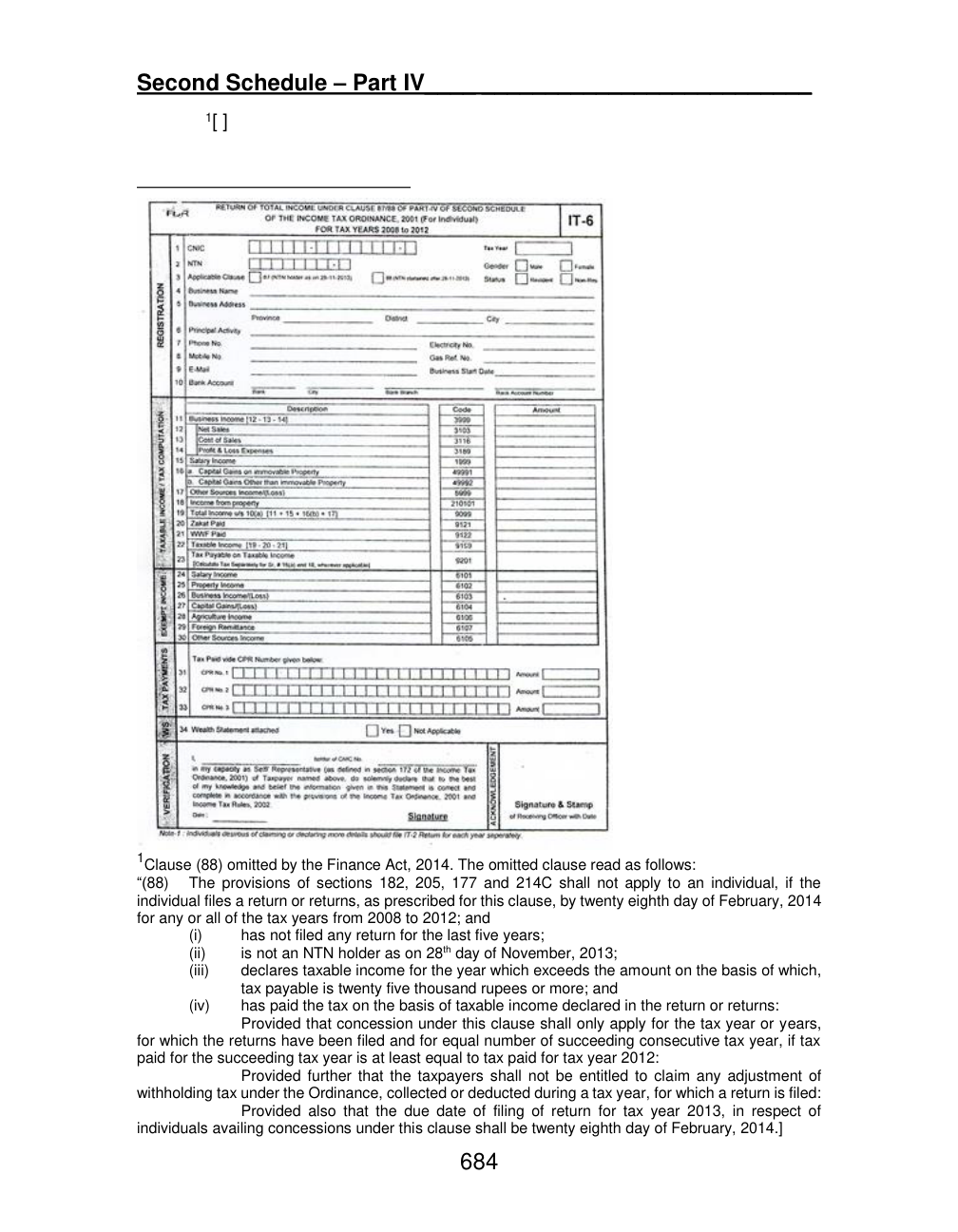
Original source and image integrity
Official original PDF source. Source PDF SHA-256: 96cef5e5fb0d461b06b587a6fc880b400cd17dfe2e86816cddd9f30bc69bf590.
Each selected page is rendered in full without clipping. The original file and every page image are hashed. The source-page review identifies graphic or form material; it does not establish a complete OCR transcription, amendment completeness or current force.
- Physical PDF page 1:
510be48bc8be29480fa964068b7e63c677aba7b5d36aceb1910624f992be3b6b - Physical PDF page 703:
dcdb652e9e7ba8c68a182b22c1aad9df06a86d0d5194ed7e51c3ae09745fac00
This law in the library
Follow the instruments and provisions named in this source edition, and the laws that cite it. Citation links identify the text being referred to; legal effect and current force require separate examination.
Instruments cited by this law 56
References to provisions in this text 1596
Section 116A
Open the identified operative provision
Read reference in context
er use of National Tax Number Certificate 401 195. Prosecution for making false or misleading statements 401 195A. Prosecution for non-compliance with notice under section 116A.— 402 195B. Prosecution for enabling offshore tax evasion 402 196. Prosecution for obstructing an income tax authority 402 197. Prosecution for disposal of property to prevent attachment 402 198. Prosecution for unaut
Section 113
Open the identified operative provision
Read reference in context
Minimum tax under section 113 PART II Rates of Advance Tax 514 PART IIA Collection of Tax from Distributors, Dealers, And Wholesalers Omitted by the Finance Act, 2014 517 Part IIB Rates of Advance Tax 518 PART III DEDUCTION OF TAX AT
Section 99A
Open the identified operative provision
Read reference in context
757 PART I RULES FOR THE COMPUTATION OF THE PAYABLE ON PROFITS AND GAINS OF A TRADER FALLING UNDER SUB- SECTION (1) OF SECTION 99A 757 PART II RULES FOR THE COMPUTATION OF THE PAYABLE ON PROFITS AND GAINS OF A TRADER FALLING UNDER SUB- SECTION (2) OF SECTION 99A 758
Section 99A
Open the identified operative provision
Read reference in context
LLING UNDER SUB- SECTION (1) OF SECTION 99A 757 PART II RULES FOR THE COMPUTATION OF THE PAYABLE ON PROFITS AND GAINS OF A TRADER FALLING UNDER SUB- SECTION (2) OF SECTION 99A 758
Section 181A
Open the identified operative provision
Read reference in context
of the company including income and gains of a trust up to the date of its liquidation; 3[(1A) “active taxpayer’ list” means the list instituted by the Board under Section 181A and includes such list issued by the Azad Jammu and Kashmir Central Board of Revenue or Gilgit-Baltistan Council Board of Revenue;] 4[5(1B) “amalgamation” means the merger of one or more banking companies or non-banking f
Section 130
Open the identified operative provision
Read reference in context
f the amalgamated company by virtue of the amalgamation 2[.] 3[ ] 4[(2) “Appellate Tribunal” means the Appellate Tribunal Inland Revenue established under section 130;] (3) “approved gratuity fund” means a gratuity fund approved by the Commissioner in accordance with Part III of the Sixth Schedule; 5[(3A) “Approved Annuity Plan” means an Annuity Plan approved by Securities and Excha
Section 130
Open the identified operative provision
Read reference in context
before substitution by the Finance (Amendment) Ordinance, 2009 read as follows: “(2) “Appellate Tribunal” means the Appellate Tribunal Inland Revenue established under section 130;”. 5 Inserted by the Finance Act, 2005. 6 Inserted by the Finance Act, 2005. 7 Inserted by the Finance Act, 2005.
Section 120
Open the identified operative provision
Read reference in context
ance Act, 2006 3 Clause (5) substituted by the Finance Act, 2002. The substituted clause read as follows: “(5) “assessment” means – (a) an assessment referred to in section 120; (b) an assessment raised under section 121; (c) an amended assessment under section 122; (d) a demand for an amount due under sections 141, 142, 143 and 144; or (e) an assessment of penalty under section 190;”. 4Inser
Section 121
Open the identified operative provision
Read reference in context
e Finance Act, 2002. The substituted clause read as follows: “(5) “assessment” means – (a) an assessment referred to in section 120; (b) an assessment raised under section 121; (c) an amended assessment under section 122; (d) a demand for an amount due under sections 141, 142, 143 and 144; or (e) an assessment of penalty under section 190;”. 4Inserted by the Finance Act, 2011. 5Inserted by th
Section 122
Open the identified operative provision
Read reference in context
d as follows: “(5) “assessment” means – (a) an assessment referred to in section 120; (b) an assessment raised under section 121; (c) an amended assessment under section 122; (d) a demand for an amount due under sections 141, 142, 143 and 144; or (e) an assessment of penalty under section 190;”. 4Inserted by the Finance Act, 2011. 5Inserted by the Finance Act, 2002 6Clause (5B) substituted
Section 190
An operative target heading has not been identified. Read the source passage
Read reference in context
ction 121; (c) an amended assessment under section 122; (d) a demand for an amount due under sections 141, 142, 143 and 144; or (e) an assessment of penalty under section 190;”. 4Inserted by the Finance Act, 2011. 5Inserted by the Finance Act, 2002 6Clause (5B) substituted by the Finance Act, 2008. The substituted clause (5B) read as follows: “(5B) “assets management company” means a company reg
Section 80
Open the identified operative provision
Read reference in context
rols or is the beneficial owner of such offshore assets for the purpose of tax evasion;] (6) “association of persons” means an association of persons as defined in section 80; (7) “banking company” means a banking company as defined in the Banking Companies Ordinance, 1962 (LVII of 1962) 1[ ]; 2[(7A) “beneficial owner” means a natural person who – (a) ultimately owns or controls a Company or
Section 3
Open the identified operative provision
Read reference in context
der the Central Board of Revenue Act, 1924 (IV of 1924), and on the commencement of Federal Board of Revenue Act, 2007, the Federal Board of Revenue established under section 3 thereof 4[and includes a Member of the Federal Board of Revenue to whom powers of the Board have been delegated under section 8 of the Federal Board of Revenue Act, 2007;]; (9) “bonus shares” includes bonus units in a unit
Section 181
More than one operative heading has this number. Read the source passage
Read reference in context
t” means a bank account utilized by the taxpayer for business transaction declared to the Commissioner through original or modified registration form prescribed under section 181;] (11)] “capital asset” means a capital asset as defined in section 37; 1 Expression “and includes anybody corporate which transacts the business of banking in Pakistan” omitte
Section 37
Open the identified operative provision
Read reference in context
declared to the Commissioner through original or modified registration form prescribed under section 181;] (11)] “capital asset” means a capital asset as defined in section 37; 1 Expression “and includes anybody corporate which transacts the business of banking in Pakistan” omitted by the Finance Act, 2025. 2 Clause (7A) Inserted by the Finance Act, 202
Section 208
Open the identified operative provision
Read reference in context
of any other object of general public utility;] 2[(11B) “Chief Commissioner” means a person appointed as Chief Commissioner Inland Revenue under section 208 and includes a 3[Chief Investigator,] Regional Commissioner of Income Tax and a Director-General of Income Tax and Sales Tax;] 4[(11C) “Collective Investment Scheme” shall have the same meanings as are assigned under the No
Section 80
Open the identified operative provision
Read reference in context
the same meanings as are assigned under the Non-Banking Finance Companies (Establishment and Regulation) Rules, 2003;] (12) “company” means a company as defined in section 80; 5[(13) “Commissioner” means a person appointed as Commissioner Inland Revenue under section 208 and includes any other authority vested with all or any of the powers and functions of the Commissioner;] 6[(13A) “Commi
Section 208
Open the identified operative provision
Read reference in context
ion) Rules, 2003;] (12) “company” means a company as defined in section 80; 5[(13) “Commissioner” means a person appointed as Commissioner Inland Revenue under section 208 and includes any other authority vested with all or any of the powers and functions of the Commissioner;] 6[(13A) “Commissioner (Appeals)” means a person appointed as Commissioner Inland Revenue (Appeals) under section 208
Section 208
Open the identified operative provision
Read reference in context
l or any of the powers and functions of the Commissioner;] 6[(13A) “Commissioner (Appeals)” means a person appointed as Commissioner Inland Revenue (Appeals) under section 208;] 7[(13AA) concealment of income includes – 1Inserted by the Finance Act, 2002. 2 Substituted by the Finance Act, 2010. The substituted provision has been made effective from
Section 208
Open the identified operative provision
Read reference in context
ective till 05.06.2010. The substituted clause (11B) read as follows: “(11B) “Chief Commissioner” means a person appointed as Chief Commissioner Inland Revenue under section 208 and includes a Regional Commissioner of Income Tax and a Director-General of Income Tax and Sales Tax.” 3 Expression inserted by the Finance Act, 2024. 4Inserted by the Finance Act, 2011. 5Substituted by the Finance Act, 2010
Section 208
Open the identified operative provision
Read reference in context
remained effective till 05.06.2010. The substituted Clause (13) read as follows: “(13) Commissioner” means a person appointed as Commissioner Inland Revenue under section 208, and includes any other authority vested with all or any of the powers and functions of the Commissioner;”. 6Substituted by the Finance Act, 2010. The substituted provision has been made effective from 05.06.2010 by sub-clause
Section 208
Open the identified operative provision
Read reference in context
ll 05.06.2010. The substituted Clause (13A) read as follows: “(13A) “Commissioner (Appeals)” means a person appointed as Commissioner Inland Revenue (Appeals) under section 208; 7 New clause (13AA) inserted by the Finance Act, 2021.
Section 111
Open the identified operative provision
Read reference in context
failure to disclose income chargeable to tax; (b) claiming any deduction or any expenditure not actually incurred; (c) any act referred to in sub-section (1) of section 111; and (d) claiming of any income or receipt as exempt which is otherwise taxable. Explanation.- For removal of doubt it is clarified that none of the aforementioned acts would constitute concealment of income unless
Section 22
Open the identified operative provision
Read reference in context
ble allowance” means an allowance that is deductible from total income under Part IX of Chapter III; (17) “depreciable asset” means a depreciable asset as defined in section 22; 5[17A. ”Developmental REIT Scheme” means Developmental REIT Scheme as defined under the Real Estate Investment Trust Regulations, 2015;] 6[(17B) "digital means" means digital payments and financial services including bu
Section 75
Open the identified operative provision
Read reference in context
cy reports, accounting services in the form of digital files or any other online facility;] (18) “disposal” in relation to an asset, means a disposal as defined in section 75; 2[(18A) “distributor” means a person appointed by a manufacturer, importer or any other person for a specified area to purchase goods from him for further supply;] (19) “dividend” includes — (a) any distribution by a
Section 63
Open the identified operative provision
Read reference in context
roved employment pension or annuity scheme and approved pension fund under Voluntary Pension System Rules, 2005, should not exceed the limit prescribed or specified in section 63.] 9[(19AA) “e-commerce” means sale or purchase of goods and services conducted over computer networks by methods specifically designed for the purpose of receiving or placing of orders either through websites, mobile applic
Section 68
Open the identified operative provision
Read reference in context
Chapter I – Preliminary__________________________________ 12 1[(22AA) “fair market value” means value as provided in section 68;] 2[(22B) ”fee for offshore digital services” means any consideration for providing or rendering services by a non-resident person for online advertising including digital advertising space, designing, creating, hosting or
Section 171A
Open the identified operative provision
Read reference in context
rporated under the Companies Act, 2017 (XIX of 2017), for the purposes of settlement of income tax refund claims including payment by way of issuing refund bonds under section 171A;] (23) “fee for technical services” means any consideration, whether periodical or lump sum, for the rendering of any managerial, technical or consultancy services including the services of technical or other personnel, but
Section 80
Open the identified operative provision
Read reference in context
money on deposit or otherwise for the purposes of advancing loans or making investments in the ordinary course of business; (26) “firm” means a firm as defined in section 80; (27) “foreign-source income” means foreign-source income as defined in sub-section (16) of section 101. 1[(27A) “greenfield industrial undertaking” means – (a) a new industrial undertaking which is – (i) setup on la
Section 101
Open the identified operative provision
Read reference in context
course of business; (26) “firm” means a firm as defined in section 80; (27) “foreign-source income” means foreign-source income as defined in sub-section (16) of section 101. 1[(27A) “greenfield industrial undertaking” means – (a) a new industrial undertaking which is – (i) setup on land which has not previously been utilized for any commercial, industrial or manufacturing activity and is
Section 148
Open the identified operative provision
Read reference in context
en subject to final tax;”] 2[(29) “income” includes any amount chargeable to tax under this Ordinance, any amount subject to collection 3[or deduction] of tax under section 148, 4[150, 152(1), 153, 154, 156, 156A, 233, 5[ ] ] 6[,] sub-section (5) of section 234 7[, section 236Z] 8[ ] 9[and] 10[any amount treated as income under any provision of this Ordinance] and any loss of income11[ ]; 12[(29A
Section 234
Open the identified operative provision
Read reference in context
er this Ordinance, any amount subject to collection 3[or deduction] of tax under section 148, 4[150, 152(1), 153, 154, 156, 156A, 233, 5[ ] ] 6[,] sub-section (5) of section 234 7[, section 236Z] 8[ ] 9[and] 10[any amount treated as income under any provision of this Ordinance] and any loss of income11[ ]; 12[(29A) “income year” means income year as defined in the repealed Ordinance;] 13[(29B)
Section 236Z
Open the identified operative provision
Read reference in context
e, any amount subject to collection 3[or deduction] of tax under section 148, 4[150, 152(1), 153, 154, 156, 156A, 233, 5[ ] ] 6[,] sub-section (5) of section 234 7[, section 236Z] 8[ ] 9[and] 10[any amount treated as income under any provision of this Ordinance] and any loss of income11[ ]; 12[(29A) “income year” means income year as defined in the repealed Ordinance;] 13[(29B) “Individual Pensi
Section 236Z
Open the identified operative provision
Read reference in context
he Finance Act, 2005. 5 The expression “233A,” omitted by the Finance Act, 2021. 6 The word “and” substituted by a comma by the Finance Act, 2014. 7 The expression “, section 236Z” inserted by the Finance Act, 2023. 8The word and figure “and 236M” substituted by a comma by the Finance Act, 2015 9The expression “, 236M and 236N,” substituted by the Finance Act, 2018 10 Inserted by the Finance Act, 2003.
Section 24
Open the identified operative provision
Read reference in context
1[(c) telecommunication companies operating under the license of Pakistan Telecommunication Authority (PTA).;] (30) “intangible” means an intangible as defined in section 24; 2[(30A) “integrated enterprise” means a person integrated with the Board through approved fiscal electronic device and software, and who fulfills obligations and requirements for integration as may be prescribed;] 3[4[
Section 81
Open the identified operative provision
Read reference in context
ne of the assets of such person confers, or may confer, a private benefit to any other person;] (37) “non-resident person” means a non-resident person as defined in Section 81; (38) “non-resident taxpayer” means a taxpayer who is a non-resident person; 1[(38A) “Officer of Inland Revenue” means any Additional Commissioner Inland Revenue, Deputy Commissioner Inland Revenue, Assistant Commissio
Section 101
Open the identified operative provision
Read reference in context
9) “Originator” means Originator as defined in the Asset Backed Securitization Rules, 1999; (40) “Pakistan-source income” means Pakistan-source income as defined in section 101; 2[(40A) “Pension Fund Manager” means an asset management company registered under the Non-Banking Finance Companies (Establishment and Regulations) Rules, 2003, or a life insurance company registered under Insurance
Section 80
Open the identified operative provision
Read reference in context
mported in the name of the associate or any other person, whether or not the title to the goods passes outside Pakistan.] (42) “person” means a person as defined in section 80; 1Added by the Finance Act, 2018 2Added by the Finance Act, 2018 3 The word “fixed” omitted by the Finance Act, 2023.
Section 25
Open the identified operative provision
Read reference in context
censed and regulated by the Securities and Exchange Commission of Pakistan;”] (43) “pre-commencement expenditure” means a pre-commencement expenditure as defined in section 25; (44) “prescribed” means prescribed by rules made under this Ordinance; 3[(44A) “principal officer” used with reference to a company or association of persons includes – (a) a director, a manager, secretary, agent, ac
Section 15
Open the identified operative provision
Read reference in context
s a provident fund recognised by the Commissioner in accordance with Part I of the Sixth Schedule; 2[ ] (49) “rent” means rent as defined in sub-section (2) of section 15 and includes an amount treated as rent under section 16; 3[(49A) “repealed Ordinance” means Income Tax Ordinance, 1979 (XXXI of 1979);] (50) “resident company” means a resident company as defined in section 83; (51)
Section 16
Open the identified operative provision
Read reference in context
ordance with Part I of the Sixth Schedule; 2[ ] (49) “rent” means rent as defined in sub-section (2) of section 15 and includes an amount treated as rent under section 16; 3[(49A) “repealed Ordinance” means Income Tax Ordinance, 1979 (XXXI of 1979);] (50) “resident company” means a resident company as defined in section 83; (51) “resident individual” means a resident individual as defi
Section 83
Open the identified operative provision
Read reference in context
t under section 16; 3[(49A) “repealed Ordinance” means Income Tax Ordinance, 1979 (XXXI of 1979);] (50) “resident company” means a resident company as defined in section 83; (51) “resident individual” means a resident individual as defined in section 82; (52) “resident person” means a resident person as defined in section 81; (53) “resident taxpayer” means a taxpayer who is a resident per
Section 82
Open the identified operative provision
Read reference in context
(XXXI of 1979);] (50) “resident company” means a resident company as defined in section 83; (51) “resident individual” means a resident individual as defined in section 82; (52) “resident person” means a resident person as defined in section 81; (53) “resident taxpayer” means a taxpayer who is a resident person; (54) 4[“royalty”]means any amount paid or payable, however described or compu
Section 81
Open the identified operative provision
Read reference in context
ined in section 83; (51) “resident individual” means a resident individual as defined in section 82; (52) “resident person” means a resident person as defined in section 81; (53) “resident taxpayer” means a taxpayer who is a resident person; (54) 4[“royalty”]means any amount paid or payable, however described or computed, whether periodical or a lump sum, as consideration for — (a) the us
Section 208
Open the identified operative provision
Read reference in context
the Finance Act, 2010. The omitted clause (48A) read as follows: “(48) “Regional Commissioner” means a person appointed as a Regional Commissioner of Income Tax under section 208 and includes a Director-General of Income Tax and Sales Tax.” 3 Inserted by the Finance Act, 2002 4 The word “royalties” substituted by the Finance Act, 2002.
Section 12
Open the identified operative provision
Read reference in context
lauses] (a) through (e); 2[and] (g) the disposal of any property or right referred to in 3[sub-clauses] (a) through (e); (55) “salary” means salary as defined in section 12; (56) “Schedule” means a Schedule to this Ordinance; (57) “securitization” means securitization as defined in the Asset Backed Securitization Rules, 1999; (58) “share” in relation to a company, includes a modaraba certifi
Section 203
Open the identified operative provision
Read reference in context
in existence;] 8[and] 9[(iv) is not a small and medium enterprise as defined in clause (59A);] 10[(59B) “Special Judge” means the Special Judge appointed under section 203;] (60) “Special Purpose Vehicle” means a Special Purpose Vehicle as defined in the Asset Backed Securitization Rules, 1999; 11[(60A) “specified jurisdiction” means any jurisdiction which has committed to automatically ex
Section 19
Open the identified operative provision
Read reference in context
d to automatically exchange information under the Common Reporting Standard with Pakistan;] (61) “speculation business” means a speculation business as defined in section 19; 1 Inserted by the Finance Act, 2005. 2 Clause (59A) re-numbered as clause (59AB) by the Finance ACT, 2021. 3 The expression “Companies Ordinance, 1984 (XLVII of 1984)” substitute
Section 35
Open the identified operative provision
Read reference in context
ested by way of equity shares in companies, to the extent of more than seventy per cent of the investment;] (62) “stock-in-trade” means stock-in-trade as defined in section 35; 2[(62A) “startup” means,— (i) a business of a resident individual, AOP or a company that commenced on or after first day of July, 2012 and the person is engaged in or intends to offer technology driven products or serv
Section 9
Open the identified operative provision
Read reference in context
nd includes any penalty, fee or other charge or any sum or amount leviable or payable under this Ordinance; (64) “taxable income” means taxable income as defined in section 9; 5[ ] (66) “taxpayer” means any person who derives an amount chargeable to tax under this Ordinance, and includes — 1Inserted by the Finance Act, 2014.. 2Inserted by the
Section 107
Open the identified operative provision
Read reference in context
x under this Ordinance; 2[(66A) “tax invoice” means an invoice as prescribed under the Income Tax Rules, 2002;] (67) “tax treaty” means an agreement referred to in section 107; (68) “tax year” means the tax year as defined in sub-section (1) of section 74 and, in relation to a person, includes a special year or a transitional year that the person is permitted to use under section 74; (69) “total
Section 74
Open the identified operative provision
Read reference in context
the Income Tax Rules, 2002;] (67) “tax treaty” means an agreement referred to in section 107; (68) “tax year” means the tax year as defined in sub-section (1) of section 74 and, in relation to a person, includes a special year or a transitional year that the person is permitted to use under section 74; (69) “total income” means total income as defined in section 10; (70) “trust” means a “trust
Section 74
Open the identified operative provision
Read reference in context
year as defined in sub-section (1) of section 74 and, in relation to a person, includes a special year or a transitional year that the person is permitted to use under section 74; (69) “total income” means total income as defined in section 10; (70) “trust” means a “trust” as defined in section 80; 3[(70A) “turnover” means turnover as defined in sub-section (3) of section 113;] (71) “underlying o
Section 10
Open the identified operative provision
Read reference in context
to a person, includes a special year or a transitional year that the person is permitted to use under section 74; (69) “total income” means total income as defined in section 10; (70) “trust” means a “trust” as defined in section 80; 3[(70A) “turnover” means turnover as defined in sub-section (3) of section 113;] (71) “underlying ownership” means an underlying ownership as defined in section 98;
Section 80
Open the identified operative provision
Read reference in context
ar that the person is permitted to use under section 74; (69) “total income” means total income as defined in section 10; (70) “trust” means a “trust” as defined in section 80; 3[(70A) “turnover” means turnover as defined in sub-section (3) of section 113;] (71) “underlying ownership” means an underlying ownership as defined in section 98; (72) “units” means units in a unit trust; (73) “unit
Section 113
Open the identified operative provision
Read reference in context
s total income as defined in section 10; (70) “trust” means a “trust” as defined in section 80; 3[(70A) “turnover” means turnover as defined in sub-section (3) of section 113;] (71) “underlying ownership” means an underlying ownership as defined in section 98; (72) “units” means units in a unit trust; (73) “unit trust” means a unit trust as defined in section 80; and 4[(73A) “unspecified jurisd
Section 98
Open the identified operative provision
Read reference in context
ection 80; 3[(70A) “turnover” means turnover as defined in sub-section (3) of section 113;] (71) “underlying ownership” means an underlying ownership as defined in section 98; (72) “units” means units in a unit trust; (73) “unit trust” means a unit trust as defined in section 80; and 4[(73A) “unspecified jurisdiction” means a jurisdiction which is not a specified jurisdictions.] 5[(74) “Vent
Section 80
Open the identified operative provision
Read reference in context
ying ownership” means an underlying ownership as defined in section 98; (72) “units” means units in a unit trust; (73) “unit trust” means a unit trust as defined in section 80; and 4[(73A) “unspecified jurisdiction” means a jurisdiction which is not a specified jurisdictions.] 5[(74) “Venture Capital Company” and “Venture Capital Fund” shall have the same meanings as are assigned to them under t
Section 227B
Open the identified operative provision
Read reference in context
assigned to them under the 6[Non-Banking Finance 7[Companies] (Establishment and Regulation) Rules, 2003]; 8[(75) “whistleblower” means whistleblower as defined in section 227B;”] 1 Inserted by the Finance Act, 2002 2 Inserted by the Finance Act, 2022. 3Inserted by the Finance Act, 2009. 4(73A) inserted through Finance Act, 2019. 5 Added by Finance Act
Section 103
Open the identified operative provision
Read reference in context
Where a taxpayer is allowed more than one tax credit for a tax year, the credits shall be applied in the following order – (a) any foreign tax credit allowed under section 103; then (b) any tax credit allowed under Part X of Chapter III; and then (c) any tax credit allowed under sections 3[ ] 147 and 168. (4) Certain classes of income (including the income of certain classes of persons) may
Section 8
Open the identified operative provision
Read reference in context
x as provided for 6[under this chapter], or Part V of Chapter X, as the case may be, and shall not be included in the computation of taxable income in accordance with section 8 or 169, as the case may be. 1The words and letters “Division I or II” substituted by the Finance Act, 2010. 2The expression “IB” omitted through Finance Act, 2020 dated 30th June,
Section 4A
Open the identified operative provision
Read reference in context
1 Added by the Finance Act, 2003. 2 The semicolon substituted by the Finance Act, 2005. 3Omitted by the Finance Act, 2014. Section 4A was added by Income Tax (Amendment) Ordinance, dated 30.05.2011. Earlier the identical section 4A was added by Income Tax (Amendment) Ordinance, dated 16.03.2011. The omitted section 4A read as follows: — “4A Surcharge. — (1)
Section 4A
Open the identified operative provision
Read reference in context
stituted by the Finance Act, 2005. 3Omitted by the Finance Act, 2014. Section 4A was added by Income Tax (Amendment) Ordinance, dated 30.05.2011. Earlier the identical section 4A was added by Income Tax (Amendment) Ordinance, dated 16.03.2011. The omitted section 4A read as follows: — “4A Surcharge. — (1) Subject to this Ordinance, a surcharge shall be payable by every taxpayer at the rate of fifteen p
Section 4A
Open the identified operative provision
Read reference in context
ed by Income Tax (Amendment) Ordinance, dated 30.05.2011. Earlier the identical section 4A was added by Income Tax (Amendment) Ordinance, dated 16.03.2011. The omitted section 4A read as follows: — “4A Surcharge. — (1) Subject to this Ordinance, a surcharge shall be payable by every taxpayer at the rate of fifteen per cent of the income tax payable under this Ordinance including the tax payable under P
Section 2
Open the identified operative provision
Read reference in context
tion and brought forward business losses)] under section (9) of this Ordinance, if not included in clause (i); (iii) imputable income as defined in clause (28A) of section 2 excluding amounts specified in clause (i); and (iv) income computed, 2[other than brought forward depreciation, brought forward amortization and brought forward business lossess] under Fourth, Fifth, Seventh and Eighth Sche
Section 137
Open the identified operative provision
Read reference in context
Schedules. (3) The super tax payable under sub-section (1) shall be paid, collected and deposited on the date and in the manner as specified in sub-section (1) of section 137 and all provisions of Chapter X of the Ordinance shall apply. (4) Where the super tax is not paid by a person liable to pay it, the Commissioner shall by an order in writing, determine the super tax payable, and shall ser
Section 2
Open the identified operative provision
Read reference in context
Chapter II – Charge of Tax__________________________ 35 (iii) imputable income as defined in clause (28A) of section 2 excluding amounts specified in clause (i); and (iv) income computed, other than brought forward depreciation, brought forward amortization and brought forward business losses under Fourth, Fifth 1[, Seventh and Eighth] Sch
Section 137
Open the identified operative provision
Read reference in context
Eighth] Schedules. (3) The tax payable under sub-section (1) shall be paid, collected and deposited on the date and in the manner as specified in sub-section (1) of section 137 and all provisions of Chapter X of the Ordinance shall apply. (4) Where the tax is not paid by a person liable to pay it, the Commissioner shall by an order in writing, determine the tax payable, and shall serve upon the pe
Section 147
Open the identified operative provision
Read reference in context
er XI of the Ordinance shall, so far as may be, apply to the collection of tax as these apply to the collection of tax under the Ordinance. 2[(5A) The provisions of section 147 shall apply on tax payable under this section.] (6) The Board may, by notification in the official Gazette, make rules for carrying out the purposes of this section.] 5. Tax on dividends.— (1) Subject to this Ordinance
Section 2
Open the identified operative provision
Read reference in context
e specified in Division III of Part I of the First Schedule, on every person who receives a dividend from a 3[ ] company 4[or treated as dividend under clause (19) of section 2]. (2) The tax imposed under sub-section (1) on a person who receives a dividend shall be computed by applying the relevant rate of tax to the gross amount of the dividend. (3) This section shall not apply to a dividen
Section 118
Open the identified operative provision
Read reference in context
he tax year through cash 5[ ]: Provided that for tax year 2017, bonus shares or cash dividends may be distributed before the due date mentioned in sub-section (2) of section 118, for filing of a return. (2) The provisions of sub-section (1) shall not apply to— (a) a company qualifying for exemption under clause (132) of Part I of the Second Schedule; and (b) a company in which not less than
Section 5A
Open the identified operative provision
Read reference in context
ks.—(1) Subject to this Ordinance, a tax shall be imposed, at the rate specified in Division IIIB of Part I of the First 1 section 5A substituted by the Finance Act, 2017. The substituted section read as follows:- “5A. Tax on undistributed reserves.—(1) Subject to this Ordinance, a tax shall be imposed at the rate of ten percent, on every public company other
Section 118
Open the identified operative provision
Read reference in context
shall be treated as income of the said company: Provided that for tax year 2015, cash dividends may be distributed before the due date mentioned in sub-section (2) of section 118, for filing of return for tax year 2015. (2) The provisions of sub-section (1) shall not apply to— (a) a public company which distributes profit equal to either forty per cent of its after tax profits or fifty per cent of its
Section 154
Open the identified operative provision
Read reference in context
within Pakistan using locally operated online platforms including online marketplace or websites: Provided that the export proceeds subjected to withholding under section 154 and 154A shall not fall within the ambit of this section. (2) The tax imposed under sub-section (1) shall be computed by applying the relevant rate of tax to the gross amounts of receipts mentioned in sub-section (1).] 7
Section 6A
Open the identified operative provision
Read reference in context
1Inserted by the Finance Act, 2018 2 The expression “, fee for offshore digital services] or fee for technical services” substituted by the Finance Act, 2022. 3 Section 6A inserted by the Finance Act, 2025.
Section 151
Open the identified operative provision
Read reference in context
Part I of the First Schedule, on every person, other than a company, who receives a profit on debt from any person mentioned in clauses (a) to (d) of sub-section (1)of section 151. 1Inserted by the Finance Act, 2015 2The word “and” omitted through Finance Act, 2020 dated 30th June, 2020 3 Full stop at the end substituted by semi-colon and the word “and” th
Section 7E
Open the identified operative provision
Read reference in context
“This section shall apply to projects undertaken for development and sale of residential, commercial or other plots initiated and approved after the 1st July, 2016.” 3 Section 7E inserted by the Finance Act, 2022.
Section 236K
Open the identified operative provision
Read reference in context
from which income is chargeable to tax under the Ordinance and tax leviable is paid thereon; (f) capital asset in the first tax year of acquisition where tax under section 236K has been paid; (g) where the fair market value of the capital assets in aggregate excluding the capital assets mentioned in clauses (a), (b), (c), (d), (e) and (f) does not exceed Rupees twenty-five million; (h) capital
Section 22
Open the identified operative provision
Read reference in context
or the purpose of business; (ii) any shares, stocks or securities; (iii) any property with respect to which the person is entitled to a depreciation deduction under section 22 or amortization deduction under section 24; or (iv) any movable asset not mentioned in clauses (i), (ii) or (iii); (b) “farmhouse” means a house constructed on a total minimum area of 2000 square yards with a minimum cove
Section 24
Open the identified operative provision
Read reference in context
s, stocks or securities; (iii) any property with respect to which the person is entitled to a depreciation deduction under section 22 or amortization deduction under section 24; or (iv) any movable asset not mentioned in clauses (i), (ii) or (iii); (b) “farmhouse” means a house constructed on a total minimum area of 2000 square yards with a minimum covered area of 5000 square feet used as a sing
Section 7F
Open the identified operative provision
Read reference in context
mentioned in (a) and (b) above. 1 The full stop substituted with colon and new proviso added by the Finance Act, 2023. 2 Section 7F inserted by the Finance Act, 2024.
Section 9
Open the identified operative provision
Read reference in context
ct to tax under this section, the taxpayer shall not be allowed to take credit of any sum as is in excess of taxable profit: Provided that where taxable income under section 9 is more than the taxable profit under this section, taxpayer shall be entitled to take credit of such taxable income subject to the payment of tax at the rate specified in Division I or II of Part- I of First Schedule. (4)
Section 143
Open the identified operative provision
Read reference in context
ection] 5, 6 5[, 6A] or 7 shall be discharged to the extent that — (i) in the case of shipping and air transport income, the tax has been paid in accordance with section 143 or 144, as the case may be; or (ii) in any other case, the tax payable has been deducted at source under Division III of Part V of Chapter X 6[.] 7[ ] 1The word “sec
Section 10
Open the identified operative provision
Read reference in context
BLE INCOME PART I COMPUTATION OF TAXABLE INCOME 9. Taxable income.—The taxable income of a person for a tax year shall be the total income 1[under clause (a) of section 10] of the person for the year reduced (but not below zero) by the total of any deductible allowances under Part IX of this Chapter of the person for the year. 10. Total Income.— The total income of a person for a tax year sha
Section 14
Open the identified operative provision
Read reference in context
resent or prospective employment; (f) any pension or annuity, or any supplement to a pension or annuity; and (g) any amount chargeable to tax as “Salary” under section 14. 1[(2A) In case of pension under clause (f) of sub-section (2),— (i) the pension shall be charged to tax as a final tax at the rates specified in the proviso to clause (2) of Division I of Part I of the First Schedule
Section 12
Open the identified operative provision
Read reference in context
ax on Taxable Income ______________________ 51 any perquisite provided by an employer to the employee in that year that is included in the employee’s salary under section 12 shall be determined in accordance with this section. (2) This section shall not apply to any amount referred to in clause (c) or (d) of sub-section (2) of section 12. 1(3) Where, in a tax year, a motor vehicle is provi
Section 12
Open the identified operative provision
Read reference in context
ction 12 shall be determined in accordance with this section. (2) This section shall not apply to any amount referred to in clause (c) or (d) of sub-section (2) of section 12. 1(3) Where, in a tax year, a motor vehicle is provided by an employer to an employee wholly or partly for the private use of the employee, the amount chargeable to tax to the employee under the head “Salary” for that year
Section 21
Open the identified operative provision
Read reference in context
as a deduction shall not be allowed as a deduction in computing the income of the person chargeable to tax under any other head of income. (6) The provisions of section 21 shall apply in determining the deductions allowed to a person under this section in the same manner as they apply in determining the deductions allowed in computing the income of a person chargeable to tax under the head “Inco
Section 15
Open the identified operative provision
Read reference in context
tax under the head “Income from Property” as specified in sub-section (1). 1[ ] “(7) Notwithstanding sub-section (6) of section 15, the provisions of this section shall apply to an individual or an association of persons,6[ ] who opts to pay tax at the rate specified in Division I of Part I of the First Schedule.” 1 Section 17 omitted by the Finance Act,
Section 17
Open the identified operative provision
Read reference in context
his section shall apply to an individual or an association of persons,6[ ] who opts to pay tax at the rate specified in Division I of Part I of the First Schedule.” 1 Section 17 omitted by the Finance Act, 2006. The omitted section 17 read as follows: “17. Deductions in computing income chargeable under the head “Income from Property”.- (1) In computing the income of a person chargeable to tax un
Section 17
Open the identified operative provision
Read reference in context
n of persons,6[ ] who opts to pay tax at the rate specified in Division I of Part I of the First Schedule.” 1 Section 17 omitted by the Finance Act, 2006. The omitted section 17 read as follows: “17. Deductions in computing income chargeable under the head “Income from Property”.- (1) In computing the income of a person chargeable to tax under the head “Income from Property” for a tax year, a ded
Section 21
Open the identified operative provision
Read reference in context
on as a deduction shall not be allowed as a deduction in computing the income of the person chargeable to tax under any other head of income. (6) The provisions of section 21 shall apply in determining the deductions allowed to a person under this section in the same manner as they apply in determining the deductions allowed in computing the income of a person chargeable to tax under the head “Incom
Section 58
Open the identified operative provision
Read reference in context
year; and (e) any loss of the person arising from the speculation business sustained for a tax year computed in accordance with this Part shall be dealt with under section 58. (2) In this section, “speculation business” means any business in which a contract for the purchase and sale of any commodity (including 2[stocks] and shares) is periodically or ultimately settled otherwise than by the a
Section 149
Open the identified operative provision
Read reference in context
provident or other fund established for the benefit of employees of the person, unless the person has made effective arrangements to secure that tax is deducted under section 149 from any payments made by the fund in respect of which the recipient is chargeable to tax under the head "Salary"; 1Clause (c) substituted by the Finance Act, 2016. The substituted
Section 13
Open the identified operative provision
Read reference in context
ny expenditure paid or payable by an employer on the provision of perquisites and allowances to an employee where the sum of the value of the perquisites computed under section 13 and the amount of the allowances exceeds fifty per cent of the employee’s salary for a tax year (excluding the value of the perquisites or amount of the allowances);” 2 Clause (l) substituted by the Finance Act, 2006. The subs
Section 114A
Open the identified operative provision
Read reference in context
gregate, exceeds rupees two hundred and fifty thousand, made other than by digital means from business bank account of the taxpayer notified to the Commissioner under section 114A: Provided that this clause shall not apply in the case of- (a) expenditures not exceeding Rupees twenty-five thousand; and (b) expenditures on account of — (i) utility bills; (ii) freight charges; (iii) travel far
Section 23
Open the identified operative provision
Read reference in context
shall be — (a) where the asset was acquired in the tax year, the cost of the asset to the person as reduced by any initial allowance in respect of the asset under section 23; or (b) in any other case, the cost of the asset to the person as reduced by the total depreciation deductions (including any initial allowance under section 23) allowed to the person in respect of the asset in previous tax
Section 23
Open the identified operative provision
Read reference in context
nder section 23; or (b) in any other case, the cost of the asset to the person as reduced by the total depreciation deductions (including any initial allowance under section 23) allowed to the person in respect of the asset in previous tax years. 4[“Explanation,- For the removal of doubt, it is clarified that where any building, furniture, plant or machinery is used for the purposes of business du
Section 23
Open the identified operative provision
Read reference in context
tion of the exemption period, written down value of such assets shall be determined after reducing total depreciation deductions (including any initial allowance under section 23) in accordance with clauses (a) and (b) of this sub-section.”] (6) Where sub-section (3) applies to a depreciable asset for a tax year, the written down value of the asset shall be computed on the basis that the asset has
Section 23
Open the identified operative provision
Read reference in context
e income from business chargeable to tax. (7) The total deductions allowed to a person during the period of ownership of a depreciable asset under this section and section 23 shall not exceed the cost of the asset. 1The word “were” substituted by the Finance Act, 2010. 2 The word “derived” substituted by the Finance Act, 2003. 3 Sub-section (4) omitted
Section 76
Open the identified operative provision
Read reference in context
the initial allowance of a person shall be computed by applying the rate specified in Part II of the Third Schedule against the cost of the asset. (3) The rules in section 76 shall apply in determining the cost of an eligible depreciable asset for the purposes of this section. 1Full stop substituted by Finance Act, 2017. 2Added by the Finance Act, 2017.
Section 23A
An operative target heading has not been identified. Read the source passage
Read reference in context
, 2022. 5 The full stop substituted with semi colon and the word “or” and thereafter clause (e) added by the Finance Act, 2022. 6Inserted by the Finance Act, 2008. 7 Section 23A omitted by the Finance Act, 2021. Earlier this omission was made through Tax Laws (Second Amendment) Ordinance, 2021. The omitted section read as follows: “23A. First Year Allowance.— (1) Plant, machinery and equipment install
Section 23
Open the identified operative provision
Read reference in context
ption under clause (126N) of Part I of the Second Schedule] and owned and managed by a company shall be allowed first year allowance in lieu of initial allowance under section 23 at the rate specified in Part II of the Third Schedule against the cost of the “eligible depreciable assets” put to use after July 1, 2008. (2) The provisions of section 23 except sub-sections (1) and (2) thereof, shall mutatis
Section 23
Open the identified operative provision
Read reference in context
on 23 at the rate specified in Part II of the Third Schedule against the cost of the “eligible depreciable assets” put to use after July 1, 2008. (2) The provisions of section 23 except sub-sections (1) and (2) thereof, shall mutatis mutandis apply. (3) The Federal Government may notify “specified areas” for the purposes of sub-section (1).]
Section 23
Open the identified operative provision
Read reference in context
y by an industrial undertaking set up anywhere in Pakistan and owned and managed by a company shall be allowed first year allowance in lieu of initial allowance under section 23, at the rate specified in Part II of the Third Schedule against the cost of the eligible depreciation assets put to use after first day of July, 2009. (2) The provisions of section 23 except sub-sections (1) and (2) thereof
Section 23
Open the identified operative provision
Read reference in context
ate specified in Part II of the Third Schedule against the cost of the eligible depreciation assets put to use after first day of July, 2009. (2) The provisions of section 23 except sub-sections (1) and (2) thereof, shall mutatis mutandis apply.] 24. Intangibles.—(1) A person shall be allowed an amortisation deduction in accordance with this section in a tax year for the cost of the person’s intan
Section 24
Open the identified operative provision
Read reference in context
e wholly used to derive income from business chargeable to tax. 1Inserted by the Finance Act, 2009. 2 In sub-section 4 of section 24 is substituted by the Finance Act, 2019, the substituted sub-section read as follow: (4) An intangible — (a) with a normal useful life of more than ten years; or (b) that does not have an ascertainable useful life, shall
Section 77
Open the identified operative provision
Read reference in context
Chapter III – Tax on Taxable Income ______________________ 77 (b) the consideration received on disposal of an intangible shall be determined in accordance with section 77. (10) For the purposes of this section, an intangible that is available for use on a day (including a non-working day) is treated as used on that day. (11) In this section, — “cost” in relation to an intangible, means
Section 22
Open the identified operative provision
Read reference in context
n of prototypes, and trial production activities, but shall not include any expenditure which is incurred in acquiring land, or which is depreciated or amortised under section 22 or 24. 1 Inserted by the Finance Act, 2003. 2The words Inserted by the Finance Act, 2019.
Section 21
Open the identified operative provision
Read reference in context
a capital asset for any expenditure incurred by a person – (a) that is or may be deducted under another provision of this Chapter; or (b) that is referred to in section 21. 1[ ] 2[ ] (5) In this section, “capital asset” means property of any kind held by a person, whether or not connected with a business, but does not include — 3[(a) any stock-in-trade 4[ ], consumable st
Section 22
Open the identified operative provision
Read reference in context
nsumable stores or raw materials held for the purpose of business;] (b) any property with respect to which the person is entitled to a depreciation deduction under section 22 or amortisation deduction under section 24; 5[or] 6[ ] (d) any movable property 7[excluding capital assets specified in sub-section (5) of section 38] held for personal use by the
Section 24
Open the identified operative provision
Read reference in context
he purpose of business;] (b) any property with respect to which the person is entitled to a depreciation deduction under section 22 or amortisation deduction under section 24; 5[or] 6[ ] (d) any movable property 7[excluding capital assets specified in sub-section (5) of section 38] held for personal use by the 1 Inserted by the Finance Act, 2003
Section 38
Open the identified operative provision
Read reference in context
n under section 22 or amortisation deduction under section 24; 5[or] 6[ ] (d) any movable property 7[excluding capital assets specified in sub-section (5) of section 38] held for personal use by the 1 Inserted by the Finance Act, 2003. 2 Sub-section (4A) omitted through Finance Act, 2022. Omitted sub-section read as follows: “(4A) Where the capital
Section 85
Open the identified operative provision
Read reference in context
ed sub-section read as follows: “(4A) Where the capital asset becomes the property of the person — (a) under a gift 2[from a relative as defined in sub section (5) of section 85], bequest or will; (b) by succession, inheritance or devolution; (c) a distribution of assets on dissolution of an association of persons; or (d) on distribution of assets on liquidation of a company, the fair market
Section 79
Open the identified operative provision
Read reference in context
thin two years of acquisition and the Commissioner is satisfied that such gift arrangement is a part of tax avoidance scheme, then the provisions of sub-section (3) of section 79 shall apply for the purpose of determining the cost of asset in the hands of recipient of the gift.] 3 The brackets and words “(a) any stock-in-trade;” substituted by the Finance Act, 2002 4The brackets and words “(not being s
Section 68
Open the identified operative provision
Read reference in context
hares which shall be paid to the Commissioner by way of credit to the Federal Government, within fifteen days of the payment. (7) Notwithstanding the provisions of section 68, the value of shares, for the purpose of sub-section (6), shall be the fair market value, as prescribed for sub- section (4) of section 101A, without reduction of liabilities. (8) The Commissioner may, on application made b
Section 101A
Open the identified operative provision
Read reference in context
ithstanding the provisions of section 68, the value of shares, for the purpose of sub-section (6), shall be the fair market value, as prescribed for sub- section (4) of section 101A, without reduction of liabilities. (8) The Commissioner may, on application made by the person acquiring of the shares, and after making such inquiry as the Commissioner thinks fit, allow to make the payment, without deduc
Section 182
Open the identified operative provision
Read reference in context
fit, allow to make the payment, without deduction of tax or deduction of tax at a reduced rate. (9) The provisions of sections 161, 162, entry No. 15 of the Table in section 182, clause (c) of sub-section (1) of section 191 and section 205 shall mutatis mutandis apply to the tax deductible and payable under this section. (10) The person disposing of the capital asset, being shares of a company, shal
Section 191
Open the identified operative provision
Read reference in context
ion of tax or deduction of tax at a reduced rate. (9) The provisions of sections 161, 162, entry No. 15 of the Table in section 182, clause (c) of sub-section (1) of section 191 and section 205 shall mutatis mutandis apply to the tax deductible and payable under this section. (10) The person disposing of the capital asset, being shares of a company, shall furnish to the Commissioner within thirty da
Section 205
Open the identified operative provision
Read reference in context
duction of tax at a reduced rate. (9) The provisions of sections 161, 162, entry No. 15 of the Table in section 182, clause (c) of sub-section (1) of section 191 and section 205 shall mutatis mutandis apply to the tax deductible and payable under this section. (10) The person disposing of the capital asset, being shares of a company, shall furnish to the Commissioner within thirty days of the transa
Section 37
Open the identified operative provision
Read reference in context
g process except where the detail of such disposal is furnished to NCCPL for computation of capital gains and tax thereon under this section, and the provisions of section 37 shall apply on such disposal of shares of a listed company or disposal of shares through initial public offer, accordingly.]] 8[(1A) The gain arising on the disposal of a security by a person shall be computed in accord
Section 37
Open the identified operative provision
Read reference in context
apply to the disposal of shares of a listed company made otherwise than through registered stock exchange and which are not settled through NCCPL and the provisions of section 37 shall apply on such disposal of shares of a listed company, accordingly.” 8Inserted by the Finance Act,2012.
Section 37
Open the identified operative provision
Read reference in context
where — A is the cost of the asset; and B is the consideration received by the person on disposal of the asset. (4) The provisions of sub-section (4) of section 37 shall apply in determining component A of the formula in sub-section (3). (5) No loss shall be recognized under this Ordinance on the disposal of the following capital assets, namely:— (a) A painting, sculpture, drawi
Section 85
Open the identified operative provision
Read reference in context
ount or fair market value of any property received without consideration or received as gift, other than gift received from 7[relative as defined in sub-section (5) of section 85] ] 8[; and] 9[(lb) income arising to the shareholder of a company, from the issuance of bonus shares;] 10[ 11[ ] ] (2) Where a person receives an amount referred to in clause (k) of sub- section (1), the amou
Section 2
Open the identified operative provision
Read reference in context
Chapter III – Tax on Taxable Income ______________________ 97 crossed cheque drawn on a bank or through a banking channel 1[or through digital means as defined in section 2] from a person holding a National Tax Number 2[ ] shall be treated as income chargeable to tax under the head “Income from Other Sources” for the tax year in which it was received. (4) Sub-section (3) shall not apply to a
Section 5
More than one operative heading has this number. Read the source passage
Read reference in context
(5) This section shall not apply to any income received by a person in a tax year that is chargeable to tax under any other head of income or subject to tax under section 5[5, 5AA, 6, 7 or 7B]. 6[ ] 40. Deductions in computing income chargeable under the head “Income from Other Sources”.— (1) Subject to this Ordinance, in computing the income of a person chargeable to tax under the head
Section 39
Open the identified operative provision
Read reference in context
rdinance, 1980 (XVIII of 1980), at the time the profit is paid to the person. (3) A person receiving income referred to in clause 2[ ] (f) of sub-section (1) of section 39 chargeable to tax under the head “Income from Other Sources” shall be allowed — (a) a deduction for the depreciation of any plant, machinery or building used to derive that income in accordance with section 22; and (b)
Section 22
Open the identified operative provision
Read reference in context
ncome from Other Sources” shall be allowed — (a) a deduction for the depreciation of any plant, machinery or building used to derive that income in accordance with section 22; and (b) an initial allowance for any plant or machinery used to derive that income in accordance with section 23. (4) No deduction shall be allowed to a person under this section to the extent that the expenditure is
Section 23
Open the identified operative provision
Read reference in context
ing used to derive that income in accordance with section 22; and (b) an initial allowance for any plant or machinery used to derive that income in accordance with section 23. (4) No deduction shall be allowed to a person under this section to the extent that the expenditure is deductible in computing the income of the person under another head of income. (5) The provisions of section 2
Section 21
Open the identified operative provision
Read reference in context
on under this section to the extent that the expenditure is deductible in computing the income of the person under another head of income. (5) The provisions of section 21 shall apply in determining the deductions allowed to a person under this section in the same manner as they apply in determining the deductions allowed in computing the income of the person chargeable to tax under the head "In
Section 44A
Open the identified operative provision
Read reference in context
substituted by the Finance Act, 2022. 3 The expression “technical assistance” omitted by the Finance Act, 2022. 4 Sub-section (4) inserted by the Finance Act, 2022. 5 Section 44A inserted by the Finance Act, 2023.
Section 51
Open the identified operative provision
Read reference in context
inserted through Finance Supplementary (Second Amendment) Act, 2019 3 The brackets and words “(other than a citizen of Pakistan)” omitted by the Finance Act, 2003. 4 Section 51 numbered as sub-section (1) of section 51 by the Finance Act, 2003. 5 Added by the Finance Act, 2003. 6 Section 52 omitted by the Finance Act, 2002. The omitted section 52 read as follows: “52. Non-resident shipping and airlin
Section 51
Open the identified operative provision
Read reference in context
econd Amendment) Act, 2019 3 The brackets and words “(other than a citizen of Pakistan)” omitted by the Finance Act, 2003. 4 Section 51 numbered as sub-section (1) of section 51 by the Finance Act, 2003. 5 Added by the Finance Act, 2003. 6 Section 52 omitted by the Finance Act, 2002. The omitted section 52 read as follows: “52. Non-resident shipping and airline enterprises.- (1) Subject to sub-sectio
Section 52
Open the identified operative provision
Read reference in context
n of Pakistan)” omitted by the Finance Act, 2003. 4 Section 51 numbered as sub-section (1) of section 51 by the Finance Act, 2003. 5 Added by the Finance Act, 2003. 6 Section 52 omitted by the Finance Act, 2002. The omitted section 52 read as follows: “52. Non-resident shipping and airline enterprises.- (1) Subject to sub-section (2), any income of a non- resident person, for the time being approved by
Section 52
Open the identified operative provision
Read reference in context
ion 51 numbered as sub-section (1) of section 51 by the Finance Act, 2003. 5 Added by the Finance Act, 2003. 6 Section 52 omitted by the Finance Act, 2002. The omitted section 52 read as follows: “52. Non-resident shipping and airline enterprises.- (1) Subject to sub-section (2), any income of a non- resident person, for the time being approved by the Federal Government for the purpose of this section,
Section 11
Open the identified operative provision
Read reference in context
PART VIII LOSSES 56. Set off of losses.— (1) Subject to sections 58 and 59, where a person sustains a loss for any tax year under any head of income specified in section 11, the person shall be entitled to have the amount of the loss set off against the person’s income, if any, chargeable to tax under any other head of income 1[except income under the head salary 2[ ] ] for the year 3[: Prov
Section 58
Open the identified operative provision
Read reference in context
Chapter III – Tax on Taxable Income ______________________ 109 1[sub-section (4) or] section 58 applies) and the loss cannot be wholly set off under section 56, so much of the loss that has not been set off shall be carried forward to the following tax year and set off against the person’s income chargeable under the hea
Section 56
Open the identified operative provision
Read reference in context
Chapter III – Tax on Taxable Income ______________________ 109 1[sub-section (4) or] section 58 applies) and the loss cannot be wholly set off under section 56, so much of the loss that has not been set off shall be carried forward to the following tax year and set off against the person’s income chargeable under the head “Income from Business” for that year. (2) If a loss susta
Section 57
Open the identified operative provision
Read reference in context
oss shall be carried forward for adjustment upto a period of six tax years succeeding the year of amalgamation.] (2) The provisions of sub-section (4) and (5) of section 57 shall, mutatis mutandis, apply for the purposes of allowing unabsorbed depreciation of amalgamating company or companies in the assessment of amalgamated company 5[and vice versa]6[:] 7[Provided that the losses referred to
Section 58
Open the identified operative provision
Read reference in context
ed by the Finance Act, 2007. The substituted sub-section (1) read as follows: “(1) The accumulated loss under the head “Income from Business” (not being a loss to which section 58 applies) of an amalgamating company or companies shall be set off or carried forward against the business profits and gains of the amalgamated company and vice versa, up to a period of six tax years immediately succeeding the t
Section 56
Open the identified operative provision
Read reference in context
n case of association of persons 4[any loss] shall be set off or carried forward and set off only against the income of the association. (4) Nothing contained in section 56, 57, 58 or 59 shall entitle — (a) any member of an association of persons 5[ ] to set off any loss sustained by such association of persons, as the case may be, or have it carried forward and set off, against his income;
Section 57
Open the identified operative provision
Read reference in context
ssion, otherwise than by inheritance, to carry forward and set off against his income, any loss sustained by such other person. 6[(5) Subject to sub-section (4) of section 57, sub-section (12) of section 22 and sub-section (6), where in computing the taxable income for any tax year, 1 Added by the Finance Act, 2003. 2Sub-section (1) omitted by the Fina
Section 22
Open the identified operative provision
Read reference in context
tance, to carry forward and set off against his income, any loss sustained by such other person. 6[(5) Subject to sub-section (4) of section 57, sub-section (12) of section 22 and sub-section (6), where in computing the taxable income for any tax year, 1 Added by the Finance Act, 2003. 2Sub-section (1) omitted by the Finance Act, 2012. The omitted sub-s
Section 92
Open the identified operative provision
Read reference in context
2Sub-section (1) omitted by the Finance Act, 2012. The omitted sub-section (1) read as follows: “(1) In case of an association of persons to which sub-section (3) of section 92 applies, any loss which cannot be set off against any other income of the association of persons in accordance with section 56, shall be dealt with as provided under sub-section (2) of section 93. 3Sub-section (2) omitted by t
Section 56
Open the identified operative provision
Read reference in context
on of persons to which sub-section (3) of section 92 applies, any loss which cannot be set off against any other income of the association of persons in accordance with section 56, shall be dealt with as provided under sub-section (2) of section 93. 3Sub-section (2) omitted by the Finance Act, 2012. The omitted sub-section (2) read as follows: “(2) Nothing contained in section 57, section 58 or secti
Section 93
Open the identified operative provision
Read reference in context
which cannot be set off against any other income of the association of persons in accordance with section 56, shall be dealt with as provided under sub-section (2) of section 93. 3Sub-section (2) omitted by the Finance Act, 2012. The omitted sub-section (2) read as follows: “(2) Nothing contained in section 57, section 58 or section 59 shall entitle an association of persons, to which sub-section
Section 57
Open the identified operative provision
Read reference in context
ided under sub-section (2) of section 93. 3Sub-section (2) omitted by the Finance Act, 2012. The omitted sub-section (2) read as follows: “(2) Nothing contained in section 57, section 58 or section 59 shall entitle an association of persons, to which sub-section (3) of section 92 applies to have its loss carried forward and set off thereunder. 4The words, figures, commas and brackets “, to which sub
Section 58
Open the identified operative provision
Read reference in context
ub-section (2) of section 93. 3Sub-section (2) omitted by the Finance Act, 2012. The omitted sub-section (2) read as follows: “(2) Nothing contained in section 57, section 58 or section 59 shall entitle an association of persons, to which sub-section (3) of section 92 applies to have its loss carried forward and set off thereunder. 4The words, figures, commas and brackets “, to which sub-section (3)
Section 59
Open the identified operative provision
Read reference in context
of section 93. 3Sub-section (2) omitted by the Finance Act, 2012. The omitted sub-section (2) read as follows: “(2) Nothing contained in section 57, section 58 or section 59 shall entitle an association of persons, to which sub-section (3) of section 92 applies to have its loss carried forward and set off thereunder. 4The words, figures, commas and brackets “, to which sub-section (3) of section 92
Section 92
Open the identified operative provision
Read reference in context
ub-section (2) read as follows: “(2) Nothing contained in section 57, section 58 or section 59 shall entitle an association of persons, to which sub-section (3) of section 92 applies to have its loss carried forward and set off thereunder. 4The words, figures, commas and brackets “, to which sub-section (3) of section 92 does not apply, any loss for such association” substituted by the Finance Act,
Section 92
Open the identified operative provision
Read reference in context
h sub-section (3) of section 92 applies to have its loss carried forward and set off thereunder. 4The words, figures, commas and brackets “, to which sub-section (3) of section 92 does not apply, any loss for such association” substituted by the Finance Act, 2012. 5 The words, figures, commas and brackets “to which sub-section (3) of section 92 does not apply,” omitted by the Finance Act, 2012. 6 Sub
Section 92
Open the identified operative provision
Read reference in context
section 92 does not apply, any loss for such association” substituted by the Finance Act, 2012. 5 The words, figures, commas and brackets “to which sub-section (3) of section 92 does not apply,” omitted by the Finance Act, 2012. 6 Sub section (5) substituted by the finance Act 2018,the substituted sub section (5) is read as follows
Section 22
Open the identified operative provision
Read reference in context
Chapter III – Tax on Taxable Income ______________________ 113 full effect cannot be given to the loss relating to deductions under section 22, 23, 24 or 25 owing to there being no profits or gains chargeable for that year or such profits or gains as mentioned in sub-section (4) of section 57, being less than the said loss, the loss or part of the loss, as t
Section 57
Open the identified operative provision
Read reference in context
under section 22, 23, 24 or 25 owing to there being no profits or gains chargeable for that year or such profits or gains as mentioned in sub-section (4) of section 57, being less than the said loss, the loss or part of the loss, as the case may be, shall be set off against fifty percent of the person’s income chargeable under the head “income from business” for the following year or if ther
Section 56
Open the identified operative provision
Read reference in context
year and soon for succeeding years.] (6) Where, under sub-section (5), deduction is also to be carried forward, effect shall first be given to the provisions of section 56 and sub-section (2) of section 58. (7) Notwithstanding anything contained in this Ordinance, no loss which has not been assessed or determined in pursuance of an order made under section 59, 59A, 62, 63 or 65 of the rep
Section 58
Open the identified operative provision
Read reference in context
s.] (6) Where, under sub-section (5), deduction is also to be carried forward, effect shall first be given to the provisions of section 56 and sub-section (2) of section 58. (7) Notwithstanding anything contained in this Ordinance, no loss which has not been assessed or determined in pursuance of an order made under section 59, 59A, 62, 63 or 65 of the repealed Ordinance or an order made or
Section 59
Open the identified operative provision
Read reference in context
of section 58. (7) Notwithstanding anything contained in this Ordinance, no loss which has not been assessed or determined in pursuance of an order made under section 59, 59A, 62, 63 or 65 of the repealed Ordinance or an order made or treated as made under section 120, 121 or 122 shall be carried forward and set off under section 57, sub-section (2)of section 58 or section 59.] 1[59AA. Group
Section 120
Open the identified operative provision
Read reference in context
s not been assessed or determined in pursuance of an order made under section 59, 59A, 62, 63 or 65 of the repealed Ordinance or an order made or treated as made under section 120, 121 or 122 shall be carried forward and set off under section 57, sub-section (2)of section 58 or section 59.] 1[59AA. Group taxation.— (1) Holding companies and subsidiary companies of 100% owned group may opt to be taxed
Section 57
Open the identified operative provision
Read reference in context
r section 59, 59A, 62, 63 or 65 of the repealed Ordinance or an order made or treated as made under section 120, 121 or 122 shall be carried forward and set off under section 57, sub-section (2)of section 58 or section 59.] 1[59AA. Group taxation.— (1) Holding companies and subsidiary companies of 100% owned group may opt to be taxed as one fiscal unit. In such cases, besides consolidated group acco
Section 58
Open the identified operative provision
Read reference in context
65 of the repealed Ordinance or an order made or treated as made under section 120, 121 or 122 shall be carried forward and set off under section 57, sub-section (2)of section 58 or section 59.] 1[59AA. Group taxation.— (1) Holding companies and subsidiary companies of 100% owned group may opt to be taxed as one fiscal unit. In such cases, besides consolidated group accounts as required under the 2[C
Section 59
Open the identified operative provision
Read reference in context
aled Ordinance or an order made or treated as made under section 120, 121 or 122 shall be carried forward and set off under section 57, sub-section (2)of section 58 or section 59.] 1[59AA. Group taxation.— (1) Holding companies and subsidiary companies of 100% owned group may opt to be taxed as one fiscal unit. In such cases, besides consolidated group accounts as required under the 2[Companies Act,
Section 22
Open the identified operative provision
Read reference in context
. “(5) Where in computing the taxable income for any tax year, full effect cannot be given to a deduction mentioned in section 22, 23, 24 or 25 owing to there being no profits or gains chargeable for that year or such profits or gains being less than the deduction, then, subject to sub-section (12) of section 22, and sub-section (6), the deduction or part
Section 22
Open the identified operative provision
Read reference in context
24 or 25 owing to there being no profits or gains chargeable for that year or such profits or gains being less than the deduction, then, subject to sub-section (12) of section 22, and sub-section (6), the deduction or part of the deduction to which effect has not been given, as the case may be, shall be added to the amount of such deduction for the following year and be treated to be part of that deduct
Section 59B
Open the identified operative provision
Read reference in context
13. 2The words “Central Board of Revenue” substituted by the word “Board” by the Finance Act. 2014. 3Section 59B substituted by the Finance Act, 2007. The substituted section 59B read as follows: “59B. Group Relief.- (1) Subject to sub-section (2), any company, being a subsidiary of a public company listed on a registered stock exchange in Pakistan, owning and managing an industrial undertaking or an u
Section 57
Open the identified operative provision
Read reference in context
against income of the holding company in the said three tax years, the subsidiary company shall carry forward the unadjusted losses in accordance with the provision of section 57. (5) If there has been any disposal of shares by the holding company during the aforesaid period of five years to bring the ownership of the holding company to less than seventy-five per cent, the holding company shall, in t
Section 57
Open the identified operative provision
Read reference in context
re not adjusted against income of the holding company in the said three tax years, the subsidiary company shall carry forward the unadjusted losses in accordance with section 57. (5) If there has been any disposal of shares by the holding company during the aforesaid period of five years to bring the ownership of the holding company to less than fifty-five per cent or seventy-five per cent, as th
Section 59C
Open the identified operative provision
Read reference in context
Sale and purchase from third party would be taken as taxable event.] 2[ ] 1Inserted by the Finance Act, 2013. 2 Section 59C shall be omitted and shall be deemed to have been omitted with effect from 2nd March, 2022 through Finance Act, 2022. The omitted section read as follows: 59C. Carry forward of business losses of sick industrial units.- (I) Sub
Section 40
Open the identified operative provision
Read reference in context
a tax year under the Zakat and Ushr Ordinance, 1980 (XVIII of 1980). (2) Sub-section (1) does not apply to any Zakat taken into account under sub-section (2) of section 40. (3) Any allowance or part of an allowance under this section for a tax year that is not able to be deducted under section 9 for the year shall not be refunded, carried forward to a subsequent tax year, or carried back to
Section 9
Open the identified operative provision
Read reference in context
to account under sub-section (2) of section 40. (3) Any allowance or part of an allowance under this section for a tax year that is not able to be deducted under section 9 for the year shall not be refunded, carried forward to a subsequent tax year, or carried back to a preceding tax year. 1[60A. Workers’ Welfare Fund.— A person shall be entitled to a deductible allowance for the amount of any
Section 57
Open the identified operative provision
Read reference in context
n tax and brought forward assessed business losses excluding capital loss of the acquired company subject to provisions of section 57 for a period of three years. (2) Sub-section (I) shall apply subject to the following conditions, namely:– (a) there is continued ownership for five years starting from the 30th June, 2023 and there is no change in share capit
Section 57
Open the identified operative provision
Read reference in context
are not adjusted against income of the acquiring company in the said three tax years, the acquired company shall carry forward the unadjusted losses in accordance with section 57. (4) The loss of the acquired company referred to in sub-section (1) shall be adjusted against income under the head "income from business" of the acquiring company as per following formula, namely:- (A/I00) x B where— A
Section 64A
An operative target heading has not been identified. Read the source passage
Read reference in context
in the year; 1 Added by the Finance Act, 2021. 2 Added by the Finance Act, 2004. 3 Added by the Finance Act, 2021. 4 Section 64A is re-numbered by the Finance Act 2017. 5 Section 60C omitted by Finance Act, 2022 . Omitted section read as follows: "60C. Deductible allowance for profit on debt.— (1) Every individual shall be entitled to a deductible al
Section 60C
An operative target heading has not been identified. Read the source passage
Read reference in context
1 Added by the Finance Act, 2021. 2 Added by the Finance Act, 2004. 3 Added by the Finance Act, 2021. 4 Section 64A is re-numbered by the Finance Act 2017. 5 Section 60C omitted by Finance Act, 2022 . Omitted section read as follows: "60C. Deductible allowance for profit on debt.— (1) Every individual shall be entitled to a deductible allowance for the amount of any profit or share in rent a
Section 64A
An operative target heading has not been identified. Read the source passage
Read reference in context
owance or part of an allowance under this section for a tax year that is not able to be deducted for the year shall not be carried forward to a subsequent tax year.” 6 Section 64AB is re-numbered by the Finance Act, 2017. 7 Inserted by the Finance Act, 2017.
Section 149
Open the identified operative provision
Read reference in context
al tax number (NTN) or name of the educational institution. (5) Allowance under this section shall not be taken into account for computation of tax deduction under section 149.] PART X TAX CREDITS 61. Charitable donations.—1[(1) A person shall be entitled to a tax credit in respect of any sum paid, or any property given by the person in the tax year as a donation 2[, voluntary contribution or su
Section 100C
Open the identified operative provision
Read reference in context
akistan by Federal Government or a Provincial Government or a3[Local Government]; or (c) any non-profit organization 4[or any person eligible for tax credit under section 100C of this Ordinance; or (d) entities, organizations and funds mentioned in the Thirteenth Schedule to this Ordinance.] 1 Sub-section (1) substituted by the Finance Act, 2003. The su
Section 2
Open the identified operative provision
Read reference in context
xable Income ______________________ 121 1[(5) The 2[Board] may make rules regulating the procedure of the grant of approval under sub-clause (c) of clause (36) of section 2 and any other matter connected with, or incidental to, the operation of this section.] 3[ ] 4[ ] 1 Added by the Finance Act, 2003. 2The words “Central Board of Revenue”
Section 62
Open the identified operative provision
Read reference in context
by the Finance Act, 2003. 2The words “Central Board of Revenue” substituted by the Finance Act, 2007. 3Section 62 substituted by the Finance Act, 2011. The substituted section 62 read as follows: “62. Investment in shares.— (1) A person 3[other than a company] shall be entitled to a tax credit for a tax year in respect of the cost of acquiring in the year new shares offered to the public by a public c
Section 62
Open the identified operative provision
Read reference in context
acquisition, the amount of tax payable by the person for the tax year in which the shares were disposed of shall be increased by the amount of the credit allowed.” 4 Section 62 omitted by the Finance Act, 2022. Omitted section read as follows: “62. Tax credit for investment in shares and insurance. — (1) A resident person other than a company shall be entitled to a tax credit for a tax year either— (
Section 2
Open the identified operative provision
Read reference in context
______________________ 122 1[ ] 2[ ] 3[63. Contribution to an Approved Pension Fund.— (1) An eligible person as defined in sub-section (19A) of section 2 deriving income chargeable to tax under the compute the tax payable by the taxpayer for the relevant tax years and the provisions of this Ordinance, shall, so far as may, apply accor
Section 62A
An operative target heading has not been identified. Read the source passage
Read reference in context
e by the person for the tax year in which the shares were disposed of shall be increased by the amount of the credit allowed.” 1Inserted by the Finance Act, 2016. 2 Section 62A omitted by the Finance Act, 2022. The omitted section read as follows: “62A. Tax credit for investment in health insurance.— (1) A resident person 2[ ] other than a company shall be entitled to a tax credit for a tax year in r
Section 63
Open the identified operative provision
Read reference in context
person referred to in sub-section (1) in the year; (a) five per cent of the person’s taxable income for the year; and (b) one hundred2[and fifty] thousand rupees.” 3 Section 63 substituted by the Finance Act, 2005. The original section 63 read as follows: “63. Retirement annuity scheme. – (1) Subject to sub-section (3), a resident individual deriving income chargeable to tax under the head “Salary” o
Section 63
Open the identified operative provision
Read reference in context
per cent of the person’s taxable income for the year; and (b) one hundred2[and fifty] thousand rupees.” 3 Section 63 substituted by the Finance Act, 2005. The original section 63 read as follows: “63. Retirement annuity scheme. – (1) Subject to sub-section (3), a resident individual deriving income chargeable to tax under the head “Salary” or the head “Income from Business” shall be entitled to a tax
Section 63A
Open the identified operative provision
Read reference in context
4 Clause (iii) omitted by the Finance Act, 2011. The omitted clause (iii) read as follows: “(iii) five hundred thousand rupees.” 5 Added by the Finance Act, 2006. 6 Section 63A inserted by the Finance Act, 2025.
Section 15A
Open the identified operative provision
Read reference in context
thirty per cent of the person‘s taxable income for the year. (3) The person shall not be entitled to tax credit under this section for any profit deductible under section 15A. (4) Where an individual has claimed tax credit under this section, he shall not be entitled to claim tax credit for another house or flat under this section during the subsequent fifteen tax years.] 1[ ] 2[ ] 3[
Section 64
Open the identified operative provision
Read reference in context
ed for establishing and operating a new manufacturing unit sets up a new manufacturing unit between the 1st day of July, 1 Section 64 omitted by the Finance Act, 2015. Omitted section read as follows:- “64. Profit on debt.—1[(1) A person shall be entitled to a tax credit for a tax year in respect of any profit or share in rent and share in appreciation for
Section 17
Open the identified operative provision
Read reference in context
e for the year; or (c) 1[seven hundred and fifty] thousand rupees. (3) A person is not entitled to 1[tax credit]under this section for any profit deductible under section 17.” 2 Inserted by the Finance Act, 2016. 3 Section 64A is re-numbered as section 60C by Finance Act, 2017 4 Section 64AB is re-numbered as section 60D by Finance Act, 2017 5 Inserted by the Finance Act, 2015.
Section 64A
An operative target heading has not been identified. Read the source passage
Read reference in context
ousand rupees. (3) A person is not entitled to 1[tax credit]under this section for any profit deductible under section 17.” 2 Inserted by the Finance Act, 2016. 3 Section 64A is re-numbered as section 60C by Finance Act, 2017 4 Section 64AB is re-numbered as section 60D by Finance Act, 2017 5 Inserted by the Finance Act, 2015.
Section 60C
An operative target heading has not been identified. Read the source passage
Read reference in context
n is not entitled to 1[tax credit]under this section for any profit deductible under section 17.” 2 Inserted by the Finance Act, 2016. 3 Section 64A is re-numbered as section 60C by Finance Act, 2017 4 Section 64AB is re-numbered as section 60D by Finance Act, 2017 5 Inserted by the Finance Act, 2015.
Section 64A
An operative target heading has not been identified. Read the source passage
Read reference in context
der this section for any profit deductible under section 17.” 2 Inserted by the Finance Act, 2016. 3 Section 64A is re-numbered as section 60C by Finance Act, 2017 4 Section 64AB is re-numbered as section 60D by Finance Act, 2017 5 Inserted by the Finance Act, 2015.
Section 60D
Open the identified operative provision
Read reference in context
deductible under section 17.” 2 Inserted by the Finance Act, 2016. 3 Section 64A is re-numbered as section 60C by Finance Act, 2017 4 Section 64AB is re-numbered as section 60D by Finance Act, 2017 5 Inserted by the Finance Act, 2015.
Section 64C
An operative target heading has not been identified. Read the source passage
Read reference in context
ices, either in cash or through credit and debit cards or online payments in an internet enabled environment.] 1 New sub-section 64C inserted by the Finance Act, 2019. 2 Section 64C omitted by the Finance Act, 2021. Earlier this omission was made through Tax Laws (Second Amendment) Ordinance, 2021. The omitted section read as follows: “64C. Tax credit for
Section 64C
An operative target heading has not been identified. Read the source passage
Read reference in context
ards or online payments in an internet enabled environment.] 1 New sub-section 64C inserted by the Finance Act, 2019. 2 Section 64C omitted by the Finance Act, 2021. Earlier this omission was made through Tax Laws (Second Amendment) Ordinance, 2021. The omitted section read as follows: “64C. Tax credit for persons employing fresh graduates.– (1) A person e
Section 92
Open the identified operative provision
Read reference in context
visions relating to tax credits.— (1) Where the person entitled to a tax credit under 1[this]Part is a member of an association of persons to which sub-section (1) of section 92 applies, the following shall apply— (a) component A of the formula in sub-section (2) of section 61, sub- section (2) of section 62, sub-section (2) of section 63 and sub- section (2) of section 64 shall be the amount of tax
Section 61
Open the identified operative provision
Read reference in context
member of an association of persons to which sub-section (1) of section 92 applies, the following shall apply— (a) component A of the formula in sub-section (2) of section 61, sub- section (2) of section 62, sub-section (2) of section 63 and sub- section (2) of section 64 shall be the amount of tax that would be assessed to the individual if any amount derived in the year that is exempt from tax und
Section 62
Open the identified operative provision
Read reference in context
rsons to which sub-section (1) of section 92 applies, the following shall apply— (a) component A of the formula in sub-section (2) of section 61, sub- section (2) of section 62, sub-section (2) of section 63 and sub- section (2) of section 64 shall be the amount of tax that would be assessed to the individual if any amount derived in the year that is exempt from tax under sub-section (1) of section 92
Section 63
Open the identified operative provision
Read reference in context
of section 92 applies, the following shall apply— (a) component A of the formula in sub-section (2) of section 61, sub- section (2) of section 62, sub-section (2) of section 63 and sub- section (2) of section 64 shall be the amount of tax that would be assessed to the individual if any amount derived in the year that is exempt from tax under sub-section (1) of section 92 were chargeable to tax; and
Section 64
Open the identified operative provision
Read reference in context
g shall apply— (a) component A of the formula in sub-section (2) of section 61, sub- section (2) of section 62, sub-section (2) of section 63 and sub- section (2) of section 64 shall be the amount of tax that would be assessed to the individual if any amount derived in the year that is exempt from tax under sub-section (1) of section 92 were chargeable to tax; and (b) component B of the formula i
Section 92
Open the identified operative provision
Read reference in context
2) of section 64 shall be the amount of tax that would be assessed to the individual if any amount derived in the year that is exempt from tax under sub-section (1) of section 92 were chargeable to tax; and (b) component B of the formula in sub-section (2) of section 61, sub- section (2) of section 62, sub-section (2) of section 63 and sub- section (2) of section 64 shall be the taxable income of the
Section 61
Open the identified operative provision
Read reference in context
nt derived in the year that is exempt from tax under sub-section (1) of section 92 were chargeable to tax; and (b) component B of the formula in sub-section (2) of section 61, sub- section (2) of section 62, sub-section (2) of section 63 and sub- section (2) of section 64 shall be the taxable income of the individual for the year if any amount derived in the year that is exempt from tax under sub-se
Section 62
Open the identified operative provision
Read reference in context
exempt from tax under sub-section (1) of section 92 were chargeable to tax; and (b) component B of the formula in sub-section (2) of section 61, sub- section (2) of section 62, sub-section (2) of section 63 and sub- section (2) of section 64 shall be the taxable income of the individual for the year if any amount derived in the year that is exempt from tax under sub-section (1) of section 92 were cha
Section 63
Open the identified operative provision
Read reference in context
on (1) of section 92 were chargeable to tax; and (b) component B of the formula in sub-section (2) of section 61, sub- section (2) of section 62, sub-section (2) of section 63 and sub- section (2) of section 64 shall be the taxable income of the individual for the year if any amount derived in the year that is exempt from tax under sub-section (1) of section 92 were chargeable to tax. (2) Any t
Section 64
Open the identified operative provision
Read reference in context
e to tax; and (b) component B of the formula in sub-section (2) of section 61, sub- section (2) of section 62, sub-section (2) of section 63 and sub- section (2) of section 64 shall be the taxable income of the individual for the year if any amount derived in the year that is exempt from tax under sub-section (1) of section 92 were chargeable to tax. (2) Any tax credit allowed under this Part s
Section 92
Open the identified operative provision
Read reference in context
section (2) of section 64 shall be the taxable income of the individual for the year if any amount derived in the year that is exempt from tax under sub-section (1) of section 92 were chargeable to tax. (2) Any tax credit allowed under this Part shall be applied in accordance with sub-section (3) of section 4. (3) Subject to sub-section (4), any tax credit or part of a tax credit allowed to
Section 4
Open the identified operative provision
Read reference in context
tax under sub-section (1) of section 92 were chargeable to tax. (2) Any tax credit allowed under this Part shall be applied in accordance with sub-section (3) of section 4. (3) Subject to sub-section (4), any tax credit or part of a tax credit allowed to a person under this Part for a tax year that is not able to be credited under sub- section (3) of section 4 for the year shall not be refun
Section 4
Open the identified operative provision
Read reference in context
to sub-section (4), any tax credit or part of a tax credit allowed to a person under this Part for a tax year that is not able to be credited under sub- section (3) of section 4 for the year shall not be refunded, carried forward to a subsequent tax year, or carried back to a preceding tax year. (4) Where the person to whom sub-section (3) applies is a member of an association of persons to which
Section 92
Open the identified operative provision
Read reference in context
or carried back to a preceding tax year. (4) Where the person to whom sub-section (3) applies is a member of an association of persons to which sub-section (1) of section 92 applies, the amount of any excess credit under sub-section (3) for a tax year may be claimed as a tax credit by the association for that year. (5) Sub-section (4) applies only where the member and the association agree
Section 65B
Open the identified operative provision
Read reference in context
apply and such agreement in writing must be furnished with the association’s return of income for that year. 2[(6) Where the person is entitled to a tax credit under section 65B, 65D or 65E, provisions of clause (d) of sub-section (2) of section 169 and clause (d) of sub-section (1) of section 113 shall not apply.] 3[ ] 1 Inserted by the Finance Act, 20
Section 169
Open the identified operative provision
Read reference in context
on’s return of income for that year. 2[(6) Where the person is entitled to a tax credit under section 65B, 65D or 65E, provisions of clause (d) of sub-section (2) of section 169 and clause (d) of sub-section (1) of section 113 shall not apply.] 3[ ] 1 Inserted by the Finance Act, 2002 2Inserted by the Finance Act, 2015 3Section 65A omitted by the Finan
Section 113
Open the identified operative provision
Read reference in context
e the person is entitled to a tax credit under section 65B, 65D or 65E, provisions of clause (d) of sub-section (2) of section 169 and clause (d) of sub-section (1) of section 113 shall not apply.] 3[ ] 1 Inserted by the Finance Act, 2002 2Inserted by the Finance Act, 2015 3Section 65A omitted by the Finance Act, 2017, Omitted section reads as follows: 3
Section 65E
Open the identified operative provision
Read reference in context
d is made, is installed therein. “Explanation.— For the purpose of this section the term “new equity” shall, have the same meaning as defined in sub-section (7) of section 65E.] 2[(5) Where no tax is payable by the taxpayer in respect of the tax year in which such plant or machinery is installed, or where the tax payable is less than the amount of credit as aforesaid, the amount of the credit or
Section 65C
Open the identified operative provision
Read reference in context
on Taxable Income ______________________ 131 1[ ] 2[ ] 3[ ] 4[ ] 1Added by the Finance Act, 2010. 2 Section 65C omitted by the Finance Act, 2021. Earlier this omission was made through Tax Laws (Second Amendment) Ordinance, 2021. The omitted section read as follows: 65C. Tax credit for enlistment. —(1) Where a taxpayer being a company o
Section 65D
An operative target heading has not been identified. Read the source passage
Read reference in context
r the following 2[three tax years:] [Provided that the tax credit for the last two years shall be ten per cent of the tax payable.] 3Added by the Finance Act, 2011. 4 Section 65D omitted by the Finance Act, 2021. The omitted section read as follows: “65D. Tax credit for newly established industrial undertakings. — (1) Where a taxpayer being a company formed for establishing and operating a new indust
Section 1I
An operative target heading has not been identified. Read the source passage
Read reference in context
er Inland Revenue that 8[“the business has been discontinued in the subsequent five years after the credit has been allowed or”]any of the condition specified in this section 1Inserted by the Finance Act, 2016. 2Sub-section (4) substituted by the Finance Act, 2012. The substituted sub-section (1) read as follows: “(4) Where no tax is payable by the taxpayer in respect of the tax year in which such pla
Section 2
Open the identified operative provision
Read reference in context
coal mining projects in Sindh, to the extent, the income is derived from supplying coal to power generation projects.] (b) a startup as defined in clause (62A) of section 2 for the tax year in which the startup is certified by the Pakistan Software Export Board and the next following two tax years 4[.] 5[Explanation. – For the removal of doubt it is clarified that tax credit under clause (a) s
Section 2
Open the identified operative provision
Read reference in context
2. The omitted clause read as follows: “(c) Income from exports of computer software or IT services or IT enabled services as defined in clause (30AD) and (30AE) of section 2 upto the period ending on the 30th day of June, 2025: Provided that eighty percent of the export proceeds is brought into Pakistan in foreign exchange remitted from outside Pakistan through normal banking channels.”
Section 2
Open the identified operative provision
Read reference in context
and used capital goods. (3) For the purpose of this section, eligible person means — (a) green field industrial undertaking as defined in clause (27A) of section 2 engaged in — (i) the manufacture of goods or materials or the subjection of goods or materials to any process which substantially changes their original condition; or (ii) ship building: Provided that the person
Section 65H
An operative target heading has not been identified. Read the source passage
Read reference in context
Chapter III – Tax on Taxable Income ______________________ 136 1[ ] 1 Section 65H shall be omitted and shall be deemed to have been omitted with effect from 2nd March, 2022 through Finance Act, 2022. The omitted section read as follows: "65H. Tax credit for foreign investment for industrial promotion.- (I) W
Section 116
Open the identified operative provision
Read reference in context
n-resident Pakistani citizen having continued non-residential status for more than five years; or (b) a resident individual having foreign assets declared in terms of section 116 or 116A by the 31" December, 2021, invests in a company incorporated on or after the 1st March, 2022, to set up an industrial undertaking in Pakistan with equity, not less than fifty million rupees, with funds remitted into Pa
Section 4
Open the identified operative provision
Read reference in context
derivation of more than one head of income; or 2[(ab) derivation of income comprising of taxable income and any class of income to which sub-sections (4) and (5) of section 4 apply, or;] (b) the derivation of income chargeable to tax under a head of income and to some other purpose, the expenditure 3[“expenditures, deductions and allowances”] shall be apportioned on any reasonable basis taking
Section 5
More than one operative heading has this number. Read the source passage
Read reference in context
ioned on any reasonable basis taking account of the relative nature and size of the activities to which the amount relates. (2) The 4[Board] may make rules under section 5[237] for the purposes of apportioning deductions 6[expenditures and allowances]. 1 Substituted by the Finance Act, 2016. 2Inserted by the Finance Act, 2002. 3Substituted by the
Section 37
Open the identified operative provision
Read reference in context
uthority authorized in this behalf for the purposes of stamp duty.] 9[(6) In respect of immovable property— (i) component A of the formula in sub-section (2) of section 37; (ii) “consideration received" as mentioned in Division X of Part IV of First Schedule; (iii) “value of immovable property" as mentioned in Divisions XVIII of Part IV of the First Schedule; and (iv) valuation for th
Section 111
Open the identified operative provision
Read reference in context
of First Schedule; (iii) “value of immovable property" as mentioned in Divisions XVIII of Part IV of the First Schedule; and (iv) valuation for the purposes of section 111,shall not be less than the fair market value as determined under sub-section (4) or (5). 1 Inserted by the Finance Act, 2003. 2Inserted by the Finance Act, 2003. 3 Inserted by
Section 74
Open the identified operative provision
Read reference in context
in the official Gazette, to use a normal tax year; and 1Section 74 substituted by the Finance Act, 2002. The substituted section 74 read as follows: “74. Tax year.- (1) For the purposes of this Ordinance and subject to this section, the tax year shall be the period of twelve months ending on the 30th day of June (referred to in this section as the finan
Section 75A
Open the identified operative provision
Read reference in context
d in any other law, for the time being in force, no person shall purchase- 1 Inserted by the Finance Act, 2003. 2 New section 75A inserted by the Finance Act, 2019. 3 Words inserted by the Finance Act, 2025.
Section 68
Open the identified operative provision
Read reference in context
ther bank account. (2) For the purposes of this section in case of immovable property, fair market value means value notified by the Board under sub-section (4) of section 68 or value fixed by the provincial authority for the purposes of stamp duty, whichever is higher. (3) In case the transaction is not undertaken in the manner specified in sub-section (1), - (a) such asset shall not be e
Section 76
Open the identified operative provision
Read reference in context
such asset shall not be eligible for any allowance under sections 22, 23, 24 and 25 of this Ordinance; and (b) such amount shall not be treated as cost in terms of section 76 of this Ordinance for computation of any gain on sale of such asset.] 76. Cost.—(1) Except as otherwise provided in this Ordinance, this section shall establish the cost of an asset for the purposes of this Ordinance.
Section 75
Open the identified operative provision
Read reference in context
under clauses (b) and (c) that has been fully allowed as a deduction under this Ordinance. (3) The cost of an asset treated as acquired under sub-section (6) of section 75 shall be the fair market value of the asset determined at the date it is applied to business use. 1 Words inserted by the Finance Act, 2025.
Section 75
Open the identified operative provision
Read reference in context
agreement; (b) a settlement; or (c) a judicial decision. (3) The consideration received for an asset treated as disposed of under sub-section (3) 2[or (3A)] of section 75 shall be the fair market value of the asset determined at the time it is applied to personal use 3[or discarded or ceased to be used in business, as the case may be]. (4) The consideration received by a scheduled bank, fi
Section 85
Open the identified operative provision
Read reference in context
smission of the asset to an executor or beneficiary on the death of a person; (c) by reason of a gift of the asset 1[to a relative, as defined in sub-section (5) of section 85]; (d) by reason of the compulsory acquisition of the asset under any law where the consideration received for the disposal is reinvested by the recipient in an asset of a like kind within one year of the disposal; (e) by a
Section 2
Open the identified operative provision
Read reference in context
for the purposes of this Ordinance; (vii) a Provincial Government; 4[ ] (viii) a 5[Local Government] in Pakistan; 6[or] 7[(ix) a Small Company as defined in section 2;] (c) “firm” means the relation between persons who have agreed to share the profits of a business carried on by all or any of them acting for all; (d) “trust” means an obligation annexed to the ownership of property a
Section 92
Open the identified operative provision
Read reference in context
a member of an association of persons.— If, for a tax year, an individual has taxable income and derives an amount or amounts exempt from tax under sub-section (1) of section 92, the amount of tax payable on the taxable income of the individual shall be computed in accordance with the following formula, namely: — (A/B) x C where — A is the amount of tax that would be assessed to the individual
Section 92
Open the identified operative provision
Read reference in context
(A/B) x C where — A is the amount of tax that would be assessed to the individual for the year if the amount or amounts exempt from tax under sub-section (1) of section 92 were chargeable to tax; B is the taxable income of the individual for the year if the amount or amounts exempt from tax under sub-section (1) of section 92 were chargeable to tax; and C is the individual’s actual taxa
Section 92
Open the identified operative provision
Read reference in context
(1) of section 92 were chargeable to tax; B is the taxable income of the individual for the year if the amount or amounts exempt from tax under sub-section (1) of section 92 were chargeable to tax; and C is the individual’s actual taxable income for the year. 1[ ] 89. Authors. — Where the time taken by an author of a literary or artistic work to complete the work exceeds twenty-four mo
Section 92
Open the identified operative provision
Read reference in context
Act, 2014. The omitted section read as follows: “88A. Share profits of company to be added to taxable income.—(1) Notwithstanding the provisions of sub-section (1) of section 92, the share of profits derived by a company from an association of persons shall be added to the taxable income of the company. (2) The company shall be allowed a tax credit in accordance with the following formula, namely: —
Section 4
Open the identified operative provision
Read reference in context
iation; and C is the amount of tax assessed on the association. (3) The tax credit allowed under this section shall be applied in accordance with sub-section (3) of section 4.”
Section 93
Open the identified operative provision
Read reference in context
An association of persons to which subsection (2) applies shall not be liable to tax and the income of the association shall be taxed to the members in accordance with section 93”. 9 Sub-section (4) omitted by the Finance Act, 2007. The omitted sub-section (4) read as follows:
Section 5
More than one operative heading has this number. Read the source passage
Read reference in context
of companies.- (1) A company shall be liable to tax separately from its shareholders. (2) A dividend paid by a 3[ ] company shall be taxable in accordance with Section 5. 4[ ] “(4)An association of persons referred to in sub-section (3) shall furnish a return of total income for each tax year. 1Sub-section (5) omitted by the Finance Act, 2007
Section 93
Open the identified operative provision
Read reference in context
he omitted sub-section (5) read as follows: “(5) Sections 114, 118 and 119 shall apply to a return of total income required to be furnished under sub-section (4).” 2 Section 93 omitted by the Finance Act, 2007. The omitted section read as follows: “93. Taxation of members of an association of persons.- (1) Where sub-section (3) of section 92 applies, the income of a member of an association of pers
Section 92
Open the identified operative provision
Read reference in context
ection 93 omitted by the Finance Act, 2007. The omitted section read as follows: “93. Taxation of members of an association of persons.- (1) Where sub-section (3) of section 92 applies, the income of a member of an association of persons chargeable under the head “Income from Business” for a tax year shall include – (a) in the case of a resident member, the member’s share in the total income of the
Section 92
Open the identified operative provision
Read reference in context
are in so much of the total income of the association as is attributable to Pakistani-source income. (2) Where an association of persons to which sub-section (3) of section 92 applies sustains a loss that cannot be set off against any other income of the association in accordance with section 56, the amount of the loss shall be apportioned among the members of the association according to their inte
Section 56
Open the identified operative provision
Read reference in context
ociation of persons to which sub-section (3) of section 92 applies sustains a loss that cannot be set off against any other income of the association in accordance with section 56, the amount of the loss shall be apportioned among the members of the association according to their interest in the association and the members shall be entitled to have their share of the loss set off and carried forward for
Section 35
Open the identified operative provision
Read reference in context
ritten down value of the asset or intangible immediately before the disposal; (ii) in the case of stock-in-trade valued for tax purposes under sub-section (4) of section 35 1[ ], that value; or 1The words “at fair market value” omitted by the Finance Act, 2007.
Section 351
An operative target heading has not been identified. Read the source passage
Read reference in context
written down value of the asset or intangible immediately before the disposal; (ii) in the case of stock-in-trade valued for tax purposes under sub-section (4) of section 351[ ], that value; or (iii) in any other case, the association’s cost at the time of the disposal; (c) if, immediately before the disposal, the association is subject to tax in accordance with sub-section (1) of section 92 a
Section 92
Open the identified operative provision
Read reference in context
the association’s cost at the time of the disposal; (c) if, immediately before the disposal, the association is subject to tax in accordance with sub-section (1) of section 92 and the association has deductions allowed under sections 22, 23 and 24 in respect of the assets transferred which have not been set off against the association’s income, the amount not set off shall be added to the deduction
Section 35
Open the identified operative provision
Read reference in context
written down value of the asset or intangible immediately before the disposal; (ii) in the case of stock-in-trade valued for tax purposes under sub-section (4) of section 35 2[ ], that value; or (iii) in any other case, the transferor’s cost at the time of the disposal; (c) if, immediately before the disposal, the transferor has deductions allowed under sections 22, 23 and 24 in respect of
Section 35
Open the identified operative provision
Read reference in context
he written down value of the asset or intangible immediately before the disposal; (ii) in the case of stock-in-trade valued for tax purposes under sub-section (4) of section 35, that value; or (iii) in any other case, the transferor’s cost at the time of the disposal; (c) if, immediately before the disposal, the transferor has deductions allowed under sections 22, 23 and 24 in respect of the asse
Section 92
Open the identified operative provision
Read reference in context
the income arising from the new business or investment. (2) In this section, — “entity” means a company or association of persons to which sub- section (1) of section 92 applies; “ownership interest” means a share in a company or the interest of a member in an association of persons; and “underlying ownership” in relation to an entity, means an ownership interest in the entity held, direc
Section 117
Open the identified operative provision
Read reference in context
ons as constituted at the time of filing the return. 98B. Discontinuance of business or dissolution of an association of persons.— (1) Subject to the provisions of section 117, where any business or profession carried on by an association of persons has been discontinued, or where an association of persons is dissolved, all the provisions of this Ordinance, shall, so far as may be, apply as if no su
Section 99A
Open the identified operative provision
Read reference in context
e Ordinance, a tax shall 1 Inserted by the National Assembly Secretariat’s O.M. No.F.22(2)/2016-Legis dated 29.01.2016. 2 Section 99A substituted by the Finance Act, 2022. The substituted section read as follows: “99A. Special provisions relating to traders.-(1) Subject to sub-section (3), tax payable on the profits and gains of a trader as defined in sub-sec
Section 153
Open the identified operative provision
Read reference in context
tion 1.- For the removal of doubt it is clarified that any person engaged in- (a) rendering of, or providing, services as defined in clause (ii) of sub-section (7) of section 153; or (b) business of retailer falling under rule (5) of Chapter II of the Sales Tax Special Procedures Rules, 2007, shall not be treated as a trader for the purposes of this section. Explanation 2.- It is also clarified that t
Section 99A
Open the identified operative provision
Read reference in context
also clarified that this section shall not apply to a person who is a Member of the Senate of Pakistan, the National Assembly of Pakistan or a Provincial Assembly.”] 3 Section 99A substituted and shall be deemed to have been so substituted from 1st day of July, 2022 by the Tax Laws (Amendment) Act, 2023 (XVI of 2023) dated 20.04.2023. Earlier this section was substituted through Tax Laws (Second Amendmen
Section 235
Open the identified operative provision
Read reference in context
(b) provide the collection of tax on the amount of bill or on any basis of consumption, in addition to or in lieu of advance tax collectible under sub-section (1) of section 235, at such rates or amounts, from such date and with such conditions as may be specified; (c) provide record keeping, filing of return, statement and assessment in such manner and with such conditions as may be specified;
Section 235
Open the identified operative provision
Read reference in context
ies ___________________________ 171 respect of any income to such extent and with such conditions as may be specified. (3) The provisions of sub-section (1) of section 235 shall apply to the persons as specified therein unless specifically exempted under the income tax general order issued under sub-section (2). (4) The provisions of section 100BA and rule 1 of the Tenth Schedule shall not ap
Section 100B
Open the identified operative provision
Read reference in context
shall apply to the persons as specified therein unless specifically exempted under the income tax general order issued under sub-section (2). (4) The provisions of section 100BA and rule 1 of the Tenth Schedule shall not apply to the tax collectible under this section unless specifically provided in respect of the person or class of persons mentioned in the income tax general order issued under sub-s
Section 99B
Open the identified operative provision
Read reference in context
may, by notification in the official Gazette, – (a) specify sector or sectors, for which this section applies; 1 New Section 99B inserted through Finance Supplementary (Second Amendment) Act, 2019. 2 The words “Federal Government” substituted by the Finance Act, 2021. 3 New section 99C inserted through Finance Act, 2019 4 The words “Federal Government
Section 99C
Open the identified operative provision
Read reference in context
1 New Section 99B inserted through Finance Supplementary (Second Amendment) Act, 2019. 2 The words “Federal Government” substituted by the Finance Act, 2021. 3 New section 99C inserted through Finance Act, 2019 4 The words “Federal Government” substituted by the Finance Act, 2021. 5 The words “Federal Government” substituted by the Finance Act, 2021. 6 New section 99D inserted by the Finance Act,
Section 99D
Open the identified operative provision
Read reference in context
inance Act, 2019 4 The words “Federal Government” substituted by the Finance Act, 2021. 5 The words “Federal Government” substituted by the Finance Act, 2021. 6 New section 99D inserted by the Finance Act, 2023.
Section 2
Open the identified operative provision
Read reference in context
100A. Special provisions relating to banking business.—(1) Subject to sub- section (2), the income, profits and gains of any banking company as defined in clause (7) of section 2 and tax payable thereon shall be computed in accordance with the rules in the Seventh Schedule. (2) Sub-section (1) shall apply to the profits and gains of the banking companies relevant to tax year 2009 and onwards.
Section 4C
Open the identified operative provision
Read reference in context
I and VIII.] 2[100B. Special provision relating to capital gain tax.— (1) Capital gains on disposal of listed securities and tax thereon 3[including super tax under section 4C ], subject to section 37A, shall be computed, determined, collected and deposited in accordance with the rules laid down in the Eighth Schedule. (2) The provisions of sub–section (1) shall not apply to the following per
Section 37A
Open the identified operative provision
Read reference in context
ecial provision relating to capital gain tax.— (1) Capital gains on disposal of listed securities and tax thereon 3[including super tax under section 4C ], subject to section 37A, shall be computed, determined, collected and deposited in accordance with the rules laid down in the Eighth Schedule. (2) The provisions of sub–section (1) shall not apply to the following persons or class of persons, na
Section 118
Open the identified operative provision
Read reference in context
ct of a person not appearing on the active taxpayers’ list] 7[or persons appearing on the active taxpayers’ list who have not filed return by the due date specified in section 118 or by the due date as extended under section 119 or 214A] shall be determined in accordance with the rules in the Tenth Schedule. (2) The provisions of the Tenth Schedule shall have effect notwithstanding anything to t
Section 119
Open the identified operative provision
Read reference in context
ers’ list] 7[or persons appearing on the active taxpayers’ list who have not filed return by the due date specified in section 118 or by the due date as extended under section 119 or 214A] shall be determined in accordance with the rules in the Tenth Schedule. (2) The provisions of the Tenth Schedule shall have effect notwithstanding anything to the contrary contained in this Ordinance.]
Section 100B
Open the identified operative provision
Read reference in context
he substituted clause read as follows: “(d) “a foreign institutional investor” being a person registered with NCCPL as a foreign institutional investor; and” 5 New section 100BA inserted through Finance Act, 2019. 6 Words inserted through Finance Act, 2020 dated 30th June, 2020. 7 Expression inserted by the Finance Act, 2024.
Section 100C
Open the identified operative provision
Read reference in context
payable under any of the provisions of this Ordinance including minimum and final 1 Inserted by the Finance Act, 2014. 2 Section 100C substituted by the Finance Act, 2021. Earlier this substitution was made through Tax Laws (Second Amendment) Ordinance, 2021. The substituted section read as follows: “100C. Tax credit for certain persons.- (1) 2[The income of
Section 2
Open the identified operative provision
Read reference in context
ization during the tax year are less than one hundred million Rupees” 2[;] 2[(e) approval of Commissioner has been obtained as per the requirement of clause (36) of section 2: Provided that this clause shall take effect from the first day of July, 2020; 2[ ] (f) none of the assets of trusts or welfare institutions confers, or may confer, a private benefit to the donors or family, children or a
Section 122
Open the identified operative provision
Read reference in context
ll be included in the total income of the tax year in which it is so expended or of the year in which it was set apart, whichever is the greater, and the provisions of section 122 shall not apply to any assessment made or to be made in pursuance of this proviso. Explanation.— Notwithstanding anything contained in the Mussalman Wakf Validating Act, 1913 (VI of 1913), or any other law for the time being i
Section 2
Open the identified operative provision
Read reference in context
rofit organization during the tax year are less than one hundred million Rupees; (e) approval of Commissioner has been obtained as per requirement of clause (36) of section 2: Provided that the condition of approval in respect of persons mentioned in 1[ ] clause (66) of Part I of the Second Schedule to this Ordinance, shall take effect from the first day of July, 2[2023] and the requirements of
Section 2
Open the identified operative provision
Read reference in context
d in 1[ ] clause (66) of Part I of the Second Schedule to this Ordinance, shall take effect from the first day of July, 2[2023] and the requirements of clause (36) of section 2, shall not be applicable for earlier years; 1 The expression “Table - II of” omitted by the Finance Act, 2025. 2 The figure 2022 substituted by the Finance Act, 2022.
Section 236A
Open the identified operative provision
Read reference in context
of Chapter III: or (ii) the set off of any loss; (d) no tax credit shall be allowed against the tax payable under sub-section (1) except credit for tax under section 236A or 236K collected from the builder or developer after the commencement of the Tax Law (Amendment) Ordinance, 2020 (1 of 2020) on purchase of immoveable property utilized in a project;
Section 113
Open the identified operative provision
Read reference in context
the tax payable has not been paid or short paid, the said amount of tax may be recovered and all the provisions of this Ordinance shall apply accordingly; and (g) section 113 and 113C shall not apply on the turnover, income, profits and gains of a builder or developer from a project. (3) The provisions of section 111 shall not apply to capital investment made in a new project under clause (a) of
Section 111
Open the identified operative provision
Read reference in context
rdingly; and (g) section 113 and 113C shall not apply on the turnover, income, profits and gains of a builder or developer from a project. (3) The provisions of section 111 shall not apply to capital investment made in a new project under clause (a) of sub-section (1) in the form of money or land, subject to the following conditions, namely:- (a) if the investment is made by a builder or develo
Section 111
Open the identified operative provision
Read reference in context
September, 2023]; and (C) at least 50% of the roads have been laid up to sub-grade level as certified by the approving authority of NESPAK. (4) The provisions of section 111 shall also not apply to.- (a) the first purchaser of a building or a unit of the building purchased from the builder in respect of purchase price of the building or unit of the building subject to the following conditions, n
Section 68
Open the identified operative provision
Read reference in context
building, as the case may be, shall be the higher of clause (a) or (b) below:- (a) 130% of the fair market value as determined by the Board under sub- section (4) of section 68; or (b) at the option of the person making investment, the lower of the values as determined by at least two independent valuers from the list of valuers approved by the State Bank of Pakistan. (6) Sub-sections (3) and (
Section 2
Open the identified operative provision
Read reference in context
provisions relating to small and medium enterprises.— (1) For tax year 2021 and onwards, the tax payable by a small and medium enterprise as defined in clause (59A) of section 2 shall be computed and paid in accordance with rules made under the Fourteenth Schedule. (2) The Board may prescribe a simplified return for a small and medium enterprise.] 3[ ]
Section 100E
Open the identified operative provision
Read reference in context
he expression “30th day of September, 2022” ” substituted by the Finance Act, 2021. Earlier the substitution was made through Income Tax (Amendment) Ordinance, 2021. 2 Section 100E inserted by the Finance Act, 2021. 3 Section 100F shall be omitted and shall be deemed to have been omitted with effect from 02nd March, 2022 by the Finance Act, 2022. The omitted section read as follows: "100F. Special provis
Section 100F
An operative target heading has not been identified. Read the source passage
Read reference in context
ituted by the Finance Act, 2021. Earlier the substitution was made through Income Tax (Amendment) Ordinance, 2021. 2 Section 100E inserted by the Finance Act, 2021. 3 Section 100F shall be omitted and shall be deemed to have been omitted with effect from 02nd March, 2022 by the Finance Act, 2022. The omitted section read as follows: "100F. Special provisions relating to investment for industrial promotio
Section 111
Open the identified operative provision
Read reference in context
rial undertaking: Provided further that the minimum amount which would qualify for the purposes of this section shall be fifty million rupees. (2) The provisions of section 111 shall not apply to the funds declared under sub-section (I) subject to fulfilment of conditions as laid down in this section and payment of an amount equal to five percent thereof along with the statement filed under sub-sectio
Section 2
Open the identified operative provision
Read reference in context
n, eligible person means all persons, except– (a) holders of' public office, their spouses and dependent children; (b) a public company as defined in clause (47) of section 2 of this Ordinance; (c) a person who has filed a declaration under the Voluntary Declaration of Domestic Assets Act, 2018, the Foreign Assets (Declaration and Repatriation) Act, 2018, or the Assets Declaration Act, 2019;
Section 216
Open the identified operative provision
Read reference in context
i) cooking oil manufacturing excluding extraction units. (8) Notwithstanding the provisions of any other law for the time being in force including sub- section (3) of section 216 of this Ordinance excluding clauses (a) and (g) of sub-section (3) thereof, the National Accountability Ordinance, 1999 (XVIII of 1999), the Federal Investigation Agency Act, 1974 (VIII of 1975) and the Right of Access to Infor
Section 2
Open the identified operative provision
Read reference in context
nd shall be Pakistan-source income if it is 2[—] 3[( a) paid by a resident company; or] 4[(b) dividend as per provisions of sub-clause (f) of clause (19) of section 2.] (7) Profit on debt shall be Pakistan-source income if it is — (a) paid by a resident person, except where the profit is payable in respect of any debt used for the purposes of a business carried on by the resident out
Section 68
Open the identified operative provision
Read reference in context
llion Rupees and represents at least fifty per cent of the value of all the assets owned by the non- resident company. (5) Notwithstanding the provisions of section 68, the value as mentioned in sub-section (4) shall be the fair market value, as may be prescribed, for the purpose of this section without reduction of liabilities. (6) Where the entire assets by the non-
Section 22
Open the identified operative provision
Read reference in context
he asset. (11) Where tax has been paid under sub-section (8) or (9), no tax shall be payable by the non-resident company in respect of gain under sub-section (8) of section 22 or capital gains under section 37 or 37A. (12) Where any gain is taxable under this section and also under any other provision of this Ordinance, the said gain shall be taxable under other provision of the Ordinance.]
Section 37
Open the identified operative provision
Read reference in context
en paid under sub-section (8) or (9), no tax shall be payable by the non-resident company in respect of gain under sub-section (8) of section 22 or capital gains under section 37 or 37A. (12) Where any gain is taxable under this section and also under any other provision of this Ordinance, the said gain shall be taxable under other provision of the Ordinance.]
Section 4
Open the identified operative provision
Read reference in context
tion business shall be treated as a separate head of income. (5) The tax credit allowed under this section shall be applied in accordance with sub-section (3) of section 4. (6) Any tax credit or part of a tax credit allowed under this section for a tax year that is not credited under sub-section (3) of section 4 shall not be refunded, carried back to the preceding tax year, or carried forwa
Section 4
Open the identified operative provision
Read reference in context
h sub-section (3) of section 4. (6) Any tax credit or part of a tax credit allowed under this section for a tax year that is not credited under sub-section (3) of section 4 shall not be refunded, carried back to the preceding tax year, or carried forward to the following tax year. (7) A credit shall be allowed under this section only if the foreign income tax is paid within two years after t
Section 67
Open the identified operative provision
Read reference in context
ly to the derivation of the foreign-source income; and (b) are reasonably related to the derivation of foreign-source income in accordance with sub-section (1) of section 67 and any rules made for the purposes of that section. 104. Foreign losses.— (1) Deductible expenditures incurred by a person in deriving foreign-source income chargeable to tax under a head of income shall be deductible on
Section 67
Open the identified operative provision
Read reference in context
as computed. (3) Where a taxpayer has a foreign loss carried forward for more than one tax year, the loss for the earliest year shall be set off first. (4) Section 67 shall apply for the purposes of this section on the basis that — (a) income from carrying on a speculation business is a separate head of income; and (b) foreign source income chargeable under a head of income (includi
Section 106A
Open the identified operative provision
Read reference in context
tion for foreign profit on debt, the excessive amount shall be added to the amount of foreign profit on debt for the 1 New section 106A inserted through Finance Act, 2020 dated 30th June, 2020
Section 106
Open the identified operative provision
Read reference in context
reated to be the deduction for that tax year, be treated to be the deduction for that tax year and so on for three tax years. (4) Notwithstanding the provisions of section 106, where deduction of foreign profit on debt is disallowed under this section and also under section 106, the disallowed amount shall be the higher of the disallowed amount under this section and section 106. (5) This sectio
Section 106
Open the identified operative provision
Read reference in context
n for three tax years. (4) Notwithstanding the provisions of section 106, where deduction of foreign profit on debt is disallowed under this section and also under section 106, the disallowed amount shall be the higher of the disallowed amount under this section and section 106. (5) This section shall apply in respect of foreign profit on debt accrued with effect from the first day of July, 2020,
Section 106
Open the identified operative provision
Read reference in context
n profit on debt is disallowed under this section and also under section 106, the disallowed amount shall be the higher of the disallowed amount under this section and section 106. (5) This section shall apply in respect of foreign profit on debt accrued with effect from the first day of July, 2020, ever if debts were contracted before the first day of July, 2020. (6) In this section- (a) “for
Section 216
Open the identified operative provision
Read reference in context
nt or mechanism.] 6[(1B) Notwithstanding the provisions of the Freedom of Information Ordinance, 2002 (XCVI of 2002), 7[subject to clause (a) of sub-section (3) of section 216 of this Ordinance] any information received or supplied, and any 1The sub-section (1) substituted by Finance Act, 2015. Substituted sub-section (1) read as follows:- “(1) The Federa
Section 109
Open the identified operative provision
Read reference in context
a tax treaty, a tax information exchange agreement, a multilateral convention, a similar arrangement or mechanism, shall be confidential 1[ ]. (2) 2[Subject to section 109, where] any agreement is made in accordance with sub-section (1), the agreement and the provisions made by notification for implementing the agreement shall, notwithstanding anything contained in any law for the time being in
Section 216
Open the identified operative provision
Read reference in context
ommencement of this Ordinance or before the making of the agreement. 1The expression “subject to sub-section (3) of section 216” omitted by the Finance Act, 2016 2The word “where” substituted by the Finance Act, 2018. 3Inserted by the Finance Act, 2016. 4Inserted by the Finance Act, 2016.
Section 122
Open the identified operative provision
Read reference in context
the fair market value of asset, product, expenditure or service determined in the report shall be treated as definite information for the purpose of sub-section (8) of section 122. (4) Where the Commissioner is not stratified with the report of the independent chartered accountant or cost and management accountant, the Commissioner may record reasons for being not satisfied with the report and seek
Section 2
Open the identified operative provision
Read reference in context
onwards, treat a place of business in Pakistan as a permanent establishment, if the said place fulfills the conditions as specified in sub-clause (g) of clause (41) of section 2.] (2) In this section, “tax avoidance scheme” means any transaction where one of the main purposes of a person in entering into the transaction is the avoidance or reduction of any person’s liability to tax under this Ordin
Section 107
Open the identified operative provision
Read reference in context
ce or deferral of tax that would have been payable under this Ordinance, but are not payable due to a tax treaty for the avoidance of double taxation as referred to in section 107.] 1The word “or” omitted by the finance Act 2022. 2Full stop substituted with a semicolon by the finance Act 2022. 3Inserted by the finance Act 2018 4Full stop substituted and a
Section 103
Open the identified operative provision
Read reference in context
ter deduction of tax on dividend, the resident person shall be allowed a tax credit equal to the lesser of, — (i) foreign tax paid, as defined in sub-section (8) of section 103, on dividends; and (ii) Pakistan tax payable, as defined in section 103, for the tax year in which the dividend is received by the resident taxpayer.]
Section 103
Open the identified operative provision
Read reference in context
redit equal to the lesser of, — (i) foreign tax paid, as defined in sub-section (8) of section 103, on dividends; and (ii) Pakistan tax payable, as defined in section 103, for the tax year in which the dividend is received by the resident taxpayer.]
Section 2
Open the identified operative provision
Read reference in context
subject to final tax and the taxpayer furnishes financial statements and accounts duly audited by a chartered accountant.] (5) The 1[Board] may make rules under section 2[237] for the purposes of this section. 3[ ] 4[Explanation.— For the removal of doubt, it is clarified that a separate notice under this section is not required to be issued if the explanation regarding nature and s
Section 122
Open the identified operative provision
Read reference in context
r the investment of money, valuable article, or the funds from which expenditure was made has been confronted to the taxpayer through a notice under sub-section (9) of section 122 of this Ordinance.” 5 Inserted by the Finance Act, 2003.
Section 169
Open the identified operative provision
Read reference in context
tax payable or paid” does not include- (a) tax already paid or payable in respect of deemed income which is assessed as final discharge of the tax liability under section 169 or under any other provision of this Ordinance; and (b) tax payable or paid under section 4B 4[or 4C]. ] (2) Where this section applies: (a) the aggregate of the person’s turnover as defined in sub-section (3) f
Section 4B
An operative target heading has not been identified. Read the source passage
Read reference in context
come which is assessed as final discharge of the tax liability under section 169 or under any other provision of this Ordinance; and (b) tax payable or paid under section 4B 4[or 4C]. ] (2) Where this section applies: (a) the aggregate of the person’s turnover as defined in sub-section (3) for the tax year shall be treated as the income of the person for the year chargeable to tax 5[.
Section 169
Open the identified operative provision
Read reference in context
ression “tax payable or paid” does not include tax already paid or payable in respect of deemed income which is assessed as final discharge of the tax liability under section 169 or under any other provision of this Ordinance.] 4 Inserted by the Finance Act, 2022. 5 Semi colon substituted and explanation added by the Finance Act, 2021. 6The words “an amount equal to one percent of the person’s turnove
Section 113A
An operative target heading has not been identified. Read the source passage
Read reference in context
which the company is a member.] 1[2[ ] ] 3[ ] 1Section 113A substituted by the Finance Act, 2013. The substituted section 113A read as follows:- “113A. Tax on Income of certain persons. — (1) Subject to this Ordinance, where a retailer being an individual or an association of persons has turnover upto rupees five million for any tax year, such person
Section 113
Open the identified operative provision
Read reference in context
r” means a person selling goods to general public for the purpose of consumption; (b) “turnover” shall have the same meaning as assigned to it in sub-section (3) of section 113. (3) The tax paid under this section shall be a final tax on the income arising from the turnover as specified in sub-section (1). The retailer shall not be entitled to claim any adjustment of withholding tax collected or de
Section 113A
An operative target heading has not been identified. Read the source passage
Read reference in context
as specified in sub-section (1). The retailer shall not be entitled to claim any adjustment of withholding tax collected or deducted under any head during the year.” 2 Section 113A omitted by the Finance Act, 2016. The omitted section 113a reads as follows:- “113A. Minimum tax on builders.— (1) Subject to this Ordinance, where a person derives income from the business of construction and sale of resid
Section 113A
An operative target heading has not been identified. Read the source passage
Read reference in context
entitled to claim any adjustment of withholding tax collected or deducted under any head during the year.” 2 Section 113A omitted by the Finance Act, 2016. The omitted section 113a reads as follows:- “113A. Minimum tax on builders.— (1) Subject to this Ordinance, where a person derives income from the business of construction and sale of residential, commercial or other buildings, he shall pay minimu
Section 113B
An operative target heading has not been identified. Read the source passage
Read reference in context
ercial or other building.] 2[“(3) This section shall not have effect till the 30th June, 2018.”]” 3Section 113B substituted by the Finance Act, 2013. The substituted section 113B read as follows:- “113B. Taxation of income of certain retailers. — Subject to this Ordinance, a retailer being an individual or association of persons,- (a) whose turnover exceeds five million rupees; and (b) who
Section 153
Open the identified operative provision
Read reference in context
ded that turnover chargeable to tax under this section shall not include the sale of goods on which tax is deducted or deductible under clause (a) of sub-section (1) of section 153.”
Section 113
Open the identified operative provision
Read reference in context
e Tax, specified in this section, shall not prejudice or affect the entitlement of the taxpayer regarding carrying forward and adjustment of minimum tax referred to in section 113 of this Ordinance. (6) If Corporate Tax or Alternative Corporate Tax is enhanced or reduced as a result of any amendment, or as a result of any order under the Ordinance, the excess amount to be carried forward shall be redu
Section 65D
An operative target heading has not been identified. Read the source passage
Read reference in context
er than under Division II of Part I of the First Schedule or minimum tax under any of the provisions of this Ordinance;”;] (xii) income subject to tax credit under section 65D 2[,65E and 100C] 3[ ] (9) The provisions of this section shall not apply to taxpayers chargeable to tax in accordance with the provisions contained in the Fourth, Fifth and Seventh Schedules.
Section 37A
Open the identified operative provision
Read reference in context
1Sub-Clause (ii) substituted by Finance Act, 2015. The substituted clause read as follows:- (ii) income subject to tax under section 37A and final tax chargeable under sub-section (7) of section 148, section 150, sub-section (3) of section 153, sub-section (4) of sections 154, 156 and sub-section (3) of section 233;” 2The word and figure “and 65E” substitu
Section 148
Open the identified operative provision
Read reference in context
tuted by Finance Act, 2015. The substituted clause read as follows:- (ii) income subject to tax under section 37A and final tax chargeable under sub-section (7) of section 148, section 150, sub-section (3) of section 153, sub-section (4) of sections 154, 156 and sub-section (3) of section 233;” 2The word and figure “and 65E” substituted by the Finance Act, 2015 3 Sub-clause (iv) and (v) omitted b
Section 150
Open the identified operative provision
Read reference in context
nce Act, 2015. The substituted clause read as follows:- (ii) income subject to tax under section 37A and final tax chargeable under sub-section (7) of section 148, section 150, sub-section (3) of section 153, sub-section (4) of sections 154, 156 and sub-section (3) of section 233;” 2The word and figure “and 65E” substituted by the Finance Act, 2015 3 Sub-clause (iv) and (v) omitted by Finance Act
Section 153
Open the identified operative provision
Read reference in context
lause read as follows:- (ii) income subject to tax under section 37A and final tax chargeable under sub-section (7) of section 148, section 150, sub-section (3) of section 153, sub-section (4) of sections 154, 156 and sub-section (3) of section 233;” 2The word and figure “and 65E” substituted by the Finance Act, 2015 3 Sub-clause (iv) and (v) omitted by Finance Act, 2015. The omitted clause read
Section 233
Open the identified operative provision
Read reference in context
final tax chargeable under sub-section (7) of section 148, section 150, sub-section (3) of section 153, sub-section (4) of sections 154, 156 and sub-section (3) of section 233;” 2The word and figure “and 65E” substituted by the Finance Act, 2015 3 Sub-clause (iv) and (v) omitted by Finance Act, 2015. The omitted clause read as follows:- “(iv) income subject to tax credit under section 100C;” “(
Section 100C
Open the identified operative provision
Read reference in context
tituted by the Finance Act, 2015 3 Sub-clause (iv) and (v) omitted by Finance Act, 2015. The omitted clause read as follows:- “(iv) income subject to tax credit under section 100C;” “(v) income of the company subject to clause (18A) of Part-II of the Second Schedule;”
Section 2
Open the identified operative provision
Read reference in context
ar exceeds the maximum amount that is not chargeable to tax under this Ordinance for the year;3[or]] 4[(ac) any non-profit organization as defined in clause (36) of section 2; 5[ ] 6[ ] 7[ ] 8[(ae) every person whose income for the year is subject to final taxation under any provision of this Ordinance;] 1Clause (a) substituted by the
Section 116A
Open the identified operative provision
Read reference in context
Cost and Management Accountants of Pakistan 7[; or] 8[(x) 9[is a] resident person being an individual required to file foreign income and assets statement under section 116A.] 10[(c) persons or classes of persons notified by the Board with the approval of the Minister in-charge.] 11[(1A) Every individual whose income under the head ‘Income from business’ exceeds rupees three hundred thous
Section 172
Open the identified operative provision
Read reference in context
rn, including a declaration of the records kept by the taxpayer; 2[ ] (c) shall be signed by the person, being an individual, or the person’s representative where section 172 applies3[;] ] 4[(d) shall be accompanied with evidence of payment of due tax as per return of income; 5[ ] 6[(e) shall be accompanied with a wealth statement as required under section 116 7[; and] 8[(f) shall be acco
Section 116
Open the identified operative provision
Read reference in context
4[(d) shall be accompanied with evidence of payment of due tax as per return of income; 5[ ] 6[(e) shall be accompanied with a wealth statement as required under section 116 7[; and] 8[(f) shall be accompanied with a foreign income and assets statement as required under section 116A.] 9[(2A) A return of income filed electronically on the web or any magnetic media or any other computer readab
Section 116A
Open the identified operative provision
Read reference in context
e accompanied with a wealth statement as required under section 116 7[; and] 8[(f) shall be accompanied with a foreign income and assets statement as required under section 116A.] 9[(2A) A return of income filed electronically on the web or any magnetic media or any other computer readable media as may be specified by the Board shall also be deemed to be a return for the purpose of sub-section (1);
Section 120
Open the identified operative provision
Read reference in context
vision of return was sought; or (b) taxable income declared is more than or the loss declared is less than the income or loss, as the case may be, determined under section 120] 3[: “Provided also that the Commissioner shall grant approval in case of a bonafide omission or wrong statement.] 4[(6A) If a taxpayer 5[files] a revised return voluntarily along with deposit of the amount of tax short
Section 122
Open the identified operative provision
Read reference in context
d that in case the taxpayer 6[deposits] the amount of tax as pointed out by the Commissioner during the audit or before the issuance of notice under sub-section (9) of section 122, he shall deposit the amount of tax sought to be evaded, the default surcharge and twenty-five per cent of the penalties leviable under the Ordinance along with the revised return:
Section 122
Open the identified operative provision
Read reference in context
__________________________ 230 Provided further that in case the taxpayer 1[revises] the return after the issuance of a show cause notice under sub-section (9) of section 122, he shall deposit the amount of tax sought to be evaded, default surcharge and fifty per cent of the leviable penalties under the Ordinance along with the revised return and thereafter, the show cause notice shall stand abated
Section 181
More than one operative heading has this number. Read the source passage
Read reference in context
nt utilized by the taxpayer for business transactions. (2) Business bank account shall be declared through original or modified registration form prescribed under section 181.] 1 The words “wishes to revise” substituted by the Finance Act, 2011. 2New section 114A added through Finance Act, 2020 dated 30th June, 2020 3 Section 114A substituted by the Fina
Section 114A
Open the identified operative provision
Read reference in context
registration form prescribed under section 181.] 1 The words “wishes to revise” substituted by the Finance Act, 2011. 2New section 114A added through Finance Act, 2020 dated 30th June, 2020 3 Section 114A substituted by the Finance Act, 2021. The substituted section read as follows: “114A. Taxpayer’s profile.-(1) Subject to this Ordinance, the following persons
Section 114A
Open the identified operative provision
Read reference in context
1 The words “wishes to revise” substituted by the Finance Act, 2011. 2New section 114A added through Finance Act, 2020 dated 30th June, 2020 3 Section 114A substituted by the Finance Act, 2021. The substituted section read as follows: “114A. Taxpayer’s profile.-(1) Subject to this Ordinance, the following persons shall furnish a profile, namely:- (a) every person applying for re
Section 181
More than one operative heading has this number. Read the source passage
Read reference in context
s: “114A. Taxpayer’s profile.-(1) Subject to this Ordinance, the following persons shall furnish a profile, namely:- (a) every person applying for registration under section 181; (b) every person deriving income chargeable to tax under the head, “Income from business”; (c) every person whose income is subject to final taxation; (d) any non-profit organization as defined in clause (36) of section 2;
Section 2
Open the identified operative provision
Read reference in context
o tax under the head, “Income from business”; (c) every person whose income is subject to final taxation; (d) any non-profit organization as defined in clause (36) of section 2; (e) any trust or welfare institution; or (f) any other person prescribed by the Board. (2) A taxpayer’s profile- (a) shall be in the prescribed form and shall be accompanied by such annexures, statements or documents as
Section 172
Open the identified operative provision
Read reference in context
ypes of businesses; and (v) such other information as may be prescribed; (c) shall be signed by the person being an individual, or the person’s representative where section 172 applies; and (d) shall be filed electronically on the web prescribed by the Board. (3) A taxpayer’s profile shall be furnished,- (a) on or before the 31st day of December, 2020 in case of a person registered under sectio
Section 181
More than one operative heading has this number. Read the source passage
Read reference in context
he web prescribed by the Board. (3) A taxpayer’s profile shall be furnished,- (a) on or before the 31st day of December, 2020 in case of a person registered under section 181 before the 30th day of September, 2020; and (b) within ninety days registration in case of a person not registered under section 181 before the 30th day of September, 2020. (4) A taxpayer’s profile shall be updated within ni
Section 181
More than one operative heading has this number. Read the source passage
Read reference in context
case of a person registered under section 181 before the 30th day of September, 2020; and (b) within ninety days registration in case of a person not registered under section 181 before the 30th day of September, 2020. (4) A taxpayer’s profile shall be updated within ninety days of change in any of the relevant particulars of information as mentioned in clause (b) of sub-section (2).]
Section 114
Open the identified operative provision
Read reference in context
No person shall be included in the general order under sub-section (1) unless following conditions have been met with, namely:– (a) notice under sub-section (4) of section 114 has been issued; (b) date of compliance of the notice under sub-section (4) of section 114 has elapsed; and (c) the person has not filed the return. (5) The action under this section shall not preclude any other action
Section 114
Open the identified operative provision
Read reference in context
nditions have been met with, namely:– (a) notice under sub-section (4) of section 114 has been issued; (b) date of compliance of the notice under sub-section (4) of section 114 has elapsed; and (c) the person has not filed the return. (5) The action under this section shall not preclude any other action provided under the provisions of the Ordinance.] 4[114C. Restriction on economic transac
Section 114B
Open the identified operative provision
Read reference in context
transactions by certain persons. — (1) Notwithstanding anything contained in any law for the time being in force, — 1 New section 114B added through Finance Act, 2022. 2 The word “or” omitted by the Finance Act, 2024. 3 Full stop substituted and clause (d) added by the Finance Act, 2024. 4 Section 114C inserted by Finance Act, 2025.
Section 114C
Open the identified operative provision
Read reference in context
ction 114B added through Finance Act, 2022. 2 The word “or” omitted by the Finance Act, 2024. 3 Full stop substituted and clause (d) added by the Finance Act, 2024. 4 Section 114C inserted by Finance Act, 2025.
Section 111
Open the identified operative provision
Read reference in context
enditure statement filed by the person and sufficient resources mentioned in sub-section (5), shall not be construed as nature and source of income for the purposes of section 111. (4) For the purposes of this section, – (a) “eligible person” shall mean a person who has filed – (i) a return of income for the tax year immediately preceding the year of transaction mentioned in sub-section (1)
Section 114
Open the identified operative provision
Read reference in context
ns shall not be required to furnish a return of income for a tax year solely by reason of 2[sub-clause (iii)3[, (iv),(v) and (vi)]] of clause (b) of sub-section (1) of section 114 – (a) A widow; (b) an orphan below the age of twenty-five years; (c) a disabled person; or (d) in the case of ownership of immovable property, a non-resident person. 4[ ] 5[ ] 6[ ] 7[ ]
Section 114
Open the identified operative provision
Read reference in context
of such taxpayer, in prescribed form, the same shall, for the purposes of this Ordinance, be treated as a return of income furnished by the taxpayer under section 114: Provided that where salary income, for the tax year is five hundred thousand rupees or more, the taxpayer shall file return of income electronically in the prescribed form and it shall be accompanied by the proof of deduction
Section 116
Open the identified operative provision
Read reference in context
e return of income electronically in the prescribed form and it shall be accompanied by the proof of deduction or payment of tax and wealth statement as required under section 116.” 1 Sub-section (2) omitted by the Finance Act, 2004. Omitted sub-section (2) read as follows: “(2) Clause (b) of sub-section (1) shall not apply to a person whose declared income for the tax year, or whose last declared
Section 153
Open the identified operative provision
Read reference in context
not obliged to furnish a return for a tax year because all the person’s income is subject to final taxation under sections 5, 6, 7, 148, 151 and 152, sub-section (3) of section 153, sections 154, 156 and 156A, sub-section (3) of section 233 or sub-section (3) of section 234A shall furnish to the Commissioner a statement showing such particulars relating to the person’s income for the tax year in such form
Section 233
Open the identified operative provision
Read reference in context
e person’s income is subject to final taxation under sections 5, 6, 7, 148, 151 and 152, sub-section (3) of section 153, sections 154, 156 and 156A, sub-section (3) of section 233 or sub-section (3) of section 234A shall furnish to the Commissioner a statement showing such particulars relating to the person’s income for the tax year in such form and verified in such manner as may be prescribed. 5Sub-sec
Section 234A
An operative target heading has not been identified. Read the source passage
Read reference in context
inal taxation under sections 5, 6, 7, 148, 151 and 152, sub-section (3) of section 153, sections 154, 156 and 156A, sub-section (3) of section 233 or sub-section (3) of section 234A shall furnish to the Commissioner a statement showing such particulars relating to the person’s income for the tax year in such form and verified in such manner as may be prescribed. 5Sub-section(4A) omitted through Finance Ac
Section 122
Open the identified operative provision
Read reference in context
ised wealth statement,] 11[under intimation to the Commissioner in the prescribed form and manner,]at any time before 12[the receipt of notice under sub- section (9) of section 122, for the tax year to which it relates13[:] 1Inserted by the Finance Act, 2011. 2The words and comma “whose last declared or assessed income or the declared income for the year, is
Section 122C
An operative target heading has not been identified. Read the source passage
Read reference in context
bstituted by the Finance Act, 2011. The substituted sub-section (2A) read as follows: “(2A) Where a person files a return in response to a provisional assessment under section 122C, he shall furnish a wealth statement for that year along with that return and such wealth statement shall be accompanied by a wealth reconciliation statement and an explanation of sources of acquisition of assets specified ther
Section 122C
An operative target heading has not been identified. Read the source passage
Read reference in context
d section is read as under “(2A) “Where a person, being an individual or an association of persons, files a return in response to a provisional assessment order under section 122C, such return shall be accompanied by wealth statement along with a wealth reconciliation statement and an explanation of source of acquisition of assets specified therein in the case of an individual and wealth statements of al
Section 122
Open the identified operative provision
Read reference in context
ough Finance Act, 2020 dated 30th June, 2020 12The expression “an assessment, for the tax year to which it relates, is made under sub-section (1) or sub-section (4) of section 122”substituted by the Finance Act, 2017. 13Full stop substituted by colon and provision and explanation inserted through Finance Act, 2020 dated 30th June, 2020
Section 115
Open the identified operative provision
Read reference in context
d 30th June 2020 omitted sub-section read as follows; (4) Every person (other than a company5 [or an association of persons])filing statement under sub-section (4) of section 115, falling under final tax regime (FTR) 6 [ ] shall file a wealth statement along with reconciliation of wealth statement.] 2 Inserted by the Finance Act 2018.
Section 120
Open the identified operative provision
Read reference in context
d in the notice. (4) A return furnished under this section shall be treated for all purposes of this Ordinance as a return of income, including the application of Section 120. 118. Method of furnishing returns and other documents. — (1) A return of income under section 114, 1[ ] 2[ ] 3[,] a wealth statement under section 116 4[or a foreign income and assets statement under 116A, if applicable]
Section 114
Open the identified operative provision
Read reference in context
this Ordinance as a return of income, including the application of Section 120. 118. Method of furnishing returns and other documents. — (1) A return of income under section 114, 1[ ] 2[ ] 3[,] a wealth statement under section 116 4[or a foreign income and assets statement under 116A, if applicable] shall be furnished in the prescribed manner. (2) A return of income 5[under section 114 6[ ] ]
Section 116
Open the identified operative provision
Read reference in context
lication of Section 120. 118. Method of furnishing returns and other documents. — (1) A return of income under section 114, 1[ ] 2[ ] 3[,] a wealth statement under section 116 4[or a foreign income and assets statement under 116A, if applicable] shall be furnished in the prescribed manner. (2) A return of income 5[under section 114 6[ ] ] of a company shall be furnished — (a) in the case
Section 114
Open the identified operative provision
Read reference in context
er section 116 4[or a foreign income and assets statement under 116A, if applicable] shall be furnished in the prescribed manner. (2) A return of income 5[under section 114 6[ ] ] of a company shall be furnished — (a) in the case of a company with a tax year ending any time between the first day of January and the thirtieth day of June, on or before the thirty-first day of December next foll
Section 116
Open the identified operative provision
Read reference in context
e return of income electronically in the prescribed form and it shall be accompanied by the proof of deduction or payment of tax and wealth statement as required under section 116 8[or a foreign income and assets statement under 116A, if applicable”] ] 9[:] 1The words, figure and comma “an employer’s certificate under section 115,” omitted by the Finance A
Section 115
Open the identified operative provision
Read reference in context
e and assets statement under 116A, if applicable”] ] 9[:] 1The words, figure and comma “an employer’s certificate under section 115,” omitted by the Finance Act, 2013. 2The expressions “ a statement required under sub-section (4) of section 115” omitted through Finance Act, 2020 dated 30th June, 2020 3The word ‘or” ssubstituted by Finance Act, 2018. 4 I
Section 115
Open the identified operative provision
Read reference in context
ds, figure and comma “an employer’s certificate under section 115,” omitted by the Finance Act, 2013. 2The expressions “ a statement required under sub-section (4) of section 115” omitted through Finance Act, 2020 dated 30th June, 2020 3The word ‘or” ssubstituted by Finance Act, 2018. 4 Inserted by the Finance Act, 2018. 5Inserted by the Finance Act, 2003. 6 The expressions “or a statement required u
Section 115
Open the identified operative provision
Read reference in context
ted by Finance Act, 2018. 4 Inserted by the Finance Act, 2018. 5Inserted by the Finance Act, 2003. 6 The expressions “or a statement required under sub-section (4) of section 115” omitted through Finance Act, 2020 dated 30th June, 2020 7Inserted by the Finance Act, 2013. 8Added the Finance Act, 2018. 9Substituted by Finance Act, 2015
Section 116
Open the identified operative provision
Read reference in context
in the notice requiring the person to furnish such statement or, where the person is required to furnish the wealth statement for a tax year under sub-section (2) of section 116, by the due date for furnishing the return of income for that year. 1Substituted by Finance Act, 2015 2Inserted by the S.R.O. 791(I)/2015 dated 10.08.2015. “ *Notification In ex
Section 115
Open the identified operative provision
Read reference in context
d as follows: “(3) A return of income for any person (other than a company), an employer certificate of an individual or a statement required under sub-section (4) of section 115 shall be furnished on or before the thirtieth day of September next following the end of the tax year to which the return, certificate or statement relates.” 4The words and comma “an Annual Statement of deduction of income tax
Section 115
Open the identified operative provision
Read reference in context
income tax from salary, filed by the employer of an individual” omitted by the Finance Act, 2013. 5 The expressions “or a statement required under sub-section (4) of section 115” omitted through Finance Act, 2020 dated 30th June, 2020 6Clause (a) substituted by the Finance Act, 2013. The substituted clause (a) read as follows: “(a) in the case of an Annual statement of deduction of income tax from
Section 115
Open the identified operative provision
Read reference in context
rom salary, filed by the employer of an individual, return of income through e-portal in the case of a salaried person or a statement required under sub-section (4) of section 115, on or before the 31st day of August next following the end of the tax year to which the return, Annual Statement of deduction of income tax from salary, filed by the employer or statement relates.” 7 The expression “a statem
Section 115
Open the identified operative provision
Read reference in context
Annual Statement of deduction of income tax from salary, filed by the employer or statement relates.” 7 The expression “a statement required under sub-section (4) of section 115 or” omitted through Finance Act, 2020 dated 30th June, 2020 8The expression “31stday of August” substituted through Finance Act, 2019.
Section 117
Open the identified operative provision
Read reference in context
Chapter X – Procedure__________________________________ 240 (5) A return required to be furnished by a notice issued under section 117 shall be furnished by the due date specified in the notice. (6) Where a taxpayer is not borne on the National Tax Number Register and fails to file an application in the prescribed form and manner with the taxpayer’s ret
Section 114
Open the identified operative provision
Read reference in context
rnished under this section. 119. Extension of time for furnishing returns and other documents.— (1) A person required to furnish — (a) a return of income under section 114 or 117; 4[ ] 5[ ] (d) a wealth statement under section 116, may apply, in writing, to the Commissioner for an extension of time to furnish the return, 6[ ] or statement, as the case may be. (2) An appl
Section 116
Open the identified operative provision
Read reference in context
s and other documents.— (1) A person required to furnish — (a) a return of income under section 114 or 117; 4[ ] 5[ ] (d) a wealth statement under section 116, may apply, in writing, to the Commissioner for an extension of time to furnish the return, 6[ ] or statement, as the case may be. (2) An application under sub-section (1) shall be made by the due date for furnishing
Section 115
Open the identified operative provision
Read reference in context
ificate” omitted by the Finance Act, 2013. 4 Clause (b) omitted by the Finance Act, 2013. The omitted clause (b) read as follows: “(b) an employer’s certificate under section 115;” 5 Clause (c) omitted through Finance Act, 2020 dated 30th June, 2020 the omitted clause read as follows:” (c) a statement required under sub-section (4) of section 115; or”. 6The word and comma “certificate,” omitted by the
Section 115
Open the identified operative provision
Read reference in context
ction 115;” 5 Clause (c) omitted through Finance Act, 2020 dated 30th June, 2020 the omitted clause read as follows:” (c) a statement required under sub-section (4) of section 115; or”. 6The word and comma “certificate,” omitted by the Finance Act, 2013. 7The words and comma “employer’s certificate,” omitted by the Finance Act, 2013. 8The word “wealth” omitted by the Finance Act, 2002 9The words and c
Section 205
Open the identified operative provision
Read reference in context
of time.] 6[ ] (6) An extension of time granted under sub-section (3) shall not 7[, for the purpose of charge of 8[default surcharge]under sub-section (1) of section 205,]change the due date for payment of income tax under section 137. 1 Substituted for the word “notice” by the Finance Act, 2002 2The word and comma “certificate,
Section 137
Open the identified operative provision
Read reference in context
ub-section (3) shall not 7[, for the purpose of charge of 8[default surcharge]under sub-section (1) of section 205,]change the due date for payment of income tax under section 137. 1 Substituted for the word “notice” by the Finance Act, 2002 2The word and comma “certificate,” omitted by the Finance Act, 2013. 3The word “wealth” omitted b
Section 114
Open the identified operative provision
Read reference in context
242 PART II ASSESSMENTS 1[120. Assessments.—(1) Where a taxpayer has furnished a complete return of income (other than a revised return under sub-section (6) of section 114) for a tax year ending on or after the 1st day of July, 2002,— (a) the Commissioner shall be taken to have made an assessment of taxable income for that tax year, and the tax due thereon 2[equal to the respective amounts
Section 120
Open the identified operative provision
Read reference in context
(i) the adjusted amount under sub-section (2A) shall be construed to be the tax payable and due under clause (a); and 1 Section 120 substituted by the Finance Act, 2003. The substituted section 120 read as follows: “120. Assessments.- Where a taxpayer has furnished a return of income (other than a revised return under sub-section (6) of section 114) for a
Section 120
Open the identified operative provision
Read reference in context
d to be the tax payable and due under clause (a); and 1 Section 120 substituted by the Finance Act, 2003. The substituted section 120 read as follows: “120. Assessments.- Where a taxpayer has furnished a return of income (other than a revised return under sub-section (6) of section 114) for a tax year ending on or after the 1st day of July, 2002, – (a) the
Section 114
Open the identified operative provision
Read reference in context
e substituted section 120 read as follows: “120. Assessments.- Where a taxpayer has furnished a return of income (other than a revised return under sub-section (6) of section 114) for a tax year ending on or after the 1st day of July, 2002, – (a) the Commissioner shall be taken to have made an assessment of the taxable income of the taxpayer for the year and the tax due thereon, equal to those respect
Section 177
Open the identified operative provision
Read reference in context
purposes of clause (b).] 1[(1A) Notwithstanding the provisions of sub-section (1), the Commissioner may 2[conduct audit of the income tax affairs of a person] under section 177 and all the provisions of that section shall apply accordingly.] (2) A return of income shall be taken to be complete if it is in accordance with the provisions of sub-section (2) of section 114. 3[(2A) A return of
Section 114
Open the identified operative provision
Read reference in context
s of that section shall apply accordingly.] (2) A return of income shall be taken to be complete if it is in accordance with the provisions of sub-section (2) of section 114. 3[(2A) A return of income furnished under sub-section (2) of section 114 shall be processed through automated system to arrive at correct amounts of total income, taxable income and tax payable by making adjustments for-
Section 114
Open the identified operative provision
Read reference in context
be taken to be complete if it is in accordance with the provisions of sub-section (2) of section 114. 3[(2A) A return of income furnished under sub-section (2) of section 114 shall be processed through automated system to arrive at correct amounts of total income, taxable income and tax payable by making adjustments for- (i) any arithmetical error in the return; (ii) any incorrect claim,
Section 182A
Open the identified operative provision
Read reference in context
ance or tax credit under Parts VIII, IX and X respectively of Chapter III; and (iv) disallowance of carry forward of any loss under clause (b) of sub- section (I)of section 182A: Provided that no such adjustments shall be made unless a system generated notice is given to the taxpayer specifying the adjustments intended to be made: Provided further that the response received from the ta
Section 7
Open the identified operative provision
Read reference in context
ddition was made through Income Tax (Amendment) Ordinance, 2021. 2The words “end of the financial year in which return was furnished” the Finance Act, 2012. 3 New sub-section 7 added through Finance Act, 2020
Section 216
Open the identified operative provision
Read reference in context
ken under this Ordinance in respect of such declaration. (2) Notwithstanding anything contained in any other law, for the time being in force, sub-section (3) of section 216, except the provisions of clauses (a) and (g) of sub-section (3) of section 216, particulars of the persons making declaration under the Assets Declaration Act, 2019 or any information received in any declaration made under th
Section 216
Open the identified operative provision
Read reference in context
ng anything contained in any other law, for the time being in force, sub-section (3) of section 216, except the provisions of clauses (a) and (g) of sub-section (3) of section 216, particulars of the persons making declaration under the Assets Declaration Act, 2019 or any information received in any declaration made under the said Act shall be confidential.] 3[121. Best judgement assessment.— (1) Wher
Section 120A
An operative target heading has not been identified. Read the source passage
Read reference in context
ation made under the said Act shall be confidential.] 3[121. Best judgement assessment.— (1) Where a person fails to — 1 Section 120A omitted by the Finance Act, 2013. The omitted section 120A read as follows: “120A.Investment Tax on income.— (1) Subject to this Ordinance, the Board may make a scheme of payment of investment tax in respect of undisclosed in
Section 120A
An operative target heading has not been identified. Read the source passage
Read reference in context
121. Best judgement assessment.— (1) Where a person fails to — 1 Section 120A omitted by the Finance Act, 2013. The omitted section 120A read as follows: “120A.Investment Tax on income.— (1) Subject to this Ordinance, the Board may make a scheme of payment of investment tax in respect of undisclosed income, representing any amount or investment made in movabl
Section 111
Open the identified operative provision
Read reference in context
ncome under this Ordinance. (4) For the purposes of this section — (i) “undisclosed income” means any income, including any investment to be deemed as income under section 111 or any other deemed income, for any year or years, which was chargeable to tax but was not so charged; and (ii) “investment tax” means tax chargeable on the undisclosed income under the scheme under sub-section (1) and shall
Section 121
Open the identified operative provision
Read reference in context
section 2 of the Income Tax Ordinance, 2001.” 2New Section (120B) inserted though Finance Act, 2019. 3Section 121 substituted by the Finance Act, 2003. The substituted section 121 read as follows: “121. Assessment of persons who have not furnished a return.- (1) Where a person required by the Commissioner through a notice] to furnish a return of income for a tax year fails to do so by the due date, th
Section 114
Open the identified operative provision
Read reference in context
rocedure__________________________________ 246 1[ ] 2[ ] 3[(ab) furnish return of income in response to notice under sub- section (3) or sub-section (4) of section 114; or”;] 4[(ac) furnish return of income in response to notice under sub-section (3) of section 117; or] (b) furnish a return as required under section 143 or section 144; or (c) furnish the statement as require
Section 117
Open the identified operative provision
Read reference in context
n response to notice under sub- section (3) or sub-section (4) of section 114; or”;] 4[(ac) furnish return of income in response to notice under sub-section (3) of section 117; or] (b) furnish a return as required under section 143 or section 144; or (c) furnish the statement as required under section 116; or (d) produce before the Commissioner, or 5[a special audit panel appointe
Section 143
Open the identified operative provision
Read reference in context
4) of section 114; or”;] 4[(ac) furnish return of income in response to notice under sub-section (3) of section 117; or] (b) furnish a return as required under section 143 or section 144; or (c) furnish the statement as required under section 116; or (d) produce before the Commissioner, or 5[a special audit panel appointed under sub-section (11) of section 177 or]any person employ
Section 144
Open the identified operative provision
Read reference in context
14; or”;] 4[(ac) furnish return of income in response to notice under sub-section (3) of section 117; or] (b) furnish a return as required under section 143 or section 144; or (c) furnish the statement as required under section 116; or (d) produce before the Commissioner, or 5[a special audit panel appointed under sub-section (11) of section 177 or]any person employed by a firm of
Section 116
Open the identified operative provision
Read reference in context
der sub-section (3) of section 117; or] (b) furnish a return as required under section 143 or section 144; or (c) furnish the statement as required under section 116; or (d) produce before the Commissioner, or 5[a special audit panel appointed under sub-section (11) of section 177 or]any person employed by a firm of chartered accountants 6[or a firm of cost and management accountants
Section 177
Open the identified operative provision
Read reference in context
(c) furnish the statement as required under section 116; or (d) produce before the Commissioner, or 5[a special audit panel appointed under sub-section (11) of section 177 or]any person employed by a firm of chartered accountants 6[or a firm of cost and management accountants] under section 177, accounts, documents and records required to be maintained under section 174, or any other relevant d
Section 177
Open the identified operative provision
Read reference in context
panel appointed under sub-section (11) of section 177 or]any person employed by a firm of chartered accountants 6[or a firm of cost and management accountants] under section 177, accounts, documents and records required to be maintained under section 174, or any other relevant document or evidence that may be required by him for the purpose of making assessment of income and determination of tax due
Section 174
Open the identified operative provision
Read reference in context
d by a firm of chartered accountants 6[or a firm of cost and management accountants] under section 177, accounts, documents and records required to be maintained under section 174, or any other relevant document or evidence that may be required by him for the purpose of making assessment of income and determination of tax due thereon, the Commissioner may, based on any available information or materia
Section 114
Open the identified operative provision
Read reference in context
by the Finance Act, 2010. The omitted clause (a) read as follows: “(a) furnish a return of income as required by a notice under sub-section (3) or sub-section (4) of section 114; or 2Clause “(aa)” omitted through Finance Act, 2020 dated 30th June, 2020 the omitted clause read as follows: “(aa) furnish a statement as required by a notice under sub-section (5) of section 115; or” 3Inserted by the Fina
Section 115
Open the identified operative provision
Read reference in context
omitted through Finance Act, 2020 dated 30th June, 2020 the omitted clause read as follows: “(aa) furnish a statement as required by a notice under sub-section (5) of section 115; or” 3Inserted by the Finance Act, 2017. 4 Clause (ac) inserted by the Finance Act, 2024. 5Inserted by the Finance Act, 2015 6 Inserted by the Finance Act, 2010. 7Inserted by the Finance Act, 2010. 8Inserted by the Finance
Section 114
Open the identified operative provision
Read reference in context
ars after the end of the tax year or the income year to which it relates 3[:] 4[Provided that where notice for furnishing a return of income under sub-section (4) of section 114 is issued in respect of one or more of the last ten completed tax years in pursuance of proviso to sub-section (5) of section 114 an assessment order under this section shall only be issued within two years from the end of ta
Section 114
Open the identified operative provision
Read reference in context
rn of income under sub-section (4) of section 114 is issued in respect of one or more of the last ten completed tax years in pursuance of proviso to sub-section (5) of section 114 an assessment order under this section shall only be issued within two years from the end of tax year in which such notice is issued.] 122. Amendment of assessments.— (1) Subject to this section, the Commissioner may amend
Section 120
Open the identified operative provision
Read reference in context
in which such notice is issued.] 122. Amendment of assessments.— (1) Subject to this section, the Commissioner may amend an assessment order treated as issued under section 120 or issued under section 1215[, 6[ ] 7[or 8[ ], by making such alterations or additions as the Commissioner considers necessary 9[ ]. 1 Sub-section (1A) inserted by the Finance Ac
Section 121
Open the identified operative provision
Read reference in context
ed.] 122. Amendment of assessments.— (1) Subject to this section, the Commissioner may amend an assessment order treated as issued under section 120 or issued under section 1215[, 6[ ] 7[or 8[ ], by making such alterations or additions as the Commissioner considers necessary 9[ ]. 1 Sub-section (1A) inserted by the Finance Act, 2024. 2 The word “five”
Section 122C
An operative target heading has not been identified. Read the source passage
Read reference in context
nce Act, 2022. 3Full stop substituted by the Finance Act 2018. 4Added by the Finance Act, 2018. 5 Inserted by the Finance Act, 2012. 6The expression “or issued under section 122C,”omitted by the Finance Act, 2017 7 Inserted by the Finance Act, 2002 8The words, commas and the figures “issued under section 59, 59A, 62, 63 or 65 of the repealed Ordinance “ omitted by the Finance Act, 2012. 9The words “t
Section 59
Open the identified operative provision
Read reference in context
. 6The expression “or issued under section 122C,”omitted by the Finance Act, 2017 7 Inserted by the Finance Act, 2002 8The words, commas and the figures “issued under section 59, 59A, 62, 63 or 65 of the repealed Ordinance “ omitted by the Finance Act, 2012. 9The words “to ensure that the taxpayer is liable for correct amount of tax for the tax year to which the assessment order relates” omitted by t
Section 114
Open the identified operative provision
Read reference in context
r has issued or treated to have issued the assessment order to the taxpayer.] (3) Where a taxpayer furnishes a revised return under sub-section (6) 2[or (6A)] of section 114 — (a) the Commissioner shall be treated as having made an amended assessment of the taxable income and tax payable thereon as set out in the revised return; and (b) the taxpayer’s revised return shall be taken for all p
Section 116
Open the identified operative provision
Read reference in context
or details of expenditure, assets and liabilities or any other information required for the purposes of audit under section177, or does not file wealth statement under section 116, the Commissioner may, based on any available information and to the best of Commissioner’s judgement; make an amended assessment.” 5Added by Finance Act, 2012. 6 The expression “after making, or causing to be made, such enqu
Section 122D
Open the identified operative provision
Read reference in context
at any period during which the proceedings are adjourned on account of a stay order or Alternative Dispute Resolution proceedings or agreed assessment proceedings under section 122D or the time taken through adjournment by the taxpayer not exceeding sixty days shall be excluded from the computation of the period specified in the first proviso.]”
Section 122D
Open the identified operative provision
Read reference in context
t any period during which the proceedings are adjourned on account of a stay order or Alternative Dispute Resolution proceedings or agreed assessment proceedings under section 122D or the time taken through adjournment by the taxpayer not exceeding sixty days shall be excluded from the computation of the period specified in the first proviso.] ] 1[122A. Revision by the Commissioner.—(1) The Commissione
Section 114
Open the identified operative provision
Read reference in context
6.2010. The substituted section “122C” read as follows: “122C. Provisional assessment. — (1) Where in response to a notice under sub-section (3) or sub-section (4) of section 114 a person fails to furnish return of income for any tax year, the Commissioner may, based on any available information or material and to the best of his judgment, make a provisional assessment of the taxable income of the perso
Section 116
Open the identified operative provision
Read reference in context
sub-section (2) shall not apply if return of income along with wealth statement, wealth reconciliation statement and other documents required under sub-section (2A) of section 116 are filed by the person for the relevant tax year during the said period of sixty days.” 7Section 122C omitted by Finance Act 2017,the omitted section 122C is read as under: “122C. Provisional assessment.— (1) Where in respons
Section 122C
An operative target heading has not been identified. Read the source passage
Read reference in context
tion (2A) of section 116 are filed by the person for the relevant tax year during the said period of sixty days.” 7Section 122C omitted by Finance Act 2017,the omitted section 122C is read as under: “122C. Provisional assessment.— (1) Where in response to a notice under sub-section (3) or sub-section (4) of section 114 a person fails to furnish return of income for any tax year, the Commissioner may, bas
Section 114
Open the identified operative provision
Read reference in context
ance Act 2017,the omitted section 122C is read as under: “122C. Provisional assessment.— (1) Where in response to a notice under sub-section (3) or sub-section (4) of section 114 a person fails to furnish return of income for any tax year, the Commissioner may, based on any available information or material and to the best of his judgment, make a provisional assessment of the taxable income or income of
Section 116
Open the identified operative provision
Read reference in context
-section shall not apply, if— (a) return of income along with wealth statement, wealth reconciliation statement and other documents required under sub-section (2A) of section 116 are filed by the person being an individual or an association of persons for the relevant tax year during the said period of forty- five days; and (b) the individual or an association of persons presents accounts and documents
Section 122
Open the identified operative provision
Read reference in context
rocedure__________________________________ 253 1[122D. Agreed assessment in certain cases.- (1) Where a taxpayer, in response to a notice under sub-section (9) of section 122, intends to settle his case, he may file offer of settlement in the prescribed form before the assessment oversight committee, hereinafter referred to as the Committee, in addition to filing reply to the Commissioner. (2) Th
Section 122
Open the identified operative provision
Read reference in context
of the Committee, the case shall be referred back to the Commissioner for decision on the basis of reply of the taxpayer in response to notice under sub-section (9) of section 122 notwithstanding proceedings or decision, if any, of the Committee. (5) The Committee shall comprise the following income tax authorities having jurisdiction over the taxpayer, namely:- (a) the Chief Commissioner Inland R
Section 122D
Open the identified operative provision
Read reference in context
the said period of forty-five days; and (b) if the company presents accounts and documents for conducting audit of its income tax affairs for that tax year.” 1 New Section 122D inserted through Finance Act, 2020 dated 30th June, 2020
Section 121
Open the identified operative provision
Read reference in context
impounded by any department or agency of the Federal Government or a Provincial Government, the Commissioner may, at any time before issuing any assessment order under section 121 or any amended assessment order under section 122, issue to the person a provisional assessment order or provisional amended assessment order, as the case may be, for the last completed tax year of the person taking into accou
Section 122
Open the identified operative provision
Read reference in context
al Government or a Provincial Government, the Commissioner may, at any time before issuing any assessment order under section 121 or any amended assessment order under section 122, issue to the person a provisional assessment order or provisional amended assessment order, as the case may be, for the last completed tax year of the person taking into account the concealed asset. 1[(1A) Where an offshore
Section 121
Open the identified operative provision
Read reference in context
mmissioner or any department or agency of the Federal Government or a Provincial Government, the Commissioner may at any time before issuing any assessment order under section 121 or amended assessment order under section 122, issue to the person a provisional assessment order or provisional amended assessment order, as the case may be, for the last completed tax year of the person taking into account t
Section 122
Open the identified operative provision
Read reference in context
ederal Government or a Provincial Government, the Commissioner may at any time before issuing any assessment order under section 121 or amended assessment order under section 122, issue to the person a provisional assessment order or provisional amended assessment order, as the case may be, for the last completed tax year of the person taking into account the offshore asset discovered.] (2) The C
Section 129
Open the identified operative provision
Read reference in context
shing or re-filing of any return, statement, or other particulars which had already been furnished or filed. (4) Where direct relief is provided in an order under section 129 or 132, the Commissioner shall issue appeal effect orders within two months of the date the Commissioner is served with the order. 1 The words “Commissioner (Appeals)” omitted by
Section 120
Open the identified operative provision
Read reference in context
ny person, other than State-Owned Enterprise (SOE),] dissatisfied with any order passed by a Commissioner or an6[Officer of Inland Revenue] under 7[sub-section (2A) of section 120,] section 121,122, 143, 144, 8[162,] 170, 182, 9[ ] 10[or 205], or an order under sub- section (1) of section 161 holding a person to be personally liable to pay an amount of tax, or an order under clause (f) of sub-section (3)
Section 121
Open the identified operative provision
Read reference in context
r than State-Owned Enterprise (SOE),] dissatisfied with any order passed by a Commissioner or an6[Officer of Inland Revenue] under 7[sub-section (2A) of section 120,] section 121,122, 143, 144, 8[162,] 170, 182, 9[ ] 10[or 205], or an order under sub- section (1) of section 161 holding a person to be personally liable to pay an amount of tax, or an order under clause (f) of sub-section (3) of section 17
Section 161
Open the identified operative provision
Read reference in context
fficer of Inland Revenue] under 7[sub-section (2A) of section 120,] section 121,122, 143, 144, 8[162,] 170, 182, 9[ ] 10[or 205], or an order under sub- section (1) of section 161 holding a person to be personally liable to pay an amount of tax, or an order under clause (f) of sub-section (3) of section 172 11[declaring] a person to be the representative of a non-resident person [or an order giving effec
Section 172
Open the identified operative provision
Read reference in context
, or an order under sub- section (1) of section 161 holding a person to be personally liable to pay an amount of tax, or an order under clause (f) of sub-section (3) of section 172 11[declaring] a person to be the representative of a non-resident person [or an order giving effect to any finding 1 Inserted through The Tax Laws (Amendment) Act, 2024. 2 Section 1
Section 126A
An operative target heading has not been identified. Read the source passage
Read reference in context
f a non-resident person [or an order giving effect to any finding 1 Inserted through The Tax Laws (Amendment) Act, 2024. 2 Section 126A omitted by the Finance Act, 2025. The omitted section read as follows: “126A. Pecuniary jurisdiction in appeals. — (1) 2[Notwithstanding anything contained in any other provision of this Ordinance,– ] (a) an appeal to the
Section 133
Open the identified operative provision
Read reference in context
Revenue aggrieved by an order of the Commissioner (Appeals) in Cases under clause (a) of sub-section (1) may file a reference before the High Court in accordance with section 133. (3) A person or, as the case may be, officer of Inland Revenue aggrieved by an order of the Appellate Tribunal in cases under clause (b) of sub-section (1) may file a reference before the High Court in accordance with secti
Section 133
Open the identified operative provision
Read reference in context
land Revenue aggrieved by an order of the Appellate Tribunal in cases under clause (b) of sub-section (1) may file a reference before the High Court in accordance with section 133. (4) The cases pending before the Commissioner (Appeals) having the value of assessment of tax or, as the case may be, refund of tax exceeding twenty million rupees shall on 2[or before the 31st day of December], 2024 2[and s
Section 132
Open the identified operative provision
Read reference in context
nsferred from the Commissioner (Appeals) to the Appellate Tribunal under sub-section (4) shall be decided by the Appellate Tribunal within the period provided for under section 132 which period shall commence from 2[the date of transfer under sub-section (4).]” 3 Sub-section (1) substituted by the Finance Act, 2002. The substituted sub-section (1) read as follows: “(1) Any person dissatisfied with any pro
Section 126A
An operative target heading has not been identified. Read the source passage
Read reference in context
taxation officer may prefer an appeal to the Commissioner (Appeals) against the order.” 4 Expression inserted by the Finance Act, 2024. 5 The expression “Subject to section 126A, any] person” substituted by the Finance Act, 2025. 6 The words “Taxation officer” substituted by the Finance Act, 2014. 7 The expressions inserted through Finance Act, 2020 dated 30th June, 2020 8Inserted by the Finance Act,
Section 221
Open the identified operative provision
Read reference in context
___________ 259 or directions in any order made under this Part by the Commissioner (Appeals), Appellate Tribunal, High Court or Supreme Court], or an order under section 221 refusing to rectify the mistake, either in full or in part, as claimed by the taxpayer or an order having the effect of enhancing the assessment or reducing a refund or otherwise increasing the liability of the person 1[, 2[ 3
Section 137
Open the identified operative provision
Read reference in context
No appeal under sub-section (1), shall be made by a taxpayer against an order of assessment unless the taxpayer has paid the amount of tax due under sub section (1) of section 137.] (3) An appeal under sub-section (1) shall — (a) be in the prescribed form; (b) be verified in the prescribed manner; (c) state precisely the grounds upon which the appeal is made; (d) be accompanied by
Section 122C
An operative target heading has not been identified. Read the source passage
Read reference in context
Inserted by the Finance Act, 2011. 2The words “a provisional” substituted by the word “an” by the Finance Act, 2012. 3The expression “except an assessment order under section 122C,” omitted by the Finance Ordinance, 2017. 4 Full stop substituted and new proviso added by the Finance Act, 2025. 5 Sub-section (2) substituted by the Finance Ordinance, 2002. The substituted sub-section (2) read as follows:
Section 137
Open the identified operative provision
Read reference in context
l under sub-section (1), shall be made by a taxpayer against an order of assessment unless the taxpayer has paid,— (a) the amount of tax due under sub-section (1) of section 137 and (b) no appeal under sub-section (1) shall be made by a taxpayer against] an order of assessment unless the taxpayer has paid the amount of tax due under sub-section (1) of section 137.”
Section 137
Open the identified operative provision
Read reference in context
no appeal under sub-section (1) shall be made by a taxpayer against] an order of assessment unless the taxpayer has paid the amount of tax due under sub-section (1) of section 137.”
Section 127
Open the identified operative provision
Read reference in context
prevented by sufficient cause from producing such material or evidence before the Commissioner. 129. Decision in appeal.— (1) In disposing of an appeal lodged under section 127, the Commissioner (Appeals) may – 3[(a) make an order to confirm, modify or annul the assessment order after examining such evidence as required by him respecting 1Inserted by t
Section 122
Open the identified operative provision
Read reference in context
ssioner (Appeals) may authorise the Commissioner to amend accordingly any assessment order made on a member of the association and the time limit in sub-section (2) of section 122 shall not apply to the making such amended assessment. (4) As soon as practicable after deciding an appeal, the Commissioner (Appeals) shall 1[specify in the order the amount of tax upheld and] serve 2[ ] his order on t
Section 130
Open the identified operative provision
Read reference in context
(1) has been made is personally served by the appellant on the Commissioner (Appeals) not less than thirty days before the expiration of the period of four months.” 2 Section 130 substituted through Tax Laws (Second Amendment) Ordinance, 2019 dated 26th December, 2019, the substituted section read as follows: “130. Appointment of the Appellate Tribunal.—2[(1) There shall be established an Appellate Tr
Section 130
Open the identified operative provision
Read reference in context
edure of Benches of the Tribunal in all matters arising out of the discharge of its functions including the places at which the Benches shall hold their sittings.” 1 Section 130 substituted through The Tax Laws (Amendment) Act, 2024. The Substituted section read as follows: “130. Appellate Tribunal.- (1) There shall be established an Appellate Tribunal to be called the Appellate Tribunal Inland Reve
Section 237
Open the identified operative provision
Read reference in context
appoints in such numbers and in such manner as the Prime Minister may prescribe by rules, which may be made and shall take effect notwithstanding anything contained in section 237 or any other law or rules for the time being in force. (3) No person shall be appointed as judicial member of an Appellate Tribunal Inland Revenue unless he - (a) has been a Judge of a High Court; (b) is or has been a Dist
Section 237
Open the identified operative provision
Read reference in context
procedure and on such terms and conditions as the Federal Government may prescribe by rules, which shall be made and take effect notwithstanding anything contained in section 237 of this Ordinance or the Federal Public Service Commission Ordinance, 1977 (XLV of 1977) or any other law or rules, for the time being in force. (3) A person shall be eligible to be appointed as a member of the Appellate
Section 127
Open the identified operative provision
Read reference in context
nst the order of the Officer Inland Revenue or the Commissioner as the case may be to the Appellate Tribunal by exercising the option as provided in sub-section (1) of section 127.] (2) An appeal under sub-section (1) shall be — (a) in the prescribed form; (b) verified in the prescribed manner; 1 Section 131 substituted through The Tax Laws (Amend
Section 131
Open the identified operative provision
Read reference in context
) An appeal under sub-section (1) shall be — (a) in the prescribed form; (b) verified in the prescribed manner; 1 Section 131 substituted through The Tax Laws (Amendment) Act, 2024. The Substituted section read as follows: “131. Appeal to the Appellate Tribunal.— (1) Where the 1[taxpayer] or Commissioner objects to an order passed by the Commission
Section 126A
An operative target heading has not been identified. Read the source passage
Read reference in context
was stayed by a High Court, shall be excluded.]”. 2 Sub-section (1) substituted by the Finance Act, 2025. The substituted sub-section read as follows: “(1) Subject to section 126A, any person, other than an SOE, aggrieved by any order passed by an officer of Inland Revenue or Commissioner or Chief Commissioner or the Board 2[ ] under this Ordinance or the rules made thereunder may, within thirty days of
Section 134A
Open the identified operative provision
Read reference in context
f the receipt of such order, prefer an appeal to the Appellate Tribunal or, as the case may be, a reference to the High Court: Provided that where sub-section (11) of section 134A apply, an SOE may prefer an appeal under this sub-section.”
Section 130
Open the identified operative provision
Read reference in context
the taxpayer does not adhere to the hearing schedule for the appeal, as determined by the Appellate Tribunal in accordance with the rules made under sub-section (2) of section 130: Provided also that where an appeal is not decided within the statutory period by the Appellate Tribunal, the stay order under the second proviso shall not cease to have effect till finalization of the appeal by the Appella
Section 132
Open the identified operative provision
Read reference in context
peals by the Appellate Tribunal. — (1) The Appellate Tribunal shall decide the appeal within ninety days of its filing: 1 Section 132 substituted through The Tax Laws (Amendment) Act, 2024. The Substituted section read as follows: “132. Disposal of appeals by the Appellate Tribunal.— (1) The Appellate Tribunal may, before disposing of an appeal, call for s
Section 134A
Open the identified operative provision
Read reference in context
the first hearing of appeal, the Appellate Tribunal shall — (a) bring to the notice of the taxpayer, the provisions relating to alternative dispute resolution under section 134A of this Ordinance; and (b) if the taxpayer declines the option of alternative dispute resolution and wishes to continue with the appeal, fix date or dates for hearing and decision of the appeal in consultation with the tax
Section 122
Open the identified operative provision
Read reference in context
ppellate Tribunal may authorise the Commissioner to amend accordingly any assessment order made on a member of the association and the time limit in sub-section (2) of section 122 shall not apply to the making of such amended assessment. (6) Where the appeal relates to a decision other than in respect of an assessment, the Appellate Tribunal may make an order to affirm, vary or annul the decision, and
Section 133
Open the identified operative provision
Read reference in context
tions as the case may require. 1[(7) The Appellate Tribunal shall communicate its order to the taxpayer and the Commissioner.] 1[ ] 1[ ] (10) Save as provided in section 133, the decision of the Appellate Tribunal on an appeal shall be final.”
Section 122
Open the identified operative provision
Read reference in context
ppellate Tribunal may authorize the Commissioner to amend accordingly any assessment order made on a member of the association and the time limit in sub-section (2) of section 122 shall not apply to the making of such amended assessment. (7) Where the appeal relates to a decision other than in respect of an assessment, the Appellate Tribunal may make an order to affirm, vary or annul the decision,
Section 133
Open the identified operative provision
Read reference in context
tial directions as the case may require. (8) The Appellate Tribunal shall communicate its order to the taxpayer and the Commissioner. (9) Save as provided in section 133, the decision of the Appellate Tribunal on an appeal shall be final.] 1[ ] 1Section 133 substituted by the Finance Act, 2005. The original section 133 read as follows: 133.
Section 133
Open the identified operative provision
Read reference in context
Appellate Tribunal on an appeal shall be final.] 1[ ] 1Section 133 substituted by the Finance Act, 2005. The original section 133 read as follows: 133. Reference to High Court.- (1) Where the Appellate Tribunal has made an order on an appeal under section132, the taxpayer or Commissioner may, by application in such form and accompanied by such docume
Section 133
Open the identified operative provision
Read reference in context
mplete record of the Appellate Tribunal 6[ ] 7[ ] within fifteen days of preferring an application under this section. 1 Section 133 substituted through The Tax Laws (Amendment) Act, 2024. The Substituted section read as follows: “133. Reference to High Court.— (1) Within ninety days of the communication of the order of the Appellate Tribunal under sub-sect
Section 132
Open the identified operative provision
Read reference in context
d section read as follows: “133. Reference to High Court.— (1) Within ninety days of the communication of the order of the Appellate Tribunal under sub-section (7) of section 132, the aggrieved person or the Commissioner may prefer an application, in the prescribed form along with a statement of the case, to the High Court, stating any question of law arising out of such order. (2) The statement to t
Section 126A
An operative target heading has not been identified. Read the source passage
Read reference in context
her than the Commissioner shall be accompanied by a fee of one hundred rupees.” 2 The word “Within” substituted by the Finance Act, 2024. 3 The expression “Subject to section 126A, within thirty” substituted by the Finance Act, 2025. 4 The expression “or, as the case may be, the Commissioner (Appeals)” omitted by the Finance Act, 2025. 5 The expression “or a mixed question of law and facts” omitted by t
Section 134
An operative target heading has not been identified. Read the source passage
Read reference in context
orization by the relevant Chief Commissioner.] 1[ ] 2[ ] 1Section 134 omitted by the Finance Act, 2005. The omitted section 134 read as follows: “134. Appeal to Supreme Court.- (1) An appeal shall lie to the Supreme Court from any judgment of the High Court delivered on a reference made or question of law framed under section 133 in any case which th
Section 133
Open the identified operative provision
Read reference in context
ppeal to Supreme Court.- (1) An appeal shall lie to the Supreme Court from any judgment of the High Court delivered on a reference made or question of law framed under section 133 in any case which the High Court certifies to be a fit one for appeal to the Supreme Court. (2) The provisions of the Code of Civil Procedure, 1908 (V of 1908), relating to appeals to the Supreme Court shall apply, so far a
Section 133
Open the identified operative provision
Read reference in context
he High Court is varied or reversed in appeal under this section, effect shall be given to the order of the Supreme Court in the manner provided in sub-section (12) of section 133 in the case of a judgment of the High Court. (4) The provisions of sub-sections (11), (12) and (13) of section 133 shall apply in the case of an appeal to the Supreme Court made under this section as they apply to an appeal
Section 133
Open the identified operative provision
Read reference in context
urt in the manner provided in sub-section (12) of section 133 in the case of a judgment of the High Court. (4) The provisions of sub-sections (11), (12) and (13) of section 133 shall apply in the case of an appeal to the Supreme Court made under this section as they apply to an appeal to the High Court under section 133.” 2The section 134A substituted by the Finance Act 2020 dated 30th June, 2020, th
Section 133
Open the identified operative provision
Read reference in context
(11), (12) and (13) of section 133 shall apply in the case of an appeal to the Supreme Court made under this section as they apply to an appeal to the High Court under section 133.” 2The section 134A substituted by the Finance Act 2020 dated 30th June, 2020, the substituted section read as follows:134A. Alternative Dispute Resolution.— (1) Notwithstanding any other provision of this Ordinance, or the ru
Section 134A
Open the identified operative provision
Read reference in context
of section 133 shall apply in the case of an appeal to the Supreme Court made under this section as they apply to an appeal to the High Court under section 133.” 2The section 134A substituted by the Finance Act 2020 dated 30th June, 2020, the substituted section read as follows:134A. Alternative Dispute Resolution.— (1) Notwithstanding any other provision of this Ordinance, or the rules made thereunder,
Section 134A
Open the identified operative provision
Read reference in context
sion of this Ordinance, or the rules made thereunder, an aggrieved person in connection with any dispute pertaining to — 1 Section 134A substituted by the Finance Act, 2023. The Substituted section read as follows: “134A. Alternative Dispute Resolution. — (1) Notwithstanding any other provision of the Ordinance, or the rules made thereunder, an aggrieved person
Section 135
An operative target heading has not been identified. Read the source passage
Read reference in context
r the appellate authority shall decide the appeal within six months of the communication of the said order.” 3Section 135 omitted by the Finance Act, 2002. The omitted section 135 read as follows: “135. Revision by the Commissioner.- (1) The Commissioner may either of the Commissioner’s own motion or on application in writing by a person for revision, call for the record of any proceeding under this Ord
Section 4
Open the identified operative provision
Read reference in context
COVERY OF TAX 137. Due date for payment of tax.— (1) The tax payable by a taxpayer on the taxable income of the taxpayer 1[including the tax payable under 2[ ] ] 3[section 4[113 or] 113A] for a tax year shall be due on the due date for furnishing the taxpayer’s return of income for that year. 5[(2) Where any tax is payable under an assessment order or an amended assessment order or any other ord
Section 147
Open the identified operative provision
Read reference in context
paid within 6[ 7[thirty] ] days from the date of service of the notice 8[:] 9[ ] 10[Provided that the due date for payment of tax payable under sub- section (7) of section 147 shall be the date specified in sub-section (5) or sub-section (5A) or first proviso to sub-section (5B) of section 147.] 11[ 12[ ] ] 13[ 14[ ] ] 1 Inserted by the Finance Act
Section 147
Open the identified operative provision
Read reference in context
payment of tax payable under sub- section (7) of section 147 shall be the date specified in sub-section (5) or sub-section (5A) or first proviso to sub-section (5B) of section 147.] 11[ 12[ ] ] 13[ 14[ ] ] 1 Inserted by the Finance Act, 2003. Earlier this was inserted by S.R.O. 633(I)/2002, dated 14.09.2002 which stands rescinded by SRO 608(I)/2003, da
Section 113
Open the identified operative provision
Read reference in context
is was inserted by S.R.O. 633(I)/2002, dated 14.09.2002 which stands rescinded by SRO 608(I)/2003, dated 24.06.2003 with effect from 01.07.2003. 2The words and figure “section 113 or” omitted by the Finance Act, 2008. 3 Inserted by the Finance Act, 2004. 4 Inserted by the Finance Act, 2009. 5 Substituted by the Finance Act, 2003. The substituted sub-section (2) read as follows: “(2) Where an assessme
Section 122C
An operative target heading has not been identified. Read the source passage
Read reference in context
12 Proviso omitted by the Finance Act, 2017. The omitted provision read as follows: “Provided that the tax payable as a result of provisional assessment order under section 122C, as specified in the notice under sub-section (2) shall be payable immediately after a period of forty- five days from the date of service of the notice” 13Added by the Finance Act, 2012. 14Proviso omitted by the Finance Act,
Section 205
Open the identified operative provision
Read reference in context
of an extension of time to pay tax due or the grant of permission to pay tax due by instalments shall not preclude the liability for 4[default surcharge] arising under section 205 from the due date of the tax under sub- section 5[(2)]. 6[ ] 7[138. Recovery of tax out of property and through arrest of taxpayer.— (1) For the purpose of recovering any tax due by a taxpayer, the Commissioner may serve
Section 5
More than one operative heading has this number. Read the source passage
Read reference in context
of permission to pay tax due by instalments shall not preclude the liability for 4[default surcharge] arising under section 205 from the due date of the tax under sub- section 5[(2)]. 6[ ] 7[138. Recovery of tax out of property and through arrest of taxpayer.— (1) For the purpose of recovering any tax due by a taxpayer, the Commissioner may serve upon the taxpayer a notice in the prescribed form
Section 138
Open the identified operative provision
Read reference in context
d with a decision under sub-section (4) may challenge the decision only under Part III of this Chapter.” 7Section 138 substituted by Finance Act, 2002. The substituted section 138 read as follows: “138. Tax as a debt due to the Federal Government.- (1) Any tax due under this Ordinance by a taxpayer shall be a debt due to the Federal Government and shall be payable in the manner and at the place prescri
Section 127
Open the identified operative provision
Read reference in context
Provided that the Commissioner shall not issue notice under this sub-section for recovery of any tax due from a taxpayer if the said taxpayer has filed an appeal under section 127 in respect of the order under which the tax sought to be recovered has become payable and the appeal has not been decided by the Commissioner (Appeals), subject to the condition that 5[ten] per cent of the said amount of tax d
Section 4
Open the identified operative provision
Read reference in context
Finance Act, 2003. The omitted sub-section (8) read as follows: “(8) The tax credit allowed under this section shall be applied in accordance with sub-section (3) of section 4.” 3 Sub-section (9) omitted by the Finance Act, 2003. The omitted sub-section (9) read as follows: “(9) A tax credit or part of a tax credit allowed under this section for a tax year that is not able to be credited under sub
Section 4
Open the identified operative provision
Read reference in context
ion (9) read as follows: “(9) A tax credit or part of a tax credit allowed under this section for a tax year that is not able to be credited under sub-section (3) of section 4 for the year must be refunded to the taxpayer in accordance with section 170.”
Section 170
Open the identified operative provision
Read reference in context
d under this section for a tax year that is not able to be credited under sub-section (3) of section 4 for the year must be refunded to the taxpayer in accordance with section 170.”
Section 7
Open the identified operative provision
Read reference in context
n-resident person from any port in Pakistan, the master of the ship shall furnish to the Commissioner a return showing the gross amount specified in sub-section (1) of section 7 in respect of the ship. (2) Where the master of a ship has furnished a return under sub-section (1), the Commissioner shall 1[, after calling for such particulars, accounts or documents as he may require,] determine the
Section 7
Open the identified operative provision
Read reference in context
under sub-section (1), the Commissioner shall 1[, after calling for such particulars, accounts or documents as he may require,] determine the amount of tax due under section 7 in respect of the ship and, as soon as possible, notify the master, in writing, of the amount payable. 1 Inserted by the Finance Act, 2002.
Section 7
Open the identified operative provision
Read reference in context
nished within thirty days of departure of the ship provided the non-resident owner or charterer has made satisfactory arrangements for the payment of the tax due under section 7 in respect of the ship. (5) The Collector of Customs or other authorised officer shall not grant a port clearance for a ship owned or chartered by a non-resident person until the Collector or officer is satisfied that any
Section 7
Open the identified operative provision
Read reference in context
ised officer shall not grant a port clearance for a ship owned or chartered by a non-resident person until the Collector or officer is satisfied that any tax due under section 7 in respect of the ship has been paid or that arrangements for its payment have been made to the satisfaction of the Commissioner. (6) This section shall not relieve the non-resident owner or charterer of the ship from li
Section 7
Open the identified operative provision
Read reference in context
t paid by the master of the ship. 144. Non-resident aircraft owner or charterer. — (1) A non-resident owner or charterer of an aircraft 1[ ] liable for tax under section 7, or an agent authorised by the non-resident person for this purpose, shall furnish to the Commissioner, within forty- five days from the last day of each quarter of the financial year, a return, in respect of the quarter, showi
Section 7
Open the identified operative provision
Read reference in context
d under sub-section (1), the Commissioner shall 2[, after calling for such particulars, accounts or documents as he may require,] determine the amount of tax due under section 7 by the non- resident person for the quarter and notify the non-resident person, in writing, of the amount payable. (3) The non-resident person shall be liable to pay the tax notified under sub-section (2) within the time
Section 145
Open the identified operative provision
Read reference in context
e on the basis of information received from any offshore 1Section 145 substituted by the Finance Act, 2003. The substituted section 145 read as follows: “145. Collection of tax from persons leaving Pakistan permanently.- (1) Where the Commissioner has reasonable grounds to believe that a person may leave Pakistan permanently without paying tax due under this
Section 138A
Open the identified operative provision
Read reference in context
Chapter X – Procedure__________________________________ 294 (2) The Commissioner may, at any time, amend the certificate issued under section 138A, or recall such certificate and issue fresh certificate, as he thinks fit. (3) It shall not be open to a taxpayer to question before the District Officer (Revenue) the validity or correctness of any certificate issued und
Section 138A
Open the identified operative provision
Read reference in context
thinks fit. (3) It shall not be open to a taxpayer to question before the District Officer (Revenue) the validity or correctness of any certificate issued under section 138A, or any such certificate as amended, or any fresh certificate issued, under sub- section (2). (4) The several modes of recovery provided in this Part shall be deemed to be neither mutually exclusive nor affect in any way
Section 237
Open the identified operative provision
Read reference in context
e scheme in respect of recovery of tax arrears or withholding taxes and waiver of 2[default surcharge]or penalty levied thereon. (2) The Board may make rules under section 237 for implementation of such scheme.] 3[146C. Assistance in the recovery and collection of taxes.— The provisions of sections 138, 138A, 138B, 139, 140, 141, 142, 143, 144, 145, 146, 146A, and 146B shall mutatis mutandis appl
Section 146C
Open the identified operative provision
Read reference in context
titution was made through Finance (Amendment) Ordinance, 2009 which was re-promulgated as Finance (Amendment) Ordinance, 2010 and remained effective till 05.06.2010. 3 Section 146C inserted by the Finance Act, 2021. 4 Section 146D inserted by the Finance Act, 2023.
Section 146D
Open the identified operative provision
Read reference in context
ance, 2009 which was re-promulgated as Finance (Amendment) Ordinance, 2010 and remained effective till 05.06.2010. 3 Section 146C inserted by the Finance Act, 2021. 4 Section 146D inserted by the Finance Act, 2023.
Section 149
Open the identified operative provision
Read reference in context
Ordinance] other than – 2[ ] (b) income chargeable to tax under sections 5, 6 and 7; 3[ ] (c) income subject to deduction of tax at source under section 149; 4[and] 5[ ] (d) income from which tax has been collected under Division II or deducted under Division III6[or deducted or collected under Chapter XII] and for which no tax credit is allowed as a result of sub-se
Section 168
Open the identified operative provision
Read reference in context
nder Division II or deducted under Division III6[or deducted or collected under Chapter XII] and for which no tax credit is allowed as a result of sub-section (3) of section 168, shall be liable to pay advance tax for the year in accordance with this section. (2) This section does not apply to an individual where the individual’s 7[] latest assessed taxable income excluding income referred to
Section 15
Open the identified operative provision
Read reference in context
to tax under the head “Capital Gains”; 3 Clause (ba) omitted by the Finance Act, 2013. The omitted clause (ba) read as follows: “(ba) income chargeable to tax under section 15;” 4The word “or” substituted by the Finance Act, 2009. 5Clause (ca) omitted by the Finance Act, 2009. The omitted clause (ca) read as follows: “(ca) income chargeable to tax under section 233 and clauses (a) and (b) of sub-se
Section 233
Open the identified operative provision
Read reference in context
or” substituted by the Finance Act, 2009. 5Clause (ca) omitted by the Finance Act, 2009. The omitted clause (ca) read as follows: “(ca) income chargeable to tax under section 233 and clauses (a) and (b) of sub-section (1) of section 233A;” 6Inserted by the Finance Act, 2009. 7The words “or association of persons” omitted by the Finance Act, 2010. 8 The words “(a), (b),(ba)” substituted by (b) through
Section 233A
An operative target heading has not been identified. Read the source passage
Read reference in context
tted by the Finance Act, 2009. The omitted clause (ca) read as follows: “(ca) income chargeable to tax under section 233 and clauses (a) and (b) of sub-section (1) of section 233A;” 6Inserted by the Finance Act, 2009. 7The words “or association of persons” omitted by the Finance Act, 2010. 8 The words “(a), (b),(ba)” substituted by (b) through Finance Act, 2020 dated 30th June, 2020 9 The words “one hu
Section 168
Open the identified operative provision
Read reference in context
taxpayer for the latest tax year or latest assessment year under the repealed Ordinance; and B is the tax paid in the quarter for which a tax credit is allowed under section 168, other than tax deducted under section 149 or 155.” 3Inserted by the Finance Act, 2010. 4The semi colon substituted by the Finance Act, 2018 5Added by the Finance Act, 2018. 6 The word “ten” substituted by the Finance Act, 2
Section 149
Open the identified operative provision
Read reference in context
ssessment year under the repealed Ordinance; and B is the tax paid in the quarter for which a tax credit is allowed under section 168, other than tax deducted under section 149 or 155.” 3Inserted by the Finance Act, 2010. 4The semi colon substituted by the Finance Act, 2018 5Added by the Finance Act, 2018. 6 The word “ten” substituted by the Finance Act, 2024. 7 Semicolon substituted by the Finance
Section 168
Open the identified operative provision
Read reference in context
C,] 113 and 113C.”] C is the taxpayer’s turnover for the latest tax year; and D is the tax paid in the quarter for which a tax credit is allowed under section 1683[ ].] 4[(4A) Any taxpayer 5[including a banking company] who is required to make payment of advance tax in accordance with sub-section (4), shall estimate the tax payable for the relevant tax year, at any time before the
Section 155
Open the identified operative provision
Read reference in context
1Added by the Finance Act, 2016. 2 Expression inserted by the Finance Act, 2023. 3The words, comma and figure “, other than tax deducted under section 155” omitted by the Finance Act, 2013. 4Sub-section (4A) omitted by Finance Act, 2015. The substituted sub-section read as follows:- “(4A) Any taxpayer who is required to make payment of advance tax in accordance with sub- sec
Section 113
Open the identified operative provision
Read reference in context
18 6Inserted by the Finance Act, 2018. 7Inserted by the Finance Act, 2018. 8Inserted by the Finance Act, 2018. 9Inserted by the Finance Act, 2009. 10The expression “section 113” substituted by the Finance Act, 2016. 11 Expression inserted by the Finance Act, 2023.
Section 168
Open the identified operative provision
Read reference in context
axpayer for the latest tax year or latest assessment year under the repealed Ordinance; and B is the tax paid in the quarter for which a tax credit is allowed under section 168, other than tax deducted under section 149 6[ ].] 7[Explanation. – For removal of doubt, it is clarified that tax assessed includes tax liability under section 4C.] (5) Advance tax is payable by 8[an individual 9[]] to
Section 149
Open the identified operative provision
Read reference in context
ssessment year under the repealed Ordinance; and B is the tax paid in the quarter for which a tax credit is allowed under section 168, other than tax deducted under section 149 6[ ].] 7[Explanation. – For removal of doubt, it is clarified that tax assessed includes tax liability under section 4C.] (5) Advance tax is payable by 8[an individual 9[]] to the Commissioner— (a) in respect of th
Section 4C
Open the identified operative provision
Read reference in context
section 168, other than tax deducted under section 149 6[ ].] 7[Explanation. – For removal of doubt, it is clarified that tax assessed includes tax liability under section 4C.] (5) Advance tax is payable by 8[an individual 9[]] to the Commissioner— (a) in respect of the September quarter, on or 10[before] the 11[15th day of September]; (b) in respect of the December quarter, on or befor
Section 154
Open the identified operative provision
Read reference in context
b-section (4B), as the case may be. (6C) Notwithstanding anything contained in this Ordinance, the persons specified in sub-sections (1), (3), (3A), (3B) and (3C) of section 154 shall, at the time of realization of foreign exchange proceeds, or realization of the proceeds on account of sale of goods, or export of goods, or at the time of making payment to 1
Section 113
Open the identified operative provision
Read reference in context
st assessed income also. The taxpayer shall estimate the amount of advance tax payable on the basis of estimated Inserted by the Finance Act, 2009.” 2 The expression “section 113” substituted by the Finance Act, 2016. 3 Clause (a) omitted by the Finance Act, 2008. The omitted clause (a) read as follows: “(a) taking into account tax payable under section 113 as provided in sub-section (4AA);” 4Clause (
Section 113
Open the identified operative provision
Read reference in context
ubstituted by the Finance Act, 2016. 3 Clause (a) omitted by the Finance Act, 2008. The omitted clause (a) read as follows: “(a) taking into account tax payable under section 113 as provided in sub-section (4AA);” 4Clause (b) omitted by the Finance Act, 2008. The omitted clause (b) read as follows: “(b) making adjustment for the amount (if any) already paid.” 5 New sub-sections (6B) and (6C) inserted
Section 154
Open the identified operative provision
Read reference in context
is section at the rate of one percent of such foreign exchange proceeds, or export proceeds, or exports, or payment, in addition to tax collectable or deductible under section 154 of this Ordinance.] (7) The provisions of this Ordinance shall apply to any advance tax due under this section as if the amount due were tax due under an assessment order. 1[(7A) The Board may prescribe the manner for
Section 4
Open the identified operative provision
Read reference in context
ble income of the taxpayer for that year. (9) A tax credit allowed for advance tax paid under this section shall be applied in accordance with sub-section (3) of section 4. (10) A tax credit or part of a tax credit allowed under this section for a tax year that is not able to be credited under sub-section (3) of section 4 for the year shall be refunded to the taxpayer in accordance with sec
Section 4
Open the identified operative provision
Read reference in context
ion (3) of section 4. (10) A tax credit or part of a tax credit allowed under this section for a tax year that is not able to be credited under sub-section (3) of section 4 for the year shall be refunded to the taxpayer in accordance with section 170. 2[ ] 3[147A. Advance tax from provincial sales tax registered person.- (1) Every provincial sales tax registered person shall be liable to
Section 170
Open the identified operative provision
Read reference in context
under this section for a tax year that is not able to be credited under sub-section (3) of section 4 for the year shall be refunded to the taxpayer in accordance with section 170. 2[ ] 3[147A. Advance tax from provincial sales tax registered person.- (1) Every provincial sales tax registered person shall be liable to pay adjustable advance tax at the rate of three per cent of the turnover decla
Section 147
Open the identified operative provision
Read reference in context
is to be filed with the provincial revenue authority. (3) Advance tax paid under this section may be taken into account while working out advance tax payable under section 147. (4) The provisions of this Ordinance shall apply to any advance tax due under this section as if the amount due were tax due under an assessment order. 1New sub-section (7A) i
Section 4
Open the identified operative provision
Read reference in context
axable income of the taxpayer for that year. (6) A tax credit allowed for advance tax paid under this section shall be applied in accordance with sub-section (3) of section 4. (7) A tax credit or part of a tax credit allowed under this section for a tax year that is not able to be credited under sub-section (3) of section 4 for the year shall be refunded to the taxpayer in accordance with sectio
Section 4
Open the identified operative provision
Read reference in context
ection (3) of section 4. (7) A tax credit or part of a tax credit allowed under this section for a tax year that is not able to be credited under sub-section (3) of section 4 for the year shall be refunded to the taxpayer in accordance with section 170. (8) This section shall not apply to a person 1[whose name was appearing in the active taxpayers’ list] on the thirtieth day of June of the previ
Section 170
Open the identified operative provision
Read reference in context
under this section for a tax year that is not able to be credited under sub-section (3) of section 4 for the year shall be refunded to the taxpayer in accordance with section 170. (8) This section shall not apply to a person 1[whose name was appearing in the active taxpayers’ list] on the thirtieth day of June of the previous tax year.] Division II Advance Tax Paid to a Collection Agent 148.
Section 153
Open the identified operative provision
Read reference in context
n, where the recipient of goods is also liable under the Digital Presence Proceeds tax, Act, 2025 and same has been collected by the payment intermediary as defined in section 153.] 1Words “who was filer” substituted from Finance Act, 2019 2 The expression inserted through Finance Act, 2020 dated 30th June, 2020 3 The “full stop” substituted by “colon” and th
Section 147
Open the identified operative provision
Read reference in context
omitted sub-section (4) read as follows: “ (4) Notwithstanding the provisions of sub-section (3), a person being a manufacturer who is liable to pay advance tax under section 147, imports raw materials (other than edible oils) exclusively for his, or as the case may be, its own use, the Commissioner shall upon application in writing by such person, issue an exemption certificate effective from the date
Section 113
Open the identified operative provision
Read reference in context
in the case of a person whose income is not subject to final taxation, the Commissioner is satisfied that such person is not likely to pay any tax (other than tax under section 113), the Commissioner shall, upon application in writing made by such person, issue certificate allowing payment of tax collectable under this section at a reduced rate of 0.5%”
Section 8
Open the identified operative provision
Read reference in context
g from the imports subject to sub-section (1) and this sub-section shall not apply in the case of import of 7[goods on which tax is required to be collected under this section 8[ ] by an industrial undertaking for its own use.] 9[ ] 1 The word “The” substituted by the Finance Act, 2024. 2 Sub-section (6A) inserted by the Finance Act, 2024. 3Sub-sectio
Section 4A
Open the identified operative provision
Read reference in context
I of the First Schedule on the estimated income of the employee chargeable under the head “Salary” for the tax year in which the payment is made 7[including tax under section 4AB] after making 8[adjustment of tax withheld from employee under other heads and tax credit admissible under section 61 9[and 63] during the tax year after obtaining documentary evidence], as may be necessary, for 10[:]
Section 61
Open the identified operative provision
Read reference in context
which the payment is made 7[including tax under section 4AB] after making 8[adjustment of tax withheld from employee under other heads and tax credit admissible under section 61 9[and 63] during the tax year after obtaining documentary evidence], as may be necessary, for 10[:] 1 The words “all other goods” substituted by the Finance Act, 2024. 2 The word
Section 4A
Open the identified operative provision
Read reference in context
e amount which is over and above rupees ten million at the rate provided in Division I of Part I of the First Schedule of the Ordinance, along with tax deducted under section 4AB after making adjustment of tax withheld from former employee under other heads and tax credit admissible under sections 61 and 63 of the Ordinance during the tax year after obtaining documentary evidence, as may be necessary,
Section 4A
Open the identified operative provision
Read reference in context
formula were the employee’s taxable income for that year; and B is the employee’s estimated income under the head “Salary” for that year 3[plus tax chargeable under section 4AB]. 4[(3) Notwithstanding anything contained in sub-sections (1) and (2), every person responsible for making payment for directorship fee or fee for attending board meeting or such fee by whatever name called, shall at the t
Section 150A
An operative target heading has not been identified. Read the source passage
Read reference in context
f Part I” substituted by the expression “Division I of Part III” by the Finance Act, 2014. 5 Inserted by the Presidential Order No.F.2(1)/2016-Pub dated 31.08.2016. 6 Section 150A omitted by the Finance Act, 2021. The omitted section read as follows: “150A. Return on investment in Sukuks— Every special purpose vehicle, or a company, at the time of]making payment of a return on investment in sukuks to a
Section 80
Open the identified operative provision
Read reference in context
Government, a local authority, banking company, financial institution, company referred to in clauses (a) and (b) of the definition of “company” in sub- section (2) of section 80, or finance society pays any profit on any bond, certificate, debenture, security or instrument of any kind (other than a loan agreement between a borrower and a banking company or a development finance institution) to any pers
Section 80
Open the identified operative provision
Read reference in context
Chapter X – Procedure__________________________________ 311 to in 1[sub-clauses (i) and (ii) of clause (b)] of sub-section (2) of section 80, or a finance society pays any profit on any bond, certificate, debenture, security or instrument of any kind (other than a loan agreement between a borrower and a banking company or a development finance institution) to any p
Section 152
Open the identified operative provision
Read reference in context
e rate specified in Division IB of Part III of the First Schedule.] (2) This section shall not apply to any profit on debt that is subject to sub- section (2) of section 152. 3[(3) Tax deductible under this section shall be a 4[minimum] tax on the profit on debt arising to a taxpayer, except where — (a) taxpayer is a company; or (b) profit on debt is taxable under section 7B.] 5[151A.
Section 7B
Open the identified operative provision
Read reference in context
section shall be a 4[minimum] tax on the profit on debt arising to a taxpayer, except where — (a) taxpayer is a company; or (b) profit on debt is taxable under section 7B.] 5[151A. Gain arising on disposal of certain debt securities. — (1) Every custodian of debt securities including a banking company responsible to maintain Investor Portfolio Securities (IPS) Account on behalf of holder of a
Section 151A
Open the identified operative provision
Read reference in context
filer and the tax deducted in excess of that shall be advance income tax adjustable against tax liability.” 4The word “final” substituted through Finance Act, 2019. 5 Section 151A inserted by the Finance Act, 2025.
Section 6
Open the identified operative provision
Read reference in context
52. Payments to non-residents.— (1) Every person paying an amount of 1[royalty] or fees for technical services to a non-resident person that is chargeable to tax under section 6 shall deduct tax from the gross amount paid at the rate specified in Division IV of Part I of the First Schedule. 2[(1A) Every person making a payment in full or part (including a payment by way of advance) to a non-reside
Section 6
Open the identified operative provision
Read reference in context
4[ ] 5[(1C) Every banking company or a financial institution remitting outside Pakistan an amount of fee for offshore digital services, chargeable to tax under section 6, to a non-resident person on behalf of any resident or a permanent establishment of a non-resident in Pakistan shall deduct tax from the gross amount paid at the rate specified in Division IV of Part I of the First Schedule] 6
Section 148
Open the identified operative provision
Read reference in context
nent establishment in Pakistan of a non- resident person— 8[(a)] for the sale of goods 9[except where the sale is made by the importer of the goods and tax under section 148 in respect of such goods has been paid and the goods are sold in the same condition as they were when imported]; 10[(b)] for the rendering of or providing services; and 1 Sub-
Section 149
Open the identified operative provision
Read reference in context
sale of goods by a company being a manufacturer of such goods.] (3) Sub-section (2) does not apply to an amount — (a) that is subject to deduction of tax under section 149, 150, 4[ ] 5[ ] 156 6[or 233]; (b) with the written approval of the Commissioner, that is taxable to a permanent establishment in Pakistan of the non-resident person; (c) that is payable by a person who is liable to
Section 172
Open the identified operative provision
Read reference in context
non-resident person; (c) that is payable by a person who is liable to pay tax on the amount as representative of the non-resident person under sub- section (3) of section 172; or (d) where the non-resident person is not chargeable to tax in respect of the amount. (4) Where a person claims to be a representative of a non-resident person for the purposes of clause (c) of sub-section (3), the
Section 153
Open the identified operative provision
Read reference in context
deductible under clause (b) of sub-section (2A) shall be a minimum tax and the provisions of sub-clauses (i), (ii) and (iii) of clause (b) of sub-section (3) 3[ ] of section 153 shall mutatis mutandis apply.” 4 The figure and comma “153,” omitted by the Finance Act, 2012. 5The figure and comma “155,” omitted by the Finance Act, 2013. 6Inserted by the Finance Act, 2006.
Section 2
Open the identified operative provision
Read reference in context
n case of payment that constitutes part of an overall arrangement of a cohesive business operation as referred to in paragraph (ii) of sub-clause (g) of clause (41) of section 2, on application made by the person making payment and after making such inquiry, as the Commissioner thinks fit, allow by order in writing, the person to make payment after deduction of tax equal to 7[twenty] percent of the ta
Section 153
Open the identified operative provision
Read reference in context
cordance with the regulations of the State Bank of Pakistan. 1[(8) In this section “prescribed person” means a prescribed person as defined in sub-section (7) of section 153.] 2[ ] 3[ ] 1 Added by the Finance Act, 2012. 2 Inserted by the Finance Act, 2016. 3 Section 152A omitted by the Finance Act, 2021. The omitted section read as follows:
Section 152A
An operative target heading has not been identified. Read the source passage
Read reference in context
ction (7) of section 153.] 2[ ] 3[ ] 1 Added by the Finance Act, 2012. 2 Inserted by the Finance Act, 2016. 3 Section 152A omitted by the Finance Act, 2021. The omitted section read as follows: “152A. Payment for foreign produced commercials.─ (1) Every person responsible for making payment directly or through an agent or intermediary to a non-r
Section 153
Open the identified operative provision
Read reference in context
cribed person making a payment in full or part including a payment by way of advance to a resident person 1[ ] 2[ ] — 1 Section 153 substituted by the Finance Act, 2011. The substituted section 153 read as follows: “153. Payments for goods and services. — (1) Every prescribed person making a payment in full or part including a payment by way of advance
Section 153
Open the identified operative provision
Read reference in context
t by way of advance to a resident person 1[ ] 2[ ] — 1 Section 153 substituted by the Finance Act, 2011. The substituted section 153 read as follows: “153. Payments for goods and services. — (1) Every prescribed person making a payment in full or part including a payment by way of advance to a resident person or permanent establishment in Pakistan of a
Section 148
Open the identified operative provision
Read reference in context
(5) Sub-section (1) shall not apply to – (a) a sale of goods where – (i) the sale is made by the importer of the goods; (ii) the importer has paid tax under section 148 in respect of the goods; and (iii) the goods are sold in the same condition they were in when imported; (b) a refund of any security deposit; (ba) a payment made by the Federal Government, a Provincial Government or a Loc
Section 153
Open the identified operative provision
Read reference in context
ii) the rendering of or providing of services referred to in sub-clause (b) of sub-section (1): Provided that tax deducted under sub-clause (b) of sub-section (1) of section 153 shall be minimum tax.
Section 148
Open the identified operative provision
Read reference in context
ty of being heard.] 1[ ] (5) Sub-section (1) shall not apply to — (a) a sale of goods where the sale is made by the importer of the goods and tax under section 148 in respect of such goods has been paid and the goods are sold in the same condition as they were when imported; 2[ ] (c) a refund of any security deposit; (d) a payment made by the Federal Government, a Provi
Section 153
Open the identified operative provision
Read reference in context
of at least three months, may allow any person to make the payment without deduction of tax in respect of payments as referred to in clauses (b) of sub-section (1) of section 153: Provided that the recipient of the payment has made advance payment of tax equal to two percent of the total turnover of the corresponding period of the immediately preceding tax year. 2 Clause (b) omitted by the Finance Act,
Section 153A
An operative target heading has not been identified. Read the source passage
Read reference in context
ler in foreign exchange shall, at the time of realisation of foreign exchange proceeds on account of the export of goods 1 Section 153A omitted by the Finance Act, 2013. Earlier it was substituted by the Finance Act, 2012, which was inserted by the Finance Act, 2008. The omitted section 153A read as follows: “153A. Payment to traders and distributors.— (1) Ever
Section 153A
An operative target heading has not been identified. Read the source passage
Read reference in context
1 Section 153A omitted by the Finance Act, 2013. Earlier it was substituted by the Finance Act, 2012, which was inserted by the Finance Act, 2008. The omitted section 153A read as follows: “153A. Payment to traders and distributors.— (1) Every manufacturer, at the time of sale to distributors, dealers and wholesalers, shall collect tax at the rate specified in Part IIA of the First Schedule, fro
Section 153B
An operative target heading has not been identified. Read the source passage
Read reference in context
ax collected under sub-section (1) shall be allowed in computing the tax due by the person on the taxable income for the tax year in which the tax was collected.” 2New section 153B inserted through Finance Act, 2019. 3 Section 153B omitted by the Finance Act, 2021. The omitted section read as follows: “153B. Payment of royalty to resident persons.- (1) Every person paying an amount of royalty, in full o
Section 153B
An operative target heading has not been identified. Read the source passage
Read reference in context
n computing the tax due by the person on the taxable income for the tax year in which the tax was collected.” 2New section 153B inserted through Finance Act, 2019. 3 Section 153B omitted by the Finance Act, 2021. The omitted section read as follows: “153B. Payment of royalty to resident persons.- (1) Every person paying an amount of royalty, in full or in part including by way of advance, to a resident
Section 114
Open the identified operative provision
Read reference in context
nal taxation: Provided that this sub-section shall be applicable from tax year 2015 and the option shall be exercised every year at the time of filing of return under section 114: Provided further that the tax deducted under this sub-section shall be minimum tax.]” ” 2 Section 154A inserted by the Finance Act, 2021. 3 The expression “in case tax credit under section 65F is not available” substituted b
Section 154A
Open the identified operative provision
Read reference in context
be exercised every year at the time of filing of return under section 114: Provided further that the tax deducted under this sub-section shall be minimum tax.]” ” 2 Section 154A inserted by the Finance Act, 2021. 3 The expression “in case tax credit under section 65F is not available” substituted by the Finance Act, 2022. 4 The expression “; and“ substituted with colon and new clause (da) inserted by
Section 65F
Open the identified operative provision
Read reference in context
er that the tax deducted under this sub-section shall be minimum tax.]” ” 2 Section 154A inserted by the Finance Act, 2021. 3 The expression “in case tax credit under section 65F is not available” substituted by the Finance Act, 2022. 4 The expression “; and“ substituted with colon and new clause (da) inserted by the Finance Act, 2022.
Section 114
Open the identified operative provision
Read reference in context
specified conditions or who opts not to be subject to final taxation: Provided that the option shall be exercised every year at the time of filing of return under section 114. 3[ ] (5) The Board in consultation with State Bank of Pakistan shall prescribe mode, manner and procedure of payment of tax under this section. (6) The Board shall have power to include or exclude certain services
Section 16
Open the identified operative provision
Read reference in context
ate specified in Division V of Part III of the First Schedule. 6[Explanation.- “gross amount of rent” includes the amount referred to in sub- section (1) or (3) of section 16, if any.] 1 Clause (b) substituted by the Finance Act, 2022. The substituted clause read as follows: “(b) withholding tax statements for the relevant tax year have been filed;” 2 F
Section 111
Open the identified operative provision
Read reference in context
-section read as follows: “(4) Where a taxpayer, while explaining the nature and source of any amount, investment, money, valuable article, expenditure, referred to in section 111, takes into account any source of income which is subject to final tax in accordance with the provisions of this section, he shall not be entitled to take credit of a sum that can be reasonably attributed to the business activi
Section 156B
An operative target heading has not been identified. Read the source passage
Read reference in context
ituted by the Finance Act, 2012. 3Inserted by the Finance Act, 2014. 4 Added by the Finance Act, 2004. 5 The words “deducted” substituted by the Finance Act, 2012. 6 Section 156B omitted through Finance Act, 2020 dated 30th June, 2020 the omitted section read as follows: 156B. Withdrawal of balance under Pension Fund.— (1) A pension fund manager making payment from individual pension accounts, maintaine
Section 12
Open the identified operative provision
Read reference in context
fund manager making payment from individual pension accounts, maintained under any approved Pension Fund, shall deduct tax at the rate specified in sub-section (6) of section 12 from any amount – (a) withdrawn before the retirement age 6[:] 6[Provided that the tax shall not be deducted in case of the eligible person suffering from any disability as mentioned in sub-rule (2) of rule 17 of the Voluntar
Section 151
Open the identified operative provision
Read reference in context
1[ ] 2[158.Time of deduction of tax.— A person required to deduct tax from an amount paid by the person shall deduct tax — (a) in the case of deduction under section 151, at the time the amount is 3[paid or] credited to the account of recipient 4[, whichever is earlier]; and (b) in other cases, at the time the amount is actually paid 5[;and] 6[“(c) amount actually paid shall have the m
Section 157
An operative target heading has not been identified. Read the source passage
Read reference in context
(c) amount actually paid shall have the meaning as may be prescribed.”;] 1 Omitted by the Finance Act, 2002. The omitted section 157 read as follows: “157. Petroleum products.- (1) Every person selling petroleum products to a petrol pump operator shall deduct tax from the amount of commission or discount allowed to the operator at the rate specified in Di
Section 158
Open the identified operative provision
Read reference in context
all be a final tax on the income arising from the sale of petroleum products to which sub-section (1) applies.” 2Substituted by the Finance Act, 2002. The substituted section 158 read as follows: “158. Time of deduction of tax.- A person required to deduct tax from an amount paid by the person shall deduct the tax at the earlier of – (a) the time the amount is credited to the account of the recipient
Section 151
Open the identified operative provision
Read reference in context
me is not likely to be chargeable to tax under 9[ ] this Ordinance, issue exemption certificate for the profit on debt referred to in clause (c) of sub-section (1) of section 151.] 1The words “paid to a person” omitted by the Finance Act, 2003. 2Inserted by the Finance Act, 2002. 3Comma substituted by a semi colon and a new clause (c) added by the Finance Ac
Section 100C
Open the identified operative provision
Read reference in context
y the Finance Act, 2003. 2Inserted by the Finance Act, 2002. 3Comma substituted by a semi colon and a new clause (c) added by the Finance Act, 2014. 4 The expression “section 100C” substituted by the Finance Act, 2021. 5The words inserted through Finance Act, 2020 dated 30th June, 2020 6 Full stop substituted and three provisos added by the Finance Act, 2021. 7 Inserted by the Finance Act, 2003. 8The
Section 37
Open the identified operative provision
Read reference in context
[(1B) The Commissioner shall, upon application from a person, in the prescribed form whose income from capital gains is not chargeable to tax under sub-section (1A) of section 37, issue exemption certificate for collection of advance tax under section 236C, in respect of a residential immovable property, which — (a) has been in the personal use for the last fifteen years; (b) has been declared
Section 236C
Open the identified operative provision
Read reference in context
bed form whose income from capital gains is not chargeable to tax under sub-section (1A) of section 37, issue exemption certificate for collection of advance tax under section 236C, in respect of a residential immovable property, which — (a) has been in the personal use for the last fifteen years; (b) has been declared by the person in his wealth statement under section 116 for the last fifteen y
Section 116
Open the identified operative provision
Read reference in context
ial immovable property, which — (a) has been in the personal use for the last fifteen years; (b) has been declared by the person in his wealth statement under section 116 for the last fifteen years; and (c) appears as residence for personal use in tax record of the person: Provided that the exemption certificate under this section shall be issued once in fifteen years.] (2) A per
Section 160
Open the identified operative provision
Read reference in context
Division II of this Part 6[or Chapter XII] or deducted tax under Division III of this Part 7[or Chapter XII] fails to pay the tax to the Commissioner as required under section 160, 8[or having collected tax under section 50 of the repealed Ordinance pay to the credit of the Federal Government as required under sub-section (8) of section 50 of the repealed Ordinance,] the person shall be personally li
Section 168
Open the identified operative provision
Read reference in context
tuted by the Finance Act, 2022. 9 The words and figure “and such certificate shall be treated as sufficient evidence of the collection or deduction for the purposes of section 168”. 10 Section 164A inserted by the Finance Act, 2022. 11 The words “Payment of tax collected or deducted by SWAPS agents” substituted by the Finance Act, 2023
Section 164A
An operative target heading has not been identified. Read the source passage
Read reference in context
ce Act, 2022. 9 The words and figure “and such certificate shall be treated as sufficient evidence of the collection or deduction for the purposes of section 168”. 10 Section 164A inserted by the Finance Act, 2022. 11 The words “Payment of tax collected or deducted by SWAPS agents” substituted by the Finance Act, 2023
Section 165A
Open the identified operative provision
Read reference in context
r deducted during the period 13[:] “Provided further that this section shall not apply where information required under sub-section (1) has been furnished under section 165A.”;] 14[Explanation.— For the removal of doubt, it is clarified that this sub- section overrides all conflicting provisions contained in the Protection of Economic Reforms Act, 1992 (XII of 1992), the Banking Companies
Section 165
Open the identified operative provision
Read reference in context
VII of 1947) and the regulations made under the State Bank of Pakistan Act, 1956 (XXXIII of 1956), if any, on the subject, in so far as divulgence of information under section 165 is concerned.] 15[(1A) Every person involved or engaged in economic transactions as prescribed by the Board shall furnish to the Commissioner a quarterly statement in the prescribed form and manner. ”;and]
Section 165
Open the identified operative provision
Read reference in context
e specified in the notice.] 1Sub-section (2) substituted through Finance Supplementary (Second Amendment) Act, 2019. 2In section 165 expression “Chapter XII” wherever occurs the words “or the Tenth Schedule” inserted by the Finance Act, 2019. 3After expression “Chapter XII” the words “or the Tenth Schedule” inserted by the Finance Act, 2019. 4The expressi
Section 6
Open the identified operative provision
Read reference in context
n 3[ ] in respect of any transactions in the prescribed form and verified in the prescribed manner 4[.] ] 5[(4) A person required to furnish a statement under sub-section 6[(1)], may apply in writing, to the Commissioner for an extension of time to furnish the statement after the due date and the Commissioner if satisfied that a reasonable cause exists for non-furnishing of the statement by the d
Section 149
Open the identified operative provision
Read reference in context
atements; and (b) determination of eligibility of the data of such statements and e- intermediaries, etc.] 8[(6) Every person deducting tax from payment under section 149 shall furnish to the Commissioner an annual statement in the prescribed form and manner 9[.] 10[ ] 11[(7) Every prescribed person collecting tax under Division II of this Part, Chapter XII or the Tenth Schedule or ded
Section 216
Open the identified operative provision
Read reference in context
ficers shall not be liable to any civil, criminal or disciplinary proceedings against them for furnishing information required under this Ordinance. (4) Subject to section 216, all information received under this section shall be used only for tax purposes and kept confidential.] 2[165B. Furnishing of information by financial institutions including banks.— (1) Notwithstanding anything contained in
Section 216
Open the identified operative provision
Read reference in context
it under the Anti-Money Laundering Act, 2010 (VII of 2010).” 2Inserted by the Finance Act, 2015. 3Inserted by the Finance Act, 2017. 4The word and figure “Subject to section 216, all” substituted by the Finance Act, 2016. 5Added by the Finance Act, 2017
Section 165
Open the identified operative provision
Read reference in context
regated quantum of seller‘s monthly turnover and the amount deposited into the vendor‘s bank account against such sale transactions. (3) All the provisions of the section 165 excluding sub-sections (1), (1A) and (6) shall mutatis mutandis apply with respect to the due date of the filing of the withholding statements, revision of the statements, power to call for statement by the Commissioner, exten
Section 165C
Open the identified operative provision
Read reference in context
for the 4[Federal] Government; and (b) not subject to attachment in respect of any debt or liability of the person. 1 Section 165C inserted by the Finance Act, 2025. 2Inserted by the Finance Act, 2003. 3Inserted by the Finance Act, 2002. 4 Inserted by the Finance Act, 2003.
Section 92
Open the identified operative provision
Read reference in context
erson for the tax year in which the tax was collected or deducted. 2[(2A) Where a company is a member of an association of persons which is taxed in accordance with section 92 and an amount of tax has been collected from an association of persons under Division II of this Part or Chapter XII or deducted from a payment made to the said association under Division III of this Part or Chapter XII, the c
Section 151
Open the identified operative provision
Read reference in context
) read as follows: “(3) No tax credit shall be allowed for any tax collected or deducted that is a final tax under clauses (a), (b) and (d) of sub-section (1) of section 151, sub-section (1B) of section 152, sub-section (6)] of section 153, sub-section (4) of section 154, section 155 sub-section (3) of section 156, sub- section (2) of section 156A, section 233, clauses (a) and (b) of sub-section (1
Section 152
Open the identified operative provision
Read reference in context
tax credit shall be allowed for any tax collected or deducted that is a final tax under clauses (a), (b) and (d) of sub-section (1) of section 151, sub-section (1B) of section 152, sub-section (6)] of section 153, sub-section (4) of section 154, section 155 sub-section (3) of section 156, sub- section (2) of section 156A, section 233, clauses (a) and (b) of sub-section (1) of section 233A or sub-section
Section 153
Open the identified operative provision
Read reference in context
y tax collected or deducted that is a final tax under clauses (a), (b) and (d) of sub-section (1) of section 151, sub-section (1B) of section 152, sub-section (6)] of section 153, sub-section (4) of section 154, section 155 sub-section (3) of section 156, sub- section (2) of section 156A, section 233, clauses (a) and (b) of sub-section (1) of section 233A or sub-section (5) of section 234 or section 234A
Section 154
Open the identified operative provision
Read reference in context
is a final tax under clauses (a), (b) and (d) of sub-section (1) of section 151, sub-section (1B) of section 152, sub-section (6)] of section 153, sub-section (4) of section 154, section 155 sub-section (3) of section 156, sub- section (2) of section 156A, section 233, clauses (a) and (b) of sub-section (1) of section 233A or sub-section (5) of section 234 or section 234A. 4 In section 168 in sub-secti
Section 155
Open the identified operative provision
Read reference in context
ax under clauses (a), (b) and (d) of sub-section (1) of section 151, sub-section (1B) of section 152, sub-section (6)] of section 153, sub-section (4) of section 154, section 155 sub-section (3) of section 156, sub- section (2) of section 156A, section 233, clauses (a) and (b) of sub-section (1) of section 233A or sub-section (5) of section 234 or section 234A. 4 In section 168 in sub-section (3) clause
Section 156
Open the identified operative provision
Read reference in context
(d) of sub-section (1) of section 151, sub-section (1B) of section 152, sub-section (6)] of section 153, sub-section (4) of section 154, section 155 sub-section (3) of section 156, sub- section (2) of section 156A, section 233, clauses (a) and (b) of sub-section (1) of section 233A or sub-section (5) of section 234 or section 234A. 4 In section 168 in sub-section (3) clause (a) omitted by the Finance Act
Section 156A
Open the identified operative provision
Read reference in context
151, sub-section (1B) of section 152, sub-section (6)] of section 153, sub-section (4) of section 154, section 155 sub-section (3) of section 156, sub- section (2) of section 156A, section 233, clauses (a) and (b) of sub-section (1) of section 233A or sub-section (5) of section 234 or section 234A. 4 In section 168 in sub-section (3) clause (a) omitted by the Finance Act, 2019. The omitted clause read a
Section 233
Open the identified operative provision
Read reference in context
ion (1B) of section 152, sub-section (6)] of section 153, sub-section (4) of section 154, section 155 sub-section (3) of section 156, sub- section (2) of section 156A, section 233, clauses (a) and (b) of sub-section (1) of section 233A or sub-section (5) of section 234 or section 234A. 4 In section 168 in sub-section (3) clause (a) omitted by the Finance Act, 2019. The omitted clause read as follows: (a
Section 233A
An operative target heading has not been identified. Read the source passage
Read reference in context
153, sub-section (4) of section 154, section 155 sub-section (3) of section 156, sub- section (2) of section 156A, section 233, clauses (a) and (b) of sub-section (1) of section 233A or sub-section (5) of section 234 or section 234A. 4 In section 168 in sub-section (3) clause (a) omitted by the Finance Act, 2019. The omitted clause read as follows: (a) sub-section (7) of section 148;
Section 234
Open the identified operative provision
Read reference in context
section 155 sub-section (3) of section 156, sub- section (2) of section 156A, section 233, clauses (a) and (b) of sub-section (1) of section 233A or sub-section (5) of section 234 or section 234A. 4 In section 168 in sub-section (3) clause (a) omitted by the Finance Act, 2019. The omitted clause read as follows: (a) sub-section (7) of section 148;
Section 234A
An operative target heading has not been identified. Read the source passage
Read reference in context
b-section (3) of section 156, sub- section (2) of section 156A, section 233, clauses (a) and (b) of sub-section (1) of section 233A or sub-section (5) of section 234 or section 234A. 4 In section 168 in sub-section (3) clause (a) omitted by the Finance Act, 2019. The omitted clause read as follows: (a) sub-section (7) of section 148;
Section 168
Open the identified operative provision
Read reference in context
tion 156, sub- section (2) of section 156A, section 233, clauses (a) and (b) of sub-section (1) of section 233A or sub-section (5) of section 234 or section 234A. 4 In section 168 in sub-section (3) clause (a) omitted by the Finance Act, 2019. The omitted clause read as follows: (a) sub-section (7) of section 148;
Section 148
Open the identified operative provision
Read reference in context
ection 234 or section 234A. 4 In section 168 in sub-section (3) clause (a) omitted by the Finance Act, 2019. The omitted clause read as follows: (a) sub-section (7) of section 148;
Section 152
Open the identified operative provision
Read reference in context
Chapter X – Procedure__________________________________ 349 1[ ] 2[ ] 3[(ca) sub-section (1E) of section 152; (cb) sub-section (2) of section 152A;] 4[ ] 5[ ] 6[ ] 7[(ea) sub-section (2) of section 154A;] (f) sub-section (3) of section 156; (g) sub-section (2) of section 156A; 8[ ] 9[and]
Section 152A
An operative target heading has not been identified. Read the source passage
Read reference in context
Chapter X – Procedure__________________________________ 349 1[ ] 2[ ] 3[(ca) sub-section (1E) of section 152; (cb) sub-section (2) of section 152A;] 4[ ] 5[ ] 6[ ] 7[(ea) sub-section (2) of section 154A;] (f) sub-section (3) of section 156; (g) sub-section (2) of section 156A; 8[ ] 9[and] 10[ ] 11[(j)] ] 12[(k) sub
Section 154A
Open the identified operative provision
Read reference in context
] 2[ ] 3[(ca) sub-section (1E) of section 152; (cb) sub-section (2) of section 152A;] 4[ ] 5[ ] 6[ ] 7[(ea) sub-section (2) of section 154A;] (f) sub-section (3) of section 156; (g) sub-section (2) of section 156A; 8[ ] 9[and] 10[ ] 11[(j)] ] 12[(k) sub-section (7) of section 236Z.] (4) A tax credit allowed under this sect
Section 156
Open the identified operative provision
Read reference in context
(1E) of section 152; (cb) sub-section (2) of section 152A;] 4[ ] 5[ ] 6[ ] 7[(ea) sub-section (2) of section 154A;] (f) sub-section (3) of section 156; (g) sub-section (2) of section 156A; 8[ ] 9[and] 10[ ] 11[(j)] ] 12[(k) sub-section (7) of section 236Z.] (4) A tax credit allowed under this section shall be applied in accordance with sub
Section 156A
Open the identified operative provision
Read reference in context
(2) of section 152A;] 4[ ] 5[ ] 6[ ] 7[(ea) sub-section (2) of section 154A;] (f) sub-section (3) of section 156; (g) sub-section (2) of section 156A; 8[ ] 9[and] 10[ ] 11[(j)] ] 12[(k) sub-section (7) of section 236Z.] (4) A tax credit allowed under this section shall be applied in accordance with sub-section (3) of section 4.
Section 236Z
Open the identified operative provision
Read reference in context
] (f) sub-section (3) of section 156; (g) sub-section (2) of section 156A; 8[ ] 9[and] 10[ ] 11[(j)] ] 12[(k) sub-section (7) of section 236Z.] (4) A tax credit allowed under this section shall be applied in accordance with sub-section (3) of section 4. 1 In section 168 in sub-section (3) clause (b) omitted by the Fi
Section 4
Open the identified operative provision
Read reference in context
] 11[(j)] ] 12[(k) sub-section (7) of section 236Z.] (4) A tax credit allowed under this section shall be applied in accordance with sub-section (3) of section 4. 1 In section 168 in sub-section (3) clause (b) omitted by the Finance Act, 2019 the omitted clause read as follows: (b) sub-section (3) of section 151; 2 In section 168 in sub-se
Section 168
Open the identified operative provision
Read reference in context
] (4) A tax credit allowed under this section shall be applied in accordance with sub-section (3) of section 4. 1 In section 168 in sub-section (3) clause (b) omitted by the Finance Act, 2019 the omitted clause read as follows: (b) sub-section (3) of section 151; 2 In section 168 in sub-section (3) clause (c) omitted by the Finance Act, 2019 the omitted
Section 151
Open the identified operative provision
Read reference in context
1 In section 168 in sub-section (3) clause (b) omitted by the Finance Act, 2019 the omitted clause read as follows: (b) sub-section (3) of section 151; 2 In section 168 in sub-section (3) clause (c) omitted by the Finance Act, 2019 the omitted clause read as follows: (c) sub-section (1B) and (1BB) of section 152; 3 After omitted clause (c) new clauses (ca) and (cb) inserted
Section 168
Open the identified operative provision
Read reference in context
1 In section 168 in sub-section (3) clause (b) omitted by the Finance Act, 2019 the omitted clause read as follows: (b) sub-section (3) of section 151; 2 In section 168 in sub-section (3) clause (c) omitted by the Finance Act, 2019 the omitted clause read as follows: (c) sub-section (1B) and (1BB) of section 152; 3 After omitted clause (c) new clauses (ca) and (cb) inserted through Finance Act
Section 152
Open the identified operative provision
Read reference in context
) of section 151; 2 In section 168 in sub-section (3) clause (c) omitted by the Finance Act, 2019 the omitted clause read as follows: (c) sub-section (1B) and (1BB) of section 152; 3 After omitted clause (c) new clauses (ca) and (cb) inserted through Finance Act, 2020 dated 30th June, 2020 4 In section 168 in sub-section (3) clause (d) omitted by the Finance Act, 2019 the omitted clause read as follows
Section 168
Open the identified operative provision
Read reference in context
ows: (c) sub-section (1B) and (1BB) of section 152; 3 After omitted clause (c) new clauses (ca) and (cb) inserted through Finance Act, 2020 dated 30th June, 2020 4 In section 168 in sub-section (3) clause (d) omitted by the Finance Act, 2019 the omitted clause read as follows: [(d)] sub-section (3) of section 153; 5The words, comma and brackets “clauses (a), (c) and (d) of” omitted by the Finance Act,
Section 153
Open the identified operative provision
Read reference in context
020 dated 30th June, 2020 4 In section 168 in sub-section (3) clause (d) omitted by the Finance Act, 2019 the omitted clause read as follows: [(d)] sub-section (3) of section 153; 5The words, comma and brackets “clauses (a), (c) and (d) of” omitted by the Finance Act, 2013. 6 Clause (e) omitted by the Finance Act, 2024. The omitted clause read as follow: “(e) sub-section (4) of section 154;” 7 Clause
Section 154
Open the identified operative provision
Read reference in context
lauses (a), (c) and (d) of” omitted by the Finance Act, 2013. 6 Clause (e) omitted by the Finance Act, 2024. The omitted clause read as follow: “(e) sub-section (4) of section 154;” 7 Clause (ea) inserted by the Finance Act, 2021. 8In section 168 in sub-section (3) clause (b) omitted by the Finance Act, 2019 the omitted clause read as follows: (h) sub-section (3) of section 233;2[and] 9Added by the Fi
Section 168
Open the identified operative provision
Read reference in context
se (e) omitted by the Finance Act, 2024. The omitted clause read as follow: “(e) sub-section (4) of section 154;” 7 Clause (ea) inserted by the Finance Act, 2021. 8In section 168 in sub-section (3) clause (b) omitted by the Finance Act, 2019 the omitted clause read as follows: (h) sub-section (3) of section 233;2[and] 9Added by the Finance Act, 2013. 10Clause (i) omitted by the Finance Act, 2013. The
Section 233
Open the identified operative provision
Read reference in context
ted by the Finance Act, 2021. 8In section 168 in sub-section (3) clause (b) omitted by the Finance Act, 2019 the omitted clause read as follows: (h) sub-section (3) of section 233;2[and] 9Added by the Finance Act, 2013. 10Clause (i) omitted by the Finance Act, 2013. The omitted clause (i) read as follows: “(i) sub-section (5) of section 234; and” 11 In section 168 in sub-section (3) clause (b) omi
Section 234
Open the identified operative provision
Read reference in context
ection 233;2[and] 9Added by the Finance Act, 2013. 10Clause (i) omitted by the Finance Act, 2013. The omitted clause (i) read as follows: “(i) sub-section (5) of section 234; and” 11 In section 168 in sub-section (3) clause (b) omitted by the Finance Act, 2019 the omitted clause read as follows: Sub-section (3) of section 234(A) 12 Clause (k) added by the Finance Act, 2023.
Section 168
Open the identified operative provision
Read reference in context
d by the Finance Act, 2013. 10Clause (i) omitted by the Finance Act, 2013. The omitted clause (i) read as follows: “(i) sub-section (5) of section 234; and” 11 In section 168 in sub-section (3) clause (b) omitted by the Finance Act, 2019 the omitted clause read as follows: Sub-section (3) of section 234(A) 12 Clause (k) added by the Finance Act, 2023.
Section 234(A)
Open the identified operative provision
Read reference in context
ection (5) of section 234; and” 11 In section 168 in sub-section (3) clause (b) omitted by the Finance Act, 2019 the omitted clause read as follows: Sub-section (3) of section 234(A) 12 Clause (k) added by the Finance Act, 2023.
Section 4
Open the identified operative provision
Read reference in context
_______________ 350 (5) A tax credit or part of a tax credit allowed under this section for a tax year that is not able to be credited under sub-section (3) of section 4 for the year shall be refunded to the taxpayer in accordance with section 170. 1[(6) Notwithstanding anything contained in any other law or any rules for the time being in force, no amount shall be deducted on account of
Section 170
Open the identified operative provision
Read reference in context
under this section for a tax year that is not able to be credited under sub-section (3) of section 4 for the year shall be refunded to the taxpayer in accordance with section 170. 1[(6) Notwithstanding anything contained in any other law or any rules for the time being in force, no amount shall be deducted on account of service charges from the tax withheld or collected by any person under the pro
Section 152
Open the identified operative provision
Read reference in context
ected or deducted as a final tax.— (1) This section shall apply where — 3[ ] (b) the 4[tax required to be deducted] is a final tax under 5[sub- section (1E) of section 152, 152A], 6[ ] 7[sub-section (2) of section 154A] 8[ ] sub-section (3) of section 156, 9[ ] 10[sub- 1 Added by the Finance Act, 2009. 2 Added by the Finance Act, 2009. 3 Clause (a)
Section 154A
Open the identified operative provision
Read reference in context
ion shall apply where — 3[ ] (b) the 4[tax required to be deducted] is a final tax under 5[sub- section (1E) of section 152, 152A], 6[ ] 7[sub-section (2) of section 154A] 8[ ] sub-section (3) of section 156, 9[ ] 10[sub- 1 Added by the Finance Act, 2009. 2 Added by the Finance Act, 2009. 3 Clause (a) omitted through Finance Act, 2020 the substitute
Section 156
Open the identified operative provision
Read reference in context
b) the 4[tax required to be deducted] is a final tax under 5[sub- section (1E) of section 152, 152A], 6[ ] 7[sub-section (2) of section 154A] 8[ ] sub-section (3) of section 156, 9[ ] 10[sub- 1 Added by the Finance Act, 2009. 2 Added by the Finance Act, 2009. 3 Clause (a) omitted through Finance Act, 2020 the substituted clause read as follows: “(a) the 3[
Section 148
Open the identified operative provision
Read reference in context
ed through Finance Act, 2020 the substituted clause read as follows: “(a) the 3[advance tax required to be collected 3[or paid]] is a final tax under sub-section (7) of section 148 3[,148A] 3[ ] 3[or section 234A] on the income to which it relates; or” 4 The words “deduction of tax” substituted by the Finance Act, 2012. 5 The expressions “sub-section (3) of section 151], sub-section (1B) 5[or sub-s
Section 234A
An operative target heading has not been identified. Read the source passage
Read reference in context
substituted clause read as follows: “(a) the 3[advance tax required to be collected 3[or paid]] is a final tax under sub-section (7) of section 148 3[,148A] 3[ ] 3[or section 234A] on the income to which it relates; or” 4 The words “deduction of tax” substituted by the Finance Act, 2012. 5 The expressions “sub-section (3) of section 151], sub-section (1B) 5[or sub-section (1BB)] of section 152, 5[
Section 151
Open the identified operative provision
Read reference in context
or section 234A] on the income to which it relates; or” 4 The words “deduction of tax” substituted by the Finance Act, 2012. 5 The expressions “sub-section (3) of section 151], sub-section (1B) 5[or sub-section (1BB)] of section 152, 5[ 5[ ] sub-section (3) of section 153], 5[ 5[sub-section (1AAA) of section 152”substituted by Finance Act, 2020 dated 30th June, 2020 6 The expression “sub-section
Section 152
Open the identified operative provision
Read reference in context
4 The words “deduction of tax” substituted by the Finance Act, 2012. 5 The expressions “sub-section (3) of section 151], sub-section (1B) 5[or sub-section (1BB)] of section 152, 5[ 5[ ] sub-section (3) of section 153], 5[ 5[sub-section (1AAA) of section 152”substituted by Finance Act, 2020 dated 30th June, 2020 6 The expression “sub-section (4) of section 154,” omitted by the Finance Act, 2024. 7 I
Section 153
Open the identified operative provision
Read reference in context
ted by the Finance Act, 2012. 5 The expressions “sub-section (3) of section 151], sub-section (1B) 5[or sub-section (1BB)] of section 152, 5[ 5[ ] sub-section (3) of section 153], 5[ 5[sub-section (1AAA) of section 152”substituted by Finance Act, 2020 dated 30th June, 2020 6 The expression “sub-section (4) of section 154,” omitted by the Finance Act, 2024. 7 Inserted by the Finance Act, 2021. 8 The
Section 152
Open the identified operative provision
Read reference in context
essions “sub-section (3) of section 151], sub-section (1B) 5[or sub-section (1BB)] of section 152, 5[ 5[ ] sub-section (3) of section 153], 5[ 5[sub-section (1AAA) of section 152”substituted by Finance Act, 2020 dated 30th June, 2020 6 The expression “sub-section (4) of section 154,” omitted by the Finance Act, 2024. 7 Inserted by the Finance Act, 2021. 8 The word, digit and comma “section 155,” omitt
Section 154
Open the identified operative provision
Read reference in context
] sub-section (3) of section 153], 5[ 5[sub-section (1AAA) of section 152”substituted by Finance Act, 2020 dated 30th June, 2020 6 The expression “sub-section (4) of section 154,” omitted by the Finance Act, 2024. 7 Inserted by the Finance Act, 2021. 8 The word, digit and comma “section 155,” omitted by the Finance Act, 2010. 9 The words, figures and brackets “or sub-section (2) of section 157” omitte
Section 155
Open the identified operative provision
Read reference in context
0th June, 2020 6 The expression “sub-section (4) of section 154,” omitted by the Finance Act, 2024. 7 Inserted by the Finance Act, 2021. 8 The word, digit and comma “section 155,” omitted by the Finance Act, 2010. 9 The words, figures and brackets “or sub-section (2) of section 157” omitted by the Finance Act, 2002 10 Inserted by the Finance Act, 2004.
Section 157
An operative target heading has not been identified. Read the source passage
Read reference in context
nserted by the Finance Act, 2021. 8 The word, digit and comma “section 155,” omitted by the Finance Act, 2010. 9 The words, figures and brackets “or sub-section (2) of section 157” omitted by the Finance Act, 2002 10 Inserted by the Finance Act, 2004.
Section 236Z
Open the identified operative provision
Read reference in context
Chapter X – Procedure__________________________________ 351 section (2) [or] 1section 156A or 2[sub-section (7) of section 236Z] 3[ ]4[ ] ] on the income from which it 5[was deductible]. (2) Where this section applies — (a) the income shall not be chargeable to tax under any head of income in computing the taxable income of the person; (b) n
Section 162
Open the identified operative provision
Read reference in context
e under this Ordinance8[; and].] 9[(f) tax deductible has not been deducted, or short deducted, the said non-deduction or short deduction may be recovered under section 162, and all the provisions of this Ordinance shall apply accordingly.] (3) Where all the income derived by a person in a tax year is subject to final taxation under the provisions referred to in sub-section (1) or under sect
Section 3
Open the identified operative provision
Read reference in context
2 Expression inserted by the Finance Act, 2023. 3 The expressions omitted through Finance Act, 2020 dated 30th June, 2020 the omitted expressions read as follows: “sub-section 3[(1) and] (3) of section 233” 4 The words, brackets, figure and letters “or clause (a) and clause (b) of sub-section (1) of section 233A” omitted by the Finance Act, 2008. 5 The words “has been deducted” substituted by the Fina
Section 233
Open the identified operative provision
Read reference in context
he Finance Act, 2023. 3 The expressions omitted through Finance Act, 2020 dated 30th June, 2020 the omitted expressions read as follows: “sub-section 3[(1) and] (3) of section 233” 4 The words, brackets, figure and letters “or clause (a) and clause (b) of sub-section (1) of section 233A” omitted by the Finance Act, 2008. 5 The words “has been deducted” substituted by the Finance Act, 2012. 6The word “a
Section 233A
An operative target heading has not been identified. Read the source passage
Read reference in context
expressions read as follows: “sub-section 3[(1) and] (3) of section 233” 4 The words, brackets, figure and letters “or clause (a) and clause (b) of sub-section (1) of section 233A” omitted by the Finance Act, 2008. 5 The words “has been deducted” substituted by the Finance Act, 2012. 6The word “and” omitted by the Finance Act, 2012. 7Added by the Finance Act, 2002. 8Full stop substituted by the Finance
Section 120
Open the identified operative provision
Read reference in context
Chapter X – Procedure__________________________________ 352 5, 6 1[and] 7 2[ ] 3[an assessment shall be treated to have been made under section 120 4[ ] 5[Explanation.— The expression, “an assessment shall be treated to have been made under section 120” means,— (a) the Commissioner shall be taken to have made an assessment of income for that tax year, and the tax
Section 120
Open the identified operative provision
Read reference in context
3[an assessment shall be treated to have been made under section 120 4[ ] 5[Explanation.— The expression, “an assessment shall be treated to have been made under section 120” means,— (a) the Commissioner shall be taken to have made an assessment of income for that tax year, and the tax due thereon equal to those respective amounts specified in the return 6[ ] ; and (b) the return 7[ ] s
Section 114
Open the identified operative provision
Read reference in context
itted through Finance Act, 2020 dated 30th June, 2020 the omitted expressions read as follows: “and the person shall not be required to furnish a return of income under section 114 for the year” 5Inserted by the Finance Act, 2010. 6 The expression omitted through Finance Act, 2020 dated 30th June, 2020 the omitted expressions read as follows: “or statement under “sub-section (4) of section 115” 7 The ex
Section 115
Open the identified operative provision
Read reference in context
ce Act, 2010. 6 The expression omitted through Finance Act, 2020 dated 30th June, 2020 the omitted expressions read as follows: “or statement under “sub-section (4) of section 115” 7 The expression omitted through Finance Act, 2020 dated 30th June, 2020 the omitted expressions read as follows: “or statement under “sub-section (4) of section 115” 8 Omitted by the Finance Act, 2004. The omitted sub-sect
Section 115
Open the identified operative provision
Read reference in context
section 115” 7 The expression omitted through Finance Act, 2020 dated 30th June, 2020 the omitted expressions read as follows: “or statement under “sub-section (4) of section 115” 8 Omitted by the Finance Act, 2004. The omitted sub-section (4) read as follows: “(4) Where a taxpayer, while explaining the nature and source of any amount, investment, money, valuable article, expenditure, referred to
Section 111
Open the identified operative provision
Read reference in context
n (4) read as follows: “(4) Where a taxpayer, while explaining the nature and source of any amount, investment, money, valuable article, expenditure, referred to in section 111, takes into account any source of income which is subject to tax in accordance with the provisions of sections 148, 153, 154, 156 or sub- section (5) of section 234, he shall not be entitled to take credit of any sum as is in ex
Section 234
Open the identified operative provision
Read reference in context
in section 111, takes into account any source of income which is subject to tax in accordance with the provisions of sections 148, 153, 154, 156 or sub- section (5) of section 234, he shall not be entitled to take credit of any sum as is in excess of an amount which if taxed at a rate or rates, other than the rate applicable to the income chargeable to tax under aforesaid sections 148, 153, 154, 156 or s
Section 234
Open the identified operative provision
Read reference in context
ount which if taxed at a rate or rates, other than the rate applicable to the income chargeable to tax under aforesaid sections 148, 153, 154, 156 or sub-section (5) of section 234 would have resulted in tax liability equal to the tax payable in respect of income under any of the aforesaid sections.” 9 In section 169 for sub-section (4) substituted through Finance Act, 2019, substituted sub-section read
Section 169
Open the identified operative provision
Read reference in context
54, 156 or sub-section (5) of section 234 would have resulted in tax liability equal to the tax payable in respect of income under any of the aforesaid sections.” 9 In section 169 for sub-section (4) substituted through Finance Act, 2019, substituted sub-section read as follows: (4) Where the tax collected or deducted is final tax under any provision of the Ordinance and separate rates for filer and no
Section 2
Open the identified operative provision
Read reference in context
hargeable under this Ordinance may apply to the Commissioner for a refund of the excess. 1[(1A) Where any advance or loan, to which sub-clause (e) of clause (19) of section 2 applies, is repaid by a taxpayer, he shall be entitled to a refund of the tax, if any, paid by him as a result of such advance or loan having been treated as dividend under the aforesaid provision.] (2) An application for
Section 170
Open the identified operative provision
Read reference in context
fect from a date to be notified by the Board.] 3[170A. Electronic processing and electronic issuance of Refunds by the Board.—Notwithstanding anything contained in section 170 of this Ordinance, commencing from tax year 2021, the Board may process and issue refund to the taxpayer who has filed the return of income without requiring refund application by the taxpayer to the extent of tax credit verif
Section 170A
Open the identified operative provision
Read reference in context
red to in sub-section (4) may challenge the decision only under Part III of this Chapter.” 2New sub-section (6) added through Finance Act, 2020 dated 30th June,2020 3 Section 170A inserted by the Finance Act, 2021. 4The word “KIBOR” substituted by the Finance Act, 2012. 5 The word “fifteen” substituted by Finance Act, 2015. 6Full stop substituted by the Finance Act, 2009. 7 Inserted by the Finance Act
Section 2
Open the identified operative provision
Read reference in context
e Court, on the date of receipt of such order by the Commissioner; 1[or] (b) in the case of a refund required to be made as a consequence of a revision order under section 2[122A], on the date the order is made by the Commissioner; or (c) in any other case, on the date the refund order is made. 3[Explanation.—For the removal of doubt, it is clarified that where a refund order is made on an
Section 170
Open the identified operative provision
Read reference in context
te the refund order is made. 3[Explanation.—For the removal of doubt, it is clarified that where a refund order is made on an application under sub- section (1) of section 170, for the purpose of compensation, the refund becomes due from the date refund order is made and not from the date the assessment of income treated to have been made by the Commissioner under section 120.] 4[171A. Payment of
Section 120
Open the identified operative provision
Read reference in context
ensation, the refund becomes due from the date refund order is made and not from the date the assessment of income treated to have been made by the Commissioner under section 120.] 4[171A. Payment of refund through income tax refund bonds.- (1) Notwithstanding anything contained in sections 170 and 171, the income tax refunds payable under this Ordinance may also be paid through income tax refund bo
Section 171A
Open the identified operative provision
Read reference in context
1 Inserted by the Finance Act, 2003. 2 Substituted for the figure “135” by the Finance Act, 2003. 3Added by the Finance Act, 2013. 4New Section 171A inserted through Finance Act, 2019.
Section 111
Open the identified operative provision
Read reference in context
tion prescribed under this sub-section shall not apply to the records pertaining to income, assets, expenses or transactions to which clause (ii) of sub-section (2) of section 111 applies.] 8[(4) For the purpose of this section, the expression “deduction” means any amount debited to trading account, manufacturing account, receipts and expenses account or profit and loss account.]
Section 175A
An operative target heading has not been identified. Read the source passage
Read reference in context
employment visas and immigration visas; 1New sub-section (9) added through Finance Act, 2020 dated 30th June, 2020 2New section 175A inserted through Finance Act, 2020 dated 30th June, 2020
Section 216
Open the identified operative provision
Read reference in context
base is made available under sub-section (1), such information and data shall be provided periodically in such form and manner as may be prescribed. (4) Subject to section 216, all information received under this section shall be used only for tax purposes and kept confidential.] 1[175AA. Exchange of banking and tax information related to high-risk persons. — (1) Notwithstanding anything contain
Section 216
Open the identified operative provision
Read reference in context
ns. — (1) Notwithstanding anything contained in any law for the time being in force, including but not limited to the Banking Companies Ordinance, 1962 (LVII of 1962), section 216 of this Ordinance and any regulations made under the State Bank of Pakistan Act,1956 (XXXIII of 1956), — 1 Section 175AA inserted by the Finance Act, 2025.
Section 175A
An operative target heading has not been identified. Read the source passage
Read reference in context
section 216 of this Ordinance and any regulations made under the State Bank of Pakistan Act,1956 (XXXIII of 1956), — 1 Section 175AA inserted by the Finance Act, 2025.
Section 175B
Open the identified operative provision
Read reference in context
to the subject matter regarding the information, who may utilize the information for the purposes of the Ordinance. 1New section 175B inserted through Finance Act, 2022.
Section 120
Open the identified operative provision
Read reference in context
lity has been determined under sub-section (4) pays such liability in terms of sub-section (5), such payment shall be construed to be an amended assessment order under section 120 or sub- section (1) of section 122 or sub-section (4) of section 122, as the case may be. (8) For the purposes of sub-sections (4) and (5), the Board may prescribe the extent of installments, reprieves pertaining to penalty a
Section 122
Open the identified operative provision
Read reference in context
-section (4) pays such liability in terms of sub-section (5), such payment shall be construed to be an amended assessment order under section 120 or sub- section (1) of section 122 or sub-section (4) of section 122, as the case may be. (8) For the purposes of sub-sections (4) and (5), the Board may prescribe the extent of installments, reprieves pertaining to penalty and default surcharge and time limi
Section 122
Open the identified operative provision
Read reference in context
n terms of sub-section (5), such payment shall be construed to be an amended assessment order under section 120 or sub- section (1) of section 122 or sub-section (4) of section 122, as the case may be. (8) For the purposes of sub-sections (4) and (5), the Board may prescribe the extent of installments, reprieves pertaining to penalty and default surcharge and time limits.] 1[175C. Posting of officer
Section 175C
Open the identified operative provision
Read reference in context
mmissioner or an authorised officer, any information relevant to any tax leviable under this Ordinance or to fulfill any 1 Section 175C inserted by the Finance Act, 2025. 2 Substituted by the Finance Act, 2015. The substituted clause (a) read as follows:- “(a) to furnish to the Commissioner or an authorised officer, any information relevant to any tax 2[levi
Section 177
Open the identified operative provision
Read reference in context
ent accountants as defined under the Cost and Management Accountants Act, 1966 (XIV of 1966)], as appointed by the 5[Board or the Commissioner], to conduct audit under section 177, for any tax year, may with the prior approval of the Commissioner concerned, enter the business premises of a taxpayer, 6[ ] to obtain any information, require production of any record, on which the required information is
Section 177
Open the identified operative provision
Read reference in context
ecifically delegated by the Commissioner, also exercise the powers as provided in sub-section (4).] 7[(1A) A special audit panel appointed under sub-section (11)of section 177, for any tax year, may, with the prior approval of the Commissioner concerned, enter the business premises of a taxpayer, to obtain any information, require production of any record, on which the required information is stored
Section 177
Open the identified operative provision
Read reference in context
may, after recording reasons in writing call for record or documents including books of accounts of the taxpayer; and 1 Section 177 substituted by the Finance Act, 2004. The Substituted section 177 read as follows:- “177. Audit:- (1) The commissioner may select any person for an audit of the person’s income tax affairs having regard to- (a) the person’s
Section 177
Open the identified operative provision
Read reference in context
nts including books of accounts of the taxpayer; and 1 Section 177 substituted by the Finance Act, 2004. The Substituted section 177 read as follows:- “177. Audit:- (1) The commissioner may select any person for an audit of the person’s income tax affairs having regard to- (a) the person’s history of compliance or non-compliance with this Ordinance; (b)
Section 122
Open the identified operative provision
Read reference in context
if considered necessary, after obtaining taxpayer’s explanation on all the issues raised in the audit, amend the assessment under sub-section (1) or sub-section (4) of section 122, as the case may be. (2) The fact that a person has been audited in a year shall not preclude the person from being audited again in the next and following years where there are reasonable grounds for such audits, particular
Section 122
Open the identified operative provision
Read reference in context
and finding.] 5[(6A) After issuing the audit report, the Commissioner may, if considered necessary, amend the assessment under sub-section (1) or sub-section (4) of section 122, as the case may be, after providing an opportunity of being heard to the taxpayer under sub-section (9) of section 122.] (7) The fact that a person has been audited in a year shall not preclude the person from being aud
Section 122
Open the identified operative provision
Read reference in context
ent under sub-section (1) or sub-section (4) of section 122, as the case may be, after providing an opportunity of being heard to the taxpayer under sub-section (9) of section 122.] (7) The fact that a person has been audited in a year shall not preclude the person from being audited again in the next and following years where there are reasonable grounds for such audits 6[ ]. (8) The 7[Boa
Section 122
Open the identified operative provision
Read reference in context
if considered necessary, after obtaining taxpayer’s explanation on all the issues raised in the audit, amend the assessment under sub-section (1) or sub-section (4) of section 122, as the case may be. 5 New sub-section (6A) inserted through Finance Act, 2019. 6The words, comma, brackets and figure “particularly having regard to the factors in sub-section (4)“ omitted by the Finance Act, 2010. 7The w
Section 174
Open the identified operative provision
Read reference in context
Accountants appointed by the Board or the Commissioner under sub-section (8) to conduct an audit, any accounts, documents and records, required to be maintained under section 174 or any other relevant document, electronically kept record, electronic machine or any other evidence that may be required by the Commissioner or the firm of Chartered Accountants or the firm of Cost and Management Accountants
Section 121
Open the identified operative provision
Read reference in context
nd Management Accountants for the purpose of audit or determination of income and tax due thereon, the Commissioner may proceed to make best judgment assessment under section 121 of this Ordinance and the assessment treated to have been made on the basis of return or revised return filed by the taxpayer shall be of no legal effect.] 6[Explanation.— For the removal of doubt, it is declared that the p
Section 214C
Open the identified operative provision
Read reference in context
t.] 6[Explanation.— For the removal of doubt, it is declared that the powers of the Commissioner under this section are independent of the powers of the Board under section 214C and nothing contained in section 214C restricts the powers of the Commissioner to call for the record or documents including books of accounts of a taxpayer for audit and to conduct audit under this section.] 7[(11) The Boa
Section 214C
Open the identified operative provision
Read reference in context
of doubt, it is declared that the powers of the Commissioner under this section are independent of the powers of the Board under section 214C and nothing contained in section 214C restricts the powers of the Commissioner to call for the record or documents including books of accounts of a taxpayer for audit and to conduct audit under this section.] 7[(11) The Board may appoint as many special audit pa
Section 174
Open the identified operative provision
Read reference in context
oduce before the Commissioner or a special audit panel under sub-section (11) to conduct an audit, any accounts, documents and records, required to be maintained under section 174 or any other relevant document, electronically kept record, electronic machine or any other evidence that may be required by the Commissioner or the panel, the Commissioner may proceed to make best judgment assessment under se
Section 121
Open the identified operative provision
Read reference in context
rd, electronic machine or any other evidence that may be required by the Commissioner or the panel, the Commissioner may proceed to make best judgment assessment under section 121 and the assessment treated to have been made on the basis of return or revised return filed by the taxpayer shall be of no legal effect. (15) If any one member of the special audit panel, other than the Chairman, is absent
Section 174
Open the identified operative provision
Read reference in context
documents, records and computer-stored information not in Urdu or English language.— Where any account, document, record or computer-stored information referred to in section 174, 175 or 176 is not in the Urdu or English language, the Commissioner may, by notice in writing, require the person keeping the account, document, record or computer-stored information to provide, at the person's expense, a tra
Section 181
More than one operative heading has this number. Read the source passage
Read reference in context
icity or natural gas, shall not be processed and such connection shall not be provided unless the person applying for electricity or gas connection is registered under section 181.] 3[181B. Taxpayer card.— Subject to this Ordinance, the Board may make a scheme for introduction of a tax-payer honour card for individual taxpayers, who fulfill a minimum criteria to be eligible for the benefits as contain
Section 181E
Open the identified operative provision
Read reference in context
lars of its beneficial owners as and when there is a change in the particulars of the beneficial owners.] 1 New Section 181E inserted by the Finance Act, 2022.
Section 182
Open the identified operative provision
Read reference in context
ainst that offence in column (3) thereof:— TABLE 1Section 182 substituted by the Finance Act, 2010. The substituted section 182 read as follows: “182. Penalty for failure to furnish a return or statement.- (1) Any person who, without reasonable excuse, fails to furnish, within the time allowed under this Ordinance, return of income or a statement as
Section 115
Open the identified operative provision
Read reference in context
on who, without reasonable excuse, fails to furnish, within the time allowed under this Ordinance, return of income or a statement as required under sub-section (4) of section 115 or wealth statement for any tax year as required under this Ordinance shall be liable for a penalty equal to one-tenth of one per cent of the tax payable for each day of default subject to a minimum penalty of five hundred rupe
Section 165
Open the identified operative provision
Read reference in context
pect of that tax year. (2) Any person who, without reasonable excuse, fails to furnish, within the time allowed under this Ordinance, any statement required under section 165 shall be liable for a penalty of two thousand rupees. (3) Where a person liable to a penalty under sub-section (2) continues to fail to furnish the statement, the person shall be liable for an additional penalty of two hun
Section 114
Open the identified operative provision
Read reference in context
lties Section of the Ordinance to which offence has reference (1) (2) (3) (4) 1. 1[Where any person fails to furnish a return of income as required under section 114 within the due date.] 2[ ] 3[Such person shall pay a penalty equal to higher of – (a) 0.1% of the tax payable in respect of that tax year for each day of default; or (b) rupees one thousand for each day of default
Section 120
Open the identified operative provision
Read reference in context
entry, it is declared that the expression "tax payable" means tax chargeable on the taxable income on the basis of assessment made or treated to have been made under section 120, 121, 122 or 122D;] 114 *[and 118] 4[1A. Where any person fails to furnish a statement as required under section 5[ ] 6[165, 165A, 165B or 165C] within the due date.] 7[Such person shall pay a penalty of Rs. 8[50
Section 5
More than one operative heading has this number. Read the source passage
Read reference in context
made or treated to have been made under section 120, 121, 122 or 122D;] 114 *[and 118] 4[1A. Where any person fails to furnish a statement as required under section 5[ ] 6[165, 165A, 165B or 165C] within the due date.] 7[Such person shall pay a penalty of Rs. 8[50000] if the person had already paid the tax collected or withheld by him within the due date for payment and the statement i
Section 115
Open the identified operative provision
Read reference in context
___ 380 1The words and figures “Where any person fails to furnish a return of income or a statement as required under section 115 or wealth statement or wealth reconciliation statement or statement under section 165 within the due date” substituted by the Finance Act, 2013 2 The words and figures “Such person shall pay a penalty equal to 0.1% of the tax p
Section 165
Open the identified operative provision
Read reference in context
re any person fails to furnish a return of income or a statement as required under section 115 or wealth statement or wealth reconciliation statement or statement under section 165 within the due date” substituted by the Finance Act, 2013 2 The words and figures “Such person shall pay a penalty equal to 0.1% of the tax payable for each day of default subject to a minimum penalty of five thousand rupees a
Section 120
Open the identified operative provision
Read reference in context
s entry, it is declared that the expression “tax payable” means tax chargeable on the taxable income on the basis of assessment made or treated to have been made under section 120, 121, 122 or 122C.” substituted by the Finance Act, 2022. 4 Inserted by the Finance Act, 2013. 5 In column (2) the figure “115” omitted through Finance Act, 2020 dated 30th June, 2020 6 The expression “165, or 165A,165A or 165
Section 117
Open the identified operative provision
Read reference in context
e or value of the foreign assets for each year of default. 116A] 6[1B Where any person fails to furnish a return of income as required under sub-section (3) of section 117 within the time specified in the notice Such person shall pay a penalty equal to higher of – (a) 0.1% of the tax payable in respect of that tax year for each day of default; or (b) Rs. 1,000 per day
Section 99B
Open the identified operative provision
Read reference in context
o apply for registration under this Ordinance but fails to register or fails to pay advance tax as specified in a scheme of special procedure prescribed under section 99B. The shop of such person shall be sealed for seven days for first default and for twenty one days for each subsequent default 99B] 4. Any person who fails to notify the changes of material nature in the particulars of
Section 181A
Open the identified operative provision
Read reference in context
s of registration. Such person shall pay a penalty of five thousand rupees. 181 9[ ] 10[ ] 4B Any person who contravenes the provisions of section 181AA. Such a person shall pay a penalty at the rate of Rs. 11[100,000] for each connection provided to an unregistered person. 181AA]
Section 129
Open the identified operative provision
Read reference in context
or manner laid down under this Ordinance or rules made thereunder. 1[Provided that if the person opts to pay the tax due on the basis of an order under section 129 on or before the due date given in the notice under sub-section (2) of section 137 issued in consequence of the said order, and does not file an appeal under section 131 the penalty payable shall be reduced by 50%.]
Section 137
Open the identified operative provision
Read reference in context
ided that if the person opts to pay the tax due on the basis of an order under section 129 on or before the due date given in the notice under sub-section (2) of section 137 issued in consequence of the said order, and does not file an appeal under section 131 the penalty payable shall be reduced by 50%.] Such person shall pay a penalty of five per cent of the amount of the tax in default.
Section 131
Open the identified operative provision
Read reference in context
129 on or before the due date given in the notice under sub-section (2) of section 137 issued in consequence of the said order, and does not file an appeal under section 131 the penalty payable shall be reduced by 50%.] Such person shall pay a penalty of five per cent of the amount of the tax in default. For the second default an additional penalty of 25% of the amount of tax in default. F
Section 177
Open the identified operative provision
Read reference in context
t of the amount of tax on income whichever is higher. 174 6[,108] 8. Where a taxpayer who, without any reasonable cause, in non- compliance with provisions of section 177— 177 (a) fails to produce the record of documents on receipt of first notice. Such person shall pay a penalty of 7[twenty-five] thousand rupees; (b) fails to produce the record or documents on r
Section 176
Open the identified operative provision
Read reference in context
of 1[one hundred] thousand rupees. 9. Any person who fails to furnish the information required or to comply with any other term of the notice served under section 1762[or 108]. Such person shall pay a penalty of 3[twenty-five] thousand rupees for the first default and 4[fifty] thousand rupees for each subsequent default. 176 10. Any person who— (a) makes a false or misleading
Section 120
Open the identified operative provision
Read reference in context
y of twenty five thousand rupees or 5[50%] of the amount of tax shortfall whichever is higher: Provided that in case of an assessment order deemed under section 120, no penalty shall be imposed to the extent of the tax shortfall occurring as a result of the taxpayer taking a reasonably arguable position on the application of this Ordinance to the taxpayers’ position. 114, 6[ ], 116,
Section 111
Open the identified operative provision
Read reference in context
income or amount chargeable to tax, the claiming of any deduction for any expenditure not actually incurred or any act referred to in sub- section (1) of section 111, in the course of any proceeding under this Ordinance before any Income Tax authority or the appellate tribunal. Such person shall pay a penalty of 4[one hundred] thousand rupees or an amount equal to the tax which the
Section 160
Open the identified operative provision
Read reference in context
courier service provider, as the case may be, fails to deduct tax at the time of making payment to a seller, or fails to pay the tax deducted as required under section 160, with respect to digitally ordered goods or rendering or providing of digitally delivered services using e-commerce platform. Such person shall pay a penalty equal to hundred percent of the amount of tax involved.
Section 160
Open the identified operative provision
Read reference in context
ny person who fails to collect or deduct tax as required under any provision of this Ordinance or fails to pay the tax collected or deducted as required under section 160. Such person shall pay a penalty of 2[forty] thousand rupees or the 10% of the amount of tax which-ever is higher. 1[Division II or Division III 2[, excluding sub- section (2A) of section 153,] of Part V of Chapter
Section 153
Open the identified operative provision
Read reference in context
pay a penalty of 2[forty] thousand rupees or the 10% of the amount of tax which-ever is higher. 1[Division II or Division III 2[, excluding sub- section (2A) of section 153,] of Part V of Chapter X or Chapter XII] 3[15A Any seller supplying digitally ordered goods and digitally delivered services through online marketplace who is required to registered under Income Tax Ordinance,
Section 107
Open the identified operative provision
Read reference in context
89 7[17. Any reporting financial institution or reporting entity who fails to furnish information or country- by-country report to the Board as required under section 107, 108 or 165B within the due date. Such reporting financial institution or reporting entity shall pay a penalty of two thousand rupees for each day of default subject to a minimum penalty of twenty five thousand rupees.
Section 108
Open the identified operative provision
Read reference in context
minimum penalty of twenty five thousand rupees. 107, 108 and 165B 18. Any person who fails to keep and maintain document and information required under section 108 or Income Tax Rules, 2002. 1% of the value of transactions, the record of which is required to be maintained under section 108 and Income Tax Rules, 2002. 108.] 8[ 9[
Section 108
Open the identified operative provision
Read reference in context
t and information required under section 108 or Income Tax Rules, 2002. 1% of the value of transactions, the record of which is required to be maintained under section 108 and Income Tax Rules, 2002. 108.] 8[ 9[ 1 The entries “148, 149, 150, 151, 152, 153, 153A, 154, 155, 156, 156A, 156B, 158, 160, 231A, 231B, 233, 233A, 234, 234A, 235, 2
Section 227C
Open the identified operative provision
Read reference in context
f a motor vehicle accepts or processes any application for booking or purchase of a locally manufactured motor vehicle in violation of the provisions of clause (a) of section 227C Such person shall pay a penalty of 5 percent of the value of the motor vehicle 227C 20 (i) Where any registering authority of Excise and Taxation Department accepts, processes or registers any application for registrat
Section 227C
Open the identified operative provision
Read reference in context
lication for registration of a locally manufactured motor vehicle or for the first registration of an imported vehicle in violation of the provisions of clause (a) of section 227C. (ii) Where any authority responsible for registering, recording or attesting the transfer of immovable property accepts or processes the registration or attestation of such property in violation of the provisions of clause
Section 227C
Open the identified operative provision
Read reference in context
or attesting the transfer of immovable property accepts or processes the registration or attestation of such property in violation of the provisions of clause (b) of section 227C. Such person shall pay a penalty of 3 percent of the value of motor vehicle or immovable property. 227C”
Section 68
Open the identified operative provision
Read reference in context
ve million through cash or bearer cheque. Such person shall pay a penalty of five percent of the value of property determined by the Board under sub-section (4) of section 68 or by the provincial authority for the purpose of stamp duty, whichever is higher. 75A 22 Where an offshore tax evader is involved in offshore tax evasion in the course of any proceedings under this Ordinance before a
Section 181E
Open the identified operative provision
Read reference in context
021 during which period the taxpayer may update their registration forms. 181] 2[30 Any company or Association of Persons who contravenes the provisions of Section 181E. Such company or Association of Persons shall pay a penalty of Rs. 1,000,000/- for each default. 181E 31 Any person who fails to integrate or perform roles and functions as specified, after being duly notified by the
Section 237A
Open the identified operative provision
Read reference in context
position of penalty as aforesaid, his business premises shall be sealed till such time he integrates his business in the manner as stipulated under sub- section (3) of section 237A, as the case may be. 237A 34 A person required to integrate his business as stipulated under sub-section (3) of section 237A, who fails to get himself registered under the Ordinance, and if registered, fails to
Section 237A
Open the identified operative provision
Read reference in context
ipulated under sub- section (3) of section 237A, as the case may be. 237A 34 A person required to integrate his business as stipulated under sub-section (3) of section 237A, who fails to get himself registered under the Ordinance, and if registered, fails to integrate in the manner as required under the law and rules made thereunder. Such person shall be liable to pay- i) penalty o
Section 237A
Open the identified operative provision
Read reference in context
on of penalty for fourth default, his business premises shall be sealed till such time he integrates his business in the manner as stipulated under sub- section (3) of section 237A: Provided further that if the person integrates his business with the Board's computerized system before imposition of penalty for second default, penalty for first default shall be waived by the Commissioner.] 237A
Section 114
Open the identified operative provision
Read reference in context
dingly.] 3[182A. Return not filed within due date. — (1) Notwithstanding anything contained in this Ordinance, where a person fails to file a return of income under section 114 by the due date as specified in section 118 or by the date as extended by the Board under section 214A or extended by the Commissioner under section 119, as the case may be, such person shall— (a) not be included in the acti
Section 118
Open the identified operative provision
Read reference in context
due date. — (1) Notwithstanding anything contained in this Ordinance, where a person fails to file a return of income under section 114 by the due date as specified in section 118 or by the date as extended by the Board under section 214A or extended by the Commissioner under section 119, as the case may be, such person shall— (a) not be included in the active taxpayers' list for the year for which re
Section 214A
Open the identified operative provision
Read reference in context
Ordinance, where a person fails to file a return of income under section 114 by the due date as specified in section 118 or by the date as extended by the Board under section 214A or extended by the Commissioner under section 119, as the case may be, such person shall— (a) not be included in the active taxpayers' list for the year for which return was not filed within the due date 4[:] 5[Provi
Section 119
Open the identified operative provision
Read reference in context
f income under section 114 by the due date as specified in section 118 or by the date as extended by the Board under section 214A or extended by the Commissioner under section 119, as the case may be, such person shall— (a) not be included in the active taxpayers' list for the year for which return was not filed within the due date 4[:] 5[Provided that without prejudice to any other liability u
Section 171
Open the identified operative provision
Read reference in context
t be issued refund during the period the person is not included in the active taxpayers’ list; and (d) not be entitled to additional payment for delayed refund under section 171 and the period the person is not included in the active taxpayers’ list, shall not be counted for computation of additional payment for delayed refund.] 3[ ] 4[ ] 5[183. Exemption from penalty and default surcharge.—
Section 114A
Open the identified operative provision
Read reference in context
ed sub-section read as follows: “(2) Where a person fails to furnish or update a taxpayer’s profile within the due date or time period specified in sub-section (3) of section 114A or within the date as extended by the Board under section 214A, such person shall not be included in the active taxpayers’ list for the latest tax year ending prior to the aforesaid due date or extended date: Provided that w
Section 214A
Open the identified operative provision
Read reference in context
urnish or update a taxpayer’s profile within the due date or time period specified in sub-section (3) of section 114A or within the date as extended by the Board under section 214A, such person shall not be included in the active taxpayers’ list for the latest tax year ending prior to the aforesaid due date or extended date: Provided that without prejudice to any other liability under this Ordinance, su
Section 183
Open the identified operative provision
Read reference in context
) ten thousand in case of an association of persons; and (c) one thousand in case of an individual.” 5Section 183 substituted by the Finance Act, 2010. The substituted section 183 read as follows: “183. Penalty for non-payment of tax.- (1) A taxpayer who fails to pay any tax (other than penalty imposed under this section) due under this Ordinance by the due date shall be liable for a penalty equal to –
Section 184
An operative target heading has not been identified. Read the source passage
Read reference in context
_________________________ 397 1[ ] 2[ ] 3[ ] 4[ ] 1Section 184 omitted by the Finance Act, 2010. The omitted section 184 read as follows: “184. Penalty for concealment of income.- (1) Where, in the course of any proceedings under this Ordinance, the Commissioner, Commissioner (Appeals), or the Appellate Tribunal is satisfied that any person ha
Section 111
Open the identified operative provision
Read reference in context
any income or amount chargeable to tax; (b) the claiming of any deduction for any expenditure not actually incurred; or (c) any act referred to in sub-section (1) of section 111. (3) Where any income or amount declared by a taxpayer is claimed by the taxpayer to be exempt from tax or any expenditure declared by a taxpayer is claimed by the taxpayer to be deductible, the mere disallowance of such c
Section 185
An operative target heading has not been identified. Read the source passage
Read reference in context
this Ordinance, the amount of tax in respect of which any penalty imposed under sub-section (1) is reduced, the amount of the penalty shall be reduced accordingly.” 2 Section 185 omitted by the Finance Act, 2010. The omitted section 185 read as follows: “185. Penalty for failure to maintain records.- A person who, without reasonable excuse, fails to maintain records as required under this Ordinance sha
Section 185
An operative target heading has not been identified. Read the source passage
Read reference in context
penalty imposed under sub-section (1) is reduced, the amount of the penalty shall be reduced accordingly.” 2 Section 185 omitted by the Finance Act, 2010. The omitted section 185 read as follows: “185. Penalty for failure to maintain records.- A person who, without reasonable excuse, fails to maintain records as required under this Ordinance shall be liable for a penalty equal to – (a) in the case of
Section 186
An operative target heading has not been identified. Read the source passage
Read reference in context
lure, two thousand rupees; (b) in the case of a second failure, five thousand rupees; and (c) in the case of a third and subsequent failure, ten thousand rupees.” 3 Section 186 omitted by the Finance Act, 2010. The omitted section 186 read as follows: “186. Penalty for non-compliance with notice.- (1) A person who, without reasonable excuse, fails to comply with any notice served on the person under
Section 186
An operative target heading has not been identified. Read the source passage
Read reference in context
ailure, five thousand rupees; and (c) in the case of a third and subsequent failure, ten thousand rupees.” 3 Section 186 omitted by the Finance Act, 2010. The omitted section 186 read as follows: “186. Penalty for non-compliance with notice.- (1) A person who, without reasonable excuse, fails to comply with any notice served on the person under section 116 or 176 shall be liable for a penalty equal t
Section 116
Open the identified operative provision
Read reference in context
ad as follows: “186. Penalty for non-compliance with notice.- (1) A person who, without reasonable excuse, fails to comply with any notice served on the person under section 116 or 176 shall be liable for a penalty equal to – (a) in the case of the first failure, two thousand rupees; (b) in the case of a second failure, five thousand rupees; or (c) in the case of a third and subsequent failure, te
Section 187
An operative target heading has not been identified. Read the source passage
Read reference in context
n which the failure occurred of less than twenty thousand rupees, the amount of the penalty imposed under sub-section (1) shall be reduced by seventy-five per cent.“ 4 Section 187 omitted by the Finance Act, 2010. The omitted section 187 read as follows: “187. Penalty for making false or misleading statements.- (1) Where a person – (a) makes a statement to an income tax authority that is false or misle
Section 187
An operative target heading has not been identified. Read the source passage
Read reference in context
rupees, the amount of the penalty imposed under sub-section (1) shall be reduced by seventy-five per cent.“ 4 Section 187 omitted by the Finance Act, 2010. The omitted section 187 read as follows: “187. Penalty for making false or misleading statements.- (1) Where a person – (a) makes a statement to an income tax authority that is false or misleading in a material particular or omits from a statement
Section 147
Open the identified operative provision
Read reference in context
matter or thing without which the statement is false or misleading in a material particular; and (b) the tax liability (including the liability for advance tax under section 147) of the person computed on the basis of the statement is less than it would have been if the statement had not been false or misleading (the difference hereinafter referred to as the “tax shortfall”),
Section 120
Open the identified operative provision
Read reference in context
all; or (ii) in any other case (other than where sub-section (2) applies), twenty-five per cent of the tax shortfall. (2) In the case of an assessment order under section 120, no penalty shall be imposed under sub-section (1) to the extent to which the tax shortfall arose as a result of the taxpayer taking a reasonably arguable position on the application of this Ordinance to the taxpayer’s position
Section 188
An operative target heading has not been identified. Read the source passage
Read reference in context
th the knowledge or reasonable expectation that the statement would be conveyed to an income tax authority.” 1Section 188 omitted by the Finance Act, 2010. The omitted section 188 read as follows: “188. Penalty for failure to give notice.- (1) Where a person fails to give notice of the discontinuance of the person’s business as required under section 117, the Commissioner may impose a penalty on the p
Section 117
Open the identified operative provision
Read reference in context
read as follows: “188. Penalty for failure to give notice.- (1) Where a person fails to give notice of the discontinuance of the person’s business as required under section 117, the Commissioner may impose a penalty on the person not exceeding the amount of tax payable by the person for the tax year in which the business was discontinued. (2) Where a person fails to give notice of the person’s
Section 141
Open the identified operative provision
Read reference in context
son for the tax year in which the business was discontinued. (2) Where a person fails to give notice of the person’s appointment as liquidator as required under section 141, the Commissioner may impose a penalty on the person not exceeding ten thousand rupees.” 2Section 189 omitted by the Finance Act, 2010. The omitted section 189 read as follows: “189. Penalty for obstruction.- Where any person
Section 189
An operative target heading has not been identified. Read the source passage
Read reference in context
under section 141, the Commissioner may impose a penalty on the person not exceeding ten thousand rupees.” 2Section 189 omitted by the Finance Act, 2010. The omitted section 189 read as follows: “189. Penalty for obstruction.- Where any person obstructs the Commissioner or a taxation officer in discharge of the Commissioner or officer’s functions under this Ordinance, the Commissioner may impose a pe
Section 190
An operative target heading has not been identified. Read the source passage
Read reference in context
nder this Ordinance, the Commissioner may impose a penalty on the person not exceeding ten thousand rupees.” 3Section 190 omitted by the Finance Act, 2010. The omitted section 190 read as follows: “190. Imposition of penalty.- (1) No penalty may be imposed under this Part on any person unless the person is given a reasonable opportunity of being heard. (2) Subject to sub-section (3), the imposition
Section 114
Open the identified operative provision
Read reference in context
Chapter X – Procedure__________________________________ 399 1[(a) comply with a notice under sub-section (3)2[and sub-section (4)] of section 114 3[, sub-section (3) of section 117] or sub-section (1) of section 116;] (b) pay advance tax as required under section 147; (c) comply with the obligation under Part V of this Chapter4[or chapter XII] to collect or deduc
Section 117
Open the identified operative provision
Read reference in context
– Procedure__________________________________ 399 1[(a) comply with a notice under sub-section (3)2[and sub-section (4)] of section 114 3[, sub-section (3) of section 117] or sub-section (1) of section 116;] (b) pay advance tax as required under section 147; (c) comply with the obligation under Part V of this Chapter4[or chapter XII] to collect or deduct tax and pay the tax to the Commis
Section 116
Open the identified operative provision
Read reference in context
__________ 399 1[(a) comply with a notice under sub-section (3)2[and sub-section (4)] of section 114 3[, sub-section (3) of section 117] or sub-section (1) of section 116;] (b) pay advance tax as required under section 147; (c) comply with the obligation under Part V of this Chapter4[or chapter XII] to collect or deduct tax and pay the tax to the Commissioner; 5[(ca) furnish particular
Section 147
Open the identified operative provision
Read reference in context
sub-section (3)2[and sub-section (4)] of section 114 3[, sub-section (3) of section 117] or sub-section (1) of section 116;] (b) pay advance tax as required under section 147; (c) comply with the obligation under Part V of this Chapter4[or chapter XII] to collect or deduct tax and pay the tax to the Commissioner; 5[(ca) furnish particulars or complete or accurate particulars of persons mentio
Section 165
Open the identified operative provision
Read reference in context
collect or deduct tax and pay the tax to the Commissioner; 5[(ca) furnish particulars or complete or accurate particulars of persons mentioned in sub-section (1) of section 165;] (d) comply with a notice served under section 140 or 176; (e) comply with the requirements of 6[sub-section (3) or sub-section (4) of] section 141; 7[ ] (f ) provide reasonable facilities and assistance as requi
Section 140
Open the identified operative provision
Read reference in context
er; 5[(ca) furnish particulars or complete or accurate particulars of persons mentioned in sub-section (1) of section 165;] (d) comply with a notice served under section 140 or 176; (e) comply with the requirements of 6[sub-section (3) or sub-section (4) of] section 141; 7[ ] (f ) provide reasonable facilities and assistance as required under sub- section (3) of section 175 8[; 9[ ]
Section 141
Open the identified operative provision
Read reference in context
ion (1) of section 165;] (d) comply with a notice served under section 140 or 176; (e) comply with the requirements of 6[sub-section (3) or sub-section (4) of] section 141; 7[ ] (f ) provide reasonable facilities and assistance as required under sub- section (3) of section 175 8[; 9[ ] (g) declare business bank account(s) in the registration form or updated registration form or ret
Section 175
Open the identified operative provision
Read reference in context
requirements of 6[sub-section (3) or sub-section (4) of] section 141; 7[ ] (f ) provide reasonable facilities and assistance as required under sub- section (3) of section 175 8[; 9[ ] (g) declare business bank account(s) in the registration form or updated registration form or return of income or wealth statement] 10[; (h) integrate his business with Board’s computerized system; or
Section 114
Open the identified operative provision
Read reference in context
1 Substituted by the Finance Act, 2003. The substituted clause (a) read as follows: “(a) furnish a return of income as required under section 114 or a wealth statement as required under section 116;” 2Inserted by the Finance Act, 2017 3 Inserted by the Finance Act, 2024. 4Inserted by the Finance Act, 2017 5New clause (ca) inserted through Finance Act, 2019. 6 Inserte
Section 116
Open the identified operative provision
Read reference in context
Finance Act, 2003. The substituted clause (a) read as follows: “(a) furnish a return of income as required under section 114 or a wealth statement as required under section 116;” 2Inserted by the Finance Act, 2017 3 Inserted by the Finance Act, 2024. 4Inserted by the Finance Act, 2017 5New clause (ca) inserted through Finance Act, 2019. 6 Inserted by the Finance Act, 2003. 7 The word “or” omitted
Section 99B
Open the identified operative provision
Read reference in context
ce punishable on conviction with a fine or imprisonment for a term not exceeding one year or both.] 191B. Prosecution for non-registration. – Any person specified in section 99B who is required to apply for registration but fails to do so shall commit an offence punishable on conviction with imprisonment for a term not exceeding six months or fine or both.] 192. Prosecution for false statement in
Section 111
Open the identified operative provision
Read reference in context
or amount chargeable to tax; (b) the claiming of any deduction for any expenditure not actually incurred; or (c) any act referred to in sub-section (1) of section 111.] 1 Inserted by the Finance Act, 2024. 2 Inserted by the Finance Act, 2009. 3 Inserted by the Finance Act, 2009.
Section 192B
Open the identified operative provision
Read reference in context
ich the statement is misleading in a material particular, shall commit an offence punishable on conviction – 1New sub section 192B inserted through Finance Act, 2019. 2 Inserted by the Finance Act, 2009. 3Inserted by the Finance Act, 2008. 4 The word “Card” substituted by the Finance Act, 2005. 5 The word “Card” substituted by the Finance Act, 2005. 6Th
Section 182
Open the identified operative provision
Read reference in context
known that the statement to which the prosecution relates was false or misleading. (3) 1[“Entry against S.No 10 in column (2) of the Table in sub-section (1) of section 182”] shall apply in determining whether a person has made a statement to 2[an income tax authority]. 3[195A. Prosecution for non-compliance with notice under section 116A.— Any person who, without reasonable excuse, fails to co
Section 116A
Open the identified operative provision
Read reference in context
ection 182”] shall apply in determining whether a person has made a statement to 2[an income tax authority]. 3[195A. Prosecution for non-compliance with notice under section 116A.— Any person who, without reasonable excuse, fails to comply with a notice under sub-section (2) of section 116A; shall commit an offence punishable on conviction with imprisonment up to one year or with a fine up to fifty tho
Section 116A
Open the identified operative provision
Read reference in context
195A. Prosecution for non-compliance with notice under section 116A.— Any person who, without reasonable excuse, fails to comply with a notice under sub-section (2) of section 116A; shall commit an offence punishable on conviction with imprisonment up to one year or with a fine up to fifty thousand Rupees or both. 195B. Prosecution for enabling offshore tax evasion.– Any enabler who enables, guides or
Section 187
An operative target heading has not been identified. Read the source passage
Read reference in context
undred thousand rupees] or imprisonment for a term not exceeding three years, or both. 1 Substituted “Sub-section (3) of section 187” by the Finance Act, 2015. 2 The words “a taxation officer” substituted by the Finance Act, 2002. 3New sub-sections (195A) & (195B) inserted through Finance Act, 2019. 4The words “a taxation officer” substituted by the Finance
Section 107
Open the identified operative provision
Read reference in context
. Prosecution for unauthorised disclosure of information by a public servant.— A person who discloses any particulars in contravention of 1[sub- section 1B of section 107 or] section 216 shall commit an offence punishable on conviction with a fine 2[of not less than five hundred thousand rupees] or imprisonment for a term not exceeding 3[one year], or both. 199. Prosecution for abetment. — W
Section 216
Open the identified operative provision
Read reference in context
or unauthorised disclosure of information by a public servant.— A person who discloses any particulars in contravention of 1[sub- section 1B of section 107 or] section 216 shall commit an offence punishable on conviction with a fine 2[of not less than five hundred thousand rupees] or imprisonment for a term not exceeding 3[one year], or both. 199. Prosecution for abetment. — Where a person 4[
Section 198
Open the identified operative provision
Read reference in context
as been a Sessions Judge and shall, on appointment, have the jurisdiction to try exclusively an offence punishable under this Part other than an offence referred to in section 198.] 7[(1B) The provisions of the Code of Criminal Procedure, 1898 (Act V of 1898), except those of Chapter XXXVIII, thereof shall apply to the proceedings of the court of a Special Judge and, for the purposes of the said provi
Section 203B
Open the identified operative provision
Read reference in context
sulted in non-payment of tax of rupees one hundred and above in case of a filer and rupees twenty five million or above in case of non-filer, the procedure provided in section 203B shall be applicable.] 1[(3) The Federal Government may, by order in writing, direct the transfer, at any stage of the trial, of any case from the court of one Special Judge to the court of another Special Judge for disposal,
Section 177
Open the identified operative provision
Read reference in context
r to arrest and prosecute.—(1) Where on the basis of material evidence brought on record, as a result of audit conducted by the auditors in terms of sub-section (8) of section 177 read with section 214C of this Ordinance, an assessment is made or amended under section 121 or 122 of this Ordinance, as the case may be, and the assessing officer records a finding that the taxpayer has committed the offence
Section 214C
Open the identified operative provision
Read reference in context
ute.—(1) Where on the basis of material evidence brought on record, as a result of audit conducted by the auditors in terms of sub-section (8) of section 177 read with section 214C of this Ordinance, an assessment is made or amended under section 121 or 122 of this Ordinance, as the case may be, and the assessing officer records a finding that the taxpayer has committed the offence of concealment of inco
Section 121
Open the identified operative provision
Read reference in context
a result of audit conducted by the auditors in terms of sub-section (8) of section 177 read with section 214C of this Ordinance, an assessment is made or amended under section 121 or 122 of this Ordinance, as the case may be, and the assessing officer records a finding that the taxpayer has committed the offence of concealment of income which has resulted in non- payment of tax of Rupees one hundred mill
Section 203B
Open the identified operative provision
Read reference in context
nalty imposed under this Ordinance. 203C. Procedure to be followed on arrest of a person.— (1) When an officer of Inland Revenue authorized under sub-section (1) of section 203B in this behalf arrests a person under section 203B, he shall immediately intimate the fact of the arrest of that person to the Special Judge who may direct such officer to produce that person at such time and place and on such
Section 203B
Open the identified operative provision
Read reference in context
ure to be followed on arrest of a person.— (1) When an officer of Inland Revenue authorized under sub-section (1) of section 203B in this behalf arrests a person under section 203B, he shall immediately intimate the fact of the arrest of that person to the Special Judge who may direct such officer to produce that person at such time and place and on such date as the Special Judge considers expedient and
Section 147
Open the identified operative provision
Read reference in context
th the same matter. PART XII 3[DEFAULT SURCHARGE] 205. 4[Default surcharge]. — (1) A person who fails to pay – 5[(a) any tax, excluding the advance tax under section 147 and 6[default surcharge]under this section;] (b) any penalty; or (c) any amount referred to in section 140 or 141, 1 The words “Federal Government” substituted by the Fina
Section 140
Open the identified operative provision
Read reference in context
– 5[(a) any tax, excluding the advance tax under section 147 and 6[default surcharge]under this section;] (b) any penalty; or (c) any amount referred to in section 140 or 141, 1 The words “Federal Government” substituted by the Finance Act, 2021. 2 The words “Federal Government” substituted by the Finance Act, 2021. 3 The words “ADDITIONAL TAX”
Section 147
Open the identified operative provision
Read reference in context
ective till 05.06.2010. 5 Substituted by the Finance Act, 2003. The substituted clause (a) read as follows: “(a) any tax, including any advance payment of tax under section 147;” 6 The words “additional tax” substituted by the Finance Act, 2010. The substituted provision has been made effective from 05.06.2010 by sub-clause (77) of clause 8 of the Finance Act, 2010. Earlier the substitution was made
Section 129
Open the identified operative provision
Read reference in context
penalty or other amount was due and ending on the date on which it was paid [:] 5[Provided that if the person opts to pay the tax due on the basis of an order under section 129 on or before the due date given in the notice under sub- section (2) of section 137 issued in consequence of the said order, and does not file an appeal under section 131, he shall not be liable to pay default surcharge for the
Section 137
Open the identified operative provision
Read reference in context
5[Provided that if the person opts to pay the tax due on the basis of an order under section 129 on or before the due date given in the notice under sub- section (2) of section 137 issued in consequence of the said order, and does not file an appeal under section 131, he shall not be liable to pay default surcharge for the period beginning from the due date of payment in consequence of an order appealed
Section 131
Open the identified operative provision
Read reference in context
ction 129 on or before the due date given in the notice under sub- section (2) of section 137 issued in consequence of the said order, and does not file an appeal under section 131, he shall not be liable to pay default surcharge for the period beginning from the due date of payment in consequence of an order appealed against to the date of payment in consequence of notice under sub-section (2) of sectio
Section 137
Open the identified operative provision
Read reference in context
the period beginning from the due date of payment in consequence of an order appealed against to the date of payment in consequence of notice under sub-section (2) of section 137.] 6[(1A) A person who fails to pay advance tax under section 147 shall be liable for 7[default surcharge] at a rate equal to 8[ ] 9[ ] 10[twelve percent or KIBOR plus three percent per annum, whichever is higher] on the am
Section 147
Open the identified operative provision
Read reference in context
an order appealed against to the date of payment in consequence of notice under sub-section (2) of section 137.] 6[(1A) A person who fails to pay advance tax under section 147 shall be liable for 7[default surcharge] at a rate equal to 8[ ] 9[ ] 10[twelve percent or KIBOR plus three percent per annum, whichever is higher] on the amount of tax unpaid computed for the period commencing on the date o
Section 12
Open the identified operative provision
Read reference in context
ch the return of income for the relevant tax year was due, whichever is earlier.] 11[(1B) Where, in respect of any tax year, any taxpayer fails to pay tax under sub-section 12[(4A), or] (6) of section 147 or the tax so paid is less than 13[ninety] per cent of the tax chargeable for the relevant tax year, he shall be liable to pay 1 The words “additional ta
Section 147
Open the identified operative provision
Read reference in context
the relevant tax year was due, whichever is earlier.] 11[(1B) Where, in respect of any tax year, any taxpayer fails to pay tax under sub-section 12[(4A), or] (6) of section 147 or the tax so paid is less than 13[ninety] per cent of the tax chargeable for the relevant tax year, he shall be liable to pay 1 The words “additional tax” substituted by the Finance
Section 160
Open the identified operative provision
Read reference in context
ter XII or deduct tax as required under Division III of Part V of this Chapter or Chapter XII or fails to] pay an amount of tax collected or deducted as required under section 160 on or before the due date for payment 1The words “additional tax” substituted by the Finance Act, 2010. The substituted provision has been made effective from 05.06.2010 by sub-claus
Section 129
Open the identified operative provision
Read reference in context
deducted and ending on the date on which it was paid to the Commissioner 5[:] 6[Provided that if the person opts to pay the tax due on the basis of an order under section 129 on or before the due date given in the notice under sub-section (2) of section 137 issued in consequence of the said order and does not file an appeal under section 131, he shall not be liable to pay default surcharge for the
Section 137
Open the identified operative provision
Read reference in context
[Provided that if the person opts to pay the tax due on the basis of an order under section 129 on or before the due date given in the notice under sub-section (2) of section 137 issued in consequence of the said order and does not file an appeal under section 131, he shall not be liable to pay default surcharge for the period beginning from the date of order under section 161 to the date of payment.]
Section 131
Open the identified operative provision
Read reference in context
ection 129 on or before the due date given in the notice under sub-section (2) of section 137 issued in consequence of the said order and does not file an appeal under section 131, he shall not be liable to pay default surcharge for the period beginning from the date of order under section 161 to the date of payment.] 7[ ] (5) The Commissioner shall make an assessment of any 8[default surchar
Section 161
Open the identified operative provision
Read reference in context
of the said order and does not file an appeal under section 131, he shall not be liable to pay default surcharge for the period beginning from the date of order under section 161 to the date of payment.] 7[ ] (5) The Commissioner shall make an assessment of any 8[default surcharge]imposed under this Part in accordance with the provisions of Part II of this Chapter as if the 9[default surcharg
Section 205
Open the identified operative provision
Read reference in context
x or penalty.— Where, in consequence of any order made under this Ordinance, the amount of tax or penalty in respect of which 4[default surcharge] is chargeable under section 205 is reduced, the 5[default surcharge], if any, levied under the aforesaid section shall be reduced accordingly.] PART XIII CIRCULARS 206. Circulars. —(1) To achieve consistency in the administration of this Ordinance and t
Section 207
Open the identified operative provision
Read reference in context
shall be the following Income Tax authorities for the purposes of this Ordinance and rules made thereunder, namely:— 1 Section 207 substituted by the Finance Act, 2010. The substituted provision has been made effective from 05.06.2010 by sub-clause (77) of clause 8 of the Finance Act, 2010. Earlier the substitution was made through Finance (Amendment) Ord
Section 207
Open the identified operative provision
Read reference in context
made through Finance (Amendment) Ordinance, 2009 which was re-promulgated as Finance (Amendment) Ordinance, 2010 and remained effective till 05.06.2010. The substituted section 207 read as follows: “207. Income tax authorities.- (1) There shall be the following income tax authorities for the purposes of this Ordinance and rules made thereunder, namely:- (a) Board; (b) Chief Commissioner Inland Rev
Section 222
Open the identified operative provision
Read reference in context
icer Inland Revenue; Assistant Director Audit.] Superintendent Inland Revenue; Inspector Inland Revenue; 3[ ] Auditor Inland Revenue; 4[and auditor appointed under section 222.] (2) The Board shall examine, supervise and oversee the general administration of this Ordinance. 5[(3) The income tax authorities specified in sub-section (1) except in clause (a) shall be subordinate to the Board.]
Section 208
Open the identified operative provision
Read reference in context
7. 2Inserted by Finance Act, 2017. 3Inserted by Finance Act, 2017. 4Inserted by Finance Act, 2017. 5Section 208 substituted by the Finance Act, 2002. The substituted section 208 read as follows: “208. Central Board of Revenue.- The Central Board of Revenue shall exercise the general administration of this Ordinance.” 6Sub-section (1) substituted by the Finance Act, 2010. The substituted provision has
Section 209
Open the identified operative provision
Read reference in context
ons from one Commissioner to another.] 1 The words “Central Board of Revenue” substituted by the Finance Act, 2007. 2 Section 209 substituted by the Finance Act, 2002. The substituted section 209 read as follows: “209. Appointment of Regional Commissioners of Income Tax and Commissioners of Income Tax.- (1) The Central Board of Revenue may appoint as man
Section 209
Open the identified operative provision
Read reference in context
1 The words “Central Board of Revenue” substituted by the Finance Act, 2007. 2 Section 209 substituted by the Finance Act, 2002. The substituted section 209 read as follows: “209. Appointment of Regional Commissioners of Income Tax and Commissioners of Income Tax.- (1) The Central Board of Revenue may appoint as many Regional Commissioners of Income Tax and Commissioners of Incom
Section 122
Open the identified operative provision
Read reference in context
this Ordinance, other than the power of delegation. 4[(1A) The Commissioner shall not delegate the powers of amendment of assessment contained in sub-section (5A) of section 122 5[ and amendment of an order of recovery under sub-section (3) of section 161] to 6[an officer of Inland Revenue below the rank of Additional Commissioner Inland Revenue.] 7[(1B) The Commissioner may, by an order in writin
Section 161
Open the identified operative provision
Read reference in context
shall not delegate the powers of amendment of assessment contained in sub-section (5A) of section 122 5[ and amendment of an order of recovery under sub-section (3) of section 161] to 6[an officer of Inland Revenue below the rank of Additional Commissioner Inland Revenue.] 7[(1B) The Commissioner may, by an order in writing, delegate to a special audit panel appointed under sub-section (11) of secti
Section 177
Open the identified operative provision
Read reference in context
f Additional Commissioner Inland Revenue.] 7[(1B) The Commissioner may, by an order in writing, delegate to a special audit panel appointed under sub-section (11) of section 177, or to a firm of chartered accountants or a firm of cost and management accountants appointed 1Substituted by the Finance Act, 2002. The substituted section 210 read as follows: “21
Section 210
Open the identified operative provision
Read reference in context
d accountants or a firm of cost and management accountants appointed 1Substituted by the Finance Act, 2002. The substituted section 210 read as follows: “210. Jurisdiction of Regional Commissioners of Income Tax and Commissioners of Income Tax.- (1) Subject to this Ordinance, the Regional Commissioners of Income Tax and the Commissioners of Income Tax shall
Section 177
Open the identified operative provision
Read reference in context
firm of chartered accountants or a firm of Cost and Management Accountants]appointed by the Board or the Commissioner to conduct the audit of persons for audit under section 177.”
Section 177
Open the identified operative provision
Read reference in context
Chapter XI – Administration______________________________ 424 by the Board or the Commissioner to conduct an audit of person under section 177, all or any of the powers or functions to conduct an audit under this Ordinance.] (2) An order under sub-section (1) may be in respect of all or any of the persons, classes of persons or areas falling in the jurisdiction
Section 210
Open the identified operative provision
Read reference in context
r shall have the power to cancel, modify, alter or amend an order under sub-section (1). 1[211. Power or function exercised. —(1) Where, by virtue of an order under section 210, a 2[an officer of Inland Revenue 3[or by a special audit panel appointed under sub-section (11) of section 177] ] exercises a power or performs a function of the Commissioner, such power or function shall be treated as having
Section 177
Open the identified operative provision
Read reference in context
tion exercised. —(1) Where, by virtue of an order under section 210, a 2[an officer of Inland Revenue 3[or by a special audit panel appointed under sub-section (11) of section 177] ] exercises a power or performs a function of the Commissioner, such power or function shall be treated as having been exercised or performed by the Commissioner. (2) The exercise of a power, or the performance of a fun
Section 211
Open the identified operative provision
Read reference in context
equired from the 9[Board] under any provision of this Ordinance.] 1Substituted by the Finance Act, 2002. The substituted section 211 read as follows: “211. Delegation.- The Commissioner may delegate to any taxation officer any duty, power, or function conferred or imposed on the Commissioner under this Ordinance, other than the power of delegation under th
Section 212
Open the identified operative provision
Read reference in context
ords “a taxation officer” substituted by Finance (amendment) ordinance, 2009. 5 Added by the Finance Act, 2012. 6 Substituted by the Finance Act, 2002. The substituted section 212 read as follows: “212. Authority of approval.- The Central Board of Revenue may, by general or special order, in writing, authorise the Regional Commissioner or the Commissioner to grant approval in any case where such approv
Section 207
Open the identified operative provision
Read reference in context
r the purpose of this section, the expression “any act or thing is to be done” includes any act or thing to be done by the taxpayer or by the authorities specified in section 207.] Provided that the Board may, by notification in the official Gazette, and subject to such limitations or conditions as may be specified therein, empower 1 Substituted by the Fin
Section 213
Open the identified operative provision
Read reference in context
such limitations or conditions as may be specified therein, empower 1 Substituted by the Finance Act, 2002. The substituted section 213 read as follows: “213. Exercise of jurisdiction by successor.- Where, in respect of any proceedings under this Ordinance, an income tax authority is succeeded by another, the succeeding authority may continue the proceedings
Section 214
Open the identified operative provision
Read reference in context
ue the proceedings from the stage at which it was left by that authority’s predecessor.” 2The words “Central Board of Revenue” substituted by the Finance Act, 2007. 3 Section 214 substituted by the Finance Act, 2002. The substituted section 214 read as follows: “214. Guidance to Commissioner or taxation officer.- In the course of any proceedings under this Ordinance, the Commissioner or any taxation off
Section 214
Open the identified operative provision
Read reference in context
thority’s predecessor.” 2The words “Central Board of Revenue” substituted by the Finance Act, 2007. 3 Section 214 substituted by the Finance Act, 2002. The substituted section 214 read as follows: “214. Guidance to Commissioner or taxation officer.- In the course of any proceedings under this Ordinance, the Commissioner or any taxation officer with delegated power under section 211 may be assisted, guid
Section 211
Open the identified operative provision
Read reference in context
uidance to Commissioner or taxation officer.- In the course of any proceedings under this Ordinance, the Commissioner or any taxation officer with delegated power under section 211 may be assisted, guided or instructed by any income tax authority to whom he is subordinate or any other person authorised in this behalf by the Central Board of Revenue.” 4 The words “Central Board of Revenue” substituted by
Section 177
Open the identified operative provision
Read reference in context
ion______________________________ 427 (2) Audit of Income Tax affairs of persons selected under sub-section (1) shall be conducted as per procedure given in section 177 and all the provisions of the Ordinance, except the first proviso to sub-section (1) of section 177, shall apply accordingly. (3) For the removal of doubt it is hereby declared that Board shall be deemed always to have
Section 177
Open the identified operative provision
Read reference in context
under sub-section (1) shall be conducted as per procedure given in section 177 and all the provisions of the Ordinance, except the first proviso to sub-section (1) of section 177, shall apply accordingly. (3) For the removal of doubt it is hereby declared that Board shall be deemed always to have had the power to select any persons or classes of persons for audit of Income Tax affairs.] 1[Exp
Section 177
Open the identified operative provision
Read reference in context
y persons or classes of persons for audit of Income Tax affairs.] 1[Explanation.— For the removal of doubt, it is declared that the powers of the Commissioner under section 177 are independent of the powers of the Board under this section and nothing contained in this section restricts the powers of the Commissioner to call for the record or documents including books of accounts of a taxpayer for au
Section 177
Open the identified operative provision
Read reference in context
his section restricts the powers of the Commissioner to call for the record or documents including books of accounts of a taxpayer for audit and to conduct audit under section 177.] 2[ ] 3[ ] 4[214E. Closure of audit.─ 5[(1)] Notwithstanding the omission of section 214D, audit of income tax affairs of a taxpayer under sub-section (2) of section 214D shall be deemed to have been concluded, if ─ (i)
Section 214D
An operative target heading has not been identified. Read the source passage
Read reference in context
uding books of accounts of a taxpayer for audit and to conduct audit under section 177.] 2[ ] 3[ ] 4[214E. Closure of audit.─ 5[(1)] Notwithstanding the omission of section 214D, audit of income tax affairs of a taxpayer under sub-section (2) of section 214D shall be deemed to have been concluded, if ─ (i) taxpayer has been selected for audit under sub-section (1) of the omitted section 214D; (ii)
Section 214D
An operative target heading has not been identified. Read the source passage
Read reference in context
n 177.] 2[ ] 3[ ] 4[214E. Closure of audit.─ 5[(1)] Notwithstanding the omission of section 214D, audit of income tax affairs of a taxpayer under sub-section (2) of section 214D shall be deemed to have been concluded, if ─ (i) taxpayer has been selected for audit under sub-section (1) of the omitted section 214D; (ii) notice under section 122 has not been issued;
Section 214D
An operative target heading has not been identified. Read the source passage
Read reference in context
ayer under sub-section (2) of section 214D shall be deemed to have been concluded, if ─ (i) taxpayer has been selected for audit under sub-section (1) of the omitted section 214D; (ii) notice under section 122 has not been issued; 1 Added by the Finance Act, 2013. 2 Section 214D Inserted by the Finance Act, 2015. 3Section 214D omitted by the Finance Act, 2
Section 122
Open the identified operative provision
Read reference in context
ion 214D shall be deemed to have been concluded, if ─ (i) taxpayer has been selected for audit under sub-section (1) of the omitted section 214D; (ii) notice under section 122 has not been issued; 1 Added by the Finance Act, 2013. 2 Section 214D Inserted by the Finance Act, 2015. 3Section 214D omitted by the Finance Act, 2018. The omitted section 214D is
Section 214D
An operative target heading has not been identified. Read the source passage
Read reference in context
(1) of the omitted section 214D; (ii) notice under section 122 has not been issued; 1 Added by the Finance Act, 2013. 2 Section 214D Inserted by the Finance Act, 2015. 3Section 214D omitted by the Finance Act, 2018. The omitted section 214D is read as follows:“214D. Automatic selection for audit.—(1) A person shall be automatically selected for audit of its
Section 214D
An operative target heading has not been identified. Read the source passage
Read reference in context
1 Added by the Finance Act, 2013. 2 Section 214D Inserted by the Finance Act, 2015. 3Section 214D omitted by the Finance Act, 2018. The omitted section 214D is read as follows:“214D. Automatic selection for audit.—(1) A person shall be automatically selected for audit of its income tax affairs for a tax year, if— the return is not filed within the date it is required to be filed as
Section 118
Open the identified operative provision
Read reference in context
all be automatically selected for audit of its income tax affairs for a tax year, if— the return is not filed within the date it is required to be filed as specified in section 118, or, as the case may be, not filed within the time extended by the Board under section 214A or further extended for a period not exceeding thirty days by the Commissioner under section 119; or the tax payable under sub-section
Section 214A
Open the identified operative provision
Read reference in context
eturn is not filed within the date it is required to be filed as specified in section 118, or, as the case may be, not filed within the time extended by the Board under section 214A or further extended for a period not exceeding thirty days by the Commissioner under section 119; or the tax payable under sub-section (1) of section 137has not been paid. (2) Audit of income tax affairs of persons automaticall
Section 119
Open the identified operative provision
Read reference in context
he case may be, not filed within the time extended by the Board under section 214A or further extended for a period not exceeding thirty days by the Commissioner under section 119; or the tax payable under sub-section (1) of section 137has not been paid. (2) Audit of income tax affairs of persons automatically selected under sub-section (1) shall be conducted as per procedure given in section 177 and all
Section 137H
An operative target heading has not been identified. Read the source passage
Read reference in context
e Board under section 214A or further extended for a period not exceeding thirty days by the Commissioner under section 119; or the tax payable under sub-section (1) of section 137has not been paid. (2) Audit of income tax affairs of persons automatically selected under sub-section (1) shall be conducted as per procedure given in section 177 and all the provisions of this Ordinance shall apply accordingly:
Section 177
Open the identified operative provision
Read reference in context
) of section 137has not been paid. (2) Audit of income tax affairs of persons automatically selected under sub-section (1) shall be conducted as per procedure given in section 177 and all the provisions of this Ordinance shall apply accordingly: Provided that audit proceedings shall only be initiated after the expiry of ninety days from the date as mentioned in sub-section (1). (3) Subject to section 18
Section 182
Open the identified operative provision
Read reference in context
ply accordingly: Provided that audit proceedings shall only be initiated after the expiry of ninety days from the date as mentioned in sub-section (1). (3) Subject to section 182, 205 and 214C, sub-section (1) shall not apply if the person files the return within ninety days from the date as mentioned in sub-section (1) and— twenty-five percent higher tax, than the tax paid during immediately preceding
Section 182
Open the identified operative provision
Read reference in context
the basis of taxable income and where no tax is payable 2% of the turnover and where no turnover is declared penalty under entry at Serial No. 1 of sub-section (1) of section 182 has been paid voluntarily: Provided that the condition of revision, 25% higher tax or 2% of the turnover shall not apply, if the taxable income of the taxpayer includes only salary income or income subject to final taxation
Section 169
Open the identified operative provision
Read reference in context
or 2% of the turnover shall not apply, if the taxable income of the taxpayer includes only salary income or income subject to final taxation under sub-section (1) of section 169 or subject to taxation under section 5, 5AA, 6, 7, 7A or 7B. Explanation.— For the removal of doubt it is clarified that only audit initiated as a result of automatic selection under the omitted section 214D shall stand abate
Section 5
More than one operative heading has this number. Read the source passage
Read reference in context
if the taxable income of the taxpayer includes only salary income or income subject to final taxation under sub-section (1) of section 169 or subject to taxation under section 5, 5AA, 6, 7, 7A or 7B. Explanation.— For the removal of doubt it is clarified that only audit initiated as a result of automatic selection under the omitted section 214D shall stand abated under this section and audit initiate
Section 214D
An operative target heading has not been identified. Read the source passage
Read reference in context
section 5, 5AA, 6, 7, 7A or 7B. Explanation.— For the removal of doubt it is clarified that only audit initiated as a result of automatic selection under the omitted section 214D shall stand abated under this section and audit initiated or to be initiated on the basis of definite information or otherwise as per provisions of section 177 or 214C shall be conducted independently.”] 1[(2) Notwithstan
Section 177
Open the identified operative provision
Read reference in context
itted section 214D shall stand abated under this section and audit initiated or to be initiated on the basis of definite information or otherwise as per provisions of section 177 or 214C shall be conducted independently.”] 1[(2) Notwithstanding anything contained in sub-section (1), the Board may prescribe procedure for conclusion of audit of income tax affairs of a person automatically selected f
Section 214D
An operative target heading has not been identified. Read the source passage
Read reference in context
ontained in sub-section (1), the Board may prescribe procedure for conclusion of audit of income tax affairs of a person automatically selected for audit under omitted section 214D. (3) The prescribed procedure under sub-section (2) may include acceptance of declared income of a taxpayer for a tax year subject to conditions specified therein.] 2[215. Furnishing of returns, documents etc. —(1
Section 210
Open the identified operative provision
Read reference in context
ome of a taxpayer for a tax year subject to conditions specified therein.] 2[215. Furnishing of returns, documents etc. —(1) Where, by virtue of an order under section 210, the Commissioner has delegated to any 3[an officer of Inland Revenue]the function and power to receive, or to call for and receive, any returns of income, 1 Sub-sections (2) & (3) i
Section 215
Open the identified operative provision
Read reference in context
returns of income, 1 Sub-sections (2) & (3) inserted through Tax Law (Second Amendment) 2019 dated 26th December, 2019 2 Section 215 substituted by the Finance Act, 2002. The substituted section 215 read as follows: “215. Taxation officers to follow orders of Central Board of Revenue.- (1) Subject to sub-section (2), all taxation officers and other persons
Section 215
Open the identified operative provision
Read reference in context
1 Sub-sections (2) & (3) inserted through Tax Law (Second Amendment) 2019 dated 26th December, 2019 2 Section 215 substituted by the Finance Act, 2002. The substituted section 215 read as follows: “215. Taxation officers to follow orders of Central Board of Revenue.- (1) Subject to sub-section (2), all taxation officers and other persons employed in the execution of this Ordinance shall observe and fol
Section 207
Open the identified operative provision
Read reference in context
Revenue, after a non-disclosure agreement is made with such auditor as may be prescribed, to assist any authority mentioned in clauses (b) to (g) of sub-section (1) of section 207.] (c) where the disclosure is occasioned by the lawful employment under this Ordinance of any process for the service of any notice or the recovery of any demand; (d) to the Auditor-General of Pakistan for the purpose
Section 165
Open the identified operative provision
Read reference in context
of Pakistan Act, 1997, as the case may be; 4[(ka) Employees Old Age Benefit Institution in respect of information regarding salaries in statements furnished under section 165;] 5[ ] 6[ ] 7[(kc) to National Database and Registration Authority to process and analyze such data for the purposes of broadening of tax base;] 1The words, commas,
Section 107
Open the identified operative provision
Read reference in context
ny such investigation; (q) to an authorised officer of the government of any country outside Pakistan with which the Government has entered into an agreement under section 107 for the avoidance of double taxation and the prevention of fiscal evasion as may be required to be disclosed in pursuance of that agreement; or 1 Clauses (kd) and ((ke) inserted b
Section 216A
Open the identified operative provision
Read reference in context
(Amendment) Act, 2018. 2Sub-sections (6B) & (6C) inserted through Finance Act, 2019. 3The words “Central Board of Revenue” substituted by the Finance Act, 2007. 4New section 216A inserted through Finance Act, 2019. 5 Section 216A omitted by Finance Act, 2022. The omitted section read as follows: 216A. Proceeding against authority and persons.- (1) Subject to section 227, the Board shall prescribe rule
Section 216A
Open the identified operative provision
Read reference in context
serted through Finance Act, 2019. 3The words “Central Board of Revenue” substituted by the Finance Act, 2007. 4New section 216A inserted through Finance Act, 2019. 5 Section 216A omitted by Finance Act, 2022. The omitted section read as follows: 216A. Proceeding against authority and persons.- (1) Subject to section 227, the Board shall prescribe rules for initiating criminal proceedings against any aut
Section 227
Open the identified operative provision
Read reference in context
h Finance Act, 2019. 5 Section 216A omitted by Finance Act, 2022. The omitted section read as follows: 216A. Proceeding against authority and persons.- (1) Subject to section 227, the Board shall prescribe rules for initiating criminal proceedings against any authority mentioned in section 207 and officer of the Directorate General mentioned in Part II and Part III of Chapter XI including any person su
Section 207
Open the identified operative provision
Read reference in context
eding against authority and persons.- (1) Subject to section 227, the Board shall prescribe rules for initiating criminal proceedings against any authority mentioned in section 207 and officer of the Directorate General mentioned in Part II and Part III of Chapter XI including any person subordinate to the aforesaid authorities or officers of the Directorates General who wilfully and deliberately commits
Section 117
Open the identified operative provision
Read reference in context
nance on the association may be served on any person who was 5[the principal officer or] a member of the association immediately before such dissolution. (4) Where section 117 applies, any notice, order or requisition required to be served under this Ordinance on the person discontinuing the business may be served on the person personally or on any individual who was the person’s representative at t
Section 176
Open the identified operative provision
Read reference in context
nd before the Commissioner, the Commissioner (Appeals) or the Appellate Tribunal in connection with any proceeding under this Ordinance may, except when required under section 176 to attend personally, attend by an authorised representative. (2) For the purposes of this section and subject to sub-section (3), an authorised representative of a taxpayer shall be a person who is a representative of t
Section 172
Open the identified operative provision
Read reference in context
r the purposes of this section and subject to sub-section (3), an authorised representative of a taxpayer shall be a person who is a representative of the person under section 172 and any of the following persons, namely:– (a) A relative of the taxpayer; (b) a current full-time employee of the taxpayer; (c) any officer of a scheduled bank with which the taxpayer maintains a current account or ha
Section 222A
Open the identified operative provision
Read reference in context
tice in any Civil Court in Pakistan; (e) any accountant; or 1 Sub-section (2) added by the Finance Act 2025. 2 New section 222A added through Finance Act, 2019. 3 Re-numbered as sub-section (1) of section 222A by the by the Finance Act, 2021. 4 The words “Federal Government” substituted through Tax Laws (Second Amendment), 2019 dated 26th December, 201
Section 222A
Open the identified operative provision
Read reference in context
1 Sub-section (2) added by the Finance Act 2025. 2 New section 222A added through Finance Act, 2019. 3 Re-numbered as sub-section (1) of section 222A by the by the Finance Act, 2021. 4 The words “Federal Government” substituted through Tax Laws (Second Amendment), 2019 dated 26th December, 2019. 5 Sub-section (2) added by the Finance Act, 2021.
Section 4
Open the identified operative provision
Read reference in context
order is served on the person or, where an appeal has been lodged under sub-section (7), until the disposal of the appeal. (10) The 3[Board] may make rules under section 4[237]for the registration of income tax practitioners and related matters, including establishing a code of conduct for such practitioners. (11) In this section – “accountant” means – (a) a chartered accountant with
Section 227B
Open the identified operative provision
Read reference in context
ble under this section. The provisions of this section shall take effect from the date notified by the Board.] 2[ ] 1 Section 227BA inserted by the Finance Act, 2021. 2Section 227C omitted through Finance Act 2019, omitted section read as follows:- 227C. Restriction on purchase of certain assets.─ Notwithstanding anything contained in any law, for the tim
Section 227D
Open the identified operative provision
Read reference in context
e remitted from outside Pakistan through normal banking channels during a period of sixty days prior to the date of registering, recording or attesting transfer. 1New section 227D inserted through Finance Act, 2009. 2 Section 227BA inserted by the Finance Act, 2021. 3 The heading “DIRECTORATE-GENERAL OF INTERNAL AUDIT” substituted by the Finance Act, 2013. 4Section 228 substituted by the Finance Act, 20
Section 227B
Open the identified operative provision
Read reference in context
king channels during a period of sixty days prior to the date of registering, recording or attesting transfer. 1New section 227D inserted through Finance Act, 2009. 2 Section 227BA inserted by the Finance Act, 2021. 3 The heading “DIRECTORATE-GENERAL OF INTERNAL AUDIT” substituted by the Finance Act, 2013. 4Section 228 substituted by the Finance Act, 2005. The substituted section 228 read as follows: “2
Section 228
Open the identified operative provision
Read reference in context
t, 2021. 3 The heading “DIRECTORATE-GENERAL OF INTERNAL AUDIT” substituted by the Finance Act, 2013. 4Section 228 substituted by the Finance Act, 2005. The substituted section 228 read as follows: “228. Appointment of Directorate-General of Inspection.- (1) The Federal Government shall appoint a Directorate-General of Inspection to exercise the powers and discharge the functions conferred on it under th
Section 207
Open the identified operative provision
Read reference in context
official Gazette,— (a) specify the functions and jurisdiction of the Directorate General and its officers; and (b) confer the powers of authorities specified in section 207 upon the Directorate General and its officers.] 1The words “Inspection and” omitted by the Finance Act, 2007. 2 Added by the Finance Act, 2010. Earlier section 229 was omitted b
Section 229
An operative target heading has not been identified. Read the source passage
Read reference in context
its officers.] 1The words “Inspection and” omitted by the Finance Act, 2007. 2 Added by the Finance Act, 2010. Earlier section 229 was omitted by the Finance Act, 2005. Which read as follows:- “229. Inspection authorities.- (1) There shall be the following classes of inspection authorities for the purposes of this Ordinance, namely:- (a) The Directo
Section 207
Open the identified operative provision
Read reference in context
he official Gazette, (a) specify the functions and jurisdiction of the Directorate General and its officers; and (b) confer the powers of authorities specified in section 207 upon the Directorate General and its officers. (3) The functions and powers of the Directorate General of International Tax Operations shall include but not limited to- (a) receive and send information from other jurisd
Section 177
Open the identified operative provision
Read reference in context
hat transfer pricing audit refers to the audit for determination of transfer price at arm's length in transactions between associates and is independent of audit under section 177, 214C or 214D which is audit of the income tax affairs of the taxpayer. (3) The Board may, by notification in the official Gazette, specify the criteria for selection of the taxpayer for transfer pricing audit and may furth
Section 177
Open the identified operative provision
Read reference in context
at transfer pricing audit refers to the audit for determination of transfer price at arm's length in transactions between associates and is independent tax audit under section 177 and 2l4C which is audit of the income tax affairs of the taxpayer. 1[(5) Transfer pricing audit of cases selected under clause (d) of sub- section (3) shall be conducted as per procedure given in section 177 and all the pr
Section 177
Open the identified operative provision
Read reference in context
ncome tax affairs of the taxpayer. 1[(5) Transfer pricing audit of cases selected under clause (d) of sub- section (3) shall be conducted as per procedure given in section 177 and all the provisions of the Ordinance, except the first proviso to sub-section (1), sub-section (6A), (10) and (14) of section 177, shall apply accordingly. (6) Nothing contained in this section shall prevent the Commi
Section 177
Open the identified operative provision
Read reference in context
onducted as per procedure given in section 177 and all the provisions of the Ordinance, except the first proviso to sub-section (1), sub-section (6A), (10) and (14) of section 177, shall apply accordingly. (6) Nothing contained in this section shall prevent the Commissioner from determination of transfer price at arm’s length in transactions between associates while conducting audit of income tax
Section 177
Open the identified operative provision
Read reference in context
e Commissioner from determination of transfer price at arm’s length in transactions between associates while conducting audit of income tax affairs of a taxpayer under section 177 or 214C or during proceedings under section 122.] 2[230F. Directorate General of Immovable Property.—(1) The Directorate- General of Immovable Property, (hereinafter referred to as Directorate-General in this section,
Section 122
Open the identified operative provision
Read reference in context
ice at arm’s length in transactions between associates while conducting audit of income tax affairs of a taxpayer under section 177 or 214C or during proceedings under section 122.] 2[230F. Directorate General of Immovable Property.—(1) The Directorate- General of Immovable Property, (hereinafter referred to as Directorate-General in this section, shall consist of a Director General and as many D
Section 111
Open the identified operative provision
Read reference in context
(a) the avoidance or reduction of withholding tax obligations under this Ordinance; (b) concealment of unexplained amount referred to in sub- section (1) of section 111 representing investment in immovable property; or (c) avoidance or reduction of capital gains tax under section 37. (5) The Directorate-General may appoint any valuer or expert as it considers necessary for the purposes
Section 37
Open the identified operative provision
Read reference in context
ned amount referred to in sub- section (1) of section 111 representing investment in immovable property; or (c) avoidance or reduction of capital gains tax under section 37. (5) The Directorate-General may appoint any valuer or expert as it considers necessary for the purposes of determination of valuation including fair market value of immovable property. (6) The mode and manner of appoin
Section 68
Open the identified operative provision
Read reference in context
__________ 451 persons entitled thereto, as soon as may be, after the property becomes vested in the Federal Government. (21) Notwithstanding the provisions of section 68, for the purpose of this section,— (a) “consideration for acquisition” means a sum equal to the aggregate of the amount of the consideration for the transfer of immovable property and hundred per cent of such considerati
Section 230F
Open the identified operative provision
Read reference in context
y, by notification in the official Gazette, appoint. (2) The Board may, by notification in the official Gazette,- 1In section 230F, sub-section (23) omitted through Finance Act 2019, omitted sub-section read as follows: (23) From the date of appointment as mentioned in sub-section (22), rates mentioned in column (3) of the Table in Division XVII
Section 111
Open the identified operative provision
Read reference in context
mentioned in sub-section (22), rates mentioned in column (3) of the Table in Division XVIII shall be 1% and provisions of clause (c) of sub-section (4) of section 111, section 236C, section 236W and Division X of Part IV of the First Schedule shall not apply. 2New section (230G) & (230H) inserted through Finance Act, 2019.
Section 236C
Open the identified operative provision
Read reference in context
sub-section (22), rates mentioned in column (3) of the Table in Division XVIII shall be 1% and provisions of clause (c) of sub-section (4) of section 111, section 236C, section 236W and Division X of Part IV of the First Schedule shall not apply. 2New section (230G) & (230H) inserted through Finance Act, 2019.
Section 236W
Open the identified operative provision
Read reference in context
(22), rates mentioned in column (3) of the Table in Division XVIII shall be 1% and provisions of clause (c) of sub-section (4) of section 111, section 236C, section 236W and Division X of Part IV of the First Schedule shall not apply. 2New section (230G) & (230H) inserted through Finance Act, 2019.
Section 207
Open the identified operative provision
Read reference in context
pecify the functions, jurisdiction and powers of the Directorate General of Special Initiative and its officers; and (b) confer the powers of authorities specified in section 207 upon the Directorate General and its officers. 230H. Directorate General of Valuation.- (1) The Directorate General of Valuation shall consist of a Director General and as many Directors, Additional Directors, Deputy Di
Section 207
Open the identified operative provision
Read reference in context
(a) specify the functions, jurisdiction and powers of the Directorate General of Valuation and its officers; and (b) confer the powers authorities specified in section 207 upon the Directorate General and its officers.] 1[230I. Directorate General of Compliance Risk Management.— (1) The Directorate General of Compliance Risk Management shall consist of a Director General and as many Directors
Section 207
Open the identified operative provision
Read reference in context
unctions, jurisdiction and powers of the Directorate General of Compliance Risk Management and its officers; and (b) confer the powers of authorities specified in section 207 upon the Directorate General and its officers.] 2[230J. International Centre of Tax Excellence. – (1) There shall be established an Institute to be known as International Centre of Tax Excellence. (2) The functions of t
Section 230I
Open the identified operative provision
Read reference in context
tax analysis, improve the design and delivery of tax administration for maximising revenue within existing provisions to 1 Section 230I inserted by the Finance Act, 2021. 2 Section 230J inserted by the Finance Act 2023.
Section 230J
Open the identified operative provision
Read reference in context
x administration for maximising revenue within existing provisions to 1 Section 230I inserted by the Finance Act, 2021. 2 Section 230J inserted by the Finance Act 2023.
Section 216
Open the identified operative provision
Read reference in context
Chapter XI – Administration______________________________ 454 confidential and provisions of sub-section (7) of section 216 shall apply accordingly. (13) The Executive Committee may by notification in the official gazette make rules for carrying out the purposes of this section.] 1[230K. Tax Fraud Investigation Wing Inland Revenue. – (1) Ther
Section 207
Open the identified operative provision
Read reference in context
specify the functions and jurisdiction of the Tax Fraud Investigation Wing Inland Revenue and its officers; and (b) confer the powers of authorities specified in section 207 upon the Tax Fraud Investigation Wing Inland Revenue and its officers in clause (a) of sub-section 4. (6) Nothing contained in this section shall prevent the authorities appointed under sections 207 and 208 or any other a
Section 4
Open the identified operative provision
Read reference in context
cers; and (b) confer the powers of authorities specified in section 207 upon the Tax Fraud Investigation Wing Inland Revenue and its officers in clause (a) of sub-section 4. (6) Nothing contained in this section shall prevent the authorities appointed under sections 207 and 208 or any other authority or officer conferred with the power of authorities under sections 207 and 208 from conducting
Section 230K
Open the identified operative provision
Read reference in context
the power of authorities under sections 207 and 208 from conducting prosecution Part XI of Chapter X of the Ordinance.] 1 Section 230K inserted by the Finance Act 2024.
Section 231
An operative target heading has not been identified. Read the source passage
Read reference in context
r XI – Administration______________________________ 455 1[ ] 1 Section 231 omitted by the Finance Act, 2005. The omitted section 231 read as follows: “231. Functions and Powers of Directorate.- (1) The functions of the Directorate-General of Inspection shall be, namely:- (a) To carry out inspections
Section 231
An operative target heading has not been identified. Read the source passage
Read reference in context
1[ ] 1 Section 231 omitted by the Finance Act, 2005. The omitted section 231 read as follows: “231. Functions and Powers of Directorate.- (1) The functions of the Directorate-General of Inspection shall be, namely:- (a) To carry out inspections of income tax cases and offices; (b) to investigate or c
Section 176
Open the identified operative provision
Read reference in context
may be assigned to it by the Federal Government. (2) In discharge of its functions under sub-section (1), the Directorate-General shall have the powers specified in section 176.”
Section 231A
An operative target heading has not been identified. Read the source passage
Read reference in context
deduct advance adjustable tax at the rate of 8[0.8%] of the cash withdrawal from a 1Inserted by the Finance Act, 2005. 2 Section 231A omitted by the Finance Act, 2021. The omitted section read as follows: “231A. Cash withdrawal from a bank.—2[(1) Every banking company shall deduct tax at the rate specified in Division VI of Part IV of the First Schedule, if t
Section 231A
An operative target heading has not been identified. Read the source passage
Read reference in context
on in Pakistan; or (c) a person who produces a certificate from the Commissioner that his income during the tax year is exempt.” 4Added by the Finance Act, 2010. 5 Section 231AA omitted by the Finance Act, 2021. The omitted section read as follows: “231AA. Advance tax on transactions in bank.— (1) Every banking company, non-banking financial institution, exchange company or any authorized dealer of fo
Section 231A
An operative target heading has not been identified. Read the source passage
Read reference in context
n diplomat or a diplomatic mission in Pakistan; or (c) a person who produces a certificate from the Commissioner that its income during the tax year is exempt.] 7 Section 231AB inserted by the Finance Act, 2023. 8 The expression “0.6%” substituted by the Finance Act 2025.
Section 231B
Open the identified operative provision
Read reference in context
ion or ownership of a 8[ ] motor vehicle, at the rates specified in Division VII of Part IV of the First Schedule: 1 Section 231B substituted by the Finance Act, 2014. The substituted section 231B read as follows: 1[231B. Advance tax on private motor vehicles.— Every motor vehicle registering authority of Excise and Taxation Department shall collect adv
Section 231B
Open the identified operative provision
Read reference in context
in Division VII of Part IV of the First Schedule: 1 Section 231B substituted by the Finance Act, 2014. The substituted section 231B read as follows: 1[231B. Advance tax on private motor vehicles.— Every motor vehicle registering authority of Excise and Taxation Department shall collect advance tax at the time of registration of a new locally manufactured
Section 148
Open the identified operative provision
Read reference in context
ale is made. (4) Sub-section (1) shall not apply if a person produces evidence that tax under sub-section (3) in case of a locally manufactured vehicle or tax under section 148 in the case of imported vehicle was collected from the same person in respect of the same vehicle. (5) The advance tax collected under this section shall be adjustable: Provided that the provisions of this section shall no
Section 231C
Open the identified operative provision
Read reference in context
val of doubt, it is clarified that a motor vehicle does not include a rickshaw, motorcycle-rickshaw and any other motor vehicle having engine capacity upto 200cc.” 2 Section 231C inserted by the Finance Act, 2023. 3 Omitted by the Finance Act, 2002. The omitted section 232 read as follows: “232. Transfer of funds. - (1) Advance tax at the rate specified in Part-IV of the First Schedule shall be collect
Section 232
An operative target heading has not been identified. Read the source passage
Read reference in context
haw and any other motor vehicle having engine capacity upto 200cc.” 2 Section 231C inserted by the Finance Act, 2023. 3 Omitted by the Finance Act, 2002. The omitted section 232 read as follows: “232. Transfer of funds. - (1) Advance tax at the rate specified in Part-IV of the First Schedule shall be collected by a person — (a) clearing an outstation cheque of an amount excluding twenty-five thousand
Section 2
Open the identified operative provision
Read reference in context
by — (a) Federal Government, Provincial Governments, statutory bodies and universities; (b) a non-profit organization within the meaning of clause (37) of section 2; (c) an industrial undertaking or institution exempt from tax under the Second Schedule; (d) a public company whose shares are traded on a registered stock exchange in Pakistan;
Section 153
Open the identified operative provision
Read reference in context
agent, directly or through electronic or print media, the principal shall deduct tax (in addition to tax required to be deducted under clause (b) of sub-section (1) of section 153 on advertising services excluding commission), at the rate specified in Division II of Part IV of the First Schedule on the amount equal to- A x 15 85 (e) a foreign dipl
Section 233
Open the identified operative provision
Read reference in context
another branch or office of such company; (g) a person who holds National Tax Number and furnishes a statement to that bank in the prescribed form and manner.” 1 Section 233 substituted by the Finance Act, 2005. The substituted section 233 read as follows: “233. Brokerage and Commission.- (1) Where any payment on account of brokerage or commission is made by the Federal Government, a Provincial Go
Section 233
Open the identified operative provision
Read reference in context
olds National Tax Number and furnishes a statement to that bank in the prescribed form and manner.” 1 Section 233 substituted by the Finance Act, 2005. The substituted section 233 read as follows: “233. Brokerage and Commission.- (1) Where any payment on account of brokerage or commission is made by the Federal Government, a Provincial Government, a local authority, a company or an association of perso
Section 153
Open the identified operative provision
Read reference in context
mount paid or to be paid to electronic or print media for advertising services (excluding commission) on which tax is deductible under clause (b) of sub-section (I) of section 153. (2B) Tax deducted under sub-section (2A) shall be 1[minimum] tax on the income of the advertising agent.] (3) Where any tax is 2[required to be] collected from a person under sub- section (1), 3[such tax] shall be the
Section 233A
An operative target heading has not been identified. Read the source passage
Read reference in context
ct, 2012. 4The word “final” substituted through Finance Act, 2019. 5 Explanation added by the Finance (Supplementary) Act, 2022 6Inserted by the Finance Act, 2004. 7 Section 233A omitted by the Finance Act, 2021. The omitted section read as follows: “233A. Collection of tax by a stock exchange registered in Pakistan.— (1) A stock exchange registered in Pakistan shall collect advance tax,— (a) at the
Section 233A
An operative target heading has not been identified. Read the source passage
Read reference in context
llected under sub-section (1) shall be 7[adjustable].] 7[(3) This section shall not apply from the first day of March. 2019.” 8 Inserted by the Finance Act, 2012. 9 Section 233AA omitted by the Finance Act, 2021. The omitted section read as follows: “233AA. Collection of tax by NCCPL.—NCCPL shall collect advance tax from the members of Stock Exchange registered in Pakistan 9[, margin financiers, tradin
Section 231B
Open the identified operative provision
Read reference in context
under this section shall be adjustable.] 9[“(6) For the purpose of sub-sections (1) and (2) “motor vehicle” shall include the vehicles specified in sub-section (7) of section 231B.”] 10[ ] 11[ ] 9[Provided that the provisions of this section shall not apply to any Mutual Fund specified in sub-clause (2) of clause (57) of Part I of the Second Sch
Section 234A
An operative target heading has not been identified. Read the source passage
Read reference in context
e the final tax on the income of such person from plying, or hiring out, of such vehicle.” 9 Added by the Finance Act, 2015. 10 Inserted by the Finance Act, 2007. 11 Section 234A omitted by the Finance Act, 2021. The omitted section read as follows: “234A CNG Stations.—(1) There shall be collected advance tax at the rate specified in Division VIB of Part III of the First Schedule on the amount of ga
Section 235
Open the identified operative provision
Read reference in context
mption bill shall charge advance tax under sub-section (1) in the manner gas consumption charges are charged. (3) The tax collected under this section11[and under section 235] shall be a 11[minimum] tax on the income of a CNG station arising from the consumption of the gas referred to in sub-section (1). 11[Explanation.— For removal of doubt, it is clarified that for the purposes of this section tax
Section 147
Open the identified operative provision
Read reference in context
Chapter XII – Transitional Advance Tax Provisions__________ 464 is exempt from tax 1[or that he has discharged advance tax liability 2[under section 147 or whose entire income is subject to final tax regime or minimum tax regime under any provisions of this Ordinance other than this section]. ] 3[(4) Under this section, — (a) in the case of a taxpayer other than a company,
Section 235A
An operative target heading has not been identified. Read the source passage
Read reference in context
d rupees per month” substituted by the Finance Act 2017. 5Clause (d) re-numbered by the Finance Act 2017. 6Sections 235A and 235B inserted by the Finance Act, 2014. 7 Section 235A omitted by the Finance Act, 2021. The omitted section read as follows: “235A. Domestic electricity consumption.- (1) There shall be collected advance tax at the rates specified in Division XIX of Part IV of the First Schedule o
Section 153
Open the identified operative provision
Read reference in context
(3) The tax collected under sub- section (1) shall be deemed to be the tax required to be deducted under sub-section (1) of section 153, on the payment for local purchase of scrap. (4) Tax collected under sub-section (1) shall be non-adjustable and credit of the same shall not be allowed to any person.] 1Inserted by the Finance Act, 2015. 2 Inserted by the
Section 80
Open the identified operative provision
Read reference in context
o the Government, local Government, any authority, a company, a foreign association declared to be a company under sub-clause (vi) of clause (b) of sub- section (2) of section 80, or a foreign contractor or a consultant or a consortium or Collector of Customs or Commissioner of 4[Inland Revenue] or any other authority, shall collect advance tax, computed on the basis of sale price of such property and
Section 147
Open the identified operative provision
Read reference in context
ce tax is to be collected with each instalment.] (2) The credit for the tax collected under sub-section (1) in that tax year shall, subject to the provisions of section 147, be given in computing the tax payable by the person purchasing such property in the relevant tax year or in the case of a taxpayer to whom section 98B or section 145 applies, the tax year, in which the “said date” as referred
Section 98B
Open the identified operative provision
Read reference in context
e provisions of section 147, be given in computing the tax payable by the person purchasing such property in the relevant tax year or in the case of a taxpayer to whom section 98B or section 145 applies, the tax year, in which the “said date” as referred to in that section, falls or whichever is later. Explanation.- For the purposes of this section, sale of any property includes the awarding of any le
Section 145
Open the identified operative provision
Read reference in context
section 147, be given in computing the tax payable by the person purchasing such property in the relevant tax year or in the case of a taxpayer to whom section 98B or section 145 applies, the tax year, in which the “said date” as referred to in that section, falls or whichever is later. Explanation.- For the purposes of this section, sale of any property includes the awarding of any lease to any pers
Section 236B
An operative target heading has not been identified. Read the source passage
Read reference in context
service of Pakistan Armed Forces or Federal or Provincial Government or an ex-serviceman and serving personnel of armed 1 Section 236B added by the Finance Act, 2010. 2 Sub-section (4) omitted by the Finance Act, 2015. The omitted sub-section (4) read as follows:- [(4) The advance tax under this section shall not be collected in the case of— (a) the Federal
Section 236B
An operative target heading has not been identified. Read the source passage
Read reference in context
ovincial Government; or (b) a person who produces a certificate from the Commissioner Inland Revenue that income of such person during the tax year is exempt.] 3 Section 236B omitted by the Finance Act, 2021. The omitted section read as follows: “236B. Advance tax on purchase of air ticket.— (1) There shall be collected advance tax at the rate specified in Division IX of Part IV of the First Schedul
Section 37
Open the identified operative provision
Read reference in context
by the State Bank of Pakistan, the tax collected under this section from such persons shall be final discharge of tax liability in lieu of capital gains taxable under section 37 earned by the seller or transferor from the property so disposed of.] (2) The Advance tax collected under sub-section (1) shall be adjustable 3[:] 4[Provided that where immovable property referred to in sub- section
Section 7E
Open the identified operative provision
Read reference in context
ng or attesting transfer of any immovable property shall not register, record or attest transfer unless the seller or transferor has discharged its tax liability under section 7E and evidence to this effect has been furnished to the said person in the prescribed mode, form and manner.”; ] 6[ ] 1 Expression inserted by the Finance Act, 2024. 2 Full
Section 236C
Open the identified operative provision
Read reference in context
an original allottee, duly certified by the official allotment authority."] 4 Sub-section (4) added by the Income Tax (Fourth Amendment) Act, 2016 dated 02.12.2016. 5 Section 236CA inserted by the Finance (Supplementary) Act, 2022.
Section 236C
Open the identified operative provision
Read reference in context
arquee, hotel, restaurant, commercial lawn, club, a community place or any other place used for such purpose.] 2[ ] 1 Section 236CB inserted by the Finance (Supplementary) Act, 2023 (X of 2023) dated 23.02.2023. 2Section 236D and 236F omitted through Finance Act, 2020 dated 30th June, 2020 the omitted sections read as follows: 236D. Advance tax on function
Section 236H
Open the identified operative provision
Read reference in context
rettes, glass, textile, beverages, paint or foam sector,” omitted by the Finance Act, 2024. 5 Inserted by the Finance Act, 2015. 6Inserted by the Finance Act, 2018 7 Section 236HA omitted by the Finance Act, 2021. The omitted section read as follows: “236HA. Tax on sale of certain petroleum products.— (1) Every person selling petroleum products to a petrol pump operator or distributer, where such operat
Section 236I
An operative target heading has not been identified. Read the source passage
Read reference in context
son responsible for registering, recording or attesting transfer for local authority, 1 Added by the Finance Act, 2013. 2 Section 236I omitted by the Finance Act, 2022. The omitted section read as follows: “236I. Collection of advance tax by educational institutions.— (1) There shall be collected advance tax 2[from a person not appearing on the active taxpayer
Section 236J
An operative target heading has not been identified. Read the source passage
Read reference in context
o Pakistan-source income; and (iii) the fee is remitted directly from abroad through normal banking channels to the bank account of the educational institution.” 3The section 236J omitted through Finance Act, 2020 dated 30th June, 2020 the omitted section read as follows: “236J. Advance tax on dealers, commission agents and arhatis etc.— (1) Every market committee shall collect advance tax from dealers
Section 236L
Open the identified operative provision
Read reference in context
from outside Pakistan through normal banking channels.”] 2[ ] 3[ ] 4[ ] 1Added by the Finance Act, 2015. 2 Section 236L omitted by the Finance Act, 2021. The omitted section read as follows: 236L. Advance tax on purchase of international air ticket.— (1) Every airline, issuing ticket for journey originating from Pakistan, shall collect advan
Section 236M
An operative target heading has not been identified. Read the source passage
Read reference in context
f collection under sub-section (1) and time of collection shall be as may be prescribed. (4) The advance tax collected under sub-section (1) shall be adjustable.” 3 Section 236M omitted by the Finance Act, 2018. The omitted section 236M read as follows: “236M. Bonus shares issued by companies quoted on stock exchange .- (1) Notwithstanding anything contained in any law for the time being in force, eve
Section 236M
An operative target heading has not been identified. Read the source passage
Read reference in context
shall be as may be prescribed. (4) The advance tax collected under sub-section (1) shall be adjustable.” 3 Section 236M omitted by the Finance Act, 2018. The omitted section 236M read as follows: “236M. Bonus shares issued by companies quoted on stock exchange .- (1) Notwithstanding anything contained in any law for the time being in force, every company, quoted on stock exchange, issuing bonus shares
Section 236N
An operative target heading has not been identified. Read the source passage
Read reference in context
n shall be final tax on the income of the shareholder of the company arising from issuing of bonus shares.” 4Section 236N omitted by the Finance Act, 2018. The omitted section 236N read as follows: “236N. Bonus shares issued by companies not quoted on stock exchange .- (1) Notwithstanding anything contained in any law for the time being in force, every company, not quoted on stock exchange, issuing bonus
Section 236P
An operative target heading has not been identified. Read the source passage
Read reference in context
by the Finance Act, 2015. 2 The words “in the case of withdrawals made by” substituted by the Finance Act, 2016. 3 Section “236P” inserted by the Finance Act, 2015. 4 Section 236P omitted by the Finance Act, 2021. The omitted section read as follows: “236P. Advance tax on banking transactions otherwise than through cash.— (1) Every banking company shall collect advance adjustable tax from a 4[person whos
Section 153
Open the identified operative provision
Read reference in context
ch tax is deductible under sub-section (1) or (2) of this section.] (4) In this section ―prescribed person‖ means a prescribed person as defined in sub-section (7) of section 153. (5) The provisions of sub-section (1) and (2) shall not apply to— (a) agricultural machinery; and (b) machinery leased by a leasing company, an investment bank or a modaraba or a scheduled bank or a development finance in
Section 236S
An operative target heading has not been identified. Read the source passage
Read reference in context
titution or university in a foreign country and any other expense related or attributable to foreign education.” 2 Section “236S” inserted by the Finance Act, 2015. 3 Section 236S omitted by the Finance Act, 2021. The omitted section read as follows: “236S. Dividend in specie.—Every person making payment of dividend-in-specie shall collect tax from the gross amount of the dividend in specie paid at th
Section 236V
An operative target heading has not been identified. Read the source passage
Read reference in context
be treated to have been collected by the insurance company. (3) Advance tax collected under this section shall be adjustable.” 2Inserted by the Finance Act, 2016. 3 Section 236V omitted by the Finance Act, 2021. The omitted section read as follows: “236V. Advance tax on extraction of minerals.- (1) There shall be collected advance tax at the rate specified in Division XXVI of Part-IV of the First S
Section 111
Open the identified operative provision
Read reference in context
ing the transfer shall collect from the purchaser or transferee advance tax at the rate of three per cent of the amount computed under clause (c) of sub-section (4) of section 111. 4[Explanation,—For removal of doubt, it is clarified that the person responsible for registering, recording or attesting transfer includes person responsible for registering, recording or attesting transfer for local authorit
Section 236Y
Open the identified operative provision
Read reference in context
ry person purchasing tobacco including manufacturers of cigarettes. (2) Tax collected under this section shall be adjustable.” 6Inserted by the Finance Act, 2018. 7 Section 236Y omitted by the Finance Act, 2021. The omitted section read as follows: 236Y. Advance tax on persons remitting amounts abroad through credit or debit or prepaid cards.—(1) Every banking company shall collect advance tax, at t
Section 236Y
Open the identified operative provision
Read reference in context
side Pakistan at the rate specified in Division XXVII of Part IV of the First Schedule. (2) The advance tax collected under this section shall be adjustable."]” 1 Section 236Y inserted by the Finance Act, 2022. 2 Section 236Z inserted by the Finance Act, 2023.
Section 236Z
Open the identified operative provision
Read reference in context
XXVII of Part IV of the First Schedule. (2) The advance tax collected under this section shall be adjustable."]” 1 Section 236Y inserted by the Finance Act, 2022. 2 Section 236Z inserted by the Finance Act, 2023.
Section 1
Open the identified operative provision
Read reference in context
] 238. Repeal. — The Income Tax Ordinance, 1979 (XXXI of 1979), shall stand repealed on the date this Ordinance comes into force in pursuance of sub-section (3) of section 1. 1Added by the Finance Act, 2008. 2 Sub-section (3) added by the Finance Act, 2022. 3 Section 237B added by the Finance Act, 2022.
Section 237B
Open the identified operative provision
Read reference in context
e of sub-section (3) of section 1. 1Added by the Finance Act, 2008. 2 Sub-section (3) added by the Finance Act, 2022. 3 Section 237B added by the Finance Act, 2022.
Section 59
Open the identified operative provision
Read reference in context
er this Ordinance to make an assessment in respect of a tax year ending on any date after the 30th day of June, 2002, and in accordance with the procedure specified in section 59 or 59A 3[or 61] or 62 or 63, as the case may be, of the repealed Ordinance.] 4[(3) The provisions of 5[sub-sections] (1) and (2) shall apply, in like manner, to the imposition or charge of any penalty, 6[default surcharge]
Section 151
Open the identified operative provision
Read reference in context
t where monthly instalment does not 7[exceed] one thousand rupees shall continue to remain exempt and any person paying such yield or income shall not deduct tax under section 151 therefrom and the recipient of such yield or income shall not be required to produce an exemption certificate under section 159 in support of the said exemption.] (15) Section 107AA of the repealed Ordinance shall continu
Section 159
Open the identified operative provision
Read reference in context
ld or income shall not deduct tax under section 151 therefrom and the recipient of such yield or income shall not be required to produce an exemption certificate under section 159 in support of the said exemption.] (15) Section 107AA of the repealed Ordinance shall continue to apply until the 30th day of June, 2002. 1Sub-section (12) substituted by the
Section 107A
An operative target heading has not been identified. Read the source passage
Read reference in context
rom and the recipient of such yield or income shall not be required to produce an exemption certificate under section 159 in support of the said exemption.] (15) Section 107AA of the repealed Ordinance shall continue to apply until the 30th day of June, 2002. 1Sub-section (12) substituted by the Finance Act, 2002. The substituted sub-section (12) read a
Section 151
Open the identified operative provision
Read reference in context
to apply to the yield on National Savings Deposit Certificates issued before 1st July, 2001 and a person paying yield on such a Certificate shall not deduct tax under section 151 from the payment.” 2 The word “revoked” substituted by the Finance Act, 2005. 3Sub-section (13) substituted by the Finance Ordinance, 2002. The substituted sub-section (13) read as follows: “ (13) There is no requirement for
Section 159
Open the identified operative provision
Read reference in context
ection (13) read as follows: “ (13) There is no requirement for the holder of Certificate to which sub-section (14) applies to acquire an exemption certificate under section 159 to give effect to the exemption.“ 4The word “revoke” substituted by the Finance Act, 2005. 5 The words and comma “amended, modified” substituted by the words and comma “amend, modify” by the Finance Act, 2014. 6Sub-section (
Section 151
Open the identified operative provision
Read reference in context
to apply to the yield on National Savings Deposit Certificates issued before 1st July, 2001, and a person paying yield on such a Certificate shall not deduct tax under section 151 from the payment, and the holder of such Certificate shall not be required to acquire an exemption certificate under section 159 to give effect to the said exemption. 7 The word “exceeds” substituted by the Finance Act, 2005.
Section 159
Open the identified operative provision
Read reference in context
Certificate shall not deduct tax under section 151 from the payment, and the holder of such Certificate shall not be required to acquire an exemption certificate under section 159 to give effect to the said exemption. 7 The word “exceeds” substituted by the Finance Act, 2005.
Section 131
Open the identified operative provision
Read reference in context
hedule to the repealed Ordinance shall continue to apply to assets covered by the item. 2[(18)The period of limitation provided in clause (d) of subsection (2) of section 131 and sub-section (1) of section 133 shall continue to apply where any decision of the Commissioner (Appeals) or the Appellate Tribunal is received prior to the date of commencement of the Tax Laws (Amendment) Act, 2024.] 3[
Section 133
Open the identified operative provision
Read reference in context
all continue to apply to assets covered by the item. 2[(18)The period of limitation provided in clause (d) of subsection (2) of section 131 and sub-section (1) of section 133 shall continue to apply where any decision of the Commissioner (Appeals) or the Appellate Tribunal is received prior to the date of commencement of the Tax Laws (Amendment) Act, 2024.] 3[ ] 4[239A. Transition to Federal
Section 239B
Open the identified operative provision
Read reference in context
Ordinance, 2009 which was re-promulgated as Finance (Amendment) Ordinance, 2010 and remained effective till 05.06.2010.Added by the Finance Act, 2010. The substituted Section 239B read as follows: “239B. Reference to authorities.— (1) Any reference to the Regional Commissioner of Income Tax, Commissioner of Income Tax, Commissioner of Income Tax (Appeals) and Taxation Officer, wherever occurring, in thi
Section 230
Open the identified operative provision
Read reference in context
in the establishment, or conferment of powers and functions, of the Directorate-General (Intelligence and Investigation), Inland Revenue and authorities specified in section 230, all orders passed, notices issued and actions taken in exercise or purported exercise of the powers and functions of the Commissioner under this Ordinance by the Directorate-General (Intelligence and Investigation), Inland R
Section 230
Open the identified operative provision
Read reference in context
ers and functions of the Commissioner under this Ordinance by the Directorate-General (Intelligence and Investigation), Inland Revenue or the authorities specified in section 230 shall be deemed to have been validly passed, issued and taken under this Ordinance.] 7[242. Benefits of repealed provisions.— The existing beneficiaries of exemptions or concessionary provisions of the Ordinance, already ex
Section 242
Open the identified operative provision
Read reference in context
rcised under sub-section (1) after the 30th day of June 2004.” 4Added by Finance Act 2017. 5 Re-numbered by the Finance Act, 2018. 6Added by the Finance Act, 2018. 7 Section 242 added by the Finance Act, 2021. Earlier this amendment was made through Tax Laws (Second Amendment) Ordinance, 2021. The amendment read as follows: “The following provisions of the Income Tax Ordinance, 20021 (XLIX of 2001)
Section 65D
An operative target heading has not been identified. Read the source passage
Read reference in context
continue to enjoy benefits of the repealed provisions for the periods and subject to conditions and limitations specified in theses repealed provisions, namely:- 1- Section 65D; 2- Following clauses of Part-I of the Second Schedule :– (72), (126C), (126H), (126J), (126K), (126L) and (126N); and 3- Clause (18A) of Part-II of the Second Schedule.”
Section 92
Open the identified operative provision
Read reference in context
itted by the Finance Act, 2006. The omitted clause (2) read as follows: “2. Where, for a tax year, an individual or association of persons to which subsection (1) of section 92 applies derives income from agriculture to which section 41 applies and the gross amount of such income for the year exceeds Rs. 80,000, the rates of tax imposed on the taxable income of the individual or association of persons
Section 41
Open the identified operative provision
Read reference in context
as follows: “2. Where, for a tax year, an individual or association of persons to which subsection (1) of section 92 applies derives income from agriculture to which section 41 applies and the gross amount of such income for the year exceeds Rs. 80,000, the rates of tax imposed on the taxable income of the individual or association of persons for the year shall be as set out in the following table, n
Section 87
Open the identified operative provision
Read reference in context
clause 3 read as follows: “3. The rates of tax applicable to a legal representative of a deceased individual liable for tax under clause (b) of sub-section (1) of section 87 shall be – (a) in the tax year in which the deceased died and the following tax year, the rates applicable under clause 1; or (b) in any subsequent year, 35%.” 4 “Division IA” omitted by the Finance Act, 2013. The omitted
Section 113A
An operative target heading has not been identified. Read the source passage
Read reference in context
the Finance Act, 2013. The omitted “Division IA” read as follows: “Division IA Rate of Tax on certain persons The rate of tax to be paid under sub-section (1) of section 113A shall be one per cent of the turnover.”
Section 2
Open the identified operative provision
Read reference in context
6, 31% for tax year 2017 3[,] 30% for tax year 2018 and 3[29% for tax year 2019 and onwards.] 3[ ] 3[ ] 3[(iii) where the taxpayer is a small company as defined in section 2, tax shall be payable at the rate of 3[25]% 3[:] ] 3[ ] 3[Provided that for tax year 2019 and onwards tax rates shall be as set out in the following Table, namely:— Tax year Rate of Tax 2019 24% 2020 23
Section 4C
Open the identified operative provision
Read reference in context
for tax year 2019 shall be payable, on estimate basis, by thirtieth day of June, 2018. ]] 5[Division IIB Super Tax on high earning persons The rate of tax under section 4C shall be – 6[ ] 7[TABLE 1 The figure “0” substituted by “4” through Finance Supplementary (Second Amendment) Act, 2019 2 The figure “3” substituted by “4” through Finance Suppl
Section 4C
Open the identified operative provision
Read reference in context
Act, 2019 5 Division IIB inserted by the Finance Act, 2022. 6 Table substituted by the Finance Act, 2023. The substituted Table read as follows: S.No Income under section 4C Rate of Tax (1) (2) (3) 1. Where income does not exceed Rs.150 million 0% of the income 2. Where income exceeds Rs. 150 million but does not exceed Rs. 200 million 1% of the income 3. Where income exceeds Rs. 200 mi
Section 4C
Open the identified operative provision
Read reference in context
income exceeds Rs. 300 million 4% of the income: 7 Table substituted by the Finance Act, 2025. The substituted Table read as follows: “Table S. No Income under section 4C Rate of Tax For tax year 2022 For tax year 2023 and onwards (1) (2) (3) (4) 1. Where income does not exceed Rs. 150 million 0% of the income 0% of the income 2. Where income exceeds Rs. 150 million but does not ex
Section 4C
Open the identified operative provision
Read reference in context
First Schedule – Part I __________________________________ 497 S. No Income under section 4C Rate of Tax For tax year 2022 For tax year 2023, 2024 and 2025 For tax year 2026 and onwards (1) (2) (3) (4) (5) 1. Where income does not exceed Rs. 150 million 0% of the income 0% of the income 0%
Section 5
More than one operative heading has this number. Read the source passage
Read reference in context
es for tax year 2023, the rate of tax shall be 10% where the income exceeds Rs. 300 million.] 1[Division III Rate of Dividend Tax The rate of tax imposed under section 5 on dividend received from a company shall be- (a) 7.5% in the case of dividends paid by Independent Power 2[Producers] where such dividend is a pass through item under an Implementation Agreement or Power Purchase Agreement
Section 5
More than one operative heading has this number. Read the source passage
Read reference in context
1Division III substituted though Finance Act, 2019, substituted Division read as follows: “Rate of Dividend Tax The rate of tax imposed under section 5 on dividend received from a company shall be- (a) 7.5% in the case of dividends declared or distributed by purchaser of a power project privatized by WAPDA or on shares of a company set up for power generation or on shares of
Section 7B
Open the identified operative provision
Read reference in context
First Schedule – Part I __________________________________ 500 1[Division IIIA Rate for Profit on Debt The rate of tax for profit on debt imposed under section 7B shall be – (a) 20% of the yield or profit paid by a banking company or financial institution on an account or deposit maintained with such company or institution; (b) 20% of the yield or profit on Government securitie
Section 151
Open the identified operative provision
Read reference in context
an account or deposit maintained with such company or institution; (b) 20% of the yield or profit on Government securities under clause (c) of sub-section (1) of section 151 paid to any person other than an individual; and (c) 15% of the yield or profit in cases other than those mentioned in clauses (a) and (b).] 2[ ] 3[ ]
Section 7B
Open the identified operative provision
Read reference in context
ubstituted by the Finance Act, 2025. The substituted Division read as follows: “Division IIIA Rate for Profit on Debt The rate of tax for profit on debt imposed under section 7B shall be 1[15%]” 2 Table substituted through Finance Act, 2019, substituted table read as follow: TABLE S.NO Profit on Debt Rate of tax (1) (2) (3) 1. Where profit on debt does not exceed Rs.5,000,000 10%
Section 5A
Open the identified operative provision
Read reference in context
____________________ 501 1[Division IIIB Rate of Tax on Return on investment in sukuks received from a special purpose vehicle The rate of tax imposed under section 5AA on return on investment in sukuks received from a special purpose vehicle shall be— (a) 25% in the case the sukuk-holder is a company; (b) 12.5% in case the sukuk-holder is an individual or an association of person, if
Section 6
Open the identified operative provision
Read reference in context
association of person, if the return on investment is less than one million.”] 2[DIVISION IV Rate of Tax on Certain Payments The rate of tax imposed under section 6 on payments shall be 15% of the gross amount of royalty or fee for technical services 3[or fee of offshore digital services] and 10% in any other case. 4[Division IVA Rate of Tax on Payments for Digital Transactions in E
Section 6
Open the identified operative provision
Read reference in context
uted by the Finance Act, 2022. The substituted Division read as follows: “Division IV Rate of Tax on Certain Payments to Non-residents The rate of tax imposed under section 6 on payments to non-residents shall be 15% of the gross amount of the royalty or fee for technical services 2[and 5% of the gross amount of the fee for offshore digital services”.” 3 Words inserted by the Finance Act, 2025. 4
Section 6A
Open the identified operative provision
Read reference in context
First Schedule – Part I __________________________________ 502 The rate of tax imposed under section 6A on payment for digitally ordered goods or digitally delivered services through e-commerce platforms including websites shall be in case of payment through – (i) Digital Means or banking channels by payment intermediary at
Section 7
Open the identified operative provision
Read reference in context
2% of the gross amount paid or payable.] Division V Rate of Tax on Shipping or Air Transport Income of a Non-resident Person The rate of tax imposed under section 7 shall be – (a) in the case of shipping income, 8% of the gross amount received or receivable; or (b) in the case of air transport income, 3% of the gross amount received or receivable. 1[ ]
Section 15
Open the identified operative provision
Read reference in context
1 “Division VI” omitted by the Finance Act, 2013. The omitted “Division VI” read as follows: “Division VI Income from Property (a) The rate of tax to be paid under section 15, in the case of individual and association of persons, shall be— S.No. Gross amount of rent Rate of tax (1) Where the gross amount of rent does not exceed Rs.150,000. Nil (2) Where the gross amount of rent exceeds Rs.1
Section 15
Open the identified operative provision
Read reference in context
Where the gross amount of rent exceeds Rs.1,000,000. Rs.57,500 plus 10 per cent of the gross amount exceeding Rs.1,000,000. (b) The rate of tax to be paid under section 15, in the case of company, shall be— S.No. Gross amount of rent Rate of tax (1) Where the gross amount of rent does not exceed Rs.400,000. 5 per cent of the gross amount of rent. (2) Where the gross amount of rent exceed
Section 15
Open the identified operative provision
Read reference in context
Act, 2016. 2 Division VIA omitted by the Finance Act, 2021. The omitted Division read as follows: “Division VIA INCOME FROM PROPERTY The rate of tax to be paid under section 15, in the case of individual and association of persons, shall be as follows:- S.No. Gross amount of rent Rate of tax (1) (2) (3) 1. Where the gross amount of rent does not exceed Rs.200,000. Nil 2. Where the gross amo
Section 37A
Open the identified operative provision
Read reference in context
ed by the Finance Act, 2015. The substituted Division VII read as follows:- [Division VII Capital Gains on disposal of Securities The rate of tax to be paid under section 37A shall be as follows S.No. Period. Tax Year. Rate of tax. 1 2 3 4 1. Where holding period of a security is less than six months. 2011 2012 2013 2014 10% 10% 10% 10% 2. Where holding period of a security is
Section 37A
Open the identified operative provision
Read reference in context
stituted by the Finance Act, 2016. Substituted Division read as follows:- [“Division VII Capital Gains on disposal of Securities The rate of tax to be paid under section 37A shall be as follows— S.No. Period Tax Year 2015 Tax Year 2016 (1) (2) (3) (4) 1. Where holding period of a security is less than twelve months. 12.5% 15% 2. Where holding period of a security is twelve months or
Section 37A
Open the identified operative provision
Read reference in context
bstituted by the Finance Act, 2022. The substituted Division read as follows: “Division VII CAPITAL GAINS ON DISPOSAL OF SECURITIES The rate of tax to be paid under section 37A shall be as follows:— 2[ ] 2[TABLE S. No. Period Tax Year 2015 Tax Year 2016 Tax Year 2017 Tax Years 2018, 2019 , 2020 and 2021] Tax Year 2022 and onwards Securities acquired before 01.07.2016 Secur
Section 37A
Open the identified operative provision
Read reference in context
substituted by the Finance Act, 2024. The substituted Division read as follows: “DIVISION VII Capital Gains on Disposal of Securities The rate of tax to be paid under section 37A shall be as follows:— TABLE S.No Holding Period Rate of Tax for Tax year 2023 and onwards (1) (2) (3) 1. Where the holding period does not exceed one year 15% 2. Where the holding period exceeds one year but doe
Section 37A
Open the identified operative provision
Read reference in context
First Schedule – Part I __________________________________ 507 Capital Gains on Disposal of Securities The rate of tax to be paid under section 37A shall be as follows: — TABLE S. No. Holding Period Rate of Tax on disposal of securities acquired between 1st day of July, 2022 and 30th June, 2024 (both dates inclusive) Rate of Tax on disposal of securit
Section 37
Open the identified operative provision
Read reference in context
, 2019, substituted Division read as follows: “Division VIII Capital Gains on disposal of Immovable Property The rate of tax to be paid under sub-section (1A) of section 37 shall be as follows:— 3 Table substituted through Finance Act, 2020 dated 30th June, 2020 S.No. Amount of Gain Rate of tax (1) (2) (3) 1. Where the gain does not exceed Rs. 5 million 5% 2. Where the gain exceeds Rs. 5
Section 37
Open the identified operative provision
Read reference in context
at the rate of five percent upto thirtieth day of June, 2019, irrespective of the holding period.] 1[Provided that rate of tax to be paid under sub-section (1A) of section 37 shall be reduced by fifty per cent on the first sale of immovable property acquired or allotted to ex-servicemen and serving personnel of Armed Forces or ex-employees or serving personnel of Federal and Provincial Governments,
Section 37
Open the identified operative provision
Read reference in context
t, 2022. The Division read as follows: “Division VIII Tax on Capital Gains on disposal of Immovable Property The rate of tax to be paid under sub-section (1A) of section 37 shall be as follows:— TABLE S. No. Amount of Gain Rate of tax (1) (2) (3) 1. Where the gain does not exceed Rs. 5 million 3.5% 2. Where the gain exceeds Rs. 5 million but does not exceed Rs. 10 million 7.5% 3. W
Section 37
Open the identified operative provision
Read reference in context
First Schedule – Part I __________________________________ 510 1[Division VIII The rate of tax to be paid shall under sub-section (1A) of section 37 shall be as follows: – TABLE S. No. Holding Period Rate of Tax on properties acquired on or before 30th day of June, 2024 Rate of Tax on properties acquired on or after 1st day of July, 2024 Open Plots Con
Section 37
Open the identified operative provision
Read reference in context
Division VIII substituted by the Finance Act, 2024. The substituted Division read as follows: “Division VIII The rate of tax to be paid shall under sub-section (1A) of section 37 shall be as follows: S. No Holding Period Rate of Tax Open Plots Constructed Property Flats (1) (2) (3) (4) (5) 1. Where the holding period does not exceed one year 15% 15% 15% 2. Where the holding per
Section 7C
Open the identified operative provision
Read reference in context
does not exceed six years 2.5% - - 7. Where the holding period exceeds six years 0% - - ] 1[Division VIIIA TAX ON BUILDERS The rate of tax under section 7C shall be as follows: (A) Karachi, Lahore and Islamabad (B) Hyderabad, Sukkur, Multan, Faisalabad, Rawalpindi, Gujranwala, Sahiwal, Peshawar, Mardan, Abbottabad, Quetta (C) Urban Areas not specified in A and B
Section 7D
Open the identified operative provision
Read reference in context
00 Rs. 35 751 to 1500 Rs. 25 1501 & more Rs. 70 1501 and more Rs. 55 1501 and more Rs. 35 1[Division VIIIB TAX ON DEVELOPERS The rate of tax under section 7D shall be as follows: (A) Karachi, Lahore and Islamabad (B) Hyderabad, Sukkur, Multan, Faisalabad, Rawalpindi, Gujranwala, Sahiwal, Peshawar, Mardan, Abbottabad, Quetta (C) Urban Areas not specified in A and B F
Section 7E
Open the identified operative provision
Read reference in context
121 to 200 Rs. 25 201 and more Rs. 70 201 and more Rs. 55 201 and more Rs. 35”] 2[Division VIIIC Tax on deemed income The rate of tax under section 7E shall be 20%.] 3[Division IX 1 Inserted by the Finance Act, 2016. 2Division VIIIC added by the Finance Act, 2022. 3Division IX added by the Finance Act, 2014.
Section 113
Open the identified operative provision
Read reference in context
First Schedule – Part I __________________________________ 513 Minimum tax under section 113] 1[S. No. Person(s) Minimum Tax as percentage of the person’s turnover for the year (1) (2) (3) 1. (a) 2[ ] Sui Southern Gas Company Limited and Sui Northern Gas Pipelines Limited (for the cases where annual tur
Section 2
Open the identified operative provision
Read reference in context
ction and poultry feed production. 1[(d) Dealers or distributors of fertilizer 1[; and] 1[(e) person running an online marketplace as defined in clause (38B) of section 2.] 1[0.75% 2. (a) Distributors of pharmaceutical products, 1[ ] fast moving consumer goods 1[ ] and cigarettes; (b) Petroleum agents and distributors who are registered under the Sales Tax Act, 1990; (c) Rice mills a
Section 2
Open the identified operative provision
Read reference in context
e reporting of sales and receipts; (e) Person’s turnover from supplies through e- commerce including from running an online marketplace as defined in clause (38B) of section 2. (f) Persons engaged in the sale and purchase of used vehicles; and (g) Flour mills 0.25% 4. In all other cases. 1.25%] 2[PART II RATES OF ADVANCE TAX [See Division II of Part V of Chapter X]
Section 148
Open the identified operative provision
Read reference in context
ble read as follows: “PART II RATES OF ADVANCE TAX [See Division II of Part V of Chapter X] The rate of advance tax to be collected by the Collector of Customs under section 148 shall be- S.No. Persons Rate (1) (2) (3) 1. (i) Industrial undertaking importing remeltable steel (PCT Heading 72.04) and directly reduced iron for its own use; (ii) Persons importing potassic fertilizers in pursua
Section 148
Open the identified operative provision
Read reference in context
First Schedule – Part II________ __________________________ 515 The rate of advance tax to be collected by the Collector of Customs under section 148 shall be- S.No Persons Rate (1) (2) (3) 1. Persons importing goods classified in Part I of the Twelfth Schedule 1% of the import value as increased by customs-duty, sales tax and federal excise duty 2. Perso
Section 153A
An operative target heading has not been identified. Read the source passage
Read reference in context
00 2 Part IIA omitted by the Finance Act, 2014. The omitted part IIA read as follows: “PART IIA COLLECTION OF TAX FROM DISTRIBUTORS, DEALERS AND WHOLESALERS (See section 153A) The rate of tax to be collected under section 153A, shall be 0.5% of the gross amount of sales.”
Section 153A
An operative target heading has not been identified. Read the source passage
Read reference in context
he omitted part IIA read as follows: “PART IIA COLLECTION OF TAX FROM DISTRIBUTORS, DEALERS AND WHOLESALERS (See section 153A) The rate of tax to be collected under section 153A, shall be 0.5% of the gross amount of sales.”
Section 147
Open the identified operative provision
Read reference in context
First Schedule – Part IIB______ __________________________ 518 1[Part IIB Rates of Advance Tax [see sub-section (5C) of section 147] TABLE Rate in respect of (1) (2) (3) (4) Area in Karachi, Lahore and Islamabad Hyderabad, Sukkur, Multan, Faisalabad, Rawalpindi, Gujranwala, Sahiwal, Sialkot, Bahawalpur, Peshawar, Mardan, Abbottabad,
Section 147(5C)
Open the identified operative provision
Read reference in context
Gujranwala, Sahiwal, Sialkot, Bahawalpur, Peshawar, Mardan, Abbottabad, Quetta Urban Areas not specified in columns (2) and (3) TAX ON PERSONS FALLING UNDER SECTION 147(5C)(i) FOR COMMERCIAL BUILDINGS Sq. Ft. - - - Any size Rs.250 per Sq. ft. Rs.230 per Sq. ft. Rs.210 per Sq. ft. TAX ON PERSONS FALLING UNDER SECTION 147(5C)(i) FOR RESIDENTIAL BUILDINGS Sq. Ft. - - - upto 3000 Rs.80 pe
Section 147(5C)
Open the identified operative provision
Read reference in context
G UNDER SECTION 147(5C)(i) FOR COMMERCIAL BUILDINGS Sq. Ft. - - - Any size Rs.250 per Sq. ft. Rs.230 per Sq. ft. Rs.210 per Sq. ft. TAX ON PERSONS FALLING UNDER SECTION 147(5C)(i) FOR RESIDENTIAL BUILDINGS Sq. Ft. - - - upto 3000 Rs.80 per Sq. ft. Rs.65 per Sq. ft. Rs.50 per Sq. ft. 3000 and above Rs.125 per Sq. ft. Rs.110 per Sq. ft. Rs.100 per Sq. ft. TAX ON PERSONS FALLING UNDER SECTION
Section 147(5C)
Open the identified operative provision
Read reference in context
o 3000 Rs.80 per Sq. ft. Rs.65 per Sq. ft. Rs.50 per Sq. ft. 3000 and above Rs.125 per Sq. ft. Rs.110 per Sq. ft. Rs.100 per Sq. ft. TAX ON PERSONS FALLING UNDER SECTION 147(5C)(ii) Sq. Yds. - - - Any size Rs.150 per Sq. yd Rs.130 per Sq. yd Rs.100 per Sq. yd TAX ON PERSONS FALLING UNDER SECTION 147(5C)(ii) FOR DEVELOPMENT OF INDUSTRIAL AREA Sq. Yds. - - - Any size Rs.20 per Sq. yd Rs.20
Section 147(5C)
Open the identified operative provision
Read reference in context
ft. TAX ON PERSONS FALLING UNDER SECTION 147(5C)(ii) Sq. Yds. - - - Any size Rs.150 per Sq. yd Rs.130 per Sq. yd Rs.100 per Sq. yd TAX ON PERSONS FALLING UNDER SECTION 147(5C)(ii) FOR DEVELOPMENT OF INDUSTRIAL AREA Sq. Yds. - - - Any size Rs.20 per Sq. yd Rs.20 per Sq. yd Rs.10 per Sq. yd: Provided that in case of mixed use buildings having both commercial and residential areas, respective
Section 150
Open the identified operative provision
Read reference in context
519 PART III DEDUCTION OF TAX AT SOURCE (See Division III of Part V of Chapter X) 1[Division I Advance Tax on Dividend The rate of tax to be deducted under section 150 2[ ] 3[ ] shall be- 4[(a) 7.5% in case of dividend paid by Independent Power 5[Producers] where such dividend is a pass through item under an Implementation Agreement or Power Purchase Agreement or Energy Purchase Agree
Section 151
Open the identified operative provision
Read reference in context
1Division-I substituted by the Finance Act, 2014. The substituted Division-I read as follows: “ [Division I Profit on Debt The rate of tax to be deducted under section 151 shall be 10% of the yield or profit paid.” 2Inserted by the Finance Act, 2015. 3 The expression “and 236S” omitted by the Finance Act, 2021. 4 Paragraph (a) substituted though Finance Act, 2019, substituted para read as follow
Section 151
Open the identified operative provision
Read reference in context
osses under Part VIII Chapter III or claim of tax credits under Part X of Chapter III.] 1[ ] 2[Division IA Profit on Debt The rate of tax to be deducted under section 151 shall be – (a) 20% of the yield or profit paid by a banking company or financial institution on an account or deposit maintained with such company or institution; (b) 20% of the yield or profit on Government securitie
Section 151
Open the identified operative provision
Read reference in context
an account or deposit maintained with such company or institution; (b) 20% of the yield or profit on Government securities under clause (c) of sub-section (1) of section 151 paid to any person other than an individual; and (c) 15% of the yield or profit in cases other than those mentioned in clauses (a) and (b).] 1 Para (c) and provisos therea
Section 151
Open the identified operative provision
Read reference in context
]” 2 Division IA substituted by the Finance Act, 2025. The substituted Division read as follows: “Division IA Profit on Debt The rate of tax to be deducted under section 151 shall be 2[15%] of the yield or profit 2[.] 2[ ] 2[ ]”
Section 152
Open the identified operative provision
Read reference in context
than one million; and] 4[ ] 5[Division II Payments to non-residents (1) The rate of tax to be deducted from a payment referred to in sub-section (1A) of section 152 shall be 6[7% of the gross amount payable 7[ ] s]. 8[(1A) The rate of tax to be deducted from payments referred to in sub- section (1AA) of section 152, shall be 5% of the gross amount paid.] (2) The rate of tax to be
Section 152
Open the identified operative provision
Read reference in context
on (1A) of section 152 shall be 6[7% of the gross amount payable 7[ ] s]. 8[(1A) The rate of tax to be deducted from payments referred to in sub- section (1AA) of section 152, shall be 5% of the gross amount paid.] (2) The rate of tax to be deducted under sub-section (2) of section 152 shall be 9[20]% of the gross amount paid.] 10[(3) The rate of tax to be deducted under sub-section (1AAA)
Section 152
Open the identified operative provision
Read reference in context
d from payments referred to in sub- section (1AA) of section 152, shall be 5% of the gross amount paid.] (2) The rate of tax to be deducted under sub-section (2) of section 152 shall be 9[20]% of the gross amount paid.] 10[(3) The rate of tax to be deducted under sub-section (1AAA) of section152, shall be 10% of the gross amount paid.] 1 Inserted by t
Section 150A
An operative target heading has not been identified. Read the source passage
Read reference in context
the gross amount paid.] 1 Inserted by the Presidential Order No.F.2(1)/2016-Pub dated 31.08.2016. 2 The expression “under section 150A” substituted by the Finance Act, 2021. 3The figure “15” substituted through Finance Act, 2020 dated 30th June 2020. 4In Division IB, paragraph(d)omitted through Finance Act, omitted paragraph read as follow: “(d) 17.5% in c
Section 152
Open the identified operative provision
Read reference in context
the Finance Act, 2006. The substituted “Division-II” read as follows: “Division II Payments to non-residents The rate of tax to be deducted under sub-section (2) of section 152 shall be 30% of the gross amount paid.” 6The expression “6% of the gross amount payable” substituted by the Finance Act, 2016. 7The words “in case a person is a filer 13% in case the person is a non-filer” omitted through Fina
Section 152
Open the identified operative provision
Read reference in context
First Schedule – Part III_______ __________________________ 523 1[(3A) The rate of tax to be deducted under 2[sub-sections (1D) and (1DA)] of section 152 shall be 10% of the amount of capital gain.] 3[(4) The rate of tax to be deducted from a payment referred to in clause (a) of sub-section (2A) of section 152 shall be— (i) in case of a company, 4[5%] of the gross am
Section 152
Open the identified operative provision
Read reference in context
of section 152 shall be 10% of the amount of capital gain.] 3[(4) The rate of tax to be deducted from a payment referred to in clause (a) of sub-section (2A) of section 152 shall be— (i) in case of a company, 4[5%] of the gross amount payable 5[ ] ; and (ii) in any other case, 6[5.5%] of the gross amount payable 7[ ] 8[(5) The rate of tax to be deducted from a payment referred to in
Section 152
Open the identified operative provision
Read reference in context
in any other case, 6[5.5%] of the gross amount payable 7[ ] 8[(5) The rate of tax to be deducted from a payment referred to in clause (b) of sub-section (2A) of section 152 shall be — 9[(i) 10[ ] 11[8%] of the gross amount payable, in the cases of transport services, freight forwarding services, air cargo services, courier services, manpower outsourcing services, hotel services, security gua
Section 2
Open the identified operative provision
Read reference in context
services, manpower outsourcing services, hotel services, security guard services, software development services, IT services and IT enabled services as defined in 12[section 2], tracking services, advertising services (other than by print or electronic media), share registrar services, engineering services, car rental services, building maintenance services, services rendered of Pakistan Stock Excha
Section 152
Open the identified operative provision
Read reference in context
Finance Act, 2015. The substituted paragraph read as follows:- “(4) The rate of tax to be deducted from a payment referred to in clause (a) of sub-section (2A) of section 152 shall be 3.5% of the gross amount payable.” 4 The expression “4%” substituted by Finance Act, 2023. 5 The words “, if the company is a filer, 7% if the company is a non-filer” omitted through Finance Act, 2019. 6 The expressi
Section 2
Open the identified operative provision
Read reference in context
testing and training services 1[, oilfield services] 2[: Provided that the rate of tax shall be 4% in case of IT services and IT enabled services as defined in section 2.] 3[ ] 4[(ii) in case of rendering of or providing of services other than sub- paragraph (i) shall be 15% of the gross amount payable.] 5[(6) The rate of tax to be deducted from a payment referred to in clause (c)
Section 152
Open the identified operative provision
Read reference in context
sub- paragraph (i) shall be 15% of the gross amount payable.] 5[(6) The rate of tax to be deducted from a payment referred to in clause (c) of sub-section (2A) of section 152 shall be,— (i) 6[15%] of the gross amount payable in case of sportspersons; 7[(ii) 8[ ] 9[8%] of the gross amount payable 10[ ].] 11[ ] Division III Payments for Goods or Services (1) The rate of tax t
Section 153
Open the identified operative provision
Read reference in context
.] 11[ ] Division III Payments for Goods or Services (1) The rate of tax to be deducted from a payment referred to in clause (a) of sub-section (1) of section 153 shall be – 1 Inserted by the Finance Act, 2021. 2 The expression “3%” substituted by Finance Act, 2023. 3 Sub-paragraph (ii) substituted by the Finance Act, 2015. Substituted sub
Section 152
Open the identified operative provision
Read reference in context
y the Finance Act, 2015. Substituted paragraph read as follows:- “(6) The rate of tax to be deducted from a payment referred to in clause (c) of sub-section (2A) of section 152 shall be six per cent of the gross amount payable.” 6 The expression “10%” substituted by the Finance Act, 2025. 7 Sub-paragraph (ii) substituted by the Finance Act, 2016. Substituted sub-paragraph read as follows:- “(ii) in
Section 153
Open the identified operative provision
Read reference in context
First Schedule – Part III_______ __________________________ 526 1[(2) The rate of tax to be deducted from a payment referred to in clause (b) of sub-section (1) of section 153 shall be — 2[(i) 3[ ] 4[6%] of the gross amount payable, in the cases of transport services, freight forwarding services, air cargo services, courier services, manpower outsourcing services, hotel services, security guard s
Section 2
Open the identified operative provision
Read reference in context
ier services, manpower outsourcing services, hotel services, security guard services, software development services, IT services and IT enabled services as defined in section 2, tracking services, advertising services (other than by print or electronic media), share registrar services, engineering services including architectural services, warehousing services, services rendered by asset management
Section 2
Open the identified operative provision
Read reference in context
red by National Clearing Company of Pakistan Limited] 2[: Provided that the rate of tax shall be 4% in case of IT services and IT enabled services as defined in section 2.] Explanation:—The tax rate under this subparagraph shall be applicable only to a service provider whose services are subjected to withholding tax on gross receipts and the service provider has not agitated taxation of
Section 153
Open the identified operative provision
Read reference in context
ng services the rate shall be 1.5% of the gross amount payable.] (3) The rate of tax to be deducted from a payment referred to in clause (c) of sub-section (1) of section 153 shall be 4[ ] - ] 5[(i) 6[15%] of the gross amount payable in case of sportspersons; (ii) in case of a company, 7[ ] 8[7.5%] of the gross amount payable 9[ ] ; and 1
Section 153
Open the identified operative provision
Read reference in context
(iii) in any other case, 1[ ] 2[8%] of the gross amount payable 3[ ]] 4[(3A) The rate of tax to be deducted from a payment referred to in sub- section (2A) of section 153 for digitally ordered goods or digitally delivered services through e-commerce platforms including websites shall be in case of payment through – (i) Digital Means or banking channels by payment intermediary at the rate o
Section 151A
Open the identified operative provision
Read reference in context
e of 2% of gross amount paid or payable:] 5[ ] 6[ ] 7[Division IIIAA Gain arising on disposal of certain debt securities The rate of tax to be deducted under section 151A shall be 15% of the gross amount of the capital gain.] 1 The figure “7.5%” substituted by the Finance Act, 2021. 2 The expression “7%” substituted by Finance Act, 2023. 3The words
Section 153
Open the identified operative provision
Read reference in context
ause (4) omitted by the Finance Act, 2006. The omitted clause (4) read as follows: “ (4) The rate of tax to be deducted from a payment referred to in sub-section (3) of section 153 shall be 6% of the gross amount payable.” 6“Division IIIA” omitted by the Finance Act, 2012. The omitted “Division IIIA” read as follows:- “Division IIIA Payments to non-resident media persons The rate of tax to be deducte
Section 153A
An operative target heading has not been identified. Read the source passage
Read reference in context
d by the Finance Act, 2012. The omitted “Division IIIA” read as follows:- “Division IIIA Payments to non-resident media persons The rate of tax to be deducted under section 153A, shall be 10% of the gross amount paid.” 7 Division IIIAA inserted by the Finance Act, 2025.
Section 154
Open the identified operative provision
Read reference in context
_ __________________________ 529 1[ ] 2[ ] Division IV Exports 3[(1) The rate of tax to be deducted under sub-sections (1), (3), (3A), (3B) or (3C) of section 154 shall be 1% of the proceeds of the export.] 4[ ] (3) The rate of tax to be deducted under sub-section 5[(2)] of section 153 shall be 6[1] %. 7[ ] 8[DIVISION IVA Export of Services The rate of tax to be
Section 5
More than one operative heading has this number. Read the source passage
Read reference in context
r sub-sections (1), (3), (3A), (3B) or (3C) of section 154 shall be 1% of the proceeds of the export.] 4[ ] (3) The rate of tax to be deducted under sub-section 5[(2)] of section 153 shall be 6[1] %. 7[ ] 8[DIVISION IVA Export of Services The rate of tax to be deducted under section 154A shall be:- S. No. Types of Receipts Rate of Tax (1) (2) (3) 1. Export proceeds of
Section 153
Open the identified operative provision
Read reference in context
, (3), (3A), (3B) or (3C) of section 154 shall be 1% of the proceeds of the export.] 4[ ] (3) The rate of tax to be deducted under sub-section 5[(2)] of section 153 shall be 6[1] %. 7[ ] 8[DIVISION IVA Export of Services The rate of tax to be deducted under section 154A shall be:- S. No. Types of Receipts Rate of Tax (1) (2) (3) 1. Export proceeds of Computer software or
Section 154A
Open the identified operative provision
Read reference in context
ate of tax to be deducted under sub-section 5[(2)] of section 153 shall be 6[1] %. 7[ ] 8[DIVISION IVA Export of Services The rate of tax to be deducted under section 154A shall be:- S. No. Types of Receipts Rate of Tax (1) (2) (3) 1. Export proceeds of Computer software or IT services or IT Enabled services by persons registered with Pakistan Software Export Board 0.25% of proceed
Section 153B
An operative target heading has not been identified. Read the source passage
Read reference in context
on IIIB omitted by the Finance Act, 2021. The omitted Division read as follows: Division IIIB Royalty paid to resident persons The rate of tax to be deducted under section 153B shall be 15% of the gross amount payable.] 3 Clause (1) substituted by the Finance Act, 2009. The substituted clause (1) read as follows: - “(1) The rate of tax to be deducted under sub-sections (1), (3), (3A) or (3B) of secti
Section 154
Open the identified operative provision
Read reference in context
1) substituted by the Finance Act, 2009. The substituted clause (1) read as follows: - “(1) The rate of tax to be deducted under sub-sections (1), (3), (3A) or (3B) of section 154 shall be 1% of the proceeds of the export.” 4 Clause (2) omitted by the Finance Act, 2022. 5 The figure, brackets and letter “(1A)” substituted by the Finance Act, 2011. 6 Figure “0.5” substituted by the figure “1” by the Fin
Section 154A
Open the identified operative provision
Read reference in context
ision IVA substituted by the Finance Act, 2022. The substituted Division read as follows: “Division IVA Exports of Services The rate of tax to be deducted under section 154A shall be one percent of the proceeds of the export.” 9 Expression added by the Finance Act, 2023.
Section 155
Open the identified operative provision
Read reference in context
First Schedule – Part III_______ __________________________ 530 1[Division V Income from Property (a) The rate of tax to be deducted under section 155, in the case of individual and association of persons, shall be— 2[TABLE 1 Division V substituted by the Finance Act, 2013. The substituted “Division V” read as follows: “Division
Section 155
Open the identified operative provision
Read reference in context
sion V substituted by the Finance Act, 2013. The substituted “Division V” read as follows: “Division V Income from Property (a) The rate of tax to be deducted under section 155, in the case of individual and association of persons, shall be— S.No. Gross amount of rent Rate of tax (1) Where the gross amount of rent does not exceed Rs.150,000. Nil (2) Where the gross amount of rent exceeds Rs.1
Section 155
Open the identified operative provision
Read reference in context
Where the gross amount of rent exceeds Rs.1,000,000. Rs.57,500 plus 10 per cent of the gross amount exceeding Rs.1,000,000. (b) The rate of tax to be deducted under section 155, in the case of company, shall be— S.No. Gross amount of rent Rate of tax (1) Where the gross amount of rent does not exceed Rs.400,000. 5 per cent of the gross amount of rent. (2) Where the gross amount of rent excee
Section 155
Open the identified operative provision
Read reference in context
he gross amount of rent exceed Rs.2,000,000. Rs.155,000 plus 25 per cent of the gross amount exceeding Rs.2,000,000. (b) The rate of tax to be deducted under section 155, in the case of company shall be 15% of the gross amount of rent 1[ ] Division VI Prizes and Winnings 1. Where the gross amount of rent does not exceed Rs.200,000. Nil 2
Section 156
Open the identified operative provision
Read reference in context
First Schedule – Part III_______ __________________________ 532 (1) The rate of tax to be deducted under section 156 on a prize on prize bond or cross-word puzzle shall be 1[15]% of the gross amount paid 2[ ]. (2) The rate of tax to be deducted under section 156 on winnings from a raffle, lottery, prize on winning a quiz, prize offere
Section 156
Open the identified operative provision
Read reference in context
deducted under section 156 on a prize on prize bond or cross-word puzzle shall be 1[15]% of the gross amount paid 2[ ]. (2) The rate of tax to be deducted under section 156 on winnings from a raffle, lottery, prize on winning a quiz, prize offered by a company for promotion of sale, shall be 20% of the gross amount paid.] Division VIA Petroleum Products Rate of collection of tax under sec
Section 156A
Open the identified operative provision
Read reference in context
quiz, prize offered by a company for promotion of sale, shall be 20% of the gross amount paid.] Division VIA Petroleum Products Rate of collection of tax under section 156A shall be 3[12] of the amount of payment 4[ ]. 5[ ] 6[ ] 7[ ] 1 The figure “10” substituted by the Finance Act, 2013. 2 The words “for filers and 2[25]% of th
Section 234A
An operative target heading has not been identified. Read the source passage
Read reference in context
Act, 2007. 6 Division VIB Omitted by the Finance Act, 2021. The omitted Division read as follows: Division VIB CNG STATIONS The rate of tax to be collected under section 234A in the case of a Compressed Natural Gas station shall be four per cent of the gas consumption charges 6[ ] . ]” 7 Division VII omitted by the Finance Act, 2002. The omitted Division VII read as follows: “Division VII Petrole
Section 157
An operative target heading has not been identified. Read the source passage
Read reference in context
. ]” 7 Division VII omitted by the Finance Act, 2002. The omitted Division VII read as follows: “Division VII Petroleum Products The Rate of tax to be deducted under section 157 shall be 10% of the commission or discount.”
Section 233
Open the identified operative provision
Read reference in context
(See Chapter XII) DEDUCTION OR COLLECTION OF ADVANCE TAX 1[ ] 2[Division II BROKERAGE AND COMMISSION The rate of tax for deduction or collection under section 233 shall be as set out in the following Table, namely:- TABLE S. No. Person Rate of Tax (1) (2) (3) 1. Advertising Agents 10% 2. Life Insurance Agents where commission received is less than Rs.0.5 million per ann
Section 232
An operative target heading has not been identified. Read the source passage
Read reference in context
ision I omitted by the Finance Act, 2002. The omitted Division I read as follows: “Division I Transfer of Funds Rate of tax for the purpose of collection of tax under section 232 is 0.30 per cent of the amount.” 2 Rate of tax set out through Finance Act, 2019. Pervious table read as under: S.No. Person Rate applicable on the amount of payment. Filer Non-filer (1) (2) (3) (4) 1. Advertising
Section 234
Open the identified operative provision
Read reference in context
irst Schedule – Part IV_____ __________________________ 534 1[ ] 2[ ] 3[ ] Division III 4[Tax on Motor Vehicles] Rates of collection of tax under section 234,— 5[(1) In case of goods transport vehicles, tax of two rupees and fifty paisa per kilogram of the laden weight shall be charged 6[ ] .] 7[(1A) In the case of goods transport vehicles with laden weight of 8120 kilograms
Section 233A
An operative target heading has not been identified. Read the source passage
Read reference in context
Rates for Collection of Tax by a Stock Exchange Registered in Pakistan (i) in case of purchase of shares as per clause (a) of sub-section (1) of section 233A. 4[0.01%] of purchase value (ii) in case of sale of shares as per clause (b) of sub- section (1) of section 233A. 4[0.01%] of sale value 4[ ] 4[ ]” 1 Division IIA omitted by the Finance Act, 2021. The omit
Section 233A
An operative target heading has not been identified. Read the source passage
Read reference in context
e of shares as per clause (a) of sub-section (1) of section 233A. 4[0.01%] of purchase value (ii) in case of sale of shares as per clause (b) of sub- section (1) of section 233A. 4[0.01%] of sale value 4[ ] 4[ ]” 1 Division IIA omitted by the Finance Act, 2021. The omitted Division read as follows: “Division IIA RATES FOR COLLECTION OF TAX BY A STOCK EXCHANGE REGISTERED IN PAKISTAN
Section 233A
An operative target heading has not been identified. Read the source passage
Read reference in context
OF TAX BY A STOCK EXCHANGE REGISTERED IN PAKISTAN S.No. Description Rate (1) (2) (3) 1. in case of purchase of shares as per clause (a) of sub-section (1) of section 233A. 0.02% of purchase value 2. in case of sale of shares as per clause (b) of sub-section (1) of section 233A. 0.02% of sale value”;” 2 Inserted by the Finance Act, 2013. 3 Division IIB omitted by the Finance Act, 2021.
Section 233A
An operative target heading has not been identified. Read the source passage
Read reference in context
chase of shares as per clause (a) of sub-section (1) of section 233A. 0.02% of purchase value 2. in case of sale of shares as per clause (b) of sub-section (1) of section 233A. 0.02% of sale value”;” 2 Inserted by the Finance Act, 2013. 3 Division IIB omitted by the Finance Act, 2021. The omitted Division read as follows: “Division IIB Rates for collection of tax by NCCPL The rate of deduct
Section 233A
An operative target heading has not been identified. Read the source passage
Read reference in context
Division IIB omitted by the Finance Act, 2021. The omitted Division read as follows: “Division IIB Rates for collection of tax by NCCPL The rate of deduction under section 233AA shall be 10% of profit or mark-up or interest earned by the member, margin financier or securities lender.]” 4 The heading “Transport Business” substituted by the Finance Act, 2008. 5Paragraph (i) substituted by the Financ
Section 235
Open the identified operative provision
Read reference in context
40,000] 2 Division IV omitted by the Finance Act, 2021. The omitted Division read as follows: Division IV Electricity Consumption Rate of collection of tax under section 235 2[where the 2[gross] amount of electricity bill,]- 2[(a) does not exceed Rs. 400 Rs. 2[0] (b) exceeds Rs. 400 but does not exceed Rs. 600 Rs. 80 (c) exceeds Rs. 600 but does not exceed Rs. 800
Section 236
Open the identified operative provision
Read reference in context
First Schedule – Part IV_____ __________________________ 538 1 [ ] Division V Telephone users Rates of collection of tax under section 236, — 2[(a) 3[(b) in the case of a telephone subscriber (other than mobile phone subscriber) where the amount of monthly bill exceeds Rs.1000. 10% of the exceeding amount of bill.]
Section 235
Open the identified operative provision
Read reference in context
22 (VI of 2022) dated 22.08.2022.The omitted clause (3) read as follows: “(3) the rate of tax leviable under section (99A), and collectable under sub section (1A) of Section 235 shall be as set out in the TABLE under:- TABLE S. No Gross amount of monthly bill Tax (1) (2) (3) 1. Where the amount does not exceed Rs. 30,000 Rs.3,000 2. Where the amount exceeds Rs. 30,000 but does not exceed Rs.
Section 114B
Open the identified operative provision
Read reference in context
f units through any electronic medium or whatever form 4[: Provided that in the case of persons mentioned in income tax general order issued under section 114B, the rate of collection of tax shall be 75% of the amount of bill or sale price of internet pre-paid card or prepaid telephone card or sale of units to any electronic medium or whatever form.]
Section 231B
Open the identified operative provision
Read reference in context
___ 540 1[ ] 2[DIVISION VII Advance Tax on Purchase, Registration and Transfer of Motor Vehicles 3 [(1) The rate of tax under sub-sections (1) and (3) of section 231B shall be as set out in the following Table: – 1 Division VI and VIA omitted by the Finance Act, 2021. The omitted divisions read as follows: Division VI Cash withdrawal from a bank
Section 231A
An operative target heading has not been identified. Read the source passage
Read reference in context
ision VI and VIA omitted by the Finance Act, 2021. The omitted divisions read as follows: Division VI Cash withdrawal from a bank The Rate of tax to be deducted under section 231A shall be 1[ ] 1[0.6] % of the cash amount withdrawn, for 1[the person whose name is not appearing in the active taxpayers’ list]]. 1[Division VIA Advance tax on Transactions in Bank The rate of tax to be deducted under sectio
Section 231A
An operative target heading has not been identified. Read the source passage
Read reference in context
for 1[the person whose name is not appearing in the active taxpayers’ list]]. 1[Division VIA Advance tax on Transactions in Bank The rate of tax to be deducted under section 231AA shall be at the rate of 4[0.6% of the transactions for 1[the person whose name is not appearing in the active taxpayers’ list].]” 1Division VII of Part IV substituted by the Finance Act, 2015. The substituted Division VII read
Section 231B
Open the identified operative provision
Read reference in context
e substituted Division VII readas follows:- “DIVISION VII Advance Tax on purchase of Motor Car and Jeep The rate of tax under sub-sections (1), (2) and (3) of section 231B shall be as follows:– S. No. Engine capacity For filers Tax for non-filer (1) (2) (3) (4) 1. upto 850cc Rs. 10,000 Rs. 10,000 2. 851cc to 1000cc Rs. 20,000 Rs. 25,000 3. 1001cc to 1300cc Rs. 30,000 Rs. 40,000
Section 231B
Open the identified operative provision
Read reference in context
,000 8. 2501cc to 3000cc Rs. 200,000 Rs. 400,000 9. Above 3000cc Rs. 250,000 Rs. 450,000” Provided that the rate of tax to be collected under sub-section (2) of section 231B, shall be reduced by 10% each year from the date of first registration in Pakistan.” 3 Clause (1) substituted by the Finance Act, 2023. The substituted clause (1) read as follows: “(1) The rate of tax under sub-sections (1) an
Section 231B
Open the identified operative provision
Read reference in context
ion in Pakistan.” 3 Clause (1) substituted by the Finance Act, 2023. The substituted clause (1) read as follows: “(1) The rate of tax under sub-sections (1) and (3) of section 231B shall be as set out in the following Table:– TABLE S.No Engine Capacity Tax (1) (2) (3) 1. Upto 850 cc Rs.10,000 2. 851cc to 1000cc Rs.20,000 3. 1001cc to 1300cc Rs.25,000 4. 1301cc to 1600cc Rs.50,000 5. 16
Section 231B
Open the identified operative provision
Read reference in context
First Schedule – Part IV_____ __________________________ 542 1[(2) The rate of tax under sub-sections (2) of section 231B shall be as follows:– S. No. Engine capacity Tax (1) (2) (3) 1. upto 850cc - 2. 851cc to 1000cc 5,000 3. 1001cc to 1300cc 7,500 4. 1301cc to 1600cc 12,500 5. 1601cc to 1800cc 18,750 6. 1801cc to 2000cc
Section 231B
Open the identified operative provision
Read reference in context
cted under this clause shall be reduced by ten percent each year from the date of first registration in Pakistan.] 3[(3) The rate of tax under sub-section (2A) of section 231B shall be as follows:— 4[TABLE 1 Clause (2) substituted through Finance Act, 2019. Substituted clause read as follows: S. No. Engine capacity For filers Tax for non-filer (1)
Section 236A
Open the identified operative provision
Read reference in context
. 1001cc to 2000cc Rs.200,000 3. 2001cc and above Rs.400,000] 1[Division VIII Advance tax at the time of sale by auction The rate of collection of tax under section 236A shall be 2[10]% of the gross sale price of any property or goods sold by auction 3[ ] 4[: Provided that in case of immovable property sold by auction 5[and sale by auction of train management services by Pakistan Railways],
Section 236B
An operative target heading has not been identified. Read the source passage
Read reference in context
ion IX omitted by the Finance Act, 2021. The omitted Division read as follows: “Division IX Advance tax on Purchase of Air Ticket The rate of tax to be deducted under section 236B shall be 5% of the gross amount of air ticket.” 8 Division X added by the Finance Act, 2012. 9 Division X substituted by the Finance Act 2024. The substituted Division read as follows: “[Division X Advance tax on sale or tran
Section 236C
Open the identified operative provision
Read reference in context
ance Act 2024. The substituted Division read as follows: “[Division X Advance tax on sale or transfer of Immovable property The rate of tax to be collected under section 236C shall be 9[ ] 9[ ] 9[3%] of the gross amount of the consideration received 9[ ] ]” 10 Division X substituted by the Finance Act 2024. The substituted Division read as follows: . “Division X
Section 236C
Open the identified operative provision
Read reference in context
First Schedule – Part IV_____ __________________________ 544 Advance tax on sale or transfer of immovable property The rate of tax to be collected under section 236C shall be as set out in the following table: – TABLE S. No. Amount Tax Rate (1) (2) (3) 1 Where the gross amount of the consideration received does not exceed Rs. 50 million 4.5% 2 Where the gross amount of the c
Section 236C
Open the identified operative provision
Read reference in context
t of the consideration received exceeds Rs. 100 million 5.5%] 1[Division XA Advance Tax on TV plays and advertisements The rate of tax to be collected under section 236CA shall be, — 2[S. No Description Rate of Tax (1) (2) (3) Advance tax on sale or transfer of immovable property The rate of tax to be collected under section 236C shall be
Section 236C
Open the identified operative provision
Read reference in context
Rate of Tax (1) (2) (3) Advance tax on sale or transfer of immovable property The rate of tax to be collected under section 236C shall be as set out in the following table: – S. No. Amount Tax Rate (1) (2) (3) 1 Where the gross amount of the consideration received does not exceed Rs. 50 million 3% 2 Where the gross amount of the considerati
Section 236C
Open the identified operative provision
Read reference in context
sement starring foreign actor Rs.100,000 per second.] 1[Division XI Advance tax on functions and gatherings The rate of tax to be collected under section 236CB shall be 10%.] 2[ ] 3[ ] 1 Division XI added by the Finance (Supplementary) Act, 2023 (X of 2023) dated 23.02.2023. 2Division XI omitted through Finance Act, 2020 dated 30
Section 236D
An operative target heading has not been identified. Read the source passage
Read reference in context
he omitted Division read as follows: “Division XI Advance tax on functions and gatherings The rate of tax to be collected under each sub-sections (1) and (2) of section 236D shall be 2[5] %]2[;] 2[Provided that the rate for the function of marriage in a marriage hall, marquee, hotel, restaurant, commercial lawn, club, a community place or any other place used for such purpose shall be as set ou
Section 236E
An operative target heading has not been identified. Read the source passage
Read reference in context
itted by the Finance Act, 2016. Omitted Division read as follows:- 3[Division XII Advance tax on foreign-produced films and TV plays Rate of collection of tax under section 236E shall be as follows: — (a) Foreign-produced TV drama Rs.100,000 per episode Serial (b) Foreign-produced TV play Rs. 100,000] (single episode)
Section 236G
Open the identified operative provision
Read reference in context
IV_____ __________________________ 546 1[ ] 2[Division XIV Advance tax on sale to distributors, dealers or wholesalers. The rate of collection of tax under section 236G shall be as set out in the following table namely:- TABLE 1Division XIII omitted through Finance Act, 2020 dated 30th June, 2020 the omitted Division is read as follows: “Divisi
Section 236F
Open the identified operative provision
Read reference in context
ision XIII omitted through Finance Act, 2020 dated 30th June, 2020 the omitted Division is read as follows: “Division XIII (1) The rate of tax to be collected under section 236F in the case of Cable Television Operator shall be as follows:— License Category as provided in PEMRA Rules Tax on License Fee Tax on Renewal H Rs. 7,500 Rs. 10,000 H-I Rs. 10,000 Rs. 15,000 H-II Rs. 25,000 Rs. 30,00
Section 236F
Open the identified operative provision
Read reference in context
s. 500,000 B-9 Rs. 700,000 Rs. 800,000 B-10 Rs. 875,500 Rs. 900,000 (2) The rate of tax to be collected by Pakistan Electronic Media Regulatory Authority under section 236F in the case of IPTV, FM Radio, MMDS, Mobile TV, Mobile Audio, Satellite TV Channel and Landing Rights, shall be 20 per cent of the permission fee or renewal fee, as the case may be.] 1[“(3) In addition to tax collected under p
Section 236G
Open the identified operative provision
Read reference in context
ct, 2019. Substituted Division read as follows:- Division XIV Advance tax on sale to distributors, dealers or wholesalers. The rate of collection of tax under section 236G shall be as follows:- Category of Sale Rate of Tax Filer Non-filer Fertilizers 0.7% 1.4% Other than Fertilizers 0.1% 0.2%
Section 236H
Open the identified operative provision
Read reference in context
Act, 1990 and the Income Tax Ordinance, 2001 (XLIX of 2001).] 2[ 3[ ] ] 4[DIVISION XV Advance tax on sale to retailers The rate of collection of tax under section 236H on the gross amount of sales shall be 0.5%.] 5[ ] 1 Proviso added by the Finance Act, 2021. Earlier this addition was made through Tax Laws (Amendment) Ordinance, 2021. 2 Added
Section 236H
Open the identified operative provision
Read reference in context
XV substituted by the Finance Act, 2021. The substituted Division read as follows: Division XV Advance tax on sale to retailers 4[The rate of collection of tax under section 236H on the gross amount of sales shall be as set out in the following table namely:- TABLE S.No Category of sale Rate of tax (1) (2) (3) 1. Electronics 1% 2. Others 0.5%] ] 5Inserted by the Finance Act, 201
Section 236H
Open the identified operative provision
Read reference in context
omitted by the Finance Act, 2021. The Divisions read as follows: Division XVA Advance tax on sale of certain petroleum products The rate of collection of tax under section 236HA shall be 0.5% of ex-depot sale price 1[ ]. ] 2Added by the Finance Act, 2013. 3 Division XVI omitted by the Finance Act, 2022. The omitted Division read as follows: “Division XVI Collection of advance tax by education
Section 236I
An operative target heading has not been identified. Read the source passage
Read reference in context
inance Act, 2022. The omitted Division read as follows: “Division XVI Collection of advance tax by educational institutions The rate of collection of tax under section 236I shall be 5% of the amount of fee.” 4Added by the Finance Act, 2013. 5 Division XVII omitted through Finance Act, 2020 dated 30th June, 2020 the omitted Division read as follows: “Division XVII Advance tax on dealers, comm
Section 236J
An operative target heading has not been identified. Read the source passage
Read reference in context
une, 2020 the omitted Division read as follows: “Division XVII Advance tax on dealers, commission agents and arhatis, etc. The amount of collection of tax under section 236J shall be as set out in the following table:— TABLE Group Amount of tax (per annum) Group or Class A: Rs. 100,000 Group or Class B: Rs. 75,000 Group or Class C: Rs. 50,000 Any other category: Rs. 50,000”
Section 236K
Open the identified operative provision
Read reference in context
d through Finance Act, 2019.Substituted Division read as follows: Division XVIII Advance tax on purchase of immovable property The rate of tax to be collected under section 236K shall be 1% of the fair market value.”; S. No. Period Rate of Tax (1) (2) (3) 1. Where value of Immovable property is up to 6[“4 million”]. 0% 2. Filer 6[2]%
Section 236K
Open the identified operative provision
Read reference in context
hedule – Part IV_____ __________________________ 549 1[Division XVIII Advance tax on purchase of immovable property The rate of tax to be collected under section 236K shall be as set out in the following table: – 2[ TABLE S. No. Amount Tax Rate (1) (2) (3) 1 Where the fair market value does not exceed Rs. 50 million 1.5% 2 Where the fair market value exceeds Rs. 50 million
Section 236K
Open the identified operative provision
Read reference in context
y the Finance Act 2024. The substituted Division read as follows: “[Division XVIII Advance tax on purchase of immovable property The rate of tax to be collected under section 236K shall be 1[ ] 1[3%] of the fair market value. ]” 2 Table substituted by the Finance Act 2025. The substituted Table read as follows: “ S. No. Amount Tax Rate (1) (2) (3) 1 Where the fair market value does not e
Section 235A
An operative target heading has not been identified. Read the source passage
Read reference in context
omitted by the Finance Act, 2021. The Divisions read as follows: Division XIX Advance tax on Domestic Electricity Consumption The rate of tax to be collected under section 235A shall be--- (i) 7.5% if the amount of monthly bill is Rs. 3[“75,000”] or more; and (ii) 0% the amount of monthly bill is less than Rs. 3[75,000]. Division XX Advance tax on international air ticket The rate of tax to be co
Section 236L
Open the identified operative provision
Read reference in context
r more; and (ii) 0% the amount of monthly bill is less than Rs. 3[75,000]. Division XX Advance tax on international air ticket The rate of tax to be collected under section 236L shall be:- 3[“S. No. Type of Ticket Rate (1) (2) (3) 1. First/Executive Class Rs. 16,000 per person 2. Others excluding Economy Rs. 12,000 per person 3. Economy 0”] Division XXI Advance Tax on Banking Transac
Section 236P
An operative target heading has not been identified. Read the source passage
Read reference in context
Economy Rs. 12,000 per person 3. Economy 0”] Division XXI Advance Tax on Banking Transactions Otherwise Than Through Cash The rate of tax to be collected under section 236P shall be 3[ ] 3[0.6]% of the transaction for 3[the person whose name is not appearing in the active taxpayers’ list]. 4Division XXII omitted by the Finance Act, 2016. Omitted Division read as follows:- “Division XXII Rate
Section 236T
An operative target heading has not been identified. Read the source passage
Read reference in context
e Act, 2016. Omitted Division read as follows:- “Division XXII Rate of Collection of Tax by Pakistan Mercantile Exchange Limited The rate of tax to be collected under section 236T shall be as follows:– in case of sale or purchase of future commodity contract as per clause (a) and (b) of sub- section (1) of section 236T shall be 0.05%.”
Section 236T
An operative target heading has not been identified. Read the source passage
Read reference in context
f tax to be collected under section 236T shall be as follows:– in case of sale or purchase of future commodity contract as per clause (a) and (b) of sub- section (1) of section 236T shall be 0.05%.”
Section 236Y
Open the identified operative provision
Read reference in context
3[ ] 4[ ] 5[ ] 6[DIVISION XXVII Advance tax on amount remitted abroad through credit, debit or prepaid cards The rate of tax to be deducted under section 236Y shall be 7[5%] of the gross amount remitted abroad.] 1 Division XXIII omitted by the Finance Act, 2022. The omitted Division read as follows: “DIVISION XXIII Payment to a reside
Section 236Q
An operative target heading has not been identified. Read the source passage
Read reference in context
2022. The omitted Division read as follows: “DIVISION XXIII Payment to a resident person for right to use machinery and equipment Rate of collection of tax under section 236Q shall be 10 percent of the amount of payment.” 2 Division XXIV omitted through Finance Act, 2020 dated 30th June, 2020 the omitted Division read as follows: “DIVISION XXIV Collection of advance tax on education related expens
Section 236R
An operative target heading has not been identified. Read the source passage
Read reference in context
ne, 2020 the omitted Division read as follows: “DIVISION XXIV Collection of advance tax on education related expenses remitted abroad Rate of collection of tax under section 236R shall be 5percent of the amount of total education related expenses.” 3Division XXV omitted through Finance Act, 2020 dated 30th June, 2020 the omitted Division read as follows: “Division XXV ADVANCE TAX ON INSURANCE PREMI
Section 236U
An operative target heading has not been identified. Read the source passage
Read reference in context
as follows: “Division XXV ADVANCE TAX ON INSURANCE PREMIUM The rate of tax to be collected from 3[persons who are not appearing in the active taxpayers’ list] under section 236U shall be as under:- S.No. Type of Premium Rate (1) (2) (3) 1. General insurance premium 4% 2. Life insurance premium if 3[exceeding Rs 0.3 million in aggregate] per annum 1% 3. Others 0%” 4 Inserted by the Fina
Section 236V
An operative target heading has not been identified. Read the source passage
Read reference in context
and XXVII omitted by the Finance Act, 2021. The Divisions read as follows: Division XXVI ADVANCE TAX ON EXTRACTION OF MINERALS The rate of tax to be collected under section 236V shall be 5% of the value of the minerals 5[ ].] Division XXVII Advance tax on amount remitted abroad through credit, debit or prepaid cards The rate of tax to be deducted under section 236Y shall be 1% of the gross amount
Section 236Y
Open the identified operative provision
Read reference in context
the value of the minerals 5[ ].] Division XXVII Advance tax on amount remitted abroad through credit, debit or prepaid cards The rate of tax to be deducted under section 236Y shall be 1% of the gross amount remitted abroad 5[ ].] 6 Inserted by the Finance Act, 2022. 7 The expression “1%” substituted by the Finance Act, 2023.
Section 53
Open the identified operative provision
Read reference in context
Second Schedule – Part-I_____ __________________________ 533 THE SECOND SCHEDULE EXEMPTIONS AND TAX CONCESSIONS [See section 53] PART I EXEMPTIONS FROM TOTAL INCOME Incomes, or classes of income, or persons or classes of persons, enumerated below, shall be exempt from tax, subject to the conditions and to the extent specified hereunder: 1[
Section 12
Open the identified operative provision
Read reference in context
Second Schedule – Part-I_____ __________________________ 559 charged at the rate specified in sub-section (6) of section 12 and the pension fund manager shall at the time of making payment deduct tax at the said rate.] 1[ ] 2[ ] 3[(23C) Any withdrawal of accumulated balance from approved pension fund that represent the transfer of balance
Section 12
Open the identified operative provision
Read reference in context
omitted clause read as follows: “(39) Any special allowance or benefit (not being entertainment or conveyance allowance) or other perquisite within the meaning of section 12 specially granted to meet expenses wholly and necessarily incurred in the performance of the duties of an office or employment of profit.” 7Inserted by the Finance Act, 2018. 8Words “internal security allowance, compensation i
Section 122
Open the identified operative provision
Read reference in context
all be included in the total income of the tax year in which it is so expended or of the year in which it was set apart, whichever is the greater, and the provisions of section 122 shall not apply to any assessment made or to be made in pursuance of this proviso. Explanation.— Notwithstanding anything contained in the Mussalman Wakf Validating Act, 1913 (VI of 1913), or any other law for the time being i
Section 100C
Open the identified operative provision
Read reference in context
Second Schedule – Part-I_____ __________________________ 574 1[(66) Subject to the provisions of section 100C, any income, derived by the (xlv) Pakistan Mortgage Refinance Company Limited. (xlvi) Aziz Tabba Foundation. (l) Al-Shifa Trust Eye Hospital. (li) Saylani Welfare Inter
Section 100C
Open the identified operative provision
Read reference in context
haheed Mohtarma Benazir Bhutto Institute of Trauma, Karachi (lxvii) Shaheed Zulfikar Ali Bhutto Institute of Science and Technology] (2) Subject to the provisions of section 100C, any income derived by the following institution, foundations, societies, boards, trusts and funds, namely: Table 2 Sr. No. Name (1) (2) 1[ ] (ii) Al-Shifa Trust. (iii) Bilquis Edhi Foundation. (iv) Fatimid Found
Section 100C
Open the identified operative provision
Read reference in context
undation (SZABF)] Provided that with effect from the 1st day of July, 2021, exemption under this sub- clause shall be subject to fulfilling the conditions specified in section 100C.”
Section 59A
Open the identified operative provision
Read reference in context
____ __________________________ 587 1[ ] 2[(103A) Any income derived from inter-corporate dividend within the group companies entitled to group taxation under section 59AA 3[ 4[ ] ] 5[“subject to the condition that return of the group has been filed for the tax year.”].] 6[ ] 7[ ] 8[ ] 9[(103D) Dividend income and long term capital gains of any venture capital fund from investmen
Section 59B
Open the identified operative provision
Read reference in context
emes that are debt or money market funds and these do not invest in shares.]” 2Inserted by the Finance Act, 2007. 3 Inserted by the Finance Act, 2008. 4Expression “or section 59B” omitted by the Finance Act, 2016. 5 Inserted by the Finance Act, 2015. 6Clause (103B) omitted by the Finance Act, 2013. The omitted clause (103B) read as follows: “(103B) Any dividend in specie derived in the form of shares i
Section 5
More than one operative heading has this number. Read the source passage
Read reference in context
984): Provided that when such shares are disposed off by the recipient, the amount representing the dividend in specie shall be taxed in accordance with provisions of section 5 of this Ordinance and the amount, representing the difference between the consideration received and the amount hereinabove, shall be treated in accordance with provisions of section 37 or section 37A, as the case may be.” 7 N
Section 37
Open the identified operative provision
Read reference in context
Ordinance and the amount, representing the difference between the consideration received and the amount hereinabove, shall be treated in accordance with provisions of section 37 or section 37A, as the case may be.” 7 New Clause 103C inserted through Finance Supplementary (Second Amendment) Act, 2019 8 Clause (103C) omitted by the Finance Act, 2021. Earlier this amendment was made through Tax Laws (Sec
Section 37A
Open the identified operative provision
Read reference in context
the amount, representing the difference between the consideration received and the amount hereinabove, shall be treated in accordance with provisions of section 37 or section 37A, as the case may be.” 7 New Clause 103C inserted through Finance Supplementary (Second Amendment) Act, 2019 8 Clause (103C) omitted by the Finance Act, 2021. Earlier this amendment was made through Tax Laws (Second Amendment)
Section 59B
Open the identified operative provision
Read reference in context
omitted clauses read as follows: “(103C) Dividend income derived by a company, if the recipient of the dividend, for the tax year 8[is eligible for] group relief under section 59B, 8[ ].” 9Inserted by the Finance Act, 2021. 10 Expression “clause (p) of section 2 of the Special Technology Zones Authority Ordinance, 2020” substituted by the Finance Act, 2022. 11 Clauses (104) and (105) omitted by the Fi
Section 2
Open the identified operative provision
Read reference in context
as defined in the Companies Ordinance, 1984 (XLVII of 1984), listed on any stock exchange in Pakistan or shares of a public company (as defined in sub-section (47) of section 2 ) and the Pakistan Telecommunications Corporation vouchers issued by the Government of Pakistan, derived by a taxpayer upto tax year ending on the thirtieth day of June, 2010.” 3Clause (110A) omitted by the Finance Act, 2010.
Section 236C
Open the identified operative provision
Read reference in context
_____________________ 590 1[ ] 2[ ] 3[ ] 4[ ] 5[ ] 6[(114B) Profit and gains accruing to persons mentioned in proviso to sub-section (1) of section 236C in respect of first sale of immovable property acquired from or allotted by the Federal Government or Provincial Government or any authority duly certified by the official allotment authority, and the property acquired or allot
Section 3
Open the identified operative provision
Read reference in context
ment of the Continental Shelf of Pakistan.” 1Clause (138) omitted by the Finance Act, 2008. The omitted clause (138) read as follows: “(138) Any income referred to in Section 3.4 (a) of the Facilitation Agreement between the President of the Islamic Republic of Pakistan and the taxpayer purchasing the KotAddu Power Station from Pakistan Water and Power Development Authority for a period of ten years f
Section 2
Open the identified operative provision
Read reference in context
e through Tax Laws (Second Amendment) Ordinance, 2021. The omitted clause read as follows: “(143) Profit and gains derived by a start–up as defined in clause (62A) of section 2 for the tax year in which the start-up is certified by the Pakistan Software Export Board and the following two tax years.]” 8 Clauses (144) and (145) added by S.R.O. 887(I)/2018, dated 23.07.2018. 9 Clauses (144) and (145) o
Section 152
Open the identified operative provision
Read reference in context
Second Schedule – Part-II_____ __________________________ 610 1[ ] 2[ ] 3[ ] 4[(5A) The rate of tax to be deducted under sub-section (2) of section 152, in respect of payments 5[from] profit on debt payable to a non-resident person having no permanent establishment in Pakistan, 6[other than those covered under clauses (78) and (79) of Part I of the Second Schedule,] shall be
Section 152
Open the identified operative provision
Read reference in context
Second Schedule – Part-II_____ __________________________ 611 1[(5AA) The rate of tax to be deducted under sub-section (2) of section 152, in respect of payments to an individual, on account of profit on debt earned from a debt instrument, whether conventional or shariah compliant, issued by the Federal Government under the Public Debt Act, 1944
Section 151
Open the identified operative provision
Read reference in context
shall be ten percent of the gross amount paid: Provided that tax deducted on such profit on debt shall be final tax.] 2[(5AB) The rate of tax to be deducted under section 151 shall be ten percent from the profit on debt from a debt instrument, whether conventional or Shariah compliant, issued by the Federal Government under the Public Debt Act, 1944 (XVIII of 1944) or its wholly owned special purpo
Section 152
Open the identified operative provision
Read reference in context
d by the State Bank of Pakistan: Provided that the tax so deducted shall be the final tax. (5AC) The rate of tax to be deducted under sub-section (2) of section 152 or under section 151, as the case may be, shall be zero percent of the gross amount of profit on debt paid, covered under clauses (78) and (79) of Part I of the Second Schedule.] 3[ ] 4[ ] 5[ ]
Section 151
Open the identified operative provision
Read reference in context
f Pakistan: Provided that the tax so deducted shall be the final tax. (5AC) The rate of tax to be deducted under sub-section (2) of section 152 or under section 151, as the case may be, shall be zero percent of the gross amount of profit on debt paid, covered under clauses (78) and (79) of Part I of the Second Schedule.] 3[ ] 4[ ] 5[ ]
Section 151
Open the identified operative provision
Read reference in context
16th day of December, 1999, or out of new accounts opened on or after the said date, shall be liable to deduction of income tax under clause (c) of sub-section (1) of section 151 at the rate of 10 per cent of the amount of the said profit.”
Section 148
Open the identified operative provision
Read reference in context
] 2[ ] 3[ ] 4[ ] 5[(9AA) In respect of import of white sugar from the 25th day of August, 2020 to the 15th day of November, 2020 both days inclusive, tax under section 148 shall be collected at the rate of 0.25% as per quantity, quality, mode and manner prescribed by Ministry of Commerce during the said period. (9AB) Tax under section 148 on commercial import of the white sugar shall be co
Section 148
Open the identified operative provision
Read reference in context
148 shall be collected at the rate of 0.25% as per quantity, quality, mode and manner prescribed by Ministry of Commerce during the said period. (9AB) Tax under section 148 on commercial import of the white sugar shall be collected at the rate of 0.25% from the 26th day of January 2021 till the 30th day of June, 2021. 6[ ] 1Clause (7) omitted by t
Section 114
Open the identified operative provision
Read reference in context
h payments which shall constitute final discharge of his tax liability under this Ordinance and the Contractor shall not be required to file the return of income under section 114.” 3Clause (9) omitted by S.R.O. 140(I)?2013, dated 26.02.2013. The omitted clause (9) read as follows: “(9) Tax under section 148 shall be collected at rate of the 1% on import of all fibres, yarns and fabrics and goods cover
Section 148
Open the identified operative provision
Read reference in context
d to file the return of income under section 114.” 3Clause (9) omitted by S.R.O. 140(I)?2013, dated 26.02.2013. The omitted clause (9) read as follows: “(9) Tax under section 148 shall be collected at rate of the 1% on import of all fibres, yarns and fabrics and goods covered by the Zero Rating Regime of the Sales Tax notified by Central Board of Revenue.” 4Clause (9A) omitted by S.R.O. 140(I)?2013, d
Section 148
Open the identified operative provision
Read reference in context
s Tax notified by Central Board of Revenue.” 4Clause (9A) omitted by S.R.O. 140(I)?2013, dated 26.02.2013. The omitted clause (9A) read as follows: “(9A) Tax under section 148 shall be collected at the rate of 3% on the import value of raw material imported by an industrial undertaking for its own use: Provided that the rate of 3% shall be applicable on production of an exemption certificate iss
Section 148
Open the identified operative provision
Read reference in context
23.02.2021. 6 Clause (9AC) omitted by the Finance Act, 2025. The omitted clause read as follows: “(9AC) Subject to quota allotment by Commerce Division, tax under section 148 shall be collected at the rate of 0.25% on import of raw sugar imported by sugar mills from the 26th day of January,
Section 148
Open the identified operative provision
Read reference in context
red thousand metric tons in aggregate by the sugar industry.] 1Clause (9B) omitted by Finance Act, 2014. The omitted clause (9B) read as follows: “(9B) Tax under section 148 shall be collected at the rate of 1% on import value of remeltable steel (PCT Heading 72.04) and directly reduced Iron imported by an industrial undertaking for its own use.” 2Clause (9C) omitted by Finance Act, 2014. The omi
Section 148
Open the identified operative provision
Read reference in context
uced Iron imported by an industrial undertaking for its own use.” 2Clause (9C) omitted by Finance Act, 2014. The omitted clause (9C) read as follows: “(9C) Tax under section 148 shall be collected at the rate of 1% in case of manufacturers and 3% in case of commercial importers covered under Notification No. S.R.O. 1125(I)/2011 dated the 31st December, 2011.” 3Clause (10) omitted by the Finance Act, 2
Section 148
Open the identified operative provision
Read reference in context
discharge of contractor's tax liability under this Ordinance.” 6 Clause (13) omitted by the Finance Act, 2008. The omitted clause (13) read as follows: “(13) Tax under section 148 shall be collected at the rate of 1% on imports of capital goods and raw material imported exclusively for its own use by a manufacturer registered with Sales Tax Department.” 7 Clause (13A) omitted by the Finance Act, 2008. T
Section 148
Open the identified operative provision
Read reference in context
fuelled, refillable) and such other goods as notified by Central Board of Revenue of the First Schedule to the Customs Act, 1969 (IV of 1969), imported, the tax under section 148 shall be collected at the rate of 2% of its import value as increased by customs-duty, sales tax and federal excise duty, if any, levied thereon.” 1Clause (13C) omitted by the Finance Act, 2015. The omitted clause (13C) read as
Section 148
Open the identified operative provision
Read reference in context
erted by S.R.O. 769(I)/2004, dated 06.09.2004. The omitted clause (13D) read as follows: “(13D) In respect of import of polyester yarn/fibre all types, the tax under section 148 shall be collected at the rate of two per cent of the value of such items as increased by customs-duty and sales tax, if any, levied thereon.” 3Clause (13E) omitted by Finance Act, 2014. The omitted clause (13E) read as follow
Section 148
Open the identified operative provision
Read reference in context
-duty and sales tax, if any, levied thereon.” 5Clause (13G) omitted by S.R.O.140(I)/2013, dated 26.02.2013. The omitted clause (13G) read as follows: “(13G) Tax under section 148 on the following item shall be collected @ 1% of their import value as increased by customs-duty, sales tax and federal excise duty, if any levied thereon: iv. Gold; v. Mobile telephone sets; vi. Silver;” 6Cla
Section 148
Open the identified operative provision
Read reference in context
iv. Gold; v. Mobile telephone sets; vi. Silver;” 6Clause (13H) omitted by Finance Act, 2008. The omitted clause (13H) read as follows: “(13H) Tax under section 148 on the following items shall be collected @ 2% of their import value as increased by Customs duty, Federal Excise Duty and sales tax, if any levied thereon; (i) raw material for steel industry including remeltable; and re-rol
Section 153
Open the identified operative provision
Read reference in context
(viii) Pesticides and wedicides.” 1Clause (13HH) omitted by Finance Act, 2014. The omitted clause (13HH) read as follows: “(13HH) Tax shall be deducted under section 153 at the rate of 1% on the sale value of rice to be sold by Rice Exporters Association of Pakistan (REAP) to Utility Store Corporation, in accordance with the provisions of the agreement, signed with Ministry of Food, Agriculture
Section 153
Open the identified operative provision
Read reference in context
the Finance Act, 2014. Earlier it was inserted by SRO 645(I)/2008, dated 20.06.2008. The omitted clause (13HHH) read as follows: “(13HHH) Tax shall be deducted under section 153 at the rate 0.75% on the sale value of rice to be sold by Rice Exporters Association of Pakistan (REAP) to Utility Store Corporation, in accordance with the provisions of the agreement, signed by REAP with Ministry of Food, Agr
Section 154
Open the identified operative provision
Read reference in context
the First Schedule, shall not be refunded.” 6 Clause (14) omitted by the Finance Act, 2008. The omitted clause (14) read as follows: “(14) Tax shall be deducted under section 154 at the rate of 0.75% from foreign exchange proceeds on account of exports of – (i) rice marketed under a brand name up to fifty kilograms packs; (ii) canned and bottled fish including sea-food and other food items; and
Section 154
Open the identified operative provision
Read reference in context
ious stones whether uncut, cut, or polished.” 7Clause (15) omitted by the Finance Act, 2008. The omitted clause (15) read as follows: “(15) Tax shall be deducted under section 154 at the rate of 0.75% from foreign exchange proceeds on account of exports of fish and fisheries products packed in retail packs of five hundred grams to two kilograms.” 8 Clause (16) omitted by the Finance Act, 2008. The omitt
Section 150
Open the identified operative provision
Read reference in context
” 8 Clause (16) omitted by the Finance Act, 2008. The omitted clause (16) read as follows: “(16) In the case of a non-resident company, rate of deduction of tax under section 150 on dividends received from a company engaged exclusively in mining operations, other than petroleum, shall be 7.5 per cent of the gross amount of dividend.”
Section 154
Open the identified operative provision
Read reference in context
modaraba the rate of income tax shall be 25% of total income excluding such part of total income to which Division III of Part I of the First Schedule or section153 or section 154 applies.] 4 Clause (18A) Inserted by the Finance Act, 2014. 5 Clause (18A) omitted by the Finance Act, 2021. The omitted clause read as follows: “(18A) The rate of tax as specified in Division II of Part 1 of the First Sche
Section 153
Open the identified operative provision
Read reference in context
Second Schedule – Part-II_____ __________________________ 618 1[ ] 2[(24A) The rate of tax, under clause (a) of sub-section (1) of section 153, from distributors of cigarette 3[shall be 2.5% gross amount of payment] and pharmaceutical products 4[ ] 5[ ] shall be 1% of the gross amount of payments.] 6[ ] 7[ ] 8[ ]
Section 148
Open the identified operative provision
Read reference in context
1% of the gross amount of payments.] 6[ ] 7[ ] 8[ ] “(23) In respect of Urea fertilizer imported, the tax under section 148 shall be collected at the rate of 1% of its import value as increased by customs-duty, sales tax and federal excise duty], if any levied thereon.” 1Clause (24) omitted by the Finance Act, 2014. The omitted clause (24) read as
Section 148
Open the identified operative provision
Read reference in context
], if any levied thereon.” 1Clause (24) omitted by the Finance Act, 2014. The omitted clause (24) read as follows: “(24) In respect of pulses imported, the tax under section 148 shall be collected at the rate of two per cent of the value of such pulses as increased by customs-duty, sales tax and federal excise duty], if any, levied thereon.” 2Inserted by the Finance Act, 2009. 3 Expression inserted b
Section 148
Open the identified operative provision
Read reference in context
, 2010. 5 The expression “and for large distribution houses who fulfill all the conditions for a large import house as laid down under clause (d) of sub-section (7) of section 148, for large import houses,” omitted by the Finance Act, 2021. 6 Clause (24AA) added by the Finance Act, 2018. 7 Clause (24AA) omitted by the Finance Act, 2021. Earlier this amendment was made through Tax Laws (Second Amendme
Section 152
Open the identified operative provision
Read reference in context
ce Act, 2021. Earlier this amendment was made through Tax Laws (Second Amendment) Ordinance, 2021. The omitted clause read as follows: “(24AA) The rate of tax, under section 152 in the case of M/S CR-NORINCO JV (Chinese Contractor) as recipient, on payments arising out of commercial contract agreement signed with the Government of Punjab for installation of electrical and mechanical (E&M) equipment for
Section 113
Open the identified operative provision
Read reference in context
case of Steel Melters, who have opted under the Sales Tax Special Procedure Rules 2007.— (i) for the Tax Year 2011, the rate of minimum tax under sub-section (1) of section 113 shall be 0.5% of turnover of Rs. 280 per metric ton, whichever is higher, provided that the consequent tax liability is deposited by 31st May, 2012. (ii) for the Tax Years 2008 to 2010, the rate of Withholding Tax under secti
Section 153(1)
Open the identified operative provision
Read reference in context
hichever is higher, provided that the consequent tax liability is deposited by 31st May, 2012. (ii) for the Tax Years 2008 to 2010, the rate of Withholding Tax under section 153(1)(a) on purchase of steel scrap shall be 1% of value of purchases or Rs. 300 per metric ton whichever is higher, provided that the consequent tax liability is deposited by 30th June, 2012; and (iii) for the Tax Years 2011 and
Section 153(1)
Open the identified operative provision
Read reference in context
er is higher, provided that the consequent tax liability is deposited by 30th June, 2012; and (iii) for the Tax Years 2011 and 2012 the rate of Withholding Tax under section 153(1)(a) on purchase of steel scrap shall be 1% of value of purchases of Rs. 400 per metric ton whichever is higher provided that the consequent tax liability for the Tax Year 2011 is deposited by 30th June, 2012. (b) In case of
Section 113
Open the identified operative provision
Read reference in context
teel Re-rolling Mills, who have opted under the Sales Tax Special Procedure Rules, 2007.— (i) for the Tax Year 2011, the rate of minimum tax under sub-section (1) of section 113 shall be 0.5% of turnover of Rs.315 per metric ton, whichever is higher, provided that the consequent tax liability is deposited by 31st May, 2012. (ii) for the Tax Years 2008 to 2010, the rate of Withholding Tax under sectio
Section 153(1)
Open the identified operative provision
Read reference in context
hichever is higher, provided that the consequent tax liability is deposited by 31st May, 2012. (ii) for the Tax Years 2008 to 2010, the rate of Withholding Tax under section 153(1)(a) on purchase of ingots and billets shall be 1% of value of purchases of
Section 153
Open the identified operative provision
Read reference in context
Second Schedule – Part-II_____ __________________________ 619 1[ ] 2[(24C) The rate of tax under clause (a) of sub-section (1) of section 153 in the case of distributors, dealers, sub-dealers, wholesalers and retailers of fast moving consumer goods, fertilizer, electronics excluding mobile phones, sugar, cement 3[, steel], and edible oil as recipient of payment
Section 153
Open the identified operative provision
Read reference in context
r its computerized system for real time reporting of sales or receipts.] 4[ ] 5[ ] 6[(24CB) The rate of tax under clauses (b) and (c) of sub-section (1) of section 153 and sub-section (1) of section 236A to be deducted and collected from the National Logistics Corporation shall be 3% of the gross amount of payment and gross sale price of a lease of the right to collect tolls, respectively:
Section 236A
Open the identified operative provision
Read reference in context
ime reporting of sales or receipts.] 4[ ] 5[ ] 6[(24CB) The rate of tax under clauses (b) and (c) of sub-section (1) of section 153 and sub-section (1) of section 236A to be deducted and collected from the National Logistics Corporation shall be 3% of the gross amount of payment and gross sale price of a lease of the right to collect tolls, respectively:
Section 153(1)
Open the identified operative provision
Read reference in context
r is higher provided that the consequent tax liability is deposited by 30th June, 2012; and (iii) for the Tax Years 2011 and 2012, the rate of Withholding Tax under section 153(1)(a) on purchase of ingots and billets shall be 1% of the value of purchases of Rs.450 per metric ton, whichever is higher, provided that the consequent tax liability for the tax year 2011 is deposited by 30th June, 2012.” 1New
Section 153
Open the identified operative provision
Read reference in context
mendment was made through Tax Laws (Amendment) Ordinance, 2021. The substituted clause read as follows: “(24C) The rate of tax under clause (a) of sub-section (1) of section 153 in case of dealers and sub- dealers of sugar, cement and edible oil, as recipient of the payment, shall be 0.25% of the gross amount of payments.]” 3 Expression added by the Finance Act, 2022. 4New clause (24CA) inserted thro
Section 153
Open the identified operative provision
Read reference in context
30th June, 2020 5 Clause (24CA) omitted by the Finance act, 2025. The omitted clause read as follows: “(24CA) The rate of tax under clause (a) of sub-section (1) of section 153 in case of a person, other than a company, as a recipient of payment for goods supplied to Utility Stores Corporation of Pakistan shall be 1.5% of the gross amount of payment in respect of supply of tea, spices, salt, dry milk,
Section 153
Open the identified operative provision
Read reference in context
milk which are sold under a brand name: Provided further that this clause shall not be applicable where rate of tax under clause (a) of sub-section (1) of section 153 is less than 1.5% of the gross amount of payment under any provisions of the Ordinance.” 6 Clause (24CB) inserted by Finance Act, 2025.
Section 113
Open the identified operative provision
Read reference in context
higher than the amount of tax under this clause, the taxpayer shall be liable to pay the normal income tax.] 1[(24D) The rate of minimum tax under sub-section (1) of section 113 in the case of distributors, dealers, sub-dealers, wholesalers and retailers of fast moving consumer goods, fertilizer, locally manufactured mobile phones, sugar, electronics excluding imported mobile phones, cement 2[, steel]
Section 113
Open the identified operative provision
Read reference in context
er an amendment was made through Tax Laws (Amendment) Ordinance, 2021. The substituted clause read as follows: “(24D) The rate of minimum tax under sub-section (1) of section 113 in case of dealers and sub- dealers of sugar, cement and edible oil shall be 0.25% subject to the condition that the names of such dealers and sub-dealers are appearing on the active taxpayers’ lists issued under the provisions
Section 155
Open the identified operative provision
Read reference in context
R.O. 569(I)/2012, dated 26.05.2012. 6 Clause (28) omitted by the Finance Act, 2009. The omitted clause (28) read as follows: “(28) The rate of tax to be deducted under section 155, as specified in Division V, Part III of First Schedule, shall be as under:- (a) in the case of individual and association of persons at S.Nos.3 and 4 of the Table─
Section 148
Open the identified operative provision
Read reference in context
Act, 2021. Earlier this amendment was made through Tax Laws (Second Amendment) Ordinance, 2021. The omitted clause read as follows: “(28A) The rate of tax under section 148 on import of hybrid cars shall be reduced as below:— Engine Capacity Rate of reduction Upto 1200 cc 100% 1201 to 1800 cc 50% 1801 to 2500 cc 25%] 3Clause (29) omitted by the Finance Act, 2014. The omitted clause (29)
Section 153A
An operative target heading has not been identified. Read the source passage
Read reference in context
00% 1201 to 1800 cc 50% 1801 to 2500 cc 25%] 3Clause (29) omitted by the Finance Act, 2014. The omitted clause (29) read as follows: “(29) The rate of tax under section 153A as specified in Part IIA of the First Schedule shall be reduced to 0.1% in case of cigarette manufacturers who are registered under the Sales Tax Act, 1990.” 4Clause (30) omitted by the Finance Act, 2014. The omitted clause (30
Section 231A
An operative target heading has not been identified. Read the source passage
Read reference in context
Earlier this amendment was made through Tax Laws (Second Amendment) Ordinance, 2021. The omitted clause read as follows: “(28B) The rate of tax shall be 0.15% under section 231A on cash withdrawal by an exchange company, duly licensed and authorized by the State Bank of Pakistan, exclusively dedicated for its authorized business related transactions, subject to the condition that a certificate issued b
Section 2
Open the identified operative provision
Read reference in context
tax as specified in Division II of Part-IV of the First Schedule shall be five percent in the case of a person running online marketplace as defined in clause (38B) of section 2.] 2[(28D) The rate of minimum tax under section 113 for tax year 2020 shall be 0.5% in the case of a trader having turnover upto one hundred million Rupees: Provided that the tax liability of traders for tax year 2019
Section 113
Open the identified operative provision
Read reference in context
st Schedule shall be five percent in the case of a person running online marketplace as defined in clause (38B) of section 2.] 2[(28D) The rate of minimum tax under section 113 for tax year 2020 shall be 0.5% in the case of a trader having turnover upto one hundred million Rupees: Provided that the tax liability of traders for tax year 2019 and 2020 in case of traders who filed return of income
Section 113
Open the identified operative provision
Read reference in context
trader’ shall mean an individual engaged in business of buying and selling of goods in the same state not include a distributor. (28E) The rate of minimum tax under section 113 3[ ] shall be 0.5% in case of a trader of yarn being an individual.] 4[(28F) The rate of tax under clause (b) of sub-section (1) of section 153 in case of oil tanker contractor services shall be 2% of the gross amount of
Section 153
Open the identified operative provision
Read reference in context
f minimum tax under section 113 3[ ] shall be 0.5% in case of a trader of yarn being an individual.] 4[(28F) The rate of tax under clause (b) of sub-section (1) of section 153 in case of oil tanker contractor services shall be 2% of the gross amount of the payments. 5[(31) The rate of tax under clause (a) of sub-section (1) of section 153 shall be 1% on payment for sale of gold and silver and art
Section 153
Open the identified operative provision
Read reference in context
section 153 in case of oil tanker contractor services shall be 2% of the gross amount of the payments. 5[(31) The rate of tax under clause (a) of sub-section (1) of section 153 shall be 1% on payment for sale of gold and silver and articles thereof and the tax so deducted shall be adjustable;] 1Added by the Finance Act, 2017. 2Clauses (28D
Section 148
Open the identified operative provision
Read reference in context
rce with effect from the first day of July, 2022 and shall cease to have effect after tax year 2025.] 5[(4) In respect of old and used automotive vehicles, tax under section 148 shall not exceed the amount specified in Notification No. S.R.O. 577(I)/2005, dated the 6th June, 2005.] 1New provision inserted through Finance Act, 2019. 2 Clause (2) omitted by
Section 113
Open the identified operative provision
Read reference in context
e any company engaged in the business of distribution of cigarette manufactured in Pakistan is required to pay minimum tax on the amount representing its turnover under section 113, the amount of tax payable under the said section shall be reduced by eighty per cent.” 4 Clause (3A) inserted by Finance Act, 2025. 5Clause (4) substituted by the Finance Act, 2011. The substituted clause (4) read as follows:
Section 39
Open the identified operative provision
Read reference in context
Second Schedule – Part III____ __________________________ 625 1[ ] 2[(3[6]) The tax payable under clause (c) of sub-section (1) of section 39, in respect of any amount paid as yield or profit on investment in Bahbood Savings Certificate or Pensioners Benefit Account 4[and Shuhada Family Welfare Account] shall not exceed 5[5%] of such profit.] 6[ ] 7[ ] (9)
Section 113
Open the identified operative provision
Read reference in context
atized entities of Pakistan Water and Power Development Authority (DISCOs) and National Transmission and Dispatch Company (NTDC), are required to pay minimum tax under section 113, the purchase price of electricity shall be excluded from the turnover liable to minimum tax up to the tax year 2013.” 2Added by the Finance Act, 2008. 3 Clause (5) renumbered by the Finance Act, 2009. 4Inserted by the Financ
Section 113
Open the identified operative provision
Read reference in context
1[taxpayer] engaged in the business of distribution of cigarettes manufactured in Pakistan is required to pay minimum tax on the amount representing its turnover under section 113, the amount of tax payable under the said section shall be reduced by eighty per cent.” 2Clause (8) omitted by Finance Act, 2014. The omitted clause (8) read as follows: “(8) For the distributors of pharmaceutical products, fe
Section 113
Open the identified operative provision
Read reference in context
maceutical products, fertilizers, consumers goods including fast moving consumers goods, the rate of minimum tax on the amount representing their annual turnover under section 113 shall be reduced by eight per cent.” 3Clause (9) omitted by Finance Act, 2014. The Omitted clause (9) read as follows: “(9)In cases of oil marketing companies, oil refineries and Sui Southern Gas Company Limited 3[and Sui Nort
Section 113
Open the identified operative provision
Read reference in context
ance Act, 2014. The Omitted clause (10) read as follows: “(10) For cases of flour mills the rate of minimum tax on the amount representing their annual turnover under section 113 shall be reduced by eighty per cent.”
Section 4A
Open the identified operative provision
Read reference in context
1) omitted by Finance Act, 2014. The Omitted clause (11) read as follows: “(11) The amount of surcharge payable on the Income Tax liability for the Tax Year 2011 under section 4A shall be computed on the proportionate amount of Income Tax liability for three and a half months.” 2Clause (12) omitted by Finance Act, 2014. The Omitted clause (12) read as follows: “(12) For the ease of M/s Pakistan Intern
Section 113
Open the identified operative provision
Read reference in context
read as follows: “(12) For the ease of M/s Pakistan International Airlines Corporation the rate of minimum tax on the amount representing their annual turnover under section 113 shall be reduced by fifty per cent.” 3Clause (13) omitted by Finance Act, 2014. The Omitted clause (13) read as follows: “(13) For the petroleum agents and distributors who are registered under the Sales Tax Act, 1990 and ric
Section 113
Open the identified operative provision
Read reference in context
as follows: “(13) For the petroleum agents and distributors who are registered under the Sales Tax Act, 1990 and rice mills and dealers, the rate of minimum tax under section 113 on the amount representing their annual turnover under section 113 shall be reduced by eighty per cent.” 4Clause (14) omitted by Finance Act, 2014. The Omitted clause (14) read as follows: “(14) For the poultry industry inclu
Section 113
Open the identified operative provision
Read reference in context
e registered under the Sales Tax Act, 1990 and rice mills and dealers, the rate of minimum tax under section 113 on the amount representing their annual turnover under section 113 shall be reduced by eighty per cent.” 4Clause (14) omitted by Finance Act, 2014. The Omitted clause (14) read as follows: “(14) For the poultry industry including poultry breeding, broiler production, egg production and poult
Section 113
Open the identified operative provision
Read reference in context
d as follows: “(14) For the poultry industry including poultry breeding, broiler production, egg production and poultry feed production, the rate of minimum tax under section 113 on the amount representing their annual turnover under section 113 shall be reduced by fifty per cent.” 5Clause (15) omitted by Finance Act, 2014. The Omitted clause (15) read as follows: “[(15) For the motorcycle dealers regi
Section 113
Open the identified operative provision
Read reference in context
eding, broiler production, egg production and poultry feed production, the rate of minimum tax under section 113 on the amount representing their annual turnover under section 113 shall be reduced by fifty per cent.” 5Clause (15) omitted by Finance Act, 2014. The Omitted clause (15) read as follows: “[(15) For the motorcycle dealers registered under the Sales Tax Act, 1990, the rate of minimum tax under
Section 113
Open the identified operative provision
Read reference in context
y Finance Act, 2014. The Omitted clause (15) read as follows: “[(15) For the motorcycle dealers registered under the Sales Tax Act, 1990, the rate of minimum tax under section 113.— (i) for the Tax Year 2011 shall be reduced by fifty per cent provided that they deposit their minimum tax on turnover by the 30th June, 2012; and (ii) for the Tax Year 2012 onwards shall be reduced by seventy-five per ce
Section 115
Open the identified operative provision
Read reference in context
y-five per cent.” 6Clause (16) omitted by Finance Act, 2015. The Omitted clause (16) read as follows:- “(16) The minimum penalty for failure to furnish statement under section 115, 165 or 165A as mentioned in column (3) against serial No. (1A) in the Table given in sub-section (1) of section 182 shall be reduced to ten thousand rupees.” 7 Clause (17) inserted and shall be deemed to have been inserted wi
Section 182
Open the identified operative provision
Read reference in context
imum penalty for failure to furnish statement under section 115, 165 or 165A as mentioned in column (3) against serial No. (1A) in the Table given in sub-section (1) of section 182 shall be reduced to ten thousand rupees.” 7 Clause (17) inserted and shall be deemed to have been inserted with effect from the 1st day of July, 2019, by the Finance Act, 2021. Earlier this clause was inserted through Tax Laws
Section 46
Open the identified operative provision
Read reference in context
ation of such provisions of this Ordinance, subject to such conditions and to the extent, as are specified hereunder:- 1[ ] 2[(1A) the provision of clause (d) of section 46 shall not apply to Sukuk issued by “The Second Pakistan International Sukuk Company Limited” 3[and the Third Pakistan International Sukuk Company Limited].] 4[ ] (3) The provisions of clause (b) of 5[component C of the
Section 61
Open the identified operative provision
Read reference in context
e Third Pakistan International Sukuk Company Limited].] 4[ ] (3) The provisions of clause (b) of 5[component C of the formula contained in] sub-section (2) of section 61 shall not apply in case of donations made to Agha Khan Hospital and Medical College, Karachi: 6[ ] 7[ ] 1Clause (1) omitted by the Finance Act, 2003. The omitted clause (1)
Section 21
Open the identified operative provision
Read reference in context
1Clause (1) omitted by the Finance Act, 2003. The omitted clause (1) read as follows: “(1) The provisions ofclause (k) of section 21 shall not apply to any expenditure incurred by a banking company or a financial institution owned and controlled by the Federal Government on the provisions of perquisites, allowances or other benefits to any employee in pursua
Section 57
Open the identified operative provision
Read reference in context
1. Earlier this amendment was made through Tax Laws (Second Amendment) Ordinance, 2021. The omitted clause read as follows: “(2) In the case of losses referred to in section 57 in respect of an industrial undertaking set up in an area declared by the Federal Government to be a "Zone" within the meaning of Export Processing Zones Authority Ordinance, 1980 (IV of 1980), the period of six 4[tax years] sp
Section 34
Open the identified operative provision
Read reference in context
by the Finance Act, 2003. 6Clause (3A) omitted by the Finance Act, 2008. The omitted clause (3A) read as follows: “(3A) The provisions of sub-sections (5) and (5A) of section 34 and section 70 shall not apply to any benefit derived by way of waiver of profit on debt or the debt itself under the State Bank of Pakistan, Banking Policy Department’s Circular No.29 of 2002, dated the 15th October, 2002, to
Section 70
Open the identified operative provision
Read reference in context
Act, 2003. 6Clause (3A) omitted by the Finance Act, 2008. The omitted clause (3A) read as follows: “(3A) The provisions of sub-sections (5) and (5A) of section 34 and section 70 shall not apply to any benefit derived by way of waiver of profit on debt or the debt itself under the State Bank of Pakistan, Banking Policy Department’s Circular No.29 of 2002, dated the 15th October, 2002, to the extent not
Section 111
Open the identified operative provision
Read reference in context
et off against the losses under Part VIII of Chapter III.” 7Clause (4) omitted by the Finance Act, 2003. The omitted clause (4) read as follows: “(4) The provisions of section 111 shall not apply in respect of any amount invested in the acquisition of Foreign Exchange Bearer Certificates issued under the Foreign Exchange Bearer Certificates Rule, 1985.”
Section 111
Open the identified operative provision
Read reference in context
ificates or any restructuring of its ownership pattern or debt to equity ratio prior to privatization as part of the privatization process.] 2[(5) The provisions of section 111 regarding un-explained income or assets shall not apply in respect of, — (i) any amount of foreign exchange deposited in a private Foreign Currency account held with an authorized bank in Pakistan in accordance with the F
Section 111
Open the identified operative provision
Read reference in context
Clauses (4A) inserted by the Finance Act, 2021. 2 Clause (5) substituted by the Finance Act, 2005. The substituted clause (5) read as follows: “(5) The provisions of section 111 shall not apply in respect of any amount of foreign exchange deposited in a private Foreign Currency account held with an authorized bank in Pakistan in accordance with the Foreign Currency Accounts Scheme introduced by the Sta
Section 153
Open the identified operative provision
Read reference in context
h person.” 3Clause (9A) omitted though Finance Act, 2020 dated 30th June, 2020 the omitted clause read a follows: “(9A) Provisions of clause (a) of sub-section (1) of section 153, shall not apply to steel melters 3[and] composite steel units, as a payer, in respect of purchase of scrap, provided that tax is collected in accordance with section 235B: Provided that steel melters 3[ ] and composite stee
Section 235B
An operative target heading has not been identified. Read the source passage
Read reference in context
tion 153, shall not apply to steel melters 3[and] composite steel units, as a payer, in respect of purchase of scrap, provided that tax is collected in accordance with section 235B: Provided that steel melters 3[ ] and composite steel units may opt to pay tax in accordance with section 235B, for tax year 2012 and 2013, if tax liability for the said tax years is paid by the 30th day of June, 2014:
Section 235B
An operative target heading has not been identified. Read the source passage
Read reference in context
ap, provided that tax is collected in accordance with section 235B: Provided that steel melters 3[ ] and composite steel units may opt to pay tax in accordance with section 235B, for tax year 2012 and 2013, if tax liability for the said tax years is paid by the 30th day of June, 2014:
Section 153
Open the identified operative provision
Read reference in context
Second Schedule – Part IV____ __________________________ 631 1[(9AA) Provisions of clause (a) of sub-section (1) of section 153, shall not apply to ship breakers as recipient of payment: Provided that this clause shall only apply for ships imported after the 1st July 2014.] 2[ ] 3[ ] 4[ ] 5[ ] 6[ ] 7[ ]
Section 153
Open the identified operative provision
Read reference in context
[ ] 4[ ] 5[ ] 6[ ] 7[ ] Provided further that where tax has been deducted under clause (a) of sub-section (1) of section 153 or paid under an order under section 161, it shall not be refundable.” 1Inserted by the Finance Act, 2014. 2Clause (6) omitted by the Finance Act, 2003. The omitted clause (6) read as follows: “(6) The provisions of section 1
Section 161
Open the identified operative provision
Read reference in context
Provided further that where tax has been deducted under clause (a) of sub-section (1) of section 153 or paid under an order under section 161, it shall not be refundable.” 1Inserted by the Finance Act, 2014. 2Clause (6) omitted by the Finance Act, 2003. The omitted clause (6) read as follows: “(6) The provisions of section 111 shall not apply in respect of any amoun
Section 111
Open the identified operative provision
Read reference in context
l not be refundable.” 1Inserted by the Finance Act, 2014. 2Clause (6) omitted by the Finance Act, 2003. The omitted clause (6) read as follows: “(6) The provisions of section 111 shall not apply in respect of any amount invested in the acquisition of US Dollar Bearer Certificate issued under the US Dollar Bearer Certificates Rules, 1991.” 3Clause (7) omitted by the Finance Act, 2005. The omitted clause
Section 111
Open the identified operative provision
Read reference in context
sued under the US Dollar Bearer Certificates Rules, 1991.” 3Clause (7) omitted by the Finance Act, 2005. The omitted clause (7) read as follows: “(7) The provisions of section 111 shall not apply in respect of any amount invested in the acquisition of Three-Years Foreign Currency Bearer Certificates issued under the Foreign Currency Bearer certificates Rules, 1997.” 4Clause (8) omitted by the Finance Ac
Section 111
Open the identified operative provision
Read reference in context
er the Foreign Currency Bearer certificates Rules, 1997.” 4Clause (8) omitted by the Finance Act, 2005. The omitted clause (7) read as follows: “(8) The provisions of section 111 shall not apply in respect of rupees withdrawn or assets created out of such withdrawal in rupees from private foreign currency accounts, or encashment of Foreign Exchange Bearer Certificates, US Dollar Bearer Certificates and
Section 111
Open the identified operative provision
Read reference in context
Certificates and Foreign Currency Bearer Certificates.” 5 Clause (9) omitted by the Finance Act, 2003. The omitted clause (9) read as follows: “(9) The provisions of section 111 shall not apply in respect of any amount invested by a sponsor or an original allottee in the purchase of shares of a company owning and managing an industrial undertaking specified in rule 5A of the Third Schedule of the Incom
Section 111
Open the identified operative provision
Read reference in context
f the Third Schedule of the Income Tax Ordinance, 1979.” 6Clause (10) omitted by Finance Act, 2014. The omitted clause (10) read as follows: “(10) The provisions of section 111, Part-X and Part-XI of Chapter X shall not apply in respect of any amount invested in the purchase of Special US Dollar Bonds issued under the Special U.S. Dollar Bond Rules, 1998: Provided that the exemption under this clause
Section 182
Open the identified operative provision
Read reference in context
lause (10A) omitted by Finance Act, 2014. The omitted clause (10A) read as follows: “(10A) (i) The provisions of serial No.5 of the Table given in sub-section (1) of section 182 and clause (a) of sub-section (1) of section 205 shall not apply to business located in the most affected and moderately affected areas of Khyber Pakhtunkhwa, FATA and PATA, provided that the principal amount of tax due is pa
Section 205
Open the identified operative provision
Read reference in context
ted clause (10A) read as follows: “(10A) (i) The provisions of serial No.5 of the Table given in sub-section (1) of section 182 and clause (a) of sub-section (1) of section 205 shall not apply to business located in the most affected and moderately affected areas of Khyber Pakhtunkhwa, FATA and PATA, provided that the principal amount of tax due is paid by the 30th day of June, 2010; (ii) the p
Section 235
Open the identified operative provision
Read reference in context
y affected areas of Khyber Pakhtunkhwa, FATA and PATA, provided that the principal amount of tax due is paid by the 30th day of June, 2010; (ii) the provisions of section 235, regarding advance tax on electricity, shall not apply to commercial and industrial consumers of electricity located in the most affected and moderately affected areas of Khyber Pakhtunkhwa, FATA and PATA till the 30th day of
Section 154
Open the identified operative provision
Read reference in context
electricity located in the most affected and moderately affected areas of Khyber Pakhtunkhwa, FATA and PATA till the 30th day of June, 2011; (iii) the provisions of section 154, regarding withholding tax on exports, shall not be applicable to
Section 148
Open the identified operative provision
Read reference in context
, FATA and PATA, till the 30th day of June,2011: Provided that this clause shall only be restricted to the exporters based in the above areas; (iv) the provisions of section 148 shall not be applicable on the import of plant and machinery for establishment of businesses in the most affected and moderately affected areas of Khyber Pakhtunkhwa, FATA and PATA till the 30th day of June, 2011: Provided tha
Section 113
Open the identified operative provision
Read reference in context
D.I. Khan, Batagram, LakkiMarwat, Swabi and Mardan.” 1 Clause (11) omitted by the Finance Act, 2008. The omitted clause (11) read as follows: “(11) The provisions of section 113, regarding minimum tax, shall not apply to,- (i) National Investment (Unit) Trust or a collective investment scheme authorized or registered under the Non-banking Finance Companies (Establishment and Regulation) Rule, 2003 1
Section 49
Open the identified operative provision
Read reference in context
e (132) of Part-I of this Schedule, in respect of receipts from sale of electricity; (vi) Provincial Governments and local authorities, qualifying for exemption under section 49 and other Government or semi-Government bodies which are otherwise exempt from income tax: Provided that nothing shall be construed to authorize any refund of tax already paid or the collection of any outstanding demand crea
Section 2
Open the identified operative provision
Read reference in context
, non-profit companies engaged in scrutinizing the receivables of Provincial Governments or the companies; (ix) non-profit organizations approved under clause (36) of section 2 or clause (58) or included in clause (61) of Part-I of this Schedule; (x) a taxpayer who qualifies for exemption under clause (133) of Part-I of this Schedule, in respect of income from export of computer software or IT serv
Section 113
Open the identified operative provision
Read reference in context
Second Schedule – Part IV____ __________________________ 633 1[(11A) The provisions of section 113, regarding minimum tax, shall not apply to,- (i) National Investment (Unit) Trust or a collective investment scheme authorized or registered under the Non-banking Finance Companies (Establishment and Regulation) Rules, 20
Section 2
Open the identified operative provision
Read reference in context
odaraba (Floatation and Control) Ordinance, 1980 (XXXI of 1980); (xiv) Corporate and Industrial Restructuring Corporation (CIRC); (xv) a Small Company as defined in section 2; (xvi) The corporatized entities of Pakistan Water and Power Development Authority, so far as they relate to their receipts on account of sales of electricity, from the date of their creation upto the date of completion of t
Section 49
Open the identified operative provision
Read reference in context
[ ] ]of Part-I of this Schedule, in respect of receipts from sale of electricity; (vi) Provincial Governments and Local Governments, qualifying for exemption under section 49 and other Government bodies which are otherwise exempt from income tax: Provided that nothing shall be construed to authorize any refund of tax already paid or the collection of any outstanding demand created under the said
Section 2
Open the identified operative provision
Read reference in context
4 Sub-clauses (ix) and (x) omitted by the Finance Act, 2021. The omitted sub-clauses read as follows: “(ix) non-profit organizations approved under clause (36) of section 2 or clause (58) or included in clause (61) of Part-I of this Schedule; (x) a taxpayer who qualifies for exemption under clause (133) of Part-I of this Schedule, in respect of income from export of computer software or IT se
Section 2
Open the identified operative provision
Read reference in context
by the Finance Act, 2017. 6 Sub-clause (xxix) omitted by the Finance Act, 2021. The omitted sub-clause read as follows: “((xxix) start-up as defined in clause (62A) of section 2.]” 7Inserted by the Finance Act, 2018 8New Subclauses shall be added through Finance Supplementary (Second Amendment) Act, 2019.
Section 150
Open the identified operative provision
Read reference in context
1 [(xlvi) The Prime Minister's Relief Fund for Flood, Earthquake and Other Calamities with effect on and from the 5th August, 2022.] 2[(11B) The provisions of section 150 shall not apply in respect of inter- corporate dividend within the group companies entitled to group taxation under section 59AA 3[ ] 4[“subject to the condition that the return of the group has been filed for the latest compl
Section 59A
Open the identified operative provision
Read reference in context
t, 2022.] 2[(11B) The provisions of section 150 shall not apply in respect of inter- corporate dividend within the group companies entitled to group taxation under section 59AA 3[ ] 4[“subject to the condition that the return of the group has been filed for the latest completed tax year”].] 5[(11C) The provisions of section 151 shall not apply in respect of inter- corporate profit on debt within
Section 151
Open the identified operative provision
Read reference in context
on under section 59AA 3[ ] 4[“subject to the condition that the return of the group has been filed for the latest completed tax year”].] 5[(11C) The provisions of section 151 shall not apply in respect of inter- corporate profit on debt within the group companies entitled to group taxation under section 59AA 6[ ] 7[“subject to the condition that the return of the group has been filed for the latest
Section 59A
Open the identified operative provision
Read reference in context
”].] 5[(11C) The provisions of section 151 shall not apply in respect of inter- corporate profit on debt within the group companies entitled to group taxation under section 59AA 6[ ] 7[“subject to the condition that the return of the group has been filed for the latest completed tax year”].] 8[(11D) The provisions of section 113C shall not apply to LNG Terminal Operators and LNG Terminal Owners.”]
Section 113C
Open the identified operative provision
Read reference in context
ion under section 59AA 6[ ] 7[“subject to the condition that the return of the group has been filed for the latest completed tax year”].] 8[(11D) The provisions of section 113C shall not apply to LNG Terminal Operators and LNG Terminal Owners.”] 9[(11E) The provisions of clause (b) of sub-section (1) of section 153 shall not apply to payments received by Sui Southern Gas Company Limited and Pakista
Section 153
Open the identified operative provision
Read reference in context
[(11D) The provisions of section 113C shall not apply to LNG Terminal Operators and LNG Terminal Owners.”] 9[(11E) The provisions of clause (b) of sub-section (1) of section 153 shall not apply to payments received by Sui Southern Gas Company Limited and Pakistan LNG Terminal Limited from Sui Northern Gas Pipelines Limited on account of re- gasification charges.] 10[(12) (a) The provisions of
Section 21
Open the identified operative provision
Read reference in context
and Pakistan LNG Terminal Limited from Sui Northern Gas Pipelines Limited on account of re- gasification charges.] 10[(12) (a) The provisions of clause (l) of section 21 and clause (a) of sub-section (1) of section 153 shall not apply where agricultural produce is purchased directly from the grower of such produce subject to provision of a certificate by the grower to the withholding agent in
Section 153
Open the identified operative provision
Read reference in context
hern Gas Pipelines Limited on account of re- gasification charges.] 10[(12) (a) The provisions of clause (l) of section 21 and clause (a) of sub-section (1) of section 153 shall not apply where agricultural produce is purchased directly from the grower of such produce subject to provision of a certificate by the grower to the withholding agent in the following format, namely:— CERTIFICATE
Section 59B
Open the identified operative provision
Read reference in context
lvi) added by the Finance Act, 2023. Earlier sub-clause (xlvi) was added through S.R.O. 1590(I)/2022 dated 23.08.2022. 2Added by the Finance Act, 2012. 3The words “or section 59B” omitted by the Finance Act, 2016. 4 Clauses (xxxix), (xl), (xli), (xlii), (xliii) and (xliv) added by the Finance Act, 2021. 5Added by the Finance Act, 2012. 6The words “or section 59B” omitted by the Finance Act, 2016. 7Sub
Section 59B
Open the identified operative provision
Read reference in context
d by the Finance Act, 2016. 4 Clauses (xxxix), (xl), (xli), (xlii), (xliii) and (xliv) added by the Finance Act, 2021. 5Added by the Finance Act, 2012. 6The words “or section 59B” omitted by the Finance Act, 2016. 7Substituted by the Finance Act, 2015. 8 Inserted by the Finance Act, 2015. 9Inserted by the Finance Act, 2018 10Added by S.R.O. 787(I)/2011, dated 22.08.2011.
Section 153
Open the identified operative provision
Read reference in context
…………………….. CNIC ………………………………………………………………… Address …………………………………………………………….. Date……………………………. (b) the provisions of clause (a) of sub-section (1) of section 153 shall not apply only in case of cash payments made for meeting the incidental expenses of a business trip to the crew of oil tanker. This exemption shall not apply in case of any other payments made by owners of oil tankers;
Section 150
Open the identified operative provision
Read reference in context
a business trip to the crew of oil tanker. This exemption shall not apply in case of any other payments made by owners of oil tankers; and 1[(12A) The provisions of section 150 shall not apply to dividend paid to Transmission Line Projects under Transmission Line Policy 2015.] 2[(12B) The provisions of section 148 shall not apply to the import of following goods for a period commencing from 20th da
Section 148
Open the identified operative provision
Read reference in context
1[(12A) The provisions of section 150 shall not apply to dividend paid to Transmission Line Projects under Transmission Line Policy 2015.] 2[(12B) The provisions of section 148 shall not apply to the import of following goods for a period commencing from 20th day of March, 2020 and ending on 3[ ] 4[31st day of December, 2021]]. TABLE S. No. Description PCT (1) (2) (3) 1. Real-time PCR syst
Section 148
Open the identified operative provision
Read reference in context
on Tube control valve 58 Tracheostomy Tube 7, 7.5, 8 59 Ventilator Circuit 60 Ventury Masks 61 Disposable shoes cover (water proof) 1[(12BA) The provisions of section 148 shall not apply on import of thirty million adult 3xPly Knit face masks received as humanitarian assistance from M/s HANES Brands Inc. North Carolina, USA for distribution within the population of Lahore Division, Government o
Section 148
Open the identified operative provision
Read reference in context
ance from M/s HANES Brands Inc. North Carolina, USA for distribution within the population of Lahore Division, Government of the Punjab.] 2[(12C) The provision of section 148 shall not apply to persons importing pulses for a period commencing from the 7th day of April, 2020 and ending on 30th September, 2020. (12D) The provisions of section 148 shall not apply on the import of finished drug R
Section 148
Open the identified operative provision
Read reference in context
148 shall not apply to persons importing pulses for a period commencing from the 7th day of April, 2020 and ending on 30th September, 2020. (12D) The provisions of section 148 shall not apply on the import of finished drug Remdesivir 100 mg injection and injectable solution 100 mg vial for the period starting from the 22nd day of June, 2020 and ending on the date as may be notified by the Board in
Section 148
Open the identified operative provision
Read reference in context
ay be notified by the Board in the official Gazette on recommendation of the National Health Services, Regulation and Coordination Division. (12E) The provisions of section 148 shall not apply to persons on import of medicines for treatment of life threatening rare diseases not manufactured in Pakistan, subject to the following conditions, namely:— 1New
Section 148
Open the identified operative provision
Read reference in context
sionally allow import of such quantity of medicine under this clause which does not exceed sixty days usage.] 1[ ] 2[ ] 3[ ] (12H) (a) The provisions of section 148 shall not apply on import of following goods for a period of three months starting from the 23rd of June, 2020, namely:— S. No. Description PCT Code (1) (2) (3) 1. Oxygen gas 2804.4000 2. Cylinders (for oxygen gas)
Section 148
Open the identified operative provision
Read reference in context
ed 17.05.2021), 589(I)/2021 dated 25.05.2021 respectively. 2 Clause (12F) omitted by the Finance Act, 2025. The omitted clause read as follows: “(12F) The provision of section 148 shall not apply on import of 1.5 million tons of wheat having PCT Heading 1001.1900 and 1001.9900 in pursuance of Cabinet Decision in case No.399/23/2020 dated the 16th June, 2020;” 3 Clause (12G) omitted by the Finance Act,
Section 148
Open the identified operative provision
Read reference in context
ion in case No.399/23/2020 dated the 16th June, 2020;” 3 Clause (12G) omitted by the Finance Act, 2025. The omitted clause read as follows: “(12G) The provisions of section 148 shall, in pursuance of the Cabinet Decision in case No. 541/30/2020 dated the 4th August, 2020, not apply on import by the Trading Corporation of Pakistan of 300,000 metric tons of white sugar having PCT heading 1701.9910,1701
Section 148
Open the identified operative provision
Read reference in context
Second Schedule – Part IV____ __________________________ 643 (12I) The provisions of section 148 shall not apply on import of 83 X Micron sprayers for Anti-Locust Operation (Respective heading) by National Disaster Management Authority (NDMA). 1[ ] (12K) (a) The provisions of section 148 shall not apply on import
Section 148
Open the identified operative provision
Read reference in context
ort of 83 X Micron sprayers for Anti-Locust Operation (Respective heading) by National Disaster Management Authority (NDMA). 1[ ] (12K) (a) The provisions of section 148 shall not apply on import of following goods by the manufacturers of oxygen for a period of three months starting from the 25th day of December, 2020, namely:— S. No. Description PCT Code (1) (2) (3) 1. Cryogenic Tank
Section 148
Open the identified operative provision
Read reference in context
e shall also apply in respect of the letters of credit opened or goods declaration forms filed on or after the 25th day of December, 2020; (12L) The provisions of section 148 and 153 shall not apply on import and subsequent supply of five hundred thousand metric tons of white sugar imported by the Trading Corporation of Pakistan; (12M) The provisions of section 148 shall not apply on import of
Section 148
Open the identified operative provision
Read reference in context
apply on import and subsequent supply of five hundred thousand metric tons of white sugar imported by the Trading Corporation of Pakistan; (12M) The provisions of section 148 shall not apply on import of following goods for a period of one hundred and eighty days starting from the 14th day of May, 2021, namely:— S. No. Description PCT Code (1) (2) (3) 1. - Oxygen 2804.4000 2. - - - Oth
Section 148
Open the identified operative provision
Read reference in context
oncentrators/Generators/Manufacturing Plants of all specifications and capacities. Respective headings. (12N) Border sustenance markets— (a) The provisions of section 148 shall not apply on the import of goods which takes place within the jurisdiction of Border sustenance markets specified in Table-I below:— TABLE-I 1 Clause (12J) omitted by t
Section 148
Open the identified operative provision
Read reference in context
TABLE-I 1 Clause (12J) omitted by the Finance Act, 2025. The omitted clause read as follows: “(12J) The provisions of section 148 shall, in pursuance of the Cabinet Decision in case No. 34/02/2021, dated the 12th January, 2021, not apply on import of three hundred thousand metric tons of wheat through tendering process by the Trading Corporation of Pakist
Section 154
Open the identified operative provision
Read reference in context
or reduced rate under the provisions of Customs Act, 1969 and Sales Tax Act, 1990 or Federal Excise Act, 2005 for Border Sustenance Markets (b) The provisions of section 154 shall not apply to the export of goods which takes place within the jurisdiction of Border sustenance markets specified in Table - II below:— TABLE-II
Section 148
Open the identified operative provision
Read reference in context
which exemption under this table has been availed, are brought outside the limits of such markets, income tax shall be charged on the import value as per provisions of section 148 of this Ordinance; (iii) Such items in case of import, shall be allowed clearance by the
Section 148
Open the identified operative provision
Read reference in context
provisions of the Ordinance, besides recovery of the amount of income tax along with default surcharge and penalties involved.] 1[ ] 2[(12O) The provisions of section 148 shall not apply on import of drones donated by Ministry of Agriculture and Rural Affairs (MARA), Government of China to Pakistan through Sea Route. (12P) The provisions of section 148 shall not apply on import of machinery a
Section 148
Open the identified operative provision
Read reference in context
ot apply on import of drones donated by Ministry of Agriculture and Rural Affairs (MARA), Government of China to Pakistan through Sea Route. (12P) The provisions of section 148 shall not apply on import of machinery and equipment as listed in S. No 32 of Part-I of Fifth Schedule to the Customs Act, 1969 subject to the same conditions and limitations as specified therein.] 3[ ] 4[ ] 5[ ]
Section 153
Open the identified operative provision
Read reference in context
(12)(c) omitted by SRO 550(I)/2012 dated 23-5-20012. The Omitted clause (12)(c) read as: follows:- “(12)(c) Withholding Tax under clause (a) of sub-section (1) of section 153 shall be deductible at one per cent on local purchase of steel scrap by those steel melters who have opted under Sales Tax Special Procedures and are compliantly filing returns under the said scheme.” 2 New clauses (12O) and (
Section 113
Open the identified operative provision
Read reference in context
as added through SRO 1407(I)/2021 dated 29.10.2021. 3 Clause (13) omitted by the Finance Act, 2005. The omitted clause (13) read as follows: “(13) The provisions of section 113 shall not apply to Hub Power Company Limited so far as they relate to its receipts on account of sale of electricity.” 4 Clause (13A) omitted by the Finance Act, 2005. The omitted clause (13A) read as follows: “(13A) The prov
Section 113
Open the identified operative provision
Read reference in context
o its receipts on account of sale of electricity.” 4 Clause (13A) omitted by the Finance Act, 2005. The omitted clause (13A) read as follows: “(13A) The provisions of section 113 shall not apply to KotAddu Power Company Limited (KAPCO) for the period it continues to be entitled to exemption under clause (138) of Part-I of this Schedule.” 5 Clause (14) omitted by the Finance Act, 2006. The omitted clause
Section 148
Open the identified operative provision
Read reference in context
t the rate of two rupees per eleven grams six hundred and sixty-four milligrams and five rupees per kilogram in the case of silver in accordance with the provisions of section 148 and such payment of tax shall be deemed to be full and final liability of tax in respect of income accruing from such import including liability of tax under section 113.” 6Clause (15) omitted by the Finance Act, 2005. The omit
Section 113
Open the identified operative provision
Read reference in context
ection 148 and such payment of tax shall be deemed to be full and final liability of tax in respect of income accruing from such import including liability of tax under section 113.” 6Clause (15) omitted by the Finance Act, 2005. The omitted clause (15) read as follows: “(15) The provisions of section 113 shall not apply to companies, qualifying for exemption under
Section 113
Open the identified operative provision
Read reference in context
import including liability of tax under section 113.” 6Clause (15) omitted by the Finance Act, 2005. The omitted clause (15) read as follows: “(15) The provisions of section 113 shall not apply to companies, qualifying for exemption under
Section 3
Open the identified operative provision
Read reference in context
the Government of the Islamic Republic of Pakistan and Agha Khan Development Network: Provided that such institutions shall continue to collect and deduct tax under section 3[149, 151, 152, 153, 155, 156 or 233] from others persons, wherever required thereunder 4[.] 5[ ] 6[ ] 7[ ] 8[ ] (19) The provisions of 9[sections 113 and] 151 shall not apply to non-residents, (excluding loca
Section 153(1)
Open the identified operative provision
Read reference in context
2003. 4Colon substituted by the Finance Act, 2008. 5Clause (16A) omitted by the Finance Act, 2015. The omitted clause (16A) read as follows:- “(16A) The provisions of section 153(1)(b) shall not be applicable to the persons making payments to electronic and print media in respect of the advertising services. 6Proviso omitted by the Finance Act, 2008. The omitted proviso read as follows: “Provided furthe
Section 113
Open the identified operative provision
Read reference in context
pect of the advertising services. 6Proviso omitted by the Finance Act, 2008. The omitted proviso read as follows: “Provided further that in respect of application of section 113, this clause shall take effect from the first day of July, 1991.” 7Clause (17) omitted by the Finance Act, 2005. The omitted clause (17) read as follows: “(17) The provisions of section 113, shall not apply to Provincial Gove
Section 113
Open the identified operative provision
Read reference in context
shall take effect from the first day of July, 1991.” 7Clause (17) omitted by the Finance Act, 2005. The omitted clause (17) read as follows: “(17) The provisions of section 113, shall not apply to Provincial Governments and local authorities, qualifying for exemption under section 49 and other Government or semi-Government bodies which are otherwise exempt from income tax: Provided that nothing conta
Section 49
Open the identified operative provision
Read reference in context
tted clause (17) read as follows: “(17) The provisions of section 113, shall not apply to Provincial Governments and local authorities, qualifying for exemption under section 49 and other Government or semi-Government bodies which are otherwise exempt from income tax: Provided that nothing contained in this clause shall be construe to authorize any refund of tax already paid or the collection of any o
Section 113
Open the identified operative provision
Read reference in context
ny outstanding demand created under the said section.” 8Clause (18) omitted by the Finance Act, 2005. The omitted clause (18) read as follows: “(18) The provisions of section 113 shall not apply to Pakistan Red Crescent Society.” 9The word “section” substituted by the Finance Act, 2009. 10 The expression “Companies Ordinance, 1984 (XLVII of 1984)” substituted by the Finance Act, 2021.
Section 113
Open the identified operative provision
Read reference in context
11[ ] 1 Clause (20) omitted by the Finance Act, 2005. The omitted clause (20) read as follows: “(20) The provisions of section 113 shall not apply to special purpose, non-profit companies engaged in securitizing the receivables of Provincial Governments or the companies.” 2Clause (21) omitted by the Finance Act, 2005. The omitted clause (21) read as follow
Section 113
Open the identified operative provision
Read reference in context
ceivables of Provincial Governments or the companies.” 2Clause (21) omitted by the Finance Act, 2005. The omitted clause (21) read as follows: “(21) The provisions of section 113 shall not apply to non-profit organisations approved under clause (36) of section 2 or clause (58) or included in clause (61) of Part-I of this Schedule.” 3Clause (22) omitted by the Finance Act, 2005. The omitted clause (22) r
Section 2
Open the identified operative provision
Read reference in context
ance Act, 2005. The omitted clause (21) read as follows: “(21) The provisions of section 113 shall not apply to non-profit organisations approved under clause (36) of section 2 or clause (58) or included in clause (61) of Part-I of this Schedule.” 3Clause (22) omitted by the Finance Act, 2005. The omitted clause (22) read as follows: “(22) The provisions of section 113 shall not apply to a taxpayer w
Section 113
Open the identified operative provision
Read reference in context
r included in clause (61) of Part-I of this Schedule.” 3Clause (22) omitted by the Finance Act, 2005. The omitted clause (22) read as follows: “(22) The provisions of section 113 shall not apply to a taxpayer who qualifies for exemption under clause (133) of Part-I of this Schedule.” 4Clause (22A) omitted by the Finance Act, 2005. The omitted clause (22A) read as follows: “ (22A) The provisions of sec
Section 113
Open the identified operative provision
Read reference in context
n under clause (133) of Part-I of this Schedule.” 4Clause (22A) omitted by the Finance Act, 2005. The omitted clause (22A) read as follows: “ (22A) The provisions of section 113 shall not apply to a resident person engaged in the business of shipping who qualifies for application of reduced rate of tax on tonnage basis as final tax under clause (21) of Part II of the Schedule.” 5Clause (23) omitted by
Section 113
Open the identified operative provision
Read reference in context
al tax under clause (21) of Part II of the Schedule.” 5Clause (23) omitted by the Finance Act, 2005. The omitted clause (23) read as follows: “(23) The provisions of section 113 shall not apply to a venture capital company and venture capital fund which is exempt under clause (101) of Part-I of this Schedule.” 6 Clause (24) omitted by the Finance Act, 2005. The omitted clause (24) read as follows: “(2
Section 113
Open the identified operative provision
Read reference in context
xempt under clause (101) of Part-I of this Schedule.” 6 Clause (24) omitted by the Finance Act, 2005. The omitted clause (24) read as follows: “(24) The provisions of section 113 shall not apply to a modaraba registered under the Modaraba Companies and Modaraba (Floatation and Control) Ordinance, 1980 (XXXI of 1980).” 7Clause (25) omitted by the Finance Act, 2005. The omitted clause (25) read as follows
Section 113
Open the identified operative provision
Read reference in context
aba (Floatation and Control) Ordinance, 1980 (XXXI of 1980).” 7Clause (25) omitted by the Finance Act, 2005. The omitted clause (25) read as follows: “(25) Nothing in section 113 shall apply to Corporate and Industrial Restructuring Corporation (CIRC).” 8 Clause (26) omitted by the Finance Act, 2005. The omitted clause (26) read as follows: “(26) The provisions of section 148 shall not apply to goods
Section 148
Open the identified operative provision
Read reference in context
te and Industrial Restructuring Corporation (CIRC).” 8 Clause (26) omitted by the Finance Act, 2005. The omitted clause (26) read as follows: “(26) The provisions of section 148 shall not apply to goods or classes of goods imported by contractors and sub-contractors engaged in the execution of power project under the agreement between the Islamic Republic of Pakistan and Hub Power Company Limited.” 9
Section 148
Open the identified operative provision
Read reference in context
c Republic of Pakistan and Hub Power Company Limited.” 9 Clause (27) omitted by the Finance Act, 2005. The omitted clause (27) read as follows: “(27) The provisions of section 148 shall not apply to such specially equipped motor vehicle or support equipment imported by a disabled person, as is allowed by the Federal Government.” 10Clause (28) omitted by the Finance Act, 2005. The omitted clause (28) read
Section 148
Open the identified operative provision
Read reference in context
bled person, as is allowed by the Federal Government.” 10Clause (28) omitted by the Finance Act, 2005. The omitted clause (28) read as follows: “(28) The provision of section 148 shall not apply to in case of such goods imported into Pakistan as are exempt from customs duties and sales tax under Headings 9913, 9914 and 9915 of Sub- Chapter III of Chapter 99 of First Schedule the Customs Act, 1969 (IV of
Section 148
Open the identified operative provision
Read reference in context
f First Schedule the Customs Act, 1969 (IV of 1969).” 11Clause (29) omitted by the Finance Act, 2005. The omitted clause (29) read as follows: “(29) The provisions of section 148 shall not apply to goods imported by direct and indirect exporters covered under — (a) Sub-Chapter 4 of Chapter XII of S.R.O. 450(I)/2001 dated 18.06.2001; (b) Sub-Chapter 6 of Chapter XII of S.R.O. 450(I)/2001 dated 18.06.2
Section 148
Open the identified operative provision
Read reference in context
9[ ] 1Clause (30) omitted by the Finance Act, 2005. The omitted clause (30) read as follows: “(30) The provisions of section 148 shall not apply in respect of goods specified under Heading 9929, Sub-Chapter VIII of Chapter 99 of the First Schedule to the Customs Act, 1969 (IV of 1969);” 2 Clause (31) omitted by the Finance Act, 2005. The omitted clause (
Section 148S
An operative target heading has not been identified. Read the source passage
Read reference in context
First Schedule to the Customs Act, 1969 (IV of 1969);” 2 Clause (31) omitted by the Finance Act, 2005. The omitted clause (31) read as follows: “(31) The provisions of section 148shall not apply in respect of such mobile telephone sets as are exempt from custom duty and are charged to sales tax in the manner prescribe in the Notification No. S.R.O 390(I)/2001 dated 18th June, 2001.” 3 Clause (31A) omitte
Section 148
Open the identified operative provision
Read reference in context
ion No. S.R.O 390(I)/2001 dated 18th June, 2001.” 3 Clause (31A) omitted by the Finance Act, 2005. The omitted clause (31A) read as follows: “(31A) The provisions of section 148 shall not apply to plant, machinery and equipment imported as are subject to 5% rate of customs-duty under Chapter 84 of the First Schedule to the Customs Act, 1969 (IV of 1969), or are exempt from customs-duty or subject to a
Section 148
Open the identified operative provision
Read reference in context
stoms-duty under relevant Customs notifications.” 4Clause (31B) omitted by the Finance Act, 2005. The omitted clause (31B) read as follows: “(31B) The provisions of section 148 shall not apply in respect of agricultural tractors imported in CBU condition.” 5Clause (32) omitted by the Finance Act, 2003. The omitted clause (32) read as follows: “(32) The provisions of sections 149 and 152 relating t
Section 151
Open the identified operative provision
Read reference in context
es, 2006 or a Private Equity and Venture Capital Fund.” 7Clause (34) omitted by the Finance Act, 2005. The omitted clause (34) read as follows: “(34) The provision of section 151 shall not apply in respect of profit or interest paid on a Term Finance Certificate held by a company which has been issued on, or after, the first day of July, 1999.” 8 Clause (35) omitted by the Finance Act, 2005. The omitted
Section 151
Open the identified operative provision
Read reference in context
een issued on, or after, the first day of July, 1999.” 8 Clause (35) omitted by the Finance Act, 2005. The omitted clause (35) read as follows: “(35) The provisions of section 151 shall not apply to any payment made by way profit or interest to any person on Term Finance Certificates being the instruments of redeemable capital under the Companies Ordinance, 1984 (XLVII of 1984), issued by Prime Minister’
Section 151
Open the identified operative provision
Read reference in context
t) Limited (PHDCL).” 9 Clause (36) omitted by the Finance Act, 2008. The omitted clause (36) read as follows: “(36) The provisions of clause (c) of sub-section (1) of section 151 shall not apply in respect of any amount paid as interest or profit on Special US Dollar Bonds issued under the Special US Dollar Bonds Rules, 1998.”
Section 151
Open the identified operative provision
Read reference in context
Second Schedule – Part IV____ __________________________ 657 1[(36A) The provisions of clause (a) of sub-section (1) of section 151 shall not apply in respect of any amount paid as yield or profit on investment in Bahbood Savings Certificate or Pensioner’s Benefit Account 2[and Shuhada Family Welfare Account.] 3[(36B) The provisions of section 151 shall
Section 151
Open the identified operative provision
Read reference in context
paid as yield or profit on investment in Bahbood Savings Certificate or Pensioner’s Benefit Account 2[and Shuhada Family Welfare Account.] 3[(36B) The provisions of section 151 shall not apply to profit on debt paid on promissory notes and sales tax refund bonds issued under the provisions of the Sales Tax ,Act, 1990. (36C) The provisions of section 151 shall not apply to profit on debt paid on Pa
Section 151
Open the identified operative provision
Read reference in context
all not apply to profit on debt paid on promissory notes and sales tax refund bonds issued under the provisions of the Sales Tax ,Act, 1990. (36C) The provisions of section 151 shall not apply to profit on debt paid on Pakistan Banao Certificate, (36D) The provisions of sections 150 and 151 shall not be apply to SARMAYA-E- PAKISTAN LIMITED (36E) The provisions of section 151 shall not apply on pr
Section 151
Open the identified operative provision
Read reference in context
on debt paid on Pakistan Banao Certificate, (36D) The provisions of sections 150 and 151 shall not be apply to SARMAYA-E- PAKISTAN LIMITED (36E) The provisions of section 151 shall not apply on profit on debt paid on bonds issued under the Federal Government Duty Drawback Bonds Rules,2019] 4[ ] (38) The provisions of section 151, 5[153 6[“,233 and 236Q”] ] shall not apply to special purpose
Section 151
Open the identified operative provision
Read reference in context
s of section 151 shall not apply on profit on debt paid on bonds issued under the Federal Government Duty Drawback Bonds Rules,2019] 4[ ] (38) The provisions of section 151, 5[153 6[“,233 and 236Q”] ] shall not apply to special purpose vehicle for the purpose of securitization7[“or issue of sukuks”]. 8[(38A) The provisions of sections 150, 151 and 233 shall not apply to a Venture Capital Compa
Section 150
Open the identified operative provision
Read reference in context
ritization7[“or issue of sukuks”]. 8[(38A) The provisions of sections 150, 151 and 233 shall not apply to a Venture Capital Company;] 9[(38AA) The provisions of section 150 shall not apply to China Overseas Ports Holding Company Limited, China Overseas Ports Holding Company Pakistan (Private) Limited, Gwadar International Terminal Limited, Gwadar Marine Services Limited and Gwadar Free Zone Comp
Section 152
Open the identified operative provision
Read reference in context
ternational Terminal Limited, Gwadar Marine Services Limited and Gwadar Free Zone Company Limited for a period of twenty-three years.] 10[(38AAA) The provisions of section 152 shall not apply to Special Purpose Vehicle referred to in clause 99B of Part I of this Schedule.] 1Inserted by the Finance Act, 2004. 2Inserted by the Finance Act, 2018 3 New Claus
Section 151
Open the identified operative provision
Read reference in context
gh Finance Supplementary (Second Amendment) Act, 2019 4Clause (37) omitted by the Finance Act, 2005. The omitted clause (37) read as follows: “(37) The provisions of section 151 shall not apply to Pak rupee accounts or certificates referred to in clause (83) of Part I of this Schedule.” 5Inserted by the Finance Act, 2002. 6The figure and word “and 233” substituted by the Presidential Order No.F.2(1)20
Section 151
Open the identified operative provision
Read reference in context
_______ 658 1[ ] 2[(38C) The provisions of section3[150,] 151, 152, 153 and 233 shall not apply to the Islamic Development Bank.] 4[(38D) The provisions of section 151 and 153 shall not apply to the National Disaster Risk Management Fund.] 5[ ] 6[ ] 7[ ] 8[ ] 1Clause (38B) omitted by Finance Act, 2014. The omitted clause (38B) read as fo
Section 150
Open the identified operative provision
Read reference in context
[ ] 8[ ] 1Clause (38B) omitted by Finance Act, 2014. The omitted clause (38B) read as follows: “(38B) The provisions of section 150 shall not apply to the Islamic Development Bank.” 2Clause (38C) inserted by the Finance Act, 2011.. 3The figure and comma “150,” inserted by Finance Act, 2014. 4 New clause (38D) inserted through Finance Supplementary (Second
Section 151
Open the identified operative provision
Read reference in context
ough Finance Supplementary (Second Amendment) Act, 2019 5Clause (39) omitted by the Finance Act, 2003. The omitted clause (39) read as follows: “(39) The provisions of section 151 shall not apply to a person who produces a certificate from the Commissioner of Income Tax concerned to the effect that his income during the income year is exempt from tax.” 6 Clause (40 omitted by the Finance Act, 2005. The
Section 153I
An operative target heading has not been identified. Read the source passage
Read reference in context
e income year is exempt from tax.” 6 Clause (40 omitted by the Finance Act, 2005. The omitted clause (40) read as follows: “(40) The provisions of sub-section (6) of section 153in so far as they relate to payments on account of supply of goods from which tax is deductible under the said section shall not apply in respect of any person being a manufacturer of such goods, unless he opts for the presumptiv
Section 152
Open the identified operative provision
Read reference in context
under the repealed Ordinance.” 7Clause (41) omitted by the Finance Act, 2017. The omitted clause (41) read as follows: “(41)The provisions of 7[sub-section “7[(1B) of section 152]] shall not apply in respect of a non- resident person unless he opts for the presumptive tax regime: Provided that a declaration of option is furnished in writing within three months of the commencement of the 7[tax] year and
Section 148
Open the identified operative provision
Read reference in context
all remain in force for three years.” 8Clause (41A) omitted by Finance Act 2014. The omitted clause (41A) read as follows: “(41A) The provisions of sub-section (7) of section 148 and clause (a) of sub-section (1) of section 169 shall not apply in respect of a person if he opts out of presumptive tax regime subject to the condition that minimum tax liability under normal tax regime shall not be less than
Section 169
Open the identified operative provision
Read reference in context
41A) omitted by Finance Act 2014. The omitted clause (41A) read as follows: “(41A) The provisions of sub-section (7) of section 148 and clause (a) of sub-section (1) of section 169 shall not apply in respect of a person if he opts out of presumptive tax regime subject to the condition that minimum tax liability under normal tax regime shall not be less than 60% of tax already collected under sub-section
Section 153
Open the identified operative provision
Read reference in context
in the Finance Act, 2005 (VII of 2005), with respect to the omission of clause (40) of Part IV of the Second Schedule to this Ordinance, nothing in sub-section (6A) of Section 153 of this Ordinance shall apply to any person being a manufacturer, where declaration of option for the presumptive tax regime has been furnished and transactions pertaining to such option have been undertaken and completed on or
Section 5
More than one operative heading has this number. Read the source passage
Read reference in context
Second Schedule – Part IV____ __________________________ 659 1[ ] 2[ ] 3[ ] (42) The provisions of 4[sub-section 5[(3)] of section 153] shall not apply in respect of payments received by a resident person for providing services by way of operation of container or chemical or oil terminal at a sea-port in Pakistan or of an infrastructure pr
Section 153
Open the identified operative provision
Read reference in context
Second Schedule – Part IV____ __________________________ 659 1[ ] 2[ ] 3[ ] (42) The provisions of 4[sub-section 5[(3)] of section 153] shall not apply in respect of payments received by a resident person for providing services by way of operation of container or chemical or oil terminal at a sea-port in Pakistan or of an infrastructure project covered by the
Section 153
Open the identified operative provision
Read reference in context
sea-port in Pakistan or of an infrastructure project covered by the Government’s Investment Policy, 1997. 6[ ] 7[ ] 8[(43A) The provisions of sub-section (1) of section 153 shall not apply to payments received by a person 9[ ] on account of supply of petroleum product imported by the same person under the Government of Pakistan’s deregulation policy of POL products;] 10[(43B) The provisions o
Section 153
Open the identified operative provision
Read reference in context
roduct imported by the same person under the Government of Pakistan’s deregulation policy of POL products;] 10[(43B) The provisions of clause (a) sub-section (1) of section 153 shall not apply 1Clause (41AA) omitted by Finance Act 2014. The omitted clause (41AA) read as follows: “(41AA) The provisions of sub-section (4) of section 154 and clause (b) of sub-
Section 154
Open the identified operative provision
Read reference in context
1Clause (41AA) omitted by Finance Act 2014. The omitted clause (41AA) read as follows: “(41AA) The provisions of sub-section (4) of section 154 and clause (b) of sub-section (1) of section 169 shall not apply in respect of a person if he opts out of presumptive tax regime subject to the condition that minimum tax liability under normal tax regime shall not be less than
Section 169
Open the identified operative provision
Read reference in context
A) omitted by Finance Act 2014. The omitted clause (41AA) read as follows: “(41AA) The provisions of sub-section (4) of section 154 and clause (b) of sub-section (1) of section 169 shall not apply in respect of a person if he opts out of presumptive tax regime subject to the condition that minimum tax liability under normal tax regime shall not be less than 50% of tax already deducted under sub-section (4
Section 154
Open the identified operative provision
Read reference in context
tive tax regime subject to the condition that minimum tax liability under normal tax regime shall not be less than 50% of tax already deducted under sub-section (4) of section 154.” 2Clause (41AAA) omitted by Finance Act 2014. The omitted clause (41AAA) read as follows: “(41AAA) The provisions of clause (a) of sub-section (1) of section 153 and clause (b) of sub-section (1) of section 169 shall not appl
Section 153
Open the identified operative provision
Read reference in context
) of section 154.” 2Clause (41AAA) omitted by Finance Act 2014. The omitted clause (41AAA) read as follows: “(41AAA) The provisions of clause (a) of sub-section (1) of section 153 and clause (b) of sub-section (1) of section 169 shall not apply in respect of a person if he opts out of presumptive tax regime subject to the condition that minimum tax liability under normal tax regime shall not be less than
Section 169
Open the identified operative provision
Read reference in context
ance Act 2014. The omitted clause (41AAA) read as follows: “(41AAA) The provisions of clause (a) of sub-section (1) of section 153 and clause (b) of sub-section (1) of section 169 shall not apply in respect of a person if he opts out of presumptive tax regime subject to the condition that minimum tax liability under normal tax regime shall not be less than 70% of tax already deducted under clause (a) of
Section 153
Open the identified operative provision
Read reference in context
e subject to the condition that minimum tax liability under normal tax regime shall not be less than 70% of tax already deducted under clause (a) of sub-section (1) of section 153.” 3Clause (41B) omitted by Finance Act 2014. The omitted clause (41B) read as follows: “(41B)The provisions of sub-section (2) of section 152 shall not apply in respect of payments to foreign news agencies, syndicate service
Section 152
Open the identified operative provision
Read reference in context
) of sub-section (1) of section 153.” 3Clause (41B) omitted by Finance Act 2014. The omitted clause (41B) read as follows: “(41B)The provisions of sub-section (2) of section 152 shall not apply in respect of payments to foreign news agencies, syndicate services and non-resident contributors, who have no permanent establishment in Pakistan” 4Substituted for the word and figure “section 153” by the Fina
Section 153
Open the identified operative provision
Read reference in context
ents to foreign news agencies, syndicate services and non-resident contributors, who have no permanent establishment in Pakistan” 4Substituted for the word and figure “section 153” by the Finance Act, 2002 5The brackets and figure (6) substituted by the Finance Act, 2011. 6 Omitted by the Finance Act, 2008. The omitted clause (42A) read as follows: “(42A) The provisions of sub-section (6) of section 153
Section 153
Open the identified operative provision
Read reference in context
ure (6) substituted by the Finance Act, 2011. 6 Omitted by the Finance Act, 2008. The omitted clause (42A) read as follows: “(42A) The provisions of sub-section (6) of section 153 shall not apply in respect of payments received by a person for supply of relief goods for earthquake victims against funds from the President Relief Fund for Earthquake Victims, 2005, or any other such source of the Government
Section 153S
An operative target heading has not been identified. Read the source passage
Read reference in context
bodies for the aforesaid purpose.” 7 Clause (43) omitted by the Finance Act, 2004. The omitted clause (43) read as follows: “(43) The provisions of sub-section (1) of section 153shall not apply to payments received by Pak- Arab Refinery Limited on account of supply of its products.” 8Clause (43A) substituted by the Finance Act, 2003. The substituted clause (43A) read as follows: “(43A) The provisions of
Section 153
Open the identified operative provision
Read reference in context
mited on account of supply of its products.” 8Clause (43A) substituted by the Finance Act, 2003. The substituted clause (43A) read as follows: “(43A) The provisions of section 153, shall not apply to payments received by M/s Total PARCO Pakistan Limited for the supply of petroleum products.” 9The words and brackets “including Permanent Establishment of Non-resident Petroleum Exploration and Production (
Section 153
Open the identified operative provision
Read reference in context
omitted by the Finance Act, 2008. 10Inserted by the Finance Act, 2007. Earlier it was omitted vide Finance Act, 2003 which read as follows: “(43B) The provisions of section 153 shall not apply to the payments received by Al Rahim Trading Co. (Pvt) Limited, Karachi for the supply of petroleum products.”
Section 153
Open the identified operative provision
Read reference in context
ved on sale of air tickets by travelling agents, who have paid withholding tax on their commission income.] 1[(43C) The provision of clause (a) of sub-section (1) of section 153 shall not be applicable to any payment received by a petroleum agent or distributor who is registered under Sales Tax Act, 1990 on account of supply of petroleum products.] 2[(43D) The provisions of 3[clauses (a) and (b)] of
Section 153
Open the identified operative provision
Read reference in context
butor who is registered under Sales Tax Act, 1990 on account of supply of petroleum products.] 2[(43D) The provisions of 3[clauses (a) and (b)] of sub-section (1) of section 153 shall not apply in case of an oil tanker contractor with effect from 1st July 2008, provided that such contractor pays tax @ 2.5%, on the payments for rendering or providing of carriage services 4[ ] ].] 5[(43E) The prov
Section 153
Open the identified operative provision
Read reference in context
r pays tax @ 2.5%, on the payments for rendering or providing of carriage services 4[ ] ].] 5[(43E) The provisions of 6[clauses (a) and (b)] of sub section (1) of section 153 shall not apply in case of goods transport contractors, provided that such contractors pay tax at the rate of 7[ ] 8[3.5%] on payments for rendering or providing of carriage services.] 9[(43F) The provisions of section 153 sh
Section 153
Open the identified operative provision
Read reference in context
ontractors, provided that such contractors pay tax at the rate of 7[ ] 8[3.5%] on payments for rendering or providing of carriage services.] 9[(43F) The provisions of section 153 shall not apply in the case of a start-up, being recipient of payment, as defined in clause (62A) of section 2.] 10[(43G) The provisions of section 153 shall not apply to commodity futures contracts listed on a Futures Excha
Section 2
Open the identified operative provision
Read reference in context
ding of carriage services.] 9[(43F) The provisions of section 153 shall not apply in the case of a start-up, being recipient of payment, as defined in clause (62A) of section 2.] 10[(43G) The provisions of section 153 shall not apply to commodity futures contracts listed on a Futures Exchange licensed under the Futures Market Act, 2016 (XIV of 2016).] 11[(43H) The provisions of clause (b) of sub
Section 153
Open the identified operative provision
Read reference in context
provisions of section 153 shall not apply in the case of a start-up, being recipient of payment, as defined in clause (62A) of section 2.] 10[(43G) The provisions of section 153 shall not apply to commodity futures contracts listed on a Futures Exchange licensed under the Futures Market Act, 2016 (XIV of 2016).] 11[(43H) The provisions of clause (b) of sub-section (1) of section 153 shall not apply
Section 153
Open the identified operative provision
Read reference in context
tures contracts listed on a Futures Exchange licensed under the Futures Market Act, 2016 (XIV of 2016).] 11[(43H) The provisions of clause (b) of sub-section (1) of section 153 shall not apply to an exhibitor or a distributor of a feature film, as a payer, on payment made to a distributor, producer or importer of a feature film.] 1Added by S.R.O. 57(I)/201
Section 153
Open the identified operative provision
Read reference in context
r it was inserted by S.R.O. 961(I)/2002, dated 23.12.2002 and then omitted by the Finance Act, 2003. The omitted clause (43C) read as follows: “(43C) The provisions of section 153 shall not apply to the payments received by Hascombe Storage (PVT) Limited, Karachi, for the supply of petroleum products.” 2Inserted by S.R.O. 126(I)/2013, dated 13.02.2013. Earlier it was inserted by S.R.O. 253(I)/2003, dated
Section 153
Open the identified operative provision
Read reference in context
r it was inserted by S.R.O. 253(I)/2003, dated 07.03.2003 and then omitted by the Finance Act, 2003. The omitted clause (43D) read as follows: “(43D) The provisions of section 153 shall not apply to the payments received by M/s. Overseas Trading Corporation, Karachi, for the supply of petroleum products.” 3 The expression “clause (a)” substituted by the Finance Act, 2021. 4 The expression “w.e.f. ta
Section 153
Open the identified operative provision
Read reference in context
it was inserted by S.R.O. 408(I)/2003, dated 08.05.2003 and then omitted by the Finance Act, 2003. The omitted clause (43E) read as follows: “(43E) The provisions of section 153 shall not apply to the payments received by M/s. ICI Pakistan Limited, for the supply of petroleum products.” 6 The expression “clause (a)” substituted by the Finance Act, 2021. 7Figure “2.5” substituted through Finance Act
Section 3
Open the identified operative provision
Read reference in context
Second Schedule – Part IV____ __________________________ 661 1[ ] (45) The provisions of 2[sub-section 3[(1)] of section 153] shall not apply to any manufacturer-cum-exporter as 4[the prescribed person]: Provided that— (a) the manufacturer-cum-exporter shall deduct tax from payments made in respect of goods sold in Pakistan
Section 153
Open the identified operative provision
Read reference in context
Second Schedule – Part IV____ __________________________ 661 1[ ] (45) The provisions of 2[sub-section 3[(1)] of section 153] shall not apply to any manufacturer-cum-exporter as 4[the prescribed person]: Provided that— (a) the manufacturer-cum-exporter shall deduct tax from payments made in respect of goods sold in Pakistan; (b) if tax has
Section 153
Open the identified operative provision
Read reference in context
stan are in excess of five per cent of export sales 5[.] ] 6[(45A) 7[ ] The rate of deduction of withholding tax under clauses (a) and (b) of sub-section (1) of section 153 shall be one per cent on local sales, supplies 1Clause (44) omitted by the Finance Act, 2005. The omitted clause (44) read as follows: “(44) The provisions of section 148shall not ap
Section 148S
An operative target heading has not been identified. Read the source passage
Read reference in context
, supplies 1Clause (44) omitted by the Finance Act, 2005. The omitted clause (44) read as follows: “(44) The provisions of section 148shall not apply to an indirect exporter as defined in the Duty and Tax Remission for Export Rules, 2001 issued under Notification No. S.R.O. 185(I)/2001, dated the 21st March 2001.” 2 The word and figure “section 153” substitute
Section 153
Open the identified operative provision
Read reference in context
r as defined in the Duty and Tax Remission for Export Rules, 2001 issued under Notification No. S.R.O. 185(I)/2001, dated the 21st March 2001.” 2 The word and figure “section 153” substituted by the Finance Act, 2002. 3 The brackets and figure “(6)” substituted by the Finance Act, 2003. 4The words “a payer” substituted by the Finance Act, 2003. 5 The expression “; and” and paragraph (c) omitted by the
Section 153
Open the identified operative provision
Read reference in context
ted 02.05.2011. The substituted clause (45A) read as follows: “(45A) (a) The rate of deduction of withholding tax under clauses (a) and (b) of sub-section (1) of section 153 shall be one per cent on local sales, supplies or services made or rendered to the following categories of sales tax zero- rated taxpayers, namely:— (i) textile and articles thereof; (ii) carpets; (iii) leather
Section 153
Open the identified operative provision
Read reference in context
orts goods; 3[Explanation.—For removal of doubt, it is clarified that the relief of reduced rate for withholding tax under clause (a) and (b) of subsection (1) of section 153 is available only to the local sales, supplies and services made by the taxpayers of categories specified at serial no (i) to (v) of this clause:] 4[Provided that the rate of deduction of withholding tax under clauses (a) a
Section 153
Open the identified operative provision
Read reference in context
tegories specified at serial no (i) to (v) of this clause:] 4[Provided that the rate of deduction of withholding tax under clauses (a) and (b) of sub-section (1) of section 153 shall be 0.5% on local sales, supplies and services made by traders of yarn to the above mentioned categories of taxpayers.] 5[ ] 6[ ] ] 7[(45B) The provisions of section 153 shall not apply on the purchase of used
Section 153
Open the identified operative provision
Read reference in context
e 0.5% on local sales, supplies and services made by traders of yarn to the above mentioned categories of taxpayers.] 5[ ] 6[ ] ] 7[(45B) The provisions of section 153 shall not apply on the purchase of used motor vehicles from general public.] 1Words inserted by S.R.O 669(I)/2013, dated 17.07.2013. 2The words “of sales tax zero-rated taxpayers,
Section 153
Open the identified operative provision
Read reference in context
nd Amendment) 2019 dated 26th December, 2019, the substituted proviso read as under: “Provided that withholding tax under clauses (a) and (b) of sub-section (1) of section 153 shall not be deducted from sales, supplies and services made by traders of yarn to the above mentioned categories of taxpayers. Such traders of yarn shall pay minimum tax @ 0.1% on their annual turnover on monthly basis on 30t
Section 165
Open the identified operative provision
Read reference in context
y minimum tax @ 0.1% on their annual turnover on monthly basis on 30th day of each month and monthly withholding tax statement shall be e-filed under the provisions of section 165 of this Ordinance.” 5 Sub-clause (b) omitted by the Finance Act, 2021. The sub-clause read as follows: “(b) provisions of clause (a) of sub-section (1) of section 111 of this Ordinance shall not apply to the amounts credited
Section 111
Open the identified operative provision
Read reference in context
section 165 of this Ordinance.” 5 Sub-clause (b) omitted by the Finance Act, 2021. The sub-clause read as follows: “(b) provisions of clause (a) of sub-section (1) of section 111 of this Ordinance shall not apply to the amounts credited in the books of accounts maintained for the period ending on the 30th June 2011, by the sellers, suppliers, service providers to the categories of sales tax zero-rated t
Section 153
Open the identified operative provision
Read reference in context
Second Schedule – Part IV____ __________________________ 663 1[(46) The provisions of sub-section (1) of section 153 shall not apply to any payment received by an oil distribution company or an oil refinery 2[3[“and provisions of sub-section (2A) of section152 shall not apply to”] Permanent Establishment of Non-resident Petroleum Exploration
Section 5
More than one operative heading has this number. Read the source passage
Read reference in context
] Permanent Establishment of Non-resident Petroleum Exploration and Production (E&P) Companies] for supply of its petroleum products.] 4[(46A) the provisions of sub-section 5[(3)] of section 153 shall not apply to any payment received by a manufacturer of iron and steel products relating to sale of goods manufactured by him.] 6[(46AA) The provisions of section 153 shall not apply to the following
Section 153
Open the identified operative provision
Read reference in context
lishment of Non-resident Petroleum Exploration and Production (E&P) Companies] for supply of its petroleum products.] 4[(46A) the provisions of sub-section 5[(3)] of section 153 shall not apply to any payment received by a manufacturer of iron and steel products relating to sale of goods manufactured by him.] 6[(46AA) The provisions of section 153 shall not apply to the following persons as recipie
Section 153
Open the identified operative provision
Read reference in context
153 shall not apply to any payment received by a manufacturer of iron and steel products relating to sale of goods manufactured by him.] 6[(46AA) The provisions of section 153 shall not apply to the following persons as recipients of payment, namely:— (i) a Provincial Government; (ii) a local authority; (iii) persons who are residents of Azad Kashmir and execute contracts in Azad Kashmir
Section 153
Open the identified operative provision
Read reference in context
1Clause (46) substituted by the Finance Act, 2004. The substituted clause (46) read as follows: “(46) The provisions of sub-section (1) of section 153, shall not apply in respect of payments received on account of supply of petroleum products by Attock Petroleum Limited.” 2Inserted by the Finance Act, 2008. 3 Substituted by the Finance Act, 2015. 4Inserted by S.R.O. 847(I)
Section 181
More than one operative heading has this number. Read the source passage
Read reference in context
velopment of land, subject to the following conditions, namely:— (a) services under this clause are provided or rendered by an individual who is not registered under section 181; (b) the name, Computerized National Identity Card Number and address of such individual is recorded by the recipient of such service; and (c) payment for such services is made directly to such individual.”;]
Section 153
Open the identified operative provision
Read reference in context
Second Schedule – Part IV____ __________________________ 665 1[ ] 2[ ] 3[ ] 4[ ] 5[(47A) The provisions of section 153 shall not apply in respect of payments received by a resident person for supply of such goods as were imported by the same person and on which tax has been paid under section 148.] 6[(47B) The provisions of sections 150, 151
Section 148
Open the identified operative provision
Read reference in context
shall not apply in respect of payments received by a resident person for supply of such goods as were imported by the same person and on which tax has been paid under section 148.] 6[(47B) The provisions of sections 150, 151 7[, ] 233 8[and Part I, Division VII of the First Schedule] shall not apply to any person making payment to National Investment Unit Trust or a collective investment scheme 9[ ]
Section 153
Open the identified operative provision
Read reference in context
2004. Earlier clause (46A) was inserted by S.R.O. 855(I)/2003 dated 29.08.2003. The omitted clause (46A) read as follows: “(46A) The provisions of sub-section (1) of section 153, shall not apply to the payments received by M/s. TOTAL PARCO Pakistan Limited (TPPL) for the supply of petroleum products.” 2Clause (46B) omitted by the Finance Act, 2009. The omitted clause (46B) read as follows: “(46B) the
Section 153
Open the identified operative provision
Read reference in context
e supply of petroleum products.” 2Clause (46B) omitted by the Finance Act, 2009. The omitted clause (46B) read as follows: “(46B) the provisions of sub-section (6B) of section 153, in so far as they relate to payments on account of sale of goods from which tax is deductible under section 153, shall not apply in respect of an individual or association of persons being a manufacturer of such goods, for the
Section 153
Open the identified operative provision
Read reference in context
follows: “(46B) the provisions of sub-section (6B) of section 153, in so far as they relate to payments on account of sale of goods from which tax is deductible under section 153, shall not apply in respect of an individual or association of persons being a manufacturer of such goods, for the tax year 2007.” 3Clause (46C) omitted by the Finance Act, 2004. Earlier clause (46C) was inserted by S.R.O. 857
Section 153
Open the identified operative provision
Read reference in context
2004. Earlier clause (46C) was inserted by S.R.O. 857(I)/2003 dated 27.08.2003. The omitted clause (46C) read as follows: “(46C) The provisions of sub-section (1) of section 153, shall not apply to the payments received by M/s. Bosicor Pakistan Limited for the supply of its products.” 4Clause (47) omitted by the Finance Act, 2009. The omitted clause (47) read as follows: “(47) The provisions of secti
Section 154
Open the identified operative provision
Read reference in context
ecial Purpose Vehicle shall have the same meaning as defined under the Real Estate Investment Trust Regulations, 2015.] 2[(47C) The provisions of sub-section (1) of section 154 shall not apply to an exporter in respect of cooking oil or vegetable ghee exported to Afghanistan, from whom advance tax has been collected under section 148 on import of edible oil.] 3[(47D) The provisions of clause (a) o
Section 148
Open the identified operative provision
Read reference in context
n (1) of section 154 shall not apply to an exporter in respect of cooking oil or vegetable ghee exported to Afghanistan, from whom advance tax has been collected under section 148 on import of edible oil.] 3[(47D) The provisions of clause (a) of sub-section (3) of section 153 shall not apply to cotton ginners.] 4[ ] 5[ ] 6[ ] 7[ ] 8[ ] 9[ ]
Section 153
Open the identified operative provision
Read reference in context
rted to Afghanistan, from whom advance tax has been collected under section 148 on import of edible oil.] 3[(47D) The provisions of clause (a) of sub-section (3) of section 153 shall not apply to cotton ginners.] 4[ ] 5[ ] 6[ ] 7[ ] 8[ ] 9[ ] 1 Explanation added by the Finance (Supplementary) Act, 2022. 2 Inserted by the Finance A
Section 153
Open the identified operative provision
Read reference in context
the Finance Act, 2004. 3 Clause (47D) substituted by the Finance Act, 2011. The substituted clause (47D) read as follows: “(47D) The provisions of sub-section (6A) of section 153 shall not apply to cotton ginners.” 4Clause (48) omitted by the Finance Act, 2003. The omitted clause (48) read as follows: “(48) The provisions of section 236 shall not apply to a person who produces a certificate from the C
Section 236
Open the identified operative provision
Read reference in context
6A) of section 153 shall not apply to cotton ginners.” 4Clause (48) omitted by the Finance Act, 2003. The omitted clause (48) read as follows: “(48) The provisions of section 236 shall not apply to a person who produces a certificate from the Commissioner of Income Tax concerned to the effect that his income during the income year is exempt from tax.” 5 Clause (49) omitted by the Finance Act, 2003. The
Section 236
Open the identified operative provision
Read reference in context
s income during the income year is exempt from tax.” 5 Clause (49) omitted by the Finance Act, 2003. The omitted clause (49) read as follows: “(49) The provisions of section 236 shall not apply where the subscriber is a non-taxable non-profit organization.” 6 Clause (50) omitted by the Finance Act, 2003. The omitted clause (50) read as follows: “(50) The provisions of section 234 shall not apply to a
Section 234
Open the identified operative provision
Read reference in context
ubscriber is a non-taxable non-profit organization.” 6 Clause (50) omitted by the Finance Act, 2003. The omitted clause (50) read as follows: “(50) The provisions of section 234 shall not apply to a person who produces a certificate from Commissioner of Income Tax concerned to the effect that his income during the income year is exempt from tax.” 7Clause (51) omitted by the Finance Act, 2003. The omit
Section 235
Open the identified operative provision
Read reference in context
is income during the income year is exempt from tax.” 7Clause (51) omitted by the Finance Act, 2003. The omitted clause (51) read as follows: “(51) The provisions of section 235 shall not apply to a person who produces a certificate from the Commissioner of Income Tax concerned to the effect that his income during the income year is exempt from tax.” 8 Clause (52) omitted by the Finance Act, 2010. The
Section 148
Open the identified operative provision
Read reference in context
Second Schedule – Part IV____ __________________________ 667 1[ ] 2[ ] 3[(56) The provisions of section 148, regarding withholding tax on imports shall not apply in respect of— 1Clause (54) omitted by the Finance Act, 2005. The omitted clause (54) read as follows: “(54) The provisions of
Section 148
Open the identified operative provision
Read reference in context
espect of— 1Clause (54) omitted by the Finance Act, 2005. The omitted clause (54) read as follows: “(54) The provisions of section 148 shall not apply to sugar imported in pursuance of Economic Coordination Committee of the Cabinet’s decision No.ECC16/2/2005 dated 08.02.2005.” 2Clause (55) omitted by the Finance Act, 2005. Earlier this was inserted by S.R.O. 4
Section 148
Open the identified operative provision
Read reference in context
omitted by the Finance Act, 2005. Earlier this was inserted by S.R.O. 423(I)/2005, dated 13.05.2005. The omitted clause (55) read as follows: “(55) The provision of section 148 shall not apply to the import of the following items, namely:- (a) onions; (b) potatoes; (c) tomatoes; (d) garlic; (e) halal meat of - (1) (i) goat; and (ii) sheep; and (2) beef; and
Section 148
Open the identified operative provision
Read reference in context
uffalos, cows, sheep, goats and camels only).” 3 Clause (56) substituted by the Finance Act, 2008. The substituted clause (56) read as follows: “(56) The provisions of section 148, regarding withholding tax on imports, shall not apply in respect of;- (i) goods or classes of goods imported by contractors and sub-contractors engaged in the execution of power project under the agreement between the Islami
Section 156A
Open the identified operative provision
Read reference in context
Second Schedule – Part IV____ __________________________ 671 1[ 2[ ] ] 3[ 4[ ] ] 5[ ] 6[ ] 7[ ] 8[(56F) The provision of sub-section (2) of section 156A and clause (a) of sub- section (1) of section 169 shall not apply in respect of a person if the person opts to file return of total income along with accounts and documents as may be prescribed, subject to the condition that mi
Section 169
Open the identified operative provision
Read reference in context
______ 671 1[ 2[ ] ] 3[ 4[ ] ] 5[ ] 6[ ] 7[ ] 8[(56F) The provision of sub-section (2) of section 156A and clause (a) of sub- section (1) of section 169 shall not apply in respect of a person if the person opts to file return of total income along with accounts and documents as may be prescribed, subject to the condition that minimum tax liability under normal tax regime shall
Section 148
Open the identified operative provision
Read reference in context
rted by the Finance Act, 2013. 2Clause (56A) omitted by the Finance Act, 2017. The omitted clause (56A) is read as follows: “(56A) The provisions of sub-section (7) of section 148 and clause (a) of sub-section (1) of section 169 shall not apply to a person who is liable to withholding tax under section 236E.” 3Added by S.R.O 341(I)/2014, dated 02.05.2014. 4Expression in clause (56B) omitted by the Finan
Section 169
Open the identified operative provision
Read reference in context
tted by the Finance Act, 2017. The omitted clause (56A) is read as follows: “(56A) The provisions of sub-section (7) of section 148 and clause (a) of sub-section (1) of section 169 shall not apply to a person who is liable to withholding tax under section 236E.” 3Added by S.R.O 341(I)/2014, dated 02.05.2014. 4Expression in clause (56B) omitted by the Finance Act, 2015. The omitted expression read as foll
Section 236E
An operative target heading has not been identified. Read the source passage
Read reference in context
6A) The provisions of sub-section (7) of section 148 and clause (a) of sub-section (1) of section 169 shall not apply to a person who is liable to withholding tax under section 236E.” 3Added by S.R.O 341(I)/2014, dated 02.05.2014. 4Expression in clause (56B) omitted by the Finance Act, 2015. The omitted expression read as follows:- “(56B)Provisions of section 148 shall not apply in respect of import of po
Section 148
Open the identified operative provision
Read reference in context
dded by S.R.O 341(I)/2014, dated 02.05.2014. 4Expression in clause (56B) omitted by the Finance Act, 2015. The omitted expression read as follows:- “(56B)Provisions of section 148 shall not apply in respect of import of potatoes between 5th of May, 2014 and 31st of July, 2014, provided that such imports shall not exceeds 200,000 metric tons in aggregate during the said period.” 5Inserted by the Finance
Section 148
Open the identified operative provision
Read reference in context
as clause (56B) already existed. 6Clause (56B) omitted by the Finance Act 2018,the omitted clause (5656B) reads as follows (56B) The provision of sub-section (7) of section 148, and clause (a) of sub-section (1) of section 169 shall not apply to a person being a commercial importer if the person opts to file return of total income along with accounts and documents as may be prescribed, subject to the
Section 169
Open the identified operative provision
Read reference in context
omitted by the Finance Act 2018,the omitted clause (5656B) reads as follows (56B) The provision of sub-section (7) of section 148, and clause (a) of sub-section (1) of section 169 shall not apply to a person being a commercial importer if the person opts to file return of total income along with accounts and documents as may be prescribed, subject to the condition that minimum tax liability under normal
Section 153
Open the identified operative provision
Read reference in context
e. 7Clauses (56C),(56D),(56E) omitted through Finance Act, 2020 dated 30th June, 2020 the omitted clauses read as follows: “(56C) The provisions of sub-section (3) of section 153, in respect of sale of goods and clause (a) of sub-section (1) of section 169 shall not apply to a person, if the person opts to file return of total income along with accounts and documents as may be prescribed subject to the
Section 169
Open the identified operative provision
Read reference in context
e, 2020 the omitted clauses read as follows: “(56C) The provisions of sub-section (3) of section 153, in respect of sale of goods and clause (a) of sub-section (1) of section 169 shall not apply to a person, if the person opts to file return of total income along with accounts and documents as may be prescribed subject to the condition that minimum tax liability under normal tax regime shall not be less
Section 153
Open the identified operative provision
Read reference in context
normal tax regime shall not be less than 3.5% of the gross amount of sales, if the person is a company and 4% otherwise.] [(56D) The provisions of sub-section (3) of section 153, in respect of contracts and clause (a) of sub- section (1) of section 169 shall not apply to a person if the person opts to file return of total income along with accounts and documents as may be prescribed subject to the condi
Section 169
Open the identified operative provision
Read reference in context
, if the person is a company and 4% otherwise.] [(56D) The provisions of sub-section (3) of section 153, in respect of contracts and clause (a) of sub- section (1) of section 169 shall not apply to a person if the person opts to file return of total income along with accounts and documents as may be prescribed subject to the condition that minimum tax liability under normal tax regime shall not be less
Section 153
Open the identified operative provision
Read reference in context
ty under normal tax regime shall not be less than 6% of contract receipts, if the person is a company and 6.5 %otherwise.] [(56E) The provisions of sub-section (2) of section 153 and clause (a) of sub-section (1) of section 169 shall not apply in respect of a person if the person opts to file return of total income along with accounts and documents as may be prescribed subject to the condition that mini
Section 169
Open the identified operative provision
Read reference in context
6% of contract receipts, if the person is a company and 6.5 %otherwise.] [(56E) The provisions of sub-section (2) of section 153 and clause (a) of sub-section (1) of section 169 shall not apply in respect of a person if the person opts to file return of total income along with accounts and documents as may be prescribed subject to the condition that minimum tax liability under normal tax regime shall
Section 233
Open the identified operative provision
Read reference in context
1Clause (56G) omitted though Finance Act, 2020 dated 30th June, 2020 the omitted clause read as follows: “(56G) The provisions of sub-section (3) of section 233 and clause (a) of sub-section (1) of section 169 shall not apply in respect of a person if the person opts to file return of total income along with accounts and documents as may be prescribed, subject to the condition that min
Section 169
Open the identified operative provision
Read reference in context
inance Act, 2020 dated 30th June, 2020 the omitted clause read as follows: “(56G) The provisions of sub-section (3) of section 233 and clause (a) of sub-section (1) of section 169 shall not apply in respect of a person if the person opts to file return of total income along with accounts and documents as may be prescribed, subject to the condition that minimum tax liability under normal tax regime shall
Section 148
Open the identified operative provision
Read reference in context
regime shall not be less than 10% of the commission.” 2Clause (56H) omitted by the Finance Act, 2015. The omitted clause (56H) read as follows:- “(56H) Provisions of section 148 shall not apply in respect of import of potatoes between 5th of May, 2014 and 15th of November, 2014, provided that such import shall not exceed 300,000 metric tons in aggregate during the said period.” 3 Added by the Finance
Section 113
Open the identified operative provision
Read reference in context
Second Schedule – Part IV____ __________________________ 673 1[2[“Provided further that minimum tax under section 113 shall be 0.5% upto the tax year 3[2021] and one per cent thereafter.”] ] 4[Explanation.-5[(i)]For the removal of doubt, exemption under this clause, in respect of section 153, shall only be available as a recipient and not
Section 153
Open the identified operative provision
Read reference in context
3 shall be 0.5% upto the tax year 3[2021] and one per cent thereafter.”] ] 4[Explanation.-5[(i)]For the removal of doubt, exemption under this clause, in respect of section 153, shall only be available as a recipient and not as withholding agent.] 6[“(ii) It is further clarified that in-house preparation and processing of food and allied items for sale to customers shall not disqualify a company f
Section 151
Open the identified operative provision
Read reference in context
n this clause are fulfilled and sale of such items does not exceed two per cent of the total sales.”] 7[ ] 8[ ] 9[ ] 10[ ] 11[(59) The provisions of section 151, regarding withholding tax on profit on debt, shall not apply— 1 Added by S.R.O. 439(I)2013, dated 20.05.2013. Earlier second proviso was omitted vide S.R.O. 140(I)/2013 dated 26.02
Section 113
Open the identified operative provision
Read reference in context
lier second proviso was omitted vide S.R.O. 140(I)/2013 dated 26.02.2013. The omitted proviso read as follows: “Provided further that the exemption from application of section 113 shall be available for the first ten years, starting from the tax year in which the business operations commenced.” 2Second proviso substituted by the Finance Act, 2016. Substituted second proviso read as follows:- “Provided
Section 113
Open the identified operative provision
Read reference in context
ommenced.” 2Second proviso substituted by the Finance Act, 2016. Substituted second proviso read as follows:- “Provided further that the exemption from application of section 113 shall be available for the first ten years, starting from the tax year in which the business operations commenced.” 3The figure “2019” substituted by the Finance Act, 2018. 4Added by the Finance Act, 2014. 5Numbered by the Fi
Section 113
Open the identified operative provision
Read reference in context
y the Finance Act, 2015. 7 Proviso omitted by the Finance Act, 2008. The omitted proviso read as follows” “Provided further that the exemption from application of section 113 shall be available for the first ten years, starting from the tax year in which the business operations concerned.” 8Inserted by the Finance Act, 2007. 9 Clause (57A) omitted by the Finance Act, 2021. The omitted clause re
Section 148
Open the identified operative provision
Read reference in context
sections 153 and 169 shall not apply to large import houses: Provided that the exemption under this clause shall not be available if any of the conditions provided in section 148 are not fulfilled for a tax year.]” 10 Clause (58) omitted by the Finance Act, 2008. The omitted clause (58) read as follows: “(58) The provisions of section 205 shall not apply to telecom companies for default of not collectin
Section 205
Open the identified operative provision
Read reference in context
ed in section 148 are not fulfilled for a tax year.]” 10 Clause (58) omitted by the Finance Act, 2008. The omitted clause (58) read as follows: “(58) The provisions of section 205 shall not apply to telecom companies for default of not collecting withholding tax under section 236 (1)(b) on sale of prepaid cards during tax year 2004, if the amount not collected is deposited within three months: Pr
Section 236(1)
Open the identified operative provision
Read reference in context
. The omitted clause (58) read as follows: “(58) The provisions of section 205 shall not apply to telecom companies for default of not collecting withholding tax under section 236 (1)(b) on sale of prepaid cards during tax year 2004, if the amount not collected is deposited within three months: Provided that nothing contained in this clause shall apply to the amounts collected under section 236(1)(b)
Section 236(1)
Open the identified operative provision
Read reference in context
ar 2004, if the amount not collected is deposited within three months: Provided that nothing contained in this clause shall apply to the amounts collected under section 236(1)(b), but not deposited in the Treasury.” 11Added by the Finance Act, 2005.
Section 148
Open the identified operative provision
Read reference in context
cypher devices, for use within the country as are verified by 6[Cabinet Division (NTISB)] with reference to design, quality and quantity.] 7[(60A) The provisions of section 148 shall not apply for import of plant, machinery and equipment including dumpers and special purposes motor vehicles imported by the following for construction of Sukkur-Multan section of Karachi-Peshawar Motorway project and Ka
Section 148
Open the identified operative provision
Read reference in context
poration (M/s CSCEC) for construction of Sukkur-Multan section of Karachi- Peshawar Motorway project of National Highway Authority under CPEC. (60B) The provisions of section 148 shall not apply on import of thirty-five armoured and security vehicles imported by or for Ministry of Foreign Affairs, Government of Pakistan meant for security of visiting foreign dignitaries, subject to the following condi
Section 148
Open the identified operative provision
Read reference in context
this clause shall not be re-exported, sold or otherwise disposed of without prior approval of the Board and in the manner prescribed therefor. (60C) The provision of section 148 shall not apply on import of equipment to be furnished or installed for Rail Based Mass Transit Projects in Lahore, Karachi, Peshawar and Quetta under CPEC.] 1[(60D) The provisions of section 148 shall not apply on import of
Section 148
Open the identified operative provision
Read reference in context
import of equipment to be furnished or installed for Rail Based Mass Transit Projects in Lahore, Karachi, Peshawar and Quetta under CPEC.] 1[(60D) The provisions of section 148 shall not apply on import of fire fighting equipments by industrial undertakings set up in the special economic zones established by the Federal Government.] 2[ ] 3[(60DA) The provisions of section 148 shall not app
Section 148
Open the identified operative provision
Read reference in context
fighting equipments by industrial undertakings set up in the special economic zones established by the Federal Government.] 2[ ] 3[(60DA) The provisions of section 148 shall not apply to the import of the capital equipment as defined in Special Technology Zones Authority Act, 2021 (XVII of 2021). 1 New clause (60D) added through Finance Supplement
Section 148
Open the identified operative provision
Read reference in context
lause (60DA) inserted by the Finance Act, 2021. 3 Clause (60DA) substituted by the Finance Act, 2022. The substituted clause read as follows: “(60DA) The provisions of section 148 shall not apply to the import of the capital equipment as defined in section 2 of the Special Technology Zones Ordinance 2020 (XIII of 2020) by— (a) zone developers as defined in section 2 of the Special Technology Zones Ord
Section 148
Open the identified operative provision
Read reference in context
ne Authority; and (c) Special Technology Zones Authority established under Special Technology Zones Authority Act, 2021 (XVII of 2021).] 1[(60E) The provisions of section 148 shall not apply on mobile phones brought in personal baggage under Baggage Rules, 2006.] 2[ ] 3[ ] 4[ ] 5[(62) The following provisions of Section 97 shall not apply in case of transfer of assets on amalgama
Section 97
Open the identified operative provision
Read reference in context
ction 148 shall not apply on mobile phones brought in personal baggage under Baggage Rules, 2006.] 2[ ] 3[ ] 4[ ] 5[(62) The following provisions of Section 97 shall not apply in case of transfer of assets on amalgamation of companies or their businesses or acquisition of shares, requiring that transferor: (a) be resident company; and (b) belong to a wholly-owned gro
Section 231A
An operative target heading has not been identified. Read the source passage
Read reference in context
t, 2019. 2 Added by S.R.O. 273(I)/2006, dated 21.03.2006. 3 Clause (61) omitted by the Finance Act, 2021. The omitted clause read as follows: “(61) The provisions of section 231A shall not apply in respect of any cash withdrawal, from a bank, made by an earthquake victim against compensation received from GOP including payments through Earthquake Reconstruction and Rehabilitation Authority (ERRA) accoun
Section 231A
An operative target heading has not been identified. Read the source passage
Read reference in context
ion and Rehabilitation Authority (ERRA) account.” 4 Clause (61A) omitted by the Finance Act, 2015. The omitted clause (61A) read as follows:- “(61A) The provisions of section 231A shall not apply in respect of any cash withdrawal by exchange companies duly licensed and authorized by the State Bank of Pakistan on their bank account exclusively dedicated for their authorized business related transaction:
Section 2
Open the identified operative provision
Read reference in context
Hadiya, Karachi 1[and Lahore University of Management Sciences, Lahore] shall be deemed to have been approved by the Commissioner for the purpose of sub-section (36) of section 2 notwithstanding the provisions of clause (c) of sub-section (36) of section 2.” 2 Clause (64) omitted by the Finance Act, 2009. The omitted clause (64) read as follows: “(64)No tax shall be collected under section 231B during t
Section 2
Open the identified operative provision
Read reference in context
be deemed to have been approved by the Commissioner for the purpose of sub-section (36) of section 2 notwithstanding the provisions of clause (c) of sub-section (36) of section 2.” 2 Clause (64) omitted by the Finance Act, 2009. The omitted clause (64) read as follows: “(64)No tax shall be collected under section 231B during the period commencing from the 21st February, 2008 and ending on the 20th Apri
Section 231B
Open the identified operative provision
Read reference in context
se (c) of sub-section (36) of section 2.” 2 Clause (64) omitted by the Finance Act, 2009. The omitted clause (64) read as follows: “(64)No tax shall be collected under section 231B during the period commencing from the 21st February, 2008 and ending on the 20th April, 2008 and shall apply to booking of a motor car and delivered during the said period. 3 Added by the Finance Act, 2008. 4 Added by the Fin
Section 235
Open the identified operative provision
Read reference in context
Second Schedule – Part IV____ __________________________ 678 1[(66) The provisions of section 235 shall not be applicable to the taxpayers 2[ ] registered with sales tax as exporters or manufacturer of — (a) carpets; (b) leather and articles thereof including artificial leather footwear; (c) surgical goods; (d) sport
Section 100B
Open the identified operative provision
Read reference in context
of payments made to the International Finance Corporation established under the International Finance Corporation Act, 1956 (XXVII of 1956).] 4[(67A) The provisions of section 100B and Eighth Schedule shall not apply to transactions carried on upto 30th day of June, 2015, on any Stock Exchange of Pakistan, by International Finance Corporation established under the International Finance Corporation Act, 1
Section 148
Open the identified operative provision
Read reference in context
apply in respect of payments made to the Asian Development Bank established under the Asian Development Bank Ordinance, 1971 (IX of 1971).] 7[(70) The provisions of section 148, regarding withholding tax on imports, shall not apply in respect of goods or classes of goods for the execution of contract, 1 Clause (66) substituted through S.R.O. 1055(I)/2008 da
Section 235
Open the identified operative provision
Read reference in context
1 Clause (66) substituted through S.R.O. 1055(I)/2008 dated 10th October 2008. Substituted clause read as follows:- “(66) The provisions of section 235, shall not be applicable to the exporters-cum-manufacturers of — (a) carpets; (b) leather and articles thereof including artificial leather footwear; (c) surgical goods; (d) sports goods; and (e) textile and artic
Section 152
Open the identified operative provision
Read reference in context
ections 150, 151, 152, 153 and 233 shall not apply in respect of payments made to The ECO Trade and Development Bank.] 3[ ] 4[ ] 5[(72AA) The provisions of section 152 shall not apply in case of a Hajj Group Operator in respect of Hajj operations.] 6[ ] 1Inserted vide S.R.O. 712(I)/2009, dated 05.08.2009. 2Added by S.R.O. 810(I)/2009, dated 19
Section 21
Open the identified operative provision
Read reference in context
009. 3 Inserted by the Finance Act, 2013. 4 Clause (72A) omitted by the Finance Act, 2021. The omitted clause read as follows: “(72A) The provisions of clause (l) and section 21, sections 113 and 152 shall not apply in case of a Hajj Group Operator in respect of Hajj operations provided that the tax has been paid at the rate of Rs.3,500 per Hajji for the tax year 2013 and Rs.5,000 per Hajji for the tax
Section 148
Open the identified operative provision
Read reference in context
nce Act, 2020 dated 30th June, 2020. 6Clause (72B) omitted though Finance Act, 2020 dated 30th June, 2020 the omitted clause read as follows: “(72B) The provisions of section 148 shall not apply to an industrial undertaking if the tax liability for the current tax year, on the basis of determined tax liability for any of the preceding two tax years, whichever is the higher, has been paid 6[in the manner
Section 148
Open the identified operative provision
Read reference in context
ting after providing an opportunity of being heard.] 6[“Provided further that the quantity of raw material to be imported which is sought to be exempted from tax under section 148 shall not exceed 6[125] per cent of the quantity of raw material imported and consumed during the previous tax year: Provided also that the Commissioner shall conduct audit of taxpayer’s accounts during the financial year in w
Section 214C
Open the identified operative provision
Read reference in context
ect of consumption, production and sales of the latest tax year for which return has been filed and the taxpayer shall be treated to have been selected for audit under section 214C:
Section 22
Open the identified operative provision
Read reference in context
ert shall be exempted provided that such expert is acquired with the prior approval of the Ministry of Textile Industry.] 2[(74) The provisions of sub-section (8) of section 22 shall not apply to Civil Aviation Authority (CAA) in respect of the asset transferred for the purpose of the ijara agreement between Pakistan Domestic Sukuk Company Limited and the Federal Government.] 3[(75) The provisions
Section 22
Open the identified operative provision
Read reference in context
red for the purpose of the ijara agreement between Pakistan Domestic Sukuk Company Limited and the Federal Government.] 3[(75) The provisions of sub-section (15) of section 22 shall not apply to Civil Aviation Authority (CAA) on the assets acquired from the Federal Government which were previously transferred for the purpose of the ijara agreement between Pakistan Domestic Sukuk Company Limited and
Section 148
Open the identified operative provision
Read reference in context
r authorized by the Commissioner, the Commissioner shall, by an order in writing, cancel the certificate issued and shall proceed to recover the tax not collected under section 148 for the period prior to such cancellation and all the provisions of the Ordinance shall apply accordingly 6[:] 6[Provided also that exemption certificate shall not be issued to an industrial undertaking importing raw materials
Section 148
Open the identified operative provision
Read reference in context
y accordingly 6[:] 6[Provided also that exemption certificate shall not be issued to an industrial undertaking importing raw materials, specified in sub-section (8) of section 148.” 1Added by the Finance Act, 2010. 2Added by the Finance Act, 2010. 3 Added by the Finance Act, 2010. 4 Clause (76) omitted by the Finance Act, 2012. The omitted clause (76) read as follows: “(76) The provisions of section 1
Section 148
Open the identified operative provision
Read reference in context
Finance Act, 2010. 3 Added by the Finance Act, 2010. 4 Clause (76) omitted by the Finance Act, 2012. The omitted clause (76) read as follows: “(76) The provisions of section 148 shall not apply on import of solar PV panels / modules, along with related components including investors, charge controllers and batteries, LVD induction lamps, SMD LEDs with or without ballast with fittings and fixtures, full
Section 150
Open the identified operative provision
Read reference in context
Second Schedule – Part IV____ __________________________ 681 (i) the dividend income of the shareholders of such a project shall be exempt from provisions of section 150 from the date of commencement of business till 30 years from such date; and (ii) the payments made on account of sale or supply of goods or providing or rendering of services during project construction and operations, s
Section 1
Open the identified operative provision
Read reference in context
nts made on account of sale or supply of goods or providing or rendering of services during project construction and operations, shall be exempt from the provisions of section 1[152(2A) and section] 153.] 2[ ] 3[(79A) The provisions of clause (b) of sub-section (1) of section 153 shall not apply to payments received by National Telecommunication Corporation against provision of telecommunication
Section 153
Open the identified operative provision
Read reference in context
ction and operations, shall be exempt from the provisions of section 1[152(2A) and section] 153.] 2[ ] 3[(79A) The provisions of clause (b) of sub-section (1) of section 153 shall not apply to payments received by National Telecommunication Corporation against provision of telecommunication services including ancillary services specified in subsection (3) of section 41 of the Pakistan Telecommunic
Section 153
Open the identified operative provision
Read reference in context
03.2015. 2Clause (79) omitted by the Finance Act, 2015. The omitted clause (79) read as follows:- “[(79) The provisions of clause (b) of proviso to sub-section (3) of section 153 shall not be applicable to the tax withheld on payments received by a company for providing or rendering of services.] 3 Clause (79A) inserted by the Finance Act, 2021. Earlier this clause was inserted through Tax Laws (Amendm
Section 153A
An operative target heading has not been identified. Read the source passage
Read reference in context
was inserted through Tax Laws (Amendment) Ordinance, 2021. 4Clause (80) omitted by the Finance Act, 2014. The omitted clause read as follows: “(80) The provisions of section 153A, shall not apply to any manufacturer till 30th June, 2013.” 5Clause (81) omitted by the Finance Act, 2019, omitted clause read as follows: “(81) The provisions of clause (a) of section 165, shall not apply to any manufacturer,
Section 165
Open the identified operative provision
Read reference in context
t apply to any manufacturer till 30th June, 2013.” 5Clause (81) omitted by the Finance Act, 2019, omitted clause read as follows: “(81) The provisions of clause (a) of section 165, shall not apply to any manufacturer, distributor, dealer and wholesaler required to collect advance tax under sub section (1) of section 236H”. 6 Clause (81A) omitted by the Finance Act, 2019, omitted clause read as follows:
Section 236H
Open the identified operative provision
Read reference in context
ovisions of clause (a) of section 165, shall not apply to any manufacturer, distributor, dealer and wholesaler required to collect advance tax under sub section (1) of section 236H”. 6 Clause (81A) omitted by the Finance Act, 2019, omitted clause read as follows: “(81A) The provisions of clause (a) of sub-section (1) of section 165 shall not apply to banking companies for furnishing information of tax
Section 165
Open the identified operative provision
Read reference in context
ion (1) of section 236H”. 6 Clause (81A) omitted by the Finance Act, 2019, omitted clause read as follows: “(81A) The provisions of clause (a) of sub-section (1) of section 165 shall not apply to banking companies for furnishing information of taxes collected and deducted under sections 231A and 151.” 7Clause (82) added by S.R.O. 978(I)/2013, dated 13.11.2013. 8Clause (82) omitted by the Finance Act
Section 116
Open the identified operative provision
Read reference in context
ed by S.R.O. 978(I)/2013, dated 13.11.2013. 8Clause (82) omitted by the Finance Act, 2016. Omitted clause read as follows:- “(82) The provisions of sub-section (2) of section 116 shall not apply for the tax year 8[2014] to an individual or a member of an association of persons whose last declared or assessed income, or the declared income for the year is less than one million rupees. 9Clause (83) omit
Section 116
Open the identified operative provision
Read reference in context
ear is less than one million rupees. 9Clause (83) omitted by the Finance Act, 2015. The omitted clause (83) read as follows:- “(83) The provision of sub-section (4) of section 116 shall not apply for the tax year 2013 to a person other than a company or a member of an association of person falling under final tax regime (FTR) and has paid tax less than thirty five thousand rupees.”
Section 177
Open the identified operative provision
Read reference in context
by the Finance Act, 2014. The omitted clause (84) was added by S.R.O. 1040(I)/2013, dated 05.12.2013 and read as follows: “(84) For tax year 2013, the provisions of section 177 and section 214C shall not apply to a taxpayer, if the tax paid on the basis of taxable income declared by the taxpayer for the tax year 2013 is at least twenty five percent more than the tax assessed or paid, whichever is high
Section 214C
Open the identified operative provision
Read reference in context
Act, 2014. The omitted clause (84) was added by S.R.O. 1040(I)/2013, dated 05.12.2013 and read as follows: “(84) For tax year 2013, the provisions of section 177 and section 214C shall not apply to a taxpayer, if the tax paid on the basis of taxable income declared by the taxpayer for the tax year 2013 is at least twenty five percent more than the tax assessed or paid, whichever is higher, for the tax y
Section 114(6)
Open the identified operative provision
Read reference in context
the manner specified in the circular issued by the Board.] 2Clause (85) omitted by the Finance Act, 2014. The omitted clause read as follows: “(85) The provisions of section 114(6)(ba) shall not apply to persons availing the benefit as provided in clause (84) who revise their returns before the due date of filing of return, for tax year 2013.” 3Inserted by SRO 1065(I)/2013, dated 20.12.2013 4Clause (86)(
Section 111
Open the identified operative provision
Read reference in context
by SRO 1065(I)/2013, dated 20.12.2013 4Clause (86)(a) substituted by the Finance Act, 2018. The substituted Clause (86)(a) read as follows: (86)(a) The provisions of section 111 shall not apply to- (i) investment made by an individual in a Greenfield industrial undertaking directly or as an original allottee in the purchase of shares of a company establishing an industrial undertaking or capital cont
Section 111
Open the identified operative provision
Read reference in context
, 1997; and (iii) Anti-Money Laundering Act, 2010]. 5 Clause (86) omitted by the Finance Act, 2022. The omitted clause read as follows: “(86)(a) The provisions of section 111 shall not apply to-
Section 148
Open the identified operative provision
Read reference in context
Second Schedule – Part IV____ __________________________ 685 1[ ] 2[ ] 3[4[ ] ] 5[(91) The provisions of section 148 shall not apply to- (i) Tillage and seed bed preparation equipment as specified below Equipment PCT Code (i) Rotavator 8432.8010 (ii) Cultivator 8432.2910 (iii) Ridger 8432.8090 (iv) S
Section 236I
An operative target heading has not been identified. Read the source passage
Read reference in context
432.2990 1Clause (89) omitted by the Finance Act, 2015. The omitted clause (89) read as follows:- “(89) The Provisions of section 236I shall not apply to- (a) the Federal Government or a Provincial Government; (b) an individual entitled to privileges under the United Nations (Privileges and Immunities) Act, 1948 (XX of 1948); (c) a foreign diplomat
Section 236D
An operative target heading has not been identified. Read the source passage
Read reference in context
to the bank account of the educational institution.” 2Clause (90) omitted by the Finance Act, 2015. The omitted clause (90) read as follows:- “(90) The provisions of section 236D shall not apply to- (a) the Federal Government or a Provincial Government; (b) an individual entitled to privileges under the United Nations (Privileges and Immunities) Act, 1948(XX of 1948); or (c) a foreign diplo
Section 148
Open the identified operative provision
Read reference in context
ruits 8437.1000 Cleaning and sorting or grading equipment (ii) Fodder and feed cube 8433.4000 Maker equipment”] 1[2[ ] ] 3[(92) The provisions of section 148 shall not apply to.— PCT Code Aircraft, whether imported or 8802.4000 acquired on wet or dry lease Maintenance kits for use in Respective trainer aircrafts of PCT headings headings 8802.2000 and
Section 154
Open the identified operative provision
Read reference in context
n simulators imported Respective by airline company headings recognized by Aviation Division”] 1[2[ ]] 3[(93) The provisions of sub-section (1) of section 154 shall not apply to taxpayers operating halal meat production and qualifying for exemption under clause(126K) of Part-I of this Schedule for the period specified in clause (126K).”] 4[ ] 5[ ] 6[ ] 7[(95) The provisions
Section 236C
Open the identified operative provision
Read reference in context
1Inserted by S.R.O. 1029(I)/2014 date 19.11.2014 2 Clause (93) substituted by the Finance Act, 2016 substituted clause read as follows:- “(93) the provision of section 236C shall not apply to “Pakistan International Sukuk Company Limited”.] 3Clause (93) added by the Finance Act, 2015. 4 Clause (94) omitted through Finance Act, 2019, omitted clause read as follows: "(94) The provisions of clause (
Section 153
Open the identified operative provision
Read reference in context
nce Act, 2015. 4 Clause (94) omitted through Finance Act, 2019, omitted clause read as follows: "(94) The provisions of clause (b) of the proviso to sub-section (3) of section 153 shall not apply for 4[“the period beginning on the first day of July, 2015 and ending on the thirtieth day of June, 4[ 4[ ] 4[2019] ] to a company being a filer and engaged in providing or rendering freight forwarding services
Section 236A
Open the identified operative provision
Read reference in context
Second Schedule – Part IV____ __________________________ 690 1[(95A) The provisions of section 236A shall not apply in respect of auction of franchise rights to participating teams in a national or international league organized by any board or other organization established by the Government in Pakistan for the purposes of
Section 236C
Open the identified operative provision
Read reference in context
ny Limited, the Third Pakistan International Sukuk Company Limited and the Pakistan Global Sukuk Programme Company Limited, as a recipient;] 5[(97) the provision of section 236C shall not apply to “Pakistan International Sukuk Company Limited.] 6[(97A) The provisions of sections 37, 236C and 236K shall not apply to National Highway Authority in respect of transfer of immovable property to the Pakistan
Section 148
Open the identified operative provision
Read reference in context
al Highway Authority from the Second Pakistan International Sukuk Company Limited or the Pakistan Global Sukuk Programme Company Limited.] 7[(98) The provisions of section 148 shall not apply to import of ships and other floating crafts including tugs, survey vessels and other specialized crafts purchased or bare-boat chartered by a Pakistani entity and flying Pakistani flag: Provided that exemption
Section 148
Open the identified operative provision
Read reference in context
Second Schedule – Part IV____ __________________________ 691 crafts are used for demolition purposes, tax collectible under section 148, applicable to ships and crafts purchased for demolition purposes, shall be chargeable.] 1[(99) The provisions of section 148 shall not apply to import or acquisition of aircraft on wet or dry lease by M/s Pakistan Internat
Section 148
Open the identified operative provision
Read reference in context
lition purposes, tax collectible under section 148, applicable to ships and crafts purchased for demolition purposes, shall be chargeable.] 1[(99) The provisions of section 148 shall not apply to import or acquisition of aircraft on wet or dry lease by M/s Pakistan International Airlines Corporation with effect from 19th March, 2015.] 2[ ] 3[ ] 4[ ] 5[ ] 6[ ] 7[ ] 8[
Section 231B(1A)
Open the identified operative provision
Read reference in context
Airlines Corporation with effect from 19th March, 2015.] 2[ ] 3[ ] 4[ ] 5[ ] 6[ ] 7[ ] 8[ ] 9[ ] (102) The provisions of section 231B (1A) shall not apply to light commercial vehicles leased under the Prime Minister’s Youth Business Loan Scheme.] 10[(102A) The provisions of section 233 shall not apply to commission received by a retail branchless banking agent
Section 233
Open the identified operative provision
Read reference in context
ovisions of section 231B (1A) shall not apply to light commercial vehicles leased under the Prime Minister’s Youth Business Loan Scheme.] 10[(102A) The provisions of section 233 shall not apply to commission received by a retail branchless banking agent on any amount disbursed by the Ehsaas Emergency Cash Transfer Programme for the period commencing on 16th April, 2020 and ending on 30th day of Septem
Section 236U
An operative target heading has not been identified. Read the source passage
Read reference in context
16. 2 Clause (100) inserted by the Finance Act, 2018. 3 Clause (100) omitted by the Finance Act, 2023. The omitted clause read as follows: “(100) The provisions of section 236U shall not apply to an insurance collecting premium under:- (a) Crop Loan Insurance Scheme (CLIS); and (b) Livestock Insurance Scheme (LIS).” 4Added by the Finance Act, 2017. 5 clause (101) omitted by the Finance Act 2021. T
Section 231A
An operative target heading has not been identified. Read the source passage
Read reference in context
Insurance Scheme (LIS).” 4Added by the Finance Act, 2017. 5 clause (101) omitted by the Finance Act 2021. The omitted clause read as follows: “(101) The provisions of section 231A shall not apply in respect of cash withdrawal made from a “Branchless Banking (BB) Agent Account” utilized to render branchless banking services to customers.] 6 New clause (101A) inserted through Finance Supplementary (Secon
Section 231A
An operative target heading has not been identified. Read the source passage
Read reference in context
rough Finance Supplementary (Second Amendment) Act, 2019 7 clause (101A) omitted by the Finance Act 2021. The omitted clause read as follows: “(101A) The provisions of section 231A shall not apply to a Pak Rupee account if the deposits in the account are made solely from foreign remittances credited directly into such account.] 8New clause (101AA) inserted through Finance Act, 2020 dated 30th June, 2020.
Section 7B
Open the identified operative provision
Read reference in context
Second Schedule – Part IV____ __________________________ 692 1[(103) The provisions of section 7B shall not apply to yield or profit on investment in Bahbood Savings Certificate or Pensioner’s Benefit Account, provided that tax on the said yield or profit on debt is paid at the rates specified in Division I of Part I of t
Section 5A
Open the identified operative provision
Read reference in context
aid yield or profit on debt is paid at the rates specified in Division I of Part I of the First Schedule subject to clause (6) of Part III. (104) The provisions of section 5A shall not apply to a company where a restriction has been imposed on distribution of dividend on account of an agreement with the Government of Pakistan. 2[(104A) The provisions of section 4C shall not apply on capital gain
Section 4C
Open the identified operative provision
Read reference in context
to a company where a restriction has been imposed on distribution of dividend on account of an agreement with the Government of Pakistan. 2[(104A) The provisions of section 4C shall not apply on capital gain derived from the disposal of one residential immovable property, if the property — (a) has been in the personal use of the person for the last fifteen years; (b) has been declared by the
Section 116
Open the identified operative provision
Read reference in context
if the property — (a) has been in the personal use of the person for the last fifteen years; (b) has been declared by the person in his wealth statement under section 116 for the last fifteen years; and (c) appears as residence for personal use in tax record of the person. Provided that this clause shall apply once in fifteen years.] 3[ ] 4[(105A) The provisions of section 177 and
Section 177
Open the identified operative provision
Read reference in context
pears as residence for personal use in tax record of the person. Provided that this clause shall apply once in fifteen years.] 3[ ] 4[(105A) The provisions of section 177 and 214C 5[for selection of a person for audit shall not apply whose income tax affairs have been selected for audit in any of the preceding three tax years]: Provided that the Commissioner may select a person under section
Section 177
Open the identified operative provision
Read reference in context
ll not apply whose income tax affairs have been selected for audit in any of the preceding three tax years]: Provided that the Commissioner may select a person under section 177 for audit with approval of the Board.] 6[ ] 7[ ] 1Added by the Finance Act, 2018. 2 Clause (104A) inserted by the Finance Act, 2025. 3 Clause (105) omitted through Finance
Section 177
Open the identified operative provision
Read reference in context
t, 2018. 2 Clause (104A) inserted by the Finance Act, 2025. 3 Clause (105) omitted through Finance Act, 2019, omitted clause read as follows: (105) The provisions of section 177 and 214C shall not apply to a person whose income tax affairs have been audited in any of the preceding three tax years: Provided that the Commissioner may select a person under section 177 for audit, with approval of the B
Section 177
Open the identified operative provision
Read reference in context
l not apply to a person whose income tax affairs have been audited in any of the preceding three tax years: Provided that the Commissioner may select a person under section 177 for audit, with approval of the Board. 4New clause (105A) inserted by the Finance Act, 2022. 5 The expression “shall not apply to a person whose income tax affairs have been audited in any of the preceding four tax years” sub
Section 111
Open the identified operative provision
Read reference in context
Second Schedule – Part IV____ __________________________ 693 1[(107) The provisions of section 111 relating to unexplained income or assets shall not apply in respect of any contribution paid to the Supreme Court of Pakistan – Diamer Bhasha & Mohmand Dams – Fund. (108) The provisions of sections 2[113 and 151] shall not a
Section 149
Open the identified operative provision
Read reference in context
ncy, Kurram Agency, North Waziristan Agency and South Waziristan Agency, if the payer and the recipient are residents of the aforesaid areas. Provided the provision of section 149 shall not apply in respect of persons working in the aforesaid areas even if the payer resides outside the aforesaid areas.”] 1 Added by the Finance Supplementary (Amendment) Act, 2018. 2 The expression “113, 151, 231A, 231AA
Section 236P
An operative target heading has not been identified. Read the source passage
Read reference in context
A, 231AA and 236P “ substituted by the Finance Act 2021. 3 Clause (109) omitted by the Finance Act 2021. The omitted clause read as follows: “(109) The provisions of section 236P shall not apply at the time of transfer of any sum to the Supreme Court of Pakistan - Diamer Bhasha & Mohmand Dams- Fund.] 4 New clause (109A) added through Finance Act, 2019. 5 The figure “2023” substituted by the Finance A
Section 48
Open the identified operative provision
Read reference in context
________ 694 Constitution with effect from the 1st day of June, 2018 to the 30th day of June, 1[ ] 2[ ] 3[2026] (both days inclusive).] 4[(111) The provisions of section 48 shall not apply to so much of the income of banking company as defined in the said section subject to reduced rate of tax at 20% under rules 7D, 7E and 7F of the Seventh Schedule for tax years 2020 to 2023.] 5[(111A) The pro
Section 100B
Open the identified operative provision
Read reference in context
d in the said section subject to reduced rate of tax at 20% under rules 7D, 7E and 7F of the Seventh Schedule for tax years 2020 to 2023.] 5[(111A) The provisions of section 100BA and rule 1 of the Tenth Schedule shall not apply to the extent of payment of dividend to non-resident persons.] 6[(111AB) The provisions of section 100BA and rule 1 of the Tenth Schedule shall not apply to non-resident indi
Section 100B
Open the identified operative provision
Read reference in context
ovisions of section 100BA and rule 1 of the Tenth Schedule shall not apply to the extent of payment of dividend to non-resident persons.] 6[(111AB) The provisions of section 100BA and rule 1 of the Tenth Schedule shall not apply to non-resident individual holding Pakistan Origin Card (POC) or National ID Card for Overseas Pakistanis (NICOP) or Computerized National ID Card (CNIC) maintaining a Foreign
Section 100B
Open the identified operative provision
Read reference in context
upee Value Account (NRVA) with authorized banks in Pakistan under the foreign exchange regulations issued by the State Bank of Pakistan.] 7[(111AC) The provisions of section 100BA and rule 1 of the Tenth Schedule shall not apply to non-resident individual holding Pakistan Origin Card (POC) or National ID Card for Overseas Pakistanis (NICOP) in respect of transactions on which tax is collectible under s
Section 236C
Open the identified operative provision
Read reference in context
resident individual holding Pakistan Origin Card (POC) or National ID Card for Overseas Pakistanis (NICOP) in respect of transactions on which tax is collectible under section 236C and 236K of the Ordinance;] 8[ ] 9[ ] 10[ ] 11[ ] 1 The figure “2023” substituted by the Finance Act, 2023. 2 The figure “2024” substituted by Finance Act, 2024. 3 Th
Section 236P
An operative target heading has not been identified. Read the source passage
Read reference in context
Laws (Second Amendment) 2019 dated 26th December, 2019. 9 Clause (112) omitted by the Finance Act 2021. The omitted clause read as follows: “(112) The provision of section 236P shall not apply to special convertible rupee account (SCRA) of a non-resident company having no permanent establishment in Pakistan.]” 10 New clause (112A) inserted through Finance Act, 2020 dated 30th June, 2020. 11 Clause
Section 236P
An operative target heading has not been identified. Read the source passage
Read reference in context
dated 30th June, 2020. 11 Clause (112A) substituted through Tax Laws (Amendment) Ordinance, 2021. The substituted clause read as follows: “(112A) The provisions of section 236P shall not apply to a non-resident rupee account repatriable (NRAR) or a foreign currency account maintained with a banking company in Pakistan of a non-resident individual investing in a debt instrument, whether conventional or
Section 2
Open the identified operative provision
Read reference in context
investment bonds through special convertible rupee account (SCRA) maintained with a banking company or financial institution in Pakistan. (114) The provisions of section 2[“clause (ae) of sub-section (a) of section 114”] and 181 shall not apply to a non-resident company having no permanent establishment in Pakistan solely by reason of capital gain or profit on debt earned from investments in deb
Section 114
Open the identified operative provision
Read reference in context
e rupee account (SCRA) maintained with a banking company or financial institution in Pakistan. (114) The provisions of section 2[“clause (ae) of sub-section (a) of section 114”] and 181 shall not apply to a non-resident company having no permanent establishment in Pakistan solely by reason of capital gain or profit on debt earned from investments in debt securities and Government securities includin
Section 114
Open the identified operative provision
Read reference in context
nvertible rupee account maintained with a banking company or financial institution in Pakistan. 3[ ] 4[(114A) The provisions of clause (ae) of sub-section (1) of section 114 and section 181 shall not apply to a non-resident individual holding Pakistan Origin Card (POC) or National ID Card for Overseas Pakistanis (NICOP) or Computerized National ID Card (CNIC) maintaining a Foreign Currency Value A
Section 181
More than one operative heading has this number. Read the source passage
Read reference in context
account maintained with a banking company or financial institution in Pakistan. 3[ ] 4[(114A) The provisions of clause (ae) of sub-section (1) of section 114 and section 181 shall not apply to a non-resident individual holding Pakistan Origin Card (POC) or National ID Card for Overseas Pakistanis (NICOP) or Computerized National ID Card (CNIC) maintaining a Foreign Currency Value Account (FCVA) or
Section 231A
An operative target heading has not been identified. Read the source passage
Read reference in context
or NRVA; 1 Clause (112A) omitted by the Finance Act 2021. The omitted clause read as follows: “(112A) The provisions of section 231A, 231AA and 236P shall not apply to the holders of Foreign Currency Value Account (FCVA) or Non-resident Pakistani Rupee Value Account (NRPRVA) in respect of these accounts only.] 2 The expression 115(4) substituted through F
Section 114
Open the identified operative provision
Read reference in context
lause was substituted through Tax Laws (Amendment) Ordinance, 2021.The substituted clause read as follows: “(114A) The provisions of clause (ae) of sub-section (1) of section 114 and section 181 shall not apply to a non-resident individual solely by reason of profit on debt earned from a debt instrument, whether conventional or shariah compliant, issued by the Federal Government under the Public Debt Ac
Section 181
More than one operative heading has this number. Read the source passage
Read reference in context
tuted through Tax Laws (Amendment) Ordinance, 2021.The substituted clause read as follows: “(114A) The provisions of clause (ae) of sub-section (1) of section 114 and section 181 shall not apply to a non-resident individual solely by reason of profit on debt earned from a debt instrument, whether conventional or shariah compliant, issued by the Federal Government under the Public Debt Act, 1944 and pur
Section 153
Open the identified operative provision
Read reference in context
(e) dividend income from securities traded on Pakistan Stock Exchange and mutual funds that are acquired from proceeds of FCVA or NRVA.] (115) The provisions of section 153 shall not apply to traders being individuals having turnover upto one hundred million Rupees as a prescribed person. Explanation.- Trader in this clause shall have the meaning as provided in clause (28D) of Part II of the
Section 151
Open the identified operative provision
Read reference in context
d person. Explanation.- Trader in this clause shall have the meaning as provided in clause (28D) of Part II of the Second Schedule.] 1[(116) The provisions of section 151 2[ ] and 236P shall not apply to The Prime Minister’s COVID-19 Pandemic Relief Fund-2020. 3[ ] 4[(118) The provisions of withholding taxes contained in the Income Tax Ordinance, 2001 (XLIX of 2001) shall not apply to I
Section 153(1)
Open the identified operative provision
Read reference in context
Income Tax Ordinance, 2001 (XLIX of 2001) shall not apply to Islamic Naya Pakistan Certificates Company Limited (INPCCL) as a recipient. (119) The provisions of section 153(1)(a) shall with effect from the first day of July, 2020 not apply to distributors, dealers, wholesalers and retailers of locally manufactured mobile phone devices as withholding agent.] 5[(120) The provisions of Divisions II
Section 236P
An operative target heading has not been identified. Read the source passage
Read reference in context
231A, 231AA and 236P“ omitted by the Finance Act 2021. 3 Clause (117) omitted by the Finance Act 2021. The omitted clause read as follows: “(117) The provisions of section 236P shall not apply at the time of transfer of any sum to The Prime Minister’s COVID-19 Pandemic Relief Fund- 2020.]” 4 Clauses (118) and (119) added by the Finance Act, 2021. Earlier these clauses were inserted through T
Section 151
Open the identified operative provision
Read reference in context
Second Schedule – Part IV____ __________________________ 697 1[(121) The provisions of section 151 shall not apply to the Prime Minister's Relief Fund for Flood, Earthquake and other calamities with effect on and from the 5th August, 2022. (122) The provisions of section 236 shall not apply on the amount donated through
Section 236
Open the identified operative provision
Read reference in context
all not apply to the Prime Minister's Relief Fund for Flood, Earthquake and other calamities with effect on and from the 5th August, 2022. (122) The provisions of section 236 shall not apply on the amount donated through SMS to the Prime Minister's Relief Fund for Flood, Earthquake and other calamities with effect on and from the 5th day of August, 2022. (123) The provisions of section 148 shal
Section 148
Open the identified operative provision
Read reference in context
gh SMS to the Prime Minister's Relief Fund for Flood, Earthquake and other calamities with effect on and from the 5th day of August, 2022. (123) The provisions of section 148 shall for a period of 2[three months from the 1st day of December, 2022] not apply to goods required and imported for relief operation for flood affectees, duly certified by the National Disaster Management Authority or the Pr
Section 148
Open the identified operative provision
Read reference in context
operation for flood affectees, duly certified by the National Disaster Management Authority or the Provincial Disaster Management Authority. (124) The provisions of section 148 shall not apply to tomato (PCT heading 0702.0000) and onion (PCT heading 0703.1000) imported till the 31st day of December, 2022.] 1 Clauses (121), (
Section 22
Open the identified operative provision
Read reference in context
Third Schedule – Part I_______ __________________________ 700 THE THIRD SCHEDULE 1[PART-I DEPRECIATION (See Section 22) Depreciation rates specified for the purposes of section 22 shall be, — 1 Substituted by the Finance Act, 2005. The substituted Part I read as follows: PART I DEPRECIATION (See
Section 22
Open the identified operative provision
Read reference in context
edule – Part I_______ __________________________ 700 THE THIRD SCHEDULE 1[PART-I DEPRECIATION (See Section 22) Depreciation rates specified for the purposes of section 22 shall be, — 1 Substituted by the Finance Act, 2005. The substituted Part I read as follows: PART I DEPRECIATION (See Section 22) Depreciation rates specified for the purposes
Section 22
Open the identified operative provision
Read reference in context
22 shall be, — 1 Substituted by the Finance Act, 2005. The substituted Part I read as follows: PART I DEPRECIATION (See Section 22) Depreciation rates specified for the purposes of section 22 shall be – Class of asset. Description. Rate per cent of the written down value. BUILDINGS I Building (not otherwise specified). 5 (General rate
Section 22
Open the identified operative provision
Read reference in context
bstituted by the Finance Act, 2005. The substituted Part I read as follows: PART I DEPRECIATION (See Section 22) Depreciation rates specified for the purposes of section 22 shall be – Class of asset. Description. Rate per cent of the written down value. BUILDINGS I Building (not otherwise specified). 5 (General rate) II Factory, workshop, cinema, hotel, hospital. 10 III Resid
Section 23
Open the identified operative provision
Read reference in context
_____________________ 702 PART II INITIAL ALLOWANCE 1[AND FIRST YEAR ALLOWANCE] 2[(3[See Sections 23, 4[ ] and 23B])] (1) The rate of initial allowance under section 23 shall be 5[25]% 6[for plant and machinery 7[ ] ]. 8[(2) The rate of First Year Allowance under 9[ ] 10[section 23B] shall be 90%. PART III PRE-COMMENCEMENT EXPENDITURE (See Section 25) The rate of amortisation
Section 23B
Open the identified operative provision
Read reference in context
])] (1) The rate of initial allowance under section 23 shall be 5[25]% 6[for plant and machinery 7[ ] ]. 8[(2) The rate of First Year Allowance under 9[ ] 10[section 23B] shall be 90%. PART III PRE-COMMENCEMENT EXPENDITURE (See Section 25) The rate of amortisation of pre-commencement expenditure under section 25 shall be 20%.
Section 25
Open the identified operative provision
Read reference in context
for plant and machinery 7[ ] ]. 8[(2) The rate of First Year Allowance under 9[ ] 10[section 23B] shall be 90%. PART III PRE-COMMENCEMENT EXPENDITURE (See Section 25) The rate of amortisation of pre-commencement expenditure under section 25 shall be 20%. 1Added by the Finance Act, 2008. 2The word and figure “sectio
Section 25
Open the identified operative provision
Read reference in context
er 9[ ] 10[section 23B] shall be 90%. PART III PRE-COMMENCEMENT EXPENDITURE (See Section 25) The rate of amortisation of pre-commencement expenditure under section 25 shall be 20%. 1Added by the Finance Act, 2008. 2The word and figure “section 23” substituted by the Finance Act, 2008. 3 The words, figures and letter “See
Section 23
Open the identified operative provision
Read reference in context
penditure under section 25 shall be 20%. 1Added by the Finance Act, 2008. 2The word and figure “section 23” substituted by the Finance Act, 2008. 3 The words, figures and letter “See Sections 23 and 23A” substituted by the Finance Act, 2009. 4 The expression “23A” by the Finance Act, 2021. Earlier this amendment was made through Tax
Section 23A
An operative target heading has not been identified. Read the source passage
Read reference in context
t, 2002. 6Inserted by the Finance Act, 2012. 7Words “and 7[15]% for buildings” omitted through Finance Act, 2019. 8Added by the Finance Act, 2008. 9 The expression “section 23A and” by the Finance Act, 2021. Earlier this amendment was made through Tax Laws (Second Amendment) Ordinance, 2021. 10Inserted by the Finance Act, 2009.
Section 99
Open the identified operative provision
Read reference in context
Fourth Schedule ____________ __________________________ 703 THE FOURTH SCHEDULE (See Section 99) RULES FOR THE COMPUTATION OF THE PROFITS AND GAINS OF INSURANCE BUSINESS Profits on Life Insurance to be Computed Separately 1. The profits and gains of a taxpayer carrying on life insurance business chargeable under
Section 2
Open the identified operative provision
Read reference in context
as defined in the Companies Ordinance, 1984 (XLVII of 1984), listed on any stock exchange in Pakistan or shares of a public company (as defined in sub-section (47) of section 2) and the Pakistan Telecommunications Corporation vouchers issued by the Government of Pakistan, derived up to tax year ending on the thirtieth day of June, 2010.” 2Added by the Finance Act, 2010. 3 Rule 6B substituted by the F
Section 4B
An operative target heading has not been identified. Read the source passage
Read reference in context
Fourth Schedule_____________ __________________________ 705 1[6D. The provisions of section 4B shall apply to the taxpayers under this schedule and taxed at the rates specified in Division IIA of Part I of the First Schedule.”] 2[6DA. The provisions of section 4C shall apply to the taxpayers under this Schedule and sh
Section 4C
Open the identified operative provision
Read reference in context
tion 4B shall apply to the taxpayers under this schedule and taxed at the rates specified in Division IIA of Part I of the First Schedule.”] 2[6DA. The provisions of section 4C shall apply to the taxpayers under this Schedule and shall be taxed at the rates specified in Division IIB of Part I of the First Schedule from tax year 2022 onwards.] 3[(6DB) The provisions of section 99D shall apply to th
Section 99D
Open the identified operative provision
Read reference in context
nder this Schedule and shall be taxed at the rates specified in Division IIB of Part I of the First Schedule from tax year 2022 onwards.] 3[(6DB) The provisions of section 99D shall apply to the taxpayers under this Schedule.] 4[6E. Notwithstanding anything contained in this Schedule, the Commissioner shall be authorized to examine and amend the amount of income as disclosed in the financial stat
Section 100
Open the identified operative provision
Read reference in context
Fifth Schedule – Part I________ __________________________ 708 THE FIFTH SCHEDULE (See Section 100) PART I RULES FOR THE COMPUTATION OF THE PROFITS AND GAINS FROM THE EXPLORATION AND PRODUCTION OF PETROLEUM Exploration and Production of Petroleum a Separate Business 1. Where any person carries on, or is treated a
Section 22
Open the identified operative provision
Read reference in context
allowed as a deduction, provided that – (a) no deduction shall be allowed in respect of such expenditure incurred in the acquisition of depreciable assets to which section 22 applies or in the acquisition of an intangible to which section 24 applies; (b) 3[deductions under sections 22, 23 and 24 shall be admissible] in respect of assets referred to in clause (a); (c) a depreciation deduction
Section 24
Open the identified operative provision
Read reference in context
be allowed in respect of such expenditure incurred in the acquisition of depreciable assets to which section 22 applies or in the acquisition of an intangible to which section 24 applies; (b) 3[deductions under sections 22, 23 and 24 shall be admissible] in respect of assets referred to in clause (a); (c) a depreciation deduction shall also be allowed under section 22 in respect of such expendit
Section 22
Open the identified operative provision
Read reference in context
eductions under sections 22, 23 and 24 shall be admissible] in respect of assets referred to in clause (a); (c) a depreciation deduction shall also be allowed under section 22 in respect of such expenditure incurred on the acquisition of the physical assets acquired before the commencement of commercial production and were being used by such undertaking on and after that date, as if such assets had
Section 57
Open the identified operative provision
Read reference in context
leum produced in Pakistan, such excess shall be set off against other income (not being dividends) and carried forward in the manner and subject to the limitations in section 57, so however that no portion of such excess shall be carried forward for more than six years. (7) The limitation of six years specified in 1[sub-rule] (6) shall not apply to depreciation allowed to a person carrying on the
Section 22
Open the identified operative provision
Read reference in context
shore petroleum exploration and production, in respect of any machinery, plant or other equipment used in such exploration or production. (8) For the purposes of section 22, where any asset used by a person in the exploration and production of petroleum is exported or transferred out of Pakistan, the person shall be treated as having made a disposal of the asset for a consideration received equal
Section 23
Open the identified operative provision
Read reference in context
a consideration received equal to the cost of the asset as reduced by any depreciation deductions allowed under this Ordinance (other than an initial allowance under section 23). Depletion Allowance 3. In determining the income of such undertaking for any year ending after the date on which commercial production has commenced, an allowance for depletion shall be made equal to fifteen per cent o
Section 4B
An operative target heading has not been identified. Read the source passage
Read reference in context
the Tax Year 2010 over the period of ten years or the remaining life of the development and production or mining lease, whichever is less.] 1[4AA. The provisions of section 4B shall apply to the tax payers under this Part and taxed at the rates specified in Division IIA of Part I of the First Schedule.] 2[4AB. The provisions of section 4C shall apply to the taxpayers under this schedule and shall
Section 4C
Open the identified operative provision
Read reference in context
section 4B shall apply to the tax payers under this Part and taxed at the rates specified in Division IIA of Part I of the First Schedule.] 2[4AB. The provisions of section 4C shall apply to the taxpayers under this schedule and shall be taxed at the rates specified in Division IIB of Part I of the First Schedule from tax year 2022 onwards.] 3[(4AC) The provisions of section 99D shall apply to th
Section 99D
Open the identified operative provision
Read reference in context
nder this schedule and shall be taxed at the rates specified in Division IIB of Part I of the First Schedule from tax year 2022 onwards.] 3[(4AC) The provisions of section 99D shall apply to the taxpayers under this Schedule.] Provision Relating to Rules 5. The 4[Board]may make rules for the purposes of any matter connected with, or incidental to the operation of this Part. Definitions 6
Section 22
Open the identified operative provision
Read reference in context
uction from the profits and gains of the tax year in which they are used for the first time in an amount equal to the original cost of such asset and the provisions of section 22 shall apply accordingly. 2[2A. The provisions of section 4B shall apply to the taxpayers under this Part and taxed at the rates specified in Division IIA of Part I of the First Schedule.]
Section 4B
An operative target heading has not been identified. Read the source passage
Read reference in context
are used for the first time in an amount equal to the original cost of such asset and the provisions of section 22 shall apply accordingly. 2[2A. The provisions of section 4B shall apply to the taxpayers under this Part and taxed at the rates specified in Division IIA of Part I of the First Schedule.] 1 Inserted by the Finance Act, 2003. 2 Inserted by th
Section 122
Open the identified operative provision
Read reference in context
he Commissioner may, notwithstanding anything contained in the Ordinance, recompute the taxable income of the taxpayer for the relevant tax years and the provisions of section 122 shall apply, so far as may be, thereto, the period of five years specified in the section being reckoned from the end of the tax year 1[ ] in which the amount was so utilised. 2[ ] Provisions Relating to Rules 5. T
Section 1
Open the identified operative provision
Read reference in context
Sixth Schedule – Part I________ __________________________ 721 be an expenditure by the employer, within the meaning of section 1[20], incurred in the 2[tax] year in which the accumulated balance due to the employee is paid. 10. Particulars to be furnished in respect of recognised provident funds.— The trustees of a recognised provident fund and any e
Section 165
Open the identified operative provision
Read reference in context
ment within such time and in such manner as may be prescribed. 6. Deduction from pay of and contributions on behalf of employees to be included in a statement under section 165. — Where an employer deducts from the emoluments paid to an employee or pays on his behalf any contributions of that employee to an approved superannuation fund, he shall include all such deductions or payments in a statement
Section 165
Open the identified operative provision
Read reference in context
ntributions of that employee to an approved superannuation fund, he shall include all such deductions or payments in a statement which he is required to furnish under section 165. 7. Liability of trustees on cessation of approval. — If a fund, or a part of a fund, for any reason ceases to be an approved superannuation fund, the trustees of the fund shall nevertheless remain liable to tax on any sum
Section 100A
Open the identified operative provision
Read reference in context
Seventh Schedule ___________ __________________________ 733 1[THE SEVENTH SCHEDULE] (See section 100A) RULES FOR THE COMPUTATION OF THE PROFITS AND GAINS OF A BANKING COMPANY AND TAX PAYABLE THEREON 1 The Seventh Schedule substituted by the Finance Act, 2007. The substituted “Th
Section 21
Open the identified operative provision
Read reference in context
tion in the tax year in which such termination occurs, after setting off any proceeds received from the disposal or transfer of such leasehold improvements.] (b) Section 21, sub-section (8) of section 22 and Part III of Chapter IV shall, mutatis mutandis, for computation of a banking company apply. 3[(ba) Notwithstanding anything contained in any applicable financial reporting standard, inclu
Section 22
Open the identified operative provision
Read reference in context
uch termination occurs, after setting off any proceeds received from the disposal or transfer of such leasehold improvements.] (b) Section 21, sub-section (8) of section 22 and Part III of Chapter IV shall, mutatis mutandis, for computation of a banking company apply. 3[(ba) Notwithstanding anything contained in any applicable financial reporting standard, including International Financial Re
Section 177
Open the identified operative provision
Read reference in context
s clarified that nothing contained in this Schedule shall be so construed as to restrict power of Commissioner, while conducting audit of the income tax affairs under section 177, to call for record or such other information and documents as he may deem appropriate in order to examine accounts and records to conduct enquiry into expenditure, income, assets and liabilities of a banking company and all p
Section 105
Open the identified operative provision
Read reference in context
ross receipts; and C. is the total Head Office expenditure. (2) The head office expenditure shall have the meaning as given in sub-sections (3) and (4) of section 105. (3) The head office expenditure shall only be allowed if it is charged in the books of accounts of the permanent establishment and a certificate from external auditors is provided to the effect that the claim of such ex
Section 147
Open the identified operative provision
Read reference in context
n to operation of the permanent establishment in Pakistan. 5. Advance tax.— (1) The banking company shall be required to pay advance tax for the year under section 147 in twelve 1[ ] installments payable by 15th of every month. Other provisions of section 147 2[ ] shall apply as such. 3[(1A) A banking company required to make payment of advance tax in accordance with sub-rule (1), shall e
Section 147
Open the identified operative provision
Read reference in context
The banking company shall be required to pay advance tax for the year under section 147 in twelve 1[ ] installments payable by 15th of every month. Other provisions of section 147 2[ ] shall apply as such. 3[(1A) A banking company required to make payment of advance tax in accordance with sub-rule (1), shall estimate the tax payable by it for the relevant Tax Year, at any time before the installment
Section 113
Open the identified operative provision
Read reference in context
irst Schedule and nothing contained in this sub- rule shall apply to compute part or whole of the tax liability of a banking company.] 1[ ] 2[7A. The provisions of section 113 shall apply to banking companies as they apply to any other resident company.] 3[(7B) From tax year 2015 and onwards, income from Dividend and income from Capital Gains shall be taxed at the rate specified in Division II of
Section 4B
An operative target heading has not been identified. Read the source passage
Read reference in context
apital Gains shall be taxed at the rate specified in Division II of Part I of First Schedule. (7C) For tax year 4[years 2015 5[ ] 6[and onwards] ] the provisions of section 4B shall apply to banking companies and shall be taxed at the rate specified in Division IIA of Part I of First Schedule 7[:] ] 8[Provided that brought forward losses, if any, shall be excluded from income computed under this
Section 4B
An operative target heading has not been identified. Read the source passage
Read reference in context
IIA of Part I of First Schedule 7[:] ] 8[Provided that brought forward losses, if any, shall be excluded from income computed under this Schedule for the purpose of section 4B of this Ordinance.] 9[(7CA) The provisions of section 4C shall apply to the taxpayers under this schedule and shall be taxed at the rates specified in Division IIB of Part I of the First Schedule from tax year 10[2023] onwa
Section 4C
Open the identified operative provision
Read reference in context
ought forward losses, if any, shall be excluded from income computed under this Schedule for the purpose of section 4B of this Ordinance.] 9[(7CA) The provisions of section 4C shall apply to the taxpayers under this schedule and shall be taxed at the rates specified in Division IIB of Part I of the First Schedule from tax year 10[2023] onwards.] 11[Explanation. — For removal of doubt it is clarifi
Section 4C
Open the identified operative provision
Read reference in context
chedule from tax year 10[2023] onwards.] 11[Explanation. — For removal of doubt it is clarified that the expression “tax year 2023 onwards”, means that provisions of section 4C are applicable for the tax year 2023 and for all subsequent tax years.] 1 Rule 7 omitted by the Finance Act, 2008. The omitted rule 7 read as follows: “7. The provisions of sect
Section 113
Open the identified operative provision
Read reference in context
quent tax years.] 1 Rule 7 omitted by the Finance Act, 2008. The omitted rule 7 read as follows: “7. The provisions of section 113 shall apply to banking companies as they apply to any other resident company.” 2 Inserted by the Finance Act, 2009. 3 Sub-rules (7B) and (7C) inserted by the Finance Act, 2010. 4 The expression “year 2015, 2016 and 2017” subs
Section 99D
Open the identified operative provision
Read reference in context
Seventh Schedule ___________ __________________________ 746 1[(7CB) The provisions of section 99D shall apply to the taxpayers under this Schedule.] 2[7D. Reduced rate of tax on additional advances for micro, small and medium enterprises.- (1) The taxable income 3[ ] arising from additional advances to micro, small and
Section 80
Open the identified operative provision
Read reference in context
me meaning as provided in Prudential Regulations issued by the State Bank of Pakistan for agriculture financing excluding such advances made to a company as defined in section 80. (5) "Additional advances" means any average advances disbursed in addition to average amount of such advances made in such sector by the bank for the tax year 2019. (6) The taxable income arising from additional ad
Section 59B
Open the identified operative provision
Read reference in context
rst computed in the case of amalgamated banking company or amalgamating banking company or companies.] (2) The provisions relating to group relief as contained in section 59B shall be available to the banking companies provided the holding and subsidiary companies are banking companies. The accounts of the group companies shall be 1Inserted by the Financ
Section 59A
Open the identified operative provision
Read reference in context
ank of Pakistan. (3) The holding and subsidiary companies of 100% owned group of banking companies may opt to be taxed as one fiscal unit as per the provisions of section 59AA relating to group taxation subject to the approval of the State Bank of Pakistan. 1[(4) Profit on debt and capital gains from Federal Government’s sovereign debt or a sovereign debt instrument shall be exempt from tax charg
Section 29
Open the identified operative provision
Read reference in context
ductible in any tax year, shall be allowed in the tax year in which such advances are actually written off against such provisions, in accordance with the provision of section 29 and 29A. (2) Amounts provided for in the tax year 2008 and prior to the said tax year for or against irrecoverable or doubtful advances, which were neither claimed nor allowed as a tax deductible in any tax year, which a
Section 100B
Open the identified operative provision
Read reference in context
Eighth Schedule ___________ __________________________ 753 [THE EIGHTH SCHEDULE [Section 100B] RULES FOR THE COMPUTATION OF CAPITAL GAINS ON LISTED SECURITIES 1. Manner and basis of computation of capital gains and tax thereon.— (1) Capital gains on disposal of listed securities, subject to tax under section 37A
Section 37A
Open the identified operative provision
Read reference in context
N LISTED SECURITIES 1. Manner and basis of computation of capital gains and tax thereon.— (1) Capital gains on disposal of listed securities, subject to tax under section 37A, and to which section 100B apply, shall be computed and determined under this Schedule and tax thereon shall be collected and deposited on behalf of taxpayers by NCCPL in the manner prescribed. 1[(1A) Capital gains on dispos
Section 100B
Open the identified operative provision
Read reference in context
Manner and basis of computation of capital gains and tax thereon.— (1) Capital gains on disposal of listed securities, subject to tax under section 37A, and to which section 100B apply, shall be computed and determined under this Schedule and tax thereon shall be collected and deposited on behalf of taxpayers by NCCPL in the manner prescribed. 1[(1A) Capital gains on disposal of units of open ended mu
Section 100B
Open the identified operative provision
Read reference in context
e collected and deposited on behalf of taxpayers by NCCPL in the manner prescribed. 1[(1A) Capital gains on disposal of units of open ended mutual funds and to which section 100B apply, shall be computed and determined under this Schedule and tax thereon shall be collected and deposited by NCCPL in the prescribed manner: Provided that second and third proviso in Division VII of Part I of the First Sch
Section 37A
Open the identified operative provision
Read reference in context
s shall continue to apply.] 2[(1B) Gain or loss arising to persons through trading of future commodity contracts on Pakistan Mercantile Exchange, subject to tax under section 37A and to which section 100B apply, shall be computed and determined under this Schedule and tax thereon shall be collected and deposited on behalf of taxpayers by NCCPL in the manner prescribed.] (2) For the purpose of sub-rul
Section 100B
Open the identified operative provision
Read reference in context
.] 2[(1B) Gain or loss arising to persons through trading of future commodity contracts on Pakistan Mercantile Exchange, subject to tax under section 37A and to which section 100B apply, shall be computed and determined under this Schedule and tax thereon shall be collected and deposited on behalf of taxpayers by NCCPL in the manner prescribed.] (2) For the purpose of sub-rule (1)3[,(1A) and (IB)], NCC
Section 4B
An operative target heading has not been identified. Read the source passage
Read reference in context
Capital gains computed under this Schedule shall be chargeable to tax at the rate applicable in Division VII of Part I of the First Schedule. 3[(8) The provisions of section 4B shall apply to the taxpayers under this schedule and taxed at the rates specified in Division IIA of Part I of the First Schedule.] 2. Sources of Investment.— (1) Where a person has made any investment in the listed securitie
Section 118
Open the identified operative provision
Read reference in context
a) a statement of investments is filed with the Commissioner along with the return of income and wealth statement for tax year 2012 within the due date as provided in section 118 of this Ordinance and in the manners prescribed; and (b) that the amount remains invested for a period of forty- five days upto 30th of June 2012, in the manner as may be prescribed. (2) Where a person has made any inves
Section 118
Open the identified operative provision
Read reference in context
atement of investments is filed with the Commissioner along with the return of income and wealth statement for the relevant tax year within the due date as provided in section 118 of this Ordinance and in the manner prescribed. (3) For the purpose of this rule, amount of investment shall be calculated in the prescribed manner, excluding market value of net open sale position in futures and derivativ
Section 4C
Open the identified operative provision
Read reference in context
crued thereon on yearly basis by July 31st next following the financial year in which the amount was collected. 1[4A. Computation, collection and payment of tax under section 4C. – In addition to capital gains tax, NCCPL shall also compute and collect tax under section 4C at the rates specified in Division IIB of Part I of the First Schedule on the amount of capital gains computed under this Schedule
Section 4C
Open the identified operative provision
Read reference in context
t was collected. 1[4A. Computation, collection and payment of tax under section 4C. – In addition to capital gains tax, NCCPL shall also compute and collect tax under section 4C at the rates specified in Division IIB of Part I of the First Schedule on the amount of capital gains computed under this Schedule in the manner specified in this Schedule and rules made thereunder.] 5. Persons to whom this Sc
Section 209
Open the identified operative provision
Read reference in context
ited (PRAL), a company incorporated under the 2[Companies Act, 2017 (XIX of 2017)] or any other company or firm approved by the Board and any authority appointed under section 209 of this Ordinance, not below the level of an Additional 1 Rule 4A inserted by the Finance Act, 2023. 2 The expression “Companies Ordinance, 1984 (XLVII of 1984)” substituted by the F
Section 99A
Open the identified operative provision
Read reference in context
Ninth Schedule – Part I_______ __________________________ 757 1[THE NINTH SCHEDULE (See section 99A) Notwithstanding anything contained in this Ordinance or any other law for the time being in force, a trader qualifying under this Schedule shall have the option to be assessed including for filing of return, either- (a)
Section 99A
Open the identified operative provision
Read reference in context
r (b) under the provision of this Schedule. PART I RULES FOR THE COMPUTATION OF THE TAX PAYABLE ON PROFITS AND GAINS OF A TRADER FALLING UNDER SUB-SECTION (1) OF SECTION 99A 1. The tax payable on profits and gains of a trader falling under sub- section (1) of section 99A in respect of trading activities chargeable under the head “income from business” shall be computed in the manner hereinafter
Section 99A
Open the identified operative provision
Read reference in context
ON PROFITS AND GAINS OF A TRADER FALLING UNDER SUB-SECTION (1) OF SECTION 99A 1. The tax payable on profits and gains of a trader falling under sub- section (1) of section 99A in respect of trading activities chargeable under the head “income from business” shall be computed in the manner hereinafter provided. 2. For trader qualifying under this Part, working capital for tax year 2015 shall not e
Section 2
Open the identified operative provision
Read reference in context
ount exceeding 250 million rupees 5. Trader qualifying under this Part shall be entitled to take credit of imputable income as defined in clause (28A) of section 2, for tax years 2016 to 2018, in relation to tax paid under rule 3 of this Part for the purpose of section 111. PART II RULES FOR THE COMPUTATION OF THE TAX PAYABLE ON PROFITS AND GAINS OF A TRADER FALLING UNDER SUB-SECTIO
Section 111
Open the identified operative provision
Read reference in context
ke credit of imputable income as defined in clause (28A) of section 2, for tax years 2016 to 2018, in relation to tax paid under rule 3 of this Part for the purpose of section 111. PART II RULES FOR THE COMPUTATION OF THE TAX PAYABLE ON PROFITS AND GAINS OF A TRADER FALLING UNDER SUB-SECTION (2) OF SECTION 99A 1. The tax payable on profits and gains of a trader falling under sub- section (2) of
Section 99A
Open the identified operative provision
Read reference in context
f this Part for the purpose of section 111. PART II RULES FOR THE COMPUTATION OF THE TAX PAYABLE ON PROFITS AND GAINS OF A TRADER FALLING UNDER SUB-SECTION (2) OF SECTION 99A 1. The tax payable on profits and gains of a trader falling under sub- section (2) of section 99A in respect of trading activities chargeable under the head “income from business” shall be computed in the manner hereinafter
Section 99A
Open the identified operative provision
Read reference in context
ON PROFITS AND GAINS OF A TRADER FALLING UNDER SUB-SECTION (2) OF SECTION 99A 1. The tax payable on profits and gains of a trader falling under sub- section (2) of section 99A in respect of trading activities chargeable under the head “income from business” shall be computed in the manner hereinafter provided. 2. For tax year 2015, the tax payable on profits and gains of a trader qualifying under
Section 114
Open the identified operative provision
Read reference in context
is of revised return; or (b) 10% higher tax than the tax paid as per original return. 5. For tax year 2015, the provisions of clause (ba) of sub-section (6) of section 114 shall not apply to a trader who has revised the return under rule 4 of this Part before the due date of filing of return under this Schedule. 6. Where the imputable income as defined in clause (28A) of section 2 in relation
Section 2
Open the identified operative provision
Read reference in context
evised the return under rule 4 of this Part before the due date of filing of return under this Schedule. 6. Where the imputable income as defined in clause (28A) of section 2 in relation to tax on turnover at the rates specified in rule 4 of Part I is higher than the taxable income declared, the trader qualifying under this Part may opt to take the credit for the purpose of section 111, of the diff
Section 153
Open the identified operative provision
Read reference in context
specified or prescribed return, as the case may be, by the due date. 10. A trader qualifying under this Schedule shall not be a prescribed person for the purpose of section 153. 11. For the income relating to trading activity and qualifying under this Schedule- (a) the Commissioner shall be deemed to have made an assessment of income for that tax year and the tax due thereon as equal to those
Section 120
Open the identified operative provision
Read reference in context
b) the specified or prescribed return, as the case may be, shall, for all purposes of this Ordinance, be deemed to be an assessment order including the application of section 120. Explanation.- For removal of doubt and for the purpose of this rule, it is declared that income means taxable income or imputable income as the case may be. 12. The Federal Government may, from time to time, by notificati
Section 116
Open the identified operative provision
Read reference in context
tification in the official Gazette, amend the Schedule so as to add any rule therein or modify or omit any rule therefrom. 13. The provisions of sub-section (2) of section 116 shall not apply for the tax year 2015 to the trader qualifying under this Schedule if the declared income for the year is less than one million rupees.
Section 122
Open the identified operative provision
Read reference in context
__________________________ 759 14. Notwithstanding anything contained in aforesaid rules, a return qualifying under this Schedule may be subject to amendment under section 122 where definite information, as defined in sub-section (8) of section 122, comes into the knowledge or possession of the Commissioner in which case all the provisions of the Ordinance shall apply accordingly. 15. In this Sc
Section 122
Open the identified operative provision
Read reference in context
in aforesaid rules, a return qualifying under this Schedule may be subject to amendment under section 122 where definite information, as defined in sub-section (8) of section 122, comes into the knowledge or possession of the Commissioner in which case all the provisions of the Ordinance shall apply accordingly. 15. In this Schedule,- (a) ‘due date’ means the date as specified by the Federal Gover
Section 118
Open the identified operative provision
Read reference in context
he date as specified by the Federal Government 1[*] for tax year 2015 and for the tax years 2016, 2017 and 2018 the date specified in clause (b) of sub-section (2) of section 118. (b) ‘turnover’ means turnover as defined in clause (a) of sub-section (3) of section 113. 16. Persons convicted under Control of Narcotics Substances Act, 1997 (XXV of 1997), Anti-Terrorism Act, 1997 (XXVII of 1997) and
Section 113
Open the identified operative provision
Read reference in context
016, 2017 and 2018 the date specified in clause (b) of sub-section (2) of section 118. (b) ‘turnover’ means turnover as defined in clause (a) of sub-section (3) of section 113. 16. Persons convicted under Control of Narcotics Substances Act, 1997 (XXV of 1997), Anti-Terrorism Act, 1997 (XXVII of 1997) and Anti-Money Laundering Act, 2010 (VII of 2010) shall not be eligible to qualify under this Sc
Section 100B
Open the identified operative provision
Read reference in context
Tenth Schedule _____________ __________________________ 763 1[THE TENTH SCHEDULE (See section 100BA) RULES FOR PERSONS NOT APPEARING IN THE ACTIVE TAXPAYERS’ LIST 1. Rate of deduction or collection of tax. – Where tax is required to be deducted or collected under any provision of this Ordinance from persons not appea
Section 231B
Open the identified operative provision
Read reference in context
cted, as the case may be, shall be increased by hundred percent of the rate specified in 2[ ] this Ordinance 3[: Provided that the tax required to be collected under section 231B shall be increased by two hundred percent of the rate specified in First Schedule in case of persons not appearing in the active taxpayers’ list: 4[Provided further that the tax required to be collected under section 236K s
Section 236K
Open the identified operative provision
Read reference in context
f the rate specified in First Schedule in case of persons not appearing in the active taxpayers’ list: 4[Provided further that the tax required to be collected under section 236K shall be at the rates set out in the following table, in case of persons not appearing in the active taxpayers‘ list: – TABLE S. No. Fair Market Value of Immovable Property Tax Rate (1) (2) (3) 1 Where the fair ma
Section 236K
Open the identified operative provision
Read reference in context
022. 4 The Second Proviso substituted by the Finance Act, 2024. The substituted proviso read as follows: “[Provided further that the tax required to be collected under section 236K shall be increased by two hundred and fifty percent of the rate specified in Division XVIII of Part IV of the First Schedule in case of persons not appearing in the active taxpayers.]” 5 The expression “12%” substituted by the
Section 236C
Open the identified operative provision
Read reference in context
the following Table, in case of persons not appearing in the active taxpayers‘ list: – S. No. Section Description Tax Rate (1) (2) (3) (4) 1[ - - ] 2 Section 236C On the gross amount of consideration received on sale or transfer of immovable property 2[11.5%] 3 Section 236G On the gross amount of sale to distributors, dealers or wholesalers other than sale of fertilizer.
Section 236G
Open the identified operative provision
Read reference in context
ax Rate (1) (2) (3) (4) 1[ - - ] 2 Section 236C On the gross amount of consideration received on sale or transfer of immovable property 2[11.5%] 3 Section 236G On the gross amount of sale to distributors, dealers or wholesalers other than sale of fertilizer. 2% 4 Section 236H On the gross amount of sale to retailers 2.5%] 3[1A. Rate of deduction or collection of tax fro
Section 236H
Open the identified operative provision
Read reference in context
nsfer of immovable property 2[11.5%] 3 Section 236G On the gross amount of sale to distributors, dealers or wholesalers other than sale of fertilizer. 2% 4 Section 236H On the gross amount of sale to retailers 2.5%] 3[1A. Rate of deduction or collection of tax from persons who are appearing on active taxpayers’ list but have not filed return by the due date. – Where tax is required to
Section 118
Open the identified operative provision
Read reference in context
ue date. – Where tax is required to be collected in respect of persons appearing on the active taxpays‘ list who have not filed the return by the due date specified in section 118 or by the due date as extended under section 119 or 214A, the rate of tax shall be – (a) as per rates set out in the following Table in case of tax to be collected under section 236C; S. No. Gross Amount of Consideratio
Section 119
Open the identified operative provision
Read reference in context
in respect of persons appearing on the active taxpays‘ list who have not filed the return by the due date specified in section 118 or by the due date as extended under section 119 or 214A, the rate of tax shall be – (a) as per rates set out in the following Table in case of tax to be collected under section 236C; S. No. Gross Amount of Consideration Received Tax Rate (1) (2) (3) 1 Where the
Section 236C
Open the identified operative provision
Read reference in context
the due date as extended under section 119 or 214A, the rate of tax shall be – (a) as per rates set out in the following Table in case of tax to be collected under section 236C; S. No. Gross Amount of Consideration Received Tax Rate (1) (2) (3) 1 Where the gross amount of consideration received does not exceed Rs. 50 million 4[7.5%] 2 Where the gross amount of consideration received exc
Section 151
Open the identified operative provision
Read reference in context
1 S. No. 1 and entries relating thereto in columns (2), (3) and (4) omitted by the Finance Act, 2025. . the omitted S. No. read as follows: “1 Section 151 On yield or profit on debt 35%” 2 The expression “10%” substituted by the Finance Act, 2025. 3 Rule 1A inserted by the Finance Act, 2024. 4 The expression “6%” substituted by the Finance Act, 2025. 5 The expression “7%” s
Section 236K
Open the identified operative provision
Read reference in context
the gross amount of consideration received exceeds Rs. 100 million 1[9.5%]: (b) as per rates set out in the following Table in case of tax to be collected under section 236K: S. No. Fair Market Value of Immovable Property Tax Rate (1) (2) (3) 1 Where the fair market value does not exceed Rs. 50 million 2[4.5%] 2 Where the fair market value exceeds Rs. 50 million but does not excee
Section 118
Open the identified operative provision
Read reference in context
value exceeds Rs. 100 million 4[6.5%]: Provided that the provisions of this rule shall not apply to a person who has filed return by the due date specified in section 118 or by the due date as extended under section 119 or section 214A for all of the last three tax years preceding the tax year for which the return has not been filed by the due date specified in section 118 or by the due date as
Section 119
Open the identified operative provision
Read reference in context
rovided that the provisions of this rule shall not apply to a person who has filed return by the due date specified in section 118 or by the due date as extended under section 119 or section 214A for all of the last three tax years preceding the tax year for which the return has not been filed by the due date specified in section 118 or by the due date as extended under section 119 or 214A.] 2. Pers
Section 214A
Open the identified operative provision
Read reference in context
e provisions of this rule shall not apply to a person who has filed return by the due date specified in section 118 or by the due date as extended under section 119 or section 214A for all of the last three tax years preceding the tax year for which the return has not been filed by the due date specified in section 118 or by the due date as extended under section 119 or 214A.] 2. Persons not required
Section 118
Open the identified operative provision
Read reference in context
ended under section 119 or section 214A for all of the last three tax years preceding the tax year for which the return has not been filed by the due date specified in section 118 or by the due date as extended under section 119 or 214A.] 2. Persons not required to file return or statement. – (1) Where the withholding agent or the person from whom tax is required to be collected or deducted is satis
Section 119
Open the identified operative provision
Read reference in context
the last three tax years preceding the tax year for which the return has not been filed by the due date specified in section 118 or by the due date as extended under section 119 or 214A.] 2. Persons not required to file return or statement. – (1) Where the withholding agent or the person from whom tax is required to be collected or deducted is satisfied that a person not appearing in the active tax
Section 114
Open the identified operative provision
Read reference in context
om tax is required to be collected or deducted is satisfied that a person not appearing in the active taxpayers’ list was not required to file a return of income under section 114, 5[ ] as the case may be, he shall before collecting or deducting tax under this Ordinance, furnish to Commissioner a notice in writing electronically setting out - (a) the name, CNIC or NTN and address of the person not a
Section 115
Open the identified operative provision
Read reference in context
ssion “7%” substituted by the Finance Act, 2025. 4 The expression “8%” substituted by the Finance Act, 2025. 5 The expressions “or a statement under sub-section (4) of section 115, omitted though Finance Act, 2020 dated 30th June, 2020
Section 118
Open the identified operative provision
Read reference in context
son’s tax has been collected or deducted in accordance with rule 1 and the person fails to file return of income 1[ ] for that tax year within the due date provided in section 118 or as extended by the Board, the Commissioner shall notwithstanding anything contained in sub-sections (3) and (4) of section 114 2[ ], within sixty days of the due date provided in section 118 or as extended by the Board make
Section 114
Open the identified operative provision
Read reference in context
year within the due date provided in section 118 or as extended by the Board, the Commissioner shall notwithstanding anything contained in sub-sections (3) and (4) of section 114 2[ ], within sixty days of the due date provided in section 118 or as extended by the Board make a provisional assessment of the taxable income of the person and issue a provisional assessment order specifying the taxable inco
Section 118
Open the identified operative provision
Read reference in context
by the Board, the Commissioner shall notwithstanding anything contained in sub-sections (3) and (4) of section 114 2[ ], within sixty days of the due date provided in section 118 or as extended by the Board make a provisional assessment of the taxable income of the person and issue a provisional assessment order specifying the taxable income assessed and tax due thereon. (2) In making the provision
Section 111
Open the identified operative provision
Read reference in context
income on the amount of tax deducted or collected under rule 1 by treating the imputed income as concealed income for the purposes of clause (d) of sub-section (1) of section 111: Provided that the provision of section 111 shall be applicable on unexplained income, asset or expenditure in excess of imputed income treated as concealed income under this rule.” “Explanation.- For the removal of
Section 111
Open the identified operative provision
Read reference in context
ed under rule 1 by treating the imputed income as concealed income for the purposes of clause (d) of sub-section (1) of section 111: Provided that the provision of section 111 shall be applicable on unexplained income, asset or expenditure in excess of imputed income treated as concealed income under this rule.” “Explanation.- For the removal of doubt it is clarified that the imputable income
Section 116
Open the identified operative provision
Read reference in context
ncome so calculated or concealed income so determined shall not absolve the person so assessed, from requirement of filing of wealth statement under sub- section (1) of section 116, the nature and source of amounts subject to deduction or collection of tax under section 111, section of audit under section 177 or 214C or subsequent amendment of assessment as provided in rule 8 and all the provisions of th
Section 111
Open the identified operative provision
Read reference in context
, from requirement of filing of wealth statement under sub- section (1) of section 116, the nature and source of amounts subject to deduction or collection of tax under section 111, section of audit under section 177 or 214C or subsequent amendment of assessment as provided in rule 8 and all the provisions of the Ordinance shall apply.” 1The expressions “or st
Section 177
Open the identified operative provision
Read reference in context
th statement under sub- section (1) of section 116, the nature and source of amounts subject to deduction or collection of tax under section 111, section of audit under section 177 or 214C or subsequent amendment of assessment as provided in rule 8 and all the provisions of the Ordinance shall apply.” 1The expressions “or statement, as the case may be, omitted
Section 115
Open the identified operative provision
Read reference in context
1The expressions “or statement, as the case may be, omitted though Finance Act, 2020 dated 30th June, 2020 2 The expressions “or sub-section (5) of section 115” omitted through Finance Act, 2020 dated 30th June, 2020
Section 120
Open the identified operative provision
Read reference in context
ons of this Ordinance shall apply accordingly. (2) The provisional assessment shall stand abated and shall be taken be assessment finalized under sub-section (1) of section 120 where the returns of income and wealth statement for the relevant tax year and the preceding tax year along with prescribed form, statements or documents are filed by the person within a period of forty-five days of receipt of
Section 182
Open the identified operative provision
Read reference in context
s final assessment under sub-rule (1) of rule 4, the Commissioner may within thirty days of the final assessment initiate proceedings for imposition of penalties under section 182 on account of non-furnishing and concealment of income. 6. For the purposes of this Schedule, imputed income means- (a) income for individuals and association of persons which have resulted in the amount of tax given in pa
Section 165
Open the identified operative provision
Read reference in context
list, the Commissioner shall initiate proceedings under sections 182 and 191 against the withholding agent within thirty days of filing of withholding statement under section 165. 8. Amendment of assessment.-(1) The Commissioner may amend an assessment order where the imputed income is less than the amount on which tax was deducted or collected under rule 1 or on the basis of definite information a
Section 122
Open the identified operative provision
Read reference in context
ems necessary, amend the assessment order. (3) For the purposes of sub-rule (1), “definite information” shall have the same meaning as defined in sub-section (8) of section 122. 9. Provisions of Ordinance to apply.- The provisions of this Ordinance not specifically dealt with in the aforesaid rules shall apply, mutatis mutandis, in the case of proceedings against the persons not appearing on activ
Section 149
Open the identified operative provision
Read reference in context
taxpayers’ list. 10. The provisions of this Schedule shall not apply on tax collectible or deductible in case of the following sections:- (a) tax deducted under section 149; (b) tax deducted under section 152 other than sub-section 1[(2A)(a),] (2A)(b) and (2A)(c) of section 152; 2[(ba) Tax deducted under clause (5A) of Part II of the Second Schedule read with sub-section (2) of section 152.]
Section 152
Open the identified operative provision
Read reference in context
s of this Schedule shall not apply on tax collectible or deductible in case of the following sections:- (a) tax deducted under section 149; (b) tax deducted under section 152 other than sub-section 1[(2A)(a),] (2A)(b) and (2A)(c) of section 152; 2[(ba) Tax deducted under clause (5A) of Part II of the Second Schedule read with sub-section (2) of section 152.] 3[(bb) tax deducted under sub-section
Section 1
Open the identified operative provision
Read reference in context
t apply on tax collectible or deductible in case of the following sections:- (a) tax deducted under section 149; (b) tax deducted under section 152 other than sub-section 1[(2A)(a),] (2A)(b) and (2A)(c) of section 152; 2[(ba) Tax deducted under clause (5A) of Part II of the Second Schedule read with sub-section (2) of section 152.] 3[(bb) tax deducted under sub-section (2) of section 152 to the
Section 152
Open the identified operative provision
Read reference in context
case of the following sections:- (a) tax deducted under section 149; (b) tax deducted under section 152 other than sub-section 1[(2A)(a),] (2A)(b) and (2A)(c) of section 152; 2[(ba) Tax deducted under clause (5A) of Part II of the Second Schedule read with sub-section (2) of section 152.] 3[(bb) tax deducted under sub-section (2) of section 152 to the extent of clause (5AA) of Part II. (c) tax
Section 152
Open the identified operative provision
Read reference in context
than sub-section 1[(2A)(a),] (2A)(b) and (2A)(c) of section 152; 2[(ba) Tax deducted under clause (5A) of Part II of the Second Schedule read with sub-section (2) of section 152.] 3[(bb) tax deducted under sub-section (2) of section 152 to the extent of clause (5AA) of Part II. (c) tax collected or deducted under section 154; 4[(ca) tax collected or deducted under section 154A;] 5[ ] Omitted
Section 152
Open the identified operative provision
Read reference in context
152; 2[(ba) Tax deducted under clause (5A) of Part II of the Second Schedule read with sub-section (2) of section 152.] 3[(bb) tax deducted under sub-section (2) of section 152 to the extent of clause (5AA) of Part II. (c) tax collected or deducted under section 154; 4[(ca) tax collected or deducted under section 154A;] 5[ ] Omitted (d) 1 The ex
Section 154
Open the identified operative provision
Read reference in context
-section (2) of section 152.] 3[(bb) tax deducted under sub-section (2) of section 152 to the extent of clause (5AA) of Part II. (c) tax collected or deducted under section 154; 4[(ca) tax collected or deducted under section 154A;] 5[ ] Omitted (d) 1 The expressions “(1), (1AA), (2)” substituted by Finance Act, 2020 dated 30th June, 2020 2 Clause
Section 154A
Open the identified operative provision
Read reference in context
nder sub-section (2) of section 152 to the extent of clause (5AA) of Part II. (c) tax collected or deducted under section 154; 4[(ca) tax collected or deducted under section 154A;] 5[ ] Omitted (d) 1 The expressions “(1), (1AA), (2)” substituted by Finance Act, 2020 dated 30th June, 2020 2 Clause (ba) inserted through Tax Laws (Second Amendment) Ord
Section 155
Open the identified operative provision
Read reference in context
t, 2022. 5 Clauses (d), (f), (g), (h), (j), (m), (r) and (s) omitted by the Finance Act, 2021. The omitted clauses read as follows: (d) tax deducted under section 155; (f) tax deducted under section 231A; (g) tax deducted under section 231AA; (h) tax deducted under section 233AA; (j) tax deducted under section 235A; (m) tax collected under section 236B; (r) tax collected under sect
Section 231A
An operative target heading has not been identified. Read the source passage
Read reference in context
), (j), (m), (r) and (s) omitted by the Finance Act, 2021. The omitted clauses read as follows: (d) tax deducted under section 155; (f) tax deducted under section 231A; (g) tax deducted under section 231AA; (h) tax deducted under section 233AA; (j) tax deducted under section 235A; (m) tax collected under section 236B; (r) tax collected under section 236L; (s) tax collected under sec
Section 231A
An operative target heading has not been identified. Read the source passage
Read reference in context
Finance Act, 2021. The omitted clauses read as follows: (d) tax deducted under section 155; (f) tax deducted under section 231A; (g) tax deducted under section 231AA; (h) tax deducted under section 233AA; (j) tax deducted under section 235A; (m) tax collected under section 236B; (r) tax collected under section 236L; (s) tax collected under section 236P;
Section 233A
An operative target heading has not been identified. Read the source passage
Read reference in context
read as follows: (d) tax deducted under section 155; (f) tax deducted under section 231A; (g) tax deducted under section 231AA; (h) tax deducted under section 233AA; (j) tax deducted under section 235A; (m) tax collected under section 236B; (r) tax collected under section 236L; (s) tax collected under section 236P;
Section 235A
An operative target heading has not been identified. Read the source passage
Read reference in context
ducted under section 155; (f) tax deducted under section 231A; (g) tax deducted under section 231AA; (h) tax deducted under section 233AA; (j) tax deducted under section 235A; (m) tax collected under section 236B; (r) tax collected under section 236L; (s) tax collected under section 236P;
Section 236B
An operative target heading has not been identified. Read the source passage
Read reference in context
cted under section 231A; (g) tax deducted under section 231AA; (h) tax deducted under section 233AA; (j) tax deducted under section 235A; (m) tax collected under section 236B; (r) tax collected under section 236L; (s) tax collected under section 236P;
Section 236L
Open the identified operative provision
Read reference in context
ted under section 231AA; (h) tax deducted under section 233AA; (j) tax deducted under section 235A; (m) tax collected under section 236B; (r) tax collected under section 236L; (s) tax collected under section 236P;
Section 236P
An operative target heading has not been identified. Read the source passage
Read reference in context
ted under section 233AA; (j) tax deducted under section 235A; (m) tax collected under section 236B; (r) tax collected under section 236L; (s) tax collected under section 236P;
Section 231A
An operative target heading has not been identified. Read the source passage
Read reference in context
Tenth Schedule ________________________________________ 767 (e) 1[Omitted] (f) Omitted (g) Omitted 2[(ga) tax deducted under section 231AB;] (h) Omitted 3[(ha) tax collected under section 234 during the period starting from the date of commencement of the Tax Laws (Second Amendment) Ordinance, 2022 and ending on the 30th day of June, 2023 in respect of g
Section 234
Open the identified operative provision
Read reference in context
________ 767 (e) 1[Omitted] (f) Omitted (g) Omitted 2[(ga) tax deducted under section 231AB;] (h) Omitted 3[(ha) tax collected under section 234 during the period starting from the date of commencement of the Tax Laws (Second Amendment) Ordinance, 2022 and ending on the 30th day of June, 2023 in respect of goods transport and passenger transport vehicle.] (i) tax
Section 235
Open the identified operative provision
Read reference in context
(Second Amendment) Ordinance, 2022 and ending on the 30th day of June, 2023 in respect of goods transport and passenger transport vehicle.] (i) tax deducted under section 235; (j) Omitted (k) 4[ ] (l) tax collected under section 236; (m) Omitted (n) 5[ ] (o) 6[ ] (p) Omitted (q) 7[ ] (r) Omitted (s) Omitted (t) Omitted 8[ ]
Section 236
Open the identified operative provision
Read reference in context
June, 2023 in respect of goods transport and passenger transport vehicle.] (i) tax deducted under section 235; (j) Omitted (k) 4[ ] (l) tax collected under section 236; (m) Omitted (n) 5[ ] (o) 6[ ] (p) Omitted (q) 7[ ] (r) Omitted (s) Omitted (t) Omitted 8[ ] 1 Sub-rule (e), (p) and (t) omitted by the
Section 156B
An operative target heading has not been identified. Read the source passage
Read reference in context
1 Sub-rule (e), (p) and (t) omitted by the Finance Act, 2022. The omitted sub-rules read as follows: “(e) tax deducted under section 156B; (p) tax deducted under section 236I; (q) tax deducted under section 236Q;” 2 Sub-rule (ga) inserted by the Finance Act, 2023. 3 Clause (ha) inserted by the Tax Laws (Amendment) Act, 2023 (XVI of 2023) dated 20.04.2
Section 236I
An operative target heading has not been identified. Read the source passage
Read reference in context
1 Sub-rule (e), (p) and (t) omitted by the Finance Act, 2022. The omitted sub-rules read as follows: “(e) tax deducted under section 156B; (p) tax deducted under section 236I; (q) tax deducted under section 236Q;” 2 Sub-rule (ga) inserted by the Finance Act, 2023. 3 Clause (ha) inserted by the Tax Laws (Amendment) Act, 2023 (XVI of 2023) dated 20.04.2023. Earlier this clause was inserted th
Section 236Q
An operative target heading has not been identified. Read the source passage
Read reference in context
the Finance Act, 2022. The omitted sub-rules read as follows: “(e) tax deducted under section 156B; (p) tax deducted under section 236I; (q) tax deducted under section 236Q;” 2 Sub-rule (ga) inserted by the Finance Act, 2023. 3 Clause (ha) inserted by the Tax Laws (Amendment) Act, 2023 (XVI of 2023) dated 20.04.2023. Earlier this clause was inserted through Tax Laws (Second Amendment) Ordinan
Section 235B
An operative target heading has not been identified. Read the source passage
Read reference in context
2022 (VI of 2022) dated 23.08.2022. 4 Sub-rule (k) omitted through Finance Act, 2020 dated 30th June, 2020 the omitted rule read as follows: (k) tax collected under section 235B;. 5 Sub-rule (n) omitted though Finance Act, 2020 dated 30th June, 2020 the omitted rule read as follows: “(n) tax collected under section 236D;” 6 Sub-rule (o) omitted though Finance Act, 2020 dated 30th June, 2020 the omitt
Section 236D
An operative target heading has not been identified. Read the source passage
Read reference in context
k) tax collected under section 235B;. 5 Sub-rule (n) omitted though Finance Act, 2020 dated 30th June, 2020 the omitted rule read as follows: “(n) tax collected under section 236D;” 6 Sub-rule (o) omitted though Finance Act, 2020 dated 30th June, 2020 the omitted rule read as follows: “(o) tax collected under section 236F;” 7 Sub-rule (q) omitted through Finance Act, 2020 dated 30th June, 2020 the omit
Section 236F
Open the identified operative provision
Read reference in context
n) tax collected under section 236D;” 6 Sub-rule (o) omitted though Finance Act, 2020 dated 30th June, 2020 the omitted rule read as follows: “(o) tax collected under section 236F;” 7 Sub-rule (q) omitted through Finance Act, 2020 dated 30th June, 2020 the omitted rule read as follows: “(q) tax collected under section 236J;” 8 Sub-rules (u),(v),(w) and (x) omitted though Finance Act, 2020 dated 30th J
Section 236J
An operative target heading has not been identified. Read the source passage
Read reference in context
o) tax collected under section 236F;” 7 Sub-rule (q) omitted through Finance Act, 2020 dated 30th June, 2020 the omitted rule read as follows: “(q) tax collected under section 236J;” 8 Sub-rules (u),(v),(w) and (x) omitted though Finance Act, 2020 dated 30th June, 2020 the omitted rules read as follows : (u) tax collected under section 236R; (v) tax collected under section 236U;
Section 236R
An operative target heading has not been identified. Read the source passage
Read reference in context
er section 236J;” 8 Sub-rules (u),(v),(w) and (x) omitted though Finance Act, 2020 dated 30th June, 2020 the omitted rules read as follows : (u) tax collected under section 236R; (v) tax collected under section 236U;
Section 236U
An operative target heading has not been identified. Read the source passage
Read reference in context
),(w) and (x) omitted though Finance Act, 2020 dated 30th June, 2020 the omitted rules read as follows : (u) tax collected under section 236R; (v) tax collected under section 236U;
Section 2
Open the identified operative provision
Read reference in context
Tenth Schedule ________________________________________ 768 1[(y) tax collected under section 2[37A on disposal of securities acquired on and from 1st day of July, 2025;] (w) tax collected under section 236V; (x) tax collected under section 236X;” 1 New sub-rule
Section 236V
An operative target heading has not been identified. Read the source passage
Read reference in context
r section 2[37A on disposal of securities acquired on and from 1st day of July, 2025;] (w) tax collected under section 236V; (x) tax collected under section 236X;” 1 New sub-rule (y) inserted by the Finance Act, 2024. 2 The expression “37A%” substituted by the Finance Act, 2025.
Section 236X
An operative target heading has not been identified. Read the source passage
Read reference in context
es acquired on and from 1st day of July, 2025;] (w) tax collected under section 236V; (x) tax collected under section 236X;” 1 New sub-rule (y) inserted by the Finance Act, 2024. 2 The expression “37A%” substituted by the Finance Act, 2025.
Section 100D
Open the identified operative provision
Read reference in context
Eleventh Schedule___________ __________________________ 771 1[ELEVENTH SCHEDULE [See section 100D] RULES FOR COMPUTATION OF PROFITS AND GAINS OF BUILDERS AND DEVELOPERS AND TAX PAYABLE THEREON 1. Eligibility.–These rules shall apply to projects undertaken by builders and developers under section 100D. 2. Scope an
Section 100D
Open the identified operative provision
Read reference in context
ROFITS AND GAINS OF BUILDERS AND DEVELOPERS AND TAX PAYABLE THEREON 1. Eligibility.–These rules shall apply to projects undertaken by builders and developers under section 100D. 2. Scope and payment of tax.—(1) Income computed and tax payable thereon shall be on Project-by-Project basis which shall be computed and paid at the rates provided in rule 10. (2) (a) The above-referred rates shall be
Section 100D
Open the identified operative provision
Read reference in context
in case of a project shall submit two separate forms for registration as a developer and as a builder 2[: Provided further that where benefit of sub-section (3) of section 100D is required to be claimed by builder or developer, the project shall be registered latest by 30th day of June, 2021; and] (b) an irrevocable option to be assessed under this Schedule in respect of each project. (2) A
Section 147
Open the identified operative provision
Read reference in context
ax equal to one-fourth of the tax liability for the year as determined in accordance with sub- rule (1) of rule 2 in four equal installments in the manner laid down in section 147. (c) The tax liability so calculated and paid shall be final tax.”. 1 The expression “31st day of December, 2020” substituted by the Finance Act, 2021. Earlier this substitution w
Section 100D
Open the identified operative provision
Read reference in context
Schedule_____________________________________ 771 6. Incorporation of profits and gains for computation of income.—A builder or developer opting for taxation under section 100D shall not be allowed to incorporate profits and gains accruing from such projects in his books of account or wealth statement, as the case may be, in excess of ten times of the tax paid under rule 2: Provided that such bu
Section 153
Open the identified operative provision
Read reference in context
at the rate of 20% on profits and gains which are in excess of said limit.] 7. Exemption from withholding of tax under sections 150 and 153.—(1) The provisions of section 153 shall not apply to builders and developers on— (a) the purchase of building material except steel and cement; (b) services of plumbing, electrification, shuttering and other similar services other than those provided by co
Section 150
Open the identified operative provision
Read reference in context
steel and cement; (b) services of plumbing, electrification, shuttering and other similar services other than those provided by companies. (2) The provisions of section 150 shall not apply to payment of dividend exempt under sub-section (7) of section 100D. 8. Restriction on change in pattern of ownership of a builder or developer before completion of a project.—Where exemption from the provis
Section 100D
Open the identified operative provision
Read reference in context
similar services other than those provided by companies. (2) The provisions of section 150 shall not apply to payment of dividend exempt under sub-section (7) of section 100D. 8. Restriction on change in pattern of ownership of a builder or developer before completion of a project.—Where exemption from the provisions of section 111 has been claimed under sub-section (3) of section 100D, the foll
Section 111
Open the identified operative provision
Read reference in context
of section 100D. 8. Restriction on change in pattern of ownership of a builder or developer before completion of a project.—Where exemption from the provisions of section 111 has been claimed under sub-section (3) of section 100D, the following restrictions shall apply, namely:— (a) a shareholder or a partner of a builder or developer shall not be allowed a change in ownership of an incomplete pr
Section 100D
Open the identified operative provision
Read reference in context
ern of ownership of a builder or developer before completion of a project.—Where exemption from the provisions of section 111 has been claimed under sub-section (3) of section 100D, the following restrictions shall apply, namely:— (a) a shareholder or a partner of a builder or developer shall not be allowed a change in ownership of an incomplete project except where at least fifty percent of the total
Section 100D
Open the identified operative provision
Read reference in context
__________ 772 the 1[30th day of June, 2021] may join but additional partners or shareholders shall not be eligible for exemption provided under sub- section (3) of section 100D. 9. Definitions.—(1) In these rules, unless there is anything repugnant in the subject or context, (a) “area” means (i) in case of a builder,— (a) in case of a commercial or a residential building excluding a house,
Section 100D
Open the identified operative provision
Read reference in context
ot defined in these rules shall have the same meaning as assigned to them under this Ordinance. 10. Rate and computation of tax liability.–(1) The rate of tax under section 100D shall be computed in accordance with the Table below, namely:—
Section 61
Open the identified operative provision
Read reference in context
Thirteenth Schedule__________ __________________________ 797 1[THE THIRTEENTH SCHEDULE (See section 61) S. No. Name (1) (2) 1. any Sports Board or institution recognised by the Federal Government for the purposes of promoting, controlling or regulating any sport or game. 2. The Citizens Foundation. 3. Fund for Promoti
Section 100E
Open the identified operative provision
Read reference in context
Fourteenth Schedule _________ __________________________ 800 1[FOURTEENTH SCHEDULE (See section 100E) RULES FOR COMPUTATION OF PROFIT AND GAINS FOR SMALL AND MEDIUM ENTERPRISES 1. Application.- These rules shall apply to small and medium enterprises as defined in Clause (59A) of Section 2 of the Ordinance. 2. Regist
Section 177
Open the identified operative provision
Read reference in context
of this rule shall be exercised at the time of filing of return of income and option once exercised shall be irrevocable for three tax years. (3) The provisions of section 177 and 214C shall not apply to SME who opts for taxation under sub-rule (1) of this rule. 1 The Fourteenth Schedule added by the Finance Act, 2021.
Section 153
Open the identified operative provision
Read reference in context
over.- The provisions of section 113 of the Ordinance shall not apply to SMEs. 8. Tax on Supply of Goods.-The tax deductible under clause (a) of sub-section (1) of section 153 shall not be minimum tax where payments are received on sale or supply of goods by SMEs. 9. Provisions of Ordinance to apply.- The other provisions of the Ordinance shall apply mutatis mutandis to the SMEs.]
Section 114C
Open the identified operative provision
Read reference in context
Fifteenth Schedule _________ __________________________ 802 1[The Fifteenth Schedule [See section 114C] Threshold for Economic Transactions For the purposes of section 114C of the Ordinance, the threshold of the economic transactions specified herein, to be applied in respect of ineligible persons shall be determined as foll
Provisions explicitly cited in other instruments 59
Section 66 of Companies Act, 2017
Cited by Income Tax Ordinance, 2001 (Same as on the official website of FBR dated 31-07-2025)
Read source and target evidence
Explicit source reference
this section, a company shall be allowed a deduction for a tax year for any amount transferred by the company in the year to a participatory reserve created under 2[section 66 of the Companies Act, 2017 (XIX of 2017)] in accordance with an agreement relating to participatory redeemable capital entered into between the company and a banking company as defined in the3[Financial Institutions(Recovery of Finances) Ordinance,2001
Target heading · Companies Act, 2017
66. Issue of securities and redeemable capital not based on interest.—
Section 120 of Companies Ordinance, 1984 (Repealed by Act XIX of 2017)
Cited by Income Tax Ordinance, 2001 (Same as on the official website of FBR dated 31-07-2025)
A matching operative heading has not been identified.
Read source and target evidence
Explicit source reference
siness of the company in the tax year in which it is so applied. 1 Inserted by the Finance Act, 2003. 2 The expression “section 120 of the Companies Ordinance, 1984 (XLVII of 1984)” substituted by the Finance Act, 2021. 3The words “Banking Tribunals Ordinance, 1984” substituted by the words “Financial Institutions (Recovery Of Finances) Ordinance, 2001 (XLVI of 2001) by the Finance Act
Section 48 of Banking Companies Ordinance, 1962
Cited by Income Tax Ordinance, 2001 (Same as on the official website of FBR dated 31-07-2025)
Read source and target evidence
Explicit source reference
he “transferee”) by virtue of operation of a Scheme of Arrangement and Reconstruction under sections 282L and 284 to 287 of the 2[Companies Act, 2017 (XIX of 2017)] or section 48 of the Banking Companies Ordinance, 1962 (LVII of 1962), if the following conditions are satisfied, namely:— (a) the transferee must undertake to discharge any liability in respect of the asset acquired; (b) any liability in respect of the asset must not exceed the
Target heading · Banking Companies Ordinance, 1962
48. Procedure for amalgamation of banking companies. —
Section 48 of Banking Companies Ordinance, 1962
Cited by Income Tax Ordinance, 2001 (Same as on the official website of FBR dated 31-07-2025)
Read source and target evidence
Explicit source reference
Chapter V – Provisions Governing Persons ________________ 165 (XIX of 2017) or section 48 of the Banking Companies Ordinance, 1962 (LVII of 1962) and approved by:— (a) the High Court; (b) State Bank of Pakistan; or (c) Securities and Exchange Commission of Pakistan, as the case may be, on or after first day of July, 2007. (3) Where sub-section (1
Target heading · Banking Companies Ordinance, 1962
48. Procedure for amalgamation of banking companies. —
Section 48 of Banking Companies Ordinance, 1962
Cited by Income Tax Ordinance, 2001 (Same as on the official website of FBR dated 31-07-2025)
Read source and target evidence
Explicit source reference
s and the shares issued vested by virtue of the Scheme of Arrangement and Reconstruction under sections 282L and 284 to 287 of the Companies Act, 2017 (XIX of 2017) or section 48 of the Banking Companies Ordinance, 1962 (LVII of 1962) and approved by the Court or State Bank of Pakistan or Securities and Exchange Commission of Pakistan as the case may be, are disposed of, the cost of shares shall be the cost prior to the operation of the said
Target heading · Banking Companies Ordinance, 1962
48. Procedure for amalgamation of banking companies. —
Section 42 of Companies Act, 2017
Cited by Income Tax Ordinance, 2001 (Same as on the official website of FBR dated 31-07-2025)
Read source and target evidence
Explicit source reference
Islamabad Capital Territory (ICT) social welfare department; (e) a not for profit company registered with the Securities and Exchange Commission of Pakistan under section 42 of the Companies Act, 2017; (f) a welfare society registered under the provincial or Islamabad Capital Territory (ICT) laws related to registration of co-operative societies; (g) a waqf registered under Mussalman Waqf Validating Act, 1913 (VI of
Target heading · Companies Act, 2017
42. Licencing of associations with charitable and not for profit objects.—
Section 98 of Code of Civil Procedure (CPC) , 1908 (Under Review)
Cited by Income Tax Ordinance, 2001 (Same as on the official website of FBR dated 31-07-2025)
Read source and target evidence
Explicit source reference
ference to the High Court under this section shall be heard by a Bench of not less than two Judges of the High Court and, in respect of the reference, the provisions of section 98 of the Code of Civil Procedure, 1908 (V of 1908) shall apply, so far as may be, notwithstanding anything contained in any other law for the time being in force. (11) The High Court upon hearing a reference under this section shall decide the questions of law raise
Target heading · Code of Civil Procedure (CPC) , 1908 (Under Review)
98. Decision where appeal heard by two or more Judges.__ (l) where an appeal is heard by a Bench of two or more Judges, the appeal shall be decided in accordance with the opinion of such Judges or of the majority (if any) of such Judges. (2) Where there is no such majority which concurs in a judg ment varyi
Section 5 of Limitation Act, 1908
Cited by Income Tax Ordinance, 2001 (Same as on the official website of FBR dated 31-07-2025)
The named instrument matches multiple source editions; no edition is selected.
- Limitation Act, 1908 · Federal
- LIMITATION ACT, 1908 · Punjab
Read source and target evidence
Explicit source reference
an assessment, the tax due under the assessment shall be payable in accordance with the assessment, unless recovery of the tax has been stayed by the High Court. (15) Section 5 of the Limitation Act, 1908 (IX of 1908) shall apply to an application under sub-section (1). (16) An application under sub-section (1) by a person other than the Commissioner shall be accompanied by a fee of one hundred rupees.”
Section 98 of Code of Civil Procedure (CPC) , 1908 (Under Review)
Cited by Income Tax Ordinance, 2001 (Same as on the official website of FBR dated 31-07-2025)
Read source and target evidence
Explicit source reference
ference to the High Court under this section shall be heard by a Bench of not less than two judges of the High Court and, in respect of the reference, the provisions of section 98 of the Code of Civil Procedure, 1908 (Act V of 1908), shall apply, so far as may be, notwithstanding anything contained in any other law for the time being in force. (5) The High Court upon hearing a reference under this section shall decide the question of law
Target heading · Code of Civil Procedure (CPC) , 1908 (Under Review)
98. Decision where appeal heard by two or more Judges.__ (l) where an appeal is heard by a Bench of two or more Judges, the appeal shall be decided in accordance with the opinion of such Judges or of the majority (if any) of such Judges. (2) Where there is no such majority which concurs in a judg ment varyi
Section 5 of Limitation Act, 1908
Cited by Income Tax Ordinance, 2001 (Same as on the official website of FBR dated 31-07-2025)
The named instrument matches multiple source editions; no edition is selected.
- Limitation Act, 1908 · Federal
- LIMITATION ACT, 1908 · Punjab
Read source and target evidence
Explicit source reference
he expiration of a period of six months following the day on which it was made unless the appeal is decided or such order is withdrawn by the High Court earlier. (8) Section 5 of the Limitation Act, 1908 (IX of 1908), shall apply to an application made to the High Court under sub-section (1). (9) An application under sub-section (1) by a person other than the Commissioner shall be accompanied by a fee of one hundred rupees.”
Section 98 of Code of Civil Procedure (CPC) , 1908 (Under Review)
Cited by Income Tax Ordinance, 2001 (Same as on the official website of FBR dated 31-07-2025)
Read source and target evidence
Explicit source reference
as deemed necessary for hearing cases under this section, comprising of not less than two judges of the High Court and, in respect of the reference, the provisions of section 98 of the Code of Civil Procedure, 1908 (Act V of 1908), shall apply, so far as may be, notwithstanding anything contained in any other law for the time being in force. (5) The Special Bench shall decide a reference within six months from the date of its filing.
Target heading · Code of Civil Procedure (CPC) , 1908 (Under Review)
98. Decision where appeal heard by two or more Judges.__ (l) where an appeal is heard by a Bench of two or more Judges, the appeal shall be decided in accordance with the opinion of such Judges or of the majority (if any) of such Judges. (2) Where there is no such majority which concurs in a judg ment varyi
Section 5 of Limitation Act, 1908
Cited by Income Tax Ordinance, 2001 (Same as on the official website of FBR dated 31-07-2025)
The named instrument matches multiple source editions; no edition is selected.
- Limitation Act, 1908 · Federal
- LIMITATION ACT, 1908 · Punjab
Read source and target evidence
Explicit source reference
piration of a period of six months following the day on which it was made unless the reference is decided or such order is withdrawn by the High Court earlier. (11) Section 5 of the Limitation Act, 1908 (IX of 1908), shall apply to an application made to the High Court under sub-section (1). (12) An application under sub-section (1) 6[, by the aggrieved person other than the Commissioner,] shall be accompanied by a fee of
Section 164 of Code of Criminal Procedure (CrPC), 1898 (Under Review)
Cited by Income Tax Ordinance, 2001 (Same as on the official website of FBR dated 31-07-2025)
Read source and target evidence
Explicit source reference
efore a court. (12) Magistrate of the first class may record any statement or confession during inquiry under this Ordinance, in accordance with the provisions of section 164 of the Code of Criminal Procedure, 1898 (Act V of 1898). (13) Without prejudice to the foregoing provisions of this section, Board, with the approval of the Federal Minister-in-charge, may, by notification in the official Gazette, authorize any other officer wor
Target heading · Code of Criminal Procedure (CrPC), 1898 (Under Review)
164. Power to record statements and confessions. __ (1) 1[2[* * * ], any Magistrate of the first class and any Magistrate of the second class specially empowered in this behalf by the 3[Provincial Government] may, if he is not a policeofficer] record any statement or confession made to him in the course of an in
Section 202 of Code of Criminal Procedure (CrPC), 1898 (Under Review)
Cited by Income Tax Ordinance, 2001 (Same as on the official website of FBR dated 31-07-2025)
Read source and target evidence
Explicit source reference
5) A special Judge or a Magistrate or an officer holding inquiry under sub- section (3) may hold such inquiry, as early as possible, in accordance with the provision of section 202 of the Code of Criminal Procedure, 1898 (Act V of 1898). 203F. Special Judge, etc. to have exclusive jurisdiction.— Notwithstanding anything contained in this Ordinance or in any other law for the time being in force no,– (a) court other than the Special
Target heading · Code of Criminal Procedure (CrPC), 1898 (Under Review)
5[202. Postponement of issue of process. __ (1) Any Court, on receipt of a complaint of an offence of which it is authorised to take cognizance, or which has been sent to it under section 190, subsection (3), or transferred to it under section 191 or section 192, may, if it thinks fit, for reasons to be record
Section 19 of Foreign Exchange Regulation Act, 1947
Cited by Income Tax Ordinance, 2001 (Same as on the official website of FBR dated 31-07-2025)
Read source and target evidence
Explicit source reference
to enable it to compile financial statistics of international investment and balance of payment; (j) as may be required by any order made under sub-section (2) of section 19 of the Foreign Exchange Regulation Act, 1947 (VII of 1947), or for the purposes of any prosecution for an offence under section 23 of that Act; (k) to the Securities and Exchange Commission or the Monopolies Control Authority for the purp
Target heading · Foreign Exchange Regulation Act, 1947
19. Power to call for information .―(1) The 7[Federal Government] 8[or the State Bank] may, at any time by notification 9 in the official Gazette, direct owners, subject to such exceptions, if any, as may be specified in the notification, of such foreign exchange or foreign securities as may be so s pecified, to
Section 5 of National Accountability Ordinance, 1999
Cited by Income Tax Ordinance, 2001 (Same as on the official website of FBR dated 31-07-2025)
Read source and target evidence
Explicit source reference
entioned persons are beneficial owner: Provided that nothing in clause (t) shall apply to those who are expressly excepted under clause (iv) of sub-section (m) of section 5 of the National Accountability Ordinance, 1999 (Ordinance No. XVIII of 1999). Explanation.— "High-level public officials" mean politically exposed persons as defined by a rule, regulation, executive order or instrument; or under any law for the time being in force
Target heading · National Accountability Ordinance, 1999
2[5. Definitions. —In this Ordinance, u nless t here is anything repugnant in the subject or context, — (a) “accused” shall mean a person in respect of whom there are reasonable grounds to believe that he is or has been involved in the commission of any offence triable under this Ordinance or is subject of
Section 196 of Pakistan Penal Code, 1860
Cited by Income Tax Ordinance, 2001 (Same as on the official website of FBR dated 31-07-2025)
The named instrument matches multiple source editions; no edition is selected.
- Pakistan Penal Code (PPC),1860 (Under Review) · Federal
- PAKISTAN PENAL CODE, 1860 · Punjab
Read source and target evidence
Explicit source reference
ribunal shall be treated as judicial proceedings within the meaning of sections 193 and 228 of the Pakistan Penal Code, 1860 (Act XLV of 1860), and for the purposes of section 196 of the Pakistan Penal Code, 1860 (Act XLV of 1860). 225. Proceedings against companies under liquidation. —Notwithstanding anything contained in 1[section 310 of the Companies Act, 2017 (XIX of 2017)], leave of the Court shall not be required for continui
Section 310 of Companies Act, 2017
Cited by Income Tax Ordinance, 2001 (Same as on the official website of FBR dated 31-07-2025)
Read source and target evidence
Explicit source reference
s of section 196 of the Pakistan Penal Code, 1860 (Act XLV of 1860). 225. Proceedings against companies under liquidation. —Notwithstanding anything contained in 1[section 310 of the Companies Act, 2017 (XIX of 2017)], leave of the Court shall not be required for continuing with or commencing any proceeding under this Ordinance against a company in respect of which a winding up order has been made or Provisional Liquidator ap
Target heading · Companies Act, 2017
310. Suits stayed on winding up order.—
Section 316 of Companies Ordinance, 1984 (Repealed by Act XIX of 2017)
Cited by Income Tax Ordinance, 2001 (Same as on the official website of FBR dated 31-07-2025)
Read source and target evidence
Explicit source reference
[or any notice issued] under this Ordinance, and no prosecution, suit or other proceedings shall be made 1 The expression “section 316 of the Companies Ordinance, 1984 (XLVII of 1984)” substituted by the Finance Act, 2021. 2Clause (b) substituted by the Finance Act, 2010. The substituted clause (b) read as follows: “(b) in the case of an assessment or other proceeding under this Ordinance, t
Target heading · Companies Ordinance, 1984 (Repealed by Act XIX of 2017)
316. Suits stayed on winding up order.__ (1) When a winding up order has been made or aprovisional manager has been appointed, no suit or other legal proceeding shall be proceeded with orcommenced against the company except by leave of the Court, and subject to such terms as the Courtmay impose. (2) The Court which is
Section 3 of Insurance Ordinance, 2000
Cited by Income Tax Ordinance, 2001 (Same as on the official website of FBR dated 31-07-2025)
Read source and target evidence
Explicit source reference
ed by a person from an annuity or annuities issued upto 30th June, 2005 by the State Life Insurance Corporation of Pakistan or a life insurance company registered under section 3 of the Insurance Ordinance, 2000 (XXXIX of 2000): Provided that this clause shall not apply to so much of the income received by a person from an annuity or annuities which, together with the income from any annuity or annuities referred to in clause (20),
Target heading · Insurance Ordinance, 2000
3. Division of insurance business into life and non-life.—
Section 3 of Deposit Protection Corporation Act, 2016
Cited by Income Tax Ordinance, 2001 (Same as on the official website of FBR dated 31-07-2025)
Read source and target evidence
Explicit source reference
mities with effect on and from the 5th August, 2022. xxiii. Export-Import Bank of Pakistan xxiv. Deposit Protection Corporation established under sub-section (l) of section 3 of Deposit Protection Corporation Act, 2016 (XXXVII of 2016). xxv. WAPDA First Sukuk Company Limited. xxvi. Pakistan Domestic Sukuk Company Ltd. 1 Sub-clause (4) inserted by the Finance Act, 2025.
Target heading · Deposit Protection Corporation Act, 2016
3. Establishment of the Corporation.—
Section 16 of Emigration Ordinance, 1979
Cited by Income Tax Ordinance, 2001 (Same as on the official website of FBR dated 31-07-2025)
Read source and target evidence
Explicit source reference
] 6[(65A) Income for any tax year commencing from the tax year 2003, derived from the Welfare Fund created under rule-26 of the Emigration Rules, 1979 (made under section 16 of the Emigration Ordinance, 1979 (XVIII of 1979), except the income generated by the aforesaid Fund through commercial activities.] 7[(65B) Any monetary award received from the Federal or Provincial Government or from a Public Office holder by a sportsperso
Target heading · Emigration Ordinance, 1979
16. Power to make rules.―(1) The Federal Government may, by notification in the official Gazette, make rules for carrying out the purposes of this Ordinance. (2) In particular and without prejudice to the generality of the foregoing power, such rules may provide for all or any of the following matters, namely:
Section 3 of Deposit Protection Corporation Act, 2016
Cited by Income Tax Ordinance, 2001 (Same as on the official website of FBR dated 31-07-2025)
Read source and target evidence
Explicit source reference
asha & Mohmand Dams – Fund.”;] 8[(lxiii) National Disaster Risk Management Fund. (lxiv) Deposit Protection Corporation established under sub-section (l) of section 3 of Deposit Protection Corporation Act, 2016 (XXXVII of 2016). (lxv) SARMAYA-E-PAKISTAN LIMITED] 8[(lxvi) Akhuwat (lxvii) Audit Oversight Board. (lxviii) Patient’s Aid Foundation.” 1 Clause (66) substituted by the Finance Act, 2025. The substit
Target heading · Deposit Protection Corporation Act, 2016
3. Establishment of the Corporation.—
Section 3 of Deposit Protection Corporation Act, 2016
Cited by Income Tax Ordinance, 2001 (Same as on the official website of FBR dated 31-07-2025)
Read source and target evidence
Explicit source reference
n – Diamer Bhasha & Mohmand Dams – Fund. (xxvii) National Disaster Risk Management Fund. (xxviii) Deposit Protection Corporation established under sub-section (l) of section 3 of Deposit Protection Corporation Act, 2016 (XXXVII of 2016). (xxix) SAARC Energy Centre. (xxx) The Asian Development Bank established under the Asian Development Bank Ordinance, 1971 (IX of 1971). (xxxi) The Prime Minister’s COVID-19 Pandemic Relief Fund-2020. (xx
Target heading · Deposit Protection Corporation Act, 2016
3. Establishment of the Corporation.—
Section 3 of Deposit Protection Corporation Act, 2016
Cited by Income Tax Ordinance, 2001 (Same as on the official website of FBR dated 31-07-2025)
Read source and target evidence
Explicit source reference
with effect from the tax year 2014.] 8[(xxxi) National Disaster Risk Management Fund. (xxxii) Deposit Protection Corporation established under sub-section (1) of section 3 of the Deposit Protection Corporation Act, 2016 (XXXVII of 2016). 1Inserted by the Finance Act, 2016 2Inserted by the Finance Act, 2016 3Inserted by the Finance Act, 2016 4Inserted by the Finance Act, 2018. 5Added by the Fi
Target heading · Deposit Protection Corporation Act, 2016
3. Establishment of the Corporation.—
Section 41 of Pakistan Telecommunication (Re-organization) Act, 1996
Cited by Income Tax Ordinance, 2001 (Same as on the official website of FBR dated 31-07-2025)
Read source and target evidence
Explicit source reference
payments received by National Telecommunication Corporation against provision of telecommunication services including ancillary services specified in subsection (3) of section 41 of the Pakistan Telecommunication (Re-organization) Act, 1996 (XVII of 1996).] 4[ ] 5[ ] 6[ ] 7[ ] 8[ ] 9[ ] 1The words “152(2A) and section” inserted by S.R.O. 235(I)/2015, dated 18.03.2015. 2Clause (79) omitted
Target heading · Pakistan Telecommunication (Re-organization) Act, 1996
41. National Telecommunication Corporation.−(1) As soon as may be but not later than thirty days from the commencing day of this 1[Act], the Federal Government shall establish a corporation to be known as the National Telecommunication Corporation which shall be a body corporate, having perpetual succession and a
Section 4 of Insurance Ordinance, 2000
Cited by Income Tax Ordinance, 2001 (Same as on the official website of FBR dated 31-07-2025)
Read source and target evidence
Explicit source reference
erivative instruments, and includes immovable property whether or not occupied by the insurer; “life insurance business” means life insurance business as defined in section 4 of the Insurance Ordinance, 2000 (XXXIX of 2000);5[and] “Securities and Exchange Commission of Pakistan” means the Securities and Exchange Commission established under the Securities and Exchange Commission of Pakistan Act, 1997 (XLII of 1997) 6[:] 7[“Se
Target heading · Insurance Ordinance, 2000
4. Classes of life and non-life business.—
Section 8 of Federal Board of Revenue Act, 2007
Cited by Income Tax Ordinance, 2001 (Same as on the official website of FBR dated 31-07-2025)
The named instrument has not been matched in this library.
Read source and target evidence
Explicit source reference
ral Board of Revenue established under section 3 thereof 4[and includes a Member of the Federal Board of Revenue to whom powers of the Board have been delegated under section 8 of the Federal Board of Revenue Act, 2007;]; (9) “bonus shares” includes bonus units in a unit trust; (10) “business” includes any trade, commerce, manufacture, profession, vocation or adventure or concern in the nature of trade, commerce, manufacture, professio
Rule 13S of Income Tax Rules, 2002
Cited by Income Tax Ordinance, 2001 (Same as on the official website of FBR dated 31-07-2025)
The named instrument has not been matched in this library.
Read source and target evidence
Explicit source reference
s undertaken for construction and sale of residential and commercial buildings initiated and approved.─ (a) during tax year 2017 only; (b) for which payment under rule 13S of the Income Tax Rules, 2002 has been made by the developer during tax year 2017; and 1Sub clause 3 of 7B substituted by Finance Act, 2019, substituted clause read as follow: “(3) This section
Rule 13U of Income Tax Rules, 2002
Cited by Income Tax Ordinance, 2001 (Same as on the official website of FBR dated 31-07-2025)
The named instrument has not been matched in this library.
Read source and target evidence
Explicit source reference
__________________________ 41 (c) the Chief Commissioner has issued online schedule of advance tax installments to be paid by the developer in accordance with rule 13U of the Income Tax Rules, 2002.] 1[7D. Tax on developers.—(1) Subject to this Ordinance, a tax shall be imposed on the profits and gains of a person deriving income from the business of development and sale of residential, commercial or other plots at th
Rule 13S of Income Tax Rules, 2002
Cited by Income Tax Ordinance, 2001 (Same as on the official website of FBR dated 31-07-2025)
The named instrument has not been matched in this library.
Read source and target evidence
Explicit source reference
ects undertaken for development and sale of residential and commercial plots initiated and approved.─ (a) during tax year 2017 only; (b) for which payment under rule 13S of the Income Tax Rules, 2002 has been made by the developer during tax year 2017; and (c) the Chief Commissioner has issued online schedule of advance tax installments to be paid by the developer in accordance with rule 13ZB of the Income Tax Rules, 2
Section 3 of Sales Tax Act, 1990
Cited by Income Tax Ordinance, 2001 (Same as on the official website of FBR dated 31-07-2025)
The named instrument has not been matched in this library.
Read source and target evidence
Explicit source reference
ricity connections at the rates provided in clause (2A) of Division IV, Part IV of the First Schedule. (2) A retailer who has paid sales tax under sub-section (9) of section 3 of Sales Tax Act, 1990 (VII of 1990), shall not be required to pay tax under this section and the sales tax so paid shall constitute discharge of tax liability under this section. (3) The tax collected or paid under this section shall be final tax o
Section 118 of Income Tax Ordinance, 2001
Cited by Income Tax Ordinance, 2001 (Same as on the official website of FBR dated 31-07-2025)
The named instrument has not been matched in this library.
Read source and target evidence
Explicit source reference
by Finance Act, 2015 2Inserted by the S.R.O. 791(I)/2015 dated 10.08.2015. “ *Notification In exercise of the powers conferred by the proviso to sub-section (2A) of section 118 of the Income Tax Ordinance, 2001 (XLIX of 2001), the Federal Government is pleased to direct that all individuals earning taxable salary income shall be liable to file their Income Tax returns electronically from Tax Year 2015 onwards. The condition of five hu
Section 2 of Income Tax Ordinance, 2001
Cited by Income Tax Ordinance, 2001 (Same as on the official website of FBR dated 31-07-2025)
The named instrument has not been matched in this library.
Read source and target evidence
Explicit source reference
(ii) “investment tax” means tax chargeable on the undisclosed income under the scheme under sub-section (1) and shall have the same meaning as given in clause (63) of section 2 of the Income Tax Ordinance, 2001.” 2New Section (120B) inserted though Finance Act, 2019. 3Section 121 substituted by the Finance Act, 2003. The substituted section 121 read as follows: “121. Assessment of persons who have not furnished a return.- (1) Where
Section 48 of Sales Tax Act, 1990
Cited by Income Tax Ordinance, 2001 (Same as on the official website of FBR dated 31-07-2025)
The named instrument has not been matched in this library.
Read source and target evidence
Explicit source reference
st of the taxpayer and his detention in prison for a period not exceeding six months 2[; and (d) as specified under clauses (a), (ca) and (d) of sub-section (I) of section 48 of the Sales Tax Act, 1990.] (3) For the purposes of recovery of tax under sub-section (2), the Commissioner shall have the same powers as a Civil Court has under the Code of Civil Procedure, 1908 (Act V of 1908), for the purposes of the recovery
Section 3 of Customs Act, 1969
Cited by Income Tax Ordinance, 2001 (Same as on the official website of FBR dated 31-07-2025)
The named instrument has not been matched in this library.
Read source and target evidence
Explicit source reference
om or amend any entry therein this sub-section.] 2[ ] (9) In this section – “Collector of Customs” means the person appointed as Collector of Customs under section 3 of the Customs Act, 1969 (IV of 1969), and includes a Deputy Collector of Customs, an Additional Collector of Customs, or an officer of customs appointed as such under the aforesaid section; 3[ ] 4[Value of goods means – (a) in case of goods ch
Rule 17 of Voluntary Pension System Rules, 2005
Cited by Income Tax Ordinance, 2001 (Same as on the official website of FBR dated 31-07-2025)
The named instrument has not been matched in this library.
Read source and target evidence
Explicit source reference
fore the retirement age 6[:] 6[Provided that the tax shall not be deducted in case of the eligible person suffering from any disability as mentioned in sub-rule (2) of rule 17 of the Voluntary Pension System Rules, 2005 which renders him unable to continue with any employment at the age which he may so elect to be treated as the retirement age or the age as on the date of such disability if not so elected by him.] 6[Provided further that th
Section 165B of Ordinance or Common Reporting Standard Rules in Chapter XIIA of Income Tax Rules, 2002
Cited by Income Tax Ordinance, 2001 (Same as on the official website of FBR dated 31-07-2025)
The named instrument has not been matched in this library.
Read source and target evidence
Explicit source reference
Chapter X – Procedure__________________________________ 391 25 Where a Reporting Financial Institution fails to comply with any provisions of section 165B of the Ordinance or Common Reporting Standard Rules in Chapter XIIA of Income Tax Rules, 2002. Such Reporting Financial Institution shall pay a penalty of Rs.10,000 for each default and an additional Rs. 10,000 each month until the default is redressed. 26 Where a Reporting Financial Institution files an incomp
Section 165B of Ordinance and Common Reporting Standard Rules in Chapter XIIA of Income Tax Rules, 2002
Cited by Income Tax Ordinance, 2001 (Same as on the official website of FBR dated 31-07-2025)
The named instrument has not been matched in this library.
Read source and target evidence
Explicit source reference
Rs. 10,000 each month until the default is redressed. 26 Where a Reporting Financial Institution files an incomplete or inaccurate report under provisions of section 165B of the Ordinance and Common Reporting Standard Rules in Chapter XIIA of Income Tax Rules, 2002. Such Reporting Financial Institution shall pay a penalty of Rs.10,000 for each default and an additional Rs. 10,000 each month until the default is redressed. 27 Where a Reporting Financial Institution fails to obtain
Section 185 of Customs Act 1969
Cited by Income Tax Ordinance, 2001 (Same as on the official website of FBR dated 31-07-2025)
The named instrument has not been matched in this library.
Read source and target evidence
Explicit source reference
of them shall exercise jurisdiction 5[: Provided that the Federal Government may, by notification in official Gazette, declare that a special judge appointed under section 185 of the Customs Act 1969 (IV of 1969) shall have jurisdiction to try offences under this Ordinance.] 6[(1A) A Special Judge shall be a person who is or has been a Sessions Judge and shall, on appointment, have the jurisdiction to try exclusively an o
Section 3 of Sales Tax Act, 1990
Cited by Income Tax Ordinance, 2001 (Same as on the official website of FBR dated 31-07-2025)
The named instrument has not been matched in this library.
Read source and target evidence
Explicit source reference
tion 99A of the Ordinance: Provided that the tax shall not be collectible under this sub-section if the tax has been collected from the person under sub-section (9) of section 3 of the Sales Tax Act, 1990 as provided in the general order issued under section 99A of the Ordinance.” 7 Added by Finance Act 2017.
Section 2 of Special Technology Zones Authority Ordinance, 2020
Cited by Income Tax Ordinance, 2001 (Same as on the official website of FBR dated 31-07-2025)
The named instrument has not been matched in this library.
Read source and target evidence
Explicit source reference
ecipient of the dividend, for the tax year 8[is eligible for] group relief under section 59B, 8[ ].” 9Inserted by the Finance Act, 2021. 10 Expression “clause (p) of section 2 of the Special Technology Zones Authority Ordinance, 2020” substituted by the Finance Act, 2022. 11 Clauses (104) and (105) omitted by the Finance Act, 2021. Earlier this amendment was made
Section 2 of Special Technology Zones Authority Ordinance, 2020
Cited by Income Tax Ordinance, 2001 (Same as on the official website of FBR dated 31-07-2025)
The named instrument has not been matched in this library.
Read source and target evidence
Explicit source reference
The Clause (126EA) substituted by the Finance Act 2022. Substituted clause read as follows: “(126EA) Profits and gains derived by— (a) zone developer as defined in section 2 of the Special Technology Zones Authority Ordinance, 2020 from development and operations of the zones for a period of ten years starting from the date of signing of the development agreement; (b) profits and gains of Zone Enterprises as defined in section 2 of the Special Technolog
Section 2 of Special Technology Zones Authority Ordinance, 2020
Cited by Income Tax Ordinance, 2001 (Same as on the official website of FBR dated 31-07-2025)
The named instrument has not been matched in this library.
Read source and target evidence
Explicit source reference
ations of the zones for a period of ten years starting from the date of signing of the development agreement; (b) profits and gains of Zone Enterprises as defined in section 2 of the Special Technology Zones Authority Ordinance, 2020 for a period of ten years from the date of issuance of license by the Special Technology Zone Authority; and (c) Special Technology Zones Authority established under the Special Technology Zones Ordinance 2020.” 3 Expressio
Section 148 of Income Tax Ordinance, 2001
Cited by Income Tax Ordinance, 2001 (Same as on the official website of FBR dated 31-07-2025)
The named instrument has not been matched in this library.
Read source and target evidence
Explicit source reference
13A) read as follows: “(13A) In respect of phosphatic fertilizers imported and specified in Notification No. S.R.O. 609(I)/2004, dated 16th July, 2004 the tax under section 148 of the Income Tax Ordinance, 2001 shall be collected at the rate of 1% of its import value as increased by customs-duty, sales tax and federal excise duty, if any, levied thereon.” 8 Clause (13B) omitted by the Finance Act, 2008. The omitted clause (13B) read
Section 148 of Income Tax Ordinance, 2001
Cited by Income Tax Ordinance, 2001 (Same as on the official website of FBR dated 31-07-2025)
The named instrument has not been matched in this library.
Read source and target evidence
Explicit source reference
potassic fertilizers imported in pursuance of Economic Coordination Committee of the cabinet’s decision No. ECC-155/12/2004 dated the 9th December, 2004, the tax under section 148 of the Income Tax Ordinance, 2001 shall be collected at the rate of one per cent of its import value as increased by customs-duty and sales tax, if any, levied thereon.” 4 Clause (13F) omitted by S.R.O. 1037(I)/2005, dated 14.10.2005. The omitted clause (13F) r
Section 148 of Income Tax Ordinance, 2001
Cited by Income Tax Ordinance, 2001 (Same as on the official website of FBR dated 31-07-2025)
The named instrument has not been matched in this library.
Read source and target evidence
Explicit source reference
use (13F) omitted by S.R.O. 1037(I)/2005, dated 14.10.2005. The omitted clause (13F) read as follows: “(13F) In respect of import of blankets (acrylic), the tax under section 148 of the Income Tax Ordinance, 2001 shall be collected at the rate of two per cent of the value of such items as increased by customs-duty and sales tax, if any, levied thereon.” 5Clause (13G) omitted by S.R.O.140(I)/2013, dated 26.02.2013. The omitted clause (13
Section 148 of Income Tax Ordinance, 2001
Cited by Income Tax Ordinance, 2001 (Same as on the official website of FBR dated 31-07-2025)
The named instrument has not been matched in this library.
Read source and target evidence
Explicit source reference
4) read as follows: “(4) In respect of old and used automotive vehicles specified in Notification No. S.R.O. 932(I)/2004, dated the 20th November, 2004, the tax under section 148 of the Income Tax Ordinance, 2001, shall not exceed the amount specified in column (3) of the Table below, namely:— TABLE S.No. Vehicles meant for transport of persons Income tax in Pak Rupees (1) (2) (3) 1. Upto 800CC Rs.29,852 2. From 801CC to 1000
Rule 5A of Third Schedule of the Income Tax Ordinance, 1979
Cited by Income Tax Ordinance, 2001 (Same as on the official website of FBR dated 31-07-2025)
The named instrument has not been matched in this library.
Read source and target evidence
Explicit source reference
n respect of any amount invested by a sponsor or an original allottee in the purchase of shares of a company owning and managing an industrial undertaking specified in rule 5A of the Third Schedule of the Income Tax Ordinance, 1979.” 6Clause (10) omitted by Finance Act, 2014. The omitted clause (10) read as follows: “(10) The provisions of section 111, Part-X and Part-XI of Chapter X shall not apply in respect of any amount invested in the purchase of
Section 111 of Income Tax Ordinance, 2001
Cited by Income Tax Ordinance, 2001 (Same as on the official website of FBR dated 31-07-2025)
The named instrument has not been matched in this library.
Read source and target evidence
Explicit source reference
nd articles thereof including artificial leather footwear; (iv) surgical goods; and (v) sports goods; (b) provisions of clause (a) of sub-section (1) of section 111 of the Income Tax Ordinance, 2001 (XLIX of 2001) shall not apply to the amounts credited in the books of accounts maintained for the period ending the 30th June, 2011 by the sellers suppliers, service providers to the categories of sales tax zero-rated tax pay
Section 22 of Customs Act, 1969
Cited by Income Tax Ordinance, 2001 (Same as on the official website of FBR dated 31-07-2025)
The named instrument has not been matched in this library.
Read source and target evidence
Explicit source reference
) Goods produced or manufactured and exported from Pakistan which are subsequently imported in Pakistan within one year of their exportation, provided conditions of section 22 of the Customs Act, 1969 (IV of 1969) are complied with; (xiv) plant and machinery imported for setting up of a bagasse/biomass based cogeneration power project qualifying for exemption under clause (132C) of Part-I of this Schedule.; (xv) p
Section 148 of Income Tax Ordinance, 2001
Cited by Income Tax Ordinance, 2001 (Same as on the official website of FBR dated 31-07-2025)
The named instrument has not been matched in this library.
Read source and target evidence
Explicit source reference
Second Schedule – Part IV____ __________________________ 675 (60AA) The provisions of section 148 of the Income Tax Ordinance, 2001(XLIX of 2001), shall not apply for import of construction materials or goods upto a maximum of 10,898.000 million rupees imported by China State Construction Engineering Corporation (M/s CSCEC) for construction of Sukkur-Multa
Section 2 of Special Technology Zones Ordinance 2020
Cited by Income Tax Ordinance, 2001 (Same as on the official website of FBR dated 31-07-2025)
The named instrument has not been matched in this library.
Read source and target evidence
Explicit source reference
Finance Act, 2022. The substituted clause read as follows: “(60DA) The provisions of section 148 shall not apply to the import of the capital equipment as defined in section 2 of the Special Technology Zones Ordinance 2020 (XIII of 2020) by— (a) zone developers as defined in section 2 of the Special Technology Zones Ordinance 2020 for consumption in the special technology zones for the period of 10 years commencing from the date of signing the
Section 2 of Special Technology Zones Ordinance 2020
Cited by Income Tax Ordinance, 2001 (Same as on the official website of FBR dated 31-07-2025)
The named instrument has not been matched in this library.
Read source and target evidence
Explicit source reference
y to the import of the capital equipment as defined in section 2 of the Special Technology Zones Ordinance 2020 (XIII of 2020) by— (a) zone developers as defined in section 2 of the Special Technology Zones Ordinance 2020 for consumption in the special technology zones for the period of 10 years commencing from the date of signing the development agreement; (b) zone enterprises as defined in section 2 of the Special Technology Zones Authority
Section 2 of Special Technology Zones Authority Ordinance, 2020
Cited by Income Tax Ordinance, 2001 (Same as on the official website of FBR dated 31-07-2025)
The named instrument has not been matched in this library.
Read source and target evidence
Explicit source reference
sumption in the special technology zones for the period of 10 years commencing from the date of signing the development agreement; (b) zone enterprises as defined in section 2 of the Special Technology Zones Authority Ordinance, 2020 for a period of ten years from the date of issuance of license by the Special Technology Zone Authority; and
Rule 1(C) of SEVENTH SCHEDULE TO THE INCOME TAX ORDINANCE, 2001
Cited by Income Tax Ordinance, 2001 (Same as on the official website of FBR dated 31-07-2025)
The named instrument has not been matched in this library.
The source cites (C). The target link identifies the numbered heading; this subparagraph chain has not been independently matched.
Read source and target evidence
Explicit source reference
required under clause (c), shall be on the following format, namely:- [On the Letterhead of the External Auditor-Chartered Accountant Firm] CERTIFICATE UNDER RULE 1(C) OF THE SEVENTH SCHEDULE TO THE INCOME TAX ORDINANCE, 2001 FOR TAX YEAR ____________ To: The Commissioner Inland Revenue, Zone-, Federal Board of Revenue, I, the undersigned statutory auditor of [Name of Banking Company], having conducted the audit of the annual financial
Rule 1 of Seventh Schedule to the Income Tax Ordinance, 2001
Cited by Income Tax Ordinance, 2001 (Same as on the official website of FBR dated 31-07-2025)
The named instrument has not been matched in this library.
Read source and target evidence
Explicit source reference
ks; (iii) The disclosures made in the audited financial statements of the banking company; and (iv) The eligibility criteria specified in clause (c), (d) and (e) of Rule 1 of the Seventh Schedule to the Income Tax Ordinance, 2001. This certificate is issued specifically for the purpose of compliance with the proviso to Rule 1(c) of the Seventh Schedule to the Income Tax Ordinance, 2001, as applicable for the tax year 2025 and onwards. For and on b
Rule 1(c) of Seventh Schedule to the Income Tax Ordinance, 2001
Cited by Income Tax Ordinance, 2001 (Same as on the official website of FBR dated 31-07-2025)
The named instrument has not been matched in this library.
The source cites (c). The target link identifies the numbered heading; this subparagraph chain has not been independently matched.
Read source and target evidence
Explicit source reference
d (e) of Rule 1 of the Seventh Schedule to the Income Tax Ordinance, 2001. This certificate is issued specifically for the purpose of compliance with the proviso to Rule 1(c) of the Seventh Schedule to the Income Tax Ordinance, 2001, as applicable for the tax year 2025 and onwards. For and on behalf of [Name of Audit Firm and Signing Partner] Chartered Accountants]
Rule 17 of Part III of the Ninth Schedule to the Income Tax Ordinance, 2001
Cited by Income Tax Ordinance, 2001 (Same as on the official website of FBR dated 31-07-2025)
The named instrument has not been matched in this library.
Read source and target evidence
Explicit source reference
the Federal Government, is pleased to specify the due date as twenty ninth February, 2016 for filing of income tax returns for the tax year 2015 under rule 3 read with rule 17 of Part III of the Ninth Schedule to the Income Tax Ordinance, 2001.”]
Cited instruments not matched in this library 3863
Explore this law in the whole-library map · Download this law’s relationship evidence · Download preserved source record
Original-source comparison
Read the original graphic and form pages retained with this law. Their visual content is separate from the text comparison below.
Complete reading restored from the identified original
Open the compared original source
Source comparison checks the identified transcription and edition. The law's current force, later amendments and territorial application require separate legal review.
Comparison evidence
- Stored text SHA-256
- 9354c1dfbc347202690c2769b0ad7be72811ba1d2e03e1ed5ee0615821c73565
- Original source SHA-256
- 96cef5e5fb0d461b06b587a6fc880b400cd17dfe2e86816cddd9f30bc69bf590
- Comparison method
- Complete original-source extraction restored as a separately hashed reading edition; no page cap. Original PDF bytes and full extraction hash checked.
The reading edition was restored from the complete identified original source. The earlier extracted version and historical passage identifiers remain available separately.
Source, version and text details
- Recorded title
- Income Tax Ordinance, 2001 (Same as on the official website of FBR dated 31-07-2025)
- Source collection
- Federal — this does not establish territorial applicability.
- Recorded version
- Not supplied in this record
- Source snapshot
- Not supplied in this record
- Legal status
- not independently verified
- Text quality
- Complete stored UTF-8 TXT file recovered byte-for-byte from owned Drive. Source transcription retained verbatim; legal completeness, OCR accuracy and current consolidation unverified.
- Recorded quality flags
- No additional flags recorded
- Stable record
- pk-code-f40603913b933194
- Content extent
- Legal completeness not independently established
- Integrity scope
- Stored UTF-8 text and TXT download bytes checked against their recorded hash. This does not establish legal authenticity or currency.
- Passage offsets
- zero-based Unicode code points and UTF8 bytes; end exclusive
- Stored text SHA-256
- 9354c1dfbc347202690c2769b0ad7be72811ba1d2e03e1ed5ee0615821c73565